JP2008509700A - Nucleic acid and corresponding protein designated 58P1D12 useful in the treatment and detection of cancer - Google Patents
Nucleic acid and corresponding protein designated 58P1D12 useful in the treatment and detection of cancer Download PDFInfo
- Publication number
- JP2008509700A JP2008509700A JP2007527174A JP2007527174A JP2008509700A JP 2008509700 A JP2008509700 A JP 2008509700A JP 2007527174 A JP2007527174 A JP 2007527174A JP 2007527174 A JP2007527174 A JP 2007527174A JP 2008509700 A JP2008509700 A JP 2008509700A
- Authority
- JP
- Japan
- Prior art keywords
- protein
- cell
- antibody
- cancer
- composition
- Prior art date
- Legal status (The legal status is an assumption and is not a legal conclusion. Google has not performed a legal analysis and makes no representation as to the accuracy of the status listed.)
- Pending
Links
Images


Classifications
-
- C—CHEMISTRY; METALLURGY
- C07—ORGANIC CHEMISTRY
- C07K—PEPTIDES
- C07K14/00—Peptides having more than 20 amino acids; Gastrins; Somatostatins; Melanotropins; Derivatives thereof
- C07K14/435—Peptides having more than 20 amino acids; Gastrins; Somatostatins; Melanotropins; Derivatives thereof from animals; from humans
- C07K14/46—Peptides having more than 20 amino acids; Gastrins; Somatostatins; Melanotropins; Derivatives thereof from animals; from humans from vertebrates
- C07K14/47—Peptides having more than 20 amino acids; Gastrins; Somatostatins; Melanotropins; Derivatives thereof from animals; from humans from vertebrates from mammals
- C07K14/4701—Peptides having more than 20 amino acids; Gastrins; Somatostatins; Melanotropins; Derivatives thereof from animals; from humans from vertebrates from mammals not used
- C07K14/4748—Tumour specific antigens; Tumour rejection antigen precursors [TRAP], e.g. MAGE
-
- A—HUMAN NECESSITIES
- A61—MEDICAL OR VETERINARY SCIENCE; HYGIENE
- A61P—SPECIFIC THERAPEUTIC ACTIVITY OF CHEMICAL COMPOUNDS OR MEDICINAL PREPARATIONS
- A61P35/00—Antineoplastic agents
-
- A—HUMAN NECESSITIES
- A61—MEDICAL OR VETERINARY SCIENCE; HYGIENE
- A61P—SPECIFIC THERAPEUTIC ACTIVITY OF CHEMICAL COMPOUNDS OR MEDICINAL PREPARATIONS
- A61P35/00—Antineoplastic agents
- A61P35/02—Antineoplastic agents specific for leukemia
-
- A—HUMAN NECESSITIES
- A61—MEDICAL OR VETERINARY SCIENCE; HYGIENE
- A61P—SPECIFIC THERAPEUTIC ACTIVITY OF CHEMICAL COMPOUNDS OR MEDICINAL PREPARATIONS
- A61P35/00—Antineoplastic agents
- A61P35/04—Antineoplastic agents specific for metastasis
-
- C—CHEMISTRY; METALLURGY
- C07—ORGANIC CHEMISTRY
- C07K—PEPTIDES
- C07K16/00—Immunoglobulins [IGs], e.g. monoclonal or polyclonal antibodies
- C07K16/18—Immunoglobulins [IGs], e.g. monoclonal or polyclonal antibodies against material from animals or humans
- C07K16/28—Immunoglobulins [IGs], e.g. monoclonal or polyclonal antibodies against material from animals or humans against receptors, cell surface antigens or cell surface determinants
- C07K16/2851—Immunoglobulins [IGs], e.g. monoclonal or polyclonal antibodies against material from animals or humans against receptors, cell surface antigens or cell surface determinants against the lectin superfamily, e.g. CD23, CD72
-
- C—CHEMISTRY; METALLURGY
- C07—ORGANIC CHEMISTRY
- C07K—PEPTIDES
- C07K16/00—Immunoglobulins [IGs], e.g. monoclonal or polyclonal antibodies
- C07K16/18—Immunoglobulins [IGs], e.g. monoclonal or polyclonal antibodies against material from animals or humans
- C07K16/28—Immunoglobulins [IGs], e.g. monoclonal or polyclonal antibodies against material from animals or humans against receptors, cell surface antigens or cell surface determinants
- C07K16/30—Immunoglobulins [IGs], e.g. monoclonal or polyclonal antibodies against material from animals or humans against receptors, cell surface antigens or cell surface determinants from tumour cells
-
- G01N33/5758—
-
- A—HUMAN NECESSITIES
- A61—MEDICAL OR VETERINARY SCIENCE; HYGIENE
- A61K—PREPARATIONS FOR MEDICAL, DENTAL OR TOILETRY PURPOSES
- A61K39/00—Medicinal preparations containing antigens or antibodies
- A61K2039/505—Medicinal preparations containing antigens or antibodies comprising antibodies
-
- C—CHEMISTRY; METALLURGY
- C07—ORGANIC CHEMISTRY
- C07K—PEPTIDES
- C07K2317/00—Immunoglobulins specific features
- C07K2317/90—Immunoglobulins specific features characterized by (pharmaco)kinetic aspects or by stability of the immunoglobulin
- C07K2317/92—Affinity (KD), association rate (Ka), dissociation rate (Kd) or EC50 value
Landscapes
- Health & Medical Sciences (AREA)
- Chemical & Material Sciences (AREA)
- Organic Chemistry (AREA)
- Life Sciences & Earth Sciences (AREA)
- Medicinal Chemistry (AREA)
- General Health & Medical Sciences (AREA)
- Immunology (AREA)
- Animal Behavior & Ethology (AREA)
- Genetics & Genomics (AREA)
- Molecular Biology (AREA)
- Proteomics, Peptides & Aminoacids (AREA)
- Biophysics (AREA)
- Chemical Kinetics & Catalysis (AREA)
- General Chemical & Material Sciences (AREA)
- Nuclear Medicine, Radiotherapy & Molecular Imaging (AREA)
- Pharmacology & Pharmacy (AREA)
- Biochemistry (AREA)
- Public Health (AREA)
- Veterinary Medicine (AREA)
- Oncology (AREA)
- Toxicology (AREA)
- Zoology (AREA)
- Gastroenterology & Hepatology (AREA)
- Hematology (AREA)
- Cell Biology (AREA)
- Peptides Or Proteins (AREA)
- Measuring Or Testing Involving Enzymes Or Micro-Organisms (AREA)
- Medicines That Contain Protein Lipid Enzymes And Other Medicines (AREA)
- Medicines Containing Antibodies Or Antigens For Use As Internal Diagnostic Agents (AREA)
- Investigating Or Analysing Biological Materials (AREA)
- Pharmaceuticals Containing Other Organic And Inorganic Compounds (AREA)
- Preparation Of Compounds By Using Micro-Organisms (AREA)
- Micro-Organisms Or Cultivation Processes Thereof (AREA)
- Medicines Containing Material From Animals Or Micro-Organisms (AREA)
Abstract
新規遺伝子58P1D12およびそのコードタンパク質、ならびにこれらの改変体が記載され、ここで、58P1D12は、正常な成人組織中で組織特異的な発現を示し、表Iに列挙される癌において異常に発現される。結果として、58P1D12は、癌に対する、診断標的、予後標的、予防標的および/または治療標的を提供する。58P1D12遺伝子またはそのフラグメント、あるいはそのコードタンパク質、またはその改変体、またはそのフラグメントは、体液性免疫応答または細胞性免疫応答を誘発するために使用され得;58P1D12と反応性である抗体またはT細胞は、能動免疫または受動免疫において使用され得る。A novel gene 58P1D12 and its encoded protein, and variants thereof, are described, wherein 58P1D12 exhibits tissue-specific expression in normal adult tissues and is abnormally expressed in the cancers listed in Table I . As a result, 58P1D12 provides a diagnostic, prognostic, prophylactic and / or therapeutic target for cancer. The 58P1D12 gene or fragment thereof, or its encoded protein, or a variant thereof, or fragment thereof can be used to elicit a humoral immune response or a cellular immune response; an antibody or T cell that is reactive with 58P1D12 is Can be used in active or passive immunity.
Description
(政府の支援による研究に基づいてなされた発明に対する権利の陳述)
適用なし。
(Statement of rights to inventions based on government-sponsored research)
Not applicable.
(コンパクトディスクで提出された配列表への言及)
本出願は、本出願に添付するコンパクトディスク(CD−R)に複製して提供される配列表を、その全体を参考として援用する。各CD−Rは、以下のファイル:51158−20020.20(作成日2004年7月13日、ファイルサイズ116,736バイト)を含む。CD−R上のすべての材料は、本明細書により本出願に参考として明示的に援用される。
(Reference to sequence listing submitted on compact disc)
This application uses the sequence table provided by duplicating on the compact disk (CD-R) attached to this application as a reference in its entirety. Each CD-R includes the following files: 51158-20020.20 (creation date July 13, 2004, file size 116, 736 bytes). All materials on the CD-R are hereby expressly incorporated by reference into this application.
(コンパクトディスク添付物への言及)
コンパクトディスク添付物(これは、本開示の一部である)は、コンパクトディスク(CD−R)に複製して提供される。各々は、以下のファイル:#214447 v1−51158−20020.20Tables(作成日2004年7月15日、ファイルサイズ116,736バイト)を含む。コンパクトディスク上のすべての材料は、本明細書により本出願に参考として明示的に援用される。
(Reference to compact disc attachment)
Compact disc attachments (which are part of this disclosure) are provided in duplicate on a compact disc (CD-R). Each contains the following files: # 214447 v1-511158-20020.20 Tables (creation date July 15, 2004, file size 116, 736 bytes). All materials on the compact disc are hereby expressly incorporated by reference into the present application.
(発明の分野)
本明細書中に記載の発明は、遺伝子および特定の癌において発現されるそれらのコードされたタンパク質(58P1D12として称される)ならびにそれらの改変体、そして58P1D12を発現する癌の管理において有用である診断方法および治療方法、ならびに組成物に関する。
(Field of Invention)
The invention described herein is useful in the management of genes and their encoded proteins expressed in certain cancers (referred to as 58P1D12) and variants thereof, and cancers that express 58P1D12 The present invention relates to diagnostic and therapeutic methods and compositions.
(発明の背景)
癌は、冠状動脈疾患(coronary disease)に次いで、ヒトの第2位の死因である。全世界では、数百万の人々が、毎年癌により死亡している。米国単独では、American Cancer Societyによって報告されるように、癌は毎年50万人をはるかに超える人々の死亡を引き起こしており、毎年120万あまりの新たな症例が診断されている。心臓疾患による死亡は顕著に減少している一方で、癌に起因する死亡は、一般に増加傾向にある。次世紀の初期には、癌は主な死因になると予測されている。
(Background of the Invention)
Cancer is the second leading cause of death in humans after coronary disease. Worldwide, millions of people die from cancer each year. In the United States alone, as reported by the American Cancer Society, cancer causes death of well over 500,000 people each year, and more than 1.2 million new cases are diagnosed each year. While deaths from heart disease have declined significantly, cancer-related deaths are generally on the rise. In the early part of the next century, cancer is predicted to be a major cause of death.
全世界で、いくつかの癌が主要な死因(killer)として顕著である。特に、肺、前立腺、胸部、結腸、膵臓、および卵巣の癌腫は、癌による主な死因を代表する。これらおよび事実上全ての他の癌腫は、共通の致死的特徴を共有している。ごくわずかな例外はあるが、癌腫が原因の転移性疾患は、致命的である。さらに、初期段階ではその原発性癌を生き延びた癌患者についてすら、その生活が劇的に変化したという共通の経験が示されている。多くの癌患者は、再発または処置の失敗についての可能性を認識することによって駆り立てられる、強い不安を経験する。多くの癌患者は、処置後に肉体的衰弱を経験している。さらに、多くの癌患者は、再発を経験する。 Worldwide, several cancers are prominent as major killers. In particular, lung, prostate, breast, colon, pancreas, and ovarian carcinomas represent the leading cause of death from cancer. These and virtually all other carcinomas share common lethal characteristics. With very few exceptions, metastatic disease caused by carcinoma is fatal. Furthermore, even in the early stages, even cancer patients who survived the primary cancer have shown a common experience that their lives have changed dramatically. Many cancer patients experience strong anxiety driven by recognizing the possibility of recurrence or treatment failure. Many cancer patients experience physical weakness after treatment. In addition, many cancer patients experience a recurrence.
全世界で、前立腺癌は、男性において4番目に最も優勢な癌である。北アメリカおよび北欧では、前立腺癌は、男性において断然最も一般的な癌であり、そして男性における癌による死亡の第2位の原因である。米国単独では、肺癌に次いで、30,000人をはるかに超える男性がこの疾患で毎年死亡している。これらの数字の規模にもかかわらず、転移性の前立腺癌に対する有効な処置は未だ存在しない。外科的前立腺切除、放射線療法、ホルモン除去(hormone ablation)療法、外科的去勢および化学療法は、主要な処置様式であり続けている。不運にも、これらの処置は、多くの者にとって無効であり、かつしばしば、所望されない結果を伴う。 Worldwide, prostate cancer is the fourth most prevalent cancer in men. In North America and Scandinavia, prostate cancer is by far the most common cancer in men and the second leading cause of cancer death in men. In the United States alone, well after pulmonary cancer, more than 30,000 men die each year from this disease. Despite the magnitude of these numbers, there is still no effective treatment for metastatic prostate cancer. Surgical prostatectomy, radiation therapy, hormone ablation therapy, surgical castration and chemotherapy continue to be the main treatment modalities. Unfortunately, these procedures are ineffective for many and often have undesirable consequences.
診断現場において、初期段階の局所腫瘍を正確に検出し得る前立腺腫瘍マーカーが存在しないことは、この疾患の診断および管理における大きな限界を残している。血清の前立腺特異抗原(PSA)アッセイは非常に有用なツールであるが、その特異性および一般的有用性は、いくつかの重大な点が欠如していると広く考えられている。 The lack of prostate tumor markers that can accurately detect early stage local tumors at the diagnostic site leaves significant limitations in the diagnosis and management of the disease. Serum prostate specific antigen (PSA) assay is a very useful tool, but its specificity and general utility are widely considered lacking some significant points.
前立腺癌についてのさらなる特異的マーカーを同定することにおける進歩は、マウスにおいてこの疾患の異なる病期を再現し得る前立腺癌異種移植片の生成により改善されてきた。LAPC(Los Angeles Prostate Cancer)異種移植片は、重症複合型免疫不全(SCID)マウスにおける継代を生き延び、かつアンドロゲン依存性からアンドロゲン非依存性への移行を模倣する能力を示した、前立腺癌異種移植片である(非特許文献1)。より近年同定された前立腺癌マーカーとしては、以下が挙げられる:PCTA−1(非特許文献2)、前立腺特異膜(PSM)抗原(非特許文献3)、STEAP(非特許文献4)および前立腺幹細胞抗原(PSCA)(非特許文献5)。 Advances in identifying additional specific markers for prostate cancer have been improved by the generation of prostate cancer xenografts that can reproduce different stages of the disease in mice. LAPC (Los Angels Prostate Cancer) xenografts have been shown to be capable of surviving passage in severe combined immunodeficiency (SCID) mice and mimicking the transition from androgen-dependent to androgen-independent. It is a graft (Non-Patent Document 1). More recently identified prostate cancer markers include: PCTA-1 (Non-patent document 2), prostate specific membrane (PSM) antigen (Non-patent document 3), STEAP (Non-patent document 4) and prostate stem cells. Antigen (PSCA) (Non-Patent Document 5).
PSA、PSM、PCTAおよびPSCAのような以前に同定されたマーカーは、前立腺癌を診断してこれを処置する取り組みを促進したが、診断および治療をさらに改善するために、前立腺癌および関連する癌に対するさらなるマーカーおよび治療標的を同定する必要がある。 Previously identified markers such as PSA, PSM, PCTA and PSCA have facilitated efforts to diagnose and treat prostate cancer, but to further improve diagnosis and therapy, prostate cancer and related cancers There is a need to identify additional markers and therapeutic targets for.
腎臓細胞癌腫(RCC)は、成人悪性疾患の約3%を占める。一旦、腺腫が直径2〜3cmに到達すると、悪性疾患の潜在性が存在する。成人では、2つの主な悪性腎臓腫瘍は、腎臓細胞の腺腫および腎盂または尿管の移行細胞癌腫である。腎臓細胞腺癌の発生数は、米国で29,000症例を超えると見積もられており、そして1998年にこの疾患によって11,600人を超える患者が死亡した。移行細胞癌腫は、それほど頻繁ではなく、米国において1年あたり約500症例ほどの発生数である。 Renal cell carcinoma (RCC) accounts for about 3% of adult malignancies. Once the adenoma reaches a diameter of 2-3 cm, there is potential for malignancy. In adults, the two main malignant kidney tumors are adenomas of kidney cells and transitional cell carcinomas of the renal pelvis or ureter. The incidence of renal cell adenocarcinoma is estimated to exceed 29,000 cases in the United States, and in 1998, more than 11,600 patients died from the disease. Transitional cell carcinoma is less frequent, with an incidence of about 500 cases per year in the United States.
手術は、何十年もの間、腎臓細胞腺癌の主な治療法であった。近年まで、転移性疾患は、あらゆる全身性治療に対して難治性であった。全身治療(特に、免疫治療)の近年の開発に伴い、転移性腎臓細胞癌腫は、許容可能な応答の可能性を伴って、適切な患者において積極的にアプローチされ得る。それにもかかわらず、これらの患者に対する有効な治療の必要性が存在し続けている。 Surgery has been the main treatment for renal cell adenocarcinoma for decades. Until recently, metastatic disease was refractory to any systemic treatment. With the recent development of systemic treatment (especially immunotherapy), metastatic renal cell carcinoma can be aggressively approached in appropriate patients with the possibility of an acceptable response. Nevertheless, there remains a need for effective treatments for these patients.
米国における癌の全ての新しい症例のうち、膀胱癌は、男性において約5%(最も一般的な新生物の5番目)および女性において3%(最も一般的な新生物の8番目)に相当する。発生数はゆるやかに増加し、高齢人口の増加と一致する。1998年には、男性における39,500症例および女性における15,000症例を含め、推定で54,500症例であった。米国における年齢調整された(age−adjusted)発生率は、男性について100,000人当たり32人、および女性において100,000人当たり8人である。3:1の歴史的な男性/女性比は、女性における喫煙パターンに関連して減少し得る。1998年に膀胱癌で推定11,000人が死亡した(男性7,800人および女性3,900人)。膀胱癌発生率および死亡率は、年齢に伴って大きく増加し、そして集団がより高齢化するにつれて問題も増す。 Of all new cases of cancer in the United States, bladder cancer represents approximately 5% (5th of the most common neoplasms) in men and 3% (8th of the most common neoplasms) in women . The number of outbreaks increases slowly, consistent with an increase in the elderly population. In 1998, there were an estimated 54,500 cases, including 39,500 cases in men and 15,000 cases in women. The age-adjusted incidence in the United States is 32 per 100,000 for men and 8 per 100,000 for women. The 3: 1 historical male / female ratio may decrease in relation to smoking patterns in women. In 1998, an estimated 11,000 people died of bladder cancer (7,800 men and 3,900 women). Bladder cancer incidence and mortality increase greatly with age, and the problems increase as the population ages.
大部分の膀胱癌は、膀胱中で再発する。膀胱癌は、膀胱の経尿道的切除術(TUR)と膀胱内化学療法または免疫療法との組み合わせを用いて管理される。膀胱癌の多病巣性の性質および再発性の性質は、TURの限界を指摘する。大部分の筋肉侵潤性癌は、TUR単独では治癒しない。根治的膀胱切除術および尿再交通(urinary diversion)は、癌を切除するための最も効果的な手段であるが、尿の機能および性的機能に対して否定できない影響を保有する。膀胱癌患者に有益な処置様式の顕著な必要性が存在し続けている。 Most bladder cancers recur in the bladder. Bladder cancer is managed using a combination of transurethral resection (TUR) of the bladder and intravesical chemotherapy or immunotherapy. The multifocal and recurrent nature of bladder cancer points to the limitations of TUR. Most muscle invasive cancers are not cured by TUR alone. Radical cystectomy and urinary diversion are the most effective means to remove cancer, but possess undeniable effects on urinary and sexual function. There continues to be a significant need for treatment modalities that are beneficial to patients with bladder cancer.
米国で2000年では、93,800症例の結腸癌および36,400症例の直腸癌を含め、推定130,200症例の結腸直腸癌が生じた。結腸直腸癌は、男性および女性における三番目に一般的な癌である。発生率は、1992年〜1996年の間、有意に減少した(1年あたり−2.1%)。調査は、これらの減少が、ポリープが侵襲性癌へと進行するのを予防する、スクリーニングおよびポリープ除去の増加に起因していることを示唆する。2000年には推定56,300人が死亡(47,700人は結腸癌、8,600人は直腸癌による)、米国での癌死亡者全体の約11%を占めた。 In the United States in 2000, an estimated 130,200 colorectal cancers occurred, including 93,800 colon cancers and 36,400 rectal cancers. Colorectal cancer is the third most common cancer in men and women. Incidence decreased significantly between 1992 and 1996 (−2.1% per year). Studies suggest that these reductions are due to increased screening and polyp removal that prevent the polyps from progressing to invasive cancers. In 2000, an estimated 56,300 people died (47,700 from colon cancer and 8,600 from rectal cancer), accounting for about 11% of all cancer deaths in the United States.
現在、手術が、結腸直腸癌、および広がっていない癌のための最も一般的な治療形態であり、これは頻繁に治癒的である。化学療法または化学療法に加えての放射線照射は、癌が腸壁に深く穿孔しているかまたはリンパ節に広がっている大部分の患者に対して手術前または手術後に提供される。永久的な人工肛門形成(身体の排泄物を排除するための腹部開口部の形成)は、結腸癌について時折必要とされ、そして直腸癌については頻繁に要求される。結腸直腸癌についての効果的な診断様式および処置様式の必要性が存在し続けている。 Currently, surgery is the most common form of treatment for colorectal cancer and cancer that has not spread, which is often curative. Chemotherapy or radiation in addition to chemotherapy is provided to most patients whose cancer has penetrated deep into the intestinal wall or spread to lymph nodes before or after surgery. Permanent colostomy (formation of the abdominal opening to eliminate bodily excretion) is sometimes required for colon cancer and is often required for rectal cancer. There remains a need for effective diagnostic and treatment modalities for colorectal cancer.
2000年には、肺癌および気管支癌の推定164,100の新たな症例が存在し、これは、米国癌診断全体の14%を占めた。肺癌および気管支癌の発生率は、1984年の100,000人中86.5人という高さから1996年の70.0人へと、男性において有意に減少している。1990年代、女性の間での増加率は低下し始めた。1996年には、女性における発生率は、100,000人中42.3人であった。 In 2000, there were an estimated 164,100 new cases of lung and bronchial cancer, accounting for 14% of all US cancer diagnoses. The incidence of lung and bronchial cancer has decreased significantly in men, from as high as 86.5 out of 100,000 in 1984 to 70.0 in 1996. In the 1990s, the rate of increase among women began to decline. In 1996, the incidence in women was 42.3 out of 100,000.
肺癌および気管支癌は、2000年に推定156,900人の死亡者を生じ、これは、癌死亡者全体の28%を占めた。1992年〜1996年の間、肺癌による死亡率は、男性の間で有意に減少した(1年当たり−1.7%)一方で、女性についての死亡率は依然として有意に増加している(1年当たり0.9%)。1987年以来、より多くの女性が乳癌よりも肺癌によって毎年死亡している(乳癌は40年よりも長期にわたって、女性における癌による死亡の主な原因であった)。肺癌発生率および死亡率の減少は、過去30年にわたる喫煙率の減少に起因している可能性が最も高い;しかし、女性の間での喫煙パターンの減少は、男性の減少に遅れている。成体におけるタバコの使用の減少が鈍くなっているが、若者におけるタバコの使用が再度増加していることは、重大である。 Lung and bronchial cancer caused an estimated 156,900 deaths in 2000, accounting for 28% of all cancer deaths. Between 1992 and 1996, mortality from lung cancer decreased significantly among men (-1.7% per year), while mortality for women still increased significantly (1 0.9% per year). Since 1987, more women die each year from lung cancer than breast cancer (breast cancer has been the leading cause of cancer death in women for over 40 years). The decrease in lung cancer incidence and mortality is most likely due to a decrease in smoking rates over the past 30 years; While the decline in tobacco use in adults has slowed, it is significant that tobacco use in youth has increased again.
肺癌および気管支癌についての処置選択肢は、癌の型および病期によって決定され、この選択肢としては、手術、放射線療法および化学療法が挙げられる。多くの局所性の癌については、手術が通常選り抜きの処置である。この疾患は、通常、発見されるときまでに広がっているので、放射線療法および化学治療が、手術と組み合わせてしばしば必要とされる。化学治療単独または放射線療法と組み合わせた化学療法は、小細胞肺癌についての選り抜きの処置であり;このレジメンでは、大きな%の患者が寛解を経験し、これはいくつかの場合において長く持続する。しかし、肺癌および気管支癌についての効果的な処置アプローチおよび診断アプローチの必要性が存在し続けている。 Treatment options for lung and bronchial cancer are determined by the type and stage of the cancer and include surgery, radiation therapy and chemotherapy. For many localized cancers, surgery is usually the preferred treatment. Because the disease has usually spread by the time it is discovered, radiation therapy and chemotherapy are often required in combination with surgery. Chemotherapy alone or in combination with radiation therapy is a selective treatment for small cell lung cancer; with this regimen, a large percentage of patients experience remission, which in some cases lasts long. However, there remains a need for effective treatment and diagnostic approaches for lung and bronchial cancer.
乳癌の推定182,800の新しい侵襲性症例が、2000年の間に米国の女性の間で生じると予測された。さらに、乳癌の約1,400の新しい症例が、2000年に男性において診断されると予測された。1980年代における一年当たり約4%の増加後、女性における乳癌発生率は、1990年代に100,000人当たり約110.6症例に頭打ちとなった。 An estimated 182,800 new invasive cases of breast cancer were predicted to occur among US women during 2000. In addition, approximately 1,400 new cases of breast cancer were predicted to be diagnosed in men in 2000. After an increase of about 4% per year in the 1980s, the incidence of breast cancer in women peaked at about 110.6 cases per 100,000 in the 1990s.
米国単独で、乳癌に起因して、2000年に推定41,200人が死亡した(40,800人が女性、400人が男性)。乳癌は、女性における癌による死亡の2番目の地位を占める。最親のデータによると、死亡率は、1992年〜1996年の間に有意に減少しており、白人および黒人の両方の若い女性の間で最も大きく減少していた。これらの減少は、おそらく、より早期の検出および処置の改善の結果であった。 In the United States alone, an estimated 41,200 people died in 2000 due to breast cancer (40,800 women and 400 men). Breast cancer is the second leading cause of cancer death among women. According to the closest data, mortality was significantly decreased between 1992 and 1996, with the greatest decrease among both white and black young women. These reductions were probably the result of earlier detection and treatment improvements.
医学的環境および患者の好みを考慮にいれると、乳癌の処置は、以下を含み得る:腫瘍摘除(腫瘍の局所的な除去)および脇下リンパ節の除去;乳房切除(乳房の外科的除去)および脇下リンパ節の除去;放射線療法;化学療法;またはホルモン療法。しばしば、2つ以上の方法が組み合わせて使用される。多数の研究が、初期段階の疾患について、腫瘍切除に加えた放射線療法の後の長期生存率が、改変された根本的な乳房切除後の生存率に同様であることを示している。再建技術における顕著な進歩は、乳房切除後の乳房再建についていくつかの選択肢を提供する。近年、このような再建は、乳房切除と同時に行われている。 Taking into account the medical environment and patient preferences, breast cancer treatment may include: tumor removal (local removal of tumor) and removal of armpit lymph nodes; mastectomy (surgical removal of the breast) And removal of armpit lymph nodes; radiation therapy; chemotherapy; or hormone therapy. Often, two or more methods are used in combination. Numerous studies have shown that for early-stage disease, long-term survival after radiation therapy in addition to tumor resection is similar to survival after modified radical mastectomy. Significant advances in reconstruction techniques offer several options for breast reconstruction after mastectomy. In recent years, such reconstruction has been performed simultaneously with mastectomy.
適切な量の周囲の正常胸部組織を伴うインサイチュの腺管癌腫(DCIS)の局所切除によって、DCISの局所的な再発を防ぎ得る。胸部への放射線照射および/またはタモキシフェンによって、残っている胸部組織におけるDCISの発生機会が低減され得る。未処置のままであるとDCISは発達して浸潤性乳癌になり得るので、このことは重要である。それにもかかわらず、これらの処置には、深刻な副作用または後遺症が存在する。それゆえ、有効な乳癌処置の必要性が存在する。 Local resection of in situ ductal carcinoma (DCIS) with an appropriate amount of surrounding normal breast tissue may prevent local recurrence of DCIS. Chest radiation and / or tamoxifen can reduce the chance of DCIS occurring in the remaining breast tissue. This is important because DCIS can develop into invasive breast cancer if left untreated. Nevertheless, these treatments have serious side effects or sequelae. Therefore, there is a need for effective breast cancer treatment.
2000年の米国において卵巣癌の推定23,100の新症例が存在した。卵巣癌は女性における全ての癌の4%を占め、婦人科癌において第2位に位置付けられている。1992年〜1996年の間において、卵巣癌の発生率は、有意に低下した。卵巣癌の結果として、2000年には推定14,000人が死亡した。卵巣癌は、女性生殖系の他のいかなる癌よりも多数の死亡者を生じる。 There were an estimated 23,100 new cases of ovarian cancer in the United States in 2000. Ovarian cancer accounts for 4% of all cancers in women and is ranked second in gynecological cancers. Between 1992 and 1996, the incidence of ovarian cancer decreased significantly. As a result of ovarian cancer, an estimated 14,000 people died in 2000. Ovarian cancer causes more deaths than any other cancer in the female reproductive system.
手術、放射線療法、および化学療法は、卵巣癌についての処置選択肢である。外科的手術としては、通常、卵巣の一方または両方の切除、ファローピウス管の切除(卵管卵巣摘出術)、および子宮の切除(子宮摘出術)が挙げられる。いくつかの非常に初期の腫瘍において、子供を持つことを望む若い女性において特に、関与する卵巣のみが除去される。進行した疾患では、腹腔内の疾患全てを除去して化学療法の効果を増強することが試みられる。卵巣癌についての効果的な処置選択肢についての重要な必要性が存在し続ける。 Surgery, radiation therapy, and chemotherapy are treatment options for ovarian cancer. Surgical procedures typically include excision of one or both of the ovaries, excision of Fallopian tubes (tubal ovariectomy), and excision of the uterus (hysterectomy). In some very early tumors, only the involved ovaries are removed, especially in young women who want to have children. In advanced disease, attempts are made to enhance the effectiveness of chemotherapy by removing all diseases in the abdominal cavity. There continues to be a significant need for effective treatment options for ovarian cancer.
2000年の米国において膵臓癌の推定28,300の新症例が存在した。過去20年間にわたって、膵臓癌の割合は、男性において減少している。女性の間での割合は、おおよそ一定のままであるが、減少し始めるかもしれない。膵臓癌により、2000年に米国において推定28,200人が死亡した。過去20年間にわたって、男性における死亡率は僅かであるが有意に減少している(1年間で約−0.9%)が、その一方で、その割合が女性においては僅かに上昇した。
手術、放射線療法、および化学療法は、膵臓癌についての処置選択肢である。これらの処置選択肢は、多くの患者において生存を長期化し得、そして/またはその症状を軽減し得るが、大部分の人に対して治癒を生み出すようではない。膵臓癌についてのさらなる治療選択肢および診断的選択肢に対しての重大な必要性が存在する。 Surgery, radiation therapy, and chemotherapy are treatment options for pancreatic cancer. These treatment options can prolong survival and / or alleviate the symptoms in many patients, but do not appear to produce cure for most people. There is a significant need for additional therapeutic and diagnostic options for pancreatic cancer.
(発明の要旨)
本発明は、58P1D12と称される遺伝子に関し、この遺伝子は、表Iに列挙される癌において過剰発現されることが現在では見出されている。正常組織における58P1D12遺伝子発現のノーザンブロット発現分析は、成人組織における制限された発現パターンを示す。58P1D12のヌクレオチド配列(図2)およびアミノ酸配列(図2および図3)を提供する。正常成人組織における58P1D12の組織関連プロフィールは、表1で列挙された組織において観察された過剰発現とあわせて、58P1D12が少なくともいくつかの癌において異常に過剰発現されており、したがって、表Iで列挙された組織のような組織の癌について有用な診断標的、予防標的、予後診断標的および/または治療標的として役立つことを示す。
(Summary of the Invention)
The present invention relates to the gene designated 58P1D12, which has now been found to be overexpressed in the cancers listed in Table I. Northern blot expression analysis of 58P1D12 gene expression in normal tissues shows a restricted expression pattern in adult tissues. The nucleotide sequence (Figure 2) and amino acid sequence (Figures 2 and 3) of 58P1D12 are provided. The tissue-related profile of 58P1D12 in normal adult tissues, combined with the overexpression observed in the tissues listed in Table 1, is that 58P1D12 is abnormally overexpressed in at least some cancers and is therefore listed in Table I It serves as a useful diagnostic, prophylactic, prognostic and / or therapeutic target for cancers of tissues such as the treated tissue.
本発明は、以下を提供する:58P1D12の遺伝子、mRNAおよび/またはコード配列(好ましくは単離された形態の)の全部または一部に対応するか、または相補的なポリヌクレオチド(これらとしては、以下が挙げられる:4、5、6、7、8、9、10、11、12、13、14、15、16、17、18、19、20、21、22、23、24、25、または25を超えて連続したアミノ酸の、58P1D12関連タンパク質および58P1D12関連フラグメントをコードするポリヌクレオチド);少なくとも30、35、40、45、50、55、60、65、70、80、85、90、95、100または100を超えて連続したアミノ酸の58P1D12関連タンパク質、ならびにペプチド/タンパク質自体;58P1D12の遺伝子配列もしくはmRNA配列またはそれらの一部に対して相補的であるかまたは少なくとも90%の相同性を有する、DNA、RNA、DNA/RNAハイブリッド、および関連分子、ポリヌクレオチドまたはオリゴヌクレオチド、ならびに58P1D12遺伝子、mRNAまたは58P1D12コードポリヌクレオチドにハイブリダイズするポリヌクレオチドまたはオリゴヌクレオチド。58P1D12をコードするcDNAおよび遺伝子を単離するための手段もまた提供される。58P1D12ポリヌクレオチドを含む組み換えDNA分子、このような分子で形質転換または形質導入された細胞、および58P1D12遺伝子産物の発現のための宿主−ベクター系もまた提供される。本発明はさらに、58P1D12タンパク質およびそれらのポリペプチドフラグメントに結合する抗体を提供し、これらの抗体としては、ポリクローナル抗体およびモノクローナル抗体、マウス抗体および他の哺乳動物抗体、キメラ抗体、ヒト化抗体および完全ヒト抗体、ならびに検出可能なマーカーまたは治療剤で標識された抗体が挙げられる。特定の実施形態においては、ただし、図2の核酸配列の全体はコードされず、そして/または図2のアミノ酸配列全体は調製されない。特定の実施形態では、図2の核酸配列全体がコードされ、そして/または図2のアミノ酸配列全体が調製され、これらのいずれかは、それぞれのヒト単位投薬形態である。 The present invention provides the following: polynucleotides corresponding to, or complementary to, all or part of the 58P1D12 gene, mRNA and / or coding sequence (preferably in isolated form) The following may be mentioned: 4, 5, 6, 7, 8, 9, 10, 11, 12, 13, 14, 15, 16, 17, 18, 19, 20, 21, 22, 23, 24, 25, or Polynucleotides encoding 58P1D12-related proteins and 58P1D12-related fragments of more than 25 consecutive amino acids); at least 30, 35, 40, 45, 50, 55, 60, 65, 70, 80, 85, 90, 95, 58P1D12-related protein of 100 or more contiguous amino acids, as well as the peptide / protein itself; 58P1 DNA, RNA, DNA / RNA hybrids, and related molecules, polynucleotides or oligonucleotides that are complementary to or have at least 90% homology to twelve gene sequences or mRNA sequences, or portions thereof, and A polynucleotide or oligonucleotide that hybridizes to a 58P1D12 gene, mRNA or 58P1D12-encoding polynucleotide. Also provided are means for isolating cDNA and genes encoding 58P1D12. Also provided are recombinant DNA molecules comprising 58P1D12 polynucleotides, cells transformed or transduced with such molecules, and host-vector systems for expression of 58P1D12 gene products. The present invention further provides antibodies that bind to 58P1D12 proteins and polypeptide fragments thereof, including polyclonal and monoclonal antibodies, murine and other mammalian antibodies, chimeric antibodies, humanized antibodies and complete antibodies. Human antibodies as well as antibodies labeled with a detectable marker or therapeutic agent are included. In certain embodiments, however, the entire nucleic acid sequence of FIG. 2 is not encoded and / or the entire amino acid sequence of FIG. 2 is not prepared. In certain embodiments, the entire nucleic acid sequence of FIG. 2 is encoded and / or the entire amino acid sequence of FIG. 2 is prepared, any of which is a respective human unit dosage form.
本発明は、種々の生物学的サンプル中での58P1D12のポリヌクレオチドおよびタンパク質の存在および状態を検出するための方法、ならびに58P1D12を発現する細胞を同定するための方法をさらに提供する。本発明の代表的な実施形態は、癌のような何らかの形態の増殖調節不全を有するかまたはそれらを有する疑いのある組織サンプルまたは血液学的サンプルにおいて、58P1D12遺伝子産物をモニタリングするための方法を提供する。 The invention further provides methods for detecting the presence and status of 58P1D12 polynucleotides and proteins in various biological samples, and methods for identifying cells that express 58P1D12. Exemplary embodiments of the present invention provide a method for monitoring 58P1D12 gene product in tissue samples or hematological samples that have or are suspected of having some form of growth dysregulation such as cancer To do.
本発明は、種々の免疫原性組成物または治療組成物、および58P1D12を発現する癌(例えば、表Iに列挙された組織の癌)を処置するためのストラテジー(58P1D12の転写、翻訳、プロセシングまたは機能を阻害することを目的とした治療を含む)ならびに癌ワクチンをさらに提供する。1つの局面において、本発明はヒト被験体において58P1D12を発現する癌を処置するための組成物、ならびにそれらを含む方法を提供し、ここで、この組成物は、ヒトの用途について適切なキャリアならびに58P1D12の産生または機能を阻害する1つ以上の薬剤のヒトの単位用量を含む。好ましくは、このキャリアは、特有のヒトキャリアである。本発明の別の局面において、この薬剤は、58P1D12タンパク質と免疫反応性の部分である。このような部分の非限定的な例としては、抗体(例えば、単鎖、モノクローナル抗体、ポリクローナル抗体、ヒト化抗体、キメラ抗体またはヒト抗体)、(天然に存在しているかまたは合成された)それらの機能的等価物ならびにそれらの組み合わせが挙げられるがこれらに限定されない。これらの抗体は、診断的部分または治療的部分に結合体化され得る。別の局面において、この薬剤は、本明細書中で定義されるような低分子である。 The present invention relates to various immunogenic or therapeutic compositions and strategies for treating 58P1D12 expressing cancers (eg, cancers of tissues listed in Table I) (58P1D12 transcription, translation, processing or Further provided are cancer vaccines, including treatments aimed at inhibiting function. In one aspect, the present invention provides compositions for treating cancers expressing 58P1D12 in human subjects, as well as methods comprising them, wherein the composition comprises a suitable carrier for human use and A human unit dose of one or more agents that inhibit the production or function of 58P1D12 is included. Preferably, this carrier is a unique human carrier. In another aspect of the invention, the agent is a moiety that is immunoreactive with the 58P1D12 protein. Non-limiting examples of such moieties include antibodies (eg, single chain, monoclonal antibody, polyclonal antibody, humanized antibody, chimeric antibody or human antibody), those (naturally occurring or synthesized) Functional equivalents thereof, as well as combinations thereof, but are not limited thereto. These antibodies can be conjugated to a diagnostic or therapeutic moiety. In another aspect, the agent is a small molecule as defined herein.
別の局面において、この薬剤は、ヒトにおけるHLAクラスI分子に結合して、58P1D12に対するCTL応答を誘導する細胞傷害性Tリンパ球(CTL)エピトープを含む1以上のペプチドおよび/またはヒトにおいてHLAクラスII分子に結合してHTL応答を誘発するヘルパーTリンパ球(HTL)エピトープを含む1以上のペプチドを含む。本発明のペプチドは、同一のものまたは1以上の別個のポリペプチド分子であり得る。本発明のさらなる局面において、この薬剤は、上記のようにCTL応答またはHTL応答を刺激するペプチドのうちの1つ以上を発現する1つ以上の核酸分子を含む。本発明のさらに別の局面において、1つ以上の核酸分子は、上記のように58P1D12と免疫学的に反応する部分を発現し得る。1つ以上の核酸分子はまた、58P1D12の産生を阻害する分子であり得るか、またはこれをコードし得る。このような分子の非限定的な例としては、58P1D12の産生にとって必須のヌクレオチド配列に相補的な分子(例えば、アンチセンス配列または58P1D12産生にとって必須のヌクレオチド二重らせんを有する三重らせんを形成する分子)または58P1D12 mRNAを溶解するのに効果的なリボザイムが挙げられるがこれらに限定されない。 In another aspect, the agent binds to an HLA class I molecule in humans and induces a CTL response to 58P1D12. One or more peptides comprising a cytotoxic T lymphocyte (CTL) epitope and / or an HLA class in humans It includes one or more peptides comprising a helper T lymphocyte (HTL) epitope that binds to a II molecule and elicits an HTL response. The peptides of the invention can be the same or one or more separate polypeptide molecules. In a further aspect of the invention, the agent comprises one or more nucleic acid molecules that express one or more of the peptides that stimulate a CTL response or an HTL response as described above. In yet another aspect of the invention, the one or more nucleic acid molecules can express a moiety that immunologically reacts with 58P1D12 as described above. The one or more nucleic acid molecules can also be or encode a molecule that inhibits the production of 58P1D12. Non-limiting examples of such molecules include molecules complementary to a nucleotide sequence essential for the production of 58P1D12 (eg, molecules that form a triple helix having an antisense sequence or a nucleotide double helix essential for 58P1D12 production). ) Or ribozymes effective to lyse 58P1D12 mRNA.
親タンパク質(例えば、改変体1,改変体2など)に関して表VIII〜XXIおよびXXII〜XLIX(集合的にHLAペプチド表(HLA Peptide Tables)とする)に示される任意のペプチドの開始位置を決定するために、以下の3つの因子を参照することに留意すること:特定の改変体、HLAペプチド表におけるペプチド長、および表VIIにおける検索ペプチド。一般に、固有の検索ペプチドを使用して、特定の改変体に対する特定のHLAペプチドを得る。そのそれぞれの親分子に対する各検索ペプチドの位置は、表VIIに列挙される。したがって、検索ペプチドが位置「X」で開始した場合、これらの親分子におけるHLAペプチドの実際の位置を得るために表VIII〜XXIおよびXXII〜XLIXにおける各位置に対して値「X−1」を加えなければならない。例えば、特定の検索ペプチドがその親分子の150位で開始する場合、親分子におけるアミノ酸の位置を計算するために各HLAペプチドアミノ酸の位置に150−1、すなわち149を加算しなければならない。
Determine the starting position of any peptide shown in Tables VIII-XXI and XXII-XLIX (collectively referred to as HLA Peptide Tables) with respect to the parent protein (eg,
本発明の一つの実施形態は、集合的に表VIII〜表XXIおよび表XXII〜表XLIXにおいて少なくとも2度現れるHLAペプチド、またはHLAペプチドをコードするオリゴヌクレオチドを包含する。本発明の別の実施形態は、表VIII〜表XXIに少なくとも1度現れ、かつ表XXII〜表XLIXに少なくとも1度現れるHLAペプチド、またはそのHLAペプチドをコードするオリゴヌクレオチドを包含する。 One embodiment of the invention encompasses HLA peptides or oligonucleotides encoding HLA peptides that collectively appear at least twice in Table VIII to Table XXI and Table XXII to Table XLIX. Another embodiment of the invention encompasses an HLA peptide that appears at least once in Table VIII to Table XXI and at least once in Table XXII to Table XLIX, or an oligonucleotide encoding the HLA peptide.
本発明の別の実施形態は、以下の特徴の1つ、2つ、3つ、4つ、もしくは5つを有するペプチド領域を含む抗体エピトープ、またはそのペプチド領域をコードするオリゴヌクレオチドである:
i)図5の親水性プロフィールにおいて、0.5、0.6、0.7、0.8、0.9以上の値を有するかまたは1.0に等しい値を有するアミノ酸位置を含む、図3におけるそのタンパク質の全長までの任意の整数インクリメントで図3の特定のペプチドの少なくとも5アミノ酸のペプチド領域;
ii)図6のヒドロパシープロフィールにおいて、0.5、0.4、0.3、0.2、0.1以下の値を有するかまたは0.0に等しい値を有するアミノ酸位置を含む、図3におけるそのタンパク質の全長までの任意の整数インクリメントで図3の特定のペプチドの少なくとも5アミノ酸のペプチド領域;
iii)図7の接近可能残基の%(Percent Accessible Residues)プロフィールにおいて、0.5、0.6、0.7、0.8、0.9以上の値を有するかまたは1.0に等しい値を有するアミノ酸位置を含む、図3におけるそのタンパク質の全長までの任意の整数インクリメントで図3の特定のペプチドの少なくとも5アミノ酸のペプチド領域;
iv)図8の平均可撓性(Average Flexibility)プロフィールにおいて、0.5、0.6、0.7、0.8、0.9以上の値を有するかまたは1.0に等しい値を有するアミノ酸位置を含む、図3におけるそのタンパク質の全長までの任意の整数インクリメントで図3の特定のペプチドの少なくとも5アミノ酸のペプチド領域;あるいは、
v)図9のβターンプロフィールにおいて、0.5、0.6、0.7、0.8、0.9以上の値を有するかまたは1.0に等しい値を有するアミノ酸位置を含む、図3におけるそのタンパク質の全長までの任意の整数インクリメントで図3の特定のペプチドの少なくとも5アミノ酸のペプチド領域。
Another embodiment of the invention is an antibody epitope comprising a peptide region having one, two, three, four, or five of the following characteristics, or an oligonucleotide encoding the peptide region:
i) including the amino acid positions in the hydrophilic profile of FIG. 5 that have values greater than or equal to 0.5, 0.6, 0.7, 0.8, 0.9 or equal to 1.0. A peptide region of at least 5 amino acids of the particular peptide of FIG. 3 in any integer increment up to the full length of the protein in 3;
ii) in the hydropathic profile of FIG. 6, comprising amino acid positions having values of 0.5, 0.4, 0.3, 0.2, 0.1 or less or having a value equal to 0.0 A peptide region of at least 5 amino acids of the particular peptide of FIG. 3 in any integer increment up to the full length of the protein in 3;
iii) has a value of 0.5, 0.6, 0.7, 0.8, 0.9 or higher or equal to 1.0 in the Percent Accessible Residues profile of FIG. A peptide region of at least 5 amino acids of the particular peptide of FIG. 3 in any integer increment up to the full length of the protein in FIG. 3 including amino acid positions having values;
iv) In the Average Flexibility profile of FIG. 8, it has a value of 0.5, 0.6, 0.7, 0.8, 0.9 or more or a value equal to 1.0 A peptide region of at least 5 amino acids of the particular peptide of FIG. 3 in any integer increment up to the full length of the protein in FIG. 3 including amino acid positions; or
v) includes amino acid positions in the β-turn profile of FIG. 9 having values greater than or equal to 0.5, 0.6, 0.7, 0.8, 0.9 or equal to 1.0. A peptide region of at least 5 amino acids of the particular peptide of FIG. 3 in any integer increment up to the full length of the protein at 3.
(発明の詳細な説明)
(節の概要)
I.)定義
II.)58P1D12ポリヌクレオチド
II.A.)58P1D12ポリヌクレオチドの用途
II.A.1.)遺伝的異常のモニタリング
II.A.2.)アンチセンスの実施形態
II.A.3.)プライマーおよびプライマー対
II.A.4.)58P1D12コード核酸分子の単離
II.A.5.)組み換え核酸分子および宿主−ベクター系
III.)58P1D12関連タンパク質
III.A.)モチーフ保有タンパク質の実施形態
III.B.)58P1D12関連タンパク質の発現
III.C.)58P1D12関連タンパク質の改変
III.D.)58P1D12関連タンパク質の用途
IV.)58P1D12抗体
V.)58P1D12細胞免疫応答
VI.)58P1D12トランスジェニック動物
VII.)58P1D12の検出方法
VIII.)58P1D12関連遺伝子およびそれらの産物の状態をモニタリングする
ための方法
IX.)58P1D12と相互作用する分子の同定
X.)治療法および組成物
X.A.)抗癌ワクチン
X.B.)抗体ベースの治療のための標的としての58P1D12
X.C.)細胞免疫応答のための標的としての58P1D12
X.C.1.ミニ遺伝子ワクチン
X.C.2.ヘルパーペプチドとCTLペプチドとの組み合わせ
X.C.3.T細胞プライミング因子とCTLペプチドとの組み合わせ
X.C.4.CTLペプチドおよび/またはHTLペプチドでパルスしたDCを含
むワクチン組成物
X.D.)養子免疫療法
X.E.)治療目的または予防目的のためのワクチンの投与
XI.)58P1D12の診断的実施形態および予後的実施形態
XII.)58P1D12タンパク質機能の阻害
XII.A.)細胞内抗体を用いた58P1D12の阻害
XII.B.)組み換えタンパク質を用いた58P1D12の阻害
XII.C.)58P1D12の転写または翻訳の阻害
XII.D.)治療的ストラテジーのための一般的考慮
XIII.)58P1D12の調節因子の同定、特徴付けおよび使用
XIV.)キット/製造物品。
(Detailed description of the invention)
(Summary of section)
I. ) Definition II. ) 58P1D12 polynucleotide II. A. ) Uses of 58P1D12 polynucleotides II. A. 1. ) Monitoring genetic abnormalities II. A. 2. ) Antisense Embodiments II. A. 3. ) Primers and primer pairs II. A. 4). ) Isolation of 58P1D12-encoding nucleic acid molecule II. A. 5. ) Recombinant nucleic acid molecules and host-vector systems III. ) 58P1D12-related protein III. A. ) Embodiment of motif-bearing protein III. B. ) Expression of 58P1D12-related protein III. C. ) Modification of 58P1D12-related proteins III. D. ) Use of 58P1D12-related protein IV. ) 58P1D12 antibody ) 58P1D12 cell immune response VI. ) 58P1D12 transgenic animals VII. ) 58P1D12 detection method VIII. ) Methods for monitoring the status of 58P1D12 related genes and their products IX. ) Identification of molecules that interact with 58P1D12 X. ) Treatment methods and compositions X. A. ) Anti-cancer vaccine X. B. 58P1D12 as a target for antibody-based therapy
X. C. ) 58P1D12 as a target for cellular immune response
X. C. 1. Minigene vaccine X. C. 2. Combination of helper peptide and CTL peptide X. C. 3. Combination of T cell priming factor and CTL peptide X. C. 4). Vaccine composition comprising DC pulsed with CTL peptide and / or HTL peptide X. D. ) Adoptive immunotherapy X. E. ) Administration of vaccines for therapeutic or prophylactic purposes XI. ) 58P1D12 diagnostic and prognostic embodiments XII. ) Inhibition of 58P1D12 protein function XII. A. ) Inhibition of 58P1D12 using intracellular antibodies XII. B. ) Inhibition of 58P1D12 using recombinant protein XII. C. ) Inhibition of transcription or translation of 58P1D12 XII. D. ) General considerations for therapeutic strategies XIII. ) Identification, characterization and use of 58P1D12 modulators XIV. ) Kit / manufactured article.
(I.)定義)
他に規定しない限り、本明細書中で使用されるすべての専門用語、表記、および他の科学的語句または用語は、本発明が属する分野の当業者によって共通して理解される意味を有することが意図される。いくつかの場合において、共通して理解される意味を有する語句は、明確さおよび/または迅速な参照のために本明細書中で定義され、そしてこのような定義の本明細書中への包含は、当該分野において一般に理解されることにわたって実質的な相違を表すとは必ずしも解釈されるべきではない。本明細書中に記載または参照される多くの技術および手順は、一般に、従来の方法論(例えば、Sambrookら、Molecular Cloning:A Laboratory Manual 第2版(1989)Cold Spring Harbor Laboratory Press、Cold Spring Harbor,N.Y.に記載されている、広く利用されている分子クローニングの方法論)を用いて、当業者によって十分に理解されかつ共通して用いられる。適切な場合、市販のキットおよび試薬の使用を含む手順は、他に注記されない限り、一般に、製造業者によって規定されるプロトコルおよび/またはパラメータに従って実行される。
(I.) Definition)
Unless defined otherwise, all technical terms, notations, and other scientific terms or terms used herein have the meaning commonly understood by one of ordinary skill in the art to which this invention belongs. Is intended. In some cases, terms having a commonly understood meaning are defined herein for clarity and / or quick reference, and inclusion of such definitions herein. Should not be construed as representing substantial differences over the general understanding in the art. Many techniques and procedures described or referenced herein are generally described in conventional methodologies (eg, Sambrook et al., Molecular Cloning: A Laboratory Manual Second Edition (1989) Cold Spring Harbor Laboratory Press, Cold Spring Harbour, Fully understood and commonly used by those skilled in the art using the widely used molecular cloning methodologies described in N.Y. Where appropriate, procedures involving the use of commercially available kits and reagents are generally performed according to the protocols and / or parameters defined by the manufacturer, unless otherwise noted.
用語「進行した前立腺癌」、「局所的に進行した前立腺癌」、「進行した疾患」および「局所的に進行した疾患」とは、前立腺被膜を通して伸長した前立腺癌を意味し、そして米国泌尿器学会(AUA)システムの下でのステージC疾患、Whitmore−Jewettシステムの下でのステージC1−C2疾患、およびTNM(腫瘍、節、転移)システムの下でのステージT3−T4およびN+疾患を含むことが意味される。一般に、手術は、局所的に進行した疾患を有する患者のためには推奨されず、そしてこれらの患者は、臨床的に局在化している(器官が限定されている)前立腺癌を有する患者と比較して、実質的により好ましくない結果を有する。局所的に進行した疾患は、前立腺の側縁を超える硬化の明白な証拠、または前立腺基部上の非対称もしくは硬化によって臨床的に同定される。局所的に進行した前立腺癌は、腫瘍が前立腺被膜に侵入するかもしくは浸透するか、外科的な境界まで伸長するか、または精嚢に侵入する場合、現在、徹底的な前立腺切除後に生理学的に診断される。 The terms "advanced prostate cancer", "locally advanced prostate cancer", "advanced disease" and "locally advanced disease" mean prostate cancer that has spread through the prostate capsule and the American Urological Association Including stage C disease under the (AUA) system, stage C1-C2 disease under the Whitmore-Jewett system, and stage T3-T4 and N + disease under the TNM (tumor, node, metastasis) system Is meant. In general, surgery is not recommended for patients with locally advanced disease and these patients are clinically localized (organ limited) and patients with prostate cancer In comparison, it has substantially less favorable results. Locally advanced disease is clinically identified by clear evidence of sclerosis beyond the lateral edges of the prostate, or asymmetry or sclerosis on the prostate base. Locally advanced prostate cancer is now physiological after thorough prostatectomy if the tumor penetrates or penetrates the prostate capsule, extends to the surgical boundary, or enters the seminal vesicle. Diagnosed.
「ネイティブなグリコシル化パターンを改変すること」は、本明細書中の目的のために、ネイティブ配列の58P1D12において見出される1つ以上の炭水化物部分を除去すること(内在するグリコシル化部位を除去することによってか、または化学的手段および/もしくは酵素的手段によってグリコシル化を除去することによってのいずれかで)、および/あるいはネイティブ配列の58P1D12に存在しない1つ以上のグリコシル化部位を付加することを意味することを意図する。さらに、この句は、ネイティブタンパク質のグリコシル化の質的な変化を含み、種々の炭水化物部分の存在の性質および比率の変化に関する。 “Modifying the native glycosylation pattern” is, for purposes herein, removing one or more carbohydrate moieties found in the native sequence 58P1D12 (removing an endogenous glycosylation site). Or by removal of glycosylation by chemical and / or enzymatic means) and / or adding one or more glycosylation sites that are not present in the native sequence 58P1D12 Intended to be. Furthermore, this phrase includes qualitative changes in glycosylation of the native protein and relates to changes in the nature and ratio of the presence of various carbohydrate moieties.
用語「アナログ」は、構造的に類似するか、または別の分子と類似する特性もしくは一致する特性を共有する分子をいう(例えば、58P1D12関連タンパク質)。例えば、58P1D12タンパク質のアナログは、58P1D12に特異的に結合する抗体またはT細胞によって特異的に結合され得る。 The term “analog” refers to a molecule that is structurally similar or that shares similar or consistent properties with another molecule (eg, 58P1D12-related protein). For example, an analog of 58P1D12 protein can be specifically bound by an antibody or T cell that specifically binds to 58P1D12.
用語「抗体」は、最も広範な意味で使用される。従って、「抗体」は、天然に存在し得るか、または従来のハイブリドーマ技術によって産生されるモノクローナル抗体のような人工であり得る。抗58P1D12抗体は、モノクローナル抗体およびポリクローナル抗体ならびに抗原結合ドメインおよび/またはこれらの抗体の1つ以上の相補的決定領域を含むフラグメントを含む。 The term “antibody” is used in the broadest sense. Thus, an “antibody” can be naturally occurring or artificial, such as a monoclonal antibody produced by conventional hybridoma technology. Anti-58P1D12 antibodies include monoclonal and polyclonal antibodies as well as fragments that contain an antigen binding domain and / or one or more complementary determining regions of these antibodies.
「抗体フラグメント」は、標的に結合する免疫グロブリン分子の可変領域の少なくとも一部分(すなわち、抗原結合領域)として定義される。1つの実施形態において、これは、具体的には単一の抗58P1D12抗体およびそのクローン(アゴニスト、アンタゴニストおよび中和抗体が挙げられる)ならびにポリエピトープの(polyepitopic)特異性を有する抗58P1D12抗体組成物を包含する。 An “antibody fragment” is defined as at least a portion of a variable region of an immunoglobulin molecule that binds to a target (ie, an antigen binding region). In one embodiment, it specifically comprises a single anti-58P1D12 antibody and clones thereof (including agonists, antagonists and neutralizing antibodies) and anti-58P1D12 antibody compositions having polyepitopic specificity. Is included.
用語「コドン最適化配列」は、約20%未満の使用頻度を有する任意のコドンを置換することによって特定の宿主種について最適化されたヌクレオチド配列をいう。コドン最適化に加えて偽ポリアデニル化配列の除去、エキソン/イントロンスプライシングシグナルの除去、トランスポゾン様反復の除去および/またはGC含量の最適化によって、所定の宿主種における発現について最適化されたヌクレオチド配列は、本明細書中で「発現増強配列」と呼ばれる。 The term “codon optimized sequence” refers to a nucleotide sequence that has been optimized for a particular host species by replacing any codons having a usage frequency of less than about 20%. Nucleotide sequences optimized for expression in a given host species by codon optimization plus removal of pseudopolyadenylation sequences, exon / intron splicing signals, removal of transposon-like repeats and / or optimization of GC content , Referred to herein as “expression enhancing sequences”.
「コンビナトリアルライブラリー」は、試薬のような多数の化学的「基礎単位」を組み合せることによる化学合成または生合成のいずれかによって生成された、多様な化学化合物の集合体である。例えば、直鎖上のコンビナトリアル化学ライブラリー(例えば、ポリペプチド(例えば、ムテイン)ライブラリー)は、所定の化合物の長さ(すなわち、ポリペプチド化合物におけるアミノ酸の数)についての可能なあらゆる方法でアミノ酸と呼ばれる化学的基礎単位を併用することによって形成される。多数の化学化合物が、このような化学基礎単位のコンビナトリアル混合を通して合成される(Gallopら、J.Med.Chem.37(9):1233−1251(1994))。 A “combinatorial library” is a collection of diverse chemical compounds generated either by chemical synthesis or biosynthesis by combining a number of chemical “basic units” such as reagents. For example, linear combinatorial chemical libraries (eg, polypeptide (eg, mutein) libraries) are amino acids in all possible ways for a given compound length (ie, number of amino acids in a polypeptide compound). It is formed by combining chemical basic units called A number of chemical compounds are synthesized through such combinatorial mixing of chemical building blocks (Gallop et al., J. Med. Chem. 37 (9): 1233-1251 (1994)).
コンビナトリアルライブラリーの調製およびスクリーニングは、当業者に周知である。このようなコンビナトリアル化学ライブラリーとしては、以下が挙げられるが、これらに限定されない:ペプチドライブラリー(例えば、米国特許第5,010,175号、Furka,Pept.Prot.Res.37:487−493(1991),Houghtonら、Nature,354:84−88(1991)を参照のこと)、ペプトイド(PCT公開番号WO91/19735)、コードペプチド(PCT公開WO 93/20242)、ランダムバイオ−オリゴマー(PCT公開WO 92/00091)、ベンゾジアゼピン(米国特許第5,288,514号)、ディバーソマー(diversomer)(例えば、ヒダントイン、ベンゾジアゼピンおよびジペプチド(Hobbsら、Proc.Nat.Acad.Sci.USA90:6909−6913(1993))、ビニルロゴアス(vinylogous)ポリペプチド(Hagiharaら、J.Amer.Chem.Soc.114:6568(1992))、β−D−グルコース骨格を有する非ペプチダルペプチド模倣物(Hirschmannら、J.Amer.Chem.Soc.114:9217−9218(1992))、類似の小化合物ライブラリーの有機合成(Chenら、J.Amer.Chem.Soc.116:2661(1994))、オリゴカーボネート(Choら、Science 261:1303(1993))および/またはペプチジルホスホネート(Campbellら、J.Org.Chem.59:658(1994))。一般的に、Gordonら、J.Med.Chem.37:1385(1994)、核酸ライブラリー(例えば、Stratagene,Corp.を参照のこと)、ペプチド核酸ライブラリー(例えば、米国特許第5,539,083号を参照のこと)、抗体ライブラリー(例えば、Vaughnら、Nature Biotechnology 14(3):309−314(1996)およびPCT/US96/10287を参照のこと)、炭水化物ライブラリー(例えば、Liangら、Science 274:1520−1522(1996)および米国特許第5,593,853号を参照のこと)および有機低分子ライブラリー(例えば、ベンゾジアゼピン、Baum,C & EN,1月18日,33頁(1993);イソプレノイド、米国特許第5,569,588号;チアゾリジノンおよびメタチアザノン、米国特許第5,549,974号;ピロリジン、米国特許第5,525,735号および同第5,519,134号;モルホリノ化合物、米国特許第5,506,337号;ベンゾジアゼピン、米国特許第5,288,514号;などを参照のこと。 The preparation and screening of combinatorial libraries is well known to those skilled in the art. Such combinatorial chemical libraries include, but are not limited to, peptide libraries (eg, US Pat. No. 5,010,175, Furka, Pept. Prot. Res. 37: 487-493). (1991), Houghton et al., Nature, 354: 84-88 (1991)), peptoids (PCT publication number WO 91/19735), coding peptides (PCT publication WO 93/20242), random bio-oligomers (PCT). Publication WO 92/00091), benzodiazepines (US Pat. No. 5,288,514), diversomers (eg, hydantoins, benzodiazepines and dipeptides (Hobbs et al., Proc. Nat. Acad. S). ci.USA90: 6909-6913 (1993)), vinyllogous polypeptide (Hagihara et al., J. Amer. Chem. Soc. 114: 6568 (1992)), non-peptidal peptide with β-D-glucose backbone Mimics (Hirschmann et al., J. Amer. Chem. Soc. 114: 9217-9218 (1992)), organic synthesis of similar small compound libraries (Chen et al., J. Amer. Chem. Soc. 116: 2661 (1994) )), Oligocarbonates (Cho et al., Science 261: 11303 (1993)) and / or peptidyl phosphonates (Campbell et al., J. Org. Chem. 59: 658 (1994)), generally Gordon et al., J. Med. Chem. 37: 1385 (1994), nucleic acid libraries (see, eg, Stratagene, Corp.), peptide nucleic acid libraries (see, eg, US Pat. No. 5,539,083) Antibody libraries (see, eg, Vaughn et al., Nature Biotechnology 14 (3): 309-314 (1996) and PCT / US96 / 10287), carbohydrate libraries (eg, Liang et al., Science 274: 1520-1522). (1996) and US Pat. No. 5,593,853) and small organic libraries (eg, benzodiazepines, Baum, C & EN, January 18, p. 33 (1993); isoprenoids, US patents). No. 5,56 No. 9,588; thiazolidinone and metathiazanone, US Pat. No. 5,549,974; pyrrolidine, US Pat. Nos. 5,525,735 and 5,519,134; morpholino compounds, US Pat. No. 5,506, 337; benzodiazepines, US Pat. No. 5,288,514;
コンビナトリアルライブラリーの調製のためのデバイスは、市販されている(例えば、357 NIPS、390 NIPS、Advanced Chem Tech,Louisville KY;Symphony,Rainin,Woburn,MA;433A,Applied Biosystems,Foster City,CA;9050,Plus,Millipore,Bedford,NIA)。多数の周知のロボットシステムもまた、液相の化学のために開発されている。これらのシステムとしては、自動化ワークステーション(例えば、Takeda Chemical Industries,LTD.(Osaka,Japan)によって開発された自動化合成装置)およびロボットアームを利用する多くのロボットシステム(Zymate H,Zymark Corporation,Hopkinton,Mass.;Orca,Hewlett−Packard,Palo Alto,Calif.)(これは、化学者によって実行される手動合成操作を模倣する))が挙げられる。任意の上記のデバイスは、本発明で使用するのに適切である。本明細書中に記載されるように作動し得るように、これらのデバイスに対する性質および実施の改変(ある場合)は、当業者に理解される。さらに、多数のコンビナトリアルライブラリーは、それら自体が市販されている(例えば、ComGenex,Princeton,NJ;Asinex,Moscow,RU;Tripos,Inc.,St.Louis,MO;ChemStar,Ltd,Moscow,RU;3D Pharmaceuticals,Exton,PA;Martek Biosciences,Columbia,MD;など)。
Devices for the preparation of combinatorial libraries are commercially available (eg, 357 NIPS, 390 NIPS, Advanced Chem Tech, Louisville KY; Symphony, Rainin, Woburn, MA; 433A,
用語「細胞傷害性因子」は、細胞の発現活性、細胞の機能を阻害するかまたは防止し、そして/あるいは細胞の破壊を引き起こす物質をいう。この用語は、放射活性同位体化学療法剤および毒素(例えば、低分子毒素または細菌起源、真菌起源、植物起源または動物起源の酵素的活性毒素)(フラグメントおよび/またはその改変体を含む)を含むことが意図される。細胞傷害性因子の例としては、以下が挙げられるが、これらに限定されない:アウリスタチン(auristatin)、アウロマイシン(auromycin)、マイタンシノイド(maytansinoid)、イットリウム、ビスマス、リシン、リシンA鎖、コンブレスタチン(combrestatin)、デゥオカルマイシン(duocarmycin)、ドロスタチン(dolostatin)、ドキソルビシン、ダウノルビシン、タキソール、シスプラチン、cc1065、エチジウムブロマイド、マイトマイシン、エトポシド、テノポシド、ビンクリスチン、ビンブラスチン、コルヒチン、ジヒドロキシアントラシンジオン、アクチノマイシン、ジフテリア毒素、Pseudomonas外毒素(PE)A、PE40、アブリン、アブリンA鎖、モデシン(modeccin)A鎖、α−サルシン(sarcin)、ゲロニン(gelonin)、マイトゲリン(mitogellin)、レトストリクトシン(retstrictocin)、フェノマイシン、エノマイシン、クリシン(curicin)、クロチン(crotin)、カリケアマイシン(calicheamicin)、Sapaonaria officinalisインヒビター、およびグルココルチコイド、ならびに他の化学療法剤、ならびに放射性同位元素(例えばAt211、I131、I125、Y90、Re186、Re188、Sm153、Bi212またはBi213、P32およびLuの放射性同位体(Lu177を含む))。抗体はまた、活性形態にプロドラッグを変換し得る抗癌プロドラッグ活性化酵素に結合され得る。 The term “cytotoxic factor” refers to a substance that inhibits or prevents cell expression activity, cell function and / or causes destruction of cells. The term includes radioactive isotope chemotherapeutic agents and toxins (eg, small molecule toxins or enzymatically active toxins of bacterial, fungal, plant or animal origin, including fragments and / or variants thereof). Is intended. Examples of cytotoxic factors include, but are not limited to: auristatin, auromycin, maytansinoid, yttrium, bismuth, lysine, ricin A chain, comble Statins (dubratin), duocarmycin, dorostatin, doxorubicin, daunorubicin, taxol, cisplatin, cc1065, ethidium bromide, mitomycin, etoposide, tenoposid, vincristine, colblastine, colblastine, colblastine, colblastine Diphtheria toxin, Pseudomonas exotoxin (PE) A, PE40, Ab , Abrin A chain, modeccin A chain, α-sarcin, gelonin, mitellolin, retstrectocin, phenomycin, enomycin, curicin, crotin ), Calicheamicin, Saponiaria officinalis inhibitors, and glucocorticoids, as well as other chemotherapeutic agents, and radioisotopes (eg At 211 , I 131 , I 125 , Y 90 , Re 186 , Re 188 , Sm 153 , Bi 212 or Bi 213 , P 32 and Lu (including Lu 177 )). The antibody can also be conjugated to an anti-cancer prodrug activating enzyme that can convert the prodrug to an active form.
「遺伝子産物」は、本明細書中でタンパク質またはmRNAと称されることもある。例えば、「本発明の遺伝子産物」は、本明細書中で「癌アミノ酸配列」、「癌タンパク質」、「表Iに列挙される癌のタンパク質」、「癌mRNA」、「表Iに列挙される癌のmRNA」などと称されることもある。1つの実施形態において、癌タンパク質は、図2の核酸によってコードされる。癌タンパク質は、フラグメントであり得、あるいは図2の核酸によってコードされるフラグメントに対する全長タンパク質であり得る。1つの実施形態において、配列同一性または配列類似性を決定するために癌アミノ酸配列が使用される。別の実施形態において、配列は、図2の核酸によってコードされるタンパク質の天然に存在する対立遺伝子改変体である。別の実施形態において、配列は、本明細書中にさらに記載されるような配列改変体である。 A “gene product” is sometimes referred to herein as a protein or mRNA. For example, “gene products of the invention” are listed herein as “cancer amino acid sequences”, “cancer proteins”, “cancer proteins listed in Table I”, “cancer mRNA”, “Table I”. It may also be referred to as “cancer mRNA”. In one embodiment, the oncoprotein is encoded by the nucleic acid of FIG. The oncoprotein can be a fragment or can be a full-length protein for the fragment encoded by the nucleic acid of FIG. In one embodiment, cancer amino acid sequences are used to determine sequence identity or sequence similarity. In another embodiment, the sequence is a naturally occurring allelic variant of the protein encoded by the nucleic acid of FIG. In another embodiment, the sequence is a sequence variant as further described herein.
特定の核酸またはタンパク質産物の存在、非存在、定量化または他の特性についての「ハイスループットスクリーニング」アッセイは、当業者に周知である。同様に、結合アッセイおよびレポーター遺伝子アッセイは周知である。従って、米国特許第5,559,410号は、タンパク質のハイスループットスクリーニング方法を開示し;米国特許第5,585,639号は、核酸結合(すなわち、アレイにおいて)についてのハイスループットスクリーニング方法を開示し;一方、米国特許第5,576,220号および同第5,541,061号は、リガンド/抗体結合についてのハイスループットスクリーニング法を開示する。 “High-throughput screening” assays for the presence, absence, quantification, or other properties of a particular nucleic acid or protein product are well known to those of skill in the art. Similarly, binding assays and reporter gene assays are well known. Thus, US Pat. No. 5,559,410 discloses a high-throughput screening method for proteins; US Pat. No. 5,585,639 discloses a high-throughput screening method for nucleic acid binding (ie, in an array). While US Pat. Nos. 5,576,220 and 5,541,061 disclose high throughput screening methods for ligand / antibody binding.
さらに、ハイスループットスクリーニングシステムは、市販されている(例えば、Amersham Biosciences,Piscataway,NJ;Zymark Corp.,Hopkinton,MA;Air Technical Industries,Mentor,OH;Beckman Instruments,Inc.Fullerton,CA;Precision Systems,Inc.,Natick,MA;などを参照のこと)。これらのシステムは、代表的には、全てのサンプルおよび試薬をピペッティングする工程、液体を調合する工程、定時インキュベーションの工程および最終的にアッセイに適切な検出器でマイクロプレートを読み取る工程を包含する全体の手順を自動化する。これらの構造化可能なシステムは、ハイスループットおよび迅速な起動ならびに高度な順応性および特別生産性(customization)を提供する。このようなシステムの製造は、種々のハイスループットシステムについて詳細なプロトコルを提供する。従って、例えば、Zymark Corp.は、遺伝子転写、リガンド結合などの調節を検出するためのスクリーニングシステムを記載する技術的な提示を提供する。 In addition, high-throughput screening systems are commercially available (eg, Amersham Biosciences, Piscataway, NJ; Zymark Corp., Hopkinton, MA; Air Technical Industries, Mentor, OH; Beckman Institute, Inc. Inc., Natick, MA; These systems typically include pipetting all samples and reagents, formulating liquids, scheduled incubations and finally reading the microplate with a detector appropriate for the assay. Automate the whole procedure. These configurable systems provide high throughput and rapid start-up as well as a high degree of adaptability and customization. The manufacture of such a system provides detailed protocols for various high throughput systems. Thus, for example, Zymark Corp. Provides a technical presentation describing screening systems for detecting modulation of gene transcription, ligand binding, and the like.
用語「ホモログ」は、別の分子(例えば、対応する位置で同様かまたは類似である化学残基の配列を有する分子)と相同性を示す、分子をいう。 The term “homologue” refers to a molecule that exhibits homology to another molecule (eg, a molecule having a sequence of chemical residues that are similar or similar at corresponding positions).
「ヒト白血球抗原」または「HLA」は、ヒトのクラスIまたはクラスIIの主要組織適合抗原複合体(MHC)タンパク質である(例えば、Stitesら、IMMUNOLOGY,第8編.,Lange Publishing,Los Altos,CA(1
994)を参照のこと)。
“Human leukocyte antigen” or “HLA” is a human class I or class II major histocompatibility complex (MHC) protein (see, for example, Stites et al., IMMUNOLOGY, 8th edition, Lange Publishing, Los Altos, CA (1
994)).
ポリヌクレオチドの状況で使用される、用語「ハイブリダイズする(hybridize)」、「ハイブリダイズする(hybridizing)」、「ハイブリダイズする(hybridizes)」などは、従来のハイブリダイゼーション条件(好ましくは、例えば、50%のホルムアミド/6×SSC/0.1%のSDS/100μg/mlのssDNA中でのハイブリダイゼーション)をいうことが意味される。ここでは、ハイブリダイゼーションの温度は37℃を超え、そして0.1×SSC/0.1%のSDS中での洗浄のための温度は55℃より高い。 As used in the context of polynucleotides, the terms “hybridize”, “hybridizing”, “hybridize” and the like refer to conventional hybridization conditions (preferably, for example, 50% formamide / 6 × SSC / 0.1% SDS / hybridization in 100 μg / ml ssDNA). Here, the temperature of hybridization is above 37 ° C. and the temperature for washing in 0.1 × SSC / 0.1% SDS is higher than 55 ° C.
句「単離された」または「生物学的に純粋」は、ネイティブな状態で見出されるような物質を通常伴う構成要素を実質的にまたは本質的に含まない物質をいう。従って、本発明に従う単離されたペプチドは、好ましくはインサイチュ環境においてペプチドに通常付随する物質を含まない。例えば、ポリヌクレオチドは、58P1D12遺伝子以外の遺伝子に対応するかまたは相補的であるか、あるいは58P1D12遺伝子産物またはそのフラグメント以外のポリペプチドをコードする混入物のポリヌクレオチドから実質的に分離される場合、「単離される」と言われる。当業者は、単離された58P1D12ポリヌクレオチドを得るために核酸単離手順を容易に利用し得る。タンパク質は、例えば、物理的方法、機械的方法または化学的方法が、タンパク質に通常付随する細胞の成分から58P1D12タンパク質を除去するために利用される場合、「単離された」と言われる。当業者は、単離された58P1D12タンパク質を得るために標準的な精製方法を容易に利用し得る。あるいは、単離されたタンパク質は、化学的手段によって調製され得る。 The phrase “isolated” or “biologically pure” refers to material that is substantially or essentially free from components that normally accompany the material as found in its native state. Thus, an isolated peptide according to the present invention is preferably free of substances normally associated with the peptide in an in situ environment. For example, if the polynucleotide corresponds to or is complementary to a gene other than the 58P1D12 gene, or is substantially separated from a contaminant polynucleotide encoding a polypeptide other than the 58P1D12 gene product or fragment thereof, Said to be “isolated”. One skilled in the art can readily utilize nucleic acid isolation procedures to obtain isolated 58P1D12 polynucleotides. A protein is said to be “isolated” if, for example, physical, mechanical or chemical methods are utilized to remove the 58P1D12 protein from cellular components normally associated with the protein. One skilled in the art can readily utilize standard purification methods to obtain isolated 58P1D12 protein. Alternatively, isolated protein can be prepared by chemical means.
用語「哺乳動物」は、哺乳動物(マウス、ラット、ウサギ、イヌ、ネコ、ウシ、ウマおよびヒトを含む)に分類される任意の生物をいう。本発明の1つの実施形態において、哺乳動物はマウスである。本発明の別の実施形態において、哺乳動物はヒトである。 The term “mammal” refers to any organism classified as a mammal, including mice, rats, rabbits, dogs, cats, cows, horses and humans. In one embodiment of the invention, the mammal is a mouse. In another embodiment of the invention, the mammal is a human.
用語「転移性の前立腺癌」および「転移性の疾患」は、局所的なリンパ節または離れた部位に拡大した前立腺癌を意味し、そしてAUAシステムのもとでのステージDの疾患、およびTNMシステムのもとでのステージT×N×M+を含むように意味される。局所的に進行した前立腺癌の症例における場合には、外科手術は、一般的には、転移性の疾患を有している患者については意図されず、そしてホルモン(アンドロゲンの切除)治療が、好ましい処置様式である。転移性の前立腺癌を有している患者は、最終的には、処置の開始の12〜18ヶ月以内のアンドロゲン治療不応性状態を発症する。これらのアンドロゲン治療不応性の患者のほぼ半分が、その状態の発症後6ヶ月以内に死亡する。前立腺癌の転移の最も一般的な部位は骨である。前立腺癌の骨転移は、しばしば、骨溶解性よりもむしろ骨芽細胞性(すなわち、正味の骨の形成を生じる)である。骨転移は、脊椎においてもっとも頻繁に見出され、大腿骨、骨盤、肋骨郭(rib cage)、頭蓋骨、および上腕骨が続く。他の一般的な転移の部位として、リンパ節、肺、肝臓、および脳が挙げられる。転移性の前立腺癌は、代表的には、開放性骨盤リンパ腺切除または腹腔鏡による骨盤リンパ腺切除、全身の放射性核種スキャン、骨格のレントゲン撮影、および/あるいは骨の病変の生検によって、診断される。 The terms “metastatic prostate cancer” and “metastatic disease” refer to prostate cancer that has spread to local lymph nodes or distant sites, and stage D disease under the AUA system, and TNM It is meant to include the stage T × N × M + under the system. In the case of locally advanced prostate cancer, surgery is generally not intended for patients with metastatic disease and hormonal (androgen excision) treatment is preferred Treatment style. Patients with metastatic prostate cancer eventually develop an androgen therapy refractory condition within 12-18 months of the start of treatment. Nearly half of these androgen refractory patients die within 6 months after the onset of the condition. The most common site of prostate cancer metastasis is the bone. Prostate cancer bone metastases are often osteoblastic rather than osteolytic (ie, resulting in net bone formation). Bone metastases are most frequently found in the spine, followed by the femur, pelvis, rib cage, skull, and humerus. Other common sites of metastasis include lymph nodes, lungs, liver, and brain. Metastatic prostate cancer is typically diagnosed by open pelvic lymphadenectomy or laparoscopic pelvic lymphadenectomy, whole body radionuclide scan, skeletal radiography, and / or biopsy of bone lesions Is done.
本明細書中で使用する場合、用語「調節因子」もしくは「試験化合物」もしくは「薬物候補」またはそれらの同義語(grammatical equivalents)は、癌の表現型もしくは癌配列の発現(例えば、核酸配列またはタンパク質配列)、または癌配列の影響(例えば、シグナル伝達、遺伝子発現、タンパク質相互作用など)を直接的または間接的に変更する能力について試験される任意の分子(例えば、タンパク質、オリゴペプチド、有機低分子、多糖類、ポリヌクレオチドなど)を意味する。1つの局面において、調節因子は、本発明の癌タンパク質の影響を中和する。「中和する」は、タンパク質の活性が、細胞に対する持続的な効果と共に、阻害またはブロックされることを意味する。別の局面において、調節因子は、本発明の遺伝子、およびその対応するタンパク質の影響を、そのタンパク質レベルを正常にすることによって、中和する。好ましい実施形態において、調節因子は、発現プロフィール、または本明細書中で提供される核酸もしくはタンパク質の発現プロフィール、または下流のエフェクター経路を変更する。1つの実施形態において、調節因子は、癌の表現型(例えば、正常な組織フィンガープリントに対する表現型)を抑制する。別の実施形態において、調節因子は、癌の表現型を誘導する。一般的に、複数のアッセイ混合物が、異なる試薬濃度で平行に実施され、種々の濃度に対する異なる応答が得られる。代表的には、これらの濃度のうちの1つが、ネガティブコントロール(すなわち、ゼロ濃度または検出レベル以下)として機能する。 As used herein, the terms “modulator” or “test compound” or “drug candidate” or their synonyms are used to describe a cancer phenotype or expression of a cancer sequence (eg, a nucleic acid sequence or Protein sequence), or any molecule (eg, protein, oligopeptide, organic Molecule, polysaccharide, polynucleotide, etc.). In one aspect, the modulator neutralizes the effects of the oncoprotein of the present invention. “Neutralize” means that the activity of the protein is inhibited or blocked, with a lasting effect on the cell. In another aspect, the regulator neutralizes the effects of the gene of the invention, and its corresponding protein, by normalizing the protein level. In preferred embodiments, the modulator alters the expression profile, or the expression profile of a nucleic acid or protein provided herein, or a downstream effector pathway. In one embodiment, the modulator suppresses a cancer phenotype (eg, a phenotype for a normal tissue fingerprint). In another embodiment, the modulator induces a cancer phenotype. In general, multiple assay mixtures are run in parallel at different reagent concentrations, resulting in different responses to different concentrations. Typically, one of these concentrations serves as a negative control (ie, zero concentration or below detection level).
調節因子、薬物候補、または試験化合物は、多くの化学クラスを含むが、代表的に、それらは、有機分子、好ましくは、100ダルトンより大きく約2,500ダルトンよりも小さい分子量を有する小さい有機化合物である。好ましい低分子は、2000D未満、または1500D未満または1000D未満または500D未満である。候補因子は、タンパク質との構造的相互作用(特に、水素結合)に必要な官能基を含み、そして代表的には、少なくとも1つのアミン基、カルボニル基、ヒドロキシル基、またはカルボキシル基を含み、好ましくは、少なくとも2つの機能的化学基を含む。候補因子は、頻繁に、上記官能基の1つ以上で置換された環炭素もしくは複素環構造および/または芳香族構造もしくは多芳香族構造を含む。調節因子はまた、ペプチド、糖類、脂肪酸、ステロイド、プリン、ピリミジン、誘導体、構造的アナログ、またはそれらの組み合わせのような生体分子を含む。ペプチドが特に好ましい。1つの調節因子のクラスは、ペプチド、例えば、約5〜約35アミノ酸のペプチドであり、約5〜約20アミノ酸が好ましく、約7〜約15アミノ酸が特に好ましい。好ましくは、癌調節因子タンパク質は、可溶性であり、非膜貫通領域を含み、そして/または可溶性を補助するN末端Cysを有する。1つの実施形態において、フラグメントのC末端は、遊離酸として維持され、そしてN末端は、カップリング(すなわち、システインへのカップリング)を補助するための遊離アミンである。1つの実施形態において、本発明の癌タンパク質は、本明細書中で議論されるような免疫原性因子に結合される。1つの実施形態において、癌タンパク質は、BSAに結合される。本発明のポリペプチド(例えば、好ましい長さのポリペプチド)は、互いに連結され得るか、または他のアミノ酸に連結され、より長いペプチド/タンパク質を生成し得る。調節因子ペプチドは、上記で概説されるような、天然に存在するタンパク質の消化産物、ランダムペプチド、または「偏った」ランダムペプチドであり得る。好ましい実施形態において、ペプチド/タンパク質ベースの調節因子は、本明細書中で定義されるような抗体およびそのフラグメントである。 Modulators, drug candidates, or test compounds comprise many chemical classes, but typically they are organic molecules, preferably small organic compounds having a molecular weight greater than 100 and less than about 2,500 daltons. It is. Preferred small molecules are less than 2000D, or less than 1500D or less than 1000D or less than 500D. Candidate factors include functional groups necessary for structural interaction (particularly hydrogen bonding) with proteins, and typically include at least one amine group, carbonyl group, hydroxyl group, or carboxyl group, preferably Contains at least two functional chemical groups. Candidate factors frequently include ring carbon or heterocyclic structures and / or aromatic or polyaromatic structures substituted with one or more of the above functional groups. Modulators also include biomolecules such as peptides, saccharides, fatty acids, steroids, purines, pyrimidines, derivatives, structural analogs, or combinations thereof. Peptides are particularly preferred. One class of modulator is a peptide, for example a peptide of about 5 to about 35 amino acids, preferably about 5 to about 20 amino acids, particularly preferably about 7 to about 15 amino acids. Preferably, the cancer regulator protein is soluble, includes a non-transmembrane region, and / or has an N-terminal Cys that aids solubility. In one embodiment, the C-terminus of the fragment is maintained as a free acid and the N-terminus is a free amine to aid in coupling (ie, coupling to cysteine). In one embodiment, the oncoproteins of the invention are conjugated to immunogenic factors as discussed herein. In one embodiment, the oncoprotein is bound to BSA. Polypeptides of the invention (eg, preferred length polypeptides) can be linked together or linked to other amino acids to produce longer peptides / proteins. The modulator peptide can be a digest of a naturally occurring protein, a random peptide, or a “biased” random peptide, as outlined above. In a preferred embodiment, the peptide / protein based modulator is an antibody and fragments thereof as defined herein.
癌の調節因子は、また、核酸であり得る。核酸調節因子は、天然に存在する核酸、ランダム核酸、または「偏った」ランダム核酸であり得る。例えば、原核生物ゲノムまたは真核生物ゲノムの消化産物は、タンパク質について上述したのと類似のアプローチで使用され得る。 The regulator of cancer can also be a nucleic acid. Nucleic acid modulators can be naturally occurring nucleic acids, random nucleic acids, or “biased” random nucleic acids. For example, digested products of prokaryotic or eukaryotic genomes can be used in a similar approach as described above for proteins.
用語「モノクローナル抗体」とは、実質的に同種の抗体の集団から得られる抗体をいう。すなわち、この集団を含む抗体は、天然に存在するあり得る変異(少量で存在する)を除いて同一であることをいう。 The term “monoclonal antibody” refers to an antibody obtained from a population of substantially homogeneous antibodies. That is, the antibodies comprising this population are identical except for possible naturally occurring mutations (present in small amounts).
58P1D12関連タンパク質の生物学的モチーフとしての「モチーフ」は、タンパク質の一次配列の一部を形成するアミノ酸の任意のパターン(特定の機能(例えば、タンパク質−タンパク質相互作用、タンパク質−DNA相互作用など)、または改変(例えば、リン酸化、グリコシル化、もしくはアミド化)、または局在(例えば、分泌配列、核局在化配列など)に関連する)、あるいは免疫原性(体液性または細胞性のいずれか)と関連する配列をいう。モチーフは、一般的に特定の機能または特性に関連する特定の位置に隣接するか、または整列し得るかのいずれかであり得る。HLAモチーフの前後関係において、「モチーフ」とは、特定のHLA分子によって認識される、規定された長さのペプチドにおける残基(通常、クラスI HLAモチーフに対する約8〜約13のアミノ酸、およびクラスII HLAモチーフに対する約6〜約25のアミノ酸のペプチド)のパターンをいう。HLA結合についてのペプチドモチーフは、代表的に、各ヒトHLA対立遺伝子によってコードされる各タンパク質について異なり、そして一次アンカー残基および二次アンカー残基のパターンにおいて異なる。 A “motif” as a biological motif of a 58P1D12-related protein is any pattern of amino acids that form part of the primary sequence of a protein (specific function (eg, protein-protein interaction, protein-DNA interaction, etc.)). , Or modification (eg, phosphorylation, glycosylation, or amidation), or localization (eg, secretion sequence, nuclear localization sequence, etc.), or immunogenic (either humoral or cellular) )) And related sequences. Motifs can either be adjacent to or aligned with a particular location generally associated with a particular function or property. In the context of HLA motifs, a “motif” is a residue in a peptide of a defined length that is recognized by a particular HLA molecule (usually about 8 to about 13 amino acids for a class I HLA motif, and class II a pattern of about 6 to about 25 amino acid peptides for the HLA motif. The peptide motif for HLA binding is typically different for each protein encoded by each human HLA allele and in the pattern of primary and secondary anchor residues.
「薬学的な賦形剤」とは、アジュバント、キャリア、pH調整剤および緩衝剤、等張剤、湿潤剤、保存剤などのような物質を含む。 “Pharmaceutical excipients” include substances such as adjuvants, carriers, pH adjusting and buffering agents, isotonic agents, wetting agents, preservatives and the like.
「薬学的に受容可能な」とは、非毒性、不活性および/またはヒトもしくは他の哺乳動物と生理学的に適合する組成物をいう。 “Pharmaceutically acceptable” refers to a composition that is non-toxic, inert, and / or physiologically compatible with humans or other mammals.
用語「ポリヌクレオチド」は、少なくとも10個の塩基または塩基対の長さのヌクレオチドの多型性の形態(リボヌクレオチドまたはデオキシヌクレオチドのいずれか、あるいはいずれかのヌクレオチドの型の改変された形態)を意味し、そして一本鎖および二本鎖の形態のDNAおよび/またはRNAを含むことを意味する。当該分野において、この用語は、必要であれば、しばしば「オリゴヌクレオチド」と相互に使用される。ポリヌクレオチドは、本明細書中で開示されたヌクレオチド配列を含み得、ここでチミジン(T)(例えば、図2に示されるような)はまたウラシル(U)であり得る;この定義は、DNAおよびRNAの化学的構造間の違い、特に4つの主な塩基のうち1つがRNAでは、チミジン(T)の代わりにウラシル(U)であるという知見に関連する。 The term “polynucleotide” refers to a polymorphic form of nucleotides (either ribonucleotides or deoxynucleotides, or modified forms of either nucleotide type) of at least 10 bases or base pairs in length. And is meant to include single and double stranded forms of DNA and / or RNA. In the art, this term is often used interchangeably with “oligonucleotide” if necessary. A polynucleotide can comprise the nucleotide sequence disclosed herein, wherein thymidine (T) (eg, as shown in FIG. 2) can also be uracil (U); And the difference between the chemical structures of RNA, particularly the finding that one of the four main bases in RNA is uracil (U) instead of thymidine (T).
用語「ポリペプチド」は、少なくとも約4、5、6、7または8アミノ酸のポリマーを意味する。本明細書を通して、アミノ酸についての標準的な3文字表記または1文字表記が使用される。当該分野において、この用語は、しばしば「ペプチド」または「タンパク質」と相互に使用される。 The term “polypeptide” means a polymer of at least about 4, 5, 6, 7 or 8 amino acids. Throughout this specification, standard three-letter or single-letter code for amino acids is used. In the art, this term is often used interchangeably with “peptide” or “protein”.
用語「ポリヌクレオチド」は、少なくとも約4、5、6,7または8個のアミノ酸のポリマーを意味する。本明細書全体にわたって、アミノ酸に対する標準的な三文字表記または一文字表記が使用される。当該分野において、この用語は、多くの場合「ペプチド」または「タンパク質」と交換可能に使用される。 The term “polynucleotide” means a polymer of at least about 4, 5, 6, 7 or 8 amino acids. Throughout this specification, standard three letter or single letter designations for amino acids are used. In the art, this term is often used interchangeably with “peptide” or “protein”.
HLAの「一次アンカー残基」は、免疫原性ペプチドとHLA分子との間に接触点を提供することが理解される、ペプチド配列に沿う特定の位置でのアミノ酸である。1〜3つ、通常2つの、規定された長さのペプチド内の一次アンカー残基は、一般的に、免疫原性ペプチドに対する「モチーフ」を規定する。これらの残基は、HLA分子のペプチド結合グルーブと、この結合グローブの特異的ポケットに埋め込まれたそれらの側鎖とを密接に接触して適合されることが理解される。1つの実施形態において、例えば、HLAクラスI分子についての一次アンカー残基は、本発明に従って、(アミノ末端位置から)2位、そしてカルボキシ末端位置の残基ペプチドエピトープ8位、9位、10位、11位または12位に局在される。あるいは、別の実施形態において、HLAクラスII分子に結合するペプチドの一次アンカー残基は、ペプチドの末端ではなく、互いに関連して間隔をおいて配置される。ここで、ペプチドは、一般に少なくとも9アミノ酸長である。各モチーフおよびスーパーモチーフ(supermotif)についての一次アンカーの位置は、表IVに示される。例えば、アナログペプチドは、表IVに示される、一次アンカーの位置および/または二次アンカーの位置における特定の残基の存在または非存在を変更することによって作製され得る。このようなアナログは、特定のHLAモチーフまたはスーパーモチーフを含むペプチドの結合親和性および/または集団範囲(population coverage)を調節するために使用される。
The “primary anchor residue” of HLA is an amino acid at a specific position along the peptide sequence that is understood to provide a point of contact between the immunogenic peptide and the HLA molecule. The primary anchor residues within one to three, usually two, defined length peptides generally define a “motif” for an immunogenic peptide. It is understood that these residues are fitted in close contact with the peptide binding groove of the HLA molecule and their side chains embedded in the specific pocket of this binding glove. In one embodiment, for example, the primary anchor residue for an HLA class I molecule is in accordance with the present invention at position 2 (from the amino terminal position) and
「放射性同位体」としては以下が挙げられるが、これらに限定されない(非限定的な例示的用途もまた示される):
(医療用アイソトープの例):
アイソトープ
使用の説明
アクチニウム−225(AC−225)
トリウム−229(Th−229)参照のこと
アクチニウム−227(AC−227)
癌(すなわち、乳癌および前立腺癌)および癌放射免疫療法から生じる骨格内の転移の処置、に使用するα放射体であるラジウム−223(Ra−223)の親
ビスマス−212(Bi−212)
トリウム−228(Th−228)参照のこと
ビスマス−213(Bi−213)
トリウム−229(Th−229)参照のこと
カドミウム−109(Cd−109)
癌検出
コバルト−60(Co−60)
癌の放射線治療、食品照射、および医薬品の殺菌のための放射線源
銅−64(Cu−64)
癌治療およびSPECT画像診断に使用される陽電子放射体
銅−67(Cu−67)
癌放射免疫療法および診断検査(すなわち、乳癌、結腸癌およびリンパ腫)に用いられる
β/γ放射体
ジスプロシウム−166(Dy−166)
癌放射免疫療法
エルビウム−169(Er−169)
特に手指および足指と結合している小さな関節についての関節リウマチ治療
ユーロピウム−152(Eu−152)
食品照射、および医薬品の殺菌のための放射線源
ユーロピウム−154(Eu−154)
食品照射、および医薬品の殺菌のための放射線源
ガドリニウム−153(Gd−153)
骨粗鬆症検出および原子力の医学的品質保証デバイス
金−198(Au−198)
移植ならびに卵巣癌、前立腺癌、および脳癌の腔内治療
ホルミウム−166(Ho−166)
標的化された骨治療における多発性骨髄腫治療、癌放射免疫療法、骨髄切断、および関節リウマチ治療
ヨウ素−125(I−125)
骨粗鬆症検出、画像診断、追跡薬物、脳癌治療、放射標識、腫瘍画像診断、脳内の受容体のマッピング、間質放射治療、前立腺癌治療の近接照射療法、糸球体濾過速度(GFR)の測定、血漿量の測定、脚の深部静脈血栓の検出
ヨウ素−131(I−131)
甲状腺機能評価、甲状腺疾患の検出、甲状腺癌および別の非悪性甲状腺疾患(すなわち、グレーヴズ疾患、甲状腺腫、および甲状腺機能亢進症)の治療、放射免疫療法を用いた白血病、リンパ腫、および別の癌の形態(例えば、乳癌)の治療
イリジウム−192(Ir−192)
近接照射療法、脳腫瘍および脊髄腫の治療、動脈閉塞(すなわち、動脈硬化症および再狭窄)の治療、ならびに胸部腫瘍および前立腺腫瘍のためのインプラント
ルテチウム−177(Lu−177)
癌放射免疫療法および動脈閉塞の治療(すなわち、動脈硬化症および再狭窄)
モリブデン−99(Mo−99)
脳、肝臓、肺、心臓、および別の器官の画像診断に使用されるテクネチウム−99m(Tc−99m)の親。現在、Tc−99mは、脳、心臓、肝臓、肺を含む種々の癌および疾患の画像診断のために使用される;また、脚の深部静脈血栓の検出に使用される放射性同位体のうち最も広く使用されている。
“Radioisotopes” include but are not limited to the following (non-limiting exemplary uses are also indicated):
(Example of medical isotope):
Description of isotope use
Actinium-225 (AC-225)
See Thorium-229 (Th-229) Actinium-227 (AC-227)
Bismuth-212 (Bi-212), the parent of radium-223 (Ra-223), an alpha emitter used to treat cancer (ie, breast and prostate cancer) and intraskeletal metastases resulting from cancer radioimmunotherapy
See Thorium-228 (Th-228) Bismuth-213 (Bi-213)
See Thorium-229 (Th-229) Cadmium-109 (Cd-109)
Cancer detection Cobalt-60 (Co-60)
Radiation source for cancer radiotherapy, food irradiation, and pharmaceutical sterilization Copper-64 (Cu-64)
Positron emitter copper-67 (Cu-67) for use in cancer therapy and SPECT imaging
Β / γ emitter dysprosium-166 (Dy-166) used for cancer radioimmunotherapy and diagnostic tests (ie, breast cancer, colon cancer and lymphoma)
Cancer radioimmunotherapy Erbium-169 (Er-169)
Rheumatoid arthritis treatment, especially for small joints connected with fingers and toes Europium-152 (Eu-152)
Radiation source for food irradiation and pharmaceutical sterilization Europium-154 (Eu-154)
Radiation source for food irradiation and sterilization of pharmaceuticals Gadolinium-153 (Gd-153)
Osteoporosis Detection and Nuclear Medical Quality Assurance Device Gold-198 (Au-198)
Transplantation and intracavitary treatment of ovarian, prostate, and brain cancer Holmium-166 (Ho-166)
Multiple myeloma treatment, cancer radioimmunotherapy, bone marrow dissection, and rheumatoid arthritis treatment in targeted bone treatment Iodine-125 (I-125)
Osteoporosis detection, diagnostic imaging, follow-up drugs, brain cancer treatment, radiolabeling, tumor imaging, receptor mapping in the brain, interstitial radiation therapy, brachytherapy for prostate cancer treatment, measurement of glomerular filtration rate (GFR) , Measurement of plasma volume, detection of deep vein thrombosis in the leg iodine-131 (I-131)
Thyroid function assessment, detection of thyroid disease, treatment of thyroid cancer and other non-malignant thyroid diseases (ie, Graves' disease, goiter, and hyperthyroidism), leukemia, lymphoma, and other cancer using radioimmunotherapy Treatment of a form of (eg, breast cancer) Iridium-192 (Ir-192)
Brachytherapy, treatment of brain tumors and myeloma, treatment of arterial occlusion (ie, arteriosclerosis and restenosis), and implant lutetium-177 (Lu-177) for breast and prostate tumors
Cancer radioimmunotherapy and arterial occlusion treatment (ie, arteriosclerosis and restenosis)
Molybdenum-99 (Mo-99)
The parent of Technetium-99m (Tc-99m) used for imaging of the brain, liver, lungs, heart, and other organs. Currently, Tc-99m is used for imaging of various cancers and diseases including brain, heart, liver, lung, and is the most radioisotope used for detection of deep vein thrombosis in the legs Widely used.
オスミウム−194(Os−194)
癌放射免疫療法
パラジウム−103(Pd−103)
前立腺癌治療
白金−195m(Pt−195m)
シスプラチン、化学療法薬物の体内分布および代謝の検査
リン−32(P−32)
真性多血症(血球疾患)および白血病の治療、骨の癌の診断/治療;結腸癌、膵臓癌、および肝臓癌の治療;インビトロ検査のための核酸の放射標識、表面腫瘍の診断、動脈閉塞(すなわち、動脈硬化症および再狭窄)の治療、ならびに体腔内治療
リン−33(P−33)
白血病治療、骨疾患の診断/治療、放射標識、および動脈閉塞(すなわち、動脈硬化症および再狭窄)の治療
ラジウム−223(Ra−223)
アクチニウム−227(Ac−227)参照
レニウム−186(Re−186)
骨の癌の疼痛の軽減、関節リウマチ治療、ならびに放射免疫療法を用いたリンパ腫、骨の癌、乳癌、結腸癌、および肝臓癌の診断、および治療
レニウム−188(Re−188)
放射免疫療法を用いた癌の診断および治療、骨の癌の疼痛の軽減、慢性関節リウマチの治療、および前立腺癌の治療
ロジウム−105(Rh−105)
癌放射免疫療法
サマリウム−145(Sm−145)
眼の癌の治療
サマリウム−153(Sm−153)
癌放射免疫療法および骨の癌の疼痛の軽減
スカンジウム−47(Sc−47)
癌放射免疫療法および骨の癌の疼痛の軽減
セレニウム−75(Se−75)
脳の検査に用いられる放射性トレーサー、γ−シンチグラフィーを用いた副腎皮質の画像診断、ステロイド分泌腫瘍の側方位置、膵臓のスキャンニング、副甲状腺機能亢進症の検出、内因性プールからの胆汁酸減少率の測定
ストロンチウム−85(Sr−85)
骨の癌の検出および脳のスキャン
ストロンチウム−89(Sr−89)
骨の癌の疼痛の軽減,多発性骨髄腫治療、および骨芽細胞の治療
テクネチウム−99m(Tc−99m)
モリブデン−99(Mo−99)参照のこと
トリウム−228(Th−228)
癌放射免疫療法に用いられるα放射体であるビスマス−212(Bi−212)の親
トリウム−229(Th−229)
癌放射免疫療法に用いられるα放射体であるアクチニウム−225(Ac−225)の親
およびビスマス−213(Bi−213)のグランドペアレント
ツリウム−170(Tm−170)
血液照射器のためのγ線源、移植用の医学的デバイスのためのエネルギー源
スズ−117m(Sn−117m)
癌放射免疫療法および骨の癌の疼痛の軽減
タングステン−188(W−188)
癌の診断/治療、骨の癌の疼痛の軽減、慢性関節リウマチ治療、および動脈閉塞(すなわち、動脈硬化症および再狭窄)の治療に使用されるレニウム−188(Re−188)に対する親
キセノン−127(Xe−127)
脳障害の神経画像診断、高解像度SPECT検査、肺機能検査、および脳血流検査
イッテルビウム−175(Yb−175)
癌放射免疫療法
イットリウム−90(Y−90)
肝臓癌治療ためのイットリウム−89(Y−89)の照射から得られるマイクロ種
イットリウム−91(Y−91)
癌放射免疫療法(すなわち、リンパ腫、乳癌、結腸癌、腎臓癌、肺癌、卵巣癌、前立腺癌、膵臓癌、ならびに手術不能の肝臓癌)に使用されるイットリウム−90(Y−90)のγ放射標識。
Osmium-194 (Os-194)
Cancer radioimmunotherapy Palladium-103 (Pd-103)
Prostate cancer treatment Platinum-195m (Pt-195m)
Examination of biodistribution and metabolism of cisplatin, chemotherapeutic drugs Phosphorus-32
Treatment of polycythemia vera (blood cell disease) and leukemia, diagnosis / treatment of bone cancer; treatment of colon cancer, pancreatic cancer, and liver cancer; radiolabeling of nucleic acids for in vitro testing, diagnosis of surface tumors, arterial occlusion Treatment of (ie, arteriosclerosis and restenosis) and intracavitary treatment Phosphorus-33
Treatment of leukemia, diagnosis / treatment of bone disease, radiolabeling, and arterial occlusion (ie, arteriosclerosis and restenosis) Radium-223 (Ra-223)
See Actinium-227 (Ac-227) Rhenium-186 (Re-186)
Reduction of bone cancer pain, rheumatoid arthritis treatment, and diagnosis and treatment of lymphoma, bone cancer, breast cancer, colon cancer, and liver cancer using radioimmunotherapy Rhenium-188 (Re-188)
Diagnosis and treatment of cancer using radioimmunotherapy, reduction of bone cancer pain, treatment of rheumatoid arthritis, and treatment of prostate cancer Rhodium-105 (Rh-105)
Cancer radioimmunotherapy Samarium-145 (Sm-145)
Treatment of eye cancer Samarium-153 (Sm-153)
Cancer radioimmunotherapy and reduction of bone cancer pain Scandium-47 (Sc-47)
Cancer radioimmunotherapy and bone cancer pain relief Selenium-75 (Se-75)
Radiotracer used for brain examination, imaging of the adrenal cortex using γ-scintigraphy, lateral location of steroid-secreting tumors, pancreatic scanning, detection of hyperparathyroidism, bile acids from the endogenous pool Decrease rate measurement Strontium-85 (Sr-85)
Detection of bone cancer and brain scan Strontium-89 (Sr-89)
Reduction of bone cancer pain, treatment of multiple myeloma, and treatment of osteoblasts Technetium-99m (Tc-99m)
See Molybdenum-99 (Mo-99) Thorium-228 (Th-228)
Thorium-229 (Th-229), the parent of bismuth-212 (Bi-212), an alpha emitter used in cancer radioimmunotherapy
Parent of actinium-225 (Ac-225), which is an alpha emitter used in cancer radioimmunotherapy, and ground parent thulium-170 (Tm-170) of bismuth-213 (Bi-213)
Γ-ray source for blood irradiator, energy source for medical device for implantation Tin-117m (Sn-117m)
Cancer radioimmunotherapy and reduction of bone cancer pain Tungsten-188 (W-188)
Xenon-parent for rhenium-188 (Re-188) used for cancer diagnosis / treatment, bone cancer pain relief, rheumatoid arthritis treatment, and arterial occlusion (ie, arteriosclerosis and restenosis) 127 (Xe-127)
Neuroimaging of brain disorders, high resolution SPECT examination, pulmonary function examination, and cerebral blood flow examination Ytterbium-175 (Yb-175)
Cancer radioimmunotherapy Yttrium-90 (Y-90)
Microspecies yttrium-91 (Y-91) obtained from irradiation of yttrium-89 (Y-89) for liver cancer treatment
Yttrium-90 (Y-90) gamma radiation used for cancer radioimmunotherapy (ie, lymphoma, breast cancer, colon cancer, kidney cancer, lung cancer, ovarian cancer, prostate cancer, pancreatic cancer, and inoperable liver cancer) Signs.
核酸およびタンパク質において本明細書中で適用される、「無作為化(ランダム化)(された)」、またはその文法的に等価なものは、それぞれ、核酸およびペプチドの各々が、本質的に無作為化された、ヌクレオチドおよびアミノ酸からなることを意味する。これらの無作為化されたペプチド(または、本明細書中で議論されるような核酸)は、任意の位置で任意のヌクレオチドまたはアミノ酸を取り込み得る。この合成プロセスは、無作為したタンパク質または核酸を生成して、配列の長さ部分にわたって可能な組み合わせの全てまたは殆どの形成を可能にし、それによって無作為化された候補生物活性タンパク質性薬剤のライブラリーを形成するように設計され得る。 “Randomized”, or grammatical equivalents thereof, as applied herein in nucleic acids and proteins, respectively, means that each of the nucleic acids and peptides is essentially empty. It is made up of randomized nucleotides and amino acids. These randomized peptides (or nucleic acids as discussed herein) can incorporate any nucleotide or amino acid at any position. This synthetic process generates random proteins or nucleic acids, allowing the formation of all or most possible combinations over the length of the sequence, thereby rendering live candidate bioactive proteinaceous drugs randomized. Can be designed to form a rally.
1つの実施形態において、ライブラリーが「完全に無作為化され」、いずれの位置においても、配列の傾向または配列の一定性は存在しない。別の実施形態において、このライブラリーは、「偏って無作為化」されたライブラリーである。すなわち、この配列内のいくつかの場所は、一定となるように保持されるかまたは、限定された確率で選択されるかのいずれかである。例えば、ヌクレオチド残基またはアミノ酸残基は、例えば、核酸結合ドメインの生成、架橋のためシステインの生成、SH3ドメインのためのプロリン、リン酸化部位などのためのセリン、スレオニン、チロシンまたはヒスチジンなど、あるいはプリンなどに対して、疎水性アミノ酸残基、親水性アミノ酸残基、空間的に偏りをもった(小さいかまたは大きいかのいずれか)の残基である、規定されたクラスの中で無作為化される。 In one embodiment, the library is “fully randomized” and there is no sequence trend or sequence constancy at any position. In another embodiment, the library is a “biased randomized” library. That is, some locations within this array are either kept constant or selected with limited probability. For example, nucleotide or amino acid residues can be generated by, for example, nucleic acid binding domain generation, cysteine generation for cross-linking, proline for SH3 domain, serine for phosphorylation site, etc., threonine, tyrosine or histidine, etc., or Random in a defined class that is a hydrophobic amino acid residue, a hydrophilic amino acid residue, or a spatially biased (either small or large) residue for purines, etc. It becomes.
「組み換え」DNA分子またはRNA分子は、インビトロでの分子操作に供されるDNA分子またはRNA分子である。 A “recombinant” DNA or RNA molecule is a DNA or RNA molecule that is subjected to molecular manipulation in vitro.
低分子の非限定的な例としては、58P1D12リガンドに結合または相互作用する化合物(ホルモン、神経ペプチド、ケモカイン、臭気剤、リン脂質、および結合し、そして好ましくは58P1D12タンパク質機能を阻害するそれらの機能等価物が挙げられる)が挙げられる。このような非限定的な低分子は、好ましくは約10kDa未満の分子量、より好ましくは約9kDa、約8kDa、約7kDa、約6kDa、約5kDaまたは約4kDa未満の分子量を有する。特定の実施形態において、低分子は、58P1D12タンパク質と物理的に会合するか、または58P1D12タンパク質に結合する;天然に存在する代謝経路において見出されない;そして/または非水溶液よりも水溶液により可溶性である。 Non-limiting examples of small molecules include compounds that bind or interact with 58P1D12 ligands (hormones, neuropeptides, chemokines, odorants, phospholipids, and preferably their function to inhibit 58P1D12 protein function. Equivalents). Such non-limiting small molecules preferably have a molecular weight of less than about 10 kDa, more preferably less than about 9 kDa, about 8 kDa, about 7 kDa, about 6 kDa, about 5 kDa or about 4 kDa. In certain embodiments, the small molecule physically associates with or binds to the 58P1D12 protein; not found in naturally occurring metabolic pathways; and / or is more soluble in aqueous solution than non-aqueous solution .
ハイブリダイゼーション反応の「ストリンジェンシー」は、当業者によって容易に決定可能であり、そして一般的には、プローブの長さ、洗浄温度、および塩濃度に依存する経験的な計算である。一般的には、より長いプローブは、適切なアニーリングのためにより高い温度を必要とし、一方、より短いプローブは、より低い温度を必要とする。ハイブリダイゼーションは、一般的には、それらの融解温度未満の環境下に相補鎖が存在する場合に、変性された核酸配列が再度アニーリングする能力に依存する。プローブとハイブリダイズ可能な配列との間で所望される相同性の程度が高ければ高いほど、使用され得る相対的な温度は高くなる。結果として、より高い相対的な温度が、反応条件をよりストリンジェントにする傾向があり、一方、より低い温度はあまりそうではないという結果になる。ハイブリダイゼーション反応のストリンジェンシーのさらなる詳細および説明については、Ausubelら、Current Protocols in Molecular Biology、Wiley Interscience Publishers,(1995)を参照のこと。 The “stringency” of a hybridization reaction is readily determinable by one of ordinary skill in the art, and is generally an empirical calculation that depends on probe length, wash temperature, and salt concentration. In general, longer probes require higher temperatures for proper annealing, while shorter probes require lower temperatures. Hybridization generally depends on the ability of the denatured nucleic acid sequence to anneal again when complementary strands are present in an environment below their melting temperature. The higher the degree of desired homology between the probe and hybridizable sequence, the higher the relative temperature that can be used. As a result, higher relative temperatures tend to make the reaction conditions more stringent, while lower temperatures result in less. For further details and explanation of the stringency of hybridization reactions, see Ausubel et al., Current Protocols in Molecular Biology, Wiley Interscience Publishers, (1995).
「ストリンジェントな条件」、または「高ストリンジェントな条件」は、本明細書中で定義される場合は、以下によって同定され得るがこれらに限定されない:(1)洗浄のために低いイオン強度および高温(例えば、0.015Mの塩化ナトリウム/0.0015Mのクエン酸ナトリウム/0.1%のドデシル硫酸ナトリウム、50℃)を使用する;(2)変性剤(例えば、ホルムアミド)をハイブリダイゼーションの間に使用する(例えば、0.1%のウシの血清アルブミンを有する50%(v/v)のホルムアミド/0.1%のFicoll/0.1%のポリビニルピロリドン/750mMの塩化ナトリウム、75mMのクエン酸ナトリウムを有するpH6.5の50mMの燐酸ナトリウム緩衝液、42℃);または(3)50%のホルムアミド、5×SSC(0.75MのNaCl、0.075Mのクエン酸ナトリウム)、50mMのリン酸ナトリウム(pH6.8)、0.1%のピロリン酸ナトリウム、5×デンハルト溶液、超音波処理したサケの精子のDNA(50μg/ml)、0.1%のSDS、および10%のデキストラン硫酸を42℃で使用し、0.2×SSC(塩化ナトリウム/クエン酸ナトリウム)中で42℃で、そして50%のホルムアミド中で55℃で洗浄し、続いて55℃でEDTAを含有する0.1×SSCから構成される高ストリンジェンシーな洗浄を行う。「中程度のストリンジェントな条件」は、限定されないが、Sambrookら、Molecular Cloning:A Laboratory Manual、New York:Cold Spring Harbor Press、1989によって記載され、そして上記に記載されているハイブリダイゼーション条件よりもストリンジェントの低い洗浄溶液およびハイブリダイゼーション条件(例えば、温度、イオン強度および%SDS)の使用を含む。中程度のストリンジェントの条件の例は、20%のホルムアミド、5×SSC(150mMのNaCl、15mMのクエン酸三ナトリウム)、50mMのリン酸ナトリウム(pH7.6)、5×デンハルト溶液、10%のデキストラン硫酸、および20mg/mLの変性された剪断されたサケの精子のDNAを含有している溶液中で37℃での一晩のインキュベーション、続く1×SSC中での約37℃〜50℃でのフィルターの洗浄である。当業者は、プローブの長さなどの因子に順応させることが必要とされる場合には、温度、イオン強度などを調節するための方法を認識する。 “Stringent conditions” or “high stringent conditions”, as defined herein, may be identified by, but not limited to: (1) low ionic strength and Use high temperature (eg, 0.015 M sodium chloride / 0.0015 M sodium citrate / 0.1% sodium dodecyl sulfate, 50 ° C.); (2) Denaturing agents (eg, formamide) during hybridization (E.g. 50% (v / v) formamide with 0.1% bovine serum albumin / 0.1% Ficoll / 0.1% polyvinylpyrrolidone / 750 mM sodium chloride, 75 mM 50 mM sodium phosphate buffer pH 42 with sodium acid, 42 ° C.); or (3) 50% pH Muamide, 5 × SSC (0.75 M NaCl, 0.075 M sodium citrate), 50 mM sodium phosphate (pH 6.8), 0.1% sodium pyrophosphate, 5 × Denhardt's solution, sonicated Salmon sperm DNA (50 μg / ml), 0.1% SDS, and 10% dextran sulfate were used at 42 ° C., in 42 × 0.2 × SSC (sodium chloride / sodium citrate), It is then washed at 55 ° C. in 50% formamide, followed by a high stringency wash consisting of 0.1 × SSC containing EDTA at 55 ° C. “Moderate stringent conditions” are described by, but not limited to, Sambrook et al., Molecular Cloning: A Laboratory Manual, New York: Cold Spring Harbor Press, 1989, and more than the hybridization conditions described above. Includes the use of low stringency wash solutions and hybridization conditions (eg, temperature, ionic strength and% SDS). Examples of moderate stringency conditions are 20% formamide, 5 × SSC (150 mM NaCl, 15 mM trisodium citrate), 50 mM sodium phosphate (pH 7.6), 5 × Denhardt's solution, 10% Of dextran sulfate and 20 mg / mL denatured sheared salmon sperm DNA overnight incubation at 37 ° C. followed by about 37 ° C.-50 ° C. in 1 × SSC Cleaning the filter with Those skilled in the art will recognize methods for adjusting temperature, ionic strength, etc., as needed to accommodate factors such as probe length.
HLAの「スーパーモチーフ」は、2つ以上のHLA対立遺伝子によってコードされるHLA分子によって共有されるペプチド結合特異的である。様々な人種集団におけるHLAスーパータイプの全表現型の頻度は、表IV(F)に示される。種々のスーパータイプの非限定的な構成要素は、以下のとおりである: An “supermotif” of HLA is a peptide binding specific shared by HLA molecules encoded by two or more HLA alleles. The frequency of all phenotypes of HLA supertypes in various racial populations is shown in Table IV (F). Non-limiting components of the various supertypes are as follows:
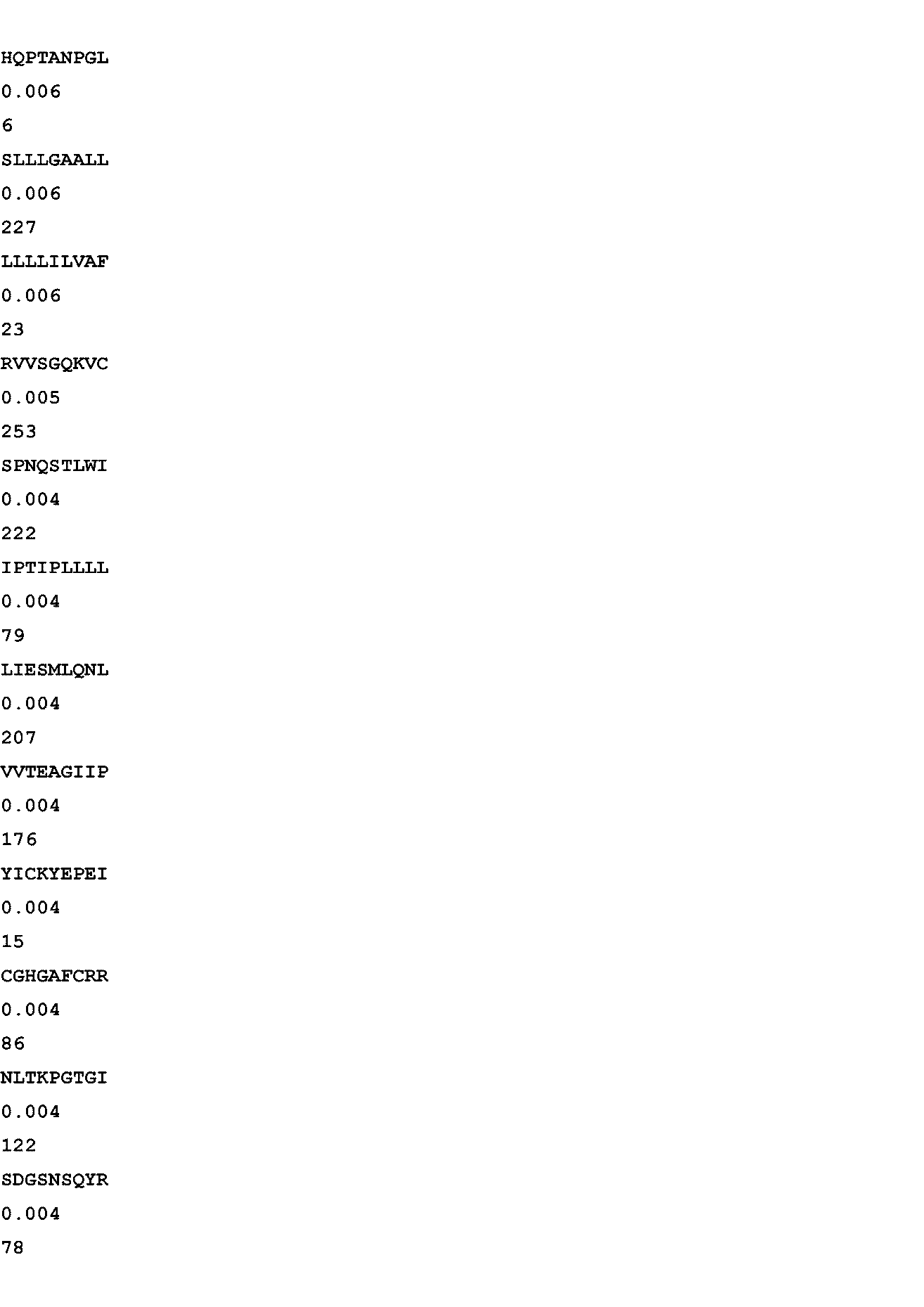
本明細書中で使用される場合、「処置すること」または「処置的な」および文法的に関連する用語は、疾患の任意の結果(例えば、延長した生存、より少ない罹患率、および/または副作用(代替的な治療形式の副産物;疾患の完全な撲滅が必要とされない)の減少)の任意の改善をいう。 As used herein, “treating” or “therapeutic” and grammatically related terms refer to any consequence of the disease (eg, prolonged survival, less morbidity, and / or Any improvement in side effects (reduction of side effects of alternative treatment modalities; complete eradication of the disease is not required).
「トランスジェニック動物」(例えば、マウスまたはラット)は、導入遺伝子を含む細胞を有する動物であり、この導入遺伝子は、動物に導入されたか、または出生前(例えば、胚の段階)に動物の先祖に導入された。「導入遺伝子」は、トランスジェニック動物が発生する細胞のゲノム中に組込まれるDNAである。 A “transgenic animal” (eg, a mouse or rat) is an animal that has cells that contain a transgene that has been introduced into the animal or is ancestor of the animal prior to birth (eg, at the embryonic stage). Was introduced. A “transgene” is a DNA that is integrated into the genome of a cell from which a transgenic animal develops.
本明細書中で使用する場合、HLAまたは細胞性免疫応答「ワクチン」は、本発明の1つ以上のペプチドを含むか、またはコードする組成物をいう。このようなワクチン(例えば1つ以上の別個のペプチド;ポリエピトープペプチドによって含まれる、本発明の1つ以上のペプチド;あるいはこのような別個のペプチドまたはポリエピトープ(例えば、ポリエピトープペプチドをコードするミニ遺伝子)をコードする核酸)の多数の実施形態が存在する。「1つ以上のペプチド」は、1〜150またはそれ以上(例えば、本発明の少なくとも、2、3、4、5、6、7、8、9、10、11、12、13、14、15、16、17、18、19、20、21、22、23、24、25、26、27、28、29、30、31、32、33、34、35、36、37、38、39、40、41、42、43、44、45、46、47、48、49、50、55、60、65、70、75、80、85、90、95、100、105、110、115、120、125、130、135、140、145、または150以上のペプチド)の任意の全整数単位が挙げられ得る。ペプチドまたはポリペプチドは、必要に応じて、(例えば、脂質化、標的化配列または他の配列の付加によって)改変され得る。本発明のHLAクラスIペプチドは、細胞傷害性Tリンパ球およびヘルパーTリンパ球の両方の活性化を促進させるために、HLAクラスIIペプチドと混合または連結され得る。HLAワクチンはまた、ペプチドパルス抗原提示細胞(例えば、樹状細胞)を含み得る。 As used herein, an HLA or cellular immune response “vaccine” refers to a composition comprising or encoding one or more peptides of the invention. Such vaccines (eg, one or more distinct peptides; one or more peptides of the invention encompassed by the polyepitope peptide; or such separate peptides or polyepitopes (eg, mini-encoding polyepitope peptides) There are numerous embodiments of nucleic acids that encode genes). “One or more peptides” refers to 1 to 150 or more (eg, at least 2, 3, 4, 5, 6, 7, 8, 9, 10, 11, 12, 13, 14, 15 of the present invention). 16, 17, 18, 19, 20, 21, 22, 23, 24, 25, 26, 27, 28, 29, 30, 31, 32, 33, 34, 35, 36, 37, 38, 39, 40 , 41, 42, 43, 44, 45, 46, 47, 48, 49, 50, 55, 60, 65, 70, 75, 80, 85, 90, 95, 100, 105, 110, 115, 120, 125 , 130, 135, 140, 145, or 150 or more peptides). Peptides or polypeptides can be modified as necessary (eg, by lipidation, targeting sequences, or addition of other sequences). The HLA class I peptides of the present invention can be mixed or linked with HLA class II peptides to promote the activation of both cytotoxic and helper T lymphocytes. The HLA vaccine may also include peptide pulse antigen presenting cells (eg, dendritic cells).
用語「改変体」とは、記載される型または基準(例えば、特に記載されるタンパク質(例えば、図2または図3に示される58P1D12タンパク質)の対応部分に、1つ以上の異なるアミノ酸残基を有するタンパク質)からの改変を示す分子をいう。アナログは、改変タンパク質の例である。スプライシングアイソフォームおよび一塩基多型(SNP)は、改変体のさらなる例である。 The term “variant” refers to one or more different amino acid residues in the corresponding portion of the type or criterion described (eg, specifically described proteins (eg, 58P1D12 protein shown in FIG. 2 or FIG. 3)). A molecule that exhibits a modification from An analog is an example of a modified protein. Splicing isoforms and single nucleotide polymorphisms (SNPs) are further examples of variants.
本発明の「58P1D12関連タンパク質」としては、本明細書中で具体的に同定されたタンパク質、ならびに対立遺伝子改変体、(本明細書中に概説される方法または当該分野で用意に利用可能な方法に従って実験を実施することなく、単離/生成され得、そして特徴付けられ得る)保存的置換改変体、アナログおよびホモログが挙げられる。異なる58P1D12タンパク質またはそのフラグメントの一部分に結合する融合タンパク質、ならびに58P1D12タンパク質および異種ポリペプチドの融合タンパク質もまた、含まれる。このような58P1D12タンパク質は、本発明のタンパク質である58P1D12関連タンパク質、または58P1D12として集合的に称される。用語「58P1D12関連タンパク質」とは、4、5、6、7、8、9、10、11、12、13、14、15、16、17、18、19、20、21、22、23、24、25または25より多いアミノ酸;あるいは少なくとも30、35、40、45、50、55、60、65、70、80、85、90、95、100、105、110、115、120、125、130、135、140、145、150、155、160、165、170、175、180、185、190、195、200、225、250、275、300、325、350、375、400、425、450、475、500、525、550、575または576以上のアミノ酸の、ポリペプチドフラグメントまたは58P1D12タンパク質配列
をいう。
The “58P1D12-related protein” of the present invention includes the proteins specifically identified herein, as well as allelic variants (methods outlined herein or methods readily available in the art). Conservative substitution variants, analogs and homologues that can be isolated / generated and characterized without performing experiments according to Also included are fusion proteins that bind to portions of different 58P1D12 proteins or fragments thereof, and fusion proteins of 58P1D12 proteins and heterologous polypeptides. Such 58P1D12 protein is collectively referred to as 58P1D12-related protein, or 58P1D12, which is the protein of the present invention. The term “58P1D12-related protein” means 4, 5, 6, 7, 8, 9, 10, 11, 12, 13, 14, 15, 16, 17, 18, 19, 20, 21, 22, 23, 24. 25 or more amino acids; or at least 30, 35, 40, 45, 50, 55, 60, 65, 70, 80, 85, 90, 95, 100, 105, 110, 115, 120, 125, 130, 135, 140, 145, 150, 155, 160, 165, 170, 175, 180, 185, 190, 195, 200, 225, 250, 275, 300, 325, 350, 375, 400, 425, 450, 475, Refers to a polypeptide fragment or 58P1D12 protein sequence of 500, 525, 550, 575 or more than 576 amino acids.
(II.)58P1D12ポリヌクレオチド)
本発明の1つの局面は、58P1D12の遺伝子、mRNAおよび/またはコード配列の全てまたは一部に対応するかまたは相補的な、好ましくは単離形態のポリヌクレオチドを提供し、これには、58P1D12関連タンパク質をコードするポリヌクレオチドおよびそのフラグメント、DNA、RNA、DNA/RNAハイブリッド、および関連分子、58P1D12の遺伝子もしくはmRNA配列に相補的なポリヌクレオチドもしくはオリゴヌクレオチドまたはその一部、ならびに58P1D12の遺伝子、mRNA、または58P1D12コードポリヌクレオチドにハイブリダイズするポリヌクレオチドもしくはオリゴヌクレオチド(集合的に「58P1D12ポリヌクレオチド」)が挙げられる。この節において参照される場合、全ての例において、Tは、図2において、Uでもあり得る。
(II.) 58P1D12 polynucleotide)
One aspect of the present invention provides a polynucleotide, preferably in isolated form, corresponding to or complementary to all or part of the 58P1D12 gene, mRNA and / or coding sequence, including 58P1D12 related Polynucleotides encoding proteins and fragments thereof, DNA, RNA, DNA / RNA hybrids, and related molecules, polynucleotides or oligonucleotides complementary to 58P1D12 gene or mRNA sequence, or parts thereof, and 58P1D12 genes, mRNA, Or a polynucleotide or oligonucleotide that hybridizes to a 58P1D12-encoding polynucleotide (collectively "58P1D12 polynucleotide"). As referenced in this section, in all examples, T can also be U in FIG.
58P1D12ポリヌクレオチドの実施形態としては、以下が挙げられる:図2に示される配列を有する58P1D12ポリヌクレオチド、図2に示されるような58P1D12ヌクレオチド配列(ここで、TはUである);図2に示されるような配列を有するポリヌクレオチドの少なくとも10個連続するヌクレオチド;または図2に示される配列を有するポリヌクレオチドの少なくとも10個連続するヌクレオチド(ここで、TはUである)。例えば、58P1D12ヌクレオチドの実施形態は、限定ではなく、以下を含む:
(I)図2に示されるような配列を含むか、実質的にこのような配列からなるか、またはこのような配列からなる、ポリヌクレオチド(ここで、TはUでもあり得る);
(II)図2Aに示されるような配列の、ヌクレオチド残基番号380〜ヌクレオチド残基番号1201(終止コドンを含む)を含むか、実質的にこのような配列からなるか、またはこのような配列からなる、ポリヌクレオチド(ここで、TはUでもあり得る);
(III)図2Bに示されるような配列の、ヌクレオチド残基番号388〜ヌクレオチド残基番号1086(終止コドンを含む)を含むか、実質的にこのような配列からなるか、またはこのような配列からなる、ポリヌクレオチド(ここで、TはUでもあり得る);
(IV)図2Cに示されるような配列の、ヌクレオチド残基番号206〜ヌクレオチド残基番号904(終止コドンを含む)を含むか、実質的にこのような配列からなるか、またはこのような配列からなる、ポリヌクレオチド(ここで、TはUでもあり得る);
(V)図2Dに示されるような配列の、ヌクレオチド残基番号206〜ヌクレオチド残基番号916(終止コドンを含む)を含むか、実質的にこのような配列からなるか、またはこのような配列からなる、ポリヌクレオチド(ここで、TはUでもあり得る);
(VI)図2Eに示されるような配列の、ヌクレオチド残基番号106〜ヌクレオチド残基番号816(終止コドンを含む)を含むか、実質的にこのような配列からなるか、またはこのような配列からなる、ポリヌクレオチド(ここで、TはUでもあり得る);
(VII)図2Fに示されるような配列を含むか、実質的にこのような配列からなるか、またはこのような配列からなる、ポリヌクレオチド(ここで、TはUでもあり得る);
(VIII)図2A〜Fに示される全長アミノ酸配列に対して少なくとも90、91、92、93、94、95、96、97、98、99または100%相同な58P1D12関連タンパク質をコードするポリヌクレオチド;
(IX)図2A〜Fに示される全長アミノ酸配列に対して少なくとも90、91、92、93、94、95、96、97、98、99または100%同一な58P1D12関連タンパク質をコードするポリヌクレオチド;
(X)表VIII〜XXIおよびXXII〜XLIXに示される少なくとも1つのペプチドをコードするポリヌクレオチド;
(XI)図5の親水性プロフィールにおいて0.5より大きい値を有する少なくとも1、2、3、4、5、6、7、8、9、10、11、12、13、14、15、16、17、18、19、20、21、22、23、24、25、26、27、28、29、30、31、32、33、34、35アミノ酸位置を含む、273までの任意の整数インクリメントで図3Aのペプチドの少なくとも5、6、7、8、9、10、11、12、13、14、15、16、17、18、19、20、21、22、23、24、25、26、27、28、29、30、31、32、33、34、35アミノ酸のペプチド領域をコードする、ポリヌクレオチド;
(XII)図6のヒドロパシープロフィールにおいて0.5より大きい値を有する1、2、3、4、5、6、7、8、9、10、11、12、13、14、15、16、17、18、19、20、21、22、23、24、25、26、27、28、29、30、31、32、33、34、35アミノ酸位置を含む、273までの任意の整数インクリメントで図3Aのペプチドの少なくとも5、6、7、8、9、10、11、12、13、14、15、16、17、18、19、20、21、22、23、24、25、26、27、28、29、30、31、32、33、34、35アミノ酸のペプチド領域をコードする、ポリヌクレオチド;
(XIII)図7の接近可能残基の%プロフィールにおいて0.5より大きい値を有する1、2、3、4、5、6、7、8、9、10、11、12、13、14、15、16、17、18、19、20、21、22、23、24、25、26、27、28、29、30、31、32、33、34、35アミノ酸位置を含む、273までの任意の整数インクリメントで図3Aのペプチドの少なくとも5、6、7、8、9、10、11、12、13、14、15、16、17、18、19、20、21、22、23、24、25、26、27、28、29、30、31、32、33、34、35アミノ酸のペプチド領域をコードする、ポリヌクレオチド;
(XIV)図8の平均可撓性プロフィールにおいて0.5より大きい値を有する1、2、3、4、5、6、7、8、9、10、11、12、13、14、15、16、17、18、19、20、21、22、23、24、25、26、27、28、29、30、31、32、33、34、35アミノ酸位置を含む、273までの任意の整数インクリメントで図3Aのペプチドの少なくとも5、6、7、8、9、10、11、12、13、14、15、16、17、18、19、20、21、22、23、24、25、26、27、28、29、30、31、32、33、34、35アミノ酸のペプチド領域をコードする、ポリヌクレオチド;
(XV)図9のβ−ターンプロフィールにおいて0.5より大きい値を有する1、2、3、4、5、6、7、8、9、10、11、12、13、14、15、16、17、18、19、20、21、22、23、24、25、26、27、28、29、30、31、32、33、34、35アミノ酸位置を含む273までの任意の整数インクリメントで図3Aのペプチドの少なくとも5、6、7、8、9、10、11、12、13、14、15、16、17、18、19、20、21、22、23、24、25、26、27、28、29、30、31、32、33、34、35アミノ酸のペプチド領域をコードする、ポリヌクレオチド;
(XVI)図5の親水性プロフィールにおいて0.5より大きい値を有する1、2、3、4、5、6、7、8、9、10、11、12、13、14、15、16、17、18、19、20、21、22、23、24、25、26、27、28、29、30、31、32、33、34、35アミノ酸位置を含む、それぞれ232および/または236までの任意の整数インクリメントで図3Bおよび/または3Cのペプチドの少なくとも5、6、7、8、9、10、11、12、13、14、15、16、17、18、19、20、21、22、23、24、25、26、27、28、29、30、31、32、33、34、35アミノ酸のペプチド領域をコードする、ポリヌクレオチド;
(XVII)図6のヒドロパシープロフィールにおいて0.5より大きい値を有する1、2、3、4、5、6、7、8、9、10、11、12、13、14、15、16、17、18、19、20、21、22、23、24、25、26、27、28、29、30、31、32、33、34、35アミノ酸位置を含む、それぞれ232および/または236までの任意の整数インクリメントで図3Bおよび/または3Cのペプチドの少なくとも5、6、7、8、9、10、11、12、13、14、15、16、17、18、19、20、21、22、23、24、25、26、27、28、29、30、31、32、33、34、35アミノ酸のペプチド領域をコードする、ポリヌクレオチド;
(XVIII)図7の接近可能残基の%プロフィールにおいて0.5より大きい値を有する1、2、3、4、5、6、7、8、9、10、11、12、13、14、15、16、17、18、19、20、21、22、23、24、25、26、27、28、29、30、31、32、33、34、35アミノ酸位置を含む、それぞれ232および/または236までの任意の整数インクリメントで図3Bおよび/または3Cのペプチドの少なくとも5、6、7、8、9、10、11、12、13、14、15、16、17、18、19、20、21、22、23、24、25、26、27、28、29、30、31、32、33、34、35アミノ酸のペプチド領域をコードする、ポリヌクレオチド;
(XIX)図8の平均可撓性プロフィールにおいて0.5より大きい値を有する1、2、3、4、5、6、7、8、9、10、11、12、13、14、15、16、17、18、19、20、21、22、23、24、25、26、27、28、29、30、31、32、33、34、35アミノ酸位置を含む、それぞれ232および/または236までの任意の整数インクリメントで図3Bおよび/または3Cのペプチドの少なくとも5、6、7、8、9、10、11、12、13、14、15、16、17、18、19、20、21、22、23、24、25、26、27、28、29、30、31、32、33、34、35アミノ酸のペプチド領域をコードする、ポリヌクレオチド;
(XX)図9のβ−ターンプロフィールにおいて0.5より大きい値を有する1、2、3、4、5、6、7、8、9、10、11、12、13、14、15、16、17、18、19、20、21、22、23、24、25、26、27、28、29、30、31、32、33、34、35アミノ酸位置を含む、それぞれ232および/または236までの任意の整数インクリメントで図3Bおよび/または3Cのペプチドの少なくとも5、6、7、8、9、10、11、12、13、14、15、16、17、18、19、20、21、22、23、24、25、26、27、28、29、30、31、32、33、34、35アミノ酸のペプチド領域をコードする、ポリヌクレオチド;
(XXI)(I)〜(XXX)のうちのいずれかのポリヌクレオチドに対して完全に相補的なポリヌクレオチド;
(XXII)(I)〜(XXI)のうちのいずれかのポリヌクレオチドに対して完全に相補的なポリヌクレオチド;
(XXIII)(I)〜(XXII)のうちのいずれかによりコードされるペプチド;ならびに;
(XXIV)薬学的賦形剤と一緒に、そして/またはヒト単位投薬形態で、(I)〜(XXII)のうちのいずれかのポリヌクレオチドまたは(XXIII)のペプチドを含有する組成物;
(XXV)58P1D12を発現する細胞を調節する方法において、(I)〜(XXII)のうちのいずれかのポリヌクレオチドまたは(XXIII)のペプチドまたは(XXIV)の組成物を使用する方法;
(XXVI)58P1D12を発現する細胞を有する個体を診断、予防、予後または処置する方法において、(I)〜(XXII)のうちのいずれかのポリヌクレオチドまたは(XXIII)のペプチドまたは(XXIV)の組成物を使用する方法;
(XXVII)58P1D12を発現する細胞(表Iに列挙される組織の癌由来の細胞)を有する個体を診断、予防、予後または処置する方法において、(I)〜(XXII)のうちのいずれかのポリヌクレオチドまたは(XXIII)のペプチドまたは(XXIV)の組成物を使用する方法;
(XXVIII)癌を診断、予防、予後または処置する方法において、(I)〜(XXII)のうちのいずれかのポリヌクレオチドまたは(XXIII)のペプチドまたは(XXIV)の組成物を使用する方法;
(XXIX)表Iに列挙される組織の癌を診断、予防、予後または処置する方法において、(I)〜(XXII)のうちのいずれかのポリヌクレオチドまたは(XXIII)のペプチドまたは(XXIV)の組成物を使用する方法;ならびに;
(XXX)58P1D12を発現する細胞の調節因子を同定または特徴付けする方法において、(I)〜(XXII)のうちのいずれかのポリヌクレオチドもしくは(XXIII)のペプチドまたは(XXIV)の組成物を使用する方法。
Embodiments of 58P1D12 polynucleotides include: 58P1D12 polynucleotide having the sequence shown in FIG. 2, 58P1D12 nucleotide sequence as shown in FIG. 2 (where T is U); At least 10 contiguous nucleotides of a polynucleotide having the sequence as shown; or at least 10 contiguous nucleotides of a polynucleotide having the sequence shown in FIG. 2 (where T is U). For example, 58P1D12 nucleotide embodiments include, but are not limited to:
(I) a polynucleotide comprising a sequence as shown in FIG. 2, consisting essentially of such a sequence, or consisting of such a sequence (where T can also be U);
(II) a sequence as shown in FIG. 2A comprising nucleotide residue number 380 to nucleotide residue number 1201 (including a stop codon), consisting essentially of such a sequence, or such a sequence A polynucleotide consisting of (where T can also be U);
(III) a sequence as shown in FIG. 2B comprising, consisting essentially of, or consisting of nucleotide residue number 388 to nucleotide residue number 1086 (including the stop codon) A polynucleotide consisting of (where T can also be U);
(IV) a sequence as shown in FIG. 2C comprising, consisting essentially of, or consisting of
(V) a sequence as shown in FIG. 2D comprising, consisting essentially of, or consisting of nucleotide residue no. 206 to nucleotide residue no. 916 (including a stop codon) A polynucleotide consisting of (where T can also be U);
(VI) a sequence as shown in FIG. 2E comprising, consisting essentially of, or consisting of
(VII) a polynucleotide comprising, consisting essentially of, or consisting of such a sequence as shown in FIG. 2F (where T can also be U);
(VIII) a polynucleotide encoding a 58P1D12-related protein that is at least 90, 91, 92, 93, 94, 95, 96, 97, 98, 99, or 100% homologous to the full length amino acid sequence shown in FIGS.
(IX) a polynucleotide encoding a 58P1D12-related protein that is at least 90, 91, 92, 93, 94, 95, 96, 97, 98, 99, or 100% identical to the full length amino acid sequences shown in FIGS.
(X) a polynucleotide encoding at least one peptide shown in Tables VIII-XXI and XXII-XLIX;
(XI) At least 1, 2, 3, 4, 5, 6, 7, 8, 9, 10, 11, 12, 13, 14, 15, 16 having a value greater than 0.5 in the hydrophilic profile of FIG. , 17, 18, 19, 20, 21, 22, 23, 24, 25, 26, 27, 28, 29, 30, 31, 32, 33, 34, 35 Any integer increment up to 273 including amino acid positions And at least 5, 6, 7, 8, 9, 10, 11, 12, 13, 14, 15, 16, 17, 18, 19, 20, 21, 22, 23, 24, 25, 26 of the peptide of FIG. A polynucleotide encoding a peptide region of 27, 28, 29, 30, 31, 32, 33, 34, 35 amino acids;
(XII) 1, 2, 3, 4, 5, 6, 7, 8, 9, 10, 11, 12, 13, 14, 15, 16, having a value greater than 0.5 in the hydropathic profile of FIG. In any integer increment up to 273, including 17, 18, 19, 20, 21, 22, 23, 24, 25, 26, 27, 28, 29, 30, 31, 32, 33, 34, 35 amino acid positions At least 5, 6, 7, 8, 9, 10, 11, 12, 13, 14, 15, 16, 17, 18, 19, 20, 21, 22, 23, 24, 25, 26, of the peptide of FIG. A polynucleotide encoding a peptide region of 27, 28, 29, 30, 31, 32, 33, 34, 35 amino acids;
(XIII) 1, 2, 3, 4, 5, 6, 7, 8, 9, 10, 11, 12, 13, 14, having a value greater than 0.5 in the% profile of accessible residues in FIG. Any up to 273 including 15, 16, 17, 18, 19, 20, 21, 22, 23, 24, 25, 26, 27, 28, 29, 30, 31, 32, 33, 34, 35 amino acid positions At least 5, 6, 7, 8, 9, 10, 11, 12, 13, 14, 15, 16, 17, 18, 19, 20, 21, 22, 23, 24, of the peptide of FIG. A polynucleotide encoding a peptide region of 25, 26, 27, 28, 29, 30, 31, 32, 33, 34, 35 amino acids;
(XIV) 1, 2, 3, 4, 5, 6, 7, 8, 9, 10, 11, 12, 13, 14, 15, having a value greater than 0.5 in the average flexibility profile of FIG. Any integer up to 273, including 16, 17, 18, 19, 20, 21, 22, 23, 24, 25, 26, 27, 28, 29, 30, 31, 32, 33, 34, 35 amino acid positions In increments of at least 5, 6, 7, 8, 9, 10, 11, 12, 13, 14, 15, 16, 17, 18, 19, 20, 21, 22, 23, 24, 25, of the peptide of FIG. A polynucleotide encoding a peptide region of 26, 27, 28, 29, 30, 31, 32, 33, 34, 35 amino acids;
(XV) 1, 2, 3, 4, 5, 6, 7, 8, 9, 10, 11, 12, 13, 14, 15, 16 having a value greater than 0.5 in the β-turn profile of FIG. , 17, 18, 19, 20, 21, 22, 23, 24, 25, 26, 27, 28, 29, 30, 31, 32, 33, 34, 35 in any integer increment up to 273 including amino acid positions At least 5, 6, 7, 8, 9, 10, 11, 12, 13, 14, 15, 16, 17, 18, 19, 20, 21, 22, 23, 24, 25, 26, of the peptide of FIG. A polynucleotide encoding a peptide region of 27, 28, 29, 30, 31, 32, 33, 34, 35 amino acids;
(XVI) 1, 2, 3, 4, 5, 6, 7, 8, 9, 10, 11, 12, 13, 14, 15, 16, having a value greater than 0.5 in the hydrophilic profile of FIG. 17, 18, 19, 20, 21, 22, 23, 24, 25, 26, 27, 28, 29, 30, 31, 32, 33, 34, 35 amino acid positions, including up to 232 and / or 236, respectively At least 5, 6, 7, 8, 9, 10, 11, 12, 13, 14, 15, 16, 17, 18, 19, 20, 21, 22 of the peptides of FIG. 3B and / or 3C in any integer increment A polynucleotide encoding a peptide region of 23, 24, 25, 26, 27, 28, 29, 30, 31, 32, 33, 34, 35 amino acids;
(XVII) 1, 2, 3, 4, 5, 6, 7, 8, 9, 10, 11, 12, 13, 14, 15, 16, having a value greater than 0.5 in the hydropathic profile of FIG. 17, 18, 19, 20, 21, 22, 23, 24, 25, 26, 27, 28, 29, 30, 31, 32, 33, 34, 35 amino acid positions, including up to 232 and / or 236, respectively At least 5, 6, 7, 8, 9, 10, 11, 12, 13, 14, 15, 16, 17, 18, 19, 20, 21, 22 of the peptides of FIG. 3B and / or 3C in any integer increment A polynucleotide encoding a peptide region of 23, 24, 25, 26, 27, 28, 29, 30, 31, 32, 33, 34, 35 amino acids;
(XVIII) 1, 2, 3, 4, 5, 6, 7, 8, 9, 10, 11, 12, 13, 14, having a value greater than 0.5 in the% profile of accessible residues in FIG. 15, 16, 17, 18, 19, 20, 21, 22, 23, 24, 25, 26, 27, 28, 29, 30, 31, 32, 33, 34, 35 amino acid positions, including 232 and / or respectively Or at least 5, 6, 7, 8, 9, 10, 11, 12, 13, 14, 15, 16, 17, 18, 19, 20 of the peptides of FIGS. 3B and / or 3C in any integer increment up to 236 , 21, 22, 23, 24, 25, 26, 27, 28, 29, 30, 31, 32, 33, 34, a polynucleotide encoding a peptide region of 35, 35 amino acids;
(XIX) 1, 2, 3, 4, 5, 6, 7, 8, 9, 10, 11, 12, 13, 14, 15, having a value greater than 0.5 in the average flexibility profile of FIG. 16, 17, 18, 19, 20, 21, 22, 23, 24, 25, 26, 27, 28, 29, 30, 31, 32, 33, 34, 35 amino acid positions, including 232 and / or 236, respectively At least 5, 6, 7, 8, 9, 10, 11, 12, 13, 14, 15, 16, 17, 18, 19, 20, 21 of the peptides of FIG. 3B and / or 3C in any integer increment up to A polynucleotide encoding a peptide region of 22, 23, 24, 25, 26, 27, 28, 29, 30, 31, 32, 33, 34, 35 amino acids;
(XX) 1, 2, 3, 4, 5, 6, 7, 8, 9, 10, 11, 12, 13, 14, 15, 16 having a value greater than 0.5 in the β-turn profile of FIG. 17, 18, 19, 20, 21, 22, 23, 24, 25, 26, 27, 28, 29, 30, 31, 32, 33, 34, 35 amino acid positions, including up to 232 and / or 236, respectively At least 5, 6, 7, 8, 9, 10, 11, 12, 13, 14, 15, 16, 17, 18, 19, 20, 21, in any integer increment of FIG. 3B and / or 3C A polynucleotide encoding a peptide region of 22, 23, 24, 25, 26, 27, 28, 29, 30, 31, 32, 33, 34, 35 amino acids;
(XXI) a polynucleotide that is completely complementary to a polynucleotide of any one of (I) to (XXX);
(XXII) a polynucleotide that is completely complementary to a polynucleotide of any one of (I)-(XXI);
(XXIII) a peptide encoded by any of (I)-(XXII); and;
(XXIV) a composition comprising a polynucleotide of any of (I)-(XXII) or a peptide of (XXIII) together with a pharmaceutical excipient and / or in a human unit dosage form;
(XXV) In a method of modulating a cell expressing 58P1D12, a method of using a polynucleotide of any one of (I) to (XXII) or a peptide of (XXIII) or a composition of (XXIV);
(XXVI) In the method of diagnosing, preventing, prognosing or treating an individual having cells expressing 58P1D12, the polynucleotide of any one of (I) to (XXII) or the peptide of (XXIII) or the composition of (XXIV) How to use things;
(XXVII) In a method of diagnosing, preventing, prognosing or treating an individual having cells expressing 58P1D12 (cells derived from cancer of the tissues listed in Table I), any one of (I) to (XXII) A method of using a polynucleotide or a peptide of (XXIII) or a composition of (XXIV);
(XXVIII) In a method for diagnosing, preventing, prognosing or treating cancer, a method of using a polynucleotide of any one of (I) to (XXII) or a peptide of (XXIII) or a composition of (XXIV);
(XXIX) In a method for diagnosing, preventing, prognosing or treating a cancer of the tissues listed in Table I, a polynucleotide of any one of (I) to (XXII) or a peptide of (XXIII) or (XXIV) A method of using the composition; and;
(XXX) In a method for identifying or characterizing a modulator of a cell expressing 58P1D12, a polynucleotide of any one of (I) to (XXII) or a peptide of (XXIII) or a composition of (XXIV) how to.
本明細書中で使用する場合、ある範囲は、その全単位位置の全てを具体的に開示することが理解される。 As used herein, a range is understood to specifically disclose all of its unit positions.
本明細書中に開示される本発明の代表的な実施形態としては、タンパク質および/またはそのフラグメントをコードするような58P1D12 mRNA配列の特定の部分をコードする58P1D12ポリヌクレオチド(およびこのような配列に相補的なポリヌクレオチド)が挙げられる(例えば: (a)58P1D12改変体1の、4、5、6、7、8、9、10、11、12、13、14、15、16、17、18、19、20、21、22、23、24、25、30、35、40、45、50、55、60、65、70、75、80、85、90、95、100、105、110、115、120、125、130、135、140、145、150、155、160、165、170、175、180、185、190、195、200、225、250、255、260、265、270、および273個またはそれ以上の連続するアミノ酸;他の改変体に対して関連する最長の長さは:改変体2、232アミノ酸:改変体3、236アミノ酸である)。
Exemplary embodiments of the invention disclosed herein include 58P1D12 polynucleotides (and such sequences that encode a specific portion of a 58P1D12 mRNA sequence such as encoding proteins and / or fragments thereof). Complementary polynucleotides) (eg: (a)
例えば、本明細書中に開示される発明の代表的な実施形態としては、以下:図2または図3に示される58P1D12タンパク質の約アミノ酸1〜約アミノ酸10をコードするポリヌクレオチドおよびそのコードされたペプチド自体、図2または図3に示される58P1D12タンパク質の約アミノ酸10〜約アミノ酸20をコードするポリヌクレオチド、図2または図3に示される58P1D12タンパク質の約アミノ酸20〜約アミノ酸30をコードするポリヌクレオチド、図2または図3に示される58P1D12タンパク質の約アミノ酸30〜約アミノ酸40をコードするポリヌクレオチド、図2または図3に示される58P1D12タンパク質の約アミノ酸40〜約アミノ酸50をコードするポリヌクレオチド、図2または図3に示される58P1D12タンパク質の約アミノ酸50〜約アミノ酸60をコードするポリヌクレオチド、図2または図3に示される58P1D12タンパク質の約アミノ酸60〜約アミノ酸70をコードするポリヌクレオチド、図2または図3に示される58P1D12タンパク質の約アミノ酸70〜約アミノ酸80をコードするポリヌクレオチド、図2または図3に示される58P1D12タンパク質の約アミノ酸80〜約アミノ酸90をコードするポリヌクレオチドをコードするポリヌクレオチド、図2または図3に示される58P1D12タンパク質の約アミノ酸90〜約アミノ酸100をコードするポリヌクレオチドが挙げられ、約10アミノ酸の増分で、図2または図3に示されるカルボキシル末端アミノ酸で終わる。従って、58P1D12タンパク質のアミノ酸100〜カルボキシル末端アミノ酸のアミノ酸配列の(約10アミノ酸の)部分をコードするポリヌクレオチドは、本発明の実施形態である。ここで、各特定のアミノ酸位置は、位置±5アミノ酸残基を開示することが理解される。
For example, representative embodiments of the invention disclosed herein include: a polynucleotide encoding from about
58P1D12タンパク質の比較的長い部分をコードするポリヌクレオチドもまた、本発明の範囲内である。例えば、図2または図3に示される58P1D12タンパク質またはその「改変体」の、約アミノ酸1(または20または30または40など)〜約アミノ酸20(または30または40または50など)をコードするポリヌクレオチドは、当該分野で周知の種々の技術によって生成され得る。これらのポリヌクレオチドフラグメントは、図2に示されるような58P1D12配列の任意の部分を含み得る。 Polynucleotides that encode a relatively long portion of the 58P1D12 protein are also within the scope of the invention. For example, a polynucleotide encoding from about amino acid 1 (or 20 or 30 or 40 or the like) to about amino acid 20 (or 30 or 40 or 50 or the like) of the 58P1D12 protein or “variant” thereof shown in FIG. 2 or FIG. Can be generated by various techniques well known in the art. These polynucleotide fragments can comprise any portion of the 58P1D12 sequence as shown in FIG.
本明細書中に開示される発明のさらなる例示的実施形態としては、58P1D12タンパク質配列または「改変体」配列内に含まれる1以上の生物学的モチーフをコードする58P1D12ポリヌクレオチドフラグメントが挙げられ、これには、表VIII〜XXIおよびXXII〜XLIXに示される58P1D12タンパク質「または改変体」の、1以上のモチーフ保有部分配列が挙げられる。別の実施形態において、本発明の代表的なポリヌクレオチドフラグメントは、既知の分子に対する相同性を示す58P1D12のタンパク質または改変体の、1以上の領域をコードする。本発明の別の実施形態において、代表的なポリヌクレオチドフラグメントは、58P1D12のタンパク質または改変体のN−グリコシル化部位、cAMP依存性およびcGMP依存性のプロテインキナーゼリン酸化部位、カゼインキナーゼIIリン酸化部位またはN−ミリストイル化部位、ならびにアミド化部位のうち1以上をコードし得る。 Further exemplary embodiments of the invention disclosed herein include 58P1D12 polynucleotide fragments that encode one or more biological motifs contained within a 58P1D12 protein sequence or “variant” sequence. Includes one or more motif-bearing subsequences of the 58P1D12 protein “or variant” shown in Tables VIII-XXI and XXII-XLIX. In another embodiment, a representative polynucleotide fragment of the invention encodes one or more regions of a 58P1D12 protein or variant that exhibits homology to a known molecule. In another embodiment of the invention, a representative polynucleotide fragment is an N-glycosylation site, cAMP-dependent and cGMP-dependent protein kinase phosphorylation site, casein kinase II phosphorylation site of a 58P1D12 protein or variant. Alternatively, it may encode one or more of N-myristoylation sites, as well as amidation sites.
その親タンパク質(例えば、改変体1、改変体2など)に対する、表VIII〜XXIおよび表XXII〜XLIX(集合的に、HLAペプチド表)に示される任意のペプチドのそれぞれの開始位置を決定するために、以下の3つの因子について言及がなされることに留意のこと:特定の改変体、HLAペプチド表中のペプチドの長さ、表VIIに列挙される検索ペプチド。一般に、独自の検索ペプチドが、特定の改変体についてのHLAペプチドを得るために使用される。そのそれぞれの親分子に関する各検索ペプチドの位置は、表VIIに列挙される。従って、検索ペプチドが位置「X」で開始する場合、それらの親分子中のHLAペプチドの実際の位置を得るために、表VIII〜XXIおよび表XXII〜IL中の各位置に、「X−1」の値を加算しなければならない。例えば、特定の検索ペプチドがその親分子の位置150にて開始する場合、親分子中のアミノ酸の位置を計算するために、150−1(すなわち、149)を、各HLAペプチドのアミノ酸位置に加算しなければならない。
To determine the starting position of each of the peptides shown in Tables VIII-XXI and Tables XXII-XLIX (collectively, HLA peptide tables) relative to its parent protein (eg,
(II.A.)58P1D12ポリヌクレオチドの用途)
(II.A.1.)遺伝的異常のモニタリング)
上記パラグラフのポリヌクレオチドは、多数の異なる特定の用途を有する。ヒト58P1D12遺伝子は、「58P1D12の染色体マッピング」との表題の実施例において示される染色体位置にマッピングされる。例えば、58P1D12遺伝子は、この染色体にマッピングされるので、58P1D12タンパク質の異なる領域をコードするポリヌクレオチドは、この染色体位置の細胞発生異常(例えば、種々の癌に関連するとして同定された異常)を特徴付けるために使用される。特定の遺伝子において、再編成を含む種々の染色体異常が、多数の異なる癌における頻繁な細胞発生的異常として同定されている(例えば、Krajinovicら、Mutat.Res.382(3−4):81−83(1998);Johanssonら、Blood 86(10):3905−3914(1995)およびFingerら、P.N.A.S.85(23):9158−9162(1988)を参照のこと)。従って、58P1D12タンパク質の特定の領域をコードするポリヌクレオチドは、悪性の表現型に寄与し得る、58P1D12をコードする染色体領域における細胞発生的異常を説明するために使用され得る、以前に可能であったツールよりもより正確な、新たなツールを提供する。この文脈において、これらのポリヌクレオチドは、より微妙な染色体異常およびあまり一般的でない染色体異常を同定するために、染色体スクリーニングの感受性を拡大することについての、当該分野における必要性を満たす(例えば、Evansら、Am.J.Obstet.Gynecol 171(4):1055−1057(1994)を参照のこと)。
(II.A.) Use of 58P1D12 polynucleotide)
(II.A.1. Monitoring of genetic abnormality)
The polynucleotides of the above paragraphs have a number of different specific uses. The human 58P1D12 gene maps to the chromosomal location indicated in the example titled “58P1D12 Chromosome Mapping”. For example, since the 58P1D12 gene maps to this chromosome, polynucleotides encoding different regions of the 58P1D12 protein characterize cytogenic abnormalities at this chromosomal location (eg, abnormalities identified as being associated with various cancers). Used for. In certain genes, various chromosomal abnormalities, including rearrangements, have been identified as frequent cytogenetic abnormalities in a number of different cancers (eg, Krajinovic et al., Mutat. Res. 382 (3-4): 81- 83 (1998); see Johansson et al., Blood 86 (10): 3905-3914 (1995) and Finger et al., PNS AS 85 (23): 9158-9162 (1988)). Thus, a polynucleotide encoding a particular region of 58P1D12 protein could previously be used to account for cytogenetic abnormalities in the chromosomal region encoding 58P1D12 that may contribute to a malignant phenotype Provide new tools that are more accurate than tools. In this context, these polynucleotides meet the need in the art for expanding the susceptibility of chromosome screening to identify more subtle and less common chromosomal abnormalities (eg, Evans Et al., Am. J. Obstet. Gynecol 171 (4): 1055-1057 (1994)).
さらに、58P1D12は、前立腺癌および他の癌において高度に発現されることが示されているので、58P1D12ポリヌクレオチドは、正常組織 対 癌性組織における58P1D12遺伝子産物の状態を評価する方法において使用される。代表的に、58P1D12タンパク質の特定の領域をコードするポリヌクレオチドは、58P1D12遺伝子の特定の領域(例えば、1以上のモチーフを含む領域)における乱れ(例えば、抗原の喪失などを生じる欠失、挿入、点変異または改変)の存在を評価するために使用される。例示的なアッセイとしては、RT−PCRアッセイおよび一本鎖コンホメーション多型(SSCP)分析(例えば、Marrogiら、J.Cutan.Pathol.26(8):369−378(1999)を参照のこと)の両方が挙げられ、これらは両方とも、タンパク質内のこれらの領域を試験するために、タンパク質内の特定の領域をコードするポリヌクレオチドを利用する。 In addition, since 58P1D12 has been shown to be highly expressed in prostate and other cancers, 58P1D12 polynucleotides are used in methods to assess the status of 58P1D12 gene products in normal versus cancerous tissues . Typically, a polynucleotide encoding a specific region of the 58P1D12 protein comprises a disorder (eg, a deletion, insertion, resulting in loss of antigen, etc.) in a specific region (eg, a region containing one or more motifs) of the 58P1D12 gene. Used to assess the presence of point mutations or modifications). Exemplary assays include RT-PCR assays and single strand conformation polymorphism (SSCP) analysis (see, eg, Marrogi et al., J. Cutan. Pathol. 26 (8): 369-378 (1999)). Both of which utilize a polynucleotide encoding a particular region within a protein in order to test those regions within the protein.
(II.A.2.)アンチセンスの実施形態)
本明細書中に開示される本発明の、他の具体的に企図された核酸に関する実施形態は、ゲノムDNA、cDNA、リボザイムおよびアンチセンス分子、ならびに天然供給源由来であるか合成であるかにかかわらない、代替骨格に基づく核酸分子または代替塩基を含む核酸分子であり、そしてこれには、58P1D12のRNA発現またはタンパク質発現を阻害し得る分子が含まれる。例えば、アンチセンス分子は、塩基対依存的な様式でDNAまたはRNAに特異的に結合する、ペプチド核酸(PNA)または非核酸分子(例えば、ホスホロチオエート誘導体)を含む、RNAまたは他の分子であり得る。当業者は、本明細書中に開示される58P1D12のポリヌクレオチドおよびポリヌクレオチド配列を使用して、これらのクラスの核酸分子を容易に獲得し得る。
(II.A.2. Antisense Embodiment)
The embodiments of the invention disclosed herein relating to other specifically contemplated nucleic acids are genomic DNA, cDNA, ribozyme and antisense molecules, and whether they are derived from natural sources or synthetic Regardless, an alternative backbone based nucleic acid molecule or nucleic acid molecule comprising an alternative base, and includes molecules capable of inhibiting RNA or protein expression of 58P1D12. For example, antisense molecules can be RNA or other molecules, including peptide nucleic acids (PNA) or non-nucleic acid molecules (eg, phosphorothioate derivatives) that specifically bind to DNA or RNA in a base-pair dependent manner. . One skilled in the art can readily obtain these classes of nucleic acid molecules using the 58P1D12 polynucleotides and polynucleotide sequences disclosed herein.
アンチセンス技術は、細胞内に位置する標的ポリヌクレオチドに結合する外因性オリゴヌクレオチドの投与を伴う。用語「アンチセンス」は、このようなオリゴヌクレオチドが、その細胞内標的(例えば、58P1D12)に相補的であるという事実をいう。例えば、Jack Cohen、Oligodeoxynucleotides,Antisense Inhibitiors of Gene Expression、CRC Press、1989;およびSynthesis 1:1−5(1988)を参照のこと。本発明の58P1D12アンチセンスオリゴヌクレオチドとしては、誘導体(例えば、S−オリゴヌクレオチド(ホスホロチオエート誘導体またはS−オリゴ、Jack Cohen(前出)を参照のこと)が挙げられ、これは、増強された癌細胞増殖阻害活性を示す。S−オリゴ(ヌクレオシドホスホロチオエート)は、リン酸基の非架橋酸素原子が硫黄原子によって置換されている、オリゴヌクレオチド(O−オリゴ)の等電子アナログである。本発明のS−オリゴは、3H−1,2−ベンゾジチオール−3−オン−1,1−ジオキシド(これは、硫黄転移試薬である)での対応するO−オリゴの処理によって調製され得る。例えば、Iyer,R.P.ら、J.Org.Chem.55:4693−4698(1990);およびIyer,R.P.ら、J.Am.Chem.Soc.112:1253−1254(1990)。本発明のさらなる58P1D12アンチセンスオリゴヌクレオチドとしては、当該分野で公知のモルホリノアンチセンスオリゴヌクレオチドが挙げられる(例えば、Partridgeら、1996、Antisense & Nucleic Acid Drug Development 6:169−175を参照のこと)。 Antisense technology involves the administration of exogenous oligonucleotides that bind to target polynucleotides located within the cell. The term “antisense” refers to the fact that such an oligonucleotide is complementary to its intracellular target (eg, 58P1D12). See, for example, Jack Cohen, Oligodeoxynucleotides, Antisense Inhibitors of Gene Expression, CRC Press, 1989; and Synthesis 1: 1-5 (1988). 58P1D12 antisense oligonucleotides of the invention include derivatives (eg, S-oligonucleotides (see phosphorothioate derivatives or S-oligos, Jack Cohen (supra)), which are enhanced cancer cells. S-oligo (nucleoside phosphorothioate) is an isoelectronic analog of an oligonucleotide (O-oligo) in which the non-bridging oxygen atom of the phosphate group is replaced by a sulfur atom. -Oligos can be prepared by treatment of the corresponding O-oligos with 3H-1,2-benzodithiol-3-one-1,1-dioxide, which is a sulfur transfer reagent, eg, Iyer, RP et al., J. Org. Chem. 55: 4693-4698 (1990); r, R.P., et al., J. Am.Chem.Soc. (See, for example, Partridge et al., 1996, Antisense & Nucleic Acid Drug Development 6: 169-175).
本発明の58P1D12アンチセンスオリゴヌクレオチドは、代表的に、58P1D12ゲノム配列または対応するmRNAの最初の100個の5’側コドンまたは最後の100個の3’側コドンに相補的であり、かつこれらと安定にハイブリダイズする、RNAまたはDNAであり得る。完全な相補性は必要ないが、高度な相補性が好ましい。この領域に相補的なオリゴヌクレオチドの使用によって、58P1D12 mRNAへの選択的なハイブリダイゼーションは可能になるが、プロテインキナーゼの他の調節サブユニットを指定するmRNAへの選択的なハイブリダイゼーションは可能にならない。1つの実施形態において、本発明の58P1D12アンチセンスオリゴヌクレオチドは、58P1D12 mRNAにハイブリダイズする配列を有するアンチセンスDNA分子の15〜30マーのフラグメントである。必要に応じて、58P1D12アンチセンスオリゴヌクレオチドは、58P1D12の最初の10個の5’側コドンまたは最後の10個の3’側コドン中の領域に相補的な30マーのオリゴヌクレオチドである。あるいは、このアンチセンス分子は、58P1D12発現の阻害においてリボザイムを使用するように改変される(例えば、L.A.Couture & D.T.Stinchcomb;Trends Genet 12:510−515(1996)を参照のこと)。 58P1D12 antisense oligonucleotides of the invention are typically complementary to the first 100 5 ′ codons or the last 100 3 ′ codons of a 58P1D12 genomic sequence or corresponding mRNA, and It can be RNA or DNA that hybridizes stably. Although complete complementarity is not required, a high degree of complementarity is preferred. The use of an oligonucleotide complementary to this region allows selective hybridization to 58P1D12 mRNA, but does not allow selective hybridization to mRNAs that specify other regulatory subunits of protein kinases. . In one embodiment, a 58P1D12 antisense oligonucleotide of the invention is a 15-30 mer fragment of an antisense DNA molecule having a sequence that hybridizes to 58P1D12 mRNA. Optionally, the 58P1D12 antisense oligonucleotide is a 30-mer oligonucleotide complementary to a region in the first 10 5 'codons or the last 10 3' codons of 58P1D12. Alternatively, the antisense molecule is modified to use a ribozyme in inhibiting 58P1D12 expression (see, eg, LA Couture & DT Stinchcomb; Trends Genet 12: 510-515 (1996)). thing).
(II.A.3.)プライマーおよびプライマー対)
本発明のこのヌクレオチドのさらに特定の実施形態としては、プライマーおよびプライマー対(これらは、本発明のポリヌクレオチドまたはその任意の特定の部分の特異的増幅を可能にする)、ならびにプローブ(これは、本発明の核酸分子またはその任意の部分に選択的にかまたは特異的にハイブリダイズする)が挙げられる。プローブは、検出可能なマーカー(例えば、放射性同位体、蛍光化合物、生体発光化合物、化学発光化合物、金属キレート剤または酵素)で標識され得る。このようなプローブおよびプライマーは、サンプル中の58P1D12ポリヌクレオチドの存在を検出するため、および58P1D12タンパク質を発現する細胞を検出するための手段として使用される。
(II.A.3. Primers and primer pairs)
More specific embodiments of this nucleotide of the invention include primers and primer pairs (which allow specific amplification of the polynucleotide of the invention or any particular portion thereof) and probes (which Hybridize selectively or specifically to the nucleic acid molecule of the present invention or any part thereof. The probe can be labeled with a detectable marker (eg, radioisotope, fluorescent compound, bioluminescent compound, chemiluminescent compound, metal chelator or enzyme). Such probes and primers are used as a means for detecting the presence of 58P1D12 polynucleotides in a sample and for detecting cells expressing 58P1D12 protein.
このようなプローブの例としては、図2に示されるヒト58P1D12 cDNA配列の全てまたは一部を含むポリヌクレオチドが挙げられる。58P1D12 mRNAを特異的に増幅し得るプライマー対の例もまた、実施例に記載される。当業者によって理解されるように、非常に多数の異なるプライマーおよびプローブが、本明細書中に提供される配列に基づいて調製され得、そして58P1D12 mRNAを増幅および/または検出するために有効に使用され得る。 Examples of such probes include a polynucleotide comprising all or part of the human 58P1D12 cDNA sequence shown in FIG. Examples of primer pairs that can specifically amplify 58P1D12 mRNA are also described in the Examples. As will be appreciated by those skilled in the art, a large number of different primers and probes can be prepared based on the sequences provided herein and effectively used to amplify and / or detect 58P1D12 mRNA. Can be done.
本発明の58P1D12ポリヌクレオチドは、種々の目的のために有用であり、その用途としては、限定ではなく以下が挙げられる:58P1D12遺伝子、mRNAもしくはそのフラグメントの増幅および/または検出のためのプローブおよびプライマーとして;前立腺癌および他の癌の診断および/または予後のための試薬として;58P1D12ポリペプチドの発現を指向し得るコード配列として;58P1D12遺伝子の発現および/または58P1D12転写物の翻訳を調節または阻害するためのツールとして;そして治療剤として。 The 58P1D12 polynucleotides of the present invention are useful for a variety of purposes, including but not limited to: Probes and primers for amplification and / or detection of 58P1D12 gene, mRNA or fragments thereof As a reagent for the diagnosis and / or prognosis of prostate cancer and other cancers; as a coding sequence capable of directing the expression of 58P1D12 polypeptide; As a tool for; and as a therapeutic agent.
本発明は、天然に存在する供給源(例えば、ヒトまたは他の哺乳動物)由来の58P1D12核酸配列または58P1D12関連核酸配列を同定および単離するための、本明細書中に記載されるような任意のプローブの使用、ならびに単離された核酸配列自体(これは、使用されるプローブ中に見出される配列の全てまたはほとんどを含む)を包含する。 The present invention may be any as described herein for identifying and isolating 58P1D12 nucleic acid sequences or 58P1D12-related nucleic acid sequences from naturally occurring sources (eg, humans or other mammals). As well as the isolated nucleic acid sequence itself, which includes all or most of the sequences found in the probe used.
(II.A.4.)58P1D12コード核酸分子の単離)
本明細書中に記載される58P1D12 cDNA配列は、58P1D12遺伝子産物をコードする他のポリヌクレオチドの単離、ならびに58P1D12遺伝子産物ホモログ、代替的スプライシングされたアイソフォーム、対立遺伝子改変体および58P1D12遺伝子産物の変異形態をコードするポリヌクレオチドの単離、ならびに58P1D12関連タンパク質のアナログをコードするポリヌクレオチドの単離を可能にする。58P1D12遺伝子をコードする全長cDNAを単離するために使用され得る種々の分子クローニング方法が周知である(例えば、Sambrook,J.ら、Molecular Cloning:A Laboratory Manual、第二版、Cold Spring Harbor Press、New York、1989;Current Protocols in Molecular Biology.Ausubelら(編)、Wiley and Sons、1995を参照のこと)。例えば、λファージクローニング方法論は、市販のクローニングシステム(例えば、Lambda ZAP Express、Stratagene)を使用して、簡便に使用され得る。58P1D12遺伝子のcDNAを含むファージクローンは、標識された58P1D12 cDNAまたはそのフラグメントを用いて探索することによって、同定され得る。例えば、1つの実施形態において、58P1D12 cDNA(例えば、図2)またはその一部が、合成され得、そして58P1D12遺伝子に対する重複および58P1D12遺伝子に対応する全長cDNAを検索するためのプローブとして使用され得る。58P1D12遺伝子自体は、ゲノムDNAライブラリー、細菌人工染色体ライブラリー(BAC)、酵母人工染色体ライブラリー(YAC)などを、58P1D12 DNAのプローブまたはプライマーを用いてスクリーニングすることによって、単離され得る。
(II.A.4.) Isolation of 58P1D12-encoding nucleic acid molecule)
The 58P1D12 cDNA sequences described herein include isolation of other polynucleotides that encode the 58P1D12 gene product, as well as 58P1D12 gene product homologs, alternative spliced isoforms, allelic variants and 58P1D12 gene products. Allows isolation of polynucleotides encoding mutant forms as well as polynucleotides encoding analogs of 58P1D12 related proteins. Various molecular cloning methods that can be used to isolate the full length cDNA encoding the 58P1D12 gene are well known (eg, Sambrook, J. et al., Molecular Cloning: A Laboratory Manual, Second Edition, Cold Spring Harbor Press, New York, 1989; Current Protocols in Molecular Biology. Ausubel et al. (Eds.), Wiley and Sons, 1995). For example, the λ phage cloning methodology can be conveniently used using a commercially available cloning system (eg, Lambda ZAP Express, Stratagene). Phage clones containing the 58P1D12 gene cDNA can be identified by probing with a labeled 58P1D12 cDNA or fragment thereof. For example, in one embodiment, 58P1D12 cDNA (eg, FIG. 2) or a portion thereof can be synthesized and used as a probe to search for overlaps to 58P1D12 gene and full length cDNA corresponding to 58P1D12 gene. The 58P1D12 gene itself can be isolated by screening a genomic DNA library, a bacterial artificial chromosome library (BAC), a yeast artificial chromosome library (YAC), or the like using a 58P1D12 DNA probe or primer.
(II.A.5.)組み換え核酸分子および宿主−ベクター系)
本発明はまた、58P1D12ポリヌクレオチド、そのフラグメント、アナログ、またはホモログを含む組み換えDNA分子またはRNA分子(ファージ、プラスミド、ファージミド、コスミド、YAC、BAC、ならびに当該分野で周知の種々のウイルスベクターおよび非ウイルスベクターを含むがこれらに限定されない)、およびこのような組み換えDNA分子またはRNA分子で形質転換またはトランスフェクトされた細胞を提供する。このような分子を生成する方法は、周知である(例えば、Sambrookら、1989、前出を参照のこと)。
(II.A.5.) Recombinant nucleic acid molecules and host-vector systems)
The present invention also includes recombinant DNA or RNA molecules comprising 58P1D12 polynucleotides, fragments, analogs or homologs thereof (phage, plasmid, phagemid, cosmid, YAC, BAC, and various viral vectors and non-viruses well known in the art. Cells, including but not limited to vectors), and cells transformed or transfected with such recombinant DNA or RNA molecules. Methods for generating such molecules are well known (see, eg, Sambrook et al., 1989, supra).
本発明はさらに、適切な原核生物宿主細胞または真核生物宿主細胞中に58P1D12ポリヌクレオチド、そのフラグメント、アナログ、またはホモログを含む組み換えDNA分子を含む、宿主−ベクター系を提供する。適切な真核生物宿主細胞の例としては、酵母細胞、植物細胞、または動物細胞(例えば、哺乳動物細胞または昆虫細胞(例えば、Sf9細胞またはHighFive細胞のようなバキュロウイルス感染性細胞)が挙げられる。適切な哺乳動物細胞の例としては、種々の前立腺癌細胞株(例えば、DU145およびTsuPr1)、他のトランスフェクト可能または形質導入可能な前立腺癌細胞株、一次細胞(PrEC)、ならびに組み換えタンパク質の発現のために慣用的に使用される多くの哺乳動物細胞(例えば、COS細胞、CHO細胞、293細胞、293T細胞)が挙げられる。より詳細には、58P1D12のコード配列を含むポリヌクレオチド、またはそのフラグメント、アナログ、もしくはホモログは、当該分野で慣用的に使用され、そして広範に知られている任意の多数の宿主−ベクター系を用いて、58P1D12タンパク質またはそのフラグメントを生成するために使用され得る。 The invention further provides a host-vector system comprising a recombinant DNA molecule comprising a 58P1D12 polynucleotide, fragment, analog, or homolog thereof in a suitable prokaryotic or eukaryotic host cell. Examples of suitable eukaryotic host cells include yeast cells, plant cells, or animal cells (eg, mammalian cells or insect cells (eg, baculovirus infectious cells such as Sf9 cells or High Five cells)). Examples of suitable mammalian cells include various prostate cancer cell lines (eg, DU145 and TsuPr1), other transfectable or transducible prostate cancer cell lines, primary cells (PrEC), and recombinant proteins And a number of mammalian cells conventionally used for expression (eg, COS cells, CHO cells, 293 cells, 293T cells), and more particularly a polynucleotide comprising the coding sequence of 58P1D12, or Fragments, analogs, or homologs are routinely used in the field. It is, and any known in a wide number of host - with a vector system, may be used to generate 58P1D12 protein or fragment thereof.
58P1D12タンパク質またはそのフラグメントの発現に適切な広範な範囲の宿主−ベクター系が利用可能である(例えば、Sambrookら、1989、前出;Current Protocols in Molecular Biology、1995、前出を参照のこと)。哺乳動物での発現に好ましいベクターとしては、pcDNA3.1 myc−His−tag(Invitrogen)およびレトロウイルスベクターpSRαtkneo(Mullerら、1991、MCB 11:1785)が挙げられるがこれらに限定されない。これらの発現ベクターを用いて、58P1D12は、いくつかの前立腺癌細胞株および非前立腺細胞株(例えば、293、293T、rat−1、NIH 3T3、およびTsuPr1を含む)において発現され得る。本発明の宿主−ベクター系は、58P1D12タンパク質またはそのフラグメントを生成するのに有用である。このような宿主−ベクター系は、58P1D12および58P1D12改変体もしくはアナログの機能的特性を研究するために使用され得る。 A wide range of host-vector systems suitable for the expression of 58P1D12 protein or fragments thereof are available (see, eg, Sambrook et al., 1989, supra; Current Protocols in Molecular Biology, 1995, supra). Preferred vectors for mammalian expression include, but are not limited to, pcDNA3.1 myc-His-tag (Invitrogen) and the retroviral vector pSRαtkneo (Muller et al., 1991, MCB 11: 1785). Using these expression vectors, 58P1D12 can be expressed in several prostate cancer cell lines and non-prostate cell lines, including, for example, 293, 293T, rat-1, NIH 3T3, and TsuPr1. The host-vector system of the present invention is useful for producing 58P1D12 protein or fragments thereof. Such host-vector systems can be used to study the functional properties of 58P1D12 and 58P1D12 variants or analogs.
組み換えヒト58P1D12タンパク質またはそのアナログもしくはホモログもしくはフラグメントは、58P1D12関連ヌクレオチドをコードする構築物でトランスフェクトされた哺乳動物細胞により産生され得る。例えば、293T細胞は、58P1D12またはそのフラグメント、アナログ、もしくはホモログをコードする発現プラスミドでトランスフェクトされ得、58P1D12関連タンパク質が、293T細胞中で発現され、そして組み換え58P1D12タンパク質が、標準的な精製方法(例えば、抗58P1D12抗体を用いるアフィニティー精製)を用いて単離される。別の実施形態において、58P1D12コード配列は、レトロウイルスベクターpSRαMSVtkneo中にサブクローニングされ、そして58P1D12発現細胞株を樹立するために、種々の哺乳動物細胞株(例えば、NIH 3T3、TsuPr1、293、およびrat−1)を感染するために使用される。当該分野で周知の種々の他の発現系もまた、使用され得る。58P1D12コード配列にインフレームで連結されたリーダーペプチドをコードする発現構築物は、分泌形態の組み換え58P1D12タンパク質の生成のために使用され得る。 Recombinant human 58P1D12 protein or analog or homologue or fragment thereof can be produced by mammalian cells transfected with a construct encoding 58P1D12-related nucleotides. For example, 293T cells can be transfected with an expression plasmid encoding 58P1D12 or a fragment, analog, or homologue thereof, 58P1D12-related proteins are expressed in 293T cells, and recombinant 58P1D12 protein is purified by standard purification methods ( For example, affinity purification using an anti-58P1D12 antibody). In another embodiment, the 58P1D12 coding sequence is subcloned into the retroviral vector pSRαMSVtkneo and various mammalian cell lines (eg, NIH 3T3, TSuPr1, 293, and rat− Used to infect 1). Various other expression systems well known in the art can also be used. An expression construct encoding a leader peptide linked in-frame to the 58P1D12 coding sequence can be used for the production of secreted forms of recombinant 58P1D12 protein.
本明細書中で議論されるように、遺伝コードの重複性は、58P1D12遺伝子配列におけるバリエーションを許容する。特に、特定の宿主種は、しばしば、特定のコドン優先性を有することが、当該分野で公知であり、従って、当業者は、開示された配列を、所望の宿主で優先されるよう適合し得る。例えば、優先されるアナログコドン配列は、代表的に、より高頻度のコドンと置きかえられた稀なコドン(すなわち、所望の宿主の公知の配列において約20%未満の使用頻度を有するコドン)を有する。特定種についてのコドン優先性は、例えば、インターネット上(例えば、URL dna.affrc.go.jp/〜nakamura/codon.html)で利用可能なコドン使用表を用いることによって算出される。 As discussed herein, genetic code redundancy allows variations in the 58P1D12 gene sequence. In particular, it is known in the art that specific host species often have specific codon preferences, and thus one skilled in the art can adapt the disclosed sequences to be preferred in the desired host. . For example, preferred analog codon sequences typically have rare codons replaced with higher frequency codons (ie, codons having a usage frequency of less than about 20% in the known sequence of the desired host). . The codon preference for a particular species is calculated, for example, by using a codon usage table available on the Internet (eg, URL dna.affrc.go.jp/˜nakamura/codon.html).
さらなる配列の改変は、細胞性宿主におけるタンパク質発現を増強することが知られている。これらとしては、偽ポリアデニル化シグナルをコードする配列の除去、エキソン/イントロンスプライス部位シグナル、トランスポゾン様反復、および/または遺伝子発現に対して有害な他のこのような十分特徴付けられた配列が挙げられる。配列のGC含量は、所定の細胞性宿主について平均的なレベル(その宿主細胞において発現される公知の遺伝子を参照することによって算出される)に調整される。可能な場合、配列は、予測されるヘアピン二次mRNA構造を回避するよう改変される。他の有用な改変としては、Kozak、Mol.Cell.Biol.、9:5073−5080(1989)に記載されるような、オープンリーディングフレームの開始点での翻訳開始コンセンサス配列の追加が挙げられる。当業者は、真核生物リボソームが5’近位のAUGコドンで排他的に翻訳を開始という一般的な役割が、稀な条件下でのみ排除されることを理解する(例えば、Kozak PNAS 92(7):2662−2666、(1995)およびKozak NAR 15(20):8125−8148(1987)を参照のこと)。 Further sequence modifications are known to enhance protein expression in cellular hosts. These include removal of sequences encoding pseudopolyadenylation signals, exon / intron splice site signals, transposon-like repeats, and / or other such well-characterized sequences that are detrimental to gene expression. . The GC content of the sequence is adjusted to an average level (calculated by reference to known genes expressed in that host cell) for a given cellular host. Where possible, the sequence is modified to avoid the predicted hairpin secondary mRNA structure. Other useful modifications include Kozak, Mol. Cell. Biol. 9: 5073-5080 (1989), including the addition of a translation initiation consensus sequence at the start of the open reading frame. One skilled in the art understands that the general role that eukaryotic ribosomes initiate translation exclusively at the 5 ′ proximal AUG codon is eliminated only under rare conditions (eg, Kozak PNAS 92 ( 7): 2662-2666, (1995) and Kozak NAR 15 (20): 8125-8148 (1987)).
(III.)58P1D12関連タンパク質)
本発明の別の局面は、58P1D12関連タンパク質を提供する。58P1D12タンパク質の特定の実施形態は、図2または図3に示されるようなヒト58P1D12のアミノ酸配列の全てまたは一部を有するポリペプチドを包含する。あるいは、58P1D12タンパク質の実施形態は、図2または図3に示される58P1D12のアミノ酸配列中に変更を有する改変体、ホモログ、またはアナログポリペプチドを包含する。
(III.) 58P1D12-related protein)
Another aspect of the invention provides 58P1D12-related proteins. Particular embodiments of the 58P1D12 protein include polypeptides having all or part of the amino acid sequence of human 58P1D12 as shown in FIG. 2 or FIG. Alternatively, 58P1D12 protein embodiments include variants, homologues, or analog polypeptides having changes in the amino acid sequence of 58P1D12 shown in FIG. 2 or FIG.
58P1D12ポリペプチドの実施形態は、以下を含む:図2に示される配列を有する58P1D12ポリペプチド、図2に示される58P1D12のペプチド配列(ここで、TはU);図2に示される配列を有するポリペプチドの、少なくとも10個の連続したヌクレオチド;または図2に示される配列を有するポリペプチドの、少なくとも10個の連続したペプチド(ここでTはU)。例えば、58P1D12ペプチドの実施形態は、限定しないが、以下を含む:
(I)図2A−Fまたは図3A−Cに示されるアミノ酸配列を含むか、本質的にそれらのアミノ酸配列からなるかまたは、それらのアミノ酸配列からなるタンパク質;
(II)図2A−Fまたは図3A−Cに示されるアミノ酸配列全体と少なくとも90%、91%、92%、93%、94%、95%、96%、97%、98%、99%または100%相同な58P1D12関連タンパク質;
(III)図2A−Fまたは図3A−Cに示されるアミノ酸配列全体と少なくとも90%、91%、92%、93%、94%、95%、96%、97%、98%、99%または100%同一である58P1D12関連タンパク質;
(IV)表VIII〜XLIXに記載の少なくとも1つのペプチドを含むタンパク質(ただし、必要に応じて、このタンパク質は、図2のタンパク質全体ではない);
(V)集合的に、表VIII〜XXIに記載の少なくとも1つのペプチド(このペプチドは集合的に表XXII〜XLIXにも記載される)を含むタンパク質(ただし、必要に応じて、このタンパク質は、図2のタンパク質全体ではない);
(VI)表VIII〜XLIXに記載のペプチドから選択される少なくとも2つのペプチドを含むタンパク質(ただし、必要に応じて、このタンパク質は、図2のタンパク質全体ではない);
(VII)集合的に、表VIII〜XLIXに記載のペプチドから選択される少なくとも2つのペプチドを含むタンパク質(ただし、このタンパク質は、図2のアミノ酸配列由来の連続配列ではない);
(VIII)表VIII〜XXIに記載のペプチドから選択される少なくとも1つのペプチド;および表XXII〜XLIXに記載のペプチドから選択される少なくとも1つのペプチドを含むタンパク質(ただし、このタンパク質は、図2のアミノ酸配列由来の連続配列ではない);
(IX)図5の親水性プロフィールにおいて0.5より大きい値を有する少なくとも1,2、3、4、5、6、7、8、9、10、11、12、13、14、15、16、17、18、19、20、21、22、23、24、25、26、27、28、29、30、31、32、33、34、35のアミノ酸位置を含む、それぞれ273、232、および/または236までの任意の整数インクリメントで図3A、3B、および/または3Cのタンパク質の少なくとも5、6、7、8、9、10、11、12、13、14、15、16、17、18、19、20、21、22、23、25、26、27、28、29、30、31、32、33、34、35アミノ酸を含むポリペプチド;
(X)図6のヒドロパシープロフィールにおいて0.5未満の値を有する少なくとも1、2、3、4、5、6、7、8、9、10、11、12、13、14、15、16、17、18、19、20、21、22、23、24、25、26、27、28、29、30、31、32、33、34、35のアミノ酸位置を含む、それぞれ273、232、および/または236までの任意の整数インクリメントで図3A、3B、および/または3Cのタンパク質の少なくとも5、6、7、8、9、10、11、12、13、14、15、16、17、18、19、20、21、22、23、24、25、26、27、28、29、30、31、32、33、34、35個のアミノ酸を含むポリペプチド;
(XI)図7の接近可能残基の%プロフィールにおいて0.5より大きい値を有する少なくとも1、2、3、4、5、6、7、8、9、10、11、12、13、14、15、16、17、18、19、20、21、22、23、24、25、26、27、28、29、30、31、32、33、34、35のアミノ酸位置を含む、それぞれ273、232、および/または236までの任意の整数インクリメントで図3A、3B、および/または3Cのタンパク質の少なくとも5、6、7、8、9、10、11、12、13、14、15、16、17、18、19、20、21、22、23、24、25、26、27、28、29、30、31、32、33、34、35アミノ酸を含むポリペプチド;
(XII)図8の平均可撓性プロフィールにおいて0.5より大きい値を有する少なくとも1、2、3、4、5、6、7、8、9、10、11、12、13、14、15、16、17、18、19、20、21、22、23、24、25、26、27、28、29、30、31、32、33、34、35のアミノ酸位置を含む、それぞれ273、232、および/または236までの任意の整数インクリメントで図3A、3B、および/または3Cのタンパク質の少なくとも5、6、7、8、9、10、11、12、13、14、15、16、17、18、19、20、21、22、23、24、25、26、27、28、29、30、31、32、33、34、35アミノ酸を含むポリペプチド;
(XIII)図9のβターンプロフィールにおいて0.5より大きい値を有する少なくとも1、2、3、4、5、6、7、8、9、10、11、12、13、14、15、16、17、18、19、20、21、22、23、24、25、26、27、28、29、30、31、32、33、34、35のアミノ酸位置を含む、それぞれ273、232、および/または236までの任意の整数インクリメントで図3A、3B、および/または3Cのタンパク質の少なくとも5、6、7、8、9、10、11、12、13、14、15、16、17、18、19、20、21、22、23、24、25、26、27、28、29、30、31、32、33、34、35アミノ酸を含むポリペプチド;
(XIV)集合的に、表VIII〜XXIおよび表XXII〜XLIX中に少なくとも2回現れるペプチド;
(XV)集合的に、表VIII〜XXIおよび表XXII〜XLIX中に少なくとも3回現れるペプチド;
(XVI)集合的に、表VIII〜XXIおよび表XXII〜XLIX中に少なくとも4回現れるペプチド;
(XVII)集合的に、表VIII〜XXIおよび表XXII〜XLIX中に少なくとも5回現れるペプチド;
(XVIII)表VIII〜XXI中に少なくとも1回、そして表XXII〜XLIX中に少なくとも1回現れるペプチド;
(XIX)表VIII〜XXI中に少なくとも1回、そして表XXII〜XLIX中に少なくとも2回現れるペプチド;
(XX)表VIII〜XXI中に少なくとも2回、そして表XXII〜XLIX中に少なくとも1回現れるペプチド;
(XXI)表VIII〜XXI中に少なくとも2回、そして表XXII〜XLIX中に少なくとも2回現れるペプチド;
(XXII)以下の特徴の1個、2個、3個、4個、または5個を含むかまたは、そのようなペプチドをコードするオリゴヌクレオチドを含むペプチド:
i)図5の親水性プロフィールにおいて、0.5、0.6、0.7、0.8、0.9と等しいかもしくはこれらの値より大きい値を有するか、または1.0と等しい値を有するアミノ酸位置を含む、図3の特定のペプチドの少なくとも5アミノ酸の領域(図3におけるタンパク質の全長までの任意の整数インクリメントで);
ii)図6のヒドロパシープロフィールにおいて、0.5、0.4、0.3、0.2、0.1と等しいかもしくはこれらの値より小さい値を有するか、または0.0と等しい値を有するアミノ酸位置を含む、図3の特定のペプチドの少なくとも5アミノ酸の領域(図3におけるタンパク質の全長までの任意の整数インクリメントで);
iii)図7の接近可能残基の%プロフィールにおいて、0.5、0.6、0.7、0.8、0.9と等しいかもしくは、これらの値より大きい値を有するか、または1.0と等しい値を有するアミノ酸位置を含む、図3の特定のペプチドの少なくとも5アミノ酸の領域(図3におけるタンパク質の全長までの任意の整数インクリメントで);
iv)図8の平均可撓性プロフィールにおいて、0.5、0.6、0.7、0.8、0.9と等しいかもしくは、これらの値より大きい値を有するか、または1.0と等しい値を有するアミノ酸位置を含む、図3の特定のペプチドの少なくとも5アミノ酸の領域(図3におけるタンパク質の全長までの任意の整数インクリメントで);
v)図9のβターンプロフィールにおいて、0.5、0.6、0.7、0.8、0.9と等しいかもしくは、これらの値より大きい値を有するか、または1.0と等しい値を有するアミノ酸位置を含む、図3の特定のペプチドの少なくとも5アミノ酸の領域(図3におけるタンパク質の全長までの任意の整数インクリメントで);
(XXIII)薬学的賦形剤と共に、そして/またはヒト単位投薬形態で、(I)〜(XXII)のペプチド、またはその抗体もしくは結合領域を含む、組成物;
(XXIV)58P1D12を発現する細胞を調節するための方法において、(I)〜(XXII)のペプチド、またはその抗体もしくは結合領域あるいは(XXIII)の組成物を用いる方法;
(XXV)58P1D12を発現する細胞を有する個体を診断、予防、予知または処置するための方法において、(I)〜(XXII)のペプチド、またはその抗体もしくは結合領域、あるいは(XXIII)の組成物を用いる方法;
(XXVI)58P1D12を発現する細胞(表Iに列挙される組織の癌に由来する細胞)を有する個体の診断、予防、予知、または処置するための方法において、(I)〜(XXII)のペプチド、またはその抗体もしくは結合領域、あるいは(XXIII)の組成物を用いる方法;
(XXVII)癌を診断、予防、予知、または処置するための方法において、(I)〜(XXII)のペプチド、またはその抗体もしくは結合領域、あるいは(XXIII)の組成物を用いる方法;
(XXVIII)表Iに列挙される組織の癌を診断、予防、予知、または処置するための方法において、(I)〜(XXII)のペプチド、またはその抗体もしくは結合領域、あるいは(XXIII)の組成物を用いる方法;
(XXIX)58P1D12を発現する細胞の調節因子を同定するか、または特徴付けるための方法における、(I)〜(XXII)のペプチド、またはその抗体もしくは結合領域、あるいは(XXIII)の組成物を用いる方法。
Embodiments of 58P1D12 polypeptides include: 58P1D12 polypeptide having the sequence shown in FIG. 2, the peptide sequence of 58P1D12 shown in FIG. 2 (where T is U); having the sequence shown in FIG. At least 10 consecutive nucleotides of the polypeptide; or at least 10 consecutive peptides (where T is U) of the polypeptide having the sequence shown in FIG. For example, embodiments of the 58P1D12 peptide include, but are not limited to:
(I) a protein comprising, consisting essentially of, or consisting of the amino acid sequences shown in FIGS. 2A-F or 3A-C;
(II) at least 90%, 91%, 92%, 93%, 94%, 95%, 96%, 97%, 98%, 99% or the entire amino acid sequence shown in FIGS. 2A-F or 3A-C or 100% homologous 58P1D12 related protein;
(III) at least 90%, 91%, 92%, 93%, 94%, 95%, 96%, 97%, 98%, 99% or the entire amino acid sequence shown in FIGS. 2A-F or 3A-C or 58P1D12 related proteins that are 100% identical;
(IV) a protein comprising at least one peptide described in Tables VIII-XLIX (although optionally, this protein is not the entire protein of FIG. 2);
(V) Collectively, a protein comprising at least one peptide described in Tables VIII-XXI (this peptide is also collectively described in Tables XXII-XLIX), but optionally Not the entire protein of FIG. 2);
(VI) a protein comprising at least two peptides selected from the peptides listed in Tables VIII-XLIX (although optionally, this protein is not the entire protein of FIG. 2);
(VII) a protein that collectively comprises at least two peptides selected from the peptides listed in Tables VIII-XLIX (however, the protein is not a contiguous sequence derived from the amino acid sequence of FIG. 2);
(VIII) at least one peptide selected from the peptides listed in Tables VIII-XXI; and a protein comprising at least one peptide selected from the peptides listed in Tables XXII-XLIX (provided that the protein of FIG. Not a continuous sequence derived from the amino acid sequence);
(IX) At least 1, 2, 3, 4, 5, 6, 7, 8, 9, 10, 11, 12, 13, 14, 15, 16 having a value greater than 0.5 in the hydrophilic profile of FIG. , 17, 18, 19, 20, 21, 22, 23, 24, 25, 26, 27, 28, 29, 30, 31, 32, 33, 34, 35, including 273, 232, and At least 5, 6, 7, 8, 9, 10, 11, 12, 13, 14, 15, 16, 17, 18 of the proteins of FIGS. 3A, 3B, and / or 3C in any integer increment up to 236 , 19, 20, 21, 22, 23, 25, 26, 27, 28, 29, 30, 31, 32, 33, 34, 35 amino acids;
(X) At least 1, 2, 3, 4, 5, 6, 7, 8, 9, 10, 11, 12, 13, 14, 15, 16 having a value of less than 0.5 in the hydropathic profile of FIG. , 17, 18, 19, 20, 21, 22, 23, 24, 25, 26, 27, 28, 29, 30, 31, 32, 33, 34, 35, including 273, 232, and At least 5, 6, 7, 8, 9, 10, 11, 12, 13, 14, 15, 16, 17, 18 of the proteins of FIGS. 3A, 3B, and / or 3C in any integer increment up to 236 , 19, 20, 21, 22, 23, 24, 25, 26, 27, 28, 29, 30, 31, 32, 33, 34, 35 amino acids;
(XI) At least 1, 2, 3, 4, 5, 6, 7, 8, 9, 10, 11, 12, 13, 14 having a value greater than 0.5 in the% profile of accessible residues in FIG. , 15, 16, 17, 18, 19, 20, 21, 22, 23, 24, 25, 26, 27, 28, 29, 30, 31, 32, 33, 34, 35, each containing 273 amino acids. At least 5, 6, 7, 8, 9, 10, 11, 12, 13, 14, 15, 16 of the proteins of FIGS. 3A, 3B, and / or 3C in any integer increment up to 232, and / or 236 , 17, 18, 19, 20, 21, 22, 23, 24, 25, 26, 27, 28, 29, 30, 31, 32, 33, 34, 35 amino acids;
(XII) At least 1, 2, 3, 4, 5, 6, 7, 8, 9, 10, 11, 12, 13, 14, 15 having a value greater than 0.5 in the average flexibility profile of FIG. 16, 17, 18, 19, 20, 21, 22, 23, 24, 25, 26, 27, 28, 29, 30, 31, 32, 33, 34, 35, including amino acid positions, 273, 232, respectively , And / or at least 5, 6, 7, 8, 9, 10, 11, 12, 13, 14, 15, 16, 17 of the proteins of FIGS. 3A, 3B, and / or 3C in any integer increment up to 236 , 18, 19, 20, 21, 22, 23, 24, 25, 26, 27, 28, 29, 30, 31, 32, 33, 34, 35 amino acids;
(XIII) At least 1, 2, 3, 4, 5, 6, 7, 8, 9, 10, 11, 12, 13, 14, 15, 16 having a value greater than 0.5 in the β-turn profile of FIG. , 17, 18, 19, 20, 21, 22, 23, 24, 25, 26, 27, 28, 29, 30, 31, 32, 33, 34, 35, including 273, 232, and At least 5, 6, 7, 8, 9, 10, 11, 12, 13, 14, 15, 16, 17, 18 of the proteins of FIGS. 3A, 3B, and / or 3C in any integer increment up to 236 , 19, 20, 21, 22, 23, 24, 25, 26, 27, 28, 29, 30, 31, 32, 33, 34, 35 amino acids;
(XIV) Peptides that collectively appear at least twice in Tables VIII-XXI and Tables XXII-XLIX;
(XV) Peptides that collectively appear at least three times in Tables VIII-XXI and Tables XXII-XLIX;
(XVI) peptides that collectively appear at least four times in Tables VIII-XXI and Tables XXII-XLIX;
(XVII) peptides that collectively appear at least 5 times in Tables VIII-XXI and Tables XXII-XLIX;
(XVIII) a peptide that appears at least once in Tables VIII-XXI and at least once in Tables XXII-XLIX;
(XIX) Peptides that appear at least once in Tables VIII-XXI and at least twice in Tables XXII-XLIX;
(XX) Peptides that appear at least twice in Tables VIII-XXI and at least once in Tables XXII-XLIX;
(XXI) Peptides that appear at least twice in Tables VIII-XXI and at least twice in Tables XXII-XLIX;
(XXII) A peptide comprising one, two, three, four or five of the following characteristics or comprising an oligonucleotide encoding such a peptide:
i) In the hydrophilic profile of FIG. 5, a value equal to or greater than 0.5, 0.6, 0.7, 0.8, 0.9 or equal to 1.0 A region of at least 5 amino acids of the particular peptide of FIG. 3 (in any integer increment up to the full length of the protein in FIG. 3), including amino acid positions having
ii) In the hydropathic profile of FIG. 6, a value equal to 0.5, 0.4, 0.3, 0.2, 0.1 or less than these values or equal to 0.0 A region of at least 5 amino acids of the particular peptide of FIG. 3 (in any integer increment up to the full length of the protein in FIG. 3), including amino acid positions having
iii) in the% profile of accessible residues in FIG. 7 equal to or greater than 0.5, 0.6, 0.7, 0.8, 0.9 or 1 A region of at least 5 amino acids of the particular peptide of FIG. 3 (in any integer increment up to the full length of the protein in FIG. 3), including amino acid positions having a value equal to 0.0;
iv) In the average flexibility profile of FIG. 8, is equal to 0.5, 0.6, 0.7, 0.8, 0.9 or has a value greater than these values, or 1.0 A region of at least 5 amino acids of the particular peptide of FIG. 3 (in any integer increment up to the full length of the protein in FIG. 3), including amino acid positions having values equal to
v) In the β-turn profile of FIG. 9, equal to 0.5, 0.6, 0.7, 0.8, 0.9 or greater than these values or equal to 1.0 A region of at least 5 amino acids of the particular peptide of FIG. 3 (in any integer increment up to the full length of the protein in FIG. 3), including amino acid positions having values;
(XXIII) a composition comprising a peptide of (I)-(XXII), or an antibody or binding region thereof, together with a pharmaceutical excipient and / or in a human unit dosage form;
(XXIV) In a method for modulating a cell expressing 58P1D12, a method using the peptide of (I) to (XXII), or an antibody or a binding region thereof, or a composition of (XXIII);
(XXV) In a method for diagnosing, preventing, predicting or treating an individual having cells expressing 58P1D12, the peptide of (I) to (XXII), or an antibody or binding region thereof, or a composition of (XXIII) How to use;
(XXVI) In a method for diagnosis, prevention, prognosis, or treatment of an individual having cells expressing 58P1D12 (cells derived from cancer of the tissues listed in Table I), the peptides of (I) to (XXII) Or a method using an antibody or binding region thereof, or a composition of (XXIII);
(XXVII) In a method for diagnosing, preventing, predicting or treating cancer, a method using the peptide of (I) to (XXII), or an antibody or a binding region thereof, or a composition of (XXIII);
(XXVIII) In a method for diagnosing, preventing, prognosing, or treating cancer of the tissues listed in Table I, the peptide of (I) to (XXII), or an antibody or binding region thereof, or the composition of (XXIII) A method using an object;
(XXIX) A method of using a peptide of (I) to (XXII), or an antibody or binding region thereof, or a composition of (XXIII) in a method for identifying or characterizing a modulator of a cell that expresses 58P1D12 .
本明細書中で使用する場合、ある範囲は、その全単位位置の全てを具体的に開示することが理解される。 As used herein, a range is understood to specifically disclose all of its unit positions.
本明細書中に開示される発明の代表的な実施形態としては、58P1D12のmRNA配列の特定の部分をコードする58P1D12ポリヌクレオチド(およびこのような配列に相補的なポリヌクレオチド)が挙げられる(例えば、(a)58P1D12改変体1の、4、5、6、7、8、9、10、11、12、13、14、15、16、17、18、19、20、21、22、23、24、25、30、35、40、45、50、55、60、65、70、75、80、85、90、95、100、105、110、115、120、125、130、135、140、145、150、155、160、165、170、175、180、185、190、195、200、225、250、255、260、265、270、および273またはそれ以上の連続するアミノ酸の、タンパク質および/またはそのフラグメントをコードするポリヌクレオチド;他の改変体に関する最大長は:改変体2、232アミノ酸;および改変体4、236アミノ酸である)。
Exemplary embodiments of the invention disclosed herein include 58P1D12 polynucleotides (and polynucleotides complementary to such sequences) that encode specific portions of the 58P1D12 mRNA sequence (eg, polynucleotides complementary to such sequences). (A)
一般的に、ヒト58P1D12の天然に存在する対立遺伝子改変体は、高い程度の構造的同一性および相同性(例えば、90%以上の相同性)を共有する。代表的に、58P1D12タンパク質の対立遺伝子改変体は、本明細書中に記載される58P1D12配列中に保存的アミノ酸置換を含むか、または58P1D12のホモログにおいて対応する位置からのアミノ酸の置換を含む。58P1D12対立遺伝子改変体の1つのクラスは、特定の58P1D12アミノ酸配列の少なくとも小部分と高い程度の相同性を共有するが、その配列由来の根本的な逸脱(例えば、非保存的置換、短縮、挿入、またはフレームシフト)をさらに含むタンパク質である。タンパク質配列の比較において、用語、類似性、同一性、および相同性は、各々、遺伝学分野で理解されるのと別個の意味を有する。さらに、オルソロジーおよびパラロジーは、ある生物における所定のタンパク質ファミリーのメンバーの、他の生物における同じファミリーのメンバーに対する関係を記載する重要な概念であり得る。 In general, naturally occurring allelic variants of human 58P1D12 share a high degree of structural identity and homology (eg, greater than 90% homology). Typically, allelic variants of the 58P1D12 protein include conservative amino acid substitutions in the 58P1D12 sequences described herein, or amino acid substitutions from the corresponding positions in the 58P1D12 homolog. One class of 58P1D12 allelic variants shares a high degree of homology with at least a small portion of a particular 58P1D12 amino acid sequence, but fundamental deviations from that sequence (eg, non-conservative substitutions, truncations, insertions) Or a frame shift). In comparing protein sequences, the terms similarity, identity, and homology each have a distinct meaning as understood in the field of genetics. Furthermore, orthology and paralogy can be an important concept that describes the relationship of members of a given protein family in one organism to members of the same family in another organism.
アミノ酸略号は、表IIに提供される。保存的アミノ酸置換は、しばしば、そのタンパク質のコンホメーションまたは機能のいずれも変更することなくタンパク質中で起こり得る。本発明のタンパク質は、1、2、3、4、5、6、7、8、9、10、11、12、13、14、15の保存的置換を含み得る。このような変更としては、イソロイシン(I)、バリン(V)、およびロイシン(L)のいずれかの、これらの疎水性アミノ酸の他のいずれかでの置換;グルタミン酸(E)でのアスパラギン酸(D)の置換およびその逆;アスパラギン(N)でのグルタミン(Q)の置換およびその逆;ならびにスレオニン(T)でのセリン(S)の置換およびその逆が挙げられる。他の置換もまた、特定のアミノ酸の環境およびそのタンパク質の三次元構造におけるその役割に依存して、保存的であるとみなされ得る。例えば、グリシン(G)およびアラニン(A)は、しばしば、交換可能であり得、アラニン(A)およびバリン(V)も同様であり得る。比較的疎水性のメチオニン(M)は、しばしば、ロイシンおよびイソロイシンと交換され得、そして時々、バリンと交換され得る。リジン(K)およびアルギニン(R)は、しばしば、そのアミノ酸残基の重要な特徴がその電荷であり、これら2つのアミノ酸残基の異なるpKが重要でない位置で交換可能である。さらに他の変更は、特定の環境で「保存的」であるとみなされ得る(例えば、本明細書中の表III;13〜15頁「Biochemistry」第2版、Lubert Stryer編(Stanford University);Henikoffら、PNAS 1992 Vol89 10915−10919;Leiら、J Biol Chem 1995年5月19日;270(20):11882−6を参照のこと)。
Amino acid abbreviations are provided in Table II. Conservative amino acid substitutions can often occur in a protein without altering either the protein's conformation or function. The proteins of the invention may contain 1, 2, 3, 4, 5, 6, 7, 8, 9, 10, 11, 12, 13, 14, 15 conservative substitutions. Such modifications include substitution of any of these hydrophobic amino acids for isoleucine (I), valine (V), and leucine (L); aspartic acid with glutamic acid (E) ( Substitution of D) and vice versa; substitution of glutamine (Q) with asparagine (N) and vice versa; and substitution of serine (S) with threonine (T) and vice versa. Other substitutions can also be considered conservative depending on the environment of the particular amino acid and its role in the three-dimensional structure of the protein. For example, glycine (G) and alanine (A) can often be interchangeable, as can alanine (A) and valine (V). The relatively hydrophobic methionine (M) can often be exchanged for leucine and isoleucine, and sometimes can be exchanged for valine. Lysine (K) and arginine (R) are often interchangeable at positions where an important feature of their amino acid residues is their charge and the different pKs of these two amino acid residues are not important. Still other changes may be considered “conservative” in certain circumstances (eg, Table III herein; pages 13-15 “Biochemistry”, 2nd edition, edited by Lubert Stryer (Stanford University); Henikoff et al., PNAS 1992
本明細書中に開示される発明の実施形態として、58P1D12タンパク質の広範な種々の当該分野で受け入れられる改変体またはアナログ(例えば、アミノ酸の挿入、欠失、および置換を有するポリペプチド)が挙げられる。58P1D12改変体は、当該分野で公知の方法(例えば、部位特異的変異誘発、アラニンスキャンニング、およびPCR変異誘発)を用いて作製され得る。部位特異的変異誘発(Carterら、Nucl.Acids Res.、13:4331(1986);Zollerら、Nucl.Acids Res.、10:6487(1987))、カセット変異誘発(Wellsら、Gene、34:315(1985))、制限選択変異誘発(Wellsら、Philos.Trans.R.Soc.London SerA、317:415(1986))、または他の公知の技術が、58P1D12改変体DNAを生成するために、クローニングしたDNAにおいて実施され得る。 Embodiments of the invention disclosed herein include a wide variety of art-recognized variants or analogs of the 58P1D12 protein (eg, polypeptides having amino acid insertions, deletions, and substitutions). . 58P1D12 variants can be made using methods known in the art (eg, site-directed mutagenesis, alanine scanning, and PCR mutagenesis). Site-directed mutagenesis (Carter et al., Nucl. Acids Res., 13: 4331 (1986); Zoller et al., Nucl. Acids Res., 10: 6487 (1987)), cassette mutagenesis (Wells et al., Gene, 34: 315 (1985)), restriction selective mutagenesis (Wells et al., Philos. Trans. R. Soc. London SerA, 317: 415 (1986)), or other known techniques to generate 58P1D12 variant DNA Can be performed on the cloned DNA.
スキャンニングアミノ酸分析はまた、特定の生物学的活性(例えば、タンパク質−タンパク質相互作用)に関連する連続配列に沿って1つ以上のアミノ酸を同定するのに使用され得る。比較的小さく、中性のアミノ酸が、好ましいスキャンニングアミノ酸に含まれる。このようなアミノ酸としては、アラニン、グリシン、セリン、およびシステインが挙げられる。アラニンは、代表的に、この群の中で好ましいスキャンニングアミノ酸である。なぜならば、アラニンは、β炭素の後ろの側鎖を排除し、そして改変体の主鎖のコンホメーションを変更する可能性がより低いからである。アラニンはまた、代表的に、それが、最も一般的なアミノ酸であるので好ましい。さらに、アラニンは、しばしば、埋もれた位置および露出した位置の両方において見出される(Creighton、The Proteins、(W.H.Freeman & Co.、N.Y.);Chothia,J.Mol.Biol.、150:1(1976))。アラニン置換が、十分な量の改変体を生じない場合、等比体積のアミノ酸が使用され得る。 Scanning amino acid analysis can also be used to identify one or more amino acids along a contiguous sequence associated with a particular biological activity (eg, protein-protein interaction). Relatively small and neutral amino acids are included in preferred scanning amino acids. Such amino acids include alanine, glycine, serine, and cysteine. Alanine is typically the preferred scanning amino acid in this group. This is because alanine is less likely to eliminate the side chain behind the β carbon and alter the conformation of the variant backbone. Alanine is also typically preferred because it is the most common amino acid. In addition, alanine is often found in both buried and exposed positions (Creighton, The Proteins, (WH Freeman & Co., NY); Chothia, J. Mol. Biol., 150: 1 (1976)). If the alanine substitution does not yield a sufficient amount of modification, an equal volume of amino acids can be used.
本明細書中で規定される場合、58P1D12改変体、アナログ、またはホモログは、図3のアミノ酸配列を有する58P1D12タンパク質と「交叉反応性」である少なくとも1つのエピトープを有するという特徴的な特性を有する。この文で使用される場合、「交叉反応性」は、58P1D12改変体に特異的に結合する抗体またはT細胞がまた、図3に示されるアミノ酸配列を有する58P1D12タンパク質に特異的に結合することを意味する。ポリペプチドは、出発58P1D12タンパク質に特異的に結合する抗体またはT細胞により認識され得るいかなるエピトープも含まない場合、図3に示すタンパク質の改変体でなくなる。当業者は、タンパク質を認識する抗体が、異なる大きさのエピトープに結合し、そして約4または5アミノ酸オーダーの一群(連続していようとしていまいと)が、最小エピトープにおける代表的な数のアミノ酸とみなされることを理解する。例えば、Nairら、J.Immunol 2000 165(12):6949−6955;Hebbesら、Mol Immunol(1989)26(9):865−73;Schwartzら、J Immunol(1985)135(4):2598−608を参照のこと。
As defined herein, a 58P1D12 variant, analog, or homolog has the characteristic property of having at least one epitope that is “cross-reactive” with the 58P1D12 protein having the amino acid sequence of FIG. . As used in this sentence, “cross-reactivity” means that an antibody or T cell that specifically binds to a 58P1D12 variant also specifically binds to a 58P1D12 protein having the amino acid sequence shown in FIG. means. A polypeptide is not a variant of the protein shown in FIG. 3 if it does not contain an antibody that specifically binds to the starting 58P1D12 protein or any epitope that can be recognized by T cells. Those skilled in the art will recognize that antibodies recognizing proteins bind to epitopes of different sizes, and a group of about 4 or 5 amino acids (whether contiguous or not) has a representative number of amino acids in the minimal epitope. Understand what is considered. For example, Nair et al.
他のクラスの58P1D12関連タンパク質改変体は、図3のアミノ酸配列またはそのフラグメントと、70%、75%、80%、85%、または90%以上の類似性を共有する。別の特定のクラスの58P1D12タンパク質改変体またはアナログは、本明細書中に記載されるかまたは当該分野で現在公知の58P1D12の生物学的モチーフの1つ以上を含む。従って、最初のフラグメントと比較して変更された機能的(例えば、免疫原性)特性を有する58P1D12フラグメント(核酸またはアミノ酸)のアナログは、本発明に包含される。現在当該分野の一部であるかまたは当該分野の一部となるモチーフが図2または図3の核酸配列またはアミノ酸配列に適用されることが理解される。 Other classes of 58P1D12-related protein variants share more than 70%, 75%, 80%, 85%, or 90% similarity with the amino acid sequence of FIG. 3 or fragments thereof. Another specific class of 58P1D12 protein variants or analogs includes one or more of the 58P1D12 biological motifs described herein or currently known in the art. Accordingly, analogs of 58P1D12 fragments (nucleic acids or amino acids) having altered functional (eg, immunogenic) properties compared to the original fragment are encompassed by the present invention. It is understood that motifs that are currently part of the field or part of the field apply to the nucleic acid or amino acid sequences of FIG. 2 or FIG.
本明細書中で議論されるように、本発明の実施形態は、図2または図3に示される58P1D12タンパク質の全長未満のアミノ酸配列を含むポリペプチドを含む。例えば、本発明の代表的な実施形態は、図2または図3に示される58P1D12タンパク質の任意の4、5、6、7、8、9、10、11、12、13、14、15、またはそれ以上の連続するアミノ酸を有するペプチド/タンパク質を含む。 As discussed herein, embodiments of the present invention include polypeptides comprising less than the full length amino acid sequence of the 58P1D12 protein shown in FIG. 2 or FIG. For example, exemplary embodiments of the invention include any 4, 5, 6, 7, 8, 9, 10, 11, 12, 13, 14, 15, or 58P1D12 protein shown in FIG. 2 or FIG. Includes peptides / proteins with more consecutive amino acids.
さらに、本明細書中に開示される本発明の代表的な実施形態は、58P1D12アミノ酸配列全体を通して、図2または図3に示される58P1D12タンパク質のアミノ酸約1〜アミノ酸約10からなるポリペプチド、図2または図3に示される58P1D12タンパク質のアミノ酸約10〜アミノ酸約20からなるポリペプチド、図2または図3に示される58P1D12タンパク質のアミノ酸約20〜アミノ酸約30からなるポリペプチド、図2または図3に示される58P1D12タンパク質のアミノ酸約30〜アミノ酸約40からなるポリペプチド、図2または図3に示される58P1D12タンパク質のアミノ酸約40〜アミノ酸約50からなるポリペプチド、図2または図3に示される58P1D12タンパク質のアミノ酸約50〜アミノ酸約60からなるポリペプチド、図2または図3に示される58P1D12タンパク質のアミノ酸約60〜アミノ酸約70からなるポリペプチド、図2または図3に示される58P1D12タンパク質のアミノ酸約70〜アミノ酸約80からなるポリペプチド、図2または図3に示される58P1D12タンパク質のアミノ酸約80〜アミノ酸約90からなるポリペプチド、図2または図3に示される58P1D12タンパク質のアミノ酸約90〜アミノ酸約100からなるポリペプチドなどを含む。さらに、図2または図3に示される58P1D12タンパク質のアミノ酸約1(または20または30または40など)〜アミノ酸約20(または130または140または150など)からなるポリペプチドが、本発明の実施形態である。この段落における開始位置および停止位置は、特定の位置およびその位置プラス5または残基マイナス5残基の位置をいうことが理解されるべきである。 Further, exemplary embodiments of the invention disclosed herein include a polypeptide comprising from about 1 to about 10 amino acids of the 58P1D12 protein shown in FIG. 2 or FIG. 3 throughout the 58P1D12 amino acid sequence, 2 or a polypeptide consisting of about 10 to about 20 amino acids of the 58P1D12 protein shown in FIG. 3, a polypeptide consisting of about 20 to about 30 amino acids of the 58P1D12 protein shown in FIG. 2 or FIG. 3, FIG. 2 or FIG. A polypeptide consisting of about 30 to about 40 amino acids of the 58P1D12 protein shown in FIG. 2, a polypeptide consisting of about 40 to about 50 amino acids of the 58P1D12 protein shown in FIG. 2 or 3, and 58P1D12 shown in FIG. 2 or FIG. About protein amino acids A polypeptide consisting of 0 to about 60 amino acids, a polypeptide consisting of about 60 to about 70 amino acids of the 58P1D12 protein shown in FIG. 2 or FIG. 3, and about 70 to about amino acids of the 58P1D12 protein shown in FIG. 2 or FIG. A polypeptide consisting of 80, a polypeptide consisting of about 80 to about 90 amino acids of the 58P1D12 protein shown in FIG. 2 or FIG. 3, and a polypeptide consisting of about 90 to about 100 amino acids of the 58P1D12 protein shown in FIG. 2 or FIG. Including peptides and the like. In addition, a polypeptide consisting of about 1 amino acid (or 20 or 30 or 40 or the like) to about 20 amino acid (or 130 or 140 or 150 or the like) of the 58P1D12 protein shown in FIG. 2 or FIG. 3 is an embodiment of the present invention. is there. It should be understood that the start and stop positions in this paragraph refer to a particular position and its position plus 5 or residue minus 5 residue positions.
58P1D12関連タンパク質は、標準的なペプチド合成技術を用いてかまたは当該分野で周知の化学切断方法を用いて生成される。あるいは、組み換え方法が、58P1D12関連タンパク質をコードする核酸分子を生成するのに使用され得る。1つの実施形態において、核酸分子は、58P1D12タンパク質(またはその改変体、ホモログ、またはアナログ)の規定されたフラグメントを生成する手段を提供する。 58P1D12-related proteins are produced using standard peptide synthesis techniques or using chemical cleavage methods well known in the art. Alternatively, recombinant methods can be used to generate nucleic acid molecules encoding 58P1D12-related proteins. In one embodiment, the nucleic acid molecule provides a means for generating a defined fragment of the 58P1D12 protein (or a variant, homolog or analog thereof).
(III.A.)モチーフ保有タンパク質の実施形態)
本明細書中に開示される本発明のさらなる例示の実施形態は、図2または図3に示される58P1D12ポリペプチド配列中に含まれる1つ以上の生物学的モチーフのアミノ酸残基を含む58P1D12ポリペプチドを包含する。種々のモチーフが当該分野で公知であり、そしてタンパク質は、多くの公に利用可能なインターネットサイト(例えば、URLアドレス:pfam.wustl.edu/;searchlauncher.bcm.tmc.edu/seq−search/struc−predict.html;psort.ims.u−tokyo.ac.jp/;cbs.dtu.dk/;ebi.ac.uk/interpro/scan.html;expasy.ch/tools/scnpsit1.html;EpimatrixTMおよびEpimerTM、Brown University、brown.edu/Research/TB−HIV_Lab/epimatrix/epimatrix.html;およびBIMAS、bimas.dcrt.nih.gov/を参照のこと)により、このようなモチーフの存在について評価され得る。
(III. A.) Embodiment of motif-bearing protein)
Further exemplary embodiments of the invention disclosed herein include 58P1D12 polys that contain amino acid residues of one or more biological motifs contained in the 58P1D12 polypeptide sequence shown in FIG. 2 or FIG. Includes peptides. Various motifs are known in the art, and proteins are available from many publicly available internet sites (eg, URL address: pfam.wustl.edu/; searchlauncher.bcm.tmc.edu/seq-search/struc -predict.html; psort.ims.u-tokyo.ac.jp/; cbs.dtu.dk/; ebi.ac.uk/interpro/scan.html; expasy.ch/tools/scnpsit1.html; Epimatrix TM and Epimer ™ , Brown University, brown.edu/Research/TB-HIV_Lab/epimatrix/epimatrix.html; and BIMA S, bimas.dcrt.nih.gov/) can be evaluated for the presence of such motifs.
すべての58P1D12改変タンパク質の配列を保有するモチーフは、表VIII〜XXIおよびXXII〜XLIXにおいて示され、そして同定される。 Motifs carrying the sequences of all 58P1D12 variant proteins are shown and identified in Tables VIII-XXI and XXII-XLIX.
表Vは、pfamサーチ(URLアドレスpfam.wustl.edu/を参照のこと)に基づくいくつかの頻繁に生じるモチーフを示す。表Vのカラムは、(1)モチーフ名の略称、(2)このモチーフファミリーの異なるメンバーの間で見出された同一性(%)、(3)モチーフ名または詳細、および(4)最も一般的な機能を列挙し;位置情報は、そのモチーフが位置に関連性がある場合に含まれる。 Table V shows some frequently occurring motifs based on pfam searches (see URL address pfam.wustl.edu/). The columns in Table V are: (1) Motif name abbreviation, (2) Identity found between different members of this motif family (%), (3) Motif name or details, and (4) Most common The location information is included if the motif is related to location.
先に議論された1つ以上の58P1D12モチーフを含むポリペプチドは、先に議論された58P1D12モチーフが増殖調節不全に関連するという観察の観点で、および58P1D12が特定の癌で過剰発現されるという理由から、悪性の表現型の特異的な特徴を解明するのに有用である(例えば、表Iを参照のこと)。カゼインキナーゼII、cAMPおよびcamp依存性プロテインキナーゼ、ならびにプロテインキナーゼCは、例えば、悪性の表現型の発現に関連することが公知である酵素である(例えば、Chenら、Lab Invest.、78(2):165−174(1998);Gaiddonら、Endocrinology 136(10):4331−4338(1995);Hallら、Nucleic Acids Research 24(6):1119−1126(1996);Peterzielら、Oncogene 18(46):6322−6329(1999)、およびO’Brian、Oncol.Rep.5(2):305−309(1998)を参照のこと)。さらに、グリコシル化およびミリストイル化の両方は、癌および癌の進行にも関連するタンパク質修飾である(例えば、Dennisら、Biochem.Biophys.Acta 1473(1):21−34(1999);Rajuら、Exp.Cell Res.235(1):145−154(1997)を参照のこと)。アミド化は、癌および癌の進行にも関連する別のタンパク質修飾である(例えば、Trestonら、J.Natl.Cancer Inst.Monogr.(13):169−175(1992)を参照のこと)。 Polypeptides containing one or more 58P1D12 motifs previously discussed are in view of the observation that the previously discussed 58P1D12 motif is associated with growth dysregulation and why 58P1D12 is overexpressed in certain cancers Are useful for elucidating specific features of malignant phenotypes (see, eg, Table I). Casein kinase II, cAMP and camp-dependent protein kinase, and protein kinase C are, for example, enzymes known to be associated with the expression of malignant phenotypes (eg, Chen et al., Lab Invest., 78 (2 ): 165-174 (1998); Gaiddon et al., Endocrinology 136 (10): 4331-4338 (1995); Hall et al., Nucleic Acids Research 24 (6): 1119-1126 (1996); Peterziel et al., Oncogene 1846. ): 6322-6329 (1999), and O'Brian, Oncol. Rep. 5 (2): 305-309 (1998)). In addition, both glycosylation and myristoylation are protein modifications that are also associated with cancer and cancer progression (eg, Dennis et al., Biochem. Biophys. Acta 1473 (1): 21-34 (1999); Raju et al., Exp. Cell Res. 235 (1): 145-154 (1997)). Amidation is another protein modification that is also associated with cancer and cancer progression (see, eg, Treston et al., J. Natl. Cancer Inst. Monogr. (13): 169-175 (1992)).
別の実施形態において、本発明のタンパク質は、当該分野で認知された方法に従って同定された1つ以上の免疫反応性エピトープ(例えば、表VIII〜XXIおよびXXII〜XLIXに示されるペプチド)を含む。CTLエピトープは、特定のHLA対立遺伝子に最適に結合し得る58P1D12タンパク質中のペプチドを同定するための特定のアルゴリズムを用いて決定され得る(例えば、表IV:EpimatrixTMおよびEpimerTM、Brown University、URL brown.edu/Research/TB−HIV_Lab/epimatrix/epimatrix.html;およびBIMAS、URL bimas.dcrt.nih.gov/)。さらに、HLA分子に対して十分な結合親和性を有し、そして免疫原性エピトープであることに関連するペプチドを同定するためのプロセスが当該分野で周知であり、そして過度の実験を行うことなく実施される。さらに、免疫原性エピトープであるペプチドを同定するためのプロセスが、当該分野で周知であり、そしてインビトロまたはインビボのいずれかで、過度の実験を行わずに実施される。 In another embodiment, the protein of the invention comprises one or more immunoreactive epitopes identified according to art recognized methods (eg, peptides shown in Tables VIII-XXI and XXII-XLIX). CTL epitopes can be determined using specific algorithms to identify peptides in the 58P1D12 protein that can optimally bind to specific HLA alleles (eg, Table IV: Epimatrix ™ and Epimer ™ , Brown University, URL brown.edu/Research/TB-HIV_Lab/epimatrix/epimatrix.html; and BIMAS, URL bimas.dcrt.nih.gov/). Furthermore, processes for identifying peptides with sufficient binding affinity for HLA molecules and associated with being immunogenic epitopes are well known in the art and without undue experimentation To be implemented. In addition, processes for identifying peptides that are immunogenic epitopes are well known in the art and are performed without undue experimentation, either in vitro or in vivo.
免疫原性を調節するために、このようなエピトープのアナログを作製するための原理もまた、当該分野で公知である。例えば、当業者は、CTLまたはHTLモチーフ(例えば、表IVのHLAクラスIおよびHLAクラスIIモチーフ/スーパーモチーフを参照のこと)を有するエピトープを用いて開始する。このエピトープは、特定の位置のうちの1つのアミノ酸を置換し、そしてそれをその位置のために特定された別のアミノ酸で置き換えることにより、アナログを作製される。例えば、表IVに規定される残基に基づき、当業者は、任意の他の残基(例えば、優先性の残基)に有利となるように、有害な残基を置換し得る;優先性の低い残基を、優先性の残基で置換するか;または最初から存在する優先性の残基を、別の優先性の残基で置換し得る。置換は、ペプチド中の主要なアンカー位置または他の位置で生じ得る;例えば、表IVを参照のこと。 The principles for making analogs of such epitopes to modulate immunogenicity are also known in the art. For example, one skilled in the art begins with an epitope having a CTL or HTL motif (see, eg, HLA class I and HLA class II motif / supermotif in Table IV). This epitope is made analog by replacing one amino acid at a particular position and replacing it with another amino acid specified for that position. For example, based on the residues defined in Table IV, one of ordinary skill in the art can substitute harmful residues in favor of any other residue (eg, a preferred residue); Can be replaced with a priority residue; or a pre-existing priority residue can be replaced with another priority residue. Substitutions can occur at major anchor positions or other positions in the peptide; see, for example, Table IV.
種々の参考文献は、目的のタンパク質およびそのアナログにおけるエピトープの同定および生成に関する技術を反映している。例えば、Chesnutらに対するWO 97/33602;Sette、Immunogenetics 1999 50(3−4):201−212;Setteら、J.Immunol.2001 166(2):1389−1397;Sidneyら、Hum.Immunol.1997 58(1):12−20;Kondoら、Immunogenetics 1997 45(4):249−258;Sidneyら、J.Immunol.1996 157(8):3480−90;およびFalkら、Nature 351:290−6(1991);Huntら、Science 255:1261−3(1992);Parkerら、J.Immunol.149:3580−7(1992);Parkerら、J.Immunol.152:163−75(1994);Kastら、1994 152(8):3904−12;Borras−Cuestaら、Hum.Immunol.2000 61(3):266−278;Alexanderら、J.Immunol.2000 164(3);164(3):1625−1633;Alexanderら、PMID:7895164、UI:95202582;O’Sullivanら、J.Immunol.1991 147(8):2663−2669;Alexanderら、Immunity 1994 1(9):751−761、およびAlexanderら、Immunol.Res.1998 18(2):79−92を参照のこと。 Various references reflect techniques relating to the identification and generation of epitopes in proteins of interest and analogs thereof. See, eg, WO 97/33602 to Chesnut et al; Sette, Immunogenetics 1999 50 (3-4): 201-212; Sette et al. Immunol. 2001 166 (2): 1389-1397; Sidney et al., Hum. Immunol. 1997 58 (1): 12-20; Kondo et al., Immunogenetics 1997 45 (4): 249-258; Sidney et al., J. Biol. Immunol. 1996 157 (8): 3480-90; and Falk et al., Nature 351: 290-6 (1991); Hunt et al., Science 255: 1261-3 (1992); Parker et al., J. Biol. Immunol. 149: 3580-7 (1992); Parker et al., J. Biol. Immunol. 152: 163-75 (1994); Kast et al., 1994 152 (8): 3904-12; Borras-Cuesta et al., Hum. Immunol. 2000 61 (3): 266-278; Alexander et al., J. Biol. Immunol. 2000 164 (3); 164 (3): 1625-1633; Alexander et al., PMID: 7895164, UI: 95202582; O'Sullivan et al., J. Biol. Immunol. 1991 147 (8): 2663-2669; Alexander et al., Immunity 1994 1 (9): 751-761, and Alexander et al., Immunol. Res. 1998 18 (2): 79-92.
本発明の関連の実施形態は、表VIに示される異なるモチーフ、ならびに/または表VIII〜XXIおよびXXII〜XLIXの1つ以上の推定CTLエピトープ、ならびに/または表XLVI〜XLIXの1つ以上の推定HTLエピトープ、ならびに/または当該分野で公知の1つ以上のT細胞結合モチーフの組み合わせを含むポリペプチドを包含する。好ましい実施形態は、このポリペプチドのモチーフ内または介在配列内のいずれにも、挿入、欠失、または置換を含まない。さらに、これらのモチーフのいずれかの側に、多くのN末端および/またはC末端アミノ酸残基のいずれかを含む実施形態が、望ましくあり得る(例えば、モチーフが位置するポリペプチド構造のより大きな部分を含むために)。代表的に、モチーフのいずれかの側のN末端および/またはC末端アミノ酸残基の数は、約1〜約100アミノ酸残基の間、好ましくは、5〜約50アミノ酸残基の間である。 Related embodiments of the invention include different motifs shown in Table VI, and / or one or more putative CTL epitopes of Tables VIII-XXI and XXII-XLIX, and / or one or more putatives of Tables XLVI-XLIX Polypeptides comprising HTL epitopes and / or combinations of one or more T cell binding motifs known in the art. Preferred embodiments do not include insertions, deletions or substitutions, either within the polypeptide motif or intervening sequences. Furthermore, embodiments that include any of a number of N-terminal and / or C-terminal amino acid residues on either side of these motifs may be desirable (eg, a larger portion of the polypeptide structure in which the motif is located). To include). Typically, the number of N-terminal and / or C-terminal amino acid residues on either side of the motif is between about 1 and about 100 amino acid residues, preferably between 5 and about 50 amino acid residues. .
58P1D12関連タンパク質は、多くの形態、好ましくは、単離された形態で具体化される。精製された58P1D12タンパク質分子は、抗体、T細胞または他のリガンドへの58P1D12の結合を害する、他のタンパク質または分子を、実質的に含まない。単離および精製の性質および程度は、意図される用途に依存する。58P1D12関連タンパク質の実施形態は、精製された58P1D12関連タンパク質、および機能的な可溶性58P1D12関連タンパク質を含む。1つの実施形態において、機能的な可溶性58P1D12タンパク質またはそのフラグメントは、抗体、T細胞または他のリガンドによって結合される能力を維持する。 The 58P1D12-related protein is embodied in many forms, preferably in isolated form. A purified 58P1D12 protein molecule is substantially free of other proteins or molecules that impair the binding of 58P1D12 to antibodies, T cells or other ligands. The nature and degree of isolation and purification will depend on the intended use. Embodiments of 58P1D12-related proteins include purified 58P1D12-related proteins and functional soluble 58P1D12-related proteins. In one embodiment, the functional soluble 58P1D12 protein or fragment thereof maintains the ability to be bound by antibodies, T cells or other ligands.
本発明はまた、図2または図3に示される58P1D12アミノ酸配列の生物学的に活性なフラグメントを含む58P1D12タンパク質を提供する。このようなタンパク質は、以下のような出発58P1D12タンパク質の特性を示す:出発58P1D12タンパク質に関連するエピトープに特異的に結合する抗体の産生を誘発する能力;このような抗体に結合される能力;HTLまたはCTLの活性化を誘発する能力;ならびに/あるいは、この出発タンパク質にもまた特異的に結合するHTLまたはCTLによって認識される能力。 The present invention also provides a 58P1D12 protein comprising a biologically active fragment of the 58P1D12 amino acid sequence shown in FIG. 2 or FIG. Such proteins exhibit the properties of the starting 58P1D12 protein as follows: the ability to induce the production of antibodies that specifically bind to epitopes associated with the starting 58P1D12 protein; the ability to be bound to such antibodies; HTL Or the ability to induce activation of CTL; and / or the ability to be recognized by HTL or CTL that also specifically binds to this starting protein.
特定の興味深い構造を含む58P1D12関連ポリペプチドは、当該分野で周知の種々の分析技術(例えば、Chou−Fasman、Garnier−Robson、Kyte−Doolittle、Eisenberg、Karplus−SchultzまたはJameson−Wolf分析の方法が挙げられる)を使用してかまたは免疫原性に基づいて、予測および/または同定され得る。このような構造を含むフラグメントは、サブユニット特異的な抗58P1D12抗体またはT細胞の作製において、あるいは、58P1D12に結合する細胞因子の同定において特に有用である。例えば、親水性プロフィールが作製され得、そして免疫原性ペプチドフラグメントは、Hopp,T.P.およびWoods,K.R.,1981,Proc.Natl.Acad.Sci. U.S.A.78:3824−3828の方法を使用して、同定され得る。ヒドロパシー(hydropathicity)プロフィールが作製され得、そして免疫原性ペプチドフラグメントは、Kyte,J.およびDoolittle,R.F.,1982,J.Mol.Biol.157:105−132の方法を使用して、同定され得る。接近可能残基の%のプロフィールが作製され得、そして、免疫原性ペプチドフラグメントは、Janin J.,1979,Nature 277:491−492の方法を使用して、同定され得る。平均可撓性プロフィールが作製され得、そしてBhaskaran R.,Ponnuswamy P.K.,1988,Int.J.Pept.Protein Res.32:242−255の方法を使用して、免疫原性ペプチドフラグメントが同定され得る。β−ターンプロフィールが作製され得、そして免疫原性ペプチドフラグメントは、Deleage,G.,Roux B.,1987,Protein Engineering 1:289−294の方法を使用して、同定され得る。 58P1D12-related polypeptides containing specific interesting structures include various analytical techniques well known in the art (eg, Chou-Fasman, Garnier-Robson, Kyte-Doolittle, Eisenberg, Karplus-Schultz, or Jameson-Wolf analysis methods). And can be predicted and / or identified based on immunogenicity. Fragments containing such structures are particularly useful in the production of subunit-specific anti-58P1D12 antibodies or T cells or in the identification of cellular factors that bind to 58P1D12. For example, a hydrophilic profile can be generated and immunogenic peptide fragments can be obtained from Hopp, T .; P. And Woods, K .; R. , 1981, Proc. Natl. Acad. Sci. U. S. A. 78: 3824-3828 can be identified. Hydropathic profiles can be generated and immunogenic peptide fragments are described in Kyte, J. et al. And Doolittle, R .; F. , 1982, J. et al. Mol. Biol. 157: 105-132. A profile of% accessible residues can be generated and immunogenic peptide fragments can be obtained from Janin J. et al. 1979, Nature 277: 491-492. An average flexibility profile can be generated and Bhaskaran R. Ponuswamy P. K. , 1988, Int. J. et al. Pept. Protein Res. The method of 32: 242-255 can be used to identify immunogenic peptide fragments. A β-turn profile can be generated and immunogenic peptide fragments can be obtained as described in Release, G. et al. , Roux B. , 1987, Protein Engineering 1: 289-294.
CTLエピトープは、指定されたHLA対立遺伝子に必要に応じて結合し得る58P1D12タンパク質内のポリペプチドを同定するために、特定のアルゴリズムを使用して(例えば、World Wide Web URL syfpeithi.bmi−heidelberg.com/のSYFPEITHIサイト;表IV(A)〜(E)の表;EpimatrixTMおよびEpimerTM、Brown University,URL(brown.edu/Research/TB−HIV_Lab/epimatrix/epimatrix.html);ならびに、BIMAS,URL bimas.dcrt.nih.gov/を使用することによって)決定され得る。これを例示すると、ヒトMHCクラスI分子の状況において示される58P1D12由来のペプチドエピトープ(例えば、HLA−A1、A2、A3、A11、A24、B7およびB35)が、予測された(例えば、表VIII〜XXI、XXII〜XLIXを参照のこと)。具体的には、58P1D12タンパク質の完全なアミノ酸配列および他の改変体の関連部分(すなわち、HLAクラスIの予測については、この改変体に対応する点変異またはエキソン接合部のいずれかの側に位置する9隣接残基、およびHLAクラスIIの予測については、点変異またはエキソン結合部のいずれかの側に位置する14隣接残基)を、上記のBioinformatics and Molecular Analysis Section(BIMAS)ウェブサイト(URL syfpeithi.bmi−heidelberg.com/のサイトSYFPEITHIに加えて)において見出されるHLA Peptide Motif Searchアルゴリズムに入力した。 CTL epitopes can be used to identify polypeptides within the 58P1D12 protein that can optionally bind to designated HLA alleles (see, eg, World Wide Web URL symphpeithi.bmi-heidelberg. com / SYFPEITHI site; Tables IV (A)-(E); Epimatrix ™ and Epimer ™ , Brown University, URL (brown. edu / Research / TB-HIV_Lab / epimatr. URL bimas.dcrt.nih.gov/). To illustrate this, 58P1D12 derived peptide epitopes (eg, HLA-A1, A2, A3, A11, A24, B7 and B35) shown in the context of human MHC class I molecules were predicted (eg, Table VIII- See XXI, XXII-XLIX). Specifically, the complete amino acid sequence of the 58P1D12 protein and related portions of other variants (ie, for prediction of HLA class I, located either on the side of the point mutation or exon junction corresponding to this variant) 9 neighboring residues, and for HLA class II predictions, 14 neighboring residues located on either side of the point mutation or exon junction) can be found at the Bioinformatics and Molecular Analysis Section (BIMAS) website (URL The HLA Peptide Motif Search algorithm found at (in addition to the site SYFPEITHI) at syffpeithi.bmi-heidelberg.com/.
このHLAペプチドモチーフ検索アルゴリズムは、HLAクラスI分子、特に、HLA−A2のグルーブにおける特定のペプチド配列の結合に基づいて、Dr.Ken Parkerによって開発された(例えば、Falkら、Nature 351:290−6(1991);Huntら、Science 255:1261−3(1992);Parkerら、J.Immunol.149:3580−7(1992);Parkerら、J.Immunol.152:163−75(1994)を参照のこと)。このアルゴリズムは、HLA−A2および他の多くのHLAクラスI分子への予測される結合についての完全なタンパク質配列から、8マー、9マー、および10マーのペプチドを位置決定およびランク付けすることを可能にする。多数のHLAクラスI結合ペプチドは、8マー、9マー、10マーまたは11マーである。例えば、クラスI HLA−A2について、エピトープは、好ましくは、2位においてロイシン(L)またはメチオニン(M)を含み、そしてC末端においてバリン(V)またはロイシン(L)を含む(例えば、Parkerら、J.Immunol.149:3580−7(1992)を参照のこと)。58P1D12予測結合ペプチドの選択結果は、本明細書中の表VIII〜XXIおよびXXII〜XLIXに示される。表VIII〜XXIおよびXXII〜XLVIIにおいて、各ファミリーメンバーに対して選択される候補物である9マーおよび10マーが、それらの位置、各特定のペプチドのアミノ酸配列、および推定結合スコアとともに示される。表XLVI〜XLIXにおいて、各ファミリーメンバーに対して選択される候補物である15マーが、それらの位置、各特定のペプチドのアミノ酸配列、および推定結合スコアとともに示される。この結合スコアは、37℃、pH6.5においてペプチドを含む複合体の解離の推定半減期に対応する。最も高い結合スコアを有するペプチドは、最良の期間にわたって、細胞表面上でHLAクラスIに最も密接して結合され、そしてT細胞認識のための最良の免疫原性標的を示すと予測される。
This HLA peptide motif search algorithm is based on the binding of specific peptide sequences in HLA class I molecules, particularly HLA-A2 grooves. Developed by Ken Parker (eg, Falk et al., Nature 351: 290-6 (1991); Hunt et al., Science 255: 1261-3 (1992)); Parker et al., J. Immunol. 149: 3580-7 (1992) Parker et al., J. Immunol. 152: 163-75 (1994)). This algorithm locates and ranks 8-mer, 9-mer, and 10-mer peptides from the complete protein sequence for predicted binding to HLA-A2 and many other HLA class I molecules. enable. A number of HLA class I binding peptides are 8-mer, 9-mer, 10-mer or 11-mer. For example, for class I HLA-A2, the epitope preferably includes leucine (L) or methionine (M) at
HLA対立遺伝子へのペプチドの実際の結合は、抗原プロセシング欠損細胞株T2上でのHLA発現を安定化させることによって評価され得る(例えば、Xueら、Prostate 30:73−8(1997)およびPeshwaら、Prostate 36:129−38(1998)を参照のこと)。特定のペプチドの免疫原性は、抗原提示細胞(例えば、樹状細胞)の存在下におけるCD8+細胞障害性Tリンパ球(CTL)を刺激することによって、インビトロで評価され得る。 The actual binding of the peptide to the HLA allele can be assessed by stabilizing HLA expression on the antigen processing deficient cell line T2 (eg, Xue et al., Prostate 30: 73-8 (1997) and Peshwa et al. Prostate 36: 129-38 (1998)). The immunogenicity of a particular peptide can be assessed in vitro by stimulating CD8 + cytotoxic T lymphocytes (CTLs) in the presence of antigen presenting cells (eg, dendritic cells).
BIMASサイト、EpimerTMサイトおよびEpimatrixTMサイトによって予測されるか、あるいは当該分野で利用可能であるかまたは表IVに示されるような分野の一部である、HLAクラスIモチーフまたはHLAクラスIIモチーフによって指定される(あるいは、World Wide Web site URL syfpeithi.bmi−heidelberg.com/またはBIMAS,bimas.dcrt.nih.gov/を使用して決定される)、全てのエピトープは、本発明に従って、58P1D12タンパク質に「適用」されることが理解される。この文脈において使用される場合、「適用される」とは、例えば、可視によってかまたは当業者によって理解されるような、コンピューターベースのパターン認定方法によって、58P1D12タンパク質が評価されることを意味する。HLAクラスIモチーフを保有する、8、9、10もしくは11のアミノ酸残基の58P1D12タンパク質の全ての部分配列、またはHLAクラスIIモチーフを保有する9アミノ酸残基以上の部分配列は、本発明の範囲内である。 By HLA class I motifs or HLA class II motifs predicted by BIMAS sites, Epimer TM sites and Epimatrix TM sites or available in the field or part of the fields as shown in Table IV All epitopes specified according to the present invention (or determined using World Wide Web site URL syffpeithi.bmi-heidelberg.com/ or BIMAS, bimas.dcrt.nih.gov /) according to the present invention, 58P1D12 protein It is understood that “applies” to: As used in this context, “applied” means that the 58P1D12 protein is assessed by, for example, computer-based pattern recognition methods, either visually or as understood by one skilled in the art. All partial sequences of 58P1D12 protein of 8, 9, 10 or 11 amino acid residues carrying the HLA class I motif, or partial sequences of 9 amino acid residues or more carrying the HLA class II motif are within the scope of the present invention. Is within.
(III.B.)58P1D12関連タンパク質の発現)
以下の実施例において記載される実施形態において、58P1D12は、市販の発現ベクター(例えば、C末端6×HisおよびMYCタグ(pcDNA3.1/mycHIS,InvitrogenまたはTag5,GenHunter Corporation,Nashville TN)を用いて58P1D12をコードする、CMV駆動発現ベクター)でトランスフェクトした細胞(例えば、293T細胞)中で簡便に発現され得る。Tag5ベクターは、IgGK分泌シグナルを提供し、このシグナルを使用して、トランスフェクト細胞中の分泌される58P1D12タンパク質の生成を容易にし得る。培養培地中の分泌されたHISタグ化58P1D12は、例えば、標準技術を使用するニッケルカラムを使用して、精製され得る。
(III.B.) Expression of 58P1D12-related protein)
In the embodiments described in the examples below, 58P1D12 is expressed using commercially available expression vectors (eg, C-terminal 6 × His and MYC tag (pcDNA3.1 / mycHIS, Invitrogen or Tag5, GenHunter Corporation, Nashville TN). It can be conveniently expressed in cells (eg, 293T cells) transfected with a CMV driven expression vector encoding 58P1D12. The Tag5 vector provides an IgGK secretion signal that can be used to facilitate the production of secreted 58P1D12 protein in transfected cells. Secreted HIS-tagged 58P1D12 in the culture medium can be purified, for example, using a nickel column using standard techniques.
(III.C.)58P1D12関連タンパク質の改変)
58P1D12関連タンパク質の改変(例えば、共有結合的改変)は、本発明の範囲内に含まれる。共有結合的改変の1つの型は、58P1D12ポリペプチドの標的化アミノ酸残基を、有機誘導体化因子(これは、58P1D12タンパク質の選択される側鎖残基またはN末端もしくはC末端の残基と反応し得る)と反応させることを包含する。本発明の範囲内に含まれる58P1D12ポリペプチドの共有結合的改変の別の型は、本発明のタンパク質のネイティブなグリコシル化パターンを変化させることを包含する。58P1D12の共有結合的改変の別の型は、58P1D12ポリペプチドを、種々の非タンパク様ポリマー(例えば、ポリエチレングリコール(PEG)、ポリプロピレングリコール、またはポリオキシアルキレン)のうちの1つに、米国特許第4,640,835号;同第4,496,689号;同第4,301,144号;同第4,670,417号;同第号4,791,192号;または同第4,179,337号に示される様式で連結させることを包含する。
(III.C.) Modification of 58P1D12-related protein)
Modifications (eg, covalent modifications) of 58P1D12 related proteins are included within the scope of the present invention. One type of covalent modification involves reacting a targeted amino acid residue of a 58P1D12 polypeptide with an organic derivatization factor (which is a selected side chain residue or N-terminal or C-terminal residue of the 58P1D12 protein). And reacting with). Another type of covalent modification of the 58P1D12 polypeptide included within the scope of the invention involves altering the native glycosylation pattern of the protein of the invention. Another type of covalent modification of 58P1D12 is the conversion of 58P1D12 polypeptide into one of a variety of non-proteinaceous polymers (eg, polyethylene glycol (PEG), polypropylene glycol, or polyoxyalkylene). No. 4,640,835; No. 4,496,689; No. 4,301,144; No. 4,670,417; No. 4,791,192; or No. 4,179 , 337, and the like.
本発明の58P1D12関連タンパク質はまた、キメラ分子を形成するように改変され得、このキメラ分子は、別の異種ポリペプチドまたはアミノ酸配列に融合された58P1D12を含む。このようなキメラ分子は、化学的にかまたは組み換え的に、合成され得る。キメラ分子は、別の腫瘍関連抗原またはそのフラグメントに融合された本発明のタンパク質を有し得る。あるいは、本発明に従うタンパク質は、58P1D12配列のフラグメントの融合体(アミノ酸または核酸)を含み得、その結果、その長さにわたって、図2または図3に示されるアミノ酸配列または核酸配列に直接的に相同でない分子が作製される。このようなキメラ分子は、58P1D12の複数の同じ部分配列を含み得る。キメラ分子は、58P1D12関連タンパク質の、ポリヒスチジンエピトープタグとの融合体を含み得、これは、固定化されたニッケルが選択的に結合し得るエピトープに、サイトカインまたは増殖因子を提供する。エピトープタグは、一般に、58P1D12タンパク質のアミノ末端またはカルボキシル末端に配置される。代替の実施形態において、キメラ分子は、58P1D12関連タンパク質の、免疫グロブリンまたは免疫グロブリンの特定の領域との融合体を含み得る。二価の形態のキメラ分子(「免疫接着因子(immunoadhesin)とも呼ばれる」)について、このような融合体は、IgG分子のFc領域に対するものであり得る。このIg融合体は、好ましくは、Ig分子内の少なくとも1つの可変領域に代わる、可溶性(膜貫通ドメインを欠失または不活性化した)形態の58P1D12ポリペプチドでの置換を含む。好ましい実施形態において、免疫グロブリン融合体は、IgGI分子のヒンジ領域、CH2領域およびCH3領域、またはヒンジ領域、CH1領域、CH2領域およびCH3領域を含む。免疫グロブリン融合体の産生については、例えば、米国特許第5,428,130号(1995年6月27日発行)を参照のこと。 The 58P1D12-related proteins of the invention can also be modified to form a chimeric molecule, which comprises 58P1D12 fused to another heterologous polypeptide or amino acid sequence. Such chimeric molecules can be synthesized chemically or recombinantly. A chimeric molecule may have a protein of the invention fused to another tumor associated antigen or fragment thereof. Alternatively, the protein according to the invention may comprise a fusion (amino acid or nucleic acid) of a fragment of the 58P1D12 sequence, so that over its length, it is directly homologous to the amino acid sequence or nucleic acid sequence shown in FIG. 2 or FIG. Not a molecule is created. Such a chimeric molecule may comprise multiple identical partial sequences of 58P1D12. The chimeric molecule can comprise a fusion of a 58P1D12-related protein with a polyhistidine epitope tag, which provides a cytokine or growth factor for the epitope to which immobilized nickel can selectively bind. The epitope tag is generally placed at the amino terminus or carboxyl terminus of the 58P1D12 protein. In an alternative embodiment, the chimeric molecule may comprise a fusion of a 58P1D12-related protein with an immunoglobulin or a specific region of an immunoglobulin. For the bivalent form of the chimeric molecule (also referred to as “immunoadhesin”), such a fusion may be to the Fc region of an IgG molecule. This Ig fusion preferably comprises a substitution with a soluble (deleted or inactivated transmembrane domain) form of 58P1D12 polypeptide, replacing at least one variable region within the Ig molecule. In a preferred embodiment, the immunoglobulin fusion comprises the hinge region, CH2 region and CH3 region, or hinge region, CH1 region, CH2 region and CH3 region of an IgGI molecule. For the production of immunoglobulin fusions, see, for example, US Pat. No. 5,428,130 (issued June 27, 1995).
(III.D.)58P1D12関連タンパク質の用途)
本発明のタンパク質は、多くの異なる特定の用途を有する。58P1D12が前立腺癌および他の癌において高度に発現される場合、58P1D12関連タンパク質は、癌組織に対して、正常な58P1D12遺伝子産物の状態を評価する方法において使用され、それによって悪性表現型が明らかになる。代表的には、58P1D12タンパク質の特定の領域由来のポリペプチドが、それらの領域(例えば、1つ以上のモチーフを含む領域)における摂動(例えば、欠失、挿入、点変異など)の存在を評価するために使用される。例示的なアッセイは、癌性組織に対して正常な領域の特徴を評価するか、またはエピトープに対する免疫応答を惹起させるために、抗体、または58P1D12ポリペプチド配列に含まれる1つ以上の生物学的モチーフのアミノ酸残基を含むT細胞標的化58P1D12関連タンパク質を用いる。あるいは、58P1D12タンパク質において1つ以上の生物学的モチーフのアミノ酸残基を含む58P1D12関連タンパク質を使用して、58P1D12の領域と相互作用する因子についてスクリーニングする。
(III.D.) Use of 58P1D12-related protein)
The proteins of the present invention have many different specific uses. When 58P1D12 is highly expressed in prostate cancer and other cancers, 58P1D12-related proteins are used in methods of assessing normal 58P1D12 gene product status against cancer tissue, thereby revealing a malignant phenotype Become. Typically, polypeptides from specific regions of the 58P1D12 protein assess the presence of perturbations (eg, deletions, insertions, point mutations, etc.) in those regions (eg, regions containing one or more motifs) Used to do. An exemplary assay is one or more biologicals included in an antibody, or 58P1D12 polypeptide sequence, to characterize normal regions against cancerous tissue or to elicit an immune response against an epitope. A T cell targeted 58P1D12 related protein containing the amino acid residues of the motif is used. Alternatively, 58P1D12-related proteins containing one or more biological motif amino acid residues in the 58P1D12 protein are used to screen for factors that interact with a region of 58P1D12.
58P1D12タンパク質フラグメント/部分配列は、ドメイン特異的抗体(例えば、58P1D12タンパク質の細胞外エピトープまたは細胞内エピトープを認識する抗体)を作製しそして特徴付ける際に、58P1D12またはその特定の構造ドメインに結合する薬剤または細胞因子を同定するために、そして種々の治療状況および診断状況(診断アッセイ、癌ワクチンおよびこのようなワクチンを調製する方法が挙げられるがこれらの限定されない)において、特に有用である。 58P1D12 protein fragments / subsequences are agents that bind to 58P1D12 or a particular structural domain thereof in generating and characterizing domain specific antibodies (eg, antibodies that recognize extracellular or intracellular epitopes of 58P1D12 protein) It is particularly useful for identifying cellular factors and in a variety of therapeutic and diagnostic situations, including but not limited to diagnostic assays, cancer vaccines and methods of preparing such vaccines.
58P1D12遺伝子によってコードされるタンパク質、またはそれらのアナログ、ホモログもしくはフラグメントによってコードされるタンパク質は、種々の用途を有し、これらの用途としては、抗体の作製、ならびに58P1D12遺伝子産物に結合する、リガンドおよび他の薬剤および細胞構築物を同定するための方法が挙げられるがこれらに限定されない。58P1D12タンパク質またはそのフラグメントに対して惹起される抗体は、診断アッセイおよび予後アッセイ、ならびに58P1D12タンパク質の発現によって特徴付けられるヒト癌(例えば、表Iに列挙されるような癌)の管理における画像化方法に有用である。このような抗体は、細胞内で発現され得、そしてこのような癌を有する患者を処置する方法において使用され得る。58P1D12関連核酸または58P1D12関連タンパク質はまた、HTL応答またはCTL応答を生じさせる際に使用される。 Proteins encoded by the 58P1D12 gene, or proteins encoded by analogs, homologues or fragments thereof, have a variety of uses, including the production of antibodies and ligands that bind to the 58P1D12 gene product and Methods include but are not limited to methods for identifying other drugs and cell constructs. Antibodies raised against 58P1D12 protein or fragments thereof are imaging methods in diagnostic and prognostic assays, and management of human cancers characterized by expression of 58P1D12 protein (eg, cancers as listed in Table I) Useful for. Such antibodies can be expressed intracellularly and used in methods for treating patients with such cancers. 58P1D12-related nucleic acids or 58P1D12-related proteins are also used in generating an HTL response or a CTL response.
58P1D12タンパク質を検出するために有用な種々の免疫学的アッセイが、使用され、これらのアッセイとしては、種々の型の放射免疫アッセイ、酵素結合イムノソルベント検定法(ELISA)、酵素結合免疫蛍光アッセイ(ELIFA)、免疫細胞化学方法などが挙げられるがこれらに限定されない。抗体は、58P1D12発現細胞を検出し得る免疫学的画像化試薬として(例えば、放射性核種(radioscintigraphic)画像化方法において)、標識および使用され得る。58P1D12タンパク質はまた、本明細書中でさらに記載されるように、癌ワクチンを作製する際に、特に有用である。 Various immunological assays useful for detecting 58P1D12 protein are used, including various types of radioimmunoassay, enzyme-linked immunosorbent assay (ELISA), enzyme-linked immunofluorescence assay ( ELIF), immunocytochemical methods, and the like, but are not limited thereto. The antibody can be labeled and used as an immunological imaging reagent capable of detecting 58P1D12-expressing cells (eg, in radioscintigraphic imaging methods). The 58P1D12 protein is also particularly useful in making cancer vaccines, as further described herein.
(IV.)58P1D12抗体)
本発明の別の局面は、58P1D12関連タンパク質に結合する抗体を提供する。好ましい抗体は、58P1D12関連タンパク質に特異的に結合し、そして58P1D12関連タンパク質ではないペプチドまたはタンパク質には結合しない(または弱く結合する)。この文脈において、生理的条件の例としては、以下が挙げられる:1)リン酸緩衝化生理食塩水;2)25mM Trisおよび150mM NaClを含むTris緩衝化生理食塩水;もしくは通常の生理食塩水(0.9%NaCl);4)動物血清(例えば、ヒト血清);または5)1)〜4)の任意の組み合わせ;好ましくは、これらの反応が、pH 7.5、あるいはpH 7.0〜8.0の範囲、あるいはpH 6.5〜8.5の範囲で行われること;またこれらの反応が、4℃〜37℃の間の温度で行われること。例えば、58P1D12に結合する抗体は、58P1D12関連タンパク質(例えば、それらのホモログまたはアナログ)に結合し得る。
(IV.) 58P1D12 antibody)
Another aspect of the invention provides an antibody that binds to a 58P1D12-related protein. Preferred antibodies specifically bind to 58P1D12-related proteins and do not bind (or bind weakly) to peptides or proteins that are not 58P1D12-related proteins. In this context, examples of physiological conditions include: 1) phosphate buffered saline; 2) Tris buffered saline containing 25 mM Tris and 150 mM NaCl; or normal saline ( 0.9) NaCl); 4) animal serum (eg, human serum); or 5) any combination of 1) -4); preferably these reactions have a pH of 7.5, or a pH of 7.0 The reaction is carried out in the range of 8.0, or in the range of pH 6.5 to 8.5; and these reactions are carried out at a temperature between 4 ° C and 37 ° C. For example, an antibody that binds to 58P1D12 can bind to a 58P1D12-related protein (eg, a homolog or analog thereof).
本発明の58P1D12抗体は、癌(例えば、表Iを参照のこと)の診断アッセイおよび予後アッセイ、および画像化方法論において、特に有用である。同様に、このような抗体は、58P1D12がまた、これらの他の癌において発現されるかまたは過剰に発現される程度まで、他の癌を処置、診断および/または予後診断する際に有用である。さらに、細胞内で発現される抗体(例えば、一本鎖抗体)は、58P1D12の発現が関与する癌(例えば、進行性または転移性の前立腺癌)の処置において、治療学的に有用である。 The 58P1D12 antibodies of the invention are particularly useful in diagnostic and prognostic assays for cancer (see, eg, Table I), and imaging methodology. Similarly, such antibodies are useful in treating, diagnosing and / or prognosing other cancers to the extent that 58P1D12 is also expressed or overexpressed in these other cancers. . In addition, antibodies expressed within cells (eg, single chain antibodies) are therapeutically useful in the treatment of cancers involving 58P1D12 expression (eg, advanced or metastatic prostate cancer).
本発明はまた、58P1D12タンパク質および変異58P1D12関連タンパク質の検出および定量化のために有用な種々の免疫学的アッセイを提供する。このようなアッセイは、適切な場合、58P1D12関連タンパク質を認識および結合し得る、1種以上の58P1D12抗体を含み得る。これらのアッセイは、当該分野で周知の種々の免疫学的アッセイ様式の範囲内で実施され得、これらのアッセイとしては、種々の型の放射免疫アッセイ、酵素結合イムノソルベント検定法(ELISA)、酵素結合免疫蛍光アッセイ(ELIFA)などが挙げられるがこれらに限定されない。 The present invention also provides various immunological assays useful for the detection and quantification of 58P1D12 proteins and mutant 58P1D12-related proteins. Such assays can include one or more 58P1D12 antibodies, where appropriate, that can recognize and bind to 58P1D12-related proteins. These assays can be performed within a variety of immunological assay formats well known in the art, including various types of radioimmunoassays, enzyme-linked immunosorbent assays (ELISAs), enzymes Examples include, but are not limited to, a bound immunofluorescence assay (ELIFA).
本発明の免疫学的非抗体アッセイはまた、T細胞免疫原性アッセイ(阻害性または刺激性)ならびに主要組織適合複合体(MHC)結合アッセイも含む。 The immunological non-antibody assays of the present invention also include T cell immunogenicity assays (inhibitory or stimulatory) as well as major histocompatibility complex (MHC) binding assays.
さらに、58P1D12を発現する前立腺癌および他の癌を検出し得る免疫学的画像化方法もまた、本発明によって提供され、これらとしては、標識された58P1D12抗体を使用する、放射性核種画像化方法が挙げられるがこれらに限定されない。このようなアッセイは、58P1D12を発現する癌(例えば、前立腺癌)の検出、モニタリング、および予後診断において、臨床学的に有用である。 In addition, immunological imaging methods that can detect prostate and other cancers that express 58P1D12 are also provided by the present invention, including radionuclide imaging methods that use labeled 58P1D12 antibodies. Although it is mentioned, it is not limited to these. Such assays are clinically useful in the detection, monitoring, and prognosis of cancers that express 58P1D12 (eg, prostate cancer).
58P1D12抗体はまた、58P1D12関連タンパク質を精製するための方法、ならびに58P1D12ホモログおよび58P1D12関連分子を単離するための方法において使用され得る。例えば、58P1D12関連タンパク質を精製する方法は、以下の工程を包含する:固体マトリクスに結合している58P1D12抗体を、溶解物または58P1D12関連タンパク質を含有する他の溶液とともに、58P1D12抗体が58P1D12関連タンパク質に結合することが可能な条件下でインキュベートする工程;この固体マトリクスを洗浄して、不純物を取り除く工程;ならびに、結合している抗体から、58P1D12関連タンパク質を溶出する工程。本発明に従う、58P1D12抗体の他の用途としては、58P1D12タンパク質を模倣する抗イディオタイプ抗体を作製することが挙げられる。 The 58P1D12 antibody can also be used in methods for purifying 58P1D12-related proteins and methods for isolating 58P1D12 homologs and 58P1D12-related molecules. For example, a method for purifying a 58P1D12-related protein includes the following steps: 58P1D12 antibody bound to a solid matrix, together with lysate or other solution containing 58P1D12-related protein, 58P1D12 antibody becomes 58P1D12-related protein. Incubating under conditions capable of binding; washing the solid matrix to remove impurities; and eluting 58P1D12-related protein from the bound antibody. Other uses of the 58P1D12 antibody according to the present invention include making anti-idiotype antibodies that mimic the 58P1D12 protein.
抗体を調製するための種々の方法が、当該分野で周知である。例えば、抗体は、58P1D12関連タンパク質、ペプチド、またはフラグメントを使用して、適切な哺乳動物宿主を免疫することによって、単離形態または免疫結合体化形態で、調製され得る(Antibodies:A Laboratory Manual,CSH Press,編,Harlow,and Lane(1988);Harlow,Antibodies,Cold Spring Harbor Press,NY(1989))。さらに、58P1D12 GST融合タンパク質のような58P1D12融合タンパク質もまた、使用され得る。特定の実施形態において、図2または図3のアミノ酸配列の全てまたは大部分を含むGST融合タンパク質が生成され、次いで、これを免疫原として使用して、適切な抗体を作製する。別の実施形態において、58P1D12関連タンパク質が合成され、そして免疫原として使用される。 Various methods for preparing antibodies are well known in the art. For example, antibodies can be prepared in isolated or immunoconjugate form by immunizing a suitable mammalian host using 58P1D12-related proteins, peptides, or fragments (Antibodies: A Laboratory Manual, CSH Press, Hen, Harlow, and Lane (1988); Harlow, Antibodies, Cold Spring Harbor Press, NY (1989)). In addition, 58P1D12 fusion proteins such as 58P1D12 GST fusion proteins can also be used. In certain embodiments, a GST fusion protein comprising all or most of the amino acid sequence of FIG. 2 or FIG. 3 is generated and then used as an immunogen to generate an appropriate antibody. In another embodiment, 58P1D12-related protein is synthesized and used as an immunogen.
さらに、当該分野で公知の裸のDNA免疫技術が使用され(精製された58P1D12関連タンパク質または58P1D12発現細胞を用いてかまたは用いずに)、そのコードされた免疫原に対する免疫応答を生じる(総説としては、Donnellyら、1997,Ann.Rev.Immunol.15:617−648を参照のこと)。 In addition, naked DNA immunization techniques known in the art are used (with or without purified 58P1D12-related protein or 58P1D12-expressing cells) to generate an immune response against the encoded immunogen (as a review). (See Donnelly et al., 1997, Ann. Rev. Immunol. 15: 617-648).
図2または図3に示される58P1D12タンパク質のアミノ酸配列を分析して抗体を作製するための、58P1D12タンパク質の特定の領域を選択し得る。例えば、58P1D12アミノ酸配列の疎水性分析および親水性分析を使用して、58P1D12構造における親水性領域を同定する。免疫原構造を示す58P1D12タンパク質の領域、ならびに他の領域およびドメインは、当該分野で公知の種々の他の方法(例えば、Chou−Fasman、Garnier−Robson、Kyte−Doolittle、Eisenberg、Karplus−SchultzまたはJameson−Wolf分析)を使用して、容易に同定され得る。親水性プロフィールは、Hopp,T.P.およびWoods,K.R.,1981,Proc.Natl.Acad.Sci.U.S.A.78:3824−3828の方法を使用して、産生され得る。ヒドロパシープロフィールは、Kyte,J.およびDoolittle,R.F.,1982,J.Mol.Biol.157:105−132の方法を使用して、産生され得る。アクセス可能なパーセント(%)残基プロフィールは、Janin J.,1979,Nature 277:491−492の方法を使用して、産生され得る。平均可撓性プロフィールは、Bhaskaran R.,Ponnuswamy P.K.,1988,Int.J.Pept.Protein Res.32:242−255の方法を使用して、産生され得る。βターンプロフィールは、Deleage,G.,Roux B.,1987,Protein Engineering 1:289−294の方法を使用して、産生され得る。従って、これらのプログラムまたは方法のいずれかによって同定される各領域は、本発明の範囲内である。58P1D12抗体を作製するための方法は、本明細書中で提供される実施例によって、さらに例示される。免疫原として使用するためのタンパク質またはポリペプチドを調製するための方法は、当該分野で周知である。キャリア(例えば、BSK、KLHまたは他のキャリアタンパク質)とタンパク質との免疫原性結合体を調製するための方法もまた、当該分野で周知である。いくつかの状況において、例えば、カルボジイミド試薬を使用する直接的結合体化が使用され;他の例においては、Pierce Chemical Co.,Rockford,ILによって供給される結合試薬が有効である。58P1D12免疫原の投与は、当該分野で理解されるように、多くの場合、適切な期間にわたって、適切なアジュバントを使用して注射することによって、行われる。免疫スケジュールの間、抗体の力価を収集して、抗体形成の妥当性を決定し得る。 A particular region of the 58P1D12 protein can be selected for generating antibodies by analyzing the amino acid sequence of the 58P1D12 protein shown in FIG. 2 or FIG. For example, hydrophobic analysis and hydrophilicity analysis of the 58P1D12 amino acid sequence is used to identify hydrophilic regions in the 58P1D12 structure. Regions of the 58P1D12 protein that exhibit immunogenic structure, as well as other regions and domains, can be obtained from various other methods known in the art (eg, Chou-Fasman, Garnier-Robson, Kyte-Doolittle, Eisenberg, Karplus-Schultz, or Jameson). -Wolf analysis) can be easily identified. The hydrophilic profile is described in Hopp, T .; P. And Woods, K .; R. , 1981, Proc. Natl. Acad. Sci. U. S. A. 78: 3824-3828 can be used. Hydropathic profiles are described in Kyte, J. et al. And Doolittle, R .; F. , 1982, J. et al. Mol. Biol. 157: 105-132. The accessible percent (%) residue profile is given by Janin J. et al. 1979, Nature 277: 491-492. The average flexibility profile was determined by Bhaskaran R.C. Ponuswamy P. K. , 1988, Int. J. et al. Pept. Protein Res. 32: 242-255. The β-turn profile is described in Release, G. et al. , Roux B. , 1987, Protein Engineering 1: 289-294. Thus, each region identified by any of these programs or methods is within the scope of the present invention. The methods for making 58P1D12 antibodies are further illustrated by the examples provided herein. Methods for preparing proteins or polypeptides for use as immunogens are well known in the art. Methods for preparing immunogenic conjugates of a carrier (eg, BSK, KLH or other carrier protein) and protein are also well known in the art. In some situations, for example, direct conjugation using a carbodiimide reagent is used; in other examples, Pierce Chemical Co. Binding reagents supplied by Rockford, IL are effective. Administration of the 58P1D12 immunogen is often performed by injection using an appropriate adjuvant over an appropriate period of time, as is understood in the art. During the immunization schedule, antibody titers can be collected to determine the validity of antibody formation.
58P1D12モノクローナル抗体は、当該分野で周知の種々の手段によって産生され得る。例えば、所望のモノクローナル抗体を分泌する不死化細胞株は、KohlerおよびMilsteinの標準的なハイブリドーマ技術、または一般に公知のように、抗体産生B細胞を不死化する改変を使用して、調製される。所望の抗体を分泌する不死化細胞株は、免疫アッセイによってスクリーニングされる(このアッセイにおいて、抗原は、58P1D12関連タンパク質である)。適切な不死化細胞培養物が同定される場合、この細胞が拡大され得、そしてインビトロ培養物または腹水のいずれかから、抗体が産生され得る。 58P1D12 monoclonal antibodies can be produced by various means well known in the art. For example, an immortalized cell line that secretes the desired monoclonal antibody is prepared using standard hybridoma technology from Kohler and Milstein, or a modification that immortalizes antibody-producing B cells, as is generally known. Immortalized cell lines that secrete the desired antibody are screened by immunoassay (in which the antigen is a 58P1D12-related protein). If a suitable immortalized cell culture is identified, the cells can be expanded and antibodies can be produced from either in vitro culture or ascites.
本発明の抗体またはフラグメントはまた、組み換え手段によっても産生され得る。58P1D12タンパク質の所望の領域に特異的に結合する領域はまた、複数の種起源のキメラ抗体または相補性決定領域(CDR)グラフト化(grafted)抗体の状況下で産生され得る。ヒト化58P1D12抗体またはヒト58P1D12抗体もまた産生され得、そして治療的状況下での使用のために好ましい。1つ以上の非ヒト抗体CDRを、対応するヒト抗体配列と置換することによる、マウス抗体および他の非ヒト抗体をヒト化するための方法は、周知である(例えば、Jonesら、1986、Nature 321:522−525;Riechmannら、1988、Nature 332:323−327;Verhoeyenら、1988、Science 239:1534−1536を参照のこと)。Carterら、1993、Proc.Natl.Acad.Sci.USA 89:4285、およびSimsら、1993、J.Immunol.151:2296もまた参照のこと。 The antibodies or fragments of the invention can also be produced by recombinant means. Regions that specifically bind to the desired region of the 58P1D12 protein can also be produced in the context of chimeric or complementarity determining region (CDR) grafted antibodies from multiple species. Humanized 58P1D12 antibodies or human 58P1D12 antibodies can also be produced and are preferred for use in therapeutic situations. Methods for humanizing mouse antibodies and other non-human antibodies by replacing one or more non-human antibody CDRs with the corresponding human antibody sequences are well known (eg, Jones et al., 1986, Nature). 321: 522-525; Riechmann et al., 1988, Nature 332: 323-327; Verhoeyen et al., 1988, Science 239: 1534-1536). Carter et al., 1993, Proc. Natl. Acad. Sci. USA 89: 4285, and Sims et al., 1993, J. MoI. Immunol. See also 151: 2296.
完全なヒトモノクローナル抗体を産生するための方法としては、ファージディスプレイ方法およびトランスジェニック方法が挙げられる(概要については、Vaughanら、1998、Nature Biotechnology 16:535−539を参照のこと)。完全なヒト58P1D12モノクローナル抗体は、大きいヒトIg遺伝子コンビナトリアルライブラリー(すなわち、ファージディスプレイ)を使用するクローニング技術を使用して生成され得る(Protein Engineering of Antibody Molecules for Prophylactic and Therapeutic Applications(Man,Clark,M.編)、Nottingham Academic、45−64頁(1993)のGriffithsおよびHoogenboom、Building an in vitro immune system:human antibodies from phage display libraries;BurtonおよびBarbas、Human Antibodies from combinatorial libraries(同書)65−82頁)。完全なヒト58P1D12モノクローナル抗体はまた、1997年12月3日公開のPCT特許出願WO98/24893(KucherlapatiおよびJakobovitsら)に記載されるように、ヒト免疫グロブリン遺伝子座を含むように操作されたトランスジェニックマウスを使用して産生され得る(Jakobovits、1998、Exp.Opin.Invest.Drugs 7(4):607−614;米国特許第6,162,963号(2000年12月19日発行);米国特許第6,150,584号(2000年11月12日発行);および米国特許第6,114,598号(2000年9月5日発行)もまた参照のこと)。この方法は、ファージディスプレイ技術に必要とされるインビトロ操作を回避し、そして高い親和性の真正ヒト抗体を効率的に産生する。 Methods for producing fully human monoclonal antibodies include phage display methods and transgenic methods (for an overview, see Vaughan et al., 1998, Nature Biotechnology 16: 535-539). Fully human 58P1D12 monoclonal antibodies can be generated using cloning techniques using large human Ig gene combinatorial libraries (ie, phage display) (Protein Engineering of Antibiotic for Proliferative and Therapeutic Applications, Therapeutic Applications, Therapeutic Applications, Therapeutic Applications, Therapeutic Applications, Therapeutic Applications, Ed.), Nottingham Academic, pages 45-64 (1993), Griffiths and Hoogenboom, Building an in vitro imprint system: human antigens from the United States; rbas, Human Antibodies from combinatorial libraries (ibid.) pp. 65-82). The fully human 58P1D12 monoclonal antibody is also a transgenic engineered to contain human immunoglobulin loci as described in PCT patent application WO 98/24893 (Kucherlapati and Jakobovits et al.) Published December 3, 1997. Can be produced using mice (Jakobovits, 1998, Exp. Opin. Invest. Drugs 7 (4): 607-614; US Pat. No. 6,162,963 (issued December 19, 2000); See also 6,150,584 (issued 12 November 2000); and US Pat. No. 6,114,598 (issued 5 September 2000)). This method avoids the in vitro manipulation required for phage display technology and efficiently produces high affinity authentic human antibodies.
58P1D12抗体の58P1D12関連タンパク質との反応性は、多数の周知方法によって確立され得、これらの方法としては、適切な場合、58P1D12関連タンパク質、58P1D12発現細胞またはそれらの抽出物を使用する、ウエスタンブロット、免疫沈降、ELISA、およびFACS分析が挙げられる。58P1D12抗体またはそれらのフラグメントは、検出可能なマーカーで標識され得るか、または第二の分子に結合体化され得る。適切な検出可能なマーカーとしては、放射性同位体、蛍光化合物、生物発光化合物、化学発光化合物、金属キレート剤または酵素が挙げられるがこれらに限定されない。さらに、2つ以上の58P1D12エピトープに特異的な二重特異性(bi−specific)抗体が、当該分野で一般に公知の方法を使用して、作製される。ホモダイマー抗体もまた、当該分野で公知の架橋技術によって、作製され得る(例えば、Wolffら、Cancer Res.53:2560−2565)。 The reactivity of 58P1D12 antibodies with 58P1D12-related proteins can be established by a number of well-known methods, including, where appropriate, Western blots using 58P1D12-related proteins, 58P1D12-expressing cells or extracts thereof, Immunoprecipitation, ELISA, and FACS analysis are included. The 58P1D12 antibody or fragment thereof can be labeled with a detectable marker or conjugated to a second molecule. Suitable detectable markers include, but are not limited to, radioisotopes, fluorescent compounds, bioluminescent compounds, chemiluminescent compounds, metal chelators or enzymes. In addition, bi-specific antibodies specific for two or more 58P1D12 epitopes are generated using methods generally known in the art. Homodimeric antibodies can also be made by cross-linking techniques known in the art (eg, Wolff et al., Cancer Res. 53: 2560-2565).
(V.)58P1D12細胞免疫応答)
T細胞が抗原を認識する機構は、解明されている。本発明の有効なペプチドエピトープワクチン組成物は、世界中の集団の非常に広範な区分において治療的免疫応答または予防的免疫応答を誘導する。細胞免疫応答を誘導する本発明の組成物の価値および効力の理解のために、免疫学関連技術の簡単な総説を示す。
(V.) 58P1D12 cell immune response)
The mechanism by which T cells recognize antigens has been elucidated. An effective peptide epitope vaccine composition of the present invention induces a therapeutic or prophylactic immune response in a very broad segment of the worldwide population. In order to understand the value and efficacy of the compositions of the present invention for inducing cellular immune responses, a brief review of immunology related techniques is provided.
HLA分子とペプチド抗原との複合体は、HLA拘束T細胞によって認識されるリガンドとして作用する(Buus,Sら、Cell 47:1071,1986;Babbitt,B.P.ら,Nature 317:359,1985;Townsend,A.およびBodmer,H.,Annu.Rev.Immunol.7:601,1989;Germain,R.N.,Annu.Rev.Immunol.11:403,1993)。単一のアミノ酸が置換された抗原アナログおよび内因性結合した天然でプロセシングされたペプチドの配列決定の研究を通して、HLA抗原分子への特異的結合に必要なモチーフに対応する重要な残基が、同定されており、表IVに記載される(例えば、Southwoodら、J.Immunol.160:3363,1998;Rammenseeら、Immunogenetics 41:178,1995;Rammenseeら、SYFPEITHI(World Wide Webを介してURL 134.2.96.221/scripts.hlaserver.dll/home.htmにアクセスのこと);Sette,A.およびSidney,J.Curr.Opin.Immunol.10:478,1998;Engelhard,V.H.,Curr.Opin.Immunol.6:13,1994;Sette,A.およびGrey,H.M.,Curr.Opin.Immunol.4:79,1992;Sinigaglia,F.およびHammer,J.Curr.Biol.6:52,1994;Ruppertら、Cell 74:929−937,1993;Kondoら、J.Immunol.155:4307−4312,1995;Sidneyら、J.Immunol.157:3480−3490,1996;Sidneyら、Human Immunol.45:79−93,1996;Sette,A.およびSidney,J.Immunogenetics 1999 Nov;50(3−4):201−12、総説を参照のこと)。 Complexes of HLA molecules and peptide antigens act as ligands recognized by HLA-restricted T cells (Bus, S et al., Cell 47: 1071, 1986; Babbitt, BP et al., Nature 317: 359, 1985). Townsend, A. and Bodmer, H., Annu. Rev. Immunol.7: 601, 1989; German, RN, Annu.Rev. Immunol.11: 403, 1993). Through sequencing studies of antigenic analogs with single amino acid substitutions and endogenously processed naturally processed peptides, key residues corresponding to motifs required for specific binding to HLA antigen molecules are identified And described in Table IV (see, eg, Southwood et al., J. Immunol. 160: 3363, 1998; Ramsensee et al., Immunogenetics 41: 178, 1995; Ramsensee et al., SYFPEITHI (URL 134. via the World Wide Web). 2.96.221 / scripts.hlaserber.dll / home.htm); Sette, A. and Sidney, J. Curr. Opin. Immunol. 10: 478, 1998; gelhard, V.H., Curr.Opin.Immunol.6: 13,1994; Sette, A. and Grey, HM, Curr.Opin.Immunol.4: 79, 1992; Sinigaglia, F. and Hammer, J. Curr. Biol.6: 52, 1994; Ruppert et al., Cell 74: 929-937, 1993; Kondo et al., J. Immunol.155: 4307-4312, 1995; Sidney et al., J. Immunol. 3490, 1996; Sidney et al., Human Immunol. 45: 79-93, 1996; Sette, A. and Sidney, J. Immunogenetics 1999 Nov; 50 (3-4): 201-12, total That of the reference).
さらに、HLA−ペプチド複合体のX線結晶学的分析は、対立遺伝子特異的様式においてペプチドリガンドにより保有される残基を収容するHLA分子のペプチド結合間隙/溝部内のポケットを明らかにし;次いで、これらの残基は、この残基が存在するペプチドのHLA結合能を決定する(例えば、Madden,D.R.Annu.Rev.Immunol.13:587,1995;Smithら、Immunity 4:203,1996;Fremontら、Immunity 8:305,1998;Sternら、Structure 2:245,1994;Jones,E.Y.Curr.Opin.Immunol.9:75,1997;Brown,J.H.ら、Nature 364:33,1993;Guo,H.C.ら、Proc.Natl.Acad.Sci.USA 90:8053,1993;Guo,H.C.ら、Nature 360:364,1992;Silver,M.L.ら、Nature 360:367,1992;Matsumura,M.ら、Science 257:927,1992;Maddenら、Cell 70:1035,1992;Fremont,D.H.ら、Science 257:919,1992;Saper,M.A,Bjorkman,P.J.およびWiley,D.C.,J.Mol.Biol.219:277,1991を参照のこと)。 Furthermore, X-ray crystallographic analysis of the HLA-peptide complex reveals a pocket within the peptide binding gap / groove of the HLA molecule that accommodates residues carried by the peptide ligand in an allele-specific manner; These residues determine the HLA binding ability of the peptide in which this residue is present (eg, Madden, DR Annu. Rev. Immunol. 13: 587, 1995; Smith et al., Immunity 4: 203, 1996). Fremont et al., Immunity 8: 305, 1998; Stern et al., Structure 2: 245, 1994; Jones, EY Curr. Opin.Immunol. 33, 1993; Guo, H .; Proc. Natl. Acad. Sci. USA 90: 8053, 1993; Guo, HC, et al., Nature 360: 364, 1992; Silver, ML, et al., Nature 360: 367, 1992; M. et al., Science 257: 927, 1992; Madden et al., Cell 70: 1035, 1992; Fremont, DH et al., Science 257: 919, 1992; Saper, MA, Bjorkman, P. J. and Wiley. , DC, J. Mol. Biol. 219: 277, 1991).
従って、クラスIおよびクラスIの対立遺伝子特異的HLA結合モチーフ、またはクラスIもしくはクラスIIのスーパーモチーフの定義は、特定のHLA抗原への結合と関連するタンパク質内の領域の同定を可能にする。 Thus, the definition of class I and class I allele-specific HLA binding motifs, or class I or class II supermotifs, allows the identification of regions within proteins that are associated with binding to specific HLA antigens.
従って、HLAモチーフの同定プロセスによって、エピトープベースのワクチンの候補が、同定されている;このような候補は、エピトープとその対応するHLA分子との会合の結合親和性および/または期間を決定するために、HLA−ペプチド結合アッセイによりさらに評価され得る。これらのワクチン候補の中から、集団適用範囲および/または免疫原性の観点で好ましい特徴を有するエピトープを選択するために、さらなる確証実験が行われ得る。 Thus, the HLA motif identification process has identified epitope-based vaccine candidates; such candidates determine the binding affinity and / or duration of the association of the epitope with its corresponding HLA molecule. In addition, it can be further evaluated by an HLA-peptide binding assay. From these vaccine candidates, further validation experiments can be performed to select epitopes with favorable characteristics in terms of population coverage and / or immunogenicity.
種々のストラテジーが、細胞免疫原性を評価するために使用され得、これには以下が挙げられる:
1)正常な個体由来の一次T細胞培養物の評価(例えば、Wentworth,P.A.ら,Mol,Immunol.32:603,1995;Celis,E.ら、Proc.Natl.Acad.Sci.USA 91:2105,1994;Tsai,V.ら、J.Immunol.158:1796,1997;Kawashima,I.ら、Human Immunol.59:1,1998を参照のこと)。この手順は、抗原提示細胞の存在下で、インビトロで数週間の期間にわたって、正常な被験体由来の末梢血リンパ球(PBL)を試験ペプチドで刺激することを包含する。このペプチドに特異的なT細胞は、この時間の間に活性化され、そして例えば、ペプチドで感作された標的細胞を含むリンホカイン放出アッセイまたは51Cr放出アッセイを使用して、検出される。
A variety of strategies can be used to assess cellular immunogenicity, including the following:
1) Evaluation of primary T cell cultures from normal individuals (eg, Wentworth, PA et al., Mol, Immunol. 32: 603, 1995; Celis, E. et al., Proc. Natl. Acad. Sci. USA). 91: 2105, 1994; Tsai, V. et al., J. Immunol. 158: 1796, 1997; Kawashima, I. et al., Human Immunol. 59: 1, 1998). This procedure involves stimulating peripheral blood lymphocytes (PBL) from normal subjects with a test peptide in the presence of antigen presenting cells for a period of several weeks in vitro. T cells specific for this peptide are activated during this time and detected using, for example, a lymphokine release assay or 51 Cr release assay involving target cells sensitized with the peptide.
2)HLAトランスジェニックマウスの免疫処置(例えば、Wentworth,P.Aら、J.Immunol.26:97,1996;Wentworth,P.A.ら、Int.Immunol.8:651,1996;Alexander,J.ら、J.Immunol.159:4753,1997を参照のこと)。例えば、このような方法において、不完全フロイントアジュバント中のペプチドが、HLAトランスジェニックマウスに皮下投与される。免疫処置の数週間後、脾細胞が取り出され、そして試験ペプチドの存在下で、約1週間インビトロで培養される。ペプチド特異的T細胞は、例えば、ペプチドで感作された標的細胞および内因的に生成された抗原を発現する標的細胞を含む、51Cr放出アッセイを使用して、検出される。 2) Immunization of HLA transgenic mice (eg Wentworth, PA et al., J. Immunol. 26:97, 1996; Wentworth, PA et al., Int. Immunol. 8: 651, 1996; Alexander, J Et al., J. Immunol. 159: 4753, 1997). For example, in such a method, peptides in incomplete Freund's adjuvant are administered subcutaneously to HLA transgenic mice. Several weeks after immunization, splenocytes are removed and cultured in vitro in the presence of the test peptide for about a week. Peptide-specific T cells are detected using, for example, a 51 Cr release assay that includes target cells sensitized with peptides and target cells that express endogenously generated antigens.
3)効果的にワクチン接種された免疫個体および/または慢性的に病気の患者のいずれか由来のリコールT細胞応答の証明(例えば、Rehermann,B.ら、J.Exp.Med.181:1047,1995;Doolan,D.L.ら、Immunity 7:97,1997;Bertoni,R.ら、J.Clin.Invest.100:503,1997;Threlkeld,S.C.ら、J.Immunol.159:1648,1997;Diepolder,H.M.ら、J.Virol.71:6011,1997を参照のこと)。従って、リコール応答は、疾患に起因して抗原に曝露され、従って「自然に」免疫応答を生成した被験体由来のPBL、または抗原に対してワクチン接種された患者由来のPBLを培養することによって、検出される。被験体由来のPBLは、試験ペプチド+抗原提示細胞(APC)の存在下で1〜2週間、インビトロで培養され、「未刺激」T細胞と比較して「記憶」T細胞の活性化を可能にする。この培養期間の最後に、T細胞活性が、ペプチドで感作した標的を含む51Cr放出、T細胞増殖またはリンホカイン放出を含むアッセイを使用して、検出される。 3) Demonstration of recall T cell responses from either effectively vaccinated immunized individuals and / or chronically ill patients (eg, Rehermann, B. et al., J. Exp. Med. 181: 1047, 1995; Doolan, DL, et al., Immunity 7:97, 1997; Bertoni, R., et al., J. Clin. Invest. 100: 503, 1997, Threllkeld, SC, et al., J. Immunol. , 1997; see Dieponder, HM et al., J. Virol. 71: 6011, 1997). Thus, a recall response is achieved by culturing PBL from a subject that has been exposed to an antigen due to disease and thus produced a “naturally” immune response, or from a patient vaccinated against the antigen. Detected. Subject-derived PBLs are cultured in vitro for 1-2 weeks in the presence of test peptide + antigen presenting cells (APCs) and can activate "memory" T cells compared to "unstimulated" T cells To. At the end of this culture period, T cell activity is detected using assays involving 51 Cr release, T cell proliferation or lymphokine release including peptides sensitized targets.
(VI.)58P1D12トランスジェニック動物)
58P1D12関連タンパク質をコードする核酸はまた、トランスジェニック動物または「ノックアウト」動物のいずれかを作製するために使用され得、この動物は、次いで、治療的に有用な試薬の開発およびスクリーニングにおいて有用である。確立された技術によって、58P1D12をコードするcDNAが、58P1D12をコードするゲノムDNAをクローン化するために使用され得る。次いで、このクローン化されたゲノム配列は、58P1D12をコードするDNAを発現する細胞を含むトランスジェニック動物を作製するために使用され得る。トランスジェニック動物(特に、マウスまたはラットのような動物)を作製するための方法は、当該分野で慣習的になっており、そして例えば、米国特許第4,736,866号(1988年4月12日発行)および同第4,870,009号(1989年9月26日発行)において記載されている。代表的には、特定の細胞が、組織特異的エンハンサーを用いる58P1D12導入遺伝子組込みのために標的化される。
(VI.) 58P1D12 transgenic animal)
Nucleic acids encoding 58P1D12-related proteins can also be used to generate either transgenic or “knockout” animals, which are then useful in the development and screening of therapeutically useful reagents. . By established techniques, cDNA encoding 58P1D12 can be used to clone genomic DNA encoding 58P1D12. This cloned genomic sequence can then be used to create transgenic animals containing cells that express DNA encoding 58P1D12. Methods for producing transgenic animals, particularly animals such as mice or rats, have become conventional in the art and are described, for example, in US Pat. No. 4,736,866 (April 12, 1988). And No. 4,870,009 (issued on Sep. 26, 1989). Typically, specific cells are targeted for 58P1D12 transgene integration using a tissue-specific enhancer.
58P1D12をコードする1コピーの導入遺伝子を含むトランスジェニック動物は、58P1D12をコードするDNAの発現を増加する効果を試験するために使用され得る。このような動物は、例えば、その過剰発現に関連する病理学的状態からの防御を付与すると考えられる試薬についてのテスター動物として使用され得る。本発明のこの局面によると、動物は、試薬で処置され、そしてこの導入遺伝子を有する未処置の動物と比較して減少した病理学的状態の発生率は、この病理学的状態に対する潜在的な治療的介入を示す。 Transgenic animals containing a copy of the transgene encoding 58P1D12 can be used to test the effect of increasing the expression of DNA encoding 58P1D12. Such animals can be used, for example, as tester animals for reagents thought to confer protection from pathological conditions associated with its overexpression. According to this aspect of the invention, the animal is treated with a reagent and the reduced incidence of pathological condition compared to an untreated animal with the transgene is a potential for this pathological condition. Indicates therapeutic intervention.
あるいは、58P1D12の非ヒトホモログは、58P1D12「ノックアウト」動物を構築するために使用され得、この58P1D12「ノックアウト」動物は、58P1D12をコードする内在性遺伝子と、この動物の胚性細胞に導入された58P1D12をコードする変化したゲノムDNAとの間の相同組み換えの結果として、58P1D12をコードする欠損遺伝子または変化した遺伝子を有する。例えば、58P1D12をコードするcDNAは、確立された技術に従って、58P1D12をコードするゲノムDNAをクローン化するために使用され得る。58P1D12をコードするゲノムDNAの一部は、欠失され得るか、または別の遺伝子(例えば、組込みをモニタリングするために使用され得る選択マーカーをコードする遺伝子)で置換され得る。代表的には、数キロベースの変化していない隣接DNA(5’末端と3’末端との両方)が、ベクター中に含まれる(例えば、相同組み換えベクターの説明については、ThomasおよびCapecchi,Cell,51:503(1987)を参照のこと)。このベクターは、胚性幹細胞株に(例えば、エレクトロポレーションによって)導入され、そしてこの導入されたDNAが内因性DNAと相同組み換えされた細胞が、選択される(例えば、Liら、Cell,69:915(1992)を参照のこと)。ついで、この選択された細胞は、動物(例えば、マウスまたはラット)の胚盤胞に注入されて、凝集キメラが形成される(例えば、Bradley,Teratocarcinomas and Embryonic Stem Cells:A Practical Approach,E.J.Robertson編(IRL,Oxford,1987),pp.113−152を参照のこと)。キメラ胚は、次いで、適切な偽妊娠雌性代理母動物に移植され得、そしてこの胚は、出産されて、「ノックアウト」動物が作製される。生殖細胞中に相同組み換えされたDNAを有する子孫が、標準的な技術によって同定され得、そして全ての細胞が相同組み替えされたDNAを含む動物を育種させるために使用され得る。ノックアウト動物は、例えば、特定の病理学的状態に対して防御する能力について、または58P1D12ポリペプチドの非存在に起因する病理学的状態の発症について、特徴付けされ得る。 Alternatively, a non-human homologue of 58P1D12 can be used to construct a 58P1D12 “knockout” animal, which 58P1D12 “knockout” animal has an endogenous gene encoding 58P1D12 and 58P1D12 introduced into the embryonic cells of the animal. As a result of homologous recombination between the altered genomic DNA encoding and having a defective gene or altered gene encoding 58P1D12. For example, cDNA encoding 58P1D12 can be used to clone genomic DNA encoding 58P1D12 according to established techniques. A portion of the genomic DNA encoding 58P1D12 can be deleted or replaced with another gene (eg, a gene encoding a selectable marker that can be used to monitor integration). Typically, several kilobases of unaltered flanking DNA (both 5 'and 3' ends) are included in the vector (eg, Thomas and Capecchi, Cell for a description of homologous recombination vectors). 51: 503 (1987)). This vector is introduced into an embryonic stem cell line (eg, by electroporation), and cells in which the introduced DNA has been homologously recombined with endogenous DNA are selected (eg, Li et al., Cell, 69 : 915 (1992)). The selected cells are then injected into an animal (eg, mouse or rat) blastocyst to form an aggregated chimera (eg, Bradley, Teratocarcinomas and Embryonic Stem Cells: A Practical Approach, E.J. Edited by Robertson (IRL, Oxford, 1987), pp. 113-152). The chimeric embryo can then be transferred to an appropriate pseudopregnant female surrogate mother and the embryo is born to create a “knockout” animal. Offspring with DNA homologously recombined in germ cells can be identified by standard techniques and used to breed animals that contain DNA in which all cells have homologous recombination. Knockout animals can be characterized, for example, for their ability to protect against a particular pathological condition or for the development of a pathological condition resulting from the absence of a 58P1D12 polypeptide.
(VII.)58P1D12の検出方法)
本発明の別の局面は、58P1D12ポリヌクレオチドおよび58P1D12関連タンパク質を検出するための方法、ならびに58P1D12を発現する細胞を同定するための方法に関する。58P1D12の発現プロファイルは、58P1D12を、転移した疾患についての診断マーカーにする。従って、58P1D12遺伝子産物の状態は、進行した病期の疾患に対する感受性、進行速度および/または腫瘍の攻撃性を含む種々の因子を推定するために有用な情報を提供する。本明細書中で詳細に議論されるように、患者サンプル中の58P1D12遺伝子産物の状態が、当該分野で周知の種々のプロトコルによって分析され得、このプロトコルとしては、免疫組織化学分析、種々のノーザンブロット技術(インサイチュハイブリダイゼーションを含む)、RT−PCR分析(例えば、レーザー捕捉微小解剖サンプルについて)、ウエスタンブロット分析および組織アレイ分析が挙げられる。
(VII.) 58P1D12 Detection Method)
Another aspect of the invention relates to methods for detecting 58P1D12 polynucleotides and 58P1D12-related proteins, and methods for identifying cells that express 58P1D12. The expression profile of 58P1D12 makes 58P1D12 a diagnostic marker for metastatic disease. Thus, the status of the 58P1D12 gene product provides useful information for estimating various factors including susceptibility to advanced stage disease, rate of progression, and / or tumor aggressiveness. As discussed in detail herein, the status of the 58P1D12 gene product in a patient sample can be analyzed by various protocols well known in the art, including immunohistochemical analysis, various Northern Blot techniques (including in situ hybridization), RT-PCR analysis (eg, for laser captured microdissection samples), Western blot analysis and tissue array analysis.
より詳細には、本発明は、生物学的サンプル(例えば、血清、骨、前立腺および他の組織、尿、精液、細胞調製物など)中の58P1D12ポリヌクレオチドの検出のためのアッセイを提供する。検出可能な58P1D12ポリヌクレオチドとしては、例えば、58P1D12遺伝子またはそのフラグメント、58P1D12 mRNA、選択的スプライス改変体58P1D12 mRNA、および58P1D12ポリヌクレオチドを含む組み換えDNA分子またはRNA分子が挙げられる。58P1D12ポリヌクレオチドを増幅し、そして/または58P1D12ポリヌクレオチドの存在を検出するための多数の方法が、当該分野で周知であり、本発明のこの局面の実施において用いられ得る。 More particularly, the present invention provides assays for the detection of 58P1D12 polynucleotides in biological samples (eg, serum, bone, prostate and other tissues, urine, semen, cell preparations, etc.). Detectable 58P1D12 polynucleotides include, for example, 58P1D12 genes or fragments thereof, 58P1D12 mRNA, alternative splice variants 58P1D12 mRNA, and recombinant DNA or RNA molecules comprising 58P1D12 polynucleotides. Numerous methods for amplifying 58P1D12 polynucleotide and / or detecting the presence of 58P1D12 polynucleotide are well known in the art and can be used in the practice of this aspect of the invention.
一実施形態において、生物学的サンプル中の58P1D12 mRNAを検出するための方法は、少なくとも1つのプライマーを使用して、逆転写によりこのサンプルからcDNAを生成する工程;センスプライマーおよびアンチセンスプライマーとして58P1D12ポリヌクレオチドを使用して、このようにして生成されたcDNAを増幅して、その中の58P1D12 cDNAを増幅する工程;およびこの増幅された58P1D12 cDNAの存在を検出する工程、を包含する。必要に応じて、この増幅された58P1D12 cDNAの配列が、決定され得る。 In one embodiment, a method for detecting 58P1D12 mRNA in a biological sample uses at least one primer to generate cDNA from this sample by reverse transcription; 58P1D12 as a sense primer and an antisense primer. Using the polynucleotide to amplify the cDNA thus generated and amplify the 58P1D12 cDNA therein; and detecting the presence of the amplified 58P1D12 cDNA. If necessary, the sequence of this amplified 58P1D12 cDNA can be determined.
別の実施形態において、生物学的サンプル中の58P1D12遺伝子を検出する方法は、第1に、このサンプルからゲノムDNAを単離する工程;センスプライマーおよびアンチセンスプライマーとして58P1D12ポリヌクレオチドを使用して、この単離されたゲノムDNAを増幅する工程;およびこの増幅された58P1D12遺伝子の存在を検出する工程、を包含する。任意の数の適切なセンスプローブとアンチセンスプローブとの組み合わせが、58P1D12ヌクレオチド配列(例えば、図2を参照のこと)から設計され得、そしてこの目的のために使用され得る。 In another embodiment, a method of detecting a 58P1D12 gene in a biological sample first comprises isolating genomic DNA from the sample; using 58P1D12 polynucleotides as sense and antisense primers, Amplifying the isolated genomic DNA; and detecting the presence of the amplified 58P1D12 gene. Any number of suitable sense probe and antisense probe combinations can be designed from the 58P1D12 nucleotide sequence (see, eg, FIG. 2) and used for this purpose.
本発明はまた、組織または他の生物学的サンプル(例えば、血清、精液、骨、前立腺、尿、細胞調製物など)中の58P1D12タンパク質の存在を検出するためのアッセイを提供する。58P1D12関連タンパク質を検出するための方法もまた、周知であり、これには、例えば、免疫沈降、免疫組織化学分析、ウエスタンブロット分析、分子結合アッセイ、ELISA、ELIFAなどが挙げられる。例えば、生物学的サンプル中の58P1D12関連タンパク質の存在を検出する方法は、第1に、このサンプルと、58P1D12抗体、その58P1D12反応性フラグメント、または58P1D12抗体の抗原結合領域を含む組み換えタンパク質とを接触させる工程;次いで、このサンプル中の58P1D12関連タンパク質の結合を検出する工程、を包含する。 The invention also provides an assay for detecting the presence of 58P1D12 protein in tissue or other biological samples (eg, serum, semen, bone, prostate, urine, cell preparations, etc.). Methods for detecting 58P1D12-related proteins are also well known and include, for example, immunoprecipitation, immunohistochemical analysis, Western blot analysis, molecular binding assays, ELISA, ELIFA, and the like. For example, a method for detecting the presence of a 58P1D12-related protein in a biological sample first contacts this sample with a recombinant protein comprising the 58P1D12 antibody, its 58P1D12 reactive fragment, or the antigen binding region of the 58P1D12 antibody. And then detecting the binding of 58P1D12-related protein in the sample.
58P1D12を発現する細胞を同定するための方法もまた、本発明の範囲内である。一実施形態において、58P1D12遺伝子を発現する細胞を同定するためのアッセイは、この細胞中の58P1D12 mRNAの存在を検出する工程を包含する。細胞中の特定のmRNAを検出するための方法は、周知であり、そして例えば、相補的DNAプローブを使用するハイブリダイゼーションアッセイ(例えば、標識された58P1D12リボプローブを使用するインサイチュハイブリダイゼーション、ノーザンブロットおよび関連の技術)、および種々の核酸増幅アッセイ(例えば、58P1D12に対して特異的な相補的プライマーを使用するRT−PCR、および他の増幅型検出方法(例えば、分枝状DNA、SISBA、TMAなど))が挙げられる。あるいは、58P1D12遺伝子を発現する細胞を同定するためのアッセイは、この細胞中に存在するか、またはこの細胞により分泌される58P1D12関連タンパク質の存在を検出する工程を包含する。タンパク質の検出のための種々の方法が、当該分野で周知であり、そして58P1D12関連タンパク質の検出のためおよび58P1D12関連タンパク質を発現する細胞の検出のために用いられる。 Methods for identifying cells that express 58P1D12 are also within the scope of the present invention. In one embodiment, the assay for identifying a cell that expresses a 58P1D12 gene comprises detecting the presence of 58P1D12 mRNA in the cell. Methods for detecting specific mRNAs in cells are well known and include, for example, hybridization assays using complementary DNA probes (eg, in situ hybridization using labeled 58P1D12 riboprobe, Northern blot and Related technology), and various nucleic acid amplification assays (eg, RT-PCR using complementary primers specific for 58P1D12, and other amplified detection methods (eg, branched DNA, SISBA, TMA, etc.) )). Alternatively, an assay for identifying a cell that expresses a 58P1D12 gene includes detecting the presence of a 58P1D12-related protein that is present in or secreted by the cell. Various methods for the detection of proteins are well known in the art and are used for the detection of 58P1D12-related proteins and for the detection of cells expressing 58P1D12-related proteins.
58P1D12発現分析はまた、58P1D12遺伝子発現を調節する因子を同定および評価するための手段として有用である。例えば、58P1D12発現は、前立腺癌において有意にアップレギュレートされ、そして表Iに列挙される組織の癌において発現される。癌細胞における58P1D12発現または58P1D12過剰発現を阻害する分子または生物学的因子の同定は、治療的価値を有する。例えば、このような因子は、RT−PCR、核酸ハイブリダイゼーションまたは抗体結合により58P1D12発現を定量するスクリーニングを使用することによって、同定され得る。 58P1D12 expression analysis is also useful as a tool for identifying and evaluating factors that regulate 58P1D12 gene expression. For example, 58P1D12 expression is significantly upregulated in prostate cancer and is expressed in cancers of tissues listed in Table I. The identification of molecules or biological factors that inhibit 58P1D12 expression or 58P1D12 overexpression in cancer cells has therapeutic value. For example, such factors can be identified by using screens that quantify 58P1D12 expression by RT-PCR, nucleic acid hybridization, or antibody binding.
(VIII.)58P1D12関連遺伝子およびそれらの産物の状態をモニタリングするための方法)
腫瘍形成は、細胞増殖が次第に調節不全になり、細胞が正常な生理学的状態から前癌状態まで進行し、次いで癌状態まで進行する、多段階プロセスであることが知られている(例えば、Alersら、Lab Invest.77(5):437−438(1997)およびIsaacsら、Cancer Surv.23:19−32(1995)を参照のこと)。この状況において、生物学的サンプルを調節不全性の細胞増殖の証拠(例えば、癌における異常な58P1D12発現)について試験することにより、癌のような病理学的状態が、治療選択肢がより制限される段階まで進行する前、そして/または予後が悪化する前に、このような異常な生理学を早期に検出することが可能になる。このような試験において、目的の生物学的サンプル中の58P1D12の状態が、例えば、対応する正常なサンプル(例えば、病理により影響を受けていない、この個体または代替の別の個体由来のサンプル)中の58P1D12の状態と比較され得る。生物学的サンプル中の58P1D12の状態における(正常なサンプルと比較した場合の)変化は、調節不全性の細胞増殖の証拠を提供する。病理により影響を受けていない生物学的サンプルを正常なサンプルとして使用することに加えて、所定の規範値(例えば、mRNA発現の所定の正常なレベル)(例えば、Greverら、J.Comp.Neurol.1996年12月9日;376(2):306−14および米国特許第5,837,501号を参照のこと)もまた、サンプル中の58P1D12の状態を比較するために使用し得る。
(VIII.) Methods for monitoring the status of 58P1D12-related genes and their products)
Tumor formation is known to be a multi-step process in which cell growth becomes progressively dysregulated and cells progress from a normal physiological state to a pre-cancerous state and then to a cancerous state (eg, Allers Et al., Lab Invest. 77 (5): 437-438 (1997) and Isaacs et al., Cancer Surv. 23: 19-32 (1995)). In this situation, testing biological samples for evidence of dysregulated cell proliferation (eg, abnormal 58P1D12 expression in cancer) makes pathological conditions such as cancer more restrictive of treatment options It is possible to detect such abnormal physiology early before proceeding to a stage and / or before prognosis worsens. In such a test, the status of 58P1D12 in the biological sample of interest is, for example, in the corresponding normal sample (eg a sample from this individual or another alternative individual not affected by pathology). Can be compared with the state of 58P1D12. Changes in the status of 58P1D12 in a biological sample (as compared to a normal sample) provide evidence of dysregulated cell growth. In addition to using a biological sample unaffected by pathology as a normal sample, a predetermined normative value (eg, a predetermined normal level of mRNA expression) (eg, Grever et al., J. Comp. Neurol). Dec. 9, 1996; 376 (2): 306-14 and US Pat. No. 5,837,501) can also be used to compare the status of 58P1D12 in samples.
この文脈において、用語「状態」は、当該分野で認められた意味に従って使用され、遺伝子およびその産物の状態(condition)または状態(state)をいう。代表的には、当業者は、多数のパラメータを使用して、遺伝子およびその産物の状態(condition)または状態(state)を評価する。これには、発現された遺伝子産物の位置(58P1D12発現細胞の位置を含む)、ならびに発現された遺伝子産物(例えば、58P1D12 mRNA、ポリヌクレオチドおよびポリペプチド)のレベルおよび生物学的活性が挙げられるが、これらに限定されない。代表的には、58P1D12の状態における変化は、58P1D12および/または58P1D12発現細胞の位置における変化、ならびに/あるいは58P1D12 mRNAおよび/または58P1D12タンパク質の発現の増加を含む。 In this context, the term “state” is used according to its art-recognized meaning and refers to the condition or state of a gene and its products. Typically, one of skill in the art uses a number of parameters to assess the condition or state of a gene and its product. This includes the location of the expressed gene product (including the location of 58P1D12 expressing cells), as well as the level and biological activity of the expressed gene product (eg, 58P1D12 mRNA, polynucleotides and polypeptides). However, it is not limited to these. Typically, changes in the status of 58P1D12 include changes in the location of 58P1D12 and / or 58P1D12 expressing cells and / or increased expression of 58P1D12 mRNA and / or 58P1D12 protein.
サンプル中の58P1D12の状態は、当該分野で周知の多数の手段によって分析され得、この手段としては、免疫組織化学分析、インサイチュハイブリダイゼーション、レーザー捕捉微小解剖サンプルに対するRT−PCR分析、ウエスタンブロット分析および組織アレイ分析が挙げられるが、これらに限定されない。58P1D12遺伝子および遺伝子産物の状態を評価するための代表的なプロトコルは、例えば、Ausubelら編、1995,Current Protocols In Molecular Biology,Units 2(Northern Blotting)、4(Southern Blotting)、15(Immunoblotting)および18(PCR Analysis)に見出される。従って、生物学的サンプル中の58P1D12の状態は、当業者により使用される種々の方法によって評価され、これらの方法としては、ゲノムサザン分析(例えば、58P1D12遺伝子中の摂動(perturbation)を試験するため)、58P1D12 mRNAのノーザン分析および/またはPCR分析(例えば、ポリヌクレオチド配列または58P1D12 mRNAの発現レベルにおける変化を試験するため)、ならびにウエスタン分析および/または免疫組織化学分析(例えば、ポリペプチド配列における変更、サンプル内のポリペプチドの局在化における変化、58P1D12タンパク質の発現レベルにおける変化、および/または58P1D12タンパク質とポリペプチド結合パートナーとの会合を試験するため)が挙げられるが、これらに限定されない。検出可能な58P1D12ポリヌクレオチドとしては、例えば、58P1D12遺伝子またはそのフラグメント、58P1D12 mRNA、選択的スプライス改変体、58P1D12 mRNA、および58P1D12ポリヌクレオチドを含む組み換えDNA分子または組み換えRNA分子が挙げられる。 The status of 58P1D12 in a sample can be analyzed by a number of means well known in the art, including immunohistochemical analysis, in situ hybridization, RT-PCR analysis on laser-captured microdissection samples, Western blot analysis and Examples include, but are not limited to, tissue array analysis. Representative protocols for assessing the status of the 58P1D12 gene and gene product are described, for example, in Ausubel et al., 1995, Current Protocols In Molecular Biology, Units 2 (Northern Blotting), 4 (Southern Blotting), 15 (Immunton). 18 (PCR Analysis). Accordingly, the status of 58P1D12 in a biological sample can be assessed by various methods used by those skilled in the art, including genomic Southern analysis (eg, to test perturbations in the 58P1D12 gene). ), Northern analysis and / or PCR analysis of 58P1D12 mRNA (eg, to test for changes in polynucleotide sequence or 58P1D12 mRNA expression level), and Western analysis and / or immunohistochemical analysis (eg, changes in polypeptide sequence) To test for changes in the localization of the polypeptide in the sample, changes in the expression level of the 58P1D12 protein, and / or association of the 58P1D12 protein with the polypeptide binding partner). For example, but not limited to. Detectable 58P1D12 polynucleotides include, for example, 58P1D12 genes or fragments thereof, 58P1D12 mRNA, alternative splice variants, 58P1D12 mRNA, and recombinant DNA molecules or recombinant RNA molecules comprising 58P1D12 polynucleotides.
58P1D12の発現プロファイルは、58P1D12を局所疾患および/または転移性疾患についての診断マーカーとし、そして生物学的サンプルの増殖または腫瘍形成の可能性についての情報を提供する。特に、58P1D12の状態は、特定の疾患段階、進行および/または腫瘍の攻撃性に対する感受性を推定するために有用な情報を提供する。本発明は、58P1D12の状態を決定し、58P1D12を発現する癌(例えば、表Iに列挙される組織の癌)を診断するための方法およびアッセイを提供する。例えば、58P1D12 mRNAは、正常な前立腺組織と比較して前立腺癌および他の癌において高度に発現されるので、生物学的サンプル中の58P1D12 mRNA転写産物または58P1D12タンパク質のレベルを評価するアッセイが、58P1D12の調節不全と関連する疾患を診断するために使用され得、そして適切な治療選択肢を規定する際に有用な予後情報を提供し得る。 The expression profile of 58P1D12 makes 58P1D12 a diagnostic marker for local and / or metastatic disease and provides information about the potential for growth or tumor formation of a biological sample. In particular, the status of 58P1D12 provides information useful for estimating susceptibility to a particular disease stage, progression and / or tumor aggressiveness. The present invention provides methods and assays for determining the status of 58P1D12 and diagnosing cancers that express 58P1D12 (eg, cancers of tissues listed in Table I). For example, since 58P1D12 mRNA is highly expressed in prostate and other cancers compared to normal prostate tissue, an assay that assesses the level of 58P1D12 mRNA transcript or 58P1D12 protein in a biological sample is Can be used to diagnose diseases associated with dysregulation of cancer and provide prognostic information useful in defining appropriate treatment options.
58P1D12の発現状態は、形成異常細胞、前癌状態の細胞および癌細胞の存在、病期および位置を含む、種々の段階の疾患に対する感受性を予測する情報、および/または腫瘍の攻撃性を評価するための情報を提供する。さらに、発現プロファイルは、58P1D12を、転移性疾患のための画像化試薬として有用にする。結果的に、本発明の局面は、生物学的サンプル(例えば、調節不全性の細胞増殖により特徴付けられる病理(例えば、癌)に罹患している個体由来のサンプル、またはこのような病理に罹患している疑いのある個体由来のサンプル)中の58P1D12の状態を試験するための種々の分子予後方法および分子診断方法に関する。 58P1D12 expression status assesses information predicting susceptibility to various stages of disease, including the presence, stage and location of dysplastic cells, precancerous cells and cancer cells, and / or tumor aggressiveness Provide information for Furthermore, the expression profile makes 58P1D12 useful as an imaging reagent for metastatic disease. Consequently, an aspect of the invention is a sample from an individual suffering from a biological sample (eg, a pathology characterized by dysregulated cell growth (eg, cancer), or affected by such a pathology. The present invention relates to various molecular prognostic methods and molecular diagnostic methods for testing the status of 58P1D12 in a sample from a suspected individual.
上記のように、生物学的サンプル中の58P1D12の状態は、当該分野で周知の多数の手順によって試験され得る。例えば、身体の特定の位置から採取された生物学的サンプル中の58P1D12の状態は、このサンプルを、58P1D12発現細胞(例えば、58P1D12 mRNAまたは58P1D12タンパク質を発現する細胞)の存在または非存在について評価することによって、試験され得る。この試験は、例えば、58P1D12発現細胞が、通常ではこのような細胞を含まない生物学的サンプル(例えば、リンパ節)中に見出された場合、調節不全性の細胞増殖の証拠を提供し得る。なぜなら、生物学的サンプル中の58P1D12の状態におけるこのような変化は、しばしば、調節不全性の細胞増殖に関連するからである。詳細には、調節不全性の細胞増殖の1つの指標は、起源の器官(例えば、前立腺)から身体の異なる領域(例えば、リンパ節)への癌細胞の転移である。この状況において、調節不全性の細胞増殖の証拠は、重要である。なぜなら、例えば、前立腺癌を有する患者のうちのかなりの比率において、潜伏性リンパ節転移が検出され得、そしてこのような転移は、疾患の進行の既知の予測因子と関連するからである(例えば、Murphyら、Prostate 42(4):315−317(2000);Suら、Semin.Surg.Oncol.18(1):17−28(2000)およびFreemanら、J Urol 1995 Aug 154(2 Pt 1):474−8を参照のこと)。 As described above, the status of 58P1D12 in a biological sample can be tested by a number of procedures well known in the art. For example, the status of 58P1D12 in a biological sample taken from a particular location in the body evaluates this sample for the presence or absence of 58P1D12 expressing cells (eg, cells expressing 58P1D12 mRNA or 58P1D12 protein). Can be tested. This test can provide evidence of dysregulated cell growth, for example, when 58P1D12-expressing cells are found in biological samples that normally do not contain such cells (eg, lymph nodes). . This is because such changes in the status of 58P1D12 in biological samples are often associated with dysregulated cell growth. In particular, one indication of dysregulated cell growth is metastasis of cancer cells from an organ of origin (eg, prostate) to a different region of the body (eg, lymph nodes). In this situation, evidence of dysregulated cell growth is important. For example, in a significant proportion of patients with prostate cancer, latent lymph node metastases can be detected and such metastases are associated with known predictors of disease progression (eg, Murphy et al., Prostate 42 (4): 315-317 (2000); Su et al., Semin. Surg. Oncol. 18 (1): 17-28 (2000) and Freeman et al., J Urol 1995 Aug 154 (2 Pt 1). ): See 474-8).
1つの局面において、本発明は、調節不全性の細胞増殖に関連する疾患(例えば、過形成または癌)を有すると疑われる個体由来の細胞により発現される58P1D12遺伝子産物の状態を決定し、次いでこのように決定した状態を、対応する正常なサンプル中の58P1D12遺伝子産物の状態と比較することによって、58P1D12遺伝子産物をモニタリングするための方法を提供する。正常なサンプルと比較して、試験サンプル中の異常な58P1D12遺伝子産物の存在は、個体の細胞内の調節不全性の細胞増殖の存在の指標を提供する。 In one aspect, the present invention determines the status of a 58P1D12 gene product expressed by cells from an individual suspected of having a disease (eg, hyperplasia or cancer) associated with dysregulated cell proliferation, By comparing the status determined in this way with the status of the 58P1D12 gene product in the corresponding normal sample, a method for monitoring the 58P1D12 gene product is provided. The presence of an abnormal 58P1D12 gene product in the test sample as compared to a normal sample provides an indication of the presence of dysregulated cell proliferation within the individual's cells.
別の局面において、本発明は、個体における癌の存在を決定する際に有用なアッセイを提供し、このアッセイは、対応する正常な細胞または正常な組織における発現レベルと比較して、試験細胞サンプルまたは試験組織サンプル中の58P1D12 mRNAまたはタンパク質の発現の有意な増加を検出する工程を包含する。例えば、58P1D12 mRNAの存在は、表Iに列挙される組織サンプルを包含するがそれに限定されない組織において評価され得る。これらの組織のいずれかにおける有意な58P1D12発現の存在は、癌の発症、存在および/または重篤度を示すために有用である。なぜなら、対応する正常な組織は、58P1D12 mRNAを発現しないか、これを低レベルでしか発現しないからである。 In another aspect, the present invention provides an assay useful in determining the presence of cancer in an individual, wherein the assay is a test cell sample compared to the expression level in corresponding normal cells or normal tissues. Or detecting a significant increase in expression of 58P1D12 mRNA or protein in the test tissue sample. For example, the presence of 58P1D12 mRNA can be assessed in tissues including but not limited to the tissue samples listed in Table I. The presence of significant 58P1D12 expression in any of these tissues is useful to indicate the onset, presence and / or severity of cancer. This is because the corresponding normal tissue does not express 58P1D12 mRNA or only expresses it at a low level.
関連の実施形態において、58P1D12の状態は、核酸レベルでよりもむしろタンパク質レベルで決定される。例えば、このような方法は、試験組織サンプル中の細胞により発現される58P1D12タンパク質のレベルを決定し、このように決定されたレベルを、対応する正常なサンプルにおいて発現される58P1D12のレベルと比較する工程を包含する。一実施形態において、58P1D12タンパク質の存在は、例えば、免疫組織化学方法を使用して、評価される。58P1D12タンパク質発現を検出し得る58P1D12抗体または58P1D12結合パートナーが、この目的のために、当該分野で周知の種々のアッセイ様式で使用される。 In a related embodiment, the status of 58P1D12 is determined at the protein level rather than at the nucleic acid level. For example, such methods determine the level of 58P1D12 protein expressed by cells in the test tissue sample and compare the level thus determined to the level of 58P1D12 expressed in the corresponding normal sample. Process. In one embodiment, the presence of 58P1D12 protein is assessed using, for example, immunohistochemical methods. A 58P1D12 antibody or 58P1D12 binding partner capable of detecting 58P1D12 protein expression is used for this purpose in various assay formats well known in the art.
さらなる実施形態において、生物学的サンプル中の58P1D12ヌクレオチド配列および58P1D12アミノ酸配列の状態が、これらの分子の構造における変動を同定するために、評価され得る。これらの変動としては、挿入、欠失、置換などが挙げられ得る。このような評価は、有用である。なぜなら、ヌクレオチド配列およびアミノ酸配列における変動は、増殖調節不全性の表現型と関連する多数のタンパク質において観察されるからである(例えば、Marrogiら、1999,J.Cutan.Pathol.26(8):369−378を参照のこと)。例えば、58P1D12の配列における変異は、腫瘍の存在または発癌補助作用を示し得る。従って、このようなアッセイは、58P1D12における変異が潜在的な機能喪失または腫瘍増殖の増加を示す場合、診断的価値および予測的価値を有する。 In further embodiments, the status of 58P1D12 nucleotide and 58P1D12 amino acid sequences in a biological sample can be evaluated to identify variations in the structure of these molecules. These variations can include insertions, deletions, substitutions, and the like. Such an evaluation is useful. Because variations in nucleotide and amino acid sequences are observed in a number of proteins associated with growth dysregulated phenotypes (eg, Marrogi et al., 1999, J. Cutan. Pathol. 26 (8): 369-378). For example, mutations in the sequence of 58P1D12 may indicate the presence of a tumor or an oncogenic effect. Thus, such assays have diagnostic and predictive value when mutations in 58P1D12 indicate potential loss of function or increased tumor growth.
ヌクレオチド配列およびアミノ酸配列における変動を観察するための広範な種々のアッセイが、当該分野で周知である。例えば、58P1D12遺伝子産物の核酸配列またはアミノ酸配列のサイズおよび構造は、本明細書中で考察されるノーザンプロトコル、サザンプロトコル、ウエスタンプロトコル、PCRプロトコルおよびDNA配列決定プロトコルにより観察される。さらに、ヌクレオチド配列およびアミノ酸配列における変動を観察するための他の方法(例えば、単鎖高次構造多型分析)が、当該分野で周知である(例えば、米国特許第5,382,510号(1999年9月7日発行)および同第5,952,170号(1995年1月17日発行)を参照のこと)。 A wide variety of assays for observing variations in nucleotide and amino acid sequences are well known in the art. For example, the size and structure of the 58P1D12 gene product nucleic acid or amino acid sequence is observed by the Northern, Southern, Western, PCR, and DNA sequencing protocols discussed herein. In addition, other methods for observing variations in nucleotide and amino acid sequences (eg, single chain conformational polymorphism analysis) are well known in the art (eg, US Pat. No. 5,382,510 ( (See September 7, 1999) and 5,952,170 (issued January 17, 1995).
さらに、生物学的サンプル中の58P1D12遺伝子のメチル化状態が試験され得る。遺伝子の5’調節領域中のCpGアイランドの異常な脱メチル化および/または過剰メチル化が、しばしば、不死化細胞および形質転換細胞において生じ、種々の遺伝子の変化した発現を生じ得る。例えば、πクラスのグルタチオンS−トランスフェラーゼ(正常な前立腺において発現されるタンパク質であり、前立腺癌の90%より多くにおいては発現されない)のプロモーター過剰メチル化は、この遺伝子の転写を永久的に止めるようであり、最も頻繁に検出される前立腺癌におけるゲノム変化である(De Marzoら、Am.J.Pathol.155(6):1985−1992(1999))。さらに、この変化は、高度な前立腺上皮内新形成(PIN)の症例のうちの少なくとも70%において存在する(Brooksら、Cancer Epidemiol.Biomarkers Prev.,1998,7:531−536)。別の例において、LAGE−I腫瘍特異的遺伝子の発現(これは、正常な前立腺においては発現されないが、前立腺癌の20〜50%において発現される)は、リンパ芽球細胞においてデオキシ−アザシチジンにより誘導され、このことは、腫瘍発現が脱メチル化に起因することを示唆している(Letheら、Int.J.Cancer 76(6):903−908(1998))。遺伝子のメチル化状態を試験するための種々のアッセイが、当該分野で周知である。例えば、サザンハイブリダイゼーションアプローチにおいて、メチル化されたCpG部位を含む配列を切断し得ないメチル化感受性制限酵素を使用して、CpGアイランドのメチル化状態を評価し得る。さらに、MSP(メチル化特異的PCR)は、所定の遺伝子のCpGアイランド中に存在する全てのCpG部位のメチル化状態を迅速にプロファイルし得る。この手順は、亜硫酸水素ナトリウム(これはメチル化されていない全てのシトシンをウラシルに変換する)によりまずDNAを改変し、続いてメチル化されていないDNAに対してメチル化されたDNAに特異的なプライマーを使用して増幅することを包含する。メチル化干渉を含むプロトコルはまた、例えば、Current Protocols In Molecular Biology,Unit 12,Frederick M.Ausubelら編、1995において見出され得る。
In addition, the methylation status of the 58P1D12 gene in a biological sample can be tested. Aberrant demethylation and / or hypermethylation of CpG islands in the 5 'regulatory region of genes often occurs in immortalized and transformed cells and can result in altered expression of various genes. For example, promoter hypermethylation of the π class glutathione S-transferase (a protein that is expressed in normal prostate and not expressed in more than 90% of prostate cancers) seems to permanently stop transcription of this gene. And the most frequently detected genomic alterations in prostate cancer (De Marzo et al., Am. J. Pathol. 155 (6): 1985-1992 (1999)). Furthermore, this change is present in at least 70% of cases of advanced prostatic intraepithelial neoplasia (PIN) (Brooks et al., Cancer Epidemiol. Biomarkers Prev., 1998, 7: 531-536). In another example, expression of a LAGE-I tumor-specific gene (which is not expressed in normal prostate but is expressed in 20-50% of prostate cancer) is caused by deoxy-azacytidine in lymphoblastoid cells Induced, suggesting that tumor expression is due to demethylation (Lethe et al., Int. J. Cancer 76 (6): 903-908 (1998)). Various assays for testing the methylation status of a gene are well known in the art. For example, in a Southern hybridization approach, the methylation status of CpG islands can be assessed using a methylation sensitive restriction enzyme that cannot cleave sequences containing methylated CpG sites. Furthermore, MSP (methylation specific PCR) can rapidly profile the methylation status of all CpG sites present in the CpG island of a given gene. This procedure is specific for DNA that is first modified with sodium bisulfite (which converts all unmethylated cytosine to uracil) and then methylated against unmethylated DNA. Amplification using simple primers. Protocols involving methylation interference are also described in, for example, Current Protocols In Molecular Biology,
遺伝子増幅は、58P1D12の状態を評価するためのさらなる方法である。遺伝子増幅は、本明細書中で提供される配列に基づいて、例えば、適切に標識されたプローブを使用して、mRNAの転写を定量するための従来のサザンブロッティングまたはノーザンブロッティング(Thomas,1980,Proc.Natl.Acad.Sci.USA,77:5201−5205)、ドットブロッティング(DNA分析)、またはインサイチュハイブリダイゼーションによってサンプル中で直接測定される。あるいは、特定の二重鎖(DNA二重鎖、RNA二重鎖、およびDNA−RNAハイブリッド二重鎖またはDNA−タンパク質二重鎖を含む)を認識する抗体が、使用される。次いで、この抗体は、標識され、そしてアッセイが実施され、このアッセイにおいて、この二重鎖は、表面に結合され、その結果、この表面上で二重鎖が形成されると、この二重鎖に結合した抗体の存在が、検出され得る。 Gene amplification is an additional method for assessing the status of 58P1D12. Gene amplification is based on the sequences provided herein, eg, conventional Southern blotting or Northern blotting (Thomas, 1980, for quantifying mRNA transcription, using appropriately labeled probes). Proc. Natl. Acad. Sci. USA, 77: 5201-5205), dot blotting (DNA analysis), or in situ hybridization. Alternatively, antibodies that recognize specific duplexes (including DNA duplexes, RNA duplexes, and DNA-RNA hybrid duplexes or DNA-protein duplexes) are used. The antibody is then labeled and an assay is performed in which the duplex is bound to a surface such that when a duplex is formed on the surface, the duplex is The presence of antibody bound to can be detected.
生検組織または末梢血が、例えば、ノーザン分析、ドットブロット分析またはRT−PCR分析を使用して、癌細胞の存在について簡便にアッセイされて、58P1D12発現が検出され得る。RT−PCR増幅可能な58P1D12 mRNAの存在は、癌の存在の指標を提供する。RT−PCRアッセイは、当該分野で周知である。末梢血中の腫瘍細胞のためのRT−PCR検出アッセイは、多数のヒト固形腫瘍の診断および管理において使用するために、現在評価されている。前立腺癌の分野において、このアッセイには、PSAおよびPSMを発現する細胞の検出のためのRT−PCRアッセイが挙げられる(Verkaikら、1997,Urol.Res.25:373−384;Ghosseinら,1995,J.Clin.Oncol.13:1195−2000;Hestonら,1995,Clin.Chem.41:1687−1688)。 Biopsy tissue or peripheral blood can be conveniently assayed for the presence of cancer cells using, for example, Northern analysis, dot blot analysis or RT-PCR analysis to detect 58P1D12 expression. The presence of 58P1D12 mRNA capable of RT-PCR amplification provides an indication of the presence of cancer. RT-PCR assays are well known in the art. RT-PCR detection assays for tumor cells in peripheral blood are currently being evaluated for use in the diagnosis and management of many human solid tumors. In the field of prostate cancer, this assay includes an RT-PCR assay for detection of cells expressing PSA and PSM (Verkaik et al., 1997, Urol. Res. 25: 373-384; Ghossein et al., 1995). J. Clin. Oncol. 13: 1195-2000; Heston et al., 1995, Clin. Chem.
本発明のさらなる局面は、発症中の癌に対して個体が有する感受性の評価である。一実施形態において、癌に対する感受性を予想するための方法は、組織サンプル中の58P1D12 mRNAまたは58P1D12タンパク質(その存在は、癌に対する感受性を示す)を検出する工程を包含し、ここで、58P1D12 mRNA発現の程度は、感受性の程度と相関する。特定の実施形態において、前立腺または他の組織中の58P1D12の存在が、試験され、ここで、このサンプル中の58P1D12の存在は、前立腺癌感受性(または前立腺腫瘍の発症もしくは存在)の指標を提供する。同様に、生物学的サンプル中の58P1D12ヌクレオチド配列および58P1D12アミノ酸配列の完全性を評価して、これらの分子の構造における変動(例えば、挿入、欠失、置換など)を同定し得る。サンプル中の58P1D12遺伝子産物の1つ以上の変動の存在は、癌感受性(または腫瘍の発症もしくは存在)の指標である。 A further aspect of the invention is an assessment of the susceptibility an individual has for developing cancer. In one embodiment, the method for predicting susceptibility to cancer comprises detecting 58P1D12 mRNA or 58P1D12 protein (the presence of which indicates susceptibility to cancer) in a tissue sample, wherein 58P1D12 mRNA expression. The degree of correlates with the degree of sensitivity. In certain embodiments, the presence of 58P1D12 in the prostate or other tissue is tested, wherein the presence of 58P1D12 in this sample provides an indication of prostate cancer susceptibility (or prostate tumor development or presence). . Similarly, the integrity of 58P1D12 nucleotide and 58P1D12 amino acid sequences in biological samples can be assessed to identify variations in the structure of these molecules (eg, insertions, deletions, substitutions, etc.). The presence of one or more variations of the 58P1D12 gene product in the sample is an indication of cancer susceptibility (or tumor onset or presence).
本発明はまた、腫瘍の攻撃性を評価するための方法を包含する。一実施形態において、腫瘍の攻撃性を評価するための方法は、腫瘍細胞によって発現される58P1D12 mRNAまたは58P1D12タンパク質のレベルを決定する工程、このように決定したレベルを、同じ個体もしくは正常な組織参照サンプルから採取した対応する正常な組織において発現される58P1D12 mRNAまたは58P1D12タンパク質のレベルと比較する工程を包含し、ここで正常なサンプルに対する腫瘍サンプルにおける58P1D12 mRNAまたは58P1D12タンパク質の発現の程度は、攻撃性の程度を示す。特定の実施形態において、腫瘍の攻撃性は、58P1D12が腫瘍細胞において発現される程度を決定することによって評価され、ここでより高い発現レベルは、より攻撃性の腫瘍を示す。別の実施形態は、58P1D12ヌクレオチドおよびアミノ酸の構造における変動(例えば、挿入、欠失、置換など)を同定するための、生物学的サンプル中のこの58P1D12ヌクレオチドおよびアミノ酸配列の完全性の評価である。1つ以上の変動の存在は、より攻撃性の腫瘍を示す。 The invention also encompasses a method for assessing tumor aggressiveness. In one embodiment, the method for assessing tumor aggression comprises determining the level of 58P1D12 mRNA or 58P1D12 protein expressed by tumor cells, the level thus determined can be referred to the same individual or normal tissue. Comparing the level of 58P1D12 mRNA or 58P1D12 protein expressed in the corresponding normal tissue taken from the sample, wherein the degree of expression of 58P1D12 mRNA or 58P1D12 protein in the tumor sample relative to the normal sample is aggressive Indicates the degree. In certain embodiments, tumor aggressiveness is assessed by determining the extent to which 58P1D12 is expressed in tumor cells, where a higher expression level indicates a more aggressive tumor. Another embodiment is an assessment of the integrity of this 58P1D12 nucleotide and amino acid sequence in a biological sample to identify variations in the structure of 58P1D12 nucleotides and amino acids (eg, insertions, deletions, substitutions, etc.) . The presence of one or more fluctuations indicates a more aggressive tumor.
本発明の別の実施形態は、個体における悪性腫瘍の進行を経時的に観察するための方法に関する。一実施形態において、個体における悪性腫瘍の進行を経時的に観察するための方法は、腫瘍のサンプル中の細胞により発現される58P1D12 mRNAまたは58P1D12タンパク質のレベルを決定する工程、このようにして決定されたレベルを、異なる時間に同じ個体から採取した同等な組織サンプルにおいて発現される58P1D12 mRNAまたは58P1D12タンパク質のレベルと比較する工程、を包含し、ここで、経時的な腫瘍サンプルにおける58P1D12 mRNAまたは58P1D12タンパク質の発現の程度は、癌の進行についての情報を提供する。特定の実施形態において、癌の進行は、腫瘍細胞における58P1D12の発現を経時的に決定することにより評価され、ここで経時的に増加した発現は、癌の進行を示す。また、生物学的サンプル中の58P1D12ヌクレオチド配列および58P1D12アミノ酸配列の完全性を評価して、これらの分子の構造における変動(例えば、挿入、欠失、置換など)を同定し得、ここで、1つ以上の変動の存在は、癌の進行を示す。 Another embodiment of the invention relates to a method for observing the progression of malignancy in an individual over time. In one embodiment, a method for observing the progression of malignancy in an individual over time is determined by determining the level of 58P1D12 mRNA or 58P1D12 protein expressed by cells in a sample of tumors, thus. Comparing the levels of 58P1D12 mRNA or 58P1D12 protein expressed in equivalent tissue samples taken from the same individual at different times, wherein 58P1D12 mRNA or 58P1D12 protein in tumor samples over time The degree of expression provides information about the progression of the cancer. In certain embodiments, cancer progression is assessed by determining 58P1D12 expression in tumor cells over time, wherein increased expression over time indicates cancer progression. Also, the integrity of 58P1D12 nucleotide and 58P1D12 amino acid sequences in biological samples can be evaluated to identify variations in the structure of these molecules (eg, insertions, deletions, substitutions, etc.), where 1 The presence of one or more fluctuations indicates cancer progression.
上記の診断アプローチは、当該分野で公知の広範な種々の予後プロトコルおよび診断プロトコルのいずれか1つと組み合わされ得る。例えば、本発明の別の実施形態は、58P1D12遺伝子の発現および58P1D12遺伝子産物の発現(または58P1D12遺伝子の変動および58P1D12遺伝子産物における変動)と、組織サンプルの状態を診断および予想するための手段としての悪性腫瘍に関連する因子との間の同時発生を観察する方法に関する。悪性腫瘍に関連する広範な種々の因子(例えば、悪性腫瘍に関連する遺伝子(例えば、前立腺癌についてのPSA、PSCAおよびPSMの発現など)、ならびに肉眼で見える細胞学的知見)が、使用され得る(例えば、Bockingら、1984,Anal.Quant.Cytol.6(2):74−88;Epstein,1995,Hum.Pathol.26(2):223−9;Thorsonら、1998,Mod.Pathol.11(6):543−51;Baisdenら、1999,Am.J.Surg.Pathol.23(8);918−24を参照のこと)。58P1D12遺伝子の発現および58P1D12遺伝子産物の発現(または、58P1D12遺伝子および58P1D12遺伝子産物における変動)と、悪性腫瘍に関連する別の因子との間の同時発生を観察するための方法は、有用である。なぜなら、例えば、疾患と同時に生じる特定の因子のセットの存在は、組織サンプルの状態を診断および予測するために重要な情報を提供するからである。 The above diagnostic approaches can be combined with any one of a wide variety of prognostic and diagnostic protocols known in the art. For example, another embodiment of the invention may be used as a means for diagnosing and predicting 58P1D12 gene expression and 58P1D12 gene product expression (or 58P1D12 gene variation and 58P1D12 gene product variation) and tissue sample status. The present invention relates to a method for observing co-occurrence between factors associated with malignant tumors. A wide variety of factors associated with malignant tumors can be used, such as genes associated with malignant tumors (eg, expression of PSA, PSCA and PSM for prostate cancer, and macroscopic cytological findings) (For example, Bocking et al., 1984, Anal. Quant. Cytol. 6 (2): 74-88; Epstein, 1995, Hum. Pathol. 26 (2): 223-9; Thorson et al., 1998, Mod. Pathol. 11). (6): 543-51; see Baisden et al., 1999, Am. J. Surg. Pathol. 23 (8); Methods for observing co-occurrence between expression of 58P1D12 gene and 58P1D12 gene product (or variation in 58P1D12 and 58P1D12 gene products) and another factor associated with malignancy are useful. This is because, for example, the presence of a particular set of factors that coincide with the disease provides important information for diagnosing and predicting the condition of a tissue sample.
一実施形態において、58P1D12遺伝子の発現と58P1D12遺伝子産物の発現(または、58P1D12遺伝子および58P1D12遺伝子産物における変動)と、悪性腫瘍に関連する別の因子との間の同時発生を観察するための方法は、組織サンプル中の58P1D12 mRNAまたは58P1D12タンパク質の過剰発現を検出すること、組織サンプル中のPSA mRNAまたはPSAタンパク質の過剰発現(またはPSCA発現もしくはPSM発現)を検出すること、および58P1D12 mRNAもしくは58P1D12タンパク質の過剰発現と、PSA mRNAもしくはPSAタンパク質の過剰発現(またはPSCA発現もしくはPSM発現)との同時発生を観察することを伴う。特定の実施形態において、前立腺組織における58P1D12 mRNAおよびPSA mRNAの発現が、試験され、ここで、このサンプル中の58P1D12 mRNA過剰発現とPSA mRNA過剰発現との同時発生は、前立腺癌の存在、前立腺癌感受性または前立腺腫瘍の発症もしくは状態を示す。 In one embodiment, the method for observing co-occurrence between expression of 58P1D12 gene and expression of 58P1D12 gene product (or variation in 58P1D12 gene and 58P1D12 gene product) and another factor associated with malignancy is: Detecting overexpression of 58P1D12 mRNA or 58P1D12 protein in a tissue sample, detecting overexpression (or PSCA expression or PSM expression) of PSA mRNA or PSA protein in a tissue sample, and of 58P1D12 mRNA or 58P1D12 protein It involves observing the coincidence of overexpression and overexpression of PSA mRNA or PSA protein (or PSCA expression or PSM expression). In certain embodiments, the expression of 58P1D12 mRNA and PSA mRNA in prostate tissue is tested, wherein the co-occurrence of 58P1D12 mRNA overexpression and PSA mRNA overexpression in this sample is indicative of the presence of prostate cancer, prostate cancer Indicates the onset or status of susceptibility or prostate tumor.
58P1D12 mRNAまたはタンパク質の発現を検出および定量するための方法が、本明細書中に記載されており、そして標準核酸およびタンパク質の検出技術および定量技術は、当該分野で周知である。58P1D12 mRNAの検出および定量するための標準方法としては、標識58P1D12リボプローブを使用するインサイチュハイブリダイゼーション、58P1D12ポリヌクレオチドプローブを使用するノーザンブロットおよび関連する技術、58P1D12に対して特異的なプライマーを使用するRT−PCR分析、並びに他の増幅型検出方法(例えば、分枝DNA、SISBA、TMAなど)が挙げられる。特定の実施形態において、半定量的RT−PCRを使用して、58P1D12 mRNA発現を検出および定量する。58P1D12を増幅し得る任意の数のプライマーを、この目的のために使用し得、このプライマーとしては、本明細書中で具体的に記載される種々のプライマーセットが挙げられるが、これらに限定されない。特定の実施形態において、野生型58P1D12タンパク質と特異的に反応するポリクローナル抗体またはモノクローナル抗体を、生検組織の免疫組織化学アッセイにおいて使用し得る。 Methods for detecting and quantifying 58P1D12 mRNA or protein expression are described herein, and standard nucleic acid and protein detection and quantification techniques are well known in the art. Standard methods for detecting and quantifying 58P1D12 mRNA include in situ hybridization using labeled 58P1D12 riboprobe, Northern blot using 58P1D12 polynucleotide probe and related techniques, using primers specific for 58P1D12 RT-PCR analysis, as well as other amplification type detection methods (eg, branched DNA, SISBA, TMA, etc.) can be mentioned. In certain embodiments, semi-quantitative RT-PCR is used to detect and quantify 58P1D12 mRNA expression. Any number of primers capable of amplifying 58P1D12 can be used for this purpose, including but not limited to the various primer sets specifically described herein. . In certain embodiments, polyclonal or monoclonal antibodies that specifically react with wild-type 58P1D12 protein may be used in immunohistochemical assays of biopsy tissues.
(IX.)58P1D12と相互作用する分子の同定)
本明細書中に開示される58P1D12タンパク質および核酸配列により、当業者が、58P1D12と相互作用するタンパク質、低分子および他の薬剤、ならびに種々の分野で受け入れられたプロトコルのうちのいずれか1つを介して、58P1D12によって活性化される経路を同定することが可能になる。例えば、いわゆる相互作用トラップ系(「2ハイブリッドアッセイ」とも呼ばれる)のうちの1つを利用し得る。このような系において、分子が、レポーター遺伝子の発現を指向する転写因子と相互作用し、そして転写因子を再構成し、そのときにレポーター遺伝子の発現をアッセイする。他の系は、真核生物転写活性化因子の再構築を介して、インビボでのタンパク質−タンパク質相互作用を同定する(例えば、1999年9月21日に発行された米国特許第5,955,280号、1999年7月20日に発行された同第5,925,523号、1998年12月8日に発行された同第5,846,722号、および1999年12月21日に発行された同第6,004,746号を参照のこと)。アルゴリズムもまた、タンパク質機能のゲノムベースの予測のために当該分野で利用可能である(例えば、Marcotteら,Nature 402:1999年11月4日,83−86を参照のこと)。
(IX.) Identification of molecules that interact with 58P1D12)
With the 58P1D12 protein and nucleic acid sequences disclosed herein, one of ordinary skill in the art can select any one of proteins, small molecules and other agents that interact with 58P1D12, and protocols accepted in various fields. It becomes possible to identify the pathway activated by 58P1D12. For example, one of the so-called interaction trap systems (also referred to as “two-hybrid assays”) may be utilized. In such a system, the molecule interacts with a transcription factor that directs the expression of the reporter gene and reconstitutes the transcription factor, at which time the expression of the reporter gene is assayed. Other systems identify protein-protein interactions in vivo through reconstitution of eukaryotic transcriptional activators (eg, US Pat. No. 5,955, issued September 21, 1999). No. 280, No. 5,925,523 issued on July 20, 1999, No. 5,846,722 issued on Dec. 8, 1998, and issued on Dec. 21, 1999 No. 6,004,746). Algorithms are also available in the art for genome-based prediction of protein function (see, eg, Marcotte et al., Nature 402: November 4, 1999, 83-86).
あるいは、58P1D12タンパク質配列と相互作用する分子を同定するために、ペプチドライブラリーをスクリーニングし得る。このような方法において、58P1D12に結合するペプチドは、アミノ酸のランダムな集合体または制御された集合体をコードするライブラリーをスクリーニングすることによって同定される。このライブラリーによってコードされたペプチドは、バクテリオファージコートタンパク質の融合タンパク質として発現され、次いで、このバクテリオファージ粒子は、58P1D12タンパク質に対してスクリーニングされる。 Alternatively, peptide libraries can be screened to identify molecules that interact with the 58P1D12 protein sequence. In such a method, peptides that bind to 58P1D12 are identified by screening a library encoding a random or controlled collection of amino acids. Peptides encoded by this library are expressed as bacteriophage coat protein fusion proteins, and then the bacteriophage particles are screened against the 58P1D12 protein.
従って、広範な種々の用途(例えば、治療剤、予後剤または診断剤)を有するペプチドが、予想されるリガンド分子またはレセプター分子の構造に関する事前の情報なしで同定される。58P1D12タンパク質配列と相互作用する分子を同定するために使用され得る、代表的なペプチドライブラリーおよびスクリーニング方法は、例えば、1998年3月3日に発行された米国特許第5,723,286号、および1998年3月31日に発行された同第5,733,731号で開示される。 Thus, peptides having a wide variety of uses (eg, therapeutic, prognostic, or diagnostic agents) are identified without prior information regarding the structure of the expected ligand or receptor molecule. Exemplary peptide libraries and screening methods that can be used to identify molecules that interact with the 58P1D12 protein sequence are described, for example, in US Pat. No. 5,723,286, issued Mar. 3, 1998, And in US Pat. No. 5,733,731 issued March 31, 1998.
あるいは、58P1D12を発現する細胞株が、58P1D12によって媒介されるタンパク質−タンパク質相互作用を同定するために使用される。このような相互作用は、免疫沈降技術(例えば、Hamilton B.J.ら,Biochem.Biophys.Res.Commun,1999,261:646−51を参照のこと)を使用して試験され得る。58P1D12タンパク質は、抗58P1D12抗体を使用して、58P1D12発現細胞株から免疫沈降され得る。あるいは、His−tagに対する抗体が、58P1D12およびHis−tag(上記のベクター)の融合物を発現するように操作された細胞株において使用され得る。この免疫沈降複合体は、ウエスタンブロット、タンパク質の35S−メチオニン標識、タンパク質のマイクロシークエンシング、銀染色および2次元ゲル電気泳動のような手順によって、タンパク質会合に関して試験され得る。 Alternatively, cell lines expressing 58P1D12 are used to identify protein-protein interactions mediated by 58P1D12. Such interactions can be tested using immunoprecipitation techniques (see, eg, Hamilton BJ et al., Biochem. Biophys. Res. Commun, 1999, 261: 646-51). 58P1D12 protein can be immunoprecipitated from a 58P1D12 expressing cell line using an anti-58P1D12 antibody. Alternatively, antibodies to His-tag can be used in cell lines engineered to express a fusion of 58P1D12 and His-tag (the above vector). This immunoprecipitation complex can be tested for protein association by procedures such as Western blot, 35 S-methionine labeling of proteins, microsequencing of proteins, silver staining and two-dimensional gel electrophoresis.
58P1D12と相互作用する低分子およびリガンドは、このようなスクリーニングアッセイの関連する実施形態を介して同定され得る。例えば、タンパク質機能と干渉する低分子(リン酸化および脱リン酸化、DNAまたはRNAとの相互作用を媒介し得る58P1D12の能力に干渉する分子を含む)が、細胞サイクル、二次メッセンジャーシグナル伝達、または腫瘍形成の調節の指標として同定され得る。同様に、58P1D12関連イオンチャネル、タンパク質ポンプ、または細胞連絡機能を調節する低分子を、58P1D12を発現する癌を有する患者を処置するために、同定および使用する(例えば、Hille,B.,Ionic Channels of Excitable Membranes 第2版,Sinauer Assoc.,Sunderland,MA,1992を参照のこと)。さらに、58P1D12機能を調節するリガンドは、58P1D12に結合し、そしてレポーター構築物を活性化するためのそれらの能力に基づいて同定され得る。代表的な方法は、例えば、1999年7月27日に発行された米国特許第5,928,868号において議論されており、そして少なくとも1つのリガンドが低分子である、ハイブリッドリガンドを形成するための方法を含む。例示の実施形態において、58P1D12の融合タンパク質およびDNA結合タンパク質を発現するために操作された細胞を使用して、ハイブリッドリガンド/低分子の融合タンパク質およびcDNAライブラリー転写活性化タンパク質を共発現する。この細胞は、レポーター遺伝子をさらに含み、この事象は、ハイブリッドリガンドが、両方のハイブリッドタンパク質の標的部位に結合する場合にのみ生じる。このレポーター遺伝子の発現は、第1融合タンパク質および第2融合タンパク質の互いへの近接度によって調整される。このレポーター遺伝子を発現するこれらの細胞を選択し、そして未知の低分子または未知のリガンドを同定する。この方法は、58P1D12を活性化または阻害する調節因子を同定する手段を提供する。 Small molecules and ligands that interact with 58P1D12 can be identified through related embodiments of such screening assays. For example, small molecules that interfere with protein function (including molecules that interfere with 58P1D12's ability to mediate interaction with phosphorylation and dephosphorylation, DNA or RNA), cell cycle, second messenger signaling, or It can be identified as an indicator of modulation of tumorigenesis. Similarly, small molecules that modulate 58P1D12-related ion channels, protein pumps, or cell communication functions are identified and used to treat patients with cancer that express 58P1D12 (eg, Hille, B., Ionic Channels). of Excitable Membranes 2nd edition, Sinauer Assoc., Sunderland, MA, 1992). Furthermore, ligands that modulate 58P1D12 function can be identified based on their ability to bind to 58P1D12 and activate the reporter construct. Exemplary methods are discussed, for example, in US Pat. No. 5,928,868, issued July 27, 1999, and to form hybrid ligands in which at least one ligand is a small molecule. Including methods. In an exemplary embodiment, cells engineered to express a 58P1D12 fusion protein and a DNA binding protein are used to co-express a hybrid ligand / small molecule fusion protein and a cDNA library transcription activation protein. The cell further comprises a reporter gene, and this event occurs only when the hybrid ligand binds to the target site of both hybrid proteins. The expression of this reporter gene is regulated by the proximity of the first and second fusion proteins to each other. Those cells that express this reporter gene are selected and the unknown small molecule or unknown ligand is identified. This method provides a means to identify modulators that activate or inhibit 58P1D12.
本発明の実施形態は、図2または図3に示される58P1D12アミノ酸配列と相互作用する分子についてスクリーニングする方法を含み、この方法は、一群の分子と58P1D12アミノ酸配列とを接触させる工程、上記一群の分子と上記58P1D12アミノ酸配列とを、相互作用を促進する条件下で相互作用させる工程、58P1D12アミノ酸配列と相互作用する分子の存在を決定する工程、次いで、58P1D12アミノ酸配列と相互作用しない分子を、58P1D12アミノ酸配列と相互作用する分子から分離する工程を包含する。特定の実施形態において、この方法は、58P1D12アミノ酸配列と相互作用する分子を精製する工程、特徴付けする工程および同定する工程をさらに包含する。この同定された分子は、58P1D12によって遂行される機能を調節するために使用され得る。好ましい実施形態において、58P1D12アミノ酸配列は、ペプチドライブラリーと接触される。 Embodiments of the invention include a method of screening for molecules that interact with the 58P1D12 amino acid sequence shown in FIG. 2 or FIG. 3, wherein the method comprises contacting a group of molecules with the 58P1D12 amino acid sequence, Interacting the molecule with the 58P1D12 amino acid sequence under conditions that promote interaction, determining the presence of a molecule that interacts with the 58P1D12 amino acid sequence, and then interfering with the 58P1D12 amino acid sequence Separating from molecules that interact with the amino acid sequence. In certain embodiments, the method further comprises purifying, characterizing and identifying molecules that interact with the 58P1D12 amino acid sequence. This identified molecule can be used to modulate the function performed by 58P1D12. In a preferred embodiment, the 58P1D12 amino acid sequence is contacted with a peptide library.
(X.)治療法および組成物)
限定された一連の組織において正常に発現されるが、表Iに列挙されるような癌においてもまた発現されるタンパク質として58P1D12を同定することによって、このような癌の処置に対する多くの治療アプローチへの道が開く。
(X.) Treatment methods and compositions)
By identifying 58P1D12 as a protein that is normally expressed in a limited set of tissues but is also expressed in cancers such as those listed in Table I, many therapeutic approaches to the treatment of such cancers Will open the way.
注意すべきことに、標的化された抗腫瘍治療は、その標的化されたタンパク質が正常組織(致命的な器官組織でさえ)において発現される場合でさえ、有用である。致命的な器官とは、心臓または結腸のような、生命の維持に必要な器官である。致命的でない器官は、取り除かれ得る器官であり、その場合、その個体はなお生存し得る。致命的でない器官の例は、卵巣、乳房および前立腺である。 It should be noted that targeted anti-tumor therapy is useful even when the targeted protein is expressed in normal tissue (even fatal organ tissue). A lethal organ is an organ necessary for the maintenance of life, such as the heart or the colon. A non-fatal organ is an organ that can be removed, in which case the individual can still survive. Examples of non-fatal organs are the ovary, breast and prostate.
例えば、Herceptin(登録商標)は、HER2、HER2/neuおよびerb−b−2として様々に知られているタンパク質と免疫反応性である抗体を、その活性成分として有している、FDA承認薬剤である。Herceptinは、Genentechによって市販され、そして商業的に成功した抗腫瘍剤である。Herceptinの売り上げは、2002年、約4億ドルに達した。Herceptinは、HER2陽性転移性乳癌に対する処置である。しかし、HER2の発現は、このような腫瘍に限定されない。同じタンパク質が、多くの正常な組織において発現される。特に、HER2/neuが、正常な腎臓および心臓に存在することが知られており、従って、これらの組織は、Herceptinの全てのヒトレシピエントにおいて存在する。正常な腎臓におけるHER2/neuの存在はまた、Latif,Z.ら,B.J.U.International(2002)89:5−9によっても確かめられている。この文献(腎細胞癌は、抗HER2抗体(例えば、Herceptin)のための好ましい指標であるか否かを評価した)に示されるように、タンパク質およびmRNAの両方が、良性腎組織において生成される。注目すべきことに、HER2/neuタンパク質は、良性腎組織において非常に過剰に発現していた。 For example, Herceptin® is an FDA approved drug that has as its active ingredient an antibody that is immunoreactive with proteins known variously as HER2, HER2 / neu and erb-b-2. is there. Herceptin is marketed by Genentech and is a commercially successful anti-tumor agent. Herceptin sales reached about $ 400 million in 2002. Herceptin is a treatment for HER2-positive metastatic breast cancer. However, HER2 expression is not limited to such tumors. The same protein is expressed in many normal tissues. In particular, HER2 / neu is known to be present in normal kidney and heart, and thus these tissues are present in all human recipients of Herceptin. The presence of HER2 / neu in normal kidneys is also reported by Latif, Z. et al. Et al. J. et al. U. Also confirmed by International (2002) 89: 5-9. Both protein and mRNA are generated in benign renal tissue, as shown in this document (evaluating whether renal cell carcinoma is a preferred indicator for anti-HER2 antibodies (eg, Herceptin)) . Of note, the HER2 / neu protein was very overexpressed in benign kidney tissue.
HER2/neuがこのような致命的な組織(例えば、心臓および腎臓)において発現しているという事実にもかかわらず、Herceptinは、非常に有用であり、FDAが承認しており、そして商業的に成功している薬物である。心臓組織に対するHerceptinの影響(すなわち、「心臓毒性」)のみが、処置の副作用である。患者がHerceptinのみを用いて処置される場合、著しい心臓毒性は、非常に低い百分率の患者において生じる。 Despite the fact that HER2 / neu is expressed in such deadly tissues (eg heart and kidney), Herceptin is very useful, FDA approved, and commercially It is a successful drug. Only the effects of Herceptin on heart tissue (ie, “cardiotoxicity”) are side effects of treatment. If the patient is treated with Herceptin alone, significant cardiotoxicity occurs in a very low percentage of patients.
特に注意すべきことに、腎臓組織は正常な発現(おそらく、心臓組織よりもいっそう高い発現)を示すことが示されているが、腎臓は、どのような測定可能なHerceptin副作用も有さない。さらに、HER2が発現される正常組織の種々のアレイによると、どのような副作用もほとんど生じない。心臓組織のみが、任意の測定可能な副作用を有する。HER2/neu発現が特に顕著である腎臓のような組織は、どのような副作用の基礎にもなっていない。 Of particular note, although kidney tissue has been shown to exhibit normal expression (probably higher expression than heart tissue), the kidney does not have any measurable Herceptin side effects. Furthermore, according to the various arrays of normal tissues in which HER2 is expressed, there are almost no side effects. Only heart tissue has any measurable side effects. Tissues such as the kidney where HER2 / neu expression is particularly pronounced are not the basis for any side effects.
さらに、表皮増殖因子レセプター(EGFR)を標的とする抗腫瘍治療剤について、好ましい治療効果が見出されている。EGFRはまた、数多くの正常組織において発現される。抗EGFR治療剤の使用後、正常組織において、非常に限定された副作用が存在している。 Furthermore, favorable therapeutic effects have been found for anti-tumor therapeutic agents that target epidermal growth factor receptor (EGFR). EGFR is also expressed in many normal tissues. There have been very limited side effects in normal tissues after the use of anti-EGFR therapeutics.
従って、正常な組織(致命的な正常組織ですら)における標的タンパク質の発現は、そのタンパク質がまた過剰発現している特定の腫瘍のための治療剤としての、そのタンパク質に対する標的化薬剤の有用性を無効にすることはない。 Thus, the expression of a target protein in normal tissues (even fatal normal tissues) indicates the usefulness of targeted drugs against that protein as a therapeutic agent for certain tumors where the protein is also overexpressed Will not be disabled.
従って、58P1D12タンパク質の活性を阻害する治療アプローチは、58P1D12を発現する癌に罹患している患者のために有用である。これらの治療アプローチは、一般的に、2つのクラスに分類される。一方のクラスは、58P1D12タンパク質と、その結合パートナーもしくは他のタンパク質との結合または会合を阻害するための種々の方法を含む。他方のクラスは、58P1D12遺伝子の転写または58P1D12 mRNAの翻訳を阻害するための種々の方法を含む。 Accordingly, therapeutic approaches that inhibit the activity of 58P1D12 protein are useful for patients suffering from cancers that express 58P1D12. These therapeutic approaches are generally divided into two classes. One class includes various methods for inhibiting the binding or association of 58P1D12 protein with its binding partner or other protein. The other class includes various methods for inhibiting transcription of the 58P1D12 gene or translation of 58P1D12 mRNA.
(X.A.)抗癌ワクチン)
本発明は、58P1D12関連タンパク質または58P1D12関連核酸を含有する癌ワクチンを提供する。58P1D12の発現により、癌ワクチンは、非標的組織に対して最小限の効果で、または非標的組織に対する効果なしに、58P1D12を発現している癌を予防および/または処置する。抗癌治療として体液性免疫応答および/または細胞媒介性免疫応答を生じるワクチンにおける腫瘍抗原の使用は、当該分野において周知であり、そしてヒトPSMAイムノゲンおよびげっ歯類PAPイムノゲンを用いて、前立腺癌において用いられている(Hodgeら,1995,Int.J,Cancer 63:231−237;Fongら,1997,J,Immunol.159:3113−3117)。
(X.A.) Anticancer vaccine)
The present invention provides a cancer vaccine containing 58P1D12-related protein or 58P1D12-related nucleic acid. Due to the expression of 58P1D12, cancer vaccines prevent and / or treat cancers that express 58P1D12 with minimal or no effect on non-target tissues. The use of tumor antigens in vaccines that produce humoral and / or cell-mediated immune responses as anti-cancer treatments is well known in the art and in human prostate cancer using human PSMA and rodent PAP immunogens (Hodge et al., 1995, Int. J, Cancer 63: 231-237; Fong et al., 1997, J, Immunol. 159: 3113-3117).
このような方法は、58P1D12関連タンパク質または58P1D12イムノゲン(これは、代表的に、数多くの抗体またはT細胞エピトープを含む)を発現し、そして提示することの可能な58P1D12コード核酸分子および組み換えベクターを用いることによって容易に実施され得る。当業者は、免疫反応性エピトープの送達のための広範に種々のワクチン系が当該分野において公知であることを理解している(例えば、Herylnら,Ann Med 1999 Feb 31(1):66−78;Maruyamaら,Cancer Immunol Immunother 2000 Jun 49(3):123−32を参照のこと)。簡単に言えば、このような哺乳動物において免疫応答(例えば、液性免疫の応答および/または細胞媒介性免疫の応答)を生じる方法は、哺乳動物の免疫系を免疫反応性エピトープ(例えば、図3に示される58P1D12タンパク質に存在するエピトープまたはそのアナログもしくは相同体)に曝し、それにより、その哺乳動物が、そのエピトープに対して特異的な免疫応答を生じる(例えば、そのエピトープを特異的に認識する抗体を生じる)工程を包含する。好ましい方法において、58P1D12イムノゲンは、生物学的モチーフ(例えば、表VIII〜XXIおよびXXII〜XLIXを参照のこと)または図5、図6、図7、図8および図9に示される58P1D12からの大きさの範囲のペプチドを含む。
Such methods employ 58P1D12-encoding nucleic acid molecules and recombinant vectors that are capable of expressing and displaying 58P1D12-related proteins or 58P1D12 immunogens, which typically contain numerous antibodies or T cell epitopes. Can be easily implemented. One skilled in the art understands that a wide variety of vaccine systems for delivery of immunoreactive epitopes are known in the art (eg, Herln et al., Ann Med 1999 Feb 31 (1): 66-78). Maruyama et al.,
58P1D12タンパク質全体、その免疫原性領域またはエピトープは、種々の手段によって組み合わされ、そして送達され得る。このようなワクチン組成物としては、例えば、リポペプチド(例えば、Vitiello,A.ら,J.Clin.Invest.95:341,1995)、ポリ(DL−ラクチド−co−グリコリド)(「PLG」)ミクロスフェアに封入されたペプチド組成物(例えば、Eldridge,ら,Molec.Immunol.28:287−294,1991:Alonsoら,Vaccine 12:299−306,1994;Jonesら,Vaccine 13:675−681,1995を参照のこと)、免疫刺激複合体(ISCOMS)中に含有されたペプチド組成物(例えば、Takahashiら,Nature 344:873−875,1990;Huら,Clin Exp Immunol.113:235−243,1998を参照のこと)、複数抗原ペプチド系(MAP)(例えば、Tam,J.P.,Proc.Natl.Acad.Sci.U.S.A.85:5409−5413,1988;Tam,J.P.,J.Immunol.Methods 196:17−32,1996を参照のこと)、多価ペプチドとして処方されたペプチド;弾道送達系における使用のためのペプチド(代表的には、結晶化ペプチド、ウイルス送達ベクター)(Concepts in vaccine development,Kaufmann,S.H.E.,編,p.379,1996におけるPerkus,M.E.ら;Chakrabarti,S.ら,Nature 320:535,1986;Hu,S.L.ら,Nature 320:537,1986;Kieny,M.P.ら,AIDS Bio/Technology 4:790,1986;Top,F.H.ら,J.Infect.Dis.124:148,1971;Chanda,P.K.ら,Virology 175:535,1990)、ウイルス起源または合成起源の粒子(例えば、Kofler,N.ら,J.Immunol.Methods.192:25,1996;Eldridge,J.H.ら,Sem.Hematol.30:16,1993;Falo,L.D.,Jr.ら,Nature Med.7:649,1995)、アジュバント(Warren,H.S.,Vogel,F.R.,およびChedid,L.A.Annu.Rev.Immunol.4:369,1986;Gupta,R.K.ら,Vaccine 11:293,1993)、リポソーム(Reddyら,J.Immunol.148:1585,1992;Rock,K.L.,Immunol.Today 17:131,1996)または裸のcDNAもしく粒子に取り込まれたcDNA(Ulmer,J.B.ら,Science 259:1745,1993;Robinson,H.L.,Hunt,L.A.およびWebster,R.G.,Vaccine 11:957,1993;Concepts in vaccine development,Kaufmann,S.H.E.,編,p.423,1996におけるShiver,J.W.ら;Cease,K.B.およびBerzofsky,J.A.,Annu.Rev.Immunol.12:923,1994およびEldridge,J.H.ら,Sem.Hematol.30:16,1993)が挙げられ得る。トキシン標的化送達技術(レセプター媒介性標的化(例えば、Avant Immunotherapeutics,Inc.(Needham,Massachusetts))としてもまた公知である)もまた、使用され得る。 The entire 58P1D12 protein, its immunogenic regions or epitopes can be combined and delivered by various means. Such vaccine compositions include, for example, lipopeptides (eg, Vitiello, A. et al., J. Clin. Invest. 95: 341, 1995), poly (DL-lactide-co-glycolide) (“PLG”) Peptide compositions encapsulated in microspheres (eg Eldridge, et al., Molec. Immunol. 28: 287-294, 1991: Alonso et al., Vaccine 12: 299-306, 1994; Jones et al., Vaccine 13: 675-681, 1995), peptide compositions contained in immunostimulatory complexes (ISCOMS) (eg Takahashi et al., Nature 344: 873-875, 1990; Hu et al., Clin Exp Immunol. 113: 235-24). 3, 1998), multiple antigen peptide systems (MAP) (eg, Tam, JP, Proc. Natl. Acad. Sci. USA 85: 5409-5413, 1988; Tam, JP, J. Immunol. Methods 196: 17-32, 1996), peptides formulated as multivalent peptides; peptides for use in ballistic delivery systems (typically crystallized peptides , Viral delivery vectors) (Percepts in vaccine development, Kaufmann, SH, Ed., Perkus, ME et al., P. 379, 1996; Chakrabarti, S. et al., Nature 320: 535, 1986; Hu S.L., et al., Nature 320: 537. Kieny, MP et al., AIDS Bio / Technology 4: 790, 1986; Top, F. H. et al., J. Infect. Dis. 124: 148, 1971; Chanda, P. K. et al., Virology 175 : 535, 1990), particles of viral or synthetic origin (eg, Kofler, N. et al., J. Immunol. Methods. 192: 25, 1996; Eldridge, JH. Et al., Sem. Hematol. 30:16). 1993; Falo, LD, Jr., et al., Nature Med. 7: 649, 1995), adjuvant (Warren, HS, Vogel, FR, and Chedid, LA Annu. Rev.). Immunol. 4: 369, 1986; Gupta, R .; K. Et al., Vaccine 11: 293, 1993), liposomes (Reddy et al., J. Immunol. 148: 1585, 1992; Rock, KL, Immunol. Today 17: 131, 1996) or naked cDNA or incorporated into particles. CDNA (Ulmer, J.B. et al., Science 259: 1745, 1993; Robinson, HL, Hunt, LA and Webster, RG, Vaccine 11: 957, 1993; Concepts in vaccine) Shiver, JW, et al., development, Kaufmann, SHE, ed., p.423, 1996; Case, KB, and Berzofsky, JA, Annu.Rev.Immuno. .12:. 923,1994 and Eldridge, J. H. et al., Sem.Hematol.30: 16,1993) may be mentioned. Toxin-targeted delivery techniques (also known as receptor-mediated targeting, also known as Avant Immunotherapeutics, Inc. (Needham, Massachusetts)) can also be used.
58P1D12関連の癌を有する患者において、本発明のワクチン組成物はまた、癌のために使用される他の処置(例えば、外科的手術、化学療法、薬物療法、放射線療法など)と組み合わせて使用され得、免疫アジュバント(例えば、IL−2、IL−12、GM−CSFなど)を組み合わせた使用を含む。 In patients with 58P1D12-related cancer, the vaccine compositions of the invention are also used in combination with other treatments used for cancer (eg, surgery, chemotherapy, drug therapy, radiation therapy, etc.). And includes the combined use of immune adjuvants (eg, IL-2, IL-12, GM-CSF, etc.).
(細胞ワクチン)
CTLエピトープは、対応するHLA対立遺伝子に結合する58P1D12タンパク質内のペプチドを同定するための特定のアルゴリズムを使用して決定され得る:(例えば表IV;EpimerTMおよびEpimatrixTM,Brown University(URL brown.edu/Research/TB−HIV_Lab/epimatrix/epimatrix.html);およびBIMAS(URL bimas.dcrt.nih.gov/;URL syfpeithi.bmi−heidelberg.com/のSYFPEITHI)を参照のこと)。好ましい実施形態において、58P1D12免疫原は、当該分野で周知の技術を使用して同定された1種以上のアミノ酸配列を含み、これらは、表VIII〜表XXIおよび表XXII〜表XLIXに示される配列、またはHLAクラスIモチーフ/スーパーモチーフ(例えば、表IV(A)、表IV(D)、または表IV(E))によって特定された8個、9個、10個もしくは11個のアミノ酸のペプチド、および/またはHLAクラスIIモチーフ/スーパーモチーフ(例えば、表IV(B)、または表IV(C))を含む、少なくとも9個のアミノ酸のペプチドである。当該分野で認識されているように、HLAクラスI結合溝は、本質的に、端が閉じており、その結果、特定のサイズ範囲のみのペプチドが、溝に適合し、かつ、結合され得、一般に、HLAクラスIエピトープは、8個、9個、10個、または11個のアミノ酸長である。対照的に、HLAクラスII結合溝は、本質的に、開放的に終結され、それによって、約9個以上のアミノ酸のペプチドは、HLAクラスII分子によって結合され得る。HLAクラスIとHLAクラスIIとの間の結合溝の差異に起因して、HLAクラスIモチーフは、長さ特異的である。すなわち、クラスIモチーフの2位は、このペプチドのアミノ方向からカルボキシル方向の第2アミノ酸である。クラスIIモチーフのアミノ酸位置は、互いに対してのみ相関し、全体のペプチドに対して相関していない。すなわち、さらなるアミノ酸が、モチーフ保有配列のアミノ末端および/またはカルボキシル末端に付着され得る。HLAクラスIIエピトープは、しばしば、9アミノ酸長、10アミノ酸長、11アミノ酸長、12アミノ酸長、13アミノ酸長、14アミノ酸長、15アミノ酸長、16アミノ酸長、17アミノ酸長、18アミノ酸長、19アミノ酸長、20アミノ酸長、21アミノ酸長、22アミノ酸長、23アミノ酸長、24アミノ酸長、または25アミノ酸長、または25アミノ酸長よりも長い。
(Cell vaccine)
CTL epitopes can be determined using specific algorithms to identify peptides within the 58P1D12 protein that bind to the corresponding HLA allele: (eg, Table IV; Epimer ™ and Epimatrix ™ , Brown University (URL brown. edu / Research / TB-HIV_Lab / epimatrix / epimatrix.html); and BIMAS (URL bimas.dcrt.nih.gov/; see URL symphpeithi.bmi-heidelberg.comITH). In a preferred embodiment, the 58P1D12 immunogen comprises one or more amino acid sequences identified using techniques well known in the art, which are the sequences shown in Table VIII-Table XXI and Table XXII-Table XLIX. Or a peptide of 8, 9, 10 or 11 amino acids identified by HLA class I motif / supermotif (eg, Table IV (A), Table IV (D), or Table IV (E)) And / or a peptide of at least 9 amino acids comprising an HLA class II motif / supermotif (eg, Table IV (B), or Table IV (C)). As recognized in the art, the HLA class I binding groove is essentially closed, so that only peptides of a certain size range can fit into the groove and be bound, In general, HLA class I epitopes are 8, 9, 10, or 11 amino acids long. In contrast, the HLA class II binding groove is essentially openly terminated, so that peptides of about 9 or more amino acids can be bound by HLA class II molecules. Due to the difference in the binding groove between HLA class I and HLA class II, the HLA class I motif is length specific. That is,
(抗体ベースのワクチン)
哺乳動物において免疫応答を発生するための広範な種々の方法は、(例えば、ハイブリドーマの発生における第1工程として)当該分野で公知である。哺乳動物における免疫応答を発生させる方法は、免疫応答が発生するように、タンパク質(例えば、58P1D12タンパク質)上の免疫原性エピトープに哺乳動物の免疫系を曝露する工程を包含する。代表的な実施形態は、十分な量の少なくとも1つの58P1D12B細胞もしくは細胞傷害性T細胞エピトープまたはそれらのアナログを宿主と接触させ;そして少なくとも1回の周期的な間隔の後、58P1D12B細胞もしくは細胞傷害性T細胞エピトープまたはそれらのアナログを宿主と再び接触させることによって、宿主において、58P1D12に対する免疫応答を発生させるための方法からなる。特定の実施形態は、58P1D12関連タンパク質または人工多エピトープペプチドに対して免疫応答を発生する方法からなり、この方法は、58P1D12免疫原(例えば、58P1D12タンパク質またはそのペプチドフラグメント、58P1D12融合タンパク質またはアナログなど)を、ヒトまたは別の哺乳動物に対してワクチン調製物として投与する工程を包含する。代表的に、このようなワクチン調製物は、適切なアジュバント(例えば、米国特許第6,146,635号を参照のこと)またはPADRETMペプチドのような汎用ヘルパーエピトープ(Epimmune Inc.,San Diego,CA;例えば、Alexanderら,J.Immunol.2000 164(3);164(3):1625−1633;Alexanderら,Immunity 1994 1(9):751−761およびAlexanderら,Immunol.Res.1998 18(2):79−92を参照のこと)をさらに含む。代替の方法は、58P1D12免疫原をコードするDNA配列、DNA配列の発現を制御する調節配列に作動可能に連結されたDNA配列を含むDNA分子を、個々の身体の筋肉または皮膚にインビボで投与することによって、58P1D12免疫原に対して個々の免疫応答を発生させる工程を包含し;ここで、このDNA分子は、細胞によって取り込まれ、DNA配列は、この細胞において発現され、そして免疫応答が、免疫原に対して発生する(例えば、米国特許第5,962,428号を参照のこと)。必要に応じて、遺伝子ワクチン促進因子(facilitator)(例えば、アニオン性脂質;サポニン;レクチン;エストロゲン化合物;ヒドロキシル化低級アルキル;ジメチルスルホキシド;および尿素)がまた、投与される。さらに、標的抗原に対する応答を発生させるために、58P1D12を模倣する抗イディオタイプの抗体が、投与され得る。
(Antibody-based vaccine)
A wide variety of methods for generating an immune response in a mammal are known in the art (eg, as a first step in the generation of hybridomas). A method of generating an immune response in a mammal includes exposing the mammalian immune system to an immunogenic epitope on a protein (eg, 58P1D12 protein) such that an immune response is generated. Exemplary embodiments contact a sufficient amount of at least one 58P1D12B cell or cytotoxic T cell epitope or analog thereof with the host; and after at least one periodic interval, the 58P1D12B cell or cytotoxicity It consists of a method for generating an immune response against 58P1D12 in a host by re-contacting the sex T cell epitope or analog thereof with the host. Certain embodiments consist of a method of generating an immune response against a 58P1D12-related protein or an artificial multi-epitope peptide, the method comprising a 58P1D12 immunogen (eg, 58P1D12 protein or peptide fragment thereof, 58P1D12 fusion protein or analog, etc.) In a vaccine preparation to a human or another mammal. Typically, such vaccine preparations are prepared using suitable adjuvants (see, eg, US Pat. No. 6,146,635) or universal helper epitopes such as PADRE ™ peptides (Epimmune Inc., San Diego, CA; For example, Alexander et al., J. Immunol. 2000 164 (3); 164 (3): 1625-1633; 2): 79-92). An alternative method involves administering in vivo to individual body muscles or skin, a DNA molecule comprising a DNA sequence encoding a 58P1D12 immunogen, a DNA sequence operably linked to a regulatory sequence that controls the expression of the DNA sequence. To generate an individual immune response against the 58P1D12 immunogen; where the DNA molecule is taken up by the cell, the DNA sequence is expressed in the cell, and the immune response is (See, for example, US Pat. No. 5,962,428). Optionally, genetic vaccine facilitators (eg, anionic lipids; saponins; lectins; estrogen compounds; hydroxylated lower alkyls; dimethyl sulfoxides; and ureas) are also administered. Furthermore, anti-idiotypic antibodies that mimic 58P1D12 can be administered to generate a response to the target antigen.
(核酸ワクチン)
本発明のワクチン組成物は、核酸媒介様式を含む。本発明のタンパク質をコードするDNAまたはRNAが、患者に投与され得る。遺伝子免疫方法は、58P1D12を発現する癌細胞に対する、予防的または治療的な体液性免疫応答および細胞性免疫応答を発生させるために利用され得る。58P1D12関連タンパク質/免疫原をコードするDNAを含む構成物および適切な調節配列は、個体の筋肉または皮膚に直接注射され得、その結果、筋肉または皮膚の細胞は、この構成物を取り込み、そしてコードされた58P1D12タンパク質/免疫原を発現する。あるいは、ワクチンは、58P1D12関連タンパク質を含む。58P1D12関連タンパク質免疫原の発現は、58P1D12タンパク質を保有する細胞に対する、予防的または治療的な体液性免疫および細胞性免疫の発生を生じる。当該分野で公知の、種々の予防的および治療的な遺伝子免疫技術が使用され得る(総説については、インターネットアドレスgenweb.comで公開されている情報および参考文献を参照のこと)。核酸ベースの送達は、例えば、Wolffら,Science 247:1465(1990)および米国特許第5,580,859号;同第5,589,466号;同第5,804,566号;同第5,739,118号;同第5,736,524号;同第5,679,647号;WO 98/04720に記載されている。DNAベースの送達技術の例としては、「裸のDNA」、促進された(ブピバカイン(bupivicaine)、ポリマー、ペプチド媒介)送達、カチオン性脂質複合体、および粒子媒介送達(「遺伝子銃」)または圧力媒介送達(例えば、米国特許第5,922,687号を参照のこと)が挙げられる。
(Nucleic acid vaccine)
The vaccine composition of the present invention comprises a nucleic acid mediated mode. DNA or RNA encoding a protein of the invention can be administered to a patient. Genetic immunization methods can be utilized to generate prophylactic or therapeutic humoral and cellular immune responses against cancer cells expressing 58P1D12. A composition comprising DNA encoding a 58P1D12-related protein / immunogen and appropriate regulatory sequences can be injected directly into the muscle or skin of an individual so that the muscle or skin cells take up the composition and code Expressed 58P1D12 protein / immunogen. Alternatively, the vaccine comprises a 58P1D12 related protein. Expression of the 58P1D12-related protein immunogen results in the development of prophylactic or therapeutic humoral and cellular immunity against cells carrying the 58P1D12 protein. Various prophylactic and therapeutic gene immunization techniques known in the art can be used (for review, see information and references published at the internet address genweb.com). Nucleic acid-based delivery is described, for example, by Wolff et al., Science 247: 1465 (1990) and US Pat. Nos. 5,580,859; 5,589,466; 5,804,566; 739,118; 5,736,524; 5,679,647; WO 98/04720. Examples of DNA-based delivery techniques include “naked DNA”, enhanced (bupivacaine, polymer, peptide mediated) delivery, cationic lipid complexes, and particle mediated delivery (“gene gun”) or pressure Mediated delivery (see, eg, US Pat. No. 5,922,687).
治療的または予防的な免疫の目的のために、本発明のタンパク質は、ウイルスベクターまたは細菌ベクターを介して発現され得る。本発明の実施において使用され得る種々のウイルス遺伝子送達系としては、ワクシニアウイルス、鶏痘ウイルス、カナリア痘ウイルス、アデノウイルス、インフルエンザウイルス、ポリオウイルス、アデノ随伴ウイルス、レンチウイルス、およびシンドビスウイルス(例えば、Restifo、1996、Curr.Opin.Immunol.8:658−663;Tsangら,J.Natl.Cancer Inst.87:982−990(1995)を参照のこと)が挙げられるが、これらに限定されない。非ウイルス送達系もまた、抗腫瘍応答を誘導するために患者に、58P1D12関連タンパク質をコードする裸のDNAを(例えば筋内または皮内で)患者に導入することにより利用され得る。 For therapeutic or prophylactic immunization purposes, the proteins of the invention can be expressed via viral or bacterial vectors. Various viral gene delivery systems that can be used in the practice of the present invention include vaccinia virus, fowlpox virus, canarypox virus, adenovirus, influenza virus, poliovirus, adeno-associated virus, lentivirus, and Sindbis virus (eg, Ristifo, 1996, Curr. Opin. Immunol. 8: 658-663; see Tsang et al., J. Natl. Cancer Inst. 87: 982-990 (1995)), but is not limited thereto. Non-viral delivery systems may also be utilized by introducing naked DNA (eg, intramuscularly or intradermally) into a patient to induce an anti-tumor response in the patient, eg, naked DNA encoding a 58P1D12-related protein.
ワクチンウイルスは、例えば、本発明のペプチドをコードするヌクレオチド配列を発現するためのベクターとして使用される。宿主への導入の際に、組み換えワクチンウイルスは、タンパク質免疫原性ペプチドを発現し、そしてこれによって、宿主免疫応答を惹起する。免疫プロトコルにおいて有用なワクチンベクターおよび方法は、例えば、米国特許第4,722,848号に記載されている。別のベクターは、BCG(Bacille Calmette Guerin)である。BCGベクターは、Stoverら,Nature 351:456−460(1991)に記載されている。本発明のペプチドの治療的投与または免疫のための有用な、広範な種々の他のベクター(例えば、アデノウイルスベクターおよびアデノ関連ウイルスベクター、レトロウイルスベクター、Salmonella typhiベクター、無毒化炭疽毒素ベクターなど)は、本明細書の記載から当業者に明らかである。 Vaccine viruses are used, for example, as vectors for expressing nucleotide sequences encoding the peptides of the present invention. Upon introduction into the host, the recombinant vaccine virus expresses a protein immunogenic peptide and thereby elicits a host immune response. Vaccine vectors and methods useful in immunization protocols are described, for example, in US Pat. No. 4,722,848. Another vector is BCG (Bacile Calmette Guerin). BCG vectors are described in Stover et al., Nature 351: 456-460 (1991). A wide variety of other vectors useful for therapeutic administration or immunization of the peptides of the present invention (eg, adenoviral vectors and adeno-associated viral vectors, retroviral vectors, Salmonella typhi vectors, detoxified anthrax toxin vectors, etc.) Will be apparent to those skilled in the art from the description herein.
このように、遺伝子送達系は、58P1D12関連核酸分子を送達するために使用される。一つの実施形態において、全長ヒト58P1D12のcDNAを使用する。別の実施形態において、特異的な細胞傷害性Tリンパ球(CTL)および/または抗体エピトープをコードする58P1D12核酸分子を使用する。 Thus, gene delivery systems are used to deliver 58P1D12-related nucleic acid molecules. In one embodiment, full-length human 58P1D12 cDNA is used. In another embodiment, 58P1D12 nucleic acid molecules encoding specific cytotoxic T lymphocytes (CTLs) and / or antibody epitopes are used.
(エキソビボワクチン)
種々のエキソビボストラテジーもまた、免疫応答を発生させるために利用し得る。一つのアプローチは、患者の免疫系に対して58P1D12抗原を提示する樹状細胞(DC)のような抗原提示細胞(APC)の使用に関する。樹状細胞は、MHCクラスI分子およびMHCクラスII分子、B7補助刺激因子、ならびにIL−12を発現し、従って、高度に特異的な抗原提示細胞である。前立腺癌において、前立腺特異的膜抗原(PSMA)のペプチドによりパルスされる自己樹状細胞が、前立腺癌患者の免疫系を刺激するために、フェーズI臨床試験において使用されている(Tjoaら,1996,Prostate 28:65−69;Murphyら,1996,Prostate 29:371−380)。従って、樹状細胞は、MHCクラスI分子またはMHCクラスII分子の内容物中で、58P1D12ペプチドをT細胞に提示するために使用され得る。一つの実施形態において、自己樹状細胞は、MHCクラスI分子および/またはMHCクラスII分子に結合し得る58P1D12ペプチドでパルスされる。別の実施形態において、樹状細胞は、完全58P1D12タンパク質でパルスされる。なお別の実施形態は、当該分野で公知の種々の実行ベクターを使用する樹状細胞中で、58P1D12遺伝子の過剰発現を操作することに関する(例えば、アデノウイルス(Arthurら,1997,Cancer Gene Ther.4:17−25)、レトロウイルス(Hendersonら,1996,Cancer Res.56:3763−3770)、レンチウイルス、アデノ随伴ウイルス、DNAトランスフェクション(Ribasら,1997,Cancer Res.57:2865−2869)、または腫瘍誘導RNAトランスフェクション(Ashleyら,1997,J.Exp.Med.186:1177−1182))。58P1D12を発現する細胞はまた、免疫調節因子(例えば、GM−CSF)を発現するように操作され得、そして免疫剤として使用され得る。
(Ex vivo vaccine)
Various ex vivo strategies can also be utilized to generate an immune response. One approach involves the use of antigen presenting cells (APCs) such as dendritic cells (DCs) that present 58P1D12 antigen to the patient's immune system. Dendritic cells express MHC class I and MHC class II molecules, B7 costimulators, and IL-12 and are therefore highly specific antigen presenting cells. In prostate cancer, autologous dendritic cells pulsed with a peptide of prostate specific membrane antigen (PSMA) have been used in phase I clinical trials to stimulate the immune system of prostate cancer patients (Tjoa et al., 1996). Prostate 28: 65-69; Murphy et al., 1996, Prostate 29: 371-380). Thus, dendritic cells can be used to present 58P1D12 peptides to T cells in the contents of MHC class I or MHC class II molecules. In one embodiment, autologous dendritic cells are pulsed with a 58P1D12 peptide that can bind to MHC class I and / or MHC class II molecules. In another embodiment, dendritic cells are pulsed with complete 58P1D12 protein. Yet another embodiment relates to manipulating the overexpression of the 58P1D12 gene in dendritic cells using various execution vectors known in the art (see, eg, adenovirus (Arthur et al., 1997, Cancer Gene Ther. 4: 17-25), retrovirus (Henderson et al., 1996, Cancer Res. 56: 3763-3770), lentivirus, adeno-associated virus, DNA transfection (Ribas et al., 1997, Cancer Res. 57: 2865-2869). Or tumor-induced RNA transfection (Ashley et al., 1997, J. Exp. Med. 186: 1177-1182)). Cells expressing 58P1D12 can also be engineered to express immunomodulators (eg, GM-CSF) and used as immunizing agents.
(X.B.)抗体ベースの治療のための標的としての58P1D12)
58P1D12は、抗体ベースの治療ストラテジーのための魅力的な標的である。多数の抗体ストラテジーは、細胞外分子と細胞内分子との両方を標的するために、当該分野で公知である(例えば、相補体およびADCC媒介の死滅および身体内での使用を参照のこと)。58P1D12は、対応する正常な細胞に対する種々の系統の癌細胞によって発現されるので、免疫活性組成物を非標的器官および組織に結合することによって生じる、毒性効果、非特異的効果および/または非標的効果なしで、優れた感受性を示す、58P1D12免疫活性組成物の全身投与を調製する。58P1D12のドメインと特異的に反応する抗体は、トキシンまたは治療剤と組み合わせてか、または細胞増殖または機能を阻害し得る裸の抗体としてのいずれかで、全身的に58P1D12を発生する癌を処置するために有用である。
(XB) 58P1D12 as a target for antibody-based therapy)
58P1D12 is an attractive target for antibody-based therapeutic strategies. A number of antibody strategies are known in the art to target both extracellular and intracellular molecules (see, eg, complement and ADCC mediated killing and use in the body). 58P1D12 is expressed by various lineage of cancer cells against corresponding normal cells, so that toxic effects, non-specific effects and / or non-targets caused by binding immunoactive compositions to non-target organs and tissues A systemic administration of 58P1D12 immunoactive composition is prepared that exhibits excellent sensitivity without effect. Antibodies that specifically react with the domain of 58P1D12 treat cancers that develop 58P1D12 systemically, either in combination with toxins or therapeutic agents, or as naked antibodies that can inhibit cell proliferation or function. Useful for.
58P1D12抗体は、抗体が58P1D12に結合し、そして機能(例えば、結合パートナーとの相互作用)を調節し、そして結果として腫瘍細胞の破壊を媒介し、そして/または腫瘍細胞の増殖を阻害するように、患者に導入され得る。このような抗体が治療効果を発揮する機構としては、補体媒介性細胞溶解、抗体依存性細胞性細胞傷害、58P1D12の生理学的機能の調節、リガンド結合またはシグナル伝達経路の阻害、腫瘍細胞分化の調節、腫瘍脈管形成因子プロフィールの改変、および/またはアポトーシスを包含し得る。 The 58P1D12 antibody is such that the antibody binds to 58P1D12 and modulates function (eg, interaction with a binding partner) and consequently mediates tumor cell destruction and / or inhibits tumor cell growth. Can be introduced to the patient. The mechanisms by which such antibodies exert therapeutic effects include complement-mediated cell lysis, antibody-dependent cellular cytotoxicity, regulation of physiological functions of 58P1D12, inhibition of ligand binding or signaling pathways, tumor cell differentiation Modulation, modification of tumor angiogenic profile, and / or apoptosis may be included.
当業者は、抗体が、免疫原性分子(例えば、図2または図3に示される58P1D12配列の免疫原性領域)を特異的に標的および結合するために使用され得ることを理解する。さらに、当業者は、抗体を細胞傷害性薬剤に結合体化することは慣用的であることを理解する(例えば、Sleversら,Blood 93:11 3678−3684(1999年6月1日)を参照のこと)。細胞傷害性薬剤および/または治療剤が、例えば、この細胞(例えば、58P1D12)によって発現される分子に対して特異的な抗体にそれらの薬剤を結合体化させることによって、細胞に直接送達される場合、この細胞傷害性薬剤は、それらの細胞において公知の生物学的効果(例えば、細胞傷害性)を発揮する。 One skilled in the art understands that antibodies can be used to specifically target and bind immunogenic molecules (eg, the immunogenic region of the 58P1D12 sequence shown in FIG. 2 or FIG. 3). Furthermore, one skilled in the art understands that it is conventional to conjugate antibodies to cytotoxic agents (see, eg, Slivers et al., Blood 93:11 3678-3684 (June 1, 1999)). ) Cytotoxic agents and / or therapeutic agents are delivered directly to the cells, for example, by conjugating the agents to antibodies specific for molecules expressed by the cells (eg, 58P1D12). In some cases, the cytotoxic agent exerts a known biological effect (eg, cytotoxicity) on those cells.
抗体−細胞傷害性薬剤結合体を使用して細胞を死滅させるための広範な種々の組成物および方法が、当該分野で公知である。癌の状況において、代表的な方法は、腫瘍を有する哺乳動物に、生物学的に有効な量の結合体を投与する工程を包含し、この結合体は、発現されたか、結合に接触可能か、または細胞表面上に局在化された、マーカー(例えば、58P1D12)に結合する標的試薬(例えば、抗58P1D12抗体)に連結される、選択された細胞傷害性薬剤および/または治療剤を含む。代表的な実施形態は、細胞傷害性薬剤および/または治療剤を、58P1D12を発現する細胞に送達する方法であり、この方法は、58P1D12エピトープに免疫特異的に結合する抗体に細胞傷害性薬剤を結合体化させる工程、および抗体薬剤結合体に細胞を曝露する工程を包含する。別の例示的な実施形態は、転移癌を患ったと疑われる個体を処置する方法であり、この方法は、細胞傷害性薬剤および/または治療剤に結合体化された、治療有効量の抗体を含む薬学的組成物を個体に非経口的に投与する工程を包含する。 A wide variety of compositions and methods for killing cells using antibody-cytotoxic drug conjugates are known in the art. In the context of cancer, an exemplary method involves administering to a mammal having a tumor a biologically effective amount of a conjugate, wherein the conjugate is expressed or accessible for binding. Or a selected cytotoxic agent and / or therapeutic agent linked to a target reagent (eg, anti-58P1D12 antibody) that binds to a marker (eg, 58P1D12) localized on the cell surface. An exemplary embodiment is a method of delivering a cytotoxic agent and / or therapeutic agent to a cell that expresses 58P1D12, wherein the method includes applying a cytotoxic agent to an antibody that immunospecifically binds to a 58P1D12 epitope. Conjugating and exposing the cell to the antibody drug conjugate. Another exemplary embodiment is a method of treating an individual suspected of having metastatic cancer, wherein the method comprises treating a therapeutically effective amount of an antibody conjugated to a cytotoxic agent and / or therapeutic agent. Administering the pharmaceutical composition comprising it to an individual parenterally.
抗58P1D12抗体を使用する癌免疫治療は、他の型の癌の処置に首尾良く使用される種々のアプローチに従ってなされ、この癌としては、以下が挙げられるが、これらに限定されない:結腸癌(Arlenら、1998、Crit.Rev.Immunol.18:133〜138)、多発性骨髄腫(Ozakiら、1997、Blood 90:3179〜3186;Tsunenariら、1997、Blood 90:2437〜2444)、胃癌(Kasprzykら、1992、Cancer Res.52:2771〜2776)、B細胞リンパ腫(Funakoshiら、1996、J.Immunother.Emphasis Tumor Immunol.19:93〜101)、白血病(Zhongら、1996、Leuk.Res.20:581〜589)、結腸直腸癌(Mounら、1994、Cancer Res.54:6160〜6166;Veldersら、1995、Cancer Res.55:4398〜4403)、および乳癌(Shepardら、1991、J.Clin.Immunol.11:117〜127)。いくつかの治療アプローチは、毒素または放射性同位体への裸の抗体の結合(例えば、抗CD20抗体へのY91またはI131の結合(例えば、ZevalinTM、IDEC Pharmaceuticals Corp.、またはBexxarTM、Coulter Pharmaceuticals))を含むが、一方他のアプローチは、抗体と他の治療薬剤との(例えば、HerceptinTM(トラスツズマブ(trastuzumab)とパクリタキセル(Genentech,Inc.)との)共投与を含む。この抗体は、治療薬剤に結合体化され得る。前立腺癌の処置のために、例えば、58P1D12抗体が、照射、化学療法またはホルモン切除と組み合わせて、投与され得る。また、抗体は、カリミアミチン(calicheamicin)(例えば、MylotargTM、Wyeth−Ayerst、Madison、NJ、抗腫瘍抗体カリキアミチンに結合体化された組み換えヒト化IgG4カッパー抗体)、またはメイタンシノイド(maytansinoid)(例えば、タキサンベースの腫瘍活性化プロドラッグ、TAP、プラットホーム、免疫原、Cambridge、MA、また、例えば、米国特許第5,416,064号を参照のこと)のような毒素に結合体化され得る。 Cancer immunotherapy using anti-58P1D12 antibodies is made according to various approaches successfully used for the treatment of other types of cancer, including but not limited to: colon cancer (Arlen) 1998, Crit. Rev. Immunol. 18: 133-138), multiple myeloma (Ozaki et al., 1997, Blood 90: 3179-3186; Tsusunari et al., 1997, Blood 90: 2437-2444), gastric cancer (Kasprzyk). 1992, Cancer Res. 52: 2771-2777), B cell lymphoma (Funakoshi et al., 1996, J. Immunother. Emphasis Tumor Immunol. 19: 93-101), leukemia (Zhong et al., 1996, Le k.Res.20: 581-589), colorectal cancer (Moun et al., 1994, Cancer Res. 54: 6160-6166; Velders et al., 1995, Cancer Res. 55: 4398-4403), and breast cancer (Shepard et al., 1991, J. Clin. Immunol. 11: 117-127). Some therapeutic approaches include the binding of naked antibodies to toxins or radioisotopes (eg, binding of Y 91 or I 131 to anti-CD20 antibodies (eg, Zevalin ™ , IDEC Pharmaceuticals Corp., or Bexar ™ , Coulter). Other approaches include co-administration of antibodies and other therapeutic agents (eg, Herceptin ™ (with trastuzumab and paclitaxel (Genentech, Inc.)). For the treatment of prostate cancer, for example, 58P1D12 antibody can be administered in combination with irradiation, chemotherapy or hormonal resection, and the antibody can be conjugated to calimiamitin (c Licheamicin) (e.g., Mylotarg TM, Wyeth-Ayerst, Madison, NJ, a recombinant humanized IgG 4 kappa antibody conjugated to antitumor antibodies Karikiamichin), or maytansinoid (maytansinoid) (e.g., taxane-based Tumor Activity Conjugated prodrugs, TAP, platforms, immunogens, Cambridge, MA, and also can be conjugated to toxins such as, for example, see US Pat. No. 5,416,064).
58P1D12抗体治療は、癌の全てのステージに対して有用であるが、進行癌または転移癌において特に適切であり得る。本発明の抗体治療を用いた処置は、1つ以上の一連の化学療法を受けている患者に示される。あるいは、本発明の抗体療法は、化学療法処置を受けていない患者のために、化学療法レジメンまたは照射レジメンと組み合わせられる。さらに、抗体療法は、減少した投薬量の共化学療法の使用を、特に、その化学療法薬剤の毒性をあまり許容しない患者にとって、可能にし得る。Fanら(Cancer Res.53:4637−4642、1993)、Prewettら(International J.of Onco.9:217−224、1996)、およびHancockら(Cancer Res.51:4575−4580、1991)は、化学療法薬剤と共の種々の抗体の使用を記載する。 58P1D12 antibody therapy is useful for all stages of cancer, but may be particularly appropriate in advanced or metastatic cancers. Treatment with the antibody therapy of the present invention is indicated for patients undergoing one or more series of chemotherapy. Alternatively, the antibody therapy of the invention is combined with a chemotherapeutic or irradiation regimen for patients who have not received chemotherapy treatment. In addition, antibody therapy may allow the use of reduced dosage co-chemotherapy, particularly for patients who are less tolerant of the toxicity of the chemotherapeutic agent. Fan et al. (Cancer Res. 53: 4637-4642, 1993), Prewett et al. (International J. of Onco. 9: 217-224, 1996), and Hancock et al. (Cancer Res. 51: 4575-4580, 1991) are: The use of various antibodies in conjunction with chemotherapeutic agents is described.
58P1D12抗体治療は、癌の全てのステージに対して有用であるが、進行癌または転移癌において特に適切であり得る。本発明の抗体治療を用いた処置は、1つ以上の一連の化学療法を受けている患者に示される。あるいは、本発明の抗体療法は、化学療法処置を受けていない患者のために、化学療法レジメンまたは照射レジメンと組み合わせられる。さらに、抗体療法は、減少した投薬量の共化学療法の使用を、特に、その化学療法薬剤の毒性をあまり許容しない患者にとって、可能にし得る。 58P1D12 antibody therapy is useful for all stages of cancer, but may be particularly appropriate in advanced or metastatic cancers. Treatment with the antibody therapy of the present invention is indicated for patients undergoing one or more series of chemotherapy. Alternatively, the antibody therapy of the invention is combined with a chemotherapeutic or irradiation regimen for patients who have not received chemotherapy treatment. In addition, antibody therapy may allow the use of reduced dosage co-chemotherapy, particularly for patients who are less tolerant of the toxicity of the chemotherapeutic agent.
癌患者は、好ましくは、腫瘍組織の免疫組織化学的評価、定量的58P1D12画像化、または58P1D12発現の存在および程度を確かに示し得る他の技術を使用して、58P1D12発現の存在およびレベルについて評価され得る。腫瘍生検または外科的標本の免疫組織化学分析が、この目的に好ましい。腫瘍組織の免疫組織化学的分析のための方法は、当該分野で周知である。 Cancer patients are preferably assessed for the presence and level of 58P1D12 expression using immunohistochemical assessment of tumor tissue, quantitative 58P1D12 imaging, or other techniques that can reliably indicate the presence and extent of 58P1D12 expression. Can be done. Tumor biopsies or immunohistochemical analysis of surgical specimens are preferred for this purpose. Methods for immunohistochemical analysis of tumor tissue are well known in the art.
前立腺癌および他の癌を処置する抗58P1D12モノクローナル抗体としては、その腫瘍に対する強力な免疫応答を開始し得る抗体、または直接細胞傷害性であり得る抗体が挙げられる。これに関して、抗58P1D12モノクローナル抗体(mAb)は、補体媒介性細胞傷害または抗体依存性細胞傷害(ADCC)のいずれかの機構によって、腫瘍細胞溶解を惹起し得、これらの機構の両方が、補体タンパク質上のエフェクター細胞Fcレセプター部位との相互作用のために、その免疫グロブリン分子のインタクトなFc部分を必要とする。さらに、腫瘍増殖に対して直接の生物学的効果を発揮する抗58P1D12 mAbが、58P1D12を発現する癌を処置するのに有用である。直接的に細胞傷害性mAbが作用する機構としては、細胞増殖の阻害、細胞分化の調節、腫瘍脈管形成因子プロフィールの調節、およびアポトーシスの誘導が、挙げられる。特定の抗58P1D12 mAbが抗腫瘍効果を発揮する機構は、当該分野で一般的に知られているように、ADCC、ADMMC、補体媒介性細胞溶解などの細胞死を評価する、任意の数のインビトロアッセイを使用して、評価される。 Anti-58P1D12 monoclonal antibodies that treat prostate cancer and other cancers include antibodies that can initiate a strong immune response against the tumor, or antibodies that can be directly cytotoxic. In this regard, anti-58P1D12 monoclonal antibody (mAb) can trigger tumor cell lysis by either complement-mediated cytotoxicity or antibody-dependent cellular cytotoxicity (ADCC) mechanisms, both of which are Interaction with the effector cell Fc receptor site on the body protein requires the intact Fc portion of the immunoglobulin molecule. Furthermore, anti-58P1D12 mAbs that exert a direct biological effect on tumor growth are useful for treating cancers that express 58P1D12. The mechanisms by which cytotoxic mAbs act directly include inhibition of cell proliferation, regulation of cell differentiation, regulation of tumor angiogenic factor profiles, and induction of apoptosis. The mechanism by which a particular anti-58P1D12 mAb exerts an anti-tumor effect can be any number of cells that assess cell death such as ADCC, ADMMC, complement-mediated cell lysis, as is generally known in the art. Assessed using in vitro assays.
何人かの患者において、マウスまたは他の非ヒトのモノクローナル抗体の使用、あるいはヒト/マウスキメラmAbの使用が、非ヒト抗体に対する中程度から強力な免疫応答を誘導し得る。これは、循環からの抗体のクリアランスおよび減少した効力をもたらし得る。最も深刻な場合において、このような免疫応答は、潜在的に腎不全を引き起こし得る、免疫複合体の広範な形成をもたらし得る。従って、本発明の治療法の方法において使用される好ましいモノクローナル抗体は、高い親和性で標的58P1D12抗原に特異的に結合するが、患者において低い抗原性を示すかまたは全く抗原性を示さない、完全にヒトであるかまたはヒト化されているかのいずれかである抗体である。 In some patients, the use of murine or other non-human monoclonal antibodies, or the use of human / mouse chimeric mAbs can induce a moderate to strong immune response against non-human antibodies. This can lead to clearance of the antibody from the circulation and reduced efficacy. In the most severe cases, such an immune response can result in extensive formation of immune complexes that can potentially cause renal failure. Accordingly, preferred monoclonal antibodies used in the therapeutic methods of the invention specifically bind to the target 58P1D12 antigen with high affinity, but exhibit low or no antigenicity in the patient. An antibody that is either human or humanized.
本発明の治療法は、単一の抗58P1D12 mAbの投与、ならびに異なるmAbの組み合わせまたはカクテルの投与を意図する。このようなmAbカクテルは、それらが、異なるエピトープを標的とするmAbを含むか、異なるエフェクター機構を使用するか、または免疫エフェクター機能性に依存するmAbと直接細胞傷害性mAbを組み合わせるので、特定の利点を有し得る。組み合わせたこのようなmAbは、相乗的治療効果を示し得る。さらに、抗58P1D12 mAbは、種々の化学療法薬剤、アンドロゲン遮断薬、免疫調節因子(例えば、IL−2、GM−CSF)、手術または放射線を含むがこれらに限定されない、他の治療薬剤と同時に投与され得る。抗58P1D12 mAbは、その「裸」の形態または非結合形態で投与され得るか、またはそれらに結合した治療薬剤を有し得る。 The therapeutic methods of the present invention contemplate administration of a single anti-58P1D12 mAb, as well as a combination or cocktail of different mAbs. Such mAb cocktails combine mAbs that contain mAbs that target different epitopes, use different effector mechanisms, or depend on immune effector functionality directly with cytotoxic mAbs. May have advantages. Such mAbs in combination may show a synergistic therapeutic effect. In addition, anti-58P1D12 mAb is administered concurrently with other therapeutic agents including, but not limited to, various chemotherapeutic agents, androgen blockers, immunomodulators (eg, IL-2, GM-CSF), surgery or radiation. Can be done. The anti-58P1D12 mAb can be administered in its “naked” or unbound form, or can have a therapeutic agent attached thereto.
抗58P1D12抗体処方物は、腫瘍細胞に抗体を送達し得る任意の経路を介して投与される。投与の経路としては、静脈内経路、腹腔内経路、筋肉内経路、腫瘍内経路、皮内経路などが挙げられるが、これらに限定されない。処置は一般的に、代表的に、体重1kgあたり約0.1、0.2、0.3、0.4、0.5、0.6、0.7、0.8、0.9、1、2、3、4、5、6、7、8、9、10、15、20、または25mgの範囲の用量で、受容可能な投与経路(例えば、静脈内注射(IV))を介する、抗58P1D12抗体調製物の繰り返し投与を含む。一般に、1週間に10〜1000mg mAbの範囲の用量が、効果的であり得かつ十分に許容され得る。 The anti-58P1D12 antibody formulation is administered via any route that can deliver the antibody to the tumor cells. Administration routes include, but are not limited to, intravenous routes, intraperitoneal routes, intramuscular routes, intratumoral routes, intradermal routes, and the like. Treatment is typically typically about 0.1, 0.2, 0.3, 0.4, 0.5, 0.6, 0.7, 0.8, 0.9, Via an acceptable route of administration (eg, intravenous injection (IV)) at doses ranging from 1, 2, 3, 4, 5, 6, 7, 8, 9, 10, 15, 20, or 25 mg, Includes repeated administration of anti-58P1D12 antibody preparations. In general, doses ranging from 10 to 1000 mg mAb per week can be effective and well tolerated.
転移性乳癌の処置においてHerceptinTM mAbを用いる臨床実験に基づいて、抗58P1D12 mAb調製物の約4mg/kg患者体重(IV)の初回負荷用量に引き続いて、約2mg/kg(IV)の毎週の用量が、受容可能な投薬レジメンを示す。好ましくは、この初回負荷用量が、90分以上の注入として投与される。その初回用量が十分に許容された場合、周期的維持用量が、30分以上の注入として投与される。当業者が理解するように、種々の因子が、特定の場合における理想的な用量レジメンに影響し得る。このような因子としては、例えば、使用されるAbまたはmAbの結合親和性および半減期、患者における58P1D12発現の程度、循環する放出された(shed)58P1D12抗原の程度、所望される安定状態の抗体濃度レベル、処置の頻度、および本発明の処置方法と組み合わせて使用される化学療法薬剤または他の因子の影響ならびに特定の患者の健康状態が、挙げられる。 Based on clinical experiments using Herceptin ™ mAb in the treatment of metastatic breast cancer, an initial loading dose of about 4 mg / kg patient body weight (IV) of anti-58P1D12 mAb preparation is followed by a weekly dose of about 2 mg / kg (IV). The dose indicates an acceptable dosing regimen. Preferably, this initial loading dose is administered as a 90 minute or longer infusion. If the initial dose is well tolerated, a periodic maintenance dose is administered as an infusion over 30 minutes. As those skilled in the art will appreciate, a variety of factors can affect the ideal dosage regimen in a particular case. Such factors include, for example, the binding affinity and half-life of the Ab or mAb used, the degree of 58P1D12 expression in the patient, the degree of circulating 58P1D12 antigen, the desired steady state antibody Concentration levels, frequency of treatment, and the effects of chemotherapeutic drugs or other factors used in combination with the treatment methods of the present invention as well as the health status of a particular patient.
必要に応じて、患者は、最も有効な投与レジメンなどの決定を補助するために、所定のサンプル中の58P1D12のレベル(例えば、循環する58P1D12抗原および/または58P1D12発現細胞のレベル)について評価されるべきである。このような評価はまた、治療全体を通じてのモニタリングの目的で使用され、そして他のパラメータ(例えば、膀胱癌治療における尿細胞学および/またはImmunoCytレベル、あるいは、類推されるところによれば、前立腺癌治療における血清PSAレベル)を評価することと組み合わせて治療的成功を評価するために有用である。 If necessary, the patient is evaluated for the level of 58P1D12 in a given sample (eg, the level of circulating 58P1D12 antigen and / or 58P1D12 expressing cells) to assist in determining the most effective dosing regimen, etc. Should. Such assessments are also used for monitoring purposes throughout the treatment and other parameters such as urinary cytology and / or ImmunoCyt levels in bladder cancer treatment, or, according to analogy, prostate cancer Useful for assessing therapeutic success in combination with assessing serum PSA levels in therapy.
抗イディオタイプ抗58P1D12抗体はまた、抗癌療法において、58P1D12関連タンパク質を発現する細胞に対する免疫応答を惹起するためのワクチンとして使用され得る。詳細には、抗イディオタイプ抗体の産生は、当該分野で周知であり;この方法論は、58P1D12関連タンパク質上のエピトープを模倣する抗イディオタイプ抗58P1D12抗体を生成するように容易に適合され得る(例えば、Wagnerら、1997、Hybridoma 16:33〜40;Foonら、1995、J.Clin.Invest.96:334〜342;Herlynら、1996、Cancer Immunol.Immunother.43:65〜76を参照のこと)。このような抗イディオタイプ抗体は、癌ワクチンストラテジーにおいて使用され得る。 Anti-idiotype anti-58P1D12 antibodies can also be used as vaccines to elicit immune responses against cells expressing 58P1D12-related proteins in anti-cancer therapy. In particular, the production of anti-idiotype antibodies is well known in the art; this methodology can be readily adapted to generate anti-idiotype anti-58P1D12 antibodies that mimic epitopes on 58P1D12-related proteins (eg, Wagner et al., 1997, Hybridoma 16: 33-40; see Foon et al., 1995, J. Clin. Invest. 96: 334-342; Herlyn et al., 1996, Cancer Immunol.Immunother. 43: 65-76). . Such anti-idiotype antibodies can be used in cancer vaccine strategies.
(X.C.)細胞免疫応答についての標的としての58P1D12)
ワクチン、および本明細書中に記載のように免疫学的に有効な量の1種以上のHLA結合ペプチドを含むワクチンを調製する方法は、本発明のさらなる実施形態である。さらに、本発明に従うワクチンは、1つ以上の特許請求されるペプチドの組成物を含む。ペプチドは、ワクチンにおいて個々に存在し得る。あるいは、ペプチドは、同じペプチドの複数コピーを含むホモポリマーとして、または種々のペプチドのヘテロポリマーとして存在し得る。ポリマーは、増加した免疫学的反応の利点を有し、そして異なるペプチドエピトープがポリマーを構成するために使用される場合、免疫応答を標的化する病原性生物または腫瘍関連ペプチドの異なる抗原決定基と反応する抗体および/またはCTLを誘導するというさらなる能力を有する。この組成物は、抗原の天然に存在する領域であり得るか、または例えば、組み換えもしくは化学合成によって調製され得る。
(XC) 58P1D12 as a target for cellular immune response)
Methods for preparing vaccines and vaccines comprising an immunologically effective amount of one or more HLA-binding peptides as described herein are further embodiments of the invention. Furthermore, the vaccine according to the invention comprises a composition of one or more claimed peptides. The peptides can be present individually in the vaccine. Alternatively, the peptides can exist as homopolymers containing multiple copies of the same peptide or as heteropolymers of various peptides. The polymer has the advantage of increased immunological response, and when different peptide epitopes are used to make up the polymer, different antigenic determinants of pathogenic organisms or tumor-related peptides that target the immune response It has the additional ability to induce reactive antibodies and / or CTLs. The composition can be a naturally occurring region of the antigen or can be prepared, for example, by recombinant or chemical synthesis.
本発明のワクチンとともに使用され得るキャリアは、当業者に周知であり、そして例えば、サイログロブリン、アルブミン(例えば、ヒト血清アルブミン)、破傷風トキソイド、ポリアミノ酸(例えば、ポリL−リジン、ポリL−グルタミン酸)、インフルエンザ、B型肝炎ウイルスコアタンパク質などが挙げられる。ワクチンは、生理学的に許容可能(すなわち、受容可能)な希釈剤(例えば、水、または生理食塩水、好ましくは、リン酸緩化衝生理食塩水)を含み得る。ワクチンはまた、代表的に、アジュバントを含み得る。不完全フロイントアジュバント、リン酸アルミニウム、水酸化アルミニウム、またはミョウバンのようなアジュバントは、当該分野で周知の材料の例である。さらに、本明細書中で開示されるように、CTL応答は、本発明のペプチドを脂質(例えば、トリパルミトイル−S−グリセリルシステイニルセリル−セリン(P3CSS))に結合体化することによって、初回刺激され得る。さらに、アジュバント(例えば、合成サイトカインホスホロチオリル化グアニン含有(CpG)オリゴヌクレオチド)は、CTL応答を10〜100倍増加することが見出された(例えば、DavilaおよびCelis、J.Immunol.165:539〜547(2000)を参照のこと)。 Carriers that can be used with the vaccines of the invention are well known to those skilled in the art and include, for example, thyroglobulin, albumin (eg, human serum albumin), tetanus toxoid, polyamino acids (eg, poly L-lysine, poly L-glutamic acid). , Influenza, hepatitis B virus core protein and the like. The vaccine may include a physiologically acceptable (ie, acceptable) diluent (eg, water or saline, preferably phosphate-releasing saline). A vaccine can also typically include an adjuvant. Adjuvants such as incomplete Freund's adjuvant, aluminum phosphate, aluminum hydroxide, or alum are examples of materials well known in the art. Furthermore, as disclosed herein, a CTL response conjugated a peptide of the invention to a lipid (eg, tripalmitoyl-S-glycerylcysteinyl seryl-serine (P 3 CSS)). Can be primed. Further, adjuvants (eg, synthetic cytokine phosphorothiolated guanine-containing (CpG) oligonucleotides) were found to increase CTL responses by 10-100 fold (eg, Davila and Celis, J. Immunol. 165). : 539-547 (2000)).
注射、エアロゾル、経口、経皮、経粘膜、胸内、髄腔内、または他の適切な経路による、本発明に従うペプチド組成物での免疫に際して、宿主の免疫系は、所望の抗原に特異的な、大量のCTLおよび/またはHTLを産生することによってワクチンに応答する。結果として、宿主は、58P1D12抗原を発現するかまたは過剰発現する細胞の後期発生に少なくとも部分的に免疫されるか、あるいは抗原が腫瘍関連であった場合、少なくとも何らかの治療的利益をもたらす。 Upon immunization with a peptide composition according to the present invention by injection, aerosol, oral, transdermal, transmucosal, intrathoracic, intrathecal, or other suitable route, the host immune system is specific for the desired antigen. It responds to the vaccine by producing large amounts of CTL and / or HTL. As a result, the host is at least partially immunized for later development of cells expressing or overexpressing the 58P1D12 antigen, or provides at least some therapeutic benefit if the antigen was tumor associated.
いくつかの実施形態において、クラスIペプチド成分を、標的抗原に対する中和抗体および/またはヘルパーT細胞応答を誘導するかまたは促進する成分と組み合わせることが望ましくあり得る。この組成物の好ましい実施形態は、本発明に従うクラスIエピトープおよびクラスIIエピトープを含む。このような組成物の代替的な実施形態は、本発明に従うクラスIおよび/またはクラスIIのエピトープ、および交差反応性HTLエピトープ(例えば、PADRETM(Epimmune,San Diego,CA)分子を含む(例えば、米国特許第5,736,142号に記載されている)。 In some embodiments, it may be desirable to combine a class I peptide component with a neutralizing antibody to the target antigen and / or a component that induces or promotes a helper T cell response. Preferred embodiments of this composition comprise a class I epitope and a class II epitope according to the present invention. Alternative embodiments of such compositions include class I and / or class II epitopes according to the invention, and cross-reactive HTL epitope (eg, PADRETM (Epimmune, San Diego, CA) molecules (eg, U.S. Pat. No. 5,736,142).
本発明のワクチンはまた、抗原提示細胞(APC)(例えば、樹状細胞(DC))を、本発明のペプチドを提示するためのビヒクルとして含み得る。樹状細胞を動員(mobilization)し、そして収集し、これによって、樹状細胞の負荷をインビトロで生じさせた後に、ワクチン組成物が、インビトロで作製され得る。例えば、樹状細胞は、例えば、本発明に従うミニ遺伝子でトランスフェクトされるか、またはペプチドでパルスされる。次いで、樹状細胞は、インビボで免疫応答を惹起するために患者に投与され得る。ワクチン組成物(DNAベースまたはペプチドベースのいずれか)はまた、樹状細胞動員とともにインビボで投与され得、これによって、樹状細胞の負荷がインビボで生じる。 The vaccines of the present invention can also include antigen presenting cells (APC) (eg, dendritic cells (DC)) as a vehicle for presenting the peptides of the present invention. After the dendritic cells are mobilized and collected, thereby creating a load of dendritic cells in vitro, a vaccine composition can be made in vitro. For example, dendritic cells are, for example, transfected with a minigene according to the invention or pulsed with a peptide. The dendritic cells can then be administered to the patient to elicit an immune response in vivo. Vaccine compositions (either DNA-based or peptide-based) can also be administered in vivo with dendritic cell mobilization, which causes dendritic cell loading in vivo.
好ましくは、以下の原理が、ワクチンにおける使用のためのポリエピトープ組成物中での封入のために、あるいはワクチンに含まれるべき、そして/または核酸(例えば、ミニ遺伝子)によってコードされるべき別々のエピトープを選択するために、エピトープのアレイを選択する場合に利用される。以下の原理のそれぞれが選択を行うためにバランスをとられることが好ましい。所定のワクチン組成物に組み込まれるマルチエピトープは、エピトープが由来するネイティブ抗原において連続した配列であり得るが、そうである必要はない。 Preferably, the following principles are separate for inclusion in a polyepitope composition for use in a vaccine, or to be included in a vaccine and / or encoded by a nucleic acid (eg, a minigene) Used to select an array of epitopes to select epitopes. Each of the following principles is preferably balanced to make a selection: The multi-epitope incorporated into a given vaccine composition can be a contiguous sequence in the native antigen from which the epitope is derived, but need not be.
1.)投与のときに、腫瘍クリアランスと相関して観測される免疫応答を模倣するエピトープが選択される。HLAクラスIについて、これは、少なくとも1つの腫瘍関連抗原(TAA)に由来する3〜4エピトープを含む。HLAクラスIIについて、類似の原理が使用される;再び、3〜4エピトープは、少なくとも1つのTAAから選択される(例えば、Rosenbergら、Science 278:1447〜1450を参照のこと)。1つのTAAからのエピトープは、1つ以上のさらなるTAAからのエピトープと組み合わせて使用され、頻繁に発現されるTAAの種々の発現パターンを有する腫瘍を標的化するワクチンを産生し得る。 1. At the time of administration, epitopes are selected that mimic the immune response observed in correlation with tumor clearance. For HLA class I, this includes 3-4 epitopes derived from at least one tumor associated antigen (TAA). Similar principles are used for HLA class II; again, 3-4 epitopes are selected from at least one TAA (see, eg, Rosenberg et al., Science 278: 1447-1450). Epitopes from one TAA can be used in combination with epitopes from one or more additional TAAs to produce vaccines that target tumors with various expression patterns of frequently expressed TAAs.
2.)免疫原性と関連することが確証された必須の結合親和性を有するエピトープが選択される:HLAクラスIについて、500nM以下(しばしば、200nM以下)のIC50;およびクラスIIについて、1000nM以下のIC50。
2. ) Epitopes with the essential binding affinity established to be associated with immunogenicity are selected:
3.)十分なスーパーモチーフ保有ペプチド、または対立遺伝子特異的モチーフ保有ペプチドの十分なアレイが、広い集団範囲を与えるように選択される。例えば、少なくとも80%の集団範囲を有することが好ましい。モンテカルロ分析(当該分野で公知の統計的評価)を使用して、集団範囲の幅または重複性を評価し得る。 3. ) Sufficient supermotif-bearing peptides, or sufficient arrays of allele-specific motif-bearing peptides are selected to give a broad population range. For example, it is preferable to have a population range of at least 80%. Monte Carlo analysis (statistical assessments known in the art) can be used to assess the breadth or overlap of population ranges.
4.)癌関連抗原由来のエピトープが選択される場合、アナログを選択することがしばしば有用である。なぜなら、患者は、ネイティブのエピトープに対して耐性を発達させている場合があるからである。 4). ) When epitopes from cancer-associated antigens are selected, it is often useful to select an analog. This is because the patient may have developed resistance to the native epitope.
5.)「ネスト化エピトープ(nested epitope)」と呼ばれるエピトープが、特に関連する。ネスト化エピトープは、少なくとも2つのエピトープが所定のペプチド配列で重なる場合に生じる。ネスト化ペプチド配列は、B細胞エピトープ、HLAクラスIエピトープおよび/またはHLAクラスIIエピトープを含み得る。ネスト化エピトープを提供する場合、一般的な目的は、配列当たり最も多くの数のエピトープを提供することである。従って、1つの局面は、ペプチド中のアミノ末端エピトープのアミノ末端およびカルボキシル末端エピトープのカルボキシル末端よりもいくらかでも長いペプチドを提供することを避けることである。マルチエピトープ配列(例えば、ネスト化エピトープを含む配列)を提供する場合、病理学的なまたは他の有害な生物学的特性を有さないことを保証するために、配列をスクリーニングすることが一般的に重要である。 5). ) Of particular relevance are epitopes referred to as “nested epitopes”. A nested epitope occurs when at least two epitopes overlap with a given peptide sequence. The nested peptide sequence can comprise a B cell epitope, an HLA class I epitope and / or an HLA class II epitope. When providing nested epitopes, the general goal is to provide the highest number of epitopes per sequence. Thus, one aspect is to avoid providing peptides that are somewhat longer than the amino terminus of the amino terminal epitope and the carboxyl terminus of the carboxyl terminal epitope in the peptide. When providing multi-epitope sequences (eg, sequences containing nested epitopes), it is common to screen sequences to ensure that they do not have pathological or other deleterious biological properties Is important to.
6.)ポリエピトープタンパク質を作製する場合、またはミニ遺伝子を作製する場合、目的は、目的のエピトープを含む最小のペプチドを作製することである。この原理は、ネスト化エピトープを含むペプチドを選択する場合に使用される原理と同じでない場合、類似する。しかし、人工ポリエピトープペプチドを用いる場合、サイズ最小化の目的は、ポリエピトープタンパク質中のエピトープ間に任意のスペーサー配列を組み込む必要性に対してバランスがとられる。例えば、スペーサーアミノ酸残基は、接合エピトープ(junctional epitope)(免疫系によって認識され、標的抗原に存在せず、かつエピトープの人工並置によってのみ作製されるエピトープ)を避けるためにか、またはエピトープ間の切断を容易にし、それによって、エピトープ提示を増強するために導入され得る。接合エピトープは、一般的に、避けられるべきである。なぜなら、レシピエントは、その非ネイティブなエピトープに対する免疫応答を生成し得るからである。「優性エピトープ」である接合エピトープについて、特に関心が高い。優性エピトープは、他のエピトープに対する免疫応答が減少されるかまたは抑制されるような強い(zealous)応答を導き得る。 6). ) When making a polyepitope protein, or when making a minigene, the goal is to make the smallest peptide that contains the epitope of interest. This principle is similar if it is not the same as that used when selecting peptides containing nested epitopes. However, when using artificial polyepitope peptides, the objective of size minimization is balanced against the need to incorporate any spacer sequence between the epitopes in the polyepitope protein. For example, spacer amino acid residues may be used to avoid junctional epitopes (epitopes that are recognized by the immune system, are not present in the target antigen, and are only created by artificial juxtaposition of epitopes) or between epitopes It can be introduced to facilitate cleavage and thereby enhance epitope presentation. Junction epitopes should generally be avoided. This is because the recipient can generate an immune response against that non-native epitope. Of particular interest is a junctional epitope that is a “dominant epitope”. Dominant epitopes can lead to a strong response such that the immune response to other epitopes is reduced or suppressed.
7.)同じ標的タンパク質の複数の改変体の配列が存在する場合、潜在的なペプチドエピトープはまた、それらの保存性に基づいて選択され得る。例えば、保存性についての基準は、HLAクラスI結合ペプチドの配列全体またはクラスII結合ペプチドの9マーのコア全体が、特定のタンパク質抗原について評価される配列の指定された割合で保存されることを規定し得る。 7). If there are multiple variant sequences of the same target protein, potential peptide epitopes can also be selected based on their conservation. For example, a criterion for conservation is that the entire sequence of HLA class I binding peptides or the entire 9-mer core of class II binding peptides is conserved at a specified percentage of the sequence evaluated for a particular protein antigen. Can be defined.
(X.C.1.ミニ遺伝子ワクチン)
複数のエピトープの共送達を可能にする多くの異なるアプローチが利用可能である。本発明のペプチドをコードする核酸は、本発明の特に有用な実施形態である。ミニ遺伝子中への封入のためのエピトープは、好ましくは、前の章に記載されるガイドラインに従って選択される。本発明のペプチドをコードする核酸を投与する好ましい手段は、本発明の1つのエピトープまたはマルチエピトープを含むペプチドをコードするミニ遺伝子構築物を使用する。
(X.C. 1. Minigene vaccine)
Many different approaches are available that allow for co-delivery of multiple epitopes. Nucleic acids encoding the peptides of the present invention are particularly useful embodiments of the present invention. The epitope for inclusion in the minigene is preferably selected according to the guidelines described in the previous section. A preferred means of administering a nucleic acid encoding a peptide of the invention uses a minigene construct that encodes a peptide comprising one epitope or multiple epitopes of the invention.
マルチエピトープミニ遺伝子の使用は、以下およびIshiokaら、J.Immunol.162:3915〜3925、1999;An,L.およびWhitton,J.L.,J.Virol.71:2292,1997;Thomson,S.A.ら、J.Immunol.157:822,1996;Whitton,J.L.ら、J.Virol.67:348,1993;Hanke,R.ら、Vaccine 16:426,1998に記載される。例えば、58P1D12由来のスーパーモチーフ保有エピトープおよび/またはモチーフ保有エピトープをコードするマルチエピトープDNAプラスミド、PADRE(登録商標)ユニバーサルヘルパーT細胞エピトープまたは58P1D12由来の複数のHTLエピトープ(例えば、表VIII〜XXIおよびXXII〜XLIXを参照のこと)、ならびに小胞体トランスロケーションシグナル配列が操作され得る。ワクチンはまた、他のTAA由来のエピトープを含み得る。 The use of multi-epitope minigenes is described below and by Ishioka et al. Immunol. 162: 3915-3925, 1999; An, L .; And Whitton, J .; L. , J .; Virol. 71: 2292, 1997; Thomson, S .; A. Et al. Immunol. 157: 822, 1996; Whitton, J. et al. L. Et al. Virol. 67: 348, 1993; Hanke, R .; Et al., Vaccine 16: 426, 1998. For example, 58P1D12-derived supermotif-bearing epitopes and / or multi-epitope DNA plasmids encoding motif-bearing epitopes, PADRE® universal helper T cell epitopes or multiple HTL epitopes from 58P1D12 (eg, Tables VIII-XXI and XXII) ~ XLIX), as well as the endoplasmic reticulum translocation signal sequence. The vaccine may also include other TAA-derived epitopes.
マルチエピトープミニ遺伝子の免疫原性は、試験されるエピトープに対するCTL誘導応答の大きさを評価するためにトランスジェニックマウスで確認され得る。さらに、インビボのDNAコードエピトープの免疫原性は、DNAプラスミドでトランスフェクトされた標的細胞に対する特定のCTL株のインビトロ応答と相関し得る。従って、これらの実験は、ミニ遺伝子が、1)CTL応答を産生すること、および2)誘導されたCTLが、コードされたエピトープを発現する細胞を認識することの両方に役立つことを示し得る。 The immunogenicity of the multi-epitope minigene can be confirmed in transgenic mice to assess the magnitude of the CTL-induced response to the epitope being tested. Furthermore, the immunogenicity of DNA-encoded epitopes in vivo can correlate with the in vitro response of certain CTL lines to target cells transfected with a DNA plasmid. Thus, these experiments may show that the minigene serves both 1) producing a CTL response and 2) recognizing cells that express the encoded epitope.
例えば、ヒト細胞における発現のために選択されたエピトープ(ミニ遺伝子)をコードするDNA配列を作製するために、エピトープのアミノ酸配列は、逆翻訳され得る。ヒトコドン使用表は、各アミノ酸に対するコドン選択の指針のために使用され得る。これらのエピトープコードDNA配列は、直接隣接し得、その結果、翻訳された場合に、連続したポリペプチド配列が作製される。発現および/または免疫原性を最適化するために、さらなるエレメントが、ミニ遺伝子設計に組み込まれ得る。ミニ遺伝子配列に逆翻訳され得、そして含まれ得るアミノ酸配列の例としては、以下が挙げられる:HLAクラスIエピトープ、HLAクラスIIエピトープ、抗体エピトープ、ユビキチン化シグナル配列、および/または小胞体標的化シグナル。さらに、CTLおよびHTLエピトープのHLA提示は、CTLまたはHTLエピトープに隣接する、合成(例えば、ポリ−アラニン)または天然に存在する隣接配列を含むことによって改善され得る;エピトープを含むこれらのより大きなペプチドは、本発明の範囲内である。 For example, the amino acid sequence of an epitope can be back-translated to create a DNA sequence that encodes an epitope (minigene) selected for expression in human cells. The human codon usage table can be used for guidance on codon selection for each amino acid. These epitope-encoding DNA sequences can be directly adjacent, so that when translated, a continuous polypeptide sequence is created. Additional elements can be incorporated into the minigene design to optimize expression and / or immunogenicity. Examples of amino acid sequences that can be back-translated into and included in a minigene sequence include: HLA class I epitope, HLA class II epitope, antibody epitope, ubiquitination signal sequence, and / or endoplasmic reticulum targeting signal. Furthermore, HLA presentation of CTL and HTL epitopes can be improved by including synthetic (eg, poly-alanine) or naturally occurring flanking sequences flanking the CTL or HTL epitope; these larger peptides containing the epitope Are within the scope of the present invention.
ミニ遺伝子配列は、ミニ遺伝子のプラス鎖およびマイナス鎖をコードするオリゴヌクレオチドを組み立てることによってDNAに変換され得る。重複オリゴヌクレオチド(30〜100塩基長)は、周知技術を使用して、適切な条件下で合成され得、リン酸化され得、精製され得、そしてアニールされ得る。オリゴヌクレオチドの末端は、例えば、T4 DNAリガーゼを使用して結合され得る。次いで、この合成ミニ遺伝子(エピトープポリペプチドをコードする)は、所望の発現ベクターにクローン化され得る。 The minigene sequence can be converted to DNA by assembling oligonucleotides that encode the plus and minus strands of the minigene. Overlapping oligonucleotides (30-100 bases long) can be synthesized under suitable conditions, phosphorylated, purified, and annealed using well-known techniques. The ends of the oligonucleotides can be joined using, for example, T4 DNA ligase. This synthetic minigene (encoding the epitope polypeptide) can then be cloned into the desired expression vector.
当業者に周知の標準的な調節配列は、好ましくは、標的細胞における発現を確実にするためにベクターに含まれる。いくつかのベクターエレメントが、望ましい:ミニ遺伝子挿入のための下流クローニング部位を有するプロモーター;効率的な転写終結のためのポリアデニル化シグナル;E.coli複製起点;およびE.coli選択マーカー(例えば、アンピシリン耐性またはカナマイシン耐性)。多くのプロモーター(例えば、ヒトサイトメガロウイルス(hCMV)プロモーター)がこの目的のために使用され得る。他の適切なプロモーター配列について、例えば、米国特許第5,580,859号および同第5,589,466号を参照のこと。 Standard regulatory sequences well known to those skilled in the art are preferably included in the vector to ensure expression in the target cells. Several vector elements are desirable: a promoter with a downstream cloning site for minigene insertion; a polyadenylation signal for efficient transcription termination; E. coli origin of replication; E. coli selectable markers (eg ampicillin resistance or kanamycin resistance). A number of promoters can be used for this purpose, such as the human cytomegalovirus (hCMV) promoter. See, eg, US Pat. Nos. 5,580,859 and 5,589,466 for other suitable promoter sequences.
さらなるベクター改変が、ミニ遺伝子発現および免疫原性を最適化するために所望され得る。いくつかの場合において、イントロンは、効率的な遺伝子発現に必要とされ、そして1つ以上の合成イントロンまたは天然に存在するイントロンが、ミニ遺伝子の転写領域に組み込まれ得る。mRNA安定化配列および哺乳動物細胞における複製のための配列を含むこともまた、ミニ遺伝子発現を増加するために考慮され得る。 Further vector modifications may be desired to optimize minigene expression and immunogenicity. In some cases, introns are required for efficient gene expression, and one or more synthetic or naturally occurring introns can be incorporated into the transcription region of the minigene. Inclusion of mRNA stabilizing sequences and sequences for replication in mammalian cells can also be considered to increase minigene expression.
一旦、発現ベクターが選択されると、ミニ遺伝子は、プロモーターの下流のポリリンカー領域にクローン化される。このプラスミドは、適切なE.coli株に形質転換され、そしてDNAは、標準的な技術を使用して調製される。ミニ遺伝子の方向およびDNA配列、ならびにベクターに含まれる全ての他のエレメントは、制限マッピングおよびDNA配列分析を使用して確認される。正しいプラスミドを保持する細菌細胞が、マスター細胞バンクおよび作業細胞バンクとして保存され得る。 Once an expression vector is selected, the minigene is cloned into the polylinker region downstream of the promoter. This plasmid is suitable E. coli. E. coli strains are transformed and DNA is prepared using standard techniques. The orientation and DNA sequence of the minigene and all other elements contained in the vector are confirmed using restriction mapping and DNA sequence analysis. Bacterial cells carrying the correct plasmid can be stored as a master cell bank and a working cell bank.
さらに、免疫刺激配列(ISSまたはCpG)は、DNAワクチンの免疫原性において役割を果たすようである。これらの配列は、免疫原性を増強することが望ましい場合に、ミニ遺伝子コード配列の外側で、ベクターに含まれ得る。 Furthermore, immunostimulatory sequences (ISS or CpG) appear to play a role in the immunogenicity of DNA vaccines. These sequences can be included in the vector outside the minigene coding sequence if it is desired to enhance immunogenicity.
いくつかの実施形態において、ミニ遺伝子コードエピトープおよび第2タンパク質(免疫原性を増強または減少するために含まれる)の両方の産生を可能にするビシストロニック(bi−cistronic)発現ベクターが使用され得る。共発現される場合に免疫応答を有利に増強し得るタンパク質またはポリペプチドの例としては、サイトカイン(例えば、IL−2、IL−12、GM−CSF)、サイトカイン誘導分子(例えば、LeIF)、共刺激分子、または、HTL応答について、pan−DR結合タンパク質(PADRETM、Epimmune、San Diego、CA)が挙げられる。ヘルパー(HTL)エピトープは、細胞内標的化シグナルに結合され得、そして発現されるCTLエピトープから別々に発現され得る;これは、CTLエピトープとは異なる細胞区画へのHTLエピトープの方向付けを可能にする。必要とされる場合、これは、HTLエピトープのクラスII経路へのより効率的な進入を促進し得、それによって、HTL誘導を改善する。HTL誘導またはCTL誘導と対照的に、免疫抑制分子(例えば、TGF−β)の共発現によって免疫応答を特異的に減少させることは、特定の疾患において有益であり得る。 In some embodiments, a bi-cistronic expression vector is used that allows for the production of both a minigene-encoded epitope and a second protein (included to enhance or reduce immunogenicity). obtain. Examples of proteins or polypeptides that can advantageously enhance the immune response when co-expressed include cytokines (eg, IL-2, IL-12, GM-CSF), cytokine-inducing molecules (eg, LeIF), co- For stimulatory molecules or HTL responses, pan-DR binding proteins (PADRE ™ , Epimmune, San Diego, CA) are included. Helper (HTL) epitopes can be bound to intracellular targeting signals and expressed separately from expressed CTL epitopes; this allows the orientation of HTL epitopes to a different cellular compartment than the CTL epitope To do. If required, this can facilitate more efficient entry of HTL epitopes into the class II pathway, thereby improving HTL induction. In contrast to HTL induction or CTL induction, specifically reducing the immune response by co-expression of an immunosuppressive molecule (eg, TGF-β) may be beneficial in certain diseases.
治療的な量のプラスミドDNAは、例えば、E.coliにおける発酵、その後の精製によって生成され得る。細胞バンクからのアリコートを使用して、増殖培地に播種し、そして周知技術に従って攪拌フラスコまたはバイオリアクターで飽和まで増殖される。プラスミドDNAは、QIAGEN,Inc.(Valencia,California)によって供給される固相アニオン交換樹脂のような標準的な生物分離技術を使用して精製され得る。必要な場合、スーパーコイルDNAは、ゲル電気泳動または他の方法を使用して、開環状形態および線形形態から単離され得る。 A therapeutic amount of plasmid DNA is described, for example, in E. coli. It can be produced by fermentation in E. coli followed by purification. An aliquot from the cell bank is used to inoculate growth medium and grown to saturation in a stirred flask or bioreactor according to well known techniques. Plasmid DNA is available from QIAGEN, Inc. It can be purified using standard bioseparation techniques such as solid phase anion exchange resins supplied by (Valencia, California). If necessary, supercoiled DNA can be isolated from open circular and linear forms using gel electrophoresis or other methods.
精製プラスミドDNAは、種々の処方物を使用して注射のために調製され得る。これらのうち最も簡単なものは、滅菌リン酸緩衝生理食塩水(PBS)中での凍結乾燥されたDNAの再構成である。このアプローチ(「裸(naked)のDNA」として公知である)は、臨床試験における筋肉内(IM)投与のために現在使用される。ミニ遺伝子DNAワクチンの免疫治療効果を最大化するために、精製プラスミドDNAを処方するための代替方法が、望ましくあり得る。種々の方法が記載されており、そして新規な技術が利用可能となり得る。カチオン性脂質、糖脂質、および膜融合(fusogenic)リポソームもまた、処方物中で使用され得る(例えば、WO93/24640;Mannino & Gould−Fogerite、BioTechniques 6(7):682(1988);米国特許第5,279,833号;WO91/06309;およびFelgnerら、Proc.Nat’l Acad.Sci.USA84:7413(1987)による記載を参照のこと)。さらに、保護性の相互作用性非凝縮化合物(PINC)として総称されるペプチドおよび化合物もまた、プラスミドDNAを精製するために複雑化され得、可変物(例えば、安定性、筋肉内分散、または特定の器官または細胞型への輸送に影響を及ぼす。 Purified plasmid DNA can be prepared for injection using a variety of formulations. The simplest of these is the reconstitution of lyophilized DNA in sterile phosphate buffered saline (PBS). This approach (known as “naked DNA”) is currently used for intramuscular (IM) administration in clinical trials. Alternative methods for formulating purified plasmid DNA may be desirable in order to maximize the immunotherapeutic effect of the minigene DNA vaccine. Various methods have been described and new techniques may be available. Cationic lipids, glycolipids, and fusogenic liposomes can also be used in the formulation (eg, WO 93/24640; Mannino & Gold-Fogate, BioTechniques 6 (7): 682 (1988); US Patents). No. 5,279,833; WO 91/06309; and Felgner et al., Proc. Nat'l Acad. Sci. USA 84: 7413 (1987)). In addition, peptides and compounds collectively referred to as protective interactive non-condensing compounds (PINCs) can also be complicated to purify plasmid DNA and can be variable (eg, stable, intramuscularly dispersed, or specific Affects transport to other organs or cell types.
標的細胞感作は、ミニ遺伝子コードCTLエピトープの発現およびHLAクラスI提示についての機能性アッセイとして使用され得る。例えば、プラスミドDNAは、標準的なCTLクロム放出アッセイのための標的として適切な哺乳動物細胞株に導入される。使用されるトランスフェクション方法は、最終処方物に依存する。エレクトロポレーションは、「裸」のDNAのために使用され得るが、カチオン性脂質は、直接的なインビトロトランスフェクションを可能とする。緑色蛍光タンパク質(GFP)を発現するプラスミドは、蛍光細胞活性化細胞分別(FACS)を使用して、トランスフェクトされた細胞の濃縮を可能にするために共トランスフェクトされ得る。次いで、これらの細胞は、クロム−51(51Cr)標識され、そしてエピトープ特異的CTL株に対する標的細胞として使用され;細胞溶解(51Cr放出によって検出される)は、ミニ遺伝子コード化CTLエピトープの産生およびHLA提示の両方を示す。HTLエピトープの発現は、HTL活性を評価するためのアッセイを使用して、類似の様式で評価され得る。 Target cell sensitization can be used as a functional assay for expression and HLA class I presentation of minigene-encoded CTL epitopes. For example, plasmid DNA is introduced into a mammalian cell line suitable as a target for a standard CTL chromium release assay. The transfection method used will depend on the final formulation. Electroporation can be used for “naked” DNA, but cationic lipids allow direct in vitro transfection. Plasmids expressing green fluorescent protein (GFP) can be co-transfected to allow enrichment of transfected cells using fluorescent cell activated cell sorting (FACS). These cells can then chrome -51 (51 Cr) labeled and used as target cells for epitope-specific CTL lines; (detected by a 51 Cr release) cell lysis, the minigene encoding CTL epitope Both production and HLA presentation are shown. Expression of the HTL epitope can be assessed in a similar manner using an assay to assess HTL activity.
インビボ免疫原性は、ミニ遺伝子DNA処方物の機能試験についての第2のアプローチである。適切なヒトHLAタンパク質を発現するトランスジェニックマウスを、DNA産物を用いて免疫する。用量および投与経路は、処方物に依存する(例えば、PBS中のDNAについてIM、脂質複合化DNAについて腹腔内(i.p.))。免疫の21日後、脾細胞を収集し、そして試験される各エピトープをコードするペプチドの存在下で1週間、再刺激する。その後、CTLエフェクター細胞について、標準的技術を使用して、ペプチド負荷51Cr標識標的細胞の細胞溶解についてのアッセイを行う。ミニ遺伝子コードエピトープに対応するペプチドエピトープを負荷されたHLAによって感作された標的細胞の溶解は、CTLのインビボ導入についてのDNAワクチン機能を実証する。HTLエピトープの免疫原性は、類似の方法で、トランスジェニックマウスにおいて確認される。 In vivo immunogenicity is a second approach for functional testing of minigene DNA formulations. Transgenic mice expressing the appropriate human HLA protein are immunized with the DNA product. The dose and route of administration will depend on the formulation (eg, IM for DNA in PBS, intraperitoneal (ip) for lipid complexed DNA). After 21 days of immunization, splenocytes are collected and restimulated for 1 week in the presence of peptides encoding each epitope to be tested. The CTL effector cells are then assayed for cytolysis of peptide-loaded 51 Cr labeled target cells using standard techniques. Lysis of target cells sensitized by HLA loaded with peptide epitopes corresponding to minigene-encoded epitopes demonstrates DNA vaccine function for in vivo introduction of CTL. The immunogenicity of the HTL epitope is confirmed in transgenic mice in a similar manner.
あるいは、核酸は、例えば、米国特許第5,204,253号に記載されるように、弾道的(ballistic)送達を使用して投与され得る。この技術を使用して、DNAのみから構成される粒子が投与される。さらなる代替の実施形態において、DNAは、粒子(例えば、金粒子)に接着され得る。 Alternatively, the nucleic acid can be administered using ballistic delivery, for example, as described in US Pat. No. 5,204,253. Using this technique, particles composed solely of DNA are administered. In a further alternative embodiment, the DNA can be attached to particles (eg, gold particles).
ミニ遺伝子はまた、当該分野で周知の他の細菌送達系またはウイルス送達系を使用して送達され得る(例えば、本発明のエピトープをコードする発現構築物が、ワクシニアのようなウイルスベクターに組み込まれ得る)。 Minigenes can also be delivered using other bacterial or viral delivery systems well known in the art (eg, an expression construct encoding an epitope of the invention can be incorporated into a viral vector such as vaccinia. ).
(X.C.2.ヘルパーペプチドとCTLペプチドとの組み合わせ)
本発明のCTLペプチドを含むワクチン組成物は、所望の性状(例えば、改善された血清半減期、広げられた集団適用範囲、または増強された免疫原性)を提供するために改変(例えば、アナログ化)され得る。
(XC.2. Combination of helper peptide and CTL peptide)
Vaccine compositions comprising CTL peptides of the present invention are modified (eg, analogs) to provide the desired properties (eg, improved serum half-life, extended population coverage, or enhanced immunogenicity). ).
例えば、ペプチドがCTL活性を誘導する能力は、ペプチドを、Tヘルパー細胞応答を誘導し得る少なくとも1つのエピトープを含む配列に連結することによって増強され得る。CTLペプチドは直接Tヘルパーペプチドに連結され得るが、しばしば、CTLエピトープ/HTLエピトープ結合体は、スペーサー分子によって連結される。スペーサーは、代表的に、比較的小さな中性の分子(例えば、アミノ酸またはアミノ酸模倣物)(これは、生理学的条件下において、実質的に荷電されていない)から構成される。スペーサーは、代表的に、例えば、Ala、Gly、あるいは非極性アミノ酸または中性極性アミノ酸の他の中性スペーサーから選択される。任意に存在するスペーサーが同じ残基から構成される必要はなく、従って、ヘテロオリゴマーまたはホモオリゴマーであり得ることが理解される。存在する場合、スペーサーは、通常、少なくとも1つまたは2つの残基、より通常には、3〜6個の残基、ときどき、10以上の残基である。CTLペプチドエピトープは、CTLペプチドのアミノ末端またはカルボキシ末端のいずれかにおいて、直接的またはスペーサーを介してのいずれかで、Tヘルパーペプチドに連結され得る。免疫原性ペプチドまたはTヘルパーペプチドのいずれかのアミノ末端は、アシル化され得る。 For example, the ability of a peptide to induce CTL activity can be enhanced by linking the peptide to a sequence comprising at least one epitope that can induce a T helper cell response. CTL peptides can be linked directly to T helper peptides, but often CTL epitope / HTL epitope conjugates are linked by a spacer molecule. Spacers are typically composed of relatively small neutral molecules (eg, amino acids or amino acid mimetics) that are substantially uncharged under physiological conditions. The spacer is typically selected from, for example, Ala, Gly, or other neutral spacers of nonpolar or neutral polar amino acids. It will be appreciated that the optional spacers need not be composed of the same residues, and thus can be hetero-oligomers or homo-oligomers. When present, the spacer is usually at least one or two residues, more usually 3 to 6 residues, sometimes 10 or more residues. The CTL peptide epitope can be linked to the T helper peptide, either directly or through a spacer, at either the amino terminus or the carboxy terminus of the CTL peptide. The amino terminus of either the immunogenic peptide or the T helper peptide can be acylated.
特定の実施形態において、Tヘルパーペプチドは、遺伝的に多様な集団の大部分に存在するTヘルパー細胞によって認識されるペプチドである。これは、多くの、ほとんどの、または全てのHLAクラスII分子に結合するペプチドを選択することによって達成され得る。多くのHLAクラスII分子に結合するこのようなアミノ酸の例は、破傷風トキソイドの830〜843位QYIKANSKFIGITE(配列番号18)、Plasmodium falciparumサーカムスポロゾイト(circumsporozoite)(CS)タンパク質の378〜398位DIEKKIAKMEKASSVFNVVNS(配列番号19)、およびStreptococcus 18kDタンパク質の116〜131位GAVDSILGGVATYGAA(配列番号20)のような抗原由来の配列を含む。他の例としては、DR 1−4−7スーパーモチーフ、またはDR3モチーフのいずれかを有するペプチドを含む。
In certain embodiments, T helper peptides are peptides that are recognized by T helper cells that are present in the majority of genetically diverse populations. This can be accomplished by selecting peptides that bind to many, most, or all HLA class II molecules. Examples of such amino acids that bind to many HLA class II molecules are the tetanus toxoid positions 830-843 QYIKANSKFIGITE (SEQ ID NO: 18), Plasmodium falciparum circumsporozoite (CS) protein positions 378-398 DIEKVSNK No. 19), and sequences derived from antigens such as
あるいは、天然に見出されないアミノ酸配列を使用して、緩いHLA拘束様式(loosely HLA−restricted fashion)で、Tヘルパーリンパ球を刺激し得る合成ペプチドを調製することが可能である(例えば、PCT公開WO95/07707を参照のこと)。Pan−DR結合エピトープ(例えば、PADRETM、Epimmune,Inc.,San Diego,CA)と呼ばれるこれらの合成化合物は、大部分のHLA−DR(ヒトHLAクラスII)分子に最も好ましく結合するように設計される。例えば、式:xKXVAAWTLKAAx(配列番号21)(ここで、「x」は、シクロヘキシルアラニン、フェニルアラニン、またはチロシンのいずれかであり、そしてaは、D−アラニンまたはL−アラニンのいずれかである)を有するpan−DR結合エピトープペプチドは、大部分のHLA−DR対立遺伝子に結合し、そしてそれらのHLA型に関わりなく、大部分の個体由来のTヘルパーリンパ球の応答を刺激することが見出された。pan−DR結合エピトープの代替物は、全て「L」天然アミノ酸を含み、そしてエピトープをコードする核酸の形態で提供され得る。 Alternatively, amino acid sequences not found in nature can be used to prepare synthetic peptides that can stimulate T helper lymphocytes in a loose HLA-restricted fashion (eg, PCT publication). (See WO95 / 07707). These synthetic compounds, called Pan-DR binding epitopes (eg PADRE ™ , Epimmune, Inc., San Diego, Calif.) Are designed to bind most favorably to most HLA-DR (human HLA class II) molecules. Is done. For example, the formula: xKXVAAWTLKAAx (SEQ ID NO: 21), where “x” is either cyclohexylalanine, phenylalanine, or tyrosine, and a is either D-alanine or L-alanine. It has been found that the pan-DR binding epitope peptides that bind to most HLA-DR alleles and stimulate the response of T helper lymphocytes from most individuals, regardless of their HLA type. It was. Alternatives to pan-DR binding epitopes all include the “L” natural amino acid and can be provided in the form of nucleic acids encoding the epitope.
HTLペプチドエピトープはまた、それらの生物学的特性を変更するために改変され得る。例えば、これらは、プロテアーゼに対するそれらの耐性を増加し、従って、それらの血清半減期を拡大するためにD−アミノ酸を含むように改変され得るか、あるいはこれらは、それらの生物学的活性を増加させるために、脂質、タンパク質、炭水化物などのような他の分子に結合され得る。例えば、Tヘルパーペプチドは、アミノ末端またはカルボキシル末端のいずれかにおいて、1つ以上のパルミチン酸鎖に結合体化され得る。 HTL peptide epitopes can also be modified to alter their biological properties. For example, they can be modified to include D-amino acids to increase their resistance to proteases and thus increase their serum half-life, or they increase their biological activity. Can be conjugated to other molecules such as lipids, proteins, carbohydrates and the like. For example, a T helper peptide can be conjugated to one or more palmitic acid chains, either at the amino terminus or the carboxyl terminus.
(X.C.3.T細胞プライミング因子とCTLペプチドとの組み合わせ)
いくつかの実施形態において、本発明の薬学的組成物中に、Bリンパ球またはTリンパ球をプライミングする少なくとも1つの構成要素を含むことが望ましくあり得る。脂質は、CTLをインビボでプライミングし得る薬剤として同定されている。例えば、パルミチン酸残基は、リジン残基のε−アミノ基およびα−アミノ基に結合され得、次いで、例えば、Gly、Gly−Gly、Ser、Ser−Serなどのような1つ以上の連結残基を介して免疫原性ペプチドに連結され得る。次いで、脂質化ペプチドは、ミセルまたは粒子で直接的に投与され得るか、リポソームに組み込まれ得るか、またはアジュバント(例えば、不完全フロイントアジュバント)中で乳化され得るかのいずれかで投与され得る。好ましい実施形態において、特に有効な免疫原性組成物は、Lysのε−アミノ基およびα−アミノ基に結合されたパルミチン酸(これは、免疫原性ペプチドのアミノ末端に連結(例えば、Ser−Ser)を介して結合される)を含む。
(XC.3. Combination of T cell priming factor and CTL peptide)
In some embodiments, it may be desirable to include in the pharmaceutical composition of the invention at least one component that primes B lymphocytes or T lymphocytes. Lipids have been identified as agents that can prime CTL in vivo. For example, palmitic acid residues can be linked to the ε-amino and α-amino groups of lysine residues, and then one or more linkages such as, for example, Gly, Gly-Gly, Ser, Ser-Ser, etc. It can be linked to an immunogenic peptide via a residue. The lipidated peptide can then be administered either directly in micelles or particles, can be incorporated into liposomes, or can be emulsified in an adjuvant (eg, incomplete Freund's adjuvant). In a preferred embodiment, a particularly effective immunogenic composition comprises palmitic acid attached to the ε-amino and α-amino groups of Lys (which is linked to the amino terminus of the immunogenic peptide (eg, Ser- Ser)).
CTL応答の脂質プライミングの別の例として、E.coliリポタンパク質(例えば、トリパルミトイル−S−グリセリルシステイニルセリル−セリン(P3CSS))は、適切なペプチドに共有結合される場合、ウイルス特異的CTLをプライミングするために使用され得る(例えば、Deresら、Nature 342:561,1989を参照のこと)。本発明のペプチドは、例えば、P3CSSに結合され得、そしてこのリポペプチドは、標的抗原に免疫応答を特異的にプライミングするために個体に投与され得る。さらに、中和抗体の導入がまたP3CSS結合エピトープを用いてプライミングされ得るので、2つのこのような組成物は、体液性応答および細胞媒介応答の両方をより効率的に惹起するように組み合わせられ得る。 As another example of lipid priming of a CTL response, E. coli lipoproteins (eg, tripalmitoyl-S-glyceryl cysteinyl seryl-serine (P 3 CSS)) can be used to prime virus-specific CTLs when covalently attached to the appropriate peptide (eg, Deres et al., Nature 342: 561, 1989). The peptides of the invention can be conjugated, for example, to P 3 CSS, and the lipopeptide can be administered to an individual to specifically prime an immune response to a target antigen. In addition, since the introduction of neutralizing antibodies can also be primed with a P 3 CSS binding epitope, two such compositions can be combined to elicit both humoral and cell-mediated responses more efficiently. Can be.
(X.C.4.CTLペプチドおよび/またはHTLペプチドでパルスしたDCを含むワクチン組成物)
本発明に従うワクチン組成物の実施形態は、患者血液由来のPBMC、またはそれら由来の単離されたDCに対する、エピトープ保有ペプチドのカクテルのエキソビボ投与を含む。DCの収集を容易にする薬物(例えば、ProgenipoietinTM(Pharmacia−Monsanto,St.Louis,MO)またはGM−CSF/IL−4)が使用され得る。DCをペプチドでパルスした後、そして患者に再注入する前に、未結合ペプチドを除去するためにDCを洗浄する。この実施形態において、ワクチンは、それらの表面に、HLA分子を複合体化した、パルスされたペプチドエピトープを提示するペプチドパルス化DCを含む。
(X.C.4. Vaccine composition comprising DC pulsed with CTL peptide and / or HTL peptide)
Embodiments of vaccine compositions according to the present invention include ex vivo administration of a cocktail of epitope-bearing peptides to PBMCs derived from patient blood, or isolated DCs derived therefrom. Drugs that facilitate DC collection, such as Progenipoietin ™ (Pharmacia-Monsanto, St. Louis, MO) or GM-CSF / IL-4, can be used. After DC is pulsed with peptide and before reinfusion into the patient, the DC is washed to remove unbound peptide. In this embodiment, the vaccine comprises peptide-pulsed DC presenting a pulsed peptide epitope complexed with HLA molecules on their surface.
DCは、ペプチドのカクテルを用いてエキソビボでパルスされ得、これらのうちのいくつかは、58P1D12に対するCTL応答を刺激する。必要に応じて、ヘルパーT細胞(HTL)ペプチド(例えば、天然または人工の緩い拘束性HLAクラスIIペプチド)は、CTL応答を促進するために含まれ得る。従って、本発明に従うワクチンは、58P1D12を発現するかまたは過剰発現する癌を処置するために使用される。 DCs can be pulsed ex vivo with a cocktail of peptides, some of which stimulate a CTL response to 58P1D12. Optionally, helper T cell (HTL) peptides (eg, natural or artificial loosely restricted HLA class II peptides) can be included to promote CTL responses. Accordingly, the vaccine according to the invention is used to treat cancers that express or overexpress 58P1D12.
(X.D.)養子免疫療法)
抗原性58P1D12関連ペプチドは、エキソビボでCTL応答および/またはHTL応答もまた惹起するために使用される。得られるCTL細胞またはHTL細胞は、他の従来の形式の治療に応答しないか、または本発明に従う治療ワクチンペプチドまたは核酸に応答しない患者の腫瘍を処置するために使用され得る。特定の抗原に対するエキソビボCTL応答またはHTL応答は、組織培養物中において、患者のまたは遺伝的に適合性のCTL前駆細胞またはHTL前駆細胞を、抗原提示細胞(APC)(例えば、樹状細胞)の供給源および適切な免疫原性ペプチドとともにインキュベートすることによって誘導される。適切なインキュベーション時間(代表的には、約7〜28日)(ここで、前駆細胞が、活性化され、そしてエフェクター細胞へと拡大する)後に、細胞は、患者に注入して戻され、ここで、これらは、特定の標的細胞(例えば、腫瘍細胞)を破壊する(CTL)か、または破壊を促進する(HTL)。トランスフェクトされた樹状細胞はまた、抗原提示細胞として使用され得る。
(X.D.) Adoptive immunotherapy)
Antigenic 58P1D12-related peptides are used to elicit CTL and / or HTL responses ex vivo. The resulting CTL cells or HTL cells can be used to treat tumors in patients who do not respond to other conventional forms of therapy or do not respond to therapeutic vaccine peptides or nucleic acids according to the present invention. An ex vivo CTL response or HTL response to a particular antigen is expressed in a tissue culture by replacing the patient's or genetically compatible CTL or HTL progenitor cells with antigen presenting cells (APCs) (eg, dendritic cells). Induced by incubating with the source and the appropriate immunogenic peptide. After an appropriate incubation time (typically about 7-28 days) (where progenitor cells are activated and expand into effector cells), the cells are injected back into the patient, where Thus, they destroy (CTL) or promote destruction (HTL) of specific target cells (eg, tumor cells). Transfected dendritic cells can also be used as antigen presenting cells.
(X.E.)治療目的または予防目的のためのワクチンの投与)
本発明の薬学的組成物およびワクチン組成物は、代表的に、58P1D12を発現するかまたは過剰発現する癌を処置および/または予防するために使用される。治療上の適用において、ペプチド組成物および/または核酸組成物は、抗原に対して有効なB細胞応答、CTL応答および/またはHTL応答を惹起し、そして症状および/または合併症を治癒するかあるいは少なくとも部分的に停止または遅延させるのに十分な量で患者に投与される。これを達成するのに適切な量は、「治療的有効用量」として規定される。この使用のための有効量は、例えば、投与される特定の組成物、投与方法、処置される疾患の病期および重篤度、患者の体重および全身状態、ならびに処方する医師の判断に依存する。
(X.E.) Administration of vaccines for therapeutic or prophylactic purposes)
The pharmaceutical and vaccine compositions of the invention are typically used to treat and / or prevent cancers that express or overexpress 58P1D12. In therapeutic applications, the peptide composition and / or nucleic acid composition elicits an effective B cell response, CTL response and / or HTL response to the antigen and cures symptoms and / or complications or Administered to the patient in an amount sufficient to at least partially stop or delay. An amount adequate to accomplish this is defined as a “therapeutically effective dose”. Effective amounts for this use will depend, for example, on the particular composition being administered, the method of administration, the stage and severity of the disease being treated, the weight and general state of the patient, and the judgment of the prescribing physician. .
薬学的組成物について、本発明の免疫原性ペプチド、またはそれらをコードするDNAは、一般的に、58P1D12を発現する腫瘍をすでに有する個体に投与される。ペプチドまたはそれらをコードするDNAは、個々に、または1つ以上のペプチド配列の融合物として投与され得る。患者は、適切なように、別々にまたは他の処置(例えば、外科手術)とともに、免疫原性ペプチドを用いて処置され得る。 For pharmaceutical compositions, the immunogenic peptides of the invention, or the DNA encoding them, are generally administered to an individual who already has a tumor that expresses 58P1D12. The peptides or the DNA encoding them can be administered individually or as a fusion of one or more peptide sequences. Patients can be treated with immunogenic peptides separately or in conjunction with other treatments (eg, surgery) as appropriate.
治療的使用のために、投与は、一般的に、58P1D12関連癌の第1の診断において開始すべきである。これは、少なくとも症状が実質的に停止するまで、そしてその後の一定期間の間、用量をブーストすることによって続けられる。患者に送達されるワクチン組成物の実施形態(すなわち、ペプチドカクテル、ポリエピトープポリペプチド、ミニ遺伝子、またはTAA特異的CTLまたはパルスされた樹状細胞のような実施形態を含むが、これらに限定されない)は、疾患の病期または患者の健康状態に従って、変化し得る。例えば、58P1D12を発現する腫瘍を有する患者において、58P1D12特異的CTLを含むワクチンは、代替の実施形態よりも進行した疾患を有する患者において腫瘍細胞を殺す際に、より有効であり得る。 For therapeutic use, administration should generally begin in the first diagnosis of 58P1D12-related cancer. This is continued by boosting the dose at least until symptoms are substantially stopped and for a period thereafter. Embodiments of vaccine compositions delivered to patients (ie, including but not limited to embodiments such as peptide cocktails, polyepitope polypeptides, minigenes, or TAA-specific CTLs or pulsed dendritic cells) ) May vary according to the stage of the disease or the health status of the patient. For example, in a patient with a tumor that expresses 58P1D12, a vaccine comprising a 58P1D12-specific CTL may be more effective at killing tumor cells in a patient with advanced disease than alternative embodiments.
細胞傷害性T細胞応答を効率的に刺激するのに十分な投与の様式によって送達されるペプチドエピトープの量を提供することが一般的に重要である;ヘルパーT細胞応答を刺激する組成物はまた、本発明のこの実施形態に従って、与えられ得る。 It is generally important to provide an amount of peptide epitope that is delivered by a mode of administration sufficient to efficiently stimulate a cytotoxic T cell response; a composition that stimulates a helper T cell response is also Can be provided according to this embodiment of the present invention.
最初の治療的免疫化のための投薬量は、一般的に、下限値が約1μg、5μg、50μg、500μg、または1,000μgであり、かつ上限値が約10,000μg;20,000μg;30,000μg;または50,000μgである単位用量範囲で存在する。ヒトのための投薬量値は、代表的に、70kgの患者当たり、約500μg〜約50,000μgの範囲である。数週間〜数ヶ月にわたるブーストレジメンに従って、約1.0μg〜約50,000μgの間のブースト投薬量のペプチドが、患者の血液から得られたCTLおよびHTLの比活性を測定することによって決定されるような患者の応答および状態に依存して投与され得る。投与は、少なくとも臨床的症状または実験室の試験によって、新生物形成が、排除されるかまたは減少することを示すまで、そしてその後、一定期間続けられるべきである。投薬量、投与の経路、および用量スケジュールは、当該分野に公知の方法論に従って調整される。 Dosages for initial therapeutic immunization generally have a lower limit of about 1 μg, 5 μg, 50 μg, 500 μg, or 1,000 μg and an upper limit of about 10,000 μg; 20,000 μg; 30 Present in a unit dose range that is 50,000 μg; or 50,000 μg. Dosage values for humans typically range from about 500 μg to about 50,000 μg per 70 kg patient. According to a boost regimen ranging from weeks to months, a boost dosage of between about 1.0 μg to about 50,000 μg of peptide is determined by measuring the specific activity of CTL and HTL obtained from the patient's blood Depending on the patient's response and condition. Administration should continue until at least clinical symptoms or laboratory tests indicate that neoplasia is eliminated or reduced and then for a period of time. Dosages, routes of administration, and dosage schedules are adjusted according to methodologies known in the art.
特定の実施形態において、本発明のペプチドおよび組成物は、重篤な疾患状態(すなわち、生命を脅かすかまたは潜在的に生命を脅かす状態)で使用される。このような場合、本発明の好ましい組成物では、外来性物質が最小量でありそしてペプチドが比較的非毒性の性質であることの結果として、これらの記載された投薬量と比較してかなり過剰のこれらのペプチド組成物を投与することが可能であり、そして処置する医師によって望ましく感じられ得る。 In certain embodiments, the peptides and compositions of the invention are used in severe disease states (ie, life-threatening or potentially life-threatening conditions). In such cases, the preferred composition of the present invention has a substantial excess compared to these stated dosages as a result of the minimal amount of extraneous material and the relatively non-toxic nature of the peptide. Of these peptide compositions can be administered and can be desirable to the treating physician.
本発明のワクチン組成物はまた、純粋に予防薬剤として使用され得る。一般的に、初回の予防免疫のための投薬量は、一般に、低い方の値が約1μg、5μg、50μg、500μgまたは1000μgでありかつ高い方の値が約10,000μg;20,000μg;30,000μg;または50,000μgである単位投薬量範囲で存在する。ヒトのための投薬量の値は、代表的に、70kgの患者あたりで約500μg〜約50,000μgの範囲である。これに続いて、初回のワクチン投与から約4週間後〜6ヵ月後の規定された間隔で、約1.0μg〜約50,000μgの間のペプチドのブースト投薬量が投与される。ワクチンの免疫原性は、患者の血液サンプルから得られるCTLおよびHTLの比活性を測定することによって評価され得る。 The vaccine composition of the present invention can also be used purely as a prophylactic agent. In general, the dosage for initial prophylactic immunization is generally about 1 μg, 5 μg, 50 μg, 500 μg or 1000 μg for the lower value and about 10,000 μg for the higher value; 20,000 μg; 30 Present in unit dosage ranges that are 50,000 μg; or 50,000 μg. Dosage values for humans typically range from about 500 μg to about 50,000 μg per 70 kg patient. This is followed by a boost dosage of between about 1.0 μg and about 50,000 μg of peptide at defined intervals about 4 weeks to 6 months after the initial vaccine administration. The immunogenicity of a vaccine can be assessed by measuring the specific activity of CTL and HTL obtained from a patient blood sample.
治療的処置のための薬学的組成物は、非経口投与、局所的(topical)投与、経口投与、経鼻投与、クモ膜下腔内(intrathecal)投与、または局部的(local)投与(例えば、クリームまたは局所的軟膏として)のために意図される。好ましくは、この薬学的組成物は、非経口的(例えば、静脈内、皮下、皮内、または筋内)に投与される。従って、本発明は、受容可能なキャリア(好ましくは、水性キャリア)中に溶解または懸濁された免疫原性ペプチドの溶液を含む、非経口投与のための組成物を提供する。 Pharmaceutical compositions for therapeutic treatment are parenteral, topical, oral, nasal, intrathecal, or local (e.g., Intended as a cream or topical ointment). Preferably, the pharmaceutical composition is administered parenterally (eg intravenously, subcutaneously, intradermally or intramuscularly). Accordingly, the present invention provides a composition for parenteral administration comprising a solution of an immunogenic peptide dissolved or suspended in an acceptable carrier (preferably an aqueous carrier).
種々の水性キャリア(例えば、水、緩衝化水、0.8%生理食塩水、0.3%グリシン、ヒアルロン酸など)が使用され得る。これらの組成物は、従来からの周知の滅菌技術によって滅菌され得るか、または濾過滅菌され得る。得られた水溶液は、使用のためにその状態のままでパッケージされ得るか、または凍結乾燥され得る(この凍結乾燥された調製物は、投与前に滅菌溶液と合わせられる)。 A variety of aqueous carriers can be used (eg, water, buffered water, 0.8% saline, 0.3% glycine, hyaluronic acid, etc.). These compositions can be sterilized by conventional, well-known sterilization techniques, or can be sterile filtered. The resulting aqueous solution can be packaged as is for use or lyophilized (the lyophilized preparation is combined with a sterile solution prior to administration).
この組成物は、必要に応じて、生理的条件に近づけるために、薬学的に受容可能な補助物質(例えば、pH調整剤および緩衝化剤、張度調整剤、湿潤剤、防腐薬など(例えば、酢酸ナトリウム、乳酸ナトリウム、塩化ナトリウム、塩化カリウム、塩化カルシウム、モノラウリン酸ソルビタン、オレイン酸トリエタノールアミンなど))を含み得る。 This composition may be pharmaceutically acceptable auxiliary substances (eg, pH and buffering agents, tonicity adjusting agents, wetting agents, preservatives, etc.) as necessary to approximate physiological conditions (eg, Sodium acetate, sodium lactate, sodium chloride, potassium chloride, calcium chloride, sorbitan monolaurate, triethanolamine oleate, etc.)).
薬学的処方物における本発明のペプチドの濃度は、広範に(すなわち、約0.1重量%未満から、通常は、約2重量%であるかもしくは少なくとも約2重量%から、20重量%〜50重量%ほど多くまで、またはそれより多くまで)変動し得、そして選択された特定の投与様式に従って、主に流体容量、粘度などにより選択される。 The concentration of the peptide of the invention in the pharmaceutical formulation may vary widely (ie, from less than about 0.1%, usually from about 2% or at least from about 2% to 20% to 50%). Can vary up to as much as% by weight or more) and is selected primarily by fluid volume, viscosity, etc., according to the particular mode of administration selected.
組成物のヒト単位用量形態は、代表的に、ヒト単位用量の受容可能なキャリア(1つの実施形態では、水性キャリア)を含む薬学的組成物中に含まれ、そしてヒトへのこのような組成物の投与のために使用されることが当業者に公知の容量/量(例えば、Remington’s Pharmaceutical Sciences,第17版,編者A.Gennaro,Mack Publishing Co.,Easton,Pennsylvania,1985を参照のこと)で投与される。例えば、初回免疫のためのペプチド用量は、70kgの患者について、約1μg〜約50,000μg、一般的には、100μg〜5,000μgであり得る。例えば、核酸については、初回免疫は、複数の部位に0.5mg〜5mgの量でIM(またはSCもしくはID)投与され裸の核酸の形態で発現ベクターを使用して、実施され得る。核酸(0.1μg〜1000μg)もまた、遺伝子銃を使用して投与され得る。3〜4週間のインキュベーション期間後に、次いで、ブースター用量が投与される。ブースターは、5×10⁷pfu〜5×10⁹pfuの用量で投与される組み換え鶏痘ウイルスであり得る。 The human unit dosage form of the composition is typically included in a pharmaceutical composition comprising a human unit dose of an acceptable carrier (in one embodiment, an aqueous carrier) and such composition to humans. Volumes / amounts known to those skilled in the art to be used for administration of products (see, eg, Remington's Pharmaceutical Sciences, 17th Edition, Editor A. Gennaro, Mack Publishing Co., Easton, Pennsylvania, 1985). ). For example, the peptide dose for the first immunization can be about 1 μg to about 50,000 μg, generally 100 μg to 5,000 μg for a 70 kg patient. For example, for nucleic acids, primary immunization can be performed using IM (or SC or ID) administered at multiple sites in amounts of 0.5 mg to 5 mg and using expression vectors in the form of naked nucleic acids. Nucleic acids (0.1-1000 μg) can also be administered using a gene gun. After a 3-4 week incubation period, a booster dose is then administered. The booster can be a recombinant fowlpox virus administered at a dose of 5 x 10 < 7 > pfu to 5 x 10 < 9 > pfu.
抗体について、処置は、一般に、静脈内注射(IV)のような受容可能な投与経路を介して、代表的には約0.1mg/kg体重〜約10mg/kg体重の範囲の用量で、抗58P1D12抗体調製物を反復投与することを包含する。一般的には、1週間あたり10mg〜500mg mAbの範囲の用量が有効であり、かつ十分に許容される。さらに、抗58P1D12 mAb調製物を、IVで約4mg/kg患者体重の初回負荷用量で与え、次いで毎週、IVで約2mg/kgの用量を与えることは、受容可能な投薬レジメンを表す。当業者に理解されるように、種々の要因が、特定の場合における理想的な用量に影響を及ぼし得る。このような要因としては、例えば、組成物の半減期、Abの結合親和性、物質の免疫原性、患者における58P1D12の発現程度、循環しているシェッド(shed)58P1D12抗原の程度、所望される定常状態の濃度レベル、処置の頻度、および本発明の処置方法と組み合わせて使用される化学療法剤または他の薬剤の影響、ならびに特定の患者の健康状態が挙げられる。非限定的な好ましいヒト単位の用量は、例えば、500μl〜1mg、1mg〜50mg、50mg〜100mg、100mg〜200mg、200mg〜300mg、400mg〜500mg、500mg〜600mg、600mg〜700mg、700mg〜800mg、800mg〜900mg、900mg〜1g、または1mg〜700mgである。特定の実施形態においては、用量は、以下の範囲である:2mg/kg体重〜5mg/kg体重(例えば、毎週1mg/kg〜3mg/kgの用量);0.5mg/kg体重、1mg/kg体重、2mg/kg体重、3mg/kg体重、4mg/kg体重、5mg/kg体重、6mg/kg体重、7mg/kg体重、8mg/kg体重、9mg/kg体重、10mg/kg体重(例えば、毎週の用量で2週間、3週間または4週間);0.5mg/kg体重〜10mg/kg体重(例えば、毎週の用量で2週間、3週間または4週間);毎週の225mg/m2体表面積、250mg/m2体表面積、275mg/m2体表面積、300mg/m2体表面積、325mg/m2体表面積、350mg/m2体表面積、375mg/m2体表面積、400mg/m2体表面積;毎週の1〜600mg/m2体表面積;毎週の225〜400mg/m2体表面積積;これらは、2週、3週、4週、5週、6週、7週、8週、9週、10週、11週、12週またはそれ以上の週の間、毎週の用量によって従われ得る。 For antibodies, treatment is generally administered via an acceptable route of administration, such as intravenous injection (IV), typically at doses ranging from about 0.1 mg / kg body weight to about 10 mg / kg body weight. Including repeated administration of 58P1D12 antibody preparations. In general, doses ranging from 10 mg to 500 mg mAb per week are effective and well tolerated. Further, an anti-58P1D12 mAb preparation given at an initial loading dose of about 4 mg / kg patient body weight IV, followed by weekly IV doses of about 2 mg / kg represents an acceptable dosing regimen. As will be appreciated by those skilled in the art, various factors can affect the ideal dose in a particular case. Such factors include, for example, the half-life of the composition, the binding affinity of the Ab, the immunogenicity of the substance, the degree of expression of 58P1D12 in the patient, the degree of circulating shed 58P1D12 antigen desired Examples include steady state concentration levels, frequency of treatment, and the effects of chemotherapeutic or other agents used in combination with the treatment methods of the present invention, and the health status of a particular patient. Non-limiting preferred human unit doses are, for example, 500 μl to 1 mg, 1 mg to 50 mg, 50 mg to 100 mg, 100 mg to 200 mg, 200 mg to 300 mg, 400 mg to 500 mg, 500 mg to 600 mg, 600 mg to 700 mg, 700 mg to 800 mg, 800 mg. -900 mg, 900 mg-1 g, or 1 mg-700 mg. In certain embodiments, the dose ranges from: 2 mg / kg body weight to 5 mg / kg body weight (eg, a weekly dose of 1 mg / kg to 3 mg / kg); 0.5 mg / kg body weight, 1 mg / kg Body weight, 2 mg / kg body weight, 3 mg / kg body weight, 4 mg / kg body weight, 5 mg / kg body weight, 6 mg / kg body weight, 7 mg / kg body weight, 8 mg / kg body weight, 9 mg / kg body weight, 10 mg / kg body weight (for example, weekly 2 weeks, 3 weeks or 4 weeks); 0.5 mg / kg body weight to 10 mg / kg body weight (eg, weekly dose for 2 weeks, 3 weeks or 4 weeks); weekly 225 mg / m 2 body surface area, 250 mg / m 2 body surface area, 275 mg / m 2 body surface area, 300 mg / m 2 body surface area, 325 mg / m 2 body surface area, 350 mg / m 2 body surface area, 375 mg / m 2 body Surface area, 400 mg / m 2 body surface area; weekly 1 to 600 mg / m 2 body surface area; weekly 225~400mg / m 2 body surface area product; these, 2 weeks, 3 weeks, 4 weeks, 5 weeks, 6 weeks, Can be followed by weekly doses for 7 weeks, 8 weeks, 9 weeks, 10 weeks, 11 weeks, 12 weeks or more.
1つの実施形態では、ポリヌクレオチドのヒト単位投薬形態は、任意の治療的効果を与える適切な投薬量範囲または有効量を含む。当業者に理解されるように、治療的効果は、ポリヌクレオチドの配列、ポリヌクレオチドの分子量、および投与経路を含む、多数の要因に依存する。投薬量は一般的に、症状の重篤度、患者の病歴などのような、当該分野で公知の種々のパラメータに従って、医師または他の医療専門家により選択される。一般的には、約20塩基のポリヌクレオチドについて、投薬量範囲は、例えば、約0.1mg/kg、0.25mg/kg、0.5mg/kg、1mg/kg、2mg/kg、5mg/kg、10mg/kg、20mg/kg、30mg/kg、40mg/kg、50mg/kg、60mg/kg、70mg/kg、80mg/kg、90mg/kg、100mg/kg、200mg/kg、300mg/kg、400mg/kgまたは500mg/kgのような独立して選択される下限から、その下限よりも大きな約60mg/kg、80mg/kg、100mg/kg、200mg/kg、300mg/kg、400mg/kg、500mg/kg、750mg/kg、1000mg/kg、1500mg/kg、2000mg/kg、3000mg/kg、4000mg/kg、5000mg/kg、6000mg/kg、7000mg/kg、8000mg/kg、9000mg/kgまたは10,000mg/kgの独立して選択される上限までから選択され得る。例えば、用量は、以下のほぼいずれかであり得る:0.1mg/kg〜100mg/kg、0.1mg/kg〜50mg/kg、0.1mg/kg〜25mg/kg、0.1mg/kg〜10mg/kg、1mg/kg〜500mg/kg、100mg/kg〜400mg/kg、200mg/kg〜300mg/kg、1mg/kg〜100mg/kg、100mg/kg〜200mg/kg、300mg/kg〜400mg/kg、400mg/kg〜500mg/kg、500mg/kg〜1000mg/kg、500mg/kg〜5000mg/kg、または500mg/kg〜10,000mg/kg。一般的に、非経口的な投与経路は、疾患組織に対するより直接的なポリヌクレオチドの適用と比較して、より多い用量のポリヌクレオチドを必要とし得る。漸増する長さのポリヌクレオチドもまた、より高用量のポリヌクレオチドを必要とする。 In one embodiment, the human unit dosage form of the polynucleotide comprises a suitable dosage range or effective amount that provides any therapeutic effect. As will be appreciated by those skilled in the art, the therapeutic effect depends on a number of factors, including the sequence of the polynucleotide, the molecular weight of the polynucleotide, and the route of administration. The dosage is generally selected by a physician or other medical professional according to various parameters known in the art, such as the severity of symptoms, the patient's medical history, and the like. In general, for a polynucleotide of about 20 bases, the dosage range is, for example, about 0.1 mg / kg, 0.25 mg / kg, 0.5 mg / kg, 1 mg / kg, 2 mg / kg, 5 mg / kg. 10 mg / kg, 20 mg / kg, 30 mg / kg, 40 mg / kg, 50 mg / kg, 60 mg / kg, 70 mg / kg, 80 mg / kg, 90 mg / kg, 100 mg / kg, 200 mg / kg, 300 mg / kg, 400 mg From an independently selected lower limit such as / kg or 500 mg / kg, greater than the lower limit by about 60 mg / kg, 80 mg / kg, 100 mg / kg, 200 mg / kg, 300 mg / kg, 400 mg / kg, 500 mg / kg kg, 750 mg / kg, 1000 mg / kg, 1500 mg / kg, 2000 mg / kg, 000mg / kg, 4000mg / kg, 5000mg / kg, 6000mg / kg, 7000mg / kg, 8000mg / kg, may be selected from up to the limit independently selected of 9000 mg / kg or 10,000mg / kg. For example, the dose can be almost any of the following: 0.1 mg / kg to 100 mg / kg, 0.1 mg / kg to 50 mg / kg, 0.1 mg / kg to 25 mg / kg, 0.1 mg / kg to 10 mg / kg, 1 mg / kg to 500 mg / kg, 100 mg / kg to 400 mg / kg, 200 mg / kg to 300 mg / kg, 1 mg / kg to 100 mg / kg, 100 mg / kg to 200 mg / kg, 300 mg / kg to 400 mg / kg kg, 400 mg / kg to 500 mg / kg, 500 mg / kg to 1000 mg / kg, 500 mg / kg to 5000 mg / kg, or 500 mg / kg to 10,000 mg / kg. In general, parenteral routes of administration may require higher doses of polynucleotides as compared to more direct application of polynucleotides to diseased tissue. Increasing lengths of polynucleotide also require higher doses of polynucleotide.
1つの実施形態では、T細胞のヒト単位投薬形態は、任意の治療的効果を与える適切な投薬量範囲または有効量を含む。当業者に理解されるように、治療的効果は、多数の要因に依存する。投薬量は一般的に、症状の重篤度、患者の病歴などのような、当該分野で公知の種々のパラメータに従って、医師または他の医療専門家により選択される。用量は、約104細胞〜約106細胞、約106細胞〜約108細胞、約108細胞〜約1011細胞、または約108細胞〜約5×10¹⁰細胞であり得る。用量はまた、約106細胞/m2〜約1010細胞/m2、または約106細胞/m2〜約108細胞/m2であり得る。 In one embodiment, the human unit dosage form of T cells comprises an appropriate dosage range or effective amount that provides any therapeutic effect. As will be appreciated by those skilled in the art, the therapeutic effect depends on a number of factors. The dosage is generally selected by a physician or other medical professional according to various parameters known in the art, such as the severity of symptoms, the patient's medical history, and the like. The dose can be about 10 4 cells to about 10 6 cells, about 10 6 cells to about 10 8 cells, about 10 8 cells to about 10 11 cells, or about 10 8 cells to about 5 × 10 10 cells. The dose can also be about 10 6 cells / m 2 to about 10 10 cells / m 2 , or about 10 6 cells / m 2 to about 10 8 cells / m 2 .
本発明のタンパク質および/またはそのタンパク質をコードする核酸はまた、リポソームを介して投与され得、それらはまた以下のために役立ち得る:1)リンパ系組織のような特定組織へのタンパク質の標的化;2)疾患細胞に対する選択的な標的化;または、3)ペプチド組成物の半減期の増加。リポソームとしては、エマルジョン、泡沫体(foam)、ミセル、不溶性単層、液晶、リン脂質分散体、層状層などが挙げられる。これらの調製物において、送達されるペプチドは、単独であるいはリンパ系細胞に蔓延しているレセプターに結合する分子(例えば、CD45抗原に結合するモノクローナル抗体)と組み合わせてかまたは他の治療用組成物もしくは免疫原性組成物と組み合わせて、リポソームの部分として組み込まれる。従って、本発明の所望のペプチドを充填しているかまたは飾られているかのいずれかであるリポソームは、リンパ系細胞の部位に指向され得、次いで、このリンパ系細胞に、リポソームはペプチド組成物を送達する。本発明に従って使用するためのリポソームは、標準的な小胞形成脂質から形成され、これは一般的に、中性リン脂質および負荷電リン脂質、ならびにステロール(例えば、コレステロール)を含む。脂質の選択は、一般的に、例えば、リポソームのサイズ、酸不安定性、および血流中でのそのリポソームの安定性の考慮により導かれる。リポソームを調製するためには、例えば、Szokaら、Ann.Rev.Biophys.Bioeng.9:467(1980)ならびに米国特許第4,235,871号、同第4,501,728号、同第4,837,028号、および同第5,019,369号に記載されているような、種々の方法が利用可能である。 The proteins of the invention and / or nucleic acids encoding the proteins can also be administered via liposomes, which can also serve for the following: 1) Targeting proteins to specific tissues such as lymphoid tissues 2) selective targeting to diseased cells; or 3) increased half-life of the peptide composition. Liposomes include emulsions, foams, micelles, insoluble monolayers, liquid crystals, phospholipid dispersions, layered layers, and the like. In these preparations, the peptide to be delivered is either alone or in combination with a molecule that binds to a receptor prevalent in lymphoid cells (eg, a monoclonal antibody that binds to the CD45 antigen) or other therapeutic composition. Alternatively, it is incorporated as part of a liposome in combination with an immunogenic composition. Thus, liposomes that are either filled or decorated with the desired peptide of the present invention can be directed to the site of lymphoid cells, and then to the lymphoid cells, the liposomes can have a peptide composition. Deliver. Liposomes for use in accordance with the present invention are formed from standard vesicle-forming lipids, which generally include neutral and negatively charged phospholipids, and sterols (eg, cholesterol). The choice of lipid is generally guided by considerations of, for example, the size of the liposome, acid instability, and the stability of the liposome in the bloodstream. For preparing liposomes, see, for example, Szoka et al., Ann. Rev. Biophys. Bioeng. 9: 467 (1980) and U.S. Pat. Nos. 4,235,871, 4,501,728, 4,837,028, and 5,019,369. Various methods can be used.
免疫系の細胞を標的化するために、リポソームに取り込まれるべきリガンドとしては、例えば、所望される免疫系細胞の細胞表面決定基に特異的な抗体またはそのフラグメントが挙げられ得る。ペプチドを含むリポソーム懸濁物は、とりわけ、投与様式、送達されるペプチド、および処置される疾患の病期に従って変動する用量にて、静脈内投与、局部的(locally)投与、局所的(topically)投与などによって投与され得る。 In order to target cells of the immune system, the ligand to be incorporated into the liposome can include, for example, an antibody or fragment thereof specific for the cell surface determinant of the desired immune system cell. Liposomal suspensions containing peptides can be administered intravenously, locally, topically, in doses that vary according to the mode of administration, the peptide being delivered, and the stage of the disease being treated, among others. It can be administered by administration or the like.
固体組成物については、従来の非毒性固体キャリアが使用され得、これには、例えば、製薬等級のマンニトール、ラクトース、デンプン、ステアリン酸マグネシウム、サッカリンナトリウム、タルク、セルロース、グルコース、スクロース、炭酸マグネシウムなどが挙げられる。経口投与のために、薬学的に受容可能な非毒性組成物が、通常使用される賦形剤(例えば、先に列挙されたキャリアなど)のうちのいずれかと、一般的に10%〜95%の活性成分(すなわち、本発明の1つ以上のペプチド)そしてより好ましくは、25%〜75%の濃度の活性成分とを組み込むことによって、形成される。 For solid compositions, conventional non-toxic solid carriers may be used including, for example, pharmaceutical grade mannitol, lactose, starch, magnesium stearate, sodium saccharin, talc, cellulose, glucose, sucrose, magnesium carbonate, and the like. Can be mentioned. For oral administration, a pharmaceutically acceptable non-toxic composition is generally 10% to 95% with any of the commonly used excipients such as the carriers listed above. Of active ingredient (ie, one or more peptides of the present invention) and more preferably by incorporating active ingredient at a concentration of 25% to 75%.
エアロゾル投与のために、免疫原性ペプチドは、好ましくは、界面活性剤および噴霧剤と共に微細分割された形態で供給される。ペプチドの代表的なパーセンテージは、約0.01重量%〜20重量%、好ましくは、約1重量%〜10重量%である。当然ながら、界面活性剤は、非毒性でなければならず、そして好ましくは、噴霧剤中に可溶性でなければならない。このような薬剤の代表例は、約6個〜22個の炭素原子を含む脂肪酸(例えば、カプロン酸、オクタン酸、ラウリン酸、パルミチン酸、ステアリン酸、リノール酸、リノレン酸、オレステリン酸(olesteric acid)、およびオレイン酸)の、脂肪族多価アルコールまたはその環状無水物とのエステルおよび部分エステルである。混合エステル(例えば、混合グリセリドまたは天然のグリセリド)が、使用され得る。界面活性剤は、その組成物の約0.1重量%〜20重量%、好ましくは、約0.25重量%〜5重量%を構成し得る。その組成物の残りは、通常は、噴霧剤である。キャリアもまた、例えば、鼻腔内送達のためのレシチンの場合のように、所望される場合には含まれ得る。 For aerosol administration, the immunogenic peptide is preferably supplied in finely divided form together with a surfactant and a propellant. A typical percentage of peptides is about 0.01% to 20% by weight, preferably about 1% to 10% by weight. Of course, the surfactant must be non-toxic and preferably soluble in the propellant. Representative examples of such agents include fatty acids containing about 6 to 22 carbon atoms (eg, caproic acid, octanoic acid, lauric acid, palmitic acid, stearic acid, linoleic acid, linolenic acid, olesteric acid). ), And oleic acid) with aliphatic polyhydric alcohols or cyclic anhydrides thereof and partial esters. Mixed esters such as mixed glycerides or natural glycerides can be used. The surfactant may constitute from about 0.1% to 20%, preferably from about 0.25% to 5% by weight of the composition. The rest of the composition is usually a propellant. A carrier may also be included if desired, such as in the case of lecithin for intranasal delivery.
(XI.58P1D12の診断的実施形態および予後的実施形態)
本明細書中で開示されるように、58P1D12ポリヌクレオチド、58P1D12ポリペプチド、58P1D12反応性細胞傷害性T細胞(CTL)、58P1D12反応性ヘルパーT細胞(HTL)および抗58P1D12ポリペプチド抗体は、調節不全性細胞増殖と関連した状態(例えば、癌、特に、表Iに列挙された癌(例えば、その組織発現の特異的パターン、ならびに、例えば、「正常組織および患者標本における58P1D12の発現分析」と表題を付けられた実施例において記載されているような特定の癌におけるその過剰発現の両方を参照のこと))を試験する周知の診断的アッセイ、予後的アッセイ、および治療的アッセイにおいて使用される。
(Diagnostic and prognostic embodiments of XI.58P1D12)
As disclosed herein, 58P1D12 polynucleotides, 58P1D12 polypeptides, 58P1D12 reactive cytotoxic T cells (CTL), 58P1D12 reactive helper T cells (HTL) and anti-58P1D12 polypeptide antibodies are dysregulated. Conditions associated with sex cell proliferation (eg, cancers, particularly those listed in Table I (eg, specific patterns of their tissue expression, and, for example, the expression analysis of 58P1D12 in normal tissue and patient specimens) (See both its overexpression in specific cancers as described in the appended examples))) used in well-known diagnostic, prognostic, and therapeutic assays.
58P1D12は、前立腺関連抗原であるPSAに類似し得る。PSAは、前立腺癌の存在を同定およびモニターするために数年間にわたり医療従事者により使用されてきた原型マーカーである(例えば、Merrillら,J.Urol.163(2):503−5120(2000);Polascikら,J.Urol.Aug;162(2):293−306(1999)およびFortierら,J.Nat.Cancer Inst.91(19):1635−1640(1999)を参照のこと)。種々の他の診断マーカーもまた、同様の状況下で使用され、そのマーカーとしては、p53およびK−rasが挙げられる(例えば、Tulchinskyら,Int J Mol Med 1999 Jul 4(1):99−102およびMinimotoら,Cancer Detect Prev 2000;24(1):1−12を参照のこと)。従って、58P1D12ポリヌクレオチドおよび58P1D12ポリペプチド(ならびに、これらの分子の存在を同定するために使用される58P1D12ポリヌクレオチドプローブおよび抗58P1D12抗体)ならびにそれらの特性に関する本開示により、当業者は、使用された方法と類似した方法において(例えば、癌に関連した状態を試験することに関する種々の診断アッセイにおいて)これらの分子を利用することが可能となる。
58P1D12 may be similar to PSA, a prostate-related antigen. PSA is a prototype marker that has been used by healthcare professionals for several years to identify and monitor the presence of prostate cancer (eg, Merrill et al., J. Urol. 163 (2): 503-5120 (2000). Polasik et al., J. Urol. Aug; 162 (2): 293-306 (1999) and Fortier et al., J. Nat. Cancer Inst. 91 (19): 1635-1640 (1999)). A variety of other diagnostic markers are also used under similar circumstances and include p53 and K-ras (eg, Tulcinsky et al., Int J Mol Med 1999 Jul 4 (1): 99-102). And Minimoto et al., Cancer Detect
58P1D12ポリヌクレオチド、58P1D12ポリペプチド、58P1D12と反応性のT細胞、および抗58P1D12抗体を利用する診断方法の代表的な実施形態は、例えば、PSAポリヌクレオチド、PSAポリペプチドならびにPSAと反応性のT細胞および抗PSA抗体を使用する十分に確立された診断アッセイ由来の方法と類似する。例えば、PSAの過剰発現または前立腺癌の転移をモニターする方法においてPSA mRNAの存在および/またはレベルを観察するために、PSAポリヌクレオチドを、プローブ(例えば、ノーザン分析において(例えば、Shariefら、Biochem.Mol.Biol.Int.33(3):567〜74(1994)を参照のこと))およびプライマー(例えば、PCR分析において(例えば、Okegawaら、J.Urol.163(4):1189〜1190(2000)を参照のこと))として使用するのとまさしく同じように、本明細書中に記載される58P1D12ポリヌクレオチドは、58P1D12の過剰発現またはこの遺伝子を発現する前立腺癌および他の癌の転移を検出するために、同じ様式で利用され得る。あるいは、PSAポリペプチドを使用してPSA特異的抗体を生成し、次いで、この抗体を、PSAタンパク質の過剰発現(例えば、Stephanら、Urology 55(4):560〜3(2000)を参照のこと)または前立腺細胞の転移(例えば、Alanenら、Pathol.Res.Pract.192(3):233〜7(1996)を参照のこと)をモニターする方法においてPSAタンパク質の存在および/またはレベルを観察するために使用するのとまさしく同じように、本明細書中に記載される58P1D12ポリペプチドは、58P1D12の過剰発現またはこの遺伝子を発現する前立腺細胞および他の癌細胞の転移の検出する際に使用するための抗体を生成するために、使用され得る。 Exemplary embodiments of diagnostic methods utilizing 58P1D12 polynucleotides, 58P1D12 polypeptides, 58P1D12 reactive T cells, and anti-58P1D12 antibodies include, for example, PSA polynucleotides, PSA polypeptides and PSA reactive T cells. And similar to methods from well-established diagnostic assays using anti-PSA antibodies. For example, to observe the presence and / or level of PSA mRNA in methods of monitoring PSA overexpression or prostate cancer metastasis, PSA polynucleotides can be probed (eg, in Northern analysis (see, eg, Sharief et al., Biochem. Mol. Biol. Int. 33 (3): 567-74 (1994))) and primers (eg, in PCR analysis (eg, Okagawa et al., J. Urol. 163 (4): 1189-1190)). 2000)) 58P1D12 polynucleotides described herein are expressed in the same way as overexpression of 58P1D12 or metastasis of prostate cancer and other cancers that express this gene. Used in the same manner to detect Get. Alternatively, a PSA polypeptide is used to generate a PSA-specific antibody, which is then expressed by overexpression of the PSA protein (see, eg, Stephan et al., Urology 55 (4): 560-3 (2000)). ) Or the presence and / or level of PSA protein in a method that monitors metastasis of prostate cells (see, eg, Alanen et al., Pathol. Res. Pract. 192 (3): 233-7 (1996)) Just like the ones used for this, the 58P1D12 polypeptides described herein are used in the detection of 58P1D12 overexpression or metastasis of prostate and other cancer cells expressing this gene. Can be used to generate antibodies for
詳細には、転移は、元々の器官(例えば、肺または前立腺など)から身体の異なる領域(例えば、リンパ節)への癌細胞の移動を包含するので、58P1D12ポリヌクレオチドおよび/または58P1D12ポリペプチドを発現する細胞の存在について生物学的サンプルを試験するアッセイが、転移の証拠を提供するために使用され得る。例えば、58P1D12発現細胞を通常は含まない組織(リンパ節)由来の生物学的サンプルが、LAPC4およびLAPC9(それぞれ、リンパ節および骨転移から単離された異種移植片)において見られる58P1D12発現のような、58P1D12発現細胞を含むことが見出される場合、この発見は転移を示す。 Specifically, since metastasis involves the migration of cancer cells from the original organ (eg, lung or prostate) to a different region of the body (eg, lymph nodes), 58P1D12 polynucleotide and / or 58P1D12 polypeptide Assays that test biological samples for the presence of expressing cells can be used to provide evidence of metastasis. For example, biological samples from tissues that normally do not contain 58P1D12-expressing cells (lymph nodes), such as 58P1D12 expression seen in LAPC4 and LAPC9 (xenografts isolated from lymph nodes and bone metastases, respectively) If found to contain 58P1D12 expressing cells, this finding indicates metastasis.
あるいは、58P1D12ポリヌクレオチドおよび/または58P1D12ポリペプチドは、例えば、通常は58P1D12を発現しないかまたは異なるレベルで58P1D12を発現する生物学的サンプル中の細胞が、58P1D12を発現するかまたは58P1D12の増加した発現を有することが見出された場合(例えば、表Iに列挙された癌および添付の図面にて示される患者サンプルなどにおける、58P1D12の発現を参照のこと)に、癌の証拠を提供するために使用され得る。このようなアッセイにおいて、当業者は、(58P1D12に加えて)第二の組織制限マーカー(例えば、PSA、PSCAなど)の存在についてその生物学的サンプルを試験することによって、転移に関する補足的な証拠を生み出すことをさらに所望し得る(例えば、Alanenら、Pathol.Res.Pract.192(3):233−237(1996)を参照のこと)。 Alternatively, the 58P1D12 polynucleotide and / or 58P1D12 polypeptide may be expressed in a biological sample that does not normally express 58P1D12 or express 58P1D12 at a different level, for example, by expressing 58P1D12 or increased expression of 58P1D12. To provide evidence of cancer when found to have (eg, 58P1D12 expression in cancers listed in Table I and patient samples shown in the accompanying figures) Can be used. In such an assay, one of ordinary skill in the art can supplement the evidence for metastasis by testing the biological sample (in addition to 58P1D12) for the presence of a second tissue restriction marker (eg, PSA, PSCA, etc.). May be further desired (see, eg, Alanen et al., Pathol. Res. Pract. 192 (3): 233-237 (1996)).
組織切片における58P1D12ポリペプチドの存在を同定するための免疫組織化学の使用は、その組織における特定の細胞の変化した状態を示し得る。癌細胞においいて発現されるポリペプチドに対して抗体が局在化する能力は、疾患の存在、疾患状態、進行、および/または腫瘍の侵襲性を診断する方法であることが、当該分野において十分に理解される。そのような抗体はまた、対応する非悪性腫瘍組織と比較した場合に、その癌細胞中での上記ポリペプチドの変化した分布を検出し得る。 The use of immunohistochemistry to identify the presence of 58P1D12 polypeptide in a tissue section may indicate an altered state of a particular cell in that tissue. It is well known in the art that the ability of an antibody to localize against a polypeptide expressed in cancer cells is a method of diagnosing the presence, disease state, progression, and / or tumor invasiveness of a disease. To be understood. Such antibodies can also detect altered distribution of the polypeptide in the cancer cells when compared to the corresponding non-malignant tumor tissue.
上記58P1D12ポリペプチドおよび免疫原性組成物はまた、疾患状態における変化した亜細胞タンパク質局在化という現象を考慮して、有用である。正常状態から疾患状態への細胞の変化は、細胞形態の変化を引き起こす。これは、しばしば、亜細胞タンパク質局在化/分布の変化に関連する。例えば、正常細胞において分極した様式で発現される細胞膜タンパク質は、疾患においては変化したものであり得、細胞表面全体にわたって非極性様式でのそのタンパク質の分布を生じる。 The 58P1D12 polypeptides and immunogenic compositions are also useful in view of the phenomenon of altered subcellular protein localization in disease states. A change in cells from a normal state to a disease state causes a change in cell morphology. This is often associated with changes in subcellular protein localization / distribution. For example, a cell membrane protein expressed in a polarized manner in normal cells can be altered in disease, resulting in the distribution of that protein in a non-polar manner across the cell surface.
疾患状態における変化した亜細胞タンパク質局在化という現象は、免疫組織化学的手段を使用することによって、MUC1タンパク質およびHer2タンパク質で実証されている。正常な上皮細胞は、MUC1の代表的な先端分布およびいくらかのその糖タンパク質の亜細胞局在化を有し、一方、悪性疾患病変は、しばしば、無極性染色パターンを示す(Diazら、The Breast Journal、7:40〜45(2001);Zhangら、Clinical Cancer Research,4:2669〜2676(1998);Caoら、The Journal of Histochemistry and Cytochemistry 45:1547〜1557(1997))。さらに、正常な乳房上皮は、Her2タンパク質陰性であるか、または基底外側分布のみを示す。一方、悪性疾患細胞は、細胞表面全体にわたってこのタンパク質を発現し得る(De Potterら、International Journal of Cancer 44:969〜974(1989);McCormickら、117:935〜943(2002))。あるいは、上記タンパク質の分布は、表面のみの局在から、その疾患状態における散在性細胞質発現を含むように変化し得る。そのような例は、MUC1の場合に観察され得る(Diazら、The Breast Journal 7:40〜45(2001))。 The phenomenon of altered subcellular protein localization in disease states has been demonstrated with MUC1 and Her2 proteins by using immunohistochemical means. Normal epithelial cells have a typical apical distribution of MUC1 and some sub-cellular localization of its glycoprotein, while malignant lesions often show an apolar staining pattern (Diaz et al., The Breast). Journal, 7: 40-45 (2001); Zhang et al., Clinical Cancer Research, 4: 2669-2676 (1998); Furthermore, normal breast epithelium is Her2 protein negative or shows only basolateral distribution. On the other hand, malignant cells can express this protein throughout the cell surface (De Potter et al., International Journal of Cancer 44: 969-974 (1989); McCormick et al., 117: 935-943 (2002)). Alternatively, the protein distribution can vary from a surface-only localization to include scattered cytoplasmic expression in the disease state. Such an example can be observed in the case of MUC1 (Diaz et al., The Breast Journal 7: 40-45 (2001)).
免疫組織化学法により検出した場合の、上記細胞におけるタンパク質の局在化/分布の変化はまた、特定の処置様式の都合の良さに関する価値ある情報を提供し得る。この後者の点は、タンパク質が正常組織においては細胞中にあり得るが悪性疾患細胞においては細胞表面にあり得る状況によって、示される。その細胞表面位置により、その細胞は、抗体ベースの診断レジメンおよび処置レジメンを有利に供されるようになる。そのようなタンパク質局在化の変化が58P1D12に関して生じる場合には、この58P1D12タンパク質およびそれに関する免疫応答は、非常に有用である。従って、亜細胞タンパク質局在化の変化が58P1D12について生じたか否かを決定する能力によって、その58P1D12タンパク質およびそれに関する免疫応答が非常に有用になる。その58P1D12組成物の使用により、当業者は、重要な診断上の決定および治療上の決定をすることが可能になる。 Changes in protein localization / distribution in the cells, as detected by immunohistochemistry, can also provide valuable information regarding the convenience of a particular treatment modality. This latter point is indicated by the situation where the protein can be in the cell in normal tissues but on the cell surface in malignant cells. The cell surface location makes the cells advantageously subjected to antibody-based diagnostic and treatment regimens. If such protein localization changes occur with 58P1D12, this 58P1D12 protein and the immune response associated therewith are very useful. Thus, the ability to determine whether changes in subcellular protein localization have occurred for 58P1D12 makes the 58P1D12 protein and its associated immune response very useful. The use of the 58P1D12 composition allows one skilled in the art to make important diagnostic and therapeutic decisions.
58P1D12に対して特異的な免疫組織化学試薬もまた、58P1D12が通常は産生されない組織においてその58P1D12ポリペプチドが存在する場合には、58P1D12を発現する腫瘍の転移を検出するために有用である。 Immunohistochemical reagents specific for 58P1D12 are also useful for detecting metastasis of tumors that express 58P1D12 when the 58P1D12 polypeptide is present in tissues where 58P1D12 is not normally produced.
従って、それに対する免疫応答からもたらされる58P1D12ポリペプチドおよび58P1D12抗体は、当業者に公知の種々の重要な場面(例えば、診断、予後、予防および/または治療の目的)において、有用である。 Accordingly, 58P1D12 polypeptides and 58P1D12 antibodies resulting from immune responses thereto are useful in a variety of important contexts known to those skilled in the art (eg, diagnostic, prognostic, prophylactic and / or therapeutic purposes).
PSAポリヌクレオチドフラグメントおよびPSAポリヌクレオチド改変体が、PSAをモニターする方法における使用のために当業者によって利用されるのとまさしく同じように、58P1D12ポリヌクレオチドフラグメントおよび58P1D12ポリヌクレチド改変体は、類似の様式で使用される。特に、PSAをモニターする方法において使用される代表的なPSAポリヌクレオチドは、PSA cDNA配列のフラグメントから構成されるプローブまたはプライマーである。これを例にとると、PSAポリヌクレオチドをPCR増幅するために使用されるプライマーは、ポリメラーゼ連鎖反応において機能するように、PSA配列全体よりも短い配列を含まなくてはならない。このようなPCR反応の状況において、当業者は一般に、目的のポリヌクレオチドの異なる部分を増幅するためにかまたは増幅反応を最適化するためにプライマーとして使用され得る、種々の異なるポリヌクレオチドフラグメントを作製する(例えば、Caetano−Anolles,G.Biotechniques 25(3):472−476,478−480(1998);Robertsonら,Methods Mol.Biol.98:121−154(1998)を参照のこと)。このようなフラグメントの使用のさらなる例示が、「正常組織および患者標本における58P1D12の発現分析」と表題を付けられた実施例に提供され、ここで、58P1D12ポリヌクレオチドフラグメントは、癌細胞における58P1D12 RNAの発現を示すためのプローブとして使用される。さらに、改変体ポリヌクレオチド配列は、代表的に、PCR分析およびノーザン分析において、対応するmRNAについてのプライマーおよびプローブとして使用される(例えば、Sawaiら,Fetal Diagn.Ther.1996 Nov−Dec;11(6):407−13およびCurrent Protocols In Molecular Biology,Volume 2,Unit 2,Frederick M.Ausubelら編,1995を参照のこと)。ポリヌクレオチドフラグメントおよび改変体は、それらが、高ストリンジェンシー条件下で標的ポリヌクレオチド配列(例えば、図2に示される58P1D12ポリヌクレオチドまたはその改変体)に結合し得る状況下において有用である。
Just as PSA polynucleotide fragments and PSA polynucleotide variants are utilized by those of ordinary skill in the art for use in methods of monitoring PSA, 58P1D12 polynucleotide fragments and 58P1D12 polynucleotide variants are similar in a similar manner. used. In particular, typical PSA polynucleotides used in methods of monitoring PSA are probes or primers composed of fragments of PSA cDNA sequences. Taking this as an example, the primer used to PCR amplify a PSA polynucleotide must contain a sequence that is shorter than the entire PSA sequence in order to function in the polymerase chain reaction. In the context of such a PCR reaction, one of ordinary skill in the art generally creates a variety of different polynucleotide fragments that can be used as primers to amplify different portions of the polynucleotide of interest or to optimize the amplification reaction. (See, eg, Caetano-Anoles, G. Biotechniques 25 (3): 472-476, 478-480 (1998); Robertson et al., Methods Mol. Biol. 98: 121-154 (1998)). A further illustration of the use of such a fragment is provided in the example titled “Expression Analysis of 58P1D12 in Normal Tissues and Patient Specimens”, where the 58P1D12 polynucleotide fragment is of 58P1D12 RNA in cancer cells. Used as a probe to show expression. Furthermore, variant polynucleotide sequences are typically used as primers and probes for the corresponding mRNA in PCR and Northern analyses (eg, Sawai et al., Fetal Diagnostic. Ther. 1996 Nov-Dec; 11 ( 6): 407-13 and Current Protocols In Molecular Biology,
さらに、抗体によって認識され得るエピトープを含むPSAポリペプチドまたはそのエピトープに特異的に結合するT細胞が、PSAをモニターする方法において使用される。58P1D12ポリペプチドフラグメント、および58P1D12ポリペプチドアナログまたは58P1D12改変体もまた、類似の様式で使用され得る。ポリペプチドフラグメントまたはポリペプチド改変体を使用して抗体(例えば、抗PSA抗体またはT細胞)を生成するこの実施は、実務家によって使用されている融合タンパク質のような広範な種々の系と共に当該分野において代表的である(例えば、Current Protocols In Molecular Biology,Volume 2,Unit 16,Frederick M.Ausubelら編,1995を参照のこと)。この状況において、各エピトープは、抗体またはT細胞が反応性である構造体を提供するように機能する。代表的に、当業者は、目的のポリペプチドの異なる部分に対して特異的な免疫応答を生成するために使用され得る種々の異なるポリペプチドフラグメントを、生成する(例えば、米国特許第5,840,501号および米国特許第5,939,533号を参照のこと)。例えば、本明細書中で考察される58P1D12の生物学的モチーフまたは当該分野で利用可能なモチーフに基づいて当業者により容易に同定されるモチーフ保有部分配列の1つを含むポリペプチドを利用することが、好適であり得る。ポリペプチドのフラグメント、改変体またはアナログは、代表的に、これらが標的ポリペプチド配列(例えば、図3に示される58P1D12ポリペプチド)に対して特異的な抗体またはT細胞を生成し得るエピトープを含む限りにおいて、この状況で有用である。
In addition, PSA polypeptides comprising an epitope that can be recognized by an antibody or T cells that specifically bind to that epitope are used in methods of monitoring PSA. 58P1D12 polypeptide fragments, and 58P1D12 polypeptide analogs or 58P1D12 variants can also be used in a similar manner. This practice of generating antibodies (eg, anti-PSA antibodies or T cells) using polypeptide fragments or polypeptide variants is well known in the art with a wide variety of systems such as fusion proteins used by practitioners. (See, eg, Current Protocols In Molecular Biology,
本明細書中に示されるように、58P1D12ポリヌクレオチドおよび58P1D12ポリペプチド(ならびに、これらの分子の存在を同定するために使用される58P1D12ポリヌクレオチドプローブおよび抗58P1D12抗体またはT細胞)は、表Iに列挙された癌のような癌を診断するにおいてそれらを有用なものとする特異的特性を示す。本明細書中に記載の疾患状態(例えば、前立腺癌)の存在または発症を評価するために、58P1D12遺伝子産物の存在を測定する診断アッセイは、PSAを用いて非常に首尾よく行われているように、予防的な測定またはさらなるモニタリングのために、患者を同定するのに使用される。さらに、これらの物質は、例えば、前立腺起源の転移の明確な診断がPSAのみについての試験に基づいてはなされ得ず(例えば、Alanenら、Pathol.Res.Pract.192(3):233−237(1996)を参照のこと)、そしてその結果、58P1D12ポリヌクレオチドおよび58P1D12ポリペプチド(ならびに、これらの分子の存在を同定するために使用される58P1D12ポリヌクレオチドプローブおよび抗58P1D12抗体)のような物質が、前立腺起源の転移を確認するために使用されることが必要である状況において、PSAに対して類似した特徴または補足的な特徴を有する分子についての当該分野での必要性を満たす。 As shown herein, 58P1D12 polynucleotides and 58P1D12 polypeptides (and 58P1D12 polynucleotide probes and anti-58P1D12 antibodies or T cells used to identify the presence of these molecules) are listed in Table I. It shows the specific properties that make them useful in diagnosing cancers such as those listed. Diagnostic assays that measure the presence of the 58P1D12 gene product to assess the presence or development of the disease states described herein (eg, prostate cancer) appear to have been performed very successfully using PSA. In addition, it is used to identify patients for prophylactic measurement or further monitoring. In addition, these substances cannot be made based on tests for PSA alone, for example, a clear diagnosis of metastasis of prostate origin (eg Alanen et al., Pathol. Res. Pract. 192 (3): 233-237). (See 1996)) and, as a result, substances such as 58P1D12 polynucleotides and 58P1D12 polypeptides (and 58P1D12 polynucleotide probes and anti-58P1D12 antibodies used to identify the presence of these molecules) In situations where it is necessary to be used to confirm metastases of prostate origin, the need in the art for molecules with similar or complementary characteristics to PSA is met.
最後に、診断アッセイにおけるそれらの使用に加えて、本明細書中に開示される58P1D12ポリヌクレオチドは、58P1D12遺伝子がマッピングされる染色体領域(以下の実施例、表題「58P1D12の染色体マッピング」を参照のこと)におけるオンコジーン関連染色体異常の同定におけるそれらの使用のような、多くの他の用途を有する。さらに、診断アッセイにおけるそれらの使用に加えて、本明細書中に開示される58P1D12関連タンパク質および58P1D12関連ポリヌクレオチドは、起源が未知である組織の法医学的分析におけるそれらの使用のような他の有用性を有する(例えば、Takahama K,Forensic Sci Int 1996 Jun 28;80(1−2):63−9を参照のこと)。 Finally, in addition to their use in diagnostic assays, the 58P1D12 polynucleotides disclosed herein are chromosomal regions to which the 58P1D12 gene is mapped (see the example below, titled “Chromosome Mapping of 58P1D12”). Have many other uses, such as their use in the identification of oncogene-related chromosomal abnormalities. Further, in addition to their use in diagnostic assays, the 58P1D12-related proteins and 58P1D12-related polynucleotides disclosed herein are useful for other uses such as their use in forensic analysis of tissues of unknown origin. (See, for example, Takahama K, Forensic Sci Int 1996 Jun 28; 80 (1-2): 63-9).
さらに、本発明の58P1D12関連タンパク質または58P1D12関連ポリヌクレオチドを使用して、58P1D12の過剰発現により特徴付けられる病理学的状態を処置し得る。例えば、図2もしくは図3のアミノ酸配列もしくは核酸配列、またはいずれかのフラグメントを使用して、58P1D12抗原に対する免疫応答を生成し得る。58P1D12と反応性の抗体または他の分子を使用して、この分子の機能を調節し得、それにより治療的利益を提供し得る。 Furthermore, the 58P1D12-related proteins or 58P1D12-related polynucleotides of the present invention can be used to treat pathological conditions characterized by 58P1D12 overexpression. For example, the amino acid sequence or nucleic acid sequence of FIG. 2 or FIG. 3, or any fragment can be used to generate an immune response against the 58P1D12 antigen. An antibody or other molecule reactive with 58P1D12 can be used to modulate the function of this molecule, thereby providing a therapeutic benefit.
(XII.)58P1D12タンパク質機能の阻害)
本発明は、58P1D12がその結合パートナーへ結合するのを阻害するためまたは他のタンパク質とのその結合を阻害するための種々の方法および組成物、ならびに、58P1D12の機能を阻害するための方法を含む。
(XII.) Inhibition of 58P1D12 protein function)
The present invention includes various methods and compositions for inhibiting 58P1D12 from binding to its binding partner or inhibiting its binding to other proteins, and methods for inhibiting 58P1D12 function. .
(XII.A.)細胞内抗体を用いた58P1D12の阻害)
1つのアプローチにおいて、58P1D12に特異的に結合する単鎖抗体をコードする組み換えベクターが、58P1D12を発現する細胞へと、遺伝子移入技術を介して導入される。それにより、そのコードされた単鎖抗58P1D12抗体は、細胞内で発現され、58P1D12タンパク質に結合し、そしてそれによりその機能を阻害する。このような細胞内単鎖抗体を操作するための方法は、周知である。このような細胞内抗体(「内部抗体(intrabody)」としても公知)は、その細胞内の特定の区画に特異的に標的化され、その処置の阻害活性が焦点を合わせられる箇所に対する制御を与える。この技術は、当該分野で首尾良く適用されている(概説として、RichardsonおよびMarasco、1995、TIBTECH、第13巻を参照のこと)。内部抗体は、他の豊富な細胞表面レセプターの発現を実質的に排除することが示されている(例えば、Richardsonら、1995、Proc.Natl.Acad.Sci.USA 92:3137〜3141;Beerliら、1994、J.Biol.Chem.289:23931〜23936;Deshaneら、1994、Gene Ther.1:332〜337を参照のこと)。
(XII.A.) Inhibition of 58P1D12 using intracellular antibodies)
In one approach, a recombinant vector encoding a single chain antibody that specifically binds to 58P1D12 is introduced into cells expressing 58P1D12 via gene transfer techniques. Thereby, the encoded single chain anti-58P1D12 antibody is expressed intracellularly, binds to 58P1D12 protein and thereby inhibits its function. Methods for manipulating such intracellular single chain antibodies are well known. Such intracellular antibodies (also known as “intrabodies”) are specifically targeted to specific compartments within the cell and provide control over where the inhibitory activity of the treatment is focused . This technique has been successfully applied in the art (for review, see Richardson and Marasco, 1995, TIBTECH, Volume 13). Intrabodies have been shown to substantially eliminate the expression of other abundant cell surface receptors (eg, Richardson et al., 1995, Proc. Natl. Acad. Sci. USA 92: 3137-3141; Beerli et al. 1994, J. Biol. Chem. 289: 23931-23936; Desane et al., 1994, Gene Ther. 1: 332-337).
単鎖抗体は、可撓性ポリペプチドリンカーにより連結された重鎖可変ドメインと軽鎖可変ドメインとを含み、そして単一のポリペプチドとして発現される。必要に応じて、単鎖抗体は、その軽鎖定常領域に連結された単鎖可変領域フラグメントとして発現される。周知の細胞内輸送シグナルが、内部抗体を所望の細胞内区画に対して正確に標的化するために、このような単鎖抗体をコードする組み換えポリヌクレオチドベクター中に操作される。例えば、小胞体(ER)に標的化された内部抗体は、リーダーペプチドを組み込むように、そして必要に応じて、C末端ER保持シグナル(例えば、KDELアミノ酸モチーフ)を組み込むように、操作される。核において活性を発揮することが意図される内部抗体は、核局在化シグナルを含むように操作される。脂質部分が、形質膜の細胞質ゾル側に内部抗体をつなぐために、その内部抗体に連結される。内部抗体はまた、細胞質ゾルにおいて機能を発揮するように標的化され得る。例えば、細胞質ゾル内部抗体を使用して、細胞質ゾル内に因子を隔離し、それによりそれらの因子がその天然での細胞中の目的地に輸送されることを防ぐ。 A single chain antibody comprises a heavy chain variable domain and a light chain variable domain linked by a flexible polypeptide linker and is expressed as a single polypeptide. Optionally, single chain antibodies are expressed as single chain variable region fragments linked to their light chain constant regions. Well known intracellular transport signals are engineered into recombinant polynucleotide vectors encoding such single chain antibodies to accurately target the internal antibody to the desired intracellular compartment. For example, an internal antibody targeted to the endoplasmic reticulum (ER) is engineered to incorporate a leader peptide and, optionally, a C-terminal ER retention signal (eg, a KDEL amino acid motif). An internal antibody that is intended to exert activity in the nucleus is engineered to contain a nuclear localization signal. A lipid moiety is linked to the internal antibody to connect it to the cytosolic side of the plasma membrane. Intrabodies can also be targeted to exert function in the cytosol. For example, cytosolic internal antibodies are used to sequester factors within the cytosol, thereby preventing them from being transported to their natural destination in the cell.
1つの実施形態では、内部抗体を使用して、核に58P1D12を捕捉し、それにより核内でその活性を妨げる。核標的化シグナルが、所望の標的化を達成するために、このような58P1D12内部抗体に操作される。このような58P1D12内部抗体は、特定の58P1D12ドメインに特異的に結合するように設計される。別の実施形態において、58P1D12タンパク質に特異的に結合する細胞質ゾル内部抗体を使用して、58P1D12が核に近づくことを妨げ、それにより、58P1D12が、核内においていかなる生物学的活性を発揮することをも妨げる(例えば、58P1D12が他の因子と転写複合体を形成するのを妨げる)。 In one embodiment, an internal antibody is used to capture 58P1D12 in the nucleus, thereby preventing its activity in the nucleus. A nuclear targeting signal is engineered into such 58P1D12 internal antibody to achieve the desired targeting. Such 58P1D12 internal antibodies are designed to specifically bind to a particular 58P1D12 domain. In another embodiment, a cytosolic internal antibody that specifically binds to 58P1D12 protein is used to prevent 58P1D12 from approaching the nucleus, thereby exerting any biological activity in the nucleus. (Eg, prevent 58P1D12 from forming transcription complexes with other factors).
このような内部抗体の発現を特定の細胞に特異的に指向するために、その内部抗体の転写は、適切な腫瘍特異的プロモーターおよび/または腫瘍特異的エンハンサーの調節制御下に配置される。内部抗体の発現を前立腺に特異的に標的化するために、例えば、PSAプロモーターおよび/またはPSAプロモーター/PSAエンハンサーが、利用され得る(例えば、1999年7月6日付けで発行された、米国特許第5,919,652号を参照のこと)。 In order to specifically direct the expression of such an internal antibody to a particular cell, the transcription of the internal antibody is placed under the regulatory control of an appropriate tumor-specific promoter and / or tumor-specific enhancer. For example, PSA promoters and / or PSA promoter / PSA enhancers can be utilized to specifically target expression of internal antibodies to the prostate (eg, US patents issued on July 6, 1999). No. 5,919,652).
(XII.B.)組み換えタンパク質を用いた58P1D12の阻害)
別のアプローチにおいて、組み換え分子は、58P1D12に結合し、それにより58P1D12の機能を妨げる。例えば、このような組み換え分子は、58P1D12が、その結合パートナーに接近/結合することも、他のタンパク質と結合することも、防止または阻害する。このような組み換え分子は、例えば、58P1D12特異的抗体分子の反応性部分を含み得る。特定の実施形態において、58P1D12結合パートナーの58P1D12結合ドメインは、二量体融合タンパク質へと操作され、これによってこの融合タンパク質は、ヒトIgG(例えば、ヒトIgG1)のFc部分に連結された2つの58P1D12リガンド結合ドメインを含む。このようなIgG部分は、例えば、CH2ドメインおよびCH3ドメイン、ならびにヒンジ領域を含み得るが、CH1ドメインは含まない。このような二量体融合タンパク質は、58P1D12の発現と関連する癌に罹患している患者に対して、可溶性形態で投与され、それによりこの二量体融合タンパク質は、58P1D12に特異的に結合し、そして58P1D12の結合パートナーとの相互作用をブロックする。このような二量体融合タンパク質はさらに、公知の抗体連結技術を使用して、多量体タンパク質へと組み合わされる。
(XII.B.) Inhibition of 58P1D12 using recombinant protein)
In another approach, the recombinant molecule binds to 58P1D12, thereby preventing 58P1D12 function. For example, such recombinant molecules prevent or inhibit 58P1D12 from accessing / binding to its binding partner and binding to other proteins. Such recombinant molecules can include, for example, the reactive portion of a 58P1D12-specific antibody molecule. In certain embodiments, the 58P1D12 binding domain of the 58P1D12 binding partner is engineered into a dimeric fusion protein, whereby the fusion protein is linked to two 58P1D12 linked to the Fc portion of human IgG (eg, human IgG1). Contains a ligand binding domain. Such IgG moieties can include, for example, the CH2 and CH3 domains, and the hinge region, but not the CH1 domain. Such a dimeric fusion protein is administered in a soluble form to patients suffering from cancer associated with 58P1D12 expression, whereby the dimeric fusion protein specifically binds to 58P1D12. And block the interaction of 58P1D12 with its binding partner. Such dimeric fusion proteins are further combined into multimeric proteins using known antibody linking techniques.
(XII.C.)58P1D12の転写または翻訳の阻害)
本発明はまた、58P1D12遺伝子の転写を阻害するための種々の方法および組成物を含む。同様に、本発明はまた、58P1D12 mRNAからタンパク質への翻訳を阻害するための方法および組成物を提供する。
(XII.C.) Inhibition of 58P1D12 transcription or translation)
The present invention also includes various methods and compositions for inhibiting transcription of the 58P1D12 gene. Similarly, the present invention also provides methods and compositions for inhibiting 58P1D12 mRNA to protein translation.
1つのアプローチにおいて、58P1D12遺伝子の転写を阻害する方法は、58P1D12遺伝子を58P1D12アンチセンスポリヌクレオチドと接触させる工程を包含する。別のアプローチにおいて、58P1D12 mRNAの翻訳を阻害する方法は、58P1D12 mRNAをアンチセンスポリヌクレオチドと接触させる工程を包含する。別のアプローチにおいて、58P1D12特異的リボザイムが、58P1D12メッセージを切断することにより翻訳を阻害するために、使用される。このようなアンチセンスに基づく方法およびリボザイムに基づく方法はまた、58P1D12遺伝子の調節領域(例えば、58P1D12プロモーターエレメントおよび/または58P1D12エンハンサーエレメント)に指向され得る。同様に、58P1D12遺伝子転写因子を阻害し得るタンパク質が、58P1D12 mRNAの転写を阻害するために使用される。上述の方法において有用な種々のポリヌクレオチドおよび組成物が、上記で記載されている。転写および翻訳を阻害するためのアンチセンス分子およびリボザイム分子の使用は、当該分野で周知である。 In one approach, the method of inhibiting transcription of the 58P1D12 gene comprises contacting the 58P1D12 gene with a 58P1D12 antisense polynucleotide. In another approach, a method of inhibiting translation of 58P1D12 mRNA comprises contacting 58P1D12 mRNA with an antisense polynucleotide. In another approach, 58P1D12-specific ribozymes are used to inhibit translation by cleaving the 58P1D12 message. Such antisense-based methods and ribozyme-based methods can also be directed to regulatory regions of the 58P1D12 gene (eg, 58P1D12 promoter element and / or 58P1D12 enhancer element). Similarly, proteins that can inhibit the 58P1D12 gene transcription factor are used to inhibit transcription of 58P1D12 mRNA. Various polynucleotides and compositions useful in the above methods are described above. The use of antisense and ribozyme molecules to inhibit transcription and translation is well known in the art.
58P1D12の転写活性化を妨害することにより58P1D12の転写を阻害する他の因子もまた、58P1D12を発現する癌を処置するために有用である。同様に、58P1D12のプロセシングを妨害する因子は、58P1D12を発現する癌を処置するために有用である。このような因子を利用する癌の処置方法もまた、本発明の範囲内である。 Other factors that inhibit transcription of 58P1D12 by interfering with transcriptional activation of 58P1D12 are also useful for treating cancers that express 58P1D12. Similarly, agents that interfere with the processing of 58P1D12 are useful for treating cancers that express 58P1D12. Cancer treatment methods utilizing such factors are also within the scope of the present invention.
(XII.D.)治療的ストラテジーについての一般的考慮)
遺伝子移入および遺伝子治療の技術が、58P1D12を合成する腫瘍細胞に、治療用ポリヌクレオチド分子(すなわち、アンチセンス、リボザイム、内部抗体をコードするポリヌクレオチド、および他の58P1D12阻害分子)を送達するために使用され得る。多数の遺伝子治療アプローチが、当該分野で公知である。58P1D12アンチセンスポリヌクレオチド、58P1D12リボザイム、58P1D12の転写を妨害し得る因子などをコードする組み換えベクターが、このような遺伝子治療アプローチを使用して標的腫瘍細胞に送達され得る。
(XII.D.) General considerations for therapeutic strategies)
In order for gene transfer and gene therapy techniques to deliver therapeutic polynucleotide molecules (ie, antisense, ribozymes, polynucleotides encoding internal antibodies, and other 58P1D12 inhibitor molecules) to tumor cells that synthesize 58P1D12. Can be used. A number of gene therapy approaches are known in the art. Recombinant vectors encoding 58P1D12 antisense polynucleotides, 58P1D12 ribozymes, factors that can interfere with transcription of 58P1D12, etc. can be delivered to target tumor cells using such gene therapy approaches.
上記の治療的アプローチは、広範な種々の外科的レジメン、化学療法レジメンまたは放射線療法レジメンのいずれか1つと組み合わされ得る。本発明の治療的アプローチは、すべての患者に対して、そして特に、化学療法剤の毒性を許容しない患者に対して利点となる、化学療法(または他の療法)の減少した投薬量の使用および/またはより低頻度の投与の使用を可能にし得る。 The therapeutic approaches described above can be combined with any one of a wide variety of surgical, chemotherapy or radiation therapy regimens. The therapeutic approach of the present invention uses reduced dosages of chemotherapy (or other therapies) and is advantageous for all patients, and particularly for patients who do not tolerate chemotherapeutic agent toxicity. The use of less frequent administration may be possible.
特定の組成物(例えば、アンチセンス、リボザイム、内部抗体)、またはこのような組成物の組み合わせの抗腫瘍活性は、種々のインビトロアッセイ系およびインビボアッセイ系を使用して評価され得る。治療的活性を評価するインビトロアッセイとしては、細胞増殖アッセイ、軟寒天アッセイ、および腫瘍促進活性を示す他のアッセイ、治療用組成物が結合パートナーへの58P1D12の結合を阻害する程度を決定し得る結合アッセイなどが、挙げられる。 The antitumor activity of a particular composition (eg, antisense, ribozyme, internal antibody), or a combination of such compositions can be assessed using a variety of in vitro and in vivo assay systems. In vitro assays to assess therapeutic activity include cell proliferation assays, soft agar assays, and other assays that exhibit tumor promoting activity, binding that can determine the extent to which the therapeutic composition inhibits binding of 58P1D12 to a binding partner Examples include assays.
インビボでは、58P1D12治療用組成物の効力は、適切な動物モデルにおいて評価され得る。例えば、異種前立腺癌モデル(ここで、ヒト前立腺癌の外植片または継代された異種移植片組織が、免疫無防備状態の動物(例えば、ヌードマウスまたはSCIDマウス)に導入される)が、使用され得る(Kleinら、1997,Nature Medicine 3:402〜408)。例えば、PCT特許出願WO98/16628および米国特許第6,107,540号は、原発性腫瘍の発症、微小転移、および疾患の後期段階に特徴的な骨芽細胞性転移の形成を反復し得る、ヒト前立腺癌の種々の異種移植片モデルを記載する。効力は、腫瘍形成、腫瘍退行または転移などの阻害を測定するアッセイを使用して予測され得る。 In vivo, the efficacy of the 58P1D12 therapeutic composition can be evaluated in an appropriate animal model. For example, a xenoprostate cancer model (where human prostate cancer explants or passaged xenograft tissue is introduced into immunocompromised animals (eg, nude mice or SCID mice)) is used (Klein et al., 1997, Nature Medicine 3: 402-408). For example, PCT patent application WO 98/16628 and US Pat. No. 6,107,540 may repeat the formation of primary tumors, micrometastasis, and the formation of osteoblastic metastases characteristic of later stages of the disease, Various xenograft models of human prostate cancer are described. Efficacy can be predicted using assays that measure inhibition such as tumor formation, tumor regression or metastasis.
アポトーシスの促進を評価するインビボアッセイが、治療用組成物の評価において有用である。1つの実施形態において、治療用組成物で処置された腫瘍保有マウス由来の異種移植片は、アポトーシス性病変の存在について試験され得、そして未処置のコントロール異種移植片保有マウスと比較され得る。アポトーシス性病変が処置マウスの腫瘍において見出される程度は、この組成物の治療的効力の指標を提供する。 In vivo assays that evaluate the promotion of apoptosis are useful in evaluating therapeutic compositions. In one embodiment, xenografts from tumor-bearing mice treated with the therapeutic composition can be tested for the presence of apoptotic lesions and compared to untreated control xenograft-bearing mice. The degree to which apoptotic lesions are found in the tumors of treated mice provides an indication of the therapeutic efficacy of this composition.
前述の方法の実施において使用される治療用組成物は、所望の送達方法に適切なキャリアを含む薬学的組成物へと処方され得る。適切なキャリアとしては、治療用組成物と組み合わされた場合に、その治療用組成物の抗腫瘍機能を保持し、かつ患者の免疫系と一般に無反応性である、任意の物質が挙げられる。例としては、多数の標準的な薬学的キャリア(例えば、滅菌リン酸緩衝化生理食塩水溶液、静菌水など)のいずれかが挙げられるが、これらに限定されない(一般には、Remington’s Pharmaceutical Sciences(第16版),A.Osal.編、1980を参照のこと)。 The therapeutic composition used in the practice of the foregoing method can be formulated into a pharmaceutical composition comprising a carrier suitable for the desired delivery method. Suitable carriers include any substance that, when combined with a therapeutic composition, retains the antitumor function of the therapeutic composition and is generally unresponsive to the patient's immune system. Examples include, but are not limited to, any of a number of standard pharmaceutical carriers (eg, sterile phosphate buffered saline solution, bacteriostatic water, etc.) (generally Remington's Pharmaceutical Sciences). (See 16th edition, edited by A. Osal, 1980).
治療用処方物は、可溶化され得、そしてこれは、腫瘍部位に治療用組成物を送達し得る任意の経路を介して投与され得る。潜在的に有効な投与経路としては、静脈内経路、非経口経路、腹腔内経路、筋内経路、腫瘍内経路、皮内経路、器官内経路、同所性(orthotopic)経路などが挙げられるが、これらに限定されない。静脈内注射のために好ましい処方物は、保存静菌水の溶液中にある上記治療用組成物、滅菌非保存水の溶液中にある上記治療用組成物を含むか、および/または注射用0.9%滅菌塩化ナトリウムを含むポリ塩化ビニル製またはポリエチレン製のバッグ(USP)中で希釈された治療用組成物を含む。治療用タンパク質調製物は、凍結乾燥され得、そして滅菌粉末として、好ましくは減圧下で保存され得、次いで注射する前に、静菌水(例えば、ベンジルアルコール防腐剤を含む)または滅菌水中で再構築され得る。 The therapeutic formulation can be solubilized, and it can be administered via any route that can deliver the therapeutic composition to the tumor site. Potentially effective routes of administration include intravenous routes, parenteral routes, intraperitoneal routes, intramuscular routes, intratumoral routes, intradermal routes, intraorgan routes, orthotopic routes, and the like. However, it is not limited to these. Preferred formulations for intravenous injection include the therapeutic composition in a solution of preserved bacteriostatic water, the therapeutic composition in a solution of sterile non-preserved water, and / or 0 for injection. The therapeutic composition diluted in a polyvinyl chloride or polyethylene bag (USP) containing 9% sterile sodium chloride. The therapeutic protein preparation can be lyophilized and stored as a sterile powder, preferably under reduced pressure, and then reconstituted in bacteriostatic water (eg, containing benzyl alcohol preservatives) or sterile water prior to injection. Can be built.
前述の方法を使用する癌の処置についての投薬量および投与プロトコルは、方法および標的の癌とともに変動し、そして一般に、当該分野で理解される多数の他の要因に依存する。 Dosages and administration protocols for the treatment of cancer using the methods described above will vary with the method and target cancer and will generally depend on a number of other factors understood in the art.
(XIII.)58P1D12の調節因子の同定、特徴付けおよび使用)
(同定の方法および調節因子の使用)
1つの実施形態において、特定の発現プロフィールを誘導または抑制する、特定の経路を誘導または抑制する、好ましくは、それによって関連する表現型を生成する、調節因子を同定するためにスクリーニングを行う。別の実施形態において、特定の状態において重要な、差次的に発現する遺伝子を同定する場合;個々の遺伝子の発現を変更する(増大させるかまたは減少させる)調節因子を同定するためにスクリーニングを実行する。別の実施形態において、差次的に発現した遺伝子の発現産物の生物学的機能を変更する調節因子を同定するためにスクリーニングを実施する。再度、特定の状態での遺伝子の重要性を同定する際に、その遺伝子産物に結合し、そして/またはその遺伝子産物の生物学的活性を調節する因子を同定するためにスクリーニングを実施する。
(XIII.) Identification, characterization and use of 58P1D12 modulators)
(Use of identification methods and regulators)
In one embodiment, screening is performed to identify modulators that induce or suppress specific expression profiles, induce or suppress specific pathways, and preferably thereby generate related phenotypes. In another embodiment, when identifying differentially expressed genes that are important in a particular state; screening to identify modulators that alter (increase or decrease) the expression of individual genes Execute. In another embodiment, screening is performed to identify modulators that alter the biological function of the expression product of a differentially expressed gene. Again, in identifying the importance of a gene in a particular state, screening is performed to identify factors that bind to and / or modulate the biological activity of the gene product.
さらに、スクリーニングを、候補薬剤に応答して誘導される遺伝子に対して行う。調節因子(正常な発現パターンを引き起こす癌発現パターンを抑制する調節因子、または正常な組織におけるように、遺伝子の発現を引き起こす癌遺伝子の調節因子)を同定した後、スクリーニングを実施して、薬剤に応答して特異的に調節される遺伝子を同定する。正常な組織と薬剤で処置した癌組織との間の発現プロフィールの比較により、正常な組織でも癌組織でも発現されないが、薬剤で処置した組織において発現される、またはその逆の遺伝子が明らかとなる。これらの薬剤特異的配列は、癌遺伝子または癌タンパク質について本明細書中で記載される方法により、同定および使用される。特に、これらの配列およびこの配列がコードするタンパク質が、薬剤で処置した細胞の作製または同定において使用される。さらに、抗体が、薬剤誘導性タンパク質に対して惹起され、そして新規の治療剤を処置した癌組織サンプルに標的化するために使用される。 In addition, screening is performed on genes that are induced in response to the candidate agent. After identifying a regulator (a regulator that suppresses the cancer expression pattern that causes the normal expression pattern, or a regulator of the oncogene that causes the gene expression as in normal tissues), a screening is performed to Identify genes that are specifically regulated in response. Comparison of expression profiles between normal and drug-treated cancer tissues reveals genes that are not expressed in normal or cancerous tissues but are expressed in drug-treated tissues or vice versa . These drug specific sequences are identified and used by the methods described herein for oncogenes or oncoproteins. In particular, these sequences and the proteins they encode are used in the production or identification of cells treated with drugs. In addition, antibodies are raised against drug-induced proteins and are used to target novel therapeutic agents to treated cancer tissue samples.
(調節因子に関連する同定およびスクリーニングアッセイ)
(遺伝子発現に関連するアッセイ)
本発明のタンパク質、核酸および抗体が、スクリーニングアッセイに使用される。癌関連のタンパク質、抗体、核酸、改変されたタンパク質およびこれらの配列を含む細胞が、スクリーニングアッセイ(例えば、「遺伝子発現プロフィール」、ポリペプチドの発現プロフィールまたは生物学的機能の変更に対する薬物候補の効果の評価)において使用される。一実施形態において、発現プロフィールは、好ましくは、候補薬剤で処置した後の遺伝子を、発現プロフィールについてモニタリングするために、ハイスループットスクリーニング技術と組み合わせて使用される(例えば、Davis,GFら、J Biol Screen 7:69(2002);Zlokarnikら,Science 279:84−8(1998);Heid,Genome Res 6:986−94,1996)。
(Identification and screening assays related to modulators)
(Assays related to gene expression)
The proteins, nucleic acids and antibodies of the invention are used in screening assays. Cancer-related proteins, antibodies, nucleic acids, modified proteins and cells containing these sequences can be used in screening assays (eg, “gene expression profiles”, polypeptide expression profiles or effects of drug candidates on altered biological function). Used in evaluation). In one embodiment, the expression profile is preferably used in combination with high-throughput screening techniques to monitor genes after treatment with a candidate agent for the expression profile (eg, Davis, GF et al., J Biol Screen 7:69 (2002); Zlokarnik et al., Science 279: 84-8 (1998); Heid, Genome Res 6: 986-94, 1996).
癌タンパク質、抗体、核酸、改変されたタンパク質、およびネイティブまたは改変された癌タンパク質または遺伝子を含む細胞が、スクリーニングアッセイにおいて使用される。すなわち、本発明は、本発明の癌タンパク質の癌表現型または生理学的機能を調節する組成物についてスクリーニングするための方法を包含する。これは、遺伝子自体について行われるか、あるいは「遺伝子発現プロフィール」または生物学的機能に対する薬物候補の効果を評価することによって行われる。一実施形態において、発現プロフィールは、好ましくは、候補薬剤で処理した後のモニタリングを可能にするハイスループットスクリーニング技術と組み合わせて使用される。Zlokamik(前出)を参照のこと。 Cancer proteins, antibodies, nucleic acids, modified proteins, and cells containing native or modified cancer proteins or genes are used in screening assays. That is, the present invention includes a method for screening for a composition that modulates the cancer phenotype or physiological function of the cancer protein of the present invention. This can be done on the gene itself or by evaluating the effect of drug candidates on a “gene expression profile” or biological function. In one embodiment, the expression profile is preferably used in combination with a high throughput screening technique that allows monitoring after treatment with a candidate agent. See Zlokamik (supra).
種々のアッセイが、本発明の遺伝子およびタンパク質に対して実施される。個々の核酸またはタンパク質のレベルについて、アッセイが行われる。すなわち、一旦、特定の遺伝子が癌においてアップレギュレートされると同定されると、試験化合物が、遺伝子発現を調節する能力について、または本発明の癌タンパク質への結合についてスクリーニングされる。この状況に置いて、「調節」は、遺伝子発現の増加または減少を含む。調節の好ましい量は、正常な組織 対 癌に罹患した組織における遺伝子発現の本来の変化に基づき、この変化は、少なくとも10%、好ましくは50%、より好ましくは100〜300%、およびいくつかの実施形態においては300〜1000%またはそれ以上である。従って、遺伝子が、正常な組織と比較して、癌組織において4倍の増加を示す場合、約4倍の減少が、しばしば所望され;同様に、遺伝子が、正常な組織と比較して、癌組織において10倍の減少を示す場合、試験化合物による発現における10倍の増加の目標値が、しばしば所望される。癌において観察される遺伝子発現の型を悪化する調節因子もまた、例えば、さらなる分析において、アップレギュレートされる標的として有用である。 Various assays are performed on the genes and proteins of the invention. Assays are performed for individual nucleic acid or protein levels. That is, once a particular gene is identified as being upregulated in cancer, test compounds are screened for the ability to modulate gene expression or for binding to the oncoproteins of the invention. In this context, “modulation” includes an increase or decrease in gene expression. The preferred amount of modulation is based on the natural change in gene expression in normal versus cancer-affected tissue, and this change is at least 10%, preferably 50%, more preferably 100-300%, and some In embodiments, it is 300-1000% or more. Thus, if the gene shows a 4-fold increase in cancer tissue compared to normal tissue, a reduction of about 4-fold is often desirable; similarly, the gene is cancerous compared to normal tissue. A target value of a 10-fold increase in expression by a test compound is often desirable if it exhibits a 10-fold decrease in tissue. Regulators that exacerbate the type of gene expression observed in cancer are also useful as upregulated targets, for example, in further analysis.
遺伝子発現の量は、核酸プローブおよび遺伝子発現レベルの定量化を使用してモニタリングされるか、あるいは、遺伝子産物自体が、例えば、癌タンパク質に対する抗体および標準的な免疫アッセイを使用することによって、モニタリングされる。プロテオミクスおよび分離技術はまた、発現の定量を可能にする。 The amount of gene expression is monitored using nucleic acid probes and quantification of gene expression levels, or the gene product itself is monitored by using, for example, antibodies against cancer proteins and standard immunoassays. Is done. Proteomics and separation techniques also allow quantification of expression.
(遺伝子発現を改変する化合物を同定するための発現モニタリング)
一実施形態において、遺伝子発現のモニタリング(すなわち、発現プロフィール)は、多数の実体について同時にモニタリングされる。このようなプロフィールは、代表的に、図2の遺伝子の1つ以上を含む。この実施形態において、例えば、癌核酸プローブは、特定の細胞における癌配列を検出および定量化するために、バイオチップに結合される。あるいは、PCRが、使用され得る。従って、例えば、一連のマイクロタイタープレートのウェルが、所望のウェルに分配されたプライマーと共に使用され得る。次いで、PCR反応が実施され、そして各ウェルについて分析され得る。
(Expression monitoring to identify compounds that alter gene expression)
In one embodiment, gene expression monitoring (ie, expression profile) is monitored for multiple entities simultaneously. Such a profile typically includes one or more of the genes of FIG. In this embodiment, for example, a cancer nucleic acid probe is attached to the biochip to detect and quantify cancer sequences in specific cells. Alternatively, PCR can be used. Thus, for example, a series of microtiter plate wells can be used with primers distributed to the desired wells. A PCR reaction can then be performed and analyzed for each well.
発現モニタリングは、1つ以上の癌関連配列(例えば、図2に記載のポリヌクレオチド配列)の発現を改変する化合物を同定するために実施される。一般に、試験調節因子は、分析の前に、細胞に加えられる。さらに、スクリーンもまた、癌を調節するか、本発明の癌タンパク質を調節するか、本発明の癌タンパク質に結合するか、または本発明の癌タンパク質および抗体もしくは他の結合パートナーの結合を妨害する薬剤を同定するために提供される。 Expression monitoring is performed to identify compounds that alter the expression of one or more cancer-related sequences (eg, the polynucleotide sequences set forth in FIG. 2). In general, test modulators are added to the cells prior to analysis. In addition, the screen also modulates cancer, modulates a cancer protein of the invention, binds to a cancer protein of the invention, or prevents binding of a cancer protein of the invention and an antibody or other binding partner. Provided to identify drugs.
一実施形態において、ハイスループットスクリーニング方法は、多数の潜在的な治療化合物(候補化合物)を含むライブラリーを提供する工程を包含する。次いで、このような「コンビナトリアルケミカルライブラリー」が、1つ以上のアッセイにおいてスクリーニングされて、所望の特徴的な活性を示すライブラリーメンバー(特定の化学種またはサブクラス)が同定される。このように同定された化合物は、従来の「リード化合物」として、スクリーニングのための化合物として、または治療剤として働き得る。 In one embodiment, the high-throughput screening method includes providing a library containing a large number of potential therapeutic compounds (candidate compounds). Such “combinatorial chemical libraries” are then screened in one or more assays to identify library members (specific chemical species or subclasses) that exhibit the desired characteristic activity. The compounds thus identified can serve as conventional “lead compounds”, as compounds for screening, or as therapeutic agents.
特定の実施形態において、潜在的な調節因子のコンビナトリアルライブラリーは、癌ポリペプチドに結合する能力、または活性を調節する能力についてスクリーニングされる。従来、有用な特性を有する新たな化学実体が、何らかの所望の特性または活性(例えば、阻害活性)を有する化学化合物(「リード化合物」と呼ばれる)を同定し、このリード化合物の改変体を作製し、そしてこれらの改変体化合物の特性および活性を評価することによって、生成される。しばしば、ハイスループットスクリーニング(HTS)法が、このような分析のために用いられる。 In certain embodiments, a combinatorial library of potential modulators is screened for the ability to bind to a cancer polypeptide or to modulate activity. Traditionally, a new chemical entity with useful properties identifies a chemical compound (referred to as a “lead compound”) that has any desired property or activity (eg, inhibitory activity) and creates a variant of this lead compound. And by evaluating the properties and activities of these variant compounds. Often, high throughput screening (HTS) methods are used for such analyses.
上記のように、遺伝子発現モニタリングは、候補調節因子(例えば、タンパク質、核酸または低分子)を試験するために、都合良く用いられる。候補化合物を加え、そして細胞をある期間インキュベートした後、分析されるべき標的配列を含むサンプルが、例えば、バイオチップに添加される。 As noted above, gene expression monitoring is conveniently used to test candidate modulators (eg, proteins, nucleic acids or small molecules). After adding the candidate compound and incubating the cells for a period of time, a sample containing the target sequence to be analyzed is added, for example, to a biochip.
所望の場合、標的配列は、公知の技術を使用して調製される。例えば、サンプルは、公知の溶解緩衝液、エレクトロポレーションなどを使用して、細胞を溶解するために処理され、精製および/または増幅(例えば、PCR)が、必要に応じて実施される。例えば、ヌクレオチドに供給結合された標識を用いるインビトロ転写が実施される。一般に、これらの核酸は、ビオチン−FITCまたはPEで、あるいはcy3またはcy5で標識される。 If desired, the target sequence is prepared using known techniques. For example, the sample is processed to lyse cells using known lysis buffers, electroporation, etc., and purification and / or amplification (eg, PCR) is performed as needed. For example, in vitro transcription using a label fed to a nucleotide is performed. In general, these nucleic acids are labeled with biotin-FITC or PE, or with cy3 or cy5.
標的配列は、プローブへの標的配列の特異的結合を検出する手段を提供するために、例えば、蛍光シグナル、化学発光シグナル、化学シグナルまたは放射性シグナルで標識され得る。この標識はまた、酵素(例えば、アルカリホスファターゼまたは西洋ワサビペルオキシダーゼ)であり得、これは、適切な基質が提供された場合、産物を生成し、この産物が検出される。あるいは、この標識は、標識された化合物または低分子(例えば、酵素に結合するが、酵素によって触媒または変更されない酵素インヒビター)である。この標識はまた、部分または化合物(例えば、エピトープタグまたはストレプトアビジンに特異的に結合するビオチン)であり得る。ビオチンの例について、ストレプトアビジンは、上記のようにして標識され、それにより、検出可能なシグナルを結合標的配列に提供する。未結合の標識ストレプトアビジンは、代表的に、分析の前に除去される。 The target sequence can be labeled with, for example, a fluorescent signal, a chemiluminescent signal, a chemical signal, or a radioactive signal to provide a means of detecting specific binding of the target sequence to the probe. The label can also be an enzyme, such as alkaline phosphatase or horseradish peroxidase, which, when provided with an appropriate substrate, produces a product that is detected. Alternatively, the label is a labeled compound or small molecule (eg, an enzyme inhibitor that binds to the enzyme but is not catalyzed or altered by the enzyme). The label can also be a moiety or compound (eg, biotin that specifically binds to an epitope tag or streptavidin). For the biotin example, streptavidin is labeled as described above, thereby providing a detectable signal to the bound target sequence. Unbound labeled streptavidin is typically removed prior to analysis.
当業者により理解されるように、これらのアッセイは、直接ハイブリダイゼーションアッセイであり得るか、または「サンドイッチアッセイ」を含み得、この「サンドイッチアッセイ」は、多数のプローブの使用を含み、一般に、以下の米国特許に概説される:米国特許第5,681,702号;同第5,597,909号;同第5,545,730号;同第5,594,117号;同第5,591,584号;同第5,571,670号;同第5,580,731号;同第5,571,670号;同第5,591,584号;同第5,624,802号;同第5,635,352号;同第5,594,118号;同第5,359,100号;同第5,124,246号;および同第5,681,697号。この実施形態において、一般的に、標的核酸は、上で概説されたように調製され、次いで、ハイブリダイゼーション複合体の形成を可能にする条件下で、複数の核酸プローブを含むバイオチップに添加される。 As will be appreciated by those skilled in the art, these assays may be direct hybridization assays or may include “sandwich assays”, which include the use of multiple probes and generally include: U.S. Pat. Nos. 5,681,702; 5,597,909; 5,545,730; 5,594,117; 5,591 No. 5,571,670; No. 5,580,731; No. 5,571,670; No. 5,591,584; No. 5,624,802; 5,635,352; 5,594,118; 5,359,100; 5,124,246; and 5,681,697. In this embodiment, generally the target nucleic acid is prepared as outlined above and then added to a biochip containing a plurality of nucleic acid probes under conditions that allow the formation of a hybridization complex. The
上で概説されるような様々なハイブリダイゼーション条件(高いストリンジェンシー条件、中程度のストリンジェンシー条件および低いストリンジェンシー条件を含む)が、本発明において使用される。これらのアッセイは、一般的に、標的の存在下のみで、標識プローブハイブリダイゼーション複合体の形成を可能にするストリンジェンシー条件下で実施される。ストリンジェンシーは、熱力学的変数である工程パラメータ(温度、ホルムアミドの濃度、塩濃度、カオトロピック塩の濃度、pH、有機溶媒の濃度などが挙げられるが、これらに限定されない)を変更することによって、制御され得る。これらのパラメータはまた、米国特許第5,681,697号に一般的に概説されるように、非特異的結合を制御するために使用され得る。従って、特定の工程を、より高いストリンジェンシー条件で実施して、非特異的結合を減少することが所望され得る。 A variety of hybridization conditions (including high stringency conditions, moderate stringency conditions and low stringency conditions) as outlined above are used in the present invention. These assays are generally performed under stringency conditions that allow the formation of labeled probe hybridization complexes only in the presence of the target. Stringency is by changing process parameters that are thermodynamic variables, including but not limited to temperature, formamide concentration, salt concentration, chaotropic salt concentration, pH, organic solvent concentration, etc. Can be controlled. These parameters can also be used to control non-specific binding, as generally outlined in US Pat. No. 5,681,697. Thus, it may be desirable to perform certain steps at higher stringency conditions to reduce non-specific binding.
本明細書中で概説される反応は、種々の様式で達成され得る。これらの反応の成分は、同時にまたは異なる順序で連続的に加えられ得、好ましい実施形態は、以下に概説される。さらに、この反応は、種々の他の試薬を含み得る。これとしては、塩、緩衝液、中性タンパク質(例えば、アルブミン)、界面活性剤などが挙げられ、これらは、最適なハイブリダイゼーションおよび検出を容易にするため、そして/または非特異的相互作用もしくはバックグラウンド相互作用を減少するために使用され得る。他の場合にはアッセイの効率を改善する試薬(例えば、プロテアーゼインヒビター、ヌクレアーゼインヒビター、抗菌剤など)もまた、サンプル調製方法および標的の純度に依存して、必要に応じて使用され得る。アッセイデータが分析されて、個々の遺伝子の発現レベル、および状態間の発現レベルの変化が決定されて、遺伝子発現プロフィールが作製される。 The reactions outlined herein can be accomplished in a variety of ways. The components of these reactions can be added simultaneously or sequentially in a different order and preferred embodiments are outlined below. In addition, the reaction can include a variety of other reagents. This includes salts, buffers, neutral proteins (eg, albumin), detergents, etc., to facilitate optimal hybridization and detection and / or non-specific interactions or Can be used to reduce background interactions. In other cases, reagents that improve the efficiency of the assay (eg, protease inhibitors, nuclease inhibitors, antibacterial agents, etc.) may also be used as needed, depending on the sample preparation method and target purity. Assay data is analyzed to determine the expression levels of individual genes and changes in expression levels between states to create gene expression profiles.
(生物学的活性に関連するアッセイ)
本発明は、本発明の癌関連遺伝子またはタンパク質の活性を調節する化合物を同定またはスクリーニングする方法を提供する。この方法は、上記のような試験化合物を、本発明の癌タンパク質を含む細胞に添加する工程を包含する。これらの細胞は、本発明の癌タンパク質をコードする組み換え核酸を含む。別の実施形態において、候補薬剤のライブラリーが、複数の細胞について試験される。
(Assays related to biological activity)
The present invention provides methods for identifying or screening for compounds that modulate the activity of the cancer-related genes or proteins of the present invention. This method includes the step of adding a test compound as described above to a cell containing the cancer protein of the present invention. These cells contain a recombinant nucleic acid encoding the cancer protein of the present invention. In another embodiment, the library of candidate agents is tested on a plurality of cells.
1つの局面において、このアッセイは、生理学的シグナル(例えば、ホルモン、抗体、ペプチド、抗原、サイトカイン、増殖因子、活動電位、化学療法薬を含む薬理学的薬剤、放射線、発癌性または他の細胞(すなわち、細胞−細胞接触))の以前のまたは後の曝露の存在もしくは非存在下または曝露の前もしくは後で評価される。別の例において、この決定は、細胞周期プロセスの異なる段階で行われる。この様式において、本発明の遺伝子またはタンパク質を調節する化合物が、同定される。薬理学的活性を有する化合物は、本発明の癌タンパク質の活性を増大し得るか、本発明の癌タンパク質の活性を干渉し得る。一旦同定されると、類似の構造が、この化合物の重要な構造特性を同定するために評価される。 In one aspect, the assay may include physiological signals (eg, hormones, antibodies, peptides, antigens, cytokines, growth factors, action potentials, pharmacological agents including chemotherapeutic agents, radiation, carcinogenic or other cells ( That is, it is evaluated in the presence or absence of exposure before or after cell-cell contact)) or before or after exposure. In another example, this determination is made at different stages of the cell cycle process. In this manner, compounds that modulate the gene or protein of the invention are identified. A compound having pharmacological activity can increase the activity of the cancer protein of the present invention or can interfere with the activity of the cancer protein of the present invention. Once identified, similar structures are evaluated to identify important structural properties of the compound.
一実施形態において、癌細胞の分裂を調節(例えば、阻害)する方法が、提供され;この方法は、癌調節因子の投与を包含する。別の実施形態において、癌を調節(例えば、阻害)する方法が提供され;この方法は、癌調節因子の投与を包含する。さらなる実施形態において、癌を有する細胞または個体を処置する方法が提供され;この方法は、癌調節因子の投与を包含する。 In one embodiment, a method of modulating (eg, inhibiting) cancer cell division is provided; the method comprises administration of a cancer modulator. In another embodiment, a method of modulating (eg, inhibiting) cancer is provided; the method includes administration of a cancer modulator. In a further embodiment, a method of treating a cell or individual having cancer is provided; the method includes administration of a cancer modulator.
一実施形態において、本発明の遺伝子を発現する細胞の状態を調節するための方法が提供される。本明細書中で使用される場合、状態は、細胞の、成長、増殖、生存、機能、アポトーシス、老化、位置、酵素的活性、シグナル伝達などのような当該分野で受け入れられたパラメータを含む。一実施形態において、癌インヒビターは、上で考察されたような抗体である。別の実施形態において、癌インヒビターは、アンチセンス分子である。種々の細胞成長、増殖、および転移アッセイが、本明細書中に記載されるように、当業者に公知である。 In one embodiment, a method is provided for modulating the state of a cell that expresses a gene of the invention. As used herein, conditions include parameters accepted in the art such as cellular growth, proliferation, survival, function, apoptosis, senescence, location, enzymatic activity, signal transduction and the like. In one embodiment, the cancer inhibitor is an antibody as discussed above. In another embodiment, the cancer inhibitor is an antisense molecule. Various cell growth, proliferation, and metastasis assays are known to those skilled in the art, as described herein.
(調節因子を同定するためのハイスループットスクリーニング)
適切な調節因子を同定するためのアッセイは、ハイスループットスクリーニングに受け入れられる。従って、好ましいアッセイは、癌遺伝子の転写の増大または阻害、ポリペプチド発現の阻害または増大、およびポリペプチド活性の阻害または増大を検出する。
(High-throughput screening to identify regulators)
Assays to identify appropriate modulators are acceptable for high throughput screening. Accordingly, preferred assays detect oncogene transcription increase or inhibition, polypeptide expression inhibition or increase, and polypeptide activity inhibition or increase.
一実施形態において、ハイスループットスクリーニング法において評価される調節因子は、タンパク質であり、しばしば、天然に存在するタンパク質、または天然に存在するタンパク質のフラグメントである。従って、例えば、タンパク質を含む細胞抽出物、またはタンパク質性の細胞抽出物のランダム消化物もしくは指向された消化物が、使用される。この様式において、タンパク質のライブラリーが、本発明の方法におけるスクリーニングのために作製される。細菌タンパク質、真菌タンパク質、ウイルスタンパク質および哺乳動物タンパク質のライブラリーが、この実施形態において特に好ましく、後者が、好ましく、そしてヒトタンパク質が、特に好ましい。特に有用な試験化合物は、標的が属するクラスのタンパク質(例えば、酵素に対する基質、またはリガンドおよびレセプター)に指向される。 In one embodiment, the modulator that is evaluated in a high-throughput screening method is a protein, often a naturally occurring protein, or a fragment of a naturally occurring protein. Thus, for example, cell extracts containing proteins or random or directed digests of proteinaceous cell extracts are used. In this manner, a library of proteins is created for screening in the methods of the invention. Bacterial, fungal, viral and mammalian protein libraries are particularly preferred in this embodiment, the latter is preferred, and human proteins are particularly preferred. Particularly useful test compounds are directed to the class of protein to which the target belongs (eg, substrates for enzymes, or ligands and receptors).
(調節因子を同定および特徴付けするための軟寒天増殖およびコロニー形成の使用)
正常な細胞は、結合および増殖するために固体支持体を必要とする。細胞が形質転換される場合、これらは、その表現型を失い、そして成長して、この支持体から脱離する。例えば、形質転換細胞は、撹拌懸濁培養液中で増殖し得るか、または半固体培地(例えば、半固体寒天または軟寒天)中に懸濁され得る。この形質転換細胞は、腫瘍抑制遺伝子でトランスフェクトされた場合、正常な表現型を再生し得、そして再び、結合して増殖するために、固体支持体を必要とする。アッセイにおける軟寒天増殖またはコロニー形成は、宿主細胞において発現した場合、異常な細胞増殖および形質転換を阻害する癌配列の調節因子を同定するために使用される。調節因子は、固体または半固体の培地(例えば、寒天)に懸濁された宿主細胞が増殖する能力を低下または排除する。
(Use of soft agar growth and colonization to identify and characterize modulators)
Normal cells require a solid support to bind and grow. When cells are transformed, they lose their phenotype and grow and detach from the support. For example, transformed cells can be grown in stirred suspension cultures or suspended in semi-solid media (eg, semi-solid agar or soft agar). This transformed cell, when transfected with a tumor suppressor gene, can regenerate a normal phenotype and again requires a solid support to bind and grow. Soft agar growth or colony formation in the assay is used to identify regulators of cancer sequences that, when expressed in host cells, inhibit abnormal cell growth and transformation. Regulators reduce or eliminate the ability of host cells suspended in solid or semi-solid media (eg, agar) to grow.
懸濁アッセイにおける軟寒天増殖またはコロニー形成のための技術は、Freshney,Culture of Animal Cells a Manual of Basic Technique(第3版、1994)に記載される。Garkavtsevら(1996)(前出)の方法の節もまた参照のこと。 Techniques for soft agar growth or colony formation in suspension assays are described in Freshney, Culture of Animal Cells of Manual of Basic Technique (3rd edition, 1994). See also the method section of Garkavtsev et al. (1996) (supra).
(調節因子を同定および特徴付けするための接触阻害および増殖密度制限の評価)
正常な細胞は、代表的に、細胞培養物中で平らな組織化されたパターンで、この細胞が他の細胞と接触するまで増殖する。この細胞が、別の細胞と接触した場合、これらは、接触阻害され、そして増殖を停止する。しかし、形質転換細胞は、接触阻害されず、そして、組織化されていない病巣において高密度まで増殖し続ける。従って、形質転換細胞は、対応する正常な細胞よりも高い飽和密度まで増殖する。これは、細胞の方向付けされていない単層の形成または病巣における細胞によって、形態学的に検出される。あるいは、飽和密度における(3H)−チミジンでの標識指数が、増殖の密度制限を測定するために使用され、同様に、MTTアッセイまたはAlamarブルーアッセイが、細胞の増殖能および調節因子がこの細胞の増殖能に影響する能力を明らかにする。Freshney(1994)(前出)を参照のこと。形質転換細胞は、腫瘍抑制因子でトランスフェクトされた場合、正常な表現型を再生し得、そして接触阻害されて、低密度まで増殖する。
(Evaluation of contact inhibition and growth density limitation to identify and characterize modulators)
Normal cells typically grow in a flat organized pattern in cell culture until they come into contact with other cells. When the cells come into contact with another cell, they are contact-inhibited and stop growing. However, transformed cells are not contact-inhibited and continue to grow to high density in unorganized lesions. Thus, the transformed cells grow to a higher saturation density than the corresponding normal cells. This is morphologically detected by the formation of undirected monolayers of cells or cells in the lesion. Alternatively, a labeling index with ( 3 H) -thymidine at saturation density is used to measure density limitation of proliferation, and similarly, the MTT assay or Alamar blue assay is used to determine whether the cell's proliferation capacity and regulators are To clarify the ability to influence the growth ability of See Freshney (1994) (supra). Transformed cells can regenerate a normal phenotype when transfected with a tumor suppressor, and are contact-inhibited and grow to low density.
このアッセイにおいて、飽和密度における(3H)−チミジンでの標識指数は、増殖の密度制限を測定する好ましい方法である。形質転換宿主細胞は、癌関連配列でトランスフェクトされ、そして非制限培地条件で、飽和密度で24時間増殖される。(3H)−チミジンでの細胞標識の割合は、組み込まれたcpmによって決定される。 In this assay, the saturation density (3 H) - labeling index of thymidine is a preferred method of measuring density limitation of growth. Transformed host cells are transfected with cancer-associated sequences and grown at saturating density for 24 hours in non-limiting medium conditions. The percentage of cell labeling with ( 3 H) -thymidine is determined by the incorporated cpm.
接触非依存性増殖は、異常な細胞増殖および形質転換を生じた癌配列の調節因子を同定するために使用される。調節因子は、接触非依存性増殖を減少または排除し、そして細胞を正常な表現型に戻す。 Contact-independent growth is used to identify regulators of cancer sequences that have resulted in abnormal cell growth and transformation. Regulators reduce or eliminate contact-independent growth and return cells to a normal phenotype.
(調節因子を同定および特徴付けするための増殖因子または血清依存性の評価)
形質転換細胞は、その正常な対応物よりも低い血清依存性を有する(例えば、Temin,J.Natl.Cancer Inst.37:167−175(1966);Eagleら,J.Exp.Med 131:836−879(1970);Freshney,(前出)を参照のこと)。このことは、形質転換細胞による種々の増殖因子の放出に一部起因する。形質転換宿主細胞の増殖因子または血清依存性の程度は、制御下にあるものと比較され得る。例えば、細胞の増殖因子または血清依存性は、本発明の癌関連配列を調節する化合物を同定および特徴付けするための方法においてモニタリングされる。
(Evaluation of growth factors or serum dependence to identify and characterize modulators)
Transformed cells have lower serum dependence than their normal counterparts (eg, Temin, J. Natl. Cancer Inst. 37: 167-175 (1966); Eagle et al., J. Exp. Med 131: 836). -879 (1970); see Freshney, (supra). This is partly due to the release of various growth factors by the transformed cells. The degree of growth factor or serum dependence of the transformed host cell can be compared to that under control. For example, cellular growth factor or serum dependence is monitored in a method for identifying and characterizing compounds that modulate cancer-associated sequences of the invention.
(調節因子を同定しそして特徴付けるための、腫瘍特異的マーカーレベルの使用)
腫瘍細胞は、それらの正常な対応物より増加した量の特定の因子(本明細書中以下において「腫瘍特異的マーカー」)を放出する。例えば、プラスミノゲンアクチベーター(PA)は、正常な脳細胞からよりも高レベルで、ヒト神経膠腫から放出される(例えば、Gullino,Angiogenesis,Tumor Vascularization,and Potential interference with Tumor Growth,in Biological Responses in Cancer,178−184頁(Mihich(編)1985)を参照のこと)。同様に、腫瘍脈管形成因子(TAF)は、正常な対応物より高レベルで、腫瘍細胞において放出される。例えば、Folkman,Angiogenesis and Cancer,Sem Cancer Biol.(1992))を参照のこと。一方で、bFGFは、内皮細胞腫瘍から放出される(Ensoli,Bら)。
(Use of tumor-specific marker levels to identify and characterize modulators)
Tumor cells release an increased amount of certain factors (hereinafter “tumor-specific markers”) over their normal counterparts. For example, plasminogen activator (PA) is released from human gliomas at a higher level than from normal brain cells (eg, Gullino, Angiogenesis, Tumor Vascularization, and Potential interference with Tumor Growth, in Biologon Cancer, pages 178-184 (see Mich (ed.) 1985). Similarly, tumor angiogenic factor (TAF) is released in tumor cells at a higher level than its normal counterpart. See, for example, Folkman, Angiogenesis and Cancer, Sem Cancer Biol. (1992)). On the other hand, bFGF is released from endothelial cell tumors (Ensoli, B et al.).
これらの因子の放出を測定する種々の技術が、Freshney (1994)(前出)に記載されている。Unklessら,J.Biol.Chem.249:4295〜4305(1974);Strickland & Beers,J.Biol.Chem.251:5694〜5702(1976);Whurら,Br.J.Cancer 42:305 312(1980);Gullino,Angiogenesis,Tumor Vascularization,and Potential Interference with Tumor Growth,Biological Responses in Cancer,178〜184頁(Mihich(編)1985);Freshney,Anticancer Res.5:111−130(1985)もまた参照のこと。例えば、腫瘍特異的マーカーレベルは、本発明の癌関連配列を調節する化合物を同定および特徴付けるための方法でモニタリングされる。 Various techniques for measuring the release of these factors are described in Freshney (1994) (supra). Unkless et al. Biol. Chem. 249: 4295-4305 (1974); Strickland & Beers, J. MoI. Biol. Chem. 251: 5694-5702 (1976); Whur et al., Br. J. et al. Cancer 42: 305 312 (1980); Gullino, Angiogenesis, Tumor Vascularization, and Potential Interference with Tumor Growth, Biological Responses in Cancer, pp. 178-184h (A); 5: 111-130 (1985). For example, tumor-specific marker levels are monitored with a method for identifying and characterizing compounds that modulate the cancer-associated sequences of the invention.
(調節因子を同定しそして特徴付けるための、マトリゲル(matrigel)への侵襲性)
マトリゲルまたは細胞外マトリックス成分への侵襲性の程度は、癌関連配列を調節する化合物を同定および特徴付けするためのアッセイとして使用され得る。腫瘍細胞は、悪性と、マトリゲル内または何らかの他の細胞外マトリックス成分内への細胞の侵襲性との間のポジティブな相関を示す。このアッセイにおいて、腫瘍形成性の細胞が、代表的に、宿主細胞として使用される。これらの宿主細胞中での腫瘍抑制因子の発現は、宿主細胞の侵襲性を減少させる。Cancer Res.1999;59:6010;Freshney(1994)(前出)に記載される技術が使用され得る。簡単にいえば、宿主細胞の侵襲のレベルは、マトリゲルまたは何らかの他の細胞外マトリックス成分でコーティングされたフィルターを使用することによって、測定される。ゲル内への浸透、またはフィルターの遠位側を通しての浸透は、侵襲性と定格され、そして細胞の数および移動した距離によってか、または細胞を125Iで予め標識し、そしてフィルターの遠位側またはディッシュの底部の放射能を計数することによって、組織学的に格付けされる。例えば、Freshney(1984)(前出)を参照のこと。
(Invasion to matrigel to identify and characterize modulators)
The degree of invasiveness to Matrigel or extracellular matrix components can be used as an assay to identify and characterize compounds that modulate cancer associated sequences. Tumor cells exhibit a positive correlation between malignancy and the invasiveness of cells into Matrigel or some other extracellular matrix component. In this assay, tumorigenic cells are typically used as host cells. The expression of tumor suppressors in these host cells reduces the invasiveness of the host cells. Cancer Res. 1999; 59: 6010; Freshney (1994) (supra) can be used. Briefly, the level of host cell invasion is measured by using a filter coated with Matrigel or some other extracellular matrix component. Permeation into the gel or through the distal side of the filter is rated as invasive and is pre-labeled by the number of cells and the distance traveled or by 125 I and the distal side of the filter Or histologically graded by counting the radioactivity at the bottom of the dish. See, for example, Freshney (1984) (supra).
(調節因子を同定しそして特徴付けるための、インビボでの腫瘍増殖の評価)
細胞増殖に対する癌関連配列の影響は、トランスジェニック生物または免疫抑制された生物において試験される。トランスジェニック生物は、当該分野で認容された種々の様式で調製される。例えば、癌遺伝子が破壊されたかまたは癌遺伝子が挿入された、ノックアウトトランスジェニック生物(例えば、マウスのような哺乳動物)が作製される。ノックアウトトランスジェニックマウスは、マーカー遺伝子または他の異種遺伝子を、相同組み換えを介して、マウスゲノムにおける内因性癌遺伝子部位に挿入することによって、作製される。このようなマウスはまた、内因性癌遺伝子を変異バージョンの癌遺伝子で置き換えることによって、または内因性癌遺伝子を、例えば発癌物質に曝露することによって変異させることによって、作製され得る。
(Evaluation of tumor growth in vivo to identify and characterize modulators)
The effect of cancer associated sequences on cell proliferation is tested in transgenic or immunosuppressed organisms. Transgenic organisms are prepared in a variety of ways accepted in the art. For example, a knockout transgenic organism (eg, a mammal such as a mouse) is produced in which the oncogene is disrupted or the oncogene is inserted. Knockout transgenic mice are created by inserting marker genes or other heterologous genes into endogenous oncogene sites in the mouse genome via homologous recombination. Such mice can also be made by replacing an endogenous oncogene with a mutated version of an oncogene or by mutating the endogenous oncogene, for example by exposure to a carcinogen.
トランスジェニックキメラ動物(例えば、マウス)を調製するためには、DNA構築物が、胚幹細胞の核に導入される。新たに操作された遺伝的損傷を含む細胞が、宿主マウス胚に注入され、これが、レシピエントの雌性に再移植される。これらの胚のいくつかは、いくつかの生殖細胞が変異体細胞株由来であるキメラマウスに発育する。従って、このキメラマウスを繁殖させることによって、導入された遺伝的損傷を含む新たな株のマウスを得ることが可能である(例えば、Capecchiら,Science 244:1288(1989)を参照のこと)。キメラマウスは、2002年4月2日に発行された米国特許第6,365,797号;2000年8月22日に発行された米国特許第6,107,540号;Hoganら,Manipulating the Mouse Embryo:A laboratory Manual,Cold Spring Harbor Laboratory(1988)およびTeratocarcinomas and Embryonic Stem Cells:A Practical Approach,Robertson,編,IRL Press,Washington,D.C.,(1987)に従って、誘導され得る。 In order to prepare a transgenic chimeric animal (eg, a mouse), a DNA construct is introduced into the nucleus of an embryonic stem cell. Cells containing the newly engineered genetic lesion are injected into the host mouse embryo, which is reimplanted into the recipient female. Some of these embryos develop into chimeric mice where some germ cells are derived from mutant cell lines. Thus, by breeding this chimeric mouse, it is possible to obtain a new strain of mouse containing the introduced genetic lesion (see, eg, Capecchi et al., Science 244: 1288 (1989)). Chimeric mice are described in US Pat. No. 6,365,797 issued April 2, 2002; US Pat. No. 6,107,540 issued August 22, 2000; Hogan et al., Manipulating the Mouse. Embryo: A laboratory Manual, Cold Spring Harbor Laboratory (1988) and Teratocarcinomas and Embryonic Stem Cells: A Practical Approch, RobertsL. C. , (1987).
あるいは、種々の免疫抑制宿主動物または免疫不全宿主動物が、使用され得る。例えば、遺伝的に無胸腺の「ヌード」マウス(例えば、Giovanellaら,J.Natl.Cancer Inst.52:921(1974)を参照のこと)、SCIDマウス、胸腺切除されたマウス、または照射されたマウス(例えば、Bradleyら,Br.J.Cancer 38:263(1978);Selbyら,Br.J.Cancer 41:52(1980)を参照のこと)が、宿主として使用され得る。同系の宿主に注入された、移植可能な腫瘍細胞(代表的に、約106個の細胞)は、高い割合の場合において、侵襲性の腫瘍を産生し、一方で、類似の起源の正常細胞は、侵襲性の腫瘍を産生しない。侵襲性の腫瘍を発達させた宿主において、癌関連配列を発現する細胞が、皮下注射または正常位で注射される。次いで、マウスが、コントロール群および処理実験群(例えば、調節因子で処理された)を含む群に分離される。適切な長さの時間(好ましくは、4〜8週間)の後に、腫瘍増殖が測定され(例えば、体積またはその2つの最大寸法、もしくは重量によって)、そしてコントロールと比較される。統計学的に有意な減少を有する腫瘍(例えば、StudentのT検定を使用する)は、阻害された増殖を有するといわれる。 Alternatively, various immunosuppressed or immunodeficient host animals can be used. For example, genetically athymic “nude” mice (see, eg, Giovanella et al., J. Natl. Cancer Inst. 52: 921 (1974)), SCID mice, thymectomized mice, or irradiated Mice (see, for example, Bradley et al., Br. J. Cancer 38: 263 (1978); Selby et al., Br. J. Cancer 41:52 (1980)) can be used as the host. Transplantable tumor cells (typically about 10 6 cells) injected into a syngeneic host produce invasive tumors in high proportions, while normal cells of similar origin Does not produce invasive tumors. In hosts that have developed invasive tumors, cells that express cancer-associated sequences are injected subcutaneously or in a normal position. The mice are then separated into groups comprising a control group and a treatment experimental group (eg, treated with a modulator). After an appropriate length of time (preferably 4-8 weeks), tumor growth is measured (eg, by volume or its two largest dimensions, or weight) and compared to a control. Tumors with statistically significant reduction (eg, using Student's T test) are said to have inhibited growth.
(調節因子を同定しそして特徴付けるためのインビトロアッセイ)
調節活性を有する化合物を同定するためのアッセイは、インビトロで実施され得る。例えば、癌ポリペプチドがまず潜在的な調節因子と接触され、そして適切な量の時間(例えば、0.5〜48時間)にわたってインキュベートされる。1つの実施形態において、癌ポリペプチドのレベルは、タンパク質またはmRNAのレベルを測定することによって、インビトロで決定される。タンパク質のレベルは、癌ポリペプチドまたはそのフラグメントに選択的に結合する抗体を用いる、免疫アッセイ(例えば、ウエスタンブロッティング、ELISAなど)を使用して測定される。mRNAの測定のためには、増幅(例えば、PCR、LCR、またはハイブリダイゼーションアッセイ(例えば、ノーザンハイブリダイゼーション、RNAse保護、ドットブロッティング))が好ましい。タンパク質またはmRNAのレベルは、直接的にかまたは間接的に標識された検出試薬(例えば、本明細書中に記載されるような、蛍光標識または放射活性標識された核酸、放射活性的にまたは酵素的に標識した抗体など)を使用して、検出される。
(In vitro assay to identify and characterize modulators)
Assays to identify compounds with modulatory activity can be performed in vitro. For example, a cancer polypeptide is first contacted with a potential modulator and incubated for an appropriate amount of time (eg, 0.5-48 hours). In one embodiment, the level of cancer polypeptide is determined in vitro by measuring the level of protein or mRNA. Protein levels are measured using immunoassays (eg, Western blotting, ELISA, etc.) using antibodies that selectively bind to cancer polypeptides or fragments thereof. For measurement of mRNA, amplification (eg, PCR, LCR, or hybridization assay (eg, Northern hybridization, RNAse protection, dot blotting)) is preferred. Protein or mRNA levels can be detected directly or indirectly labeled detection reagents (eg, fluorescently or radioactively labeled nucleic acids, radioactively or enzymatically as described herein). For example, by means of a chemically labeled antibody).
あるいは、レポーター遺伝子系が、レポーター遺伝子(例えば、ルシフェラーゼ、緑色蛍光タンパク質、CAT、またはP−gal)に作動可能に連結された癌タンパク質プロモーターを使用して発明(devise)され得る。レポーター構築物は、代表的に、細胞内にトランスフェクトされる。潜在的な調節因子での処理後、レポーター遺伝子の転写、翻訳、または活性の量が、当業者に公知である標準的な技術に従って測定される(Davis GF,前出;Gonzalez,J.& Negulescu,P.Curr.Opin.Biotechnol.1998:9:624)。 Alternatively, a reporter gene system can be invented using an oncoprotein promoter operably linked to a reporter gene (eg, luciferase, green fluorescent protein, CAT, or P-gal). The reporter construct is typically transfected into the cell. After treatment with potential regulators, the amount of transcription, translation, or activity of the reporter gene is measured according to standard techniques known to those skilled in the art (Davis GF, supra; Gonzalez, J. & Neglescu , P. Curr. Opin. Biotechnol. 1998: 9: 624).
上で概説されたように、インビトロスクリーニングは、個々の遺伝子および遺伝子産物に対してなされる。すなわち、特定の差次的に発現される遺伝子が特定の状態において重要であると同定されると、この遺伝子の発現または遺伝子産物自体の調節因子のスクリーニングが実施される。 As outlined above, in vitro screening is done on individual genes and gene products. That is, if a particular differentially expressed gene is identified as being important in a particular state, expression of this gene or screening for regulators of the gene product itself is performed.
1つの実施形態において、特定の遺伝子の発現の調節因子についてのスクリーニングが実施される。代表的に、ほんの1つまたは少数の遺伝子の発現が、評価される。別の実施形態において、スクリーニングは、差次的に発現されるタンパク質に結合する化合物をまず発見するように、設計される。次いで、これらの化合物が、差次的に発現される活性を調節する能力について評価される。さらに、一旦、最初の候補化合物が同定されると、構造と活性の関係をよりよく評価するために、改変体が、さらにスクリーニングされ得る。 In one embodiment, screening for regulators of expression of specific genes is performed. Typically, the expression of only one or a few genes is evaluated. In another embodiment, the screen is designed to first find compounds that bind to differentially expressed proteins. These compounds are then evaluated for their ability to modulate differentially expressed activity. Furthermore, once the first candidate compound is identified, variants can be further screened to better evaluate the structure-activity relationship.
(調節因子を同定しそして特徴付けるための結合アッセイ)
本発明に従う結合アッセイにおいて、精製されたかまたは単離された本発明の遺伝子産物が、一般に使用される。例えば、抗体が、本発明のタンパク質に対して生成され、そして免疫アッセイが実施されて、タンパク質の量および/または位置を決定する。あるいは、癌タンパク質を含む細胞が、アッセイにおいて使用される。
(Binding assay to identify and characterize modulators)
In a binding assay according to the invention, a purified or isolated gene product of the invention is generally used. For example, antibodies are generated against the protein of the invention and an immunoassay is performed to determine the amount and / or location of the protein. Alternatively, cells containing oncoproteins are used in the assay.
従って、これらの方法は、本発明の癌タンパク質を、リガンドのような候補化合物と混合する工程、および本発明の癌タンパク質に対する、この化合物の結合を決定する工程を包含する。好ましい実施形態は、ヒト癌タンパク質を利用する;ヒト疾患の動物モデルもまた、開発および使用され得る。また、他の類似の哺乳動物タンパク質もまた、当業者によって理解されるとおりに、使用され得る。さらに、いくつかの実施形態において、改変体または誘導癌タンパク質が、使用される。 Accordingly, these methods include the steps of mixing a cancer protein of the invention with a candidate compound, such as a ligand, and determining binding of the compound to the cancer protein of the invention. Preferred embodiments utilize human oncoproteins; animal models of human disease can also be developed and used. Other similar mammalian proteins may also be used as understood by those skilled in the art. Furthermore, in some embodiments, variants or derived oncoproteins are used.
一般に、本発明の癌タンパク質またはリガンドは、不溶性支持体に拡散不可能に結合される。この支持体は、例えば、単離されたサンプルを受容する領域を有するもの(マイクロタイタープレート、アレイなど)であり得る。不溶性の支持体は、組成物が結合され得る任意の組成物から作製され得、可溶性材料から容易に分離され、そしてスクリーニングの方法全体とその他の点で適合性である。このような支持体の表面は、中実または多孔性であり得、そして任意の好都合な形状であり得る。 In general, the oncoproteins or ligands of the invention are non-diffusively bound to an insoluble support. The support can be, for example, one having a region for receiving an isolated sample (microtiter plate, array, etc.). An insoluble support can be made from any composition to which the composition can be bound, is easily separated from soluble material, and is otherwise compatible with the overall screening method. The surface of such a support can be solid or porous and can be of any convenient shape.
適切な不溶性の支持体の例としては、マイクロタイタープレート、アレイ、膜およびビーズが挙げられる。これらは代表的に、ガラス、プラスチック(例えば、ポリスチレン)、多糖、ナイロン、ニトロセルロース、またはTeflon(登録商標)などで作製される。マイクロタイタープレートおよびアレイは、特に好都合である。なぜなら、少量の試薬およびサンプルを使用して、多数のアッセイが同時に実施され得るからである。組成物を支持体に結合させる特定の様式は、試薬および本発明の方法全体と適合性であり、組成物の活性を維持し、そして拡散不可能である限り、重要ではない。結合の好ましい方法としては、タンパク質を支持体に付着させる場合に(「粘着」支持体またはイオン性支持体への直接結合、化学架橋、表面上でのタンパク質または薬剤の合成など)、リガンド結合部位も活性化配列も立体的にブロックしない抗体の使用が挙げられる。タンパク質またはリガンド/結合剤の、支持体への結合に続いて、過剰の未結合物質が、洗浄によって除去される。次いで、サンプル受容領域は、ウシ血清アルブミン(BSA)、カゼインまたは他の無害なタンパク質もしくは他の部分と共にインキュベーションすることによって、ブロックされ得る。 Examples of suitable insoluble supports include microtiter plates, arrays, membranes and beads. These are typically made of glass, plastic (eg, polystyrene), polysaccharides, nylon, nitrocellulose, or Teflon®. Microtiter plates and arrays are particularly advantageous. This is because multiple assays can be performed simultaneously using small amounts of reagents and samples. The particular manner in which the composition is bound to the support is not critical so long as it is compatible with the reagents and overall method of the invention, maintains the activity of the composition and is non-diffusible. Preferred methods of conjugation include ligand binding sites when attaching the protein to a support (direct attachment to a “sticky” or ionic support, chemical cross-linking, protein or drug synthesis on the surface, etc.) And the use of antibodies that neither sterically block the activation sequence. Following binding of the protein or ligand / binding agent to the support, excess unbound material is removed by washing. The sample receiving area can then be blocked by incubating with bovine serum albumin (BSA), casein or other innocuous protein or other moiety.
一旦、本発明の癌タンパク質が支持体に結合すると、試験化合物がアッセイに添加される。あるいは、候補結合剤が支持体に結合され、次いで、本発明の癌タンパク質が添加される。結合剤としては、特異的抗体、化学ライブラリーのスクリーニングによって同定された非天然結合剤、ペプチドアナログなどが挙げられる。 Once the oncoprotein of the invention is bound to the support, a test compound is added to the assay. Alternatively, the candidate binding agent is bound to the support and then the oncoprotein of the invention is added. Binding agents include specific antibodies, non-natural binding agents identified by chemical library screening, peptide analogs, and the like.
ヒト細胞に対して低い毒性を有する薬剤を同定するためのアッセイが、特に興味深い。広範な種々のアッセイが、この目的で使用され得、このアッセイとしては、増殖アッセイ、cAMPアッセイ、標識されたインビトロでのタンパク質−タンパク質結合アッセイ、電気泳動移動度シフトアッセイ、タンパク質結合についての免疫アッセイ、機能的アッセイ(リン酸化アッセイなど)などが挙げられる。 Of particular interest are assays for identifying agents that have low toxicity to human cells. A wide variety of assays can be used for this purpose, including proliferation assays, cAMP assays, labeled in vitro protein-protein binding assays, electrophoretic mobility shift assays, immunoassays for protein binding. Functional assays (such as phosphorylation assays).
試験化合物(リガンド、結合剤、調節因子など)の、本発明の癌タンパク質への結合の決定は、多数の様式でなされ得る。試験化合物が標識され得、そして結合が、例えば、本発明の癌タンパク質のすべてまたは一部を固体支持体に付着させ、標識された候補化合物(例えば、蛍光標識)を添加し、過剰の試薬を洗浄除去し、そして標識が固体支持体上に存在するか否かを決定することによって、直接決定され得る。種々のブロック工程および洗浄工程が、適切であるように利用され得る。 Determining the binding of a test compound (ligand, binding agent, modulator, etc.) to an oncoprotein of the invention can be done in a number of ways. The test compound can be labeled and binding can be accomplished, for example, by attaching all or part of the oncoprotein of the invention to a solid support, adding a labeled candidate compound (eg, a fluorescent label), and removing excess reagent. It can be determined directly by washing away and determining whether the label is present on the solid support. Various blocking and washing steps can be utilized as appropriate.
特定の実施形態において、成分の1つのみが標識される。例えば、本発明のタンパク質またはリガンドが標識される。あるいは、1つより多い成分が、異なる標識で標識される(例えば、タンパク質に対してI125、および化合物に対して発蛍光団)。近接試薬(例えば、クエンチング剤またはエネルギー移動剤)もまた、有用である。 In certain embodiments, only one of the components is labeled. For example, the protein or ligand of the invention is labeled. Alternatively, more than one component is labeled with different labels (eg, I 125 for proteins and fluorophores for compounds). Proximity reagents (eg, quenching agents or energy transfer agents) are also useful.
(調節因子を同定しそして特徴付けるための競合結合)
1つの実施形態において、「試験化合物」の結合は、「競合物質」を用いる競合結合アッセイによって決定される。競合物質とは、標的分子(例えば、本発明の癌タンパク質)に結合する結合部分である。競合物質としては、抗体、ペプチド、結合パートナー、リガンドなどのような化合物が挙げられる。特定の状況下では、試験化合物と競合物質との間の競合結合は、試験化合物に取って代わる。1つの実施形態において、試験化合物が標識される。試験化合物、競合物質のいずれか、または両方が、結合を可能にするために十分な時間にわたって、タンパク質に添加される。インキュベーションが、最適な活性を容易にする温度(代表的に、4℃と40℃との間)で実施される。インキュベーション時間は、代表的に、例えば、迅速なハイスループットスクリーニングを容易にするように、最適化される;代表的に、0時間と1時間との間で十分である。過剰の試薬が、一般に、除去または洗浄除去される。次いで、第二の成分が添加され、そして標識された成分の存在または非存在が、結合を示すために追跡される。
(Competitive binding to identify and characterize modulators)
In one embodiment, binding of a “test compound” is determined by a competitive binding assay using a “competitor”. A competitor is a binding moiety that binds to a target molecule (eg, a cancer protein of the invention). Competitors include compounds such as antibodies, peptides, binding partners, ligands and the like. Under certain circumstances, the competitive binding between the test compound and the competitor replaces the test compound. In one embodiment, the test compound is labeled. Either the test compound, the competitor, or both are added to the protein for a time sufficient to allow binding. Incubations are performed at a temperature that facilitates optimal activity (typically between 4 ° C. and 40 ° C.). Incubation times are typically optimized, for example, to facilitate rapid high-throughput screening; typically between 0 and 1 hour is sufficient. Excess reagent is generally removed or washed away. A second component is then added and the presence or absence of the labeled component is followed to indicate binding.
1つの実施形態において、競合物質がまず添加され、次いで試験化合物が添加される。競合物質の置き換えは、試験化合物が癌タンパク質に結合することの指標であり、従って、癌タンパク質に結合し得、そして癌タンパク質の活性を潜在的に調節し得る。この実施形態において、いずれかの成分が標識され得る。従って、例えば、競合物質が標識される場合、試験後化合物洗浄溶液中の標識の存在が、試験化合物による置き換えを示す。あるいは、試験化合物が標識される場合、支持体上の標識の存在が、置き換えの指標である。 In one embodiment, the competitor is added first, followed by the test compound. Displacement of the competitor is an indication that the test compound binds to the oncoprotein, and thus can bind to the oncoprotein and potentially modulate the activity of the oncoprotein. In this embodiment, any component can be labeled. Thus, for example, if the competitor is labeled, the presence of the label in the post-test compound wash solution indicates replacement by the test compound. Alternatively, when the test compound is labeled, the presence of the label on the support is an indication of displacement.
代替の実施形態において、試験化合物がまず添加され、インキュベーションおよび洗浄され、次いで、競合物質が添加される。競合物質による結合の非存在は、試験化合物が、競合物質より高い親和性で、癌タンパク質に結合することを示す。従って、試験化合物が標識される場合、支持体上の標識の存在(競合物質の結合の欠如と組み合わせられる)が、試験化合物が本発明の癌タンパク質に結合し、従って本発明のタンパク質を潜在的に調節することの指標である。 In an alternative embodiment, the test compound is added first, incubated and washed, and then the competitor is added. The absence of binding by the competitor indicates that the test compound binds to the oncoprotein with a higher affinity than the competitor. Thus, when the test compound is labeled, the presence of the label on the support (combined with the lack of binding of the competitor) binds the test compound to the cancer protein of the invention and thus potentially binds the protein of the invention. It is an index of adjusting to.
従って、競合結合方法は、本発明の癌タンパク質の活性を調節し得る薬剤を同定するための、差次的スクリーニングを包含する。この実施形態において、この方法は、癌タンパク質および競合物質を、第一のサンプル中で混合する工程を包含する。第二のサンプルは、試験化合物、癌タンパク質、および競合物質を含有する。競合物質の結合が、両方のサンプルについて決定され、そしてこれら2つのサンプル間での結合の変化、または差異が、癌タンパク質に結合し得、そしてその活性を潜在的に調節し得る薬剤の存在を示す。すなわち、競合物質の結合が、第一のサンプルに対する第二のサンプルにおいて異なる場合、この薬剤は、癌タンパク質に結合し得る。 Thus, competitive binding methods include differential screening to identify agents that can modulate the activity of the oncoproteins of the invention. In this embodiment, the method includes mixing the oncoprotein and the competitor in the first sample. The second sample contains the test compound, oncoprotein, and competitor. The binding of the competitor is determined for both samples, and the change or difference in binding between these two samples is indicative of the presence of an agent that can bind to the cancer protein and potentially modulate its activity. Show. That is, if the binding of the competitor differs in the second sample relative to the first sample, the agent can bind to the oncoprotein.
あるいは、差次的スクリーニングが、ネイティブの癌タンパク質に結合するが改変癌タンパク質に結合し得ない薬物候補を同定するために用いられる。例えば、癌タンパク質の構造はモデル化されて、合理的薬物設計において、その部位と相互作用する因子、すなわち部位改変タンパク質(site−modified protein)に一般的に結合しない因子を合成するために用いられる。さらに、ネイティブの癌タンパク質の活性に影響するような薬物候補はまた、そのようなタンパク質の活性の増強または減少のいずれかをする能力について薬物をスクリーニングすることによって同定される。 Alternatively, differential screening is used to identify drug candidates that bind to the native oncoprotein but cannot bind to the modified oncoprotein. For example, the structure of oncoproteins can be modeled and used in rational drug design to synthesize factors that interact with the site, i.e., factors that generally do not bind to site-modified protein. . In addition, drug candidates that affect the activity of native oncoproteins are also identified by screening drugs for the ability to either enhance or decrease the activity of such proteins.
陽性コントロールおよび陰性コントロールが、このアッセイにおいて用いられ得る。好ましくは、コントロールおよび試験サンプルは、統計的に有意な結果を得るために少なくとも三連で実施される。全てのサンプルのインキュベーションは、タンパク質へのこの因子の結合を可能にするのに十分な時間、行われる。インキュベーションに続いて、サンプルを洗浄して非特異的結合物質を含まないようにし、そして結合した、遺伝的に標識した因子の量を決定する。例えば、放射標識を用いる場合、これらのサンプルをシンチレーションカウンターを用いて計数して、結合した化合物の量を決定し得る。 Positive and negative controls can be used in this assay. Preferably, control and test samples are performed at least in triplicate to obtain statistically significant results. Incubation of all samples is performed for a time sufficient to allow binding of this factor to the protein. Following incubation, the sample is washed free of non-specific binding material and the amount of genetically labeled factor bound is determined. For example, if a radiolabel is used, these samples can be counted using a scintillation counter to determine the amount of compound bound.
種々の他の試薬がこのスクリーニングアッセイに関与し得る。これらの試薬としては、最適なタンパク質−タンパク質結合を容易にし、そして/または非特異的相互作用もしくはバックグラウンド相互作用を減少するために用いられる塩、中性タンパク質(例えば、アルブミン)界面活性剤などのような試薬が挙げられる。このアッセイの効率を他の方法で改善する試薬(例えば、プロテアーゼインヒビター、ヌクレアーゼインヒビター、抗菌剤など)もまた用いられ得る。成分の混合物が、必須の結合を提供する順番で添加される。 A variety of other reagents may be involved in this screening assay. These reagents include salts, neutral protein (eg, albumin) surfactants, etc. used to facilitate optimal protein-protein binding and / or reduce non-specific or background interactions. And the like. Reagents that improve the efficiency of this assay in other ways (eg, protease inhibitors, nuclease inhibitors, antimicrobial agents, etc.) can also be used. The mixture of ingredients is added in an order that provides the requisite binding.
(本発明のタンパク質をダウンレギュレートまたは阻害するためのポリヌクレオチドの使用)
癌のポリヌクレオチド調節因子が、WO 91/04753に記載されるように、リガンド結合分子との結合体の形成によって、標的ヌクレオチド配列を含む細胞へと導入され得る。適切なリガンド結合分子としては、以下が挙げられるが、これらに限定されない:細胞表面レセプター、増殖因子、他のサイトカイン、または細胞表面レセプターに結合する他のリガンド。好ましくは、リガンド結合分子の結合体は、リガンド結合分子がその対応する分子またはレセプターに結合する能力を十分には干渉しないか、あるいは、細胞へのセンスオリゴヌクレオチドもしくはアンチセンスオリゴヌクレオチドまたはその結合体バージョンの進入を十分にはブロックしない。あるいは、癌のポリヌクレオチド調節因子が、例えば、WO 90/10448に記載されるように、ポリヌクレオチド−脂質複合体の形成によって標的核酸配列を含む細胞内に導入され得る。アンチセンス分子またはノックアウトモデルおよびノックインモデルの使用もまた、処理方法に加えて、上で議論されるようなスクリーニングアッセイにおいて用いられ得ることが理解される。
(Use of polynucleotides to down-regulate or inhibit proteins of the invention)
Polynucleotide modulators of cancer can be introduced into cells containing the target nucleotide sequence by formation of a conjugate with a ligand binding molecule, as described in WO 91/04753. Suitable ligand binding molecules include, but are not limited to: cell surface receptors, growth factors, other cytokines, or other ligands that bind to cell surface receptors. Preferably, the conjugate of the ligand binding molecule does not interfere sufficiently with the ability of the ligand binding molecule to bind to its corresponding molecule or receptor, or a sense or antisense oligonucleotide or conjugate thereof to the cell. Do not block the entry of versions sufficiently. Alternatively, a polynucleotide modulator of cancer can be introduced into a cell containing the target nucleic acid sequence by formation of a polynucleotide-lipid complex, eg, as described in WO 90/10448. It will be appreciated that the use of antisense molecules or knockout models and knock-in models can also be used in screening assays as discussed above, in addition to processing methods.
(阻害およびアンチセンスヌクレオチド)
特定の実施形態において、癌関連タンパク質の活性が、アンチセンスポリヌクレオチドまたは阻害性小核RNA(snRNA)(すなわちコードmRNA核酸配列(例えば、本発明の癌タンパク質、mRNA、またはそれらの部分配列)に相補的であり、そして好ましくは、これらに特異的にハイブリダイズし得る核酸)の使用により、ダウンレギュレートされるか、または完全に阻害される。mRNAへのアンチセンスポリヌクレオチドの結合は、mRNAの翻訳および/または安定性を減少させる。
(Inhibition and antisense nucleotides)
In certain embodiments, the activity of a cancer-associated protein is associated with an antisense polynucleotide or inhibitory micronuclear RNA (snRNA) (ie, a coding mRNA nucleic acid sequence (eg, a cancer protein, mRNA of the invention, or a subsequence thereof). Complementary and preferably down-regulated or completely inhibited by the use of nucleic acids) that are preferably capable of hybridizing to them. Binding of the antisense polynucleotide to the mRNA reduces the translation and / or stability of the mRNA.
本発明の文脈において、アンチセンスポリヌクレオチドは、天然に存在するヌクレオチド、または天然に存在するサブユニットもしくはこれらの近縁のホモログから形成される合成種を含み得る。アンチセンスポリヌクレオチドはまた、変化した糖部分または糖間の連結を有し得る。当該分野において使用されることが公知のホスホロチオエートおよび他の硫黄含有種が、例示的にこれらの中に含まれる。アナログは、これらが本発明のヌクレオチドとハイブリダイズするように有効に機能する限り本発明に含まれる。例えば、Isis Pharmaceuticals、Carlsbad、CA;Sequitor、Inc.、Natick、MAを参照のこと。 In the context of the present invention, antisense polynucleotides can include naturally occurring nucleotides, or synthetic species formed from naturally occurring subunits or related homologues thereof. Antisense polynucleotides can also have altered sugar moieties or linkages between sugars. Phosphorothioates and other sulfur-containing species known to be used in the art are illustratively included among these. Analogs are included in the invention as long as they function effectively so that they hybridize to the nucleotides of the invention. See, for example, Isis Pharmaceuticals, Carlsbad, CA; See, Natick, MA.
そのようなアンチセンスポリヌクレオチドは、組み換え手段を用いて容易に合成され得るか、またはインビトロで合成され得る。そのような合成についての装置は、種々の販売者(Applied Biosystemsが挙げられる)から販売されている。他のオリゴヌクレオチド(例えば、ホスホロチオエートおよびアルキル化誘導体)の調製もまた、当業者に周知である。 Such antisense polynucleotides can be readily synthesized using recombinant means, or can be synthesized in vitro. Equipment for such synthesis is commercially available from a variety of vendors including Applied Biosystems. The preparation of other oligonucleotides (eg, phosphorothioates and alkylated derivatives) is also well known to those skilled in the art.
本明細書中で使用される場合、アンチセンス分子は、アンチセンスオリゴヌクレオチドまたはセンスオリゴヌクレオチドを含む。センスオリゴヌクレオチドは、例えば、アンチセンス鎖への結合により転写をブロックするために用いられ得る。このアンチセンスオリゴヌクレオチドおよびセンスオリゴヌクレオチドは、癌分子についての標的mRNA(センス)配列または標的DNA(アンチセンス)配列に結合し得る一本鎖核酸配列(RNAまたはDNAのいずれか)を含む。本発明によるアンチセンスオリゴヌクレオチドまたはセンスオリゴヌクレオチドは、一般的に、少なくとも約12ヌクレオチド、好ましくは、約12ヌクレオチド〜約30ヌクレオチドのフラグメントを含む。所定のタンパク質をコードするcDNA配列に基づくアンチセンスオリゴヌクレオチドまたはセンスオリゴヌクレオチドを誘導する能力は、例えば、Stein&Cohen(Cancer Res.48:2659(1988)およびvan der Krolら、(BioTechniques 6:958(1988)に記載されている。 As used herein, an antisense molecule includes an antisense oligonucleotide or a sense oligonucleotide. Sense oligonucleotides can be used, for example, to block transcription by binding to the antisense strand. The antisense and sense oligonucleotides comprise a single stranded nucleic acid sequence (either RNA or DNA) that can bind to a target mRNA (sense) sequence or target DNA (antisense) sequence for the cancer molecule. An antisense oligonucleotide or sense oligonucleotide according to the invention generally comprises a fragment of at least about 12 nucleotides, preferably from about 12 nucleotides to about 30 nucleotides. The ability to derive antisense or sense oligonucleotides based on a cDNA sequence encoding a given protein is described, for example, by Stein & Cohen (Cancer Res. 48: 2659 (1988) and van der Krol et al. (BioTechniques 6: 958 (1988)). )It is described in.
(リボザイム)
アンチセンスポリヌクレオチドに加えて、リボザイムが、癌関連ヌクレオチド配列の転写を標的化または阻害するために用いられ得る。リボザイムは、他のRNA分子を触媒的に切断するRNA分子である。種々の種類のリボザイムが記載されている。これらのリボザイムとしては、グループIリボザイム、ハンマーヘッドリボザイム、ヘアピンリボザイム、RNase P、およびアックスヘッドリボザイムが挙げられる(例えば、種々のリボザイムの特性の一般的な概説についてはCastanottoら、Adv.in Pharmacology 25:289〜317(1994)を参照のこと)。
(Ribozyme)
In addition to antisense polynucleotides, ribozymes can be used to target or inhibit transcription of cancer-associated nucleotide sequences. Ribozymes are RNA molecules that catalytically cleave other RNA molecules. Various types of ribozymes have been described. These ribozymes include group I ribozymes, hammerhead ribozymes, hairpin ribozymes, RNase P, and axhead ribozymes (see, eg, Castanotto et al., Adv. In
ヘアピンリボザイムの一般的な特徴は、例えば、Hampelら、Nucl.Acids Res.18:299〜304(1990);欧州特許出願番号0360257;米国特許第5,254,678号に記載されている。調製方法は、当業者に周知である(例えば、WO 94/26877;Ojwangら、Proc.Natl.Acad.Sci.USA 90:6340〜6344(1993);Yamadaら、Human Gene Therapy 1:39〜45(1994);Leavittら、Proc.Natl.Acad Sci.USA 92:699〜703(1995);Leavittら、Human Gene Therapy 5:1151〜120(1994);およびYamadaら、Virology 205:121〜126(1994)を参照のこと)。 General features of hairpin ribozymes are described, for example, in Hampel et al., Nucl. Acids Res. 18: 299-304 (1990); European Patent Application No. 0360257; U.S. Pat. No. 5,254,678. Preparation methods are well known to those skilled in the art (eg, WO 94/26877; Ojwang et al., Proc. Natl. Acad. Sci. USA 90: 6340-6344 (1993); Yamada et al., Human Gene Therapy 1: 39-45). (1994); Leavitt et al., Proc. Natl. Acad Sci. USA 92: 699-703 (1995); Leavitt et al., Human Gene Therapy 5: 1151-120 (1994); and Yamada et al., Virology 205: 121-126. 1994)).
(表現型スクリーニングにおける調節因子の使用)
1つの実施形態において、試験化合物が、関連する癌発現プロフィールを有する癌細胞の集団に投与される。本明細書において「投与する」または「接触させる」とは、調節因子を、取り込み作用および細胞内作用によってか、または細胞表面での作用によって、細胞に対して作用させるような様式で、この調節因子をその細胞に添加することを意味する。いくつかの実施形態において、タンパク質様因子(すなわち、ペプチド)をコードする核酸がウイルス構築物(例えば、アデノウイルス構築物またはレトロウイルス構築物)へと付加され、そして細胞へと添加されてこのペプチド因子の発現が達成される(例えば、PCT US97/01019)。調節可能な遺伝子治療系もまた、用いられ得る。一旦、調節因子を細胞に投与した後、これらの細胞を、所望の場合洗浄し、そして好ましい生理学的条件下で、いくらかの期間インキュベートする。次いで、これらの細胞を、収集し、そして新しい遺伝子発現プロフィールを作製する。従って、例えば、癌組織を、癌の表現型を調節(例えば、誘導または抑制)する因子についてスクリーニングする。発現プロフィールの少なくとも1つの遺伝子、好ましくは多くの遺伝子における変化は、この因子が、癌の活性に対して効果を有することを示す。同様に、生物学的機能またはシグナル伝達経路を変化させることは、調節因子の活性を示す。癌の表現型についてのそのようなシグネチャーを規定することにより、表現型を変化させる新規の薬物についてのスクリーニングが考案される。このアプローチにおいて、薬物標的は既知である必要はなく、元の遺伝子/タンパク質発現スクリーニングプラットフォームにおいて表されている必要もなく、標的タンパク質に対する転写物のレベルが変化する必要もない。機能を阻害する調節因子は、代理マーカーとしての役割を果たす。
(Use of regulators in phenotypic screening)
In one embodiment, the test compound is administered to a population of cancer cells having an associated cancer expression profile. As used herein, “administering” or “contacting” refers to this modulation in such a manner that the modulator acts on the cell either by uptake and intracellular action or by action on the cell surface. It means adding a factor to the cell. In some embodiments, a nucleic acid encoding a proteinaceous factor (ie, a peptide) is added to a viral construct (eg, an adenoviral construct or a retroviral construct) and added to a cell to express the peptide factor. Is achieved (eg PCT US97 / 01019). Regulatable gene therapy systems can also be used. Once the modulator is administered to the cells, the cells are washed if desired and incubated for some period of time under favorable physiological conditions. These cells are then collected and a new gene expression profile is created. Thus, for example, cancerous tissue is screened for factors that modulate (eg, induce or suppress) the cancer phenotype. A change in at least one gene, preferably many genes, in the expression profile indicates that this factor has an effect on the activity of the cancer. Similarly, altering a biological function or signal transduction pathway indicates the activity of a modulator. By defining such a signature for the cancer phenotype, screening for new drugs that alter the phenotype is devised. In this approach, the drug target need not be known, need not be represented in the original gene / protein expression screening platform, and the level of transcript for the target protein need not change. Regulators that inhibit function serve as surrogate markers.
上で概説したとおり、遺伝子または遺伝子産物を評価するために、スクリーニングを実施する。すなわち、特定の差次的に発現された遺伝子を、特定の状態において重要であると同定する工程、遺伝子または遺伝子産物自体の発現のいずれかの調節因子をスクリーニングする工程を実施する。 Screening is performed to evaluate the gene or gene product as outlined above. That is, a step of identifying a specific differentially expressed gene as important in a specific state and a step of screening for any regulator of the expression of the gene or gene product itself are performed.
(本発明のペプチドに影響する調節因子の使用)
癌ポリペプチドの活性、または癌表現型の測定を、種々のアッセイを用いて実施する。例えば、癌ポリペプチドの機能に対する調節因子の効果を、上記のパラメータを試験することにより測定する。活性に影響する生理学的変化が、本発明のポリペプチドに対する試験化合物の影響を評価するために用いられる。インタクトな細胞または動物を用いて機能的結果が決定される場合、種々の効果が、(例えば、固形腫瘍、腫瘍増殖、腫瘍転移、新生血管形成、ホルモン放出、(例えば、ノーザンプロットによる)既知の遺伝マーカーおよび特徴付けられていない遺伝マーカーの両方に対する転写の変化に関連する癌の場合、細胞代謝における変化(例えば、細胞増殖またはpH変化)および細胞内二次的メッセンジャー(例えば、cGNIP)の変化の場合に)評価され得る。
(Use of modulators affecting the peptides of the invention)
Measurement of cancer polypeptide activity, or cancer phenotype, is performed using various assays. For example, the effect of a modulator on the function of a cancer polypeptide is measured by testing the above parameters. Physiological changes that affect activity are used to assess the effect of a test compound on the polypeptides of the invention. When functional results are determined using intact cells or animals, various effects are known (eg, by solid tumor, tumor growth, tumor metastasis, neovascularization, hormone release, eg, by Northern plot) In the case of cancers associated with transcriptional changes to both genetic and uncharacterized genetic markers, changes in cellular metabolism (eg, cell proliferation or pH changes) and changes in intracellular secondary messengers (eg, cGNIP) Can be evaluated).
(癌関連配列を同定、特徴付けする方法)
種々の遺伝子配列の発現が、癌に関連する。従って、変異体癌遺伝子または改変体癌遺伝子に基づく障害を決定する。1つの実施形態において、本発明は、改変体癌遺伝子を含む細胞を同定する(例えば、細胞内の少なくとも1つの内因性癌遺伝子の配列の全てまたは一部の存在を決定する)ための方法を提供する。これは、任意の配列決定技術を用いて達成される。本発明は、個体の癌の遺伝子型を同定する(例えば、個体における少なくとも1つの本発明の遺伝子の配列の全てまたは一部を決定する)方法を包含する。これは、一般的に、個体の少なくとも1つの組織(例えば、表Iに示される組織)において行われ、そして多数の組織または同じ組織の異なるサンプルの評価を含み得る。この方法は、配列決定した遺伝子の配列を、既知の癌遺伝子(すなわち、野生型遺伝子)の配列と比較して、ファミリーメンバー、ホモログ、変異体、または改変体の存在を決定する工程を包含し得る。次いで、この遺伝子の全てまたは一部の配列を、既知の癌遺伝子の配列と比較して、任意の差異が存在するか否かを決定し得る。これは、任意の既知の相同性プログラム(例えば、BLAST、Bestfitなど)を用いて行われる。患者の癌遺伝子と既知の癌遺伝子との間の配列の差異の存在は、本明細書中で概説されるように、疾患状態または疾患状態についての傾向に関連する。
(Method for identifying and characterizing cancer-related sequences)
The expression of various gene sequences is associated with cancer. Accordingly, a disorder based on a mutant oncogene or a modified oncogene is determined. In one embodiment, the present invention provides a method for identifying a cell comprising a variant oncogene (eg, determining the presence of all or part of a sequence of at least one endogenous oncogene in the cell). provide. This is accomplished using any sequencing technique. The invention encompasses a method of identifying an individual's cancer genotype (eg, determining all or part of the sequence of at least one gene of the invention in an individual). This is generally done in at least one tissue of the individual (eg, the tissue shown in Table I) and may include evaluation of multiple tissues or different samples of the same tissue. The method includes the step of comparing the sequence of the sequenced gene with the sequence of a known oncogene (ie, wild type gene) to determine the presence of a family member, homolog, variant, or variant. obtain. The sequence of all or part of this gene can then be compared to the sequence of known oncogenes to determine if any differences exist. This is done using any known homology program (eg BLAST, Bestfit, etc.). The presence of sequence differences between a patient oncogene and a known oncogene is associated with a disease state or trend for a disease state, as outlined herein.
好ましい実施形態において、これらの癌遺伝子は、ゲノム中の癌遺伝子のコピー数を決定するためのプローブとして用いられる。これらの癌遺伝子は、癌遺伝子の染色体位置を決定するためのプローブとして用いられる。染色体位置のような情報は、特に、染色体異常(例えば、転座など)が癌遺伝子座において同定された場合、診断または予後診断の提供における使用を見出す。 In a preferred embodiment, these oncogenes are used as probes to determine oncogene copy number in the genome. These oncogenes are used as probes for determining the chromosomal location of the oncogene. Information such as chromosomal location finds use in providing diagnosis or prognosis, particularly when chromosomal abnormalities (eg, translocations, etc.) are identified at the oncogene locus.
(XIV.)キット/製造物品)
本明細書中に記載される研究室適用、予後適用、予防適用、診断適用および治療適用における使用のために、キットもまた、本発明の範囲内である。そのようなキットは、キャリア、パッケージまたは1つ以上の容器(例えば、バイアル、チューブなど)を受容するように区画に分けられた容器を使用のため(例えば、本明細書中で記載された使用のための指示書を含む標示または挿入物と一緒に備え得る。例えば、容器は、検出可能に標識されているかまたは標識され得るプローブを含み得る。そのようなプローブは、それぞれ、本発明の遺伝子またはメッセージに特異的な抗体またはポリヌクレオチドであり得る。この方法が、標的核酸を検出するための核酸ハイブリダイゼーションを使用する場合、このキットはまた、標的核酸配列を増幅するためのヌクレオチドを含む容器を有し得る。キットは、レポーター(例えば、ビオチン結合タンパク質(例えば、酵素標識、蛍光標識または放射性標識などのレポーター分子に結合したアビジンまたはストレプトアビジン))を備える容器を備え得、このようなレポーターは、例えば、核酸または抗体と一緒に使用され得る。このキットは、図2または図3におけるアミノ酸配列の全てもしくは一部またはこれらのアナログ、あるいはそのようなアミノ酸配列をコードする核酸分子を含み得る。
(XIV.) Kit / Manufactured article)
Kits are also within the scope of the invention for use in the laboratory, prognostic, prophylactic, diagnostic and therapeutic applications described herein. Such a kit is for use with a carrier, package or a compartmented container to receive one or more containers (eg, vials, tubes, etc.) (eg, the uses described herein). For example, the container may contain a probe that is detectably labeled or can be labeled, each such probe being a gene of the present invention. Or a message-specific antibody or polynucleotide If the method uses nucleic acid hybridization to detect the target nucleic acid, the kit also contains a nucleotide for amplifying the target nucleic acid sequence. The kit may have a reporter (eg, a biotin binding protein (eg, an enzyme label, a fluorescent label or Avidin or streptavidin coupled to a reporter molecule such as a radioactive label)) can be provided, and such a reporter can be used with, for example, a nucleic acid or an antibody. All or part of the amino acid sequence or analogs thereof, or nucleic acid molecules encoding such amino acid sequences.
本発明のキットは、代表的に、上記の容器および商業的立場およびの使用者の立場から所望される物質(緩衝液、希釈液、ろ紙、針、シリンジ;キャリア、パッケージ、容器、バイアルおよび/またはチューブ、内容物を列挙したラベル、および/または使用のための指示書、ならびに使用のための指示書を有するパッケージ挿入物が挙げられる)を含む本発明と関連する1つ以上の他の容器を含む。 The kits of the present invention typically contain the materials (buffers, diluents, filter paper, needles, syringes; carriers, packages, containers, vials and / or desired substances from the above containers and commercial and user standpoints. Or one or more other containers in connection with the present invention, including tubes, labels listing the contents, and / or instructions for use, and package inserts with instructions for use) including.
ラベルは、容器上または容器と共に存在して、この組成物が特定の治療または非治療適用(例えば、予後適用、予防適用、診断適用または研究適用)に用いられることを示し得、そしてインビボまたはインビトロでの使用(例えば、本明細書中に記載される使用)のための指示を示し得る。指示および/または他の情報はまた、このキットと共にかまたはこのキット上に備えられた挿入物またはラベル上に含まれ得る。 The label may be present on or with the container to indicate that the composition is to be used for a particular therapeutic or non-therapeutic application (eg, prognostic application, prophylactic application, diagnostic application or research application) and in vivo or in vitro Instructions for use in (eg, use described herein) may be given. Instructions and / or other information may also be included with the kit or on an insert or label provided on the kit.
このラベルは、容器上にあるか、または容器に添えられ得る。このラベルを形成する文字、番号または他の特徴が容器自体に形成されているかまたはエッチングされている場合、ラベルは、容器上にあり得;それがこの容器をまた保持する容器(receptacle)またはキャリアの中に存在する場合(例えば、パッケージ挿入物)、ラベルは、容器に添えられ得る。このラベルは、この組成物が、ある状態(例えば、表Iに示す組織の新形成)を診断、処置、予防または予後診断するために用いられることを示し得る。 The label can be on the container or attached to the container. If the letters, numbers or other features that form this label are formed on or etched into the container itself, the label can be on the container; the container or carrier that also holds this container If present (eg, package insert), a label can be attached to the container. The label may indicate that the composition is used for diagnosing, treating, preventing or prognosing certain conditions (eg, tissue neoplasia as shown in Table I).
用語「キット」および「製造物品」は、類義語として用いられ得る。 The terms “kit” and “article of manufacture” may be used as synonyms.
本発明の別の実施形態において、組成物(例えば、アミノ酸配列、低分子、核酸配列、および/または抗体(例えば、表Iに示されるような組織の新形成の診断、予後診断、予防および/または処置のために有用な物質)を備える製造物品が提供される。製造物品は、代表的に、少なくとも1つの容器および少なくとも1つのラベルを備える。適切な容器としては、例えば、ボトル、バイアル、シリンジ、および試験管が挙げられる。これらの容器は、種々の材料(例えば、ガラス、金属またはプラスチック)から形成され得る。この容器は、アミノ酸配列、低分子、核酸配列、細胞集団および/または抗体を保持し得る。1つの実施形態において、この容器は、細胞のmRNA発現プロフィールの試験において用いるためのポリヌクレオチドを、この目的のために用いられる試薬とともに保持し得る。別の実施形態において、容器は、細胞、組織における58P1D12のタンパク質発現を評価するのに使用するため、または関連する研究室目的、予後目的、診断目的、予防目的および治療目的のための抗体、抗体の結合フラグメント、または特異的な結合タンパク質を備え;このような使用のための表示および/または指示書をこのような容器上に、または容器と共に備え得、これらの目的に使用するための試薬および他の組成物またはツールを備え得る。別の実施形態において、容器は、細胞性免疫応答または体液性免疫応答を誘発するための物質を、関連する表示および/または指示書と共に備え得る。別の実施形態において、容器は、養子免疫治療のための物質(例えば、細胞傷害性T細胞(CTL)またはヘルパーT細胞(HTL))を関連する表示および/または指示書と共に備え;このような目的のために使用される試薬および他の組成物または用具もまた含まれ得る。 In another embodiment of the invention, the composition (eg, amino acid sequence, small molecule, nucleic acid sequence, and / or antibody (eg, diagnosis of neoplasia of tissue, prognosis, prevention and / or Or a material useful for treatment) is provided, which typically comprises at least one container and at least one label, suitable containers include, for example, bottles, vials, These containers can be formed from a variety of materials (eg, glass, metal or plastic), which can include amino acid sequences, small molecules, nucleic acid sequences, cell populations and / or antibodies. In one embodiment, the container is a polynucleotide for use in testing cellular mRNA expression profiles. In another embodiment, the container is used for assessing protein expression of 58P1D12 in cells, tissues, or related laboratory purposes, prognostic purposes. Comprising antibodies, binding fragments of antibodies, or specific binding proteins for diagnostic, prophylactic and therapeutic purposes; indications and / or instructions for such use on such containers, or It may be provided with a container and may be provided with reagents and other compositions or tools for use for these purposes.In another embodiment, the container contains a substance for inducing a cellular or humoral immune response. In another embodiment, the container may contain a substance for adoptive immunotherapy (eg, Cytotoxic T cells (CTL) or helper T cells (HTL)) with associated indications and / or instructions; reagents and other compositions or tools used for such purposes are also included obtain.
この容器は、代替的に、状態を処置、診断、予後診断または予防するために有効な組成物を含み得、そして滅菌アクセスポートを備え得る(例えば、この容器は、静脈内溶液バッグまたは皮下注射針により貫通可能なストッパーを有するバイアルであり得る)。この組成物中の活性因子は、58P1D12を特異的に結合し得、かつ58P1D12の機能を調節し得る抗体であり得る。 The container may alternatively comprise a composition effective for treating, diagnosing, prognosing or preventing a condition and may comprise a sterile access port (eg, the container may be an intravenous solution bag or subcutaneous injection) It can be a vial with a stopper that can be penetrated by a needle). The active agent in the composition can be an antibody that can specifically bind 58P1D12 and modulate the function of 58P1D12.
製造物品は、さらに、第二の容器を備え得、この第二の容器は、薬学的に受容可能な緩衝液(例えば、リン酸緩衝化生理食塩水、リンガー溶液、および/またはデキストロース溶液)を含む。その容器は、商業的立場および使用者の立場から所望される他の物質(他の緩衝液、希釈液、ろ紙、攪拌子、針、シリンジ、ならびに/または指示を有するパッケージ挿入物および/もしくは使用のための指示書が挙げられる)をさらに備える。 The article of manufacture can further comprise a second container, the second container having a pharmaceutically acceptable buffer (eg, phosphate buffered saline, Ringer's solution, and / or dextrose solution). Including. The container may contain other materials desired from a commercial and user standpoint (other buffers, diluents, filter paper, stir bars, needles, syringes, and / or package inserts and / or uses with instructions. For example).
本発明の種々の局面を、以下の複数の実施例によりさらに記載および例証する。これらの実施例のいずれも、本発明の範囲に限定することを意図しない。 Various aspects of the invention are further described and illustrated by the following examples. None of these examples are intended to limit the scope of the invention.
(実施例1)
(58P1D12遺伝子のcDNAフラグメントのSSHにより得られる単離)
前立腺癌において過剰発現する遺伝子を単離するために、前立腺癌組織由来のcDNAを用いる抑制サブトラクティブハイブリダイゼーション(SSH)手段を使用した。この58P1D12 SSH cDNA配列は、アンドロゲン誘導性LNCaP細胞由来のcDNAが、ミボレロンで9時間刺激されたLNCaP細胞由来のcDNAから差し引かれた実験に由来する。
Example 1
(Isolation obtained by SSH of cDNA fragment of 58P1D12 gene)
To isolate genes overexpressed in prostate cancer, suppressive subtractive hybridization (SSH) means using cDNA from prostate cancer tissue was used. This 58P1D12 SSH cDNA sequence is derived from an experiment in which cDNA derived from androgen-induced LNCaP cells was subtracted from cDNA derived from LNCaP cells stimulated with mibolerone for 9 hours.
(材料および方法)
(ヒト組織)
患者の癌組織および正常組織を、異なる供給源(例えばNDRI(Philadelphia, PA))から購入した。いくつかの正常組織についてのmRNAを、異なる会社(例えば、Clontech, Palo Alto, CA)から購入した。
(Materials and methods)
(Human tissue)
Patient cancer and normal tissues were purchased from different sources (eg, NDRI (Philadelphia, PA)). MRNA for several normal tissues was purchased from different companies (eg, Clontech, Palo Alto, CA).
(RNAの単離)
組織を、Trizol試薬(Life Technologies,Gibco BRL)中で、10ml/gの組織を用いてホモジナイズして、総RNAを単離した。ポリA RNAを、QiagenのOligotex mRNA MiniおよびMidiキットを使用して、総RNAから精製した。総RNAおよびmRNAを、分光光度分析(O.D.260/280nm)によって定量し、そしてゲル電気泳動によって分析した。
(Isolation of RNA)
Tissue was homogenized in Trizol reagent (Life Technologies, Gibco BRL) with 10 ml / g of tissue to isolate total RNA. Poly A RNA was purified from total RNA using Qiagen's Oligotex mRNA Mini and Midi kits. Total RNA and mRNA were quantified by spectrophotometric analysis (OD 260/280 nm) and analyzed by gel electrophoresis.
(オリゴヌクレオチド)
以下のHPLC精製したオリゴヌクレオチドを、使用した。
(Oligonucleotide)
The following HPLC purified oligonucleotides were used.
(DPNCDN(cDNA合成プライマー))
5’TTTTGATCAAGCTT303’(配列番号22)
(アダプター1)
5’CTAATACGACTCACTATAGGGCTCGAGCGGCCGCCCGGGCAG3’(配列番号23)
3’GGCCCGTCCTAG5’(配列番号24)
(アダプター2)
5’GTAATACGACTCACTATAGGGCAGCGTGGTCGCGGCCGAG3’(配列番号25)
3’CGGCTCCTAG5’(配列番号26)
(PCRプライマー1)
5’CTAATACGACTCACTATAGGGC3’(配列番号27)
(ネステッドプライマー(NP)1)
5’TCGAGCGGCCGCCCGGGCAGGA3’(配列番号28)
(ネステッドプライマー(NP)2)
5’AGCGTGGTCGCGGCCGAGGA3’(配列番号29)。
(DPNCDN (cDNA synthesis primer))
5 ′
(Adapter 1)
5 'CTAATACGACTCACTATAGGGCTCGAGCGGCCGCCCGGGGAG 3' (SEQ ID NO: 23)
3 ′ GGCCCGTCCTAG5 ′ (SEQ ID NO: 24)
(Adapter 2)
5 ′ GTAATACGACTCACTATAGGGCAGCGGTGGTCCGCGCCGAG3 ′ (SEQ ID NO: 25)
3′CGGCTCCTAG5 ′ (SEQ ID NO: 26)
(PCR primer 1)
5 ′ CTAATACGACTCACTATAGGC3 ′ (SEQ ID NO: 27)
(Nested primer (NP) 1)
5′TCGAGCGGCCCGCCCGGGCAGGA3 ′ (SEQ ID NO: 28)
(Nested primer (NP) 2)
5′AGCGTGGTCGCGCGCGAGGA3 ′ (SEQ ID NO: 29).
(抑制サブトラクティブハイブリダイゼーション)
抑制サブトラクティブハイブリダイゼーション(SSH)を使用して、前立腺癌において差次的に発現し得る遺伝子に対応するcDNAを同定した。このSSH反応は、LAPC−9ADおよびLAPC−9AI前立腺癌異種移植片組織に由来するcDNAを利用した。
(Suppression subtractive hybridization)
Suppressive subtractive hybridization (SSH) was used to identify cDNAs corresponding to genes that can be differentially expressed in prostate cancer. This SSH reaction utilized cDNA derived from LAPC-9AD and LAPC-9AI prostate cancer xenograft tissue.
58P1D12遺伝子配列は、アンドロゲン依存性異種移植片LAPC−9ADとアンドロゲン非依存性LAPC−9AI cDNAサブトラクションから誘導した。このSSHのDNA配列(図1)を、同定した。 The 58P1D12 gene sequence was derived from androgen-dependent xenograft LAPC-9AD and androgen-independent LAPC-9AI cDNA subtraction. The SSH DNA sequence (FIG. 1) was identified.
LPAC−9AIに由来するcDNAを、「ドライバー」cDNAの供給源として使用し、一方LAPC−9ADに由来するcDNAを、「テスター」cDNAの供給源として使用した。テスターcDNAに対応する二本鎖cDNAおよびドライバーcDNAに対応する二本鎖cDNAを、上に記載したような、関連する異種移植組織から、CLONTECHのPCR−Select cDNA Subtraction Kitを使用して単離した2μgのポリ(A)+RNAおよびプライマーとして1ngのオリゴヌクレオチドDPNCDNから合成した。第1鎖合成および第2鎖合成を、キットの使用者マニュアルプロトコル(CLONTECHプロトコル番号PT1117−1、カタログ番号K1804−1)に記載されるようにして行った。得られたcDNAを、37℃で3時間、DpnIIで消化した。消化されたcDNAを、フェノール/クロロホルム(1:1)で抽出し、そしてエタノールで沈殿させた。 CDNA from LPAC-9AI was used as the source of “driver” cDNA, while cDNA from LAPC-9AD was used as the source of “tester” cDNA. Double-stranded cDNA corresponding to the tester cDNA and double-stranded cDNA corresponding to the driver cDNA were isolated from the relevant xenograft tissue, as described above, using CLONTECH's PCR-Select cDNA Subtraction Kit. Synthesized from 2 μg poly (A) + RNA and 1 ng oligonucleotide DPNCN as primer. First strand synthesis and second strand synthesis were performed as described in the kit user manual protocol (CLONTECH protocol number PT1117-1, catalog number K1804-1). The resulting cDNA was digested with DpnII for 3 hours at 37 ° C. Digested cDNA was extracted with phenol / chloroform (1: 1) and precipitated with ethanol.
関連する組織供給源(上記を参照のこと)(400ng)由来の、DpnIIで消化したcDNA(1μl)を、5μlの水中に希釈することによって、テスターcDNAを作製した。次いで、この希釈したcDNA(2μl、160ng)を、400μlのT4 DNAリガーゼ(CLONTECH)を使用して、別個のライゲーション反応で、10μlの全容量で、16℃で一晩、2μlのAdaptor 1およびAdaptor 2(10μM)にライゲーションした。1μlの0.2M EDTAを用いて、72℃で5分間加熱して、ライゲーションを終了させた。
Tester cDNA was made by diluting DpnII digested cDNA (1 μl) from the relevant tissue source (see above) (400 ng) in 5 μl of water. This diluted cDNA (2 μl, 160 ng) was then used in a separate ligation reaction using 400 μl of T4 DNA ligase (CLONTECH) in a total volume of 10 μl, overnight at 16 ° C., 2 μl of
第1のハイブリダイゼーションを、ドライバーcDNA(1.5μl、600ng)を、1.5μl(20ng)のAdaptor 1連結テスターcDNAおよびAdaptor 2連結テスターcDNAを含む2つのチューブのそれぞれに添加することによって実施した。4μlの最終容量で、これらのサンプルを鉱油で覆い、MJ Researchサーマルサイクラーで、98℃で1.5分間変性し、次いで68℃で8時間ハイブリダイズさせた。次いで、2つのハイブリダイゼーション産物を、追加の新たな変性ドライバーcDNA(1μl)と混合し、そして68℃で一晩ハイブリダイズさせた。次いで、この第2のハイブリダイゼーション産物を、20mM Hepes(pH8.3)、50mM NaCl、0.2mM EDTA(200μl)中で希釈し、70℃で7分間加熱し、そして−20℃で貯蔵した。
The first hybridization was performed by adding driver cDNA (1.5 μl, 600 ng) to each of the two tubes containing 1.5 μl (20 ng) of
(SSHから作製した遺伝子フラグメントのPCR増幅、クローニングおよび配列決定)
SSH反応から得られた遺伝子フラグメントを増幅するために、2回のPCR増幅を行った。第1のPCR反応において、希釈した最終ハイブリダイゼーション混合物(1μl)を、1μlのPCRプライマー1(10μM)、0.5μlのdNTP混合物(10μM)、2.5μlの10×反応緩衝液(CLONTECH)および0.5μlの50×Advantage cDNAポリメラーゼ混合物(CLONTECH)に、最終容量25μlで添加した。PCR1を、以下の条件を使用して実施した:75℃で5分間、94℃で25秒間、次いで27サイクルの94℃で10秒間、66℃で30秒間、72℃で1.5分間。5つの別個の第1のPCR反応を、各実験について実施した。その生成物をプールし、そして水で1:10に希釈した。第二のPCR反応のために、プールしたものから1μlおよび希釈した最初のPCR反応物を、プライマーNP1およびNP2(10μM)をPCR1プライマーの代わりに使用することを除いて、PCR1に使用したのと同一の反応混合物へ添加した。PCR2を、10〜12サイクルの94℃で10秒間、68℃で30秒間および72℃で1.5分間を使用して実施した。このPCR生成物を、2%アガロースゲル電気泳動を使用して分析した。
(PCR amplification, cloning and sequencing of gene fragments generated from SSH)
Two PCR amplifications were performed to amplify the gene fragment obtained from the SSH reaction. In the first PCR reaction, the diluted final hybridization mixture (1 μl) is mixed with 1 μl PCR primer 1 (10 μM), 0.5 μl dNTP mixture (10 μM), 2.5 μl 10 × reaction buffer (CLONTECH) and To 0.5 μl of 50 × Advantage cDNA polymerase mixture (CLONTECH) was added in a final volume of 25 μl. PCR1 was performed using the following conditions: 75 ° C for 5 minutes, 94 ° C for 25 seconds, then 27 cycles of 94 ° C for 10 seconds, 66 ° C for 30 seconds, 72 ° C for 1.5 minutes. Five separate first PCR reactions were performed for each experiment. The product was pooled and diluted 1:10 with water. For the second PCR reaction, 1 μl from the pooled and diluted first PCR reaction was used for
このPCR生成物を、T/Aベクタークローニングキット(Invitrogen)を使用して、pCR2.1に挿入した。形質転換したE.coliを、青/白選別およびアンピシリン選別に供した。白色コロニーを、選択し、そして96ウェルプレートに配置し、そして液体培養液中で一晩増殖させた。挿入物を同定するために、PCR増幅を、PCR1の条件を使用し、NP1およびNP2をプライマーとして使用して、細菌培養液1μlについて実施した。PCR生成物を、2%アガロースゲル電気泳動を使用して分析した。 This PCR product was inserted into pCR2.1 using the T / A vector cloning kit (Invitrogen). Transformed E. coli E. coli was subjected to blue / white sorting and ampicillin sorting. White colonies were selected and placed in 96-well plates and grown overnight in liquid culture. To identify the insert, PCR amplification was performed on 1 μl of bacterial culture using PCR1 conditions and NP1 and NP2 as primers. PCR products were analyzed using 2% agarose gel electrophoresis.
細菌クローンを、96ウェル様式で、20%グリセロール中で貯蔵した。プラスミドDNAを、調製し、配列を決定し、そしてGenBankデータベース、dBestデータベース、およびNCI−CGAPデータベースの核酸相同性検索にかけた。 Bacterial clones were stored in 20% glycerol in a 96 well format. Plasmid DNA was prepared, sequenced, and subjected to nucleic acid homology searches of the GenBank database, the dbest database, and the NCI-CGAP database.
(RT−PCRの発現分析)
Gibco−BRL Superscript Preamplificationシステムを使用するオリゴ(dT)12−18のプライミングを用いて、第1の鎖cDNAを、1μgのmRNAから作製し得る。逆転写酵素と共に42℃で50分間インキュベートし、次いで、37℃で20分間、RNAse H処理を行うことを含む製造者のプロトコルを使用した。この反応が完了した後、その容量を、正規化の前に、水で200μlまで増やし得た。16の異なる正常なヒト組織由来の第1の鎖cDNAを、Clontechから入手し得る。
(RT-PCR expression analysis)
First strand cDNA can be generated from 1 μg of mRNA using oligo (dT) 12-18 priming using the Gibco-BRL Superscript Preamplification system. The manufacturer's protocol was used, which included incubation with reverse transcriptase at 42 ° C for 50 minutes, followed by RNAse H treatment at 37 ° C for 20 minutes. After the reaction was complete, the volume could be increased to 200 μl with water prior to normalization. First strand cDNA from 16 different normal human tissues can be obtained from Clontech.
複数の組織由来の第1の鎖cDNAの正規化を、プライマー5’ATATCGCCGCGCTCGTCGTCGACAA3’(配列番号30)および5’AGCCACACGCAGCTCATTGTAGAAGG3’(配列番号31)を使用して、β−アクチンを増幅することにより、実施した。第1の鎖cDNA(5μl)を、50μlの総容量(0.4μMのプライマー、各々0.2μMのdNTP、1×PCR緩衝液(Clontech,10mM Tris−HCl、1.5mM MgCl2、50mM KCl、pH8.3)および1×Klentaq DNAポリメラーゼ(Clontech)を含む)で増幅した。5μlのPCR反応物を、18サイクル、20サイクルおよび22サイクルで取り出し、そしてアガロースゲル電気泳動に使用し得る。PCRを、MJ Researchサーマルサイクラーを使用して、以下の条件下で実施した:最初の変性工程が、94℃で15秒間、続いて、18サイクル、20サイクルおよび22サイクルの94℃で15分間、65℃で2分間、72℃で5秒間であり得る。72℃での最後の伸長工程を、2分間行った。アガロースゲル電気泳動の後、複数の組織由来の283塩基対のβ−アクチンのバンドのバンド強度を、目視検査により比較した。第1の鎖cDNAの希釈率を、計算して、22サイクルのPCR後に、全ての組織において等しいβ−アクチンバンド強度を得た。22サイクルのPCR後に、全ての組織において等しいバンド強度を達成するために、3回の正規化が必要であり得る。
Normalization of first strand cDNA from multiple tissues was performed by amplifying β-
58P1D12遺伝子の発現レベルを決定するために、5μlの正規化した第1の鎖cDNAを、26サイクルおよび30サイクルの増幅を使用するPCRによって分析した。半定量的発現分析を、軽いバンド強度を与えるサイクル数において、PCR産物を比較することによって達成し得る。RT−PCRに使用するプライマーを、58P1D12 SSH配列を使用して設計した。それを以下に挙げる:
(58P1D12.1)
5’−CCTGCTTCAGTAACAACCACATTCT−3’(配列番号32)
(58P1D12.2)
5’−CTTTACCAGTGGAATGATGACAGG−3’(配列番号33)
代表的なRT−PCR発現分析を図14に示す。
To determine the expression level of the 58P1D12 gene, 5 μl of normalized first strand cDNA was analyzed by PCR using 26 and 30 cycles of amplification. Semi-quantitative expression analysis can be accomplished by comparing PCR products at a cycle number that gives light band intensity. Primers used for RT-PCR were designed using the 58P1D12 SSH sequence. These are listed below:
(58P1D12.1)
5′-CCTGCTTCAGTAACAACCACATTCT-3 ′ (SEQ ID NO: 32)
(58P1D12.2)
5′-CTTTACCAGGTGATATGACAGG-3 ′ (SEQ ID NO: 33)
A representative RT-PCR expression analysis is shown in FIG.
(実施例2)
(58P1D12の全長クローニング)
427bpの58P1D12 SSH配列(図1)を、LAPC異種移植片SSH実験から同定した。58P1D12に対する全長cDNAクローンを、LAPC−9ADライブラリーから単離した。このcDNA(クローン2)は、長さ2550bpであり、273アミノ酸のORFをコードする(図2および図3)。58P1D12 v.1は、ヒトコンドロレクチンに100%の相同性を示す。58P1D12の他の改変体もまた同定した。これらを、図2および図3に列挙する。
(Example 2)
(Full-length cloning of 58P1D12)
A 427 bp 58P1D12 SSH sequence (FIG. 1) was identified from the LAPC xenograft SSH experiment. A full-length cDNA clone for 58P1D12 was isolated from the LAPC-9AD library. This cDNA (clone 2) is 2550 bp long and encodes an ORF of 273 amino acids (FIGS. 2 and 3). 58P1D12 v. 1 shows 100% homology to human chondrolectin. Other variants of 58P1D12 were also identified. These are listed in FIG. 2 and FIG.
(実施例3)
(58P1D12の染色体マッピング)
染色体の位置決定は、疾患の病因に遺伝子を関連付け得る。いくつかの染色体マッピングアプローチが利用可能であり、これには、蛍光インサイチュハイブリダイゼーション(FISH)、ヒト/ハムスター放射線ハイブリッド(RH)パネル(Walterら、1994;Nature Genetics 7:22;Research Genetics,Huntsville AI)、ヒト−げっ歯類体細胞ハイブリッドパネル(例えば、Coriell Institute(Camden,New Jersey)から入手可能なようなもの)、および配列決定されそしてマッピングされたゲノムクローンに対するBLAST相同性を使用するゲノムビュアー(NCBI,Bethesda,Maryland)が挙げられる。
(Example 3)
(Chromosome mapping of 58P1D12)
Chromosomal localization can relate genes to disease pathogenesis. Several chromosome mapping approaches are available, including fluorescence in situ hybridization (FISH), human / hamster radiation hybrid (RH) panel (Walter et al., 1994; Nature Genetics 7:22; Research Genetics, Huntsville AI ), Human-rodent somatic cell hybrid panels (e.g., as available from Coriell Institute (Camden, New Jersey)), and genomic viewers using BLAST homology to sequenced and mapped genomic clones (NCBI, Bethesda, Maryland).
58P1D12は、58P1D12配列およびNCBI BLASTツール(ワールドワイドウェブ(.ncbi.nlm.nih.gov/genome/seq/page.cgi?F=HsBlast.html&&ORG=Hs)にある)を使用して、染色体21q11.2にマッピングされる。 58P1D12 uses 58P1D12 sequences and NCBI BLAST tools (located on the World Wide Web (.ncbi.nlm.nih.gov / genome / seq / page.cgi? F = HsBlast.html && ORG = Hs)). 2 is mapped.
(実施例4)
(正常組織および患者標本における58P1D12の発現分析)
正常組織および患者癌組織における58P1D12発現を、PCRによって試験した(図14)。第一鎖のcDNAを、正常組織(膀胱、脳、心臓、腎臓、肝臓、肺、前立腺、脾臓、骨格菌、精巣、膵臓、結腸および胃)から、ならびに患者癌標本(前立腺癌プール、膀胱癌プール、肺癌プール、卵巣癌プール、前立腺癌異種移植片プール、骨およびメラノーマ癌プール、および子宮頸癌プール)から、調製した。正規化は、アクチンに対するプライマーを使用して、PCRによって実施した。58P1D12に対するプライマーを使用する半定量PCRを、30サイクルの増幅において実施した。58P1D12の発現の結果は、試験した正常組織の中で、精巣において優性に発現していた。58P1D12はまた、前立腺癌、膀胱癌、肺癌、卵巣癌、前立腺癌異種移植片、骨/メラノーマ癌プール、および子宮頸癌においても発現している。
Example 4
(Expression analysis of 58P1D12 in normal tissues and patient specimens)
58P1D12 expression in normal and patient cancer tissues was examined by PCR (FIG. 14). First strand cDNA was obtained from normal tissues (bladder, brain, heart, kidney, liver, lung, prostate, spleen, skeletal bacteria, testis, pancreas, colon and stomach) and patient cancer specimens (prostate cancer pool, bladder cancer Pool, lung cancer pool, ovarian cancer pool, prostate cancer xenograft pool, bone and melanoma cancer pool, and cervical cancer pool. Normalization was performed by PCR using primers for actin. Semi-quantitative PCR using primers for 58P1D12 was performed in 30 cycles of amplification. 58P1D12 expression results were predominantly expressed in the testis in the normal tissues tested. 58P1D12 is also expressed in prostate cancer, bladder cancer, lung cancer, ovarian cancer, prostate cancer xenograft, bone / melanoma cancer pool, and cervical cancer.
図15は、正常組織における58P1D12の発現を、ノーザンブロット分析によって示している。いずれも1レーン当たり2μgのmRNAを使用する2つの多組織ノザンブロット(Clontech)を、58P1D12配列でプローブする。キロベース(kb)のサイズ標準を、両側に表示する。結果は、正常な精巣における58P1D12転写物の優勢な発現を示す。有意に弱いシグナルが、脾臓、肺、腎臓および前立腺において検出される。 FIG. 15 shows 58P1D12 expression in normal tissues by Northern blot analysis. Two multi-tissue northern blots (Clontech), both using 2 μg of mRNA per lane, are probed with the 58P1D12 sequence. The kilobase (kb) size standard is displayed on both sides. The results show a predominant expression of 58P1D12 transcript in normal testis. Significantly weak signals are detected in spleen, lung, kidney and prostate.
58P1D12の前立腺癌組織における発現を示すために、RNAを、LAPC前立腺癌異種移植片であるLAPC−4AD、LAPC−4AI、LAPC−9ADおよびLAPC−9AIから、ならびに正常前立腺から抽出した。10μgの総RNAでのノーザンブロットを、58P1D12配列でプローブした。キロベースのサイズ標準を、両側に配した。結果は、LAPC−9ADにおける58P1D12の強い発現を示し、そしてLAPC−9AIにおいて弱いシグナルを示すが、試験した他の組織では示さない(図16)。 To demonstrate the expression of 58P1D12 in prostate cancer tissue, RNA was extracted from the LAPC prostate cancer xenografts LAPC-4AD, LAPC-4AI, LAPC-9AD and LAPC-9AI, and from normal prostate. Northern blots with 10 μg total RNA were probed with the 58P1D12 sequence. A kilobase size standard was placed on each side. The results show strong expression of 58P1D12 in LAPC-9AD and a weak signal in LAPC-9AI but not in other tissues tested (FIG. 16).
図17は、正常標本および癌患者標本における58P1D12の発現を示す。RNAを、3人の卵巣腫瘍患者標本、正常前立腺(NP)、正常膀胱(NB)、正常腎臓(NK)、および正常結腸(NC)のプールから調製した。10μgの総RNAでのノーザンブロットを、58P1D12配列でプローブした。キロベースのサイズ標準を、両側に配した。結果は、58P1D12が卵巣腫瘍患者標本では発現しているが、試験した正常組織では発現していないことを示す。 FIG. 17 shows the expression of 58P1D12 in normal and cancer patient specimens. RNA was prepared from a pool of 3 ovarian tumor patient specimens, normal prostate (NP), normal bladder (NB), normal kidney (NK), and normal colon (NC). Northern blots with 10 μg total RNA were probed with the 58P1D12 sequence. A kilobase size standard was placed on each side. The results show that 58P1D12 is expressed in ovarian tumor patient specimens but not in normal tissues tested.
個々の卵巣癌患者標本における58P1D12発現の分析が、図18に示される。RNAを、正常卵巣、LAPC−9AD前立腺癌異種移植片、および卵巣腫瘍患者標本のパネル(Ovary T)から抽出した。10μgの総RNAでのノーザンブロットを、58P1D12配列でプローブした。キロベースのサイズ標準を、両側に配した。結果は、58P1D12が、試験したほとんどの患者標本だけでなく、前立腺癌異種移植片においても発現することを示す。 Analysis of 58P1D12 expression in individual ovarian cancer patient specimens is shown in FIG. RNA was extracted from a panel of normal ovary, LAPC-9AD prostate cancer xenografts, and ovarian tumor patient specimens (Ovary T). Northern blots with 10 μg total RNA were probed with the 58P1D12 sequence. A kilobase size standard was placed on each side. The results show that 58P1D12 is expressed in prostate cancer xenografts as well as in most patient specimens tested.
58P1D12発現を、卵巣癌患者標本の大規模パネルにおいて試験した(図19)。cDNAの第一鎖を、卵巣癌患者標本のパネルおよび2つの異なる正常卵巣組織から調製した。正規化を、アクチンに対するプライマーを使用するPCRによって実施した。58P1D12に対するプライマーを使用する半定量PCRを、26サイクルおよび30サイクルの増幅にて実施した。サンプルを、アガロースゲル上を泳動し、そしてPCR産物を、AlphaImagerソフトウェアを使用して定量した。発現を、陰性、弱い、中程度、または強い、として記録した。結果は、58P1D12が、試験した大部分(75%)の患者癌標本において発現するが、正常卵巣においては発現しないことを示す。 58P1D12 expression was tested in a large panel of ovarian cancer patient specimens (FIG. 19). The first strand of cDNA was prepared from a panel of ovarian cancer patient specimens and two different normal ovarian tissues. Normalization was performed by PCR using primers for actin. Semi-quantitative PCR using primers for 58P1D12 was performed at 26 and 30 cycles of amplification. Samples were run on an agarose gel and PCR products were quantified using AlphaImager software. Expression was recorded as negative, weak, moderate or strong. The results show that 58P1D12 is expressed in most (75%) patient cancer specimens tested, but not in normal ovaries.
(実施例5)
(58P1D12の転写改変体)
転写改変体は、選択的転写または選択的スプライシングにより生じる同一遺伝子からの成熟mRNAの改変体である。選択的転写産物は、同一遺伝子からの転写産物であるが、異なる点で転写を開始する。スプライシング改変体は、同一転写産物から差示的にスプライシングされたmRNA改変体である。真核生物において、複数のエキソンを有する遺伝子(multi−exon gene)が、ゲノムDNAから転写される場合、最初のRNAがスプライシングされて、エキソンのみを有しかつアミノ酸配列への翻訳に使用される機能的mRNAを産生する。従って、所定の遺伝子は、0個〜多くの選択的転写産物を有し得、そして各転写産物は、0個〜多くのスプライシング改変体を有し得る。各転写改変体は、独特のエキソン構成(makeup)を有し、そしてオリジナルの転写産物由来の異なるコード部分および/または非コード部分(5’末端または3’末端)を有し得る。転写改変体は、同一または同様の機能を有する同様または異なるタンパク質をコードしても、異なる機能を有するタンパク質をコードしてもよく、そして同一の時点で同一組織に発現しても、同一の時点で異なる組織に発現しても、異なる時点で同一の組織に発現しても、異なる時点で異なる組織に発現してもよい。転写改変体によりコードされるタンパク質は、同様または異なる細胞内局在または細胞外局在(例えば、分泌型対細胞内)を有し得る。
(Example 5)
(Transcriptional variant of 58P1D12)
A transcriptional variant is a variant of the mature mRNA from the same gene that results from alternative transcription or alternative splicing. Selective transcripts are transcripts from the same gene but initiate transcription at different points. Splicing variants are mRNA variants that are differentially spliced from the same transcript. In eukaryotes, when a multi-exon gene is transcribed from genomic DNA, the first RNA is spliced to have only the exon and be used for translation into an amino acid sequence Produces functional mRNA. Thus, a given gene can have 0 to many alternative transcripts, and each transcript can have 0 to many splicing variants. Each transcriptional variant has a unique exon makeup and may have different coding and / or non-coding portions (5 ′ or 3 ′ end) from the original transcript. A transcriptional variant may encode a similar or different protein having the same or similar function, may encode a protein having a different function, and may be expressed in the same tissue at the same time or at the same time It may be expressed in different tissues, expressed in the same tissue at different time points, or expressed in different tissues at different time points. Proteins encoded by transcriptional variants can have similar or different intracellular or extracellular localization (eg, secreted versus intracellular).
転写改変体は、当該分野において受容された種々の方法によって同定される。例えば、選択的転写産物およびスプライシング改変体は、全長クローニング実験によって、または全長転写産物およびEST配列の使用によって、同定される。第1に、全てのヒトESTを、互いと直接的または間接的に同一性を示すクラスターにグループ化した。第2に、同一クラスター中のESTをさらに、サブクラスターにグループ化し、そしてコンセンサス配列に集合させた。オリジナルの遺伝子配列を、コンセンサス配列または他の全長配列と比較する。各コンセンサス配列は、その遺伝子についての潜在的なスプライシング改変体である。全長クローンではない改変体が同定された場合でさえ、その改変体のその部分は、当該分野において公知の技術を使用する抗原生成および全長スプライシング改変体のさらなるクローニングに非常に有用である。 Transcriptional variants are identified by various methods accepted in the art. For example, alternative transcripts and splicing variants are identified by full length cloning experiments or by use of full length transcripts and EST sequences. First, all human ESTs were grouped into clusters that showed direct or indirect identity with each other. Second, ESTs in the same cluster were further grouped into sub-clusters and assembled into a consensus sequence. The original gene sequence is compared to a consensus sequence or other full-length sequence. Each consensus sequence is a potential splicing variant for that gene. Even if a variant that is not a full-length clone is identified, that portion of the variant is very useful for antigen generation using techniques known in the art and for further cloning of full-length splicing variants.
さらに、ゲノム配列に基づいて転写改変体を同定するコンピュータープログラムが当該分野において利用可能である。ゲノムベースの転写改変体同定プログラムとしては、FgenesH(A.SalamovおよびV.Solovyev,「Ab initio gene finding in Drosophila genomic DNA,」Genome Research.2000 April;10(4):516−22);Grail(URL compbio.ornl.gov/Grail−bin/EmptyGrailForm)およびGenScan(URL genes.mit.edu/GENSCAN.html)が挙げられる。スプライシング改変体同定プロトコルの一般的議論については、例えば、以下を参照のこと:Southan,C.,A genomic perspective on human proteases,FEBS Lett.2001 Jun 8;498(2−3):214−8;de Souza,S.J.ら,Identification of human chromosome 22 transcribed sequences with ORF expressed sequence tags,Proc.Natl Acad Sci USA.2000 Nov 7;97(23):12690−3。
In addition, computer programs that identify transcriptional variants based on genomic sequences are available in the art. As a genome-based transcriptional variant identification program, FgenesH (A. Salamov and V. Solovyev, “Ab initio gene finding in Drosophila genomic DNA,” Genome Research. 2000 April; 22 (4): 51 (4); URL compbio.ornl.gov/Grail-bin/EmptyGrailForm) and GenScan (URL genes.mit.edu/GENSCAN.html). For a general discussion of splicing variant identification protocols see, for example, Southan, C .; , A genomic perspective on human protocols, FEBS Lett. 2001
転写改変体のパラメータをさらに確認するために、種々の技術(例えば、全長クローニング、プロテオーム確認(Proteomic Validation)、PCRベースの確認、および5’RACE確認など)が当該分野において利用可能である(例えば、プロテオーム確認:Brennan,S.O.ら,Albumin banks peninsula:a new termination variant characterized by electrospray mass spectrometry,Biochem Biophys Acta.1999 Aug 17;1433(1−2):321−6;Ferranti Pら,Differential splicing of pre−messenger RNA produces multiple forms of mature caprine alpha(s1)−casein,Eur J Biochem.1997 Oct 1;249(1):1〜7を、PCRベースの確認については:Wellmann Sら,Specific reverse transcription−PCR quantification of vascular endothelial growth factor(VEGF)
splice variants by LightCycler technology,Clin Chem.2001 Apr;47(4):654−60;Jia,H.P.ら,Discovery of new human beta−defensins using a genomics−based approach,Gene.2001 Jan 24;263(1−2):211〜8を、PCRベースの確認および5’RACE確認については:Brigle,K.E.ら,Organization of the murine reduced folate carrier gene and identification of variant splice forms,Biochem Biophys Acta.1997 Aug 7;1353(2):191−8を参照のこと)。
Various techniques are available in the art (eg, full-length cloning, proteomic validation, PCR-based confirmation, 5′RACE confirmation, etc.) to further confirm the parameters of the transcript variant (eg, Proteome confirmation: Brennan, S.O. et al., Albuminbanks peninsula: a new termination variant characterized by electrospray mass spectrometry 1-D2; splicing of pre-messenger RNA produ ces multiple forms of maturity caprine alpha (s1) -casein, Eur J Biochem. 1997
splice variants by LightCycler technology, Clin Chem. 2001 Apr; 47 (4): 654-60; Jia, H .; P. , Discovery of new human beta-defensins using a genomics-based approach, Gene. 2001
ゲノム領域が癌において調節されることは、当該分野において公知である。遺伝子がマッピングされるゲノム領域が特定の癌において調節される場合、その遺伝子の選択的な転写産物またはスプライシング改変体もまた調節される。58P1D12は癌に関連する特定の発現プロフィールを有するということが、本明細書中に開示される。58P1D12の選択的な転写産物およびスプライシング改変体はまた、同一または異なる組織における癌に関与し得、従って腫瘍関連マーカー/抗原として役立つ。 It is known in the art that genomic regions are regulated in cancer. When the genomic region to which a gene is mapped is regulated in a particular cancer, alternative transcripts or splicing variants of that gene are also regulated. It is disclosed herein that 58P1D12 has a specific expression profile associated with cancer. Alternative transcripts and splicing variants of 58P1D12 may also be involved in cancer in the same or different tissues and thus serve as tumor associated markers / antigens.
全長遺伝子およびEST配列を用いて、4つの転写改変体を同定し、58P1D12 v.2、v.3、v.4およびv.5と命名した。元の転写物中のエキソンの境界である58P1D12 v.1を表LIに示した。その改変体のエキソン組成物を、図10に示した。理論的に、空間的な順序におけるエキソンの各々異なる組み合わせ(例えば、v.2のエキソン1、ならびにv.1のエキソン3、4、5および6)は、潜在的なスプライス改変体である。
Using the full-length gene and EST sequence, four transcriptional variants were identified, and 58P1D12 v. 2, v. 3, v. 4 and v. It was named 5. 58P1D12 which is the boundary of exons in the original transcript v. 1 is shown in Table LI. The modified exon composition is shown in FIG. Theoretically, each different combination of exons in spatial order (eg,
表LII(a)〜(d)からLV(a)〜(d)は、個別の改変体を基に示す。表LII(a)〜(d)は、上記転写改変体のヌクレオチド配列を示す。表LIII(a)〜(d)は、上記転写改変体と58P1D12 v.1の核酸配列とのアライメントを示す。表LIV(a)〜(d)は、同定されたリーディングフレーム方向についての、転写改変体のアミノ酸翻訳を示す。表LV(a)〜(d)は、上記スプライス改変体によってコードされるアミノ酸配列と58P1D12 v.1のアミノ酸配列とのアライメントを示す。 Tables LII (a)-(d) to LV (a)-(d) are based on individual variants. Tables LII (a)-(d) show the nucleotide sequences of the transcriptional variants. Tables LIII (a)-(d) show the above transcript variants and 58P1D12 v. 1 shows alignment with one nucleic acid sequence. Tables LIV (a)-(d) show the amino acid translations of the transcriptional variants for the identified reading frame directions. Tables LV (a)-(d) show the amino acid sequence encoded by the splice variant and 58P1D12 v. The alignment with the amino acid sequence of 1 is shown.
(実施例6)
(58P1D12の一塩基多型)
一塩基多型(SNP)は、ヌクレオチド配列中の任意の所定の位置での単一塩基対改変である。ゲノムの任意の特定の点で、可能性のある4つのヌクレオチド塩基対(A/T、C/G、G/CおよびT/A)が存在する。遺伝子型とは、個体のゲノム中の1つ以上の位置の特定の塩基対配列をいう。ハプロタイプとは、しばしば、1つの遺伝子の文脈またはいくつかの密接に連結する遺伝子の文脈で、同一のDNA分子(または高等生物における同一の染色体)上の1つより多い位置の塩基対配列をいう。cDNA上に生じるSNPは、cSNPと呼ばれる。これらのcSNPは、その遺伝子によってコードされるタンパク質のアミノ酸を変化し得、従ってそのタンパク質の機能を変化し得る。いくつかのSNPは、遺伝的疾患を生じ、他は、個体間の表現型および環境因子(食餌および薬物を含む)に対する応答における定量的バリエーションに寄与する。従って、SNPおよび/または対立遺伝子の組み合わせ(ハプロタイプと呼ばれる)は、多くの適用(遺伝的疾患の診断、薬物反応および投薬量の決定、疾患の原因である遺伝子の同定、および個体間での遺伝的関係の分析を含む)を有する(P.Nowotny,J.M.KwonおよびA.M.Goate,「SNP analysis to dissect human traits」Curr.Opin.Neurobiol.2001 Oct;11(5):637−641;M.PirmohamedおよびB.K.Park,「Genetic susceptibility to adverse drug reactions」Trends Pharmacol.Sci.2001 Jun;22(6):298−305;J.H.Riley,C.J.Allan,E.LaiおよびA.Roses,「The use of single nucleotide polymorphisms in the isolation of common disease genes」Pharmacogenomics.2000 Feb;1(1):39−47;R.Judson,J.C.StephensおよびA.Windemuth,「The predictive power of haplotypes in clinical response」Pharmacogenomics.2000 feb;1(1):15−26)。
(Example 6)
(Single nucleotide polymorphism of 58P1D12)
A single nucleotide polymorphism (SNP) is a single base pair modification at any given position in a nucleotide sequence. There are four possible nucleotide base pairs (A / T, C / G, G / C and T / A) at any particular point in the genome. A genotype refers to a specific base pair sequence at one or more positions in an individual's genome. A haplotype often refers to a base pair sequence of more than one position on the same DNA molecule (or the same chromosome in a higher organism) in the context of one gene or in the context of several closely linked genes. . SNPs that occur on cDNA are called cSNPs. These cSNPs can change the amino acids of the protein encoded by the gene and thus can change the function of the protein. Some SNPs cause genetic disorders, others contribute to quantitative variation in phenotype and response to environmental factors (including diet and drugs) between individuals. Thus, SNP and / or allele combinations (called haplotypes) have many applications (diagnosis of genetic diseases, determination of drug response and dosage, identification of genes responsible for the disease, and inheritance between individuals. (P. Nowotny, JM Kwon and AM Goate, “SNP analysis to detect human traits” Curr. Opin. Neurobiol. 2001 Oct; 11 (5): 637- 641; M. Pirmohamed and BK Park, “Genetic Susceptibility to Adverse Drug Reactions” Trends Pharmacol. Sci. 2001 Jun; 22 (6): 298-305; Riley, C. J. Allan, E. Lai, and A. Roses, “The use of single nucleotides in the isolation of common diseases genes,” J. Ron. J. C. Stephens and A. Windemuth, “The preferential power of haplotypes in clinical response” Pharmacogenomics. 2000 feb; 1 (1): 15-26).
SNPは、種々の当該分野で利用可能な方法によって同定される(P.Bean,「The promising voyage of SNP target discovery」、Am.Clin.Lab.2001年10−11月;20(9):18−20;K.M.Weiss,「In search of human variation」、Genome Res.1998年7月;8(7):691−697;M.M.She,「Enabling large−scale pharmacogenetic studies by high−throughput mutation detection and genotyping technologies」、Clin.Chem.2001年2月;47(2):164−172)。例えば、SNPは、 多型を示すDNAフラグメント(例えば、制限酵素断片長多型)を、ゲルベースの方法および変性勾配ゲル電気泳動(DGGE)によって配列決定することによって同定され得る。SNPはまた、様々な個体からプールされたDNAサンプルの直接配列決定によって、または様々なDNAサンプルに由来する配列を比較することによって発見され得る。公的データベースおよび私的データベースへの配列データの急速な蓄積に伴い、コンピュータープログラムを使用して配列を比較することによってSNPを発見し得る(Z.Gu,L.HillierおよびP.Y.Kwok,「Single nucleotide polymorphism hunting in cyberspace」、Hum.Mutat.1998;12(4):221−225)。種々の方法(直接配列決定およびハイスループットマイクロアレイが挙げられる)によって、SNPが確認され得、個体の遺伝子型およびハプロタイプが決定され得る(P.Y.Kwok,「Methods for genotyping sigle nucleotide polymorphisms」、Annu,Rev.Genomics Hum.Genet.2001;2:235−258;M.Kokoris,K.Dix,K.Moynihan,J.Mathis,B.Erwin,P.Grass,B.HinesおよびA.Duesterhoeft,「High−throughput SNP genotyping with the Masscode system」、Mol.Diagn.2000年12月;5(4):329−340)。 SNPs are identified by a variety of methods available in the art (P. Bean, “The proposing voice of SNP target discovery”, Am. Clin. Lab. 2001-10-11; 20 (9): 18. -20; KM Weiss, “In search of human variation”, Genome Res., July 1998; 8 (7): 691-697; MM She, “Enabling large-scale pharmacogenetics— throughputation detection and genotyping technologies ", Clin. Chem. February 2001; 47 (2): 16. -172). For example, SNPs can be identified by sequencing polymorphic DNA fragments (eg, restriction enzyme fragment length polymorphisms) by gel-based methods and denaturing gradient gel electrophoresis (DGGE). SNPs can also be discovered by direct sequencing of pooled DNA samples from different individuals or by comparing sequences from different DNA samples. With the rapid accumulation of sequence data in public and private databases, SNPs can be discovered by comparing sequences using computer programs (Z. Gu, L. Hillier and P. Y. Kwok, “Single nucleotide polymorphism hunting in cyberspace”, Hum. Mutat. 1998; 12 (4): 221-225). By various methods, including direct sequencing and high-throughput microarrays, SNPs can be confirmed and the genotype and haplotype of an individual can be determined (PY Kwok, “Methods for genotyping single nucleotide polymorphisms”, Annu. Rev. Genomics Hum. Genet. 2001; 2: 235-258; M. Kokoris, K. Dix, K. Moynihan, J. Mathis, B. Erwin, P. Grass, B. Hines and A. Dusterhoeft, "High. -Throughput SNP genetyping with the Masscode system ", Mol. 5 (4): 329-340).
上記の方法を使用して、SNPを元の転写物である58P1D12 v.1の、1764位(A/C)、1987位(G/A)、2045位(A/G)、2066位(T/C)、2134位(T/A)、2350位(G/T)、2435位(G/T)、302位(G/T)、304位(G/T)および1533位(C/T)において同定した。改変された対立遺伝子を有する転写物またはタンパク質は、改変体58P1D12 v.6〜58P1D12 v.15と命名した。図12は、そのSNP改変体の概略的なアライメントを示す。図11は、ヌクレオチド改変体に対応するタンパク質改変体の概略的なアライメントを示す。v.1と同じアミノ酸配列をコードするヌクレオチド改変体は、図11には示されていない。SNPのこれらの対立遺伝子は、本明細書中では別個に示されているが、異なる組み合わせ(ハプロタイプ)において、そしてそのSNPの部位を含む転写改変体(例えば、58P1D12 v.2)のいずれか1つにおいて、生じ得る。 Using the method described above, SNP is the original transcript 58P1D12 v. 1, 1764 (A / C), 1987 (G / A), 2045 (A / G), 2066 (T / C), 2134 (T / A), 2350 (G / T) , 2435 (G / T), 302 (G / T), 304 (G / T) and 1533 (C / T). Transcripts or proteins with modified alleles can be obtained from variant 58P1D12 v. 6-58P1D12 v. It was named 15. FIG. 12 shows a schematic alignment of the SNP variant. FIG. 11 shows a schematic alignment of protein variants corresponding to nucleotide variants. v. Nucleotide variants encoding the same amino acid sequence as 1 are not shown in FIG. These alleles of a SNP are shown separately here but in any one of the transcriptional variants (eg 58P1D12 v.2) in different combinations (haplotypes) and containing the site of that SNP. Can occur in one.
(実施例7)
(原核生物系における組み換え58P1D12の産生)
原核生物細胞において組み換え58P1D12および58P1D12改変体を発現させるために、全長または部分長の58P1D12 cDNA配列および58P1D12改変体cDNA配列を、当該分野において公知の種々の発現ベクターのいずれか1つにクローニングする。58P1D12改変体に関する以下の領域の1つ以上が発現される:図2および3に示される全長配列、あるいは58P1D12、その改変体もしくはアナログ由来の任意の8個、9個、10個、11個、12個、13個、14個、15個、16個、17個、18個、19個、20個、21個、22個、23個、24個、25個、26個、27個、28個、29個、30個、またはそれより多く連続するアミノ酸。
(Example 7)
(Production of recombinant 58P1D12 in prokaryotic systems)
To express recombinant 58P1D12 and 58P1D12 variants in prokaryotic cells, the full-length or partial length 58P1D12 cDNA sequence and 58P1D12 variant cDNA sequence are cloned into any one of various expression vectors known in the art. One or more of the following regions for 58P1D12 variants are expressed: the full-length sequence shown in FIGS. 2 and 3, or any 8, 9, 10, 11 from 58P1D12, variants or analogs thereof, 12, 13, 14, 15, 16, 17, 19, 19, 20, 21, 22, 23, 24, 25, 26, 27, 28 , 29, 30 or more consecutive amino acids.
(A.インビトロ転写構築物およびインビトロ翻訳構築物)
pCRII:RNAインサイチュ研究のための58P1D12センスRNAプローブおよび58P1D12アンチセンスRNAプローブを作製するために、pCRII構築物(Invitrogen,Carlsbad CA)を作製する(これは、58P1D12 cDNAの全体またはフラグメントのいずれかをコードする)。pCRIIベクターは、RNAインサイチュハイブリダイゼーション実験におけるプローブとして使用するための58P1D12 RNAの転写を駆動するために、挿入物に隣接するSp6プロモーターおよびT7プロモーターを有する。これらのプローブは、RNAレベルでの58P1D12の細胞発現および組織発現を分析するために用いられる。58P1D12遺伝子のcDNAアミノ酸コード領域を表す、転写された58P1D12 RNAを、58P1D12タンパク質を合成するためにTnTTM Coupled Reticulolysate System(Promega,Corp.,Madison,WI)のようなインビトロで翻訳系において用いる。
(A. In vitro transcription constructs and in vitro translation constructs)
pCRII: To create a 58P1D12 sense RNA probe and a 58P1D12 antisense RNA probe for RNA in situ studies, a pCRII construct (Invitrogen, Carlsbad CA) is generated, which encodes either the entire 58P1D12 cDNA or a fragment. To do). The pCRII vector has an Sp6 promoter and a T7 promoter adjacent to the insert to drive transcription of 58P1D12 RNA for use as a probe in RNA in situ hybridization experiments. These probes are used to analyze cellular and tissue expression of 58P1D12 at the RNA level. The transcribed 58P1D12 RNA, which represents the cDNA amino acid coding region of the 58P1D12 gene, is used in an in vitro translation system, such as the TnT ™ Coupled Reticulylate System (Promega, Corp., Madison, WI) to synthesize the 58P1D12 protein.
(B.細菌構築物)
pGEX構築物:細菌において組み換え58P1D12タンパク質(これは、グルタチオンS−トランスフェラーゼ(GST)タンパク質に融合される)を産生するために、58P1D12 cDNAもしくは改変体の全てまたは一部を、pGEXファミリーのGST−融合ベクター(Amersham Pharmacia Biotech,Piscataway,NJ)中にクローニングする。これらの構築物は、アミノ末端で融合したGSTおよびカルボキシル末端の6つのヒスチジンエピトープ(6×His)を有する組み換え58P1D12タンパク質配列の制御された発現を可能にする。このGSTおよび6×Hisタグは、適切なアフィニティーマトリクスを用いる、誘導された細菌からのその組み換え融合タンパク質の精製を可能にし、そして抗GST抗体および抗His抗体を用いるその融合タンパク質の認識を可能にする。6×Hisタグは、例えば、オープンリーディングフレーム(ORF)の3’末端のクローニングプライマーへ6つのヒスチジンコドンを付加することにより作製される。タンパク質切断部位(例えば、pGEX−6P−1中のPreScissionTM認識部位)を、58P1D12関連タンパク質からのGSTタグの切断を可能にするように使用し得る。アンピシリン耐性遺伝子およびpBR322起点は、E.coli中でのpGEXプラスミドの選択および維持を可能にする。
(B. Bacterial construct)
pGEX construct: all or part of the 58P1D12 cDNA or variant is converted to a GST-fusion vector of the pGEX family to produce a recombinant 58P1D12 protein (which is fused to a glutathione S-transferase (GST) protein) in bacteria. Cloning into (Amersham Pharmacia Biotech, Piscataway, NJ). These constructs allow for controlled expression of recombinant 58P1D12 protein sequences with GST fused at the amino terminus and six histidine epitopes at the carboxyl terminus (6 × His). The GST and 6 × His tag allow purification of the recombinant fusion protein from induced bacteria using an appropriate affinity matrix and allow recognition of the fusion protein using anti-GST and anti-His antibodies To do. The 6 × His tag is created, for example, by adding six histidine codons to the cloning primer at the 3 ′ end of the open reading frame (ORF). A protein cleavage site (eg, the PreScience ™ recognition site in pGEX-6P-1) can be used to allow cleavage of the GST tag from the 58P1D12-related protein. The ampicillin resistance gene and the pBR322 origin are E. coli. Allows selection and maintenance of the pGEX plasmid in E. coli.
pMAL構築物:細菌において、マルトース結合タンパク質(MBP)に融合される組み換え58P1D12タンパク質を産生するために、58P1D12 cDNAタンパク質コード配列の全てまたは一部は、pMAL−c2XベクターおよびpMAL−p2Xベクター(New England Biolabs,Beverly,MA)へとクローニングすることによりMBP遺伝子に融合される。これらの構築物は、アミノ末端で融合したMBPおよびカルボキシル末端の6×Hisエピトープタグを有する組み換え58P1D12タンパク質配列の制御された発現を可能にする。このMBPおよび6×Hisタグは、適切なアフィニティーマトリクスを用いる、誘導された細菌からのその組み換え融合タンパク質の精製を可能にし、そして抗MBP抗体および抗His抗体を用いるその融合タンパク質の認識を可能にする。6×Hisエピトープタグは、3’クローニングプライマーへの6つのヒスチジンコドンの付加により作製される。Xa因子認識部位は、58P1D12からのpMALタグの切断を可能にする。pMAL−c2XベクターおよびpMAL−p2Xベクターは、それぞれ、細胞質または周辺質において組み換えタンパク質を発現するように最適化される。ペリプラズム発現は、ジスルフィド結合を含むタンパク質のフォールディングを増大させる。 pMAL construct: In order to produce a recombinant 58P1D12 protein fused to maltose binding protein (MBP) in bacteria, all or part of the 58P1D12 cDNA protein coding sequence is expressed in pMAL-c2X and pMAL-p2X vectors (New England Biolabs). , Beverly, MA) and fused to the MBP gene. These constructs allow controlled expression of recombinant 58P1D12 protein sequences with MBP fused at the amino terminus and a 6 × His epitope tag at the carboxyl terminus. The MBP and 6 × His tag allow purification of the recombinant fusion protein from induced bacteria using an appropriate affinity matrix and allows recognition of the fusion protein using anti-MBP and anti-His antibodies To do. The 6 × His epitope tag is created by the addition of 6 histidine codons to the 3 ′ cloning primer. The factor Xa recognition site allows cleavage of the pMAL tag from 58P1D12. The pMAL-c2X vector and the pMAL-p2X vector are each optimized to express the recombinant protein in the cytoplasm or periplasm. Periplasmic expression increases the folding of proteins containing disulfide bonds.
pET構築物:細菌細胞において58P1D12を発現させるために、58P1D12cDNAタンパク質コード配列の全てまたは一部は、pETファミリーのベクター(Novagen,Madison,WI)へとクローニングされる。これらのベクターは、可溶性を増大させるタンパク質(例えば、NusAおよびチオレドキシン(Trx))、および組み換えタンパク質の精製および検出を補助するエピトープタグ(例えば、6×HisおよびS−TagTM)への融合を用いておよび用いずに、細菌における組み換え58P1D12タンパク質の緊密に制御された発現を可能にする。例えば、構築物を、pET NusA融合系43.1を利用して作製して、その結果、58P1D12タンパク質の領域が、NusAへのアミノ末端融合物として発現される。58P1D12のアミノ酸22〜213をコードするcDNAを、このpET−21bベクターにクローニングし、発現させ、細菌から精製した。この組み換えタンパク質を、ウサギポリクローナル抗体を生成するために使用した。 pET construct: To express 58P1D12 in bacterial cells, all or part of the 58P1D12 cDNA protein coding sequence is cloned into a vector of the pET family (Novagen, Madison, WI). These vectors use fusions to proteins that increase solubility (eg, NusA and thioredoxin (Trx)) and epitope tags (eg, 6 × His and S-Tag ™ ) to aid in purification and detection of recombinant proteins. Allows close and controlled expression of recombinant 58P1D12 protein in bacteria with and without. For example, constructs are made utilizing the pET NusA fusion system 43.1 so that a region of the 58P1D12 protein is expressed as an amino-terminal fusion to NusA. CDNA encoding amino acids 22-213 of 58P1D12 was cloned into this pET-21b vector, expressed and purified from bacteria. This recombinant protein was used to generate rabbit polyclonal antibodies.
(C.酵母構築物)
pESC構築物:組み換えタンパク質の作製および機能の研究のために、酵母種Saccharomyces cerevisiaeにおいて58P1D12を発現させるために、58P1D12 cDNAタンパク質コード配列の全てまたは一部を、pESCファミリーのベクター(これらの各々は、HIS3、TRP1、LEU2、およびURA3という4つの選択マーカーの内1つを含む)(Stratagene,La Jolla,CA)中にクローニングする。これらのベクターは同じプラスミドからの、同じ酵母細胞中にFlagTMまたはMycエピトープタグのいずれかを含む2つまでの異なる遺伝子またはクローニングされた配列の、制御された発現を可能にする。この系は、58P1D12のタンパク質−タンパク質相互作用を確認するために有用である。さらに、酵母における発現は、真核生物細胞において発現される場合に見出される類似した翻訳後修飾(例えば、グリコシル化およびリン酸化)を生じる。
(C. Yeast construct)
pESC construct: In order to express 58P1D12 in the yeast species Saccharomyces cerevisiae for the study of the production and function of recombinant proteins, all or part of the 58P1D12 cDNA protein coding sequence was expressed in the pESC family of vectors (each of which is HIS3 , Including one of four selectable markers, TRP1, LEU2, and URA3) (Stratagene, La Jolla, Calif.). These vectors allow for controlled expression of up to two different genes or cloned sequences containing either Flag ™ or Myc epitope tags in the same yeast cell from the same plasmid. This system is useful for confirming the protein-protein interaction of 58P1D12. Furthermore, expression in yeast results in similar post-translational modifications (eg, glycosylation and phosphorylation) that are found when expressed in eukaryotic cells.
pESP構築物:酵母種Saccharomyces pombeにおいて58P1D12を発現させるために、58P1D12 cDNAタンパク質コード配列の全てまたは一部を、pESPファミリーのベクターにクローニングする。これらのベクターは、アミノ末端またはカルボキシル末端のいずれかにおいて、組み換えタンパク質の精製を補助するGSTへ融合される、58P1D12タンパク質配列の制御された高レベル発現を可能にする。FlagTMエピトープタグは、抗FlagTM抗体を用いる組み換えタンパク質の検出を可能にする。 pESP construct: In order to express 58P1D12 in the yeast species Saccharomyces pombe, all or part of the 58P1D12 cDNA protein coding sequence is cloned into a vector of the pESP family. These vectors allow controlled high level expression of the 58P1D12 protein sequence fused to GST, which assists in purification of the recombinant protein, either at the amino terminus or the carboxyl terminus. The Flag ™ epitope tag allows the detection of recombinant proteins using anti-Flag ™ antibodies.
(実施例8)
(高等真核生物系における組み換え58P1D12の産生)
(A.哺乳動物構築物)
真核生物細胞において組み換え58P1D12を発現させるために、58P1D12 cDNA配列の全長または部分長を、当該分野で公知の種々の発現ベクターのいずれか1つの中にクローニングし得る。58P1D12の以下の領域の1つ以上が、これらの構築物において発現される:58P1D12 v.1に由来するアミノ酸1〜273;または任意の8、9、10、11、12、13、14、15、16、17、18、19、20、21、22、23、24、25、26、27、28、29、30個以上の連続するアミノ酸;58P1D12 v.2に由来するアミノ酸1〜232;58P1D12 v.4に由来するアミノ酸1〜236;あるいは58P1D12改変体、またはそのアナログ由来の任意の8、9、10、11、12、13、14、15、16、17、18、19、20、21、22、23、24、25、26、27、28、29、30個以上の連続するアミノ酸。
(Example 8)
(Production of recombinant 58P1D12 in higher eukaryotic systems)
(A. Mammalian construct)
To express recombinant 58P1D12 in eukaryotic cells, the full length or partial length of the 58P1D12 cDNA sequence can be cloned into any one of a variety of expression vectors known in the art. One or more of the following regions of 58P1D12 are expressed in these constructs: 58P1D12 v.
これらの構築物を、293T細胞のような広範な種々の哺乳動物細胞のいずれか1つの中にトランスフェクトし得る。トランスフェクトされた293T細胞溶解物を、本明細書中に記載される抗58P1D12ポリクローナル血清を用いてプロービングし得る。 These constructs can be transfected into any one of a wide variety of mammalian cells such as 293T cells. Transfected 293T cell lysates can be probed with the anti-58P1D12 polyclonal sera described herein.
pcDNA4/HisMax構築物:哺乳動物細胞において58P1D12を発現させるために、58P1D12の、58P1D12 ORFまたはその一部を、pcDNA4/HisMax Version A(Invitrogen,Carlsbad,CA)中にクローニングする。タンパク質発現は、サイトメガロウイルス(CMV)プロモーターおよびSP16翻訳エンハンサーから駆動される。この組み換えタンパク質は、そのアミノ末端に融合されたXpressTMおよび6×Hisエピトープを有する。pcDNA4/HisMaxベクターはまた、ラージT抗原を発現する細胞株におけるエピソーム複製および単純なベクターレスキューのためのSV40起点と共に、mRNA安定性を増大するための、ウシ成長ホルモン(BGH)ポリアデニル化シグナルおよび転写終結配列を含む。ゼオシン耐性遺伝子は、そのタンパク質を発現する哺乳動物細胞の選択を可能にし、そしてアンピシリン耐性遺伝子およびColE1起点は、E.coliにおけるそのプラスミドの選択および維持を可能にする。 pcDNA4 / HisMax construct: To express 58P1D12 in mammalian cells, the 58P1D12 ORF of 58P1D12 or a portion thereof is cloned into pcDNA4 / HisMax Version A (Invitrogen, Carlsbad, Calif.). Protein expression is driven from the cytomegalovirus (CMV) promoter and SP16 translational enhancer. This recombinant protein has Xpress ™ and 6 × His epitope fused to its amino terminus. The pcDNA4 / HisMax vector is also a bovine growth hormone (BGH) polyadenylation signal and transcription to increase mRNA stability, along with an SV40 origin for episomal replication and simple vector rescue in cell lines expressing large T antigen. Contains termination sequence. The zeocin resistance gene allows selection of mammalian cells that express the protein, and the ampicillin resistance gene and the ColE1 origin are E. coli. Allows selection and maintenance of the plasmid in E. coli.
pcDNA3.1/MycHis構築物:哺乳動物細胞において58P1D12を発現させるために、コンセンサスKozak翻訳開始部位を有する58P1D12の、58P1D12 ORFまたはその一部を、pcDNA3.1/MycHis Version A(Invitrogen,Carlsbad,CA)中にクローニングした。タンパク質発現は、サイトメガロウイルス(CMV)プロモーターから駆動される。この組み換えタンパク質は、そのカルボキシル末端に融合されたmycエピトープおよび6×Hisエピトープを有する。pcDNA3.1/MycHisベクターはまた、ラージT抗原を発現する細胞株におけるエピソーム複製および単純なベクターレスキューのためのSV40起点と共に、mRNA安定性を増大するための、ウシ成長ホルモン(BGH)ポリアデニル化シグナルおよび転写終結配列を含む。ネオマイシン耐性遺伝子を用い得る。なぜならば、ネオマイシン耐性遺伝子は、そのタンパク質を発現する哺乳動物細胞の選択を可能にし、そしてアンピシリン耐性遺伝子およびColE1起点は、E.coliにおけるそのプラスミドの選択および維持を可能にするからである。 pcDNA3.1 / MycHis construct: 58P1D12 ORF of 58P1D12 with consensus Kozak translation initiation site or part thereof, pcDNA3.1 / MycHis Version A (Invitrogen, Carlsbad, CA) to express 58P1D12 in mammalian cells Cloned into. Protein expression is driven from the cytomegalovirus (CMV) promoter. This recombinant protein has a myc epitope and a 6 × His epitope fused to its carboxyl terminus. The pcDNA3.1 / MycHis vector is also a bovine growth hormone (BGH) polyadenylation signal to increase mRNA stability, along with an SV40 origin for episomal replication and simple vector rescue in cell lines expressing large T antigen. And a transcription termination sequence. A neomycin resistance gene may be used. Because the neomycin resistance gene allows selection of mammalian cells that express the protein, and the ampicillin resistance gene and the ColE1 origin are E. coli. This allows for the selection and maintenance of the plasmid in E. coli.
58P1D12 v.1の完全なORFを、pcDNA3.1/MycHis構築物にクローン化して、58P1D12.pcDNA3.1/MycHisを生成した。 58P1D12 v. 1 complete ORF was cloned into the pcDNA3.1 / MycHis construct and 58P1D12. pcDNA3.1 / MycHis was generated.
pcDNA3.1/CT−GFP−TOPO構築物:哺乳動物細胞において58P1D12を発現させるために、そして蛍光を用いるその組み換えタンパク質の検出を可能にするために、コンセンサスKozak翻訳開始部位を有する58P1D12のORF、またはその一部を、pcDNA3.1/CT−GFP−TOPO (Invitrogen,CA)へクローニングする。タンパク質発現は、サイトメガロウイルス(CMV)プロモーターから駆動される。組み換えタンパク質は、非侵襲的なインビボでの検出および細胞生物学研究を容易にする、カルボキシル末端に融合された緑色蛍光タンパク質(GFP)を有する。pcDNA3.1/CT−GFP−TOPOベクターはまた、ラージT抗原を発現する細胞株におけるエピソーム複製および単純なベクターレスキューのためのSV40起点と共に、mRNA安定性を増大するための、ウシ成長ホルモン(BGH)ポリアデニル化シグナルおよび転写終結配列を含む。ネオマイシン耐性遺伝子は、そのタンパク質を発現する哺乳動物細胞の選択を可能にし、そしてアンピシリン耐性遺伝子およびColE1起源は、E.coliにおけるそのプラスミドの選択および維持を可能にする。アミノ末端GFP融合物を有するさらなる構築物を、58P1D12タンパク質の全体の長さにわたってpcDNA3.1/NT−GFP−TOPO中に作製する。 pcDNA3.1 / CT-GFP-TOPO construct: 58P1D12 ORF with consensus Kozak translation initiation site to express 58P1D12 in mammalian cells and to allow detection of its recombinant protein using fluorescence, or A portion of it is cloned into pcDNA3.1 / CT-GFP-TOPO (Invitrogen, CA). Protein expression is driven from the cytomegalovirus (CMV) promoter. The recombinant protein has a green fluorescent protein (GFP) fused to the carboxyl terminus that facilitates non-invasive in vivo detection and cell biology studies. The pcDNA3.1 / CT-GFP-TOPO vector is also a bovine growth hormone (BGH) to increase mRNA stability, along with an SV40 origin for episomal replication and simple vector rescue in cell lines expressing large T antigen. ) Contains a polyadenylation signal and a transcription termination sequence. The neomycin resistance gene allows selection of mammalian cells that express the protein, and the ampicillin resistance gene and ColE1 origin are derived from E. coli. Allows selection and maintenance of the plasmid in E. coli. Additional constructs with amino terminal GFP fusions are made in pcDNA3.1 / NT-GFP-TOPO over the entire length of 58P1D12 protein.
PAPtag:58P1D12 ORFまたはその一部を、pAPtag−5(GenHunter Corp.Nashville,TN)へクローニングする。この構築物は、58P1D12タンパク質のカルボキシル末端でのアルカリホスファターゼ融合物(これは、一方で、アミノ末端にIgGκシグナル配列を融合している)を生成する。アミノ末端IgGκシグナル配列を有するアルカリホスファターゼが58P1D12タンパク質のアミノ末端に融合されている構築物もまた作製する。得られた組み換え58P1D12タンパク質を、トランスフェクトされた哺乳動物細胞の培地への分泌のために最適化し、そしてそれを使用して58P1D12タンパク質と相互作用するリガンドまたはレセプターのようなタンパク質を同定し得る。タンパク質発現は、CMVプロモーターから駆動され、そして組み換えタンパク質はまた、検出および精製を容易にするカルボキシル末端で融合されたmycおよび6×Hisエピトープを含む。ベクター中に存在するゼオシン耐性遺伝子は、その組み換えタンパク質を発現する哺乳動物細胞の選択を可能にし、そしてアンピシリン耐性遺伝子は、E.coli中のそのプラスミドの選択を可能にする。 PAPtag: 58P1D12 ORF or part thereof is cloned into pAPtag-5 (GenHunter Corp. Nashville, TN). This construct produces an alkaline phosphatase fusion at the carboxyl terminus of the 58P1D12 protein, which, on the other hand, fuses an IgG kappa signal sequence to the amino terminus. A construct is also made in which an alkaline phosphatase with an amino terminal IgG kappa signal sequence is fused to the amino terminus of the 58P1D12 protein. The resulting recombinant 58P1D12 protein can be optimized for secretion into the medium of transfected mammalian cells and used to identify proteins such as ligands or receptors that interact with the 58P1D12 protein. Protein expression is driven from the CMV promoter and the recombinant protein also contains a myc and 6 × His epitope fused at the carboxyl terminus to facilitate detection and purification. The zeocin resistance gene present in the vector allows selection of mammalian cells that express the recombinant protein, and the ampicillin resistance gene is E. coli. Allows selection of the plasmid in E. coli.
pTag5:58P1D12 ORFまたはその一部を、pTag−5中にクローニングした。このベクターは、pAPtagに類似するが、アルカリホスファターゼ融合物を含まない。この構築物は、アミノ末端IgGκシグナル配列、ならびに検出およびアフィニティー精製を容易にするカルボキシル末端のmycおよび6×Hisエピトープタグを有する、58P1D12タンパク質を産生する。得られた組み換え58P1D12タンパク質を、トランスフェクトした哺乳動物細胞の培地への分泌のために最適化した。そしてそれを免疫原またはリガンドとして使用して、58P1D12タンパク質と相互作用するリガンドまたはレセプターのようなタンパク質を同定する。タンパク質発現は、CMVプロモーターから駆動される。ベクター中に存在するゼオシン耐性遺伝子は、そのタンパク質を発現する哺乳動物細胞の選択を可能にし、そしてアンピシリン耐性遺伝子は、E.coli中のそのプラスミドの選択を可能にする。 The pTag5: 58P1D12 ORF or part thereof was cloned into pTag-5. This vector is similar to pAPtag but does not contain an alkaline phosphatase fusion. This construct produces a 58P1D12 protein with an amino-terminal IgGκ signal sequence and a carboxyl-terminal myc and 6 × His epitope tag that facilitates detection and affinity purification. The resulting recombinant 58P1D12 protein was optimized for secretion into the medium of transfected mammalian cells. It is then used as an immunogen or ligand to identify proteins such as ligands or receptors that interact with the 58P1D12 protein. Protein expression is driven from the CMV promoter. The zeocin resistance gene present in the vector allows selection of mammalian cells that express the protein, and the ampicillin resistance gene is E. coli. Allows selection of the plasmid in E. coli.
PsecFc:58P1D12 ORFまたはその一部をまた、psecFc中にクローニングする。このpsecFcベクターを、ヒト免疫グロブリンG1(IgG)Fc(ヒンジ領域、CH2領域、CH3領域)をpSecTag2(Invitrogen,California)中にクローニングすることにより、アセンブリした。この構築物は、58P1D12タンパク質のカルボキシル末端のIgG1 Fc融合物を生成し、同時にN−末端にIgGKシグナル配列を融合する。マウスIgG1 Fc領域を利用する58P1D12融合物もまた、使用される。得られた組み換え58P1D12タンパク質を、トランスフェクトした哺乳動物細胞の培地へ分泌のために最適化し、そして免疫原としてか、または58P1D12タンパク質と相互作用するリガンドまたはレセプターのようなタンパク質を同定するために、用い得る。タンパク質発現は、CMVプロモーターから駆動される。ベクター中に存在するハイグロマイシン耐性遺伝子は、組み換えタンパク質を発現する哺乳動物細胞の選択を可能にし、そしてアンピシリン耐性遺伝子は、E.coli中のプラスミドの選択を可能にする。 PsecFc: 58P1D12 ORF or a part thereof is also cloned into psecFc. This psecFc vector was assembled by cloning human immunoglobulin G1 (IgG) Fc (hinge region, CH2 region, CH3 region) into pSecTag2 (Invitrogen, California). This construct generates an IgGl Fc fusion at the carboxyl terminus of the 58P1D12 protein and simultaneously fuses an IgGK signal sequence at the N-terminus. A 58P1D12 fusion utilizing the mouse IgG1 Fc region is also used. In order to optimize the resulting recombinant 58P1D12 protein for secretion into the medium of transfected mammalian cells and identify a protein such as a ligand or receptor as an immunogen or interacting with the 58P1D12 protein, Can be used. Protein expression is driven from the CMV promoter. The hygromycin resistance gene present in the vector allows selection of mammalian cells expressing the recombinant protein, and the ampicillin resistance gene is E. coli. Allows selection of plasmids in E. coli.
pSRα構築物:58P1D12を構成的に発現する哺乳動物細胞株を、作製するために、58P1D12の58P1D12 ORFまたはその一部を、pSRα構築物中にクローニングした。両栄養性レトロウイルスおよび環境栄養性レトロウイルスを、それぞれ、293T−10A1パッケージング株中へのpSRα構築物のトランスフェクション、またはpSRαおよびヘルパープラスミド(欠失したパッケージング配列を含む)の293細胞中への共トランスフェクションにより、作製した。このレトロウイルスを用いて、種々の哺乳動物細胞株に感染させ、クローニングされた遺伝子である58P1D12の宿主細胞株への組みこみを生じさせる。タンパク質発現は、長末端反復配列(LTR)から駆動される。ベクター中に存在するネオマイシン耐性遺伝子は、タンパク質を発現する哺乳動物細胞の選択を可能にし、そしてアンピシリン耐性遺伝子およびColE1起点は、E.coli中のプラスミドの選択および維持を可能にする。その後、このレトロウイルスベクターを、例えば、PC3細胞、NIH 3T3細胞、TsuPr1細胞、293細胞またはrat−1細胞のような種々の細胞株の感染および産生のために用いた。 pSRα construct: To create a mammalian cell line that constitutively expresses 58P1D12, the 58P1D12 ORF of 58P1D12 or a portion thereof was cloned into the pSRα construct. Amphitrophic and ecotrophic retroviruses are transfected into pSRα constructs into 293T-10A1 packaging strain, respectively, or into 293 cells of pSRα and helper plasmids (including missing packaging sequences). This was prepared by cotransfection of This retrovirus is used to infect various mammalian cell lines, resulting in integration of the cloned gene 58P1D12 into the host cell line. Protein expression is driven from a long terminal repeat (LTR). The neomycin resistance gene present in the vector allows selection of mammalian cells expressing the protein, and the ampicillin resistance gene and the ColE1 origin are E. coli. Allows selection and maintenance of the plasmid in E. coli. This retroviral vector was then used for infection and production of various cell lines such as PC3 cells, NIH 3T3 cells, TsuPr1 cells, 293 cells or rat-1 cells.
さらなるpSRα構築物を作製した。これらは、FLAGTMタグのようなエピトープタグを58P1D12配列のカルボキシル末端に融合しており、抗Flag抗体を使用する検出を可能とする。例えば、FLAGTM配列の5’gat tac aag gat gac gac gat aag 3’(配列番号45)を、ORFの3’末端のクローニングプライマーに加える。さらなるpSRα構築物を作製し、全長58P1D12のアミノ末端のGFP融合タンパク質ならびにカルボキシル末端のGFPおよびmyc/6×His融合タンパク質の両者を産生する。 Additional pSRα constructs were made. These have an epitope tag, such as a FLAG ™ tag, fused to the carboxyl terminus of the 58P1D12 sequence, allowing detection using an anti-Flag antibody. For example, the FLAG ™ sequence 5 ′ ga tac aag gat gac gac gat aag 3 ′ (SEQ ID NO: 45) is added to the cloning primer at the 3 ′ end of the ORF. Additional pSRα constructs are made to produce both the amino terminal GFP fusion protein of full length 58P1D12 and the carboxyl terminal GFP and myc / 6 × His fusion proteins.
さらなるウイルスベクター:さらなる構築物を、ウイルス媒介送達および58P1D12の発現のために作製する。58P1D12の高レベル発現につながる高ウイルス力価は、アデノウイルスベクターおよびヘルペスアンプリコンベクターのようなウイルス送達系において達成される。58P1D12コード配列またはそのフラグメントは、PCRにより増幅され、そしてAdEasyシャトルベクター(Stratagene)へとサブクローニングされる。組み換えおよびウイルスパッケージングを、アデノウイルスベクターを作製するための製造業者の指示書に従って実施する。あるいは、58P1D12コード配列またはそのフラグメントを、HSV−Iベクター(Imgenex)へとクローニングして、ヘルペスウイルスベクターを作製する。その後、このウイルスベクターを、PC3細胞、NIH 3T3細胞、293細胞またはrat−1細胞のような種々の細胞株の感染のために用いる。 Additional viral vectors: Additional constructs are made for virus-mediated delivery and expression of 58P1D12. High viral titers leading to high level expression of 58P1D12 are achieved in viral delivery systems such as adenoviral vectors and herpes amplicon vectors. The 58P1D12 coding sequence or fragment thereof is amplified by PCR and subcloned into the AdEasy shuttle vector (Stratagene). Recombination and virus packaging are performed according to the manufacturer's instructions for making adenoviral vectors. Alternatively, the 58P1D12 coding sequence or fragment thereof is cloned into an HSV-I vector (Imgenex) to create a herpesvirus vector. This viral vector is then used for infection of various cell lines such as PC3 cells, NIH 3T3 cells, 293 cells or rat-1 cells.
調節された発現系:哺乳動物細胞における58P1D12の発現を制御するために、58P1D12のコード配列またはその一部を、T−Rex System(Invitrogen)、GeneSwitch System(Invitrogen)、およびtightly−regulated Ecdysone System(Stratagene)のような調節された哺乳動物発現系中にクローニングする。これらの系は、組み換え58P1D12の時間依存的効果および濃度依存的効果の研究を可能にする。その後、これらのベクターは、PC3細胞、NIH 3T3細胞、293細胞、またはrat−1細胞のような種々の細胞株における58P1D12の発現を制御するために用いられる。 Regulated expression system: To control the expression of 58P1D12 in mammalian cells, the coding sequence of 58P1D12, or a part thereof, is transferred to T-Rex System (Invitrogen), GeneSwitch System (Invitrogen), and tightly-regulated Ecdysystem (Ecdysyston). Cloning into a regulated mammalian expression system such as Stratagene). These systems allow the study of time-dependent and concentration-dependent effects of recombinant 58P1D12. These vectors are then used to control the expression of 58P1D12 in various cell lines such as PC3 cells, NIH 3T3 cells, 293 cells, or rat-1 cells.
(B.バキュロウイルス発現系)
バキュロウイルス発現系において組み換え58P1D12タンパク質を産生するために、58P1D12 ORF、またはその一部を、バキュロウイルス移入ベクターであるpBlueBac 4.5(Invitrogen)(これは、N末端にHisタグを提供する)中にクローニングする。具体的には、pBlueBac−58P1D12は、ヘルパープラスミドpBac−N−Blue(Invitrogen)とともに、SF9(Spodoptera frugiperda)昆虫細胞へと共トランスフェクトされて、組み換えバキュロウイルスを作製する(詳細については、Invitrogenの指示マニュアルを参照のこと)。次いで、バキュロウイルスを、細胞上清から収集し、そしてプラークアッセイにより精製する。
(B. Baculovirus expression system)
In order to produce recombinant 58P1D12 protein in a baculovirus expression system, 58P1D12 ORF, or part thereof, is transferred into the baculovirus transfer vector pBlueBac 4.5 (Invitrogen), which provides a His tag at the N-terminus Cloning into Specifically, pBlueBac-58P1D12 is co-transfected into SF9 (Spodoptera frugiperda) insect cells together with the helper plasmid pBac-N-Blue (Invitrogen) to produce recombinant baculovirus (for details see Invitrogen's See instruction manual). The baculovirus is then collected from the cell supernatant and purified by plaque assay.
次いで、組み換え58P1D12タンパク質を、精製したバキュロウイルスを用いるHighFive昆虫細胞(Invitrogen)の感染により、作製する。組み換え58P1D12タンパク質を、抗58P1D12抗体または抗Hisタグ抗体を用いて検出し得る。58P1D12タンパク質を、精製し、そして種々の細胞ベースのアッセイにおいて、または58P1D12に特異的なポリクローナル抗体およびモノクローナル抗体を作製するための免疫原として、用い得る。 Recombinant 58P1D12 protein is then generated by infection of High Five insect cells (Invitrogen) with purified baculovirus. Recombinant 58P1D12 protein can be detected using anti-58P1D12 antibody or anti-His tag antibody. The 58P1D12 protein can be purified and used in various cell-based assays or as an immunogen to generate polyclonal and monoclonal antibodies specific for 58P1D12.
(実施例9)
(抗原性プロフィールおよび二次構造)
図5A〜C、図6A〜C、図7A〜C、図8A〜C、および図9A〜Cは、58P1D12改変体1、改変体2および改変体3のアミノ酸プロフィール(各評価は、ExPasy分子生物学サーバのProtScaleウェブサイト(.expasy.ch/cgi−bin/protscale.pl)にあるワールドワイドウェブに位置する)にアクセスすることにより利用可能な評価である)を、それぞれA〜Cで図示する。
Example 9
(Antigenic profile and secondary structure)
Figures 5A-C, 6A-C, 7A-C, 8A-C, and 9A-C show the amino acid profiles of
これらのプロフィール:図5、親水性、(Hopp T.P.,Woods K.R.,1981.Proc.Natl.Acad.Sci.U.S.A.78:3824−3828);図6、ヒドロパシー、(Kyte J.,Doolittle R.F.,1982.J.Mol.Biol.157:105−132);図7、接触可能残基の%、(Janin J.,1979 Nature 277:491−492);図8、平均可撓性、(Bhaskaran R.,およびPonnuswamy P.K.1988.Int.J.Pept.Protein Res.32:242−255);図9、βターン(Deleage,G.,Roux B.1987 Protein Engineering 1:289−294);および、必要に応じて、例えば、ProtScaleウェブサイトにあるような、当該分野で利用可能な他のプロフィールを用いて、58P1D12タンパク質の抗原性領域を同定した。58P1D12の上記のアミノ酸プロフィールの各々を、分析のために以下のProtScaleパラメータを用いて作製した:1)ウィンドウサイズ9;2)ウィンドウセンターと比較したウィンドウエッジの100%ウェイト;および3)0と1との間にあるように正規化されたアミノ酸プロフィール値。
These profiles: FIG. 5, hydrophilicity (Hopp TP, Woods KR, 1981. Proc. Natl. Acad. Sci. USA 78: 3824-3828); (Kyte J., Doolittle RF, 1982. J. Mol. Biol. 157: 105-132); FIG. 7,% of accessible residues, (Janin J., 1979 Nature 277: 491-492). FIG. 8, average flexibility (Bhaskaran R., and Ponwaswamy PK 1988. Int. J. Pept. Protein Res. 32: 242-255); FIG. 9, β-turn (Deleage, G., Roux B. 1987 Protein Engineering 1: 289-294); Beauty, if necessary, for example, as in ProtScale website, using other profiles available in the art to identify antigenic regions of the 58P1D12 protein. Each of the above amino acid profiles of 58P1D12 were generated for analysis using the following ProtScale parameters: 1)
親水性プロフィール(図5)、ヒドロパシープロフィール(図6)および接触可能残基の%のプロフィール(図7)を使用して、疎水性アミノ酸(すなわち、ヒドロパシープロフィールおよび接触可能残基の%のプロフィールにて値が0.5より大きく、ヒドロパシープロフィールにて値が0.5より小さい)のストレッチを決定した。そのような領域は、水性環境に曝される可能性があり、タンパク質表面上に存在する可能性があり、したがって、(例えば、抗体による)免疫認識に利用可能である。 Using the hydrophilic profile (FIG. 5), hydropathic profile (FIG. 6) and% accessible residue profile (FIG. 7), the hydrophobic amino acids (ie, hydropathic profile and% accessible residues) Stretches with values greater than 0.5 in the profile and less than 0.5 in the hydropathy profile were determined. Such regions can be exposed to an aqueous environment and can be present on the protein surface and are therefore available for immune recognition (eg, by antibodies).
平均可撓性プロフィール(図8)およびβターンプロフィール(図9)は、二次構造(例えば、βシートおよびαヘリックス)に拘束されていないアミノ酸(すなわち、βターンプロフィールおよび平均可撓性プロフィールにて値が0.5より大きい)のストレッチを決定する。そのような領域はまた、そのタンパク質上に露出した部分である可能性が高く、従って、(例えば、抗体による)免疫認識に利用可能である。 The average flexibility profile (FIG. 8) and β-turn profile (FIG. 9) are amino acids that are not constrained by secondary structures (eg, β-sheet and α-helix) (ie, β-turn profile and average flexibility profile) To determine a stretch with a value greater than 0.5). Such regions are also likely to be exposed portions on the protein and are therefore available for immune recognition (eg, by antibodies).
例えば、図5、図6、図7、図8、および/または図9に示されるプロフィールにより示される、58P1D12改変体タンパク質の抗原性配列を使用して、免疫原(ペプチド、またはそのペプチドをコードする核酸のいずれか)を調製して、治療用および診断用の抗58P1D12抗体を生成する。その免疫原は、5個、6個、7個、8個、9個、10個、11個、12個、13個、14個、15個、16個、17個、18個、19個、20個、21個、22個、23個、24個、25個、30個、35個、40個、45個、50個、または50個より長く連続する、図2および図3に列挙した58P1D12タンパク質改変体由来の任意のアミノ酸、またはそれをコードする対応する核酸であり得る。特に、本発明のペプチド免疫原は、以下を含み得る:図5の親水性プロフィールにおいて0.5を超える値を有するアミノ酸位置を含む、任意の整数の増分における図2および図3の少なくとも5個のアミノ酸のペプチド領域;図6のヒドロパシープロフィールにおいて0.5未満の値を有するアミノ酸位置を含む、任意の整数の増分における図2および図3の少なくとも5個のアミノ酸のペプチド領域;図7の接触可能残基の%のプロフィールにおいて0.5を超える値を有するアミノ酸位置を含む、任意の整数の増分における図2および図3の少なくとも5個のアミノ酸のペプチド領域;図8の平均可撓性プロフィールにおいて0.5を超える値を有するアミノ酸位置を含む、任意の整数の増分における図2および図3の少なくとも5個のアミノ酸のペプチド領域;および図9のβ−ターンプロフィールにおいて0.5を超える値を有するアミノ酸位置を含む、任意の整数の増分における図2および図3の少なくとも5個のアミノ酸のペプチド領域。本発明のペプチド免疫原はまた、上記のいずれかをコードする核酸を含み得る。 For example, using the antigenic sequence of the 58P1D12 variant protein as shown by the profiles shown in FIG. 5, FIG. 6, FIG. 7, FIG. 8 and / or FIG. To produce therapeutic and diagnostic anti-58P1D12 antibodies. The immunogens are 5, 6, 7, 8, 9, 10, 11, 12, 13, 14, 15, 16, 17, 18, 19, 58, 21, 22, 23, 24, 25, 30, 30, 35, 40, 45, 50, or 58P1D12 listed in FIG. It can be any amino acid derived from a protein variant, or the corresponding nucleic acid encoding it. In particular, the peptide immunogens of the present invention may comprise: at least five of FIGS. 2 and 3 in any integer increments, including amino acid positions having a value greater than 0.5 in the hydrophilic profile of FIG. A peptide region of at least 5 amino acids of FIG. 2 and FIG. 3 in any integer increments, including amino acid positions having a value of less than 0.5 in the hydropathy profile of FIG. 6; The peptide region of at least 5 amino acids of FIGS. 2 and 3 in any integer increments, including amino acid positions having a value greater than 0.5 in the% accessible residue profile; At least five of FIGS. 2 and 3 in any integer increments, including amino acid positions having a value greater than 0.5 in the profile Peptide region of amino acids; and an amino acid position having a value greater than 0.5 in the β- turn profile of Figure 9, at least 5 amino acids of a peptide region of Figures 2 and 3 in any whole number increment. The peptide immunogens of the invention can also include a nucleic acid encoding any of the above.
本発明の免疫原、ペプチド、または核酸はすべて、ヒト単位用量形態で実施され得るか、またはヒトの生理に適合する薬学的賦形剤を含む組成物により含有され得る。 All of the immunogens, peptides or nucleic acids of the invention can be implemented in human unit dosage form or can be contained by a composition comprising pharmaceutical excipients compatible with human physiology.
58P1D12の改変体1、改変体2および改変体3の二次構造(すなわち、αヘリックス、伸長鎖、およびランダムコイルの推定される存在および位置)は、HNN−Hierarchical Neural Network法(NPS@:Network Protein Sequence Analysis TIBS 2000 March Vol.25,No3[291]:147−150 Combet C.,Blanchet C.,Geourjon C.およびDeleage G.,http://pbil.ibcp.fr/cgi−bin/npsa_automat.pl?page=npsa_nn.html)(ExPasy分子生物学サーバ(http://www.expasy.ch/tools/)からアクセスされる)を使用して、個々の一次アミノ酸配列から推定される。この分析は、58P1D12改変体1は、24.18%のαヘリックス、18.68%の伸長鎖、および57.14%のランダムコイルからなる(図13A)ことを示す。58P1D12改変体2は、19.83%のαヘリックス、18.97%の伸長鎖、および61.21%のランダムコイルからなる(図13B)。58P1D12改変体3は、32.20%のαヘリックス、15.25%の伸長鎖、および52.54%ランダムコイルからなる(図13C)。
The secondary structure of
58P1D12改変体1、2および3中の膜貫通ドメインの存在可能性についての分析を、ExPasy分子生物学サーバ(http://www.expasy.ch/tools/)からアクセスされる種々の膜貫通推定アルゴリズムを使用して実行した。TMpredプログラムを使用した改変体1の分析結果は、図13Dに図式で示され、TMHMMプログラムを使用した結果は図13Eに示される。いずれも、1つの膜貫通ドメインの存在を予測している。TMpredプログラムを使用した改変体2の分析結果は、図13Fに図式で示され、TMHMMプログラムを使用した結果は図13Gに示される。いずれも、1つの膜貫通ドメインの存在を予測している。改変体3は、膜貫通ドメインを含有すると予測されなかった(図13Hおよび図13I)。他の構造予測プログラムを使用する改変体の分析は、表VIおよび表Lにまとめる。
Analysis of the possible presence of the transmembrane domain in
(実施例10)
(58P1D12ポリクローナル抗体の生成)
ポリクローナル抗体を、例えば、免疫因子および(所望される場合は)アジュバントの1回以上の注射によって、哺乳動物において惹起し得る。代表的には、その免疫因子および/またはアジュバントを、複数回の皮下注射または腹腔内注射によって、その哺乳動物中に注射する。全長58P1D12タンパク質で免疫することに加えて、アミノ酸配列分析に基づいて、抗原性でありかつ免疫される宿主の免疫系による認識に利用可能である特性を備える免疫原の設計において、コンピューターアルゴリズムが使用される(「抗原性プロフィールおよび二次構造」と題する実施例を参照のこと)。そのような領域は、親水性であり、可撓性であり、β−ターン立体構造の状態であり、そしてそのタンパク質の表面上に露出されていると推定される(例えば、58P1D12改変体1のそのような領域を示すアミノ酸プロファイルについて、図5、図6、図7、図8、または図9を参照のこと)。
(Example 10)
(Production of 58P1D12 polyclonal antibody)
Polyclonal antibodies can be raised in a mammal, for example, by one or more injections of an immune factor and (if desired) an adjuvant. Typically, the immune factor and / or adjuvant is injected into the mammal by multiple subcutaneous or intraperitoneal injections. In addition to immunizing with the full length 58P1D12 protein, computer algorithms are used in the design of immunogens with characteristics that are antigenic and available for recognition by the immune system of the immunized host based on amino acid sequence analysis (See the example entitled “Antigenic Profile and Secondary Structure”). Such a region is presumed to be hydrophilic, flexible, in a β-turn conformation and exposed on the surface of the protein (eg 58P1D12 variant 1). (See FIG. 5, FIG. 6, FIG. 7, FIG. 8, or FIG. 9 for amino acid profiles showing such regions).
例えば、58P1D12改変体タンパク質の親水性、可撓性、β−ターン領域を含む、58P1D12細菌組み換え融合タンパク質または58P1D12細菌組み換え融合ペプチドを、New Zealand白色ウサギにおいてポリクローナル抗体または実施例11に記載されるようなモノクローナル抗体を生成するための抗原として使用する。例えば、58P1D12改変体1においては、そのような領域として、アミノ酸19〜30、アミノ酸49〜66、アミノ酸70〜82、アミノ酸88〜115、アミノ酸131〜145、アミノ酸165〜203、アミノ酸243〜255およびアミノ酸262〜273が挙げられるが、これらに限定されない。免疫される哺乳動物において免疫原性であることが既知のタンパク質に、その免疫因子を結合体化することが有用である。そのような免疫原性タンパク質の例としては、キーホールリンペットヘモシアニン(KLH)、血清アルブミン、ウシサイログロブリン、およびダイズトリプシンインヒビターが挙げられるが、これらに限定されない。1つの実施形態において、58P1D12改変体1のアミノ酸102〜115をコードするペプチドを合成し、KLHに結合させ、そして個々のウサギを免疫化した。あるいは、あるいは、その免疫因子は、58P1D12改変体タンパク質、そのアナログまたは融合タンパク質のすべてもしくは一部を含み得る。例えば、58P1D12改変体1のアミノ酸配列を、当該分野で周知の種々の融合タンパク質パートナー(例えば、グルタチオン−S−トランスフェラーゼ(GST)タグ化融合タンパク質およびHISタグ化融合タンパク質)の任意の1つに、組み換えDNA技術を使用して融合し得る。1つの実施形態において、58P1D12改変体1のアミノ酸22〜213を、組み換え技術およびpET21b発現ベクターを使用してNUSaに融合し、発現させ、精製し、ウサギを免疫化した。そのような融合タンパク質を、適切な親和性マトリックスを使用して誘導した細菌から精製する。
For example, a 58P1D12 bacterial recombinant fusion protein or a 58P1D12 bacterial recombinant fusion peptide comprising the hydrophilic, flexible, β-turn region of a 58P1D12 variant protein can be obtained as a polyclonal antibody in New Zealand white rabbits or as described in Example 11. Used as an antigen to generate monoclonal antibodies. For example, in
使用し得る他の組み換え細菌融合タンパク質としては、マルトース結合タンパク質、LacZ、チオレドキシン、NusA、または免疫グロブリン定常領域が挙げられる(「原核生物系における58P1D12の生成」と題する節、ならびにCurrent Protocols In Molecular Biology,Volume 2,Unit 16,Frederick M.Ausubulら編、1995;Linsley,P.S.,Brady,W.,Urnes,M.,Grosmaire,L.,Damle,N.,およびLedbetter,L.(1991)J.Exp.Med.174,561〜566を参照のこと)。
Other recombinant bacterial fusion proteins that may be used include maltose binding protein, LacZ, thioredoxin, NusA, or immunoglobulin constant region (section entitled “Production of 58P1D12 in Prokaryotic Systems”, as well as Current Protocols In Molecular Biology). ,
細菌由来融合タンパク質に加えて、哺乳動物により発現されるタンパク質抗原もまた、使用される。これらの抗原を、哺乳動物発現ベクター(例えば、Tag5融合ベクターおよびFc融合ベクター)から発現させる(「真核生物系における組み換え58P1D12の生成」と題する実施例を参照のこと)。これらの抗原は、ネイティブタンパク質で見出される翻訳後修飾(例えば、グリコシル化)を保持する。一つの実施形態において、58P1D12改変体1のアミノ酸22〜213を、Tag5哺乳動物分泌ベクターにクローニングし、そして293T細胞において発現させた。その後、この組み換えタンパク質を、組織培養上清および/またはその組み換えベクターを安定に発現する293T細胞の溶解産物から、金属キレートクロマトグラフィーによって精製する。その後、その精製されたTag5 58P1D12タンパク質を、免疫原として使用する。
In addition to bacterial derived fusion proteins, protein antigens expressed by mammals are also used. These antigens are expressed from mammalian expression vectors (eg, Tag5 and Fc fusion vectors) (see Examples entitled “Generation of Recombinant 58P1D12 in Eukaryotic Systems”). These antigens retain post-translational modifications (eg, glycosylation) found in native proteins. In one embodiment, amino acids 22-213 of
その免疫プロトコルの間、宿主動物の免疫応答を高めるアジュバント中の抗原を混合または乳状にすることは有用である。アジュバントの例には、フロイント完全アジュバント(CFA)およびMPL−TDMアジュバント(モノホスホリルリピドA、合成トレハロースジコリノミコレート)が挙げられるが、これらに限定されない。 During the immunization protocol, it is useful to mix or milk the antigen in an adjuvant that enhances the host animal's immune response. Examples of adjuvants include, but are not limited to, Freund's complete adjuvant (CFA) and MPL-TDM adjuvant (monophosphoryl lipid A, synthetic trehalose dicorynomycolate).
代表的プロトコルにおいて、ウサギに、完全フロイントアジュバント(CFA)中に混合したKLHに結合体化した、200μgまで(代表的には、100〜200μg)の融合タンパク質または融合ペプチドを、まず皮下免疫する。その後、ウサギに、不完全フロイントアジュバント(IFA)中の200μgまで(代表的には、100〜200μg)の免疫原を、2週間ごとに皮下注射する。各免疫の約7〜10日後に、試験採血を採取し、そしてELISAにより抗血清の力価をモニターするために使用する。 In a typical protocol, rabbits are first immunized subcutaneously with up to 200 μg (typically 100-200 μg) of fusion protein or peptide conjugated to KLH mixed in complete Freund's adjuvant (CFA). Rabbits are then injected subcutaneously every 2 weeks with up to 200 μg (typically 100-200 μg) of immunogen in incomplete Freund's adjuvant (IFA). Approximately 7-10 days after each immunization, test bleeds are collected and used to monitor antiserum titers by ELISA.
免疫血清(例えば、58P1D12改変体1タンパク質のHis融合による免疫処置由来のウサギ血清)の反応性および特異性を試験するために、全長58P1D12改変体1 cDNAを、pCDNA3.1 myc−his発現ベクターまたはレトロウイルス発現ベクター(Invitrogen)中にクローニングする(「真核生物系における組み換え58P1D12の生成」と題する実施例を参照のこと)。293T細胞中にその構築物をトランスフェクションするか、または58P1D12レトロウイルスを用いてPC3を形質導入した後、細胞溶解物を、抗58P1D12血清および抗His抗体(Santa Cruz Biotechnologies,Santa Cruz,CA)でプローブし、ウエスタンブロット技術を使用して変性58P1D12タンパク質に対する特異的反応性を決定する。さらに、その免疫血清を、蛍光顕微鏡、フローサイトメトリーならびに免疫組織化学および293T細胞ならびに他の組み換え58P1D12発現細胞に対する免疫沈降により試験し、ネイティブタンパク質の特異的な認識を決定する。58P1D12を内因性に発現する細胞を使用して、ウエスタンブロット、免疫沈降、蛍光顕微鏡、免疫組織化学、およびフローサイトメトリー技術を実施して、反応性および特異性を試験する。
To test the reactivity and specificity of immune sera (eg, rabbit serum from immunization with His fusion of
58P1D12改変体融合タンパク質(例えば、GST融合タンパク質およびMBP融合タンパク質)で免疫されたウサギ由来の抗血清を、融合パートナーを単独でかまたは不適切な融合タンパク質の状況で含む親和性カラムを通すことにより、融合パートナー配列に対して反応性である抗体を除去することによって精製する。例えば、GST−58P1D12改変体1融合タンパク質由来の抗血清を、まずAffiGelマトリックス(BioRad,Hercules,Calif.)に共有結合したGSTタンパク質のカラムを通すことによって精製する。その後、抗血清を、Affigelマトリックスに共有結合したMBP−58P1D12融合タンパク質から構成されるカラムを通すことにより、親和性精製する。その後、さらにその血清を、プロテインG親和性クロマトグラフィーにより精製して、IgG画分を単離する。他のHisタグ化抗原およびペプチドで免疫したウサギ由来の血清、ならびに融合パートナー除去血清を、もとのタンパク質免疫原または遊離ペプチドから構成されるカラムマトリックスを通すことによって親和性精製する。
By passing antisera from rabbits immunized with 58P1D12 variant fusion proteins (eg, GST and MBP fusion proteins) through an affinity column containing the fusion partner alone or in the context of an inappropriate fusion protein Purify by removing the antibody that is reactive to the fusion partner sequence. For example, antisera from GST-
(実施例11)
(58P1D12モノクローナル抗体(mAb)の産生)
1つの実施形態において、58P1D12改変体に対する治療的mAbは、各改変体タンパク質に特異的なエピトープ、または58P1D12改変体の生物学的機能を破壊するか、もしくは調節する改変体(例えば、リガンドおよび結合パートナーとの相互作用を破壊するもの)の間に共通した配列に特異的なエピトープと反応するmAbを含む。このようなmAbの産生のための免疫原は、58P1D12改変体の配列全体、アミノ酸配列のコンピューター分析によって抗原性であることが推定される58P1D12タンパク質改変体の領域(例えば、図5、図6、図7、図8、または図9、および「抗原性プロフィールおよび二次構造」と題された実施例を参照のこと)をコードするかまたは含むように設計された免疫原を含む。免疫原としては、ペプチド、組み換え細菌タンパク質、ならびに哺乳動物によって発現されるTag5タンパク質およびヒトIgG FC融合タンパク質およびマウスIgG FC融合タンパク質が挙げられる。さらに。それぞれの58P1D12改変体の高レベルを発現するように操作された細胞(例えば、Rat1−58P1D12改変体1または300.19−58P1D12改変体1マウスPreB細胞)を使用して、マウスを免疫した。
(Example 11)
(Production of 58P1D12 monoclonal antibody (mAb))
In one embodiment, therapeutic mAbs to 58P1D12 variants are epitopes specific for each variant protein, or variants that disrupt or modulate the biological function of the 58P1D12 variant (eg, ligand and binding). A mAb that reacts with an epitope specific for a common sequence between those that disrupt interaction with the partner). Immunogens for the production of such mAbs include the entire 58P1D12 variant sequence, 58P1D12 protein variant regions that are predicted to be antigenic by computer analysis of the amino acid sequence (eg, FIG. 5, FIG. 6, See FIG. 7, FIG. 8, or FIG. 9 and the example entitled “Antigenic Profile and Secondary Structure”). Immunogens include peptides, recombinant bacterial proteins, and Tag5 and human IgG FC fusion proteins and mouse IgG FC fusion proteins expressed by mammals. further. Mice were immunized using cells engineered to express high levels of each 58P1D12 variant (eg, Rat1-
58P1D12改変体に対するmAbを産生するために、マウスを、代表的には、完全フロイントアジュバント中に混合した、10〜50μgのタンパク質免疫原または107個の58P1D12発現細胞を用いて、最初に、腹腔内(IP)に免疫する。その後、マウスを、代表的には、不完全フロイントアジュバント中に混合した、10〜50μgのタンパク質免疫原または107個の細胞で、2〜4週間毎にIPに免疫する。あるいは、MPL−TDMアジュバントを、免疫に使用する。上記のタンパク質および細胞ベースの免疫ストラテジーに加えて、DNAベースの免疫プロトコルを使用する。このプロトコルにおいて、58P1D12改変体配列をコードする哺乳動物発現ベクターを使用して、プラスミドDNAの直接注射によりマウスを免疫する。例えば、改変体1の58P1D12のアミノ酸22〜213をTag5哺乳動物分泌ベクターにクローニングし、次いで、この組み換えベクターを免疫原として使用する。別の例において、同じアミノ酸をFc−融合分泌ベクターにクローニングし、この分泌ベクターにおいて、58P1D12改変体1配列を、アミノ末端においてIgKリーダー配列に、およびカルボキシ末端においてヒトまたはマウスのIgG Fc領域のコード配列に融合する。次いで、その組み換えベクターを免疫原として使用する。上記プラスミド免疫プロトコルを、同じベクターから発現される精製タンパク質およびそれぞれの58P1D12改変体を発現する細胞と組み合わせて使用する。
In order to produce mAbs against 58P1D12 variants, mice were first injected intraperitoneally, typically with 10-50 μg protein immunogen or 10 7 58P1D12 expressing cells mixed in complete Freund's adjuvant. Immunize inside (IP). Mice are then immunized IP every 2-4 weeks, typically with 10-50 μg of protein immunogen or 10 7 cells mixed in incomplete Freund's adjuvant. Alternatively, MPL-TDM adjuvant is used for immunization. In addition to the protein and cell-based immunization strategies described above, DNA-based immunization protocols are used. In this protocol, a mammalian expression vector encoding a 58P1D12 variant sequence is used to immunize mice by direct injection of plasmid DNA. For example, amino acids 22-213 of 58P1D12 of
上記免疫プロトコルの間に、試験採血を注射の7〜10日後に行って、免疫応答の力価および特異性をモニタリングする。一旦適切な反応性および特異性を、ELISA、ウエスタンブロッティング、免疫沈降、蛍光顕微鏡、およびフローサイトメトリー分析で決定されるように得ると、当該分野で周知の確立された手順により、融合物およびハイブリドーマの産生を行う(例えば、HarlowおよびLane,1998を参照のこと)。 During the immunization protocol, test bleeds are taken 7-10 days after injection to monitor the titer and specificity of the immune response. Once the appropriate reactivity and specificity is obtained as determined by ELISA, Western blotting, immunoprecipitation, fluorescence microscopy, and flow cytometry analysis, fusions and hybridomas can be obtained by established procedures well known in the art. (See, for example, Harlow and Lane, 1998).
58P1D12モノクローナル抗体を産生するための1つの実施形態において、58P1D12改変体1のアミノ酸22〜213を、pTag5ベクターにクローニングし、次いでそのタンパク質を、293T細胞中で発現させ、そして金属キレートクロマトグラフィーによって精製した。BalbCマウスを、アジュバント中に混合した10μgの組み換え改変体1タンパク質によって免疫した。その後、マウスを、そのタンパク質を用いて数週間にわたって免疫した。全長58P1D12改変体1タンパク質に対する血清の反応性および特異性を、Rat−58P1D12細胞を用いたフローサイトメトリーによって、Rat1−neoコントロール細胞と比較してモニタリングした(図20)。他の組み換え58P1D12改変体1発現細胞または内因的に58P1D12改変体1を発現する細胞をまた、使用する。最も強い反応性を示すマウスを休ませ、抗原の最後の注射を与え、次いで、融合のために屠殺した。屠殺したマウスのリンパ節を採取し、標準的な手順(HarlowおよびLane,1998)を使用してSPO/2骨髄腫細胞に融合させた。HAT選択した増殖ウェルからの上清をフローサイトメトリーによって分析して、58P1D12表面に特異的に結合するMAbsを同定した(図21)。上清をまた、ELISA、ウエスタンブロット、免疫沈降、および蛍光顕微鏡によりスクリーニングして、58P1D12特異的抗体を生産するクローンを同定する。
In one embodiment for producing a 58P1D12 monoclonal antibody, amino acids 22-213 of
別の実施形態において、58P1D12改変体3特異的MAbを、改変体3に特有のアミノ酸配列をコードする免疫原を利用することによって産生する。例えば、GST融合タンパク質を、アミノ酸171〜236をコードするように構築し、発現させ、精製し、そしてそのタンパク質を使用して、マウスを免疫する。そのマウス由来のB細胞の融合によって生じるハイブリドーマを、58P1D12改変体3タンパク質を発現する細胞でスクリーニングし、そして改変体1タンパク質を発現する細胞でクロススクリーン(cross screen)して、改変体3特異的MAbを同定する。
In another embodiment, 58P1D12 variant 3-specific MAbs are produced by utilizing an immunogen that encodes an amino acid sequence unique to
58P1D12改変体特異的モノクローナル抗体の結合親和性を、標準的技術を使用して決定する。親和性測定は、エピトープ結合に対する抗体の強度を定量し、そしてその親和性測定を使用して、どの58P1D12改変体モノクローナル抗体が、当業者により認識されるような診断用途または治療用途のために好ましいかを規定することを補助する。BIAcoreシステム(Uppsala,Sweden)は、結合親和性を決定するために好ましい方法である。このBIAcoreシステムは、表面プラズモン共鳴(SPR,Welford K.1991,Opt.Quant.Elect.23:1;MortonおよびMyszka,1998,Methods in Enzymology 295:268)を使用して、リアルタイムで生体分子相互作用をモニタリングする。BIAcore分析は、会合速度定数、解離速度定数、平衡解離定数、および親和性定数を簡便にもたらす。さらに、上記MAbの希釈列の平衡結合分析(equilibrium binding analysis)をまた使用して、解離定数(KD)によって定義される親和性を決定する。KDは、濃度列の平衡結合データの非線形回帰によって定義される。KDは、半分のMAbの抗原に対する結合が達成される濃度として定義される。MAb M8−143(5).10.1についてのこのような分析を、図22に示す。 The binding affinity of the 58P1D12 variant specific monoclonal antibody is determined using standard techniques. Affinity measurements quantitate the strength of the antibody for epitope binding, and using that affinity measurement, which 58P1D12 variant monoclonal antibody is preferred for diagnostic or therapeutic applications as recognized by one skilled in the art To help define The BIAcore system (Uppsala, Sweden) is a preferred method for determining binding affinity. This BIAcore system uses surface plasmon resonance (SPR, Welford K. 1991, Opt. Quant. Elect. 23: 1; Morton and Myszka, 1998, Methods in Enzymology 295: 268) in real time. To monitor. BIAcore analysis conveniently yields association rate constants, dissociation rate constants, equilibrium dissociation constants, and affinity constants. In addition, an equilibria binding analysis of the MAb dilution series is also used to determine the affinity defined by the dissociation constant (KD). KD is defined by nonlinear regression of the equilibrium binding data of the concentration series. KD is defined as the concentration at which binding of half of the MAb to the antigen is achieved. MAb M8-143 (5). Such an analysis for 10.1 is shown in FIG.
(実施例12)
(HLAクラスI結合アッセイおよびHLAクラスII結合アッセイ)
精製HLA分子を使用するHLAクラスI結合アッセイおよびHLAクラスII結合アッセイを、開示されたプロトコル(例えば、PCT公開WO94/20127およびWO94/03205;Sidneyら、Current Protocols in Immunology 18.3.1(1998);Sidneyら、J.Immunol.154:247(1995);Setteら、Mol.Immunol.31:813(1994))に従って実施する。簡単に述べると、記載されるように、精製MHC分子(5〜500nM)を、種々の非標識ペプチドインヒビターおよび1〜10nMの125I放射標識プローブペプチドとともにインキュベートする。インキュベーション後、MHC−ペプチド複合体を、ゲル濾過により遊離ペプチドから分離し、そして結合されたペプチドの画分を、測定する。代表的には、予備実験において、各MHC調製物を、一定量の放射標識ペプチドの存在下で力価決定(titer)して、全放射能のうちの10〜20%を結合するのに必要なHLA分子の濃度を決定する。その後のすべての阻害アッセイおよび直接結合アッセイを、これらのHLA濃度を使用して実施する。
(Example 12)
(HLA class I binding assay and HLA class II binding assay)
HLA class I and HLA class II binding assays using purified HLA molecules can be performed using the disclosed protocols (eg, PCT Publications WO94 / 201527 and WO94 / 03205; Sidney et al., Current Protocols in Immunology 18.3.1 (1998). Sidney et al., J. Immunol. 154: 247 (1995); Sette et al., Mol. Immunol. 31: 813 (1994)). Briefly, purified MHC molecules (5-500 nM) are incubated with various unlabeled peptide inhibitors and 1-10 nM 125 I radiolabeled probe peptide as described. After incubation, the MHC-peptide complex is separated from the free peptide by gel filtration and the fraction of bound peptide is measured. Typically, in preliminary experiments, each MHC preparation is required to titer in the presence of a certain amount of radiolabeled peptide to bind 10-20% of the total radioactivity. Determine the concentration of the correct HLA molecule. All subsequent inhibition and direct binding assays are performed using these HLA concentrations.
これらの条件下では[標識]<[HLA]かつIC50≧[HLA]であるので、測定したIC50値は、真のKD値の妥当な近似である。ペプチドインヒビターを、代表的には、120μg/ml〜1.2ng/mlの範囲の濃度で試験し、そして完全に独立した2つ〜4つの実験において試験する。異なる実験において得られたデータの比較を可能にするために、相対的結合数(relative binding figure)を、各ペプチドについて計算する。この計算は、阻害についてのポジティブコントロールのIC50を、試験した各ペプチドについてのIC50(代表的には、放射標識プローブペプチドの非標識バージョン)で除算することによる。データベース目的のため、そして実験間の比較のために、相対的結合値を集計する。これらの値を、その後、IC50 nM値へと変換して戻し得る。この変換は、阻害についてのポジティブコントロールのIC50 nMを、目的のペプチドの相対的結合によって除算することによる。このデータ集計方法は、正確であり、そして異なる日に試験したペプチドまたは異なるロットの精製MHCを用いて試験したペプチドの比較について、一貫性がある。 Since [label] <[HLA] and IC50 ≧ [HLA] under these conditions, the measured IC50 value is a reasonable approximation of the true KD value. Peptide inhibitors are typically tested at concentrations ranging from 120 μg / ml to 1.2 ng / ml and tested in 2 to 4 completely independent experiments. In order to allow comparison of data obtained in different experiments, a relative binding figure is calculated for each peptide. This calculation is by dividing the IC50 of the positive control for inhibition by the IC50 (typically an unlabeled version of the radiolabeled probe peptide) for each peptide tested. Relative binding values are tabulated for database purposes and for comparison between experiments. These values can then be converted back to IC50 nM values. This conversion is by dividing the positive control IC50 nM for inhibition by the relative binding of the peptide of interest. This data aggregation method is accurate and consistent for comparison of peptides tested on different days or peptides tested with different lots of purified MHC.
上記に概略したような結合アッセイを使用して、HLAスーパーモチーフ保有ペプチドおよび/またはHLAモチーフ保有ペプチドを分析し得る(表IVを参照のこと)。 Binding assays as outlined above can be used to analyze HLA supermotif and / or HLA motif-bearing peptides (see Table IV).
(実施例13)
(HLAスーパーモチーフ保有CTL候補エピトープおよびHLAモチーフ保有CTL候補エピトープの同定)
本発明のHLAワクチン組成物は、複数のエピトープを含み得る。その複数のエピトープは、広範な集団適用範囲(population coverage)を達成するために、複数のHLAスーパーモチーフまたはHLAモチーフを含み得る。本実施例は、そのようなワクチン組成物中に含めるための、スーパーモチーフ保有エピトープおよびモチーフ保有エピトープの同定および確認を示す。集団適用範囲の計算を、下記のストラテジーを使用して実施する。
(Example 13)
(Identification of CTL candidate epitope with HLA supermotif and CTL candidate epitope with HLA motif)
The HLA vaccine composition of the present invention may comprise multiple epitopes. The plurality of epitopes can comprise multiple HLA supermotifs or HLA motifs to achieve a broad population coverage. This example demonstrates the identification and confirmation of supermotif and motif-bearing epitopes for inclusion in such vaccine compositions. Population coverage calculations are performed using the following strategy.
(スーパーモチーフ保有エピトープおよび/またはモチーフ保有エピトープの同定のためのコンピューター検索およびアルゴリズム)
「抗原性プロフィール」と題する実施例ならびに表VIII〜XXIおよびXXII〜XLIXにおいてモチーフ保有ペプチド配列を同定するために実施する検索は、図2および図3に示される58P1D12の遺伝子産物からのタンパク質配列データを使用し、表を作成するのに使用された特定の検索ペプチドを、表VIIに列挙する。
(Computer search and algorithm for identification of supermotif and / or motif-bearing epitopes)
An example entitled “Antigenic Profile” and searches performed to identify motif-bearing peptide sequences in Tables VIII-XXI and XXII-XLIX were performed using protein sequence data from the 58P1D12 gene product shown in FIGS. The specific search peptides used to generate the table are listed in Table VII.
HLAクラスIスーパーモチーフもしくはHLAクラスIモチーフまたはHLAクラスIIスーパーモチーフもしくはHLAクラスIIモチーフを保有するエピトープについてのコンピューター検索を、以下のように実施する。翻訳される全ての58P1D12タンパク質配列を、文字列検索ソフトウェアプログラムを使用して分析して、適切なHLA結合モチーフを含む可能性のあるペプチド配列を同定する;そのようなプログラムは、公知のモチーフ/スーパーモチーフの開示を考慮して、当該分野における情報に従って容易に作成される。さらに、そのような計算は、頭でなされ得る。 A computer search for epitopes carrying an HLA class I super motif or HLA class I motif or HLA class II super motif or HLA class II motif is performed as follows. All 58P1D12 protein sequences to be translated are analyzed using a string search software program to identify peptide sequences that may contain the appropriate HLA binding motif; Considering the supermotif disclosure, it is easily created according to information in the field. In addition, such calculations can be done on the head.
同定したA2スーパーモチーフ配列、A3スーパーモチーフ配列、およびDRスーパーモチーフ配列を、多項アルゴリズムを使用してスコア付けして、それらのモチーフが、特定のHLA−クラスI分子またはHLA−クラスII分子に結合する能力を推測する。これらの多項アルゴリズムは、異なる位置にある異なるアミノ酸の影響を考慮する。これらの多項アルゴリズムは、ペプチド−HLA分子相互作用の全親和性(すなわちΔG)が、以下の型:
「ΔG」=a1i×a2i×a3i...×ani
の線形多項関数として近似され得るという前提に本質的に基づき、ここで、ajiは、nアミノ酸のペプチド配列に沿って所定の位置(i)にある所定のアミノ酸(j)の存在の効果を示す係数である。この方法の重大な仮定は、各位置における効果が、互いに本質的に独立している(すなわち、個々の側鎖の独立した結合である)ということである。残基jが、そのペプチド中の位置iに存在する場合、そのペプチドの残りの配列とは関係なく、そのペプチドの結合の自由エネルギーに一定量jiを寄与すると仮定する。
The identified A2, A3, and DR supermotif sequences are scored using a polynomial algorithm and these motifs bind to specific HLA-class I or HLA-class II molecules Guess the ability to do. These polynomial algorithms consider the effects of different amino acids at different positions. These polynomial algorithms have a total affinity for peptide-HLA molecule interactions (ie ΔG) of the following types:
“ΔG” = a1i × a2i × a3i. . . × ani
Is essentially based on the assumption that it can be approximated as a linear polynomial function of where aji denotes the effect of the presence of a given amino acid (j) at a given position (i) along the peptide sequence of n amino acids It is a coefficient. The critical assumption of this method is that the effects at each position are essentially independent of each other (ie, independent bonds of individual side chains). If residue j is present at position i in the peptide, it is assumed that it contributes a certain amount ji to the free energy of binding of the peptide, regardless of the rest of the sequence of the peptide.
特定のアルゴリズム係数の導出方法は、Gulukotaら、J.Mol.Biol.267:1258〜126,1997に記載されている(Sidneyら、Human Immunol.45:79〜93,1996;およびSouthwoodら、J.Immunol.160:3363〜3373,1998もまた参照のこと)。簡単に述べると、全てのi位置について、アンカーおよび非アンカーも同様に、jを保有する全てのペプチドの平均相対結合(ARB)の相乗平均を、その群の残りに対して計算し、そしてjiの推定値として使用する。クラスIIペプチドについて、多重アライメントが可能である場合、反復手順に従って、最高スコアリングアライメントのみを利用する。試験セット中の所定のペプチドのアルゴリズムスコアを計算するために、そのペプチドの配列に対応するARB値を乗算する。この積が、選択した閾値を超える場合、そのペプチドは結合すると推定される。適切な閾値を、望ましい推定のストリンジェンシーの程度に応じて選択する。 Methods for deriving specific algorithm coefficients are described in Gulukota et al. Mol. Biol. 267: 1258-126, 1997 (see also Sidney et al., Human Immunol. 45: 79-93, 1996; and Southwood et al., J. Immunol. 160: 3363-3373, 1998). Briefly, for all i positions, the anchor and non-anchor as well as the geometric mean of the average relative binding (ARB) of all peptides carrying j are calculated for the rest of the group and ji Use as an estimate of. For multiple class II peptides, if multiple alignments are possible, only the highest scoring alignment is utilized according to an iterative procedure. To calculate the algorithm score for a given peptide in the test set, the ARB value corresponding to the sequence of that peptide is multiplied. If this product exceeds the selected threshold, the peptide is presumed to bind. An appropriate threshold is selected depending on the desired degree of estimated stringency.
(HLA−A2スーパータイプ交差反応性ペプチドの選択)
58P1D12由来のタンパク質配列を、モチーフ同定ソフトウェアを利用してスキャンして、HLA−A2スーパーモチーフ主要アンカー特異性を含む、8マー配列、9マー配列、10マー配列、および11マー配列を同定する。代表的には、次いで、これらの配列を、上記のプロトコルを使用してスコア付けし、そして正のスコアを持つ配列に対応するペプチドを合成し、これらのインビトロでの精製HLA−A*0201分子を結合する能力について試験する(HLA−A*0201は、プロトタイプA2スーパータイプ分子とみなされる)。
(Selection of HLA-A2 supertype cross-reactive peptide)
Protein sequences from 58P1D12 are scanned using motif identification software to identify 8-mer, 9-mer, 10-mer, and 11-mer sequences that contain the HLA-A2 supermotif major anchor specificity. Typically, these sequences are then scored using the protocol described above, and peptides corresponding to sequences with positive scores are synthesized, and these in vitro purified HLA-A * 0201 molecules (HLA-A * 0201 is considered a prototype A2 supertype molecule).
次いで、これらのペプチドを、さらなるA2スーパータイプ分子(A*0202、A*0203、A*0206、およびA*6802)に結合する能力について試験する。試験した5つのA2スーパータイプ対立遺伝子のうちの少なくとも3つに結合するペプチドが、代表的には、A2スーパータイプ交差反応性結合体と見なされる。好ましいペプチドは、3つ以上のHLA−A2スーパータイプ分子に500nM以下の親和性で結合する。 These peptides are then tested for the ability to bind to additional A2 supertype molecules (A * 0202, A * 0203, A * 0206, and A * 6802). Peptides that bind to at least three of the five A2 supertype alleles tested are typically considered A2 supertype cross-reactive conjugates. Preferred peptides bind to 3 or more HLA-A2 supertype molecules with an affinity of 500 nM or less.
(HLA−A3スーパーモチーフ保有エピトープの選択)
上記でスキャンした58P1D12タンパク質配列を、HLA−A3スーパーモチーフ主要アンカーを有するペプチドの存在についても試験する。次いで、HLA−A3スーパーモチーフ保有配列に対応するペプチドを合成し、そしてHLA−A*0301分子およびHLA−A*1101分子(最も有力な2つのA3スーパータイプ対立遺伝子によってコードされる分子)への結合について試験する。次いで500nM以下(しばしば、200nM以下)の結合親和性でその2つの対立遺伝子のうちの少なくとも1つに結合するペプチドを、他の一般的なA3スーパータイプ対立遺伝子(例えば、A*3101、A*3301およびA*6801)に対する結合交差反応性について試験して、試験する5つのHLA−A3スーパータイプ分子のうちの少なくとも3つに結合し得る分子を同定する。
(Selection of epitope bearing HLA-A3 supermotif)
The 58P1D12 protein sequence scanned above is also tested for the presence of peptides with the HLA-A3 supermotif major anchor. A peptide corresponding to the HLA-A3 supermotif carrying sequence is then synthesized and into HLA-A * 0301 and HLA-A * 1101 molecules (molecules encoded by the two most prominent A3 supertype alleles) Test for binding. A peptide that binds to at least one of the two alleles with a binding affinity of 500 nM or less (often 200 nM or less) is then transferred to other common A3 supertype alleles (eg, A * 3101, A * 3301 and A * 6801) are tested for binding cross-reactivity to identify molecules that can bind to at least three of the five HLA-A3 supertype molecules tested.
(HLA−B7スーパーモチーフ保有エピトープの選択)
上記でスキャンした58P1D12タンパク質を、HLA−B7スーパーモチーフを有する、8マーペプチド、9マーペプチド、10マーペプチド、または11マーペプチドの存在についても分析する。対応するペプチドを合成し、そしてHLA−B*0702(最も一般的なB7スーパータイプ対立遺伝子(すなわち、プロトタイプB7スーパータイプ対立遺伝子)によってコードされる分子)への結合について試験する。500nM以下のIC50でB*0702を結合するペプチドを、標準的方法を使用して同定する。次いで、これらのペプチドを、他の一般的なB7スーパータイプ分子(例えば、B*3501、B*5101、B*5301およびB*5401)への結合について試験する。それによって、試験する5つのB7スーパータイプ対立遺伝子のうちの3つ以上に結合し得るペプチドを、同定する。
(Selection of epitope bearing HLA-B7 supermotif)
The 58P1D12 protein scanned above is also analyzed for the presence of 8-mer, 9-mer, 10-mer, or 11-mer peptides that have the HLA-B7 supermotif. Corresponding peptides are synthesized and tested for binding to HLA-B * 0702 (the molecule encoded by the most common B7 supertype allele (ie, the prototype B7 supertype allele)). Peptides that bind B * 0702 with an IC50 of 500 nM or less are identified using standard methods. These peptides are then tested for binding to other common B7 supertype molecules (eg, B * 3501, B * 5101, B * 5301 and B * 5401). Thereby, peptides that can bind to more than two of the five B7 supertype alleles to be tested are identified.
(A1モチーフ保有エピトープおよびA24モチーフ保有エピトープの選択)
集団適用範囲をさらに増大するために、HLA−A1エピトープおよびHLA−A24エピトープもまた、ワクチン組成物中に組み込み得る。58P1D12タンパク質の分析をまた、HLA−A1モチーフ含有配列およびHLA−A24モチーフ含有配列を同定するために実施し得る。
(Selection of A1 motif-bearing epitope and A24 motif-bearing epitope)
To further increase population coverage, HLA-A1 and HLA-A24 epitopes can also be incorporated into the vaccine composition. Analysis of 58P1D12 protein can also be performed to identify HLA-A1 motif-containing sequences and HLA-A24 motif-containing sequences.
他のモチーフおよび/またはスーパーモチーフを保有する、高親和性結合エピトープおよび/または交差反応性結合エピトープを、類似する方法論を使用して同定する。 High affinity and / or cross-reactive binding epitopes carrying other motifs and / or supermotifs are identified using similar methodologies.
(実施例14)
(免疫原性の確認)
本明細書中に記載されるように同定される交差反応性候補CTL A2スーパーモチーフ保有ペプチドを、インビトロでの免疫原性を確認するために選択する。以下の方法論を使用して確認を実施する。
(Example 14)
(Confirmation of immunogenicity)
Cross-reactive candidate CTL A2 supermotif-bearing peptides identified as described herein are selected to confirm in vitro immunogenicity. Confirmation is performed using the following methodology.
(細胞スクリーニングのための標的細胞株)
HLA−A2.1遺伝子を、HLA−A、HLA−B、HLA−Cヌル変異体ヒトBリンパ芽球細胞株である721.221に移入することによって産生した.221A2.1細胞株を、HLA−A2.1拘束性CTLの活性を測定するためのペプチド負荷標的として使用する。この細胞株を、抗生物質、ピルビン酸ナトリウム、非必須アミノ酸、および10%(v/v)熱不活化FCSを補充したRPMI−1640培地中で増殖させる。目的の抗原を発現する細胞、または目的の抗原をコードする遺伝子を含むトランスフェクト体を、ペプチド特異的CTLが内因性抗原を認識する能力を確認するための、標的細胞として使用し得る。
(Target cell line for cell screening)
The HLA-A2.1 gene was produced by transfer to 721.221, an HLA-A, HLA-B, HLA-C null mutant human B lymphoblast cell line. The 221A2.1 cell line is used as a peptide loading target to measure the activity of HLA-A2.1 restricted CTL. This cell line is grown in RPMI-1640 medium supplemented with antibiotics, sodium pyruvate, non-essential amino acids, and 10% (v / v) heat inactivated FCS. A cell expressing the antigen of interest, or a transfectant containing a gene encoding the antigen of interest can be used as a target cell to confirm the ability of the peptide-specific CTL to recognize the endogenous antigen.
(一次CTL誘導培養)
樹状細胞(DC)の産生:PBMCを、30μg/mlのDNAseを含むRPMI中で解凍し、2回洗浄し、完全培地(RPMI−1640+5% ABヒト血清、非必須アミノ酸、ピルビン酸ナトリウム、L−グルタミンおよびペニシリン/ストレプトマイシン)中に再懸濁する。その単球を、6ウェルプレート中に10×106PBMC/ウェルでプレートすることによって精製する。37℃にて2時間後、そのプレートを穏やかに振盪し、その上清を吸引することによって、非接着細胞を除去する。ウェルを、3mlのRPMIで合計3回洗浄して、非接着細胞および緩く接着する細胞のほとんどを除去する。その後、50ng/mlのGM−CSFおよび1,000U/mlのIL−4を含む3mlの完全培地を、各ウェルに添加する。6日目に、75ng/mlにてTNFαを、DCに添加し、7日目に、その細胞を、CTL誘導培養に使用する。
(Primary CTL induction culture)
Dendritic cell (DC) production: PBMCs are thawed in RPMI containing 30 μg / ml DNAse, washed twice, complete medium (RPMI-1640 + 5% AB human serum, non-essential amino acids, sodium pyruvate, L -Resuspend in glutamine and penicillin / streptomycin). The monocytes are purified by plating at 10 × 10 6 PBMC / well in 6 well plates. After 2 hours at 37 ° C., non-adherent cells are removed by gently shaking the plate and aspirating the supernatant. The wells are washed a total of 3 times with 3 ml RPMI to remove most of the non-adherent and loosely adherent cells. Thereafter, 3 ml of complete medium containing 50 ng / ml GM-CSF and 1,000 U / ml IL-4 is added to each well. On
DCおよびペプチドを用いてのCTLの誘導:CD8+T細胞を、Dynal免疫磁気ビーズ(Dynabeads(登録商標)M−450)およびdetacha−bead(登録商標)試薬を用いるポジティブ選択によって単離する。代表的には、約200×106個〜250×106個のPBMCを、24×106個のCD8+T細胞(48ウェルプレート培養のために十分である)を得るために処理する。簡単にいうと、PBMCを、30μg/mlのDNAseを含むRPMI中で解凍し、そして1%ヒトAB血清を含むPBSで1回洗浄し、そしてPBS/1%AB血清中に、1mlあたり20×106個の細胞の濃度で再懸濁する。磁気ビーズを、PBS/AB血清を用いて3回洗浄し、細胞に添加(20×106個の細胞あたり140μlのビーズ)し、そして継続して混合しながら4℃で1時間インキュベートする。そのビーズおよび細胞を、PBS/AB血清を用いて4回洗浄して、非接着細胞を除去し、そして100μl/ml detacha−bead(登録商標)試薬および30μg/ml DNAseを含むPBS/AB血清中に、1mlあたり100×106個の細胞(もとの細胞数に基づく)にて再懸濁する。その混合物を、継続して混合しながら室温にて1時間インキュベートする。そのビーズをPBS/AB/DNAseで再び洗浄して、CD8+T細胞を収集する。DCを収集し、そして1300rpmにて5〜7分間遠心分離し、1%BSAを含むPBSで1回洗浄し、計数し、そして3μg/mlのβ2−ミクログロブリンの存在下で、20℃で4時間、細胞濃度1×106〜2×106/mlで、40μg/mlのペプチドを用いてパルスする。その後、そのDCを照射(4,200rad)し、培地で1回洗浄し、そして再び計数する。 Induction of CTL using DCs and peptides: CD8 + T cells are isolated by positive selection using Dynamal magnetic beads (Dynabeads® M-450) and dechacha-bead® reagents. Typically, about 200 × 10 6 to 250 × 10 6 PBMCs are treated to obtain 24 × 10 6 CD8 + T cells (sufficient for 48-well plate culture). Briefly, PBMC are thawed in RPMI containing 30 μg / ml DNAse and washed once with PBS containing 1% human AB serum and 20 × per ml in PBS / 1% AB serum. Resuspend at a concentration of 10 6 cells. The magnetic beads are washed 3 times with PBS / AB serum, added to the cells (140 μl beads per 20 × 10 6 cells) and incubated for 1 hour at 4 ° C. with continued mixing. The beads and cells were washed 4 times with PBS / AB serum to remove non-adherent cells and in PBS / AB serum containing 100 μl / ml detergent-bead® reagent and 30 μg / ml DNAse. Resuspend at 100 × 10 6 cells / ml (based on the original cell number). The mixture is incubated for 1 hour at room temperature with continued mixing. The beads are washed again with PBS / AB / DNAse and CD8 + T cells are collected. DCs were collected and centrifuged at 1300 rpm for 5-7 minutes, washed once with PBS containing 1% BSA, counted, and 4 at 20 ° C. in the presence of 3 μg / ml β2-microglobulin. Time, pulse with 40 μg / ml peptide at a cell concentration of 1 × 10 6 to 2 × 10 6 / ml. The DC is then irradiated (4,200 rad), washed once with media and counted again.
誘導培養の設定:0.25mlのサイトカイン産生DC(1mlあたり1×10⁵個の細胞)を、10ng/mlのIL−7の存在下で、48ウェルプレートの各ウェル中で0.25mlのCD8+T細胞(1mlあたり2×106細胞/ml)とともに共培養する。翌日、組み換えヒトIL−10を、最終濃度10ng/mlで添加し、48時間後に、rヒトIL−2を、10IU/mlで添加する。 Induction culture setup: 0.25 ml of cytokine producing DC (1 × 10 5 cells per ml) in the presence of 10 ng / ml IL-7 in 0.25 ml of CD8 + T in each well of a 48 well plate. Co-culture with cells (2 × 10 6 cells / ml per ml). The next day, recombinant human IL-10 is added at a final concentration of 10 ng / ml, and 48 hours later, rhuman IL-2 is added at 10 IU / ml.
ペプチドでパルスした接着細胞を用いる、誘導培養物の再刺激:一次誘導の7日後および14日後に、その細胞を、ペプチドでパルスした接着細胞を用いて再刺激する。そのPBMCを解凍し、RPMIおよびDNAseで2回洗浄する。その細胞を、1mlあたり5×10⁶個の細胞にて再懸濁し、そして約4200radで照射する。PBMCを、1ウェルあたり0.5ml完全培地中に2×10⁶個にてプレートし、37℃で2時間インキュベートする。そのプレートを穏やかにタッピングすることによってRPMIで2回洗浄して非接着細胞を除去し、ウェル1つあたり0.25mlのRPMI/5%AB中の3μg/mlのβ2ミクログロブリンの存在下で、10μg/mlのペプチドを用いて接着細胞を、37℃で2時間パルスする。各ウェルからペプチド溶液を吸引し、そのウェルを、RPMIで1回洗浄する。その培地のほとんどを、誘導培養物(CD8+細胞)から吸引し、そして新鮮な培地で0.5mlにする。その後、その細胞を、ペプチドでパルスした接着細胞を含むウェルへと移す。24時間後に、組み換えヒトIL−10を、最終濃度10ng/mlで添加し、そして翌日および2〜3日後に再度、組み換えヒトIL2を、50IU/mlで添加する(Tsaiら、Critical Reviews in Immunology 18(1〜2):65〜75,1998)。7日後に、その培養物を、51Cr放出アッセイにおいてCTL活性についてアッセイする。いくつかの実験において、その培養物を、2回目の再刺激の際にインサイチュIFNγ ELISAにおいてペプチド特異的認識についてアッセイし、7日後に、内因的認識のアッセイを行う。増殖後、並列比較のために両方のアッセイにおいて活性を測定する。 Restimulation of induced cultures using peptide-pulsed adherent cells: 7 and 14 days after primary induction, the cells are restimulated with adherent cells pulsed with peptide. Thaw the PBMC and wash twice with RPMI and DNAse. The cells are resuspended at 5 × 10 6 cells per ml and irradiated at about 4200 rad. PBMCs are plated at 2 × 10 6 in 0.5 ml complete medium per well and incubated at 37 ° C. for 2 hours. The plate was washed twice with RPMI by gentle tapping to remove non-adherent cells and in the presence of 3 μg / ml β 2 microglobulin in 0.25 ml RPMI / 5% AB per well. Adherent cells are pulsed for 2 hours at 37 ° C. with 10 μg / ml peptide. Peptide solution is aspirated from each well and the wells are washed once with RPMI. Most of the medium is aspirated from the induction culture (CD8 + cells) and made up to 0.5 ml with fresh medium. The cells are then transferred to a well containing adherent cells pulsed with the peptide. After 24 hours, recombinant human IL-10 is added at a final concentration of 10 ng / ml, and again the next day and 2-3 days later, recombinant human IL2 is added at 50 IU / ml (Tsai et al., Critical Reviews in Immunology 18 (1-2): 65-75, 1998). After 7 days, the cultures are assayed for CTL activity in a 51 Cr release assay. In some experiments, the cultures are assayed for peptide specific recognition in an in situ IFNγ ELISA during the second re-stimulation, and after 7 days, an assay for endogenous recognition is performed. After growth, activity is measured in both assays for side-by-side comparison.
(51Cr放出によるCTL溶解活性の測定)
2回目の再刺激の7日後、単一のE:Tにて個々のウェルをアッセイすることによって、標準的(5時間)51Cr放出アッセイにおいて細胞傷害性を決定する。細胞を10μg/mlペプチドとともに37℃で一晩インキュベートすることによって、ペプチドでパルスした標的を調製する。
(Measurement of CTL dissolution activity by 51 Cr release)
Seven days after the second re-stimulation, cytotoxicity is determined in a standard (5 hour) 51 Cr release assay by assaying individual wells at a single E: T. Peptide pulsed targets are prepared by incubating the cells with 10 μg / ml peptide overnight at 37 ° C.
接着標的細胞を、トリプシン−EDTAを用いて培養フラスコから除去する。標的細胞を、200μCiの51Crクロム酸ナトリウム(Dupont,Wilmington,DE)を用いて37℃で1時間標識する。標識した標的細胞を、1mlあたり106個にて再懸濁し、1mlあたり3.3×10⁶個の濃度にてK562細胞(非特異的溶解を減少するために使用されるNK感受性赤芽球腫株)を用いて1:10希釈する。標的細胞(100μl)およびエフェクター(100μl)を、96ウェル丸底プレート中にプレートし、そして37℃で5時間インキュベートする。その際、100μlの上清を各ウェルから収集し、そして式:
[(試験サンプルのcpm−自然発生51Cr放出サンプルのcpm)/(最大51Cr放出サンプルのcpm−自然発生51Cr放出サンプルのcpm)]×100
に従って、溶解パーセントを決定する。
Adherent target cells are removed from the culture flask using trypsin-EDTA. Target cells are labeled with 200 μCi of 51 Cr sodium chromate (Dupont, Wilmington, DE) for 1 hour at 37 ° C. Labeled target cells are resuspended at 10 6 per ml and K562 cells (NK sensitive erythroblasts used to reduce non-specific lysis at a concentration of 3.3 × 10 6 per ml Dilute 1:10 using the tumor line). Target cells (100 μl) and effectors (100 μl) are plated in 96 well round bottom plates and incubated at 37 ° C. for 5 hours. At that time, 100 μl of supernatant is collected from each well and has the formula:
[(Test sample cpm−spontaneously generated 51 Cr released sample cpm) / (maximum 51 Cr released sample cpm−spontaneously generated 51 Cr released sample cpm)] × 100
Determine the percent dissolution according to:
最大放出および自然発生放出を、それぞれ、標識標的を、1%Triton X−100および培地単独とともにインキュベートすることによって、決定する。特異的溶解(サンプル−バックグラウンド)が個々のウェルの場合に10%以上であり、増殖した培養物をアッセイする場合には最高の2つのE:T比にて15%以上である培養物として、ポジティブ培養物を規定する。 Maximum release and spontaneous release are determined by incubating the labeled target with 1% Triton X-100 and media alone, respectively. As a culture with specific lysis (sample-background)> 10% for individual wells and> 15% at the highest two E: T ratios when assaying grown cultures Define a positive culture.
(ペプチド特異的かつ内因性認識の指標としてのヒトIFNγ産生のインサイチュ測定)
Immulon 2プレートを、マウス抗ヒトIFNγモノクローナル抗体(4μg/ml 0.1M NaHCO3、pH8.2)を使用して、4℃にて一晩コーティングする。このプレートをCa2+、Mg2+非含有PBS/0.05% Tween20で洗浄し、PBS/10% FCSを使用して2時間ブロッキングし、その後、CTL(100μl/ウェル)および標的(100μl/ウェル)を各ウェルに添加し、標準物質およびブランクのためのウェルは、(培地のみを入れ)空にしておく。標的細胞(ペプチドパルスまたは内因性標的いずれか)を1mlあたり1×106個の細胞の濃度にて使用する。プレートを、5% CO2により37℃にて48時間インキュベートする。
(In situ measurement of human IFNγ production as an indicator of peptide-specific and endogenous recognition)
組み換えヒトIFN−γを、ウェル1つあたり400pg/100μlまたは1200pg/100μlにて開始して標準ウェルに添加し、プレートを37℃にて2時間インキュベートする。プレートを洗浄し、100μlのビオチン化マウス抗ヒトIFN−γモノクローナル抗体(PBS/3%FCS/0.05%Tween20中に2μg/ml)を添加し、室温にて2時間インキュベートする。再び洗浄した後、100μlのHRP−ストレプトアビジン(1:4000)を添加し、プレートを室温にて1時間インキュベートする。次いで、このプレートを洗浄緩衝液で6回洗浄し、1つあたり100μlウェルの発色溶液(TMB 1:1)を添加し、プレートを5〜15分間、発色させる。1つあたり50μlの1M H3PO4を使用して反応を停止し、OD450にて読み取る。ウェル1つあたり少なくとも50pgのIFN−γが、バックグラウンドより上で測定されかつ発現のバックグラウンドレベルの2倍である場合、培養物をポジティブとみなす。 Recombinant human IFN-γ is added to standard wells starting at 400 pg / 100 μl or 1200 pg / 100 μl per well and the plate is incubated at 37 ° C. for 2 hours. The plate is washed and 100 μl of biotinylated mouse anti-human IFN-γ monoclonal antibody (2 μg / ml in PBS / 3% FCS / 0.05% Tween 20) is added and incubated for 2 hours at room temperature. After washing again, 100 μl HRP-streptavidin (1: 4000) is added and the plate is incubated at room temperature for 1 hour. The plate is then washed 6 times with wash buffer, 100 μl well of color development solution (TMB 1: 1) is added per plate and the plate is allowed to develop for 5-15 minutes. The reaction is stopped using 50 μl of 1 MH 3 PO 4 each and read at OD450. A culture is considered positive if at least 50 pg IFN-γ per well is measured above background and is twice the background level of expression.
(CTL増殖)
ペプチドパルスした標的および/または腫瘍標的に対する特異的溶解活性を示す培養物を、抗CD3とともに2週間にわたり増殖させる。簡単にいうと、5×104個のCD8+細胞を、以下を含むT25フラスコに添加する:RPMI−1640(10%(v/v)ヒトAB血清、非必須アミノ酸、ピルビン酸ナトリウム、25μM 2−メルカプトエタノール、L−グルタミンおよびペニシリン/ストレプトマイシンを含有する)1mlあたり、1×106個の照射(4,200rad)PBMC(自己または同種異系)、2×105個の照射(8,000rad)EBV形質転換細胞、および30ngのOKT3(抗CD3)。組み換えヒトIL2を200IU/mlの最終濃度にて24時間後に添加し、その後3日毎に、50IU/mlにて新たな培地を加える。細胞濃度が1mlあたり1×106個を超えたら細胞を分け、培養物を、51Cr放出アッセイにて30:1、10:1、3:1および1:1のE:T比で13日目と15日目との間にアッセイするか、または増殖前と同じ標的を使用したインサイチュIFNγアッセイにおいて、1mlあたり1×106個にてアッセイする。
(CTL proliferation)
Cultures exhibiting specific lytic activity against peptide-pulsed targets and / or tumor targets are grown for 2 weeks with anti-CD3. Briefly, 5 × 10 4 CD8 + cells are added to a T25 flask containing: RPMI-1640 (10% (v / v) human AB serum, non-essential amino acids, sodium pyruvate, 25
培養物を、以下の通り、抗CD3+の非存在下で増殖させる。ペプチドおよび内因性標的に対する特異的溶解活性を示す培養物を選択し、5×10⁴個のCD8+細胞を、以下を含むT25フラスコに添加する:RPMI−1640(10%(v/v)ヒトAB血清、非必須AA、ピルビン酸ナトリウム、25mM 2−ME、L−グルタミンおよびゲンタマイシンを含有する)1mlあたり、1×10⁶個のPBMC(10μg/ml ペプチドを用いて37℃にて2時間ペプチドパルスし、そして照射(4,200rad)した);2×10⁵個の照射(8,000rad)EBV形質転換細胞。
Cultures are grown in the absence of anti-CD3 + as follows. Cultures exhibiting specific lytic activity against peptides and endogenous targets are selected and 5 × 10 4 CD8 + cells are added to a T25 flask containing: RPMI-1640 (10% (v / v) human AB serum, non-essential AA, sodium pyruvate, containing 25 mM 2-ME, L-glutamine and
(A2スーパーモチーフ保有ペプチドの免疫原性)
A2スーパーモチーフ交差反応性結合ペプチドを、正常個体におけるペプチド特異的CTLを誘導する能力について細胞アッセイにて試験する。この分析において、ペプチドは、代表的には、少なくとも個体においてペプチド特異的CTLを誘導し、好ましくは、内因的に発現されたペプチドもまた認識する場合、エピトープであると考えられる。
(Immunogenicity of peptides with A2 supermotif)
A2 supermotif cross-reactive binding peptides are tested in a cellular assay for the ability to induce peptide-specific CTL in normal individuals. In this analysis, a peptide is typically considered an epitope if it induces a peptide-specific CTL at least in an individual, and preferably also recognizes an endogenously expressed peptide.
58P1D12を発現する腫瘍を保有する患者から単離されたPBMCを使用して、免疫原性をまた、確認し得る。簡単にいうと、PBMCを、患者から単離し、ペプチドパルスした単球を用いて再刺激し、そしてペプチドパルスした標的細胞および抗原を内因的に発現するトランスフェクト細胞を認識する能力についてアッセイする。 Immunogenicity can also be confirmed using PBMCs isolated from patients bearing tumors that express 58P1D12. Briefly, PBMCs are isolated from patients, restimulated with peptide-pulsed monocytes, and assayed for their ability to recognize peptide-pulsed target cells and transfected cells that endogenously express the antigen.
(A*03/A11免疫原性の評価)
HLA−A3スーパーモチーフ保有交差反応性結合ペプチドをまた、HLA−A2スーパーモチーフペプチドの免疫原性を評価するために使用される方法と類似する方法論を使用して、免疫原性について評価する。
(A * 03 / A11 immunogenicity evaluation)
HLA-A3 supermotif carrying cross-reactive binding peptides are also evaluated for immunogenicity using a methodology similar to that used to assess the immunogenicity of HLA-A2 supermotif peptides.
(B7免疫原性の評価)
本明細書中で示されるように同定されたB7スーパータイプ交差反応性結合ペプチドの免疫原性スクリーニングを、A2スーパーモチーフ保有ペプチドおよびA3スーパーモチーフ保有ペプチドの確認と類似する様式で確認する。
(Evaluation of B7 immunogenicity)
The immunogenicity screening of B7 supertype cross-reactive binding peptides identified as shown herein is confirmed in a manner similar to the confirmation of A2 and A3 supermotif bearing peptides.
他のスーパーモチーフ/モチーフ(例えば、HLA−A1、HLA−A24など)を保有するペプチドをまた、同様の方法論を使用して確認する。 Peptides carrying other supermotifs / motifs (eg, HLA-A1, HLA-A24, etc.) are also confirmed using similar methodology.
(実施例15)
(アナログを作製することによってネイティブなエピトープの結合能力を改善するための、伸長したスーパーモチーフの実行)
HLAモチーフおよびHLAスーパーモチーフ(一次残基および/または二次残基を含む)は、本明細書中に示されるように、高度に交差反応性のネイティブなペプチドの同定および調製において有用である。さらに、HLAモチーフおよびHLAスーパーモチーフの定義はまた、ネイティブなペプチド配列内の残基を同定することによって、高度に交差反応性のエピトープを操作することを可能にする。このネイティブなペプチド配列は、ペプチドに特定の特性(例えば、スーパータイプを含むHLA分子の群内のより大きな交差反応性、および/またはそれらのHLA分子のいくつかまたは全てに対するより大きな結合親和性)を付与するためにアナログ化され得る(analoged)。調節された結合親和性を示すアナログ化ペプチドの例は、この実施例に示される。
(Example 15)
(Execution of extended supermotif to improve the binding ability of native epitopes by making analogs)
HLA motifs and HLA supermotifs (including primary and / or secondary residues) are useful in the identification and preparation of highly cross-reactive native peptides, as shown herein. Furthermore, the definition of HLA motifs and HLA supermotifs also allows for the manipulation of highly cross-reactive epitopes by identifying residues within the native peptide sequence. This native peptide sequence is specific to the peptide (eg, greater cross-reactivity within a group of HLA molecules including supertypes, and / or greater binding affinity for some or all of those HLA molecules). To be analogized. Examples of analogized peptides that exhibit modulated binding affinity are shown in this example.
(一次アンカー残基におけるアナログ化)
ペプチド工学ストラテジーを、エピトープの交差反応性をさらに増大させるために実行する。例えば、A2スーパーモチーフ保有ペプチドの主要アンカーを、例えば、2位にて好ましいL、I、VまたはMを、およびC末端にて好ましいIまたはVを導入するために変更する。
(Analogization at the primary anchor residue)
Peptide engineering strategies are implemented to further increase epitope cross-reactivity. For example, the major anchor of the A2 supermotif-bearing peptide is changed, for example, to introduce a preferred L, I, V or M at
アナログペプチドの交差反応性を分析するために、それぞれの操作したアナログを、最初に、プロトタイプA2スーパータイプ対立遺伝子A*0201に対する結合について試験し、次いで、A*0201結合能力が維持されている場合に、A2スーパータイプ交差反応性について試験する。 To analyze the cross-reactivity of analog peptides, each engineered analog is first tested for binding to the prototype A2 supertype allele A * 0201, and then A * 0201 binding capacity is maintained. To test for A2 supertype cross-reactivity.
あるいは、ペプチドを、1つまたは全てのスーパータイプメンバーを結合すると確認し、次いで、スーパータイプメンバーのいずれか1つ(または1つ以上)に対する結合親和性を調節するためにアナログ化して、集団適用範囲を追加する。 Alternatively, the peptide is confirmed to bind one or all supertype members, then analogized to modulate the binding affinity for any one (or more) of the supertype members and population application Add a range.
細胞スクリーニング分析における免疫原性についてのアナログの選択は、代表的には、親野生型(WT)ペプチドが、3以上のA2スーパータイプ対立遺伝子に少なくとも弱く結合する(すなわち、5000nM以下のIC50にて結合する)能力によってさらに制限される。この要件についての原理は、WTペプチドは、生物学的な関連があるために十分な量にて内因的に存在しなければならないということである。アナログ化ペプチドは、親エピトープに特異的なT細胞による増大した免疫原性および交差反応性を有することが示されている(例えば、Parkhurstら、J.Immunol.157:2539,1996;およびPogueら、Proc.Natl.Acad.Sci.USA 92:8166,1995を参照のこと)。 Selection of analogs for immunogenicity in cell screening analysis typically involves parental wild-type (WT) peptides binding at least weakly to 3 or more A2 supertype alleles (ie, with an IC50 of 5000 nM or less). Further limited by ability to join. The principle for this requirement is that the WT peptide must be endogenously present in sufficient quantity to be biologically relevant. Analogized peptides have been shown to have increased immunogenicity and cross-reactivity with T cells specific for the parent epitope (eg, Parkhurst et al., J. Immunol. 157: 2539, 1996; and Pogue et al. Proc. Natl. Acad. Sci. USA 92: 8166, 1995).
これらのペプチドアナログの細胞スクリーニングにおいて、アナログ特異的CTLもまた、野生型ペプチド、および可能である場合には、このエピトープを内因的に発現する標的細胞を認識し得ることを確認することが重要である。 In cell screening for these peptide analogs, it is important to confirm that analog-specific CTLs can also recognize wild-type peptides and, where possible, target cells that endogenously express this epitope. is there.
(HLA−A3スーパーモチーフ保有ペプチドおよびB7スーパーモチーフ保有ペプチドのアナログ化)
HLA−A3スーパーモチーフ保有エピトープのアナログは、HLA−A2スーパーモチーフ保有ペプチドのアナログ化において使用されるストラテジーと同様のストラテジーを使用して産生される。例えば、A3スーパータイプ分子の3/5に結合するペプチドは、2位に好ましい残基(V、S、MまたはA)を保有するように一次アンカー残基において操作される。
(Analogization of peptides containing HLA-A3 supermotif and B7 supermotif)
Analogs of HLA-A3 supermotif carrying epitopes are produced using a strategy similar to that used in the analogization of HLA-A2 supermotif carrying peptides. For example, a peptide that binds to 3/5 of the A3 supertype molecule is engineered at the primary anchor residue to carry a preferred residue (V, S, M or A) at
次いで、このアナログペプチドは、A*03およびA*11(プロトタイプA3スーパータイプ対立遺伝子)を結合する能力について試験される。次いで、500nM以下の結合能を示すペプチドは、A3スーパータイプ交差反応性を有すると確認される。 This analog peptide is then tested for the ability to bind A * 03 and A * 11 (prototype A3 supertype allele). Then, peptides showing binding ability of 500 nM or less are confirmed to have A3 supertype cross-reactivity.
A2モチーフ保有ペプチドおよびA3モチーフ保有ペプチドと同様に、3以上のB7スーパータイプ対立遺伝子を結合するペプチドを改良して、可能な場合、増大した交差反応結合性またはより大きな結合親和性もしくは結合半減期を達成し得る。B7スーパーモチーフ保有ペプチドは、Sidneyら(J.Immunol.157:3480−3490,1996)に示されるように、例えば、C末端における一次アンカーの位置にて好ましい残基(V、I、LまたはF)を有するように操作される。 Similar to A2 motif-bearing peptides and A3 motif-bearing peptides, peptides that bind three or more B7 supertype alleles are modified to increase cross-reactivity binding or greater binding affinity or binding half-life where possible. Can be achieved. The B7 supermotif-bearing peptide is, for example, a preferred residue (V, I, L or F at the position of the primary anchor at the C-terminus, as shown in Sidney et al. (J. Immunol. 157: 3480-3490, 1996). ).
他のモチーフ保有エピトープおよび/またはスーパーモチーフ保有エピトープの一次アンカー残基におけるアナログ化は、同様の様式で実施される。 Analogization at the primary anchor residue of other motif-bearing epitopes and / or supermotif-bearing epitopes is performed in a similar manner.
次いで、アナログペプチドは、代表的には、細胞スクリーニングアッセイにおいて免疫原性について確認される。再び、アナログ特異的CTLもまた、野生型ペプチド、および可能な場合、このエピトープを内因的に発現する標的を認識し得ることを実証することは、一般に重要である。 The analog peptide is then typically checked for immunogenicity in a cell screening assay. Again, it is generally important to demonstrate that analog-specific CTLs can also recognize wild-type peptides and, if possible, targets that endogenously express this epitope.
(二次アンカー残基におけるアナログ化)
さらに、HLAスーパーモチーフは、高度に交差反応性のペプチドおよび/または増大した親和性でHLA分子を結合するペプチドを、このような特性と関連する二次アンカーの位置での特定の残基を同定することによって操作することに価値がある。例えば、1位にF残基を有するB7スーパーモチーフ保有ペプチドの結合能力を分析する。次いで、このペプチドを、例えば、1位のFをLで置換するようにアナログ化する。このアナログ化ペプチドを、増大した結合親和性、結合半減期および/または増大した交差反応性について評価する。このような手順は、増強した特性を有するアナログ化ペプチドを同定する。
(Analogization at secondary anchor residues)
In addition, the HLA supermotif identifies highly cross-reactive peptides and / or peptides that bind HLA molecules with increased affinity to identify specific residues at the secondary anchor location associated with such properties. It is worth operating by doing. For example, the binding ability of a B7 supermotif-containing peptide having an F residue at
十分に改善された結合能力または交差反応性を有する操作されたアナログをまた、例えば、IFA免疫またはリポペプチド免疫の後に、HLA−B7トランスジェニックマウスにおいて免疫原性について試験し得る。アナログ化ペプチドを、58P1D12発現腫瘍を有する患者由来のPBMCを使用してリコール(recall)応答を刺激する能力についてさらに試験する。 Engineered analogs with sufficiently improved binding capacity or cross-reactivity can also be tested for immunogenicity in HLA-B7 transgenic mice, eg, after IFA immunization or lipopeptide immunization. Analogized peptides will be further tested for the ability to stimulate a recall response using PBMC from patients with 58P1D12 expressing tumors.
(他のアナログ化ストラテジー)
ペプチドアナログ化の別の形態は、アンカーの位置とは無関係に、システインを、α−アミノ酪酸で置換することを包含する。その化学的性質に起因して、システインは、ジスルフィド架橋を形成し、かつ結合能力を減少させるに十分、ペプチドを構造的に変化させる特性を有する。α−アミノ酪酸によるシステインの置換は、この問題を軽減するだけでなく、いくつかの場合において、結合能力および交差結合能力を改善することもまた示されている(例えば、Setteら、Persistent Viral Infections,R.AhmedおよびI.Chen編,John Wiley & Sons,England,1999による総説を参照のこと)。
(Other analog strategies)
Another form of peptide analogization involves substituting cysteine with α-aminobutyric acid, regardless of the position of the anchor. Due to its chemical nature, cysteine has the property of structurally altering peptides enough to form disulfide bridges and reduce binding capacity. Replacing cysteine with α-aminobutyric acid not only reduces this problem, but in some cases has also been shown to improve binding and cross-linking capabilities (eg, Sette et al., Persistent Viral Infections). , R. Ahmed and I. Chen, edited by John Wiley & Sons, England, 1999).
従って、単一アミノ酸置換の使用によって、HLAスーパータイプ分子に対するペプチドリガンドの結合特性および/または交差反応性が調節され得る。 Thus, the use of single amino acid substitutions can modulate the binding properties and / or cross-reactivity of peptide ligands to HLA supertype molecules.
(実施例16)
(HLA−DR結合モチーフを含む58P1D12由来配列の同定および確認)
HLAクラスIIスーパーモチーフまたはHLAクラスIIモチーフを保有するペプチドエピトープは、HLAクラスIペプチドについて記載された方法論と同様の方法論を使用して、以下に概説されるように同定および確認される。
(Example 16)
(Identification and confirmation of 58P1D12-derived sequence containing HLA-DR binding motif)
Peptide epitopes carrying HLA class II supermotifs or HLA class II motifs are identified and confirmed as outlined below using methodologies similar to those described for HLA class I peptides.
(HLA−DRスーパーモチーフ保有エピトープの選択)
58P1D12由来のHLAクラスII HTLエピトープを同定するために、58P1D12抗原を、HLA−DRモチーフまたはHLA−DRスーパーモチーフを保有する配列の存在について分析する。具体的には、DRスーパーモチーフ(9マーのコアおよび3残基のN末端および3残基のC末端隣接領域を含む(計15アミノ酸))を含む15マーの配列を、選択する。
(Selection of epitope bearing HLA-DR supermotif)
In order to identify HLA class II HTL epitopes from 58P1D12, the 58P1D12 antigen is analyzed for the presence of sequences carrying the HLA-DR motif or HLA-DR supermotif. Specifically, a 15-mer sequence comprising a DR supermotif (including a 9-mer core and a 3-residue N-terminus and a 3-residue C-terminal flanking region (15 amino acids total)) is selected.
DR分子に結合するペプチドを推定するためのプロトコルが開発されている(Southwoodら,J.Immunol.160:3363−3373,1998)。個々のDR分子に対して特異的なこれらのプロトコルは、9マーのコア領域のスコア付けおよび順位付けを可能にする。各プロトコルは、9マーのコア内のDRスーパーモチーフ一次アンカー(すなわち、1位および6位)の存在についてペプチド配列をスコア付けするのみならず、二次アンカーの存在についての配列もさらに評価する。対立遺伝子特異的な選択表(例えば、Southwoodら,同書を参照のこと)を使用して、これらのプロトコルが、特定のDR分子を結合する確率が高いペプチド配列を効率的に選択することが、見出されている。さらに、これらのプロトコルをタンデムで実施すること(具体的には、DR1、DR4w4、およびDR7に対する実施)がDR交差反応性ペプチドを効率的に選択し得ることが、見出されている。 Protocols have been developed to estimate peptides that bind to DR molecules (Southwood et al., J. Immunol. 160: 3363-3373, 1998). These protocols specific for individual DR molecules allow scoring and ranking of 9-mer core regions. Each protocol not only scores the peptide sequence for the presence of DR supermotif primary anchors (ie, positions 1 and 6) within the 9-mer core, but also evaluates the sequence for the presence of secondary anchors. Using an allele-specific selection table (see, eg, Southwood et al., Ibid), these protocols can efficiently select peptide sequences that have a high probability of binding a particular DR molecule. Has been found. Furthermore, it has been found that performing these protocols in tandem (specifically, for DR1, DR4w4, and DR7) can efficiently select DR cross-reactive peptides.
上記で同定された58P1D12由来ペプチドは、種々の一般的なHLA−DR分子に対するそれら結合能力について試験される。全てのペプチドは、一次パネル:DR1、DR4w4およびDR7においてDR分子に対する結合について最初に試験される。次いで、これら3つのDR分子のうちの少なくとも2つを結合するペプチドを、二次アッセイにおいてDR2w2β1分子、DR2w2β2分子、DR6w19分子、およびDR9分子に対する結合について試験する。最後に、この4つの二次パネルDR分子のうちの少なくとも2つを結合するペプチド、従って、7つの異なるDR分子のうちの少なくとも4つを累積的に結合するペプチドは、三次アッセイにおいてDR4w15分子、DR5w11分子、およびDR8w2分子に対する結合についてスクリーニングされる。一次スクリーニングアッセイ、二次スクリーニングアッセイおよび三次スクリーニングアッセイを構成する、この10個のDR分子のうちの少なくとも7つを結合するペプチドは、交差反応性DR結合因子(binder)と考えられる。一般的なHLA−DR対立遺伝子を結合することが見いだされた58P1D12由来のペプチドは、特に興味深い。 The 58P1D12-derived peptides identified above are tested for their binding ability to various common HLA-DR molecules. All peptides are first tested for binding to DR molecules in the primary panel: DR1, DR4w4 and DR7. Peptides that bind at least two of these three DR molecules are then tested for binding to DR2w2β1, DR2w2β2, DR6w19, and DR9 molecules in a secondary assay. Finally, a peptide that binds at least two of the four secondary panel DR molecules, and thus a peptide that cumulatively binds at least four of the seven different DR molecules, is a DR4w15 molecule in the tertiary assay, Screened for binding to DR5w11 and DR8w2 molecules. Peptides that bind at least seven of the ten DR molecules that make up the primary, secondary and tertiary screening assays are considered cross-reactive DR binders. Of particular interest are peptides derived from 58P1D12 that have been found to bind common HLA-DR alleles.
(DR3モチーフペプチドの選択)
HLA−DR3は白色人種集団、黒色人種集団およびラテンアメリカ系集団において優勢である対立遺伝子であるので、DR3結合能力は、HTLエピトープの選択において適切な基準である。従って、候補であることが示されたペプチドはまた、それらのDR3結合能力についてアッセイされ得る。しかし、DR3モチーフの結合特異性を考慮すると、DR3に対してのみ結合するペプチドはまた、ワクチン処方物中に含めるための候補物と考えられ得る。
(Selection of DR3 motif peptide)
Since HLA-DR3 is an allele that predominates in the white, black and Latin American populations, DR3 binding ability is an appropriate criterion in the selection of HTL epitopes. Thus, peptides that have been shown to be candidates can also be assayed for their DR3 binding ability. However, given the binding specificity of the DR3 motif, peptides that bind only to DR3 can also be considered candidates for inclusion in vaccine formulations.
DR3を結合するペプチドを効率的に同定するために、標的58P1D12抗原を、Gelukら(J.Immunol.152:5742−5748,1994)により報告された2つのDR3特異的結合モチーフのうちの1つを有する配列について分析する。次いで、対応するペプチドを合成し、1μMか、またはより良好な(すなわち、1μM未満)親和性でDR3を結合する能力を有すると確認する。この結合基準を満たし、HLAクラスII高親和性結合因子として適格とされるペプチドが見いだされる。 In order to efficiently identify peptides that bind DR3, the target 58P1D12 antigen was identified as one of two DR3-specific binding motifs reported by Geluk et al. (J. Immunol. 152: 5742-5748, 1994). Analyze for sequences with The corresponding peptide is then synthesized and confirmed to have the ability to bind DR3 with an affinity of 1 μM or better (ie, less than 1 μM). Peptides that meet this binding criteria and qualify as HLA class II high affinity binding agents are found.
このようにして同定されるDR3結合エピトープは、DRスーパーモチーフ保有ペプチドエピトープとともにワクチン組成物中に含まれる。 The DR3 binding epitope thus identified is included in the vaccine composition along with the DR supermotif-bearing peptide epitope.
HLAクラスIモチーフ保有ペプチドの場合と同様に、HLAクラスIIモチーフ保有ペプチドは、親和性または交差反応性を改善するようにアナログ化される。例えば、9マーのコア配列の4位のアスパラギン酸は、DR3結合についての最適残基であり、その残基についての置換は、しばしば、DR3結合を改善する。
As with HLA class I motif-bearing peptides, HLA class II motif-bearing peptides are analogized to improve affinity or cross-reactivity. For example, aspartic acid at
(実施例17)
(58P1D12由来HTLエピトープの免疫原性)
この実施例は、本明細書中で記載された方法論を使用して同定されたものの中から、免疫原性のDRスーパーモチーフ保有エピトープおよびDR3モチーフ保有エピトープを決定する。
(Example 17)
(Immunogenicity of 58P1D12-derived HTL epitope)
This example determines the immunogenic DR supermotif and DR3 motif-bearing epitopes from those identified using the methodology described herein.
HTLエピトープの免疫原性を、HTL応答を刺激する能力を評価すること、および/または適切なトランスジェニックマウスモデルを使用することによって、CTLエピトープの免疫原性の決定に類似する様式にて確認する。免疫原性を、以下についてスクリーニングすることによって決定する:1.)正常PBMCを使用するインビトロの一次誘導または2.)58P1D12発現腫瘍を有する患者からのリコール応答。 The immunogenicity of the HTL epitope is confirmed in a manner similar to the determination of the immunogenicity of the CTL epitope by assessing its ability to stimulate an HTL response and / or using an appropriate transgenic mouse model . Immunogenicity is determined by screening for the following: 1.) In vitro primary induction using normal PBMC or ) Recall response from patients with 58P1D12 expressing tumors.
(実施例18)
(集団適用範囲の幅を決定するための種々の人種バックグラウンドにおけるHLAスーパータイプの表現型頻度の算出)
この実施例は、複数のスーパーモチーフおよび/またはモチーフを含む複数のエピトープから構成されるワクチン組成物の集団適用範囲の幅の評価を示す。
(Example 18)
(Calculation of phenotypic frequencies of HLA supertypes in various racial backgrounds to determine the breadth of population coverage)
This example shows an assessment of the breadth of population coverage of vaccine compositions composed of multiple supermotifs and / or multiple epitopes containing motifs.
集団適用範囲を分析するために、HLA対立遺伝子の遺伝子頻度を決定する。各HLA対立遺伝子の遺伝子頻度を、二項分布式gf=1−(SQRT(1−af))を利用し、抗原または対立遺伝子の頻度から計算する(例えば、Sidneyら,Human Immunol.45:79−93,1996を参照のこと)。全体の表現型頻度を得るために、累積的な遺伝子頻度を計算し、累積的な抗原頻度を、逆方程式(inverse formula)[af=1−(1−Cgf)2]を使用することにより導出する。 To analyze population coverage, the gene frequency of HLA alleles is determined. The gene frequency of each HLA allele is calculated from the frequency of the antigen or allele using the binomial distribution gf = 1- (SQRT (1-af)) (eg, Sidney et al., Human Immunol. 45:79). -93, 1996). To obtain the overall phenotypic frequency, the cumulative gene frequency is calculated and the cumulative antigen frequency is derived by using the inverse equation [af = 1- (1-Cgf) 2 ]. To do.
頻度のデータがDNAタイピングのレベルで利用可能でない場合、血清学的に定義された抗原頻度に対する対応が想定される。スーパータイプの潜在的な集団適用範囲全体を得るために、連鎖不平衡は想定されず、スーパータイプの各々に属すると確認された対立遺伝子のみが含まれる(最小評価(minimal estimate))。遺伝子座間の組み合わせにより達成される潜在的な適用範囲全体の評価を、考慮されるB対立遺伝子によって網羅されると予測され得るAに含まれない集団の割合を、Aの適用範囲に加えることにより行う(例えば、合計=A+B*(1−A))。A3様スーパータイプの確認されたメンバーは、A3、A11、A31、A*3301、およびA*6801である。A3様スーパータイプは、A34、A66、およびA*7401もまた含み得るが、これらの対立遺伝子は、全体的な頻度の計算には含まれなかった。同様に、A2様スーパータイプファミリーの確認されたメンバーは、A*0201、A*0202、A*0203、A*0204、A*0205、A*0206、A*0207、A*6802、およびA*6901である。最後に、B7様スーパータイプの確認された対立遺伝子は、B7、B*3501−03、B51、B*5301、B*5401、B*5501−2、B*5601、B*6701、およびB*7801である(B*1401、B*3504−06、B*4201、およびB*5602も潜在的にはメンバーである)。 If frequency data is not available at the level of DNA typing, a response to serologically defined antigen frequencies is assumed. To obtain the entire potential population coverage of the supertype, linkage disequilibrium is not assumed and only alleles identified as belonging to each of the supertypes are included (minimal estimate). By adding to the scope of A a percentage of the population not included in A that can be predicted to be covered by the considered B allele, an assessment of the overall potential coverage achieved by the combination between loci (E.g., total = A + B * (1-A)). The confirmed members of the A3-like supertype are A3, A11, A31, A * 3301, and A * 6801. The A3-like supertype may also include A34, A66, and A * 7401, but these alleles were not included in the overall frequency calculation. Similarly, identified members of the A2-like supertype family are A * 0201, A * 0202, A * 0203, A * 0204, A * 0205, A * 0206, A * 0207, A * 6802 and A * 6901. Finally, confirmed alleles of the B7-like supertype are B7, B * 3501-03, B51, B * 5301, B * 5401, B * 55001-2, B * 5601, B * 6701, and B *. 7801 (B * 1401, B * 3504-06, B * 4201, and B * 5602 are also potentially members).
A2スーパータイプ、A3スーパータイプおよびB7スーパータイプを組み合わせることにより達成される集団適用範囲は、5つの主要な人種群において約86%である。適用範囲は、A1モチーフおよびA24モチーフを保有するペプチドを含めることにより拡げられ得る。平均すると、A1は、5つの異なる主要人種群(白人、北アメリカの黒人、中国人、日本人、およびラテンアメリカ人)にまたがる集団の12%に存在し、A24は、29%に存在する。まとめると、これらの対立遺伝子は、これらの同じ人種集団において39%の平均頻度に相当する。A1およびA24が、A2スーパータイプ対立遺伝子、A3スーパータイプ対立遺伝子およびB7スーパータイプ対立遺伝子の適用範囲と組み合わせられると、主要人種にまたがる合計の適用範囲は、95%を超える(例えば、表IV(G)を参照のこと)。類似のアプローチが、クラスIIモチーフ保有エピトープの組み合わせにより達成される集団適用範囲を評価するために使用され得る。 The population coverage achieved by combining the A2, A3 and B7 supertypes is approximately 86% in the five major racial groups. The scope of application can be expanded by including peptides carrying the A1 and A24 motifs. On average, A1 is present in 12% of the population spanning five different major race groups (white, North American black, Chinese, Japanese, and Latin American), and A24 is present in 29%. Taken together, these alleles represent an average frequency of 39% in these same racial populations. When A1 and A24 are combined with the coverage of the A2 supertype allele, A3 supertype allele and B7 supertype allele, the total coverage across major races is over 95% (eg, Table IV (See (G)). Similar approaches can be used to assess population coverage achieved by combinations of class II motif-bearing epitopes.
ヒトにおける免疫原性研究(例えば、Bertoniら,J.Clin.Invest.100:503,1997;Doolanら,Immunity 7:97,1997;およびThrelkeldら,J.Immunol.159:1648,1997)は、高度に交差反応性の結合ペプチドが、エピトープとしてほぼ常に認識されることを示した。高度に交差反応性の結合ペプチドを使用することは、多様な集団において免疫原性であるワクチンに含めるための候補エピトープを同定することにおける重要な選択基準である。 Immunogenicity studies in humans (eg Bertoni et al., J. Clin. Invest. 100: 503, 1997; Doolan et al., Immunity 7:97, 1997; and Threlkeld et al., J. Immunol. 159: 1648, 1997) We have shown that highly cross-reactive binding peptides are almost always recognized as epitopes. The use of highly cross-reactive binding peptides is an important selection criterion in identifying candidate epitopes for inclusion in vaccines that are immunogenic in diverse populations.
(本明細書中開示される通りであり、そして当該分野による)十分な数のエピトープを用いることにより、集団適用範囲の平均は、5つの主要人種集団の各々において95%を超えると推定される。ゲーム理論であるモンテカルロシミュレーション分析(これは、当該分野で公知である(例えば、Osborne,M.J.およびRubinstein,A.「A course in game theory」MIT Press,1994を参照のこと))は、白人、北アメリカ黒人、日本人、中国人、およびラテンアメリカ人の人種群から構成される集団中の個体のどの程度の%が本明細書中に記載されるワクチンエピトープを認識するかを推定するために使用され得る。好ましい%は、90%である。より好ましい%は、95%である。 By using a sufficient number of epitopes (as disclosed herein and according to the art), the average population coverage is estimated to be greater than 95% in each of the five major racial populations. The Monte Carlo simulation analysis, which is game theory (which is known in the art (see, eg, Osborne, MJ and Rubinstein, A. “A course in game theory” MIT Press, 1994)) Estimate what percentage of individuals in a population composed of white, North American black, Japanese, Chinese, and Latino racial groups will recognize the vaccine epitopes described herein Can be used for. A preferred% is 90%. A more preferred% is 95%.
(実施例19)
(プライミング後に内因的にプロセシングされた抗原のCTL認識)
この実施例は、本明細書中で記載されるように同定および選択されたネイティブなペプチドまたはアナログ化ペプチドのエピトープにより誘導されたCTLが、内因的に合成された抗原(すなわち、ネイティブな抗原)を認識することを確認する。
(Example 19)
(CTL recognition of endogenously processed antigen after priming)
This example demonstrates that the CTL induced by an epitope of a native or analog peptide identified and selected as described herein is an endogenously synthesized antigen (ie, a native antigen). Confirm that you recognize.
ペプチドエピトープ(例えば、HLA−A2スーパーモチーフ保有エピトープ)で免疫したトランスジェニックマウスから単離したエフェクター細胞を、ペプチドでコーティングした刺激性因子細胞(stimulator cell)を用いてインビトロで再刺激する。6日後、エフェクター細胞を、細胞傷害性についてアッセイし、ペプチド特異的な細胞傷害性活性を含む細胞株を、さらに再刺激する。さらに6日後、これらの細胞株を、ペプチドの存在下または非存在下で51Cr標識Jurkat−A2.1/Kb標的細胞に対する細胞傷害性活性について試験し、内因的に合成された抗原を有する51Cr標識標的細胞(すなわち、58P1D12発現ベクターで安定にトランスフェクトされた細胞)に対しても試験する。 Effector cells isolated from transgenic mice immunized with peptide epitopes (eg, epitopes bearing the HLA-A2 supermotif) are restimulated in vitro using peptide-coated stimulator cells. After 6 days, effector cells are assayed for cytotoxicity and cell lines containing peptide-specific cytotoxic activity are further restimulated. After an additional 6 days, these cell lines were tested for cytotoxic activity against 51 Cr-labeled Jurkat-A2.1 / Kb target cells in the presence or absence of peptides and have endogenously synthesized antigens. Also tested against 51 Cr labeled target cells (ie, cells stably transfected with 58P1D12 expression vector).
この結果は、ペプチドエピトープでプライムされた動物から得られたCTL株が、内因的に合成された58P1D12抗原を認識することを示す。このような分析のために使用されるトランスジェニックマウスモデルの選択は、評価されるエピトープに依存する。HLA−A*0201/Kbトランスジェニックマウスに加えて、ヒトA11対立遺伝子(これはまた、A3エピトープを評価するために使用され得る)、およびB7対立遺伝子を有するマウスを含む数種の他のトランスジェニックマウスモデルが、特徴付けられ、他のトランスジェニックマウス(例えば、HLA−A1およびHLA−A24についてのトランスジェニックマウス)が、開発されている。HLA−DR1およびHLA−DR3のマウスモデルもまた開発されており、これらは、HTLエピトープを評価するために使用され得る。 This result indicates that CTL lines obtained from animals primed with peptide epitopes recognize the endogenously synthesized 58P1D12 antigen. The selection of the transgenic mouse model used for such analysis depends on the epitope being evaluated. In addition to HLA-A * 0201 / Kb transgenic mice, several other types, including the human A11 allele (which can also be used to assess A3 epitopes), and mice with the B7 allele Transgenic mouse models have been characterized and other transgenic mice (eg, transgenic mice for HLA-A1 and HLA-A24) have been developed. Mouse models of HLA-DR1 and HLA-DR3 have also been developed and can be used to assess HTL epitopes.
(実施例20)
(トランスジェニックマウスにおけるCTL−HTL結合体化エピトープの活性)
この実施例は、58P1D12由来CTLペプチドおよび58P1D12由来HTLペプチドのワクチン組成物の使用による、トランスジェニックマウスにおけるCTLおよびHTLの誘導を示す。本明細書中で使用されるワクチン組成物は、58P1D12発現腫瘍を有する患者に投与されるべきペプチドを含有する。このペプチド組成物は、複数のCTLエピトープおよび/またはHTLエピトープを含有し得る。これらのエピトープは、本明細書中に記載される方法論を用いて同定される。この実施例はまた、増強された免疫原性が、CTLワクチン組成物中に1以上のHTLエピトープを含むことにより達成され得ることを示す;このようなペプチド組成物は、CTLエピトープに結合体化されたHTLエピトープを含み得る。このCTLエピトープは、500nM以下の親和性にて、複数のHLAファミリーメンバーに結合するエピトープまたはそのエピトープのアナログであり得る。これらのペプチドは、所望される場合、脂質化(lipidated)され得る。
(Example 20)
(Activity of CTL-HTL conjugated epitope in transgenic mice)
This example demonstrates the induction of CTL and HTL in transgenic mice by use of 58P1D12-derived CTL peptide and 58P1D12-derived HTL peptide vaccine composition. The vaccine composition used herein contains a peptide to be administered to a patient having a 58P1D12 expressing tumor. The peptide composition may contain multiple CTL epitopes and / or HTL epitopes. These epitopes are identified using the methodology described herein. This example also shows that enhanced immunogenicity can be achieved by including one or more HTL epitopes in the CTL vaccine composition; such peptide compositions are conjugated to the CTL epitope. HTL epitopes may be included. The CTL epitope can be an epitope that binds to multiple HLA family members or an analog of that epitope with an affinity of 500 nM or less. These peptides can be lipidated if desired.
免疫手順:トランスジェニックマウスの免疫を、記載される(Alexanderら,J.Immunol.159:4753−4761,1997)ように行う。例えば、A2/Kbマウス(これは、ヒトHLA A2.1対立遺伝子についてトランスジェニックであり、かつHLA−A*0201モチーフ保有エピトープまたはHLA−A2スーパーモチーフ保有エピトープの免疫原性を確認するために使用される)を、不完全フロイントアジュバント中の0.1mlのペプチド、またはこのペプチド組成物が脂質化CTL/HTL結合体である場合には、DMSO/生理食塩水中の0.1mlのペプチド、またはこのペプチド組成物がポリペプチドである場合はPBSもしくはフロイント不完全アジュバント中の0.1mlのペプチドを用いて皮下(尾の基部)でプライムする。プライムして7日後、これらの動物から得た脾細胞を、ペプチドでコーティングした同系の照射LPS活性化リンパ芽球で再刺激する。 Immunization procedure: Immunization of transgenic mice is performed as described (Alexander et al., J. Immunol. 159: 4753-4761, 1997). For example, to confirm the immunogenicity of an A2 / Kb mouse (which is transgenic for the human HLA A2.1 allele and has an HLA-A * 0201 motif-bearing epitope or an HLA-A2 supermotif-bearing epitope. Used), 0.1 ml peptide in incomplete Freund's adjuvant, or 0.1 ml peptide in DMSO / saline if the peptide composition is a lipidated CTL / HTL conjugate, or If the peptide composition is a polypeptide, it is primed subcutaneously (base of tail) with 0.1 ml peptide in PBS or Freund's incomplete adjuvant. Seven days after priming, splenocytes from these animals are restimulated with syngeneic irradiated LPS activated lymphoblasts coated with peptide.
細胞株:ペプチド特異的細胞傷害性アッセイのための標的細胞は、HLA−A2.1/Kbキメラ遺伝子(例えば、Vitielloら,J.Exp.Med.173:1007,1991)を使用してトランスフェクトしたJurkat細胞である。 Cell lines: Target cells for peptide-specific cytotoxicity assays are transduced using the HLA-A2.1 / Kb chimeric gene (eg, Vitiello et al., J. Exp. Med. 173: 1007, 1991). The infected Jurkat cells.
インビトロでのCTL活性化:プライムして1週間後、10mlの培養培地/T25フラスコ中にて脾臓細胞(フラスコ1つあたり30×106個の細胞)を、37℃にて同系の照射(3000rad)ペプチドコーティングリンパ芽球(フラスコ1つあたり10×106個の細胞)とともに共培養する。6日後、エフェクター細胞を採取し、細胞傷害性活性についてアッセイする。 In vitro CTL activation: One week after priming, spleen cells (30 × 10 6 cells per flask) in 10 ml culture medium / T25 flask were treated with syngeneic irradiation (3000 rad) at 37 ° C. ) Co-culture with peptide-coated lymphoblasts (10 × 10 6 cells per flask). After 6 days, effector cells are harvested and assayed for cytotoxic activity.
細胞傷害性活性についてのアッセイ:標的細胞(1.0×106個〜1.5×106個)を、200μlの51Crの存在下で、37℃にてインキュベートする。60分後、細胞を3回洗浄し、R10培地中に再懸濁する。ペプチドを、必要であれば1μg/mlの濃度にて添加する。アッセイのために、104個の51Cr標識標的細胞を、U底96ウェルプレート中の異なる濃度のエフェクター細胞(最終容積は200μl)に添加する。37℃にて6時間インキュベートした後、上清の0.1mlのアリコートを各ウェルから取り出し、放射能を、Micromedic自動ガンマカウンターにて測定する。特異的溶解の%を、以下の式により決定する:特異的放出の%=100×(実験による放出−自発的放出)/(最大放出−自発的放出)。同じ条件下で行った別個のCTLアッセイの間の比較を容易にするために、%51Cr放出データを、106個の細胞あたりの溶解単位として表す。1溶解単位は、6時間の51Cr放出アッセイにおいて10,000個の標的細胞の30%溶解を達成するために要したエフェクター細胞の数として任意に規定される。106個あたりの特異的溶解単位を得るために、ペプチドの非存在下で得た106個あたりの溶解単位を、ペプチドの存在下で得た106個あたりの溶解単位から差し引く。例えば、30%の51Cr放出が、ペプチドの非存在下では、50:1であるエフェクター(E):標的(T)の比(すなわち、10,000個の標的に対して5×105個のエフェクター細胞)にて得られ、そしてペプチドの存在下では5:1(すなわち、10,000個の標的に対して5×104個のエフェクター細胞)にて得られる場合、特異的溶解単位は、以下の通りである:[(1/50,000)−(1/500,000)]×106=18LU。
Assay for cytotoxic activity: Target cells (1.0 × 10 6 to 1.5 × 10 6 ) are incubated at 37 ° C. in the presence of 200 μl 51 Cr. After 60 minutes, the cells are washed three times and resuspended in R10 medium. Peptides are added at a concentration of 1 μg / ml if necessary. For the assay, 10 4 51 Cr-labeled target cells are added to different concentrations of effector cells (
結果を分析して、免疫原性CTL/HTL結合体ワクチン調製物を注射した動物のCTL応答の大きさを評価し、標題「免疫原性の確認」の実施例において、上記で概説したように、例えば、CTLエピトープを使用して達成されたCTL応答の大きさと比較する。これと同様の分析を行って、複数のCTLエピトープおよび/または複数のHTLエピトープを含むペプチド結合体の免疫原性を確認し得る。これらの手順に従って、CTL応答が誘導され、同時に、HTL応答がこのような組成物の投与の際に誘導されることが見いだされる。 The results were analyzed to assess the magnitude of the CTL response in animals injected with the immunogenic CTL / HTL conjugate vaccine preparation and as outlined above in the example titled “Verification of immunogenicity”. Compare, for example, the magnitude of the CTL response achieved using CTL epitopes. Similar analysis can be performed to confirm the immunogenicity of peptide conjugates containing multiple CTL epitopes and / or multiple HTL epitopes. According to these procedures, it is found that a CTL response is induced and at the same time an HTL response is induced upon administration of such a composition.
(実施例21)
(58P1D12特異的ワクチン中に含めるためのCTLエピトープおよびHTLエピトープの選択)
本実施例は、本発明のワクチン組成物についてのペプチドエピトープの選択のための手順を説明する。この組成物中のペプチドは、このペプチドをコードする単一の配列もしくは1つ以上の配列(すなわちミニ遺伝子)のいずれかの核酸配列の形態であってもよく、または単一の、そして/もしくはポリエピトープ性のペプチドであってもよい。
(Example 21)
(Selection of CTL and HTL epitopes for inclusion in a 58P1D12-specific vaccine)
This example illustrates a procedure for selection of peptide epitopes for the vaccine composition of the invention. The peptide in the composition may be in the form of a nucleic acid sequence, either a single sequence encoding the peptide or one or more sequences (ie a minigene), or a single and / or It may be a polyepitopic peptide.
以下の原則を、ワクチン組成物中に含めるための複数のエピトープを選択する際に用いる。以下の原則の各々は、選択を行うために対照される。 The following principles are used in selecting multiple epitopes for inclusion in a vaccine composition. Each of the following principles is contrasted to make a selection.
投与の際、58P1D12クリアランスと相関する免疫応答を模倣するエピトープが、選択される。使用されるエピトープの数は、自発的に58P1D12を除去する患者の観察に依存する。例えば、自発的に58P1D12発現細胞を除去する患者が、58P1D12抗原からの少なくとも3種のエピトープに対する免疫応答を産生する場合、したがって、少なくとも3種のエピトープが、HLAクラスIに含まれる。同様の理論的根拠が、HLAクラスIIエピトープを決定するために使用される。 Upon administration, an epitope is selected that mimics the immune response that correlates with 58P1D12 clearance. The number of epitopes used depends on the patient's observation of spontaneously removing 58P1D12. For example, if a patient that spontaneously removes 58P1D12-expressing cells produces an immune response against at least three epitopes from the 58P1D12 antigen, then at least three epitopes are included in HLA class I. A similar rationale is used to determine HLA class II epitopes.
多くの場合、HLAクラスI分子について500nM以下のIC50、もしくはHLAクラスIIについて1000nM以下のIC50の結合親和性を有するエピトープ、あるいはBIMASウェブサイト(URLはbimas.dcrt.nih.gov/)からの高い結合スコアを有するHLAクラスIペプチドを、選択する。 Often, the epitope has a binding affinity for HLA class I 500 nM IC 50 less than or equal to the molecular or HLA class II 1000 nM IC 50 less than or equal to about, or BIMAS web site, (URL is Bimas.Dcrt.Nih.Gov/) HLA class I peptides with high binding scores are selected.
多様な集団全体にわたるワクチンの広範な適用範囲を達成するために、十分なスーパーモチーフ保有ペプチド、もしくは対立遺伝子特異的モチーフ保有ペプチドの十分なアレイを、広範な集団の適用範囲を与えるように選択する。1つの実施形態において、エピトープは、少なくとも80%の集団の適用範囲を提供するように選択される。当該分野で公知の統計学的評価であるモンテカルロ分析を使用して、集団適用範囲の幅もしくは重複性を評価し得る。 To achieve broad coverage of vaccines across diverse populations, select a sufficient array of supermotif or allele-specific motif-bearing peptides to give a broad population coverage . In one embodiment, the epitope is selected to provide at least 80% population coverage. Monte Carlo analysis, a statistical evaluation known in the art, can be used to assess the breadth or overlap of population coverage.
ポリエピトープ性組成物、またはこれをコードするミニ遺伝子を作製する際、代表的に、目的のエピトープを含む、可能な限り最小のペプチドを産生することが望ましい。使用される原則は、ネステッド(nested)エピトープを含むペプチドを選択する場合に使用される原則と同じでない場合、類似の原則である。例えば、ワクチン組成物のためのタンパク質配列は、配列内に最大数のエピトープを含む(すなわち、高濃度のエピトープを含む)ことに起因して、選択される。エピトープは、ネステッドであってもよく、または重複してもよい(すなわち、互いにフレームシフトしていてもよい)。例えば、重複するエピトープで、2つの9マーのエピトープおよび1つの10マーのエピトープが、10アミノ酸のペプチド中に存在し得る。各エピトープは、HLA分子のようなペプチドの投与の際に、HLA分子に曝され得、そして結合し得る。多エピトープ性ペプチドは、合成的に、組み換え的に、または天然の供給源の切断を介して、産生され得る。あるいは、アナログが、このネイティブの配列から作製され得る。ここで、1種以上のエピトープは、ポリエピトープ性ペプチドの交差反応性および/または結合親和特性を改変する置換を含む。このようなワクチン組成物は、治療目的もしくは予防目的のために投与される。この実施形態は、免疫システムプロセシングのまだ未発見の局面が、天然のネステッド配列に適用され、それによって治療的免疫応答もしくは予防的免疫応答を誘発するワクチン組成物の産生を容易にするという可能性を提供する。さらに、このような実施形態は、現在未知であるHLA組み立て(makeup)のモチーフ保有エピトープの可能性を提供する。さらに、この実施例は、(いかなるアナログも作製せずに)実際に58P1D12上に存在する多数のペプチド配列に対する免疫応答を指向するので、任意の接合性エピトープ(junctional epitope)を評価する必要性を回避する。最後に、この実施形態は、核酸ワクチン組成物を産生する規模の経済を提供する。この実施形態に関連して、コンピュータープログラムを、当該分野の原則に従って導き得、このプログラムは、標的配列において、配列の長さあたりの最大数のエピトープを同定する。 In making a polyepitopic composition, or minigene encoding the same, it is typically desirable to produce the smallest possible peptide containing the epitope of interest. The principle used is a similar principle if it is not the same as the principle used when selecting peptides containing a nested epitope. For example, a protein sequence for a vaccine composition is selected because it contains the maximum number of epitopes within the sequence (ie, contains a high concentration of epitopes). The epitopes may be nested or overlap (ie, may be frame shifted with respect to each other). For example, with overlapping epitopes, two 9-mer epitopes and one 10-mer epitope can be present in a 10 amino acid peptide. Each epitope can be exposed to and bind to an HLA molecule upon administration of a peptide such as an HLA molecule. Multi-epitope peptides can be produced synthetically, recombinantly, or through cleavage of natural sources. Alternatively, an analog can be made from this native sequence. Here, the one or more epitopes include substitutions that alter the cross-reactivity and / or binding affinity properties of the polyepitopic peptide. Such vaccine compositions are administered for therapeutic or prophylactic purposes. This embodiment allows the undiscovered aspects of immune system processing to be applied to natural nested sequences, thereby facilitating the production of vaccine compositions that elicit therapeutic or prophylactic immune responses. I will provide a. Furthermore, such embodiments provide the possibility of motif-bearing epitopes of HLA makeup that are currently unknown. Furthermore, since this example directs an immune response against a large number of peptide sequences that are actually present on 58P1D12 (without making any analogs), the need to evaluate any junctional epitope is assessed. To avoid. Finally, this embodiment provides economies of scale for producing nucleic acid vaccine compositions. In connection with this embodiment, a computer program can be derived according to the principles of the art, which identifies the maximum number of epitopes per sequence length in the target sequence.
選択されたペプチドからなるワクチン組成物は、投与される際に安全であり、効果的であり、そして58P1D12を保有する細胞もしくは58P1D12を過剰発現する細胞を制御するかまたは除去する免疫応答と類似の規模の免疫応答を誘発する。 Vaccine compositions consisting of selected peptides are safe and effective when administered and are similar to immune responses that control or eliminate cells harboring 58P1D12 or cells overexpressing 58P1D12 Trigger an immune response of magnitude.
(実施例22)
(「ミニ遺伝子」多エピトープ性DNAプラスミドの構築)
本実施例は、ミニ遺伝子発現プラスミドの構築を考察する。無論、ミニ遺伝子プラスミドは、本明細書中に記載されるB細胞、CTLおよび/もしくはHTLのエピトープまたはエピトープアナログの種々の立体構造を含み得る。
(Example 22)
(Construction of "minigene" multi-epitope DNA plasmid)
This example discusses the construction of a minigene expression plasmid. Of course, the minigene plasmid may comprise various conformations of the B cell, CTL and / or HTL epitopes or epitope analogs described herein.
ミニ遺伝子発現プラスミドは、代表的に、多数のCTLペプチドエピトープおよびHTLペプチドエピトープを含む。本実施例において、HLA−A2、HLA−A3、HLA−B7のスーパーモチーフ保有ペプチドエピトープ、ならびにHLA−A1およびHLA−A24のモチーフ保有ペプチドエピトープを、DRスーパーモチーフ保有エピトープおよび/またはDR3エピトープと組み合わせて使用する。58P1D12に由来する、HLAクラスIスーパーモチーフまたはモチーフを保有するペプチドエピトープを、多数のスーパーモチーフ/モチーフが提示され、広範な集団適用範囲を確実にするように、選択する。同様に、HLAクラスIIエピトープを、58P1D12から選択し、広範な集団適用範囲を提供する。すなわち、HLA DR−1−4−7スーパーモチーフ保有エピトープおよびHLA DR−3モチーフ保有エピトープを、ミニ遺伝子構築物に含めるために選択する。次いで、選択されたCTLエピトープおよびHTLエピトープを、発現ベクターにおける発現のために、ミニ遺伝子に組み込む。 Minigene expression plasmids typically contain multiple CTL peptide epitopes and HTL peptide epitopes. In this example, HLA-A2, HLA-A3, HLA-B7 supermotif-bearing peptide epitopes and HLA-A1 and HLA-A24 motif-bearing peptide epitopes are combined with DR supermotif-bearing epitopes and / or DR3 epitopes. To use. Peptide epitopes carrying HLA class I supermotifs or motifs derived from 58P1D12 are selected so that a large number of supermotifs / motifs are presented to ensure broad population coverage. Similarly, HLA class II epitopes are selected from 58P1D12, providing broad population coverage. That is, the HLA DR-1-4-7 supermotif-bearing epitope and HLA DR-3 motif-bearing epitope are selected for inclusion in the minigene construct. The selected CTL and HTL epitopes are then incorporated into the minigene for expression in an expression vector.
このような構築物は、さらに、HTLエピトープを小胞体に指向させる配列を含む。例えば、liタンパク質を、当該分野で記載される1つ以上のHTLエピトープと融合させ得る。ここで、このliタンパク質のCLIP配列は除去され、そしてHLAクラスIIエピトープ配列と置き換えられて、それにより、HLAクラスIIエピトープは小胞体を指向し、この小胞体において、このエピトープは、HLAクラスII分子と結合する。 Such constructs further include sequences that direct the HTL epitope to the endoplasmic reticulum. For example, the li protein can be fused to one or more HTL epitopes described in the art. Here, the CLIP sequence of this li protein has been removed and replaced with an HLA class II epitope sequence, whereby the HLA class II epitope is directed to the endoplasmic reticulum, in which the epitope is HLA class II Bind to molecules.
本実施例は、ミニ遺伝子保有プラスミドの構築のために使用される方法を説明する。ミニ遺伝子組成物のために使用され得る他の発現ベクターは、利用可能であり、かつ当業者に公知である。 This example illustrates the method used for the construction of a minigene-carrying plasmid. Other expression vectors that can be used for the minigene composition are available and known to those skilled in the art.
本実施例のミニ遺伝子DNAプラスミドは、共通のKozak配列および共通のマウスκIg軽鎖シグナル配列、ならびにその後に、本明細書中で開示される原則に従って選択したCTLエピトープおよび/またはHTLエピトープを含む。この配列は、Myc抗体エピトープタグおよびHis抗体エピトープタグに融合したオープンリーディングフレームをコードし、pcDNA 3.1 Myc−Hisベクターによってコードされる。 The minigene DNA plasmid of this example contains a common Kozak sequence and a common mouse κIg light chain signal sequence, followed by a CTL and / or HTL epitope selected according to the principles disclosed herein. This sequence encodes an open reading frame fused to a Myc antibody epitope tag and a His antibody epitope tag and is encoded by the pcDNA 3.1 Myc-His vector.
重複するオリゴヌクレオチド(例えば、15ヌクレオチドの重複を有する平均約70ヌクレオチドの長さであり得る)を、合成し、そしてHPLC精製する。このオリゴヌクレオチドは、選択されたペプチドエピトープならびに適切なリンカーヌクレオチド、Kozak配列、およびシグナル配列をコードする。最後の多エピトープミニ遺伝子を、重複する降りグヌクレオチドをPCRを用いた3組の反応において伸長させることによって集合させる。Perkin/Elmer 9600 PCR機械を使用して、以下の条件を用い、計30サイクルを実施する:95℃を15秒間、アニーリング温度(各プライマーの最低Tm計算値の5℃下)を30秒間、そして72℃を1分間。 Overlapping oligonucleotides (eg, can be on average about 70 nucleotides long with 15 nucleotide overlaps) are synthesized and HPLC purified. This oligonucleotide encodes the selected peptide epitope as well as the appropriate linker nucleotide, Kozak sequence, and signal sequence. The last multi-epitope minigene is assembled by extending overlapping descending nucleotides in triplicate reactions using PCR. A total of 30 cycles are performed using a Perkin / Elmer 9600 PCR machine with the following conditions: 95 ° C. for 15 seconds, annealing temperature (5 ° C. below the minimum Tm calculation for each primer) for 30 seconds, and 72 ° C for 1 minute.
例えば、ミニ遺伝子を、以下のように調製する。最初のPCR反応について、各5μgのオリゴヌクレオチドを、アニーリングし、そして伸長する:8種のオリゴヌクレオチド(すなわち、4対のプライマー)を使用する1つの例において、1+2、3+4、5+6および7+8のオリゴヌクレオチドを、100μl反応物中に混合した。この反応物は、Pfuポリメラーゼ緩衝液(1×=10mM KCL、10mM (NH4)2SO4、20mM Tris−Cl、pH8.75、2mM MgSO4、0.1% Triton X−100、100μg/ml BSA)、0.25mM 各dNTP、および2.5UのPfuポリメラーゼを含む。全長の二量体産物をゲル精製し、そして1+2の産物と3+4の産物とを含む2つの反応物、および5+6の産物と7+8の産物とを含む2つの反応物を混合し、アニーリングし、そして10サイクルで伸長させる。2つの反応物のうちの半分を混合し、そして5サイクルのアニーリングおよび伸長を実施し、その後、フランキングプライマー(flanking primer)を添加して、全長産物を増幅する。この全長産物をゲル精製し、そしてpCR−blunt(Invitrogen)内にクローニングし、そして個々のクローンを、配列決定することによってスクリーニングする。 For example, a minigene is prepared as follows. For the first PCR reaction, each 5 μg oligonucleotide is annealed and extended: in one example using 8 oligonucleotides (ie, 4 pairs of primers), 1 + 2, 3 + 4, 5 + 6 and 7 + 8 oligos Nucleotides were mixed in a 100 μl reaction. This reaction was performed using Pfu polymerase buffer (1 × = 10 mM KCL, 10 mM (NH 4 ) 2 SO 4 , 20 mM Tris-Cl, pH 8.75, 2 mM MgSO 4 , 0.1% Triton X-100, 100 μg / ml. BSA), 0.25 mM each dNTP, and 2.5 U Pfu polymerase. Gel-purify the full-length dimer product and mix and anneal the two reactants, including 1 + 2 and 3 + 4 products, and two reactants including 5 + 6 and 7 + 8 products, and Elongate in 10 cycles. Half of the two reactions are mixed and 5 cycles of annealing and extension are performed, followed by the addition of a flanking primer to amplify the full length product. This full length product is gel purified and cloned into pCR-blunt (Invitrogen) and individual clones are screened by sequencing.
(実施例23)
(プラスミド構築物およびこの構築物が免疫原性を誘導する程度)
プラスミド構築物(例えば、上記の実施例に従って構築したプラスミド)が免疫原性を誘導し得る程度を、APCによってエピトープ提示を決定すること、およびその後、APCをエピトープ発現性核酸構築物で形質転換もしくはトランスフェクションすることによって、インビトロで確認する。このような研究は、「免疫原性」を決定し、そしてヒトAPCの使用を可能にする。このアッセイは、APCによって提示されるエピトープの能力を、このAPCがT細胞によって認識されることに関連して、細胞表面上のエピトープHLAクラスI複合体の密度を低了することによって決定する。APCから溶出されたペプチドを直接測定することによって、定量を実施し得る(例えば、Sijtsら,J.Immunol.156:683−692,1996;Demotzら,Nature 342:682−684,1989を参照)。または、病的な標的細胞もしくはトランスフェクトした標的細胞によって誘導される溶解またはリンホカイン放出の量を測定し、次いで、同等のレベルの溶解もしくはリンホカイン放出を得るために必要なペプチドの濃度を決定することによって、ペプチド−HLAクラスI複合体の数を、推定し得る(例えば、Kageyamaら,J.Immunol.154:567−576,1995を参照)。
(Example 23)
(Plasmid construct and extent to which this construct induces immunogenicity)
Determining epitope presentation by APC to the extent that a plasmid construct (eg, a plasmid constructed according to the above examples) can induce immunogenicity, and then transforming or transfecting APC with the epitope-expressing nucleic acid construct To confirm in vitro. Such studies determine “immunogenicity” and allow the use of human APC. This assay determines the ability of an epitope presented by APC by reducing the density of the epitope HLA class I complex on the cell surface in connection with the recognition of this APC by T cells. Quantification can be performed by directly measuring the peptide eluted from the APC (see, eg, Sijts et al., J. Immunol. 156: 683-692, 1996; Demotz et al., Nature 342: 682-684, 1989). . Or measuring the amount of lysis or lymphokine release induced by pathological target cells or transfected target cells and then determining the concentration of peptide required to obtain equivalent levels of lysis or lymphokine release Can estimate the number of peptide-HLA class I complexes (see, eg, Kageyama et al., J. Immunol. 154: 567-576, 1995).
あるいは、マウスへのインビボ注射、ならびにその後のCTL活性およびHTL活性のインビトロ評価を通して、免疫原性を確認する。CTL活性およびHTL活性を、それぞれ細胞傷害性アッセイおよび増殖アッセイを用いて分析する(例えば、Alexanderら,Immunity 1:751−761,1994において詳述される)。 Alternatively, immunogenicity is confirmed through in vivo injection into mice and subsequent in vitro assessment of CTL and HTL activities. CTL activity and HTL activity are analyzed using cytotoxicity and proliferation assays, respectively (eg, detailed in Alexander et al., Immunity 1: 751-761, 1994).
例えば、インビボでCTLを誘導するために、少なくとも1つのHLA−A2スーパーモチーフペプチドを含むDNAミニ遺伝子構築物の能力を確認するために、例えば、HLA−A2.1/Kbトランスジェニックマウスを、100μgの裸のcDNAによって筋肉内で免疫する。cDNA免疫によって誘導されるCTLのレベルを比較する手段として、また、動物のコントロール群を、ミニ遺伝子によってコードされる1つのポリペプチドとして合成した多数のエピトープを含む実際のペプチド組成物で免疫する。 For example, to confirm the ability of a DNA minigene construct comprising at least one HLA-A2 supermotif peptide to induce CTL in vivo, for example, 100 μg HLA-A2.1 / Kb transgenic mice Immunize intramuscularly with the naked cDNA. As a means of comparing the level of CTL induced by cDNA immunization, and an animal control group is immunized with an actual peptide composition containing multiple epitopes synthesized as a single polypeptide encoded by the minigene.
免疫動物からの脾細胞を、それぞれの組成物(ミニ遺伝子中にコードされるペプチドエピトープもしくはポリエピトープ性ペプチド)で各々2回ずつ刺激し、次いで、ペプチド特異的細胞傷害性活性について、51Cr放出アッセイにおいてアッセイする。この結果は、A2制限エピトープに対して指向されたCTL応答の規模を示し、したがって、好みに遺伝子ワクチンおよびポリエピトープ性ワクチンのインビボ免疫原性を示す。 Spleen cells from immunized animals were stimulated twice with each composition (peptide epitope or polyepitopic peptide encoded in the minigene) and then 51 Cr released for peptide-specific cytotoxic activity Assay in the assay. This result indicates the magnitude of the CTL response directed against the A2 restricted epitope, and thus indicates the in vivo immunogenicity of genetic and polyepitopic vaccines to preference.
したがって、ミニ遺伝子は、HLA−A2スーパーモチーフペプチドエピトープを指向する免疫応答を、ポリエピトープ性ペプチドワクチンと同様に誘発することを見出す。また、同様の分析を、他のLA−A3トランスジェニックマウスモデルおよびHLA−B7トランスジェニックマウスモデルを使用して、HLA−A3およびHLA−B7のモチーフエピトープもしくはスーパーモチーフエピトープによるCTL誘導を評価することによって実施し、ここでまた、ミニ遺伝子は、所与のエピトープを指向する適切な免疫応答を誘発することを見出す。 Thus, the minigene is found to elicit an immune response directed against the HLA-A2 supermotif peptide epitope, similar to a polyepitopic peptide vaccine. A similar analysis will also evaluate CTL induction by HLA-A3 and HLA-B7 motif or supermotif epitopes using other LA-A3 and HLA-B7 transgenic mouse models. Here, too, the minigene is found to elicit an appropriate immune response directed to a given epitope.
クラスIIエピトープをコードするミニ遺伝子がインビボでHTLを誘導する能力を確認するため、DRトランスジェニックマウス、または適切なマウスMHC分子と交差反応するエピトープについては例えばI−Ab−制限マウスを、100μgのプラスミドDNAによって筋肉内で免疫する。DNA免疫によって誘導されたHTLのレベルを比較する手段として、また、コントロール動物の群を、完全フロイントアジュバントで入荷した実際のペプチド組成物で免疫する。CD4+ T細胞(すなわちHTL)を、免疫動物の脾細胞から精製し、そしてそれぞれの組成物(ミニ遺伝子中にコードされるペプチド)の各々で刺激する。HTL応答を、3H−チミジン取り込み増殖アッセイを用いて測定する(例えば、Alexanderら,Immunity 1:751−761,1994)。この結果は、HTL応答の規模を示し、したがって、好みに遺伝子のインビボ免疫原性を実証する。 To confirm the ability of minigenes encoding class II epitopes to induce HTL in vivo, DR transgenic mice, or epitopes that cross-react with appropriate mouse MHC molecules, eg, IA b -restricted mice, 100 μg Immunize intramuscularly with the plasmid DNA. As a means of comparing the level of HTL induced by DNA immunization, and also a group of control animals is immunized with the actual peptide composition received with complete Freund's adjuvant. CD4 + T cells (ie HTL) are purified from spleen cells of immunized animals and stimulated with each of the respective compositions (peptides encoded in the minigene). The HTL response is measured using a 3 H-thymidine incorporation proliferation assay (eg, Alexander et al., Immunity 1: 751-761, 1994). This result indicates the magnitude of the HTL response, thus demonstrating the in vivo immunogenicity of the gene to preference.
また、上記の実施例において記載のように構築したDNAミニ遺伝子を、プライムブーストプロトコル(prime boost protocol)を用いてブースト因子(boosting agent)と組み合わせたワクチンとして、確認し得る。ブースト薬剤は、組み換えタンパク質から構成されてもよく(例えば、Barnettら,Aids Res.and Human Retroviruses 14,第3補遺:S299−S309,1998)または、例えば目的のタンパク質をコードするミニ遺伝子もしくはDNAを発現する組み換えワクシニアから構成されてもよい(例えば、Hankeら,Vaccine 16:439−445,1998;Sedegahら,Proc.Natl.Acad.Sci USA 95:7648−53,1998;HankeおよびMcMichael,Immunol.Letters 66:177−181,1999;およびRobinsonら,Nature Med.5:526−34,1999を参照)。
Alternatively, a DNA minigene constructed as described in the above examples can be confirmed as a vaccine in combination with a boosting agent using a prime boost protocol. The boost agent may be composed of a recombinant protein (eg, Barnett et al., Aids Res. And
例えば、プライムブーストプロトコルにおいて使用するDNAミニ遺伝子の効力を、トランスジェニックマウスにおいて最初に評価する。本実施例において、A2.1/Kbトランスジェニックマウスを、少なくとも1つのHLA−A2スーパーモチーフ保有ペプチドを含む免疫原性ペプチドをコードする100μgのDNAミニ遺伝子でIMで免疫する。インキュベーション期間(3〜9週間に及ぶ)の後、マウスを、DNAミニ遺伝子によってコードされる配列と同じ配列を発現する、107pfu/マウスの組み換えワクシニアウイルスによってIPでブーストする。コントロールマウスを、100μgのDNAもしくはミニ遺伝子配列を有さない組み換えワクシニアによって免疫するか、またはミニ遺伝子をコードするDNAを用いるがワクシニアブーストを用いないことによって免疫する。さらなる2週間のインキュベーション期間の後、マウスからの脾細胞を、ELlSPOTアッセイにおいてペプチド特異的活性について直ちにアッセイする。さらに、脾細胞を、ミニ遺伝子中にコードされるA2制限ペプチドエピトープおよび組み換えワクシニアにより、インビトロで刺激し、次いで、αIFN ELISA、βIFN ELISA、および/またはγIFN ELISAにおいてペプチド特異的活性についてアッセイする。 For example, the efficacy of the DNA minigene used in the prime boost protocol is first evaluated in transgenic mice. In this example, A2.1 / Kb transgenic mice are immunized with IM with 100 μg of DNA minigene encoding an immunogenic peptide containing at least one HLA-A2 supermotif bearing peptide. After an incubation period (ranging from 3 to 9 weeks), the mice are boosted with IP by 10 7 pfu / mouse of recombinant vaccinia virus that expresses the same sequence as that encoded by the DNA minigene. Control mice are immunized with 100 μg of DNA or recombinant vaccinia without the minigene sequence, or by using DNA encoding the minigene but not vaccinia boost. After an additional 2 week incubation period, splenocytes from mice are assayed immediately for peptide specific activity in an ELlSPOT assay. In addition, splenocytes are stimulated in vitro with A2 restricted peptide epitopes and recombinant vaccinia encoded in the minigene and then assayed for peptide specific activity in αIFN ELISA, βIFN ELISA, and / or γIFN ELISA.
プライムブーストプロトコルにおいて用いるミニ遺伝子は、DNA単独によるよりも、HLA−A2スーパーモチーフペプチドに対してより高い免疫応答を誘発することを見出す。また、このような分析を、HLA−A11トランスジェニックマウスモデルもしくはHLA−B7トランスジェニックマウスモデルを用いて実施し、HLA−A3もしくはHLA−B7のモチーフエピトープまたはスーパーモチーフエピトープによって誘導されるCTLを評価し得る。ヒトにおけるプライムブーストプロトコルの使用を、下の「プライムブーストプロトコルを用いるCTL応答の誘導」と題された実施例において記載する。 The minigene used in the prime boost protocol is found to elicit a higher immune response against the HLA-A2 supermotif peptide than with DNA alone. In addition, such analysis is performed using an HLA-A11 transgenic mouse model or an HLA-B7 transgenic mouse model to evaluate CTL induced by HLA-A3 or HLA-B7 motif epitope or supermotif epitope. Can do. The use of the prime boost protocol in humans is described in the examples entitled “Induction of CTL Response Using Prime Boost Protocol” below.
(実施例24)
(予防用途のためのペプチド組成物)
本発明のワクチン組成物を、この抗原を保有する腫瘍の危険性を有するヒトにおいて、58P1D12発現を予防するために使用し得る。例えば、上記の実施例において選択し、かつまた、集団の80%より多くを標的化するように選択するような多数のCTLエピトープおよびHTLエピトープを含むポリエピトープ性ペプチドエピトープ組成物(もしくはこれを含む核酸)を、58P1D12関連腫瘍の危険を有する個体に対して投与する。
(Example 24)
(Peptide composition for preventive use)
The vaccine composition of the invention may be used to prevent 58P1D12 expression in humans at risk for tumors carrying this antigen. For example, a polyepitopic peptide epitope composition comprising (or including) a number of CTL and HTL epitopes as selected in the above examples and also selected to target more than 80% of the population Nucleic acid) is administered to individuals at risk for 58P1D12-related tumors.
例えば、ペプチドベースの組成物を、多数のエピトープを含む1つのポリペプチドとして提供する。このワクチンを、代表的に、アジュバント(例えば不完全フロイントアジュバント)を含む生理学的溶液中で投与する。最初の免疫のためのペプチドの用量は、70kgの患者につき、約1〜約50,000μg、一般的には100〜5,000μgである。ワクチンの最初の投与の後、4週間目にブースター投薬を行い、その後、患者における免疫応答の規模の評価を、PBMCサンプル中のエピトープ特異的CTL集団の存在を決定する技術によって行う。追加のブースター用量を、必要に応じて投与する。この組成物は、58P1D12関連疾患に対する予防として安全かつ有効であることを見出す。 For example, a peptide-based composition is provided as a single polypeptide that includes multiple epitopes. The vaccine is typically administered in a physiological solution containing an adjuvant (eg, incomplete Freund's adjuvant). The dose of peptide for the first immunization is about 1 to about 50,000 μg, generally 100 to 5,000 μg per 70 kg patient. A booster dose is given 4 weeks after the first dose of vaccine, after which the magnitude of the immune response in the patient is assessed by a technique that determines the presence of an epitope-specific CTL population in the PBMC sample. Additional booster doses are administered as needed. This composition is found to be safe and effective as a prophylaxis against 58P1D12 related diseases.
あるいは、代表的に、トランスフェクト剤(transfecting agent)を含有する組成物を、当該分野で公知の方法論および本明細書中で開示される方法論にしたがう核酸ベースのワクチンの投与のために使用する。 Alternatively, a composition containing a transfecting agent is typically used for the administration of nucleic acid based vaccines according to methodologies known in the art and disclosed herein.
(実施例25)
(天然の58P1D12配列に由来する、ポリエピトープ性ワクチン組成物)
天然の58P1D12ポリタンパク質配列を、(好ましくはクラスIおよび/もしくはクラスIIのスーパーモチーフまたはモチーフについて規定されるコンピューターアルゴリズムを用いて)分析し、多数のエピトープを含むポリタンパク質の「比較的短い」領域を同定する。「比較的短い」領域は、好ましくは、完全な天然の抗原よりも長さが短い。多数の異なるかもしくは重複する、「ネステッド」エピトープを含むこの比較的短い配列を、ミニ遺伝子構築物を作製するために使用し得る。この構築物を、天然のタンパク質配列に対応するペプチドを発現するように操作する。この「比較的短い」ペプチドは、一般に、250アミノ酸の長さよりも短く、多くの場合、100アミノ酸の長さよりも短く、好ましくは75アミノ酸の長さよりも短く、そしてより好ましくは50アミノ酸の長さよりも短い。このワクチン組成物のタンパク質配列を、配列内に含む最大数のエピトープを有する(すなわち、高濃度のエピトープを有する)がゆえに、選択する。本明細書中で記載されるように、エピトープモチーフは、ネステッドであっても重複していても(すなわち、互いに対してフレームシフトしていても)よい。例えば、重複するエピトープで、2つの9マーのエピトープおよび1つの10マーのエピトープが、10アミノ酸のペプチド中に存在し得る。このようなワクチン組成物を、治療目的もしくは予防目的のために投与する。
(Example 25)
(Polyepitopic vaccine composition derived from the natural 58P1D12 sequence)
The native 58P1D12 polyprotein sequence is analyzed (preferably using a computer algorithm defined for class I and / or class II supermotifs or motifs) and a “relatively short” region of the polyprotein containing multiple epitopes. Is identified. A “relatively short” region is preferably shorter than a fully natural antigen. This relatively short sequence containing a number of different or overlapping “nested” epitopes can be used to create a minigene construct. This construct is engineered to express a peptide corresponding to the native protein sequence. This “relatively short” peptide is generally shorter than 250 amino acids long, often shorter than 100 amino acids long, preferably shorter than 75 amino acids long, and more preferably shorter than 50 amino acids long. Also short. The protein composition of this vaccine composition is selected because it has the largest number of epitopes contained within the sequence (ie, has a high concentration of epitopes). As described herein, epitope motifs may be nested or overlapping (ie, frame shifted relative to each other). For example, with overlapping epitopes, two 9-mer epitopes and one 10-mer epitope may be present in a 10 amino acid peptide. Such vaccine compositions are administered for therapeutic or prophylactic purposes.
ワクチン組成物は、例えば、58P1D12抗原からの多数のCTLエピトープおよび少なくとも1つのHTLエピトープを含む。このポリエピトープ性天然配列を、ペプチド、またはこのペプチドをコードする核酸配列のいずれかとして、投与する。あるいは、この天然の配列のアナログを作製し得、このアナログによって、1種以上のエピトープは、このポリエピトープ性ペプチドの交差反応性および/または結合親和特性を改変する置換を含む。 The vaccine composition includes, for example, multiple CTL epitopes from the 58P1D12 antigen and at least one HTL epitope. The polyepitopic native sequence is administered as either a peptide or a nucleic acid sequence encoding the peptide. Alternatively, analogs of this native sequence can be made, whereby one or more epitopes contain substitutions that alter the cross-reactivity and / or binding affinity properties of the polyepitopic peptide.
本実施例の実施形態は、免疫システムプロセシングのまだ未発見の局面が、天然のネステッド配列に適用され、それによって治療的免疫応答もしくは予防的免疫応答を誘発するワクチン組成物の産生を容易にするという可能性を提供する。さらに、このような実施形態は、現在未知であるHLA組み立てのモチーフ保有エピトープの可能性を提供する。さらに、この実施例は、(いかなるアナログも作製せずに)実際に58P1D12に存在する多数のペプチド配列に対する免疫応答を指向するので、任意の接合性エピトープを評価する必要性を回避する。最後に、この実施形態は、核酸ワクチン組成物を産生する規模の経済を提供する。 Embodiments of this example facilitate the production of vaccine compositions where an undiscovered aspect of immune system processing is applied to natural nested sequences, thereby eliciting a therapeutic or prophylactic immune response Offer the possibility. Furthermore, such embodiments provide the possibility of motif-bearing epitopes of HLA assembly that are currently unknown. Furthermore, this example avoids the need to evaluate any conjugating epitopes because it directs an immune response against the large number of peptide sequences actually present in 58P1D12 (without creating any analogs). Finally, this embodiment provides economies of scale for producing nucleic acid vaccine compositions.
この実施形態に関連して、標的配列において、配列の長さあたりの最大数のエピトープを同定するコンピュータープログラムを、当該分野で利用可能である。 In connection with this embodiment, computer programs that identify the maximum number of epitopes per sequence length in the target sequence are available in the art.
(実施例26)
(多数の抗原からのポリエピトープ性ワクチン組成物)
本発明の58P1D12ペプチドエピトープを、他の標的腫瘍関連抗原からのエピトープと組み合わせて使用し、58P1D12およびこのような他の抗原を発現する癌の予防もしくは処置のために有用であるワクチン組成物を製造する。例えば、ワクチン組成物を、58P1D12からの多数のエピトープおよび多くの場合58P1D12に関連する標的癌によって発現される腫瘍関連抗原を組み込む1つのポリペプチドとして提供してもよく、または1種以上の異なるエピトープのカクテルを含有する組成物として投与してもよい。あるいは、このワクチンは、ミニ遺伝子構築物として投与されてもよく、またはインビトロでペプチドエピトープによって負荷されている樹状細胞として投与されてもよい。
(Example 26)
(Polyepitope vaccine composition from multiple antigens)
The 58P1D12 peptide epitope of the present invention is used in combination with epitopes from other target tumor associated antigens to produce vaccine compositions that are useful for the prevention or treatment of 58P1D12 and cancers that express such other antigens To do. For example, the vaccine composition may be provided as a single polypeptide that incorporates multiple epitopes from 58P1D12 and often tumor-associated antigens expressed by a target cancer associated with 58P1D12, or one or more different epitopes May be administered as a composition containing a cocktail of Alternatively, the vaccine may be administered as a minigene construct or may be administered as dendritic cells loaded with peptide epitopes in vitro.
(実施例27)
(免疫応答を評価するためのペプチドの使用)
本発明のペプチドを、特異的抗体(58P1D12に対するCTLもしくはHTL)の存在についての免疫応答を分析するために使用し得る。このような分析を、ggら,Science 279:2103−2106,1998によって記載される様式で実施し得る。本実施例において、本発明に従うペプチドを、免疫原としてではなく、診断目的もしくは予後診断目的のための試薬として使用する。
(Example 27)
(Use of peptides to assess immune responses)
The peptides of the invention can be used to analyze the immune response for the presence of specific antibodies (CTL or HTL against 58P1D12). Such an analysis may be performed in the manner described by gg et al., Science 279: 2103-1206, 1998. In this example, the peptide according to the invention is used as a reagent for diagnostic or prognostic purposes, not as an immunogen.
本実施例において、非常に感受性の高いヒト白血球抗原テトラマー複合体(「テトラマー」)を、例えば、疾患の異なる段階のHLA−A*0201陽性個体もしくはA*0201モチーフを含む58P1D12ペプチドを含む免疫後のHLA−A*0201陽性個体からの、58P1D12 HLA−A*0201特異的CTLの頻度の断面分析(cross−sectional analysis)のために使用する。テトラマー複合体を、記載されるように合成する(Museyら,N.Engl,J.Med.337:1267,1997)。簡潔には、精製HLA重鎖(本実施例におけるA*0201)およびβ2−ミクログロブリンを、真核生物発現系によって合成する。この重鎖を、膜貫通細胞質尾部の欠失およびBirA酵素的ビオチン化部位を含む配列のCOOH末端付加によって改変する。この重鎖(β2−ミクログロブリン)およびペプチドを、希釈によって再折りたたみさせる。45kDの再折りたたみ産物を、高速(fast)タンパク質液体クロマトグラフィーによって単離し、次いで、ビオチン(Sigma,St.Louis,Missouri)、アデノシン5’三リン酸およびマグネシウムの存在下で、BirAによってビオチン化する。ストレプトアビジン−フィコエリトリン結合体を、1:4のモル比で加え、そしてテトラマー産物を、1mg/mlまで濃縮する。得られた産物を、テトラマーフィコエリトリンと呼ぶ。
In this example, a highly sensitive human leukocyte antigen tetramer complex (“tetramer”) is obtained after immunization, including, for example, HLA-A * 0201-positive individuals at different stages of the disease or 58P1D12 peptide containing an A * 0201 motif. Used for cross-sectional analysis of the frequency of 58P1D12 HLA-A * 0201-specific CTL from HLA-A * 0201 positive individuals. Tetrameric complexes are synthesized as described (Musey et al., N. Engl, J. Med. 337: 1267, 1997). Briefly, purified HLA heavy chain (A * 0201 in this example) and β2-microglobulin are synthesized by a eukaryotic expression system. This heavy chain is modified by the deletion of the transmembrane cytoplasmic tail and the addition of a COOH end to the sequence containing the BirA enzymatic biotinylation site. The heavy chain (β2-microglobulin) and peptide are refolded by dilution. The 45 kD refolded product is isolated by fast protein liquid chromatography and then biotinylated with BirA in the presence of biotin (Sigma, St. Louis, Missouri),
患者の血液サンプルの分析のために、およそ1000,000個のPBMCを、300gで5分間遠心分離し、そして50μlの冷リン酸緩衝化生理食塩水中に再懸濁する。三色分析(Tri−color analysis)を、テトラマーフィコエリトリンならびに抗CD8−Tricolorおよび抗CD38を用いて実施する。PBMCを、テトラマーおよび抗体と共に、氷上で30〜60分間インキュベートし、次いで、2回洗浄した後に、ホルムアルデヒド固定を行う。ゲートに、99.98%を超えるコントロールサンプルを含むようにアプライする。テトラマーについてのコントロールは、A*0201−陰性個体およびA*0201−陽性非疾患ドナーの両方を含む。このテトラマーによって染色した個体を、次いで、フローサイトメトリーによって決定する。この結果は、エピトープ制限CTLを含むPBMCサンプル中の細胞の数を示し、それによって、58P1D12エピトープに対する免疫応答の程度を容易に示し、したがって、58P1D12への曝露状態、または予防応答もしくは治療応答を誘発するワクチンへの曝露状態を示す。 For analysis of patient blood samples, approximately 1,000,000 PBMCs are centrifuged at 300 g for 5 minutes and resuspended in 50 μl cold phosphate buffered saline. Tri-color analysis is performed using tetramer phycoerythrin and anti-CD8-Tricolor and anti-CD38. PBMC are incubated with tetramer and antibody for 30-60 minutes on ice and then washed twice before formaldehyde fixation. Apply to gate to contain> 99.98% control sample. Controls for tetramers include both A * 0201-negative individuals and A * 0201-positive non-disease donors. Individuals stained with this tetramer are then determined by flow cytometry. This result indicates the number of cells in the PBMC sample containing the epitope-restricted CTL, thereby easily indicating the extent of the immune response to the 58P1D12 epitope, and thus eliciting a state of exposure to 58P1D12, or a prophylactic or therapeutic response The state of exposure to the vaccine is shown.
(実施例28)
(記憶応答を評価するためのペプチドエピトープの使用)
本発明のペプチドエピトープを、患者におけるT細胞応答(例えば、急性応答もしくは記憶応答(recall response)を評価するための試薬として使用する。このような分析を、58P1D12関連疾患から回復した患者もしくは58P1D12ワクチンによってワクチン接種されている患者において実施し得る。
(Example 28)
(Use of peptide epitopes to assess memory responses)
The peptide epitopes of the present invention are used as reagents for assessing T cell responses (eg, acute or memory responses) in patients such as patients recovered from 58P1D12-related diseases or 58P1D12 vaccines. In patients who have been vaccinated by:
例えば、ワクチン接種されているヒトのクラスI制限CTL応答を、分析し得る。このワクチンは、任意の58P1D12ワクチンであり得る。PBMCを、ワクチン接種しかつHLA分類した個体から収集する。次いで、本発明の適切なペプチドエピトープ(必要に応じて、多数のHLAスーパータイプファミリーメンバーとの交差反応性を提供するスーパーモチーフを保有する)を、そのHLA型を有する個体に由来するサンプルの分析のために使用する。 For example, the class I restricted CTL response of a human being vaccinated can be analyzed. The vaccine can be any 58P1D12 vaccine. PBMC are collected from individuals vaccinated and HLA classified. Analysis of a sample from an individual having that HLA type is then performed with an appropriate peptide epitope of the invention (optionally carrying a supermotif that provides cross-reactivity with multiple HLA supertype family members). Use for.
ワクチン接種した個体からのPBMCを、フィコール−Histopaque密度勾配(Sigma Chemical Co.,St.Louis,MO)において分離し、HBSS(GlBCO Laboratories)中で3回洗浄し、L−グルタミン(2mM)、ペニシリン(50U/ml)、ストレプトマイシン(50μg/ml)、およびHepes(10mM)を補充した、10%熱不活性化ヒトAB血清を含むRPMI−1640(GlBCO Laboratories)(完全RPMI)中に再懸濁し、そして微小培養形式を用いてプレート培養する。本発明のエピトープを含む合成ペプチドを、各ウェルに10μg/mlで添加し、そしてHBVコア128−140エピトープを、刺激の最初の一週間の間のT細胞ヘルプ(T cell help)の供給源として、各ウェルに1μg/mlで添加する。 PBMCs from vaccinated individuals were separated on a Ficoll-Histopaque density gradient (Sigma Chemical Co., St. Louis, Mo.), washed 3 times in HBSS (GlBCO Laboratories), L-glutamine (2 mM), penicillin (50 U / ml), resuspended in RPMI-1640 (GIBCO Laboratories) (complete RPMI) containing 10% heat-inactivated human AB serum supplemented with streptomycin (50 μg / ml), and Hepes (10 mM), Then, plate culture is performed using a microculture format. Synthetic peptides containing the epitope of the present invention are added to each well at 10 μg / ml, and the HBV core 128-140 epitope is used as a source of T cell help during the first week of stimulation. Add to each well at 1 μg / ml.
微小培養形式で、4×10⁵個のPBMCを、96ウェル丸底プレート内の100μl/ウェルの完全RPMI中で8つの複製の培養物において、このペプチドで刺激する。3日目および10日目に、100μlの完全RPMIおよび20U/mlの最終濃度のrIL−2を、各ウェルに加える。7日目に、培養物を、96ウェル平底プレートに移し、そしてこのペプチド、rIL−2および105個の放射線照射(3,000rad)自己支持細胞で再刺激する。この培養物を、細胞傷害性活性について、14日目に試験する。陽性のCTL応答は、以前に記載されるように(Rehermann,ら,Nature Med.2:1104,1108,1996;Rehermannら,J.Clin.Invest.97:1655−1665,1996;およびRehermannら,J.Clin.Invest.98:1432−1440,1996)、非疾患コントロール被験体との比較に基づいて10%より高い特異的51Cr放出を示すために、8つの複製の培養物のうち2つ以上を必要とする。
In microculture format, 4 × 10 5 PBMCs are stimulated with this peptide in 8 replicate cultures in 100 μl / well complete RPMI in 96 well round bottom plates. On
標的細胞株は、自己のEBV形質転換B−LCLおよび同種異系のEBV形質転換B−LCLであり、American Society for Histocompatibility and Immunogenetics(ASHl,Boston,MA)から購入するか、または記載されるように(Guilhot,ら,J.Virol.66:2670−2678,1992)患者のプールから樹立する。 Target cell lines are autologous EBV transformed B-LCL and allogeneic EBV transformed B-LCL, purchased or described from American Society for Histocompatibility and Immunogenetics (ASH1, Boston, Mass.) (Guilhot, et al., J. Virol. 66: 2670-2678, 1992).
細胞傷害性アッセイを、以下の様式で実施する。同種異系HLA適合EBV形質転換Bリンパ芽球細胞株もしくは自己EBV形質転換Bリンパ芽球細胞株のいずれかからなる標的細胞を、10μMの本発明の合成ペプチドエピトープと共に一晩インキュベートし、そして100μCiの51Cr(Amersham Corp.,Arlington Heights,IL)で1時間標識化し、その後、これをHBSSで4回洗浄する。 Cytotoxicity assays are performed in the following manner. Target cells consisting of either allogeneic HLA-matched EBV transformed B lymphoblast cell lines or autologous EBV transformed B lymphoblast cell lines are incubated overnight with 10 μM of the synthetic peptide epitope of the present invention and 100 μCi Of 51 Cr (Amersham Corp., Arlington Heights, IL) for 1 hour, after which it is washed 4 times with HBSS.
細胞傷害性活性を、3,000標的/ウェルを含むU字底96ウェルプレートを用いる標準的4時間スプリットウェル(split well)51Cr放出アッセイにおいて決定する。刺激したPBMCを、20〜50:1のエフェクター/標的(E/T)比で、14日目に試験する。細胞傷害性率(%)を、以下の式から決定する:100×[(実験的放出−自発的放出)/最大放出−自発的放出)]。最大放出を、標的の界面活性剤(2% Triton X−100;Sigma Chemical Co.,St.Louis,MO)による溶解によって決定する。自発的放出は、全ての実験について、最大放出の25%未満であった。
Cytotoxic activity is determined in a standard 4 hour split well 51 Cr release assay using U-bottom 96-well plates containing 3,000 targets / well. Stimulated PBMC are tested on
このような分析の結果は、HLA制限CTL集団が、以前に58P1D12もしくは58P1D12ワクチンに対する曝露によって刺激されていることを示す。 The results of such an analysis indicate that the HLA restricted CTL population has been previously stimulated by exposure to the 58P1D12 or 58P1D12 vaccine.
同様に、クラスII制限HTL応答をもまた、分析し得る。精製PBMCを、96ウェル平底プレート内で、1.5×10⁵個の細胞/ウェルの密度で培養し、そして、10μg/mlの本発明の合成ペプチド、58P1D12抗原の全体、またはPHAで刺激する。細胞を、慣用的に、各条件について4〜6ウェルの複製でプレート培養する。培養7日間後、培地を除去し、そして10U/mlのIL−2を含む新鮮な培地で置き換える。2日間後、1μCi 3H−チミジンを、各ウェルに添加し、そしてインキュベーションを、さらに18時間継続する。次いで、細胞性DNAを、グラスファイバーマット上に収集し、そして3H−チミジン取り込みについて分析する。抗原特異的T細胞増殖を、抗原の存在下の3H−チミジン取り込みを、抗原の非存在下の3H−チミジン取り込みで割った比として計算する。 Similarly, class II restricted HTL responses can also be analyzed. Purified PBMC are cultured in 96 well flat bottom plates at a density of 1.5 × 10 5 cells / well and stimulated with 10 μg / ml of the synthetic peptide of the invention, whole 58P1D12 antigen, or PHA . Cells are routinely plated in 4-6 well replicates for each condition. After 7 days in culture, the medium is removed and replaced with fresh medium containing 10 U / ml IL-2. After 2 days, 1 μCi 3 H-thymidine is added to each well and incubation is continued for an additional 18 hours. Cellular DNA is then collected on glass fiber mats and analyzed for 3 H-thymidine incorporation. Antigen-specific T cell proliferation, to calculate the 3 H- thymidine incorporation in the presence of antigen, as divided by the ratio in 3 H- thymidine incorporation in the absence of antigen.
(実施例29)
(ヒトにおける特異的CTL応答の誘導)
本発明のCTLエピトープおよびHTLエピトープを含有する免疫原性組成物についてのヒト臨床試験を、IND第1相(用量増大研究)として設定し、無作為二重盲検偽薬コントロール試験を実施した。このような試験を、以下のように設計した:
計27人の個体を登録し、そして以下の3群に分ける:
第I群:3人の被験体に、偽薬を注射し、そして6人の被験体に、5μgのペプチド組成物を注射する;
第II群:3人の被験体に、偽薬を注射し、そして6人の被験体に、50μgのペプチド組成物を注射する;
第III群:3人の被験体に、偽薬を注射し、そして6人の被験体に、500μgのペプチド組成物を注射する;
第1の注射の4週間後、全ての被験体に、同じ投薬量で、ブースター接種を与える。
(Example 29)
(Induction of specific CTL responses in humans)
A human clinical trial for an immunogenic composition containing CTL and HTL epitopes of the present invention was set up as IND Phase 1 (dose escalation study) and a randomized, double-blind, placebo-controlled trial was conducted. Such a test was designed as follows:
A total of 27 individuals are enrolled and divided into the following three groups:
Group I: 3 subjects are injected with placebo and 6 subjects are injected with 5 μg of the peptide composition;
Group II: 3 subjects are injected with placebo and 6 subjects are injected with 50 μg of the peptide composition;
Group III: 3 subjects are injected with placebo and 6 subjects are injected with 500 μg of the peptide composition;
Four weeks after the first injection, all subjects will receive a booster inoculation at the same dosage.
この研究において測定した終末点を、このペプチド組成物の安全性および耐容性、ならびにその免疫原性と関連する。このペプチド組成物に対する細胞性免疫応答は、このペプチド組成物の内在性の活性の指標であり、したがって、これを生物学的効力の尺度とみなし得る。以下に、安全性および効力の終末点と関連する臨床データおよび実験室データをまとめる。 The endpoints measured in this study are related to the safety and tolerability of this peptide composition and its immunogenicity. The cellular immune response to the peptide composition is an indicator of the intrinsic activity of the peptide composition and can therefore be considered as a measure of biological efficacy. The following summarizes clinical and laboratory data associated with safety and efficacy endpoints.
安全性:有害事象の発生率を、偽薬処置群および薬物処置群においてモニタリングし、そして程度および可逆性について評価する。 Safety: The incidence of adverse events is monitored in placebo and drug treatment groups and evaluated for extent and reversibility.
ワクチン効力の評価:ワクチン効力の評価について、被験体から、注射の前と後とで採血する。末梢血単核細胞を、フィコール−ハイパーク密度勾配遠心分離によって新鮮なヘパリン添加血液から単離し、凍結培地中に分取し、そして凍結保存する。サンプルを、CTL活性およびHTL活性についてアッセイする。 Assessment of vaccine efficacy: For assessment of vaccine efficacy, blood is drawn from the subject before and after injection. Peripheral blood mononuclear cells are isolated from fresh heparinized blood by Ficoll-Hypaque density gradient centrifugation, aliquoted in freezing medium, and stored frozen. Samples are assayed for CTL activity and HTL activity.
ワクチンが、安全かつ有効であることを見出す。 Find out that the vaccine is safe and effective.
(実施例30)
(58P1D12を発現する患者における第II相試験)
第II相試験を、58P1D12を発現する癌を有する患者へのCTL−HTLペプチド組成物の投与の効果を研究するために実施する。この試験の主な目的は、58P1D12を発現する癌患者におけるCTLを誘導するための有効用量およびレジメンを決定し、これらの患者におけるCTL応答およびHTL応答の誘導の安全性を確立し、そしてこれらの患者の臨床像を改善する(例えば、病変の減少および/または縮小によって現れる)CTLの活性化の程度を調べることである。このような研究を、以下のように設計する:
この研究を、多数のセンターで実施する。この試験設計は、オープンラベルの制御されない用量増大プロトコルであり、ここで、このペプチド組成物を、単回用量として投与し、その後、6週間後に、同じ用量の単回ブースター投与を行う。投薬量は、1回の注射あたり、50μg、500μgおよび5,000μgである。薬物関連有害事象(重症度および可逆性)を、記録する。
(Example 30)
(Phase II study in patients expressing 58P1D12)
A phase II study is conducted to study the effect of administration of the CTL-HTL peptide composition to patients with cancer that express 58P1D12. The primary objective of this study was to determine effective doses and regimens for inducing CTL in cancer patients expressing 58P1D12, to establish the safety of induction of CTL and HTL responses in these patients, and To examine the extent of CTL activation that improves the patient's clinical picture (eg, manifested by a reduction and / or reduction in lesions). Design such a study as follows:
This study will be conducted at a number of centers. The study design is an open label, uncontrolled dose escalation protocol where the peptide composition is administered as a single dose followed by a single booster dose of the same dose after 6 weeks. The dosage is 50 μg, 500 μg and 5,000 μg per injection. Drug-related adverse events (severity and reversibility) are recorded.
3つの患者分類が存在する。第1群に、50μgのペプチド組成物を注射し、そして第2群および第3群に、それぞれ500μgおよび5,000μgのペプチド組成物を注射する。各群の中の患者の年齢は、21歳〜65歳の範囲におよび、広範な人種バックグラウンドを代表する。この患者らの全ては、58P1D12を発現する腫瘍を有する。 There are three patient categories. The first group is injected with 50 μg of the peptide composition, and the second and third groups are injected with 500 μg and 5,000 μg of the peptide composition, respectively. The age of patients in each group ranges from 21 to 65 years and represents a broad racial background. All of these patients have tumors that express 58P1D12.
臨床徴候もしくは抗原特異的T細胞応答をモニタリングし、ペプチド組成物の投与の効果を評価する。このワクチン組成物は、58P1D12関連疾患の処置において安全かつ有効であることを見出す。 Clinical signs or antigen-specific T cell responses are monitored and the effect of administration of the peptide composition is evaluated. This vaccine composition is found to be safe and effective in the treatment of 58P1D12 related diseases.
(実施例31)
(プライムブーストプロトコルを用いるCTL応答の誘導)
また、トランスジェニックマウスにおいてDNAワクチンの効力を確認するために使用されるプライムブーストプロトコル(例えば、「プラスミド構築物およびこの構築物が免疫原性を誘導する程度」と題する上の実施例で記載する)と、その根底にある原則において類似するプライムブーストプロトコルを、ヒトへのワクチンの投与のために使用し得る。このようなワクチンレジメンは、例えば裸の(naked)DNAの初回投与、およびその後の、このワクチンをコードする組み換えウイルスを用いるかまたはアジュバント中で投与される組み換えタンパク質/ポリペプチドもしくはペプチド混合物を用いるブーストを含む。
(Example 31)
(Induction of CTL response using prime boost protocol)
Also a prime boost protocol used to confirm the efficacy of DNA vaccines in transgenic mice (eg, as described in the above example entitled “Plasmid construct and degree to which this construct induces immunogenicity”); A prime boost protocol, similar in principle to that, may be used for administration of the vaccine to humans. Such a vaccine regimen is, for example, an initial administration of naked DNA followed by a boost using a recombinant protein / polypeptide or peptide mixture using a recombinant virus encoding the vaccine or administered in an adjuvant. including.
例えば、初回免疫を、「「ミニ遺伝子」多エピトープ性DNAプラスミドの構築」と題する実施例において構築した発現ベクターを裸の核酸の形態で用い、多数の部位で0.5〜5mgの量でIM(またはSCもしくはID)で投与して、実施し得る。また、核酸(0.1〜1000μg)を、遺伝子銃を用いても投与し得る。3〜4週間のインキュベーション期間後、次いで、ブースター用量を投与する。このブースターは、5×10⁷〜5×10⁹pfuで投与する組み換え鶏痘ウイルスであってもよい。また、代替の組み換えウイルス(例えば、MVA、カナリア痘瘡ウイルス、アデノウイルス、もしくはアデノ関連ウイルス)をブースターのために使用してもよく、あるいは、ポリエピトープ性タンパク質もしくはこのペプチドの混合物を投与してもよい。ワクチン効力を評価するために、患者の血液サンプルを、免疫の前、ならびに初回ワクチンおよびワクチンのブースター用量の投与の間に、採取する。末梢血単核細胞を、新鮮なヘパリン添加血液から、フィコール−ハイパーク密度勾配遠心分離によって単離し、凍結培地中に分取し、そして凍結保存する。サンプルを、CTL活性およびHTL活性のためにアッセイする。 For example, the first immunization is performed in the form of a naked nucleic acid using the expression vector constructed in the example entitled “Construction of a“ minigene ”multi-epitope DNA plasmid” and IM in a quantity of 0.5-5 mg at multiple sites. (Or SC or ID). Nucleic acids (0.1-1000 μg) can also be administered using a gene gun. After a 3-4 week incubation period, a booster dose is then administered. This booster may be a recombinant fowlpox virus administered at 5 × 10 7 to 5 × 10 9 pfu. Alternatively, alternative recombinant viruses (eg, MVA, canary variola virus, adenovirus, or adeno-associated virus) may be used for boosters, or a polyepitopic protein or a mixture of this peptide may be administered. Good. To assess vaccine efficacy, patient blood samples are taken prior to immunization and during administration of the initial vaccine and booster dose of vaccine. Peripheral blood mononuclear cells are isolated from fresh heparinized blood by Ficoll-Hypaque density gradient centrifugation, aliquoted in freezing medium, and stored frozen. Samples are assayed for CTL activity and HTL activity.
結果の分析は、58P1D12に対する治療的応答もしくは予防的応答を達成するために十分な規模の応答が産生されることを示す。 Analysis of the results indicates that a response of sufficient magnitude is produced to achieve a therapeutic or prophylactic response to 58P1D12.
(実施例32)
(樹状細胞(DC)を使用するワクチン組成物の投与)
本発明のペプチドエピトープを含むワクチン組成物を、APCもしくは「プロフェッショナル」APC(例えば、DC)を用いて投与し得る。この実施例において、ペプチドでパルスしたDCを患者に投与し、インビボでCTL応答を刺激する。この方法において、樹状細胞を単離し、展開し、そして本発明のペプチドCTLエピトープおよびペプチドHTLエピトープを含むワクチンでパルスする。この樹状細胞を、患者に戻し注入して、インビボでCTL応答およびHTL応答を誘発する。次いで、誘導したCTLおよびHTLは、それぞれ、58P1D12タンパク質を保有する標的細胞を破壊するか、その破壊を促進し、この58P1D12タンパク質から、このワクチン中のエピトープが誘導される。
(Example 32)
(Administration of vaccine composition using dendritic cells (DC))
A vaccine composition comprising a peptide epitope of the invention may be administered using APC or “professional” APC (eg, DC). In this example, peptide-pulsed DC is administered to a patient to stimulate a CTL response in vivo. In this method, dendritic cells are isolated, expanded, and pulsed with a vaccine comprising a peptide CTL epitope and a peptide HTL epitope of the present invention. The dendritic cells are injected back into the patient to elicit CTL and HTL responses in vivo. The induced CTL and HTL then destroy or promote the destruction of target cells carrying the 58P1D12 protein, respectively, from which the epitopes in the vaccine are derived.
例えば、エピトープ含有ペプチドのカクテルを、PBMCもしくはPBMCから単離されたDCにエキソビボで投与する。DCの回収を容易にする医薬品(例えば、ProgenipoietinTM(Monsanto,St.Louis,MO)またはGM−CSF/IL−4)を使用し得る。DCをペプチドでパルスした後、かつ患者への再注入の前に、このDCを洗浄して、未結合ペプチドを除去する。 For example, a cocktail of epitope-containing peptides is administered ex vivo to PBMC or DC isolated from PBMC. Pharmaceutical agents that facilitate DC recovery (eg, Progenipoietin ™ (Monsanto, St. Louis, MO) or GM-CSF / IL-4) may be used. After DC is pulsed with peptide and prior to reinfusion into the patient, the DC is washed to remove unbound peptide.
臨床的に理解され、かつ臨床結果に基づいて当業者によって容易に決定されるように、患者に再注入するDCの数は、変動してもよい(例えば、Nature Med.4:328,1998;Nature Med.2:52,1996およびProstate 32:272,1997)。あるいは、代表的に患者1人当たり2〜50×106個のDCを投与し、また、より多数のDC(例えば、107個もしくは108個)をも提供し得る。このような細胞集団は、代表的に、50〜90%の間のDCを含む。 As clinically understood and easily determined by one of ordinary skill in the art based on clinical results, the number of DCs reinfused into a patient may vary (eg, Nature Med. 4: 328, 1998; Nature Med. 2:52, 1996 and Prostate 32: 272, 1997). Alternatively, typically 2-50 × 10 6 DCs may be administered per patient and a larger number of DCs (eg, 10 7 or 10 8 ) may also be provided. Such cell populations typically contain between 50-90% DC.
いくつかの実施形態において、ペプチド負荷PBMCを、DCの精製なしで患者に注射する。例えば、ProgenipoietinTMのような薬剤による処置の後で産生させるPBMCを、DCの精製なしで患者に注射する。投与するPBMCの総数は、多くの場合、108個〜1010個の範囲である。一般に、患者に注射する細胞用量は、各患者の血液中のDCの割合(%)に基づき、例えば、特異的抗DC抗体を用いる免疫蛍光分析によって決定される。したがって、例えば、ProgenipoietinTMが所定の患者の末梢血中の2%のDCを代謝し、そしてこの患者に5×10⁶個のDCを与える場合、したがって、患者に、計2.5×10⁸個のペプチド負荷PBMCを注射する。例えばProgenipoietinTMのような薬剤によって代謝されるDCの割合(%)は、代表的に2〜10%の間であると見積もられるが、当業者によって理解されるように、変動し得る。
In some embodiments, the peptide-loaded PBMC is injected into the patient without DC purification. For example, PBMC produced after treatment with a drug such as Progenipoietin ™ is injected into a patient without DC purification. The total number of PBMC administered is often in the range of 10 8 to 10 10 . In general, the cell dose injected into a patient is based on the percentage of DC in each patient's blood and is determined, for example, by immunofluorescence analysis using specific anti-DC antibodies. Thus, for example, if Progenipoietin ™ metabolizes 2% DC in the peripheral blood of a given patient and gives this
(CTL/HTL応答のエキソビボ活性化)
あるいは、58P1D12抗原に対するエキソビボのCTL応答もしくはHTL応答を、患者のCTL前駆細胞もしくはHTL前駆体細胞、または遺伝的に適合性であるCTL前駆細胞もしくはHTL前駆体細胞を、APCの供給源(例えばDC)および免疫原性ペプチドと共に、組織培養物中でインキュベートすることによって誘導し得る。適切なインキュベーション期間(代表的に約7〜28日間であって、ここで、この前駆細胞は活性化され、そしてエフェクター細胞へと展開される)後、この細胞を、患者に注入する。ここで、これらの細胞は、その特異的標的細胞(すなわち、腫瘍細胞)を、破壊する(CTL)かもしくはその破壊を促進する(HTL)。
(Ex vivo activation of CTL / HTL response)
Alternatively, an ex vivo CTL or HTL response to the 58P1D12 antigen can be obtained from a patient's CTL or HTL progenitor cell, or a genetically compatible CTL or HTL progenitor cell, from a source of APC (eg, DC ) And immunogenic peptides can be induced by incubating in tissue culture. After an appropriate incubation period (typically about 7-28 days, where the progenitor cells are activated and deployed into effector cells), the cells are injected into the patient. Here, these cells either destroy (CTL) or promote their destruction (HTL) their specific target cells (ie, tumor cells).
(実施例33)
(モチーフ保有ペプチドを同定しそして確認する代替方法)
モチーフ保有ペプチドを同定しそして確認する別の方法は、これらを、規定のMHC分子を保有する細胞から溶出することである。例えば、組織分類のために使用されるEBV形質転換B細胞株は、これらが発現するHLA分子を決定するために広範に性質決定されている。特定の場合において、これらの細胞は、HLA分子の1つの型のみを発現する。これらの細胞を、目的の抗原(例えば58P1D12)を発現する核酸でトランスフェクトしてもよい。次いで、トランスフェクションの結果として産生される、内因性抗原プロセシングによって産生されるペプチドは、細胞内のHLA分子に結合し、そして細胞表面上に輸送されて提示される。次いで、穏やかな酸性条件に曝露することによってペプチドをHLA分子から溶出し、そしてそのアミノ酸配列を、例えば質量分析(例えば、Kuboら,J.Immunol.152:3913,1994)によって決定する。特定のHLA分子を結合するペプチドの大部分はモチーフを保有するので、これは、細胞上に発現される特定のHLA分子に相関するモチーフ保有ペプチドを得るための代替様式である。
(Example 33)
(An alternative method to identify and confirm motif-bearing peptides)
Another way to identify and confirm motif-bearing peptides is to elute them from cells that carry a defined MHC molecule. For example, EBV transformed B cell lines used for tissue classification have been extensively characterized to determine the HLA molecules they express. In certain cases, these cells express only one type of HLA molecule. These cells may be transfected with a nucleic acid that expresses the antigen of interest (eg, 58P1D12). The peptide produced by endogenous antigen processing, produced as a result of transfection, then binds to intracellular HLA molecules and is transported and presented on the cell surface. The peptide is then eluted from the HLA molecule by exposure to mild acidic conditions, and its amino acid sequence is determined, for example, by mass spectrometry (eg, Kubo et al., J. Immunol. 152: 3913, 1994). Since the majority of peptides that bind a particular HLA molecule carry a motif, this is an alternative way to obtain a motif-bearing peptide that correlates to a particular HLA molecule expressed on a cell.
あるいは、内因性HLA分子を発現しない細胞株を、1つのHLA対立遺伝子をコードする発現構築物でトランスフェクトしてもよい。次いで、これらの細胞を、記載のように使用し得、すなわち、次いでこれらを、58P1D12をコードする核酸でトランスフェクトして、細胞表面上に提示されている58P1D12に対応するペプチドを単離し得る。このような分析から得られるペプチドは、細胞において発現される1つのHLA対立遺伝子への結合に関連するモチーフを保有する。 Alternatively, cell lines that do not express endogenous HLA molecules may be transfected with an expression construct that encodes one HLA allele. These cells can then be used as described, ie, they can then be transfected with a nucleic acid encoding 58P1D12 to isolate the peptide corresponding to 58P1D12 displayed on the cell surface. Peptides resulting from such analysis carry a motif that is associated with binding to one HLA allele expressed in the cell.
当該分野で理解されるように、1つより多いHLA対立遺伝子を保有する細胞上で、類似の分析を実施し、その後、発現される各HLA対立遺伝子について特異的なペプチドを決定し得る。さらにまた、当業者は、トランスフェクション以外の手段(例えば、タンパク質抗原による負荷)を用いて細胞に対する抗原の供給源を提供し得ることを理解する。 As will be appreciated in the art, a similar analysis can be performed on cells carrying more than one HLA allele, after which a specific peptide can be determined for each expressed HLA allele. Furthermore, those skilled in the art will appreciate that means other than transfection (eg, loading with protein antigens) can be used to provide a source of antigen to the cells.
(実施例34)
(相補的ポリヌクレオチド)
58P1D12コード配列、またはその任意の部分に相補的な配列を、天然に存在する58P1D12の発現を検出するか、減少させるか、または阻害するために使用する。約15〜30塩基対を含むオリゴヌクレオチドの使用を記載するが、より短いかまたはより長い配列フラグメントを使用する本質的に同一の手順を使用する。適切なオリゴヌクレオチドを、例えばOLIGO 4.06ソフトウェア(National Biosciences)および58P1D12のコード配列を用いて設計する。転写を阻害するために、相補的オリゴヌクレオチドを、最も独特の5’配列から設計し、そしてコード配列のプロモーター結合を妨げるために使用する。翻訳を阻害するために、相補的オリゴヌクレオチドを、58P1D12コード転写物へのリボソーム結合を妨げるように設計する。
(Example 34)
(Complementary polynucleotide)
A sequence complementary to the 58P1D12 coding sequence, or any portion thereof, is used to detect, reduce or inhibit the expression of naturally occurring 58P1D12. Although the use of oligonucleotides comprising about 15-30 base pairs is described, essentially the same procedure using shorter or longer sequence fragments is used. Appropriate oligonucleotides are designed using, for example, OLIGO 4.06 software (National Biosciences) and the 58P1D12 coding sequence. To inhibit transcription, complementary oligonucleotides are designed from the most unique 5 ′ sequences and used to prevent promoter binding of the coding sequences. To inhibit translation, complementary oligonucleotides are designed to prevent ribosome binding to the 58P1D12 coding transcript.
(実施例35)
(58P1D12特異的抗体を用いる、天然に存在する58P1D12もしくは組み換え58P1D12の精製)
天然に存在する58P1D12もしくは組み換え58P1D12を、58P1D12について特異的な抗体を用いる免疫親和性クロマトグラフィーによって実質的に精製する。免疫親和性カラムを、抗58P1D12抗体を活性型クロマトグラフィー樹脂(例えばCNBr活性化SEPHAROSE(Amersham Pharmacia Biotech))に対して共有結合させることによって構築する。結合後、この樹脂を、製造業者の指示にしたがって、ブロッキングし、そして洗浄する。
(Example 35)
(Purification of naturally occurring 58P1D12 or recombinant 58P1D12 using a 58P1D12 specific antibody)
Naturally occurring 58P1D12 or recombinant 58P1D12 is substantially purified by immunoaffinity chromatography using antibodies specific for 58P1D12. An immunoaffinity column is constructed by covalently coupling an anti-58P1D12 antibody to an activated chromatography resin (eg, CNBr activated SEPHAROSE (Amersham Pharmacia Biotech)). After binding, the resin is blocked and washed according to the manufacturer's instructions.
58P1D12を含む培地を、58P1D12の優先的な吸収を可能にする条件下(例えば、界面活性剤の存在下における抗イオン強度緩衝液)で、免疫親和性カラムに通しそしてこのカラムを洗浄する。このカラムを、抗体/58P1D12結合を破壊する条件下(例えば、pH2〜pH3の緩衝液、または高濃度のカオトロープ(chaotrope、例えば尿素もしくはチオシアネートイオン)で溶出し、そしてGCR.Pを収集する。
The medium containing 58P1D12 is passed through the immunoaffinity column and washed under conditions that allow preferential absorption of 58P1D12 (eg, an anti-ionic strength buffer in the presence of detergent). The column is eluted under conditions that disrupt antibody / 58P1D12 binding (eg,
(実施例36)
(58P1D12と相互作用する分子の同定)
58P1D12もしくはその生物学的に活性なフラグメントを、121 1 Bolton−Hunter試薬で標識化する(例えば、Boltonら(1973)Biochem.J.133:529を参照)。マルチウェルプレートのウェル中に事前に並べた候補分子を、標識化58P1D12と共にインキュベートし、洗浄し、そして58P1D12複合体で標識化した任意のウェルを、アッセイする。異なる濃度の58P1D12を用いて得たデータを、候補分子を有する58P1D12の数、親和性および結合についての値を計算するために使用する。
(Example 36)
(Identification of molecules that interact with 58P1D12)
58P1D12 or a biologically active fragment thereof is labeled with 121 1 Bolton-Hunter reagent (see, eg, Bolton et al. (1973) Biochem. J. 133: 529). Candidate molecules pre-ordered in the wells of a multi-well plate are incubated with labeled 58P1D12, washed, and any well labeled with 58P1D12 complex is assayed. Data obtained with different concentrations of 58P1D12 are used to calculate values for the number, affinity and binding of 58P1D12 with candidate molecules.
(実施例37)
(58P1D12腫瘍増殖についてのインビボアッセイ)
(58P1D12の組み換え体発現による3T3細胞増殖のインビボアッセイ)
インビボマウスモデルにおいて58P1D12が非腫瘍形成性細胞の増殖を促進する可能性に取り組むために、非形質転換3T3細胞を、空のベクターコントロール(Neo遺伝子のみ)を含むウイルスもしくは58P1D12全長遺伝子を含むベクターのいずれかで感染させることによって調製した。3T3細胞を、G−418における生存について選択し、そして58P1D12の発現を、ノーザンブロット分析によって確認した。これらの細胞の増殖能力を評価するために、1×10⁵個の58P1D12発現3T3細胞もしくは1×10⁶個のNeoコントロールを、Matrigel(登録商標)と混合し、次いで、SCIDマウスの脛骨内に注射して、31日間増殖させた。これらの細胞の増殖を、視診および剖検によって31日目に評価した(図28)。明らかに、58P1D12発現3T3細胞は、3T3−Neo細胞と比較して強い効果を示した。このことは、58P1D12タンパク質は、Matrigel(登録商標)における細胞の増殖を増強することを示す。これらのデータは、58P1D12が、非腫瘍形成性細胞の増殖を促進し、そしてヒト悪性疾患におけるこのタンパク質の役割を模倣するインビボの増殖利点を提供することを示す。
(Example 37)
(In vivo assay for 58P1D12 tumor growth)
(In vivo assay of 3T3 cell proliferation by recombinant expression of 58P1D12)
To address the possibility that 58P1D12 promotes the growth of non-tumorigenic cells in an in vivo mouse model, non-transformed 3T3 cells were treated with a virus containing an empty vector control (Neo gene only) or a vector containing the 58P1D12 full-length gene. Prepared by infecting with either. 3T3 cells were selected for survival in G-418 and 58P1D12 expression was confirmed by Northern blot analysis. To assess the proliferative capacity of these cells, 1 × 10 5 58P1D12 expressing 3T3 cells or 1 × 10 6 Neo controls were mixed with Matrigel® and then into the tibia of SCID mice. Injections were allowed to grow for 31 days. The proliferation of these cells was assessed on day 31 by visual inspection and necropsy (Figure 28). Apparently, 58P1D12-expressing 3T3 cells showed a strong effect compared to 3T3-Neo cells. This indicates that the 58P1D12 protein enhances cell proliferation in Matrigel®. These data indicate that 58P1D12 promotes the growth of non-tumorigenic cells and provides an in vivo growth advantage that mimics the role of this protein in human malignancies.
(実施例38)
(インビボでの膀胱腫瘍、前立腺腫瘍および卵巣腫瘍の58P1D12モノクローナル抗体媒介性阻害)
癌組織における58P1D12の有意な発現は、正常組織におけるその制限された発現と共に、58P1D12を抗体治療についてのよい標的にする。同様に、58P1D12は、T細胞ベースの免疫治療のための標的である。したがって、ヒト前立腺癌異種移植片マウスモデルにおける抗58P1D12 MAbの治療効力を、PC3−58P1D12および3T3−58P1D12のような組み換え細胞株(例えば、Kaighn,M.E.ら,Invest Urol,1979.17(1):p.16−23)ならびにLAPC9のようなヒト前立腺異種移植片モデル(Saffranら,Proc Natl Acad Sci U S A.2001,98:2658)を使用することによって評価する。同様に、抗58P1D12 MAbを、J82−58P1D12のような組み換え細胞株を用いてヒト膀胱癌異種移植片モデルを、769−P細胞を用いて腎臓癌異種移植片モデルを、またはOVCAR−58P1D12のような組み換え細胞株を用いて卵巣癌異種移植片モデルを、評価する。
(Example 38)
(58P1D12 monoclonal antibody-mediated inhibition of bladder, prostate and ovarian tumors in vivo)
The significant expression of 58P1D12 in cancer tissue, along with its limited expression in normal tissue, makes 58P1D12 a good target for antibody therapy. Similarly, 58P1D12 is a target for T cell-based immunotherapy. Thus, the therapeutic efficacy of anti-58P1D12 MAbs in a human prostate cancer xenograft mouse model has been demonstrated by recombinant cell lines such as PC3-58P1D12 and 3T3-58P1D12 (eg, Kaighn, ME et al., Invest Urol, 1979.17 ( 1): p.16-23) and human prostate xenograft models such as LAPC9 (Saffran et al., Proc Natl Acad Sci USA 2001, 98: 2658). Similarly, anti-58P1D12 MAb, human bladder cancer xenograft model using recombinant cell lines such as J82-58P1D12, kidney cancer xenograft model using 769-P cells, or OVCAR-58P1D12 An ovarian cancer xenograft model is evaluated using various recombinant cell lines.
腫瘍増殖および転移形成における抗体効力を、例えば、マウス同所膀胱癌異種移植片モデル、およびマウス前立腺癌異種移植片モデルにおいて研究する。当該分野で理解されるように、抗体は、本実施例において考察されるように未結合体化であっても、または治療様式と結合体化されていても(以下を参照)よい。抗58P1D12 MAbは、前立腺異種移植片および膀胱異種移植片の形成を阻害する。また、抗58P1D12 MAbは、確立した同所腫瘍の増殖を遅らせ、そして腫瘍保持マウスの生存を延長させる。これらの結果は、限局性および進行段階の前立腺癌および膀胱癌の処置における抗58P1D12 MAbの利用を示す(例えば、Saffran,D.,2001,ら,PNAS 10:1073−1078またはwww.pnas.org/cgi/doi/10.1073/pnas.051624698におけるワールドワイドウェブを参照)。 Antibody efficacy in tumor growth and metastasis formation is studied, for example, in mouse orthotopic bladder cancer xenograft model and mouse prostate cancer xenograft model. As will be understood in the art, the antibody may be unconjugated as discussed in this example or conjugated to a therapeutic modality (see below). Anti-58P1D12 MAb inhibits the formation of prostate xenografts and bladder xenografts. Anti-58P1D12 MAb also slows the growth of established orthotopic tumors and prolongs the survival of tumor-bearing mice. These results demonstrate the use of anti-58P1D12 MAbs in the treatment of localized and advanced stage prostate and bladder cancer (eg, Saffran, D., 2001, et al., PNAS 10: 1073-1078 or www.pnas.org). /Cgi/doi/10.1073/pnas.0551624698).
抗58P1D12 MAbの投与は、確立した同所腫瘍増殖の遅延および遠位部位への転移の阻害をもたらし、腫瘍保持マウスの生存の有意な延長を示す。これらの研究は、58P1D12が、免疫治療のための魅力的な標的であることを示し、そして限局性および転移性の癌の処置のための抗58P1D12 MAbの治療可能性を実証する。本実施例は、未結合体化58P1D12モノクローナル抗体は、SCIDマウスにおいて増殖させたヒト膀胱腫瘍異種移植片およびヒト前立腺異種移植片の増殖を阻害するために有効であることを実証する。したがって、このように有用なMAbの組み合わせもまた、有効である。 Administration of anti-58P1D12 MAb results in a delay in established orthotopic tumor growth and inhibition of metastasis to distant sites, indicating a significant increase in survival of tumor-bearing mice. These studies indicate that 58P1D12 is an attractive target for immunotherapy and demonstrates the therapeutic potential of anti-58P1D12 MAbs for the treatment of localized and metastatic cancers. This example demonstrates that unconjugated 58P1D12 monoclonal antibody is effective to inhibit the growth of human bladder tumor xenografts and human prostate xenografts grown in SCID mice. Thus, such useful combinations of MAbs are also effective.
MAb−毒素結合体:MAb治療の別の実施形態は、タンパク質標的を発現する細胞への細胞傷害性薬剤の標的化送達のためのMAbの毒素結合体の使用を介する。急性骨髄性白血病についてのMylotargの開発により、MAb毒素結合体の臨床用途において、主に進歩している(Brass,P.F.,ら,2001,Clin.Cancer Res.7:1490−1496)。Mylotargは、酸不安定性ヒドラゾン結合を介して非常に強力なDNAアルキル化剤(カリケアマイシン)に結合体化した、CD33を指向するヒト化MAbである(Hamann,P.R.,ら,2002,Bioconjug.Chem.13:40−46;同書,13:47−58)。開発中のMAb結合体のためのさらなる毒素としては、メイタンシノイド、ドキソルビシン、タキソイドおよび強力な合成ドラスタチン10アナログであるアウリスタチンEおよびモノメチルアウリスタチンEが挙げられる(Doronina,S.O.,ら,2003,Nature Biotech.21:778−784;Ross,S.,ら,2002,Cancer Res.62:2546−2553;Francisco,J.A.ら,2003,Blood 102:1458−1465; Mao,W.,ら,2004,Cancer Res.64:781−788)。このような用途は、MAbのタンパク質標的を発現する細胞に細胞傷害性薬剤を送達する可能性を有する。MAb結合の際の標的タンパク質の内在化は、毒素送達のために重要であり、そしてこのメカニズムは、細胞傷害性薬剤の有害効果の可能性から非標的化組織を守る。
MAb-toxin conjugates: Another embodiment of MAb treatment is through the use of toxin conjugates of MAbs for targeted delivery of cytotoxic agents to cells expressing protein targets. The development of Mylotarg for acute myeloid leukemia has made major progress in the clinical use of MAb toxin conjugates (Brass, PF, et al., 2001, Clin. Cancer Res. 7: 1490-1496). Mylotarg is a humanized MAb directed against CD33 conjugated to a very strong DNA alkylating agent (calicheamicin) via an acid labile hydrazone bond (Hamann, PR, et al., 2002). Bioconjug.Chem.13: 40-46; ibid., 13: 47-58). Additional toxins for MAb conjugates under development include maytansinoids, doxorubicin, taxoids and the
細胞傷害性アッセイおよびクローン原性アッセイについての確立されたプロトコル(Doronina,S.O.,ら,2003,Nature Biotech.21:778−784;Mao,W,ら,2004,Cancer Res.64:781−788)を使用して、毒素と結合体化した58P1D12 MAbを、インビトロで細胞殺傷を誘導するために使用する。抗58P1D12 MAbと結合体化した毒素は、内因性58P1D12を発現する細胞(769−P細胞)および組み換え58P1D12を発現する細胞(PC3−58P1D12、3T3−58P1D12、Rat−1−58P1D12およびB300.19−58P1D12)の細胞傷害性を誘導する。この方法論は、毒素結合体化MAbは、その表面上に58P1D12タンパク質を発現する細胞に対して、この標的を発現しない細胞と比べて機能的であることを確認することを可能にする。 Established protocols for cytotoxicity and clonogenic assays (Doronina, S.O., et al., 2003, Nature Biotech. 21: 778-784; Mao, W, et al., 2004, Cancer Res. 64: 781 -788), 58P1D12 MAb conjugated with toxin is used to induce cell killing in vitro. Toxins conjugated with anti-58P1D12 MAb are cells expressing endogenous 58P1D12 (769-P cells) and cells expressing recombinant 58P1D12 (PC3-58P1D12, 3T3-58P1D12, Rat-1-58P1D12 and B300.19- Induces cytotoxicity of 58P1D12). This methodology makes it possible to confirm that the toxin-conjugated MAb is functional against cells that express 58P1D12 protein on its surface compared to cells that do not express this target.
MAb毒素結合体を、インビボで腫瘍増殖を阻害するその能力について試験する。腫瘍増殖および転移形成における抗体効力を、例えば、マウス同所膀胱癌異種移植片モデル、マウス前立腺癌異種移植片モデル、またはマウス卵巣癌異種移植片モデルにおいて研究する。抗58P1D12 MAbの投与は、確立した同所腫瘍増殖の遅延および遠位部位への転移の阻害をもたらし、腫瘍保持マウスの生存の有意な延長を示す。これらの研究は、58P1D12が、免疫治療のための魅力的な標的であることを示し、そして限局性および転移性の癌の処置のための毒素結合体化抗58P1D12 MAbの治療可能性を実証する。本実施例は、毒素結合体化58P1D12モノクローナル抗体は、SCIDマウスにおいて増殖させたヒト膀胱腫瘍異種移植片、ヒト前立腺腫瘍異種移植片およびヒト卵巣腫瘍異種移植片の増殖を阻害するために有効であることを実証する。したがって、このように有用なMAbの組み合わせもまた、有効である。この方法論は、毒素結合体化において血漿安定性リンカーを用いる細胞毒素の標的化送達を可能にする。このような作用のメカニズムは、非標的化組織における毒素の有害な効果の可能性を低減する。 The MAb toxin conjugate is tested for its ability to inhibit tumor growth in vivo. Antibody efficacy in tumor growth and metastasis formation is studied, for example, in a mouse orthotopic bladder cancer xenograft model, a mouse prostate cancer xenograft model, or a mouse ovarian cancer xenograft model. Administration of anti-58P1D12 MAb results in a delay in established orthotopic tumor growth and inhibition of metastasis to distant sites, indicating a significant increase in survival of tumor-bearing mice. These studies indicate that 58P1D12 is an attractive target for immunotherapy and demonstrates the therapeutic potential of toxin-conjugated anti-58P1D12 MAb for the treatment of localized and metastatic cancer . This example shows that the toxin-conjugated 58P1D12 monoclonal antibody is effective to inhibit the growth of human bladder tumor xenografts, human prostate tumor xenografts and human ovarian tumor xenografts grown in SCID mice Prove that. Thus, such useful combinations of MAbs are also effective. This methodology allows targeted delivery of cytotoxins using plasma stable linkers in toxin conjugation. Such a mechanism of action reduces the potential for deleterious effects of toxins in non-targeted tissues.
(多数の未結合体化58P1D12 MAbおよび毒素結合体化58P1D12 MAbを用いる腫瘍阻害)
(材料および方法)
(58P1D12モノクローナル抗体:)
「58P1D12モノクローナル抗体(MAb)の産生」と題した実施例において記載したように、モノクローナル抗体を、58P1D12に対して惹起する。この抗体を、ELISA、ウエスタンブロット、FACSおよび免疫沈降によって、58P1D12に結合するその能力について性質決定する。ELISAおよびウエスタン分析によって決定した抗58P1D12 MAbについてのエピトープマッピングデータは、58P1D12タンパク質におけるエピトープを認識する。これらの抗体を用いる前立腺癌組織および前立腺癌細胞の免疫組織化学分析を、実施する。
(Tumor inhibition using multiple unconjugated 58P1D12 MAbs and toxin-conjugated 58P1D12 MAbs)
(Materials and methods)
(58P1D12 monoclonal antibody :)
As described in the example entitled “Production of 58P1D12 Monoclonal Antibody (MAb)”, monoclonal antibodies are raised against 58P1D12. This antibody is characterized for its ability to bind to 58P1D12 by ELISA, Western blot, FACS and immunoprecipitation. Epitope mapping data for anti-58P1D12 MAbs determined by ELISA and Western analysis recognize epitopes in the 58P1D12 protein. Immunohistochemical analysis of prostate cancer tissue and prostate cancer cells using these antibodies is performed.
モノクローナル抗体を、腹水もしくはハイブリドーマ組織培養物上清から、Protein−G Sepharoseクロマトグラフィーによって精製し、PBSに対して透析し、濾過滅菌し、そして−20℃で保存する。タンパク質決定を、Bradfordアッセイ(Bio−Rad,Hercules,CA)によって実施する。治療的モノクローナル抗体もしくは個々のモノクローナル抗体の混合物を含むカクテルを調製し、これを、SCABER腫瘍異種移植片、J82腫瘍異種移植片、A498腫瘍異種移植片、769−P腫瘍異種移植片、CaOv1v、OVCAR腫瘍異種移植片もしくはPA1腫瘍異種移植片の皮下注射もしくは同所注射を与えたマウスの処置のために使用する。 Monoclonal antibodies are purified from ascites or hybridoma tissue culture supernatants by Protein-G Sepharose chromatography, dialyzed against PBS, filter sterilized, and stored at -20 ° C. Protein determination is performed by the Bradford assay (Bio-Rad, Hercules, CA). A cocktail comprising a therapeutic monoclonal antibody or a mixture of individual monoclonal antibodies was prepared and was prepared from SCABER tumor xenografts, J82 tumor xenografts, A498 tumor xenografts, 769-P tumor xenografts, CaOv1v, OVCAR Used for the treatment of mice given subcutaneous or orthotopic injections of tumor xenografts or PA1 tumor xenografts.
58P1D12に対するMAbを、当該分野で記載された任意の種々の方法のいずれかを使用して、種々の異なる毒素(上に列挙した)と結合体化させる(Hamann,P.R.,ら,2002,Bioconjug.Chem.13:40−46;同書13:47−58;Doronina,S.O.,ら,2003,Nature Biotech.21:778−784;Ojima,I.,ら,2002,J.Med.Chem.45:5620−5623;Dubowchik,G.M,ら,2002,Bioconjug.Chem.13:855−869;King,H.D.,2002,J.Med.Chem 45:4336−4343;Ross,S,ら,2002,Cancer Res.62:2546−2553;Francisco,J.A.ら,2003,Blood 102:1458−1465;Mao,W,ら,2004,Cancer Res.64:781−788)。 MAbs against 58P1D12 are conjugated with a variety of different toxins (listed above) using any of a variety of methods described in the art (Hamann, PR, et al., 2002). Bioconjug.Chem.13: 40-46; Ibid 13: 47-58; Doronina, S.O., et al., 2003, Nature Biotech.21: 778-784; Ojima, I., et al., 2002, J. Med. Chem.45: 5620-5623; Dubowchik, GM, et al., 2002, Bioconjug.Chem.13: 855-869; King, HD, 2002, J. Med.Chem 45: 4336-4343; S, et al., 2002, Cancer Res. . Francisco, J.A., et al., 2003, Blood 102: 1458-1465; Mao, W, et al., 2004, Cancer Res.64: 781-788).
(細胞株)
膀胱癌腫細胞株および前立腺癌腫細胞株であるJ82およびPC3、ならびに線維芽細胞株NlH 3T3(American Type Culture Collection)を、L−グルタミンおよび10% FBSを補充した培地中に維持する。J82−58P1D12細胞集団、PC3−58P1D12細胞集団および3T3−58P1D12細胞集団を、Hubert,R.S.,ら,Proc.Natl.Acad.Sci USA,1999,96(25):14523に記載されるように、レトロウイルス遺伝子導入によって産生する。
(Cell line)
Bladder and prostate carcinoma cell lines, J82 and PC3, and fibroblast cell line NlH 3T3 (American Type Culture Collection) are maintained in medium supplemented with L-glutamine and 10% FBS. J82-58P1D12 cell population, PC3-58P1D12 cell population, and 3T3-58P1D12 cell population were obtained from Hubert, R., et al. S. , Et al., Proc. Natl. Acad. Sci USA, 1999, 96 (25): 14523, produced by retroviral gene transfer.
(異種移植片マウスモデル)
皮下(s.c.)腫瘍を、Matrigel(登録商標)(Collaborative Research)と1:1希釈で混合した1×10⁶個の癌細胞の、雄SCIDマウス右側への注射によって作製する。腫瘍形成における抗体効力を試験するために、i.p.抗体注射を、腫瘍細胞注射と同日に開始する。コントロールとして、マウスに、精製マウスIgG(ICN)もしくはPBS、またはヒト細胞において発現されない無関係のタンパク質を認識する精製モノクローナル抗体のいずれかを注射する。腫瘍サイズを、ノギス測定によって決定し、そして腫瘍体積を、以下のように計算する:長さ×幅×高さ。直径1.5cmより大きいs.c.腫瘍を有するマウスを、屠殺する。
(Xenograft mouse model)
Subcutaneous (sc) tumors are generated by injection of 1 × 10 6 cancer cells in a 1: 1 dilution with Matrigel® (Collaborative Research) into the right side of male SCID mice. To test antibody efficacy in tumorigenesis, i. p. Antibody injection begins on the same day as tumor cell injection. As a control, mice are injected with either purified mouse IgG (ICN) or PBS, or a purified monoclonal antibody that recognizes an irrelevant protein that is not expressed in human cells. Tumor size is determined by caliper measurements and tumor volume is calculated as follows: length × width × height. Greater than 1.5 cm in diameter. c. Tumor-bearing mice are sacrificed.
同所注射を、ケタミン/キシラジンを用いることによる麻酔下で実施する。膀胱同所研究のために、腹部を通して切開部を作製して膀胱を露出させ、そしてMatrigel(登録商標)と混合した腫瘍細胞(5×105個)を、膀胱壁内に10μl容量で注射する。腫瘍増殖をモニタリングするために、毎週、マウスを触診し、そして血液を採取してBTAレベルを測定する。前立腺同所モデルのために、腹筋を通して切開部を作製して膀胱および精嚢を露出させ、次いで、腹部前立腺を曝露する切開部を通して精嚢に送達する。Matrigel(登録商標)と混合した腫瘍細胞(例えば、LAPC−9細胞(5×105個)を、前立腺内に10μl容量で注射する(Yoshida Yら,Anticancer Res.1998,18:327;Ahnら,Tumour Biol.2001,22:146)。腫瘍増殖をモニタリングするために、毎週、血液を採取してPSAレベルを測定する。i.p.注射する抗58P1D12MAbもしくはコントロールMAbによる適切な処置のためにマウスを分離する。 Orthotopic injections are performed under anesthesia using ketamine / xylazine. For bladder orthotopic studies, an incision is made through the abdomen to expose the bladder and tumor cells (5 × 10 5 ) mixed with Matrigel® are injected into the bladder wall in a 10 μl volume. . To monitor tumor growth, mice are palpated weekly and blood is drawn to measure BTA levels. For the prostate orthotopic model, an incision is made through the abdominal muscles to expose the bladder and seminal vesicles and then delivered to the seminal vesicles through the incision exposing the abdominal prostate. Tumor cells (eg, LAPC-9 cells (5 × 10 5 cells) mixed with Matrigel® are injected into the prostate in a volume of 10 μl (Yoshida Y et al., Anticancer Res. 1998, 18: 327; Ahn et al. , Tumour Biol. 2001, 22: 146) To monitor tumor growth, blood is collected and PSA levels are measured weekly for appropriate treatment with anti-58P1D12 MAb or control MAb injected ip Isolate the mouse.
(抗58P1D12 MAbは、58P1D12発現異種移植片癌腫瘍の増殖を阻害する)
腫瘍形成における抗58P1D12 MAbの効果を、J82−58P1D12同所モデルおよびPC3−58P1D12同所モデルを使用して、膀胱癌異種移植片および前立腺癌異種移植片の増殖および進行において試験する。s.c.腫瘍モデルと比較して、それぞれマウスの膀胱内および前立腺内に直接腫瘍細胞を注射する必要を有する同所モデルは、局所腫瘍増殖、遠位部位における転移、マウスの健康の悪化、および結果としての死をもたらす(Saffran,D.,ら,PNAS,前出;Fu,X.,ら,Int J Cancer,1992.52(6):p.987−90;Kubota,T.,J Cell Biochem,1994.56(1):p.4−8)。この特徴は、同所モデルをよりヒト疾患進行の代替とし、そして本発明者らが臨床的に関連する終末点におけるMAbの治療効果を追跡することを可能にする。
(Anti-58P1D12 MAb inhibits the growth of 58P1D12-expressing xenograft cancer tumors)
The effect of anti-58P1D12 MAb on tumorigenesis is tested in the growth and progression of bladder cancer xenografts and prostate cancer xenografts using the J82-58P1D12 orthotopic model and the PC3-58P1D12 orthotopic model. s. c. Compared to tumor models, orthotopic models that require injection of tumor cells directly into the mouse's bladder and prostate, respectively, show local tumor growth, metastasis at distant sites, poor mouse health, and as a result Causes death (Saffran, D., et al., PNAS, supra; Fu, X., et al., Int J Cancer, 1992.52 (6): p. 987-90; Kubota, T., J Cell Biochem, 1994 .56 (1): p.4-8). This feature makes the orthotopic model a better alternative to human disease progression, and allows us to follow the therapeutic effects of MAbs at clinically relevant endpoints.
したがって、腫瘍細胞を、マウス膀胱もしくは前立腺内に注射し、そして2日後、このマウスを、2つの群に分離し、そして以下のいずれかで、週3回、2週間〜5週間処置する:(a)200〜500μgの抗58P1D12 Ab、もしくは(b)PBS。 Therefore, tumor cells are injected into the mouse bladder or prostate and after 2 days, the mice are separated into two groups and treated 3 times a week, 2 weeks to 5 weeks, either: a) 200-500 μg anti-58P1D12 Ab, or (b) PBS.
同所癌モデルの主な利点は、転移の発症を研究する能力である。確立した同所腫瘍を保持するマウスにおける転移の形成を、腫瘍特異的細胞表面タンパク質(例えば、膀胱癌モデルについての抗CK20、前立腺癌モデルについての抗STEAP−1)に対する抗体を用いる肺切片上のIHC分析によって研究する(Lin Sら,Cancer Detect Prev.2001;25:202;Saffran,D.,ら,PNAS,前出)。 The main advantage of orthotopic cancer models is the ability to study the development of metastases. Metastasis formation in mice bearing established orthotopic tumors on lung sections using antibodies to tumor-specific cell surface proteins (eg, anti-CK20 for bladder cancer model, anti-STEAP-1 for prostate cancer model) Study by IHC analysis (Lin S et al., Cancer Detect Prev. 2001; 25: 202; Saffran, D., et al., PNAS, supra).
確立した同所腫瘍を保持するマウスに、抗58P1D12 MAbまたはPBSのいずれかの1000μgの注射を、4週間にわたって投与する。両群のマウスは、高い腫瘍負荷を確立し得、このことは、マウスの肺における転移形成の高い頻度を確認する。次いで、マウスを屠殺し、そしてその膀胱、肝臓、骨および肺を、IHC分析によって腫瘍細胞の存在について分析する。 Mice bearing established orthotopic tumors are administered 1000 μg injections of either anti-58P1D12 MAb or PBS over 4 weeks. Both groups of mice can establish a high tumor burden, confirming the high frequency of metastasis formation in the mouse lungs. The mice are then sacrificed and their bladder, liver, bone and lung are analyzed for the presence of tumor cells by IHC analysis.
これらの研究は、異種移植片マウスモデルにおいて、前立腺癌、腎臓癌、膀胱癌および卵巣癌の発症および進行における、抗58P1D12抗体の広範な抗腫瘍効力を実証する。抗58P1D12抗体は、腫瘍の形成を阻害し、そして既に確立した腫瘍の増殖を遅延させ、そして処置マウスの生存を延長する。さらに、抗58P1D12 MAbは、遠位において播種された限局性の膀胱腫瘍および前立腺腫瘍における劇的な阻害効果を、大型の腫瘍負荷を有する場合ですら、実証する。したがって、58P1D12 MAbは、主な臨床関連終末点(腫瘍増殖)、生存の延長および健康において有効である。 These studies demonstrate the broad antitumor efficacy of anti-58P1D12 antibodies in the development and progression of prostate cancer, kidney cancer, bladder cancer and ovarian cancer in a xenograft mouse model. Anti-58P1D12 antibody inhibits tumor formation and delays the growth of already established tumors and prolongs the survival of treated mice. Furthermore, anti-58P1D12 MAbs demonstrate a dramatic inhibitory effect in distally disseminated focal bladder and prostate tumors, even with large tumor burdens. Thus, 58P1D12 MAb is effective in major clinically relevant endpoints (tumor growth), prolonged survival and health.
(実施例39)
(ヒトにおける抗58P1D12抗体の治療的用途および診断的用途)
抗58P1D12モノクローナル抗体を、ヒトにおける予防目的、診断目的および/または治療目的のために、安全かつ効果的に使用する。抗58P1D12 MAbによる癌組織および癌異種移植片のウエスタンブロットおよび免疫組織化学は、癌腫において強い広範な染色を示すが、正常組織において有意に低いか、または検出不能なレベルの染色を示す。癌腫および転移性疾患における58P1D12の検出は、診断指標および/または予後診断指標としてのmAbの有用性を実証する。したがって、抗58P1D12抗体を、腎臓生検標本の免疫組織化学のような診断用途において使用し、疑いのある患者から癌を検出する。
(Example 39)
(Therapeutic and diagnostic uses of anti-58P1D12 antibodies in humans)
Anti-58P1D12 monoclonal antibodies are used safely and effectively for prophylactic, diagnostic and / or therapeutic purposes in humans. Western blots and immunohistochemistry of cancer tissues and cancer xenografts with anti-58P1D12 MAb show strong extensive staining in carcinomas, but significantly lower or undetectable levels of staining in normal tissues. Detection of 58P1D12 in carcinomas and metastatic disease demonstrates the usefulness of mAbs as diagnostic and / or prognostic indicators. Thus, anti-58P1D12 antibodies are used in diagnostic applications such as immunohistochemistry of kidney biopsy specimens to detect cancer from suspect patients.
フローサイトメトリーによって決定されるように、抗58P1D12 mAbは、癌腫細胞に特異的に結合する。したがって、抗58P1D12抗体を、診断的全身画像化用途(たとえば、ラジオイムノシンチグラフィおよび放射免疫治療、例えば、Potamianos S.,ら,Anticancer Res 20(2A):925−948(2000)を参照)において、58P1D12の発現を示す限局性および転移性の癌の検出のために使用する。58P1D12の細胞外ドメインの、細胞外環境への(たとえば、アルカリホスファターゼ B10について見られるような)脱粒もしくは放出(Meerson,N.R.,Hepatology 27:563−568(1998))は、疑いのある患者からの血清サンプル中および/または尿サンプル中の抗58P1D12抗体によって58P1D12の診断的検出を可能にする。 As determined by flow cytometry, anti-58P1D12 mAb specifically binds to carcinoma cells. Thus, anti-58P1D12 antibodies are useful in diagnostic whole body imaging applications (eg, see radioimmunoscintigraphy and radioimmunotherapy, eg, Potamianos S., et al., Anticancer Res 20 (2A): 925-948 (2000)). , For the detection of localized and metastatic cancers showing 58P1D12 expression. The degranulation or release of the extracellular domain of 58P1D12 into the extracellular environment (eg as seen for alkaline phosphatase B10) (Meerson, N.R., Hepatology 27: 563-568 (1998)) is suspected Allows diagnostic detection of 58P1D12 by anti-58P1D12 antibodies in serum samples from patients and / or urine samples.
58P1D12に特異的に結合する抗58P1D12抗体を、58P1D12を発現する癌の処置のために治療用途において使用する。抗58P1D12抗体を、未結合体化様式および結合体化形態(ここで、抗体は、当該分野で周知の種々の治療様式もしくは画像化様式、例えばプロドラッグ、酵素もしくは放射性同位体のうちの1つと結合する)で、使用する。前臨床研究において、未結合体化抗58P1D12抗体および結合体化58P1D12抗体を、SCIDマウス癌異種移植片モデル(例えば、腎臓癌モデルAGS−K3およびAGS−K6(例えば、「インビボの膀胱腫瘍および肺腫瘍の58P1D12モノクローナル抗体媒介性阻害」と題した実施例を参照))における腫瘍予防および増殖阻害の効力について試験する。結合体化抗58P1D12抗体および未結合体化抗58P1D12抗体のどちらかを、ヒト臨床試験において、単独で、もしくは以下の実施例で記載するような他の処置と組み合わせて、治療様式として使用する。 Anti-58P1D12 antibodies that specifically bind to 58P1D12 are used in therapeutic applications for the treatment of cancers that express 58P1D12. An anti-58P1D12 antibody can be conjugated to unconjugated and conjugated forms (wherein the antibody is one of a variety of therapeutic or imaging modalities well known in the art such as prodrugs, enzymes or radioisotopes. To use). In preclinical studies, unconjugated anti-58P1D12 antibody and conjugated 58P1D12 antibody were obtained from SCID mouse cancer xenograft models (eg, renal cancer models AGS-K3 and AGS-K6 (eg, “in vivo bladder tumors and lungs). Test for efficacy of tumor prevention and growth inhibition in the example entitled "58P1D12 monoclonal antibody-mediated inhibition of tumors")). Either the conjugated anti-58P1D12 antibody or the unconjugated anti-58P1D12 antibody is used as a therapeutic modality in human clinical trials alone or in combination with other treatments as described in the examples below.
(実施例40)
(インビボにおけるヒト抗58P1D12抗体の使用を介したヒト癌腫の処置および診断についてのヒト臨床試験)
58P1D12上のエピトープを認識する抗体を、本発明にしたがって使用し、そして(例えば、表Iに列挙したような)特定の腫瘍の処置において使用する。要因(58P1D12発現レベルを含む)の数に基づき、例えば、表Iに列挙したような腫瘍は、現在好ましい指標である。これらの指標に関連して、3種の臨床的アプローチを、首尾よく追跡する。
(Example 40)
(Human clinical trial for the treatment and diagnosis of human carcinoma through the use of human anti-58P1D12 antibody in vivo)
Antibodies that recognize an epitope on 58P1D12 are used in accordance with the present invention and in the treatment of certain tumors (eg, as listed in Table I). Based on the number of factors (including 58P1D12 expression level), for example, tumors as listed in Table I are currently preferred indicators. In connection with these indicators, three clinical approaches are successfully followed.
I.)補助的治療:補助的治療において、患者を、化学治療剤および抗腫瘍剤および/または放射線治療と組み合わせて、抗58P1D12抗体によって処置する。(例えば、表Iに列挙したような)原発性腫瘍標的を、標準的ファーストライン治療およびセカンドライン治療への抗58P1D12抗体の追加により、標準的プロトコルの下で処置する。プロトコル設計は、腫瘍体積における減少、および標準的化学治療の通常の用量を減らす能力によって評価する。これらの投薬量減少は、化学治療剤の用量関連毒性を低下することにより、さらなるおよび/または延長した治療を可能にする。抗58P1D12抗体を、化学治療剤もしくは抗腫瘍剤(アドリアマイシン(進行性前立腺癌腫)、シスプラチン(進行性の頭部癌腫、頚部癌腫および肺癌腫)、タキソール(乳癌)、およびドキソルビシン(前臨床))と組み合わせて、いくつかの補助的臨床試験において使用する。 I. ) Adjunct therapy: In adjunct therapy, patients are treated with anti-58P1D12 antibodies in combination with chemotherapeutic and anti-tumor agents and / or radiation therapy. Primary tumor targets (eg, as listed in Table I) are treated under standard protocols with the addition of anti-58P1D12 antibodies to standard first-line and second-line therapy. Protocol design is assessed by a reduction in tumor volume and the ability to reduce the usual dose of standard chemotherapy. These dosage reductions allow further and / or prolonged treatment by reducing the dose-related toxicity of the chemotherapeutic agent. Anti-58P1D12 antibody with chemotherapeutic or anti-tumor agents (adriamycin (advanced prostate carcinoma), cisplatin (advanced head carcinoma, cervical carcinoma and lung carcinoma), taxol (breast cancer), and doxorubicin (preclinical)) Combined and used in some ancillary clinical trials.
II.)単独治療:腫瘍の単独治療における抗58P1D12抗体の使用と関連して、この抗体を、患者に、化学治療剤もしくは抗腫瘍剤なしで投与する。1つの実施形態において、単独治療を、広範な転移性疾患を有する末期癌患者において、臨床的に実施する。患者は、ある程度の疾患安定化を示す。試験は、癌性腫瘍を有する抵抗性の患者における効果を実証する。 II. ) Monotherapy: In connection with the use of anti-58P1D12 antibody in tumor monotherapy, this antibody is administered to patients without chemotherapeutic or anti-tumor agents. In one embodiment, monotherapy is performed clinically in end-stage cancer patients with a wide range of metastatic disease. Patients show some degree of disease stabilization. The study demonstrates efficacy in resistant patients with cancerous tumors.
III.)画像化剤:放射性核種(例えば、ヨウ素(I131)もしくはイッテリウム(Y90))の抗58P1D12抗体への結合を介して、放射性標識化抗体を、診断薬剤および/または画像化剤として使用する。このような役割において、標識化抗体は、固形腫瘍および58P1D12を発現する細胞の転移性病変の両方に局在化する。抗58P1D12抗体の画像化剤としての使用に関連して、抗体を、固形腫瘍の外科的処置の補助として、外科手術前スクリーニングおよび術後追跡の両方で使用し、どの腫瘍が残り、かつ/または再発するかを決定する。1つの実施形態において、(111In)−58P1D12抗体を、58P1D12を発現する癌腫を有する患者における第I相ヒト臨床試験において、画像化剤として使用する(類推により、例えば、Divgiら,J.Natl.Cancer Inst.83:97−104(1991)を参照)。患者を、標準的な前部および後部のγカメラで追跡する。結果は、原発性病変および転移性病変が同定されることを示す。 III. ) Imaging agents: Radiolabeled antibodies are used as diagnostic agents and / or imaging agents through the binding of radionuclides (eg iodine (I 131 ) or ytterium (Y 90 )) to anti-58P1D12 antibodies . In such a role, the labeled antibody localizes to both solid tumors and metastatic lesions of cells expressing 58P1D12. In connection with the use of anti-58P1D12 antibody as an imaging agent, the antibody is used in both pre-surgical screening and post-surgical follow-up as an adjunct to the surgical treatment of solid tumors, which tumor remains and / or Decide if it will recur. In one embodiment, a (111 In) -58P1D12 antibodies, in a phase I human clinical trial in patients having a carcinoma that expresses the 58P1D12, by using as an imaging agent (analogy, e.g., Divgi et al., J. Natl Cancer Inst. 83: 97-104 (1991)). Patients are followed with standard anterior and posterior gamma cameras. The results indicate that primary and metastatic lesions are identified.
(投与の用量および経路)
当業者によって理解されるように、投薬量の考慮を、臨床において類似する製品との比較を介して決定し得る。したがって、抗58P1D12抗体を、5〜400mg/m2の範囲の用量で、安全性研究との関連でより低い用量を使用して、投与し得る。その標的に対する親和性が既知の抗体に対する抗58P1D12抗体の親和性は、類似の投薬レジメンを決定するために、当業者によって使用される1つのパラメータである。さらに、完全ヒト抗体である抗58P1D12抗体は、キメラ抗体と比較して、より遅いクリアランスを有する。したがって、患者におけるこのような完全ヒト抗58P1D12抗体の投薬量を、(おそらく50〜300mg/m2の程度まで)減少させ得、そしてなお有効なままである。mg/m2での投薬量は、mg/kgでの従来の用量の測定と対照的に、表面積に基づく測定であり、そして幼児から成体までの全ての大きさの患者を含むように結成する、便利な投薬尺度である。
(Dosage and route of administration)
As will be appreciated by those skilled in the art, dosage considerations can be determined through comparison with clinically similar products. Thus, anti-58P1D12 antibody may be administered at doses ranging from 5 to 400 mg / m 2 using lower doses in the context of safety studies. The affinity of an anti-58P1D12 antibody for an antibody of known affinity for its target is one parameter used by those skilled in the art to determine similar dosing regimens. Furthermore, the anti-58P1D12 antibody, which is a fully human antibody, has a slower clearance compared to the chimeric antibody. Thus, the dosage of such fully human anti-58P1D12 antibodies in patients can be reduced (possibly to the extent of 50-300 mg / m 2 ) and still remain effective. The dosage in mg / m 2 is a surface area based measurement as opposed to the conventional dose measurement in mg / kg and is configured to include patients of all sizes from infants to adults. A convenient dosing scale.
3種の異なる送達アプローチが、抗58P1D12抗体の送達のために有用である。従来の静脈内送達は、多くの腫瘍についての1つの標準的送達技術である。しかし、腹腔における腫瘍(例えば、卵巣、胆管、他の管などの腫瘍)に関連して、腹腔内投与が、腫瘍において高用量の抗体を得、そして抗体クリアランスを最小化するために、好ましいことが証明され得る。同様の様式において、特定の固形腫瘍は、領域的灌流のために適切な脈間構造を有する。領域的灌流は、腫瘍における高用量の抗体を可能にし、そして抗体の短期クリアランスを最小化する。 Three different delivery approaches are useful for the delivery of anti-58P1D12 antibodies. Conventional intravenous delivery is one standard delivery technique for many tumors. However, in connection with tumors in the peritoneal cavity (eg, tumors of the ovary, bile duct, other ducts, etc.), intraperitoneal administration is preferred in order to obtain high doses of antibody in the tumor and to minimize antibody clearance Can be proved. In a similar manner, certain solid tumors have appropriate interstitial structures for regional perfusion. Regional perfusion allows for high doses of antibody in the tumor and minimizes short-term clearance of the antibody.
(臨床的発症計画(CDP))
概要:CDPは、補助的治療、単独治療に関連する抗58P1D12抗体の処置および画像化剤としての抗58P1D12抗体の処置を、追跡し、そして開発する。試験は、最初、安全性を実証し、その後、反復用量における効力を確認する。試験は、標準化学治療と標準的治療+抗抗58P1D12抗体とを比較する、オープンラベル試験である。適切な場合、患者の登録に関連して使用し得る1つの判断基準は、生検によって決定される、その腫瘍における58P1D12発現レベルである。
(Clinical development plan (CDP))
Summary: CDP tracks and develops the treatment of anti-58P1D12 antibodies and the treatment of anti-58P1D12 antibodies as imaging agents in connection with adjuvant therapy, monotherapy. The study will first demonstrate safety and then confirm efficacy at repeated doses. The test is an open label test comparing standard chemotherapy with standard therapy plus anti-anti-58P1D12 antibody. Where appropriate, one criterion that can be used in connection with patient enrollment is the 58P1D12 expression level in the tumor as determined by biopsy.
任意のタンパク質もしくは抗体による注入ベースの治療として、安全性の考慮は、主に、以下に関連する:(i)サイトカイン放出症候群、すなわち低血圧、発熱、振せん、悪寒;(ii)物質に対する免疫原性応答の発症(すなわち、抗体治療もしくはHAHA応答に対する患者によるヒト抗体の発生);ならびに(iii)58P1D12を発現する正常細胞に対する毒性。標準的試験および追跡を使用し、これらの安全性考慮の各々をモニタリングする。抗58P1D12抗体が、ヒト投与の際に安全であることを見出す。 As an injection-based treatment with any protein or antibody, safety considerations are mainly related to: (i) cytokine release syndrome, ie hypotension, fever, tremor, chills; (ii) immunity against the substance Development of a protogenic response (ie, the generation of a human antibody by a patient to antibody therapy or a HAHA response); and (iii) toxicity to normal cells expressing 58P1D12. Standard testing and tracking are used to monitor each of these safety considerations. The anti-58P1D12 antibody is found to be safe for human administration.
(実施例41)
(ヒト抗58P1D12抗体および化学治療剤によるヒト臨床試験補助的治療)
第I相ヒト臨床試験を開始し、ヒト抗58P1D12抗体の6種の静脈内用量の安全性を、(例えば、表Iに列挙したような)固形腫瘍の処置と関連して評価する。この研究において、本明細書中で規定するような抗腫瘍薬剤もしくは化学治療剤(例えば、限定しないが、シスプラチン、トポテカン、ドキソルビシン、アドリアマイシン、タキソールなど)に対する補助的治療として使用する場合の、抗58P1D12抗体の単回用量の安全性を評価する。この試験設計は、以下の投薬スケジュールに従う処置の期間にわたる、およそ約25mg/m2〜約275mg/m2までで上昇する抗体の投薬量での6種の抗58P1D12抗体の単回用量の送達を包含する:
(Example 41)
(Auxiliary treatment of human clinical trials with human anti-58P1D12 antibody and chemotherapeutic agent)
Phase I human clinical trials will be initiated to assess the safety of six intravenous doses of human anti-58P1D12 antibody in connection with the treatment of solid tumors (eg, as listed in Table I). In this study, anti-58P1D12 when used as an adjunct therapy to an anti-tumor or chemotherapeutic agent as defined herein (eg, but not limited to cisplatin, topotecan, doxorubicin, adriamycin, taxol, etc.) Evaluate the safety of a single dose of antibody. The study design is over a period of treatment according to the following dosing schedule, the delivery of six anti 58P1D12 antibodies of a single dose of a dosage of antibody which rises to approximately about 25 mg / m 2 ~ about 275 mg / m 2 Includes:
抗58P1D12抗体は、安全かつ有効であることを実証し、第II相試験は、効力を確認し、そして最適投薬量を改善する。 Anti-58P1D12 antibodies have been demonstrated to be safe and effective, and phase II studies confirm efficacy and improve optimal dosage.
(実施例42)
(ヒト臨床試験:ヒト抗58P1D12抗体による単独治療)
抗58P1D12抗体は、安全かつ有効であることを実証し、第II相試験は、単独治療についての効力および最適投薬量を確認する。このような試験は、確立されており、そして、患者に、抗58P1D12抗体の用量を与えると同時に化学治療を与えないことを除き、上述の補助的治療に対するものと同じ安全性および結果の分析を伴う。
(Example 42)
(Human clinical trial: Monotherapy with human anti-58P1D12 antibody)
Anti-58P1D12 antibodies have been demonstrated to be safe and effective, and phase II trials confirm efficacy and optimal dosage for monotherapy. Such trials have been established and the same safety and analysis of results as for the adjunct treatment described above, except that the patient is given a dose of anti-58P1D12 antibody and at the same time is not given chemotherapy. Accompany.
(実施例43)
(ヒト臨床試験:抗58P1D12抗体を用いる診断用画像化)
上述の補助的治療が、上述の安全性評価基準内で安全であるので、再び、抗58P1D12抗体の診断用画像化剤としての使用を考慮するヒト臨床試験を行う。このプロトコルは、当該分野で記載されている様式(例えば、Divgiら,J.Natl.Cancer Inst 83:97−104(1991))と実質的に同様の設計である。診断様式として使用する場合、この抗体は、安全かつ有効であることを見出す。
(Example 43)
(Human clinical trials: diagnostic imaging using anti-58P1D12 antibody)
Since the above-mentioned adjuvant treatment is safe within the above-mentioned safety evaluation criteria, a human clinical trial is conducted again considering the use of the anti-58P1D12 antibody as a diagnostic imaging agent. This protocol is designed in a manner substantially similar to that described in the art (eg, Divgi et al., J. Natl. Cancer Inst 83: 97-104 (1991)). When used as a diagnostic modality, this antibody is found to be safe and effective.
(実施例44)
(I.58P1D12の組み換え細胞外ドメイン(ECD)による、ヒト臍静脈内皮細胞の血管形成(管形成)の増大)
血管形成は、腫瘍の増殖、栄養および酸素付加のための、腫瘍の維持における臨床事象である。内皮細胞の増殖および移動は、血管形成の顕著な特徴であり、そしてこのような細胞の刺激は、血管内皮増殖因子(VEGF)を含む多数の血清増殖因子を必要とする。58P1D12が一次内皮の血管形成を促進するか否かに取り組むため、Matrigel(登録商標)上に置いた際の内皮マトリックス(管)の形成における58P1D12の細胞外ドメイン(ECD)(アミノ酸x〜y)の効果を検出するためのアッセイを、確立した。ヒト臍静脈内皮細胞(HUVEC)もしくはヒト肺微小血管内皮細胞(HMVEC)を、培地中10% FBS中で、70%コンフルエンシー(第2継代〜第6継代)まで増殖させた。細胞を、1:1トリプシン:PBS中もしくは10mM EDTA中で脱着させ、そしてEBM−0.1% FBS中に再浮遊させた。組み換え58P1D12 ECD(「真核生物系における組み換え58P1D12の産生」と題した実施例において記載した)を、細胞に添加し、次いで200μl Matrigel(登録商標)上で8〜16時間、37℃でインキュベートした。管形成を、写真によって定量化しかつ捕捉した。図23は、VEGFタンパク質による処理によって内皮管が生成されるのと同様に、58P1D12 ECDが内皮管の形成を誘導することを示す。図24は、成熟肺由来微小血管内皮細胞(HMVEC)を58P1D12 ECDによって処理した場合と同様の結果を得たことを示す。総合して、これらの結果は、58P1D12タンパク質が、血管形成の促進に関与していることを示す。血管形成は、腫瘍増殖、腫瘍血管新生のための内皮の活性化もしくは腫瘍細胞浸潤を促進する。図25は、58P1D12 ECDによって誘導された内皮管の、30μg/mlのモノクローナル抗体M8−143(5)10による阻害を示す。同濃度のイソ型コントロールモノクローナル抗体は、管形成を阻害しなかった。
(Example 44)
(I. Increased angiogenesis (tube formation) of human umbilical vein endothelial cells by recombinant extracellular domain (ECD) of 58P1D12)
Angiogenesis is a clinical event in tumor maintenance for tumor growth, nutrition and oxygenation. Endothelial cell proliferation and migration is a hallmark of angiogenesis, and stimulation of such cells requires a number of serum growth factors, including vascular endothelial growth factor (VEGF). To address whether 58P1D12 promotes primary endothelial angiogenesis, the extracellular domain (ECD) of 58P1D12 in the formation of endothelial matrix (tubule) when placed on Matrigel® (amino acids xy) An assay to detect the effects of was established. Human umbilical vein endothelial cells (HUVEC) or human lung microvascular endothelial cells (HMVEC) were grown to 70% confluency (
(II.)58P1D12の組み換え細胞外ドメイン(ECD)による内皮細胞の生存および増殖)
増殖の増大、S期に入ること、および内皮細胞の生存は、血管形成および癌細胞表現型の両方の顕著な特徴である。正常内皮細胞の生存および増殖における58P1D12タンパク質の効果に取り組むため、HUVECおよびHMVECの両方を、58P1D12 ECDによって処理し、そして低血清条件でアッセイした。細胞を、0.5% FBS中で一晩増殖させ、次いで、VEGFもしくは58P1D12 ECDで処理した細胞と比較した。細胞を、Alamar blueアッセイによって生存に次いで評価した。図26における結果は、HUVEC細胞生存度が、内皮増殖因子(ポジティブコントロール)によって増加したこと、ならびに組み換え58P1D12 ECDの濃度を増加することによって増加したことを示す。さらに、図27における結果は、58P1D12 ECDに対する応答におけるHMVECの増殖は、処置72時間後で増大していた(3H−チミジン取り込みアッセイによって測定した)ことを示す。これらの結果は、Alamar blueアッセイによって測定した結果を確認し、そして、58P1D12タンパク質で処理した細胞は、低血清条件における増殖能力の増大および生存の増大を有することを示す。したがって、58P1D12発現細胞は、インビボで、内皮の増殖を誘導する可能性がより高い。
(II.) Endothelial cell survival and proliferation by recombinant extracellular domain (ECD) of 58P1D12)
Increased proliferation, entering S phase, and endothelial cell survival are prominent features of both angiogenesis and cancer cell phenotypes. To address the effects of 58P1D12 protein on normal endothelial cell survival and proliferation, both HUVEC and HMVEC were treated with 58P1D12 ECD and assayed at low serum conditions. Cells were grown overnight in 0.5% FBS and then compared to cells treated with VEGF or 58P1D12 ECD. Cells were assessed following survival by Alamar blue assay. The results in FIG. 26 show that HUVEC cell viability was increased by endothelial growth factor (positive control) as well as by increasing the concentration of recombinant 58P1D12 ECD. In addition, the results in FIG. 27 show that HMVEC proliferation in response to 58P1D12 ECD was increased after 72 hours of treatment (measured by 3 H-thymidine incorporation assay). These results confirm the results measured by the Alamar blue assay and indicate that cells treated with 58P1D12 protein have increased proliferative capacity and increased survival in low serum conditions. Thus, 58P1D12 expressing cells are more likely to induce endothelial proliferation in vivo.
総合すると、これらのデータは、58P1D12タンパク質が、一次内皮についての増殖促進活性、生存増強活性および血管形成活性を有することを示す。このような活性は、内皮細胞による毛細血管床形成を刺激することによる腫瘍の確立および維持のために重要である。血管形成の増大は、増殖する腫瘍の栄養および酸素付加を増大する手段を提供し、そして悪性疾患における58P1D12の標的化についての治療的介入戦略を可能にする。58P1D12タンパク質はまた、細胞移動(特にこのタンパク質を発現する細胞についての細胞移動)において役割を果たし、また、内皮細胞およびそのリガンドを発現する他の細胞についての誘引物質として寄与する。細胞移動は、腫瘍細胞の転移能力のために重要であり、そして遠隔組織へのそのホーミングを促進する。骨転移における58P1D12タンパク質の発現は、58P1D12発現細胞の移動表現型は、このような細胞が転移するための強力な能力を与える。 Taken together, these data indicate that 58P1D12 protein has growth promoting, survival enhancing and angiogenic activities for primary endothelium. Such activity is important for tumor establishment and maintenance by stimulating capillary bed formation by endothelial cells. Increased angiogenesis provides a means to increase the nutrition and oxygenation of growing tumors and enables therapeutic intervention strategies for targeting 58P1D12 in malignancies. The 58P1D12 protein also plays a role in cell migration (particularly cell migration for cells that express this protein) and also contributes as an attractant for endothelial cells and other cells that express their ligands. Cell migration is important for the metastatic ability of tumor cells and promotes its homing to distant tissues. The expression of 58P1D12 protein in bone metastases, the migration phenotype of 58P1D12 expressing cells provides a powerful ability for such cells to metastasize.
(実施例45)
(58P1D12 RNA干渉(RNAi))
RNA干渉(RNAi)技術を、腫瘍学に関連する種々の細胞アッセイに対して行う。RNAiは、二本鎖RNA(dsRNA)によって活性化される、転写後遺伝子サイレンシングメカニズムである。RNAiは、特異的mRNA分解を誘導し、タンパク質発現の変化をもたらし、そしてその結果として遺伝子機能の変化をもたらす。哺乳動物細胞において、低分子干渉RNA(siRNA)と呼ばれるdsRNAは、特異的にある種のmRNAを分解を標的化するRNAi経路を活性化するための、正確な組成を有する。Elbashir S.M.,ら,Duplexes of 21 −nucleotide RNAs Mediate RNA interference in Cultured Mammalian Cells,Nature 411(6836):494−8(2001)を参照のこと。したがって、RNAi技術を、哺乳動物細胞において首尾よく使用し、標的した遺伝子をサイレンシングする。
(Example 45)
(58P1D12 RNA interference (RNAi))
RNA interference (RNAi) technology is performed on various cellular assays related to oncology. RNAi is a post-transcriptional gene silencing mechanism that is activated by double-stranded RNA (dsRNA). RNAi induces specific mRNA degradation, resulting in altered protein expression and consequently altered gene function. In mammalian cells, dsRNA, called small interfering RNA (siRNA), has the correct composition to activate the RNAi pathway that specifically targets certain mRNAs for degradation. Elbashir S. et al. M.M. , Et al., Duplexes of 21-nucleotide RNAs Mediate RNA interference in Cultured Mammalian Cells, Nature 411 (6836): 494-8 (2001). Thus, RNAi technology has been successfully used in mammalian cells to silence targeted genes.
細胞増殖制御の欠損は、癌性細胞の顕著な特徴である。したがって、細胞生存/増殖アッセイにおける58P1D12の役割の評価は、適切である。したがって、RNAiを使用し、58P1D12抗原の機能を調査する。58P1D12についてのsiRNAを作製するために、重要な分子パラメータ(G:C含量、融解温度など)を示し、かつ細胞内に導入する際に58P1D12タンパク質の発現レベルを有意に低下させる能力を有するオリゴヌクレオチドを予測する、アルゴリズムを使用した。本実施例に関連して、58P1D12タンパク質もしくはその部分配列の核酸ORF配列に対応するsiRNA(二本鎖低分子干渉RNA)を含む58P1D12 siRNA組成物を、使用する。したがって、この様式において使用するsiRNA部分配列は、一般に、5、6、7、8、9、10111、12、13、14、15、16、17、18、19、20、21、22、23、24、25、26、27、28、29、30、31、32、33、34、35もしくは35より多い長さの連続するRNAヌクレオチドである。これらのsiRNA配列は、mRNAコード配列の少なくとも一部分について相補的であり、そして少なくとも一部分について非相補的である。好ましい実施形態において、この部分配列は、19〜25ヌクレオチド長であり、最も好ましくは、21〜23ヌクレオチド長である。好ましい実施形態において、これらのsiRNAは、58P1D12抗原の、このタンパク質を発現する細胞におけるノックダウンを達成し、かつ、以下に記載するような機能効果を有する。 Loss of cell growth control is a hallmark of cancerous cells. Therefore, assessment of the role of 58P1D12 in cell survival / proliferation assays is appropriate. Therefore, RNAi is used to investigate the function of 58P1D12 antigen. Oligonucleotides that exhibit important molecular parameters (G: C content, melting temperature, etc.) to produce siRNA for 58P1D12 and have the ability to significantly reduce the expression level of 58P1D12 protein when introduced into cells An algorithm was used to predict In connection with this example, 58P1D12 siRNA compositions comprising siRNA (double stranded small interfering RNA) corresponding to the nucleic acid ORF sequence of 58P1D12 protein or a partial sequence thereof are used. Therefore, siRNA subsequences used in this manner are generally 5, 6, 7, 8, 9, 10111, 12, 13, 14, 15, 16, 17, 18, 19, 20, 21, 22, 23, 24, 25, 26, 27, 28, 29, 30, 31, 32, 33, 34, 35 or more than 35 consecutive RNA nucleotides in length. These siRNA sequences are complementary for at least a portion of the mRNA coding sequence and are non-complementary for at least a portion. In preferred embodiments, the subsequence is 19-25 nucleotides in length, most preferably 21-23 nucleotides in length. In a preferred embodiment, these siRNAs achieve knockdown of the 58P1D12 antigen in cells expressing this protein and have functional effects as described below.
哺乳動物siRNAトランスフェクション:siRNAトランスフェクションの前日に、増殖アッセイのために、異なる細胞株を、培地(10% FBS含有抗生物質非含有RPM1 1640)中に1ウェルあたり80μl中2×10³個の細胞(96プレート様式)でプレート培養する。58P1D12特異的siRNAオリゴと平行して、以下の配列を、全ての実験において、コントロールとして含める:(a)Lipofectamine 2000(Invitrogen,Carlsbad,CA)およびアニーリング緩衝液による偽トランスフェクト細胞(siRNAなし);(b)ルシフェラーゼ−4特異的siRNA(標的化配列:5’−AAGGGACGAAGACGAACACUUCTT−3’)(配列番号35);および、(c)Eg5特異的siRNA(標的化配列:5’−AACTGAAGACCTGAAGACAATAA−3’)(配列番号36)。siRNAを、10nMで、かつμg/ml Lipofectamine 2000最終濃度で使用する。
Mammalian siRNA transfection: The day before siRNA transfection, for proliferation assays, different cell lines were cultured at 2 × 10 3 in 80 μl per well in medium (10% FBS-containing antibiotic-free RPM1 1640). Plate the cells (96 plate format). In parallel with the 58P1D12-specific siRNA oligo, the following sequences are included as controls in all experiments: (a) Mock-transfected cells with Lipofectamine 2000 (Invitrogen, Carlsbad, CA) and annealing buffer (no siRNA); (B) luciferase-4 specific siRNA (targeting sequence: 5′-AAGGGACGAAGACGAACAUCUTTT-3 ′) (SEQ ID NO: 35); and (c) Eg5 specific siRNA (targeting sequence: 5′-AACTGAAGACCCTGAAGACATAAA-3 ′) (SEQ ID NO: 36). siRNA is used at 10 nM and at μg /
手順は、以下である:siRNAを、まずOPTIMEM(血清非含有トランスフェクション培地,Invitrogen)で、0.1μM(10倍濃度)に希釈し、そして5〜10分間RTでインキュベートする。Lipofectamine 2000を、トランスフェクションの総数について10μg/ml(10倍濃度)に希釈し、そして5〜10分間、室温(RT)でインキュベートした。適切な量の希釈10倍濃度Lipofectamine 2000を、希釈10倍濃度siRNAと1:1で混合し、そしてRTで20〜30秒間インキュベートした(5倍濃度のトランスフェクション溶液)。20μlの5倍濃度のトランスフェクション溶液を、それぞれのサンプルに加え、そして37℃で96時間インキュベートした後、分析した。
The procedure is as follows: siRNA is first diluted to 0.1 μM (10-fold concentration) with OPTIMEM (serum free transfection medium, Invitrogen) and incubated at RT for 5-10 minutes.
3H−チミジン取り込みアッセイ:この増殖アッセイは、標識のDNA内への摂取(uptake)および取り込み(incorporation)によって生存細胞の増殖を決定するための、3H−チミジン取り込み方法である。 3 H-thymidine incorporation assay: This proliferation assay is a 3 H-thymidine incorporation method for determining the proliferation of viable cells by uptake and incorporation of the label into the DNA.
この手順は、以下の通りであった:対数増殖期で増殖している細胞を、トリプシン処理し、洗浄し、計数しそして1ウェルあたり10% FBS中1000〜4000個の細胞で96ウェルプレート中にプレート培養する。4〜8時間後、培地を交換する。この細胞を、24〜72時間にわたってインキュベートし、1.5μCi/mlの3H−Thyにより14時間にわたってパルスし、フィルターマット上に収集し、そしてシンチレーションカクテル中で、Microbeta triluxまたは他の計数機上で計数する。 The procedure was as follows: cells growing in logarithmic growth phase were trypsinized, washed, counted and in a 96-well plate at 1000-4000 cells in 10% FBS per well. Incubate the plate. After 4-8 hours, the medium is changed. The cells are incubated for 24-72 hours, pulsed with 1.5 μCi / ml 3 H-Thy for 14 hours, collected on a filter mat, and on a Microbeta trilux or other counter in a scintillation cocktail. Count with.
これらのデータは、58P1D12が、癌の増殖において重要な役割を果たすこと、そして58P1D12の欠損が、これらの細胞の生存能力を明らかに低下させることを示す。58P1D12は、多くの腫瘍細胞株内で構成的に発現されることに留意すべきである。58P1D12は、悪性疾患において役割を果たす。58P1D12の発現は、疾患の一次指標であり、ここで、このような疾患は、多くの場合、高速の制御不能な細胞増殖およびアポトーシスの減少によって特徴付けられる。細胞表現型とRNAi処理後の遺伝子ノックダウンとの関連付けは重要であり、そして妥当な結論を導き、そしてこれらの試薬の毒性もしくは他の非特異的効果を除外することを可能にする。この目的のために、RNAi処理後の、標的に対するタンパク質およびmRNAの両方の発現のレベルを測定するためのアッセイが重要であり、これらとしては、ウエスタンブロッティング、抗体によるFACS染色、免疫沈降、ノーザンブロッティングもしくはRT−PCR(Taqman法もしくは標準法)が挙げられる。これらのアッセイにおけるsiRNAの任意の表現型効果を、同じ細胞株におけるタンパク質および/またはmRNAのノックダウンレベルと関連付けるべきである。58P1D12タンパク質は、上述のsiRNAオリゴ(例えば、58P1D12.aなど)による処理後に低下する。 These data indicate that 58P1D12 plays an important role in cancer growth, and that 58P1D12 deficiency clearly reduces the viability of these cells. It should be noted that 58P1D12 is constitutively expressed in many tumor cell lines. 58P1D12 plays a role in malignant diseases. The expression of 58P1D12 is a primary indicator of disease, where such diseases are often characterized by fast, uncontrollable cell proliferation and decreased apoptosis. The association of cell phenotype with gene knockdown after RNAi treatment is important and allows to draw reasonable conclusions and to exclude the toxicity or other non-specific effects of these reagents. For this purpose, assays for measuring the level of expression of both protein and mRNA against the target after RNAi treatment are important and include Western blotting, FACS staining with antibodies, immunoprecipitation, Northern blotting. Alternatively, RT-PCR (Taqman method or standard method) can be mentioned. Any phenotypic effect of siRNA in these assays should be associated with protein and / or mRNA knockdown levels in the same cell line. The 58P1D12 protein decreases after treatment with the above-described siRNA oligos (eg, 58P1D12.a etc.).
細胞増殖に関連する58P1D12を分析する方法は、増殖についてのマーカーとしてのDNA合成の測定である。標識化DNA前駆体(すなわち、3H−チミジン)を使用し、そしてそのDNAへの取り込みを定量する。DNAへの標識化前駆体の取り込みは、培養物中において起こる細胞分裂の量と正比例する。細胞増殖を測定するための別の方法は、クローン原性アッセイの実施である。これらのアッセイにおいて、細胞の規定の数を、適切なマトリックス上にプレート培養し、そしてsiRNA処理後の増殖の期間後に形成されるコロニーの数を計数する。 A method for analyzing 58P1D12 associated with cell proliferation is the measurement of DNA synthesis as a marker for proliferation. A labeled DNA precursor (ie, 3 H-thymidine) is used and its incorporation into DNA is quantified. Incorporation of labeled precursor into DNA is directly proportional to the amount of cell division that occurs in the culture. Another method for measuring cell proliferation is the performance of a clonogenic assay. In these assays, a defined number of cells are plated onto an appropriate matrix and the number of colonies formed after the period of growth after siRNA treatment is counted.
58P1D12癌標的検証において、アポトーシス研究および細胞周期研究によって細胞生存/増殖分析を補完することを考慮する。アポトーシスプロセスの顕著な生物化学的徴候は、遺伝子DNA断片化であり、これは、細胞を殺す不可逆的事象である。細胞における断片化したDNAを観察する方法は、ヒストン複合体化DNA断片のイムノアッセイによる免疫学的検出(すなわち、細胞死検出ELISA)であり、これは、アポトーシス細胞の細胞質におけるヒストン複合体かDNA断片(モノ−ヌクレオソームおよびオリゴ−ヌクレオソーム)の富化を測定する。このアッセイは、細胞の事前標識化を必要とせず、そしてインビトロで増殖しない細胞(すなわち、新鮮に単離した腫瘍細胞)におけるDNA分解を検出し得る。 Consider complementing cell survival / proliferation analysis with apoptosis and cell cycle studies in 58P1D12 cancer target validation. A prominent biochemical sign of the apoptotic process is gene DNA fragmentation, an irreversible event that kills cells. The method of observing fragmented DNA in cells is immunological detection of histone complexed DNA fragments by immunoassay (ie, cell death detection ELISA), which involves histone complexes or DNA fragments in the cytoplasm of apoptotic cells. Enrichment (mono-nucleosomes and oligo-nucleosomes) is measured. This assay does not require pre-labeling of the cells and can detect DNA degradation in cells that do not grow in vitro (ie, freshly isolated tumor cells).
アポトーシス細胞死を標的化するための最も重要なエフェクター分子は、カスパーゼである。カスパーゼは、活性化される際に多くの基質をカルボキシ末端のアスパラ銀残基で切断し、活性化の際にアポトーシスの非常に初期の段階を媒介するプロテアーゼである。全てのカスパーゼは、プロ酵素として合成され、そして活性化は、アスパラギン酸残基における切断を包含する。特に、カスパーゼ3は、アポトーシスの細胞性事象の開始において中枢的な役割を果たすと考えられる。カスパーゼ3の決定のためのアッセイは、アポトーシスの初期事象を検出する。RNAi処理後、活性なカスパーゼ3の存在もしくはアポトーシス細胞中で見出すタンパク分解性切断産物(すなわち、PARP)のウエスタンブロット検出は、アポトーシスの活性な誘導をさらに支持する。アポトーシスをもたらす細胞性メカニズムは複雑であるので、各々は、その利点と制限とを有する。他の診断基準/目的の考慮(例えば、細胞形態学、クロマチン凝縮、膜小胞形成、アポトーシス小体)は、アポトーシスのような細胞死のさらなる支持を助ける。細胞増殖を調節する全ての遺伝子標的が抗アポトーシス性であるわけではないので、透過処理した細胞のDNA含量を、DNA含量プロフィールもしくは細胞周期プロフィールを得ることによって測定する。アポトーシス細胞の核は、細胞質(G1下集団)への漏出に起因して、DNAの含量が少ない。さらに、DNA染色(すなわち、ヨウ化プロピジウム)の使用もまた、異なる量のG0/G1期、S期およびG2/M期のDNAの存在に起因して、細胞集団における細胞周期の異なる時期の間を区別する。これらの研究において、下位集団を、定量し得る。
The most important effector molecule for targeting apoptotic cell death is caspase. Caspases are proteases that cleave many substrates at the carboxy-terminal aspara silver residue when activated and mediate the very early stages of apoptosis upon activation. All caspases are synthesized as proenzymes, and activation involves cleavage at aspartic acid residues. In particular,
58P1D12遺伝子について、RNAi研究は、遺伝子産物の癌経路における寄与を理解することを容易にする。このような活性なRNAi分子は、活性な抗腫瘍治療剤であるmAbについてのスクリーニングのためのアッセイの同定における用途を有する。さらに、siRNAを、いくつかの型の癌(表Iに列挙したものを含む)の悪性増殖を減少させるために、癌患者に治療剤として投与する。58P1D12が細胞生存、細胞増殖、腫瘍形成もしくはアポトーシスにおいて役割を有する場合、58P1D12を、診断目的、予後診断目的、予防目的および/または治療目的のための標的として使用する。 For the 58P1D12 gene, RNAi studies make it easier to understand the contribution of gene products in the cancer pathway. Such active RNAi molecules have use in identifying assays for screening for mAbs that are active anti-tumor therapeutics. In addition, siRNA is administered as a therapeutic agent to cancer patients to reduce the malignant growth of several types of cancer (including those listed in Table I). If 58P1D12 has a role in cell survival, cell proliferation, tumorigenesis or apoptosis, 58P1D12 is used as a target for diagnostic, prognostic, prophylactic and / or therapeutic purposes.
(実施例46)
(58P1D12の既知の配列に対する相同性比較)
58P1D12タンパク質は、273個のアミノ酸、計算値30.47kDaの分子量および6.38のpiを有する。58P1D12は、形質膜タンパク質であると予測される(PSORT http://psort.nibb.ac.jp/form.html)。58P1D12は、アミノ末端残基が外側である可能性が高い218〜240個のアミノ酸の1つの膜貫通領域を含み、1型膜貫通タンパク質のトポロジーと一致する(http://www.cbs.dtu.dk/services/TMHMM)。また、アミノ酸1〜21の短い疎水性鎖の外観は、アミノ末端シグナルペプチドの存在と一致する。(http://www.cbs.dtu.dk/services/SignalP)。TMBASE(K.Hofmann,W.Stoffel,TMBASE−A database of membrane spanning protein segments,Biol.Chem.Hoppe−Seyler 374:166,1993)を用いる、HofmannおよびStoffelのTMpredアルゴリズムに基づき、58P1D12は、アミノ酸220〜243の第1膜貫通領域およびアミノ酸1〜21の第2膜貫通領域を含み(プロット上で0より大きい値を有する連続するアミノ酸は、膜貫通領域である可能性が高い)、その方向は、アミノ末端残基が内側であり、カルボキシ末端が外側である。また、代替のモデルからは、58P1D12は、アミノ末端残基が外側である1型膜貫通タンパク質であり、そしてこのタンパク質は、アミノ酸1〜21の第2膜貫通ドメインシグナルペプチドおよびアミノ酸214〜246の第1膜貫通ドメインを含むことが予測される。膜貫通予測アルゴリズムには、ExPasy分子生物学サーバ(http://www.expasy.ch/tools/)を通してアクセスする。
(Example 46)
(Homology comparison to known sequence of 58P1D12)
The 58P1D12 protein has 273 amino acids, a calculated molecular weight of 30.47 kDa and a pi of 6.38. 58P1D12 is predicted to be a plasma membrane protein (PSORT http://psort.nibb.ac.jp/form.html). 58P1D12 contains one transmembrane region of 218-240 amino acids likely to be outside the amino terminal residue and is consistent with the topology of
C型レクチンは、膜貫通かつ分泌性であるタンパク質ファミリーであり、炭水化物認識/接着分子のレクチンスーパーファミリー(8種の異なる型のレクチン)に属する。これらは、その細胞外ドメインに関連炭水化物認識ドメイン(SRD)を有するが、膜貫通係留(anchored)タンパク質については、これらは、独特の細胞質ドメインを有する。14のC型レクチンの同定されたファミリーが存在し、そしてこれらは全て、炭水化物認識特性を有すると考えられ、そして種々の細胞機能(例えば、細胞接着、糖タンパク質クリアランスおよび先天免疫)において役割を有すると考えられる。C型レクチンの付着機能は、セレクチンファミリーについて十分に確立されている。C型レクチンのさらなる機能としては、シグナル伝達が挙げられ、そして、タンパク質会合のためのプラットホームを提供し得る。いくつかのC型レクチンは、糖タンパク質クリアランス、先天免疫応答の間の外来性病原体の除去および細胞の移動を促進することが示されている。哺乳動物において、C型レクチンは、広範に発現し、なお、他の種においても役割を果たす。 C-type lectins are a family of proteins that are transmembrane and secretory and belong to the lectin superfamily of carbohydrate recognition / adhesion molecules (8 different types of lectins). They have an associated carbohydrate recognition domain (SRD) in their extracellular domain, but for anchored proteins, they have a unique cytoplasmic domain. There are 14 identified families of C-type lectins, all of which are thought to have carbohydrate recognition properties and have a role in various cell functions (eg, cell adhesion, glycoprotein clearance and innate immunity). I think that. The attachment function of C-type lectins is well established for the selectin family. Additional functions of C-type lectins include signaling and can provide a platform for protein association. Some C-type lectins have been shown to promote glycoprotein clearance, removal of exogenous pathogens and cell migration during innate immune responses. In mammals, C-type lectins are widely expressed and still play a role in other species.
58P1D12は、C型レクチンのVIII型ファミリーに属し、このファミリーは、1つの他のメンバーであるレイリン(layilin)を含む。レイリン(layilin)は、58P1D12と48%の相同性を有し、そして炭水化物リガンドであるヒアルロン酸塩と相互作用する。ヒアルロン酸塩は、二糖類単位の繰り返しからなる細胞外マトリックス成分であり、いくつかのC型レクチンについてのリガンドであり、そして58P1D12についての推定リガンドであるが、セチルピチジニウム沈殿技術を用いる58P1D12との結合反応において、検出されなかった(Weng,L.ら,2002,Genomics 80:62−70)。レイリン(layilin)は、細胞移動の間、膜のしわに局在し、そして細胞骨格タンパク質タリンと相互作用する(Borowsky,M.L.およびHynes,R.O.,1998,J.Cell Biol.143:429−442)。また、58P1D12は、膜のしわにおいて観察され、そしてその細胞質ドメインを介してタリンと結合する。 58P1D12 belongs to the type VIII family of C-type lectins, which includes one other member, laylin. Laylin has 48% homology with 58P1D12 and interacts with the carbohydrate ligand hyaluronate. Hyaluronate is an extracellular matrix component consisting of repeating disaccharide units, a ligand for several C-type lectins, and a putative ligand for 58P1D12, but 58P1D12 using the cetyl pitidinium precipitation technique Was not detected in the binding reaction with (Weng, L. et al., 2002, Genomics 80: 62-70). Laylin localizes to the wrinkles of the membrane during cell migration and interacts with the cytoskeletal protein talin (Borowsky, ML and Hynes, RO, 1998, J. Cell Biol. 143: 429-442). 58P1D12 is also observed in membrane wrinkles and binds to talin through its cytoplasmic domain.
58P1D12はまた、他の細胞質シグナル伝達分子(セリン/スレオニンを含む)と相互作用し、そして細胞内セリン残基および細胞内スレオニン残基をリン酸化する二重キナーゼである。このようなリン酸化は、58P1D12とシグナル伝達分子との相互作用をもたらし、このシグナル伝達分子は、58P1D12との会合を介した形質膜との相互作用によって調節される。このような分子は、58P1D12を発現する腫瘍細胞において刺激される増殖経路を媒介する58P1D12タンパク質の機能に重要である。さらに、腫瘍細胞上に発現される58P1D12タンパク質の接着特性は、その転移の間に移動する能力を増大し、遠位部位(リンパ節)へのホーミングを促進し、そして腫瘍塊の形成の間の内皮のような他の細胞との相互作用およびその活性化を促進する。58P1D12タンパク質の接着シグナルおよび増殖シグナルは、癌細胞の調節不能な増殖を有意に促進し、インビボでのその増殖利益に寄与する。 58P1D12 is also a dual kinase that interacts with other cytoplasmic signaling molecules (including serine / threonine) and phosphorylates intracellular serine and intracellular threonine residues. Such phosphorylation results in an interaction between 58P1D12 and a signaling molecule, which is regulated by interaction with the plasma membrane through association with 58P1D12. Such molecules are important for the function of the 58P1D12 protein that mediates the proliferative pathway stimulated in 58P1D12 expressing tumor cells. Furthermore, the adhesion properties of the 58P1D12 protein expressed on tumor cells increase its ability to migrate during metastasis, promote homing to distal sites (lymph nodes), and during tumor mass formation Promotes interaction with and activation of other cells such as endothelium. The 58P1D12 protein adhesion and proliferation signals significantly promote the unregulated growth of cancer cells and contribute to its growth benefits in vivo.
他のC型レクチンと同様に、58P1D12は、膜に会合する。機能分析は、58P1D12の組み換え可溶化形態は、内皮細胞についての血管形成性かつ増殖性である増殖特性を有することを示す(実施例44を参照)。58P1D12タンパク質の膜会合形態もしくは分泌された部分は、58P1D12抗原を発現する腫瘍の悪性状態の確立および維持を促進する。58P1D12タンパク質の血管形成機能を介する腫瘍周辺の毛細血管床の形成、ならびにこのタンパク質によって付与された増殖シグナルは、栄養および酸素付加を必要とする腫瘍の生存を促進する。 Like other C-type lectins, 58P1D12 is associated with the membrane. Functional analysis shows that the recombinant solubilized form of 58P1D12 has growth properties that are angiogenic and proliferative for endothelial cells (see Example 44). The membrane-associated form or secreted portion of the 58P1D12 protein facilitates the establishment and maintenance of a malignant state of a tumor that expresses the 58P1D12 antigen. The formation of a peri-tumour capillary bed via the angiogenic function of the 58P1D12 protein and the growth signal conferred by this protein promotes the survival of tumors that require nutrition and oxygenation.
本願全体を通して、種々のウェブサイトデータ内容、刊行物、特許出願および特許が参照される。(ウェブサイトは、ワールドワイドウェブ上にアドレスを有するUniform Resource Locator、すなわちURLによって参照される)。各参考文献の開示は、本明細書中で、その全体が参考として援用される。 Throughout this application, various website data content, publications, patent applications and patents are referenced. (A website is referenced by a Uniform Resource Locator, or URL, having an address on the World Wide Web). The disclosure of each reference is hereby incorporated by reference in its entirety.
本発明は、本明細書中に開示される実施形態(本発明の個々の一形態として意図される)によって範囲を限定されず、そして任意の機能的均等物は、本発明の範囲内である。本明細書中で記載されるモデルおよび方法に加えて、本発明のモデルおよび方法の種々の改変は、上述の説明および教示から当業者に明らかであり、同様に、本発明の範囲内であることが意図される。そのような改変および他の実施形態は、本発明の範囲および精神から逸脱することなく、予測され得る。 The present invention is not limited in scope by the embodiments disclosed herein (which are intended as individual forms of the invention), and any functional equivalents are within the scope of the invention. . In addition to the models and methods described herein, various modifications of the models and methods of the invention will be apparent to those skilled in the art from the foregoing description and teachings, and are also within the scope of the invention. Is intended. Such modifications and other embodiments can be envisioned without departing from the scope and spirit of the invention.
58P1D12 v.6〜v.15は、58P1D12 v.1と単一のヌクレオチドの相違を有する改変体である。これらのSNP改変体は別々に示されているが、これらはまた、任意の組み合わせでそして上の図2A〜図2Fに列挙される転写改変体のいずれかにおいて生じ得る。
本明細書中で使用される場合、58P1D12への言及は、その改変体全てを包含する(内容が他で特に明白に示されない限り、図2、3、10、11および12に示されるものを含む)。
Claims (58)
b)表VIII〜XXIのペプチド;
c)表XXII〜XLVのペプチド;または
d)表XLVI〜XLIXのペプチド
を含有する組成物。 a) a peptide of 8, 9, 10 or 11 consecutive amino acids of the protein of FIG. 2;
b) the peptides of Tables VIII-XXI;
c) a peptide of Table XXII-XLV; or d) a composition comprising the peptide of Table XLVI-XLIX.
a)図5の親水性プロフィールにおいて、0.5より大きい値を有するアミノ酸位置;
b)図6のヒドロパシープロフィールにおいて、0.5未満の値を有するアミノ酸位置
;
c)図7の接近可能残基の%プロフィールにおいて、0.5より大きい値を有するアミノ酸位
置;
d)図8の平均可撓性プロフィールにおいて、0.5より大きい値を有するアミノ酸位置;
e)図9のβターンプロフィールにおいて、0.5より大きい値を有するアミノ酸位置;
f)a)〜e)の少なくとも2つの組み合わせ;
g)a)〜e)の少なくとも3つの組み合わせ;
h)a)〜e)の少なくとも4つの組み合わせ;または
i)a)〜e)の5つの組み合わせ
から選択されるアミノ酸位置を含む、組成物。 9. The composition of claim 8, wherein the antibody epitope comprises a peptide region of at least 5 amino acids of FIG. 2 in any and all numbers that increase to the end of the peptide:
a) amino acid positions having a value greater than 0.5 in the hydrophilic profile of FIG. 5;
b) an amino acid position having a value of less than 0.5 in the hydropathic profile of FIG. 6;
c) amino acid positions having a value greater than 0.5 in the% profile of accessible residues in FIG. 7;
d) an amino acid position having a value greater than 0.5 in the average flexibility profile of FIG. 8;
e) an amino acid position having a value greater than 0.5 in the β-turn profile of FIG. 9;
f) a combination of at least two of a) to e);
g) a combination of at least three of a) to e);
h) A composition comprising an amino acid position selected from at least four combinations of a) to e); or i) five combinations of a) to e).
、ポリヌクレオチド。 13. The polynucleotide of claim 12, wherein the polynucleotide is further limited by the condition that the encoded protein is not the entire amino acid sequence of FIG.
a)図2のタンパク質の8個、9個、10個または11個の連続するアミノ酸;
b)表VIII〜XXI;
c)表XXII〜XLV;または
d)表XLVI〜XLIX
のさらなるペプチドをコードするさらなるヌクレオチド配列をさらに含む、ポリヌクレオチド。 The polynucleotide of claim 13, wherein the polynucleotide is
a) 8, 9, 10 or 11 consecutive amino acids of the protein of FIG. 2;
b) Tables VIII-XXI;
c) Tables XXII-XLV; or d) Tables XLVI-XLIX.
A polynucleotide further comprising an additional nucleotide sequence encoding an additional peptide of:
哺乳動物の免疫系細胞を
a)58P1D12関連タンパク質および/または
b)該タンパク質をコードするヌクレオチド配列
の一部に曝す工程であって、それにより、該タンパク質に対する免疫応答が生じる、工程を包含する、方法。 A method for generating a mammalian immune response to the protein of FIG. 2 comprising:
Exposing a mammalian immune system cell to a) a 58P1D12-related protein and / or a portion of a nucleotide sequence encoding the protein, thereby producing an immune response against the protein, Method.
少なくとも1つのT細胞エピトープまたは少なくとも1つのB細胞エピトープを含む58P1D12関連タンパク質を提供する工程;および
該エピトープを、それぞれ、哺乳動物免疫系のT細胞またはB細胞と接触させて、それにより、該T細胞またはB細胞を活性化する工程
を包含する、方法。 18. A method of generating an immune response according to claim 17, wherein the method is:
Providing a 58P1D12-related protein comprising at least one T cell epitope or at least one B cell epitope; and contacting said epitope with a T cell or B cell of a mammalian immune system, respectively, thereby Activating a cell or B cell.
該サンプルを、少なくとも1つの58P1D12 cDNAプライマーを用いて逆転写に供し、それにより、mRNAが該サンプル中に存在する場合に、cDNAが生成される、工程;
センスプライマーおよびアンチセンスプライマーとして58P1D12ポリヌクレオチドを用いて、そのように生成されたcDNAを増幅する工程;ならびに
該増幅された58P1D12 cDNAの存在を検出する工程
を包含し、
ここで、増幅された58P1D12 cDNAの存在は、図2のタンパク質をコードするmRNAが、該サンプル中に存在することを示す、方法。 A method for detecting the presence of mRNA encoding the protein of FIG. 2 in a sample comprising:
Subjecting the sample to reverse transcription using at least one 58P1D12 cDNA primer, thereby generating cDNA when mRNA is present in the sample;
Amplifying the cDNA so generated using 58P1D12 polynucleotide as sense and antisense primers; and detecting the presence of the amplified 58P1D12 cDNA;
Wherein the presence of amplified 58P1D12 cDNA indicates that mRNA encoding the protein of FIG. 2 is present in the sample.
該サンプルと、それぞれ、該58P1D12関連タンパク質または該58P1D12関連ポリヌクレオチドに特異的に結合する物質とを接触させて、複合体を形成する工程;および
該サンプル中の該複合体の存在または量を決定する工程
を包含する、方法。 A method for detecting the presence of a 58P1D12-related protein or a 58P1D12-related polynucleotide in a sample, the method comprising:
Contacting said sample with a substance that specifically binds to said 58P1D12-related protein or said 58P1D12-related polynucleotide, respectively, to form a complex; and determining the presence or amount of said complex in said sample A method comprising the steps of:
該サンプルと、抗体またはそのフラグメントとを接触させ、該抗体またはそのフラグメントのいずれかは、該58P1D12関連タンパク質に特異的に結合し、そしてそのように結合すると、それによって、複合体が形成される、工程;および
該サンプル中の該複合体の存在または量を決定する工程
を包含する、方法。 24. The method of claim 23 for detecting the presence of 58P1D12-related protein in a sample, the method comprising:
The sample is contacted with an antibody or fragment thereof, and either the antibody or fragment thereof specifically binds to the 58P1D12-related protein and, when so bound, thereby forms a complex. And determining the presence or amount of the complex in the sample.
個体からの組織サンプル中の細胞によって発現される、1つ以上の58P1D12遺伝子産物の状態を決定する工程;
そのように決定された状態を、対応する正常サンプル中の1つ以上の58P1D12遺伝子産物の状態と比較する工程;および
該正常サンプルと比較して、該組織サンプル中の58P1D12の異常な発現状態の存在を同定する工程
を包含する、方法。 24. The method of claim 23 for monitoring one or more 58P1D12 gene products in a biological sample, the method comprising:
Determining the status of one or more 58P1D12 gene products expressed by cells in a tissue sample from an individual;
Comparing the status so determined to the status of one or more 58P1D12 gene products in a corresponding normal sample; and compared to the normal sample, an abnormal expression status of 58P1D12 in the tissue sample. A method comprising the step of identifying the presence.
a)図2のタンパク質を発現する細胞の状態を調節する物質、または
b)図2のタンパク質によって制御または生成される分子
を含有する、組成物。 A composition that modulates the state of a cell that expresses the protein of FIG. 2, the composition comprising:
a) a substance that regulates the state of a cell that expresses the protein of FIG. 2;
a)抗体またはそのフラグメントであって、該抗体またはそのフラグメントのいずれかが、図2のタンパク質に免疫特異的に結合する、抗体またはそのフラグメント;
b)抗体またはそのフラグメントをコードするポリヌクレオチドであって、該抗体またはそのフラグメントのいずれかが、図2のタンパク質に免疫特異的に結合する、ポリヌクレオチド;
c)58P1D12コード配列を有するポリヌクレオチドを切断するリボザイム、または該リボザイムをコードする核酸分子;および生理学的に受容可能なキャリア;ならびに
d)ヒトT細胞であって、該T細胞は、特定のHLA分子に関して、58P1D12ペプチド部分配列を特異的に認識する、T細胞;
e)図2のタンパク質、または図2のタンパク質のフラグメント;
f)図2のタンパク質をコードするヌクレオチド、または図2のタンパク質のフラグメントをコードするヌクレオチド;
g)図2のタンパク質の8個、9個、10個または11個の連続するアミノ酸のペプチド;
h)表VIII〜XXIのペプチド;
i)表XXII〜XLVのペプチド;
j)表XLVI〜XLIXのペプチド;
k)図2のアミノ酸配列からの抗体ポリペプチドエピトープ;
l)図2のアミノ酸配列からの抗体ポリペプチドエピトープをコードするポリヌクレオチド;あるいは
m)58P1D12 siRNA組成物であって、該組成物は、58P1D12タンパク質の核酸ORF配列またはその部分配列に対応するsiRNA(二本鎖RNA)を含有し;該部分配列は、19個、20個、21個、22個、23個、24個または25個の長さの連続するRNAヌクレオチドであり、そして該部分配列は、該mRNAコード配列の少なくとも一部に対して相補的および非相補的な配列を含む、組成物
を含む群から選択される、組成物。 30. The composition of claim 28, wherein the substance is:
a) an antibody or fragment thereof, wherein the antibody or fragment thereof immunospecifically binds to the protein of FIG. 2;
b) a polynucleotide encoding an antibody or fragment thereof, wherein either the antibody or fragment thereof immunospecifically binds to the protein of FIG.
c) a ribozyme that cleaves a polynucleotide having the 58P1D12 coding sequence, or a nucleic acid molecule that encodes the ribozyme; and a physiologically acceptable carrier; and d) a human T cell, wherein the T cell is a specific HLA T cell that specifically recognizes the 58P1D12 peptide subsequence with respect to the molecule;
e) the protein of FIG. 2 or a fragment of the protein of FIG. 2;
f) nucleotides encoding the protein of FIG. 2 or nucleotides encoding fragments of the protein of FIG. 2;
g) a peptide of 8, 9, 10 or 11 consecutive amino acids of the protein of FIG. 2;
h) Peptides of Tables VIII-XXI;
i) Peptides of Tables XXII-XLV;
j) Peptides of Tables XLVI to XLIX;
k) an antibody polypeptide epitope from the amino acid sequence of FIG. 2;
l) a polynucleotide encoding an antibody polypeptide epitope from the amino acid sequence of FIG. 2; or m) a 58P1D12 siRNA composition comprising an siRNA corresponding to the nucleic acid ORF sequence of the 58P1D12 protein or a partial sequence thereof ( The partial sequence is 19, 20, 21, 22, 23, 24 or 25 consecutive RNA nucleotides in length, and the partial sequence is A composition selected from the group comprising a composition comprising a sequence complementary and non-complementary to at least a portion of the mRNA coding sequence.
該細胞に請求項28に記載の組成物を投与し、それにより、該細胞のバイアビリティ、増殖もしくは再生状態を阻害する工程
を包含する、方法。 A method of inhibiting the viability, proliferation or regeneration state of cancer cells expressing the protein of FIG. 2, comprising:
30. A method comprising administering to the cell a composition according to claim 28, thereby inhibiting the viability, proliferation or regeneration state of the cell.
(i)58P1D12関連タンパク質または
(ii)58P1D12関連タンパク質のコード配列を含むポリヌクレオチド、または58P1D12関連タンパク質のコード配列に対して相補的なポリヌクレオチドを含むポリヌクレオチド
を含有する、方法。 41. The method of claim 40, wherein the composition is
A method comprising (i) a 58P1D12-related protein or (ii) a polynucleotide comprising a coding sequence of a 58P1D12-related protein or a polynucleotide comprising a polynucleotide complementary to the coding sequence of a 58P1D12-related protein.
請求項32に記載の抗体またはそのフラグメントに結合された該薬剤を提供する工程;および
該細胞を該抗体−薬剤結合体またはフラグメント−薬剤結合体に曝露する工程
を包含する、方法。 A method of delivering an agent to a cell expressing the protein of FIG. 2, comprising:
35. A method comprising providing the agent bound to an antibody or fragment thereof according to claim 32; and exposing the cell to the antibody-drug conjugate or fragment-drug conjugate.
請求項28に記載の組成物を該細胞に投与する工程であって、それにより、該細胞の該バイアビリティ、増殖または再生状態を阻害する、工程
を包含する、方法。 A method of inhibiting the viability, proliferation or regenerative state of a cancer cell expressing the protein of FIG. 2, comprising:
30. A method comprising administering to the cell the composition of claim 28, thereby inhibiting the viability, proliferation or regeneration state of the cell.
被験体からのサンプルにおいて、表Iに列挙される組織の癌と関連するポリヌクレオチドの発現の存在または非存在を検出する工程であって、該ポリヌクレオチドの発現は、以下:
(a)図2のヌクレオチド配列;
(b)図2のヌクレオチド配列によってコードされるポリペプチドをコードするヌクレオチド配列;
(c)図2のヌクレオチド配列によってコードされるアミノ酸配列と90%以上同一であるポリペプチドをコードするヌクレオチド配列
からなる群より選択される、工程;
該サンプルにおける該ポリヌクレオチドの発現の存在または非存在に基づいて、表Iに列挙される組織の癌を予防または処置するための情報を、その予防または処置を必要としている被験体に向ける工程
を包含する、方法。 A method of targeting information for preventing or treating a tissue cancer listed in Table I to a subject in need of the prevention or treatment, the method comprising:
Detecting in a sample from a subject the presence or absence of expression of a polynucleotide associated with a cancer of the tissues listed in Table I, wherein the expression of the polynucleotide is:
(A) the nucleotide sequence of FIG. 2;
(B) a nucleotide sequence encoding a polypeptide encoded by the nucleotide sequence of FIG. 2;
(C) selected from the group consisting of nucleotide sequences encoding polypeptides that are 90% or more identical to the amino acid sequence encoded by the nucleotide sequence of FIG. 2;
Directing information for preventing or treating cancers of the tissues listed in Table I to a subject in need of the prevention or treatment based on the presence or absence of expression of the polynucleotide in the sample The method of inclusion.
(a)以下:
(i)配列番号1のヌクレオチド配列
(ii)図3に示されるアミノ酸配列からなるポリペプチドをコードするヌクレオチド配列;
(iii)図3に示されるアミノ酸配列と90%以上同一であるポリペプチドをコードするヌクレオチド配列;および
(iv)(i)、(ii)または(iii)のヌクレオチド配列のフラグメント
からなる群より選択されるヌクレオチド配列を含む核酸を含む系に、試験分子を導入する工程;あるいは
(i)、(ii)、(iii)または(iv)のヌクレオチド配列によってコードされるタンパク質を含む系に、試験分子を導入する工程;ならびに
(b)該試験分子と該ヌクレオチド配列もしくはタンパク質との間の相互作用の存在または非存在を決定する工程
を包含し、
それによって、該試験分子と該ヌクレオチド配列もしくはタンパク質との間の相互作用の存在は、細胞増殖を調節する候補分子として該試験分子を同定する、方法。 A method for identifying candidate molecules that modulate cell proliferation comprising:
(A) The following:
(I) the nucleotide sequence of SEQ ID NO: 1 (ii) a nucleotide sequence encoding a polypeptide consisting of the amino acid sequence shown in FIG. 3;
(Iii) a nucleotide sequence encoding a polypeptide that is 90% or more identical to the amino acid sequence shown in FIG. 3; and (iv) selected from the group consisting of fragments of the nucleotide sequence of (i), (ii) or (iii) Introducing a test molecule into a system comprising a nucleic acid comprising a nucleotide sequence to be tested; or a test molecule into a system comprising a protein encoded by the nucleotide sequence of (i), (ii), (iii) or (iv) And (b) determining the presence or absence of an interaction between the test molecule and the nucleotide sequence or protein,
A method whereby the presence of an interaction between the test molecule and the nucleotide sequence or protein identifies the test molecule as a candidate molecule that modulates cell proliferation.
(a)以下:
(i)配列番号1のヌクレオチド配列
(ii)図3に示されるアミノ酸配列からなるポリペプチドをコードするヌクレオチド配列;
(iii)図3に示されるアミノ酸配列と90%以上同一であるポリペプチドをコードするヌクレオチド配列;および
(iv)(i)、(ii)または(iii)のヌクレオチド配列のフラグメント
からなる群より選択されるヌクレオチド配列を含む核酸を含む系に、試験分子を導入する工程;あるいは
(i)、(ii)、(iii)または(iv)のヌクレオチド配列によってコードされるタンパク質を含む系に、試験分子を導入する工程;ならびに
(b)該試験分子と該ヌクレオチド配列もしくはタンパク質との間の相互作用の存在または非存在を決定する工程
を包含し、
それによって、該試験分子と該ヌクレオチド配列もしくはタンパク質との間の相互作用の存在は、表Iに列挙される組織の癌を処置するための候補治療剤として該試験分子を同定する、方法。 A method for identifying a candidate therapeutic agent for treating a cancer of a tissue listed in Table I, the method comprising:
(A) The following:
(I) the nucleotide sequence of SEQ ID NO: 1 (ii) a nucleotide sequence encoding a polypeptide consisting of the amino acid sequence shown in FIG. 3;
(Iii) a nucleotide sequence encoding a polypeptide that is 90% or more identical to the amino acid sequence shown in FIG. 3; and (iv) selected from the group consisting of fragments of the nucleotide sequence of (i), (ii) or (iii) Introducing a test molecule into a system comprising a nucleic acid comprising a nucleotide sequence to be tested; or a test molecule into a system comprising a protein encoded by the nucleotide sequence of (i), (ii), (iii) or (iv) And (b) determining the presence or absence of an interaction between the test molecule and the nucleotide sequence or protein,
Thereby, the presence of an interaction between the test molecule and the nucleotide sequence or protein identifies the test molecule as a candidate therapeutic for treating cancer in the tissues listed in Table I.
Applications Claiming Priority (1)
| Application Number | Priority Date | Filing Date | Title |
|---|---|---|---|
| PCT/US2004/026829 WO2006022722A1 (en) | 2004-08-16 | 2004-08-16 | Nucleic acids and corresponding proteins entitled 58p1d12 useful in treatment and detection of cancer |
Publications (1)
| Publication Number | Publication Date |
|---|---|
| JP2008509700A true JP2008509700A (en) | 2008-04-03 |
Family
ID=35967791
Family Applications (1)
| Application Number | Title | Priority Date | Filing Date |
|---|---|---|---|
| JP2007527174A Pending JP2008509700A (en) | 2004-08-16 | 2004-08-16 | Nucleic acid and corresponding protein designated 58P1D12 useful in the treatment and detection of cancer |
Country Status (7)
| Country | Link |
|---|---|
| EP (1) | EP1778284B1 (en) |
| JP (1) | JP2008509700A (en) |
| AT (1) | ATE555124T1 (en) |
| AU (2) | AU2004322670A1 (en) |
| CA (1) | CA2576500A1 (en) |
| IL (1) | IL181218A0 (en) |
| WO (1) | WO2006022722A1 (en) |
Families Citing this family (10)
| Publication number | Priority date | Publication date | Assignee | Title |
|---|---|---|---|---|
| WO2010022279A1 (en) * | 2008-08-20 | 2010-02-25 | Agensys, Inc. | Antibodies and related molecules that bind to 58p1d12 proteins |
| WO2012157239A1 (en) * | 2011-05-16 | 2012-11-22 | Oncotherapy Science, Inc. | Chodl as tumor marker and therapeutic target for cancer |
| US11000548B2 (en) | 2015-02-18 | 2021-05-11 | Enlivex Therapeutics Ltd | Combination immune therapy and cytokine control therapy for cancer treatment |
| EP3258943B1 (en) | 2015-02-18 | 2021-05-12 | Enlivex Therapeutics Ltd. | Combination immune therapy and cytokine control therapy for cancer treatment |
| US11596652B2 (en) | 2015-02-18 | 2023-03-07 | Enlivex Therapeutics R&D Ltd | Early apoptotic cells for use in treating sepsis |
| US11304976B2 (en) | 2015-02-18 | 2022-04-19 | Enlivex Therapeutics Ltd | Combination immune therapy and cytokine control therapy for cancer treatment |
| US11497767B2 (en) | 2015-02-18 | 2022-11-15 | Enlivex Therapeutics R&D Ltd | Combination immune therapy and cytokine control therapy for cancer treatment |
| WO2016170541A1 (en) | 2015-04-21 | 2016-10-27 | Enlivex Therapeutics Ltd. | Therapeutic pooled blood apoptotic cell preparations and uses thereof |
| US11318163B2 (en) | 2015-02-18 | 2022-05-03 | Enlivex Therapeutics Ltd | Combination immune therapy and cytokine control therapy for cancer treatment |
| KR20180110141A (en) | 2016-02-18 | 2018-10-08 | 엔리벡스 테라퓨틱스 리미티드 | Combination of immunotherapy and cytokine regulating therapy to treat cancer |
Citations (4)
| Publication number | Priority date | Publication date | Assignee | Title |
|---|---|---|---|---|
| JP2003507042A (en) * | 1999-08-12 | 2003-02-25 | アジェンシス,インコーポレイテッド | C-type lectin transmembrane antigen expressed in human prostate cancer and use thereof |
| US20030077710A1 (en) * | 1998-10-22 | 2003-04-24 | Genentech, Inc. | Secreted and transmembrane polypeptides and nucleic acids encoding the same |
| US20030180837A1 (en) * | 1998-12-30 | 2003-09-25 | Genentech, Inc. | Secreted and transmembrane polypeptides and nucleic acids encoding the same |
| JP2004187620A (en) * | 2002-12-13 | 2004-07-08 | Sumitomo Pharmaceut Co Ltd | Disease marker for kidney disease and its use |
Family Cites Families (1)
| Publication number | Priority date | Publication date | Assignee | Title |
|---|---|---|---|---|
| EP1074617A3 (en) * | 1999-07-29 | 2004-04-21 | Research Association for Biotechnology | Primers for synthesising full-length cDNA and their use |
-
2004
- 2004-08-16 JP JP2007527174A patent/JP2008509700A/en active Pending
- 2004-08-16 CA CA002576500A patent/CA2576500A1/en not_active Abandoned
- 2004-08-16 AU AU2004322670A patent/AU2004322670A1/en not_active Abandoned
- 2004-08-16 AT AT04816811T patent/ATE555124T1/en active
- 2004-08-16 EP EP04816811A patent/EP1778284B1/en not_active Expired - Lifetime
- 2004-08-16 WO PCT/US2004/026829 patent/WO2006022722A1/en not_active Ceased
-
2007
- 2007-02-08 IL IL181218A patent/IL181218A0/en unknown
-
2010
- 2010-03-11 AU AU2010200938A patent/AU2010200938B2/en not_active Ceased
Patent Citations (4)
| Publication number | Priority date | Publication date | Assignee | Title |
|---|---|---|---|---|
| US20030077710A1 (en) * | 1998-10-22 | 2003-04-24 | Genentech, Inc. | Secreted and transmembrane polypeptides and nucleic acids encoding the same |
| US20030180837A1 (en) * | 1998-12-30 | 2003-09-25 | Genentech, Inc. | Secreted and transmembrane polypeptides and nucleic acids encoding the same |
| JP2003507042A (en) * | 1999-08-12 | 2003-02-25 | アジェンシス,インコーポレイテッド | C-type lectin transmembrane antigen expressed in human prostate cancer and use thereof |
| JP2004187620A (en) * | 2002-12-13 | 2004-07-08 | Sumitomo Pharmaceut Co Ltd | Disease marker for kidney disease and its use |
Also Published As
| Publication number | Publication date |
|---|---|
| EP1778284A4 (en) | 2008-08-13 |
| CA2576500A1 (en) | 2006-03-02 |
| IL181218A0 (en) | 2007-07-04 |
| WO2006022722A1 (en) | 2006-03-02 |
| AU2010200938A1 (en) | 2010-04-01 |
| AU2004322670A1 (en) | 2006-03-02 |
| EP1778284A1 (en) | 2007-05-02 |
| AU2010200938B2 (en) | 2012-12-13 |
| ATE555124T1 (en) | 2012-05-15 |
| EP1778284B1 (en) | 2012-04-25 |
Similar Documents
| Publication | Publication Date | Title |
|---|---|---|
| JP4490502B2 (en) | Nucleic acids and corresponding proteins called 282P1G3 useful in the treatment and detection of cancer | |
| JP4177877B2 (en) | Nucleic acids and corresponding proteins referred to as 161P2F10B useful in cancer treatment and detection | |
| JP5787487B2 (en) | Nucleic acids and corresponding proteins given the name STEAP-1 useful in the treatment and detection of cancer | |
| JP4299872B2 (en) | Nucleic acids and corresponding proteins referred to as 161P2F10B useful in cancer treatment and detection | |
| JP2005534287A (en) | Nucleic acids named 98P4B6 and corresponding proteins useful in the treatment and detection of cancer | |
| JP2011152132A (en) | Nucleic acid and corresponding protein entitled 109p1d4 useful in treatment and detection of cancer | |
| JP2010110325A (en) | Nucleic acid and corresponding protein entitled 193p1e1b and useful in treatment and detection of cancer | |
| CA2526274A1 (en) | Prostate stem cell antigen (psca) variants and subsequences thereof | |
| AU2010200938B2 (en) | Nucleic acids and corresponding proteins entitled 58P1D12 useful in treatment and detection of cancer | |
| US20110086437A1 (en) | Methods to inhibit cell growth | |
| US20110008393A1 (en) | Nucleic acids and corresponding proteins entitled 58p1d12 useful in treatment and detection of cancer | |
| US7811575B2 (en) | Nucleic acids and corresponding proteins entitled 158P3D2 useful in treatment and detection of cancer | |
| CA2588564A1 (en) | Nucleic acids and corresponding proteins entitled 158p3d2 useful in treatment and detection of cancer | |
| JP5840351B2 (en) | Nucleic acids and corresponding proteins referred to as 98P4B6 useful in the treatment and detection of cancer | |
| JP2006508163A (en) | Nucleic acids and corresponding proteins referred to as 24P4C12 useful in the treatment and detection of cancer | |
| JP5122592B2 (en) | Nucleic acids and corresponding proteins referred to as 24P4C12 useful in the treatment and detection of cancer | |
| JP2005537797A (en) | Nucleic acids and corresponding proteins referred to as 98P4B6 useful in the treatment and detection of cancer |
Legal Events
| Date | Code | Title | Description |
|---|---|---|---|
| RD03 | Notification of appointment of power of attorney |
Free format text: JAPANESE INTERMEDIATE CODE: A7423 Effective date: 20080314 |
|
| RD04 | Notification of resignation of power of attorney |
Free format text: JAPANESE INTERMEDIATE CODE: A7424 Effective date: 20080527 |
|
| A131 | Notification of reasons for refusal |
Free format text: JAPANESE INTERMEDIATE CODE: A131 Effective date: 20100126 |
|
| A601 | Written request for extension of time |
Free format text: JAPANESE INTERMEDIATE CODE: A601 Effective date: 20100423 |
|
| A602 | Written permission of extension of time |
Free format text: JAPANESE INTERMEDIATE CODE: A602 Effective date: 20100506 |
|
| A601 | Written request for extension of time |
Free format text: JAPANESE INTERMEDIATE CODE: A601 Effective date: 20100521 |
|
| A602 | Written permission of extension of time |
Free format text: JAPANESE INTERMEDIATE CODE: A602 Effective date: 20100528 |
|
| A601 | Written request for extension of time |
Free format text: JAPANESE INTERMEDIATE CODE: A601 Effective date: 20100624 |
|
| A602 | Written permission of extension of time |
Free format text: JAPANESE INTERMEDIATE CODE: A602 Effective date: 20100701 |
|
| A521 | Request for written amendment filed |
Free format text: JAPANESE INTERMEDIATE CODE: A523 Effective date: 20100720 |
|
| A131 | Notification of reasons for refusal |
Free format text: JAPANESE INTERMEDIATE CODE: A131 Effective date: 20110315 |
|
| A02 | Decision of refusal |
Free format text: JAPANESE INTERMEDIATE CODE: A02 Effective date: 20111101 |