JP2008505607A - BCMA extracellular domain variants and methods of use thereof - Google Patents
BCMA extracellular domain variants and methods of use thereof Download PDFInfo
- Publication number
- JP2008505607A JP2008505607A JP2006551038A JP2006551038A JP2008505607A JP 2008505607 A JP2008505607 A JP 2008505607A JP 2006551038 A JP2006551038 A JP 2006551038A JP 2006551038 A JP2006551038 A JP 2006551038A JP 2008505607 A JP2008505607 A JP 2008505607A
- Authority
- JP
- Japan
- Prior art keywords
- polypeptide
- bcma
- baff
- april
- binding
- Prior art date
- Legal status (The legal status is an assumption and is not a legal conclusion. Google has not performed a legal analysis and makes no representation as to the accuracy of the status listed.)
- Withdrawn
Links
Images


Classifications
-
- C—CHEMISTRY; METALLURGY
- C07—ORGANIC CHEMISTRY
- C07K—PEPTIDES
- C07K14/00—Peptides having more than 20 amino acids; Gastrins; Somatostatins; Melanotropins; Derivatives thereof
- C07K14/435—Peptides having more than 20 amino acids; Gastrins; Somatostatins; Melanotropins; Derivatives thereof from animals; from humans
- C07K14/705—Receptors; Cell surface antigens; Cell surface determinants
- C07K14/70578—NGF-receptor/TNF-receptor superfamily, e.g. CD27, CD30, CD40, CD95
-
- A—HUMAN NECESSITIES
- A61—MEDICAL OR VETERINARY SCIENCE; HYGIENE
- A61P—SPECIFIC THERAPEUTIC ACTIVITY OF CHEMICAL COMPOUNDS OR MEDICINAL PREPARATIONS
- A61P19/00—Drugs for skeletal disorders
- A61P19/02—Drugs for skeletal disorders for joint disorders, e.g. arthritis, arthrosis
-
- A—HUMAN NECESSITIES
- A61—MEDICAL OR VETERINARY SCIENCE; HYGIENE
- A61P—SPECIFIC THERAPEUTIC ACTIVITY OF CHEMICAL COMPOUNDS OR MEDICINAL PREPARATIONS
- A61P25/00—Drugs for disorders of the nervous system
- A61P25/28—Drugs for disorders of the nervous system for treating neurodegenerative disorders of the central nervous system, e.g. nootropic agents, cognition enhancers, drugs for treating Alzheimer's disease or other forms of dementia
-
- A—HUMAN NECESSITIES
- A61—MEDICAL OR VETERINARY SCIENCE; HYGIENE
- A61P—SPECIFIC THERAPEUTIC ACTIVITY OF CHEMICAL COMPOUNDS OR MEDICINAL PREPARATIONS
- A61P29/00—Non-central analgesic, antipyretic or antiinflammatory agents, e.g. antirheumatic agents; Non-steroidal antiinflammatory drugs [NSAID]
-
- A—HUMAN NECESSITIES
- A61—MEDICAL OR VETERINARY SCIENCE; HYGIENE
- A61P—SPECIFIC THERAPEUTIC ACTIVITY OF CHEMICAL COMPOUNDS OR MEDICINAL PREPARATIONS
- A61P31/00—Antiinfectives, i.e. antibiotics, antiseptics, chemotherapeutics
- A61P31/04—Antibacterial agents
-
- A—HUMAN NECESSITIES
- A61—MEDICAL OR VETERINARY SCIENCE; HYGIENE
- A61P—SPECIFIC THERAPEUTIC ACTIVITY OF CHEMICAL COMPOUNDS OR MEDICINAL PREPARATIONS
- A61P31/00—Antiinfectives, i.e. antibiotics, antiseptics, chemotherapeutics
- A61P31/10—Antimycotics
-
- A—HUMAN NECESSITIES
- A61—MEDICAL OR VETERINARY SCIENCE; HYGIENE
- A61P—SPECIFIC THERAPEUTIC ACTIVITY OF CHEMICAL COMPOUNDS OR MEDICINAL PREPARATIONS
- A61P31/00—Antiinfectives, i.e. antibiotics, antiseptics, chemotherapeutics
- A61P31/12—Antivirals
-
- A—HUMAN NECESSITIES
- A61—MEDICAL OR VETERINARY SCIENCE; HYGIENE
- A61P—SPECIFIC THERAPEUTIC ACTIVITY OF CHEMICAL COMPOUNDS OR MEDICINAL PREPARATIONS
- A61P31/00—Antiinfectives, i.e. antibiotics, antiseptics, chemotherapeutics
- A61P31/12—Antivirals
- A61P31/14—Antivirals for RNA viruses
-
- A—HUMAN NECESSITIES
- A61—MEDICAL OR VETERINARY SCIENCE; HYGIENE
- A61P—SPECIFIC THERAPEUTIC ACTIVITY OF CHEMICAL COMPOUNDS OR MEDICINAL PREPARATIONS
- A61P31/00—Antiinfectives, i.e. antibiotics, antiseptics, chemotherapeutics
- A61P31/12—Antivirals
- A61P31/14—Antivirals for RNA viruses
- A61P31/18—Antivirals for RNA viruses for HIV
-
- A—HUMAN NECESSITIES
- A61—MEDICAL OR VETERINARY SCIENCE; HYGIENE
- A61P—SPECIFIC THERAPEUTIC ACTIVITY OF CHEMICAL COMPOUNDS OR MEDICINAL PREPARATIONS
- A61P31/00—Antiinfectives, i.e. antibiotics, antiseptics, chemotherapeutics
- A61P31/12—Antivirals
- A61P31/20—Antivirals for DNA viruses
-
- A—HUMAN NECESSITIES
- A61—MEDICAL OR VETERINARY SCIENCE; HYGIENE
- A61P—SPECIFIC THERAPEUTIC ACTIVITY OF CHEMICAL COMPOUNDS OR MEDICINAL PREPARATIONS
- A61P31/00—Antiinfectives, i.e. antibiotics, antiseptics, chemotherapeutics
- A61P31/12—Antivirals
- A61P31/20—Antivirals for DNA viruses
- A61P31/22—Antivirals for DNA viruses for herpes viruses
-
- A—HUMAN NECESSITIES
- A61—MEDICAL OR VETERINARY SCIENCE; HYGIENE
- A61P—SPECIFIC THERAPEUTIC ACTIVITY OF CHEMICAL COMPOUNDS OR MEDICINAL PREPARATIONS
- A61P33/00—Antiparasitic agents
-
- A—HUMAN NECESSITIES
- A61—MEDICAL OR VETERINARY SCIENCE; HYGIENE
- A61P—SPECIFIC THERAPEUTIC ACTIVITY OF CHEMICAL COMPOUNDS OR MEDICINAL PREPARATIONS
- A61P33/00—Antiparasitic agents
- A61P33/02—Antiprotozoals, e.g. for leishmaniasis, trichomoniasis, toxoplasmosis
-
- A—HUMAN NECESSITIES
- A61—MEDICAL OR VETERINARY SCIENCE; HYGIENE
- A61P—SPECIFIC THERAPEUTIC ACTIVITY OF CHEMICAL COMPOUNDS OR MEDICINAL PREPARATIONS
- A61P35/00—Antineoplastic agents
-
- A—HUMAN NECESSITIES
- A61—MEDICAL OR VETERINARY SCIENCE; HYGIENE
- A61P—SPECIFIC THERAPEUTIC ACTIVITY OF CHEMICAL COMPOUNDS OR MEDICINAL PREPARATIONS
- A61P35/00—Antineoplastic agents
- A61P35/02—Antineoplastic agents specific for leukemia
-
- A—HUMAN NECESSITIES
- A61—MEDICAL OR VETERINARY SCIENCE; HYGIENE
- A61P—SPECIFIC THERAPEUTIC ACTIVITY OF CHEMICAL COMPOUNDS OR MEDICINAL PREPARATIONS
- A61P37/00—Drugs for immunological or allergic disorders
-
- A—HUMAN NECESSITIES
- A61—MEDICAL OR VETERINARY SCIENCE; HYGIENE
- A61P—SPECIFIC THERAPEUTIC ACTIVITY OF CHEMICAL COMPOUNDS OR MEDICINAL PREPARATIONS
- A61P37/00—Drugs for immunological or allergic disorders
- A61P37/02—Immunomodulators
- A61P37/04—Immunostimulants
-
- A—HUMAN NECESSITIES
- A61—MEDICAL OR VETERINARY SCIENCE; HYGIENE
- A61P—SPECIFIC THERAPEUTIC ACTIVITY OF CHEMICAL COMPOUNDS OR MEDICINAL PREPARATIONS
- A61P37/00—Drugs for immunological or allergic disorders
- A61P37/02—Immunomodulators
- A61P37/06—Immunosuppressants, e.g. drugs for graft rejection
-
- A—HUMAN NECESSITIES
- A61—MEDICAL OR VETERINARY SCIENCE; HYGIENE
- A61P—SPECIFIC THERAPEUTIC ACTIVITY OF CHEMICAL COMPOUNDS OR MEDICINAL PREPARATIONS
- A61P43/00—Drugs for specific purposes, not provided for in groups A61P1/00-A61P41/00
-
- C—CHEMISTRY; METALLURGY
- C07—ORGANIC CHEMISTRY
- C07K—PEPTIDES
- C07K14/00—Peptides having more than 20 amino acids; Gastrins; Somatostatins; Melanotropins; Derivatives thereof
- C07K14/435—Peptides having more than 20 amino acids; Gastrins; Somatostatins; Melanotropins; Derivatives thereof from animals; from humans
- C07K14/705—Receptors; Cell surface antigens; Cell surface determinants
- C07K14/70575—NGF/TNF-superfamily, e.g. CD70, CD95L, CD153, CD154
-
- G—PHYSICS
- G01—MEASURING; TESTING
- G01N—INVESTIGATING OR ANALYSING MATERIALS BY DETERMINING THEIR CHEMICAL OR PHYSICAL PROPERTIES
- G01N33/00—Investigating or analysing materials by specific methods not covered by groups G01N1/00 - G01N31/00
- G01N33/48—Biological material, e.g. blood, urine; Haemocytometers
- G01N33/50—Chemical analysis of biological material, e.g. blood, urine; Testing involving biospecific ligand binding methods; Immunological testing
- G01N33/53—Immunoassay; Biospecific binding assay; Materials therefor
- G01N33/564—Immunoassay; Biospecific binding assay; Materials therefor for pre-existing immune complex or autoimmune disease, i.e. systemic lupus erythematosus, rheumatoid arthritis, multiple sclerosis, rheumatoid factors or complement components C1-C9
-
- A—HUMAN NECESSITIES
- A61—MEDICAL OR VETERINARY SCIENCE; HYGIENE
- A61K—PREPARATIONS FOR MEDICAL, DENTAL OR TOILETRY PURPOSES
- A61K38/00—Medicinal preparations containing peptides
-
- G—PHYSICS
- G01—MEASURING; TESTING
- G01N—INVESTIGATING OR ANALYSING MATERIALS BY DETERMINING THEIR CHEMICAL OR PHYSICAL PROPERTIES
- G01N2500/00—Screening for compounds of potential therapeutic value
- G01N2500/02—Screening involving studying the effect of compounds C on the interaction between interacting molecules A and B (e.g. A = enzyme and B = substrate for A, or A = receptor and B = ligand for the receptor)
-
- Y—GENERAL TAGGING OF NEW TECHNOLOGICAL DEVELOPMENTS; GENERAL TAGGING OF CROSS-SECTIONAL TECHNOLOGIES SPANNING OVER SEVERAL SECTIONS OF THE IPC; TECHNICAL SUBJECTS COVERED BY FORMER USPC CROSS-REFERENCE ART COLLECTIONS [XRACs] AND DIGESTS
- Y10—TECHNICAL SUBJECTS COVERED BY FORMER USPC
- Y10S—TECHNICAL SUBJECTS COVERED BY FORMER USPC CROSS-REFERENCE ART COLLECTIONS [XRACs] AND DIGESTS
- Y10S930/00—Peptide or protein sequence
- Y10S930/01—Peptide or protein sequence
- Y10S930/12—Growth hormone, growth factor other than t-cell or b-cell growth factor, and growth hormone releasing factor; related peptides
Landscapes
- Health & Medical Sciences (AREA)
- Life Sciences & Earth Sciences (AREA)
- Chemical & Material Sciences (AREA)
- Organic Chemistry (AREA)
- General Health & Medical Sciences (AREA)
- Medicinal Chemistry (AREA)
- Immunology (AREA)
- Veterinary Medicine (AREA)
- General Chemical & Material Sciences (AREA)
- Nuclear Medicine, Radiotherapy & Molecular Imaging (AREA)
- Chemical Kinetics & Catalysis (AREA)
- Pharmacology & Pharmacy (AREA)
- Animal Behavior & Ethology (AREA)
- Public Health (AREA)
- Engineering & Computer Science (AREA)
- Molecular Biology (AREA)
- Virology (AREA)
- Oncology (AREA)
- Bioinformatics & Cheminformatics (AREA)
- Hematology (AREA)
- Communicable Diseases (AREA)
- Biochemistry (AREA)
- Biomedical Technology (AREA)
- Cell Biology (AREA)
- Biotechnology (AREA)
- Proteomics, Peptides & Aminoacids (AREA)
- Urology & Nephrology (AREA)
- Genetics & Genomics (AREA)
- Biophysics (AREA)
- Gastroenterology & Hepatology (AREA)
- Rheumatology (AREA)
- Zoology (AREA)
- Toxicology (AREA)
- Tropical Medicine & Parasitology (AREA)
- Neurosurgery (AREA)
- Microbiology (AREA)
- Pathology (AREA)
- General Physics & Mathematics (AREA)
- Analytical Chemistry (AREA)
- Neurology (AREA)
Abstract
本発明は、BCMAに結合するAPRIL及び/又はBAFFを阻害するポリペプチド、当該ポリペプチドをコードする核酸分子、及び当該ポリペプチドを含む組成物に関する。本発明はまた、当該ポリペプチド及び本発明の組成物を用いた免疫関連疾患又は癌の治療法に関する。本発明はまた、BCMAに結合するAPRIL/BAFF及びAPRIL/BAFFシグナル伝達のインヒビターの同定方法に関する。 The present invention relates to a polypeptide that inhibits APRIL and / or BAFF that binds to BCMA, a nucleic acid molecule that encodes the polypeptide, and a composition comprising the polypeptide. The present invention also relates to a method for treating an immune-related disease or cancer using the polypeptide and the composition of the present invention. The invention also relates to methods for identifying inhibitors of APRIL / BAFF and APRIL / BAFF signaling that bind to BCMA.
Description
関連出願
本出願は、2004年1月29日出願の米国特許仮出願第60/540,271号の優先権を主張し、当該特許文献全体を参考文献として本明細書に包含する。
RELATED APPLICATION This application claims priority to US Provisional Application No. 60 / 540,271, filed Jan. 29, 2004, which is hereby incorporated by reference in its entirety.
発明の分野
本発明は、APRILに結合するが、BAFFには殆ど又は全く結合しない新規のポリペプチド、BAFFには結合するが、APRILには殆ど又は全く結合しない新規のポリペプチド、又はAPRILとBAFFに結合する新規のポリペプチド、それらポリペプチドをコードする核酸分子、及びそれらを含む組成物に関する。本発明はまた、本発明の組成物を使用した免疫関連疾患及び癌の予防法及び治療法に関する。本発明はまた、本発明のポリペプチドを用いた、APRIL及び/又はBAFFのインヒビターを選択する方法に関する。
FIELD OF THE INVENTION The present invention relates to novel polypeptides that bind to APRIL but little or no binding to BAFF, novel polypeptides that bind to BAFF but little or no binding to APRIL, or APRIL and BAFF. The present invention relates to novel polypeptides that bind to the nucleic acids, nucleic acid molecules encoding these polypeptides, and compositions containing them. The present invention also relates to methods for preventing and treating immune related diseases and cancer using the compositions of the present invention. The present invention also relates to a method for selecting an inhibitor of APRIL and / or BAFF using the polypeptide of the present invention.
本発明の背景及び序文
腫瘍壊死因子レセプター(TNFR)は、免疫系内部における細胞連絡に関与する膜貫通レセプターのスーパーファミリーである。TNFRのファミリーメンバーの構造は、リガンド結合モチーフを形成する、細胞外のシステインに富むドメイン(CRD)」を特徴とする。一般に、B細胞又はT細胞に見られるTNFRスーパーファミリーのメンバーは、複数のCRDを有する1型膜貫通タンパク質である(Bodmer, J. L.等、(2002) Trends Biochem Sci 27:19-26)。しかしながら、3型膜貫通タンパク質であり、含まれるCRDの数が少ないB細胞によって発現されるTNFRタンパク質のサブグループ、即ち、B細胞成熟抗原(BCMA)、膜貫通活性化因子及びCAML相互作用因子(TACI)、及びBlyS(BAFF)レセプター3(BR3)が存在する(Gross, J. A.等、(2000) Nature 404:995-999; Marsters, S. A.等、(2000) Curr Biol 10:785-788; Thompson, J. S.等、(2001) Science 293:2108-2111; Yu, G.等、(2000) Nat Immunol 1:252-256)。TACIの細胞外ドメインは2つのCRDを含み、BCMA ECDは1つのCRDを含み、BR3のECDはCRDの一部のみを含む。TWEAKリガンドのレセプター(Fn14)と共に、BCMA及びBR3はTNFRスーパーファミリーの中で最小のメンバーである。TACI、BCMA及びBR3は、細胞内デスドメインを欠く。これらのレセプターは、様々な細胞の生存、増殖、及び/又は分化に関与していると考えられている。
TNFファミリーメンバーであるBAFFは、唯一知られているBR3のリガンドである。BAFF依存性B細胞の増殖にはBR3が必要とされると思われるが、BAFFもTACI及びBCMAに結合することが報告されている(Shu, H. B.、及びJohnson, H. (2000) Proc Natl Acad Sci USA 97:9156-9161; Thompson, J. S.等、(2001) Science 293:2108-2111; Yu, G.等、(2000) Nat Immunol 1:252-256)。APRIL(TRDL−1、TALL−2及びTNFSF13Aとしても知られる)は、BAFFに最も密接に関連するTNFファミリーメンバーであり、TACI及びBCMAに結合する(Marsters, S. A.等、(2000) Curr Biol 10:753-788; Thompson, J. S.等、(2001) Science 293:2108-2111; Yu, G.等、(2000) Nat Immunol 1:252-256)。レセプターとの交差反応性にも関わらず、BAFFとAPRILの発現パターンは別個である。BAFFは、マクロファージ、単球、及び樹状細胞に発現するが、APRILはリンパ球に発現し、また一部の腫瘍細胞ではさらに高いレベルで発現する(Hahne, M.等、(1998) J Exp Med 188:1185-1190)。
Background and Introduction of the Invention Tumor necrosis factor receptor (TNFR) is a superfamily of transmembrane receptors involved in cell communication within the immune system. The structure of TNFR family members is characterized by an extracellular cysteine-rich domain (CRD) that forms a ligand-binding motif. In general, members of the TNFR superfamily found in B cells or T cells are
BAFF, a TNF family member, is the only known ligand for BR3. Although BA3 appears to require BR3 for BAFF-dependent B cell proliferation, BAFF has also been reported to bind to TACI and BCMA (Shu, HB, and Johnson, H. (2000) Proc Natl Acad Sci USA 97: 9156-9161; Thompson, JS et al. (2001) Science 293: 2108-2111; Yu, G. et al. (2000) Nat Immunol 1: 252-256). APRIL (also known as TRDL-1, TALL-2 and TNFSF13A) is the TNF family member most closely related to BAFF and binds to TACI and BCMA (Marsters, SA et al. (2000) Curr Biol 10: 753-788; Thompson, JS et al. (2001) Science 293: 2108-2111; Yu, G. et al. (2000) Nat Immunol 1: 252-256). Despite cross-reactivity with the receptor, the expression patterns of BAFF and APRIL are distinct. BAFF is expressed on macrophages, monocytes, and dendritic cells, whereas APRIL is expressed on lymphocytes and at higher levels on some tumor cells (Hahne, M. et al. (1998) J Exp Med 188: 1185-1190).
BAFFのレベルを厳密に制御することが、B細胞の恒常性に重要であると考えられる。BAFFノックアウトマウスは、濾胞性B細胞及び周辺性B細胞の発達と生存に有意な減少を示し、一方BAFF導入遺伝子を発現するマウスは、ループス様自己免疫性症候群を発症する(Gross, J. A.等、(2000) Nature 404:995-999; Mackay, F.等、(2001) Science 293:2111-2114; Khare, S. D. 等、(2000) Proc Natl Acad Sci U S A 97:3370-3375)。BAFF特異性アンタゴニストであるBR3−Fc(Kayagaki, N. 等、(2002) Immunity 17, 515-524)は、BAFFノックアウトマウスについての研究(Schiemann, B.等、(2001) Science 293:2111-2114)と共に、B細胞発達におけるBAFの基本的役割を示すために使用されている。
B細胞の恒常性におけるAPRILの役割は、特にAPRILノックアウトマウスが正常なB細胞レベルを示すために、それ程明らかになっていない(E. Varfolomeev等、(2004) Mol. Cell. Biol 24(3): 997-1006)。しかしながら、複数のグループにより、細胞増殖及びT細胞機能におけるその活性が報告されている。例えば、APRILには、インビトロ及びインビボにおける特定の腫瘍細胞系の増殖を誘発する能力があることが示されている(Hahne, M.等、(1998) J. Exp. Med. 188:1185-1190)。APRILの発現はまた、大腸癌及び前立腺癌を含む多くの腫瘍において上方制御されることが示されている(Hahne, M.等、(1998) J Exp Med 188:1185-1190; Rennert, P.等、(2000) J Exp Med 192:1677-1684; Kelly, K.等、(2000) Cancer Res 60:1021-1027.)。
Tight control of BAFF levels appears to be important for B cell homeostasis. BAFF knockout mice show a significant decrease in the development and survival of follicular B cells and peripheral B cells, while mice expressing the BAFF transgene develop lupus-like autoimmune syndrome (Gross, JA et al., (2000) Nature 404: 995-999; Mackay, F. et al. (2001) Science 293: 2111-2114; Khare, SD et al. (2000) Proc Natl Acad Sci USA 97: 3370-3375). A BAFF-specific antagonist, BR3-Fc (Kayagaki, N. et al. (2002) Immunity 17, 515-524) has been studied in BAFF knockout mice (Schiemann, B. et al. (2001) Science 293: 2111-2114). ) In order to demonstrate the basic role of BAF in B cell development.
The role of APRIL in B cell homeostasis is not so clear, especially because APRIL knockout mice show normal B cell levels (E. Varfolomeev et al. (2004) Mol. Cell. Biol 24 (3) : 997-1006). However, several groups have reported their activity in cell proliferation and T cell function. For example, APRIL has been shown to be capable of inducing the growth of certain tumor cell lines in vitro and in vivo (Hahne, M. et al. (1998) J. Exp. Med. 188: 1185-1190 ). APRIL expression has also been shown to be upregulated in many tumors, including colorectal and prostate cancer (Hahne, M. et al. (1998) J Exp Med 188: 1185-1190; Rennert, P. Et al. (2000) J Exp Med 192: 1677-1684; Kelly, K. et al. (2000) Cancer Res 60: 1021-1027.).
BCMA−Fc及びTACI−Fcの両方が、APRILによって刺激した一次的なB細胞の増殖を阻害することができる(Yu, G.等、(2000) Nat. Immunol. 1:252-256)。研究により、BR3−Fcで処置したマウスにおいて自己免疫性ループス様疾患が中和されることが示されている(例えば、Kayagaki, N.等、(2002) Immunity 17:515-524)。可溶形態のBCMA(BCMA−Fc)は、HT29及びA549腫瘍細胞を移植したNu/Nuマウスにおける腫瘍細胞の成長を阻害することが示されている(Rennert, P.等、(2000) J. Exp. Med. 192:1677-1683)。
複数の報告により、BCMAに対するBAFFのナノモル単位の結合親和性が明らかにされた(Marsters, S. A.等、(2000) Curr Biol 10:785-788; Shu, H. B., 及びJohnson, H. (2000) Proc Natl Acad Sci U S A 97:9156-9161; Yu, G.等、(2000) Nat Immunol 1:252-256)が、これらの研究は二価のBCMAレセプター−Fc融合コンストラクトを使用しており、これにより親和性測定値が結合活性によって増強される。Pelletier等によって、Fc領域を変異させることによって作成した単価BCMA−Fc融合タンパク質が低い親和性でBAFFと相互作用する事例が報告されている(Pelletier, M et al. (2003) JBC 278(35):33127-33133)。これらの報告は、BCMAの単量体又は多量体としてAPRIL又はBAFFに対するBCMAの結合の特異性を決定するBCMA内の残基を開拓したものでもないし、同定したものでもない。
Both BCMA-Fc and TACI-Fc can inhibit the proliferation of primary B cells stimulated by APRIL (Yu, G. et al. (2000) Nat. Immunol. 1: 252-256). Studies have shown that autoimmune lupus-like disease is neutralized in mice treated with BR3-Fc (eg, Kayagaki, N. et al. (2002) Immunity 17: 515-524). A soluble form of BCMA (BCMA-Fc) has been shown to inhibit tumor cell growth in Nu / Nu mice transplanted with HT29 and A549 tumor cells (Rennert, P. et al. (2000) J. Exp. Med. 192: 1677-1683).
Several reports have revealed the nanomolar binding affinity of BAFF to BCMA (Marsters, SA et al. (2000) Curr Biol 10: 785-788; Shu, HB, and Johnson, H. (2000) Proc Natl Acad Sci USA 97: 9156-9161; Yu, G. et al. (2000) Nat Immunol 1: 252-256), these studies use a bivalent BCMA receptor-Fc fusion construct, Affinity measurements are enhanced by binding activity. Pelletier et al. Reported a case where a unitary BCMA-Fc fusion protein produced by mutating the Fc region interacts with BAFF with low affinity (Pelletier, M et al. (2003) JBC 278 (35) : 33127-33133). These reports have neither pioneered nor identified residues in BCMA that determine the specificity of BCMA binding to APRIL or BAFF as monomers or multimers of BCMA.
発明の概要
本発明は、APRILに結合するが、BAFFには殆ど又は全く結合しない新規ポリペプチド分子、BAFFに結合するが、APRILには殆ど又は全く結合しない新規ポリペプチド分子、APRIL及びBAFFに結合する新規ポリペプチド分子、或いは、天然BCMAポリペプチドよりも小さい親和性でBAFF及び/又はAPRILに結合する新規ポリペプチド分子を提供する。本発明のポリペプチドは、疾病の治療及び診断、APRIL及びBAFFの値の検出、及びAPRIL及びBAFFシグナル伝達経路の阻害剤の開発を含む、研究又は医療の目的に有用である。本発明のポリペプチドには、単量体及び多量体が含まれる。本発明は、本発明のポリペプチド又は核酸分子を含む組成物、本発明のポリペプチド、及び本発明のポリペプチドをコードする核酸分子の製造方法並びに使用方法を提供する。一実施形態では、本発明のポリペプチドは、ヒトBCMAの細胞外ドメインの配列等のBCMA配列から得られる。
一実施形態において、本発明の単量体ポリペプチドは、100nM以下のIC50値でAPRILに結合し、100uM以上のIC50値でBAFFに結合する。一実施形態では、本発明の多量体ポリペプチドは、100mM以下のIC50値でBAFFに結合し、APRILに結合する天然BCMAの30分の1の親和性でAPRILに結合する。別の実施形態では、本発明の多量体ポリペプチドは、同程度の親和性でBAFFとAPRILに結合する。別の実施形態では、本発明の多量体ポリペプチドは、100nM未満又は10nM未満の親和性でAPRILに結合し、BAFFには殆ど又は全く結合しない。
SUMMARY OF THE INVENTION The present invention binds to a novel polypeptide molecule that binds to APRIL, but binds little or no to BAFF, a novel polypeptide molecule that binds to BAFF, but binds little or not to APRIL, APRIL and BAFF. Or a novel polypeptide molecule that binds to BAFF and / or APRIL with a lower affinity than the native BCMA polypeptide. The polypeptides of the present invention are useful for research or medical purposes, including disease treatment and diagnosis, detection of APRIL and BAFF values, and development of inhibitors of APRIL and BAFF signaling pathways. The polypeptides of the present invention include monomers and multimers. The present invention provides compositions comprising a polypeptide or nucleic acid molecule of the present invention, polypeptides of the present invention, and methods of making and using nucleic acid molecules encoding the polypeptides of the present invention. In one embodiment, the polypeptides of the present invention are derived from a BCMA sequence, such as the sequence of the extracellular domain of human BCMA.
In one embodiment, a monomeric polypeptide of the invention binds to APRIL with an IC50 value of 100 nM or less and binds to BAFF with an IC50 value of 100 uM or more. In one embodiment, a multimeric polypeptide of the invention binds to BAFF with an IC50 value of 100 mM or less, and binds to APRIL with an affinity 30 times that of native BCMA that binds to APRIL. In another embodiment, the multimeric polypeptide of the invention binds BAFF and APRIL with similar affinity. In another embodiment, the multimeric polypeptide of the invention binds to APRIL with an affinity of less than 100 nM or less than 10 nM and binds little or no BAFF.
一実施形態において、本発明のポリペプチドは、図5のQ10、E12、Y13、F14、I22、Q25及びR27からなる群より選択される残基に対応する少なくとも1つのアミノ酸残基が置換された、哺乳動物のBCMAポリペプチド配列から得られたBCMA変異体である。一実施形態によれば、BCMA変異体は、I22K、R27Y、R27A、Q25D、Y13S、Y13F及びY13Aからなる群より選択される哺乳動物のBCMA残基に対応する少なくとも1つの置換を有する。好ましい一実施形態では、BCMA変異体は、少なくとも哺乳動物のBCMAポリペプチドのシステインに富むドメイン(CRD)から得られる。別の好ましい実施形態では、BCMA変異体はヒトBCMAポリペプチドのCRD配列(例えば、図5の残基8−41)(配列番号22)から得られる。別の実施形態によれば、BCMA変異体は、I22Kに位置する哺乳動物のBCMA残基に対応する少なくとも1つの置換を含む。
一実施形態において、BCMA変異体はI22に対応するアミノ酸残基、並びに図5のF14及びQ25からなる群のうちのいずれか1つに対応するアミノ酸残基に変更を含む。好ましい一実施形態では、BCMA変異体は、F14A及びQ25Aからなる群のうちの1つ又は全部と組み合わせたI22Kで置換される。別の実施形態では、BCMA変異体はR27に対応するアミノ酸残基及び図5のY13及びQ25からなる群のいずれか1つに対応する残基に変更を含む。更なる一実施形態では、BCMA変異体は、少なくとも、Y13S、Y13F又はY13Aと組み合わせたR27又はR27Aで置換される。別の実施形態では、BCMA変異体は、R27Y又はR27Aと組み合わせたQ25D(Q25D/R27変異体)で置換される。別の実施形態では、Q25D/R27変異体は、更に、Y13S、Y13F又はY13Aで置換される。
In one embodiment, the polypeptide of the invention is substituted with at least one amino acid residue corresponding to a residue selected from the group consisting of Q10, E12, Y13, F14, I22, Q25 and R27 of FIG. A BCMA variant derived from a mammalian BCMA polypeptide sequence. According to one embodiment, the BCMA variant has at least one substitution corresponding to a mammalian BCMA residue selected from the group consisting of I22K, R27Y, R27A, Q25D, Y13S, Y13F and Y13A. In a preferred embodiment, the BCMA variant is derived from at least a cysteine rich domain (CRD) of a mammalian BCMA polypeptide. In another preferred embodiment, the BCMA variant is derived from the CRD sequence of human BCMA polypeptide (eg, residues 8-41 of FIG. 5) (SEQ ID NO: 22). According to another embodiment, the BCMA variant comprises at least one substitution corresponding to a mammalian BCMA residue located at I22K.
In one embodiment, the BCMA variant comprises an alteration in the amino acid residue corresponding to I22 and the amino acid residue corresponding to any one of the group consisting of F14 and Q25 of FIG. In a preferred embodiment, the BCMA variant is replaced with I22K in combination with one or all of the group consisting of F14A and Q25A. In another embodiment, the BCMA variant comprises an alteration at an amino acid residue corresponding to R27 and a residue corresponding to any one of the group consisting of Y13 and Q25 in FIG. In a further embodiment, the BCMA variant is substituted with at least R27 or R27A in combination with Y13S, Y13F or Y13A. In another embodiment, the BCMA variant is replaced with Q25D (Q25D / R27 variant) in combination with R27Y or R27A. In another embodiment, the Q25D / R27 variant is further substituted with Y13S, Y13F, or Y13A.
一実施形態において、APRILに結合する本発明のポリペプチドは、以下の式1の配列を含む。
C-X2-X3-X4-X5-Y-X7-D-X9-LX11-X12-X13-C-K-X16-C-X18-X19-X20-C-X22-X23-X24-X25-X26-X27-X28-X29-C-X31-X32-X33-C (式1)(配列番号1)
ここで、X11はA以外の任意のアミノ酸残基であり、X2、X3、X4、X5、X7、X9、X11、X12、X13、X16、X18、X19、X20、X22、X23、X24、X25、X26、X27、X28、X29、X31、X32、X33は、システイン以外の任意のアミノ酸である。
更なる実施形態では、式1を含むポリペプチドは更に、式1の34番目の残基に連結するカルボキシ末端の配列NSVKGTを含む。
In one embodiment, a polypeptide of the invention that binds APRIL comprises a sequence of Formula 1 below:
CX 2 -X 3 -X 4 -X 5 -YX 7 -DX 9 -LX 11 -X 12 -X 13 -CKX 16 -CX 18 -X 19 -X 20 -CX 22 -X 23 -X 24 -X 25 -X 26 -X 27 -X 28 -X 29 -CX 31 -X 32 -X 33 -C (Formula 1) (SEQ ID NO: 1)
Here, X 11 is any amino acid residue other than A, and X 2 , X 3 , X 4 , X 5 , X 7 , X 9 , X 11 , X 12 , X 13 , X 16 , X 18 , X 19, X 20, X 22 , X 23, X 24, X 25, X 26, X 27, X 28, X 29, X 31, X 32, X 33 is any amino acid except cysteine.
In a further embodiment, the
更なる実施形態では、X11は式1のL、I又はVである(配列番号3)。別の実施形態では、X18は式1のQ、D及びAからなる群より選択される(配列番号4)。式1の別の実施形態では、X20がYであれば、X18はDである(配列番号5)。式1の別の実施形態では、X20はRである(配列番号28)。更なる実施形態では、式1の配列は、以下の配列からなる群より選択される。更なる実施形態では、式1を含むポリペプチドは
CSQNEYFDSLLHACKPCQLRCSSNTPPLTCQRYC(配列番号6)、
CSQNEYFDSLLHACKPCDLRCSSNTPPLTCQRYC(配列番号7)、
CSQNEYFDSLLHACKPCDLYCSSNTPPLTCQRYC(配列番号8)、及び
CSQNEYFDSLVHACKPCQLRCSSNTPPLTCQRYC(配列番号9)
更なる実施形態では、式1を含むポリペプチドは更に、式1の34番目の残基に連結するカルボキシ末端の配列NSVKGTを含む(配列番号2)。
In a further embodiment, X 11 is L, I, or V of Formula 1 (SEQ ID NO: 3). In another embodiment, X 18 is selected from the group consisting of Q, D and A of formula 1 (SEQ ID NO: 4). In another embodiment of
CSQNEYFDSLLHACKPCQLRCSSNTPPLTCQRYC (SEQ ID NO: 6),
CSQNEYFDSLLHACKPCDLRCSSNTPPLTCQRYC (SEQ ID NO: 7),
CSQNEYFDSLLHACKPCDLYCSSNTPPLTCQRYC (SEQ ID NO: 8), and
CSQNEYFDSLVHACKPCQLRCSSNTPPLTCQRYC (SEQ ID NO: 9)
In a further embodiment, the
一実施形態では、BAFFに結合する本発明のポリペプチドは、以下の式2の配列を含む。
C-X2-X3-X4-X5-X6-X7-D-X9-L-X11-X12-X13-C-X15-X16-C-X18-X19-X20-C-X22-X23-X24-X25-X26-X27-X28-X29-C-X31-X32-X33-C (式2)(配列番号10)
ここで、X6はY, A, D, S 及びFからなる群より選択され、
X11はA以外の任意のアミノ酸残基であり、
X15はA又はK以外の任意のアミノ酸残基であり、
X18はQ、D及びAからなる群より選択され、
X20はR、Y及びAからなる群より選択され、
X2、X3、X4、X5、X7、X9、X10、X12、X13、X16、X19、X22、X23、X24、X25、X26、X27、X28、X29、X31、X32及びX33はシステイン以外の任意のアミノ酸残基であり、
但し、式2は以下の配列を含まない。
CSQNEYFDSLLHACIPCQLRCSSNTPPLTCQRYC
式2の一実施形態において、X11はL、I又はVである(配列番号11)。式2の別の実施形態では、X15はI、V又はAである(配列番号12)。式2の一実施形態では、X18はDであり、X20はYである(配列番号33)。式2の別の実施形態では、式2の配列は以下の配列からなる群より選択される。
CSQNEAFDSLLHACIPCQLRCSSNTPPLTCQRYC(配列番号13)、
CSQNESFDSLLHACIPCQLRCSSNTPPLTCQRYC(配列番号14)、
CSQNEFFDSLLHACIPCQLRCSSNTPPLTCQRYC(配列番号15)、
CSQNEYFDSLLHACIPCDLRCSSNTPPLTCQRYC(配列番号16)、
CSQNEYFDSLLHACIPCQLYCSSNTPPLTCQRYC(配列番号17)、及び
CSQNEYFDSLLHACIPCDLYCSSNTPPLTCQRYC(配列番号18)
In one embodiment, a polypeptide of the invention that binds to BAFF comprises a sequence of Formula 2 below:
CX 2 -X 3 -X 4 -X 5 -X 6 -X 7 -DX 9 -LX 11 -X 12 -X 13 -CX 15 -X 16 -CX 18 -X 19 -X 20 -CX 22 -X 23 -X 24 -X 25 -X 26 -X 27 -X 28 -X 29 -CX 31 -X 32 -X 33 -C (Formula 2) (SEQ ID NO: 10)
Where X 6 is selected from the group consisting of Y, A, D, S and F;
X 11 is any amino acid residue other than A,
X 15 is any amino acid residue other than A or K,
X 18 is selected from the group consisting of Q, D and A;
X 20 is selected from the group consisting of R, Y and A;
X 2, X 3, X 4 , X 5, X 7, X 9,
However, Formula 2 does not include the following sequence.
CSQNEYFDSLLHACIPCQLRCSSNTPPLTCQRYC
In one embodiment of Formula 2, X 11 is L, I, or V (SEQ ID NO: 11). In another embodiment of formula 2, X 15 is I, V, or A (SEQ ID NO: 12). In one embodiment of Formula 2, X 18 is D and X 20 is Y (SEQ ID NO: 33). In another embodiment of Formula 2, the sequence of Formula 2 is selected from the group consisting of:
CSQNEAFDSLLHACIPCQLRCSSNTPPLTCQRYC (SEQ ID NO: 13),
CSQNESFDSLLHACIPCQLRCSSNTPPLTCQRYC (SEQ ID NO: 14),
CSQNEFFDSLLHACIPCQLRCSSNTPPLTCQRYC (SEQ ID NO: 15),
CSQNEYFDSLLHACIPCDLRCSSNTPPLTCQRYC (SEQ ID NO: 16),
CSQNEYFDSLLHACIPCQLYCSSNTPPLTCQRYC (SEQ ID NO: 17), and
CSQNEYFDSLLHACIPCDLYCSSNTPPLTCQRYC (SEQ ID NO: 18)
更なる実施形態では、式2を含むポリペプチドは更に、34番目の残基に連結するカルボキシ末端の配列NSVKGTを含む(配列番号19)。
また別の実施形態では、本発明のポリペプチドは、式1又は式2の配列に、異種配列N末端、C末端又はN末端とC末端の両方を含み、つまり、BCMAポリペプチドに対して異種性である。また別の実施形態では、式1及び式2のアミノ酸配列は、天然BCMAのCRD配列に対して85%以上、90%以上、95%以上、99%以上、又はそれ以上の同一性を有する。
In a further embodiment, the polypeptide comprising Formula 2 further comprises the carboxy-terminal sequence NSVKGT linked to residue 34 (SEQ ID NO: 19).
In yet another embodiment, the polypeptide of the invention comprises a heterologous sequence N-terminal, C-terminal or both N-terminal and C-terminal in the sequence of
また別の実施形態では、本発明はイムノアドヘシンである。別の実施形態では、本発明のポリペプチドは抗体である。本発明の更なる一実施形態では、抗体は、F(ab)抗体、F(ab’)2抗体、及びscFv抗体からなる群より選択される。本発明の別の実施形態では、抗体は多重特異性抗体(例えば二重特異性又は三重特異性)である。本発明の別の実施形態では、抗体はヒト化抗体である。
また別の実施形態では、本発明のポリペプチドは、成長阻害剤、細胞障害剤、検出剤、ポリペプチドの生物学的利用能を向上させる薬剤、ポリペプチドの半減期を向上させる薬剤、薬物動態を最適化することにより薬の効能を向上させる薬剤、ポリペプチドの免疫原性を低下させる薬剤、及び投与頻度の少ない薬剤からなる群より選択される薬剤に、直接又は間接に付着させる。別の実施形態では、細胞障害剤は、毒素、抗生物質及び放射性同位元素からなる群より選択される。別の実施形態では、薬剤は、ポリエチレングリコール(PEG)を含む分子等の非タンパク質性ポリマーである。更なる実施形態では、非タンパク質性ポリマーは、PEGのような親水性の合成ポリマーを含む。一部の実施形態では、非タンパク質性ポリマーは、2k PEG、5k PEG及び20k PEGからなる群より選択される。
In yet another embodiment, the present invention is an immunoadhesin. In another embodiment, the polypeptide of the present invention is an antibody. In a further embodiment of the invention, the antibody is selected from the group consisting of F (ab) antibody, F (ab ′) 2 antibody, and scFv antibody. In another embodiment of the invention, the antibody is a multispecific antibody (eg, bispecific or trispecific). In another embodiment of the invention, the antibody is a humanized antibody.
In another embodiment, the polypeptide of the present invention comprises a growth inhibitor, cytotoxic agent, detection agent, agent that improves the bioavailability of the polypeptide, agent that improves the half-life of the polypeptide, pharmacokinetics The drug is directly or indirectly attached to a drug selected from the group consisting of a drug that improves the efficacy of the drug, a drug that decreases the immunogenicity of the polypeptide, and a drug that is less frequently administered. In another embodiment, the cytotoxic agent is selected from the group consisting of toxins, antibiotics and radioisotopes. In another embodiment, the agent is a non-proteinaceous polymer such as a molecule comprising polyethylene glycol (PEG). In a further embodiment, the non-proteinaceous polymer comprises a hydrophilic synthetic polymer such as PEG. In some embodiments, the non-proteinaceous polymer is selected from the group consisting of 2k PEG, 5k PEG and 20k PEG.
本発明は、本発明のポリペプチドをコードする核酸分子、及び当該核酸分子を含む宿主細胞を提供する。本発明はまた、本発明のポリペプチドの作製方法を提供し、本方法は、本発明の核酸分子を含む宿主細胞を培養し、宿主細胞が発現するタンパク質を回収する工程を含む。本発明は更に、本発明のポリペプチド又は核酸分子を備える製造品を含む。
本発明は更に、本発明のポリペプチド又は核酸分子を含み、場合によっては更に製薬的に許容可能な担体を含む組成物を提供する。この組成物は、免疫関連疾患の治療薬、化学療法剤及び細胞障害剤からなる群から選択される第2の治療薬を含むことができる。
The present invention provides a nucleic acid molecule encoding a polypeptide of the present invention, and a host cell containing the nucleic acid molecule. The present invention also provides a method for producing the polypeptide of the present invention, which comprises culturing a host cell containing the nucleic acid molecule of the present invention and recovering a protein expressed by the host cell. The present invention further includes an article of manufacture comprising a polypeptide or nucleic acid molecule of the present invention.
The invention further provides a composition comprising a polypeptide or nucleic acid molecule of the invention, optionally further comprising a pharmaceutically acceptable carrier. The composition can include a second therapeutic agent selected from the group consisting of therapeutic agents for immune related diseases, chemotherapeutic agents and cytotoxic agents.
本発明は、APRILレセプターに結合するAPRILのインヒビターを同定する方法を提供し、本方法は、本発明のポリペプチドのAPRILに対する結合を部分的に又は完全に阻止するインヒビターを検出する工程を含む。本発明は、BAFFレセプターに結合するBAFFのインヒビターを同定する方法を提供し、本方法は、本発明のポリペプチドがBAFFに結合することを部分的に又は完全に阻止するインヒビターを検出する工程を含む。本発明はまた、哺乳動物においてBCMAに対するAPRILの結合を阻害する方法を提供し、本方法は、哺乳動物においてAPRILとBCMAの結合を阻害するのに有効な量の本発明の組成物を投与する工程を含む。本発明はまた、哺乳動物においてBCMAに対するBAFFの結合を阻害する方法を提供し、本方法は、哺乳動物においてBAFFとBCMAの結合を阻害するのに有効な量の本発明の組成物を投与する工程を含む。本発明は、哺乳動物におけるAPRILのシグナル伝達を阻害する方法を提供し、本方法は、哺乳動物においてAPRILとBCMAの結合を阻害するのに有効な量の本発明の組成物を投与する工程を含む。本発明は、哺乳動物におけるBAFFのシグナル伝達を阻害する方法を提供し、本方法は、哺乳動物においてBAFFとBCMAの結合を阻害するのに有効な量の本発明の組成物を投与する工程を含む。
本発明のポリペプチドは、罹患していない被験者と比較してBAFF、APRIL及び/又はBCMAの発現レベルが上昇することを特徴とする疾病を含む、疾病の治療に有用である。
The invention provides a method of identifying an inhibitor of APRIL that binds to an APRIL receptor, the method comprising detecting an inhibitor that partially or completely blocks binding of the polypeptide of the invention to APRIL. The present invention provides a method of identifying an inhibitor of BAFF that binds to a BAFF receptor, the method comprising detecting an inhibitor that partially or completely blocks the polypeptide of the present invention from binding to BAFF. Including. The invention also provides a method of inhibiting the binding of APRIL to BCMA in a mammal, the method administering an amount of the composition of the invention effective to inhibit the binding of APRIL to BCMA in the mammal. Process. The invention also provides a method of inhibiting the binding of BAFF to BCMA in a mammal, the method administering an amount of the composition of the invention effective to inhibit the binding of BAFF and BCMA in the mammal. Process. The invention provides a method of inhibiting APRIL signaling in a mammal, the method comprising administering an amount of a composition of the invention effective to inhibit the binding of APRIL and BCMA in the mammal. Including. The present invention provides a method of inhibiting BAFF signaling in a mammal, the method comprising administering an amount of a composition of the present invention effective to inhibit the binding of BAFF and BCMA in the mammal. Including.
The polypeptides of the present invention are useful for the treatment of diseases, including diseases characterized by increased expression levels of BAFF, APRIL and / or BCMA compared to unaffected subjects.
本発明のポリペプチドは、免疫関連疾患の治療に有用である。好ましい一実施形態では、免疫関連疾患は自己免疫疾患である。更なる実施形態では、自己免疫疾患は、リウマチ様関節炎、多発性硬化症、全身性エリトマトーデス、重症筋無力症及びインスリン依存性糖尿病からなる群から選択される。好ましい一実施形態では、BAFFを阻害する本発明のポリペプチドを使用して、患者の免疫関連疾患を治療又は防止する。別の実施形態では、免疫関連疾患は、免疫抑制に関連するT細胞媒介性疾患、例えば移植片拒絶、移植片対宿主病(GVHD)及び炎症(関節痛、腫脹貧血症又は感染性ショック)である。
本発明のポリペプチドは、哺乳動物の癌の治療に有用である。好ましい一実施形態では、本発明のポリペプチドを使用して患者の癌を治療又は予防し、その際、治療対象の癌は正常組織より高いレベルのAPRIL又はBAFFを発現する。一実施形態では、治療対象の癌は、白血病、リンパ腫、及び黒色腫からなる群より選択される群から選択される。別の実施形態では、治療対象の癌は、胃腸の腫瘍、例えば直腸、十二指腸、大腸、胃及び食道の腫瘍である。
The polypeptides of the present invention are useful for the treatment of immune related diseases. In one preferred embodiment, the immune-related disease is an autoimmune disease. In a further embodiment, the autoimmune disease is selected from the group consisting of rheumatoid arthritis, multiple sclerosis, systemic lupus erythematosus, myasthenia gravis and insulin-dependent diabetes. In a preferred embodiment, a polypeptide of the invention that inhibits BAFF is used to treat or prevent an immune related disease in a patient. In another embodiment, the immune related disease is a T cell mediated disease associated with immunosuppression, such as graft rejection, graft versus host disease (GVHD) and inflammation (arthralgia, swelling anemia or infectious shock). is there.
The polypeptides of the present invention are useful for the treatment of mammalian cancer. In a preferred embodiment, a polypeptide of the invention is used to treat or prevent cancer in a patient, wherein the cancer being treated expresses higher levels of APRIL or BAFF than normal tissue. In one embodiment, the cancer to be treated is selected from the group selected from the group consisting of leukemia, lymphoma, and melanoma. In another embodiment, the cancer to be treated is a gastrointestinal tumor, such as a rectum, duodenum, large intestine, stomach and esophageal tumor.
詳細な説明
ここで使用される「BCMA」、「BCMAポリペプチド」及び「BCMAタンパク質」という用語は、BCMAの生物学的活性を有する天然BCMAポリペプチド、BCMA変異体及びそれらの相同体及び断片(例えばその可溶性の細胞外タンパク質)並びにそれらの変異体を包含する。例えば、「BCMA」とは、図5(配列番号20)に示すアミノ酸配列によってコードされるBCMAポリペプチドに対する命名である。好ましい一実施形態によれば、BCMAポリペプチドは、哺乳動物のBCMAであるか、又は哺乳動物のBCMAから得られたものである。別の好ましい実施形態によれば、BCMAポリペプチドは、ヒトのBCMAであるか、又はヒトのBCMAから得られたものである。
本明細書においてBCMAポリペプチドの生物学的活性という表現は広義に使用され、APRILポリペプチドに結合するがBAFFポリペプチドには殆ど又は全く結合しないあらゆる分子(例えば、I22に対応する残基に置換を含むBCMA変異体)、BAFFポリペプチドに結合するがAPRILポリペプチドには殆ど又は全く結合しないあらゆる分子(例えば、R27及びY13に対応する残基に置換を含むBCMA変異体)、又はAPRILとBAFFポリペプチドの両方に同程度の強さで結合するあらゆる分子(例えば、R27及びQ25に対応する残基に置換を含むBCMA変異体)を含む。一実施形態では、APRILポリペプチドに結合するがBAFFポリペプチドには殆ど又は全く結合しないBCMAポリペプチドの生物学的活性は、更に、APRILによるシグナル伝達を部分的に又は完全に阻止、抑制又は中和する能力を含む。別の実施形態では、BAFFポリペプチドに結合するがAPRILポリペプチドには殆ど又は全く結合しないBCMAポリペプチドの生物学的活性は、更に、BAFFによるシグナル伝達を部分的に又は完全に阻止、抑制又は中和する能力を含む。他の実施態様では、APRILとBAFFポリペプチドの両方に結合するBCMAポリペプチドの生物学的活性は更に、APRIL及びBAFFによるシグナル伝達を部分的に又は完全に阻止、抑制又は中和する能力を含む。
DETAILED DESCRIPTION As used herein, the terms “BCMA”, “BCMA polypeptide” and “BCMA protein” refer to naturally occurring BCMA polypeptides, BCMA variants and homologues and fragments thereof having the biological activity of BCMA ( For example, its soluble extracellular protein) as well as variants thereof. For example, “BCMA” is the nomenclature for the BCMA polypeptide encoded by the amino acid sequence shown in FIG. 5 (SEQ ID NO: 20). According to one preferred embodiment, the BCMA polypeptide is mammalian BCMA or is derived from mammalian BCMA. According to another preferred embodiment, the BCMA polypeptide is human BCMA or is obtained from human BCMA.
The expression biological activity of a BCMA polypeptide is used herein in a broad sense, and any molecule that binds to an APRIL polypeptide but binds little or no to a BAFF polypeptide (eg, replacing a residue corresponding to I22). BCMA variants), any molecule that binds to BAFF polypeptide but little or no APRIL polypeptide (eg, BCMA variants containing substitutions at residues corresponding to R27 and Y13), or APRIL and BAFF Any molecule that binds to both polypeptides with similar strength (eg, BCMA variants containing substitutions at residues corresponding to R27 and Q25). In one embodiment, the biological activity of a BCMA polypeptide that binds to an APRIL polypeptide but binds little or no to a BAFF polypeptide may further partially or completely prevent, inhibit or moderate signaling by APRIL. Includes the ability to reconcile. In another embodiment, the biological activity of a BCMA polypeptide that binds to a BAFF polypeptide but binds little or no APRIL polypeptide further inhibits, inhibits or inhibits the signal transduction by BAFF. Includes the ability to neutralize. In other embodiments, the biological activity of a BCMA polypeptide that binds to both APRIL and BAFF polypeptide further includes the ability to partially or fully block, inhibit or neutralize signaling by APRIL and BAFF. .
一実施形態によれば、本発明のポリペプチドは、天然BCMAの「システインに富むドメイン」(CRD)配列に対し、85%以上の同一性を有するアミノ酸配列を含む。好ましい一実施形態では、CRDはヒトBCMAから得られる。別の好ましい実施形態では、CRDは、図5に記載のヒトBCMAタンパク質の残基番号8−41である。別の実施形態では、アミノ酸配列は、天然BCMAのCRD配列に対して90%以上の同一性を有する。また別の実施形態では、アミノ酸は、天然BCMAのCRD配列に対して95%以上の同一性を有する。また別の実施形態では、アミノ酸配列は、天然BCMAのCRD配列に対し、99%以上の同一性を有する。
別の実施形態によれば、本発明のポリペプチドは、BCMAの細胞外ドメイン(ECD)配列に対し、85%の同一性を有するアミノ酸配列を含む。好ましい一実施形態では、ECDはヒトBCMAから得られる。別の好ましい実施形態では、ECDは概ね、図5に示すヒトBCMAの残基番号1−52である。別の実施形態では、アミノ酸配列は、天然BCMAのECD配列に対し、90%以上の同一性を有する。また別の実施形態では、アミノ酸配列は、天然BCMAのECD配列に対し、95%以上の同一性を有する。また別の実施形態では、アミノ酸配列は、天然BCMAのECD配列に対し、99%以上の同一性を有する。
According to one embodiment, a polypeptide of the invention comprises an amino acid sequence that has 85% or greater identity to the “cysteine-rich domain” (CRD) sequence of native BCMA. In one preferred embodiment, the CRD is obtained from human BCMA. In another preferred embodiment, the CRD is residues number 8-41 of the human BCMA protein described in FIG. In another embodiment, the amino acid sequence has 90% or greater identity to the native BCMA CRD sequence. In yet another embodiment, the amino acid has 95% or greater identity to the CRD sequence of native BCMA. In yet another embodiment, the amino acid sequence has greater than 99% identity to the native BCMA CRD sequence.
According to another embodiment, a polypeptide of the invention comprises an amino acid sequence having 85% identity to the extracellular domain (ECD) sequence of BCMA. In a preferred embodiment, the ECD is obtained from human BCMA. In another preferred embodiment, the ECD is generally residues 1-52 of human BCMA shown in FIG. In another embodiment, the amino acid sequence has 90% or more identity to the ECD sequence of native BCMA. In yet another embodiment, the amino acid sequence has greater than 95% identity to the native BCMA ECD sequence. In yet another embodiment, the amino acid sequence has greater than 99% identity to the native BCMA ECD sequence.
ここで同定したBCMAポリペプチド配列に関する「パーセント(%)アミノ酸配列同一性」とは、配列を整列させ、最大のパーセント配列同一性を得るために必要ならば間隙を導入し、如何なる保存的置換も配列同一性の一部と考えないとした後の、比較対象のポリペプチドのアミノ酸残基と同一である候補配列中のアミノ酸残基のパーセントとして定義される。パーセントアミノ酸配列同一性を決定する目的のためのアラインメントは、当業者の技量の範囲にある種々の方法、例えばBLAST、BLAST−2、ALIGN、又はMegalign(DNASTAR)ソフトウエアのような公に入手可能なコンピュータソフトウエアを使用することにより達成可能である。当業者であれば、比較される配列の完全長に対して最大のアラインメントを達成するために必要な任意のアルゴリズムを含む、アラインメントを測定するための適切なパラメータを決定することができる。しかし、ここでの目的のためには、%アミノ酸配列同一性値は、配列比較用のコピュータプログラムALIGN−2を用いて生成される。ALIGN−2配列比較コンピュータプログラムは、ジェネンテック社によって作成され、下記の表1に示したソースコードは米国著作権庁, ワシントンD.C., 20559に使用者用書類とともに提出され、米国著作権登録番号TXU510087で登録されている。ALIGN−2プログラムはジェネンテック社、サウスサンフランシスコ、カリフォルニアから公的に入手可能である。ALIGN-2プログラムは、UNIX(登録商標)オペレーティングシステム、好ましくはデジタルUNIX(登録商標)V4.0Dでの使用のためにコンパイルされる。全ての配列比較パラメータは、ALIGN-2プログラムによって設定され変動しない。
表1
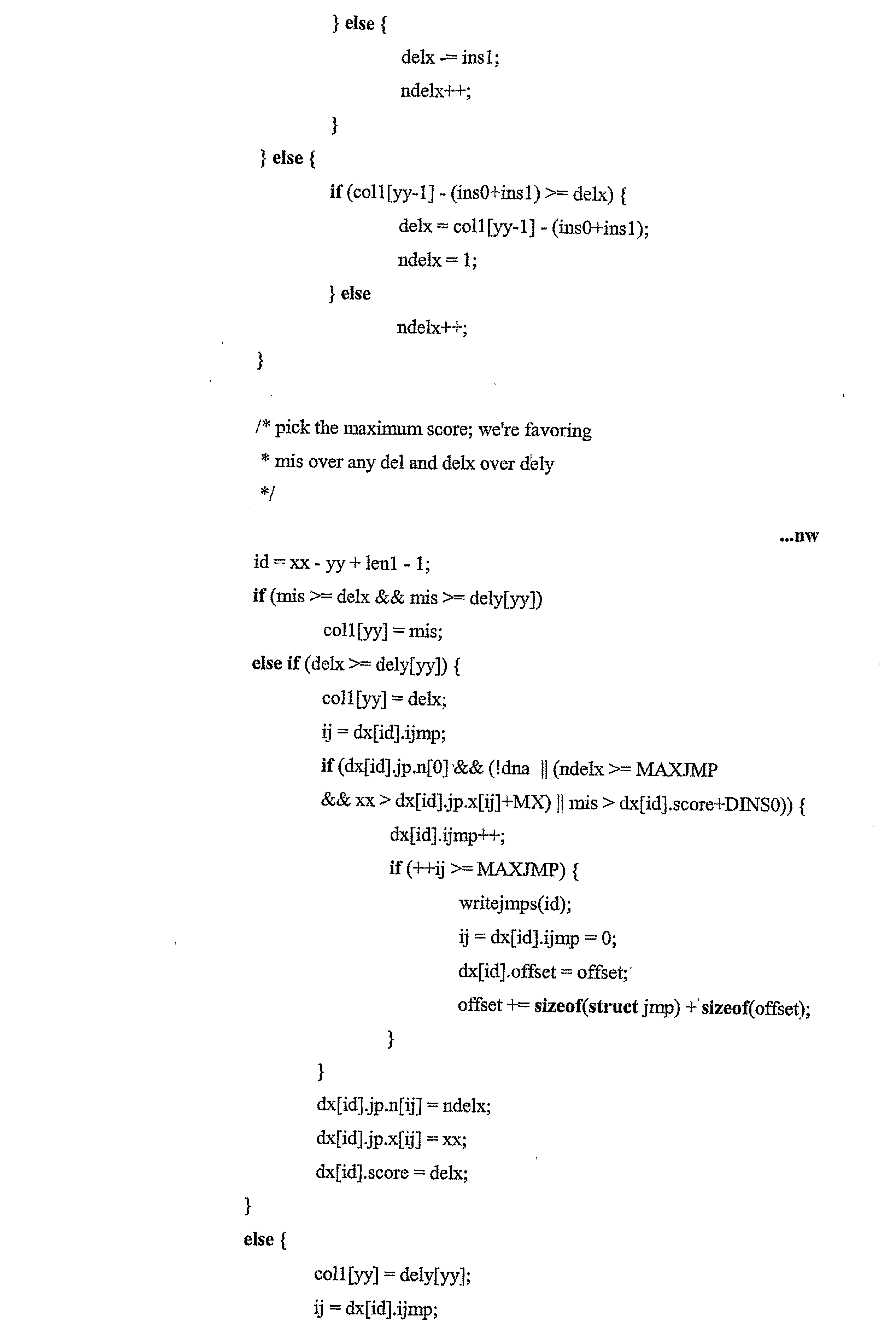
Table 1
アミノ酸配列比較にALIGN−2が用いられる状況では、所与のアミノ酸配列Aの、所与のアミノ酸配列Bへの、それとの、又はそれに対する%アミノ酸配列同一性(或いは、所与のアミノ酸配列Bへの、それとの、又はそれに対し、或る程度の%アミノ酸配列同一性を持つか又は含む所与のアミノ酸配列Aと言うこともできる)は次のように計算される:
分率X/Yの100倍
ここで、Xは配列アラインメントプログラムALIGN−2のA及びBのプログラムアラインメントによって同一であるとスコアリングされたアミノ酸残基の数であり、YはBの全アミノ酸残基数である。アミノ酸配列Aの長さがアミノ酸配列Bの長さと異なる場合、AのBに対する%アミノ酸配列同一性は、BのAに対する%アミノ酸配列同一性とは異なることを認識されたい。本方法を使用した%アミノ酸配列同一性の計算の例として、表2及び3は、「比較タンパク質」と称されるアミノ酸配列の「BCMA」と称されるアミノ酸配列に対する%アミノ酸配列同一性の計算方法を示し、ここで「BCMA」は対象のポリペプチドのアミノ酸配列を表し、「比較タンパク質」は対象の「BCMA」ポリペプチドと比較されるポリペプチドのアミノ酸配列を表し、「X」、「Y」及び「Z」は、それぞれ異なる仮定アミノ酸残基を表す。特に断らない限りは、ここで使用される全ての%アミノ酸配列同一性値は、ALIGN−2コンピュータプログラムを用いて前段落に記載されるようにして得られる。
100 times the fraction X / Y where X is the number of amino acid residues scored identical by the program alignment of A and B of the sequence alignment program ALIGN-2, and Y is the total amino acid residue of B Radix. It will be appreciated that if the length of amino acid sequence A is different from the length of amino acid sequence B, then the% amino acid sequence identity of A to B is different from the% amino acid sequence identity of B to A. As an example of calculating% amino acid sequence identity using this method, Tables 2 and 3 show the calculation of% amino acid sequence identity to the amino acid sequence designated “BCMA” of the amino acid sequence designated “Comparative Protein”. Where “BCMA” represents the amino acid sequence of the polypeptide of interest, “comparison protein” represents the amino acid sequence of the polypeptide to be compared to the “BCMA” polypeptide of interest, and “X”, “Y "And" Z "represent different hypothetical amino acid residues, respectively. Unless otherwise noted, all% amino acid sequence identity values used herein are obtained as described in the previous paragraph using the ALIGN-2 computer program.
本発明による「天然」又は「天然配列」ポリペプチドは、自然由来のポリペプチドのアミノ酸配列と同じアミノ酸配列を有するポリペプチドである。このような天然ポリペプチドは、自然から単離できるか、又は組換え手段又は合成手段により製造できる。
BCMA「変異体」又は「突然変異体」は、天然BCMA ECDアミノ酸配列の全部又は一部から得られるが、天然BCMAポリペプチドの正確なCRD配列を含んでいない。一実施形態によれば、BCMA変異体は、天然BCMAのCRDとシステインの同じ数及び関連部分を含む。別の実施形態によれば、BCMA変異体は、天然BCMA又は天然BCMAのECDよりBAFFに対する親和性が小さい(例えば、場合によってはアラニンが置換された、図5のF14、I22又はQ25に対応する残基の1つ又は全部を突然変異させることによって)。別の実施形態によれば、BCMA変異体は、天然BCMA又は天然BCMAのECDよりAPRILに対する親和性が小さい(例えば、場合によってはアラニンが置換された、図5のR27及びY13に対応する残基の1つ又は全部を突然変異させることによって)。別の実施形態によれば、BCMA変異体は、天然BCMA又は天然BCMAのECDよりAPRILとBAFFに対する親和性が小さい(例えば、場合によってはアラニンが置換された、図5のD15、L18及びL17に対応する残基の1つ又は全部を突然変異させることによって)。好ましい一実施形態では、BCMA変異体はヒトBCMAから得られる。本発明によるBCMA変異体が可溶性ポリペプチド、例えばBCMA膜貫通領域を欠くポリペプチドを含むことを理解されたい。
A “native” or “native sequence” polypeptide according to the invention is a polypeptide having the same amino acid sequence as the amino acid sequence of the polypeptide derived from nature. Such natural polypeptides can be isolated from nature or can be produced by recombinant or synthetic means.
A BCMA “variant” or “mutant” is derived from all or part of the native BCMA ECD amino acid sequence, but does not include the exact CRD sequence of the native BCMA polypeptide. According to one embodiment, the BCMA variant comprises the same number of CRDs and cysteines of natural BCMA and related portions. According to another embodiment, the BCMA variant has a lower affinity for BAFF than native BCMA or ECD of native BCMA (eg, corresponding to F14, I22 or Q25 of FIG. 5, optionally substituted with alanine). By mutating one or all of the residues). According to another embodiment, the BCMA variant has a lower affinity for APRIL than native BCMA or ECD of native BCMA (eg, residues corresponding to R27 and Y13 in FIG. 5, optionally substituted with alanine). By mutating one or all of the According to another embodiment, the BCMA variant has a lower affinity for APRIL and BAFF than native BCMA or native BCMA ECD (eg, D15, L18 and L17 in FIG. By mutating one or all of the corresponding residues). In a preferred embodiment, the BCMA variant is obtained from human BCMA. It should be understood that BCMA variants according to the present invention include soluble polypeptides, such as polypeptides lacking the BCMA transmembrane region.
ポリペプチドへの変更は、ポリペプチドの変更前の形態に対して化学的又は物理的にアミノ酸残基を変化させることにより、例えば他のアミノ酸残基の置換、残基の削除等他の突然変異、又は残基の化学的追加又は修飾により行うことができる。組換え核酸法は、エンジニアリングされた核酸分子から発現されるポリペプチドが変更を含むようにポリペプチドを変更(例えば残基の置換及び削除)するのに有用である。残基の変更はまた、対象のポリヌクレオチドを直接変更することにより、例えばアミノ酸残基の化学反応により、達成できる。天然配列BCMAに対する、本明細書に特に開示する変更以外に、本発明のポリペプチドに追加的な変更を行うことができることを理解されたい。
BCMAの「細胞外ドメイン」又は「ECD」とは、基本的にBCMA膜貫通ドメイン及び細胞質ドメインを有さないBCMAポリペプチドの形態を指す。BCMAのECDの例として、図5に示すヒトBCMAの残基1−52(配列番号21)又は5−51を挙げることができる。
Changes to a polypeptide can be made by changing amino acid residues chemically or physically relative to the pre-change form of the polypeptide, for example, substitution of other amino acid residues, deletion of residues, etc. Or by chemical addition or modification of residues. Recombinant nucleic acid methods are useful for altering a polypeptide (eg, residue substitution and deletion) such that the polypeptide expressed from the engineered nucleic acid molecule contains the alteration. Residue changes can also be achieved by directly changing the polynucleotide of interest, for example, by chemical reaction of amino acid residues. It should be understood that in addition to the changes specifically disclosed herein with respect to the native sequence BCMA, additional changes can be made to the polypeptides of the present invention.
The “extracellular domain” or “ECD” of BCMA refers to a form of BCMA polypeptide that has essentially no BCMA transmembrane and cytoplasmic domains. Examples of BCMA ECD include residues 1-52 (SEQ ID NO: 21) or 5-51 of human BCMA shown in FIG.
本発明による可溶性ポリペプチド(例えば可溶性BCMA)は、水に溶け、脂質に対する目に見える親和性を欠く。可溶性BCMAポリペプチドは、例えば、BCMAの膜貫通ドメインを削除すること、及び任意で細胞質ドメインを削除することによって作成できる。
本発明による多量体は、本発明のポリペプチドが複数存在することを示す数値を意味することを理解されたい。好ましい一実施形態では、多量体は、n量体であり、nは3〜10のポリペプチドである。別の実施形態によれば、本発明によるポリペプチドの多量体複合体は、10を超える値のn量体及び/又は200万ダルトンを超える分子量を実質的に含まない。
Soluble polypeptides according to the present invention (eg soluble BCMA) are soluble in water and lack visible affinity for lipids. Soluble BCMA polypeptides can be made, for example, by deleting the transmembrane domain of BCMA and optionally deleting the cytoplasmic domain.
It should be understood that a multimer according to the present invention means a numerical value indicating the presence of a plurality of polypeptides of the present invention. In one preferred embodiment, the multimer is an n-mer and n is a 3-10 polypeptide. According to another embodiment, a multimeric complex of polypeptides according to the present invention is substantially free of n-mers with values greater than 10 and / or molecular weights greater than 2 million Daltons.
BAFFポリペプチドシグナル伝達は、特に、B細胞の生存とB細胞の成熟を促進する。BAFFシグナル伝達の阻害、遮断又は中和により、特に、インビトロ又はインビボのBAFFポリペプチドの生物的活性のうち1以上が、部分的に又は完全に阻害、遮断又は中和される。生物的に活性のBAFFは、B細胞の生存増大、IgG及び/又はIgMの値の上昇、プラズマ細胞の増加、及び脾臓B細胞でのNF-κb2/100のp52 NF-κbへのプロセシングからなる現象のうちのいずれか1つ又は組み合わせを増強する(例えば、Batten, M等、(2000) J. Exp. Med. 192:1453-1465; Moore等、(1999) Science 285:260-263; Kayagaki等、Immunity (2002) 10:515-524)。
APRILシグナル伝達の阻害、遮断又は中和は、当技術分野において既知の方法のいずれか1つ又は組み合わせを用いるにより同定できる。例えば、インヒビターにより、(1)インビトロでのAPRILによる一次B細胞及びT細胞の同時刺激、又は(2)APRILによる抹消血B細胞からのIgM産生の刺激を、部分的に又は完全に阻害、遮断又は中和できる(Yu, G.等、(2000) Nat. Immunol. 1:252-256; Marsters, S.A. 等、(200) Curr. Biol. 10:785-788)。別の実施例では、インヒビターは、インビボでのAPRIL投与後において、B細胞集団の拡大及びT細胞の活性を低減することができる(Yu, G.等、(2000) Nat. Immunol. 1:252-256)。また別の実施例では、インヒビターを用いた投与の後の、マウスに移植された腫瘍の成長の低減について、インヒビターを試験することができる(Rennert, P.等、(2000) J. Exp. Med. 192:1677-1683)。
BAFF polypeptide signaling specifically promotes B cell survival and B cell maturation. Inhibition, blocking or neutralization of BAFF signaling, in particular, partially or completely inhibits, blocks or neutralizes one or more of the biological activities of BAFF polypeptides in vitro or in vivo. Biologically active BAFF consists of increased B cell survival, increased IgG and / or IgM levels, increased plasma cells, and processing of NF-κb2 / 100 to p52 NF-κb in splenic B cells Enhancing any one or combination of phenomena (eg, Batten, M et al. (2000) J. Exp. Med. 192: 1453-1465; Moore et al. (1999) Science 285: 260-263; Kayagaki Et al., Immunity (2002) 10: 515-524).
Inhibition, blocking or neutralization of APRIL signaling can be identified by using any one or combination of methods known in the art. For example, inhibitors may partially or completely inhibit or block (1) costimulation of primary B cells and T cells by APRIL in vitro, or (2) stimulation of IgM production from peripheral blood B cells by APRIL. Alternatively, it can be neutralized (Yu, G. et al. (2000) Nat. Immunol. 1: 252-256; Marsters, SA et al. (200) Curr. Biol. 10: 785-788). In another example, inhibitors can reduce B cell population expansion and T cell activity following APRIL administration in vivo (Yu, G. et al. (2000) Nat. Immunol. 1: 252). -256). In yet another example, inhibitors can be tested for reduced growth of tumors implanted in mice following administration with the inhibitor (Rennert, P. et al. (2000) J. Exp. Med 192: 1677-1683).
「BLyS」、「BLySポリペプチド」、又は「BAFF」は、特に、哺乳動物のBAFFの、自然に生じる完全長の形態、切断形態、分泌形態及び可溶性形態(例えば、細胞外ドメイン配列)、哺乳動物BAFFの自然に生じる変異形態(例えば異なってスプライシングされた形態)、自然に生じる対立遺伝子変異体、及び自然に生じるBAFFのアミノ酸配列を有するBAFFの、組換えにより発現される完全長の形態、切断形態、分泌形態、及び可溶性形態を包含する。
「BAFFポリペプチド」の例を以下に示す。
ヒトBAFF配列(配列番号23)
MDDSTEREQS RLTSCLKKRE EMKLKECVSI LPRKESPSVR SSKDGKLLAA TLLLALLSCC LTVVSFYQVA ALQGDLASLR AELQGHHAEK LPAGAGAPKA GLEEAPAVTA GLKIFEPPAP GEGNSSQNSR NKRAVQGPEE TVTQDCLQLI ADSETPTIQK GSYTFVPWLL SFKRGSALEE
KENKILVKET GYFFIYGQVL YTDKTYAMGH LIQRKKVHVF GDELSLVTLF RCIQNMPETL PNNSCYSAGI AKLEEGDELQ LAIPRENAQI SLDGDVTFFG ALKLL
マウスBAFF配列(配列番号24)
MDESAKTLPP PCLCFCSEKG EDMKVGYDPI TPQKEEGAWF GICRDGRLLA ATLLLALLSS
SFTAMSLYQL AALQADLMNL RMELQSYRGS ATPAAAGAPE LTAGVKLLTP AAPRPHNSSR
GHRNRRAFQG PEETEQDVDL SAPPAPCLPG CRHSQHDDNG MNLRNIIQDC LQLIADSDTP
TIRKGTYTFV PWLLSFKRGN ALEEKENKIV VRQTGYFFIY SQVLYTDPIF AMGHVIQRKK
VHVFGDELSL VTLFRCIQNM PKTLPNNSCY SAGIARLEEG DEIQLAIPRE NAQISRNGDD
TFFGALKLL
“BLyS”, “BLyS polypeptide”, or “BAFF” specifically refers to naturally occurring full-length, truncated, secreted and soluble forms (eg, extracellular domain sequences), mammalian, of mammalian BAFF. Naturally occurring variant forms of animal BAFF (eg, differently spliced forms), naturally occurring allelic variants, and recombinantly expressed full-length forms of BAFF having the naturally occurring amino acid sequence of BAFF, Includes truncated, secreted, and soluble forms.
Examples of “BAFF polypeptides” are shown below.
Human BAFF sequence (SEQ ID NO: 23)
MDDSTEREQS RLTSCLKKRE EMKLKECVSI LPRKESPSVR SSKDGKLLAA TLLLALLSCC LTVVSFYQVA ALQGDLASLR AELQGHHAEK LPAGAGAPKA GLEEAPAVTA GLKIFEPPAP GEGNSSQNSR NKRAVQGPEE TVTQDCLQGS ADSETPTIW
KENKILVKET GYFFIYGQVL YTDKTYAMGH LIQRKKVHVF GDELSLVTLF RCIQNMPETL PNNSCYSAGI AKLEEGDELQ LAIPRENAQI SLDGDVTFFG ALKLL
Mouse BAFF sequence (SEQ ID NO: 24)
MDESAKTLPP PCLCFCSEKG EDMKVGYDPI TPQKEEGAWF GICRDGRLLA ATLLLALLSS
SFTAMSLYQL AALQADLMNL RMELQSYRGS ATPAAAGAPE LTAGVKLLTP AAPRPHNSSR
GHRNRRAFQG PEETEQDVDL SAPPAPCLPG CRHSQHDDNG MNLRNIIQDC LQLIADSDTP
TIRKGTYTFV PWLLSFKRGN ALEEKENKIV VRQTGYFFIY SQVLYTDPIF AMGHVIQRKK
VHVFGDELSL VTLFRCIQNM PKTLPNNSCY SAGIARLEEG DEIQLAIPRE NAQISRNGDD
TFFGALKLL
「APRILポリペプチド」、「APRIL」及び「APRILタンパク質」は、哺乳動物のAPRILの、自然に生じる完全長の形態、切断形態、分泌形態、及び可溶性形態(例えば、配列の細胞外ドメイン)、哺乳動物のAPRILの自然に生じる変異形態(例えば異なってスプライシングされた形態)、哺乳動物のAPRILの自然に生じる対立遺伝子変異形態、及び自然に生じるAPRILのアミノ酸配列を有するAPRILの、組換えにより発現される完全長の形態、切断形態、分泌形態及び可溶性形態を特に包含する。「APRIL」という用語は、Hahne等, J.Exp.Med., 188:1185-1190(1998);GenBank 登録番号AF046888;1999年1月7日発行のWO99/00518;1999年3月18日発行のWO99/12965;1999年7月8日発行のWO99/33980;1997年9月18日発行のWO97/33902;1999年3月11日発行のWO99/11791;1999年3月28日発行のEP911,633;1999年10月7日発行のWO99/50416に記載されるこれらのポリペプチドを含む。
APRILポリペプチドの例を以下に示す。
ヒトAPRIL配列(配列番号25)
MPASSPFLLAPKGPPGNMGGPVREPALSVALWLSWGAALGAVACAMALLTQQTELQSLRREVSRLQGTGGPSQNGEGYPWQSLPEQSSDALEAWENGERSRKRRAVLTQKQKKQHSVLHLVPINATSKDDSDVTEVMWQPALRRGRGLQAQGYGVRIQDAGVYLLYSQVLFQDVTFTMGQVVSREGQGRQETLFRCIRSMPSHPDRAYNSCYSAGVFHLHQGDILSVIIPRARAKLNLSPHGTFLGFVKL
マウスAPRIL配列(配列番号26)
MPASSPGHMGGSVREPALSVALWLSWGAVLGAVTCAVALLIQQTELQSLRREVSRLQRSGGPSQKQGERPWQSLWEQSPDVLEAWKDGAKSRRRRAVLTQKHKKKHSVLHLVPVNITSKDSDVTEVMWQPVLRRGRGLEAQGDIVRVWDTGIYLLYSQVLFHDVTFTMGQVVSREGQGRRETLFRCIRSMPSDPDRAYNSCYSAGVFHLHQGDIITVKIPRANAKLSLSPHGTFLGFVKL
“APRIL polypeptide”, “APRIL” and “APRIL protein” are naturally occurring full-length, truncated, secreted, and soluble forms of mammalian APRIL (eg, the extracellular domain of a sequence), mammals Naturally occurring mutant forms of animal APRIL (e.g., differently spliced forms), naturally occurring allelic mutant forms of mammalian APRIL, and recombinantly expressed APRIL having the naturally occurring amino acid sequence of APRIL In particular, full length forms, truncated forms, secreted forms and soluble forms are included. The term “APRIL” refers to Hahne et al., J. Exp. Med., 188: 1185-1190 (1998); GenBank accession number AF046888; published on Jan. 7, 1999, WO 99/00518; published on Mar. 18, 1999. WO 99/12965; WO 99/33980, issued July 8, 1999; WO 97/33902, issued September 18, 1997; WO 99/11791, issued March 11, 1999; EP 911, issued March 28, 1999 633; including these polypeptides described in WO 99/50416, issued October 7, 1999.
Examples of APRIL polypeptides are shown below.
Human APRIL sequence (SEQ ID NO: 25)
MPASSPFLLAPKGPPGNMGGPVREPALSVALWLSWGAALGAVACAMALLTQQTELQSLRREVSRLQGTGGPSQNGEGYPWQSLPEQSSDALEAWENGERSRKRRAVLTQKQKKQHSVLHLVPINATSKDDSDVTEVMWQPALRRGRGLQAQGVQVIRQSMQQ
Mouse APRIL sequence (SEQ ID NO: 26)
MPASSPGHMGGSVREPALSVALWLSWGAVLGAVTCAVALLIQQTELQSLRREVSRLQRSGGPSQKQGERPWQSLWEQSPDVLEAWKDGAKSRRRRAVLTQKHKKKHSVLHLVPVNITSKDSDVTEVMWQPVLRRGRGLVQGDIVRVWDTGIYLLYSQVRFIGMPL
一実施形態によれば、本発明によるインヒビターは、1500ダルトン以下の「小」分子又は「小有機」分子である。
「抗体」なる用語は最も広い意味において使用され、特に、例えばモノクローナル抗体、ポリクローナル抗体、多エピトープ特異性を有する抗体、一本鎖抗体及び抗体断片を包含する。一実施形態によれば、本発明のポリペプチドは、抗体フレームワークの、例えば可変領域又はCDRに融合され、よって本抗体はそのレセプターに結合するリガンドに結合して該リガンドを阻害できる。本発明のポリペプチドを含む抗体は、キメラ、ヒト化、又はヒト抗体とすることができる。本発明のポリペプチドを含む抗体は、抗体断片とすることができる。それらを生成するための抗体及び方法について以下に詳述する。
According to one embodiment, the inhibitors according to the invention are “small” or “small organic” molecules of 1500 daltons or less.
The term “antibody” is used in the broadest sense and specifically includes, for example, monoclonal antibodies, polyclonal antibodies, antibodies with multiple epitope specificity, single chain antibodies, and antibody fragments. According to one embodiment, a polypeptide of the invention is fused to an antibody framework, eg, a variable region or CDR, so that the antibody can bind to and inhibit a ligand that binds to its receptor. An antibody comprising a polypeptide of the invention can be a chimeric, humanized, or human antibody. The antibody containing the polypeptide of the present invention can be an antibody fragment. The antibodies and methods for generating them are detailed below.
ここで使用される「モノクローナル抗体」という用語は、実質的に均一な抗体の集団から得られる抗体を称す、すなわち、集団に含まれる個々の抗体が、少量で存在しうる自然に生じる可能な突然変異を除いて同一である。モノクローナル抗体は高度に特異的であり、一つの抗原部位に対している。さらに、異なる決定基(エピトープ)に対する異なる抗体を典型的には含む従来からの(ポリクローナル)抗体と比べて、各モノクローナル抗体は、抗原上の単一の決定基に対するものである。修飾詞「モノクローナル」は、実質的に均一な抗体集団から得られているという抗体の特徴を示し、抗体を何か特定の方法で生産する必要があると解釈されるものではない。例えば、本発明において使用されるモノクローナル抗体は、組換えDNA法によって作ることもできる(例えば、米国特許第4,816,567号参照)。また「モノクローナル抗体」は、例えばClackson等, Nature 352:624-628(1991)、及びMarks等, J. Mol. Biol. 222:581-597(1991)に記載された技術を用いてファージ抗体ライブラリから単離することもできる。
ここで、モノクローナル抗体は、重鎖及び/又は軽鎖の一部が特定の種由来の抗体あるいは特定の抗体クラス又はサブクラスに属する抗体の対応する配列と同一であるか相同であり、鎖の残りの部分が他の種由来の抗体あるいは他の抗体クラスあるいはサブクラスに属する抗体の対応する配列と同一であるか相同である「キメラ」抗体(免疫グロブリン)、並びにそれが所望の生物的活性を有する限りそれら抗体の断片を特に含む(米国特許第4,816,567号; Morrisonら, Proc. Natl. Acad. Sci. USA, 81:6851-6855(1984))。キメラ抗体の作成方法は従来技術に既知である。
The term “monoclonal antibody” as used herein refers to an antibody obtained from a population of substantially homogeneous antibodies, ie, naturally occurring possible abrupts in which individual antibodies within the population may be present in small amounts. Identical except for mutations. Monoclonal antibodies are highly specific and are directed against a single antigenic site. Furthermore, each monoclonal antibody is directed against a single determinant on the antigen, as compared to conventional (polyclonal) antibodies that typically include different antibodies directed against different determinants (epitopes). The modifier “monoclonal” indicates the character of the antibody as being derived from a substantially homogeneous population of antibodies, and is not to be construed as requiring production of the antibody by any particular method. For example, the monoclonal antibody used in the present invention can be produced by a recombinant DNA method (see, for example, US Pat. No. 4,816,567). The “monoclonal antibody” is a phage antibody library using the technique described in, for example, Clackson et al., Nature 352: 624-628 (1991) and Marks et al., J. Mol. Biol. 222: 581-597 (1991). It can also be isolated from
Here, a monoclonal antibody is a portion of the heavy chain and / or light chain that is identical or homologous to the corresponding sequence of an antibody from a particular species or an antibody belonging to a particular antibody class or subclass, A “chimeric” antibody (immunoglobulin) that is identical or homologous to the corresponding sequence of an antibody from another species or of an antibody belonging to another antibody class or subclass, as well as having the desired biological activity As long as they specifically include fragments of those antibodies (US Pat. No. 4,816,567; Morrison et al., Proc. Natl. Acad. Sci. USA, 81: 6851-6855 (1984)). Methods for making chimeric antibodies are known in the prior art.
非ヒト抗体の「ヒト化」形とは、非ヒト免疫グロブリンに由来する最小配列を含むキメラ免疫グロブリン、免疫グロブリン鎖又はそれらの断片(例えばFv、Fab、Fab’、F(ab’)2又は抗体の他の抗原結合配列)である。大部分においてヒト化抗体は、レシピエントの相補性決定領域(CDR)の残基が、マウス、ラット、ウサギ又は別のソース等の所望の特異性、親和性及び能力を有する非ヒト種(ドナー抗体)のCDRの残基によって置換されたヒト免疫グロブリン(レシピエント抗体)である。場合によっては、ヒト免疫グロブリンのFvフレームワーク領域(FR)残基は、対応する非ヒト残基によって置換される。さらに、ヒト化抗体は、レシピエント抗体にも移入CDR又はフレームワーク配列にも見出されない残基を含んでもよい。これらの修飾は、抗体の特性をさらに洗練及び最大化するために行われる。一般に、ヒト化抗体は、少なくとも1つ、典型的には2つの可変ドメインの実質的に全てを含み、全てあるいはほとんど全てのCDR領域が非ヒト免疫グロブリンのものに対応し、全てあるいはほとんど全てのFR領域がヒト免疫グロブリン配列のものである。ヒト化抗体は、任意には免疫グロブリン定常領域(Fc)、典型的にはヒトの免疫グロブリンの定常領域の少なくとも一部を含む。さらなる詳細は、Jones等, Nature 321, 522-525(1986);Reichmann等, Nature 332, 323-329(1988);及びPresta, Curr. Op. Struct. Biol. 2, 593-596(1992)を参照のこと。ヒト化抗体の作成方法は従来技術に既知である。
ヒト抗体はまた、ファージディスプレイライブラリを含む従来技術に既知の様々な技術を用いて作成することができる。Hoogenboom及びWinter, J. Mol. Biol., 227:381 (1991); Marks等、J. Mol. Biol., 222:581 (1991)。また、Cole等及びBoerner等の技術が、ヒトモノクローナル抗体の調製に使用可能である。Cole等、Monoclonal Antibodies and Cancer Therapy, Alan R. Liss, p. 77 (1985); Boerner等、J. Immunol., 147(1):86-95 (1991)。
“Humanized” forms of non-human antibodies refer to chimeric immunoglobulins, immunoglobulin chains or fragments thereof (eg, Fv, Fab, Fab ′, F (ab ′) 2 or the like) that contain minimal sequence derived from non-human immunoglobulin. Other antigen binding sequences of antibodies). For the most part, humanized antibodies are non-human species (donors) in which the complementarity determining region (CDR) residues of the recipient have the desired specificity, affinity and ability, such as mouse, rat, rabbit or another source. Antibody) is a human immunoglobulin (recipient antibody) substituted by a CDR residue. In some cases, Fv framework region (FR) residues of the human immunoglobulin are replaced by corresponding non-human residues. Furthermore, humanized antibodies may comprise residues that are found neither in the recipient antibody nor in the imported CDR or framework sequences. These modifications are made to further refine and maximize antibody properties. In general, a humanized antibody comprises substantially all of at least one, typically two variable domains, all or almost all CDR regions corresponding to those of non-human immunoglobulin, and all or almost all The FR region is of human immunoglobulin sequence. A humanized antibody optionally comprises at least a portion of an immunoglobulin constant region (Fc), typically that of a human immunoglobulin. For further details, see Jones et al., Nature 321, 522-525 (1986); Reichmann et al., Nature 332, 323-329 (1988); and Presta, Curr. Op. Struct. Biol. 2, 593-596 (1992). See Methods for making humanized antibodies are known in the prior art.
Human antibodies can also be generated using various techniques known in the art, including phage display libraries. Hoogenboom and Winter, J. Mol. Biol., 227: 381 (1991); Marks et al., J. Mol. Biol., 222: 581 (1991). Also, techniques such as Cole et al. And Boerner et al. Can be used to prepare human monoclonal antibodies. Cole et al., Monoclonal Antibodies and Cancer Therapy, Alan R. Liss, p. 77 (1985); Boerner et al., J. Immunol., 147 (1): 86-95 (1991).
本発明の「組成物」は、随意で製薬的に許容可能な担体と組み合わせた形態で、本発明のポリペプチドを含む。組成物は更に、目標とする症状を治療するための追加の治療薬を含むことができる。一実施形態では、組成物は、免疫関連疾患の治療薬、及び癌の治療薬から選択される第二の治療薬含む。別の実施形態では、癌の治療薬は、細胞障害剤、化学療法剤、成長阻害剤及び化学療法剤からなる群より選択される。
ここで用いられる「担体」は、製薬的に許容される担体、賦形剤、又は安定化剤を含み、用いられる用量及び濃度でそれらに暴露される細胞又は哺乳動物に対して非毒性である。生理学的に許容される担体は、水性pH緩衝溶液であることが多い。生理学的に許容される担体の例は、リン酸塩、クエン酸塩、及び他の有機酸塩のバッファー;アスコルビン酸を含む酸化防止剤;低分子量(約10残基未満)ポリペプチド;タンパク質、例えば血清アルブミン、ゼラチン、又は免疫グロブリン;疎水性ポリマー、例えばポリビニルピロリドン;アミノ酸、例えばグリシン、グルタミン、アスパラギン、アルギニン又はリシン;グルコース、マンノース又はデキストランを含む単糖類、二糖類、及び他の炭水化物;EDTA等のキレート剤;マンニトール又はソルビトール等の糖アルコール;ナトリウム等の塩形成対イオン;及び/又は非イオン性界面活性剤、例えば、TWEEN(登録商標)、ポリエチレングリコール(PEG)、及びPLURONICS(登録商標)を含む。
A “composition” of the present invention comprises a polypeptide of the present invention, optionally in combination with a pharmaceutically acceptable carrier. The composition can further comprise an additional therapeutic agent for treating the targeted condition. In one embodiment, the composition comprises a second therapeutic agent selected from a therapeutic agent for immune related diseases and a therapeutic agent for cancer. In another embodiment, the therapeutic agent for cancer is selected from the group consisting of cytotoxic agents, chemotherapeutic agents, growth inhibitory agents, and chemotherapeutic agents.
As used herein, a “carrier” includes a pharmaceutically acceptable carrier, excipient, or stabilizer and is non-toxic to cells or mammals exposed to them at the dosages and concentrations used. . Often the physiologically acceptable carrier is an aqueous pH buffered solution. Examples of physiologically acceptable carriers include phosphate, citrate, and other organic acid salt buffers; antioxidants including ascorbic acid; low molecular weight (less than about 10 residues) polypeptides; Eg serum albumin, gelatin or immunoglobulin; hydrophobic polymers such as polyvinylpyrrolidone; amino acids such as glycine, glutamine, asparagine, arginine or lysine; monosaccharides, disaccharides and other carbohydrates including glucose, mannose or dextran; EDTA Chelating agents such as; sugar alcohols such as mannitol or sorbitol; salt-forming counterions such as sodium; and / or nonionic surfactants such as TWEEN®, polyethylene glycol (PEG), and PLURONICS® )including.
本明細書で用いる「標識」又は「検出薬」という語は、「標識化」ポリペプチド、抗体、アンタゴニスト又は組成物を作製するために、ポリペプチド、抗体、アンタゴニスト又は組成物に直接的又は間接的に結合させる検出可能な化合物又は組成物を意味する。標識はそれ自身によって検出可能でもよく(例えば、放射性同位体標識又は蛍光標識)、あるいは、酵素標識の場合には、検出可能な基質化合物又は組成物の化学的変換を触媒してもよい。
様々なタグポリペプチド及びそれら各々の抗体が、従来技術に既知である。本発明のタグポリペプチド及び抗体を考慮する。例としては、ポリ−ヒスチジン(poly-his)又はポリ−ヒスチジン−グリシン(poly-his-gly)タグ;flu HAタグポリペプチド及びその抗体12CA5[Field等, Mol. Cell. Biol., 8:2159-2165 (1988)];c-mycタグ及びそれに対する8F9、3C7、6E10、G4、B7及び9E10抗体[Evan等, Molecular and Cellular Biology, 5:3610-3616 (1985)];及び単純ヘルペスウイルス糖タンパク質D(gD)タグ及びその抗体[Paborsky等, Protein Engineering, 3(6):547-553 (1990)]を含む。FLAGペプチド[Hopp等, BioTechnology, 6:1204-1210 (1988)]は、抗FLAG M2モノクローナル抗体によって認識される(Eastman Kodak Co., New Haven, CT)。アガロースと共有結合した抗FLAG M2モノクローナル抗体を含む親和性基質を用いた免疫親和性クロマトグラフィによって、FLAGペプチドを含有するタンパク質の精製を行う(Eastman Kodak Co., New Haven, CT)。他のタグポリペプチドは、KT3エピトープペプチド[Martin等, Science, 255:192-194 (1992)];α-チューブリンエピトープペプチド[Skinner等, J. Biol. Chem., 266:15163-15166 (1991)];及びT7遺伝子10タンパク質ペプチドタグ[Lutz-Freyermuth等, Proc. Natl. Acad. Sci. USA, 87:6393-6397 (1990)]を含む。
As used herein, the term “label” or “detection agent” refers directly or indirectly to a polypeptide, antibody, antagonist or composition to produce a “labeled” polypeptide, antibody, antagonist or composition. Means a detectable compound or composition to be bound. The label may be detectable by itself (eg, a radioisotope label or a fluorescent label), or in the case of an enzyme label, it may catalyze chemical conversion of the detectable substrate compound or composition.
Various tag polypeptides and their respective antibodies are known in the prior art. Consider the tag polypeptides and antibodies of the present invention. Examples include poly-histidine (poly-his) or poly-histidine-glycine (poly-his-gly) tag; flu HA tag polypeptide and its antibody 12CA5 [Field et al., Mol. Cell. Biol., 8: 2159. -2165 (1988)]; c-myc tag and 8F9, 3C7, 6E10, G4, B7 and 9E10 antibodies thereto [Evan et al., Molecular and Cellular Biology, 5: 3610-3616 (1985)]; and herpes simplex virus sugars A protein D (gD) tag and its antibody [Paborsky et al., Protein Engineering, 3 (6): 547-553 (1990)]. The FLAG peptide [Hopp et al., BioTechnology, 6: 1204-1210 (1988)] is recognized by the anti-FLAG M2 monoclonal antibody (Eastman Kodak Co., New Haven, CT). The protein containing the FLAG peptide is purified by immunoaffinity chromatography using an affinity substrate containing an anti-FLAG M2 monoclonal antibody covalently linked to agarose (Eastman Kodak Co., New Haven, CT). Other tag polypeptides include the KT3 epitope peptide [Martin et al., Science, 255: 192-194 (1992)]; the α-tubulin epitope peptide [Skinner et al., J. Biol. Chem., 266: 15163-15166 (1991). And
ここで用いられる「細胞障害剤」なる用語は、細胞の機能を阻害又は防止する及び/又は細胞破壊を生ずる物質を称する。この用語は、放射性同位体(例えば、At211、I131、I125、Y90、Re186、Re188、Sm153、Bi212、P32及びLuの放射性同位体)、化学療法剤、例えばメトトレキセート、アドリアマイシン、ビンカアルカロイド(ビンクリスチン、ビンブラスチン、エトポシド)、ドキソルビシン、メルファラン、マイトマイシンC、クロランブシル、ダウノルビシン又はその他のインターカレート剤、酵素及びその断片、例えば核溶解性酵素、抗体、及び細菌、真菌、植物又は動物由来の酵素的活性毒素又は小分子毒素等の毒素を含み、これには、それらの断片及び/又は変異体、並びに以下に開示される様々な抗腫瘍剤又は抗癌剤が含まれる。他の細胞障害剤を以下に記載する。
「化学療法剤」は、癌の治療に有用な化学化合物である。化学療法剤の例には、アルキル化剤、例えばチオテパ及びシクロホスファミド(CYTOXANTM);スルホン酸アルキル、例えばブスルファン、インプロスルファン及びピポスルファン(piposulfan);アジリジン類、例えばベンゾドーパ(benzodopa)、カルボコン、メツレドーパ(meturedopa)、及びウレドーパ(uredopa);アルトレートアミン(altretamine)、トリエチレンメラミン、トリエチレンホスホラミド、トリエチレンチオホスホラミド(triethylenethiophosphaoramide)及びトリメチローロメラミン(trimethylolomelamine)を含むエチレンイミン類及びメチラメラミン類;ナイトロジェンマスタード、例えばクロランブシル、クロロナファジン(chlornaphazine)、チョロホスファミド(cholophosphamide)、エストラムスチン、イフォスファミド、メクロレタミン、メクロレタミンオキシドヒドロクロリド、メルファラン(melphalan)、ノベンビチン(novembichin)、フェネステリン(phenesterine)、プレドニムスチン(prednimustine)、トロフォスファミド(trofosfamide)、ウラシルマスタード;ニトロ尿素類、例えばカルムスチン、クロロゾトシン(chlorozotocin)、フォテムスチン(fotemustine)、ロムスチン、ニムスチン、ラニムスチン;抗生物質、例えばアクラシノマイシン(aclacinomysins)、アクチノマイシン、オースラマイシン(authramycin)、アザセリン、ブレオマイシン、カクチノマイシン(cactinomycin)、カリケアマイシン、カラビシン(carabicin)、カルミノマイシン(carminomycin)、カルジノフィリン(carzinophilin)、クロモマイシン、ダクチノマイシン、ダウノルビシン、デトルビシン(detorubicin)、6-ジアゾ-5-オキソ-L-ノルロイシン、ドキソルビシン、エピルビシン、エソルビシン(esorubicin)、イダルビシン(idarubicin)、マルセロマイシン(marcellomycin)、マイトマイシン、ミコフェノール酸、ノガラマイシン(nogalamycin)、オリボマイシン(olivomycins)、ペプロマイシン、ポトフィロマイシン(potfiromycin)、ピューロマイシン、クエラマイシン(quelamycin)、ロドルビシン(rodorubicin)、ストレプトニグリン、ストレプトゾシン、ツベルシジン(tubercidin)、ウベニメクス、ジノスタチン(zinostatin)、ゾルビシン(zorubicin);抗-代謝生成物、例えばメトトレキサート及び5-フルオロウラシル(5-FU);葉酸類似体、例えばデノプテリン(denopterin)、メトトレキサート、プテロプテリン(pteropterin)、トリメトレキサート(trimetrexate);プリン類似体、例えばフルダラビン(fludarabine)、6-メルカプトプリン、チアミプリン、チオグアニン;ピリミジン類似体、例えばアンシタビン、アザシチジン(azacitidine)、6-アザウリジン(azauridine)、カルモフール、シタラビン、ジデオキシウリジン、ドキシフルリジン、エノシタビン(enocitabine)、フロキシウリジン(floxuridine)、5-FU;アンドロゲン類、例えばカルステロン(calusterone)、プロピオン酸ドロモスタノロン、エピチオスタノール、メピチオスタン、テストラクトン(testolactone);抗副腎剤、例えばアミノグルテチミド、ミトタン、トリロスタン;葉酸リプレニッシャー(replenisher)、例えばフロリン酸(frolinic acid);アセグラトン;アルドホスファミドグリコシド;アミノレブリン酸;アムサクリン(amsacrine);ベストラブシル(bestrabucil);ビサントレン(bisantrene);エダトラキセート(edatraxate);デフォファミン(defofamine);デメコルシン(demecolcine);ジアジコン(diaziquone);エルフォルニチン(elfornithine);酢酸エリプチニウム(elliptinium);エトグルシド(etoglucid);硝酸ガリウム;ヒドロキシ尿素;レンチナン;ロニダミン(lonidamine):ミトグアゾン(mitoguazone);ミトキサントロン;モピダモール(mopidamol);ニトラクリン(nitracrine);ペントスタチン;フェナメット(phenamet);ピラルビシン;ポドフィリン酸(podophyllinic acid);2-エチルヒドラジド;プロカルバジン;PSK(登録商標);ラゾキサン(razoxane);シゾフィラン;スピロゲルマニウム(spirogermanium);テニュアゾン酸(tenuazonic acid);トリアジコン(triaziquone);2,2',2''-トリクロロトリエチルアミン;ウレタン;ビンデシン;ダカーバジン;マンノムスチン(mannomustine);ミトブロニトール;ミトラクトール(mitolactol);ピポブロマン(pipobroman);ガシトシン(gacytosine);アラビノシド(「Ara-C」);シクロホスファミド;チオテパ;タキソイド類、例えばパクリタキセル(TAXOL(登録商標), Bristol-Myers Squibb Oncology, Princeton, NJ)及びドキセタキセル(TAXOTERE(登録商標), Rhone-Poulenc Rorer, Antony, France);クロランブシル;ゲンシタビン(gemcitabine);6-チオグアニン;メルカプトプリン;メトトレキサート;プラチナ類似体、例えばシスプラチン及びカルボプラチン;ビンブラスチン;プラチナ;エトポシド(VP-16);イホスファミド;マイトマイシンC;ミトキサントロン;ビンクリスチン;ビノレルビン(vinorelbine);ナベルビン(navelbine);ノバントロン(novantron);テニポシド(teniposide);ダウノマイシン;アミノプテリン;キセローダ(xeloda);イバンドロナート(ibandronate);CPT-11;トポイソメラーゼインヒビターRFS2000;ジフルオロメチロールニチン(DMFO);レチノイン酸;エスペラミシン類(esperamicins);カペシタビン(capecitabine);並びに上述したものの製薬的に許容可能な塩、酸又は誘導体が含まれる。この定義にさらに含まれるものは、腫瘍に対するホルモン作用を調節又は阻害するように働くホルモン剤、例えばタモキシフェン、ラロキシフェン(raloxifene)、4(5)-イミダゾール類を阻害するアロマターゼ、4-ヒドロキシタモキシフェン、トリオキシフェン(trioxifene)、ケオキシフェン(keoxifene)、LY117018、オナプリストン、及びトレミフェン(toremifene)(Fareston)を含む抗エストロゲン;及び抗アンドロゲン、例えばフルタミド(flutamide)、ニルタミド(nilutamide)、ビカルタミド(bicalutamide)、ロイプロリド(leuprolide)、及びゴセレリン;並びに上記のものの製薬的に許容可能な塩、酸又は誘導体である。
エスペラミシン(esperamicin)(米国特許第4,675,187号参照)、メルファラン及びその他の関連ナイトロジェンマスタード。この定義には更に、タモキシフェン及びオナプリストン(onapristone)等のホルモン作用を制御又は抑制するホルモン剤が含まれる。
The term “cytotoxic agent” as used herein refers to a substance that inhibits or prevents the function of cells and / or causes destruction of cells. This term refers to radioisotopes (eg, radioisotopes of At 211 , I 131 , I 125 , Y 90 , Re 186 , Re 188 , Sm 153 , Bi 212 , P 32 and Lu), chemotherapeutic agents such as methotrexate. , Adriamycin, vinca alkaloids (vincristine, vinblastine, etoposide), doxorubicin, melphalan, mitomycin C, chlorambucil, daunorubicin or other intercalating agents, enzymes and fragments thereof such as nucleolytic enzymes, antibodies and bacteria, fungi, Toxins such as enzymatically active toxins or small molecule toxins derived from plants or animals, including fragments and / or variants thereof, and various antitumor or anticancer agents disclosed below. Other cytotoxic agents are described below.
A “chemotherapeutic agent” is a chemical compound useful in the treatment of cancer. Examples of chemotherapeutic agents include alkylating agents such as thiotepa and cyclophosphamide (CYTOXAN ™ ); alkyl sulfonates such as busulfan, improsulfan and piposulfan; aziridines such as benzodopa, carbocones , Meturedopa, and ureedopa; ethyleneimines including altretamine, triethylenemelamine, triethylenephosphoramide, triethylenethiophospharamide, and trimethylolomelamine; and Methylamelamines; nitrogen mustards such as chlorambucil, chlornaphazine, cholophosphamide, estramustine, ifosfamide, mechlorethamine, mechlorethamine oxide hydro Lolide, melphalan, novembichin, phenesterine, prednimustine, trofosfamide, uracil mustard; nitroureas such as carmustine, chlorozotocin, fotemustine , Lomustine, nimustine, ranimustine; antibiotics such as aclacinomysins, actinomycin, authramycin, azaserine, bleomycin, cactinomycin, calicheamicin, carabicin, carminomycin (carminomycin), carzinophilin, chromomycin, dactinomycin, daunorubicin, detorubicin, 6-diazo-5-oxo-L-norleucine, doxorubicin, epirubicin, esorubici (esorubicin), idarubicin, marcellomycin, mitomycin, mycophenolic acid, nogalamycin, olivomycins, peplomycin, potfiromycin, puromycin, quelamycin, rodolubicin (rodorubicin), streptonigrin, streptozocin, tubercidin, ubenimex, zinostatin, zorubicin; anti-metabolites such as methotrexate and 5-fluorouracil (5-FU); folic acid analogues, For example, denopterin, methotrexate, pteropterin, trimetrexate; purine analogs such as fludarabine, 6-mercaptopurine, thiapurine, thioguanine; pyrimidine analogs such as Tabine, azacitidine, 6-azauridine, carmofur, cytarabine, dideoxyuridine, doxyfluridine, enocitabine, floxyuridine, 5-FU; androgens such as calusterone, drostanolone propionate Epithiostanol, mepithiostane, testolactone; anti-adrenal drugs such as aminoglutethimide, mitotane, trilostane; folic acid replenishers such as frolinic acid; acegraton; aldophosphamide glycoside; Aminolevulinic acid; amsacrine; bestrabucil; bisantrene; edantraxate; defofamine; demecolcine; diaziquone; Elliptinium acetate; etoglucid; gallium nitrate; hydroxyurea; lentinan; lonidamine: mitoguazone; mitoxantrone; mopidamol; nitracrine; pentostatin Phenamet; pirarubicin; podophyllinic acid; 2-ethylhydrazide; procarbazine; PSK®; razoxane; razoxane; spirogermanium; spirogermanium; tenuazonic acid; 2,2 ′, 2 ″ -trichlorotriethylamine; urethane; vindesine; dacarbazine; mannomustine; mitoblonitol; mitolactol; pipobroman; gacytosine; arabinoside (“Ara-C”) ); Lofosfamide; thiotepa; taxoids such as paclitaxel (TAXOL®, Bristol-Myers Squibb Oncology, Princeton, NJ) and doxetaxel (TAXOTERE®, Rhone-Poulenc Rorer, Antony, France); chlorambucil; 6-thioguanine; mercaptopurine; methotrexate; platinum analogs such as cisplatin and carboplatin; vinblastine; platinum; etoposide (VP-16); ifosfamide; mitomycin C; mitoxantrone; vincristine; vinorelbine; navelbine ); Novantron; teniposide; daunimycin; aminopterin; xeloda; ibandronate; CPT-11; topoisomerase inhibitor RFS2000; difluoromethylolnitine (DMFO); retino Phosphate; esperamicins compound (esperamicins); capecitabine (capecitabine); and pharmaceutically acceptable salts of those described above, include acid or derivative. Further included in this definition are hormonal agents that act to regulate or inhibit hormonal effects on tumors such as tamoxifen, raloxifene, 4 (5) -imidazoles, aromatase, 4-hydroxy tamoxifen, tri Antiestrogens, including oxifen, trioxifene, keoxifene, LY117018, onapristone, and toremifene (Fareston); and antiandrogens such as flutamide, nilutamide, bicalutamide, leuprolide (leuprolide) and goserelin; and pharmaceutically acceptable salts, acids or derivatives of the above.
Esperamicin (see US Pat. No. 4,675,187), melphalan and other related nitrogen mustards. This definition further includes hormonal agents that control or inhibit hormonal action, such as tamoxifen and onapristone.
ここで用いられる「成長阻害剤」は、細胞の成長をインビトロ又はインビボの何れかで阻害する化合物又は組成物を意味する。成長阻害剤の例は、細胞周期の進行を(S期以外の位置で)阻害する薬剤、例えばG1停止及びM期停止を誘発する薬剤を含む。古典的なM期ブロッカーは、ビンカス(ビンクリスチン及びビンブラスチン)、タキサン類、及びトポII阻害剤、例えばドキソルビシン、エピルビシン、ダウノルビシン、エトポシド、及びブレオマイシンを含む。またG1停止させるこれらの薬剤は、S期停止にも波及し、例えば、DNAアルキル化剤、例えば、タモキシフェン、プレドニゾン、ダカルバジン、メクロレタミン、シスプラチン、メトトレキセート、5-フルオロウラシル、及びアラ-Cである。更なる情報は、The Molecular Basis of Cancer, Mendelsohn及びIsrael, 編, Chapter 1, 表題「Cell cycle regulation, oncogene, and antineoplastic drugs」, Murakami等, (WB Saunders: Philadelphia, 1995)、特に13頁に見出すことができる。
「単離された」とは、ここで開示された種々のタンパク質を記述するために使用するときは、その自然環境の成分から同定され分離され及び/又は回収されたポリペプチドを意味する。その自然環境の汚染成分とは、そのタンパク質の診断又は治療への使用を典型的には妨害する物質であり、酵素、ホルモン、及び他のタンパク質様又は非タンパク質様溶質が含まれる。好ましい実施態様において、タンパク質は、(1)スピニングカップシークエネーターを使用することにより、少なくとも15残基のN末端あるいは内部アミノ酸配列を得るのに充分なほど、あるいは、(2)クーマシーブルーあるいは好ましくは銀染色を用いた非還元あるいは還元条件下でのSDS−PAGEによる均一性まで精製される。単離されたタンパク質には、タンパク質の自然環境の少なくとも1つの成分が存在しないため、組換え細胞内のインサイツのタンパク質が含まれる。しかしながら、通常は、単離されたタンパク質は少なくとも1つの精製工程により調製される。
As used herein, “growth inhibitor” means a compound or composition that inhibits cell growth either in vitro or in vivo. Examples of growth inhibitory agents include agents that inhibit cell cycle progression (at a place other than S phase), such as agents that induce G1 arrest and M-phase arrest. Classic M-phase blockers include vincas (vincristine and vinblastine), taxanes, and topo II inhibitors such as doxorubicin, epirubicin, daunorubicin, etoposide, and bleomycin. These agents that arrest G1 also affect S-phase arrest, for example, DNA alkylating agents such as tamoxifen, prednisone, dacarbazine, mechloretamine, cisplatin, methotrexate, 5-fluorouracil, and ara-C. More information can be found in The Molecular Basis of Cancer, Mendelsohn and Israel, ed.,
“Isolated”, when used to describe the various proteins disclosed herein, means a polypeptide that has been identified and separated and / or recovered from a component of its natural environment. Contaminant components of the natural environment are substances that typically interfere with the use of the protein in diagnosis or therapy, including enzymes, hormones, and other proteinaceous or non-proteinaceous solutes. In a preferred embodiment, the protein is (1) sufficient to obtain an N-terminal or internal amino acid sequence of at least 15 residues by using a spinning cup sequenator, or (2) Coomassie blue or preferably Is purified to homogeneity by SDS-PAGE under non-reducing or reducing conditions using silver staining. Isolated protein includes the protein in situ within recombinant cells since at least one component of the protein's natural environment will not be present. Ordinarily, however, isolated protein will be prepared by at least one purification step.
「異種」成分とは、自然の状態で位置する実体から異なる実体に導入されたか、又は異なる実体内に製造された成分を指す。例えば、一生体から得られ、遺伝子エンジニアリング技術によって異なる生体内に導入されたポリヌクレオチドは、発現すると異種ポリペプチドをコードできる異種ポリヌクレオチドである。同様に、その天然コード化配列から除去され、異なるコード化配列に作用可能にリンクするプロモーター又はエンハンサーは、異種プロモーター又はエンハンサーである。同様に、BCMAポリペプチドに融合した非BCMAポリペプチド配列は、異種タンパク質配列である。
治療又は療法のための「哺乳動物」とは、ヒト、家庭用又は農場用動物、及び動物園、スポーツ又はペット用動物、例えばイヌ、ウマ、ネコ、ウシ等を含む、哺乳動物に分類されるあらゆる動物を称する。好ましくは、哺乳動物はヒトである。
A “heterologous” component refers to a component that has been introduced from a naturally located entity into a different entity or manufactured within a different entity. For example, a polynucleotide obtained from one organism and introduced into a different organism by genetic engineering techniques is a heterologous polynucleotide that can encode a heterologous polypeptide when expressed. Similarly, a promoter or enhancer that is removed from its native coding sequence and operably linked to a different coding sequence is a heterologous promoter or enhancer. Similarly, a non-BCMA polypeptide sequence fused to a BCMA polypeptide is a heterologous protein sequence.
“Mammal” for treatment or therapy is any mammal, including humans, household or farm animals, and zoos, sports or pet animals such as dogs, horses, cats, cows, etc. Refers to animals. Preferably the mammal is a human.
「治療的有効量」という用語は、被験者又は哺乳動物の疾病又は疾患を「軽減」又は「治療」するのに効果的な、本発明の組成物の量を意味する。一般に、疾病又は疾患の軽減は、当該疾病及び疾患を使用して、被験者又は哺乳動物における疾病又は疾患の発症又は再発を予防することができる。いくつかの実施態様では、本発明のポリペプチド及び組成物を用いて治療対象又は哺乳動物の疾患又は疾病の発症ないしは再発を予防することができる。例えば、自己免疫疾患を有する被験者の場合、本発明のポリペプチドを使用して再発を防止又は軽減できる。一実施形態では、治療対象の免疫疾患がB細胞媒介性疾病である場合、哺乳動物のB細胞数の減少(B細胞枯渇)を引き起こす量である。癌の場合、治療的有効量の薬剤により、癌細胞の数が減少し;腫瘍の大きさが小さくなり;末梢器官への癌細胞浸潤が阻害され(すなわち、ある程度の遅延化、好ましくは停止);腫瘍の転移が阻害され(すなわち、ある程度の遅延化、好ましくは停止);ある程度、腫瘍成長が阻害され;及び/又は癌に関連した一又は複数の徴候がある程度軽減される。薬剤が癌細胞の成長を防止し、及び/又は存在する癌細胞を死滅させるならば、それは細胞成長抑制性及び/又は細胞障害性であり得る。
「癌」、「癌性」及び「悪性」という用語は、典型的には調節されない細胞成長を特徴とする、哺乳動物における生理学的状態を指すか説明する。癌の例には、これらに限定されるものではないが、腺癌、リンパ腫、芽細胞腫、黒色腫、肉腫、及び白血病を含む癌腫が含まれる。このような癌のより特定の例には、扁平細胞癌(squamous cell cancer)、小細胞肺癌、非小細胞肺癌、胃腸癌、ホジキン及び非ホジキンリンパ腫、膵臓癌、神経膠芽腫、子宮頸管癌、卵巣癌、肝癌及び肝細胞腫等の肝臓癌、膀胱癌、乳癌、大腸癌、結腸直腸癌、子宮内膜癌、唾液腺癌、腎(renal)癌及びウィルムス腫瘍等の腎臓(kidney)癌、基底細胞癌、黒色腫、前立腺癌、産卵口癌、甲状腺癌、精巣癌、食道癌、及び様々なタイプの頭部及び頸部の癌が含まれる。場合によっては、癌は、BAFF、APRIL及び/又はBCMAの発現レベルを上げるか、又はそれらのレベルの上昇が関連する。一実施形態では、ここで治療する癌には、リンパ腫、白血病及び骨髄腫、並びにそれらのサブタイプ、例えばバーキットリンパ腫、多発性硬化症、急性リンパ芽球性又はリンパ球性白血病、非ホジキン及びホジキンリンパ腫、並びに急性骨髄性白血病が含まれる。
The term “therapeutically effective amount” means an amount of a composition of the invention effective to “reduce” or “treat” a disease or disorder in a subject or mammal. In general, the alleviation of a disease or disorder can be used to prevent the onset or recurrence of the disease or disorder in a subject or mammal. In some embodiments, the polypeptides and compositions of the invention can be used to prevent the onset or recurrence of a disease or condition in a subject or mammal. For example, in the case of a subject having an autoimmune disease, recurrence can be prevented or reduced using the polypeptide of the present invention. In one embodiment, when the immune disorder to be treated is a B cell mediated disease, the amount causes a decrease in the number of B cells in the mammal (B cell depletion). In the case of cancer, a therapeutically effective amount of the drug reduces the number of cancer cells; reduces the size of the tumor; inhibits cancer cell invasion to peripheral organs (ie, some delay, preferably cessation) Tumor metastasis is inhibited (ie, some delay, preferably cessation); tumor growth is inhibited to some extent; and / or one or more symptoms associated with cancer are alleviated to some extent; If the agent prevents the growth of cancer cells and / or kills existing cancer cells, it can be cytostatic and / or cytotoxic.
The terms “cancer”, “cancerous” and “malignant” refer to or describe the physiological condition in mammals that is typically characterized by unregulated cell growth. Examples of cancer include, but are not limited to, carcinomas including adenocarcinoma, lymphoma, blastoma, melanoma, sarcoma, and leukemia. More specific examples of such cancers include squamous cell cancer, small cell lung cancer, non-small cell lung cancer, gastrointestinal cancer, Hodgkin and non-Hodgkin lymphoma, pancreatic cancer, glioblastoma, cervical cancer , Liver cancer such as ovarian cancer, liver cancer and hepatocellular carcinoma, bladder cancer, breast cancer, colorectal cancer, colorectal cancer, endometrial cancer, salivary gland cancer, renal cancer such as renal cancer and Wilms tumor, Includes basal cell carcinoma, melanoma, prostate cancer, spawning cancer, thyroid cancer, testicular cancer, esophageal cancer, and various types of head and neck cancer. In some cases, the cancer increases or is associated with increased levels of expression of BAFF, APRIL and / or BCMA. In one embodiment, the cancers treated herein include lymphoma, leukemia and myeloma, and subtypes thereof such as Burkitt lymphoma, multiple sclerosis, acute lymphoblastic or lymphocytic leukemia, non-Hodgkin and Includes Hodgkin lymphoma, as well as acute myeloid leukemia.
「免疫関連疾患」という用語は、哺乳動物の免疫系の成分が、哺乳動物の病理学的状態の原因であるか、媒介又は寄与するものである疾患を意味する。また、免疫反応の刺激又は介在により疾患の進行に改善された効果が付与される疾患も含まれる。この用語には、自己免疫疾患、免疫媒介炎症疾患、非免疫媒介炎症疾患、感染症、及び免疫欠損症が含まれる。そのうちの一部が免疫又はT細胞媒介であり、本発明によって治療することが可能な免疫関連及び炎症性疾患の例には、リウマチ様関節炎、若年型慢性関節炎、脊椎関節症、全身性硬化症(強皮症)、特発性炎症性筋疾患(皮膚筋炎、多発性筋炎)、シェーグレン症候群、全身性血管炎、サルコイドーシス、自己免疫性溶血性貧血(免疫性汎血球減少症、発作性夜間ヘモグロビン尿症)、自己免疫性血小板減少症(溶血性血小板減少性紫斑病、免疫媒介血小板減少症)、甲状腺炎(バセドウ病、橋本甲状腺炎、若年型リンパ球性甲状腺炎、萎縮性甲状腺炎)、糖尿病、免疫媒介腎疾患(糸球体腎炎、尿細管間質性腎炎)、中枢及び末梢神経系の脱髄疾患例えば多発性硬化症、特発性脱髄多発神経障害又はギラン・バレー症候群、及び慢性炎症性脱髄性多発神経障害、肝胆道疾患例えば感染性肝炎(A、B、C、D、E型肝炎、及び他の非肝親和性ウイルス)、自己免疫性慢性活動性肝炎、原発性胆汁性肝硬変、肉芽腫性肝炎、及び硬化性胆管炎、炎症性腸疾患等の炎症性及び線維性肺疾患(潰瘍性大腸炎:クローン病)、グルテン過敏性腸疾患、及びウィップル病、水疱性皮膚病を含む自己免疫又は免疫媒介皮膚疾患、多形滲出性紅斑及び接触性皮膚炎、乾癬、アレルギー性疾患例えば喘息、アレルギー性鼻炎、アトピー性皮膚炎、食物過敏症及び蕁麻疹、肺の免疫疾患例えば好酸球性肺炎、特発性肺線維症及び過敏性肺炎、拒絶反応及び移植片対宿主病を含む移植関連疾患が含まれる。感染症疾患には、AIDS(HIV感染)、A、B、C、D及びE型肝炎、細菌感染症、真菌感染症、原虫感染症及び寄生虫症が含まれる。
本明細書の「自己免疫疾患」という語は広義で使用され、一般的な意味で、自己の組織成分に対する個体の体液又は細胞の免疫反応から正常又は健康な組織の破壊が生じる、哺乳動物の障害、又は状態を指す。例として、これらに限定するものではないが、エリテマトーデス、甲状腺炎、リウマチ様関節炎、乾癬、多発性硬化症、自己免疫糖尿病、及び炎症性腸疾患(IBD)が挙げられる。
The term “immune related disease” refers to a disease in which a component of the mammalian immune system is responsible for, mediates or contributes to the pathological state of the mammal. Also included are diseases in which an improved effect is imparted to the progression of the disease by stimulation or intervention of an immune response. The term includes autoimmune diseases, immune-mediated inflammatory diseases, non-immune-mediated inflammatory diseases, infectious diseases, and immune deficiencies. Examples of immune-related and inflammatory diseases, some of which are immune or T cell mediated and can be treated according to the present invention include rheumatoid arthritis, juvenile chronic arthritis, spondyloarthritis, systemic sclerosis (Scleroderma), idiopathic inflammatory myopathy (dermatomyositis, polymyositis), Sjogren's syndrome, systemic vasculitis, sarcoidosis, autoimmune hemolytic anemia (immune pancytopenia, paroxysmal nocturnal hemoglobinuria) ), Autoimmune thrombocytopenia (hemolytic thrombocytopenic purpura, immune-mediated thrombocytopenia), thyroiditis (Graves' disease, Hashimoto's thyroiditis, juvenile lymphocytic thyroiditis, atrophic thyroiditis), diabetes , Immune-mediated renal disease (glomerulonephritis, tubulointerstitial nephritis), demyelinating diseases of the central and peripheral nervous systems such as multiple sclerosis, idiopathic demyelinating polyneuropathy or Guillain-Barre syndrome, and chronic inflammation Demyelinating polyneuropathy, hepatobiliary disease such as infectious hepatitis (A, B, C, D, hepatitis E and other non-hepatic viruses), autoimmune chronic active hepatitis, primary biliary cirrhosis , Granulomatous hepatitis, sclerosing cholangitis, inflammatory bowel disease and other inflammatory and fibrotic lung diseases (ulcerative colitis: Crohn's disease), gluten-sensitive enteropathy, Whipple disease, bullous skin disease Including autoimmune or immune-mediated skin diseases, polymorphic exudative erythema and contact dermatitis, psoriasis, allergic diseases such as asthma, allergic rhinitis, atopic dermatitis, food hypersensitivity and urticaria, lung immune diseases such as favorable Includes transplant-related diseases including eosinophilic pneumonia, idiopathic pulmonary fibrosis and hypersensitivity pneumonia, rejection and graft-versus-host disease. Infectious diseases include AIDS (HIV infection), hepatitis A, B, C, D and E, bacterial infections, fungal infections, protozoal infections and parasitic diseases.
As used herein, the term “autoimmune disease” is used in a broad sense, and in a general sense, a mammalian or normal tissue that destroys normal or healthy tissue resulting from the immune response of an individual's body fluids or cells to its own tissue components. Refers to a failure or condition. Examples include, but are not limited to, lupus erythematosus, thyroiditis, rheumatoid arthritis, psoriasis, multiple sclerosis, autoimmune diabetes, and inflammatory bowel disease (IBD).
ここで用いる「B細胞枯渇」とは、処置前のレベルと比較して、薬剤または抗体処置後に動物またはヒトにおいてB細胞レベルが減少することを表す。B細胞レベルは、既知のB細胞マーカーのFACS分析染色によって、及び実験的実施例に示した方法によって、全血球計算値を得ること等の公知のアッセイを用いて測定する。B細胞枯渇は完全または部分的なものであり得る。B細胞枯渇剤を服用する患者においては、薬剤が患者の身体を循環している間、及びB細胞の回復期間中は、通常B細胞が枯渇する。
「T細胞媒介疾患」という用語は、T細胞が哺乳動物の病的状態を直接又は間接に媒介するか、或いは当該病態に寄与する疾患を意味する。T細胞媒介疾患は、細胞媒介効果、リンホカイン媒介効果等に関連しており、場合によっては、例えばT細胞によって分泌されたリンホカインによってB細胞が刺激された場合、B細胞に関連する効果に関連している。
As used herein, “B cell depletion” refers to a decrease in B cell levels in an animal or human after drug or antibody treatment as compared to the level prior to treatment. B cell levels are measured using known assays such as obtaining whole blood counts by FACS analytical staining of known B cell markers and by the methods set forth in the experimental examples. B cell depletion can be complete or partial. In patients taking B cell depleting agents, B cells are usually depleted while the drug is circulating in the patient's body and during the recovery period of B cells.
The term “T cell mediated disease” means a disease in which T cells directly or indirectly mediate or contribute to a pathological condition in a mammal. T cell mediated diseases are associated with cell mediated effects, lymphokine mediated effects, etc., and in some cases, when B cells are stimulated by lymphokines secreted by T cells, for example, B cell related effects. ing.
方法及び材料
一般に、BAFF又はAPRILが、哺乳動物の細胞中のそれぞれのレセプターに結合することを阻害する本発明の方法では、BAFF又はAPRILとそれらのレセプターとの相互作用を完全に又は部分的に遮断する本発明のポリペプチドの所望の量に細胞を曝す。一実施形態では、使用するポリペプチドの量は、BAFF又はAPRILの結合及び/又は活性に作用することにより治療効果を達成するのに有効な量である。これは、例えば、以下及び実施例に記載する方法に従って、インビトロ又はインビボで実現できる。本発明のポリペプチドを用いて処置される例示的病態又は疾患は、臨床的に自己免疫疾患と呼ばれる哺乳動物の状態を含み、それらにはリウマチ様関節炎、多発性硬化症、乾癬、及びループス又は癌及びT細胞媒介性疾患を含むその他の病態が含まれるが、それらに限定されない。本明細書では、診断方法もまた提供される。例えば、本発明のポリペプチドを使用して哺乳動物又はインビトロアッセイにおいてAPRIL又はBAFFを検出することができ、これはBAFF又はAPRILに関連する病態を有すると思われるか、又は異常な量のAPRIL又はBAFFを発現していることが分かっている哺乳動物(例えば、ループス患者及びNZF/WF1マウス)において検出することを含む。一実施形態によれば、本発明のポリペプチドを、例えば免疫アッセイに使用して、試料中のBAFF又はAPRILを検出又は定量化する。別の実施形態によれば、哺乳動物から採取した細胞等の試料を、標識した本発明のポリペプチドの存在下でインキュベートし、標識したポリペプチドの検出を行うことができる。様々な臨床的アッセイ手順を含むこのようなアッセイは、従来技術、例えばVoller等によるImmunoassays, University Park(1981)に既知である。
Methods and Materials In general, in the methods of the invention that inhibit binding of BAFF or APRIL to the respective receptor in a mammalian cell, the interaction of BAFF or APRIL with those receptors is fully or partially The cells are exposed to the desired amount of the polypeptide of the invention that blocks. In one embodiment, the amount of polypeptide used is an amount effective to achieve a therapeutic effect by affecting the binding and / or activity of BAFF or APRIL. This can be accomplished in vitro or in vivo, for example, according to the methods described below and in the Examples. Exemplary conditions or diseases treated with the polypeptides of the invention include mammalian conditions that are clinically referred to as autoimmune diseases, including rheumatoid arthritis, multiple sclerosis, psoriasis, and lupus or Other conditions include but are not limited to cancer and T cell mediated diseases. Diagnostic methods are also provided herein. For example, the polypeptides of the invention can be used to detect APRIL or BAFF in a mammalian or in vitro assay, which appears to have a pathology associated with BAFF or APRIL, or an abnormal amount of APRIL or Detection in mammals known to express BAFF (eg, lupus patients and NZF / WF1 mice). According to one embodiment, the polypeptides of the invention are used, for example, in an immunoassay to detect or quantify BAFF or APRIL in a sample. According to another embodiment, a sample such as a cell collected from a mammal can be incubated in the presence of the labeled polypeptide of the present invention to detect the labeled polypeptide. Such assays, including various clinical assay procedures, are known in the prior art, eg, Immunoassays, University Park (1981) by Voller et al.
A.材料
一実施形態によれば、本発明のポリペプチドは、ポリペプチドの共有結合的に修飾された形態(例えば、イムノアドヘシン、標識したポリペプチド、保護されたポリペプチド、抱合型ポリペプチド等)から選択される。ポリペプチドのこれらの形態を作成するために使用される様々な技術について後述する。ポリペプチドの標識方法及びポリペプチドに分子を抱合させる方法は、従来技術に既知である。
本発明の組成物は、従来技術に既知の組換え技術を用いて調製することができる。以下の記述は、コード化核酸を含むベクターを用いて形質転換又は形質移入した宿主細胞を培養すること、及び細胞培養物からポリペプチドを回収することによる、そのようなポリペプチドの製造方法に関する。(例えば、Sambrook等、Molecular Cloning: A Laboratory Manual (New York: Cold Spring Harbor Laboratory Press, 1989); Dieffenbach等、PCR Primer:A Laboratory Manual (Cold Spring Harbor Laboratory Press, 1995)を参照のこと。)
A. Materials According to one embodiment, a polypeptide of the invention is a covalently modified form of a polypeptide (eg, an immunoadhesin, a labeled polypeptide, a protected polypeptide, a conjugated polypeptide, etc.). Selected from. Various techniques used to make these forms of the polypeptide are described below. Methods for labeling polypeptides and for conjugating molecules to polypeptides are known in the prior art.
The compositions of the invention can be prepared using recombinant techniques known in the art. The following description relates to methods for producing such polypeptides by culturing host cells transformed or transfected with a vector containing the encoding nucleic acid and recovering the polypeptide from the cell culture. (See, for example, Sambrook et al., Molecular Cloning: A Laboratory Manual (New York: Cold Spring Harbor Laboratory Press, 1989); Dieffenbach et al., PCR Primer: A Laboratory Manual (Cold Spring Harbor Laboratory Press, 1995).)
所望するポリペプチドをコードする核酸(例えば、cDNA又はゲノムDNA)を、さらなるクローニング(DNAの増幅)又は発現のための複製可能なベクターへ挿入することが可能である。種々のベクターが公的に入手可能である。限定されるものではないが、そのベクター成分には一般的に、次の1つ又は複数のものを含む:シグナル配列、複製開始点、1つ又は複数のマーカー遺伝子、エンハンサーエレメント、プロモーター、そして転写終結因子、下に記載のそれぞれ。使用できる任意のシグナル配列、複製開始点、マーカー遺伝子、エンハンサーエレメント及び転写ターミネーター配列は、当該分野で知られており、国際公開第97/25428号にさらに詳細に記載されている。
発現及びクローニングベクターは、通常は、宿主生物体によって認識されるプロモーターを有し、コード化核酸配列と作用可能に連結している。プロモーターとは、特定の核酸配列の転写及び翻訳をコントロールするものであって、構造遺伝子(一般的に、約100〜1000bp内)の開始コドンの上流(5')に位置する非翻訳配列であり、作用可能に構造遺伝子と連結している。このようなプロモーターは、典型的には、誘導性及び構成性の2つのクラスに分けられる。誘導プロモーターは、幾つかの培養条件の変化、例えば、栄養素の有無又は温度変化への応答におけるコントロール下でDNAの転写レベルの上昇を開始するプロモーターである。現在では、種々の潜在的な宿主細胞によって認識される多くのプロモーターが知られている。これらのプロモーターは、制限酵素消化によってソースのDNAからプロモーターを取り出し、その単離したプロモーター配列をベクターへ挿入することによって、コード化DNAと作用可能に連結される。
Nucleic acid (eg, cDNA or genomic DNA) encoding the desired polypeptide can be inserted into a replicable vector for further cloning (DNA amplification) or expression. Various vectors are publicly available. Without limitation, the vector components generally include one or more of the following: a signal sequence, an origin of replication, one or more marker genes, an enhancer element, a promoter, and transcription. Termination factors, each described below. Any signal sequence, origin of replication, marker gene, enhancer element and transcription terminator sequence that can be used are known in the art and are described in further detail in WO 97/25428.
Expression and cloning vectors usually have a promoter that is recognized by the host organism and is operably linked to the encoding nucleic acid sequence. A promoter controls transcription and translation of a specific nucleic acid sequence, and is an untranslated sequence located upstream (5 ′) of the start codon of a structural gene (generally within about 100 to 1000 bp). Operably linked to structural genes. Such promoters are typically divided into two classes, inducible and constitutive. Inducible promoters are promoters that initiate an increase in the transcription level of DNA under control in response to changes in several culture conditions, such as the presence or absence of nutrients or changes in temperature. Currently, many promoters are known that are recognized by a variety of potential host cells. These promoters are operably linked to the encoded DNA by removing the promoter from the source DNA by restriction enzyme digestion and inserting the isolated promoter sequence into the vector.
原核生物及び真核生物宿主に利用するのに適したプロモーターが当該分野で既知である。一又は複数の上に列挙した成分を含む適切なベクターの構築には、標準的なライゲーション技術を用いる。単離されたプラスミド又はDNA断片を開裂させ、整え、そして必要とされるプラスミドの生成のために望ましい形態に再びライゲーションする。作成されたプラスミドが正しい配列であることを確認する分析のために、ライゲーション混合物を用いて、大腸菌K12菌株294(ATCC31446)を形質転換し、適当な場合にはアンピシリン又はテトラサイクリン耐性によって、形質転換細胞を好適に選択する。形質転換細胞からプラスミドを調製し、制限エンドヌクレアーゼ消化により分析し、及び/又は当該分野で知られている標準的技術を利用して配列を決定する[例えば、Messingら, Nucleic Acids Res., 9:309 (1981);Maxamら, Methods in Enzymology, 65:499 (1980)を参照のこと]。
コード化DNAの哺乳動物細胞における一過性発現をもたらす発現ベクターを使用することができる。一般に、一過性発現は、宿主細胞が発現ベクターの多くのコピーを蓄積し、次にその発現ベクターによってコードされている所望のポリペプチドを高レベルで合成するように、宿主細胞中で効果的に複製できる発現ベクターを使用することを含む[Sambrookら, 上掲]。一過性発現系は、適切な発現ベクターと宿主細胞を含むが、クローニングされたDNAによりコードされているポリペプチドの簡便で確実な同定並びに所望の生物学的又は生理学的性質についてのポリペプチドの迅速なスクリーニングを可能にする。
Suitable promoters for use with prokaryotic and eukaryotic hosts are known in the art. Standard ligation techniques are used to construct a suitable vector containing one or more of the components listed above. The isolated plasmid or DNA fragment is cleaved, trimmed and re-ligated to the desired form for production of the required plasmid. The ligation mixture is used to transform E. coli K12 strain 294 (ATCC 31446) with the ligation mixture and, if appropriate, ampicillin or tetracycline resistance, for transformation to confirm that the generated plasmid is the correct sequence. Is preferably selected. Plasmids are prepared from transformed cells, analyzed by restriction endonuclease digestion, and / or sequenced using standard techniques known in the art [eg, Messing et al., Nucleic Acids Res., 9 : 309 (1981); see Maxam et al., Methods in Enzymology, 65: 499 (1980)].
Expression vectors that provide for transient expression of the encoded DNA in mammalian cells can be used. In general, transient expression is effective in the host cell so that the host cell accumulates many copies of the expression vector and then synthesizes the desired polypeptide encoded by the expression vector at a high level. Using expression vectors that can replicate in [Sambrook et al., Supra]. Transient expression systems include appropriate expression vectors and host cells, but the convenient and reliable identification of the polypeptides encoded by the cloned DNA as well as the polypeptide for the desired biological or physiological properties. Enables rapid screening.
組換え脊椎動物細胞培養での所望のポリペプチドの合成に適応化させるのに適切な他の方法、ベクター及び宿主細胞は、Gethingら, Nature, 293:620-625 (1981); Manteiら, Nature, 281:40-46 (1979); EP117,060; 及びEP117,058に記載されている。
ここに記載のベクターにDNAをクローニングあるいは発現するために適切な宿主細胞は、上述の原核生物、酵母、又は高等真核生物細胞である。この目的にとって適切な原核生物は、限定するものではないが、真正細菌、例えばグラム陰性又はグラム陽性生物体、例えばエシェリチアのような腸内菌科、例えば大腸菌、エンテロバクター、エルウィニア(Erwinia)、クレブシエラ、プロテウス、サルモネラ、例えばネズミチフス菌、セラチア属、例えばセラチア・マルセスキャンス及び赤痢菌属、並びにバシラス、例えば枯草菌及びバシラス・リチェフォルミス(licheniformis)(例えば、1989年4月12日に公開されたDD266710に開示されたバシラス・リチェニフォルミス41P)、シュードモナス属、例えば緑膿菌及びストレプトマイセス属を含む。好ましくは、宿主細胞は最小量のタンパク質分解酵素を分泌する。
Other methods, vectors and host cells suitable for adaptation to the synthesis of desired polypeptides in recombinant vertebrate cell culture are described in Gething et al., Nature, 293: 620-625 (1981); Mantei et al., Nature 281: 40-46 (1979); EP117,060; and EP117,058.
Suitable host cells for cloning or expressing DNA in the vectors described herein are the prokaryotes, yeast, or higher eukaryote cells described above. Suitable prokaryotes for this purpose include, but are not limited to, eubacteria such as Gram negative or Gram positive organisms, such as Enterobacteriaceae such as Escherichia such as E. coli, Enterobacter, Erwinia, Klebsiella Proteus, Salmonella, such as Salmonella typhimurium, Serratia, such as Serratia marcescus and Shigella, and Bacillus, such as Bacillus subtilis and licheniformis (eg, published on April 12, 1989) Bacillus licheniformis 41P) disclosed in DD 266710, and the genus Pseudomonas such as Pseudomonas aeruginosa and Streptomyces. Preferably, the host cell secretes a minimal amount of proteolytic enzyme.
原核生物に加えて、糸状菌又は酵母菌のような真核微生物は、ベクターのための適切なクローニング又は発現宿主である。グリコシル化ポリペプチドの発現に適切な宿主細胞は、多細胞生物から誘導される。すべてのこのような宿主細胞の例は、さらにWO97/25428に記載されている。
宿主細胞を形質移入し、好ましくは上述の発現又はクローニングベクターで形質転換し、プロモーターを誘導し、形質転換体を選択し、又は所望の配列をコードしている遺伝子を増幅するために適切に修飾された標準栄養培地で培養する。
形質移入は、如何なるコード配列が実際に発現されるか否かにかかわらず、宿主細胞による発現ベクターの取り込みを意味する。多数のトランスフェクションの方法が当業者に知られている。例えば、CaPO4及びエレクトロポレーションである。このベクターの操作のあらゆる徴候が宿主細胞内で生じたときに成功したトランスフェクションが一般に認められる。
In addition to prokaryotes, eukaryotic microbes such as filamentous fungi or yeast are suitable cloning or expression hosts for vectors. Suitable host cells for the expression of glycosylated polypeptide are derived from multicellular organisms. Examples of all such host cells are further described in WO 97/25428.
Appropriately modified to transfect host cells, preferably transformed with the expression or cloning vectors described above, induce promoters, select transformants, or amplify genes encoding desired sequences Incubate in standard nutrient medium.
Transfection refers to the uptake of an expression vector by a host cell, regardless of what coding sequence is actually expressed. Numerous transfection methods are known to those skilled in the art. For example, CaPO 4 and electroporation. Successful transfection is generally observed when any sign of manipulation of this vector occurs in the host cell.
形質転換は、染色体外の成分としてであろうと染色体成分によってであろうと、DNAが複製可能であるように生物体中にDNAを導入することを意味する。用いられる宿主細胞に応じて、そのような細胞に対して適した標準的な方法を用いて形質転換はなされる。前掲のSambrookらにより記載された塩化カルシウムを用いるカルシウム処理又はエレクトロポレーションが、原核生物又は実質的な細胞壁障壁を含む他の細胞に対して用いられる。アグロバクテリウム・トゥメファシエンスによる感染が、Shawら, Gene, 23:315 (1983)及び1989年6月29日公開のWO89/05859に記載されたように、ある種の植物細胞の形質転換に用いられる。加えて、1991年1月10日に公開されたWO91/00358に記載されているように、超音波処理を用いて植物をトランスフェクションすることができる。
このような細胞壁のない哺乳動物細胞に対しては、Graham及びvan der Eb, Virology, 52:456-457 (1978)のリン酸カルシウム沈殿法を用いることができる。哺乳動物細胞の宿主系形質転換の一般的な側面は米国特許第4399216号に記載されている。酵母中の形質転換は、典型的には、Van Solingenら, J. Bact., 130:946 (1977)及びHsiaoら, Proc. Natl. Acad. Sci. USA, 76:3829 (1979)の方法によって実施する。しかしながら、DNAを細胞中に導入する他の方法、例えば、核マイクロインジェクション、エレクトロポレーション、無傷の細胞、又はポリカチオン、例えばポリブレン、ポリオルニチン等を用いる細菌プロトプラスト融合もまた使用できる。哺乳動物細胞を形質転換するための種々の技術については、Keownら, Methods in Enzymology, 185:527-537 (1990)及び Mansourら, Nature, 336:348-352 (1988)を参照のこと。
Transformation means introducing DNA into an organism so that the DNA is replicable, whether as an extrachromosomal or chromosomal component. Depending on the host cell used, transformation is done using standard methods appropriate to such cells. Calcium treatment or electroporation with calcium chloride described by Sambrook et al., Supra, is used for prokaryotes or other cells that contain a substantial cell wall barrier. Infection with Agrobacterium tumefaciens has led to the transformation of certain plant cells as described in Shaw et al., Gene, 23: 315 (1983) and WO 89/05858, published June 29, 1989. Used. In addition, sonication can be used to transfect plants as described in WO 91/00358 published January 10, 1991.
For mammalian cells without such cell walls, the calcium phosphate precipitation method of Graham and van der Eb, Virology, 52: 456-457 (1978) can be used. General aspects of mammalian cell host system transformations are described in US Pat. No. 4,399,216. Transformation in yeast is typically performed by the method of Van Solingen et al., J. Bact., 130: 946 (1977) and Hsiao et al., Proc. Natl. Acad. Sci. USA, 76: 3829 (1979). carry out. However, other methods of introducing DNA into cells, such as nuclear microinjection, electroporation, intact cells, or bacterial protoplast fusion using polycations such as polybrene, polyornithine, etc. can also be used. See Keown et al., Methods in Enzymology, 185: 527-537 (1990) and Mansour et al., Nature, 336: 348-352 (1988) for various techniques for transforming mammalian cells.
原核生物細胞は、一般にSambrook等、上掲に記述されているような適当な培地中で培養できる。市販の培地の例には、Ham's F10(Sigma)、最小必須培地(「MEM」, シグマ)、RPMI-1640(シグマ)及びダルベッコの修正イーグル培地(DMEM, シグマ)が含まれる。これらの培地はいずれも、ホルモン及び/又は他の成長因子(例えばインスリン、トランスフェリン、又は表皮成長因子)、塩類(例えば、塩化ナトリウム、カルシウム、マグネシウム及びリン酸塩)、バッファー(例えばHEPES)、ヌクレオシド(例えばアデノシン及びチミジン)、抗生物質(例えば、ゲンタマイシン(商品名)剤)、微量元素(最終濃度がマイクロモル範囲で通常存在する無機化合物と定義される)及びグルコース又は同等のエネルギー源を必要に応じて補充することができる。任意の他の必要な補充物質もまた当業者に知られている適当な濃度で含むことができる。培養条件、例えば温度、pH等々は、発現のために選ばれた宿主細胞について従来用いられているものであり、当業者には明らかであろう。
一般に、哺乳動物の細胞培養の生産性を最大にするための原理、プロトコル、及び実用技術は、Mammalian Cell Biotechnology: a Practical Approach, M.Butler編 (IRL Press, 1991)に見出すことができる。
Prokaryotic cells can be cultured in a suitable medium, generally as described in Sambrook et al., Supra. Examples of commercially available media include Ham's F10 (Sigma), minimal essential media (“MEM”, Sigma), RPMI-1640 (Sigma), and Dulbecco's Modified Eagle Medium (DMEM, Sigma). All of these media are hormones and / or other growth factors (eg, insulin, transferrin, or epidermal growth factor), salts (eg, sodium chloride, calcium, magnesium and phosphate), buffers (eg, HEPES), nucleosides (Eg adenosine and thymidine), antibiotics (eg gentamicin (trade name) agents), trace elements (defined as inorganic compounds with final concentrations usually present in the micromolar range) and glucose or an equivalent energy source Can be refilled accordingly. Any other necessary supplements may also be included at appropriate concentrations that would be known to those skilled in the art. Culture conditions, such as temperature, pH, etc., are those conventionally used for the host cell selected for expression and will be apparent to those skilled in the art.
In general, principles, protocols, and practical techniques for maximizing mammalian cell culture productivity can be found in Mammalian Cell Biotechnology: a Practical Approach, edited by M. Butler (IRL Press, 1991).
発現されたポリペプチドは、分泌されたポリペプチドとして培養培地から回収できるが、分泌シグナル無しで直接産生される場合は宿主細胞溶解液から回収することもできる。このポリペプチドが膜結合性であるならば、適切な洗浄液(例えばトリトン-X100)を用いて膜から引き離すか、又は酵素的切断によりその細胞外領域を放出させる。
このポリペプチドがヒト起源のもの以外の組換え細胞でつくられる場合は、ポリペプチドはヒト起源のタンパク質又はポリペプチドを含まない。しかしながら、実質的に相同である調製物を得るには、通常、組換え細胞タンパク又はポリペプチドから該ポリペプチドを回収又は精製することが必要である。第一段階として、培地又は溶菌液を遠心分離して粒状の細胞屑を除去する。ついで、適切な精製手順の例である次の手順により精製される:イオン交換カラムでの分画;エタノール沈殿;疎水的相互作用クロマトグラフィー;逆相HPLC;シリカ又はカチオン交換樹脂、例えばDEAE;クロマトフォーカシング;SDS-PAGE;硫酸アンモニウム沈殿;例えばセファデックスG-75を用いるゲル濾過;及びIgGのような夾雑物を除くプロテインAセファロースカラムである。
The expressed polypeptide can be recovered from the culture medium as a secreted polypeptide, but can also be recovered from the host cell lysate if it is produced directly without a secretion signal. If the polypeptide is membrane-bound, it is pulled away from the membrane using an appropriate wash solution (eg Triton-X100) or the extracellular region is released by enzymatic cleavage.
If the polypeptide is made in a recombinant cell other than of human origin, the polypeptide does not include proteins or polypeptides of human origin. However, to obtain a preparation that is substantially homologous, it is usually necessary to recover or purify the polypeptide from recombinant cell proteins or polypeptides. As a first step, the medium or lysate is centrifuged to remove particulate cell debris. It is then purified by the following procedure, which is an example of a suitable purification procedure: fractionation on an ion exchange column; ethanol precipitation; hydrophobic interaction chromatography; reverse phase HPLC; silica or cation exchange resin such as DEAE; SDS-PAGE; ammonium sulfate precipitation; gel filtration using, for example, Sephadex G-75; and Protein A Sepharose column excluding contaminants such as IgG.
本発明による変異体は、適当なヌクレオチド置換をDNAへ導入することによって、及び/又はポリペプチドの合成(例えば、Kunkel突然変異誘発)によって調製できる。当業者等であれば、アミノ酸により、グリコシル化部位の番号又は位置を変化させる、又は膜結合性を変える等、ポリペプチドの翻訳後のプロセスが変化することが分かるであろう。
ここに記載した本発明のポリペプチドの種々の変異は、例えば、米国特許第5,364,934号に記載されている保存的及び非保存的変異に関する任意の技術及び指針を用いてなすことができる。変異は、ポリペプチドのアミノ酸配列に変化を起こさせる、1つ又は複数のポリペプチドコード化コドンの置換、削除又は挿入とすることができる。アミノ酸置換は、1つのアミノ酸を類似した構造及び/又は化学特性を持つ他のアミノ酸で置換すること、例えばロイシンをセリンで置換すること、即ち保存的アミノ酸置換の結果とすることができる。挿入及び欠失は、場合によっては1から5のアミノ酸の範囲内とすることができる。許容される変異は、配列中のアミノ酸の挿入、削除又は置換を系統的に作成し、その結果得られた変異体を完全長又は成熟天然配列によって示される活性に関して試験することによって決定することができる。
Variants according to the invention can be prepared by introducing appropriate nucleotide substitutions into the DNA and / or by polypeptide synthesis (eg, Kunkel mutagenesis). One skilled in the art will appreciate that amino acids change the post-translational process of a polypeptide, such as changing the number or position of a glycosylation site or changing membrane binding.
Various mutations of the polypeptides of the invention described herein can be made using any technique and guidance regarding conservative and non-conservative mutations described, for example, in US Pat. No. 5,364,934. A mutation can be a substitution, deletion or insertion of one or more polypeptide-encoding codons that cause a change in the amino acid sequence of the polypeptide. Amino acid substitutions can be the result of substituting one amino acid with another amino acid with similar structural and / or chemical properties, eg, substituting leucine with serine, ie, a conservative amino acid substitution. Insertions and deletions can optionally be in the range of 1 to 5 amino acids. Acceptable mutations can be determined by systematically creating amino acid insertions, deletions or substitutions in the sequence and testing the resulting mutants for activity exhibited by the full-length or mature native sequence. it can.
(1)疎水性:ノルロイシン, Met, Ala, Val, Leu, Ile;
(2)中性の親水性:Cys, Ser,Thr; Asn, Gln
(3)酸性:Asp, Glu;
(4)塩基性:His, Lys, Arg;
(5)鎖配向に影響する残基:gly, pro; 及び
(6)芳香族:trp, tyr, phe。
非保存的置換は、これらの分類の一つのメンバーを他の分類に交換することを必要とするであろう。また、そのように置換された残基は、保存的置換部位、好ましくは残された(非保存)部位に導入され得る。
(1) Hydrophobicity: norleucine, Met, Ala, Val, Leu, Ile;
(2) Neutral hydrophilicity: Cys, Ser, Thr; Asn, Gln
(3) Acidity: Asp, Glu;
(4) Basicity: His, Lys, Arg;
(5) Residues affecting chain orientation: gly, pro; and (6) Aromatics: trp, tyr, phe.
Non-conservative substitutions will require exchanging one member of these classes for another. Residues so substituted can also be introduced at conservative substitution sites, preferably at remaining (non-conserved) sites.
本発明の範囲内で用語「アミノ酸」とは、その最も広い意味で使用され、天然発生L α−アミノ酸または残基を意味する。天然発生アミノ酸に一般的に使用されている1文字及び3文字の略号がここでも使用される(Lehninger, A. L., Biochemistry, 2d ed., pp. 71-92 (1975), Worth Publishers, New York)。この用語はD-アミノ酸並びにアミノ酸類似物などの化学修飾アミノ酸、ノルロイシンなどの通常はタンパク質に組み込まれない天然発生アミノ酸、及びこの分野でアミノ酸の特徴であると知られた特性を持つ化学合成された化合物を含む。例えば、天然Phe又はProと同様のペプチド化合物のコンホメーション的制限を可能にするフェニルアラニン又はプロリンの類似物又は模倣物は、アミノ酸の定義に含まれる。このような類似物及び模倣物は、ここで、アミノ酸の「機能的等価物」と呼ばれる。アミノ酸の他の例は、Roberts及びVellaccio (The Peptides: Analysis, Synthesis, Biology), Eds. Gross and Meiehofer, Vol. 5 p341, Academic Press, Inc, N.Y. 1983に列挙されており、この文献を参考文献として本明細書に包含する。
アミノ酸は、その側鎖特性に基づいてグループ分けすることができる(A. L. Lehninger, in Biochemistry, second ed., pp. 73-75, Worth Publishers, New York (1975)):
(1)無極性:Ala, Val, Leu, Ile, Pro, Phe, Trp, Met
(2)荷電していない電極性:Gly, Ser, Thr, Cys, Tyr, Asn, Gln
(3)酸性:Asp, Glu
(4)塩基性:Lys, Arg, His
The term “amino acid” within the scope of the present invention is used in its broadest sense and means a naturally occurring L α-amino acid or residue. One-letter and three-letter abbreviations commonly used for naturally occurring amino acids are also used here (Lehninger, AL, Biochemistry, 2d ed., Pp. 71-92 (1975), Worth Publishers, New York). . The term is chemically synthesized with chemically modified amino acids such as D-amino acids and amino acid analogs, naturally occurring amino acids such as norleucine that are not normally incorporated into proteins, and properties known to be characteristic of amino acids in this field. Contains compounds. For example, analogs or mimetics of phenylalanine or proline that allow conformational restriction of peptide compounds similar to natural Phe or Pro are included in the definition of amino acids. Such analogs and mimetics are referred to herein as “functional equivalents” of an amino acid. Other examples of amino acids are listed in Roberts and Velacccio (The Peptides: Analysis, Synthesis, Biology), Eds. Gross and Meiehofer, Vol. 5 p341, Academic Press, Inc, NY 1983. As included in this specification.
Amino acids can be grouped based on their side chain properties (AL Lehninger, in Biochemistry, second ed., Pp. 73-75, Worth Publishers, New York (1975)):
(1) Nonpolarity: Ala, Val, Leu, Ile, Pro, Phe, Trp, Met
(2) Uncharged electrode properties: Gly, Ser, Thr, Cys, Tyr, Asn, Gln
(3) Acidity: Asp, Glu
(4) Basicity: Lys, Arg, His
本発明で使用される「保存的」アミノ酸置換という用語は、機能的に等価なアミノ酸を置換するアミノ酸置換を意味する。保存的アミノ酸変化は、結果的なペプチドのアミノ酸配列に変化を生じない。例えば、類似の極性の一又は複数のアミノ酸は等価に作用し、ペプチドのアミノ酸配列に変化をもたらさない。一般に、グループ内での置換は、構造及び機能に関して保存的であるとみなす。しかしながら、特定の残基の役割はそれが存在している分子の3次元構造を背景に決定されることを当業者は認識しているであろう。例えば、Cys残基は、還元された(チオール)形態よりも極性の低い酸化された(ジスルフィド)形態に存在する。Arg側鎖の長い脂肪性部位は、その構造的又は機能的役割の重大な特徴を構成し、これは他の塩基性残基よりも非極性の置換によって最も保存されうる。また、芳香族のグループ(Trp、Tyr、及びPhe)を含む側鎖は、イオン性-芳香族又は「カチオン-π」相互作用に関与しうることが認識されるであろう。これらの場合、酸性又は荷電していない極性のグループのメンバーを有するこれら側鎖の1つの置換は、構造又は機能に関して保存的でありうる。Pro、Gly、及びCys(ジスルフィド形態)のような残基は、主鎖の高次構造に直接的な影響力を有し、構造上の変形なしに置換されないことがある。
本明細書に記載する標準固相合成技術により合成されたペプチドは、例えば、アミノ酸に関する置換を行う遺伝子によってコードされるアミノ酸に限定されない。遺伝コードによってコードされていない一般的なアミノ酸には、例えば、国際公開WO 90/01940に記載のもの、並びに、例えばGlu及びAspの2−アミノアビジン酸(Aad);Glu及びAspの2−アミノピメリン酸(Apm);Met、Leu及びその他脂肪族アミノ酸の2−アミノブチル(Abu)酸;Met、Leu及びその他脂肪族アミノ酸の2−アミノヘプタン酸(Ahe);Glyの2−アミノイソ酪酸(Aib);Val、及びLeu及びIleのシクロヘクシルアラニン(Cha);Arg及びLysのホモアルギニン(Har);Lys、Arg及びHisの2,3−二アミノプロピオン酸(Dpr);Gly、Pro、及びAlaのN−エチルグリシン(EtGly);Gly、Pro、及びAlaのN−エチルグリシン(EtGly);Asn、及びGlnのN−エチルアスパラギン(EtAsn);Lysのヒドロキシリジン(Hyl);Lysのアロヒドロキシリジン(AHyl);Pro、Ser、及びThrの3−(及び4)ヒドロキシプロリン(3Hyp、4Hyp);Ile、Leu、及びValのアロ−イソロイシン(AIle);Alaのアミジノフェニルアラニン;Gly、Pro、及びAlaのN−メチルグリシン(MeGly、サルコシン);IleのN−メチルイソロイシン(MeIle);Met及びその他脂肪族のアミノ酸のノルバリン(Nva);Met及びその他脂肪族のアミノ酸のノルロイシン(Nle);Lys、Arg及びHisのオルニチン(Orn又はOr);Thr、Asn及びGlnのシトルリン(Cit)及びメチオニンスルホキシド(MSO);Pheの−メチルフェニルアラニン(MePhe)、トリメチルフェニルアラニン、ハロ(F、Cl、Br、及びI)フェニルアラニン、トリflourylフェニルアラニンが含まれる。
As used herein, the term “conservative” amino acid substitution means an amino acid substitution that replaces a functionally equivalent amino acid. Conservative amino acid changes do not change the amino acid sequence of the resulting peptide. For example, one or more amino acids of similar polarity act equivalently and do not change the amino acid sequence of the peptide. In general, substitution within a group is considered conservative with respect to structure and function. However, those skilled in the art will recognize that the role of a particular residue is determined in the context of the three-dimensional structure of the molecule in which it resides. For example, Cys residues are present in the oxidized (disulfide) form, which is less polar than the reduced (thiol) form. The long fatty site on the Arg side chain constitutes a critical feature of its structural or functional role, which can be most conserved by nonpolar substitutions over other basic residues. It will also be appreciated that side chains comprising aromatic groups (Trp, Tyr, and Phe) may be involved in ionic-aromatic or “cation-π” interactions. In these cases, one substitution of these side chains with members of the acidic or uncharged polar group may be conservative with respect to structure or function. Residues such as Pro, Gly, and Cys (disulfide form) have a direct impact on the backbone conformation and may not be replaced without structural deformation.
Peptides synthesized by standard solid phase synthesis techniques described herein are not limited to amino acids encoded by, for example, genes that perform substitutions for amino acids. Common amino acids that are not encoded by the genetic code include, for example, those described in International Publication WO 90/01940, as well as, for example, Glu and Asp 2-aminoavidic acid (Aad); Glu and Asp 2-aminopimerin Acid (Apm); 2-aminobutyl (Abu) acid of Met, Leu and other aliphatic amino acids; 2-aminoheptanoic acid (Ahe) of Met, Leu and other aliphatic amino acids; 2-aminoisobutyric acid (Aib) of Gly Val, and Leu and Ile cyclohexylalanine (Cha); Arg and Lys homoarginine (Har); Lys, Arg and His 2,3-diaminopropionic acid (Dpr); Gly, Pro, and Ala N-ethylglycine (EtGly); Gly, Pro, and Ala N-ethylglycine (EtGly); Asn and Gln N-ethylasparagine (EtAsn); Lys hydroxylysine (Hyl); Lys allohydroxylysine (AHyl); Pro, Ser, and T hr 3- (and 4) hydroxyproline (3Hyp, 4Hyp); Ile, Leu, and Val allo-isoleucine (AIle); Ala amidinophenylalanine; Gly, Pro, and Ala N-methylglycine (MeGly, sarcosine Ile N-methylisoleucine (MeIle); Met and other aliphatic amino acids norvaline (Nva); Met and other aliphatic amino acids norleucine (Nle); Lys, Arg and His ornithine (Orn or Or) Citrulline (Cit) and methionine sulfoxide (MSO) of Thr, Asn and Gln; Phe-methylphenylalanine (MePhe), trimethylphenylalanine, halo (F, Cl, Br, and I) phenylalanine, triflourylphenylalanine.
変異は、オリゴヌクレオチド媒介(部位特異的)突然変異誘発、アラニンスキャンニング、及びPCR突然変異誘発等のこの分野で知られた方法を用いてなすことができる。部位特異的突然変異誘発[Carter等, Nucl. Acids Res., 13:4331 (1986);Zoller等, Nucl. Acids Res., 10:6487 (1987)]、カセット突然変異誘発[Wells等, Gene, 34:315 (1985)]、制限的選択突然変異誘発[Wells等, Philos. Trans. R. Soc. London SerA, 317:415 (1986)]、又は他の知られた技術をクローニングしたDNAに実施して変異体DNAを作成することもできる。
また、隣接配列に沿って一つ又は複数のアミノ酸を同定するのにスキャンニングアミノ酸分析を用いることができる。好ましいスキャンニングアミノ酸は比較的小さく、中性のアミノ酸である。そのようなアミノ酸は、アラニン、グリシン、セリン、及びシステインを含む。アラニンは、ベータ炭素を越える側鎖を排除し変異体の主鎖構造を変化させにくいので、この群の中で典型的に好ましいスキャンニングアミノ酸である[Cunningham及びWells, Science, 244:1081-1085 (1989)]。また、アラニンは最もありふれたアミノ酸であるため典型的には好ましい。更に、それは埋もれた及び露出した位置の両方に見られることが多い[Creighton, The Proteins, (W.H. Freeman & Co., N.Y.); Chothia, J. Mol. Biol., 150:1(1976)]。アラニン置換が十分な量の変異体を生じない場合は、アイソテリック(isoteric)アミノ酸を用いることができる。
Mutations can be made using methods known in the art such as oligonucleotide-mediated (site-specific) mutagenesis, alanine scanning, and PCR mutagenesis. Site-directed mutagenesis [Carter et al., Nucl. Acids Res., 13: 4331 (1986); Zoller et al., Nucl. Acids Res., 10: 6487 (1987)], cassette mutagenesis [Wells et al., Gene, 34: 315 (1985)], limited selective mutagenesis [Wells et al., Philos. Trans. R. Soc. London SerA, 317: 415 (1986)], or other known techniques performed on cloned DNA Thus, mutant DNA can also be prepared.
Scanning amino acid analysis can also be used to identify one or more amino acids along adjacent sequences. Preferred scanning amino acids are relatively small and neutral amino acids. Such amino acids include alanine, glycine, serine, and cysteine. Alanine is a typically preferred scanning amino acid in this group because it eliminates side chains beyond the beta carbon and is unlikely to change the backbone structure of the mutant [Cunningham and Wells, Science, 244: 1081-1085 (1989)]. Alanine is also typically preferred because it is the most common amino acid. Furthermore, it is often found in both buried and exposed positions [Creighton, The Proteins, (WH Freeman & Co., NY); Chothia, J. Mol. Biol., 150: 1 (1976)]. If alanine substitution does not result in a sufficient amount of mutants, isoteric amino acids can be used.
本発明のポリペプチドを含むイムノアドヘシン分子の、ここに開示する方法におけるさらなる使用を考慮する。一実施態様では、この分子は、免疫グロブリン又は免疫グロブリンの特定領域と本発明のポリペプチドの融合を含む。イムノアドヘシンの二価の形体については、そのような融合は、IgG分子のFc領域を効果的に含むことができる。更なる実施形態では、Fc領域はヒトIgG1分子に由来する。一実施態様では、免疫グロブリンの融合は、IgG1分子のヒンジ、CH2及びCH3、又はヒンジ、CH1、CH2及びCH3領域を含む。イムノグロブリン融合体の産生については、1995年6月27日発行の米国特許第5,428,130号、及びChamow等, TIBTECH, 14:52-60(1996)も参照のこと。
最も単純で最も直接的なイムノアドヘシンの設計は、アドヘシンの結合ドメイン(例えば本発明のポリペプチド)と免疫グロブリン重鎖のFc領域を組み合わせたものであることが多い。通常、本発明のイムノアドヘシンを調製するとき、アドヘシンの結合ドメインをコードする核酸は、免疫グロブリンの定常ドメインの配列のN末端をコードする核酸に融合されたC末端であるが、N末端の融合も可能である。
Consider further use of immunoadhesin molecules comprising the polypeptides of the invention in the methods disclosed herein. In one embodiment, the molecule comprises a fusion of an immunoglobulin or a specific region of an immunoglobulin with a polypeptide of the invention. For the bivalent form of immunoadhesin, such a fusion can effectively include the Fc region of an IgG molecule. In a further embodiment, the Fc region is derived from a human IgG1 molecule. In one embodiment, the immunoglobulin fusion comprises the hinge, CH2 and CH3, or hinge, CH1, CH2 and CH3 regions of the IgG1 molecule. For the production of immunoglobulin fusions, see also US Pat. No. 5,428,130 issued June 27, 1995, and Chamow et al., TIBTECH, 14: 52-60 (1996).
The simplest and most direct immunoadhesin design often combines the binding domain of an adhesin (eg, a polypeptide of the invention) and the Fc region of an immunoglobulin heavy chain. Usually, when preparing an immunoadhesin of the invention, the nucleic acid encoding the binding domain of the adhesin is the C-terminus fused to the nucleic acid encoding the N-terminus of the immunoglobulin constant domain sequence, but the N-terminal Fusion is also possible.
典型的には、そのような融合において、コード化されるキメラポリペプチドは免疫グロブリン重鎖の定常ドメインの機能的に活性なヒンジ、CH2及びCH3ドメインを保持する。融合はまた定常ドメインのFc領域のC末端、又は重鎖のCH1又は軽鎖の対応する領域にN末端に直ぐになされる。融合がなされる正確な部位は重要なものではない;特定の部位がよく知られており、イムノアドヘシンの生物活性、分泌、又は結合特性を最適化するために選択できる。
好ましい実施態様では、アドヘシン配列が免疫グロブリンG1(IgG1)のFc領域のN末端に融合される。アドヘシン配列に重鎖定常領域全体を融合させることができる。しかし、より好ましくは、IgGのFcを化学的に定めるパパイン切断部位の直ぐ上流のヒンジ領域に始まる配列(すなわち、重鎖定常領域の最初の残基を114として残基216)、又は他の免疫グロブリンの類似部位が融合において使用される。特に好適な実施態様では、アドヘシンアミノ酸配列はIgG重鎖の(a)ヒンジ領域及びCH2及びCH3又は(b)CH1、ヒンジ、CH2及びCH3ドメインに融合される。
Typically, in such fusions, the encoded chimeric polypeptide retains the functionally active hinge, C H 2 and C H 3 domains of the constant domain of an immunoglobulin heavy chain. The fusion is also made immediately to the C-terminus of the Fc region of the constant domain, or to the N-terminus to the corresponding region of the heavy chain CHI or light chain. The exact site at which the fusion is made is not critical; the particular site is well known and can be selected to optimize the biological activity, secretion, or binding properties of the immunoadhesin.
In a preferred embodiment, the adhesin sequence is fused to the N-terminus of the Fc region of immunoglobulin G 1 (IgG 1 ). The entire heavy chain constant region can be fused to the adhesin sequence. More preferably, however, the sequence begins in the hinge region immediately upstream of the papain cleavage site that chemically defines the Fc of IgG (ie, residue 216 with 114 as the first residue in the heavy chain constant region), or other immunity Similar sites in globulins are used in the fusion. In a particularly preferred embodiment, the adhesin amino acid sequence is fused to the (a) hinge region and CH2 and CH3 or (b) the CH1, hinge, CH2 and CH3 domains of the IgG heavy chain.
二重特異的イムノアドヘシンについては、イムノアドヘシンは多量体として、特にヘテロ二量体又はヘテロ四量体として組み立てられる。一般には、これらの組み立てられた免疫グロブリンは既知の単位構造を有している。基本的な四鎖構造単位はIgG、IgD及びIgEが存在する型である。四鎖単位はより高分子量の免疫グロブリンにおいて繰り返される;IgMは一般にジスルフィド結合によって一緒に保持される四つの基本単位の五量体として存在する。IgAグロブリン、そして時折IgGグロブリンが血清中に多量体型で存在しうる。多量体の場合、四つの単位の各々は同じでも異なっていてもよい。
ここに記載した範囲内の様々な組み立てられたイムノアドヘシンの例は以下に概略的に模式化される:
(a)ACL-ACL;
(b)ACH-(ACH, ACL-ACH, ACL-VHCH, 又はVLCL-ACH);
(c)ACL-ACH-(ACL-ACH, ACL-VHCH, VLCL-ACH, 又はVLCL-VHCH);
(d)ACL-VHCH-(ACH, 又はACL-VHCH, 又はVLCL-ACH);
(e)VLCL-ACH-(ACL-VHCH, 又はVLCL-ACH);及び
(f)(A-Y)n-(VLCL-VHCH)2;
ここで、各Aは同一又は異なったアドヘシンアミノ酸配列を示し;
VLは免疫グロブリン軽鎖可変ドメインであり;
VHは免疫グロブリン重鎖可変ドメインであり;
CLは免疫グロブリン軽鎖定常ドメインであり;
CHは免疫グロブリン重鎖定常ドメインであり;
nは1より大きい整数であり;
Yは共有結合架橋剤の残基を示す。
For bispecific immunoadhesins, the immunoadhesins are assembled as multimers, in particular as heterodimers or heterotetramers. In general, these assembled immunoglobulins have a known unit structure. The basic four-chain structural unit is the type in which IgG, IgD and IgE exist. Four chain units are repeated in higher molecular weight immunoglobulins; IgM generally exists as a pentamer of four basic units held together by disulfide bonds. IgA globulins, and sometimes IgG globulins, can exist in multimeric form in serum. In the case of multimers, each of the four units may be the same or different.
Examples of various assembled immunoadhesins within the scope described herein are schematically modeled below:
(a) ACL-ACL;
(b) ACH- (ACH, ACL-ACH, ACL-VHCH, or VLCL-ACH);
(c) ACL-ACH- (ACL-ACH, ACL-VHCH, VLCL-ACH, or VLCL-VHCH);
(d) ACL-VHCH- (ACH, or ACL-VHCH, or VLCL-ACH);
(e) VLCL-ACH- (ACL-VHCH, or VLCL-ACH); and
(f) (A-Y) n- (VLCL-VHCH) 2;
Where each A represents the same or different adhesin amino acid sequence;
V L is an immunoglobulin light chain variable domain;
V H is an immunoglobulin heavy chain variable domain;
CL is an immunoglobulin light chain constant domain;
CH is an immunoglobulin heavy chain constant domain;
n is an integer greater than 1;
Y represents a residue of a covalent crosslinker.
簡潔性のため、先の構造はキーとなる特徴を示しているのみである;これらは、免疫グロブリンの結合する(J)又は他のドメインを示していないしジスルフィド結合も示していない。しかし、そのようなドメインが結合活性に対して必要である場合は、それらを構築して、免疫グロブリン分子にそれらが占める通常の位置に存在させることができる。
あるいは、アドヘシン配列は、キメラ重鎖を含んでなる免疫グロブリンが得られるように、免疫グロブリン重鎖と軽鎖配列の間に挿入することができる。この実施態様では、アドヘシン配列は免疫グロブリンの各アームの免疫グロブリンの重鎖の3' 末端に、ヒンジとCH2ドメインの間、又はCH2とCH3ドメインの間の何れかで融合される。同様な作成物がHoogenboom等, Mol.Immunol.28:1027-1037(1991)によって報告されている。
For the sake of brevity, the previous structures only show key features; they do not show immunoglobulin binding (J) or other domains, nor do they show disulfide bonds. However, if such domains are required for binding activity, they can be constructed and placed in the normal position they occupy in the immunoglobulin molecule.
Alternatively, the adhesin sequence can be inserted between the immunoglobulin heavy and light chain sequences so that an immunoglobulin comprising the chimeric heavy chain is obtained. In this embodiment, the adhesin sequence is fused to the 3 ′ end of the immunoglobulin heavy chain of each arm of the immunoglobulin, either between the hinge and the CH 2 domain, or between the CH 2 and CH 3 domains. Similar constructs are reported by Hoogenboom et al., Mol. Immunol. 28: 1027-1037 (1991).
免疫グロブリン軽鎖の存在は本発明のイムノアドヘシンにおいて必要ではないけれども、免疫グロブリン軽鎖はアドヘシン-免疫グロブリン重鎖融合ポリペプチドに共有結合的に結合するか、アドヘシンに直接的に融合されるかもしれない。前者の場合、免疫グロブリン軽鎖をコードするDNAは典型的にはアドヘシン-免疫グロブリン重鎖融合タンパク質をコードするDNAと同時発現される。分泌時に雑種重鎖及び軽鎖が共有結合的に結合されて、二つのジスルフィド結合免疫グロブリン重鎖-軽鎖対を含んでなる免疫グロブリン様構造を提供する。そのような構造の調製に好適な方法は、例えば1989年3月28日に発行された米国特許第4,816,567号に開示されている。
イムノアドヘシンは最も簡便には免疫グロブリンcDNA配列にインフレームでアドヘシン部分をコードするcDNA配列を融合させることにより構築される。しかし、ゲノム免疫グロブリン断片への融合もまた使用することができる(例えば、Aruffo等,Cell61:1303-1313(1990);及びStamenkovic等,Cell66:1133-1144(1991)を参照されたい)。融合の後者のタイプは、発現に対してIg調節配列の存在を必要とする。IgG重鎖定常領域をコードするcDNAは、脾臓又は抹消血リンパ球から取り出されたcDNAライブラリからの刊行された配列に基づいて、ハイブリダイゼーションにより、又はポリメラーゼ鎖反応(PCR)法により単離することができる。「アドヘシン」をコードするcDNAとイムノアドヘシンの免疫グロブリン部分を、選ばれた宿主細胞において効率的な発現を指示するプラスミドベクター内にタンデムに挿入することができる。
Although the presence of an immunoglobulin light chain is not required in the immunoadhesins of the invention, the immunoglobulin light chain is covalently linked to the adhesin-immunoglobulin heavy chain fusion polypeptide or directly fused to the adhesin. It may be. In the former case, the DNA encoding the immunoglobulin light chain is typically coexpressed with the DNA encoding the adhesin-immunoglobulin heavy chain fusion protein. Upon secretion, the hybrid heavy and light chains are covalently linked to provide an immunoglobulin-like structure comprising two disulfide-linked immunoglobulin heavy chain-light chain pairs. A suitable method for the preparation of such a structure is disclosed, for example, in US Pat. No. 4,816,567 issued on Mar. 28, 1989.
Immunoadhesins are most conveniently constructed by fusing an immunoglobulin cDNA sequence with a cDNA sequence encoding an adhesin moiety in frame. However, fusion to genomic immunoglobulin fragments can also be used (see, eg, Aruffo et al., Cell 61: 1303-1313 (1990); and Stamenkovic et al., Cell 66: 1133-1144 (1991)). The latter type of fusion requires the presence of Ig regulatory sequences for expression. CDNAs encoding IgG heavy chain constant regions should be isolated by hybridization or by polymerase chain reaction (PCR) based on published sequences from cDNA libraries removed from spleen or peripheral blood lymphocytes. Can do. The cDNA encoding "adhesin" and the immunoglobulin portion of an immunoadhesin can be inserted in tandem into a plasmid vector that directs efficient expression in a selected host cell.
本発明によって、これら分子のロイシンジッパー型も考慮される。「ロイシンジッパー」は、その融合相手(例えば、ロイシンジッパーが融合し、連結する配列又は分子)の二量体化又は三量体化を増強し、促進し、又は引き起こすロイシンに富む配列のことを意味するために当該技術分野において使用される語句である。当該分野において、様々なロイシンジッパーポリペプチドが記述されている。例えば、Landschulz等, Science 240:1759 (1988); 米国特許第5,716,805号;国際公開第94/10308号;Hoppe等, FEBS Letters 344:1991 (1994); Maniatis等, Nature 341:24 (1989)を参照されたい。当業者であれば、ロイシンジッパーを本発明のポリペプチドの5'又は3'末端の何れかに融合できることを理解するであろう。
また、他の異種ポリペプチド又はアミノ酸配列とポリペプチドを融合することによってキメラ分子を形成する方法で、本発明のポリペプチドを修飾することができる。一実施形態によれば、そのような異種ポリペプチド又はアミノ酸配列は、キメラ分子をオリゴマー化するように作用するものである。一実施態様では、このようなキメラ分子は、抗タグ抗体が選択的に結合できるエピトープを提供するタグポリペプチドとポリペプチドとの融合物を含む。エピトープタグは、一般的にはポリペプチドのアミノ又はカルボキシル末端に位置する。ポリペプチドのそのようなエピトープタグ型の存在は、タグポリペプチドに対する抗体を使用して検出することができる。また、エピトープタグの提供によって、エピトープタグに結合する抗タグ抗体又は他の型の親和性マトリクスを用いたアフィニティ精製による、このポリペプチドの容易な精製が可能となる。種々のタグポリペプチドとその各抗体が、当該分野で良く知られている。その例としては、ポリ-ヒスチジン(poly-his)又はポリ-ヒスチジン-グリシン(poly-his-gly)タグ;flu HAタグポリペプチドとその抗体12CA5[Fieldほか, Mol. Cell. Biol., 8:2159-2165 (1988)];c-mycタグとそれに対する8F9、3C7、6E10、G4、B7及び9E10抗体[Evanほか, Mol. Cell. Biol., 5:3610-3616 (1985));及び単純ヘルペスウィルス糖タンパクD(gD)タグとその抗体が含まれる[Paborskyほか, Protein Engineering, 3(6):547-553 (1990)]。他のタグポリペプチドには、Flag-ペプチド[Hoppほか, BioTechnology, 6:1204-1210 (1988)];KT3エピトープペプチド[Martinほか, Science, 255:192-194 (1992)];αチューブリンエピトープペプチド[Skinnerほか, J. Biol. Chem., 266:15163-15166 (1991)];及びT7遺伝子10タンパクペプチドタグ[Lutz-Freyermuthほか, Proc. Natl. Acad. Sci. USA, 87:6393-6397 (1990)]が含まれる。
The present invention also contemplates the leucine zipper form of these molecules. “Leucine zipper” refers to a leucine-rich sequence that enhances, promotes or causes dimerization or trimerization of its fusion partner (eg, a sequence or molecule to which the leucine zipper is fused and linked). A phrase used in the art to mean. Various leucine zipper polypeptides have been described in the art. For example, Landschulz et al., Science 240: 1759 (1988); US Pat. No. 5,716,805; WO 94/10308; Hoppe et al., FEBS Letters 344: 1991 (1994); Maniatis et al., Nature 341: 24 (1989). Please refer. One skilled in the art will appreciate that a leucine zipper can be fused to either the 5 ′ or 3 ′ end of the polypeptides of the invention.
In addition, the polypeptide of the present invention can be modified by a method of forming a chimeric molecule by fusing a polypeptide with another heterologous polypeptide or amino acid sequence. According to one embodiment, such heterologous polypeptide or amino acid sequence is one that acts to oligomerize the chimeric molecule. In one embodiment, such a chimeric molecule comprises a fusion of a tag polypeptide and a polypeptide that provides an epitope to which an anti-tag antibody can selectively bind. The epitope tag is generally located at the amino or carboxyl terminus of the polypeptide. The presence of such epitope-tagged forms of the polypeptide can be detected using an antibody against the tag polypeptide. The provision of an epitope tag also allows for easy purification of this polypeptide by affinity purification using an anti-tag antibody or other type of affinity matrix that binds to the epitope tag. Various tag polypeptides and their respective antibodies are well known in the art. Examples include poly-histidine (poly-his) or poly-histidine-glycine (poly-his-gly) tag; flu HA tag polypeptide and its antibody 12CA5 [Field et al., Mol. Cell. Biol., 8: 2159-2165 (1988)]; c-myc tag and its corresponding 8F9, 3C7, 6E10, G4, B7 and 9E10 antibodies [Evan et al., Mol. Cell. Biol., 5: 3610-3616 (1985)); and simple Includes herpesvirus glycoprotein D (gD) tag and its antibody [Paborsky et al., Protein Engineering, 3 (6): 547-553 (1990)]. Other tag polypeptides include Flag-peptide [Hopp et al., BioTechnology, 6: 1204-1210 (1988)]; KT3 epitope peptide [Martin et al., Science, 255: 192-194 (1992)]; α-tubulin epitope Peptide [Skinner et al., J. Biol. Chem., 266: 15163-15166 (1991)]; and
本発明のポリペプチドを使用してポリペプチドを含む抗体を作製することが考えられる。
本発明の抗体を、エフェクター機能に関して修正することにより、例えば免疫関連疾患の治療における抗体の有効性を亢進させることが望ましい。例えば、システイン残基をFc領域に導入することにより、この領域において鎖間ジスルフィド結合を形成できる。このようにして生成されたホモ二量体の抗体では、内部移行能力を向上させ、及び/又は相補体性細胞死滅及び抗体依存性細胞障害(ADCC)を増大させることができる。Caron等によるJ. Exp Med 176:1191-1195 (1992)、及びShopes, B.によるJ. Immunol. 148:2918-2922 (1992)を参照されたい。抗腫瘍活性を増強したホモ二量体抗体はまた、Wolff等によるCancer Research 53:2560-2565 (1993)に記載されているように、ヘテロ二機能性クロスリンカーを用いて調製することができる。別法として、二重Fc領域を有し、よって相補体の溶解及びADCC能を増強した抗体を、エンジニアリングすることができる。Stevenson等によるAnti-Cancer Drug Design, 3:219-230 (1989)を参照のこと。
It is conceivable to produce an antibody containing a polypeptide using the polypeptide of the present invention.
It may be desirable to enhance the effectiveness of the antibody in the treatment of immune related diseases, for example, by modifying the antibody of the present invention with respect to effector function. For example, by introducing cysteine residues into the Fc region, interchain disulfide bonds can be formed in this region. The homodimeric antibody produced in this way can improve internalization ability and / or increase complement cell killing and antibody dependent cellular cytotoxicity (ADCC). See J. Exp Med 176: 1191-1195 (1992) by Caron et al. And J. Immunol. 148: 2918-2922 (1992) by Shopes, B. Homodimeric antibodies with enhanced anti-tumor activity can also be prepared using heterobifunctional crosslinkers, as described by Wolff et al., Cancer Research 53: 2560-2565 (1993). Alternatively, antibodies with dual Fc regions and thus enhanced complement lysis and ADCC ability can be engineered. See Anti-Cancer Drug Design, 3: 219-230 (1989) by Stevenson et al.
モノクローナル抗体の結合特異性は、免疫沈降又はインビトロ結合アッセイ、例えばラジオイムノアッセイ(RIA)又は酵素結合免疫吸着アッセイ(ELISA)によって測定することができる。モノクローナル抗体の結合親和性は、例えばMunson等、Anal. Biochem., 107:220 (1980)のスキャッチャード分析法によって測定することができる。
本発明のポリペプチドを含む抗体又は抗体断片は、McCafferty等, Nature, 348:552-554 (1990)に記載された技術を使用して産生される抗体ファージライブラリから分離することができる。Clackson等, Nature, 352:624-628 (1991)及び Marks等、J.Mol.Biol., 222:581-597 (1991)は、ファージライブラリを使用したマウス及びヒト抗体の単離を記述している。続く刊行物は、鎖シャフリングによる高親和性(nM範囲)のヒト抗体の生成(Marks等, Bio/Technology, 10:779-783[1992])、並びに非常に大きなファージライブラリを構築するための方策としてコンビナトリアル感染とインビボ組換え(Waterhouse等, Nuc.Acids.Res., 21:2265-2266[1993])を記述している。
The binding specificity of a monoclonal antibody can be measured by immunoprecipitation or in vitro binding assays, such as radioimmunoassay (RIA) or enzyme-linked immunosorbent assay (ELISA). The binding affinity of a monoclonal antibody can be measured, for example, by the Scatchard analysis method of Munson et al., Anal. Biochem., 107: 220 (1980).
Antibodies or antibody fragments comprising the polypeptides of the present invention can be isolated from antibody phage libraries produced using the techniques described in McCafferty et al., Nature, 348: 552-554 (1990). Clackson et al., Nature, 352: 624-628 (1991) and Marks et al., J. Mol. Biol., 222: 581-597 (1991) describe the isolation of mouse and human antibodies using phage libraries. Yes. Subsequent publications are aimed at generating high affinity (nM range) human antibodies by chain shuffling (Marks et al., Bio / Technology, 10: 779-783 [1992]), as well as for constructing very large phage libraries. As a strategy, combinatorial infection and in vivo recombination (Waterhouse et al., Nuc. Acids. Res., 21: 2265-2266 [1993]) are described.
DNAも、例えば、免疫グロブリンのコード化配列に、非免疫グロブリンポリペプチドをコードする配列の全部又は一部を共有結合的に加えることにより修飾することができる。
通常、そのような非免疫グロブリンポリペプチドは抗体の定常ドメインに置換されるか、又は抗体の一抗原結合部位の可変ドメインに置換され、1の抗原に対する特異性を有する抗原結合部位及び異なる抗原に対する特異性を有する別の抗原結合部位を含むキメラ二量体抗体を生成する。
DNA can also be modified, for example, by covalently adding all or part of the sequence encoding the non-immunoglobulin polypeptide to the immunoglobulin coding sequence.
Usually, such non-immunoglobulin polypeptides are replaced with the constant domains of antibodies or with the variable domains of one antigen binding site of an antibody and with an antigen binding site having specificity for one antigen and against different antigens. Chimeric dimeric antibodies are generated that contain another antigen binding site with specificity.
非ヒト抗体をヒト化する方法はこの分野でよく知られている。好ましくは、ヒト化抗体には、非ヒト由来の一又は複数のアミノ酸残基が導入される。これら非ヒトアミノ酸残基は、典型的には「移入」可変ドメインから得られる「移入」残基と称されることが多い。ヒト化は基本的にWinter及び共同研究者(Jones等, Nature, 321:522-525 (1986);Riechmann等, Nature, 332:323-327 (1988);Verhoeyen等, Science, 239:1534-1536 (1988)]の方法に従って、高頻度可変領域配列をヒト抗体の対応する配列に置換することにより実施される。よって、このような「ヒト化」抗体は、無傷のヒト可変ドメインより実質的に少ない分が非ヒト種由来の対応する配列で置換されたキメラ抗体(米国特許第4,816,567号)である。実際には、ヒト化抗体は、典型的には一部の高頻度可変領域残基及び場合によっては一部のFR残基が齧歯類抗体の類似する部位からの残基によって置換されたヒト抗体である。
ヒト化抗体の作成に使用される軽鎖と重鎖両方のヒト可変ドメインの選択は、抗原性を低下させるために非常に重要である。いわゆる「ベストフィット」法によれば、齧歯類抗体の可変ドメインの配列を既知のヒト可変ドメイン配列の全ライブラリに対してスクリーニングする。次いで、齧歯類の配列に最も近いヒト配列を、ヒト化抗体のためのヒトフレームワーク(FR)として受け入れる(Sims等, J.Immunol., 151:2296 (1993);Chothiaら, J.Mol.Biol., 196:901 (1987))。
Methods for humanizing non-human antibodies are well known in the art. Preferably, one or more amino acid residues derived from non-human are introduced into the humanized antibody. These non-human amino acid residues are often referred to as “import” residues, which are typically taken from an “import” variable domain. Humanization is basically performed by Winter and co-workers (Jones et al., Nature, 321: 522-525 (1986); Riechmann et al., Nature, 332: 323-327 (1988); Verhoeyen et al., Science, 239: 1534-1536. (1988)], by replacing the hypervariable region sequence with the corresponding sequence of a human antibody, such “humanized” antibodies are substantially more effective than intact human variable domains. Chimera antibodies (US Patent No. 4,816,567), with a minor portion replaced with corresponding sequences from non-human species, in practice, humanized antibodies typically have some hypervariables It is a human antibody in which region residues and possibly some FR residues are replaced by residues from similar sites in rodent antibodies.
The selection of both light and heavy human variable domains used to make humanized antibodies is very important to reduce antigenicity. According to the so-called “best fit” method, the sequence of the variable domain of a rodent antibody is screened against an entire library of known human variable domain sequences. The human sequence closest to the rodent sequence is then accepted as the human framework (FR) for humanized antibodies (Sims et al., J. Immunol., 151: 2296 (1993); Chothia et al., J. Mol. Biol., 196: 901 (1987)).
もう一つの方法は、軽鎖又は重鎖の特定のサブグループの全てのヒト抗体のコンセンサス配列から誘導される特定のフレームワークを使用するものである。同じフレームワークを幾つかの異なるヒト化抗体に使用することができる(Carter等, Proc.Natl.Acad.Sci. USA, 89:4285 (1992);Presta等, J.Immunol., 151:2623 (1993))。
更に、抗体は、抗原に対する高親和性及び他の望ましい生物学的性質を保持したままヒト化することが重要である。この目的を達成するため、好ましい方法によれば、親配列及び様々な概念的ヒト化生成物を、親およびヒト化配列の三次元モデルを用いて分析する工程によって、ヒト化抗体を調製する。三次元免疫グロブリンモデルは一般に利用でき、当業者には良く知られている。選ばれた候補免疫グロブリン配列の可能な三次元コンホメーション構造を例示し表示するコンピュータプログラムが利用できる。これらの表示を調べることにより、候補免疫グロブリン配列の機能における残基の可能な役割の分析、すなわち、候補免疫グロブリンがその抗原を結合させる能力に影響を及ぼす残基の分析が可能となる。このようにしてレシピエント及び移入配列からのFR残基を選択し、結びつけることができ、所望の抗体の特性、例えば標的抗原に対する親和性の増加が達成される。一般に、高頻度可変領域残基は、直接的かつ最も実質的に抗原結合への影響に関与する。
Another method is to use a specific framework derived from the consensus sequence of all human antibodies of a specific subgroup of light or heavy chains. The same framework can be used for several different humanized antibodies (Carter et al., Proc. Natl. Acad. Sci. USA, 89: 4285 (1992); Presta et al., J. Immunol., 151: 2623 ( 1993)).
It is further important that antibodies be humanized with retention of high affinity for the antigen and other desirable biological properties. To achieve this goal, according to a preferred method, humanized antibodies are prepared by analyzing the parent sequence and various conceptual humanized products using a three-dimensional model of the parent and humanized sequences. Three-dimensional immunoglobulin models are commonly available and are familiar to those skilled in the art. Computer programs are available that illustrate and display possible three-dimensional conformational structures of selected candidate immunoglobulin sequences. Examining these representations allows analysis of the possible role of residues in the function of a candidate immunoglobulin sequence, ie, analysis of residues that affect the ability of a candidate immunoglobulin to bind its antigen. In this way, FR residues from the recipient and import sequences can be selected and combined to achieve the desired antibody properties, eg, increased affinity for the target antigen. In general, hypervariable region residues are directly and most substantially involved in influencing antigen binding.
抗体断片を産生するために様々な技術が開発されている。伝統的には、これらの断片は、無傷の抗体のタンパク分解性消化によって誘導された(例えば、Morimotoら, Journal of Biochemical and Biophysical Methods 24:107-117 (1992)及びBrennanら, Science, 229:81[1985]を参照されたい)。しかし、これらの断片は、現在は組換え宿主細胞により直接産生することができる。例えば、抗体断片は、上で論じた抗体ファージライブラリから単離することができる。別法として、Fab'-SH断片は大腸菌から直接回収することができ、化学的に結合させてF(ab')2断片を形成することができる(Carterら, Bio/Technology 10:163-167[1992])。他のアプローチ法では、F(ab')2断片を組換え宿主細胞培養から直接分離することができる。抗体断片を生成するための他の方法は、当業者には明らかであろう。他の実施態様では、選択する抗体は単鎖Fv断片(scFv)である。国際公開第93/16185号;米国特許第5,571,894号;及び米国特許第5,587,458号を参照のこと。また、抗体断片は、例えば米国特許第5,641,870号に記載されているような「直鎖状抗体」であってもよい。そのような直鎖状抗体断片は単一特異性又は二重特異性であってもよい。
二重特異性抗体は、少なくとも2つの異なるエピトープ(例えば、APRIL上のエピトープとBAFF上のエピトープ)に対して結合特異性を有する抗体である。一実施形態では、抗−BAFF又は抗−APRIL結合アームは、APRIL又はBAFFを発現する細胞に細胞防御メカニズムを集中させるように、T細胞レセプター分子(例えばCD2又はCD3)、FcRI(CD64)、FcRII(CD32)及びFcRIII(CD16)等のIgG(FcR)に対するFcレセプター、又はNKレセプター(例えばNKG2D)等の白血球上のトリガー分子に結合するアームと結合し得る。また、二重特異性抗体はB細胞に細胞傷害剤を局在化するためにも使用されうる。これらの抗体は、B細胞マーカー結合アーム及び細胞傷害剤(例えば、サポリン(saporin)、ビンカアルカロイド、リシンA鎖、メトトレキセート又は放射性同位体ハプテン)と結合するアームを有する。二重特異性抗体は全長抗体又は抗体断片(例えばF(ab')2二重特異性抗体)として調製することができる。
Various techniques have been developed to produce antibody fragments. Traditionally, these fragments were derived by proteolytic digestion of intact antibodies (e.g. Morimoto et al., Journal of Biochemical and Biophysical Methods 24: 107-117 (1992) and Brennan et al., Science, 229: 81 [1985]). However, these fragments can now be produced directly by recombinant host cells. For example, antibody fragments can be isolated from the antibody phage libraries discussed above. Alternatively, Fab′-SH fragments can be recovered directly from E. coli and chemically combined to form F (ab ′) 2 fragments (Carter et al., Bio / Technology 10: 163-167 [1992]). In another approach, F (ab ′) 2 fragments can be isolated directly from recombinant host cell culture. Other methods for generating antibody fragments will be apparent to those skilled in the art. In other embodiments, the antibody of choice is a single chain Fv fragment (scFv). See WO 93/16185; US Pat. No. 5,571,894; and US Pat. No. 5,587,458. The antibody fragment may also be a “linear antibody” as described in, for example, US Pat. No. 5,641,870. Such linear antibody fragments may be monospecific or bispecific.
Bispecific antibodies are antibodies that have binding specificities for at least two different epitopes (eg, an epitope on APRIL and an epitope on BAFF). In one embodiment, the anti-BAFF or anti-APRIL binding arm focuses a T cell receptor molecule (eg, CD2 or CD3), FcRI (CD64), FcRII so as to focus a cellular defense mechanism on cells expressing APRIL or BAFF. It can bind to an Fc receptor for IgG (FcR) such as (CD32) and FcRIII (CD16), or an arm that binds to a trigger molecule on leukocytes such as NK receptor (eg NKG2D). Bispecific antibodies can also be used to localize cytotoxic agents to B cells. These antibodies have a B cell marker binding arm and an arm that binds a cytotoxic agent (eg, saporin, vinca alkaloid, ricin A chain, methotrexate or radioisotope hapten). Bispecific antibodies can be prepared as full length antibodies or antibody fragments (eg F (ab ′) 2 bispecific antibodies).
二重特異性抗体を作成する方法は当該分野において既知である。1のアプローチによれば、本発明のポリペプチドを含む抗体の可変ドメインを、免疫グロブリンの定常ドメイン配列に融合する。好ましくは、融合は、少なくともヒンジ領域、CH2領域及びCH3領域の部分を含む、免疫グロブリンの重鎖定常ドメインと行う。好ましくは、融合のうちの少なくとも1つに、軽鎖の結合に必要な部位を含む第1の重鎖定常領域(CH1)を有する。免疫グロブリン重鎖融合、及び必要であれば免疫グロブリン軽鎖をコードするDNAを、個別の発現ベクターに挿入し、適切な宿主生物に同時形質移入する。これにより、構築に使用する3つのポリペプチド鎖の比率を同等にしないことにより最適な収率が得られる実施形態において、3つのポリペプチド断片の比率を互いに調節する際に大きな柔軟性が得られる。しかしながら、少なくとも2つのポリペプチド鎖の発現比率を等しくすることで収率が高くなるか、比率に特に有意性が無い場合、2又は3つ全てのポリペプチド鎖のコード化配列を1の発現ベクターに挿入することが可能である。
この手法の好ましい実施態様では、二重特異性抗体は、第一の結合特異性を有する一方のアームのハイブリッド免疫グロブリン重鎖と他方のアームのハイブリッド免疫グロブリン重鎖-軽鎖対(第二の結合特異性を提供する)とからなる。二重特異性分子の半分にしか免疫グロブリン軽鎖がないと容易な分離法が提供されるため、この非対称的構造は、所望の二重特異性化合物を不要な免疫グロブリン鎖の組み合わせから分離することを容易にすることが分かった。このアプローチ法は、国際公開第94/04690号に開示されている。二重特異性抗体を産生する更なる詳細については、例えばSureshら, Methods in Enzymology, 121:210 (1986)を参照されたい。
Methods for making bispecific antibodies are known in the art. According to one approach, antibody variable domains comprising a polypeptide of the invention are fused to immunoglobulin constant domain sequences. Preferably, the fusion is with an immunoglobulin heavy chain constant domain, comprising at least part of the hinge, CH2, and CH3 regions. Preferably, at least one of the fusions has a first heavy chain constant region (CH1) containing the site necessary for light chain binding. The DNA encoding the immunoglobulin heavy chain fusion and, if necessary, the immunoglobulin light chain, is inserted into a separate expression vector and cotransfected into a suitable host organism. This provides great flexibility in adjusting the ratio of the three polypeptide fragments to each other in an embodiment where optimal yields can be obtained by not equalizing the ratio of the three polypeptide chains used in the construction. . However, if the yield is increased by equalizing the expression ratio of at least two polypeptide chains, or the ratio is not particularly significant, the coding sequence of all two or three polypeptide chains can be expressed as one expression vector. Can be inserted.
In a preferred embodiment of this approach, the bispecific antibody comprises one arm hybrid immunoglobulin heavy chain having the first binding specificity and the other arm hybrid immunoglobulin heavy chain-light chain pair (second Providing binding specificity). This asymmetric structure separates the desired bispecific compound from unwanted immunoglobulin chain combinations, since only half of the bispecific molecule has an immunoglobulin light chain, providing an easy separation method. It turns out that it makes it easier. This approach is disclosed in WO 94/04690. For further details of generating bispecific antibodies see, for example, Suresh et al., Methods in Enzymology, 121: 210 (1986).
米国特許第5,731,168号に記載された他の手法によれば、一対の抗体分子間の界面を操作して組換え細胞培養から回収されるヘテロダイマーのパーセントを最大にすることができる。好適な界面は、抗体の定常ドメインのCH3ドメインの少なくとも一部を含む。この方法では、第1抗体分子の界面からの1つ又は複数の小さいアミノ酸側鎖がより大きな側鎖(例えばチロシン又はトリプトファン)と置き換えられる。大きな側鎖と同じ又は類似のサイズの相補的「キャビティ」を、大きなアミノ酸側鎖を小さいもの(例えばアラニン又はスレオニン)と置き換えることにより第2の抗体分子の界面に作り出す。これにより、ホモダイマーのような不要の他の最終産物に対してヘテロダイマーの収量を増大させるメカニズムが提供される。
二重特異性抗体は、架橋した又は「ヘテロコンジュゲート」抗体もまた含む。例えば、ヘテロコンジュゲートの抗体の一方はアビジンに結合され、他方はビオチンに結合され得る。そのような抗体は、例えば、不要の細胞に対する免疫系細胞をターゲティングするため(米国特許第4,676,980号)、及びHIV感染の治療のために提案された(国際公開第91/00360号、同92/200373号、及び欧州特許第03089号)。ヘテロコンジュゲート抗体は、あらゆる簡便な架橋法を用いて作製することができる。好適な架橋剤は当該分野において良く知られており、幾つかの架橋技術と共に米国特許第4,676,980号に開示されている。
According to another approach described in US Pat. No. 5,731,168, the interface between a pair of antibody molecules can be manipulated to maximize the percentage of heterodimer recovered from recombinant cell culture. . A suitable interface comprises at least part of the C H 3 domain of the constant domain of the antibody. In this method, one or more small amino acid side chains from the interface of the first antibody molecule are replaced with larger side chains (eg tyrosine or tryptophan). A complementary “cavity” of the same or similar size as the large side chain is created at the interface of the second antibody molecule by replacing the large amino acid side chain with a small one (eg, alanine or threonine). This provides a mechanism to increase the yield of heterodimers over other unwanted end products such as homodimers.
Bispecific antibodies also include cross-linked or “heteroconjugate” antibodies. For example, one of the heteroconjugate antibodies can be bound to avidin and the other bound to biotin. Such antibodies have been proposed, for example, to target immune system cells against unwanted cells (US Pat. No. 4,676,980) and for the treatment of HIV infection (WO 91/00360). No. 92/23033 and European Patent No. 03089). Heteroconjugate antibodies can be made using any convenient cross-linking method. Suitable crosslinkers are well known in the art and are disclosed in US Pat. No. 4,676,980 along with several crosslinking techniques.
抗体断片から二重特異性抗体を産生する技術もまた文献に記載されている。例えば、化学結合を使用して二重特異性抗体を調製することができる。Brennanら, Science, 229:81 (1985) は無傷の抗体をタンパク分解性に切断してF(ab')2断片を産生する手順を記述している。これらの断片は、ジチオール錯体形成剤、亜砒酸ナトリウムの存在下で還元して近接ジチオールを安定化させ、分子間ジスルフィド形成を防止する。産生されたFab'断片はついでチオニトロベンゾアート(TNB)誘導体に変換される。Fab'-TNB誘導体の1つをついでメルカプトエチルアミンでの還元によりFab'-チオールに再変換し、他のFab'-TNB誘導体の等モル量と混合して二重特異性抗体を形成する。作られた二重特異性抗体は酵素の選択的固定化用の薬剤として使用することができる。
最近の進歩により、大腸菌からのFab'-SH断片の直接の回収が容易になり、これは化学的に結合して二重特異性抗体を形成することができる。Shalabyら,J.Exp.Med., 175:217-225 (1992)は完全にヒト化された二重特異性抗体F(ab')2分子の製造を記述している。各Fab'断片は大腸菌から別個に分泌され、インビトロ定方向化学カップリングを供されて二重特異性抗体を形成する。このようにして形成された二重特異性抗体は、正常なヒトT細胞、及びErbB2レセプターを過剰発現する細胞に結合可能で、ヒト乳房腫瘍標的に対するヒト細胞毒性リンパ球の細胞溶解活性の誘因となる。
Techniques for producing bispecific antibodies from antibody fragments have also been described in the literature. For example, bispecific antibodies can be prepared using chemical linkage. Brennan et al., Science, 229: 81 (1985) describes a procedure in which intact antibodies are proteolytically cleaved to produce F (ab ′) 2 fragments. These fragments are reduced in the presence of the dithiol complexing agent, sodium arsenite, to stabilize vicinal dithiols and prevent intermolecular disulfide formation. The produced Fab ′ fragment is then converted to a thionitrobenzoate (TNB) derivative. One of the Fab′-TNB derivatives is then reconverted to Fab′-thiol by reduction with mercaptoethylamine and mixed with an equimolar amount of the other Fab′-TNB derivative to form a bispecific antibody. The produced bispecific antibody can be used as a drug for selective immobilization of an enzyme.
Recent progress has facilitated the direct recovery of Fab′-SH fragments from E. coli, which can be chemically coupled to form bispecific antibodies. Shalaby et al., J. Exp. Med., 175: 217-225 (1992) describes the preparation of two fully humanized bispecific antibody F (ab ') molecules. Each Fab ′ fragment is secreted separately from E. coli and subjected to in vitro directed chemical coupling to form a bispecific antibody. The bispecific antibody thus formed is capable of binding to normal human T cells and cells overexpressing the ErbB2 receptor, and induces cytolytic activity of human cytotoxic lymphocytes against human breast tumor targets. Become.
組換え細胞培養から直接的に二重特異性抗体断片を作成し分離する様々な技術もまた記述されている。例えば、二重特異性抗体はロイシンジッパーを使用して産生されている。Kostelnyら, J.Immunol. 148(5):1547-1553 (1992)。Fos及びJunタンパク質からのロイシンジッパーペプチドを遺伝子融合により二つの異なった抗体のFab'部分に結合させる。抗体ホモダイマーをヒンジ領域で還元してモノマーを形成し、ついで再酸化して抗体ヘテロダイマーを形成する。この方法は、抗体ホモダイマーの作製のために使用することも可能である。Hollingerら, Proc.Natl.Acad.Sci. USA, 90:6444-6448 (1993)により記述された「ダイアボディ」技術は二重特異性抗体断片を作成する別のメカニズムを提供した。断片は、とても短くて同一鎖上の2つのドメイン間の対形成ができないリンカーにより軽鎖可変ドメイン(VL)に結合した重鎖可変ドメイン(VH)を含んでなる。従って、1つの断片のVH及びVLドメインは他の断片の相補的VL及びVHドメインと強制的に対形成させられ、よって2つの抗原結合部位を形成する。単鎖Fv(sFv)ダイマーの使用により二重特異性抗体断片を製造する他の方策もまた報告されている。Gruberら, J.Immunol. 152:5368 (1994)を参照されたい。
二価より多い抗体も考えられる。例えば、三重特異性抗体を調製することができる。Tuttら J.Immunol. 147:60(1991)。
Various techniques for making and isolating bispecific antibody fragments directly from recombinant cell culture have also been described. For example, bispecific antibodies have been produced using leucine zippers. Kostelny et al., J. Immunol. 148 (5): 1547-1553 (1992). Leucine zipper peptides from Fos and Jun proteins are linked to the Fab ′ portions of two different antibodies by gene fusion. Antibody homodimers are reduced at the hinge region to form monomers and then reoxidized to form antibody heterodimers. This method can also be used for the production of antibody homodimers. The “diabody” technique described by Hollinger et al., Proc. Natl. Acad. Sci. USA, 90: 6444-6448 (1993) provided an alternative mechanism for generating bispecific antibody fragments. The fragment comprises a heavy chain variable domain (V H ) linked to a light chain variable domain (V L ) by a linker that is very short and cannot pair between two domains on the same chain. Therefore, V H and V L domains of one fragment are forced to pair with the complementary V L and V H domains of another fragment, thereby forming two antigen-binding sites. Other strategies for producing bispecific antibody fragments by the use of single chain Fv (sFv) dimers have also been reported. See Gruber et al., J. Immunol. 152: 5368 (1994).
More than bivalent antibodies are also contemplated. For example, trispecific antibodies can be prepared. Tutt et al. J. Immunol. 147: 60 (1991).
ここに開示する抗体を含む本発明のポリペプチドの追加的なアミノ酸配列の修飾を考える。例えば、本発明のポリペプチドの結合親和性および/または生物学的特性を向上することができれば望ましい。本発明のポリペプチドのアミノ酸配列変異体は、コード化核酸に適切なヌクレオチド変化を導入して、又はペプチド合成により調製できる。そのような修飾は、アンタゴニストのアミノ酸配列内の残基の、例えば、欠失型、又は挿入或いは置換を含む。最終構成物が所望する特徴であるBCMAの生物学的活性を有していれば、欠失、挿入又は置換をどのように組合せてもよい。アミノ酸変化は、また、グリコシル化部位の数または位置を変えることなどの、アンタゴニストの翻訳後プロセスを改変することが可能である。
突然変異誘発に好ましい位置である本発明のポリペプチドの他の残基または領域の同定に有益な方法は、CunninghamおよびWellsによりScience, 244:1081-1085 (1989年)に開示されているように、「アラニンスキャニング突然変異誘発」と呼ばれる。ここで、標的となる残基または残基の組が同定され(例えば、arg、asp、his、lys、およびgluなどの荷電した残基)、中性の、または負に荷電したアミノ酸(最も好ましくはアラニンまたはポリアラニン)で置換され、アミノ酸の抗原との相互作用に影響を与える。次いで、置換に対する機能的感受性を示しているそれらアミノ酸位置を、置換の部位において、または置換の部位のために、さらなる、または他の変異体を導入することにより精製する。このように、アミノ酸配列変異体を導入する部位は予め決定されるが、突然変異自体の性質は予め決定する必要は無い。例えば、任意の部位における突然変異の機能を分析するために、標的コドンまたは領域においてalaスキャンニングまたはランダム突然変異誘発を実行し、発現したアンタゴニスト変異体を所望の活性についてスクリーニングする。
Consider additional amino acid sequence modifications of the polypeptides of the invention, including the antibodies disclosed herein. For example, it would be desirable to be able to improve the binding affinity and / or biological properties of the polypeptides of the invention. Amino acid sequence variants of the polypeptides of the invention can be prepared by introducing appropriate nucleotide changes into the encoding nucleic acid, or by peptide synthesis. Such modifications include, for example, deletions, or insertions or substitutions of residues within the amino acid sequence of the antagonist. Any combination of deletions, insertions or substitutions may be used as long as the final construct has the biological activity of BCMA that is the desired characteristic. Amino acid changes can also alter the post-translational process of the antagonist, such as changing the number or position of glycosylation sites.
A useful method for identifying other residues or regions of the polypeptides of the invention that are preferred positions for mutagenesis is as disclosed by Cunningham and Wells in Science, 244: 1081-1085 (1989). , Called “alanine scanning mutagenesis”. Here, the targeted residue or set of residues is identified (eg, charged residues such as arg, asp, his, lys, and glu), neutral or negatively charged amino acids (most preferred Is substituted with alanine or polyalanine) and affects the interaction of amino acids with antigens. Those amino acid positions showing functional sensitivity to the substitution are then purified by introducing further or other variants at or for the site of substitution. Thus, although the site for introducing an amino acid sequence variant is predetermined, the nature of the mutation per se need not be predetermined. For example, to analyze the function of the mutation at any site, ala scanning or random mutagenesis is performed at the target codon or region and the expressed antagonist variants are screened for the desired activity.
アミノ酸配列挿入には、1残基から100以上の残基を有するポリペプチドまでの長さに亘るアミノ−末端融合および/またはカルボキシ−末端融合、ならびに、単一または多重アミノ酸残基の配列内挿入を含む。端末挿入の例には、N−末端メチオニル残基を持つ本発明のポリペプチド、または細胞障害性ポリペプチドに融合した本発明のポリペプチドが含まれる。ポリペプチドの他の挿入変異体には、ポリペプチドの血清半減期を増加させる薬剤(例えば血清アルブミン結合ペプチド)に対するポリペプチドのN−末端またはC−末端の融合が含まれる。
別の種類の変異体は、アミノ酸置換変異体である。これら変異体では、抗体分子の少なくとも1つのアミノ酸残基が別の残基で置換されている。抗体アンタゴニストの置換突然変異誘発に関して最も興味深い部位には高頻度可変領域が含まれるが、FR変換も考慮される。常套的な置換を上掲の表4の「好ましい置換」の欄に示す。このような置換により生物学的活性に変化が生じたならば、表4の「例示的置換」の欄に示す更に重要な変化を導入することができ、産物をスクリーニングできる。
Amino acid sequence insertions include amino-terminal and / or carboxy-terminal fusions ranging from 1 residue to a polypeptide having 100 or more residues, and intra-sequence insertions of single or multiple amino acid residues including. Examples of terminal insertions include a polypeptide of the invention having an N-terminal methionyl residue or a polypeptide of the invention fused to a cytotoxic polypeptide. Other insertional variants of the polypeptide include N-terminal or C-terminal fusions of the polypeptide to agents that increase the serum half-life of the polypeptide (eg, serum albumin binding peptides).
Another type of variant is an amino acid substitution variant. In these variants, at least one amino acid residue of the antibody molecule is replaced with another residue. The most interesting sites for substitutional mutagenesis of antibody antagonists include the hypervariable region, but FR conversion is also considered. Conventional substitutions are shown in the “Preferred substitutions” column of Table 4 above. If such a substitution causes a change in biological activity, then more important changes shown in the “Exemplary substitutions” column of Table 4 can be introduced and the product can be screened.
本発明のイムノアドヘシン、抗体又はその他ポリペプチドの半減期を増大させるために、例えば米国特許第5739277号に記載のように、本発明の抗体(特に抗体断片)、イムノアドヘシン又はポリペプチドへサルベージレセプター結合エピトープを接着させることができる。(例えば、サルベージレセプター結合エピトープをコードする核酸は、核酸分子によって発現される融合タンパク質が本発明のエピトープとポリペプチド配列とを含むように、本発明のポリペプチド配列をコードする核酸のフレーム内に連結させることができる。ここで使用される場合の「サルベージレセプター結合エピトープ」なる用語は、IgG分子のインビボ血清半減期を増加させる原因であるIgG分子(例えば、IgG1、IgG2、IgG3又はIgG4)のFc領域のエピトープを意味する。Fc領域内に置換を有する抗体及び血清半減期が増大した抗体については、WO00/42072 (Presta, L.)にも記載されている。別の実施態様では、例えば血清アルブミン又は血清アルブミンの一部をFcRnレセプターに、或いはWO01/45746に記載の血清アルブミン結合ペプチドを本発明のイムノアドヘシン、抗体又はポリペプチドに接着させることによっても、血清半減期を増大させることができる。血清アルブミン結合ペプチド配列については、Dennis, M.S.等、(2002) JBC 277(38):35035-35043も参照のこと。
本発明のポリペプチドに直接的又は間接的に付着することにより、治療用又は診断用の使用能を高める薬剤には、例えば、ポリエチレングリコール(PEG)を含む非タンパク質様ポリマーが含まれる。ポリペプチドを他の分子(例えば、ポリマー、小分子、検出試薬)に接合する複数の方法が従来技術に既知である。例えば、各々が、互いに対して反応性の特殊な機能を有するポリエチレングリコールを含むポリペプチド及びポリマーを、連鎖により溶液中で結合することができる。ポリペプチドは、適切な官能基により特異的な部位において「プレ活性化」することができる。PEGによるポリペプチドの連結は、水相で起こり、逆相分析用HPLCにより容易にモニターできる。PEG化したポリペプチドは、調製用HPLCにより容易に精製することができ、分析用HPLC、アミノ酸分析及びレーザー脱離質量分析法により特徴付けることができる。
In order to increase the half-life of the immunoadhesin, antibody or other polypeptide of the present invention, the antibody (especially antibody fragment), immunoadhesin or polypeptide of the present invention can be synthesized as described in, for example, US Pat. No. 5,739,277. Salvage receptor binding epitopes can be attached. (For example, a nucleic acid encoding a salvage receptor binding epitope is within the frame of a nucleic acid encoding a polypeptide sequence of the invention, such that the fusion protein expressed by the nucleic acid molecule comprises the epitope of the invention and the polypeptide sequence. The term “salvage receptor binding epitope” as used herein refers to an IgG molecule (eg, IgG 1 , IgG 2 , IgG 3 or IgG) that is responsible for increasing the in vivo serum half-life of the IgG molecule. IgG 4 ) refers to an epitope of the Fc region, and antibodies having substitutions in the Fc region and antibodies with increased serum half-life are also described in WO00 / 42072 (Presta, L.). In embodiments, for example, serum albumin or a portion of serum albumin is in the FcRn receptor or described in WO01 / 45746 Serum half-life can also be increased by attaching a serum albumin-binding peptide to the immunoadhesin, antibody or polypeptide of the present invention.For serum albumin-binding peptide sequences, see Dennis, MS et al. (2002) JBC. See also 277 (38): 35035-35043.
Agents that enhance therapeutic or diagnostic utility by attaching directly or indirectly to the polypeptides of the invention include, for example, non-proteinaceous polymers including polyethylene glycol (PEG). Several methods are known in the prior art for conjugating polypeptides to other molecules (eg, polymers, small molecules, detection reagents). For example, polypeptides and polymers, each comprising a polyethylene glycol that has a specific function reactive with each other, can be linked in solution by linkage. Polypeptides can be “pre-activated” at specific sites with appropriate functional groups. Polypeptide ligation by PEG occurs in the aqueous phase and can be easily monitored by reverse phase analytical HPLC. PEGylated polypeptides can be easily purified by preparative HPLC and can be characterized by analytical HPLC, amino acid analysis, and laser desorption mass spectrometry.
a.ポリペプチド反応部位
一部の実施形態では、本発明のポリペプチドは、主に反応条件、ポリマーの分子量等に応じて、当該ポリペプチドの一以上のアミノ酸残基を介してポリマーの末端反応基に共有結合的に結合される。一部の実施形態では、複数のポリペプチドが、2以上の末端反応基を有するポリマーに抱合される。反応基を有するポリマーを、本明細書では活性化ポリマーと呼ぶ。反応基は、遊離アミノ又はポリペプチド上の他の反応基に反応できる。潜在的反応部位は、N末端アミノ基、リジン残基上のεアミノ基、並びに他のアミノ基、イミノ基、カルボキシル基、スルフヒドリル基、ヒドロキシル基、及び他の親水基を含む。しかしながら、結果を最適化するために、選択する反応基の種類と量、並びに使用するポリマーの種類は、使用する特定のポリペプチドによって変わり得る。一部の実施形態では、反応性残基(例えば、リジン(K)、修飾された非天然アミノ酸、又は他の小分子)は、抱合に適した位置において置換できる。
一部の実施形態では、本ポリペプチドは、
式1(配列番号1)、
CSQNEYFDSLLHACKPCQLRCSSNTPPLTCQRYC (配列番号6)
CSQNEYFDSLLHACKPCDLRCSSNTPPLTCQRYC (配列番号7)、
CSQNEYFDSLLHACKPCDLYCSSNTPPLTCQRYC (配列番号8)、
CSQNEYFDSLVHACKPCQLRCSSNTPPLTCQRYC (配列番号9)、
式2 (配列番号10)、
CSQNEAFDSLLHACIPCQLRCSSNTPPLTCQRYC (配列番号13)、
CSQNESFDSLLHACIPCQLRCSSNTPPLTCQRYC (配列番号14)、
CSQNEFFDSLLHACIPCQLRCSSNTPPLTCQRYC (配列番号15)、
CSQNEYFDSLLHACIPCDLRCSSNTPPLTCQRYC (配列番号16)、
CSQNEYFDSLLHACIPCQLYCSSNTPPLTCQRYC (配列番号17)、及び
CSQNEYFDSLLHACIPCDLYCSSNTPPLTCQRYC (配列番号18)
からなる群より選択された配列を含み、更に末端反応基を有する。一部の実施形態では、本発明のポリペプチドは、抱合された複数の本発明のポリペプチドを含む。例えば、リンクされるポリペプチドは、同じ又は異なる配列、及び末端反応基を有することができる。別の実施形態では、これらポリペプチドは、リンカーを用いて互いに結合することができる。
a. Polypeptide Reaction Site In some embodiments, a polypeptide of the invention can be attached to a terminal reactive group of a polymer via one or more amino acid residues of the polypeptide, depending primarily on reaction conditions, polymer molecular weight, etc. Covalently linked. In some embodiments, a plurality of polypeptides are conjugated to a polymer having two or more terminal reactive groups. Polymers having reactive groups are referred to herein as activated polymers. The reactive group can react with free amino or other reactive groups on the polypeptide. Potential reactive sites include the N-terminal amino group, the epsilon amino group on the lysine residue, and other amino groups, imino groups, carboxyl groups, sulfhydryl groups, hydroxyl groups, and other hydrophilic groups. However, to optimize the results, the type and amount of reactive groups selected, as well as the type of polymer used, can vary depending on the particular polypeptide used. In some embodiments, reactive residues (eg, lysine (K), modified unnatural amino acids, or other small molecules) can be substituted at positions suitable for conjugation.
In some embodiments, the polypeptide is
Formula 1 (SEQ ID NO: 1),
CSQNEYFDSLLHACKPCQLRCSSNTPPLTCQRYC (SEQ ID NO: 6)
CSQNEYFDSLLHACKPCDLRCSSNTPPLTCQRYC (SEQ ID NO: 7),
CSQNEYFDSLLHACKPCDLYCSSNTPPLTCQRYC (SEQ ID NO: 8),
CSQNEYFDSLVHACKPCQLRCSSNTPPLTCQRYC (SEQ ID NO: 9),
Formula 2 (SEQ ID NO: 10),
CSQNEAFDSLLHACIPCQLRCSSNTPPLTCQRYC (SEQ ID NO: 13),
CSQNESFDSLLHACIPCQLRCSSNTPPLTCQRYC (SEQ ID NO: 14),
CSQNEFFDSLLHACIPCQLRCSSNTPPLTCQRYC (SEQ ID NO: 15),
CSQNEYFDSLLHACIPCDLRCSSNTPPLTCQRYC (SEQ ID NO: 16),
CSQNEYFDSLLHACIPCQLYCSSNTPPLTCQRYC (SEQ ID NO: 17), and
CSQNEYFDSLLHACIPCDLYCSSNTPPLTCQRYC (SEQ ID NO: 18)
A sequence selected from the group consisting of and further having a terminal reactive group. In some embodiments, a polypeptide of the invention comprises a plurality of conjugated polypeptides of the invention. For example, linked polypeptides can have the same or different sequences and terminal reactive groups. In another embodiment, these polypeptides can be linked to each other using a linker.
ポリペプチドの任意の反応性アミノ酸における抱合を考慮する際、一部の実施形態において反応性アミノ酸は、その遊離εアミノ基により活性化ポリマーの反応基にリンクするリジンであるか、又はアミド結合によりポリマーにリンクするグルタミン酸又はアスパラギン酸である。
各ポリペプチドとのポリマーの抱合の度合いは、例えば、ポリペプチドの反応部位の数、分子量、ポリマーの親水性及び他の特徴、並びに選択された特定のポリペプチドの誘導体化部位に応じて変わる。一部の実施形態では、抱合の最終モル比は、ポリペプチド分子1つ当たり1〜10ポリマー分子であるが、本発明のポリペプチドにさらに多くのポリマー分子を付着させることも考えられる。別の実施形態では、抱合の最終モル比は、1ポリマー分子当たり1〜10ポリペプチド分子である。誘導体化の所望の量は、時間、温度、及び他の反応条件を変化させることにより置換の程度を変える実験マトリクスを用いることにより達成することができ、その後抱合体のポリマー置換のレベルを、サイズ排除クロマトグラフィー又は従来技術に既知の他の手段によって決定することができる。
When considering conjugation at any reactive amino acid of a polypeptide, in some embodiments the reactive amino acid is a lysine linked to the reactive group of the activated polymer by its free ε amino group, or by an amide bond. Glutamic acid or aspartic acid linked to the polymer.
The degree of polymer conjugation with each polypeptide will vary depending on, for example, the number of reactive sites on the polypeptide, the molecular weight, the hydrophilicity and other characteristics of the polymer, and the derivatization site of the particular polypeptide selected. In some embodiments, the final molar ratio of conjugation is 1-10 polymer molecules per polypeptide molecule, although it is contemplated that more polymer molecules can be attached to the polypeptides of the invention. In another embodiment, the final molar ratio of conjugation is 1-10 polypeptide molecules per polymer molecule. The desired amount of derivatization can be achieved by using an experimental matrix that varies the degree of substitution by varying the time, temperature, and other reaction conditions, after which the level of polymer substitution of the conjugate is determined by size. It can be determined by exclusion chromatography or other means known in the art.
b.活性化ポリマー
一部の実施形態では、ポリマーは、反応性を有する単一基のみを含む。好ましい一実施形態では、ポリマー−ポリペプチド反応条件を最大化することにより、架橋を低減するか、或いは、ゲル濾過又はイオン交換クロマトグラフィーにより反応産物を精製してほぼ均一な誘導体を回収することができる。一部の実施形態では、ポリマーは、多機能性架橋剤を用いずに、共有結合的に直接ポリペプチドに結合する。
他の実施形態では、ポリマーは、多数のポリペプチドをポリマーのバックボーンにリンクさせることができる、2以上の反応基を含む。例えば、ホモ二機能性のPEG分子は、直鎖状PEGの各端部にそれぞれ1の反応基を有するので、ポリペプチドを各端部に共有結合的に付着させることができる。一部の実施形態では、分岐したPEG分子を使用して、ポリペプチド抱合のための複数の反応部位を提供する。ゲル濾過又はイオン交換クロマトグラフィーを使用して、ほぼ均一な形態で所望の誘導体を回収することができる。
b. Activated polymer In some embodiments, the polymer comprises only a single group that is reactive. In a preferred embodiment, the polymer-polypeptide reaction conditions can be maximized to reduce cross-linking or the reaction product can be purified by gel filtration or ion exchange chromatography to recover a nearly homogeneous derivative. it can. In some embodiments, the polymer is covalently attached directly to the polypeptide without the use of a multifunctional crosslinker.
In other embodiments, the polymer comprises two or more reactive groups that can link multiple polypeptides to the backbone of the polymer. For example, a homobifunctional PEG molecule has one reactive group at each end of a linear PEG, so that the polypeptide can be covalently attached to each end. In some embodiments, branched PEG molecules are used to provide multiple reactive sites for polypeptide conjugation. Gel filtration or ion exchange chromatography can be used to recover the desired derivative in a nearly homogeneous form.
共有結合性修飾反応は、通常生物学的に活性の材料を不活性なポリマーと反応させるのに使用される方法のうちいずれかの適切な方法により引き起こすことができる。一部の実施形態では、ポリペプチドの反応基がリジン基である場合、反応は約pH5〜9で起こる。例示的方法では、活性化したポリマー(このポリマーの少なくとも1つの末端ヒドロキシル基を活性化する)調製し、このポリマーから活性の基板を調製し、その後ポリペプチドを活性基板と反応させることにより修飾されたポリペプチドを製造する。上述の修飾反応は、複数の方法で行うことができ、それらは1以上の工程を有する。1段階の反応で活性ポリマーを製造するために使用できる修飾剤には、塩化シアヌル酸(2,4,6−トリクロロ−S−トリアジン)及びフッ化シアヌル酸が含まれる。
一部の実施形態では、修飾反応は2段階で引き起こされる。その場合、まずポリマーを、無水コハク酸又は無水グルタル酸等の無水酸物と反応させてカルボン酸を形成し、次いでカルボン酸を、カルボン酸と反応する化合物に反応させ、ポリペプチドとの反応能を有する反応性エステル基を有する活性化ポリマーを形成する。そのような化合物の例として、N−ヒドロキシスクシニミド、4−ヒドロキシ−3−ニトロベンゼンスルホン酸等を挙げることができる。好ましい一実施形態では、N−ヒドロキシスクシニミド又は4−ヒドロキシ−3−ニトロベンゼンスルホン酸を使用する。例えば、モノメチルで置換したPEGを高温で、好ましくは約100〜110℃で1時間に亘り、無水グルタル酸と反応させることができる。このようにして製造されたモノメチルPEG−グルタル酸を、次に、ジシクロヘキシル又はイソプロピルカルボジイミド等のカルボジイミド試薬の存在下でN−ヒドロキシスクシニミドと反応させることにより、活性化されたポリマーであるメトキシポリエチレングリコリル−N−スクシニミジルグルタレート(methoxypolyethylene glycolyl-N-succinimidyl glutarate)を製造することができ、次いでこれをGHに反応させることができる。この方法は、Abuchowski等、Cancer Biochem. Biophys., 7:175-186 (1984)に詳細に説明されている。別の実施例では、モノメチル置換したPEGを無水グルタル酸と反応させた後、ジシクロヘキシルカルボジイミドの存在下で4−ヒドロキシ−3−ニトロベンゼンスルホン酸(HNSA)と反応させることにより、活性化されたポリマーを製造することができる。HNSAは、Bhatnagar等、Peptides: Synthesis-Structure-Function. Proceedings of the Seventh American Peptide Symposium, Rich等(編集) (Pierce Chemical Co., Rockford Ill., 1981), p. 97-100, 及びNitecki等、High-Technology Route to Virus Vaccines (American Society for Microbiology: 1986) 表題 "Novel Agent for Coupling Synthetic Peptides to Carriers and Its Applications"に記載されている。
The covalent modification reaction can be triggered by any suitable method commonly used to react biologically active materials with inert polymers. In some embodiments, the reaction occurs at about pH 5-9 when the reactive group of the polypeptide is a lysine group. In an exemplary method, a modified polymer is prepared by preparing an activated polymer (activating at least one terminal hydroxyl group of the polymer), preparing an active substrate from the polymer, and then reacting the polypeptide with the active substrate. Polypeptides are produced. The above modification reactions can be performed in a number of ways, and they have one or more steps. Modifiers that can be used to produce the active polymer in a one-step reaction include cyanuric chloride (2,4,6-trichloro-S-triazine) and cyanuric fluoride.
In some embodiments, the modification reaction is triggered in two steps. In that case, the polymer is first reacted with an anhydride such as succinic anhydride or glutaric anhydride to form a carboxylic acid, and then the carboxylic acid is reacted with a compound that reacts with the carboxylic acid to react with the polypeptide. To form an activated polymer having reactive ester groups. Examples of such compounds include N-hydroxysuccinimide, 4-hydroxy-3-nitrobenzenesulfonic acid and the like. In a preferred embodiment, N-hydroxysuccinimide or 4-hydroxy-3-nitrobenzene sulfonic acid is used. For example, PEG substituted with monomethyl can be reacted with glutaric anhydride at elevated temperature, preferably at about 100-110 ° C. for 1 hour. The thus produced monomethyl PEG-glutaric acid is then reacted with N-hydroxysuccinimide in the presence of a carbodiimide reagent such as dicyclohexyl or isopropyl carbodiimide to produce an activated polymer, methoxypolyethylene. Glycolyl-N-succinimidyl glutarate can be produced, which can then be reacted with GH. This method is described in detail in Abuchowski et al., Cancer Biochem. Biophys., 7: 175-186 (1984). In another example, the activated polymer is reacted by reacting monomethyl substituted PEG with glutaric anhydride followed by 4-hydroxy-3-nitrobenzenesulfonic acid (HNSA) in the presence of dicyclohexylcarbodiimide. Can be manufactured. HNSAs are Bhatnagar et al., Peptides: Synthesis-Structure-Function. Proceedings of the Seventh American Peptide Symposium, Rich et al. (Edited) (Pierce Chemical Co., Rockford Ill., 1981), p. 97-100, and Nitecki et al. High-Technology Route to Virus Vaccines (American Society for Microbiology: 1986) The title is “Novel Agent for Coupling Synthetic Peptides to Carriers and Its Applications”.
一部の実施形態では、アミノ基への共有結合的結合は、塩化シアヌル、カルボニルジイミダゾール(carbonyl diimidazole)、アルデヒド反応基(PEGアルコキシド+ブロモアセトアルデヒドのジエチルアセタール;PEG+DMSO及び無水酢酸、或いは、塩化PEG+4−ヒドロキシルベンズアルデヒド、活性化スクシニミジルエステル、活性化ジチオ炭酸塩PEG、2,4,5−トリクロロフェニルクロロギ酸塩又はP−ニトロフェニルクロロギ酸塩活性化PEGのフェノール塩)に基づく既知の化学により行われる。カルボキシル基は、例えば、カルボジイミドを用いてPEG−アミンを結合することにより誘導体化することができる。スルフヒドリル基は、例えば、1997年3月27日公開のWO97/10847に記載のように、マレイミドで置換したPEG(例えば、アルコキシ−PEGアミン+スフホスクシニミジル4−(N−マレイミドメチル)シクロヘキサン−1−カルボン酸塩に結合するか、又はNektar Technologies, San Carlos, CA (旧Shearwater Polymers, Inc.)より市販されているPEG−マレイミドに結合することにより誘導体化することができる。別法として、ポリペプチド上の遊離アミノ基(例えば、リジン残基上のεアミノ基)を、N−ヒドロキシルスクシミニジル置換PEG(Nektar TechnologiesのPEG−NHS)に結合することができるか、又は2−イミノ−チオラン(thiolane)(Trautの試薬)を用いてチオラン化し、次いでPedley等、Br. J. Cancer, 70: 1126-1130 (1994)に記載のように、PEGのマレイミド含有誘導体に結合することができる。
多くの不活性ポリマーが、医薬品に使用するのに適している。例えば、Davis等、Biomedical Polymers: Polymeric Materials and Pharmaceuticals for Biomedical Use, pp.441-451 (1980)参照のこと。非タンパク様ポリマーは、通常、親水性合成ポリマー(すなわちそれ以外には自然に見られないポリマー)であるが、自然に存在し、組換え又はインビトロ法によって生産されるか、或いは自然から単離されるポリマーを含む。親水性ポリビニルポリマー、例えばポリビニルアルコールおよびポリビニルピロリドンは、本発明の範囲に含まれる。他の有用なポリマーは、ポリアルキレンエーテル、例えばポリエチレングリコール(PEG);ポリオキシアルキレン、例えばポリオキシエチレン、及びポリオキシプロピレン、及びポリオキシエチレンとポリオキシプロピレンのブロックコポリマー(PLURONIC(登録商標));ポリメタクリル酸塩;カルボマー;糖類モノマーD-マンノース、D-及びL−ガラクトース、フコース、フルクトース、D−キシロース、L−アラビノース、D−グルクロン酸、シアル酸、D−ガラクツロン酸、D−マンヌロン酸(例えばポリマンヌロン酸又はアルギン酸)、D−グルコサミン、D−ガラクトサミン、D‐グルコース、及び酸性のムコ多糖(例えばヒアルロン酸)のラクトース、アミロペクチン、澱粉、ヒドロキシエチル澱粉、アミロース、硫酸デキストラン、デキストラン、デキストリン、グリコーゲン、又は多糖類サブユニットのようなホモ多糖類及びヘテロ多糖類を含むノイラミン酸から成る分岐又は非分岐多糖類;砂糖アルコール類のポリマー、例えばポリソルビトール及びポリ・マンニトール;ヘパリン又はヘパロン(heparon)である。
In some embodiments, the covalent bond to the amino group is a cyanuric chloride, carbonyl diimidazole, an aldehyde reactive group (PEG alkoxide + diethyl acetal of bromoacetaldehyde; PEG + DMSO and acetic anhydride, or PEG + 4 chloride). -By known chemistry based on hydroxylbenzaldehyde, activated succinimidyl ester, activated dithiocarbonate PEG, 2,4,5-trichlorophenyl chloroformate or P-nitrophenyl chloroformate activated PEG phenol salt) Done. The carboxyl group can be derivatized, for example, by attaching a PEG-amine using carbodiimide. The sulfhydryl group is, for example, PEG substituted with maleimide as described in WO97 / 10847 published on March 27, 1997 (for example, alkoxy-PEGamine + sulfofuccinimidyl 4- (N-maleimidomethyl) cyclohexane. It can be derivatized by coupling to -1-carboxylate or by coupling to PEG-maleimide commercially available from Nektar Technologies, San Carlos, CA (formerly Shearwater Polymers, Inc.). A free amino group on the polypeptide (eg, an ε-amino group on a lysine residue) can be coupled to an N-hydroxyl succiminidyl substituted PEG (Nektar Technologies PEG-NHS), or 2- Thiolation using imino-thiolane (Traut's reagent) followed by PEG maleation as described in Pedley et al., Br. J. Cancer, 70: 1126-1130 (1994). It can be coupled to the bromide-containing derivatives.
Many inert polymers are suitable for use in pharmaceuticals. See, for example, Davis et al., Biomedical Polymers: Polymeric Materials and Pharmaceuticals for Biomedical Use, pp.441-451 (1980). Non-proteinaceous polymers are usually hydrophilic synthetic polymers (ie, polymers that are not otherwise found in nature), but are naturally occurring, produced by recombinant or in vitro methods, or isolated from nature. Containing polymers. Hydrophilic polyvinyl polymers such as polyvinyl alcohol and polyvinyl pyrrolidone are within the scope of the present invention. Other useful polymers include polyalkylene ethers such as polyethylene glycol (PEG); polyoxyalkylenes such as polyoxyethylene, and polyoxypropylene, and block copolymers of polyoxyethylene and polyoxypropylene (PLURONIC®) Polymethacrylate; carbomer; saccharide monomers D-mannose, D- and L-galactose, fucose, fructose, D-xylose, L-arabinose, D-glucuronic acid, sialic acid, D-galacturonic acid, D-mannuronic acid (Eg, polymannuronic acid or alginic acid), D-glucosamine, D-galactosamine, D-glucose, and acidic mucopolysaccharide (eg, hyaluronic acid) lactose, amylopectin, starch, hydroxyethyl starch, amylose, dextrose sulfate Branched or unbranched polysaccharides composed of neuraminic acid, including homopolysaccharides and heteropolysaccharides such as dextran, dextran, dextrin, glycogen, or polysaccharide subunits; polymers of sugar alcohols such as polysorbitol and polymannitol; Heparin or heparon.
抱合前のポリマーは、好ましくは水溶性であるが、これは必須ではない。しかし、最終的な抱合体は水溶性であることが好ましい。好ましくは、抱合体は少なくともおよそ0.01mg/ml、より好ましくは少なくともおよそ0.1mg/ml、更に好ましくは少なくともおよそ1mg/mlの水溶性を示す。加えて、抱合体が静脈内注入、注射又は吸入によって投与される場合、投与経路に適合しないので、投与ポリマーは抱合形態で免疫原性及び粘性があまり高くないことが望ましい。
ポリマーの分子量は、約100,000ダルトン(D)までとすることができ、好ましくは少なくとも約500D、又は少なくとも約1,000D、又は少なくとも約5,000Dである。一部の実施形態では、PEG又は他のポリマーの分子量の範囲は5000(5K)〜20,000(20K)Dである。選択される分子量は、最終的な抱合体の有効サイズ、ポリマーの性質(例えば直鎖又は分岐等の構造)、及び誘導体化の程度、つまり1ポリペプチド当たりのポリマー分子の数、及びポリペプチド上のポリマー付着部位によって決まる。一部の実施形態では、分岐PEGを使用してポリペプチドの有効サイズの大規模な増大を誘発することができる。PEG又は他のポリマー抱合体は、特に、半減期の増大、可溶性の増大、タンパク分解性攻撃に対する安定化、及びポリペプチドの免疫原性の低下に有効であり得る。一部の実施形態では、分子量5K〜40Kの単一のPEG分子を1以上の本発明のポリペプチドに抱合させることができ、これは例えば吸入による投与に適している。
The polymer prior to conjugation is preferably water soluble, but this is not essential. However, it is preferred that the final conjugate is water soluble. Preferably, the conjugate exhibits a water solubility of at least about 0.01 mg / ml, more preferably at least about 0.1 mg / ml, and even more preferably at least about 1 mg / ml. In addition, when the conjugate is administered by intravenous infusion, injection or inhalation, it is desirable that the administered polymer is not highly immunogenic and viscous in the conjugated form, as it is not compatible with the route of administration.
The molecular weight of the polymer can be up to about 100,000 Daltons (D) and is preferably at least about 500D, or at least about 1,000D, or at least about 5,000D. In some embodiments, the molecular weight range of PEG or other polymer is 5000 (5K) to 20,000 (20K) D. The molecular weight selected depends on the effective size of the final conjugate, the nature of the polymer (eg, linear or branched structure), and the degree of derivatization, ie the number of polymer molecules per polypeptide, and on the polypeptide It depends on the polymer attachment site. In some embodiments, branched PEG can be used to induce a large increase in the effective size of the polypeptide. PEG or other polymer conjugates may be particularly effective in increasing half-life, increasing solubility, stabilizing against proteolytic attack, and reducing the immunogenicity of the polypeptide. In some embodiments, a single PEG molecule with a molecular weight of 5K-40K can be conjugated to one or more polypeptides of the present invention, which is suitable for administration by inhalation, for example.
上記のような官能性PEGポリマーは、合成することができるか、Nektar Technologies/San Carlos, CA (旧Shearwater Polymers, Inc.)等の会社から購入することができる。このような市販のPEG誘導体は、アミノ−PEG、PEGアミノ酸エステルを含むがこれらに限定されない。PEG−N−ヒドロキシスクシナミド化学(NHS)、PEG−ヒドラジド、PEG−チオール、PEG−琥珀酸塩、カルボキシメチレート化PEG、PEG−プロピオン酸、PEGアミノ酸、PEGスクシニミジル琥珀酸塩、PEGスクシニミジルプロピオン酸塩、カルボキシメチル化PEGのスクシニミジルエステル、PEGのスクシニミジル炭酸塩、アミノ酸PEGのスクシニミジルエステル類、PEG−キシカルボニルイミダゾール、PEG−ニトロフェニル炭酸塩、PEG tresylate、PEG−グリシジルエーテル、PEG−アルデヒド、PEGビニルスルホン、PEG−マレイミド、PEG−オルトピリジル−二硫化物、ヘテロ機能的なPEG、PEGビニル誘導体、PEGシラン及びPEGホスホリド(phospholides)。これらPEG誘導体を一般にタンパク質に結合させる反応条件は既知であり、それはポリペプチド、所望のPEG化の度合い、及び使用するPEG誘導体を含む因子の数に応じて決まる。PEG誘導体の選択に関わる一部の因子は、所望の付着地点(例えばリジン又はシステインのR基)、加水分解の安定性及び誘導体の反応性、連鎖の安定性、毒性及び抗原性、分析のための適合性を含む。 Functional PEG polymers as described above can be synthesized or purchased from companies such as Nektar Technologies / San Carlos, CA (formerly Shearwater Polymers, Inc.). Such commercially available PEG derivatives include, but are not limited to, amino-PEG, PEG amino acid esters. PEG-N-hydroxysuccinamide chemistry (NHS), PEG-hydrazide, PEG-thiol, PEG-oxalate, carboxymethylated PEG, PEG-propionic acid, PEG amino acid, PEG succinimidyl succinate, PEG succini Midylpropionate, succinimidyl ester of carboxymethylated PEG, succinimidyl carbonate of PEG, succinimidyl esters of amino acid PEG, PEG-xycarbonylimidazole, PEG-nitrophenyl carbonate, PEG tresylate, PEG-glycidyl Ether, PEG-aldehyde, PEG vinyl sulfone, PEG-maleimide, PEG-orthopyridyl-disulfide, heterofunctional PEG, PEG vinyl derivatives, PEG silane and PEG phosphorides. The reaction conditions for attaching these PEG derivatives to proteins in general are known and depend on the polypeptide, the desired degree of PEGylation, and the number of factors including the PEG derivative used. Some factors involved in the selection of PEG derivatives include the desired point of attachment (eg R-group of lysine or cysteine), hydrolysis stability and derivative reactivity, chain stability, toxicity and antigenicity, for analysis Including the suitability of
c.抱合体の特徴
ポリマー−タンパク質抱合体は、SDS−PAGE、ゲル濾過、NMR、トリプシンマッピング、液体クロマトグラフィー−質量分光光度法、及びインビトロ生物学的アッセイを含む多数のアッセイのいずれか1つによって特徴付けることができる。例えば、PEG抱合体の範囲をSDS−PAGE及びゲル濾過により示し、次いで、PEGのメチレン水素に特異的な共鳴のピークを有するNMRによって分析することができる。各分子上のPEG基の数は、NMRスペクトル又は質量分析から計算できる。10%のSDS中でのポリアクリルアミドゲル電気泳動を、溶出緩衝液として10mMのTris−HCl(pH8.0)、100mMのNaClを用いて適切に行う。いずれの残基がPEG化されたかを示すため、トリプシンマッピングを行うことができる。このように、タンパク質/酵素の比をmgベースで100対1とし、37℃で4時間に亘り、100mMの酢酸ナトリウム、10mMのTris−HCl、1mMの塩化カルシウム、pH8.3中においてPEG化ポリペプチドをトリプシンで消化し、pH<4に酸性化し、HPLC NUCLEOSIL(登録商標)C−18(4.6mm×150mm、5mu.,100A)上で分離する前に消化を止めることができる。そのクロマトグラムは、PEG化していない出発物質のクロマトグラムと比較することができる。その際、各ピークを質量分析により分析してピークにおける断片の大きさを検証する。PEG基を有する断片は、注入後通常HPLCカラムに保持されず、クロマトグラフから消失する。このように、クロマトグラフからの消失は、その特定の断片上にPEG化が起こったことを示す。PEG化ペプチドは、従来の方法により、April又はBAFFへの結合能についてアッセイすることができる。
一部の実施形態では、抱合体はイオン交換クロマトグラフィーによって精製される(例えばイオン交換HPLC)。求電子的に活性化されるPEGの多くの化学的性質により、PEG化産物のアミノ基の電荷が減少する。これにより、高分解能イオン交換クロマトグラフィーを使用して、遊離タンパク質と抱合タンパク質を分離し、PEG化のレベル異なる複数の種に分解することができる。実際、異なる種の分解(例えば1又は2のPEG残基を含む)はまた、反応しないアミノ酸のイオン特性の差異により行うことができる。一実施形態では、PEG化のレベルが異なる複数の種を、WO96/34015(1996年10月31日公開、国際出願番号PCT/US96/05550)に記載の方法に従って分解する。一実施形態によれば、抱合体の異なる種を、同じ方法で互いに精製する。
c. Conjugate characterization Polymer-protein conjugates are characterized by any one of a number of assays including SDS-PAGE, gel filtration, NMR, trypsin mapping, liquid chromatography-mass spectrometry, and in vitro biological assays. be able to. For example, the range of PEG conjugates can be shown by SDS-PAGE and gel filtration and then analyzed by NMR with a resonance peak specific for the methylene hydrogen of PEG. The number of PEG groups on each molecule can be calculated from NMR spectra or mass spectrometry. Polyacrylamide gel electrophoresis in 10% SDS is suitably performed using 10 mM Tris-HCl (pH 8.0), 100 mM NaCl as elution buffer. Trypsin mapping can be performed to show which residues are PEGylated. Thus, the protein / enzyme ratio was 100 to 1 on a mg basis, and the PEGylated poly (ethylene) in 100 mM sodium acetate, 10 mM Tris-HCl, 1 mM calcium chloride, pH 8.3 for 4 hours at 37 ° C. The peptides can be digested with trypsin, acidified to pH <4 and stopped before separation on HPLC NUCLEOSIL® C-18 (4.6 mm × 150 mm, 5 mu., 100 A). The chromatogram can be compared to the chromatogram of the non-PEGylated starting material. At that time, each peak is analyzed by mass spectrometry to verify the size of the fragment in the peak. Fragments having PEG groups are usually not retained on the HPLC column after injection and disappear from the chromatograph. Thus, disappearance from the chromatograph indicates that PEGylation has occurred on that particular fragment. PEGylated peptides can be assayed for binding ability to April or BAFF by conventional methods.
In some embodiments, the conjugate is purified by ion exchange chromatography (eg, ion exchange HPLC). The many chemistries of electrophilically activated PEG reduce the charge on the amino group of the PEGylated product. This allows high resolution ion exchange chromatography to be used to separate free and conjugated proteins and decompose them into multiple species with different levels of PEGylation. Indeed, different species of degradation (eg involving 1 or 2 PEG residues) can also be performed due to differences in the ionic properties of unreacted amino acids. In one embodiment, multiple species with different levels of PEGylation are degraded according to the method described in WO 96/34015 (published Oct. 31, 1996, International Application No. PCT / US96 / 05550). According to one embodiment, different species of conjugates are purified from each other in the same way.
B.アッセイ方法
一実施形態によれば、BAFF/BAFFレセプターの結合の研究又はAPRIL/APRILレセプターの結合の研究は、競合的結合アッセイ、直接的及び間接的サンドイッチアッセイ、及び免疫沈降アッセイ等の任意の既知のアッセイ方法により実行することができる。別の実施形態によれば、ここに記載のように、天然配列BCMAの位置に本発明のポリペプチドを用いて結合アッセイを実行する。細胞に基づくアッセイ及び動物モデルを使用して、BCMAとそのリガンドとの間の相互作用、並びに本明細書で言及する病態と疾病の進行及び病因に対する理解を更に深めることができる。アッセイに応じて、本発明のポリペプチドは、例えば、可溶性ポリペプチド、非BCMAポリペプチド又は天然BCMAポリペプチドの膜貫通領域及び細胞質領域を有する膜結合性ポリペプチド、或いは固定基板に固定したポリペプチドとすることができる。
一の方法では、哺乳動物の細胞を、BCMAをコード化する核酸分子で形質移入し、試験ポリペプチドがAPRIL又はBAFFの、そのレセプターへの結合を阻害する能力、或いはAPRIL又はBAFF活性を阻害する能力を分析する。
また、遺伝子導入動物から採取した一次培養物を細胞に基づくアッセイに使用できる。遺伝子導入動物から連続的な細胞系を採取する技術は従来技術に周知である[例えば、Small等、Mol. Cell. Biol., 5:642-648 (1985)参照]。
B. Assay Methods According to one embodiment, BAFF / BAFF receptor binding studies or APRIL / APRIL receptor binding studies may be performed using any known method such as competitive binding assays, direct and indirect sandwich assays, and immunoprecipitation assays. The assay method can be used. According to another embodiment, a binding assay is performed using a polypeptide of the invention at the native sequence BCMA position as described herein. Cell-based assays and animal models can be used to further understand the interaction between BCMA and its ligands, and the pathology and disease progression and pathogenesis referred to herein. Depending on the assay, the polypeptide of the invention can be, for example, a soluble polypeptide, a non-BCMA polypeptide or a membrane-bound polypeptide having a transmembrane region and a cytoplasmic region of a native BCMA polypeptide, or a polypeptide immobilized on a fixed substrate. It can be.
In one method, a mammalian cell is transfected with a nucleic acid molecule encoding BCMA, and the test polypeptide inhibits the ability of APRIL or BAFF to inhibit its binding to its receptor or inhibits APRIL or BAFF activity. Analyze ability.
Also, primary cultures collected from transgenic animals can be used for cell-based assays. Techniques for collecting continuous cell lines from transgenic animals are well known in the art [see, eg, Small et al., Mol. Cell. Biol., 5: 642-648 (1985)].
1の細胞に基づくアッセイでは、本発明のポリペプチドを有するか、又は本発明のポリペプチドを発現する細胞に、エピトープタグを付したBAFF又はAPRIL(例えばAP又はFlag)を添加し、FACS染色により抗タグ抗体を用いて細胞への結合について分析する。別のアッセイでは、本発明のポリペプチドが、BAFF又はAPRILによって誘発されたB細胞、T細胞又は腫瘍細胞の増殖を阻害する能力をアッセイする。BAFF又はAPRILを用いて、試験ポリペプチドの存在下又は不在下で一次細胞又は細胞系を培養し、例えば3H−チミジン取り込み又はFACS分析により当該細胞の増殖を測定することができる。
T細胞活性化の阻害におけるポリペプチドの直接的役割を試験するため、T細胞の抗原特性の活性のインビトロアッセイを行うことができきる。試験ポリペプチドの存在下でのインビトロにおける抗CD3抗体T細胞の活性化は、これらT細胞によるIL−2産生及び増殖を測定することにより検査することができる。
In one cell-based assay, an epitope-tagged BAFF or APRIL (eg, AP or Flag) is added to a cell having or expressing a polypeptide of the invention and FACS staining Analyze for binding to cells using anti-tag antibody. In another assay, the polypeptides of the invention are assayed for the ability to inhibit the proliferation of B cells, T cells or tumor cells induced by BAFF or APRIL. BAFF or APRIL can be used to culture primary cells or cell lines in the presence or absence of the test polypeptide and to measure the proliferation of the cells, for example, by 3H-thymidine incorporation or FACS analysis.
To test the direct role of polypeptides in inhibiting T cell activation, in vitro assays of T cell antigenic activity can be performed. Activation of anti-CD3 antibody T cells in vitro in the presence of a test polypeptide can be examined by measuring IL-2 production and proliferation by these T cells.
上述のように、10μg/mlの抗CD3モノクローナル抗体(Pharmingen)を様々な濃度で用いて、倍地中における様々な濃度の試験ポリペプチドの存在下又は不在下で、成体C57BL/6マウスの脾細胞(Jackson Laboratory)を培養することができる(1×10⁶/ウェル)。増殖は、3H−チミジンの取り込みにより測定できる。また、24時間培養システムにおいて、抗CD3抗体誘発性のIL−2産物生成に対する試験ポリペプチドの影響を測定するために、平行アッセイを設定することができる。Pharmingen社の抗体を使用し、それらの組換えプロトコルを用いることにより、ELISAを使用して上清中のIL−2のレベルを決定することができる。
TCR遺伝子導入細胞のインビトロでの刺激に対する試験ポリペプチドの影響を研究するために、成体のMBP−TCR遺伝子導入マウス(例えばDr. Richard Flavell, Howard Hughes Medical Institute, Yale Universityから入手)由来の細胞1×10⁶個を、10μg/mlのMBP−Ac1−11(アミノ酸配列ASQKRPSQRSK(配列番号27)を有し、最初のアミノ酸がアセチル化されているミエリン塩基性タンパク質の合成NH2−末端ペプチド)の存在下で、5%のFCS、2mMのグルタミン、100U/mlのペニシリン、100μg/mlのストレプトマイシンを補充したDMEM培地の96ウェルプレートで、試験ポリペプチドの濃度を様々に変化させて、或いは試験ポリペプチドの不在下で、培養することができる。増殖は、5日間に亘る培養の最後の18時間の間、1μCiの[3H]チミジン(International Chemical and Nuclear, Irvine, CA)を添加することにより測定することができ、放射能の取り込みを液体シンチレーション計数によりアッセイすることができる。抗CD3抗体によって誘発された天然T細胞の増殖、又は抗CD3抗体によって誘発されたIL2の産生が、容量に依存して阻害されることは、試験ポリペプチドを用いてT細胞活性を遮断できることを示すものである。
As described above, spleens of adult C57BL / 6 mice were used in various concentrations of 10 μg / ml anti-CD3 monoclonal antibody (Pharmingen) in the presence or absence of various concentrations of test polypeptide in the medium. Cells (Jackson Laboratory) can be cultured (1 × 10 6 / well). Proliferation can be measured by 3 H-thymidine incorporation. A parallel assay can also be set up to measure the effect of the test polypeptide on anti-CD3 antibody-induced IL-2 product production in a 24-hour culture system. By using Pharmingen antibodies and using their recombination protocols, the level of IL-2 in the supernatant can be determined using an ELISA.
To study the effect of test polypeptides on in vitro stimulation of TCR transgenic cells, cells from adult MBP-TCR transgenic mice (eg, obtained from Dr. Richard Flavell, Howard Hughes Medical Institute, Yale University) 1 The presence of × 10 6 is 10 μg / ml MBP-Ac1-11 (synthetic NH2-terminal peptide of myelin basic protein having the amino acid sequence ASQKRPSQRSK (SEQ ID NO: 27) and acetylated at the first amino acid) Below, in 96-well plates of DMEM medium supplemented with 5% FCS, 2 mM glutamine, 100 U / ml penicillin, 100 μg / ml streptomycin, with varying concentrations of test polypeptide, or test polypeptide Can be cultured in the absence of. Proliferation can be measured by adding 1 μCi [ 3 H] thymidine (International Chemical and Nuclear, Irvine, Calif.) During the last 18 hours of culture over 5 days, and the uptake of radioactivity in liquid It can be assayed by scintillation counting. Inhibition of natural T cell proliferation induced by anti-CD3 antibodies, or IL2 production induced by anti-CD3 antibodies, depending on the volume, indicates that T cell activity can be blocked using the test polypeptide. It is shown.
更に、インビトロにおける細胞ベースアッセイの結果は、インビボ動物モデルにより証明することができる。免疫関連疾患又は癌において本発明のポリペプチドを更に研究するため、及び候補治療薬の有効性を試験するために、種々の良く知られた動物モデルが使用できる。これらのモデルのインビボ性質により、特にヒト患者における反応を予測できる。免疫関連疾患の動物モデルは、非組換え及び組換え(トランスジェニック)動物の両方を含む。非組換え動物モデルは、例えば、齧歯類、例えばマウスモデルを含む。このようなモデルは、標準的な技術、例えば、皮下注射、尾部静脈注射、脾臓移植、腹膜内移植、及び腎被膜下移植により、細胞を同系マウスに導入することにより作成される。
遅発型過敏症の動物モデルは、細胞媒介免疫機能のアッセイをまた提供する。遅発型過敏反応は、抗原投与後の経過した時間まで、ピークに達しない炎症により特徴付けられるT細胞媒介インビボ免疫反応である。これらの反応はまた組織特異的自己免疫疾患、例えば多発性硬化症(MS)及び実験的自己免疫脳脊髄炎(EAE、MS用のモデル)で生じる。適切な手順はCurrent Protocols in Immunology, unit4.5.に詳細に記載されている。
Furthermore, the results of in vitro cell-based assays can be demonstrated by in vivo animal models. A variety of well-known animal models can be used to further study the polypeptides of the invention in immune related diseases or cancer and to test the effectiveness of candidate therapeutics. The in vivo nature of these models can predict response, particularly in human patients. Animal models of immune related diseases include both non-recombinant and recombinant (transgenic) animals. Non-recombinant animal models include, for example, rodents such as mouse models. Such a model is created by introducing cells into syngeneic mice by standard techniques such as subcutaneous injection, tail vein injection, spleen transplantation, intraperitoneal transplantation, and subrenal transplantation.
Animal models of delayed type hypersensitivity also provide assays for cell-mediated immune function. A delayed-type hypersensitivity reaction is a T cell-mediated in vivo immune response characterized by inflammation that does not peak until the elapsed time after challenge. These reactions also occur in tissue-specific autoimmune diseases such as multiple sclerosis (MS) and experimental autoimmune encephalomyelitis (EAE, a model for MS). A suitable procedure is described in detail in Current Protocols in Immunology, unit 4.5.
関節炎の動物モデルは、コラーゲン-誘発関節炎である。このモデルはヒト自己免疫慢性関節リウマチの臨床的、組織的及び免疫学的特徴を共有し、ヒト自己免疫関節炎の許容可能なモデルである。マウス及びラットモデルは滑膜炎、軟骨の腐食及び軟骨下(subchondral)骨により特徴付けられる。本発明の化合物は上掲のCurrent Protocols in Immunology, unit15.5.に記載されているプロトコルを使用し、自己免疫関節炎に対する活性を試験することができる。また、Issekutz, A.C.等, Immunology (1996) 88:569に記載されているCD18及びVLA-4インテグリンに対するモノクローナル抗体を使用するモデルも参照のこと。例えば、1のCIAモデルでは、2つのグループのマウス(生後7〜8週の雄DBA/1マウス(Jackson Laboratory)を、フロイント完全アジュバント(CFA)(Difco)で乳化した100μgのウシコラーゲンタイプ2(BCII)(Sigma Chemical Co.)を用いて皮内免疫できる。次いで、21日後に、フロイント不完全アジュバント中でBCIIを用いてマウスに再度負荷をかけた。動物に関節炎の臨床的兆候を持つ著しい疾病が発症し、時間と共に重症度が増した。24日目からは、1グループのマウスに本発明のポリペプチド100μgの注射を開始し、注射は1週間に3回、腹腔内に、6週間に亘って行った(N=9)。同じく24日目から、コントロール群として2番目のグループにはマウスIgG100μgを投与した(N=10)。次いで動物を、関節炎の臨床的兆候についてモニターし、試験終了時には、以下に記載のように、放射線による試験及び組織病理学的試験を行った。
関節の炎症の兆候についてマウスを毎日試験し、正常の場合は0、紅斑及び軽度の腫れが足首の関節に限定的に見られる場合は1、紅斑及び軽度の腫れが足首から中足骨/中手骨に広がっている場合は2、紅斑及び中程度の腫れが足首から中足指節/中手指節関節に広がっている場合は3、紅斑及び重度の腫れが足首から指に広がっている場合は4というようにスコアリングした。足1本当たりの最大の関節炎スコアは4であり、マウス1匹当たりの最大の疾病スコアは16であり、平均の関節炎スコアはグループ内の全動物から計算する。
An animal model for arthritis is collagen-induced arthritis. This model shares the clinical, histological and immunological characteristics of human autoimmune rheumatoid arthritis and is an acceptable model for human autoimmune arthritis. The mouse and rat models are characterized by synovitis, cartilage erosion and subchondral bone. The compounds of the present invention can be tested for activity against autoimmune arthritis using the protocol described in Current Protocols in Immunology, above, unit 15.5. See also the model using monoclonal antibodies against CD18 and VLA-4 integrin described in Issekutz, AC et al., Immunology (1996) 88: 569. For example, in one CIA model, two groups of mice (7-8 week old male DBA / 1 mice (Jackson Laboratory) emulsified with Freund's complete adjuvant (CFA) (Difco), 100 μg bovine collagen type 2 ( BCII) (Sigma Chemical Co.) can then be used to immunize intradermally and then 21 days later mice were re-loaded with BCII in incomplete Freund's adjuvant.The animals have significant signs of arthritis The disease developed and became more severe over time From day 24, one group of mice began to be injected with 100 μg of the polypeptide of the invention, three times a week, intraperitoneally, 6 weeks From the 24th day, 100 μg of mouse IgG was administered to the second group as a control group (N = 10). The in animals, were monitored for clinical signs of arthritis, the at the end of the study, as described below, were tested and histopathological test by radiation.
Mice are tested daily for signs of joint inflammation, 0 for normal, 1 for erythema and mild swelling only in the ankle joint, erythema and mild swelling from the ankle to metatarsal / medium 2 if spread to the wrist, 3 if erythema and moderate swelling spread from the ankle to the metatarsophalangeal / metacarpal joint, 3 if erythema and severe swelling spread from the ankle to finger Scored 4 and so on. The maximum arthritis score per paw is 4, the maximum disease score per mouse is 16, and the average arthritis score is calculated from all animals in the group.
試験終了時の放射線学的分析のために、X線Faxitron製の画像化システム(Faxitron X-ray Corp., Wheeling, IL)を用いて前足と後足の両方をX線撮影することができる。データをデジタル化し、X線写真を準備することができる。次いでX線写真を骨糜爛及び軟組織膨張について試験することができる。組織病理学的分析のため、マウスの前足を切除し、10%のフォルマリン中に固定し、脱灰し、パラフィンに埋設する。関節の切片(6〜8μm)を準備し、標準的な組織化学的方法を用いてヘマトキシリン及びエオシンで染色する。関節炎の前足の顕微鏡による評価を盲目法で実施することができる。足首の関節炎の変化、中手指節関節/中足指節関節、近位指関節、及び関節を、関節軟骨及び肋軟骨下骨糜爛について試験することができる。
更に、本発明の組成物は乾癬用疾患の動物モデルにおいて試験することができる。本発明の化合物は、Schon. M.P.等, Nat. Med. (1997) 3:183により記載されているscid/scidマウスモデルにおいて試験することができ、そのモデルではマウスは乾癬に類似した組織病理学的皮膚病巣を示す。他の適切なモデルはNickoloff, B.J.等, Am. J. Path. (1995) 146:580に記載されているようにして調製されたヒトskin/scidマウスキメラである。
For radiological analysis at the end of the study, both fore and hind legs can be X-rayed using an X-ray Faxitron imaging system (Faxitron X-ray Corp., Wheeling, IL). Data can be digitized and radiographs can be prepared. The radiographs can then be examined for osteoclasts and soft tissue expansion. For histopathological analysis, the mouse front paws are excised, fixed in 10% formalin, decalcified and embedded in paraffin. Joint sections (6-8 μm) are prepared and stained with hematoxylin and eosin using standard histochemical methods. A microscopic assessment of the arthritic forefoot can be performed blindly. Changes in ankle arthritis, metacarpophalangeal / metatarsal joints, proximal phalangeal joints, and joints can be tested for articular cartilage and subchondral calcaneus.
Furthermore, the compositions of the present invention can be tested in animal models of psoriasis diseases. The compounds of the present invention can be tested in the scid / scid mouse model described by Schon. MP et al., Nat. Med. (1997) 3: 183, in which the mice are histopathology similar to psoriasis. Indicates a typical skin lesion. Another suitable model is a human skin / scid mouse chimera prepared as described in Nickoloff, BJ et al., Am. J. Path. (1995) 146: 580.
候補治療用組成物の抗癌活性を試験するために、様々な動物モデルが周知である。これらには、ヒト腫瘍の胸腺欠損ヌードマウス又は重症複合免疫不全/重症複合免疫不全マウスへの異種移植、或いはp53ノックアウトマウス等の遺伝的マウス腫瘍モデルが含まれる。
多発性骨髄腫の1モデルは、ヒトプラズマ細胞腫の異種移植マウスモデル(LeBlanc, R.等、(2002) Cancer Res. 2002 62(17): 4996-5000)である。このアッセイでは、免疫不全の(ベージュ−ヌード−xid)マウスを2つの独立した実験に使用できる。マウスには、例えば3×10⁷個のRPMI−8226骨髄腫細胞を皮下注射する。腫瘍が測定可能になったら(9.2日、腫瘍注入後6〜13日の範囲)、試験ポリペプチドを様々な濃度で投与する治療群又は媒体のみを投与するコントロール群にマウスを分割する。腫瘍の成長が有意に阻害された場合、場合によっては腫瘍が完全に退行した場合、治療的インヒビターであることが示される。コントロールと比較して全体の生存のメジアン値が有意に伸びた場合、治療的インヒビターであることが示される。
Various animal models are well known for testing the anti-cancer activity of candidate therapeutic compositions. These include xenotransplantation of human tumors into athymic nude mice or severe combined immunodeficiency / severe combined immunodeficient mice, or genetic mouse tumor models such as p53 knockout mice.
One model of multiple myeloma is the human plasmacytoma xenograft mouse model (LeBlanc, R. et al. (2002) Cancer Res. 2002 62 (17): 4996-5000). In this assay, immunodeficient (beige-nude-xid) mice can be used in two independent experiments. Mice are injected subcutaneously, for example with 3 × 10 7 RPMI-8226 myeloma cells. When tumors become measurable (9.2 days, 6-13 days after tumor injection), mice are divided into treatment groups that receive test polypeptides at various concentrations or control groups that receive vehicle alone. A significant inhibition of tumor growth indicates that it is a therapeutic inhibitor, in some cases when the tumor is completely regressed. A significant increase in the median overall survival compared to the control indicates a therapeutic inhibitor.
本明細書に記載のポリペプチドと組成物は、好ましくは担体中で用いられる。適切な担体とそれらの製剤は、Osloらにより編集された、Remington's Pharmaceutical Sciences, 16th ed., 1980, Mack Publishing Co.,に記載されている。典型的には、適量の製薬的に許容可能な塩が、製剤を等浸透圧にするために製剤において使用される。担体の例には、生理食塩水、リンガー液及びデキストロース液が含まれる。溶液のpHは、好ましくは約5から8、さらに好ましくは約7.4から7.8である。例えば投与される抗体の投与経路及び濃度によっては、ある種の担体がより好ましくなることは、当業者には明らかである。担体は凍結乾燥又は水溶液の形態であってもよい。
許容できる担体、賦形剤又は安定剤は、用いる投与量及び濃度ではレシピエントに対して無毒性であり、リン酸、クエン酸及び他の有機酸等の緩衝液;アスコルビン酸及びメチオニンを含む抗酸化剤;防腐剤(オクタデシルジメチルベンジルアンモニウムクロリド;塩化ヘキサメトニウム;塩化ベンズアルコニウム;塩化ベンゼトニウム;フェノール、ブチル又はベンジルアルコール;アルキルパラベン類、例えばメチル又はプロピルパラベン;カテコール;レゾルシノール;シクロヘキサノール;3-ペンタノール;及びm-クレゾール);低分子量(残基数10個未満)ポリペプチド;血清アルブミン、ゼラチン又は免疫グロブリン等のタンパク質;ポリビニルピロリドン等の親水性重合体;グリシン、グルタミン、アスパラギン、アルギニン、ヒスチジン又はリシン等のアミノ酸;グルコース、マンノース又はデキストリン等の単糖類、二糖類又は他の炭水化物、EDTA等のキレート剤、スクロース、マンニトール、トレハロース又はソルビトール等の糖類、ナトリウム等の塩形成対イオン;金属錯体(例えば、Zn-タンパク質錯体);及び/又はTWEEN(商品名)、PLURONICS(商品名)又はポリエチレングリコール(PEG)等の非イオン性界面活性剤を含む。
ここでの製剤は、治療すべき特定の徴候に必要な2つ以上の活性化合物を含むことができ、これらは好ましくは互いに悪影響を及ぼさない相補的活性を持つ。
The polypeptides and compositions described herein are preferably used in a carrier. Suitable carriers and their formulations are described in Remington's Pharmaceutical Sciences, 16th ed., 1980, Mack Publishing Co., edited by Oslo et al. Typically, an appropriate amount of a pharmaceutically acceptable salt is used in the formulation to make the formulation isotonic. Examples of the carrier include physiological saline, Ringer's solution, and dextrose solution. The pH of the solution is preferably about 5 to 8, more preferably about 7.4 to 7.8. It will be apparent to those persons skilled in the art that certain carriers may be more preferable depending upon, for instance, the route of administration and concentration of antibody being administered. The carrier may be lyophilized or in the form of an aqueous solution.
Acceptable carriers, excipients, or stabilizers are nontoxic to recipients at the dosages and concentrations used, and include buffers such as phosphate, citrate and other organic acids; anticorrosives including ascorbic acid and methionine. Preservatives (octadecyldimethylbenzylammonium chloride; hexamethonium chloride; benzalkonium chloride; benzethonium chloride; phenol, butyl or benzyl alcohol; alkyl parabens such as methyl or propyl paraben; catechol; resorcinol; cyclohexanol; 3 -Pentanol; and m-cresol); low molecular weight (less than 10 residues) polypeptide; protein such as serum albumin, gelatin or immunoglobulin; hydrophilic polymer such as polyvinylpyrrolidone; glycine, glutamine, asparagine, arginine , Amino acids such as stidine or lysine; monosaccharides such as glucose, mannose or dextrin; disaccharides or other carbohydrates; chelating agents such as EDTA; sugars such as sucrose, mannitol, trehalose or sorbitol; salt-forming counterions such as sodium; metal Complexes (eg Zn-protein complexes); and / or non-ionic surfactants such as TWEEN (trade name), PLURONICS (trade name) or polyethylene glycol (PEG).
The formulation herein may contain more than one active compound as necessary for the particular indication being treated, and these preferably have complementary activities that do not adversely affect each other.
本発明のポリペプチドは、例えばコアセルベーション法又は界面重合により調製されたマイクロカプセル、例えばそれぞれヒドロキシメチルセルロース又はゼラチン-マイクロカプセル及びポリ-(メチルメタクリレート)マイクロカプセルに、コロイド状薬物送達系(例えば、リポソーム、アルブミンミクロスフィア、マイクロエマルション、ナノ粒子及びナノカプセル)又はマクロエマルションに捕捉することができる。このような技術はRemington's Pharmaceutical Sciences, 16th edition, Osol,A.編(1980)に開示されている。
インビボ投与に使用される製剤は無菌であるべきである。これは、無菌濾過膜による濾過によって容易に達成される。
徐放性製剤を調製してもよい。徐放性製剤の好適な例は、抗体を含有する固体疎水性ポリマーの半透性マトリクスを含み、このマトリクスは成形された物品、例えばフィルム、又はマイクロカプセルの形状である。徐放性マトリクスの例は、ポリエステル、ヒドロゲル(例えば、ポリ(2-ヒドロキシエチル-メタクリレート)又はポリ(ビニルアルコール))、ポリアクチド(米国特許第3,773,919号)、L-グルタミン酸及びγエチル-L-グルタメート、非分解性エチレン-酢酸ビニル、LUPRON DEPOT(商品名)(乳酸-グリコール酸コポリマーと酢酸リュープロリドの注射可能な小球)などの分解性乳酸-グリコール酸コポリマー、ポリ-(D)-(-)-3-ヒドロキシブチル酸を含む。エチレン-酢酸ビニル及び乳酸-グリコール酸などのポリマーは分子を100日に渡って放出することができるが、ある種のヒドロゲルはより短時間でタンパク質を放出してしまう。
The polypeptides of the present invention can be used, for example, in colloidal drug delivery systems (e.g. Liposomes, albumin microspheres, microemulsions, nanoparticles and nanocapsules) or macroemulsions. Such techniques are disclosed in Remington's Pharmaceutical Sciences, 16th edition, Osol, A. Ed. (1980).
The formulation used for in vivo administration should be sterile. This is easily accomplished by filtration through a sterile filtration membrane.
Sustained release formulations may be prepared. Suitable examples of sustained release formulations include a semi-permeable matrix of solid hydrophobic polymer containing antibodies, which matrix is in the form of a molded article, such as a film or microcapsule. Examples of sustained release matrices are polyesters, hydrogels (eg, poly (2-hydroxyethyl-methacrylate) or poly (vinyl alcohol)), polyactides (US Pat. No. 3,773,919), L-glutamic acid and γ-ethyl-L-glutamate. , Non-degradable ethylene-vinyl acetate, LUPRON DEPOT (trade name) (injectable globules of lactic acid-glycolic acid copolymer and leuprolide acetate), poly- (D)-(-) Contains -3-hydroxybutyric acid. While polymers such as ethylene-vinyl acetate and lactic acid-glycolic acid can release molecules for over 100 days, certain hydrogels release proteins in a shorter time.
D.治療方法
ここに記載のポリペプチドは、免疫関連疾患又は癌等の様々な病態を治療するのに有用である。これらの症状は、本発明の1以上のポリペプチドを投与して、BAFF又はAPRILの活性を阻害することか、或いはBAFF又はAPRILを発現する細胞を標的として哺乳動物体内で死滅させることにより治療することができる。
ここに記載の種々の病理学的状態の哺乳動物の診断は、熟練した実務者によって行うことが可能である。診断技術は、例えば、哺乳動物の癌又は免疫関連疾患の診断と検知を考慮する技術分野において入手可能である。例えば癌は、触診、血液分析、X線、NMR等を含むがこれらに限定されない技術により同定することができる。免疫関連疾患もすぐに同定することができる。全身性エリテマトーデスでは、疾患の中心媒介物は自己タンパク質/組織に対する自己反応性抗体、及び引き続き起こる免疫媒介炎症である。腎臓、肺、骨格筋系、皮膚と粘膜、眼、中枢神経系、心臓血管系、胃腸管、骨髄及び血液を包含する複数の臓器と系が、臨床的に影響を受けた。
D. Therapeutic Methods The polypeptides described herein are useful for treating various pathologies such as immune related diseases or cancer. These symptoms are treated by administering one or more polypeptides of the invention to inhibit the activity of BAFF or APRIL, or to kill cells in the mammal that target BAFF or APRIL expressing cells. be able to.
Diagnosis of mammals of various pathological conditions described herein can be performed by skilled practitioners. Diagnostic techniques are available, for example, in the technical field that considers the diagnosis and detection of mammalian cancer or immune related diseases. For example, cancer can be identified by techniques including but not limited to palpation, blood analysis, X-rays, NMR, and the like. Immune related diseases can also be readily identified. In systemic lupus erythematosus, the central mediator of the disease is self-reactive antibodies to self-proteins / tissues and subsequent immune-mediated inflammation. Several organs and systems were clinically affected, including kidney, lung, skeletal muscle system, skin and mucous membranes, eye, central nervous system, cardiovascular system, gastrointestinal tract, bone marrow and blood.
慢性関節リュウマチ(RA)は、主に複数の関節の滑膜に係る慢性全身性自己免疫疾患であり、結果として関節軟骨に傷害が生じる。病原はTリンパ球依存であり、リウマチ因子、自己IgGに指向する自己抗体の生成を付随し、結果として関節体液及び血液において高レベルに達する免疫複合体が形成される。関節におけるこれらの複合体は、滑膜へのリンパ球及び単球の顕著な浸潤と、続いての顕著な滑膜変化を誘発しうる;多数の好中球の添加により同様の細胞で浸潤されるならば関節空間/体液でもである。影響を受けている組織は、多くの場合対称的なパターンで主に関節である。しかしながら、2つの主な形態の関節外疾患も生じる。一方の形態は進行中の進行性関節疾患及び肺線維症の局部的障害、血管炎、及び皮膚潰瘍を伴う関節外障害の発達である。関節外疾患の第2の形態はいわゆるフェルティー症候群であり、RA疾患経路の末期、時々は関節疾患が鎮静した後に生じ、好中球減少、血小板減少及び脾肥大の存在に関与する。これは、梗塞、皮膚潰瘍及び壊疽の形成を伴う多数の器官及び血管炎に付随する。多くの場合、患者では、発病している関節上にある皮下組織にリウマチ様小結節が発達し;小結節は、混合炎症細胞浸潤に包囲された壊死性中心を有する。RAで生じる可能性のある他の徴候には:心外膜炎、胸膜炎、冠動脈炎、肺線維症を伴う間質性肺炎、乾性角結膜炎、及びリウマチ様小結節が含まれる。
若年性慢性関節炎は、多くの場合16才以下で発症する慢性特発性炎症疾患である。その表現型はRAといくつかの類似点があり;リウマチ因子がポジティブである患者の中には若年性リウマチ様関節炎に分類されるものもいる。この疾患は主な3つのカテゴリー:小関節(pauciarticular)、多関節(polyarticular)及び全身性ものに亜分類される。関節炎は重度で局所的な破壊が生じ、関節強直症及び遅延成長に至るおそれもある。他の徴候には慢性前ブドウ膜炎及び全身性アミロイド症が含まれる。
Rheumatoid arthritis (RA) is a chronic systemic autoimmune disease mainly involving the synovium of multiple joints, resulting in damage to articular cartilage. The pathogen is T lymphocyte dependent and is accompanied by the production of rheumatoid factors, autoantibodies directed against self IgG, resulting in the formation of immune complexes that reach high levels in joint fluid and blood. These complexes in the joint can induce significant infiltration of lymphocytes and monocytes into the synovium followed by significant synovial changes; infiltration with similar cells by the addition of multiple neutrophils This is also joint space / fluid. The affected tissues are often mainly joints in a symmetrical pattern. However, two main forms of extra-articular disease also occur. One form is the development of ongoing joint disease and localized disorders of pulmonary fibrosis, vasculitis, and extra-articular disorders with skin ulcers. The second form of extra-articular disease is the so-called Felty syndrome, which occurs at the end of the RA disease pathway, sometimes after the joint disease has subsided, and is involved in the presence of neutropenia, thrombocytopenia and splenic hypertrophy. This is associated with numerous organs and vasculitis with the formation of infarcts, skin ulcers and gangrene. In many cases, patients develop rheumatoid nodules in the subcutaneous tissue on the diseased joint; the nodules have a necrotic center surrounded by mixed inflammatory cell infiltration. Other signs that can occur with RA include: epicarditis, pleurisy, coronary arteritis, interstitial pneumonia with pulmonary fibrosis, dry keratoconjunctivitis, and rheumatoid nodules.
Juvenile chronic arthritis is a chronic idiopathic inflammatory disease that often develops under 16 years of age. Its phenotype has some similarities to RA; some patients who are positive for rheumatoid factor are classified as juvenile rheumatoid arthritis. The disease is subdivided into three main categories: pauciarticular, polyarticular and systemic. Arthritis is severe and causes local destruction, which can lead to joint ankylosis and delayed growth. Other signs include chronic pre uveitis and systemic amyloidosis.
脊椎関節症は、一般的にHLA-B27遺伝子生成物の発現に関連した、いくつかの共通した臨床的特徴を有する疾患のグループである。疾患には:強直症、脊椎炎(sponylitis)、ライター症候群(反応性関節炎)、炎症性大腸疾患に関連した関節炎、乾癬に関連した脊椎炎、若年発生脊椎関節症及び未分化脊椎関節症が含まれる。区別する特徴には、脊椎炎を伴うか伴わない仙腸関節炎;HLA-B27(血清学的には、クラスI MHCのHLA-B座位にある定義された対立遺伝子)を伴う炎症非対称性関節炎;眼の炎症、及び他のリウマチ疾患に関連した自己抗体の不在が含まれる。疾患の誘導における鍵として関わるほとんどの細胞はCD8+Tリンパ球であり、クラスI MHC分子により付与される抗原を標的としている細胞である。CD8+T細胞は、MHCクラスI分子により発現した外来ペプチドであるかのように、クラスI MHC対立遺伝子HLA-B27と反応する。HLA-B27のエピトープが細菌性又は他の微生物の抗原エピトープを模倣し、よってCD8+細胞の反応が誘発されると仮定されている。
全身性硬化症(強皮症)は病因がよく知られていない。疾患の特徴は皮膚の硬化であり;これは活性化炎症プロセスにより誘発される。強皮症は局部的又は全身的であり:血管障害が一般的で、微小血管系における内皮細胞傷害は全身性硬化症の発達における初期の重要な事象であり;血管傷害は免疫媒介されうる。免疫学的基準では、皮膚障害における単核細胞浸潤の存在、多くの患者において抗細胞核抗体の存在を意味する。多くの場合、ICAM-1は皮膚障害における線維芽細胞の細胞表面をアップレギュレーションし、これらの細胞と相互作用するT細胞が疾患の病因における役割を担っていることが示唆される。関連する他の器官には:胃腸管:萎縮症及び線維症があり、結果として異常なぜん動/運動性となっている平滑筋:腎臓:小弓形及び小葉間動脈に影響を及ぼし、結果として腎皮質の血流が低下し、タンパク尿、高窒素血尿及び高血圧になる同心性内皮下内膜増殖:骨格筋:萎縮、間質性線維症:炎症:肺:間質性肺炎及び間質性線維症:及び心臓:収縮バンド壊死、瘢痕/線維症が含まれる。
Spondyloarthropathies are a group of diseases with several common clinical features that are commonly associated with expression of the HLA-B27 gene product. Diseases include: ankylosion, sponylitis, Reiter syndrome (reactive arthritis), arthritis associated with inflammatory bowel disease, spondylitis associated with psoriasis, juvenile spondyloarthropathy and anaplastic spondyloarthropathy It is. Distinguishing features include sacroiliac arthritis with or without spondylitis; inflammatory asymmetric arthritis with HLA-B27 (a serologically defined allele at the HLA-B locus of class I MHC); This includes ocular inflammation and the absence of autoantibodies associated with other rheumatic diseases. Most cells involved as a key in disease induction are CD8 + T lymphocytes, cells that target antigens conferred by class I MHC molecules. CD8 + T cells react with the class I MHC allele HLA-B27 as if it were a foreign peptide expressed by MHC class I molecules. It has been postulated that the epitope of HLA-B27 mimics the antigenic epitope of bacterial or other microorganisms, thus eliciting a CD8 + cell response.
Systemic sclerosis (scleroderma) is not well known for its etiology. The hallmark of the disease is skin hardening; this is triggered by an activated inflammatory process. Scleroderma is local or systemic: vascular injury is common, and endothelial cell injury in the microvasculature is an early critical event in the development of systemic sclerosis; vascular injury can be immune-mediated. By immunological criteria, it means the presence of mononuclear cell infiltration in skin disorders, the presence of anti-nuclear antibodies in many patients. In many cases, ICAM-1 up-regulates the cell surface of fibroblasts in skin disorders, suggesting that T cells that interact with these cells play a role in the pathogenesis of the disease. Other organs involved: Gastrointestinal tract: Atrophy and fibrosis, resulting in abnormal peristalsis / motility Smooth muscle: Kidney: affects arch and interlobular arteries, resulting in kidney Concentric subendothelial proliferation resulting in decreased cortical blood flow, proteinuria, high nitrogen hematuria and hypertension: Skeletal muscle: Atrophy, Interstitial fibrosis: Inflammation: Lung: Interstitial pneumonia and interstitial fibers Disease: and heart: contraction band necrosis, scar / fibrosis.
皮膚筋炎、多発性筋炎及び他のものを含む特発性炎症ミオパシーは病因がよく知られていない慢性筋肉炎症疾患であり、筋肉の弱化に至る。筋肉損傷/炎症は多くの場合対称的で進行性である。自己抗体は多くの形態と関連している。これらの筋炎特異的自己抗体は、タンパク質合成に係る成分、タンパク質及びRNAに対して産生されてその機能を阻害する。
シェーグレン症候群は、免疫媒介炎症、続く涙腺及び唾液腺の機能破壊によるものである。この疾患は炎症結合組織疾患を伴うか又は伴わない。この疾患は、双方ともが小RNA-タンパク質複合体であるRo及びLa抗原に対する抗体産出に関連している。障害により、結果として乾性角結膜炎、bilary硬変を含む他の徴候又は会合を伴う口内乾燥、末梢又は感覚ニューロパシー、及び明白な紫斑病に至る。
Idiopathic inflammatory myopathy, including dermatomyositis, polymyositis and others, is a chronic muscular inflammatory disease of unknown etiology that leads to muscle weakness. Muscle injury / inflammation is often symmetric and progressive. Autoantibodies are associated with many forms. These myositis-specific autoantibodies are produced against components involved in protein synthesis, proteins and RNA, and inhibit their functions.
Sjogren's syndrome is due to immune-mediated inflammation, followed by functional destruction of the lacrimal and salivary glands. This disease may or may not involve inflammatory connective tissue disease. This disease is associated with the production of antibodies against Ro and La antigens, both small RNA-protein complexes. The disorder results in dry keratoconjunctivitis, dry mouth with other signs or associations including bilary cirrhosis, peripheral or sensory neuropathy, and overt purpura.
全身性血管炎症症は主な障害が炎症で、続いて血管にダメージを受け、結果として影響を受けた脈管により供給される組織に虚血/壊死/変性が生じ、最終的な末端器官ではいくつかのケースで機能障害になるといった疾患である。また、第2の障害として血管炎(vasculitides)、又は他の免疫炎症媒介疾患、例えばリウマチ様関節炎、全身性硬化症等、特に免疫複合体の形成に関連した疾患等の続発症が生じるおそれがある。主な全身性血管炎症症グループの疾患には:全身壊死性血管炎:多動脈炎結節(polyarteritis nodosa)、アレルギー性脈管炎、及び肉芽腫症、多脈管炎:ヴェゲナー肉芽腫症;リンパ腫様肉芽腫症:及び巨細胞動脈炎が含まれる。種々の血管炎には:粘膜皮膚リンパ節症候群(MLNS又は川崎病)、単離したCNS血管炎、ベヘット(Behet's)病、閉塞性血栓性血管炎(バージャー病)及び皮膚壊死性細静脈炎(venulitis)が含まれる。列挙した血管炎のほとんどの種類の病原メカニズムは、主に脈管壁に免疫グロブリン複合体が付着し、続いてADCC、補体活性又は双方を介して炎症反応が誘発されることによると考えられている。
サルコイドーシスは、体内のほとんど任意の組織中に類上皮細胞肉芽腫が存在し、肺ではほとんど一般的に包含されることにより特徴付けられる、病因がよく知られていない病状である。病原には疾患部位に活性マクロファージ及びリンパ球が残留していることに関連しており、続いてこれらの細胞種より放出される局部的又は全身的活性物質の放出の結果として慢性続発症が生じる。
Systemic vascular inflammation is the main disorder is inflammation, which subsequently damages the blood vessels, resulting in ischemia / necrosis / degeneration in the tissues supplied by the affected vessels, and in the final end organs In some cases, it is a dysfunction. Moreover, there is a possibility that sequelae of vasculitides or other immune inflammation-mediated diseases such as rheumatoid arthritis, systemic sclerosis, etc., particularly diseases related to the formation of immune complexes, etc. may occur as a second disorder. is there. The main systemic vascular inflammation group diseases include: systemic necrotizing vasculitis: polyarteritis nodosa, allergic vasculitis, and granulomatosis, polyvasculitis: Wegener's granulomatosis; lymphoma Giant granulomatosis: and giant cell arteritis. Various vasculitis include: mucocutaneous lymph node syndrome (MLNS or Kawasaki disease), isolated CNS vasculitis, Behet's disease, obstructive thrombotic vasculitis (Berger's disease) and skin necrotizing phlebitis ( venulitis). The pathogenic mechanism of most types of listed vasculitis is thought to be mainly due to the attachment of immunoglobulin complexes to the vessel wall followed by the induction of an inflammatory response via ADCC, complement activity or both. ing.
Sarcoidosis is a condition of poor etiology characterized by the presence of epithelioid granulomas in almost any tissue in the body and almost universal inclusion in the lung. Pathogenesis is associated with residual active macrophages and lymphocytes at the site of the disease, followed by chronic sequelae as a result of the release of local or systemic active substances released by these cell types .
自己免疫性溶血性貧血、免疫再生不良性貧血、発作性夜間血色素尿を含む自己免疫性溶血性貧血は、赤血球細胞(いくつかのケースにおいは、血小板を含む他の血液細胞)表面で発現する抗原と反応する抗体が産出される結果によるものであり、補体媒介溶解及び/又はADCC/Fc-レセプター-媒介メカニズムを介して、その抗体被覆細胞の除去に反映される。
他の臨床的セッティング(setting)における血小板減少性紫斑病及び免疫仲介血小板減少を含む自己免疫性血小板減少では、抗体又は補体が血小板に接合し、続いて補体溶解、ADCC又はFc-レセプター-媒介メカニズムによる除去の結果として生じる。
Autoimmune hemolytic anemia, including autoimmune hemolytic anemia, immunoregenerative anemia, and paroxysmal nocturnal hemoglobinuria, is expressed on the surface of red blood cells (in some cases, other blood cells including platelets) This is a result of the production of antibodies that react with the antigen and is reflected in the removal of the antibody-coated cells via complement-mediated lysis and / or ADCC / Fc-receptor-mediated mechanisms.
In autoimmune thrombocytopenia, including thrombocytopenic purpura and immune-mediated thrombocytopenia in other clinical settings, antibody or complement is conjugated to platelets followed by complement lysis, ADCC or Fc-receptor- As a result of removal by a mediating mechanism.
グレーブス疾患、ハシモト甲状腺炎、若年性リンパ球性甲状腺炎、萎縮性甲状腺炎を含む甲状腺炎は、甲状腺内に多くの場合特異的に存在するタンパク質と反応する抗体の産出を伴う、甲状腺抗原に対する自己免疫反応の結果によるものである。実験用モデルには:内在的モデルラット(BUF及びBBラット)及びチキン(肥満チキン種);誘導性モデル:チログロブリン、甲状腺ミクロソーム抗原(甲状腺ペルオキシダーゼ)を用いた動物の免疫化が含まれる。
I型真性糖尿病又はインシュリン依存性糖尿病は膵臓小島β細胞の自己免疫破壊であり;この破壊は自己抗体及び自己反応性T細胞により媒介される。また、インシュリン又はインシュリン様レセプターに対する抗体は、インシュリン-非-反応性の表現型を産出することができる。
Thyroiditis, including Graves' disease, Hashimoto's thyroiditis, juvenile lymphocytic thyroiditis, and atrophic thyroiditis, is self-responsive to thyroid antigens, with the production of antibodies that react with proteins that are often specifically present in the thyroid. This is a result of the immune response. Experimental models include: endogenous model rats (BUF and BB rats) and chicken (obese chicken species); inducible models: thyroglobulin, thyroid microsomal antigen (thyroid peroxidase) immunization of animals.
Type I diabetes mellitus or insulin-dependent diabetes is the autoimmune destruction of pancreatic islet β cells; this destruction is mediated by autoantibodies and autoreactive T cells. Also, antibodies against insulin or insulin-like receptors can produce an insulin-non-reactive phenotype.
糸球体腎炎及び尿細管間質性腎炎を含む免疫仲介腎疾患は、腎抗原に対する自己反応性抗体又はT細胞が産出される結果により直接的に、又は他の非腎抗原に対して反応する、腎臓における抗体及び/又は免疫複合体の沈着の結果により間接的に、腎組織に抗体又はT細胞媒介傷害が生じることによるものである。よって、免疫複合体の形成の結果生じる他の免疫媒介疾患により、間接的続発症等の免疫媒介腎疾患が誘発される。直接的及び間接的免疫メカニズムの双方により、結果として腎組織における障害発達が産出/誘発されるといった炎症反応が生じ、器官機能が損なわれ、いくつかのケースでは腎臓機能不全が進行する。体液及び細胞免疫メカニズムに双方が障害の病原に関与している。
多発性硬化症を含む中枢及び末梢神経系の脱髄疾患;特発性脱髄性多発神経障害又はギラン-バレー症候群;及び慢性炎症脱髄性多発神経障害は、自己免疫に基礎をなし、オリゴデンドロサイト又はミエリンに直接的に起因する損傷の結果である神経脱髄を起こすと考えられている。MSでは、疾患の誘発及び進行はTリンパ球に依存すると示唆される証拠がある。多発性硬化症は、Tリンパ球依存性であり、再発性弛緩経路又は慢性進行経路のいずれかを有する脱髄疾患である。病因はよく知られていないが、ウイルス感染、遺伝的素因、環境及び自己免疫性の全てが寄与している。病巣はTリンパ球媒介が主である小グリア細胞及び浸潤マクロファージの湿潤を有し;病巣では、CD4+Tリンパ球が主な細胞型である。オリゴデンドロサイトの細胞死とその後の脱髄のメカニズムはよく知られていないが、T細胞で促進されるようである。
Immune-mediated renal disease, including glomerulonephritis and tubulointerstitial nephritis, reacts directly with the result of the production of autoreactive antibodies or T cells to the kidney antigen, or to other non-renal antigens. This is due to antibody or T cell mediated injury in the kidney tissue indirectly as a result of the deposition of antibodies and / or immune complexes in the kidney. Thus, immune-mediated renal diseases such as indirect sequelae are induced by other immune-mediated diseases resulting from the formation of immune complexes. Both direct and indirect immune mechanisms result in an inflammatory response that produces / induces impaired development in renal tissue, impairs organ function, and in some cases progresses renal dysfunction. Both humoral and cellular immune mechanisms are involved in the pathogenesis of the disorder.
Demyelinating diseases of the central and peripheral nervous systems, including multiple sclerosis; idiopathic demyelinating polyneuropathy or Guillain-Barre syndrome; and chronic inflammatory demyelinating polyneuropathy, which is based on autoimmunity, oligodendrosis It is believed to cause neuronal demyelination that is the result of damage directly attributable to sites or myelin. In MS there is evidence to suggest that disease induction and progression is dependent on T lymphocytes. Multiple sclerosis is a demyelinating disease that is T lymphocyte dependent and has either a recurrent relaxation pathway or a chronic progression pathway. The etiology is not well known, but viral infection, genetic predisposition, environment and autoimmunity all contribute. The lesion has wetness of microglial cells and infiltrating macrophages that are predominantly T lymphocyte mediated; in the lesion, CD4 + T lymphocytes are the predominant cell type. The mechanism of oligodendrocyte cell death and subsequent demyelination is not well known, but appears to be promoted by T cells.
好球性肺炎、特発性肺線維症、及び過敏性肺炎を含む炎症及び線維症の肺疾患には、脱制御された免疫免疫炎症反応が関わっている。そのような応答の阻害は、治療的に有益であろう。
水疱性皮膚疾患、多形性紅斑及び接触性皮膚炎を含む自己免疫又は免疫媒介皮膚疾患は自己抗体により媒介され、その発生はTリンパ球に依存する。
Inflammatory and fibrotic lung diseases, including eosinophilic pneumonia, idiopathic pulmonary fibrosis, and hypersensitivity pneumonia, involve a deregulated immune immune inflammatory response. Inhibiting such a response would be therapeutically beneficial.
Autoimmune or immune-mediated skin diseases, including bullous skin disease, erythema multiforme and contact dermatitis, are mediated by autoantibodies, the development of which depends on T lymphocytes.
乾癬はTリンパ球媒介炎症疾患である。病巣はTリンパ球、マクロファージ及び抗原プロセシング細胞及びある種の好中球の浸潤を有する。
喘息;アレルギー性鼻炎;アトピー性皮膚炎;食物過敏症及び蕁麻疹等を含むアレルギー性疾患はT細胞依存性である。この疾患は炎症により誘発されるTリンパ球、及びIgE媒介炎症、又は双方の組合せにより主に媒介される。
Psoriasis is a T lymphocyte mediated inflammatory disease. The lesion has infiltration of T lymphocytes, macrophages and antigen processing cells and some neutrophils.
Allergic diseases including asthma; allergic rhinitis; atopic dermatitis; food hypersensitivity and urticaria are T cell dependent. The disease is mainly mediated by inflammation-induced T lymphocytes and IgE-mediated inflammation, or a combination of both.
拒絶反応及び移植片対宿主疾患(GVHD)を含む移植関連疾患は、Tリンパ球依存性であり;Tリンパ球の機能を阻害することで改善される。
免疫及び/又は炎症反応への介在が有益である他の疾患には、限定するものではないがウイルス感染(限定するものではないがAIDS、A型、B型、C型、D型及びE型肝炎、ヘルペス)、細菌感染、真菌感染、原生動物感染及び寄生虫感染(MLRを刺激する分子(又は誘導体/アゴニスト)を治療に利用し、感染要因に対する免疫反応性を増強することができる)、MLRを刺激する(分子/誘導体/アゴニスト)を治療に利用し、受け継ぎ、獲得し、感染誘発された(例えばHIV感染)又は医原性(例えば化学療法)免疫欠損疾患の病状に対する免疫反応増強することができる免疫欠損疾患、及び異常増殖が含まれる。
Transplant-related diseases, including rejection and graft-versus-host disease (GVHD), are T lymphocyte dependent; they are ameliorated by inhibiting T lymphocyte function.
Other diseases where intervention in immune and / or inflammatory responses is beneficial include, but are not limited to, viral infections (including but not limited to AIDS, A, B, C, D and E Hepatitis, herpes), bacterial infections, fungal infections, protozoan infections and parasitic infections (molecules (or derivatives / agonists) that stimulate MLR can be used in therapy to enhance immune responsiveness to infectious agents), MLR-stimulating (molecules / derivatives / agonists) is used therapeutically, inherited, acquired and enhanced in immune response to pathologies of infection-induced (eg HIV infection) or iatrogenic (eg chemotherapy) immune deficiency diseases Included are immune deficient diseases and abnormal growth.
本発明のポリペプチドは、周知の方法に従い、ボーラスとしての静脈内投与、又は一定期間にわたる連続的な注入、筋肉内、腹腔内、脳脊髄内、皮下、関節内、骨液内、くも膜腔内、経口、局所的、病巣内又は吸入の経路により投与することができる。場合によっては、投与は、様々な市販の装置を使用するミニポンプ流入によって実施することができる。また、本発明のポリペプチドは、当該技術分野において説明されている遺伝子治療技術を使用して用いてもよい。
本発明のポリペプチドの投与にとって有効な用量とスケジュールは、経験的に決定することができ、そのような決定を行うことは当業者の技量の範囲にある。一回又は複数回服用を用いることができる。単独に使用される本発明のポリペプチドの効果的な用量又は量は、1日当り体重の約1μg/kgから約100mg/kg又はそれより多い範囲であると現在考えられている。用量の種間スケーリングは、例えば、Mordentiら, Pharmaceut. Res., 8:1351(1991)に開示されているような、当該分野において既知の方法を用いて実施することができる。
The polypeptide of the present invention can be administered intravenously as a bolus, or continuously infused over a period of time, intramuscularly, intraperitoneally, intracerebral spinal, subcutaneously, intraarticularly, intrathecal, intrathecally, according to well-known methods. Oral, topical, intralesional or inhalation routes. In some cases, administration can be performed by minipump inflow using a variety of commercially available devices. The polypeptides of the present invention may also be used using gene therapy techniques described in the art.
Effective doses and schedules for administration of the polypeptides of the invention can be determined empirically, and making such determinations is within the skill in the art. Single or multiple doses can be used. It is presently believed that an effective dose or amount of a polypeptide of the invention used alone ranges from about 1 μg / kg to about 100 mg / kg or more of body weight per day. Dose interspecies scaling can be performed using methods known in the art, for example as disclosed in Mordenti et al., Pharmaceut. Res., 8: 1351 (1991).
本発明のポリペプチドのインビボ投与が用いられる場合、正常な投与量は、投与経路に応じて、哺乳動物の体重当たり1日に約10ng/kgから100mg/kg以上、好ましくは約1μg/kg/日から10mg/kg/日とすることができる。特定の用量及び送達方法の指針は文献に与えられている;例えば、米国特許第4,657,760号、第5,206,344号、又は第5,225,212号を参照のこと。異なる製剤が異なる治療用化合物及び異なる疾患に有効であること、例えば一つの器官又は組織を標的とする投与には、他の器官又は組織とは異なる方式で送達することが必要であることが予想される。当業者であれば、投与されなければならないポリペプチドの用量が、例えば、アゴニスと又はアンタゴニストを投与される哺乳動物、投与経路、及び哺乳動物に投与されている他の薬剤又は治療物によって変わりうることを理解するであろう。
細胞の型及び/又は病気の重症度に応じて、例えば一又は複数の別個の投与又は連続注入の何れであれ、約1μg/kgないし15mg/kg(例えば0.1−20mg/kg)のポリペプチドが患者への最初の候補用量である。上述した要因に応じて、典型的な一日の投与量は約1μg/kgから100mg/kgあるいはそれ以上の範囲である。数日間又はそれ以上の繰り返し投与の場合、状態によっては、病気の徴候の望ましい抑制が生じるまで処置を維持する。しかしながら、他の投薬計画も有効であり得る。
When in vivo administration of the polypeptide of the invention is used, the normal dosage is about 10 ng / kg to 100 mg / kg or more per day of the body weight of the mammal, preferably about 1 μg / kg / kg, depending on the route of administration. It can be 10 mg / kg / day from the day. Specific doses and guidance for delivery methods are given in the literature; see, for example, US Pat. Nos. 4,657,760, 5,206,344, or 5,225,212. It is anticipated that different formulations will be effective for different therapeutic compounds and different diseases, e.g., administration targeting one organ or tissue will require delivery in a different manner than other organs or tissues Is done. One skilled in the art can vary the dose of polypeptide that must be administered, for example, depending on the mammal being administered the agonist and / or antagonist, the route of administration, and other drugs or treatments being administered to the mammal. You will understand that.
Depending on the cell type and / or the severity of the disease, for example either one or more separate doses or continuous infusion, about 1 μg / kg to 15 mg / kg (eg 0.1-20 mg / kg) of poly The peptide is the first candidate dose to the patient. Depending on the factors discussed above, typical daily dosages range from about 1 μg / kg to 100 mg / kg or more. For repeated administrations over several days or longer, depending on the condition, the treatment is sustained until a desired suppression of disease symptoms occurs. However, other dosing schedules may be effective.
随意で、何らかのポリペプチドを投与する前に、哺乳動物又は患者を試験してAPRIL又はBAFFのレベル又は活性を決定することができる。そのような試験は、血清試料又は抹消血白血球のELISA又はFACSにより行うことができる。
また本発明に別の療法を加えることも考慮できる。本発明のポリペプチド(及び1以上のほかの療法)を、同時に又は連続して投与することができる。1以上の療法は、限定されないが、放射線治療、サイトカイン、成長阻害剤、化学療法剤、細胞障害性剤、チロシンキナーゼ阻害薬、rasファルネシルトランスフェラーゼ阻害薬、血管形成阻害薬、サイクリン依存性キナーゼ阻害薬を含み得る。加えて、腫瘍抗原を標的とする治療的抗体、例えばRituxan(登録商標)又はHerceptin(登録商標)、並びに抗血管形成抗体、例えば抗VEGFに基づくものが含まれる。
Optionally, prior to administration of any polypeptide, the mammal or patient can be tested to determine the level or activity of APRIL or BAFF. Such tests can be performed by ELISA or FACS of serum samples or peripheral blood leukocytes.
It is also possible to consider adding another therapy to the present invention. The polypeptides of the present invention (and one or more other therapies) can be administered simultaneously or sequentially. One or more therapies include, but are not limited to, radiation therapy, cytokines, growth inhibitors, chemotherapeutic agents, cytotoxic agents, tyrosine kinase inhibitors, ras farnesyltransferase inhibitors, angiogenesis inhibitors, cyclin dependent kinase inhibitors Can be included. In addition, therapeutic antibodies that target tumor antigens such as Rituxan® or Herceptin®, as well as anti-angiogenic antibodies such as those based on anti-VEGF are included.
化学療法剤の調製と用量スケジュールは、製造者の指示書に従って使用できるか、有能な実務家により経験的に決定されて使用できる。このような化学療法剤の調製と用量スケジュールは、Chemotherapy Service Ed., M.C. Perry, Williams & Wilkins, Baltimore, MD (1992)にも記載されている。化学療法剤は、例えば本発明のポリペプチドの投与の前又は後、或いはそれと同時に投与できる。本発明のポリペプチドは、抗エストロゲン化合物、例えばそのような分子に知られている投与におけるonapristone(EP616812参照)等の抗プロゲステロン又はタモキシフェン等の抗エストロゲン化合物と組み合わせてもよい。
他の抗原に対する抗体、例えばCD20、CD11a、CD18、CD40、CD44、ErbB2、EGFR、ErbB3、ErbB4、血管内皮因子(VEGF)、又はその他TNFRファミリーメンバー(例えばDR4、DR5、OPG、TNFR1、TNFR2)も投与することが望ましい。或いは、ここに開示される同じ抗原又は2以上の異なる抗原に結合する加えて2以上の抗体を患者に同時投与できる。場合によっては、加えて1以上のサイトカインを患者に投与することが効果的となり得る。一実施形態では、ここに開示するアンタゴニストと成長阻害剤を同時投与した。例えば、成長阻害剤をはじめに投与し、続いて本発明のポリペプチドを投与することができる。
Chemotherapeutic agent preparation and dosage schedules can be used according to the manufacturer's instructions or determined empirically by competent practitioners. Preparation and dosage schedules of such chemotherapeutic agents are also described in Chemotherapy Service Ed., MC Perry, Williams & Wilkins, Baltimore, MD (1992). The chemotherapeutic agent can be administered, for example, before, after, or simultaneously with the administration of the polypeptide of the present invention. The polypeptides of the present invention may be combined with anti-estrogenic compounds, for example anti-progesterones such as onapristone (see EP 616812) in administration known to such molecules or anti-estrogenic compounds such as tamoxifen.
Antibodies against other antigens such as CD20, CD11a, CD18, CD40, CD44, ErbB2, EGFR, ErbB3, ErbB4, vascular endothelial factor (VEGF), or other TNFR family members (eg DR4, DR5, OPG, TNFR1, TNFR2) It is desirable to administer. Alternatively, two or more antibodies that bind to the same antigen disclosed herein or to two or more different antigens can be co-administered to the patient. In some cases, it may be effective to additionally administer one or more cytokines to the patient. In one embodiment, the antagonist disclosed herein and the growth inhibitor were co-administered. For example, a growth inhibitor can be administered first, followed by administration of a polypeptide of the invention.
E.スクリーニング方法
本発明はまた、BAFF又はAPRILの、それらのレセプターに対する結合のインヒビターを同定する方法を含む。そのような分子は、抗体を含めた小分子又はポリペプチドを含むことができる。小分子の例には、限定されるものではないが、小ペプチド又はペプチド様分子、好ましくは可溶性のペプチド、及び合成非ペプチジル有機化合物又は無機化合物が含まれる。候補薬剤のスクリーニングアッセイは、ここで同定されるポリペプチドに結合するか、又はそれと複合する化合物又は分子、或いはこれらのポリペプチドと他の細胞タンパク質との相互作用を妨害する化合物又は分子の同定を目的としている。このようなスクリーニングアッセイは、化学ライブラリのハイスループットスクリーニングに使用可能なアッセイを含むことにより、小分子候補薬剤の同定に特に適したものとなっている。
本アッセイは、従来技術で良好に特徴付けられている、タンパク質−タンパク質結合アッセイ、生化学スクリーニングアッセイ、免疫アッセイ、及び細胞に基づくアッセイを含め、様々な形式で実施することができる。
E. Screening Methods The present invention also includes methods for identifying inhibitors of binding of BAFF or APRIL to their receptors. Such molecules can include small molecules or polypeptides including antibodies. Examples of small molecules include, but are not limited to, small peptides or peptide-like molecules, preferably soluble peptides, and synthetic non-peptidyl organic or inorganic compounds. Candidate drug screening assays identify compounds or molecules that bind to or complex with the polypeptides identified herein, or that interfere with the interaction of these polypeptides with other cellular proteins. It is aimed. Such screening assays are particularly suitable for the identification of small molecule candidate drugs by including assays that can be used for high-throughput screening of chemical libraries.
The assay can be performed in a variety of formats, including protein-protein binding assays, biochemical screening assays, immunoassays, and cell-based assays that are well characterized in the prior art.
例えば、インヒビターを同定するアッセイは、候補薬剤と本発明のポリペプチドが相互作用するのに十分な条件下及び時間で候補薬剤を本発明のポリペプチドに接触させる点で共通している。
結合アッセイでは、そのような相互作用は結合であり、形成された複合体を反応混合物の中で単離又は検出することができる。特定の実施形態では、ここに同定されるポリペプチド又は候補薬剤を、共有結合的又は非共有結合的付着により、マイクロタイタープレート等の固相に固定する。非共有結合的付着は通常、固体表面をポリペプチドの溶液でコーディングし、乾燥させることにより達成される。別法では、固定したポリペプチドに特異的に固定した抗体、例えばモノクローナル抗体を使用して固体表面に係留することができる。本アッセイは、固定化した成分、例えば係留成分を含むコーティングした表面に対し、検出可能な標識により標識化できる非固定化成分(例えば候補薬剤)を添加することにより実行される。反応が完了したら、例えば洗浄により非反応成分を除去し、固体表面に係留された複合体を検出する。元々固定化されていない成分が検出可能な標識を有するとき、表面に固定化された標識が検出されるということは、複合体が形成されていることを示す。元々固定化されていない成分が標識を有さない場合、複合体の形成は、例えば、非固定化成分に特異的に結合する標識した抗体を用いることにより検出することができる。
For example, assays for identifying inhibitors are common in that the candidate agent is contacted with the polypeptide of the invention under conditions and for a time sufficient for the candidate agent and the polypeptide of the invention to interact.
In binding assays, such interaction is binding and the complex formed can be isolated or detected in the reaction mixture. In certain embodiments, the polypeptide or candidate agent identified herein is immobilized on a solid phase, such as a microtiter plate, by covalent or non-covalent attachment. Non-covalent attachment is usually achieved by coding a solid surface with a solution of the polypeptide and drying. Alternatively, an antibody specifically immobilized on an immobilized polypeptide, such as a monoclonal antibody, can be used to anchor to a solid surface. The assay is performed by adding a non-immobilized component (eg, a candidate agent) that can be labeled with a detectable label to a coated surface that includes an immobilized component, such as an anchoring component. When the reaction is completed, unreacted components are removed, for example, by washing, and the complex anchored on the solid surface is detected. When the originally non-immobilized component has a detectable label, the detection of the label immobilized on the surface indicates the formation of a complex. When the originally non-immobilized component does not have a label, the formation of the complex can be detected, for example, by using a labeled antibody that specifically binds to the non-immobilized component.
BAFFとそのレセプター、及びAPRILとそのレセプターの相互作用を妨害する化合物又は分子、並びに他の細胞内又は細胞外成分を以下のように試験することができる。通常、二つの産物の相互作用及び結合が可能な条件下及び時間で本発明のポリペプチドを含む反応混合物を調製する。候補化合物の結合阻害能を試験するため、試験化合物の存在下及び不在下で反応を実施する。加えて、プラセボを3番目の反応混合物に加え、ポジティブコントロールとすることができる。試験化合物と本発明のポリペプチドとの結合(複合体の形成)をモニターする。コントロール反応物に複合体が形成され、反対に試験化合物を含む反応混合物に形成されないことは、試験化合物が試験化合物とその反応パートナーとの相互作用を妨害することを示す。
また、本発明のポリペプチドを従来技術に既知のアッセイを用いて評価し、その活性の強さを決定することができる。一実施形態によれば、BAFFインヒビターの同定方法は、脾臓B細胞におけるNF−κb2/100プロセシングアッセイである。更なる実施形態によれば、NF−κb2/100プロセシングアッセイは、以下のように実施される。MACSビーズ(Miltenyi)を用いてマウス由来の脾臓B細胞を単離する。試験するポリペプチドを用いて室温で30分間に亘り前持ってインキュベートしておいた組換えBAFF(2nM)又はコントロール(例えば、ポジティブ抑制性コントロールとして天然BCMAポリペプチドを用いて)の存在下又は不在下において、B細胞を24時間に亘り培養する。その後、B細胞を溶解する。抗−NF−κB2又は抗βアクチン抗体を用いて可溶化液(10μg)に対するウエスタンブロット分析を行う。Kayagaki, N等、(2002) Immunity 10:515-524を参照のこと。本アッセイにおけるインヒビターは、NFκB2/100のp52タンパク質へのプロセシングを低減する。
Compounds or molecules that interfere with the interaction of BAFF and its receptor, and APRIL and its receptor, as well as other intracellular or extracellular components can be tested as follows. Usually, a reaction mixture containing the polypeptide of the present invention is prepared under conditions and for a time allowing the interaction and binding of the two products. To test the ability of the candidate compound to inhibit binding, the reaction is performed in the presence and absence of the test compound. In addition, a placebo can be added to the third reaction mixture as a positive control. The binding (complex formation) between the test compound and the polypeptide of the invention is monitored. The formation of a complex in the control reaction, but not in the reaction mixture containing the test compound, indicates that the test compound interferes with the interaction between the test compound and its reaction partner.
The polypeptides of the present invention can also be evaluated using assays known in the art to determine the strength of their activity. According to one embodiment, the method of identifying a BAFF inhibitor is an NF-κb2 / 100 processing assay in splenic B cells. According to a further embodiment, the NF-κb2 / 100 processing assay is performed as follows. Spleen B cells derived from mice are isolated using MACS beads (Miltenyi). Presence or absence of recombinant BAFF (2 nM) or control (eg, using native BCMA polypeptide as a positive inhibitory control) that has been preincubated with the polypeptide to be tested at room temperature for 30 minutes. In the presence, B cells are cultured for 24 hours. Thereafter, the B cells are lysed. Western blot analysis is performed on the lysate (10 μg) using anti-NF-κB2 or anti-β-actin antibody. See Kayagaki, N et al. (2002) Immunity 10: 515-524. Inhibitors in this assay reduce the processing of NFκB2 / 100 into the p52 protein.
別のアッセイでは、BCMA−DR4キメラレセプター(ヒトDR4の細胞外ドメインをBCMAポリペプチドの細胞外ドメインで置換した)をアポトーシスアッセイに用いる。HeLa細胞を使用してBCMA−DR4を安定して発現させることができる。BAFF又はAPRILは、BCMA−DR4キメラレセプターの活性化によるアポトーシスを開始させる。細胞に基づくスクリーニングは、BAFFアンタゴニスト又はAPRILアンタゴニストがBAFF又はAPRILによって誘発される細胞死を防ぐという事実に基づいている。アッセイの16時間前に、BCMA−DR4を発現するHeLa細胞を12ウェルプレートに播種する。まず、試験対象の試薬(例えば本発明のポリペプチド)を用いて、室温で30分間に亘り精製された組換えBAFF又はAPRIL(10ng/ml)を前もってインキュベートし、BCMA−DR4を発現する細胞に添加する。BAFF又はAPRIL添加の8〜16時間後、細胞死をトリパンブルーアッセイによって定量化する。 In another assay, BCMA-DR4 chimeric receptor (the extracellular domain of human DR4 is replaced with the extracellular domain of BCMA polypeptide) is used in the apoptosis assay. HeLa cells can be used to stably express BCMA-DR4. BAFF or APRIL initiates apoptosis upon activation of the BCMA-DR4 chimeric receptor. Cell-based screening is based on the fact that BAFF antagonists or APRIL antagonists prevent cell death induced by BAFF or APRIL. Sixteen hours prior to assay, HeLa cells expressing BCMA-DR4 are seeded in 12-well plates. First, a recombinant BAFF or APRIL (10 ng / ml) purified in advance using a reagent to be tested (for example, a polypeptide of the present invention) for 30 minutes at room temperature is added to cells expressing BCMA-DR4. Added. Cell death is quantified by trypan blue assay 8-16 hours after addition of BAFF or APRIL.
F.製造品
本発明の他の実施態様では、上記の疾患の診断又は治療に有用な物質を含む製造品が提供される。この製造品は、容器、ラベル、及び本発明のポリペプチド又は核酸を具備する。好適な容器は、例えば、ビン、バイアル、シリンジ、及び試験管を含む。容器は、ガラス又はプラスチックなどの材料から形成することができる。容器は、状態を診断し治療するのに有効な組成物を収容し、無菌のアクセスポートを有することができる(例えば、容器は皮下注射針で貫通可能なストッパーを有する静脈内溶液バッグ又はバイアルとすることができる)。組成物中の活性剤は、本発明のポリペプチドを、単体で、又は追加の治療剤との組み合わせで含む。追加の治療剤の例としては、化学療法剤、細胞障害剤等を挙げることができる。容器上の又は添付されるラベルは、組成物が選択した状態の診断又は治療のために使用されることを示す。製造品はさらに、リン酸緩衝塩水、リンガー液及びデキストロース溶液などの製薬的に許容されるバッファーを含む第2の容器を具備することができる。更に、他のバッファー、希釈剤、フィルター、針、シリンジ、及び使用上の指示を付けたパッケージ挿入物を含む商業的及び使用者の見地から望ましい他の材料を含むことができる。
F. Articles of Manufacture In another embodiment of the invention, an article of manufacture containing materials useful for the diagnosis or treatment of the disorders described above is provided. This article of manufacture comprises a container, a label, and a polypeptide or nucleic acid of the invention. Suitable containers include, for example, bottles, vials, syringes, and test tubes. The container can be formed from a material such as glass or plastic. The container contains a composition effective for diagnosing and treating the condition and may have a sterile access port (eg, the container may be an intravenous solution bag or vial having a stopper pierceable by a hypodermic needle and can do). The active agent in the composition comprises a polypeptide of the invention alone or in combination with an additional therapeutic agent. Examples of additional therapeutic agents include chemotherapeutic agents, cytotoxic agents and the like. The label on or attached to the container indicates that the composition is used for diagnosis or treatment of the selected condition. The article of manufacture can further comprise a second container containing a pharmaceutically acceptable buffer such as phosphate buffered saline, Ringer's solution, and dextrose solution. It may further include other materials desirable from a commercial and user standpoint, including other buffers, diluents, filters, needles, syringes, and package inserts with instructions for use.
実施例において言及する市販の試薬は、特に断らない限り製造者の指示に従って使用した。以下の実施例、並びに本明細書において、ATCC受入番号によって特定されるこれらの細胞の供給源は、アメリカン・タイプ・カルチャー・コレクション(ヴァージニア州マナッサス)である。特に断らない限り、本発明では、組換えDNA技術の標準的な手順、例えば上掲及び後述の教科書に記載の手順を使用する:Sambrook等、上掲、Ausubel等、Current Protocols in Molecular Biology (Green Publishing Associates and Wiley Interscience, N.Y., 1989); Innis等、PCR Protocols: A Guide to Methods and Applications (Academic Press, Inc.: N.Y., 1990); Harlow等、Antibodies: A Laboratory Manual (Cold Spring Harbor Press: Cold Spring Harbor, 1988); Gait, Oligonucleotide Synthesis (IRL Press: Oxford, 1984); Freshney, Animal Cell Culture, 1987; Coligan等、Current Protocols in Immunology, 1991。
本明細書及び請求の範囲を通して、「含む」、「備える」又はそのような動詞の変化形は、言及された整数又は整数組を含むが、他の整数又は整数の組を除外するものではないことを理解されたい。
上述の記載は、本技術分野の当業者が本発明を実施するのに十分であると考えられる。以下の実施例は、説明のみを目的として提供するものであり、如何なる意味でも本発明の範囲を制限するものではない。実際、本明細書に示し、説明するものに加えて、本発明には様々な修正を行うことができることは、上述の記載から当業者には自明であり、それらの修正は請求の範囲に示される本発明の範囲に含まれる。
Commercially available reagents referred to in the examples were used according to manufacturer's instructions unless otherwise indicated. The source of these cells, identified by the ATCC accession numbers in the examples below, as well as herein, is the American Type Culture Collection (Manassas, VA). Unless otherwise noted, the present invention uses standard procedures for recombinant DNA technology, such as those described above and in textbooks below: Sambrook et al., Supra, Ausubel et al., Current Protocols in Molecular Biology (Green Publishing Associates and Wiley Interscience, NY, 1989); Innis et al., PCR Protocols: A Guide to Methods and Applications (Academic Press, Inc .: NY, 1990); Harlow et al., Antibodies: A Laboratory Manual (Cold Spring Harbor Press: Cold Spring Harbor, 1988); Gait, Oligonucleotide Synthesis (IRL Press: Oxford, 1984); Freshney, Animal Cell Culture, 1987; Coligan et al., Current Protocols in Immunology, 1991.
Throughout the specification and claims, "includes", "comprises" or variations of such verbs include the stated integer or integer set, but do not exclude other integers or integer sets. Please understand that.
The above description is considered to be sufficient to enable one skilled in the art to practice the invention. The following examples are provided for illustrative purposes only and are not intended to limit the scope of the invention in any way. Indeed, it will be apparent to those skilled in the art from the foregoing description that various modifications may be made to the invention in addition to what is shown and described herein. It is included in the scope of the present invention.
実施例1 材料及び方法
以下に挙げる試薬は、以下の供与源から得られた:o-フェニレンジアミド二塩化水素化物(OPD) (Sigma)、ストレプトアビジンペルオキシダーゼ(POD) (Roche/Boehringer Mannheim)、IgG-ワサビペルオキシダーゼ(HRP) (Jackson Immuno Research Laboratories) プロテアーゼ完全型(Boehringer Mannheim)、抗M13-HRP (Boehringer Mannheim)、スルホNHS-ビオチン(Pierce)。ヒトBR3-Fc (Pelletier, M.,等, (2003) J Biol Chem 278, 33127-33133)は、Y.-M. Hsu (Biogen)から快く贈与してもらった。BR3-Fcは、Val20―> Asn及びLeu27―>Pro突然変異を有するヒトBR3細胞外ドメインの最初の70アミノ酸を含有し、ヒトIgG1 Fcドメインと融合している。
BAFF82-285生成。前述したように(Gordon, N. C.,等, (2003) Biochemistry 42, 5977-5983)、ヒトBAFFを発現させ、精製した。簡潔には、ヒトBAFF(残基82-285)をコードするDNA断片はpET15b(Novagen)発現ベクターにクローニングし、N末端His-タグにて融合させた後トロンビン切断部位によって生成した。大腸菌BL21(DE3)(Novagen)培養物を、50mg/L カルベニシリンを有するLB培地にて37℃で中間対数期にまで生育し、1.0mM IPTGによる誘導の前に、16℃まで冷却した。12時間の更なる生育の後、細胞を遠心によって回収し、−80℃で貯蔵した。細胞ペレットを、50mM トリス、pH8.0及び500mM NaClに再懸濁し、氷上で超音波破壊した。遠心分離後、上清を、Ni-NTAアガロースカラム(Qiagen)に流し込んだ。カラムは、50mM トリス、pH8.0、500mM NaCl及び20mM イミダゾールにて洗浄し、次いで250mM イミダゾールを含む同じ緩衝液の段階勾配によって溶出した。BAFF含有分画をプールし、トロンビンを添加し、試料を20mM トリス、pH8.0、及び5mM CaCl2にて4℃で終夜透析した。さらに、タンパク質を、monoQ(Pharmacia)カラム、最終的にS-200サイズ排斥カラムに20mM トリス、150mM NaCl及び5mM MgCl2を用いて精製した。結果として生じるBAFFタンパク質を後述するように用いた。
Example 1 Materials and Methods The reagents listed below were obtained from the following sources: o-phenylenediamide dihydrochloride (OPD) (Sigma), streptavidin peroxidase (POD) (Roche / Boehringer Mannheim), IgG Horseradish peroxidase (HRP) (Jackson Immuno Research Laboratories) Protease complete form (Boehringer Mannheim), anti-M13-HRP (Boehringer Mannheim), sulfo NHS-biotin (Pierce). Human BR3-Fc (Pelletier, M., et al. (2003) J Biol Chem 278, 33127-33133) was kindly provided by Y.-M. Hsu (Biogen). BR3-Fc contains the first 70 amino acids of the human BR3 extracellular domain with Val20-> Asn and Leu27-> Pro mutations and is fused to a human IgG1 Fc domain.
BAFF 82-285 generation. Human BAFF was expressed and purified as previously described (Gordon, NC, et al. (2003) Biochemistry 42, 5977-5983). Briefly, a DNA fragment encoding human BAFF (residues 82-285) was cloned into the pET15b (Novagen) expression vector, fused with an N-terminal His-tag and then generated by a thrombin cleavage site. E. coli BL21 (DE3) (Novagen) cultures were grown in LB medium with 50 mg / L carbenicillin at 37 ° C. to mid log phase and cooled to 16 ° C. prior to induction with 1.0 mM IPTG. After 12 hours of further growth, the cells were harvested by centrifugation and stored at -80 ° C. The cell pellet was resuspended in 50 mM Tris, pH 8.0 and 500 mM NaCl and sonicated on ice. After centrifugation, the supernatant was loaded onto a Ni-NTA agarose column (Qiagen). The column was washed with 50 mM Tris, pH 8.0, 500 mM NaCl and 20 mM imidazole and then eluted with a step gradient of the same buffer containing 250 mM imidazole. BAFF containing fractions were pooled, thrombin was added and the sample was dialyzed overnight at 4 ° C. against 20 mM Tris, pH 8.0, and 5 mM CaCl 2 . In addition, the protein was purified on a monoQ (Pharmacia) column and finally on an S-200 size exclusion column using 20 mM Tris, 150 mM NaCl and 5 mM MgCl 2 . The resulting BAFF protein was used as described below.
APRILの発現及び生成。マウスのAPRILのアミノ酸K104-L241をコードするPCR産物を、欠損したS-Tag及びエレテロキナーゼ部位(塩基対5602-5683)を有する改変pET-32aベクター(Novagen)であるpET-32aΔEKのXbaI/NotI部位にサブクローニングして、N末端チオレドキシン(TRX)融合タンパクを生成した。pET-32a-APRIL(K104-L241)をOrigami(DE3)コンピテント細胞(Novagen)に形質転換した。オーバーナイト培養物を1:100に希釈し、しっかり振盪しながら0.8のA600まで、50μg/ml カルベニシリンを有するLB培地にて室温(RT)で生育させた。最終濃度1mMのIPTGを添加して誘導を行い、培養物は25℃で終夜生育した。1リットルの凍結した細胞ペレットを、5mM イミダゾールを有する100mlの緩衝液A(50mM トリス-HCl、pH7.6、300mM NaCl、0.5mM PMSF、2mM ベンズアミジン)に再懸濁し、30分間の氷上に置いた。細胞をマイクロ流動器を通すことによって均質化し、45分間、15,000回転数/分で遠心分離した。上清を、3mlのNi-NTAアガロースカラム(Qiagen)に流し、10のカラム体積の10mM イミダゾールを含有する緩衝液Aにて洗浄し、10のカラム体積の300mM イミダゾールを含有する緩衝液Aにて溶出した。TRX-APRIL融合タンパクを含有する分画をプールして、濃縮させ、Superdex200サイズ排斥クロマトグラフィにて精製した。
BCMA ECDのバキュロウイルス発現及び精製。ヒトのBCMA細胞外ドメイン(ECD)の残基4-53(M4からN53)をコードするDNAをPCRによって増幅し、NdeI及びXhoI制限酵素部位を用いてベクターpET15b(Novagen)にサブクローニングして、N末端Hisタグ、BCMAコード領域に先行するトロンビン切断配列を導入した。このHisタグ付加BCMAコンストラクトを、BamHI及びNotI制限酵素部位を用いてバキュロウイルス導入ベクターpAcGP67B(Pharmingen)にサブクローニングした。導入ベクターはBaculoGold DNAと共にSf9細胞に形質移入し、その後組換えウイルスを単離、増幅してタンパク質生成を容易にした。ウイルス感染したHi5細胞を27℃で3日間成長させた後、既に記載のあるように(Hymowitz, S. G.,等, (2001) Embo J 20, 5332-5341)、Ni-NTA樹脂上のクロマトグラフィの後、Superdex75カラムのゲル濾過によって培養液からHisタグ付加タンパク質を精製した。BCMAはSuperdex75カラムから単量体として溶出された。N末端配列決定及び質量分析を用いて、精製されたタンパク質の厳密な同一性と、精製されたタンパク質プールのグリコシル化及び非グリコシル化種の存在を確認した。
APRIL expression and generation. A PCR product encoding the amino acid K104-L241 of mouse APRIL was obtained from the Xba I / Subcloned into the NotI site to generate an N-terminal thioredoxin (TRX) fusion protein. pET-32a-APRIL (K104-L241) was transformed into Origami (DE3) competent cells (Novagen). The overnight culture was diluted 1: 100 and grown at room temperature (RT) in LB medium with 50 μg / ml carbenicillin to A 600 of 0.8 with good shaking. Induction was performed by adding a final concentration of 1 mM IPTG and the cultures were grown overnight at 25 ° C. One liter of frozen cell pellet is resuspended in 100 ml buffer A (50 mM Tris-HCl, pH 7.6, 300 mM NaCl, 0.5 mM PMSF, 2 mM benzamidine) with 5 mM imidazole and placed on ice for 30 minutes. It was. The cells were homogenized by passing through a microfluidizer and centrifuged at 15,000 rpm for 45 minutes. The supernatant was passed through a 3 ml Ni-NTA agarose column (Qiagen), washed with 10 column volumes of buffer A containing 10 mM imidazole, and 10 column volumes of buffer A containing 300 mM imidazole. Eluted. Fractions containing the TRX-APRIL fusion protein were pooled, concentrated and purified by
Baculovirus expression and purification of BCMA ECD. DNA encoding residues 4-53 (M4 to N53) of the human BCMA extracellular domain (ECD) was amplified by PCR, subcloned into the vector pET15b (Novagen) using NdeI and XhoI restriction enzyme sites, and N A terminal His tag, a thrombin cleavage sequence preceding the BCMA coding region was introduced. This His-tagged BCMA construct was subcloned into the baculovirus transfer vector pAcGP67B (Pharmingen) using the BamHI and NotI restriction enzyme sites. The transfer vector was transfected into Sf9 cells with BaculoGold DNA, and then recombinant virus was isolated and amplified to facilitate protein production. Viral-infected Hi5 cells were grown at 27 ° C. for 3 days, followed by chromatography on Ni-NTA resin as previously described (Hymowitz, SG, et al. (2001)
BCMA-Z融合タンパクの発現及び精製。BCMA ECD(残基5-50)とブドウ球菌のタンパク質AのZドメインとのタンパク質融合を発現するために設定したプラスミドBCMA-Z(Nilsson, B.,等, (1987) Protein Eng 1, 107-113)を、PCRを用いて構築して、BCMA1-g3の遺伝子3部位とアンバー停止コドンをプラスミドpZCT由来のZドメイン断片に置き換えた (Starovasnik, M. A.,等, (1999) Protein Sci 8, 1423-1431)。これらの実験のために、Zドメインは以下の配列を含有した:
AQHDEAVDNKFNKEQQNAFYEILHLPNLNEEQRNAFIQSLKDDPSQSANLLAEAKKLNDAQAPK (配列番号29)
既に記載のあるように(Kunkel, T. A.,等, (1987) Methods Enzymol 154, 367-382)、オリゴヌクレオチド誘導突然変異誘発を行い、BCMA配列に点突然変異を生成し、全てのコンストラクトをDNA塩基配列決定によって確認した。既に記載のあるように(Starovasnik, M. A.,等, (1996) Biochemistry 35, 15558-15569)、BCMA-Z及び突然変異体BCMA-Z融合タンパク質を大腸菌で発現させて分泌させ、IgG-セファロースのクロマトグラフィによって精製した。さらに、BCMA-Z及び突然変異体BCMA-Z融合タンパク質は、HiPrep16/60セファクリルS-100HRカラムのサイズ排斥クロマトグラフィによって精製した。S-100カラムからのBCMA-Zは、可溶性ヒト組織因子(MW=24800)及び大腸菌チオレドキシン(MW=11675)の間溶出量であった。アミノ酸配列から算出される13017の単量体MWに相当する12,000のモル質量は、miniDAWN検出器(Wyatt Technologies)に集められる光散乱データから算出された。アミノ酸分析は、BCMA-Zを精製して、吸光係数(ε280 = 9832M−1cm−1)を測定した。
Expression and purification of BCMA-Z fusion protein. Plasmid BCMA-Z (Nilsson, B., et al., (1987)
AQHDEAVDNKFNKEQQNAFYEILHLPNLNEEQRNAFIQSLKDDPSQSANLLAEAKKLNDAQAPK (SEQ ID NO: 29)
As previously described (Kunkel, TA, et al. (1987) Methods Enzymol 154, 367-382), oligonucleotide-induced mutagenesis was performed to generate point mutations in the BCMA sequence, and all constructs were DNA bases. Confirmed by sequencing. As previously described (Starovasnik, MA, et al. (1996) Biochemistry 35, 15558-15569) BCMA-Z and mutant BCMA-Z fusion proteins are expressed and secreted in E. coli and chromatographed on IgG-Sepharose. Purified by In addition, BCMA-Z and mutant BCMA-Z fusion proteins were purified by size exclusion chromatography on a HiPrep 16/60 Sephacryl S-100HR column. BCMA-Z from the S-100 column was eluted between soluble human tissue factor (MW = 24800) and E. coli thioredoxin (MW = 11675). The molar mass of 12,000 corresponding to 13017 monomer MW calculated from the amino acid sequence was calculated from the light scattering data collected in the miniDAWN detector (Wyatt Technologies). In the amino acid analysis, BCMA-Z was purified, and the extinction coefficient (ε 280 = 9832 M −1 cm −1 ) was measured.
競合置換ELISA。BCMA、BCMA突然変異体及びBR3ポリペプチドを、競合ELISAアッセイによってAPRIL又はBAFF何れかに対する結合性について試験した。2μg/mlの標的リガンド(APRIL又はBAFFの何れか)を含有している炭酸塩緩衝液(pH9.6)100μl溶液にてヌンクMaxisorp96ウェルプレートを4℃で終夜コートする。プレートをPBSにて洗浄し、0.2%BSAのPBS 200μlにて1時間反応を止めた。一連の実験において、PBS/0.05%Tween-20を含有する96ウェルプレートに調製したリガンドの3倍段階希釈液に最終濃度0.2μg/mlのBCMA-Zを添加し、室温で、1時間インキュベートした。PBS/0.05%Tween-20にてコートしたプレートを洗浄した後に、各々の100μl/ウェルの希釈物を洗浄したプレートへ移し、室温で1時間インキュベートした。次いで、プレートをPBS/0.05%Tween-20にて洗浄し、IgG-HRPの1:3000希釈物100μl/ウェルと共に室温で1時間インキュベートし、Zドメイン-IgG相互作用により結合したBCMA-Zを検出した。PBS/0.05%Tween-20の後に最終的にPBSでプレートを洗浄した後、プレートを、0.8mg/ml OPD(Sigma)及び0.01% H2O2を含有する100μl/ウェルのPBS基質溶液と共に室温で5分間インキュベートした。100μl/ウェルの1M H3PO4によって反応を止め、492nmでプレートを読み取った。図1Aを参照。バックグラウンドシグナルを考慮して、100μl/ウェルの各々の希釈物も、0.2%BSAのPBSでブロックした非コートウェルに移し、上記の通りに処理した。
上記のELISAの変法では、レセプターの3倍階段希釈液を7pMビオチン化BCMA-Z(APRILが標的である場合)又は0.3pMビオチン化「miniBR3」(BR3残基17-42)(BAFFが標的である場合)を含有するPBS/0.05%Tween-20に調整した。既に記載のあるように(Gordon, N. C.,等, (2003) Biochemistry 42, 5977-5983)、MiniBR3を調製して、ビオチン化した。BCMA-Zビオチン化のために、20μgの精製したBCMA-Zを、3倍モル過剰量のビオチン-スルホNHS(Pierce)と共にPBS中で3時間、25℃でインキュベートし、次いで10倍モル過剰量のトリス-HCl(pH7.5)によって反応を止めた。洗浄後にNUNCプレートをPBS/Tween-20を用いてAPRIL又はBAFF何れかにてコートし、100μl/ウェルの各々のレセプター希釈物を移して、室温で1時間インキュベートした。プレートをPBS/Tween-20で洗浄して、0.1U/ml ストレプトアビジン-POD (Boehringer Mannheim)100μl/ウェルと共に15分間インキュベートした。ペルオキシダーゼシグナルを反応させ、上記の通りに検出した。バックグラウンドシグナルを考慮して、100μl/ウェルの各々の希釈物も、0.2%BSAのPBSによってブロックした非コートウェルに移して、上記の通りに処理した。
Competitive replacement ELISA. BCMA, BCMA mutants and BR3 polypeptides were tested for binding to either APRIL or BAFF by a competitive ELISA assay. Nunc Maxisorp 96 well plates are coated overnight at 4 ° C. with 100 μl solution of carbonate buffer (pH 9.6) containing 2 μg / ml of the target ligand (either APRIL or BAFF). The plate was washed with PBS, and the reaction was stopped with 200 μl of 0.2% BSA in PBS for 1 hour. In a series of experiments, a final concentration of 0.2 μg / ml BCMA-Z was added to a 3-fold serial dilution of the ligand prepared in a 96-well plate containing PBS / 0.05% Tween-20, and at
In a variation of the above ELISA, a 3-fold serial dilution of the receptor is used as 7 pM biotinylated BCMA-Z (when APRIL is the target) or 0.3 pM biotinylated “miniBR3” (BR3 residues 17-42) (BAFF is PBS / 0.05% Tween-20 containing (if target). MiniBR3 was prepared and biotinylated as previously described (Gordon, NC, et al. (2003) Biochemistry 42, 5977-5983). For BCMA-Z biotinylation, 20 μg of purified BCMA-Z was incubated with 3 fold molar excess of biotin-sulfo NHS (Pierce) in PBS for 3 hours at 25 ° C., then 10 fold molar excess. The reaction was quenched with Tris-HCl (pH 7.5). After washing, NUNC plates were coated with either APRIL or BAFF using PBS / Tween-20, and 100 μl / well of each receptor dilution was transferred and incubated for 1 hour at room temperature. Plates were washed with PBS / Tween-20 and incubated with 100 μl / well of 0.1 U / ml streptavidin-POD (Boehringer Mannheim) for 15 minutes. The peroxidase signal was reacted and detected as described above. Considering the background signal, each dilution of 100 μl / well was also transferred to uncoated wells blocked with 0.2% BSA PBS and processed as described above.
リガンドに対するレセプターの結合定数の測定。BIAcore3000の計測器(Pharmacia Biosensor)による表面プラスモン共鳴(SPR)測定を用いて、固定されたAPRIL及びBAFFに対するレセプターの結合能を測定した。BIAcoreからのCM5チップは、製造業者の指示に従って差し引いた。次いで、BIAcoreシステムのために、10mM Hepes pH7.2、150mM NaCl、0.005% Tween20を含有する0.2μmフィルタ処理緩衝液にて予備処理した。緩衝液処理後、70% グリセロールにてフローセルを正常化した。各々のフローセル表面を、チップに対するリガンドの結合に備えて、EDC(N-エチル-N´-(3-ジメチルアミノプロピル)−カルボジイミド塩酸塩)及びNHS(N-ヒドロキシスクシンイミド)の1:1混合物を用いて個々に活性化した。この場合、リガンドは固定された成分(例えばAPRIL又はBAFF)であり、被検体(例えばBCMA又はBR3)は結合が測定されている成分である。通常、固定されるリガンド(10mM NaOAc、pH5緩衝液30μg/ml)は、40μl/分でシステムに注入した。およそ400のRUが生成されたら、フローセルはエタノールアミンによって反応を止めた。対照として、何も結合していない1の活性化フローセルも、エタノールアミンによって反応を止めた。次いで、再びシステムを予備処理した。
6.25nMから200nMまで2倍増加の濃度範囲にある被検体50μlの試料を、30μl/分の流速で、フローセルに注入した。リガンド-レセプター複合体は、30μl/分で600秒間フローセルを洗浄することによって分離し得られた。あるいは、同じフローセルに対して結合測定値を何度か行う場合には、リガンド-レセプター複合体は30μl/分で900秒間フローセルを洗浄することによって分離し得られた。各々の結合アッセイについてセンサーグラムを記録した。1:1ラングミュア結合方程式を同時に用いて、リガンド-被検体相互作用の対合速度及び解離速度をフィッティングした。ka、kd、KDは、BiaCore計測器で提供される曲線フィット分析ソフトウェアを用いて算出した。
Measurement of the binding constant of the receptor for the ligand. Receptor binding capacity to immobilized APRIL and BAFF was measured using surface plasmon resonance (SPR) measurements with a BIAcore 3000 instrument (Pharmacia Biosensor). CM5 chips from BIAcore were deducted according to the manufacturer's instructions. The BIAcore system was then pretreated with 0.2 μm filtering buffer containing 10 mM Hepes pH 7.2, 150 mM NaCl, 0.005% Tween20. After the buffer treatment, the flow cell was normalized with 70% glycerol. Each flow cell surface was prepared for ligand binding to the chip with a 1: 1 mixture of EDC (N-ethyl-N ′-(3-dimethylaminopropyl) -carbodiimide hydrochloride) and NHS (N-hydroxysuccinimide). Activated individually. In this case, the ligand is a fixed component (eg, APRIL or BAFF) and the analyte (eg, BCMA or BR3) is the component whose binding is being measured. Usually, the immobilized ligand (10 mM NaOAc, pH 5 buffer 30 μg / ml) was injected into the system at 40 μl / min. When approximately 400 RUs were produced, the flow cell was quenched with ethanolamine. As a control, one activated flow cell with nothing bound was also quenched with ethanolamine. The system was then pretreated again.
A sample of 50 μl of analyte in a concentration range of 2-fold increase from 6.25 nM to 200 nM was injected into the flow cell at a flow rate of 30 μl / min. The ligand-receptor complex could be separated by washing the flow cell at 30 μl / min for 600 seconds. Alternatively, when several binding measurements were made on the same flow cell, the ligand-receptor complex could be separated by washing the flow cell at 30 μl / min for 900 seconds. Sensorgrams were recorded for each binding assay. The 1: 1 Langmuir binding equation was used simultaneously to fit the rate of ligand-analyte interaction pairing and dissociation. k a , k d , and K D were calculated using curve fit analysis software provided with a BiaCore instrument.
実施例2 BCMAの単量体及び二量体を用いた結合アッセイ
二量体BCMAコンストラクト(BCMA-Fc)を利用したBAFFとBCMAとの相互作用についての以前の報告によると、約1nMのKD値の高親和性相互作用が示唆されている (Marsters, S. A.,等, (2000) Curr Biol 10, 785-788;Yu, G.,等, (2000) Nat Immunol 1, 252-256)。近年、一価性BCMA-Fcを用いた研究により、BAFFに対して非常により弱い親和性が示された (Pelletier, M.,等, (2003) J Biol Chem 278, 33127-33133)。この研究では、単量体BCMAsを生成し、BAFF及びAPRILに対するそれらの親和性を測定した。実施例1のように、大腸菌の分泌物から精製したタンパク質A(BCMA-Z)のZドメインに融合したBCMA ECDを含有するタンパク質又は、バキュロウイルス発現から精製したBCMA ECDの形態で用いた。ヒトBCMA及びヒトBAFFをこれらの実験に用いたが、マウスタンパク質がインビトロではヒトタンパク質より非常に好適なので、マウスのAPRILを用いた。マウス及びヒトのAPRILは、80%より大きい配列同一性を有し、推定のレセプター-結合残基が完全に保存されている。実施例1にて説明したように、APRILはチオレドキシン融合タンパク質として発現、精製された。限定加水分解によるチオレドキシンの除去により溶解性が減低するので、全ての結合実験は完全な融合タンパク質を用いて行った。マウスAPRIL及びヒトBAFFに対する単量体のヒトBCMA-Zの結合能は、実施例1にて説明したように、競合ELISAで測定した。
溶液中のAPRILは20nMのIC50で固定されたAPRILとBCMA-Zの結合について競合することができた一方で、溶液中のBAFFが65μMより大きいIC50で固定されたBAFFとのBCMA-Z結合について競合した(図1A)。競合ELISAにおいてBCMA-Zに対するAPRIL結合能とバキュロウイルス発現由来のBCMAに対するAPRIL結合能との比較により、Zドメインが測定された親和性に影響しないことが示された(図1B)。この等価性結合によって、残りのBCMA結合測定をBCMA-Zを用いて行うことができた。ビオチン化BCMA-Z(APRIL結合の場合)又はビオチン化されたminiBR3 (Gordon, N. C.,等, (2003) Biochemistry 42, 5977-5983)(BAFF結合の場合)を用いてAPRIL及びBAFFに対するBCMA-Z結合を測定する競合ELISAによって、レセプター(図1C)に対するBCMA-Z結合の親和性測定値がリガンド競合データと一致していることが確認された:APRILに対するBCMA-Z結合のIC50値(IC50=11nM)は、BAFFに対するBCMA-Z結合より約1000倍親和性が高い(IC50=BAFFに対して8μM)。
According to previous reports of interaction between BAFF and BCMA using Example 2 BCMA monomers and binding assay using dimer dimer BCMA construct (BCMA-Fc), about 1 nM K D Values of high affinity interactions have been suggested (Marsters, SA, et al. (2000)
APRIL in solution was able to compete for binding of APRIL and BCMA-Z immobilized with an IC 50 of 20 nM, while BCMA-Z with BAFF immobilized with an IC 50 of BAFF in solution greater than 65 μM There was competition for binding (FIG. 1A). Comparison of APRIL binding ability to BCMA-Z and APRIL binding ability to BCMA derived from baculovirus expression in a competitive ELISA showed that the Z domain did not affect the measured affinity (FIG. 1B). This equivalence binding allowed the remaining BCMA binding measurements to be made using BCMA-Z. BCMA-Z against APRIL and BAFF using biotinylated BCMA-Z (for APRIL binding) or biotinylated miniBR3 (Gordon, NC, et al. (2003) Biochemistry 42, 5977-5983) (for BAFF binding) Competition ELISA measuring binding confirmed that the affinity measurement of BCMA-Z binding to the receptor (FIG. 1C) was consistent with the ligand competition data: IC 50 value of BCMA-Z binding to APRIL (IC 50 = 11 nM) is about 1000 times more affinity than BCMA-Z binding to BAFF (IC 50 = 8 μM for BAFF).
既にBCMA-BAFF相互作用の結合能は低nM範囲であることが報告されているので(Marsters, S. A.,等, (2000) Curr Biol 10, 785-788;Yu, G.,等, (2000) Nat Immunol 1, 252-256;Pelletier, M.,等, (2003) J Biol Chem 278, 33127-33133)、様々なレセプターコンストラクトとリガンドとの比較により、APRIL及びBAFFに対するレセプター結合上の結合活性の効果を試験した。図2は、APRIL(図2A)又はBAFF(図2B)何れかに対するBCMA-Z、BCMA-Fc及びBR3-Fcの結合能の比較を示す。これらのデータにより、一価性BCMA-ZがAPRIL(IC50=7nM)と比較してBAFF(IC50=9μM)に対して1000分の1の親和性で結合するのに対して、二価性コンストラクトであるBCMA-FcはAPRIL及びBAFFの両方に低nM親和性(それぞれIC50 = 5nM及び13nM)で結合する。BR3-Fcは生理的リガンドと予測されるBAFFをIC50=7nMで結合するが、APRILには測定可能な親和性はなかった。
また、BCMAのリガンド結合能を表面プラスモン共鳴で測定した。移動相において用いられる場合に、APRIL及びBAFFはセンサチップ表面とAPRILとの非特異的相互作用によって固定されるかどうかによって選択した。表5に、BCMA-Z及びBCMA-Fcについての動態データを要約する。
Since the binding ability of BCMA-BAFF interaction has already been reported to be in the low nM range (Marsters, SA, et al., (2000)
Further, the ligand binding ability of BCMA was measured by surface plasmon resonance. When used in the mobile phase, APRIL and BAFF were selected depending on whether they were immobilized by non-specific interactions between the sensor chip surface and APRIL. Table 5 summarizes the kinetic data for BCMA-Z and BCMA-Fc.
対合率定数(ka)及び解離(kd)率定数、並びに、解離定数(KD)は1:1結合モデルを用いた非線形回帰分析法によって算出した。NMBは測定可能な結合がないことを意味する。
BCMA-Zは5.5nMのKDで固定されたAPRILに結合するのに対して、BAFFに対する結合は検出不可能な程度であった。また、バキュロウイルス発現を経て生成されるBCMA ECDによるBAFF-結合も、検出不可能であった。対照的に、BCMA-FcはBAFF(KD=4.9nM)及びAPRIL(KD=0.2nM)の両方に高い親和性で結合し、これは競合ELISAの結果と一致した。固定されたAPRILに対するBCMA-Fc結合は、BCMA-Z-APRIL相互作用について測定されたものより解離率が遅く、結合率が早く、これは結合活性が結合に寄与する二価性分子で予測されるものである。
一価性BCMAは、APRILと高親和性で結合する。対照的に、BAFFに対する親和性はAPRILに対するものの1000分の1である。大腸菌で生成されるBCMAがAPRILと高親和性で結合し、昆虫細胞での発現によって生成される物質と等価性であるので、BAFFに対する弱い親和性はBCMA-Zのミス折畳み(misfolding)によっては説明されない。この研究は、一価性BCMA及びAPRIL間の高親和性相互作用の初の報告であると考えられている。以前の研究(Marsters, S. A.,等, (2000) Curr Biol 10, 785-788;Yu, G.,等, (2000) Nat Immunol 1, 252-256;Pelletier, M.,等, (2003) J Biol Chem 278, 33127-33133)と一致して、二価のタンパク質(BCMA-Fc)はBAFFと見かけ上高親和性で結合する。3つの結合部位を有するリガンドと相互作用する二価のレセプターに由来する結合活性成分は、見かけの親和性を改良することができる。ゆえに、レセプターが細胞表面に予め編制される場合だけ、BAFFがBCMAを発現する細胞に高親和性で結合するようである。FAS及びTNFR1はリガンドの非存在下で細胞表面上にホモオリゴマー形成すると考えられるが(Chan, F. K.,等, (2000) Science 288, 2351-2354)、BCMAはこの対合のために必要な前リガンド集合ドメイン(「PLAD」)を欠いているように思われる。正常な生理学的条件の下で、内在性BCMAは、BAFFに対するものでなくAPRILに対するレセプターとしてのみ天然に作用する。
BCMA-Z for binding to APRIL fixed with a K D of 5.5 nM, binding to BAFF was extent undetectable. Also, BAFF-binding by BCMA ECD produced via baculovirus expression was not detectable. In contrast, BCMA-Fc bound with high affinity to both BAFF (K D = 4.9 nM) and APRIL (K D = 0.2 nM), consistent with the results of the competitive ELISA. BCMA-Fc binding to immobilized APRIL has a slower dissociation rate and faster binding rate than that measured for BCMA-Z-APRIL interaction, which is expected for bivalent molecules whose binding activity contributes to binding. Is.
Monovalent BCMA binds with high affinity to APRIL. In contrast, the affinity for BAFF is 1/1000 of that for APRIL. Since BCMA produced in E. coli binds to APRIL with high affinity and is equivalent to a substance produced by expression in insect cells, the weak affinity for BAFF is dependent on BCMA-Z misfolding. Not explained. This study is believed to be the first report of a high affinity interaction between monovalent BCMA and APRIL. Previous studies (Marsters, SA, et al. (2000)
実施例3 BCMA突然変異分析
BCMAの単一細胞外システイン豊富なドメイン(CRD)のショットガンアラニンスキャン(Weiss, G. A.,等, (2000) Proc Natl Acad Sci U S A 97, 8950-8954)を用いて、APRIL又はBAFFの何れかの結合に対する個々のアミノ酸側鎖の貢献を決定した。これは、ショットガンアラニンスキャンによって作製されたBCMA突然変異体を発現するファージディスプレイライブラリを作製し、APRIL及び/又はBAFFに結合するものについてファージディスプレイライブラリをスクリーニングすることによって行った。
Example 3 BCMA Mutation Analysis Using a shotgun alanine scan of a single extracellular cysteine-rich domain (CRD) of BCMA (Weiss, GA, et al. (2000) Proc Natl Acad Sci USA 97, 8950-8954) The contribution of individual amino acid side chains to the binding of either APRIL or BAFF was determined. This was done by creating a phage display library expressing BCMA mutants made by shotgun alanine scanning and screening the phage display library for those that bind to APRIL and / or BAFF.
ライブラリ構築。BCMA細胞外ドメインのファージディスプレイのための初期のベクターは、ファジミドsTF-g3に残基5-50(A5からK51)をコードする断片をPCRサブクローニングすることによって調製した(Lee, G. F.,及びKelley, R. F. (1998) J Biol Chem 273, 4149-4154)。結果として生じたコンストラクト(BCMA1-g3)は、トリペプチド(G-S-A)リンカーにC末端で融合した残基5-50とアンバー停止コドンに続くM13 p3コートタンパク質の半分のC末端を含有した。細菌シグナル配列stIIは、シグナルペプチダーゼのためのP1'切断部位を含有してなる挿入されたセリン残基を有するBCMAのN末端に結合した。発現はアルカリホスファターゼプロモータによって作用させた。ファジミドBCMA2-g3を部位特異的突然変異(Kunkel, T. A.,等, (1987) Methods Enzymol 154, 367-382)を用いて調製し、抗体(3C8:2F4, Genentech, Inc.)に対するペプチドエピトープ(MADPNRFRGKDLGG)(配列番号32)をシグナル配列切断部位のP1とP1'残基間に挿入した。ファージプールによって十分に表されたファージライブラリを生成するために、ECDを、後述するように2つの異なったライブラリに分けた。
基本的には既に記載のあるように(Weiss, G. A.,等, (2000) Proc Natl Acad Sci U S A 97, 8950-8954)、BCMA2-g3ファジミドを用いて2つの「ショットガンアラニン」スキャンライブラリを調製した。これらのライブラリにおいて、特定の野生型コドンをBCMA ECD(システイン及びアラニン以外)のアミノ酸位7-36内の縮重コドンに置き換えて、選択された部位での野生型アミノ酸又はアラニン又は2、3の代替アミノ酸を発現させた。より詳しくは、別々に調製したそれぞれのライブラリは、以下の位置でショットガンコドンを含有する:ライブラリ1は位置7、9、10、11、12、13、14、15、16、17、18、19にショットガンコドンを有し、ライブラリ2は位置22、23、25、26、27、29、30、31、32、33、34、35、36でショットガンコドンを有する。これらの部位は、BCMA-BAFF結晶構造のBAFFに近いこと(Liu, Y.,等, (2003) Nature 423, 49-56)、そして、BR3のショットガンスキャンにおいてBAFF-結合に重要であることが明らかな残基に構造的に等しいこと(Gordon, N. C.,等, (2003) Biochemistry 42, 5977-5983)を基準として突然変異誘発に選択した。各々の野生型位置で置換されるショットガンコドンは以下の通りである:
Library construction. Early vectors for phage display of the BCMA extracellular domain were prepared by PCR subcloning a fragment encoding residues 5-50 (A5 to K51) into Phagemid sTF-g3 (Lee, GF, and Kelley, RF (1998) J Biol Chem 273, 4149-4154). The resulting construct (BCMA1-g3) contains residues 5-50 fused at the C-terminus to a tripeptide (GSA) linker and half the C-terminus of the M13 p3 coat protein following the amber stop codon. did. The bacterial signal sequence stII was ligated to the N-terminus of BCMA with an inserted serine residue comprising a P1 ′ cleavage site for signal peptidase. Expression was driven by an alkaline phosphatase promoter. Phadimide BCMA2-g3 was prepared using site-directed mutagenesis (Kunkel, TA, et al. (1987) Methods Enzymol 154, 367-382) and peptide epitope (MADPNRFRGKDLGG for antibody (3C8: 2F4, Genentech, Inc.) ) (SEQ ID NO: 32) was inserted between the P1 and P1 ′ residues of the signal sequence cleavage site. In order to generate a phage library well represented by the phage pool, the ECD was divided into two different libraries as described below.
Basically, as described previously (Weiss, GA, et al. (2000) Proc Natl Acad Sci USA 97, 8950-8954), two “shotgun alanine” scan libraries were prepared using BCMA2-g3 fazimide. did. In these libraries, certain wild type codons are replaced with degenerate codons within amino acid positions 7-36 of BCMA ECD (other than cysteine and alanine) to replace the wild type amino acid or alanine or a few of the selected sites. Alternative amino acids were expressed. More specifically, each separately prepared library contains shotgun codons at the following positions:
それぞれのアミノ酸について、好適なショットガンコドンにより典型的にwtアミノ酸又はアラニンだけをコードしたが、遺伝コードの性質上いくつかのショットガン置換については2以外のアミノ酸が発生した。一文字アミノ酸表記とヌクレオチド略記号を用いる。*DNA縮重は、IUBコード(K=G/T、M=A/C、N=A/C/G/T、R=A/G、S=G/C、W=A/T、Y=C/T)によって表される。したがって、野生型残基がArg、Asn、Gln、His、Ile、Leu、Phe又はTyrである位置には、ショットガンコードは、2の付加的なアミノ酸置換を生じうる。それぞれのライブラリは少なくとも1×1011ファージ/mlを含有し、理論上完全な多様性を表す(105倍より大きい)[ライブラリ1は1.1×106ユニーク配列をコードする、ライブラリ2は5.2×105ユニーク配列列をコードする]。
For each amino acid, a suitable shotgun codon typically encoded only the wt amino acid or alanine, but amino acids other than 2 were generated for some shotgun substitutions due to the nature of the genetic code. Single letter amino acid notation and nucleotide abbreviations are used. * DNA degeneracy is the IUB code (K = G / T, M = A / C, N = A / C / G / T, R = A / G, S = G / C, W = A / T, Y = C / T). Thus, at positions where the wild type residue is Arg, Asn, Gln, His, Ile, Leu, Phe or Tyr, the shotgun code can produce 2 additional amino acid substitutions. Each library contains at least 1 × 10 11 phage / ml and represents theoretically full diversity (greater than 10 5 fold) [
ライブラリ分類及び分析。BCMAファージライブラリは別々に2つのタイプに選別した:標的リガンド選別(BAFF又はAPRIL)、及び、全てのBCMAライブラリメンバー上に表出されるエピトープタグN末端を認識する抗体(例えば、3C8:2F4(Genentech, Inc.))に対する結合によるディスプレイ選別(Skelton, N. J.,等, (2003) J Biol Chem 278, 7645-7654)。ディスプレイ選別は、ライブラリ間の発現の違いに関してBAFF-及びAPRIL-結合選別を正常化するために重要である。BAFF、APRIL又は抗タグ抗体、3C8:2F4は、96ウェルヌンクMaxisorpイムノプレート(Sidhu, S. S. (2001) Biomol Eng 18, 57-63)に固定した。BSAコートウェルを用いて、非特異的バックグラウンド結合を決定した。ファージは、PBS/0.05%Tween20/0.2%BSAにて1×109ファージ/mlに希釈し、穏やかに振盪しながら室温で2時間結合させた。インキュベーションの後、ファージ溶液を廃棄し、結合したファージをPBS/0.05%Tween20にて10回洗浄した。結合したファージは、100μlの100mM HClと共に室温で5分間、各々のウェルをインキュベートすることによって溶出した。各々の標的から溶出されたファージを、2M トリス塩基にて中和し、M13K07ヘルパーファージ存在下にて大腸菌XL1-Blueにおいて繁殖させた;増幅されたファージを用いて、前段階で同じ標的に対して選別した。一般に2又は3の段階で、100倍濃縮された場合に、ファージ分類をやめた。濃縮は、BSAコートウェルから溶出されるファージ力価に対する標的コートウェルから溶出されるファージ力価の比率により算出した。次いで、各々のライブラリと選別標的からの個々クローンを、カルベニシリン及びKO7ヘルパーファージを添加した400μlの2YT培地を含む96ウェルフォーマットにおいて生育した。
Library classification and analysis. BCMA phage libraries were screened separately into two types: target ligand selection (BAFF or APRIL) and antibodies that recognize the epitope tag N-terminus expressed on all BCMA library members (eg, 3C8: 2F4 (Genentech (Skelton, NJ, et al. (2003) J Biol Chem 278, 7645-7654). Display selection is important to normalize BAFF- and APRIL-binding selection with respect to expression differences between libraries. BAFF, APRIL or anti-tag antibody, 3C8: 2F4 was immobilized on 96 well Nunci maxisorp immunoplate (Sidhu, SS (2001) Biomol Eng 18, 57-63). Non-specific background binding was determined using BSA coated wells. Phages were diluted to 1 × 10 9 phage / ml in PBS / 0.05
ファージELISAアッセイ(Sidhu, S. S., Weiss, G. A., 及びWells, J. A. (2000) J Mol Biol 296, 487-495)を行って、BAFF、APRIL又は抗タグ抗体を結合可能なBCMA ECDのファージディスプレイ変異形を検出した。通常、ファージELISAアッセイは後述するように行った。
ファジミドを有する大腸菌XL1-Blueの培養物を、1mlの2YT、50mg/mlカルベニシリン、10mg/mlテトラサイクリンにて37℃で8時間生育した。培養物を、適当な濃度のM13-KO7ヘルパーファージ(10^10ファージ/ml)を添加した同じ培地30mlに移し、37℃で終夜生育した。ファージは、20% PEG/NaClを用いて2度沈殿させて培養物上清から回収し、1.0mlのBSAブロック緩衝液(リン酸塩緩衝食塩水、0.2%(w/v)BSA、0.1%(v/v)Tween20)に再懸濁した。ファージ濃度を分光測光法で測定した(268=1.2×10 8M−1cm−1)。
Maxisorpイムノプレート(96ウェル)を捕獲標的タンパク質にて室温で2時間コートした(50mMの炭酸塩緩衝液(pH9.6)中5g/mlで100l)。次いで、プレートを、0.2%BSAを含むリン酸塩緩衝食塩水(PBS)にて室温で1時間ブロックし、PBS、0.05%Tween20にて8回洗浄した。ファージ粒子をBSAブロック緩衝液にて段階的に希釈し、100μlをコートしたウェルへ移した。室温で1時間後に、プレートをPBS、0.05%Tween20にて8回洗浄し、1:3000西洋わさびペルオキシダーゼ/抗M13抗体複合体を含むBSAブロック緩衝液100μlと共に30分間インキュベートし、PBS、0.05%Tween20にて8回、そしてPBSにて2回洗浄した。プレートはo-フェニレンジアミン二塩化水素化物/H2O2溶液(100μl)を用いて反応させ、2.5M H2SO4(50μl)にて反応を止め、492nmの吸光度を測定した。
Phage display variant of BCMA ECD capable of binding BAFF, APRIL or anti-tag antibody by performing phage ELISA assay (Sidhu, SS, Weiss, GA, and Wells, JA (2000) J Mol Biol 296, 487-495) Was detected. Usually, phage ELISA assays were performed as described below.
A culture of E. coli XL1-Blue with fazimide was grown in 1 ml of 2YT, 50 mg / ml carbenicillin, 10 mg / ml tetracycline at 37 ° C. for 8 hours. The culture was transferred to 30 ml of the same medium supplemented with an appropriate concentration of M13-KO7 helper phage (10 ^ 10 phage / ml) and grown overnight at 37 ° C. The phage was precipitated from the culture supernatant by precipitation twice with 20% PEG / NaCl and recovered in 1.0 ml BSA block buffer (phosphate buffered saline, 0.2% (w / v) BSA. , 0.1% (v / v) Tween 20). The phage concentration was measured by spectrophotometry (268 = 1.2 × 10 8 M-1 cm −1).
Maxisorp immunoplates (96 wells) were coated with capture target protein for 2 hours at room temperature (100 l at 5 g / ml in 50 mM carbonate buffer, pH 9.6). The plates were then blocked with phosphate buffered saline (PBS) containing 0.2% BSA for 1 hour at room temperature and washed 8 times with PBS, 0.05% Tween20. Phage particles were serially diluted with BSA block buffer and transferred to wells coated with 100 μl. After 1 hour at room temperature, the plate was washed 8 times with PBS, 0.05
次いで、それぞれのELISAにおいて陽性であることが明らかとなった試験された全てのクローンは、既に記載のあるように(Sidhu, S. S. (2001) Biomol Eng 18, 57-63)配列決定した。BCMA ECD配列の曖昧さのない配列データを、翻訳し、比較した。BAFFに対する結合の選別のために、40及び47の配列を、それぞれライブラリ1及びライブラリ2から分析した。APRILに対する結合の選別のために、44及び46の配列を、それぞれライブラリ1及びライブラリ2から分析した。ディスプレイ選別(抗タグ抗体に対する結合)のために、最低40の配列を、各々のライブラリについて分析した。リガンド結合に対する各々の突然変異の効果を定量化するために、それぞれのアミノ酸位置について標準化した頻度比率(F)を、既に記載のあるように(Skelton, N. J.,等, (2003) J Biol Chem 278, 7645-7654)、ディスプレイ効率選別に対するリガンド選別の比率から算出した。
ディスプレイ効率の差を考慮して、F値は標的結合に対する突然変異の効果を記載する。これは通常、同じ位置(アラニン又はホモログ)でそれぞれ設計された突然変異を有するクローンの数と各々の位置で野生型残基を有するクローンの数とを比較して、ペプチドに対する結合を減弱し(比率>1)、該結合に影響しない(比率=約1)、又は、該結合を改善する(比率<1)ものとして置換を分類することによって行った。異なるライブラリメンバーについて発現又はディスプレイレベルにおける変化の対照として、ライブラリは、全てのライブラリメンバーのN末端でディスプレイされるエピトープタグを認識することが可能な固定された抗体(例えば、3C8:2F4)に対する結合についても選別した。標準化された発生頻度(F)は、ディスプレイ選別wt/突然変異体比によってwt/突然変異体比の機能的選別を割ることによって得られた。BAFF及びAPRIL選別について各々の位置で得られた標準化された野生型/アラニン比(F)を、図3に示す。
All tested clones that proved positive in each ELISA were then sequenced as previously described (Sidhu, SS (2001) Biomol Eng 18, 57-63). The unambiguous sequence data of the BCMA ECD sequence was translated and compared. For selection of binding to BAFF, 40 and 47 sequences were analyzed from
Given the difference in display efficiency, the F value describes the effect of the mutation on target binding. This usually reduces the binding to the peptide by comparing the number of clones with mutations each designed at the same position (alanine or homolog) with the number of clones with wild-type residues at each position ( This was done by classifying substitutions as either ratio> 1), not affecting the binding (ratio = about 1), or improving the binding (ratio <1). As a control for changes in expression or display levels for different library members, the library binds to an immobilized antibody (eg, 3C8: 2F4) capable of recognizing epitope tags displayed at the N-terminus of all library members. Also sorted out. Normalized frequency of occurrence (F) was obtained by dividing the functional selection of wt / mutant ratio by the display selection wt / mutant ratio. The normalized wild type / alanine ratio (F) obtained at each position for BAFF and APRIL sorting is shown in FIG.
分析された豊かな配列のプールが比較的少ないために、10倍より大きい効果を表すF値だけを有意とした。BCMAのTyr13位置は、いくつかのアラニン、並びにアスパラギン酸及びセリン(BAFF-結合のための置換であるがAPRIL-結合のために完全に保存される))を許容した。Phe14のF値は、BAFF-結合に有意に貢献するが、APRILのための親和性に対する効果はより穏やかなものである。BAFF及びAPRIL結合のために、野生型残基だけが選択されたという点で、アミノ酸Asp15及びLeu17は絶対に重要である。Asp15及びLeu17は、BCMAのI型b-ターンの先端に存在するDxLモチーフの1部を形成する(Kayagaki, N.,等, (2002) Immunity 17, 515-524; Liu, Y., et al., (2003) Nature 423, 49-56)。
Leu18のValへの保存的置換はAPRIL及びBAFF選別の両方に観察された、しかしながら、この位置ではアラニンは観察されなかった。Ile22のAla置換は、BAFFへの結合のために許容されないが、APRIL結合と互換性がある。Gln25のAlaへの置換はAPRIL及びBAFF結合に対して逆の影響を及ぼすように見えたが、F値の違いはわずかに有意だった。対照的に、Arg27のAla置換は、BAFFへの結合には非常に好適であるが、APRIL結合には好ましくない。BCMAのC末端部分における他の置換は、リガンド結合に対して効果がなかった。
これらの結果から、BCMAのこの部分がBCMA及びBR3を結合するためにBAFF上のポケット(窪み)と類似しているAPRIL上のキャビティ内に結合することが示唆される (Liu, Y.,等 (2002) Cell 108, 383-394;Kim, H. M.,等 (2003) Nat Struct Biol 10, 342-348; Oren, D. A., et al. (2002) Nat Struct Biol 9, 288-29232-34)。図4Aに、BCMAの残基8〜46の構造を示す。
BR3-BAFF又はBCMA-BAFF(図4B)複合体について決定された構造において、DxLモチーフのロイシン残基(BR3ではLeu28、BCMAではLeu17)は、BAFF残基Ala207、Leu211、Ile233及びPro264、ポケットの底にあたるGly209と相互作用する。DxLモチーフのAsp残基(BR3のAsp26、BCMAのAsp15)はBAFF残基Arg265と塩橋を形成し、Aspの高次構造はBAFF残基Tyr206と水素結合により安定化しうる。APRIL自体又はBCMAとの複合体についての高解像度の構造は有用でない;しかしながら、図4Bに示すように、鍵となる残基が保存される(Gly209、Ile233、Pro264)か又は保守的に置換される(A207T、L211V)ので、APRILはロイシン側鎖に対する同様な結合ポケットを有すると思われる。Arg265はAPRILにおいて保存されているため、Asp15と塩橋の形成が可能である。
Due to the relatively small pool of rich sequences analyzed, only F values representing effects greater than 10-fold were considered significant. The BCMA Tyr13 position allowed several alanines, as well as aspartic acid and serine (substitution for BAFF-binding but completely conserved for APRIL-binding)). Phe14 F value contributes significantly to BAFF-binding, but the effect on affinity for APRIL is milder. The amino acids Asp15 and Leu17 are absolutely important in that only wild-type residues were selected for BAFF and APRIL binding. Asp15 and Leu17 form part of the DxL motif present at the tip of BCMA type I b-turns (Kayagaki, N., et al. (2002) Immunity 17, 515-524; Liu, Y., et al , (2003) Nature 423, 49-56).
A conservative substitution of Leu18 to Val was observed for both APRIL and BAFF sorting, however, no alanine was observed at this position. The Ala substitution of Ile22 is not allowed for binding to BAFF, but is compatible with APRIL binding. Substitution of Gln25 with Ala appeared to have an adverse effect on APRIL and BAFF binding, but the difference in F values was slightly significant. In contrast, Ala substitution of Arg27 is highly suitable for binding to BAFF, but not for APRIL binding. Other substitutions in the C-terminal part of BCMA had no effect on ligand binding.
These results suggest that this part of BCMA binds into a cavity on APRIL that is similar to a pocket on BAFF to bind BCMA and BR3 (Liu, Y., etc. (2002) Cell 108, 383-394; Kim, HM, et al. (2003)
In the structure determined for the BR3-BAFF or BCMA-BAFF (FIG. 4B) complex, the leucine residues of the DxL motif (Leu28 for BR3, Leu17 for BCMA) are BAFF residues Ala207, Leu211, Ile233 and Pro264, It interacts with Gly209 at the bottom. The Asp residue of the DxL motif (Asp26 of BR3, Asp15 of BCMA) forms a salt bridge with the BAFF residue Arg265, and the higher order structure of Asp can be stabilized by hydrogen bonding with the BAFF residue Tyr206. A high resolution structure for APRIL itself or a complex with BCMA is not useful; however, as shown in FIG. 4B, key residues are conserved (Gly209, Ile233, Pro264) or conservatively replaced. (A207T, L211V), APRIL appears to have a similar binding pocket for the leucine side chain. Since Arg265 is conserved in APRIL, it can form a salt bridge with Asp15.
実施例4 BCMA-リガンド結合特異性における更なる研究
NNSライブラリ構造及び分類。実施例3の残基Ile22、Gln25及びArg27についての突然変異結果により、Ala置換がBAFF及びAPRIL結合に対して逆効果を示すので、これらの位置がリガンド特異性を提供する候補かもしれないことが示唆される。位置Leu18、Ile22、Gln25及びArg27を選択して、BCMA2-g3ファジミドのこれらの位置にNNS縮重コドンを取り込ませた後に、リガンド結合について選別することによって、更なるファージ最適化研究を行った(IUBコードにより定義されるNNS縮重コドン)(Sidhu, S. S.,等 (2000) Methods Enzymol 328, 333-363)。ライブラリは、理論的には1×10⁶の別々のメンバーとなるようライブラリを完全に表す1×10¹⁰ファージ/mlを含有した。
NNSコドンの導入に選択した各々のアミノ酸位置は31の3コドンから20すべてのアミノ酸をコードする可能性があるので、既に提唱されているように(LaBean, T. H.及びKauffman, S. A. (1993) Protein Sci 2, 1249-1254)、指定する位置にあるアミノ酸のパーセント縮重に対するパーセント発生頻度の比を算出することによってデータをコドン縮重に従って計測した。標準化したF'値はディスプレイ編重を補正し、ディスプレイ効率のパーセント縮重比に対するパーセント発生頻度によって割ったリガンド選別のパーセント縮重比に対するパーセント発生頻度として算出した。パーセント発生頻度は特定の位置で見られる特定のアミノ酸の頻度の数をその位置で配列決定される全アミノ算数で割った後に100を乗じることによって算出した。パーセント縮重は、特定のアミノ酸(以下の表を参照)の暗号の縮重をその位置で考えられ得る全縮重によって割った後に100を乗じることによって算出した(例えば、A、G及びIのみが選択された場合、全縮重の可能性は5となる)。
Example 4 Further Studies on BCMA-Ligand Binding Specificity NNS library structure and classification. The mutation results for residues Ile22, Gln25 and Arg27 in Example 3 may indicate that these positions may be candidates for providing ligand specificity since Ala substitutions have an adverse effect on BAFF and APRIL binding. It is suggested. Further phage optimization studies were performed by selecting positions Leu18, Ile22, Gln25 and Arg27 to incorporate NNS degenerate codons at these positions of BCMA2-g3 fazimide, followed by screening for ligand binding ( NNS degenerate codons defined by the IUB code) (Sidhu, SS, et al. (2000) Methods Enzymol 328, 333-363). The library theoretically contained 1 × 10 10 phage / ml, which completely represents the library to be 1 × 10 6 separate members.
Since each amino acid position selected for introduction of the NNS codon may encode all 20 amino acids out of 31 3 codons, as already proposed (LaBean, TH and Kauffman, SA (1993) Protein Sci 2, 1249-1254), data was measured according to codon degeneracy by calculating the ratio of the percent frequency to the percent degeneracy of the amino acid at the specified position. The normalized F ′ value was calculated as the percent frequency for the ligand selection percent degeneracy ratio corrected for display weight and divided by the percent frequency for the display efficiency percent degeneration ratio. The percent frequency of occurrence was calculated by dividing the number of frequencies of a particular amino acid found at a particular position by 100 after dividing by the total amino acid sequenced at that position. Percent degeneracy was calculated by dividing the cryptographic degeneracy of a particular amino acid (see table below) by the total degeneracy that can be considered at that position and then multiplying by 100 (eg, A, G and I only) Is selected, the possibility of total degeneracy is 5).
この新しいファージライブラリはBAFF又はAPRILの何れかに対して3段階の分類を行い、ディスプレイ標的抗体と比較した。
特定の位置のアミノ酸のF'値が大きければ、アミノ酸が標的リガンドへの結合に好適な置換であることを示す。表6に示すように、APRIL結合及びBAFF結合間のF'に最大の差が生じる置換(Sidhu, S. S.,等, (2000) Methods Enzymol 328, 333-363, LaBean, T. H.及びKauffman, S. A. (1993) Protein Sci 2, 1249-1254)は、I22K、Q25D及びR27Yである。I22K置換は、BAFF結合よりもAPRIL結合に対して12倍より大きい選択性を示した;Q25D及びR27Yは、APRIL結合と比較してBAFF結合に対してそれぞれ13倍及び9.5倍より大きい選択性を示した。L18I置換は相対的に保守的な置換であった。
This new phage library was classified in three steps for either BAFF or APRIL and compared to display target antibodies.
A large F ′ value for an amino acid at a particular position indicates that the amino acid is a suitable substitution for binding to the target ligand. As shown in Table 6, substitutions that produced the greatest difference in F ′ between APRIL and BAFF binding (Sidhu, SS, et al. (2000) Methods Enzymol 328, 333-363, LaBean, TH and Kauffman, SA (1993) ) Protein Sci 2, 1249-1254) is I22K, Q25D and R27Y. The I22K substitution showed more than 12-fold selectivity for APRIL binding over BAFF binding; Q25D and R27Y were 13-fold and 9.5-fold selection for BAFF binding, respectively, compared to APRIL binding Showed sex. The L18I substitution was a relatively conservative substitution.
実施例5 変異形BCMA-Z融合体を用いた競合結合アッセイ
ファージディスプレイの結果によって示されたリガンド結合に対する効果を確認するために、点突然変異体をBCMA-Z融合タンパク質として生成し、精製し、競合的置換ELISAによってBAFF及びAPRIL結合について分析した(表7)。
これらのデータにより、Tyr13残基のAla、Ser又はPheへの置換すべてによりIC50が少なくとも400倍増加することから、Tyr13がAPRILへのBCMA結合のために重要であることが示唆される(表7)。Tyr13のAla、Ser又はPheへの置換は、BAFFに対する親和性においてはわずかな変化しか生じなかった。BCMA-ZのI22Kの単一アミノ酸置換によりBAFFに対する親和性は10分の1以下となったが、APRIL結合についてはおよそ3分の1程度であった。これはファージディスプレイの結果と一致している。また表7は、BCMA-ZのQ25Dの単一置換によりAPRILと比較してBAFFへの結合が有意に改善されなかったのに対して、R27Yの単一アミノ酸置換により野生型と比較してAPRIL結合が40分の1となったことを示す。二重突然変異体Q25D/R27Yは、APRIL及びBAFFの両方をほとんど同じ親和性で結合しうるレセプターを産生した。二重突然変異体の測定された効果が単一突然変異体の測定された効果の合計より大きいので、これらの置換は結合に関与しなかった。例えば、Q25D置換によりBAFFに対する親和性は減少するが、R27Yと組み合わせた場合、親和性が増加した。
表面プラスモン共鳴を用いて、APRILに対する突然変異体BCMA-Zタンパク質の結合定数を個々に測定した(表8)。
These data suggest that Tyr13 is important for BCMA binding to APRIL because all substitutions of Tyr13 residues with Ala, Ser or Phe increase IC 50 by at least 400-fold (Table 1). 7). Replacement of Tyr13 with Ala, Ser or Phe produced only a slight change in affinity for BAFF. The BC22-Z I22K single amino acid substitution reduced the affinity for BAFF to less than 1/10, but APRIL binding was about 1/3. This is consistent with the phage display results. Table 7 also shows that a single substitution of BCMA-Z Q25D did not significantly improve binding to BAFF compared to APRIL, whereas a single amino acid substitution of R27Y compared to APRIL. It shows that the bond has become 1/40. The double mutant Q25D / R27Y produced a receptor capable of binding both APRIL and BAFF with almost the same affinity. These substitutions were not involved in binding because the measured effect of the double mutant was greater than the sum of the measured effects of the single mutant. For example, Q25D substitution decreased the affinity for BAFF, but when combined with R27Y, the affinity increased.
Surface plasmon resonance was used to individually determine the binding constants of mutant BCMA-Z proteins to APRIL (Table 8).
BCMA-Z野生型、I22K及びQ25DのすべてはAPRILに低nM範囲で結合した。これはELISA IC50測定値と一致していた。APRILへのR27Y BCMA-Z結合は、1000分の1の親和性を示した。この突然変異体の親和性の減少は主に結合率の低下によるものであり、これは1:1結合モデルにあまりフィットせず、実際のKDを過小評価しているようである。APRILへのBCMA-Z Q25D/R27Y結合についてのSPRデータは1:1結合モデルによって表されないので、率及び平衡定数を算出することはできなかった。
DxLモチーフ以外の残基は、APRILに対するBCMAの特異性とBAFFに対するBR3の特異性を与える。BAFF-BCMA結晶構造(Liu, Y.,等, (2003) Nature 423, 49-56)により、Tyr13の水酸基はBCMA上のAsp15及びArg27と及び/又はBAFF上のTyr206と水素結合する可能性があることが示される(図4)。これらの結果は、これらの潜在的水素結合のいずれもがBAFF-結合にとって重要でないことを示唆する。対照的に、水酸基は、高親和性APRIL結合のために明らかに必須である。面白いことに、APRILのTyr206に対応する残基はフェニルアラニンである。このことは、BCMA内の分子内水素結合のためにTyr13が重要であるらしいことを示唆する。作用領域内でのAsp15の役割が重要なため、APRIL結合に対するTyr13は、Asp15の位置に間接的に影響するので重要であるかもしれない;BAFFでは、このような役割はリガンド上のTyr206によるものである。
BCMA-Z wild type, I22K and Q25D all bound to APRIL in the low nM range. This was consistent with the ELISA IC 50 measurement. R27Y BCMA-Z binding to APRIL showed a 1/1000 affinity. The affinity of the reduction of the mutant is mainly due to reduced binding rate, which is 1: 1 without much fit the binding model seems to underestimate the actual K D. Since SPR data for BCMA-Z Q25D / R27Y binding to APRIL is not represented by a 1: 1 binding model, it was not possible to calculate rates and equilibrium constants.
Residues other than the DxL motif give BCMA specificity for APRIL and BR3 specificity for BAFF. Due to the BAFF-BCMA crystal structure (Liu, Y., et al. (2003) Nature 423, 49-56), the hydroxyl group of Tyr13 may hydrogen bond with Asp15 and Arg27 on BCMA and / or Tyr206 on BAFF. It is shown that there is (FIG. 4). These results suggest that none of these potential hydrogen bonds are important for BAFF-bonding. In contrast, the hydroxyl group is clearly essential for high affinity APRIL binding. Interestingly, the residue corresponding to Tyr206 of APRIL is phenylalanine. This suggests that Tyr13 appears to be important due to intramolecular hydrogen bonding within BCMA. Because of the role of Asp15 within the region of action, Tyr13 for APRIL binding may be important because it indirectly affects the position of Asp15; in BAFF, such a role is due to Tyr206 on the ligand It is.
また、BCMAのArg27は、APRIL結合とBAFF結合を特定するために重要である。また、この位置の突然変異は、BAFF-結合にほとんど影響を及ぼさないが、APRIL-結合を有意に崩壊する(表3及び4)。BAFF-BCMA結晶構造において、Arg27はGlu266と塩橋を形成するが、R27Y突然変異体はこの塩橋がBAFF対合に必要でないことを示唆する。この結論は、BR3はArg27に類似した位置にロイシン(Leu38)を有するので、高親和性BAFF-BR3相互作用の所見と一致している。APRILがAlaに置換されるGlu266を有するので、BCMAのArg27がAPRILに高親和性結合するためになぜ必要かは不明である。この効果を更に理解するために、BCMA-APRIL複合体構造の分析が必要であろう。Leu38相互作用の関与に加えて、Tyr13相当の残基をシステイン残基(Cys35とジスルフィド結合を形成するCys24)に置換することにより、APRIL上のBAFFに対するBR3の特異性を説明することができる。実際、BR3のC24Y突然変異はAPRILに対する親和性を増やし(Liu, Y., 等 (2003) Nature 423, 49-56)、BR3の位置38の疎水性残基はBAFF-結合にとって重要である(Gordon, N. C.,等, (2003) Biochemistry 42, 5977-5983)。
BCMA残基Tyr13及びArg27に加えて、ファージディスプレイ実験からの結果により、Ile22及びGln25がリガンド特異性を確定するために重要であることが示唆された。Ile22はBAFFと疎水的に接触するため、I22K置換はBAFFに対する親和性を弱くする。BAFF上のIle22に対する接触残基であるTyr206及びLeu240を、APRILのPhe及びArgに置換される。APRIL残基Arg240に正の電荷がある一方で、I22K置換がAPRILに対する親和性に影響しないことは、驚くべきことである。Gln25の側鎖はBAFFと接触していないので、Q25D単一突然変異はAPRIL又はBAFF結合に有意な効果を及ぼさない。しかしながら、二重特異性BCMA変異形が得られるようにR27Yと組み合わせた場合、Q25DはBAFFに対する親和性を増やした。Arg27とGln25が逆方向に位置するのに、この非相加効果の原因は不明である。
BCMA Arg27 is also important for identifying APRIL and BAFF binding. Also, mutations at this position have little effect on BAFF-binding, but significantly disrupt APRIL-binding (Tables 3 and 4). In the BAFF-BCMA crystal structure, Arg27 forms a salt bridge with Glu266, but the R27Y mutant suggests that this salt bridge is not required for BAFF pairing. This conclusion is consistent with the finding of a high affinity BAFF-BR3 interaction since BR3 has leucine (Leu38) at a position similar to Arg27. Since APRIL has Glu266 substituted with Ala, it is unclear why BCMA Arg27 is required for high affinity binding to APRIL. To further understand this effect, analysis of the BCMA-APRIL complex structure may be necessary. In addition to the involvement of Leu38 interaction, the specificity of BR3 for BAFF on APRIL can be explained by substituting a residue corresponding to Tyr13 with a cysteine residue (Cys24 that forms a disulfide bond with Cys35). Indeed, the BR24 C24Y mutation increases the affinity for APRIL (Liu, Y., et al. (2003) Nature 423, 49-56), and the hydrophobic residue at position 38 of BR3 is important for BAFF-binding ( Gordon, NC, et al. (2003) Biochemistry 42, 5977-5983).
In addition to BCMA residues Tyr13 and Arg27, the results from phage display experiments suggested that Ile22 and Gln25 are important for determining ligand specificity. Since Ile22 is in hydrophobic contact with BAFF, the I22K substitution weakens the affinity for BAFF. The contact residues for Ile22 on BAFF, Tyr206 and Leu240, are replaced with APRIL Phe and Arg. It is surprising that while APRIL residue Arg240 is positively charged, the I22K substitution does not affect the affinity for APRIL. Since the side chain of Gln25 is not in contact with BAFF, the Q25D single mutation has no significant effect on APRIL or BAFF binding. However, Q25D increased the affinity for BAFF when combined with R27Y to obtain a bispecific BCMA variant. Although Arg27 and Gln25 are located in opposite directions, the cause of this non-additive effect is unknown.
実施例6 BCMA(I22K)-Fc融合体
図6に記載の配列を有するBCMA(I22K)-Fcイムノアドヘシン及びBCMA(wt)-Fcは、IgG1のFcドメインをコードする核酸配列の上流のBCMAのG51(wt又はI22K突然変異体)に残基A5をコードする核酸配列を連結させることによって設計した。融合タンパク質は、HEK293細胞において発現させ、親和性クロマトグラフィによって精製した。HEK293成長培地から分泌されたFc融合タンパク質をプロテインAセファロースカラムに結合させ、10カラム容量のPBSにて洗浄した。結合したFc融合体を、グリシンpH3.0を用いて樹脂から溶出させ、その後2M トリス塩基によって中和した。
BCMA-Fc wt及びI22K突然変異体コンストラクトを、競合ELISAアッセイによってAPRIL又はBAFFへの結合について試験した。2μg/mlの標的リガンド(APRIL又はBAFF)を含有する炭酸塩緩衝液(pH9.6)100μl溶液にてヌンクMaxisorp96ウェルプレートを4℃で終夜コートした。プレートをPBSにて洗浄し、0.2%BSAのPBS200μlと共に室温で1時間ブロックした。BCMA-Fcコンストラクトの3倍階段希釈液を7pMビオチン化BCMA-Z(APRILが標的である場合)又は0.3pMビオチン化「miniBR3」(BR3残基17-42)(BAFFが標的である場合)を含有するPBS/0.05%Tween-20に調整した。既に記載のあるように(Gordon, 2003)、MiniBR3を調製して、ビオチン化した。BCMA-Zビオチン化のために、20μgの精製したBCMA-Zを、3倍モル過剰量のビオチン-スルホNHS(Pierce)と共にPBS中で3時間、25℃でインキュベートし、次いで10倍モル過剰量のトリス-HCl(pH7.5)によって反応を止めた。洗浄後にNUNCプレートをPBS/0.05%Tween-20を用いてAPRIL又はBAFF何れかにてコートし、100μl/ウェルの各々のレセプター希釈物を洗浄したプレートに移して、室温で1時間インキュベートした。プレートをPBS/Tween-20で洗浄して、0.1U/ml ストレプトアビジン-POD (Boehringer Mannheim)100μl/ウェルと共に15分間室温でインキュベートした。PBS/0.05%Tween-20の後に最終的にPBSでプレートを洗浄した後、プレートを、0.8mg/ml OPD(Sigma)及び0.01% H2O2を含有する100μl/ウェルのPBS基質溶液と共に室温で5分間インキュベートした。100μl/ウェルの1M H3PO4によって反応を止め、492nmでプレートを読み取った。
図7は、APRIL及びBAFFへのwt BCMA-Fc結合、並びにAPRILへのBCMA-I22K-Fc結合のIC50が7〜10nMの範囲であることを示す。BAFFへのBCMA-I22K-Fcの見かけの結合はなかった。
Example 6 BCMA (I22K) -Fc Fusion BCMA (I22K) -Fc immunoadhesin and BCMA (wt) -Fc having the sequence described in FIG. 6 are upstream of the nucleic acid sequence encoding the IgG1 Fc domain. Of G51 (wt or I22K mutant) by ligating the nucleic acid sequence encoding residue A5. The fusion protein was expressed in HEK293 cells and purified by affinity chromatography. Fc fusion protein secreted from HEK293 growth medium was bound to a protein A sepharose column and washed with 10 column volumes of PBS. The bound Fc fusion was eluted from the resin with glycine pH 3.0 and then neutralized with 2M Tris base.
BCMA-Fc wt and I22K mutant constructs were tested for binding to APRIL or BAFF by a competitive ELISA assay. Nunci Maxisorp 96 well plates were coated overnight at 4 ° C. with 100 μl solution of carbonate buffer (pH 9.6) containing 2 μg / ml target ligand (APRIL or BAFF). Plates were washed with PBS and blocked with 200 μl of 0.2% BSA in PBS for 1 hour at room temperature. A 3-fold serial dilution of the BCMA-Fc construct is 7 pM biotinylated BCMA-Z (when APRIL is the target) or 0.3 pM biotinylated “miniBR3” (BR3 residues 17-42) (when BAFF is the target) PBS / 0.05% Tween-20 containing MiniBR3 was prepared and biotinylated as previously described (Gordon, 2003). For BCMA-Z biotinylation, 20 μg of purified BCMA-Z was incubated with 3 fold molar excess of biotin-sulfo NHS (Pierce) in PBS for 3 hours at 25 ° C., then 10 fold molar excess. The reaction was quenched with Tris-HCl (pH 7.5). After washing, NUNC plates were coated with either APRIL or BAFF using PBS / 0.05% Tween-20, and 100 μl / well of each receptor dilution was transferred to the washed plate and incubated at room temperature for 1 hour. . Plates were washed with PBS / Tween-20 and incubated with 100 μl / well of 0.1 U / ml streptavidin-POD (Boehringer Mannheim) for 15 minutes at room temperature. After washing the plate with PBS / 0.05% Tween-20 and finally with PBS, the plate was washed with 100 μl / well containing 0.8 mg / ml OPD (Sigma) and 0.01% H 2 O 2 . Incubated with PBS substrate solution for 5 minutes at room temperature. The reaction was stopped with 100 μl / well of 1M H 3 PO 4 and the plate was read at 492 nm.
FIG. 7 shows that the IC50 for wt BCMA-Fc binding to APRIL and BAFF and BCMA-I22K-Fc binding to APRIL is in the range of 7-10 nM. There was no apparent binding of BCMA-I22K-Fc to BAFF.
Claims (50)
の配列を含むAPRILに結合するポリペプチドであって:
X11がA以外のアミノ酸残基であり、
X2、X3、X4、X5、X7、X9、X11、X12、X13、X16、X18、X19、X20、X22、X23、X24、X25、X26、X27、X28、X29、X31、X32、X33がシステイン以外の任意のアミノ酸である
ポリペプチド。 CX 2 -X 3 -X 4 -X 5 -YX 7 -DX 9 -L X 11 -X 12 -X 13- CK -X 16 -C-X 18 -X 19 -X 20 -C-X 22 -X 23 -X 24 -X 25 -X 26 -X 27 -X 28 -X 29 -C-X 31 -X 32 -X 33 -C (Formula 1)
A polypeptide that binds to APRIL comprising the sequence of:
X 11 is an amino acid residue other than A,
X 2, X 3, X 4 , X 5, X 7, X 9, X 11, X 12, X 13, X 16, X 18, X 19, X 20, X 22, X 23, X 24, X 25 , X 26 , X 27 , X 28 , X 29 , X 31 , X 32 , X 33 are any amino acid other than cysteine.
CSQNEYFDSLLHACKPCQLRCSSNTPPLTCQRYC、
CSQNEYFDSLLHACKPCDLRCSSNTPPLTCQRYC、
CSQNEYFDSLLHACKPCDLYCSSNTPPLTCQRYC、及び
CSQNEYFDSLVHACKPCQLRCSSNTPPLTCQRYC
からなる群より選択される、請求項1に記載のポリペプチド。 The array of Equation 1 is
CSQNEYFDSLLHACKPCQLRCSSNTPPLTCQRYC,
CSQNEYFDSLLHACKPCDLRCSSNTPPLTCQRYC,
CSQNEYFDSLLHACKPCDLYCSSNTPPLTCQRYC, and
CSQNEYFDSLVHACKPCQLRCSSNTPPLTCQRYC
The polypeptide of claim 1, wherein the polypeptide is selected from the group consisting of:
の配列を含むBAFFに結合するポリペプチドであって、
X6が、Y、A、D、S及びFからなる群より選択され、
X11が、A以外のアミノ酸残基であり、
X15が、A又はK以外の任意のアミノ酸残基であり、
X18が、Q、D及びAからなる群より選択され、
X20が、R、Y及びAからなる群より選択され、
X2、X3、X4、X5、X7、X9、X10、X12、X13、X16、X19、X22、X23、X24、X25、X26、X27、X28、X29、X31、X32、及びX33がシステイン以外の任意のアミノ酸であり、
但し、式2は配列CSQNEYFDSLLHACIPCQLRCSSNTPPLTCQRYCを含まない
ポリペプチド。 C-X 2 -X 3 -X 4 -X 5 -X 6 -X 7 -D-X 9 -L-X 11 -X 12 -X 13 -C-X 15 -X 16 -C-X 18 -X 19 -X 20 -C-X 22 -X 23 -X 24 -X 25 -X 26 -X 27 -X 28 -X 29 -C-X 31 -X 32 -X 33 -C (Formula 2)
A polypeptide that binds to BAFF comprising the sequence of:
X 6 is selected from the group consisting of Y, A, D, S and F;
X 11 is an amino acid residue other than A,
X 15 is any amino acid residue other than A or K;
X 18 is selected from the group consisting of Q, D and A;
X 20 is selected from the group consisting of R, Y and A;
X 2, X 3, X 4 , X 5, X 7, X 9, X 10, X 12, X 13, X 16, X 19, X 22, X 23, X 24, X 25, X 26, X 27 , X 28 , X 29 , X 31 , X 32 , and X 33 are any amino acids other than cysteine,
However, Formula 2 is a polypeptide that does not contain the sequence CSQNEYFDSLLHACIPCQLRCSSNTPPLTCQRYC.
CSQNEAFDSLLHACIPCQLRCSSNTPPLTCQRYC、
CSQNESFDSLLHACIPCQLRCSSNTPPLTCQRYC、
CSQNEFFDSLLHACIPCQLRCSSNTPPLTCQRYC、
CSQNEYFDSLLHACIPCDLRCSSNTPPLTCQRYC、
CSQNEYFDSLLHACIPCQLYCSSNTPPLTCQRYC、及び
CSQNEYFDSLLHACIPCDLYCSSNTPPLTCQRYC
からなる群より選択される、請求項8に記載のポリペプチド。 The array of Equation 2 is
CSQNEAFDSLLHACIPCQLRCSSNTPPLTCQRYC,
CSQNESFDSLLHACIPCQLRCSSNTPPLTCQRYC,
CSQNEFFDSLLHACIPCQLRCSSNTPPLTCQRYC,
CSQNEYFDSLLHACIPCDLRCSSNTPPLTCQRYC,
CSQNEYFDSLLHACIPCQLYCSSNTPPLTCQRYC, and
CSQNEYFDSLLHACIPCDLYCSSNTPPLTCQRYC
9. The polypeptide of claim 8, selected from the group consisting of:
Applications Claiming Priority (2)
| Application Number | Priority Date | Filing Date | Title |
|---|---|---|---|
| US54027104P | 2004-01-29 | 2004-01-29 | |
| PCT/US2004/025247 WO2005075511A1 (en) | 2004-01-29 | 2004-08-04 | Variants of the extracellular domain of bcma and uses thereof |
Publications (1)
| Publication Number | Publication Date |
|---|---|
| JP2008505607A true JP2008505607A (en) | 2008-02-28 |
Family
ID=34837371
Family Applications (1)
| Application Number | Title | Priority Date | Filing Date |
|---|---|---|---|
| JP2006551038A Withdrawn JP2008505607A (en) | 2004-01-29 | 2004-08-04 | BCMA extracellular domain variants and methods of use thereof |
Country Status (6)
| Country | Link |
|---|---|
| US (2) | US20070249530A1 (en) |
| EP (1) | EP1709072A1 (en) |
| JP (1) | JP2008505607A (en) |
| AU (1) | AU2004315198A1 (en) |
| CA (1) | CA2554526A1 (en) |
| WO (1) | WO2005075511A1 (en) |
Cited By (5)
| Publication number | Priority date | Publication date | Assignee | Title |
|---|---|---|---|---|
| JP2011519045A (en) * | 2008-04-30 | 2011-06-30 | ユニベルシテ パリ−シュド オンズ | APRIL levels in serum and use in diagnostic methods |
| JP2015164956A (en) * | 2009-03-02 | 2015-09-17 | バイオノビオン・ホールディング・ベスローテン・フエンノートシャップBionovion Holding B.V. | Antibodies against a proliferating inducing ligand (april) |
| JP2023537605A (en) * | 2020-08-12 | 2023-09-04 | ザ ボード オブ トラスティーズ オブ ザ レランド スタンフォード ジュニア ユニバーシティー | sBCMA variants and their FC fusion proteins |
| US11959924B2 (en) | 2013-09-06 | 2024-04-16 | Aduro Biotech Holdings, Europe B.V. | Methods for performing ex vivo diagnostic tests for the presence of a proliferation-inducing ligand (APRIL) in a sample |
| US12145992B2 (en) | 2015-01-09 | 2024-11-19 | Aduro Biotech Holdings, Europe B.V. | Method of treating IgA nephropathy by administering altered antibodies which bind human a proliferation-inducing ligand (APRIL) protein |
Families Citing this family (23)
| Publication number | Priority date | Publication date | Assignee | Title |
|---|---|---|---|---|
| JP2008505607A (en) | 2004-01-29 | 2008-02-28 | ジェネンテック・インコーポレーテッド | BCMA extracellular domain variants and methods of use thereof |
| AU2005305182A1 (en) * | 2004-11-04 | 2006-05-18 | Genentech, Inc. | Polypeptides that bind BAFF and/or APRIL |
| PL2233149T3 (en) | 2007-10-16 | 2016-08-31 | Zymogenetics Inc | Combination of transmembrane activator and calcium modulator and cyclophilin ligand interactor (TACI) and anti-CD20 agents for treatment of autoimmune disease |
| WO2011108937A1 (en) * | 2010-03-05 | 2011-09-09 | Academisch Medisch Centrum Bij De Universiteit Van Amsterdam | B-cell stimulating fusion proteins of an antigen with baff or april |
| WO2011109280A1 (en) | 2010-03-05 | 2011-09-09 | Lerner Research Institute | Methods and compositions to treat immune-mediated disorders |
| JP2014500879A (en) * | 2010-11-16 | 2014-01-16 | ベーリンガー インゲルハイム インターナショナル ゲゼルシャフト ミット ベシュレンクテル ハフツング | Factors and methods for treating diseases correlated with BCMA expression |
| EP2465873A1 (en) * | 2010-12-16 | 2012-06-20 | Deutsches Rheuma-Forschungszentrum Berlin | Eosinophils as a therapeutic target |
| HUE063461T2 (en) * | 2011-05-27 | 2024-01-28 | Glaxo Group Ltd | BCMA (CD269/TNFRSF17)-binding proteins |
| UA112434C2 (en) | 2011-05-27 | 2016-09-12 | Ґлаксо Ґруп Лімітед | ANTIGENCY BINDING SPECIFICALLY Binds to ALL |
| TWI679212B (en) * | 2011-11-15 | 2019-12-11 | 美商安進股份有限公司 | Binding molecules for e3 of bcma and cd3 |
| CN104968682A (en) | 2013-02-05 | 2015-10-07 | 英格玛布股份公司 | Bispecific antibodies against CD3[epsilon] and BCMA |
| AR095374A1 (en) | 2013-03-15 | 2015-10-14 | Amgen Res Munich Gmbh | UNION MOLECULES FOR BCMA AND CD3 |
| US9616114B1 (en) | 2014-09-18 | 2017-04-11 | David Gordon Bermudes | Modified bacteria having improved pharmacokinetics and tumor colonization enhancing antitumor activity |
| US10676723B2 (en) | 2015-05-11 | 2020-06-09 | David Gordon Bermudes | Chimeric protein toxins for expression by therapeutic bacteria |
| MX2018006385A (en) | 2015-11-25 | 2019-09-11 | Visterra Inc | Antibody molecules to april and uses thereof. |
| IL260732B2 (en) | 2016-02-17 | 2024-08-01 | Seagen Inc | BCMA antibodies and their use for the treatment of cancer and immune disorders |
| US11129906B1 (en) | 2016-12-07 | 2021-09-28 | David Gordon Bermudes | Chimeric protein toxins for expression by therapeutic bacteria |
| US11180535B1 (en) | 2016-12-07 | 2021-11-23 | David Gordon Bermudes | Saccharide binding, tumor penetration, and cytotoxic antitumor chimeric peptides from therapeutic bacteria |
| US11492409B2 (en) | 2018-06-01 | 2022-11-08 | Novartis Ag | Binding molecules against BCMA and uses thereof |
| CN108642085A (en) * | 2018-06-11 | 2018-10-12 | 北京安斯晨睿生物科技有限公司 | The recombined glandulae correlation viral vectors and its construction method of carrying BCMA mutant antigen genes and application |
| KR20250156861A (en) | 2019-05-21 | 2025-11-03 | 노파르티스 아게 | Cd19 binding molecules and uses thereof |
| CA3237004A1 (en) * | 2021-11-17 | 2023-05-25 | Aurinia Pharmaceuticals Inc. | B cell activating factor (baff)-a proliferation inducing ligand (april) dual inhibitors |
| CN118206620A (en) * | 2022-12-09 | 2024-06-18 | 上海细胞治疗集团股份有限公司 | Polypeptide tag and application thereof |
Family Cites Families (59)
| Publication number | Priority date | Publication date | Assignee | Title |
|---|---|---|---|---|
| US4816567A (en) | 1983-04-08 | 1989-03-28 | Genentech, Inc. | Recombinant immunoglobin preparations |
| US5225538A (en) | 1989-02-23 | 1993-07-06 | Genentech, Inc. | Lymphocyte homing receptor/immunoglobulin fusion proteins |
| US5716805A (en) | 1991-10-25 | 1998-02-10 | Immunex Corporation | Methods of preparing soluble, oligomeric proteins |
| NZ257942A (en) * | 1992-10-23 | 1996-04-26 | Immunex Corp | Preparing a mammalian protein by expression of a fusion protein containing a leucine zipper domain |
| ATE254135T1 (en) * | 1996-03-14 | 2003-11-15 | Human Genome Sciences Inc | HUMAN TUMOR NECROSIS FACTOR DELTA AND EPSILON |
| US6509170B1 (en) | 1996-03-14 | 2003-01-21 | Human Genome Sciences, Inc. | Polynucleotides encoding human tumor necrosis factor delta |
| US7217788B2 (en) | 1996-03-14 | 2007-05-15 | Human Genome Sciences, Inc. | Human tumor necrosis factor delta polypeptides |
| US6541224B2 (en) | 1996-03-14 | 2003-04-01 | Human Genome Sciences, Inc. | Tumor necrosis factor delta polypeptides |
| US6689579B1 (en) | 1996-10-25 | 2004-02-10 | Human Genome Sciences, Inc. | Polynucleotides encoding neutrokine-α |
| US8212004B2 (en) * | 1999-03-02 | 2012-07-03 | Human Genome Sciences, Inc. | Neutrokine-alpha fusion proteins |
| US20020115112A1 (en) | 1999-02-23 | 2002-08-22 | Human Genome Sciences, Inc. | Neutrokine-alpha and Neutrokine-alpha splice variant |
| CA2266439C (en) * | 1996-10-25 | 2009-06-16 | Human Genome Sciences, Inc. | Neutrokine .alpha. |
| US20030175208A1 (en) | 1996-10-25 | 2003-09-18 | Human Genome Sciences, Inc. | Neutrokine-alpha and neutrokine-alpha splice variant |
| US6812327B1 (en) | 1996-10-25 | 2004-11-02 | Human Genome Sciences, Inc. | Neutrokine-alpha polypeptides |
| AU5705898A (en) * | 1996-12-17 | 1998-07-15 | Schering Corporation | Mammalian cell surface antigens; related reagents |
| US5969102A (en) | 1997-03-03 | 1999-10-19 | St. Jude Children's Research Hospital | Lymphocyte surface receptor that binds CAML, nucleic acids encoding the same and methods of use thereof |
| US20020137890A1 (en) | 1997-03-31 | 2002-09-26 | Genentech, Inc. | Secreted and transmembrane polypeptides and nucleic acids encoding the same |
| CA2232743A1 (en) * | 1997-04-02 | 1998-10-02 | Smithkline Beecham Corporation | A tnf homologue, tl5 |
| US6171787B1 (en) * | 1997-06-26 | 2001-01-09 | Abbott Laboratories | Member of the TNF family useful for treatment and diagnosis of disease |
| AU9376498A (en) * | 1997-09-05 | 1999-03-22 | University Of Washington | Tumor necrosis factor family receptors and ligands, encoding nucleic acids and related binding agents |
| WO1999012964A2 (en) * | 1997-09-12 | 1999-03-18 | Biogen, Inc. | Kay - a novel immune system protein |
| NZ503850A (en) * | 1997-09-12 | 2002-12-20 | Apotech S | April - a novel protein with growth effects |
| EP1019508A1 (en) | 1997-09-30 | 2000-07-19 | PHARMACIA & UPJOHN COMPANY | Tnf-related death ligand |
| US6297022B1 (en) * | 1997-10-08 | 2001-10-02 | Smithkline Beecham Corporation | Method of identifying agonists and antagonists for tumor necrosis related receptor TR1 |
| AU2093499A (en) | 1997-12-30 | 1999-07-19 | Chiron Corporation | Members of tnf and tnfr families |
| US6297367B1 (en) | 1997-12-30 | 2001-10-02 | Chiron Corporation | Polynucleotide encoding TNFL1 |
| US6660843B1 (en) * | 1998-10-23 | 2003-12-09 | Amgen Inc. | Modified peptides as therapeutic agents |
| GB9828628D0 (en) | 1998-12-23 | 1999-02-17 | Glaxo Group Ltd | Novel ligand |
| EP1642972B1 (en) | 1999-01-07 | 2009-12-30 | ZymoGenetics, Inc. | Therapeutic uses of BR43X2 soluble receptors |
| BR0007719A (en) | 1999-01-25 | 2001-11-13 | Biogen Inc | Baff, related blocking agents and use of the same in stimulating and inhibiting b cells and deimmunoglobulins in immune responses |
| US20050100548A1 (en) | 2001-07-24 | 2005-05-12 | Biogen Idec Ma Inc. | BAFF, inhibitors thereof and their use in the modulation of B-cell response |
| US20030095967A1 (en) | 1999-01-25 | 2003-05-22 | Mackay Fabienne | BAFF, inhibitors thereof and their use in the modulation of B-cell response and treatment of autoimmune disorders |
| WO2000047740A2 (en) | 1999-02-12 | 2000-08-17 | Amgen Inc. | Tnf-related proteins |
| AU3633000A (en) | 1999-03-26 | 2000-10-16 | Human Genome Sciences, Inc. | Neutrokine-alpha binding proteins and methods based thereon |
| US20030022233A1 (en) | 1999-04-30 | 2003-01-30 | Raymond G. Goodwin | Methods of use of the taci/taci-l interaction |
| AU4986700A (en) | 1999-05-06 | 2000-11-21 | National Jewish Medical And Research Center | Tall-1 nucleic acid molecules, proteins, receptors and methods of use thereof |
| GEP20053685B (en) * | 1999-08-17 | 2005-12-12 | Biogen Inc | BAFF Receptor (BCMA), an Immunoregulatory Agent |
| US20020160416A1 (en) | 2000-02-11 | 2002-10-31 | Boyle William J. | Receptor from TNF family |
| AU3495301A (en) | 2000-02-11 | 2001-08-20 | Biogen Inc | Heterologous polypeptide of the tnf family |
| DK1666052T3 (en) * | 2000-02-16 | 2011-09-12 | Genentech Inc | Anti-APRIL monoclonal antibody and its use in the treatment of an immune-related disease or cancer |
| US6969519B2 (en) * | 2000-03-10 | 2005-11-29 | Human Genome Sciences, Inc. | Methods of using an agonistic antibody human tumor necrosis factor receptor (TR17) |
| AU5392001A (en) | 2000-04-27 | 2001-11-07 | Biogen Inc | Taci as an anti-tumor agent |
| AU2001261557B2 (en) | 2000-05-12 | 2005-06-30 | Amgen Inc. | Methods and compositions of matter concerning april/g70, bcma, blys/agp-3, and taci |
| KR20060088905A (en) * | 2000-06-16 | 2006-08-07 | 휴먼 게놈 사이언시즈, 인코포레이티드 | Antibodies that immunospecifically bind to LYXs |
| US7220840B2 (en) | 2000-06-16 | 2007-05-22 | Human Genome Sciences, Inc. | Antibodies that immunospecifically bind to B lymphocyte stimulator protein |
| US7879328B2 (en) * | 2000-06-16 | 2011-02-01 | Human Genome Sciences, Inc. | Antibodies that immunospecifically bind to B lymphocyte stimulator |
| UA83458C2 (en) | 2000-09-18 | 2008-07-25 | Байоджен Айдек Ма Інк. | The isolated polypeptide baff-r (the receptor of the factor of activation of b-cells of the family tnf) |
| WO2002066516A2 (en) | 2001-02-20 | 2002-08-29 | Zymogenetics, Inc. | Antibodies that bind both bcma and taci |
| CN1970078A (en) | 2001-05-11 | 2007-05-30 | 安姆根有限公司 | Peptides and related molecules that bind to tall-1 |
| EA007984B1 (en) | 2001-08-03 | 2007-02-27 | Дженентек, Инк. | TACIs AND BR3 POLYPEPTIDES AND USE THEREOF |
| WO2003024991A2 (en) | 2001-09-21 | 2003-03-27 | Amgen Inc. | Tall-1 receptor molecules and uses thereof |
| EP1525213B1 (en) | 2001-10-24 | 2012-06-27 | National Jewish Health | Three-dimensional structures of tall-1 and its cognate receptors and modified proteins and methods related thereto |
| AU2002364696A1 (en) | 2001-11-07 | 2003-06-23 | Human Genome Sciences, Inc. | Crystalline neutrokine-alpha protein, method of preparation thereof, and method of use thereof |
| AU2003254001A1 (en) | 2002-08-14 | 2004-03-03 | Eli Lilly And Company | Novel htnfsf13b protein variants |
| NZ543174A (en) | 2003-03-28 | 2008-09-26 | Biogen Idec Inc | Truncated BAFF receptors |
| US20050163775A1 (en) * | 2003-06-05 | 2005-07-28 | Genentech, Inc. | Combination therapy for B cell disorders |
| EP2272868B1 (en) | 2003-06-05 | 2015-03-04 | Genentech, Inc. | Combination therapy for B cell disorders |
| JP2008505607A (en) * | 2004-01-29 | 2008-02-28 | ジェネンテック・インコーポレーテッド | BCMA extracellular domain variants and methods of use thereof |
| AU2005305182A1 (en) | 2004-11-04 | 2006-05-18 | Genentech, Inc. | Polypeptides that bind BAFF and/or APRIL |
-
2004
- 2004-08-04 JP JP2006551038A patent/JP2008505607A/en not_active Withdrawn
- 2004-08-04 US US10/587,370 patent/US20070249530A1/en not_active Abandoned
- 2004-08-04 AU AU2004315198A patent/AU2004315198A1/en not_active Abandoned
- 2004-08-04 EP EP04780137A patent/EP1709072A1/en not_active Withdrawn
- 2004-08-04 CA CA002554526A patent/CA2554526A1/en not_active Abandoned
- 2004-08-04 WO PCT/US2004/025247 patent/WO2005075511A1/en not_active Ceased
-
2009
- 2009-03-16 US US12/405,018 patent/US8105603B2/en not_active Expired - Lifetime
Cited By (5)
| Publication number | Priority date | Publication date | Assignee | Title |
|---|---|---|---|---|
| JP2011519045A (en) * | 2008-04-30 | 2011-06-30 | ユニベルシテ パリ−シュド オンズ | APRIL levels in serum and use in diagnostic methods |
| JP2015164956A (en) * | 2009-03-02 | 2015-09-17 | バイオノビオン・ホールディング・ベスローテン・フエンノートシャップBionovion Holding B.V. | Antibodies against a proliferating inducing ligand (april) |
| US11959924B2 (en) | 2013-09-06 | 2024-04-16 | Aduro Biotech Holdings, Europe B.V. | Methods for performing ex vivo diagnostic tests for the presence of a proliferation-inducing ligand (APRIL) in a sample |
| US12145992B2 (en) | 2015-01-09 | 2024-11-19 | Aduro Biotech Holdings, Europe B.V. | Method of treating IgA nephropathy by administering altered antibodies which bind human a proliferation-inducing ligand (APRIL) protein |
| JP2023537605A (en) * | 2020-08-12 | 2023-09-04 | ザ ボード オブ トラスティーズ オブ ザ レランド スタンフォード ジュニア ユニバーシティー | sBCMA variants and their FC fusion proteins |
Also Published As
| Publication number | Publication date |
|---|---|
| US20070249530A1 (en) | 2007-10-25 |
| US8105603B2 (en) | 2012-01-31 |
| AU2004315198A1 (en) | 2005-08-18 |
| EP1709072A1 (en) | 2006-10-11 |
| US20090297504A1 (en) | 2009-12-03 |
| WO2005075511A1 (en) | 2005-08-18 |
| CA2554526A1 (en) | 2005-08-18 |
Similar Documents
| Publication | Publication Date | Title |
|---|---|---|
| JP2008505607A (en) | BCMA extracellular domain variants and methods of use thereof | |
| US20060135430A1 (en) | BLy antagonists and uses thereof | |
| EP1666052B1 (en) | Anti-APRIL monoclonal antibody and its use for the treatment of an immune related disease or cancer | |
| JP5475766B2 (en) | Fn14 / TRAIL fusion protein | |
| JP6947642B2 (en) | Anti-cancer fusion polypeptide | |
| US20240108690A1 (en) | Compositions and methods of use of interleukin-10 in combination with immune check-point pathway inhibitors | |
| RS52888B (en) | COMBINATION OF BLYS INHIBITION AND MYPHOPHENOLATE MOFETILE FOR THE TREATMENT OF AUTOMMUNE DISEASE | |
| JP2005510208A (en) | TACIs and BR3 polypeptides and uses thereof | |
| EP2379585A2 (en) | Polypeptides that bind trail-ri and trail-r2 | |
| US20180169183A1 (en) | Dual signaling protein (dsp) fusion proteins, and methods of using thereof for treating diseases | |
| EP1673389A2 (en) | Novel variants of cd40l protein | |
| US20080181886A1 (en) | Polypeptides That Bind Baff And/Or April | |
| JP2003528030A (en) | Apoptosis-inducing molecule II | |
| US20050181994A1 (en) | Novel variants of CD40L protein | |
| ES2365855T3 (en) | ANTI-APRIL MONOCLONAL ANTIBODY AND ITS USE FOR THE TREATMENT OF AN ILLNESS RELATED TO THE IMMUNE SYSTEM OR CANCER. | |
| MXPA05013074A (en) | Blys antagonists and uses thereof | |
| HK1093674B (en) | Anti-april monoclonal antibody and its use for the treatment of an immune related disease or cancer | |
| AU2007200199A1 (en) | DNA19355 polypeptide, a tumor necrosis factor homolog |
Legal Events
| Date | Code | Title | Description |
|---|---|---|---|
| A761 | Written withdrawal of application |
Free format text: JAPANESE INTERMEDIATE CODE: A761 Effective date: 20080424 |