JP2008505116A - Method for diagnosing precursor form of disease with amyloid deposition - Google Patents
Method for diagnosing precursor form of disease with amyloid deposition Download PDFInfo
- Publication number
- JP2008505116A JP2008505116A JP2007519501A JP2007519501A JP2008505116A JP 2008505116 A JP2008505116 A JP 2008505116A JP 2007519501 A JP2007519501 A JP 2007519501A JP 2007519501 A JP2007519501 A JP 2007519501A JP 2008505116 A JP2008505116 A JP 2008505116A
- Authority
- JP
- Japan
- Prior art keywords
- group
- patient
- amyloid
- disease
- alkyl
- Prior art date
- Legal status (The legal status is an assumption and is not a legal conclusion. Google has not performed a legal analysis and makes no representation as to the accuracy of the status listed.)
- Pending
Links
- 0 C*C(CC=C)Sc(cc(*)cc1)c1NC Chemical compound C*C(CC=C)Sc(cc(*)cc1)c1NC 0.000 description 5
- OZSUSCPBERDFQY-UHFFFAOYSA-N CC(N(CCNCCS)CCS)=O Chemical compound CC(N(CCNCCS)CCS)=O OZSUSCPBERDFQY-UHFFFAOYSA-N 0.000 description 2
- BKEWUPYQZGSANF-UHFFFAOYSA-N CN(CCNCCS)CCS Chemical compound CN(CCNCCS)CCS BKEWUPYQZGSANF-UHFFFAOYSA-N 0.000 description 2
- ZUKJTVBLQNCTEE-OQFOIZHKSA-N C/C=C(/CNCCS)\N(C)CCS Chemical compound C/C=C(/CNCCS)\N(C)CCS ZUKJTVBLQNCTEE-OQFOIZHKSA-N 0.000 description 1
- VNSWEOBJBVEWIJ-UHFFFAOYSA-N CCCNC(CC)CNCCS Chemical compound CCCNC(CC)CNCCS VNSWEOBJBVEWIJ-UHFFFAOYSA-N 0.000 description 1
- SVLPNMRVDXJJEK-UHFFFAOYSA-N C[N](CCS1)(CCS2)[N]12(SC)=C Chemical compound C[N](CCS1)(CCS2)[N]12(SC)=C SVLPNMRVDXJJEK-UHFFFAOYSA-N 0.000 description 1
Images


Classifications
-
- A—HUMAN NECESSITIES
- A61—MEDICAL OR VETERINARY SCIENCE; HYGIENE
- A61K—PREPARATIONS FOR MEDICAL, DENTAL OR TOILETRY PURPOSES
- A61K51/00—Preparations containing radioactive substances for use in therapy or testing in vivo
- A61K51/02—Preparations containing radioactive substances for use in therapy or testing in vivo characterised by the carrier, i.e. characterised by the agent or material covalently linked or complexing the radioactive nucleus
- A61K51/04—Organic compounds
- A61K51/0474—Organic compounds complexes or complex-forming compounds, i.e. wherein a radioactive metal (e.g. 111In3+) is complexed or chelated by, e.g. a N2S2, N3S, NS3, N4 chelating group
- A61K51/0478—Organic compounds complexes or complex-forming compounds, i.e. wherein a radioactive metal (e.g. 111In3+) is complexed or chelated by, e.g. a N2S2, N3S, NS3, N4 chelating group complexes from non-cyclic ligands, e.g. EDTA, MAG3
Landscapes
- Health & Medical Sciences (AREA)
- Life Sciences & Earth Sciences (AREA)
- Epidemiology (AREA)
- Animal Behavior & Ethology (AREA)
- Chemical & Material Sciences (AREA)
- Medicinal Chemistry (AREA)
- Optics & Photonics (AREA)
- Pharmacology & Pharmacy (AREA)
- Proteomics, Peptides & Aminoacids (AREA)
- Physics & Mathematics (AREA)
- General Health & Medical Sciences (AREA)
- Public Health (AREA)
- Veterinary Medicine (AREA)
- Medicines Containing Antibodies Or Antigens For Use As Internal Diagnostic Agents (AREA)
- Investigating Or Analysing Biological Materials (AREA)
- Pharmaceuticals Containing Other Organic And Inorganic Compounds (AREA)
- Magnetic Resonance Imaging Apparatus (AREA)
Abstract
イメージング技術によりアミロイド沈着を伴う疾患の前駆として患者を同定する方法を提供する。加えて、イメージング技術により病因が疑わしい認知症傾向障害を呈している患者におけるアミロイド沈着疾患を同定する方法を提供する。これらの方法は、無症候患者のアミロイド沈着を伴う疾患への進行を調べるためにまたは病因が疑わしい認知症傾向障害を呈している患者におけるアミロイド沈着疾患を同定するために使用することができるイメージング及びデータ作成のために使用される物質を開示する。 Methods are provided for identifying patients as precursors of disease associated with amyloid deposition by imaging techniques. In addition, methods for identifying amyloid deposition disease in patients with dementia-prone disorder with suspected etiology by imaging techniques are provided. These methods can be used to examine the progression of asymptomatic patients to disease associated with amyloid deposition or to identify amyloid deposition diseases in patients with dementia propensity disorders of suspected etiology and Disclose substances used for data creation.
Description
本発明は、一般的には認知症の臨床兆候を呈している患者の診断の分野に関する。特に、本出願は、診断前状態で軽度の認知障害(MCI)のような認知症の臨床兆候を呈している患者または病因が疑わしい認知症傾向障害におけるアミロイド沈着域をイメージングし、得られたデータを対照被験者の健常レベルと比較するための方法に関する。 The present invention relates generally to the field of diagnosis of patients presenting with clinical signs of dementia. In particular, the application provides data obtained by imaging amyloid deposits in patients with pre-diagnostic dementia symptoms such as mild cognitive impairment (MCI) or dementia propensity disorders of suspected etiology Relates to a healthy level of control subjects.
A.アミロイド沈着を伴う疾患
アルツハイマー病(AD)に密接に関連している状態は単独の記憶障害または幾つかの認知ドメインの障害により特徴づけられるが、アルツハイマー病の診断基準を満たすほど重症でない。この状態は軽度の認知障害と呼ばれており、ADの前駆段階に相当し得る。軽度の認知障害は、正常な認知状態から認知症への中間乃至移行状態と定義されている。軽度の認知障害(MCI)を有している被験者は、通常年齢及び教育についての予測を超える記憶障害を有しているが、まだ認知症になっていない。
A. A condition closely associated with Alzheimer's disease (AD), a disease with amyloid deposition, is characterized by a single memory impairment or several cognitive domain disorders, but not severe enough to meet the diagnostic criteria for Alzheimer's disease. This condition is called mild cognitive impairment and can correspond to a precursor stage of AD. Mild cognitive impairment is defined as an intermediate to transition state from normal cognitive state to dementia. Subjects with mild cognitive impairment (MCI) usually have memory impairment beyond expectations for age and education, but have not yet developed dementia.
軽度の認知障害と診断された患者がADに進行することは幾つか指摘されている。軽度の認知障害が複雑な異質状態に相当し得、軽度の認知障害を有する一部の患者はADにも他の認知症傾向障害にもならないことも指摘されている。 It has been pointed out that patients diagnosed with mild cognitive impairment progress to AD. It has also been pointed out that mild cognitive impairment can represent a complex heterogeneous condition, and some patients with mild cognitive impairment do not develop AD or other dementia propensity disorders.
認知症とADの境界を見分けることはかなり興味深い。興味の多くは、正常な老化と認知症、特にアルツハイマー病(AD)の間の境界乃至移行状態に向けられている。幾つかの研究の検討から、これらの被験者がADを発症するリスクは1年あたり1〜25%と高いことが判明した。前記%の変動はおそらく診断基準、測定装置及び小さいサンプルサイズの違いを反映している。Daweら,Int’l J.Geriatr.Psychiatry,7:473(1992)を参照されたい。 It is quite interesting to distinguish the boundary between dementia and AD. Much interest is directed to the boundary or transition between normal aging and dementia, particularly Alzheimer's disease (AD). Several studies have shown that these subjects have a high risk of developing AD of 1-25% per year. The% variation probably reflects differences in diagnostic criteria, measuring equipment and small sample size. Dawe et al., Int'l J. et al. Geriatr. See Psychiatry, 7: 473 (1992).
MCIと診断された患者に対する治療トライアルについても興味が増えつつある。アルツハイマー病研究グループの老化コンソーシアムの国家機関であるAlzheimer’s Disease Cooperative Studyは、MCI患者のADへの進行を抑えようとする薬剤の多施設トライアルに着手している。Grundmanら,Neurology,A403(1996)を参照されたい。 There is also increasing interest in treatment trials for patients diagnosed with MCI. Alzheimer's Disease Cooperative Study, a national organization of the Alzheimer's Disease Research Group aging consortium, has begun a multi-center trial of drugs that try to curb the progression of MCI patients to AD. See Grundman et al., Neurology, A403 (1996).
MCIの診断基準に関して疑問が生じていることがある。一部の研究者らは、軽度のMCIを有する患者の実質的にすべてが神経病理的にADを有しており、従ってこれが有用な区別でないことがあると確信している。Morrisら,Neurology,41:469(1991)を参照されたい。他の研究者らは、上記患者の多くがADに進行するが、すべてがそうなるわけではなく、両者を区別することは重要であると指摘している。Grundman,同上;Petersenら,JAMA,273:1274(1995);Petersenら,Ann.N.Y.Acad.Sci.,802:58(1996)を参照されたい。 Questions may arise regarding the diagnostic criteria for MCI. Some investigators believe that virtually all patients with mild MCI have neuropathological AD, and therefore this may not be a useful distinction. See Morris et al., Neurology, 41: 469 (1991). Other researchers have pointed out that many of the above patients progress to AD, but not all, and it is important to distinguish between the two. Grundman, ibid .; Petersen et al., JAMA, 273: 1274 (1995); Petersen et al., Ann. N. Y. Acad. Sci. 802: 58 (1996).
ADは米国人のおよそ400万人、世界中では多分2000〜3000万人が罹患していると考えられている。ADは先進国における重大な公衆衛生問題であると認識されている。 AD is thought to affect approximately 4 million Americans and perhaps 2000-30 million worldwide. AD is recognized as a serious public health problem in developed countries.
ADは記憶喪失及び他の認知欠乏により特徴づけられる神経変性疾患である。McKhannら,Neurology,34:939(1984)。ADは米国での認知症の最も一般的な原因である。病気の存在が危険な脳生検をしないと調べることが困難であり、発症時期が不明であるので、40〜50歳くらいの若い人もADに襲われているおそれがある。ADの有病率は年齢と共に上昇し、患者数は85〜90歳までに40〜50%くらい高率になると推定される。Evansら,JAMA,262:2551(1989);Katzman,Neurology,43:13(1993)。 AD is a neurodegenerative disease characterized by memory loss and other cognitive deficits. McKhann et al., Neurology, 34: 939 (1984). AD is the most common cause of dementia in the United States. Since it is difficult to examine without a brain biopsy that is dangerous for the presence of the disease and the onset time is unknown, young people about 40 to 50 years old may be attacked by AD. The prevalence of AD increases with age, and the number of patients is estimated to be as high as 40-50% by 85-90 years. Evans et al., JAMA, 262: 2551 (1989); Katzman, Neurology, 43:13 (1993).
神経病理学的に、ADは他の諸所見と共に神経突起斑(NP)の存在、神経原線維濃縮体(NFT)及び神経細胞消失により特徴づけられる。Mann,Mech.Ageing Dev.,31:213(1985)。AD犠牲者の脳組織の死後切片は、ADに特徴的な神経突起斑のタンパク質細胞外コアの形態のアミロイドの存在を示している。神経突起斑のアミロイドコアは、主にβ−プリーツ・シート形状で配置されているβ−アミロイド(Aβ)と称されるタンパク質から構成されている。 Neuropathologically, AD is characterized by the presence of neurite plaques (NP), neurofibrillary tangles (NFT) and neuronal loss, along with other findings. Mann, Mech. Ageing Dev. 31: 213 (1985). Postmortem sections of brain tissue from AD victims show the presence of amyloid in the form of the protein extracellular core of neurite plaques characteristic of AD. The amyloid core of neurite plaques is mainly composed of a protein called β-amyloid (Aβ) arranged in a β-pleated sheet shape.
B.アミロイド沈着物のイメージング
チオフラビン誘導体を用いるヒトのインビボでのアミロイドイメージングを報告するための最初の研究は、Englerら,Neurobiol.Aging,23(1S):S429(2002)により予備報告として提示された。Klunkら,Annals of Neurology,55:306(2004)はより詳細な報告を提出した。この研究では、PIB(Pittsburgh Compound−B)と呼ぶアミロイド染料チオフラビン−Tの炭素11−標識ベンゾチアゾール誘導体を使用した。
B. Imaging of Amyloid Deposits The first study to report human in vivo amyloid imaging using thioflavine derivatives is described by Engler et al., Neurobiol. Aging, 23 (1S): Presented as a preliminary report by S429 (2002). Klunk et al., Anals of Neurology, 55: 306 (2004) submitted a more detailed report. In this study, using carbon 11-labeled benzothiazole derivative of the amyloid dye thioflavin -T referred to as PIB (Pi ttsburgh Compound- B).
上記したように、アルツハイマー病の神経病理はしばしばADを“トリプルアミロイド症”(Trojanowskiら,Neuromuscular Disorders,4:1(2003))とするアミロイド斑、神経原線維濃縮体(Mirraら,Neurology,41:479(1991))及びレービー小体または糸の形態のα−シヌクレイン沈着物を含んでいる。NFTとα−シヌクレインが同時沈着する可能性にてらしてAβアミロイド沈着物に対するPIBの相対特異性に向けた研究が実施された。 As noted above, neuropathology of Alzheimer's disease is often associated with amyloid plaques, neurofibrillary tangles (Mirra et al., Neurology, 41) with AD as “triple amyloidosis” (Trojanowski et al., Neurodisorders, 4: 1 (2003)). : 479 (1991)) and α-synuclein deposits in the form of Lewy bodies or threads. A study was undertaken towards the relative specificity of PIB for Aβ amyloid deposits in view of the possibility of simultaneous deposition of NFT and α-synuclein.
ヒト陽電子放射断層撮影(PET)研究において実現可能なナノモル濃度で、PIBおよび関連ベンゾチアゾール誘導体は斑−及び脳血管アミロイド−含有AD脳前頭皮質のホモジネートに対してアミロイド非含有の対照脳前頭皮質で観察されるバッグラウンド結合よりも10倍高いレベルで結合する。Klunら,J.Neurosci.,23:2086(2003)。
At feasible nanomolar concentrations in human positron emission tomography (PET) studies, PIB and related benzothiazole derivatives are found in the control brain frontal cortex without amyloid versus plaque- and cerebrovascular amyloid-containing AD brain frontal cortex homogenates. It binds at a
特定のベンゾチアゾール化合物は血液脳関門を横切ってアミロイド斑を標的とし、イメージング剤が臨床症状前にアミロイド沈着を伴う疾患を診断するために使用される可能性を示している。軽度の認知障害または病因が疑わしい別の認知症傾向障害を有すると臨床診断された患者で見られる基準に基づいてADを早期に診断し、ADを予測すらできれば、ADを罹っている高齢者のケア及び維持が改善されるであろう。しかしながら、無症候患者におけるアミロイド沈着疾患の発症を医師が正確に調べることができる決定的な基準は今までに確立されていない。 Certain benzothiazole compounds target amyloid plaques across the blood brain barrier, indicating that imaging agents may be used to diagnose diseases with amyloid deposition before clinical symptoms. If AD can be diagnosed early based on criteria found in patients clinically diagnosed as having mild cognitive impairment or another dementia propensity disorder of suspected etiology, AD can be predicted if elderly can be predicted. Care and maintenance will be improved. However, no definitive criteria have been established so far that allow physicians to accurately examine the onset of amyloid deposition disease in asymptomatic patients.
本発明の1実施形態は、患者をアミロイド沈着を伴う疾患の前駆として同定する方法に関し、その方法は、
(A)認知症の臨床兆候または軽度の認知障害の臨床兆候を呈している患者に対して下記式:
(A) For patients presenting with clinical signs of dementia or clinical signs of mild cognitive impairment:
[式中、
(i)ZはS、NR’、OまたはC(R’)2であり、ZがC(R’)2のときにはヘテロ環式環の互変異性体はインドール:
(I) Z is S, NR ′, O or C (R ′) 2 , and when Z is C (R ′) 2 the heterocyclic ring tautomer is indole:
(式中、R’はHまたは低級アルキル基である)
を形成していてもよく;
(ii)YはNR1R2、OR2またはSR2であり;
(iii)R1はH、低級アルキル基、(CH2)nOR’(ここで、nは1、2または3である)、CF3、CH2−CH2X、CH2−CH2−CH2X(ここで、XはF、Cl、BrまたはIである)、(C=O)−R’、Rph及び(CH2)nRph(ここで、nは1、2、3または4であり、Rphは未置換であるかまたはR3〜R10について以下に定義する非フェニル置換基から選択される置換基で置換されているフェニル基を表し、R’はHまたは低級アルキル基である)からなる群から選択され;
(iv)R2はH、低級アルキル基、(CH2)nOR’(ここで、nは1、2または3である)、CF3、CH2−CH2X、CH2−CH2−CH2X(ここで、XはF、Cl、BrまたはIである)、(C=O)−R’、Rph及び(CH2)nRph(ここで、nは1、2、3または4であり、Rphは未置換であるかまたはR3〜R10について以下に定義する非フェニル置換基から選択される置換基で置換されているフェニル基を表し、R’はHまたは低級アルキル基である)からなる群から選択され;
(v)R3〜R10は各々独立してH、F、Cl、Br、I、低級アルキル基、(CH2)nOR’(ここで、nは1、2または3である)、CF3、CH2−CH2X、O−CH2−CH2X、CH2−CH2−CH2X、O−CH2−CH2−CH2X(ここで、XはF、Cl、BrまたはIである)、CN、(C=O)−R’、N(R’)2、NO2、(C=O)N(R’)2、O(CO)R’、OR’、SR’、COOR’、Rph、CR’=CR’−Rph、CR2’−CR2’−Rph(ここで、Rphは未置換であるかまたはR1〜R10について定義する非フェニル置換基から選択される置換基で置換されているフェニル基を表し、R’はHまたは低級アルキルである)、トリアルキル錫、及びW−LまたはV−W−L{ここで、Vは−COO−、−CO−、−CH2O−及び−CH2NH−からなる群から選択され、Wは−(CH2)n(ここで、nは0、1、2、3、4または5である)であり、Lは
May form
(Ii) Y is NR 1 R 2 , OR 2 or SR 2 ;
(Iii) R 1 is H, a lower alkyl group, (CH 2 ) n OR ′ (where n is 1, 2 or 3), CF 3 , CH 2 —CH 2 X, CH 2 —CH 2 —. CH 2 X (where X is F, Cl, Br or I), (C═O) —R ′, R ph and (CH 2 ) n R ph (where n is 1, 2, 3 Or R ph represents a phenyl group which is unsubstituted or substituted with a substituent selected from non-phenyl substituents as defined below for R 3 to R 10 , R ′ is H or lower Selected from the group consisting of alkyl groups);
(Iv) R 2 is H, a lower alkyl group, (CH 2 ) n OR ′ (where n is 1, 2 or 3), CF 3 , CH 2 —CH 2 X, CH 2 —CH 2 —. CH 2 X (where X is F, Cl, Br or I), (C═O) —R ′, R ph and (CH 2 ) n R ph (where n is 1, 2, 3 Or R ph represents a phenyl group which is unsubstituted or substituted with a substituent selected from non-phenyl substituents as defined below for R 3 to R 10 , R ′ is H or lower Selected from the group consisting of alkyl groups);
(V) R 3 to R 10 are each independently H, F, Cl, Br, I, a lower alkyl group, (CH 2 ) n OR ′ (where n is 1, 2 or 3), CF 3 , CH 2 —CH 2 X, O—CH 2 —CH 2 X, CH 2 —CH 2 —CH 2 X, O—CH 2 —CH 2 —CH 2 X (where X is F, Cl, Br Or I), CN, (C═O) —R ′, N (R ′) 2 , NO 2 , (C═O) N (R ′) 2 , O (CO) R ′, OR ′, SR ', COOR', R ph , CR '= CR'-R ph , CR 2 ' -CR 2 '-R ph (where R ph is unsubstituted or non-phenyl as defined for R 1 to R 10 Represents a phenyl group substituted with a substituent selected from substituents, R ′ is H or lower alkyl), trialkyltin, and W—L or Here V-W-L {, V is -COO -, - CO -, - CH 2 O- and is selected from the group consisting of -CH 2 NH-, W is - (CH 2) n (where, n Is 0, 1, 2, 3, 4 or 5) and L is
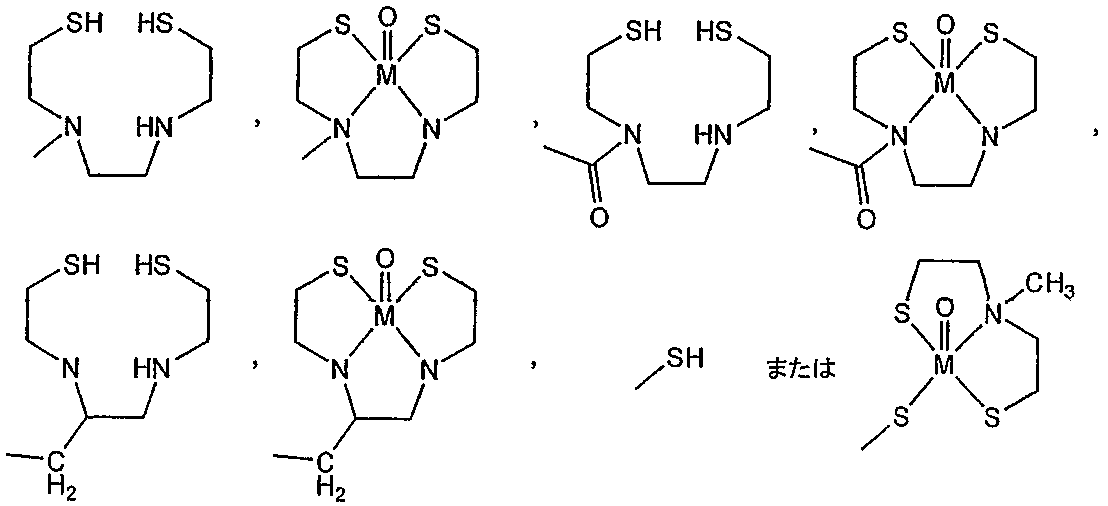
(ここで、MはTc及びReからなる群から選択される)
である}の形態の、キレート化金属基を含むか含まないキレート基からなる群から選択される]
を有し、置換基部分の少なくとも1つが検出可能な標識を含む化合物、並びにその放射標識誘導体及び製薬上許容される塩を投与し、
(B)前記患者をイメージングしてデータを得、
(C)前記データを分析して前記患者におけるアミロイドレベルを健常レベルを参照して確認し、それにより前記患者をアミロイド沈着を伴う疾患の前駆として同定する
ことを含む。本発明の1態様では、患者は軽度の認知障害と診断されている。本発明の別の態様では、アミロイド疾患はアルツハイマー病である。
(Where M is selected from the group consisting of Tc and Re)
Is selected from the group consisting of chelating groups with or without chelating metal groups]
And wherein at least one of the substituent moieties comprises a detectable label, as well as radiolabeled derivatives and pharmaceutically acceptable salts thereof,
(B) imaging the patient to obtain data;
(C) analyzing the data to confirm amyloid levels in the patient with reference to healthy levels, thereby identifying the patient as a precursor to a disease with amyloid deposition. In one aspect of the invention, the patient has been diagnosed with mild cognitive impairment. In another aspect of the invention, the amyloid disease is Alzheimer's disease.
検出可能な標識には、当業者に公知のイメージング技術を用いて検出され得る原子または部分を含む。通常、検出可能な標識は3H、131I、125I、123I、76Br、75Br、18F、CH2−CH2−X*、O−CH2−CH2−X*、CH2−CH2−CH2−X*、O−CH2−CH2−CH2−X*(ここで、X*は131I、123I、76Br、75Brまたは18Fである)、19F、125I;低級アルキル、(CH2)nOR’、CF3、CH2−CH2X、O−CH2−CH2X、CH2−CH2−CH2X、O−CH2−CH2−CH2X(ここで、XはF、Cl、BrまたはIである)、CN、(C=O)−R’、(C=O)N(R’)2、O(CO)R’、COOR’、CR’=CR’−Rph及びCR2’−CR2’−Rph(ここで、少なくとも1つの炭素は11C、13Cまたは14Cである)からなる群から選択される炭素含有置換基;及びW−L*またはV−W−L*{ここで、Vは−COO−、−CO−、−CH2O−及び−CH2NH−からなる群から選択され、Wは−(CH2)n(ここで、nは0、1、2、3、4または5であり、L*は:
(ここで、M*は99mTcである)
である}の形態の、キレート化金属基を含むか含まないキレート基からなる群から選択される。好ましい実施形態において、検出可能な標識は放射標識である。
(Where M * is 99m Tc)
Is selected from the group consisting of chelating groups with or without chelating metal groups. In preferred embodiments, the detectable label is a radiolabel.
同じプロトコルを用いて、
病因が疑わしい認知症傾向障害をアミロイド沈着疾患に起因すると定めるために;
アルツハイマー病を前頭側頭認知症と区別するために;
アルツハイマー病の発症を調べるべく患者をモニターするために;
軽度の認知障害と臨床診断された患者においてアルツハイマー病を診断するために;
患者をアルツハイマー病の前駆として同定するために;
病因が疑わしい認知症傾向障害を呈している患者をアミロイド沈着障害を伴う疾患を有すると同定するために;または
病因が疑わしい認知症傾向障害を呈している患者をアルツハイマー病を有していると同定するために;
患者に適用したイメージング技術から得たデータを比較することができる。
Using the same protocol,
To establish a dementia-prone disorder of suspected etiology as a result of amyloid deposition disease;
To distinguish Alzheimer's disease from frontotemporal dementia;
To monitor patients for the onset of Alzheimer's disease;
To diagnose Alzheimer's disease in patients with a clinical diagnosis of mild cognitive impairment;
To identify the patient as a precursor to Alzheimer's disease;
To identify patients with dementia-prone disorder with suspected etiology as having a disease with amyloid deposition disorder; or patients with dementia-prone disorder with suspected etiology as having Alzheimer's disease To do;
Data from imaging techniques applied to patients can be compared.
1実施形態では、本発明のイメージング法はガンマ線イメージング、磁気共鳴イメージング及び磁気共鳴分光法からなる群から選択される。この実施形態の1態様では、イメージングはガンマ線イメージングによりなされ、ガンマ線イメージングはPETまたはSPECTである。 In one embodiment, the imaging method of the present invention is selected from the group consisting of gamma imaging, magnetic resonance imaging, and magnetic resonance spectroscopy. In one aspect of this embodiment, the imaging is by gamma imaging and the gamma imaging is PET or SPECT.
好ましい実施形態では、式(I)を有する化合物は
である。 It is.
特に、上記化合物はC−11標識を含む。 In particular, the compound contains a C-11 label.
本発明は、アミロイド沈着を伴う疾患の前駆として患者を同定するためまたは今までにADと確定診断されていない病因が疑わしい認知症傾向障害を呈している患者を同定するための方法をも提供する。 The present invention also provides a method for identifying a patient as a precursor to a disease associated with amyloid deposition or for identifying a patient presenting with dementia propensity disorder of suspected etiology not previously diagnosed as AD .
好ましい実施形態では、アミロイド沈着障害はアミロイド斑沈着障害である。 In a preferred embodiment, the amyloid deposition disorder is an amyloid plaque deposition disorder.
本発明者らは、特定のチオフラビン化合物が病因が疑わしい認知症傾向障害を呈している患者を含めたADの診断基準を満たしていない患者(例えば、認知症の臨床兆候を呈している患者及び軽度の認知障害を有している患者)の脳中のアミロイド沈着物をイメージングするために使用され得、患者のアミロイドイメージングからのデータは特定のアミロイド沈着物がADまたは別のアミロイド沈着障害の前兆症状であることを示していることを知見した。 The inventors have found that patients who do not meet the diagnostic criteria for AD, including those with certain thioflavin compounds exhibiting dementia propensity disorders of suspected etiology (eg, patients with clinical signs of dementia and mild Can be used to image amyloid deposits in the brain of a patient), and data from patient amyloid imaging shows that a particular amyloid deposit is a precursor to AD or another amyloid deposition disorder It was found that this is shown.
本発明は、患者をアミロイド沈着疾患の標準臨床診断の前駆として同定する方法に関する。この方法は、患者から定量及び定性データを得るためにアミロイドイメージング剤を使用することを含む。本発明に従う定量的及び定性的アミロイドイメージングはアミロイド沈着疾患をより早く且つより正確に診断することを可能とし、抗アミロイド治療の発展を助けるだろう。この方法の対象となる患者は認知症の臨床兆候を呈している患者または軽度の認知障害の臨床兆候を呈している患者である。 The present invention relates to a method of identifying a patient as a precursor to a standard clinical diagnosis of amyloid deposition disease. This method involves using an amyloid imaging agent to obtain quantitative and qualitative data from a patient. Quantitative and qualitative amyloid imaging according to the present invention will make it possible to diagnose amyloid deposition diseases faster and more accurately and will help develop anti-amyloid therapy. Patients who are candidates for this method are patients who have clinical signs of dementia or patients who have clinical signs of mild cognitive impairment.
当業者は、開業医が認知症の臨床兆候を調べるために各種基準を適用し得ることを認識している。前記基準にはDiagnostic and Statistical Manual of Mental Disorders,第3版(DSM−III)、Alzheimer’s Disease Diagnostic and Treatment Center(ADDTC)、International Statistical Classification of Diseases,第10版(ICD−10)、National Institute of Neurological Disorders and Stroke−Association Internationale pour la Recherche et l’Enseignment en Neurosciences(NINDS−AIREN)及びDiagnostic and Statistical Manual of Mental Disorders,第4版(DSM−IV)が含まれるが、これらに限定されない。Pohjasvaaraら,Stroke,31:2952−2957(2000)を参照されたい。 Those skilled in the art recognize that practitioners can apply various criteria to look for clinical signs of dementia. The criteria include Diagnostic and Statistical Manual of Mental Disorders, 3rd Edition (DSM-III), Alzheimer's Dissessence Diagnostic Digestion Center (ADDTC), and Alzheimer's Dissimilar Digestive Treatment Center (ADDTC). of Neurological Disorders and Stroke-Association International pour la Researche et l'Engineering en Neurosciences (NINDS-AIRE N) and Diagnostic and Statistical Manual of Mental Disorders, 4th Edition (DSM-IV). See Pohjasvaara et al., Stroke, 31: 2952-2957 (2000).
患者を軽度の認知障害として臨床的に特徴づけることは開業医の技量の範囲内である。前記状態を解明するための患者の検査には一連のメンタルテストの実施が含まれる。臨床診断方法は広く検討されており、例えばPetersenら,Arch.Neurol.,56:303−308(1999年3月)に記載されている。 Clinically characterizing a patient as mild cognitive impairment is within the skill of a practitioner. Examination of the patient to elucidate the condition involves performing a series of mental tests. Clinical diagnostic methods have been widely studied, for example, Petersen et al., Arch. Neurol. 56: 303-308 (March 1999).
臨床検査のみに基づいてMCIと同定された被験者は、ADの診断に変わるか(約10〜15%/年の割合)、MCIのままであるか、または“正常”との診断に戻る(10〜15%/年)ことがある。 Subjects who have been identified as MCI based solely on clinical testing will either change to a diagnosis of AD (approximately 10-15% / year rate), remain MCI, or return to a diagnosis of “normal” (10 ~ 15% / year).
S.Larrieu,L.Letenneur,J.M.Orgogozo,C.Fabrigoule,H.Amieva,C.Le,P.Barberger−Gateau,J.F.Dartigues,Incidence and outcome of mild cognitive impairment in a population−based prospective cohort,Neurology,59:1594−1599(1926)。 S. Larrieu, L .; Letenneur, J. et al. M.M. Orgogozo, C.I. Fabrigole, H.M. Amieva, C.I. Le, P.M. Barberger-Gateau, J.A. F. Dartiges, Incidence and outcome of cognitive impulse in a population-based proactive cohort, Neurology, 59: 1594-1599 (1926).
このように、臨床診断に関連した予後はかなり不確かである。MCIと臨床診断された被験者中の脳アミロイド沈着の存在または不在を同定できれば、ADへの変化の予後の正確さがかなり高まる可能性がある。 Thus, the prognosis associated with clinical diagnosis is quite uncertain. The ability to identify the presence or absence of brain amyloid deposits in subjects clinically diagnosed with MCI can significantly increase the prognostic accuracy of changes to AD.
アミロイド沈着を伴う疾患のカテゴリーにはアルツハイマー病、ダウン症候群、2型糖尿病、遺伝性脳出血アミロイド症(オランダ)、アミロイドA(反応性)、続発性アミロイド症、家族性地中海熱、じんま疹及び難聴を伴う家族性アミロイド腎症(マックル・ウェルズ症候群)、アミロイドラムダL鎖またはアミロイドカッパL鎖(特発性、骨髄腫またはマクログロブリン血症関連)Aベータ2M(慢性血液透析)、ATTR(家族性アミロイド多発性神経障害(ポルトガル、日本、スウェーデン))、家族性アミロイド心筋症(オランダ)、孤立性(isolated)心臓アミロイド、全身性老人性アミロイド症、AIAPPまたはアミリンインスリノーマ、心房ナトリウム利尿性因子(孤立性心房アミロイド)、プロカルシトニン(髄様甲状腺癌)、ゲルゾリン(家族性アミロイド症(フィンランド))、シスタチンC(アミロイド症を伴う遺伝性脳出血(アイスランド))、AApo−A−I(家族性アミロイド性多発性神経障害(アイオワ))、AApo−A−II(マウスにおける急速老化)、フィブリノーゲン関連アミロイド、及びAsorまたはPr P−27(スクレイピー、クロイツフェルト・ヤコブ病、Gertsmann−Straussler−Scheinker症候群、ウシ海綿状脳症)、またはアポリポタンパク質E4対立遺伝子に対してホモ接合性のヒトの場合にはアポリポタンパク質E4対立遺伝子に対するホモ接合性に関連する状態またはハンチントン病が含まれるが、これらに限定されない。好ましくは、アミロイド沈着を伴う疾患はアミロイド斑沈着疾患である。好ましくは、アミロイド沈着を伴う疾患はADである。
Disease categories with amyloid deposition include Alzheimer's disease, Down syndrome,
本発明によれば、患者をアミロイド沈着疾患の前駆として同定するための基本的方法は、
(A)同定が必要な認知症の臨床兆候または軽度の認知障害の臨床兆候を呈している患者に対して下記式:
(A) For patients presenting with clinical signs of dementia that require identification or clinical signs of mild cognitive impairment:
[式中、
(i)ZはS、NR’、OまたはC(R’)2であり、ZがC(R’)2のときにはヘテロ環式環の互変異性体はインドール:
(I) Z is S, NR ′, O or C (R ′) 2 , and when Z is C (R ′) 2 the heterocyclic ring tautomer is indole:
(式中、R’はHまたは低級アルキル基である)
を形成していてもよく;
(ii)YはNR1R2、OR2またはSR2であり;
(iii)R1はH、低級アルキル基、(CH2)nOR’(ここで、nは1、2または3である)、CF3、CH2−CH2X、CH2−CH2−CH2X(ここで、XはF、Cl、BrまたはIである)、(C=O)−R’、Rph及び(CH2)nRph(ここで、nは1、2、3または4であり、Rphは未置換であるかまたはR3〜R10について以下に定義する非フェニル置換基から選択される置換基で置換されているフェニル基を表し、R’はHまたは低級アルキル基である)からなる群から選択され;
(iv)R2はH、低級アルキル基、(CH2)nOR’(ここで、nは1、2または3である)、CF3、CH2−CH2X、CH2−CH2−CH2X(ここで、XはF、Cl、BrまたはIである)、(C=O)−R’、Rph及び(CH2)nRph(ここで、nは1、2、3または4であり、Rphは未置換であるかまたはR3〜R10について以下に定義する非フェニル置換基から選択される置換基で置換されているフェニル基を表し、R’はHまたは低級アルキル基である)からなる群から選択され;
(v)R3はH、F、Cl、Br、I、低級アルキル基、(CH2)nOR’(ここで、nは1、2または3である)、CF3、CH2−CH2X、O−CH2−CH2X、CH2−CH2−CH2X、O−CH2−CH2−CH2X(ここで、XはF、Cl、BrまたはIである)、CN、(C=O)−R’、N(R’)2、NO2、(C=O)N(R’)2、O(CO)R’、OR’、SR’、COOR’、Rph、CR’=CR’−Rph、CR2’−CR2’−Rph(ここで、Rphは未置換であるかまたはR1〜R10について定義する非フェニル置換基から選択される置換基で置換されているフェニル基を表し、R’はHまたは低級アルキルである)及びトリアルキル錫からなる群から選択され;
(vi)R4はH、F、Cl、Br、I、低級アルキル基、(CH2)nOR’(ここで、nは1、2または3である)、CF3、CH2−CH2X、O−CH2−CH2X、CH2−CH2−CH2X、O−CH2−CH2−CH2X(ここで、XはF、Cl、BrまたはIである)、CN、(C=O)−R’、N(R’)2、NO2、(C=O)N(R’)2、O(CO)R’、OR’、SR’、COOR’、Rph、CR’=CR’−Rph、CR2’−CR2’−Rph(ここで、Rphは未置換であるかまたはR1〜R10について定義する非フェニル置換基から選択される置換基で置換されているフェニル基を表し、R’はHまたは低級アルキルである)及びトリアルキル錫からなる群から選択され;
(vii)R5はH、F、Cl、Br、I、低級アルキル基、(CH2)nOR’(ここで、nは1、2または3である)、CF3、CH2−CH2X、O−CH2−CH2X、CH2−CH2−CH2X、O−CH2−CH2−CH2X(ここで、XはF、Cl、BrまたはIである)、CN、(C=O)−R’、N(R’)2、NO2、(C=O)N(R’)2、O(CO)R’、OR’、SR’、COOR’、Rph、CR’=CR’−Rph、CR2’−CR2’−Rph(ここで、Rphは未置換であるかまたはR1〜R10について定義する非フェニル置換基から選択される置換基で置換されているフェニル基を表し、R’はHまたは低級アルキルである)及びトリアルキル錫からなる群から選択され;
(viii)R6はH、F、Cl、Br、I、低級アルキル基、(CH2)nOR’(ここで、nは1、2または3である)、CF3、CH2−CH2X、O−CH2−CH2X、CH2−CH2−CH2X、O−CH2−CH2−CH2X(ここで、XはF、Cl、BrまたはIである)、CN、(C=O)−R’、N(R’)2、NO2、(C=O)N(R’)2、O(CO)R’、OR’、SR’、COOR’、Rph、CR’=CR’−Rph、CR2’−CR2’−Rph(ここで、Rphは未置換であるかまたはR1〜R10について定義する非フェニル置換基から選択される置換基で置換されているフェニル基を表し、R’はHまたは低級アルキルである)及びトリアルキル錫からなる群から選択され;
(ix)R7はH、F、Cl、Br、I、低級アルキル基、(CH2)nOR’(ここで、nは1、2または3である)、CF3、CH2−CH2X、O−CH2−CH2X、CH2−CH2−CH2X、O−CH2−CH2−CH2X(ここで、XはF、Cl、BrまたはIである)、CN、(C=O)−R’、N(R’)2、NO2、(C=O)N(R’)2、O(CO)R’、OR’、SR’、COOR’、Rph、CR’=CR’−Rph、CR2’−CR2’−Rph(ここで、Rphは未置換であるかまたはR1〜R10について定義する非フェニル置換基から選択される置換基で置換されているフェニル基を表し、R’はHまたは低級アルキルである)及びトリアルキル錫からなる群から選択され;
(x)R8はH、F、Cl、Br、I、低級アルキル基、(CH2)nOR’(ここで、nは1、2または3である)、CF3、CH2−CH2X、O−CH2−CH2X、CH2−CH2−CH2X、O−CH2−CH2−CH2X(ここで、XはF、Cl、BrまたはIである)、CN、(C=O)−R’、N(R’)2、NO2、(C=O)N(R’)2、O(CO)R’、OR’、SR’、COOR’、Rph、CR’=CR’−Rph、CR2’−CR2’−Rph(ここで、Rphは未置換であるかまたはR1〜R10について定義する非フェニル置換基から選択される置換基で置換されているフェニル基を表し、R’はHまたは低級アルキルである)及びトリアルキル錫からなる群から選択され;
(xi)R9はH、F、Cl、Br、I、低級アルキル基、(CH2)nOR’(ここで、nは1、2または3である)、CF3、CH2−CH2X、O−CH2−CH2X、CH2−CH2−CH2X、O−CH2−CH2−CH2X(ここで、XはF、Cl、BrまたはIである)、CN、(C=O)−R’、N(R’)2、NO2、(C=O)N(R’)2、O(CO)R’、OR’、SR’、COOR’、Rph、CR’=CR’−Rph、CR2’−CR2’−Rph(ここで、Rphは未置換であるかまたはR1〜R10について定義する非フェニル置換基から選択される置換基で置換されているフェニル基を表し、R’はHまたは低級アルキルである)及びトリアルキル錫からなる群から選択され;
(xii)R10はH、F、Cl、Br、I、低級アルキル基、(CH2)nOR’(ここで、nは1、2または3である)、CF3、CH2−CH2X、O−CH2−CH2X、CH2−CH2−CH2X、O−CH2−CH2−CH2X(ここで、XはF、Cl、BrまたはIである)、CN、(C=O)−R’、N(R’)2、NO2、(C=O)N(R’)2、O(CO)R’、OR’、SR’、COOR’、Rph、CR’=CR’−Rph、CR2’−CR2’−Rph(ここで、Rphは未置換であるかまたはR1〜R10について定義する非フェニル置換基から選択される置換基で置換されているフェニル基を表し、R’はHまたは低級アルキルである)及びトリアルキル錫からなる群から選択され;
或いは、R3〜R10の1つはW−LまたはV−W−L{ここで、Vは−COO−、−CO−、−CH2O−及び−CH2NH−からなる群から選択され、Wは−(CH2)n(ここで、nは0、1、2、3、4または5である)であり、Lは
May form
(Ii) Y is NR 1 R 2 , OR 2 or SR 2 ;
(Iii) R 1 is H, a lower alkyl group, (CH 2 ) n OR ′ (where n is 1, 2 or 3), CF 3 , CH 2 —CH 2 X, CH 2 —CH 2 —. CH 2 X (where X is F, Cl, Br or I), (C═O) —R ′, R ph and (CH 2 ) n R ph (where n is 1, 2, 3 Or R ph represents a phenyl group which is unsubstituted or substituted with a substituent selected from non-phenyl substituents as defined below for R 3 to R 10 , R ′ is H or lower Selected from the group consisting of alkyl groups);
(Iv) R 2 is H, a lower alkyl group, (CH 2 ) n OR ′ (where n is 1, 2 or 3), CF 3 , CH 2 —CH 2 X, CH 2 —CH 2 —. CH 2 X (where X is F, Cl, Br or I), (C═O) —R ′, R ph and (CH 2 ) n R ph (where n is 1, 2, 3 Or R ph represents a phenyl group which is unsubstituted or substituted with a substituent selected from non-phenyl substituents as defined below for R 3 to R 10 , R ′ is H or lower Selected from the group consisting of alkyl groups);
(V) R 3 is H, F, Cl, Br, I, a lower alkyl group, (CH 2 ) n OR ′ (where n is 1, 2 or 3), CF 3 , CH 2 —CH 2 X, O—CH 2 —CH 2 X, CH 2 —CH 2 —CH 2 X, O—CH 2 —CH 2 —CH 2 X (where X is F, Cl, Br or I), CN , (C═O) —R ′, N (R ′) 2 , NO 2 , (C═O) N (R ′) 2 , O (CO) R ′, OR ′, SR ′, COOR ′, R ph , CR ′ = CR′—R ph , CR 2 ′ —CR 2 ′ —R ph, where R ph is unsubstituted or substituted selected from non-phenyl substituents as defined for R 1 to R 10 Represents a phenyl group substituted with a group, R ′ is H or lower alkyl) and selected from the group consisting of trialkyltin;
(Vi) R 4 is H, F, Cl, Br, I, a lower alkyl group, (CH 2 ) n OR ′ (where n is 1, 2 or 3), CF 3 , CH 2 —CH 2 X, O—CH 2 —CH 2 X, CH 2 —CH 2 —CH 2 X, O—CH 2 —CH 2 —CH 2 X (where X is F, Cl, Br or I), CN , (C═O) —R ′, N (R ′) 2 , NO 2 , (C═O) N (R ′) 2 , O (CO) R ′, OR ′, SR ′, COOR ′, R ph , CR ′ = CR′—R ph , CR 2 ′ —CR 2 ′ —R ph, where R ph is unsubstituted or substituted selected from non-phenyl substituents as defined for R 1 to R 10 Represents a phenyl group substituted with a group, R ′ is H or lower alkyl) and selected from the group consisting of trialkyltin;
(Vii) R 5 is H, F, Cl, Br, I, a lower alkyl group, (CH 2 ) n OR ′ (where n is 1, 2 or 3), CF 3 , CH 2 —CH 2 X, O—CH 2 —CH 2 X, CH 2 —CH 2 —CH 2 X, O—CH 2 —CH 2 —CH 2 X (where X is F, Cl, Br or I), CN , (C═O) —R ′, N (R ′) 2 , NO 2 , (C═O) N (R ′) 2 , O (CO) R ′, OR ′, SR ′, COOR ′, R ph , CR ′ = CR′—R ph , CR 2 ′ —CR 2 ′ —R ph, where R ph is unsubstituted or substituted selected from non-phenyl substituents as defined for R 1 to R 10 Represents a phenyl group substituted with a group, R ′ is H or lower alkyl) and selected from the group consisting of trialkyltin;
(Viii) R 6 is H, F, Cl, Br, I, a lower alkyl group, (CH 2 ) n OR ′ (where n is 1, 2 or 3), CF 3 , CH 2 —CH 2 X, O—CH 2 —CH 2 X, CH 2 —CH 2 —CH 2 X, O—CH 2 —CH 2 —CH 2 X (where X is F, Cl, Br or I), CN , (C═O) —R ′, N (R ′) 2 , NO 2 , (C═O) N (R ′) 2 , O (CO) R ′, OR ′, SR ′, COOR ′, R ph , CR ′ = CR′—R ph , CR 2 ′ —CR 2 ′ —R ph, where R ph is unsubstituted or substituted selected from non-phenyl substituents as defined for R 1 to R 10 Represents a phenyl group substituted with a group, R ′ is H or lower alkyl) and selected from the group consisting of trialkyltin;
(Ix) R 7 is H, F, Cl, Br, I, a lower alkyl group, (CH 2 ) n OR ′ (where n is 1, 2 or 3), CF 3 , CH 2 —CH 2 X, O—CH 2 —CH 2 X, CH 2 —CH 2 —CH 2 X, O—CH 2 —CH 2 —CH 2 X (where X is F, Cl, Br or I), CN , (C═O) —R ′, N (R ′) 2 , NO 2 , (C═O) N (R ′) 2 , O (CO) R ′, OR ′, SR ′, COOR ′, R ph , CR ′ = CR′—R ph , CR 2 ′ —CR 2 ′ —R ph, where R ph is unsubstituted or substituted selected from non-phenyl substituents as defined for R 1 to R 10 Represents a phenyl group substituted with a group, R ′ is H or lower alkyl) and selected from the group consisting of trialkyltin;
(X) R 8 is H, F, Cl, Br, I, a lower alkyl group, (CH 2 ) n OR ′ (where n is 1, 2 or 3), CF 3 , CH 2 —CH 2 X, O—CH 2 —CH 2 X, CH 2 —CH 2 —CH 2 X, O—CH 2 —CH 2 —CH 2 X (where X is F, Cl, Br or I), CN , (C═O) —R ′, N (R ′) 2 , NO 2 , (C═O) N (R ′) 2 , O (CO) R ′, OR ′, SR ′, COOR ′, R ph , CR ′ = CR′—R ph , CR 2 ′ —CR 2 ′ —R ph, where R ph is unsubstituted or substituted selected from non-phenyl substituents as defined for R 1 to R 10 Represents a phenyl group substituted with a group, R ′ is H or lower alkyl) and selected from the group consisting of trialkyltin;
(Xi) R 9 is H, F, Cl, Br, I, a lower alkyl group, (CH 2 ) n OR ′ (where n is 1, 2 or 3), CF 3 , CH 2 —CH 2 X, O—CH 2 —CH 2 X, CH 2 —CH 2 —CH 2 X, O—CH 2 —CH 2 —CH 2 X (where X is F, Cl, Br or I), CN , (C═O) —R ′, N (R ′) 2 , NO 2 , (C═O) N (R ′) 2 , O (CO) R ′, OR ′, SR ′, COOR ′, R ph , CR ′ = CR′—R ph , CR 2 ′ —CR 2 ′ —R ph, where R ph is unsubstituted or substituted selected from non-phenyl substituents as defined for R 1 to R 10 Represents a phenyl group substituted with a group, R ′ is H or lower alkyl) and selected from the group consisting of trialkyltin;
(Xii) R 10 is H, F, Cl, Br, I, a lower alkyl group, (CH 2 ) n OR ′ (where n is 1, 2 or 3), CF 3 , CH 2 —CH 2 X, O—CH 2 —CH 2 X, CH 2 —CH 2 —CH 2 X, O—CH 2 —CH 2 —CH 2 X (where X is F, Cl, Br or I), CN , (C═O) —R ′, N (R ′) 2 , NO 2 , (C═O) N (R ′) 2 , O (CO) R ′, OR ′, SR ′, COOR ′, R ph , CR ′ = CR′—R ph , CR 2 ′ —CR 2 ′ —R ph, where R ph is unsubstituted or substituted selected from non-phenyl substituents as defined for R 1 to R 10 Represents a phenyl group substituted with a group, R ′ is H or lower alkyl) and selected from the group consisting of trialkyltin;
Alternatively, one of
(ここで、MはTc及びReからなる群から選択される)
である}の形態の、キレート化金属基を含むか含まないキレート基であり得る]
を有し、置換基部分の少なくとも1つは検出可能な標識を含む化合物、並びにその放射標識誘導体及び製薬上許容される塩を有効量投与し、
(B)前記患者をイメージングしてデータを得、
(C)前記データを分析して前記患者におけるアミロイドレベルを健常レベルを参照して確認することを含む。
(Where M is selected from the group consisting of Tc and Re)
Can be a chelating group with or without chelating metal groups]
Administering an effective amount of a compound wherein at least one of the substituent moieties comprises a detectable label, and radiolabeled derivatives and pharmaceutically acceptable salts thereof,
(B) imaging the patient to obtain data;
(C) analyzing the data to confirm amyloid levels in the patient with reference to healthy levels.
1実施形態は、病因が疑わしい認知症傾向障害を呈している患者の診断方法に関する。この方法は、アミロイド沈着の所見に基づいて病因が疑わしい認知症を多分ADまたは別のアミロイド沈着障害かを調べることを含む。この方法は、患者に対して式(I)または(II)を有する化合物或いは構造1〜45の1つを投与し、前記患者をイメージングしてデータを得、アミロイド沈着の所見に基づいて病因が疑わしい認知症がADであるかを調べることを含む。 One embodiment relates to a method for diagnosing a patient presenting with a dementia tendency disorder of suspected etiology. This method involves examining whether the dementia of suspected etiology is probably AD or another amyloid deposition disorder based on the findings of amyloid deposition. This method involves administering to a patient a compound having formula (I) or (II) or one of structures 1-45, imaging the patient to obtain data, and determining the etiology based on the findings of amyloid deposits. Including examining whether the suspected dementia is AD.
別の実施形態は、上記または下記する実施形態に記載されているように患者をアミロイド沈着疾患の前駆として同定するための薬剤の製造方法である。この方法は、式(I)または(II)或いは本明細書中に記載されている構造1〜45の1つに従う化合物を医薬用担体と混合して薬剤を形成することを含む。 Another embodiment is a method of manufacturing a medicament for identifying a patient as a precursor of amyloid deposition disease as described in the embodiments above or below. This method comprises mixing a compound according to formula (I) or (II) or one of structures 1-45 described herein with a pharmaceutical carrier to form a drug.
更に別の実施形態は、上記または下記する実施形態に記載されているように病因が疑わしい認知症傾向障害を呈している患者を診断するための薬剤の製造方法である。この方法は、式(I)または(II)或いは本明細書中に記載されている構造1〜45の1つに従う化合物を医薬用担体と混合して薬剤を形成することを含む。 Yet another embodiment is a method for producing a medicament for diagnosing a patient presenting with a dementia tendency disorder of suspected etiology as described in the above or below embodiments. This method comprises mixing a compound according to formula (I) or (II) or one of structures 1-45 described herein with a pharmaceutical carrier to form a drug.
用語「病因が疑わしい認知症傾向障害」は、(認知症傾向障害のヒトを診断する専門家が通常使用している神経学的、精神医学的、医学的及び神経心理学的評価から構成され得る)臨床評価を受け、臨床評価した後、評価者が(主観的記憶愁訴、正常な機能からずれているヒトを知っている情報提供者による記憶愁訴の説明、または当業者が一般的に使用している臨床検査の証拠に基づいて)若干の認知症傾向障害が存在するかもしれないという証拠を見出だすが、単一の臨床的に明確な認知症傾向障害(例えば、AD、前頭側頭認知症、レービー小体を含む認知症、血管性認知症、大うつ病が原因の偽認知症、クロイツフェルト・ヤコブ病及び当業者に公知の他のもの)に関する十分な証拠を見つけることができないか、または1つ以上の単一の認知症傾向障害の証拠を2つ以上の認知症傾向障害の区別が疑わしい程度にしか見つけられないヒトの状態を指す。 The term “dementia propensity disorder of suspected etiology” (can consist of neurological, psychiatric, medical and neuropsychological assessments commonly used by specialists who diagnose humans with dementia propensity disorders After clinical evaluation and clinical evaluation, the evaluator (subjective memory complaints, explanations of memory complaints by informants who know humans who are out of normal function, or commonly used by those skilled in the art) Find evidence that there may be some dementia propensity disorder (based on clinical laboratory evidence), but a single clinically distinct dementia propensity disorder (eg AD, frontotemporal Cannot find sufficient evidence about dementia, dementia including Lewy bodies, vascular dementia, pseudodementia caused by major depression, Creutzfeldt-Jakob disease and others known to those skilled in the art Or one or more Refer to human state distinction can not only find the degree suspected of two or more dementia tends impairment evidence of one dementia tendency disorders.
本発明のこの態様ではアミロイドイメージング剤を使用し、このアミロイドイメージング剤はインビボでアミロイド沈着を定量するために非侵襲的ニューロイメージング技術、例えば磁気共鳴分光法(MRS)またはイメージング(MRI);ガンマ線イメージング法、例えば陽電子放射断層撮影法(PET)または単一光子放出型コンピュータ断層撮影法(SPECT)と組み合わせて使用される。これらのイメージング技術により多くの脳領域のデータが得られる。「関心領域(ROI)」を描写することにより特定領域が定量される。 This aspect of the invention uses an amyloid imaging agent, which is a non-invasive neuroimaging technique to quantify amyloid deposition in vivo, such as magnetic resonance spectroscopy (MRS) or imaging (MRI); gamma imaging Used in combination with a method such as positron emission tomography (PET) or single photon emission computed tomography (SPECT). Data on many brain regions can be obtained by these imaging techniques. A particular region is quantified by drawing a “region of interest (ROI)”.
本発明によれば、患者から上記したイメージング技術の1つを用いて得たデータを健常患者からのデータと比較して、アミロイド沈着疾患の標準臨床診断の前駆として患者を区別する基準に基づいて結論が得られる。 In accordance with the present invention, data obtained from a patient using one of the imaging techniques described above is compared with data from a healthy patient and based on criteria for distinguishing patients as a precursor to standard clinical diagnosis of amyloid deposition disease. Conclusion is obtained.
同じプロトコルを用いて、
病因が疑わしい認知症傾向障害をアミロイド沈着疾患に起因すると定めるために;
アルツハイマー病を前頭側頭認知症と区別するために;
アルツハイマー病の発症を調べるべく患者をモニターするために;
軽度の認知障害と臨床診断された患者においてアルツハイマー病を診断するために;
患者をアルツハイマー病の前駆として同定するために;
病因が疑わしい認知症傾向障害を呈している患者をアミロイド沈着障害を伴う疾患を有していると同定するために;または
病因が疑わしい認知症傾向障害を呈している患者をアルツハイマー病を有していると同定するために;
患者に適用したイメージング技術から得たデータを比較することができる。
Using the same protocol,
To establish a dementia-prone disorder of suspected etiology as a result of amyloid deposition disease;
To distinguish Alzheimer's disease from frontotemporal dementia;
To monitor patients for the onset of Alzheimer's disease;
To diagnose Alzheimer's disease in patients with a clinical diagnosis of mild cognitive impairment;
To identify the patient as a precursor to Alzheimer's disease;
To identify patients with dementia propensity disorder of suspected etiology as having a disease with amyloid deposition disorder; or patients with dementia propensity disorder of suspected etiology have Alzheimer's disease To identify that;
Data from imaging techniques applied to patients can be compared.
アミロイドイメージング剤
本発明のために適しているアミロイドイメージング剤は上記した式(I)を有する化合物である。
Amyloid Imaging Agent An amyloid imaging agent suitable for the present invention is a compound having the formula (I) described above.
幾つかの実施形態では、アミロイドイメージング剤は式(II):
(式中、
R1は水素、−OH、−NO2、−CN、−COOR、−OCH2OR、C1−6アルキル、C2−6アルケニル、C2−6アルキニル、C1−6アルコキシまたはハロであり;
RはC1−6アルキルであり;
R2は水素またはハロであり;
R3は水素、C1−6アルキル、C2−6アルケニルまたはC2−6アルキニルであり;
R4は水素、C1−6アルキル、C2−6アルケニルまたはC2−6アルキニルであり、ここで前記したアルキル、アルケニルまたはアルキニルは放射性炭素を含むか、またはR2が水素もしくは非放射性ハロのときには放射性ハロで置換されており;
ただしR1が水素または−OHであり、R2が水素であり、R4が−11CH3のときにはR3はC2−6アルキル、C2−6アルケニルまたはC2−6アルキニルであり、更にただしR1が水素であり、R2が水素であり、R4が−(CH2)3 18FのときにはR3はC2−6アルキル、C2−6アルケニルまたはC2−6アルキニルである)
を有する化合物、或いは前記化合物の放射標識誘導体、製薬上許容される塩、水和物、溶媒和物またはプロドラッグである。
(Where
R 1 is hydrogen, —OH, —NO 2 , —CN, —COOR, —OCH 2 OR, C 1-6 alkyl, C 2-6 alkenyl, C 2-6 alkynyl, C 1-6 alkoxy or halo. ;
R is C 1-6 alkyl;
R 2 is hydrogen or halo;
R 3 is hydrogen, C 1-6 alkyl, C 2-6 alkenyl or C 2-6 alkynyl;
R 4 is hydrogen, C 1-6 alkyl, C 2-6 alkenyl or C 2-6 alkynyl, wherein the alkyl, alkenyl or alkynyl as defined above contains a radioactive carbon, or R 2 is hydrogen or a non-radioactive halo. Is substituted with radioactive halo;
Provided that when R 1 is hydrogen or —OH, R 2 is hydrogen, and R 4 is − 11 CH 3 , R 3 is C 2-6 alkyl, C 2-6 alkenyl or C 2-6 alkynyl; Furthermore, when R 1 is hydrogen, R 2 is hydrogen, and R 4 is — (CH 2 ) 3 18 F, R 3 is C 2-6 alkyl, C 2-6 alkenyl or C 2-6 alkynyl. is there)
Or a radiolabeled derivative, pharmaceutically acceptable salt, hydrate, solvate or prodrug of said compound.
1実施形態では、式(II)を有する化合物中のR2は放射性ハロを含有する。よって、例えば、本明細書に記載されている実施形態と組み合わせて使用するための式(II)を有する1つの化合物は、2−(3−18F−フルオロ−4−メチルアミノ−フェニル)−ベンゾチアゾール−6−オール:
である。 It is.
「アルキル」は、直鎖または分枝鎖炭化水素基を指す。その例にはメチル、エチル、プロピル、イソプロピル、ブチル、イソブチル、tert−ブチル、n−ペンチル及びn−ヘキシルが含まれるが、これらに限定されない。用語「低級アルキル」はC1−6アルキルを指す。 “Alkyl” refers to a straight or branched chain hydrocarbon group. Examples include, but are not limited to, methyl, ethyl, propyl, isopropyl, butyl, isobutyl, tert-butyl, n-pentyl and n-hexyl. The term “lower alkyl” refers to C 1-6 alkyl.
「アルケニル」は、少なくとも1個の炭素−炭素二重結合を含む不飽和の直鎖または分枝鎖炭化水素基を指す。その例にはエテニル、プロペニル、イソプロペニル、ブテニル、イソブテニル、tert−ブテニル、n−ペンテニル及びn−ヘキセニルが含まれるが、これらに限定されない。 “Alkenyl” refers to an unsaturated straight or branched chain hydrocarbon group containing at least one carbon-carbon double bond. Examples include, but are not limited to, ethenyl, propenyl, isopropenyl, butenyl, isobutenyl, tert-butenyl, n-pentenyl and n-hexenyl.
「アルキニル」は、少なくとも1個の炭素−炭素三重結合を含む不飽和の直鎖または分枝鎖炭化水素基を指す。その例にはエチニル、プロピニル、イソプロピニル、ブチニル、イソブチニル、tert−ブチニル、ペンチニル及びヘキシニルが含まれるが、これらに限定されない。 “Alkynyl” refers to an unsaturated straight or branched chain hydrocarbon group containing at least one carbon-carbon triple bond. Examples include, but are not limited to, ethynyl, propynyl, isopropynyl, butynyl, isobutynyl, tert-butynyl, pentynyl and hexynyl.
「アルコキシ」は、酸素結合を介して結合しているアルキル基を指す。 “Alkoxy” refers to an alkyl group bonded through an oxygen bond.
「ハロ」は、フルオロ、クロロ、ブロモ及びヨード基を指す。 “Halo” refers to fluoro, chloro, bromo and iodo groups.
「放射性ハロ」は、放射性ハロ、すなわち放射性フルオロ、放射性クロロ、放射性ブロモまたは放射性ヨードを指す。 “Radiohalo” refers to radiohalo, ie, radiofluoro, radiochloro, radiobromo, or radioiodine.
別の実施形態において、式(I)を有するチオフラビン化合物は構造1〜45またはその放射標識誘導体からなる群から選択される。
化合物1〜45において、置換基部分の少なくとも1つは上記した検出可能標識を含む。 In compounds 1-45, at least one of the substituent moieties includes a detectable label as described above.
好ましい実施形態では、アミロイドイメージング剤は{N−メチル−11C}2−[4’−(メチルアミノ)フェニル]6−ヒドロキシベンゾチアゾール(“[11C]PIB”)または{N−メチル−3H}2−[4’−(メチルアミノ)フェニル]6−ヒドロキシベンゾチアゾール(“[3H]PIB”)である。 In a preferred embodiment, the amyloid imaging agent {N- methyl - 11 C} 2- [4 ' - ( methylamino) phenyl] 6-hydroxy-benzothiazole ( "[11 C] PIB" ) or {N- methyl - 3 H} 2- [4 ′-(methylamino) phenyl] 6-hydroxybenzothiazole (“[ 3 H] PIB”).
「有効量」は、所望の効果を生じさせるのに必要な量を指す。「有効量」の例には、インビボまたはインビトロでアミロイド沈着物を検出し、イメージングすることができ;医薬用に許容される程度の毒性及びバイオアベイラビリティーレベルを生じ;及び/またはフィブリル形成を伴う細胞変性及び毒性を予防する量が含まれる。 “Effective amount” refers to the amount necessary to produce the desired effect. Examples of “effective amounts” can detect and image amyloid deposits in vivo or in vitro; produce pharmaceutically acceptable levels of toxicity and bioavailability; and / or involve fibril formation An amount to prevent cytopathicity and toxicity is included.
本明細書中で「チオフラビン化合物」、「チオフラビン誘導体」または「アミロイドイメージング剤」とも呼ばれる式(I)及び(II)または構造1〜45を有する化合物はそれぞれ(1)インビトロで合成Aβに特異的に結合し、(2)インビボで非妥協血液脳関門を横切ることができるという特徴を有している。 Compounds having formulas (I) and (II) or structures 1-45, also referred to herein as “thioflavin compounds”, “thioflavin derivatives” or “amyloid imaging agents”, are (1) specific for synthetic Aβ in vitro, respectively. And (2) has the ability to cross the uncompromised blood brain barrier in vivo.
式(I)及び(II)並びに構造1〜45を有するチオフラビン化合物及びその放射標識誘導体は、インビボで血液脳関門を横切り、神経突起(拡散性ではない)斑中に沈着したAβ、脳血管アミロイド中に沈着したAβ、及びNFT中に沈着したタンパク質からなるアミロイドに結合する。本発明の化合物は、組織切片中のアミロイドを染色し、インビトロで合成Aβに結合することが公知のチオフラビンS及びTの非4級アミン誘導体である。J.Kelenyi,Histochem.Cytochem.,15:172(1967);Burnsら,J.Path.Bact.,94:337(1967);Gunternら,Experientia,48:8(1992);LeVine,Meth.Enzymol.,309:274(1999)。
Thioflavin compounds having the formulas (I) and (II) and
本発明の方法は、患者の臓器または身体域、好ましくは脳中のアミロイド沈着物の存在及び位置を測定する。本発明の方法は、式(I)または(II)を有するアミロイドイメージング剤を検出可能量投与することを含む。幾つかの実施形態では、アミロイドイメージング剤は上記した構造1〜45から選択される。アミロイドイメージング剤は医薬組成物またはその製薬上許容される水溶性塩として患者に対して投与され得る。 The method of the present invention measures the presence and location of amyloid deposits in a patient's organ or body area, preferably the brain. The method of the invention comprises administering a detectable amount of an amyloid imaging agent having formula (I) or (II). In some embodiments, the amyloid imaging agent is selected from structures 1-45 described above. The amyloid imaging agent can be administered to a patient as a pharmaceutical composition or a pharmaceutically acceptable water-soluble salt thereof.
「製薬上許容される塩」は、本発明の化合物の酸または塩基の塩であり、所望の薬理学的活性を有し且つ生物学的にも他の点でも望ましいものを指す。この塩は酸を用いて形成され得、この中には酢酸塩、アジピン酸塩、アルギン酸塩、アスパラギン酸塩、安息香酸塩、ベンゼンスルホン酸塩、硫酸水素酸塩、酪酸塩、クエン酸塩、ショウノウ酸塩、ショウノウスルホン酸塩、シクロペンタンプロピオン酸塩、ジグルコン酸塩、ドデシル硫酸塩、エタンスルホン酸塩、フマル酸塩、グルコヘプタン酸塩、グリセロリン酸塩、半硫酸塩、ヘプタン酸塩、ヘキサン酸塩、塩酸塩、臭化水素酸塩、ヨウ化水素酸塩、2−ヒドロキシエタンスルホン酸塩、乳酸塩、マレイン酸塩、メタンスルホン酸塩、2−ナフタレンスルホン酸塩、ニコチン酸塩、シュウ酸塩、チオシアン酸塩、トシル酸塩及びウンデカン酸塩が含まれるが、これらに限定されない。塩基塩の例にはアンモニウム塩;アルカリ金属塩、例えばナトリウム塩及びカリウム塩;アルカリ土類金属塩、例えばカルシウム塩及びマグネシウム塩;有機塩基との塩、例えばジシクロヘキシルアミン塩及びN−メチル−D−グルカミン;及びアミノ酸(例えば、アルギニン及びリシン)との塩が含まれるが、これらに限定されない。幾つかの実施形態では、塩基性窒素含有基はハロゲン化低級アルキル、例えば塩化メチル,エチル,プロピル及びブチル、臭化メチル,エチル,プロピル及びブチル、及びヨウ化メチル,エチル,プロピル及びブチル;硫酸ジアルキル、例えば硫酸ジメチル,ジエチル,ジブチル及びジアミル;長鎖ハロゲン化物、例えば塩化デシル,ラウリル,ミリスチル及びステアリル、臭化デシル,ラウリル,ミリスチル及びステアリル、塩化デシル,ラウリル,ミリスチル及びステアリル;及びハロゲン化アルアルキル、例えば臭化フェネチルのような物質を用いて4級化され得る。 “Pharmaceutically acceptable salt” refers to an acid or base salt of a compound of the invention, which has the desired pharmacological activity and is biologically and otherwise desirable. This salt can be formed with acids, including acetate, adipate, alginate, aspartate, benzoate, benzenesulfonate, hydrosulfate, butyrate, citrate, Camphorate, camphorsulfonate, cyclopentanepropionate, digluconate, dodecyl sulfate, ethanesulfonate, fumarate, glucoheptanoate, glycerophosphate, hemisulfate, heptanoate, hexane Acid salt, hydrochloride, hydrobromide, hydroiodide, 2-hydroxyethanesulfonate, lactate, maleate, methanesulfonate, 2-naphthalenesulfonate, nicotinate, Shu Acid salts, thiocyanate salts, tosylate salts and undecanoate salts. Examples of base salts include ammonium salts; alkali metal salts such as sodium and potassium salts; alkaline earth metal salts such as calcium and magnesium salts; salts with organic bases such as dicyclohexylamine salts and N-methyl-D- And salts with amino acids (eg, arginine and lysine), but are not limited to these. In some embodiments, the basic nitrogen-containing group is a lower alkyl halide such as methyl chloride, ethyl, propyl and butyl, methyl bromide, ethyl, propyl and butyl, and methyl iodide, ethyl, propyl and butyl; Dialkyls such as dimethyl sulfate, diethyl, dibutyl and diamyl; long chain halides such as decyl chloride, lauryl, myristyl and stearyl, decyl bromide, lauryl, myristyl and stearyl, decyl chloride, lauryl, myristyl and stearyl; It can be quaternized with a material such as alkyl, for example phenethyl bromide.
通常、検出可能に標識されているチオフラビン誘導体の用量は、当業界の医師が調節するために考慮する患者の年齢、状態、性別及び病気の程度;もしあるならば配合禁忌、併用治療;及び他の変数のような要件に依存して変わる。用量は0.001〜10μg/kg、好ましくは0.01〜1.0μg/kgであり得る。 Usually, the dose of detectably labeled thioflavin derivative is the patient's age, condition, sex and degree of illness considered to be adjusted by physicians in the art; combination contraindications, if any, concomitant treatments; and others Varies depending on requirements like variables. The dose can be 0.001 to 10 μg / kg, preferably 0.01 to 1.0 μg / kg.
被験者に対して局所または全身に投与され得、静脈内、動脈内、鞘内(脊髄液を介して)等に投与され得る。検査しようとする身体部位に応じて皮内または腔内に投与してもよい。化合物がアミロイドと結合するのに十分な時間、例えば30分間〜48時間経過したら、検査しようとする被験者の領域をルーチンのイメージング技術(例えば、MRS/MRI、SPECT、平面シンチレーションイメージング、PET及び任意の新しいイメージング技術)により調べる。正確なプロトコルは必ず上記した患者に特有の因子及び検査しようとする身体部位、使用する標識の投与方法及び標識の種類に応じて異なり、特異的処置は当業者によりルーチンに決定される。脳イメージングのためには、本発明の結合した放射標識チオフラビン誘導体またはアナログの量(全結合または特異的結合)を測定し、患者の小脳に結合した標識チオフラビン誘導体の量と(比として)比較することが好ましい。次いで、この比を年齢を整合させた正常脳の同一比と比較する。 The subject can be administered locally or systemically, and can be administered intravenously, intraarterially, intrathecally (via spinal fluid), and the like. Depending on the body part to be examined, it may be administered intradermally or intracavity. After sufficient time for the compound to bind to amyloid, such as 30 minutes to 48 hours, the region of the subject to be examined is routinely imaged (eg, MRS / MRI, SPECT, planar scintillation imaging, PET and any We investigate by new imaging technology. The exact protocol will necessarily depend on the factors specific to the patient described above and the body part to be examined, the method of administration of the label used and the type of label, and the specific treatment is routinely determined by those skilled in the art. For brain imaging, the amount of bound radiolabeled thioflavin derivative or analog of the invention (total binding or specific binding) is measured and compared (as a ratio) to the amount of labeled thioflavin derivative bound to the cerebellum of the patient. It is preferable. This ratio is then compared to the same ratio in age-matched normal brain.
本発明のアミロイドイメージング剤を注射用組成物の形態で投与するのが有利であるが、公知のドラッグデリバリーシステム(例えば、経口、直腸内、非経口(静脈内、筋肉内または皮下)、槽内、膣内、腹腔内、局所(散剤、軟膏剤または滴剤)、または口腔または鼻内スプレーとして)に製剤化してもよい。前記目的のための典型的な組成物は製薬上許容される担体を含む。例えば、組成物は、NaCl含有リン酸バッファー1mlあたり約10mgのヒト血清アルブミン及び約0.5〜500μgの標識チオフラビン誘導体を含み得る。他の製薬上許容される担体には、例えば参照により本明細書に組み入れるREMINGTON’S PHARMACEUTICAL SCIENCES,第15版,イーストンに所在のMack Publishing Co.,p.1405−1412及びp.1461−1487(1975年出版)及びTHE NATIONAL FORMULARY XIV.,第14版,ワシントンに所在のAmerican Pharmaceutical Association(1975年出版)に記載されているような水溶液、塩、保存剤、バッファー等を含めた非毒性賦形剤が含まれる。 While it is advantageous to administer the amyloid imaging agent of the present invention in the form of an injectable composition, known drug delivery systems (eg, oral, rectal, parenteral (intravenous, intramuscular or subcutaneous), in the reservoir May be formulated intravaginally, intraperitoneally, topically (as a powder, ointment or drop), or buccal or nasal spray). A typical composition for said purpose comprises a pharmaceutically acceptable carrier. For example, the composition may comprise about 10 mg human serum albumin and about 0.5-500 μg labeled thioflavin derivative per ml NaCl-containing phosphate buffer. Other pharmaceutically acceptable carriers include, for example, REMINGTON'S PHARMACEUTICAL SCIENCES, 15th Edition, Mack Publishing Co., Easton, incorporated herein by reference. , P. 1405-1421 and p. 1461-1487 (published in 1975) and THE NATURAL FORMULARY XIV. , 14th edition, non-toxic excipients including aqueous solutions, salts, preservatives, buffers, etc. as described in American Pharmaceutical Association (published in 1975) located in Washington.
本発明の特に好ましいアミロイドイメージング剤は、インビボでアミロイドに特異的に結合し且つ血液脳関門を横切ることができるだけでなく、適正な用量レベルで非毒性であり、十分な作用期間を有するものである。 Particularly preferred amyloid imaging agents of the invention are those that not only specifically bind to amyloid and cross the blood brain barrier in vivo, but are also non-toxic at the proper dose level and have a sufficient duration of action. .
本発明によれば、式(I)または(II)或いは構造1〜45を有するアミロイドイメージング剤を含む医薬組成物をアミロイドまたはアミロイドフィブリル形成が予測される被験者、例えばアルツハイマー病と臨床診断された患者に対して投与する。
According to the present invention, a pharmaceutical composition comprising an amyloid imaging agent having the formula (I) or (II) or
非水性溶媒の例はプロピレングリコール、ポリエチレングリコール、植物油及び注射可能な有機エステル(例えば、オレイン酸エチル)である。水性担体には水、アルコール性/水性溶液、食塩液、非経口ビヒクル(例えば、塩化ナトリウム)、リンガーデキストロース等が含まれる。静脈内ビヒクルには流体及び栄養補液が含まれる。保存剤には抗菌剤、抗酸化剤、キレート化剤及び不活性ガスが含まれる。医薬組成物中の各種成分のpH及び正確な濃度は当業界のルーチンな技量に従って調節される。Goodman and Gilman’s THE PHARMACOLOGICAL BASIS FOR THERAPEUTICS(第7版)を参照されたい。 Examples of non-aqueous solvents are propylene glycol, polyethylene glycol, vegetable oils and injectable organic esters such as ethyl oleate. Aqueous carriers include water, alcoholic / aqueous solutions, saline, parenteral vehicles (eg, sodium chloride), Ringer dextrose and the like. Intravenous vehicles include fluid and nutrient replenishers. Preservatives include antibacterial agents, antioxidants, chelating agents and inert gases. The pH and exact concentration of the various components in the pharmaceutical composition are adjusted according to routine skill in the art. See Goodman and Gilman's THE PHARMALOGICAL BASIS FOR THERAPEUTICS (7th edition).
イメージング
本発明はアミロイドイメージング剤を使用し、このアミロイドイメージング剤はインビボでアミロイド沈着を定量するために非侵襲的ニューロイメージング技術、例えば磁気共鳴分光法(MRS)またはイメージング(MRI);ガンマ線イメージング法、例えば陽電子放射断層撮影法(PET)または単一光子放出型コンピュータ断層撮影法(SPECT)と組み合わせて使用される。これらのイメージング技術により多くの脳領域のデータが得られる。「関心領域(ROI)」を描写することにより特定領域が定量される。この方法はアミロイド沈着を確定するために患者をイメージングすることを含む。
Imaging The present invention uses an amyloid imaging agent, which uses non-invasive neuroimaging techniques to quantify amyloid deposition in vivo, such as magnetic resonance spectroscopy (MRS) or imaging (MRI); gamma imaging, For example, it is used in combination with positron emission tomography (PET) or single photon emission computed tomography (SPECT). Data on many brain regions can be obtained by these imaging techniques. A particular region is quantified by drawing a “region of interest (ROI)”. The method includes imaging the patient to determine amyloid deposition.
用語「インビボイメージング」は、式(I)または(II)或いは構造1〜45の標識チオフラビン誘導体を検出できる方法を指す。ガンマ線イメージングの場合、検査しようとする臓器または領域から発せられる放射線を測定し、全結合としてまたは1つの組織中の全結合を同一のインビボイメージング処置中同一被験者の別の組織における全結合に対して(例えば、割ることにより)正規化した比として表示する。インビボの全結合は、同一量の標識化合物を大過剰の標識されていない以外は化学的に同一の化合物と共に第2注射することにより補正する必要なく、インビボイメージング技術により組織中で検出される全信号として定義される。「被験者」は哺乳動物、好ましくはヒト、最も好ましくはアミロイド沈着を伴う疾患(例えば、AD及び/または認知症)を有していると疑われるヒトである。用語「被験者」及び「患者」は本明細書中で互換可能に使用される。 The term “in vivo imaging” refers to a method capable of detecting a labeled thioflavin derivative of formula (I) or (II) or structures 1-45. In the case of gamma imaging, the radiation emitted from the organ or region to be examined is measured and either as total binding or total binding in one tissue relative to total binding in another tissue of the same subject during the same in vivo imaging procedure. Display as normalized ratio (eg, by dividing). Total in vivo binding is the total amount detected in tissue by in vivo imaging techniques without the need to correct by the second injection of the same amount of labeled compound with the chemically identical compound except a large excess of unlabeled. Defined as signal. A “subject” is a mammal, preferably a human, most preferably a human suspected of having a disease associated with amyloid deposition (eg, AD and / or dementia). The terms “subject” and “patient” are used interchangeably herein.
インビボイメージングの目的で、利用可能な検出装置のタイプは所与の標識を選択する際の主要要因である。例えば、本発明の方法におけるインビボイメージングでは放射性同位元素及び18Fが非常に適している。使用する装置のタイプにより放射性核種または安定な同位元素が選択される。例えば、選択される放射性核種は所与のタイプの装置により検出可能なタイプの減衰を有するものでなければならない。更に、放射性核種の半減期を考慮する。半減期は、標的による最大摂取時に検出可能であるほど十分に長いが、宿主が有害な照射を受けないように十分に短くなければならない。本発明の放射標識化合物は、放射される適当な波長を有するガンマ線を検出するガンマ線イメージングを用いて検出され得る。ガンマ線イメージング方法にはSPECT及びPETが含まれるが、これらに限定されない。SPECT検出の場合、選択する放射標識が特定の放射を欠くが、140〜200keV範囲で多数の光子を生ずることが好ましい。PET検出の場合、放射標識は、対消磁してPETカメラにより検出される2つの511keVガンマ線を形成する陽電子放出放射性核種(例えば、19F)である。 For in vivo imaging purposes, the type of detection device available is a major factor in selecting a given label. For example, radioactive isotopes and 18 F are very suitable for in vivo imaging in the method of the invention. Depending on the type of equipment used, a radionuclide or a stable isotope is selected. For example, the selected radionuclide must have a type of attenuation detectable by a given type of device. In addition, the half-life of the radionuclide is taken into account. The half-life should be long enough to be detectable at maximum ingestion by the target, but short enough so that the host is not exposed to harmful radiation. The radiolabeled compounds of the present invention can be detected using gamma ray imaging that detects gamma rays having the appropriate wavelength to be emitted. Gamma ray imaging methods include, but are not limited to, SPECT and PET. For SPECT detection, the radiolabel chosen lacks specific radiation, but preferably produces a large number of photons in the 140-200 keV range. For PET detection, the radiolabel is a positron emitting radionuclide (eg, 19 F) that demagnetizes to form two 511 keV gamma rays that are detected by a PET camera.
本発明では、アミロイド沈着のインビボイメージング及び定量のために有用なアミロイド結合化合物を患者に投与する。前記化合物は、非侵襲的ニューロイメージング技術(例えば、 磁気共鳴分光法(MRS)またはイメージング(MRI)、陽電子放射断層撮影法(PET)及び単一光子放出型コンピュータ断層撮影法(SPECT))と一緒に使用される。本発明によれば、MRS/MRIのためにチオフラビン誘導体を当業界で公知の一般的な有機化学技術により19Fまたは13Cで標識してもよい。例えば、その内容が参照により本明細書に組み入れられるJ.March,ADVANCED ORGANIC CHEMISTRY:REACTIONS,MECHANISMS,AND STRUCTURE,第3版(1985)を参照されたい。また、PETのためにチオフラビン誘導体を当業界で公知の技術により18F、11C、75Brまたは76Brで放射標識してもよく、その内容が参照により本明細書に組み入れられるJ.Fowler及びA.Wolf,POSITRON EMISSION TOMOGRAPHY AND AUTORADIOGRAPHY,M.Phelps,J.Mazziota及びH.Schelbert編,p.391−450,ニューヨークに所在のRaven Press(1986年)出版に記載されている。また、SPECTのためにチオフラビン誘導体を当業界で公知の幾つかの技術により123Iで放射標識してもよい。例えば、その内容が参照により本明細書に組み入れられるKulkarni,Int.J.Rad.Appl.& Inst.(Part B),18:647(1991)を参照されたい。加えて、チオフラビン誘導体を、ヨウ化ジアゾニウムを用いて直接ジアゾ化アミノ誘導体をヨード化することにより(F.Greenbaum,Am.J.Pharm.,108:17(1936)参照);不安定なジアゾ化アミンを安定なトリアゼンに変換することにより;または非放射性ハロゲン化前駆体を当業界で周知の幾つかの方法によりその後ヨード化合物に変換され得る安定なトリアルキル錫誘導体に変換することにより、適当な放射性ヨウ素同位元素で標識してもよい。前記放射性ヨウ素同位元素には131I、125Iまたは123Iが含まれるが、これらに限定されない。Satyamurthy及びBarrio,J.Org.Chem.,48:4394(1983);Goodmanら,J.Org.Chem.,49:2322(1984);Mathisら,J.Labell.Comp.and Radiopharm.,905(1994);Chumpraditら,J.Med.Chem.,34:877(1991);Zhuangら,J.Med.Chem.,37:1406(1994);Chumpraditら,J.Med.Chem.,37:4245(1994)を参照されたい。例えば、チオフラビンまたはそのアナログの安定なトリアゼンまたはトリアルキル錫誘導体を131I、125I、123I、76Br、75Br、18Fまたは19Fを含有するハロゲン化剤と反応させる。チオフラビンまたはそのアナログの安定なトリアルキル錫誘導体は本発明の多くの放射標識化合物を合成するのに有用な新規前駆体である。よって、これらのトリアルキル錫誘導体も本発明の1実施形態である。 In the present invention, amyloid binding compounds useful for in vivo imaging and quantification of amyloid deposition are administered to a patient. The compounds are combined with non-invasive neuroimaging techniques (eg, magnetic resonance spectroscopy (MRS) or imaging (MRI), positron emission tomography (PET) and single photon emission computed tomography (SPECT)). Used for. According to the present invention, thioflavin derivatives may be labeled with 19 F or 13 C for MRS / MRI by common organic chemistry techniques known in the art. See, for example, J. ed., The contents of which are incorporated herein by reference. See March, ADVANCED ORGANIC CHEMISTRY: REACTIONS, MECHANNIMS, AND STRUCTURE, 3rd edition (1985). Also, for PET, thioflavine derivatives may be radiolabeled with 18 F, 11 C, 75 Br or 76 Br by techniques known in the art, the contents of which are incorporated herein by reference. Fowler and A.W. Wolf, POSITRON EMISION TOMOGRAPHY AND AUTOORDIOGRAPHY, M.C. Phelps, J.A. Mazziota and H.C. Schelbert, p. 391-450, published by Raven Press (1986), New York. Alternatively, thioflavine derivatives may be radiolabeled with 123 I for SPECT by several techniques known in the art. See, for example, Kulkarni, Int., The contents of which are incorporated herein by reference. J. et al. Rad. Appl. & Inst. (Part B), 18: 647 (1991). In addition, thioflavine derivatives can be directly iodinated with diazonium iodide (see F. Greenbaum, Am. J. Pharm., 108: 17 (1936)); unstable diazotization By converting the amine to a stable triazene; or by converting the non-radioactive halogenated precursor to a stable trialkyltin derivative which can then be converted to an iodo compound by several methods well known in the art. It may be labeled with a radioactive iodine isotope. The radioactive iodine isotope includes, but is not limited to, 131 I, 125 I, or 123 I. Satyamurthy and Barrio, J .; Org. Chem. 48: 4394 (1983); Goodman et al., J. MoI. Org. Chem. 49: 2322 (1984); Mathis et al., J. MoI. Label. Comp. and Radiopharm. , 905 (1994); Chumpradit et al., J. MoI. Med. Chem. 34: 877 (1991); Zhuang et al., J. MoI. Med. Chem. 37: 1406 (1994); Chumpradit et al., J. Biol. Med. Chem. 37: 4245 (1994). For example, a stable triazene or trialkyltin derivative of thioflavine or its analog is reacted with a halogenating agent containing 131 I, 125 I, 123 I, 76 Br, 75 Br, 18 F or 19 F. Stable trialkyltin derivatives of thioflavine or its analogs are novel precursors useful for synthesizing many radiolabeled compounds of the present invention. Therefore, these trialkyltin derivatives are also one embodiment of the present invention.
また、チオフラビン誘導体を公知の金属放射標識(例えば、テクネチウム−99m(99mTc))で放射標識してもよい。金属イオンを結合するリガンドを導入するために置換基は放射標識分野の当業者により過度の実験をすることなく修飾することができる。ここでは、アミロイド沈着物を検出するために金属放射標識チオフラビン誘導体が使用され得る。Tc99mの放射標識誘導体の製造は当業界で公知である。例えば、Zhuangら,“Neutral and stereospecific Tc−99m complexes:[99mTc]N−benzyl−3,4−di−(N−2−mercaptoethyl)−amino−pyrrolidines(P−BAT)”,Nuclear Medicine & Biology,26(2):217−24(1999);Oyaら,“Small and neutral Tc(v)O BAT, bisaminoethanethiol (N2S2) complexes for developing new brain imaging agents”,Nuclear Medicine & Biology,25(2):135−40(1998);及びHomら,“Technetium−99m−labeled receptor−specific small−molecule radiopharmaceuticals:recent developments and encouraging results”,Nuclear Medicine & Biology,24(6):485−98(1997)を参照されたい。 Further, the thioflavin derivative may be radiolabeled with a known metal radiolabel (for example, technetium- 99m ( 99m Tc)). Substituents can be modified without undue experimentation by those skilled in the radiolabeling art to introduce ligands that bind metal ions. Here, metal radiolabeled thioflavine derivatives can be used to detect amyloid deposits. The production of radiolabeled derivatives of Tc 99m is known in the art. For example, Zhuang et al., “Neutral and stereospecific Tc-99m complexes: [99mTc] N-benzyl-3,4-di- (N-2-mercaptoethyl) -amino-pyrroloidines (P-BAT)”, Nuclele 26 (2): 217-24 (1999); Oya et al., “Small and neutral Tc (v) O BAT, bisaminoethanethiol (N2S2) complex for developing new brain imaging, N2S2”. -40 (1998); and Hom et al., "Technet. um-99m-labeled receptor-specific small-molecule radiopharmaceuticals: recent developments and encouraging results ", Nuclear Medicine & Biology, 24 (6): see 485-98 (1997).
本発明の方法では、インビボイメージング及び分光法のために核磁気共鳴分光法により検出可能な同位元素を使用してもよい。磁気共鳴分光法において特に有用な元素には19F及び13Cが含まれる。 In the methods of the present invention, isotopes detectable by nuclear magnetic resonance spectroscopy may be used for in vivo imaging and spectroscopy. Elements particularly useful in magnetic resonance spectroscopy include 19 F and 13 C.
本発明の目的に適した放射性同位元素にはβ−放出体、γ−放出体、陽電子放出体及びX線放出体が含まれる。放射性同位元素には131I、123I、18F、11C、75Br及び76Brが含まれる。本発明に従って磁気共鳴イメージング(MRI)または分光法(MRS)に使用するのに適した安定な同位元素には19F及び13Cが含まれる。生検または死後組織のホモジネート中のアミロイドをインビトロ定量するのに適した放射性同位元素には125I、14C及び3Hが含まれる。好ましい放射性標識は、PETインビボイメージングに使用するためには11Cまたは18F、SPECTイメージングに使用するためには123I、MRS/MRIのためには19F、インビボ研究のためには3Hまたは14Cである。しかしながら、イメージング剤を可視化するための慣用方法が本発明に従って使用され得る。 Radioisotopes suitable for the purposes of the present invention include β-emitters, γ-emitters, positron emitters and X-ray emitters. Radioisotopes include 131 I, 123 I, 18 F, 11 C, 75 Br and 76 Br. Stable isotopes suitable for use in magnetic resonance imaging (MRI) or spectroscopy (MRS) according to the present invention include 19 F and 13 C. Radioisotopes suitable for in vitro quantification of amyloid in biopsy or postmortem tissue homogenates include 125 I, 14 C and 3 H. Preferred radiolabels are 11 C or 18 F for use in PET in vivo imaging, 123 I for use in SPECT imaging, 19 F for MRS / MRI, 3 H or in vivo studies 14 C. However, conventional methods for visualizing imaging agents can be used in accordance with the present invention.
式(I)及び(II)または構造1〜45の化合物が神経原線維濃縮体よりもアミロイド斑に特異的に結合する能力は、PET放射性トレーサのインビボ濃度範囲を含めた10nM未満の濃度で特に確実である。こうした低濃度において、濃縮体のみを含有し、斑を含有しない脳組織のホモジネートでは斑も濃縮体も含有しない対照脳組織に比して有意な結合が生じない。しかしながら、主に斑を含有し、若干濃縮体を含有する脳組織のホモジネートを式(I)及び(II)または構造1〜45の放射標識化合物とインキュベートすると、斑も濃縮体も含有しない対照組織に比して結合は有意に増加する。このデータから、これらの化合物が10nM未満の濃度でAβ沈着物に対して特異的であるという作用効果が示唆される。この低濃度はPET研究で検出可能であり、Aβ沈着物に対して特異的な式(I)及び(II)または構造1〜45の放射標識化合物を用いるPET検出を可能とする。前記化合物を使用すると、斑及び脳血管アミロイド中に見られるようなAβ沈着物をPETで検出することができる。前頭皮質中の不溶性沈着Aβのレベルは濃縮体形成前に増加すると報告されているので、PETトレーサーとして使用される式(I)及び(II)または構造1〜45の放射標識化合物がAD皮質中の最も早期の変化に特異的であることが示唆される。Naslundら,JAMA,283:1571(2000)。 The ability of compounds of formulas (I) and (II) or structures 1-45 to specifically bind to amyloid plaques rather than neurofibrillary tangles is particularly at concentrations below 10 nM, including the in vivo concentration range of PET radiotracers. Certainty. At such low concentrations, homogenates of brain tissue containing only concentrates and no plaques do not produce significant binding compared to control brain tissue containing neither plaques nor concentrates. However, when a brain tissue homogenate containing mainly plaques and some concentrate is incubated with a radiolabeled compound of formulas (I) and (II) or structures 1-45, control tissue containing neither plaques nor concentrates The binding is significantly increased compared to. This data suggests the effect that these compounds are specific for Aβ deposits at concentrations below 10 nM. This low concentration is detectable in PET studies and allows for PET detection using radiolabeled compounds of formula (I) and (II) or structures 1-45 specific for Aβ deposits. Using the compound, Aβ deposits such as those found in plaques and cerebrovascular amyloid can be detected with PET. Since the level of insoluble deposition Aβ in the frontal cortex has been reported to increase prior to the formation of concentrates, radiolabeled compounds of formula (I) and (II) or structures 1-45 used as PET tracers are present in AD cortex It is suggested to be specific for the earliest changes in Naslund et al., JAMA, 283: 1571 (2000).
他の方法で明白に記載されていない限り、単数形の用語の定義は明細書中に記載されている複数形の対応用語に適用されると推定され得る。また、複数形の用語の定義は明細書中に記載されている単数形の対応用語に適用されると推定され得る。 Unless expressly stated otherwise, it may be inferred that the definition of a singular term applies to the corresponding term in the plural set forth in the specification. It can also be assumed that the definition of plural terms applies to the singular counterparts mentioned in the specification.
本発明を説明するために下記実施例を提示する。しかしながら、本発明はこれらの実施例に記載されている具体的条件または詳細に限定されないと理解されるべきである。明細書中を通して、米国特許明細書を含めて公開されている文献はすべて参照により本明細書に組み入れられる。 The following examples are presented to illustrate the invention. However, it should be understood that the invention is not limited to the specific conditions or details described in these examples. Throughout the specification, all published documents, including US patent specifications, are incorporated herein by reference.
アミロイドイメージングのデータ分析
得られたデータは、標準化した集積値(Standardized Uptake Value, SUV)によって、または基準組織(例えば、小脳)に対するLogan分布容積比(distribution volume ratio, DVR)のような薬物動態モデリングパラメーターによって定量的に表され得る。SUVまたはDVRの典型的な対照値を超える標準偏差が1以上の被験者は検査で“陽性”であると見なされ、アミロイド沈着疾患(例えば、AD)の臨床診断の前駆であると見なされるであろう。具体的には、前頭、頭頂または後帯状皮質における40〜60分平均SUVが1.0を超えるならば、被験者は“陽性”と見なされるであろう。この値により、初期ヒト研究でAD患者と対照が明確に区別される(Klunkら,Ann.Neurol.,55(3):306−19(2004)(図2参照)。また、前頭、頭頂または後帯状皮質におけるLogan DVR値が1.5を超えているならば、被験者は“陽性”と見なされ得る(図3参照)。これらの脳領域及び正確なカットオフ値は単なる例であり、更なる実験で有用な追加脳領域を開示することができ、カットオフ値は更に検討され、他のモデリング技術(例えば、コンパートメントモデリング、グラフ分析、基準組織モデリングまたはスペクトル分析)をカットオフ値を決定するために適用してもよい。加えて、スキャンデータは、SUV、Logan DVRまたはPETスキャンを解釈する当業者がアミロイドの定量及び分布が臨床診断されたアミロイド沈着疾患の前駆相と一致していることを決定し得る他のパラメーターの領域脳分布を反映している図1に図示されているような画像から定量的に解釈され得る。
Data analysis of amyloid imaging The obtained data can be analyzed by standardized uptake value (SUV) or pharmacokinetic modeling such as Logan distribution volume ratio (DVR) to a reference tissue (eg, cerebellum) It can be expressed quantitatively by parameters. Subjects with a standard deviation greater than or equal to typical control values for SUV or DVR are considered “positive” in the test and are considered precursors to clinical diagnosis of amyloid deposition disease (eg, AD) Let's go. Specifically, a subject will be considered “positive” if the 40-60 minute average SUV in the frontal, parietal or posterior cingulate cortex is greater than 1.0. This value clearly distinguishes AD patients from controls in early human studies (Klunk et al., Ann. Neurol., 55 (3): 306-19 (2004) (see FIG. 2) and also in frontal, parietal or A subject can be considered “positive” if the Logan DVR value in the posterior cingulate cortex is greater than 1.5 (see FIG. 3) These brain regions and exact cut-off values are only examples, and Additional brain regions useful in the experiment can be disclosed, the cut-off value is further examined, and other modeling techniques (eg, compartment modeling, graph analysis, reference tissue modeling or spectral analysis) determine the cut-off value In addition, the scan data may be used by those skilled in the art to interpret SUV, Logan DVR or PET scans. Quantitatively and quantitatively from an image as illustrated in FIG. 1 reflecting the regional brain distribution of other parameters that can be determined to be consistent with the clinically diagnosed precursor phase of amyloid deposition disease Can be interpreted.
合成例
式(I)及び(II)並びに構造1〜45を有する化合物は当業界で公知の方法により製造され得る。例えば、全文を参照により本明細書に組み入れる国際特許出願公開第02/16333号及び2003年12月25日に公開された米国特許出願公開第2003/0236391号を参照されたい。
Synthetic Examples Formulas (I) and (II) and compounds having structures 1-45 can be prepared by methods known in the art. See, for example, International Patent Application Publication No. 02/16333 and US Patent Application Publication No. 2003/0236391 published Dec. 25, 2003, which are incorporated herein by reference in their entirety.
別段の記載がない限り、合成において使用した試薬はすべてAldrich Chemical Companyから購入し、更に精製することなく使用した。融点はMel−TEMP IIを用いて測定し、補正しなかった。全化合物の1H NMRスペクトルは、内部基準としてTMSを用いてBruker 300で測定し、帰属構造と一致した。TLCは、EM Sciences製のSilica Gel 60 F254を用いて実施し、UVランプ下で検出した。フラッシュクロマトグラフィーは、Mallinckrodt Companyから購入したシリカゲル60(230〜400メッシュ)を用いて実施した。逆相TLCはWhiteman Companyから購入した。 Unless otherwise noted, all reagents used in the synthesis were purchased from Aldrich Chemical Company and used without further purification. Melting points were measured using Mel-TEMP II and were not corrected. 1 H NMR spectra of all compounds were measured with a Bruker 300 using TMS as an internal standard and agreed with the assigned structure. TLC was performed using Silica Gel 60 F 254 from EM Sciences and detected under a UV lamp. Flash chromatography was performed using silica gel 60 (230-400 mesh) purchased from Mallinckrodt Company. Reversed phase TLC was purchased from Whiteman Company.
式(I)を有する化合物を合成するための一般的方法General method for the synthesis of compounds having the formula (I)
(式中、
R1は水素、−OH、−NO2、−CN、−COOR、−OCH2OR、C1−6アルキル、C2−6アルケニル、C2−6アルキニル、C1−6アルコキシまたはハロであり、R1の原子の1個以上が放射標識原子であり得;
RはC1−C6アルキルであり、炭素原子の1個以上が放射標識原子であり得る)
を以下の2つの手順の1つにより加水分解する。
(Where
R 1 is hydrogen, —OH, —NO 2 , —CN, —COOR, —OCH 2 OR, C 1-6 alkyl, C 2-6 alkenyl, C 2-6 alkynyl, C 1-6 alkoxy or halo. , One or more of the atoms of R 1 can be a radiolabeled atom;
R is C 1 -C 6 alkyl and one or more of the carbon atoms may be a radiolabeled atom)
Is hydrolyzed by one of the following two procedures.
加水分解による2−アミノチオフェノールの製造:
6−置換2−アミノベンゾチアゾール(172mmol)を(180gのKOHを180mlの水中に溶解させた)50% KOH及びエチレングリコール(40ml)中に懸濁させる。懸濁液を48時間還流加熱する。室温まで冷却したら、トルエン(300ml)を添加し、反応混合物を酢酸(180ml)で中和する。有機層を分離し、水性層を更にトルエン(200ml)で抽出する。トルエン層を合わせ、水で洗浄し、MgSO4で乾燥する。溶媒を蒸発させて、所望生成物を得る。
Production of 2-aminothiophenol by hydrolysis:
6-Substituted 2-aminobenzothiazole (172 mmol) is suspended in 50% KOH and ethylene glycol (40 ml) (180 g KOH dissolved in 180 ml water). The suspension is heated at reflux for 48 hours. Once cooled to room temperature, toluene (300 ml) is added and the reaction mixture is neutralized with acetic acid (180 ml). The organic layer is separated and the aqueous layer is further extracted with toluene (200 ml). The toluene layers are combined, washed with water and dried over MgSO 4 . The solvent is evaporated to give the desired product.
ヒドラジン分解による2−アミノチオフェノールの製造:
6−置換−ベンゾチアゾール(6.7mmol)を無水エタノール(11ml)中に懸濁し、ヒドラジン(2.4ml)を窒素雰囲気下室温で添加する。反応混合物を1時間還流加熱する。溶媒を蒸発させ、残渣を水(10ml)中に溶解し、酢酸を用いてpH5に調節する。沈殿を濾過により集め、水で洗浄して、所望生成物を得る。
Production of 2-aminothiophenol by hydrazine decomposition:
6-Substituted-benzothiazole (6.7 mmol) is suspended in absolute ethanol (11 ml) and hydrazine (2.4 ml) is added at room temperature under a nitrogen atmosphere. The reaction mixture is heated at reflux for 1 hour. The solvent is evaporated and the residue is dissolved in water (10 ml) and adjusted to
生じた構造:
の5−置換−2−アミノ−1−チオフェノールを下記方法により構造:
(式中、R2は水素であり、R3及びR4は独立して水素、C1−6アルキル、C2−6アルケニルまたはC2−6アルキニルである)
を有する安息香酸にカップリングさせる。
Wherein R 2 is hydrogen and R 3 and R 4 are independently hydrogen, C 1-6 alkyl, C 2-6 alkenyl or C 2-6 alkynyl.
Coupling to benzoic acid having
5−置換2−アミノチオフェノール(4.0mmol)、安息香酸(4.0mmol)及びポリリン酸(PPA)(10g)の混合物を220℃に4時間加熱する。反応混合物を室温まで冷却し、10% 炭酸カリウム溶液(〜400ml)に注ぐ。沈殿を減圧下で濾過により集めて、所望生成物を得た。この生成物はフラッシュクロマトグラフィーまたは再結晶化により精製され得る。 A mixture of 5-substituted 2-aminothiophenol (4.0 mmol), benzoic acid (4.0 mmol) and polyphosphoric acid (PPA) (10 g) is heated to 220 ° C. for 4 hours. The reaction mixture is cooled to room temperature and poured into 10% potassium carbonate solution (˜400 ml). The precipitate was collected by filtration under reduced pressure to give the desired product. The product can be purified by flash chromatography or recrystallization.
R2水素は下記反応により非放射性ハロまたは放射性ハロで置換され得る。 R 2 hydrogen can be replaced with non-radioactive halo or radioactive halo by the following reaction.
密封バイアル中の6−置換2−(4’−アミノフェニル)−ベンゾチアゾール(1mg)を酢酸(250μl)中に含む溶液に40μlの(28mgを500μlの酢酸中に溶解させた)クロラタミンT溶液及び27μl(約5mCi)の[125I]ヨウ化ナトリウム(比放射能2,175Ci/mmol)を添加する。反応混合物を室温で2.5時間撹拌し、飽和硫酸水素ナトリウム溶液でクエンチする。水(20ml)で希釈した後、反応混合物をC8 Plus SepPakに充填し、メタノール(2ml)で溶離させる。6位の置換基の種類に応じては保護基を使用しなければならないことがある。例えば、6−ヒドロキシ基はメタンスルホニル(メシルオキシ)誘導体として保護される。メタンスルホニル基を脱保護するためには、放射性ヨウ素化中間体の溶離溶液に1M NaOH(0.5ml)を添加する。混合物を50℃で2時間加熱する。1M 酢酸(500μl)でクエンチした後、反応混合物を水(40ml)で希釈し、C8 Plus SepPakに充填する。約3mCiの放射能を有する放射性ヨウ素化生成物をメタノール(2ml)を用いてSepPakから溶離させる。溶液を窒素流により300μlまで濃縮し、粗な生成物をMeCN/TEAバッファー(pH7.5)(35:65;流速は、4分までは0.5ml/分、4〜6分は1.0ml/分、6分からは2.0ml/分とする;保持時間23.6)を溶離液とし、Phenomenex ODSカラムを用いるHPLCにより精製する。集めた画分をC8 Plus SepPakに充填する。エタノール(1ml)で溶離して、約1mCiの最終放射性ヨウ素化生成物を得る。 40 μl chloratamin T solution (28 mg dissolved in 500 μl acetic acid) in a solution containing 6-substituted 2- (4′-aminophenyl) -benzothiazole (1 mg) in acetic acid (250 μl) in a sealed vial and 27 μl (about 5 mCi) of [ 125 I] sodium iodide (specific activity 2,175 Ci / mmol) is added. The reaction mixture is stirred at room temperature for 2.5 hours and quenched with saturated sodium hydrogensulfate solution. After dilution with water (20 ml), the reaction mixture is loaded onto a C8 Plus SepPak and eluted with methanol (2 ml). Depending on the type of substituent at the 6-position, a protecting group may need to be used. For example, the 6-hydroxy group is protected as a methanesulfonyl (mesyloxy) derivative. To deprotect the methanesulfonyl group, 1M NaOH (0.5 ml) is added to the elution solution of the radioiodinated intermediate. The mixture is heated at 50 ° C. for 2 hours. After quenching with 1M acetic acid (500 μl), the reaction mixture is diluted with water (40 ml) and loaded onto a C8 Plus SepPak. The radioiodinated product having a radioactivity of about 3 mCi is eluted from the SepPak with methanol (2 ml). The solution is concentrated to 300 μl with a stream of nitrogen and the crude product is MeCN / TEA buffer (pH 7.5) (35:65; flow rate is 0.5 ml / min for up to 4 minutes, 1.0 ml for 4-6 minutes) / Min, from 6 min to 2.0 ml / min; retention time 23.6) as eluent and purified by HPLC using a Phenomenex ODS column. Fill the collected fractions into a C8 Plus SepPak. Elute with ethanol (1 ml) to obtain about 1 mCi of final radioiodinated product.
R3及び/またはR4が水素の場合、R3及びR4は以下の条件下でハロゲン化アルキル、アルケニルまたはアルキニルと反応させることによりC1−6アルキル、C2−6アルケニルまたはC2−6アルキニルに変換され得る。 When R 3 and / or R 4 is hydrogen, R 3 and R 4 react with C 1-6 alkyl, C 2-6 alkenyl or C 2− by reacting with alkyl halide, alkenyl or alkynyl under the following conditions: Can be converted to 6 alkynyl.
ジアルキル化のためには、6−置換2−(4’−アミノフェニル)−ベンゾチアゾール(0.59mmol)を無水DMSO(2ml)中に含む溶液にハロゲン化アルキル、アルケニルまたはアルキニル(2.09mmol)及びK2CO3(500mg,3.75mmol)を添加する。反応混合物を140℃で16時間加熱する。室温まで冷却したら、反応混合物を水に注ぎ、酢酸エチル(3×10ml)で抽出する。有機層を合わせ、溶媒を蒸発させる。残渣をフラッシュカラムクロマトグラフィーにより精製して、所望の6−置換ジメチルアミノフェニル)−ベンゾチアゾールを得る。 For dialkylation, a solution containing 6-substituted 2- (4′-aminophenyl) -benzothiazole (0.59 mmol) in anhydrous DMSO (2 ml) was added to an alkyl halide, alkenyl or alkynyl (2.09 mmol). And K 2 CO 3 (500 mg, 3.75 mmol) is added. The reaction mixture is heated at 140 ° C. for 16 hours. Once cooled to room temperature, the reaction mixture is poured into water and extracted with ethyl acetate (3 × 10 ml). Combine the organic layers and evaporate the solvent. The residue is purified by flash column chromatography to give the desired 6-substituted dimethylaminophenyl) -benzothiazole.
モノアルキル化のためには、6−置換2−(4’−アミノフェニル)−ベンゾチアゾール(0.013mmol)を無水DMSO(0.5ml)中に含む溶液にハロゲン化アルキル、アルケニルまたはアルキニル(0.027mmol)及び無水K2CO3(100mg,0.75mmol)を添加する。反応混合物を100℃で16時間加熱する。室温まで冷却したら、反応混合物を直接順相分取TLCにより精製して、所望の6−置換−2−(4’−メチルアミノフェニル)−ベンゾチアゾール誘導体を得る。 For monoalkylation, a solution of 6-substituted 2- (4′-aminophenyl) -benzothiazole (0.013 mmol) in anhydrous DMSO (0.5 ml) was added to an alkyl halide, alkenyl or alkynyl (0 027 mmol) and anhydrous K 2 CO 3 (100 mg, 0.75 mmol). The reaction mixture is heated at 100 ° C. for 16 hours. Once cooled to room temperature, the reaction mixture is directly purified by normal phase preparative TLC to give the desired 6-substituted-2- (4′-methylaminophenyl) -benzothiazole derivative.
R2が水素または非放射性ハロであり、R4がC1−6アルキル、C2−6アルケニルまたはC2−6アルキニルであり、前記したアルキル、アルケニルまたはアルキニルが放射性炭素を含んでいるかまたは放射性ハロで置換されている場合、化合物は以下のシーケンスの1つにより合成され得る。 R 2 is hydrogen or non-radioactive halo, R 4 is C 1-6 alkyl, C 2-6 alkenyl or C 2-6 alkynyl and the alkyl, alkenyl or alkynyl as defined above contains a radioactive carbon or is radioactive When substituted with halo, the compound can be synthesized by one of the following sequences.
放射性炭素の取り込み:
CTI/Siemens RDS 112陰イオンサイクロトロンを用い、1% 酸素ガスを含有する窒素ガス(14N2)ターゲットに11MeV 陽子の40μA ビーム電流を60分間照射することにより約1Ciの[11C]二酸化炭素を生じさせる。まず[11C]二酸化炭素を水素化アルミニウムリチウムをTHF中に含む飽和溶液と反応させた後還流温度でヨウ化水素酸を添加してヨウ化[11C]メチルを生成することにより、[11C]二酸化炭素をヨウ化[11C]メチルに変換する。ヨウ化[11C]メチルを放射標識のための前駆体を収容している反応バイアルに窒素ガス流で運ぶ。前駆体の6−置換2−(4’−アミノフェニル)−ベンゾチアゾール(〜3.7μmoles)をDMSO(400μl)中に溶解する。乾燥KOH(10mg)を添加し、3ml容量のV型バイアルを5分間回転させる。キャリアを添加していないヨウ化[11C]メチルを室温において溶液中に30ml/分で通す。反応物を油浴を用いて95℃で5分間加熱する。反応生成物を60% アセトニトリル/40% トリエチルアンモニウムホスフェートバッファー(pH7.2)(流速は、0〜7分間は5ml/分、その後7〜30分間は15ml/分に上げた)を溶離液とし、Prodigy ODS−Prepカラムを用いる半分取HPLCにより精製する。[N−メチル−11C]6−置換2−(4’−メチルアミノフェニル)−ベンゾチアゾールを含有する画分を(約15分で)集め、水(50ml)で希釈し、Waters C18 SepPak Plusカートリッジを介して溶離させる。C18 SepPakを水(10ml)で洗浄し、生成物を滅菌バイアル中に無水エタノール(1ml)及び生理食塩液(14ml)を順次用いて溶離させた。65/35 アセトニトリル/トリエチルアンモニウムホスフェートバッファー(pH7.2)を溶離液とし、Prodigy ODS(3)分析カラムを用いる分析HPLCにより測定して(k’=4.4)、放射化学的純度及び化学的純度は>95%である。合成終了時、放射化学的収率はヨウ化[11C]メチルに基づいてEOSで平均17%であり、比放射能は平均約160GBq/μmol(4.3Ci/μmol)である。
Radiocarbon uptake:
Using a CTI / Siemens RDS 112 anion cyclotron, a nitrogen gas ( 14 N 2 ) target containing 1% oxygen gas was irradiated with a 40 μA beam current of 11 MeV protons for 60 minutes to give about 1 Ci of [ 11 C] carbon dioxide. Cause it to occur. By generating iodide [11 C] methyl First [11 C] carbon dioxide was added hydriodic acid at reflux temperature after the reaction with a saturated solution comprising lithium aluminum hydride in THF, [11 C] Carbon dioxide is converted to [ 11 C] methyl iodide. [ 11 C] methyl iodide is carried in a stream of nitrogen gas into a reaction vial containing a precursor for radiolabeling. The precursor 6-substituted 2- (4′-aminophenyl) -benzothiazole (˜3.7 μmoles) is dissolved in DMSO (400 μl). Dry KOH (10 mg) is added and a 3 ml V-shaped vial is rotated for 5 minutes. [ 11 C] methyl iodide without added carrier is passed through the solution at room temperature at 30 ml / min. The reaction is heated using an oil bath at 95 ° C. for 5 minutes. The reaction product was eluted with 60% acetonitrile / 40% triethylammonium phosphate buffer (pH 7.2) (flow rate increased to 5 ml / min for 0-7 minutes and then 15 ml / min for 7-30 minutes) Purify by semi-preparative HPLC using Prodigy ODS-Prep column. Fractions containing [N-methyl- 11 C] 6-substituted 2- (4′-methylaminophenyl) -benzothiazole were collected (in about 15 minutes), diluted with water (50 ml), and Waters C18 SepPak Plus. Elute through cartridge. The C18 SepPak was washed with water (10 ml) and the product was eluted sequentially in absolute vials using absolute ethanol (1 ml) and saline (14 ml). Measured by analytical HPLC using a Prodigy ODS (3) analytical column (k ′ = 4.4) with 65/35 acetonitrile / triethylammonium phosphate buffer (pH 7.2) as eluent, radiochemical purity and chemical The purity is> 95%. At the end of synthesis, the radiochemical yield averages 17% with EOS based on [ 11 C] methyl iodide and the specific activity averages about 160 GBq / μmol (4.3 Ci / μmol).
放射性ハロゲンの取り込み:
THF(8ml)中の6−置換2−(4’−アミノフェニル)−ベンゾチアゾール(上記したように6−置換基の種類に応じて保護基が必要な場合がある)(0.22mmol)、NaH(4.2mmol)及び2−(−3−ブロモプロポキシ)テトラヒドロ−2H−ピラン(0.22mmol)の混合物を23時間還流加熱する。溶媒を蒸留により除去し、残渣を酢酸エチル及び水中に溶解し、有機層を分離し、水性層を酢酸エチル(10ml×6)で抽出する。有機層を合わせ、MgSO4で乾燥し、蒸発乾固する。残渣をAcOH/THF/H2O溶液(5ml,4/2/1)に添加し、100℃に4時間加熱する。溶媒を蒸発により除去し、残渣を酢酸エチル(〜10ml)中に溶解し、NaHCO3溶液で洗浄し、MgSO4で乾燥し、蒸発乾固すると残渣が生ずる。この残渣を分取TLC(ヘキサン:酢酸エチル=60:40)により精製して、所望の6−置換2−(4’−(3”−ヒドロキシプロピルアミノ)−フェニル)−ベンゾチアゾール(45%)を得る。 6-substituted 2- (4′-aminophenyl) -benzothiazole in THF (8 ml) (protecting group may be required depending on the type of 6-substituent as described above) (0.22 mmol), A mixture of NaH (4.2 mmol) and 2-(-3-bromopropoxy) tetrahydro-2H-pyran (0.22 mmol) is heated to reflux for 23 hours. The solvent is removed by distillation, the residue is dissolved in ethyl acetate and water, the organic layer is separated and the aqueous layer is extracted with ethyl acetate (10 ml × 6). The organic layers are combined, dried over MgSO 4 and evaporated to dryness. The residue is added to AcOH / THF / H 2 O solution (5 ml, 4/2/1) and heated to 100 ° C. for 4 hours. The solvent is removed by evaporation and the residue is dissolved in ethyl acetate (-10 ml), washed with NaHCO 3 solution, dried over MgSO 4 and evaporated to dryness to yield a residue. The residue was purified by preparative TLC (hexane: ethyl acetate = 60: 40) to give the desired 6-substituted 2- (4 ′-(3 ″ -hydroxypropylamino) -phenyl) -benzothiazole (45%) Get.
6−置換2−(4’−(3”−ヒドロキシプロピルアミノ)−フェニル)−ベンゾチアゾール(0.052mmol)及びEt3N(0.5ml)をアセトン(5ml)中に溶解して含む溶液に(Boc)2O(50mg,0.22mmol)を添加する。反応混合物を室温で6時間撹拌した後、塩化トシル(20mg,0.11mmol)を添加する。反応混合物を室温で更に24時間撹拌する。溶媒を除去し、残渣を酢酸エチル(10ml)中に溶解し、NaCO3溶液で洗浄し、MgSO4で乾燥し、フラッシュカラムクロマトグラフィー(ヘキサン/酢酸エチル=4/1)により精製して、所望の6−置換2−(4’−(3”−トルエンスルホノキシプロピルアミノ)−フェニル)−ベンゾチアゾール(13%)を得る。その後、この6−置換2−(4’−(3”−トルエンスルホノキシプロピルアミノ)−フェニル)−ベンゾチアゾールを下記する一般的方法により放射性フッ素化する。 To a solution containing 6-substituted 2- (4 ′-(3 ″ -hydroxypropylamino) -phenyl) -benzothiazole (0.052 mmol) and Et 3 N (0.5 ml) dissolved in acetone (5 ml). (Boc) 2 O (50 mg, 0.22 mmol) is added and the reaction mixture is stirred at room temperature for 6 hours followed by tosyl chloride (20 mg, 0.11 mmol) The reaction mixture is stirred at room temperature for an additional 24 hours. The solvent is removed and the residue is dissolved in ethyl acetate (10 ml), washed with NaCO 3 solution, dried over MgSO 4 and purified by flash column chromatography (hexane / ethyl acetate = 4/1) The desired 6-substituted 2- (4 ′-(3 ″ -toluenesulfonoxypropylamino) -phenyl) -benzothiazole (13%) is obtained. Thereafter, the 6-substituted 2- (4 ′-(3 ″ -toluenesulfonoxypropylamino) -phenyl) -benzothiazole is radiofluorinated by the following general method.
95% [O−18]濃縮水(0.35ml)を含有しているサイクロトロンターゲットに20μA ビーム電流で11MeV 陽子を60分間照射し、内容物をアセトニトリル(57μl)中Kryptofix 222(22.3mg)及びK2CO3(7.9mg)を収容している5ml容量の反応バイアルに移す。アセトニトリルを1mlずつ添加しながら、溶液をアルゴン流下110℃で3回蒸発乾固する。乾燥[F−18]フロリドにDMSO(1ml)中の6−置換2−(4’−(3”−トルエンスルホノキシプロピルアミン)−フェニル)−ベンゾチアゾール(3mg)を添加し、反応バイアルを密封し、85℃に30分間加熱する。反応バイアルにMeOH/濃HCl(2/1 v/v)(0.5ml)を添加し、バイアルを120℃で10分間加熱する。加熱した後、2M 酢酸ナトリウムバッファー(0.3ml)を反応溶液に添加し、次いで40% アセトニトリル/60% 60mM トリエチルアミンホスフェートバッファー(v/v)(pH7.2)(流速は、15分間は5ml/分、その後分離の残り時間は8ml/分に上げた)を溶離液とし、Phenomenex Prodigy ODS−prep C18カラム(10μm,250×10mm)を用いる半分取HPLCにより精製する。生成物の[F−18]6−置換2−(4’−(3”−フルオロプロピルアミノ)−フェニル)−ベンゾチアゾールは〜20分で約16mlの容量で溶離する。[F−18]6−置換2−(4’−(3”−フルオロプロピルアミノ)−フェニル)−ベンゾチアゾールを含有する画分を水(50ml)で希釈し、Waters C18 SepPak Plusカートリッジを介して溶離させる。次いで、SepPakカートリッジを水(10ml)で洗浄し、生成物を無水エタノール(1ml)を用いて滅菌バイアルに溶離させる。溶液を動物への静脈注射用滅菌生理食塩液(10ml)で希釈する。120分の放射合成(減衰を補正せず)の終了時、[F−18]6−置換2−(4’−(3”−フルオロプロピルアミノ)−フェニル)−ベンゾチアゾール生成物が2〜12%の放射化学的収率、1500Ci/mmolの平均比放射能で得られる。 A cyclotron target containing 95% [O-18] concentrated water (0.35 ml) was irradiated with 11 MeV protons at 20 μA beam current for 60 minutes and the contents were Kryptofix 222 (22.3 mg) in acetonitrile (57 μl) and Transfer to a 5 ml reaction vial containing K 2 CO 3 (7.9 mg). The solution is evaporated to dryness three times at 110 ° C. under a stream of argon while adding 1 ml of acetonitrile. To the dried [F-18] fluoride was added 6-substituted 2- (4 ′-(3 ″ -toluenesulfonoxypropylamine) -phenyl) -benzothiazole (3 mg) in DMSO (1 ml) and the reaction vial was added. Seal and heat for 30 minutes to 85 ° C. Add MeOH / conc. HCl (2/1 v / v) (0.5 ml) to reaction vial and heat vial for 10 minutes at 120 ° C. After heating, 2M Sodium acetate buffer (0.3 ml) is added to the reaction solution, then 40% acetonitrile / 60% 60 mM triethylamine phosphate buffer (v / v) (pH 7.2) (flow rate is 5 ml / min for 15 minutes, then separation) The remaining time was increased to 8 ml / min) and the Phenomenex Prodgy ODS-prep C18 column (10 μm, 2 The product, [F-18] 6-substituted 2- (4 ′-(3 ″ -fluoropropylamino) -phenyl) -benzothiazole, is purified in about 20 minutes. Elute in a volume of 16 ml. Fractions containing [F-18] 6-substituted 2- (4 ′-(3 ″ -fluoropropylamino) -phenyl) -benzothiazole were diluted with water (50 ml) and passed through a Waters C18 SepPak Plus cartridge. The SepPak cartridge is then washed with water (10 ml) and the product is eluted in absolute vials with absolute ethanol (1 ml) The solution is diluted with sterile saline for intravenous injection into animals (10 ml) At the end of 120 minutes of radiosynthesis (without correcting for decay), the [F-18] 6-substituted 2- (4 ′-(3 ″ -fluoropropylamino) -phenyl) -benzothiazole product is 2 A radiochemical yield of ˜12% is obtained with an average specific activity of 1500 Ci / mmol.
[N−メチル−11C]2−(4’−ジメチルアミノフェニル)−6−メトキシ−ベンゾチアゾールはスキームIに従って合成した。 [N- methyl - 11 C] 2- (4'- dimethylaminophenyl) -6-methoxy - benzothiazole was synthesized according to Scheme I.
スキーム1
CTI/Siemens RDS 112陰イオンサイクロトロンを用い、1% 酸素ガスを含有する窒素ガス(14N2)ターゲットに11MeV 陽子の40μA ビーム電流を60分間照射することにより約1Ciの[11C]二酸化炭素を生じさせた。まず[11C]二酸化炭素を水素化アルミニウムリチウムをTHF中に含む飽和溶液と反応させた後還流温度でヨウ化水素酸を添加してヨウ化[11C]メチルを生成することにより、[11C]二酸化炭素をヨウ化[11C]メチルに変換した。ヨウ化[11C]メチルを放射標識のための前駆体を収容している反応バイアルに窒素ガス流で運んだ。前駆体の6−CH3O−BTA−1(1.0mg,3.7μmol)をDMSO(400μl)中に溶解した。乾燥KOH(10mg)を添加し、3ml容量のV型バイアルを5分間回転させた。キャリアを添加していないヨウ化[11C]メチルを室温において溶液中に30ml/分で通した。反応物を油浴を用いて95℃で5分間加熱した。反応生成物を60% アセトニトリル/40% トリエチルアンモニウムホスフェートバッファー(pH7.2)(流速は、0〜7分間は5ml/分、その後7〜30分間は15ml/分に上げた)を溶離液とし、Prodigy ODS−Prepカラムを用いる半分取HPLCにより精製した。[N−メチル−11C]2−(4’−ジメチルアミノフェニル)−6−メトキシ−ベンゾチアゾールを含有する画分を(約15分で)集め、水(50ml)で希釈し、Waters C18 SepPak Plusカートリッジを介して溶離させた。C18 SepPakを水(10ml)で洗浄し、生成物を滅菌バイアル中に無水エタノール(1ml)及び生理食塩液(14ml)を順次用いて溶離させた。65/35 アセトニトリル/トリエチルアンモニウムホスフェートバッファー(pH7.2)を溶離液とし、Prodigy ODS(3)分析カラムを用いる分析HPLCにより測定して(k’=4.4)、放射化学的純度及び化学的純度は>95%であった。合成終了時、放射化学的収率はヨウ化[11C]メチルに基づいてEOSで平均17%であり、比放射能は平均約160GBq/μmol(4.3Ci/μmol)であった。 Using a CTI / Siemens RDS 112 anion cyclotron, a nitrogen gas ( 14 N 2 ) target containing 1% oxygen gas was irradiated with a 40 μA beam current of 11 MeV protons for 60 minutes to give about 1 Ci of [ 11 C] carbon dioxide. Was generated. By generating iodide [11 C] methyl First [11 C] carbon dioxide was added hydriodic acid at reflux temperature after the reaction with a saturated solution comprising lithium aluminum hydride in THF, [11 C] Carbon dioxide was converted to [ 11 C] methyl iodide. [ 11 C] methyl iodide was carried in a stream of nitrogen gas into the reaction vial containing the precursor for radiolabeling. Precursor 6-CH 3 O-BTA- 1 a (1.0mg, 3.7μmol) was dissolved in DMSO (400 [mu] l). Dry KOH (10 mg) was added and a 3 ml V-shaped vial was rotated for 5 minutes. [ 11 C] methyl iodide without added carrier was passed through the solution at room temperature at 30 ml / min. The reaction was heated using an oil bath at 95 ° C. for 5 minutes. The reaction product was eluted with 60% acetonitrile / 40% triethylammonium phosphate buffer (pH 7.2) (flow rate increased to 5 ml / min for 0-7 minutes, then 15 ml / min for 7-30 minutes), Purified by semi-preparative HPLC using Prodigy ODS-Prep column. [N- methyl - 11 C] 2- (4'- dimethylaminophenyl) -6-methoxy - Fractions containing benzothiazole (at about 15 minutes) collected, diluted with water (50 ml), Waters C18 SepPak Elution was through a Plus cartridge. The C18 SepPak was washed with water (10 ml) and the product was eluted sequentially in absolute vials using absolute ethanol (1 ml) and saline (14 ml). Measured by analytical HPLC using a Prodigy ODS (3) analytical column (k ′ = 4.4) with 65/35 acetonitrile / triethylammonium phosphate buffer (pH 7.2) as eluent, radiochemical purity and chemical The purity was> 95%. At the end of the synthesis, the radiochemical yield averaged 17% with EOS based on [ 11 C] methyl iodide and the specific activity averaged about 160 GBq / μmol (4.3 Ci / μmol).
2−(3’−125I−ヨード−4’−アミノ−フェニル)−ベンゾチアゾル−6−オールはスキームIIに従った合成した。 2- (3′- 125 I-iodo-4′-amino-phenyl) -benzothiazol-6-ol was synthesized according to Scheme II.
スキームII
密閉バイアル中の2−(4’−アミノフェニル)−6−メタンスルホノキシ−ベンゾチアゾール(1mg)を酢酸(250μl)中に含む溶液に40μlの(28mgを500μlの酢酸中に溶解させた)クロラミンT溶液び27μl(約5mCi)の[125I]ヨウ化ナトリウム(比放射能2,175Ci/mmol)を順次添加した。反応混合物を室温で室温で2.5時間撹拌した後、飽和硫酸水素ナトリウム溶液でクエンチした。水(20ml)で希釈した後、反応混合物をC8 Plus SepPakに充填し、メタノール(2ml)で溶離させた。メタンスルホニル基を脱保護するために、放射性ヨウ素化中間体の溶離溶液に1M NaOH(0.5ml)を添加した。混合物を50℃で2時間加熱した。1M 酢酸(500μl)でクエンチした後、反応混合物を水(40ml)で希釈し、C8 Plus SepPakに充填した。約3mCiの放射能を有する放射性ヨウ素化生成物をメタノール(2ml)を用いてSepPakから溶離させた。溶液を窒素流を用いて300μlまで濃縮し、粗な生成物をMeCN/TEAバッファー(pH7.5)(35:65;流速は、4分までは0.5ml/分、4〜6分間は1.0ml/分、6分からは2.0ml/分とした;保持時間23.6)を溶離液とし、Phenomenex ODSカラムを用いるHPLCにより精製した。集めた画分をC8 Plus SepPakに充填した。エタノール(1ml)で溶離して、約1mCiの最終放射性ヨウ素化生成物を得た。 40 μl (28 mg dissolved in 500 μl acetic acid) in a solution of 2- (4′-aminophenyl) -6-methanesulfonoxy-benzothiazole (1 mg) in acetic acid (250 μl) in a sealed vial Chloramine T solution and 27 μl (about 5 mCi) of [ 125 I] sodium iodide (specific activity 2,175 Ci / mmol) were sequentially added. The reaction mixture was stirred at room temperature for 2.5 hours and then quenched with saturated sodium hydrogensulfate solution. After dilution with water (20 ml), the reaction mixture was loaded onto a C8 Plus SepPak and eluted with methanol (2 ml). To deprotect the methanesulfonyl group, 1M NaOH (0.5 ml) was added to the elution solution of the radioiodinated intermediate. The mixture was heated at 50 ° C. for 2 hours. After quenching with 1M acetic acid (500 μl), the reaction mixture was diluted with water (40 ml) and loaded onto a C8 Plus SepPak. The radioiodinated product having a radioactivity of about 3 mCi was eluted from SepPak with methanol (2 ml). The solution is concentrated to 300 μl using a stream of nitrogen and the crude product is MeCN / TEA buffer (pH 7.5) (35:65; flow rate is 0.5 ml / min for up to 4 minutes and 1 for 4-6 minutes. 0.0 ml / min, from 6 min to 2.0 ml / min; retention time 23.6) as eluent and purified by HPLC using a Phenomenex ODS column. The collected fractions were loaded into C8 Plus SepPak. Elution with ethanol (1 ml) gave a final radioiodinated product of about 1 mCi.
123I放射性ヨウ素化誘導体の製造は上に概説した合成と同様に進める。例えば、合成方法において[125I]ヨウ化ナトリウムを[123I]ヨウ化ナトリウムに代えると123I放射性ヨウ素化化合物が得られる。1つの放射性ハロ原子を別のものに置換することは当業界で公知である。例えば、C.A.Mathis,S.E.Taylor,A.Biegon,J.D.Enas,[125I]5−Iodo−6−nitroquipazine:a potent and selective ligand for the 5−hydroxytryptamine uptake complex I.In vitro studies,Brain Research,619:229−235(1993);W.Jagust,J.L.Eberling,J.A.Roberts,K.M.Brennan,S.M.Hanrahan,H.VanBrocklin,A.Biegon,C.A.Mathis,In vivo imaging of the 5−hydroxytryptamine reuptake site in primate brain using SPECT and [123I]5−iodo−6−nitroquipazine,European Journal of Pharmacolgy,242:189−193(1993);W.J.Jagust,J.L.Eberling,A.Biegon,S.E.Taylor,H.VanBrocklin,S.Jordan,S.M.Hanrahan,J.A.Roberts,K.M.Brennan,C.A.Mathis,[Iodine−123]5−Iodo−6−Nitroquipazine:SPECT Radiotracer to Image the Serotonin Transporter,Journal of Nuclear Medicine,37:1207−1214(1996)を参照されたい。 The preparation of the 123 I radioiodinated derivative proceeds analogously to the synthesis outlined above. For example, when [ 125 I] sodium iodide is replaced with [ 123 I] sodium iodide in the synthesis method, 123 I radioiodinated compound is obtained. Replacing one radioactive halo atom with another is known in the art. For example, C.I. A. Mathis, S.M. E. Taylor, A .; Biegon, J .; D. Enas, [ 125 I] 5-Iodo-6-nitroquizazine: a potential and selective ligand for the 5-hydroxytryptamine uptake complex I. In vitro studies, Brain Research, 619: 229-235 (1993); Jagust, J. et al. L. Eberling, J.M. A. Roberts, K.M. M.M. Brennan, S.M. M.M. Hanrahan, H .; VanBlocklin, A.M. Biegon, C.I. A. Mathis, In vivo imaging of the 5 -hydroxytryptamine reuptake site in primate brain using SPECT and [123 I] 5-iodo-6-nitroquipazine, European Journal of Pharmacolgy, 242: 189-193 (1993); W. J. et al. Jagust, J. et al. L. Eberling, A.M. Biegon, S .; E. Taylor, H .; VanBlocklin, S.M. Jordan, S.M. M.M. Hanrahan, J. et al. A. Roberts, K.M. M.M. Brennan, C.I. A. See Mathis, [Iodine-123] 5-Iodo-6-Nitroquipazine: SPECT Radiotracer to Image the Serotonin Transporter, Journal of Nuclear Medicine, 37: 1207-1214 (1996).
2−(3−18F−フルオロ−4−メチルアミノ−フェニル)−ベンゾチアゾル−6−オールをスキームIIIに従って合成した。 2- (3- 18 F-fluoro-4-methylamino-phenyl) -benzothiazol-6-ol was synthesized according to Scheme III.
スキームIII
95% [O−18]濃縮水(0.35ml)を含有しているサイトロトロンターゲットに20μAのビーム電流で11MeV 光子を60分間照射し、内容物をアセトニトリル(57μL)中Cs2CO3(2mg)を収容している5ml容量の反応バイアルに移した。アセトニトリルを1mlずつ用いて、溶液をアルゴン流下110℃で3回蒸発乾固した。乾燥[F−18]フロリドにDMSO(1ml)中6−MOMO−BT−3’−Cl−4’−NO2(6mg)を添加し、反応バイアルを密封し、120℃に20分間加熱した。(この第1放射合成ステップでの放射性化学物質の取り込みは約20%の可溶化[F−18]フロリドであった)。粗な反応混合物に水(8ml)及びジエチルエーテル(6ml)を添加し、混合物を振とうし、分離した。エーテル相を除去し、アルゴン流下120℃で蒸発乾固した。乾燥サンプルに無水EtOH(0.5ml)を酢酸銅(II)(3mg)及びNaBH4(8mg)と一緒に添加した。還元反応を室温で10分間実施した(還元ステップの粗収率は約40%であった)。反応混合物に水(8ml)及びジエチルエーテル(6ml)を添加し、混合物を振とうし、エーテル相を分離した。ジエチルエーテル相をアルゴン流下120℃で乾燥した。反応バイアルにCH3I(30マイクロモル)及び乾燥KOH(20mg)を含有するDMSO(700ul)を添加した。反応バイアルを120℃で10分間加熱した。MeOH/濃HCl溶液(2:1,700ul)を添加し、120℃で15分間加熱した。加熱した後、反応溶液に2M 酢酸ナトリウムバッファー(1ml)を添加し、次いで35% アセトニトリル/65% 60mM トリエチルアミンホスフェートバッファー(v/v)(pH7.2)(流速は、2分間は5ml/分、その後の分離の残り時間は15ml/分に上げた)を溶離液とし、Phenomenex Prodigy ODS−prep C18カラム(10μm,250×10mm)を用いる半分取HPLCにより精製した。生成物の2−(3−18F−フルオロ−4−メチルアミノ−フェニル)−ベンゾチアゾル−6−オールが〜15分で約16mlの容量で溶離した。2−(3−18F−フルオロ−4−メチルアミノ−フェニル)−ベンゾチアゾル−6−オールを含有する画分を水(50ml)で希釈し、Waters C18 SepPak Plusカートリッジを介して溶離させた。次いで、SepPakカートリッジを水(10ml)で希釈し、生成物を無水エタノール(1ml)を用いて滅菌バイアル中に溶離させた。溶液を動物への静脈注射用滅菌生理食塩液(10ml)で希釈した。120分間の放射合成(減衰を補正せず)の終了時、2−(3−18F−フルオロ−4−メチルアミノ−フェニル)−ベンゾチアゾル−6−オール生成物が0.5%(n=4)の放射化学的収率、1000Ci/mmolの平均比放射能で得られた。2−(3−18F−フルオロ−4−メチルアミノ−フェニル)−ベンゾチアゾル−6−オールの放射化学的純度及び化学的純度を、40% アセトニトリル/60% 60mM トリエチルアミンホスフェートバッファー(v/v)(pH7.2)を溶離液とし、Phenomenex Prodigy ODS(3) C18カラム(5μm,250×4.6mm)を用い、350nmでUV検出する放射性−HPLCにより調べた。2−(3−18F−フルオロ−4−メチルアミノ−フェニル)−ベンゾチアゾル−6−オールは、2ml/分の流速で〜11分間の保持時間を有していた(k’=5.5)。放射化学的純度は>99%、化学的純度は>90%であった。2−(3−18F−フルオロ−4−メチルアミノ−フェニル)−ベンゾチアゾル−6−オールの放射化学的同一性を、真正(冷)標準物質を同時注射する最終放射性化学生成物の品質対照サンプルを用いる逆相ラジオHPLCにより確認した。 Cytotron target containing 95% [O-18] concentrated water (0.35 ml) was irradiated with 11 MeV photons at a beam current of 20 μA for 60 minutes and the contents were Cs 2 CO 3 (2 mg in acetonitrile (57 μL)). ) Was transferred to a 5 ml reaction vial. The solution was evaporated to dryness three times at 110 ° C. under a stream of argon using 1 ml of acetonitrile. To dry [F-18] fluoride was added 6-MOMO-BT-3′-Cl-4′-NO 2 (6 mg) in DMSO (1 ml) and the reaction vial was sealed and heated to 120 ° C. for 20 minutes. (Incorporation of radiochemicals in this first radiosynthesis step was about 20% solubilized [F-18] fluoride). Water (8 ml) and diethyl ether (6 ml) were added to the crude reaction mixture and the mixture was shaken and separated. The ether phase was removed and evaporated to dryness at 120 ° C. under a stream of argon. To the dried sample was added anhydrous EtOH (0.5 ml) along with copper (II) acetate (3 mg) and NaBH 4 (8 mg). The reduction reaction was carried out at room temperature for 10 minutes (the crude yield of the reduction step was about 40%). Water (8 ml) and diethyl ether (6 ml) were added to the reaction mixture, the mixture was shaken and the ether phase was separated. The diethyl ether phase was dried at 120 ° C. under a stream of argon. To the reaction vial was added DMSO (700 ul) containing CH 3 I (30 μmol) and dry KOH (20 mg). The reaction vial was heated at 120 ° C. for 10 minutes. MeOH / concentrated HCl solution (2: 1, 700 ul) was added and heated at 120 ° C. for 15 min. After heating, 2M sodium acetate buffer (1 ml) was added to the reaction solution, then 35% acetonitrile / 65% 60 mM triethylamine phosphate buffer (v / v) (pH 7.2) (flow rate was 5 ml / min for 2 minutes, The remaining time for the subsequent separation was increased to 15 ml / min) and purified by semi-preparative HPLC using a Phenomenex Prodigy ODS-prep C18 column (10 μm, 250 × 10 mm). The product 2- (3- 18 F-fluoro-4-methylamino-phenyl) -benzothiazol-6-ol eluted in a volume of about 16 ml in ˜15 minutes. Fractions containing 2- (3- 18 F-fluoro-4-methylamino-phenyl) -benzothiazol-6-ol were diluted with water (50 ml) and eluted through a Waters C18 SepPak Plus cartridge. The SepPak cartridge was then diluted with water (10 ml) and the product was eluted in absolute vials with absolute ethanol (1 ml). The solution was diluted with sterile saline (10 ml) for intravenous injection into animals. At the end of 120 minutes of radiosynthesis (without correcting for decay), the 2- (3- 18 F-fluoro-4-methylamino-phenyl) -benzothiazol-6-ol product was 0.5% (n = 4 ), With an average specific activity of 1000 Ci / mmol. The radiochemical and chemical purity of 2- (3- 18 F-fluoro-4-methylamino-phenyl) -benzothiazol-6-ol was determined using 40% acetonitrile / 60% 60 mM triethylamine phosphate buffer (v / v) ( Using a Phenomenex Prodigy ODS (3) C18 column (5 μm, 250 × 4.6 mm) as an eluent, pH- 7.2) was used to investigate by radio-HPLC with UV detection at 350 nm. 2- (3- 18 F-fluoro-4-methylamino-phenyl) -benzothiazol-6-ol had a retention time of ˜11 minutes at a flow rate of 2 ml / min (k ′ = 5.5). . The radiochemical purity was> 99% and the chemical purity was> 90%. A quality control sample of the final radiochemical product co-injected with the radiochemical identity of 2- (3- 18 F-fluoro-4-methylamino-phenyl) -benzothiazol-6-ol and authentic (cold) standards Was confirmed by reverse phase radio HPLC using
2−[4−(3−18F−フルオロ−プロピルアミノ)−フェニル]−ベンゾチアゾル−6−オールをスキームIVに従って合成した。 2- [4- (3- 18 F-Fluoro-propylamino) -phenyl] -benzothiazol-6-ol was synthesized according to Scheme IV.
スキームIV
95% [O−18]濃縮水(0.35ml)を含有しているサイクロトロンターゲットに20μA ビーム電流で11MeV 陽子を60分間照射し、内容物をアセトニトリル(57μL)中Kryptofix 222(22.3mg)及びK2CO3(7.9mg)を収容している5ml容量の反応バイアルに移した。アセトニトリルを1mlずつ添加して、溶液をアルゴン流下110℃で3回蒸発乾固した。乾燥[F−18]フロリドにDMSO(1ml)中6−MOMO−BTA−N−Pr−Ots(3mg)を添加し、反応バイアルを密封し、85℃に30分間加熱した。反応バイアルにMeOH/濃HCl(2/1 v/v)(0.5ml)を添加し、バイアルを120℃で10分間加熱した。加熱後、反応溶液に2M 酢酸ナトリウムバッファー(0.3ml)を添加し、次いで40% アセトニトリル/60% 60mM トリエチルアミンホスフェートバッファー(v/v)(pH7.2)(流速は、15分間は5ml/分、分離の残り時間は8ml/分に上げた)を溶離液とし、Phenomenex Prodigy ODS−prep C18カラム(10μm,250×10mm)を用いる半分取HPLCにより精製した。生成物の[F−18]6−HO−BTA−N−PrFが〜20分に約16mlの容量で溶離した。[F−18]6−HO−BTA−N−PrFを含有する画分を水(50ml)で希釈し、Waters C18 SepPak Plusカートリッジを介して溶離させた。次いで、SepPakカートリッジを水(10ml)で洗浄し、生成物を無水エタノール(1ml)を用いて滅菌バイアルに溶離させた。溶液を動物への静脈注射用滅菌生理食塩液(10ml)で希釈した。120分の放射合成(減衰を補正せず)終了時、[F−18]6−HO−BTA−N−PrF生成物が8±4%(n=8)の放射化学的収率、1500Ci/mmolの平均比放射能で得られた。[F−18]6−HO−BTA−N−PrFの放射化学的純度及び化学的純度を、40% アセトニトリル/60% 60mM トリエチルアミンホスフェートバッファー(v/v)(pH7.2)を溶離液とし、Phenomenex Prodigy ODS(3) C18カラム(5μm,250×4.6mm)を用い、350nmでUV検出するラジオHPLCにより評価した。[F−18]6−HO−BTA−N−PrFは、2ml/分の流速で〜12分の保持時間を有していた(k’=6.1)。放射化学的純度は>99%、化学的純度は>90%であった。[F−18]6−HO−BTA−N−PrFの放射化学的同一性を、最終放射化学生成物の品質対照サンプルを真正(冷)標準物質と同時注射して確認した。 A cyclotron target containing 95% [O-18] concentrated water (0.35 ml) was irradiated with 11 MeV protons at 20 μA beam current for 60 minutes and the contents were Kryptofix 222 (22.3 mg) in acetonitrile (57 μL) and Transferred to a 5 ml capacity reaction vial containing K 2 CO 3 (7.9 mg). Acetonitrile was added in 1 ml portions and the solution was evaporated to dryness three times at 110 ° C. under a stream of argon. To dry [F-18] fluoride was added 6-MOMO-BTA-N-Pr-Ots (3 mg) in DMSO (1 ml) and the reaction vial was sealed and heated to 85 ° C. for 30 min. To the reaction vial was added MeOH / conc. HCl (2/1 v / v) (0.5 ml) and the vial was heated at 120 ° C. for 10 minutes. After heating, 2M sodium acetate buffer (0.3 ml) was added to the reaction solution, and then 40% acetonitrile / 60% 60 mM triethylamine phosphate buffer (v / v) (pH 7.2) (flow rate was 5 ml / min for 15 minutes). The remaining time of the separation was increased to 8 ml / min), and the mixture was purified by semi-preparative HPLC using a Phenomenex Prodigy ODS-prep C18 column (10 μm, 250 × 10 mm). The product [F-18] 6-HO-BTA-N-PrF eluted in a volume of approximately 16 ml in ˜20 minutes. Fractions containing [F-18] 6-HO-BTA-N-PrF were diluted with water (50 ml) and eluted through a Waters C18 SepPak Plus cartridge. The SepPak cartridge was then washed with water (10 ml) and the product was eluted into absolute vials using absolute ethanol (1 ml). The solution was diluted with sterile saline (10 ml) for intravenous injection into animals. At the end of 120 minutes of radiosynthesis (without correcting for attenuation), the [F-18] 6-HO-BTA-N-PrF product had a radiochemical yield of 8 ± 4% (n = 8), 1500 Ci / Obtained with an average specific activity of mmol. The radiochemical purity and chemical purity of [F-18] 6-HO-BTA-N-PrF was 40% acetonitrile / 60% 60 mM triethylamine phosphate buffer (v / v) (pH 7.2) as an eluent, Evaluation was performed by radio HPLC using a Phenomenex Prodigy ODS (3) C18 column (5 μm, 250 × 4.6 mm) with UV detection at 350 nm. [F-18] 6-HO-BTA-N-PrF had a retention time of ˜12 minutes at a flow rate of 2 ml / min (k ′ = 6.1). The radiochemical purity was> 99% and the chemical purity was> 90%. The radiochemical identity of [F-18] 6-HO-BTA-N-PrF was confirmed by co-injecting a quality control sample of the final radiochemical product with an authentic (cold) standard.
2−(3’−ヨード−4’−アミノフェニル)−6−ヒドロキシベンゾチアゾールの合成
4−メトキシ−4’−ニトロベンズアニリドの製造
p−アニシジン(1.0g,8.1mmol)を無水ピリジン(15ml)中に溶解し、4−ニトロベンゾイルクロリド(1.5g,8.1mmol)を添加した。反応混合物を室温で16時間放置した。反応混合物を水に注ぎ、沈澱を真空下で濾液と一緒に集め、5% 炭酸水素ナトリウム(2×10ml)で洗浄した。生成物を更に精製することなく次ステップで使用した。1HNMR(300MHz,DMSO−d6) δ:10.46(s,1H,NH),8.37(d,J=5.5Hz,2H,H−3’,5’),8.17(d,J=6.3Hz,2H,H−2’,6’),7.48(d,J=6.6Hz,2H),6.97(d,J=6.5Hz,2H),3.75(s,3H,MeO)。
Preparation of 4-methoxy-4′-nitrobenzanilide p-anisidine (1.0 g, 8.1 mmol) was dissolved in anhydrous pyridine (15 ml) and 4-nitrobenzoyl chloride (1.5 g, 8.1 mmol) was dissolved. Added. The reaction mixture was left at room temperature for 16 hours. The reaction mixture was poured into water and the precipitate was collected together with the filtrate under vacuum and washed with 5% sodium bicarbonate (2 × 10 ml). The product was used in the next step without further purification. 1 HNMR (300 MHz, DMSO-d 6 ) δ: 10.46 (s, 1H, NH), 8.37 (d, J = 5.5 Hz, 2H, H-3 ′, 5 ′), 8.17 ( d, J = 6.3 Hz, 2H, H-2 ′, 6 ′), 7.48 (d, J = 6.6 Hz, 2H), 6.97 (d, J = 6.5 Hz, 2H), 3 .75 (s, 3H, MeO).
4−メトキシ−4’−ニトロチオベンズアニリドの製造
クロロベンゼン(15ml)中の4−メトキシ−4’−ニトロチオベンズアニリン(1.0g,3.7mmol)及びラヴェッソン試薬(0.89g,2.2mmol,0.6eq.)の混合物を4時間還流加熱した。溶媒を蒸発させ、残渣をフラッシュカラムクロマトグラフィー(ヘキサン:酢酸エチル=4:1)により精製して、生成物(820mg,77.4%)を橙色固体として得た。1HNMR(300MHz,DMSO−d6) δ:8.29(d,2H,H−3’,5’),8.00(d,J=8.5Hz,2H,H−2’,6’),7.76(d,2H),7.03(d,J=8.4Hz,2H),3.808.37(d,J=5.5Hz,2H,H−3’,5’),8.17(d,J=6.3Hz,2H,H−2’,6’),7.48(d,J=6.6Hz,2H),6.97(d,J=6.5Hz,2H),3.75(s,3H,MeO).(s,3H,MeO)。
Preparation of 4-methoxy-4′-nitrothiobenzanilide 4-methoxy-4′-nitrothiobenzaniline (1.0 g, 3.7 mmol) and Ravensson reagent (0.89 g, 2.2 mmol) in chlorobenzene (15 ml) , 0.6 eq.) Was heated at reflux for 4 hours. The solvent was evaporated and the residue was purified by flash column chromatography (hexane: ethyl acetate = 4: 1) to give the product (820 mg, 77.4%) as an orange solid. 1 HNMR (300 MHz, DMSO-d 6 ) δ: 8.29 (d, 2H, H-3 ′, 5 ′), 8.00 (d, J = 8.5 Hz, 2H, H-2 ′, 6 ′ ), 7.76 (d, 2H), 7.03 (d, J = 8.4 Hz, 2H), 3.808.37 (d, J = 5.5 Hz, 2H, H-3 ′, 5 ′) 8.17 (d, J = 6.3 Hz, 2H, H-2 ′, 6 ′), 7.48 (d, J = 6.6 Hz, 2H), 6.97 (d, J = 6.5 Hz) , 2H), 3.75 (s, 3H, MeO). (S, 3H, MeO).
6−メトキシ−2−(4−ニトロフェニル)ベンゾチアゾールの製造
4−メトキシ−4’−ニトロチオベンズアニリド(0.5g,1.74mmol)を少量(〜0.5ml)のエタノールで湿らせ、30% 水酸化ナトリウム水溶液(556mg,13.9mmol,8eq.)を添加した。混合物を水で希釈すると、10% 水性水酸化ナトリウムの最終溶液/懸濁液が生じた。この混合物のアリコートを、ヘキサシアノ鉄カリウム(2.29g,6.9mmol,4eq.)を水(5ml)中に含む撹拌溶液に80〜90℃で1分間隔で添加した。反応混合物を更に0.5時間加熱した後、放冷した。沈殿を真空下での濾過により集め、水で洗浄し、フラッシュカラムクロマトグラフィー(ヘキサン:酢酸エチル=4:1)により精製して、生成物(130mg,26%)を得た。1HNMR(300MHz,アセトン−d6) δ:8.45(m,4H),8.07(d,J=8.5Hz,1H,H−4),7.69(s,1H,H−7),7.22(d,J=9.0Hz,1H,H−5),3.90(s,3H,MeO)。
Preparation of 6-methoxy-2- (4-nitrophenyl) benzothiazole 4-Methoxy-4′-nitrothiobenzanilide (0.5 g, 1.74 mmol) is moistened with a small amount (˜0.5 ml) of ethanol, A 30% aqueous sodium hydroxide solution (556 mg, 13.9 mmol, 8 eq.) Was added. The mixture was diluted with water to give a final solution / suspension of 10% aqueous sodium hydroxide. Aliquots of this mixture were added at 80-90 ° C. at 1 minute intervals to a stirred solution of potassium hexacyanoiron (2.29 g, 6.9 mmol, 4 eq.) In water (5 ml). The reaction mixture was further heated for 0.5 hours and then allowed to cool. The precipitate was collected by filtration under vacuum, washed with water and purified by flash column chromatography (hexane: ethyl acetate = 4: 1) to give the product (130 mg, 26%). 1 HNMR (300 MHz, acetone-d 6 ) δ: 8.45 (m, 4H), 8.07 (d, J = 8.5 Hz, 1H, H-4), 7.69 (s, 1H, H— 7), 7.22 (d, J = 9.0 Hz, 1H, H-5), 3.90 (s, 3H, MeO).
6−メトキシ−2−(4−アミノフェニル)ベンゾチアゾールの製造
沸騰エタノール中の6−メトキシ−2−(4−ニトロフェニル)ベンゾチアゾール(22mg,0.077mmol)及び塩化錫(II)(132mg,0.45mmol)の混合物を窒素下で4時間撹拌した。エタノールを蒸発させ、残渣を酢酸エチル(10ml)中に溶解し1N 水酸化ナトリウム(2ml)及び水(5ml)で洗浄し、MgSO4で乾燥した。溶媒を蒸発させて、生成物(19mg,97%)を黄色固体として得た。
Preparation of 6-methoxy-2- (4-aminophenyl) benzothiazole 6-methoxy-2- (4-nitrophenyl) benzothiazole (22 mg, 0.077 mmol) and tin (II) chloride in boiling ethanol (132 mg, 0.45 mmol) was stirred under nitrogen for 4 hours. Ethanol was evaporated and the residue was dissolved in ethyl acetate (10 ml), washed with 1N sodium hydroxide (2 ml) and water (5 ml) and dried over MgSO 4 . The solvent was evaporated to give the product (19 mg, 97%) as a yellow solid.
2−(3’−ヨード−4’−アミノフェニル)−6−メトキシベンゾチアゾールの製造
N2雰囲気下で2−(4’−アミノフェニル)−6−メトキシベンゾチアゾール(22mg,0.09mmol)を氷酢酸(2.0ml)中に含む溶液にCH2Cl2中1M ヨードクロリド溶液(0.10ml,0.10mmol,1.2eq.)を注入した。反応混合物を室温で16時間撹拌した。氷酢酸を減圧下で除去し、残渣をCH2Cl2中に溶解した。溶液をNaHCO3で中和した後、水性層を分離し、CH2Cl2で抽出した。有機層を合わせ、MgSO4で乾燥した。溶媒を蒸発させた後、残渣を分取TLC(ヘキサン:酢酸エチル=6:1)により精製して、2−(4’−アミノ−3’−ヨードフェニル)−6−メトキシベンゾチアゾール(25mg,76%)を褐色固体として得た。1HNMR(300MHz,CDCl3) δ(ppm):8.35(d,J=2.0Hz,1H),7.87(dd,J1=2.0Hz,J2=9.0Hz,1H),7.31(d,J=2.2Hz,1H),7.04(dd,J1=2.2Hz,J2=9.0Hz,1H),6.76(d,J=9.0Hz,1H),3.87(s,3H)。
Preparation of 2- (3′-iodo-4′-aminophenyl) -6-methoxybenzothiazole 2- (4′-aminophenyl) -6-methoxybenzothiazole (22 mg, 0.09 mmol) under N 2 atmosphere. A solution of 1M iodochloride in CH 2 Cl 2 (0.10 ml, 0.10 mmol, 1.2 eq.) Was injected into the solution contained in glacial acetic acid (2.0 ml). The reaction mixture was stirred at room temperature for 16 hours. Glacial acetic acid was removed under reduced pressure and the residue was dissolved in CH 2 Cl 2 . After neutralizing the solution with NaHCO 3 , the aqueous layer was separated and extracted with CH 2 Cl 2 . The organic layers were combined and dried over MgSO 4 . After evaporation of the solvent, the residue was purified by preparative TLC (hexane: ethyl acetate = 6: 1) to give 2- (4′-amino-3′-iodophenyl) -6-methoxybenzothiazole (25 mg, 76%) was obtained as a brown solid. 1 HNMR (300 MHz, CDCl 3 ) δ (ppm): 8.35 (d, J = 2.0 Hz, 1H), 7.87 (dd, J 1 = 2.0 Hz, J 2 = 9.0 Hz, 1H) , 7.31 (d, J = 2.2 Hz, 1H), 7.04 (dd, J 1 = 2.2 Hz, J 2 = 9.0 Hz, 1H), 6.76 (d, J = 9.0 Hz) , 1H), 3.87 (s, 3H).
2−(3’−ヨード−4’−アミノフェニル)−6−ヒドロキシベンゾチアゾールの製造
2−(4’−アミノ−3’−ヨードフェニル)−6−メトキシベンゾチアゾール(5)(8.0mg,0.02mmol)をCH2Cl2(2.0ml)中に含む溶液にCH2Cl2中1M BBr3溶液(0.20ml,0.20mmol)をN2雰囲気下で注入した。反応混合物を室温で18時間攪拌した。反応物を水でクエンチした後、混合物をNaHCO3で中和した。水性層を酢酸エチル(3×3ml)で抽出した。有機層を合わせ、MgSO4で乾燥した。次いで、溶媒を減圧下で蒸発させ、残渣を分取TLC(ヘキサン:酢酸エチル=7:3)により精製して、2−(3’−ヨード−4’−アミノフェニル)−6−ヒドロキシベンゾチアゾール(4.5mg,58%)を褐色固体として得た。1HNMR(300MHz,アセトン−d6) δ (ppm):8.69(s,1H),8.34(d,J=2.0Hz,1H),7.77(dd,J1=2.0Hz,J2=8.4Hz,1H),7.76(d,J=8.8Hz,1H),7.40(d,J=2.4Hz,1H),7.02(dd,J1=2.5Hz,J2=8.8 Hz,1H),6.94(d,J=8.5Hz,1H),5.47(br.,2H)。HRMS m/z 367.9483(C13H9N2OSIについて計算したM+ 367.9480)。
Preparation of 2- (3′-iodo-4′-aminophenyl) -6-hydroxybenzothiazole 2- (4′-amino-3′-iodophenyl) -6-methoxybenzothiazole (5) (8.0 mg, 0.02 mmol) in CH 2 Cl 2 (2.0 ml) was injected with 1M BBr 3 solution in CH 2 Cl 2 (0.20 ml, 0.20 mmol) under N 2 atmosphere. The reaction mixture was stirred at room temperature for 18 hours. After the reaction was quenched with water, the mixture was neutralized with NaHCO 3 . The aqueous layer was extracted with ethyl acetate (3 × 3 ml). The organic layers were combined and dried over MgSO 4 . The solvent was then evaporated under reduced pressure and the residue was purified by preparative TLC (hexane: ethyl acetate = 7: 3) to give 2- (3′-iodo-4′-aminophenyl) -6-hydroxybenzothiazole. (4.5 mg, 58%) was obtained as a brown solid. 1 HNMR (300 MHz, acetone-d 6 ) δ (ppm): 8.69 (s, 1H), 8.34 (d, J = 2.0 Hz, 1H), 7.77 (dd, J 1 = 2. 0 Hz, J 2 = 8.4 Hz, 1H), 7.76 (d, J = 8.8 Hz, 1H), 7.40 (d, J = 2.4 Hz, 1H), 7.02 (dd, J 1 = 2.5 Hz, J 2 = 8.8 Hz, 1H), 6.94 (d, J = 8.5 Hz, 1H), 5.47 (br., 2H). HRMS m / z 367.9483 (C 13 H 9 N 2 M + 367.9480 calculated for OSI).
2−(3’−ヨード−4’−メチルアミノフェニル)−6−ヒドロキシベンゾチアゾールの合成
6−メトキシ−2−(4−メチルアミノフェニル)ベンゾチアゾールの製造
4−メチルアミノ安息香酸(11.5g,76.2mmol)及び5−メトキシ−2−アミノチオフェノール(12.5g,80mmol)の混合物をN2雰囲気下PPA(〜30g)中で170℃に1.5時間加熱した。次いで、反応混合物を室温まで冷却し、10% K2CO3溶液に注いだ。沈澱を減圧下で濾過した。粗な生成物をアセトン/水及びTHF/水から2回再結晶化した後、活性炭で処理して、6−メトキシ−2−(4−メチルアミノフェニル)ベンゾチアゾール(4.6g,21%)を黄色固体として得た。1HNMR(300MHz,アセトン−d6) δ:7.84(d,J=8.7Hz,2H,H−2’6’),7.78(dd,J1=8.8Hz,J2=1.3Hz,1H,H−4),7.52(d,J=2.4Hz,1H,H−7),7.05(dd,J1=8.8Hz,J2=2.4Hz,H−5),6.70(d,J=7.6Hz,2H,H−3’5’),5.62(s,1H,NH),3.88(s,3H,OCH3),2.85(d,J=6.2Hz,3H,NCH3)。
Preparation of 6-methoxy-2- (4-methylaminophenyl) benzothiazole 4-methylaminobenzoic acid (11.5 g, 76.2 mmol) and 5-methoxy-2-aminothiophenol (12.5 g, 80 mmol) The mixture was heated to 170 ° C. in PPA (˜30 g) under N 2 atmosphere for 1.5 hours. The reaction mixture was then cooled to room temperature and poured into 10% K 2 CO 3 solution. The precipitate was filtered under reduced pressure. The crude product was recrystallized twice from acetone / water and THF / water and then treated with activated charcoal to give 6-methoxy-2- (4-methylaminophenyl) benzothiazole (4.6 g, 21%). Was obtained as a yellow solid. 1 HNMR (300 MHz, acetone-d 6 ) δ: 7.84 (d, J = 8.7 Hz, 2H, H-2′6 ′), 7.78 (dd, J 1 = 8.8 Hz, J 2 = 1.3 Hz, 1H, H-4), 7.52 (d, J = 2.4 Hz, 1H, H-7), 7.05 (dd, J 1 = 8.8 Hz, J 2 = 2.4 Hz, H-5), 6.70 (d, J = 7.6 Hz, 2H, H-3′5 ′), 5.62 (s, 1H, NH), 3.88 (s, 3H, OCH 3 ), 2.85 (d, J = 6.2 Hz, 3H, NCH 3 ).
2−(3’−ヨード−4’−メチルアミノフェニル)−6−メトキシベンゾチアゾールの製造
2−(4’−メチルアミノフェニル)−6−メトキシベンゾチアゾール(20mg,0.074mmol)を氷酢酸(2ml)中に溶解して含む溶液にN2下でIcl(90μl,0.15mmol,1.2eq,CH2Cl2中1M)を添加した。。反応物を室温で18時間攪拌した。次いで、氷酢酸を減圧下で除去した。残渣をCH2Cl2中に溶解し、NaHCO3で中和した。水性層をCH2Cl2で抽出し、有機層を合わせ、MgSO4で乾燥し、蒸発させた。残渣を分取TLC(ヘキサン:EA=2:1)により精製して、2−(4’−メチルアミノ−3’−ヨードフェニル)−6−メトキシベンゾチアゾール(8mg,27%)を褐色固体として得た。1HNMR(300MHz,CDCl3) δ(ppm):8.39(d,J=2.0Hz,1H),7.88(d,J=9.0Hz,1H),7.33(d,J=2.2Hz,1H),7.06(dd,J1=2.2Hz,J2=9.0Hz,1H),6.58(d,J=9.0Hz,1H),3.89(s,3H,OCH3)。
Preparation of 2- (3′-iodo-4′-methylaminophenyl) -6-methoxybenzothiazole 2- (4′-methylaminophenyl) -6-methoxybenzothiazole (20 mg, 0.074 mmol) was added to glacial acetic acid ( Icl (90 μl, 0.15 mmol, 1.2 eq, 1M in CH 2 Cl 2 ) was added to the solution dissolved in 2 ml) under N 2 . . The reaction was stirred at room temperature for 18 hours. The glacial acetic acid was then removed under reduced pressure. The residue was dissolved in CH 2 Cl 2 and neutralized with NaHCO 3 . The aqueous layer was extracted with CH 2 Cl 2 and the organic layers were combined, dried over MgSO 4 and evaporated. The residue was purified by preparative TLC (hexane: EA = 2: 1) to give 2- (4′-methylamino-3′-iodophenyl) -6-methoxybenzothiazole (8 mg, 27%) as a brown solid Obtained. 1 HNMR (300 MHz, CDCl 3 ) δ (ppm): 8.39 (d, J = 2.0 Hz, 1H), 7.88 (d, J = 9.0 Hz, 1H), 7.33 (d, J = 2.2 Hz, 1 H), 7.06 (dd, J 1 = 2.2 Hz, J 2 = 9.0 Hz, 1 H), 6.58 (d, J = 9.0 Hz, 1 H), 3.89 ( s, 3H, OCH 3).
2−(3’−ヨード−4’−メチルアミノ−フェニル)−6−ヒドロキシベンゾチアゾールの製造
2−(4’−メチルアミノ−3’−ヨードフェニル)−6−メトキシベンゾチアゾール(12mg,0.03mmol)をCH2Cl2(4ml)中に溶解して含む溶液にN2下でBBr3(400μl,0.4mmol,CH2Cl2中1M)を添加した。反応物を室温で18時間攪拌した。次いで、水を添加して反応をクエンチし、溶液をNaHCO3で中和し、酢酸エチル(3×5ml)で抽出した。有機層を合わせ、MgSO4で乾燥し、蒸発させた。残渣を分取TLC(ヘキサン:EA=7:3)により精製して、2−(4’−メチルアミノ−3’−ヨードフェニル)−6−ヒドロキシベンゾチアゾール(5mg,43%)を褐色固体として得た。1HNMR(300MHz,CDCl3) δ:(ppm):8.37(d,H=2.0Hz,1H),7.88(dd,J1=2.0Hz,J2=8.4Hz,1H),7.83(d,J=8.8Hz,1H),7.28(d,J=2.4Hz,1H),6.96(dd,J1=2.5Hz,J2=8.8Hz,1H),6.58(d,J=8.5Hz,1H),2.96(s,3H,CH3)。
Preparation of 2- (3'-iodo-4'-methylamino-phenyl) -6-hydroxybenzothiazole 2- (4'-methylamino-3'-iodophenyl) -6-methoxybenzothiazole (12 mg, 0. (03 mmol) dissolved in CH 2 Cl 2 (4 ml) was added BBr 3 (400 μl, 0.4 mmol, 1 M in CH 2 Cl 2 ) under N 2 . The reaction was stirred at room temperature for 18 hours. Water was then added to quench the reaction and the solution was neutralized with NaHCO 3 and extracted with ethyl acetate (3 × 5 ml). The organic layers were combined, dried over MgSO 4 and evaporated. The residue was purified by preparative TLC (hexane: EA = 7: 3) to give 2- (4′-methylamino-3′-iodophenyl) -6-hydroxybenzothiazole (5 mg, 43%) as a brown solid Obtained. 1 HNMR (300 MHz, CDCl 3 ) δ: (ppm): 8.37 (d, H = 2.0 Hz, 1H), 7.88 (dd, J 1 = 2.0 Hz, J 2 = 8.4 Hz, 1H ), 7.83 (d, J = 8.8 Hz, 1H), 7.28 (d, J = 2.4 Hz, 1H), 6.96 (dd, J 1 = 2.5 Hz, J 2 = 8. 8 Hz, 1 H), 6.58 (d, J = 8.5 Hz, 1 H), 2.96 (s, 3 H, CH 3 ).
[125I]6−OH−BTA−0−3’−Iの放射合成
2−(4’−ニトロフェニル)−6−ヒドロキシベンゾチアゾールの製造
2−(4’−ニトロフェニル)−6−メトキシベンゾチアゾール(400mg,1.5mmol)をCH2Cl2(10ml)中に含む懸濁液にBBr3(CH2Cl2中1M,10ml,10mmol)を添加した。反応混合物を室温で24時間攪拌した。次いで、反応物を水でクエンチし、酢酸エチル(3×20ml)で抽出した。有機層を合わせ、水で洗浄し、MgSO4で乾燥し、蒸発させた。残渣をシリカゲルフラッシュクロマトグラフィー(ヘキサン:酢酸エチル=1:1)により精製して、生成物を黄色固体(210mg,55%)として得た。1HNMR(300MHz,アセトン−d6) δ(ppm):9.02(s,OH),8.41(d,J=9.1Hz,1H),8.33(d,J=9.1Hz,1H),7.96(d,J=8.6Hz,1H),7.53(d,J=2.4Hz,1H),7.15(dd,J1=8.6Hz,J2=2.4Hz,1H)。
Preparation of 2- (4′-nitrophenyl) -6-hydroxybenzothiazole 2- (4′-nitrophenyl) -6-methoxybenzothiazole (400 mg, 1.5 mmol) is contained in CH 2 Cl 2 (10 ml). To the suspension was added BBr 3 (1M in CH 2 Cl 2 , 10 ml, 10 mmol). The reaction mixture was stirred at room temperature for 24 hours. The reaction was then quenched with water and extracted with ethyl acetate (3 × 20 ml). The organic layers were combined, washed with water, dried over MgSO 4 and evaporated. The residue was purified by silica gel flash chromatography (hexane: ethyl acetate = 1: 1) to give the product as a yellow solid (210 mg, 55%). 1 HNMR (300 MHz, acetone-d 6 ) δ (ppm): 9.02 (s, OH), 8.41 (d, J = 9.1 Hz, 1H), 8.33 (d, J = 9.1 Hz) , 1H), 7.96 (d, J = 8.6 Hz, 1H), 7.53 (d, J = 2.4 Hz, 1H), 7.15 (dd, J 1 = 8.6 Hz, J 2 = 2.4 Hz, 1H).
2−(4’−ニトロフェニル)−6−メチルスルホキシベンゾチアゾールの製造
2−(4’−ニトロフェニル)−6−ヒドロキシベンゾチアゾール(50mg,0.18mmol)を無水アセトン(7ml)中に溶解して含む溶液に粉末状K2CO3(100mg,0.72mmol)及びMsCl(200ul)を添加した。2時間攪拌した後、反応混合物を濾過した。濾液を濃縮し、残渣をシリカゲルフラッシュカラムクロマトグラフィー(ヘキサン:酢酸エチル=4:1)により精製して、2−(4−ニトロフェニル)−6−メチルスルホキシベンゾチアゾール(44mg,68%)を薄黄色固体として得た。1HNMR(300MHz,アセトン−d6) δ(ppm):8.50−8.40(m,4H),8.29(d,J=2.3Hz,1H),8.23(d,J=8.9Hz,1H),7.61(dd,J1=2.3Hz,J2=8.9Hz,1H)。
Preparation of 2- (4′-nitrophenyl) -6-methylsulfoxybenzothiazole 2- (4′-nitrophenyl) -6-hydroxybenzothiazole (50 mg, 0.18 mmol) dissolved in anhydrous acetone (7 ml) Powdered K 2 CO 3 (100 mg, 0.72 mmol) and MsCl (200 ul) were added to the solution. After stirring for 2 hours, the reaction mixture was filtered. The filtrate was concentrated and the residue was purified by silica gel flash column chromatography (hexane: ethyl acetate = 4: 1) to give 2- (4-nitrophenyl) -6-methylsulfoxybenzothiazole (44 mg, 68%). Obtained as a pale yellow solid. 1 HNMR (300 MHz, acetone-d 6 ) δ (ppm): 8.50-8.40 (m, 4H), 8.29 (d, J = 2.3 Hz, 1H), 8.23 (d, J = 8.9 Hz, 1H), 7.61 (dd, J 1 = 2.3 Hz, J 2 = 8.9 Hz, 1H).
2−(4’−アミノフェニル)−6−メチルスルホキシベンゾチアゾールの製造
2−(4’−ニトロフェニル)−6−メチルスルヘキシベンゾチアゾール(35mg,0.10mmol)をエタノール(10ml)中に溶解して含む溶液にSnCl2・2H2O(50mg)を添加した。反応混合物を1.5時間還流加熱した。次いで、溶媒を減圧下で除去した。残渣を酢酸エチル(10ml)中に溶解し、1N NaOH及び水で洗浄し、MgSO4で乾燥した。溶媒を蒸発させて、2−(4’−アミノフェニル)−6−メチルスルホキシベンゾチアゾール(21mg,65%)を薄褐色固体として得た。1HNMR(300MHz,CDCl3) δ(ppm):8.02(d,J=6.2Hz,1H),7.92(d,J=8.7Hz,2H),7.84(d,J=2.4Hz,1H),7.38(dd,J1=2.4Hz,J2=6.2Hz,1H),6.78(d,J=8.7Hz,2H),2.21(s,3H,CH3)。
Preparation of 2- (4′-aminophenyl) -6-methylsulfoxybenzothiazole 2- (4′-nitrophenyl) -6-methylsulfoxybenzothiazole (35 mg, 0.10 mmol) in ethanol (10 ml) SnCl 2 .2H 2 O (50 mg) was added to the solution dissolved in the solution. The reaction mixture was heated at reflux for 1.5 hours. The solvent was then removed under reduced pressure. The residue was dissolved in ethyl acetate (10 ml), washed with 1N NaOH and water and dried over MgSO 4 . The solvent was evaporated to give 2- (4′-aminophenyl) -6-methylsulfoxybenzothiazole (21 mg, 65%) as a light brown solid. 1 HNMR (300 MHz, CDCl 3 ) δ (ppm): 8.02 (d, J = 6.2 Hz, 1H), 7.92 (d, J = 8.7 Hz, 2H), 7.84 (d, J = 2.4 Hz, 1H), 7.38 (dd, J 1 = 2.4 Hz, J 2 = 6.2 Hz, 1H), 6.78 (d, J = 8.7 Hz, 2H), 2.21 ( s, 3H, CH 3).
[125I]6−OH−BTA−1−3’−Iの放射合成
2−(4’−メチルアミノフェニル)−6−ヒドロキシベンゾチアゾール(300mg,1.17mmol)をCH2Cl2(20mml)中に溶解して含む溶液にEt3N(2ml)及びトリフルオロ酢酸(1.5ml)を添加した。反応混合物を室温で3時間攪拌した。溶媒を減圧下で除去し、残渣を酢酸エチル(30ml)中に溶解し、NaHCO3溶液、ブライン及び水で洗浄し、MgSO4で乾燥した。溶媒を蒸発させた後、残渣をK2CO3で予備乾燥したアセトン(20ml)中に溶解し、粉末状K2CO3(1.0g)及びMsCl(400mg,3.49mmol)を順次添加した。反応混合物を室温で攪拌し、出発材料が消失するまでTLCでモニターした。次いで、残渣を濾過した。濾液を減圧下で蒸発させた。残渣を酢酸エチル(30ml)中に溶解し、NaHCO3溶液、ブライン及び水で洗浄し、MgSO4で乾燥した。溶媒を蒸発させた後、残渣をEtOH中に溶解し、NaBH4を添加した。反応混合物を室温で2時間攪拌した。溶媒を蒸発させ、残渣を水中に溶解し、酢酸エチル(20ml×3)で抽出し、抽出物を合わせ、MgSO4で乾燥した。溶媒を蒸発させた後、残渣をフラッシュカラムクロマトグラフィー(ヘキサン/酢酸エチル=8:1)により精製して、生成物(184mg,47.0%)を褐色固体として得た。1HNMR(300MHz,CDCl3) δ(ppm):7.94(d,J=8.8Hz,1H),7.87(d,J=8.7Hz,2H),7.77(d,J=2.3Hz,1H),7.30(dd,J1=8.8Hz,J2=2.3Hz,1H),6.63(d,J=8.7Hz,2H),3.16(s,CH3),2.89(s,NCH3)。 A solution containing 2- (4′-methylaminophenyl) -6-hydroxybenzothiazole (300 mg, 1.17 mmol) dissolved in CH 2 Cl 2 (20 ml) was added Et 3 N (2 ml) and trifluoroacetic acid ( 1.5 ml) was added. The reaction mixture was stirred at room temperature for 3 hours. The solvent was removed under reduced pressure and the residue was dissolved in ethyl acetate (30 ml), washed with NaHCO 3 solution, brine and water and dried over MgSO 4 . After evaporation of the solvent, the residue was dissolved in acetone (20ml) which was pre-dried over K 2 CO 3, powdered K 2 CO 3 (1.0g) and MsCl (400 mg, 3.49 mmol) was added sequentially . The reaction mixture was stirred at room temperature and monitored by TLC until the starting material disappeared. The residue was then filtered. The filtrate was evaporated under reduced pressure. The residue was dissolved in ethyl acetate (30 ml), washed with NaHCO 3 solution, brine and water and dried over MgSO 4 . After evaporating the solvent, the residue was dissolved in EtOH and NaBH 4 was added. The reaction mixture was stirred at room temperature for 2 hours. The solvent was evaporated, the residue was dissolved in water and extracted with ethyl acetate (20 ml × 3), the extracts were combined and dried over MgSO 4 . After evaporation of the solvent, the residue was purified by flash column chromatography (hexane / ethyl acetate = 8: 1) to give the product (184 mg, 47.0%) as a brown solid. 1 HNMR (300 MHz, CDCl 3 ) δ (ppm): 7.94 (d, J = 8.8 Hz, 1H), 7.87 (d, J = 8.7 Hz, 2H), 7.77 (d, J = 2.3 Hz, 1 H), 7.30 (dd, J 1 = 8.8 Hz, J 2 = 2.3 Hz, 1 H), 6.63 (d, J = 8.7 Hz, 2 H), 3.16 ( s, CH 3), 2.89 ( s, NCH 3).
放射標識のための一般的方法:
密封バイアル中の2−(4’−アミノフェニル)−6−メタンスルホノキシベンゾチアゾールまたは2−(4’−メチルアミノフェニル)−6−メチルスルホキシベンゾチアゾール(1mg)を酢酸(250μl)中に含む溶液に40μlの(28mgを500μlの酢酸中に溶解した)クロラタミンT溶液及び27μl(約5mCi)の[125I]ヨウ化ナトリウム(比放射能2,175Ci/mmol)を順次添加した。反応混合物を室温で2.5時間撹拌し、飽和硫酸水素ナトリウム溶液でクエンチした。水(20ml)で希釈した後、反応混合物をC8 Plus SepPakに充填し、メタノール(2ml)で溶離させた。メタンスルホニル基を脱保護するために、放射性ヨウ素化中間体の溶離溶液に1M NaOH(0.5ml)を添加した。混合物を50℃に2時間加熱した。1M 酢酸(500μl)でクエンチした後、反応混合物を水(40ml)で希釈し、C8 Plus SepPakに充填した。約3mCiの放射能を有する放射性ヨウ素化生成物をメタノール(2ml)を用いてSepPakから溶離させた。溶液を窒素流により300μlに濃縮し、粗な生成物をPhenomenex ODSカラム(MeCN/TEAバッファー(pH7.5)(35:65;流速は、4分までは0.5ml/分、4〜6分は1.0ml/分、6分後からは2.0ml/分;保持時間23.6)を用いるHPLCにより精製した。集めた画分をC8 Plus SepPakに充填した。エタノール(1ml)で溶離して、1mCiの最終放射性ヨウ素化生成物を得た。
General methods for radiolabeling:
2- (4′-aminophenyl) -6-methanesulfonoxybenzothiazole or 2- (4′-methylaminophenyl) -6-methylsulfoxybenzothiazole (1 mg) in a sealed vial in acetic acid (250 μl). 40 μl of chloratamin T solution (28 mg dissolved in 500 μl of acetic acid) and 27 μl (about 5 mCi) of [ 125 I] sodium iodide (specific activity 2,175 Ci / mmol) were sequentially added. The reaction mixture was stirred at room temperature for 2.5 hours and quenched with saturated sodium hydrogensulfate solution. After dilution with water (20 ml), the reaction mixture was loaded onto a C8 Plus SepPak and eluted with methanol (2 ml). To deprotect the methanesulfonyl group, 1M NaOH (0.5 ml) was added to the elution solution of the radioiodinated intermediate. The mixture was heated to 50 ° C. for 2 hours. After quenching with 1M acetic acid (500 μl), the reaction mixture was diluted with water (40 ml) and loaded onto a C8 Plus SepPak. The radioiodinated product having a radioactivity of about 3 mCi was eluted from SepPak with methanol (2 ml). The solution was concentrated to 300 μl with a stream of nitrogen and the crude product was added to a Phenomenex ODS column (MeCN / TEA buffer (pH 7.5) (35:65; flow rate 0.5 ml / min up to 4 min, 4-6 min). Was purified by HPLC using 1.0 ml / min, 6 min later 2.0 ml / min; retention time 23.6) The collected fractions were loaded onto C8 Plus SepPak, eluting with ethanol (1 ml). 1 mCi of final radioiodinated product was obtained.
生物学的実施例
[ 11 C]PIB PET研究編集
I. 動脈ベースの方法
(A) 研究関係者の情報
全部で21の[11C]PIB PET研究を16人の被験者で実施した。21研究のうち5つの研究は試験/再試験研究であった。表1には、年齢、ミニメンタルステート検査(小認知機能検査、MMSE)スコア及び性別を含めた被験者の特徴がリストされている。これらの被験者のうち3人は大家族性AD(FAD)家系(表1では灰色で強調されている;M+は突然変異キャリアを示し、S+は症候性認知症を示す)のヒトである。被験者を集め、経験を積んだ神経科医、精神科医、神経心理学者及び臨床医のコンセンサス会議において公開されている基準(Lopezら,Neurology,55:1854−1862(2000))に従って診断を受け、評価にかけられた。
Biological examples
[ 11 C] PIB PET study editing
I. Arterial-Based Method (A) Study Participant Information A total of 21 [ 11 C] PIB PET studies were performed on 16 subjects. Five of the 21 studies were test / retest studies. Table 1 lists subject characteristics including age, mini mental state test (small cognitive function test, MMSE) score and gender. Three of these subjects are humans of a large familial AD (FAD) family (highlighted in gray in Table 1; M + indicates a mutation carrier and S + indicates symptomatic dementia). Collect subjects and receive diagnosis according to criteria published at the consensus conference of experienced neurologists, psychiatrists, neuropsychologists and clinicians (Lopez et al., Neurology, 55: 1844-1862 (2000)). , Was evaluated.
5人の対照被験者のうち、C−4はM+S−FAD被験者に年齢整合している若い対照であり、C−5はAD−5 M+S+FAD患者のM−S−兄弟であった。5人のMCI被験者のうち、MCI−2及びMCI−5は認知上安定であり、他の人は[11C]PIB研究時に記憶のみがゆっくりに軽度であるが進行している認知低下を有していた。 Of the 5 control subjects, C-4 was a young control that was age-matched to M + S-FAD subjects, and C-5 was an MS-5 brother of AD-5 M + S + FAD patients. Of the five MCI subjects, MCI-2 and MCI-5 are cognitively stable, while others have a slow but mild but progressive cognitive decline during the [ 11 C] PIB study Was.
すべての被験者が完全動的[11C]PIB(90分間)及び簡略化FDG(25分間)PETイメージング研究を受けた。処置は十分に耐性であり、すべての被験者が最後まで受けた。21日以内に再試験のために戻るように要請された5人の被験者は了承し、問題なく再び研究を終了した。[11C]PIB研究は、[11C]PIBをゆっくり(20秒間)ボーラス注射した後90分間にわたり実施した。PETスキャンは、Siemens/CTI HR+スキャナー(C.2.3.2節参照)を用いて実施した。
(B) 血漿中の[11C]PIB放射能濃度を測定するための血液採取データ
21すべての研究で動脈血をうまくサンプリングした。代表的な対照、MCI及びAD被験者についての血漿中の平均[11C]PIB放射能濃度を図4に示す。[11C]PIBの濃度及び血漿中の非代謝[11C]PIB画分は被験者間で類似していた(図4)。血漿中の遊離[11C]PIBのレベル(f1)は対照(f1=0.132±0.009)及び患者(f1=0.134±0.004)において類似していた。これらのf1値は、通常0.06([11C]WAY−100635)(Parseyら,J.Cereb.Blood Flow Metab.,20:1111−1133(2000))〜0.30(ジプレノルフィン)(Sadzotら,J.Cereb.Blood Flow Metab.,11:204−219(1991))の範囲の値を有している神経受容体結合放射性トレーサーに関して中間である。
(B) Blood collection data to measure [ 11 C] PIB radioactivity concentration in plasma 21 Arterial blood was successfully sampled in all 21 studies. The mean [ 11 C] PIB radioactivity concentration in plasma for representative control, MCI and AD subjects is shown in FIG. The concentration of [ 11 C] PIB and non-metabolized [ 11 C] PIB fraction in plasma were similar among subjects (FIG. 4). Plasma levels of free [ 11 C] PIB (f1) were similar in controls (f1 = 0.132 ± 0.009) and patients (f1 = 0.134 ± 0.004). These f1 values are typically 0.06 ([ 11 C] WAY-100635) (Parsey et al., J. Cereb. Blood Flow Metab., 20: 1111-1133 (2000)) to 0.30 (diprenorphine) (Sadzot). Et al., J. Cereb. Blood Flow Metab., 11: 204-219 (1991)), intermediate for neuroreceptor-bound radiotracers.
(C) ROIベースのSUV分析
前頭及び小脳領域についてのSUVデータに関する[11C]PIB時間−活性曲線の例を図5に示す。簡潔とするために、最初の3人の対照及び最初の2人のAD及びMCI被験者からのデータのみを示す(被験者すべてからのパラメトリックデータを図3に示す)。実施した最初の研究と同様に、このSUVデータは40〜60分で対照と比して2人のAD被験者の[11C]PIB滞留は約2倍以上であることを示した。(認知症傾向の)MCI−1被験者は中間であり、(認知上安定な)MCI−2被験者は2人の対照被験者(C−1及びC−3)と区別できなかった。最高齢の対照(C−2,76才)は1.1という40〜60分平均SUVを有しており、大量のアミロイド沈着の可能性が示唆された。被験者全体で小脳データは類似していた。
(C) ROI-based SUV analysis An example of [ 11 C] PIB time-activity curve for SUV data for frontal and cerebellar regions is shown in FIG. For simplicity, only data from the first three controls and the first two AD and MCI subjects are shown (parametric data from all subjects is shown in FIG. 3). Similar to the first study conducted, this SUV data showed that [ 11 C] PIB retention in 2 AD subjects was approximately twice or more compared to controls at 40-60 minutes. MCI-1 subjects (prone to dementia) were intermediate, and MCI-2 subjects (cognitively stable) were indistinguishable from the two control subjects (C-1 and C-3). The oldest control (C-2, 76 years) had a 40-60 minute average SUV of 1.1, suggesting the possibility of massive amyloid deposition. Cerebellar data were similar across subjects.
(D) 対照、AD及びMCI患者を区別するためのアミロイドイメージングデータの分析
今まで研究した5人の対照、5人のAD被験者、5人のMCI被験者及び1人のM+S−FAD被験者からの予備[11C]PIBデータを60分間及び90分間のデータについての幾つかの方法を用いて分析した(被験者はすべて90分間スキャンにかけた)。分析には、(血管容積を含めた)5−及び4−パラメーター,3−コンパートメントモデル、入力関数として動脈血データを用いるLoganグラフ法(Logan−ART)及び入力関数として小脳データを用いるLoganグラフ法(Logan−CER)を含めた。また、Patlak分析及び2コンパートメントモデルも適用したが、そのデータも適合度基準及び回帰係数に基づく3コンパートメントまたはLogan法も記載しなかった。従って、Logan法は以下に検討する分析で使用した。図6に示すLogan分布容積比(DVR)は小脳DV(基準としての小脳)に正規化した領域分布量(DV)である。領域データをルーチンに使用されているROIベースの方法を用いて萎縮について補正した。Meltzerら,J.Nucl.Med.,40:2053−2065(1999)。
(D) Analysis of amyloid imaging data to distinguish between control, AD and MCI patients Preliminary from 5 controls, 5 AD subjects, 5 MCI subjects and 1 M + S-FAD subject studied so far [ 11 C] PIB data was analyzed using several methods for 60 min and 90 min data (all subjects were scanned for 90 min). The analysis included 5- and 4-parameter (including vascular volume), 3-compartment model, Logan graph method using arterial blood data as input function (Logan-ART) and Logan graph method using cerebellar data as input function ( Logan-CER). Patlac analysis and a two-compartment model were also applied, but the data did not describe a three-compartment or Logan method based on goodness-of-fit criteria and regression coefficients. Therefore, the Logan method was used in the analysis discussed below. The Logan distribution volume ratio (DVR) shown in FIG. 6 is a region distribution amount (DV) normalized to the cerebellum DV (cerebellum as a reference). Region data was corrected for atrophy using the ROI-based method routinely used. Meltzer et al. Nucl. Med. 40: 2053-2065 (1999).
最初の16人の被験者から(入力関数として動脈血または小脳データを用いた)Loganグラフ法を用いて得た初期結果の例を図6に示す。 An example of initial results obtained from the first 16 subjects using the Logan graph method (using arterial blood or cerebellar data as input function) is shown in FIG.
図6に示すデータは以下のことを示している:
1)本薬物動態分析は上記したSUV分析と一致している。すなわち、AD被験者は、大量のアミロイド沈着を有するとして公知の皮質領域(例えば、前頭皮質及び後帯状皮質)において対照被験者に比して高いDVR値を明白に示している。更に、AD患者及び対照は神経突起斑を持たない領域(例えば、近心側頭皮質及び小脳)では同等である;及び
2)Logan−CER−60法は、60分及び90分動脈血入力方法に非常に類似している結果を与える。入力として小脳を用い、データの最初の60分のみ(Logan−CER−60)を用いて測定したDVR値は体系的に低いが、90分動脈入力データ(Logan−ART−90)との相関は非常に良好である(R2=0.989;図3)。
The data shown in FIG. 6 shows the following:
1) This pharmacokinetic analysis is consistent with the SUV analysis described above. That is, AD subjects clearly show higher DVR values compared to control subjects in cortical regions known to have large amounts of amyloid deposits (eg, frontal cortex and posterior cingulate cortex). In addition, AD patients and controls are equivalent in areas without neurite plaques (eg, mesial temporal cortex and cerebellum); and 2) The Logan-CER-60 method is a 60-minute and 90-minute arterial blood input method. Gives very similar results. DVR values measured using the cerebellum as input and only the first 60 minutes of data (Logan-CER-60) are systematically low, but the correlation with 90-minute arterial input data (Logan-ART-90) is Very good (R 2 = 0.989; FIG. 3).
5人の対照、5人のMCI、5人のAD被験者及び1人のM+S−eFAD被験者についてのLogan−CER−60 DVRデータを図3に示す。対照は1.0から〜1.5のかなり狭い範囲に入っている。これは、小脳に等しい[11C]PIB動態を示す1.0の値を超えている。より若い対照は常にほぼ1.0のDVR値を示し、最高齢の対照C−2は常に多くの皮質領域で無症候被験者におけるアミロイド沈着の真の測定値を指すほぼ1.5を示す。近心側頭皮質(アミロイド沈着が少ないとして公知の領域;Arnoldら,Cereb.Cortex,1:103−116(1991))を除くすべての皮質領域において、AD患者は通常1.5〜2.5のDVR値を有していた。最高の[11C]PIB Logan−CER−60 DVRを示した領域は後帯状皮質であり、この領域は対照DVRの2倍の平均DVRを有していた(p=0.00007)。AD及び対照は、近心側頭皮質、橋、皮質下白質及び小脳では区別できなかった。このデータは、これらの領域における[11C]PIB滞留は非特異的であったことを示している。M+S+FAD患者は多くの皮質領域においてかなり低い[11C]PIB滞留を有していたが、尾状後頭皮質ではかなり高い[11C]PIB滞留を有していた。同じFAD家族のM+S−被験者は[11C]PIB滞留の証拠を示さなかった。MCI被験者は多くの領域で対照とADの中間の平均DVR値を有していた。精査すると、MCI被験者は2群に分けられることが判明した。認知上安定な被験者(MCI−2及びMCI−5)はすべての脳領域で対照被験者と区別できない。他の3人のMCI被験者はすべての脳領域でAD患者と区別できない(図7)。このデータから、[11C]PIB PETを用いるイメージングによりアミロイド沈着を持つMCI被験者とアミロイド沈着を持たないMCI被験者を正確に区別できることが分かる。 The Logan-CER-60 DVR data for 5 controls, 5 MCI, 5 AD subjects and 1 M + S-eFAD subject are shown in FIG. The control is in a fairly narrow range from 1.0 to 1.5. This is over a value of 1.0 indicating [ 11 C] PIB kinetics equivalent to the cerebellum. Younger controls always show a DVR value of approximately 1.0, and the oldest control C-2 always shows approximately 1.5, which refers to a true measure of amyloid deposition in asymptomatic subjects in many cortical areas. In all cortical areas except the mesial temporal cortex (area known as low amyloid deposition; Arnold et al., Cereb. Cortex, 1: 103-116 (1991)), AD patients are usually 1.5-2.5 And had a DVR value of The area that showed the highest [ 11 C] PIB Logan-CER-60 DVR was the posterior cingulate cortex, which had an average DVR that was twice that of the control DVR (p = 0.00007). AD and controls were indistinguishable in the mesial temporal cortex, pons, subcortical white matter and cerebellum. This data indicates that [ 11 C] PIB retention in these regions was nonspecific. M + S + FAD patients had significantly lower [ 11 C] PIB retention in many cortical areas, but had much higher [ 11 C] PIB retention in the caudate occipital cortex. M + S-subjects from the same FAD family showed no evidence of [ 11 C] PIB retention. MCI subjects had mean DVR values that were intermediate between control and AD in many areas. Upon close examination, it was found that MCI subjects were divided into two groups. Cognitively stable subjects (MCI-2 and MCI-5) are indistinguishable from control subjects in all brain regions. The other three MCI subjects are indistinguishable from AD patients in all brain regions (FIG. 7). From this data, it can be seen that imaging using [ 11 C] PIB PET can accurately distinguish between MCI subjects with amyloid deposits and MCI subjects without amyloid deposits.
(E) ボクセルをベースとする分析
[11C]PIB SUV画像は、連合皮質における著しい[11C]PIB滞留及び小脳における少ない滞留を示している(図8)。加えて、[11C]PIB及びFDG画像データをそれぞれLoganグラフ法及びHutchins FDG法で動脈入力関数データを用いて分析した(一括定数=1.0;D2.3.5参照)。Loganら,J.Cereb.Blood Flow Metab.,16:834−840(1996);Loganら,J.Cereb.Blood Flow Metab.,10:740−747(1990);Hutchinsら,J.Cereb.Blood Flow Metab.,4:35−40(1984)。
(E) Voxel-based analysis [ 11 C] PIB SUV images show significant [ 11 C] PIB retention in the associated cortex and less retention in the cerebellum (FIG. 8). In addition, [ 11 C] PIB and FDG image data were analyzed using arterial input function data by the Logan graph method and the Hutchins FDG method, respectively (collective constant = 1.0; see D2.3.5). Logan et al. Cereb. Blood Flow Metab. 16: 834-840 (1996); Logan et al., J. Biol. Cereb. Blood Flow Metab. 10: 740-747 (1990); Hutchins et al., J. Biol. Cereb. Blood Flow Metab. 4: 35-40 (1984).
これらの画像データは小脳萎縮について補正しなかったが、MCI−1(認知症傾向)及びC−1対照に比してAD被験者の皮質領域における[11C]PIB局在化が高いことを示している(図9)。FDG画像データはAD被験者の頭頂皮質における代謝低下の確立領域を示している(Smallら,2000;Mielkeら,1996)。MCI被験者はFDGスキャンでは異常を示さない。 These image data were not corrected for cerebellar atrophy, but showed higher [ 11 C] PIB localization in the cortical area of AD subjects compared to MCI-1 (demented tendency) and C-1 controls. (FIG. 9). FDG image data shows an established region of metabolic decline in the parietal cortex of AD subjects (Small et al., 2000; Mielke et al., 1996). MCI subjects show no abnormalities on the FDG scan.
(F) 再試験信頼性
Logan−ART−90分法及びLogan−CER−60分法の両方が試験/再試験研究において非常に安定であることが判明した。Logan−ART−90法は、研究したすべての領域で8.5±5.3%という平均試験/再試験変動を示し、Logan−CER−60法は5.1±4.5%というより良好な平均試験/再試験変動を示した(図10)。5人の被験者の後帯状皮質についての試験/再試験データを図11に示す。安定性は、アミロイド沈着(すなわち、[11C]PIB滞留)が存在するかに関わらず類似している。
(F) Retest Reliability Both the Logan-ART-90 min method and the Logan-CER-60 min method were found to be very stable in the test / retest study. The Logan-ART-90 method shows an average test / retest variation of 8.5 ± 5.3% in all areas studied, and the Logan-CER-60 method is better than 5.1 ± 4.5% Average test / retest variation (Figure 10). Test / retest data for the posterior cingulate cortex of 5 subjects is shown in FIG. The stability is similar regardless of whether amyloid deposits (ie, [ 11 C] PIB retention) are present.
II. 分析の簡略化非動脈ベースの方法
本節は、PIB PETイメージング研究のための簡略化手法、すなわち動脈血サンプリングを必要としない方法の評価を含めるために9人の追加被験者(n=24)を対象として上に要約した定量PIB研究を拡大するための試みを記載する。これらの例では、PIB PETに対する幾つかの手法簡略化の性能を、完全定量選択法の動脈入力及び90分放射データに基づくLoganグラフ法(本説では、Logan−ART−90分をART90と称する)の性能と比較した。この簡略化にはスキャン時間の短縮、動脈入力関数の代わりに画像から誘導した小脳または頸動脈時間−活性データ、及び小脳標準化集積値(SUV)に正規化した関心領域のSUVの比に基づくシングルスキャン法を含めた。これらの例は、PIB滞留指標(measure)の正確さ及び精度をうまく妥協しながらAD疾患スペクトルに対して簡単かつ高い信頼度で適用され得るPIB PET法を示す。
II. Simplified analysis Non-arterial-based method This section covers nine additional subjects (n = 24) to include a simplified method for PIB PET imaging studies, ie, methods that do not require arterial blood sampling. Describes attempts to expand the quantitative PIB studies summarized above. In these examples, the performance of some techniques simplification for PIB PET is illustrated by the Logan graph method based on arterial input and 90-minute emission data for a fully quantitative selection method (in this discussion, Logan-ART-90 minutes is referred to as ART90). ) Performance. This simplification includes reduced scan time, cerebellar or carotid time-activity data derived from images instead of arterial input functions, and a single SUV ratio of the region of interest normalized to the cerebellar standardized integrated value (SUV). A scanning method was included. These examples show a PIB PET method that can be easily and reliably applied to the AD disease spectrum while successfully compromising the accuracy and precision of the PIB dwell measure.
(A) ヒト被験者
PIB PETイメージングを24人の被験者に対して実施した。これらの被験者には健康な対照(3M,5F:65±16才)、MCI(8M,2F:72±9才)またはAD(6M:67±10才)と診断された被験者も含めた。下表2には、年齢、MMSEスコア及び性別を含めた被験者の特徴が記載されている。すべての被験者が処置に十分耐えられた。
(B) イメージング
高い比放射能(SA)PIB PET研究を8人の健康な対照(用量:488.4±107.3MBq;SA:47.8±21.7GBq/μmol)、10人のMCI患者(用量:510.6±77.7MBq;SA:45.9±24.9GBq/μmol)及び6人のAD患者(用量:514.3±96.2MBq;SA:31.3±18.1GBq/μmol)において実施した。平均領域CSF係数を下表3に示す。個々の被験者のSPGR MRデータから求めた領域CSF補正係数は、FDR補正後片側ノンパラメトリックWilcoxonランク検定を用いて群比較に有意差がないことを示した。
(C) 入力関数比較
手で抜いた動脈血サンプルを用いて測定した入力関数を頸動脈VOI装置から誘導したものと比較した。動脈血サンプリング及び頸動脈VOI装置により測定した代謝物補正入力関数を、比較のために集団平均入力関数(n=24)を得るために注射用量・ボディマス(%ID*kg/g)について補正した(図12)。動脈入力関数を、Loganグラフ分析のためにPET放射画像の枠中央時間に内挿した。こうして、頸動脈をベースとする入力関数と直接比較することができた。平均動脈入力関数は1.66±0.92%ID*kg/gの値でピークに達し、平均頸動脈入力関数は0.49±0.11%ID*kg/gでピークに達したことが判明した。いずれの場合もピーク値は第3の獲得フレーム内で生じた(中点:注入後36秒)。早い時間に(<5分)、頸動脈入力関数は動脈入力関数よりも平均で〜4倍くらい過小評価した。後には(>5分)、頸動脈入力関数は動脈入力関数の形状をよりぴったりと反映しており、後者の幾分集束して〜2という方法間の一定の比を維持している。
(C) Input function comparison The input function measured using the manually extracted arterial blood sample was compared with that derived from the carotid VOI device. Metabolite corrected input functions measured by arterial blood sampling and carotid VOI device were corrected for injection dose / body mass (% ID * kg / g) to obtain a population mean input function (n = 24) for comparison ( FIG. 12). The arterial input function was interpolated at the center time of the PET radiation image for Logan graph analysis. Thus, a direct comparison with the carotid artery based input function was possible. Mean arterial input function peaked at 1.66 ± 0.92% ID * kg / g and mean carotid input function peaked at 0.49 ± 0.11% ID * kg / g There was found. In all cases, the peak value occurred within the third acquisition frame (midpoint: 36 seconds after injection). At an early time (<5 minutes), the carotid input function was underestimated by an average of ˜4 times the arterial input function. Later (> 5 minutes), the carotid input function more closely reflects the shape of the arterial input function and maintains a constant ratio between the latter methods of ~ 2 focusing.
(D) データ分析
本説には、基本的PETデータ、すべての方法について観察した主な結果の要約、方法特異的性能の問題及び方法性能の評価が含まれている。平均PIB滞留指標の比較はADと対照被験者群間の差に向けられていた。なぜならば、10人のMCI被験者についてのPIB滞留は対照及びADレベルの範囲にあることが判明したからである。すなわち、MCI被験者は対照またはAD被験者と異なる同種群に相当しない。
(D) Data analysis The theory includes basic PET data, a summary of the main results observed for all methods, method-specific performance issues and evaluation of method performance. Comparison of mean PIB retention index was directed to the difference between AD and control subject groups. This is because the PIB retention for 10 MCI subjects was found to be in the range of control and AD levels. That is, MCI subjects do not correspond to a homogenous group different from control or AD subjects.
組織データ
それぞれの脳領域についての組織:小脳放射能濃度比を計算した。AD被験者において最高のPIB滞留を示した領域の後帯状では、VOI:CER比は45分後に約2.5:1でよこばいに達し、対照被験者はすべての原発性アミロイド結合領域で約1:1の比を維持した(図13)。平均すると、組織:CER比は対照では約20分で、AD被験者では45〜50分でよこばいに達し始めた。
Tissue data The tissue: cerebellar radioactivity concentration ratio for each brain region was calculated. In the posterior band of the region that showed the highest PIB retention in AD subjects, the VOI: CER ratio reached a sag at about 2.5: 1 after 45 minutes, and the control subjects were about 1: in all primary amyloid binding regions. The ratio of 1 was maintained (FIG. 13). On average, the tissue: CER ratio began to reach stagnation in about 20 minutes for controls and 45-50 minutes for AD subjects.
全体の結果
下表4は各方法についてのAD被験者及び対照被験者の11領域で測定した平均値を示す。すべての方法が、ADではアミロイドを含むとして公知の領域で対照に比してAD被験者で有意に高いDVR値またはSUVR値を生じた。最も有意な差(p<0.001,統計方法参照)は通常PCG、ACG、FRC、PAR、LTC、CAUで観察された(表4)。より小さな差(0.001<p<0.05)はOCC、SMC及びMTCで観察された。軽度乃至中程度のAD被験者ではアミロイド病理が実質的にないことが知られている領域、例えばSWM及びPON(p>0.20)においてはADと対照被験者間でPIB滞留の点で有意な差はなかった。いずれの方法も対照に比してAD患者について小脳DVまたはSUV値の点で有意な群差を生じさせなかった(p>0.25)。図14は、後帯状及び前頭領域;各種分析方法;及び被験者群についての各被験者のDVR値及びSUVR値の散布図を示す。
MCI被験者のうち3人(M−2,5,9)は対照群と区別できないPIB滞留パターンを示した。5人のMCI被験者(M−1、3、4、7、8)はAD被験者群に特徴的な滞留パターンを示した。2人のMCI被験者(M−6、10)はPCGまたはFRCの点で対照よりも高い傾向を示した(図14)。 Three of the MCI subjects (M-2, 5, 9) showed a PIB residence pattern that was indistinguishable from the control group. Five MCI subjects (M-1, 3, 4, 7, 8) showed a residence pattern characteristic of the AD subject group. Two MCI subjects (M-6, 10) tended to be higher than controls in terms of PCG or FRC (Figure 14).
標準化集積値(SUV)
40〜60分(SUVR60)または40〜90分(SUVR90)で計算した1回の(合計)スキャン組織比はAD及び対照被験者群の両方で一致していることが判明した。対照の領域SUVR60比は1.11±0.13(CAU)〜1.80±0.13(PON)の範囲であったのに対して、SUVR90組織比は1.14±0.13(CAU)〜1.76±0.14(PON)の範囲であった。AD被験者の領域SUVR60値及びSUVR90値はそれぞれ1.38±0.19(MTC)〜2.80±0.28(PCG)及び1.40±0.20(MTC)〜2.88±0.30(PCG)の範囲であった。
Standardized integrated value (SUV)
The single (total) scan tissue ratio calculated at 40-60 minutes (SUVR60) or 40-90 minutes (SUVR90) was found to be consistent in both AD and control subject groups. The control area SUVR60 ratio ranged from 1.11 ± 0.13 (CAU) to 1.80 ± 0.13 (PON), whereas the SUVR90 tissue ratio was 1.14 ± 0.13 (CAU). ) To 1.76 ± 0.14 (PON). Area SUVR60 and SUVR90 values for AD subjects range from 1.38 ± 0.19 (MTC) to 2.80 ± 0.28 (PCG) and 1.40 ± 0.20 (MTC) to 2.88 ± 0. It was in the range of 30 (PCG).
Loganグラフ分析
Loganグラフ分析は、通常11領域中10領域において高い回帰相関関係(r2>0.97)でDV値(動脈または頸動脈入力)及びDVR値(小脳入力)の推定値を与えた。これらの結果は、Logan分析が要求する線形条件を満足するデータと一致している。SWMの場合、相関関係は他の領域よりも通常低く(0.7<r2<0.99)、データセットが60分に短縮されているときには特にそうである。
Logan graph analysis Logan graph analysis gave estimates of DV values (arterial or carotid inputs) and DVR values (cerebellar inputs) with a high regression correlation (r 2 > 0.97), typically in 10 out of 11 regions. . These results are consistent with the data satisfying the linear conditions required by Logan analysis. In the case of SWM, the correlation is usually lower than in other regions (0.7 <r 2 <0.99), especially when the data set is shortened to 60 minutes.
ART90分析及びCER90分析を用いて得たDVR指標のパラメトリック画像は、正常対照(C−4)、FRCアミロイド沈着の証拠がある対照(C−2)、有意なアミロイド沈着のないMCI被験者(M−2)、中間レベルのPIB滞留を有するMCI被験者(M−10)、PIB滞留の特徴的なADパターンを有するMCI−被験者(M−4)及び代表的なAD被験者(A−2)においてPIB滞留の類似パターン及びレベルを示す(図15)。 Parametric images of DVR indices obtained using ART90 analysis and CER90 analysis are as follows: normal control (C-4), control with evidence of FRC amyloid deposition (C-2), MCI subjects without significant amyloid deposition (M- 2) PIB retention in MCI subjects (M-10) with intermediate levels of PIB retention, MCI-subjects (M-4) and typical AD subjects (A-2) with characteristic AD patterns of PIB retention Similar patterns and levels are shown (FIG. 15).
多重線形回帰
多重線形回帰分析(MA1)を、90分間にわたる高結合領域及び低結合領域(PCG及びMTC)について探索的に標準組織入力を用いて適用した。これらの領域におけるMA1 DVR推定値はCER90を用いて測定したものと本質的に同一であった。このことから、雑音に起因する偏りがPIB Logan DVRを測定するためのVOIレベルでの因子ではないことが示唆される。この優れた一致の結果として、実施例の残りはLogan分析結果のみに向けることにする。
Multiple linear regression Multiple linear regression analysis (MA1) was applied using standard tissue inputs exploratoryly for high and low binding regions (PCG and MTC) over 90 minutes. MA1 DVR estimates in these areas were essentially the same as those measured using CER90. This suggests that bias due to noise is not a factor at the VOI level for measuring PIB Logan DVR. As a result of this excellent agreement, the remainder of the example will be directed only to the Logan analysis results.
簡略化標準組織分析
SRTMと60分のデータのみを使用すると、かなり変動する結果指標(outcome measures)、疑わしく過大評価される値及び領域順位の偏差を生じた。このために、典型的なSRTM結果は90分データを用いて得た。SRTM90は幾つかの皮質及び皮質下領域において対照とAD被験者間でDVR値の点で有意な差(p<0.001)が検出された(表4)。90分データセットに関して、対照被験者の平均RI値は0.40±0.20(SWM)〜0.99±0.15(OCC)の範囲であった。AD被験者のRI値は多くの領域で対照に匹敵し、0.35±0.08(SWM)〜0.97±0.09(OCC)の範囲であった。AD及び対照被験者では、MTC及びSWMのみが0.75より常に低いRI値を示した。平均RI値の点で最も顕著な群差はPAR(対照:0.86±0.06及びAD:0.74±0.08)で明らかであり、PCGはより類似していた(対照:0.91±0.06及びAD:0.85±0.10)。上記したRI値は部分容積影響について補正しなかった。
Using only the simplified standard tissue analysis SRTM and 60 minute data resulted in highly variable outcome measures, suspiciously overestimated values and regional rank deviations. For this reason, typical SRTM results were obtained using 90 minute data. SRTM90 detected a significant difference (p <0.001) in terms of DVR values between control and AD subjects in several cortical and subcortical areas (Table 4). For the 90 minute data set, the mean R I values for the control subjects ranged from 0.40 ± 0.20 (SWM) to 0.99 ± 0.15 (OCC). R I values for AD subjects were comparable to the control in many areas was in the range of 0.35 ± 0.08 (SWM) ~0.97 ± 0.09 (OCC). The AD and control subjects, only MTC and SWM showed consistently low R I value than 0.75. The most prominent group differences in terms of mean RI values were evident with PAR (control: 0.86 ± 0.06 and AD: 0.74 ± 0.08) and PCG was more similar (control: 0.91 ± 0.06 and AD: 0.85 ± 0.10). The above RI values were not corrected for partial volume effects.
(E) 評価基準
順位
6人のAD被験者について平均した結果指標の領域順位はすべての9つの簡略化方法で十分に保存された。PCGが最高のPIB滞留を有する領域として同定され、その後ACG、その他の皮質領域(PAR、FRC及びLTCを含む)の順であった(表5)。
The resulting index area rank averaged over 6 AD subjects was well preserved in all nine simplified methods. PCG was identified as the region with the highest PIB retention, followed by ACG followed by other cortical regions (including PAR, FRC and LTC) (Table 5).
尾状におけるPIB結合はSMC、OCC及びMTCを超えていた。白質含有領域(例えば、PON及びSWM)はAD被験者では最低の領域順位であった。対照被験者では、白質含有領域(例えば、PON及びSWM)は最高ランクを占めた。 PIB binding in the caudate exceeded SMC, OCC and MTC. White matter-containing areas (eg, PON and SWM) were the lowest area rank in AD subjects. In control subjects, white matter-containing areas (eg, PON and SWM) accounted for the highest rank.
各被験者の順位は方法及び領域でうまく維持されていた。通常、CAR90は各被験者の順位の点でART90と最高に一致することを示した(図14A及び14B)。しかしながら、簡略化方法はすべてそれぞれの結果指標(DVRまたはSUVR)によりAD及び対照被験者を完全に分離し、いずれの方法も被験者を誤分類しなかった。また、すべての簡略化方法はFRC及びPCGの点で“AD様”MCI被験者(M−1、3、4、7及び8)と“対照様”MCI被験者(M−2、5及び9)を必ず区別した(図14A及び14B)。しかしながら、被験者順位の不一致はART90及び幾つかの簡略化方法において観察された。例えば、ART90及びCAR90は、被験者A−1を、PCG中のPIB滞留量が他のすべてのAD被験者で観察されるよりもはるかに高い、最高滞留量を有するAD被験者として同定した(図14A)。CER90、SRTM及びSUVR90法も差は小さいが、A−1をPCG中のPIB滞留量が最高であるとして示した。 Each subject's rank was well maintained in the method and area. Normally, CAR90 showed the best match with ART90 in terms of each subject's ranking (FIGS. 14A and 14B). However, all simplified methods completely separated AD and control subjects by their respective outcome measures (DVR or SUVR), and neither method misclassified the subjects. Also, all simplified methods include “AD-like” MCI subjects (M-1, 3, 4, 7 and 8) and “control-like” MCI subjects (M-2, 5 and 9) in terms of FRC and PCG. A distinction was always made (FIGS. 14A and 14B). However, subject ranking discrepancies were observed in ART90 and some simplified methods. For example, ART90 and CAR90 identified subject A-1 as the AD subject with the highest residence volume, where the PIB residence volume in PCG is much higher than that observed in all other AD subjects (FIG. 14A). . The CER90, SRTM, and SUVR90 methods were also small, but A-1 was shown as having the highest PIB retention in PCG.
データセットの60分への短縮を含む方法(ART60、CER60、CAR60、SUVR60)は他の被験者A−4またはA−2をA−1よりもPIB滞留量が多いAD被験者として同定した。対照被験者の中で、ART90 DVR値は、被験者C−1及びC−6がPCG中のPIB滞留量が他の対照に比して多いことを示し、被験者C−1及びC−2はFRC中のPIB滞留量が多いようである(図14A及び14B)。試験したすべての簡略化方法がC−1をPCG及びFRCの点で、C−2をFRCの点で他の対照と区別した。しかしながら、ART60のみがC−6の高い状態に関してART90と一致した。驚くことに、後に要約するPET画像の検査から、対照の中で被験者C−1及びC−2のみが早期ADを示唆する皮質PIB滞留の視覚的に認識できるパターンを有することを示した。これは、FRCに限定された(図15)。 Methods that included shortening the dataset to 60 minutes (ART60, CER60, CAR60, SUVR60) identified other subjects A-4 or A-2 as AD subjects with more PIB retention than A-1. Among control subjects, ART90 DVR values indicate that subjects C-1 and C-6 have more PIB residence in PCG than other controls, and subjects C-1 and C-2 are in FRC Seems to have a large amount of PIB (FIGS. 14A and 14B). All simplified methods tested distinguished C-1 in terms of PCG and FRC and C-2 in terms of FRC from other controls. However, only ART60 agreed with ART90 regarding the high state of C-6. Surprisingly, examination of the PET images summarized below showed that among the controls, only subjects C-1 and C-2 had a visually recognizable pattern of cortical PIB retention suggesting early AD. This was limited to FRC (Figure 15).
試験−再試験変動度
簡略化PIB滞留指標の被験者内、すなわち試験−再試験変動度を最初のPIB PETスキャンの28日以内に再試験した8人の被験者について差%及びICC指標を用いて評価した(統計方法を参照)。表6に変動度を要約し、方法及びSWM(6.0〜23.8%)を除く領域で通常±10%以内にあった試験−再試験変動度の有利な差が観察されたことを示している。
多くの領域で、CER60法及びCER90法はそれぞれ平均±4.4%及び平均±4.6%という最低の試験−再試験変動度を示した。興味深いことに、小脳をベースとするSRTM法は、すべての領域でCER60またはCER90よりも若干高い変動度を示し、平均±6.2%であった。SUVをベースとする方法も再現性があり、SUVR60及びSUVR90についてそれぞれ領域で平均±5.3%及び平均±5.0%であった。最大の試験−再試験変動度(10%以内)は動脈をベースとする方法で観察された。短いスキャン期間ではCAR60(±12.9%)及びART60(±9.2%)の場合のようにより大きい変動が観察され、90分法の場合には低かった。ART90及びCAR90も同様にうまく動作し、11領域での試験−再試験変動度はそれぞれ平均±6.9%及び平均±7.1%であった。 In many areas, the CER60 and CER90 methods showed the lowest test-to-retest variability of mean ± 4.4% and mean ± 4.6%, respectively. Interestingly, the cerebellum-based SRTM method showed slightly higher variability than CER60 or CER90 in all regions, with an average of ± 6.2%. The SUV-based method was also reproducible with an average of ± 5.3% and an average of ± 5.0% in the region for SUVR60 and SUVR90, respectively. Maximum test-retest variability (within 10%) was observed with arterial-based methods. Larger variations were observed in the short scan period, as in CAR60 (± 12.9%) and ART60 (± 9.2%), and lower in the 90 minute method. ART90 and CAR90 performed equally well, with test-retest variability in the 11 regions of mean ± 6.9% and mean ± 7.1%, respectively.
偏り及び相関関係
PIB滞留指標の偏りを低DVR群(ART90 PCG DVR<1.8,n=13)及び高DVR群(ART90 PCG DVR>1.8,n=11)で試験した(図14A参照)。PCGについての各指標及び平均偏り%指標のボックスプロットを図16Aに示す。低−及び高−DVRデータについての最低及び最高一様偏り%を動脈をベースとする方法で観察した。SUVR及びCER結果でより大きな偏り%が観察された。低DVR被験者(偏り%=0.11±3.44%)及び高DVR被験者(偏り%=0.19±1.86%)においてCAR90 PCG DVR指標がART90 PCG DVR指標と非常に密接に一致した。僅かに大きい偏り%及びこの偏り%の変動がART60法及びCAR60法の短いスキャン時間で観察され、低DVR被験者ではそれぞれ−1.79±5.20%及び−2.57±7.23%であり、高DVR被験者ではそれぞれ0.75±6.66%及び1.00±6.72%であった。CER法は、最大の負の偏り%を示し、より大きい負の偏り%が低DVR群よりも高DVR群で観察された。SUVR法は最大の正の偏り%を示したが、この偏り%は低DVR被験者及び高DVR被験者においてかなり類似していた。所与の方法に関して、低DVR群と高DVR群の間の偏り%の最大差はSRTM90(低:6.03±14.47%;高:−2.65±6.37%)で見られた。結果の類似パターンは他の皮質領域で観察された。
Bias and correlation PIB dwell index bias was tested in the low DVR group (ART90 PCG DVR <1.8, n = 13) and the high DVR group (ART90 PCG DVR> 1.8, n = 11) (see FIG. 14A). ). A box plot of each index and average bias% index for PCG is shown in FIG. 16A. The lowest and highest% uniform bias for low- and high-DVR data was observed with an arterial-based method. A greater% bias was observed in the SUVR and CER results. The CAR90 PCG DVR index very closely matched the ART90 PCG DVR index in low DVR subjects (% bias = 0.11 ± 3.44%) and high DVR subjects (% bias = 0.19 ± 1.86%) . Slightly large% bias and variations in this% bias were observed with the short scan times of ART60 and CAR60, with -1.79 ± 5.20% and -2.57 ± 7.23% in low DVR subjects, respectively. There were 0.75 ± 6.66% and 1.00 ± 6.72% in high DVR subjects, respectively. The CER method showed the largest% negative bias, with a larger% negative bias observed in the high DVR group than in the low DVR group. The SUVR method showed the largest% positive bias, which was quite similar in low and high DVR subjects. For a given method, the maximum difference in% bias between the low and high DVR groups is seen in SRTM 90 (low: 6.03 ± 14.47%; high: -2.65 ± 6.37%). It was. Similar patterns of results were observed in other cortical areas.
すべての患者(n=24)で、それぞれ簡略化方法を用いて測定したPCG値及びFRC DVR値はART90 DVR値とかなり相関していた(r2=0.921−0.995)(図16C)。CAR90は、ART90(r2=0.995;勾配=0.995;図17A)とほぼ完全な相関を生じた。試験した方法のうち、SUVR60結果はART90と殆ど相関せず(r2=0.913;勾配=1.083;図16B及び16C)、CER60法は最低の勾配(r2=0.938;勾配=0.800;図17B)を有し、SUVR90法は最高の勾配(r2=0.962;勾配=1.116;図17B)を有していた。共有する“雑音”が動脈方法間で良好な相関関係をもたらし、他の方法とは低い相関関係をもたらすかどうかを調べるための試みにおいて、我々は2つの非動脈方法、すなわちCER90及びSUVR90を相互に比較した。動脈方法間で強い相関関係(r2=0.995,図17A)が見られたが、この相関関係の勾配は比較的低く(勾配=0.773)、これらの方法間の高い偏りが示唆された。全体として、回帰勾配は0.80〜1.13の範囲であった(図16B)。小脳をベースとする方法は低い勾配(0.866〜0.800;図16B)を生ずる傾向にあり、SUVR法は高い値を生じた(1.073〜1.116;図16B)。SRTM90法を例外として、回帰勾配は偏り%と密接に一致した(図16A及び16Bを比較)。 In all patients (n = 24), PCG and FRC DVR values measured using the simplified method were significantly correlated with ART90 DVR values (r 2 = 0.921-0.955) (FIG. 16C). ). CAR90 gave almost perfect correlation with ART90 (r 2 = 0.995; slope = 0.0.99; FIG. 17A). Of the methods tested, the SUVR60 results hardly correlated with ART90 (r 2 = 0.913; slope = 1.083; FIGS. 16B and 16C) and the CER60 method had the lowest slope (r 2 = 0.938; slope) = 0.800; FIG. 17B) and the SUVR90 method had the highest slope (r 2 = 0.962; slope = 1.116; FIG. 17B). In an attempt to investigate whether shared “noise” provides a good correlation between arterial methods and a low correlation with other methods, we reciprocally combined two non-arterial methods, CER90 and SUVR90. Compared to. A strong correlation between arterial methods (r 2 = 0.995, FIG. 17A) was seen, but the slope of this correlation was relatively low (slope = 0.773), suggesting a high bias between these methods. It was done. Overall, the regression slope ranged from 0.80 to 1.13 (Figure 16B). Cerebellar based methods tended to produce low slopes (0.866-0.800; FIG. 16B), and the SUVR method yielded high values (1.073-1.116; FIG. 16B). With the exception of the SRTM90 method, the regression slope closely matched the% bias (compare FIGS. 16A and 16B).
エフェクトサイズ
エフェクトサイズ(effect size)指標は、被験者での所与指標の変動レベル(被験者間変動度)及び群平均PIB滞留値の分離を反映している。動脈をベースとする方法は小脳をベースとする方法よりも変動が大きい傾向にあり、60分データは90分データよりも変動が大きい傾向にあった。対照の場合、CER60は通常、ACG(14%)及びFRC(16%)を除くすべての領域で被験者についてのDVRの変動度が10%未満という最低を示した。ART60、CAR60及びSRTM90は、(小脳を除く)11領域のうち9領域で10%より大きいCV%値を示した(表3)。AD群では、より高いDVR変動係数がART90及びART60で最も頻繁に観察され、主な関心領域で約10〜20%の範囲であった。
The effect size effect size index reflects the separation of the variation level of the given index in the subject (variability between subjects) and the group average PIB residence value. Arterial-based methods tended to be more variable than cerebellar-based methods, and 60-minute data tended to be more variable than 90-minute data. In the control case, CER60 typically showed the lowest DVR variability for subjects in all areas except ACG (14%) and FRC (16%). ART60, CAR60 and SRTM90 showed CV% values greater than 10% in 9 out of 11 areas (excluding the cerebellum) (Table 3). In the AD group, higher DVR coefficients of variation were most frequently observed with ART90 and ART60, ranging from about 10-20% in the main region of interest.
すべての方法が対照群とAD群を必ず区別し、高いPIB滞留を有している領域では大きいCohenエフェクトサイズを生じた。最大のCohenエフェクトサイズ(d)がPCGで観察され、約6.9(SUV法)〜4.6(SRTM90)の範囲であった。エフェクトサイズの大きさは、対照とAD被験者間で平均PIB滞留値が明確に区別されることを反映している。表7はPCG、FRC、MTC及びPONにおけるエフェクトサイズの範囲を示している。
PON領域は、AD及び対照被験者間で異なると予想されず、よって0の周りで変動するエフェクトサイズを有している。PIB滞留の点での有意な群差は、SWM及びPONを除くすべての領域についてAD及び対照群間で検出された。 The PON region is not expected to differ between AD and control subjects and thus has an effect size that varies around zero. Significant group differences in terms of PIB retention were detected between AD and control groups for all regions except SWM and PON.
(F) 検討
以下の検討において、4レベルの簡略化を調べる:
1)スキャン時間の90分から60分への短縮;
2)頸動脈上で規定される関心容積から誘導される動脈入力関数の動脈血漿をベースとする入力(CAR60/90)への置換;
3)動脈入力の画像誘導分析方法(例えば、非侵襲的Logan分析(CER60/90)及びSRTM90)での完全置換;及び
4)放射能分布の後期シングルスキャン指標の使用(SUVR60/90)。
(F) Study In the following study, examine four levels of simplification:
1) Reduction of scan time from 90 minutes to 60 minutes;
2) Replacement of an arterial input function derived from a volume of interest defined on the carotid artery with an arterial plasma-based input (
3) Complete replacement with image-guided analysis methods of arterial input (eg, non-invasive Logan analysis (
各レベルの簡略化において、基準の定量方法ART90と比較した性能を4つの基準、すなわちa)領域順位の正確さ;b)試験−再試験変動度;c)偏り%及び相関関係;及びd)Cohenエフェクトサイズ;により評価した。PIB滞留の異なる指標を独立して比較することができる被験者中の真のアミロイド沈着の死後指標は現在ないので、ART90法は相対的なベンチマークであると認められている。 At each level of simplification, the performance compared to the reference quantification method ART90 was evaluated on four criteria: a) accuracy of region ranking; b) test-retest variability; c)% bias and correlation; and d) Cohen effect size; The ART90 method is recognized as a relative benchmark because there are currently no postmortem indicators of true amyloid deposition in subjects that can independently compare different indicators of PIB retention.
下記するSRTM60法を除いて、すべての他の簡略化方法は領域順位を非常にうまく維持していた。従って、順位については以下の節で個々に検討しない。試験−再試験変動度は(自然史研究において)アミロイド沈着または(抗アミロイド治療トライアルにおいて)アミロイドクリアランスの小さな経時的変化の検出能力に関連している。この研究における方法の偏りは、ART90値に正規化したART90結果指標に対する簡略化方法の結果指標の差として定義した。エフェクトサイズはアミロイド沈着の点で、小さいが、統計的に有意な群間の差を検出するための方法の能力の指標である。 With the exception of the SRTM60 method described below, all other simplified methods maintained the region ranking very well. Therefore, the ranking is not considered individually in the following sections. Test-retest variability is associated with the ability to detect small changes over time in amyloid deposits (in natural history studies) or amyloid clearance (in anti-amyloid treatment trials). The method bias in this study was defined as the difference of the result index of the simplified method relative to the ART90 result index normalized to the ART90 value. The effect size is small in terms of amyloid deposition, but is a measure of the ability of the method to detect differences between groups that are statistically significant.
短縮されたスキャン間隔
第1レベルの簡略化は、90分よりはむしろ60分という短時間でPIB PETスキャンを獲得する可能性を調べた。通常、使用する標記基準により判断して60分の放射データを用いた方法により有用なデータが得られたが、90分の放射データを用いた分析方法は若干よりうまく動作した。最も顕著な例外は60分データを用いるSRTMの応用であり、偽値、高い被験者間変動度及び領域順位のずれが生じた。ART60及びCAR60の場合短いスキャン時間と実質的に高い試験−再試験変動度が関係していたが(表6)、ART60ではこの指標は多くのPET放射性トレーサーに対して許容され得ると通常みなされる±10%の差内に依然としてあった(G.S.Smithら,Synapse,30(4): 380−92(1998);N.D.Volkowら,J.Nucl.Med.,34:609−13(1991))。このことは、PIB滞留の信頼できる反復指標を必要とすると縦断的研究に対する最大の関心事である。60分に短縮してもCAR60またはSUVR60では方法偏りレベルに有意な変化は生じなかったが、CER60はCER90に比してより大きな負の偏り%を示した(図16A)。被験者間変動度は、組織:血漿平衡に達することができないであろう脳領域のSWM中でのみART60及びCAR60データセットで実質的に高かった。通常、エフェクトサイズはデータセットを60分に短縮しても悪影響されなかった(表7)。
The shortened scan interval first level simplification investigated the possibility of acquiring a PIB PET scan in as little as 60 minutes rather than 90 minutes. Usually, useful data was obtained by the method using the 60-minute radiation data as judged by the title criteria used, but the analysis method using the 90-minute radiation data worked slightly better. The most notable exception was the application of SRTM using 60-minute data, which resulted in false values, high inter-subject variability, and region rank shifts. Although ART60 and CAR60 were associated with short scan times and substantially higher test-retest variability (Table 6), this index is usually considered acceptable for many PET radiotracers in ART60. Still within ± 10% difference (GS Smith et al., Synapse, 30 (4): 380-92 (1998); ND Volkow et al., J. Nucl. Med., 34: 609-). 13 (1991)). This is of greatest concern for longitudinal studies when a reliable iterative measure of PIB retention is needed. Although shortening to 60 minutes did not cause a significant change in method bias levels with CAR60 or SUVR60, CER60 showed a greater% negative bias compared to CER90 (FIG. 16A). Inter-subject variability was substantially higher in the ART60 and CAR60 data sets only in SWM in the brain area where tissue: plasma equilibrium could not be reached. Normally, the effect size was not adversely affected when the data set was shortened to 60 minutes (Table 7).
頸動脈VOI−誘導した動脈入力関数
次の簡略化レベルは、再構成PIB画像の初期フレームで頸動脈上に規定される関心容積から誘導される入力関数に有利な動脈ライン装置を不要とするべく求めた。この方法は個人ベースで血漿中のPIBの未変化画分の推定値を与えない点で限定されているが、集団平均代謝物補正の使用は個人データに対する満足な置換に相当した。試験したすべての試験のうち、90分の頸動脈ベースの方法(CAR90)は、ART90 DVR値を最も密接に反映し、低−及び高−DVR被験者の両者においてART90に比して最小に偏っているPIB DVR推定値を与えた(図16A及び17A)。CAR90結果は、試験−再試験変動度(6.9%及び7.1%,表6)及びエフェクトサイズ(5.1及び5.3,表7)の点でART90に非常に匹敵していた。比較的高い変動度は、変動し得る部分容積影響なしに少量の頸動脈ROIを正確に引き抜くことが困難なことに関連し得る。しかしながら、ART90の類似の変動度(6.9%)から、動脈データの変動度には固有のソースがあること、または小脳方法は最低の試験−再試験変動度を示し、幾つかの方法で真の変動度を鈍らせることが示唆される。ART90及びCAR90エフェクトサイズは本研究で研究した9つの方法のうちで(恐らくは、群平均の標準偏差が高いために)最小という事実があったが、これらの方法はAD被験者群と対照被験群を効果的に区別する非常に確固たる群差を生じた。2つの方法は動脈ベースの代謝物補正の使用により生ずる不正確さを共有する恐れがあるが、この不正確さの影響はCAR90法における集団平均代謝物補正を使用することにより最小にしなければならない。加えて、ART90法及びCAR90法は各被験者で異常な末梢代謝物により生ずる人為産物に対して感受性である(C−6については以下の検討を参照されたい)。ART90とCAR90が性能基準の点でかなり一致していることから、表4に示す小脳DV値及びすべての他の領域について計算したDV値(データ示さず)が示すように頸動脈をベースとする方法により計算したDV値を約2倍過大評価したにもかかわらず、母平均代謝物補正を含む頸動脈関心領域方法によりDVR指標を正確に推定することができる。
Carotid VOI-derived arterial input function The next level of simplification is to eliminate an arterial line device that is advantageous for input functions derived from the volume of interest defined on the carotid artery in the initial frame of the reconstructed PIB image. Asked. Although this method is limited in that it does not give an estimate of the unchanged fraction of PIB in plasma on an individual basis, the use of population average metabolite correction represented a satisfactory replacement for personal data. Of all the trials tested, the 90 minute carotid based method (CAR90) most closely reflects ART90 DVR values, with a minimal bias compared to ART90 in both low- and high-DVR subjects. PIB DVR estimates were given (FIGS. 16A and 17A). CAR90 results were very comparable to ART90 in terms of test-retest variability (6.9% and 7.1%, Table 6) and effect size (5.1 and 5.3, Table 7). . The relatively high degree of variability can be related to the difficulty in accurately extracting a small amount of carotid artery ROI without the partial volume effects that can fluctuate. However, from the similar variability of ART90 (6.9%), there is an inherent source of variability in arterial data, or the cerebellar method shows the lowest test-retest variability, and in several ways It suggests that the true variability is dulled. There was a fact that ART90 and CAR90 effect sizes were the smallest of the nine methods studied in this study (perhaps due to the high standard deviation of the group mean), but these methods do not affect AD and control groups. It produced a very solid group difference that effectively distinguished. The two methods may share inaccuracies caused by the use of arterial-based metabolite correction, but the effect of this inaccuracy must be minimized by using population average metabolite correction in the CAR90 method . In addition, the ART90 and CAR90 methods are sensitive to artifacts caused by abnormal peripheral metabolites in each subject (see the discussion below for C-6). Since ART90 and CAR90 are fairly consistent in terms of performance criteria, the cerebellar DV values shown in Table 4 and DV values calculated for all other regions (data not shown) are based on the carotid artery The DVR index can be accurately estimated by the carotid region-of-interest method including the population mean metabolite correction, despite over-estimating the DV value calculated by the method by about 2 times.
基準組織(reference tissue)ベースの入力関数
更なる簡略化は、放射性トレーサー特異的結合を欠く一致した組織領域(例えば、小脳)の同定に頼っている(J.Loganら,J.Cereb.Blood Flow Metab.,16(5):834−40(1996);A.A.Lammertsmaら,Neuroimage,4(3 Pt 1):153−8(1996))完全な画像誘導分析方法、例えば非侵襲的Logan分析(CER60、CER90)及びSRTMに有利に動脈入力関数の推定値を不要にするときに実現される。CER60法及びCER90法により、特に高結合被験者の場合ART90 DVR指標(図16)に対して負に偏ったDVR推定値が生じた。この偏りは、CER90 DVRを測定する際(データ示さず)k2が母平均k2値
に制約されたか否かわからないままであったので、組織流出定数に関連していないようである。上掲したLoganら(1996)が示唆しているように、非侵襲的Logan分析における
の制約は、標的/基準組織放射能濃度の比(C(t)/Cr(t))が延長期間の間一定のままであるときにはDVR指標が有意にずれることなく省略することができることがある。PIBの場合、この条件は高DVR領域での45分後の安定な組織:小脳領域から明らかなように満足しているようである(図13)。高DVR被験者で小脳入力方法を用いて観察される負の偏りは、DVRの計算化のために領域結果指標を正規化するためにのみ小脳結果指標を使用する血漿ベースの方法に比して小脳薬物動態の影響が高いためであり得る。この影響は、アミロイド沈着レベルが低い被験者では余り重要でないようである。従来の完全定量PIB研究は、小脳データは1組織(2パラメータ)コンパートメントモデルでは十分に得られず、2組織コンパートメントが必要であることを示した。この事実によりPIBデータ分析のためのSRTMの適用に関する問題が生ずるが、SRTM DVR値は高結合被験者ではCER90に比して偏りが僅かに少なく、CER60に比べてかなり偏りが少なかった。 Can be omitted without significant deviation of the DVR index when the target / reference tissue radioactivity concentration ratio (C (t) / C r (t)) remains constant for the extended period. is there. In the case of PIB, this condition appears to be satisfied, as is evident from the stable tissue: cerebellum region after 45 minutes in the high DVR region (FIG. 13). The negative bias observed using the cerebellar input method in high DVR subjects is related to the cerebellum compared to a plasma-based method that uses the cerebellar result index only to normalize the regional result index for DVR calculation. This may be due to high pharmacokinetic effects. This effect appears to be less important in subjects with low amyloid deposition levels. Traditional fully-quantitative PIB studies have shown that cerebellar data is not well obtained with a one tissue (two parameter) compartment model and that two tissue compartments are required. This fact creates problems with the application of SRTM for PIB data analysis, but SRTM DVR values were slightly less biased than CER90 in highly coupled subjects and significantly less biased than CER60.
非侵襲的Logan法(CER60及びCER90)は試験した方法の中で最低の試験−再試験変動度を有し、それぞれすべての領域で平均±4.4%及び平均±4.6%であった。SRTM90は、CER60またはCER90よりも僅かに高い試験−再試験変動度を示し(領域について平均±6.2%)、この変動レベルはPETイメージング剤の満足な性能レベルを表すと考えられる。対照群における被験者間変動度はCER60またはCER90よりもSRTM90の場合実質的に高かったが、AD群では前記方法は匹敵していた。この事実は、SRTM90に比してCER60及びCER90で観察された高いエフェクトサイズを十分に説明している。
Non-invasive Logan methods (
後期シングルスキャン指標
最高度の簡略化は、静的放射能分布の後期シングルスキャン指標(late single scan measure)に基づく方法、例えばSUVをベースとする方法(SUVR90及びSUVR60)を用いて実現される。この評価では、完全に動的な放射データセットまたは動脈入力関数データの補正は必要がない。むしろ、放射性トレーサーを注入後のやや遅れた時間間隔にわたる脳中の放射能の分布の領域の差のみに基づいており、放射性トレーサー注入後の放射性トレーサーの特異的結合が脳放射能濃度の主要成分であると予想される。簡略化されているために、SUV指標は、動的イメージングまたは入力関数測定を必要とする定量分析方法を使用することが実際的でない臨床研究において頻繁に使用されている。SUV測定における変動度の主因を解消するために、SUVパラメータを評価するための時間間隔はその間隔でのSUV値の変化がSUV値それ自体に比してかなり小さいように選択されなければならない(S.Beaulieuら,J.Nucl.Med.,44(7):1044−50(2003))。
Simplification of late single scan index highest degree is realized using a method based on the late single scan indication of static radioactivity distribution (late single scan measure) based methods such as SUV, (SUVR90 and SUVR60). This evaluation does not require correction of a fully dynamic radiation data set or arterial input function data. Rather, it is based solely on the difference in the area of radioactivity distribution in the brain over a slightly delayed time interval after injection of the radiotracer, and the specific binding of the radiotracer after injection of the radiotracer is a major component of the brain radioactivity concentration. Is expected. Due to the simplicity, SUV indicators are frequently used in clinical studies where it is impractical to use quantitative analysis methods that require dynamic imaging or input function measurements. In order to eliminate the main cause of variability in SUV measurements, the time interval for evaluating SUV parameters must be chosen such that the change in SUV value at that interval is much smaller than the SUV value itself ( S. Beaulieu et al., J. Nucl. Med., 44 (7): 1044-50 (2003)).
インビボPET研究の場合、SUVRは測定した信号に対する特異的及び非特異的結合の相対寄与を反映し、従って領域DV推定値を小脳DV値を用いて正規化することにより非特異的結合について補正したDVR値により匹敵する。PIBデータの場合、(アミロイド含有)組織対小脳放射能の比はAD被験者及び対照被験者の両者において注射後40分を超えると比較的一定であり(図13)、従ってこの後のSUV比の測定と一致している。この比は、SUVの計算に悪影響を及ぼし得る体組成及び注入量(例えば、部分浸出)を決定する際の不正確さのような他の変動原因も排除する(J.A.Thie,J.Nucl.Med.,45(9):1431−4.(2004))。SUVR90及びSUVR60の両方はART90に比してPCGにおいて強い正の偏りを示し、低−及び高−DVR被験者で類似していた(図16A)。SUVR法の試験−再試験変動度は、試験した方法の中で最低であり、次はCER60法及びCER90法であった。被験者間変動度はSUVR60とSUVR90の間で匹敵し、CER90法及びCER60法で対照で観察された低変動に類似していた。AD被験者では、SUV法は他の方法と一致する変動レベルを示した。SUVをベースとする方法は試験したすべての方法の中で対照及びAD被験者間の最大の動的範囲及び平均差を示した。これを合理的に低い変動と組み合わせると、方法の最大エフェクトサイズが生じた(表7)。 For in vivo PET studies, SUVR reflects the relative contribution of specific and non-specific binding to the measured signal and thus corrected for non-specific binding by normalizing the regional DV estimates with cerebellar DV values. Comparable with DVR value. In the case of PIB data, the ratio of tissue to cerebellar radioactivity (containing amyloid) is relatively constant over 40 minutes after injection in both AD and control subjects (FIG. 13), and thus the subsequent measurement of the SUV ratio. Is consistent with This ratio also eliminates other sources of variation such as inaccuracies in determining body composition and injection volume (eg, partial leaching) that can adversely affect SUV calculations (JA Thie, J. et al. Nucl.Med., 45 (9): 1431-4. (2004)). Both SUVR90 and SUVR60 showed a strong positive bias in PCG compared to ART90 and were similar in low- and high-DVR subjects (FIG. 16A). The SUVR test-retest variability was the lowest of the methods tested, followed by the CER60 and CER90 methods. Inter-subject variability was comparable between SUVR60 and SUVR90 and was similar to the low variability observed in controls with CER90 and CER60 methods. In AD subjects, the SUV method showed a variation level consistent with other methods. The SUV-based method showed the greatest dynamic range and average difference between control and AD subjects among all methods tested. Combining this with a reasonably low variation resulted in the maximum effect size of the method (Table 7).
選択法の選択
選択法の選択は特定用途の種類に依存する。本研究で調べたすべての簡略化方法によりART90法に十分に匹敵する結果が得られ、結局相似性は方法間の差よりも大きかった。しかしながら、各方法は特定目的のためにある利点及び欠点を有している。
Selection of selection method The selection of the selection method depends on the type of specific application. All the simplified methods examined in this study yielded results that were sufficiently comparable to the ART90 method, and eventually the similarity was greater than the difference between the methods. However, each method has certain advantages and disadvantages for specific purposes.
スキャン時間:
一般的に、90分データを用いる方法はすべて最初の60分のみを用いる対応方法より常に優れていると見られる。CER90、CAR90、SRTM90の場合のデータ獲得には完全90分動的スキャンが必要であるが、SUVR90分析のために必要なデータはすべてちょうど40〜90分の時間枠の間被験者をスキャナーにかけることにより得られ得る。40〜60分枠を用いるSUVR60法の匹敵性能から、性能を落とすことなく40〜90分枠を最適化/短縮することが可能であり得ると示唆される。このことは、完全90分放射データを獲得するには耐えられないことがある重症のAD患者を研究するためには特に重要であり得る。スキャン時間の短縮に加えて、SUVR法の他の利点には適用の簡単さ(ルーチンの臨床研究により多く適用可能)、優れたPCGエフェクトサイズ(6.9)、非常に良好な試験−再試験再現度(5.0%)及び大きな動的範囲(正の偏り対ART90より明らか)が含まれる。SUVR法、CER法及びSRTM法が共有している欠点は、標準として使用する小脳データに起因する不正確さの影響が大きいことである。これは、小脳中に検出可能なアミロイド沈着がある場合に特に顕著である。
Scan time:
In general, all methods using 90 minute data appear to always outperform the corresponding method using only the first 60 minutes. Data acquisition in the case of CER90, CAR90, SRTM90 requires a full 90 minute dynamic scan, but all data required for SUVR90 analysis is subject to the subject during the 40-90 minute time frame. Can be obtained. The comparable performance of the SUVR60 method using 40-60 minutes suggests that it may be possible to optimize / shorten the 40-90 minutes without compromising performance. This can be particularly important for studying severe AD patients who may be intolerable to acquire full 90 minute emission data. In addition to reducing scan time, other benefits of the SUVR method include ease of application (more applicable to routine clinical studies), excellent PCG effect size (6.9), very good test-retest Reproducibility (5.0%) and a large dynamic range (positive bias versus ART90) are included. A drawback shared by the SUVR, CER and SRTM methods is that the effect of inaccuracy due to cerebellar data used as a standard is significant. This is particularly noticeable when there is detectable amyloid deposits in the cerebellum.
断面群間比較:
主な関心領域(例えば、PCG、FRC、PAR)で、すべての方法により群間の重複なしにAD被験者と対照被験者を区別することができることが立証された(図4)。予備的なエフェクトサイズ計算によりSUVベースの方法で最大d値が生じたが(PCGではd=6.9)、エフェクトサイズ>0.8が“大きい”と見なすCohenの定義(J.Cohen,Statistical power for the behavioral sciences,第2版,ニュージャージ州ヒルズデールに所在のErlbaum(1988年)出版)を考慮すると、SRTM90法を用いて観察される4.6という最低のPCGエフェクトサイズでも非常に大きな効果である。これを有意性のパラメトリック検定(両側t検定)を用いて別の角度で見ると、4.6という最低のPCGエフェクトサイズはADと対照群平均値の差がp値<0.0000001でかなり有意であることに相当する。エフェクトサイズはアミロイド沈着が少ない領域であるMTCにおいても計算され、これは通常PIB研究のための関心領域でないようであるが、高いアミロイド領域(例えば、PCG及びFRC)が非常な早い段階で挙動するかどうかの幾つかの指標を与え得る。MTC中のエフェクトサイズはART90(1.9)の場合最大であったが、CER90(1.8)、SUVR60(1.8)及びCAR90(1.6)も同様に動作した。
Cross-sectional group comparison:
In the main areas of interest (eg PCG, FRC, PAR), it has been demonstrated that all methods can distinguish between AD and control subjects without overlap between groups (FIG. 4). Preliminary effect size calculation resulted in a maximum d value in the SUV-based method (d = 6.9 for PCG), but Cohen's definition that effect size> 0.8 is considered “large” (J. Cohen, Statistical) Considering power for the behavioral sciences, 2nd edition, published by Erlbaum (1988) located in Hillsdale, NJ, even the lowest PCG effect size of 4.6 observed using the SRTM90 method is very large It is an effect. Looking at this at another angle using a parametric test of significance (two-tailed t-test), the lowest PCG effect size of 4.6 is quite significant with a difference between the AD and control group mean values of p-value <0.0000001. Is equivalent to The effect size is also calculated in MTC, a region with low amyloid deposition, which usually does not appear to be a region of interest for PIB studies, but high amyloid regions (eg PCG and FRC) behave very early Can give some indication of whether or not. The effect size in MTC was the maximum in ART90 (1.9), but CER90 (1.8), SUVR60 (1.8) and CAR90 (1.6) operated in the same way.
アミロイド量を他の変数と相関させる研究:
幾つかの目的のために、アミロイド沈着の大スペクトルについて被験者を区別し、多分アミロイド沈着を他の変数(例えば、神経心理学的指標、領域FDGまたはMRI指標、アミロイドの血液またはCSF指標)と相関させることが重要であり得る。偏っているが信頼できる方法により、偏りの均一性に応じて動的範囲に限定されているかまたは誤って分布されるDVR値を与えることができる。よって、PIB滞留指標と他の指標との統計的相関関係は、CER60法及びCER90法を用いる場合のように偏り程度が広範囲の期待値にわたり均一でないときには限定され得る。アミロイド沈着の指標に他の変数を関係づける際に生じるおそれがある追加の困難さは、正規分布されているデータがない、特にすべての被験者群を組み合わせたときにないことである。多くの相関関係の指標、最も顕著にはPearson及びSpearmanの相関関係が二変量正規分布の仮定に基づいているので、相関関係は通常正規分布していると見られる亜群内でのみ正確である。これは多分、PIB滞留の全範囲に及んでいる被験者の異質群であるが明らかな二項分布を有するMCI被験者を研究するための最高の関心事である。MCI被験者の研究は多分、アミロイド病態の進行の効果的な非侵襲的指標がないのでPIBのより興味深く、前途有望な適用の1つであろう。こうした状況で、より高い試験−再試験変動度を犠牲にするが、最低且つ最も均一な偏りを有する簡略化方法(例えば、CAR90)を適用することが有利である。
Studies that correlate amyloid content with other variables:
For some purposes, distinguish subjects from a large spectrum of amyloid deposits, and possibly correlate amyloid deposits with other variables (eg, neuropsychological indicators, regional FDG or MRI indicators, amyloid blood or CSF indicators) It can be important to do so. A biased but reliable method can give DVR values that are limited to the dynamic range or misdistributed depending on the uniformity of the bias. Therefore, the statistical correlation between the PIB retention index and other indices can be limited when the degree of bias is not uniform over a wide range of expected values, as in the case of using the CER60 method and the CER90 method. An additional difficulty that may arise when relating other variables to the amyloid deposition index is that there is no normally distributed data, especially when all subject groups are combined. Since many correlation indicators, most notably Pearson and Spearman correlations, are based on the assumption of bivariate normal distribution, the correlation is only accurate within subgroups that are usually considered normally distributed . This is probably the primary concern for studying MCI subjects with a distinct binomial distribution, although it is a heterogeneous group of subjects that span the entire range of PIB retention. The study of MCI subjects is probably one of the more interesting and promising applications of PIB because there is no effective non-invasive indicator of the progression of amyloid pathology. In such circumstances, it is advantageous to apply a simplified method (eg, CAR 90) that has the lowest and most uniform bias, at the expense of higher test-retest variability.
縦断的研究:
第3タイプの比較研究は、病気進行の自然史または抗アミロイド治療に対する応答を研究するために同一被験者においてPIB滞留の縦断的試験を実施するものである。この場合、一連の試験間におけるアミロイド沈着または再吸収の程度が潜在的に小さな変化であり得るものに対して感受性であるために可能な最も信頼できるリピート指標を有することが望ましい。このことは、一連の試験間のPIB滞留量の差が小さいと予想されるPIBを用いる縦断的研究;またはより小さい特異的結合信号が期待されるMCIまたは正常老化を焦点とする研究を計画するときに十分に考慮され得る。小脳方法のCER90及びCER60は最低の試験−再試験変動度を示したが、この方法の固有の偏りによりこの利点が相殺されるか否かも考慮しなければならない。しかしながら、低い試験−再試験変動により、CER90は、実験的抗アミロイド治療の小さな経時的影響を、特に最終的に前記治療の主標的でなければならないアミロイド沈着レベルが低い場合に検出するための魅力的方法となる。
Longitudinal study:
A third type of comparative study is a longitudinal study of PIB retention in the same subject to study the natural history of disease progression or response to anti-amyloid therapy. In this case, it is desirable to have the most reliable repeat index possible because the degree of amyloid deposition or resorption between a series of tests is sensitive to what could potentially be a small change. This is a longitudinal study using PIB where the difference in PIB retention between series of studies is expected to be small; or a study focusing on MCI or normal aging where a smaller specific binding signal is expected Sometimes it can be fully considered. Although the cerebellar methods CER90 and CER60 showed the lowest test-to-retest variability, it must also be considered whether this advantage is offset by the inherent bias of the method. However, due to the low test-retest variability, CER90 is attractive for detecting the small time-course effects of experimental anti-amyloid therapy, especially when the level of amyloid deposition that must ultimately be the main target of the therapy is low. Method.
要するに、動脈をベースとする入力データを得ることが可能でないかまたは望ましくない場合には、幾つかの簡略化方法が定量的な動脈をベースとする分析に対する有効な代替方法であり得る。SUVR90法は、計算が簡単なこと及びスキャン時間が短いことが最優先事項のときの選択方法であり得る。CAR90法は、広範囲のアミロイド沈着についての比較及び小脳由来の人為産物の最小化が最重要事項であるときの選択方法であり得る。CER90法は、短時間の変化の検出が優先されるとき自然史研究及び治療トライアルのための、特にアミロイド沈着レベルが低い被験者における選択方法であり得る。SUVR90は、アミロイド沈着が高い被験者の治療トライアルにおいてよりよく機能し得る。実際、これらの分析のすべてに必要なデータは90分動的PIBスキャン後入手可能であり、選択方法に関する決定は必ずしも前もってする必要がない。 In short, if it is not possible or desirable to obtain input data based on arteries, some simplified methods may be effective alternatives to quantitative arterial based analysis. The SUVR90 method may be the selection method when the top priority is simple calculation and short scan time. The CAR90 method may be the selection method when comparison over a wide range of amyloid deposits and minimization of cerebellar artifacts is paramount. The CER90 method may be a selection method for natural history studies and treatment trials, particularly in subjects with low amyloid deposition levels, when detection of short-term changes is a priority. SUVR90 may perform better in treatment trials for subjects with high amyloid deposition. In fact, the data required for all of these analyzes is available after a 90 minute dynamic PIB scan, and decisions regarding the selection method need not necessarily be made in advance.
本発明の他の実施形態は、本明細書中に開示されている細かい事項及び実施にてらして当業者に自明であろう。細かい事項は単なる例とみなされ、本発明の真の範囲及び趣旨は請求の範囲に明記されている。 Other embodiments of the invention will be apparent to those skilled in the art from the details and practice disclosed herein. The details are considered as examples only, with the true scope and spirit of the invention set forth in the claims.
明細書及び請求の範囲中に使用されている場合、“a”、“an”及び“one”のような単数形は単数形または複数形を指すと意図される。 As used in the specification and claims, the singular forms “a”, “an” and “one” are intended to refer to the singular or plural form.
Claims (23)
(A)認知症の臨床兆候または軽度の認知障害の臨床兆候を呈している患者に対して下記式:
(i)ZはS、NR’、OまたはC(R’)2であり、ZがC(R’)2のときにはヘテロ環式環の互変異性体はインドール:
を形成していてもよく;
(ii)YはNR1R2、OR2またはSR2であり;
(iii)R1はH、低級アルキル基、(CH2)nOR’(ここで、nは1、2または3である)、CF3、CH2−CH2X、CH2−CH2−CH2X(ここで、XはF、Cl、BrまたはIである)、(C=O)−R’、Rph及び(CH2)nRph(ここで、nは1、2、3または4であり、Rphは未置換であるかまたはR3〜R10について以下に定義する非フェニル置換基から選択される置換基で置換されているフェニル基を表し、R’はHまたは低級アルキル基である)からなる群から選択され;
(iv)R2はH、低級アルキル基、(CH2)nOR’(ここで、nは1、2または3である)、CF3、CH2−CH2X、CH2−CH2−CH2X(ここで、XはF、Cl、BrまたはIである)、(C=O)−R’、Rph及び(CH2)nRph(ここで、nは1、2、3または4であり、Rphは未置換であるかまたはR3〜R10について以下に定義する非フェニル置換基から選択される置換基で置換されているフェニル基を表し、R’はHまたは低級アルキル基である)からなる群から選択され;
(v)R3〜R10は各々独立してH、F、Cl、Br、I、低級アルキル基、(CH2)nOR’(ここで、nは1、2または3である)、CF3、CH2−CH2X、O−CH2−CH2X、CH2−CH2−CH2X、O−CH2−CH2−CH2X(ここで、XはF、Cl、BrまたはIである)、CN、(C=O)−R’、N(R’)2、NO2、(C=O)N(R’)2、O(CO)R’、OR’、SR’、COOR’、Rph、CR’=CR’−Rph、CR2’−CR2’−Rph(ここで、Rphは未置換であるかまたはR1〜R10について定義する非フェニル置換基から選択される置換基で置換されているフェニル基を表し、R’はHまたは低級アルキルである)、トリアルキル錫、及びW−LまたはV−W−L{ここで、Vは−COO−、−CO−、−CH2O−及び−CH2NH−からなる群から選択され、Wは−(CH2)n(ここで、nは0、1、2、3、4または5である)であり、Lは
である}の形態の、キレート化金属基を含むか含まないキレート基からなる群から選択される]
を有し、置換基部分の少なくとも1つが検出可能な標識を含む化合物、またはその放射標識誘導体もしくは製薬上許容される塩を投与し、
(B)前記患者をイメージングしてデータを得、
(C)前記データを分析して前記患者におけるアミロイドレベルを健常レベルを参照して確認し、それにより前記患者をアミロイド沈着を伴う疾患の前駆として同定する
ことを含む前記方法。 A method of identifying a patient as a precursor of a disease associated with amyloid deposition, comprising:
(A) For patients presenting with clinical signs of dementia or clinical signs of mild cognitive impairment:
(I) Z is S, NR ′, O or C (R ′) 2 , and when Z is C (R ′) 2 the heterocyclic ring tautomer is indole:
May form
(Ii) Y is NR 1 R 2 , OR 2 or SR 2 ;
(Iii) R 1 is H, a lower alkyl group, (CH 2 ) n OR ′ (where n is 1, 2 or 3), CF 3 , CH 2 —CH 2 X, CH 2 —CH 2 —. CH 2 X (where X is F, Cl, Br or I), (C═O) —R ′, R ph and (CH 2 ) n R ph (where n is 1, 2, 3 Or R ph represents a phenyl group which is unsubstituted or substituted with a substituent selected from non-phenyl substituents as defined below for R 3 to R 10 , R ′ is H or lower Selected from the group consisting of alkyl groups);
(Iv) R 2 is H, a lower alkyl group, (CH 2 ) n OR ′ (where n is 1, 2 or 3), CF 3 , CH 2 —CH 2 X, CH 2 —CH 2 —. CH 2 X (where X is F, Cl, Br or I), (C═O) —R ′, R ph and (CH 2 ) n R ph (where n is 1, 2, 3 Or R ph represents a phenyl group which is unsubstituted or substituted with a substituent selected from non-phenyl substituents as defined below for R 3 to R 10 , R ′ is H or lower Selected from the group consisting of alkyl groups);
(V) R 3 to R 10 are each independently H, F, Cl, Br, I, a lower alkyl group, (CH 2 ) n OR ′ (where n is 1, 2 or 3), CF 3 , CH 2 —CH 2 X, O—CH 2 —CH 2 X, CH 2 —CH 2 —CH 2 X, O—CH 2 —CH 2 —CH 2 X (where X is F, Cl, Br Or I), CN, (C═O) —R ′, N (R ′) 2 , NO 2 , (C═O) N (R ′) 2 , O (CO) R ′, OR ′, SR ', COOR', R ph , CR '= CR'-R ph , CR 2 ' -CR 2 '-R ph (where R ph is unsubstituted or non-phenyl as defined for R 1 to R 10 Represents a phenyl group substituted with a substituent selected from substituents, R ′ is H or lower alkyl), trialkyltin, and W—L or Here V-W-L {, V is -COO -, - CO -, - CH 2 O- and is selected from the group consisting of -CH 2 NH-, W is - (CH 2) n (where, n Is 0, 1, 2, 3, 4 or 5) and L is
Is selected from the group consisting of chelating groups with or without chelating metal groups]
And at least one of the substituent moieties comprises a detectable label, or a radiolabeled derivative or pharmaceutically acceptable salt thereof,
(B) imaging the patient to obtain data;
(C) The method comprising analyzing the data to confirm amyloid levels in the patient with reference to healthy levels, thereby identifying the patient as a precursor to a disease with amyloid deposition.
SPECTである請求項4に記載の方法。 The method according to claim 4, wherein the imaging is performed by gamma ray imaging, and the gamma ray imaging is PET or SPECT.
(i)ZはS、NR’、OまたはC(R’)2であり、ZがC(R’)2のときにはヘテロ環式環の互変異性体はインドール:
を形成していてもよく;
(ii)YはNR1R2、OR2またはSR2であり;
(iii)R1はH、低級アルキル基、(CH2)nOR’(ここで、nは1、2または3である)、CF3、CH2−CH2X、CH2−CH2−CH2X(ここで、XはF、Cl、BrまたはIである)、(C=O)−R’、Rph及び(CH2)nRph(ここで、nは1、2、3または4であり、Rphは未置換であるかまたはR3〜R10について以下に定義する非フェニル置換基から選択される置換基で置換されているフェニル基を表し、R’はHまたは低級アルキル基である)からなる群から選択され;
(iv)R2はH、低級アルキル基、(CH2)nOR’(ここで、nは1、2または3である)、CF3、CH2−CH2X、CH2−CH2−CH2X(ここで、XはF、Cl、BrまたはIである)、(C=O)−R’、Rph及び(CH2)nRph(ここで、nは1、2、3または4であり、Rphは未置換であるかまたはR3〜R10について以下に定義する非フェニル置換基から選択される置換基で置換されているフェニル基を表し、R’はHまたは低級アルキル基である)からなる群から選択され;
(v)R3〜R10は各々独立してH、F、Cl、Br、I、低級アルキル基、(CH2)nOR’(ここで、nは1、2または3である)、CF3、CH2−CH2X、O−CH2−CH2X、CH2−CH2−CH2X、O−CH2−CH2−CH2X(ここで、XはF、Cl、BrまたはIである)、CN、(C=O)−R’、N(R’)2、NO2、(C=O)N(R’)2、O(CO)R’、OR’、SR’、COOR’、Rph、CR’=CR’−Rph、CR2’−CR2’−Rph(ここで、Rphは未置換であるかまたはR1〜R10について定義する非フェニル置換基から選択される置換基で置換されているフェニル基を表し、R’はHまたは低級アルキルである)、トリアルキル錫、及びW−LまたはV−W−L{ここで、Vは−COO−、−CO−、−CH2O−及び−CH2NH−からなる群から選択され、Wは−(CH2)n(ここで、nは0、1、2、3、4または5である)であり、Lは
である}の形態の、キレート化金属基を含むか含まないキレート基からなる群から選択される]
を有し、置換基部分の少なくとも1つは検出可能な標識を含む化合物、またはその放射標識誘導体もしくは製薬上許容される塩。 The following formula for producing a diagnostic agent for use in diagnosing a patient as a precursor of a disease associated with amyloid deposition:
(I) Z is S, NR ′, O or C (R ′) 2 , and when Z is C (R ′) 2 the heterocyclic ring tautomer is indole:
May form
(Ii) Y is NR 1 R 2 , OR 2 or SR 2 ;
(Iii) R 1 is H, a lower alkyl group, (CH 2 ) n OR ′ (where n is 1, 2 or 3), CF 3 , CH 2 —CH 2 X, CH 2 —CH 2 —. CH 2 X (where X is F, Cl, Br or I), (C═O) —R ′, R ph and (CH 2 ) n R ph (where n is 1, 2, 3 Or R ph represents a phenyl group which is unsubstituted or substituted with a substituent selected from non-phenyl substituents as defined below for R 3 to R 10 , R ′ is H or lower Selected from the group consisting of alkyl groups);
(Iv) R 2 is H, a lower alkyl group, (CH 2 ) n OR ′ (where n is 1, 2 or 3), CF 3 , CH 2 —CH 2 X, CH 2 —CH 2 —. CH 2 X (where X is F, Cl, Br or I), (C═O) —R ′, R ph and (CH 2 ) n R ph (where n is 1, 2, 3 Or R ph represents a phenyl group which is unsubstituted or substituted with a substituent selected from non-phenyl substituents as defined below for R 3 to R 10 , R ′ is H or lower Selected from the group consisting of alkyl groups);
(V) R 3 to R 10 are each independently H, F, Cl, Br, I, a lower alkyl group, (CH 2 ) n OR ′ (where n is 1, 2 or 3), CF 3 , CH 2 —CH 2 X, O—CH 2 —CH 2 X, CH 2 —CH 2 —CH 2 X, O—CH 2 —CH 2 —CH 2 X (where X is F, Cl, Br Or I), CN, (C═O) —R ′, N (R ′) 2 , NO 2 , (C═O) N (R ′) 2 , O (CO) R ′, OR ′, SR ', COOR', R ph , CR '= CR'-R ph , CR 2 ' -CR 2 '-R ph (where R ph is unsubstituted or non-phenyl as defined for R 1 to R 10 Represents a phenyl group substituted with a substituent selected from substituents, R ′ is H or lower alkyl), trialkyltin, and W—L or Here V-W-L {, V is -COO -, - CO -, - CH 2 O- and is selected from the group consisting of -CH 2 NH-, W is - (CH 2) n (where, n Is 0, 1, 2, 3, 4 or 5) and L is
Is selected from the group consisting of chelating groups with or without chelating metal groups]
Wherein at least one of the substituent moieties comprises a detectable label, or a radiolabeled derivative or pharmaceutically acceptable salt thereof.
(A)認知症の臨床兆候または軽度の認知障害の臨床兆候を呈しており、請求項16に記載の化合物を投与した前記患者をイメージングしてデータを得、
(B)前記データを分析して前記患者におけるアミロイドレベルを健常レベルを参照して確認し、それにより患者をアミロイド沈着を伴う疾患の前駆として同定する
ことを含む前記方法。 A method of diagnosing a patient as a precursor of a disease associated with amyloid deposition, comprising:
(A) presenting clinical signs of dementia or clinical signs of mild cognitive impairment, obtaining data by imaging the patient administered the compound of claim 16;
(B) The method comprising analyzing the data to confirm amyloid levels in the patient with reference to healthy levels, thereby identifying the patient as a precursor to a disease with amyloid deposition.
(A)認知症の臨床兆候または軽度の認知障害の臨床兆候を呈している患者に対して式(II):
R1は水素、−OH、−NO2、−CN、−COOR、−OCH2OR、C1−6アルキル、C2−6アルケニル、C2−6アルキニル、C1−6アルコキシまたはハロであり;
RはC1−6アルキルであり;
R2は水素またはハロであり;
R3は水素、C1−6アルキル、C2−6アルケニルまたはC2−6アルキニルであり;
R4は水素、C1−6アルキル、C2−6アルケニルまたはC2−6アルキニルであり、ここで前記アルキル、アルケニルまたはアルキニルは放射性炭素を含むか、またはR2が水素もしくは非放射性ハロのときには放射性ハロで置換されており;
ただしR1が水素または−OHであり、R2が水素であり、R4が−11CH3のときにはR3はC2−6アルキル、C2−6アルケニルまたはC2−6アルキニルであり、
更にただしR1が水素であり、R2が水素であり、R4が−(CH2)3 18FのときにはR3はC2−6アルキル、C2−6アルケニルまたはC2−6アルキニルである)
を有し、置換基部分の少なくとも1つは検出可能な標識を含むアミロイドイメージング剤、或いは前記化合物の放射標識誘導体、製薬上許容される塩、水和物、溶媒和物またはプロドラッグを投与し、
(B)前記患者をイメージングしてデータを得、
(C)前記データを分析して前記患者におけるアミロイドレベルを健常レベルを参照して確認し、それにより前記患者をアミロイド沈着を伴う疾患の前駆として同定する
ことを含む前記方法。 A method of identifying a patient as a precursor of a disease associated with amyloid deposition, comprising:
(A) Formula (II) for patients presenting with clinical signs of dementia or clinical signs of mild cognitive impairment:
R 1 is hydrogen, —OH, —NO 2 , —CN, —COOR, —OCH 2 OR, C 1-6 alkyl, C 2-6 alkenyl, C 2-6 alkynyl, C 1-6 alkoxy or halo. ;
R is C 1-6 alkyl;
R 2 is hydrogen or halo;
R 3 is hydrogen, C 1-6 alkyl, C 2-6 alkenyl or C 2-6 alkynyl;
R 4 is hydrogen, C 1-6 alkyl, C 2-6 alkenyl or C 2-6 alkynyl, wherein said alkyl, alkenyl or alkynyl contains a radioactive carbon, or R 2 is hydrogen or non-radioactive halo Sometimes substituted with radioactive halo;
Provided that when R 1 is hydrogen or —OH, R 2 is hydrogen, and R 4 is − 11 CH 3 , R 3 is C 2-6 alkyl, C 2-6 alkenyl or C 2-6 alkynyl;
Furthermore, when R 1 is hydrogen, R 2 is hydrogen and R 4 is — (CH 2 ) 3 18 F, R 3 is C 2-6 alkyl, C 2-6 alkenyl or C 2-6 alkynyl. is there)
And at least one of the substituent moieties is administered an amyloid imaging agent comprising a detectable label, or a radiolabeled derivative, pharmaceutically acceptable salt, hydrate, solvate or prodrug of said compound. ,
(B) imaging the patient to obtain data;
(C) The method comprising analyzing the data to confirm amyloid levels in the patient with reference to healthy levels, thereby identifying the patient as a precursor to a disease with amyloid deposition.
R1は水素、−OH、−NO2、−CN、−COOR、−OCH2OR、C1−6アルキル、C2−6アルケニル、C2−6アルキニル、C1−6アルコキシまたはハロであり;
RはC1−6アルキルであり;
R2は水素またはハロであり;
R3は水素、C1−6アルキル、C2−6アルケニルまたはC2−6アルキニルであり;
R4は水素、C1−6アルキル、C2−6アルケニルまたはC2−6アルキニルであり;
前記したアルキル、アルケニルまたはアルキニルは放射性炭素を含むか、またはR2が水素もしくは非放射性ハロのときには放射性ハロで置換されており;
ただしR1が水素または−OHであり、R2が水素であり、R4が−11CH3のときにはR3はC2−6アルキル、C2−6アルケニルまたはC2−6アルキニルであり、更にただしR1が水素であり、R2が水素であり、R4が−(CH2)3 18FのときにはR3はC2−6アルキル、C2−6アルケニルまたはC2−6アルキニルである)
を有し、置換基部分の少なくとも1つが検出可能な標識を含む化合物、或いは前記化合物の放射標識誘導体、製薬上許容される塩、水和物、溶媒和物またはプロドラッグ。 Formula (II) for producing a diagnostic agent for use in diagnosing a patient as a precursor of a disease with amyloid deposition:
R 1 is hydrogen, —OH, —NO 2 , —CN, —COOR, —OCH 2 OR, C 1-6 alkyl, C 2-6 alkenyl, C 2-6 alkynyl, C 1-6 alkoxy or halo. ;
R is C 1-6 alkyl;
R 2 is hydrogen or halo;
R 3 is hydrogen, C 1-6 alkyl, C 2-6 alkenyl or C 2-6 alkynyl;
R 4 is hydrogen, C 1-6 alkyl, C 2-6 alkenyl or C 2-6 alkynyl;
Said alkyl, alkenyl or alkynyl contains a radioactive carbon or is substituted with a radioactive halo when R 2 is hydrogen or a non-radioactive halo;
Provided that when R 1 is hydrogen or —OH, R 2 is hydrogen, and R 4 is − 11 CH 3 , R 3 is C 2-6 alkyl, C 2-6 alkenyl or C 2-6 alkynyl; Furthermore, when R 1 is hydrogen, R 2 is hydrogen, and R 4 is — (CH 2 ) 3 18 F, R 3 is C 2-6 alkyl, C 2-6 alkenyl or C 2-6 alkynyl. is there)
Or a radiolabeled derivative, pharmaceutically acceptable salt, hydrate, solvate or prodrug of said compound, wherein at least one of the substituent moieties comprises a detectable label.
Applications Claiming Priority (2)
| Application Number | Priority Date | Filing Date | Title |
|---|---|---|---|
| US58449504P | 2004-07-02 | 2004-07-02 | |
| PCT/US2005/023618 WO2006014382A1 (en) | 2004-07-02 | 2005-07-01 | A method of diagnosing prodromal forms of diseases associated with amyloid deposition |
Publications (1)
| Publication Number | Publication Date |
|---|---|
| JP2008505116A true JP2008505116A (en) | 2008-02-21 |
Family
ID=35058815
Family Applications (1)
| Application Number | Title | Priority Date | Filing Date |
|---|---|---|---|
| JP2007519501A Pending JP2008505116A (en) | 2004-07-02 | 2005-07-01 | Method for diagnosing precursor form of disease with amyloid deposition |
Country Status (10)
| Country | Link |
|---|---|
| US (1) | US20080286202A1 (en) |
| EP (1) | EP1768709A1 (en) |
| JP (1) | JP2008505116A (en) |
| CN (2) | CN102327626A (en) |
| AU (1) | AU2005270027A1 (en) |
| BR (1) | BRPI0512932A (en) |
| CA (1) | CA2587253A1 (en) |
| NO (1) | NO20070592L (en) |
| RU (1) | RU2007104106A (en) |
| WO (1) | WO2006014382A1 (en) |
Cited By (5)
| Publication number | Priority date | Publication date | Assignee | Title |
|---|---|---|---|---|
| JP2008206969A (en) * | 2007-01-30 | 2008-09-11 | Toshiba Corp | Medical support system, medical support device, and medical support program |
| JP2009219610A (en) * | 2008-03-14 | 2009-10-01 | Yokohama Tlo Co Ltd | Organ area specifying method and organ area specifying instrument |
| JP2012502966A (en) * | 2008-09-23 | 2012-02-02 | ウィスタ ラボラトリーズ リミテッド | Ligands for aggregated tau molecules |
| JP2013044615A (en) * | 2011-08-23 | 2013-03-04 | Toshiba Corp | Medical image diagnostic device, image information display device and control program |
| JP2017503012A (en) * | 2013-12-20 | 2017-01-26 | ベイジン ズィボォ バイオメディカル テクノロジー カンパニー、リミテッド | Phenylbenzyl ether derivatives and their preparation and applications |
Families Citing this family (11)
| Publication number | Priority date | Publication date | Assignee | Title |
|---|---|---|---|---|
| RU2007104107A (en) | 2004-07-02 | 2008-08-10 | Юнивесити оф Питсбэг (US) | TIOFLAVINOVYE DERIVATIVES, BEING surrogate markers of amyloid deposits (VARIANTS) METHOD FOR DETERMINING THERAPEUTIC EFFECTIVENESS treatment of amyloidosis (VARIANTS) AND A METHOD FOR IDENTIFYING A patient in a prodromal stage disease associated with amyloid deposits |
| JP2009508863A (en) * | 2005-09-16 | 2009-03-05 | ユニバーシティー オブ ピッツバーグ | In vivo or in vitro method for detecting amyloid deposits comprising at least one amyloidogenic protein |
| EP2023919A4 (en) | 2006-05-08 | 2010-12-22 | Molecular Neuroimaging Llc | Compounds and amyloid probes thereof for therapeutic and imaging uses |
| BRPI0806785A2 (en) * | 2007-01-30 | 2011-09-13 | Ge Healthcare Ltd | tools to assist in the diagnosis of neurodegenerative diseases |
| WO2008134618A2 (en) | 2007-04-27 | 2008-11-06 | The General Hospital Corporation | Novel imaging tracers for early detection and treatment of amyloid plaques caused by alzheimer's disease and related disorders |
| NZ583616A (en) * | 2007-08-30 | 2012-06-29 | Ge Healthcare Ltd | Radiopharmaceutical composition |
| US20100331676A1 (en) * | 2008-02-27 | 2010-12-30 | Avid Radiopharmaceuticals, Inc. | Gamma probe detection of amyloid plaque using radiolabeled a-beta binding compounds |
| ES2855165T3 (en) * | 2012-01-20 | 2021-09-23 | Ananth Annapragada | Methods and compositions to objectively characterize medical images |
| EP3003156B1 (en) * | 2013-06-07 | 2019-12-11 | Koninklijke Philips N.V. | Amyloid pet brain scan quantification based on cortical profiles |
| GB201511846D0 (en) * | 2015-07-07 | 2015-08-19 | Ge Healthcare Ltd | Beta amyloid staging |
| JPWO2017086303A1 (en) * | 2015-11-16 | 2018-09-20 | キリン株式会社 | Peptide composition and method for producing the same |
Citations (3)
| Publication number | Priority date | Publication date | Assignee | Title |
|---|---|---|---|---|
| WO2002016333A2 (en) * | 2000-08-24 | 2002-02-28 | University Of Pittsburgh | Thioflavin derivatives and their use in diagnosis and theraphy of alzheimer's disease |
| WO2002085903A2 (en) * | 2001-04-23 | 2002-10-31 | The Trustees Of The University Of Pennsylvania | Amyloid plaque aggregation inhibitors and diagnostic imaging agents |
| WO2003068269A1 (en) * | 2002-02-13 | 2003-08-21 | Amersham Plc | Benzothiazole derivatives for in vivo imaging of amyloid plaques |
Family Cites Families (4)
| Publication number | Priority date | Publication date | Assignee | Title |
|---|---|---|---|---|
| US5874431A (en) * | 1993-08-28 | 1999-02-23 | Cancer Research Campaign Technology Limited | Benzazole compounds |
| US6410598B1 (en) * | 1994-02-03 | 2002-06-25 | Michael P. Vitek | Compositions and methods for advanced glycosylation endproduct-mediated modulation of amyloidosis |
| US7270800B2 (en) * | 2000-08-24 | 2007-09-18 | University Of Pittsburgh | Thioflavin derivatives for use in antemortem diagnosis of Alzheimer's disease and in vivo imaging and prevention of amyloid deposition |
| DE60139788D1 (en) * | 2000-09-06 | 2009-10-15 | Aventis Pharma Sa | METHODS AND COMPOSITIONS FOR AMYLOIDOSIS-ASSOCIATED DISEASES |
-
2005
- 2005-07-01 JP JP2007519501A patent/JP2008505116A/en active Pending
- 2005-07-01 CN CN2011102510382A patent/CN102327626A/en active Pending
- 2005-07-01 CN CN2005800271888A patent/CN101060865B/en not_active Expired - Lifetime
- 2005-07-01 WO PCT/US2005/023618 patent/WO2006014382A1/en not_active Ceased
- 2005-07-01 CA CA002587253A patent/CA2587253A1/en not_active Abandoned
- 2005-07-01 AU AU2005270027A patent/AU2005270027A1/en not_active Abandoned
- 2005-07-01 RU RU2007104106/04A patent/RU2007104106A/en not_active Application Discontinuation
- 2005-07-01 US US11/666,084 patent/US20080286202A1/en not_active Abandoned
- 2005-07-01 EP EP05764066A patent/EP1768709A1/en not_active Ceased
- 2005-07-01 BR BRPI0512932-0A patent/BRPI0512932A/en not_active Application Discontinuation
-
2007
- 2007-01-31 NO NO20070592A patent/NO20070592L/en not_active Application Discontinuation
Patent Citations (3)
| Publication number | Priority date | Publication date | Assignee | Title |
|---|---|---|---|---|
| WO2002016333A2 (en) * | 2000-08-24 | 2002-02-28 | University Of Pittsburgh | Thioflavin derivatives and their use in diagnosis and theraphy of alzheimer's disease |
| WO2002085903A2 (en) * | 2001-04-23 | 2002-10-31 | The Trustees Of The University Of Pennsylvania | Amyloid plaque aggregation inhibitors and diagnostic imaging agents |
| WO2003068269A1 (en) * | 2002-02-13 | 2003-08-21 | Amersham Plc | Benzothiazole derivatives for in vivo imaging of amyloid plaques |
Cited By (6)
| Publication number | Priority date | Publication date | Assignee | Title |
|---|---|---|---|---|
| JP2008206969A (en) * | 2007-01-30 | 2008-09-11 | Toshiba Corp | Medical support system, medical support device, and medical support program |
| US9075907B2 (en) | 2007-01-30 | 2015-07-07 | Kabushiki Kaisha Toshiba | Medical diagnosis assistance system, medical care assistance device, and medical care assistance method |
| JP2009219610A (en) * | 2008-03-14 | 2009-10-01 | Yokohama Tlo Co Ltd | Organ area specifying method and organ area specifying instrument |
| JP2012502966A (en) * | 2008-09-23 | 2012-02-02 | ウィスタ ラボラトリーズ リミテッド | Ligands for aggregated tau molecules |
| JP2013044615A (en) * | 2011-08-23 | 2013-03-04 | Toshiba Corp | Medical image diagnostic device, image information display device and control program |
| JP2017503012A (en) * | 2013-12-20 | 2017-01-26 | ベイジン ズィボォ バイオメディカル テクノロジー カンパニー、リミテッド | Phenylbenzyl ether derivatives and their preparation and applications |
Also Published As
| Publication number | Publication date |
|---|---|
| WO2006014382A1 (en) | 2006-02-09 |
| AU2005270027A1 (en) | 2006-02-09 |
| CN101060865A (en) | 2007-10-24 |
| US20080286202A1 (en) | 2008-11-20 |
| BRPI0512932A (en) | 2008-04-15 |
| CN102327626A (en) | 2012-01-25 |
| NO20070592L (en) | 2007-03-27 |
| CN101060865B (en) | 2011-10-05 |
| CA2587253A1 (en) | 2006-02-09 |
| HK1110218A1 (en) | 2008-07-11 |
| RU2007104106A (en) | 2008-08-10 |
| EP1768709A1 (en) | 2007-04-04 |
Similar Documents
| Publication | Publication Date | Title |
|---|---|---|
| US8580229B2 (en) | Amyloid imaging as a surrogate marker for efficacy of anti-amyloid therapies | |
| JP5557449B2 (en) | Isotopically labeled benzofuran compounds as contrast agents for amyloidogenic proteins | |
| US7351401B2 (en) | Thioflavin derivatives for use in the antemortem diagnosis of Alzheimers disease and in vivo imaging and prevention of amyloid deposition | |
| JP2008505116A (en) | Method for diagnosing precursor form of disease with amyloid deposition | |
| Nguyen et al. | IBETA: A new aβ plaque positron emission tomography imaging agent for Alzheimer’s disease | |
| JP2009508863A (en) | In vivo or in vitro method for detecting amyloid deposits comprising at least one amyloidogenic protein | |
| RU2440995C2 (en) | Benzothiazole derivatives, pharmaceutical composition exhibiting property to bind amyloid and method for detecting amyloid deposits in mammal | |
| US20090123373A1 (en) | Amyloid-imaging agents | |
| HK1110218B (en) | A method of diagnosing prodromal forms of diseases associated with amyloid deposition | |
| HK1165276A (en) | A method of diagnosing prodromal forms of diseases associated with amyloid deposition | |
| Nguyen et al. | [124I] BETA, a new beta-amyloid plaque PET imaging agent for Alzheimer's disease | |
| HK1102493B (en) | Use of thioflavin radiolabeled derivatives in amyloid imaging for assessing anti-amyloid therapies | |
| HK1102493A (en) | Use of thioflavin radiolabeled derivatives in amyloid imaging for assessing anti-amyloid therapies | |
| MX2008007002A (en) | Isotopically-labeled benzothiazole compounds as imaging agents for amyloidogenic proteins |
Legal Events
| Date | Code | Title | Description |
|---|---|---|---|
| A621 | Written request for application examination |
Free format text: JAPANESE INTERMEDIATE CODE: A621 Effective date: 20080515 |
|
| A131 | Notification of reasons for refusal |
Free format text: JAPANESE INTERMEDIATE CODE: A131 Effective date: 20110419 |
|
| A02 | Decision of refusal |
Free format text: JAPANESE INTERMEDIATE CODE: A02 Effective date: 20111115 |