JP2008275987A - Speech recognition device and conference system - Google Patents
Speech recognition device and conference system Download PDFInfo
- Publication number
- JP2008275987A JP2008275987A JP2007120734A JP2007120734A JP2008275987A JP 2008275987 A JP2008275987 A JP 2008275987A JP 2007120734 A JP2007120734 A JP 2007120734A JP 2007120734 A JP2007120734 A JP 2007120734A JP 2008275987 A JP2008275987 A JP 2008275987A
- Authority
- JP
- Japan
- Prior art keywords
- sound
- dictionary
- sound collection
- speaker
- position information
- Prior art date
- Legal status (The legal status is an assumption and is not a legal conclusion. Google has not performed a legal analysis and makes no representation as to the accuracy of the status listed.)
- Pending
Links
- 230000005236 sound signal Effects 0.000 claims abstract description 58
- 238000012545 processing Methods 0.000 claims abstract description 23
- 238000000605 extraction Methods 0.000 claims description 6
- 238000001514 detection method Methods 0.000 abstract description 3
- 230000004048 modification Effects 0.000 description 19
- 238000012986 modification Methods 0.000 description 19
- 238000000034 method Methods 0.000 description 13
- 238000010586 diagram Methods 0.000 description 9
- 238000012937 correction Methods 0.000 description 8
- 238000004891 communication Methods 0.000 description 7
- 230000006870 function Effects 0.000 description 6
- 230000008569 process Effects 0.000 description 6
- 239000000284 extract Substances 0.000 description 4
- 230000015654 memory Effects 0.000 description 4
- 238000001228 spectrum Methods 0.000 description 3
- 238000004590 computer program Methods 0.000 description 2
- 239000011159 matrix material Substances 0.000 description 2
- 230000004044 response Effects 0.000 description 2
- 240000001973 Ficus microcarpa Species 0.000 description 1
- 238000013528 artificial neural network Methods 0.000 description 1
- 230000008901 benefit Effects 0.000 description 1
- 238000004422 calculation algorithm Methods 0.000 description 1
- 238000004364 calculation method Methods 0.000 description 1
- 239000004973 liquid crystal related substance Substances 0.000 description 1
- 230000009467 reduction Effects 0.000 description 1
Images



Landscapes
- Circuit For Audible Band Transducer (AREA)
Abstract
Description
本発明は、複数話者の音声を認識する技術に関する。 The present invention relates to a technique for recognizing voices of a plurality of speakers.
会議の議事録を自動的に作成する装置が種々提案されている。例えば、特許文献1の装置においては、複数の話者毎に識別データを入力するようにし、入力された識別データによって誰が発言しているのか弁別している。そして、弁別した話者毎に事前に登録した発声データを用いて音声認識を行っている。この場合、話者毎に登録した発声データを用いることにより、音声認識の精度を上げるようにしている。
しかしながら、特許文献1の装置では、発言者を弁別するため識別情報を入力しなければならず、このために、識別情報を記憶した識別カードを持参したり、あるいは、マイクスイッチを切り替えることによって発言者を識別させたりという処理が必要になり会議参加者にとって煩雑となる欠点があった。
本発明は、このような事情に鑑みてなされたものであり、会議参加者に負担をかけず、かつ、複数音声に対してその認識の精度を上げることができる音声認識装置及び会議システムを提供する。
However, in the device of Patent Document 1, identification information must be input in order to discriminate a speaker. For this purpose, an identification card storing identification information is brought in, or a message is switched by switching a microphone switch. There is a drawback in that it becomes complicated for the conference participants because it is necessary to identify the person.
The present invention has been made in view of such circumstances, and provides a voice recognition device and a conference system that can increase the recognition accuracy of a plurality of voices without placing a burden on conference participants. To do.
本発明の好適な態様である音声認識装置は、複数位置からの収音が可能に構成され、収音した音を音声信号に変換して出力する収音手段と、前記収音手段が出力する前記音声信号に基づいて収音位置を特定し、特定した収音位置を示す位置情報を出力する位置情報特定手段と、音声認識処理に用いられる複数の辞書を記憶する辞書記憶手段と、前記収音位置と前記各辞書との対応関係を記憶する対応関係記憶手段と、前記位置情報特定手段が出力した位置情報に対応する辞書を、前記対応関係記憶手段の記憶内容を参照して選択する辞書選択手段と、前記辞書選択手段が選択した辞書を用いて、前記収音手段が出力する音声信号に対して音声認識処理を行い、処理結果を出力する音声認識手段とを具備することを特徴とする。 The speech recognition apparatus according to a preferred aspect of the present invention is configured to be able to collect sound from a plurality of positions, and converts the collected sound into a sound signal and outputs the sound signal, and the sound collecting means outputs A sound collection position is specified based on the sound signal, position information specifying means for outputting position information indicating the specified sound pickup position, dictionary storage means for storing a plurality of dictionaries used for sound recognition processing, and the sound collection Correspondence relation storage means for storing correspondence relations between sound positions and the respective dictionaries, and a dictionary for selecting a dictionary corresponding to the position information output by the position information specifying means with reference to the stored contents of the correspondence relation storage means And a voice recognition unit that performs voice recognition processing on a voice signal output from the sound pickup unit using the dictionary selected by the dictionary selection unit and outputs a processing result. To do.
また、上述の態様において、前記収音手段は、収音方向が可変であるアレイマイクと、前記アレイマイクの収音方向を制御する収音方向制御手段と、前記アレイマイクが収音した音声を音声信号に変換して出力する音声信号生成手段とを有し、前記位置情報特定手段は前記収音方向制御手段により制御される前記アレイマイクの収音方向を示す方向データに基づいて前記収音位置を特定することにより前記位置情報を出力してもよい。 In the above-described aspect, the sound collection means includes an array microphone whose sound collection direction is variable, a sound collection direction control means for controlling the sound collection direction of the array microphone, and a sound collected by the array microphone. Audio signal generating means for converting into sound signals and outputting the sound signals, wherein the position information specifying means is based on direction data indicating sound collecting directions of the array microphones controlled by the sound collecting direction control means. The position information may be output by specifying the position.
また、上述の態様において、前記収音手段が出力した音声信号から特徴量を抽出する特徴量抽出手段と、話者の発声する音声の特徴量と話者の位置を示す話者位置情報との対応関係を記憶する位置対応関係記憶手段とを具備し、前記収音手段が出力する音声信号に基づいて収音位置の特定ができない場合に、前記特徴量抽出手段が抽出した特徴量に対応する話者位置情報を前記位置対応関係記憶手段の記憶内容を参照して特定し、特定した話者位置情報を前記位置情報としてもよい。 In the above-described aspect, the feature amount extracting unit that extracts a feature amount from the voice signal output by the sound collecting unit, the feature amount of the voice uttered by the speaker, and the speaker position information indicating the position of the speaker Corresponding to the feature amount extracted by the feature amount extraction means when the sound collection position cannot be specified based on the audio signal output by the sound collection means. Speaker position information may be specified with reference to the stored contents of the position correspondence storage means, and the specified speaker position information may be used as the position information.
また、本発明の別の好適な態様である音声認識装置は、複数位置からの収音が可能に構成され、収音した音を音声信号に変換して出力する収音手段と、前記収音手段が出力した音声信号から特徴量を抽出する特徴量抽出手段と、音声認識処理に用いられる複数の辞書を記憶する辞書記憶手段と、話者の発声する音声の特徴量と前記各辞書とを対応付ける対応付け手段と、前記特徴量抽出手段が抽出した特徴量に対応する辞書を前記対応付け手段による対応付けを参照して選択する辞書選択手段と、前記辞書選択手段が選択した辞書を用いて前記収音手段が出力する音声信号に対して音声認識処理を行い、処理結果を出力する音声認識手段とを具備することを特徴とする。 The speech recognition apparatus according to another preferred aspect of the present invention is configured to be able to collect sound from a plurality of positions, and converts the collected sound into a sound signal and outputs the sound signal; A feature amount extracting unit that extracts a feature amount from the voice signal output by the unit, a dictionary storage unit that stores a plurality of dictionaries used for speech recognition processing, a feature amount of speech uttered by a speaker, and each dictionary Using association means for associating, dictionary selection means for selecting a dictionary corresponding to the feature quantity extracted by the feature quantity extraction means with reference to the association by the association means, and using the dictionary selected by the dictionary selection means And voice recognition means for performing voice recognition processing on the voice signal output by the sound pickup means and outputting the processing result.
また、本発明の好適な態様である会議システムは、上述の音声認識装置と、前記音声認識装置の音声認識結果を記憶する認識結果記憶手段とを具備することを特徴とする。 A conference system according to a preferred aspect of the present invention includes the above-described voice recognition device and a recognition result storage unit that stores a voice recognition result of the voice recognition device.
本発明によれば、会議参加者に負担をかけず、かつ、複数音声に対してその認識の精度を上げることができる。 ADVANTAGE OF THE INVENTION According to this invention, the precision of the recognition can be raised with respect to a several audio | voice without putting a burden on a conference participant.
次に、この発明を実施するための最良の形態を説明する。
(A)構成
図1は音声認識装置1の全体構成を示すブロック図である。音声認識装置1は、制御部11、アレイマイク12、記憶部13、操作部14、表示部15、外部機器IF16を備えており、これらはバス19で接続されている。制御部11は、例えばCPU(Central Processing Unit)などの演算装置とROM(Read Only Memory)やRAM(Random Access Memory)などの各種メモリを備えている。演算装置がこれらのメモリや記憶部に記憶されているコンピュータプログラムを読み出して実行することにより、音声認識装置1の各部を制御する。
Next, the best mode for carrying out the present invention will be described.
(A) Configuration FIG. 1 is a block diagram showing the overall configuration of the speech recognition apparatus 1. The voice recognition device 1 includes a control unit 11, an
アレイマイク12には、複数のマイクロフォンMと、各マイクロフォンM,M…に対応するアンプおよび遅延回路および加算等を行う演算回路が設けられており、これらの出力レベルと遅延時間は制御部11が出力するパラメータMCPによって設定されるようになっている。制御部11は、このパラメータMCPを調整することによりアレイマイク12の収音方向Lを制御することができる。
The
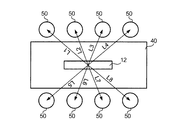
ここで、図2を用いて、本実施形態におけるアレイマイク12の収音方向Lについて説明する。図2は本実施形態の使用状態の一例を示す平面図であり、図において40は天板が長方形状に形成されているテーブルである。この使用例においては、アレイマイク12は、会議用のテーブル40の中央部に図示のようにテーブル40の長手方向に沿って配置されている。また、テーブル40の近傍には、椅子50が並べられている。この場合、椅子50は、天板長辺の一方側に4個並べられ、また、これらに対向するように天板長辺の他方側に4個並べられている。本実施形態において収音方向Lはアレイマイク12を中心としてそれぞれの椅子50が設置されている8つの方向のいずれかであり、これらの収音方向Lのそれぞれは、図に示すように、L1、L2、…、L8であらわす。このように、アレイマイク12は、任意の収音方向Lが事前に設定できるようになっている。
Here, the sound collection direction L of the
図1に戻る。操作部14は各種のキーを備えており、押下されたキーに対応した信号を制御部11へ出力する。表示部15は、CRT(Cathode Ray Tube)またはLCD(Liquid Crystal Display)等の表示装置を備えており、制御部11の制御下で文字や画像を表示する。外部機器IF16はUSBインタフェースであり、文字や画像を印刷するプリンタ2に接続されている。なお、外部機器IF16は無線通信回路であってもよい。
Returning to FIG. The
記憶部13は、例えばハードディスクなどの大容量の記憶手段であり、基本OSや、コンピュータプログラムなどのほか、音声認識処理に用いられる標準辞書13aを記憶している。ここで標準辞書13aは予め定められた言語に係る単語辞書や構文情報が記録された辞書であり、本実施形態においては日本語の標準音声を認識できる辞書である。また、記憶部13には、音声認識のための辞書Dを収音方向Lと同じ数だけ記憶できる辞書群13bの記憶領域と、収音方向Lと辞書Dの対応関係を記述した方向・辞書対応テーブル13cの記憶領域が予め定められている。図3は方向・辞書テーブル13cの一例を示す図である。図に示すように、本実施形態においては、辞書群13bの各辞書Dは収音方向L1〜L8に対応付けられている。本実施形態においては、会議参加者の着席位置(収音方向Lに対応)と、辞書D1〜D8の対応関係が事前に設定されている。すなわち、該当する収音方向Lのところに座る人の会話の特徴に応じた辞書が準備されることになる。この対応関係の設定は、操作者が操作部14を操作することにより、方向・辞書テーブル13cとの対応関係を設定すればよい。
The
次に、実施形態の動作を説明する。
(B)動作
図4は本実施形態に係る音声認識装置1の動作を示すフローチャートである。利用者が操作部14の図示しないスイッチを押下して収音開始の指示をすると、制御部11はこの指示を受けて、アレイマイク12を収音可能にする。アレイマイク12の各マイクロフォンM、M…はそれぞれの収音位置で収音された音を音声信号に変換して出力する。制御部11は、収音方向L(L1、L2、…、L8)のそれぞれに対応するパラメータMCPを出力し、アレイマイク12の上述したアンプ、遅延回路、演算回路はこれに応じて上述の8つの収音方向L毎に音声信号S(S1、S2、…、S8)を順次収音する。
Next, the operation of the embodiment will be described.
(B) Operation FIG. 4 is a flowchart showing the operation of the speech recognition apparatus 1 according to the present embodiment. When the user presses a switch (not shown) on the
制御部11は、これらの音声信号Sの音声レベルを比較して、最も音声レベルの大きい音声信号Sを特定し、特定された音声信号Sの音声レベルが所定の閾値を超えているか否かを判定する(ステップSA101)。当該音声信号Sの音声レベルが所定の閾値を超えているのであれば、発言が開始されたとみなし(ステップSA101;YES)、音声信号Sに対応する収音方向Lを収音方向として決定し(ステップSA102)、音声信号Sとともに記憶部13の収音領域に記憶させる(ステップSA103)。当該音声信号Sの音声レベルが所定の閾値を超えていなければ、発言は開始されていないとみなし(ステップSA101;NO)、上述の収音、音声信号の生成、音声レベルの比較を繰り返す。 The control unit 11 compares the audio levels of these audio signals S, specifies the audio signal S with the highest audio level, and determines whether the audio level of the specified audio signal S exceeds a predetermined threshold value. Determination is made (step SA101). If the sound level of the sound signal S exceeds a predetermined threshold, it is considered that the speech has started (step SA101; YES), and the sound collecting direction L corresponding to the sound signal S is determined as the sound collecting direction ( Step SA102) and the audio signal S are stored in the sound collection area of the storage unit 13 (step SA103). If the sound level of the sound signal S does not exceed the predetermined threshold, it is considered that speech has not started (step SA101; NO), and the above-described sound collection, sound signal generation, and sound level comparison are repeated.
次に、制御部11は方向・辞書テーブル13cを参照し、記憶部13に記憶させた収音方向Lに対応する辞書Dを辞書群13bから選択する(ステップSA104)。ここで制御部11が収音方向L2からの音声信号S2において発音がなされたと判定した場合を例にとって説明すると、制御部11は方向・辞書テーブル13cを参照することで、収音方向L2に対応する辞書D2を選択する。
Next, the control unit 11 refers to the direction / dictionary table 13c, and selects the dictionary D corresponding to the sound collection direction L stored in the
次に、制御部11は、選択した辞書D2と標準辞書13aを読み出し、音声信号S2の音声認識処理を行う(ステップSA105)。ここで、制御部11は前述のように発音がされていると判定した音声信号(この場合は音声信号S2)については、音声認識処理を行うために一定量(あるいは全部)を記憶部13の収音領域(図示略)に記憶して処理を行うようになっている。
Next, the control unit 11 reads the selected dictionary D2 and the standard dictionary 13a, and performs voice recognition processing on the voice signal S2 (step SA105). Here, for the audio signal (in this case, the audio signal S2) determined to be sounded as described above, the control unit 11 supplies a certain amount (or all) of the
次に、図5は、制御部11によって実行される音声認識プロセスを表したブロック図である。図に示すように、音声信号S2が入力されると、制御部11は音声信号S2から音声認識の対象となる音声信号の部分(音声区間)を検出する。なお、音声区間の検出は例えば音声信号が所定の閾値を超える振幅値を一定時間以上持っているか否かによって行われる。次に、制御部11は音声の特徴を分析すべく、検出された音声区間のスペクトルを所定の時間毎に分割し(音声特徴分析)、これらを辞書に含まれる音素・標準スペクトル対応パターンと照合することによって、音声区間に応じた音素類似度行列を生成する(音素認識)。 Next, FIG. 5 is a block diagram showing a voice recognition process executed by the control unit 11. As shown in the figure, when the audio signal S2 is input, the control unit 11 detects a portion (audio segment) of the audio signal that is a target of the audio recognition from the audio signal S2. Note that the detection of the voice section is performed, for example, depending on whether or not the voice signal has an amplitude value exceeding a predetermined threshold value for a predetermined time or more. Next, the control unit 11 divides the spectrum of the detected speech segment at predetermined time intervals (speech feature analysis) to analyze the feature of the speech, and collates these with the phoneme / standard spectrum correspondence pattern included in the dictionary. By doing so, a phoneme similarity matrix corresponding to the speech section is generated (phoneme recognition).
そして、制御部11は、この音素類似度行列と辞書に記述された各単語の音素標準パターンとをDP(Dynamic Programming:動的計画法)マッチングアルゴリズムに従って順次比較して、音声区間に対応した単語を認識する(単語認識)。そして、認識された単語の前後関係等を、辞書に含まれる構文情報を参照して解析することにより、音声信号S2に含まれた発言内容を示す文章を生成する(文章認識)。これら音素認識、単語認識、文章認識の各プロセスにおいて制御部11は辞書D2を用いる。また、辞書D2に記述されていない要素については標準辞書13aを用いるとともに辞書D2にその要素を追加記録する。さらに、辞書D2には音声信号S2に関し、標準スペクトルに対するずれや発音の長さ、選択された単語の出現確率(尤度)などの話者に固有な特徴を記録する。 Then, the control unit 11 sequentially compares the phoneme similarity matrix and the phoneme standard pattern of each word described in the dictionary according to a DP (Dynamic Programming) matching algorithm, and the word corresponding to the speech section. (Word recognition). Then, by analyzing the context and the like of the recognized word with reference to the syntax information included in the dictionary, a sentence indicating the content of the statement included in the audio signal S2 is generated (sentence recognition). In each of these phoneme recognition, word recognition, and sentence recognition processes, the control unit 11 uses the dictionary D2. For elements not described in the dictionary D2, the standard dictionary 13a is used and the elements are additionally recorded in the dictionary D2. Further, the dictionary D2 records features unique to the speaker, such as a deviation from the standard spectrum, the length of pronunciation, and the appearance probability (likelihood) of the selected word with respect to the speech signal S2.
図4に戻る。上述の音声認識により制御部11は、認識した文章を文章データとして制御部11内のRAMに一時記憶する(ステップSA106)。また、制御部11は、この文章データを表示部15に出力し、文字列として表示させる(ステップSA107)。本実施形態において、この文章データには収音方向L2を示す記号が含まれている。なお、記号に替えて文字列の表示色によって収音方向L2を示しても良い。
収音方向L2から発言した話者が発言を続けている間は(ステップSA108;NO)、制御部11はステップSA105に戻り音声認識を続ける。また、当該話者が発言をやめると(ステップSA108;YES)、制御部11は所定時間の無声状態を検知して音声信号S2の音声認識を終了し、ステップSA101に戻り、次の発言が開始されるまで待機する。
Returning to FIG. The control unit 11 temporarily stores the recognized text as text data in the RAM in the control unit 11 by the voice recognition described above (step SA106). Further, the control unit 11 outputs the text data to the
While the speaker speaking from the sound collection direction L2 continues speaking (step SA108; NO), the control unit 11 returns to step SA105 and continues speech recognition. When the speaker stops speaking (step SA108; YES), the control unit 11 detects the silent state for a predetermined time, ends the speech recognition of the speech signal S2, returns to step SA101, and starts the next speech. Wait until
ここで、表示部15に表示された文章を利用者が読み、文章に間違いが見つかったときに、利用者は操作部14を介して文章を修正することができる。制御部11は利用者からの修正入力を受け取ると、これに応じてRAMに記憶された文章データを修正し、修正された文章データを表示部15に表示させる。また、図5において、制御部11は、修正前の語句を導出した音素認識、単語認識、文章認識の各プロセスに対し、修正後の語句を導出するような補正を加える(出力文章補正)。この補正とは例えば、類似度計算に用いる重み関数に対し、上述の修正結果を反映して変更を加えることなどである。なお、このような修正機能が音声認識装置1に付与されていると、音声認識の精度を上げることができるが、修正機能を付与しなくてもよい。
Here, when the user reads the text displayed on the
また、利用者は操作部14を介して上述の文章を文章データとして記憶部13の議事録記憶エリアに記憶させることができる。この記憶処理は制御部11が自動的に行っても良い。いずれの場合においても、収音方向L2を識別する識別情報とともに文章データが記憶される。
また、利用者は操作部14を介して上述の文章を印刷させることができる。制御部11は利用者から印刷指示を受け取ると上述のRAMに記憶された文章データを、外部機器IF16を介してプリンタ2に送信する。プリンタ2は送信された文章データを文字列として紙に印刷する。
このようにして、各話者の発言は収音方向L毎に音声信号Sとして記録され、各音声信号Sは収音方向L毎に用意された辞書D(D1〜D8)を用いて音声認識されて文章化され、外部機器IF16を介してプリンタ2から印刷される。なお、印刷機能が会議システムに備わっていることで、利用者は会議内容を紙面で確認することができるが、会議システムに印刷機能が備わっていなくてもよい。
In addition, the user can store the above-described sentence as sentence data in the minutes storage area of the
Further, the user can print the above-described sentence via the
In this way, each speaker's speech is recorded as a sound signal S for each sound collection direction L, and each sound signal S is recognized by using the dictionary D (D1 to D8) prepared for each sound collection direction L. Then, it is documented and printed from the
以上のようにして、会議の発言者(本実施形態では最も声が大きい発言者)の音声が特定され、特定された音声に対して、その位置(方向)に対応する辞書を用いて音声認識される。音声認識の結果は記憶部13内の議事録記録エリアに記憶されるから、自動的に議事録が形成されてゆく。また、このような議事録がプリンタ2によって印刷されるから、紙面による議事録も記録されてゆく。
また、本実施形態の場合、方向・辞書テーブル13cについて、その方向に着席する参加者と辞書との対応関係を事前に整合させておくことができるから、音声認識は本人の音声特徴に応じた辞書を用いることができ、音声認識の精度を向上させることができる。
As described above, the voice of the speaker of the conference (the speaker with the highest voice in this embodiment) is specified, and the voice is recognized using the dictionary corresponding to the position (direction) of the specified voice. Is done. Since the result of the voice recognition is stored in the minutes recording area in the
Further, in the case of this embodiment, since the correspondence relationship between the participant seated in the direction and the dictionary can be matched in advance for the direction / dictionary table 13c, the voice recognition corresponds to the voice characteristics of the person. A dictionary can be used, and the accuracy of speech recognition can be improved.
<変形例>
以上、本発明の実施形態について説明したが、本発明は上述した実施形態に限定されることなく、他の様々な形態で実施可能である。以下にその一例を示す。なお、以下の各態様を適宜に組み合わせてもよい。
<Modification>
As mentioned above, although embodiment of this invention was described, this invention is not limited to embodiment mentioned above, It can implement with another various form. An example is shown below. In addition, you may combine each following aspect suitably.
(変形例1)
上記実施形態では、収音方向Lは制御部11が8つの音声信号Sを比較して、音声の大きさによって決定したが、収音方向Lの決定方法はこれに限られない。例えば、音声信号Sの特徴情報Cを当該音声信号Sに対応する収音方向Lと関連付けて記憶し、現在収音している音声信号から特徴情報を抽出して上述の記憶内容と比較することにより収音方向Lを検証し、対応関係に不整合が見つかったときは収音方向Lを訂正するようにしてもよい。この場合の一例を、図6及び図7を用いて説明する。図6はこの変形例における音声認識装置1の全体構成を示すブロック図である。図6において、記憶部13には特徴記憶領域13fが設けられている。特徴記憶領域13fは音声信号Sから抽出した音声の特徴情報Cを収音方向L毎に記憶する領域である。また、図7はこの変形例における音声認識装置1の動作を示すフローチャートであり、上述の実施形態と同じステップについては同じ符号を付し、説明を省略する。
制御部11は音声信号S2から音声の特徴情報C2を抽出し、これを収音方向L毎に特徴記憶領域13fに記憶させる(ステップSD101)。このとき特徴情報C2は収音方向L2に対応付けて記憶される。所定の情報量が特徴記憶領域13fに記憶されたら、制御部11は、音声信号Sから抽出した音声の特徴情報Cをキーにして特徴記憶領域13fを検索し、特徴情報Cが収音方向Lと関連付けられて記憶されているか否かによって収音方向が正しいかどうかを判定する(ステップSD102)。ここで、音声信号S2が収音方向L1とともに制御部11に入力されたとすると、制御部11は音声信号S2から特徴情報C2を抽出するため、特徴記憶領域13fに記憶された特徴情報C2と収音方向L2の組み合わせと収音方向L1が整合せず、上述の判定結果は否定的になる(ステップSD102;NO)。この否定的な判定結果を受けて制御部11は収音方向L1を収音方向L2に訂正し(ステップSD103)、これに対応した辞書D2を辞書群13bから選択して、音声認識を行うことができる。
以上のように、この変形例においては、音声の収音方向の正否を判断したが、収音方向が特定出来ない場合に、特徴情報Cを用いて辞書Dを選択してもよい。また、収音方向の検出に代えて特徴情報Cだけを用いて辞書Dを特定してもよい。さらに、特徴情報Cと収音方向Lとの関係を検出結果に応じて関連付けて記憶することに代えて、事前に特徴情報Cと収音方向Lとの関係を設定してもよい。
(Modification 1)
In the above embodiment, the sound collection direction L is determined by the control unit 11 by comparing the eight audio signals S and the volume of the sound, but the method of determining the sound collection direction L is not limited to this. For example, the feature information C of the sound signal S is stored in association with the sound collection direction L corresponding to the sound signal S, and the feature information is extracted from the currently collected sound signal and compared with the above-described stored content. The sound collection direction L may be verified by the above, and when an inconsistency is found in the correspondence, the sound collection direction L may be corrected. An example of this case will be described with reference to FIGS. FIG. 6 is a block diagram showing the overall configuration of the speech recognition apparatus 1 in this modification. In FIG. 6, the
The control unit 11 extracts audio feature information C2 from the audio signal S2, and stores it in the
As described above, in this modification, whether the sound collection direction is correct or not is determined. However, when the sound collection direction cannot be specified, the dictionary D may be selected using the feature information C. Alternatively, the dictionary D may be specified using only the feature information C instead of detecting the sound collection direction. Furthermore, instead of storing the relationship between the feature information C and the sound collection direction L in accordance with the detection result, the relationship between the feature information C and the sound collection direction L may be set in advance.
(変形例2)
図8に示すような全体構成としてもよい。この構成において、まず、制御部11はアレイマイク12によって収音方向Lに対応する音声信号Sを生成する。次に、音声信号Sから音声の特徴情報Cを抽出して、話者・特徴DB13dを参照することにより、当該音声信号Sの音声を発生した話者Pを特定し、収音方向Lとともに話者・方向テーブル13eに記述する。このようにして、話者・方向テーブル13eが一度記述されると、これを参照することによって制御部11は収音方向Lが決定された時点で話者Pを特定することができる。そして、話者Pが特定できると、話者・辞書テーブル13gを参照することによって辞書群13bから当該話者Pに対応する辞書Dを選択することができる。なお、話者・方向テーブル13eと話者・辞書テーブル13gは一つにしてもよい。要するに特徴情報と辞書とが対応付けられていれば良い。
(Modification 2)
An overall configuration as shown in FIG. 8 may be adopted. In this configuration, first, the control unit 11 generates an audio signal S corresponding to the sound collection direction L by the
(変形例3)
音声信号Sに対して収音方向L毎に所定の処理を施してもよい。所定の処理とは例えば録音レベルの調整、ノイズ音質と量の調整、イコライザによる特定周波数の調整などである。また、収音方向L毎にノイズのパターンを学習することにより、収音方向L毎にノイズリダクション処理を行ってもよい。さらにこの会議システムで収音した音声をスピーカによって放音させる場合には、収音方向毎にエコーキャンセル処理を行ってもよい。この場合、図9に示すように、収音方向Lと音声信号Sをともに記憶部13に記憶させるステップSA103の直前にこれらの音響処理を行ってもよい(ステップSE101)。
(Modification 3)
The audio signal S may be subjected to predetermined processing for each sound collection direction L. The predetermined processing includes, for example, recording level adjustment, noise sound quality and quantity adjustment, and adjustment of a specific frequency by an equalizer. In addition, by learning a noise pattern for each sound collection direction L, noise reduction processing may be performed for each sound collection direction L. Furthermore, when sound collected by the conference system is emitted by a speaker, echo cancellation processing may be performed for each sound collection direction. In this case, as shown in FIG. 9, these acoustic processes may be performed immediately before step SA103 in which both the sound collection direction L and the audio signal S are stored in the storage unit 13 (step SE101).
(変形例4)
上述の実施形態において、音声認識の方法として、音素を単位としてDPマッチングを行う方法を用いたが、音声認識の方法はこれに限られない。例えば、隠れマルコフモデル(Hidden Markov Model)法やニューラルネットワークによる方法などであってもよい。
(Modification 4)
In the above-described embodiment, the method of performing DP matching in units of phonemes is used as the speech recognition method, but the speech recognition method is not limited to this. For example, a Hidden Markov Model method or a method using a neural network may be used.
(変形例5)
上述の実施形態において、音声認識装置1は会議システムを構成したが、音声認識装置1の用途は会議の音声認識のみに限られない。例えば、この音声認識装置1を自動車に搭載するカーナビゲーションシステムに用いてもよい。この場合、上述した変形例2の音声認識装置1を用いれば、家族一人一人に固有の音声特徴情報(話者・特徴DB13d)と音声認識用辞書(話者・辞書テーブル13g及び辞書群13b)を記憶部13に記憶させ、車内の収音方向L毎に音声の特徴情報Cを分析することにより、誰がどこに着席しているか(話者・方向テーブル13e)がわかり、運転席、助手席など座席(収音方向L)毎に音声認識のための辞書Dを切り替えることができる。
(Modification 5)
In the above-described embodiment, the voice recognition device 1 configures a conference system. However, the use of the voice recognition device 1 is not limited to voice recognition of a conference. For example, the speech recognition apparatus 1 may be used in a car navigation system that is mounted on a car. In this case, if the speech recognition apparatus 1 of the above-described
(変形例6)
上述の実施形態において、音声認識装置1は単独で一つの会議システムを構成したが、本発明の会議システムは単独の音声認識装置1で構成される場合に限られない。例えば通信回線を用いて複数の音声認識装置1を接続し、全体で一つの会議システムを構成してもよい。
(Modification 6)
In the above-described embodiment, the voice recognition device 1 is configured as a single conference system. However, the conference system of the present invention is not limited to the configuration of the single voice recognition device 1. For example, a plurality of voice recognition apparatuses 1 may be connected using a communication line to constitute one conference system as a whole.
(変形例7)
上述の実施形態において、収音装置としてアレイマイク12を用いたが、収音装置はアレイマイクに限られない。例えば、各話者に配布した個別のマイクなどでもよい。この場合、話者の数だけマイクの入力端子が存在するので、入力端子毎に音声信号を入力することによって、制御部11は入力端子を識別することにより、方向情報L(座席情報)と同じ機能を持つ情報を得ることができる。要するに、音声信号Sと方向情報L(話者位置が特定できる情報)が対になって入力され、この方向情報Lによって辞書Dを選択することができればよい。このように、入力音声信号に基づく収音位置の特定は種々の態様がある。すなわち、アレイマイクのように最大音量の入力音声信号の方向を収音位置とする態様もあり、また、複数マイクを用いた場合のように、どの入力端子から入力音声信号が入力されたかを識別することにより収音方向を特定することもできる。このような入力音声信号に基づく収音方向の特定ができない場合は、前述した変形例1の場合のように音声の特徴量を用いて収音方向を特定してもよい。また、収音方向を特定せず、特徴情報だけを用いて辞書選択を行ってもよい。
(Modification 7)
In the above-described embodiment, the
(変形例8)
上述の実施形態において、アレイマイク12は音声認識装置1においてバス19に直結された入力装置であったが、会議システムの構成はこれに限られない。例えば、図10に示すように、アレイマイクを搭載した会議端末3を音声認識装置1の外部機器として会議システムを構成しても良い。この場合では、会議端末3には制御部31、アレイマイク32、通信部33を備え、音声認識装置1には上述のアレイマイク12に替えて通信部18を備えており、通信部18と通信部33とでデータの送受信を行う。そして、制御部11は会議端末3から送信された音声データに対して音声認識処理を行い、制御部31はアレイマイク32に収音方向Lに対応するパラメータMCPの出力を行うなど、制御する内容を分担させてもよい。
(Modification 8)
In the above-described embodiment, the
1…音声認識装置、11…制御部、12…アレイマイク、13…記憶部、13a…標準辞書、13b…辞書群、13c…方向・辞書テーブル、13d…話者・特徴DB、13e…話者・方向テーブル、13f…特徴記憶領域、13g…話者・辞書テーブル、14…操作部、15…表示部、16…外部機器IF、18…通信部、19…バス、2…プリンタ、3…会議端末、31…制御部、32…アレイマイク、33…通信部、40…テーブル、50…椅子 DESCRIPTION OF SYMBOLS 1 ... Voice recognition apparatus, 11 ... Control part, 12 ... Array microphone, 13 ... Memory | storage part, 13a ... Standard dictionary, 13b ... Dictionary group, 13c ... Direction / dictionary table, 13d ... Speaker / feature DB, 13e ... Speaker Direction table, 13f ... feature storage area, 13g ... speaker / dictionary table, 14 ... operation unit, 15 ... display unit, 16 ... external device IF, 18 ... communication unit, 19 ... bus, 2 ... printer, 3 ... conference Terminal, 31 ... control unit, 32 ... array microphone, 33 ... communication unit, 40 ... table, 50 ... chair
Claims (5)
前記収音手段が出力する前記音声信号に基づいて収音位置を特定し、特定した収音位置を示す位置情報を出力する位置情報特定手段と、
音声認識処理に用いられる複数の辞書を記憶する辞書記憶手段と、
前記収音位置と前記各辞書との対応関係を記憶する対応関係記憶手段と、
前記位置情報特定手段が出力した位置情報に対応する辞書を、前記対応関係記憶手段の記憶内容を参照して選択する辞書選択手段と、
前記辞書選択手段が選択した辞書を用いて、前記収音手段が出力する音声信号に対して音声認識処理を行い、処理結果を出力する音声認識手段と
を具備することを特徴とする音声認識装置。 Sound collection means configured to be able to collect sound from a plurality of positions, and converts the collected sound into an audio signal and outputs the sound signal;
Position information specifying means for specifying a sound collection position based on the audio signal output by the sound collection means and outputting position information indicating the specified sound collection position;
Dictionary storage means for storing a plurality of dictionaries used for speech recognition processing;
Correspondence storage means for storing the correspondence between the sound collection position and each dictionary;
A dictionary selecting means for selecting a dictionary corresponding to the position information output by the position information specifying means with reference to the storage content of the correspondence relationship storing means;
A voice recognition apparatus comprising: a voice recognition unit that performs voice recognition processing on a voice signal output from the sound pickup unit using the dictionary selected by the dictionary selection unit, and outputs a processing result. .
前記位置情報特定手段は前記収音方向制御手段により制御される前記アレイマイクの収音方向を示す方向データに基づいて前記収音位置を特定することにより前記位置情報を出力することを特徴とする請求項1記載の音声認識装置。 The sound collecting means converts an array microphone whose sound collecting direction is variable, a sound collecting direction control means for controlling the sound collecting direction of the array microphone, and converts the sound collected by the array microphone into an audio signal and outputs it. Audio signal generating means for
The position information specifying means outputs the position information by specifying the sound collection position based on direction data indicating the sound collection direction of the array microphone controlled by the sound collection direction control means. The speech recognition apparatus according to claim 1.
話者の発声する音声の特徴量と話者の位置を示す話者位置情報との対応関係を記憶する位置対応関係記憶手段と
を具備し、
前記収音手段が出力する音声信号に基づいて収音位置の特定ができない場合に、
前記特徴量抽出手段が抽出した特徴量に対応する話者位置情報を前記位置対応関係記憶手段の記憶内容を参照して特定し、特定した話者位置情報を前記位置情報とすることを特徴とする請求項1記載の音声認識装置。 Feature quantity extraction means for extracting feature quantities from the audio signal output by the sound collection means;
A position correspondence storage means for storing a correspondence relationship between the feature amount of the voice uttered by the speaker and the speaker position information indicating the position of the speaker;
When the sound collection position cannot be specified based on the sound signal output by the sound collection means,
Speaker position information corresponding to the feature amount extracted by the feature amount extraction means is specified with reference to the stored contents of the position correspondence storage means, and the specified speaker position information is used as the position information. The speech recognition apparatus according to claim 1.
前記収音手段が出力した音声信号から特徴量を抽出する特徴量抽出手段と、
音声認識処理に用いられる複数の辞書を記憶する辞書記憶手段と、
話者の発声する音声の特徴量と前記各辞書とを対応付ける対応付け手段と、
前記特徴量抽出手段が抽出した特徴量に対応する辞書を、前記対応付け手段による対応付けを参照して選択する辞書選択手段と、
前記辞書選択手段が選択した辞書を用いて、前記収音手段が出力する音声信号に対して音声認識処理を行い、処理結果を出力する音声認識手段と
を具備することを特徴とする音声認識装置。 Sound collection means configured to be able to collect sound from a plurality of positions, and converts the collected sound into an audio signal and outputs the sound signal;
Feature quantity extraction means for extracting feature quantities from the audio signal output by the sound collection means;
Dictionary storage means for storing a plurality of dictionaries used for speech recognition processing;
An associating means for associating a feature amount of speech uttered by a speaker with each dictionary;
A dictionary selection unit that selects a dictionary corresponding to the feature amount extracted by the feature amount extraction unit with reference to the association by the association unit;
A voice recognition apparatus comprising: a voice recognition unit that performs voice recognition processing on a voice signal output from the sound pickup unit using the dictionary selected by the dictionary selection unit, and outputs a processing result. .
前記音声認識装置の音声認識結果を記憶する認識結果記憶手段と
を具備することを特徴とする会議システム。 A speech recognition device according to any one of claims 1 to 4;
A conference system comprising a recognition result storage means for storing a voice recognition result of the voice recognition device.
Priority Applications (1)
| Application Number | Priority Date | Filing Date | Title |
|---|---|---|---|
| JP2007120734A JP2008275987A (en) | 2007-05-01 | 2007-05-01 | Speech recognition device and conference system |
Applications Claiming Priority (1)
| Application Number | Priority Date | Filing Date | Title |
|---|---|---|---|
| JP2007120734A JP2008275987A (en) | 2007-05-01 | 2007-05-01 | Speech recognition device and conference system |
Publications (1)
| Publication Number | Publication Date |
|---|---|
| JP2008275987A true JP2008275987A (en) | 2008-11-13 |
Family
ID=40054006
Family Applications (1)
| Application Number | Title | Priority Date | Filing Date |
|---|---|---|---|
| JP2007120734A Pending JP2008275987A (en) | 2007-05-01 | 2007-05-01 | Speech recognition device and conference system |
Country Status (1)
| Country | Link |
|---|---|
| JP (1) | JP2008275987A (en) |
Cited By (6)
| Publication number | Priority date | Publication date | Assignee | Title |
|---|---|---|---|---|
| JP2011165056A (en) * | 2010-02-12 | 2011-08-25 | Nec Casio Mobile Communications Ltd | Information processor and program |
| JP2011244454A (en) * | 2010-05-18 | 2011-12-01 | Polycom Inc | Videoconferencing endpoint having multiple voice-tracking cameras |
| WO2014069798A1 (en) * | 2012-10-29 | 2014-05-08 | Samsung Electronics Co., Ltd. | Voice recognition apparatus and voice recognition method thereof |
| US9305555B2 (en) | 2012-06-25 | 2016-04-05 | Mitsubishi Electric Corporation | Onboard information device |
| JP2018156047A (en) * | 2017-03-21 | 2018-10-04 | 株式会社東芝 | Signal processor, signal processing method, and attribute imparting device |
| KR102147811B1 (en) * | 2020-01-14 | 2020-08-25 | 김승모 | Speech recognition and word conversion of speaker in congress |
Citations (5)
| Publication number | Priority date | Publication date | Assignee | Title |
|---|---|---|---|---|
| JPS6356698A (en) * | 1986-08-27 | 1988-03-11 | 沖電気工業株式会社 | Numerous speaker voice recognition equipment |
| JP2000075887A (en) * | 1998-08-31 | 2000-03-14 | Sony Corp | Pattern recognition device, method and system |
| JP2001005482A (en) * | 1999-06-21 | 2001-01-12 | Matsushita Electric Ind Co Ltd | Voice recognition method and apparatus |
| JP2007011380A (en) * | 2005-07-01 | 2007-01-18 | Bose Corp | Automobile interface |
| JP2007033901A (en) * | 2005-07-27 | 2007-02-08 | Nec Corp | System, method, and program for speech recognition |
-
2007
- 2007-05-01 JP JP2007120734A patent/JP2008275987A/en active Pending
Patent Citations (5)
| Publication number | Priority date | Publication date | Assignee | Title |
|---|---|---|---|---|
| JPS6356698A (en) * | 1986-08-27 | 1988-03-11 | 沖電気工業株式会社 | Numerous speaker voice recognition equipment |
| JP2000075887A (en) * | 1998-08-31 | 2000-03-14 | Sony Corp | Pattern recognition device, method and system |
| JP2001005482A (en) * | 1999-06-21 | 2001-01-12 | Matsushita Electric Ind Co Ltd | Voice recognition method and apparatus |
| JP2007011380A (en) * | 2005-07-01 | 2007-01-18 | Bose Corp | Automobile interface |
| JP2007033901A (en) * | 2005-07-27 | 2007-02-08 | Nec Corp | System, method, and program for speech recognition |
Cited By (6)
| Publication number | Priority date | Publication date | Assignee | Title |
|---|---|---|---|---|
| JP2011165056A (en) * | 2010-02-12 | 2011-08-25 | Nec Casio Mobile Communications Ltd | Information processor and program |
| JP2011244454A (en) * | 2010-05-18 | 2011-12-01 | Polycom Inc | Videoconferencing endpoint having multiple voice-tracking cameras |
| US9305555B2 (en) | 2012-06-25 | 2016-04-05 | Mitsubishi Electric Corporation | Onboard information device |
| WO2014069798A1 (en) * | 2012-10-29 | 2014-05-08 | Samsung Electronics Co., Ltd. | Voice recognition apparatus and voice recognition method thereof |
| JP2018156047A (en) * | 2017-03-21 | 2018-10-04 | 株式会社東芝 | Signal processor, signal processing method, and attribute imparting device |
| KR102147811B1 (en) * | 2020-01-14 | 2020-08-25 | 김승모 | Speech recognition and word conversion of speaker in congress |
Similar Documents
| Publication | Publication Date | Title |
|---|---|---|
| JP4867804B2 (en) | Voice recognition apparatus and conference system | |
| JP3968133B2 (en) | Speech recognition dialogue processing method and speech recognition dialogue apparatus | |
| US7949523B2 (en) | Apparatus, method, and computer program product for processing voice in speech | |
| JP3674990B2 (en) | Speech recognition dialogue apparatus and speech recognition dialogue processing method | |
| JP3263392B2 (en) | Text processing unit | |
| EP0865651B1 (en) | Method of and system for recognizing a spoken text | |
| CN101589428B (en) | Vehicle-mounted voice recognition apparatus | |
| JP6654611B2 (en) | Growth type dialogue device | |
| KR102350890B1 (en) | Portable hearing test device | |
| JP2004037721A (en) | System and program for voice response and storage medium therefor | |
| JP2008275987A (en) | Speech recognition device and conference system | |
| JP2003330485A (en) | Voice recognition device, voice recognition system, and method for voice recognition | |
| JP2005283647A (en) | Emotion recognition device | |
| CN100520911C (en) | Voice guidance device and navigation device with the same | |
| US20080154591A1 (en) | Audio Recognition System For Generating Response Audio by Using Audio Data Extracted | |
| US10963548B2 (en) | Information acquisition device, information acquisition system, and information acquisition method | |
| US7146317B2 (en) | Speech recognition device with reference transformation means | |
| JP2019191477A (en) | Voice recognition device and voice recognition method | |
| JP2003330491A (en) | Method, device, and program for voice recognition | |
| JP2000020089A (en) | Voice recognition method and apparatus, and voice control system | |
| JP2002297199A (en) | Synthetic speech discrimination method and apparatus, and speech synthesizer | |
| JP3846500B2 (en) | Speech recognition dialogue apparatus and speech recognition dialogue processing method | |
| JP2000206987A (en) | Voice recognition device | |
| JP2003504675A (en) | Speech recognition device having transfer means | |
| JP2010060729A (en) | Reception device, reception method and reception program |
Legal Events
| Date | Code | Title | Description |
|---|---|---|---|
| A621 | Written request for application examination |
Free format text: JAPANESE INTERMEDIATE CODE: A621 Effective date: 20100315 |
|
| A977 | Report on retrieval |
Free format text: JAPANESE INTERMEDIATE CODE: A971007 Effective date: 20110920 |
|
| A131 | Notification of reasons for refusal |
Free format text: JAPANESE INTERMEDIATE CODE: A131 Effective date: 20110927 |
|
| A521 | Request for written amendment filed |
Free format text: JAPANESE INTERMEDIATE CODE: A523 Effective date: 20111124 |
|
| A131 | Notification of reasons for refusal |
Free format text: JAPANESE INTERMEDIATE CODE: A131 Effective date: 20120807 |
|
| A02 | Decision of refusal |
Free format text: JAPANESE INTERMEDIATE CODE: A02 Effective date: 20121204 |