JP2008274236A - Lubricating oil composition - Google Patents
Lubricating oil composition Download PDFInfo
- Publication number
- JP2008274236A JP2008274236A JP2008078233A JP2008078233A JP2008274236A JP 2008274236 A JP2008274236 A JP 2008274236A JP 2008078233 A JP2008078233 A JP 2008078233A JP 2008078233 A JP2008078233 A JP 2008078233A JP 2008274236 A JP2008274236 A JP 2008274236A
- Authority
- JP
- Japan
- Prior art keywords
- mass
- acid
- less
- base oil
- viscosity
- Prior art date
- Legal status (The legal status is an assumption and is not a legal conclusion. Google has not performed a legal analysis and makes no representation as to the accuracy of the status listed.)
- Granted
Links
Landscapes
- Lubricants (AREA)
Abstract
Description
本発明は潤滑油組成物に関する。 The present invention relates to a lubricating oil composition.
従来、潤滑油の分野では、高度精製鉱油等の潤滑油基油に流動点降下剤等の添加剤を配合することによって、潤滑油の低温粘度特性等の改善が図られている(例えば、特許文献1〜3を参照)。また、高粘度指数基油の製造方法としては、天然や合成のノルマルパラフィンを含む原料油について水素化分解/水素化異性化による潤滑油基油の精製を行う方法が知られている(例えば、特許文献4〜6を参照)。 Conventionally, in the field of lubricating oil, improvement of low temperature viscosity characteristics of lubricating oil has been achieved by blending additives such as pour point depressant with lubricating base oil such as highly refined mineral oil (for example, patents) Reference 1 to 3). Further, as a method for producing a high viscosity index base oil, a method of refining a lubricating base oil by hydrocracking / hydroisomerization is known for a raw material oil containing natural or synthetic normal paraffin (for example, (See Patent Documents 4 to 6).
潤滑油基油及び潤滑油の低温粘度特性の評価指標としては、流動点、曇り点、凝固点などが一般的である。また、ノルマルパラフィンやイソパラフィンの含有量等の潤滑油基油に基づき低温粘度特性を評価する手法も知られている。 As an evaluation index of the low temperature viscosity characteristics of the lubricating base oil and lubricating oil, a pour point, a cloud point, a freezing point, and the like are common. In addition, a technique for evaluating low-temperature viscosity characteristics based on a lubricating base oil such as the content of normal paraffin or isoparaffin is also known.
ところで、一般に、摺動部位を有する機関である、内燃機関、自動変速機、緩衝器、パワーステアリングなどの駆動系機器、ギヤなどには、その作動を円滑にするために潤滑油が用いられている。特に内燃機関用潤滑油は、主としてピストンリングとシリンダライナ、クランク軸やコネクティングロッドの軸受、動弁機構など、各部の潤滑のほか、エンジン内の冷却や燃焼生成物の清浄分散、さらには錆や腐食を防止するなどの作用を果たす。 By the way, in general, an internal combustion engine, an automatic transmission, a shock absorber, a drive system device such as a power steering, a gear, and the like, which are engines having sliding parts, use lubricating oil for smooth operation. Yes. In particular, lubricating oils for internal combustion engines mainly lubricate parts such as piston rings and cylinder liners, bearings for crankshafts and connecting rods, valve mechanisms, etc., as well as cooling inside the engine, cleansing and dispersing combustion products, It acts to prevent corrosion.
このように、内燃機関用潤滑油には、低温粘度特性だけでなく、多様な性能が要求されているのに加え、近年、省燃費性の向上や排ガス後処理装置対応のための低灰、低リン、低硫黄化、ロングドレイン性能の向上などトレードオフの性能を高次元で両立させることも求められている。内燃機関においては、潤滑油が関与する摩擦部分でのエネルギー損失が大きいために、摩擦損失低減や燃費低減対策として、例えば、特許文献7等に示すように、摩擦低減剤をはじめ、各種の添加剤を組み合わせた潤滑油が使用されている。 As described above, in addition to low temperature viscosity characteristics, the lubricating oil for internal combustion engines is required to have various performances, and in recent years, low ash for improved fuel economy and compatibility with exhaust gas aftertreatment devices, There is also a need to achieve a high level of trade-off performance such as low phosphorus, low sulfur, and improved long drain performance. In an internal combustion engine, energy loss is large in the friction part where the lubricating oil is involved, and as a countermeasure for reducing friction loss and fuel consumption, for example, as shown in Patent Document 7, various additives such as a friction reducer are added. Lubricating oil in combination with agents is used.
従来、潤滑油の摩擦係数を低くするために、モリブデンジチオカーバメートやモリブデンジチオホスフェートに代表される有機モリブデン化合物の添加、該有機モリブデン化合物と金属系清浄剤の組み合わせ配合(例えば特許文献8参照)、又は該有機モリブデン化合物と硫黄系化合物の組み合わせ配合(例えば特許文献9参照)などが行われている。 Conventionally, in order to lower the friction coefficient of lubricating oil, addition of an organic molybdenum compound typified by molybdenum dithiocarbamate or molybdenum dithiophosphate, a combination formulation of the organic molybdenum compound and a metallic detergent (see, for example, Patent Document 8), Or the combination mixing (for example, refer patent document 9) etc. of this organic molybdenum compound and a sulfur type compound are performed.
ところが、ディーゼルエンジンや、直噴タイプのガソリンエンジンにおいては、ピストン内で生成するすすが多量にエンジン油中に混入する。このすすは、表面活性を有するために、油中の極性添加剤を吸着したり、また、摩擦面に生成した被膜を削りとったりする作用を示す。そのため、このような苛酷な摩擦条件下では、摩擦低減効果に最も優れているとされる有機モリブデン化合物を用いても、すすや金属の摩耗粉等による阻害が原因で十分な摩擦低減効果が得られない。これを改善するための研究例は少なく、ディーゼルエンジンの省燃費性能向上のためにアルカリ金属ホウ酸塩水和物の配合をすること(例えば特許文献10参照)などが若干提案されているに過ぎない。 However, in a diesel engine or a direct injection type gasoline engine, a large amount of soot generated in the piston is mixed into the engine oil. Since this soot has surface activity, it exhibits the action of adsorbing the polar additive in the oil and scraping the coating formed on the friction surface. Therefore, even under such severe friction conditions, even if an organic molybdenum compound, which is said to have the best friction reduction effect, is used, a sufficient friction reduction effect is obtained due to inhibition by soot and metal wear powder. I can't. There are few research examples to improve this, and only a few proposals have been made such as blending alkali metal borate hydrate to improve fuel efficiency of diesel engines (for example, see Patent Document 10). .
一方、潤滑油の低粘度化も、燃費を向上する手段として有効であることが知られており、低粘度潤滑油にポリメタクリレートやエチレン−プロピレン共重合体等の粘度指数向上剤を添加したマルチグレードディーゼルエンジン油が一般に用いられている。しかしながら、これらの粘度指数向上剤のみを添加したマルチグレードディーゼルエンジン油の燃費低減効果は微々たるものであり、決して十分とはいえなかった。そのため、ディーゼルエンジンや、直噴タイプのガソリンエンジンにおいても、十分な燃費低減効果を発揮することが可能なエンジン油の技術開発が強く望まれてきた。 On the other hand, it is known that lowering the viscosity of a lubricating oil is also effective as a means of improving fuel efficiency. A multi-component which is obtained by adding a viscosity index improver such as polymethacrylate or ethylene-propylene copolymer to a low-viscosity lubricating oil. Grade diesel engine oil is commonly used. However, the fuel efficiency reduction effect of the multi-grade diesel engine oil to which only these viscosity index improvers are added is insignificant, and cannot be said to be sufficient. For this reason, there has been a strong demand for the development of engine oil technology capable of exhibiting a sufficient fuel consumption reduction effect even in diesel engines and direct injection gasoline engines.
ところで、ディーゼルエンジンについては、NOxや粒子状物質(SPM)の低減が急務となっており、これらの排ガスを低減させるために、例えば、高圧噴射、排ガス再循環システム(EGR)、酸化触媒、ディーゼルパティキュレートフィルター(DPF)、あるいはNOx吸蔵還元触媒などの排ガス低減手段の導入が検討されつつある。 By the way, for diesel engines, there is an urgent need to reduce NOx and particulate matter (SPM). In order to reduce these exhaust gases, for example, high pressure injection, exhaust gas recirculation system (EGR), oxidation catalyst, diesel The introduction of exhaust gas reduction means such as a particulate filter (DPF) or NOx storage reduction catalyst is being studied.
しかし、排ガス低減手段の中で、特に排ガス後処理装置の酸化触媒、NOx吸蔵還元触媒、及びDPFについては、使用するエンジン油の組成によってその寿命が早まることが知られている。例えば、摩耗防止剤、あるいは酸化防止剤(過酸化物分解剤)として有効なジアルキルジチオリン酸亜鉛(以下、ZnDTPという)を含む潤滑油を用いた場合には、ZnDTP中の亜鉛分が燃焼過程において酸化物、リン酸塩あるいは硫酸塩等を形成し、触媒表面やフィルター内に堆積することで、これら排ガス後処理装置の浄化性能を損なう恐れがある。従って上記のような排ガス後処理装置を装着したエンジン用潤滑油にはZnDTPを添加しないか、使用してもその添加量を少量に抑えることが望ましい。また、金属系清浄剤や硫黄分についても金属酸化物や硫酸塩が灰分として堆積することにより上述した問題を生じやすいため、これらの含有量を極力低減することが望ましい。 However, it is known that, among the exhaust gas reduction means, in particular, the oxidation catalyst, NOx storage reduction catalyst, and DPF of the exhaust gas after-treatment device have a longer life depending on the composition of the engine oil used. For example, when a lubricating oil containing a zinc dialkyldithiophosphate (hereinafter referred to as ZnDTP) that is effective as an antiwear or antioxidant (peroxide decomposer) is used, the zinc content in ZnDTP is lost during the combustion process. By forming oxides, phosphates or sulfates and depositing them on the catalyst surface or in the filter, the purification performance of these exhaust gas aftertreatment devices may be impaired. Therefore, it is desirable not to add ZnDTP to the engine lubricating oil equipped with the exhaust gas aftertreatment device as described above, or to keep the amount added even if it is used. Moreover, since it is easy to produce the above-mentioned problem about a metal type detergent and a sulfur content, when a metal oxide and a sulfate deposit as ash content, it is desirable to reduce these content as much as possible.
また、ディーゼルエンジン、特にEGRを装着したディーゼルエンジンにおいては、潤滑油中にすすが多量に混入することから、動弁系等の摩耗の増大、ピストン清浄性等の高温清浄性の悪化が懸念される。さらに、直噴ガソリンエンジンにおいても上記と同様のすす混入による悪影響や燃焼室デポジット及びバルブデポジットが懸念される。従って、ZnDTP、金属系清浄剤、硫黄分の含有量を単純に低減することは格別な困難性を伴い、その低減に伴う清浄性や摩耗防止性の低下を補うための新たな手段の検討が必要になる。 In addition, in diesel engines, particularly diesel engines equipped with EGR, soot is mixed in a large amount of lubricating oil, so there is a concern about increased wear of valve systems and deterioration of high temperature cleanliness such as piston cleanliness. The Further, even in a direct-injection gasoline engine, there are concerns about the same adverse effects due to soot mixing, combustion chamber deposits and valve deposits. Therefore, simply reducing the content of ZnDTP, metallic detergents, and sulfur is accompanied by a particular difficulty, and new means for compensating for the reduction in cleanliness and wear prevention associated with the reduction have been studied. I need it.
排ガス後処理装置を装着したエンジン用の潤滑油組成物としては、硫酸灰分量を0.7質量%以下に抑えたディーゼルエンジン油組成物が提案されている(特許文献11参照)。また、すす混入時の清浄性や、摩耗防止性を改善するものとして、分散型粘度指数向上剤を含有するエンジン油が提案されている(特許文献12、13参照)。しかし、これらの提案においては、金属系清浄剤を低減した場合の高温清浄性や塩基価維持性能が必ずしも十分ではなく、ZnDTPの配合量を低減した場合における高温清浄性やすす混入下における摩耗防止性も十分に検討されていない。従って高温清浄性や塩基価維持性を高いレベルに維持又は向上させるとともに、ZnDTPの配合量を低減した場合に顕著となるすす混入時の摩耗を抑制するためには、さらなる検討の余地がある。
近時、潤滑油の低温粘度特性の向上、さらには低温粘度特性と粘度−温度特性との両立に対する要求は益々高くなっており、上記従来の評価指標に基づき低温性能が良好であると判断された潤滑油基油を用いた場合であっても、かかる要求特性を十分に満足させることが困難となっている。 Recently, demands for improving the low-temperature viscosity characteristics of lubricating oils, and also for satisfying both low-temperature viscosity characteristics and viscosity-temperature characteristics are increasing, and based on the above conventional evaluation index, it is judged that low-temperature performance is good. Even when a lubricating base oil is used, it is difficult to sufficiently satisfy the required characteristics.
なお、潤滑油基油への添加剤の配合により上記特性をある程度改善することはできても、この手法には限界がある。特に、流動点降下剤は、配合量を増加させてもその効果が濃度と比例関係ではなく、また、配合量の増加に伴ってせん断安定性が低下してしまう。 Although this characteristic can be improved to some extent by blending additives into the lubricating base oil, this method has its limitations. In particular, the effect of the pour point depressant is not proportional to the concentration even if the blending amount is increased, and the shear stability is lowered as the blending amount is increased.
また、上述した水素化分解/水素化異性化による潤滑油基油の精製方法においては、ノルマルパラフィンのイソパラフィンへの異性化率の向上及び潤滑油基油の低粘度化により低温粘度特性を改善する観点から、水素化分解/水素化異性化の条件の最適化が検討されているが、粘度−温度特性(特に高温での粘度特性)と低温粘度特性とは相反する関係にあるため、これらを両立することは非常に困難である。例えば、ノルマルパラフィンのイソパラフィンへの異性化率を高くすると、低温粘度特性は改善されるものの、粘度指数が低下するなど粘度−温度特性が不十分となる。さらに、上述したように流動点や凝固点等の指標が潤滑油基油の低温粘度特性の評価指標として必ずしも適切でないことも、水素化分解/水素化異性化の条件の最適化が困難となっていることの一因となっている。 Further, in the above-described method for refining a lubricating base oil by hydrocracking / hydroisomerization, the low temperature viscosity characteristics are improved by improving the isomerization ratio of normal paraffin to isoparaffin and reducing the viscosity of the lubricating base oil. From the point of view, optimization of hydrocracking / hydroisomerization conditions has been studied, but the viscosity-temperature characteristics (particularly viscosity characteristics at high temperature) and the low-temperature viscosity characteristics are in a contradictory relationship. It is very difficult to achieve both. For example, when the isomerization ratio of normal paraffin to isoparaffin is increased, the low-temperature viscosity characteristic is improved, but the viscosity-temperature characteristic becomes insufficient, for example, the viscosity index is lowered. Furthermore, as described above, it is difficult to optimize the hydrocracking / hydroisomerization conditions because the indices such as the pour point and the freezing point are not necessarily appropriate as the evaluation index of the low temperature viscosity characteristics of the lubricating base oil. It is a cause of being.
本発明は、このような実情に鑑みてなされたものであり、粘度−温度特性と低温粘度特性とを高水準で両立することが可能であり、すすや金属摩耗粉が混入しているような潤滑油の劣化時においても十分な低摩擦性すなわち省燃費性を維持し、摩耗防止性や清浄性等の耐久性、酸化安定性に優れ、さらには低灰化が可能であり、排気ガス後処理装置の性能を長期にわたって十分に維持することが可能な潤滑油組成物を提供することを目的とする。 The present invention has been made in view of such circumstances, and can achieve both a viscosity-temperature characteristic and a low-temperature viscosity characteristic at a high level, and soot and metal wear powder are mixed therein. Sufficiently low friction, that is, fuel saving, is maintained even when the lubricant is deteriorated, and it has excellent durability such as wear prevention and cleanliness, oxidation stability, and low ashing. An object of the present invention is to provide a lubricating oil composition capable of sufficiently maintaining the performance of a treatment apparatus over a long period of time.
上記課題を解決するために、本発明は、尿素アダクト値が4質量%以下であり且つ粘度指数が100以上である潤滑油基油と、組成物全量を基準として、0.01〜10質量%の無灰摩擦調整剤と、リン量として0.01〜0.2質量%のリン含有摩耗防止剤と、を含有することを特徴とする潤滑油組成物を提供する。 In order to solve the above problems, the present invention provides a lubricant base oil having a urea adduct value of 4% by mass or less and a viscosity index of 100 or more, and 0.01 to 10% by mass based on the total amount of the composition. An ashless friction modifier and a phosphorus-containing wear inhibitor having a phosphorus content of 0.01 to 0.2% by mass are provided.
なお、本発明でいう尿素アダクト値は以下の方法により測定される。秤量した試料油(潤滑油基油)100gを丸底フラスコに入れ、尿素200g、トルエン360ml及びメタノール40mlを加えて室温で6時間攪拌する。これにより、反応液中に尿素アダクト物として白色の粒状結晶が生成する。反応液を1ミクロンフィルターでろ過することにより、生成した白色粒状結晶を採取し、得られた結晶をトルエン50mlで6回洗浄する。回収した白色結晶をフラスコに入れ、純水300ml及びトルエン300mlを加えて80℃で1時間攪拌する。分液ロートで水相を分離除去し、トルエン相を純水300mlで3回洗浄する。トルエン相に乾燥剤(硫酸ナトリウム)を加えて脱水処理を行った後、トルエンを留去する。このようにして得られた尿素アダクト物の試料油に対する割合(質量百分率)を尿素アダクト値と定義する。 The urea adduct value as used in the present invention is measured by the following method. 100 g of weighed sample oil (lubricating base oil) is placed in a round bottom flask, 200 g of urea, 360 ml of toluene and 40 ml of methanol are added and stirred at room temperature for 6 hours. As a result, white granular crystals are produced as urea adducts in the reaction solution. The reaction solution is filtered through a 1 micron filter to collect the produced white granular crystals, and the obtained crystals are washed 6 times with 50 ml of toluene. The recovered white crystals are put in a flask, 300 ml of pure water and 300 ml of toluene are added, and the mixture is stirred at 80 ° C. for 1 hour. The aqueous phase is separated and removed with a separatory funnel, and the toluene phase is washed three times with 300 ml of pure water. A desiccant (sodium sulfate) is added to the toluene phase for dehydration, and then toluene is distilled off. The ratio (mass percentage) of the urea adduct thus obtained to the sample oil is defined as the urea adduct value.
また、本発明でいう粘度指数、並びに後述する40℃又は100℃における動粘度とは、それぞれJIS K 2283−1993に準拠して測定された粘度指数及び40℃又は100℃における動粘度を意味する。 Moreover, the viscosity index as used in the present invention and the kinematic viscosity at 40 ° C. or 100 ° C. described later mean a viscosity index measured according to JIS K 2283-1993 and a kinematic viscosity at 40 ° C. or 100 ° C., respectively. .
本発明にかかる潤滑油基油組成物によれば、尿素アダクト値及び粘度指数がそれぞれ上記条件を満たす潤滑油基油に、無灰摩擦調整剤及びリン含有摩耗防止剤をそれぞれ上記特定の範囲内で含有させることによって、実用温度範囲から0℃以下の低温条件において、粘性抵抗や攪拌抵抗を大幅に低減することによりその効果を発揮することができ、特に、すすが多量に混入するディーゼルエンジンや直噴ガソリンエンジン等の内燃機関に当該潤滑油基油が適用された場合にも、エネルギー損失を低減し、省エネルギー化を達成できる点で非常に有用である。 According to the lubricating base oil composition of the present invention, the urea adduct value and the viscosity index satisfy the above-mentioned conditions, respectively, and the ashless friction modifier and the phosphorus-containing antiwear agent are within the above specific ranges, respectively. In a low temperature condition of 0 ° C. or less from the practical temperature range, the viscosity resistance and stirring resistance can be greatly reduced, and the effect can be exhibited. Even when the lubricating base oil is applied to an internal combustion engine such as a direct injection gasoline engine, it is very useful in that energy loss can be reduced and energy saving can be achieved.
なお、従来、水素化分解/水素化異性化による潤滑油基油の精製方法においてノルマルパラフィンからイソパラフィンへの異性化率の向上が検討されていることは上述の通りであるが、本発明者らの検討によれば、単にノルマルパラフィンの残存量を低減するだけでは低温粘度特性を十分に改善することは困難である。すなわち、水素化分解/水素化異性化により生成するイソパラフィンの中にも低温粘度特性に悪影響を及ぼす成分は含まれるが、従来の評価方法においてはその点について十分に認識されていない。また、ノルマルパラフィン及びイソパラフィンの分析にはガスクロマトグラフィー(GC)やNMRなどの分析手法が適用されるが、これらの分析手法ではイソパラフィンの中から低温粘度特性に悪影響を及ぼす成分を分離又は特定することは、煩雑な作業や多大な時間を要するなど実用上有効であるとはいえない。 In addition, as described above, improvement of the isomerization rate from normal paraffin to isoparaffin has been studied in the conventional refining method of lubricating base oil by hydrocracking / hydroisomerization. According to the above study, it is difficult to sufficiently improve the low-temperature viscosity characteristics simply by reducing the residual amount of normal paraffin. That is, the isoparaffin produced by hydrocracking / hydroisomerization contains components that adversely affect the low-temperature viscosity characteristics, but this point is not fully recognized in conventional evaluation methods. Analytical techniques such as gas chromatography (GC) and NMR are applied to the analysis of normal paraffin and isoparaffin. In these analytical techniques, components that adversely affect the low-temperature viscosity characteristics are separated or specified from isoparaffin. This cannot be said to be practically effective because it requires complicated work and a lot of time.
これに対して、本発明における尿素アダクト値の測定においては、尿素アダクト物として、イソパラフィンのうち低温粘度特性に悪影響を及ぼす成分、さらには潤滑油基油中にノルマルパラフィンが残存している場合の当該ノルマルパラフィンを精度よく且つ確実に捕集することができるため、潤滑油基油の低温粘度特性の評価指標として優れている。なお、本発明者らは、GC及びNMRを用いた分析により、尿素アダクト物の主成分が、ノルマルパラフィン及び主鎖の末端から分岐位置までの炭素数が6以上であるイソパラフィンの尿素アダクト物であることを確認している。 On the other hand, in the measurement of the urea adduct value in the present invention, as urea adduct, a component that adversely affects low-temperature viscosity characteristics among isoparaffins, and further when normal paraffin remains in the lubricating base oil Since the normal paraffin can be collected accurately and reliably, it is excellent as an evaluation index for the low temperature viscosity characteristics of the lubricating base oil. The inventors of the present invention have analyzed by using GC and NMR that the main component of the urea adduct is a normal paraffin and an isoparaffin urea adduct having 6 or more carbon atoms from the end of the main chain to the branch position. Confirm that there is.
本発明において、上記潤滑油基油は、ノルマルパラフィンを含有する原料油について、得られる被処理物の尿素アダクト値が4質量%以下であり且つ粘度指数が100以上となるように、水素化分解/水素化異性化を行う工程を備える製造方法により製造されたものであることが好ましい。 In the present invention, the lubricating base oil is hydrocracked so that the raw material oil containing normal paraffin has a urea adduct value of 4% by mass or less and a viscosity index of 100 or more. / It is preferable that it is manufactured by the manufacturing method provided with the process of performing hydroisomerization.
また、上記潤滑油基油の100℃における動粘度は3.5mm2/s以上であることが好ましく、上記潤滑油基油の−35℃におけるCCS粘度は2000mPa・s以下であることが好ましい。 The kinematic viscosity at 100 ° C. of the lubricating base oil is preferably 3.5 mm 2 / s or higher, and the CCS viscosity at −35 ° C. of the lubricating base oil is preferably 2000 mPa · s or lower.
また、上記潤滑油基油のNOACK蒸発量は15質量%以下であることが好ましい。 The NOACK evaporation amount of the lubricating base oil is preferably 15% by mass or less.
また、上記潤滑油基油の40℃における動粘度(単位:mm2/s)とNOACK蒸発量(単位:質量%)との積は250以下であることが好ましい。 The product of the kinematic viscosity (unit: mm 2 / s) at 40 ° C. and the NOACK evaporation (unit: mass%) of the lubricating base oil is preferably 250 or less.
また、上記無灰摩擦調整剤は、窒素、酸素、硫黄から選ばれる1種又は2種以上の元素を少なくとも3原子以上含有する化合物であることが好ましい。 The ashless friction modifier is preferably a compound containing at least 3 atoms of one or more elements selected from nitrogen, oxygen, and sulfur.
また、本発明の潤滑油組成物は、モリブデンジチオカーバメート及びモリブデンジチオホスフェート以外の有機モリブデン化合物を、組成物全量を基準として、モリブデン量として0.001〜0.2質量%含有することが好ましい。 In addition, the lubricating oil composition of the present invention preferably contains an organic molybdenum compound other than molybdenum dithiocarbamate and molybdenum dithiophosphate in an amount of 0.001 to 0.2% by mass based on the total amount of the composition.
本発明の潤滑油組成物の用途は特に制限されないが、ディーゼルエンジン用又は直噴ガソリンエンジン用の潤滑油として用いた場合に特に優れた効果を発揮することができる。 The use of the lubricating oil composition of the present invention is not particularly limited, but can exhibit particularly excellent effects when used as a lubricating oil for diesel engines or direct injection gasoline engines.
本発明によれば、粘度−温度特性と低温粘度特性とを高水準で両立することが可能であり、すすや金属摩耗粉が混入しているような潤滑油の劣化時においても十分な低摩擦性すなわち省燃費性を維持し、摩耗防止性や清浄性等の耐久性、酸化安定性に優れ、さらには低灰化が可能であり、排気ガス後処理装置の性能を長期にわたって十分に維持することが可能な潤滑油組成物が提供される。 According to the present invention, the viscosity-temperature characteristic and the low-temperature viscosity characteristic can be achieved at a high level, and the friction is sufficiently low even when the lubricating oil is deteriorated such that soot and metal wear powder are mixed. Maintain the performance of exhaust gas after-treatment device for a long period of time, maintaining durability, fuel economy, durability such as wear prevention and cleanliness, excellent oxidation stability, and low ashing A lubricating oil composition is provided.
以下、本発明の好適な実施形態について詳細に説明する。 Hereinafter, preferred embodiments of the present invention will be described in detail.
本発明の潤滑油組成物は、尿素アダクト値が4質量%であり、且つ粘度指数が100以上である潤滑油基油(以下、「本発明にかかる潤滑油基油」という。)を含有する。 The lubricating oil composition of the present invention contains a lubricating base oil having a urea adduct value of 4% by mass and a viscosity index of 100 or more (hereinafter referred to as “the lubricating base oil according to the present invention”). .
また、本発明にかかる潤滑油基油の尿素アダクト値は、粘度−温度特性を損なわずに低温粘度特性を改善する観点から、上述の通り4質量%以下であることが必要であり、好ましくは3.5質量%以下、より好ましくは3質量%以下、さらに好ましくは2.5質量%以下である。また、潤滑油基油の尿素アダクト値は、0質量%でも良い。 Further, the urea adduct value of the lubricating base oil according to the present invention is required to be 4% by mass or less as described above from the viewpoint of improving the low temperature viscosity characteristics without impairing the viscosity-temperature characteristics, preferably It is 3.5% by mass or less, more preferably 3% by mass or less, and further preferably 2.5% by mass or less. Further, the urea adduct value of the lubricating base oil may be 0% by mass.
本発明にかかる潤滑油基油の粘度指数は、粘度−温度特性の観点から、上述の通り100以上であることが必要であり、好ましくは110以上、より好ましくは120以上、更に好ましくは130以上、特に好ましくは140以上である。 The viscosity index of the lubricating base oil according to the present invention needs to be 100 or more as described above from the viewpoint of viscosity-temperature characteristics, preferably 110 or more, more preferably 120 or more, still more preferably 130 or more. Especially preferably, it is 140 or more.
本発明にかかる潤滑油基油を製造するに際し、ノルマルパラフィン、またはノルマルパラフィンを含有するワックスを含有する原料油を用いることができる。原料油は、鉱物油又は合成油のいずれであってもよく、あるいはこれらの2種以上の混合物であってもよい。また、原料油中のノルマルパラフィンの含有量は、原料油全量を基準として、好ましくは50質量%以上、より好ましくは70質量%以上、更に好ましくは80質量%以上、一層好ましくは90質量%、特に好ましくは95質量%以上、最も好ましくは97質量%以上である。 When producing the lubricating base oil according to the present invention, a normal oil containing normal paraffin or a wax containing normal paraffin can be used. The raw material oil may be either mineral oil or synthetic oil, or may be a mixture of two or more of these. Further, the content of normal paraffin in the raw material oil is preferably 50% by mass or more, more preferably 70% by mass or more, still more preferably 80% by mass or more, more preferably 90% by mass, based on the total amount of the raw material oil. Especially preferably, it is 95 mass% or more, Most preferably, it is 97 mass% or more.
また、本発明で用いられる原料油は、ASTM D86又はASTM D2887に規定する潤滑油範囲で沸騰するワックス含有原料であることが好ましい。原料油のワックス含有率は、原料油全量を基準として、好ましくは50質量%以上100質量%以下である。原料のワックス含有率は、核磁気共鳴分光法(ASTM D5292)、相関環分析(n−d−M)法(ASTM D3238)、溶剤法(ASTM D3235)などの分析手法によって測定することができる。 Moreover, it is preferable that the raw material oil used by this invention is a wax containing raw material which boils in the lubricating oil range prescribed | regulated to ASTM D86 or ASTM D2887. The wax content of the raw material oil is preferably 50% by mass or more and 100% by mass or less based on the total amount of the raw material oil. The wax content of the raw material can be measured by analytical techniques such as nuclear magnetic resonance spectroscopy (ASTM D5292), correlated ring analysis (ndM) method (ASTM D3238), solvent method (ASTM D3235) and the like.
ワックス含有原料としては、例えば、ラフィネートのような溶剤精製法に由来するオイル、部分溶剤脱ロウ油、脱瀝油、留出物、減圧ガスオイル、コーカーガスオイル、スラックワックス、フーツ油、フィッシャー−トロプシュ・ワックスなどが挙げられ、これらの中でもスラックワックス及びフィッシャー−トロプシュ・ワックスが好ましい。 Examples of the wax-containing raw material include oils derived from solvent refining methods such as raffinate, partial solvent dewaxed oil, dewaxed oil, distillate, reduced pressure gas oil, coker gas oil, slack wax, foots oil, and fisher Examples include Tropsch wax, and among these, slack wax and Fischer-Tropsch wax are preferable.
スラックワックスは、典型的には溶剤またはプロパン脱ロウによる炭化水素原料に由来する。スラックワックスは残留油を含有し得るが、この残留油は脱油により除去することができる。フーツ油は脱油されたスラックワックスに相当するものである。 Slack waxes are typically derived from hydrocarbon feedstocks by solvent or propane dewaxing. Slack wax may contain residual oil, which can be removed by deoiling. Foots oil corresponds to deoiled slack wax.
また、フィッシャー−トロプシュ・ワックスは、いわゆるフィッシャー−トロプシュ合成法により製造される。 Fischer-Tropsch wax is produced by a so-called Fischer-Tropsch synthesis method.
さらに、ノルマルパラフィンを含有する原料油として市販品を用いてもよい。具体的には、パラフィリント(Paraflint)80(水素化フィッシャー−トロプシュ・ワックス)およびシェルMDSワックス質ラフィネート(Shell MDS Waxy Raffinate)(水素化および部分異性化中間留出物合成ワックス質ラフィネート)などが挙げられる。 Furthermore, you may use a commercial item as raw material oil containing normal paraffin. Specific examples include Paraflint 80 (hydrogenated Fischer-Tropsch wax) and Shell MDS Waxy Raffinate (hydrogenated and partially isomerized middle distillate synthetic waxy raffinate). It is done.
また、溶剤抽出に由来する原料油は、常圧蒸留からの高沸点石油留分を減圧蒸留装置に送り、この装置からの蒸留留分を溶剤抽出することによって得られるものである。減圧蒸留からの残渣は、脱瀝されてもよい。溶剤抽出法においては、よりパラフィニックな成分をラフィネート相に残したまま抽出相に芳香族成分を溶解する。ナフテンは、抽出相とラフィネート相とに分配される。溶剤抽出用の溶剤としては、フェノール、フルフラールおよびN−メチルピロリドンなどが好ましく使用される。溶剤/油比、抽出温度、抽出されるべき留出物と溶剤との接触方法などを制御することによって、抽出相とラフィネート相との分離の程度を制御することができる。さらに原料として、より高い水素化分解能を有する燃料油水素化分解装置を使用し、燃料油水素化分解装置から得られるボトム留分を用いてもよい。 Moreover, the raw material oil derived from solvent extraction is obtained by sending a high-boiling petroleum fraction from atmospheric distillation to a vacuum distillation apparatus and solvent-extracting the distillation fraction from this apparatus. The residue from the vacuum distillation may be denitrified. In the solvent extraction method, aromatic components are dissolved in the extraction phase while leaving more paraffinic components in the raffinate phase. Naphthene is partitioned into the extraction phase and the raffinate phase. As the solvent for solvent extraction, phenol, furfural, N-methylpyrrolidone and the like are preferably used. By controlling the solvent / oil ratio, the extraction temperature, the method of contacting the distillate to be extracted with the solvent, etc., the degree of separation between the extraction phase and the raffinate phase can be controlled. Furthermore, a bottom fraction obtained from a fuel oil hydrocracking apparatus may be used as a raw material by using a fuel oil hydrocracking apparatus having higher hydrogenation resolution.
上記の原料油について、得られる被処理物の尿素アダクト値が4質量%以下且つ粘度指数が100以上となるように、水素化分解/水素化異性化を行う工程を経ることによって、本発明にかかる潤滑油基油を得ることができる。水素化分解/水素化異性化工程は、得られる被処理物の尿素アダクト値及び粘度指数が上記条件を満たせば特に制限されない。本発明における好ましい水素化分解/水素化異性化工程は、
ノルマルパラフィンを含有する原料油について、水素化処理触媒を用いて水素化処理する第1工程と、
第1工程により得られる被処理物について、水素化脱ロウ触媒を用いて水素化脱ロウする第2工程と、
第2工程により得られる被処理物について、水素化精製触媒を用いて水素化精製する第3工程と
を備える。
The raw material oil is subjected to hydrocracking / hydroisomerization so that the urea adduct value of the material to be treated is 4% by mass or less and the viscosity index is 100 or more. Such a lubricating base oil can be obtained. The hydrocracking / hydroisomerization step is not particularly limited as long as the urea adduct value and the viscosity index of the obtained workpiece satisfy the above conditions. The preferred hydrocracking / hydroisomerization step in the present invention is:
A first step of hydrotreating a raw oil containing normal paraffin using a hydrotreating catalyst;
A second step of hydrodewaxing the object to be treated obtained in the first step using a hydrodewaxing catalyst;
The to-be-processed object obtained by a 2nd process is equipped with the 3rd process of hydrotreating using a hydrotreating catalyst.
なお、従来の水素化分解/水素化異性化においても、水素化脱ロウ触媒の被毒防止のための脱硫・脱窒素を目的として、水素化脱ロウ工程の前段に水素化処理工程が設けられることはある。これに対して、本発明における第1工程(水素化処理工程)は、第2工程(水素化脱ロウ工程)の前段で原料油中のノルマルパラフィンの一部(例えば10質量%程度、好ましくは1〜10質量%)を分解するために設けられたものであり、当該第1工程においても脱硫・脱窒素は可能であるが、従来の水素化処理とは目的を異にする。かかる第1工程を設けることは、第3工程後に得られる被処理物(潤滑油基油)の尿素アダクト値を確実に4質量%以下とする上で好ましい。 In the conventional hydrocracking / hydroisomerization, a hydrotreating step is provided before the hydrodewaxing step for the purpose of desulfurization / denitrogenation for the prevention of poisoning of the hydrodewaxing catalyst. There is a thing. On the other hand, in the first step (hydrotreating step) in the present invention, a part of the normal paraffin in the feedstock (for example, about 10% by mass, preferably in the previous stage of the second step (hydrodewaxing step), preferably 1 to 10% by mass), and desulfurization / denitrogenation is possible in the first step, but the purpose is different from that of the conventional hydrotreatment. Providing such a first step is preferable for ensuring that the urea adduct value of the article to be processed (lubricant base oil) obtained after the third step is 4% by mass or less.
上記第1工程で用いられる水素化触媒としては、6族金属、8−10族金属、およびそれらの混合物を含有する触媒などが挙げられる。好ましい金属としては、ニッケル、タングステン、モリブデン、コバルトおよびそれらの混合物が挙げられる。水素化触媒は、これらの金属を耐熱性金属酸化物担体上に担持した態様で用いることができ、通常、金属は担体上で酸化物または硫化物として存在する。また、金属の混合物を用いる場合は、金属の量が触媒全量を基準として30質量%以上であるバルク金属触媒として存在してもよい。金属酸化物担体としては、シリカ、アルミナ、シリカ−アルミナまたはチタニアなどの酸化物が挙げられ、中でもアルミナが好ましい。好ましいアルミナは、γ型またはβ型の多孔質アルミナである。金属の担持量は、触媒全量を基準として、0.5〜35質量%の範囲であることが好ましい。また、9−10族金属と6族金属との混合物を用いる場合には、9族または10族金属のいずれかが、触媒全量を基準として、0.1〜5質量%の量で存在し、6族金属は5〜30質量%の量で存在することが好ましい。金属の担持量は、原子吸収分光法、誘導結合プラズマ発光分光分析法または個々の金属について、ASTMで指定された他の方法によって測定されてもよい。 Examples of the hydrogenation catalyst used in the first step include a catalyst containing a Group 6 metal, a Group 8-10 metal, and a mixture thereof. Preferred metals include nickel, tungsten, molybdenum, cobalt, and mixtures thereof. The hydrogenation catalyst can be used in a form in which these metals are supported on a refractory metal oxide support, and the metal is usually present as an oxide or sulfide on the support. When a metal mixture is used, the metal may be present as a bulk metal catalyst in which the amount of metal is 30% by mass or more based on the total amount of the catalyst. Examples of the metal oxide support include oxides such as silica, alumina, silica-alumina, and titania, and among these, alumina is preferable. Preferred alumina is γ-type or β-type porous alumina. The amount of metal supported is preferably in the range of 0.5 to 35% by mass based on the total amount of the catalyst. Also, when using a mixture of Group 9-10 metal and Group 6 metal, either Group 9 or Group 10 metal is present in an amount of 0.1-5% by weight, based on the total amount of catalyst, The Group 6 metal is preferably present in an amount of 5 to 30% by mass. Metal loading may be measured by atomic absorption spectroscopy, inductively coupled plasma emission spectroscopy, or other methods specified by ASTM for individual metals.
金属酸化物担体の酸性は、添加物の添加、金属酸化物担体の性質の制御(例えば、シリカ−アルミナ担体中へ組み入れられるシリカの量の制御)などによって制御することができる。添加物の例には、ハロゲン、特にフッ素、リン、ホウ素、イットリア、アルカリ金属、アルカリ土類金属、希土類酸化物、およびマグネシアが挙げられる。ハロゲンのような助触媒は、一般に金属酸化物担体の酸性を高めるが、イットリアまたはマグネシアのような弱塩基性添加物はかかる担体の酸性を弱くする傾向がある。 The acidity of the metal oxide support can be controlled by adding additives, controlling the nature of the metal oxide support (eg, controlling the amount of silica incorporated into the silica-alumina support), and the like. Examples of additives include halogens, especially fluorine, phosphorus, boron, yttria, alkali metals, alkaline earth metals, rare earth oxides, and magnesia. Cocatalysts such as halogen generally increase the acidity of the metal oxide support, but weakly basic additives such as yttria or magnesia tend to weaken the acidity of such support.
水素化処理条件に関し、処理温度は、好ましくは150〜450℃、より好ましくは200〜400℃であり、水素分圧は、好ましくは1400〜20000kPa、より好ましくは2800〜14000kPaであり、液空間速度(LHSV)は、好ましくは0.1〜10hr−1、より好ましく0.1〜5hr−1であり、水素/油比は、好ましくは50〜1780m3/m3、より好ましくは89〜890m3/m3である。なお、上記の条件は一例であり、第3工程後に得られる被処理物の尿素アダクト値及び粘度指数がそれぞれ上記条件を満たすための第1工程における水素化処理条件は、原料、触媒、装置等の相違に応じて適宜選定することが好ましい。 Regarding the hydrotreatment conditions, the treatment temperature is preferably 150 to 450 ° C., more preferably 200 to 400 ° C., the hydrogen partial pressure is preferably 1400 to 20000 kPa, more preferably 2800 to 14000 kPa, and the liquid space velocity (LHSV) is preferably 0.1 to 10 -1, more preferably 0.1~5Hr -1, a hydrogen / oil ratio is preferably 50~1780m 3 / m 3, more preferably 89~890M 3 / M 3 . In addition, said conditions are an example and the hydrotreating conditions in the 1st process for the urea adduct value and viscosity index of the to-be-processed object obtained after a 3rd process satisfy | fill the said conditions respectively are a raw material, a catalyst, an apparatus, etc. It is preferable to select appropriately according to the difference.
第1工程において水素化処理された後の被処理物は、そのまま第2工程に供してもよいが、当該被処理物についてストリッピングまたは蒸留を行い、被処理物(液状生成物)からガス生成物を分離除去する工程を、第1工程と第2工程との間に設けることが好ましい。これにより、被処理物に含まれる窒素分及び硫黄分を、第2工程における水素化脱ロウ触媒の長期使用に影響を及ぼさないでレベルにまで減らすことができる。ストリッピング等による分離除去の対象は主として硫化水素およびアンモニアのようなガス異物であり、ストリッピングはフラッシュドラム、分留器などの通常の手段によって行うことができる。 The object to be processed after the hydrogenation treatment in the first step may be used as it is in the second step, but the object to be processed is stripped or distilled to generate gas from the object to be processed (liquid product). It is preferable to provide a step of separating and removing the object between the first step and the second step. Thereby, the nitrogen content and sulfur content contained in the object to be treated can be reduced to a level without affecting the long-term use of the hydrodewaxing catalyst in the second step. The object of separation and removal by stripping or the like is mainly gaseous foreign matters such as hydrogen sulfide and ammonia, and stripping can be performed by ordinary means such as a flash drum and a fractionator.
また、第1工程における水素化処理の条件がマイルドである場合には、使用する原料によって残存する多環芳香族分が通過する可能性があるが、これらの異物は、第3工程における水素化精製により除去されてもよい。 Moreover, when the conditions of the hydrogenation treatment in the first step are mild, there is a possibility that the remaining polycyclic aromatics may pass through depending on the raw materials used. It may be removed by purification.
また、第2工程で用いられる水素化脱ロウ触媒は、結晶質又は非晶質のいずれの材料を含んでもよい。結晶質材料としては、例えば、アルミノシリケート(ゼオライト)またはシリコアルミノホスフェート(SAPO)を主成分とする、10または12員環通路を有するモレキュラーシーブが挙げられる。ゼオライトの具体例としては、ZSM−22、ZSM−23、ZSM−35、ZSM−48、ZSM−57、フェリエライト、ITQ−13、MCM−68、MCM−71などが挙げられる。また、アルミノホスフェートの例としては、ECR−42が挙げられる。モレキュラーシーブの例としては、ゼオライトベータ、およびMCM−68が挙げられる。これらの中でも、ZSM−48、ZSM−22およびZSM−23から選ばれる1種又は2種以上を用いることが好ましく、ZSM−48が特に好ましい。モレキュラーシーブは好ましくは水素形にある。水素化脱ロウ触媒の還元は、水素化脱ロウの際にその場で起こり得るが、予め還元処理が施された水素化脱ロウ触媒を水素化脱ロウに供してもよい。 Further, the hydrodewaxing catalyst used in the second step may contain either crystalline or amorphous material. Examples of the crystalline material include molecular sieves having a 10- or 12-membered ring passage mainly composed of aluminosilicate (zeolite) or silicoaluminophosphate (SAPO). Specific examples of zeolite include ZSM-22, ZSM-23, ZSM-35, ZSM-48, ZSM-57, ferrierite, ITQ-13, MCM-68, MCM-71 and the like. Moreover, ECR-42 is mentioned as an example of an aluminophosphate. Examples of molecular sieves include zeolite beta and MCM-68. Among these, it is preferable to use 1 type, or 2 or more types selected from ZSM-48, ZSM-22, and ZSM-23, and ZSM-48 is particularly preferable. The molecular sieve is preferably in the hydrogen form. Although the reduction of the hydrodewaxing catalyst can occur in situ at the time of hydrodewaxing, a hydrodewaxing catalyst that has been subjected to a reduction treatment in advance may be subjected to hydrodewaxing.
また、水素化脱ロウ触媒の非晶質材料としては、3族金属でドープされたアルミナ、フッ化物化アルミナ、シリカ−アルミナ、フッ化物化シリカ−アルミナ、シリカ−アルミナなどが挙げられる。 Examples of the amorphous material of the hydrodewaxing catalyst include alumina doped with a group 3 metal, fluorided alumina, silica-alumina, fluorided silica-alumina, silica-alumina, and the like.
脱ロウ触媒の好ましい態様としては、二官能性、すなわち、少なくとも1つの6族金属、少なくとも1つの8−10族金属、またはそれらの混合物である金属水素添加成分が装着されたものが挙げられる。好ましい金属は、Pt、Pdまたはそれらの混合物などの9−10族貴金属である。これらの金属の装着量は、触媒全量を基準として好ましくは0.1〜30質量%である。触媒調製および金属装着方法としては、例えば分解性金属塩を用いるイオン交換法および含浸法が挙げられる。 Preferred embodiments of the dewaxing catalyst include those equipped with bifunctional, ie, metal hydrogenation components that are at least one Group 6 metal, at least one Group 8-10 metal, or mixtures thereof. Preferred metals are group 9-10 noble metals such as Pt, Pd or mixtures thereof. The mounting amount of these metals is preferably 0.1 to 30% by mass based on the total amount of the catalyst. Examples of the catalyst preparation and the metal mounting method include an ion exchange method and an impregnation method using a decomposable metal salt.
なお、モレキュラーシーブを用いる場合、水素化脱ロウ条件下での耐熱性を有するバインダー材料と複合化してもよく、またはバインダーなし(自己結合)であってもよい。バインダー材料としては、シリカ、アルミナ、シリカ−アルミナ、シリカとチタニア、マグネシア、トリア、ジルコニアなどのような他の金属酸化物との二成分の組合せ、シリカ−アルミナ−トリア、シリカ−アルミナ−マグネシアなどのような酸化物の三成分の組合せなどの無機酸化物が挙げられる。水素化脱ロウ触媒中のモレキュラーシーブの量は、触媒全量を基準として、好ましくは10〜100質量%、より好ましくは35〜100質量%である。水素化脱ロウ触媒は、噴霧乾燥、押出などの方法によって形成される。水素化脱ロウ触媒は、硫化物化または非硫化物化した態様で使用することができ、硫化物化した態様が好ましい。 When molecular sieves are used, they may be combined with a binder material having heat resistance under hydrodewaxing conditions, or may be without a binder (self-bonding). As binder materials, silica, alumina, silica-alumina, combinations of two components of silica and other metal oxides such as titania, magnesia, tria, zirconia, silica-alumina-tria, silica-alumina-magnesia, etc. Inorganic oxides such as a combination of three components of oxides such as The amount of the molecular sieve in the hydrodewaxing catalyst is preferably 10 to 100% by mass, more preferably 35 to 100% by mass, based on the total amount of the catalyst. The hydrodewaxing catalyst is formed by a method such as spray drying or extrusion. The hydrodewaxing catalyst can be used in a sulfided or non-sulfided form, and a sulfided form is preferred.
水素化脱ロウ条件に関し、温度は好ましくは250〜400℃、より好ましくは275〜350℃であり、水素分圧は好ましくは791〜20786kPa(100〜3000psig)、より好ましくは1480〜17339kPa(200〜2500psig)であり、液空間速度は好ましくは0.1〜10hr−1、より好ましくは0.1〜5hr−1であり、水素/油比は好ましくは45〜1780m3/m3(250〜10000scf/B)、より好ましくは89〜890m3/m3(500〜5000scf/B)である。なお、上記の条件は一例であり、第3工程後に得られる被処理物の尿素アダクト値及び粘度指数がそれぞれ上記条件を満たすための第2工程における水素化脱ロウ条件は、原料、触媒、装置等の相違に応じて適宜選定することが好ましい。 Regarding hydrodewaxing conditions, the temperature is preferably 250-400 ° C., more preferably 275-350 ° C., and the hydrogen partial pressure is preferably 791-20786 kPa (100-3000 psig), more preferably 1480-17339 kPa (200- a 2500 psig), liquid hourly space velocity is preferably 0.1 to 10 -1, more preferably 0.1~5hr -1, a hydrogen / oil ratio is preferably 45~1780m 3 / m 3 (250~10000scf / B), more preferably 89~890m 3 / m 3 (500~5000scf / B). In addition, said conditions are an example and the hydrodewaxing conditions in the 2nd process for the urea adduct value and viscosity index of the to-be-processed object obtained after a 3rd process satisfy | fill the said conditions are a raw material, a catalyst, and an apparatus, respectively. It is preferable to select appropriately according to the difference.
第2工程で水素化脱ロウされた被処理物は、第3工程における水素化精製に供される。水素化精製は、残留ヘテロ原子および色相体の除去に加えて、オレフィンおよび残留芳香族化合物を水素化により飽和することを目的とするマイルドな水素化処理の一形態である。第3工程における水素化精製は、脱ロウ工程とカスケード式で実施することができる。 The object to be treated that has been hydrodewaxed in the second step is subjected to hydrorefining in the third step. Hydrorefining is a form of mild hydrotreating that aims to saturate olefins and residual aromatic compounds by hydrogenation in addition to removal of residual heteroatoms and hues. The hydrorefining in the third step can be carried out in cascade with the dewaxing step.
第3工程で用いられる水素化精製触媒は、6族金属、8−10族金属又はそれらの混合物を金属酸化物担体に担持させたものであることが好ましい。好ましい金属としては、貴金属、特に白金、パラジウムおよびそれらの混合物が挙げられる。金属の混合物を用いる場合、金属の量が触媒を基準にして30質量%もしくはそれ以上であるバルク金属触媒として存在してもよい。触媒の金属含有率は、非貴金属については20質量%以下、貴金属については1質量%以下が好ましい。また、金属酸化物担体としては、非晶質または結晶質酸化物のいずれであってもよい。具体的には、シリカ、アルミナ、シリカ−アルミナまたはチタニアのような低酸性酸化物が挙げられ、アルミナが好ましい。芳香族化合物の飽和の観点からは、多孔質担体上に比較的強い水素添加機能を有する金属が担持された水素化精製触媒を用いることが好ましい。 The hydrorefining catalyst used in the third step is preferably a metal oxide carrier on which a Group 6 metal, a Group 8-10 metal or a mixture thereof is supported. Preferred metals include noble metals, especially platinum, palladium and mixtures thereof. If a mixture of metals is used, it may be present as a bulk metal catalyst where the amount of metal is 30% by weight or more based on the catalyst. The metal content of the catalyst is preferably 20% by mass or less for non-noble metals and 1% by mass or less for noble metals. The metal oxide support may be either amorphous or crystalline oxide. Specific examples include low acid oxides such as silica, alumina, silica-alumina or titania, and alumina is preferred. From the viewpoint of saturation of the aromatic compound, it is preferable to use a hydrorefining catalyst in which a metal having a relatively strong hydrogenation function is supported on a porous support.
好ましい水素化精製触媒として、M41Sクラスまたは系統の触媒に属するメソ細孔性材料を挙げることができる。M41S系統の触媒は、高いシリカ含有率を有するメソ細孔性材料であり、具体的には、MCM−41、MCM−48およびMCM−50が挙げられる。かかる水素化精製触媒は15〜100Åの細孔径を有するものであり、MCM−41が特に好ましい。MCM−41は、一様なサイズの細孔の六方晶系配列を有する無機の多孔質非層化相である。MCM−41の物理構造は、ストローの開口部(細孔のセル径)が15〜100オングストロームの範囲であるストローの束のようなものである。MCM−48は、立方体対称を有し、MCM−50は、層状構造を有する。MCM−41は、メソ細孔性範囲の異なるサイズの細孔開口部で製造することができる。メソ細孔性材料は、8族、9族または10族金属の少なくとも1つである金属水素添加成分を有してもよく、金属水素添加成分としては、貴金属、特に10族貴金属が好ましく、Pt、Pdまたはそれらの混合物が最も好ましい。 Preferred hydrorefining catalysts include mesoporous materials belonging to the M41S class or family of catalysts. M41S series catalysts are mesoporous materials with high silica content, and specifically include MCM-41, MCM-48 and MCM-50. Such a hydrorefining catalyst has a pore diameter of 15 to 100 mm, and MCM-41 is particularly preferable. MCM-41 is an inorganic porous non-layered phase having a hexagonal arrangement of uniformly sized pores. The physical structure of MCM-41 is like a bundle of straws where the opening of the straw (cell diameter of the pores) is in the range of 15-100 angstroms. MCM-48 has cubic symmetry, and MCM-50 has a layered structure. MCM-41 can be manufactured with pore openings of different sizes in the mesoporous range. The mesoporous material may have a metal hydrogenation component that is at least one of a Group 8, 9 or 10 metal, and the metal hydrogenation component is preferably a noble metal, particularly a Group 10 noble metal, Pt , Pd or mixtures thereof are most preferred.
水素化精製の条件に関し、温度は好ましくは150〜350℃、より好ましくは180〜250℃であり、全圧は好ましくは2859〜20786kPa(約400〜3000psig)であり、液空間速度は好ましくは0.1〜5hr−1、より好ましくは0.5〜3hr−1であり、水素/油比は好ましくは44.5〜1780m3/m3(250〜10,000scf/B)である。なお、上記の条件は一例であり、第3工程後に得られる被処理物の尿素アダクト値及び粘度指数がそれぞれ上記条件を満たすための第3工程における水素化生成条件は、原料や処理装置の相違に応じて適宜選定することが好ましい。 Regarding the hydrorefining conditions, the temperature is preferably 150-350 ° C, more preferably 180-250 ° C, the total pressure is preferably 2859-20786 kPa (about 400-3000 psig), and the liquid space velocity is preferably 0. 0.1 to 5 hr −1 , more preferably 0.5 to 3 hr −1 , and the hydrogen / oil ratio is preferably 44.5 to 1780 m 3 / m 3 (250 to 10,000 scf / B). In addition, said conditions are an example and the hydrogenation production | generation conditions in the 3rd process for the urea adduct value and viscosity index of the to-be-processed object obtained after a 3rd process satisfy | fill the said conditions respectively are the difference of a raw material or a processing apparatus. It is preferable to select appropriately according to.
また、第3工程後に得られる被処理物については、必要に応じて、蒸留等により所定の成分を分離除去してもよい。 Moreover, about the to-be-processed object obtained after a 3rd process, you may separate and remove a predetermined component by distillation etc. as needed.
上記の製造方法により得られる本発明にかかる潤滑油基油においては、尿素アダクト値及び粘度指数がそれぞれ上記条件を満たせば、その他の性状は特に制限されないが、本発明にかかる潤滑油基油は以下の条件を更に満たすものであることが好ましい。 In the lubricating base oil according to the present invention obtained by the above production method, the other properties are not particularly limited as long as the urea adduct value and the viscosity index satisfy the above conditions, respectively, but the lubricating base oil according to the present invention is It is preferable that the following conditions are further satisfied.
本発明にかかる潤滑油基油における飽和分の含有量は、潤滑油基油全量を基準として、好ましくは90質量%以上、より好ましくは93質量%以上、更に好ましくは95質量%以上である。また、当該飽和分に占める環状飽和分の割合は、好ましくは0.1〜50質量%、より好ましくは0.5〜40質量%、更に好ましくは1〜30質量%、特に好ましくは5〜20質量%である。飽和分の含有量及び当該飽和分に占める環状飽和分の割合がそれぞれ上記条件を満たすことにより、粘度−温度特性及び熱・酸化安定性を達成することができ、また、当該潤滑油基油に添加剤が配合された場合には、当該添加剤を潤滑油基油中に十分に安定的に溶解保持しつつ、当該添加剤の機能をより高水準で発現させることができる。更に、飽和分の含有量及び当該飽和分に占める環状飽和分の割合がそれぞれ上記条件を満たすことにより、潤滑油基油自体の摩擦特性を改善することができ、その結果、摩擦低減効果の向上、ひいては省エネルギー性の向上を達成することができる。 The content of the saturated component in the lubricating base oil according to the present invention is preferably 90% by mass or more, more preferably 93% by mass or more, and still more preferably 95% by mass or more, based on the total amount of the lubricating oil base oil. Moreover, the ratio of the cyclic | annular saturated part to the said saturated part becomes like this. Preferably it is 0.1-50 mass%, More preferably, it is 0.5-40 mass%, More preferably, it is 1-30 mass%, Most preferably, it is 5-20. % By mass. Viscosity-temperature characteristics and thermal / oxidative stability can be achieved by satisfying the above conditions for the content of the saturated component and the ratio of the cyclic saturated component in the saturated component, respectively. When the additive is blended, the function of the additive can be expressed at a higher level while the additive is sufficiently stably dissolved and held in the lubricating base oil. Furthermore, when the content of the saturated component and the ratio of the cyclic saturated component in the saturated component satisfy the above conditions, the friction characteristics of the lubricating base oil itself can be improved, and as a result, the friction reducing effect is improved. As a result, energy saving can be improved.
なお、飽和分の含有量が90質量%未満であると、粘度−温度特性、熱・酸化安定性及び摩擦特性が不十分となる傾向にある。また、飽和分に占める環状飽和分の割合が0.1質量%未満であると、潤滑油基油に添加剤が配合された場合に、当該添加剤の溶解性が不十分となり、潤滑油基油中に溶解保持される当該添加剤の有効量が低下するため、当該添加剤の機能を有効に得ることができなくなる傾向にある。更に、飽和分に占める環状飽和分の割合が50質量%を超えると、潤滑油基油に添加剤が配合された場合に当該添加剤の効き目が低下する傾向にある。 In addition, when content of a saturated part is less than 90 mass%, it exists in the tendency for a viscosity-temperature characteristic, thermal / oxidation stability, and a friction characteristic to become inadequate. Further, when the ratio of the cyclic saturated component to the saturated component is less than 0.1% by mass, when the additive is blended with the lubricating base oil, the solubility of the additive becomes insufficient, and the lubricating base Since the effective amount of the additive dissolved and retained in the oil is reduced, the function of the additive tends to be unable to be obtained effectively. Furthermore, when the ratio of the cyclic saturated component in the saturated component exceeds 50% by mass, the effectiveness of the additive tends to decrease when the additive is blended with the lubricating base oil.
本発明において、飽和分に占める環状飽和分の割合が0.1〜50質量%であることは、飽和分に占める非環状飽和分が99.9〜50質量%であることと等価である。ここで、非環状飽和分にはノルマルパラフィン及びイソパラフィンの双方が包含される。本発明にかかる潤滑油基油に占めるノルマルパラフィン及びイソパラフィンの割合は、尿素アダクト値が上記条件を満たせば特に制限されないが、イソパラフィンの割合は、潤滑油基油全量基準で、好ましくは50〜99.9質量%、より好ましくは60〜99.9質量%、更に好ましくは70〜99質量%、特に好ましくは80〜99.9質量%である。潤滑油基油に占めるイソパラフィンの割合が前記条件を満たすことにより、粘度−温度特性及び熱・酸化安定性をより向上させることができ、また、当該潤滑油基油に添加剤が配合された場合には、当該添加剤を十分に安定的に溶解保持しつつ、当該添加剤の機能を一層高水準で発現させることができる。 In the present invention, the ratio of the cyclic saturated component in the saturated component being 0.1 to 50% by mass is equivalent to the non-cyclic saturated component in the saturated component being 99.9 to 50% by mass. Here, the non-cyclic saturated component includes both normal paraffin and isoparaffin. The proportion of normal paraffin and isoparaffin in the lubricating base oil according to the present invention is not particularly limited as long as the urea adduct value satisfies the above conditions, but the proportion of isoparaffin is preferably 50 to 99 based on the total amount of the lubricating base oil. 9.9% by mass, more preferably 60 to 99.9% by mass, still more preferably 70 to 99% by mass, and particularly preferably 80 to 99.9% by mass. When the ratio of isoparaffin in the lubricating base oil satisfies the above conditions, the viscosity-temperature characteristics and thermal / oxidative stability can be further improved, and when the additive is added to the lubricating base oil Therefore, the function of the additive can be expressed at a higher level while the additive is sufficiently stably dissolved and held.
なお、本発明でいう飽和分の含有量とは、ASTM D 2007−93に準拠して測定される値(単位:質量%)を意味する。 In addition, content of the saturated part said by this invention means the value (unit: mass%) measured based on ASTM D 2007-93.
また、本発明でいう飽和分に占める環状飽和分及び非環状飽和分の割合とは、それぞれASTM D 2786−91に準拠して測定されるナフテン分(測定対象:1環〜6環ナフテン、単位:質量%)及びアルカン分(単位:質量%)を意味する。 Moreover, the ratio of the cyclic saturated component and the non-cyclic saturated component in the saturated component referred to in the present invention is a naphthene component measured according to ASTM D 2786-91, respectively (measuring object: 1-ring to 6-ring naphthene, unit : Mass%) and alkane content (unit: mass%).
また、本発明でいう潤滑油基油中のノルマルパラフィンの割合とは、前記ASTM D 2007−93に記載された方法により分離・分取された飽和分について、以下の条件でガスクロマトグラフィー分析を行い、当該飽和分に占めるノルマルパラフィンの割合を同定・定量したときの測定値を、潤滑油基油全量を基準として換算した値を意味する。なお、同定・定量の際には、標準試料として炭素数5〜50のノルマルパラフィンの混合試料が用いられ、飽和分に占めるノルマルパラフィンは、クロマトグラムの全ピーク面積値(希釈剤に由来するピークの面積値を除く)に対する各ノルマルパラフィンに相当に相当するピーク面積値の合計の割合として求められる。
(ガスクロマトグラフィー条件)
カラム:液相無極性カラム(長さ25mm、内径0.3mmφ、液相膜厚さ0.1μm)
昇温条件:50℃〜400℃(昇温速度:10℃/min)
キャリアガス:ヘリウム(線速度:40cm/min)
スプリット比:90/1
試料注入量:0.5μL(二硫化炭素で20倍に希釈した試料の注入量)
In addition, the ratio of normal paraffin in the lubricating base oil referred to in the present invention is a gas chromatographic analysis of the saturated component separated and fractionated by the method described in ASTM D 2007-93 under the following conditions. This means a value obtained by converting the measured value when the ratio of normal paraffin in the saturated content is identified and quantified, based on the total amount of the lubricating base oil. In the identification and quantification, a normal paraffin mixed sample having 5 to 50 carbon atoms is used as a standard sample, and the normal paraffin occupying the saturated component is the total peak area value of the chromatogram (the peak derived from the diluent). Is obtained as a ratio of the sum of peak area values corresponding to each normal paraffin.
(Gas chromatography conditions)
Column: non-polar liquid phase column (length 25 mm, inner diameter 0.3 mmφ, liquid phase film thickness 0.1 μm)
Temperature rising condition: 50 ° C. to 400 ° C. (temperature rising rate: 10 ° C./min)
Carrier gas: helium (linear velocity: 40 cm / min)
Split ratio: 90/1
Sample injection amount: 0.5 μL (injection amount of sample diluted 20 times with carbon disulfide)
また、潤滑油基油中のイソパラフィンの割合とは、前記飽和分に占める非環状飽和分と前記飽和分に占めるノルマルパラフィンとの差を、潤滑油基油全量を基準として換算した値を意味する。 Further, the ratio of isoparaffin in the lubricating base oil means a value obtained by converting the difference between the non-cyclic saturated component in the saturated component and the normal paraffin component in the saturated component, based on the total amount of the lubricant base oil. .
飽和分の分離方法、あるいは環状飽和分、非環状飽和分等の組成分析の際には、同様の結果が得られる類似の方法を使用することができる。例えば、上記の他、ASTM D 2425−93に記載の方法、ASTM D 2549−91に記載の方法、高速液体クロマトグラフィ(HPLC)による方法、あるいはこれらの方法を改良した方法等を挙げることができる。 In the method of separating saturated components, or in analyzing the composition of cyclic saturated components, non-cyclic saturated components, etc., a similar method can be used in which similar results can be obtained. For example, in addition to the above, a method described in ASTM D 2425-93, a method described in ASTM D 2549-91, a method using high performance liquid chromatography (HPLC), a method obtained by improving these methods, and the like can be given.
なお、本発明にかかる潤滑油基油において、原料として、燃料油水素化分解装置から得られるボトム留分を用いた場合には、飽和分の含有量が90質量%以上、該飽和分に占める環状飽和分の割合が、30〜50質量%、該飽和分に占める非環状飽和分の割合が50〜70質量%、潤滑油基油中のイソパラフィンの割合が40〜70質量%、粘度指数が100〜135、好ましくは120〜130の基油が得られるが、尿素アダクト値が上記条件を満たすことで、本発明の効果、低温粘度特性の向上とすす混入時の摩耗防止性や低摩擦性を両立することができ、特に低温粘度特性の大幅な向上が実現できるという効果を得ることができる。また、本発明にかかる潤滑油基油において、原料としてワックス含有量が高い原料(例えばノルマルパラフィン含有量が50質量%以上)であるスラックワックス、フィッシャー−トロプシュワックスを用いた場合には、飽和分の含有量が90質量%以上、該飽和分に占める環状飽和分の割合が、0.1〜40質量%、該飽和分に占める非環状飽和分の割合が60〜99.9質量%、潤滑油基油中のイソパラフィンの割合が60〜99.9質量%、粘度指数が100〜170、好ましくは135〜160の基油が得られるが、尿素アダクト値が上記条件を満たすことで、本願発明の効果、低温粘度特性の向上とすす混入時の摩耗防止性や低摩擦性を両立することができ、特に高粘度指数と低温粘度特性に極めて優れた特性を有する潤滑油組成物を得ることができる。 In the lubricating base oil according to the present invention, when the bottom fraction obtained from the fuel oil hydrocracking apparatus is used as a raw material, the content of the saturated component is 90% by mass or more and occupies the saturated component. The proportion of cyclic saturated component is 30 to 50% by mass, the proportion of non-cyclic saturated component in the saturated component is 50 to 70% by mass, the proportion of isoparaffin in the lubricating base oil is 40 to 70% by mass, and the viscosity index is Although a base oil of 100 to 135, preferably 120 to 130 is obtained, the urea adduct value satisfies the above conditions, the effect of the present invention, the improvement of low temperature viscosity characteristics and the wear prevention property and low friction property when soot is mixed. Can be achieved, and in particular, it is possible to obtain an effect that a significant improvement in low-temperature viscosity characteristics can be realized. In the lubricating base oil according to the present invention, when slack wax or Fischer-Tropsch wax, which is a raw material having a high wax content (for example, a normal paraffin content of 50% by mass or more) is used as a raw material, Of 90% by mass or more, the proportion of cyclic saturated component in the saturated component is 0.1 to 40% by mass, the proportion of non-cyclic saturated component in the saturated component is 60 to 99.9% by mass, lubrication A base oil having a ratio of isoparaffin in the oil base oil of 60 to 99.9% by mass and a viscosity index of 100 to 170, preferably 135 to 160 is obtained. The composition of the lubricating oil that has both the effects of high-viscosity, improved low-temperature viscosity characteristics, anti-wear and low-friction properties at the time of soot mixing, and has particularly excellent high viscosity index and low-temperature viscosity characteristics It is possible to obtain.
また、20℃における屈折率をn20、100℃における動粘度をkv100で表すとき、本発明にかかる潤滑油基油についてのn20−0.002×kv100は、好ましくは1.435〜1.450、より好ましくは1.440〜1.449、更に好ましくは1.442〜1.448、一層好ましくは1.444〜1.447である。n20−0.002×kv100を前記範囲内とすることにより、優れた粘度−温度特性及び熱・酸化安定性を達成することができ、また、当該潤滑油基油に添加剤が配合された場合には、当該添加剤を潤滑油基油中に十分に安定的に溶解保持しつつ、当該添加剤の機能をより高水準で発現させることができる。更に、n20−0.002×kv100を前記範囲内とすることにより、潤滑油基油自体の摩擦特性を改善することができ、その結果、摩擦低減効果の向上、ひいては省エネルギー性の向上を達成することができる。 Further, when the refractive index at 20 ° C. is represented by n 20 and the kinematic viscosity at 100 ° C. is represented by kv100, n 20 −0.002 × kv100 for the lubricating base oil according to the present invention is preferably 1.435 to 1. 450, more preferably 1.440 to 1.449, still more preferably 1.442 to 1.448, and still more preferably 1.444 to 1.447. By setting n 20 −0.002 × kv100 within the above range, excellent viscosity-temperature characteristics and thermal / oxidative stability can be achieved, and an additive is blended in the lubricating base oil. In this case, the function of the additive can be expressed at a higher level while the additive is sufficiently stably dissolved and held in the lubricating base oil. Furthermore, by setting n 20 −0.002 × kv100 within the above range, the friction characteristics of the lubricating base oil itself can be improved, and as a result, an improvement in friction reduction effect and an improvement in energy saving can be achieved. can do.
なお、n20−0.002×kv100が前記上限値を超えると、粘度−温度特性、熱・酸化安定性及び摩擦特性が不十分となり、更には、潤滑油基油に添加剤が配合された場合に当該添加剤の効き目が低下する傾向にある。また、n20−0.002×kv100が前記下限値未満であると、潤滑油基油に添加剤が配合された場合に、当該添加剤の溶解性が不十分となり、潤滑油基油中に溶解保持される当該添加剤の有効量が低下するため、当該添加剤の機能を有効に得ることができなくなる傾向にある。 When n 20 −0.002 × kv100 exceeds the upper limit, the viscosity-temperature characteristics, thermal / oxidation stability, and friction characteristics become insufficient, and further, an additive is blended in the lubricating base oil. In some cases, the effectiveness of the additive tends to decrease. Further, when n 20 −0.002 × kv100 is less than the lower limit, when an additive is blended in the lubricating base oil, the solubility of the additive becomes insufficient, and the lubricating base oil contains Since the effective amount of the additive that is dissolved and held is lowered, the function of the additive tends to be unable to be obtained effectively.
なお、本発明でいう20℃における屈折率(n20)とは、ASTM D1218−92に準拠して20℃において測定される屈折率を意味する。また、本発明でいう100℃における動粘度(kv100)とは、JIS K 2283−1993に準拠して100℃において測定される動粘度を意味する。 In addition, the refractive index (n20) in 20 degreeC said by this invention means the refractive index measured in 20 degreeC based on ASTMD1218-92. The kinematic viscosity (kv100) at 100 ° C. in the present invention means a kinematic viscosity measured at 100 ° C. in accordance with JIS K 2283-1993.
また、本発明にかかる潤滑油基油における芳香族分は、潤滑油基油全量を基準として、好ましくは5質量%以下、より好ましくは0.05〜3質量%、更に好ましくは0.1〜1質量%、特に好ましくは0.1〜0.5質量%である。芳香族分の含有量が上記上限値を超えると、粘度−温度特性、熱・酸化安定性及び摩擦特性、更には揮発防止性及び低温粘度特性が低下する傾向にあり、更に、潤滑油基油に添加剤が配合された場合に当該添加剤の効き目が低下する傾向にある。また、本発明にかかる潤滑油基油は芳香族分を含有しないものであってもよいが、芳香族分の含有量を0.05質量%以上とすることにより、添加剤の溶解性を更に高めることができる。 The aromatic content in the lubricating base oil according to the present invention is preferably 5% by mass or less, more preferably 0.05 to 3% by mass, and still more preferably 0.1 to 3% by mass, based on the total amount of the lubricating base oil. 1% by mass, particularly preferably 0.1 to 0.5% by mass. If the aromatic content exceeds the above upper limit, the viscosity-temperature characteristics, thermal / oxidative stability, friction characteristics, volatilization prevention characteristics and low-temperature viscosity characteristics tend to decrease. When an additive is blended with the additive, the effectiveness of the additive tends to decrease. Further, the lubricating base oil according to the present invention may not contain an aromatic component, but the solubility of the additive is further improved by setting the aromatic content to 0.05% by mass or more. Can be increased.
なお、ここでいう芳香族分の含有量とは、ASTM D 2007−93に準拠して測定された値を意味する。芳香族分には、通常、アルキルベンゼン、アルキルナフタレンの他、アントラセン、フェナントレン及びこれらのアルキル化物、更にはベンゼン環が四環以上縮合した化合物、ピリジン類、キノリン類、フェノール類、ナフトール類等のヘテロ原子を有する芳香族化合物などが含まれる。 In addition, content of an aromatic content here means the value measured based on ASTM D 2007-93. In general, the aromatic component includes alkylbenzene, alkylnaphthalene, anthracene, phenanthrene, and alkylated products thereof, as well as compounds in which four or more benzene rings are condensed, pyridines, quinolines, phenols, naphthols and the like. Aromatic compounds having atoms are included.
また、本発明にかかる潤滑油基油の%Cpは、好ましくは80以上、より好ましくは82〜99、更に好ましくは85〜98、特に好ましくは90〜97である。潤滑油基油の%Cpが80未満の場合、粘度−温度特性、熱・酸化安定性及び摩擦特性が低下する傾向にあり、更に、潤滑油基油に添加剤が配合された場合に当該添加剤の効き目が低下する傾向にある。また、潤滑油基油の%Cpが99を超えると、添加剤の溶解性が低下する傾向にある。 Further, the% C p of the lubricating base oil according to the present invention is preferably 80 or more, more preferably 82 to 99, still more preferably 85 to 98, and particularly preferably 90 to 97. If the% C p of the lubricating base oil is less than 80, the viscosity-temperature characteristics, thermal / oxidative stability, and friction characteristics tend to be reduced, and when the additive is added to the lubricating base oil The effectiveness of the additive tends to decrease. Further, when the% C p value of the lubricating base oil exceeds 99, the additive solubility will tend to be lower.
また、本発明にかかる潤滑油基油の%CNは、好ましくは20以下、より好ましくは15以下、更に好ましくは1〜12、特に好ましくは3〜10である。潤滑油基油の%CNが20を超えると、粘度−温度特性、熱・酸化安定性及び摩擦特性が低下する傾向にある。また、%CNが1未満であると、添加剤の溶解性が低下する傾向にある。 Moreover,% C N of the lubricating base oil according to the present invention is preferably 20 or less, more preferably 15 or less, more preferably 1 to 12, particularly preferably 3 to 10. If the% C N value of the lubricating base oil exceeds 20, the viscosity - temperature characteristic, heat and oxidation stability and frictional properties will tend to be reduced. Moreover, when% CN is less than 1, the solubility of the additive tends to decrease.
また、本発明にかかる潤滑油基油の%CAは、好ましくは0.7以下、より好ましくは0.6以下、更に好ましくは0.1〜0.5である。潤滑油基油の%CAが0.7を超えると、粘度−温度特性、熱・酸化安定性及び摩擦特性が低下する傾向にある。また、本発明にかかる潤滑油基油の%CAは0であってもよいが、%CAを0.1以上とすることにより、添加剤の溶解性を更に高めることができる。 Moreover,% C A of the lubricating base oil according to the present invention is preferably 0.7 or less, more preferably 0.6 or less, more preferably 0.1 to 0.5. When% C A of the lubricating base oil exceeds 0.7, the viscosity - temperature characteristic, heat and oxidation stability and frictional properties will tend to be reduced. Moreover,% C A of the lubricating base oil according to the present invention may be 0% by 0.1 or more C A, it is possible to further increase the solubility of additives.
更に、本発明にかかる潤滑油基油における%CPと%CNとの比率は、%CP/%CNが7以上であることが好ましく、7.5以上であることがより好ましく、8以上であることが更に好ましい。%CP/%CNが7未満であると、粘度−温度特性、熱・酸化安定性及び摩擦特性が低下する傾向にあり、更に、潤滑油基油に添加剤が配合された場合に当該添加剤の効き目が低下する傾向にある。また、%CP/%CNは、200以下であることが好ましく、100以下であることがより好ましく、50以下であることが更に好ましく、25以下であることが特に好ましい。%CP/%CNを200以下とすることにより、添加剤の溶解性を更に高めることができる。 Furthermore, the ratio of the lubricating base% in oil C P and% C N of the present invention,% C is preferably P /% C N is 7 or more, more preferably 7.5 or more, More preferably, it is 8 or more. When% C P /% CN is less than 7, viscosity-temperature characteristics, thermal / oxidative stability and friction characteristics tend to be reduced, and further when an additive is blended in the lubricating base oil. The effectiveness of the additive tends to decrease. Moreover,% C P /% C N is preferably 200 or less, more preferably 100 or less, more preferably 50 or less, particularly preferably 25 or less. By setting% C P /% CN to 200 or less, the solubility of the additive can be further increased.
なお、本発明でいう%CP、%CN及び%CAとは、それぞれASTM D 3238−85に準拠した方法(n−d−M環分析)により求められる、パラフィン炭素数の全炭素数に対する百分率、ナフテン炭素数の全炭素数に対する百分率、及び芳香族炭素数の全炭素数に対する百分率を意味する。つまり、上述した%CP、%CN及び%CAの好ましい範囲は上記方法により求められる値に基づくものであり、例えばナフテン分を含まない潤滑油基油であっても、上記方法により求められる%CNが0を超える値を示すことがある。 Incidentally, say% C P in the present invention,% C A N and% C A, obtained by a method in accordance with ASTM D 3238-85, respectively (n-d-M ring analysis), the total carbon number of the paraffin carbon number The percentage of the total number of naphthene carbons to the total number of carbons, and the percentage of the total number of aromatic carbons to the total number of carbons. That is, the preferred ranges of% C P ,% C N and% C A described above are based on the values obtained by the above method. For example, even a lubricating base oil containing no naphthene is obtained by the above method. is% C N may indicate a value greater than zero.
また、本発明の潤滑油基油のヨウ素価は、好ましくは0.5以下であり、より好ましくは0.3以下、更に好ましくは0.15以下であり、また、0.01未満であってもよいが、それに見合うだけの効果が小さい点及び経済性との関係から、好ましくは0.001以上、より好ましくは0.05以上である。潤滑油基油のヨウ素価を0.5以下とすることで、熱・酸化安定性を飛躍的に向上させることができる。なお、本発明でいうヨウ素価とは、JIS K 0070「化学製品の酸価、ケン化価、ヨウ素価、水酸基価及び不ケン化価」の指示薬滴定法により測定したヨウ素価を意味する。 The iodine value of the lubricating base oil of the present invention is preferably 0.5 or less, more preferably 0.3 or less, still more preferably 0.15 or less, and less than 0.01. However, it is preferably 0.001 or more, more preferably 0.05 or more, from the viewpoint of small effects that are commensurate with it and economic efficiency. By setting the iodine value of the lubricating base oil to 0.5 or less, the thermal and oxidation stability can be dramatically improved. In addition, the iodine value as used in the field of this invention means the iodine value measured by the indicator titration method of JIS K0070 "the acid value of a chemical product, the saponification value, the iodine value, the hydroxyl value, and the unsaponification value."
また、本発明にかかる潤滑油基油における硫黄分の含有量は、その原料の硫黄分の含有量に依存する。例えば、フィッシャートロプシュ反応等により得られる合成ワックス成分のように実質的に硫黄を含まない原料を用いる場合には、実質的に硫黄を含まない潤滑油基油を得ることができる。また、潤滑油基油の精製過程で得られるスラックワックスや精ろう過程で得られるマイクロワックス等の硫黄を含む原料を用いる場合には、得られる潤滑油基油中の硫黄分は通常100質量ppm以上となる。本発明にかかる潤滑油基油においては、熱・酸化安定性の更なる向上及び低硫黄化の点から、硫黄分の含有量が10質量ppm以下であることが好ましく、5質量ppm以下であることがより好ましく、3質量ppm以下であることが更に好ましい。 Further, the content of sulfur in the lubricating base oil according to the present invention depends on the content of sulfur in the raw material. For example, when a raw material that does not substantially contain sulfur such as a synthetic wax component obtained by a Fischer-Tropsch reaction or the like is used, a lubricating base oil that does not substantially contain sulfur can be obtained. In addition, when using raw materials containing sulfur such as slack wax obtained in the refining process of the lubricating base oil and microwax obtained in the refining process, the sulfur content in the obtained lubricating base oil is usually 100 mass ppm. That's it. In the lubricating base oil according to the present invention, the content of sulfur is preferably 10 ppm by mass or less, and is preferably 5 ppm by mass or less, from the viewpoint of further improving thermal and oxidation stability and reducing sulfur content. More preferred is 3 ppm by mass or less.
また、コスト低減の点からは、原料としてスラックワックス等を使用することが好ましく、その場合、得られる潤滑油基油中の硫黄分は50質量ppm以下が好ましく、10質量ppm以下であることがより好ましい。なお、本発明でいう硫黄分とは、JIS K 2541−1996に準拠して測定される硫黄分を意味する。 Further, from the viewpoint of cost reduction, it is preferable to use slack wax or the like as a raw material. In that case, the sulfur content in the obtained lubricating base oil is preferably 50 ppm by mass or less, and preferably 10 ppm by mass or less. More preferred. In addition, the sulfur content as used in the field of this invention means the sulfur content measured based on JISK2541-1996.
また、本発明にかかる潤滑油基油における窒素分の含有量は、特に制限されないが、好ましくは5質量ppm以下、より好ましくは3質量ppm以下、更に好ましくは1質量ppm以下である。窒素分の含有量が5質量ppmを超えると、熱・酸化安定性が低下する傾向にある。なお、本発明でいう窒素分とは、JIS K 2609−1990に準拠して測定される窒素分を意味する。 The nitrogen content in the lubricating base oil according to the present invention is not particularly limited, but is preferably 5 ppm by mass or less, more preferably 3 ppm by mass or less, and further preferably 1 ppm by mass or less. If the nitrogen content exceeds 5 ppm by mass, the thermal and oxidation stability tends to decrease. In addition, the nitrogen content as used in the field of this invention means the nitrogen content measured based on JISK2609-1990.
また、本発明にかかる潤滑油基油の動粘度は、その100℃における動粘度は、好ましくは1.5〜20mm2/s、より好ましくは2.0〜11mm2/sである。潤滑油基油の100℃における動粘度が1.5mm2/s未満の場合、蒸発損失の点で好ましくない。また、100℃における動粘度が20mm2/sを超える潤滑油基油を得ようとする場合、その収率が低くなり、原料として重質ワックスを用いる場合であっても分解率を高めることが困難となるため好ましくない。 The kinematic viscosity of the lubricating base oil according to the present invention is preferably 1.5 to 20 mm 2 / s, more preferably 2.0 to 11 mm 2 / s at 100 ° C. When the kinematic viscosity at 100 ° C. of the lubricating base oil is less than 1.5 mm 2 / s, it is not preferable in terms of evaporation loss. In addition, when trying to obtain a lubricating base oil having a kinematic viscosity at 100 ° C. exceeding 20 mm 2 / s, the yield decreases, and the decomposition rate can be increased even when heavy wax is used as a raw material. Since it becomes difficult, it is not preferable.
本発明においては、100℃における動粘度が下記の範囲にある潤滑油基油を蒸留等により分取し、使用することが好ましい。
(I)100℃における動粘度が1.5mm2/s以上3.5mm2/s未満、より好ましくは2.0〜3.0mm2/sの潤滑油基油
(II)100℃における動粘度が3.0mm2/s以上4.5mm2/s未満、より好ましくは3.5〜4.1mm2/sの潤滑油基油
(III)100℃における動粘度が4.5〜20mm2/s、より好ましくは4.8〜11mm2/s、特に好ましくは5.5〜8.0mm2/sの潤滑油基油。
In the present invention, it is preferable to use a lubricating base oil having a kinematic viscosity at 100 ° C. in the following range by distillation or the like.
(I) less than the kinematic viscosity at 100 ° C. is 1.5 mm 2 / s or more 3.5 mm 2 / s, more preferably kinematic viscosity at 2.0 to 3.0 mm 2 / s lubricating base oils (II) 100 ° C. There 3.0 mm 2 / s or more 4.5mm less than 2 / s, more preferably a kinematic viscosity at 3.5~4.1mm 2 / s lubricating base oil (III) 100 ℃ 4.5~20mm 2 / s, more preferably 4.8 to 11 mm 2 / s, particularly preferably 5.5 to 8.0 mm 2 / s.
また、本発明にかかる潤滑油基油の40℃における動粘度は、好ましくは6.0〜80mm2/s、より好ましくは8.0〜50mm2/sである。本発明においては、40℃における動粘度が下記の範囲にある潤滑油留分を蒸留等により分取し、使用することが好ましい。
(IV)40℃における動粘度が6.0mm2/s以上12mm2/s未満、より好ましくは8.0〜12mm2/sの潤滑油基油
(V)40℃における動粘度が12mm2/s以上28mm2/s未満、より好ましくは13〜19mm2/sの潤滑油基油
(VI)40℃における動粘度が28〜50mm2/s、より好ましくは29〜45mm2/s、特に好ましくは30〜40mm2/sの潤滑油基油。
Moreover, the kinematic viscosity at 40 ° C. of the lubricating base oil according to the present invention is preferably 6.0 to 80 mm 2 / s, more preferably 8.0 to 50 mm 2 / s. In the present invention, it is preferred that a lubricating oil fraction having a kinematic viscosity at 40 ° C. in the following range is fractionated by distillation or the like and used.
(IV) less than the kinematic viscosity at 40 ° C. is 6.0 mm 2 / s or more 12 mm 2 / s, more preferably 8.0~12mm 2 / s lubricating base oil (V) kinematic viscosity at 40 ° C. is 12 mm 2 / More than s and less than 28 mm < 2 > / s, more preferably 13-19 mm < 2 > / s lubricating base oil (VI) The kinematic viscosity at 40 [deg.] C. is 28-50 mm < 2 > / s, more preferably 29-45 mm < 2 > / s, particularly preferred. Is a lubricating base oil of 30 to 40 mm 2 / s.
上記潤滑油基油(I)及び(IV)は、尿素アダクト値及び粘度指数がそれぞれ上記条件を満たすことにより、粘度グレードが同じ従来の潤滑油基油と比較して、粘度−温度特性と低温粘度特性とを高水準で両立することができ、特に、低温粘度特性に優れ、粘性抵抗や撹拌抵抗を著しく低減することができる。また、流動点降下剤を配合することにより、−40℃におけるBF粘度を2000mPa・s以下とすることができる。なお、−40℃におけるBF粘度とは、JPI−5S−26−99に準拠して測定された粘度を意味する。 The above-mentioned lubricating base oils (I) and (IV) have a viscosity-temperature characteristic and low temperature compared with conventional lubricating base oils having the same viscosity grade by satisfying the above conditions for the urea adduct value and the viscosity index, respectively. Viscosity characteristics can be achieved at a high level, in particular, low temperature viscosity characteristics are excellent, and viscosity resistance and stirring resistance can be significantly reduced. Moreover, the BF viscosity in -40 degreeC can be 2000 mPa * s or less by mix | blending a pour point depressant. The BF viscosity at −40 ° C. means the viscosity measured according to JPI-5S-26-99.
また、上記潤滑油基油(II)及び(V)は、尿素アダクト値及び粘度指数がそれぞれ上記条件を満たすことにより、粘度グレードが同じ従来の潤滑油基油と比較して、粘度−温度特性と低温粘度特性とを高水準で両立することができ、特に、低温粘度特性に優れ、更には揮発防止性及び潤滑性に優れる。例えば、潤滑油基油(II)及び(V)においては、−35℃におけるCCS粘度を3000mPa・s以下とすることができる。 The lubricating base oils (II) and (V) have a viscosity-temperature characteristic compared to a conventional lubricating base oil having the same viscosity grade by satisfying the above conditions for the urea adduct value and the viscosity index, respectively. And low-temperature viscosity characteristics can be achieved at a high level. In particular, the low-temperature viscosity characteristics are excellent, and further, volatilization prevention and lubricity are excellent. For example, in the lubricating base oils (II) and (V), the CCS viscosity at −35 ° C. can be set to 3000 mPa · s or less.
また、上記潤滑油基油(III)及び(VI)は、尿素アダクト値及び粘度指数がそれぞれ上記条件を満たすことにより、粘度グレードが同じ従来の潤滑油基油と比較して、粘度−温度特性と低温粘度特性とを高水準で両立することができ、特に、低温粘度特性に優れ、更には揮発防止性、熱・酸化安定性及び潤滑性に優れる。 In addition, the lubricating base oils (III) and (VI) have viscosity-temperature characteristics compared to conventional lubricating base oils having the same viscosity grade by satisfying the above conditions for the urea adduct value and the viscosity index, respectively. And low-temperature viscosity characteristics can be achieved at a high level. In particular, the low-temperature viscosity characteristics are excellent, and further, volatilization prevention, thermal / oxidative stability, and lubricity are excellent.
また、本発明にかかる潤滑油基油の20℃における屈折率は、潤滑油基油の粘度グレードにもよるが、例えば、上記潤滑油基油(I)及び(IV)の20℃における屈折率は、好ましくは1.455以下、より好ましくは1.453以下、更に好ましくは1.451以下である。また、上記潤滑油基油(II)及び(V)の20℃における屈折率は、好ましくは1.460以下、より好ましくは1.457以下、更に好ましくは1.455以下である。また、上記潤滑油基油(III)及び(VI)の20℃における屈折率は、好ましくは1.465以下、より好ましくは1.463以下、更に好ましくは1.460以下である。屈折率が前記上限値を超えると、その潤滑油基油の粘度−温度特性及び熱・酸化安定性、更には揮発防止性及び低温粘度特性が低下する傾向にあり、また、当該潤滑油基油に添加剤が配合された場合に当該添加剤の効き目が低下する傾向にある。 Further, the refractive index at 20 ° C. of the lubricating base oil according to the present invention depends on the viscosity grade of the lubricating base oil, and for example, the refractive index at 20 ° C. of the lubricating base oils (I) and (IV). Is preferably 1.455 or less, more preferably 1.453 or less, and still more preferably 1.451 or less. Moreover, the refractive index at 20 ° C. of the lubricating base oils (II) and (V) is preferably 1.460 or less, more preferably 1.457 or less, and still more preferably 1.455 or less. The refractive index of the lubricating base oils (III) and (VI) at 20 ° C. is preferably 1.465 or less, more preferably 1.463 or less, and still more preferably 1.460 or less. If the refractive index exceeds the above upper limit, the viscosity-temperature characteristics and thermal / oxidative stability of the lubricating base oil tend to be reduced, and further, the volatilization preventing properties and low-temperature viscosity characteristics tend to deteriorate. When an additive is blended with the additive, the effectiveness of the additive tends to decrease.
また、本発明にかかる潤滑油基油の流動点は、潤滑油基油の粘度グレードにもよるが、例えば、上記潤滑油基油(I)及び(IV)の流動点は、好ましくは−10℃以下、より好ましくは−12.5℃以下、更に好ましくは−15℃以下である。また、上記潤滑油基油(II)及び(V)の流動点は、好ましくは−10℃以下、より好ましくは−15℃以下、更に好ましくは−17.5℃以下である。また、上記潤滑油基油(III)及び(VI)の流動点は、好ましくは−10℃以下、より好ましくは−12.5℃以下、更に好ましくは−15℃以下である。流動点が前記上限値を超えると、その潤滑油基油を用いた潤滑油全体の低温流動性が低下する傾向にある。なお、本発明でいう流動点とは、JIS K 2269−1987に準拠して測定された流動点を意味する。 Further, the pour point of the lubricating base oil according to the present invention depends on the viscosity grade of the lubricating base oil. For example, the pour point of the lubricating base oils (I) and (IV) is preferably −10. ° C or lower, more preferably -12.5 ° C or lower, still more preferably -15 ° C or lower. The pour points of the lubricating base oils (II) and (V) are preferably −10 ° C. or lower, more preferably −15 ° C. or lower, and still more preferably −17.5 ° C. or lower. The pour point of the lubricating base oils (III) and (VI) is preferably −10 ° C. or lower, more preferably −12.5 ° C. or lower, and still more preferably −15 ° C. or lower. When the pour point exceeds the upper limit, the low temperature fluidity of the entire lubricating oil using the lubricating base oil tends to decrease. In addition, the pour point as used in the field of this invention means the pour point measured based on JISK2269-1987.
また、本発明にかかる潤滑油基油の−35℃におけるCCS粘度は、潤滑油基油の粘度グレードにもよるが、例えば、上記潤滑油基油(I)及び(IV)の−35℃におけるCCS粘度は、好ましくは1000mPa・s以下である。また、上記潤滑油基油(II)及び(V)の−35℃におけるCCS粘度は、好ましくは3000mPa・s以下、より好ましくは2400mPa・s以下、更に好ましくは2000mPa・s以下、更に好ましくは1800mPa・s以下、更に好ましくは1600mPa・s以下、特に好ましくは1500mPa・s以下である。また、上記潤滑油基油(III)及び(VI)の−35℃におけるCCS粘度は、好ましくは15000mPa・s以下、より好ましくは10000mPa・s以下である。−35℃におけるCCS粘度が前記上限値を超えると、その潤滑油基油を用いた潤滑油全体の低温流動性が低下する傾向にある。なお、本発明でいう−35℃におけるCCS粘度とは、JIS K 2010−1993に準拠して測定された粘度を意味する。 Further, the CCS viscosity of the lubricating base oil according to the present invention at −35 ° C. depends on the viscosity grade of the lubricating base oil, but for example, the lubricating base oils (I) and (IV) at −35 ° C. The CCS viscosity is preferably 1000 mPa · s or less. Further, the CCS viscosity at −35 ° C. of the lubricating base oils (II) and (V) is preferably 3000 mPa · s or less, more preferably 2400 mPa · s or less, still more preferably 2000 mPa · s or less, and further preferably 1800 mPa · s. · S or less, more preferably 1600 mPa · s or less, particularly preferably 1500 mPa · s or less. The CCS viscosity of the lubricating base oils (III) and (VI) at −35 ° C. is preferably 15000 mPa · s or less, more preferably 10000 mPa · s or less. When the CCS viscosity at −35 ° C. exceeds the upper limit, the low-temperature fluidity of the entire lubricating oil using the lubricating base oil tends to decrease. In addition, the CCS viscosity at −35 ° C. in the present invention means a viscosity measured according to JIS K 2010-1993.
また、本発明にかかる潤滑油基油の−40℃におけるBF粘度は、潤滑油基油の粘度グレードにもよるが、例えば、上記潤滑油基油(I)及び(IV)の−40℃におけるBF粘度は、好ましくは10000mPa・s以下、より好ましくは8000mPa・sであり、更に好ましくは6000mPa・s以下である。また、上記潤滑油基油(II)及び(V)の−40℃におけるBF粘度は、好ましくは1500000mPa・s以下、より好ましくは1000000mPa・s以下である。−40℃におけるBF粘度が前記上限値を超えると、その潤滑油基油を用いた潤滑油全体の低温流動性が低下する傾向にある。 In addition, the BF viscosity at −40 ° C. of the lubricating base oil according to the present invention depends on the viscosity grade of the lubricating base oil, for example, at −40 ° C. of the lubricating base oils (I) and (IV). The BF viscosity is preferably 10,000 mPa · s or less, more preferably 8000 mPa · s, and still more preferably 6000 mPa · s or less. Moreover, the BF viscosity at −40 ° C. of the lubricating base oils (II) and (V) is preferably 1500,000 mPa · s or less, more preferably 1000000 mPa · s or less. When the BF viscosity at −40 ° C. exceeds the upper limit, the low-temperature fluidity of the entire lubricating oil using the lubricating base oil tends to decrease.
また、本発明にかかる潤滑油基油の15℃における密度(ρ15)は、潤滑油基油の粘度グレードによるが、下記式(1)で表されるρの値以下であること、すなわちρ15≦ρであることが好ましい。
ρ=0.0025×kv100+0.816 (1)
[式中、kv100は潤滑油基油の100℃における動粘度(mm2/s)を示す。]
Further, the density (ρ 15 ) at 15 ° C. of the lubricating base oil according to the present invention depends on the viscosity grade of the lubricating base oil, but is not more than the value of ρ represented by the following formula (1), that is, ρ It is preferable that 15 ≦ ρ.
ρ = 0.0025 × kv100 + 0.816 (1)
[Wherein, kv100 represents the kinematic viscosity (mm 2 / s) of the lubricating base oil at 100 ° C. ]
なお、ρ15>ρとなる場合、粘度−温度特性及び熱・酸化安定性、更には揮発防止性及び低温粘度特性が低下する傾向にあり、また、潤滑油基油に添加剤が配合された場合に当該添加剤の効き目が低下する傾向にある。 When ρ 15 > ρ, the viscosity-temperature characteristics and thermal / oxidation stability, volatilization prevention properties and low-temperature viscosity characteristics tend to decrease, and additives are added to the lubricating base oil. In some cases, the effectiveness of the additive tends to decrease.
例えば、上記潤滑油基油(I)及び(IV)のρ15は、好ましくは0.825以下、より好ましくは0.820以下である。また、上記潤滑油基油(II)及び(V)のρ15は、好ましくは0.835以下、より好ましくは0.830以下である。また、上記潤滑油基油(III)及び(VI)のρ15は、好ましくは0.840以下、より好ましくは0.835以下である。 For example, ρ 15 of the lubricating base oils (I) and (IV) is preferably 0.825 or less, more preferably 0.820 or less. Moreover, ρ 15 of the lubricating base oils (II) and (V) is preferably 0.835 or less, more preferably 0.830 or less. The ρ 15 of the lubricating base oils (III) and (VI) is preferably 0.840 or less, more preferably 0.835 or less.
なお、本発明でいう15℃における密度とは、JIS K 2249−1995に準拠して15℃において測定された密度を意味する。 In addition, the density in 15 degreeC said by this invention means the density measured in 15 degreeC based on JISK2249-1995.
また、本発明にかかる潤滑油基油のアニリン点(AP(℃))は、潤滑油基油の粘度グレードによるが、下記式(2)で表されるAの値以上であること、すなわちAP≧Aであることが好ましい。
A=4.3×kv100+100 (2)
[式中、kv100は潤滑油基油の100℃における動粘度(mm2/s)を示す。]
Further, the aniline point (AP (° C.)) of the lubricating base oil according to the present invention depends on the viscosity grade of the lubricating base oil, but is not less than the value of A represented by the following formula (2). It is preferable that ≧ A.
A = 4.3 × kv100 + 100 (2)
[Wherein, kv100 represents the kinematic viscosity (mm 2 / s) of the lubricating base oil at 100 ° C. ]
なお、AP<Aとなる場合、粘度−温度特性及び熱・酸化安定性、更には揮発防止性及び低温粘度特性が低下する傾向にあり、また、潤滑油基油に添加剤が配合された場合に当該添加剤の効き目が低下する傾向にある。 When AP <A, viscosity-temperature characteristics and thermal / oxidative stability, volatilization prevention properties and low-temperature viscosity characteristics tend to decrease, and when additives are added to the lubricating base oil In addition, the effectiveness of the additive tends to decrease.
例えば、上記潤滑油基油(I)及び(IV)のAPは、好ましくは108℃以上、より好ましくは110℃以上である。また、上記潤滑油基油(II)及び(V)のAPは、好ましくは113℃以上、より好ましくは119℃以上である。また、上記潤滑油基油(III)及び(VI)のAPは、好ましくは125℃以上、より好ましくは128℃以上である。なお、本発明でいうアニリン点とは、JIS K 2256−1985に準拠して測定されたアニリン点を意味する。 For example, the AP of the lubricating base oils (I) and (IV) is preferably 108 ° C. or higher, more preferably 110 ° C. or higher. The AP of the lubricating base oils (II) and (V) is preferably 113 ° C. or higher, more preferably 119 ° C. or higher. The AP of the lubricating base oils (III) and (VI) is preferably 125 ° C. or higher, more preferably 128 ° C. or higher. In addition, the aniline point as used in the field of this invention means the aniline point measured based on JISK2256-1985.
また、本発明にかかる潤滑油基油のNOACK蒸発量は、特に制限されないが、例えば、上記潤滑油基油(I)及び(IV)のNOACK蒸発量は、好ましくは20質量%以上、より好ましくは25質量%以上、更に好ましくは30以上であり、また、好ましくは50質量%以下、より好ましくは45質量%以下、更に好ましくは40質量%以下である。また、上記潤滑油基油(II)及び(V)のNOACK蒸発量は、好ましくは5質量%以上、より好ましくは8質量%以上、更に好ましくは10質量%以上であり、また、好ましくは20質量%以下、より好ましくは16質量%以下、更に好ましくは15質量%以下である。また、上記潤滑油基油(III)及び(VI)のNOACK蒸発量は、好ましくは0質量%以上、より好ましくは1質量%以上であり、また、好ましくは6質量%以下、より好ましくは5質量%以下、更に好ましくは4質量%以下である。NOACK蒸発量が前記下限値の場合、低温粘度特性の改善が困難となる傾向にある。また、NOACK蒸発量がそれぞれ前記上限値を超えると、潤滑油基油を内燃機関用潤滑油等に用いた場合に、潤滑油の蒸発損失量が多くなり、それに伴い触媒被毒が促進されるため好ましくない。なお、本発明でいうNOACK蒸発量とは、ASTM D 5800−95に準拠して測定された蒸発損失量を意味する。 Further, the NOACK evaporation amount of the lubricating base oil according to the present invention is not particularly limited. For example, the NOACK evaporation amount of the lubricating base oils (I) and (IV) is preferably 20% by mass or more, more preferably. Is 25% by mass or more, more preferably 30 or more, preferably 50% by mass or less, more preferably 45% by mass or less, and still more preferably 40% by mass or less. The NOACK evaporation amount of the lubricating base oils (II) and (V) is preferably 5% by mass or more, more preferably 8% by mass or more, still more preferably 10% by mass or more, and preferably 20%. It is at most mass%, more preferably at most 16 mass%, still more preferably at most 15 mass%. The NOACK evaporation amount of the lubricating base oils (III) and (VI) is preferably 0% by mass or more, more preferably 1% by mass or more, and preferably 6% by mass or less, more preferably 5%. It is not more than mass%, more preferably not more than 4 mass%. When the NOACK evaporation amount is the lower limit value, it tends to be difficult to improve the low temperature viscosity characteristics. Further, when the NOACK evaporation amount exceeds the upper limit value, when the lubricating base oil is used as the lubricating oil for an internal combustion engine, the evaporation loss amount of the lubricating oil increases, and accordingly, catalyst poisoning is promoted. Therefore, it is not preferable. In addition, the NOACK evaporation amount as used in the field of this invention means the evaporation loss amount measured based on ASTM D 5800-95.
また、上記潤滑油基油(II)及び(V)の40℃における動粘度(単位:mm2/s)とNOACK蒸発量(単位:質量%)との積は、特に制限はないが、好ましくは250以下、より好ましくは240以下、更に好ましくは230以下、一層好ましくは220以下、特に好ましくは210以下、特に好ましくは200以下である。すなわち、40℃における動粘度(単位:mm2/s)とNOACK蒸発量(単位:質量%)との積が小さいほど、低粘度でありながら、低蒸発性を示すという、従来にない優れた潤滑油基油であることを意味する。 The product of the kinematic viscosity (unit: mm2 / s) and the NOACK evaporation (unit: mass%) at 40 ° C. of the lubricating base oils (II) and (V) is not particularly limited, but preferably It is 250 or less, more preferably 240 or less, further preferably 230 or less, more preferably 220 or less, particularly preferably 210 or less, and particularly preferably 200 or less. That is, unprecedented excellent lubrication in which the smaller the product of the kinematic viscosity (unit: mm2 / s) at 40 ° C. and the NOACK evaporation amount (unit: mass%), the lower the viscosity and the lower the evaporation property. Means an oil base oil.
また、本発明にかかる潤滑油基油の蒸留性状は、ガスクロマトグラフィー蒸留で、初留点(IBP)が290〜440℃、終点(FBP)が430〜580℃であることが好ましく、かかる蒸留範囲にある留分から選ばれる1種又は2種以上の留分を精留することにより、上述した好ましい粘度範囲を有する潤滑油基油(I)〜(III)及び(IV)〜(VI)を得ることができる。 Further, the distillation properties of the lubricating base oil according to the present invention are preferably gas chromatography distillation, wherein the initial boiling point (IBP) is 290 to 440 ° C. and the end point (FBP) is 430 to 580 ° C. Lubricating base oils (I) to (III) and (IV) to (VI) having the preferred viscosity ranges described above are obtained by rectifying one or more fractions selected from the fractions in the range. Obtainable.
例えば、上記潤滑油基油(I)及び(IV)の蒸留性状に関し、その初留点(IBP)は、好ましくは260〜340℃、より好ましくは270〜330℃、更に好ましくは280〜320℃である。また、10%留出温度(T10)は、好ましくは310〜390℃、より好ましくは320〜380℃、更に好ましくは330〜370℃である。また、50%留出点(T50)は、好ましくは340〜440℃、より好ましくは360〜430℃、更に好ましくは370〜420℃である。また、90%留出点(T90)は、好ましくは405〜465℃、より好ましくは415〜455℃、更に好ましくは425〜445℃である。また、終点(FBP)は、好ましくは430〜490℃、より好ましくは440〜480℃、更に好ましくは450〜490℃である。また、T90−T10は、好ましくは60〜140℃、より好ましくは70〜130℃、更に好ましくは80〜120℃である。また、FBP−IBPは、好ましくは140〜200℃、より好ましくは150〜190℃、更に好ましくは160〜180℃である。また、T10−IBPは、好ましくは40〜100℃、より好ましくは50〜90℃、更に好ましくは60〜80℃である。また、FBP−T90は、好ましくは5〜60℃、より好ましくは10〜55℃、更に好ましくは15〜50℃である。 For example, regarding the distillation properties of the lubricating base oils (I) and (IV), the initial boiling point (IBP) is preferably 260 to 340 ° C, more preferably 270 to 330 ° C, and still more preferably 280 to 320 ° C. It is. Moreover, 10% distillation temperature (T10) becomes like this. Preferably it is 310-390 degreeC, More preferably, it is 320-380 degreeC, More preferably, it is 330-370 degreeC. Moreover, 50% distillation point (T50) becomes like this. Preferably it is 340-440 degreeC, More preferably, it is 360-430 degreeC, More preferably, it is 370-420 degreeC. Moreover, 90% distillation point (T90) becomes like this. Preferably it is 405-465 degreeC, More preferably, it is 415-455 degreeC, More preferably, it is 425-445 degreeC. Moreover, an end point (FBP) becomes like this. Preferably it is 430-490 degreeC, More preferably, it is 440-480 degreeC, More preferably, it is 450-490 degreeC. Moreover, T90-T10 becomes like this. Preferably it is 60-140 degreeC, More preferably, it is 70-130 degreeC, More preferably, it is 80-120 degreeC. Moreover, FBP-IBP becomes like this. Preferably it is 140-200 degreeC, More preferably, it is 150-190 degreeC, More preferably, it is 160-180 degreeC. Further, T10-IBP is preferably 40 to 100 ° C, more preferably 50 to 90 ° C, and further preferably 60 to 80 ° C. Moreover, FBP-T90 becomes like this. Preferably it is 5-60 degreeC, More preferably, it is 10-55 degreeC, More preferably, it is 15-50 degreeC.
また、上記潤滑油基油(II)及び(V)の蒸留性状に関し、その初留点(IBP)は、好ましくは310〜400℃、より好ましくは320〜390℃、更に好ましくは330〜380℃である。また、10%留出温度(T10)は、好ましくは350〜430℃、より好ましくは360〜420℃、更に好ましくは370〜410℃である。また、50%留出点(T50)は、好ましくは390〜470℃、より好ましくは400〜460℃、更に好ましくは410〜450℃である。また、90%留出点(T90)は、好ましくは420〜490℃、より好ましくは430〜480℃、更に好ましくは440〜470℃である。また、終点(FBP)は、好ましくは450〜530℃、より好ましくは460〜520℃、更に好ましくは470〜510℃である。また、T90−T10は、好ましくは40〜100℃、より好ましくは45〜90℃、更に好ましくは50〜80℃である。また、FBP−IBPは、好ましくは110〜170℃、より好ましくは120〜160℃、更に好ましくは130〜150℃である。また、T10−IBPは、好ましくは5〜60℃、より好ましくは10〜55℃、更に好ましくは15〜50℃である。また、FBP−T90は、好ましくは5〜60℃、より好ましくは10〜55℃、更に好ましくは15〜50℃である。 Further, regarding the distillation properties of the lubricating base oils (II) and (V), the initial boiling point (IBP) is preferably 310 to 400 ° C, more preferably 320 to 390 ° C, still more preferably 330 to 380 ° C. It is. Moreover, 10% distillation temperature (T10) becomes like this. Preferably it is 350-430 degreeC, More preferably, it is 360-420 degreeC, More preferably, it is 370-410 degreeC. The 50% distillation point (T50) is preferably 390 to 470 ° C, more preferably 400 to 460 ° C, still more preferably 410 to 450 ° C. Moreover, 90% distillation point (T90) becomes like this. Preferably it is 420-490 degreeC, More preferably, it is 430-480 degreeC, More preferably, it is 440-470 degreeC. Moreover, an end point (FBP) becomes like this. Preferably it is 450-530 degreeC, More preferably, it is 460-520 degreeC, More preferably, it is 470-510 degreeC. Moreover, T90-T10 becomes like this. Preferably it is 40-100 degreeC, More preferably, it is 45-90 degreeC, More preferably, it is 50-80 degreeC. Moreover, FBP-IBP becomes like this. Preferably it is 110-170 degreeC, More preferably, it is 120-160 degreeC, More preferably, it is 130-150 degreeC. T10-IBP is preferably 5 to 60 ° C, more preferably 10 to 55 ° C, and still more preferably 15 to 50 ° C. Moreover, FBP-T90 becomes like this. Preferably it is 5-60 degreeC, More preferably, it is 10-55 degreeC, More preferably, it is 15-50 degreeC.
また、上記潤滑油基油(III)及び(VI)の蒸留性状に関し、その初留点(IBP)は、好ましくは440〜480℃、より好ましくは430〜470℃、更に好ましくは420〜460℃である。また、10%留出温度(T10)は、好ましくは450〜510℃、より好ましくは460〜500℃、更に好ましくは460〜480℃である。また、50%留出点(T50)は、好ましくは470〜540℃、より好ましくは480〜530℃、更に好ましくは490〜520℃である。また、90%留出点(T90)は、好ましくは470〜560℃、より好ましくは480〜550℃、更に好ましくは490〜540℃である。また、終点(FBP)は、好ましくは505〜565℃、より好ましくは515〜555℃、更に好ましくは525〜565℃である。また、T90−T10は、好ましくは35〜80℃、より好ましくは45〜70℃、更に好ましくは55〜80℃である。また、FBP−IBPは、好ましくは50〜130℃、より好ましくは60〜120℃、更に好ましくは70〜110℃である。また、T10−IBPは、好ましくは5〜65℃、より好ましくは10〜55℃、更に好ましくは10〜45℃である。また、FBP−T90は、好ましくは5〜60℃、より好ましくは5〜50℃、更に好ましくは5〜40℃である。 The initial boiling point (IBP) of the lubricating base oils (III) and (VI) is preferably 440 to 480 ° C, more preferably 430 to 470 ° C, and still more preferably 420 to 460 ° C. It is. Moreover, 10% distillation temperature (T10) becomes like this. Preferably it is 450-510 degreeC, More preferably, it is 460-500 degreeC, More preferably, it is 460-480 degreeC. The 50% distillation point (T50) is preferably 470 to 540 ° C, more preferably 480 to 530 ° C, still more preferably 490 to 520 ° C. Moreover, 90% distillation point (T90) becomes like this. Preferably it is 470-560 degreeC, More preferably, it is 480-550 degreeC, More preferably, it is 490-540 degreeC. Moreover, an end point (FBP) becomes like this. Preferably it is 505-565 degreeC, More preferably, it is 515-555 degreeC, More preferably, it is 525-565 degreeC. Moreover, T90-T10 becomes like this. Preferably it is 35-80 degreeC, More preferably, it is 45-70 degreeC, More preferably, it is 55-80 degreeC. Moreover, FBP-IBP becomes like this. Preferably it is 50-130 degreeC, More preferably, it is 60-120 degreeC, More preferably, it is 70-110 degreeC. Further, T10-IBP is preferably 5 to 65 ° C, more preferably 10 to 55 ° C, and still more preferably 10 to 45 ° C. Moreover, FBP-T90 becomes like this. Preferably it is 5-60 degreeC, More preferably, it is 5-50 degreeC, More preferably, it is 5-40 degreeC.
潤滑油基油(I)〜(VI)のそれぞれにおいて、IBP、T10、T50、T90、FBP、T90−T10、FBP−IBP、T10−IBP、FBP−T90を上記の好ましい範囲に設定することで、低温粘度の更なる改善と、蒸発損失の更なる低減とが可能となる。なお、T90−T10、FBP−IBP、T10−IBP及びFBP−T90のそれぞれについては、それらの蒸留範囲を狭くしすぎると、潤滑油基油の収率が悪化し、経済性の点で好ましくない。 In each of the lubricating base oils (I) to (VI), IBP, T10, T50, T90, FBP, T90-T10, FBP-IBP, T10-IBP, and FBP-T90 are set to the above preferable ranges. Further, it is possible to further improve the low temperature viscosity and further reduce the evaporation loss. In addition, about each of T90-T10, FBP-IBP, T10-IBP, and FBP-T90, when the distillation range is made too narrow, the yield of lubricating base oil is deteriorated, which is not preferable in terms of economy. .
なお、本発明でいう、IBP、T10、T50、T90及びFBPとは、それぞれASTM D 2887−97に準拠して測定される留出点を意味する。 In the present invention, IBP, T10, T50, T90 and FBP mean distillate points measured in accordance with ASTM D 2887-97, respectively.
また、本発明にかかる潤滑油基油における残存金属分は、製造プロセス上余儀なく混入する触媒や原料に含まれる金属分に由来するものであるが、かかる残存金属分は十分除去されることが好ましい。例えば、Al、Mo、Niの含有量は、それぞれ1質量ppm以下であることが好ましい。これらの金属分の含有量が上記上限値を超えると、潤滑油基油に配合される添加剤の機能が阻害される傾向にある。 Further, the residual metal content in the lubricating base oil according to the present invention is derived from the metal content contained in the catalyst and raw materials that are inevitably mixed in the manufacturing process, but it is preferable that the residual metal content be sufficiently removed. . For example, the contents of Al, Mo, and Ni are each preferably 1 mass ppm or less. If the content of these metals exceeds the above upper limit, the function of the additive blended with the lubricating base oil tends to be inhibited.
なお、本発明でいう残存金属分とは、JPI−5S−38−2003に準拠して測定される金属分を意味する。 In addition, the residual metal content as used in the field of this invention means the metal content measured based on JPI-5S-38-2003.
また、本発明にかかる潤滑油基油は、その動粘度に応じて以下に示すRBOT寿命を示すことが好ましい。例えば、上記潤滑油基油(I)及び(IV)のRBOT寿命は、好ましくは290min以上、より好ましくは300min以上、更に好ましくは310min以上である。また、上記潤滑油基油(II)及び(V)のRBOT寿命は、好ましくは350min以上、より好ましくは360min以上、更に好ましくは370min以上である。また、上記潤滑油基油(III)及び(VI)のRBOT寿命は、好ましくは400min以上、より好ましくは410min以上、更に好ましくは420min以上である。RBOT寿命がそれぞれ前記下限値未満の場合、潤滑油基油の粘度−温度特性及び熱・酸化安定性が低下する傾向にあり、更に、潤滑油基油に添加剤が配合された場合には当該添加剤の効き目が低下する傾向にある。 Moreover, it is preferable that the lubricating base oil according to the present invention exhibits the RBOT life shown below according to its kinematic viscosity. For example, the RBOT life of the lubricating base oils (I) and (IV) is preferably 290 min or more, more preferably 300 min or more, and further preferably 310 min or more. The RBOT life of the lubricating base oils (II) and (V) is preferably 350 min or more, more preferably 360 min or more, and further preferably 370 min or more. The RBOT life of the lubricating base oils (III) and (VI) is preferably 400 min or more, more preferably 410 min or more, and further preferably 420 min or more. When the RBOT life is less than the lower limit, the viscosity-temperature characteristics and thermal / oxidative stability of the lubricating base oil tend to decrease. Further, when an additive is blended in the lubricating base oil, The effectiveness of the additive tends to decrease.
なお、本発明でいうRBOT寿命とは、潤滑油基油にフェノール系酸化防止剤(2,6−ジ−tert−ブチル−p−クレゾール;DBPC)を0.2質量%添加した組成物について、JIS K 2514−1996に準拠して測定されたRBOT値を意味する。 The RBOT life as used herein refers to a composition in which 0.2% by mass of a phenolic antioxidant (2,6-di-tert-butyl-p-cresol; DBPC) is added to a lubricating base oil. It means the RBOT value measured according to JIS K 2514-1996.
上記構成を有する本発明にかかる潤滑油基油は、粘度−温度特性及び低温粘度特性に優れると共に、粘性抵抗や撹拌抵抗が低く、更には熱・酸化安定性及び摩擦特性が改善されたものであり、摩擦低減効果の向上、ひいては省エネルギー性の向上を達成することができるものである。また、本発明にかかる潤滑油基油に添加剤が配合された場合には当該添加剤の機能(流動点降下剤による低温粘度特性向上効果、酸化防止剤による熱・酸化安定性向上効果、摩擦調整剤による摩擦低減効果、摩耗防止剤による耐摩耗性向上効果など)をより高水準で発現させることができる。そのため、本発明にかかる潤滑油基油は、様々な潤滑油の基油として好適に用いることができる。本発明にかかる潤滑油基油の用途としては、具体的には、乗用車用ガソリンエンジン、二輪車用ガソリンエンジン、ディーゼルエンジン、ガスエンジン、ガスヒートポンプ用エンジン、船舶用エンジン、発電エンジンなどの内燃機関に用いられる潤滑油(内燃機関用潤滑油)、自動変速機、手動変速機、無断変速機、終減速機などの駆動伝達装置に用いられる潤滑油(駆動伝達装置用油)、緩衝器、建設機械等の油圧装置に用いられる油圧作動油、圧縮機油、タービン油、工業用ギヤ油、冷凍機油、さび止め油、熱媒体油、ガスホルダーシール油、軸受油、抄紙機用油、工作機械油、すべり案内面油、電気絶縁油、切削油、プレス油、圧延油、熱処理油などが挙げられ、これらの用途に本発明にかかる潤滑油基油を用いることによって、各潤滑油の粘度−温度特性、熱・酸化安定性、省エネルギー性、省燃費性などの特性の向上、並びに各潤滑油の長寿命化及び環境負荷物質の低減を高水準で達成することができるようになる。 The lubricating base oil according to the present invention having the above structure is excellent in viscosity-temperature characteristics and low-temperature viscosity characteristics, has low viscosity resistance and stirring resistance, and further has improved thermal / oxidation stability and friction characteristics. Yes, it is possible to improve the friction reducing effect, and thus improve the energy saving property. In addition, when an additive is blended in the lubricating base oil according to the present invention, the function of the additive (the effect of improving the low temperature viscosity characteristics by the pour point depressant, the effect of improving the heat and oxidation stability by the antioxidant, the friction The friction reducing effect by the adjusting agent and the wear resistance improving effect by the antiwear agent can be expressed at a higher level. Therefore, the lubricating base oil according to the present invention can be suitably used as a base oil for various lubricating oils. Specifically, the lubricating base oil according to the present invention is applied to internal combustion engines such as gasoline engines for passenger cars, gasoline engines for motorcycles, diesel engines, gas engines, gas heat pump engines, marine engines, and power generation engines. Lubricating oil (lubricating oil for internal combustion engine), automatic transmission, manual transmission, continuously variable transmission, final reduction gear, etc. Hydraulic fluids used in hydraulic equipment such as compressor oil, turbine oil, industrial gear oil, refrigeration oil, rust prevention oil, heat medium oil, gas holder seal oil, bearing oil, paper machine oil, machine tool oil, Examples include slip guide surface oil, electrical insulating oil, cutting oil, press oil, rolling oil, heat treatment oil, etc., and by using the lubricating base oil according to the present invention for these applications, Improve oil viscosity-temperature characteristics, thermal / oxidation stability, energy saving, fuel efficiency, etc., and increase the life of each lubricant and reduce environmental impact substances at a high level. Become.
本発明の潤滑油組成物においては、本発明にかかる潤滑油基油を単独で用いてもよく、また、本発明にかかる潤滑油基油を他の基油の1種又は2種以上と併用してもよい。なお、本発明にかかる潤滑油基油と他の基油とを併用する場合、それらの混合基油中に占める本発明にかかる潤滑油基油の割合は、30質量%以上であることが好ましく、50質量%以上であることがより好ましく、70質量%以上であることが更に好ましい。 In the lubricating oil composition of the present invention, the lubricating base oil according to the present invention may be used alone, or the lubricating base oil according to the present invention is used in combination with one or more other base oils. May be. When the lubricating base oil according to the present invention is used in combination with another base oil, the ratio of the lubricating base oil according to the present invention in the mixed base oil is preferably 30% by mass or more. 50% by mass or more is more preferable, and 70% by mass or more is still more preferable.
本発明にかかる潤滑油基油と併用される他の基油としては、特に制限されないが、鉱油系基油としては、例えば100℃における動粘度が1〜100mm2/sの溶剤精製鉱油、水素化分解鉱油、水素化精製鉱油、溶剤脱ろう基油などが挙げられる。 Although it does not restrict | limit especially as another base oil used together with the lubricating base oil concerning this invention, As a mineral oil type | system | group base oil, solvent refined mineral oil whose kinematic viscosity in 100 degreeC is 1-100 mm < 2 > / s, for example, hydrogen Examples include hydrocracked mineral oil, hydrorefined mineral oil, and solvent dewaxing base oil.
また、合成系基油としては、ポリα−オレフィン又はその水素化物、イソブテンオリゴマー又はその水素化物、イソパラフィン、アルキルベンゼン、アルキルナフタレン、ジエステル(ジトリデシルグルタレート、ジ−2−エチルヘキシルアジペート、ジイソデシルアジペート、ジトリデシルアジペート、ジ−2−エチルヘキシルセバケート等)、ポリオールエステル(トリメチロールプロパンカプリレート、トリメチロールプロパンペラルゴネート、ペンタエリスリトール2−エチルヘキサノエート、ペンタエリスリトールペラルゴネート等)、ポリオキシアルキレングリコール、ジアルキルジフェニルエーテル、ポリフェニルエーテル等が挙げられ、中でも、ポリα−オレフィンが好ましい。ポリα−オレフィンとしては、典型的には、炭素数2〜32、好ましくは6〜16のα−オレフィンのオリゴマー又はコオリゴマー(1−オクテンオリゴマー、デセンオリゴマー、エチレン−プロピレンコオリゴマー等)及びそれらの水素化物が挙げられる。 Synthetic base oils include poly α-olefins or hydrides thereof, isobutene oligomers or hydrides thereof, isoparaffins, alkylbenzenes, alkylnaphthalenes, diesters (ditridecyl glutarate, di-2-ethylhexyl adipate, diisodecyl adipate, ditridec Decyl adipate, di-2-ethylhexyl sebacate, etc.), polyol ester (trimethylolpropane caprylate, trimethylolpropane pelargonate, pentaerythritol 2-ethylhexanoate, pentaerythritol pelargonate, etc.), polyoxyalkylene glycol, dialkyl Examples thereof include diphenyl ether and polyphenyl ether, and among them, poly α-olefin is preferable. As the poly α-olefin, typically, an oligomer or co-oligomer (1-octene oligomer, decene oligomer, ethylene-propylene co-oligomer, etc.) having 2 to 32 carbon atoms, preferably 6 to 16 carbon atoms, and those. Of the hydrides.
ポリα−オレフィンの製法は特に制限されないが、例えば、三塩化アルミニウム又は三フッ化ホウ素と、水、アルコール(エタノール、プロパノール、ブタノール等)、カルボン酸またはエステルとの錯体を含むフリーデル・クラフツ触媒のような重合触媒の存在下、α−オレフィンを重合する方法が挙げられる。 The production method of the poly-α-olefin is not particularly limited. For example, Friedel-Crafts catalyst containing a complex of aluminum trichloride or boron trifluoride with water, alcohol (ethanol, propanol, butanol, etc.), carboxylic acid or ester. And a method of polymerizing α-olefin in the presence of a polymerization catalyst such as
これら、本発明にかかる潤滑油基油以外の他の基油の中でも、粘度指数が80以上、%CPが60以上、%CAが10以下である基油(以下、「第2の潤滑油基油」という。)を用いることが好ましい。 These, among other base oils other than lubricating base oil according to the present invention, a viscosity index of 80 or higher,% C P is 60 or more,% C A base oil is 10 or less (hereinafter, "second lubricating It is preferable to use “oil base oil”.
第2の潤滑油基油の粘度指数は、好ましくは100以上、より好ましくは120以上であり、好ましくは170以下、より好ましくは135以下、その%CPは好ましくは70以上、より好ましくは75以上、好ましくは100以下、より好ましくは85以下であり、その%CAは好ましくは3以下、より好ましくは2以下、さらに好ましくは1以下であり、その−35℃におけるCCS粘度は、3000mPa・sを超えるものであり、好ましくは3500mPa・s以上であり、好ましくは100000mPa・s以下であり、より好ましくは50000mPa・s以下であり、さらに好ましくは15000mPa・s以下である。 The viscosity index of the second lubricating base oil is preferably 100 or more, more preferably 120 or more, preferably 170 or less, more preferably 135 or less, and its% CP is preferably 70 or more, more preferably 75. or more, preferably 100 or less, more preferably 85 or less, preferably the% C A is 3 or less, more preferably 2 or less, more preferably 1 or less, CCS viscosity at -35 ° C. is, 3000 mPa · More than s, Preferably it is 3500 mPa * s or more, Preferably it is 100,000 mPa * s or less, More preferably, it is 50000 mPa * s or less, More preferably, it is 15000 mPa * s or less.
第2の潤滑油基油の100℃における動粘度は、好ましくは5mm2/s以上、より好ましくは6mm2/s以上であり、好ましくは35mm2/s以下であり、より好ましくは20mm2/s以下であり、さらに好ましくは12mm2/s以下であり、特に好ましくは8mm2/s以下である。第2の潤滑油基油として100℃動粘度が5mm2/s以上のものを使用することで、すす混入下における摩耗防止性に優れるとともに、蒸発ロスを低減して長期間の使用においても粘度増加を抑制して低摩擦性能を維持しやすく、35mm2/s以下のものを使用することで、低温始動性や冷態時における省燃費性を改善することができる。 The kinematic viscosity at 100 ° C. of the second lubricating base oil is preferably 5 mm 2 / s or more, more preferably 6 mm 2 / s or more, preferably 35 mm 2 / s or less, more preferably 20 mm 2 / s. It is s or less, More preferably, it is 12 mm < 2 > / s or less, Most preferably, it is 8 mm < 2 > / s or less. By using a second lubricating base oil having a kinematic viscosity at 100 ° C. of 5 mm 2 / s or more, it has excellent anti-wear properties when mixed with soot, and has reduced viscosity during long-term use by reducing evaporation loss. By suppressing the increase and maintaining low friction performance, it is possible to improve the low temperature startability and the fuel efficiency during the cold state by using the one having a thickness of 35 mm 2 / s or less.
また、第2の潤滑油基油のNOACK蒸発量は、特に制限はないが、好ましくは0〜25質量%、より好ましくは2〜15質量%、特に好ましくは5〜10質量%である。第2の潤滑油基油としてNOACK蒸発量が上記範囲内のものを選択することで、蒸発ロスを低減して長期間の使用においても粘度増加を抑制して低摩擦性能を維持しやすく、2質量%以上のものを選択すると、低温粘度特性に優れた潤滑油組成物を得やすいため特に好ましい。 The NOACK evaporation amount of the second lubricating base oil is not particularly limited, but is preferably 0 to 25% by mass, more preferably 2 to 15% by mass, and particularly preferably 5 to 10% by mass. By selecting a second lubricant base oil having a NOACK evaporation amount within the above range, it is easy to maintain low friction performance by reducing evaporation loss and suppressing increase in viscosity even during long-term use. It is particularly preferable to select one having a mass% or more because a lubricating oil composition having excellent low-temperature viscosity characteristics can be easily obtained.
また、第2の潤滑油基油の硫黄分は、特に制限はないが、好ましくは1質量%以下であり、より好ましくは0.3質量%以下、さらに好ましくは0.1質量%以下、特に好ましくは0.01質量%以下である。第2の潤滑油基油として硫黄分が上記上限値以下のものを選択することで、熱・酸化安定性と高温清浄性及び低摩擦性をより高めた組成物を得ることができる。 Further, the sulfur content of the second lubricating base oil is not particularly limited, but is preferably 1% by mass or less, more preferably 0.3% by mass or less, still more preferably 0.1% by mass or less, particularly Preferably it is 0.01 mass% or less. By selecting the second lubricating base oil having a sulfur content equal to or lower than the above upper limit, a composition with improved thermal / oxidative stability, high-temperature cleanability and low friction can be obtained.
また、第2の潤滑油基油のヨウ素価は、特に制限はないが、高温清浄性に優れ、すす混入下における摩耗や摩擦を低減することができる点で、好ましくは8以下、より好ましくは6以下であり、製造工程における経済性の点で好ましくは0.01以上、より好ましくは1以上、さらに好ましくは3以上である。 The iodine value of the second lubricating base oil is not particularly limited, but is preferably 8 or less, more preferably from the viewpoint that it is excellent in high temperature cleanliness and can reduce wear and friction under soot mixing. It is 6 or less, and is preferably 0.01 or more, more preferably 1 or more, and further preferably 3 or more in terms of economy in the production process.
本発明にかかる潤滑油基油と上記第2の潤滑油基油とを併用する場合、第2の潤滑油基油の含有量は、特に制限はないが、潤滑油基油全量基準で、好ましくは10質量%以上、より好ましくは20質量%以上、さらに好ましくは30質量%以上であり、好ましくは90質量%以下、より好ましくは70質量%以下、さらに好ましくは50質量%以下である。 When the lubricating base oil according to the present invention and the second lubricating base oil are used in combination, the content of the second lubricating base oil is not particularly limited, but is preferably based on the total amount of the lubricating base oil. Is 10% by mass or more, more preferably 20% by mass or more, further preferably 30% by mass or more, preferably 90% by mass or less, more preferably 70% by mass or less, and further preferably 50% by mass or less.
本発明にかかる潤滑油基油とその他の潤滑油基油(上記第2の潤滑油基油を含む)との混合基油を用いる場合、当該混合基油の100℃における動粘度は、好ましくは3〜8mm2/s、より好ましくは3.5〜6mm2/s、さらに4〜5.5mm2/sに調整してなることが好ましく、その粘度指数を好ましくは110以上、より好ましくは115以上、さらに好ましくは120以上、特に好ましくは125以上である。また、当該混合基油の硫黄分は、特に制限はなく、0.3質量%以下が好ましいが、塩基価維持性等の長寿命化性能をより高めることができる点で、好ましくは0.1質量%以下、より好ましくは0.05質量%以下、さらに好ましくは0.005質量%以下である。また、当該混合基油のNOACK蒸発量は、特に制限はないが、好ましくは5〜25質量%、より好ましくは10〜20質量%、特に好ましくは12〜15質量%である。さらに、当該混合基油の低温粘度特性に特に制限はないが、−30℃におけるCCS粘度が好ましくは20000mPa・s以下、より好ましくは7000mPa・s以下、さらに好ましくは3500mPa・s以下とすることが望ましい。ここで、CCS粘度とはJIS K 2010に準拠して測定された特定温度における粘度を意味する。 When using a mixed base oil of the lubricating base oil according to the present invention and another lubricating base oil (including the second lubricating base oil), the kinematic viscosity at 100 ° C. of the mixed base oil is preferably It is preferably adjusted to 3 to 8 mm 2 / s, more preferably 3.5 to 6 mm 2 / s, and further to 4 to 5.5 mm 2 / s, and the viscosity index is preferably 110 or more, more preferably 115. Above, more preferably 120 or more, particularly preferably 125 or more. Further, the sulfur content of the mixed base oil is not particularly limited and is preferably 0.3% by mass or less, but preferably 0.1% in that it can further enhance the life-span performance such as base number maintenance. It is not more than mass%, more preferably not more than 0.05 mass%, still more preferably not more than 0.005 mass%. Further, the NOACK evaporation amount of the mixed base oil is not particularly limited, but is preferably 5 to 25% by mass, more preferably 10 to 20% by mass, and particularly preferably 12 to 15% by mass. Further, the low temperature viscosity characteristics of the mixed base oil are not particularly limited, but the CCS viscosity at −30 ° C. is preferably 20000 mPa · s or less, more preferably 7000 mPa · s or less, and further preferably 3500 mPa · s or less. desirable. Here, the CCS viscosity means a viscosity at a specific temperature measured according to JIS K 2010.
本発明の潤滑油組成物においては、上記本発明にかかる潤滑油基油及び必要に応じて用いられるその他の潤滑油基油に、(A)無灰摩擦調整剤及び(B)リン含有摩耗防止剤がそれぞれ特定量配合される。 In the lubricating oil composition of the present invention, (A) an ashless friction modifier and (B) phosphorus-containing wear prevention are added to the lubricating base oil according to the present invention and other lubricating base oils used as necessary. A specific amount of each agent is blended.
(A)無灰摩擦調整剤としては、潤滑油用の無灰摩擦調整剤として通常用いられる任意の化合物が使用可能であり、例えば、炭素数6〜30の炭化水素基、好ましくはアルキル基又はアルケニル基、特に炭素数6〜30の直鎖アルキル基又は直鎖アルケニル基を分子中に少なくとも1個有する、アミン化合物、イミド化合物、脂肪酸エステル、脂肪酸アミド、脂肪酸、脂肪族アルコール、脂肪族エーテル等の無灰摩擦調整剤、あるいは炭素数1〜30の炭化水素基と、窒素原子を2原子又はそれ以上有する各種無灰摩擦調整剤等が挙げられる。本発明においては、これらの無灰系摩擦調整剤の中でも、エステル結合もしくはアミド結合を有する無灰系摩擦調整剤であることが好ましく、窒素、酸素、硫黄から選ばれる1種又は2種以上の元素を少なくとも3原子以上有する無灰系摩擦調整剤が好ましく、2個以上の窒素原子と、酸素原子及び/又は硫黄原子とを有する化合物から選ばれる無灰摩擦調整剤、中でもアミド結合を有するものが特に好ましい。 (A) As the ashless friction modifier, any compound usually used as an ashless friction modifier for lubricating oil can be used. For example, a hydrocarbon group having 6 to 30 carbon atoms, preferably an alkyl group or An amine compound, an imide compound, a fatty acid ester, a fatty acid amide, a fatty acid, an aliphatic alcohol, an aliphatic ether or the like having at least one alkenyl group, particularly a linear alkyl group having 6 to 30 carbon atoms or a linear alkenyl group in the molecule Ashless friction modifiers, or various ashless friction modifiers having 1 to 30 carbon atoms and 2 or more nitrogen atoms. In the present invention, among these ashless friction modifiers, an ashless friction modifier having an ester bond or an amide bond is preferable, and one or more selected from nitrogen, oxygen, and sulfur are used. Ashless friction modifiers having at least 3 atoms are preferred, and ashless friction modifiers selected from compounds having two or more nitrogen atoms and oxygen atoms and / or sulfur atoms, particularly those having an amide bond Is particularly preferred.
アミン化合物としては、炭素数6〜30の直鎖状もしくは分枝状、好ましくは直鎖状の脂肪族モノアミン、直鎖状もしくは分枝状、好ましくは直鎖状の脂肪族ポリアミン、又はこれら脂肪族アミンのアルキレンオキシド付加物等が例示できる。脂肪酸エステルとしては、炭素数7〜31の直鎖状又は分枝状、好ましくは直鎖状の脂肪酸と、脂肪族1価アルコール又は脂肪族多価アルコールとのエステル等が例示できる。脂肪酸アミドとしては、炭素数7〜31の直鎖状又は分枝状、好ましくは直鎖状の脂肪酸と、脂肪族モノアミン又は脂肪族ポリアミンとのアミド等が例示できる。 Examples of the amine compound include linear or branched, preferably linear aliphatic monoamines having 6 to 30 carbon atoms, linear or branched, preferably linear aliphatic polyamines, or fatty acids thereof. An alkylene oxide adduct of a group amine can be exemplified. Examples of fatty acid esters include esters of linear or branched, preferably linear, fatty acids having 7 to 31 carbon atoms with aliphatic monohydric alcohols or aliphatic polyhydric alcohols. Examples of fatty acid amides include amides of linear or branched, preferably linear fatty acids having 7 to 31 carbon atoms, and aliphatic monoamines or aliphatic polyamines.
窒素、酸素、硫黄から選ばれる1種又は2種以上の元素を少なくとも3原子以上有する無灰系摩擦調整剤として好適な例としては、グリセリンやソルビタン等の3価以上の多価アルコールとオレイン酸等の脂肪酸とのエステルや後述する、2原子以上の窒素原子と、酸素原子及び/又は硫黄原子とを有する化合物等が挙げられる。 Examples of suitable ashless friction modifiers having at least 3 atoms of one or more elements selected from nitrogen, oxygen, and sulfur include trihydric or higher polyhydric alcohols such as glycerin and sorbitan and oleic acid. Examples thereof include esters with fatty acids such as compounds having two or more nitrogen atoms, oxygen atoms and / or sulfur atoms, which will be described later.
また2原子以上の窒素原子と、酸素原子及び/又は硫黄原子とを有する化合物から選ばれる各種無灰摩擦調整剤としては、窒素原子が2〜10原子、好ましくは2〜4原子、特に好ましくは2原子有し、酸素原子及び/又は硫黄原子、好ましくは酸素原子を1〜4原子、好ましくは1〜2原子有する化合物が挙げられ、中でもアミド結合を有するものが好ましい。これらの例としては、より具体的には、国際公開第2005/037967号パンフレットに例示されている、ヒドラジド(オレイン酸ヒドラジド等)、セミカルバジド(オレイルセミカルバジド等)、ウレア(オレイルウレア等)、ウレイド(オレイルウレイド等)、アロファン酸アミド(オレイルアロファン酸アミド等)及びこれらの誘導体等が挙げられる。これらの中では、下記一般式(1)及び(2)で表される窒素含有化合物並びにその酸変性誘導体からなる群より選ばれる1種以上の化合物が特に好ましい。
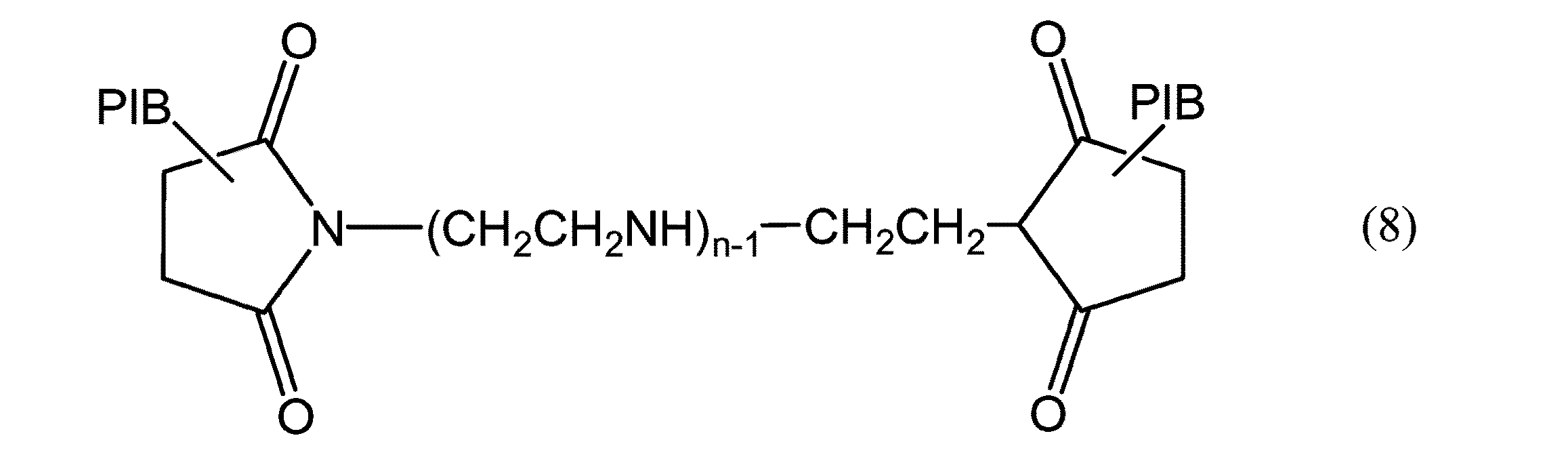
一般式(1)において、R1は炭素数1〜30の炭化水素基又は機能性を有する炭素数1〜30の炭化水素基、好ましくは炭素数10〜30の炭化水素基又は機能性を有する炭素数10〜30の炭化水素基、より好ましくは炭素数12〜24のアルキル基、アルケニル基又は機能性を有する炭化水素基、特に好ましくは炭素数12〜20のアルケニル基であり、R2及びR3は、それぞれ個別に、炭素数1〜30の炭化水素基、機能性を有する炭素数1〜30の炭化水素基又は水素、好ましくは炭素数1〜10の炭化水素基、機能性を有する炭素数1〜10の炭化水素基又は水素、さらに好ましくは炭素数1〜4の炭化水素基又は水素、より好ましくは水素であり、X1は酸素又は硫黄、好ましくは酸素を示す。一般式(1)で表される窒素含有化合物の最も好ましい例としては、具体的には、X1が酸素である化合物及びその酸変性誘導体、より具体的には、X1が酸素、R1が炭素数12〜24のアルキル基又はアルケニル基、R2及びR3が水素である、ドデシルウレア、トリデシルウレア、テトラデシルウレア、ペンタデシルウレア、ヘキサデシルウレア、ヘプタデシルウレア、オクタデシルウレア、オレイルウレア等の炭素数12〜24のアルキル基又はアルケニル基を有するウレア化合物及びその酸変性誘導体が挙げられる。これらの中でもオレイルウレア(C18H35−NH−C(=O)−NH2)及びその酸変性誘導体(ホウ酸変性誘導体等)が特に好ましい例として挙げられる。
一般式(2)において、R4は炭素数1〜30の炭化水素基又は機能性を有する炭素数1〜30の炭化水素基であり、好ましくは炭素数10〜30の炭化水素基又は機能性を有する炭素数10〜30の炭化水素基、より好ましくは炭素数12〜24のアルキル基、アルケニル基又は機能性を有する炭化水素基、特に好ましくは炭素数12〜20のアルケニル基であり、R5〜R7は、それぞれ個別に、炭素数1〜30の炭化水素基、機能性を有する炭素数1〜30の炭化水素基又は水素、好ましくは炭素数1〜10の炭化水素基、機能性を有する炭素数1〜10の炭化水素基又は水素、より好ましくは炭素数1〜4の炭化水素基又は水素、さらに好ましくは水素を示す。 In the general formula (2), R 4 is a hydrocarbon group having 1 to 30 carbon atoms or a hydrocarbon group having 1 to 30 carbon atoms, and preferably a hydrocarbon group or functionality having 10 to 30 carbon atoms. A hydrocarbon group having 10 to 30 carbon atoms, more preferably an alkyl group having 12 to 24 carbon atoms, an alkenyl group or a hydrocarbon group having functionality, particularly preferably an alkenyl group having 12 to 20 carbon atoms, and R 5 to R 7 are each independently a hydrocarbon group having 1 to 30 carbon atoms, a hydrocarbon group having 1 to 30 carbon atoms or hydrogen having functionality, preferably a hydrocarbon group having 1 to 10 carbon atoms, and functionality. C1-C10 hydrocarbon group or hydrogen which has more preferably, C1-C4 hydrocarbon group or hydrogen, More preferably, hydrogen is shown.
一般式(2)で表される窒素含有化合物としては、具体的には、炭素数1〜30の炭化水素基又は機能性を有する炭素数1〜30の炭化水素基を有するヒドラジド及びその誘導体である。R4が炭素数1〜30の炭化水素基又は機能性を有する炭素数1〜30の炭化水素基、R5〜R7が水素の場合、炭素数1〜30の炭化水素基又は機能性を有する炭素数1〜30の炭化水素基を有するヒドラジド、R4及びR5〜R7のいずれかが炭素数1〜30の炭化水素基又は機能性を有する炭素数1〜30の炭化水素基であり、R5〜R7の残りが水素である場合、炭素数1〜30の炭化水素基又は機能性を有する炭素数1〜30の炭化水素基を有するN−ヒドロカルビルヒドラジド(ヒドロカルビルは炭化水素基等を示す)である。一般式(2)で表される窒素含有化合物の最も好ましい例としては、R4が炭素数12〜24のアルキル基又はアルケニル基、R5、R6及びR7が水素である、ドデカン酸ヒドラジド、トリデカン酸ヒドラジド、テトラデカン酸ヒドラジド、ペンタデカン酸ヒドラジド、ヘキサデカン酸ヒドラジド、ヘプタデカン酸ヒドラジド、オクタデカン酸ヒドラジド、オレイン酸ヒドラジド、エルカ酸ヒドラジド等の炭素数12〜24のアルキル基又はアルケニル基を有するヒドラジド化合物及びその酸変性誘導体(ホウ酸変性誘導体等)が挙げられる。これらの中では、オレイン酸ヒドラジド(C17H33−C(=O)−NH−NH2)及びその酸変性誘導体、エルカ酸ヒドラジド(C21H41−C(=O)−NH−NH2)及びその酸変性誘導体が特に好ましい例として挙げられる。 Specific examples of the nitrogen-containing compound represented by the general formula (2) include a hydrazide having 1 to 30 carbon atoms or a functional hydrocarbon group having 1 to 30 carbon atoms and derivatives thereof. is there. When R 4 is a hydrocarbon group having 1 to 30 carbon atoms or a functional hydrocarbon group having 1 to 30 carbon atoms, and R 5 to R 7 are hydrogen, the hydrocarbon group having 1 to 30 carbon atoms or the functionality Any of hydrazide having a hydrocarbon group having 1 to 30 carbon atoms, R 4 and R 5 to R 7 is a hydrocarbon group having 1 to 30 carbon atoms or a hydrocarbon group having 1 to 30 carbon atoms having functionality. And when the remainder of R 5 to R 7 is hydrogen, N-hydrocarbyl hydrazide having a hydrocarbon group having 1 to 30 carbon atoms or a hydrocarbon group having 1 to 30 carbon atoms having functionality (hydrocarbyl is a hydrocarbon group) Etc.). As a most preferable example of the nitrogen-containing compound represented by the general formula (2), R 4 is an alkyl group or alkenyl group having 12 to 24 carbon atoms, and R 5 , R 6 and R 7 are hydrogen. Hydrazide compounds having an alkyl or alkenyl group having 12 to 24 carbon atoms such as tridecanoic acid hydrazide, tetradecanoic acid hydrazide, pentadecanoic acid hydrazide, hexadecanoic acid hydrazide, heptadecanoic acid hydrazide, octadecanoic acid hydrazide, oleic acid hydrazide, and erucic acid hydrazide Examples thereof include acid-modified derivatives (boric acid-modified derivatives and the like). Among these, hydrazide oleic acid (C 17 H 33 -C (= O) -NH-NH 2) and acid-modified derivatives, erucic acid hydrazide (C 21 H 41 -C (= O) -NH-NH 2 ) And acid-modified derivatives thereof are particularly preferred examples.
これらの分子中に窒素原子を2つ又はそれ以上有する各種無灰摩擦調整剤に関する製造法やその好ましい態様については、上記国際公開第2005/037967号パンフレットに詳細に記載されており、必要に応じて有機金属化合物との錯体又は塩の形として本発明の潤滑油組成物に含有させてもよい。これら分子中に2原子以上の窒素原子と、酸素原子及び/又は硫黄原子とを有する各種無灰摩擦調整剤は、モリブデンジチオカーバメート等の従来使用されてきた摩擦低減剤と同等あるいはそれ以上の摩擦低減効果を発揮できる他、すす混入時においても摩擦低減効果が悪化しにくく、長期に渡りその効果を維持しやすいため特に好ましい。 Production methods relating to various ashless friction modifiers having two or more nitrogen atoms in these molecules and preferred embodiments thereof are described in detail in the above-mentioned International Publication No. 2005/037967 pamphlet. It may be contained in the lubricating oil composition of the present invention in the form of a complex or salt with an organometallic compound. These ashless friction modifiers having 2 or more nitrogen atoms and oxygen atoms and / or sulfur atoms in these molecules are equivalent to or more than the friction reducers conventionally used such as molybdenum dithiocarbamate. In addition to exhibiting a reduction effect, the friction reduction effect is hardly deteriorated even when soot is mixed, and it is particularly preferable because the effect is easily maintained for a long time.
本発明の潤滑油組成物における(A)無灰摩擦調整剤の含有量は、組成物全量を基準として、0.01〜10質量%であり、好ましくは0.1質量%以上、より好ましくは0.3質量%以上であり、また、好ましくは3質量%以下、より好ましくは2質量%以下、さらに好ましくは1質量%以下である。無灰摩擦調整剤の含有量が0.01質量%未満であると、その添加による摩擦低減効果が不十分となる傾向にあり、また10質量%を超えると、耐摩耗性添加剤などの効果が阻害されやすく、あるいは添加剤の溶解性が悪化する傾向にある。 The content of the (A) ashless friction modifier in the lubricating oil composition of the present invention is 0.01 to 10% by mass, preferably 0.1% by mass or more, more preferably, based on the total amount of the composition. It is 0.3% by mass or more, preferably 3% by mass or less, more preferably 2% by mass or less, and further preferably 1% by mass or less. When the content of the ashless friction modifier is less than 0.01% by mass, the effect of reducing friction due to the addition tends to be insufficient. When the content exceeds 10% by mass, the effect of an anti-wear additive or the like. Tends to be inhibited, or the solubility of the additive tends to deteriorate.
本発明の潤滑油組成物における(B)成分は、リン含有摩耗防止剤である。リン含有摩耗防止剤としては、リンを分子中に含有する摩耗防止剤であれば特に制限はないが、例えば、一般式(3)で表されるリン化合物、一般式(4)で表されるリン化合物、それらの金属塩、それらのアミン塩、及びこれらの誘導体からなる群より選ばれる少なくとも1種の化合物であることが好ましい。
式(3)において、X2、X3及びX4は、それぞれ個別に酸素原子又は硫黄原子を示し、R8、R9及びR10は、それぞれ個別に水素原子又は炭素数1〜30の炭化水素含有基を示す。
式(4)において、X5、X6、X7及びX8は、それぞれ個別に酸素原子又は硫黄原子(X5、X6及びX7の1つ又は2つが単結合又は(ポリ)オキシアルキレン基でもよい。)を示し、R11、R12及びR13は、それぞれ個別に水素原子又は炭素数1〜30の炭化水素含有基を示す。 In the formula (4), X 5 , X 6 , X 7 and X 8 are each independently an oxygen atom or a sulfur atom (one or two of X 5 , X 6 and X 7 are a single bond or (poly) oxyalkylene) R 11 , R 12 and R 13 each independently represent a hydrogen atom or a hydrocarbon-containing group having 1 to 30 carbon atoms.
上記R8〜R13で表される炭素数1〜30の炭化水素含有基としては、アルキル基、シクロアルキル基、アルケニル基、アルキル置換シクロアルキル基、アリール基、アルキル置換アリール基、及びアリールアルキル基等の炭化水素基を有する炭化水素含有基を挙げることができ、炭化水素基としては、炭素数1〜30のアルキル基又は炭素数6〜24のアリール基であることが好ましく、さらに好ましくは炭素数3〜18、さらに好ましくは炭素数4〜12のアルキル基である。これら炭化水素含有基は炭化水素基と、酸素原子、窒素原子、硫黄原子のいずれかを分子中に含んでいてもよいが、炭素と水素からなる炭化水素基が望ましい。 Examples of the hydrocarbon-containing group having 1 to 30 carbon atoms represented by R 8 to R 13 include an alkyl group, a cycloalkyl group, an alkenyl group, an alkyl-substituted cycloalkyl group, an aryl group, an alkyl-substituted aryl group, and an arylalkyl. A hydrocarbon-containing group having a hydrocarbon group such as a group can be exemplified, and the hydrocarbon group is preferably an alkyl group having 1 to 30 carbon atoms or an aryl group having 6 to 24 carbon atoms, more preferably It is a C3-C18, More preferably, it is a C4-C12 alkyl group. These hydrocarbon-containing groups may contain a hydrocarbon group and any one of an oxygen atom, a nitrogen atom and a sulfur atom in the molecule, but a hydrocarbon group composed of carbon and hydrogen is desirable.
一般式(3)で表されるリン化合物としては、例えば、亜リン酸、モノチオ亜リン酸、ジチオ亜リン酸、トリチオ亜リン酸;上記炭素数1〜30の炭化水素基を1つ有する亜リン酸モノエステル、モノチオ亜リン酸モノエステル、ジチオ亜リン酸モノエステル、トリチオ亜リン酸モノエステル;上記炭素数1〜30の炭化水素基を2つ有する亜リン酸ジエステル、モノチオ亜リン酸ジエステル、ジチオ亜リン酸ジエステル、トリチオ亜リン酸ジエステル;上記炭素数1〜30の炭化水素基を3つ有する亜リン酸トリエステル、モノチオ亜リン酸トリエステル、ジチオ亜リン酸トリエステル、トリチオ亜リン酸トリエステル;及びこれらの混合物を挙げることができる。 Examples of the phosphorus compound represented by the general formula (3) include phosphorous acid, monothiophosphorous acid, dithiophosphorous acid, trithiophosphorous acid; a nitrous acid having one hydrocarbon group having 1 to 30 carbon atoms. Phosphoric acid monoester, monothiophosphorous acid monoester, dithiophosphorous acid monoester, trithiophosphorous acid monoester; phosphorous acid diester having two hydrocarbon groups having 1 to 30 carbon atoms, monothiophosphorous acid diester , Dithiophosphite diester, trithiophosphite diester; phosphite triester having three hydrocarbon groups having 1 to 30 carbon atoms, monothiophosphite triester, dithiophosphite triester, trithiophosphite And acid triesters; and mixtures thereof.
一般式(4)で表されるリン化合物としては、例えば、リン酸、モノチオリン酸、ジチオリン酸、トリチオリン酸、テトラチオリン酸;上記炭素数1〜30の炭化水素基を1つ有するリン酸モノエステル、モノチオリン酸モノエステル、ジチオリン酸モノエステル、トリチオリン酸モノエステル、テトラチオリン酸モノエステル;上記炭素数1〜30の炭化水素基を2つ有するリン酸ジエステル、モノチオリン酸ジエステル、ジチオリン酸ジエステル、トリチオリン酸ジエステル、テトラチオリン酸ジエステル;上記炭素数1〜30の炭化水素基を3つ有するリン酸トリエステル、モノチオリン酸トリエステル、ジチオリン酸トリエステル、トリチオリン酸トリエステル、テトラチオリン酸トリエステル;上記炭素数1〜30の炭化水素基を1〜3つ有するホスホン酸、ホスホン酸モノエステル、ホスホン酸ジエステル;炭素数1〜4の(ポリ)オキシアルキレン基を有する上記リン化合物;β−ジチオホスホリル化プロピオン酸やジチオリン酸とオレフィンシクロペンタジエン又は(メチル)メタクリル酸との反応物等の上記リン化合物の誘導体;及びこれらの混合物を挙げることができる。 Examples of the phosphorus compound represented by the general formula (4) include phosphoric acid, monothiophosphoric acid, dithiophosphoric acid, trithiophosphoric acid, tetrathiophosphoric acid; phosphoric acid monoester having one hydrocarbon group having 1 to 30 carbon atoms. Monothiophosphoric acid monoester, dithiophosphoric acid monoester, trithiophosphoric acid monoester, tetrathiophosphoric acid monoester; phosphoric acid diester having two hydrocarbon groups having 1 to 30 carbon atoms, monothiophosphoric acid diester, dithiophosphoric acid diester, trithiophosphoric acid Diesters, tetrathiophosphoric acid diesters; phosphoric acid triesters having three hydrocarbon groups having 1 to 30 carbon atoms, monothiophosphoric acid triesters, dithiophosphoric acid triesters, trithiophosphoric acid triesters, tetrathiophosphoric acid triesters; 1-30 hydrocarbon groups ~ 3 phosphonic acid, phosphonic acid monoester, phosphonic acid diester; the above phosphorus compound having a (poly) oxyalkylene group having 1 to 4 carbon atoms; β-dithiophosphorylated propionic acid or dithiophosphoric acid and olefin cyclopentadiene or ( (Methyl) Derivatives of the above phosphorus compounds such as reaction products with methacrylic acid; and mixtures thereof.
一般式(3)又は(4)で表されるリン化合物の塩としては、リン化合物に金属酸化物、金属水酸化物、金属炭酸塩、金属塩化物等の金属塩基、アンモニア、炭素数1〜30の炭化水素基又はヒドロキシル基含有炭化水素基のみを分子中に有するアミン化合物等の窒素化合物を作用させて、残存する酸性水素の一部又は全部を中和した塩を挙げることができる。 As the salt of the phosphorus compound represented by the general formula (3) or (4), the phosphorus compound may be a metal base such as a metal oxide, metal hydroxide, metal carbonate, metal chloride, ammonia, 1 to 1 carbon atoms. Examples thereof include salts obtained by allowing a nitrogen compound such as an amine compound having only 30 hydrocarbon groups or hydroxyl group-containing hydrocarbon groups in the molecule to act to neutralize part or all of the remaining acidic hydrogen.
上記金属塩基における金属としては、具体的には、リチウム、ナトリウム、カリウム、セシウム等のアルカリ金属、カルシウム、マグネシウム、バリウム等のアルカリ土類金属、亜鉛、銅、鉄、鉛、ニッケル、銀、マンガン等の重金属等が挙げられる。これらの中ではカルシウム、マグネシウム等のアルカリ土類金属及び亜鉛が好ましい Specific examples of the metal in the metal base include alkali metals such as lithium, sodium, potassium and cesium, alkaline earth metals such as calcium, magnesium and barium, zinc, copper, iron, lead, nickel, silver and manganese. And heavy metals. Among these, alkaline earth metals such as calcium and magnesium and zinc are preferable.
上記窒素化合物としては、具体的には、アンモニア、モノアミン、ジアミン、ポリアミンが挙げられ、より具体的には、(E2)成分で後述するモリブデンのアミン錯体を構成するアミン化合物と同じものが例示できる。 Specific examples of the nitrogen compounds include ammonia, monoamines, diamines, and polyamines. More specifically, the same compounds as the amine compounds that constitute the amine complex of molybdenum described later in the component (E2) can be exemplified. .
これら窒素化合物の中でもデシルアミン、ドデシルアミン、ジメチルドデシルアミン、トリデシルアミン、ヘプタデシルアミン、オクタデシルアミン、オレイルアミン及びステアリルアミン等の炭素数10〜20のアルキル基又はアルケニル基を有する脂肪族アミン(これらは直鎖状でも分枝状でもよい。)が好ましい例として挙げることができる。 Among these nitrogen compounds, aliphatic amines having an alkyl or alkenyl group having 10 to 20 carbon atoms such as decylamine, dodecylamine, dimethyldodecylamine, tridecylamine, heptadecylamine, octadecylamine, oleylamine and stearylamine (these are It may be linear or branched)).
本発明における(B)成分としては、上記のリン含有摩耗防止剤として、以下の(B1)〜(B3)から選ばれる少なくとも1種を主成分として本発明の潤滑油組成物に含有させることが特に望ましい。
(B1)炭素数3〜8から選ばれる2級アルキル基を有するジアルキルジチオリン酸亜鉛
(B2)炭素数3〜8から選ばれる1級アルキル基を有するジアルキルジチオリン酸亜鉛
(B3)硫黄を含有しないリン含有酸の金属塩
As the component (B) in the present invention, the above-mentioned phosphorus-containing antiwear agent may be contained in the lubricating oil composition of the present invention containing at least one selected from the following (B1) to (B3) as a main component. Particularly desirable.
(B1) zinc dialkyldithiophosphate having a secondary alkyl group selected from 3 to 8 carbon atoms (B2) zinc dialkyldithiophosphate having a primary alkyl group selected from 3 to 8 carbon atoms (B3) phosphorus containing no sulfur Metal salt of acid contained
上記(B1)及び(B2)成分としては、下記の一般式(5)で表されるものが例示できる。
式中R14、R15、R16及びR17は同一でも、異なっていてもよく、それぞれ個別に、炭素数3〜8の2級アルキル基又は1級アルキル基、好ましくは炭素数3〜6の2級アルキル基又は炭素数6〜8の1級アルキル基を示し、同一分子中に異なる炭素数のアルキル基、異なる構造のアルキル基(2級、1級)を有していてもよい。 In the formula, R 14 , R 15 , R 16 and R 17 may be the same or different, and are each independently a secondary alkyl group or primary alkyl group having 3 to 8 carbon atoms, preferably 3 to 6 carbon atoms. Secondary alkyl groups or primary alkyl groups having 6 to 8 carbon atoms, and may have alkyl groups having different carbon numbers and alkyl groups having different structures (secondary, primary) in the same molecule.
本発明においては、低濃度であってもすす混入下における摩耗を抑制しやすい点で(B1)炭素数3〜8から選ばれる2級アルキル基を有するジアルキルジチオリン酸亜鉛を含有させることが好ましく、酸化安定性をより向上でき、塩基価維持性能を格段に高めることができる点で(B2)炭素数3〜8から選ばれる1級アルキル基を有するジアルキルジチオリン酸亜鉛を含有させることが好ましく、すす混入下における摩耗の抑制性能と塩基価維持性能を高いレベルでバランスよく向上できる点で、(B1)及び(B2)成分を併用することが最も好ましい。 In the present invention, it is preferable to contain a zinc dialkyldithiophosphate having a secondary alkyl group selected from 3 to 8 carbon atoms (B1) in that it is easy to suppress wear under soot mixing even at a low concentration, (B2) It is preferable to contain a zinc dialkyldithiophosphate having a primary alkyl group selected from 3 to 8 carbon atoms in that the oxidation stability can be further improved and the base number maintenance performance can be remarkably improved. It is most preferable to use the components (B1) and (B2) together in that the wear suppression performance and the base number maintenance performance under mixing can be improved at a high level with a good balance.
なお、ジチオリン酸亜鉛の製造方法としては任意の従来方法が採用可能であって、特に制限されないが、具体的には例えば、前記R14、R15、R16及びR17に対応するアルキル基を持つアルコールを五硫化二りんと反応させてジチオリン酸をつくり、これを酸化亜鉛で中和させることにより合成することができる。 Note that any conventional method can be adopted as a method for producing zinc dithiophosphate, and is not particularly limited. Specifically, for example, an alkyl group corresponding to R 14 , R 15 , R 16 and R 17 may be used. It can be synthesized by reacting the alcohol with diphosphorus pentasulfide to produce dithiophosphoric acid and neutralizing it with zinc oxide.
また、上記(B3)成分は、硫黄を含有しないリン含有酸の金属塩であり、前記一般式(3)におけるX2〜X4の全てが酸素原子(X2、X3及びX4の1つ又は2つが単結合又は(ポリ)オキシアルキレン基でもよい。)であるリン化合物の金属塩、前記一般式(4)におけるX5〜X8の全てが酸素原子(X5、X6及びX7の1つ又は2つが単結合又は(ポリ)オキシアルキレン基でもよい。)であるリン化合物の金属塩が代表的な例として挙げられる。これら(B3)成分は、高温清浄性や酸化安定性、塩基価維持性などのロングドレイン性能を格段に高めることができる点で好ましく使用することができる。 The component (B3) is a metal salt of a phosphorus-containing acid that does not contain sulfur, and all of X 2 to X 4 in the general formula (3) are oxygen atoms (X 2 , X 3, and X 4 1 One or two of them may be a single bond or a (poly) oxyalkylene group), and all of X 5 to X 8 in the general formula (4) are oxygen atoms (X 5 , X 6 and X A typical example is a metal salt of a phosphorus compound in which one or two of 7 may be a single bond or a (poly) oxyalkylene group. These (B3) components can be preferably used in that the long drain performance such as high temperature cleanliness, oxidation stability, and base number maintenance can be remarkably enhanced.
上記リン化合物の金属塩は、金属の価数やリン化合物のOH基の数に応じその構造が異なり、従ってその構造については何ら限定されない。例えば、酸化亜鉛1モルとリン酸ジエステル(OH基が1つ)2モルを反応させた場合、下記一般式(6)で表される構造の化合物が主成分として得られると考えられるが、ポリマー化した分子も存在していると考えられる。
また、例えば、酸化亜鉛1モルとリン酸モノエステル(OH基が2つ)1モルとを反応させた場合、下記一般式(7)で表される構造の化合物が主成分として得られると考えられるが、ポリマー化した分子も存在していると考えられる。
これらの(B3)成分の中では、炭素数3〜18のアルキル基又はアリール基を2個有する亜リン酸ジエステルと亜鉛との塩、炭素数3〜18のアルキル基又はアリール基を1個有するリン酸のモノエステルと亜鉛との塩、炭素数3〜18のアルキル基又はアリール基を2個有するリン酸のジエステルと亜鉛との塩、炭素数1〜18のアルキル基又はアリール基を2つ有するホスホン酸モノエステルと亜鉛との塩であることが好ましい。これらの成分は、1種類あるいは2種類以上を任意に配合することができる。本発明においては、すす混入下における摩耗防止性により優れる点で、炭素数4〜12のアルキル基を1つ又は2つ有するアルキルリン酸エステル金属塩が好ましく、炭素数6〜8のアルキル基を1つ又は2つ有するモノ及び/又はジアルキルリン酸エステル金属塩がより好ましく、モノ及びジ2−エチルヘキシルリン酸亜鉛が特に好ましい。 Among these (B3) components, a salt of phosphorous acid diester having two alkyl groups or aryl groups having 3 to 18 carbon atoms and zinc, one alkyl group or aryl group having 3 to 18 carbon atoms Salt of phosphoric acid monoester and zinc, diester of phosphoric acid having two alkyl groups or aryl groups having 3 to 18 carbon atoms and zinc, two alkyl groups or aryl groups having 1 to 18 carbon atoms A salt of phosphonic acid monoester and zinc is preferable. These components can be arbitrarily blended in one kind or two or more kinds. In the present invention, an alkyl phosphate metal salt having one or two alkyl groups having 4 to 12 carbon atoms is preferable, and an alkyl group having 6 to 8 carbon atoms is preferable in that it is more excellent in wear resistance under soot mixing. Mono- and / or dialkyl phosphate metal salts having one or two are more preferable, and zinc mono- and di-2-ethylhexyl phosphate are particularly preferable.
本発明の潤滑油組成物におけるリン含有摩耗防止剤、好ましくは上記(B1)、(B2)及び(B3)から選ばれる少なくとも1種の含有量の上限は、リン量として0.2質量%以下、好ましくは0.1質量%以下、より好ましくは0.08質量%以下、特に好ましくは0.06質量%以下であり、その下限値は、すす混入下における摩耗を抑制しやすい点で、リン量として0.01質量%以上であり、好ましくは0.02質量%以上、特に好ましくは0.04質量%以上である。 The upper limit of the phosphorus-containing antiwear agent in the lubricating oil composition of the present invention, preferably at least one selected from the above (B1), (B2) and (B3) is 0.2% by mass or less as the phosphorus amount. The lower limit is preferably 0.1% by mass or less, more preferably 0.08% by mass or less, and particularly preferably 0.06% by mass or less. The amount is 0.01% by mass or more, preferably 0.02% by mass or more, and particularly preferably 0.04% by mass or more.
リン含有摩耗防止剤の含有量がリン量として0.2質量%を超える場合には、高温清浄性や塩基価維持性が著しく悪化するために好ましくなく、0.09〜0.2質量%の場合、すす混入下においても摩耗が著しく発生しない点で好ましいが、低硫黄化や低リン化、あるいは高温清浄性や塩基価維持性をより高めることができる点で0.08質量%以下とすることが望ましい。 When the content of the phosphorus-containing wear inhibitor exceeds 0.2% by mass as phosphorus, it is not preferable because the high-temperature cleanliness and the base number maintainability are remarkably deteriorated, and 0.09 to 0.2% by mass In this case, it is preferable in that wear does not remarkably occur even in the presence of soot, but it is 0.08% by mass or less in terms of lowering sulfur, lowering phosphorus, or improving high-temperature cleanability and base number maintenance. It is desirable.
本発明の潤滑油組成物は、上記本発明にかかる潤滑油基油、(A)無灰摩擦調整剤及び(B)リン含有摩耗防止剤を含有するものであるが、その性能をさらに高めるために、あるいは、潤滑油組成物の用途や要求される性能に応じて、(C)金属系清浄剤、(D)無灰分散剤、(E)有機モリブデン化合物から選ばれる1種又は2種以上を含有させることが好ましい。 The lubricating oil composition of the present invention contains the lubricating base oil according to the present invention, (A) an ashless friction modifier, and (B) a phosphorus-containing antiwear agent, in order to further enhance its performance. Or, depending on the use and required performance of the lubricating oil composition, one or more selected from (C) a metal detergent, (D) an ashless dispersant, and (E) an organomolybdenum compound. It is preferable to contain.
本発明の潤滑油組成物における(C)成分は、金属系清浄剤である。具体的には、スルホネート系清浄剤、フェネート系清浄剤、サリシレート系清浄剤、カルボキシレート系清浄剤を挙げることができ、いずれも使用可能である。本発明においては、すす混入下における摩耗防止性に特に優れる点で、スルホネート系清浄剤を使用することが特に好ましい。 The component (C) in the lubricating oil composition of the present invention is a metallic detergent. Specific examples include sulfonate detergents, phenate detergents, salicylate detergents, and carboxylate detergents, all of which can be used. In the present invention, it is particularly preferable to use a sulfonate-based detergent because it is particularly excellent in anti-wear property under soot mixing.
スルホネート系清浄剤としては、その構造に特に制限はないが、例えば、分子量100〜1500、好ましくは200〜700のアルキル芳香族化合物をスルホン化することによって得られるアルキル芳香族スルホン酸のアルカリ金属塩又はアルカリ土類金属塩が挙げられ、特にマグネシウム塩及び/又はカルシウム塩が好ましく用いられ、アルキル芳香族スルホン酸としては、具体的にはいわゆる石油スルホン酸や合成スルホン酸等が挙げられる。石油スルホン酸としては、一般に鉱油の潤滑油留分のアルキル芳香族化合物をスルホン化したものやホワイトオイル製造時に副生する、いわゆるマホガニー酸等が用いられる。また合成スルホン酸としては、例えば、洗剤の原料となるアルキルベンゼン製造プラントから副生したり、ポリオレフィンをベンゼンにアルキル化したりすることにより得られる、直鎖状や分枝状のアルキル基を有するアルキルベンゼンを原料とし、これをスルホン化したもの、あるいはジノニルナフタレンをスルホン化したもの等が用いられる。またこれらアルキル芳香族化合物をスルホン化する際のスルホン化剤としては特に制限はないが、通常、発煙硫酸や硫酸が用いられる。 The structure of the sulfonate detergent is not particularly limited. For example, an alkali metal salt of an alkyl aromatic sulfonic acid obtained by sulfonating an alkyl aromatic compound having a molecular weight of 100 to 1,500, preferably 200 to 700. Alternatively, alkaline earth metal salts are exemplified, and particularly, magnesium salts and / or calcium salts are preferably used. Specific examples of alkyl aromatic sulfonic acids include so-called petroleum sulfonic acids and synthetic sulfonic acids. As the petroleum sulfonic acid, those obtained by sulfonating an alkyl aromatic compound of a lubricating oil fraction of mineral oil or so-called mahoganic acid which is produced as a by-product when white oil is produced is used. Synthetic sulfonic acids include, for example, alkylbenzenes having linear or branched alkyl groups that are obtained as a by-product from an alkylbenzene production plant that is a raw material for detergents, or are obtained by alkylating polyolefin to benzene. As a raw material, a sulfonated one or a sulfonated dinonylnaphthalene is used. The sulfonating agent for sulfonating these alkyl aromatic compounds is not particularly limited, but usually fuming sulfuric acid or sulfuric acid is used.
なお、芳香族スルホン酸のアルキル化に際しては、直鎖状又は分枝状の(ポリ)オレフィン、例えば、エチレン、プロピレン、ブテン等の炭素数2〜4のオレフィンのオリゴマーを用いることが好ましく、中でもエチレンオリゴマーを用いることが特に好ましい。エチレンオリゴマーから誘導される炭素数6〜40の直鎖α−オレフィンを用いてアルキル化されたアルキル芳香族スルホン酸のアルカリ金属塩又はアルカリ土類金属塩は、特に摩擦低減効果を高めることができる。ここでいう炭素数6〜40の直鎖α−オレフィンとしては、好ましくは炭素数10〜30、より好ましくは炭素数14〜20又は20〜30の直鎖α−オレフィンが挙げられ、得られるスルホネートの摩擦低減効果が特に優れる点で、炭素数20〜26の直鎖α−オレフィンであることが望ましい。 In the alkylation of the aromatic sulfonic acid, it is preferable to use a linear or branched (poly) olefin, for example, an oligomer of an olefin having 2 to 4 carbon atoms such as ethylene, propylene and butene. It is particularly preferable to use an ethylene oligomer. Alkali metal salts or alkaline earth metal salts of alkyl aromatic sulfonic acids alkylated with linear α-olefins having 6 to 40 carbon atoms derived from ethylene oligomers can particularly enhance the friction reducing effect. . The straight chain α-olefin having 6 to 40 carbon atoms mentioned here is preferably a straight chain α-olefin having 10 to 30 carbon atoms, more preferably 14 to 20 or 20 to 30 carbon atoms. It is desirable that it is a linear α-olefin having 20 to 26 carbon atoms in that the friction reducing effect is particularly excellent.
また、スルホネート系清浄剤としては、上記のアルキル芳香族スルホン酸を直接、マグネシウム及び/又はカルシウムのアルカリ土類金属の酸化物や水酸化物等のアルカリ土類金属塩基と反応させたり、一度ナトリウム塩やカリウム塩等のアルカリ金属塩としてからアルカリ土類金属塩と置換させたりすること等により得られる中性アルカリ土類金属スルホネートだけでなく、上記中性アルカリ土類金属スルホネートと過剰のアルカリ土類金属塩やアルカリ土類金属塩基(水酸化物や酸化物)を水の存在下で加熱することにより得られる塩基性アルカリ土類金属スルホネートや、炭酸ガス及び/又はホウ酸もしくはホウ酸塩の存在下で上記中性アルカリ土類金属スルホネートをアルカリ土類金属の塩基と反応させることにより得られる炭酸塩過塩基性アルカリ土類金属スルホネート、ホウ酸塩過塩基性アルカリ土類金属スルホネートも含まれる。 In addition, as the sulfonate detergent, the above alkyl aromatic sulfonic acid may be directly reacted with an alkaline earth metal base such as magnesium and / or calcium alkaline earth metal oxide or hydroxide, or once sodium Not only neutral alkaline earth metal sulfonates obtained by replacing alkali metal salts such as salts and potassium salts with alkaline earth metal salts, but also neutral alkaline earth metal sulfonates and excess alkaline earths. Of basic alkaline earth metal sulfonates obtained by heating an alkali metal salt or alkaline earth metal base (hydroxide or oxide) in the presence of water, carbon dioxide and / or boric acid or borate Carbonates obtained by reacting the neutral alkaline earth metal sulfonate with an alkaline earth metal base in the presence Basic alkaline earth metal sulfonates, also borate overbased alkaline earth metal sulfonate is included.
本発明でいうスルホネート系清浄剤としては、上記の中性アルカリ土類金属スルホネート、塩基性アルカリ土類金属スルホネート、過塩基性アルカリ土類金属スルホネート及びこれらの混合物等を用いることができる。 As the sulfonate detergent in the present invention, the above-mentioned neutral alkaline earth metal sulfonate, basic alkaline earth metal sulfonate, overbased alkaline earth metal sulfonate, and a mixture thereof can be used.
本発明におけるスルホネート系清浄剤としてはカルシウムスルホネート系清浄剤、マグネシウムスルホネート系清浄剤を使用することが好ましく、カルシウムスルホネート系清浄剤を使用することが特に好ましい。 As the sulfonate detergent in the present invention, a calcium sulfonate detergent or a magnesium sulfonate detergent is preferably used, and a calcium sulfonate detergent is particularly preferably used.
スルホネート系清浄剤は、通常、軽質潤滑油基油等で希釈された状態で市販されており、また入手可能であるが、一般的に、その金属含有量が1.0〜20質量%、好ましくは2.0〜16質量%のものを用いるのが望ましい。 Sulfonate detergents are usually commercially available in a state diluted with a light lubricating base oil or the like, and are available, but generally the metal content is 1.0 to 20% by mass, preferably Is preferably 2.0 to 16% by mass.
本発明で用いるスルホネート系清浄剤の塩基価は任意であり、通常0〜500mgKOH/gであるが、含有量あたりの高温清浄性向上効果に優れる点から、塩基価が100〜450mgKOH/g、好ましくは200〜400mgKOH/gのものを用いるのが望ましい。 The base number of the sulfonate detergent used in the present invention is arbitrary, and is usually 0 to 500 mgKOH / g. However, the base number is preferably 100 to 450 mgKOH / g from the viewpoint of excellent high temperature cleanability improvement effect per content. Is preferably 200 to 400 mgKOH / g.
なおここでいう塩基価は、JIS K2501「石油製品及び潤滑油−中和価試験方法」の7.に準拠して測定される過塩素酸法による塩基価を意味している。 The base number referred to here is JIS K2501 “Petroleum products and lubricating oils-Neutralization number test method”. It means the base number by the perchloric acid method measured according to the above.
サリシレート系清浄剤としては、その構造に特に制限はないが、炭素数1〜40のアルキル基を1〜2個有するサリチル酸の金属塩、好ましくはアルカリ金属塩又はアルカリ土類金属塩、特にマグネシウム塩及び/又はカルシウム塩が好ましく用いられる。 The salicylate-based detergent is not particularly limited in its structure, but a metal salt of salicylic acid having 1 to 2 alkyl groups having 1 to 40 carbon atoms, preferably an alkali metal salt or an alkaline earth metal salt, particularly a magnesium salt And / or calcium salts are preferably used.
本発明の潤滑油組成物に用いるサリシレート系清浄剤としては、低温粘度特性により優れる点で、モノアルキルサリチル酸金属塩の構成比が高い方が好ましく、例えば、モノアルキルサリチル酸金属塩の構成比が85〜100mol%、ジアルキルサリチル酸金属塩の構成比が0〜15mol%であって、3−アルキルサリチル酸金属塩の構成比が40〜100mol%であるアルキルサリチル酸金属塩、及び/又はその(過)塩基性塩であることが好ましい。また、本発明におけるサリシレート系清浄剤としては、高温清浄性や塩基価維持性により優れる点でジアルキルサリチル酸金属塩を含むものが好ましい。 The salicylate detergent used in the lubricating oil composition of the present invention preferably has a higher proportion of monoalkyl salicylic acid metal salt in view of excellent low-temperature viscosity characteristics. For example, the proportion of monoalkyl salicylic acid metal salt is 85. An alkyl salicylic acid metal salt in which the constituent ratio of the metal salt of dialkyl salicylic acid is 0 to 15 mol% and the constituent ratio of the metal salt of 3-alkyl salicylic acid is 40 to 100 mol% and / or its (over) basic A salt is preferred. In addition, the salicylate-based detergent in the present invention is preferably one containing a dialkyl salicylic acid metal salt from the viewpoint of excellent high-temperature cleanability and base number maintenance.
ここでいうモノアルキルサリチル酸金属塩は、3−アルキルサリチル酸金属塩、4−アルキルサリチル酸金属塩、5−アルキルサリチル酸金属塩等のアルキル基を1つ有するアルキルサリチル酸金属塩を意味し、モノアルキルサリチル酸金属塩の構成比は、アルキルサリチル酸金属塩100mol%に対し、85〜100mol%、好ましくは88〜98mol%、さらに好ましくは90〜95mol%であり、モノアルキルサリチル酸金属塩以外のアルキルサリチル酸金属塩、例えばジアルキルサリチル酸金属塩の構成比は、0〜15mol%、好ましくは2〜12mol%、さらに好ましくは5〜10mol%である。また、3−アルキルサリチル酸金属塩の構成比は、アルキルサリチル酸金属塩100mol%に対し、40〜100mol%、好ましくは45〜80mol%、さらに好ましくは50〜60mol%である。なお、4−アルキルサリチル酸金属塩及び5−アルキルサリチル酸金属塩の合計の構成比は、アルキルサリチル酸金属塩100mol%に対し、上記3−アルキルサリチル酸金属塩、ジアルキルサリチル酸金属塩を除いた構成比に相当し、0〜60mol%、好ましくは20〜50mol%、さらに好ましくは30〜45mol%である。ジアルキルサリチル酸金属塩を少量含むことで高温清浄性、低温特性に優れ、塩基価維持性にも優れる組成物を得ることができ、3−アルキルサリシレートの構成比を40mol%以上とすることで、5−アルキルサリチル酸金属塩の構成比を相対的に低くすることができ、油溶性を向上させることができる。 The monoalkyl salicylic acid metal salt here means an alkyl salicylic acid metal salt having one alkyl group such as a 3-alkyl salicylic acid metal salt, a 4-alkyl salicylic acid metal salt, a 5-alkyl salicylic acid metal salt, and the like. The constituent ratio of the salt is 85 to 100 mol%, preferably 88 to 98 mol%, more preferably 90 to 95 mol% with respect to 100 mol% of the alkylsalicylic acid metal salt, and an alkylsalicylic acid metal salt other than the monoalkylsalicylic acid metal salt, for example, The composition ratio of the dialkyl salicylic acid metal salt is 0 to 15 mol%, preferably 2 to 12 mol%, and more preferably 5 to 10 mol%. Moreover, the structural ratio of 3-alkyl salicylic acid metal salt is 40-100 mol% with respect to 100 mol% of alkyl salicylic acid metal salt, Preferably it is 45-80 mol%, More preferably, it is 50-60 mol%. The total composition ratio of the 4-alkyl salicylic acid metal salt and the 5-alkyl salicylic acid metal salt corresponds to the composition ratio excluding the 3-alkyl salicylic acid metal salt and the dialkyl salicylic acid metal salt with respect to 100 mol% of the alkyl salicylic acid metal salt. And 0 to 60 mol%, preferably 20 to 50 mol%, more preferably 30 to 45 mol%. By containing a small amount of a metal salt of a dialkyl salicylic acid, a composition having excellent high-temperature cleanliness and low-temperature characteristics and excellent base number maintenance can be obtained. -The composition ratio of the alkyl salicylic acid metal salt can be relatively lowered, and the oil solubility can be improved.
また、サリシレート系清浄剤を構成するアルキルサリチル酸金属塩におけるアルキル基としては、炭素数10〜40、好ましくは炭素数10〜19又は炭素数20〜30、さらに好ましくは炭素数14〜18又は炭素数20〜26のアルキル基、特に好ましくは炭素数14〜18のアルキル基である。炭素数10〜40のアルキル基としては、デシル基、ウンデシル基、ドデシル基、トリデシル基、テトラデシル基、ペンタデシル基、ヘキサデシル基、ヘプタデシル基、オクタデシル基、ノナデシル基、イコシル基、ヘンイコシル基、ドコシル基、トリコシル基、テトラコシル基、ペンタコシル基、ヘキサコシル基、ヘプタコシル基、オクタコシル基、ノナコシル基、及びトリアコンチル基等の炭素数10〜40のアルキル基が挙げられる。これらアルキル基は直鎖状であっても分枝状であってもよく、1級アルキル基、2級アルキル基、3級アルキル基であってもよいが、本発明においては上記所望のサリチル酸金属塩を得やすい点で、2級アルキル基であることが特に好ましい。 Moreover, as an alkyl group in the alkyl salicylic acid metal salt constituting the salicylate detergent, the carbon number is 10 to 40, preferably the carbon number is 10 to 19, or the carbon number is 20 to 30, and more preferably the carbon number is 14 to 18 or the carbon number. An alkyl group having 20 to 26, particularly preferably an alkyl group having 14 to 18 carbon atoms. Examples of the alkyl group having 10 to 40 carbon atoms include decyl group, undecyl group, dodecyl group, tridecyl group, tetradecyl group, pentadecyl group, hexadecyl group, heptadecyl group, octadecyl group, nonadecyl group, icosyl group, heicosyl group, docosyl group, Examples thereof include alkyl groups having 10 to 40 carbon atoms such as a tricosyl group, a tetracosyl group, a pentacosyl group, a hexacosyl group, a heptacosyl group, an octacosyl group, a nonacosyl group, and a triacontyl group. These alkyl groups may be linear or branched, and may be a primary alkyl group, a secondary alkyl group, or a tertiary alkyl group. In the present invention, the desired metal salicylate is used. A secondary alkyl group is particularly preferred from the viewpoint of easily obtaining a salt.
また、アルキルサリチル酸金属塩における金属としては、ナトリウム、カリウム等のアルカリ金属、カルシウム、マグネシウム等のアルカリ土類金属等が挙げられ、カルシウム、マグネシウムであることが好ましく、カルシウムであることが特に好ましい。 Examples of the metal in the alkyl salicylic acid metal salt include alkali metals such as sodium and potassium, alkaline earth metals such as calcium and magnesium, and are preferably calcium and magnesium, and particularly preferably calcium.
サリシレート系清浄剤は、公知の方法等で製造することができ、特に制限はないが、例えば、フェノール1molに対し1mol又はそれ以上の、エチレン、プロピレン、ブテン等の重合体又は共重合体等の炭素数10〜40のオレフィン、好ましくはエチレン重合体等の直鎖α−オレフィンを用いてアルキレーションし、炭酸ガス等でカルボキシレーションする方法、あるいはサリチル酸1molに対し1mol又はそれ以上の当該オレフィン、好ましくは当該直鎖α−オレフィンを用いてアルキレーションする方法等により得たモノアルキルサリチル酸を主成分とするアルキルサリチル酸に、アルカリ金属又はアルカリ土類金属の酸化物や水酸化物等の金属塩基と反応させたり、又はナトリウム塩やカリウム塩等のアルカリ金属塩としたり、さらにアルカリ金属塩をアルカリ土類金属塩と置換させること等により得られる。ここで、フェノール又はサリチル酸とオレフィンの反応割合を、好ましくは、例えば1:1〜1.15(モル比)、より好ましくは1:1.05〜1.1(モル比)に制御することでモノアルキルサリチル酸金属塩とジアルキルサリチル酸金属塩の構成比を所望の割合に制御することができ、また、オレフィンとして直鎖α−オレフィンを用いることで、3−アルキルサリチル酸金属塩、5−アルキルサリチル酸金属塩等の構成比を本願所望の割合に制御しやすくなるとともに、本発明において好ましい2級アルキルを有するアルキルサリチル酸金属塩を主成分として得ることができるため特に好ましい。なお、オレフィンとして分岐オレフィンを用いた場合には、ほぼ5−アルキルサリチル酸金属塩のみを得やすいが、本願所望の構成となるように3−アルキルサリチル酸金属塩等を混合して油溶性を改善する必要があり、製造プロセスが多様化するため好ましくない方法である。 The salicylate detergent can be produced by a known method and is not particularly limited. For example, 1 mol or more of a polymer such as ethylene, propylene, or butene or a copolymer of 1 mol or more of phenol is used. A method of alkylating with a C10-40 olefin, preferably a linear α-olefin such as an ethylene polymer, and carboxylating with carbon dioxide or the like, or 1 mol or more of the olefin per 1 mol of salicylic acid, preferably Reacts with a metal base such as an alkali metal or alkaline earth metal oxide or hydroxide to an alkyl salicylic acid mainly composed of a monoalkyl salicylic acid obtained by an alkylation method using the linear α-olefin. Or an alkali metal salt such as sodium salt or potassium salt Further, it can be obtained by replacing an alkali metal salt with an alkaline earth metal salt. Here, the reaction ratio of phenol or salicylic acid and olefin is preferably controlled to, for example, 1: 1 to 1.15 (molar ratio), more preferably 1: 1.05 to 1.1 (molar ratio). The composition ratio of the monoalkyl salicylic acid metal salt and the dialkyl salicylic acid metal salt can be controlled to a desired ratio, and by using a linear α-olefin as the olefin, a 3-alkyl salicylic acid metal salt and a 5-alkyl salicylic acid metal It is particularly preferable because the constituent ratio of the salt and the like can be easily controlled to a desired ratio of the present application and an alkyl salicylic acid metal salt having a secondary alkyl which is preferable in the present invention can be obtained as a main component. In addition, when a branched olefin is used as the olefin, it is easy to obtain only a 5-alkyl salicylic acid metal salt, but the oil solubility is improved by mixing a 3-alkyl salicylic acid metal salt or the like so as to have the desired configuration of the present application. This is an unfavorable method because the manufacturing process is diversified.
本発明の潤滑油組成物に好ましく用いられるサリシレート系清浄剤は、上記のようにして得られたアルカリ金属又はアルカリ土類金サリシレート(中性塩)に、さらに過剰のアルカリ金属又はアルカリ土類金属塩やアルカリ金属又はアルカリ土類金属塩基(アルカリ金属又はアルカリ土類金属の水酸化物や酸化物)を水の存在下で加熱することにより得られる塩基性塩や、炭酸ガス又はホウ酸もしくはホウ酸塩の存在下で上記中性塩をアルカリ金属又はアルカリ土類金属の水酸化物等の塩基と反応させることにより得られる過塩基性塩も含まれる。 The salicylate detergent preferably used in the lubricating oil composition of the present invention is an alkali metal or alkaline earth gold salicylate (neutral salt) obtained as described above, and an excess of alkali metal or alkaline earth metal. Basic salts obtained by heating a salt, alkali metal or alkaline earth metal base (a hydroxide or oxide of an alkali metal or alkaline earth metal) in the presence of water, carbon dioxide, boric acid or boron Also included are overbased salts obtained by reacting the neutral salt with a base such as an alkali metal or alkaline earth metal hydroxide in the presence of an acid salt.
なお、これらの反応は、通常、溶媒(ヘキサン等の脂肪族炭化水素溶剤、キシレン等の芳香族炭化水素溶剤、軽質潤滑油基油等)中で行われ、その金属含有量が1.0〜20質量%、好ましくは2.0〜16質量%のものを用いるのが望ましい。 These reactions are usually carried out in a solvent (an aliphatic hydrocarbon solvent such as hexane, an aromatic hydrocarbon solvent such as xylene, a light lubricating base oil, etc.), and the metal content thereof is 1.0 to It is desirable to use 20% by mass, preferably 2.0 to 16% by mass.
本発明に使用されるサリシレート系清浄剤として最も好ましいものとしては、高温清浄性と塩基価維持性並びに低温粘度特性のバランスに優れる点から、モノアルキルサリチル酸金属塩の構成比が85〜95mol%、ジアルキルサリチル酸金属塩の構成比が5〜15mol%、3−アルキルサリチル酸金属塩の構成比が50〜60mol%、4−アルキルサリチル酸金属塩及び5−アルキルサリチル酸金属塩の構成比が35〜45mol%であるアルキルサリチル酸金属塩、及び/又はその(過)塩基性塩である。ここでいうアルキル基としては、2級アルキル基であることが特に好ましい。 As the most preferable salicylate-based detergent used in the present invention, the composition ratio of the monoalkyl salicylic acid metal salt is 85 to 95 mol%, because it is excellent in the balance between high temperature cleanliness and base number maintenance and low temperature viscosity characteristics. The composition ratio of the dialkyl salicylic acid metal salt is 5 to 15 mol%, the composition ratio of the 3-alkyl salicylic acid metal salt is 50 to 60 mol%, and the composition ratio of the 4-alkyl salicylic acid metal salt and the 5-alkyl salicylic acid metal salt is 35 to 45 mol%. Certain metal salts of alkyl salicylic acid and / or (over) basic salts thereof. The alkyl group here is particularly preferably a secondary alkyl group.
本発明において、サリシレート系清浄剤の塩基価は、通常0〜500mgKOH/g、好ましくは20〜300mgKOH/g、特に好ましくは100〜200mgKOH/gであり、これらの中から選ばれる1種又は2種以上併用することができる。なお、ここでいう塩基価とは、JIS K2501「石油製品及び潤滑油−中和価試験法」の7.に準拠して測定される過塩素酸法による塩基価を意味する。 In the present invention, the base number of the salicylate detergent is usually 0 to 500 mgKOH / g, preferably 20 to 300 mgKOH / g, particularly preferably 100 to 200 mgKOH / g, and one or two selected from these These can be used together. The base number referred to here is 7. JIS K2501 “Petroleum products and lubricating oils-Neutralization number test method”. Means the base number measured by the perchloric acid method according to the above.
フェネート系清浄剤としては、具体的には、炭素数4〜40、好ましくは炭素数6〜18の直鎖状又は分枝状のアルキル基を少なくとも1個有するアルキルフェノールと硫黄を反応させて得られるアルキルフェノールサルファイド又はこのアルキルフェノールとホルムアルデヒドを反応させて得られるアルキルフェノールのマンニッヒ反応生成物のアルカリ土類金属塩、特にマグネシウム塩及び/又はカルシウム塩等が好ましく用いられる。 Specifically, the phenate detergent is obtained by reacting sulfur with an alkylphenol having at least one linear or branched alkyl group having 4 to 40 carbon atoms, preferably 6 to 18 carbon atoms. Alkali earth metal salts, particularly magnesium salts and / or calcium salts, of Mannich reaction products of alkylphenols obtained by reacting alkylphenol sulfides or alkylphenols with formaldehyde are preferably used.
フェネート系清浄剤には、上記のようにして得られたアルカリ金属又はアルカリ土類金フェネート(中性塩)に、さらに過剰のアルカリ金属又はアルカリ土類金属塩やアルカリ金属又はアルカリ土類金属塩基(アルカリ金属又はアルカリ土類金属の水酸化物や酸化物)を水の存在下で加熱することにより得られる塩基性塩や、炭酸ガス又はホウ酸もしくはホウ酸塩の存在下で上記中性塩をアルカリ金属又はアルカリ土類金属の水酸化物等の塩基と反応させることにより得られる過塩基性塩も含まれる。 For phenate detergents, the alkali metal or alkaline earth gold phenate (neutral salt) obtained as described above, and an excess of alkali metal or alkaline earth metal salt or alkali metal or alkaline earth metal base Basic salt obtained by heating (alkali metal or alkaline earth metal hydroxide or oxide) in the presence of water, or neutral salt in the presence of carbon dioxide, boric acid or borate Also included are overbased salts obtained by reacting with a base such as an alkali metal or alkaline earth metal hydroxide.
なお、これらの反応は、通常、溶媒(ヘキサン等の脂肪族炭化水素溶剤、キシレン等の芳香族炭化水素溶剤、軽質潤滑油基油等)中で行われ、その金属含有量が1.0〜20質量%、好ましくは2.0〜16質量%のものを用いるのが望ましい。 These reactions are usually carried out in a solvent (an aliphatic hydrocarbon solvent such as hexane, an aromatic hydrocarbon solvent such as xylene, a light lubricating base oil, etc.), and the metal content thereof is 1.0 to It is desirable to use 20% by mass, preferably 2.0 to 16% by mass.
フェネート系清浄剤の塩基価は、通常0〜500mgKOH/g、好ましくは20〜450mgKOH/gのものを使用することができる。 The base number of the phenate detergent is usually 0 to 500 mgKOH / g, preferably 20 to 450 mgKOH / g.
これらの金属系清浄剤の金属比は特に制限はなく、通常1〜40であるが、本発明においては、すす混入下における摩耗を抑制しやすい点で、好ましくは2以上、より好ましくは3以上、特に好ましくは6以上のものを少なくとも1種配合することが好ましい。また、安定性の点から、その金属比は好ましくは20以下、より好ましくは15以下である。なお、ここでいう金属比とは、金属系清浄剤における金属元素の価数×金属元素含有量(モル%)/せっけん基含有量(モル%)で表され、せっけん基とは、金属塩を形成する相手方の有機基であり、スルホン酸含有基、サリチル酸含有基、フェノール含有基等を示す。 The metal ratio of these metallic detergents is not particularly limited and is usually 1 to 40, but in the present invention, it is preferably 2 or more, more preferably 3 or more, from the viewpoint of easily suppressing wear under soot mixing. Particularly preferably, at least one of 6 or more is preferably blended. From the viewpoint of stability, the metal ratio is preferably 20 or less, more preferably 15 or less. The metal ratio here is represented by the valence of the metal element in the metal-based detergent × metal element content (mol%) / soap group content (mol%), and the soap group is a metal salt. It is an organic group of the other party to be formed, and shows a sulfonic acid-containing group, a salicylic acid-containing group, a phenol-containing group, and the like.
本発明においては、すす混入下における摩耗防止性により優れる点で、金属比が6以上、好ましくは8〜15のスルホネート系清浄剤及び/又はフェネート系清浄剤を含有させることが望ましく、また、低摩擦性及び高温清浄性をより改善できる点で、金属比が2未満、好ましくは1.5以下の金属系清浄剤、中でもスルホネート系清浄剤及び/又はサリシレート系清浄剤、特にスルホネート系清浄剤を含有させることが望ましく、前記金属比が6以上のスルホネート系清浄剤及び/又はフェネート系清浄剤と、前記金属比が2未満のスルホネート系清浄剤及び/又はサリシレート系清浄剤とを併用することがより望ましく、金属比が6以上のスルホネート系清浄剤と、金属比が2未満のスルホネート系清浄剤を併用することが特に望ましい。 In the present invention, it is desirable to contain a sulfonate detergent and / or a phenate detergent having a metal ratio of 6 or more, preferably 8 to 15 in terms of superior wear prevention properties under soot mixing. A metal detergent having a metal ratio of less than 2, preferably 1.5 or less, particularly a sulfonate detergent and / or a salicylate detergent, particularly a sulfonate detergent, in that the friction and high temperature cleanability can be further improved. Desirably, a sulfonate detergent and / or phenate detergent having a metal ratio of 6 or more and a sulfonate detergent and / or a salicylate detergent having a metal ratio of less than 2 may be used in combination. More desirably, it is particularly desirable to use a sulfonate detergent having a metal ratio of 6 or more and a sulfonate detergent having a metal ratio of less than 2.
本発明の潤滑油組成物において、(C)成分の含有量は潤滑油組成物全量基準で、金属量として0.01〜1質量%、好ましくは0.05〜0.5質量%、より好ましくは0.1〜0.3質量%であり、さらに好ましくは0.15〜0.25質量%である。
また、(C)成分として、前記金属比が6以上のスルホネート系清浄剤及び/又はフェネート系清浄剤と、前記金属比が2未満のスルホネート系清浄剤及び/又はサリシレート系清浄剤を併用して含有させる場合の含有割合は特に制限はないが、上記理由により、前記金属比が6以上のスルホネート系清浄剤及び/又はフェネート系清浄剤に起因する金属量(M1)と前記金属比が2未満のスルホネート系清浄剤及び/又はサリシレート系清浄剤に起因する金属量(M2)との合計量に対する前記金属比が2未満のスルホネート系清浄剤及び/又はサリシレート系清浄剤に起因する金属量(M2)の質量比(M2/(M1+M2))として、好ましくは0.001〜0.5、より好ましくは0.01〜0.3、さらに好ましくは0.05〜0.2、特に好ましくは0.08〜0.12である。
In the lubricating oil composition of the present invention, the content of the component (C) is 0.01 to 1% by mass, preferably 0.05 to 0.5% by mass, more preferably as a metal amount, based on the total amount of the lubricating oil composition. Is 0.1-0.3 mass%, More preferably, it is 0.15-0.25 mass%.
In addition, as the component (C), a sulfonate detergent and / or phenate detergent having a metal ratio of 6 or more and a sulfonate detergent and / or a salicylate detergent having a metal ratio of less than 2 are used in combination. Although there is no restriction | limiting in particular in the content rate in the case of making it contain, For the said reason, the metal amount (M1) resulting from the sulfonate detergent and / or phenate detergent with the said metal ratio of 6 or more, and the said metal ratio are less than 2 The metal amount (M2) resulting from the sulfonate detergent and / or the salicylate detergent having a metal ratio of less than 2 to the total amount of the sulfonate detergent and / or the salicylate detergent (M2). ) Mass ratio (M2 / (M1 + M2)) is preferably 0.001 to 0.5, more preferably 0.01 to 0.3, and still more preferably 0.05 to 0. 2, particularly preferably 0.08 to 0.12.
本発明における(D)成分は、無灰分散剤である。無灰分散剤としては、ポリオレフィンから誘導されるアルケニルもしくはアルキル基を有するコハク酸イミド、ベンジルアミン、ポリアミン、マンニッヒ塩基等の含窒素化合物、これら含窒素化合物にホウ酸、ホウ酸塩等のホウ素化合物、(チオ)リン酸、(チオ)リン酸塩等のリン化合物、有機酸、ヒドロキシ(ポリ)オキシアルキレンカーボネート等を作用させた誘導体等が挙げられる。 The component (D) in the present invention is an ashless dispersant. Ashless dispersants include succinimides having an alkenyl or alkyl group derived from polyolefin, nitrogen-containing compounds such as benzylamine, polyamine, Mannich base, boron compounds such as boric acid and borate to these nitrogen-containing compounds, Examples thereof include phosphorus compounds such as (thio) phosphoric acid and (thio) phosphate, derivatives obtained by acting an organic acid, hydroxy (poly) oxyalkylene carbonate, and the like.
本発明においては、これらの中から任意に選ばれる1種類あるいは2種類以上を配合することができる。ここで、アルケニル基もしくはアルキル基は、直鎖状でも分枝状でもよいが、好ましいものとしては、具体的には、プロピレン、1−ブテン、イソブチレン等のオレフィンのオリゴマーやエチレンとプロピレンのコオリゴマーから誘導される分枝状アルキル基や分枝状アルケニル基等が挙げられ、数平均分子量が700〜5000、特に900〜5000のポリブテン(ポリイソブテン)から誘導される分枝状アルキル基や分枝状アルケニル基であることが好ましい。 In the present invention, one or two or more arbitrarily selected from these can be blended. Here, the alkenyl group or the alkyl group may be linear or branched. Specifically, preferred are olefin oligomers such as propylene, 1-butene and isobutylene, and ethylene and propylene co-oligomers. Branched alkyl groups derived from alkenyl groups, branched alkenyl groups, and the like, and branched alkyl groups and branched structures derived from polybutene (polyisobutene) having a number average molecular weight of 700 to 5,000, particularly 900 to 5,000. An alkenyl group is preferred.
本発明で用いられる無灰分散剤の重量平均分子量は、3000〜20000であることが必要であり、好ましくは無灰分散剤の重量平均分子量は4000〜15000である。重量平均分子量が3000未満では、非極性基のポリブテニル基の分子量が小さくスラッジの分散性に劣り、また、酸化劣化の活性点となる恐れのある極性基のアミン部分が相対的に多くなって酸化安定性に劣るため、好ましくなく、一方、低温粘度特性の悪化を防止する観点から、その重量平均分子量は、20000以下であることが好ましく、15000以下であることが特に好ましい。なお、ここでいう重量平均分子量とは、ウォーターズ社製の150−CALC/GPC装置に東ソー社製のGMHHR−M(7.8mmID×30cm)のカラムを2本直列に使用し、溶媒としてテトラヒドロフランを用いて、温度23℃、流速1mL/分、試料濃度1質量%、試料注入量75μL、検出器示差屈折率計(RI)で測定したポリスチレン換算の重量平均分子量を意味する。 The weight average molecular weight of the ashless dispersant used in the present invention needs to be 3000 to 20000, and preferably the weight average molecular weight of the ashless dispersant is 4000 to 15000. When the weight average molecular weight is less than 3000, the molecular weight of the non-polar polybutenyl group is small and the sludge dispersibility is poor, and the amine portion of the polar group which may become an active site for oxidative degradation is relatively increased and oxidized. On the other hand, the weight average molecular weight is preferably 20000 or less and particularly preferably 15000 or less from the viewpoint of preventing the deterioration of the low temperature viscosity characteristics. Here, the weight average molecular weight means that two columns of GHSHR-M (7.8 mm ID × 30 cm) manufactured by Tosoh Corporation are used in series on a 150-CALC / GPC apparatus manufactured by Waters, and tetrahydrofuran is used as a solvent. By means of temperature, 23 ° C., flow rate of 1 mL / min, sample concentration of 1% by mass, sample injection amount of 75 μL, and weight average molecular weight in terms of polystyrene measured with a detector differential refractometer (RI) are meant.
本発明の潤滑油組成物において好ましく用いられる無灰分散剤としては、例えば、下記一般式(8)又は(9)で表されるポリブテニルコハク酸イミドが挙げられる。
一般式(8)及び(9)におけるPIBはポリブテニル基を示し、高純度イソブテンあるいは1−ブテンとイソブテンの混合物をフッ化ホウ素系触媒あるいは塩化アルミニウム系触媒で重合させて得られるポリブテンから得られるものであり、ポリブテン混合物中において末端にビニリデン構造を有するものが通常5〜100mol%含有される。スラッジ抑制効果に優れる点からnは2〜5の整数、好ましくは3〜4の整数であることが望ましい。 PIB in the general formulas (8) and (9) represents a polybutenyl group, and is obtained from polybutene obtained by polymerizing a high-purity isobutene or a mixture of 1-butene and isobutene with a boron fluoride catalyst or an aluminum chloride catalyst. In the polybutene mixture, those having a vinylidene structure at the terminal are usually contained in an amount of 5 to 100 mol%. From the viewpoint of excellent sludge suppression effect, n is preferably an integer of 2 to 5, and preferably an integer of 3 to 4.
一般式(8)又は(9)で表されるコハク酸イミドの製造法としては特に制限はないが、例えば、上記ポリブテンを塩素化したもの、好ましくは上記高純度イソブテンをフッ化ホウ素系触媒で重合させた高反応性ポリブテン(ポリイソブテン)、より好ましくは塩素やフッ素が充分除去されたポリブテンを無水マレイン酸と100〜200℃で反応させて得られるポリブテニルコハク酸を、ジエチレントリアミン、トリエチレンテトラミン、テトラエチレンペンタミン、ペンタエチレンヘキサミン等のポリアミンと反応させることにより得ることができる。 Although there is no restriction | limiting in particular as a manufacturing method of the succinimide represented by General formula (8) or (9), For example, what chlorinated the said polybutene, Preferably the said high purity isobutene is a boron fluoride type catalyst. Polybutenyl succinic acid obtained by reacting polymerized highly reactive polybutene (polyisobutene), more preferably polybutene from which chlorine and fluorine have been sufficiently removed, with maleic anhydride at 100 to 200 ° C. is converted into diethylenetriamine, triethylenetetramine. It can be obtained by reacting with a polyamine such as tetraethylenepentamine or pentaethylenehexamine.
ビスコハク酸イミドを製造する場合は、該ポリブテニルコハク酸をポリアミンの2倍量(モル比)反応させればよく、モノコハク酸イミドを製造する場合は、該ポリブテニルコハク酸とポリアミンを等量(モル比)で反応させればよい。これらの中では、スラッジ分散性に優れる点から、ポリブテニルビスコハク酸イミドであることが好ましい。 When producing bissuccinimide, the polybutenyl succinic acid may be reacted twice as much as the polyamine (molar ratio), and when producing monosuccinimide, the polybutenyl succinic acid and the polyamine, etc. What is necessary is just to make it react by quantity (molar ratio). Among these, polybutenyl bissuccinimide is preferable from the viewpoint of excellent sludge dispersibility.
なお、上記製造法において用いられるポリブテンには、製造過程の触媒に起因する微量のフッ素分や塩素分が残留し得るので、吸着法や十分な水洗等の適切な方法によりフッ素分や塩素分が十分除去されたポリブテンを用いることが好ましい。フッ素や塩素の含有量としては、好ましくは50質量ppm以下、より好ましくは10質量ppm以下、さらに好ましくは5質量ppm以下、特に好ましくは1質量ppm以下である。 The polybutene used in the above production method may contain a trace amount of fluorine and chlorine due to the catalyst in the production process. Therefore, the fluorine and chlorine content can be reduced by an appropriate method such as an adsorption method or sufficient water washing. It is preferable to use polybutene that has been sufficiently removed. The content of fluorine or chlorine is preferably 50 mass ppm or less, more preferably 10 mass ppm or less, still more preferably 5 mass ppm or less, and particularly preferably 1 mass ppm or less.
また、ポリブテンと無水マレインとの反応によりポリブテニルコハク酸無水物を得る工程では、従来、塩素を用いる塩素化法が適用されることが多い。しかし、この方法では、コハク酸イミド最終製品中に多量の塩素(例えば約2000〜3000ppm)が残留する結果となる。一方、塩素を用いない方法、例えば上記高反応性ポリブテンを用いた場合及び/又は熱反応法では、最終製品中に残る塩素を極めて低いレベル(例えば0〜30ppm)に抑えることができる。従って、潤滑油組成物中の塩素含有量を0〜30重量ppmの範囲の量に抑えるためには、塩素化法を用いず、上記高反応性ポリブテンを用いる方法及び/又は熱反応法によって得られたポリブテニルコハク酸無水物を用いることが好ましい。 In the step of obtaining polybutenyl succinic anhydride by reaction of polybutene and maleic anhydride, a chlorination method using chlorine is often applied conventionally. However, this method results in a large amount of chlorine (eg, about 2000 to 3000 ppm) remaining in the succinimide final product. On the other hand, in a method that does not use chlorine, for example, when the above highly reactive polybutene is used and / or in a thermal reaction method, chlorine remaining in the final product can be suppressed to an extremely low level (for example, 0 to 30 ppm). Therefore, in order to suppress the chlorine content in the lubricating oil composition to an amount in the range of 0 to 30 ppm by weight, the chlorination method is not used, and the method using the highly reactive polybutene and / or the thermal reaction method is used. The polybutenyl succinic anhydride obtained is preferably used.
また、ポリブテニルコハク酸イミドの誘導体としては、上記一般式(8)又は(9)で表される化合物に、ホウ酸等のホウ素化合物や、アルコール、アルデヒド、ケトン、アルキルフェノール、環状カーボネート、有機酸等の含酸素有機化合物を作用させて、残存するアミノ基及び/又はイミノ基の一部又は全部を中和又はアミド化した、いわゆる変性コハク酸イミドとして用いることができる。特に、ホウ酸等のホウ素化合物との反応で得られるホウ素含有アルケニル(もしくはアルキル)コハク酸イミドは、熱・酸化安定性の面で有利である。 Moreover, as a derivative | guide_body of polybutenyl succinimide, in addition to the compound represented by the said General formula (8) or (9), boron compounds, such as a boric acid, alcohol, an aldehyde, a ketone, an alkylphenol, cyclic carbonate, organic It can be used as a so-called modified succinimide in which an oxygen-containing organic compound such as an acid is allowed to act to neutralize or amidate part or all of the remaining amino group and / or imino group. In particular, a boron-containing alkenyl (or alkyl) succinimide obtained by a reaction with a boron compound such as boric acid is advantageous in terms of thermal and oxidation stability.
一般式(8)又は(9)で表される化合物に作用させるホウ素化合物としては、ホウ酸、ホウ酸塩、ホウ酸エステル類等が挙げられる。 Examples of the boron compound that acts on the compound represented by the general formula (8) or (9) include boric acid, borates, and borate esters.
ホウ酸としては、具体的には例えばオルトホウ酸、メタホウ酸及びテトラホウ酸等が挙げられる。 Specific examples of boric acid include orthoboric acid, metaboric acid, and tetraboric acid.
ホウ酸塩としては、ホウ酸のアルカリ金属塩、アルカリ土類金属塩又はアンモニウム塩等が挙げられ、より具体的には、例えばメタホウ酸リチウム、四ホウ酸リチウム、五ホウ酸リチウム、過ホウ酸リチウム等のホウ酸リチウム;メタホウ酸ナトリウム、二ホウ酸ナトリウム、四ホウ酸ナトリウム、五ホウ酸ナトリウム、六ホウ酸ナトリウム、八ホウ酸ナトリウム等のホウ酸ナトリウム;メタホウ酸カリウム、四ホウ酸カリウム、五ホウ酸カリウム、六ホウ酸カリウム、八ホウ酸カリウム等のホウ酸カリウム;メタホウ酸カルシウム、二ホウ酸カルシウム、四ホウ酸三カルシウム、四ホウ酸五カルシウム、六ホウ酸カルシウム等のホウ酸カルシウム;メタホウ酸マグネシウム、二ホウ酸マグネシウム、四ホウ酸三マグネシウム、四ホウ酸五マグネシウム、六ホウ酸マグネシウム等のホウ酸マグネシウム;及びメタホウ酸アンモニウム、四ホウ酸アンモニウム、五ホウ酸アンモニウム、八ホウ酸アンモニウム等のホウ酸アンモニウム等が挙げられる。 Examples of borates include alkali metal salts, alkaline earth metal salts or ammonium salts of boric acid, and more specifically, for example, lithium metaborate, lithium tetraborate, lithium pentaborate, perborate. Lithium borate such as lithium; sodium borate such as sodium metaborate, sodium diborate, sodium tetraborate, sodium pentaborate, sodium hexaborate, sodium octaborate; potassium metaborate, potassium tetraborate, Potassium borates such as potassium pentaborate, potassium hexaborate and potassium octaborate; calcium borates such as calcium metaborate, calcium diborate, tricalcium tetraborate, pentacalcium tetraborate and calcium hexaborate ; Magnesium metaborate, magnesium diborate, trimagnesium tetraborate, pentaborate Neshiumu, magnesium borate and magnesium hexaborate acid; and ammonium metaborate, ammonium tetraborate, ammonium pentaborate and ammonium borate such as ammonium eight borate.
また、ホウ酸エステルとしては、ホウ酸と好ましくは炭素数1〜6のアルキルアルコールとのエステル等が挙げられ、より具体的には例えば、ホウ酸モノメチル、ホウ酸ジメチル、ホウ酸トリメチル、ホウ酸モノエチル、ホウ酸ジエチル、ホウ酸トリエチル、ホウ酸モノプロピル、ホウ酸ジプロピル、ホウ酸トリプロピル、ホウ酸モノブチル、ホウ酸ジブチル、ホウ酸トリブチル等が挙げられる。 Examples of the boric acid ester include esters of boric acid and preferably an alkyl alcohol having 1 to 6 carbon atoms. More specifically, examples thereof include monomethyl borate, dimethyl borate, trimethyl borate, and boric acid. Examples include monoethyl, diethyl borate, triethyl borate, monopropyl borate, dipropyl borate, tripropyl borate, monobutyl borate, dibutyl borate, tributyl borate and the like.
上記ホウ素化合物を作用させたコハク酸イミド誘導体は、耐熱性、酸化安定性に優れることから好ましく用いられる。 The succinimide derivative in which the boron compound is allowed to act is preferably used because it is excellent in heat resistance and oxidation stability.
また、一般式(8)又は(9)で表される化合物に作用させる含酸素有機化合物としては、具体的には、例えば、ギ酸、酢酸、グリコール酸、プロピオン酸、乳酸、酪酸、吉草酸、カプロン酸、エナント酸、カプリル酸、ペラルゴン酸、カプリン酸、ウンデシル酸、ラウリン酸、トリデカン酸、ミリスチン酸、ペンタデカン酸、パルミチン酸、マルガリン酸、ステアリン酸、オレイン酸、ノナデカン酸、エイコサン酸等の炭素数1〜30のモノカルボン酸や、シュウ酸、フタル酸、トリメリット酸、ピロメリット酸等の炭素数2〜30のポリカルボン酸もしくはこれらの無水物、又はエステル化合物、炭素数2〜6のアルキレンオキサイド、ヒドロキシ(ポリ)オキシアルキレンカーボネート等が挙げられる。 Specific examples of the oxygen-containing organic compound that acts on the compound represented by the general formula (8) or (9) include formic acid, acetic acid, glycolic acid, propionic acid, lactic acid, butyric acid, valeric acid, Carbon such as caproic acid, enanthic acid, caprylic acid, pelargonic acid, capric acid, undecyl acid, lauric acid, tridecanoic acid, myristic acid, pentadecanoic acid, palmitic acid, margaric acid, stearic acid, oleic acid, nonadecanoic acid, eicosanoic acid C1-C30 monocarboxylic acid, oxalic acid, phthalic acid, trimellitic acid, pyromellitic acid and other C2-C30 polycarboxylic acids or their anhydrides, ester compounds, C2-C6 Examples include alkylene oxide and hydroxy (poly) oxyalkylene carbonate.
このような含酸素有機化合物を作用させることで、例えば、一般式(8)又は(9)で表される化合物におけるアミノ基又はイミノ基の一部又は全部が次の一般式(10)で示す構造になると推定される。
上記一般式(10)中のR18は水素原子、炭素数1〜24のアルキル基、炭素数1〜24のアルケニル基、炭素数1〜24アルコキシ基、又は−O−(R19O)mHで表されるヒドロキシ(ポリ)オキシアルキレン基を示し、R19は炭素数1〜4のアルキレン基、mは1〜5の整数を示す。これらの中ではアミノ基又はイミノ基の全てにこれら含酸素有機化合物を作用させたものを主成分とするポリブテニルビスコハク酸イミドがスラッジ分散性に優れるため好ましく用いられる。そのような化合物は、例えば(8)式の化合物1モルに対し、例えば0.5〜(n−1)モル、好ましくは(n−1)モルの含酸素有機化合物を作用させることで得られる。このような含酸素有機化合物を作用させたコハク酸イミド誘導体は、スラッジ分散性に優れ、特にヒドロキシ(ポリ)オキシアルキレンカーボネートを作用させたものが好ましい。 R 18 in the general formula (10) is a hydrogen atom, an alkyl group having 1 to 24 carbon atoms, an alkenyl group having 1 to 24 carbon atoms, an alkoxy group having 1 to 24 carbon atoms, or —O— (R 19 O) m. A hydroxy (poly) oxyalkylene group represented by H; R 19 is an alkylene group having 1 to 4 carbon atoms; and m is an integer of 1 to 5. Among these, polybutenyl bissuccinimides mainly composed of those in which these oxygen-containing organic compounds are allowed to act on all amino groups or imino groups are preferably used since they are excellent in sludge dispersibility. Such a compound can be obtained, for example, by allowing 0.5 to (n-1) mol, preferably (n-1) mol of an oxygen-containing organic compound to act on 1 mol of the compound of formula (8). . A succinimide derivative having such an oxygen-containing organic compound acted thereon is excellent in sludge dispersibility, and in particular, one having hydroxy (poly) oxyalkylene carbonate acted thereon is preferable.
本発明の潤滑油組成物に無灰分散剤を含有させる場合の好ましい態様としては、(D1)重量平均分子量が6500以上の無灰分散剤及び/又は(D2)重量平均分子量が3000以上でありホウ素を含有する無灰分散剤、を含有させることが好ましく、すす混入下における摩耗を大幅に低減することができるとともに高温清浄性にも優れた組成物を得ることができる点で、これら(D1)及び(D2)を併用することが特に好ましい。これら無灰分散剤の中では、上記したポリブテニルコハク酸イミド及びその誘導体、特にビスタイプのものであることが望ましい。ここで、(D1)成分の重量平均分子量は6500〜20000であり、好ましくは8000以上、さらに好ましくは9000以上であり、好ましくは15000以下、特に好ましくは12000以下である。また、(D2)成分の重量平均分子量は3000〜20000であり、好ましくは4000〜6500、より好ましくは4500〜5500である。 As a preferred embodiment when the lubricating oil composition of the present invention contains an ashless dispersant, (D1) an ashless dispersant having a weight average molecular weight of 6500 or more and / or (D2) a weight average molecular weight of 3000 or more and boron It is preferable to contain an ashless dispersant, and these (D1) and (D) and (D1) and ( It is particularly preferable to use D2) together. Among these ashless dispersants, the above-mentioned polybutenyl succinimide and derivatives thereof, particularly those of the bis type are desirable. Here, the weight average molecular weight of (D1) component is 6500-20000, Preferably it is 8000 or more, More preferably, it is 9000 or more, Preferably it is 15000 or less, Most preferably, it is 12000 or less. Moreover, the weight average molecular weight of (D2) component is 3000-20000, Preferably it is 4000-6500, More preferably, it is 4500-5500.
本発明の潤滑油組成物における(D)無灰分散剤の含有量は、組成物全量を基準として、窒素元素換算で、好ましくは0.01〜0.4質量%であることが好ましく、より好ましくは0.02質量%以上、さらに好ましくは0.04質量%以上であり、また、好ましくは0.3質量%以下、より好ましくは0.2質量%以下、さらに好ましくは0.1質量%以下である。(D)無灰分散剤の含有量が上記下限値に満たない場合は、すす混入下における摩耗防止性が不十分となるとともに、十分な清浄性効果が発揮しにくい傾向にあり、一方、その含有量が上記上限値を超える場合は、低温粘度特性の悪化及び抗乳化性が悪化する傾向にあるため上記範囲とすることが特に好ましい。 The content of the (D) ashless dispersant in the lubricating oil composition of the present invention is preferably 0.01 to 0.4 mass%, more preferably in terms of nitrogen element, based on the total amount of the composition. Is 0.02% by mass or more, more preferably 0.04% by mass or more, preferably 0.3% by mass or less, more preferably 0.2% by mass or less, and further preferably 0.1% by mass or less. It is. (D) When the content of the ashless dispersant is less than the above lower limit value, the wear preventing property under soot mixing is insufficient, and the sufficient cleansing effect tends to be hardly exhibited, while the content thereof When the amount exceeds the above upper limit, the above range is particularly preferable because the low-temperature viscosity characteristics and the demulsibility tend to deteriorate.
なお、(D1)成分を使用する場合、すす混入下における摩耗防止性を高め、低温粘度特性にも優れる点で、その含有量は、組成物全量を基準として、窒素元素換算で、好ましくは0.005〜0.1質量%であり、より好ましくは0.01〜0.04質量%である。 In the case of using the component (D1), the content is preferably 0 in terms of nitrogen element based on the total amount of the composition in terms of improving the anti-wear property under soot mixing and excellent low-temperature viscosity characteristics. 0.005 to 0.1% by mass, and more preferably 0.01 to 0.04% by mass.
また、(D2)成分を使用する場合、十分な高温清浄性や熱安定性を高めるために、その含有量は、組成物全量を基準として、窒素元素換算で、好ましくは0.01質量%以上、より好ましくは0.02質量%以上であり、また、好ましくは0.3質量%以下、より好ましくは0.1質量%以下、さらに好ましくは0.04質量%以下である。また、同様の理由で、その含有量は、組成物全量を基準として、ホウ素元素換算で、好ましくは0.001質量%以上、より好ましくは0.005質量%以上、さらに好ましくは0.008質量%以上であり、また、好ましくは0.2質量%以下、より好ましくは0.1質量%以下、さらに好ましくは0.04質量%以下、特に好ましくは0.02質量%以下である。 In addition, when the component (D2) is used, the content is preferably 0.01% by mass or more in terms of nitrogen element based on the total amount of the composition in order to enhance sufficient high-temperature cleanability and thermal stability. More preferably, it is 0.02 mass% or more, preferably 0.3 mass% or less, more preferably 0.1 mass% or less, and still more preferably 0.04 mass% or less. For the same reason, the content is preferably 0.001% by mass or more, more preferably 0.005% by mass or more, and further preferably 0.008% by mass in terms of boron element based on the total amount of the composition. % Or more, preferably 0.2% by mass or less, more preferably 0.1% by mass or less, further preferably 0.04% by mass or less, and particularly preferably 0.02% by mass or less.
また、(D2)成分としては、そのホウ素含有量と窒素含有量との質量比(B/N比)が、通常、0.1〜5、好ましくは0.1〜1、より好ましくは0.2〜0.6のものを選択して使用することが特に好ましい。 Moreover, as (D2) component, the mass ratio (B / N ratio) of the boron content and nitrogen content is 0.1-5 normally, Preferably it is 0.1-1, More preferably, it is 0.00. It is particularly preferable to select and use one of 2 to 0.6.
なお、本発明における(D)無灰分散剤に起因するホウ素含有量と窒素含有量との質量比(B/N比)は、すす混入下における摩耗及び摩擦を低減し、高温清浄性を高めるために、好ましくは0.01〜5、好ましくは0.05〜1、より好ましくは0.1〜0.4、特に好ましくは0.1〜0.2となるように含有させることが望ましい。 The mass ratio (B / N ratio) of boron content and nitrogen content (B / N ratio) resulting from (D) ashless dispersant in the present invention is to reduce wear and friction under soot mixing and to enhance high temperature cleanliness. In addition, it is desirable to make it contain 0.01 to 5, preferably 0.05 to 1, more preferably 0.1 to 0.4, and particularly preferably 0.1 to 0.2.
本発明の潤滑油組成物は、上記構成により、すす混入下における摩耗及び摩擦を低減し、高温清浄性に優れるものであり、冷態時の始動性や省燃費性をも改善できるものであるが、その性能をさらに向上させるために、又は、その他の目的に応じて潤滑油に一般的に使用されている任意の添加剤を添加することができる。特に、本発明の潤滑油組成物には、(E)成分として、有機モリブデン化合物が好ましく含有される。 The lubricating oil composition of the present invention has the above-described structure, reduces wear and friction under soot mixing, is excellent in high-temperature cleanliness, and can also improve startability and fuel economy in cold conditions. However, any additive commonly used in lubricating oils can be added to further improve its performance or depending on other purposes. In particular, the lubricating oil composition of the present invention preferably contains an organic molybdenum compound as the component (E).
有機モリブデン化合物としては、(E1)モリブデンジチオホスフェート及びモリブデンジチオカーバメートから選ばれる有機モリブデン化合物(モリブデン系摩擦調整剤)及び(E2)モリブデンジチオホスフェート及びモリブデンジチオカーバメート以外の有機モリブデン化合物が挙げられる。(E2)成分としては、(E1)以外の有機モリブデン化合物であって、構成元素として硫黄を含有する有機モリブデン化合物及び構成元素として硫黄を含有しない有機モリブデン化合物(モリブデン系酸化防止剤)が挙げられ、本発明においては、(E2)成分を必須として含有させることが特に望ましい。 Examples of the organic molybdenum compound include (E1) an organic molybdenum compound (molybdenum friction modifier) selected from molybdenum dithiophosphate and molybdenum dithiocarbamate, and (E2) an organic molybdenum compound other than molybdenum dithiophosphate and molybdenum dithiocarbamate. Examples of the component (E2) include organic molybdenum compounds other than (E1), and organic sulfur compounds containing sulfur as a constituent element and organic molybdenum compounds not containing sulfur as a constituent element (molybdenum antioxidant). In the present invention, it is particularly desirable to contain the component (E2) as an essential component.
モリブデンジチオホスフェートとしては、例えば、下記一般式(11)で表される化合物が挙げられる。
上記一般式(11)中、R20、R21、R22及びR23は、それぞれ同一でも異なっていてもよく、炭素数2〜30、好ましくは炭素数5〜18、より好ましくは炭素数5〜12のアルキル基、又は炭素数6〜18、好ましくは炭素数10〜15の(アルキル)アリール基等の炭化水素基を示す。またY1、Y2、Y3及びY4は、それぞれ個別に、硫黄原子又は酸素原子を示す。 In the general formula (11), R 20 , R 21 , R 22 and R 23 may be the same or different, and have 2 to 30 carbon atoms, preferably 5 to 18 carbon atoms, more preferably 5 carbon atoms. A hydrocarbon group such as an alkyl group having ˜12 or a (alkyl) aryl group having 6 to 18 carbon atoms, preferably 10 to 15 carbon atoms. Y 1 , Y 2 , Y 3 and Y 4 each independently represent a sulfur atom or an oxygen atom.
アルキル基として好ましい例としては、エチル基、プロピル基、ブチル基、ペンチル基、ヘキシル基、ヘプチル基、オクチル基、ノニル基、デシル基、ウンデシル基、ドデシル基、トリデシル基、テトラデシル基、ペンタデシル基、ヘキサデシル基、ヘプタデシル基、オクタデシル基等が挙げられ、これらは1級アルキル基、2級アルキル基又は3級アルキル基でもよく、また直鎖状でも分枝状でもよい。 Preferred examples of the alkyl group include ethyl group, propyl group, butyl group, pentyl group, hexyl group, heptyl group, octyl group, nonyl group, decyl group, undecyl group, dodecyl group, tridecyl group, tetradecyl group, pentadecyl group, A hexadecyl group, a heptadecyl group, an octadecyl group, etc. are mentioned, These may be a primary alkyl group, a secondary alkyl group, or a tertiary alkyl group, and may be linear or branched.
(アルキル)アリール基の好ましい例としては、フェニル基、トリル基、エチルフェニル基、プロピルフェニル基、ブチルフェニル基、ペンチルフェニル基、ヘキシルフェニル基、オクチルフェニル基、ノニルフェニル基、デシルフェニル基、ウンデシルフェニル基、ドデシルフェニル基等が挙げられ、そのアルキル基は1級アルキル基、2級アルキル基又は3級アルキル基でもよく、また直鎖状でも分枝状でもよい。さらにこれら(アルキル)アリール基には、アリール基へのアルキル基の置換位置が異なる、全ての置換異性体が含まれる。 Preferred examples of (alkyl) aryl groups include phenyl, tolyl, ethylphenyl, propylphenyl, butylphenyl, pentylphenyl, hexylphenyl, octylphenyl, nonylphenyl, decylphenyl, Examples thereof include a decylphenyl group and a dodecylphenyl group, and the alkyl group may be a primary alkyl group, a secondary alkyl group, or a tertiary alkyl group, and may be linear or branched. Further, these (alkyl) aryl groups include all substituted isomers in which the substitution position of the alkyl group to the aryl group is different.
好ましいモリブデンジチオホスフェートとしては、具体的には、硫化モリブデンジエチルジチオホスフェート、硫化モリブデンジプロピルジチオホスフェート、硫化モリブデンジブチルジチオホスフェート、硫化モリブデンジペンチルジチオホスフェート、硫化モリブデンジヘキシルジチオホスフェート、硫化モリブデンジオクチルジチオホスフェート、硫化モリブデンジデシルジチオホスフェート、硫化モリブデンジドデシルジチオホスフェート、硫化モリブデンジ(ブチルフェニル)ジチオホスフェート、硫化モリブデンジ(ノニルフェニル)ジチオホスフェート、硫化オキシモリブデンジエチルジチオホスフェート、硫化オキシモリブデンジプロピルジチオホスフェート、硫化オキシモリブデンジブチルジチオホスフェート、硫化オキシモリブデンジペンチルジチオホスフェート、硫化オキシモリブデンジヘキシルジチオホスフェート、硫化オキシモリブデンジオクチルジチオホスフェート、硫化オキシモリブデンジデシルジチオホスフェート、硫化オキシモリブデンジドデシルジチオホスフェート、硫化オキシモリブデンジ(ブチルフェニル)ジチオホスフェート、硫化オキシモリブデンジ(ノニルフェニル)ジチオホスフェート(アルキル基は直鎖状でも分枝状でもよく、また、アルキルフェニル基のアルキル基の結合位置は任意である)、及びこれらの混合物等が例示できる。なお、これらモリブデンジチオホスフェートとしては、1分子中に異なる炭素数及び/又は構造の炭化水素基を有する化合物も、好ましく用いることができる。 Specific examples of preferred molybdenum dithiophosphates include molybdenum sulfide diethyldithiophosphate, molybdenum sulfide dipropyldithiophosphate, molybdenum dibutyldithiophosphate, molybdenum dipentyldithiophosphate, molybdenum dihexyldithiophosphate, molybdenum dioctyldithiophosphate, molybdenum disulfide. Decyl dithiophosphate, sulfurized molybdenum didodecyl dithiophosphate, molybdenum di (butylphenyl) dithiophosphate, molybdenum di (nonylphenyl) dithiophosphate, sulfurized oxymolybdenum diethyldithiophosphate, sulfurized oxymolybdenum dipropyldithiophosphate, sulfurized oxymolybdenum dibutyldithiophosphate, sulfurized Oki Molybdenum dipentyldithiophosphate, sulfurized oxymolybdenum dihexyldithiophosphate, sulfurized oxymolybdenum dioctyldithiophosphate, sulfurized oxymolybdenum didecyldithiophosphate, sulfurized oxymolybdenum didodecyldithiophosphate, sulfurized oxymolybdenum di (butylphenyl) dithiophosphate, sulfurized oxymolybdenum di (nonylphenyl) Examples thereof include dithiophosphate (the alkyl group may be linear or branched, and the bonding position of the alkyl group of the alkylphenyl group is arbitrary), and mixtures thereof. As these molybdenum dithiophosphates, compounds having hydrocarbon groups having different carbon numbers and / or structures in one molecule can be preferably used.
モリブデンジチオカーバメートとしては、具体的には、下記一般式(12)で表される化合物を用いることができる。
上記一般式(12)中、R24、R25、R26及びR27は、それぞれ同一でも異なっていてもよく、炭素数2〜24、好ましくは炭素数4〜13のアルキル基、又は炭素数6〜24、好ましくは炭素数10〜15の(アルキル)アリール基等の炭化水素基を示す。またY5、Y6、Y7及びY8は、それぞれ個別に、硫黄原子又は酸素原子を示す。 In the general formula (12), R 24 , R 25 , R 26 and R 27 may be the same or different and each has 2 to 24 carbon atoms, preferably 4 to 13 carbon atoms, or carbon atoms. A hydrocarbon group such as an (alkyl) aryl group having 6 to 24, preferably 10 to 15 carbon atoms is shown. Y 5 , Y 6 , Y 7 and Y 8 each independently represent a sulfur atom or an oxygen atom.
アルキル基として好ましい例としては、エチル基、プロピル基、ブチル基、ペンチル基、ヘキシル基、ヘプチル基、オクチル基、ノニル基、デシル基、ウンデシル基、ドデシル基、トリデシル基、テトラデシル基、ペンタデシル基、ヘキサデシル基、ヘプタデシル基、オクタデシル基等が挙げられ、これらは1級アルキル基、2級アルキル基又は3級アルキル基でもよく、また直鎖状でも分枝状でもよい。 Preferred examples of the alkyl group include ethyl group, propyl group, butyl group, pentyl group, hexyl group, heptyl group, octyl group, nonyl group, decyl group, undecyl group, dodecyl group, tridecyl group, tetradecyl group, pentadecyl group, A hexadecyl group, a heptadecyl group, an octadecyl group, etc. are mentioned, These may be a primary alkyl group, a secondary alkyl group, or a tertiary alkyl group, and may be linear or branched.
(アルキル)アリール基の好ましい例としては、フェニル基、トリル基、エチルフェニル基、プロピルフェニル基、ブチルフェニル基、ペンチルフェニル基、ヘキシルフェニル基、オクチルフェニル基、ノニルフェニル基、デシルフェニル基、ウンデシルフェニル基、ドデシルフェニル基等が挙げられ、そのアルキル基は1級アルキル基、2級アルキル基又は3級アルキル基でもよく、また直鎖状でも分枝状でもよい。さらにこれら(アルキル)アリール基には、アリール基へのアルキル基の置換位置が異なる、全ての置換異性体が含まれる。また、上記構造以外のモリブデンジチオカーバメートとしては、WO98/26030あるいはWO99/31113に開示されるようなチオ又はポリチオ−三核モリブデンにジチオカーバメート基が配位した構造を有するもの等が挙げられる。 Preferred examples of (alkyl) aryl groups include phenyl, tolyl, ethylphenyl, propylphenyl, butylphenyl, pentylphenyl, hexylphenyl, octylphenyl, nonylphenyl, decylphenyl, Examples thereof include a decylphenyl group and a dodecylphenyl group, and the alkyl group may be a primary alkyl group, a secondary alkyl group, or a tertiary alkyl group, and may be linear or branched. Further, these (alkyl) aryl groups include all substituted isomers in which the substitution position of the alkyl group to the aryl group is different. Examples of molybdenum dithiocarbamate other than the above structure include those having a structure in which a dithiocarbamate group is coordinated to thio or polythio-trinuclear molybdenum as disclosed in WO98 / 26030 or WO99 / 31113.
好ましいモリブデンジチオカーバメートとしては、具体的には、硫化モリブデンジエチルジチオカーバメート、硫化モリブデンジプロピルジチオカーバメート、硫化モリブデンジブチルジチオカーバメート、硫化モリブデンジペンチルジチオカーバメート、硫化モリブデンジヘキシルジチオカーバメート、硫化モリブデンジオクチルジチオカーバメート、硫化モリブデンジデシルジチオカーバメート、硫化モリブデンジドデシルジチオカーバメート、硫化モリブデンジ(ブチルフェニル)ジチオカーバメート、硫化モリブデンジ(ノニルフェニル)ジチオカーバメート、硫化オキシモリブデンジエチルジチオカーバメート、硫化オキシモリブデンジプロピルジチオカーバメート、硫化オキシモリブデンジブチルジチオカーバメート、硫化オキシモリブデンジペンチルジチオカーバメート、硫化オキシモリブデンジヘキシルジチオカーバメート、硫化オキシモリブデンジオクチルジチオカーバメート、硫化オキシモリブデンジデシルジチオカーバメート、硫化オキシモリブデンジドデシルジチオカーバメート、硫化オキシモリブデンジ(ブチルフェニル)ジチオカーバメート、硫化オキシモリブデンジ(ノニルフェニル)ジチオカーバメート(アルキル基は直鎖状でも分枝状でもよく、また、アルキルフェニル基のアルキル基の結合位置は任意である)、及びこれらの混合物等が例示できる。なお、これらモリブデンジチオカーバメートとしては、1分子中に異なる炭素数及び/又は構造の炭化水素基を有する化合物も、好ましく用いることができる。 Specific examples of preferred molybdenum dithiocarbamates include molybdenum sulfide diethyldithiocarbamate, molybdenum dipropyldithiocarbamate, molybdenum dibutyldithiocarbamate, molybdenum dipentyldithiocarbamate, molybdenum dihexyldithiocarbamate, molybdenum dihexyldithiocarbamate, molybdenum dioctyldithiocarbamate, and molybdenum disulfide. Decyl dithiocarbamate, sulfurized molybdenum didodecyl dithiocarbamate, molybdenum di (butylphenyl) dithiocarbamate, molybdenum di (nonylphenyl) dithiocarbamate, sulfurized oxymolybdenum diethyldithiocarbamate, sulfurized oxymolybdenum dipropyldithiocarbamate, sulfurized oxymolybdenum dibutyldithiocarbamate Oki Molybdenum dipentyldithiocarbamate, sulfurized oxymolybdenum dihexyldithiocarbamate, sulfurized oxymolybdenum dioctyldithiocarbamate, sulfurized oxymolybdenum didecyldithiocarbamate, sulfurized oxymolybdenum didodecyldithiocarbamate, sulfurized oxymolybdenum di (butylphenyl) dithiocarbamate, sulfurized oxymolybdenum di (nonylphenyl) Examples thereof include dithiocarbamate (the alkyl group may be linear or branched, and the bonding position of the alkyl group of the alkylphenyl group is arbitrary), and mixtures thereof. As these molybdenum dithiocarbamates, compounds having hydrocarbon groups having different carbon numbers and / or structures in one molecule can also be preferably used.
また、モリブデンジチオホスフェート及びモリブデンジチオカーバメート以外の有機モリブデン化合物(E2)としては、(E1)以外の、構成元素として硫黄を含有する有機モリブデン化合物が挙げられる。構成元素として硫黄を含有する有機モリブデン化合物としては、モリブデン化合物(例えば、二酸化モリブデン、三酸化モリブデン等の酸化モリブデン、オルトモリブデン酸、パラモリブデン酸、(ポリ)硫化モリブデン酸等のモリブデン酸、これらモリブデン酸の金属塩、アンモニウム塩等のモリブデン酸塩、二硫化モリブデン、三硫化モリブデン、五硫化モリブデン、ポリ硫化モリブデン等の硫化モリブデン、硫化モリブデン酸、硫化モリブデン酸の金属塩又はアミン塩、塩化モリブデン等のハロゲン化モリブデン等)と、硫黄含有有機化合物(例えば、アルキル(チオ)キサンテート、チアジアゾール、メルカプトチアジアゾール、チオカーボネート、テトラハイドロカルビルチウラムジスルフィド、ビス(ジ(チオ)ハイドロカルビルジチオホスホネート)ジスルフィド、有機(ポリ)サルファイド、硫化エステル等)あるいはその他の有機化合物との錯体等、あるいは、上記硫化モリブデン、硫化モリブデン酸、あるいは酸化モリブデンの硫化物、モリブデン酸の硫化物の等の硫黄含有モリブデン化合物と、構成元素として硫黄を含まない有機モリブデン化合物の項で後述するアミン化合物、コハク酸イミド、有機酸、アルコール等の硫黄を含まない有機化合物との錯体等、あるいは後述する、構成元素として硫黄を含まないモリブデン化合物と、該硫黄を含まない有機化合物と、硫黄源(元素イオウ、硫化水素、五硫化リン、酸化硫黄、無機硫化物、ヒドロカルビル(ポリ)スルフィド、硫化オレフィン、硫化エステル、硫化ワックス、硫化カルボン酸、硫化アルキルフェノール、チオアセトアミド、チオ尿素等)とを反応させた硫黄含有有機モリブデン化合物等様々なものを挙げることができる。これらの硫黄含有有機モリブデン化合物は、例えば特開昭56−10591号公報、米国特許第4263152号公報等に詳細な製造方法が記載されている。 Examples of the organic molybdenum compound (E2) other than molybdenum dithiophosphate and molybdenum dithiocarbamate include organic molybdenum compounds containing sulfur as a constituent element other than (E1). Examples of organic molybdenum compounds containing sulfur as a constituent element include molybdenum compounds (for example, molybdenum oxide such as molybdenum dioxide and molybdenum trioxide, orthomolybdic acid, paramolybdic acid, molybdic acid such as (poly) sulfurized molybdic acid, these molybdenum Metal salts of acids, molybdates such as ammonium salts, molybdenum disulfide, molybdenum trisulfide, molybdenum pentasulfide, molybdenum sulfide such as polysulfide molybdenum, sulfurized molybdenum acid, metal salts or amine salts of sulfurized molybdenum acid, molybdenum chloride, etc. ) And sulfur-containing organic compounds (eg, alkyl (thio) xanthate, thiadiazole, mercaptothiadiazole, thiocarbonate, tetrahydrocarbylthiuram disulfide, bis (di (thio) hydrocarbi Dithiophosphonates), disulfides, organic (poly) sulfides, sulfide esters, etc.) or complexes with other organic compounds, etc., or molybdenum sulfides, molybdenum sulfides, sulfides of molybdenum oxide, sulfides of molybdenum acids, etc. A complex of a sulfur-containing molybdenum compound and an amine compound, an succinimide, an organic acid, an alcohol-free organic compound such as alcohol described later in the section of an organic molybdenum compound that does not contain sulfur as a constituent element, or a structure described later Molybdenum compounds that do not contain sulfur as an element, organic compounds that do not contain sulfur, and sulfur sources (elemental sulfur, hydrogen sulfide, phosphorus pentasulfide, sulfur oxide, inorganic sulfides, hydrocarbyl (poly) sulfides, sulfurized olefins, sulfurized esters) , Sulfurized wax, sulfurized carboxylic acid, alkyl sulfide Phenol, thioacetamide, thiourea) and may include those various such sulfur-containing organic molybdenum compound obtained by reacting. These sulfur-containing organomolybdenum compounds are described in detail in, for example, JP-A-56-10591 and US Pat. No. 4,263,152.
また、モリブデンジチオホスフェート及びモリブデンジチオカーバメート以外の有機モリブデン化合物(E2)としては、構成元素として硫黄を含有しない有機モリブデン化合物を用いることができる。 As the organic molybdenum compound (E2) other than molybdenum dithiophosphate and molybdenum dithiocarbamate, an organic molybdenum compound that does not contain sulfur as a constituent element can be used.
構成元素として硫黄を含まない有機モリブデン化合物としては、具体的には、モリブデン−アミン錯体、モリブデン−コハク酸イミド錯体、有機酸のモリブデン塩、アルコールのモリブデン塩などが挙げられ、中でも、モリブデン−アミン錯体、有機酸のモリブデン塩及びアルコールのモリブデン塩が好ましい。 Specific examples of organic molybdenum compounds that do not contain sulfur as a constituent element include molybdenum-amine complexes, molybdenum-succinimide complexes, molybdenum salts of organic acids, and molybdenum salts of alcohols. Complexes, molybdenum salts of organic acids and molybdenum salts of alcohols are preferred.
上記モリブデン−アミン錯体を構成するモリブデン化合物としては、三酸化モリブデン又はその水和物(MoO3・nH2O)、モリブデン酸(H2MoO4)、モリブデン酸アルカリ金属塩(M2MoO4;Mはアルカリ金属を示す)、モリブデン酸アンモニウム((NH4)2MoO4又は(NH4)6[Mo7O24]・4H2O)、MoCl5、MoOCl4、MoO2Cl2、MoO2Br2、Mo2O3Cl6等の硫黄を含まないモリブデン化合物が挙げられる。これらのモリブデン化合物の中でも、モリブデン−アミン錯体の収率の点から、6価のモリブデン化合物が好ましい。さらに、入手性の点から、6価のモリブデン化合物の中でも、三酸化モリブデン又はその水和物、モリブデン酸、モリブデン酸アルカリ金属塩、及びモリブデン酸アンモニウムが好ましい。 The molybdenum - The molybdenum compounds constituting the amine complex, molybdenum trioxide or its hydrate (MoO 3 · nH 2 O) , molybdic acid (H 2 MoO 4), molybdenum acid alkali metal salts (M 2 MoO 4; M represents an alkali metal), ammonium molybdate ((NH 4 ) 2 MoO 4 or (NH 4 ) 6 [Mo 7 O 24 ] · 4H 2 O), MoCl 5 , MoOCl 4 , MoO 2 Cl 2 , MoO 2 Examples thereof include molybdenum compounds containing no sulfur such as Br 2 and Mo 2 O 3 Cl 6 . Among these molybdenum compounds, hexavalent molybdenum compounds are preferable from the viewpoint of the yield of the molybdenum-amine complex. Furthermore, from the viewpoint of availability, among the hexavalent molybdenum compounds, molybdenum trioxide or a hydrate thereof, molybdic acid, alkali metal molybdate, and ammonium molybdate are preferable.
また、モリブデン−アミン錯体を構成するアミン化合物としては、特に制限されないが、窒素化合物としては、具体的には、モノアミン、ジアミン、ポリアミン及びアルカノールアミンが挙げられる。より具体的には、メチルアミン、エチルアミン、プロピルアミン、ブチルアミン、ペンチルアミン、ヘキシルアミン、ヘプチルアミン、オクチルアミン、ノニルアミン、デシルアミン、ウンデシルアミン、ドデシルアミン、トリデシルアミン、テトラデシルアミン、ペンタデシルアミン、ヘキサデシルアミン、ヘプタデシルアミン、オクタデシルアミン、ジメチルアミン、ジエチルアミン、ジプロピルアミン、ジブチルアミン、ジペンチルアミン、ジヘキシルアミン、ジヘプチルアミン、ジオクチルアミン、ジノニルアミン、ジデシルアミン、ジウンデシルアミン、ジドデシルアミン、ジトリデシルアミン、ジテトラデシルアミン、ジペンタデシルアミン、ジヘキサデシルアミン、ジヘプタデシルアミン、ジオクタデシルアミン、メチルエチルアミン、メチルプロピルアミン、メチルブチルアミン、エチルプロピルアミン、エチルブチルアミン、及びプロピルブチルアミン等の炭素数1〜30のアルキル基(これらのアルキル基は直鎖状でも分枝状でもよい)を有するアルキルアミン;エテニルアミン、プロペニルアミン、ブテニルアミン、オクテニルアミン、及びオレイルアミン等の炭素数2〜30のアルケニル基(これらのアルケニル基は直鎖状でも分枝状でもよい)を有するアルケニルアミン;メタノールアミン、エタノールアミン、プロパノールアミン、ブタノールアミン、ペンタノールアミン、ヘキサノールアミン、ヘプタノールアミン、オクタノールアミン、ノナノールアミン、メタノールエタノールアミン、メタノールプロパノールアミン、メタノールブタノールアミン、エタノールプロパノールアミン、エタノールブタノールアミン、及びプロパノールブタノールアミン等の炭素数1〜30のアルカノール基(これらのアルカノール基は直鎖状でも分枝状でもよい)を有するアルカノールアミン;メチレンジアミン、エチレンジアミン、プロピレンジアミン、及びブチレンジアミン等の炭素数1〜30のアルキレン基を有するアルキレンジアミン;ジエチレントリアミン、トリエチレンテトラミン、テトラエチレンペンタミン、ペンタエチレンヘキサミン等のポリアミン;ウンデシルジエチルアミン、ウンデシルジエタノールアミン、ドデシルジプロパノールアミン、オレイルジエタノールアミン、オレイルプロピレンジアミン、ステアリルテトラエチレンペンタミン等の上記モノアミン、ジアミン、ポリアミンに炭素数8〜20のアルキル基又はアルケニル基を有する化合物やイミダゾリン等の複素環化合物;これらの化合物のアルキレンオキシド付加物;及びこれらの混合物等が例示できる。これらのアミン化合物の中でも、第1級アミン、第2級アミン及びアルカノールアミンが好ましい。 The amine compound constituting the molybdenum-amine complex is not particularly limited, and specific examples of the nitrogen compound include monoamines, diamines, polyamines, and alkanolamines. More specifically, methylamine, ethylamine, propylamine, butylamine, pentylamine, hexylamine, heptylamine, octylamine, nonylamine, decylamine, undecylamine, dodecylamine, tridecylamine, tetradecylamine, pentadecylamine , Hexadecylamine, heptadecylamine, octadecylamine, dimethylamine, diethylamine, dipropylamine, dibutylamine, dipentylamine, dihexylamine, diheptylamine, dioctylamine, dinonylamine, didecylamine, diundecylamine, didodecylamine, ditridecylamine Decylamine, ditetradecylamine, dipentadecylamine, dihexadecylamine, diheptadecylamine, dioctadecylamine, methyl ethyl Alkylamines having an alkyl group having 1 to 30 carbon atoms such as amine, methylpropylamine, methylbutylamine, ethylpropylamine, ethylbutylamine, and propylbutylamine (these alkyl groups may be linear or branched); Alkenyl amines having 2 to 30 carbon atoms such as ethenylamine, propenylamine, butenylamine, octenylamine, and oleylamine (these alkenyl groups may be linear or branched); methanolamine, ethanolamine, propanolamine , Butanolamine, pentanolamine, hexanolamine, heptanolamine, octanolamine, nonanolamine, methanol ethanolamine, methanol propanolamine, methanol butanol amine Alkanolamines having 1 to 30 carbon atoms such as ethanolpropanolamine, ethanolbutanolamine, and propanolbutanolamine (these alkanol groups may be linear or branched); methylenediamine, ethylenediamine, Alkylene diamine having 1-30 carbon atoms such as propylene diamine and butylene diamine; polyamines such as diethylenetriamine, triethylenetetramine, tetraethylenepentamine, pentaethylenehexamine; undecyldiethylamine, undecyldiethanolamine, dodecyldipropanol Amine, oleyl diethanolamine, oleyl propylene diamine, stearyl tetraethylene pentamine, etc. Examples thereof include compounds having an alkyl group or alkenyl group having 8 to 20 carbon atoms in the amine and heterocyclic compounds such as imidazoline; alkylene oxide adducts of these compounds; and mixtures thereof. Of these amine compounds, primary amines, secondary amines and alkanolamines are preferred.
モリブデン−アミン錯体を構成するアミン化合物が有する炭化水素基の炭素数は、好ましくは4以上であり、より好ましくは4〜30であり、特に好ましくは8〜18である。アミン化合物の炭化水素基の炭素数が4未満であると、溶解性が悪化する傾向にある。また、アミン化合物の炭素数を30以下とすることにより、モリブデン−アミン錯体におけるモリブデン含量を相対的に高めることができ、少量の配合で本発明の効果をより高めることができる。 Carbon number of the hydrocarbon group which the amine compound which comprises a molybdenum-amine complex has becomes like this. Preferably it is 4 or more, More preferably, it is 4-30, Most preferably, it is 8-18. When the number of carbon atoms of the hydrocarbon group of the amine compound is less than 4, the solubility tends to deteriorate. Moreover, by setting the number of carbon atoms of the amine compound to 30 or less, the molybdenum content in the molybdenum-amine complex can be relatively increased, and the effects of the present invention can be further enhanced with a small amount of compounding.
また、モリブデン−コハク酸イミド錯体としては、上記モリブデン−アミン錯体の説明において例示されたような硫黄を含まないモリブデン化合物と、炭素数4以上のアルキル基又はアルケニル基を有するコハク酸イミドとの錯体が挙げられる。コハク酸イミドとしては、無灰分散剤の項で述べる炭素数40〜400のアルキル基又はアルケニル基を分子中に少なくとも1個有するコハク酸イミドあるいはその誘導体や、炭素数4〜39、好ましくは炭素数8〜18のアルキル基又はアルケニル基を有するコハク酸イミド等が挙げられる。コハク酸イミドにおけるアルキル基又はアルケニル基の炭素数が4未満であると溶解性が悪化する傾向にある。また、炭素数30を超え400以下のアルキル基又はアルケニル基を有するコハク酸イミドを使用することもできるが、当該アルキル基又はアルケニル基の炭素数を30以下とすることにより、モリブデン−コハク酸イミド錯体におけるモリブデン含有量を相対的に高めることができ、少量の配合で本発明の効果をより高めることができる。 The molybdenum-succinimide complex is a complex of a sulfur-free molybdenum compound as exemplified in the description of the molybdenum-amine complex and a succinimide having an alkyl group or alkenyl group having 4 or more carbon atoms. Is mentioned. As the succinimide, a succinimide having at least one alkyl group or alkenyl group having 40 to 400 carbon atoms or an alkenyl group in the molecule described in the ashless dispersant, or a carbon number of 4 to 39, preferably carbon number. Examples thereof include succinimide having 8 to 18 alkyl groups or alkenyl groups. If the alkyl group or alkenyl group in the succinimide has less than 4 carbon atoms, the solubility tends to deteriorate. A succinimide having an alkyl group or an alkenyl group having more than 30 carbon atoms and not more than 400 carbon atoms can also be used. By setting the alkyl group or alkenyl group to 30 or less carbon atoms, molybdenum-succinimide is obtained. The molybdenum content in the complex can be relatively increased, and the effects of the present invention can be further enhanced with a small amount of compounding.
また、有機酸のモリブデン塩としては、上記モリブデン−アミン錯体の説明において例示されたモリブデン酸化物あるいはモリブデン水酸化物、モリブデン炭酸塩又はモリブデン塩化物等のモリブデン塩基と、有機酸との塩が挙げられる。有機酸としては、前記(B3)成分の項で例示した、硫黄を含有しないリン含有酸、及びカルボン酸が好ましい。 Examples of the molybdenum salt of an organic acid include a salt of a molybdenum base such as molybdenum oxide or molybdenum hydroxide, molybdenum carbonate or molybdenum chloride exemplified in the description of the molybdenum-amine complex and an organic acid. It is done. As an organic acid, the phosphorus containing acid which does not contain sulfur illustrated in the term of the said (B3) component, and carboxylic acid are preferable.
カルボン酸のモリブデン塩を構成するカルボン酸としては、一塩基酸又は多塩基酸のいずれであってもよい。 The carboxylic acid constituting the carboxylic acid molybdenum salt may be either a monobasic acid or a polybasic acid.
一塩基酸としては、炭素数が通常2〜30、好ましくは4〜24の脂肪酸が用いられ、その脂肪酸は直鎖のものでも分岐のものでもよく、また飽和のものでも不飽和のものでもよい。具体的には、例えば、酢酸、プロピオン酸、直鎖状又は分岐状のブタン酸、直鎖状又は分岐状のペンタン酸、直鎖状又は分岐状のヘキサン酸、直鎖状又は分岐状のヘプタン酸、直鎖状又は分岐状のオクタン酸、直鎖状又は分岐状のノナン酸、直鎖状又は分岐状のデカン酸、直鎖状又は分岐状のウンデカン酸、直鎖状又は分岐状のドデカン酸、直鎖状又は分岐状のトリデカン酸、直鎖状又は分岐状のテトラデカン酸、直鎖状又は分岐状のペンタデカン酸、直鎖状又は分岐状のヘキサデカン酸、直鎖状又は分岐状のヘプタデカン酸、直鎖状又は分岐状のオクタデカン酸、直鎖状又は分岐状のヒドロキシオクタデカン酸、直鎖状又は分岐状のノナデカン酸、直鎖状又は分岐状のイコサン酸、直鎖状又は分岐状のヘンイコサン酸、直鎖状又は分岐状のドコサン酸、直鎖状又は分岐状のトリコサン酸、直鎖状又は分岐状のテトラコサン酸等の飽和脂肪酸、アクリル酸、直鎖状又は分岐状のブテン酸、直鎖状又は分岐状のペンテン酸、直鎖状又は分岐状のヘキセン酸、直鎖状又は分岐状のヘプテン酸、直鎖状又は分岐状のオクテン酸、直鎖状又は分岐状のノネン酸、直鎖状又は分岐状のデセン酸、直鎖状又は分岐状のウンデセン酸、直鎖状又は分岐状のドデセン酸、直鎖状又は分岐状のトリデセン酸、直鎖状又は分岐状のテトラデセン酸、直鎖状又は分岐状のペンタデセン酸、直鎖状又は分岐状のヘキサデセン酸、直鎖状又は分岐状のヘプタデセン酸、直鎖状又は分岐状のオクタデセン酸、直鎖状又は分岐状のヒドロキシオクタデセン酸、直鎖状又は分岐状のノナデセン酸、直鎖状又は分岐状のイコセン酸、直鎖状又は分岐状のヘンイコセン酸、直鎖状又は分岐状のドコセン酸、直鎖状又は分岐状のトリコセン酸、直鎖状又は分岐状のテトラコセン酸等の不飽和脂肪酸、及びこれらの混合物等が挙げられる。 As the monobasic acid, a fatty acid having 2 to 30 carbon atoms, preferably 4 to 24 carbon atoms, is used. The fatty acid may be linear or branched, and may be saturated or unsaturated. . Specifically, for example, acetic acid, propionic acid, linear or branched butanoic acid, linear or branched pentanoic acid, linear or branched hexanoic acid, linear or branched heptane Acid, linear or branched octanoic acid, linear or branched nonanoic acid, linear or branched decanoic acid, linear or branched undecanoic acid, linear or branched dodecane Acid, linear or branched tridecanoic acid, linear or branched tetradecanoic acid, linear or branched pentadecanoic acid, linear or branched hexadecanoic acid, linear or branched heptadecane Acid, linear or branched octadecanoic acid, linear or branched hydroxyoctadecanoic acid, linear or branched nonadecanoic acid, linear or branched icosanoic acid, linear or branched Henicosanoic acid, linear or branched Saturated fatty acids such as cosanoic acid, linear or branched tricosanoic acid, linear or branched tetracosanoic acid, acrylic acid, linear or branched butenoic acid, linear or branched pentenoic acid, Linear or branched hexenoic acid, linear or branched heptenoic acid, linear or branched octenoic acid, linear or branched nonenoic acid, linear or branched decenoic acid, Linear or branched undecenoic acid, linear or branched dodecenoic acid, linear or branched tridecenoic acid, linear or branched tetradecenoic acid, linear or branched pentadecenoic acid, Linear or branched hexadecenoic acid, linear or branched heptadecenoic acid, linear or branched octadecenoic acid, linear or branched hydroxyoctadecenoic acid, linear or branched nonadecene Acid, linear or branched Unsaturated fatty acids such as cocenoic acid, linear or branched heicosenoic acid, linear or branched docosenoic acid, linear or branched tricosenoic acid, linear or branched tetracosenoic acid, and the like And the like.
また、一塩基酸としては、上記脂肪酸の他に、単環又は多環カルボン酸(水酸基を有していてもよい)を用いてもよく、その炭素数は、好ましくは4〜30、より好ましくは7〜30である。単環又は多環カルボン酸としては、炭素数1〜30、好ましくは炭素数1〜20の直鎖状又は分岐状のアルキル基を0〜3個、好ましくは1〜2個有する芳香族カルボン酸又はシクロアルキルカルボン酸等が挙げられ、より具体的には、(アルキル)ベンゼンカルボン酸、(アルキル)ナフタレンカルボン酸、(アルキル)シクロアルキルカルボン酸等が例示できる。単環又は多環カルボン酸の好ましい例としては、安息香酸、サリチル酸、アルキル安息香酸、アルキルサリチル酸、シクロヘキサンカルボン酸等が挙げられる。 Moreover, as a monobasic acid, in addition to the above fatty acid, a monocyclic or polycyclic carboxylic acid (which may have a hydroxyl group) may be used, and the carbon number thereof is preferably 4 to 30, and more preferably. Is 7-30. The monocyclic or polycyclic carboxylic acid is an aromatic carboxylic acid having 0 to 3, preferably 1 to 2 linear or branched alkyl groups having 1 to 30 carbon atoms, preferably 1 to 20 carbon atoms. Or cycloalkyl carboxylic acid etc. are mentioned, More specifically, (alkyl) benzene carboxylic acid, (alkyl) naphthalene carboxylic acid, (alkyl) cycloalkyl carboxylic acid, etc. can be illustrated. Preferable examples of the monocyclic or polycyclic carboxylic acid include benzoic acid, salicylic acid, alkylbenzoic acid, alkylsalicylic acid, and cyclohexanecarboxylic acid.
また、多塩基酸としては、二塩基酸、三塩基酸、四塩基酸等が挙げられる。多塩基酸は鎖状多塩基酸、環状多塩基酸のいずれであってもよい。また、鎖状多塩基酸の場合、直鎖状、分岐状のいずれであってもよく、また、飽和、不飽和のいずれであってもよい。鎖状多塩基酸としては、炭素数2〜16の鎖状二塩基酸が好ましく、具体的には例えば、エタン二酸、プロパン二酸、直鎖状又は分岐状のブタン二酸、直鎖状又は分岐状のペンタン二酸、直鎖状又は分岐状のヘキサン二酸、直鎖状又は分岐状のヘプタン二酸、直鎖状又は分岐状のオクタン二酸、直鎖状又は分岐状のノナン二酸、直鎖状又は分岐状のデカン二酸、直鎖状又は分岐状のウンデカン二酸、直鎖状又は分岐状のドデカン二酸、直鎖状又は分岐状のトリデカン二酸、直鎖状又は分岐状のテトラデカン二酸、直鎖状又は分岐状のヘプタデカン二酸、直鎖状又は分岐状のヘキサデカン二酸、直鎖状又は分岐状のヘキセン二酸、直鎖状又は分岐状のヘプテン二酸、直鎖状又は分岐状のオクテン二酸、直鎖状又は分岐状のノネン二酸、直鎖状又は分岐状のデセン二酸、直鎖状又は分岐状のウンデセン二酸、直鎖状又は分岐状のドデセン二酸、直鎖状又は分岐状のトリデセン二酸、直鎖状又は分岐状のテトラデセン二酸、直鎖状又は分岐状のヘプタデセン二酸、直鎖状又は分岐状のヘキサデセン二酸、アルケニルコハク酸及びこれらの混合物等が挙げられる。また、環状多塩基酸としては、1、2−シクロヘキサンジカルボン酸、4−シクロヘキセン−1,2−ジカルボン酸の脂環式ジカルボン酸、フタル酸等の芳香族ジカルボン酸、トリメリット酸等の芳香族トリカルボン酸、ピロメリット酸等の芳香族テトラカルボン酸等が挙げられる。 Examples of polybasic acids include dibasic acids, tribasic acids, and tetrabasic acids. The polybasic acid may be a chain polybasic acid or a cyclic polybasic acid. Further, in the case of a chain polybasic acid, it may be either linear or branched, and may be either saturated or unsaturated. As the chain polybasic acid, a chain dibasic acid having 2 to 16 carbon atoms is preferable. Specifically, for example, ethanedioic acid, propanedioic acid, linear or branched butanedioic acid, linear Or branched pentanedioic acid, linear or branched hexanedioic acid, linear or branched heptanedioic acid, linear or branched octanedioic acid, linear or branched nonane diacid Acid, linear or branched decanedioic acid, linear or branched undecanedioic acid, linear or branched dodecanedioic acid, linear or branched tridecanedioic acid, linear or Branched tetradecanedioic acid, linear or branched heptadecanedioic acid, linear or branched hexadecanedioic acid, linear or branched hexenedioic acid, linear or branched heptenedioic acid Linear or branched octene diacid, linear or branched nonene diacid, linear or branched Branched decenedioic acid, linear or branched undecenedioic acid, linear or branched dodecenedioic acid, linear or branched tridecenedioic acid, linear or branched tetradecenedioic acid And linear or branched heptadecene diacid, linear or branched hexadecene diacid, alkenyl succinic acid, and mixtures thereof. As the cyclic polybasic acid, 1,2-cyclohexanedicarboxylic acid, 4-cyclohexene-1,2-dicarboxylic acid alicyclic dicarboxylic acid, phthalic acid or other aromatic dicarboxylic acid, trimellitic acid or other aromatic Examples thereof include aromatic tetracarboxylic acids such as tricarboxylic acid and pyromellitic acid.
また、アルコールのモリブデン塩としては、上記モリブデン−アミン錯体の説明において例示されたような硫黄を含まないモリブデン化合物と、アルコールとの塩が挙げられ、アルコールは1価アルコール、多価アルコール、多価アルコールの部分エステルもしくは部分エーテル化合物、水酸基を有する窒素化合物(アルカノールアミン等)などのいずれであってもよい。なお、モリブデン酸は強酸であり、アルコールとの反応によりエステルを形成するが、当該モリブデン酸とアルコールとのエステルも本発明でいうアルコールのモリブデン塩に包含される。 Examples of the molybdenum salt of alcohol include a salt of a molybdenum compound not containing sulfur as exemplified in the description of the molybdenum-amine complex and an alcohol. The alcohol is a monohydric alcohol, polyhydric alcohol, polyhydric alcohol. Any of a partial ester or partial ether compound of alcohol, a nitrogen compound having a hydroxyl group (alkanolamine, etc.), etc. may be used. Molybdic acid is a strong acid and forms an ester by reaction with alcohol. The ester of molybdic acid and alcohol is also included in the molybdenum salt of alcohol in the present invention.
一価アルコールとしては、通常炭素数1〜24、好ましくは1〜12、より好ましくは1〜8のものが用いられ、このようなアルコールとしては直鎖のものでも分岐のものでもよく、また飽和のものであっても不飽和のものであってもよい。炭素数1〜24のアルコールとしては、具体的には例えば、メタノール、エタノール、直鎖状又は分岐状のプロパノール、直鎖状又は分岐状のブタノール、直鎖状又は分岐状のペンタノール、直鎖状又は分岐状のヘキサノール、直鎖状又は分岐状のヘプタノール、直鎖状又は分岐状のオクタノール、直鎖状又は分岐状のノナノール、直鎖状又は分岐状のデカノール、直鎖状又は分岐状のウンデカノール、直鎖状又は分岐状のドデカノール、直鎖状又は分岐状のトリデカノール、直鎖状又は分岐状のテトラデカノール、直鎖状又は分岐状のペンタデカノール、直鎖状又は分岐状のヘキサデカノール、直鎖状又は分岐状のヘプタデカノール、直鎖状又は分岐状のオクタデカノール、直鎖状又は分岐状のノナデカノール、直鎖状又は分岐状のイコサノール、直鎖状又は分岐状のヘンイコサノール、直鎖状又は分岐状のトリコサノール、直鎖状又は分岐状のテトラコサノール及びこれらの混合物等が挙げられる。 As the monohydric alcohol, those having 1 to 24 carbon atoms, preferably 1 to 12 carbon atoms, more preferably 1 to 8 carbon atoms are usually used. Such alcohols may be linear or branched and saturated. Or may be unsaturated. Specific examples of the alcohol having 1 to 24 carbon atoms include methanol, ethanol, linear or branched propanol, linear or branched butanol, linear or branched pentanol, and linear Linear or branched hexanol, linear or branched heptanol, linear or branched octanol, linear or branched nonanol, linear or branched decanol, linear or branched Undecanol, linear or branched dodecanol, linear or branched tridecanol, linear or branched tetradecanol, linear or branched pentadecanol, linear or branched hexadecane Decanol, linear or branched heptadecanol, linear or branched octadecanol, linear or branched nonadecanol, linear or branched icosa Lumpur, linear or branched Hen'ikosanoru, linear or branched Torikosanoru, such as linear or branched tetracosanol, and mixtures thereof.
また、多価アルコールとしては、通常2〜10価、好ましくは2〜6価のものが用いられる。2〜10の多価アルコールとしては、具体的には例えば、エチレングリコール、ジエチレングリコール、ポリエチレングリコール(エチレングリコールの3〜15量体)、プロピレングリコール、ジプロピレングリコール、ポリプロピレングリコール(プロピレングリコールの3〜15量体)、1,3−プロパンジオール、1,2−プロパンジオール、1,3−ブタンジオール、1,4−ブタンジオール、2−メチル−1,2−プロパンジオール、2−メチル−1,3−プロパンジオール、1,2−ペンタンジオール、1,3−ペンタンジオール、1,4−ペンタンジオール、1,5−ペンタンジオール、ネオペンチルグリコール等の2価アルコール;グリセリン、ポリグリセリン(グリセリンの2〜8量体、例えばジグリセリン、トリグリセリン、テトラグリセリン等)、トリメチロールアルカン(トリメチロールエタン、トリメチロールプロパン、トリメチロールブタン等)及びこれらの2〜8量体、ペンタエリスリトール及びこれらの2〜4量体、1,2,4−ブタントリオール、1,3,5−ペンタントリオール、1,2,6−ヘキサントリオール、1,2,3,4−ブタンテトロール、ソルビトール、ソルビタン、ソルビトールグリセリン縮合物、アドニトール、アラビトール、キシリトール、マンニトール等の多価アルコール;キシロース、アラビノース、リボース、ラムノース、グルコース、フルクトース、ガラクトース、マンノース、ソルボース、セロビオース、マルトース、イソマルトース、トレハロース、スクロース等の糖類、及びこれらの混合物等が挙げられる。 Moreover, as a polyhydric alcohol, the thing of 2-10 valence is preferable, Preferably it is 2-6 valence. Specific examples of the 2 to 10 polyhydric alcohol include, for example, ethylene glycol, diethylene glycol, polyethylene glycol (3 to 15 mer of ethylene glycol), propylene glycol, dipropylene glycol, and polypropylene glycol (3 to 15 of propylene glycol). Monomer), 1,3-propanediol, 1,2-propanediol, 1,3-butanediol, 1,4-butanediol, 2-methyl-1,2-propanediol, 2-methyl-1,3 -Dihydric alcohols such as propanediol, 1,2-pentanediol, 1,3-pentanediol, 1,4-pentanediol, 1,5-pentanediol, neopentylglycol; glycerin, polyglycerin (glycerin 2- Octamers such as diglycerin, triglyceride Phosphorus, tetraglycerin, etc.), trimethylolalkanes (trimethylolethane, trimethylolpropane, trimethylolbutane, etc.) and their 2- to 8-mer, pentaerythritol and their 2- to 4-mer, 1,2,4- Butanetriol, 1,3,5-pentanetriol, 1,2,6-hexanetriol, 1,2,3,4-butanetetrol, sorbitol, sorbitan, sorbitol glycerin condensate, adonitol, arabitol, xylitol, mannitol, etc. Polysaccharides of xylose, arabinose, ribose, rhamnose, glucose, fructose, galactose, mannose, sorbose, cellobiose, maltose, isomaltose, trehalose, sucrose, sugars, and mixtures thereof That.
また、多価アルコールの部分エステルとしては、上記多価アルコールの説明において例示された多価アルコールが有する水酸基の一部がヒドロカルビルエステル化された化合物等が挙げられ、中でもグリセリンモノオレート、グリセリンジオレート、ソルビタンモノオレート、ソルビタンジオレート、ペンタエリスリトールモノオレート、ポリエチレングリコールモノオレート、ポリグリセリンモノオレート等が好ましい。 Examples of the partial ester of the polyhydric alcohol include compounds in which a part of the hydroxyl group of the polyhydric alcohol exemplified in the description of the polyhydric alcohol has been hydrocarbyl esterified, among which glycerin monooleate and glycerin dioleate. Sorbitan monooleate, sorbitandiolate, pentaerythritol monooleate, polyethylene glycol monooleate, polyglycerin monooleate and the like are preferable.
また、多価アルコールの部分エーテルとしては、上記多価アルコールの説明において例示された多価アルコールが有する水酸基の一部がヒドロカルビルエーテル化された化合物、多価アルコール同士の縮合によりエーテル結合が形成された化合物(ソルビタン縮合物等)などが挙げられ、中でも3−オクタデシルオキシ−1,2−プロパンジオール、3−オクタデセニルオキシ−1,2−プロパンジオール、ポリエチレングリコールアルキルエーテル等が好ましい。 Moreover, as the partial ether of the polyhydric alcohol, an ether bond is formed by condensation of polyhydric alcohols, a compound in which a part of the hydroxyl groups of the polyhydric alcohol exemplified in the description of the polyhydric alcohol is hydrocarbyl etherified. Compounds (such as sorbitan condensate) and the like, among which 3-octadecyloxy-1,2-propanediol, 3-octadecenyloxy-1,2-propanediol, polyethylene glycol alkyl ether and the like are preferable.
また、水酸基を有する窒素化合物としては、上記モリブデン−アミン錯体の説明において例示されたアルカノールアミン、並びに当該アルカノールのアミノ基がアミド化されたアルカノールアミド(ジエタノールアミド等)などが挙げられ、中でもステアリルジエタノールアミン、ポリエチレングリコールステアリルアミン、ポリエチレングリコールジオレイルアミン、ヒドロキシエチルラウリルアミン、オレイン酸ジエタノールアミド等が好ましい。 Examples of the nitrogen compound having a hydroxyl group include alkanolamines exemplified in the description of the molybdenum-amine complex, and alkanolamides (diethanolamide, etc.) in which the amino group of the alkanol is amidated. Among them, stearyldiethanolamine Polyethylene glycol stearylamine, polyethylene glycol dioleylamine, hydroxyethyl laurylamine, oleic acid diethanolamide and the like are preferable.
本発明における(E)有機モリブデン化合物としては、初期における摩擦低減効果に優れる点で、モリブデンジチオホスフェート及びモリブデンジチオカーバメートから選ばれる1種又は2種以上の硫黄含有有機モリブデン化合物(E1)を使用することが好ましい。また、高温清浄性に優れ、粘度増加を抑制し、省燃費性能を長期間維持しやすい点で、モリブデンジチオホスフェート及びモリブデンジチオカーバメート以外の有機モリブデン化合物(E2)を使用することが好ましい。なお(E2)成分としては、上記に例示したもののうち、硫黄含有モリブデン化合物(例えば硫化モリブデン、オキシ硫化モリブデン、モリブデン酸の硫化物等)と、構成元素として硫黄を含まない有機化合物(アミン化合物、コハク酸イミド、アルコール、カルボン酸等)との錯体又は塩、構成元素として硫黄を含まないモリブデン化合物(オキシモリブデン、モリブデン酸等)と、構成元素として硫黄を含まない有機化合物(アミン化合物、コハク酸イミド、アルコール、カルボン酸等等)との錯体又は塩、硫黄含有モリブデン化合物もしくは構成元素として硫黄を含まないモリブデン化合物と、構成元素として硫黄を含まない有機化合物と、硫黄源とを反応させた有機モリブデン化合物から選ばれる1種又は2種以上の有機モリブデン化合物が好ましい。 As the (E) organomolybdenum compound in the present invention, one or more sulfur-containing organomolybdenum compounds (E1) selected from molybdenum dithiophosphate and molybdenum dithiocarbamate are used because they are excellent in the initial friction reduction effect. It is preferable. Moreover, it is preferable to use organic molybdenum compounds (E2) other than molybdenum dithiophosphate and molybdenum dithiocarbamate because they are excellent in high-temperature cleanliness, suppress an increase in viscosity, and easily maintain fuel saving performance for a long period of time. As the component (E2), among those exemplified above, a sulfur-containing molybdenum compound (for example, molybdenum sulfide, molybdenum oxysulfide, a sulfide of molybdic acid, etc.) and an organic compound that does not contain sulfur as a constituent element (an amine compound, Complexes or salts with succinimides, alcohols, carboxylic acids, etc., molybdenum compounds that do not contain sulfur as constituent elements (oxymolybdenum, molybdic acid, etc.), and organic compounds that do not contain sulfur as constituent elements (amine compounds, succinic acid) An imide, alcohol, carboxylic acid, etc.) or a salt, a sulfur-containing molybdenum compound or a molybdenum compound that does not contain sulfur as a constituent element, an organic compound that does not contain sulfur as a constituent element, and a sulfur source One or more organic molybdenum selected from molybdenum compounds Compounds are preferred.
本発明においては、高温清浄性にも優れ、すす混入下においても初期の省燃費性能の持続性に優れた組成物を得ることができる点で、(E2)を使用することが特に好ましい。 In the present invention, it is particularly preferable to use (E2) in that it is excellent in high-temperature cleanliness, and a composition excellent in sustainability of initial fuel saving performance can be obtained even under soot mixing.
本発明の組成物において、有機モリブデン化合物を用いる場合、その含有量は特に制限されないが、組成物全量を基準として、モリブデン元素換算で、好ましくは0.001質量%以上であり、好ましくは0.005質量%以上、より好ましくは0.01質量%以上である。また、好ましくは0.2質量%以下であり、好ましくは0.1質量%以下、より好ましくは0.05質量%以下、特に好ましくは0.03質量%以下である。その含有量が0.001質量%未満の場合、潤滑油組成物の熱・酸化安定性が不十分となり、特に、長期間に渡って優れた清浄性を維持させることができなくなる傾向にある。一方、含有量が0.2質量%を超える場合、含有量に見合う効果が得られず、また、潤滑油組成物の貯蔵安定性が低下する傾向にある。 In the composition of the present invention, when an organic molybdenum compound is used, the content is not particularly limited, but is preferably 0.001% by mass or more, preferably 0.001% by mass or more in terms of molybdenum element based on the total amount of the composition. It is 005 mass% or more, More preferably, it is 0.01 mass% or more. Moreover, it is preferably 0.2% by mass or less, preferably 0.1% by mass or less, more preferably 0.05% by mass or less, and particularly preferably 0.03% by mass or less. When the content is less than 0.001% by mass, the heat / oxidation stability of the lubricating oil composition becomes insufficient, and in particular, it tends to be impossible to maintain excellent cleanliness over a long period of time. On the other hand, when the content exceeds 0.2% by mass, an effect commensurate with the content cannot be obtained, and the storage stability of the lubricating oil composition tends to decrease.
本発明の潤滑油組成物に好ましく添加することができる、有機モリブデン化合物(E)以外の添加剤としては、例えば、無灰酸化防止剤、有機金属系酸化防止剤、粘度指数向上剤、(B)成分以外の摩耗防止剤、腐食防止剤、防錆剤、抗乳化剤、金属不活性化剤、消泡剤、及び着色剤等の添加剤を挙げることができる。 Examples of additives other than the organomolybdenum compound (E) that can be preferably added to the lubricating oil composition of the present invention include ashless antioxidants, organometallic antioxidants, viscosity index improvers, (B ) Additives such as anti-wear agents, corrosion inhibitors, rust inhibitors, anti-emulsifiers, metal deactivators, antifoaming agents, and colorants other than the component).
無灰酸化防止剤としては、フェノール系酸化防止剤やアミン系酸化防止剤等の無灰系酸化防止剤等、潤滑油に一般的に使用されているものであれば使用可能である。酸化防止剤の添加により、潤滑油組成物の酸化防止性をより高められ、本発明の組成物の酸化安定性、高温清浄性及び塩基価維持性をより高めることができる。 As the ashless antioxidant, any ashless antioxidants such as phenolic antioxidants and amine antioxidants that are generally used in lubricating oils can be used. By adding the antioxidant, the antioxidant property of the lubricating oil composition can be further enhanced, and the oxidation stability, high temperature cleanability and base number maintaining property of the composition of the present invention can be further enhanced.
フェノール系酸化防止剤としては、例えば、4,4’−メチレンビス(2,6−ジ−tert−ブチルフェノール)、4,4’−ビス(2,6−ジ−tert−ブチルフェノール)、4,4’−ビス(2−メチル−6−tert−ブチルフェノール)、2,2’−メチレンビス(4−エチル−6−tert−ブチルフェノール)、2,2’−メチレンビス(4−メチル−6−tert−ブチルフェノール)、4,4’−ブチリデンビス(3−メチル−6−tert−ブチルフェノール)、4,4’−イソプロピリデンビス(2,6−ジ−tert−ブチルフェノール)、2,2’−メチレンビス(4−メチル−6−ノニルフェノール)、2,2’−イソブチリデンビス(4,6−ジメチルフェノール)、2,2’−メチレンビス(4−メチル−6−シクロヘキシルフェノール)、2,6−ジ−tert−ブチル−4−メチルフェノール、2,6−ジ−tert−ブチル−4−エチルフェノール、2,4−ジメチル−6−tert−ブチルフェノール、2,6−ジ−tert−α−ジメチルアミノ−p−クレゾール、2,6−ジ−tert−ブチル−4(N,N’−ジメチルアミノメチルフェノール)、4,4’−チオビス(2−メチル−6−tert−ブチルフェノール)、4,4’−チオビス(3−メチル−6−tert−ブチルフェノール)、2,2’−チオビス(4−メチル−6−tert−ブチルフェノール)、ビス(3−メチル−4−ヒドロキシ−5−tert−ブチルベンジル)スルフィド、ビス(3,5−ジ−tert−ブチル−4−ヒドロキシベンジル)スルフィド、2,2’−チオ−ジエチレンビス[3−(3,5−ジ−tert−ブチル−4−ヒドロキシフェニル)プロピオネート]、トリデシル−3−(3,5−ジ−tert−ブチル−4−ヒドロキシフェニル)プロピオネート、ペンタエリスリチル−テトラキス[3−(3,5−ジ−tert−ブチル−4−ヒドロキシフェニル)プロピオネート]、オクチル−3−(3,5−ジ−tert−ブチル−4−ヒドロキシフェニル)プロピオネート、オクタデシル−3−(3,5−ジ−tert−ブチル−4−ヒドロキシフェニル)プロピオネート、3−メチル−5−tert−ブチル−4−ヒドロキシフェニル置換脂肪酸エステル類等を好ましい例として挙げることができる。これらは2種以上を混合して使用してもよい。 Examples of phenolic antioxidants include 4,4′-methylenebis (2,6-di-tert-butylphenol), 4,4′-bis (2,6-di-tert-butylphenol), 4,4 ′. -Bis (2-methyl-6-tert-butylphenol), 2,2'-methylenebis (4-ethyl-6-tert-butylphenol), 2,2'-methylenebis (4-methyl-6-tert-butylphenol), 4,4′-butylidenebis (3-methyl-6-tert-butylphenol), 4,4′-isopropylidenebis (2,6-di-tert-butylphenol), 2,2′-methylenebis (4-methyl-6) -Nonylphenol), 2,2'-isobutylidenebis (4,6-dimethylphenol), 2,2'-methylenebis (4-methyl) 6-cyclohexylphenol), 2,6-di-tert-butyl-4-methylphenol, 2,6-di-tert-butyl-4-ethylphenol, 2,4-dimethyl-6-tert-butylphenol, 2, 6-di-tert-α-dimethylamino-p-cresol, 2,6-di-tert-butyl-4 (N, N′-dimethylaminomethylphenol), 4,4′-thiobis (2-methyl-6) -Tert-butylphenol), 4,4'-thiobis (3-methyl-6-tert-butylphenol), 2,2'-thiobis (4-methyl-6-tert-butylphenol), bis (3-methyl-4- Hydroxy-5-tert-butylbenzyl) sulfide, bis (3,5-di-tert-butyl-4-hydroxybenzyl) sulfide 2,2′-thio-diethylenebis [3- (3,5-di-tert-butyl-4-hydroxyphenyl) propionate], tridecyl-3- (3,5-di-tert-butyl-4-hydroxy Phenyl) propionate, pentaerythrityl-tetrakis [3- (3,5-di-tert-butyl-4-hydroxyphenyl) propionate], octyl-3- (3,5-di-tert-butyl-4-hydroxyphenyl) ) Propionate, octadecyl-3- (3,5-di-tert-butyl-4-hydroxyphenyl) propionate, 3-methyl-5-tert-butyl-4-hydroxyphenyl substituted fatty acid esters and the like are preferable examples. Can do. You may use these in mixture of 2 or more types.
アミン系酸化防止剤としては、例えば、フェニル−α−ナフチルアミン、アルキルフェニル−α−ナフチルアミン、及びジアルキルジフェニルアミンを挙げることができる。これらは2種以上を混合して使用してもよい。 Examples of amine-based antioxidants include phenyl-α-naphthylamine, alkylphenyl-α-naphthylamine, and dialkyldiphenylamine. You may use these in mixture of 2 or more types.
また、有機金属系酸化防止剤としては、金属を含有し、酸化防止効果の認められる公知の有機金属系酸化防止剤を使用することができるが、上述した有機モリブデン化合物のうちの(E2)成分を好ましく使用することができる。 In addition, as the organometallic antioxidant, a known organometallic antioxidant containing a metal and having an antioxidant effect can be used, and the component (E2) of the organomolybdenum compounds described above Can be preferably used.
上記フェノール系酸化防止剤、アミン系酸化防止剤、有機金属酸化防止剤は組み合わせて配合してもよい。 You may mix | blend the said phenolic antioxidant, amine-type antioxidant, and organometallic antioxidant in combination.
本発明の潤滑油組成物において酸化防止剤を含有させる場合、その含有量は、通常潤滑油組成物全量基準で0.01〜20質量%であり、好ましくは0.1〜10質量%、より好ましくは0.5〜5質量%である。その含有量が20質量%を超える場合は、配合量に見合った十分な性能が得られず、一方、その含有量が0.01質量%未満の場合、塩基価維持性の向上効果が小さいためそれぞれ好ましくない。 When the antioxidant is contained in the lubricating oil composition of the present invention, the content is usually 0.01 to 20% by mass, preferably 0.1 to 10% by mass, based on the total amount of the lubricating oil composition. Preferably it is 0.5-5 mass%. When the content exceeds 20% by mass, sufficient performance corresponding to the blending amount cannot be obtained. On the other hand, when the content is less than 0.01% by mass, the effect of improving the base number maintenance property is small. Each is not preferred.
粘度指数向上剤としては、非分散型あるいは分散型の粘度指数向上剤が挙げられる。具体的には、非分散型又は分散型ポリメタクリレート類、非分散型又は分散型エチレン−α−オレフィン共重合体又はその水素化物、ポリイソブチレン又はその水素化物、スチレン−ジエン水素化共重合体、スチレン−無水マレイン酸エステル共重合体、ポリメタクリレート−スチレン共重合体、ポリメタクリレート−オレフィン共重合体、及びポリアルキルスチレン等が挙げられる。これらの粘度指数向上剤の重量平均分子量は特に制限はなく、通常1万〜100万であるが、省燃費性をより高め、せん断安定性にも優れる点で、好ましくは5万〜80万、より好ましくは10万〜60万、特に好ましくは15万〜50万である。また、粘度指数向上剤のPSSIは、特に制限はないが、好ましくは1〜60、より好ましくは10〜40、さらに好ましくは20〜30である。ここで、PSSI(永久せん断安定性指数:Permanent Shear Stability Index)とは、せん断安定性試験(ASTM D6278)試験前後の100℃における動粘度、基油の100℃における動粘度を用い、以下の計算式:
PSSI(%)={1−(せん断後の動粘度−基油の動粘度)/(せん断前の動粘度−基油の動粘度)}×100
により算出される指数を意味する。粘度指数向上剤を含有させる場合の含有量は、通常、組成物全量基準で0.1〜20質量%であり、好ましくは1〜15質量%、さらに好ましくは3〜10質量%である。
Examples of the viscosity index improver include non-dispersed or dispersed viscosity index improvers. Specifically, non-dispersed or dispersed polymethacrylates, non-dispersed or dispersed ethylene-α-olefin copolymers or hydrides thereof, polyisobutylene or hydrides thereof, styrene-diene hydrogenated copolymers, Examples thereof include styrene-maleic anhydride ester copolymers, polymethacrylate-styrene copolymers, polymethacrylate-olefin copolymers, and polyalkylstyrenes. The weight average molecular weight of these viscosity index improvers is not particularly limited, and is usually 10,000 to 1,000,000, but is preferably 50,000 to 800,000 in terms of further improving fuel economy and excellent shear stability. More preferably, it is 100,000-600,000, Most preferably, it is 150,000-500,000. The PSSI of the viscosity index improver is not particularly limited, but is preferably 1 to 60, more preferably 10 to 40, and still more preferably 20 to 30. Here, PSSI (Permanent Shear Stability Index) is the following calculation using the kinematic viscosity at 100 ° C. before and after the shear stability test (ASTM D6278) and the kinematic viscosity at 100 ° C. of the base oil. formula:
PSSI (%) = {1− (kinematic viscosity after shearing−kinematic viscosity of base oil) / (kinematic viscosity before shearing−kinematic viscosity of base oil)} × 100
Means the index calculated by When the viscosity index improver is contained, the content is usually 0.1 to 20% by mass, preferably 1 to 15% by mass, and more preferably 3 to 10% by mass based on the total amount of the composition.
(B)成分以外の摩耗防止剤としては、例えば硫黄系極圧剤を使用することができ、すす混入下における摩耗を抑制する効果が期待できる。 As the antiwear agent other than the component (B), for example, a sulfur-based extreme pressure agent can be used, and an effect of suppressing wear under soot mixing can be expected.
硫黄系極圧剤としては、ジスルフィド類、ポリスルフィド類、硫化オレフィン類、硫化油脂類、硫化エステル、ジチオカーバメート、ジチオカルバミン酸亜鉛等の硫黄含有化合物等が挙げられ、硫化油脂が最も好ましい。これらの化合物の中でも、硫黄系極圧剤中の硫黄含有量が好ましくは1〜40質量%、より好ましくは5〜20質量%、さらに好ましくは5〜15質量%のものを使用することが望ましい。硫黄系極圧剤中の硫黄含有量が高すぎてもすす混入下における摩耗を抑制する効果が硫黄含有量に見合う効果とはならず、かえって塩基価維持性能が悪化する恐れがあり、一方、硫黄系極圧剤中の硫黄含有量が小さい場合は、すす混入下における摩耗を抑制する効果が小さい。また、その他の摩耗防止剤としては、ホウ酸エステル、無灰系摩耗防止剤、金属系摩耗防止剤等公知のものを使用することができる。 Examples of the sulfur-based extreme pressure agent include disulfides, polysulfides, sulfurized olefins, sulfurized oils and fats, sulfur-containing compounds such as sulfurized esters, dithiocarbamates, and zinc dithiocarbamates, and sulfurized oils and fats are most preferable. Among these compounds, the sulfur content in the sulfur-based extreme pressure agent is preferably 1 to 40% by mass, more preferably 5 to 20% by mass, and still more preferably 5 to 15% by mass. . Even if the sulfur content in the sulfur-based extreme pressure agent is too high, the effect of suppressing wear under soot mixing does not become an effect commensurate with the sulfur content, on the other hand, there is a possibility that the base number maintenance performance deteriorates, When the sulfur content in the sulfur-based extreme pressure agent is small, the effect of suppressing wear under soot mixing is small. As other antiwear agents, known ones such as boric acid esters, ashless antiwear agents, and metal antiwear agents can be used.
本発明の潤滑油組成物において、(B)成分以外の摩耗防止剤を含有させる場合の含有量は、組成物全量基準で、通常0.01〜10質量%、好ましくは0.1〜5質量%である。 In the lubricating oil composition of the present invention, the content of the anti-wear agent other than the component (B) is usually 0.01 to 10% by mass, preferably 0.1 to 5% by mass based on the total amount of the composition. %.
腐食防止剤としては、例えば、ベンゾトリアゾール系、トリルトリアゾール系、チアジアゾール系、及びイミダゾール系化合物等が挙げられる。 Examples of the corrosion inhibitor include benzotriazole, tolyltriazole, thiadiazole, and imidazole compounds.
防錆剤としては、例えば、石油スルホネート、アルキルベンゼンスルホネート、ジノニルナフタレンスルホネート、アルケニルコハク酸エステル、及び多価アルコールエステル等が挙げられる。 Examples of the rust inhibitor include petroleum sulfonate, alkylbenzene sulfonate, dinonylnaphthalene sulfonate, alkenyl succinic acid ester, and polyhydric alcohol ester.
抗乳化剤としては、例えば、ポリオキシエチレンアルキルエーテル、ポリオキシエチレンアルキルフェニルエーテル、及びポリオキシエチレンアルキルナフチルエーテル等のポリアルキレングリコール系非イオン系界面活性剤等が挙げられる。 Examples of the demulsifier include polyalkylene glycol nonionic surfactants such as polyoxyethylene alkyl ether, polyoxyethylene alkyl phenyl ether, and polyoxyethylene alkyl naphthyl ether.
金属不活性化剤としては、例えば、イミダゾリン、ピリミジン誘導体、アルキルチアジアゾール、メルカプトベンゾチアゾール、ベンゾトリアゾール又はその誘導体、1,3,4−チアジアゾールポリスルフィド、1,3,4−チアジアゾリル−2,5−ビスジアルキルジチオカーバメート、2−(アルキルジチオ)ベンゾイミダゾール、及びβ−(o−カルボキシベンジルチオ)プロピオンニトリル等が挙げられる。 Examples of metal deactivators include imidazoline, pyrimidine derivatives, alkylthiadiazoles, mercaptobenzothiazoles, benzotriazoles or derivatives thereof, 1,3,4-thiadiazole polysulfide, 1,3,4-thiadiazolyl-2,5-bis. Examples include dialkyldithiocarbamate, 2- (alkyldithio) benzimidazole, and β- (o-carboxybenzylthio) propiononitrile.
本発明の潤滑油組成物が流動点降下剤を含有する場合、本発明にかかる潤滑油基油による流動点降下剤の添加効果が最大限に発揮されるため、優れた低温粘度特性(−40℃におけるMRV粘度が好ましくは20000mPa・s以下、より好ましくは15000mPa・s以下、更に好ましくは10000mPa・s以下)を達成することができる。なお、ここでいう−40℃におけるMRV粘度は、JPI−5S−42−93に準拠して測定された−40℃におけるMRV粘度を意味する。例えば上記基油(II)及び(V)に流動点降下剤を配合した場合、その−40℃におけるMRV粘度は、12000mPa・s以下とすることができ、より好ましくは10000mPa・s以下、更に好ましくは8000mPa・s、特に好ましくは6500mPa・s以下の極めて優れた低温粘度特性を有する潤滑油組成物を得ることができる。この場合、流動点降下剤の配合量は、組成物全量基準で0.05〜2質量%、好ましくは0.1〜1.5質量%であるが、特にMRV粘度を低下させることができる点で0.15〜0.8質量%の範囲が最も良く、流動点降下剤としては、その重量平均分子量は好ましくは1〜30万、より好ましくは5〜20万のものが特に好ましく、さらに流動点降下剤としては、ポリメタアクリレート系のものが特に好ましい。 When the lubricating oil composition of the present invention contains a pour point depressant, since the effect of adding the pour point depressant by the lubricating base oil according to the present invention is maximized, excellent low temperature viscosity characteristics (−40 MRV viscosity at a temperature of preferably 20000 mPa · s or less, more preferably 15000 mPa · s or less, and still more preferably 10,000 mPa · s or less). In addition, MRV viscosity at -40 degreeC here means MRV viscosity at -40 degreeC measured based on JPI-5S-42-93. For example, when a pour point depressant is blended with the base oils (II) and (V), the MRV viscosity at −40 ° C. can be 12000 mPa · s or less, more preferably 10000 mPa · s or less, and still more preferably. Can obtain a lubricating oil composition having extremely excellent low-temperature viscosity characteristics of 8000 mPa · s, particularly preferably 6500 mPa · s or less. In this case, the blending amount of the pour point depressant is 0.05 to 2% by mass, preferably 0.1 to 1.5% by mass, based on the total amount of the composition, but in particular the MRV viscosity can be lowered. The pour point depressant is preferably from 1 to 300,000, more preferably from 5 to 200,000, and more preferably fluid. As the point depressant, polymethacrylates are particularly preferable.
消泡剤としては、潤滑油用の消泡剤として通常用いられる任意の化合物が使用可能であり、例えば、ジメチルシリコーン、フルオロシリコーン等のシリコーン類が挙げられる。これらの中から任意に選ばれた1種類あるいは2種類以上の化合物を任意の量で配合することができる。消泡剤としては、例えば、シリコーンオイル、アルケニルコハク酸誘導体、ポリヒドロキシ脂肪族アルコールと長鎖脂肪酸のエステル、メチルサリシレートとo−ヒドロキシベンジルアルコール、アルミニウムステアレート、オレイン酸カリウム、N−ジアルキル−アリルアミンニトロアミノアルカノール、イソアミルオクチルホスフェートの芳香族アミン塩、アルキルアルキレンジホスフェート、チオエーテルの金属誘導体、ジスルフィドの金属誘導体、脂肪族炭化水素のフッ素化合物、トリエチルシラン、ジクロロシラン、アルキルフェニルポリエチレングリコールエーテルスルフィド、フルオロアルキルエーテル等が挙げられる。 As the antifoaming agent, any compound usually used as an antifoaming agent for lubricating oil can be used, and examples thereof include silicones such as dimethyl silicone and fluorosilicone. One or two or more compounds arbitrarily selected from these can be blended in any amount. Examples of antifoaming agents include silicone oil, alkenyl succinic acid derivatives, esters of polyhydroxy aliphatic alcohols and long chain fatty acids, methyl salicylate and o-hydroxybenzyl alcohol, aluminum stearate, potassium oleate, N-dialkyl-allylamine Nitroaminoalkanol, aromatic amine salt of isoamyl octyl phosphate, alkylalkylene diphosphate, metal derivative of thioether, metal derivative of disulfide, fluorine compound of aliphatic hydrocarbon, triethylsilane, dichlorosilane, alkylphenyl polyethylene glycol ether sulfide, fluoro Examples thereof include alkyl ethers.
着色剤としては、通常用いられる任意の化合物が使用可能であり、また任意の量を配合することができるが、通常その配合量は、組成物全量基準で0.001〜1.0質量%である。 As the colorant, any compound that is usually used can be used, and any amount can be blended. Usually, the blending amount is 0.001 to 1.0% by mass based on the total amount of the composition. is there.
これらの添加剤を本発明の潤滑油組成物に含有させる場合、その含有量は組成物全量基準で、腐食防止剤、防錆剤、抗乳化剤ではそれぞれ0.005〜5質量%、金属不活性化剤では0.005〜1質量%、流動点降下剤では、0.01〜1質量%、消泡剤では0.0001〜1質量%、着色剤では0.001〜1.0質量%の範囲で通常選ばれる。 When these additives are contained in the lubricating oil composition of the present invention, the content is based on the total amount of the composition, 0.005 to 5% by mass for the corrosion inhibitor, the rust inhibitor, and the demulsifier, respectively, and the metal inertness. 0.005 to 1% by mass for the agent, 0.01 to 1% by mass for the pour point depressant, 0.0001 to 1% by mass for the antifoaming agent, and 0.001 to 1.0% by mass for the colorant. Usually selected by range.
本発明の潤滑油組成物における硫黄含有量は特に制限はないが、0.3質量%以下であることが好ましく、0.26質量%以下であることがより好ましく、0.2質量%以下であることがより好ましく、0.15質量%以下であることが特に好ましい。硫黄含有量が0.3質量%より多くなると、排ガス後処理装置の酸化触媒、NOx吸蔵還元触媒、及びDPFの寿命が短くなる傾向にある。また、本発明の潤滑油組成物の硫酸灰分は、排気ガス後処理装置の性能の維持の点から、好ましくは1.2質量%以下であり、より好ましくは1.0質量%以下、さらに好ましくは0.9質量%以下であり、好ましくは0.3質量%以上、特に0.7質量%以上とすることで、すす混入下における摩耗及び摩擦を低減できるとともに、高温清浄性にも優れた組成物を得ることができる。 The sulfur content in the lubricating oil composition of the present invention is not particularly limited, but is preferably 0.3% by mass or less, more preferably 0.26% by mass or less, and 0.2% by mass or less. More preferably, it is particularly preferably 0.15% by mass or less. When the sulfur content exceeds 0.3% by mass, the lifetimes of the oxidation catalyst, NOx storage reduction catalyst, and DPF of the exhaust gas aftertreatment device tend to be shortened. Further, the sulfated ash content of the lubricating oil composition of the present invention is preferably 1.2% by mass or less, more preferably 1.0% by mass or less, and still more preferably from the viewpoint of maintaining the performance of the exhaust gas aftertreatment device. Is 0.9% by mass or less, preferably 0.3% by mass or more, particularly 0.7% by mass or more, so that wear and friction under soot mixing can be reduced and high temperature cleanliness is also excellent. A composition can be obtained.
本発明の潤滑油組成物の100℃における動粘度は、エンジン等の潤滑性を適正に維持できる点で通常5〜30mm2/sであるが、すす混入下における摩耗防止性を維持しやすく、攪拌抵抗による摩擦抵抗を抑制できる点で、好ましくは8〜25mm2/s、より好ましくは9.3〜16.3mm2/s、特に好ましくは9.3〜11.5mm2/sである。 The kinematic viscosity at 100 ° C. of the lubricating oil composition of the present invention is usually 5 to 30 mm 2 / s in that the lubricity of the engine or the like can be properly maintained, but it is easy to maintain the wear prevention property under soot mixing, It is preferably 8 to 25 mm 2 / s, more preferably 9.3 to 16.3 mm 2 / s, and particularly preferably 9.3 to 11.5 mm 2 / s in that the frictional resistance due to stirring resistance can be suppressed.
また、本発明の潤滑油組成物の粘度指数は、粘度−温度特性と省燃費性が向上する点から、通常140以上であり、好ましくは150以上、より好ましくは160以上、さらに好ましくは170以上であり、せん断安定性と高温清浄性や塩基価維持性能に優れる点から、好ましくは250以下、より好ましくは200以下、さらに好ましくは190以下である。 The viscosity index of the lubricating oil composition of the present invention is usually 140 or more, preferably 150 or more, more preferably 160 or more, and still more preferably 170 or more, from the viewpoint of improving the viscosity-temperature characteristics and fuel economy. In view of excellent shear stability, high-temperature cleanability and base number maintenance performance, it is preferably 250 or less, more preferably 200 or less, and even more preferably 190 or less.
さらに、本発明の潤滑油組成物は、150℃におけるTBS粘度を好ましくは2.6mPa・s以上、特に2.9〜3.7mPa・sとすることで、特にすす混入下における摩耗をより低減でき、−25℃におけるCCS粘度を3500mPa・s以下あるいは、−30℃におけるCCS粘度を3250mPa・s以下とすることで、冬季あるいは寒冷地においても低温始動性にも優れ、冷態時における省燃費性を改善することができ、0W−20、5W−20、0W−30、5W−30グレードのエンジン油、特に0W−30エンジン油として好適な潤滑油組成物を得ることができる。 Furthermore, the lubricating oil composition of the present invention has a TBS viscosity at 150 ° C. of preferably 2.6 mPa · s or more, particularly 2.9 to 3.7 mPa · s, thereby further reducing wear particularly during soot mixing. The CCS viscosity at −25 ° C. is 3500 mPa · s or lower, or the CCS viscosity at −30 ° C. is 3250 mPa · s or lower. Thus, a lubricating oil composition suitable as 0W-20, 5W-20, 0W-30, 5W-30 grade engine oil, particularly 0W-30 engine oil can be obtained.
本発明の潤滑油組成物は、摩耗防止性及び摩擦低減性能に優れ、特にZnDTP等のリン化合物の配合量を低減した場合に顕著となるすす混入による摩耗増加や摩擦増加を抑制し、かつ長期に渡りこれを維持しやすく、排ガス後処理装置への影響を緩和しうる。従って、DPFや各種触媒等の排ガス後処理装置を装着したディーゼルエンジンや直噴ガソリンエンジン用に好適な潤滑油組成物である。また、このような用途のエンジン用だけでなく、二輪車用、四輪車用、発電用、コジェネレーション用等のガソリンエンジン、ディーゼルエンジン、ガスエンジンにも好適に使用でき、さらには、硫黄分が50質量ppm以下の燃料を使用するこれらの各種エンジンに対しても好適に使用することができるだけでなく、船舶用、船外機用の各種エンジンに対しても有用である。また、低硫黄燃料、例えば、硫黄分が50質量ppm以下、さらに好ましくは30質量ppm以下、特に好ましくは10質量ppm以下の燃料(例えばガソリン、軽油、灯油、アルコール、ジメチルエーテル、LPG、天然ガス、水素、GTL(ガストゥリキッド)燃料等)を用いる内燃機関用潤滑油に好適である。また、本発明の潤滑油組成物は、酸化安定性にも優れるため、自動又は手動変速機等の駆動系用潤滑油、グリース、湿式ブレーキ油、油圧作動油、タービン油、圧縮機油、軸受け油、冷凍機油等の潤滑油としても好適に使用することができる。 The lubricating oil composition of the present invention is excellent in wear resistance and friction reduction performance, and suppresses increase in wear and friction due to soot mixing, which is particularly noticeable when the amount of phosphorus compound such as ZnDTP is reduced, and is long-term. This can be easily maintained over a long period of time, and the influence on the exhaust gas aftertreatment device can be mitigated. Therefore, the lubricating oil composition is suitable for diesel engines and direct injection gasoline engines equipped with exhaust gas aftertreatment devices such as DPF and various catalysts. Moreover, it can be used not only for engines for such applications, but also for gasoline engines, diesel engines, gas engines for motorcycles, automobiles, power generation, cogeneration, etc. Not only can it be suitably used for these various engines using fuel of 50 mass ppm or less, but it is also useful for various engines for ships and outboard motors. Further, a low sulfur fuel, for example, a fuel having a sulfur content of 50 mass ppm or less, more preferably 30 mass ppm or less, particularly preferably 10 mass ppm or less (for example, gasoline, light oil, kerosene, alcohol, dimethyl ether, LPG, natural gas, (Hydrogen, GTL (Gas Liquid) fuel, etc.) are suitable for lubricating oil for internal combustion engines. Further, since the lubricating oil composition of the present invention is also excellent in oxidation stability, lubricating oil for drive systems such as automatic or manual transmissions, grease, wet brake oil, hydraulic hydraulic oil, turbine oil, compressor oil, bearing oil Also, it can be suitably used as a lubricating oil such as refrigerator oil.
以下、実施例及び比較例に基づき本発明を更に具体的に説明するが、本発明は以下の実施例に何ら限定されるものではない。 EXAMPLES Hereinafter, although this invention is demonstrated more concretely based on an Example and a comparative example, this invention is not limited to a following example at all.
[基油1の製造]
まず、溶剤精製基油を精製する工程において減圧蒸留で分離した留分を、フルフラールで溶剤抽出した後で水素化処理し、次いで、メチルエチルケトン−トルエン混合溶剤で溶剤脱ろうした。溶剤脱ろうの際に除去され、スラックワックスとして得られたワックス分(以下、「WAX1」という。)を、潤滑油基油の原料油として用いた。WAX1の性状を表1に示す。
[Manufacture of base oil 1]
First, the fraction separated by distillation under reduced pressure in the step of refining the solvent refined base oil was subjected to hydrogenation after solvent extraction with furfural, and then dewaxed with a methyl ethyl ketone-toluene mixed solvent. A wax component (hereinafter referred to as “WAX1”), which was removed during solvent dewaxing and obtained as slack wax, was used as a base oil for a lubricating base oil. Table 1 shows the properties of WAX1.
次に、WAX1を原料油とし、水素化処理触媒を用いて水素化処理を行った。このとき、原料油中のノルマルパラフィンの分解率が10質量%以下となるように、反応温度および液空間速度を調整した。 Next, hydroprocessing was performed using WAX1 as a raw material oil and a hydroprocessing catalyst. At this time, the reaction temperature and the liquid space velocity were adjusted so that the decomposition rate of normal paraffin in the raw material oil was 10% by mass or less.
次に、上記の水素化処理により得られた被処理物について、貴金属含有量0.1〜5重量%に調整されたゼオライト系水素化脱ロウ触媒を用い、315℃〜325℃の温度範囲で水素化脱ロウを行った。 Next, about the to-be-processed object obtained by said hydrogenation process, in the temperature range of 315 degreeC-325 degreeC using the zeolite-type hydrodewaxing catalyst adjusted to noble metal content 0.1 to 5 weight%. Hydrodewaxing was performed.
更に、上記の水素化脱ロウにより得られた被処理物(ラフィネート)について、水素化生成触媒を用いて水素化精製を行った。その後蒸留により軽質分を分離して、表4に示す組成及び性状を有する基油1を得た。また、表4中、「尿素アダクト物中のノルマルパラフィン由来成分の割合」は、尿素アダクト値の測定の際に得られた尿素アダクト物についてガスクロマトグラフィー分析を実施することによって得られたものである(以下、同様である。)。 Furthermore, the to-be-processed object (raffinate) obtained by the above hydrodewaxing was hydrorefined using a hydrogenation catalyst. Thereafter, the light component was separated by distillation to obtain a base oil 1 having the composition and properties shown in Table 4. In Table 4, “the ratio of the components derived from normal paraffin in the urea adduct” is obtained by performing a gas chromatography analysis on the urea adduct obtained in the measurement of the urea adduct value. Yes (the same applies hereinafter).
次に、基油1に、自動車用潤滑油に一般的に用いられているポリメタアクリレート系流動点降下剤(重量平均分子量:約6万)を添加して潤滑油組成物を得た。流動点降下剤の添加量は、組成物全量基準で0.3質量%、0.5質量%および1.0質量%の3条件とした。次に、得られた各潤滑油組成物について、−40℃におけるMRV粘度を測定した。得られた結果を表4に示す。 Next, a base oil 1 was added with a polymethacrylate pour point depressant (weight average molecular weight: about 60,000) generally used in automotive lubricating oil to obtain a lubricating oil composition. The addition amount of the pour point depressant was three conditions of 0.3% by mass, 0.5% by mass and 1.0% by mass based on the total amount of the composition. Next, the MRV viscosity at −40 ° C. was measured for each obtained lubricating oil composition. The results obtained are shown in Table 4.
[基油2の製造]
基油2の製造においては、WAX1をさらに脱油して得られたワックス分(以下、「WAX2」という。)を、潤滑油基油の原料として用いた。WAX2の性状を表2に示す。
[Manufacture of base oil 2]
In the production of the base oil 2, a wax obtained by further deoiling WAX1 (hereinafter referred to as "WAX2") was used as a raw material for the lubricating oil base oil. Table 2 shows the properties of WAX2.
次に、WAX1の代わりにWAX2を用いたこと以外は基油1と同様にして、水素化処理、水素化脱ロウ、水素化精製及び蒸留を行い、表4に示す組成及び性状を有する潤滑油基油を得た。 Next, a lubricating oil having the composition and properties shown in Table 4 was obtained by performing hydrotreatment, hydrodewaxing, hydrorefining and distillation in the same manner as base oil 1 except that WAX2 was used instead of WAX1. A base oil was obtained.
次に、基油2を用いたこと以外は基油1の場合と同様にして、ポリメタアクリレート系流動点降下剤を含有する潤滑油組成物を調製し、−40℃におけるMRV粘度を測定した。得られた結果を表4に示す。 Next, a lubricating oil composition containing a polymethacrylate pour point depressant was prepared in the same manner as in base oil 1 except that base oil 2 was used, and the MRV viscosity at −40 ° C. was measured. . The results obtained are shown in Table 4.
[基油3の製造]
基油3においては、パラフィン含量が95質量%であり、20から80までの炭素数分布を有するFTワックス(以下、「WAX3」という。)を用いた。WAX3の性状を表3に示す。
[Manufacture of base oil 3]
In the base oil 3, FT wax (hereinafter referred to as “WAX3”) having a paraffin content of 95% by mass and having a carbon number distribution of 20 to 80 was used. Table 3 shows the properties of WAX3.
次に、WAX1の代わりにWAX3を用いたこと以外は基油1と同様にして、水素化処理、水素化脱ロウ、水素化精製及び蒸留を行い、表4に示す組成及び性状を有する潤滑油基油3を得た。 Next, a lubricating oil having the composition and properties shown in Table 4 was obtained by performing hydrotreatment, hydrodewaxing, hydrorefining and distillation in the same manner as base oil 1 except that WAX3 was used instead of WAX1. Base oil 3 was obtained.
次に、基油3を用いたこと以外は基油1の場合と同様にして、ポリメタアクリレート系流動点降下剤を含有する潤滑油組成物を調製し、−40℃におけるMRV粘度を測定した。得られた結果を表4に示す。 Next, a lubricating oil composition containing a polymethacrylate pour point depressant was prepared in the same manner as in base oil 1 except that base oil 3 was used, and the MRV viscosity at −40 ° C. was measured. . The results obtained are shown in Table 4.
また、本発明にかかる潤滑油基油に該当しない高度水素化分解鉱油として、基油4及び基油5の組成及び性状を表5に示す。 Table 5 shows the composition and properties of the base oil 4 and the base oil 5 as highly hydrocracked mineral oils that do not correspond to the lubricating base oil according to the present invention.
[実施例1、2、比較例1〜6]
実施例1、2及び比較例1〜6においては、表4に示す基油1、表5に示す基油5、並びに下記の基油6、7及び添加剤を用い、表6、7に示す組成を有する潤滑油組成物を調整した。表4、5中、基油の割合は基油全量基準、各添加剤の添加量は組成物全量基準で示している。
(基油)
基油6:ポリα−オレフィン系基油(100℃動粘度:3.9mm2/s、粘度指数:126、S:0.01質量%未満、−35℃ CCS粘度:1500mPa・s、NOACK:12質量%)
基油7:エステル系基油(100℃動粘度9.2mm2/s、粘度指数:176、流動点:−30℃、S:0.01質量%未満)
(添加剤)
A:オレイルウレア
B1:ジブチルリン酸亜鉛(リン含有量:13.2質量%、硫黄含有量:0質量%、亜鉛含有量:13質量%)
B2:sec−ブチル−ZnDTP/sec−ヘキシル−ZnDTPの混合物(亜鉛含有量:7.2質量%、リン含有量:6.2質量%、硫黄含有量:14.9質量%)
C1:カルシウムスルホネート(カルシウム含有量:2.4質量%、硫黄含有量:2.9質量%、金属比:1.0)
C2:過塩基性カルシウムスルホネート(カルシウム含有量:12.7質量%、硫黄含有量:2.0質量%、金属比:12)
C−3:カルシウムサリシレート(カルシウム含有量:2.1質量%、金属比:1.0)
D1:ビス型ポリブテニルコハク酸イミド(窒素含有量:0.6質量%、重量平均分子量:10000)
D2:ビス型ポリブテニルコハク酸イミドのホウ酸変性物(窒素含有量:1.5質量%、B:0.5質量%、重量平均分子量:5000)
E1:モリブデンジチオカーバメート(モリブデン含有量:10質量%、硫黄含有量:10質量%)
E2:オキシモリブデン−ジトリデシルアミン錯体
F:アルキルジフェニルアミン
G:エチレン−αオレフィンコポリマー系粘度指数向上剤(PSSI=24)、ポリメタクリレート系流動点降下剤、消泡剤等を含有する添加剤パッケージ。
[Examples 1 and 2 and Comparative Examples 1 to 6]
In Examples 1 and 2 and Comparative Examples 1 to 6, the base oil 1 shown in Table 4, the base oil 5 shown in Table 5, and the following base oils 6 and 7 and additives are used, and shown in Tables 6 and 7. A lubricating oil composition having a composition was prepared. In Tables 4 and 5, the ratio of base oil is based on the total amount of base oil, and the amount of each additive is based on the total amount of composition.
(Base oil)
Base oil 6: poly α-olefin base oil (100 ° C. kinematic viscosity: 3.9 mm 2 / s, viscosity index: 126, S: less than 0.01% by mass, −35 ° C. CCS viscosity: 1500 mPa · s, NOACK: 12% by mass)
Base oil 7: Ester base oil (100 ° C. kinematic viscosity 9.2 mm 2 / s, viscosity index: 176, pour point: −30 ° C., S: less than 0.01% by mass)
(Additive)
A: oleyl urea B1: zinc dibutyl phosphate (phosphorus content: 13.2% by mass, sulfur content: 0% by mass, zinc content: 13% by mass)
B2: Mixture of sec-butyl-ZnDTP / sec-hexyl-ZnDTP (zinc content: 7.2% by mass, phosphorus content: 6.2% by mass, sulfur content: 14.9% by mass)
C1: calcium sulfonate (calcium content: 2.4% by mass, sulfur content: 2.9% by mass, metal ratio: 1.0)
C2: Overbased calcium sulfonate (calcium content: 12.7% by mass, sulfur content: 2.0% by mass, metal ratio: 12)
C-3: Calcium salicylate (calcium content: 2.1 mass%, metal ratio: 1.0)
D1: Bis-type polybutenyl succinimide (nitrogen content: 0.6 mass%, weight average molecular weight: 10,000)
D2: Modified boric acid of bis-type polybutenyl succinimide (nitrogen content: 1.5% by mass, B: 0.5% by mass, weight average molecular weight: 5000)
E1: Molybdenum dithiocarbamate (molybdenum content: 10% by mass, sulfur content: 10% by mass)
E2: Oxymolybdenum-ditridecylamine complex F: Alkyldiphenylamine G: Additive package containing ethylene-α-olefin copolymer viscosity index improver (PSSI = 24), polymethacrylate pour point depressant, antifoaming agent and the like.
次に、実施例1、2、比較例1〜6の潤滑油組成物について、以下の評価方法によって性能を評価した。 Next, the performance of the lubricating oil compositions of Examples 1 and 2 and Comparative Examples 1 to 6 was evaluated by the following evaluation method.
(1)高速四球摩耗試験
すす混入油を模擬的に調製するために、各潤滑油組成物にカーボンブラックを1.5質量%分散させ、JPI−5S−32−90に準拠して以下の試験条件で四球摩耗試験を行い、試験後の摩耗痕径を測定した。得られた結果を表6、7に示す。本試験においては、摩耗痕径が小さいものほど耐摩耗性に優れていることを意味する。
(試験条件)
回転数:1500rpm
荷重:294N
試験油温:110℃
試験時間:1時間
(1) High-speed four-ball wear test To prepare soot-mixed oil in a simulated manner, 1.5% by mass of carbon black is dispersed in each lubricating oil composition, and the following test is performed in accordance with JPI-5S-32-90. A four-ball wear test was performed under the conditions, and the wear scar diameter after the test was measured. The obtained results are shown in Tables 6 and 7. In this test, the smaller the wear scar diameter, the better the wear resistance.
(Test conditions)
Rotation speed: 1500rpm
Load: 294N
Test oil temperature: 110 ° C
Test time: 1 hour
(2)HFRR摩擦試験
各潤滑油組成物について、カーボンブラックを1.5質量%分散させたもの及びカーボンブラックを分散させていないもの(新油)の2種類を試験油として用意し、HFRR摩擦試験機を用いて以下の条件にて摩擦係数を測定した。得られた結果を表6、7に示す。本試験においては、摩擦係数が小さいものほど省燃費性に優れていることを意味し、カーボンブラック添加後の摩擦係数が小さいものほどすす混入下における摩擦低減効果及びその維持性に優れることを意味する。
(試験条件)
錘:200g
試験油温:100℃
振幅:1mm
振動数:50Hz
試験時間:1時間
摩擦係数測定:試験開始後50分〜60分後までの摩擦係数を平均した。
(2) HFRR friction test For each lubricating oil composition, two types of test oil were prepared, one with carbon black dispersed at 1.5% by mass and the other without carbon black dispersed (new oil). The friction coefficient was measured under the following conditions using a testing machine. The obtained results are shown in Tables 6 and 7. In this test, the smaller the coefficient of friction, the better the fuel economy, and the smaller the coefficient of friction after the addition of carbon black, the better the friction reduction effect and the maintainability of soot mixed. To do.
(Test conditions)
Weight: 200g
Test oil temperature: 100 ° C
Amplitude: 1 mm
Frequency: 50Hz
Test time: 1 hour Friction coefficient measurement: Friction coefficient was averaged from 50 minutes to 60 minutes after the start of the test.
表6、7に示す結果から明らかなとおり、実施例1、2の潤滑油組成物は、すす混入下における摩耗防止性能が著しく優れていることがわかり、また、すす混入下における摩擦係数も、すすが混入していない状態での摩擦係数と比べ、増加がほとんど認められない。この結果は、基油1に代えてPAO系基油や従来の水素化分解鉱油を使用した場合(比較例1〜6)と比べても大幅な改善が達成されていることがわかる。 As is clear from the results shown in Tables 6 and 7, it can be seen that the lubricating oil compositions of Examples 1 and 2 have significantly superior wear prevention performance under soot mixing, and the friction coefficient under soot mixing is also as follows. There is almost no increase compared to the coefficient of friction when soot is not mixed. This result shows that significant improvement has been achieved even when PAO base oil or conventional hydrocracked mineral oil is used instead of base oil 1 (Comparative Examples 1 to 6).
Claims (8)
The lubricating oil composition according to any one of claims 1 to 7, wherein the lubricating oil composition is for a diesel engine or a direct injection gasoline engine.
Priority Applications (2)
| Application Number | Priority Date | Filing Date | Title |
|---|---|---|---|
| JP2008078233A JP5839767B2 (en) | 2007-03-30 | 2008-03-25 | Lubricating oil composition |
| US12/078,308 US7867957B2 (en) | 2007-03-30 | 2008-03-28 | Lubricating oil composition |
Applications Claiming Priority (3)
| Application Number | Priority Date | Filing Date | Title |
|---|---|---|---|
| JP2007094823 | 2007-03-30 | ||
| JP2007094823 | 2007-03-30 | ||
| JP2008078233A JP5839767B2 (en) | 2007-03-30 | 2008-03-25 | Lubricating oil composition |
Related Child Applications (1)
| Application Number | Title | Priority Date | Filing Date |
|---|---|---|---|
| JP2014024508A Division JP5800931B2 (en) | 2007-03-30 | 2014-02-12 | Lubricating oil composition |
Publications (2)
| Publication Number | Publication Date |
|---|---|
| JP2008274236A true JP2008274236A (en) | 2008-11-13 |
| JP5839767B2 JP5839767B2 (en) | 2016-01-06 |
Family
ID=40052616
Family Applications (2)
| Application Number | Title | Priority Date | Filing Date |
|---|---|---|---|
| JP2008078233A Active JP5839767B2 (en) | 2007-03-30 | 2008-03-25 | Lubricating oil composition |
| JP2014024508A Active JP5800931B2 (en) | 2007-03-30 | 2014-02-12 | Lubricating oil composition |
Family Applications After (1)
| Application Number | Title | Priority Date | Filing Date |
|---|---|---|---|
| JP2014024508A Active JP5800931B2 (en) | 2007-03-30 | 2014-02-12 | Lubricating oil composition |
Country Status (1)
| Country | Link |
|---|---|
| JP (2) | JP5839767B2 (en) |
Cited By (26)
| Publication number | Priority date | Publication date | Assignee | Title |
|---|---|---|---|---|
| WO2009119506A1 (en) * | 2008-03-25 | 2009-10-01 | 新日本石油株式会社 | Lubricant oil composition for internal combustion engine |
| JP2010280821A (en) * | 2009-06-04 | 2010-12-16 | Jx Nippon Oil & Energy Corp | Lubricating oil composition |
| JP2010280818A (en) * | 2009-06-04 | 2010-12-16 | Jx Nippon Oil & Energy Corp | Lubricating oil composition and method for producing the same |
| JP2010280819A (en) * | 2009-06-04 | 2010-12-16 | Jx Nippon Oil & Energy Corp | Lubricating oil composition |
| JP2010280820A (en) * | 2009-06-04 | 2010-12-16 | Jx Nippon Oil & Energy Corp | Lubricating oil composition |
| JP2010280823A (en) * | 2009-06-04 | 2010-12-16 | Jx Nippon Oil & Energy Corp | Lubricating oil composition |
| JP2011012213A (en) * | 2009-07-03 | 2011-01-20 | Chevron Japan Ltd | Lubricating oil composition for internal combustion engine |
| US8563486B2 (en) | 2008-10-07 | 2013-10-22 | Jx Nippon Oil & Energy Corporation | Lubricant composition and method for producing same |
| US8648021B2 (en) | 2008-10-07 | 2014-02-11 | Jx Nippon Oil & Energy Corporation | Lubricant base oil and a process for producing the same, and lubricating oil composition |
| US8703663B2 (en) | 2008-10-07 | 2014-04-22 | Jx Nippon Oil & Energy Corporation | Lubricant base oil and a process for producing the same, and lubricating oil composition |
| JP2014101527A (en) * | 2014-03-10 | 2014-06-05 | Jx Nippon Oil & Energy Corp | Lubricating oil composition |
| JP2014101526A (en) * | 2014-03-10 | 2014-06-05 | Jx Nippon Oil & Energy Corp | Lubricating oil composition |
| US8796194B2 (en) | 2009-09-01 | 2014-08-05 | Jx Nippon Oil & Energy Corporation | Lubricant composition |
| JP2014169460A (en) * | 2014-06-25 | 2014-09-18 | Jx Nippon Oil & Energy Corp | Automotive transmission oil composition |
| US8999904B2 (en) | 2009-06-04 | 2015-04-07 | Jx Nippon Oil & Energy Corporation | Lubricant oil composition and method for making the same |
| WO2015060399A1 (en) * | 2013-10-23 | 2015-04-30 | Jx日鉱日石エネルギー株式会社 | Grease composition |
| US9029303B2 (en) | 2009-06-04 | 2015-05-12 | Jx Nippon Oil & Energy Corporation | Lubricant oil composition |
| KR20150139543A (en) | 2013-03-29 | 2015-12-11 | 제이엑스 닛코닛세키에너지주식회사 | Method for producing lubricant oil base oil |
| US9404062B2 (en) | 2009-06-04 | 2016-08-02 | Jx Nippon Oil & Energy Corporation | Lubricant oil composition |
| US9447359B2 (en) | 2008-01-15 | 2016-09-20 | Jx Nippon Oil & Energy Corporation | Lubricant composition |
| JP2016540867A (en) * | 2013-12-17 | 2016-12-28 | トータル・マーケティング・サービシーズ | Aliphatic triamine lubricant composition |
| JP2018520246A (en) * | 2015-07-16 | 2018-07-26 | アフトン・ケミカル・コーポレーションAfton Chemical Corporation | Lubricants with molybdenum and their use to improve low speed pre-ignition |
| CN110168060A (en) * | 2017-01-24 | 2019-08-23 | 株式会社Adeka | Engine oil composition |
| JP2020147741A (en) * | 2019-03-14 | 2020-09-17 | エスケー イノベーション カンパニー リミテッド | Mineral base oil having high viscosity index and improved volatility and method of manufacturing same |
| US11155764B2 (en) | 2016-05-05 | 2021-10-26 | Afton Chemical Corporation | Lubricants for use in boosted engines |
| JP2023065349A (en) * | 2019-04-26 | 2023-05-12 | バルボリン・ライセンシング・アンド・インテレクチュアル・プロパティ・エルエルシー | Lubricant for use in electric and hybrid vehicles and methods of using the same |
Citations (12)
| Publication number | Priority date | Publication date | Assignee | Title |
|---|---|---|---|---|
| US2890161A (en) * | 1959-06-09 | Production of low cold-test oils using urea | ||
| US3078222A (en) * | 1960-07-27 | 1963-02-19 | Gulf Research Development Co | Preparation of multi-grade lubricating oil by severe hydrogenation and urea adduction |
| JPS4825003A (en) * | 1971-07-31 | 1973-04-02 | ||
| JP2002020774A (en) * | 2000-07-06 | 2002-01-23 | Japan Energy Corp | Lubricating oil composition for diesel engine |
| JP2002503752A (en) * | 1998-02-13 | 2002-02-05 | エクソンモービル リサーチ アンド エンジニアリング カンパニー | Low viscosity lubricating base oil |
| JP2005041998A (en) * | 2003-07-22 | 2005-02-17 | Nippon Oil Corp | Lubricating oil composition for internal combustion engines |
| JP2006502303A (en) * | 2002-10-08 | 2006-01-19 | エクソンモービル リサーチ アンド エンジニアリング カンパニー | High viscosity index base stock, base oil and lubricating oil compositions and methods for their production and use |
| JP2006509899A (en) * | 2002-12-11 | 2006-03-23 | エクソンモービル リサーチ アンド エンジニアリング カンパニー | High viscosity index, fluid composition having functionality at a wide range of temperatures, its production method and its use |
| JP2006518395A (en) * | 2002-12-11 | 2006-08-10 | エクソンモービル リサーチ アンド エンジニアリング カンパニー | Low volatile functional fluid useful under high thermal stress conditions, its production method and its use |
| JP2006241437A (en) * | 2005-02-02 | 2006-09-14 | Nippon Oil Corp | Lubricating oil composition for internal combustion engines |
| JP2006521416A (en) * | 2002-12-11 | 2006-09-21 | エクソンモービル リサーチ アンド エンジニアリング カンパニー | Functional fluid having low Brookfield viscosity using base oil, base oil, and lubricating oil composition with high viscosity index, and method for producing and using the same |
| JP2007016172A (en) * | 2005-07-08 | 2007-01-25 | Idemitsu Kosan Co Ltd | Lubricating oil base oil, method for producing the same, and lubricating oil composition containing the base oil |
Family Cites Families (1)
| Publication number | Priority date | Publication date | Assignee | Title |
|---|---|---|---|---|
| JP5180437B2 (en) * | 2005-01-07 | 2013-04-10 | Jx日鉱日石エネルギー株式会社 | Lubricating base oil |
-
2008
- 2008-03-25 JP JP2008078233A patent/JP5839767B2/en active Active
-
2014
- 2014-02-12 JP JP2014024508A patent/JP5800931B2/en active Active
Patent Citations (12)
| Publication number | Priority date | Publication date | Assignee | Title |
|---|---|---|---|---|
| US2890161A (en) * | 1959-06-09 | Production of low cold-test oils using urea | ||
| US3078222A (en) * | 1960-07-27 | 1963-02-19 | Gulf Research Development Co | Preparation of multi-grade lubricating oil by severe hydrogenation and urea adduction |
| JPS4825003A (en) * | 1971-07-31 | 1973-04-02 | ||
| JP2002503752A (en) * | 1998-02-13 | 2002-02-05 | エクソンモービル リサーチ アンド エンジニアリング カンパニー | Low viscosity lubricating base oil |
| JP2002020774A (en) * | 2000-07-06 | 2002-01-23 | Japan Energy Corp | Lubricating oil composition for diesel engine |
| JP2006502303A (en) * | 2002-10-08 | 2006-01-19 | エクソンモービル リサーチ アンド エンジニアリング カンパニー | High viscosity index base stock, base oil and lubricating oil compositions and methods for their production and use |
| JP2006509899A (en) * | 2002-12-11 | 2006-03-23 | エクソンモービル リサーチ アンド エンジニアリング カンパニー | High viscosity index, fluid composition having functionality at a wide range of temperatures, its production method and its use |
| JP2006518395A (en) * | 2002-12-11 | 2006-08-10 | エクソンモービル リサーチ アンド エンジニアリング カンパニー | Low volatile functional fluid useful under high thermal stress conditions, its production method and its use |
| JP2006521416A (en) * | 2002-12-11 | 2006-09-21 | エクソンモービル リサーチ アンド エンジニアリング カンパニー | Functional fluid having low Brookfield viscosity using base oil, base oil, and lubricating oil composition with high viscosity index, and method for producing and using the same |
| JP2005041998A (en) * | 2003-07-22 | 2005-02-17 | Nippon Oil Corp | Lubricating oil composition for internal combustion engines |
| JP2006241437A (en) * | 2005-02-02 | 2006-09-14 | Nippon Oil Corp | Lubricating oil composition for internal combustion engines |
| JP2007016172A (en) * | 2005-07-08 | 2007-01-25 | Idemitsu Kosan Co Ltd | Lubricating oil base oil, method for producing the same, and lubricating oil composition containing the base oil |
Non-Patent Citations (1)
| Title |
|---|
| "尿素付加法により石油の中質留分および重質留分から分離されるn−パラフィン中のモノメチルパラフィン成分", 石油学会誌, vol. 第18巻第6号59−64頁, JPN6012060552, 1975, ISSN: 0002388307 * |
Cited By (33)
| Publication number | Priority date | Publication date | Assignee | Title |
|---|---|---|---|---|
| US9447359B2 (en) | 2008-01-15 | 2016-09-20 | Jx Nippon Oil & Energy Corporation | Lubricant composition |
| US8546312B2 (en) | 2008-03-25 | 2013-10-01 | Jx Nippon Oil & Energy Corporation | Lubricant oil composition for internal combustion engine |
| WO2009119506A1 (en) * | 2008-03-25 | 2009-10-01 | 新日本石油株式会社 | Lubricant oil composition for internal combustion engine |
| US8563486B2 (en) | 2008-10-07 | 2013-10-22 | Jx Nippon Oil & Energy Corporation | Lubricant composition and method for producing same |
| US8648021B2 (en) | 2008-10-07 | 2014-02-11 | Jx Nippon Oil & Energy Corporation | Lubricant base oil and a process for producing the same, and lubricating oil composition |
| US8703663B2 (en) | 2008-10-07 | 2014-04-22 | Jx Nippon Oil & Energy Corporation | Lubricant base oil and a process for producing the same, and lubricating oil composition |
| JP2010280819A (en) * | 2009-06-04 | 2010-12-16 | Jx Nippon Oil & Energy Corp | Lubricating oil composition |
| JP2010280820A (en) * | 2009-06-04 | 2010-12-16 | Jx Nippon Oil & Energy Corp | Lubricating oil composition |
| JP2010280823A (en) * | 2009-06-04 | 2010-12-16 | Jx Nippon Oil & Energy Corp | Lubricating oil composition |
| JP2010280818A (en) * | 2009-06-04 | 2010-12-16 | Jx Nippon Oil & Energy Corp | Lubricating oil composition and method for producing the same |
| US9404062B2 (en) | 2009-06-04 | 2016-08-02 | Jx Nippon Oil & Energy Corporation | Lubricant oil composition |
| US8999904B2 (en) | 2009-06-04 | 2015-04-07 | Jx Nippon Oil & Energy Corporation | Lubricant oil composition and method for making the same |
| JP2010280821A (en) * | 2009-06-04 | 2010-12-16 | Jx Nippon Oil & Energy Corp | Lubricating oil composition |
| US9029303B2 (en) | 2009-06-04 | 2015-05-12 | Jx Nippon Oil & Energy Corporation | Lubricant oil composition |
| JP2011012213A (en) * | 2009-07-03 | 2011-01-20 | Chevron Japan Ltd | Lubricating oil composition for internal combustion engine |
| US8796194B2 (en) | 2009-09-01 | 2014-08-05 | Jx Nippon Oil & Energy Corporation | Lubricant composition |
| KR20150139543A (en) | 2013-03-29 | 2015-12-11 | 제이엑스 닛코닛세키에너지주식회사 | Method for producing lubricant oil base oil |
| US9868912B2 (en) | 2013-03-29 | 2018-01-16 | Jx Nippon Oil & Energy Corporation | Method for producing lubricant oil base oil |
| WO2015060399A1 (en) * | 2013-10-23 | 2015-04-30 | Jx日鉱日石エネルギー株式会社 | Grease composition |
| JPWO2015060399A1 (en) * | 2013-10-23 | 2017-03-09 | Jxエネルギー株式会社 | Grease composition |
| JP2016540867A (en) * | 2013-12-17 | 2016-12-28 | トータル・マーケティング・サービシーズ | Aliphatic triamine lubricant composition |
| JP2014101526A (en) * | 2014-03-10 | 2014-06-05 | Jx Nippon Oil & Energy Corp | Lubricating oil composition |
| JP2014101527A (en) * | 2014-03-10 | 2014-06-05 | Jx Nippon Oil & Energy Corp | Lubricating oil composition |
| JP2014169460A (en) * | 2014-06-25 | 2014-09-18 | Jx Nippon Oil & Energy Corp | Automotive transmission oil composition |
| JP2018520246A (en) * | 2015-07-16 | 2018-07-26 | アフトン・ケミカル・コーポレーションAfton Chemical Corporation | Lubricants with molybdenum and their use to improve low speed pre-ignition |
| JP7011573B2 (en) | 2015-07-16 | 2022-02-10 | アフトン・ケミカル・コーポレーション | Lubricants with molybdenum and their use to improve slow pre-ignition |
| US11155764B2 (en) | 2016-05-05 | 2021-10-26 | Afton Chemical Corporation | Lubricants for use in boosted engines |
| CN110168060A (en) * | 2017-01-24 | 2019-08-23 | 株式会社Adeka | Engine oil composition |
| CN110168060B (en) * | 2017-01-24 | 2021-12-31 | 株式会社Adeka | Engine oil composition |
| JP2020147741A (en) * | 2019-03-14 | 2020-09-17 | エスケー イノベーション カンパニー リミテッド | Mineral base oil having high viscosity index and improved volatility and method of manufacturing same |
| JP7483395B2 (en) | 2019-03-14 | 2024-05-15 | エスケー イノベーション カンパニー リミテッド | Mineral oil-based lubricant base oil with improved volatility and high viscosity index and method for producing same |
| JP2023065349A (en) * | 2019-04-26 | 2023-05-12 | バルボリン・ライセンシング・アンド・インテレクチュアル・プロパティ・エルエルシー | Lubricant for use in electric and hybrid vehicles and methods of using the same |
| JP7703583B2 (en) | 2019-04-26 | 2025-07-07 | ヴイジーピー・アイピーシーオー・エルエルシー | Lubricants for use in electric and hybrid vehicles and methods of using same |
Also Published As
| Publication number | Publication date |
|---|---|
| JP5800931B2 (en) | 2015-10-28 |
| JP5839767B2 (en) | 2016-01-06 |
| JP2014080630A (en) | 2014-05-08 |
Similar Documents
| Publication | Publication Date | Title |
|---|---|---|
| JP5800931B2 (en) | Lubricating oil composition | |
| JP5806794B2 (en) | Lubricating oil composition for internal combustion engines | |
| JP5027533B2 (en) | Lubricating oil composition | |
| JP5068561B2 (en) | Lubricating oil composition | |
| US7867957B2 (en) | Lubricating oil composition | |
| JP5068562B2 (en) | Lubricating oil composition | |
| US7871966B2 (en) | Lubricating oil composition | |
| JP5255220B2 (en) | Lubricating oil composition | |
| KR101173532B1 (en) | Lubricant base oil, lubricant composition for internal combustion engine and lubricant composition for driving force transmitting device | |
| US8026199B2 (en) | Lubricating oil composition | |
| JP5114006B2 (en) | Lubricating oil composition for internal combustion engines | |
| WO2007105769A1 (en) | Lube base oil, lubricating oil composition for internal combustion engine, and lubricating oil composition for drive transmission device | |
| JP4965228B2 (en) | Lubricating oil composition | |
| JP4945179B2 (en) | Lubricating oil composition for internal combustion engines | |
| JP5525120B2 (en) | Lubricating oil composition for internal combustion engines | |
| JP2008120908A (en) | Lubricating oil composition | |
| JP5305589B2 (en) | Lubricating oil composition | |
| JP2010235851A (en) | Lubricating oil composition | |
| JP2014196519A (en) | Lubricant composition for internal-combustion engine | |
| JP5512643B2 (en) | Lubricating oil composition for internal combustion engines | |
| JP2012180532A (en) | Lubricant composition for internal engine |
Legal Events
| Date | Code | Title | Description |
|---|---|---|---|
| A621 | Written request for application examination |
Free format text: JAPANESE INTERMEDIATE CODE: A621 Effective date: 20100709 |
|
| A131 | Notification of reasons for refusal |
Free format text: JAPANESE INTERMEDIATE CODE: A131 Effective date: 20121120 |
|
| A521 | Request for written amendment filed |
Free format text: JAPANESE INTERMEDIATE CODE: A523 Effective date: 20130121 |
|
| A02 | Decision of refusal |
Free format text: JAPANESE INTERMEDIATE CODE: A02 Effective date: 20131112 |
|
| A521 | Request for written amendment filed |
Free format text: JAPANESE INTERMEDIATE CODE: A523 Effective date: 20140212 |
|
| A911 | Transfer to examiner for re-examination before appeal (zenchi) |
Free format text: JAPANESE INTERMEDIATE CODE: A911 Effective date: 20140408 |
|
| A912 | Re-examination (zenchi) completed and case transferred to appeal board |
Free format text: JAPANESE INTERMEDIATE CODE: A912 Effective date: 20140704 |
|
| A521 | Request for written amendment filed |
Free format text: JAPANESE INTERMEDIATE CODE: A523 Effective date: 20151005 |
|
| A61 | First payment of annual fees (during grant procedure) |
Free format text: JAPANESE INTERMEDIATE CODE: A61 Effective date: 20151110 |
|
| R150 | Certificate of patent or registration of utility model |
Ref document number: 5839767 Country of ref document: JP Free format text: JAPANESE INTERMEDIATE CODE: R150 |
|
| S531 | Written request for registration of change of domicile |
Free format text: JAPANESE INTERMEDIATE CODE: R313531 |
|
| S533 | Written request for registration of change of name |
Free format text: JAPANESE INTERMEDIATE CODE: R313533 |
|
| R350 | Written notification of registration of transfer |
Free format text: JAPANESE INTERMEDIATE CODE: R350 |
|
| S533 | Written request for registration of change of name |
Free format text: JAPANESE INTERMEDIATE CODE: R313533 |
|
| R350 | Written notification of registration of transfer |
Free format text: JAPANESE INTERMEDIATE CODE: R350 |
|
| R250 | Receipt of annual fees |
Free format text: JAPANESE INTERMEDIATE CODE: R250 |
|
| R250 | Receipt of annual fees |
Free format text: JAPANESE INTERMEDIATE CODE: R250 |
|
| S533 | Written request for registration of change of name |
Free format text: JAPANESE INTERMEDIATE CODE: R313533 |
|
| R350 | Written notification of registration of transfer |
Free format text: JAPANESE INTERMEDIATE CODE: R350 |
|
| R250 | Receipt of annual fees |
Free format text: JAPANESE INTERMEDIATE CODE: R250 |
|
| R250 | Receipt of annual fees |
Free format text: JAPANESE INTERMEDIATE CODE: R250 |
|
| R250 | Receipt of annual fees |
Free format text: JAPANESE INTERMEDIATE CODE: R250 |
|
| R250 | Receipt of annual fees |
Free format text: JAPANESE INTERMEDIATE CODE: R250 |
|
| R250 | Receipt of annual fees |
Free format text: JAPANESE INTERMEDIATE CODE: R250 |
|
| R250 | Receipt of annual fees |
Free format text: JAPANESE INTERMEDIATE CODE: R250 |