JP2007094862A - Information generating apparatus, information generating method, information generating program, and machine-readable recording medium - Google Patents
Information generating apparatus, information generating method, information generating program, and machine-readable recording medium Download PDFInfo
- Publication number
- JP2007094862A JP2007094862A JP2005284980A JP2005284980A JP2007094862A JP 2007094862 A JP2007094862 A JP 2007094862A JP 2005284980 A JP2005284980 A JP 2005284980A JP 2005284980 A JP2005284980 A JP 2005284980A JP 2007094862 A JP2007094862 A JP 2007094862A
- Authority
- JP
- Japan
- Prior art keywords
- image
- input
- data
- image data
- unit
- Prior art date
- Legal status (The legal status is an assumption and is not a legal conclusion. Google has not performed a legal analysis and makes no representation as to the accuracy of the status listed.)
- Pending
Links
Images


Classifications
-
- G—PHYSICS
- G06—COMPUTING OR CALCULATING; COUNTING
- G06F—ELECTRIC DIGITAL DATA PROCESSING
- G06F3/00—Input arrangements for transferring data to be processed into a form capable of being handled by the computer; Output arrangements for transferring data from processing unit to output unit, e.g. interface arrangements
- G06F3/01—Input arrangements or combined input and output arrangements for interaction between user and computer
- G06F3/03—Arrangements for converting the position or the displacement of a member into a coded form
- G06F3/033—Pointing devices displaced or positioned by the user, e.g. mice, trackballs, pens or joysticks; Accessories therefor
- G06F3/0354—Pointing devices displaced or positioned by the user, e.g. mice, trackballs, pens or joysticks; Accessories therefor with detection of 2D relative movements between the device, or an operating part thereof, and a plane or surface, e.g. 2D mice, trackballs, pens or pucks
- G06F3/03547—Touch pads, in which fingers can move on a surface
-
- G—PHYSICS
- G06—COMPUTING OR CALCULATING; COUNTING
- G06V—IMAGE OR VIDEO RECOGNITION OR UNDERSTANDING
- G06V40/00—Recognition of biometric, human-related or animal-related patterns in image or video data
- G06V40/10—Human or animal bodies, e.g. vehicle occupants or pedestrians; Body parts, e.g. hands
- G06V40/12—Fingerprints or palmprints
- G06V40/1335—Combining adjacent partial images (e.g. slices) to create a composite input or reference pattern; Tracking a sweeping finger movement
-
- G—PHYSICS
- G06—COMPUTING OR CALCULATING; COUNTING
- G06F—ELECTRIC DIGITAL DATA PROCESSING
- G06F2203/00—Indexing scheme relating to G06F3/00 - G06F3/048
- G06F2203/033—Indexing scheme relating to G06F3/033
- G06F2203/0338—Fingerprint track pad, i.e. fingerprint sensor used as pointing device tracking the fingertip image
Landscapes
- Engineering & Computer Science (AREA)
- Theoretical Computer Science (AREA)
- Human Computer Interaction (AREA)
- Physics & Mathematics (AREA)
- General Physics & Mathematics (AREA)
- General Engineering & Computer Science (AREA)
- Multimedia (AREA)
- Image Input (AREA)
- Collating Specific Patterns (AREA)
- Input From Keyboards Or The Like (AREA)
- Image Analysis (AREA)
Abstract
【課題】画像の照合を用いて簡単に情報を生成する。
【解決手段】画像照合装置においては、画像を入力すると入力画像間で得られる移動ベクトルの累積値を算出して(T12)その累積値に応じて指紋入力および照合方式(センシング方法)が判別される(T13)。スイープセンシング方式とエリアセンシング方式とのいずれかで指紋データが入力される(T14)。そして、いずれかの方式で入力された指紋画像と読出した参照画像との類似度が計算されて照合される(T16)。方式の別と照合結果とに基づき、記号が生成される(T17)。
【選択図】図6Information is easily generated using image matching.
In an image collation apparatus, when an image is input, a cumulative value of movement vectors obtained between input images is calculated (T12), and a fingerprint input and a collation method (sensing method) are determined according to the cumulative value. (T13). Fingerprint data is input by either the sweep sensing method or the area sensing method (T14). Then, the similarity between the fingerprint image input by any method and the read reference image is calculated and collated (T16). A symbol is generated on the basis of the type and the collation result (T17).
[Selection] Figure 6
Description
本発明は、情報生成装置、情報生成方法、情報生成プログラムおよび機械読取り可能な記録媒体に関し、特に、画像照合の結果を利用して情報を入力する情報生成装置、情報生成方法、情報生成プログラムおよび機械読取り可能な記録媒体に関する。 The present invention relates to an information generation device, an information generation method, an information generation program, and a machine-readable recording medium, and in particular, an information generation device, an information generation method, an information generation program, and an information generation device that input information using a result of image matching The present invention relates to a machine-readable recording medium.
従来、携帯電話やPDA(Personal Digital Assistant)などのモバイル機器で、電子メールなどのテキスト文書を入力する場合、現在の日本語テキスト入力方法では、たとえば、「こ」を入力する場合、「か」行のキーを5回押す必要がある。特に長文の文書を作成する場合、キーを押す操作を多数回行なう必要があり、煩雑かつ入力に時間がかかる。 Conventionally, when inputting a text document such as e-mail on a mobile device such as a mobile phone or a PDA (Personal Digital Assistant), the current Japanese text input method uses, for example, “K”, “K”. You need to press the line key five times. In particular, when creating a long document, it is necessary to perform a key pressing operation many times, which is complicated and takes time to input.
この課題を解決するための手法として、日本語入力時の子音を選択するキー接触中の端末の傾け操作によって母音を選択する方法が、特許文献1に開示されている。
As a technique for solving this problem,
この方法によると、端末の傾斜を検出するために傾斜センサや加速度センサを用いることが必要である。また、テキスト入力時に頻繁に手に持って端末を傾斜させる操作を必要とするため、操作が煩わしく、手首も疲労する。 According to this method, it is necessary to use an inclination sensor or an acceleration sensor in order to detect the inclination of the terminal. In addition, since it is necessary to frequently hold the hand and tilt the terminal when inputting text, the operation is troublesome and the wrist is fatigued.
これら課題を解決するひとつのアプローチとして、携帯電話などに画像読取りのセンサを搭載し、たとえば、指紋などの画像を読取り、読取った指紋画像を利用してテキスト入力に応用する方法が検討されている。 As one approach to solve these problems, a method of mounting an image reading sensor on a mobile phone or the like, for example, reading an image such as a fingerprint and applying it to text input using the read fingerprint image is being studied. .
従来から提案されている指紋画像に関する照合方法は、大きく分けて画像特徴量マッチング方式と画像間マッチング方式とに大別できる。前者の画像特徴量マッチングは、「これで分かったバイオメトリクス」(日本自動認識システム協会編、オーム社:P42〜P44)では、画像を直接比較するのではなく、画像内に含まれる特徴量を抽出した後、抽出した画像特徴量同士を比較する方法である。該方法では指紋画像における照合においては、図17(A)と(B)のようなマニューシャ(指紋隆線の端点と分岐点であり、指紋画像内に数個から数十個存在する)が画像特徴量となる。該方法では、図18のようにそれぞれの画像から画像処理により抽出したマニューシャの位置や種類や隆線などの情報を基に画像間で相対的な位置や方向が一致するマニューシャ数を類似度とし、マニューシャ間を横切る隆線数などの一致・不一致により類似度を増減し、その類似度と予め定めた閾値と比較し照合・識別を行なう。 Conventionally proposed collation methods for fingerprint images can be broadly divided into image feature amount matching methods and inter-image matching methods. In the former feature matching of image features, “Biometrics found by this” (edited by the Japan Automatic Recognition System Association, Ohmsha: P42-P44) does not directly compare the images, but compares the features included in the images. This is a method of comparing the extracted image feature amounts after extraction. In this method, in the collation of the fingerprint image, the minutiae (the end points and the branch points of the fingerprint ridges and there are several to several tens in the fingerprint image) as shown in FIGS. 17 (A) and 17 (B). This is a feature value. In this method, as shown in FIG. 18, the number of minutiae whose relative positions and directions match between images based on information such as the position and type of minutiae and ridges extracted from each image by image processing is used as the similarity. The similarity is increased / decreased by matching / disagreement of the number of ridges crossing between the minutiae, and the similarity is compared with a predetermined threshold value for collation / identification.
後者の画像間マッチングは、図19(A)と(B)のように照合する画像αとβ間で全領域もしくは部分領域に対応の部分画像α1とβ1を抽出し、部分画像α1とβ1間の一致度を、差分値の総和、相関係数、位相相関法、群遅延ベクトル法などにより画像αとβ間の類似度として計算し、算出された類似度と予め定めた閾値と比較し照合・識別を行なう。 In the latter image matching, partial images α1 and β1 corresponding to the entire region or partial region are extracted between images α and β to be collated as shown in FIGS. 19A and 19B, and the partial images α1 and β1 are extracted. Is calculated as the similarity between images α and β using the sum of difference values, correlation coefficient, phase correlation method, group delay vector method, etc., and the calculated similarity is compared with a predetermined threshold.・ Identify.
一般的には画像間マッチング方式はノイズや指の状態(乾燥・汗・傷)などに対処しやすく、画像特徴量マッチング方式は、比較するデータ量が少ないため画像間マッチングに比べ高速処理可能であり、画像に傾きがあっても特徴点間の相対的な位置・方向の探索によりマッチングが可能である。 In general, the matching method between images is easy to deal with noise and finger conditions (dry, sweat, scratches), and the image feature matching method can process at high speed compared to matching between images because the amount of data to be compared is small. Yes, even if there is an inclination in the image, matching is possible by searching for relative positions and directions between feature points.
上述の画像間マッチング方式、及び画像特徴量マッチング方式の問題点を解決するために、特許文献2では、2つの画像のうちの一方の画像内に設定された複数の部分領域(R1、R2、R3、・・・、Rn)の画像のそれぞれ(図20(A)と(B)を参照)が、他方の画像における最大の一致度となる部分領域(M1、M2、M3、・・・,Mn)の画像の位置である最大一致度位置をベクトル(V1、V2など)を用いて探索し、位置を示す座標(x、y)を示す2次元座標空間において、この複数の最大一致度位置が予め設定している閾値と比較して(図20(C)参照)2つの画像の類似度を計算することが提案されている。
In order to solve the problems of the above-described image matching method and image feature amount matching method,
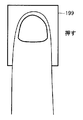
従来の指紋画像の入力方式は、指紋センサの画像読取のためのエリア199に対する指の置き方により基本的にエリアセンシング方式(図21(A)と(B))とスィープセンシング方式(図22)とに大別される。ここでは、人差指の腹側の先の部分がエリア199に置かれている状態が示される。
The conventional fingerprint image input method is basically an area sensing method (FIGS. 21A and 21B) and a sweep sensing method (FIG. 22) depending on how a finger is placed on an
スィープセンシング方式(以下、スィープ方式という場合がある)として、たとえば特許文献3に開示の方式がある。エリアセンシング方式(以下、エリア方式という場合がある)としては特許文献4に開示の方法がある。エリアセンシング方式は、一度にエリア199の全面でセンシングされた指紋情報(画像)を入力するものであり、スィープセンシング方式は、エリア199面上で指を動かしながら指紋をセンシングする方式である。図21(A)ではエリア199面において指を上下方向に動かしており、図21(B)では左右方向に動かしている。指を上→下に動かすと指紋の上側部分の画像が読取られて、下→上では指紋の下側部分の画像が読取られる。また、ユーザの右→左に動かすと指紋の左側部分の画像が読取られて、右→左では指紋の右側部分の画像が読取られる。したがって、指の動かし方で読取られる指紋の画像データは異なることになる。
携帯電話などの小型の機器は、文字入力のための使用可能な機能が制限されているために、当該機器の他の既存機能を用いた文字、記号の入力が望まれていた。既存機能としては、セキュリティ目的の指紋読取り機能がある。 Since a small device such as a cellular phone has limited functions that can be used for character input, it has been desired to input characters and symbols using other existing functions of the device. As an existing function, there is a fingerprint reading function for security purposes.
それゆえに、この発明の目的は、対象物から読取った画像の照合結果を用いて、文字、記号などの各種の情報の入力を容易化することのできる情報生成装置、情報生成方法、情報生成プログラムおよび機械読取り可能な記録媒体を提供することである。 Therefore, an object of the present invention is to provide an information generation apparatus, an information generation method, and an information generation program capable of facilitating the input of various information such as characters and symbols using an image collation result read from an object. And providing a machine-readable recording medium.
この発明のある局面に従う情報生成装置は、センサを含み、当該センサを介して対象物の画像データを入力する画像入力手段と、画像入力手段により入力した画像データと照合を行うための参照画像データを格納する参照画像格納手段と、センサと当該センサで画像が読取られる対象物との相対位置関係を固定とした態様で画像入力手段により入力された画像データと、参照画像格納手段から読出した参照画像データとを照合する固定画像照合手段と、相対位置関係が変化する態様で画像入力手段により入力された画像データと、参照画像格納手段から読出した参照画像データとを照合する変化画像照合手段と、入力画像データに基づき、固定画像照合手段および変化画像照合手段のいずれを用いて照合するかを判定する判定手段と、判定手段により判定された結果を示す判定データに従い、固定画像照合手段および変化画像照合手段のいずれかを選択する選択手段と、判定データ、ならびに選択手段により選択された固定画像照合手段および変化画像照合手段のいずれかの画像照合の結果を示す照合結果データに基づき、情報を生成する生成手段と、を備える。 An information generation apparatus according to an aspect of the present invention includes a sensor, image input means for inputting image data of an object via the sensor, and reference image data for collating with image data input by the image input means. Image data input by the image input means in a manner in which the relative positional relationship between the sensor and the object whose image is read by the sensor is fixed, and the reference read from the reference image storage means A fixed image collating unit that collates image data, a change image collating unit that collates image data input by the image input unit in a manner in which the relative positional relationship changes, and reference image data read from the reference image storage unit Determining means for determining whether to use the fixed image matching means or the change image matching means based on the input image data; According to the determination data indicating the result of the determination, the selection means for selecting either the fixed image matching means or the change image matching means, the determination data, and the fixed image matching means and the change image matching means selected by the selection means. Generating means for generating information based on matching result data indicating any image matching result.
上述の情報生成装置によれば、センサと対象物との相対位置関係が固定であるか変化するかに従い、対象物の入力画像データを固定画像照合手段および変化画像照合手段のいずれで照合するかの判定結果を示すデータと、その判定結果に従い、選択手段により選択された固定画像照合手段および変化画像照合手段のいずれかによる入力画像データと参照画像データとの照合の結果を示すデータとに基づき、情報が生成される。 According to the information generation apparatus described above, whether the input image data of the object is collated by the fixed image collating unit or the change image collating unit according to whether the relative positional relationship between the sensor and the object is fixed or changes. Based on the data indicating the result of the determination and the data indicating the result of the comparison between the input image data and the reference image data by either the fixed image matching unit or the change image matching unit selected by the selection unit according to the determination result. , Information is generated.
したがって、情報生成装置では、画像データ入力時の対象物とセンサとの相対位置関係が固定/変化の別、および画像照合の結果を用いるだけで、簡単に情報を生成することができる。 Therefore, in the information generation apparatus, information can be easily generated simply by using whether the relative positional relationship between the object and the sensor at the time of image data input is fixed / changed and the result of image collation.
好ましくは、情報生成手段は、判定データ、ならびに照合結果データを対応する情報に変換する。したがって、変換により情報を生成することができる。 Preferably, the information generating unit converts the determination data and the matching result data into corresponding information. Therefore, information can be generated by conversion.
好ましくは、判定データと照合結果データとに関連付けて情報が複数個格納されたテーブルをさらに備えて、情報生成手段は、判定データと照合結果データに基づき、テーブルを検索して、複数個の情報のうちから当該判定データと当該照合結果データに関連付けられた情報を読出す。したがって、テーブルを検索して情報を読出すことで、情報を生成することができる。 Preferably, the apparatus further includes a table in which a plurality of pieces of information are stored in association with the determination data and the collation result data, and the information generation unit searches the table based on the determination data and the collation result data to obtain a plurality of pieces of information. The information associated with the determination data and the collation result data is read out. Therefore, information can be generated by searching the table and reading the information.
好ましくは、画像入力手段は、センサと対象物との相対位置関係を固定した態様と、センサと対象物との相対位置関係を変化させる態様とのいずれの態様でも対象物の画像データをセンサを介して入力することが可能である。したがって、1つのセンサをいずれの態様にも共用できるから、態様毎にセンサを設ける必要はなく、装置の小型化とコスト低減が可能となる。 Preferably, the image input means uses the image data of the object as the sensor in any of the aspect in which the relative positional relationship between the sensor and the object is fixed and the aspect in which the relative positional relationship between the sensor and the object is changed. It is possible to input via. Accordingly, since one sensor can be shared by any aspect, it is not necessary to provide a sensor for each aspect, and the apparatus can be reduced in size and cost.
好ましくは、判定手段は、画像入力手段により対象物の画像データを入力するときのセンサと対象物との相対位置関係の時間経過に従う変化に基づき、入力画像データを固定画像照合手段および変化画像照合手段のいずれを用いて照合するかを判定する。 Preferably, the determination unit converts the input image data into the fixed image collating unit and the change image collation based on a change in the relative positional relationship between the sensor and the object when the image data of the object is input by the image input unit. It is determined which of the means is used for collation.
好ましくは、画像入力手段は、時間経過に従い複数個の前記画像データを入力し、判定手段は、画像入力手段により入力された複数個の画像データに基づき、対象物の画像データを入力するときのセンサと対象物との相対位置関係の時間経過に従う変化を検出する。 Preferably, the image input means inputs a plurality of the image data as time elapses, and the determination means is configured to input the image data of the object based on the plurality of image data input by the image input means. A change in the relative positional relationship between the sensor and the object according to the passage of time is detected.
したがって、入力画像データを固定画像照合手段および変化画像照合手段のいずれを用いて照合するかを、対象物の画像データを入力するときのセンサと対象物との相対位置関係の時間経過に従う変化に基づき判定することができる。 Therefore, whether the input image data is collated using the fixed image collating unit or the change image collating unit is changed according to the time course of the relative positional relationship between the sensor and the object when inputting the image data of the object. It can be determined based on.
好ましくは、選択手段は、判定データに従い、固定画像照合手段および変化画像照合手段のいずれかを選択的に能動化する。したがって、両方の照合手段を能動化する必要はないから、照合処理に係る負荷を低くできる。 Preferably, the selection unit selectively activates either the fixed image matching unit or the change image matching unit according to the determination data. Therefore, since it is not necessary to activate both collation means, the load related to collation processing can be reduced.
好ましくは、判定手段は、画像入力手段による画像データの入力が開始してから一定時間経過後において判定する。 Preferably, the determination unit determines after a predetermined time has elapsed since the input of image data by the image input unit started.
したがって、判定手段の判定は、画像入力手段による画像データの入力が開始してから一定時間経過後において行われるから、安定して画像データが入力されたころに判定ができて、照合精度が低下するのを回避できる。 Therefore, since the determination by the determination unit is performed after a certain time has elapsed since the input of the image data by the image input unit has started, the determination can be made when the image data is stably input, and the collation accuracy is reduced. Can be avoided.
好ましくは、判定手段は、画像入力手段による画像データの入力が開始してから一定時間経過後において、入力画像データにより示される相対位置関係の変化量が所定値を超えたときには変化画像照合手段を用いて照合すると判定し、超えないときには固定画像照合手段を用いて照合すると判定する。 Preferably, the determination unit includes a change image collating unit when the amount of change in the relative positional relationship indicated by the input image data exceeds a predetermined value after a lapse of a certain time from the start of image data input by the image input unit. If it does not exceed, it is determined to collate using the fixed image collating means.
したがって、対象物をセンサ上ですべらせて画像データを入力する態様である、すなわち相対的位置関係の変化量が所定値に達したときには変化画像照合手段で照合でき、対象物をセンサ上ですべらせずに画像入力する態様である、すなわち画像が入力されておらず、かつ相対位置関係の変化量が所定値に達しないときには固定画像照合手段で照合できる。 Therefore, the object is slid on the sensor and the image data is input. That is, when the amount of change in the relative positional relationship reaches a predetermined value, the change image collating means can collate, and the object is slid on the sensor. When the image is not input, that is, when the image is not input and the change amount of the relative positional relationship does not reach the predetermined value, the fixed image verification means can perform verification.
好ましくは、判定手段は、画像入力手段により画像データの入力が終了したか否かを判定する入力判定手段を含み、入力判定手段により画像データの入力が終了していないと判定されて、かつ相対位置関係の変化量が所定値を超えたときには、画像入力手段により入力した画像データを変化画像照合手段で照合すると判定し、入力判定手段により画像データの入力が終了していると判定されて、かつ相対位置関係の変化量が所定値に達していないときには、固定画像照合手段で照合すると判定する。 Preferably, the determination unit includes an input determination unit that determines whether or not the input of the image data has been completed by the image input unit, and the input determination unit determines that the input of the image data has not been completed, and the relative When the change amount of the positional relationship exceeds a predetermined value, it is determined that the image data input by the image input unit is verified by the change image verification unit, and the input determination unit determines that the input of the image data is finished, When the amount of change in the relative positional relationship does not reach the predetermined value, it is determined that the fixed image collating means collates.
したがって、判定手段は対象物がセンサから離れて画像データの入力が完了した時点で判定を開始する。それゆえに、別の対象物の入力画像による外乱が照合処理に混入するのを防止できる。 Therefore, the determination unit starts the determination when the object is separated from the sensor and the input of the image data is completed. Therefore, it is possible to prevent disturbance due to the input image of another object from being mixed in the collation process.
好ましくは、対象物は指紋であり、照合結果データは、指紋が右手および左手のうちのいずれの指の指紋であるかを示すデータを含む。 Preferably, the object is a fingerprint, and the matching result data includes data indicating which fingerprint of the right hand or the left hand is the fingerprint.
したがって、ユーザはセンサを介して画像が読取られる指紋を、ユーザの右手または左手のいずれの指紋とするかで、情報生成手段で生成される情報の種類を決定することができる。 Therefore, the user can determine the type of information generated by the information generating means based on whether the fingerprint of which the image is read through the sensor is the right hand or left hand of the user.
好ましくは、対象物は指紋であり、照合結果データは、指紋が親指、人差指、中指、薬指および小指のいずれの指の指紋であるかを示すデータを含む。 Preferably, the object is a fingerprint, and the verification result data includes data indicating whether the fingerprint is a thumb, an index finger, a middle finger, a ring finger, or a little finger.
したがって、ユーザはセンサを介して画像が読取られる指紋を、ユーザの親指、人差指、中指、薬指および小指のいずれの指の指紋とするかで、情報生成手段で生成される情報の種類を決定することができる。 Therefore, the user determines the type of information generated by the information generation means depending on which fingerprint of the user's thumb, index finger, middle finger, ring finger, and little finger is used as the fingerprint whose image is read through the sensor. be able to.
上述の対象物となるべき指紋は、手の指の指紋に限定されず、足の指の指紋であってもよい。 The fingerprint to be the object is not limited to the fingerprint of the finger of the hand, but may be the fingerprint of the toe.
好ましくは、変化画像照合手段を用いた場合の照合結果データは、相対位置関係の変化が示すセンサに対する対象物の位置が移動する方向を示すデータを含む。 Preferably, the collation result data when the change image collating unit is used includes data indicating a direction in which the position of the object moves with respect to the sensor indicated by the change in the relative positional relationship.
したがって、ユーザはセンサを介して画像が読取られるべき対象物を、たとえば指紋を、センサに対する指紋の位置が移動する方向を変更することで、情報生成手段で生成される情報の種類を変えることができる。 Therefore, the user can change the type of information generated by the information generating means by changing the direction in which the position of the fingerprint relative to the sensor moves, for example, the fingerprint of the object whose image is to be read through the sensor. it can.
好ましくは、情報生成手段は、文書を作成するための情報を生成する。したがって、情報生成装置では、画像データ入力時の対象物とセンサとの相対位置関係が固定/変化の別、および画像照合の結果を用いるだけで、簡単に文書を作成するための情報を生成することができる。 Preferably, the information generation unit generates information for creating a document. Therefore, in the information generation apparatus, information for easily creating a document is generated simply by using whether the relative positional relationship between the object and the sensor at the time of image data input is fixed / changed and the result of image collation. be able to.
この発明の他の局面に従う情報生成方法は、予め準備されたセンサを介して対象物の画像データを入力する画像入力ステップと、センサと当該センサで画像が読取られる対象物との相対位置関係を固定とした態様で画像入力ステップにより入力された画像データと、予め準備された参照画像格納部から読出した参照画像データとを照合する固定画像照合ステップと、相対位置関係が変化する態様で画像入力ステップにより入力された画像データと、参照画像格納部から読出した参照画像データとを照合する変化画像照合ステップと、入力画像データに基づき、固定画像照合ステップおよび変化画像照合ステップのいずれを用いて照合するかを判定する判定ステップと、判定ステップにより判定された結果を示す判定データに従い、固定画像照合ステップおよび変化画像照合ステップのいずれかを選択する選択ステップと、判定データ、ならびに選択ステップにより選択された固定画像照合ステップおよび変化画像照合ステップのいずれかの画像照合の結果を示す照合結果データに基づき、情報を生成する情報生成ステップと、を備える。 An information generation method according to another aspect of the present invention includes an image input step of inputting image data of an object via a sensor prepared in advance, and a relative positional relationship between the sensor and an object whose image is read by the sensor. A fixed image collation step for collating image data input by the image input step in a fixed mode with reference image data read from a reference image storage unit prepared in advance, and image input in a mode in which the relative positional relationship changes Using either the change image collation step for collating the image data input in the step with the reference image data read from the reference image storage unit, or using the fixed image collation step or the change image collation step based on the input image data In accordance with a determination step for determining whether to perform the determination and a determination data indicating the result determined in the determination step, A selection step for selecting one of the step and the change image collation step, the determination data, and collation result data indicating a result of image collation of either the fixed image collation step or the change image collation step selected by the selection step And an information generation step for generating information.
この発明のさらに他の局面に従う情報生成プログラムは、上述の情報生成方法をコンピュータに実行させるためのプログラムである。 An information generation program according to still another aspect of the present invention is a program for causing a computer to execute the above information generation method.
この発明のさらに他の局面に従う記録媒体は、上述の情報生成プログラムを記録したコンピュータなどの機械で読取り可能な記録媒体である。 A recording medium according to still another aspect of the present invention is a recording medium readable by a machine such as a computer on which the information generation program is recorded.
本発明によれば、画像データ入力時の対象物とセンサとの相対位置関係が固定であるか/変化するかの別、および入力画像データによる画像照合の結果を用いるだけで、簡単に情報を生成することができる。 According to the present invention, information can be obtained simply by using whether the relative positional relationship between the object and the sensor at the time of image data input is fixed or changing, and using the result of image collation based on the input image data. Can be generated.
特に、情報の入力機能が十分でない、たとえば携帯電話を含むモバイル機器などにおいて、上述のセンサを介し入力した対象物の画像データを用いた情報生成機能を搭載することで、情報入力に関する利便性が増す。 In particular, in a mobile device including an information input function that is not sufficient, for example, a mobile device including a mobile phone, the information generation function using the image data of the object input through the sensor described above is installed, so that convenience regarding information input can be achieved. Increase.
特に、対象物を指紋として、センサを指紋画像読取りセンサとした場合には、モバイル機器の既存の指紋画像読取りセンサを用いることが可能となり、機器の構成の大型化を伴わずに、情報生成機能を搭載することが可能となる。 In particular, when the object is a fingerprint and the sensor is a fingerprint image reading sensor, it is possible to use an existing fingerprint image reading sensor of a mobile device, and an information generation function without increasing the size of the device. Can be installed.
以下、本発明の各実施の形態について図面を参照しながら説明する。
各実施の形態に係る画像照合機能によれば、指紋センサは、従来のスィープ型センサと同等または類似のものを適用して、同一の指紋センサを用いてスィープセンシング方式とエリアセンシング方式とを使い分けている。それゆえに、従来のスィープ型センサとエリア型センサとを用いる場合に比較してコストを抑えながら、両方のセンシング方式の実施を可能にしている。ここでは、照合の対象となる画像データとしてセンシングして指紋から読取った画像データを例示しているが、これに限定されず、個体(個人)毎に似ているが一致することはない生体の他の特徴による画像データであってもよい。生体の他の特徴とは、静脈、虹彩などである。
Hereinafter, embodiments of the present invention will be described with reference to the drawings.
According to the image matching function according to each embodiment, the fingerprint sensor is the same as or similar to the conventional sweep type sensor, and uses the same fingerprint sensor for the sweep sensing method and the area sensing method. ing. Therefore, it is possible to implement both sensing methods while suppressing the cost as compared with the case where the conventional sweep type sensor and area type sensor are used. Here, the image data sensed and read from the fingerprint is illustrated as the image data to be collated. However, the present invention is not limited to this, and it is similar to each individual (individual) but does not match. It may be image data based on other characteristics. Other features of the living body are veins, irises and the like.
図1(A)と(B)は各実施の形態に適用される画像照合機能を有する情報生成装置1のブロック構成図である。図1(A)と(B)の各部の対応関係は、以下のようである。つまり、画像入力機能部001は画像入力部101に、参照画像保持(格納)機能部002は登録データ記憶部202に、情報保持(格納)機能部003はメモリ102に、照合判定機能部004は指紋入力および照合方式判定部1042に、静止画像照合機能部005は最大一致位置探索部105、移動ベクトルに基づく類似度計算部106および照合判定部107に、変化画像照合機能部006はスナップショット画像間相対的位置関係計算部1045、最大一致位置探索部105、移動ベクトルに基づく類似度計算部106および照合判定部107に、それぞれ対応する。記号生成機能部007は記号生成部108に対応する。制御部008は制御部109に対応する。さらに、図1(A)のメモリ102と制御部109は、図1(B)の各機能部の全般にかかる記憶領域や制御の機能を持つ。
1A and 1B are block configuration diagrams of an
[実施の形態1]
図2は各実施の形態に係る画像照合機能を有する情報生成装置1が搭載されるコンピュータの構成図である。図2を参照してコンピュータは、画像入力部101、CRT(陰極線管)や液晶などからなるディスプレイ610、該コンピュータ自体を集中的に管理し制御するためのCPU(中央処理装置の略)622、ROM(Read Only Memory)またはRAM(ランダムアクセスメモリの略)を含んで構成されるメモリ624、固定ディスク626、FD(フレキシブルディスク)632が着脱自在に装着されて、装着されたFD632をアクセスするFD駆動装置630、CD−ROM(Compact Disc Read Only Memory)642が着脱自在に装着されて、装着されたCD−ROM642をアクセスするCD−ROM駆動装置640、通信ネットワーク300と、該コンピュータとを通信接続するための通信インターフェィス680、プリンタ690およびキーボード650およびマウス660を有する入力部700を含む。これらの各部はバスを介して通信接続される。
[Embodiment 1]
FIG. 2 is a configuration diagram of a computer on which the
コンピュータには、カセット形式の磁気テープが着脱自在に装着されて磁気テープをアクセスする磁気テープ装置が設けられてもよい。 The computer may be provided with a magnetic tape device in which a cassette type magnetic tape is detachably mounted to access the magnetic tape.
当該コンピュータが後述の携帯情報端末2である場合には、プリンタ690およびマウス660は搭載されないであろう。また、FD駆動装置630およびCD−ROM駆動装置640に代替してメモリカードのアクセス機構が設けられるであろう。また、携帯情報端末2が携帯電話である場合には、無線通信部を有するであろう。
When the computer is a
図1(A)を参照して情報生成装置1は、画像入力部101、図2のメモリ624または固定ディスク626に対応のメモリ102、登録データ記憶部202、登録データ読出部207、照合処理部11、記号生成部108、これらの各部を制御する制御部109およびこれらを相互に通信可能に接続するバス103を備える。照合処理部11は画像補正部104、指紋入力および照合方式判定部1042、スナップショット画像間相対的位置関係計算部1045、最大一致度位置探索部105、移動ベクトルに基づく類似度計算部(以下、類似度計算部と呼ぶ)106および照合判定部107を含む。照合処理部11の各部は対応のプログラムが実行されることによりその機能が実現される。メモリ102には、後述のテーブル110、照合方式データ111および種別データ112が格納されるとともに、バッファ113を有する。バッファ113には記号データ112が格納される。また、登録データ記憶部202には照合判定部107により参照される後述のテーブル200と201が予め格納される。
Referring to FIG. 1A, the
画像入力部101は指紋センサ100を含み、該指紋センサ100により読込まれた指紋に対応の指紋画像データを入力する。指紋センサ100は画像読取り面である前述したエリア199を有する。指紋センサ100には光学式、圧力式および静電容量方式のいずれを適用してもよい。
The
この画像入力部101の指紋センサ100は、スィープ方式でセンシングされた指紋データとエリア方式でセンシングされた指紋データとの両方を読取ることができる。画像入力部101の指紋センサ100が1回のセンシング毎に、すなわちスナップショットのようにセンシングの対象物である指紋を読取る毎に入力される画像データをスナップショット画像データという。指紋センサ100は対象物がエリア199に置かれている間は定期的に読取を行ない、その都度、画像入力部101により画像データが入力されると想定する。
The
図3(A)と(B)には、図1(A)と(B)の情報生成装置1が搭載された携帯情報端末の一例である携帯電話2が模式的に示される。携帯電話2は通信インターフェース680のためのアンテナ681を備え、また操作面には、ディスプレイ610とキーボード650と指紋センサ100の指紋読取り面であるエリア199を備える。したがって、携帯電話2ではキーボード650を介した文字・記号などの情報の入力機能と指紋センサ100を介した当該情報の入力機能とを有する。したがって、電子メールなど文書作成時には、キーボード650を介した文字入力と、指紋センサ100を介した文字入力とが可能となる。
FIGS. 3A and 3B schematically show a
スィープ方式でセンシングする場合は、図3(A)で示すように、細長い指紋読取り面のエリア199に対して指紋面が平行になるような相対的な位置関係で指を置きながら、エリア199上で矢印で示すように指を右から左(あるいは左から右)に動かして(相対的位置関係を変化させて)、指紋データを読込む。
In the case of sensing by the sweep method, as shown in FIG. 3A, while placing a finger in a relative positional relationship such that the fingerprint surface is parallel to the
それに対して、エリア方式でセンシングする場合は、図3(B)で示すように、エリア199に対して指紋面が平行になるような相対的な位置関係で指を置き、かつ位置関係を変化させない(相対的な位置関係を固定とする)、すなわちエリア199上で指を動かさない(静止させる)ようにして指紋データを読込む。
On the other hand, when sensing by the area method, as shown in FIG. 3B, the finger is placed in a relative positional relationship such that the fingerprint surface is parallel to the
このときのエリア199のサイズは、エリア方式でセンシングできる必要最低限のサイズが必要となる。たとえば、横幅は、読取り対象となる指紋面の1.5倍程度(256画素)、縦幅は指の0.25倍程度(64画素)である。なお、エリア199のサイズを決定するためにセンシングの候補となる一般的な指の指紋面のサイズは予め計測により求めておくと想定する。
The size of the
本発明では、縦幅は指の指紋面の0.25倍程度のサイズのエリア199を有する指紋センサ100を用いると想定するため、エリア方式でセンシングする場合は、スィープ方式でセンシングする場合に比べて、処理時間が短い。また、スィープ方式でセンシングする場合は、処理時間が長くなるが、照合の精度は高い。
In the present invention, it is assumed that the
メモリ102にはテーブル110の他に、画像データや各種の計算結果などが格納される。バス103は各部間の制御信号やデータ信号を転送するために用いられる。画像補正部104は画像入力部101から入力された指紋画像データについての濃淡補正を行なう。最大一致度位置探索部105は一方の指紋画像内に設定されたの複数の部分領域をテンプレートとし、該テンプレートと他方の指紋画像内で最も一致度の高い位置を探索する、いわゆるテンプレートマッチング部のようなものである。類似度計算部106はメモリ102に格納された最大一致度位置探索部105の探索結果情報を用いて、後述の移動ベクトルに基づく類似度を計算する。照合判定部107は類似度計算部106が算出した類似度により一致・不一致を判定する。記号生成部108は、指紋入力および照合方式判定部1042により判定された方式と照合判定部107による照合結果とに基づき、テーブル110を検索して該当する情報を読出す。読出された情報は、バッファ133に記号データ114として格納されて、バッファ133を介してCPU622の制御の元に図2のコンピュータまたは図3(A)と(B)の携帯電話2に搭載された文書編集機能(文書編集プログラム)に渡されて、文書または文字列作成のための文字入力に利用される。携帯電話2であれば、文書編集機能は電子メール本文の編集機能などが挙げられる。
In addition to the table 110, the
画像照合処理においては、登録データ記憶部202のテーブル200と201からは登録データ読出部207により画像データが読出されて、読出された画像データは入力画像データと照合される参照画像データとして用いられる。
In the image collation process, image data is read from the tables 200 and 201 of the registration
ここで情報生成のための参照画像を登録したテーブル200と201について説明する。 Here, the tables 200 and 201 in which reference images for information generation are registered will be described.
図4(A)と(B)には、スィープ方式のための参照画像データBl(l=11,12,13…,30)が登録されたテーブル200と、エリア方式のための参照画像データBh(h=1,2,3…,10)が登録されたテーブル201とが示される。 4A and 4B show a table 200 in which reference image data Bl (l = 11, 12, 13,..., 30) for the sweep method is registered, and reference image data Bh for the area method. The table 201 in which (h = 1, 2, 3,..., 10) is registered is shown.
図4(A)のテーブル200には、指紋センサ100によりスィープ方式に従い読取られたユーザの指紋の画像データBlと、画像データBlのそれぞれに対応付けて種別データUj(j=1,2,3…,20)が予め格納される。画像データBlは、ユーザの右手または左手の親指、人差指、中指、薬指および小指のそれぞれの指先の腹を、エリア199に載せてユーザの右手側から左手側へ(図中‘←’で示す)または左手側から右手側へ(図中‘→’で示す)へ動かした(スィープさせた)場合に読取られる指紋画像データを示す。種別データUjは、対応の画像データBlについて、当該画像データの指紋を読取る時の態様、および当該指紋(読取り対象)の別を示す。具体的には種別データUjはデータUa、UbおよびUcからなる。データUaは、態様として指紋読取り時の指を動かした方向(‘→’または‘←’)を示す。データUbは、当該指紋は右手および左手のいずれであるかを示す。データUcは、当該指紋は親指〜小指の5指のうちのいずれであるかを示す。
In the table 200 of FIG. 4A, type data Uj (j = 1, 2, 3) associated with each of the user fingerprint image data Bl read by the
図4(B)のテーブル201には、指紋センサ100によりエリア方式に従い読取られたユーザの指紋の画像データBhと、画像データBhのそれぞれに対応付けて種別データTi(i=1,2,3…,10)が予め格納される。画像データBhは、ユーザの右手または左手の親指、人差指、中指、薬指および小指のそれぞれの指先の腹を、エリア199に載せたままで動かさずに読取られる指紋画像データを示す。種別データTiは、対応の画像データBhについて、対応の指紋(読取り対象)の別を示す。具体的には種別データTiはデータTdとTeからなる。データTdは、当該指紋は右手および左手のいずれであるかを示す。データTeは、当該指紋は親指〜小指の5指のうちのいずれであるかを示す。
In the table 201 of FIG. 4B, type data Ti (i = 1, 2, 3) associated with each of the fingerprint image data Bh of the user read by the
テーブル200と201のデータの登録手順について説明する。当該登録手順は図2のコンピュータおよび図3(A)と(B)の携帯電話2で同様である。まず、ユーザは、キーボード650を操作してコンピュータまたは携帯電話2を参照画像データのスィープ方式の登録モードおよびエリア方式の登録モードのいずれかに設定するので、コンピュータまたは携帯電話2の動作モードは設定された方式の登録モードに移行する。
A procedure for registering data in the tables 200 and 201 will be described. The registration procedure is the same for the computer of FIG. 2 and the
スィープ方式の登録モードにおいては、ユーザは右手または左手のいずれかの指先をエリア199に載せてスィープ方式で指紋センサ100に指紋を読取らせる。当該モードでは、ユーザは読取り態様(指を動かした方向)および読取り対象(右手または左手の別および親指〜小指の別)を示すデータをキーボード650を操作して入力する。CPU622は、指紋センサ100により読取られて出力された指紋の画像データを画像データBlとして、またキーボード650から入力されたデータを種別データUjとして、両データを登録データ記憶部202のテーブル200のために予め確保された記憶エリアに対応付けて格納する。
In the sweep method registration mode, the user places the fingertip of either the right hand or the left hand on the
このような手順に従い、右手および左手の全ての指の指紋をスィープ方式で読取り、画像データBlを入力して、入力した画像データBlのそれぞれと、当該画像データBlのためにキーボード650から入力された種別データUjとを対応付けてテーブル200のために予め確保された記憶エリアに格納する。これにより、テーブル200が生成される。
According to such a procedure, the fingerprints of all fingers of the right hand and the left hand are read in a sweep method, and the image data Bl is input, and each of the input image data Bl and the input for the image data Bl are input from the
エリア方式の登録モードにおいては、ユーザは右手または左手のいずれかの指先をエリア199に載せてエリア方式で指紋センサ100に指紋を読取らせる。当該モードでは、、ユーザは読取り対象(右手または左手の別および親指〜小指の別)を示すデータをキーボード650を操作して入力する。CPU622は、指紋センサ100から出力された指紋の画像データを画像データBhとして、またキーボード650から入力されたデータを種別データTiとして、両データを登録データ記憶部202のテーブル201のために予め確保された記憶エリアに対応付けて格納する。
In the area method registration mode, the user places the fingertip of either the right hand or the left hand on the
このような手順に従い、右手および左手の全ての指の指紋をエリア方式で読取り、画像データBhを入力して、入力した画像データBhのそれぞれと、当該画像データBhのためにキーボード650から入力された種別データTiとを対応付けてテーブル201のために予め確保された記憶エリアに格納する。これにより、テーブル201が生成される。
According to such a procedure, fingerprints of all fingers of the right hand and the left hand are read in an area system, and image data Bh is input. Each of the input image data Bh and the input for the image data Bh are input from the
なお、テーブル200と201に格納される画像データBlとBhは、後述する図6のステップT1〜T5の手順に従い入力される。 The image data Bl and Bh stored in the tables 200 and 201 are input in accordance with the procedure of steps T1 to T5 in FIG.
次に、図5を参照して、テーブル110について説明する。本実施の形態では、たとえば電子メール編集のための‘かな’文字の入力には、『50音表』に従い入力される。本実施の形態においては、エリア方式とスイープ方式とを組合わせてかな入力を行う。テーブル110は、『50音表』に従う入力の際に参照されるものである。 Next, the table 110 will be described with reference to FIG. In the present embodiment, for example, the input of “kana” characters for e-mail editing is performed according to the “50-sound table”. In the present embodiment, kana input is performed by combining the area method and the sweep method. The table 110 is referred to when inputting in accordance with the “50-note table”.
『50音表』は、行方向にあ行、か行、さ行、…、わ行の10個の行が配置されて、列方向に各行について5つの音が配置される。‘かな’の1文字の音は、母音(‘A’、‘I’、‘U’、‘E’、‘O’)のみ、または子音(‘K’、‘S’、‘T’、‘N’、‘H’、‘M’、‘Y’、‘R’、‘W’)と母音の組合わせにより表記される。『50音』のあ行、か行、さ行、…、わ行のうち、たとえば、あ行の全ての‘かな’の音は母音のみから表記されるが、他の行の‘かな’の音は子音と母音との組合わせで表記される。 In the “50-note table”, 10 rows of rows, ka, sa,..., And w are arranged in the row direction, and five sounds are arranged for each row in the column direction. The sound of one letter of “Kana” is only vowels (“A”, “I”, “U”, “E”, “O”) or consonants (“K”, “S”, “T”, “ N ',' H ',' M ',' Y ',' R ',' W ') and vowels. Of the “50 sounds” line, line, line, ..., line, for example, all “Kana” sounds in that line are written only from vowels, but “Kana” in other lines. Sounds are expressed as a combination of consonants and vowels.
テーブル110は上述のような『50音表』の行と列に対応の項目‘行’と項目‘列’、およびテーブル200と201に登録された種別データTiとUjの組合わせを示す項目‘Ti,Uj’の3種の項目を関連付けして有する。項目‘Ti,Uj’の要素として、テーブル200と210の種別データTiとUjのデータUa、Ub、Uc、TdおよびTeの値の組が予め登録される。項目‘行’の要素として、あ行、か行、さ行、…、わ行のそれぞれの行について、当該行の‘かな’の音を表記するために共通して用いられる子音(‘K’、‘S’、‘T’、‘N’、‘H’、‘M’、‘Y’、‘R’、‘W’)が予め登録される。なお、あ行の5個の‘かな’の音については、母音のみで表記されるので、ここでは便宜的に‘A’を要素として登録する。項目‘列’の要素として、各行の‘かな’の音を表記するための母音(‘A’、‘I’、‘U’、‘E’、‘O’)が予め登録される。したがって、テーブル110では、『50音表』の‘かな’は、項目‘行’のいずれかの要素(子音)と項目‘列’のいずれかの要素(母音)との組合せで指示される。そして、当該組合せを指定するために、項目‘Ti,Uj’の要素の値が用いられる。 The table 110 is an item “row” and item “column” corresponding to the row and column of the “50 note table” as described above, and an item “a combination indicating type data Ti and Uj registered in the tables 200 and 201”. Three items of Ti and Uj ′ are associated with each other. As elements of the item 'Ti, Uj', a set of values of type data Ti and Uj data Ua, Ub, Uc, Td and Te of the tables 200 and 210 is registered in advance. As an element of the item 'line', a consonant ('K') that is commonly used to indicate the sound of 'kana' of the line for each line of line A, line K, line, ..., line W , 'S', 'T', 'N', 'H', 'M', 'Y', 'R', 'W') are registered in advance. Note that the five “kana” sounds in that row are represented by vowels only, so “A” is registered as an element here for convenience. As elements of the item ‘column’, vowels (‘A’, ‘I’, ‘U’, ‘E’, ‘O’) for representing the sound of ‘kana’ in each row are registered in advance. Therefore, in the table 110, “kana” in the “50 syllabary” is indicated by a combination of any element (consonant) in the item “row” and any element (vowel) in the item “column”. In order to specify the combination, the element values of the items ‘Ti, Uj’ are used.
したがって、テーブル110を、テーブル200と201から読出した種別データTiまたはUjのデータTa、Tb、Tc、UaおよびUbの値に基づき検索することで、‘かな’の音を表記する母音と子音の組(あ行のみは母音と母音の組)特定して読出すことができる。 Therefore, by searching the table 110 based on the values of the type data Ti or Uj data Ta, Tb, Tc, Ua, and Ub read from the tables 200 and 201, the vowels and consonant sounds that indicate the sound of 'kana' are recorded. It is possible to specify and read a set (only the row is a set of vowels and vowels).
具体例として、テーブル110から「あ」(あ行の1番目の‘かな’文字)を読出す場合を想定する。この場合は、検索に用いる項目‘Ti,Uj’のデータUaが‘右’を、データUbが‘親’を、データUcが‘→’をそれぞれ示し、データTdが‘右’を、データTeが‘親’をそれぞれ示す場合である。すなわち、ユーザがスイープ方式で右手の親指を左から右へ移動させて指紋画像を入力し、続いてエリア方式で右手の親指(指先中央部の指紋)の画像を入力した場合である。このように、本実施の形態では、ユーザは指紋センサ100を用いた50音に従う‘かな’の入力時には、まずスィープ方式で指紋の画像データを入力し、続いてエリア方式で指紋の画像データを入力すると想定する。
As a specific example, it is assumed that “a” (the first “kana” character in the line) is read from the table 110. In this case, the data Ua of the item “Ti, Uj” used for the search indicates “right”, the data Ub indicates “parent”, the data Uc indicates “→”, the data Td indicates “right”, and the data Te Indicates 'parent' respectively. That is, the user moves the thumb of the right hand from left to right using the sweep method to input a fingerprint image, and then inputs the image of the thumb of the right hand (fingerprint central fingerprint) using the area method. As described above, in this embodiment, when inputting “kana” according to 50 sounds using the
本実施の形態では、テーブル110の項目‘行’と‘列’の要素には、値として50音のための母音と子音が登録されるとしたが、これに限定されない。たとえば、『50音表』を行(Xa)と列(Yb)の2次元配列と見なして、行(Xa)の値と列(Yb)の値が登録されてもよい。つまり、2次元配列の‘行’はXa=1,2,3,4,5…、10の値域を有し、‘列’はYb=1,2,3,4,5の値域を有する。これにより、当該配列の各要素(Xa,Yb)の値は50音表の各かなに1対1で対応する。したがって、テーブル110を種別データTiおよびUjに基づき検索して対応する配列要素(Xa,Yb)の値を読出すことで、読出した配列要素(Xa,Yb)の値に対応する‘かな’を『50音表』から一意に特定することができる。特定した当該‘かな’を文字入力のために用いることができる。 In this embodiment, vowels and consonants for 50 tones are registered as values in the elements “row” and “column” of the table 110, but the present invention is not limited to this. For example, the value of the row (Xa) and the value of the column (Yb) may be registered by regarding the “50-sound table” as a two-dimensional array of rows (Xa) and columns (Yb). That is, the “row” of the two-dimensional array has a range of Xa = 1, 2, 3, 4, 5,..., And the “column” has a range of Yb = 1, 2, 3, 4, 5. As a result, the values of the elements (Xa, Yb) of the array correspond one-to-one with the kana of the 50-note table. Therefore, by searching the table 110 based on the type data Ti and Uj and reading the value of the corresponding array element (Xa, Yb), the “kana” corresponding to the read value of the array element (Xa, Yb) is obtained. It can be uniquely identified from the “50-note table”. The identified 'kana' can be used for character input.
情報生成装置1における画像照合を用いた情報の生成(入力)方法について、図6のフローチャートに従い説明する。図6のフローチャートに従うプログラムは図2のコンピュータまたは図3(A)と(B)の携帯電話2において所定のアプリケーションプログラムが起動されるときに所定メモリからCPU622により読出されて実行される。所定アプリケーションプログラムは、電子メールなどの文書編集のプログラムを想定する。なお、テーブル110はメモリ102に格納されて、またテーブル200および201は予め登録データ記憶部202に格納されていると想定する。
A method for generating (inputting) information using image matching in the
まず指が指紋センサ100の指紋読取り面のエリア199に載せられるまで待機する(ステップT1〜T4)。
First, it waits until the finger is placed on the
初めに制御部109は、画像入力部101へ画像入力開始の信号を送り、その後、画像入力終了信号を受信するまで待機する。画像入力部101は照合を行なう画像データA1を指紋センサ100から入力すると、バス103を通してメモリ102の所定アドレスへ格納する(ステップT1)。画像入力部101は、画像データA1の入力が完了した後、制御部109に画像入力終了信号を送る。
First, the
次に制御部109は画像補正部104に画像補正開始信号を送り、その後、画像補正終了信号を受信するまで待機する。多くの場合、入力画像は画像入力部101の特性や指紋自体の乾燥度合いや指を押し付ける圧力に対して各画素の濃淡値や全体の濃度分布が変化するので画質が一様ではないから、入力画像データをそのまま照合に用いることは適当でない。そこで画像補正部104は、画像入力時の条件の変動を抑制するように入力画像の画質を補正する(ステップT2)。具体的には、入力画像データに対応の画像全体もしくは画像を分割した小領域ごとに、ヒストグラムの平坦化(「コンピュータ画像処理入門」総研出版P98)や画像の二値化処理(「コンピュータ画像処理入門」総研出版P66−69)などを、メモリ102に格納された画像データA1に対して施す。
Next, the
画像補正部104は画像データA1に対する画像補正処理の終了後、制御部109に画像補正処理終了信号を送る。
The
以上の処理を、入力があるまで繰り返す(ステップT3、T4)。
ステップT3の処理を、図7に従って説明する。画像の黒画素(指紋画像の嶺線に相当)の数を、背景となる白画素も含めた全体の画素数で割り、黒画素の割合を示す値Bratioを計算する(ステップSB001)。値Bratioが、ある値MINBratioを超えていれば指が指紋読取り面のエリア199に置かれているので入力有りと判定して元の処理に‘Y’を返し、そうでなければ入力無しと判定して‘N’を返す(ステップSB002〜SB004)。
The above processing is repeated until there is an input (steps T3 and T4).
The process of step T3 will be described with reference to FIG. The number of black pixels in the image (corresponding to the fringe of the fingerprint image) is divided by the total number of pixels including white pixels as the background, and a value Bratio indicating the ratio of black pixels is calculated (step SB001). If the value Bratio exceeds a certain value MINBratio, the finger is placed in the
図6に戻り、ステップT3の処理から‘N’が返された場合にはステップT1の処理に戻り、以降の処理を繰返すが、‘Y’が返された場合は、入力して補正された画像データA1をメモリ102の特定アドレスに格納する(ステップT5)。そして、メモリ102上の所定アドレスに格納されている図6の処理を制御するための変数kと移動累積ベクトルVsumをそれぞれ初期化する(ステップT6、T7)。続いて、変数kの値に1を足す(ステップT8)。
Returning to FIG. 6, when “N” is returned from the process of
次に、ステップT1およびT2と同様に、k+1番目の画像データAk+1を入力し、画像データAk+1について補正を行なう(ステップT9、T10)。 Next, as in steps T1 and T2, the (k + 1) th image data Ak + 1 is input and the image data Ak + 1 is corrected (steps T9 and T10).
1つ前に入力したスナップショット画像の画像データAkと次に入力したスナップショット画像の画像データAk+1との相対的位置関係を示す移動ベクトルVk,k+1を計算する(ステップT11)。これを図8のフローチャートに従って説明する。 A movement vector Vk, k + 1 indicating a relative positional relationship between the image data Ak of the snapshot image input immediately before and the image data Ak + 1 of the next input snapshot image is calculated (step T11). This will be described with reference to the flowchart of FIG.
図8のフローチャートでは、まず、制御部109はスナップショット画像間相対的位置関係計算部1045へテンプレートマッチング開始信号を送り、テンプレートマッチング終了信号を受信するまで待機する。スナップショット画像間相対的位置関係計算部1045では、ステップS103からステップS108に示されるようなテンプレートマッチング処理が開始される。
In the flowchart of FIG. 8, first, the
ここでのテンプレートマッチング処理は、概略、画像データAkとAk+1間で画像データAk+1の複数の部分画像各々が画像データAkのどの部分領域の画像に最も一致するかの探索、つまり最大一致度位置を探索する処理である。たとえば、図9(A)で言えば、スナップショット画像データA2の複数の部分画像Q1、Q2、・・・の各々がスナップショット画像データA1の部分画像M1、M2、・・・の中で最も一致する部分画像の位置を探索する。以降で、その詳細を説明する。 The template matching process here is roughly a search for which partial image of the image data Ak + 1 most closely matches the image of which partial region of the image data Ak between the image data Ak and Ak + 1, that is, the maximum This is a process for searching for the coincidence position. For example, in FIG. 9A, each of the plurality of partial images Q1, Q2,... Of the snapshot image data A2 is the most among the partial images M1, M2,. Search for the position of the matching partial image. The details will be described below.
ステップS102ではカウンタの変数iを1に初期化する。ステップS103では画像データAk+1の画像上において4画素ライン分の領域を縦方向4画素×横方向4画素毎に分割した部分領域Qiとして規定される部分領域の画像を、テンプレートマッチングに用いるテンプレートとして設定する。 In step S102, the counter variable i is initialized to 1. In step S103, an image of a partial region defined as a partial region Qi obtained by dividing a region corresponding to four pixel lines on the image of the image data Ak + 1 every 4 pixels in the vertical direction and 4 pixels in the horizontal direction is used for template matching. Set as.
ここでは、部分領域Qiは計算を簡単にするために矩形状としているが、これに特定されない。ステップS104ではステップS103で設定したテンプレートに対し、画像データAkの画像内で最も一致度Ci(s,t)の高いデータの場所を探索する。具体的には、テンプレートとして用いる部分領域Qiの左上の角を基準とした座標(x,y)の画素濃度をQi(x,y)とし、画像データAkの左上の角を基準とした座標(s、t)の画素濃度をAk(s,t)とし、部分領域Qiの幅をw,高さをhとし、また、画像QiとAkの各画素の取りうる最大濃度をV0とし、画像データAkの画像における座標(s、t)での一致度Ci(s,t)を、たとえば以下の(式1)に従い各画素の濃度差を元に計算する。 Here, the partial area Qi is rectangular in order to simplify the calculation, but is not limited to this. In step S104, the location of data having the highest degree of coincidence Ci (s, t) is searched for in the image of the image data Ak with respect to the template set in step S103. Specifically, the pixel density of the coordinates (x, y) with reference to the upper left corner of the partial area Qi used as a template is defined as Qi (x, y), and the coordinates (with reference to the upper left corner of the image data Ak) ( The pixel density of s, t) is Ak (s, t), the width of the partial area Qi is w, the height is h, and the maximum density that each pixel of the images Qi and Ak can take is V0. The degree of coincidence Ci (s, t) at the coordinates (s, t) in the Ak image is calculated based on the density difference of each pixel, for example, according to the following (Equation 1).

画像データAkの画像内において座標(s、t)を順次更新して座標(s、t)における一致度C(s,t)を計算し、その中で最も大きい値を取る位置が最も一致度が高いとし、その位置での部分領域の画像を部分領域Miとし、その位置での一致度を最大一致度Cimaxとする。ステップS105ではステップS104で算出した部分領域Qiの画像データAkの画像内における最大一致度Cimaxをメモリ102の所定アドレスに記憶する。ステップS106では、移動ベクトルViを以下の(式2)に従い計算して求めて、メモリ102の所定アドレスに記憶する。ここで、上述のように、画像データAk+1の画像内に設定された位置Pに対応の部分領域Qiに基づいて、画像データAkの画像内をスキャンして部分領域Qiと最も一致度が高い位置Mの部分領域Miが特定されたとき、位置Pから位置Mへの方向ベクトルを、移動ベクトルと呼ぶ。
The coordinates (s, t) are sequentially updated in the image of the image data Ak to calculate the degree of coincidence C (s, t) at the coordinates (s, t), and the position having the largest value among them is the degree of coincidence. Is high, the image of the partial region at that position is defined as the partial region Mi, and the degree of coincidence at that position is defined as the maximum degree of coincidence Cimax. In step S105, the maximum matching degree Cimax in the image of the image data Ak of the partial area Qi calculated in step S104 is stored at a predetermined address in the
Vi=(Vix、Viy)=(Mix−Qix、Miy−Qiy)…(式2)
(式2)で、変数QixとQiyは部分領域Qiの基準位置のx座標とy座標であり、たとえば画像データAkの画像内における部分領域Qiの左上角の座標に対応する。また変数MixとMiyは部分領域Miの探索結果である最大一致度Cimaxの位置でのx座標とy座標を示し、たとえば画像データAkの画像内におけるマッチングした位置での部分領域Miの左上角の座標に対応する。
Vi = (Vix, Viy) = (Mix-Qix, Miy-Qiy) (Formula 2)
In (Expression 2), variables Qix and Qii are the x and y coordinates of the reference position of the partial area Qi, and correspond to, for example, the coordinates of the upper left corner of the partial area Qi in the image of the image data Ak. Variables Mix and Miy indicate the x and y coordinates at the position of the maximum matching degree Cimax that is the search result of the partial area Mi. For example, the upper left corner of the partial area Mi at the matched position in the image of the image data Ak. Corresponds to coordinates.
ステップS107では変数iの値が部分領域の総個数n以下を示すか否かを判定し、変数iの値が部分領域の個数n未満であれば処理をS108に移し、n以上であれば処理をS109に移す。ステップS108では変数iの値に1加える。以降、変数iの値が部分領域の個数n以下の間はステップS103からS108の処理を繰返し行い、すべての部分領域Qiに関しテンプレートマッチングを行い、それぞれの部分領域Riの最大一致度Cimaxと、移動ベクトルViとを計算していく。 In step S107, it is determined whether or not the value of the variable i indicates the total number n of partial areas or less. If the value of the variable i is less than the number n of partial areas, the process proceeds to S108. To S109. In step S108, 1 is added to the value of the variable i. Thereafter, while the value of the variable i is less than or equal to the number n of partial areas, the processing of steps S103 to S108 is repeated, template matching is performed for all the partial areas Qi, and the maximum matching degree Cimax of each partial area Ri is moved. The vector Vi is calculated.
最大一致度位置探索部105は上記のように順次計算されるすべての部分領域Qiに関する最大一致度Cimaxと移動ベクトルViとをメモリ102の所定アドレスに格納したのち、テンプレートマッチング終了信号を制御部109に送り、処理を終了する。
The maximum matching score
続いて制御部109は類似度計算部106に類似度計算開始信号を送り、類似度計算終了信号を受信するまで待機する。類似度計算部106は、メモリ102に格納されているテンプレートマッチングで得られた各部分領域Qiの移動ベクトルViや最大一致度Cimaxなどの情報を用いて、図8のステップS109からステップS122に示される処理を行い類似度計算を行なう。
Subsequently, the
ここで、類似度計算処理とは、概略、上記テンプレートマッチング処理で求められた複数の部分画像各々に対応する最大一致度位置を用いて2つの画像データAkとAk+1の画像間の類似度を計算する処理である。以降で、その詳細を説明する。なお、スナップショット画像間のデータは通常、同一の人物から得られたデータであるため、この類似度計算処理は行わなくてもよい。以下、2つの類似度を比較して、比較結果に基づき一方の類似度が他方の類似度よりも大きいとは、一方の類似度が他方の類似度よりも類似の程度が高いことを示し、小さいとは、一方の類似度が他方の類似度よりも類似の程度が低いことを示す。 Here, the similarity calculation processing is roughly the similarity between the images of the two image data Ak and Ak + 1 using the maximum matching position corresponding to each of the plurality of partial images obtained by the template matching processing. Is a process of calculating The details will be described below. Note that the data between the snapshot images is usually data obtained from the same person, and therefore the similarity calculation process need not be performed. Hereinafter, two similarities are compared, and based on the comparison result, one similarity is greater than the other similarity indicates that one similarity is higher than the other similarity, “Small” means that the degree of similarity of one similarity is lower than the degree of similarity of the other.
ステップS109では類似度P(Ak,Ak+1)を0に初期化する。ここで類似度P(Ak,Ak+1)とは、画像データAkと画像データAk+1の画像間の類似度を格納する変数とする。したがって、以下の説明では変数P(Ak,Ak+1)と言う場合もある。
In step S109, the similarity P (Ak, Ak + 1) is initialized to zero. The similarity P (Ak, Ak + 1) is a variable for storing the similarity between the image data Ak and the image
ステップS110では基準とする移動ベクトルViのサブスクリプトiを1に初期化する。ステップS111では、基準となる移動ベクトルViに関する類似度Piを0に初期化する。ステップS112では、移動ベクトルVjのサブスクリプトjを1に初期化する。ステップS113では、基準移動ベクトルViと移動ベクトルVjとのベクトル差dVijを以下の(式3)に従い計算する。 In step S110, the subscript i of the reference movement vector Vi is initialized to 1. In step S111, the similarity score Pi relating to the reference movement vector Vi is initialized to zero. In step S112, the subscript j of the movement vector Vj is initialized to 1. In step S113, a vector difference dVij between the reference movement vector Vi and the movement vector Vj is calculated according to the following (formula 3).
ここで、変数VixとViyは移動ベクトルViのx方向成分とy方向成分を示し、変数VjxとVjyは移動ベクトルVjのx方向成分とy方向成分を示し、変数sqrt(X)はXの平方根、X^2はXの二乗を計算する計算式である。 Here, the variables Vix and Viy indicate the x direction component and the y direction component of the movement vector Vi, the variables Vjx and Vji indicate the x direction component and the y direction component of the movement vector Vj, and the variable sqrt (X) is the square root of X. , X ^ 2 is a calculation formula for calculating the square of X.
ステップS114では、移動ベクトルViとVjのベクトル差dVijに関し所定の定数εと比較し、移動ベクトルViと移動ベクトルVjが実質的に同一の移動ベクトルとみなすことが可能かを判定する。ベクトル差dVijが定数εより小さければ、移動ベクトルViと移動ベクトルVjが実質的に同一と見なして処理をステップS115に移し、逆に大きければ実質的に同一とは見なさず処理をステップS116に移す。ステップS115では類似度Piを以下の(式4)〜(式6)を用いて増加させる。 In step S114, the vector difference dVij between the movement vectors Vi and Vj is compared with a predetermined constant ε to determine whether the movement vector Vi and the movement vector Vj can be regarded as substantially the same movement vector. If the vector difference dVij is smaller than the constant ε, the movement vector Vi and the movement vector Vj are regarded as substantially the same, and the process proceeds to step S115. If the vector difference dVij is greater than the constant ε, the process proceeds to step S116. . In step S115, the similarity score Pi is increased using the following (formula 4) to (formula 6).
Pi=Pi+α…(式4)
α=1…(式5)
α=Cjmax…(式6)
(式4)における変数αは類似度Piを増加させる値である。(式5)のようにα=1とした場合には、類似度Piは基準とした移動ベクトルViと同一の移動ベクトルを持つ部分領域の個数となる。また、(式6)のようにα=Cjmaxとした場合には、類似度Piは基準とした移動ベクトルViと同一の移動ベクトルを持つ部分領域に関するテンプレートマッチング時の最大一致度Cimaxの総和Cjmaxとなる。またベクトル差dVijの大きさに応じて変数αの値を小さくするなどしても構わない。
Pi = Pi + α (Formula 4)
α = 1 (Formula 5)
α = Cjmax (Expression 6)
The variable α in (Expression 4) is a value that increases the similarity score Pi. When α = 1 as shown in (Expression 5), the similarity Pi is the number of partial areas having the same movement vector as the reference movement vector Vi. Further, when α = Cjmax as shown in (Equation 6), the similarity score Pi is the sum Cjmax of the maximum matching score Cimax at the time of template matching for the partial region having the same movement vector as the reference movement vector Vi. Become. Further, the value of the variable α may be decreased according to the magnitude of the vector difference dVij.
ステップS116はサブスクリプトjの値が部分領域の総個数nより小さいかどうかを判定し、サブスクリプトjの値が部分領域の個数nより小さい場合は処理をステップS117に移し、以上の場合には処理をステップS118に移す。ステップS117ではサブスクリプトjの値を1増加させて、S113の処理に戻る。ステップS111からステップS117の処理により、基準とした移動ベクトルViに関して、同じ移動ベクトルを持つと判定される部分領域の情報を用いた類似度Piが計算される。ステップS118では移動ベクトルViを基準とした場合の類似度Piと類似度P(Ak,Ak+1)とを比較して、比較結果が類似度Piが現在までの最大の類似度(類似度P(Ak,Ak+1))より大きいことを示せば処理をS119に移し、以下であることを示すならば処理をS120に移す。 In step S116, it is determined whether the value of the subscript j is smaller than the total number n of partial areas. If the value of the subscript j is smaller than the number n of partial areas, the process proceeds to step S117. The process moves to step S118. In step S117, the value of the subscript j is incremented by 1, and the process returns to S113. Through the processing from step S111 to step S117, the similarity score Pi is calculated using the information of the partial areas determined to have the same movement vector with respect to the reference movement vector Vi. In step S118, the similarity score Pi based on the movement vector Vi is compared with the similarity score P (Ak, Ak + 1), and the comparison result shows that the similarity score Pi is the maximum similarity score (similarity P). If it indicates that it is greater than (Ak, Ak + 1)), the process proceeds to S119, and if it indicates that it is the following, the process proceeds to S120.
ステップS119では、変数P(Ak,Ak+1)に移動ベクトルViを基準とした場合の類似度Piの値を設定する。ステップS118とステップS119では、移動ベクトルViを基準とした場合の類似度Piが、この時点までに計算された他の移動ベクトルを基準にした場合の類似度の最大値(変数P(Ak,Ak+1)の値)より大きい場合には、基準としている移動ベクトルViが現在までのサブスクリプトiが示す移動ベクトルViの中で最も基準として正当であるとしている。 In step S119, the value of similarity score Pi based on movement vector Vi is set in variable P (Ak, Ak + 1). In steps S118 and S119, the similarity score Pi based on the movement vector Vi is the maximum similarity score (variable P (Ak, Ak) based on other movement vectors calculated up to this point. If the value is larger than the value of +1), it is determined that the reference movement vector Vi is the most legitimate reference among the movement vectors Vi indicated by the subscript i up to now.
移動ベクトルViを基準とした場合の類似度Piの値が、この時点までに計算された他の移動ベクトルを基準にした場合の類似度の最大値(変数P(Ak,Ak+1)の値)以下である場合にはステップS120では基準とする移動ベクトルViのサブスクリプトiの値と部分領域の個数(変数nの値)を比較する。サブスクリプトiの値が部分領域の個数nより小さければ処理をステップS121に移しサブスクリプトiの値を1増加させる。 The value of similarity score Pi based on movement vector Vi is the maximum value of similarity (variable P (Ak, Ak + 1) value based on other movement vectors calculated up to this point. In the following case, in step S120, the value of the subscript i of the reference movement vector Vi is compared with the number of partial areas (value of the variable n). If the value of subscript i is smaller than the number n of partial areas, the process proceeds to step S121, and the value of subscript i is incremented by one.
ステップS109からステップS121の処理により、画像データAkと画像データAk+1の画像間の類似度が変数P(Ak,Ak+1)の値として計算される。類似度計算部106は上記のように計算した変数P(Ak,Ak+1)の値をメモリ102の所定アドレスに格納し、変数iの値が総個数n以上であれば(S120でNO)、ステップS122により、領域移動ベクトルの平均値Vk,k+1を次の(式7)で計算して、計算結果をメモリ102に格納する。
By the processing from step S109 to step S121, the similarity between the image data Ak and the image data Ak + 1 is calculated as the value of the variable P (Ak, Ak + 1). The
ここで、領域移動ベクトルの平均値Vk,k+1を算出する意図は、次のようである。つまり、スナップショット画像データAkとAk+1の画像間の相対的位置関係を、上記各スナップショット画像の各々の部分領域Qiの移動ベクトルViの組の平均値を元に算出することである。たとえば、図9(A)と図9(B)を参照するならば、領域移動ベクトルV1、V2、・・・の平均ベクトルがベクトルV12である。 Here, the intention of calculating the average value Vk, k + 1 of the region movement vector is as follows. That is, the relative positional relationship between the images of the snapshot image data Ak and Ak + 1 is calculated based on the average value of the set of the movement vectors Vi of the partial areas Qi of the respective snapshot images. For example, referring to FIGS. 9A and 9B, the average vector of the region movement vectors V1, V2,... Is the vector V12.
平均ベクトルVk,k+1を求めた後、制御部109からスナップショット画像間相対的位置関係計算部1045に計算終了信号を送り、処理を終了する。
After obtaining the average vector Vk, k + 1, a control end signal is sent from the
図6に戻り、次に、メモリ102上の移動ベクトルを累積したベクトルVsumに、ステップT11で求めた移動ベクトルVk,k+1をベクトルとして足し、その結果を新しいVsumの値とする(ステップT12)。
Returning to FIG. 6, next, the movement vector Vk, k + 1 obtained in step T11 is added to the vector Vsum obtained by accumulating the movement vector on the
次に、指紋入力および照合方式判定部1042は、図10のフローチャートに従って指紋入力および照合のための方式を判定する(ステップT13)。ここでの判定結果は、エリアセンシング方式、スィープセンシング方式およびこのいずれ方式にも該当しない(未判定)の別を示す。
Next, the fingerprint input and verification
図10の手順では、図6のT8〜T15処理をループする回数が変数READTIMEが示す所定回数に達した時点で、照合方式として適用するのはスィープ方式かエリア方式かを判定している。T8〜T15処理をループする回数は指紋入力および照合方式判定部1042の図示のないカウンタによりカウントされていると想定する。また、指紋入力および照合のための方式の判定結果を示す照合方式データ111はメモリ102に格納される。メモリ102の照合方式データ111には図6の処理開始時には初期値(たとえば‘未判定’)が設定されていると想定する。
In the procedure of FIG. 10, when the number of times T8 to T15 of FIG. 6 is looped reaches a predetermined number indicated by the variable READTIME, it is determined whether the sweep method or the area method is applied as the collation method. It is assumed that the number of times T8 to T15 are looped is counted by a counter (not shown) of fingerprint input and collation
まず、上述のカウンタが示すT8〜T15のループ回数が3回以上を示し、かつ既にこの処理において‘スィープ方式’と判定されている場合には、すなわち(k≧3)かつ、メモリ102にから読出した照合方式データ111が‘スィープ方式’と設定されていれば、"スィープ方式"と判定する(ステップST001、ST004)。そうでなくて、メモリ102上の変数kの値を参照し、変数kの値が変数READTIMEの値以下を示すならばメモリ102の照合方式データ111に"未判定"と設定(照合方式データ111を更新)する(ステップST002とST006)。指紋センサ100を介して画像入力部1に画像が入力開始してから、一定時間が経過したか否かの判定(ステップST002)は、T8〜T15処理をループする回数を示すカウンタの値が変数READTIMEの値以上になったか否かにより判定する。
First, when the number of loops T8 to T15 indicated by the above counter indicates 3 or more and has already been determined as the “sweep method” in this process, that is, (k ≧ 3) and If the read collation method data 111 is set as “sweep method”, it is determined as “sweep method” (steps ST001 and ST004). Otherwise, the value of the variable k on the
"未判定"でなくて、メモリ102上の変数Vsumの絶対値が示す移動累積ベクトルの長さ|Vsum|を計算し、その絶対値が変数AREAMAXが示す所定値未満であれば"エリア方式"と、そうでなければ"スィープ方式"と判定し、判定結果をメモリ102の照合方式データ111に設定する(ステップST003〜ST005)。その後、図6の元の処理にリターンする。変数AREAMAXが示す所定値とは、指紋センサ100のエリア199において指が移動しながら画像読取りがされたかを判定するための閾値であり、実験により予め求められてメモリ102に格納されていると想定する。
If the absolute value of the moving cumulative vector indicated by the absolute value of the variable Vsum on the
制御部109は、ステップT14において、ステップT13の判定結果である照合方式データ111が‘エリア方式’を示す場合は処理をステップT16に分岐させ、‘スィープ方式’を示す場合はステップT15に分岐させ、‘未判定’を示す場合にはステップT8に戻す。
In step T14, the
スィープ方式の場合はステップT15において、入力したスナップショット画像Akの総数(変数kの値)が変数NSWEEPが示す規定数に達したと判定された場合には次のステップT16の処理を行い、規定数に達しないと判定された場合には、ステップT8の処理に戻る。この変数NSWEEPはスィープ方式のための所定の照合精度を得るために必要なスナップショット画像の枚数を示し、実験により予め求められてメモリ102に格納されていると想定する。
In the case of the sweep method, in step T15, when it is determined that the total number of input snapshot images Ak (value of variable k) has reached the specified number indicated by variable NSWEEP, the processing in next step T16 is performed. If it is determined that the number has not been reached, the process returns to step T8. This variable NSWEEP indicates the number of snapshot images necessary for obtaining a predetermined collation accuracy for the sweep method, and is assumed to be obtained in advance by experiment and stored in the
次に制御部109は照合処理部11を用いた図11(A)と(B)の画像照合処理(ステップT16)を行ない、続いて図12の記号列生成処理(ステップT17)を行なう。以上のステップT1〜T17の処理は、ステップT18において情報入力の終了指示が与えられたと判定される(ステップT18でYES)まで繰返される。情報入力の終了の指示は、ユーザが、たとえばキーボード650を操作して与えると想定する。入力終了の指示が与えられないと判定されると(ステップT18でNO)、ステップT1の処理に戻り、以降同様にして情報の入力のための処理が繰返される。
Next, the
テーブル200または201を用いた画像照合処理(T16)について、図11(A)と(B)を参照して説明する。 Image collation processing (T16) using the table 200 or 201 will be described with reference to FIGS.
ステップT14で‘スィープ方式’と判定された場合には、指紋センサ100のエリア199と指(指紋)との相対的な位置関係は変化しない(固定)とした態様で読取られた固定画像データの照合のための図11(A)の処理が実行(能動化)される。図11(A)においては、まず、制御部109は登録データ読出部207に対し、T14で判定された方式に従う登録データ読出の開始信号を送り、登録データ読出終了信号を受信するまで待機する。
If the “sweep method” is determined in step T14, the relative positional relationship between the
登録データ読出部207は登録データ読出開始信号を受信すると、テーブル200の画像データBlをカウントするための変数lに1をセットする(ステップSP08)。変数lの値は画像データBlのサブスクリプトの値を示す。続いて、メモリ102の照合方式データ111が示す方式(スィープ方式)に従い、登録データ記憶部202のテーブル200から参照画像データである画像データBlを読出す(ステップSP02)。今、変数lは値1であるから、テーブル200の画像データB1が読出される。読出した画像データBlの画像を参照画像Bと呼ぶ。参照画像Bの部分領域Riのデータを画像データBlから読出してメモリ102の所定アドレスへ格納する。
When the registration
以降、変数lの値を1づつインクリメントしながら、入力画像Akと参照画像Bとを照合し、両画像は一致しているとの照合結果が出力される(ステップSP05でYES)まで、参照画像データの読出しと照合が繰返される。 Thereafter, the input image Ak and the reference image B are collated while incrementing the value of the variable l by 1, and the reference image is output until a collation result indicating that both images are coincident is output (YES in step SP05). Data reading and verification are repeated.
ステップT14で‘エリア方式’と判定された場合には、指紋センサ100のエリア199と指(指紋)との相対的な位置関係は変化する態様で読取られた変化画像データの照合のための図11(B)の処理が実行(能動化)される。図11(B)の処理では参照画像Bの画像データBhが、テーブル201から画像データBhのサブスクリプトの値を示す変数hを1づつインクリメントしながら読出す(ステップSP08、SP09およびSP10)。その他の処理は図11(A)の処理と同じである。
FIG. 5 is a diagram for collating changed image data read in such a manner that the relative positional relationship between the
画像データAkと画像データBの両画像を用いた照合処理および判定が行われる。この処理を、エリア方式と判定された場合の処理(ステップSP03、SP04)と、スィープ方式と判定された場合の処理(ステップSP11、SP12)とに分けて説明する。 Collation processing and determination using both the image data Ak and the image data B are performed. This processing will be described separately for processing when determined as the area method (steps SP03 and SP04) and processing when determined as the sweep method (steps SP11 and SP12).
入力した画像データAkを画像データAと想定して、エリア方式と判定された場合の、画像データAと画像データBとを照合処理(ステップSP03、SP04)する。その手順を図13のフローチャートに従って説明する。 Assuming that the input image data Ak is the image data A, the image data A and the image data B when the area method is determined are collated (steps SP03 and SP04). The procedure will be described with reference to the flowchart of FIG.
制御部109は最大一致度位置探索部105へテンプレートマッチング開始信号を送り、テンプレートマッチング終了信号を受信するまで待機する。最大一致度位置探索部105では、ステップS201からステップS207に示されるようなテンプレートマッチング処理が開始される。
The
ここでのテンプレートマッチング処理は、たとえば図20(A)の部分領域R1、R2、…Rnが図20(B)の部分領域M1、M2、…、Mnのいずれに移動したのかを求める処理である。 The template matching process here is a process for determining, for example, which of the partial areas R1, R2,... Rn in FIG. 20A has moved to the partial areas M1, M2,. .
まず、ステップS201ではカウンタの変数iを1に初期化する。ステップS202では画像データAの画像から部分領域Riとして規定される部分領域の画像をテンプレートマッチングに用いるテンプレートとして設定する。 First, in step S201, a counter variable i is initialized to 1. In step S202, an image of the partial area defined as the partial area Ri from the image of the image data A is set as a template used for template matching.
ここでは、画像データAの画像内に設定される部分領域Riは計算を簡単にするために矩形状としているが、これに特定されない。ステップS203ではステップS202で設定したテンプレートに対し、画像データBの画像内で最も一致度の高い、つまり画像内のデータが最も一致する場所を探索する。具体的には、テンプレートとして用いる部分領域Riの左上の角を基準とした座標(x,y)の画素濃度をRi(x,y)とし、画像データBの画像の左上の角を基準とした座標(s、t)の画素濃度をB(s,t)とし、部分領域Riの幅をw,高さをhとし、また、画像データAとBの各画素の取りうる最大濃度をV0とし、画像データBの画像における座標(s、t)での一致度Ci(s,t)をたとえば以下の(式8)に従い各画素の濃度差を元に計算する。 Here, the partial area Ri set in the image of the image data A has a rectangular shape in order to simplify the calculation, but is not specified to this. In step S203, the template set in step S202 is searched for a place having the highest degree of matching in the image data B image, that is, where the data in the image most closely matches. Specifically, the pixel density of coordinates (x, y) with reference to the upper left corner of the partial area Ri used as a template is Ri (x, y), and the upper left corner of the image of the image data B is used as a reference. The pixel density of the coordinates (s, t) is B (s, t), the width of the partial area Ri is w, the height is h, and the maximum density that each pixel of the image data A and B can take is V0. The degree of coincidence Ci (s, t) at the coordinates (s, t) in the image of the image data B is calculated based on the density difference of each pixel, for example, according to the following (Equation 8).
画像データBの画像内において座標(s、t)を順次更新して座標(s、t)における一致度C(s,t)を計算し、その中で最も大きい値を取る位置が最も一致度が高いとし、その位置での部分領域の画像を部分領域Miとし、その位置での一致度を最大一致度Cimaxとする。ステップS204ではステップS203で算出した部分領域Riの画像データBの画像内における最大一致度Cimaxをメモリ102の所定アドレスに記憶する。ステップS205では、移動ベクトルViを以下の(式9)に従い計算して求めて、メモリ102の所定アドレスに記憶する。
In the image of the image data B, the coordinates (s, t) are sequentially updated to calculate the degree of coincidence C (s, t) at the coordinates (s, t), and the position having the largest value is the degree of coincidence. Is high, the image of the partial region at that position is defined as the partial region Mi, and the degree of coincidence at that position is defined as the maximum degree of coincidence Cimax. In step S204, the maximum matching degree Cimax in the image data B of the partial area Ri calculated in step S203 is stored at a predetermined address in the
ここで、上述のように、画像データAの画像内に設定された位置Pに対応の部分領域Riに基づいて、画像データBの画像内をスキャンして部分領域Riと最も一致度が高い位置Mの部分領域Miが特定されたとき、位置Pから位置Mへの方向ベクトルを、移動ベクトルと呼ぶ。これは、指紋センサ100のエリア199における指の置かれ方は一様でないことから、一方の画像、たとえば画像データAの画像を基準にすると他方の画像データBの画像は移動したように見えることによる。
Here, as described above, based on the partial area Ri corresponding to the position P set in the image of the image data A, the position in the image of the image data B that has the highest degree of coincidence with the partial area Ri When the M partial area Mi is specified, the direction vector from the position P to the position M is called a movement vector. This is because the finger placement in the
Vi=(Vix、Viy)=(Mix−Rix、Miy−Riy)…(式9)
(式9)で、変数RixとRiyは部分領域Riの基準位置のx座標とy座標であり、たとえば画像データAの画像内における部分領域Riの左上角の座標に対応する。また変数MixとMiyは部分領域Miの探索結果である最大一致度Cimaxの位置でのx座標とy座標であり、たとえば画像データBの画像内におけるマッチングした位置での部分領域Miの左上角の座標に対応する(図9(C)と(D)を参照)。
Vi = (Vix, Viy) = (Mix-Rix, Miy-Ry) (Equation 9)
In (Expression 9), variables Rix and Riy are the x and y coordinates of the reference position of the partial area Ri, and correspond to, for example, the coordinates of the upper left corner of the partial area Ri in the image of the image data A. The variables Mix and Miy are the x and y coordinates at the position of the maximum matching degree Cimax that is the search result of the partial area Mi. For example, the upper left corner of the partial area Mi at the matched position in the image of the image data B Corresponds to the coordinates (see FIGS. 9C and 9D).
ステップ206ではカウンタ変数iの値が部分領域の総個数n未満か否かを判定し、変数iの値が部分領域の個数n未満であれば処理をS207に移し、そうでなければ処理をS208に移す。ステップS207では変数iの値に1加える。以降、変数iの値が部分領域の総個数n未満を示す間はステップS202からS207を繰返し行なう。この繰返しにおいて、全ての部分領域Riに関しテンプレートマッチングを行い、それぞれの部分領域Riの最大一致度Cimaxと、移動ベクトルViとを計算していく。
In
最大一致度位置探索部105は上記のように順次計算されるすべての部分領域Riに関する最大一致度Cimaxと移動ベクトルViとを、メモリ102の所定アドレスに格納した後に、テンプレートマッチング終了信号を制御部109に送り、処理を終了する。
The maximum matching score
続いて制御部109は類似度計算部106に類似度計算開始信号を送り、類似度計算終了信号を受信するまで待機する。類似度計算部106は、メモリ102に格納されているテンプレートマッチングで得られた各部分領域Riの移動ベクトルViや最大一致度Cimaxなどの情報を用いて、図8のステップS208からステップS220に示される処理を行い類似度計算を行なう。
Subsequently, the
ここでの類似度計算処理は、たとえば図20(C)に示されるように、部分領域に関する(x、y)で示される2次元の移動ベクトルの多くが、当該2次元ベクトルが張られるベクトル空間(2次元空間)の所定の領域内に収まっているか否かを計算する処理である。当該2次元空間は直交するX軸とY軸により規定される平面座標空間であり、移動ベクトルViの成分は平面座標空間における座標(x、y)を用いて示される。 In this similarity calculation process, for example, as shown in FIG. 20C, a vector space in which most of the two-dimensional movement vectors indicated by (x, y) relating to the partial region are stretched. This is a process of calculating whether or not it falls within a predetermined region of (two-dimensional space). The two-dimensional space is a plane coordinate space defined by the orthogonal X axis and Y axis, and the component of the movement vector Vi is indicated using coordinates (x, y) in the plane coordinate space.
ステップS208では類似度P(A,B)を0に初期化する。ここで類似度P(A,B)とは、画像データAと画像データBの画像間の類似度を格納する変数とする。したがって、類似度P(A,B)は変数P(A,B)という場合もある。 In step S208, the similarity P (A, B) is initialized to zero. Here, the similarity P (A, B) is a variable for storing the similarity between the images of the image data A and the image data B. Therefore, the similarity P (A, B) may be referred to as a variable P (A, B).
ステップS209では基準とする移動ベクトルViのサブスクリプトiの値を1に初期化する。ステップS210では、基準となる移動ベクトルViに関する類似度Piの値を0に初期化する。ステップS211では、移動ベクトルVjのサブスクリプjの値を1に初期化する。ステップS212では、基準移動ベクトルViと移動ベクトルVjとのベクトル差dVijを以下の(式10)に従い計算する。 In step S209, the value of the subscript i of the reference movement vector Vi is initialized to 1. In step S210, the value of similarity score Pi relating to reference movement vector Vi is initialized to zero. In step S211, the value of subscription j of movement vector Vj is initialized to 1. In step S212, a vector difference dVij between the reference movement vector Vi and the movement vector Vj is calculated according to the following (formula 10).
ここで、変数VixとViyは移動ベクトルVi(2次元ベクトル)のX軸と平行なx方向成分とY軸方向と平行なy方向成分を示し、変数VjxとVjyは移動ベクトルVjのx方向成分とy方向成分を示し、変数sqrt(X)はXの平方根を計算する式である。 Here, variables Vix and Viy indicate an x-direction component parallel to the X-axis and a y-direction component parallel to the Y-axis direction of movement vector Vi (two-dimensional vector), and variables Vjx and Vjy are x-direction components of movement vector Vj. And the y-direction component, and the variable sqrt (X) is an expression for calculating the square root of X.
ステップS213では、移動ベクトルViとVjのベクトル差dVijに関し定数εと比較し、移動ベクトルViと移動ベクトルVjが実質的に同一の移動ベクトルとみなすことが可能かを判定する。ベクトル差dVijが定数εより小さければ、移動ベクトルViと移動ベクトルVjが実質的に同一と見なして処理をステップS214に移し、逆に大きければ実質的に同一とは見なさず処理をステップS215に移す。ステップS214では類似度Piを以下の(式11)〜(式13)で増加させる。 In step S213, the vector difference dVij between the movement vectors Vi and Vj is compared with a constant ε to determine whether the movement vector Vi and the movement vector Vj can be regarded as substantially the same movement vector. If the vector difference dVij is smaller than the constant ε, the movement vector Vi and the movement vector Vj are regarded as substantially the same, and the process proceeds to step S214. If the vector difference dVij is greater than the constant ε, the process proceeds to step S215. . In step S214, the similarity score Pi is increased by the following (formula 11) to (formula 13).
Pi=Pi+α…(式11)
α=1…(式12)
α=Cjmax…(式13)
(式11)における変数αは類似度Piを増加させる値である。(式12)のようにα=1とした場合には、類似度Piは基準とした移動ベクトルViと同一の移動ベクトルを持つ部分領域の個数となる。また、(式13)のようにα=Cjmaxとした場合には、類似度Piは基準とした移動ベクトルViと同一の移動ベクトルを持つ部分領域に関するテンプレートマッチング時の最大一致度の総和となる。またベクトル差dVijの大きさに応じて変数αの値を小さくするなどしても構わない。
Pi = Pi + α (Formula 11)
α = 1 (Formula 12)
α = Cjmax (Formula 13)
The variable α in (Expression 11) is a value that increases the similarity score Pi. When α = 1 as in (Expression 12), the similarity score Pi is the number of partial areas having the same movement vector as the reference movement vector Vi. Further, when α = Cjmax as in (Equation 13), the similarity Pi is the sum of the maximum matching degrees at the time of template matching for a partial region having the same movement vector as the reference movement vector Vi. Further, the value of the variable α may be decreased according to the magnitude of the vector difference dVij.
ステップS215はサブスクリプトjの値が部分領域の総個数nより小さいかどうかを判定し、サブスクリプトjの値が部分領域の個数nより小さい場合は処理をステップS216に移し、以上の場合には処理をステップS217に移す。ステップS216ではサブスクリプトjの値を1増加させる。ステップS210からステップS216の処理により、基準とした移動ベクトルViに関して、同じ移動ベクトルを持つと判定される部分領域の情報を用いた類似度Piが計算される。ステップS217では移動ベクトルViを基準とした場合の類似度Piと変数P(A,B)とを比較を行い、類似度Piが現在までの最大の類似度(変数P(A,B)の値)より大きければ処理をS218に移し、以下であれば処理をS219に移す。 In step S215, it is determined whether the value of the subscript j is smaller than the total number n of partial areas. If the value of the subscript j is smaller than the number n of partial areas, the process proceeds to step S216. The process moves to step S217. In step S216, the value of subscript j is incremented by one. By the processing from step S210 to step S216, the similarity score Pi using the information of the partial areas determined to have the same movement vector with respect to the reference movement vector Vi is calculated. In step S217, the similarity score Pi based on the movement vector Vi is compared with the variable P (A, B), and the similarity score Pi is the maximum similarity (variable P (A, B) value to date). If it is larger, the process proceeds to S218, and if it is less, the process proceeds to S219.
ステップS218では、変数P(A,B)に移動ベクトルViを基準とした場合の類似度Piの値を設定する。ステップS217とS218では、移動ベクトルViを基準とした場合の類似度Piが、この時点までに計算された他の移動ベクトルを基準にした場合の類似度の最大値(変数P(A,B)の値)と比べ大きい場合には、基準としている移動ベクトルViが現在までのサブスクリプトiが示す移動ベクトルViの中で最も基準として正当であるとしている。 In step S218, the value of similarity score Pi based on movement vector Vi is set as variable P (A, B). In steps S 217 and S 218, the similarity score Pi based on the movement vector Vi is the maximum similarity score (variables P (A, B)) based on other movement vectors calculated up to this point. If it is larger than the movement vector Vi, the reference movement vector Vi is the most legitimate reference among the movement vectors Vi indicated by the subscript i up to now.
ステップS219では基準とする移動ベクトルViのサブスクリプトiの値と部分領域の総個数(変数nの値)とを比較する。サブスクリプトiの値が部分領域の総個数nより小さければ処理をステップS220に移すが、以上であれば処理を終了する。ステップS220ではサブスクリプトiの値を1増加させて、ステップS210の処理に戻る。 In step S219, the value of subscript i of reference movement vector Vi is compared with the total number of partial areas (value of variable n). If the value of subscript i is smaller than the total number n of partial areas, the process proceeds to step S220. In step S220, the value of subscript i is incremented by 1, and the process returns to step S210.
ステップS208からステップS220により、画像データAと画像データBの両画像間における類似度が変数P(A,B)の値として計算される。類似度計算部106は上記のように計算した変数P(A,B)の値をメモリ102の所定アドレスに格納し、制御部109へ類似度計算終了信号を送り、処理を終了する。
From step S208 to step S220, the similarity between both images of image data A and image data B is calculated as the value of variable P (A, B). The
図11(B)に戻り、続いて制御部109は照合判定部107に照合判定開始信号を送り、照合判定終了信号を受信するまで待機する。照合判定部107は照合し判定する(ステップSP04)。具体的には、メモリ102に格納された変数P(A,B)の値で示される類似度と予め定められた照合閾値Tとを比較する。比較結果、変数P(A,B)≧Tならば画像データAと画像データBの両画像は同一指紋から採取されたものと判定しメモリ102の所定アドレスへ照合結果として‘一致’を示す値、たとえば‘1’を書込み、そうでなければ異なる指紋から採取されたものと判定し、メモリ102の所定アドレスへ照合結果として‘不一致’を示す値、たとえば‘0’を書込む。その後、制御部109へ照合判定終了信号を送り処理を終了する。
Returning to FIG. 11B, the
ステップSP05では、登録データ読出部207は、ステップSP04においてメモリ102の所定アドレスに格納されたデータを読出して、読出したデータが‘1’(一致)であれば、処理をステップSP07に移すが、‘0’(不一致)であればステップSP06において変数hを1インクリメントして、処理をステップSP02に戻し、ステップSP02以降の処理を繰返す。
In step SP05, the registered
ステップSP07では、登録データ読出部207は、テーブル201から、‘一致’と判定された画像データBhに対応の種別データTiを読出して、メモリ102に種別データ112として格納する。その後、図6の処理に戻る。
In step SP07, the registered
次に、スィープ方式で図11(A)のステップSP11とSP12の類似度計算および照合判定を行った場合についての処理を図14のフローチャートに従って説明する。 Next, processing when the similarity calculation and collation determination at steps SP11 and SP12 in FIG. 11A are performed by the sweep method will be described with reference to the flowchart in FIG.
制御部109は最大一致度位置探索部105へテンプレートマッチング開始信号を送り、テンプレートマッチング終了信号を受信するまで待機する。最大一致度位置探索部105では、ステップS001からステップS007に示されるようなテンプレートマッチング処理が開始される。
The
ここでのテンプレートマッチング処理は、スナップショット画像間相対的位置関係計算部1045で算出された基準位置を反映した一組のスナップショット画像のそれぞれが、それら一組のスナップショット画像とは別の画像において最大の一致度となる部分領域の画像の位置である各々の最大一致度位置を探索する処理である。以降で、その詳細を説明する。
In this template matching process, each of the set of snapshot images reflecting the reference position calculated by the relative positional
ステップS001ではカウンタの変数kを1に初期化する。変数kは図14の処理中の各データを特定するサブスクリプトとして参照される。ステップS002ではスナップショット画像データA(スナップショット画像データAkに対応する)の画像の左上の角を基準とした座標に領域移動ベクトルの平均値Vk,k+1の総和Pkを加えたA´kとして規定される部分領域の画像データをテンプレートマッチングに用いるテンプレートとして設定する。ここで、総和Pkは(式14)で規定される。 In step S001, the counter variable k is initialized to 1. The variable k is referred to as a subscript that identifies each piece of data being processed in FIG. In step S002, A′k is obtained by adding the sum Pk of the average value Vk, k + 1 of the area movement vector to the coordinates based on the upper left corner of the image of the snapshot image data A (corresponding to the snapshot image data Ak). Is set as a template to be used for template matching. Here, the total sum Pk is defined by (Equation 14).
ステップS003ではステップS002で設定したテンプレートに対し、画像データBの画像内で最も一致度の高い、つまり画像内のデータが最も一致する場所を探索する。具体的には、テンプレートとして用いる画像データA´kが示す部分領域の左上の角を基準とした座標(x,y)の画素濃度をA´k(x,y)とし、画像データBの画像の左上の角を基準とした座標(s、t)の画素濃度をB(s,t)とし、部分領域A´kの幅をw,高さをhとし、また、画像データA´kとBの各画素の取りうる最大濃度をV0とし、画像Bにおける座標(s、t)での一致度Ci(s,t)をたとえば以下の(式15)に従い各画素の濃度差を元に計算する。 In step S003, a search is made for a place having the highest degree of matching in the image data B image, that is, in which the data in the image most closely matches the template set in step S002. Specifically, the pixel density of coordinates (x, y) with reference to the upper left corner of the partial area indicated by the image data A′k used as the template is A′k (x, y), and the image of the image data B The pixel density of the coordinates (s, t) with reference to the upper left corner of B is B (s, t), the width of the partial area A′k is w, the height is h, and the image data A′k The maximum density that each pixel of B can take is V0, and the degree of coincidence Ci (s, t) at the coordinates (s, t) in the image B is calculated based on the density difference of each pixel according to, for example, (Equation 15) below. To do.
画像データBの画像内において座標(s,t)を順次更新して座標(s,t)における一致度C(s,t)を計算する。そして、算出された一致度C(s,t)の中で最も大きい値の一致度C(s,t)を有する座標(s,t)の位置が最も一致度が高いと判定する。そして、その位置での部分領域の画像を部分領域Mkとし、その位置での一致度C(s,t)を最大一致度を示す変数Ckmaxに設定する。ステップS004ではステップS003で算出した画像データA´kが示す部分領域の画像データBが示す画像内における最大一致度Ckmaxを、メモリ102の所定アドレスに記憶する。ステップS005では、移動ベクトルVkを以下の(式16)に従い計算して求めて、メモリ102の所定アドレスに記憶する。
The coordinates (s, t) are sequentially updated in the image of the image data B to calculate the degree of coincidence C (s, t) at the coordinates (s, t). Then, it is determined that the position of the coordinate (s, t) having the highest degree of coincidence C (s, t) in the calculated degree of coincidence C (s, t) has the highest degree of coincidence. Then, the image of the partial area at that position is defined as a partial area Mk, and the degree of matching C (s, t) at that position is set as a variable Ckmax indicating the maximum degree of matching. In step S004, the maximum matching degree Ckmax in the image indicated by the image data B of the partial area indicated by the image data A′k calculated in step S003 is stored at a predetermined address in the
ここで、上述のように、画像データA´kの画像内の位置Pに対応の部分領域に基づいて、画像データBの画像内をスキャンして当該部分領域と最も一致度が高い位置Mの画像データの部分領域Mkが特定されたとき、位置Pから位置Mへの方向ベクトルを、移動ベクトルと呼ぶ。これは、指紋センサ100のエリア199における指の置かれ方は一様でないことから、一方の画像、たとえば画像データAkの画像を基準にすると他方の画像データBの画像は移動したように見えることによる。
Here, as described above, based on the partial region corresponding to the position P in the image of the image data A′k, the image of the image data B is scanned and the position M having the highest degree of coincidence with the partial region is scanned. When the partial area Mk of the image data is specified, the direction vector from the position P to the position M is called a movement vector. This is because the finger placement in the
Vk=(Vkx、Vky)=(Mkx−A´kx、Mky−A´ky)…(式16)
(式16)で、変数A´kxとA´kyはスナップショット画像データAkの画像の左上の角を基準とした座標に領域移動ベクトルの平均値Vk,k+1の総和Pnを加えた画像データA´kが示す部分領域の基準位置のx座標とy座標である。また変数MkxとMkyは画像データA´kが示す部分領域の探索結果である最大一致度Ckmaxの位置でのx座標とy座標であり、たとえば画像データBの画像内におけるマッチングした位置での部分領域Mkの左上角の座標に対応する。
Vk = (Vkx, Vky) = (Mkx−A′kx, Mky−A′ky) (Expression 16)
In (Expression 16), the variables A′kx and A′ky are images obtained by adding the sum Pn of the average value Vk, k + 1 of the area movement vector to the coordinates with the upper left corner of the image of the snapshot image data Ak as a reference. These are the x and y coordinates of the reference position of the partial area indicated by the data A′k. Variables Mkx and Mky are the x and y coordinates at the position of the maximum matching degree Ckmax, which is the search result of the partial area indicated by the image data A′k. For example, the portion at the matched position in the image of the image data B This corresponds to the coordinates of the upper left corner of the region Mk.
ステップS006ではカウンタ変数kの値が部分領域の総個数n未満か否かを判定し、変数kの値が部分領域の個数n未満であれば処理をS007に移し、そうでなければ処理をS008に移す。ステップS007では変数kの値に1加える。以降変数kの値が部分領域の総個数n未満の間はステップS002からS007を繰返し行なう。繰返す過程において、すべての部分領域A´kに関しテンプレートマッチングを行い、それぞれの部分領域A´kの最大一致度Ckmaxと、移動ベクトルVkとを計算していく。 In step S006, it is determined whether or not the value of the counter variable k is less than the total number n of partial areas. If the value of the variable k is less than the number n of partial areas, the process proceeds to S007. Move to. In step S007, 1 is added to the value of the variable k. Thereafter, steps S002 to S007 are repeated while the value of the variable k is less than the total number n of partial areas. In the process of repeating, template matching is performed for all partial areas A′k, and the maximum matching degree Ckmax and the movement vector Vk of each partial area A′k are calculated.
最大一致度位置探索部105は上記のように順次計算されるすべての部分領域A´kに関する最大一致度Ckmaxと移動ベクトルVkとをメモリ102の所定アドレスに格納したのち、テンプレートマッチング終了信号を制御部109に送り、処理を終了する。
The maximum matching score
続いて制御部109は類似度計算部106に類似度計算開始信号を送り、類似度計算終了信号を受信するまで待機する。類似度計算部106は、メモリ102に格納されているテンプレートマッチングで得られた各部分領域A´kの移動ベクトルVkや最大一致度Ckmaxなどの情報を用いて、図14のステップS008からステップS020に示される処理を行い類似度計算を行なう。
Subsequently, the
ここでの類似度計算処理は、上記テンプレートマッチング処理においてスナップショット画像間相対的位置関係計算部1045により算出された基準位置を反映した一組のスナップショット画像のそれぞれと、それら一組のスナップショット画像とは異なる他の画像において探索された最大の一致度となる部分領域の画像の位置を示す最大一致度位置を用いて、この探索された各々の部分領域に対応の、最大一致度位置との位置関係を示す位置関係量が、所定の閾値内に収まっていることを計算する。その計算結果に従い類似度を判定し、判定した類似度に基づいて、一組のスナップショット画像が他の画像と一致するか否か判定する処理である。以降で、その詳細を説明する。
Here, the similarity calculation processing includes a set of snapshot images reflecting the reference position calculated by the relative positional
ステップS008では類似度P(A´,B)を0に初期化する。ここで類似度P(A´,B)とは、1つのスナップショット画像の画像データA´と画像データBの両画像間の類似度を格納する変数とする。したがって、P(A´,B)を変数P(A´,B)ということがある。ステップS009では基準とする移動ベクトルVkのサブスクリプトiの値を1に初期化する。ステップS010では、基準となる移動ベクトルVkに関する類似度Pkを0に初期化する。ステップS011では、移動ベクトルVjのサブスクリプjの値を1に初期化する。ステップS012では、基準移動ベクトルVkと移動ベクトルVjとのベクトル差dVkjを以下の(式17)に従い計算する。 In step S008, the similarity P (A ′, B) is initialized to zero. Here, the similarity P (A ′, B) is a variable for storing the similarity between both the image data A ′ and the image data B of one snapshot image. Therefore, P (A ′, B) may be referred to as a variable P (A ′, B). In step S009, the value of the subscript i of the reference movement vector Vk is initialized to 1. In step S010, the similarity Pk related to the reference movement vector Vk is initialized to zero. In step S011, the value of subscription j of movement vector Vj is initialized to 1. In step S012, a vector difference dVkj between the reference movement vector Vk and the movement vector Vj is calculated according to the following (Equation 17).
ここで、変数VkxとVkyは移動ベクトルVkのx方向成分とy方向成分を示し、変数VjxとVjyは移動ベクトルVjのx方向成分とy方向成分を示し、変数sqrt(X)はXの平方根を計算する計算式である。 Here, the variables Vkx and Vky indicate the x direction component and the y direction component of the movement vector Vk, the variables Vjx and Vji indicate the x direction component and the y direction component of the movement vector Vj, and the variable sqrt (X) is the square root of X. Is a calculation formula for calculating.
ステップS013では、移動ベクトルVkとVjのベクトル差dVkjを定数εと比較し、移動ベクトルVkと移動ベクトルVjが実質的に同一の移動ベクトルとみなすことが可能かを判定する。ベクトル差dVkjが定数εの値未満であれば、移動ベクトルVkと移動ベクトルVjが実質的に同一と見なして処理をステップS014に移し、逆に定数εの値以上であれば実質的に同一とは見なさず処理をステップS015に移す。ステップS014では類似度Pkを以下の(式18)〜(式20)で増加させる。 In step S013, the vector difference dVkj between the movement vectors Vk and Vj is compared with a constant ε to determine whether or not the movement vector Vk and the movement vector Vj can be regarded as substantially the same movement vector. If the vector difference dVkj is less than the value of the constant ε, the movement vector Vk and the movement vector Vj are regarded as substantially the same, and the process proceeds to step S014. The process proceeds to step S015. In step S014, the similarity Pk is increased by the following (Expression 18) to (Expression 20).
Pk=Pk+α…(式18)
α=1…(式19)
α=Ckmax…(式20)
(式18)における変数αは類似度Pkを増加させる値である。(式19)のようにα=1とした場合には、類似度Pkは基準とした移動ベクトルVkと同一の移動ベクトルを持つ部分領域の個数となる。また、(式20)のようにα=Ckmaxとした場合には、類似度Pkは基準とした移動ベクトルVkと同一の移動ベクトルを持つ部分領域に関するテンプレートマッチング時の最大一致度の総和となる。またベクトル差dVkjの大きさに応じて変数αの値を小さくするなどしても構わない。
Pk = Pk + α (Formula 18)
α = 1 (Equation 19)
α = Ckmax (Equation 20)
The variable α in (Equation 18) is a value that increases the similarity Pk. When α = 1 as in (Equation 19), the similarity Pk is the number of partial areas having the same movement vector as the reference movement vector Vk. Further, when α = Ckmax as in (Equation 20), the similarity Pk is the sum of the maximum coincidence at the time of template matching for a partial region having the same movement vector as the reference movement vector Vk. Further, the value of the variable α may be decreased according to the magnitude of the vector difference dVkj.
ステップS015ではサブスクリプトjの値が部分領域の総個数n未満を示すか否かを判定し、サブスクリプトjの値が部分領域の個数n未満と判定された場合は処理をステップS016に移し、未満ではない(個数n以上である)と判定された場合には処理をステップS017に移す。ステップS016ではサブスクリプトjの値を1増加させる。ステップS010からステップS016の処理により、基準とした移動ベクトルVkに関して、同じ移動ベクトルを持つと判定される部分領域の情報を用いた類似度Pkが計算される。ステップS017では移動ベクトルVkを基準とした場合の類似度Pkと変数P(A´,B)との比較を行い、類似度Pkが現在までの最大の類似度(変数P(A´,B)の値)より大きければ処理をS018に移し、以下であれば処理をS019に移す。 In step S015, it is determined whether or not the value of the subscript j indicates less than the total number n of partial areas. If the value of the subscript j is determined to be less than the number n of partial areas, the process proceeds to step S016. If it is determined that the number is not less than (number n or more), the process proceeds to step S017. In step S016, the value of subscript j is incremented by one. By the processing from step S010 to step S016, the similarity Pk is calculated using the information on the partial areas determined to have the same movement vector with respect to the reference movement vector Vk. In step S017, the similarity Pk based on the movement vector Vk is compared with the variable P (A ′, B), and the similarity Pk is the maximum similarity up to the present (variable P (A ′, B)). If the value is greater than the value of (), the process proceeds to S018, and if it is less than, the process proceeds to S019.
ステップS018では、変数P(A´,B)に移動ベクトルVkを基準とした場合の類似度Pkの値を設定する。ステップS017とS018では、移動ベクトルVkを基準とした場合の類似度Piが、この時点までに計算された他の移動ベクトルを基準にした場合の類似度の最大値(変数P(A´,B)の値)よりも大きい場合には、基準としている移動ベクトルVkが現在までのサブスクリプトkにより示される移動ベクトルVkの中で最も基準として正当であるとしている。 In step S018, the value of the similarity Pk when the movement vector Vk is used as a reference is set in the variable P (A ′, B). In steps S017 and S018, the similarity score Pi based on the movement vector Vk is the maximum similarity value (variables P (A ′, B) based on other movement vectors calculated up to this point. If the value is larger than the value of), the reference movement vector Vk is considered to be the most valid reference among the movement vectors Vk indicated by the subscript k up to now.
ステップS019では基準とする移動ベクトルVkのサブスクリプトkの値と部分領域の総個数(変数nの値)を比較する。サブスクリプトkの値が部分領域の総個数以上を示すならば、処理は終了するが、未満であれば処理をステップS020に移す。ステップS020ではサブスクリプト(変数)kの値を1増加させる。 In step S019, the value of subscript k of reference movement vector Vk is compared with the total number of partial areas (value of variable n). If the value of subscript k indicates a value equal to or greater than the total number of partial areas, the process ends. If it is less, the process proceeds to step S020. In step S020, the value of the subscript (variable) k is incremented by one.
ステップS008からステップS020により、画像データA´と画像データBの両画像の類似度が変数P(A´,B)の値として計算される。類似度計算部106は計算した類似度を示す変数P(A´,B)の値をメモリ102の所定アドレスに格納し、制御部109へ類似度計算終了信号を送り、処理を終了する。
From step S008 to step S020, the similarity between both images of image data A ′ and image data B is calculated as the value of variable P (A ′, B). The
図11(A)に戻り、続いて制御部109は照合判定部107に照合判定開始信号を送り、照合判定終了信号を受信するまで待機する。照合判定部107は照合し判定する(ステップSP12)。具体的には、メモリ102に格納された変数P(A´,B)の値で示される類似度と予め定められた照合閾値Tとを比較する。比較結果、変数P(A´,B)≧Tならば画像データA´と画像データBの両画像は同一指紋から採取されたものと判定しメモリ102の所定アドレスへ照合結果として‘一致’を示す値、たとえば‘1’を書込み、そうでなければ異なる指紋から採取されたものと判定し、メモリ102の所定アドレスへ照合結果として‘不一致’を示す値、たとえば‘0’を書込む。その後、制御部109へ照合判定終了信号を送り処理を終了する。
Returning to FIG. 11A, the
ステップSP13では、登録データ読出部207は、ステップSP12においてメモリ102の所定アドレスに格納されたデータを読出して、読出したデータが‘1’(一致)であれば、処理をステップSP14に移すが、‘0’(不一致)であればステップSP10において変数lを1インクリメントして、処理をステップSP09に戻し、ステップSP09以降の処理を繰返す。
In step SP13, the registered
ステップSP14では、登録データ読出部207は、テーブル200から、‘一致’と判定された画像データBlに対応の種別データUjを読出して、メモリ102に種別データ112として格納する。その後、図6の処理に戻る。
In step SP14, the registered
以上のように図11(A)または図11(B)の処理が終了して、種別データ112が格納されると、記号生成部108による図6のステップT17の処理に移行する。
As described above, when the processing of FIG. 11A or FIG. 11B is completed and the
ステップT17の処理の詳細は、図12に示される。まず、ステップSP17において、メモリ102の種別データ112が読出される。次に、ステップSP19において、読出した種別データ112に基づきテーブル110を検索して、当該種別データ112に対応の項目‘行’の子音の記号と項目‘列’の母音の記号とを読出す。読出された子音の記号と母音の記号との対がメモリ102のバッファ113に記号データ114として格納される。
Details of the process of step T17 are shown in FIG. First, in step SP17, the
以上で記号列生成処理(T17)は終了して、入力の終了か否かが判定される(T18)。入力終了と判定されると、図6の一連の処理は終了するが、入力終了と判定されないと、ステップT1に戻り、指紋画像の入力と、入力画像を用いた記号への変換が繰返される。繰返されることにより、バッファ113には、指紋センサ100から入力した指紋画像毎の子音と母音の記号の組(または、あ行に限っては母音と母音の記号の組)が、入力順に従いバッファ113に格納される。したがって、図6の処理が終了すると、電子メールの編集機能により、バッファ113の内容に基づき従来から知られている『50音』に従う仮名変換が実行されて、電子メールは変換後の仮名文字を用いて編集される。編集内容はディスプレイ610において表示されるので、ユーザは入力内容および変換結果を確認することができる。
Thus, the symbol string generation process (T17) is finished, and it is determined whether or not the input is finished (T18). If it is determined that the input has been completed, the series of processing in FIG. 6 ends. If it is not determined that the input has been completed, the process returns to step T1, and the input of the fingerprint image and the conversion to the symbol using the input image are repeated. By repeating, the
本実施の形態によれば、次のような効果が得られる。たとえば、図3(A)または(B)の携帯電話2において、従来のようにキーボード650を操作して『50音表』の‘かな’のならびに従い「あ,い,う,え,お」の5文字を入力する場合、キーボード650のキー651を、文字「あ」を入力するために1回操作し、文字「い」を入力するために2回連続操作し、文字「う」を入力するために3回連続操作し、文字「え」を入力するために4回連続操作し、文字「お」を入力するために5回連続操作するというように、ユーザは全15回の操作が必要とされる。
According to the present embodiment, the following effects can be obtained. For example, in the
本実施の形態の場合には、ユーザは、文字「あ」、「い」、「う」、「え」、「お」のそれぞれについて2回の、計10回の指紋画像読取りのための操作が必要とされる。したがって、本実施の形態の方法は、従来のキーボード650を操作する方法に較べて10/15≒67%の操作量(操作回数)で済み、約33%の入力操作量(操作回数)の削減が可能となる。
In the case of the present embodiment, the user performs operations for fingerprint image reading twice in total for each of the characters “A”, “I”, “U”, “E”, and “O”. Is needed. Therefore, the method of the present embodiment requires 10 / 15≈67% operation amount (number of operations) compared to the conventional method of operating the
(他の記号への変換)
上述のテーブル110を検索して記号に変換する(記号を読出す)処理は、日本語固有の『50音表』に従う変換を行うことを想定しているために、図5のテーブル110の項目‘(Ti,Uj)’の要素の値は、右手の指紋に対応の値のみ示している。つまり、変換には、右手の指紋の画像のみを入力画像として用いたが、左手の指紋の画像も入力画像として用いてもよい。左手の指紋について図5と同様の記号変換のテーブルを予めメモリ102に格納しておくことにより、「アルファベット」、「数字」、「記号(+、-、*など)」などへの変換も可能となる。
(Conversion to other symbols)
The process of searching the table 110 and converting it into a symbol (reading a symbol) assumes that the conversion is performed in accordance with the “50-note table” unique to Japanese, so the items in the table 110 of FIG. The value of the element “(Ti, Uj)” shows only the value corresponding to the fingerprint of the right hand. That is, for the conversion, only the right hand fingerprint image is used as the input image, but the left hand fingerprint image may also be used as the input image. By storing in the memory 102 a symbol conversion table similar to that shown in FIG. 5 for the left hand fingerprint, conversion to "alphabet", "number", "symbol (+,-, *, etc.)" is also possible. It becomes.
また、スィープ方式のための指紋入力時には、指紋とエリア199の相対的な位置関係は変化する。つまり、エリア199上で指は左右方向に移動するので、指紋センサ100(エリア199)と読取り対象物の指紋との相対位置関係は時系列に変化する。具体的には、エリア199を固定とすれば指紋の位置はエリア199に対して左または右の方向に移動するし、指紋を固定としてエリア199が移動すると想定すれば、指紋に対してエリア199の位置が左または右方向に移動することを指す。両者の相対的な位置関係の変化する方向は、このように左右方向としているが、左右方向に代替して図21(A)のように上下方向であってもよい。
Further, when inputting a fingerprint for the sweep method, the relative positional relationship between the fingerprint and the
また、上下方向および左右方向のいずれでもスィープ方式のための指紋入力が可能としてもよい。このようにすると、さらに多種類の記号の入力が可能となる。 In addition, fingerprint input for the sweep method may be possible in both the vertical direction and the horizontal direction. In this way, it is possible to input more types of symbols.
本実施の形態において、画像補正部104、スナップショット画像間相対的位置関係計算部1045、最大一致度位置探索部105、類似度計算部106、照合判定部107および制御部109のすべてあるいは一部は処理手順をプログラムとして記憶させたメモリ624などのROMとそれを実行するためのCPU622などの演算処理装置を用いて構成してもよい。
In the present embodiment, all or part of
[実施の形態2]
本実施の形態2では、指紋入力および照合方式判定(ステップT13)の他の手順が示される。この手順を図15のフローチャートに従い説明する。実施の形態1では、図10に示したようにT8〜T15処理のループ回数が変数READTIMEが示す所定回数を超えた時点で、スィープ方式かエリア方式かを判定開始していたが、判定開始のタイミングはこれに限定されず、本実施の形態2のように、画像入力部101の指紋センサ100のエリア199から指が離れた時点で、すなわち画像入力が終了した時点でスィープ方式かエリア方式かを判定するようにしてもよい。
[Embodiment 2]
In the second embodiment, other procedures for fingerprint input and collation method determination (step T13) are shown. This procedure will be described with reference to the flowchart of FIG. In the first embodiment, as shown in FIG. 10, when the number of loops of the T8 to T15 processes exceeds the predetermined number indicated by the variable READTIME, the determination of whether the sweep method or the area method is started. The timing is not limited to this. As in the second embodiment, when the finger is removed from the
まず、T8〜T15処理のループ回数が2回目以降の場合であり、既にこの処理においてスィープ方式であると判定されている場合には、"スィープ方式"とする(ステップSF001、SF005)。 First, in the case where the number of loops of the T8 to T15 processes is the second or later, and if it is already determined that the sweep method is used in this process, the “sweep method” is set (steps SF001 and SF005).
そうでないときは、図7のフローチャートの処理(前述のステップT3の処理と同様)に従って画像データAk+1を処理し、入力の有無を判定する(ステップSF002)。入力が有ると判定されたときは(ステップSF003でYES)“未判定”とする(ステップSF007)。ここでいう入力有りとは、画像入力部101の指紋センサ100のエリア199に指が接している状態を指す。
Otherwise, the image data Ak + 1 is processed in accordance with the process of the flowchart of FIG. 7 (similar to the process of step T3 described above), and the presence / absence of input is determined (step SF002). If it is determined that there is an input (YES in step SF003), it is determined as “not determined” (step SF007). The presence of input here refers to a state where a finger is in contact with the
入力無しと判定されたときは(ステップSF003でNO)、メモリ102上のベクトル変数Vsumの値を参照し、その長さ|Vsum|を計算し、計算値が変数AREAMAXの所定値未満であれば(ステップSF004でNO)"エリア方式"と判定し(ステップSF006)、そうでなければ(ステップSF004でYES)"スィープ方式"と判定する(ステップSF005)。
When it is determined that there is no input (NO in step SF003), the value of the vector variable Vsum on the
それぞれ判定した方式に対応する信号を制御部109に送り、図15の指紋入力および照合方式判定処理を終了し、図6の元の処理にリターンする。
Signals corresponding to the determined methods are sent to the
[実施の形態3]
実施の形態1の指紋入力および照合方式判定(ステップT13)のさらなる他の処理手順が図16に示される。
[Embodiment 3]
FIG. 16 shows still another processing procedure for fingerprint input and collation method determination (step T13) according to the first embodiment.
実施の形態1では、T8〜T15処理のループ回数が変数READTIMEが示す所定回数を超えた時点で、スィープ方式かエリア方式かを判定している。また、実施の形態2では、画像入力部101の指紋センサ100のエリア199から指が離れた時点で、スィープ方式かエリア方式かを判定していたが、判定手順はこれらに限定されず本実施の形態3のようであってもよい。
In the first embodiment, when the number of loops of the T8 to T15 processing exceeds a predetermined number indicated by the variable READTIME, it is determined whether the sweep method or the area method. In the second embodiment, when the finger is removed from the
本実施の形態3では、画像入力部101の指紋センサ100のエリア199に指が接している状態で、かつベクトル変数Vsumが示す累積移動量が所定の値を超えたときはスィープ方式と判定し、エリア199から指が離れた時点で、かつベクトル変数Vsumが示す累積移動量が所定の値未満であるときはエリア方式と判定する。この手順を図16のフローチャートに従い説明する。
In the third embodiment, when the finger is in contact with the
まず、T8〜T15処理のループ回数が2回目以降の場合であり、既にこの処理においてスィープ方式であると判定されている場合には、"スィープ方式"とする(ステップSM001、SM005)。 First, in the case where the number of loops of the T8 to T15 processes is the second or later, and when it is already determined that the sweep method is used in this process, the “sweep method” is set (steps SM001 and SM005).
そうでない場合は、メモリ102上のベクトル変数Vsumの値を参照し、その大きさ|Vsum|を計算し、その計算値がある変数AREAMAXが示す所定値未満であれば、図7のフローチャートの処理(ステップT3の処理と同様)に従って画像データAk+1を処理し、入力の有無を判定(ステップSM003)し、そうでなければ"スィープ方式"と判定する(ステップSM005)。
Otherwise, the value of the vector variable Vsum on the
ステップSM003で入力の有無を判定した結果、入力有りの場合は“未判定”と、入力無しの場合はエリア方式とそれぞれ判定する(ステップSM004)。 As a result of determining the presence / absence of input in step SM003, “not determined” is determined if there is an input, and area method is determined if there is no input (step SM004).
判定した方式に対応する信号を制御部109に送り、図16の指紋入力および照合方式判定処理を終了し、図6の元の処理に戻る。
A signal corresponding to the determined method is sent to the
上述の各実施の形態によれば、画像照合を利用した情報の生成に関し、スィープセンシング方式とエリアセンシング方式とを組合わせて使用できる場合において、これら方式の別および画像照合結果の組合わせを利用して、既存の文字などの入力機能を用いた場合よりも簡便に入力することが可能となる。そのため、特に、文字などの情報の入力環境が貧弱である携帯電話を始めとするモバイル機器などでの入力機能のために、当該情報生成装置1を搭載すれば、情報入力(生成)に関して簡便性かつ利便性を有することが可能となる。
According to each of the embodiments described above, regarding the generation of information using image matching, when a combination of the sweep sensing method and the area sensing method can be used, a combination of these methods and a combination of image matching results are used. Thus, it is possible to input more easily than when using an input function such as an existing character. Therefore, in particular, if the
[実施の形態4]
以上説明した画像照合のための処理機能は、プログラムで実現される。本実施の形態では、このプログラムはコンピュータで読取可能な記録媒体に格納される。
[Embodiment 4]
The processing function for image collation described above is realized by a program. In the present embodiment, this program is stored in a computer-readable recording medium.
本実施の形態では、この記録媒体として、図2に示されているコンピュータで処理が行われるために必要なメモリ、たとえばメモリ624のようなそのものがプログラムメディアであってもよいし、また該コンピュータの外部記憶装置に着脱自在に装着されて、そこに記録されたプログラムが該外部記憶装置を介して読取り可能な記録媒体であってもよい。このような外部記憶装置としては、磁気テープ装置(図示せず)、FD駆動装置630およびCD−ROM駆動装置640などであり、該記録媒体としては磁気テープ(図示せず)、FD632およびCD−ROM642などである。いずれの場合においても、各記録媒体に記録されているプログラムはCPU622がアクセスして実行させる構成であってもよいし、あるいはいずれの場合もプログラムが該記録媒体から一旦読出されて図2の所定のプログラム記憶エリア、たとえばメモリ624のプログラム記憶エリアにロードされて、CPU624により読出されて実行される方式であってもよい。このロード用のプログラムは、予め当該コンピュータに格納されているものとする。
In the present embodiment, as the recording medium, a memory necessary for processing to be performed by the computer shown in FIG. 2, for example, the
ここで、上述の記録媒体はコンピュータ本体と分離可能に構成される。このような記録媒体としては、固定的にプログラムを担持する媒体が適用可能である。 Here, the above-described recording medium is configured to be separable from the computer main body. As such a recording medium, a medium that carries a program in a fixed manner can be applied.
具体的には、磁気テープやカセットテープなどのテープ系、FD632や固定ディスク626などの磁気ディスク、CD−ROM642/MO(Magnetic Optical Disc)/
MD(Mini Disc)/DVD(Digital Versatile Disc)などの光ディスクのディスク
系、ICカード(メモリカードを含む)/光カードなどのカード系、マスクROM、EPROM(Erasable and Programmable ROM)、EEPROM(Electrically EPROM)、フラッシュROMなどによる半導体メモリが適用可能である。
Specifically, tape systems such as magnetic tape and cassette tape, magnetic disks such as FD632 and fixed
Optical discs such as MD (Mini Disc) / DVD (Digital Versatile Disc), IC cards (including memory cards) / optical cards, mask ROM, EPROM (Erasable and Programmable ROM), EEPROM (Electrically EPROM) ), A semiconductor memory such as a flash ROM is applicable.
また、図2のコンピュータはインターネットを含む通信ネットワーク300と通信接続可能な構成が採用されているから、通信ネットワーク300からプログラムがダウンロードされて流動的にプログラムを担持する記録媒体であってもよい。なお、通信ネットワーク300からプログラムがダウンロードされる場合には、ダウンロード用プログラムは予め当該コンピュータ本体に格納されていてもよく、あるいは別の記録媒体から予め当該コンピュータ本体にインストールされてもよい。
In addition, since the computer of FIG. 2 employs a configuration capable of communication connection with the
なお記録媒体に格納されている内容としてはプログラムに限定されず、データであってもよい。 Note that the content stored in the recording medium is not limited to a program, and may be data.
今回開示された実施の形態はすべての点で例示であって制限的なものではないと考えられるべきである。本発明の範囲は上記した説明ではなくて特許請求の範囲によって示され、特許請求の範囲と均等の意味および範囲内でのすべての変更が含まれることが意図される。 The embodiment disclosed this time should be considered as illustrative in all points and not restrictive. The scope of the present invention is defined by the terms of the claims, rather than the description above, and is intended to include any modifications within the scope and meaning equivalent to the terms of the claims.
1 情報生成装置、100 指紋センサ、101 画像入力部、102 メモリ、103 バス、104 画像補正部、105 最大一致度位置探索部、106 移動ベクトルに基づく類似度計算部、107 照合判定部、108 記号生成部、110,200,201 テーブル、300 通信ネットワーク、610 ディスプレイ、622 CPU、624 メモリ、626 固定ディスク、630 FD駆動装置、632 FD、640 CD−ROM駆動装置、642 CD−ROM、650 キーボード、660 マウス、680 通信インタフェース、690 プリンタ、700 入力部、1042 指紋入力および照合方式判定部、1045 スナップショット画像間相対的位置関係計算部。
DESCRIPTION OF
Claims (17)
前記画像入力手段により入力した画像データと照合を行うための参照画像データを格納する参照画像格納手段と、
前記センサと当該センサで画像が読取られる前記対象物との相対位置関係を固定とした態様で前記画像入力手段により入力された前記画像データと、前記参照画像格納手段から読出した前記参照画像データとを照合する固定画像照合手段と、
前記相対位置関係が変化する態様で前記画像入力手段により入力された前記画像データと、前記参照画像格納手段から読出した前記参照画像データとを照合する変化画像照合手段と、
前記入力画像データに基づき、前記固定画像照合手段および前記変化画像照合手段のいずれを用いて照合するかを判定する判定手段と、
前記判定手段により判定された結果を示す判定データに従い、前記固定画像照合手段および前記変化画像照合手段のいずれかを選択する選択手段と、
前記判定データ、ならびに前記選択手段により選択された前記固定画像照合手段および前記変化画像照合手段のいずれかの画像照合の結果を示す照合結果データに基づき、情報を生成する情報生成手段と、を備える情報生成装置。 An image input means including a sensor and inputting image data of the object through the sensor;
Reference image storage means for storing reference image data for collation with image data input by the image input means;
The image data input by the image input means in a manner in which the relative positional relationship between the sensor and the object whose image is read by the sensor is fixed; and the reference image data read from the reference image storage means Fixed image matching means for matching
A change image collating unit that collates the image data input by the image input unit in a manner in which the relative positional relationship changes with the reference image data read from the reference image storage unit;
A determination unit for determining which of the fixed image collating unit and the change image collating unit to collate based on the input image data;
A selection unit that selects one of the fixed image collating unit and the change image collating unit according to determination data indicating a result determined by the determining unit;
Information generating means for generating information based on the determination data and matching result data indicating a result of image matching of either the fixed image matching means or the change image matching means selected by the selection means; Information generator.
前記判定データ、ならびに前記照合結果データを、対応する情報に変換することを特徴とする、請求項1に記載の情報生成装置。 The information generating means
The information generation apparatus according to claim 1, wherein the determination data and the collation result data are converted into corresponding information.
前記情報生成手段は、前記判定データと前記照合結果データに基づき、前記テーブルを検索して、前記複数個の情報のうちから当該判定データと当該照合結果データに関連付けられた前記情報を読出すことを特徴とする、請求項1に記載の情報生成装置。 A table in which a plurality of the information is stored in association with the determination data and the matching result data;
The information generation means searches the table based on the determination data and the collation result data, and reads the information associated with the determination data and the collation result data from the plurality of pieces of information. The information generation apparatus according to claim 1, wherein:
前記センサと前記対象物との前記相対位置関係を固定した態様と、前記センサと前記対象物との相対位置関係を変化させる態様とのいずれの態様でも前記対象物の画像データを前記センサを介して入力することが可能であることを特徴とする、請求項1に記載の情報生成装置。 The image input means includes
In both the aspect in which the relative positional relationship between the sensor and the object is fixed and the aspect in which the relative positional relationship between the sensor and the object is changed, the image data of the object is passed through the sensor. The information generation apparatus according to claim 1, wherein the information generation apparatus can input the information.
前記画像入力手段により前記対象物の画像データを入力するときの前記センサと前記対象物との前記相対位置関係の時間経過に従う変化に基づき、前記入力画像データを前記位置固定照合手段および前記位置変化照合手段のいずれを用いて照合するかを判定することを特徴とする、請求項1に記載の情報生成装置。 The determination means includes
Based on the change over time of the relative positional relationship between the sensor and the object when the image data of the object is input by the image input means, the input image data is converted to the position fixing collation means and the position change. The information generation apparatus according to claim 1, wherein which of the collating means is used for collation is determined.
前記判定手段は、
前記画像入力手段により入力された前記複数個の画像データに基づき、前記対象物の画像データを入力するときの前記センサと前記対象物との前記相対位置関係の前記時間経過に従う変化を検出することを特徴とする、請求項5に記載の情報生成装置。 The image input means inputs a plurality of the image data according to the passage of time,
The determination means includes
Detecting a change of the relative positional relationship between the sensor and the object according to the passage of time when inputting the image data of the object, based on the plurality of image data input by the image input unit; The information generating apparatus according to claim 5, wherein:
前記判定データに従い、前記固定画像照合手段および前記変化画像照合手段のいずれかを選択的に能動化することを特徴とする、請求項1に記載の情報生成装置。 The selection means includes
The information generating apparatus according to claim 1, wherein either the fixed image matching unit or the change image matching unit is selectively activated according to the determination data.
前記画像入力手段による前記画像データの入力が開始してから一定時間経過後において判定を開始することを特徴とする、請求項1に記載の情報生成装置。 The determination means includes
The information generation apparatus according to claim 1, wherein the determination is started after a predetermined time has elapsed since the input of the image data by the image input unit was started.
前記入力画像データにより示される前記相対位置関係の変化量が所定値を超えたときには前記変化画像照合手段を用いて照合すると判定し、超えないときには前記固定画像照合手段を用いて照合すると判定することを特徴とする、請求項1に記載の情報生成装置。 The determination means includes
When the amount of change in the relative positional relationship indicated by the input image data exceeds a predetermined value, it is determined to collate using the change image collating unit, and when it does not exceed, it is determined to collate using the fixed image collating unit. The information generation apparatus according to claim 1, wherein:
前記画像入力手段により画像データの入力が終了したか否かを判定する入力判定手段を含み、
前記入力判定手段により画像データの入力が終了していないと判定されて、かつ前記相対位置関係の変化量が所定値を超えたときには、前記画像入力手段により入力した画像データを前記変化画像照合手段で照合すると判定し、
前記入力判定手段により画像データの入力が終了していると判定されて、かつ前記相対位置関係の変化量が所定値に達していないときには、前記固定画像照合手段で照合すると判定することを特徴とする、請求項1に記載の情報生成装置。 The determination means includes
Input determination means for determining whether or not the input of image data has been completed by the image input means,
When it is determined by the input determining means that the input of the image data has not ended and the amount of change in the relative positional relationship exceeds a predetermined value, the image data input by the image input means is changed to the changed image collating means. Is determined to match,
When it is determined that the input of the image data has been completed by the input determination unit and the amount of change in the relative positional relationship has not reached a predetermined value, it is determined that the fixed image verification unit performs verification. The information generation apparatus according to claim 1.
前記照合結果データは、前記指紋が右手および左手のうちのいずれの手の指紋であるかを示すデータを含む、請求項1に記載の情報生成装置。 The object is a fingerprint;
The information generation apparatus according to claim 1, wherein the collation result data includes data indicating whether the fingerprint is a fingerprint of a right hand or a left hand.
前記照合結果データは、前記指紋が親指、人差指、中指、薬指および小指のいずれの指の指紋であるかを示すデータを含む、請求項1に記載の情報生成装置。 The object is a fingerprint;
The information generation apparatus according to claim 1, wherein the collation result data includes data indicating whether the fingerprint is a thumb, an index finger, a middle finger, a ring finger, or a little finger.
前記相対位置関係の変化が示す前記センサに対する前記対象物の位置の移動する方向を示すデータを含む、請求項1に記載の情報生成装置。 The matching result data when the change image matching unit is used is:
The information generation device according to claim 1, comprising data indicating a moving direction of the position of the object with respect to the sensor indicated by the change in the relative positional relationship.
前記センサと当該センサで画像が読取られる前記対象物との相対位置関係を固定とした態様で前記画像入力ステップにより入力された前記画像データと、予め準備された参照画像格納部から読出した参照画像データとを照合する固定画像照合ステップと、
前記相対位置関係が変化する態様で前記画像入力ステップにより入力された前記画像データと、前記参照画像格納部から読出した前記参照画像データとを照合する変化画像照合ステップと、
前記入力画像データに基づき、前記固定画像照合ステップおよび前記変化画像照合ステップのいずれを用いて照合するかを判定する判定ステップと、
前記判定ステップにより判定された結果を示す判定データに従い、前記固定画像照合ステップおよび前記変化画像照合ステップのいずれかを選択する選択ステップと、
前記判定データ、ならびに前記選択ステップにより選択された前記固定画像照合ステップおよび前記変化画像照合ステップのいずれかの画像照合の結果を示す照合結果データに基づき、情報を生成する情報生成ステップと、を備える情報生成方法。 An image input step of inputting image data of an object via a sensor prepared in advance;
The image data input by the image input step in a manner in which the relative positional relationship between the sensor and the object whose image is read by the sensor is fixed, and a reference image read from a reference image storage unit prepared in advance A fixed image matching step for matching the data;
A change image collation step for collating the image data input by the image input step in a manner in which the relative positional relationship changes with the reference image data read from the reference image storage unit;
A determination step of determining which of the fixed image collation step and the change image collation step to collate based on the input image data;
A selection step for selecting one of the fixed image matching step and the change image matching step in accordance with determination data indicating the result determined by the determination step;
An information generation step of generating information based on the determination data and collation result data indicating a result of image collation selected from either the fixed image collation step or the change image collation step selected in the selection step. Information generation method.
Priority Applications (2)
| Application Number | Priority Date | Filing Date | Title |
|---|---|---|---|
| JP2005284980A JP2007094862A (en) | 2005-09-29 | 2005-09-29 | Information generating apparatus, information generating method, information generating program, and machine-readable recording medium |
| US11/528,670 US20070071291A1 (en) | 2005-09-29 | 2006-09-28 | Information generating apparatus utilizing image comparison to generate information |
Applications Claiming Priority (1)
| Application Number | Priority Date | Filing Date | Title |
|---|---|---|---|
| JP2005284980A JP2007094862A (en) | 2005-09-29 | 2005-09-29 | Information generating apparatus, information generating method, information generating program, and machine-readable recording medium |
Publications (1)
| Publication Number | Publication Date |
|---|---|
| JP2007094862A true JP2007094862A (en) | 2007-04-12 |
Family
ID=37894007
Family Applications (1)
| Application Number | Title | Priority Date | Filing Date |
|---|---|---|---|
| JP2005284980A Pending JP2007094862A (en) | 2005-09-29 | 2005-09-29 | Information generating apparatus, information generating method, information generating program, and machine-readable recording medium |
Country Status (2)
| Country | Link |
|---|---|
| US (1) | US20070071291A1 (en) |
| JP (1) | JP2007094862A (en) |
Cited By (2)
| Publication number | Priority date | Publication date | Assignee | Title |
|---|---|---|---|---|
| JP2014123174A (en) * | 2012-12-20 | 2014-07-03 | Fujitsu Ltd | Character input program, character input device, and character input method |
| JP2014232373A (en) * | 2013-05-28 | 2014-12-11 | 日本電気株式会社 | Collation object extraction system, collation object extraction method, and collation object extraction program |
Families Citing this family (31)
| Publication number | Priority date | Publication date | Assignee | Title |
|---|---|---|---|---|
| DE102005047137A1 (en) * | 2005-09-30 | 2007-04-05 | Daimlerchrysler Ag | Passenger protection and/or comfort system for use in vehicle, has person identification device including biometric sensor such as fingerprint scanner for identifying passenger and for clear allocation of passenger in vehicle seat |
| US7876930B2 (en) * | 2007-01-02 | 2011-01-25 | Topaz Systems, Inc. | Fingerprint reader combination |
| US8803963B2 (en) * | 2008-09-22 | 2014-08-12 | Kranthi Kiran Pulluru | Vein pattern recognition based biometric system and methods thereof |
| WO2011070886A1 (en) * | 2009-12-07 | 2011-06-16 | 日本電気株式会社 | Fake finger discrimination device |
| EP2677495B1 (en) * | 2011-02-15 | 2022-09-28 | Fujitsu Limited | Biometric authentication device, method and computer program |
| US9443298B2 (en) | 2012-03-02 | 2016-09-13 | Authentect, Inc. | Digital fingerprinting object authentication and anti-counterfeiting system |
| US8774455B2 (en) | 2011-03-02 | 2014-07-08 | Raf Technology, Inc. | Document fingerprinting |
| JP5664813B1 (en) * | 2014-06-10 | 2015-02-04 | 富士ゼロックス株式会社 | Design management apparatus and program |
| JP2018515830A (en) | 2015-03-10 | 2018-06-14 | マーシオ マーク アブリュー | System and apparatus for biometric authentication and authorization of a unique user |
| US10621594B2 (en) | 2016-02-19 | 2020-04-14 | Alitheon, Inc. | Multi-level authentication |
| US10867301B2 (en) | 2016-04-18 | 2020-12-15 | Alitheon, Inc. | Authentication-triggered processes |
| US10192097B2 (en) * | 2016-04-20 | 2019-01-29 | Novatek Microelectronics Corp. | Finger print detection apparatus and detection method thereof |
| US10740767B2 (en) | 2016-06-28 | 2020-08-11 | Alitheon, Inc. | Centralized databases storing digital fingerprints of objects for collaborative authentication |
| US10915612B2 (en) | 2016-07-05 | 2021-02-09 | Alitheon, Inc. | Authenticated production |
| US10902540B2 (en) | 2016-08-12 | 2021-01-26 | Alitheon, Inc. | Event-driven authentication of physical objects |
| US10839528B2 (en) | 2016-08-19 | 2020-11-17 | Alitheon, Inc. | Authentication-based tracking |
| JP2018128294A (en) * | 2017-02-07 | 2018-08-16 | 株式会社島津製作所 | Region of interest tracking device |
| EP3435287A3 (en) | 2017-07-25 | 2019-05-01 | Alitheon, Inc. | Model-based digital fingerprinting |
| EP3514715A1 (en) | 2018-01-22 | 2019-07-24 | Alitheon, Inc. | Secure digital fingerprint key object database |
| US10963670B2 (en) | 2019-02-06 | 2021-03-30 | Alitheon, Inc. | Object change detection and measurement using digital fingerprints |
| EP3734506A1 (en) | 2019-05-02 | 2020-11-04 | Alitheon, Inc. | Automated authentication region localization and capture |
| EP3736717A1 (en) | 2019-05-10 | 2020-11-11 | Alitheon, Inc. | Loop chain digital fingerprint method and system |
| US11238146B2 (en) | 2019-10-17 | 2022-02-01 | Alitheon, Inc. | Securing composite objects using digital fingerprints |
| EP3859603A1 (en) | 2020-01-28 | 2021-08-04 | Alitheon, Inc. | Depth-based digital fingerprinting |
| EP3885982A3 (en) | 2020-03-23 | 2021-12-22 | Alitheon, Inc. | Hand biometrics system and method using digital fingerprints |
| EP3885984A1 (en) | 2020-03-23 | 2021-09-29 | Alitheon, Inc. | Facial biometrics system and method of using digital fingerprints |
| US11948377B2 (en) | 2020-04-06 | 2024-04-02 | Alitheon, Inc. | Local encoding of intrinsic authentication data |
| US11663849B1 (en) | 2020-04-23 | 2023-05-30 | Alitheon, Inc. | Transform pyramiding for fingerprint matching system and method |
| EP3916631A1 (en) | 2020-05-28 | 2021-12-01 | Alitheon, Inc. | Irreversible digital fingerprints for preserving object security |
| EP3926496A1 (en) | 2020-06-17 | 2021-12-22 | Alitheon, Inc. | Asset-backed digital security tokens |
| JP7559827B2 (en) * | 2020-10-02 | 2024-10-02 | 日本電気株式会社 | Information processing device, information processing method, and program |
Family Cites Families (8)
| Publication number | Priority date | Publication date | Assignee | Title |
|---|---|---|---|---|
| US6654484B2 (en) * | 1999-10-28 | 2003-11-25 | Catherine Topping | Secure control data entry system |
| US20040151353A1 (en) * | 1999-10-28 | 2004-08-05 | Catherine Topping | Identification system |
| US20050111709A1 (en) * | 1999-10-28 | 2005-05-26 | Catherine Topping | Identification system |
| GB2357335B (en) * | 1999-12-17 | 2004-04-07 | Nokia Mobile Phones Ltd | Fingerprint recognition and pointing device |
| JP4022861B2 (en) * | 2002-04-10 | 2007-12-19 | 日本電気株式会社 | Fingerprint authentication system, fingerprint authentication method, and fingerprint authentication program |
| KR100641434B1 (en) * | 2004-03-22 | 2006-10-31 | 엘지전자 주식회사 | Mobile communication terminal equipped with fingerprint recognition means and its operation method |
| KR100674441B1 (en) * | 2004-11-25 | 2007-01-25 | 삼성전자주식회사 | Character input device and method using fingerprint recognition in portable wireless terminal |
| KR100595278B1 (en) * | 2005-03-04 | 2006-07-03 | 엘지전자 주식회사 | Sign application method and communication terminal therefor |
-
2005
- 2005-09-29 JP JP2005284980A patent/JP2007094862A/en active Pending
-
2006
- 2006-09-28 US US11/528,670 patent/US20070071291A1/en not_active Abandoned
Cited By (2)
| Publication number | Priority date | Publication date | Assignee | Title |
|---|---|---|---|---|
| JP2014123174A (en) * | 2012-12-20 | 2014-07-03 | Fujitsu Ltd | Character input program, character input device, and character input method |
| JP2014232373A (en) * | 2013-05-28 | 2014-12-11 | 日本電気株式会社 | Collation object extraction system, collation object extraction method, and collation object extraction program |
Also Published As
| Publication number | Publication date |
|---|---|
| US20070071291A1 (en) | 2007-03-29 |
Similar Documents
| Publication | Publication Date | Title |
|---|---|---|
| JP2007094862A (en) | Information generating apparatus, information generating method, information generating program, and machine-readable recording medium | |
| US9965608B2 (en) | Biometrics-based authentication method and apparatus | |
| US9202101B2 (en) | Electronic device for collecting finger data and displaying a finger movement trace and related methods | |
| US10769417B2 (en) | Payment method, apparatus, and system | |
| CN107609489B (en) | Handwriting writing path evaluation device and method and electronic equipment | |
| JP6751072B2 (en) | Biometric system | |
| US20120154117A1 (en) | Supplementing biometric identification with device identification | |
| CN102460507A (en) | Biometric authentication device, biometric authentication method, and computer program for biometric authentication | |
| TW200823773A (en) | A method and apparatus for recognition of handwritten symbols | |
| EP1471458A2 (en) | FIngerprint authentication system and method | |
| US20020090146A1 (en) | Hand recognition with position determination | |
| WO2013161077A1 (en) | Biometric authentication device, biometric authentication program, and biometric authentication method | |
| WO2014112081A1 (en) | Biometric authentication device, biometric authentication system, and biometric authentication method | |
| CN106022034A (en) | Systems and methods for biometric authentication | |
| JP6617570B2 (en) | Biometric authentication device, biometric authentication method, and biometric authentication program | |
| US10528791B1 (en) | Biometric template updating systems and methods | |
| KR20170003348A (en) | Updating method and apparatus of registration database for user authentication | |
| JP2018185730A (en) | Verification device, verification method, and verification program | |
| JP7079730B2 (en) | Methods and fingerprint sensing systems for analyzing user biometrics | |
| CN110187806B (en) | Fingerprint template input method and related device | |
| JP2003323618A (en) | Image collating device, image collating method, image collating program, and computer-readable recording medium recording image collating program | |
| JP2006065764A (en) | Image collation device, image collation method, image collation program, and computer-readable recording medium recording image collation program | |
| JP2007316740A (en) | Information processing apparatus, information processing method, program, and computer-readable recording medium recording the program | |
| JP2007034505A (en) | Authentication device, authentication method, authentication program, and computer-readable recording medium | |
| JP2005284731A (en) | Image collation device, image collation method, image collation program, and computer-readable recording medium on which image collation program is recorded |
Legal Events
| Date | Code | Title | Description |
|---|---|---|---|
| A977 | Report on retrieval |
Free format text: JAPANESE INTERMEDIATE CODE: A971007 Effective date: 20090217 |
|
| A131 | Notification of reasons for refusal |
Free format text: JAPANESE INTERMEDIATE CODE: A131 Effective date: 20090303 |
|
| A02 | Decision of refusal |
Free format text: JAPANESE INTERMEDIATE CODE: A02 Effective date: 20090630 |