JP2006122787A - Seawater desalination method - Google Patents
Seawater desalination method Download PDFInfo
- Publication number
- JP2006122787A JP2006122787A JP2004312917A JP2004312917A JP2006122787A JP 2006122787 A JP2006122787 A JP 2006122787A JP 2004312917 A JP2004312917 A JP 2004312917A JP 2004312917 A JP2004312917 A JP 2004312917A JP 2006122787 A JP2006122787 A JP 2006122787A
- Authority
- JP
- Japan
- Prior art keywords
- reverse osmosis
- osmosis membrane
- stage
- membrane device
- membrane
- Prior art date
- Legal status (The legal status is an assumption and is not a legal conclusion. Google has not performed a legal analysis and makes no representation as to the accuracy of the status listed.)
- Pending
Links
Images

Classifications
-
- Y—GENERAL TAGGING OF NEW TECHNOLOGICAL DEVELOPMENTS; GENERAL TAGGING OF CROSS-SECTIONAL TECHNOLOGIES SPANNING OVER SEVERAL SECTIONS OF THE IPC; TECHNICAL SUBJECTS COVERED BY FORMER USPC CROSS-REFERENCE ART COLLECTIONS [XRACs] AND DIGESTS
- Y02—TECHNOLOGIES OR APPLICATIONS FOR MITIGATION OR ADAPTATION AGAINST CLIMATE CHANGE
- Y02A—TECHNOLOGIES FOR ADAPTATION TO CLIMATE CHANGE
- Y02A20/00—Water conservation; Efficient water supply; Efficient water use
- Y02A20/124—Water desalination
- Y02A20/131—Reverse-osmosis
-
- Y—GENERAL TAGGING OF NEW TECHNOLOGICAL DEVELOPMENTS; GENERAL TAGGING OF CROSS-SECTIONAL TECHNOLOGIES SPANNING OVER SEVERAL SECTIONS OF THE IPC; TECHNICAL SUBJECTS COVERED BY FORMER USPC CROSS-REFERENCE ART COLLECTIONS [XRACs] AND DIGESTS
- Y02—TECHNOLOGIES OR APPLICATIONS FOR MITIGATION OR ADAPTATION AGAINST CLIMATE CHANGE
- Y02A—TECHNOLOGIES FOR ADAPTATION TO CLIMATE CHANGE
- Y02A20/00—Water conservation; Efficient water supply; Efficient water use
- Y02A20/124—Water desalination
- Y02A20/138—Water desalination using renewable energy
- Y02A20/144—Wave energy
Landscapes
- Separation Using Semi-Permeable Membranes (AREA)
Abstract
Description
この発明は、逆浸透膜(RO膜)を直列に2段設けた逆浸透法による海水淡水化方法に係り、具体的には、逆浸透膜、とくに2段目の逆浸透膜の劣化を未然に防止する膜洗浄法を用いた海水淡水化方法に関する。 The present invention relates to a seawater desalination method using a reverse osmosis method in which two stages of reverse osmosis membranes (RO membranes) are provided in series. The present invention relates to a seawater desalination method using a membrane cleaning method for preventing water.
逆浸透法によって海水淡水化処理を行う場合、海水中の炭酸カルシウムなどのスケールが逆浸透膜上に析出しないように、逆浸透膜装置への供給海水のpHを約6付近に調整する必要がある。しかし、供給海水のpHが8以下では、海水1リットル中に約4.5mg含まれるほう素の除去率は50〜70%程度と低く、水道法の改訂により、海水淡水化による生産水に適用されている飲料水基準のほう素濃度許容値1.0mg/リットル以下を確保できない。 When seawater desalination is performed by the reverse osmosis method, it is necessary to adjust the pH of the seawater supplied to the reverse osmosis membrane device to about 6 so that scales such as calcium carbonate in the seawater do not precipitate on the reverse osmosis membrane. is there. However, when the pH of the supplied seawater is 8 or less, the removal rate of about 4.5 mg of boron contained in 1 liter of seawater is as low as about 50 to 70%. It is not possible to secure a boron concentration allowable value of 1.0 mg / liter or less based on the drinking water standard.
ほう素は、ほう酸の形態で海水中に存在しているが、ほう酸はpHを上げることによって解離し、ほう酸イオンに移行するようになる。逆浸透膜は、水と同様な非イオン性極性物質であるほう酸の阻止率は低いが、ほう酸イオンの阻止率は高いことから、供給海水のpHを高くすれば逆浸透膜でのほう素の阻止率も高くなる。このような原理を活用して、1段目の逆浸透膜の透過水のpHを高めて、この透過水を2段目の逆浸透膜で再度逆浸透処理する海水の淡水化処理方法が開示されている(例えば、特許文献1、2参照)。また、本発明者らは、特願2004−57241号で、1段目の逆浸透膜の透過水のpHを9.0以上にして、最終的な生産水のほう素濃度を前記許容値以下とする海水の淡水化処理方法を提案している。一方、逆浸透膜への濁質の付着等による生産水の水量および水質の低下を防止するため、膜洗浄時に、空気を逆浸透膜の透過水側から供給して膜洗浄を行う1段の逆浸透膜を用いた海水淡水化装置が開示されている(特許文献3参照)。
前記特許文献1、2および特願2004−57241号で記載されたように、ほう素除去のために第1段目の透過水のpHを上げる必要があるため、第2段目の逆浸透処理には、耐高pH性の逆浸透膜が採用されている。一方、第1段目の逆浸透膜の透過水は、供給海水中の不純物は殆んど除去されている上に、塩素イオンが20〜200mg/透過水1リットル程度含まれるため腐食性が極めて高く、配管系統にステンレス系の耐食性金属材料を使用していても、一部の金属成分の溶出は避けられない。また、前記透過水、即ち、第2段目の逆浸透膜への供給水のpHをアルカリ側にすることで、供給水中に微量溶解している金属イオンが析出する可能性がある。これらの金属化合物(析出物)の多くは、第2段目の逆浸透膜の表面に捕捉される。このような使用環境であるため、第1段目の逆浸透膜で海水中の不純物が殆んど除去されているにも拘らず、第2段目の逆浸透膜の劣化が予想以上に短期間に生じることが生産現場で確認されている。このような膜劣化が進行すると、ほう素の阻止率が低下するため、生産水のほう素濃度を前記飲料水の基準値以内に収めるためには、逆浸透膜の交換サイクルが本来の膜寿命による場合よりも短くなり、煩雑な作業を伴う膜交換のための装置停止サイクルも短くなって生産効率が低下する。また、逆浸透膜の原単位も上昇する。一方、特許文献3に開示された海水淡水化装置は、1段の逆浸透膜を用いたものであり、前述のような第2段目の逆浸透膜の劣化に対して何ら記載されていない。
As described in
従来、2段の逆浸透膜を使用した海水淡水化処理では、後述のような取海水の前処理を行なうが、第1段目の逆浸透膜には濁質の持ち込みやスケール析出の可能性が高いため、3ヶ月から3年に1回程度の頻度で薬液による膜洗浄が不可欠であった。そのため、第1段目の逆浸透膜の洗浄が可能なような洗浄装置を設ける方式が一般に採用されているが、第2段目の逆浸透膜については、第1段目の逆浸透膜を透過した水であり、濁質は全く含まれないとともに、膜透過水に溶解している不純物成分もごく僅かであることから、膜洗浄装置は不要と考えられていた。 Conventionally, in seawater desalination using a two-stage reverse osmosis membrane, pre-treatment of seawater intake as described below is performed. However, turbidity may be brought into the first-stage reverse osmosis membrane or scale may be deposited. Therefore, it is indispensable to clean the membrane with a chemical solution about once every 3 months to 3 years. Therefore, a method of providing a cleaning device capable of cleaning the first-stage reverse osmosis membrane is generally adopted. However, for the second-stage reverse osmosis membrane, the first-stage reverse osmosis membrane is used. Since it is permeated water, it does not contain any turbidity, and since there are very few impurity components dissolved in the membrane permeated water, it was considered that a membrane cleaning device is unnecessary.
この発明は、上記のような逆浸透膜の劣化の問題に鑑みなされたもので、その課題は、海水淡水化装置の2段目の逆浸透膜の劣化を未然に防止して、ほう素濃度が飲料水基準に適合する生産水を効率よく得る海水淡水化方法を提供することである。 The present invention has been made in view of the problem of reverse osmosis membrane degradation as described above, and its problem is to prevent the deterioration of the reverse osmosis membrane of the second stage of the seawater desalination apparatus and to reduce the boron concentration. Is to provide a seawater desalination method for efficiently obtaining production water that meets drinking water standards.
前記の課題を解決するために、この発明では以下の構成を採用したのである。 In order to solve the above problems, the present invention employs the following configuration.
即ち、請求項1に係る海水淡水化方法は、直列方向に2段に接続された逆浸透膜装置を用い、第2段目の逆浸透膜装置への供給水を高pHに上げて海水を淡水化する海水淡水化方法であって、第2段目の逆浸透膜装置の上流側に洗浄液の供給経路を設けて第2段目の逆浸透膜装置の膜洗浄を可能とし、前記逆浸透膜装置の長期間に亘る連続運転時に、前記膜洗浄を連続運転開始時から90日の期間内に少なくとも1回実施することを特徴とする。 That is, the seawater desalination method according to claim 1 uses a reverse osmosis membrane device connected in two stages in the series direction, and raises the water supplied to the second-stage reverse osmosis membrane device to a high pH. A seawater desalination method for desalination, wherein a cleaning liquid supply path is provided upstream of a second-stage reverse osmosis membrane device to enable membrane cleaning of the second-stage reverse osmosis membrane device. During the continuous operation of the membrane device for a long period of time, the membrane cleaning is performed at least once within a period of 90 days from the start of the continuous operation.
本発明者らは、第1段目の逆浸透膜で海水中の不純物が殆んど除去されているにも拘らず、第2段目の逆浸透膜装置でほう素の阻止率が低下する逆浸透膜の劣化が予想以上に短期間に生じる原因を鋭意検討した結果、逆浸透膜表面の前記金属化合物が、高アルカリ条件下で触媒となって、膜材質の加水分解または酸化劣化が促進される可能性が極めて高いという結論に至った。現在、入手可能な耐高アルカリ性の逆浸透膜の膜材質は、芳香族ポリアミド系に属するもので、このポリアミド系膜は、水中の遊離塩素によって酸化分解され、膜性能が劣化する。このため、第1段膜透過水中に塩素が残留している場合、残留塩素を消去するために、一般に還元剤として重亜硫酸ソーダ(SBS)が添加されるが、この重亜硫酸ソーダは酸化還元反応にかかわる薬品であるため、前記金属化合物(硫化物や酸化物等)が触媒となって水中の塩素イオンを遊離塩素に変換する可能性が高く、また、第2段逆浸透膜は第1段逆浸透膜に比べて供給水が、通常pH8以上の高アルカリ条件下にあり、厳しい膜劣化環境にあるため、前記変換された遊離塩素により、第2段逆浸透膜の酸化劣化が進行するものと推定される。
The present inventors have reduced the boron rejection rate in the second-stage reverse osmosis membrane device even though most of the impurities in the seawater have been removed by the first-stage reverse osmosis membrane. As a result of diligent investigation of the cause of reverse osmosis membrane degradation in a shorter time than expected, the metal compound on the reverse osmosis membrane surface acts as a catalyst under highly alkaline conditions to promote hydrolysis or oxidative degradation of the membrane material. I came to the conclusion that there is an extremely high possibility of being. Currently available high alkaline resistant reverse osmosis membrane materials belong to aromatic polyamides, and these polyamide membranes are oxidatively decomposed by free chlorine in water, resulting in degradation of membrane performance. For this reason, when chlorine remains in the first stage membrane permeate, sodium bisulfite (SBS) is generally added as a reducing agent to eliminate residual chlorine. This sodium bisulfite is a redox reaction. Therefore, the metal compound (sulfide, oxide, etc.) is highly likely to convert chlorine ions in water into free chlorine, and the second stage reverse osmosis membrane is the first stage. Compared with the reverse osmosis membrane, the supply water is usually in a highly alkaline condition of
このように、膜劣化、即ち膜性能の低下が、前記金属化合物等の析出物による目詰まりによって生じるのではなく、触媒作用によって促進されるものであるため、例えば、逆浸透膜の入出側での圧力差を計測するなどの従来の方法によって膜劣化を検出することができない。上記のように、第2段目の逆浸透膜装置の長期間に亘る連続運転時に沈着した金属化合物を除去する膜洗浄の頻度を、従来の、海水中の濁質の持ち込みによる目詰まり等の除去のために行う第1段目の逆浸透膜の洗浄頻度(3ヶ月〜3年に1回程度)よりも短く設定することにより、2段の逆浸透膜装置で海水の淡水化を行う場合の第2段目の逆浸透膜の劣化を未然に防止することができる。膜洗浄頻度(間隔)を連続運転開始時から90日を超えて長く設定すると、膜表面への前記金属化合物の沈着により膜劣化が進行する。一方、膜洗浄頻度を短く設定し過ぎると、煩雑な作業を伴うため、生産水量の低減に繋がる上に、洗浄液(薬液)の費用も高くつく。これらのことを考慮すれば、実運転では、膜洗浄の頻度を2週間〜2ヶ月の期間内に少なくとも1回行うことが望ましい。ここで連続運転とは、緊急の場合等の一時停止を除いて、前記逆浸透膜装置を連続的に稼動させることを意味する。 In this way, membrane deterioration, that is, deterioration of membrane performance is not caused by clogging by precipitates such as the metal compounds, but is promoted by catalysis, so that, for example, on the entrance / exit side of the reverse osmosis membrane The film deterioration cannot be detected by a conventional method such as measuring the pressure difference between the two. As described above, the frequency of the membrane cleaning for removing the metal compound deposited during the long-term continuous operation of the second stage reverse osmosis membrane device is the same as the conventional clogging due to the introduction of turbidity in seawater. When seawater is desalinated with a two-stage reverse osmosis membrane device by setting it shorter than the frequency of washing the first-stage reverse osmosis membrane for removal (about once every three months to three years) It is possible to prevent deterioration of the reverse osmosis membrane in the second stage. When the film cleaning frequency (interval) is set longer than 90 days from the start of continuous operation, film deterioration proceeds due to deposition of the metal compound on the film surface. On the other hand, if the membrane cleaning frequency is set too short, it involves complicated work, leading to a reduction in the amount of water produced and the cost of the cleaning liquid (chemical liquid). In consideration of these matters, it is desirable that the frequency of membrane cleaning be performed at least once within a period of 2 weeks to 2 months in actual operation. Here, the continuous operation means that the reverse osmosis membrane device is continuously operated except for a temporary stop in an emergency or the like.
請求項2に係る海水淡水化方法は、直列方向に2段に接続された逆浸透膜装置を用い、第2段目の逆浸透膜装置への供給水を高pHにして海水を淡水化する海水淡水化方法であって、第2段目の逆浸透膜装置の上流側に洗浄液の供給経路を設けて前記第2段目の逆浸透膜装置の膜洗浄を可能とし、第2段目の逆浸透膜装置が運転と停止を繰り返す操業状態にあり、この停止の直後に、第2段目の逆浸透膜装置に洗浄液を供給して膜表面に沈着した金属化合物を除去した後、弱酸性から中性に調整した清浄水を充填して逆浸透膜を保存することを特徴とする。
The seawater desalination method according to
前記第2段目の逆浸透膜の劣化は、逆浸透装置の停止期間中でも、膜エレメント内の残留水のpHが高い状態では、進行することが確認されている。上記のように、淡水化運転停止直後の膜洗浄を行った後に、弱酸性から中性、例えば、pH5〜8程度の清澄水を膜装置内に充填しておくと、装置停止期間中の膜劣化の進行を防止することができる。 It has been confirmed that the deterioration of the second-stage reverse osmosis membrane proceeds even when the reverse osmosis apparatus is stopped when the pH of the residual water in the membrane element is high. As described above, after the membrane cleaning immediately after the desalination operation is stopped, when the membrane device is filled with clear water of weak acidity to neutrality, for example, about pH 5-8, the membrane during the device shutdown period Progress of deterioration can be prevented.
請求項3に係る海水淡水化方法は、上記第2段目の逆浸透膜の洗浄液が、有機酸または有機酸にアンモニアを添加した成分からなり、前記有機酸の濃度が0.5〜5%の範囲にあることを特徴とする。 In the seawater desalination method according to claim 3, the second-stage reverse osmosis membrane cleaning liquid is composed of an organic acid or a component obtained by adding ammonia to an organic acid, and the concentration of the organic acid is 0.5 to 5%. It is characterized by being in the range of
前記膜表面に沈着した金属化合物の洗浄には、塩酸や硫酸などの無機酸を使用してもよいが、クエン酸やしゅう酸などの有機酸の方が、洗浄効果が高く有効である。有機酸の濃度は、0.5%以下では洗浄効果は低く、5%以上では濃度増加に対する洗浄効果の向上度が低くなる。この洗浄液の濃度は、0.5〜5%の範囲で膜洗浄の間隔を考慮して決定することができる。 For cleaning the metal compound deposited on the film surface, an inorganic acid such as hydrochloric acid or sulfuric acid may be used. However, organic acids such as citric acid and oxalic acid are more effective and effective. When the concentration of the organic acid is 0.5% or less, the cleaning effect is low, and when it is 5% or more, the degree of improvement of the cleaning effect with respect to the increase in concentration is low. The concentration of the cleaning liquid can be determined in consideration of the film cleaning interval in the range of 0.5 to 5%.
この発明では、直列方向に2段に接続された逆浸透膜装置を用い、第2段目の逆浸透膜装置への供給水のpHを高pH域に上げて海水の淡水化処理を行う工程で、逆浸透膜の劣化原因に対する知見に基づいて、第2段目の逆浸透膜の洗浄間隔を、従来の目詰まり等の除去のために行う第1段目の逆浸透膜の洗浄頻度よりも短く設定したので、ほう素阻止率の低下などの現象が発生せず、第2段目の逆浸透膜の劣化を未然に防止することができる。それにより、膜寿命が向上して膜交換の頻度が減少し、供給海水から飲料水基準に適合する淡水化処理水を効率よく生産することができ、膜原単位も低減する。 In this invention, the process of desalinating seawater by using a reverse osmosis membrane device connected in two stages in the series direction and raising the pH of the water supplied to the second-stage reverse osmosis membrane device to a high pH range Therefore, based on the knowledge about the cause of the deterioration of the reverse osmosis membrane, the cleaning interval of the reverse osmosis membrane of the second stage is determined from the frequency of cleaning the reverse osmosis membrane of the first stage performed for removing clogging or the like in the past. Therefore, a phenomenon such as a decrease in boron rejection does not occur and deterioration of the reverse osmosis membrane in the second stage can be prevented in advance. As a result, the membrane life is improved, the frequency of membrane exchange is reduced, and desalinated treated water that meets the drinking water standard can be efficiently produced from the supplied seawater, and the membrane unit is also reduced.
また、運転と停止を繰り返す操業状態で、第2段目の逆浸透膜装置の停止の直後に、第2段目の逆浸透膜装置の膜洗浄を行ない、洗浄後に弱酸性から中性にpH調整した清浄水を充填して逆浸透膜を保存するようにしたので、装置停止期間中の膜劣化の進行を防止でき、膜寿命の向上に寄与する。 In the operation state where operation and stop are repeated, the membrane of the second-stage reverse osmosis membrane device is washed immediately after the second-stage reverse osmosis membrane device is stopped, and the pH is changed from weakly acidic to neutral after washing. Since the reverse osmosis membrane is stored by filling the adjusted clean water, it is possible to prevent the progress of membrane degradation during the apparatus stop period and contribute to the improvement of the membrane life.
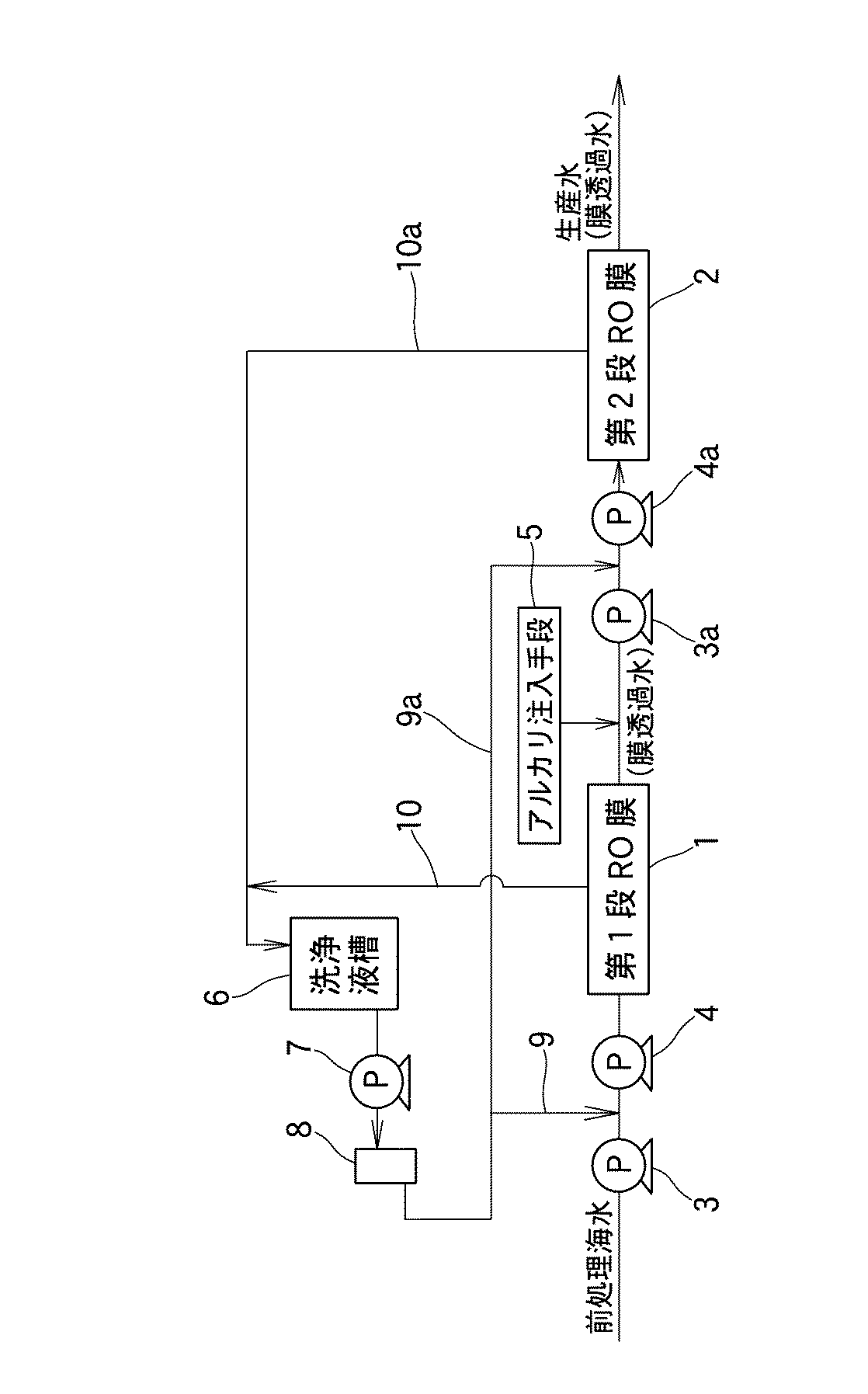
以下に、この発明の実施形態を添付の図1に基づいて説明する。 Embodiments of the present invention will be described below with reference to FIG.
図1は、この発明の海水淡水化方法を実施するための、逆浸透膜装置(RO膜)1、2が直列方向に2段に接続された海水淡水化装置の要部を模式的に示したものである。この海水淡水化装置は、第1段目の逆浸透膜装置(第1段RO膜)1の入側に、供給海水を予備昇圧する第1段ブースターポンプ3、および第1段逆浸透膜用高圧ポンプ4が配置され、第2段目の逆浸透膜装置(第2段RO膜)2の入側に、第1段目の逆浸透膜装置1からの膜透過水を予備昇圧する第2段ブースターポンプ3a、および第2段逆浸透用高圧ポンプ4aが配置され、第1段目の逆浸透透過装置1の出側には、膜透過水のpHを上昇させるための苛性ソーダなどのアルカリ注入手段5を備えている。薬液を貯留した洗浄液槽6からは、薬液供給ポンプ7、カートリッジフィルタ8を介して第1段逆浸透膜用逆浸透膜高圧ポンプ4の入側、および第2段逆浸透膜用高圧ポンプ4aの入側に、洗浄液の供給配管9、9a、出側に洗浄液の循環配管10、10aがそれぞれ接続されている。なお、第1段目の逆浸透膜の洗浄液を貯留する洗浄液槽6および供給配管9とは別個に、第2段目の逆浸透膜の洗浄液槽および洗浄液の供給配管9a、循環配管10aを設け、互いに独立して膜洗浄を行なうこともできる。
FIG. 1 schematically shows a main part of a seawater desalination apparatus in which reverse osmosis membrane devices (RO membranes) 1 and 2 are connected in two stages in a series direction for carrying out the seawater desalination method of the present invention. It is a thing. This seawater desalination apparatus has a first-stage booster pump 3 for pre-pressurizing supplied seawater on the inlet side of a first-stage reverse osmosis membrane apparatus (first-stage RO membrane) 1 and a first-stage reverse osmosis membrane A high-pressure pump 4 is arranged to preliminarily boost the membrane permeated water from the first-stage reverse osmosis membrane device 1 on the inlet side of the second-stage reverse osmosis membrane device (second-stage RO membrane) 2. A
前記海水淡水化装置には、次のようにして処理される前処理海水が供給される。まず、海岸の海水中に設置した取水ポンプで海水を取水して原海水貯槽に貯留する。取海水は、海洋生物の繁殖を防止するため、電解水中の次亜塩素酸ソーダの濃度が約2.5ppmになるように電気分解する。このように電気分解された取海水を、ろ過ポンプで単層砂ろ過に供給し、海水中の濁質の粗取りを行なった後、UF膜ろ過器に供給して精密ろ過をして、一旦ろ過海水漕に貯留する。このように前処理した海水を、前記第1段ブースターポンプ3で予備昇圧した後、炭酸カルシウムの析出を防止するため硫酸を添加してpHを約6.5に調整し、第1段保安フィルタ(図示省略)で夾雑物を除去した後、第1段逆浸透膜高圧ポンプ4で海水淡水化に必要な圧力(例えば、6.0MPa)に昇圧して第1段逆浸透膜装置1の高圧逆浸透膜モジュールに供給する。そして、この高圧逆浸透膜モジュールで、供給海水(取海水)は、塩分を殆んど含まない膜透過水約40%と、濃縮水約60%に分離され、濃縮水の方は海に放流される。膜透過水の方は、その中に含まれる遊離炭酸を脱炭酸塔(図示省略)で除去し、重亜硫酸ソーダ(SBS)で残留塩素を消去した後、脱塩水槽(図示省略)に貯留される。この脱塩水槽に貯留された脱塩水、即ち、第1段目の膜透過水に苛性ソーダを添加して、そのpHを8以上、好ましくは9〜10に調整した後、第2段ブースターポンプ3aで1.0MPa前後に予備昇圧して第2段逆浸透膜高圧ポンプ4aに送り、この第2段逆浸透膜高圧ポンプ4aから第2段逆浸透膜装置2の低圧逆浸透膜モジュールに供給する。そして、この低圧逆浸透膜モジュールでも、前記高圧逆浸透膜モジュールの場合と同様に、第2段膜透過水と濃縮水とに分離され、濃縮水の方は海に放流される。一方、第2段膜透過水の方は、塩酸を添加してpHが下げられ、さらにミネラル成分が添加され、最終的に飲料水に適したpHおよび硬度に調整され、滅菌剤を添加して生産水となり、生産水槽に貯留される。以下に実施例について説明する。
The seawater desalination apparatus is supplied with pretreated seawater that is treated as follows. First, seawater is taken with a water intake pump installed in the seawater on the coast and stored in the raw seawater storage tank. Intake seawater is electrolyzed so that the concentration of sodium hypochlorite in the electrolyzed water is about 2.5 ppm in order to prevent the propagation of marine organisms. The electrolyzed seawater thus electrolyzed is supplied to a single-layer sand filter with a filtration pump, and after roughly removing turbidity in seawater, it is supplied to a UF membrane filter and subjected to microfiltration, Store in filtered seawater. After pre-pressurizing the pre-treated seawater with the first-stage booster pump 3, the pH is adjusted to about 6.5 by adding sulfuric acid to prevent the precipitation of calcium carbonate, and the first-stage safety filter After removing impurities in (not shown), the first stage reverse osmosis membrane high-pressure pump 4 raises the pressure to the pressure required for seawater desalination (for example, 6.0 MPa), and the first stage reverse osmosis membrane device 1 has a high pressure. Supply to reverse osmosis membrane module. In this high-pressure reverse osmosis membrane module, the supplied seawater (taken seawater) is separated into about 40% of membrane permeate containing almost no salt and about 60% of concentrated water, and the concentrated water is discharged into the sea. Is done. For the permeated water, the free carbonic acid contained in the permeated water is removed by a decarboxylation tower (not shown), residual chlorine is eliminated by sodium bisulfite (SBS), and then stored in a desalted water tank (not shown). The After adding caustic soda to the demineralized water stored in the demineralized water tank, that is, the first stage membrane permeate, and adjusting the pH to 8 or more, preferably 9 to 10, the second
上記海水淡水化装置を2系列設置し、表1に示す運転条件で6ヶ月の連続運転期間中に、2週間に1回の頻度で、第1段目の膜透過水にクエン酸を1%溶解させ、アンモニア水を添加してpHが4になるように調整した洗浄液を、第2段逆浸透膜装置2(図1参照)の低圧逆浸透膜モジュールに約30分間にわたって循環供給し、膜面に沈着した金属化合物を除去した。 また、この連続運転の6ヶ月の期間中で、生産水の需要が低い時期は、2系列の装置を交互運転したが、系列切り替え時毎に、停止する系列の方の第2段逆浸透膜装置の低圧逆浸透膜モジュールにアルカリを添加していない前記第1段膜透過水を供給して高pHの供給水と置換した後、第1段膜透過水にクエン酸を濃度が1%となるように溶解させ、アンモニア水でpHを4に調整した前記洗浄液を供給して膜表面を洗浄した。洗浄終了後、前記低圧逆浸透膜モジュール内の洗浄液を、アルカリを添加していない前記第1段膜透過水で置換して第2段逆浸透膜装置を停止した。前記6ヶ月の運転期間の直前(新逆浸透膜)および直後に、表2に示す膜性能評価用の供給液を前記低圧逆浸透膜モジュールに供給して、ほう素阻止率および透過水流量を測定する膜性能評価試験を行なった。なお、各系列の装置は、1ベッセル1モジュール内に上流側(供給海水の流入側)および下流側の2つの逆浸透膜エレメントを装備している。 Two series of seawater desalination units are installed, and 1% of citric acid is added to the first stage membrane permeate once every two weeks during the continuous operation period of 6 months under the operating conditions shown in Table 1. A cleaning solution that has been dissolved and adjusted to pH 4 by adding aqueous ammonia is circulated and supplied to the low-pressure reverse osmosis membrane module of the second stage reverse osmosis membrane device 2 (see FIG. 1) for about 30 minutes. The metal compound deposited on the surface was removed. Also, during the period of 6 months of continuous operation, when the demand for product water was low, the two series of devices were operated alternately, but the second stage reverse osmosis membrane of the series that stopped every time the series was switched After supplying the first-stage membrane permeated water without addition of alkali to the low-pressure reverse osmosis membrane module of the apparatus and replacing it with high-pH feed water, the concentration of citric acid in the first-stage membrane permeated water is 1%. The membrane surface was cleaned by supplying the cleaning solution, which was dissolved so that the pH was adjusted to 4 with aqueous ammonia. After completion of the cleaning, the second-stage reverse osmosis membrane device was stopped by replacing the cleaning liquid in the low-pressure reverse osmosis membrane module with the first-stage membrane permeated water to which no alkali was added. Immediately before (new reverse osmosis membrane) and immediately after the operation period of 6 months, the supply liquid for membrane performance evaluation shown in Table 2 is supplied to the low-pressure reverse osmosis membrane module, and the boron rejection rate and permeate flow rate are measured. The film performance evaluation test to be measured was performed. Each series of devices is equipped with two reverse osmosis membrane elements on the upstream side (supply seawater inflow side) and downstream side in one vessel 1 module.
一方、比較として、6ヶ月の運転期間中に、前記低圧逆浸透膜モジュールの膜洗浄を行なわず、また、この6ヶ月の運転期間中に、生産水の需要に応じて、2系列運転から膜性能の劣化を均等化するために、交互に1系列運転に切り替えた際に、停止する系列の前記低圧逆浸透膜モジュールには前記膜洗浄や洗浄水の第1段膜透過水による置換等に特別な処置を施さなかった従来の処理方法の場合についても、前記膜性能評価試験を行なった。これらの評価試験の結果を表3に示す。 On the other hand, as a comparison, the low pressure reverse osmosis membrane module was not subjected to membrane cleaning during the 6-month operation period, and during the 6-month operation period, the membrane was changed from the 2-line operation to the membrane according to the demand for production water. In order to equalize the deterioration in performance, the low pressure reverse osmosis membrane module in the series that stops when the operation is alternately switched to the one-line operation is used for the membrane cleaning or the replacement of the washing water with the first-stage permeated water. The film performance evaluation test was also performed in the case of a conventional treatment method in which no special treatment was performed. The results of these evaluation tests are shown in Table 3.
表3から、本発明の実施例では、6ヶ月の連続運転後の低圧逆浸透膜モジュールの性能、即ちほう素阻止率は、連続運転開始前および開始後で、上流側および下流側のいずれの膜エレメントでも殆んど低下していない。上記評価試験後に膜モジュールを分解点検したところ、膜にはとくに着色は認められず、また膜表面の分析結果でも金属化合物の沈着は認められず、清浄であることが確認された。 From Table 3, in the example of the present invention, the performance of the low-pressure reverse osmosis membrane module after 6 months of continuous operation, that is, the boron rejection rate, was measured before and after the start of continuous operation. Even the membrane element has hardly deteriorated. When the membrane module was disassembled and inspected after the above evaluation test, no particular coloration was observed on the membrane, and no metal compound deposition was observed on the membrane surface, confirming that the membrane was clean.
これに対し、比較例(従来技術)では、上流側および下流側のいずれの膜エレメントでも、ほう素阻止率の低下が明瞭に認められる。また、運転前に比べて透過水流量が顕著に増加しており、膜劣化が進行していることがわかる。神鋼上記評価試験後に、前記膜モジュールを分解点検したところ、従来技術で運転した逆浸透膜の表面には、とくに上流側の膜エレメントで褐色を帯びた沈着物が観察され、この沈着物は、分析の結果、鉄化合物であることが判明した。この鉄化合物が、ほう素阻止率を低下させる膜劣化をもたらしたものと考えられる。これらの鉄化合物は、第1段目の逆浸透膜の透過水であっても腐食性が極めて高い、この膜透過水により配管の鉄成分が溶出し、この溶出鉄分が、苛性ソーダの添加により高pH化された環境下で析出し、膜表面に沈着したものと推察される。 On the other hand, in the comparative example (prior art), a decrease in boron rejection is clearly observed in both the upstream and downstream membrane elements. Moreover, it can be seen that the permeated water flow rate is remarkably increased compared with that before the operation, and the membrane deterioration is progressing. After the above-described evaluation test, the membrane module was overhauled and inspected, and on the surface of the reverse osmosis membrane operated by the prior art, a brownish deposit was observed particularly in the upstream membrane element. As a result of analysis, it was found to be an iron compound. This iron compound is considered to have caused film deterioration that reduces the boron rejection. These iron compounds are extremely corrosive even if the permeated water of the first-stage reverse osmosis membrane. The iron permeate of the piping is eluted by this membrane permeated water, and this eluted iron content is increased by the addition of caustic soda. Presumably, it was deposited in a pH-controlled environment and deposited on the film surface.
この発明は、直列に接続した2段の逆浸透膜を用いて海水を淡水化する海水淡水化装置で、第2段目の逆浸透膜の劣化を未然に防止し、飲料水基準に適合する淡水化処理水を効率よく生産できる方法として利用することができる。 The present invention is a seawater desalination apparatus that desalinates seawater using two stages of reverse osmosis membranes connected in series, and prevents the deterioration of the second stage reverse osmosis membrane and conforms to drinking water standards. It can be used as a method for efficiently producing desalinated treated water.
1、2・・・逆浸透膜装置
3、3a・・・ブースターポンプ
4、4a・・・高圧ポンプ
5・・・アルカリ注入手段
6・・・洗浄液槽
7・・・薬液供給ポンプ
8・・・カートリッジフィルタ
9、9a・・・供給配管
10、10a・・・循環配管
DESCRIPTION OF
Claims (3)
The seawater desalination according to claim 1 or 2, wherein the cleaning liquid is composed of an organic acid or a component obtained by adding ammonia to an organic acid, and the concentration of the organic acid is in the range of 0.5 to 5%. Method.
Priority Applications (1)
| Application Number | Priority Date | Filing Date | Title |
|---|---|---|---|
| JP2004312917A JP2006122787A (en) | 2004-10-27 | 2004-10-27 | Seawater desalination method |
Applications Claiming Priority (1)
| Application Number | Priority Date | Filing Date | Title |
|---|---|---|---|
| JP2004312917A JP2006122787A (en) | 2004-10-27 | 2004-10-27 | Seawater desalination method |
Publications (1)
| Publication Number | Publication Date |
|---|---|
| JP2006122787A true JP2006122787A (en) | 2006-05-18 |
Family
ID=36718024
Family Applications (1)
| Application Number | Title | Priority Date | Filing Date |
|---|---|---|---|
| JP2004312917A Pending JP2006122787A (en) | 2004-10-27 | 2004-10-27 | Seawater desalination method |
Country Status (1)
| Country | Link |
|---|---|
| JP (1) | JP2006122787A (en) |
Cited By (9)
| Publication number | Priority date | Publication date | Assignee | Title |
|---|---|---|---|---|
| JP2008043868A (en) * | 2006-08-14 | 2008-02-28 | Mitsubishi Heavy Ind Ltd | Drinking water manufacturing apparatus and manufacturing method of drinking water |
| JP2009195804A (en) * | 2008-02-20 | 2009-09-03 | Mitsubishi Heavy Ind Ltd | Method and device for cleaning reverse osmosis membrane module |
| JP2009273973A (en) * | 2008-05-13 | 2009-11-26 | Sanken Setsubi Kogyo Co Ltd | Seawater desalination system by membrane treatment |
| KR101206618B1 (en) | 2010-06-28 | 2012-11-29 | 효성굿스프링스 주식회사 | Apparatus and Method of Cleaning Reverse Osmosis for Sea Water Desalination |
| WO2013157549A1 (en) * | 2012-04-17 | 2013-10-24 | 栗田工業株式会社 | Reverse osmosis membrane treatment method and reverse osmosis membrane treatment device |
| JP2014161795A (en) * | 2013-02-25 | 2014-09-08 | Mitsubishi Heavy Ind Ltd | Water treatment system |
| CN105692985A (en) * | 2016-04-16 | 2016-06-22 | 申忠领 | Efficient light and small sized sea water desalination facility |
| US10202291B2 (en) | 2013-02-25 | 2019-02-12 | Mitsubishi Heavy Industries Engineering, Ltd. | Reverse osmosis membrane apparatus and method of operating same |
| CN117361698A (en) * | 2023-09-06 | 2024-01-09 | 国家能源蓬莱发电有限公司 | A seawater desalination reverse osmosis water treatment device and method |
-
2004
- 2004-10-27 JP JP2004312917A patent/JP2006122787A/en active Pending
Cited By (10)
| Publication number | Priority date | Publication date | Assignee | Title |
|---|---|---|---|---|
| JP2008043868A (en) * | 2006-08-14 | 2008-02-28 | Mitsubishi Heavy Ind Ltd | Drinking water manufacturing apparatus and manufacturing method of drinking water |
| JP2009195804A (en) * | 2008-02-20 | 2009-09-03 | Mitsubishi Heavy Ind Ltd | Method and device for cleaning reverse osmosis membrane module |
| JP2009273973A (en) * | 2008-05-13 | 2009-11-26 | Sanken Setsubi Kogyo Co Ltd | Seawater desalination system by membrane treatment |
| KR101206618B1 (en) | 2010-06-28 | 2012-11-29 | 효성굿스프링스 주식회사 | Apparatus and Method of Cleaning Reverse Osmosis for Sea Water Desalination |
| WO2013157549A1 (en) * | 2012-04-17 | 2013-10-24 | 栗田工業株式会社 | Reverse osmosis membrane treatment method and reverse osmosis membrane treatment device |
| JP2013220384A (en) * | 2012-04-17 | 2013-10-28 | Kurita Water Ind Ltd | Method and apparatus for treating reverse osmosis membrane |
| JP2014161795A (en) * | 2013-02-25 | 2014-09-08 | Mitsubishi Heavy Ind Ltd | Water treatment system |
| US10202291B2 (en) | 2013-02-25 | 2019-02-12 | Mitsubishi Heavy Industries Engineering, Ltd. | Reverse osmosis membrane apparatus and method of operating same |
| CN105692985A (en) * | 2016-04-16 | 2016-06-22 | 申忠领 | Efficient light and small sized sea water desalination facility |
| CN117361698A (en) * | 2023-09-06 | 2024-01-09 | 国家能源蓬莱发电有限公司 | A seawater desalination reverse osmosis water treatment device and method |
Similar Documents
| Publication | Publication Date | Title |
|---|---|---|
| CN106564990B (en) | Low energy reverse osmosis process | |
| US9833743B2 (en) | Reverse osmosis treatment device and method for cleaning reverse osmosis treatment device | |
| JP5582740B2 (en) | Desalination apparatus and method for cleaning pretreatment membrane of desalination apparatus | |
| US20040094480A1 (en) | Method of boron removal in presence of magnesium ions | |
| CN102010089A (en) | Desalination system | |
| US8119008B2 (en) | Fluid purification methods and devices | |
| JP2005087887A (en) | Membrane cleaning method | |
| CN112174412A (en) | Method for recycling reclaimed water in high-salt-content wastewater | |
| JP6860648B1 (en) | Water treatment system and water treatment method | |
| CN102060394A (en) | Sea water desalinization integrated process | |
| KR100938344B1 (en) | Apparatus for seawater desalting using filtration membrane and reverse osmotic membrane | |
| JP3903746B2 (en) | Circulating cooling water treatment method | |
| JP2006122787A (en) | Seawater desalination method | |
| JP4241684B2 (en) | Membrane module cleaning method | |
| JP3137831B2 (en) | Membrane processing equipment | |
| KR20180037586A (en) | Method for Recycling Reverse Osmosis Membrane, Process for Producing Ultra Pure Water, and System for Manufacturing Ultra Pure Water | |
| US20120255918A1 (en) | Use of rhamnolipids in the water treatment industry | |
| Botes et al. | Long-term evaluation of a UF pilot plant for potable water production | |
| Manalo et al. | Long-term pilot plant study using direct chlorination for biofouling control of a chlorine-resistant polyamide reverse osmosis membrane | |
| JP2003117552A (en) | Desalination apparatus | |
| JP2005246282A (en) | Seawater desalination method and seawater desalination apparatus | |
| JPH11662A (en) | Brine desalination apparatus and brine desalination method | |
| JPH0957067A (en) | Separation with reverse osmotic membrane and apparatus therefor | |
| JPH119972A (en) | Membrane filtration apparatus and membrane filtration method | |
| CN219259764U (en) | Boiler makeup water treatment system |