JP2005087172A - Arabinogalactan-like O-linked glycosylation motif - Google Patents
Arabinogalactan-like O-linked glycosylation motif Download PDFInfo
- Publication number
- JP2005087172A JP2005087172A JP2003328840A JP2003328840A JP2005087172A JP 2005087172 A JP2005087172 A JP 2005087172A JP 2003328840 A JP2003328840 A JP 2003328840A JP 2003328840 A JP2003328840 A JP 2003328840A JP 2005087172 A JP2005087172 A JP 2005087172A
- Authority
- JP
- Japan
- Prior art keywords
- protein
- pro
- arabinogalactan
- ser
- ala
- Prior art date
- Legal status (The legal status is an assumption and is not a legal conclusion. Google has not performed a legal analysis and makes no representation as to the accuracy of the status listed.)
- Pending
Links
Images


Landscapes
- Preparation Of Compounds By Using Micro-Organisms (AREA)
- Peptides Or Proteins (AREA)
Abstract
【課題】 アラビノガラクタン様O−結合型糖鎖付加モチーフの同定、並びにタンパク質中の植物特異的アラビノガラクタン様糖鎖付加部位を予測する方法及びアラビノガラクタン様糖鎖を部位特異的に付加又は除去したタンパク質の製造方法の提供。
【解決手段】 下記式(II):
X(-1)−Pro−X(+1)−X(+2)−X(+3) (II)
[式中、X(-1)はAla、Val、Ser、又はGluであり、X(+1)はAla、Val、Ser又はThrであり、X(+2)はAla、Val、Pro、Ser、Thr又はCysであり、X(+3)はAla、Pro、又はSerである]
で表されるアミノ酸配列からなるペプチド、並びに式(II)のアミノ酸配列を利用したアラビノガラクタン様糖鎖付加部位の予測方法、及びアラビノガラクタン様糖鎖を付加又は除去したタンパク質の製造方法。
【選択図】 なしPROBLEM TO BE SOLVED: To identify an arabinogalactan-like O-linked glycosylation motif, a method for predicting a plant-specific arabinogalactan-like glycosylation site in protein, and site-specific addition of an arabinogalactan-like sugar chain Alternatively, a method for producing the removed protein is provided.
[Solution] The following formula (II):
X (-1) -Pro-X (+1) -X (+2) -X (+3) (II)
[Wherein X (-1) is Ala, Val, Ser, or Glu, X (+1) is Ala, Val, Ser, or Thr, and X (+2) is Ala, Val, Pro, Ser. , Thr or Cys, and X (+3) is Ala, Pro, or Ser]
And a method for predicting an arabinogalactan-like sugar chain addition site using the amino acid sequence of formula (II), and a method for producing a protein with an arabinogalactan-like sugar chain added or removed.
[Selection figure] None
Description
本発明は、プロリン水酸化モチーフ、タンパク質に植物特異的にプロリン残基が水酸化される部位を予測する方法、アラビノガラクタン様O−結合型糖鎖付加モチーフ、タンパク質に植物特異的にアラビノガラクタン様糖鎖が付加される部位を予測する方法、及びアラビノガラクタン様糖鎖を部位特異的にタンパク質に付加するか又は除去する方法に関する。 The present invention relates to a proline hydroxylation motif, a method for predicting a site where a proline residue is hydroxylated to a protein in a plant-specific manner, an arabinogalactan-like O-linked glycosylation motif, a protein plant-specific to an arabino. The present invention relates to a method for predicting a site where a galactan-like sugar chain is added, and a method for adding or removing an arabinogalactan-like sugar chain to a protein in a site-specific manner.
近年、遺伝子工学的手法によるタンパク質製造技術が急速に発達した結果、大腸菌や酵母などの微生物だけでなく、哺乳動物細胞、昆虫細胞及び植物細胞をはじめとする様々な宿主細胞系を利用して所望のタンパク質を製造することが可能になっている。 In recent years, as a result of the rapid development of protein production technology using genetic engineering techniques, it is desired to utilize not only microorganisms such as Escherichia coli and yeast, but also various host cell systems including mammalian cells, insect cells and plant cells. It is possible to produce the protein.
しかしながら、これらの各種宿主細胞系は、コドン使用頻度やフォールディング機構、糖鎖修飾などの点でそれぞれ異なるタンパク質産生機構を有するため、同じポリペプチド鎖を有するタンパク質を産生させても、用いる宿主によって、産生量、立体構造又は糖鎖修飾などにしばしば大きな変化を生じる。特に糖鎖修飾は、タンパク質の安定性、溶解性を変化させるほか、その活性や抗原性に変化をもたらすことが知られていることから宿主細胞によって異なる性質をもつタンパク質が産生される可能性がある。糖鎖は、タンパク質の認識等においても重要な役割を果たしており、また宿主によって使用される糖鎖の種類も異なることから、異種タンパク質に宿主特異的な糖鎖が付加されると不都合である場合もありうる。従って、遺伝子工学的手法を用いて製造されるタンパク質についてその用途に合わせて適切な糖鎖付加がなされるようにすることは重要である。 However, since these various host cell systems have different protein production mechanisms in terms of codon usage, folding mechanism, sugar chain modification, etc., even if proteins having the same polypeptide chain are produced, A large change is often caused in the production amount, three-dimensional structure or sugar chain modification. In particular, glycosylation changes the stability and solubility of proteins and is known to cause changes in their activity and antigenicity. Therefore, proteins with different properties may be produced depending on the host cell. is there. When sugar chains play an important role in protein recognition, etc., and the type of sugar chain used varies depending on the host, it is inconvenient if a host-specific sugar chain is added to a heterologous protein. There is also a possibility. Therefore, it is important that a protein produced using genetic engineering techniques is appropriately glycosylated according to its use.
糖タンパク質に付加される糖鎖は、一般的にN−結合型糖鎖とO−結合型糖鎖に大別される。N−結合型糖鎖は、タンパク質中のAsn−X−Ser/Thr[NはPro以外の任意のアミノ酸]というアミノ酸コンセンサス配列のAsn(アスパラギン)残基の側鎖にN配糖体として結合しており、アスパラギン結合型糖鎖とも呼ばれる糖鎖である(特許文献1)。但しこのN−結合型糖鎖は、タンパク質中のAsn−X−Ser/Thr配列に含まれるAsn残基全てに結合しているわけではないことが知られている。またO−結合型糖鎖は、動物及び酵母ではタンパク質中のSer残基又はThr残基にO配糖体として結合している。動物(特許文献2)や酵母(特許文献3)においてはO−結合型糖鎖結合部位付近に存在するコンセンサス配列も報告されている。近年では、このようなコンセンサス配列に基づいてアミノ酸配列を改変することにより、産生されるタンパク質から糖鎖を付加したり除去したりしてタンパク質の性質を変更することが試みられている。 The sugar chains added to glycoproteins are generally roughly classified into N-linked sugar chains and O-linked sugar chains. The N-linked sugar chain binds as an N-glycoside to the side chain of the Asn (asparagine) residue of the amino acid consensus sequence Asn-X-Ser / Thr [N is any amino acid other than Pro] in the protein. It is a sugar chain also called asparagine-linked sugar chain (Patent Document 1). However, it is known that this N-linked sugar chain is not bonded to all Asn residues contained in the Asn-X-Ser / Thr sequence in the protein. Moreover, O-linked sugar chains are bound as O-glycosides to Ser residues or Thr residues in proteins in animals and yeasts. In animals (patent document 2) and yeast (patent document 3), a consensus sequence existing in the vicinity of the O-linked sugar chain binding site has also been reported. In recent years, attempts have been made to modify the properties of proteins by adding or removing sugar chains from the produced protein by modifying the amino acid sequence based on such a consensus sequence.
一方、植物では、O−結合型糖鎖は、タンパク質中のSer残基、Thr残基又はHyp(ヒドロキシプロリン)残基にO配糖体として結合している(非特許文献1)。しかしながら、植物におけるO−結合型糖鎖の結合に関わるコンセンサス配列は未だ報告されていない。植物由来のヒドロキシプロリンリッチな糖タンパク質(例えばアラビアゴム)についての研究からは、Ser残基とHyp残基とを多く含む反復配列を有するタンパク質に、O−結合型アラビノガラクタン様糖鎖が結合しているとの報告がなされている(特許文献4及び5)。そのためSer残基とHyp残基とを多く含む反復配列を有するタンパク質は、一般にアラビノガラクタンタンパク質と呼ばれている。しかしながら、反復配列を有するためにアラビノガラクタンタンパク質と呼ばれているタンパク質であっても、必ずしもアラビノガラクタン様糖鎖の付加が確認されているわけではない。さらに、アラビノガラクタンタンパク質以外にもO−結合型アラビノガラクタン様糖鎖が付加された植物タンパク質は存在することから、O−結合型アラビノガラクタン様糖鎖がそのような反復配列にのみ結合するというわけでもない。しかも、反復配列をもつタンパク質についてエドマン分解法等を用いてアミノ酸配列を決定することは一般に困難であり、またヒドロキシプロリン等の修飾アミノ酸を同定するためには質量分析等のペプチド分析法を別途用いて確認する必要があることから、アラビノガラクタンタンパク質においてさえ、アラビノガラクタン様糖鎖が結合したアミノ酸残基を特定することは非常に困難を伴う。このような状況に基づき、植物においてタンパク質にO−結合型糖鎖が付加される部位を容易に同定可能な方法を開発することが求められている。 On the other hand, in plants, O-linked sugar chains are bound as O-glycosides to Ser residues, Thr residues, or Hyp (hydroxyproline) residues in proteins (Non-patent Document 1). However, no consensus sequence related to the binding of O-linked sugar chains in plants has been reported yet. From research on plant-derived hydroxyproline-rich glycoproteins (eg gum arabic), O-linked arabinogalactan-like sugar chains bind to proteins with repetitive sequences that contain many Ser and Hyp residues. (Patent Documents 4 and 5). Therefore, a protein having a repetitive sequence containing many Ser residues and Hyp residues is generally called an arabinogalactan protein. However, addition of an arabinogalactan-like sugar chain is not necessarily confirmed even with a protein called an arabinogalactan protein because it has a repetitive sequence. Furthermore, since there exist plant proteins to which O-linked arabinogalactan-like sugar chains are added in addition to arabinogalactan proteins, O-linked arabinogalactan-like sugar chains bind only to such repetitive sequences. I don't mean to. Moreover, it is generally difficult to determine the amino acid sequence of a protein having a repetitive sequence using the Edman degradation method or the like, and a peptide analysis method such as mass spectrometry is separately used to identify a modified amino acid such as hydroxyproline. Therefore, even in the arabinogalactan protein, it is very difficult to specify the amino acid residue to which the arabinogalactan-like sugar chain is bound. Based on such a situation, it is required to develop a method capable of easily identifying a site where an O-linked sugar chain is added to a protein in a plant.
ところで、植物の細胞外又は液胞に輸送されるタンパク質の中に、そのタンパク質中の一部のプロリン残基がヒドロキシプロリン残基に変換されている(プロリン残基の水酸化)ものがあることが知られている。このようなタンパク質の中には、ヒドロキシプロリン残基のうちのさらに一部にアラビノガラクタン様糖鎖が付加されたものもある。例えば、液胞に蓄積するタバコキチナーゼでは、一部のプロリン残基が水酸化されているが、糖鎖付加は受けない。一方、サツマイモの液胞に蓄積するサツマイモスポラミンを遺伝子工学的手法によってタバコ細胞中で発現させると、アラビノガラクタン様糖鎖が付加されたヒドロキシプロリン残基を有するスポラミンが産生されることも分かっている。このようなタンパク質中のプロリン残基の水酸化及びアラビノガラクタン様糖鎖付加は、植物特異的な糖鎖修飾機構と考えられている。 By the way, some proteins transported to the extracellular or vacuole of plants have some proline residues converted to hydroxyproline residues (hydroxylation of proline residues). It has been known. Some of these proteins have an arabinogalactan-like sugar chain added to some of the hydroxyproline residues. For example, in tobacco chitinase that accumulates in vacuoles, some proline residues are hydroxylated but not subjected to glycosylation. On the other hand, when sweet potato sporamine that accumulates in the vacuole of sweet potato is expressed in tobacco cells by genetic engineering techniques, it is also found that sporamin having hydroxyproline residues with arabinogalactan-like sugar chains added is produced. ing. Such hydroxylation and arabinogalactan-like glycosylation of proline residues in proteins are considered to be plant-specific glycosylation mechanisms.
しかしながら、植物におけるタンパク質産生において、どのようなタンパク質中のどのプロリン残基がヒドロキシプロリン残基に変換されるのか、そしてそのようなヒドロキシプロリン残基のうちのどの残基にアラビノガラクタン様糖鎖が付加されるのかを予測可能な方法は、現在知られていない。 However, in protein production in plants, which proline residues in which protein are converted to hydroxyproline residues, and which of these hydroxyproline residues are arabinogalactan-like sugar chains There is currently no known method that can predict whether or not will be added.
本発明は、植物におけるのタンパク質中のプロリン水酸化モチーフを同定し、それに基づいて、タンパク質中の植物特異的な水酸化されたプロリンの存在位置を予測する方法、及びアラビノガラクタン様O−結合型糖鎖付加モチーフを同定し、それに基づいて、タンパク質中の植物特異的なアラビノガラクタン様糖鎖付加部位を予測する方法、並びにアラビノガラクタン様糖鎖を部位特異的に付加又は除去したタンパク質の製造方法を提供することを目的とする。 The present invention identifies a proline hydroxylation motif in a protein in a plant and, based on that, predicts the location of a plant-specific hydroxylated proline in the protein, and an arabinogalactan-like O-linkage For identifying plant-specific arabinogalactan-like glycosylation sites in proteins based on the identification of type glycosylation motifs, and proteins with site-specific addition or removal of arabinogalactan-like sugar chains It aims at providing the manufacturing method of.
本発明者らは、上記課題を解決するため鋭意研究を行った結果、タンパク質を植物細胞中で発現させると、該タンパク質中のアミノ酸配列:
[AVSTE]−Pro−[AVST]−[GAVPSTC]−[APS、又は酸性アミノ酸残基]−[アミドでも塩基性でもないアミノ酸残基]
において「Pro」として示されるプロリン残基が、水酸化されてヒドロキシプロリン残基となることを見出した。さらに本発明者らは、タンパク質を植物細胞中で発現させた場合、次のアミノ酸配列:
[AVSE]−Hyp−[AVST]−[AVPSTC]−[APS]
において「Hyp」として示されるヒドロキシプロリン残基が、アラビノガラクタン様糖鎖の付加を受けることを見出した。本発明はこのような知見に基づいて完成されたものであり、例えば以下の通りである。
[1] 下記式(I):
X(-1)−Pro−X(+1)−X(+2)−X(+3)−X(+4) (I)
[式中、X(-1)はAla、Val、Ser、Thr又はGluであり、X(+1)はAla、Val、Ser又はThrであり、X(+2)はGly、Ala、Val、Pro、Ser、Thr又はCysであり、X(+3)はAla、Pro、Ser又は酸性アミノ酸であり、X(+4)はアミドでも塩基性アミノ酸でもないアミノ酸である]
で表されるアミノ酸配列からなるペプチド。
このペプチドは、好ましくはヒドロキシプロリン残基付加用のものである。
As a result of intensive studies to solve the above problems, the inventors of the present invention expressed the amino acid sequence in the protein when expressed in a plant cell:
[AVSTE] -Pro- [AVST]-[GAVPSTC]-[APS, or acidic amino acid residue]-[amino acid residue that is neither amide nor basic]
It was found that the proline residue shown as “Pro” was hydroxylated to a hydroxyproline residue. Furthermore, the inventors have the following amino acid sequence when the protein is expressed in plant cells:
[AVSE] -Hyp- [AVST]-[AVPSTC]-[APS]
It was found that the hydroxyproline residue indicated as “Hyp” in FIG. 2 undergoes addition of an arabinogalactan-like sugar chain. The present invention has been completed based on such knowledge, and is as follows, for example.
[1] Formula (I) below:
X (-1) -Pro-X (+1) -X (+2) -X (+3) -X (+4) (I)
[Wherein X (-1) is Ala, Val, Ser, Thr or Glu, X (+1) is Ala, Val, Ser or Thr, and X (+2) is Gly, Ala, Val, Pro, Ser, Thr, or Cys, X (+3) is Ala, Pro, Ser, or an acidic amino acid, and X (+4) is an amino acid that is neither an amide nor a basic amino acid]
A peptide comprising the amino acid sequence represented by
This peptide is preferably for adding a hydroxyproline residue.
[2] 下記式(II):
X(-1)−Pro−X(+1)−X(+2)−X(+3) (II)
[式中、X(-1)はAla、Val、Ser、又はGluであり、X(+1)はAla、Val、Ser又はThrであり、X(+2)はAla、Val、Pro、Ser、Thr又はCysであり、X(+3)はAla、Pro、又はSerである]
で表されるアミノ酸配列からなるペプチド。
このペプチドは、好ましくはアラビノガラクタン様糖鎖付加用のものである。
[3] 上記[1]又は[2]のペプチドをコードするDNA。
[2] Formula (II) below:
X (-1) -Pro-X (+1) -X (+2) -X (+3) (II)
[Wherein X (-1) is Ala, Val, Ser, or Glu, X (+1) is Ala, Val, Ser, or Thr, and X (+2) is Ala, Val, Pro, Ser. , Thr or Cys, and X (+3) is Ala, Pro, or Ser]
A peptide comprising the amino acid sequence represented by
This peptide is preferably for arabinogalactan-like sugar chain addition.
[3] A DNA encoding the peptide of [1] or [2] above.
[4] タンパク質中の、植物特異的に水酸化されるPro残基を予測する方法であって、
該タンパク質のアミノ酸配列中の、下記式(I):
X(-1)−Pro−X(+1)−X(+2)−X(+3)−X(+4) (I)
[式中、X(-1)はAla、Val、Ser、Thr又はGluであり、X(+1)はAla、Val、Ser又はThrであり、X(+2)はGly、Ala、Val、Pro、Ser、Thr又はCysであり、X(+3)はAla、Pro、Ser又は酸性アミノ酸であり、X(+4)はアミドでも塩基性アミノ酸でもないアミノ酸である]
で表される配列を特定することを含む、前記方法。
[4] A method for predicting a plant-specific hydroxylated Pro residue in a protein,
In the amino acid sequence of the protein, the following formula (I):
X (-1) -Pro-X (+1) -X (+2) -X (+3) -X (+4) (I)
[Wherein X (-1) is Ala, Val, Ser, Thr or Glu, X (+1) is Ala, Val, Ser or Thr, and X (+2) is Gly, Ala, Val, Pro, Ser, Thr, or Cys, X (+3) is Ala, Pro, Ser, or an acidic amino acid, and X (+4) is an amino acid that is neither an amide nor a basic amino acid]
And identifying the sequence represented by:
[5] タンパク質中の、植物特異的にアラビノガラクタン様糖鎖が付加されるPro残基を予測する方法であって、
該タンパク質のアミノ酸配列中の、下記式(II):
X(-1)−Pro−X(+1)−X(+2)−X(+3) (II)
[式中、X(-1)はAla、Val、Ser、又はGluであり、X(+1)はAla、Val、Ser又はThrであり、X(+2)はAla、Val、Pro、Ser、Thr又はCysであり、X(+3)はAla、Pro、又はSerである]
で表される配列を特定することを含む、前記方法。
[5] A method for predicting a Pro residue in a protein to which an arabinogalactan-like sugar chain is added in a plant-specific manner,
In the amino acid sequence of the protein, the following formula (II):
X (-1) -Pro-X (+1) -X (+2) -X (+3) (II)
[Wherein X (-1) is Ala, Val, Ser, or Glu, X (+1) is Ala, Val, Ser, or Thr, and X (+2) is Ala, Val, Pro, Ser. , Thr or Cys, and X (+3) is Ala, Pro, or Ser]
And identifying the sequence represented by:
[6] 植物での生産に適したタンパク質を選択する方法であって、上記[5]の方法に従って予測される植物特異的にアラビノガラクタン様糖鎖が付加されるPro残基が、該タンパク質中に存在するか否かを判定することを特徴とする、前記方法。 [6] A method for selecting a protein suitable for production in a plant, wherein a Pro residue to which an arabinogalactan-like sugar chain is predicted in accordance with the method of [5] above is added. Determining whether it is present or not.
[7] タンパク質をコードするDNAを、該タンパク質への植物特異的なアラビノガラクタン様糖鎖の付加が増加するように改変する方法であって、
該タンパク質をコードするDNAに、下記式(II):
X(-1)−Pro−X(+1)−X(+2)−X(+3) (II)
[式中、X(-1)はAla、Val、Ser、又はGluであり、X(+1)はAla、Val、Ser又はThrであり、X(+2)はAla、Val、Pro、Ser、Thr又はCysであり、X(+3)はAla、Pro、又はSerである]
で表される配列をコードするDNA配列を少なくとも1つ導入することを含む、前記方法。
[7] A method for modifying DNA encoding a protein so that addition of a plant-specific arabinogalactan-like sugar chain to the protein is increased,
To the DNA encoding the protein, the following formula (II):
X (-1) -Pro-X (+1) -X (+2) -X (+3) (II)
[Wherein X (-1) is Ala, Val, Ser, or Glu, X (+1) is Ala, Val, Ser, or Thr, and X (+2) is Ala, Val, Pro, Ser. , Thr or Cys, and X (+3) is Ala, Pro, or Ser]
The method comprising introducing at least one DNA sequence encoding a sequence represented by:
[8] タンパク質をコードするDNAを、該タンパク質への植物特異的なアラビノガラクタン様糖鎖の付加が阻止又は低減されるように改変する方法であって、
該タンパク質をコードするDNA中の、下記式(II):
X(-1)−Pro−X(+1)−X(+2)−X(+3) (II)
[式中、X(-1)はAla、Val、Ser、又はGluであり、X(+1)はAla、Val、Ser又はThrであり、X(+2)はAla、Val、Pro、Ser、Thr又はCysであり、X(+3)はAla、Pro、又はSerである]
で表される配列をコードするDNA配列を、少なくとも1つ除去することを含む、前記方法。
[8] A method for modifying a DNA encoding a protein so that addition of a plant-specific arabinogalactan-like sugar chain to the protein is prevented or reduced,
In the DNA encoding the protein, the following formula (II):
X (-1) -Pro-X (+1) -X (+2) -X (+3) (II)
[Wherein X (-1) is Ala, Val, Ser, or Glu, X (+1) is Ala, Val, Ser, or Thr, and X (+2) is Ala, Val, Pro, Ser. , Thr or Cys, and X (+3) is Ala, Pro, or Ser]
And removing at least one DNA sequence encoding the sequence represented by:
[9] アラビノガラクタン様糖鎖の付加が増加したタンパク質を製造する方法であって、
上記[7]の方法により改変されたDNAを植物で発現させ、産生されたタンパク質を採取することを含む、前記方法。
[9] A method for producing a protein having increased arabinogalactan-like sugar chain addition,
The method, which comprises expressing the DNA modified by the method of [7] above in a plant and collecting the produced protein.
[10] アラビノガラクタン様糖鎖の付加が阻止又は低減されたタンパク質を製造する方法であって、上記[8]の方法により改変されたDNAを植物で発現させ、産生されたタンパク質を採取することを含む、前記方法。
[11] 上記[9]又は[10]の方法により製造されるタンパク質。
[10] A method for producing a protein in which addition of an arabinogalactan-like sugar chain is prevented or reduced, wherein the DNA modified by the method of [8] is expressed in a plant, and the produced protein is collected. Said method.
[11] A protein produced by the method of [9] or [10] above.
本発明の方法により、タンパク質中の、植物特異的に水酸化されるPro残基及びアラビノガラクタン様糖鎖が付加されるPro残基を、予測することができる。本発明の方法では、タンパク質中のヒドロキシプロリン残基や糖鎖付加部位の存在をプロテインシークエンスや質量分析等の実験により予め特定しなくても、DNA配列から推定されるアミノ酸配列に基づいて、水酸化されるPro残基及びアラビノガラクタン様糖鎖が付加されるPro残基を予測することができることから、大変有用である。 By the method of the present invention, it is possible to predict a Pro residue which is hydroxylated in a plant-specific manner and a Pro residue to which an arabinogalactan-like sugar chain is added in a protein. In the method of the present invention, the presence of a hydroxyproline residue or a glycosylation site in a protein is determined based on the amino acid sequence deduced from the DNA sequence without specifying it in advance by experiments such as protein sequencing or mass spectrometry. It is very useful because it can predict Pro residues to be oxidized and Pro residues to which an arabinogalactan-like sugar chain is added.
また本発明の方法を用いれば、タンパク質を植物で発現させる場合に該タンパク質の所望の部位にアラビノガラクタン様糖鎖を付加したり逆に所望の部位からアラビノガラクタン様糖鎖を除去したりすることができる。タンパク質は糖鎖が付加されると水溶性の増加や抗原性の変化などを生じることから、本発明の方法を用いてアラビノガラクタン様糖鎖を付加したり逆に除去したりすることにより、タンパク質の特性を変更することも可能である。本発明の方法にて用いるアラビノガラクタン様糖鎖付加モチーフは、反復配列ではなく配列の長さも5アミノ酸と短いことから、アミノ酸配列の改変を行う上での配列設計の自由度が格段に大きい点でも、非常に有用である。 In addition, when the protein of the present invention is expressed in plants, an arabinogalactan-like sugar chain is added to a desired site of the protein, or an arabinogalactan-like sugar chain is removed from the desired site. can do. When a protein is added with a sugar chain, it causes an increase in water solubility, a change in antigenicity, etc., so by adding or removing an arabinogalactan-like sugar chain using the method of the present invention, It is also possible to change the properties of the protein. Since the arabinogalactan-like glycosylation motif used in the method of the present invention is not a repetitive sequence but the length of the sequence is as short as 5 amino acids, the degree of freedom in sequence design for modifying the amino acid sequence is remarkably large. It is also very useful in terms.
さらに、本発明のアラビノガラクタン様糖鎖付加配列をコードするDNA及び該DNAを含有するベクターは、タンパク質の所望の部位にアラビノガラクタン様糖鎖付加配列を導入するためのツールとして有利に使用することができる。 Furthermore, the DNA encoding the arabinogalactan-like glycosylation sequence of the present invention and the vector containing the DNA are advantageously used as a tool for introducing the arabinogalactan-like glycosylation sequence into a desired site of the protein. can do.
以下、本発明を詳細に説明する。
本明細書においては、アミノ酸又はアミノ酸残基を、生物学分野で通常用いられるアミノ酸の1文字表記又は3文字表記(例えば、Sambrook et al., Molecular Cloning: A Laboratory Manual Second Edition (1989) に規定されている)で記載する場合がある。例えば、アラニンは「A」又は「Ala」、システインは「C」又は「Cys」、アスパラギン酸は「D」又は「Asp」、グルタミン酸は「E」又は「Glu」、フェニルアラニンは「F」又は「Phe」、グリシンは「G」又は「Gly」、ヒスチジンは「H」又は「His」、イソロイシンは「I」又は「Ile」、リシンは「K」又は「Lys」、ロイシンは「L」又は「Leu」、メチオニンは「M」又は「Met」、アスパラギンは「N」又は「Asn」、プロリンは「P」又は「Pro」、グルタミンは「Q」又は「Gln」、アルギニンは「R」又は「Arg」、セリンは「S」又は「Ser」、スレオニンは「T」又は「Thr」、バリンは「V」又は「Val」、トリプトファンは「W」又は「Trp」、チロシンは「Y」又は「Tyr」として略記される。また、ヒドロキシプロリンは「Hyp」としても略記される。なお前記の20種のタンパク質構成アミノ酸は、「修飾されていないPro残基」のように特に指定されている場合を除き、水酸化、糖鎖付加(グリコシル化)、硫酸化等の翻訳後修飾を受けたアミノ酸も包含するものとする。すなわち、「Pro」は「Hyp」を包含する。また、タンパク質の翻訳後修飾は、上記3種に限るものではなく、自然界で起こる総ての翻訳後修飾を包含する。
Hereinafter, the present invention will be described in detail.
In the present specification, amino acids or amino acid residues are defined in one-letter code or three-letter code of amino acids usually used in the field of biology (for example, as defined in Sambrook et al., Molecular Cloning: A Laboratory Manual Second Edition (1989)). May be described). For example, alanine is “A” or “Ala”, cysteine is “C” or “Cys”, aspartic acid is “D” or “Asp”, glutamic acid is “E” or “Glu”, phenylalanine is “F” or “ Phe ", glycine is" G "or" Gly ", histidine is" H "or" His ", isoleucine is" I "or" Ile ", lysine is" K "or" Lys ", leucine is" L "or" “Leu”, methionine “M” or “Met”, asparagine “N” or “Asn”, proline “P” or “Pro”, glutamine “Q” or “Gln”, arginine “R” or “ Arg ", serine" S "or" Ser ", threonine" T "or" Thr ", valine" V "or" Val ", tryptophan" W "or" Trp ", tyrosine""Or abbreviated as" Tyr ". Hydroxyproline is also abbreviated as “Hyp”. The 20 types of protein-constituting amino acids are post-translational modifications such as hydroxylation, glycosylation, and sulfation unless otherwise specified, such as “unmodified Pro residues”. Amino acids that have been subjected to are also included. That is, “Pro” includes “Hyp”. Further, post-translational modifications of proteins are not limited to the above three types, but include all post-translational modifications that occur in nature.
また本発明において、プロリン残基の「水酸化」は、プロリン残基がヒドロキシプロリン残基に変換されることを意味する。プロリン残基の水酸化は、例えば酸素添加によるものであってもよい。本発明における「ヒドロキシプロリン」は、4−ヒドロキシプロリンと3−ヒドロキシプロリンとを含む。 In the present invention, “hydroxylation” of a proline residue means that the proline residue is converted to a hydroxyproline residue. The hydroxylation of the proline residue may be due to oxygen addition, for example. “Hydroxyproline” in the present invention includes 4-hydroxyproline and 3-hydroxyproline.
本明細書中、「アラビノガラクタン様糖鎖」とは、糖鎖としてタンパク質に付加されるもので、主な構成単糖はガラクトースとアラビノースであり、微量な構成要素として、他の単糖、アミノ糖、糖アルコール、糖酸およびこれらのエステル化されたものを含むこともある複合糖鎖を意味する。 In the present specification, “arabinogalactan-like sugar chain” is added to a protein as a sugar chain, the main constituent monosaccharides are galactose and arabinose, and trace amounts of other monosaccharides, It means a complex sugar chain that may contain amino sugars, sugar alcohols, sugar acids and their esterified products.
本明細書中、「植物」は、植物体だけでなく、植物器官(例えば葉、穂、花弁、皮、茎、根、種子、種子胚等)、植物組織(例えば表皮、師部、柔組織、木部、維管束、柵状組織、海綿状組織等)又は植物細胞、植物培養細胞、カルス等を包含するものとする。さらに上記「植物」は、前記のような植物に由来する、翻訳後修飾系を有する無細胞発現系をも包含するものとする。 In the present specification, `` plant '' refers not only to a plant body, but also to a plant organ (e.g. leaf, ear, petal, skin, stem, root, seed, seed embryo, etc.), plant tissue (e.g. epidermis, phloem, soft tissue). , Xylem, vascular bundle, palisade tissue, spongy tissue, etc.) or plant cells, plant cultured cells, callus and the like. Furthermore, the above “plant” includes a cell-free expression system having a post-translational modification system derived from a plant as described above.
本明細書中、Pro残基について「植物特異的に水酸化される」「植物特異的にアラビノガラクタン様糖鎖が付加される」とは、植物中で目的のタンパク質が天然に発現され産生された場合に、そのタンパク質中のPro残基で水酸化、アラビノガラクタン様糖鎖付加が起こること、あるいは植物中で目的のタンパク質を組換え発現させて産生させた場合に、そのタンパク質中のPro残基で水酸化、アラビノガラクタン様糖鎖付加が起こることを意味する。 In the present specification, “Protein-specific hydroxylation” and “plant-specific arabinogalactan-like sugar chain are added” for the Pro residue means that the target protein is naturally expressed and produced in the plant. When the Pro residue in the protein is hydroxylated, arabinogalactan-like glycosylation occurs, or when the target protein is produced by recombinant expression in the plant, It means that hydroxylation and arabinogalactan-like glycosylation occur at the Pro residue.
1.タバコ細胞で発現させたスポラミンにおけるプロリン残基の水酸化及びアラビノガラクタン様糖鎖の付加に関わるコンセンサス配列の同定
タンパク質上のアラビノガラクタン様糖鎖が付加される部位を予測するために、本発明者らはまず、プロリン(Pro)残基へのアラビノガラクタン様糖鎖の付加に関わるコンセンサス配列の同定を試みた。
1. Identification of consensus sequences for hydroxylation of proline residues and addition of arabinogalactan-like glycans in sporamine expressed in tobacco cells To predict the site where arabinogalactan-like glycans are added on proteins The inventors first attempted to identify a consensus sequence involved in adding an arabinogalactan-like sugar chain to a proline (Pro) residue.
この目的のために本発明者らが注目したのは、タバコ細胞中で発現させたサツマイモ由来のスポラミンである。タバコ細胞BY-2株で発現させる場合、サツマイモスポラミンは、N末端側からシグナルペプチド、プロ領域及び成熟スポラミンを含む前駆体として、膜結合型リポソームで合成される。その後スポラミン前駆体は、タバコ細胞中で、数段階のスプライシング工程を経ながら、小胞体でのPro残基の水酸化とゴルジ装置でのアラビノガラクタン様糖鎖付加を受けた後、液胞へと輸送される。このようにして産生されるスポラミンは、36番目のPro残基が水酸化され、かつアラビノガラクタン様糖鎖が付加されているが、その糖鎖付加部位がSerやProを含む反復配列中に含まれないため、アラビノガラクタンタンパク質(AGP)には分類されていない。さらにスポラミンは、アミノ酸配列中にN−結合型糖鎖付加モチーフをもたず、またアミノ酸配列上の35番目のGlu残基〜39番目のSer残基の領域を欠失させると糖染色により染色されないことから、36番目のPro残基以外では糖鎖付加を受けないものと考えられる。 For this purpose, the present inventors have focused on sweet potato-derived sporamine expressed in tobacco cells. When expressed in tobacco cell BY-2 strain, sweet potato sporamine is synthesized from membrane-bound liposomes as a precursor containing a signal peptide, a pro region and mature sporamine from the N-terminal side. After that, the sporamine precursor undergoes hydroxylation of Pro residues in the endoplasmic reticulum and arabinogalactan-like sugar chain addition in the Golgi apparatus through several splicing steps in tobacco cells, and then into the vacuole And will be transported. The sporamine produced in this manner is hydroxylated at the 36th Pro residue and added with an arabinogalactan-like sugar chain, but the sugar chain addition site is in a repetitive sequence containing Ser and Pro. Since it is not included, it is not classified as arabinogalactan protein (AGP). Furthermore, sporamine does not have an N-linked glycosylation motif in the amino acid sequence, and is stained by sugar staining when the region from the 35th Glu residue to the 39th Ser residue on the amino acid sequence is deleted. Therefore, it is considered that glycosylation is not performed except for the 36th Pro residue.
本発明者らは、このようにスポラミンが唯一の糖鎖付加部位を非反復配列中に有する点を利用し、タバコ細胞中で発現させたスポラミンをモデル系として使用すれば、アラビノガラクタン様糖鎖付加に関わるコンセンサス配列を同定できると考えた。そこで本発明者らは、改変されたアミノ酸配列を有する変異スポラミンをタバコ細胞で発現させ、アミノ酸改変がスポラミンのアラビノガラクタン様糖鎖付加に及ぼす影響の調査を試みた。 The present inventors have made use of the point that sporamine has a unique glycosylation site in the non-repetitive sequence, and if sporamine expressed in tobacco cells is used as a model system, an arabinogalactan-like sugar We thought that a consensus sequence related to chain addition could be identified. Therefore, the present inventors expressed a mutant sporamine having a modified amino acid sequence in tobacco cells, and tried to investigate the effect of the amino acid modification on the arabinogalactan-like sugar chain addition of sporamine.
これまでに、タバコ細胞で発現させたスポラミンにおいて36番目のPro残基に対する水酸化及び効率的なアラビノガラクタン様O−結合型糖鎖の付加を引き起こす上で、31番目のProから41番目のThrまでのアミノ酸配列(PTTHEPASSET)が関係していることが判明していた。 So far, in sporamine expressed in tobacco cells, hydroxylation of the 36th Pro residue and efficient addition of an arabinogalactan-like O-linked glycan have led to the 41st to 41st from the 31st Pro. It has been found that the amino acid sequence up to Thr (PTTHEPASET) is related.
また野生型スポラミンの24番目のArg〜41番目のThrまでのアミノ酸配列からなるペプチドをGFP(緑色蛍光タンパク質)との融合タンパク質として発現させると、36番目のPro残基に対応するPro残基が糖鎖付加を受けることが確認されている。このことは、野生型スポラミンの24番目のArg〜41番目のThrまでを含むペプチド断片についても、野生型スポラミンと同じPro残基に糖鎖付加を受けることを示している。 When a peptide consisting of the amino acid sequence from the 24th Arg to the 41st Thr of wild-type sporamine is expressed as a fusion protein with GFP (green fluorescent protein), a Pro residue corresponding to the 36th Pro residue is obtained. It has been confirmed to undergo glycosylation. This indicates that the peptide fragment containing from the 24th Arg to the 41st Thr of wild-type sporamine is also subjected to glycosylation at the same Pro residue as that of the wild-type sporamine.
以上の知見に基づき、本発明者らは、スポラミンの36番目のPro残基を中心とした領域についてアミノ酸を1個ずつ別のアミノ酸に置換した変異スポラミンを作製し、その変異スポラミンをタバコ細胞で発現させたときのPro残基の水酸化及び糖鎖付加について調べた。その結果、タバコ細胞中で発現させたスポラミンについて、36番目のPro残基の水酸化及び/又はアラビノガラクタン様糖鎖の付加に関わるコンセンサス配列が以下の通り見出された。
(a) 36番目のPro残基の水酸化に関わるコンセンサス配列
[AVSTE]−Pro−[AVST]−[GAVPSTC]−[APS、又は酸性アミノ酸残基]−[アミドでも塩基性でもないアミノ酸残基]
(b) 水酸化されたPro残基(Hyp)へのアラビノガラクタン様糖鎖の付加に関わるコンセンサス配列
[AVSE]−Hyp−[AVST]−[AVPSTC]−[APS]
Based on the above findings, the present inventors created a mutant sporamine in which the amino acid was substituted with another amino acid one by one for the region centering on the 36th Pro residue of sporamine, and the mutant sporamine was then expressed in tobacco cells. When expressed, hydroxylation and sugar chain addition of Pro residues were examined. As a result, a consensus sequence relating to hydroxylation of the 36th Pro residue and / or addition of an arabinogalactan-like sugar chain was found as follows for sporamine expressed in tobacco cells.
(A) Consensus sequence related to hydroxylation of the 36th Pro residue
[AVSTE] -Pro- [AVST]-[GAVPSTC]-[APS, or acidic amino acid residue]-[amino acid residue that is neither amide nor basic]
(B) Consensus sequence involved in addition of arabinogalactan-like sugar chain to hydroxylated Pro residue (Hyp)
[AVSE] -Hyp- [AVST]-[AVPSTC]-[APS]
この(a)及び(b)のコンセンサス配列において、[](括弧)内の英字は一文字表記のアミノ酸を表しており、[]はその中のアミノ酸から任意の1つが選択されることを表す。 In the consensus sequences of (a) and (b), the alphabetic characters in [] (parentheses) represent single-letter amino acids, and [] represents that any one of the amino acids is selected.
上記(a)及び(b)の配列に基づき、本発明者らは、任意のタンパク質を植物で発現させた場合に、そのタンパク質にアラビノガラクタン様糖鎖が高効率で付加される部位を示すアラビノガラクタン様糖鎖付加モチーフを、次の通り同定した。
(c) アラビノガラクタン様O−結合型糖鎖付加モチーフ
[AVSE]−Pro−[AVST]−[AVPSTC]−[APS]
Based on the sequences (a) and (b), the present inventors show a site where an arabinogalactan-like sugar chain is added to a protein with high efficiency when an arbitrary protein is expressed in a plant. The arabinogalactan-like glycosylation motif was identified as follows.
(C) Arabinogalactan-like O-linked glycosylation motif
[AVSE] -Pro- [AVST]-[AVPSTC]-[APS]
2.植物特異的に水酸化されるPro残基及びアラビノガラクタン様糖鎖が付加されるPro残基の予測
本発明は、上記第1節の知見に基づき、タンパク質中の、植物特異的に水酸化されるPro残基、及びアラビノガラクタン様糖鎖が付加されるPro残基を予測する方法に関する。
2. Prediction of Pro-residues that are hydroxylated in a plant-specific manner and Pro residues to which an arabinogalactan-like sugar chain is added The present invention is based on the findings in
本発明の予測方法において、予測の対象となるタンパク質は、本発明では特に限定されず、植物由来のタンパク質であってもよいが、動物由来のタンパク質(例えば哺乳動物由来のタンパク質、昆虫由来のタンパク質、甲殻類由来のタンパク質など)、真菌などの菌類由来のタンパク質、原生動物由来のタンパク質、原核生物由来のタンパク質、細菌由来のタンパク質又はウイルス由来のタンパク質であってもよい。予測の対象となるタンパク質はさらに、天然タンパク質であってもよいが、人工的に改変を加えたタンパク質(例えば、遺伝子操作により作製した変異タンパク質)であってもよいし、合成タンパク質であってもよい。なお本明細書における「タンパク質」は、アミノ酸がペプチド結合により6個以上連結したポリペプチド鎖を意味し、いわゆるペプチド、オリゴペプチド及びポリペプチドを包含する。 In the prediction method of the present invention, the protein to be predicted is not particularly limited in the present invention, and may be a plant-derived protein, but may be an animal-derived protein (for example, a mammal-derived protein or an insect-derived protein). Protein derived from fungi such as fungi, protein derived from protozoa, protein derived from prokaryotes, protein derived from bacteria, or protein derived from viruses. The protein to be predicted may be a natural protein, but may be an artificially modified protein (for example, a mutant protein produced by genetic manipulation) or a synthetic protein. Good. “Protein” in the present specification means a polypeptide chain in which 6 or more amino acids are linked by peptide bonds, and includes so-called peptides, oligopeptides and polypeptides.
予測の対象となるタンパク質の好ましい例としては、具体的には以下のものが挙げられる:免疫グロブリン、アレルゲン、サイトカイン、ウイルスの表面抗原、レクチン等の植物で組換え発現させることにより生産が期待される外来タンパク質。スポラミン、リパーゼ、キチナーぜ、エクステンシンなどの、ゲノムやcDNA配列から予測されるか実験的に証明されている前駆体のアミノ末端側または内部にシグナルペプチド、膜貫通領域または類似の配列を持ち分泌系で輸送されることが予測される植物タンパク質。複数の膜貫通領域を持つ輸送体等の分泌系オルガネラや細胞膜に存在する可能性が推定される植物タンパク質。 Specific examples of preferred proteins to be predicted include the following: production is expected by recombinant expression in plants such as immunoglobulins, allergens, cytokines, viral surface antigens, and lectins. Foreign protein. Secretion with signal peptide, transmembrane region or similar sequence in or on the amino terminal side of precursors predicted or experimentally proven from genomic and cDNA sequences such as sporamine, lipase, chitinase, extensin, etc. Plant proteins that are predicted to be transported in the system. Plant proteins presumed to exist in secretory organelles such as transporters with multiple transmembrane regions and in cell membranes.
予測の対象となるタンパク質のアミノ酸配列は、そのタンパク質についてエドマン分解等を用いるアミノ酸配列決定法を行って決定したものであってもよいし、また、そのタンパク質をコードする遺伝子やcDNA等の塩基配列から予測される推定アミノ酸配列であってもよい。予測の対象となるタンパク質のアミノ酸配列は、データベース(例えば、DDBJ/EMBL/GenBank 国際塩基配列データベース、Swiss-Prot、PDB、PIR、DAD、PRF等)に登録されているものであってもよい。 The amino acid sequence of the protein to be predicted may be determined by performing an amino acid sequencing method using Edman degradation or the like on the protein, or the base sequence of a gene or cDNA encoding the protein From the predicted amino acid sequence. The amino acid sequence of the protein to be predicted may be registered in a database (for example, DDBJ / EMBL / GenBank international nucleotide sequence database, Swiss-Prot, PDB, PIR, DAD, PRF, etc.).
予測の対象となるタンパク質のアミノ酸配列は、20種のタンパク質構成アミノ酸以外のアミノ酸(例えば、修飾アミノ酸、異常アミノ酸、人工アミノ酸)を含んでいてもよい。但し、翻訳後修飾を受けたアミノ酸は、そのアミノ酸が対応している20種のタンパク質構成アミノ酸と同等とみなして解析することもできる。例えば、予測の対象となるタンパク質のアミノ酸配列中の「Hyp」(ヒドロキシプロリン)は、「Pro」(プロリン)とみなして解析してもよい。 The amino acid sequence of the protein to be predicted may contain amino acids other than the 20 types of protein constituent amino acids (for example, modified amino acids, abnormal amino acids, artificial amino acids). However, an amino acid that has undergone post-translational modification can also be analyzed by assuming that it is equivalent to the 20 types of protein constituent amino acids to which the amino acid corresponds. For example, “Hyp” (hydroxyproline) in the amino acid sequence of the protein to be predicted may be analyzed as “Pro” (proline).
予測の対象となるタンパク質のアミノ酸配列中に、式(I)又は(II)で表される配列が存在するか否かを調べるためには、当業者に公知の任意の方法を用いることができる。例えば、式(I)又は(II)で表される配列を目視で探してもよいし、式(I)又は(II)で表される配列をクエリー配列として用いて、予測の対象となるタンパク質のアミノ酸配列を含むデータベースを検索してもよい。そのような検索にはコンピューターを用いてもよい。以上のようにして、式(I)又は(II)で表される配列と同一の配列が認められれば、予測の対象となるタンパク質のアミノ酸配列中に式(I)又は(II)で表される配列が存在することが確認できる。 Any method known to those skilled in the art can be used to examine whether the sequence represented by formula (I) or (II) is present in the amino acid sequence of the protein to be predicted. . For example, the sequence represented by the formula (I) or (II) may be searched for visually, or the sequence represented by the formula (I) or (II) is used as a query sequence to predict the target protein. You may search the database containing the amino acid sequence. A computer may be used for such a search. As described above, if a sequence identical to the sequence represented by formula (I) or (II) is found, it is represented by formula (I) or (II) in the amino acid sequence of the protein to be predicted. Can be confirmed.
特に本明細書において「アミノ酸配列中の(目的の)配列を特定する」とは、当該アミノ酸配列中の、目的の配列に相当する具体的なアミノ酸配列の存在を確認し、かつその位置を決定することを意味する。例えば、サツマイモスポラミン(アミノ酸配列のアクセッション番号:AAA33391(データベース名:GeneBank)(配列番号70))を予測の対象とした場合に「式(II)の配列を特定する」とは、例えば、アミノ酸番号35〜39のアミノ酸配列が『Glu−Pro−Ala−Ser−Ser』であることを示すことである。
In particular, in this specification, “specify (target) sequence in amino acid sequence” means to confirm the presence of a specific amino acid sequence corresponding to the target sequence in the amino acid sequence and determine its position. It means to do. For example, when sweet potato sporamine (accession number of amino acid sequence: AAA33391 (database name: GeneBank) (SEQ ID NO: 70)) is targeted for prediction, “specifying the sequence of formula (II)” This indicates that the amino acid sequence of
本明細書において、上述のように目的のタンパク質を天然に発現するか又は組換え発現させる「植物」は、高等植物であれば特に限定されない。その植物は、双子葉植物であってもよいし、単子葉植物であってもよい。植物種としては、例えば以下のようなものが考えられる。 In the present specification, the “plant” in which the target protein is naturally expressed or recombinantly expressed as described above is not particularly limited as long as it is a higher plant. The plant may be a dicotyledonous plant or a monocotyledonous plant. As plant species, for example, the following can be considered.
ナス科:ナス(Solanum melongena L.)、トマト(Lycopersicon esculentum Mill)、トウガラシ、ピーマン等(Capsicum annuum L.)、タバコ(Nicotiana tabacum L.)、ニコチアナ(Nicotiana sp.)、ジャガイモ(Solanum tuberosum)
アブラナ科:シロイヌナズナ(Arabidopsis thaliana)、アブラナ(Brassica campestris L.)、ハクサイ(Brassica pekinensis Rupr.)、キャベツ(Brassica oleracea L.)、ダイコン(Raphanus sativus L.)、クレソン(Roripa nasturtiumaquaticum)、カブ(Brassica rapa)
クロウメモドキ科:ナツメ(Zizyphus jujuba var. inermis)
パパイヤ科:パパイア(Carica papaya)
イネ科:トウモロコシ(Zea mays)、イネ(Oryza sativa)、コムギ(Triticum aestivum L.)、オオムギ(Hordeum vulgare L.)、モウソウチク(Phyllostachys pubescens)、アワ(Setaria italica Beauv.)、サトウキビ(Saccharum officinarum L.)、コウリャン(Sorghum vulgare Pers.)、ヒエ(Echinochloa utilis Ohwi et Yabuno)、キビ(Panicum miliaceum)
マタタビ科:キウイフルーツ(Actinidia chinensis)
ショウガ科:ウコン(Curcuma domestica Valet)、クズウコン(Maranta arundinacea L.)ショウガ(Zingiber officinale)
マメ科:ダイズ(Glycine max)、アズキ(Vigna angularis Willd.)、インゲン(Phaseolus vulgaris L.)、ソラマメ(Vicia faba L.)、クズイモ(Pachyrhizus erosus (L))、ケツルアズキ(Vigna mungo (L.) Hepper.)、ササゲ(Vigna unguiculata L.)、シカクマメ(Psophocarpus tetragonolobus (L.) D.C.)、ヒヨコマメ(Cices arietinum L.)、レンズマメ(Lens esculenta Moench)、ベニバナインゲン(Phaseolus coccineus L.)、ライマメ(Phaseolus limensis Macf.)、ラッカセイ(Arachis hypogaea L.)、リョクトウ(Vigna radiata)、エンドウ(Pisum sativum)、フジマメ(Dolichos lablab)
シナノキ科:モロヘイヤ(Corchorus olitorius L.)
スギ科:スギ(Cryptomeria japonica)
ウリ科:キュウリ(Cucumis sativus L.)、メロン、マクワウリ、シロウリ等(Cucumis melo L.)、スイカ(Citrullus vulgaris Schrad.)、カボチャ(Cucurbita moschata), ニガウリ(Momordica charantia)、トウガン(Benincasa hispida)、ユウガオ(Lagenaria siceraria var. hispida)
ヒルガオ科:サツマイモ(Ipomoea batatas)、
ユリ科:ネギ(Allium fistulosum L.)、タマネギ(Allium cepa L.)、ニラ(Allium tuberosum Rottl.)、ニンニク(Allium sativum L.)、アスパラガス(Asparagus officinalis L.)、キダチアロエ(Aloe arborescens var. natalensi)
クスノキ科:アボガド(Persea americana)
ユキノシタ科:アマチャ(Hydrangea macrophilla var. thunbergii)
シソ科:シソ(Perilla frutescens Britt. var. crispa)
サトイモ科:コンニャク(Amorphophallus konjac),サトイモ(Colocasia esculenta)
キク科:キク(Chrysanthemum morifolium)、シュンギク(Chrysanthemum coronarium L.)、レタス(Lactuca sativa L. var. capitata L.)、キクイモ(Helianthus tuberosus), ヒマワリ(Helianthus annanus L.)、ヤーコン(Polymnia sonchifolia Poeppig & Endlicher)、ゴボウ(Arctium lappa)
トウダイグサ科:キャッサバ(Manihot utilissima Pohl.)
ツバキ科:チャ(Thea sinensis)
タデ科:ソバ(Fagopyrum esculentum Moench)、ダッタンソバ(Fagopyrum tataricum)
バラ科:イチゴ(Fragaria x ananassa Duch.)、アーモンド(Prunus amygdalus),ウメ(Prunus mume)、アンズ(Prunus armeniaca)、キイチゴ(Rubus sp.),サクランボ(Prunus pseudo-cerasus)、スモモ(Prunus salicina)、リンゴ(Malus pumila var. domestica)、ナシ(Pyrus pyrifolia)
ブナ科:クリ(Castanea sp.)
ブドウ科:ブドウ(Vitis sp.)
カキ科:カキ(Diospyros kaki)
バショウ科:バナナ(Musa acuminata)
ザクロ科:ザクロ(Punica granatum)
オモダカ科:クワイ(Sagittaria trifolia var. edulis)
アカネ科:コーヒー(Coffea arabica)
ミカン科:柑橘類(Citras sp.)、サンショウ(Zanthoxylum piperitum DC.)、キンカン(Fortunella sp.)グレープフルーツ
フトモモ科:ユーカリ(Eucalyptus globulus Labill), グアバ(Psidium guajava)、
ヤナギ科:ポプラ(Populas nigra L. var. italica Koehne)
アカザ科:ホウレンソウ(Spinacia oleracea L.)、テンサイ(Beta vulgaris L.)、オカヒジキ(Salsola komarovii)
セリ科:アシタバ(Angelica keiskei)、パセリ(Petroselium sativum)、セリ(Oenanthe stolonifera)、セロリ(Apium graveolens)、ニンジン(Daucus carota)
ヤマイモ科:ナガイモ(Dioscorea batatas)、ジネンジョ(Dioscorea japonica)
ウコギ科:チョウセンニンジン(Panax ginseng)
Eggplant family: eggplant (Solanum melongena L.), tomato (Lycopersicon esculentum Mill), pepper, peppers (Capsicum annuum L.), tobacco (Nicotiana tabacum L.), Nicotiana (Nicotiana sp.), Potato (Solanum tuberosum)
Brassicaceae: Arabidopsis thaliana, Brassica campestris L., Chinese cabbage (Brassica pekinensis Rupr.), Cabbage (Brassica oleracea L.), Japanese radish (Raphanus sativus L.), Watercress (Roripa nasturtiumaquaticass) rapa)
Crunchyceae: jujuba var. Inermis (Zizyphus jujuba var. Inermis)
Papaya Family: Papaya (Carica papaya)
Gramineae: Maize (Zea mays), Rice (Oryza sativa), Wheat (Triticum aestivum L.), Barley (Hordeum vulgare L.), Mohsochi (Phyllostachys pubescens), Awa (Setaria italica Beauv.), Sugar cane (Saccharum offina) .), Sorghum vulgare Pers., Millet (Echinochloa utilis Ohwi et Yabuno), millet (Panicum miliaceum)
Matatabidae: Kiwi fruit (Actinidia chinensis)
Ginger family: Turmeric (Curcuma domestica Valet), Kuzukon (Maranta arundinacea L.) Ginger (Zingiber officinale)
Legumes: soybean (Glycine max), azuki bean (Vigna angularis Willd.), Common bean (Phaseolus vulgaris L.), broad bean (Vicia faba L.), kuzu-imo (Pachyrhizus erosus (L)), kettle azuki (Vigna mungo (L.)) Hepper., Cowpea (Vigna unguiculata L.), winged bean (Psophocarpus tetragonolobus (L.) DC), chickpea (Cices arietinum L.), lentil (Lens esculenta Moench), safflower bean (Phaseolus coccineus L.), lima bean (Phaseolus) limensis Macf.), groundnut (Arachis hypogaea L.), mungbean (Vigna radiata), pea (Pisum sativum), wisteria bean (Dolichos lablab)
Lindenaceae: Moroheiya (Corchorus olitorius L.)
Cryptomeriaceae: Cryptomeria japonica
Cucurbitaceae: Cucumber (Cucumis sativus L.), melon, cucumber cucumber, shirouri etc. (Cucumis melo L.), watermelon (Citrullus vulgaris Schrad.), Pumpkin (Cucurbita moschata), bittern (Momordica charantia), tougan (Benincasa hispida) Yugao (Lagenaria siceraria var. Hispida)
Convolvulaceae: Sweet potato (Ipomoea batatas),
Liliaceae: Allium fistulosum L., Onion (Allium cepa L.), leek (Allium tuberosum Rottl.), Garlic (Allium sativum L.), asparagus (Asparagus officinalis L.), yellow aloe (Aloe arborescens var. natalensi)
Camphoraceae: Avocado (Persea americana)
Scarabaceae: Achacha (Hydrangea macrophilla var. Thunbergii)
Lamiaceae: Perilla frutescens Britt. Var. Crispa
Taro family: Konjac (Amorphophallus konjac), Taro (Colocasia esculenta)
Asteraceae: Chrysanthemum morifolium, Chrysanthemum coronarium L., Lettuce (Lactuca sativa L. var. Capitata L.), Jerusalem artichoke (Helianthus tuberosus), Sunflower (Helianthus annanus L.), Yacon (folypp) Endlicher), Burdock (Arctium lappa)
Euphorbiaceae: cassava (Manihot utilissima Pohl.)
Camellia: Tea (Thea sinensis)
Teddyaceae: buckwheat (Fagopyrum esculentum Moench), tartary buckwheat (Fagopyrum tataricum)
Rosaceae: Strawberries (Fragaria x ananassa Duch.), Almonds (Prunus amygdalus), ume (Prunus mume), apricot (Prunus armeniaca), raspberry (Rubus sp.), Cherry (Prunus pseudo-cerasus), plum (Prunus salicina) , Apple (Malus pumila var. Domestica), pear (Pyrus pyrifolia)
Beech family: chestnut (Castanea sp.)
Grapes: Grapes (Vitis sp.)
Oyster Family: Oyster (Diospyros kaki)
Bambooaceae: Banana (Musa acuminata)
Pomegranate: Punica granatum
Omodakaidae: Kwai (Sagittaria trifolia var. Edulis)
Rubiaceae: Coffee (Coffea arabica)
Citrus: Citrus (Citras sp.), Salamander (Zanthoxylum piperitum DC.), Kumquat (Fortunella sp.) Grapefruit peach family: Eucalyptus (Eucalyptus globulus Labill), Guava (Psidium guajava),
Willow family: Poplar (Populas nigra L. var. Italica Koehne)
Rubiaceae: Spinach (Spinacia oleracea L.), sugar beet (Beta vulgaris L.), okajiji (Salsola komarovii)
Aceraceae: Ashitaba (Angelica keiskei), Parsley (Petroselium sativum), Seri (Oenanthe stolonifera), Celery (Apium graveolens), Carrot (Daucus carota)
Yamidae: Chinese yam (Dioscorea batatas), Ginenjo (Dioscorea japonica)
Araceae: Panax ginseng
以下に、水酸化されるPro残基の予測方法、及びアラビノガラクタン様糖鎖が付加されるPro残基の予測方法をさらに説明する。 Below, the prediction method of the Pro residue to be hydroxylated and the prediction method of the Pro residue to which the arabinogalactan-like sugar chain is added will be further described.
(1)水酸化されるPro残基の予測
予測の対象となるタンパク質を植物特異的に水酸化されるPro残基を予測する場合、まず、その予測の対象となるタンパク質のアミノ酸配列中に、下記式(I)で表される配列が存在するか否かを調べる。
X(-1)−Pro−X(+1)−X(+2)−X(+3)−X(+4) 式(I)
[式中、X(-1)はAla、Val、Ser、Thr又はGluであり、Proはプロリンであり、X(+1)はAla、Val、Ser又はThrであり、X(+2)はGly、Ala、Val、Pro、Ser、Thr又はCysであり、X(+3)はAla、Pro、Ser又は酸性アミノ酸であり、X(+4)はアミドでも塩基性アミノ酸でもないアミノ酸である]
で表されるアミノ酸配列。
(1) When predicting a plant residue-specifically hydroxylated Pro residue of a protein subject to prediction and prediction of hydroxylated Pro residues, first, in the amino acid sequence of the protein to be predicted, It is examined whether or not a sequence represented by the following formula (I) exists.
X (-1) -Pro-X (+1) -X (+2) -X (+3) -X (+4) Formula (I)
[Wherein, X (−1) is Ala, Val, Ser, Thr or Glu, Pro is proline, X (+1) is Ala, Val, Ser or Thr, and X (+2) is Gly, Ala, Val, Pro, Ser, Thr, or Cys, X (+3) is Ala, Pro, Ser, or an acidic amino acid, and X (+4) is an amino acid that is neither an amide nor a basic amino acid]
An amino acid sequence represented by
式(I)中、X(-1)は、「Pro」として示したPro残基よりも1つN末端側のアミノ酸残基を意味し、X(+1)はPro残基よりも1つC末端側に位置するアミノ酸残基を意味し、X(+2)はPro残基よりも2つC末端側に位置するアミノ酸残基を意味し、X(+3)はPro残基よりも3つC末端側に位置するアミノ酸残基を意味し、X(+4)はPro残基よりも4つC末端側に位置するアミノ酸残基を意味する。 In the formula (I), X (-1) means one amino acid residue on the N-terminal side from the Pro residue shown as “Pro”, and X (+1) is one more than the Pro residue. Means an amino acid residue located on the C-terminal side, X (+2) means two amino acid residues located on the C-terminal side from the Pro residue, and X (+3) means more than the Pro residue Three amino acid residues located on the C-terminal side means X (+4) means four amino acid residues located on the C-terminal side from the Pro residue.
式(I)において、「酸性アミノ酸」とはAsp又はGluを意味し、「アミド」とはAsn又はGln、を意味し、「塩基性アミノ酸」とはLys、Arg又はHis、を意味する。また「アミドでも塩基性アミノ酸でもないアミノ酸」とは、限定するものではないが、例えばGly、Ala、Val、Leu、Ile、Ser、Thr、Asp、Glu、Cys、Met、Phe、Tyr、Trp、Pro、又はセレノシステイン等を意味する。 In the formula (I), “acidic amino acid” means Asp or Glu, “amide” means Asn or Gln, and “basic amino acid” means Lys, Arg or His. The “amino acid that is neither an amide nor a basic amino acid” is not limited, but for example, Gly, Ala, Val, Leu, Ile, Ser, Thr, Asp, Glu, Cys, Met, Phe, Tyr, Trp, Pro, selenocysteine and the like are meant.
次いで式(I)で表される配列が、予測の対象となるタンパク質のアミノ酸配列中に存在する場合には、そのアミノ酸配列中の式(I)の「Pro」に相当するPro残基を特定する。この特定されたPro残基が、上記タンパク質を植物で発現させた場合に水酸化されてヒドロキシプロリン残基となるPro残基である。 Next, if the sequence represented by formula (I) is present in the amino acid sequence of the protein to be predicted, the Pro residue corresponding to “Pro” in formula (I) in that amino acid sequence is identified. To do. This specified Pro residue is a Pro residue that is hydroxylated to become a hydroxyproline residue when the protein is expressed in plants.
(2)アラビノガラクタン様糖鎖が付加されるPro残基の予測
植物特異的にアラビノガラクタン様糖鎖が付加されるPro残基を予測する場合、まず、その予測の対象となるタンパク質のアミノ酸配列中に、下記式(II)で表される配列が存在するか否かを調べる。
X(-1)−Pro−X(+1)−X(+2)−X(+3) 式(II)
[式中、X(-1)はAla、Val、Ser、又はGluであり、Proはプロリンであり、X(+1)はAla、Val、Ser又はThrであり、X(+2)はAla、Val、Pro、Ser、Thr又はCysであり、X(+3)はAla、Pro、又はSerである]
で表されるアミノ酸配列。
(2) Prediction of Pro residues to which an arabinogalactan-like sugar chain is added When predicting a Pro residue to which an arabinogalactan-like sugar chain is added in a plant-specific manner, first, the prediction of the protein to be predicted is performed. It is examined whether or not a sequence represented by the following formula (II) is present in the amino acid sequence.
X (-1) -Pro-X (+1) -X (+2) -X (+3) Formula (II)
Wherein X (-1) is Ala, Val, Ser, or Glu, Pro is proline, X (+1) is Ala, Val, Ser, or Thr, and X (+2) is Ala. , Val, Pro, Ser, Thr, or Cys, and X (+3) is Ala, Pro, or Ser]
An amino acid sequence represented by
式(II)中、X(-1)は、「Pro」として示したPro残基よりも1つN末端側のアミノ酸残基を意味し、X(+1)はPro残基よりも1つC末端側に位置するアミノ酸残基を意味し、X(+2)はPro残基よりも2つC末端側に位置するアミノ酸残基を意味し、X(+3)はPro残基よりも3つC末端側に位置するアミノ酸残基を意味する。 In the formula (II), X (-1) means one amino acid residue N-terminal from the Pro residue shown as “Pro”, and X (+1) is one more than the Pro residue. Means an amino acid residue located on the C-terminal side, X (+2) means two amino acid residues located on the C-terminal side from the Pro residue, and X (+3) means more than the Pro residue It means three amino acid residues located on the C-terminal side.
次いで式(II)で表される配列が、予測の対象となるタンパク質のアミノ酸配列中に存在する場合には、そのアミノ酸配列中の式(II)の「Pro」に相当するPro残基を同定する。この同定されたPro残基が、上記タンパク質を植物で発現させた場合に水酸化されかつアラビノガラクタン様糖鎖を付加されるPro残基である。 Next, when the sequence represented by formula (II) is present in the amino acid sequence of the protein to be predicted, the Pro residue corresponding to “Pro” in formula (II) in the amino acid sequence is identified. To do. This identified Pro residue is a Pro residue that is hydroxylated and added with an arabinogalactan-like sugar chain when the protein is expressed in plants.
このアラビノガラクタン様糖鎖が付加されるPro残基の予測方法においては、予測の対象となるタンパク質のアミノ酸配列について上記式(II)の好適な具体例である以下のペプチド配列(配列番号1〜14)が特定された場合には、そのペプチド配列中のPro残基には特に安定的にアラビノガラクタン様糖鎖が付加されることが予測される。
Glu−Pro−Ala−Ser−Ser (配列番号1)
Ala−Pro−Ala−Ser−Ser (配列番号2)
Ser−Pro−Ala−Ser−Ser (配列番号3)
Val−Pro−Ala−Ser−Ser (配列番号4)
Glu−Pro−Val−Ser−Ser (配列番号5)
Glu−Pro−Ser−Ser−Ser (配列番号6)
Glu−Pro−Thr−Ser−Ser (配列番号7)
Glu−Pro−Ala−Ala−Ser (配列番号8)
Glu−Pro−Ala−Val−Ser (配列番号9)
Glu−Pro−Ala−Pro−Ser (配列番号10)
Glu−Pro−Ala−Thr−Ser (配列番号11)
Glu−Pro−Ala−Cys−Ser (配列番号12)
Glu−Pro−Ala−Ser−Ala (配列番号13)
Glu−Pro−Ala−Ser−Pro (配列番号14)
In the method for predicting a Pro residue to which an arabinogalactan-like sugar chain is added, the following peptide sequence (SEQ ID NO: 1), which is a preferred specific example of the above formula (II), is used for the amino acid sequence of the protein to be predicted. When -14) is specified, it is predicted that an arabinogalactan-like sugar chain is particularly stably added to the Pro residue in the peptide sequence.
Glu-Pro-Ala-Ser-Ser (SEQ ID NO: 1)
Ala-Pro-Ala-Ser-Ser (SEQ ID NO: 2)
Ser-Pro-Ala-Ser-Ser (SEQ ID NO: 3)
Val-Pro-Ala-Ser-Ser (SEQ ID NO: 4)
Glu-Pro-Val-Ser-Ser (SEQ ID NO: 5)
Glu-Pro-Ser-Ser-Ser (SEQ ID NO: 6)
Glu-Pro-Thr-Ser-Ser (SEQ ID NO: 7)
Glu-Pro-Ala-Ala-Ser (SEQ ID NO: 8)
Glu-Pro-Ala-Val-Ser (SEQ ID NO: 9)
Glu-Pro-Ala-Pro-Ser (SEQ ID NO: 10)
Glu-Pro-Ala-Thr-Ser (SEQ ID NO: 11)
Glu-Pro-Ala-Cys-Ser (SEQ ID NO: 12)
Glu-Pro-Ala-Ser-Ala (SEQ ID NO: 13)
Glu-Pro-Ala-Ser-Pro (SEQ ID NO: 14)
さらに、本発明の別の実施形態としては、アラビノガラクタン様糖鎖が付加されるPro残基の予測を、上記式(II)において「Pro」が「Hyp」である配列を用いて行うこともできる。すなわちこの実施形態では、予測の対象となるタンパク質のアミノ酸配列中に、下記式(III)で表される配列が存在するか否かを調べることによって、アラビノガラクタン様糖鎖が付加されるPro残基の予測を行うことができる。
X(-1)−Hyp−X(+1)−X(+2)−X(+3) 式(III)
[式中、X(-1)はAla、Val、Ser、又はGluであり、Hypはヒドロキシプロリンであり、X(+1)はAla、Val、Ser又はThrであり、X(+2)はAla、Val、Pro、Ser、Thr又はCysであり、X(+3)はAla、Pro、又はSerである]
で表されるアミノ酸配列。
Furthermore, as another embodiment of the present invention, prediction of a Pro residue to which an arabinogalactan-like sugar chain is added is performed using a sequence in which “Pro” is “Hyp” in the above formula (II). You can also. That is, in this embodiment, by examining whether or not the sequence represented by the following formula (III) is present in the amino acid sequence of the protein to be predicted, Prob in which an arabinogalactan-like sugar chain is added. Residue prediction can be performed.
X (-1) -Hyp-X (+1) -X (+2) -X (+3) Formula (III)
[Wherein X (-1) is Ala, Val, Ser, or Glu, Hyp is hydroxyproline, X (+1) is Ala, Val, Ser, or Thr, and X (+2) is Ala, Val, Pro, Ser, Thr, or Cys, and X (+3) is Ala, Pro, or Ser]
An amino acid sequence represented by
アミノ酸配列中にこの式(III)の配列が存在する場合、式中の「Hyp」で示されるヒドロキシプロリン残基にアラビノガラクタン様糖鎖が付加される。この予測方法は、例えば質量分析等によって、アミノ酸配列中の少なくとも1つのProがHypであることが同定されている場合に特に好適に用いられる。 When this sequence of formula (III) is present in the amino acid sequence, an arabinogalactan-like sugar chain is added to the hydroxyproline residue represented by “Hyp” in the formula. This prediction method is particularly preferably used when at least one Pro in the amino acid sequence is identified as Hyp by, for example, mass spectrometry.
式(III)の配列を用いてアラビノガラクタン様糖鎖が付加されるPro残基の予測を行う方法としては、予測の対象となるタンパク質の推定アミノ酸配列中に、まず、上記式(I)で表される配列が存在するか否かを調べ、特定された式(I)の配列中の「Pro」をHypとして予測し、次いでそのHypを含む配列の中から上記式(III)の配列に適合するものを特定することによって、アラビノガラクタン様糖鎖が付加されるPro残基の予測を行う方法も好ましい。 As a method for predicting a Pro residue to which an arabinogalactan-like sugar chain is added using the sequence of formula (III), first, in the deduced amino acid sequence of the protein to be predicted, the above formula (I) Whether or not the sequence represented by the formula (I) is present, “Pro” in the identified sequence of the formula (I) is predicted as Hyp, and then the sequence of the formula (III) is selected from the sequences containing the Hyp. A method for predicting a Pro residue to which an arabinogalactan-like sugar chain is added by identifying those that are suitable for is also preferred.
3.アラビノガラクタン様糖鎖の付加が増加したタンパク質、又はアラビノガラクタン様糖鎖の付加が阻止又は低減されたタンパク質の製造
本発明は、任意のタンパク質をコードするDNAに上記式(II)のアミノ酸配列をコードするDNA配列を(好ましくはイン・フレームで)導入することにより、アラビノガラクタン様糖鎖が追加的に付加されるタンパク質をコードするようにDNAを改変する方法、及びその方法により得られるDNAを植物で発現させ、産生されたタンパク質を採取することを含むアラビノガラクタン様糖鎖の付加が増加したタンパク質を製造する方法に関する。本明細書において、タンパク質をコードするDNAに「(上記式(II)の)配列をコードするDNA配列を導入する」とは、塩基置換によりそのDNA配列と一致する配列をDNA中に生じさせること、又は(好ましくはイン・フレームでの)塩基の欠失又は挿入によりそのDNA配列と一致する配列をDNA中に生じさせることを意味する。このような上記式(II)の配列をコードするDNA配列の導入は、タンパク質のアミノ酸配列中のアラビノガラクタン様糖鎖を付加すべき部位を任意に定めて、その部位を含むペプチド配列を上記式(II)の配列に一致させるように改変する部位特異的変異を、該タンパク質をコードするDNAに導入することによって行えばよい。アラビノガラクタン様糖鎖を付加すべき部位は、タンパク質の高次構造が予測される場合は、なるべくタンパク質の表面に存在する領域が望ましい。また、タンパク質の性質を大きく変えたくない場合は、なるべくアミノ酸置換の少ないように変異を導入することが望ましく、さらに、なるべく性質の類似したアミノ酸に置換することがのぞましい。例えば、1つ目のTyrのみが式(II)の配列中のSerと異なっている「Tyr−Pro−Ala−Ser−Ser」の配列を選択する。このようなアミノ酸置換を導入する方法以外にも、タンパク質のN-末端側あるいはC-末端側に上記式(II)の配列と一致した配列を付加させることによりアラビノガラクタン様糖鎖を付加する配列を付加することも望ましい。あるいは、タンパク質の性質を大きく変更させるか又は活性を喪失させたい場合には、アラビノガラクタン様糖鎖を付加すべき部位は、式(II)の配列とは相同性の低い配列が存在する部位から選択することが好ましい。本明細書において「タンパク質へのアラビノガラクタン様糖鎖の付加が増加する」とは、アラビノガラクタン様糖鎖がタンパク質上の新たな部位に付加されること、及びその結果として該タンパク質に初めてアラビノガラクタン様糖鎖が付加されるか又は該タンパク質に付加されたアラビノガラクタン様糖鎖の量が増加することを意味する。
3. Production of protein with increased addition of arabinogalactan-like sugar chain, or protein with blocked or reduced addition of arabinogalactan-like sugar chain The present invention provides an amino acid of the above formula (II) in DNA encoding any protein A method of modifying DNA to encode a protein to which an arabinogalactan-like sugar chain is additionally added by introducing a DNA sequence encoding the sequence (preferably in frame), and the method The present invention relates to a method for producing a protein having increased arabinogalactan-like sugar chain addition, which comprises expressing the obtained DNA in a plant and collecting the produced protein. In the present specification, “introducing a DNA sequence encoding a sequence (of the above formula (II))” into DNA encoding a protein means that a sequence that matches the DNA sequence is generated in the DNA by base substitution. Or a deletion or insertion of a base (preferably in frame) to produce a sequence in the DNA that matches the DNA sequence. The introduction of the DNA sequence encoding the sequence of the above formula (II) can be carried out by arbitrarily determining the site where the arabinogalactan-like sugar chain should be added in the amino acid sequence of the protein, and the peptide sequence containing that site as described above. A site-specific mutation that is modified to match the sequence of formula (II) may be introduced into the DNA encoding the protein. The site to which an arabinogalactan-like sugar chain is to be added is preferably a region present on the surface of the protein as much as possible when a higher-order structure of the protein is predicted. When it is not desired to greatly change the properties of the protein, it is desirable to introduce mutations so that amino acid substitution is as small as possible, and it is preferable to substitute amino acids with similar properties as much as possible. For example, the sequence of “Tyr-Pro-Ala-Ser-Ser”, in which only the first Tyr is different from Ser in the sequence of formula (II), is selected. Besides the method of introducing such amino acid substitution, an arabinogalactan-like sugar chain is added by adding a sequence that matches the sequence of the above formula (II) to the N-terminal side or C-terminal side of the protein. It is also desirable to add sequences. Alternatively, when it is desired to greatly change the properties of the protein or to lose activity, the site where the arabinogalactan-like sugar chain should be added is a site where a sequence having a low homology with the sequence of the formula (II) exists It is preferable to select from. In this specification, “addition of an arabinogalactan-like sugar chain to a protein increases” means that an arabinogalactan-like sugar chain is added to a new site on the protein, and as a result, for the first time to the protein. It means that an arabinogalactan-like sugar chain is added or the amount of arabinogalactan-like sugar chain added to the protein increases.
本発明は、任意のタンパク質をコードするDNA中の上記式(II)のアミノ酸配列をコードするDNA配列を(好ましくはイン・フレームで)少なくとも1つ除去することにより、その除去した部位へのアラビノガラクタン様糖鎖の付加が抑制されるタンパク質をコードするようにDNAを改変する方法、及びその方法により得られるDNAを植物で発現させ、産生されたタンパク質を採取することを含むアラビノガラクタン様糖鎖の付加が阻止又は低減されたタンパク質を製造する方法にも関する。本明細書において、タンパク質をコードするDNA中の「(上記式(II)の)配列をコードするDNA配列を除去する」とは、タンパク質をコードするDNA中のそのようなDNA配列を、塩基置換により、上記式(II)のアミノ酸配列をコードしなくなるように改変すること、又は当該DNA中の少なくとも1つのそのDNA配列を、(好ましくはイン・フレームでの)塩基欠失又は塩基挿入により、上記(II)のアミノ酸配列をコードしなくなるように改変することを意味する。このような上記式(II)の配列をコードするDNA配列の除去は、タンパク質のアミノ酸配列中に存在する上記式(II)のペプチド配列を予測又は同定し、そのペプチド配列が上記式(II)の配列と一致しないペプチド配列に変更されるようにする部位特異的変異を、該タンパク質をコードするDNAに導入することによって行えばよい。例えば、スポラミンタンパク質中のアラビノガラクタン様糖鎖付加モチーフである「Glu−Pro−Ala−Ser−Ser」中のGluをTyrに置換するようなコドンを形成する塩基変異を、スポラミンをコードするDNAに導入すればよい。なお、本明細書において「タンパク質へのアラビノガラクタン様糖鎖の付加が阻止又は低減される」とは、タンパク質中のアラビノガラクタン様糖鎖の付加が証明されているか又は予測される部位に、アラビノガラクタン様糖鎖が付加されなくなるか又は付加されにくくなること、及びその結果として該タンパク質に付加されたアラビノガラクタン様糖鎖の量が検出不能なレベルになるか又は低減することを意味する。 The present invention eliminates at least one DNA sequence encoding the amino acid sequence of the above formula (II) in DNA encoding an arbitrary protein (preferably in-frame), thereby arabic to the removed site. A method for modifying DNA to encode a protein in which the addition of a nogalactan-like sugar chain is suppressed, and an arabinogalactan-like method comprising expressing the DNA obtained by the method in a plant and collecting the produced protein It also relates to a method for producing a protein in which the addition of sugar chains is prevented or reduced. In the present specification, “removing a DNA sequence encoding a sequence (of the above formula (II))” in a DNA encoding a protein means that such a DNA sequence in the DNA encoding the protein is subjected to base substitution. To modify the amino acid sequence of the above formula (II) so that it does not code, or at least one of its DNA sequences in the DNA, preferably by in-frame deletion or insertion, This means that the amino acid sequence (II) is modified so that it does not code. Removal of the DNA sequence encoding the sequence of the above formula (II) predicts or identifies the peptide sequence of the above formula (II) present in the amino acid sequence of the protein, and the peptide sequence is the above formula (II). A site-specific mutation that causes a change to a peptide sequence that does not coincide with the above sequence may be introduced into the DNA encoding the protein. For example, a base mutation that forms a codon that substitutes Tyr for Glu in “Glu-Pro-Ala-Ser-Ser” which is an arabinogalactan-like glycosylation motif in sporamine protein encodes sporamine What is necessary is just to introduce | transduce into DNA. In the present specification, “addition of an arabinogalactan-like sugar chain to a protein is prevented or reduced” means that the addition of an arabinogalactan-like sugar chain to a protein has been proven or predicted. Arabinogalactan-like sugar chains are not added or become difficult to add, and as a result, the amount of arabinogalactan-like sugar chains added to the protein is at an undetectable level or reduced. means.
上記のようにしてDNAに部位特異的変異の導入をする際に利用する式(II)の配列としては、前述の配列番号1〜14のペプチド配列が特に好適である。 As the sequence of formula (II) used when introducing site-specific mutation into DNA as described above, the peptide sequences of the aforementioned SEQ ID NOs: 1 to 14 are particularly suitable.
なお本明細書において「イン・フレーム」とは、DNAの読み枠にフレームシフトが起こらないことを意味する。 In this specification, “in-frame” means that no frame shift occurs in the DNA reading frame.
上記のようなDNAへの部位特異的変異の導入は、分子生物学の分野で慣用されている部位特異的変異導入法を用いて容易に実施することができ、例えば、Kunkel法、Gapped duplex法等の公知の部位特異的突然変異誘発法又はこれに準ずる方法を用いて行うことができる。部位特異的突然変異誘発法は、市販のキット、例えばMutan-K、Mutan-G、LA PCR in vitro Mutagenesis シリーズキット(いずれもタカラバイオ社製)などを使用して実施することができる。あるいは、部位特異的変異の導入は、変異を導入すべき部位に所望の変異塩基を含有するオリゴヌクレオチド又はポリヌクレオチドを使用して、相同組換え法により実施してもよい。 Introduction of site-specific mutations into DNA as described above can be easily performed using site-specific mutagenesis methods commonly used in the field of molecular biology, such as Kunkel method and Gapped duplex method. The method can be performed using a known site-directed mutagenesis method such as the above or a method analogous thereto. The site-directed mutagenesis can be performed using a commercially available kit such as Mutan-K, Mutan-G, LA PCR in vitro Mutagenesis series kit (all manufactured by Takara Bio Inc.). Alternatively, the introduction of site-specific mutation may be carried out by homologous recombination using an oligonucleotide or polynucleotide containing a desired mutant base at the site where the mutation is to be introduced.
これらの部位特異的変異の導入は、本発明の式(I)又は式(II)のアミノ酸配列からなるペプチドをコードするDNAを、変異導入用のPCRプライマー、導入された変異を確認するための検出用プローブ、又は相同組換えのための鋳型として用いることで、有利に実施することができる。 For introducing these site-specific mutations, DNA encoding a peptide consisting of the amino acid sequence of formula (I) or formula (II) of the present invention is used for PCR primers for mutagenesis, and for confirming the introduced mutation. It can be advantageously carried out by using it as a detection probe or a template for homologous recombination.
以上のようにして部位特異的変異を導入したDNAは、常法により植物で発現させて、タンパク質を産生させることができる。本明細書において「植物で発現させる」とは、植物(上記で定義したように、植物体、植物器官、植物組織、植物細胞、カルス等を含む)中で、部位特異的変異を導入したDNAを発現させることを意味する。また本明細書において「植物で発現させる」とは「植物での生産」と同じ意味である。 DNA introduced with a site-specific mutation as described above can be expressed in plants by a conventional method to produce a protein. In this specification, “expressed in a plant” means DNA introduced with site-specific mutation in a plant (including plant body, plant organ, plant tissue, plant cell, callus, etc. as defined above). Is expressed. In the present specification, “expressed in a plant” has the same meaning as “production in a plant”.
本発明に係る部位特異的変異を導入したDNAは、相同組換え法により宿主の植物ゲノムに直接組み込んだものであってよい。あるいは、本発明に係る部位特異的変異を導入したDNAをベクター中にクローニングして植物発現ベクターとし、それを植物中に導入して発現させてもよい。部位特異的変異を導入したDNAを、一旦、一般的な組換えベクター中にクローニングして保存しておき、必要に応じてそのDNAを植物発現ベクター中へ再クローニングしてから、その植物発現ベクターを植物中に導入し発現させることもできる。植物発現ベクターとしては、植物細胞中で発現可能な任意のベクターを用いることができ、例えば、pBI121、pBin19, pMAT037, pGA492, pMON200 等が挙げられる。ベクターに部位特異的変異を導入したDNAを挿入するには、まず、精製されたDNAを適当な制限酵素で切断し、ベクター中の適当な制限酵素部位又はマルチクローニングサイトに挿入して連結すればよい。植物発現ベクターには、通常、転写プロモーター、ターミネーター、リボソーム結合部位などの宿主生物における発現に必須な各種エレメントの他、ベクターが細胞内に保持されていることを示す選択マーカーやベクター内に簡単に正しい向きで遺伝子を挿入するためのポリリンカー、エンハンサーなどのシスエレメント、スプライシングシグナル、ポリA付加シグナル、分泌因子配列等の有用な配列を組込んでもよい。 The DNA into which the site-specific mutation according to the present invention has been introduced may be directly integrated into the host plant genome by the homologous recombination method. Alternatively, a DNA into which a site-specific mutation according to the present invention has been introduced may be cloned into a vector to obtain a plant expression vector, which may be introduced into a plant for expression. The DNA into which the site-specific mutation has been introduced is once cloned and stored in a general recombinant vector, and if necessary, the DNA is recloned into a plant expression vector and then the plant expression vector. Can also be introduced and expressed in plants. As the plant expression vector, any vector that can be expressed in plant cells can be used, and examples thereof include pBI121, pBin19, pMAT037, pGA492, and pMON200. To insert DNA into which a site-specific mutation has been introduced into a vector, first, the purified DNA should be cleaved with an appropriate restriction enzyme and inserted into an appropriate restriction enzyme site or multicloning site in the vector and ligated. Good. Plant expression vectors usually include various elements essential for expression in the host organism, such as transcription promoters, terminators, and ribosome binding sites, as well as selectable markers that indicate that the vector is retained in the cell, or simply in the vector. Useful sequences such as a polylinker for inserting a gene in the correct orientation, a cis element such as an enhancer, a splicing signal, a poly A addition signal, and a secretory factor sequence may be incorporated.
また、一般的にアラビノガラクタンのタンパク質への付加は、分泌系で行われると考えられているために、効率良く分泌系にタンパク質を導入するために、分泌系にタンパク質を導入する機能を持つシグナルペプチド(Blobel G. Protein targeting (Nobel lecture). CHEMBIOCHEM 2000 AUG 18;1(2):87-102)をコードする領域を制限酵素部位等の上流に組み込んでも良い。さらに、ベクターへの変異を導入したDNAの組み込みには、制限酵素を用いずに相同組換え法(例えばGateway cloning system;実験医学 Vo. 18, No. 19 (12月号), p2716-2717, 2000)などの他の組換えDNA分子作製法を用いても良い。
In addition, since arabinogalactan is generally considered to be added to the protein in the secretion system, it has a function to introduce the protein into the secretion system in order to efficiently introduce the protein into the secretion system. A region encoding a signal peptide (Blobel G. Protein targeting (Nobel lecture).
上記植物発現ベクターは、通常の形質転換方法、例えばアグロバクテリウム法、パーティクルガン法、PEG法、エレクトロポレーション法等によって植物中に導入することができる。例えばアグロバクテリウム法を用いる場合は、構築した植物発現ベクターを適当なアグロバクテリウム、例えばアグロバクテリウム・チュメファシエンス(Agrobacterium tumefaciens)に導入し、この菌株をタバコやイネのカルスに接種して感染させ、形質転換植物を得ることができる。 The plant expression vector can be introduced into a plant by an ordinary transformation method such as the Agrobacterium method, particle gun method, PEG method, electroporation method and the like. For example, when the Agrobacterium method is used, the constructed plant expression vector is introduced into an appropriate Agrobacterium, such as Agrobacterium tumefaciens, and the strain is inoculated into tobacco or rice callus. To obtain a transformed plant.
植物発現ベクターを、パーティクルガン法を用いて植物中に導入する場合は、植物体、植物器官(例えば完熟胚)、植物組織自体をそのまま使用してもよく、切片を調製した後に使用してもよく、プロトプラストを調製して使用してもよい。このように調製した試料を遺伝子導入装置(例えばPDS-1000(BIO-RAD社)等)を用いて処理することができる。処理条件は植物又は試料により異なるが、通常は450〜2000psi程度の圧力、4〜12cm程度の距離で行う。 When a plant expression vector is introduced into a plant using the particle gun method, a plant body, a plant organ (for example, a mature embryo), a plant tissue itself may be used as it is, or after a section is prepared. Well, protoplasts may be prepared and used. The sample thus prepared can be processed using a gene transfer apparatus (for example, PDS-1000 (BIO-RAD) or the like). Treatment conditions vary depending on the plant or sample, but are usually performed at a pressure of about 450 to 2000 psi and a distance of about 4 to 12 cm.
植物発現ベクターは、植物培養細胞にパーティクルガン法、エレクトロポレーション法等で導入してもよい。この際ターゲティングベクターやTiプラスミドを用いることにより、さらに、植物ゲノムに対する相同組換えを引き起こさせてもよい。 Plant expression vectors may be introduced into plant cultured cells by particle gun method, electroporation method or the like. At this time, a homologous recombination with respect to the plant genome may be caused by using a targeting vector or Ti plasmid.
植物発現ベクターを導入する植物は、特に限定されるものではないが、例えばイネ、シロイヌナズナ、タバコ等を用いることが好適である。 The plant into which the plant expression vector is introduced is not particularly limited, but for example, rice, Arabidopsis, tobacco, and the like are preferably used.
以上記載のようにして植物中に導入した部位特異的変異導入DNAを、常法に従って発現させ、次いで産生されたタンパク質を採取することにより、アラビノガラクタン様糖鎖の付加が増加したタンパク質あるいはアラビノガラクタン様糖鎖の付加が阻止又は低減されたタンパク質を取得することができる。植物へのDNA導入とそれによる形質転換に関する技術の詳細は、例えば、島本功、岡田清孝 監修「新版 モデル植物の実験プロトコール」細胞工学別冊、植物細胞工学シリーズ15、秀潤社(2001年4月発行)に記載されている。 By expressing the site-directed mutagenesis DNA introduced into the plant as described above according to a conventional method, and then collecting the produced protein, a protein or arabi with increased arabinogalactan-like sugar chain addition is obtained. A protein in which the addition of a nogalactan-like sugar chain is prevented or reduced can be obtained. For details of the technology related to DNA introduction into plants and transformation therefor, see, for example, Isao Shimamoto and Kiyotaka Okada “New Edition Experimental Protocol for Model Plants” Cell Engineering Supplement, Plant Cell Engineering Series 15, Shujunsha (April 2001) Issuance).
続いて、以上のようにして得られたアラビノガラクタン様糖鎖の付加が増加したタンパク質又はアラビノガラクタン様糖鎖の付加が阻止又は低減されたタンパク質について、糖鎖付加のレベルを分析することができる。得られたタンパク質を、まずSDS−PAGEに供し、さらにそのタンパク質に対する抗体を用いてウェスタンブロッティング解析を行って、タンパク質バンドを検出する。ここで、糖タンパク質をSDS−PAGE及びウェスタンブロッティング解析により分析すると、バンドがスメアになること(スメアリング)が知られていることから、このスメアリングの程度(スメアになったバンドの幅)を指標として、糖鎖の付加レベルと糖鎖の均一性を判定することができる。タンパク質のアミノ酸組成から予測される分子量と実際に泳動される位置から計算される見かけの分子量の差が大きい程そのタンパク質に付加された糖鎖の量は多いものと考えられ、また、バンドのスメアリングの程度が大きい程付加された糖鎖の不均一性が高いと考えられる。逆に、分子量の差が小さいほどそのタンパク質に付加された糖鎖の量は少なく、バンドがシャープである程付加された糖鎖の均一性が高いと考えることができる。 Subsequently, analyzing the level of glycosylation of the protein obtained as described above with increased arabinogalactan-like sugar chain addition or with the protein with blocked or reduced arabinogalactan-like sugar chain addition. Can do. The obtained protein is first subjected to SDS-PAGE, and further Western blotting analysis is performed using an antibody against the protein to detect a protein band. Here, when the glycoprotein is analyzed by SDS-PAGE and Western blotting analysis, it is known that the band becomes smeared (smearing). Therefore, the degree of this smearing (the width of the smeared band) is determined. As an index, sugar chain addition level and sugar chain uniformity can be determined. The larger the difference between the molecular weight predicted from the amino acid composition of the protein and the apparent molecular weight calculated from the actual migration position, the greater the amount of sugar chain added to the protein. It is considered that the greater the degree of ring, the higher the heterogeneity of the added sugar chain. Conversely, the smaller the difference in molecular weight, the smaller the amount of sugar chain added to the protein, and the sharper the band, the higher the uniformity of the added sugar chain.
一例として、サツマイモスポラミンは、タバコ細胞で発現させた場合に36番目のPro残基のみが糖鎖付加部位であり、そのため、タバコ細胞で発現させたスポラミンタンパク質のバンドはスメアになるが、スポラミンの36番目のPro残基をGlnに置換するとバンドがシャープになってスメアリングは観察されなくなる。そこで、スポラミンのように糖鎖付加部位を1つしかもたないタンパク質についてアラビノガラクタン様糖鎖の付加が増加したタンパク質又はアラビノガラクタン様糖鎖の付加が阻止又は低減されたタンパク質を作製し、SDS−PAGE及びウェスタンブロッティング解析により分析すれば、そのスメアリングの程度によって糖鎖付加の有無をより明確に判定することができると考えられる。 As an example, when sweet potato sporamine is expressed in tobacco cells, only the 36th Pro residue is a glycosylation site. Therefore, the band of sporamin protein expressed in tobacco cells becomes smear, Replacing the 36th Pro residue of sporamine with Gln sharpens the band and no smearing is observed. Therefore, a protein having an addition of an arabinogalactan-like sugar chain or a protein in which the addition of an arabinogalactan-like sugar chain is blocked or reduced for a protein having only one glycosylation site such as sporamine, If analyzed by SDS-PAGE and Western blotting analysis, it is considered that the presence or absence of glycosylation can be more clearly determined by the degree of smearing.
なお、アラビノガラクタンなどの糖鎖が付加されたタンパク質(糖タンパク質)の簡便な同定法は、上記に限定されるものではなく、例えば、シッフ試薬による還元糖の染色などが挙げられるが挙げられる。 In addition, a simple identification method of a protein (glycoprotein) to which a sugar chain such as arabinogalactan is added is not limited to the above, and examples thereof include staining of reducing sugar with a Schiff reagent. .
4.水酸化及びアラビノガラクタン様糖鎖付加を受けたPro残基の同定
上記第2節に従って予測されたPro残基についての水酸化及び/又はアラビノガラクタン様糖鎖付加、並びに上記第3節のようにして製造されたタンパク質中のPro残基の水酸化及び/又はアラビノガラクタン様糖鎖付加は、常法に従って質量分析やエドマン分解法等の化学的・酵素的手法を用いるアミノ酸配列分析を行うことにより、確認することができる。
4). Identification of Pro residues subjected to hydroxylation and arabinogalactan-like glycosylation Hydroxylation and / or arabinogalactan-like glycosylation for the Pro residue predicted according to
例えば、タンパク質をプロテアーゼなどにより特定位置で切断し、得られたペプチドの質量を質量分析装置で分析すれば、該タンパク質をコードするDNA配列から推定されるアミノ酸配列中のアミノ酸残基との質量差に基づいて、修飾されているPro残基を同定することができる。Pro残基の質量は95であるが、Hyp残基の質量は114なので、予測される修飾部位を含むと推定されるペプチドより16質量が大きなペプチドが観測されれば、予測される修飾部位のPro残基は水酸化されていると推定することができる。また、アラビノガラクタン様糖鎖が付加されているPro残基を有する場合には、その糖鎖の糖組成に応じた質量の増大から、付加された糖のおおまかな組成を推定することができる。なお、修飾部位は、ペプチドの質量分析の過程でペプチド結合を解裂させるMS/MS法を用いて、解裂後のペプチドの分子量を測定することにより同定することができる。質量分析法の原理、装置及び実験法の詳細については、平野 久 著「プロテオーム解析−理論と方法」(東京化学同人、2001年3月発行)を参照されたい。 For example, if a protein is cleaved at a specific position with a protease and the mass of the obtained peptide is analyzed with a mass spectrometer, the mass difference from the amino acid residue in the amino acid sequence deduced from the DNA sequence encoding the protein Based on the above, modified Pro residues can be identified. The mass of the Pro residue is 95, but the mass of the Hyp residue is 114. Therefore, if a peptide whose mass is 16 masses larger than the peptide estimated to include the predicted modification site is observed, the predicted modification site It can be assumed that the Pro residue is hydroxylated. Moreover, when it has a Pro residue to which an arabinogalactan-like sugar chain is added, the approximate composition of the added sugar can be estimated from the increase in mass according to the sugar composition of the sugar chain. . The modification site can be identified by measuring the molecular weight of the peptide after cleavage using the MS / MS method for cleaving the peptide bond during the mass spectrometry of the peptide. For details of the principle, apparatus, and experimental method of mass spectrometry, see Hisano Hirano, “Proteome Analysis-Theory and Method” (Tokyo Kagaku Dojin, published in March 2001).
一方、化学的・酵素的手法によるアミノ酸配列分析を用いる場合には、水酸化及び/又はアラビノガラクタン様糖鎖付加を受けるPro残基がタンパク質のN末端付近にあればN末端アミノ酸分析法、C末端付近にあればC末端アミノ酸分析法を用いることが好ましい。Pro残基がタンパク質の内部にある場合には、タンパク質をプロテアーゼ等により特定位置で切断したペプチド断片を分析に用いればよい。N末端アミノ酸分析法としては、エドマン分解法(PITC法)、DABITC法、ダンシル法(DNS−Cl法)、アミノペプチダーゼ法等が挙げられる。特にPITC法は、市販のプロテインシーケンサーを使用し、製造業者の使用説明書に従って実施することができる。またC末端アミノ酸分析法としては、ヒドラジン分解法、3H標識法、カルボキシペプチダーゼ法等が挙げられる。これらの方法を用いてタンパク質を分析すれば、該タンパク質をコードするDNA配列から推定されるアミノ酸配中のアミノ酸残基とのHPLCでのピークの保持時間における差に基づいて、修飾されているPro残基を同定することができる。例えば、エドマン分解法とHPLCによるアミノ酸同定を利用したプロテインシーケンサーを使用してタンパク質を分析する場合、Proは通常のプロリンのピークとして検出されるが、Hypは、異性体が存在するためにHis及びAlaのピークを挟むように2つのピークとして検出される。一方、糖鎖が結合した残基は、エドマン分解法で分解はされるがHPLCカラムによって分離されないので、ピークとしては検出されない。これらのアミノ酸配列分析法の原理、装置及び実験法の詳細については、日本生化学学会編「新生化学実験講座1 タンパク質II 一次構造」(東京化学同人、1990年発行)を参照されたい。
On the other hand, when using amino acid sequence analysis by a chemical / enzymatic method, if the Pro residue that undergoes hydroxylation and / or arabinogalactan-like glycosylation is near the N-terminus of the protein, the N-terminal amino acid analysis method, If it is near the C-terminal, it is preferable to use the C-terminal amino acid analysis. When the Pro residue is inside the protein, a peptide fragment obtained by cleaving the protein at a specific position with a protease or the like may be used for analysis. Examples of N-terminal amino acid analysis methods include Edman degradation method (PITC method), DABITC method, dansyl method (DNS-Cl method), aminopeptidase method, and the like. In particular, the PITC method can be performed using a commercially available protein sequencer according to the manufacturer's instructions. Examples of the C-terminal amino acid analysis method include hydrazine decomposition method, 3 H labeling method, carboxypeptidase method and the like. If a protein is analyzed using these methods, the modified Pro is based on the difference in the retention time of the peak in HPLC with the amino acid residue in the amino acid sequence deduced from the DNA sequence encoding the protein. Residues can be identified. For example, when protein is analyzed using a protein sequencer that utilizes Edman degradation and amino acid identification by HPLC, Pro is detected as a normal proline peak, but Hyp is defined as His and isomers due to the presence of isomers. Two peaks are detected so as to sandwich the peak of Ala. On the other hand, a residue to which a sugar chain is bonded is not detected as a peak because it is decomposed by the Edman decomposition method but is not separated by an HPLC column. For details of the principle, apparatus, and experimental method of these amino acid sequence analysis methods, refer to “
また、アミノ酸残基に付加された糖鎖を、アラビノガラクタン様糖鎖として同定することができる方法としては、タンパク質やペプチドの糖組成や単糖間の結合様式の解析(Zhao ZD, Tan L, Showalter AM, Lamport DT, Kieliszewski MJ. Tomato LeAGP-1 arabinogalactan-protein purified from transgenic tobacco corroborates the Hyp contiguity hypothesis. Plant J. 2002 Aug;31(4):431-44)、ヤリフ試薬によるアラビノガラクタンタンパク質の染色(Yariv J, His H, Katchalski E (1967) Precipitation of arabic acid and some seed polysaccharides by glycosylphenyl-azo dyes. Biochem J 105: 10-20)、モノクローナル抗体によるアラビノガラクタンエピトープの同定(Steffan W, Kovac P, Albersheim P, Darvill AG, Hahn MG. Characterization of a monoclonal antibody that recognizes an arabinosylated (1-->6)-beta-D-galactan epitope in plant complex carbohydrates. Carbohydr Res. 1995 Oct 2;275(2):295-307)などが挙げられる。
In addition, sugar chains added to amino acid residues can be identified as arabinogalactan-like sugar chains by analyzing the sugar composition of proteins and peptides and the mode of binding between monosaccharides (Zhao ZD, Tan L , Showalter AM, Lamport DT, Kieliszewski MJ. Tomato LeAGP-1 arabinogalactan-protein purified from transgenic tobacco corroborates the Hyp contiguity hypothesis. Plant J. 2002 Aug; 31 (4): 431-44), arabinogalactan protein by Yarif reagent (Yariv J, His H, Katchalski E (1967) Precipitation of arabic acid and some seed polysaccharides by glycosylphenyl-azo dyes. Biochem J 105: 10-20), identification of arabinogalactan epitope by monoclonal antibody (Steffan W, Kovac P, Albersheim P, Darvill AG, Hahn MG.Characterization of a monoclonal antibody that recognizes an arabinosylated (1-> 6) -beta-D-galactan epitope in plant complex carbohydrates.Carbohydr Res. 1995
このようにして、本発明に係るタンパク質中の水酸化及び/又はアラビノガラクタン様糖鎖付加されたPro残基を、当業者であれば常法により同定し、確認することができる。しかしながら、このような修飾アミノ酸残基の同定方法は、上記に限定されるものではない。 Thus, those skilled in the art can identify and confirm Pro residues having hydroxylated and / or arabinogalactan-like sugar chains added in the protein according to the present invention by ordinary methods. However, the method for identifying such modified amino acid residues is not limited to the above.
5.その他の実施形態
タンパク質への糖鎖付加は、一般にタンパク質の水溶性を高めることや、タンパク質の抗原性を変化させることが知られている。従って、例えば本発明の方法により、非植物由来のタンパク質について植物特異的にアラビノガラクタン様糖鎖が付加されるPro残基の存在が推定アミノ酸配列から予測されれば、そのタンパク質を植物で発現させる際に、水溶性や抗原性が変化する可能性を判定することができる。そしてその場合、タンパク質の水溶性や抗原性の変化を避ける必要がある場合には、本発明のアラビノガラクタン様糖鎖の付加が阻止又は低減されたタンパク質を製造する方法を利用して、植物で発現させてもそのタンパク質へのアラビノガラクタン様糖鎖の付加が阻止又は低減されるようにすることもできる。このため、本発明の予測方法は、あるタンパク質が植物での生産に適しているか否かを判定するために用いることができる。特に本発明は、動物に投与することを意図したタンパク質について、そのアミノ酸配列中の植物特異的にアラビノガラクタン様糖鎖が付加されるPro残基を予測することにより、動物へ投与する際の効果や安全性の点でそのタンパク質が植物での生産に適しているか否かを判定する方法、そして、その方法によりアラビノガラクタン様糖鎖が付加されるPro残基の存在がタンパク質中に予測された場合に、そのタンパク質を植物で生産させてもアラビノガラクタン様糖鎖が付加されないように上記第3節の方法に従って前記タンパク質をコードするDNAを改変する方法にも関する。
5. Other Embodiments It is known that addition of a sugar chain to a protein generally increases the water solubility of the protein or changes the antigenicity of the protein. Thus, for example, if the presence of a Pro residue to which an arabinogalactan-like sugar chain is added in a plant-specific manner is predicted from a deduced amino acid sequence for a non-plant-derived protein by the method of the present invention, the protein is expressed in the plant. In this case, it is possible to determine the possibility that the water solubility or antigenicity changes. In that case, when it is necessary to avoid changes in the water solubility or antigenicity of the protein, the method for producing a protein in which the addition of the arabinogalactan-like sugar chain of the present invention is prevented or reduced is used. Even if expressed in, the addition of an arabinogalactan-like sugar chain to the protein can be prevented or reduced. For this reason, the prediction method of the present invention can be used to determine whether a certain protein is suitable for production in plants. In particular, the present invention relates to a protein intended to be administered to an animal by predicting a Pro residue to which an arabinogalactan-like sugar chain is added in a plant-specific manner in its amino acid sequence. A method to determine whether the protein is suitable for production in plants in terms of efficacy and safety, and the presence of a Pro residue to which an arabinogalactan-like sugar chain is added is predicted in the protein In this case, the present invention also relates to a method of modifying the DNA encoding the protein according to the method of
ところで、アラビノガラクタン様糖鎖は免疫のアジュバントとしても用いられており、さらに経口摂取による免疫賦活機能をもつことも知られている。そこで、本発明の方法を用いて植物で発現させることにより、ワクチン製造に用いる抗原タンパク質についてアラビノガラクタン様糖鎖の付加を増加させたタンパク質を製造すれば、そのタンパク質を用いてアジュバントの添加が不要なワクチンを製造できると考えられる。また、経口摂取するタンパク質について、本発明の方法を用いて植物で発現させることにより、アラビノガラクタン様糖鎖の付加を増加させたタンパク質を製造すれば、そのタンパク質に免疫賦活機能を付与することができると考えられる。 By the way, arabinogalactan-like sugar chains are also used as immunity adjuvants, and are also known to have an immunostimulatory function by oral ingestion. Therefore, if a protein with increased arabinogalactan-like sugar chain addition is produced for an antigenic protein used for vaccine production by expressing it in a plant using the method of the present invention, an adjuvant can be added using that protein. It is thought that an unnecessary vaccine can be manufactured. In addition, if a protein with increased addition of arabinogalactan-like sugar chains is produced by expressing the protein to be ingested in plants using the method of the present invention, an immunostimulatory function is imparted to the protein. It is thought that you can.
本発明は、上記式(I)又は式(II)のアミノ酸配列からなるペプチドをコードするDNAにも関する。さらに本発明は、該DNAを含有するベクターにも関する。 The present invention also relates to a DNA encoding a peptide comprising the amino acid sequence of the above formula (I) or formula (II). The present invention further relates to a vector containing the DNA.
本発明はさらに、本発明の式(I)又は式(II)のアミノ酸配列からなるペプチドにも関する。式(I)の配列からなるペプチドは、水酸化されたPro残基(すなわちヒドロキシプロリン)を有するペプチドを任意のタンパク質に付加するためのタグペプチドとして使用できる。また式(II)の配列からなるペプチドは、任意のタンパク質にアラビノガラクタン様糖鎖を付加するためのタグペプチドとして使用できる。本発明の式(II)のペプチドはまた、アラビノガラクタンを転移する糖転移酵素の特異的基質であるため、その糖転移酵素の活性状態を測定するためのペプチドプローブとしても有利に使用することができる。 The present invention further relates to a peptide comprising the amino acid sequence of formula (I) or formula (II) of the present invention. The peptide consisting of the sequence of formula (I) can be used as a tag peptide for adding a peptide having a hydroxylated Pro residue (ie, hydroxyproline) to any protein. A peptide having the sequence of formula (II) can be used as a tag peptide for adding an arabinogalactan-like sugar chain to an arbitrary protein. Since the peptide of the formula (II) of the present invention is also a specific substrate of glycosyltransferase that transfers arabinogalactan, it should be advantageously used as a peptide probe for measuring the activity state of the glycosyltransferase. Can do.
以下、実施例により本発明をさらに具体的に説明する。但し、本発明はこれら実施例にその技術的範囲が限定されるものではない。 Hereinafter, the present invention will be described more specifically with reference to examples. However, the technical scope of the present invention is not limited to these examples.
本実施例では、発現させるタンパク質としてサツマイモスポラミンを、このスポラミンを発現させる高等植物としてタバコ細胞BY-2株を用いて、アラビノガラクタン様糖鎖付加部位の解析を行った。このサツマイモ(Ipomoea batatas)由来のスポラミンのアミノ酸配列及びそれをコードするヌクレオチド配列は、Hattori,T., Nakagawa,T., Maeshima,M., Nakamura,K. and Ashai,T. Molecular cloning and nucleotide sequence of cDNA for sporamin, the major soluble protein of sweet potato tuberous roots. Plant Mol. Biol. 5, 313-320 (1985) に報告されている。 In this example, arabinogalactan-like glycosylation sites were analyzed using sweet potato sporamine as a protein to be expressed and tobacco cell BY-2 strain as a higher plant expressing this sporamine. The amino acid sequence of sporamine derived from this sweet potato (Ipomoea batatas) and the nucleotide sequence encoding it are as follows: Hattori, T., Nakagawa, T., Maeshima, M., Nakamura, K. and Ashai, T. Molecular cloning and nucleotide sequence of cDNA for sporamin, the major soluble protein of sweet potato tuberous roots. Plant Mol. Biol. 5, 313-320 (1985).
[参考例1] スポラミンのアミノ酸配列の改変(1)
解析に用いるスポラミンは、液胞輸送シグナル(スポラミン前駆体の25番目〜30番目のアミノ酸配列)中の28番目のI(イソロイシン)をG(グリシン)に変異させることにより(I28G)、予め分泌型スポラミン変異体へと改変した(図1)。この改変は、スポラミンが液胞ではなく培地中へ分泌されるようにして、スポラミンの精製を容易にするためのものである。このように改変したスポラミンをタバコ細胞BY-2株で発現させて、培地中へのスポラミンの産生をSDS−PAGE及びウェスタンブロッティング解析による検出を行って確認した。この改変及びスポラミンの検出は、具体的には以下の手順で行った。
[Reference Example 1] Modification of the amino acid sequence of sporamine (1)
Sporamin used in the analysis is preliminarily secreted by mutating 28th I (isoleucine) in the vacuolar transport signal (25th to 30th amino acid sequence of the sporamine precursor) to G (glycine) (I28G). Modified to a sporamine mutant (FIG. 1). This modification is intended to facilitate the purification of sporamine by allowing it to be secreted into the medium and not the vacuole. Sporamin thus modified was expressed in tobacco cell BY-2 strain, and the production of sporamine in the medium was confirmed by detection by SDS-PAGE and Western blotting analysis. Specifically, this modification and detection of sporamine were performed by the following procedure.
PCRを用いて、I28G変異を導入したスポラミン前駆体をコードするcDNAを作成し、それを発現している形質転換タバコ培養細胞BY-2株を作成した。この詳細は、Matsuoka K, Nakamura K. Large alkyl side-chains of isoleucine and leucine in the NPIRL region constitute the core of the vacuolar sorting determinant of sporamin precursor. Plant Mol Biol. 1999 Dec;41(6):825-835 に記載されている。なおスポラミンについて、36番目のP(プロリン)をQ(グルタミン)に改変した変異スポラミン(P36Q)、及び36番目のP(プロリン)のQ(グルタミン)への改変と28番目のI(イソロイシン)のG(グリシン)への改変とを両方とも行った変異スポラミンも上記と同様にして作製し、細胞中及び培地中へのスポラミン産生を、Matsuoka K, Nakamura K. Propeptide of a precursor to a plant vacuolar protein required for vacuolar targeting. Proc Natl Acad Sci U S A. 1991 88(3):834-838. に記載した方法によりパルスチェースラベリング、免疫沈降及びSDS−PAGEを組み合わせた解析によって同様に調べた(図1)。 Using cDNA, a cDNA encoding a sporamine precursor into which I28G mutation was introduced was prepared, and transformed tobacco cultured cell BY-2 strain expressing it was prepared. For details, see Matsuoka K, Nakamura K. Large alkyl side-chains of isoleucine and leucine in the NPIRL region constitute the core of the vacuolar sorting determinant of sporamin precursor.Plant Mol Biol. 1999 Dec; 41 (6): 825-835 It is described in. As for sporamine, the mutant sporamine (P36Q) in which the 36th P (proline) is modified to Q (glutamine), and the modification of the 36th P (proline) to Q (glutamine) and the 28th I (isoleucine) Mutant sporamine, both modified to G (glycine), was prepared in the same manner as described above, and the production of sporamine in the cells and in the medium was carried out by using Matsuoka K, Nakamura K. Propeptide of a precursor to a plant vacuolar protein. Proc Natl Acad Sci US A. 1991 88 (3): 834-838. According to the method described in the same manner, analysis was performed in the same manner by analysis combining pulse chasle labeling, immunoprecipitation and SDS-PAGE (FIG. 1). .
図1に示す通り、分泌型スポラミン変異体(I28G)は、細胞中ではごくわずかな量が検出されたのみであり、ほとんどが培地中に分泌されることが示された。また培地中にて検出された分泌型スポラミン変異体のバンドは、多くの糖タンパク質と同様にスメアとなることが確認されたことから、糖鎖が付加されていると考えられる。一方、液胞へ輸送される野生型スポラミンは、細胞中には検出されたが培地中には検出されなかった。また細胞中にて検出された野生型スポラミンのバンドはスメアとなっており、糖鎖が付加されていることが確認された。さらに、スポラミン変異体(P36Q)は、野生型と同様に細胞中でのみ検出されたが、そのバンドはクリアであってスメアリングは認められなかったことから、36番目のPをQへ改変すると糖鎖が付加されなくなることが示された。同様に、スポラミン変異体(I28G,P36Q)は、分泌型スポラミン変異体(I28G)と同様にほとんど培地中でのみ検出された。スポラミン変異体(I28G,P36Q)のバンドはシャープであり、スメアリングはほとんど認められなかった。 As shown in FIG. 1, only a very small amount of the secreted sporamine mutant (I28G) was detected in the cells, indicating that most was secreted into the medium. Moreover, since it was confirmed that the band of the secretory sporamine mutant detected in the medium becomes smear like many glycoproteins, it is considered that a sugar chain is added. On the other hand, wild-type sporamine transported to the vacuole was detected in the cells but not in the medium. The wild-type sporamine band detected in the cells was smeared, confirming the addition of sugar chains. Furthermore, the sporamine mutant (P36Q) was detected only in the cells as in the wild type, but the band was clear and no smearing was observed. It was shown that no sugar chain was added. Similarly, the sporamine mutant (I28G, P36Q) was detected almost only in the medium, similar to the secreted sporamine mutant (I28G). The band of the sporamine mutant (I28G, P36Q) was sharp and almost no smearing was observed.
次いで、形質転換タバコ培養細胞から分泌されたI28Gスポラミンを、次の方法で精製した。生育が定常期に達した形質転換体の懸濁培養から、濾紙を用いた濾過により培地と細胞を分離した。このようにして調整された培地1Lを、ベックマン(株)製のJLA8.1000ローターを用いて室温にて8000回転で10分遠心し、上清を得た。上清に10mlの1M Tris-HCl緩衝液(室温でpH8.0)、1mlの0.5M EDTA-Na(室温でpH8.0)、20gのPolyclar VT(和光純薬)を加え、室温で10分間撹拌した。次いで上記と同様の遠心を行い回収された上清をブフナーロートを用いた吸引により濾過し、得られた濾液に20gのDE52陰イオン交換体(Whatman製)を投入した。4℃で1時間撹拌し、陰イオン交換体をブフナーロートを用いた吸引濾過により回収した。回収された陰イオン交換体を100mlの10mM Tris-HCl pH7.5 at 4℃, 0.1 mM EDTAに懸濁し、ブフナーロートを用いた吸引濾過により回収した。この操作を合計4回繰返した後、回収された陰イオン交換体を25mlの10mM Tris-HCl pH7.5 at 4℃, 0.1 mM EDTA, 0.3 M NaCl に懸濁し, ブフナーロートを用いた吸引濾過によりタンパク質の溶出液と陰イオン交換体を分離した。陰イオン交換体は再度25mlの10mM Tris-HCl pH7.5 at 4℃, 0.1 mM EDTA, 0.3 M NaCl に懸濁し、吸引濾過によりタンパク質の溶出液と陰イオン交換体を分離した。2回の溶出液をまとめて得られた約50mlの溶液に15gの硫酸アンモニウムを加え、4℃で一晩撹拌した。生じた沈澱を、ベックマン(株)のJA20ローターを用いて4℃で、15,000回転、20分間の遠心により回収した。得られた沈澱を10mlの10mM Tris-HCl pH7.5 at 4℃, 0.5 mM EDTAに溶解し、飽和硫酸アンモニウム溶液を、20%飽和になるように加えた。氷上で10分間保温後、ベックマン(株)のJA20ローターを用いて4℃で、15,000回転、20分間遠心し、上清を回収した。回収した上清に、飽和硫酸アンモニウム溶液を35%飽和になるように加え、氷上で10分間保温後、ベックマン(株)のJA20ローターを用いて4℃で、15,000回転、20分間遠心し、沈澱を回収した。得られた沈澱を、0.5mlの10mM Tris-HCl pH7.5 at 4℃, 0.5 mM EDTAに溶解し、10mM Tris-HCl pH7.5 at 4℃に対して透析した。透析後、遠心により不溶物を除き、10mM Tris-HCl pH7.5 at 4℃で平衡化したMonoQ HR 5.5 カラム(Amersham)にアプライした。次いで、結合したタンパク質を10mM Tris-HCl pH7.5 at 4℃を含む0-0.5MのNaClの直線濃度勾配を用いて溶出した。分画された溶出画分の全タンパク質をSDS-PAGEとCBB染色により検出した。また、スポラミンの存在を、抗スポラミン抗体(Matsuoka K, Nakamura K. Propeptide of a precursor to a plant vacuolar protein required for vacuolar targeting. Proc Natl Acad Sci U S A. 1991 88(3):834-838.)を用いた免疫ブロッテイングにより検出した。その際に、抗原抗体の複合体は、アルカリフォスファターゼを結合した抗ラビットigG(バイオラッド)と、ECFウエスタンブロッテイング検出試薬(アマシャム)を用いて蛍光発色させ、生じた蛍光物質の蛍光をStorm 8600 イメージアナライザー(アマシャム)を用いて検出した。これらの結果をもとにして、スポラミンを含むが、他のタンパク質は検出限界以下しか含まない画分を、精製スポラミン画分とし、その中に含まれるスポラミンを以下の実験に用いた。 Next, I28G sporamine secreted from transformed tobacco cultured cells was purified by the following method. From the suspension culture of the transformant whose growth reached the stationary phase, the medium and the cells were separated by filtration using filter paper. 1 L of the medium thus prepared was centrifuged at 8000 rpm for 10 minutes at room temperature using a JLA8.1000 rotor manufactured by Beckman Co., Ltd. to obtain a supernatant. Add 10 ml of 1M Tris-HCl buffer (pH 8.0 at room temperature), 1 ml of 0.5M EDTA-Na (pH 8.0 at room temperature) and 20 g of Polyclar VT (Wako Pure Chemical Industries, Ltd.) to the supernatant, and continue at room temperature for 10 minutes. Stir. Subsequently, the same supernatant as above was centrifuged and the collected supernatant was filtered by suction using a Buchner funnel, and 20 g of DE52 anion exchanger (manufactured by Whatman) was added to the obtained filtrate. The mixture was stirred at 4 ° C. for 1 hour, and the anion exchanger was collected by suction filtration using a Buchner funnel. The collected anion exchanger was suspended in 100 ml of 10 mM Tris-HCl pH 7.5 at 4 ° C. and 0.1 mM EDTA, and collected by suction filtration using a Buchner funnel. After this operation was repeated a total of 4 times, the recovered anion exchanger was suspended in 25 ml of 10 mM Tris-HCl pH 7.5 at 4 ° C., 0.1 mM EDTA, 0.3 M NaCl, and subjected to suction filtration using a Buchner funnel. The protein eluate and the anion exchanger were separated. The anion exchanger was suspended again in 25 ml of 10 mM Tris-HCl pH 7.5 at 4 ° C., 0.1 mM EDTA, 0.3 M NaCl, and the protein eluate and the anion exchanger were separated by suction filtration. 15 g of ammonium sulfate was added to about 50 ml of the solution obtained by combining the two eluates, and the mixture was stirred at 4 ° C. overnight. The resulting precipitate was recovered by centrifugation at 15,000 rpm for 20 minutes at 4 ° C. using a JA20 rotor from Beckman. The obtained precipitate was dissolved in 10 ml of 10 mM Tris-HCl pH 7.5 at 4 ° C., 0.5 mM EDTA, and a saturated ammonium sulfate solution was added to 20% saturation. After incubating on ice for 10 minutes, the supernatant was collected by centrifugation at 15,000 rpm for 20 minutes at 4 ° C using JA20 rotor of Beckman Co., Ltd. To the collected supernatant, a saturated ammonium sulfate solution is added to 35% saturation, and the mixture is kept on ice for 10 minutes, and then centrifuged at 15,000 rpm for 20 minutes at 4 ° C using JA20 rotor of Beckman Co., Ltd. It was collected. The resulting precipitate was dissolved in 0.5 ml of 10 mM Tris-HCl pH 7.5 at 4 ° C., 0.5 mM EDTA, and dialyzed against 10 mM Tris-HCl pH 7.5 at 4 ° C. After dialysis, the insoluble material was removed by centrifugation and applied to a MonoQ HR 5.5 column (Amersham) equilibrated at 10 mM Tris-HCl pH 7.5 at 4 ° C. The bound protein was then eluted using a linear gradient of 0-0.5 M NaCl containing 10 mM Tris-HCl pH 7.5 at 4 ° C. All proteins in the fractionated elution fraction were detected by SDS-PAGE and CBB staining. In addition, the presence of sporamine was determined by anti-sporamine antibody (Matsuoka K, Nakamura K. Propeptide of a precursor to a plant vacuolar protein required for vacuolar targeting. Proc Natl Acad Sci US A. 1991 88 (3): 834-838.) Detection was by immunoblotting used. At that time, the antigen-antibody complex was fluorescently developed using an anti-rabbit igG (BioRad) conjugated with alkaline phosphatase and an ECF western blotting detection reagent (Amersham), and the fluorescence of the resulting fluorescent substance was stored in Storm 8600. Detection was performed using an image analyzer (Amersham). Based on these results, a fraction containing sporamine but containing other proteins below the detection limit was used as a purified sporamine fraction, and the sporamine contained therein was used in the following experiments.
精製したスポラミン1マイクログラムを、0.1% SDS存在下に0.2 unitsのトリプシンを用いて分解し、ZipTipC18 (Millipore)を用い、メーカーの指示する手法を用いて脱塩後、MALDI-TOF MSによりペプチドの分子量を測定した。MALDI-TOF MSスペクトルの測定は、Voyager DE PRO MK (アプライドバイオシステム社)を用い、リニアーモードの測定によった。なお、糖鎖の付加されないコントロールとして大腸菌で合成したスポラミン、糖鎖の付加されるコントロールとしてはタバコ培養細胞で発現させ、糖鎖の付加後液胞へと輸送されたスポラミン(Matsuoka K, Watanabe N, Nakamura K. O-glycosylation of a precursor to a sweet potato vacuolar protein, sporamin, expressed in tobacco cells. Plant J. 1995 Dec;8(6):877-889.)を用いた。その結果を図7に示す。 1 microgram of purified sporamine was digested with 0.2 units of trypsin in the presence of 0.1% SDS, desalted using ZipTipC18 (Millipore) using the manufacturer's instructions, and the peptide was analyzed by MALDI-TOF MS. The molecular weight was measured. The MALDI-TOF MS spectrum was measured by linear mode measurement using Voyager DE PRO MK (Applied Biosystems). Sporamin synthesized in Escherichia coli as a control to which no sugar chain is added, and sporamin (Matsuoka K, Watanabe N) expressed in tobacco cultured cells as a control to which a sugar chain is added and transported to the vacuole after addition of the sugar chain Nakamura K. O-glycosylation of a precursor to a sweet potato vacuolar protein, sporamin, expressed in tobacco cells. Plant J. 1995 Dec; 8 (6): 877-889.). The result is shown in FIG.
I28G変異においては、修飾を受けていないペプチドの分子マスを示す断片(Pro)、水酸化されたペプチドの分子マスを示す断片(OHPro)、これらにヘキソースやペントースとヘキソースからなる複合糖鎖が付加されたペプチドの分子マスを示す複数の断片(それぞれHexm-OHPro、Penn-Hexo-OHProと標記、m, n, oは整数)が検出された。大腸菌で合成したスポラミンの場合は、水酸化されたペプチドや糖鎖付加されたペプチドに相当するものは検出されず(データは示さない)、糖鎖付加を受けるコントロールとして用いた、液胞へと輸送された野生型スポラミンの場合には、ヘテロなN-末端(K. Matsuoka et al., J Biol Chem. 1990 Nov 15;265(32):19750-7.)に対応した三種のペプチド(A, B, Cで示す)と、それらが水酸化されたもの、更に糖鎖付加されたものの分子量を示す複数のシグナルが検出された。 In the I28G mutation, a fragment (Pro) indicating the molecular mass of an unmodified peptide (Pro), a fragment indicating the molecular mass of a hydroxylated peptide (OHPro), and a complex sugar chain consisting of hexose or pentose and hexose added thereto. Multiple fragments (labeled Hexm-OHPro and Penn-Hexo-OHPro, where m, n, and o are integers) indicating the molecular mass of the obtained peptides were detected. In the case of sporamine synthesized in Escherichia coli, no equivalent of hydroxylated peptide or glycosylated peptide was detected (data not shown), leading to the vacuole used as a control for glycosylation. In the case of transported wild-type sporamine, three peptides corresponding to the heterogeneous N-terminus (K. Matsuoka et al., J Biol Chem. 1990 Nov 15; 265 (32): 19750-7.) , B and C) and a plurality of signals indicating the molecular weights of those hydroxylated and further glycosylated.
以上の結果から、分泌型スポラミン変異体(I28G)は、培地中に分泌され、かつ糖鎖を付加されること、また、その糖鎖の糖組成は均一ではないことが確認された 。 From the above results, it was confirmed that the secreted sporamine mutant (I28G) was secreted into the medium and added with a sugar chain, and the sugar composition of the sugar chain was not uniform.
[実施例1] スポラミンのアミノ酸配列の改変(2)
スポラミンのアミノ酸配列上の31番目のP(プロリン)から35番目のE(グルタミン酸)まで(36番目のPro残基よりN末端側)、及び37番目のA(アラニン)から41番目のT(スレオニン)まで(36番目のPro残基よりC末端側)の各アミノ酸残基について、それぞれおよそ10種類のアミノ酸置換を導入した変異スポラミンを作製した。そして、このような変異スポラミンをタバコ細胞で発現させた場合に、36番目のPro残基が水酸化及び糖鎖付加を受けるかどうかを調べることにより、Pro残基の水酸化及び糖鎖付加に必要なアミノ酸配列を検討した。
[Example 1] Modification of the amino acid sequence of sporamine (2)
From 31st P (proline) to 35th E (glutamic acid) on the amino acid sequence of sporamine (N-terminal side from the 36th Pro residue), and 37th A (alanine) to 41st T (threonine) ) For each amino acid residue up to (36th Pro residue) (C-terminal side), a mutant sporamine in which approximately 10 types of amino acid substitutions were introduced was prepared. Then, when such mutant sporamine is expressed in tobacco cells, by examining whether the 36th Pro residue undergoes hydroxylation and glycosylation, hydroxylation and glycosylation of the Pro residue can be achieved. Necessary amino acid sequences were examined.
具体的には、まず、参考例1に従って作製した分泌型スポラミン変異体にさらにアミノ酸置換を導入した、下記に記した変異を持つスポラミンをコードする改変cDNAを作製した。 Specifically, first, a modified cDNA encoding sporamine having the mutation described below, in which an amino acid substitution was further introduced into the secretory sporamine mutant prepared according to Reference Example 1, was prepared.
スポラミン前駆体をコードするプラスミドを鋳型とし、スポラミンcDNAの下流のベクター部分にアニールするプライマーと、変異導入のためのプライマー(表1)を用いて増幅させたPCR断片を、制限酵素XbaIとNdeIで切断し、野生型スポラミンをコードしシグナルペプチドの切断部位をコードする部位にXbaIサイトを持つ変異を導入すると共に5’非翻訳領域を一部欠失させた変異スポラミンcDNAを持つプラスミドpMAT256(図8、これはスポラミンcDNA, M16861の誘導体)のXbaIとNdeI間に挿入したプラスミドを作成した。PCRを用いた変異導入等の基本的な実験操作は、I28G変異体の作製に準じて行った。以下表1に、変異導入に用いたプライマーの配列を示す。 Using a plasmid encoding the sporamine precursor as a template, PCR fragments amplified using primers that anneal to the vector portion downstream of the sporamine cDNA and primers for mutagenesis (Table 1) were digested with restriction enzymes XbaI and NdeI. Plasmid pMAT256 having a mutant sporamine cDNA that has been cleaved and introduced with a mutation having an XbaI site at the site coding for the wild-type sporamine and coding for the cleavage site of the signal peptide (FIG. 8). This was a plasmid inserted between XbaI and NdeI of sporamine cDNA, a derivative of M16861). Basic experimental operations such as mutagenesis using PCR were performed in accordance with the preparation of the I28G mutant. Table 1 below shows the primer sequences used for mutagenesis.
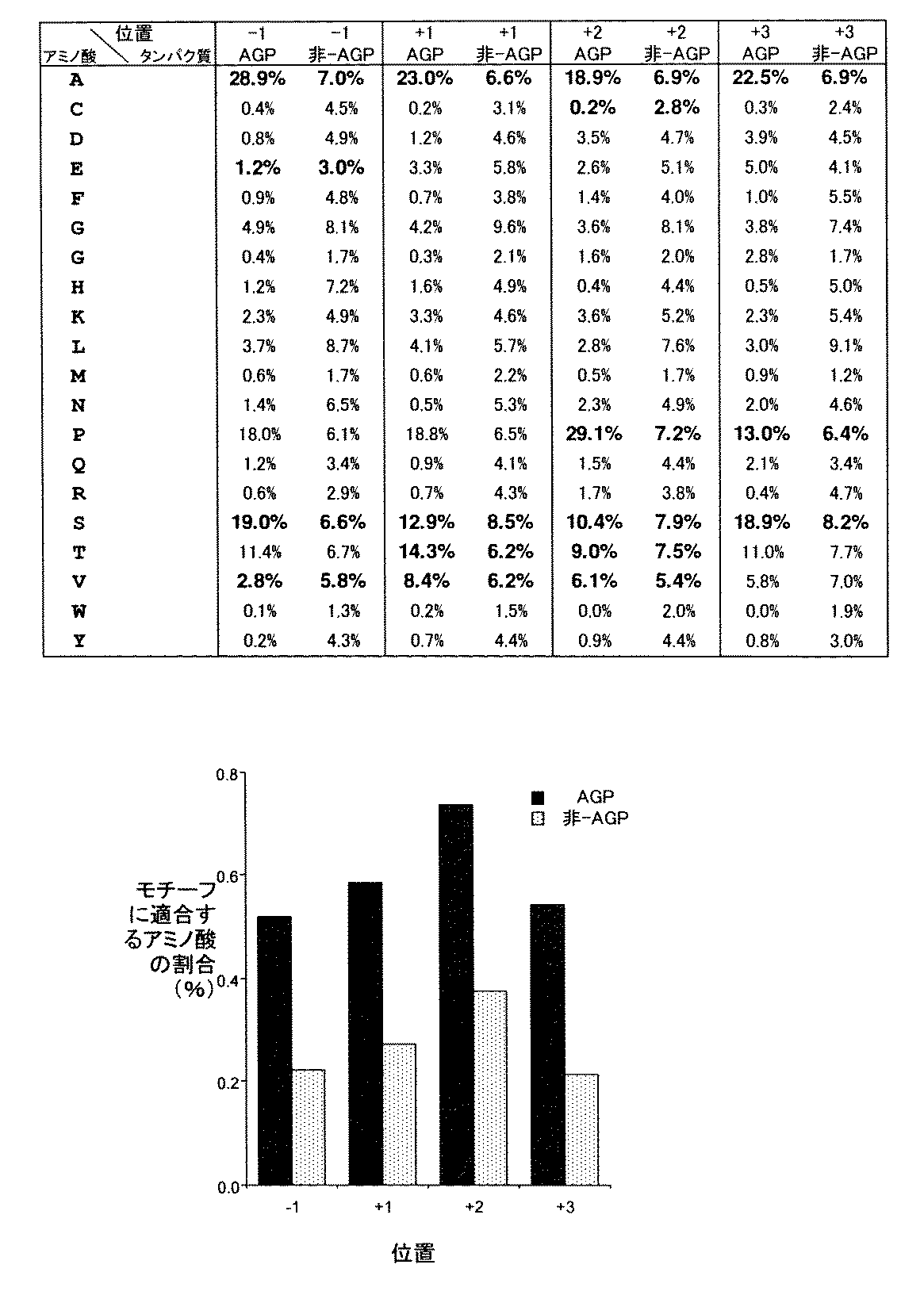
これらのプラスミドの塩基配列を決定することにより、25番目から30番目のアミノ酸を欠くと共に、次のアミノ酸置換変異スポラミンをコードする変異スポラミンcDNAを作成した。なお、用いたPCR用プライマーに、混合塩基を含むものを用いた場合は、得られた複数のプラスミドを持つ形質転換体から独立にプラスミドを調製し、それらの塩基配列を独立に決定することにより、合計としてプライマーの数より多い種類数の変異体を得ることができた。 By determining the nucleotide sequences of these plasmids, mutant sporamine cDNA was prepared which lacked the 25th to 30th amino acids and encoded the next amino acid substitution mutant sporamine. In addition, when using PCR primers that contain mixed bases, prepare plasmids independently from the resulting transformants with multiple plasmids, and determine their base sequences independently. In total, more variants than the number of primers could be obtained.
P31W, P31C, P31R, P31Q, P31D, P31E, P31T, P31S, P31Y, P31L, P31A, P31G, T32R, T32Q, T32E, T32S, T32Y, T32P, T32L, T32Y, T32A, T32G, T33W, T33K, T33R, T33N, T33Q, T33E, T33S, T33F, T33P, T33L, T33V, T33A, T33G, H34R, H34Q, H34E, H34T, H34S, H34Y, H34P, H34I, H34V, H34A, H34G, E35M, E35K, E35N, E35T, E35S, E35F, E35Y, E35P, E35L, E35V, E35A, E35G, A37R, A37N, A37Q, A37E, A37T, A37S, A37F, A37Y, A37P, A37I, A37V, A37G, S38W, S38C, S38R, S38Q, S38D, S38T, S38Y, S38P, S38L, S38V, S38A, S38G, S39W, S39R, S39N, S39D, S39T, S39F, S39Y, S39P, S39L, S39V, S39A, S39G, E40R, E40N, E40T, E40Y, E40P, E40L, E40V, E40A, E40G, T41M, T41K, T41R, T41Q, T41D, T41S, T41Y, T41P, T41L, T41V, T41A, T41G。 P31W, P31C, P31R, P31Q, P31D, P31E, P31T, P31S, P31Y, P31L, P31A, P31G, T32R, T32Q, T32E, T32S, T32Y, T32P, T32L, T32Y, T32A, T32G, T33W, T33K, T33 T33N, T33Q, T33E, T33S, T33F, T33P, T33L, T33V, T33A, T33G, H34R, H34Q, H34E, H34T, H34S, H34Y, H34P, H34I, H34V, H34A, H34G, E35M, E35K, E35N, 35 E35S, E35F, E35Y, E35P, E35L, E35V, E35A, E35G, A37R, A37N, A37Q, A37E, A37T, A37S, A37F, A37Y, A37P, A37I, A37V, A37G, S38W, S38C, S38R, S38Q, S38 S38T, S38Y, S38P, S38L, S38V, S38A, S38G, S39W, S39R, S39N, S39D, S39T, S39F, S39Y, S39P, S39L, S39V, S39A, S39G, E40R, E40N, E40T, E40Y, E40L, 40 E40V, E40A, E40G, T41M, T41K, T41R, T41Q, T41D, T41S, T41Y, T41P, T41L, T41V, T41A, T41G.
これらの変異体をコードする配列を持つプラスミドをBamHIとHindIIIで切断し、バイナリーベクターpMAT037 (K. Matsuoka & K. Nakamura, Proc. Natl. Acad. Sci. USA 88:834-838, 1991)のBglIIとHindIIIサイトの間に挿入したバイナリーベクターを作成し、これらを、K. Matsuoka & K. Nakamura, Proc. Natl. Acad. Sci. USA 88:834-838, 1991に記載されたアグロバクテリウムを介してタバコ培養細胞BY−2株に導入した。 A plasmid having a sequence encoding these mutants was digested with BamHI and HindIII, and BglII of the binary vector pMAT037 (K. Matsuoka & K. Nakamura, Proc. Natl. Acad. Sci. USA 88: 834-838, 1991) was used. And a binary vector inserted between the HindIII site and these were transferred to Agrobacterium described in K. Matsuoka & K. Nakamura, Proc. Natl. Acad. Sci. USA 88: 834-838, 1991. And introduced into tobacco cultured cell BY-2 strain.
次いで、形質転換体の培地から、スポラミンを免疫沈降法 (K. Matsuoka & K. Nakamura, Proc. Natl. Acad. Sci. USA 88:834-838, 1991)により回収し、SDS-PAGEで分離後、抗スポラミン抗体を用いてスポラミンを検出した。抗原抗体複合体の検出には、アルカリフォスファターゼ結合抗ウサギ抗体(バイオラッド)とECF免疫ブロッテイングキット(アマシャム)の組み合わせを用い、最終的なシグナルは、Storm 8600イメージアナライザー(アマシャム)を用いて検出した。培地中に分泌された変異スポラミンを検出した結果を図2に示す。図2中、ncは陰性対照(大腸菌で発現させたスポラミン)である。ncのすぐ横のレーンには、野生型と同じアミノ酸残基を有する変異スポラミン(すなわち、I28G以外の改変を行っていない分泌型スポラミン変異体)を、対照として用いた。 Subsequently, sporamine was recovered from the transformant medium by immunoprecipitation (K. Matsuoka & K. Nakamura, Proc. Natl. Acad. Sci. USA 88: 834-838, 1991) and separated by SDS-PAGE. Sporamin was detected using an anti-sporamin antibody. The antigen-antibody complex is detected using a combination of alkaline phosphatase-conjugated anti-rabbit antibody (BioRad) and ECF immunoblotting kit (Amersham), and the final signal is detected using Storm 8600 Image Analyzer (Amersham). did. The result of detecting mutant sporamine secreted into the medium is shown in FIG. In FIG. 2, nc is a negative control (sporamin expressed in E. coli). In the lane immediately next to nc, a mutant sporamine having the same amino acid residue as that of the wild type (ie, a secreted sporamine mutant not modified except for I28G) was used as a control.
図2に示される通り、36番目のPro残基のN末端側又はC末端側に改変を加えた変異スポラミンの一部のものでは、バンドのスメアリングの程度が対照と比較して減少したりスメアリングが見られなくなったりしていた(例えばA37のEのレーン)。これらの変異スポラミンでは、糖鎖付加が減少したか又は糖鎖が付加されなかったものと考えられる。そこで、このスメアリングの程度に基づき、変異スポラミンの各々について、36番目のPro残基が糖鎖付加されているレベルを3段階(「++」、「+」、「−」)で評価した。野生型スポラミンへの糖鎖付加のレベルは「++」である。従ってレベル「++」は、36番目のPro残基が野生型スポラミンと同程度の安定的な糖鎖付加を受けたことを示す。一方、レベル「+」は、36番目のPro残基への糖鎖付加が不安定になり、糖鎖付加量が低減したことを示す。 As shown in FIG. 2, in the case of a part of the mutant sporamine in which the N-terminal side or the C-terminal side of the 36th Pro residue is modified, the degree of band smearing is decreased as compared with the control. Smearing could not be seen (for example, lane E in A37). In these mutant sporamines, it is considered that sugar chain addition was reduced or sugar chain was not added. Therefore, based on the degree of smearing, the level at which the 36th Pro residue was glycosylated was evaluated in three stages (“++”, “+”, “−”) for each of the mutant sporamines. The level of glycosylation to wild type sporamine is “++”. Therefore, the level “++” indicates that the 36th Pro residue has undergone the same stable glycosylation as wild-type sporamine. On the other hand, the level “+” indicates that the sugar chain addition to the 36th Pro residue became unstable and the amount of sugar chain addition was reduced.
[実施例2]変異スポラミンにおける36番目のアミノ酸残基の同定
実施例1においてスメアリングが減少したり見られなくなったりした変異スポラミン(糖鎖付加レベルが「+」又は「−」のもの, T32R, T33R, T33K, H34P,H34T, H34E, H34R, H34C, E35G, E35L, E35P, E35Y, E35F, E35T, E35N, E35K, E35M, A37G, A37I, A37P, A37Y, A37F, A37E, A37Q, A37N, A37R, S38G, S38L, S38Y, S38D, S38Q, S38R, S38W, S39G, S39V, S39L, S39Y, S39F, S39T, S39D, S39N, S39R, S39W, S39W, E40L, E40P, E40T, E40N, E40R, E40A, T41G, T41L, T41P, T41D, T41R, T41K, T41S )を、それぞれの培地から回収してタンパク質溶液として調製し、MosoQカラムに供して精製を行った後、エドマン分解法に基づくペプチドシークエンサーを用いてN末端側のアミノ酸配列を確認した。
[Example 2] Identification of 36th amino acid residue in mutant sporamine Mutant sporamine with reduced or no smearing in Example 1 (with a glycosylation level of "+" or "-", T32R , T33R, T33K, H34P, H34T, H34E, H34R, H34C, E35G, E35L, E35P, E35Y, E35F, E35T, E35N, E35K, E35M, A37G, A37I, A37P, A37Y, A37F, A37E, A37Q37 A37N , S38G, S38L, S38Y, S38D, S38Q, S38R, S38W, S39G, S39V, S39L, S39Y, S39F, S39T, S39D, S39N, S39R, S39W, S39W, E40L, E40P, E40T, E40N, E40R41, E40A, T40R41 , T41L, T41P, T41D, T41R, T41K, T41S) are collected from each medium, prepared as a protein solution, subjected to purification using a MosoQ column, and then purified using a peptide sequencer based on the Edman degradation method. The terminal amino acid sequence was confirmed.
エドマン分解による糖鎖付加部位の確認には、各変異体[参考例1]のI28G変異体と同様の方法で精製し、SDS-PAGEとCBB染色により、スポラミンを含み、他のタンパク質をほとんど含まないことが明かとなったフラクションを用いた。該当するフラクションのタンパク質を、Prosorb sample preparation cartrige (アプライドバイオシステム社)を用いてカートリッジ中のメンブレン上に濃縮、結合させた。次いで、プロテインシークエンサー(Procise(R) Sequencing System, Model 492、アプライドバイオシステム社)によりエドマン分解とアミノ酸誘導体の分離、同定、半定量を行った。 For confirmation of the glycosylation site by Edman degradation, it was purified in the same manner as the I28G mutant of each mutant [Reference Example 1], and it contained sporamine and almost other proteins by SDS-PAGE and CBB staining. The fraction that was found to be absent was used. The relevant fraction of protein was concentrated and bound onto the membrane in the cartridge using Prosorb sample preparation cartrige (Applied Biosystems). Subsequently, Edman degradation and amino acid derivatives were separated, identified, and semi-quantified by a protein sequencer (Procise® Sequencing System, Model 492, Applied Biosystems).
上記の分析においては、36番目のアミノ酸残基が、修飾されていないPro残基であればPro(プロリン)のピークが検出されるが、36番目のアミノ酸残基がHyp残基であればHypのピークが検出される。Hyp(ヒドロキシプロリン)のピークは、異性体が存在するためにHisとAlaのピークを挟む形で出現する。また36番目のアミノ酸残基が糖鎖付加されたHyp残基である場合には、糖鎖付加アミノ酸はエドマン分解法により分解はされるが分離カラムで分離されないため、ピークとして検出されない。この実験結果から、36番目のPro残基が水酸化されている程度を、4段階(「++」、「+」、「±」、「−」)で評価した。 In the above analysis, if the 36th amino acid residue is an unmodified Pro residue, a Pro (proline) peak is detected, but if the 36th amino acid residue is a Hyp residue, Hyp is detected. Peaks are detected. The peak of Hyp (hydroxyproline) appears in a form sandwiching the peak of His and Ala due to the presence of isomers. When the 36th amino acid residue is a glycosylated Hyp residue, the glycosylated amino acid is not detected as a peak because it is decomposed by the Edman degradation method but not separated by a separation column. From this experimental result, the degree to which the 36th Pro residue was hydroxylated was evaluated in four stages (“++”, “+”, “±”, “−”).
さらに、実施例1において対照と比較してスメアリングの減少が認められなかったことから糖鎖の付加が示された変異スポラミンのうち、任意に選んだ2個の変異体、すなわちE35S, E40A変異体について、それぞれの培地から回収してタンパク質溶液として調製し、MosoQカラムに供して精製を行った後、[参考例1]のI28G変異の解析に用いた手法で質量分析を行って36番目のPro残基への糖鎖付加を確認した。その結果を図9に示す。 Furthermore, among the mutant sporamines in which addition of sugar chains was shown because no reduction in smearing was observed in Example 1 compared to the control, two mutants selected arbitrarily, ie, E35S and E40A mutations The body was recovered from each medium, prepared as a protein solution, purified by applying it to a MosoQ column, and then subjected to mass spectrometry using the technique used for the analysis of the I28G mutation in [Reference Example 1]. Glycosylation to the Pro residue was confirmed. The result is shown in FIG.
以上の結果をまとめたものが、図3である。図3の横のカラムは野生型スポラミンにおける31番目〜41番目の位置のアミノ酸(1文字表記)を示し、縦のカラムはそれぞれのアミノ酸から改変されたアミノ酸(1文字表記)を示す。 FIG. 3 summarizes the above results. The horizontal column of FIG. 3 shows the amino acids at the 31st to 41st positions (single letter notation) in wild-type sporamine, and the vertical column shows the amino acid modified from each amino acid (one letter notation).
この結果に基づき、スポラミンの36番目に位置するPro残基の水酸化及び糖鎖付加に必要なコンセンサス配列を以下の通り同定した。
Based on this result, the consensus sequence necessary for hydroxylation and glycosylation of the Pro residue located at
(1)36番目のPro残基の水酸化に必要なコンセンサス配列:
[AVSTE]−Pro−[AVST]−[GAVPSTC]−[APS、又は酸性アミノ酸残基]−[アミドでも塩基性でもないアミノ酸残基]
(1) Consensus sequence required for hydroxylation of the 36th Pro residue:
[AVSTE] -Pro- [AVST]-[GAVPSTC]-[APS, or acidic amino acid residue]-[amino acid residue that is neither amide nor basic]
(2)前記(1)の配列中で水酸化されたPro残基(Hyp)への糖鎖付加に必要なコンセンサス配列:
[AVSE]−Hyp−[AVST]−[AVPSTC]−[APS]
(2) A consensus sequence necessary for glycosylation to a Pro residue (Hyp) hydroxylated in the sequence of (1):
[AVSE] -Hyp- [AVST]-[AVPSTC]-[APS]
これらの配列に基づき同定されたアラビノガラクタン様糖鎖付加モチーフは、以下の通りである。
[AVSE]−Pro−[AVST]−[AVPSTC]−[APS]
The arabinogalactan-like glycosylation motifs identified based on these sequences are as follows.
[AVSE] -Pro- [AVST]-[AVPSTC]-[APS]
なおこれらの配列において、[](括弧)内の英字は一文字表記のアミノ酸を表しており、[]はその中のアミノ酸から任意の1つが選択されることを表す。 In these sequences, alphabetic characters in [] (parentheses) represent single-letter amino acids, and [] represents that any one of them is selected.
[参考例2] アラビノガラクタン様糖鎖付加モチーフを含むペプチドとGFPとから構成される融合タンパク質の製造
上記の通り同定されたアラビノガラクタン様糖鎖付加モチーフを含む、スポラミンのN末端側のペプチド断片を利用して、そのペプチド断片とGFPとを連結した融合タンパク質を植物で発現させて製造し、その融合タンパク質への糖鎖付加を調べた。
[Reference Example 2] Production of a fusion protein composed of a peptide containing an arabinogalactan-like glycosylation motif and GFP The N-terminal side of sporamine containing an arabinogalactan-like glycosylation motif identified as described above Using the peptide fragment, a fusion protein in which the peptide fragment and GFP were linked was expressed in a plant, and the addition of a sugar chain to the fusion protein was examined.
この実験では、下記の手順に従って、参考例1に従って作製した分泌型スポラミン変異体にGFPを連結した融合タンパク質を、タバコ細胞中で発現させた。 In this experiment, a fusion protein in which GFP was linked to a secreted sporamine mutant prepared according to Reference Example 1 was expressed in tobacco cells according to the following procedure.
I28G変異を持つスポラミンcDNAが組み込まれたpMAT103誘導体(Matsuoka K, Nakamura K. Large alkyl side-chains of isoleucine and leucine in the NPIRL region constitute the core of the vacuolar sorting determinant of sporamin precursor. Plant Mol Biol. 1999 Dec;41(6):825-35.)を鋳型とし、下記のプライマー
GGCCATGGTTTCAGAGGAGGCGGGTTC (I28G)
と、市販のSP6プライマー(宝酒造)を用いて、スポラミン前駆体のシグナルペプチド、液胞輸送シグナルを破壊したプロペプチドと成熟型のN-末端部分をコードする領域の後にNcoIサイトを組み込んだPCR断片を常法によって増幅した。増幅した断片を精製後、NcoIとBamHIで切断し、これをblue-SGFP-TYG-nos SK (Chiu et al., Current Biol. 6:325-330, 1996)のBamHI/NcoIサイトの間に組み込んだ。I28G変異または変異を持つスポラミン前駆体のN-末端部分とGFPの融合タンパク質『SPO41(I28G)−GFP』をコードするDNAを有するプラスミドが作成できたことを塩基配列を解析することにより確認し、次いでこれらのプラスミドをBamHIとClaIで消化し、得られたフラグメントをバイナリー発現ベクターpMAT037(K. Matsuoka & K. Nakamura, Proc. Natl. Acad. Sci. USA 88:834-838, 1991)のBglIIとClaIサイトの間に組み込んだ。このプラスミドを用いて、Agrobacterium を介した方法によりタバコ培養細胞BY-2株を形質転換した。得られた形質転換体を懸濁培養し、培地中に分泌されたGFP融合タンパク質を解析に用いた。
PMAT103 derivative incorporating sporamine cDNA with I28G mutation (Matsuoka K, Nakamura K. Large alkyl side-chains of isoleucine and leucine in the NPIRL region constitute the core of the vacuolar sorting determinant of sporamin precursor. Plant Mol Biol. 1999 Dec ; 41 (6): 825-35.) As template and the following primers
GGCCATGGTTTCAGAGGAGGCGGGTTC (I28G)
And a commercial SP6 primer (Takara Shuzo), a sporamine precursor signal peptide, a propeptide with a disrupted vacuolar transport signal, and a PCR fragment incorporating an NcoI site after the region encoding the mature N-terminal part Was amplified by a conventional method. The amplified fragment is purified, cleaved with NcoI and BamHI, and incorporated into the BamHI / NcoI site of blue-SGFP-TYG-nos SK (Chiu et al., Current Biol. 6: 325-330, 1996). It is. By analyzing the nucleotide sequence, it was confirmed that a plasmid having a DNA encoding the fusion protein “SPO41 (I28G) -GFP” of the N-terminal portion of the I28G mutation or a sporamine precursor having a mutation and GFP was created, These plasmids were then digested with BamHI and ClaI and the resulting fragments were combined with BglII of the binary expression vector pMAT037 (K. Matsuoka & K. Nakamura, Proc. Natl. Acad. Sci. USA 88: 834-838, 1991). Incorporated between ClaI sites. Using this plasmid, tobacco cultured cell BY-2 was transformed by a method mediated by Agrobacterium. The obtained transformant was cultured in suspension, and the GFP fusion protein secreted into the medium was used for analysis.
培地中に分泌された融合タンパク質を検出した結果を図4に示す。なお図4中、作製された融合タンパク質は『SPO41(I28G)−GFP』として示しており、その構造の模式図を図4Aに示している。図4Bは培地中のタンパク質を検出したSDS−PAGEの結果を示す。図4Cは、培地中の融合タンパク質(SPO41(I28G)−GFP)を糖染色(左レーン)及び抗GFP染色(右レーン)により検出した結果を示す。図4Cに示される通り、タバコ細胞中で発現された分泌型スポラミン変異体+GFPの融合タンパク質(SPO41(I28G)−GFP)には、糖鎖が付加されていた。このことから、アラビノガラクタン様糖鎖付加モチーフを含むペプチドは、別のタンパク質に糖鎖を付加するためのタグペプチド(糖鎖付加用ペプチド)として使用できることが示された。 The result of detecting the fusion protein secreted into the medium is shown in FIG. In FIG. 4, the prepared fusion protein is shown as “SPO41 (I28G) -GFP”, and a schematic diagram of the structure is shown in FIG. 4A. FIG. 4B shows the result of SDS-PAGE in which the protein in the medium was detected. FIG. 4C shows the result of detecting the fusion protein (SPO41 (I28G) -GFP) in the medium by sugar staining (left lane) and anti-GFP staining (right lane). As shown in FIG. 4C, a sugar chain was added to the fusion protein (SPO41 (I28G) -GFP) of the secretory sporamine mutant + GFP expressed in tobacco cells. From this, it was shown that a peptide containing an arabinogalactan-like glycosylation motif can be used as a tag peptide (glycosylation peptide) for adding a sugar chain to another protein.
[実施例3]タンパク質中のアラビノガラクタン様糖鎖付加モチーフの検索
実施例2で同定されたアラビノガラクタン様糖鎖付加モチーフについて、アラビノガラクタン様糖鎖を有するタンパク質のアミノ酸配列の検索を行った。アラビノガラクタン様糖鎖を有するタンパク質としては、ニコチアナ(Nicotiana alata)由来の2種のアラビノガラクタンタンパク質(PIRのアクセッション番号: それぞれT10265及びAAG24616)と、トマト(Lycopersicon esculentum Mill)由来のアラビノガラクタンタンパク質(PIRのアクセッション番号: S55925)とを用いた。これらのタンパク質については、いずれもアラビノガラクタン様糖鎖が結合していることが報告されている(Mau,S.L., Chen,C.G., Pu,Z.Y., Moritz,R.L., Simpson,R.J., Bacic,A. and Clarke,A.E. Plant J. 8 (2), 269-281 (1995): Gilson,P., Gaspar,Y.M., Oxley,D., Youl,J.J. and Bacic,A. Protoplasma 215 (1-4),128-139 (2001): Gao M, Kieliszewski MJ, Lamport DT, and Showalter AM. Plant J. 1999 Apr;18(1):43-55.)。また対照としては、液胞又は細胞外に分泌される植物タンパク質であってアラビノガラクタン様糖鎖が結合していないことが判明している3種のタンパク質: いずれもタバコ(Nicotiana tabacum)由来のキチナーゼA(PIRのアクセッション番号: P08252)、アスコルビン酸オキシダーゼ(PIRのアクセッション番号: S66353)、及びペルオキシダーゼ(PIRのアクセッション番号: BAA07664)を用いた。
この検索の結果を表2に示す。
[Example 3] Search for arabinogalactan-like glycosylation motif in protein Search for amino acid sequence of protein having arabinogalactan-like sugar chain for arabinogalactan-like glycosylation motif identified in Example 2 went. Proteins with arabinogalactan-like sugar chains include two arabinogalactan proteins from Nicotiana alata (PIR accession numbers: T10265 and AAG24616, respectively) and arabino from tomato (Lycopersicon esculentum Mill). Galactan protein (PIR accession number: S55925) was used. All of these proteins have been reported to have arabinogalactan-like sugar chains attached (Mau, SL, Chen, CG, Pu, ZY, Moritz, RL, Simpson, RJ, Bacic, A. and Clarke, AE Plant J. 8 (2), 269-281 (1995): Gilson, P., Gaspar, YM, Oxley, D., Youl, JJ and Bacic, A. Protoplasma 215 (1-4), 128 -139 (2001): Gao M, Kieliszewski MJ, Lamport DT, and Showalter AM. Plant J. 1999 Apr; 18 (1): 43-55.). In addition, as a control, there are three proteins that are secreted to the vacuole or extracellularly and have not been linked to arabinogalactan-like sugar chains: all derived from Nicotiana tabacum Chitinase A (PIR accession number: P08252), ascorbate oxidase (PIR accession number: S66353), and peroxidase (PIR accession number: BAA07664) were used.
The results of this search are shown in Table 2.
表2に示される通り、アラビノガラクタン様糖鎖が結合している3種のタンパク質全てに、アラビノガラクタン様糖鎖付加モチーフが検出された。一方、アラビノガラクタン様糖鎖が結合していないタンパク質3種には、アラビノガラクタン様糖鎖付加モチーフは1つも検出されなかった。この結果は、アラビノガラクタン様糖鎖付加モチーフが、植物におけるタンパク質へのアラビノガラクタン様糖鎖の付加に強く関与していることを示している。 As shown in Table 2, arabinogalactan-like glycosylation motifs were detected in all three proteins to which arabinogalactan-like sugar chains were bound. On the other hand, no arabinogalactan-like glycosylation motif was detected in the three proteins to which no arabinogalactan-like sugar chain was bound. This result indicates that the arabinogalactan-like glycosylation motif is strongly involved in the addition of arabinogalactan-like sugar chains to proteins in plants.
次に、National Center for Biotechnology Information (NCBI) のサイトから、nrデータベース(All non-redundant GenBank CDS translations+RefSeq Proteins+PDB+SwissProt+PIR+PRF)上のタンパク質について、ArabinogalactanとSpermatophyta (種子植物)をキーワードに含むタンパク質の存在を調べた。この検索には 米国のNCBI が運営する検索サイト 、http://www.ncbi.nlm.nih.gov/ を用いた。 Next, the Arabinogalactan and Spermatophyta (seed plant) for the proteins in the nr database (All non-redundant GenBank CDS translations + RefSeq Proteins + PDB + SwissProt + PIR + PRF) from the National Center for Biotechnology Information (NCBI) site. The presence of the protein included in the keyword was examined. For this search, the search site operated by NCBI in the United States, http://www.ncbi.nlm.nih.gov/ was used.
その結果、アラビノガラクタンタンパク質(AGP)及びそのホモログとして分類されているタンパク質が、調査の時点で112個含まれることが判明した。これらのタンパク質についてデータベースに公開されているアミノ酸配列中のアラビノガラクタン様糖鎖付加モチーフを検索した結果、112個中の101個のタンパク質がアラビノガラクタン様糖鎖付加モチーフを有していた。 As a result, it was found that 112 proteins were classified as arabinogalactan proteins (AGP) and homologs thereof at the time of the survey. As a result of searching for an arabinogalactan-like glycosylation motif in the amino acid sequence published in the database for these proteins, 101 proteins out of 112 had an arabinogalactan-like glycosylation motif.
一方、対照として、アラビノガラクタンタンパク質として分類されないが液胞又は細胞外に輸送されるタンパク質(Non−AGP)を、同データベースから無作為に100個抽出した。この100個のタンパク質についてデータベースに公開されているアミノ酸配列中のアラビノガラクタン様糖鎖付加モチーフを検索したところ、アラビノガラクタン様糖鎖付加モチーフを有するものは100個中の7個であった。
以上の結果を表3にまとめた。
On the other hand, as a control, 100 proteins (Non-AGP) that were not classified as arabinogalactan proteins but were transported to the vacuole or extracellular were randomly extracted from the same database. When these 100 proteins were searched for arabinogalactan-like glycosylation motifs in the amino acid sequence published in the database, 7 of 100 proteins had arabinogalactan-like glycosylation motifs. .
The above results are summarized in Table 3.
このように、データベース上のアラビノガラクタン様糖鎖が付加されている可能性の高いタンパク質においては、アラビノガラクタン様糖鎖付加モチーフが高頻度に存在していた。この結果は、タンパク質中のアラビノガラクタン様糖鎖付加モチーフにアラビノガラクタン様糖鎖が結合するという本発明における知見を支持するものである。一方、表3に示されるように、アラビノガラクタンタンパク質として分類されていないタンパク質の中にも、アラビノガラクタン様糖鎖付加モチーフをもつものが少数ながら見出された。このことは、本発明に係るアラビノガラクタン様糖鎖付加モチーフを用いることによって、従来の基準ではアラビノガラクタンタンパク質に分類されないがアラビノガラクタン様糖鎖が付加されているタンパク質をも同定できる可能性を示している。 As described above, the arabinogalactan-like glycosylation motif was frequently present in a protein having a high possibility of adding an arabinogalactan-like sugar chain on the database. This result supports the finding in the present invention that an arabinogalactan-like sugar chain binds to an arabinogalactan-like sugar chain addition motif in a protein. On the other hand, as shown in Table 3, a small number of proteins having an arabinogalactan-like glycosylation motif were found among proteins not classified as arabinogalactan proteins. This is because by using the arabinogalactan-like glycosylation motif according to the present invention, it is possible to identify a protein that is not classified as an arabinogalactan protein by the conventional criteria but has an arabinogalactan-like sugar chain added. Showing sex.
続いて、上記の112個のAGPと100個のNon−AGPについて、データベースに公開されているアミノ酸配列中のPro残基を中心として、Pro残基より1つN末端側のアミノ酸残基(-1)、1つC末端側のアミノ酸残基(+1)、2つC末端側のアミノ酸残基(+2)、3つC末端側のアミノ酸残基(+3)を調べた。その結果を図5に示す。図5中、最下段の数値は、各位置においてアラビノガラクタン様糖鎖付加モチーフに適合するアミノ酸が存在するパーセンテージを示す。図5に示される通り、AGPではアラビノガラクタン様糖鎖付加モチーフに適合するアミノ酸の出現頻度は比較的高いが、Non−AGPでの出現頻度はAGPの場合の半分程度でしかなく比較的低い。この結果は、反復配列中にPro残基を多数個含んでいるアラビノガラクタンタンパク質においても、アラビノガラクタン様糖鎖が付加されるPro残基を予測できることを示している。 Subsequently, with respect to the 112 AGPs and 100 Non-AGPs described above, one N-terminal amino acid residue (−) from the Pro residue centered on the Pro residue in the amino acid sequence published in the database. 1) One C-terminal amino acid residue (+1), two C-terminal amino acid residues (+2), and three C-terminal amino acid residues (+3) were examined. The result is shown in FIG. In FIG. 5, the numerical value at the bottom indicates the percentage of amino acids that match the arabinogalactan-like glycosylation motif at each position. As shown in FIG. 5, the appearance frequency of amino acids that match the arabinogalactan-like glycosylation motif is relatively high in AGP, but the appearance frequency in Non-AGP is only about half that in AGP and is relatively low. . This result shows that a Pro residue to which an arabinogalactan-like sugar chain is added can be predicted even in an arabinogalactan protein containing many Pro residues in a repetitive sequence.
[実施例4]膜タンパク質におけるアラビノガラクタン様糖鎖付加モチーフの検索
膜タンパク質である、シロイヌナズナの膜貫通型プロテインキナーゼホモログ(アラビノガラクタンタンパク質には分類されていない)を、NCBIのサイトからSpermatophyta, Arabidopsis, protein kinase, signal をキーワードとして選びだしたところ、検索の時点で242個がデータベース上に見い出された。次に、これらについて、データベース上のアミノ酸配列を利用してアラビノガラクタン様糖鎖付加モチーフの検索を行った。
[Example 4] Search for arabinogalactan-like glycosylation motif in membrane protein Arabidopsis transmembrane protein kinase homologue (not classified as arabinogalactan protein), a membrane protein, was obtained from the NCBI site by Spermatophyta , Arabidopsis, protein kinase, signal were selected as keywords, and 242 were found on the database at the time of the search. Next, arabinogalactan-like glycosylation motifs were searched for using these amino acid sequences on the database.
この結果、11種のプロテインキナーゼホモログにおいて、膜貫通領域(下線部)よりも前の配列(細胞外領域)中に、アラビノガラクタン様糖鎖付加モチーフの存在が確認された。この結果を、図6−1、図6−2、図6−3、図6−4に示す。 As a result, in 11 protein kinase homologs, the presence of an arabinogalactan-like glycosylation motif was confirmed in the sequence (extracellular region) before the transmembrane region (underlined portion). The results are shown in FIGS. 6-1, 6-2, 6-3, and 6-4.
本発明の方法を用いれば、タンパク質を植物で発現させることなく、そのタンパク質上のアラビノガラクタン様糖鎖の付加部位を予測することができ、それによってそのタンパク質を植物で発現させたときの性質の変化(例えば、水溶性、抗原性など)を予測することができる。従って本発明の方法は、例えば、動物に投与することを意図したタンパク質を植物で発現させて製造する際に、動物へ投与する際の効果や安全性の点でそのタンパク質が植物で発現させて製造するのに適しているか否かを判定するために用いることができ、さらにその判定結果に基づいて、そのタンパク質を植物で製造してもアラビノガラクタン様糖鎖が付加されないように改変した改変タンパク質を製造することができる。さらに、本発明のタンパク質の製造方法を用いれば、タンパク質の所望の位置にアラビノガラクタン様糖鎖を付加することができるため、任意のタンパク質を用いてアジュバント能を高めたタンパク質や経口摂取により免疫賦活能を発揮するタンパク質を製造することができる。 By using the method of the present invention, it is possible to predict the addition site of an arabinogalactan-like sugar chain on the protein without expressing the protein in the plant, and thereby the properties when the protein is expressed in the plant. Changes (eg, water solubility, antigenicity, etc.) can be predicted. Therefore, the method of the present invention, for example, when producing a protein intended to be administered to an animal by producing it in a plant, causes the protein to be expressed in the plant in terms of the effects and safety when administered to the animal. Modification that can be used to determine whether or not it is suitable for production, and further modified based on the determination result so that arabinogalactan-like sugar chain is not added even if the protein is produced in plants Protein can be produced. Furthermore, since the arabinogalactan-like sugar chain can be added to a desired position of the protein by using the protein production method of the present invention, it is possible to immunize by ingesting a protein with an adjuvant ability using any protein or by ingestion. A protein that exhibits activation ability can be produced.
また、本発明の式(I)および(II)の配列をコードするDNA該DNAを含有するベクターは、上記のようなPro残基の水酸化を受けたタンパク質及びアラビノガラクタン様糖鎖を付加したタンパク質を製造する際に好適に使用できる、部位特異的変異導入用DNA(例えばPCRプライマーなど)として有用である。本発明の式(I)および(II)のアミノ酸配列からなるペプチドはまた、Hyp残基付加用ペプチド及びアラビノガラクタン様糖鎖付加用ペプチドとして好適に使用することができる。 In addition, the DNA encoding the sequences of formulas (I) and (II) of the present invention is a vector containing the DNA, to which a protein subjected to hydroxylation of the Pro residue as described above and an arabinogalactan-like sugar chain are added. It is useful as a site-directed mutagenesis DNA (for example, a PCR primer) that can be suitably used in producing the prepared protein. The peptides consisting of the amino acid sequences of the formulas (I) and (II) of the present invention can also be suitably used as Hyp residue addition peptides and arabinogalactan-like sugar chain addition peptides.
配列番号1〜14は、アラビノガラクタン様O−結合型糖鎖付加モチーフである。配列番号15〜58は、プライマーである。 SEQ ID NOs: 1-14 are arabinogalactan-like O-linked glycosylation motifs. Sequence number 15-58 is a primer.
Claims (13)
X(-1)−Pro−X(+1)−X(+2)−X(+3)−X(+4) (I)
[式中、X(-1)はAla、Val、Ser、Thr又はGluであり、X(+1)はAla、Val、Ser又はThrであり、X(+2)はGly、Ala、Val、Pro、Ser、Thr又はCysであり、X(+3)はAla、Pro、Ser又は酸性アミノ酸であり、X(+4)はアミドでも塩基性アミノ酸でもないアミノ酸である]
で表されるアミノ酸配列からなるペプチド。 Formula (I) below:
X (-1) -Pro-X (+1) -X (+2) -X (+3) -X (+4) (I)
[Wherein X (-1) is Ala, Val, Ser, Thr or Glu, X (+1) is Ala, Val, Ser or Thr, and X (+2) is Gly, Ala, Val, Pro, Ser, Thr, or Cys, X (+3) is Ala, Pro, Ser, or an acidic amino acid, and X (+4) is an amino acid that is neither an amide nor a basic amino acid]
A peptide comprising the amino acid sequence represented by
X(-1)−Pro−X(+1)−X(+2)−X(+3) (II)
[式中、X(-1)はAla、Val、Ser、又はGluであり、X(+1)はAla、Val、Ser又はThrであり、X(+2)はAla、Val、Pro、Ser、Thr又はCysであり、X(+3)はAla、Pro、又はSerである]
で表されるアミノ酸配列からなるペプチド。 Formula (II) below:
X (-1) -Pro-X (+1) -X (+2) -X (+3) (II)
[Wherein X (-1) is Ala, Val, Ser, or Glu, X (+1) is Ala, Val, Ser, or Thr, and X (+2) is Ala, Val, Pro, Ser. , Thr or Cys, and X (+3) is Ala, Pro, or Ser]
A peptide comprising the amino acid sequence represented by
該タンパク質のアミノ酸配列中の、下記式(I):
X(-1)−Pro−X(+1)−X(+2)−X(+3)−X(+4) (I)
[式中、X(-1)はAla、Val、Ser、Thr又はGluであり、X(+1)はAla、Val、Ser又はThrであり、X(+2)はGly、Ala、Val、Pro、Ser、Thr又はCysであり、X(+3)はAla、Pro、Ser又は酸性アミノ酸であり、X(+4)はアミドでも塩基性アミノ酸でもないアミノ酸である]
で表される配列を特定することを含む、前記方法。 A method for predicting a plant-specific hydroxylated Pro residue in a protein, comprising:
In the amino acid sequence of the protein, the following formula (I):
X (-1) -Pro-X (+1) -X (+2) -X (+3) -X (+4) (I)
[Wherein X (-1) is Ala, Val, Ser, Thr or Glu, X (+1) is Ala, Val, Ser or Thr, and X (+2) is Gly, Ala, Val, Pro, Ser, Thr, or Cys, X (+3) is Ala, Pro, Ser, or an acidic amino acid, and X (+4) is an amino acid that is neither an amide nor a basic amino acid]
And identifying the sequence represented by:
該タンパク質のアミノ酸配列中の、下記式(II):
X(-1)−Pro−X(+1)−X(+2)−X(+3) (II)
[式中、X(-1)はAla、Val、Ser、又はGluであり、X(+1)はAla、Val、Ser又はThrであり、X(+2)はAla、Val、Pro、Ser、Thr又はCysであり、X(+3)はAla、Pro、又はSerである]
で表される配列を特定することを含む、前記方法。 A method for predicting a Pro residue in a protein to which an arabinogalactan-like sugar chain is added in a plant-specific manner,
In the amino acid sequence of the protein, the following formula (II):
X (-1) -Pro-X (+1) -X (+2) -X (+3) (II)
[Wherein X (-1) is Ala, Val, Ser, or Glu, X (+1) is Ala, Val, Ser, or Thr, and X (+2) is Ala, Val, Pro, Ser. , Thr or Cys, and X (+3) is Ala, Pro, or Ser]
And identifying the sequence represented by:
該タンパク質をコードするDNAに、下記式(II):
X(-1)−Pro−X(+1)−X(+2)−X(+3) (II)
[式中、X(-1)はAla、Val、Ser、又はGluであり、X(+1)はAla、Val、Ser又はThrであり、X(+2)はAla、Val、Pro、Ser、Thr又はCysであり、X(+3)はAla、Pro、又はSerである]
で表される配列をコードするDNA配列を少なくとも1つ導入することを含む、前記方法。 A method of modifying a DNA encoding a protein so as to increase the addition of a plant-specific arabinogalactan-like sugar chain to the protein,
To the DNA encoding the protein, the following formula (II):
X (-1) -Pro-X (+1) -X (+2) -X (+3) (II)
[Wherein X (-1) is Ala, Val, Ser, or Glu, X (+1) is Ala, Val, Ser, or Thr, and X (+2) is Ala, Val, Pro, Ser. , Thr or Cys, and X (+3) is Ala, Pro, or Ser]
The method comprising introducing at least one DNA sequence encoding a sequence represented by:
該タンパク質をコードするDNA中の、下記式(II):
X(-1)−Pro−X(+1)−X(+2)−X(+3) (II)
[式中、X(-1)はAla、Val、Ser、又はGluであり、X(+1)はAla、Val、Ser又はThrであり、X(+2)はAla、Val、Pro、Ser、Thr又はCysであり、X(+3)はAla、Pro、又はSerである]
で表される配列をコードするDNA配列を、少なくとも1つ除去することを含む、前記方法。 A method of modifying a DNA encoding a protein so that addition of a plant-specific arabinogalactan-like sugar chain to the protein is prevented or reduced,
In the DNA encoding the protein, the following formula (II):
X (-1) -Pro-X (+1) -X (+2) -X (+3) (II)
[Wherein X (-1) is Ala, Val, Ser, or Glu, X (+1) is Ala, Val, Ser, or Thr, and X (+2) is Ala, Val, Pro, Ser. , Thr or Cys, and X (+3) is Ala, Pro, or Ser]
And removing at least one DNA sequence encoding the sequence represented by:
請求項9に記載の方法により改変されたDNAを植物で発現させ、産生されたタンパク質を採取することを含む、前記方法。 A method for producing a protein having increased arabinogalactan-like sugar chain addition,
10. The method comprising expressing a DNA modified by the method according to claim 9 in a plant and collecting the produced protein.
Priority Applications (1)
| Application Number | Priority Date | Filing Date | Title |
|---|---|---|---|
| JP2003328840A JP2005087172A (en) | 2003-09-19 | 2003-09-19 | Arabinogalactan-like O-linked glycosylation motif |
Applications Claiming Priority (1)
| Application Number | Priority Date | Filing Date | Title |
|---|---|---|---|
| JP2003328840A JP2005087172A (en) | 2003-09-19 | 2003-09-19 | Arabinogalactan-like O-linked glycosylation motif |
Publications (1)
| Publication Number | Publication Date |
|---|---|
| JP2005087172A true JP2005087172A (en) | 2005-04-07 |
Family
ID=34458294
Family Applications (1)
| Application Number | Title | Priority Date | Filing Date |
|---|---|---|---|
| JP2003328840A Pending JP2005087172A (en) | 2003-09-19 | 2003-09-19 | Arabinogalactan-like O-linked glycosylation motif |
Country Status (1)
| Country | Link |
|---|---|
| JP (1) | JP2005087172A (en) |
Cited By (5)
| Publication number | Priority date | Publication date | Assignee | Title |
|---|---|---|---|---|
| JP2007521807A (en) * | 2004-01-14 | 2007-08-09 | オハイオ ユニバーシティ | Method for producing peptides / proteins in plants and peptides / proteins produced thereby |
| JP2009207368A (en) * | 2008-02-29 | 2009-09-17 | Toyota Central R&D Labs Inc | Aspergillus-originated cellulose decomposition promoting factor and its use |
| US8563687B2 (en) | 1997-07-21 | 2013-10-22 | Ohio University | Synthetic genes for plant gums and other hydroxyproline rich glycoproteins |
| US8623812B2 (en) | 2004-04-19 | 2014-01-07 | Ohio University | Cross-linkable glycoproteins and methods of making the same |
| US8871468B2 (en) | 1997-07-21 | 2014-10-28 | Ohio University | Synthetic genes for plant gums and other hydroxyproline-rich glycoproteins |
-
2003
- 2003-09-19 JP JP2003328840A patent/JP2005087172A/en active Pending
Cited By (6)
| Publication number | Priority date | Publication date | Assignee | Title |
|---|---|---|---|---|
| US8563687B2 (en) | 1997-07-21 | 2013-10-22 | Ohio University | Synthetic genes for plant gums and other hydroxyproline rich glycoproteins |
| US8871468B2 (en) | 1997-07-21 | 2014-10-28 | Ohio University | Synthetic genes for plant gums and other hydroxyproline-rich glycoproteins |
| JP2007521807A (en) * | 2004-01-14 | 2007-08-09 | オハイオ ユニバーシティ | Method for producing peptides / proteins in plants and peptides / proteins produced thereby |
| US9006410B2 (en) | 2004-01-14 | 2015-04-14 | Ohio University | Nucleic acid for plant expression of a fusion protein comprising hydroxyproline O-glycosylation glycomodule |
| US8623812B2 (en) | 2004-04-19 | 2014-01-07 | Ohio University | Cross-linkable glycoproteins and methods of making the same |
| JP2009207368A (en) * | 2008-02-29 | 2009-09-17 | Toyota Central R&D Labs Inc | Aspergillus-originated cellulose decomposition promoting factor and its use |
Similar Documents
| Publication | Publication Date | Title |
|---|---|---|
| US5850016A (en) | Alteration of amino acid compositions in seeds | |
| US5939288A (en) | Plant secretory signal peptides and nectarins | |
| JP6968451B2 (en) | Recombinant vector for expression of target protein in plant cells | |
| EP1929017B1 (en) | Transplastomic plants expressing lumen-targeted protein | |
| Stein et al. | Chlamydomonas reinhardtii thioredoxins: structure of the genes coding for the chloroplastic m and cytosolic h isoforms; expression in Escherichia coli of the recombinant proteins, purification and biochemical properties | |
| US20040230032A1 (en) | Synthetic genes for plant gums and other hydroxyproline-rich glycoproteins | |
| US6399857B1 (en) | Modified nucleotide sequence encoding a LexA DNA binding domain optimized for arabidopsis species | |
| WO2008008766A2 (en) | Co-expression of proline hydroxylases to facilitate hyp-glycosylation of proteins expressed and secreted in plant cells | |
| KR20240118861A (en) | Genetic factors that increase the expression of recombinant proteins | |
| CN104974994A (en) | Glycosidase for deglycosylation of N-glycoproteins and application thereof | |
| JP2005087172A (en) | Arabinogalactan-like O-linked glycosylation motif | |
| Dang et al. | Structural and functional analyses of a yeast mitochondrial ribosomal protein homologous to ribosomal protein S15 of Escherichia coli | |
| KR20080094914A (en) | Expression Factors Derived from Duckweed and Plants | |
| CN104017781B (en) | Agipanthus Plant hormones regulators,gibberellins synthesis dioxygenase APGA20ox albumen and encoding gene and probe | |
| CN103589698B (en) | Tulip chalcone synthase TfCHS albumen and encoding gene thereof | |
| US20060252120A1 (en) | Synthetic genes for plant gums and other hydroxyproline-rich glycoproteins | |
| WO2007008708A2 (en) | Methods of predicting hyp-glycosylation sites for proteins expressed and secreted in plant cells, and related methods and products | |
| CN108395473A (en) | Carotenoid in Plants synthesis associated protein and its encoding gene and application | |
| JP5257880B2 (en) | Highly polymerized fructan synthetic sucrose: fructan-6-fructosyltransferase gene | |
| CN109422803A (en) | Adjust gene and its application of plant particle shape, mass of 1000 kernel and grain number per spike | |
| US20060121564A1 (en) | Novel expression vector suitable for expression of recombinant protein at low temperature | |
| Wang et al. | The nuclear localization signal of a pollen-specific, desiccation-associated protein of lily is necessary and sufficient for nuclear targeting | |
| US20040117874A1 (en) | Methods for accumulating translocated proteins | |
| CN108359652A (en) | Glycosyl transferase and its application | |
| AU2003235249B9 (en) | Methods for accumulating arbitrary peptides in plant protein bodies |
Legal Events
| Date | Code | Title | Description |
|---|---|---|---|
| A621 | Written request for application examination |
Free format text: JAPANESE INTERMEDIATE CODE: A621 Effective date: 20060829 |
|
| A131 | Notification of reasons for refusal |
Free format text: JAPANESE INTERMEDIATE CODE: A131 Effective date: 20090616 |
|
| A02 | Decision of refusal |
Free format text: JAPANESE INTERMEDIATE CODE: A02 Effective date: 20091104 |