JP2004536605A - Interleukin 1β antibody - Google Patents
Interleukin 1β antibody Download PDFInfo
- Publication number
- JP2004536605A JP2004536605A JP2003515633A JP2003515633A JP2004536605A JP 2004536605 A JP2004536605 A JP 2004536605A JP 2003515633 A JP2003515633 A JP 2003515633A JP 2003515633 A JP2003515633 A JP 2003515633A JP 2004536605 A JP2004536605 A JP 2004536605A
- Authority
- JP
- Japan
- Prior art keywords
- antibody
- seq
- human
- sequence
- chain variable
- Prior art date
- Legal status (The legal status is an assumption and is not a legal conclusion. Google has not performed a legal analysis and makes no representation as to the accuracy of the status listed.)
- Pending
Links
Images


Classifications
-
- C—CHEMISTRY; METALLURGY
- C07—ORGANIC CHEMISTRY
- C07K—PEPTIDES
- C07K16/00—Immunoglobulins [IGs], e.g. monoclonal or polyclonal antibodies
- C07K16/18—Immunoglobulins [IGs], e.g. monoclonal or polyclonal antibodies against material from animals or humans
- C07K16/24—Immunoglobulins [IGs], e.g. monoclonal or polyclonal antibodies against material from animals or humans against cytokines, lymphokines or interferons
- C07K16/244—Interleukins [IL]
- C07K16/245—IL-1
-
- A—HUMAN NECESSITIES
- A61—MEDICAL OR VETERINARY SCIENCE; HYGIENE
- A61P—SPECIFIC THERAPEUTIC ACTIVITY OF CHEMICAL COMPOUNDS OR MEDICINAL PREPARATIONS
- A61P19/00—Drugs for skeletal disorders
- A61P19/02—Drugs for skeletal disorders for joint disorders, e.g. arthritis, arthrosis
-
- A—HUMAN NECESSITIES
- A61—MEDICAL OR VETERINARY SCIENCE; HYGIENE
- A61P—SPECIFIC THERAPEUTIC ACTIVITY OF CHEMICAL COMPOUNDS OR MEDICINAL PREPARATIONS
- A61P37/00—Drugs for immunological or allergic disorders
- A61P37/02—Immunomodulators
-
- A—HUMAN NECESSITIES
- A61—MEDICAL OR VETERINARY SCIENCE; HYGIENE
- A61K—PREPARATIONS FOR MEDICAL, DENTAL OR TOILETRY PURPOSES
- A61K39/00—Medicinal preparations containing antigens or antibodies
- A61K2039/505—Medicinal preparations containing antigens or antibodies comprising antibodies
-
- C—CHEMISTRY; METALLURGY
- C07—ORGANIC CHEMISTRY
- C07K—PEPTIDES
- C07K2317/00—Immunoglobulins specific features
- C07K2317/20—Immunoglobulins specific features characterized by taxonomic origin
- C07K2317/24—Immunoglobulins specific features characterized by taxonomic origin containing regions, domains or residues from different species, e.g. chimeric, humanized or veneered
-
- C—CHEMISTRY; METALLURGY
- C07—ORGANIC CHEMISTRY
- C07K—PEPTIDES
- C07K2317/00—Immunoglobulins specific features
- C07K2317/50—Immunoglobulins specific features characterized by immunoglobulin fragments
- C07K2317/56—Immunoglobulins specific features characterized by immunoglobulin fragments variable (Fv) region, i.e. VH and/or VL
- C07K2317/565—Complementarity determining region [CDR]
-
- C—CHEMISTRY; METALLURGY
- C07—ORGANIC CHEMISTRY
- C07K—PEPTIDES
- C07K2317/00—Immunoglobulins specific features
- C07K2317/50—Immunoglobulins specific features characterized by immunoglobulin fragments
- C07K2317/56—Immunoglobulins specific features characterized by immunoglobulin fragments variable (Fv) region, i.e. VH and/or VL
- C07K2317/567—Framework region [FR]
-
- C—CHEMISTRY; METALLURGY
- C07—ORGANIC CHEMISTRY
- C07K—PEPTIDES
- C07K2317/00—Immunoglobulins specific features
- C07K2317/70—Immunoglobulins specific features characterized by effect upon binding to a cell or to an antigen
- C07K2317/73—Inducing cell death, e.g. apoptosis, necrosis or inhibition of cell proliferation
-
- C—CHEMISTRY; METALLURGY
- C07—ORGANIC CHEMISTRY
- C07K—PEPTIDES
- C07K2317/00—Immunoglobulins specific features
- C07K2317/70—Immunoglobulins specific features characterized by effect upon binding to a cell or to an antigen
- C07K2317/76—Antagonist effect on antigen, e.g. neutralization or inhibition of binding
Landscapes
- Health & Medical Sciences (AREA)
- Chemical & Material Sciences (AREA)
- Organic Chemistry (AREA)
- Immunology (AREA)
- Medicinal Chemistry (AREA)
- General Health & Medical Sciences (AREA)
- Life Sciences & Earth Sciences (AREA)
- Public Health (AREA)
- Proteomics, Peptides & Aminoacids (AREA)
- General Chemical & Material Sciences (AREA)
- Pharmacology & Pharmacy (AREA)
- Chemical Kinetics & Catalysis (AREA)
- Animal Behavior & Ethology (AREA)
- Bioinformatics & Cheminformatics (AREA)
- Engineering & Computer Science (AREA)
- Veterinary Medicine (AREA)
- Nuclear Medicine, Radiotherapy & Molecular Imaging (AREA)
- Molecular Biology (AREA)
- Genetics & Genomics (AREA)
- Biochemistry (AREA)
- Biophysics (AREA)
- Physical Education & Sports Medicine (AREA)
- Rheumatology (AREA)
- Orthopedic Medicine & Surgery (AREA)
- Peptides Or Proteins (AREA)
- Medicines Containing Antibodies Or Antigens For Use As Internal Diagnostic Agents (AREA)
- Medicines That Contain Protein Lipid Enzymes And Other Medicines (AREA)
- Preparation Of Compounds By Using Micro-Organisms (AREA)
- Micro-Organisms Or Cultivation Processes Thereof (AREA)
Abstract
本発明は、インビボでIL-1β活性を中和する高親和性抗体に関する。これらの抗体は、慢性関節リウマチおよび骨関節症のような種々の疾患を治療するために用いられ得る。The present invention relates to high affinity antibodies that neutralize IL-1β activity in vivo. These antibodies can be used to treat various diseases such as rheumatoid arthritis and osteoarthritis.
Description
【技術分野】
【0001】
本出願は米国仮出願出願番号60/307973(2001年7月26日出願、現在放棄)および米国仮出願出願番号60/312,278(2001年8月14日出願、現在放棄)の優先権を主張する。
【背景技術】
【0002】
インターロイキン-1β(IL-1β)は前炎症性サイトカインである。IL-1β過剰産生は種々の疾患(慢性関節リウマチおよび骨関節症など)の病因に関与している。IL-1βは、接着分子のアップレギュレーション、プロスタグランジンおよびメタロプロテイナーゼの産生刺激、コラーゲンおよびプロテオグリカン合成の阻害、および破骨細胞骨吸収の刺激による関節の炎症滑膜への細胞遊走の上昇を示している。これらの特性により、IL-1は関節炎における骨および軟骨の破壊の主なメディエーターの1つである。それゆえ、IL-1βの活性を低下させる薬剤は、関節炎のような疾患に対する治療の可能性を示す。
【発明の開示】
【発明が解決しようとする課題】
【0003】
3種のIL-1遺伝子ファミリー、IL-1α、IL-1βおよびIL-1レセプターアンタゴニスト(IL-1ra) がある。IL-1αおよびIL-1βはIL-1レセプターのアゴニストであり、他方、IL-1raは特異的レセプターアンタゴニストであり、それゆえ、IL-1の内因性の競合インヒビターである。臨床試験において、組換えIL-1raの投与は、重篤な慢性関節リウマチを有する患者においてプラセボと比較して顕著な臨床上の改善を提供した。さらに、IL-1raの投与は進行性関節損傷の速度を低下させた。しかしながら、薬物動態特性が良くなく、投与される必要のある大用量が、組換えIL-1raを理想の治療用薬剤よりも劣ったものにしている。
【0004】
IL-1βに対する高親和性の中和抗体は、優れた治療薬剤を作製する。高親和性結合で結合した、通常の排泄半減期の長い抗体は、組換えIL-1raよりもかなり低い濃度でかなり少ない頻度で投薬し得る治療薬剤を生じる。多数のIL-1β抗体が記載されているが、高親和性、高い特異性および強力な中和活性を有するモノクローナル抗体を同定することは非常に困難であった。
【課題を解決するための手段】
【0005】
本発明は、ヒトIL-1βに対する独特の(unique)マウス抗体由来のヒト型IL-1β抗体に関する。これらの抗体は、強力なIL-1β中和活性およびIL-1βに対する高い特異性を有する高親和性抗体である。
【発明の効果】
【0006】
本発明は、成熟ヒトIL-1βに特異的に結合する抗体に関する。本明細書中に記載の、および特許請求の範囲の抗体は、成熟ヒトIL-1β上の同一のエピトープに、マウスモノクローナル抗体Mu007またはヒト型抗体Hu007が結合するヒトIL-1β上のエピトープと同一のエピトープに結合する。本発明は、成熟ヒトIL-1βに、マウスモノクローナル抗体Mu007のヒトIL-1βに対する親和性定数の10倍以内の親和性定数で特異的に結合する抗体を含む。また、本発明は、以下からなる群から選択される配列を有する、少なくとも1つの相補性決定部位を含む抗体、好ましくはヒト型抗体を含む;配列番号5、配列番号6、配列番号7、配列番号8、配列番号9および配列番号10。ヒト起源の軽鎖可変フレームワークおよび配列番号5、6および7に対応する配列を有する3個のCDR、およびヒト起源の重鎖可変フレームワークおよび配列番号8,9および10に対応する配列を有する3個のCDRを備えたヒト型抗体が最も好ましい。本発明の抗体は、マウスモノクローナル抗体Mu007中の対応するフレームワーク領域と少なくとも65%の同一性を有するフレームワーク領域を含む抗体を含む。
【0007】
また、本発明の抗体はマウスモノクローナル抗体Mu007またはヒト型抗体Hu007の10倍以内の結合親和性を有し、マウスモノクローナル抗体Mu007またはヒト型抗体Hu007の10倍以内のIC50値の強力な中和活性を有することが好ましい。
【0008】
本発明は、本明細書中に記載の、および特許請求の範囲に記載の抗体をコードするポリヌクレオチドを含む単離核酸に関する。本発明はまた、本明細書中に記載の、および特許請求の範囲に記載の抗体を発現する、これらのポリヌクレオチドでトランスフェクトした宿主細胞に関する。
【0009】
本発明は、本明細書中に記載の、および特許請求の範囲に記載の抗体を有効量で被検体に投与することを含む慢性関節リウマチおよび骨関節症の治療方法、ならびに関節炎になり易い、または関節炎を有する被検体で生じる軟骨の破壊の阻害方法に関する。
【0010】
本発明は、マウスモノクローナル抗体Mu007が結合するヒトIL-1β上のエピトープと同一のエピトープに結合する、抗体、好ましくはヒト型抗体に関する。好ましくは、これらの抗体はMu007抗体の相補性決定部位(CDR)からなる。これらの抗体のフレームワークおよび他の部分は、ヒト生殖細胞系を起源とし得る。Mu007抗体のヒト型バージョンは、Mu007マウス抗体で観察される高い親和性、高い特異性および強力な中和活性を保持する。
【発明を実施するための最良の形態】
【0011】
本明細書中で用いる用語「治療(処置)」は、処置される病態がすでに存在することが知られている場合の治療的処置、および予防、すなわち、病態の将来の発生の可能性の予防または改善を含む。
【0012】
「被検体」は、治療の必要性を有する哺乳動物、好ましくはヒトを意味する。治療の必要性を有する被検体としては、関節炎になり易い哺乳動物、任意の軟骨破壊を示す哺乳動物、および慢性関節リウマチまたは骨関節症に関連した兆候および症状を有する哺乳動物が挙げられる。
【0013】
「単離核酸」は、天然の核酸供給源と通常は関係のある少なくとも1種の莢雑物核酸分子から単離され、分離されている核酸分子である。このような単離核酸分子は、天然で見出される形態または配置以外のものである。従って、単離核酸分子は天然の細胞中に存在する場合の核酸分子と区別される。しかし、単離ポリペプチド(抗体)コード核酸分子としては、核酸分子が天然の細胞とは異なる染色体位置にある、通常ポリペプチドを発現する細胞に含まれるポリペプチド(抗体)コード核酸分子が挙げられる。
【0014】
「抗体」は、マウスモノクローナル抗体Mu007またはヒト型抗体Hu007が結合するエピトープと同一のエピトープに結合する、全長重鎖および軽鎖を有する完全な抗体分子、そのフラグメント(例えば、Fab、Fab ’またはF(ab ’ )2)またはFvフラグメント、1本鎖抗体フラグメント(例えば、1本鎖Fv)、軽鎖または重鎖の一量体または二量体、連結構造により互いに結合した、2、3、4以上の抗体またはそのフラグメントを含む多価モノ特異的抗原結合タンパク質、または上記の任意のもののアナログ。本明細書中の文脈において、フラグメントは具体的に強調して記載されているが、それ以外の場合にはフラグメントが特記されているかどうかにかかわらず、用語「抗体」がそのようなフラグメントならびに1本鎖形態を含むことが理解される。タンパク質がヒトIL-1β上のMu007またはHu007が結合するエピトープと同じエピトープに結合する能力を保持している限り、用語「抗体」の定義内に含まれる。好ましくは、しかし必ずしも必須ではないが、本発明に有用な抗体は組換え技術により産生される。抗体はグリコシル化されていても、グリコシル化されていなくとも良いが、グリコシル型抗体が好ましい。
【0015】
成熟ヒトIL-1βに「特異的に結合する」抗体としては、当該分野において公知の成熟型ヒトIL-1βに結合する上記の抗体、図3に示す抗体、および成熟ヒトIL-1αに結合しない抗体が挙げられる。成熟ヒトIL-1βに特異的に結合する抗体は、他の種起源の成熟IL-1βにいくらか交差反応性を示し得る。
【0016】
基本的な抗体構造単位は、四量体であることが知られている。各四量体は2つの同一のポリペプチド鎖対からなり、各対は1本の「軽」鎖(約25kDa)および1本の「重」鎖(約50〜70kDa)を有する。各鎖のアミノ末端部分は、主な抗原認識を担う約100〜110以上のアミノ酸の可変域を含む。各鎖のカルボキシ末端部分は主にエフェクター機能を担う定常域を規定する。
【0017】
軽鎖はκおよびλに分類される。重鎖はγ、μ、α、δまたはεに分類され、それぞれ、IgG、IgM、IgA、IgDおよびIgEとして抗体イソタイプを規定する。軽鎖および重鎖内で、可変域および定常域は約12以上のアミノ酸の「J」領域により連結され、また、重鎖は約3以上のアミノ酸の「D」領域を含んでいる。
【0018】
IgG抗体は血清中で最も豊富なイムノグロブリンである。また、IgGは血清中の任意のイムノグロブリンの中で最も長い半減期を有する。他のイムノグロブリンとは異なり、IgGはFcRnに結合した後に効率よく再循環する。4種のIgGサブクラス、G1、G2、G3およびG4が存在し、これらは各々異なるエフェクター機能を有する。G1、G2およびG3はC1qに結合し、補体を固定することができるが、他方、G4はできない。G3はG1よりも効率よくC1qと結合することができるが、G1の方が補体依存性細胞溶解の媒介に有効である。G2は非常に非効率的に補体を固定する。IgG中のC1q結合部位はCH2ドメインのカルボキシ末端領域に位置する。
【0019】
IgGサブクラスは全て、Fcレセプター(CD16、CD32、CD64)と結合することができ、G1およびG3は、G2およびG4よりも効率的である。IgGのFcレセプター結合領域は、CH2ドメインのヒンジおよびカルボキシ末端領域の両方に位置する残基により形成される。
【0020】
IgAは、一量体およびJ鎖により共に保持されている二量体形態の両方で存在し得る。IgAは血清中で2番目に豊富なIgであるが、半減期はわずか6日間である。IgAは3つのエフェクター機能を有する。マクロファージおよび好酸球上のIgA特異的レセプターに結合し、それぞれ食作用および脱顆粒を引き起こす。また、未知の別の経路を介して補体を固定するかもしれない。IgMは五量体または六量体のいずれかで発現され、これらは両方ともJ鎖でともに保持されている。IgMは血清中での半減期が5日間である。そのCH3ドメインに位置する結合部位を介してC1qに弱く結合する。IgDは血清中での半減期が3日間である。どのようなエフェクター機能がこのIgにあるのかは不明である。IgEは一量体Igであり、血清中での半減期が2.5日間である。IgEは2つのFcレセプターに結合し、これは脱顆粒を引き起こし、前炎症因子の放出を生じる。
【0021】
所望のインビボ効果および所望の半減期に応じて、本発明の抗体は上記の任意のイソタイプを含み得るか、または補体および/Fcレセプター結合機能が変化している変異領域を含み得る。
【0022】
各軽鎖/重鎖対の可変域は抗体結合部位を形成する。従って、インタクトな抗体は2つの結合部位を有する。鎖は全て、3つの超可変部(相補性決定基またはCDRとも呼ぶ)により連結した比較的保存されているフレームワーク領域(FR)の同じ全体構造を示す。各対の2つの鎖に由来するCDRをフレームワーク領域により整列させると特異的エピトープに結びつけることができる。N−末端からC−末端で、軽鎖および重鎖は両方とも、ドメインFR1、CDR1、FR2、CDR2、FR3、CDR3およびFR4を含む。各ドメインに対するアミノ酸の配置は、周知の慣例に従って行う[Kabat 「Sequences of Proteins of Immunological Interest」 National Institutes of Health, Bethesda, Md., 1987および1991; Chothiaら、J. Mol. Biol. 196:901-917 (1987); Chothiaら、Nature 342:878-883 (1989)]。
【0023】
「ヒト型抗体」は、ヒト抗体生殖細胞系または転移配列に由来するアミノ酸配列から部分的に、または完全に構成されており、非ヒト相補性決定基(CDR)を有する抗体の配列を変更することにより作製される抗体を意味する。フレームワーク領域の可変域を、対応するヒトフレームワーク領域で置換し、非ヒトCDRは実質的にインタクトなままで残す。フレームワーク領域は完全にヒトであってもよく、標的抗原に対する抗体の結合に影響を与える領域内の置換を含んでいてもよい。これらの領域は、対応する非ヒトアミノ酸で置換されていてもよい。本明細書中に記載のように、ヒト型抗体の文脈中での抗体とは、全長抗体に限定されず、フラグメントおよび1本鎖形態を含み得る。
【0024】
ヒト型抗体は、ヒト治療での使用に関して、非ヒトおよびキメラ抗体を超える種々の利点を有する可能性がある。例えば、ヒト免疫系はヒト型抗体のフレームワークまたは定常部を異種として認識せず、それゆえ、このような注射抗体に対する抗体反応は完全に異種の非ヒト抗体または部分的に異種のキメラ抗体よりも少ない。さらに、注射したヒト型抗体は、通常、循環中において注射した非ヒト抗体よりも長い半減期を有する。さらに、エフェクター機能が望ましい場合、エフェクター部分はヒトであるので、ヒト免疫系の他の部分とよりよく相互作用する可能性がある。
【0025】
好ましくは、本発明の抗体はマウス抗体Mu007由来のCDRを含む。マウスMu007抗体の軽鎖可変域に対するcDNAおよびアミノ酸配列は以下のとおりである。
【数1】
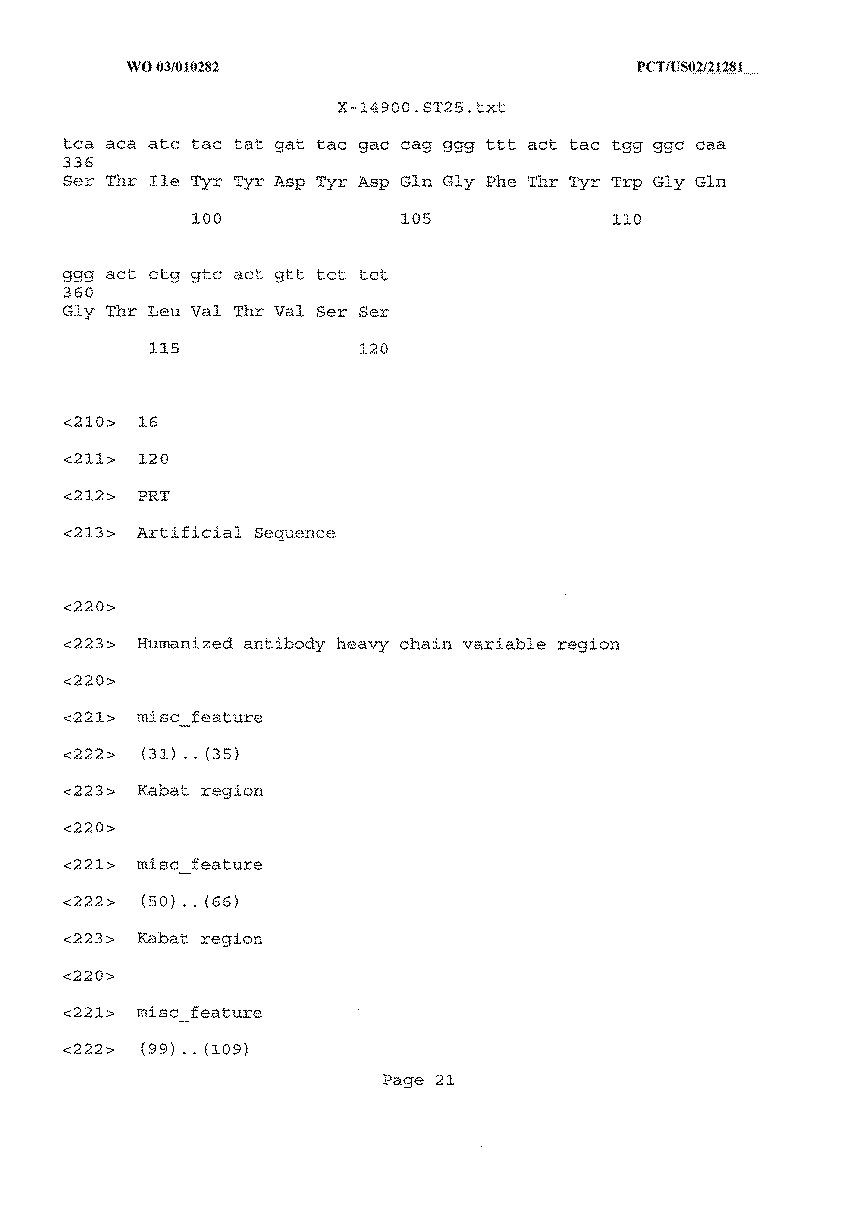
【数2】
マウスMu007抗体の重鎖可変部に対するcDNAおよびアミノ酸配列は以下のとおりである。
【数3】
【数4】
本発明の好ましい抗体は、結合特異性、結合親和性、およびMu007で観察される効力と類似の効力を有する。本発明の抗体を規定する特性は、主に抗体の可変部にある。従って、定常部の任意の文脈においてMu007抗体の完全な軽鎖および重鎖の可変部を用いることができ、結合親和性および特異性、ならびに成熟ヒトIL-1βを中和する能力は通常、影響を受けない。本明細書中で用いる「Mu007」は、任意のマウス定常部、好ましくはκ軽鎖およびγ−1重鎖の文脈において配列番号1および配列番号3で示される可変鎖配列を意味する。
【0028】
本発明の好ましい抗体は、1種以上のCDRと以下のアミノ酸配列からなるヒト型抗体である。
【数5】
基本的に、任意のヒト抗体由来のフレームワーク配列は、CDR継ぎ合せのための鋳型として機能し得る。しかしながら、このようなフレームワークへの直鎖置換は、抗原への結合親和性をいくらか損失することが多い。ヒト抗体が本来のマウス抗体に対して相同であればあるほど、マウスCDRとヒトフレームワークとの組み合わせが、CDR中へのひずみ(これが親和性を低下させ得る)を導入する可能性がおそらく低くなる。従って、CDRは除いて、マウス可変フレームワークを置き換えるために選択したヒト可変フレームワークは、マウス抗体可変部フレームワークと少なくとも65%の配列同一性を有することが好ましい。CDRは除いて、ヒトおよびマウス可変部が、少なくとも70%の配列同一性を有することがより好ましい。CDRは除いて、ヒトおよびマウス可変部が、少なくとも75%の配列同一性を有することがさらにより好ましい。CDRは除いて、ヒトおよびマウス可変部が、少なくとも80%の配列同一性を有することが最も好ましい。例えば、図1に示す、本発明の抗体の可変軽鎖に対する好ましいヒトフレームワーク領域は、対応するマウス配列(CDR以外)と約80%の配列同一性を有する。図2に示す本発明の抗体の可変重鎖に対して好ましいヒトフレームワーク領域は、対応するマウス配列(CDR以外)と約70%の配列同一性を有する。
【0030】
重鎖および軽鎖可変部フレームワーク残基は、同一または異なるヒト抗体配列に由来し得る。ヒト抗体配列は天然に存在するヒト抗体の配列であってもよく、またはいくつかのヒト抗体のコンセンサス配列であってもよい。本発明のヒト型抗体の重鎖可変部に対する好ましいヒトフレームワーク配列には、VHセグメントDP-5 (Tomlinsonら、(1992) J. Mol. Biol. 227:776-798)およびJセグメントJH4 (Ravetchら、(1981) Cell 27:583-591)が挙げられる。VkセグメントL1 (Coxら(1994) Eur. J. Immunol. 24:827-836) およびJセグメントJk2(Hieterら(1982) J. Biol. Chem. 10:1516-1522)は、ヒト型軽鎖可変部に対するフレームワークを提供するために好ましい配列である。
【0031】
ヒト可変部フレームワーク残基由来の特定のアミノ酸を対応するマウスアミノ酸で置換してCDR構造および/またはIL-1β抗原に対する結合への影響を最小にした。
【0032】
通常、アミノ酸が以下のカテゴリーに入る場合、用いるヒトイムノグロブリン(アクセプターイムノグロブリン)のフレームワークアミノ酸はCDR提供(CDR-providing)非ヒトイムノグロブリン(ドナーイムノグロブリン)由来のフレームワークアミノ酸で置き換えられる。
(a)アクセプターイムノグロブリンのヒトフレームワーク領域内のアミノ酸は、その位置のヒトイムノグロブリンにとっては異常であるが、ドナーイムノグロブリン内の対応するアミノ酸はその位置ではヒトイムノグロブリンにとっては典型的なものである。
(b)アミノ酸の位置はCDRの1つにすぐ隣接している。
(c)3次元イムノグロブリンモデルにおいて、フレームワークアミノ酸の任意の側鎖原子は、CDRアミノ酸の任意の原子の約5〜6オングストローム(中心〜中心)内にある[Queenら、Proc. Natl Acad. Sci. USA 86:10029-10033 (1989)およびCoら、Proc. Natl. Acad. Sci. USA 88, 2869 (1991)]。アクセプターイムノグロブリンのヒトフレームワーク域内のアミノ酸、およびドナーイムノグロブリン内の対応するアミノ酸はそれぞれ、その位置ではヒトイムノグロブリンにとっては異常であり、このようなアミノ酸はその位置ではヒトイムノグロブリンにとっては典型的であるアミノ酸により置き換えられる。
【0033】
本発明のヒト型抗体に好ましいフレームワーク領域の分析は、CDRと有意に接触しているかもしれないいくつかのアミノ酸を示唆した。マウスモノクローナル抗体Mu007由来のこれらのアミノ酸は、本来のヒトフレームワークアミノ酸を置換する。
【0034】
図1および2は、マウス配列、好ましいヒト型配列および好ましいヒト生殖系配列由来の可変軽鎖および重鎖部のアラインメントを提供する。ヒト型配列中に1本の下線を付したアミノ酸は、対応するマウス残基で置換した。これは、例えば、重鎖の29、30、48、67、68、70、72および97位の残基で行った。軽鎖に関しては、置換は66位および71位の残基で行った。
【0035】
本発明の抗体の好ましい軽鎖可変部は、配列番号27である式Iを含む。
【数6】
7位のXaaはSerまたはThrである。
11位のXaaはLeuまたはMetである。
12位のXaaはSer、TyrまたはThrである。
15位のXaaはValまたはLeuである。
17位のXaaはAspまたはGluである。
46位のXaaはSerまたはThrである。
66位のXaaはAlaまたはGlyである。
69位のXaaはThrまたはGlnである。
式I[配列番号27]
【0036】
本発明の抗体にさらに好ましい軽鎖可変部は、配列番号11を含む。
【数7】
本発明の抗体にさらに好ましい全長軽鎖は、配列番号13である式IIを含む。
【数8−1】
【数9】
本発明の抗体に好ましい重鎖可変部は配列番号28である式IIを含む。
【数10】
24位のXaaはVal、AlaまたはSerである。
30位のXaaはSerまたはThrである。
37位のXaaはValまたはIleである。
43位のXaaはLys、GlnまたはHisである。
48位のXaaはIleまたはMetである。
67位のXaaはLysまたはArgである。
68位のXaaはAlaまたはValである。
70位のXaaはIle、MetまたはValである。
74位のXaaはThrまたはSerである。
76位のXaaはThrまたはSerである。
77位のXaaはAsp、GluまたはSerである。
87位のXaaはArgまたはSerである。
式II[配列番号28]
【0039】
本発明の抗体にさらに好ましい重鎖可変部は配列番号15を含む。
【数11】
本発明の抗体にさらに好ましい全長重鎖部は配列番号17を含む。
【数12−1】
【数13】
【0041】
別の種由来の抗体をヒト化する主な理由(impetus)は、治療としてヒト患者に注射した場合に抗体が免疫反応を引き起こす可能性を減少させることである。ヒト型抗体で用いられるヒト配列が多ければ多いほど、免疫原性の危険性が低くなる。抗体の生物学的特性に重大な影響を与えることなく、好ましい重鎖および軽鎖部として本明細書中に記載される配列に変更を行うことができる。これは、特に、CDRのIL-1βに結合する能力に影響を与えない抗体定常部および可変部の一部に当てはまる。
【0042】
さらに、本明細書中に記載するように、他のヒトフレームワーク可変部およびその変異体を本発明において使用することができる。しかしながら、選択したフレームワークにかかわらず、免疫原性の危険性の減少が目的である場合、選択したヒトフレームワークに対する変更の数は最小にされるべきである。
【0043】
本発明は、抗体Mu007のCDRを1種以上使用する抗体または他のタンパク質に関する。本発明のCDRはMu007抗体の超過変部であり、特異的IL-1βエピトープに対する抗体の結合に関する定常部の大部分を提供する。従って、本明細書中に記載のCDRは、CDRに連結した場合に活性構造配置にCDRを維持し、CDRを用いるタンパク質の成熟IL-1βに対する結合親和性をMu007の結合親和性と比較して上昇させる、Mu007の結合親和性と同じである、またはMu007抗体の結合親和性と比較して10分の1以下には減少しない、言い換えるとMu007抗体の結合親和性と比較して10分の1より少なくない、全長抗体および機能的フラグメントおよびアナログまたは他のタンパク質を製造するために使用することができる。好ましくは、結合親和性はMu007抗体の結合親和性と比較して5分の1未満には減少しない。最も好ましくは、結合親和性はMu007抗体の結合親和性の3倍以内である。
【0044】
Mu007抗体の結合親和性は、表面プラズモン共鳴 (BIAcoreTM)を用いて決定した。これらの実験においては、抗体をBIAcoreTMチップ上で低密度で固定化し、リガンドを流す(flow past)。チップの表面での塊の蓄積を測定した。この分析方法により、結合についてのオンおよびオフの速度を両方リアルタイムで測定することができる。Mu007抗体は、約6.0ピコモルの親和性を有する(実施例9を参照)。本発明の好ましいヒト型抗体、Hu007は、約10〜20ピコモルの親和性を有する(実施例9を参照)。Hu007は、それぞれ配列番号17および配列番号13に対応する重鎖および軽鎖を有する。
【0045】
また、Mu007抗体のCDRを利用する、本発明の抗体または他のタンパク質は、IL-1βに特異的に結合するが、他のIL-1ファミリーメンバーまたは同じ種内の構造的に関連するタンパク質とは結合しないことが好ましい。例えば、Mu007またはHu007はいずれもヒトIL-1αには結合しない(実施例9を参照)。
【0046】
また、Mu007抗体のCDRを利用する、本発明の抗体または他のタンパク質は、IL-1βの生物学的活性を中和することが好ましい。2個の異なるアッセイを用いて、Mu007およびHu007のIL-1β活性を中和する能力を試験した。増殖に低レベルのIL-1βを必要とするマウス細胞株を第1のアッセイで用いた。ヒトIL-1βは倍地中に一定濃度で存在し、各抗体の希釈系列を加えた。増殖の阻害により、抗体のIL-1レセプターのIL-1β活性化をブロックする能力の効力の測定値を得た。異なる濃度の抗体の増殖測定により、IC50の平均値を生じた(Mu007に関して220ピコモル、およびHu007に関して480ピコモル) (実施例10を参照のこと)。本発明の抗体または他のタンパク質は、Mu007よりも良い、同じ、または10倍以内、あるいはMU007の10分の1より大きいIC50効力を有することが好ましい。好ましくは、IC50効力はMu007の5倍以内である。最も好ましくは、IC50効力はMu007の3倍以内である。本明細書中における「IC50」は、抗体のヒトIL-1β活性を阻害する効力の測定値である。IC50は、単用量実験において50% IL-1β阻害を生じる抗体濃度である。IC50は、ヒトIL-1β活性の阻害を検出する任意のアッセイにより測定することができる。しかしながら、得られるIC50値は、用いるアッセイに応じて変化しうる。同じアッセイを用いる実験間でさえ、いくらかのばらつきがあるかもしれない。例えば、上記のIL-1β依存性細胞の状態は、得られるIC50の値に影響を有する。従って、本発明の目的に関して重要な値は、単独の実験でMu007またはHu007を用いて得られた値に対して比較した値である。
【0047】
Mu007またはHu007はいずれも、マウスIL-1βと交差反応性を示さず、このことによりマウスモデルを用いてインビボでの中和活性を試験することが困難となっている。しかしながら、IL-1βの前炎症活性の影響のひとつはIL-6(IL-1βの非局所的な効果をいくらか媒介する別の前炎症性サイトカイン)の誘導である。ヒトIL-1βはマウスIL-1βレセプターに結合し、刺激してマウスIL-6の上昇を導くことができる。従って、中和活性を有する抗体は、一定用量のヒトIL-1βを与えたマウスにおいてIL-6の誘導をブロックする。Mu007およびHu007は両方とも、炎症刺激のマウスモデルにおいて、ヒトIL-1βの強力な中和を示した。ヒト型抗体は、Mu007抗体の約1/3の有効性であった(実施例11を参照)。
【0048】
また、本発明は、Mu007 CDRをヒトフレームワーク領域またはヒトフレームワーク変異体(例えば、Hu007)に移植し、結合親和性または他の生物学的特性(例えば、IC50値として表され得る、特定の濃度での抗体がIL-1β活性を中和する能力)を上昇させるように修飾または変異させている抗体に関する。
【0049】
本発明の抗体は、Mu007およびHu007抗体の場合と同じヒトIL-1β上のエピトープに結合することが好ましい。さらに、本発明は、これらの抗体がヒトIL-Iβをインビボで中和する能力を有するならば、Mu007およびHu007抗体が結合するエピトープと重ねてか、またはそれらを含むエピトープに結合する抗体に関する。
【0050】
本発明は、ヒトIL-1βの153アミノ酸成熟形態の特定の領域の発見に関し、そのような領域への抗体の結合は、タンパク質の活性を完全に中和する。さらに、成熟IL-1βの特定の領域に対する抗体は、それらが他のIL-1ファミリーメンバーまたは関連タンパク質とは交差反応しないという点で特異的である。本発明はこのエピトープに結合し、IL-1β活性を中和する抗体全てに関するが、抗体はMu007に存在するCDRのうちの少なくとも1つを用いることが好ましい。IL-1β活性を中和する抗体は、成熟IL-1βタンパク質がレセプターに結合すること、および/またはシグナル伝達経路を開始させることを阻害する。
【0051】
Mu007および/またはHu007が結合するIL-1βエピトープは、成熟IL-1βタンパク質とは異なるアミノ酸セグメントを含有するファミリーのフラグメントを提供することにより決定することができる。各フラグメントは、通常、少なくとも4、6、8、10、20、50または100の連続アミノ酸を含む。ポリペプチドフラグメントのファミリーは、成熟IL-1βのアミノ酸配列の多くまたは全てを包含する。ファミリーのメンバーを、それぞれ、Mu007またはHu007抗体への結合に関して試験する。試験する抗体に特異的に結合し得る最も小さいフラグメントは、抗体により認識されるエピトープのアミノ酸配列を含有する。エピトープをマッピングするさらなる方法は、抗体がランダム変異を導入したIL-1βに結合する能力を試験することに関する。この方法は、エピトープの3次元構造が結合に重要である場合に好ましくあり得る。Mu007またはHu007はいずれもマウスまたはラットのIL-1βに結合しないので、Mu007またはHu007により認識されるエピトープは、マウス、ラットおよびヒト配列の間で完全には保存されていないIL-1βタンパク質の領域にマッピングされる。さらに、Mu007およびHu007は、カニクイザルおよびウサギのIL-1βに結合し、中和する。従って、Mu007およびHu007により認識されるエピトープは、ヒト、カニクイザルおよびウサギのIL-1βにわたって非常によく保存されていなければならない。図3は、マウス、ラット、ウサギ、カニクイザルおよびヒトの成熟IL-1βタンパク質配列のアラインメントを示す。従って、Mu007およびHu007により認識されるエピトープをマッピングするために、ヒト、カニクイザルおよびウサギのIL-1βにわたり配列の保存を示すが、マウスおよびラットのIL-1βとは異なる部位に変異を標的化し得る。これらの条件を満たす位置としては、3位のバリン、5位のセリン、22位のグリシン、51位のグルタミン酸、76位のアスパラギン酸、77位のリジン、106位のイソロイシン、110位のロイシン、130位のメチオニン、140位のグリシンおよび150位のグルタミン酸が挙げられる(図3、ヒトまたはカニクイザル配列に従って番号付け)。76位のアスパラギン酸をグリシンに、77位のリジンをスレオニンに変異することは、カニクイザルIL-1βへの結合になんら影響を有さない。したがって、この領域はMu007およびHu007のIL-1βへの結合に重要ではない。
【0052】
また、IL-1βを固定化抗体により補足し、この複合体をトリプシンのようなプロテアーゼで処理して抗体により保護されていない分子の部分を切断することができる。消化の後、未結合のペプチドを洗い流す。残った結合型ペプチドを抗体から溶離し、質量分光分析にかけて同一性(identity)を決定する。あるいは、IL-1βをプロテアーゼで消化してもよく、そしてペプチドを抗体により補足してもよい。未結合のペプチドを洗い流す。残った結合型ペプチドを抗体から溶離し、質量分光分析にかけて同一性を決定する。
【0053】
さらなるエピトープマッピング実験は、NMR分光法の使用に関する。IL-1βタンパク質を、窒素15、炭素13および重水素の濃度を高くした倍地中で生育させた宿主細胞(例えば、大腸菌)中で発現させる。標識IL-1βを精製し、NMRで分析する。NMRピークを異なるアミノ酸に当てはめる。次いで、IL-1β抗体由来のFabの存在下で分析を繰り返す。特定のNMRピークの変化は、ピークの原因であるアミノ酸の環境の差異の指標である。これは、特定のアミノ酸への抗体の結合、抗体のアミノ酸への物理的な近さ、または抗体結合により誘発される立体配座のシフト(これは特定のアミノ酸に対する環境の変化を導く)に起因しうる。多くの場合、特に立体配座エピトープをマッピングする場合、1種より多くの方法を適用して推定抗体結合部位を確認する。
【0054】
Mu007およびHu007に結合するエピトープ(epitopic)フラグメントを免疫原として用いて、治療薬剤として用いるために直接、またはヒト型で用い得る、高い親和性結合および強力な中和活性を有するさらなる交差反応性抗体を得る。
【0055】
本発明はまた、発現させた場合にMu007およびHu007が結合するエピトープと同一のエピトープに特異的に結合し、強力なインビボ中和活性を有する抗体をコードする組換えDNAに関する。好ましくは、DNAは、発現させた場合に1種以上の重鎖および軽鎖Mu007 CDRを含む抗体をコードする[配列番号5、6、7、8、9および10]。発現させると、Mu007およびHu007抗体の重鎖および軽鎖のCDRを含むポリペプチド鎖をコードする代表的なDNA配列は、配列番号1、3、11、13、15および17と表される。遺伝コードの縮重を基にして、他のDNA配列は簡単に例示配列のかわりに置き換えられることができる。
【0056】
本発明の抗体をコードするDNAは、通常、抗体コード配列(天然で関与する、または異種性のプロモーター領域を含む)に動作可能に連結されている発現制御ポリヌクレオチド配列をさらに含む。好ましくは、発現制御配列は、真核生物宿主細胞を形質転換またはトランスフェクトし得るベクター中の真核細胞プロモーター系であるが、原核生物宿主に対する制御配列もまた使用することができる。一旦、適切な宿主細胞株にベクターを組み込むと、宿主細胞をヌクレオチド配列の発現、望ましい場合には軽鎖、重鎖、軽鎖/重鎖二量体またはインタクトな抗体、結合フラグメント、またはイムノグロブリン形態の回収および精製に適切な条件下で増殖させる。
【0057】
最終的に所望の抗体を発現し得る本発明の核酸配列は、種々の異なるポリヌクレオチド(ゲノムまたはcDNA、RNA、合成オリゴヌクレオチドなど)および構成成分(例えば、V、J、DおよびC領域)から任意の種々の周知の技術を用いて形成することができる。適切なゲノム配列および合成配列の連結が一般的な産生方法であるが、cDNA配列もまた、利用することができる。
【0058】
ヒト定常部DNA配列は、種々のヒト細胞から周知の方法を用いて単離することができるが、好ましくは不死化B細胞由来である。ポリヌクレオチド配列に適した供給源細胞、およびイムノグロブリン発現および分泌用の宿主細胞は、当該分野において周知の多数の供給源から入手することができる。
【0059】
本明細書中に具体的に記載する抗体に加えて、本明細書中に記載の他の「実質的に相同な」修飾抗体は、当業者に周知の種々の組換えDNA技術を用いて簡単に設計および製造することができる。例えば、フレームワーク領域は、種々のアミノ酸置換、末端および中間の付加および欠失などにより、一次構造レベルでネイティブな配列から変更することができる。さらに、種々の異なるヒトフレームワーク領域が、単独で、または本発明のヒト型イムノグロブリンに対する基礎として組み合わせて使用されうる。通常、遺伝子の修飾は、種々の周知の技術(部位特異的変異誘発法など)により簡単に達成されうる。
【0060】
あるいは、一次抗体構造の一部のみを含むポリペプチドフラグメントを製造することができ、このフラグメントは1種以上のイムノグロブリン活性(例えば、補体結合活性)を有する。これらのポリペプチドフラグメントは、当該分野において周知の方法により、または部位特異性変異誘発法を用いて停止コドンをベクター中の所望の位置に挿入することにより、インタクトな抗体のたんぱく質分解性切断により製造することができる(例えば、CH1の後にFabフラグメントを製造するため、またはヒンジ領域の後にF(ab’)2フラグメントを製造するためなど)。1本鎖抗体は、VLおよびVHをDNAリンカーと連結することにより製造することができる。
【0061】
先に記載したように、ポリヌクレオチドは、配列を発現制御配列に動作可能に連結した(すなわち、確実に機能し得るように配置した)後に、宿主細胞中で発現される。これらの発現ベクターは、通常、エピソームまたは宿主染色体DNAの必須部分のいずれかとして、宿主細胞中で複製可能である。通常、発現ベクターは、所望のDNA配列でトランスフェクトした細胞の検出を可能にするために選択マーカー(テトラサイクリン、ネオマイシンおよびジヒドロ葉酸レダクターゼ等)を含む。
【0062】
大腸菌は本発明のポリヌクレオチドのクローニングに特に有用な原核生物宿主である。使用に適した他の微生物宿主としては、バシラス・サブチリス(Bacillus subtilis)のようなバシラス属(bacilli)およびサルモネラ(Salmonella)、セラティア(Serratia)のような腸内細菌および種々のシュードモナス(Pseudomonas)種が挙げられる。これらの原核生物宿主において、通常は宿主細胞と適合した発現制御配列(例えば、複製起点)を含む、発現ベクターもまた、作製することができる。さらに、多数の周知のプロモーターのうちの任意のものが存在してもよい(例えば、ラクトースプロモーター系、トリプトファン(trp) プロモーター系、β-ラクタマーゼプロモーター系、またはファージラムダ由来のプロモーター系)。通常、プロモーターは発現を制御するが、場合により、転写および翻訳の開始および完了のために、オペレーター配列を伴い、リボソーム結合部位配列などを有する。
【0063】
他の微生物(酵母等)もまた、発現のために使用することができる。サッカロミセス(Saccharomyces)は好ましい宿主であり、3-ホスホグリセラートキナーゼまたは他の糖分解酵素を含む発現制御配列(プロモーター等)、および複製起点、所望であれば終止配列などを含む適切なベクターを有している。
【0064】
微生物に加えて、植物細胞もまた、発現のために使用することができる。植物形質転換に最適の方法は、植物のタイプに依存して変化する。例えば、WO00/53794(本明細書中に参照して組み込む)を参照のこと。
【0065】
哺乳動物組織細胞培養物もまた、本発明のポリペプチドを発現させ、生産するために使用することができる。インタクトなイムノグロブリンを分泌し得る多数の適切な宿主細胞株が当該分野において開発されているので、真核生物細胞は実際に好ましく、これには、CHO細胞株、種々のCOS細胞株、ゴールデンハムスター卵巣細胞株、HeLa細胞、骨髄腫細胞株、形質転換したB細胞、ヒト胚腎臓細胞株またはハイブリドーマが挙げられる。好ましい細胞株はCHOおよび骨髄腫細胞株(SP2/0およびNS0等)である。
【0066】
これらの細胞のための発現ベクターは、発現制御配列(例えば、複製起点)、プロモーター、エンハンサー、および必須のプロセシング情報部位(例えば、リボソーム結合部位、RNAスプライシング部位、ポリアデニル化部位および転写終止部位)を含み得る。好ましい発現制御配列は、イムノグロブリン遺伝子、SV40、アデノウィルス、ウシ乳頭腫ウィルス、サイトメガロウィルス等に由来するプロモーターである。好ましいポリアデニル化部位としては、SV40およびウシ成長ホルモン由来の配列があげられる。
【0067】
目的のポリヌクレオチド配列(例えば、重鎖および軽鎖をコードする配列および発現制御配列)を含むベクターを、周知の方法(細胞宿主のタイプに応じて変わる)により宿主細胞にトランスフェクトすることができる。例えば、真核生物細胞に関しては、塩化カルシウムトランスフェクションが通常用いられるが、他の細胞宿主に関しては、リン酸カルシウム処理またはエレクトロポレーションが用いられ得る。
【0068】
一旦発現させたら、標準的な方法(硫酸アンモニウム沈殿、イオン交換、アフィニティー(例えば、プロテインA)、逆相、疎水性相互作用カラムクロマトグラフィー、ゲル電気泳動など)にしたがって、抗体を精製することができる。医薬用途には、少なくとも約90〜95%の純度を有する実質的に純粋なイムノグロブリンが好ましく、98〜99%以上の純度が最も好ましい。部分的または所望される均質性まで精製した後、本明細書中に記載するようにポリペプチドを治療的または予防的に使用することができる。
【0069】
本発明はまた、IL-1β媒介性炎症性障害を経験しているヒトの治療方法に関し、この方法は、有効用量のIL-1β抗体を治療を必要とする患者に投与することを含む。本発明の抗体はIL-1βに結合し、IL-1βがIL-1βレセプターに結合してシグナル伝達(signal)を開始することを阻害する。種々のIL-1β媒介性障害としては、慢性関節リウマチ(RA)、骨関節症(OA)、アレルギー、敗血症性または内毒素性ショック、敗血症、脳卒中(stroke)、喘息、移植片対宿主病、クローン病および他の炎症性腸疾患が挙げられる。好ましくは、本発明に関するIL-1β抗体はRAおよび/またはOAを治療するために使用される。
【0070】
RAを有する患者は関節の慢性の腫脹および関節の炎症、および進行中の軟骨および骨の破壊をわずらっている。IL-1βおよびTNF-αはRAの病因において最も重要なサイトカインである。しかし、IL-1βおよびTNF-αは両方とも炎症を媒介するが、IL-1βは骨および軟骨破壊の主なメディエーターである。滑膜組織中の活性型の単球および線維芽細胞はIL-1βを産生し、これは次に、さらなる前炎症性サイトカイン、プロスタグランジンおよびマトリックスメタロプロテアーゼの産生を刺激する。滑膜内膜は肥大し、骨および軟骨内に進入し、侵食する。
【0071】
予防維持性抗リウマチ薬(DMARDS)、たとえば、ヒドロキシクロロキン、経口用または注射金剤、メトトレキサート、アザチオプリン、ペニシラミンおよびスルファサラジンは、RAの処置に用いられてきたが、これらは効き目が穏やかである。それらのRAの経過を改変する活性は、IL-1βのような炎症性メディエーターの抑制および変更に起因すると考えられている。たとえば、メトトレキサートは、一週間あたり7.5〜10 mgの用量で、RA患者のIL-1βの血漿濃度の減少を引き起こす。類似の結果が、コルチコステロイドで観察されている。したがって、本発明のIL-1β抗体は、単独または血漿中のIL-1βたんぱく質レベルを低下させるように作用し得るDMARDSと組み合わせて用いられ得る。
【0072】
本発明のIL-1β抗体の有効量は、容認し難い副作用または毒性を伴わずに臨床上の有効性を提供する量である。RA患者に対する臨床上の有効性は、アメリカリウマチ学会、改善の定義(the American College of Rheumatology Definition of Improvement)(ACR20)を用いて評価することができる。患者が、関節の滑らかさの評点、関節の腫脹の評点、および5つの他の構成要素(患者の疼痛の評価、患者の全体的な評価、医師の全体的な評価、健康評価質問表(Health Assessment Questionnaire)、および血清C反応性タンパク質(seum C-reactive protein)を含む)のうち3つにおいて20%の改善を示した場合に患者を応答者とみなす。構造的損傷の予防は、放射線写真のシャープ評点システム(Sharp Scoring system)のファンデルハイジ(van der Heijde)の改変法の評価することができる(腐食カウント、関節腔の狭さ)。
【0073】
また、本発明のIL-1β抗体は骨関節症(OA)を罹患した患者を処置するために使用することができる。OAはヒト関節の最も一般的な疾患であり、関節軟骨の損失および骨棘形成により特徴づけられる。臨床上の特徴としては、関節痛、硬直、肥大、不安定(instability)、動きの制限、および機能的な障害が挙げられる。OAは、特発性(原発性)および二次型に分類することができる。膝および股関節部のOAの分類に関する判断基準は、臨床上のパラメーター、放射線写真のパラメーターおよび研究室内でのパラメーターに基づいてアメリカリウマチ学会により開発された。
【0074】
本発明のIL-1β抗体の有効量は、疼痛および機能ならびに構造的損傷の予防における改善により測定した場合に、OA患者において臨床上の有効性を示す量である。疼痛および機能における改善とは、疼痛および肉体機能のサブスケールのWOMAC OAインデックスを用いて評価することができる。このインデックスにより、疼痛の領域、硬直、および肉体機能の、臨床上重要な患者に関連する症状を調べる。構造的損傷の予防は、膝または股関節の放射線写真における関節腔の幅を測定することにより評価することができる。
【0075】
本発明の抗体は、標準的な投与方法、好ましくは静脈内、腹膜内、皮下、経肺、経皮、筋肉内、経鼻、経頬粘膜、舌下または坐薬での投与により抹消から(すなわち、中枢神経系への投与によるものではない)、投与される。
【0076】
投与用医薬組成物は、選択した投与の態様に適切であるように設計されており、適切な場合には、緩衝剤、界面活性剤(surfactant)、保存剤、溶解補助剤、等張化剤、安定剤などの製薬上許容される賦形剤を用いる。Remington's Pharmaceutical Sciences, Mack Publishing Co., Easton PA, 最新版(本明細書中に参照して組み込む)は、通常、当業者に公知の製薬技術の要約を提供する。
【0077】
製剤中のIL-1β抗体の濃度は、約0.1重量%の低い程度から、15または20重量%の高い程度であってよく、主に、流体の体積、粘性、安定性等に基づき、選択した特定の投与態様にしたがって選択する。IL-1β抗体の好ましい濃度は、通常、1〜約100 mg/mLの範囲にある。好ましくは、10〜約50 mg/mLである。
【0078】
製剤は緩衝剤を含んでもよい。好ましくは、緩衝剤はクエン酸緩衝剤またはリン酸緩衝剤、またはそれらの組み合わせである。通常、製剤のpHは約4〜約8の間である。好ましくは、pHは約5〜約7.5の間である。製剤のpHは、抗体の安定性(化学的および物理的)および投与時の患者への快適さのバランスをとって選択される。また、製剤はNaClのような塩を含有しうる。さらに、製剤は凝集を予防し、安定性の維持を助けるために界面活性剤(detergent)を含んでいてもよい。例えば、Tween-80およびTween-20は、Hu007抗体と適合性であることが示されている。
【0079】
製剤を作製後に滅菌ろ過しても良いし、または微生物学的に許容可能にしても良い。保存剤(m-クレゾールまたはフェノール、あるいはそれらの混合物)を添加して微生物の増殖および汚染を予防してもよい。
【0080】
静脈内注入用の通常の組成物は、液体(例えば、滅菌リンガー液)250mLもの容量および1〜100mg/mL以上の抗体濃度を有してもよい。本発明の治療用薬剤は保存用に凍結または凍結乾燥させて、使用前に適切な滅菌キャリア中で再構築してもよい。凍結乾燥および再構築は、種々の程度の抗体活性の損失を生じるかもしれない(例えば、通常のイムノグロブリンであるIgM抗体は、IgG抗体よりも抗体活性損失の程度が高い傾向にある)。補うために用量を調整する必要があるかもしれない。
【0081】
前記の方法が、適切な適用により、ヒト型抗体のようなタンパク質の投与に最も都合が良く、最も適切であるが、適切な製剤が設計されている場合には他の投与方法(例えば、経皮投与および経口投与)が使用されうる。さらに、生分解性フィルムおよびマトリックス、または浸透性ミニポンプ、またはデキストランビーズ、アルギナートまたはコラーゲンに基づくデリバリーシステム、を用いる制御放出製剤を用いることが望ましいかもしれない。要約すると、製剤は本発明の抗体の投与のために利用可能であり、種々の選択肢から選択することができる。
【0082】
通常の用量レベルは、標準的な臨床上の技術を用いて最適化することができ、投与の態様および患者の状態に依存する。通常、用量は10μg/kg/月〜10 mg/kg/月の範囲である。
【実施例】
【0083】
本発明を以下の実施例により例示するが、これはいかなる様式においても限定は意図しない。
【0084】
実施例1
Mu007可変部
Mu007軽鎖および重鎖可変部のcDNAをハイブリドーマ細胞株からクローニングした。数個の軽鎖および重鎖のクローンを、2回の独立したPCR反応から配列決定した。機能的な軽鎖可変域配列は機能的なマウスκ鎖可変部の典型的なものであり、Kabatの定義(Johnson, G.およびWu, T. T. (2000) Nucleic Acids Res. 28: 214-218)に基づきサブグループVに属することを見出した。重鎖に関しては、代表的なマウス重鎖可変部に相同な独特の配列を同定した。Mu007可変重鎖を、Kabatの定義 (JohnsonおよびWu, 2000)に基づきサブグループII(A)に分類した。軽鎖および重鎖可変部をコードするcDNA配列は、それぞれ、配列番号1および3とあらわす。
【0085】
実施例2
Hu007可変部
Mu007 CDRに対するアクセプターとして用いるヒト可変部フレームワークを構築し、約65〜80塩基の長さにわたる8個の重複合成オリゴヌクレオチド (Heら、(1998) J. Immunol. 160: 1029-1035) を用いて増幅した。オリゴヌクレオチドを対でアニーリングさせ、DNAポリメラーゼIのクレノーフラグメントを用いて伸長し、4本の二重鎖フラグメントを得た。得られたフラグメントを変性させ、対でアニーリングさせ、クレノーを用いて伸長させて2本のフラグメントを得た。これらのフラグメントを変性し、対でアニーリングさせ、もう一度伸長し、全長遺伝子を得た。PCR増幅したフラグメントをゲル精製し、pCR4Bluntベクターにクローニングした。配列を確認した後、可変軽鎖および可変重鎖の遺伝子をMluIおよびXbaIで消化し、ゲル精製し、それぞれ軽鎖および重鎖の発現用のベクターにサブクローニングしてpVk-Hu007およびpVg1-Hu007を作製した。
【0086】
実施例3
Hu007の発現
マウス骨髄腫細胞株Sp2/0-Ag14 (以下、Sp2/0)をATCCから入手し、37℃のインキュベーター中で10%FBS (カタログ番号SH30071.03, Hyclone, Logan, UT)を含むDME培地に維持した。
【0087】
マウス骨髄腫細胞株Sp2/0への安定なトランスフェクションを、取扱説明書に従ってGene Pulser装置(BioRad, Hercules, CA)を360 Vおよび25 μFで用いるエレクトロポレーションにより達成した。トランスフェクションの前に、pVk-Hu007およびpVg1-Hu007プラスミドDNAを、FspIを用いて線状化した。約107のSp2/0細胞をpVk-Hu007(30μg)およびpVg1-Hu007(60μg)でトランスフェクトした。トラスフェクトした細胞を10%FRSを含有するDME培地に懸濁し、数枚の96ウェルプレートにプレーティングした。48時間後、細胞を選択培地(10%FBS、HT培地補充物、キサンチン0.3 mg/mlおよびミコフェノール酸1μg/mlを含有するDME培地)を用いてgpt発現に関して選択した。選択の開始の約10日後、培養物上清を、ELISAにより抗体産生についてアッセイした (実施例7を参照のこと)。高収率のクローンを、10%FBSを含有するDME培地に広げ、抗体発現についてさらに分析した。次いで、選択したクローンを無血清培地 (Hybridoma SFM,カタログ番号12045-076, Life Technologies, Rockville, MD)中での増殖に適合させた。これは、血清レベルが0.1%未満になるまで、細胞を徐々にHybridoma SFMに分割することにより(通常は、各分割毎に25〜50%)達成する。その後、トランスフェクト物をHybridoma SFM中で維持した。細胞密度を2×10⁵/ml〜106/mlの間で維持した。
【0088】
CHO-DG44細胞をpVk-Hu007(50μg)およびpVg1-Hu007(50μg)でトランスフェクト(ゲノムトランスフェクション)するか、またはHu007軽鎖に対応するcDNAを含む発現ベクター(50μg)およびHu007重鎖に対応するcDNAを含むベクター(50μg)でトランスフェクトした。約107の細胞を、ゲノムトランスフェクションのためには350ボルト/50μFおよび380/50μF、およびcDNAトランスフェクションのためには350ボルト/71μFおよび380ボルト/71μFでエレクトロポレーションを行った。細胞を室温でインキュベートし、次いで増殖培地(Growth Medium)(20 ml)(ExCell 302 培地+ L-グルタミン(4mM) + 1×ヒポキサンチン/チミジン試薬+ 硫酸デキストラン(100 μg/mL))中で希釈し、37℃/5% CO2インキュベーター中で72時間回復させた。ゲノムトランスフェクション用にはメトトレキサート(50nM)、およびcDNAトランスフェクション用にはメトトレキサート(20nM)およびG418(200μg/mL)を含有する培地を用いて細胞を選択した。
【0089】
実施例4
Hu007の精製
Sp2/0高発現クローンをローラー瓶中Hybridoma SFM中で1500mlまで拡大した(1ローラー瓶あたり500ml)。Hu007 IgG1 モノクローナル抗体を消費培養物上清から、プロテイン-A Sepharoseカラムを用いて精製した。細胞生存率が10%以下に達した時点で消費培養物上清を回収し、プロテイン-A Sepharoseカラムにかけた。0.1 M グリシン-HCl (pH 2.8)、0.1 M NaClを用いて抗体を溶離する前に、カラムをPBSで洗浄した。1 M Tris HCl (pH 8)で中和した後、溶離したタンパク質をPBS(2L、3回交換)で透析し、0.2μmフィルターでろ過した後4℃で保存した。280 nmでの吸光度を測定することにより抗体濃度を決定した (1mg/ml=1.4 A280)。
【0090】
実施例5
Mu007の発現および精製
Mu007を産生するハイブリドーマ細胞を、最初は10%FBS(HyClone)、10 mM HEPES、2mM グルタミン、0.1 mM 非必須アミノ酸、1mMピルビン酸ナトリウム、25 μg/ml ゲンタミシンを含有するRPMI-1640倍地中で増殖させ、次いで、2% 低Ig FBS (カタログ番号30151.03, HyClone)を含有する無血清培地 (Hybridoma SFM、カタログ番号12045-076, Life Technologies, Rockville, MD)中でローラー瓶中1Lまで拡大させる。Mu007を、プロテイン-G Sepharoseカラムを用いるアフィニティークロマトグラフィーにより培養物上清から精製した。EZ-連結スルホ-NHS-LC-LC-ビオチン(カタログ番号21338ZZ, Pierce, Rockford, IL)を用いて、ビオチニル化Mu007を製造した。
【0091】
実施例6
単離したMu007およびHu007のSDS-PAGE分析
標準的な方法に従い、4〜20%勾配ゲル(カタログ番号EC6025, Novex, San Diego, CA)でTris-グリシン緩衝液中でSDS-PAGEを行った。非還元条件下でのMu007およびHu007のSDS-PAGE分析は、両方の抗体が約150〜160kDの分子量を有することを示した。還元条件下での分析は、両方の抗体が約50kDの分子量を有する重鎖および25kDの分子量を有する軽鎖からなることを示した。Hu007の純度は95%よりも高い。
【0092】
実施例7
ELISAによる抗体発現の定量
96-ウェル ELISAプレートのウェル(Nunc-Immunoプレート、カタログ番号 439454, NalgeNunc, Naperville, IL)を、0.2 M 炭酸ナトリウム-重炭酸緩衝液(pH 9.4) 中1μg/ml ヤギ抗ヒトIgG Fcフラグメント特異的ポリクローナル抗体(カタログ番号109-005-098, Jackson ImmunoResearch, West Grove, PA)(100μl)で、一晩、4℃でコーティングした。洗浄緩衝液 (0.1% Tween 20を含有するPBS)で洗浄した後、ウェルをSuperblock Blocking Buffer (カタログ番号37535, Pierce)(400μl)で30分間ブロックし、次いで、洗浄緩衝液で洗浄した。Hu007を含むサンプルを、ELISA緩衝液 (1% BSAおよび0.1% Tween 20を含有するPBS) で適切に希釈し、ELISAプレート (100μl/ウェル)に適用した。基準として、ヒト型抗-CD33 IgG1モノクローナル抗体HuM195 (Coら、(1992) J. Immunol. 148: 1149-1154)を用いた。ELISAプレートを、37℃で2時間インキュベートし、ウェルを洗浄緩衝液で洗浄した。次いで、ELISA緩衝液中で1/1,000に希釈したHRP結合型ヤギ抗ヒトκポリクローナル抗体(100μl) (カタログ番号1050-05, Southern Biotechnology, Birmingham, AL)を各ウェルに適用した。37℃で1時間インキュベートし、洗浄緩衝液で洗浄した後、ABTS基質 (カタログ番号507602および506502, KirkegaardおよびPerry Laboratories, Gaithersburg, MD)(100μl)を各ウェルに加えた。2%シュウ酸100μl/ウェルを加えることにより発色を停止させた。OPTImaxマイクロプレートリーダー(Molecular Devices, Menlo Park, CA)を用いて415nmで吸光度を読み取った。
【0093】
実施例8
ELISA競合
96-ウェルELISAプレート(Nunc-Immunoプレート、カタログ番号439454, NalgeNunc)のウェルを0.5 μg/ml of 0.2M 炭酸ナトリウム-重炭酸緩衝液 (pH 9.4)中のヒトIL-1β(0.5μg/ml)100μlで4℃で1晩、コーティングし、洗浄緩衝液で洗浄し、Superblockブロック緩衝液で37℃で30分間ブロックし、洗浄緩衝液で再度洗浄した。ビオチニル化Mu007 (最終濃度0.16 μg/ml)および競合抗体 (Mu007 またはHu007;最終濃度100 μg/mlで始める、3倍の系列希釈)のELISA緩衝液中の混合物を、ウェルあたり100μlの最終体積で3連で加えた。非競合コントロールとしては、ビオチニル化Mu007(0.16μg/ml)100μlを用いた。バックグラウンドコントロールとしては、ELISA緩衝液100μlを用いた。ELISAプレートを37℃で2時間インキュベートした。ウェルを洗浄緩衝液で洗浄した後、HRP結合型ストレプトアビジン(1μg/ml) (Jackson ImmunoResearch)100μlを各ウェルに加えた。ELISAプレートを室温で30分間インキュベートし、洗浄緩衝液で洗浄した。発色用に、ABTS基質(100μl/ウェル)を加えた。2%シュウ酸100μl/ウェルを加えることにより発色を停止させた。吸光度を415nmで読み取った。
【0094】
Mu007およびHu007は両方とも濃度依存的な様式でビオチニル化Mu007と競合した。濃度依存的な競合物は、競合抗体が成熟IL-1β上の同じエピトープに結合することを示した。3回の独立した試験におけるMu007およびHu007のIC50値(コンピューターソフトウェアPrism (GraphPad Software Inc., San Diego, CA)を用いて得た)を表1に示す。Hu007の相対的な結合は、Mu007の相対的な結合の1.3倍(平均)であった。
表1:ELISA競合試験のまとめ
【表1】
実施例9
結合親和性および特異性
Hu007およびMu007の両方の親和性および特異性を、BIAcore測定機を用いて決定した。BIAcoreTMは分子相互作用を測定する自動バイオセンサーシステムである (Karlssonら (1991) J. Immunol. Methods 145:229-240)。これらの実験において、抗体をBIAcoreTMチップ上に低密度で固定化した。エチル-ジメチルアミノプロピルカルボジイミド (EDC) を用いて反応性アミノ基を精製ヤギ抗ヒトIgGに、またはヤギ抗ウサギIgGをカルボキシメチル(CM5) BIAcoreTMセンサーチップのフローセルにカップリングした。ヤギIgGを、酢酸ナトリウム緩衝液(pH4.0)中で希釈し、EDCを用いてCM5チップのフローセルに固定化して1000反応ユニットを得た。未反応の部位をエタノールアミン(ehanolamine)でブロックした。60μl/分の流速を用いた。複数回の結合/溶出サイクルを、15μg/mL Mu007またはHu007の溶液(100μl)の注入、続いてヒトIL-1β、マウスIL-1β、ラットIL-1β、カニクイザルIL-1β、ブタIL-1β、ヒトIL-1レセプターアンタゴニストおよびヒトIL-1αを各サイクルについて濃度を減少 (たとえば、1500、750、375、188、94、47、23.5、12および0ピコモル)させて注入することにより行った。グリシン-HCl(pH 1.5)を用いて溶離を行った。BIAevaluationTMを用いて反応速度データを分析した。表2は、ヒトおよびカニクイザルIL-1βに対するHu007およびMu007の親和性を示す。マウスIL-1β、ラットIL-1β、IL-1レセプターアンタゴニスト、およびヒトIL-1αはHu007に結合しなかった。カニクイザルおよびブタのIL-1βは、ヒトIL-1βと比較してHu007に100%結合した。
表2:Hu007およびMu007のIL-1βに対する親和性
【表2】
実施例10
抗体有効性
低レベルのIL-1βを増殖に必要とするマウス細胞を用いて、Hu007およびMu007のヒトIL-1βを中和する能力を測定した。すでにlog増殖期にはないT1165.17細胞を、10%ウシ胎仔血清(GibcoBRLカタログ番号10082-147)、1mMピルビン酸ナトリウム、50μM β-メルカプトエタノールおよび抗生物質/抗微生物薬(GibcoBRLカタログ番号15240-062)を補充したRPMI 1640 (GibcoBRLカタログ番号22400-089)で3回洗浄した。細胞を96ウェルプレートに1ウェルあたり5,000細胞でプレーティングした。ヒトIL-1βは0.3pMの一定レベルで入っており、抗体の希釈系列を加えた。希釈サンプルを加え、細胞を37℃/5% CO2インキュベーター中で20時間インキュベートし、ウェルあたり1μCi 3H-チミジンを添加した時点で、プレートをさらに4時間、インキュベーター中でインキュベートした。細胞を回収し、組み込まれた放射活性をシンチレーションカウンターで測定した。図5はMu007およびHu007によるIL-1β刺激増殖の阻害を示す。3回の個別の実験から計算したMu007およびHu007に対する平均のIC50値はそれぞれ220 pMおよび480 pMであった。
【0097】
実施例11
インビボでのヒトIL-1βの中和:
ヒトIL-1βはマウスIL-1βレセプターに結合し、刺激することができ、これによりマウスIL-6の上昇が生じる。実験にわたる時間および用量は、ヒトIL-1βの最適の用量、およびマウスIL-6の誘導に最適な時間を同定するために行った。これらの実験は、ヒトIL-1βの用量3μg/kgおよびIL-1β投与後2時間がマウス血清中最大レベルのIL-6を与えることを示した。Mu007およびHu007をマウスに投与(IV)し、1時間後にヒトIL-1βを27、81、270および2700μg/mlでIP注射した。IL-1β投与の2時間後、マウスを屠殺し、ELISAによりIL-6レベルを決定した。イソタイプが適合した抗体をネガティブコントロールとして用いた。Mu007およびHu007は、マウスIL-6のヒトIL-1β誘導を、用量依存様式(81および270μg/kgで始まり、2700μg/kgでIL-6の誘導をすべて阻害)で阻害する。
【図面の簡単な説明】
【0098】
【図1】Mu007、Hu007および生殖細胞L1およびJκ2セグメント由来の可変軽鎖アミノ酸配列のアラインメント。Kabatの定義に基づくCDR配列は、Mu007可変軽鎖配列中、下線を引いている。アクセプターヒト可変軽鎖セグメント中のCDR配列は削除する。
【図2】Mu007、Hu007および生殖細胞DP5およびJH4セグメント由来の可変重鎖アミノ酸配列のアラインメント。Kabatの定義に基づくCDR配列は、Mu007可変重鎖配列中、下線を引いている。アクセプターヒト可変重鎖セグメント中のCDR配列は削除する。
【図3】ヒト、カニクイザル、ウサギ、ラットおよびマウス由来の成熟IL-1βタンパク質配列のアラインメント。
【図4】Mu007およびHu007のIL-1β-依存性細胞株の増殖を阻害する能力を示すグラフ(黒丸-Mu007; 黒四角-Hu007)。【Technical field】
[0001]
This application claims priority to US Provisional Application No. 60/307973 (filed July 26, 2001, now abandoned) and US Provisional Application No. 60 / 312,278 (filed August 14, 2001, now abandoned). .
[Background]
[0002]
Interleukin-1β (IL-1β) is a proinflammatory cytokine. IL-1β overproduction has been implicated in the pathogenesis of various diseases such as rheumatoid arthritis and osteoarthritis. IL-1β shows increased cell migration to joint inflammatory synovium by upregulation of adhesion molecules, stimulation of prostaglandin and metalloproteinase production, inhibition of collagen and proteoglycan synthesis, and stimulation of osteoclast bone resorption ing. Due to these properties, IL-1 is one of the major mediators of bone and cartilage destruction in arthritis. Therefore, drugs that reduce the activity of IL-1β show therapeutic potential for diseases such as arthritis.
DISCLOSURE OF THE INVENTION
[Problems to be solved by the invention]
[0003]
There are three IL-1 gene families, IL-1α, IL-1β, and IL-1 receptor antagonist (IL-1ra). IL-1α and IL-1β are agonists of the IL-1 receptor, while IL-1ra is a specific receptor antagonist and is therefore an endogenous competitive inhibitor of IL-1. In clinical trials, administration of recombinant IL-1ra provided significant clinical improvement compared to placebo in patients with severe rheumatoid arthritis. In addition, administration of IL-1ra reduced the rate of progressive joint damage. However, the pharmacokinetic properties are poor and the large doses that need to be administered make recombinant IL-1ra inferior to the ideal therapeutic agent.
[0004]
High affinity neutralizing antibodies to IL-1β make excellent therapeutic agents. Antibodies with normal affinity half-lives bound with high affinity binding result in therapeutic agents that can be dosed much less frequently at a much lower concentration than recombinant IL-1ra. A number of IL-1β antibodies have been described, but it has been very difficult to identify monoclonal antibodies with high affinity, high specificity and strong neutralizing activity.
[Means for Solving the Problems]
[0005]
The present invention relates to a human IL-1β antibody derived from a unique mouse antibody against human IL-1β. These antibodies are high affinity antibodies with potent IL-1β neutralizing activity and high specificity for IL-1β.
【The invention's effect】
[0006]
The present invention relates to antibodies that specifically bind to mature human IL-1β. The antibodies described and claimed herein are identical to the epitope on human IL-1β to which the mouse monoclonal antibody Mu007 or human antibody Hu007 binds to the same epitope on mature human IL-1β. Binds to the epitope of The present invention includes an antibody that specifically binds to mature human IL-1β with an affinity constant within 10 times that of mouse monoclonal antibody Mu007 for human IL-1β. The present invention also includes antibodies comprising at least one complementarity determining site, preferably human antibodies, having a sequence selected from the group consisting of: SEQ ID NO: 5, SEQ ID NO: 6, SEQ ID NO: 7, sequence No. 8, SEQ ID NO: 9 and SEQ ID NO: 10. Has a light chain variable framework of human origin and three CDRs having sequences corresponding to SEQ ID NOs: 5, 6 and 7, and has a heavy chain variable framework of human origin and sequences corresponding to SEQ ID NOs: 8, 9 and 10 Most preferred is a humanized antibody with three CDRs. The antibodies of the invention include antibodies comprising a framework region having at least 65% identity with the corresponding framework region in murine monoclonal antibody Mu007.
[0007]
The antibody of the present invention has a binding affinity within 10 times that of the mouse monoclonal antibody Mu007 or the human antibody Hu007, and has a strong neutralizing activity with an IC50 value within 10 times that of the mouse monoclonal antibody Mu007 or the human antibody Hu007. It is preferable to have.
[0008]
The present invention relates to an isolated nucleic acid comprising a polynucleotide encoding an antibody as described herein and as claimed. The invention also relates to host cells transfected with these polynucleotides that express the antibodies described herein and as claimed.
[0009]
The present invention provides a method for treating rheumatoid arthritis and osteoarthritis comprising administering to a subject an effective amount of an antibody described herein and in the claims, and prone to arthritis. Alternatively, the present invention relates to a method of inhibiting cartilage destruction that occurs in a subject having arthritis.
[0010]
The present invention relates to an antibody, preferably a human type antibody, that binds to the same epitope as that on human IL-1β to which mouse monoclonal antibody Mu007 binds. Preferably, these antibodies consist of the complement determining site (CDR) of the Mu007 antibody. The framework and other parts of these antibodies can originate from the human germline. The human version of the Mu007 antibody retains the high affinity, high specificity and strong neutralizing activity observed with the Mu007 mouse antibody.
BEST MODE FOR CARRYING OUT THE INVENTION
[0011]
As used herein, the term “treatment” refers to therapeutic treatment and prevention where it is known that the condition being treated already exists, ie prevention of the possibility of future occurrence of the condition. Or including improvements.
[0012]
“Subject” means a mammal, preferably a human, in need of treatment. Subjects having a need for treatment include mammals prone to arthritis, mammals exhibiting any cartilage destruction, and mammals with signs and symptoms associated with rheumatoid arthritis or osteoarthritis.
[0013]
An “isolated nucleic acid” is a nucleic acid molecule that has been isolated and separated from at least one contaminant nucleic acid molecule normally associated with the source of the natural nucleic acid. Such isolated nucleic acid molecules are other than in the form or configuration in which they are found in nature. Thus, an isolated nucleic acid molecule is distinguished from a nucleic acid molecule as it exists in natural cells. However, an isolated polypeptide (antibody) -encoding nucleic acid molecule includes a polypeptide (antibody) -encoding nucleic acid molecule that is normally contained in cells that express the polypeptide, where the nucleic acid molecule is in a different chromosomal location than the natural cell .
[0014]
An `` antibody '' is a complete antibody molecule having a full-length heavy and light chain that binds to the same epitope to which mouse monoclonal antibody Mu007 or human antibody Hu007 binds, such as a fragment thereof (e.g., Fab, Fab 'Or F(ab ' ) 2) Or Fv fragment, single chain antibody fragment (eg, single chain Fv), light or heavy chain monomer or dimer, two, three, four or more antibodies linked together by a linking structure A multivalent monospecific antigen binding protein comprising a fragment, or an analog of any of the above. In the context of the present specification, fragments have been described with particular emphasis, but the term “antibody” otherwise refers to such fragments as well as 1 It is understood to include this chain form. So long as the protein retains the ability to bind to the same epitope to which Mu007 or Hu007 on human IL-1β binds, it is included within the definition of the term “antibody”. Preferably, but not necessarily, the antibodies useful in the present invention are produced by recombinant techniques. The antibody may or may not be glycosylated, but glycosylated antibodies are preferred.
[0015]
Antibodies that “specifically bind” to mature human IL-1β include the above-described antibodies that bind to mature human IL-1β known in the art, the antibodies shown in FIG. 3, and do not bind to mature human IL-1α. An antibody is mentioned. Antibodies that specifically bind to mature human IL-1β may exhibit some cross-reactivity to mature IL-1β from other species.
[0016]
The basic antibody structural unit is known to be a tetramer. Each tetramer consists of two identical polypeptide chain pairs, each pair having one “light” chain (about 25 kDa) and one “heavy” chain (about 50-70 kDa). The amino terminal portion of each chain contains a variable region of about 100-110 or more amino acids responsible for major antigen recognition. The carboxy-terminal portion of each chain defines a constant region primarily responsible for effector functions.
[0017]
Light chains are classified as kappa and lambda. Heavy chains are classified as γ, μ, α, δ, or ε, and define the antibody isotype as IgG, IgM, IgA, IgD, and IgE, respectively. Within the light and heavy chains, the variable and constant regions are linked by a “J” region of about 12 or more amino acids, and the heavy chain contains a “D” region of about 3 or more amino acids.
[0018]
IgG antibodies are the most abundant immunoglobulin in serum. IgG also has the longest half-life of any immunoglobulin in the serum. Unlike other immunoglobulins, IgG recycles efficiently after binding to FcRn. There are four IgG subclasses, G1, G2, G3 and G4, each with different effector functions. G1, G2 and G3 can bind to C1q and fix complement, while G4 cannot. G3 can bind to C1q more efficiently than G1, but G1 is more effective in mediating complement-dependent cell lysis. G2 immobilizes complement very inefficiently. The C1q binding site in IgG is located in the carboxy terminal region of the CH2 domain.
[0019]
All IgG subclasses can bind Fc receptors (CD16, CD32, CD64), and G1 and G3 are more efficient than G2 and G4. The Fc receptor binding region of IgG is formed by residues located in both the hinge and carboxy terminal regions of the CH2 domain.
[0020]
IgA can exist in both a monomeric and dimeric form held together by a J chain. IgA is the second most abundant Ig in serum but has a half-life of only 6 days. IgA has three effector functions. It binds to IgA-specific receptors on macrophages and eosinophils, causing phagocytosis and degranulation, respectively. It may also fix complement through another unknown pathway. IgM is expressed in either pentamer or hexamer, both of which are held together in the J chain. IgM has a serum half-life of 5 days. It binds weakly to C1q through a binding site located in its CH3 domain. IgD has a serum half-life of 3 days. It is unclear what effector functions are in this Ig. IgE is a monomeric Ig and has a serum half-life of 2.5 days. IgE binds to two Fc receptors, which causes degranulation and results in the release of proinflammatory factors.
[0021]
Depending on the desired in vivo effect and the desired half-life, the antibodies of the invention may contain any of the isotypes described above, or may contain mutated regions with altered complement and / Fc receptor binding functions.
[0022]
The variable region of each light / heavy chain pair forms the antibody binding site. Thus, an intact antibody has two binding sites. All strands show the same overall structure of relatively conserved framework regions (FR) linked by three hypervariable regions (also called complementarity determinants or CDRs). CDRs from the two strands of each pair can be linked to specific epitopes when aligned by framework regions. From the N-terminus to the C-terminus, the light and heavy chains both contain the domains FR1, CDR1, FR2, CDR2, FR3, CDR3 and FR4. The arrangement of amino acids for each domain is performed according to well-known conventions [Kabat “Sequences of Proteins of Immunological Interest” National Institutes of Health, Bethesda, Md., 1987 and 1991; Chothia et al., J. Mol. Biol. 196: 901- 917 (1987); Chothia et al., Nature 342: 878-883 (1989)].
[0023]
“Humanized antibodies” are partially or fully composed of amino acid sequences derived from human antibody germline or transposable sequences and alter the sequence of antibodies having non-human complementarity determinants (CDRs). The antibody produced by this. The variable region of the framework region is replaced with the corresponding human framework region, leaving the non-human CDRs substantially intact. The framework regions may be fully human and may contain substitutions within the regions that affect the binding of the antibody to the target antigen. These regions may be substituted with corresponding non-human amino acids. As described herein, an antibody in the context of a humanized antibody is not limited to a full-length antibody and can include fragments and single chain forms.
[0024]
Humanized antibodies can have various advantages over non-human and chimeric antibodies for use in human therapy. For example, the human immune system does not recognize the human antibody framework or constant region as xenogeneic, and thus the antibody response to such injected antibodies is more than that of a heterologous non-human antibody or a partially heterologous chimeric antibody. There are few. Furthermore, injected human antibodies usually have a longer half-life than non-human antibodies injected in the circulation. Further, if effector function is desired, the effector moiety is human and may interact better with other parts of the human immune system.
[0025]
Preferably, the antibody of the present invention comprises a CDR derived from the murine antibody Mu007. The cDNA and amino acid sequences for the light chain variable region of mouse Mu007 antibody are as follows.
[Expression 1]
[Expression 2]
The cDNA and amino acid sequences for the heavy chain variable region of mouse Mu007 antibody are as follows.
[Equation 3]
[Expression 4]
Preferred antibodies of the invention have binding specificity, binding affinity, and potency similar to that observed with Mu007. The characteristic defining the antibody of the present invention is mainly in the variable part of the antibody. Thus, the full light and heavy chain variable regions of the Mu007 antibody can be used in any context of the constant region, and binding affinity and specificity, as well as the ability to neutralize mature human IL-1β, are usually affected. Not receive. “Mu007” as used herein refers to the variable chain sequence shown in SEQ ID NO: 1 and SEQ ID NO: 3 in the context of any mouse constant region, preferably the kappa light chain and the γ-1 heavy chain.
[0028]
A preferred antibody of the present invention is a human antibody comprising one or more CDRs and the following amino acid sequence.
[Equation 5]
Essentially, any human antibody-derived framework sequence can serve as a template for CDR splicing. However, such linear substitutions into the framework often result in some loss of binding affinity for the antigen. The more homologous a human antibody is to the original mouse antibody, the less likely the combination of mouse CDR and human framework will introduce strain into the CDR (which can reduce affinity). Become. Accordingly, it is preferred that the human variable framework selected to replace the murine variable framework, with the exception of CDRs, has at least 65% sequence identity with the murine antibody variable region framework. More preferably, with the exception of CDRs, human and mouse variable regions have at least 70% sequence identity. Even more preferably, except for CDRs, the human and mouse variable regions have at least 75% sequence identity. Most preferably, with the exception of CDRs, the human and mouse variable regions have at least 80% sequence identity. For example, the preferred human framework region for the variable light chain of the antibodies of the invention shown in FIG. 1 has about 80% sequence identity with the corresponding mouse sequence (other than CDR). A preferred human framework region for the variable heavy chain of the antibody of the invention shown in FIG. 2 has about 70% sequence identity with the corresponding mouse sequence (other than CDR).
[0030]
The heavy and light chain variable region framework residues can be derived from the same or different human antibody sequences. The human antibody sequence may be a naturally occurring human antibody sequence or may be a consensus sequence of several human antibodies. Preferred human framework sequences for the heavy chain variable region of the human antibody of the invention include VH segment DP-5 (Tomlinson et al. (1992) J. Mol. Biol. 227: 776-798) and J segment JH4 (Ravetch (1981) Cell 27: 583-591). Vk segment L1 (Cox et al. (1994) Eur. J. Immunol. 24: 827-836) and J segment Jk2 (Hieter et al. (1982) J. Biol. Chem. 10: 1516-1522) are human light chain variable This is a preferred arrangement for providing a framework for parts.
[0031]
Certain amino acids from human variable region framework residues were substituted with the corresponding mouse amino acid to minimize the effect on CDR structure and / or binding to IL-1β antigen.
[0032]
Usually, framework amino acids from CDR-providing non-human immunoglobulin (donor immunoglobulin) are replaced with the human immunoglobulin (acceptor immunoglobulin) framework amino acids used when the amino acids fall into the following categories: .
(a) The amino acid in the human framework region of the acceptor immunoglobulin is unusual for the human immunoglobulin at that position, but the corresponding amino acid in the donor immunoglobulin is typical for the human immunoglobulin at that position. Is.
(b) The amino acid position is immediately adjacent to one of the CDRs.
(c) In the 3D immunoglobulin model, any side chain atom of the framework amino acid is within about 5-6 angstroms (center to center) of any atom of the CDR amino acid [Queen et al., Proc. Natl Acad. Sci. USA 86: 10029-10033 (1989) and Co et al., Proc. Natl. Acad. Sci. USA 88, 2869 (1991)]. Each amino acid within the human framework region of the acceptor immunoglobulin and the corresponding amino acid within the donor immunoglobulin is unusual for the human immunoglobulin at that position, and such an amino acid is typical for the human immunoglobulin at that position. It is replaced by the amino acid that is the target.
[0033]
Analysis of preferred framework regions for the humanized antibodies of the present invention suggested several amino acids that may be in significant contact with the CDRs. These amino acids from the murine monoclonal antibody Mu007 replace the original human framework amino acids.
[0034]
FIGS. 1 and 2 provide an alignment of variable light and heavy chain portions derived from mouse sequences, preferred human sequences and preferred human germline sequences. A single underlined amino acid in the human sequence was substituted with the corresponding mouse residue. This was done, for example, at residues 29, 30, 48, 67, 68, 70, 72 and 97 of the heavy chain. For the light chain, substitutions were made at residues 66 and 71.
[0035]
A preferred light chain variable region of the antibodies of the invention comprises Formula I, SEQ ID NO: 27.
[Formula 6]
Xaa at the 7th position is Ser or Thr.
Xaa at position 11 is Leu or Met.
Xaa at the 12th position is Ser, Tyr or Thr.
Xaa at position 15 is Val or Leu.
Xaa at position 17 is Asp or Glu.
Xaa at position 46 is Ser or Thr.
Xaa at position 66 is Ala or Gly.
Xaa at position 69 is Thr or Gln.
Formula I [SEQ ID NO: 27]
[0036]
A further preferred light chain variable region for the antibodies of the present invention comprises SEQ ID NO: 11.
[Expression 7]
A further preferred full length light chain for the antibodies of the invention comprises Formula II, which is SEQ ID NO: 13.
[Equation 8-1]
[Equation 9]
A preferred heavy chain variable region for an antibody of the invention comprises Formula II, SEQ ID NO: 28.
[Expression 10]
Xaa at position 24 is Val, Ala or Ser.
Xaa at position 30 is Ser or Thr.
Xaa at position 37 is Val or Ile.
Xaa at position 43 is Lys, Gln or His.
Xaa at position 48 is Ile or Met.
Xaa at position 67 is Lys or Arg.
Xaa at position 68 is Ala or Val.
Xaa at position 70 is Ile, Met or Val.
Xaa at position 74 is Thr or Ser.
Xaa at position 76 is Thr or Ser.
Xaa at position 77 is Asp, Glu or Ser.
Xaa at position 87 is Arg or Ser.
Formula II [SEQ ID NO: 28]
[0039]
A further preferred heavy chain variable region for the antibodies of the present invention comprises SEQ ID NO: 15.
## EQU11 ##
A more preferred full length heavy chain portion for an antibody of the invention comprises SEQ ID NO: 17.
[Equation 12-1]
[Formula 13]
[0041]
The main reason (impetus) to humanize an antibody from another species is to reduce the likelihood that the antibody will cause an immune response when injected into a human patient as a treatment. The more human sequences used in humanized antibodies, the lower the risk of immunogenicity. Changes can be made to the sequences described herein as preferred heavy and light chain portions without significantly affecting the biological properties of the antibody. This is especially true for antibody constant and variable portions that do not affect the ability of the CDR to bind to IL-1β.
[0042]
In addition, other human framework variable regions and variants thereof can be used in the present invention as described herein. However, regardless of the framework chosen, if the goal is to reduce the risk of immunogenicity, the number of changes to the chosen human framework should be minimized.
[0043]
The present invention relates to antibodies or other proteins that use one or more CDRs of antibody Mu007. The CDRs of the invention are the hypervariable region of the Mu007 antibody and provide the majority of the constant region for antibody binding to specific IL-1β epitopes. Therefore, the CDRs described herein maintain the CDRs in the active structure configuration when linked to the CDRs and compare the binding affinity of proteins using CDRs to mature IL-1β compared to the binding affinity of Mu007. Increase, is the same as the binding affinity of Mu007, or does not decrease less than 1/10 compared to the binding affinity of Mu007 antibody, in other words 1/10 compared to the binding affinity of Mu007 antibody It can be used to produce less than full-length antibodies and functional fragments and analogs or other proteins. Preferably, the binding affinity does not decrease less than one fifth compared to the binding affinity of the Mu007 antibody. Most preferably, the binding affinity is within 3 times the binding affinity of the Mu007 antibody.
[0044]
The binding affinity of Mu007 antibody is determined by surface plasmon resonance (BIAcoreTM). In these experiments, the antibody wasTMImmobilize at low density on the chip and flow past the ligand (flow past). The accumulation of lumps on the surface of the chip was measured. This analytical method allows both on and off rates for binding to be measured in real time. The Mu007 antibody has an affinity of about 6.0 picomolar (see Example 9). A preferred human antibody of the present invention, Hu007, has an affinity of about 10-20 picomolar (see Example 9). Hu007 has a heavy and light chain corresponding to SEQ ID NO: 17 and SEQ ID NO: 13, respectively.
[0045]
An antibody or other protein of the invention that utilizes the CDRs of Mu007 antibody also specifically binds to IL-1β, but with other IL-1 family members or structurally related proteins within the same species. Are preferably not bound. For example, neither Mu007 nor Hu007 binds to human IL-1α (see Example 9).
[0046]
In addition, the antibody or other protein of the present invention using the CDR of Mu007 antibody preferably neutralizes the biological activity of IL-1β. Two different assays were used to test the ability of Mu007 and Hu007 to neutralize IL-1β activity. A mouse cell line that requires low levels of IL-1β for growth was used in the first assay. Human IL-1β was present at a constant concentration in the medium, and a dilution series of each antibody was added. Inhibition of proliferation provided a measure of the potency of the antibody's ability to block IL-1β activation of the IL-1 receptor. Proliferation measurements of different concentrations of antibody produced mean IC50 values (220 pmol for Mu007 and 480 pmol for Hu007) (see Example 10). It is preferred that the antibodies or other proteins of the invention have an IC50 potency that is better than Mu007, the same, or within 10 fold, or greater than 1/10 of MU007. Preferably, the IC50 potency is within 5 times that of Mu007. Most preferably, the IC50 potency is within 3 times Mu007. As used herein, “IC50” is a measure of the potency of an antibody to inhibit human IL-1β activity. IC50 is the antibody concentration that produces 50% IL-1β inhibition in a single dose experiment. IC50 can be measured by any assay that detects inhibition of human IL-1β activity. However, the resulting IC50 value can vary depending on the assay used. There may be some variability even between experiments using the same assay. For example, the above-mentioned IL-1β-dependent cell state has an influence on the obtained IC50 value. Therefore, an important value for the purposes of the present invention is a value compared to the value obtained with Mu007 or Hu007 in a single experiment.
[0047]
Neither Mu007 nor Hu007 show cross-reactivity with mouse IL-1β, making it difficult to test in vivo neutralization activity using a mouse model. However, one of the effects of IL-1β pro-inflammatory activity is the induction of IL-6 (another pro-inflammatory cytokine that mediates some non-local effects of IL-1β). Human IL-1β can bind to and stimulate the mouse IL-1β receptor, leading to an increase in mouse IL-6. Thus, antibodies with neutralizing activity block IL-6 induction in mice given a fixed dose of human IL-1β. Both Mu007 and Hu007 showed strong neutralization of human IL-1β in a mouse model of inflammatory stimulation. The humanized antibody was about 1/3 as effective as the Mu007 antibody (see Example 11).
[0048]
The present invention also provides for the transfer of Mu007 CDRs to human framework regions or human framework variants (e.g., Hu007), specific binding affinity or other biological properties (e.g., expressed as IC50 values). It relates to an antibody that has been modified or mutated to increase its ability to neutralize IL-1β activity).
[0049]
The antibodies of the invention preferably bind to the same epitope on human IL-1β as the Mu007 and Hu007 antibodies. In addition, the present invention relates to antibodies that bind to epitopes that overlap with or contain the Mu007 and Hu007 antibodies, provided that these antibodies have the ability to neutralize human IL-Iβ in vivo.
[0050]
The present invention relates to the discovery of specific regions of the 153 amino acid mature form of human IL-1β, and antibody binding to such regions completely neutralizes the activity of the protein. Furthermore, antibodies against specific regions of mature IL-1β are specific in that they do not cross-react with other IL-1 family members or related proteins. Although the invention relates to all antibodies that bind to this epitope and neutralize IL-1β activity, it is preferred that the antibody uses at least one of the CDRs present in Mu007. Antibodies that neutralize IL-1β activity inhibit mature IL-1β protein from binding to the receptor and / or initiating signaling pathways.
[0051]
The IL-1β epitope to which Mu007 and / or Hu007 bind can be determined by providing a fragment of a family that contains a different amino acid segment than the mature IL-1β protein. Each fragment usually contains at least 4, 6, 8, 10, 20, 50 or 100 consecutive amino acids. The family of polypeptide fragments includes many or all of the amino acid sequences of mature IL-1β. Family members are tested for binding to Mu007 or Hu007 antibodies, respectively. The smallest fragment that can specifically bind to the antibody to be tested contains the amino acid sequence of the epitope recognized by the antibody. A further method of mapping epitopes involves testing the ability of antibodies to bind to IL-1β with random mutations introduced. This method may be preferred when the three-dimensional structure of the epitope is important for binding. Since neither Mu007 nor Hu007 binds to mouse or rat IL-1β, the epitope recognized by Mu007 or Hu007 is a region of the IL-1β protein that is not completely conserved between mouse, rat and human sequences. Mapped to Furthermore, Mu007 and Hu007 bind to and neutralize cynomolgus monkey and rabbit IL-1β. Therefore, the epitope recognized by Mu007 and Hu007 must be very well conserved across human, cynomolgus monkey and rabbit IL-1β. FIG. 3 shows an alignment of mouse, rat, rabbit, cynomolgus monkey and human mature IL-1β protein sequences. Thus, it shows sequence conservation across human, cynomolgus monkey, and rabbit IL-1β to map epitopes recognized by Mu007 and Hu007, but can target mutations to sites different from mouse and rat IL-1β . The positions satisfying these conditions are as follows: valine at position 3, serine at position 5, glycine at position 22, glutamic acid at position 51, aspartic acid at position 76, lysine at position 77, isoleucine at position 106, leucine at position 110, Methionine at position 130, glycine at position 140 and glutamic acid at position 150 (Figure 3, numbered according to human or cynomolgus sequence). Mutating aspartic acid at position 76 to glycine and lysine at position 77 to threonine has no effect on the binding to cynomolgus IL-1β. Therefore, this region is not important for the binding of Mu007 and Hu007 to IL-1β.
[0052]
Alternatively, IL-1β can be captured by an immobilized antibody, and this complex can be treated with a protease such as trypsin to cleave the portion of the molecule that is not protected by the antibody. After digestion, unbound peptide is washed away. The remaining bound peptide is eluted from the antibody and subjected to mass spectroscopic analysis to determine identity. Alternatively, IL-1β may be digested with a protease and the peptide may be supplemented with an antibody. Wash away unbound peptide. The remaining bound peptide is eluted from the antibody and subjected to mass spectrometry to determine identity.
[0053]
Further epitope mapping experiments relate to the use of NMR spectroscopy. IL-1β protein, nitrogen15,carbon13And expressed in host cells (eg, E. coli) grown in medium with a high deuterium concentration. Labeled IL-1β is purified and analyzed by NMR. NMR peaks are applied to different amino acids. The analysis is then repeated in the presence of the IL-1β antibody-derived Fab. The change in a particular NMR peak is an indicator of the environmental difference of the amino acid that causes the peak. This is due to antibody binding to specific amino acids, physical proximity of the antibody to amino acids, or conformational shifts induced by antibody binding (which leads to environmental changes for specific amino acids). Yes. In many cases, particularly when mapping conformational epitopes, more than one method is applied to identify putative antibody binding sites.
[0054]
Additional cross-reactive antibodies with high affinity binding and strong neutralizing activity that can be used directly or in human form for use as therapeutic agents, using epitopic fragments that bind Mu007 and Hu007 as immunogens Get.
[0055]
The invention also relates to recombinant DNA that encodes an antibody that, when expressed, specifically binds to the same epitope to which Mu007 and Hu007 bind and has potent in vivo neutralizing activity. Preferably, the DNA encodes an antibody comprising one or more heavy and light chain Mu007 CDRs when expressed [SEQ ID NOs: 5, 6, 7, 8, 9 and 10]. When expressed, representative DNA sequences encoding polypeptide chains including the heavy and light chain CDRs of the Mu007 and Hu007 antibodies are represented by SEQ ID NOs: 1, 3, 11, 13, 15 and 17. Based on the degeneracy of the genetic code, other DNA sequences can simply be substituted for the exemplary sequences.
[0056]
The DNA encoding the antibody of the present invention usually further comprises an expression control polynucleotide sequence operably linked to the antibody coding sequence (including naturally-occurring or heterologous promoter regions). Preferably, the expression control sequence is a eukaryotic promoter system in a vector capable of transforming or transfecting a eukaryotic host cell, although control sequences for prokaryotic hosts can also be used. Once the vector is incorporated into a suitable host cell line, the host cell can be expressed by expression of a nucleotide sequence, if desired a light chain, heavy chain, light chain / heavy chain dimer or intact antibody, binding fragment, or immunoglobulin. Grow under conditions suitable for form recovery and purification.
[0057]
Nucleic acid sequences of the invention that can ultimately express the desired antibody are derived from a variety of different polynucleotides (genomic or cDNA, RNA, synthetic oligonucleotides, etc.) and components (eg, V, J, D and C regions). It can be formed using any of a variety of well-known techniques. Although linking of appropriate genomic and synthetic sequences is a common production method, cDNA sequences can also be utilized.
[0058]
Human constant region DNA sequences can be isolated from various human cells using well-known methods, but are preferably derived from immortalized B cells. Suitable source cells for the polynucleotide sequences, and host cells for immunoglobulin expression and secretion can be obtained from a number of sources well known in the art.
[0059]
In addition to the antibodies specifically described herein, other “substantially homologous” modified antibodies described herein can be easily prepared using a variety of recombinant DNA techniques well known to those skilled in the art. Can be designed and manufactured. For example, framework regions can be altered from native sequences at the primary structure level by various amino acid substitutions, terminal and intermediate additions and deletions, and the like. In addition, a variety of different human framework regions can be used alone or in combination as a basis for the human immunoglobulins of the present invention. In general, gene modification can be easily accomplished by various well-known techniques (such as site-directed mutagenesis).
[0060]
Alternatively, a polypeptide fragment containing only a portion of the primary antibody structure can be produced, and this fragment has one or more immunoglobulin activities (eg, complement binding activity). These polypeptide fragments are produced by proteolytic cleavage of intact antibodies by methods well known in the art or by inserting a stop codon at the desired location in the vector using site-directed mutagenesis. (E.g., to produce a Fab fragment after CH1, or F (ab ') after the hinge region)2For producing fragments). Single chain antibodies can be produced by linking VL and VH with a DNA linker.
[0061]
As described above, a polynucleotide is expressed in a host cell after operably linking the sequence to an expression control sequence (ie, arranged to function reliably). These expression vectors are usually replicable in the host cell, either as episomes or as essential parts of the host chromosomal DNA. Expression vectors usually contain selectable markers (such as tetracycline, neomycin and dihydrofolate reductase) to allow detection of cells transfected with the desired DNA sequence.
[0062]
E. coli is a prokaryotic host particularly useful for cloning the polynucleotides of the present invention. Other microbial hosts suitable for use include bacilli such as Bacillus subtilis and enterobacteria such as Salmonella, Serratia and various Pseudomonas species Is mentioned. In these prokaryotic hosts, expression vectors can also be made that usually contain expression control sequences compatible with the host cell (eg, origins of replication). In addition, any of a number of known promoters may be present (eg, a lactose promoter system, a tryptophan (trp) promoter system, a β-lactamase promoter system, or a promoter system derived from a phage lambda). Usually, a promoter controls expression, but optionally has an operator sequence for initiation and completion of transcription and translation, and has a ribosome binding site sequence and the like.
[0063]
Other microorganisms (such as yeast) can also be used for expression. Saccharomyces is a preferred host and has an appropriate vector containing an expression control sequence (such as a promoter) containing 3-phosphoglycerate kinase or other glycolytic enzymes, and an origin of replication, a termination sequence if desired. doing.
[0064]
In addition to microorganisms, plant cells can also be used for expression. The optimal method for plant transformation varies depending on the type of plant. See, for example, WO00 / 53794 (incorporated by reference herein).
[0065]
Mammalian tissue cell cultures can also be used to express and produce the polypeptides of the invention. Since many suitable host cell lines capable of secreting intact immunoglobulin have been developed in the art, eukaryotic cells are actually preferred, including CHO cell lines, various COS cell lines, golden hamsters Examples include ovarian cell lines, HeLa cells, myeloma cell lines, transformed B cells, human embryonic kidney cell lines or hybridomas. Preferred cell lines are CHO and myeloma cell lines (such as SP2 / 0 and NS0).
[0066]
Expression vectors for these cells contain expression control sequences (e.g., origin of replication), promoters, enhancers, and essential processing information sites (e.g., ribosome binding site, RNA splicing site, polyadenylation site and transcription termination site). May be included. Preferred expression control sequences are promoters derived from immunoglobulin genes, SV40, adenovirus, bovine papilloma virus, cytomegalovirus and the like. Preferred polyadenylation sites include sequences derived from SV40 and bovine growth hormone.
[0067]
A vector containing the polynucleotide sequence of interest (e.g., sequences encoding heavy and light chains and expression control sequences) can be transfected into a host cell by well-known methods (depending on the type of cell host) . For example, for eukaryotic cells, calcium chloride transfection is commonly used, but for other cellular hosts, calcium phosphate treatment or electroporation can be used.
[0068]
Once expressed, the antibody can be purified according to standard methods (ammonium sulfate precipitation, ion exchange, affinity (eg, protein A), reverse phase, hydrophobic interaction column chromatography, gel electrophoresis, etc.). . For pharmaceutical use, substantially pure immunoglobulins having a purity of at least about 90-95% are preferred, with a purity of 98-99% or more being most preferred. After purification to partial or desired homogeneity, the polypeptides can be used therapeutically or prophylactically as described herein.
[0069]
The present invention also relates to a method for treating a human experiencing an IL-1β mediated inflammatory disorder, comprising administering an effective dose of an IL-1β antibody to a patient in need of treatment. The antibody of the present invention binds to IL-1β and inhibits IL-1β from binding to the IL-1β receptor and initiating signal transmission. Various IL-1β mediated disorders include rheumatoid arthritis (RA), osteoarthritis (OA), allergy, septic or endotoxic shock, sepsis, stroke, asthma, graft-versus-host disease, Crohn's disease and other inflammatory bowel diseases. Preferably, IL-1β antibodies according to the present invention are used to treat RA and / or OA.
[0070]
Patients with RA suffer from chronic swelling and inflammation of the joints and ongoing cartilage and bone destruction. IL-1β and TNF-α are the most important cytokines in the pathogenesis of RA. However, IL-1β and TNF-α both mediate inflammation, but IL-1β is a major mediator of bone and cartilage destruction. Active monocytes and fibroblasts in synovial tissue produce IL-1β, which in turn stimulates the production of additional pro-inflammatory cytokines, prostaglandins and matrix metalloproteases. The synovial intima enlarges and enters and erodes into bone and cartilage.
[0071]
Prophylactic anti-rheumatic drugs (DMARDS) such as hydroxychloroquine, oral or injection gold, methotrexate, azathioprine, penicillamine and sulfasalazine have been used to treat RA, but these are mild in action. Their activity to alter the course of RA is thought to result from the suppression and alteration of inflammatory mediators such as IL-1β. For example, methotrexate causes a decrease in the plasma concentration of IL-1β in RA patients at a dose of 7.5-10 mg per week. Similar results have been observed with corticosteroids. Accordingly, the IL-1β antibodies of the present invention can be used alone or in combination with DMARDS, which can act to reduce IL-1β protein levels in plasma.
[0072]
An effective amount of an IL-1β antibody of the present invention is an amount that provides clinical efficacy without unacceptable side effects or toxicity. Clinical efficacy for RA patients can be assessed using the American College of Rheumatology Definition of Improvement (ACR20). The patient has a joint smoothness score, joint swelling score, and five other components (patient pain assessment, patient overall assessment, physician overall assessment, health assessment questionnaire (Health Patients are considered responders if they show a 20% improvement in three of the Assessment Questionnaire and serum C-reactive protein. The prevention of structural damage can be assessed by a modification of the van der Heijde of the radiographic Sharp Scoring system (corrosion count, joint space narrowness).
[0073]
The IL-1β antibody of the present invention can also be used to treat patients suffering from osteoarthritis (OA). OA is the most common disease of human joints and is characterized by articular cartilage loss and osteophyte formation. Clinical features include joint pain, stiffness, hypertrophy, instability, movement limitation, and functional impairment. OA can be classified into idiopathic (primary) and secondary types. Criteria for the classification of knee and hip OA classification were developed by the American College of Rheumatology based on clinical parameters, radiographic parameters, and laboratory parameters.
[0074]
An effective amount of an IL-1β antibody of the present invention is an amount that exhibits clinical efficacy in OA patients as measured by improvement in pain and function and prevention of structural damage. Improvements in pain and function can be assessed using the WOMAC OA index on a subscale of pain and physical function. This index looks for clinically important patient-related symptoms of pain area, stiffness, and physical function. Prevention of structural damage can be assessed by measuring the width of the joint cavity in a radiograph of the knee or hip joint.
[0075]
The antibodies of the invention can be administered from the peripheral (i.e., intravenous, intraperitoneal, subcutaneous, pulmonary, transdermal, intramuscular, nasal, buccal mucosa, sublingual or suppository) , Not by administration to the central nervous system).
[0076]
The pharmaceutical composition for administration is designed to be suitable for the mode of administration selected, and where appropriate, buffers, surfactants, preservatives, solubilizers, tonicity agents. Pharmaceutically acceptable excipients such as stabilizers are used. Remington's Pharmaceutical Sciences, Mack Publishing Co., Easton PA, latest edition (incorporated herein by reference) usually provides a summary of pharmaceutical techniques known to those skilled in the art.
[0077]
The concentration of IL-1β antibody in the formulation may be as low as about 0.1% by weight or as high as 15 or 20% by weight, selected mainly based on fluid volume, viscosity, stability, etc. Selection is according to the particular mode of administration. A preferred concentration of IL-1β antibody is usually in the range of 1 to about 100 mg / mL. Preferably, it is 10 to about 50 mg / mL.
[0078]
The formulation may include a buffer. Preferably, the buffering agent is a citrate buffer or a phosphate buffer, or a combination thereof. Usually, the pH of the formulation is between about 4 and about 8. Preferably the pH is between about 5 and about 7.5. The pH of the formulation is selected to balance antibody stability (chemical and physical) and comfort to the patient upon administration. The formulation may also contain a salt such as NaCl. In addition, the formulation may include a detergent to prevent aggregation and help maintain stability. For example, Tween-80 and Tween-20 have been shown to be compatible with the Hu007 antibody.
[0079]
The preparation may be sterile filtered after preparation or may be microbiologically acceptable. Preservatives (m-cresol or phenol, or mixtures thereof) may be added to prevent microbial growth and contamination.
[0080]
A typical composition for intravenous infusion may have a volume as high as 250 mL of liquid (eg, sterile Ringer's solution) and an antibody concentration of 1-100 mg / mL or higher. The therapeutic agents of the invention may be frozen or lyophilized for storage and reconstituted in a suitable sterile carrier prior to use. Lyophilization and reconstitution may result in varying degrees of loss of antibody activity (eg, normal immunoglobulin IgM antibodies tend to have a higher degree of antibody activity loss than IgG antibodies). It may be necessary to adjust the dose to compensate.
[0081]
While the above methods are most convenient and most suitable for the administration of proteins such as human antibodies, with appropriate application, other methods of administration (e.g., Dermal and oral administration) can be used. Furthermore, it may be desirable to use controlled release formulations using biodegradable films and matrices, or osmotic minipumps, or delivery systems based on dextran beads, alginate or collagen. In summary, formulations are available for administration of the antibodies of the invention and can be selected from a variety of options.
[0082]
Normal dose levels can be optimized using standard clinical techniques and will depend on the mode of administration and the condition of the patient. Usually the dose ranges from 10 μg / kg / month to 10 mg / kg / month.
【Example】
[0083]
The invention is illustrated by the following examples, which are not intended to be limiting in any manner.
[0084]
Example 1
Mu007 variable section
Mu007 light chain and heavy chain variable region cDNAs were cloned from hybridoma cell lines. Several light and heavy chain clones were sequenced from two independent PCR reactions. A functional light chain variable region sequence is typical of a functional mouse kappa chain variable region and is defined by Kabat (Johnson, G. and Wu, TT (2000) Nucleic Acids Res. 28: 214-218) Based on the above, it was found to belong to subgroup V. For the heavy chain, a unique sequence homologous to a typical mouse heavy chain variable region was identified. Mu007 variable heavy chains were classified into subgroup II (A) based on Kabat's definition (Johnson and Wu, 2000). The cDNA sequences encoding the light chain and heavy chain variable regions are represented by SEQ ID NOs: 1 and 3, respectively.
[0085]
Example 2
Hu007 variable section
A human variable region framework to be used as an acceptor for Mu007 CDR was constructed, and eight overlapping synthetic oligonucleotides (He et al. (1998) J. Immunol. 160: 1029-1035) spanning about 65-80 bases in length were used. Amplified. Oligonucleotides were annealed in pairs and extended with a DNA polymerase I Klenow fragment, resulting in four double-stranded fragments. The resulting fragment was denatured, annealed in pairs, and extended with Klenow to give two fragments. These fragments were denatured, annealed in pairs, and extended again to obtain the full-length gene. The PCR amplified fragment was gel purified and cloned into the pCR4Blunt vector. After sequence confirmation, the variable light and variable heavy chain genes were digested with MluI and XbaI, gel purified, and subcloned into vectors for light and heavy chain expression, respectively, to obtain pVk-Hu007 and pVg1-Hu007. Produced.
[0086]
Example 3
Expression of Hu007
Mouse myeloma cell line Sp2 / 0-Ag14 (hereinafter referred to as Sp2 / 0) was obtained from ATCC and placed in DME medium containing 10% FBS (Catalog number SH30071.03, Hyclone, Logan, UT) in an incubator at 37 ° C. Maintained.
[0087]
Stable transfection into the mouse myeloma cell line Sp2 / 0 was achieved by electroporation using a Gene Pulser instrument (BioRad, Hercules, CA) at 360 V and 25 μF according to the instructions. Prior to transfection, pVk-Hu007 and pVg1-Hu007 plasmid DNA were linearized with FspI. About 107Sp2 / 0 cells were transfected with pVk-Hu007 (30 μg) and pVg1-Hu007 (60 μg). The transfected cells were suspended in DME medium containing 10% FRS and plated into several 96 well plates. After 48 hours, cells were selected for gpt expression using selective medium (DME medium containing 10% FBS, HT medium supplement, xanthine 0.3 mg / ml and mycophenolic acid 1 μg / ml). Approximately 10 days after the start of selection, culture supernatants were assayed for antibody production by ELISA (see Example 7). High yield clones were expanded in DME medium containing 10% FBS and further analyzed for antibody expression. Selected clones were then adapted for growth in serum-free medium (Hybridoma SFM, catalog number 12045-076, Life Technologies, Rockville, MD). This is accomplished by gradually dividing the cells into Hybridoma SFM (usually 25-50% for each division) until serum levels are below 0.1%. Transfectants were then maintained in Hybridoma SFM. Cell density 2 × 10Five/ ml ~ 106maintained between / ml.
[0088]
Transfect CHO-DG44 cells with pVk-Hu007 (50 μg) and pVg1-Hu007 (50 μg) (genome transfection) or support expression vector (50 μg) containing cDNA corresponding to Hu007 light chain and Hu007 heavy chain The vector was transfected with a vector (50 μg) containing the cDNA to be expressed. About 107Of cells were electroporated at 350 volts / 50 μF and 380/50 μF for genome transfection and 350 volts / 71 μF and 380 volts / 71 μF for cDNA transfection. Cells are incubated at room temperature and then diluted in Growth Medium (20 ml) (ExCell 302 medium + L-glutamine (4 mM) + 1 × hypoxanthine / thymidine reagent + dextran sulfate (100 μg / mL)) 37 ℃ / 5% CO2Recovered in incubator for 72 hours. Cells were selected using medium containing methotrexate (50 nM) for genome transfection and methotrexate (20 nM) and G418 (200 μg / mL) for cDNA transfection.
[0089]
Example 4
Purification of Hu007
Sp2 / 0 high expressing clones were expanded to 1500 ml in a hybridoma SFM in a roller bottle (500 ml per roller bottle). Hu007 IgG1 monoclonal antibody was purified from the spent culture supernatant using a protein-A Sepharose column. When the cell viability reached 10% or less, the spent culture supernatant was collected and applied to a protein-A Sepharose column. The column was washed with PBS before eluting the antibody with 0.1 M glycine-HCl (pH 2.8), 0.1 M NaCl. After neutralization with 1 M Tris HCl (pH 8), the eluted protein was dialyzed against PBS (2 L, 3 times exchange), filtered through a 0.2 μm filter, and stored at 4 ° C. Antibody concentration was determined by measuring absorbance at 280 nm (1 mg / ml = 1.4 A280).
[0090]
Example 5
Expression and purification of Mu007
Hybridoma cells producing Mu007 are initially grown in RPMI-1640 medium containing 10% FBS (HyClone), 10 mM HEPES, 2 mM glutamine, 0.1 mM non-essential amino acids, 1 mM sodium pyruvate, 25 μg / ml gentamicin. Grow and then expand to 1 L in roller bottles in serum-free medium (Hybridoma SFM, catalog number 12045-076, Life Technologies, Rockville, MD) containing 2% low Ig FBS (Catalog number 30151.03, HyClone). Mu007 was purified from the culture supernatant by affinity chromatography using a protein-G Sepharose column. Biotinylated Mu007 was prepared using EZ-linked sulfo-NHS-LC-LC-biotin (Cat # 21338ZZ, Pierce, Rockford, IL).
[0091]
Example 6
SDS-PAGE analysis of isolated Mu007 and Hu007
SDS-PAGE was performed in Tris-glycine buffer on a 4-20% gradient gel (catalog number EC6025, Novex, San Diego, Calif.) According to standard methods. SDS-PAGE analysis of Mu007 and Hu007 under non-reducing conditions showed that both antibodies had a molecular weight of about 150-160 kD. Analysis under reducing conditions showed that both antibodies consisted of a heavy chain with a molecular weight of approximately 50 kD and a light chain with a molecular weight of 25 kD. The purity of Hu007 is higher than 95%.
[0092]
Example 7
Quantification of antibody expression by ELISA
96-well ELISA plate wells (Nunc-Immuno plate, Cat. No. 439454, NalgeNunc, Naperville, IL) specific to 1 μg / ml goat anti-human IgG Fc fragment in 0.2 M sodium carbonate-bicarbonate buffer (pH 9.4) Coat with a polyclonal antibody (Catalog No. 109-005-098, Jackson ImmunoResearch, West Grove, PA) (100 μl) overnight at 4 ° C. After washing with wash buffer (PBS containing 0.1% Tween 20), the wells were blocked with Superblock Blocking Buffer (Cat. No. 37535, Pierce) (400 μl) for 30 minutes and then washed with wash buffer. Samples containing Hu007 were diluted appropriately with ELISA buffer (PBS containing 1% BSA and 0.1% Tween 20) and applied to ELISA plates (100 μl / well). As a reference, human anti-CD33 IgG1 monoclonal antibody HuM195 (Co et al. (1992) J. Immunol. 148: 1149-1154) was used. The ELISA plate was incubated at 37 ° C. for 2 hours and the wells were washed with wash buffer. Then, HRP-conjugated goat anti-human kappa polyclonal antibody (100 μl) (Catalog No. 1050-05, Southern Biotechnology, Birmingham, AL) diluted 1 / 1,000 in ELISA buffer was applied to each well. After incubating at 37 ° C. for 1 hour and washing with wash buffer, ABTS substrate (Catalog Nos. 507602 and 506502, Kirkegaard and Perry Laboratories, Gaithersburg, MD) (100 μl) was added to each well. Color development was stopped by adding 100 μl / well of 2% oxalic acid. Absorbance was read at 415 nm using an OPTImax microplate reader (Molecular Devices, Menlo Park, CA).
[0093]
Example 8
ELISA competition
Human IL-1β (0.5 μg / ml) in 0.5 μg / ml of 0.2 M sodium carbonate-bicarbonate buffer (pH 9.4) in a 96-well ELISA plate (Nunc-Immuno plate, catalog number 439454, NalgeNunc)
[0094]
Both Mu007 and Hu007 competed with biotinylated Mu007 in a concentration-dependent manner. Concentration dependent competitors showed that competing antibodies bind to the same epitope on mature IL-1β. Mu007 and Hu007 ICs in three independent trials50Values (obtained using computer software Prism (GraphPad Software Inc., San Diego, Calif.)) Are shown in Table 1. The relative binding of Hu007 was 1.3 times (average) that of Mu007.
Table 1: Summary of ELISA competition test
[Table 1]
Example 9
Binding affinity and specificity
The affinity and specificity of both Hu007 and Mu007 were determined using a BIAcore instrument. BIAcoreTMIs an automated biosensor system that measures molecular interactions (Karlsson et al. (1991) J. Immunol. Methods 145: 229-240). In these experiments, antibodies wereTMImmobilized at low density on the chip. Reactive amino group with purified ethyl-dimethylaminopropylcarbodiimide (EDC) to goat anti-human IgG or goat anti-rabbit IgG to carboxymethyl (CM5) BIAcoreTMThe sensor chip was coupled to the flow cell. Goat IgG was diluted in sodium acetate buffer (pH 4.0) and immobilized on a flow cell of a CM5 chip using EDC to obtain 1000 reaction units. Unreacted sites were blocked with ethanolamine. A flow rate of 60 μl / min was used. Multiple binding / elution cycles consisted of injection of 15 μg / mL Mu007 or Hu007 solution (100 μl) followed by human IL-1β, mouse IL-1β, rat IL-1β, cynomolgus IL-1β, porcine IL-1β, Human IL-1 receptor antagonist and human IL-1α were injected by decreasing concentrations (eg, 1500, 750, 375, 188, 94, 47, 23.5, 12 and 0 pmol) for each cycle. Elution was performed using glycine-HCl (pH 1.5). BIAevaluationTMWas used to analyze the kinetic data. Table 2 shows the affinity of Hu007 and Mu007 for human and cynomolgus IL-1β. Mouse IL-1β, rat IL-1β, IL-1 receptor antagonist, and human IL-1α did not bind to Hu007. Cynomolgus and porcine IL-1β bound 100% to Hu007 compared to human IL-1β.
Table 2: Hu007 and Mu007 affinity for IL-1β
[Table 2]
Example 10
Antibody efficacy
Mouse cells that required low levels of IL-1β for growth were used to measure the ability of Hu007 and Mu007 to neutralize human IL-1β. T1165.17 cells that are not already in the log growth phase are treated with 10% fetal bovine serum (GibcoBRL catalog number 10024-147), 1 mM sodium pyruvate, 50 μM β-mercaptoethanol and antibiotic / antimicrobial agents (GibcoBRL catalog number 15240- Washed 3 times with RPMI 1640 supplemented with 062) (GibcoBRL catalog number 22400-089). Cells were plated at 5,000 cells per well in a 96 well plate. Human IL-1β was contained at a constant level of 0.3 pM, and a dilution series of antibodies was added. Add diluted sample and place cells at 37 ° C / 5% CO2Incubate for 20 hours in incubator, 1 μCi per wellThreeWhen H-thymidine was added, the plates were incubated for an additional 4 hours in the incubator. Cells were harvested and incorporated radioactivity was measured with a scintillation counter. FIG. 5 shows inhibition of IL-1β stimulated proliferation by Mu007 and Hu007. The average IC50 values for Mu007 and Hu007 calculated from three separate experiments were 220 pM and 480 pM, respectively.
[0097]
Example 11
Neutralization of human IL-1β in vivo:
Human IL-1β can bind to and stimulate the mouse IL-1β receptor, which results in an increase in mouse IL-6. The time and dose over the experiment was performed to identify the optimal dose of human IL-1β and the optimal time for induction of mouse IL-6. These experiments showed that a dose of 3 μg / kg of human IL-1β and 2 hours after IL-1β administration gave the highest level of IL-6 in mouse serum. Mu007 and Hu007 were administered to mice (IV) and 1 hour later human IL-1β was injected IP at 27, 81, 270 and 2700 μg / ml. Two hours after IL-1β administration, mice were sacrificed and IL-6 levels were determined by ELISA. An isotype-matched antibody was used as a negative control. Mu007 and Hu007 inhibit human IL-1β induction of murine IL-6 in a dose-dependent manner (starting at 81 and 270 μg / kg and inhibiting all induction of IL-6 at 2700 μg / kg).
[Brief description of the drawings]
[0098]
FIG. 1. Alignment of variable light chain amino acid sequences from Mu007, Hu007 and germline L1 and Jκ2 segments. CDR sequences based on Kabat's definition are underlined in the Mu007 variable light chain sequence. The CDR sequence in the acceptor human variable light chain segment is deleted.
FIG. 2. Alignment of variable heavy chain amino acid sequences from Mu007, Hu007 and germline DP5 and JH4 segments. CDR sequences based on the Kabat definition are underlined in the Mu007 variable heavy chain sequence. The CDR sequence in the acceptor human variable heavy chain segment is deleted.
FIG. 3. Alignment of mature IL-1β protein sequences from human, cynomolgus monkey, rabbit, rat and mouse.
FIG. 4 is a graph showing the ability of Mu007 and Hu007 to inhibit the growth of IL-1β-dependent cell lines (black circle-Mu007; black square-Hu007).
Claims (39)
Applications Claiming Priority (3)
| Application Number | Priority Date | Filing Date | Title |
|---|---|---|---|
| US30797301P | 2001-07-26 | 2001-07-26 | |
| US31227801P | 2001-08-14 | 2001-08-14 | |
| PCT/US2002/021281 WO2003010282A2 (en) | 2001-07-26 | 2002-07-18 | Interleukin-1 beta antibodies |
Publications (2)
| Publication Number | Publication Date |
|---|---|
| JP2004536605A true JP2004536605A (en) | 2004-12-09 |
| JP2004536605A5 JP2004536605A5 (en) | 2006-01-05 |
Family
ID=26976031
Family Applications (1)
| Application Number | Title | Priority Date | Filing Date |
|---|---|---|---|
| JP2003515633A Pending JP2004536605A (en) | 2001-07-26 | 2002-07-18 | Interleukin 1β antibody |
Country Status (8)
| Country | Link |
|---|---|
| US (1) | US20050075488A1 (en) |
| EP (1) | EP1423432A4 (en) |
| JP (1) | JP2004536605A (en) |
| AR (1) | AR036189A1 (en) |
| AU (1) | AU2002355249A1 (en) |
| PE (1) | PE20030282A1 (en) |
| SV (1) | SV2003001183A (en) |
| WO (1) | WO2003010282A2 (en) |
Cited By (3)
| Publication number | Priority date | Publication date | Assignee | Title |
|---|---|---|---|---|
| JP2008543340A (en) * | 2005-06-21 | 2008-12-04 | ゾーマ テクノロジー リミテッド | IL-1β binding antibody and fragment thereof |
| JP2009501703A (en) * | 2005-06-24 | 2009-01-22 | デューク・ユニヴァーシティ | Direct drug delivery system based on thermoresponsive biopolymer |
| JP2011507891A (en) * | 2007-12-20 | 2011-03-10 | ゾーマ テクノロジー リミテッド | Methods for the treatment of gout |
Families Citing this family (15)
| Publication number | Priority date | Publication date | Assignee | Title |
|---|---|---|---|---|
| WO2003073982A2 (en) * | 2002-02-28 | 2003-09-12 | Eli Lilly And Company | Anti-interleukin-1 beta analogs |
| CA2509136C (en) * | 2003-01-24 | 2013-10-29 | Applied Molecular Evolution, Inc. | Human il-1 beta antagonists |
| GB0303337D0 (en) * | 2003-02-13 | 2003-03-19 | Celltech R&D Ltd | Biological products |
| US20040208876A1 (en) | 2003-04-18 | 2004-10-21 | Kim Kyung Jin | Monoclonal antibodies to hepatocyte growth factor |
| EP2361933A3 (en) * | 2005-01-26 | 2012-05-02 | Amgen Fremont Inc. | Antibodies against interleukin-1 beta |
| JP2009513645A (en) | 2005-10-26 | 2009-04-02 | ノバルティス アクチエンゲゼルシャフト | Novel use of IL-1β compounds |
| AR059922A1 (en) | 2006-04-01 | 2008-05-07 | Galaxy Biotech Llc | HUMANIZED MONOCLONAL ANTIBODIES FOR THE GROWTH FACTOR OF HEPATOCITS |
| CN101616690B (en) * | 2006-12-20 | 2015-11-25 | 爱克索马美国有限责任公司 | Method for treating IL-1β-associated diseases |
| CA2673592C (en) | 2006-12-20 | 2014-03-25 | Xoma Technology Ltd. | Methods for the treatment of il-1.beta. related diseases |
| JP5607613B2 (en) * | 2008-06-06 | 2014-10-15 | ゾーマ (ユーエス) リミテッド ライアビリティ カンパニー | Methods for the treatment of rheumatoid arthritis |
| WO2010028275A1 (en) | 2008-09-05 | 2010-03-11 | Xoma Technology Ltd. | METHODS FOR TREATING OR PREVENTING IL-1ß RELATED DISEASES |
| PH12012502143A1 (en) | 2010-05-07 | 2019-07-03 | Xoma Us Llc | Methods for the treatment of il-1beta related conditions |
| US20110307788A1 (en) * | 2010-06-15 | 2011-12-15 | Microsoft Corporation | Role-based presentation views |
| EP3050900A1 (en) | 2011-12-19 | 2016-08-03 | Xoma (Us) Llc | Methods for treating acne |
| US10436795B2 (en) * | 2016-09-16 | 2019-10-08 | Institute For Cancer Research | Carbon-detected NMR for mapping binding sites in intrinsically disordered regions of a protein |
Family Cites Families (11)
| Publication number | Priority date | Publication date | Assignee | Title |
|---|---|---|---|---|
| GB8308235D0 (en) * | 1983-03-25 | 1983-05-05 | Celltech Ltd | Polypeptides |
| EP0569687B1 (en) * | 1984-05-18 | 2002-08-21 | New England Medical Center Hospitals, Inc. | Human IL-1 cDNA sequences encoding biologically-active human IL-1 proteins |
| US5484887A (en) * | 1984-06-19 | 1996-01-16 | Immunex Corporation | Homogeneous interleukin 1 |
| US5225539A (en) * | 1986-03-27 | 1993-07-06 | Medical Research Council | Recombinant altered antibodies and methods of making altered antibodies |
| US4935343A (en) * | 1986-08-08 | 1990-06-19 | Syntex (U.S.A.) Inc. | Monoclonal antibodies for interleukin-1β |
| US5530101A (en) * | 1988-12-28 | 1996-06-25 | Protein Design Labs, Inc. | Humanized immunoglobulins |
| US5859205A (en) * | 1989-12-21 | 1999-01-12 | Celltech Limited | Humanised antibodies |
| WO1994004679A1 (en) * | 1991-06-14 | 1994-03-03 | Genentech, Inc. | Method for making humanized antibodies |
| WO1995001997A1 (en) * | 1993-07-09 | 1995-01-19 | Smithkline Beecham Corporation | RECOMBINANT AND HUMANIZED IL-1β ANTIBODIES FOR TREATMENT OF IL-1 MEDIATED INFLAMMATORY DISORDERS IN MAN |
| US20020155114A1 (en) * | 1998-08-31 | 2002-10-24 | James D. Marks | Therapeutic monoclonal antibodies that neutralize botulinum neurotoxins |
| JP2003523724A (en) | 1999-03-12 | 2003-08-12 | エグゼリクシス プラント サイエンシーズ, インコーポレイテッド | Methods for identifying trait-related genes |
-
2002
- 2002-07-18 JP JP2003515633A patent/JP2004536605A/en active Pending
- 2002-07-18 AU AU2002355249A patent/AU2002355249A1/en not_active Abandoned
- 2002-07-18 EP EP02752171A patent/EP1423432A4/en not_active Ceased
- 2002-07-18 US US10/484,280 patent/US20050075488A1/en not_active Abandoned
- 2002-07-18 WO PCT/US2002/021281 patent/WO2003010282A2/en not_active Ceased
- 2002-07-23 AR ARP020102764A patent/AR036189A1/en not_active Application Discontinuation
- 2002-07-24 PE PE2002000654A patent/PE20030282A1/en not_active Application Discontinuation
- 2002-07-25 SV SV2002001183A patent/SV2003001183A/en not_active Application Discontinuation
Cited By (4)
| Publication number | Priority date | Publication date | Assignee | Title |
|---|---|---|---|---|
| JP2008543340A (en) * | 2005-06-21 | 2008-12-04 | ゾーマ テクノロジー リミテッド | IL-1β binding antibody and fragment thereof |
| JP4931919B2 (en) * | 2005-06-21 | 2012-05-16 | ゾーマ テクノロジー リミテッド | IL-1β binding antibody and fragment thereof |
| JP2009501703A (en) * | 2005-06-24 | 2009-01-22 | デューク・ユニヴァーシティ | Direct drug delivery system based on thermoresponsive biopolymer |
| JP2011507891A (en) * | 2007-12-20 | 2011-03-10 | ゾーマ テクノロジー リミテッド | Methods for the treatment of gout |
Also Published As
| Publication number | Publication date |
|---|---|
| EP1423432A4 (en) | 2006-01-11 |
| AR036189A1 (en) | 2004-08-18 |
| SV2003001183A (en) | 2003-07-29 |
| WO2003010282A2 (en) | 2003-02-06 |
| EP1423432A2 (en) | 2004-06-02 |
| AU2002355249A1 (en) | 2003-02-17 |
| WO2003010282A3 (en) | 2004-02-12 |
| PE20030282A1 (en) | 2003-03-25 |
| US20050075488A1 (en) | 2005-04-07 |
Similar Documents
| Publication | Publication Date | Title |
|---|---|---|
| CN103154029B (en) | Antibody against human TWEAK and use thereof | |
| TWI393570B (en) | Antibodies against human il17 and uses thereof | |
| JP5420399B2 (en) | Modified humanized anti-interleukin-18 antibody | |
| JP3978338B2 (en) | Antibody against human IL-1β | |
| EP4289861A1 (en) | Antibodies against human tslp and use thereof | |
| CA2959551C (en) | Anti-tnf-/anti-il-23 bispecific antibodies | |
| CN108473568A (en) | Multispecific antibody molecules specific for TNF-α, IL-17A and IL-17F | |
| JP2004536605A (en) | Interleukin 1β antibody | |
| KR20120075457A (en) | Humanised antibodies to toll-like receptor 2 and uses thereof | |
| US20160251430A1 (en) | Anti-baff-anti-il-17 bispecific antibodies | |
| JP2005518802A (en) | Anti-interleukin-1 beta analog | |
| CN113056480B (en) | Humanized anti-N-truncated amyloid β monoclonal antibody | |
| JP2025041747A (en) | Humanized anti-IL17BR antibody | |
| KR20250050855A (en) | IGF1R antibody | |
| CN117015553A (en) | Recombinant fusion proteins comprising an interleukin-18 binding protein and an antigen binding fragment of an antisera albumin, compositions and uses thereof | |
| JP2026503565A (en) | Treatment methods for systemic lupus erythematosus | |
| WO2023241389A1 (en) | Monoclonal antibody against tfpi and use thereof | |
| WO2022262828A1 (en) | Anti-il-36r antibody and use thereof | |
| TW202136308A (en) | Anti-csf1r molecules and use thereof | |
| HK1186195B (en) | Antibodies against human tweak and uses thereof | |
| HK1163131A (en) | Antibodies against human tweak and uses thereof |
Legal Events
| Date | Code | Title | Description |
|---|---|---|---|
| A521 | Request for written amendment filed |
Free format text: JAPANESE INTERMEDIATE CODE: A523 Effective date: 20050719 |
|
| A621 | Written request for application examination |
Free format text: JAPANESE INTERMEDIATE CODE: A621 Effective date: 20050719 |
|
| A131 | Notification of reasons for refusal |
Free format text: JAPANESE INTERMEDIATE CODE: A131 Effective date: 20080430 |
|
| A601 | Written request for extension of time |
Free format text: JAPANESE INTERMEDIATE CODE: A601 Effective date: 20080731 |
|
| A602 | Written permission of extension of time |
Free format text: JAPANESE INTERMEDIATE CODE: A602 Effective date: 20080807 |
|
| A601 | Written request for extension of time |
Free format text: JAPANESE INTERMEDIATE CODE: A601 Effective date: 20080901 |
|
| A602 | Written permission of extension of time |
Free format text: JAPANESE INTERMEDIATE CODE: A602 Effective date: 20080908 |
|
| RD04 | Notification of resignation of power of attorney |
Free format text: JAPANESE INTERMEDIATE CODE: A7424 Effective date: 20080911 |
|
| A02 | Decision of refusal |
Free format text: JAPANESE INTERMEDIATE CODE: A02 Effective date: 20090113 |