JP2004536051A - Modified cyclosporin usable as prodrug and use thereof - Google Patents
Modified cyclosporin usable as prodrug and use thereof Download PDFInfo
- Publication number
- JP2004536051A JP2004536051A JP2002583454A JP2002583454A JP2004536051A JP 2004536051 A JP2004536051 A JP 2004536051A JP 2002583454 A JP2002583454 A JP 2002583454A JP 2002583454 A JP2002583454 A JP 2002583454A JP 2004536051 A JP2004536051 A JP 2004536051A
- Authority
- JP
- Japan
- Prior art keywords
- group
- prodrug
- opo
- carbon atoms
- alkyl group
- Prior art date
- Legal status (The legal status is an assumption and is not a legal conclusion. Google has not performed a legal analysis and makes no representation as to the accuracy of the status listed.)
- Granted
Links
- 239000000651 prodrug Substances 0.000 title claims abstract description 56
- 229940002612 prodrug Drugs 0.000 title claims abstract description 56
- PMATZTZNYRCHOR-CGLBZJNRSA-N Cyclosporin A Chemical class CC[C@@H]1NC(=O)[C@H]([C@H](O)[C@H](C)C\C=C\C)N(C)C(=O)[C@H](C(C)C)N(C)C(=O)[C@H](CC(C)C)N(C)C(=O)[C@H](CC(C)C)N(C)C(=O)[C@@H](C)NC(=O)[C@H](C)NC(=O)[C@H](CC(C)C)N(C)C(=O)[C@H](C(C)C)NC(=O)[C@H](CC(C)C)N(C)C(=O)CN(C)C1=O PMATZTZNYRCHOR-CGLBZJNRSA-N 0.000 title description 73
- 125000001424 substituent group Chemical group 0.000 claims abstract description 39
- 125000004432 carbon atom Chemical group C* 0.000 claims abstract description 31
- 125000000217 alkyl group Chemical group 0.000 claims abstract description 29
- 125000004435 hydrogen atom Chemical group [H]* 0.000 claims abstract description 23
- 125000002877 alkyl aryl group Chemical group 0.000 claims abstract description 17
- 108090000765 processed proteins & peptides Proteins 0.000 claims abstract description 16
- 125000003710 aryl alkyl group Chemical group 0.000 claims abstract description 15
- 125000005343 heterocyclic alkyl group Chemical group 0.000 claims abstract description 13
- 125000004404 heteroalkyl group Chemical group 0.000 claims abstract description 11
- 125000000623 heterocyclic group Chemical group 0.000 claims abstract description 11
- 125000003178 carboxy group Chemical group [H]OC(*)=O 0.000 claims abstract description 8
- 229910052799 carbon Inorganic materials 0.000 claims abstract description 4
- 125000004122 cyclic group Chemical group 0.000 claims description 55
- 238000002360 preparation method Methods 0.000 claims description 34
- 150000001413 amino acids Chemical class 0.000 claims description 28
- 125000000539 amino acid group Chemical group 0.000 claims description 19
- 239000003814 drug Substances 0.000 claims description 16
- 238000011282 treatment Methods 0.000 claims description 13
- 230000001575 pathological effect Effects 0.000 claims description 10
- 208000003556 Dry Eye Syndromes Diseases 0.000 claims description 6
- 206010013774 Dry eye Diseases 0.000 claims description 6
- 241000713772 Human immunodeficiency virus 1 Species 0.000 claims description 6
- 206010023332 keratitis Diseases 0.000 claims description 6
- 208000009319 Keratoconjunctivitis Sicca Diseases 0.000 claims description 4
- SNDPXSYFESPGGJ-UHFFFAOYSA-N L-norVal-OH Natural products CCCC(N)C(O)=O SNDPXSYFESPGGJ-UHFFFAOYSA-N 0.000 claims description 4
- 241001102832 Meseres Species 0.000 claims description 4
- 206010057380 Allergic keratitis Diseases 0.000 claims description 3
- 206010010741 Conjunctivitis Diseases 0.000 claims description 3
- 206010023335 Keratitis interstitial Diseases 0.000 claims description 3
- 208000021386 Sjogren Syndrome Diseases 0.000 claims description 3
- 206010052779 Transplant rejections Diseases 0.000 claims description 3
- 238000009098 adjuvant therapy Methods 0.000 claims description 3
- 210000001185 bone marrow Anatomy 0.000 claims description 3
- 239000003246 corticosteroid Substances 0.000 claims description 3
- 229960001334 corticosteroids Drugs 0.000 claims description 3
- 238000001914 filtration Methods 0.000 claims description 3
- 230000002401 inhibitory effect Effects 0.000 claims description 3
- 201000006904 interstitial keratitis Diseases 0.000 claims description 3
- 230000007774 longterm Effects 0.000 claims description 3
- 210000000056 organ Anatomy 0.000 claims description 3
- 230000002265 prevention Effects 0.000 claims description 3
- 230000010076 replication Effects 0.000 claims description 3
- 238000001356 surgical procedure Methods 0.000 claims description 3
- 230000000699 topical effect Effects 0.000 claims description 3
- XJODGRWDFZVTKW-LURJTMIESA-N (2s)-4-methyl-2-(methylamino)pentanoic acid Chemical compound CN[C@H](C(O)=O)CC(C)C XJODGRWDFZVTKW-LURJTMIESA-N 0.000 claims description 2
- 208000031886 HIV Infections Diseases 0.000 claims description 2
- 210000002216 heart Anatomy 0.000 claims description 2
- 210000003734 kidney Anatomy 0.000 claims description 2
- 210000004185 liver Anatomy 0.000 claims description 2
- 210000004072 lung Anatomy 0.000 claims description 2
- 125000002496 methyl group Chemical group [H]C([H])([H])* 0.000 claims description 2
- 210000000496 pancreas Anatomy 0.000 claims description 2
- 210000000813 small intestine Anatomy 0.000 claims description 2
- 230000004083 survival effect Effects 0.000 claims description 2
- 210000004877 mucosa Anatomy 0.000 claims 1
- 238000002054 transplantation Methods 0.000 claims 1
- 150000001875 compounds Chemical class 0.000 abstract description 3
- 108010036949 Cyclosporine Proteins 0.000 description 71
- 229960001265 ciclosporin Drugs 0.000 description 69
- 229930105110 Cyclosporin A Natural products 0.000 description 62
- 239000000243 solution Substances 0.000 description 45
- YMWUJEATGCHHMB-UHFFFAOYSA-N Dichloromethane Chemical compound ClCCl YMWUJEATGCHHMB-UHFFFAOYSA-N 0.000 description 36
- 229930182912 cyclosporin Natural products 0.000 description 27
- KRKNYBCHXYNGOX-UHFFFAOYSA-N citric acid Chemical compound OC(=O)CC(O)(C(O)=O)CC(O)=O KRKNYBCHXYNGOX-UHFFFAOYSA-N 0.000 description 24
- 230000002829 reductive effect Effects 0.000 description 24
- XEKOWRVHYACXOJ-UHFFFAOYSA-N Ethyl acetate Chemical compound CCOC(C)=O XEKOWRVHYACXOJ-UHFFFAOYSA-N 0.000 description 21
- 229940024606 amino acid Drugs 0.000 description 19
- 238000006243 chemical reaction Methods 0.000 description 18
- 238000003756 stirring Methods 0.000 description 16
- 239000012043 crude product Substances 0.000 description 14
- XKRFYHLGVUSROY-UHFFFAOYSA-N Argon Chemical compound [Ar] XKRFYHLGVUSROY-UHFFFAOYSA-N 0.000 description 12
- LFQSCWFLJHTTHZ-UHFFFAOYSA-N Ethanol Chemical compound CCO LFQSCWFLJHTTHZ-UHFFFAOYSA-N 0.000 description 12
- VYPSYNLAJGMNEJ-UHFFFAOYSA-N Silicium dioxide Chemical compound O=[Si]=O VYPSYNLAJGMNEJ-UHFFFAOYSA-N 0.000 description 12
- 239000007864 aqueous solution Substances 0.000 description 12
- 239000012074 organic phase Substances 0.000 description 12
- JGFZNNIVVJXRND-UHFFFAOYSA-N N,N-Diisopropylethylamine (DIPEA) Chemical compound CCN(C(C)C)C(C)C JGFZNNIVVJXRND-UHFFFAOYSA-N 0.000 description 10
- 239000000741 silica gel Substances 0.000 description 10
- 229910002027 silica gel Inorganic materials 0.000 description 10
- 239000002904 solvent Substances 0.000 description 10
- FAPWRFPIFSIZLT-UHFFFAOYSA-M Sodium chloride Chemical class [Na+].[Cl-] FAPWRFPIFSIZLT-UHFFFAOYSA-M 0.000 description 9
- ZMANZCXQSJIPKH-UHFFFAOYSA-N Triethylamine Chemical compound CCN(CC)CC ZMANZCXQSJIPKH-UHFFFAOYSA-N 0.000 description 9
- 238000003776 cleavage reaction Methods 0.000 description 9
- 238000001990 intravenous administration Methods 0.000 description 9
- 239000011541 reaction mixture Substances 0.000 description 9
- 230000007017 scission Effects 0.000 description 9
- 210000004369 blood Anatomy 0.000 description 8
- 239000008280 blood Substances 0.000 description 8
- 239000006260 foam Substances 0.000 description 8
- 108010036941 Cyclosporins Proteins 0.000 description 7
- AYFVYJQAPQTCCC-GBXIJSLDSA-N L-threonine Chemical compound C[C@@H](O)[C@H](N)C(O)=O AYFVYJQAPQTCCC-GBXIJSLDSA-N 0.000 description 7
- 241000283973 Oryctolagus cuniculus Species 0.000 description 7
- 239000008194 pharmaceutical composition Substances 0.000 description 7
- XLYOFNOQVPJJNP-UHFFFAOYSA-N water Substances O XLYOFNOQVPJJNP-UHFFFAOYSA-N 0.000 description 7
- LFEXOELIXLYJFK-GDVGLLTNSA-N (2s)-2-(1-acetyloxyethoxycarbonylamino)-3-hydroxypropanoic acid Chemical compound CC(=O)OC(C)OC(=O)N[C@@H](CO)C(O)=O LFEXOELIXLYJFK-GDVGLLTNSA-N 0.000 description 6
- VQHCKGLUMOJBEX-GKAPJAKFSA-N (2s)-2-(1-acetyloxyethoxycarbonylamino)-6-aminohexanoic acid Chemical compound CC(=O)OC(C)OC(=O)N[C@H](C(O)=O)CCCCN VQHCKGLUMOJBEX-GKAPJAKFSA-N 0.000 description 6
- RYHBNJHYFVUHQT-UHFFFAOYSA-N 1,4-Dioxane Chemical compound C1COCCO1 RYHBNJHYFVUHQT-UHFFFAOYSA-N 0.000 description 6
- QTBSBXVTEAMEQO-UHFFFAOYSA-N Acetic acid Chemical compound CC(O)=O QTBSBXVTEAMEQO-UHFFFAOYSA-N 0.000 description 6
- 229910052786 argon Inorganic materials 0.000 description 6
- 239000000825 pharmaceutical preparation Substances 0.000 description 6
- 229920006395 saturated elastomer Polymers 0.000 description 6
- 239000011734 sodium Substances 0.000 description 6
- 238000012360 testing method Methods 0.000 description 6
- OKTJSMMVPCPJKN-UHFFFAOYSA-N Carbon Chemical compound [C] OKTJSMMVPCPJKN-UHFFFAOYSA-N 0.000 description 5
- KDLHZDBZIXYQEI-UHFFFAOYSA-N Palladium Chemical compound [Pd] KDLHZDBZIXYQEI-UHFFFAOYSA-N 0.000 description 5
- 239000004359 castor oil Substances 0.000 description 5
- 235000019438 castor oil Nutrition 0.000 description 5
- 230000000694 effects Effects 0.000 description 5
- ZEMPKEQAKRGZGQ-XOQCFJPHSA-N glycerol triricinoleate Natural products CCCCCC[C@@H](O)CC=CCCCCCCCC(=O)OC[C@@H](COC(=O)CCCCCCCC=CC[C@@H](O)CCCCCC)OC(=O)CCCCCCCC=CC[C@H](O)CCCCCC ZEMPKEQAKRGZGQ-XOQCFJPHSA-N 0.000 description 5
- 125000002887 hydroxy group Chemical group [H]O* 0.000 description 5
- 230000007794 irritation Effects 0.000 description 5
- 239000000047 product Substances 0.000 description 5
- 239000000126 substance Substances 0.000 description 5
- 238000011200 topical administration Methods 0.000 description 5
- LUJRIWGEPQDLNV-UHFFFAOYSA-N 1-(4-nitrophenoxy)carbonyloxyethyl acetate Chemical compound CC(=O)OC(C)OC(=O)OC1=CC=C([N+]([O-])=O)C=C1 LUJRIWGEPQDLNV-UHFFFAOYSA-N 0.000 description 4
- -1 E-2-butenyl Chemical group 0.000 description 4
- 108090000371 Esterases Proteins 0.000 description 4
- 241001465754 Metazoa Species 0.000 description 4
- 241000700159 Rattus Species 0.000 description 4
- 239000004473 Threonine Substances 0.000 description 4
- 125000003277 amino group Chemical group 0.000 description 4
- 238000002474 experimental method Methods 0.000 description 4
- 238000004128 high performance liquid chromatography Methods 0.000 description 4
- 238000000034 method Methods 0.000 description 4
- 239000000203 mixture Substances 0.000 description 4
- 230000000144 pharmacologic effect Effects 0.000 description 4
- 239000008363 phosphate buffer Substances 0.000 description 4
- 229960002898 threonine Drugs 0.000 description 4
- DXVQFTPXVZUWIF-UHFFFAOYSA-N 1-chloroethyl (4-nitrophenyl) carbonate Chemical compound CC(Cl)OC(=O)OC1=CC=C([N+]([O-])=O)C=C1 DXVQFTPXVZUWIF-UHFFFAOYSA-N 0.000 description 3
- WEVYAHXRMPXWCK-UHFFFAOYSA-N Acetonitrile Chemical compound CC#N WEVYAHXRMPXWCK-UHFFFAOYSA-N 0.000 description 3
- FBPFZTCFMRRESA-KVTDHHQDSA-N D-Mannitol Chemical compound OC[C@@H](O)[C@@H](O)[C@H](O)[C@H](O)CO FBPFZTCFMRRESA-KVTDHHQDSA-N 0.000 description 3
- 229930195725 Mannitol Natural products 0.000 description 3
- HEMHJVSKTPXQMS-UHFFFAOYSA-M Sodium hydroxide Chemical compound [OH-].[Na+] HEMHJVSKTPXQMS-UHFFFAOYSA-M 0.000 description 3
- AYFVYJQAPQTCCC-UHFFFAOYSA-N Threonine Natural products CC(O)C(N)C(O)=O AYFVYJQAPQTCCC-UHFFFAOYSA-N 0.000 description 3
- 230000009471 action Effects 0.000 description 3
- 238000007385 chemical modification Methods 0.000 description 3
- 238000011161 development Methods 0.000 description 3
- 230000018109 developmental process Effects 0.000 description 3
- 238000011156 evaluation Methods 0.000 description 3
- 238000009472 formulation Methods 0.000 description 3
- 239000001257 hydrogen Substances 0.000 description 3
- 229910052739 hydrogen Inorganic materials 0.000 description 3
- 230000002209 hydrophobic effect Effects 0.000 description 3
- 239000000594 mannitol Substances 0.000 description 3
- 235000010355 mannitol Nutrition 0.000 description 3
- 239000000463 material Substances 0.000 description 3
- VLKZOEOYAKHREP-UHFFFAOYSA-N n-Hexane Chemical compound CCCCCC VLKZOEOYAKHREP-UHFFFAOYSA-N 0.000 description 3
- 239000003921 oil Substances 0.000 description 3
- 235000019198 oils Nutrition 0.000 description 3
- 229920000724 poly(L-arginine) polymer Polymers 0.000 description 3
- 239000002243 precursor Substances 0.000 description 3
- 102000004196 processed proteins & peptides Human genes 0.000 description 3
- 238000003786 synthesis reaction Methods 0.000 description 3
- 125000000341 threoninyl group Chemical group [H]OC([H])(C([H])([H])[H])C([H])(N([H])[H])C(*)=O 0.000 description 3
- 238000006257 total synthesis reaction Methods 0.000 description 3
- MTCFGRXMJLQNBG-REOHCLBHSA-N (2S)-2-Amino-3-hydroxypropansäure Chemical compound OC[C@H](N)C(O)=O MTCFGRXMJLQNBG-REOHCLBHSA-N 0.000 description 2
- CCAIIPMIAFGKSI-DMTCNVIQSA-N (2s,3r)-3-hydroxy-2-(methylazaniumyl)butanoate Chemical compound CN[C@@H]([C@@H](C)O)C(O)=O CCAIIPMIAFGKSI-DMTCNVIQSA-N 0.000 description 2
- 125000003088 (fluoren-9-ylmethoxy)carbonyl group Chemical group 0.000 description 2
- KJUGUADJHNHALS-UHFFFAOYSA-N 1H-tetrazole Chemical compound C=1N=NNN=1 KJUGUADJHNHALS-UHFFFAOYSA-N 0.000 description 2
- HEDRZPFGACZZDS-UHFFFAOYSA-N Chloroform Chemical compound ClC(Cl)Cl HEDRZPFGACZZDS-UHFFFAOYSA-N 0.000 description 2
- 108010069514 Cyclic Peptides Proteins 0.000 description 2
- 102000001189 Cyclic Peptides Human genes 0.000 description 2
- RTZKZFJDLAIYFH-UHFFFAOYSA-N Diethyl ether Chemical compound CCOCC RTZKZFJDLAIYFH-UHFFFAOYSA-N 0.000 description 2
- 231100000635 Draize test Toxicity 0.000 description 2
- 108090000790 Enzymes Proteins 0.000 description 2
- 102000004190 Enzymes Human genes 0.000 description 2
- 239000007821 HATU Substances 0.000 description 2
- KDXKERNSBIXSRK-YFKPBYRVSA-N L-lysine Chemical compound NCCCC[C@H](N)C(O)=O KDXKERNSBIXSRK-YFKPBYRVSA-N 0.000 description 2
- BZLVMXJERCGZMT-UHFFFAOYSA-N Methyl tert-butyl ether Chemical compound COC(C)(C)C BZLVMXJERCGZMT-UHFFFAOYSA-N 0.000 description 2
- JUJWROOIHBZHMG-UHFFFAOYSA-N Pyridine Chemical compound C1=CC=NC=C1 JUJWROOIHBZHMG-UHFFFAOYSA-N 0.000 description 2
- WRYNUJYAXVDTCB-UHFFFAOYSA-M acetyloxymercury Chemical compound CC(=O)O[Hg] WRYNUJYAXVDTCB-UHFFFAOYSA-M 0.000 description 2
- 230000001154 acute effect Effects 0.000 description 2
- 238000004458 analytical method Methods 0.000 description 2
- 210000004087 cornea Anatomy 0.000 description 2
- 238000004090 dissolution Methods 0.000 description 2
- 230000002255 enzymatic effect Effects 0.000 description 2
- 239000000706 filtrate Substances 0.000 description 2
- 239000012634 fragment Substances 0.000 description 2
- 230000007062 hydrolysis Effects 0.000 description 2
- 238000006460 hydrolysis reaction Methods 0.000 description 2
- 238000001727 in vivo Methods 0.000 description 2
- 238000011534 incubation Methods 0.000 description 2
- 238000002347 injection Methods 0.000 description 2
- 239000007924 injection Substances 0.000 description 2
- NQMRYBIKMRVZLB-UHFFFAOYSA-N methylamine hydrochloride Chemical compound [Cl-].[NH3+]C NQMRYBIKMRVZLB-UHFFFAOYSA-N 0.000 description 2
- 239000004530 micro-emulsion Substances 0.000 description 2
- 229930014626 natural product Natural products 0.000 description 2
- 239000004006 olive oil Substances 0.000 description 2
- 235000008390 olive oil Nutrition 0.000 description 2
- 229910052763 palladium Inorganic materials 0.000 description 2
- 239000000546 pharmaceutical excipient Substances 0.000 description 2
- 108010011110 polyarginine Proteins 0.000 description 2
- 208000024891 symptom Diseases 0.000 description 2
- 229920002994 synthetic fiber Polymers 0.000 description 2
- 230000001225 therapeutic effect Effects 0.000 description 2
- 231100000331 toxic Toxicity 0.000 description 2
- 230000002588 toxic effect Effects 0.000 description 2
- 230000009466 transformation Effects 0.000 description 2
- QKAIIJHXZDNKMY-BYPYZUCNSA-N (2s)-4-hydroxy-2-(methylamino)butanoic acid Chemical group CN[C@H](C(O)=O)CCO QKAIIJHXZDNKMY-BYPYZUCNSA-N 0.000 description 1
- NGEWQZIDQIYUNV-SCSAIBSYSA-N (R)-2-hydroxy-3-methylbutyric acid Chemical compound CC(C)[C@@H](O)C(O)=O NGEWQZIDQIYUNV-SCSAIBSYSA-N 0.000 description 1
- UKAUYVFTDYCKQA-UHFFFAOYSA-N -2-Amino-4-hydroxybutanoic acid Natural products OC(=O)C(N)CCO UKAUYVFTDYCKQA-UHFFFAOYSA-N 0.000 description 1
- VBICKXHEKHSIBG-UHFFFAOYSA-N 1-monostearoylglycerol Chemical compound CCCCCCCCCCCCCCCCCC(=O)OCC(O)CO VBICKXHEKHSIBG-UHFFFAOYSA-N 0.000 description 1
- JKMHFZQWWAIEOD-UHFFFAOYSA-N 2-[4-(2-hydroxyethyl)piperazin-1-yl]ethanesulfonic acid Chemical compound OCC[NH+]1CCN(CCS([O-])(=O)=O)CC1 JKMHFZQWWAIEOD-UHFFFAOYSA-N 0.000 description 1
- LSTRKXWIZZZYAS-UHFFFAOYSA-N 2-bromoacetyl bromide Chemical compound BrCC(Br)=O LSTRKXWIZZZYAS-UHFFFAOYSA-N 0.000 description 1
- NHQDETIJWKXCTC-UHFFFAOYSA-N 3-chloroperbenzoic acid Chemical compound OOC(=O)C1=CC=CC(Cl)=C1 NHQDETIJWKXCTC-UHFFFAOYSA-N 0.000 description 1
- UPXRTVAIJMUAQR-UHFFFAOYSA-N 4-(9h-fluoren-9-ylmethoxycarbonylamino)-1-[(2-methylpropan-2-yl)oxycarbonyl]pyrrolidine-2-carboxylic acid Chemical compound C1C(C(O)=O)N(C(=O)OC(C)(C)C)CC1NC(=O)OCC1C2=CC=CC=C2C2=CC=CC=C21 UPXRTVAIJMUAQR-UHFFFAOYSA-N 0.000 description 1
- QGHDLJAZIIFENW-UHFFFAOYSA-N 4-[1,1,1,3,3,3-hexafluoro-2-(4-hydroxy-3-prop-2-enylphenyl)propan-2-yl]-2-prop-2-enylphenol Chemical group C1=C(CC=C)C(O)=CC=C1C(C(F)(F)F)(C(F)(F)F)C1=CC=C(O)C(CC=C)=C1 QGHDLJAZIIFENW-UHFFFAOYSA-N 0.000 description 1
- BTJIUGUIPKRLHP-UHFFFAOYSA-N 4-nitrophenol Chemical compound OC1=CC=C([N+]([O-])=O)C=C1 BTJIUGUIPKRLHP-UHFFFAOYSA-N 0.000 description 1
- 208000030507 AIDS Diseases 0.000 description 1
- 206010002198 Anaphylactic reaction Diseases 0.000 description 1
- 239000004475 Arginine Substances 0.000 description 1
- BVKZGUZCCUSVTD-UHFFFAOYSA-M Bicarbonate Chemical compound OC([O-])=O BVKZGUZCCUSVTD-UHFFFAOYSA-M 0.000 description 1
- 206010051625 Conjunctival hyperaemia Diseases 0.000 description 1
- 206010010726 Conjunctival oedema Diseases 0.000 description 1
- 208000028006 Corneal injury Diseases 0.000 description 1
- 108010002156 Depsipeptides Proteins 0.000 description 1
- DCXXMTOCNZCJGO-UHFFFAOYSA-N Glycerol trioctadecanoate Natural products CCCCCCCCCCCCCCCCCC(=O)OCC(OC(=O)CCCCCCCCCCCCCCCCC)COC(=O)CCCCCCCCCCCCCCCCC DCXXMTOCNZCJGO-UHFFFAOYSA-N 0.000 description 1
- AHLPHDHHMVZTML-BYPYZUCNSA-N L-Ornithine Chemical compound NCCC[C@H](N)C(O)=O AHLPHDHHMVZTML-BYPYZUCNSA-N 0.000 description 1
- ODKSFYDXXFIFQN-BYPYZUCNSA-P L-argininium(2+) Chemical compound NC(=[NH2+])NCCC[C@H]([NH3+])C(O)=O ODKSFYDXXFIFQN-BYPYZUCNSA-P 0.000 description 1
- UKAUYVFTDYCKQA-VKHMYHEASA-N L-homoserine Chemical compound OC(=O)[C@@H](N)CCO UKAUYVFTDYCKQA-VKHMYHEASA-N 0.000 description 1
- 241001484259 Lacuna Species 0.000 description 1
- KDXKERNSBIXSRK-UHFFFAOYSA-N Lysine Natural products NCCCCC(N)C(O)=O KDXKERNSBIXSRK-UHFFFAOYSA-N 0.000 description 1
- 239000004472 Lysine Substances 0.000 description 1
- PQNASZJZHFPQLE-UHFFFAOYSA-N N(6)-methyllysine Chemical group CNCCCCC(N)C(O)=O PQNASZJZHFPQLE-UHFFFAOYSA-N 0.000 description 1
- PSFABYLDRXJYID-VKHMYHEASA-N N-Methylserine Chemical compound CN[C@@H](CO)C(O)=O PSFABYLDRXJYID-VKHMYHEASA-N 0.000 description 1
- PSFABYLDRXJYID-UHFFFAOYSA-N N-methyl-DL-serine Natural products CNC(CO)C(O)=O PSFABYLDRXJYID-UHFFFAOYSA-N 0.000 description 1
- 239000000020 Nitrocellulose Substances 0.000 description 1
- AHLPHDHHMVZTML-UHFFFAOYSA-N Orn-delta-NH2 Natural products NCCCC(N)C(O)=O AHLPHDHHMVZTML-UHFFFAOYSA-N 0.000 description 1
- UTJLXEIPEHZYQJ-UHFFFAOYSA-N Ornithine Natural products OC(=O)C(C)CCCN UTJLXEIPEHZYQJ-UHFFFAOYSA-N 0.000 description 1
- 229910019142 PO4 Inorganic materials 0.000 description 1
- MTCFGRXMJLQNBG-UHFFFAOYSA-N Serine Natural products OCC(N)C(O)=O MTCFGRXMJLQNBG-UHFFFAOYSA-N 0.000 description 1
- UIIMBOGNXHQVGW-UHFFFAOYSA-M Sodium bicarbonate Chemical class [Na+].OC([O-])=O UIIMBOGNXHQVGW-UHFFFAOYSA-M 0.000 description 1
- WXIONIWNXBAHRU-UHFFFAOYSA-N [dimethylamino(triazolo[4,5-b]pyridin-3-yloxy)methylidene]-dimethylazanium Chemical compound C1=CN=C2N(OC(N(C)C)=[N+](C)C)N=NC2=C1 WXIONIWNXBAHRU-UHFFFAOYSA-N 0.000 description 1
- 239000002671 adjuvant Substances 0.000 description 1
- 230000002411 adverse Effects 0.000 description 1
- 238000013019 agitation Methods 0.000 description 1
- 230000000735 allogeneic effect Effects 0.000 description 1
- 150000001412 amines Chemical class 0.000 description 1
- 208000003455 anaphylaxis Diseases 0.000 description 1
- 230000000507 anthelmentic effect Effects 0.000 description 1
- 229940121363 anti-inflammatory agent Drugs 0.000 description 1
- 239000002260 anti-inflammatory agent Substances 0.000 description 1
- 230000003110 anti-inflammatory effect Effects 0.000 description 1
- 230000000840 anti-viral effect Effects 0.000 description 1
- 238000013459 approach Methods 0.000 description 1
- 239000008346 aqueous phase Substances 0.000 description 1
- ODKSFYDXXFIFQN-UHFFFAOYSA-N arginine Natural products OC(=O)C(N)CCCNC(N)=N ODKSFYDXXFIFQN-UHFFFAOYSA-N 0.000 description 1
- 238000003556 assay Methods 0.000 description 1
- 230000009286 beneficial effect Effects 0.000 description 1
- 230000004071 biological effect Effects 0.000 description 1
- 230000015572 biosynthetic process Effects 0.000 description 1
- 210000001124 body fluid Anatomy 0.000 description 1
- 239000010839 body fluid Substances 0.000 description 1
- 238000006664 bond formation reaction Methods 0.000 description 1
- 239000012888 bovine serum Substances 0.000 description 1
- 125000004369 butenyl group Chemical group C(=CCC)* 0.000 description 1
- 125000000484 butyl group Chemical group [H]C([*])([H])C([H])([H])C([H])([H])C([H])([H])[H] 0.000 description 1
- 201000011510 cancer Diseases 0.000 description 1
- 239000003153 chemical reaction reagent Substances 0.000 description 1
- 239000003795 chemical substances by application Substances 0.000 description 1
- QOPVNWQGBQYBBP-UHFFFAOYSA-N chloroethyl chloroformate Chemical compound CC(Cl)OC(Cl)=O QOPVNWQGBQYBBP-UHFFFAOYSA-N 0.000 description 1
- 239000012230 colorless oil Substances 0.000 description 1
- 239000012141 concentrate Substances 0.000 description 1
- 239000013078 crystal Substances 0.000 description 1
- 238000002425 crystallisation Methods 0.000 description 1
- 230000008025 crystallization Effects 0.000 description 1
- 230000001186 cumulative effect Effects 0.000 description 1
- 150000001923 cyclic compounds Chemical class 0.000 description 1
- 230000002939 deleterious effect Effects 0.000 description 1
- 239000010432 diamond Substances 0.000 description 1
- HPNMFZURTQLUMO-UHFFFAOYSA-N diethylamine Chemical compound CCNCC HPNMFZURTQLUMO-UHFFFAOYSA-N 0.000 description 1
- 238000010790 dilution Methods 0.000 description 1
- 239000012895 dilution Substances 0.000 description 1
- NJDNXYGOVLYJHP-UHFFFAOYSA-L disodium;2-(3-oxido-6-oxoxanthen-9-yl)benzoate Chemical compound [Na+].[Na+].[O-]C(=O)C1=CC=CC=C1C1=C2C=CC(=O)C=C2OC2=CC([O-])=CC=C21 NJDNXYGOVLYJHP-UHFFFAOYSA-L 0.000 description 1
- 238000002330 electrospray ionisation mass spectrometry Methods 0.000 description 1
- 239000000839 emulsion Substances 0.000 description 1
- 210000000981 epithelium Anatomy 0.000 description 1
- 125000000816 ethylene group Chemical group [H]C([H])([*:1])C([H])([H])[*:2] 0.000 description 1
- 238000000605 extraction Methods 0.000 description 1
- 239000003885 eye ointment Substances 0.000 description 1
- SYTBZMRGLBWNTM-UHFFFAOYSA-N flurbiprofen Chemical compound FC1=CC(C(C(O)=O)C)=CC=C1C1=CC=CC=C1 SYTBZMRGLBWNTM-UHFFFAOYSA-N 0.000 description 1
- 229960002390 flurbiprofen Drugs 0.000 description 1
- 230000006870 function Effects 0.000 description 1
- 238000007306 functionalization reaction Methods 0.000 description 1
- 230000002538 fungal effect Effects 0.000 description 1
- 239000000499 gel Substances 0.000 description 1
- 239000011521 glass Substances 0.000 description 1
- JEGUKCSWCFPDGT-UHFFFAOYSA-N h2o hydrate Chemical compound O.O JEGUKCSWCFPDGT-UHFFFAOYSA-N 0.000 description 1
- 238000010191 image analysis Methods 0.000 description 1
- 150000002466 imines Chemical group 0.000 description 1
- 230000002519 immonomodulatory effect Effects 0.000 description 1
- 230000001506 immunosuppresive effect Effects 0.000 description 1
- 230000001771 impaired effect Effects 0.000 description 1
- 238000000338 in vitro Methods 0.000 description 1
- 230000006698 induction Effects 0.000 description 1
- 238000001802 infusion Methods 0.000 description 1
- 229940102223 injectable solution Drugs 0.000 description 1
- 239000013067 intermediate product Substances 0.000 description 1
- 238000010253 intravenous injection Methods 0.000 description 1
- 239000000644 isotonic solution Substances 0.000 description 1
- 229960004184 ketamine hydrochloride Drugs 0.000 description 1
- 238000002372 labelling Methods 0.000 description 1
- 238000000386 microscopy Methods 0.000 description 1
- 210000004400 mucous membrane Anatomy 0.000 description 1
- PSHKMPUSSFXUIA-UHFFFAOYSA-N n,n-dimethylpyridin-2-amine Chemical compound CN(C)C1=CC=CC=N1 PSHKMPUSSFXUIA-UHFFFAOYSA-N 0.000 description 1
- OKXGHXHZNCJMSV-UHFFFAOYSA-N nitro phenyl carbonate Chemical compound [O-][N+](=O)OC(=O)OC1=CC=CC=C1 OKXGHXHZNCJMSV-UHFFFAOYSA-N 0.000 description 1
- 229920001220 nitrocellulos Polymers 0.000 description 1
- 125000004433 nitrogen atom Chemical group N* 0.000 description 1
- 235000014593 oils and fats Nutrition 0.000 description 1
- 229960003104 ornithine Drugs 0.000 description 1
- 239000007800 oxidant agent Substances 0.000 description 1
- 230000001590 oxidative effect Effects 0.000 description 1
- NBIIXXVUZAFLBC-UHFFFAOYSA-K phosphate Chemical compound [O-]P([O-])([O-])=O NBIIXXVUZAFLBC-UHFFFAOYSA-K 0.000 description 1
- 239000010452 phosphate Substances 0.000 description 1
- 230000004962 physiological condition Effects 0.000 description 1
- 239000008389 polyethoxylated castor oil Substances 0.000 description 1
- 229920001184 polypeptide Polymers 0.000 description 1
- 239000000843 powder Substances 0.000 description 1
- 238000002953 preparative HPLC Methods 0.000 description 1
- 125000001500 prolyl group Chemical group [H]N1C([H])(C(=O)[*])C([H])([H])C([H])([H])C1([H])[H] 0.000 description 1
- UMJSCPRVCHMLSP-UHFFFAOYSA-N pyridine Natural products COC1=CC=CN=C1 UMJSCPRVCHMLSP-UHFFFAOYSA-N 0.000 description 1
- 239000012429 reaction media Substances 0.000 description 1
- 230000009467 reduction Effects 0.000 description 1
- 230000002441 reversible effect Effects 0.000 description 1
- 239000012266 salt solution Substances 0.000 description 1
- 238000011894 semi-preparative HPLC Methods 0.000 description 1
- 230000035807 sensation Effects 0.000 description 1
- 210000002966 serum Anatomy 0.000 description 1
- 230000001568 sexual effect Effects 0.000 description 1
- 229920002545 silicone oil Polymers 0.000 description 1
- 239000011780 sodium chloride Substances 0.000 description 1
- 239000007787 solid Substances 0.000 description 1
- 230000003381 solubilizing effect Effects 0.000 description 1
- 239000008174 sterile solution Substances 0.000 description 1
- 230000000638 stimulation Effects 0.000 description 1
- 231100000456 subacute toxicity Toxicity 0.000 description 1
- 231100000419 toxicity Toxicity 0.000 description 1
- 230000001988 toxicity Effects 0.000 description 1
- 238000012546 transfer Methods 0.000 description 1
- 230000000007 visual effect Effects 0.000 description 1
- BPICBUSOMSTKRF-UHFFFAOYSA-N xylazine Chemical compound CC1=CC=CC(C)=C1NC1=NCCCS1 BPICBUSOMSTKRF-UHFFFAOYSA-N 0.000 description 1
- 229960001600 xylazine Drugs 0.000 description 1
Images


Classifications
-
- C—CHEMISTRY; METALLURGY
- C07—ORGANIC CHEMISTRY
- C07K—PEPTIDES
- C07K7/00—Peptides having 5 to 20 amino acids in a fully defined sequence; Derivatives thereof
- C07K7/64—Cyclic peptides containing only normal peptide links
-
- C—CHEMISTRY; METALLURGY
- C07—ORGANIC CHEMISTRY
- C07K—PEPTIDES
- C07K7/00—Peptides having 5 to 20 amino acids in a fully defined sequence; Derivatives thereof
- C07K7/64—Cyclic peptides containing only normal peptide links
- C07K7/645—Cyclosporins; Related peptides
-
- A—HUMAN NECESSITIES
- A61—MEDICAL OR VETERINARY SCIENCE; HYGIENE
- A61P—SPECIFIC THERAPEUTIC ACTIVITY OF CHEMICAL COMPOUNDS OR MEDICINAL PREPARATIONS
- A61P27/00—Drugs for disorders of the senses
- A61P27/02—Ophthalmic agents
-
- A—HUMAN NECESSITIES
- A61—MEDICAL OR VETERINARY SCIENCE; HYGIENE
- A61P—SPECIFIC THERAPEUTIC ACTIVITY OF CHEMICAL COMPOUNDS OR MEDICINAL PREPARATIONS
- A61P31/00—Antiinfectives, i.e. antibiotics, antiseptics, chemotherapeutics
- A61P31/12—Antivirals
- A61P31/14—Antivirals for RNA viruses
- A61P31/18—Antivirals for RNA viruses for HIV
-
- A—HUMAN NECESSITIES
- A61—MEDICAL OR VETERINARY SCIENCE; HYGIENE
- A61P—SPECIFIC THERAPEUTIC ACTIVITY OF CHEMICAL COMPOUNDS OR MEDICINAL PREPARATIONS
- A61P37/00—Drugs for immunological or allergic disorders
-
- A—HUMAN NECESSITIES
- A61—MEDICAL OR VETERINARY SCIENCE; HYGIENE
- A61P—SPECIFIC THERAPEUTIC ACTIVITY OF CHEMICAL COMPOUNDS OR MEDICINAL PREPARATIONS
- A61P37/00—Drugs for immunological or allergic disorders
- A61P37/02—Immunomodulators
- A61P37/06—Immunosuppressants, e.g. drugs for graft rejection
-
- A—HUMAN NECESSITIES
- A61—MEDICAL OR VETERINARY SCIENCE; HYGIENE
- A61P—SPECIFIC THERAPEUTIC ACTIVITY OF CHEMICAL COMPOUNDS OR MEDICINAL PREPARATIONS
- A61P43/00—Drugs for specific purposes, not provided for in groups A61P1/00-A61P41/00
-
- A—HUMAN NECESSITIES
- A61—MEDICAL OR VETERINARY SCIENCE; HYGIENE
- A61K—PREPARATIONS FOR MEDICAL, DENTAL OR TOILETRY PURPOSES
- A61K38/00—Medicinal preparations containing peptides
Landscapes
- Health & Medical Sciences (AREA)
- Chemical & Material Sciences (AREA)
- Organic Chemistry (AREA)
- Life Sciences & Earth Sciences (AREA)
- General Health & Medical Sciences (AREA)
- Medicinal Chemistry (AREA)
- Public Health (AREA)
- Animal Behavior & Ethology (AREA)
- Veterinary Medicine (AREA)
- Chemical Kinetics & Catalysis (AREA)
- General Chemical & Material Sciences (AREA)
- Engineering & Computer Science (AREA)
- Nuclear Medicine, Radiotherapy & Molecular Imaging (AREA)
- Bioinformatics & Cheminformatics (AREA)
- Pharmacology & Pharmacy (AREA)
- Immunology (AREA)
- Molecular Biology (AREA)
- Biophysics (AREA)
- Proteomics, Peptides & Aminoacids (AREA)
- Genetics & Genomics (AREA)
- Biochemistry (AREA)
- Virology (AREA)
- AIDS & HIV (AREA)
- Transplantation (AREA)
- Ophthalmology & Optometry (AREA)
- Tropical Medicine & Parasitology (AREA)
- Oncology (AREA)
- Communicable Diseases (AREA)
- Medicines That Contain Protein Lipid Enzymes And Other Medicines (AREA)
- Peptides Or Proteins (AREA)
- Pharmaceuticals Containing Other Organic And Inorganic Compounds (AREA)
Abstract
本発明は、ペプチド鎖が、一般式(I)(ここで、−炭素原子Caがウンデカペプチド環の連結のうちの1つを構成し;−置換基Yがそれぞれ水素原子を表し、又は一緒に結合を構成し;−置換基R1及びR3が、互いに独立して水素原子、アラルキル基、アルカリール(alkaryl)基、ヘテロアルキル基、複素環基、アルキル複素環基、複素環アルキル(heterocyclicalkyl)基又は1〜6個の炭素原子を有する直鎖若しくは分枝鎖アルキル基を表し、前記基は、-COOH, -CONHR8, -NHC=NH(NH2), -NHC=NR8(NH2), -NH2, -NHR8,-NR8 2, -N+R8 3, -OH, -OPO (OR8)2, -OPO(OH)(OR8), -OPO(OH)2, -OSO(OR8)2, -OSO(OH)(OR8), -OSO(OH)2から成る群から選択される基、及びこれらの基の種々の加塩された形態の少なくとも1つの基で任意に置換され、各置換基R8は、互いに独立して、1〜6個の炭素原子を有する直鎖又は分枝鎖アルキル基を表し;−置換基R2及びR4は、互いに独立して、水素原子、アルカリール基、又は1〜6個の炭素原子を有する直鎖若しくは分枝鎖アルキル基を表し;−置換基R5及びR6は、互いに独立して、水素原子、アラルキル基、又は1〜6個の炭素原子を有する直鎖若しくは分枝鎖アルキル基を表し;−置換基R7は、アラルキル基、アルカリール基、ヘテロアルキル基、複素環基、複素環アルキル基又は1〜6個の炭素原子を有する直鎖若しくは分枝鎖アルキル基を表す)の環状ウンデカペプチドを含んで成るプロドラッグに関する。The present invention relates to a compound of the formula (I) wherein the peptide chain has one of the linkages of an undecapeptide ring wherein -carbon atom C a represents a hydrogen atom; The substituents R 1 and R 3 are independently of one another a hydrogen atom, an aralkyl group, an alkaryl group, a heteroalkyl group, a heterocyclic group, an alkylheterocyclic group, a heterocyclic alkyl (heterocyclicalkyl) group or a linear or branched alkyl group having 1 to 6 carbon atoms, wherein the group is -COOH, -CONHR 8 , -NHC = NH (NH 2 ), -NHC = NR 8 (NH 2), -NH 2, -NHR 8, -NR 8 2, -N + R 8 3, -OH, -OPO (OR 8) 2, -OPO (OH) (OR 8), -OPO (OH ) 2 , -OSO (OR 8 ) 2 , -OSO (OH) (OR 8 ), -OSO (OH) 2 , and at least one of the various salted forms of these groups. optionally substituted with one group, each substituent R 8, independently of one another, from 1 to 6 carbon atoms Represents a linear or branched alkyl radical having; - the substituents R 2 and R 4 independently of one another, straight-chain or branched-chain having a hydrogen atom, an alkaryl group, or 1 to 6 carbon atoms Represents an alkyl group;-substituents R 5 and R 6 independently of one another represent a hydrogen atom, an aralkyl group or a straight-chain or branched alkyl group having 1 to 6 carbon atoms; R 7 represents an aralkyl group, an alkaryl group, a heteroalkyl group, a heterocyclic group, a heterocyclic alkyl group or a linear or branched alkyl group having 1 to 6 carbon atoms) A prodrug comprising the same.
Description
【技術分野】
【0001】
本発明は、特に眼の病的状態の処置を目的とする、環状ウンデカペプチドから成るプロドラッグ及び医薬品としてのその使用、に関する。
【0002】
シクロスポリンは、構造的に異なるクラスの環状ペプチドを構成しており、これらは、一般的に、それらが7個のアミノ酸鎖から成るという事実を有しており、それらのD配置に起因するか、又はそれらの側鎖の複雑な化学構造に起因するか、あるいはアミン基がアルキル化されているという事実に起因して、幾つかは非定型である。
【0003】
現在まで、約30個のシクロスポリンが真菌群から単離されており、そしてこれらの天然産物に類似の多くの環状ウンデカペプチドが半合成又は全合成によって得られている。また、これらの環状ウンデカペプチド類似体に含まれるものとしては、ペプトライド又はデプシペプチド、すなわち、それらの鎖内にエステル結合をも含む環状ポリペプチドがある。
【0004】
これ以降の説明において、そして特に断らない限り、用語「シクロスポリン」は、自然源から得られる環状ウンデカペプチド及び半合成又は全合成によって得られるそれらの類似体の両方、例えば、自然源から得られるペプトライドあるいは半合成又は全合成によって得られるそれらの類似体、を意味する。
【0005】
単離され、そしてその後同定されているこのシクロスポリンの最初のメンバーはシクロスポリンAである。そのウンデカペプチド環を構成するペプチド鎖は以下の通りである:
【化1】
その幅広い化学構造は以下の通りである:
【化2】
この環状ウンデカペプチドがその1位に含んで成る非定型アミノ酸の中でも、MeBmtと称される、N-メチル-(4R)-4-((E)-2-ブテニル)-4-メチル-L-スレオニンが特に注目される。
【0008】
このアミノ酸はシクロスポリンに特異的であり、エチレン基が任意に還元されうる。それはメチル化されるアミン基を有する。尚、それが担持するヒドロキシル基は、それが、化学的修飾を作り出すことができるこの全体的な環状ウンデカペプチドの唯一の基であるという意味で非常に注目に値する。それが大きく障害のあるステアリンの環境にあり、これが試薬によるあらゆるアプローチを注意を要するものにしていることも述べることができる。
【0009】
これらの環状ウンデカペプチドは、それらが自然源のものであるか、合成によって得られるかに関わらず、広範な生物学的活性を示し、中でも、最も周知なものは、免疫抑制性、抗炎症性又は駆虫性の活性、あるいは他の処置に対する悪性腫瘍の耐性と戦い、又はそれを低下させることができる活性である。これらの環状ウンデカペプチドのうちの幾つかは、特にヒト免疫不全症ウイルスI型(HIV-I)の複製阻害によるAIDSの処置における、有望な抗ウイルス活性を保持することが見出されている。
【0010】
この観点において、半合成によって得られ、且つシクロスポリンAのものと類似の構造を有するが、4位又は3位及び4位のアミノ酸の性質が、MeBmtアミノ酸に関して修飾されている、ある数の環状ウンデカペプチドが、本出願人によって出願された特許出願WO 00/01715に記載されている。
【0011】
近年の薬理学的進展は、可逆性であって且つ骨髄中毒性でなく、そして幾つかの副作用が挙げられているシクロスポリンの免疫調節作用、特にシクロスポリンAのものが、特に眼科の分野において、特に眼及びその周囲の付属物の表面の病的状態の局所的処置に関して巧みに利用されうることを期待することと可能にしている。
【0012】
これらの病的状態の中に含まれるものには、特に、ドライアイ症候群とも称される、乾性角結膜炎、シェーグレン症候群、アレルギー性角結膜炎の形態、特に、コルチコステロイドに対して耐性があるもの、粘性及び癒着を生み出す結膜炎、疱疹性間質性角膜炎、免疫関連性の辺縁角膜炎及びタイゲソン角膜炎、並びに角膜移植拒絶の予防、及び濾過手術のためのアジュバント処置の際のものがある。
【0013】
シクロスポリンファミリーの環状ウンデカペプチドは、性質が高度に疎水性であり、これはそれらの水溶性を全体的に更に低下させている。この特徴は、それらの多くのアミノ酸の側鎖の性質に関連しているが、これらのアミノ酸の一部のアミン基がメチル化され、その結果、環状ウンデカペプチドと、例えば水性可溶化媒体との間の分子間水素結合の形成の数を可能な限り制限しているという事実に関連している。
【0014】
その結果、これらのシクロスポリンの静脈内(i.v.)投与は、非常に複雑な医薬製剤であって、主に乳濁液の形態のものの開発を必要とし、これらは、時に不安定性を有し且つ取り扱いに注意を要し、そして有害な副作用の源となる。
【0015】
一例として、Sandimmunの商品名のもと市販されている、シクロスポリンAのi.v.注入のための調製物の1つは、賦形剤として、Cremophorの商品名で知られているポリオキシエチレン化ヒマシ油を用いる、マイクロエマルジョンから成る。この調製物は、濃縮液の形態で保存されており、そして投与直前に希釈しなければならない。
【0016】
合成材料の成分の一部を溶解することが知られている、このヒマシ油の使用に起因して、製造業者は、この調製物を取り扱う際に、ガラス、又はこれがない場合には、「血液を含むことを目的とする容器についての欧州薬局方の標準」に従う合成材料から作られた材料のみを用いることを推奨しており、これらの材料は全て、シリコン油及び脂肪を含んではならない。
【0017】
尚、臨床医には、このヒマシ油がアナフィラキシー様反応を引き起こすことがあることを警告し、そして、その結果、静脈内投与が、経口投与が不可能な場合にのみ使用されることを推奨する。
【0018】
眼科における局所投与によるシクロスポリンの有望な使用の発展は、特に、良好な局所的な慣用性を示し、且つ粘性剤の存在に起因してかすみ目を引き起こさない、適当な医薬製剤を開発する困難さにも起因して、速度が遅いままである。
【0019】
以下のように、そして一例として、Robert等は近年、J. Fr. Ophtalmol., 2001, 24 (5), 527において、眼科におけるシクロスポリンAの局所投与のための医薬製剤の親油性を背景として分析しなければならないという全ての技術的な困難さ及びこれらの製剤が引き起こす局所的耐性の全ての問題を概説した。
【0020】
この概説から導くことができる結論の1つは、現在まで、眼及びその周囲の付属物の症状の処置のために局所投与されうる洗眼液の形態の製剤が存在していない、ということである。この結論は、粘膜の症状又は皮膚の症状の局所処置のためのシクロスポリンの使用にも広げられる。
【0021】
その結果、天然又は合成の起源、あるいはこれらのシクロスポリンの誘導体に関係なく、患者に容易に、特に局所的に又は静脈内から投与されうるが、不安定性を有し、且つ取り扱いに注意を要し、そして有害な副作用の源である複雑な医薬製剤の使用を回避する、シクロスポリンを臨床医に利用可能にさせる必要性が尚も存在している。
【0022】
これらの天然又は合成起源のシクロスポリンが、眼又はその周囲の付属物に局所的に適用されなければならない場合、この必要性が更に存在する。
【0023】
疎水性の薬理学的に活性な分子を生理学的な媒体中で吸収可能にすることの問題と直面した場合の、専門家にとって利用可能な可能性の1つは、それに親水性の性質を付与するために、それを化学的に修飾することである。
【0024】
そのような薬理学的に活性な分子の薬理学的特性を変えることを避けるために、この化学的修飾は、前駆体、可能ならば、一旦投与され、そして体内に局所的に存在する生理学的症状の作用のもとで薬理学的に活性な分子が、可能ならばその薬理学的な作用が起こらなければならない部位、又はこの薬理学的に活性な分子を輸送し、その結果その作用部位に放出する血液中に放出されるように化学的又は酵素的に修飾される、この薬理学的に活性な分子の不活性前駆体、の調製に存することがあり、このことは「プロドラッグ」の概念に相当している。これ以降の説明において、前記の薬理学的に活性な分子の問題の前駆体は、「プロドラッグ」と称する。
【0025】
得られた生成物に親水性の性質を付与するために、シクロスポリンAの構造を化学的に修飾する慣行が既に知られている。
【0026】
次のように、Rothebard等は、特許出願WO 01/13957において、薬理学的に活性な分子の投与を向上させ、そしてそれらを皮膚及び上皮を通過させるための方法であって、これらの分子上にポリアルギニン鎖から成る側鎖を可逆的に移植することに存する方法、を記載している。薬理学的に活性な分子の中には、性質が疎水性の分子、例えばシクロスポリンAが含まれる。
【0027】
しかしながら、そのような複合物は、引用の出願において示唆されているように、薬理学的に活性な分子が、媒体のpHが7を超えるとすぐに放出されることに起因して、取り扱い、そして保存することにかなりの注意を要する。更に、この薬理学的に活性な分子が放出される場合、ポリアルギニン鎖のフラグメントが体内に放出される。それらはそれらの毒性及びそれらの刺激的な能力について知られているので、これらのポリアルギニンは刺激をもたらすことがあり、その結果、眼科の分野においてそのようなシクロスポリンの使用が思い描かれることはありえない。
【0028】
Crooks等は、特許出願WO 00/67801において、抗炎症剤、例えばフルルビプロフェンを局所的に眼に直接投与することができるようにし、一方で、同時にこの際のあらゆる局所的な刺激を回避している、それらのプロドラッグの調製を記載している。それらは、酸素化又は多くの部分が酸化された鎖を導入することによって、一定数の医薬品についてこれを達成している。
【0029】
他方で、シクロスポリンAを同一の化学的修飾にかけることを望む場合、彼等は、彼等が安定であるとして説明する産物、言い換えると、ヒト血清又はpH7.4のリン酸緩衝液と接触しようとも開裂してシクロスポリンAを放出しない産物のみを得ることに成功した。
【0030】
結論として、本発明の目的は、第一に、複雑な医薬製剤を開発する必要無しに生理学的媒体内に投与することができ、そして第二に、特に、周囲媒体のpHの条件について心配する必要無しに保存され、そして次に取り扱われ、そして投与されうる、シクロスポリンファミリーの環状ウンデカペプチドのプロドラッグを臨床医にとって利用可能にすることである。
【0031】
本発明の目的はまた、通常局所的に、そして特に眼の表面上に、又は粘膜上に投与され得、且つ続いて適当な半減期で、局所的な刺激無しに薬理学的に活性な環状ウンデカペプチドを放出しうるシクロスポリンファミリーの環状ウンデカペプチドのプロドラッグを臨床医に利用可能にさせることである。
【0032】
この作用に対し、本発明は、ペプチド鎖が、以下の一般式(I):
【化3】
−炭素原子Caがウンデカペプチド環の連結のうちの1つを構成し;
−置換基Yがそれぞれ水素原子を表し、又は一緒に結合を構成し;
−置換基R1及びR3が、互いに独立して水素原子、アラルキル基、アルカリール(alkaryl)基、ヘテロアルキル基、複素環基、アルキル複素環基、複素環アルキル(heterocyclicalkyl)基又は1〜6個の炭素原子を有する直鎖若しくは分枝鎖アルキル基を表し、前記基は、-COOH, -CONHR8, -NHC=NH(NH2), -NHC=NR8(NH2), -NH2, -NHR8,-NR8 2, -N+R8 3, -OH, -OPO (OR8)2, -OPO(OH)(OR8), -OPO(OH)2, -OSO(OR8)2, -OSO(OH)(OR8), -OSO(OH)2から成る群から選択される基、及びこれらの基の種々の加塩された形態の少なくとも1つの基で任意に置換され、各置換基R8は、互いに独立して、1〜6個の炭素原子を有する直鎖又は分枝鎖アルキル基を表し;
−置換基R2及びR4は、互いに独立して、水素原子、アルカリール基、又は1〜6個の炭素原子を有する直鎖若しくは分枝鎖アルキル基を表し;
−置換基R5及びR6は、互いに独立して、水素原子、アラルキル基、又は1〜6個の炭素原子を有する直鎖若しくは分枝鎖アルキル基を表し;
−置換基R7は、アラルキル基、アルカリール基、ヘテロアルキル基、複素環基、複素環アルキル基又は1〜6個の炭素原子を有する直鎖若しくは分枝鎖アルキル基を表し、前記基は、-COOH, -CONHR8, -NHC=NH(NH2), -NHC=NR8(NH2), -NH2, -NHR8,-NR8 2, -N+R8 3, -OH, -OPO (OR8)2, -OPO(OH)(OR8), -OPO(OH)2, -OSO(OR8)2, -OSO(OH)(OR8), -OSO(OH)2から成る群から選択される基、及びこれらの基の種々の加塩された形態の少なくとも1つの基で任意に置換され、各置換基R8は上記定義を有する)の少なくとも1つのアミノ酸残基を含んで成る環状ウンデカペプチドから成るプロドラッグ、に関する。
【0033】
2つの置換基Yが一緒に結合を構成する場合、一般式(I)の前記アミノ酸残基は、N-メチル-(4R)-4-((E-2-ブテニル)-4-メチル-L-スレオニン残基(ここで、スレオニンのヒドロキシル基は、適当な方法でエステル化されている)に由来し、そしてプロドラッグが体内で開裂する際に放出される薬理学的に活性な分子は、ペプチド鎖が少なくとも1つのN-メチル-(4R)-4-((E)-2-ブテニル)-4-メチル-L-スレオニン残基(MeBmt)を含んで成る環状ウンデカペプチドから成る。
【0034】
同様に、2つの置換基Yがそれぞれ水素原子を表す場合、一般式(I)の前記アミノ酸残基は、N-メチル-(4R)-4-ブチル-4-メチル-L-スレオニン残基(ここで、スレオニンのヒドロキシル基は、適当な方法でエステル化されている)に由来し、そしてプロドラッグが体内で開裂する際に放出される薬理学的に活性な分子は、ペプチド鎖が少なくとも1つのN-メチル-(4R)-4-ブチル-4-メチル-L-スレオニン残基(Dh-MeBmt)を含んで成る環状ウンデカペプチドから成る。
【0035】
好ましくは、前記アミノ酸残基を定義している一般式(I)において、置換基R1及びR3の少なくとも1つは、アラルキル基、アルカリール基、ヘテロアルキル基、複素環基、複素環アルキル基又は1〜6個の炭素原子を有する直鎖若しくは分枝鎖アルキル基を表し、前記基は、-COOH, -CONHR8, -NHC=NH(NH2), -NHC=NR8(NH2), -NH2, -NHR8,-NR8 2, -N+R8 3, -OH, -OPO (OR8)2, -OPO(OH)(OR8), -OPO(OH)2, -OSO(OR8)2, -OSO(OH)(OR8), -OSO(OH)2から成る群から選択される基、及びこれらの基の種々の加塩された形態の少なくとも1つの基で任意に置換され、各置換基R8は上記定義を有する。性質が極性であることが認識されているこれらの基は、前記プロドラッグに付与された親水性の性質を大きく向上させた。
【0036】
更に好ましくは、前記アラルキル基、アルカリール基、ヘテロアルキル基、複素環基、複素環アルキル基又はアルキル基は、-NR8 2, -N+R8 3, -OH, -OPO(OH)2又はこれらの基の種々の加塩された形態のうちの少なくとも1つで置換され、各置換基R8は上記定義を有する。
【0037】
更に好ましくは、前記置換基R1及びR3のうちの少なくとも1つは、-NR8 2, -N+R8 3, -OH, -OPO(OH)2又はこれらの基の種々の加塩された形態のうちの少なくとも1つで置換された1〜6個の炭素原子を有する直鎖アルキル基を表し、各置換基R8は上記定義を有する。
【0038】
前記置換基R1及びR3が、-NR8 2, -N+R8 3, -OH, -OPO(OH)2又はこれらの基の種々の加塩された形態のうちの少なくとも1つで置換された1〜6個の炭素原子を有する直鎖アルキル基を表し、各置換基R8は上記定義を有する場合、相当するアミノ酸残基は、好ましくは:
−(D)又は(L)配置、好ましくは(L)配置のいずれかのセリン、ホモセリン、スレオニン、アロスレオニン、N-メチルセリン、N-メチルスレオニン又はN-メチルホモセリン残基であって、ヒドロキシル基が、これらのアミノ酸残基の側鎖が極性及び/又は可溶性の基を担持するような適当な方法で官能化されているもの;
−あるいは、(D)又は(L)配置、好ましくは(L)配置のいずれかのリジン、オルニチン、アルギニン、N-デルタ−メチルアルギニン、N-アルファ−メチルアルギニン又はN-メチルリジン残基であって、アミン又はイミン残基がそれぞれ、これらのアミノ酸残基の側鎖が極性及び/又は可溶性の基を担持するような適当な方法で官能化されているもの、
のいずれかに由来する。
【0039】
(R1, R2)及び/又は(R3, R4)の対を形成する置換基R1, R2及び/又はR3、並びにR4が1〜6個の炭素原子を有するアルキル基である場合、それらは、各対の中に、それらを担持している炭素原子及び窒素原子と一緒に環を形成する。好ましくは、それらはプロリン残基の側鎖を構成する。
【0040】
置換基R1及びR3が、互いに独立して、水素原子、アルカリール基、ヘテロアルキル基、複素環基、複素環アルキル基又は1〜6個の炭素原子を有する直鎖若しくは分枝鎖アルキル基を表すが、前記基は、-COOH, -CONHR8, -NHC=NH(NH2), -NHC=NR8(NH2), -NH2, -NHR8,-NR8 2, -N+R8 3, -OH, -OPO (OR8)2, -OPO(OH)(OR8), -OPO(OH)2, -OSO(OR8)2, -OSO(OH)(OR8), -OSO(OH)2から成る群から選択される基、及びこれらの基の種々の加塩された形態の少なくとも1つの基で置換されておらず、続いて、それらは好ましくは、(D)又は(L)配置、好ましくは(L)配置のアミノ酸残基、あるいは保護及び/又は活性型の形態の、且つアルキル化されたアミン基を任意に有し、通常市販されている前記アミノ酸の残基、を表す。更に好ましくは、前記アミノ酸残基は、通常天然アミノ酸と称される20個のアミノ酸から選択される。
【0041】
また、好ましくは、一般式(I)において、置換基R5及びR6は、同時に水素原子を表すことができない。また、好ましくは、前記置換基R5及びR6のうちの少なくとも1つは、1〜6個の炭素原子を有する直鎖又は分枝鎖アルキル基を表し、そして置換基R7は、アラルキル基又は1〜6個の炭素原子を有する直鎖若しくは分枝鎖アルキル基を表す。
【0042】
更に好ましくは、前記置換基R5及びR6は、互いに独立して、水素原子又はメチル基を表す。
【0043】
好ましくは、前記プロドラッグは、ペプチド鎖が一般式(I)の1つのアミノ酸残基を含んで成り、そしてその結果以下の一般式(II):
【化4】
−Tは、アミノ酸Ala, Abu, Nval, Val及びThrから選択され;
−Uは、アミノ酸Sar, (D)MeSer, (D)MeAla及び(D)MeSer(OCOR9)から選択され、ここで、R9は水素原子、アルカリール基、又は1〜6個の炭素原子を有する直鎖若しくは分枝鎖アルキル基を表し;
−Vは、一般式(N-R10)aaのアミノ酸を表し、aaはアミノ酸Val, Leu, Ile, Thr, Phe, Tyr及びThrから選択され、そしてR10は1〜6個の炭素原子を有する直鎖又は分枝鎖アルキル基であり:
−Wは、アミノ酸Val, Nval及びLeuから選択され;
−Xは、アミノ酸(D)Ala, (D)ser, (D)Hiv, (D)Val及び(D)Thrから選択され、ここで、(D)HivはD-2-ヒドロキシイソ吉草酸残基を表し;そして
−Zは、アミノ酸Leu及びMeLeuから選択される)
の10個のアミノ酸の直鎖配列でウンデカペプチド環を形成する。
【0044】
以下のように、一般式(I)の前記アミノ酸残基において、2つの置換基Yがそれぞれ水素原子を表す場合、プロドラッグの開裂の間に体内で放出される薬理学的に活性な分子は、ペプチド鎖がN-メチル-(4R)-4-ブチル-4-メチル-L-スレオニン(Dh-MeBmt)を含むシクロスポリンファミリーの環状ウンデカペプチドから成る。
【0045】
同様に、一般式(I)の前記アミノ酸残基において、2つの置換基Yが一緒に結合を表す場合、プロドラッグの開裂の間に体内で放出される薬理学的に活性な分子は、ペプチド鎖がN-メチル-(4R)-4-((E)-2-ブテニル)-4-メチル-L-スレオニン(MeBmt)を含んで成る、シクロスポリンファミリーの環状ウンデカペプチドから成る。
【0046】
好ましくは、これらの環状ウンデカペプチドは、薬理学的特性を有し、そして全てがそれらのペプチド鎖において、N-メチル-(4R)-4-((E)-2-ブテニル)-4-メチル-L-スレオニン(MeBmt)残基又はN-メチル-(4R)-4-ブチル-4-メチル-L-スレオニン残基(Dh-MeBmt)のいずれかを有するとして文献中に既に記載されているシクロスポリンに相当する。
【0047】
更に好ましくは、一般式(I)の前記アミノ酸残基と共に、前記環状ウンデカペプチドを構成している10個の残りのアミノ酸残基の直鎖配列は、式(III)〜式(XIV)の以下の配列:
【化5】
【0048】
プロドラッグの開裂の間に体内に放出される薬理学的に活性な分子はそれぞれ、必要に応じて、ブテニルを有するスレオニン鎖(MeBmt)又はブチル鎖を有するスレオニン(Dh-MeBmt)から誘導される残基を有する、以下のシクロスポリン:
【化6】
【0049】
更に好ましくは、本発明のプロドラッグは、それぞれ、以下の式(XV)及び(XVI):
【化7】
【0050】
本発明に従うプロドラッグは、ペプチド化学、そして最も詳細にはシクロスポリン化学の専門家にとって周知の化学合成法を利用することによって調製されうる。
【0051】
一般式(I)のアミノ酸残基を定義している種々の置換基の適切な選択により、本発明に従うプロドラッグは、特に、前記プロドラッグの開裂の間に生成した薬理学的に活性な分子と比較して、大きく増大した親水性の性質を有することが明らかとなっている。例えば、開裂後にシクロスポリンAを生成する、本発明のあるプロドラッグの可溶性は、シクロスポリンAのものよりも少なくとも3000倍以上である。
【0052】
従って、本発明のプロドラッグは、水性の医薬製剤内に容易に組み込まれうる。
【0053】
また特に、本発明のプロドラッグは、それらが水溶液中にある場合に、この利用の型で通常遭遇するpH条件に対して感受性がないことが明らかである。
【0054】
更に、本発明のプロドラッグは、治療的利用に完全に適している半減期で、それらが体液中に存在する酵素と接触する場合に薬理学的に活性な分子を放出することによって、それらの役割を完全に満たす。
【0055】
本発明はまた、医薬品としての上述のプロドラッグの使用に関する。
【0056】
そのような医薬品は、好ましくは、シクロスポリンをあらかじめ必要とする病的状態又は生理学的状態の処置、特に局所的又は全身的にシクロスポリンAの使用を必要とする全ての病的状態の処置に使用される。
【0057】
そのような医薬品は、特に、器官、例えば腎臓、心臓、肝臓、膵臓、肺、小腸又は骨髄の同種移植の長期間の生存を可能にすることを目的とする。それはまた、ヒト免疫不全ウイルス1型(HIV-1)の複製を阻害することを目的とする。
【0058】
そのような利用において、静脈内注射によって全身的に投与される場合の本発明のプロドラッグの用量は、開裂の間に生成したシクロスポリン、例えばシクロスポリンAの濃度が通常推奨される治療的な濃度に相当するものである。
【0059】
更に好ましくは、そのような医薬品は、眼科の分野において使用され、特に、眼及びその周囲の付属物の病的状態の処置のために意図される。
【0060】
これらの病的状態の中には、特に、ドライアイ症候群とも称される、乾性角結膜炎、シェーグレン症候群、アレルギー性角結膜炎の形態、特に、コルチコステロイドに対して耐性があるもの、粘性及び癒着を生み出す結膜炎、疱疹性間質性角膜炎、免疫関連性の辺縁角膜炎及びタイゲソン角膜炎、並びに角膜移植拒絶の予防、及び濾過手術のためのアジュバント処置の際のものがある。更に好ましくは、本発明の医薬品は、乾性角結膜炎の処置に使用される。
【0061】
そのような利用において、本発明のプロドラッグの用量は、プロドラッグの開裂の間に生成したシクロスポリン例えば、シクロスポリンAの涙の濃度が、局所投与によって0.5μg/L超であるべきようなものである。
【0062】
本発明の医薬品は、局所的に、特に粘膜の状態又は皮膚の状態の局所処置のために、あるいは非経口的に、特に静脈内から投与されうる。それはまた、シクロスポリン、例えばシクロスポリンAの生物学的利用能を向上させる目的で、経口投与されうる。
【0063】
本発明の医薬品が非経口投与される場合、適当な医薬調製物は、滅菌した濃縮水溶液、又は注射用調製物のための粉末であってもよい。
【0064】
好ましくは、本発明の医薬品は、静脈内から投与される。そのような投与に適した医薬調製物は、専門家に周知の注射又は注入のための水溶液である。
【0065】
更に好ましくは、本発明の医薬品は局所投与される。そのような投与、特に、眼科での利用に適した医薬調製物は、水性の滅菌溶液の形態の洗眼液、眼軟膏、点眼用ゲル及び点眼用挿入物、である。
【0066】
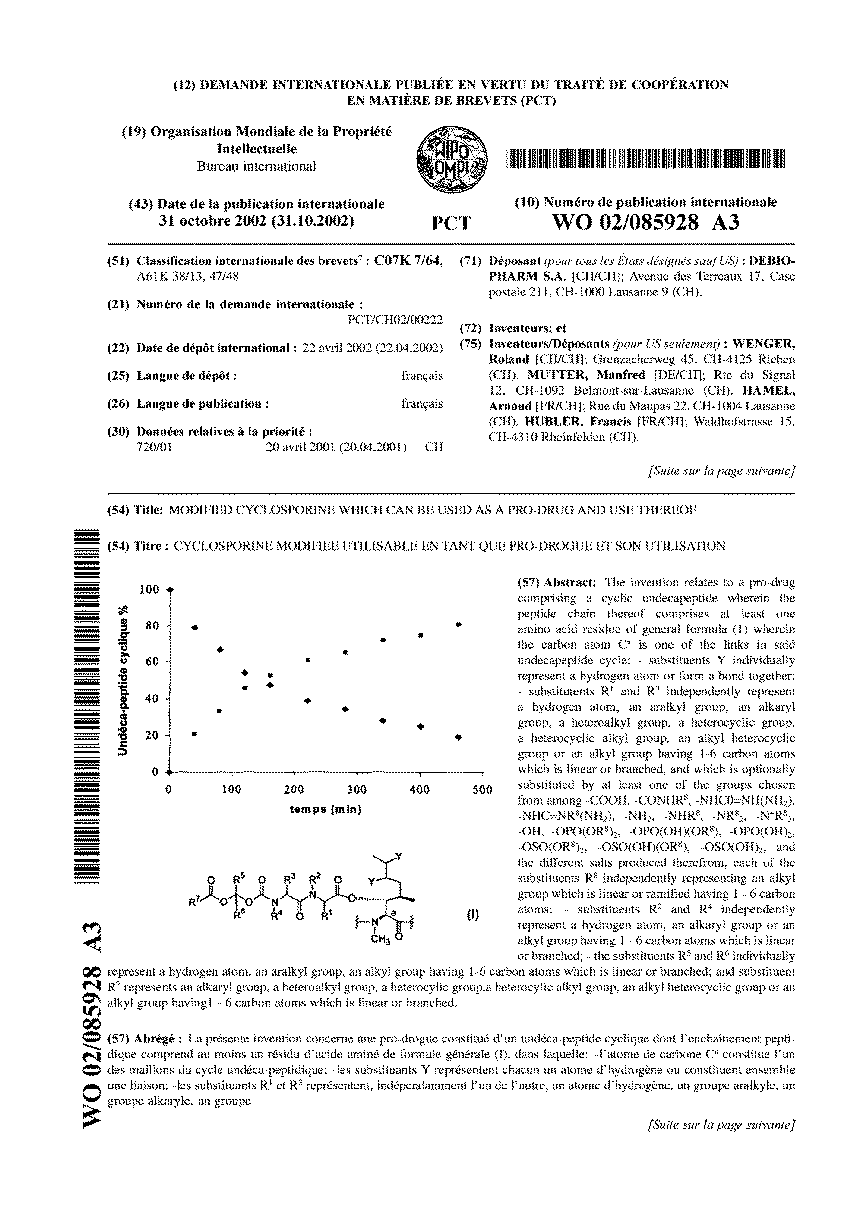
本発明、及び更にその有益な特性は、限定しないが、実施例において詳細に、且つ図面を用いて提示される。
【0067】
得られた産物を説明するために実施例で使用する用語において、シクロスポリンAの残基は、-CsAの略語で表され、反対のフラグメントの残基は、この環状ウンデカペプチドの唯一の官能化可能な基、すなわち1位のN-メチル-(4R)-4-((E)-2-ブテニル)-4-メチル-L-スレオニン(MeBmt)有するアミノ酸のヒドロキシル基に連結している。シクロスポリンAから誘導された中間産物の構造的な化学式は、1位のアミノ酸のみを個々の側鎖で表す。
【実施例】
【0068】
実施例1
式 (XV) の環状ウンデカペプチドの調製
【化9】
1.1. α−アセトキシエチル p −ニトロフェニルカルボネート(2)の調製
1.1.1. α−クロロエチルp−ニトロフェニルカルボネート(1)の調製
2.6ml(23.7mmol, 1.1等量)のα−クロロエチルクロロフォルメートを、0℃で3g(21.6mmol, 1等量)のp-ニトロフェノールと1.7ml(21.7mmol, 1等量)のピリジンの108mlのクロロホルム溶液に添加した。反応混合物を0℃で30分間、続いて周囲温度で16時間攪拌した。当該反応混合物を水、0.5% NaOH溶液、続いて水で抽出した。有機相をNa2SO4上で脱水し、ろ過し、そして減圧下で蒸発させた結果黄色い油が生成し、これはヘキサンからの結晶化後に純白の固体(5.8g)となる。
【化10】
1.1.2. α−アセトキシエチルp-ニトロフェニルカルボネート(2)の調製
7.8mg(24.4mmol, 1.5等量)の酢酸水銀を4g(16.3mmol, 1等量)の、100mlの酢酸に溶解した(1)の溶液に添加する。反応混合物を周囲温度で1日攪拌し、そして次に、追加の1g(3.13mmol, 0.2等量)の酢酸水銀を添加する。周囲温度で更に1日攪拌した後、当該反応が完了する。酢酸を高圧下で蒸発させ、そして残渣をエーテルに溶解する。有機相を塩溶液で抽出し、そして次に、Na2SO4上で脱水し、ろ過し、そして減圧下で蒸発させた結果、黄色い油が生成する。粗製産物をシリカゲル上でのクロマトグラフィーにかけた結果、無色の油(4.4g)が生成する。
【化11】
1.2. α−アセトキシエトキシカルボニル−リジン (N ε (Fmoc)) (5)の調製
1.2.1 α−アセトキシエトキシカルボニル−リジン(Nε(Z))(3)の調製
500mg(1.23mmol, 1等量)のH-Lys(Z)Obn.HClを2.5mlのジオキサン中で懸濁する。231μl(1.35mmol, 1.1等量)のN, N-ジイソプロピルエチルアミン(DIPEA)及び396mg(1.47mmol, 1.2等量)の(2)を周囲温度で添加する。周囲温度で1日攪拌した後、当該反応が完了する。ジオキサンを減圧下で蒸発させ、そして残渣を200mlの酢酸エチル中に溶解する。有機相を6%クエン酸溶液(20ml)、飽和NaHCO3溶液(200ml)及び飽和NaCl溶液(20ml)で3回抽出し、無水Na2SO4上で脱水し、そして濾過し、そして溶媒を減圧下で蒸発させる。得られた粗製産物をシリカゲル上でクロマトグラフィーにかけた結果、清澄で透明な油(576mg)が生成する。
【化12】
1.2.2. α−アセトキシエトキシカルボニル−リジン(4)の調製
50mgのパラジウム/活性炭を、509mg(1.02mmol)の(3)の、10mlのエタノール溶液に添加する。水素流のもと、周囲温度で3時間攪拌した後、反応が完了する。反応混合物をセライト上で濾過し、そしてろ液を減圧下で蒸発させた結果、茶色っぽい結晶の形態で粗製産物が生成し、これを以下の段階で直接使用する(254mg)。
【化13】
1.2.3 α−アセトキシエトキシカルボニル−リジン(Nε(Fmoc))(5)の調製
1.11mlのDIPEA(6.53mmol, 1.7等量)及び1.555g(4.61mmol, 1.2等量)のFmoc-O-Sucを38mlのジオキサン中に溶解した、1.062[lacuna](3.84mmol, 1等量)の(4)の溶液に添加する。周囲温度で1時間攪拌した後、反応が完了する。ジオキサンを減圧下で蒸発させ、そして残渣を20mlの酢酸エチル中に溶解する。有機相を6%クエン酸溶液(20ml)及び飽和NaCl溶液で1回洗浄し、無水Na2SO4上で脱水し、そして濾過し、そして溶媒を減圧下で蒸発させる。得られた粗製産物をシリカゲル上でクロマトグラフィーにかけた結果、白い泡(1.026g)が生成する。
【化14】
1.3. MeBmt(O-Sar-Lys-(N ε + Me 3 )-COOCH(CH 3 )OCOCH 3 )) 1 -CsA.I - (XV) の調製
1.3.1. MeBmt(O-COOCH2Br)1-CsA(6)の調製
【化15】
【化16】
1.3.2. MeBmt(O-Sar-H)1-CsA(7)の調製
【化17】
【化18】
1.3.3. MeBmt(O-Sar-Lys-(Nε(FMOC-COOCH(CH3)OCOCH3))1-CsA(8)の調製
【化19】
【化20】
1.3.4. MeBmt(O-Sar-Lys-(Nα-COOCH(CH3)OCOCH3))1-CsA(9)の調製
【化21】
【化22】
1.3.4. MeBmt(O-Sar-Lys-(Nε +Me3)-COOCH(CH3)OCOCH3))1-CsA.I-(XV)の調製
【化23】
【化24】
実施例2
式 (XVI) の環状ウンデカペプチドの調製
【化25】
1.1. α−アセトキシエトキシカルボニル−セリン(11)の調製
1.1.1. α−アセトキシエトキシカルボニル−セリンのベンジルエステル(10)の調製
1.4g(6.04mmol, 1等量)のH-Ser-OBn. HClを12mlのジオキサン中で懸濁する。1.14ml(6.64mmol, 1.1等量)のDIPEA及び実施例1に従い得られた2.1g(7.85mmol, 1.3等量)の(2)を周囲温度で添加する。周囲温度で一晩攪拌した後、反応が完了する。ジオキサンを減圧下で蒸発させ、そして残渣を酢酸エチル中に溶解する。有機相を6%クエン酸溶液、飽和NaHCO3溶液及び飽和NaCl溶液で3回抽出し、無水Na2SO4上で脱水し、そして濾過し、そして溶媒を減圧下で蒸発させる。得られた粗製産物をシリカゲル上でクロマトグラフィーにかけた結果、白い泡(1.7g)が生成する。
【化26】
1.1.2. α−アセトキシエトキシカルボニル−セリン(11)の調製
40mgのパラジウム/活性炭を、400mg(1.23mmol)の(4)の、13mlのエタノール溶液に添加する。水素流のもと、周囲温度で4時間攪拌した後、反応が完了する。反応混合物をセライト上で濾過し、そしてろ液を減圧下で蒸発させた結果、透明な沈着物の形態で粗製産物が生成し、これを以下の段階で直接使用する(328mg)。
【化27】
1.2. MeBmt(O-Sar-Ser-(OPO(OH 2 ))-COOCH(CH 3 )OCOCH 3 )) 1 -CsA, (XVI) の調製
1.2.1. MeBmt(O-Sar-Ser-(OPO(OH2))-COOCH(CH3)OCOCH3))1-CsA,(12)の調製
【化28】
【化29】
1.2.2. MeBmt(O-Sar-Ser(OPO(Oall)2)-COOCH(CH3)OCOCH3))1-CsA,(12)の調製
【化30】
【化31】
1.2.3. MeBmt(O-Sar-Ser-(OPO(OH2))-COOCH(CH3)OCOCH3))1-CsA(XVI)の調製
【化32】
【化33】
実施例3
式 (XV) 及び (XVI) の環状ウンデカペプチドの物理化学的特性
1. 式 (XV) 及び (XVI) の環状ウンデカペプチドの水溶性
水溶性は、Sorensen型の67mMのリン酸緩衝液中に測定量の環状ウンデカペプチドを直接溶解することによって、研究所での周囲温度での目視試験によって評価した。値を表1に示す。
【表1】
示唆のために、シクロスポリンAは、20℃で且つpH7での33μg/mlの最大水溶性を有するとして記載し、これは0.027mMの最大濃度に相当する。
【0085】
2.環状ウンデカペプチドの式 (XV) 及び (XVI) の化学的安定性及び酵素的安定性
式(XV)の環状ウンデカペプチドの長時間の化学的安定性の最初の評価は、第一にマンニトールから成る等張液中で、そして第二にpH7のリン酸緩衝液(PBS)中で、4,20及び37℃で実施した。
【0086】
検出したシクロスポリンAのパーセンテージを以下の表2に示す。
【表2】
見てのとおり、マンニトールの溶液中で4℃の温度の環状ウンデカペプチドは、少なくとも90日間反応して安定であることを示している。
【0088】
化学的及び酵素的両方の、安定性の第二の研究は、pH7.4の50mMのHepes緩衝液中に溶解した式(XV)及び(XVI)の2つの環状ウンデカペプチドを用いて、エステラーゼの存在下及び不在下で実施した。37℃でのインキュベーションの間、40μlのアリコートが適当な時間にサンプル採取され、そしてHPLC及びESI-MSによって解析される。
【0089】
酵素の不在下、3日以上の化学的安定性が、2つの環状ウンデカペプチドについて観察される。
【0090】
エステラーゼの存在下での加水分解の間に得られた結果を図1に示した。環状ウンデカペプチド(XVI)についての変換動態曲線はひし形で表し、一方、シクロスポリンAの出現動態曲線は四角で表す。見てのとおり、図によると、エステラーゼの存在下で、環状ウンデカペプチド(XVI)は素早く分解し、シクロスポリンAを放出する。同様の観察が環状ウンデカペプチド(XV)についてなされた。
【0091】
環状ウンデカペプチド(XV)及び(XVI)を、37℃のウシ血清中でのインキュベーションにかけた。シクロスポリンAへの環状ウンデカペプチドの変換の半減期が評価され、そしてそれぞれ3.66及び3.50時間である。
【0092】
実施例4
水溶液の形態での静脈内投与のための利用
式 (XV) 及び (XVI) の環状ウンデカペプチドの薬理動態の研究
注意を要する安定性の、取り扱いが比較的困難で、そして有害作用を示す、ポリオキシエチレン化ヒマシ油のマイクロエマルジョンの形態で一般的に使用されるシクロスポリンAの医薬製剤に代わるツールを臨床医に利用可能にさせるために、単純な水溶液の形態の本発明のプロドラッグが、静脈内での利用のために評価された。
【0093】
次のように、リン酸緩衝液の溶液中の2つの環状ウンデカペプチド(XV)及び(XVI)が、10mg/kgのシクロスポリンAに等しい用量でラットに静脈内に投与された。
【0094】
参照として、商品名Sandimmunで市販されているシクロスポリンの注射可能な溶液の試料を適当な希釈の後に使用した。
【0095】
血液試料は、一定間隔で採取し、そして、シクロスポリンAをアッセイするための解析にかけた。
【0096】
静脈内投与後の血液中のシクロスポリンAレベルを図2aに示した。2つのプロドラッグ(XV)及び(XVI)の水溶液のそれぞれの静脈内投与後に得られたものを図2b及び図2cにそれぞれ示す。図2aに示した。図2a、図2b及び図2cの曲線から解釈される結果を以下の表3に示した。
【表3】
この表における略語は、以下の意味を有する:
−AUC:曲線下面積;
−CL:クリアランス
−MRT:平均滞留時間
−Vss:定常状態分布容積
−T1/21:初期の半減期;及び
−T1/22:終期の半減期。
【0098】
図2及び表3から知られうるように、シクロスポリンAによるコントロール実験の薬理動態のパラメーターは、文献において報告されているものに匹敵する。環状ウンデカペプチド(XV)の開裂の間に生成したシクロスポリンAについての曲線下面積は、コントロール実験におけるシクロスポリンAのものに匹敵し、一方、環状ウンデカペプチド(XVI)の開裂の間に生成したシクロスポリンAのものは、コントロール実験のシクロスポリンAのものと比べて25%低下する。
【0099】
2つの環状ウンデカペプチド(XV)及び(XVI)はそれぞれ、シクロスポリンAに関して類似の血液放出プロファイルを示す。これらのプロファイルは、ポリオキシエチル化ヒマシ油を基にした医薬の形態のシクロスポリンAのものに類似している。
【0100】
これらの結果から、本発明のプロドラッグは、等しいシクロスポリンAの放出プロファイルのために、シクロスポリンAの既存の医薬製剤と比較して以下の考慮すべき利点を提供するという結果をもたらす:
−水中で単純に溶解することによって使用しやすく;且つ
−毒性であることを示している賦形剤を使用する必要がなく;且つ
−それらを扱うための特殊な材料を使用する必要がない。
【0101】
実施例5
水溶液の形態での眼に対する局所投与のための利用
式 (XV) の環状ウンデカペプチドの薬理動態の研究
刺激又は不愉快な感覚を感じることのない、又はかすみ眼を体験することのない、眼に対するシクロスポリンAの局所投与のためのツールを臨床医に利用可能にさせるために、単純な水溶液の形態の本発明のプロドラッグを評価した。
【0102】
1.溶液の調製
5%マンニトールを含み、且つpH7.0の環状ウンデカペプチド(XV)の等張性水溶液を調製した。シクロスポリンAの等価物の濃度は1%(重量/体積)である。溶液は、それらを0.22μmのニトロセルロースフィルターを通過させることによって滅菌した。シクロスポリンAの参照製剤を、1%のオリーブ油溶液の形態で調製した。
【0103】
2.式 (XV) の環状ウンデカペプチドの耐性の決定
眼の耐性は、2つの方法に従い、すなわち、改良型のDrize試験に従い、そして共焦点レーザー顕微鏡を用いて決定した。
【0104】
2.1 改良型 Draize 試験(急性耐性試験)
この評価は、6匹の雄のアルビノのウサギで実施した。各動物につき、一方の眼が、50μlの上述の溶液の導入を受け、他方の眼が処置されずにコントロールの役割を果たした。
【0105】
起こりうる刺激の臨床評価は、以下の表4に記載の分類に従い、眼漏、結膜浮腫及び結膜の充血によって可視的に実施された。
【表4】
起こりうる刺激は、上記規定に従い、導入後48時間に及ぶ所定の間隔で各動物において観察され、そして全刺激指数(total irritation index)が、推定される指数の累計から算出された。得られた結果を以下の2.3の表4に示す。
【0107】
2.3 共焦点レーザー顕微鏡(投与から4日に及ぶ亜急性の毒性を評価するための試験)
この試験は、これまでと同一の型の動物で実施された。25μlの上述の溶液を右眼の角膜上に、4日間、1日3回、そしてその後4日目の観察直前に1回染み込まされた。最後の導入の後、ウサギは塩酸ケタミン及びキシラジンで鎮静化された。0.5%(重量/体積)の、計25μlのフルオレセインナトリウム溶液を、恐らく損傷した表面の選択的標識を可能にするために、眼の上に染み込まされた。続いて、眼は、37℃の生理食塩水で1分間すすがれた。
【0108】
最後に、眼は、Furrer etal., J. Ocular Pharmacol., 1997, 13, 559に従い、共焦点レーザー顕微鏡で観察された。顕微鏡は、三次元の画像を再構成し、そして損傷した領域の評価を可能にするために画像解析システムと接続された。
【0109】
耐性の程度は、角膜の損傷のパーセンテージの関数として、且つ以下の規定に従い評価される:
−0〜25%:良好な耐性;
−25%〜40%:許容可能な耐性;
−40%〜60%:低い耐性;及び
−60%超:許容不可能な耐性。
【0110】
一般的に、5%以下の損傷のパーセンテージが、いずれの処置にもかけられていない正常な身体における通常の細胞の死亡率に相当すると認識されていることが知られている。
【0111】
得られた結果を以下の2.3の表5に示す。
【0112】
2.3 式(XV)の環状ウンデカペプチドについての眼の耐性の結果
【表5】
表5より、1.8の全刺激指数が式(XV)の環状ウンデカペプチドについてのDraize試験で得られ、そして、7%の角膜がこの産物の投与によって損傷を受けたようである。これらの2つの結果は、当該環状ウンデカペプチドに対する非常に良好な体制を示し、この耐性は、オリーブ油中のシクロスポリンAが投与された場合に得られるものと比較して明らかに向上している。
【0114】
理由は明白であるが、油性の溶液よりもむしろ水性の溶液を用いることによる、眼の心地よさの主観的な向上が、当該動物では評価されなかった。
【0115】
3.式 (XV) の環状ウンデカペプチドの安定性
上述の溶液の試料は、それぞれ、4℃及び20℃で保存された。HPLCによる解析は、3ヶ月間定期的に実施された。これらの試料は、そのような条件下で良好な安定性を有することが明らかとなった。
【0116】
4.式 (XV) の環状ウンデカペプチドの ex vivo での変換動態
この変換動態試験は、25μlの上述の溶液を、穏やかに攪拌しながら8μlの新鮮なウサギの涙と一緒に37℃でインキュベートすることによって実施した。2μlの試料が、1,2,3及び30分間隔で採取され、そして次にHPLCによって解析された。
【0117】
得られた結果は、式(XV)の環状ウンデカペプチドが、ウサギの涙との接触後1分目からシクロスポリンAを放出して、そのプロドラッグの役割を果たすことを示した。3分で3%のプロドラッグが変換され、そして次に30分後では4.7%が変換された。
【0118】
5.式 (XV) の環状ウンデカペプチドの in vivo での変換動態
このin vivoでの変換動態試験は、25μlの上述の溶液の試料を雄のアルビノのウサギ(4kg)の右眼に染み込ませることによって実施された。涙の試料は、1,2,3,4及び20分間隔で採取され、そして次にHPLCによって解析された。
【0119】
得られた結果を図3に示した。見てのとおり、この試験は、ex vivoの実験で既に得られた結果を確認するものである。式(XV)の環状ウンデカペプチド(四角)は、ウサギの涙との接触後1分目からシクロスポリンAを放出して、そのプロドラッグの役割を明らかに果たし、そしてこの放出は、以降20分に及んで続く。1分目の涙中のシクロスポリンAの濃度は0.025mg/mlである。
【0120】
6.結論
これらの結果から、本発明のプロドラッグが、眼に対する局所投与の場合に、以下の利点を提供することとに帰結する:
−油性のアジュバントを用いる必要無しに、水溶液中での単純な溶解による、医薬製剤、例えば洗眼液の調製のし易さ;
−油性の形態のシクロスポリンAの医薬製剤で得られたものよりも大きな、良好な急性の耐性及び非常に亜急性の耐性;
−良好な安定性;及び
−眼科での利用に適した半減期。
【図面の簡単な説明】
【0121】
【図1】図1は、エステラーゼを用いる加水分解による、本発明に従うプロドラッグについてのin vitroでの変換動態の曲線及びシクロスポリンAの出現動態の曲線を表す。
【図2a】図2aは、ラットにおける油性の形態のシクロスポリンaの静脈内投与後の血中シクロスポリンAレベルを表す。
【図2b】図2bは、ラットにおける本発明に従う2つのプロドラッグのうちの1つの水溶液の静脈内投与後の、血中シクロスポリンAレベルを表す。
【図2c】図2cは、ラットにおける本発明に従う2つのプロドラッグのうちの1つの水溶液の静脈内投与後の、血中シクロスポリンAレベルを表す。
【図3】図3は、ウサギの涙中の、シクロスポリンA及び本発明に従うプロドラッグAの、それぞれの時間経過ごとの濃度を表す。【Technical field】
[0001]
The present invention relates to prodrugs consisting of cyclic undecapeptides and their use as medicaments, especially for the treatment of pathological conditions of the eye.
[0002]
Cyclosporins constitute a structurally different class of cyclic peptides, which generally have the fact that they consist of a chain of seven amino acids and are either due to their D-configuration or Some are atypical, either due to the complex chemical structure of their side chains or due to the fact that the amine groups are alkylated.
[0003]
To date, about 30 cyclosporins have been isolated from fungal populations, and many cyclic undecapeptides similar to these natural products have been obtained by semi- or total synthesis. Also included in these cyclic undecapeptide analogs are peptides or depsipeptides, ie, cyclic polypeptides that also contain ester bonds in their chains.
[0004]
In the following description, and unless otherwise specified, the term "cyclosporin" refers to both cyclic undecapeptides obtained from natural sources and their analogs obtained by semi-synthetic or total synthesis, e.g., obtained from natural sources Peptides or their analogues obtained by semi-synthesis or total synthesis.
[0005]
The first member of this cyclosporin that has been isolated and subsequently identified is cyclosporin A. The peptide chains that make up the undecapeptide ring are as follows:
Embedded image
Its broad chemical structure is as follows:
Embedded image
Among the atypical amino acids that this cyclic undecapeptide comprises at
[0008]
This amino acid is specific for cyclosporine and the ethylene group can be optionally reduced. It has an amine group that is methylated. It should be noted that the hydroxyl group it carries is very notable in the sense that it is the only group of this overall cyclic undecapeptide that can create a chemical modification. It can also be mentioned that it is in the environment of the largely impaired stearin, which makes every reagent approach tricky.
[0009]
These cyclic undecapeptides exhibit a wide range of biological activities, whether they are of natural origin or obtained synthetically, among which the most well-known are immunosuppressive, anti-inflammatory An activity that can combat or reduce the sexual or anthelmintic activity, or the resistance of a malignant tumor to other treatments. Some of these cyclic undecapeptides have been found to retain promising antiviral activity, particularly in the treatment of AIDS by inhibiting replication of human immunodeficiency virus type I (HIV-I) .
[0010]
In this regard, a number of cyclic peptides obtained by semisynthesis and having a structure similar to that of cyclosporin A, but wherein the properties of the amino acids at
[0011]
Recent pharmacological developments have shown that the immunomodulatory effects of cyclosporin, which are reversible and not bone marrow toxic and have some side effects, especially those of cyclosporin A, especially in the field of ophthalmology, It makes it possible and hopeful that it can be exploited for local treatment of pathological conditions of the surface of the eye and its surrounding appendages.
[0012]
Included among these pathological conditions are, in particular, forms of keratoconjunctivitis sicca, also called dry eye syndrome, Sjogren's syndrome, allergic keratoconjunctivitis, especially those that are resistant to corticosteroids Conjunctivitis that produces viscous and adhesions, herpetic interstitial keratitis, immune-related marginal keratitis and Tigeson's keratitis, and prevention of corneal transplant rejection and during adjuvant treatment for filtration surgery .
[0013]
The cyclic undecapeptides of the cyclosporin family are highly hydrophobic in nature, which further reduces their water solubility overall. This feature is related to the side chain properties of many of these amino acids, but some of the amino groups of these amino acids are methylated so that the cyclic undecapeptide and, for example, an aqueous solubilizing medium Is associated with the fact that the number of intermolecular hydrogen bond formations between is limited as much as possible.
[0014]
As a result, the intravenous (iv) administration of these cyclosporins requires the development of very complex pharmaceutical formulations, mainly in the form of emulsions, which are sometimes unstable and difficult to handle. Beware and may be a source of harmful side effects.
[0015]
As an example, one of the preparations for iv injection of cyclosporin A, marketed under the trade name Sandimmun, is a polyoxyethylated castor oil known under the trade name Cremophor as an excipient Consisting of a microemulsion. This preparation is stored in the form of a concentrate and must be diluted just prior to administration.
[0016]
Due to the use of this castor oil, which is known to dissolve some of the components of the synthetic material, manufacturers have found that when handling this preparation, the glass, or, in the absence of this, "blood" It is recommended to use only materials made from synthetic materials according to the European Pharmacopoeia standard for containers intended to contain, and these materials must not all contain silicone oils and fats.
[0017]
Clinicians are warned that this castor oil may cause an anaphylactic reaction, and thus recommend that intravenous administration be used only when oral administration is not possible. .
[0018]
The development of the promising use of cyclosporine by topical administration in ophthalmology is particularly challenging to develop a suitable pharmaceutical formulation that exhibits good local usability and does not cause haze due to the presence of the viscous agent Also due to the speed remains slow.
[0019]
As follows, and as an example, Robert et al. Recently analyzed in J. Fr. Ophtalmol., 2001, 24 (5), 527 the background of lipophilicity of pharmaceutical formulations for topical administration of cyclosporin A in ophthalmology. All the technical difficulties that must be done and all the problems of local tolerance caused by these formulations have been outlined.
[0020]
One of the conclusions that can be drawn from this overview is that, to date, there is no formulation in the form of eyewash that can be administered topically for the treatment of symptoms of the eye and its surrounding appendages. . This conclusion extends to the use of cyclosporine for the topical treatment of mucosal or cutaneous conditions.
[0021]
As a result, regardless of their natural or synthetic origin or their derivatives of cyclosporine, they can be easily administered to patients, especially topically or intravenously, but are unstable and require careful handling. There is still a need to make cyclosporine available to clinicians, avoiding the use of complex pharmaceutical formulations, which are a source of adverse side effects.
[0022]
This need further exists if these cyclosporins of natural or synthetic origin must be applied topically to the eye or surrounding appendages.
[0023]
When faced with the problem of making hydrophobic pharmacologically active molecules absorbable in physiological media, one of the possibilities available to professionals is to give them hydrophilic properties. In order to do so, it must be chemically modified.
[0024]
In order to avoid altering the pharmacological properties of such pharmacologically active molecules, this chemical modification involves the administration of precursors, if possible, once administered and physiologically present locally in the body. The site where the pharmacologically active molecule under the action of the symptoms must, if possible, undergo its pharmacological action, or transport this pharmacologically active molecule and, consequently, its site of action May be in the preparation of an inert precursor of this pharmacologically active molecule, which is chemically or enzymatically modified to be released into the blood, which is referred to as a "prodrug". The concept is equivalent. In the remainder of the description, the precursors of the pharmacologically active molecule in question will be referred to as "prodrugs".
[0025]
The practice of chemically modifying the structure of cyclosporin A in order to impart hydrophilic properties to the resulting product is already known.
[0026]
Rothebard et al., In patent application WO 01/13957, describe a method for improving the administration of pharmacologically active molecules and passing them through the skin and epithelium, as described below. Describes a method comprising reversibly implanting a side chain consisting of a polyarginine chain. Among the pharmacologically active molecules include molecules having a hydrophobic property, for example, cyclosporin A.
[0027]
However, such conjugates, as suggested in the cited application, handle pharmacologically active molecules due to their release as soon as the pH of the medium exceeds 7; And it takes considerable care to save. Moreover, when this pharmacologically active molecule is released, fragments of the polyarginine chain are released into the body. Since they are known for their toxicity and their irritating ability, these polyarginines can cause irritation, so that the use of such cyclosporine in the ophthalmic field is not envisioned. Impossible.
[0028]
Crooks et al. In patent application WO 00/67801 allow an anti-inflammatory agent, such as flurbiprofen, to be administered locally directly to the eye while at the same time avoiding any local irritation during this. Preparation of those prodrugs is described. They achieve this for a certain number of pharmaceuticals by introducing oxygenated or highly oxidized chains.
[0029]
On the other hand, if it is desired to subject cyclosporin A to the same chemical modification, they will come into contact with a product that they describe as stable, in other words, human serum or phosphate buffer at pH 7.4. Both were successfully cleaved to obtain only products that did not release cyclosporin A.
[0030]
In conclusion, the object of the present invention is that, firstly, it can be administered in a physiological medium without the need to develop complex pharmaceutical formulations, and secondly, in particular, concerns about the pH conditions of the surrounding medium The aim is to make a prodrug of the cyclosporin family of cyclic undecapeptides available to clinicians that can be stored without need and then handled and administered.
[0031]
It is also an object of the present invention to provide a pharmacologically active cyclic compound which can be administered normally topically, and especially on the surface of the eye, or on mucous membranes, and which subsequently has a suitable half-life without local irritation. The aim is to make a prodrug of the cyclosporin family of cyclic undecapeptides capable of releasing undecapeptide available to the clinician.
[0032]
In contrast to this effect, the present invention provides a peptide chain represented by the following general formula (I):
Embedded image
-Carbon atom CaConstitutes one of the linkages of the undecapeptide ring;
The substituents Y each represent a hydrogen atom or together form a bond;
-Substituent R1And RThreeAre independently of one another a hydrogen atom, an aralkyl group, an alkaryl group, a heteroalkyl group, a heterocyclic group, an alkylheterocyclic group, a heterocyclicalkyl group or a straight-chain having 1 to 6 carbon atoms. Represents a chain or branched alkyl group, wherein the group is -COOH, -CONHR8, -NHC = NH (NHTwo), -NHC = NR8(NHTwo), -NHTwo, -NHR8, -NR8 Two, -N+R8 Three, -OH, -OPO (OR8)Two, -OPO (OH) (OR8), -OPO (OH)Two, -OSO (OR8)Two, -OSO (OH) (OR8), -OSO (OH)TwoAnd optionally substituted with at least one group of various salified forms of these groups, wherein each substituent R8Represents, independently of one another, a straight-chain or branched alkyl radical having 1 to 6 carbon atoms;
-Substituent RTwoAnd RFourRepresents, independently of one another, a hydrogen atom, an alkaryl group or a straight-chain or branched alkyl group having 1 to 6 carbon atoms;
-Substituent RFiveAnd R6Represents, independently of one another, a hydrogen atom, an aralkyl group or a straight-chain or branched alkyl group having 1 to 6 carbon atoms;
-Substituent R7Represents an aralkyl group, an alkaryl group, a heteroalkyl group, a heterocyclic group, a heterocyclic alkyl group or a linear or branched alkyl group having 1 to 6 carbon atoms, wherein -COOH,- CONHR8, -NHC = NH (NHTwo), -NHC = NR8(NHTwo), -NHTwo, -NHR8, -NR8 Two, -N+R8 Three, -OH, -OPO (OR8)Two, -OPO (OH) (OR8), -OPO (OH)Two, -OSO (OR8)Two, -OSO (OH) (OR8), -OSO (OH)TwoAnd optionally substituted with at least one group of various salified forms of these groups, wherein each substituent R8(As defined above), comprising a cyclic undecapeptide comprising at least one amino acid residue.
[0033]
When the two substituents Y together form a bond, the amino acid residue of general formula (I) is N-methyl- (4R) -4-((E-2-butenyl) -4-methyl-L -The pharmacologically active molecule derived from the threonine residue (where the hydroxyl group of threonine is esterified in a suitable way) and released when the prodrug is cleaved in the body, The peptide chain consists of a cyclic undecapeptide comprising at least one N-methyl- (4R) -4-((E) -2-butenyl) -4-methyl-L-threonine residue (MeBmt).
[0034]
Similarly, when the two substituents Y each represent a hydrogen atom, the amino acid residue of the general formula (I) is an N-methyl- (4R) -4-butyl-4-methyl-L-threonine residue ( Wherein the hydroxyl group of threonine is esterified in a suitable manner) and the pharmacologically active molecule released when the prodrug is cleaved in the body is a peptide chain having at least one peptide chain. It consists of a cyclic undecapeptide comprising two N-methyl- (4R) -4-butyl-4-methyl-L-threonine residues (Dh-MeBmt).
[0035]
Preferably, in the general formula (I) defining the amino acid residue, the substituent R1And RThreeAt least one represents an aralkyl group, an alkaryl group, a heteroalkyl group, a heterocyclic group, a heterocyclic alkyl group or a linear or branched alkyl group having 1 to 6 carbon atoms, wherein the group is -COOH, -CONHR8, -NHC = NH (NHTwo), -NHC = NR8(NHTwo), -NHTwo, -NHR8, -NR8 Two, -N+R8 Three, -OH, -OPO (OR8)Two, -OPO (OH) (OR8), -OPO (OH)Two, -OSO (OR8)Two, -OSO (OH) (OR8), -OSO (OH)TwoAnd optionally substituted with at least one group of various salified forms of these groups, wherein each substituent R8Has the above definition. These groups, which are recognized to be polar in nature, greatly improved the hydrophilic nature imparted to the prodrug.
[0036]
More preferably, the aralkyl group, alkaryl group, heteroalkyl group, heterocyclic group, heterocyclic alkyl group or alkyl group is -NR8 Two, -N+R8 Three, -OH, -OPO (OH)TwoOr substituted with at least one of the various salted forms of these groups, each substituent R8 having the above definition.
[0037]
More preferably, the substituent R1And RThreeAt least one of the -NR8 Two, -N+R8 Three, -OH, -OPO (OH)TwoOr a linear alkyl group having 1 to 6 carbon atoms substituted with at least one of the various salified forms of these groups, wherein each substituent R8Has the above definition.
[0038]
The substituent R1And RThreeBut -NR8 Two, -N+R8 Three, -OH, -OPO (OH)TwoOr a linear alkyl group having 1 to 6 carbon atoms substituted with at least one of the various salified forms of these groups, wherein each substituent R8Where has the above definition, the corresponding amino acid residue is preferably:
A serine, homoserine, threonine, alosreonine, N-methylserine, N-methylthreonine or N-methylhomoserine residue in any of the (D) or (L) configuration, preferably in the (L) configuration, wherein the hydroxyl group Are functionalized in a suitable manner such that the side chains of these amino acid residues carry polar and / or soluble groups;
-Or a lysine, ornithine, arginine, N-delta-methylarginine, N-alpha-methylarginine or N-methyllysine residue in either the (D) or (L) configuration, preferably in the (L) configuration. , The amine or imine residues are each functionalized in a suitable manner such that the side chains of these amino acid residues carry polar and / or soluble groups,
Derived from any of
[0039]
(R1, RTwo) And / or (RThree, RFour)) To form a pair R1, RTwoAnd / or RThree, And RFourAre alkyl groups having 1 to 6 carbon atoms, they form a ring with the carbon and nitrogen atoms carrying them in each pair. Preferably, they make up the side chain of the proline residue.
[0040]
Substituent R1And RThreeIndependently represent a hydrogen atom, an alkaryl group, a heteroalkyl group, a heterocyclic group, a heterocyclic alkyl group or a linear or branched alkyl group having 1 to 6 carbon atoms, Is -COOH, -CONHR8, -NHC = NH (NHTwo), -NHC = NR8(NHTwo), -NHTwo, -NHR8, -NR8 Two, -N+R8 Three, -OH, -OPO (OR8)Two, -OPO (OH) (OR8), -OPO (OH)Two, -OSO (OR8)Two, -OSO (OH) (OR8), -OSO (OH)TwoUnsubstituted by groups selected from the group consisting of, and at least one group of various salted forms of these groups, then they are preferably in the (D) or (L) configuration, preferably Represents an amino acid residue in the (L) configuration, or a residue of said amino acid, optionally in protected and / or activated form and optionally having an alkylated amine group, which is usually commercially available. More preferably, said amino acid residues are selected from 20 amino acids usually referred to as natural amino acids.
[0041]
Also preferably, in the general formula (I), the substituent RFiveAnd R6Cannot simultaneously represent a hydrogen atom. Also preferably, the substituent RFiveAnd R6At least one represents a straight-chain or branched alkyl group having 1 to 6 carbon atoms, and the substituent R7Represents an aralkyl group or a linear or branched alkyl group having 1 to 6 carbon atoms.
[0042]
More preferably, the substituent RFiveAnd R6Represents a hydrogen atom or a methyl group independently of each other.
[0043]
Preferably, the prodrug comprises a peptide chain comprising one amino acid residue of the general formula (I), and thus the following general formula (II):
Embedded image
-T is selected from the amino acids Ala, Abu, Nval, Val and Thr;
-U represents the amino acids Sar, (D) MeSer, (D) MeAla and (D) MeSer (OCOR9), Where R9Represents a hydrogen atom, an alkaryl group, or a linear or branched alkyl group having 1 to 6 carbon atoms;
−V is represented by the general formula (N-RTenaa is selected from the amino acids Val, Leu, Ile, Thr, Phe, Tyr and Thr;TenIs a linear or branched alkyl group having 1 to 6 carbon atoms:
-W is selected from amino acids Val, Nval and Leu;
-X is selected from the amino acids (D) Ala, (D) ser, (D) Hiv, (D) Val and (D) Thr, where (D) Hiv is the residue of D-2-hydroxyisovalerate. Represents a group; and
-Z is selected from the amino acids Leu and MeLeu)
Form an undecapeptide ring with a linear sequence of 10 amino acids.
[0044]
As shown below, in the amino acid residue of the general formula (I), when two substituents Y each represent a hydrogen atom, a pharmacologically active molecule released in the body during cleavage of a prodrug is The peptide chain consists of a cyclic undecapeptide of the cyclosporin family containing N-methyl- (4R) -4-butyl-4-methyl-L-threonine (Dh-MeBmt).
[0045]
Similarly, when at the amino acid residue of general formula (I) two substituents Y represent a bond together, the pharmacologically active molecule released in the body during cleavage of the prodrug is a peptide The chain consists of a cyclic undecapeptide of the cyclosporin family, wherein the chain comprises N-methyl- (4R) -4-((E) -2-butenyl) -4-methyl-L-threonine (MeBmt).
[0046]
Preferably, these cyclic undecapeptides have pharmacological properties and all have N-methyl- (4R) -4-((E) -2-butenyl) -4- in their peptide chains. Already described in the literature as having either a methyl-L-threonine (MeBmt) residue or an N-methyl- (4R) -4-butyl-4-methyl-L-threonine residue (Dh-MeBmt). Equivalent to cyclosporine.
[0047]
More preferably, together with the amino acid residues of the general formula (I), the linear sequence of the remaining 10 amino acid residues constituting the cyclic undecapeptide is represented by the formulas (III) to (XIV) The following array:
Embedded image
[0048]
Each pharmacologically active molecule released into the body during cleavage of the prodrug is optionally derived from a threonine chain with a butenyl chain (MeBmt) or a threonine chain with a butyl chain (Dh-MeBmt), respectively. The following cyclosporins having residues:
Embedded image
[0049]
More preferably, the prodrugs of the invention have the following formulas (XV) and (XVI), respectively:
Embedded image
[0050]
Prodrugs according to the invention may be prepared by utilizing chemical synthesis methods well known to those skilled in peptide chemistry, and most particularly cyclosporine chemistry.
[0051]
With the appropriate choice of the various substituents defining the amino acid residues of the general formula (I), the prodrugs according to the invention are particularly useful for producing pharmacologically active molecules formed during the cleavage of said prodrugs. It has been shown to have greatly increased hydrophilic properties as compared to. For example, certain prodrugs of the invention that produce cyclosporin A after cleavage are at least 3000 times more soluble than those of cyclosporin A.
[0052]
Thus, the prodrugs of the present invention can be easily incorporated into aqueous pharmaceutical preparations.
[0053]
Also in particular, it is clear that the prodrugs of the invention, when they are in aqueous solution, are insensitive to the pH conditions normally encountered in this type of application.
[0054]
In addition, the prodrugs of the present invention have a half-life that makes them completely suitable for therapeutic use by releasing pharmacologically active molecules when they come in contact with enzymes present in body fluids. Complete the role.
[0055]
The invention also relates to the use of a prodrug as described above as a medicament.
[0056]
Such a medicament is preferably used for the treatment of pathological or physiological conditions which require cyclosporin in advance, in particular for the treatment of all pathological conditions which require the use of cyclosporin A locally or systemically. You.
[0057]
Such a medicament is intended, inter alia, to enable long-term survival of allogeneic transplants of organs such as the kidney, heart, liver, pancreas, lung, small intestine or bone marrow. It is also aimed at inhibiting the replication of human immunodeficiency virus type 1 (HIV-1).
[0058]
In such an application, the dose of a prodrug of the invention when administered systemically by intravenous injection may be such that the concentration of cyclosporin formed during cleavage, for example, cyclosporin A, is generally the recommended therapeutic concentration. It is equivalent.
[0059]
More preferably, such medicaments are used in the field of ophthalmology and are particularly intended for the treatment of pathological conditions of the eye and its surrounding appendages.
[0060]
Among these pathological conditions are forms of keratoconjunctivitis sicca, Sjogren's syndrome, allergic keratoconjunctivitis, also called dry eye syndrome, especially those resistant to corticosteroids, viscosity and adhesions Conjunctivitis, herpetic interstitial keratitis, immune-related marginal keratitis and Tigeson's keratitis, and prevention of corneal transplant rejection, and adjuvant treatment for filtration surgery. More preferably, the medicament of the present invention is used for treating keratoconjunctivitis sicca.
[0061]
In such an application, the dose of the prodrug of the invention may be such that the concentration of tears of cyclosporin formed during cleavage of the prodrug, for example, cyclosporin A, should be greater than 0.5 μg / L by topical administration It is.
[0062]
The medicament of the invention may be administered topically, especially for the topical treatment of mucosal or dermatological conditions, or parenterally, especially intravenously. It can also be administered orally with the aim of increasing the bioavailability of a cyclosporin, for example cyclosporin A.
[0063]
When the medicament of the present invention is to be administered parenterally, suitable pharmaceutical preparations may be sterile concentrated aqueous solutions or powders for injectable preparations.
[0064]
Preferably, the medicament of the present invention is administered intravenously. Pharmaceutical preparations suitable for such administration are aqueous solutions for injection or infusion well known to the expert.
[0065]
More preferably, the medicament of the present invention is administered topically. Pharmaceutical preparations suitable for such administration, especially for ophthalmic use, are eyewashes, eye ointments, ophthalmic gels and ophthalmic inserts in the form of aqueous sterile solutions.
[0066]
The present invention, and further its beneficial properties, are presented in detail in the examples, but not by way of limitation, and with the aid of the drawings.
[0067]
In the terms used in the examples to describe the resulting product, the residue of cyclosporin A is represented by the abbreviation -CsA and the residue of the opposite fragment is the only functionalization of this cyclic undecapeptide. It is linked to a possible group, i.e. the hydroxyl group of the amino acid with N-methyl- (4R) -4-((E) -2-butenyl) -4-methyl-L-threonine (MeBmt) at
【Example】
[0068]
Example 1
formula (XV) Preparation of Cyclic Undecapeptide
Embedded image
1.1. α-acetoxyethyl p -Preparation of nitrophenyl carbonate (2)
1.1.1. Preparation of α-chloroethyl p-nitrophenyl carbonate (1)
2.6 ml (23.7 mmol, 1.1 equivalents) of α-chloroethyl chloroformate were added at 0 ° C. with 3 g (21.6 mmol, 1 equivalent) of p-nitrophenol and 1.7 ml (21.7 mmol, 1 equivalent) of pyridine. Was added to a 108 ml chloroform solution. The reaction mixture was stirred at 0 ° C. for 30 minutes, then at ambient temperature for 16 hours. The reaction mixture was extracted with water, 0.5% NaOH solution, followed by water. Organic phase NaTwoSOFourDry over, filter and evaporate under reduced pressure to yield a yellow oil, which after crystallization from hexane becomes a pure white solid (5.8 g).
Embedded image
1.1.2. Preparation of α-acetoxyethyl p-nitrophenyl carbonate (2)
7.8 mg (24.4 mmol, 1.5 equiv.) Of mercury acetate are added to a solution of (1) in 4 g (16.3 mmol, 1 equiv.) Dissolved in 100 ml of acetic acid. The reaction mixture is stirred at ambient temperature for one day, and then an additional 1 g (3.13 mmol, 0.2 eq) of mercury acetate is added. After stirring at ambient temperature for another day, the reaction is complete. The acetic acid is evaporated under high pressure and the residue is dissolved in ether. The organic phase was extracted with a salt solution and then NaTwoSOFourDry over, filter and evaporate under reduced pressure to yield a yellow oil. The crude product is chromatographed on silica gel to yield a colorless oil (4.4 g).
Embedded image
1.2. α-acetoxyethoxycarbonyl-lysine (N ε (Fmoc)) Preparation of (5)
1.2.1 α-acetoxyethoxycarbonyl-lysine (Nε(Z)) Preparation of (3)
500 mg (1.23 mmol, 1 equivalent) of H-Lys (Z) Obn.HCl are suspended in 2.5 ml of dioxane. 231 μl (1.35 mmol, 1.1 eq) of N, N-diisopropylethylamine (DIPEA) and 396 mg (1.47 mmol, 1.2 eq) of (2) are added at ambient temperature. After stirring for one day at ambient temperature, the reaction is complete. The dioxane is evaporated under reduced pressure and the residue is dissolved in 200 ml of ethyl acetate. The organic phase was washed with a 6% citric acid solution (20 ml), saturated NaHCOThreeSolution (200 ml) and saturated NaCl solution (20 ml) three times,TwoSOFourDry over and filter and evaporate the solvent under reduced pressure. The crude product obtained is chromatographed on silica gel to yield a clear, clear oil (576 mg).
Embedded image
1.2.2. Preparation of α-acetoxyethoxycarbonyl-lysine (4)
50 mg of palladium on activated carbon are added to a solution of 509 mg (1.02 mmol) of (3) in 10 ml of ethanol. After stirring for 3 hours at ambient temperature under a stream of hydrogen, the reaction is complete. The reaction mixture is filtered over celite and the filtrate is evaporated under reduced pressure to give the crude product in the form of brownish crystals, which is used directly in the next step (254 mg).
Embedded image
1.2.3 α-acetoxyethoxycarbonyl-lysine (NεPreparation of (Fmoc)) (5)
1.11 ml of DIPEA (6.53 mmol, 1.7 equivalents) and 1.555 g (4.61 mmol, 1.2 equivalents) of Fmoc-O-Suc were dissolved in 38 ml of dioxane, 1.062 [lacuna] (3.84 mmol, 1 equivalent) To the solution of (4). After stirring for 1 hour at ambient temperature, the reaction is complete. The dioxane is evaporated under reduced pressure and the residue is dissolved in 20 ml of ethyl acetate. The organic phase was washed once with 6% citric acid solution (20 ml) and saturated NaCl solution,TwoSOFourDry over and filter and evaporate the solvent under reduced pressure. The crude product obtained is chromatographed on silica gel, producing a white foam (1.026 g).
Embedded image
1.3. MeBmt (O-Sar-Lys- (N ε + Me Three ) -COOCH (CH Three ) OCOCH Three )) 1 -CsA.I - (XV) Preparation of
1.3.1. MeBmt (O-COOCHTwoBr)1Preparation of -CsA (6)
Embedded image
Embedded image
1.3.2. MeBmt (O-Sar-H)1Preparation of -CsA (7)
Embedded image
Embedded image
1.3.3. MeBmt (O-Sar-Lys- (Nε(FMOC-COOCH (CHThree) OCOCHThree))1Preparation of -CsA (8)
Embedded image
Embedded image
1.3.4. MeBmt (O-Sar-Lys- (Nα-COOCH (CHThree) OCOCHThree))1Preparation of -CsA (9)
Embedded image
Embedded image
1.3.4. MeBmt (O-Sar-Lys- (Nε +MeThree) -COOCH (CHThree) OCOCHThree))1-CsA.I-Preparation of (XV)
Embedded image
Embedded image
Example 2
formula (XVI) Preparation of Cyclic Undecapeptide
Embedded image
1.1. Preparation of α-acetoxyethoxycarbonyl-serine (11)
1.1.1. Preparation of benzyl ester of α-acetoxyethoxycarbonyl-serine (10)
H-Ser-OBn. HCl, 1.4 g (6.04 mmol, 1 equivalent), is suspended in 12 ml of dioxane. 1.14 ml (6.64 mmol, 1.1 equivalents) of DIPEA and 2.1 g (7.85 mmol, 1.3 equivalents) of (2) obtained according to Example 1 are added at ambient temperature. After stirring overnight at ambient temperature, the reaction is complete. The dioxane is evaporated under reduced pressure and the residue is dissolved in ethyl acetate. The organic phase is 6% citric acid solution, saturated NaHCOThreeExtract three times with a solution and saturated NaCl solution,TwoSOFourDry over and filter and evaporate the solvent under reduced pressure. The crude product obtained is chromatographed on silica gel, producing a white foam (1.7 g).
Embedded image
1.1.2. Preparation of α-acetoxyethoxycarbonyl-serine (11)
40 mg of palladium / activated carbon are added to a solution of 400 mg (1.23 mmol) of (4) in 13 ml of ethanol. After stirring for 4 hours at ambient temperature under a stream of hydrogen, the reaction is complete. The reaction mixture is filtered over celite and the filtrate is evaporated under reduced pressure, resulting in the crude product in the form of a clear deposit, which is used directly in the following step (328 mg).
Embedded image
1.2. MeBmt (O-Sar-Ser- (OPO (OH Two ))-COOCH (CH Three ) OCOCH Three )) 1 -CsA, (XVI) Preparation of
1.2.1. MeBmt (O-Sar-Ser- (OPO (OHTwo))-COOCH (CHThree) OCOCHThree))1Preparation of -CsA, (12)
Embedded image
Embedded image
1.2.2. MeBmt (O-Sar-Ser (OPO (Oall)Two) -COOCH (CHThree) OCOCHThree))1Preparation of -CsA, (12)
Embedded image
Embedded image
1.2.3. MeBmt (O-Sar-Ser- (OPO (OHTwo))-COOCH (CHThree) OCOCHThree))1Preparation of -CsA (XVI)
Embedded image
Embedded image
Example 3
formula (XV) as well as (XVI) Physicochemical Properties of Cyclic Undecapeptide
1. formula (XV) as well as (XVI) Solubility of cyclic undecapeptide in water
Water solubility was evaluated by visual dissolution of the cyclic undecapeptide in a laboratory amount at ambient temperature by directly dissolving a measured amount of cyclic undecapeptide in 67 mM phosphate buffer of the Sorensen type. The values are shown in Table 1.
[Table 1]
For the sake of suggestion, cyclosporin A is described as having a maximum water solubility of 33 μg / ml at 20 ° C. and
[0085]
2. Formula of cyclic undecapeptide (XV) as well as (XVI) And enzymatic stability of
An initial assessment of the long-term chemical stability of the cyclic undecapeptide of formula (XV) was performed first in an isotonic solution consisting of mannitol and secondly in a phosphate buffer (PBS) at
[0086]
The percentage of cyclosporin A detected is shown in Table 2 below.
[Table 2]
As can be seen, cyclic undecapeptide at a temperature of 4 ° C. in a solution of mannitol has been shown to be stable after reacting for at least 90 days.
[0088]
A second study of stability, both chemical and enzymatic, involved esterase synthesis using two cyclic undecapeptides of formulas (XV) and (XVI) dissolved in 50 mM Hepes buffer, pH 7.4. Performed in the presence and absence of During the incubation at 37 ° C., 40 μl aliquots are sampled at appropriate times and analyzed by HPLC and ESI-MS.
[0089]
Chemical stability over 3 days in the absence of enzyme is observed for the two cyclic undecapeptides.
[0090]
The results obtained during hydrolysis in the presence of esterase are shown in FIG. The conversion kinetic curve for cyclic undecapeptide (XVI) is represented by diamonds, while the appearance kinetic curve for cyclosporin A is represented by squares. As can be seen, in the figure, in the presence of esterase, cyclic undecapeptide (XVI) rapidly degrades, releasing cyclosporin A. Similar observations were made for cyclic undecapeptide (XV).
[0091]
Cyclic undecapeptides (XV) and (XVI) were subjected to incubation in bovine serum at 37 ° C. The half-life of the conversion of the cyclic undecapeptide to cyclosporin A has been evaluated and is 3.66 and 3.50 hours, respectively.
[0092]
Example 4
Use for intravenous administration in the form of an aqueous solution
formula (XV) as well as (XVI) On Pharmacokinetics of Cyclic Undecapeptide
Provide clinicians with a tool that replaces the commonly used pharmaceutical formulation of cyclosporin A in the form of microemulsions of polyoxyethylated castor oil, which requires careful stability, is relatively difficult to handle and has deleterious effects To make it available, a prodrug of the invention in the form of a simple aqueous solution was evaluated for intravenous use.
[0093]
Two cyclic undecapeptides (XV) and (XVI) in a solution of phosphate buffer were administered intravenously to rats at a dose equal to 10 mg / kg cyclosporin A as follows.
[0094]
As a reference, a sample of an injectable solution of cyclosporin, marketed under the trade name Sandimmun, was used after appropriate dilution.
[0095]
Blood samples were collected at regular intervals and submitted for analysis to assay for cyclosporin A.
[0096]
Cyclosporin A levels in the blood after intravenous administration are shown in FIG. 2a. The results obtained after intravenous administration of each of the aqueous solutions of the two prodrugs (XV) and (XVI) are shown in FIGS. 2b and 2c, respectively. As shown in FIG. 2a. The results interpreted from the curves of FIGS. 2a, 2b and 2c are shown in Table 3 below.
[Table 3]
The abbreviations in this table have the following meanings:
-AUC: area under the curve;
-CL: Clearance
-MRT: average residence time
−Vss: steady state distribution volume
−T1 / 21: Early half-life; and
−T1 / 2Two: Half-life at the end.
[0098]
As can be seen from FIG. 2 and Table 3, the pharmacokinetic parameters of the control experiments with cyclosporin A are comparable to those reported in the literature. The area under the curve for cyclosporin A generated during cleavage of cyclic undecapeptide (XV) was comparable to that of cyclosporin A in control experiments, while that generated during cleavage of cyclic undecapeptide (XVI). Cyclosporin A has a 25% reduction compared to cyclosporin A in control experiments.
[0099]
The two cyclic undecapeptides (XV) and (XVI) each show similar blood release profiles for cyclosporin A. These profiles are similar to those of cyclosporin A, a pharmaceutical form based on polyoxyethylated castor oil.
[0100]
These results result in that the prodrugs of the present invention provide the following considerable advantages compared to existing pharmaceutical formulations of cyclosporin A for an equal release profile of cyclosporin A:
-Easy to use by simply dissolving in water; and
No need to use excipients that have been shown to be toxic; and
-There is no need to use special materials to handle them.
[0101]
Example 5
Use for topical administration to the eye in the form of an aqueous solution
formula (XV) On Pharmacokinetics of Cyclic Undecapeptide
A book in the form of a simple aqueous solution to make available to clinicians a tool for the topical administration of cyclosporin A to the eye without feeling irritating or unpleasant sensations or experiencing the blurred eye The prodrugs of the invention were evaluated.
[0102]
1. Preparation of solution
An isotonic aqueous solution of cyclic undecapeptide (XV) containing 5% mannitol and having a pH of 7.0 was prepared. The concentration of the equivalent of cyclosporin A is 1% (weight / volume). The solutions were sterilized by passing them through a 0.22 μm nitrocellulose filter. A reference formulation of cyclosporin A was prepared in the form of a 1% olive oil solution.
[0103]
2. formula (XV) Of the Resistance of Cyclic Undecapeptide
Ocular tolerance was determined according to two methods: a modified Drize test and using a confocal laser microscope.
[0104]
2.1 Improved type Draize Test (Acute resistance test)
The evaluation was performed on six male albino rabbits. For each animal, one eye received the introduction of 50 μl of the above solution and the other eye was untreated and served as a control.
[0105]
Clinical evaluation of possible irritation was performed visually by ocular leakage, conjunctival edema and conjunctival hyperemia according to the classification given in Table 4 below.
[Table 4]
Possible stimuli were observed in each animal at defined intervals over 48 hours after induction, according to the above rules, and the total irritation index was calculated from the cumulative sum of the estimated indices. The results obtained are shown in Table 4 in 2.3 below.
[0107]
2.3 Confocal laser microscopy (test to evaluate subacute toxicity for 4 days after administration)
The test was performed on the same type of animal as before. 25 μl of the above solution was infused onto the cornea of the right eye three times a day for four days and then once immediately before observation on the fourth day. After the last transfer, rabbits were sedated with ketamine hydrochloride and xylazine. A total of 25% of a 0.5% (weight / volume) solution of sodium fluorescein was soaked onto the eye, possibly to allow selective labeling of the damaged surface. Subsequently, the eyes were rinsed with saline at 37 ° C. for 1 minute.
[0108]
Finally, the eyes were observed with a confocal laser microscope according to Furrer et al., J. Ocular Pharmacol., 1997, 13, 559. The microscope was connected to an image analysis system to reconstruct a three-dimensional image and allow evaluation of the damaged area.
[0109]
The degree of resistance is assessed as a function of the percentage of corneal damage and according to the following rules:
-0 to 25%: good resistance;
-25% to 40%: acceptable resistance;
-40% to 60%: low resistance; and
> 60%: unacceptable resistance.
[0110]
It is generally known that a percentage of damage of 5% or less is recognized as corresponding to normal cell mortality in a normal body that has not been subjected to any treatment.
[0111]
The results obtained are shown in Table 5 in 2.3 below.
[0112]
2.3 Results of ocular tolerance for the cyclic undecapeptide of formula (XV)
[Table 5]
From Table 5, a total stimulation index of 1.8 was obtained in the Draize test for the cyclic undecapeptide of formula (XV), and it appears that 7% of the cornea was damaged by administration of this product. These two results indicate a very good regime for the cyclic undecapeptide, and this resistance is clearly improved compared to that obtained when cyclosporin A in olive oil is administered.
[0114]
For obvious reasons, the subjective enhancement of eye comfort by using aqueous rather than oily solutions was not evaluated in the animals.
[0115]
3. formula (XV) Stability of Cyclic Undecapeptide
Samples of the above solutions were stored at 4 ° C and 20 ° C, respectively. Analysis by HPLC was performed periodically for three months. These samples proved to have good stability under such conditions.
[0116]
4. formula (XV) Of the cyclic undecapeptide ex vivo Transformation dynamics at
The conversion kinetic test was performed by incubating 25 μl of the above solution at 37 ° C. with 8 μl of fresh rabbit tears with gentle agitation. 2 μl samples were taken at 1, 2, 3 and 30 minute intervals and then analyzed by HPLC.
[0117]
The results obtained indicated that the cyclic undecapeptide of formula (XV) released cyclosporin A from 1 minute after contact with rabbit tears and served as its prodrug. In 3 minutes, 3% of the prodrug was converted, and then after 30 minutes, 4.7% was converted.
[0118]
5. formula (XV) Of the cyclic undecapeptide in vivo Transformation dynamics at
This in vivo conversion kinetic study was performed by infiltrating a sample of 25 μl of the above solution into the right eye of a male albino rabbit (4 kg). Tear samples were taken at 1,2,3,4 and 20 minute intervals and then analyzed by HPLC.
[0119]
The results obtained are shown in FIG. As you can see, this test confirms the results already obtained in ex vivo experiments. The cyclic undecapeptide of formula (XV) (squares) releases cyclosporin A from 1 minute after contact with rabbit tears and clearly plays the role of its prodrug, and this release is And continues. The concentration of cyclosporin A in tears at the first minute is 0.025 mg / ml.
[0120]
6. Conclusion
These results result in the prodrugs of the present invention providing the following advantages when administered topically to the eye:
-Ease of preparation of pharmaceutical preparations, such as eyewash, by simple dissolution in aqueous solution without the need to use oily adjuvants;
Better acute and very subacute resistance than that obtained with pharmaceutical preparations of cyclosporin A in oily form;
Good stability; and
-Half-life suitable for ophthalmic use.
[Brief description of the drawings]
[0121]
FIG. 1 shows the in vitro conversion kinetics curve and the cyclosporin A appearance kinetics curve for a prodrug according to the invention by hydrolysis with an esterase.
FIG. 2a depicts blood cyclosporin A levels following intravenous administration of an oily form of cyclosporin a in rats.
FIG. 2b depicts blood cyclosporin A levels in rats after intravenous administration of an aqueous solution of one of the two prodrugs according to the invention.
FIG. 2c depicts blood cyclosporin A levels after intravenous administration of an aqueous solution of one of two prodrugs according to the invention in rats.
FIG. 3 represents the concentration of cyclosporin A and prodrug A according to the invention over time in rabbit tears, respectively.
Claims (17)
−炭素原子Caがウンデカペプチド環の連結のうちの1つを構成し;
−置換基Yがそれぞれ水素原子を表し、又は一緒に結合を構成し;
−置換基R1及びR3が、互いに独立して水素原子、アラルキル基、アルカリール(alkaryl)基、ヘテロアルキル基、複素環基、アルキル複素環基、複素環アルキル(heterocyclicalkyl)基又は1〜6個の炭素原子を有する直鎖若しくは分枝鎖アルキル基を表し、これらは、-COOH, -CONHR8, -NHC=NH(NH2), -NHC=NR8(NH2), -NH2,-NR8 2, -N, -NHR8+R8 3, -OH, -OPO (OR8)2, -OPO(OH)(OR8), -OPO(OH)2, -OSO(OR8)2, -OSO(OH)(OR8), -OSO(OH)2から成る群から選択される基、及びこれらの基の種々の加塩された形態の少なくとも1つの基で任意に置換され、各置換基R8は、互いに独立して、1〜6個の炭素原子を有する直鎖又は分枝鎖アルキル基を表し;
−置換基R2及びR4は、互いに独立して、水素原子、アルカリール基、又は1〜6個の炭素原子を有する直鎖若しくは分枝鎖アルキル基を表し;
−置換基R5及びR6は、互いに独立して、水素原子、アラルキル基、又は1〜6個の炭素原子を有する直鎖若しくは分枝鎖アルキル基を表し;
−置換基R7は、アラルキル基、アルカリール基、ヘテロアルキル基、複素環基、複素環アルキル基又は1〜6個の炭素原子を有する直鎖若しくは分枝鎖アルキル基を表し、前記基は、-COOH, -CONHR8, -NHC=NH(NH2), -NHC=NR8(NH2), -NH2, -NHR8,-NR8 2, -N+R8 3, -OH, -OPO (OR8)2, -OPO(OH)(OR8), -OPO(OH)2, -OSO(OR8)2, -OSO(OH)(OR8), -OSO(OH)2から成る群から選択される基、及びこれらの基の種々の加塩された形態の少なくとも1つの基で任意に置換され、各置換基R8は上記定義を有する)の少なくとも1つのアミノ酸残基を含んで成る環状ウンデカペプチドから成るプロドラッグ。The peptide chain has the following general formula (I):
The carbon atom C a constitutes one of the linkages of the undecapeptide ring;
The substituents Y each represent a hydrogen atom or together form a bond;
The substituents R 1 and R 3 independently of one another are a hydrogen atom, an aralkyl group, an alkaryl (alkaryl) group, a heteroalkyl group, a heterocyclic group, an alkylheterocyclic group, a heterocyclicalkyl (heterocyclicalkyl) group or 1 to Represents a straight or branched chain alkyl group having 6 carbon atoms, these are -COOH, -CONHR 8 , -NHC = NH (NH 2 ), -NHC = NR 8 (NH 2 ), -NH 2 , -NR 8 2, -N, -NHR 8+ R 8 3, -OH, -OPO (OR 8) 2, -OPO (OH) (OR 8), -OPO (OH) 2, -OSO (OR 8 ) 2 , -OSO (OH) (OR 8 ), a group selected from the group consisting of -OSO (OH) 2 , and optionally substituted with at least one group in various salted forms of these groups; Each substituent R 8 represents, independently of one another, a straight-chain or branched alkyl group having 1 to 6 carbon atoms;
The substituents R 2 and R 4 independently of one another represent a hydrogen atom, an alkaryl group or a straight-chain or branched alkyl group having 1 to 6 carbon atoms;
The substituents R 5 and R 6 independently of one another represent a hydrogen atom, an aralkyl group or a straight-chain or branched alkyl group having 1 to 6 carbon atoms;
The substituent R 7 represents an aralkyl group, an alkaryl group, a heteroalkyl group, a heterocyclic group, a heterocyclic alkyl group or a straight-chain or branched-chain alkyl group having 1 to 6 carbon atoms, , -COOH, -CONHR 8, -NHC = NH (NH 2), -NHC = NR 8 (NH 2), -NH 2, -NHR 8, -NR 8 2, -N + R 8 3, -OH, From -OPO (OR 8 ) 2 , -OPO (OH) (OR 8 ), -OPO (OH) 2 , -OSO (OR 8 ) 2 , -OSO (OH) (OR 8 ), -OSO (OH) 2 And at least one amino acid residue of each of the substituents R 8 as defined above, optionally substituted with at least one group selected from the group consisting of: and various salified forms of these groups. A prodrug consisting of a cyclic undecapeptide consisting of
−Tは、アミノ酸Ala, Abu, Nval, Val及びThrから選択され;
−Uは、アミノ酸Sar, (D)MeSer, (D)MeAla及び(D)MeSer(OCOR9)から選択され、ここで、R9は水素原子、アルカリール基、又は1〜6個の炭素原子を有する直鎖若しくは分枝鎖アルキル基を表し;
−Vは、一般式(N-R10)aaのアミノ酸を表し、aaはアミノ酸Val, Leu, Ile, Thr, Phe, Tyr及びThrから選択され、そしてR10は1〜6個の炭素原子を有する直鎖又は分枝鎖アルキル基であり:
−Wは、アミノ酸Val, Nval及びLeuから選択され;
−Xは、アミノ酸(D)Ala, (D)ser, (D)Hiv, (D)Val及び(D)Thrから選択され;そして
−Zは、アミノ酸Leu及びMeLeuから選択される)
の10個のアミノ酸の直鎖配列でウンデカペプチド環を形成することを特徴とする、請求項1に記載のプロドラッグ。Said peptide chain comprises one amino acid residue of the general formula (I) and consequently the following general formula (II):
-T is selected from the amino acids Ala, Abu, Nval, Val and Thr;
-U is selected from the amino acids Sar, (D) MeSer, (D) MeAla and (D) MeSer (OCOR 9 ), wherein R 9 is a hydrogen atom, an alkaryl group, or 1 to 6 carbon atoms Represents a linear or branched alkyl group having
-V represents an amino acid of the general formula (NR 10) aa, aa is an amino acid Val, Leu, Ile, Thr, Phe, it is selected from Tyr and Thr, and R10 is a straight chain having 1-6 carbon atoms Or a branched alkyl group:
-W is selected from amino acids Val, Nval and Leu;
-X is selected from amino acids (D) Ala, (D) ser, (D) Hiv, (D) Val and (D) Thr; and -Z is selected from amino acids Leu and MeLeu)
The prodrug according to claim 1, wherein a linear sequence of 10 amino acids of the above forms an undecapeptide ring.
Applications Claiming Priority (2)
| Application Number | Priority Date | Filing Date | Title |
|---|---|---|---|
| CH7202001 | 2001-04-20 | ||
| PCT/CH2002/000222 WO2002085928A2 (en) | 2001-04-20 | 2002-04-22 | Modified cyclosporine which can be used as a pro-drug and use thereof |
Publications (3)
| Publication Number | Publication Date |
|---|---|
| JP2004536051A true JP2004536051A (en) | 2004-12-02 |
| JP2004536051A5 JP2004536051A5 (en) | 2005-12-22 |
| JP4588979B2 JP4588979B2 (en) | 2010-12-01 |
Family
ID=4531478
Family Applications (1)
| Application Number | Title | Priority Date | Filing Date |
|---|---|---|---|
| JP2002583454A Expired - Fee Related JP4588979B2 (en) | 2001-04-20 | 2002-04-22 | Modified cyclosporine that can be used as a prodrug and use thereof |
Country Status (17)
| Country | Link |
|---|---|
| US (1) | US6995139B2 (en) |
| EP (1) | EP1379547B1 (en) |
| JP (1) | JP4588979B2 (en) |
| KR (1) | KR100932859B1 (en) |
| CN (1) | CN1507451A (en) |
| AT (1) | ATE313557T1 (en) |
| AU (1) | AU2002245996B8 (en) |
| BR (1) | BR0208923A (en) |
| CA (1) | CA2444278C (en) |
| DE (1) | DE60208180T2 (en) |
| ES (1) | ES2256450T3 (en) |
| IL (1) | IL158385A0 (en) |
| MX (1) | MXPA03009586A (en) |
| RU (1) | RU2290196C2 (en) |
| UA (1) | UA75136C2 (en) |
| WO (1) | WO2002085928A2 (en) |
| ZA (1) | ZA200307794B (en) |
Cited By (1)
| Publication number | Priority date | Publication date | Assignee | Title |
|---|---|---|---|---|
| JP2011511057A (en) * | 2008-02-08 | 2011-04-07 | デビオファーム ソシエテ アノニム | Non-immunosuppressive cyclosporine for the treatment of muscular dystrophy |
Families Citing this family (21)
| Publication number | Priority date | Publication date | Assignee | Title |
|---|---|---|---|---|
| US7186855B2 (en) | 2001-06-11 | 2007-03-06 | Xenoport, Inc. | Prodrugs of GABA analogs, compositions and uses thereof |
| US8048917B2 (en) | 2005-04-06 | 2011-11-01 | Xenoport, Inc. | Prodrugs of GABA analogs, compositions and uses thereof |
| US6818787B2 (en) | 2001-06-11 | 2004-11-16 | Xenoport, Inc. | Prodrugs of GABA analogs, compositions and uses thereof |
| US7232924B2 (en) | 2001-06-11 | 2007-06-19 | Xenoport, Inc. | Methods for synthesis of acyloxyalkyl derivatives of GABA analogs |
| US7354574B2 (en) | 2002-11-07 | 2008-04-08 | Advanced Ocular Systems Limited | Treatment of ocular disease |
| WO2004082629A2 (en) | 2003-03-17 | 2004-09-30 | Albany Molecular Research, Inc. | Novel cyclosporins |
| US7087237B2 (en) | 2003-09-19 | 2006-08-08 | Advanced Ocular Systems Limited | Ocular solutions |
| US7083803B2 (en) | 2003-09-19 | 2006-08-01 | Advanced Ocular Systems Limited | Ocular solutions |
| WO2006115509A2 (en) | 2004-06-24 | 2006-11-02 | Novartis Vaccines And Diagnostics Inc. | Small molecule immunopotentiators and assays for their detection |
| EP1804823A4 (en) | 2004-09-29 | 2010-06-09 | Amr Technology Inc | Novel cyclosporin analogues and their pharmaceutical uses |
| JP2008514701A (en) | 2004-09-29 | 2008-05-08 | エーエムアール テクノロジー インコーポレイテッド | Cyclosporine alkyne analogs and their pharmaceutical use |
| US7361636B2 (en) | 2004-10-06 | 2008-04-22 | Amr Technology, Inc. | Cyclosporin alkynes and their utility as pharmaceutical agents |
| AU2006270041B2 (en) | 2005-07-18 | 2011-08-18 | Minu, Llc | Enhanced ocular neuroprotection/neurostimulation |
| US7696165B2 (en) | 2006-03-28 | 2010-04-13 | Albany Molecular Research, Inc. | Use of cyclosporin alkyne analogues for preventing or treating viral-induced disorders |
| US7696166B2 (en) | 2006-03-28 | 2010-04-13 | Albany Molecular Research, Inc. | Use of cyclosporin alkyne/alkene analogues for preventing or treating viral-induced disorders |
| TW200820963A (en) | 2006-07-28 | 2008-05-16 | Xenoport Inc | Acyloxyalkyl carbamate prodrugs of α-amino acids, methods of synthesis and use |
| CA2700536A1 (en) | 2007-09-26 | 2009-04-02 | Oregon Health & Science University | Cyclic undecapeptides and derivatives as multiple sclerosis therapies |
| GB0912584D0 (en) * | 2009-07-20 | 2009-08-26 | Ucl Business Plc | Cyclosporin conjugates |
| PL2651965T3 (en) | 2010-12-15 | 2019-04-30 | Contravir Pharmaceuticals Inc | Cyclosporine analogue molecules modified at amino acid 1 and 3 |
| AR090964A1 (en) * | 2012-05-09 | 2014-12-17 | Novartis Ag | PROCESS FOR THE PREPARATION OF CYCLE UNDECAPEPTIDES |
| CN113388002A (en) * | 2021-06-10 | 2021-09-14 | 梯尔希(南京)药物研发有限公司 | Preparation method of cyclosporine related compound |
Citations (2)
| Publication number | Priority date | Publication date | Assignee | Title |
|---|---|---|---|---|
| WO2000008033A1 (en) * | 1998-08-07 | 2000-02-17 | The University Of Kansas | Water soluble prodrugs of hindered alcohols or phenols |
| WO2001013957A2 (en) * | 1999-08-24 | 2001-03-01 | Cellgate, Inc. | Enhancing drug delivery across and into epithelial tissues using oligo arginine moieties |
Family Cites Families (17)
| Publication number | Priority date | Publication date | Assignee | Title |
|---|---|---|---|---|
| US4396542A (en) * | 1980-02-14 | 1983-08-02 | Sandoz Ltd. | Method for the total synthesis of cyclosporins, novel cyclosporins and novel intermediates and methods for their production |
| EP0098457B1 (en) * | 1980-02-14 | 1987-08-05 | Sandoz Ag | (1s,2r,3r)- and (1r,2s,3s)-nitrilo-1-carbonyl-3-methyl-2-oxy-heptanes and -hept-5-enes useful in the total synthesis of cyclosporins and processes for their production |
| US5169773A (en) * | 1984-10-04 | 1992-12-08 | Sandoz Ltd. | Monoclonal antibodies to cyclosporins |
| ATE43499T1 (en) * | 1984-10-10 | 1989-06-15 | Ile De France | SYNERGISTIC CONTRACEPTIVE BLEND. |
| US4764503A (en) * | 1986-11-19 | 1988-08-16 | Sandoz Ltd. | Novel cyclosporins |
| GB8717300D0 (en) * | 1987-07-22 | 1987-08-26 | Nat Res Dev | Cyclosporins |
| HU201577B (en) * | 1988-12-20 | 1990-11-28 | Gyogyszerkutato Intezet | Process for producing cyclosporin antibiotics |
| GB9116836D0 (en) * | 1991-08-05 | 1991-09-18 | Sandoz Ltd | Organic compounds |
| DK0484281T4 (en) * | 1990-11-02 | 2001-02-05 | Novartis Ag | cyclosporines |
| GB9204466D0 (en) * | 1992-03-02 | 1992-04-15 | Sandoz Ltd | Improvements in or relating to organic compounds |
| US6187547B1 (en) * | 1993-09-08 | 2001-02-13 | Novartis Ag | Assay kit |
| GB9624038D0 (en) * | 1996-11-19 | 1997-01-08 | Sandoz Ltd | Organic compounds |
| US6017879A (en) * | 1998-04-03 | 2000-01-25 | B.M.R.A. Corporation B.V. | Template associated NPY Y2-receptor agonists |
| CA2335903C (en) | 1998-07-01 | 2009-11-10 | Debiopharm S.A. | Novel cyclosporin with improved activity profile |
| DK1150999T3 (en) * | 1999-02-05 | 2006-10-30 | Debiopharm Sa | Cyclosporin derivatives and process for their preparation |
| US6765019B1 (en) * | 1999-05-06 | 2004-07-20 | University Of Kentucky Research Foundation | Permeable, water soluble, non-irritating prodrugs of chemotherapeutic agents with oxaalkanoic acids |
| AU4934299A (en) * | 1999-07-15 | 2001-02-05 | Kuhnil Pharm. Co., Ltd. | Novel water soluble-cyclosporine conjugated compounds |
-
2002
- 2002-04-22 CA CA2444278A patent/CA2444278C/en not_active Expired - Fee Related
- 2002-04-22 CN CNA028094050A patent/CN1507451A/en active Pending
- 2002-04-22 US US10/474,396 patent/US6995139B2/en not_active Expired - Fee Related
- 2002-04-22 UA UA20031110436A patent/UA75136C2/en unknown
- 2002-04-22 JP JP2002583454A patent/JP4588979B2/en not_active Expired - Fee Related
- 2002-04-22 MX MXPA03009586A patent/MXPA03009586A/en active IP Right Grant
- 2002-04-22 AU AU2002245996A patent/AU2002245996B8/en not_active Ceased
- 2002-04-22 RU RU2003133742/15A patent/RU2290196C2/en not_active IP Right Cessation
- 2002-04-22 ES ES02713992T patent/ES2256450T3/en not_active Expired - Lifetime
- 2002-04-22 BR BR0208923-8A patent/BR0208923A/en active Search and Examination
- 2002-04-22 EP EP02713992A patent/EP1379547B1/en not_active Expired - Lifetime
- 2002-04-22 DE DE60208180T patent/DE60208180T2/en not_active Expired - Lifetime
- 2002-04-22 IL IL15838502A patent/IL158385A0/en not_active IP Right Cessation
- 2002-04-22 WO PCT/CH2002/000222 patent/WO2002085928A2/en not_active Ceased
- 2002-04-22 AT AT02713992T patent/ATE313557T1/en not_active IP Right Cessation
-
2003
- 2003-10-06 ZA ZA200307794A patent/ZA200307794B/en unknown
- 2003-10-17 KR KR1020037013666A patent/KR100932859B1/en not_active Expired - Fee Related
Patent Citations (2)
| Publication number | Priority date | Publication date | Assignee | Title |
|---|---|---|---|---|
| WO2000008033A1 (en) * | 1998-08-07 | 2000-02-17 | The University Of Kansas | Water soluble prodrugs of hindered alcohols or phenols |
| WO2001013957A2 (en) * | 1999-08-24 | 2001-03-01 | Cellgate, Inc. | Enhancing drug delivery across and into epithelial tissues using oligo arginine moieties |
Cited By (1)
| Publication number | Priority date | Publication date | Assignee | Title |
|---|---|---|---|---|
| JP2011511057A (en) * | 2008-02-08 | 2011-04-07 | デビオファーム ソシエテ アノニム | Non-immunosuppressive cyclosporine for the treatment of muscular dystrophy |
Also Published As
| Publication number | Publication date |
|---|---|
| IL158385A0 (en) | 2004-05-12 |
| ZA200307794B (en) | 2004-07-19 |
| EP1379547A2 (en) | 2004-01-14 |
| CA2444278A1 (en) | 2002-10-31 |
| UA75136C2 (en) | 2006-03-15 |
| CN1507451A (en) | 2004-06-23 |
| WO2002085928A3 (en) | 2003-04-17 |
| ES2256450T3 (en) | 2006-07-16 |
| US20040138108A1 (en) | 2004-07-15 |
| ATE313557T1 (en) | 2006-01-15 |
| WO2002085928A2 (en) | 2002-10-31 |
| CA2444278C (en) | 2011-11-22 |
| BR0208923A (en) | 2004-04-27 |
| KR20030094357A (en) | 2003-12-11 |
| RU2003133742A (en) | 2005-03-20 |
| US6995139B2 (en) | 2006-02-07 |
| RU2290196C2 (en) | 2006-12-27 |
| DE60208180D1 (en) | 2006-01-26 |
| EP1379547B1 (en) | 2005-12-21 |
| AU2002245996B8 (en) | 2005-07-14 |
| JP4588979B2 (en) | 2010-12-01 |
| MXPA03009586A (en) | 2004-05-24 |
| AU2002245996B2 (en) | 2005-06-30 |
| DE60208180T2 (en) | 2006-08-17 |
| KR100932859B1 (en) | 2009-12-23 |
Similar Documents
| Publication | Publication Date | Title |
|---|---|---|
| JP4588979B2 (en) | Modified cyclosporine that can be used as a prodrug and use thereof | |
| EP1091975B1 (en) | Novel cyclosporin with improved activity profile | |
| US7012064B2 (en) | Cyclosporins for the treatment of immune disorders | |
| US6979671B2 (en) | Cyclosporins for the treatment of immune disorders | |
| JP2020189847A (en) | Highly permeable prodrug composition of peptides and peptide-related compounds | |
| KR20110031973A (en) | Cyclosporine derivatives for treating diseases and conditions of the eye and skin | |
| US11370816B2 (en) | Histatins and method of use thereof | |
| JP7687697B2 (en) | Pentapeptides and methods of use thereof | |
| JPH10338645A (en) | Agent for improving functional disorder accompanied by cerebrovascular disease | |
| HK1256180A1 (en) | High penetration prodrug compositions of peptides and peptide-related compounds | |
| HK1189898A (en) | Cyclosporin analogs | |
| HK1065324A (en) | Modified cyclosporine which can be used as a pro-drug and use thereof |
Legal Events
| Date | Code | Title | Description |
|---|---|---|---|
| A521 | Request for written amendment filed |
Free format text: JAPANESE INTERMEDIATE CODE: A523 Effective date: 20050407 |
|
| A621 | Written request for application examination |
Free format text: JAPANESE INTERMEDIATE CODE: A621 Effective date: 20050407 |
|
| A131 | Notification of reasons for refusal |
Free format text: JAPANESE INTERMEDIATE CODE: A131 Effective date: 20080624 |
|
| A711 | Notification of change in applicant |
Free format text: JAPANESE INTERMEDIATE CODE: A711 Effective date: 20080902 |
|
| A601 | Written request for extension of time |
Free format text: JAPANESE INTERMEDIATE CODE: A601 Effective date: 20080922 |
|
| A521 | Request for written amendment filed |
Free format text: JAPANESE INTERMEDIATE CODE: A821 Effective date: 20080902 |
|
| A602 | Written permission of extension of time |
Free format text: JAPANESE INTERMEDIATE CODE: A602 Effective date: 20081009 |
|
| A521 | Request for written amendment filed |
Free format text: JAPANESE INTERMEDIATE CODE: A523 Effective date: 20081224 |
|
| A131 | Notification of reasons for refusal |
Free format text: JAPANESE INTERMEDIATE CODE: A131 Effective date: 20090324 |
|
| A601 | Written request for extension of time |
Free format text: JAPANESE INTERMEDIATE CODE: A601 Effective date: 20090622 |
|
| A602 | Written permission of extension of time |
Free format text: JAPANESE INTERMEDIATE CODE: A602 Effective date: 20090629 |
|
| A521 | Request for written amendment filed |
Free format text: JAPANESE INTERMEDIATE CODE: A523 Effective date: 20090904 |
|
| A131 | Notification of reasons for refusal |
Free format text: JAPANESE INTERMEDIATE CODE: A131 Effective date: 20091222 |
|
| A521 | Request for written amendment filed |
Free format text: JAPANESE INTERMEDIATE CODE: A523 Effective date: 20100226 |
|
| TRDD | Decision of grant or rejection written | ||
| A01 | Written decision to grant a patent or to grant a registration (utility model) |
Free format text: JAPANESE INTERMEDIATE CODE: A01 Effective date: 20100810 |
|
| A01 | Written decision to grant a patent or to grant a registration (utility model) |
Free format text: JAPANESE INTERMEDIATE CODE: A01 |
|
| A61 | First payment of annual fees (during grant procedure) |
Free format text: JAPANESE INTERMEDIATE CODE: A61 Effective date: 20100909 |
|
| R150 | Certificate of patent or registration of utility model |
Free format text: JAPANESE INTERMEDIATE CODE: R150 |
|
| FPAY | Renewal fee payment (event date is renewal date of database) |
Free format text: PAYMENT UNTIL: 20130917 Year of fee payment: 3 |
|
| R250 | Receipt of annual fees |
Free format text: JAPANESE INTERMEDIATE CODE: R250 |
|
| LAPS | Cancellation because of no payment of annual fees |