JP2004181934A - Method for frp lining - Google Patents
Method for frp lining Download PDFInfo
- Publication number
- JP2004181934A JP2004181934A JP2003205973A JP2003205973A JP2004181934A JP 2004181934 A JP2004181934 A JP 2004181934A JP 2003205973 A JP2003205973 A JP 2003205973A JP 2003205973 A JP2003205973 A JP 2003205973A JP 2004181934 A JP2004181934 A JP 2004181934A
- Authority
- JP
- Japan
- Prior art keywords
- curable
- prepreg sheet
- resin
- primer
- photo
- Prior art date
- Legal status (The legal status is an assumption and is not a legal conclusion. Google has not performed a legal analysis and makes no representation as to the accuracy of the status listed.)
- Pending
Links
- 238000000034 method Methods 0.000 title claims abstract description 49
- 229920005989 resin Polymers 0.000 claims abstract description 109
- 239000011347 resin Substances 0.000 claims abstract description 109
- 239000003999 initiator Substances 0.000 claims abstract description 71
- 229920001187 thermosetting polymer Polymers 0.000 claims abstract description 42
- 239000004567 concrete Substances 0.000 claims abstract description 27
- 239000000839 emulsion Substances 0.000 claims abstract description 16
- 239000011342 resin composition Substances 0.000 claims abstract description 16
- XLYOFNOQVPJJNP-UHFFFAOYSA-N water Substances O XLYOFNOQVPJJNP-UHFFFAOYSA-N 0.000 claims abstract description 14
- 239000000203 mixture Substances 0.000 claims abstract description 13
- 229920006337 unsaturated polyester resin Polymers 0.000 claims abstract description 12
- NIXOWILDQLNWCW-UHFFFAOYSA-M Acrylate Chemical compound [O-]C(=O)C=C NIXOWILDQLNWCW-UHFFFAOYSA-M 0.000 claims description 70
- 239000000463 material Substances 0.000 claims description 40
- 238000001723 curing Methods 0.000 claims description 35
- 206010034972 Photosensitivity reaction Diseases 0.000 claims description 31
- 230000036211 photosensitivity Effects 0.000 claims description 31
- 229920001567 vinyl ester resin Polymers 0.000 claims description 22
- 229920000728 polyester Polymers 0.000 claims description 17
- 239000000178 monomer Substances 0.000 claims description 14
- 239000003505 polymerization initiator Substances 0.000 claims description 14
- 239000000843 powder Substances 0.000 claims description 14
- JOYRKODLDBILNP-UHFFFAOYSA-N Ethyl urethane Chemical compound CCOC(N)=O JOYRKODLDBILNP-UHFFFAOYSA-N 0.000 claims description 12
- 239000011248 coating agent Substances 0.000 claims description 12
- 238000000576 coating method Methods 0.000 claims description 12
- 229920000642 polymer Polymers 0.000 claims description 11
- 239000004570 mortar (masonry) Substances 0.000 claims description 10
- 239000000758 substrate Substances 0.000 claims description 9
- 150000001252 acrylic acid derivatives Chemical class 0.000 claims description 7
- 239000011256 inorganic filler Substances 0.000 claims description 7
- 238000012719 thermal polymerization Methods 0.000 claims description 7
- 229920006305 unsaturated polyester Polymers 0.000 claims description 6
- 238000011049 filling Methods 0.000 claims description 5
- 239000012766 organic filler Substances 0.000 claims description 5
- 238000000016 photochemical curing Methods 0.000 claims description 5
- 238000007789 sealing Methods 0.000 claims description 5
- 238000002156 mixing Methods 0.000 claims description 3
- 125000000391 vinyl group Chemical group [H]C([*])=C([H])[H] 0.000 claims description 3
- 230000008569 process Effects 0.000 claims description 2
- 239000000835 fiber Substances 0.000 abstract description 23
- 230000007797 corrosion Effects 0.000 abstract description 12
- 238000005260 corrosion Methods 0.000 abstract description 12
- 239000000945 filler Substances 0.000 abstract description 7
- 230000002787 reinforcement Effects 0.000 abstract description 3
- -1 cyclohexane-1,4-dimethanol Bisphenol - ethylene oxide adducts Chemical class 0.000 description 47
- 238000010526 radical polymerization reaction Methods 0.000 description 29
- 150000001875 compounds Chemical class 0.000 description 25
- 229920002799 BoPET Polymers 0.000 description 24
- 238000012360 testing method Methods 0.000 description 22
- 239000000975 dye Substances 0.000 description 19
- 150000003254 radicals Chemical class 0.000 description 19
- 239000003822 epoxy resin Substances 0.000 description 17
- 229920000647 polyepoxide Polymers 0.000 description 17
- 238000006243 chemical reaction Methods 0.000 description 15
- 239000003795 chemical substances by application Substances 0.000 description 13
- 239000002585 base Substances 0.000 description 11
- 125000002091 cationic group Chemical group 0.000 description 11
- LYCAIKOWRPUZTN-UHFFFAOYSA-N Ethylene glycol Chemical compound OCCO LYCAIKOWRPUZTN-UHFFFAOYSA-N 0.000 description 10
- 150000007519 polyprotic acids Polymers 0.000 description 10
- 239000004593 Epoxy Substances 0.000 description 9
- 238000004519 manufacturing process Methods 0.000 description 9
- ATUOYWHBWRKTHZ-UHFFFAOYSA-N Propane Chemical compound CCC ATUOYWHBWRKTHZ-UHFFFAOYSA-N 0.000 description 8
- 239000012779 reinforcing material Substances 0.000 description 8
- 229920006395 saturated elastomer Polymers 0.000 description 8
- 238000004381 surface treatment Methods 0.000 description 8
- PPBRXRYQALVLMV-UHFFFAOYSA-N Styrene Chemical group C=CC1=CC=CC=C1 PPBRXRYQALVLMV-UHFFFAOYSA-N 0.000 description 7
- 150000001768 cations Chemical class 0.000 description 7
- 125000002887 hydroxy group Chemical group [H]O* 0.000 description 7
- 239000000047 product Substances 0.000 description 7
- HEMHJVSKTPXQMS-UHFFFAOYSA-M Sodium hydroxide Chemical compound [OH-].[Na+] HEMHJVSKTPXQMS-UHFFFAOYSA-M 0.000 description 6
- 150000001639 boron compounds Chemical class 0.000 description 6
- 230000008859 change Effects 0.000 description 6
- MTHSVFCYNBDYFN-UHFFFAOYSA-N diethylene glycol Chemical compound OCCOCCO MTHSVFCYNBDYFN-UHFFFAOYSA-N 0.000 description 6
- 238000006116 polymerization reaction Methods 0.000 description 6
- 238000002360 preparation method Methods 0.000 description 6
- 239000000126 substance Substances 0.000 description 6
- 150000005846 sugar alcohols Polymers 0.000 description 6
- CERQOIWHTDAKMF-UHFFFAOYSA-N Methacrylic acid Chemical compound CC(=C)C(O)=O CERQOIWHTDAKMF-UHFFFAOYSA-N 0.000 description 5
- VYPSYNLAJGMNEJ-UHFFFAOYSA-N Silicium dioxide Chemical compound O=[Si]=O VYPSYNLAJGMNEJ-UHFFFAOYSA-N 0.000 description 5
- 239000003638 chemical reducing agent Substances 0.000 description 5
- 125000001997 phenyl group Chemical group [H]C1=C([H])C([H])=C(*)C([H])=C1[H] 0.000 description 5
- 239000007870 radical polymerization initiator Substances 0.000 description 5
- QGKMIGUHVLGJBR-UHFFFAOYSA-M (4z)-1-(3-methylbutyl)-4-[[1-(3-methylbutyl)quinolin-1-ium-4-yl]methylidene]quinoline;iodide Chemical compound [I-].C12=CC=CC=C2N(CCC(C)C)C=CC1=CC1=CC=[N+](CCC(C)C)C2=CC=CC=C12 QGKMIGUHVLGJBR-UHFFFAOYSA-M 0.000 description 4
- 239000004925 Acrylic resin Substances 0.000 description 4
- VTYYLEPIZMXCLO-UHFFFAOYSA-L Calcium carbonate Chemical compound [Ca+2].[O-]C([O-])=O VTYYLEPIZMXCLO-UHFFFAOYSA-L 0.000 description 4
- RTZKZFJDLAIYFH-UHFFFAOYSA-N Diethyl ether Chemical compound CCOCC RTZKZFJDLAIYFH-UHFFFAOYSA-N 0.000 description 4
- QAOWNCQODCNURD-UHFFFAOYSA-N Sulfuric acid Chemical compound OS(O)(=O)=O QAOWNCQODCNURD-UHFFFAOYSA-N 0.000 description 4
- 229920002978 Vinylon Polymers 0.000 description 4
- 239000002253 acid Substances 0.000 description 4
- 125000002252 acyl group Chemical group 0.000 description 4
- 125000003342 alkenyl group Chemical group 0.000 description 4
- 125000003710 aryl alkyl group Chemical group 0.000 description 4
- 239000004568 cement Substances 0.000 description 4
- 239000003365 glass fiber Substances 0.000 description 4
- 125000000623 heterocyclic group Chemical group 0.000 description 4
- 229910003475 inorganic filler Inorganic materials 0.000 description 4
- QQVIHTHCMHWDBS-UHFFFAOYSA-N isophthalic acid Chemical compound OC(=O)C1=CC=CC(C(O)=O)=C1 QQVIHTHCMHWDBS-UHFFFAOYSA-N 0.000 description 4
- 239000000049 pigment Substances 0.000 description 4
- 239000001294 propane Substances 0.000 description 4
- 125000003808 silyl group Chemical group [H][Si]([H])([H])[*] 0.000 description 4
- 230000008719 thickening Effects 0.000 description 4
- 238000004078 waterproofing Methods 0.000 description 4
- ZWEHNKRNPOVVGH-UHFFFAOYSA-N 2-Butanone Chemical compound CCC(C)=O ZWEHNKRNPOVVGH-UHFFFAOYSA-N 0.000 description 3
- 229920000178 Acrylic resin Polymers 0.000 description 3
- 229930185605 Bisphenol Natural products 0.000 description 3
- DNIAPMSPPWPWGF-UHFFFAOYSA-N Propylene glycol Chemical compound CC(O)CO DNIAPMSPPWPWGF-UHFFFAOYSA-N 0.000 description 3
- ZMANZCXQSJIPKH-UHFFFAOYSA-N Triethylamine Chemical compound CCN(CC)CC ZMANZCXQSJIPKH-UHFFFAOYSA-N 0.000 description 3
- LFOXEOLGJPJZAA-UHFFFAOYSA-N [(2,6-dimethoxybenzoyl)-(2,4,4-trimethylpentyl)phosphoryl]-(2,6-dimethoxyphenyl)methanone Chemical compound COC1=CC=CC(OC)=C1C(=O)P(=O)(CC(C)CC(C)(C)C)C(=O)C1=C(OC)C=CC=C1OC LFOXEOLGJPJZAA-UHFFFAOYSA-N 0.000 description 3
- 150000001412 amines Chemical class 0.000 description 3
- 150000001450 anions Chemical class 0.000 description 3
- 125000003118 aryl group Chemical group 0.000 description 3
- IISBACLAFKSPIT-UHFFFAOYSA-N bisphenol A Chemical compound C=1C=C(O)C=CC=1C(C)(C)C1=CC=C(O)C=C1 IISBACLAFKSPIT-UHFFFAOYSA-N 0.000 description 3
- 125000003178 carboxy group Chemical group [H]OC(*)=O 0.000 description 3
- 230000000052 comparative effect Effects 0.000 description 3
- 238000010276 construction Methods 0.000 description 3
- VFHVQBAGLAREND-UHFFFAOYSA-N diphenylphosphoryl-(2,4,6-trimethylphenyl)methanone Chemical compound CC1=CC(C)=CC(C)=C1C(=O)P(=O)(C=1C=CC=CC=1)C1=CC=CC=C1 VFHVQBAGLAREND-UHFFFAOYSA-N 0.000 description 3
- RAXXELZNTBOGNW-UHFFFAOYSA-N imidazole Natural products C1=CNC=N1 RAXXELZNTBOGNW-UHFFFAOYSA-N 0.000 description 3
- IQPQWNKOIGAROB-UHFFFAOYSA-N isocyanate group Chemical group [N-]=C=O IQPQWNKOIGAROB-UHFFFAOYSA-N 0.000 description 3
- 229910052751 metal Inorganic materials 0.000 description 3
- 239000002184 metal Substances 0.000 description 3
- 229910052757 nitrogen Inorganic materials 0.000 description 3
- 230000035945 sensitivity Effects 0.000 description 3
- 239000000243 solution Substances 0.000 description 3
- 230000003595 spectral effect Effects 0.000 description 3
- PUPZLCDOIYMWBV-UHFFFAOYSA-N (+/-)-1,3-Butanediol Chemical compound CC(O)CCO PUPZLCDOIYMWBV-UHFFFAOYSA-N 0.000 description 2
- MYRTYDVEIRVNKP-UHFFFAOYSA-N 1,2-Divinylbenzene Chemical compound C=CC1=CC=CC=C1C=C MYRTYDVEIRVNKP-UHFFFAOYSA-N 0.000 description 2
- SDJHPPZKZZWAKF-UHFFFAOYSA-N 2,3-dimethylbuta-1,3-diene Chemical compound CC(=C)C(C)=C SDJHPPZKZZWAKF-UHFFFAOYSA-N 0.000 description 2
- 125000004098 2,6-dichlorobenzoyl group Chemical group O=C([*])C1=C(Cl)C([H])=C([H])C([H])=C1Cl 0.000 description 2
- XMNIXWIUMCBBBL-UHFFFAOYSA-N 2-(2-phenylpropan-2-ylperoxy)propan-2-ylbenzene Chemical compound C=1C=CC=CC=1C(C)(C)OOC(C)(C)C1=CC=CC=C1 XMNIXWIUMCBBBL-UHFFFAOYSA-N 0.000 description 2
- NIXOWILDQLNWCW-UHFFFAOYSA-N 2-Propenoic acid Natural products OC(=O)C=C NIXOWILDQLNWCW-UHFFFAOYSA-N 0.000 description 2
- WFUGQJXVXHBTEM-UHFFFAOYSA-N 2-hydroperoxy-2-(2-hydroperoxybutan-2-ylperoxy)butane Chemical compound CCC(C)(OO)OOC(C)(CC)OO WFUGQJXVXHBTEM-UHFFFAOYSA-N 0.000 description 2
- XMLYCEVDHLAQEL-UHFFFAOYSA-N 2-hydroxy-2-methyl-1-phenylpropan-1-one Chemical compound CC(C)(O)C(=O)C1=CC=CC=C1 XMLYCEVDHLAQEL-UHFFFAOYSA-N 0.000 description 2
- RIWRBSMFKVOJMN-UHFFFAOYSA-N 2-methyl-1-phenylpropan-2-ol Chemical compound CC(C)(O)CC1=CC=CC=C1 RIWRBSMFKVOJMN-UHFFFAOYSA-N 0.000 description 2
- KWOLFJPFCHCOCG-UHFFFAOYSA-N Acetophenone Chemical compound CC(=O)C1=CC=CC=C1 KWOLFJPFCHCOCG-UHFFFAOYSA-N 0.000 description 2
- HGINCPLSRVDWNT-UHFFFAOYSA-N Acrolein Chemical compound C=CC=O HGINCPLSRVDWNT-UHFFFAOYSA-N 0.000 description 2
- HRPVXLWXLXDGHG-UHFFFAOYSA-N Acrylamide Chemical compound NC(=O)C=C HRPVXLWXLXDGHG-UHFFFAOYSA-N 0.000 description 2
- ZOXJGFHDIHLPTG-UHFFFAOYSA-N Boron Chemical compound [B] ZOXJGFHDIHLPTG-UHFFFAOYSA-N 0.000 description 2
- KAKZBPTYRLMSJV-UHFFFAOYSA-N Butadiene Chemical compound C=CC=C KAKZBPTYRLMSJV-UHFFFAOYSA-N 0.000 description 2
- LFQSCWFLJHTTHZ-UHFFFAOYSA-N Ethanol Chemical compound CCO LFQSCWFLJHTTHZ-UHFFFAOYSA-N 0.000 description 2
- VZCYOOQTPOCHFL-OWOJBTEDSA-N Fumaric acid Chemical compound OC(=O)\C=C\C(O)=O VZCYOOQTPOCHFL-OWOJBTEDSA-N 0.000 description 2
- PEDCQBHIVMGVHV-UHFFFAOYSA-N Glycerine Chemical compound OCC(O)CO PEDCQBHIVMGVHV-UHFFFAOYSA-N 0.000 description 2
- MHAJPDPJQMAIIY-UHFFFAOYSA-N Hydrogen peroxide Chemical compound OO MHAJPDPJQMAIIY-UHFFFAOYSA-N 0.000 description 2
- DGAQECJNVWCQMB-PUAWFVPOSA-M Ilexoside XXIX Chemical compound C[C@@H]1CC[C@@]2(CC[C@@]3(C(=CC[C@H]4[C@]3(CC[C@@H]5[C@@]4(CC[C@@H](C5(C)C)OS(=O)(=O)[O-])C)C)[C@@H]2[C@]1(C)O)C)C(=O)O[C@H]6[C@@H]([C@H]([C@@H]([C@H](O6)CO)O)O)O.[Na+] DGAQECJNVWCQMB-PUAWFVPOSA-M 0.000 description 2
- RRHGJUQNOFWUDK-UHFFFAOYSA-N Isoprene Chemical compound CC(=C)C=C RRHGJUQNOFWUDK-UHFFFAOYSA-N 0.000 description 2
- GRYLNZFGIOXLOG-UHFFFAOYSA-N Nitric acid Chemical compound O[N+]([O-])=O GRYLNZFGIOXLOG-UHFFFAOYSA-N 0.000 description 2
- KDLHZDBZIXYQEI-UHFFFAOYSA-N Palladium Chemical compound [Pd] KDLHZDBZIXYQEI-UHFFFAOYSA-N 0.000 description 2
- 239000004793 Polystyrene Substances 0.000 description 2
- KKEYFWRCBNTPAC-UHFFFAOYSA-N Terephthalic acid Chemical compound OC(=O)C1=CC=C(C(O)=O)C=C1 KKEYFWRCBNTPAC-UHFFFAOYSA-N 0.000 description 2
- WNLRTRBMVRJNCN-UHFFFAOYSA-N adipic acid Chemical compound OC(=O)CCCCC(O)=O WNLRTRBMVRJNCN-UHFFFAOYSA-N 0.000 description 2
- 238000003915 air pollution Methods 0.000 description 2
- 125000000217 alkyl group Chemical group 0.000 description 2
- 125000000304 alkynyl group Chemical group 0.000 description 2
- WNROFYMDJYEPJX-UHFFFAOYSA-K aluminium hydroxide Chemical compound [OH-].[OH-].[OH-].[Al+3] WNROFYMDJYEPJX-UHFFFAOYSA-K 0.000 description 2
- 150000008064 anhydrides Chemical class 0.000 description 2
- TZCXTZWJZNENPQ-UHFFFAOYSA-L barium sulfate Chemical compound [Ba+2].[O-]S([O-])(=O)=O TZCXTZWJZNENPQ-UHFFFAOYSA-L 0.000 description 2
- 230000008901 benefit Effects 0.000 description 2
- IOJUPLGTWVMSFF-UHFFFAOYSA-N benzothiazole Chemical compound C1=CC=C2SC=NC2=C1 IOJUPLGTWVMSFF-UHFFFAOYSA-N 0.000 description 2
- 229910052796 boron Inorganic materials 0.000 description 2
- WERYXYBDKMZEQL-UHFFFAOYSA-N butane-1,4-diol Chemical compound OCCCCO WERYXYBDKMZEQL-UHFFFAOYSA-N 0.000 description 2
- 229910000019 calcium carbonate Inorganic materials 0.000 description 2
- 239000003054 catalyst Substances 0.000 description 2
- 150000001868 cobalt Chemical class 0.000 description 2
- 229910017052 cobalt Inorganic materials 0.000 description 2
- 239000010941 cobalt Substances 0.000 description 2
- GUTLYIVDDKVIGB-UHFFFAOYSA-N cobalt atom Chemical compound [Co] GUTLYIVDDKVIGB-UHFFFAOYSA-N 0.000 description 2
- 238000013329 compounding Methods 0.000 description 2
- 238000005520 cutting process Methods 0.000 description 2
- 239000012933 diacyl peroxide Substances 0.000 description 2
- 150000001990 dicarboxylic acid derivatives Chemical class 0.000 description 2
- 238000009826 distribution Methods 0.000 description 2
- GNTDGMZSJNCJKK-UHFFFAOYSA-N divanadium pentaoxide Chemical compound O=[V](=O)O[V](=O)=O GNTDGMZSJNCJKK-UHFFFAOYSA-N 0.000 description 2
- 125000003438 dodecyl group Chemical group [H]C([H])([H])C([H])([H])C([H])([H])C([H])([H])C([H])([H])C([H])([H])C([H])([H])C([H])([H])C([H])([H])C([H])([H])C([H])([H])C([H])([H])* 0.000 description 2
- 230000000694 effects Effects 0.000 description 2
- 150000002148 esters Chemical class 0.000 description 2
- 239000005038 ethylene vinyl acetate Substances 0.000 description 2
- 238000004299 exfoliation Methods 0.000 description 2
- 229910052736 halogen Inorganic materials 0.000 description 2
- 125000005843 halogen group Chemical group 0.000 description 2
- 150000002367 halogens Chemical class 0.000 description 2
- XXMIOPMDWAUFGU-UHFFFAOYSA-N hexane-1,6-diol Chemical compound OCCCCCCO XXMIOPMDWAUFGU-UHFFFAOYSA-N 0.000 description 2
- WGCNASOHLSPBMP-UHFFFAOYSA-N hydroxyacetaldehyde Natural products OCC=O WGCNASOHLSPBMP-UHFFFAOYSA-N 0.000 description 2
- 230000001678 irradiating effect Effects 0.000 description 2
- 125000001449 isopropyl group Chemical group [H]C([H])([H])C([H])(*)C([H])([H])[H] 0.000 description 2
- 229910001507 metal halide Inorganic materials 0.000 description 2
- 150000005309 metal halides Chemical class 0.000 description 2
- 125000002496 methyl group Chemical group [H]C([H])([H])* 0.000 description 2
- 125000005609 naphthenate group Chemical group 0.000 description 2
- SLCVBVWXLSEKPL-UHFFFAOYSA-N neopentyl glycol Chemical compound OCC(C)(C)CO SLCVBVWXLSEKPL-UHFFFAOYSA-N 0.000 description 2
- 229910017604 nitric acid Inorganic materials 0.000 description 2
- 239000004745 nonwoven fabric Substances 0.000 description 2
- 150000001451 organic peroxides Chemical class 0.000 description 2
- 230000035515 penetration Effects 0.000 description 2
- 150000002978 peroxides Chemical class 0.000 description 2
- 229920001084 poly(chloroprene) Polymers 0.000 description 2
- 229920001200 poly(ethylene-vinyl acetate) Polymers 0.000 description 2
- 229920000139 polyethylene terephthalate Polymers 0.000 description 2
- 239000005020 polyethylene terephthalate Substances 0.000 description 2
- 229920001228 polyisocyanate Polymers 0.000 description 2
- 239000005056 polyisocyanate Substances 0.000 description 2
- 230000000379 polymerizing effect Effects 0.000 description 2
- 229920002223 polystyrene Polymers 0.000 description 2
- 230000002265 prevention Effects 0.000 description 2
- 239000002994 raw material Substances 0.000 description 2
- CXMXRPHRNRROMY-UHFFFAOYSA-N sebacic acid Chemical compound OC(=O)CCCCCCCCC(O)=O CXMXRPHRNRROMY-UHFFFAOYSA-N 0.000 description 2
- 239000000377 silicon dioxide Substances 0.000 description 2
- 229910052708 sodium Inorganic materials 0.000 description 2
- 239000011734 sodium Substances 0.000 description 2
- 235000011121 sodium hydroxide Nutrition 0.000 description 2
- 125000005504 styryl group Chemical group 0.000 description 2
- 125000000547 substituted alkyl group Chemical group 0.000 description 2
- 125000004426 substituted alkynyl group Chemical group 0.000 description 2
- 125000003107 substituted aryl group Chemical group 0.000 description 2
- 239000000454 talc Substances 0.000 description 2
- 229910052623 talc Inorganic materials 0.000 description 2
- 229920002803 thermoplastic polyurethane Polymers 0.000 description 2
- 230000009974 thixotropic effect Effects 0.000 description 2
- VZCYOOQTPOCHFL-UHFFFAOYSA-N trans-butenedioic acid Natural products OC(=O)C=CC(O)=O VZCYOOQTPOCHFL-UHFFFAOYSA-N 0.000 description 2
- 150000007934 α,β-unsaturated carboxylic acids Chemical class 0.000 description 2
- BAFFXZMYMYSBNT-UHFFFAOYSA-N (1,3-dimethoxynaphthalen-2-yl)-diphenylphosphorylmethanone Chemical compound COC1=CC2=CC=CC=C2C(OC)=C1C(=O)P(=O)(C=1C=CC=CC=1)C1=CC=CC=C1 BAFFXZMYMYSBNT-UHFFFAOYSA-N 0.000 description 1
- QNODIIQQMGDSEF-UHFFFAOYSA-N (1-hydroxycyclohexyl)-phenylmethanone Chemical compound C=1C=CC=CC=1C(=O)C1(O)CCCCC1 QNODIIQQMGDSEF-UHFFFAOYSA-N 0.000 description 1
- QAWHMCKOUTZPAL-UHFFFAOYSA-N (2,6-dibromophenyl)-diphenylphosphorylmethanone Chemical compound BrC1=CC=CC(Br)=C1C(=O)P(=O)(C=1C=CC=CC=1)C1=CC=CC=C1 QAWHMCKOUTZPAL-UHFFFAOYSA-N 0.000 description 1
- YXYWFHFLQROEIG-UHFFFAOYSA-N (2,6-dichlorophenyl)-[methoxy(phenyl)phosphoryl]methanone Chemical compound C=1C=CC=CC=1P(=O)(OC)C(=O)C1=C(Cl)C=CC=C1Cl YXYWFHFLQROEIG-UHFFFAOYSA-N 0.000 description 1
- JLLAWIKMLAQZCZ-UHFFFAOYSA-N (2,6-dichlorophenyl)-diphenylphosphorylmethanone Chemical compound ClC1=CC=CC(Cl)=C1C(=O)P(=O)(C=1C=CC=CC=1)C1=CC=CC=C1 JLLAWIKMLAQZCZ-UHFFFAOYSA-N 0.000 description 1
- SUEDCWGEKSLKOM-UHFFFAOYSA-N (2,6-dimethoxyphenyl)-diphenylphosphorylmethanone Chemical compound COC1=CC=CC(OC)=C1C(=O)P(=O)(C=1C=CC=CC=1)C1=CC=CC=C1 SUEDCWGEKSLKOM-UHFFFAOYSA-N 0.000 description 1
- FARJSEAAJLAGKV-UHFFFAOYSA-N (2,6-dimethylphenyl)-[methoxy(phenyl)phosphoryl]methanone Chemical compound C=1C=CC=CC=1P(=O)(OC)C(=O)C1=C(C)C=CC=C1C FARJSEAAJLAGKV-UHFFFAOYSA-N 0.000 description 1
- UHTNPFIJHLDLMC-UHFFFAOYSA-N (2,6-diphenylphenyl)-diphenylphosphorylmethanone Chemical compound C=1C=CC=CC=1P(=O)(C=1C=CC=CC=1)C(=O)C1=C(C=2C=CC=CC=2)C=CC=C1C1=CC=CC=C1 UHTNPFIJHLDLMC-UHFFFAOYSA-N 0.000 description 1
- YXFDSOGULPWVJD-UHFFFAOYSA-N (2,8-dimethylnaphthalen-1-yl)-diphenylphosphorylmethanone Chemical compound CC1=CC=C2C=CC=C(C)C2=C1C(=O)P(=O)(C=1C=CC=CC=1)C1=CC=CC=C1 YXFDSOGULPWVJD-UHFFFAOYSA-N 0.000 description 1
- QEQBMZQFDDDTPN-UHFFFAOYSA-N (2-methylpropan-2-yl)oxy benzenecarboperoxoate Chemical compound CC(C)(C)OOOC(=O)C1=CC=CC=C1 QEQBMZQFDDDTPN-UHFFFAOYSA-N 0.000 description 1
- PSGCQDPCAWOCSH-UHFFFAOYSA-N (4,7,7-trimethyl-3-bicyclo[2.2.1]heptanyl) prop-2-enoate Chemical compound C1CC2(C)C(OC(=O)C=C)CC1C2(C)C PSGCQDPCAWOCSH-UHFFFAOYSA-N 0.000 description 1
- NOBYOEQUFMGXBP-UHFFFAOYSA-N (4-tert-butylcyclohexyl) (4-tert-butylcyclohexyl)oxycarbonyloxy carbonate Chemical compound C1CC(C(C)(C)C)CCC1OC(=O)OOC(=O)OC1CCC(C(C)(C)C)CC1 NOBYOEQUFMGXBP-UHFFFAOYSA-N 0.000 description 1
- PHWXYKUZSUKPCM-ALCCZGGFSA-N (z)-2-pentan-3-ylbut-2-enedioic acid Chemical compound CCC(CC)C(\C(O)=O)=C\C(O)=O PHWXYKUZSUKPCM-ALCCZGGFSA-N 0.000 description 1
- BQCIDUSAKPWEOX-UHFFFAOYSA-N 1,1-Difluoroethene Chemical compound FC(F)=C BQCIDUSAKPWEOX-UHFFFAOYSA-N 0.000 description 1
- BEQKKZICTDFVMG-UHFFFAOYSA-N 1,2,3,4,6-pentaoxepane-5,7-dione Chemical compound O=C1OOOOC(=O)O1 BEQKKZICTDFVMG-UHFFFAOYSA-N 0.000 description 1
- VNQXSTWCDUXYEZ-UHFFFAOYSA-N 1,7,7-trimethylbicyclo[2.2.1]heptane-2,3-dione Chemical compound C1CC2(C)C(=O)C(=O)C1C2(C)C VNQXSTWCDUXYEZ-UHFFFAOYSA-N 0.000 description 1
- ALVZNPYWJMLXKV-UHFFFAOYSA-N 1,9-Nonanediol Chemical compound OCCCCCCCCCO ALVZNPYWJMLXKV-UHFFFAOYSA-N 0.000 description 1
- BLLFPKZTBLMEFG-UHFFFAOYSA-N 1-(4-hydroxyphenyl)pyrrole-2,5-dione Chemical compound C1=CC(O)=CC=C1N1C(=O)C=CC1=O BLLFPKZTBLMEFG-UHFFFAOYSA-N 0.000 description 1
- BQTPKSBXMONSJI-UHFFFAOYSA-N 1-cyclohexylpyrrole-2,5-dione Chemical compound O=C1C=CC(=O)N1C1CCCCC1 BQTPKSBXMONSJI-UHFFFAOYSA-N 0.000 description 1
- LGJCFVYMIJLQJO-UHFFFAOYSA-N 1-dodecylperoxydodecane Chemical compound CCCCCCCCCCCCOOCCCCCCCCCCCC LGJCFVYMIJLQJO-UHFFFAOYSA-N 0.000 description 1
- SJLLJZNSZJHXQN-UHFFFAOYSA-N 1-dodecylpyrrole-2,5-dione Chemical compound CCCCCCCCCCCCN1C(=O)C=CC1=O SJLLJZNSZJHXQN-UHFFFAOYSA-N 0.000 description 1
- 239000012956 1-hydroxycyclohexylphenyl-ketone Substances 0.000 description 1
- QZKVUSSYPPWURQ-UHFFFAOYSA-N 1-methylthioxanthen-9-one Chemical compound S1C2=CC=CC=C2C(=O)C2=C1C=CC=C2C QZKVUSSYPPWURQ-UHFFFAOYSA-N 0.000 description 1
- HIDBROSJWZYGSZ-UHFFFAOYSA-N 1-phenylpyrrole-2,5-dione Chemical compound O=C1C=CC(=O)N1C1=CC=CC=C1 HIDBROSJWZYGSZ-UHFFFAOYSA-N 0.000 description 1
- KWMLJOLKUYYJFJ-UHFFFAOYSA-N 2,3,4,5,6,7-Hexahydroxyheptanoic acid Chemical compound OCC(O)C(O)C(O)C(O)C(O)C(O)=O KWMLJOLKUYYJFJ-UHFFFAOYSA-N 0.000 description 1
- SMZOUWXMTYCWNB-UHFFFAOYSA-N 2-(2-methoxy-5-methylphenyl)ethanamine Chemical compound COC1=CC=C(C)C=C1CCN SMZOUWXMTYCWNB-UHFFFAOYSA-N 0.000 description 1
- JAHNSTQSQJOJLO-UHFFFAOYSA-N 2-(3-fluorophenyl)-1h-imidazole Chemical compound FC1=CC=CC(C=2NC=CN=2)=C1 JAHNSTQSQJOJLO-UHFFFAOYSA-N 0.000 description 1
- OEPOKWHJYJXUGD-UHFFFAOYSA-N 2-(3-phenylmethoxyphenyl)-1,3-thiazole-4-carbaldehyde Chemical compound O=CC1=CSC(C=2C=C(OCC=3C=CC=CC=3)C=CC=2)=N1 OEPOKWHJYJXUGD-UHFFFAOYSA-N 0.000 description 1
- NREFJJBCYMZUEK-UHFFFAOYSA-N 2-[2-[4-[2-[4-[2-[2-(2-methylprop-2-enoyloxy)ethoxy]ethoxy]phenyl]propan-2-yl]phenoxy]ethoxy]ethyl 2-methylprop-2-enoate Chemical compound C1=CC(OCCOCCOC(=O)C(=C)C)=CC=C1C(C)(C)C1=CC=C(OCCOCCOC(=O)C(C)=C)C=C1 NREFJJBCYMZUEK-UHFFFAOYSA-N 0.000 description 1
- VIYWVRIBDZTTMH-UHFFFAOYSA-N 2-[4-[2-[4-[2-(2-methylprop-2-enoyloxy)ethoxy]phenyl]propan-2-yl]phenoxy]ethyl 2-methylprop-2-enoate Chemical compound C1=CC(OCCOC(=O)C(=C)C)=CC=C1C(C)(C)C1=CC=C(OCCOC(=O)C(C)=C)C=C1 VIYWVRIBDZTTMH-UHFFFAOYSA-N 0.000 description 1
- SBYMUDUGTIKLCR-UHFFFAOYSA-N 2-chloroethenylbenzene Chemical compound ClC=CC1=CC=CC=C1 SBYMUDUGTIKLCR-UHFFFAOYSA-N 0.000 description 1
- 125000000954 2-hydroxyethyl group Chemical group [H]C([*])([H])C([H])([H])O[H] 0.000 description 1
- TVWBTVJBDFTVOW-UHFFFAOYSA-N 2-methyl-1-(2-methylpropylperoxy)propane Chemical compound CC(C)COOCC(C)C TVWBTVJBDFTVOW-UHFFFAOYSA-N 0.000 description 1
- QWGRWMMWNDWRQN-UHFFFAOYSA-N 2-methylpropane-1,3-diol Chemical compound OCC(C)CO QWGRWMMWNDWRQN-UHFFFAOYSA-N 0.000 description 1
- NFPBWZOKGZKYRE-UHFFFAOYSA-N 2-propan-2-ylperoxypropane Chemical compound CC(C)OOC(C)C NFPBWZOKGZKYRE-UHFFFAOYSA-N 0.000 description 1
- 125000003903 2-propenyl group Chemical group [H]C([*])([H])C([H])=C([H])[H] 0.000 description 1
- 125000001494 2-propynyl group Chemical group [H]C#CC([H])([H])* 0.000 description 1
- KGIGUEBEKRSTEW-UHFFFAOYSA-N 2-vinylpyridine Chemical compound C=CC1=CC=CC=N1 KGIGUEBEKRSTEW-UHFFFAOYSA-N 0.000 description 1
- BCHZICNRHXRCHY-UHFFFAOYSA-N 2h-oxazine Chemical compound N1OC=CC=C1 BCHZICNRHXRCHY-UHFFFAOYSA-N 0.000 description 1
- AGIJRRREJXSQJR-UHFFFAOYSA-N 2h-thiazine Chemical compound N1SC=CC=C1 AGIJRRREJXSQJR-UHFFFAOYSA-N 0.000 description 1
- WPIYAXQPRQYXCN-UHFFFAOYSA-N 3,3,5-trimethylhexanoyl 3,3,5-trimethylhexaneperoxoate Chemical compound CC(C)CC(C)(C)CC(=O)OOC(=O)CC(C)(C)CC(C)C WPIYAXQPRQYXCN-UHFFFAOYSA-N 0.000 description 1
- HNNQYHFROJDYHQ-UHFFFAOYSA-N 3-(4-ethylcyclohexyl)propanoic acid 3-(3-ethylcyclopentyl)propanoic acid Chemical compound CCC1CCC(CCC(O)=O)C1.CCC1CCC(CCC(O)=O)CC1 HNNQYHFROJDYHQ-UHFFFAOYSA-N 0.000 description 1
- JGLYXLCIDZQOEW-UHFFFAOYSA-N 4,4,4-triphenylbutoxyboronic acid Chemical compound C=1C=CC=CC=1C(C=1C=CC=CC=1)(CCCOB(O)O)C1=CC=CC=C1 JGLYXLCIDZQOEW-UHFFFAOYSA-N 0.000 description 1
- ODXFRXWUKZGRGU-UHFFFAOYSA-N 4-prop-2-enoylisoindole-1,3-dione Chemical compound C=CC(=O)C1=CC=CC2=C1C(=O)NC2=O ODXFRXWUKZGRGU-UHFFFAOYSA-N 0.000 description 1
- GJCOSYZMQJWQCA-UHFFFAOYSA-N 9H-xanthene Chemical compound C1=CC=C2CC3=CC=CC=C3OC2=C1 GJCOSYZMQJWQCA-UHFFFAOYSA-N 0.000 description 1
- NLHHRLWOUZZQLW-UHFFFAOYSA-N Acrylonitrile Chemical compound C=CC#N NLHHRLWOUZZQLW-UHFFFAOYSA-N 0.000 description 1
- 229910002012 Aerosil® Inorganic materials 0.000 description 1
- 241001120493 Arene Species 0.000 description 1
- 239000004342 Benzoyl peroxide Substances 0.000 description 1
- OMPJBNCRMGITSC-UHFFFAOYSA-N Benzoylperoxide Chemical compound C=1C=CC=CC=1C(=O)OOC(=O)C1=CC=CC=C1 OMPJBNCRMGITSC-UHFFFAOYSA-N 0.000 description 1
- LCFVJGUPQDGYKZ-UHFFFAOYSA-N Bisphenol A diglycidyl ether Chemical compound C=1C=C(OCC2OC2)C=CC=1C(C)(C)C(C=C1)=CC=C1OCC1CO1 LCFVJGUPQDGYKZ-UHFFFAOYSA-N 0.000 description 1
- SXNICUVVDOTUPD-UHFFFAOYSA-N CC1=CC(C)=CC(C)=C1C(=O)P(=O)C1=CC=CC=C1 Chemical compound CC1=CC(C)=CC(C)=C1C(=O)P(=O)C1=CC=CC=C1 SXNICUVVDOTUPD-UHFFFAOYSA-N 0.000 description 1
- OYPRJOBELJOOCE-UHFFFAOYSA-N Calcium Chemical compound [Ca] OYPRJOBELJOOCE-UHFFFAOYSA-N 0.000 description 1
- 229920000049 Carbon (fiber) Polymers 0.000 description 1
- VYZAMTAEIAYCRO-UHFFFAOYSA-N Chromium Chemical compound [Cr] VYZAMTAEIAYCRO-UHFFFAOYSA-N 0.000 description 1
- IEPRKVQEAMIZSS-UHFFFAOYSA-N Di-Et ester-Fumaric acid Natural products CCOC(=O)C=CC(=O)OCC IEPRKVQEAMIZSS-UHFFFAOYSA-N 0.000 description 1
- IEPRKVQEAMIZSS-WAYWQWQTSA-N Diethyl maleate Chemical compound CCOC(=O)\C=C/C(=O)OCC IEPRKVQEAMIZSS-WAYWQWQTSA-N 0.000 description 1
- SNRUBQQJIBEYMU-UHFFFAOYSA-N Dodecane Natural products CCCCCCCCCCCC SNRUBQQJIBEYMU-UHFFFAOYSA-N 0.000 description 1
- UFHFLCQGNIYNRP-UHFFFAOYSA-N Hydrogen Chemical compound [H][H] UFHFLCQGNIYNRP-UHFFFAOYSA-N 0.000 description 1
- 229930194542 Keto Natural products 0.000 description 1
- WHXSMMKQMYFTQS-UHFFFAOYSA-N Lithium Chemical compound [Li] WHXSMMKQMYFTQS-UHFFFAOYSA-N 0.000 description 1
- FYYHWMGAXLPEAU-UHFFFAOYSA-N Magnesium Chemical compound [Mg] FYYHWMGAXLPEAU-UHFFFAOYSA-N 0.000 description 1
- JLTDJTHDQAWBAV-UHFFFAOYSA-N N,N-dimethylaniline Chemical compound CN(C)C1=CC=CC=C1 JLTDJTHDQAWBAV-UHFFFAOYSA-N 0.000 description 1
- WHNWPMSKXPGLAX-UHFFFAOYSA-N N-Vinyl-2-pyrrolidone Chemical compound C=CN1CCCC1=O WHNWPMSKXPGLAX-UHFFFAOYSA-N 0.000 description 1
- LGRFSURHDFAFJT-UHFFFAOYSA-N Phthalic anhydride Natural products C1=CC=C2C(=O)OC(=O)C2=C1 LGRFSURHDFAFJT-UHFFFAOYSA-N 0.000 description 1
- 239000004952 Polyamide Substances 0.000 description 1
- 239000004698 Polyethylene Substances 0.000 description 1
- 239000002202 Polyethylene glycol Substances 0.000 description 1
- 229920001328 Polyvinylidene chloride Polymers 0.000 description 1
- ZLMJMSJWJFRBEC-UHFFFAOYSA-N Potassium Chemical compound [K] ZLMJMSJWJFRBEC-UHFFFAOYSA-N 0.000 description 1
- OFOBLEOULBTSOW-UHFFFAOYSA-N Propanedioic acid Natural products OC(=O)CC(O)=O OFOBLEOULBTSOW-UHFFFAOYSA-N 0.000 description 1
- GOOHAUXETOMSMM-UHFFFAOYSA-N Propylene oxide Chemical compound CC1CO1 GOOHAUXETOMSMM-UHFFFAOYSA-N 0.000 description 1
- 239000004772 Sontara Substances 0.000 description 1
- ATJFFYVFTNAWJD-UHFFFAOYSA-N Tin Chemical compound [Sn] ATJFFYVFTNAWJD-UHFFFAOYSA-N 0.000 description 1
- GWEVSGVZZGPLCZ-UHFFFAOYSA-N Titan oxide Chemical compound O=[Ti]=O GWEVSGVZZGPLCZ-UHFFFAOYSA-N 0.000 description 1
- RTAQQCXQSZGOHL-UHFFFAOYSA-N Titanium Chemical compound [Ti] RTAQQCXQSZGOHL-UHFFFAOYSA-N 0.000 description 1
- ZJCCRDAZUWHFQH-UHFFFAOYSA-N Trimethylolpropane Chemical compound CCC(CO)(CO)CO ZJCCRDAZUWHFQH-UHFFFAOYSA-N 0.000 description 1
- XTXRWKRVRITETP-UHFFFAOYSA-N Vinyl acetate Chemical compound CC(=O)OC=C XTXRWKRVRITETP-UHFFFAOYSA-N 0.000 description 1
- BZHJMEDXRYGGRV-UHFFFAOYSA-N Vinyl chloride Chemical compound ClC=C BZHJMEDXRYGGRV-UHFFFAOYSA-N 0.000 description 1
- MTVHMOTUJAWONX-UHFFFAOYSA-N [(2,5-dimethylphenyl)-(2,4,6-trimethylbenzoyl)phosphoryl]-(2,4,6-trimethylphenyl)methanone Chemical compound CC1=CC=C(C)C(P(=O)(C(=O)C=2C(=CC(C)=CC=2C)C)C(=O)C=2C(=CC(C)=CC=2C)C)=C1 MTVHMOTUJAWONX-UHFFFAOYSA-N 0.000 description 1
- NKJRPAWZCFIXFA-UHFFFAOYSA-N [(2,5-dimethylphenyl)-(2-methylnaphthalene-1-carbonyl)phosphoryl]-(2-methylnaphthalen-1-yl)methanone Chemical compound CC1=CC=C(C)C(P(=O)(C(=O)C=2C3=CC=CC=C3C=CC=2C)C(=O)C=2C3=CC=CC=C3C=CC=2C)=C1 NKJRPAWZCFIXFA-UHFFFAOYSA-N 0.000 description 1
- GITYWRPNRUSIOF-UHFFFAOYSA-N [(2,6-dichloro-3,4,5-trimethoxybenzoyl)-(2,5-dimethylphenyl)phosphoryl]-(2,6-dichloro-3,4,5-trimethoxyphenyl)methanone Chemical compound COC1=C(OC)C(OC)=C(Cl)C(C(=O)P(=O)(C(=O)C=2C(=C(OC)C(OC)=C(OC)C=2Cl)Cl)C=2C(=CC=C(C)C=2)C)=C1Cl GITYWRPNRUSIOF-UHFFFAOYSA-N 0.000 description 1
- UFROOKCLMGWXKA-UHFFFAOYSA-N [(2,6-dichloro-3,4,5-trimethoxybenzoyl)-(4-ethoxyphenyl)phosphoryl]-(2,6-dichloro-3,4,5-trimethoxyphenyl)methanone Chemical compound C1=CC(OCC)=CC=C1P(=O)(C(=O)C=1C(=C(OC)C(OC)=C(OC)C=1Cl)Cl)C(=O)C1=C(Cl)C(OC)=C(OC)C(OC)=C1Cl UFROOKCLMGWXKA-UHFFFAOYSA-N 0.000 description 1
- PRRGXULZOZTZDK-UHFFFAOYSA-N [(2,6-dichlorobenzoyl)-(2,5-dimethylphenyl)phosphoryl]-(2,6-dichlorophenyl)methanone Chemical compound CC1=CC=C(C)C(P(=O)(C(=O)C=2C(=CC=CC=2Cl)Cl)C(=O)C=2C(=CC=CC=2Cl)Cl)=C1 PRRGXULZOZTZDK-UHFFFAOYSA-N 0.000 description 1
- UICKNOJKFHBQOK-UHFFFAOYSA-N [(2,6-dichlorobenzoyl)-(4-octylphenyl)phosphoryl]-(2,6-dichlorophenyl)methanone Chemical compound C1=CC(CCCCCCCC)=CC=C1P(=O)(C(=O)C=1C(=CC=CC=1Cl)Cl)C(=O)C1=C(Cl)C=CC=C1Cl UICKNOJKFHBQOK-UHFFFAOYSA-N 0.000 description 1
- ZEDSKTISNTXEQI-UHFFFAOYSA-N [(2,6-dichlorobenzoyl)-(4-propylphenyl)phosphoryl]-(2,6-dichlorophenyl)methanone Chemical compound C1=CC(CCC)=CC=C1P(=O)(C(=O)C=1C(=CC=CC=1Cl)Cl)C(=O)C1=C(Cl)C=CC=C1Cl ZEDSKTISNTXEQI-UHFFFAOYSA-N 0.000 description 1
- HQKARPGWKAYJMY-UHFFFAOYSA-N [(2,6-dichlorobenzoyl)-dodecylphosphoryl]-(2,6-dichlorophenyl)methanone Chemical compound ClC=1C=CC=C(Cl)C=1C(=O)P(=O)(CCCCCCCCCCCC)C(=O)C1=C(Cl)C=CC=C1Cl HQKARPGWKAYJMY-UHFFFAOYSA-N 0.000 description 1
- YNJCLWHSZGZEAS-UHFFFAOYSA-N [(2,6-dichlorobenzoyl)-naphthalen-1-ylphosphoryl]-(2,6-dichlorophenyl)methanone Chemical compound ClC1=CC=CC(Cl)=C1C(=O)P(=O)(C=1C2=CC=CC=C2C=CC=1)C(=O)C1=C(Cl)C=CC=C1Cl YNJCLWHSZGZEAS-UHFFFAOYSA-N 0.000 description 1
- NXUGFMLCLHCQHS-UHFFFAOYSA-N [(2,6-dichlorobenzoyl)-naphthalen-2-ylphosphoryl]-(2,6-dichlorophenyl)methanone Chemical compound ClC1=CC=CC(Cl)=C1C(=O)P(=O)(C=1C=C2C=CC=CC2=CC=1)C(=O)C1=C(Cl)C=CC=C1Cl NXUGFMLCLHCQHS-UHFFFAOYSA-N 0.000 description 1
- DNRISHWSPBDRTH-UHFFFAOYSA-N [(2,6-dichlorobenzoyl)-phenylphosphoryl]-(2,6-dichlorophenyl)methanone Chemical compound ClC1=CC=CC(Cl)=C1C(=O)P(=O)(C=1C=CC=CC=1)C(=O)C1=C(Cl)C=CC=C1Cl DNRISHWSPBDRTH-UHFFFAOYSA-N 0.000 description 1
- DAYIUENWMHVSAH-UHFFFAOYSA-N [(2-methylnaphthalene-1-carbonyl)-(4-propylphenyl)phosphoryl]-(2-methylnaphthalen-1-yl)methanone Chemical compound C1=CC(CCC)=CC=C1P(=O)(C(=O)C=1C2=CC=CC=C2C=CC=1C)C(=O)C1=C(C)C=CC2=CC=CC=C12 DAYIUENWMHVSAH-UHFFFAOYSA-N 0.000 description 1
- NAZRXCOYVXLVLT-UHFFFAOYSA-N [(2-methylnaphthalene-1-carbonyl)-naphthalen-2-ylphosphoryl]-(2-methylnaphthalen-1-yl)methanone Chemical compound C1=CC=CC2=CC(P(=O)(C(=O)C=3C4=CC=CC=C4C=CC=3C)C(=O)C3=C4C=CC=CC4=CC=C3C)=CC=C21 NAZRXCOYVXLVLT-UHFFFAOYSA-N 0.000 description 1
- VSCYSXBQCDNELJ-UHFFFAOYSA-N [(4-chlorophenyl)-(2,6-dichlorobenzoyl)phosphoryl]-(2,6-dichlorophenyl)methanone Chemical compound C1=CC(Cl)=CC=C1P(=O)(C(=O)C=1C(=CC=CC=1Cl)Cl)C(=O)C1=C(Cl)C=CC=C1Cl VSCYSXBQCDNELJ-UHFFFAOYSA-N 0.000 description 1
- SDXQMCMQADIQDM-UHFFFAOYSA-N [(4-methoxyphenyl)-(2-methylnaphthalene-1-carbonyl)phosphoryl]-(2-methylnaphthalen-1-yl)methanone Chemical compound C1=CC(OC)=CC=C1P(=O)(C(=O)C=1C2=CC=CC=C2C=CC=1C)C(=O)C1=C(C)C=CC2=CC=CC=C12 SDXQMCMQADIQDM-UHFFFAOYSA-N 0.000 description 1
- WSOAMPDAKNBTOH-UHFFFAOYSA-N [(5-benzyl-2,3,4-trimethylphenyl)-phenylphosphoryl]-phenylmethanone Chemical compound C(C1=CC=CC=C1)C=1C(=C(C(=C(C=1)P(C1=CC=CC=C1)(C(C1=CC=CC=C1)=O)=O)C)C)C WSOAMPDAKNBTOH-UHFFFAOYSA-N 0.000 description 1
- IEWRMZSVIVEQCP-UHFFFAOYSA-N [methoxy(phenyl)phosphoryl]-(2,4,6-trimethylphenyl)methanone Chemical compound C=1C=CC=CC=1P(=O)(OC)C(=O)C1=C(C)C=C(C)C=C1C IEWRMZSVIVEQCP-UHFFFAOYSA-N 0.000 description 1
- 238000005299 abrasion Methods 0.000 description 1
- 125000003647 acryloyl group Chemical group O=C([*])C([H])=C([H])[H] 0.000 description 1
- 230000009471 action Effects 0.000 description 1
- 125000005073 adamantyl group Chemical group C12(CC3CC(CC(C1)C3)C2)* 0.000 description 1
- 239000000853 adhesive Substances 0.000 description 1
- 230000001070 adhesive effect Effects 0.000 description 1
- 239000001361 adipic acid Substances 0.000 description 1
- 235000011037 adipic acid Nutrition 0.000 description 1
- 239000012615 aggregate Substances 0.000 description 1
- 238000007605 air drying Methods 0.000 description 1
- 125000002723 alicyclic group Chemical group 0.000 description 1
- 239000004844 aliphatic epoxy resin Substances 0.000 description 1
- 125000001931 aliphatic group Chemical group 0.000 description 1
- 239000003513 alkali Substances 0.000 description 1
- 150000001408 amides Chemical class 0.000 description 1
- 125000002178 anthracenyl group Chemical group C1(=CC=CC2=CC3=CC=CC=C3C=C12)* 0.000 description 1
- 229910052787 antimony Inorganic materials 0.000 description 1
- WATWJIUSRGPENY-UHFFFAOYSA-N antimony atom Chemical compound [Sb] WATWJIUSRGPENY-UHFFFAOYSA-N 0.000 description 1
- 239000007864 aqueous solution Substances 0.000 description 1
- 229920006231 aramid fiber Polymers 0.000 description 1
- 150000004982 aromatic amines Chemical class 0.000 description 1
- 150000004945 aromatic hydrocarbons Chemical class 0.000 description 1
- 229910052785 arsenic Inorganic materials 0.000 description 1
- RQNWIZPPADIBDY-UHFFFAOYSA-N arsenic atom Chemical compound [As] RQNWIZPPADIBDY-UHFFFAOYSA-N 0.000 description 1
- 239000010426 asphalt Substances 0.000 description 1
- 150000001555 benzenes Chemical class 0.000 description 1
- 235000019400 benzoyl peroxide Nutrition 0.000 description 1
- 125000001797 benzyl group Chemical group [H]C1=C([H])C([H])=C(C([H])=C1[H])C([H])([H])* 0.000 description 1
- 230000015572 biosynthetic process Effects 0.000 description 1
- MQDJYUACMFCOFT-UHFFFAOYSA-N bis[2-(1-hydroxycyclohexyl)phenyl]methanone Chemical compound C=1C=CC=C(C(=O)C=2C(=CC=CC=2)C2(O)CCCCC2)C=1C1(O)CCCCC1 MQDJYUACMFCOFT-UHFFFAOYSA-N 0.000 description 1
- 238000009835 boiling Methods 0.000 description 1
- 229930006711 bornane-2,3-dione Natural products 0.000 description 1
- DQXBYHZEEUGOBF-UHFFFAOYSA-N but-3-enoic acid;ethene Chemical compound C=C.OC(=O)CC=C DQXBYHZEEUGOBF-UHFFFAOYSA-N 0.000 description 1
- BMRWNKZVCUKKSR-UHFFFAOYSA-N butane-1,2-diol Chemical compound CCC(O)CO BMRWNKZVCUKKSR-UHFFFAOYSA-N 0.000 description 1
- JHIWVOJDXOSYLW-UHFFFAOYSA-N butyl 2,2-difluorocyclopropane-1-carboxylate Chemical compound CCCCOC(=O)C1CC1(F)F JHIWVOJDXOSYLW-UHFFFAOYSA-N 0.000 description 1
- 229910052792 caesium Inorganic materials 0.000 description 1
- 229910052791 calcium Inorganic materials 0.000 description 1
- 239000011575 calcium Substances 0.000 description 1
- 229910052799 carbon Inorganic materials 0.000 description 1
- 239000004917 carbon fiber Substances 0.000 description 1
- 150000001733 carboxylic acid esters Chemical group 0.000 description 1
- 239000011083 cement mortar Substances 0.000 description 1
- 239000000919 ceramic Substances 0.000 description 1
- 239000007795 chemical reaction product Substances 0.000 description 1
- YACLQRRMGMJLJV-UHFFFAOYSA-N chloroprene Chemical compound ClC(=C)C=C YACLQRRMGMJLJV-UHFFFAOYSA-N 0.000 description 1
- 229910052804 chromium Inorganic materials 0.000 description 1
- 239000011651 chromium Substances 0.000 description 1
- 239000004927 clay Substances 0.000 description 1
- 229910052570 clay Inorganic materials 0.000 description 1
- 125000000853 cresyl group Chemical group C1(=CC=C(C=C1)C)* 0.000 description 1
- CISNNLXXANUBPI-UHFFFAOYSA-N cyano(nitro)azanide Chemical compound [O-][N+](=O)[N-]C#N CISNNLXXANUBPI-UHFFFAOYSA-N 0.000 description 1
- 125000004122 cyclic group Chemical group 0.000 description 1
- OJOSABWCUVCSTQ-UHFFFAOYSA-N cyclohepta-2,4,6-trienylium Chemical compound C1=CC=C[CH+]=C[CH]1 OJOSABWCUVCSTQ-UHFFFAOYSA-N 0.000 description 1
- IFDVQVHZEKPUSC-UHFFFAOYSA-N cyclohex-3-ene-1,2-dicarboxylic acid Chemical compound OC(=O)C1CCC=CC1C(O)=O IFDVQVHZEKPUSC-UHFFFAOYSA-N 0.000 description 1
- 125000000113 cyclohexyl group Chemical group [H]C1([H])C([H])([H])C([H])([H])C([H])(*)C([H])([H])C1([H])[H] 0.000 description 1
- PESYEWKSBIWTAK-UHFFFAOYSA-N cyclopenta-1,3-diene;titanium(2+) Chemical compound [Ti+2].C=1C=C[CH-]C=1.C=1C=C[CH-]C=1 PESYEWKSBIWTAK-UHFFFAOYSA-N 0.000 description 1
- 125000001511 cyclopentyl group Chemical group [H]C1([H])C([H])([H])C([H])([H])C([H])(*)C1([H])[H] 0.000 description 1
- BGLCFPWEIFATPF-UHFFFAOYSA-N cyclopropane Chemical compound C1C[CH+]1 BGLCFPWEIFATPF-UHFFFAOYSA-N 0.000 description 1
- 230000007547 defect Effects 0.000 description 1
- 230000006866 deterioration Effects 0.000 description 1
- LSXWFXONGKSEMY-UHFFFAOYSA-N di-tert-butyl peroxide Chemical compound CC(C)(C)OOC(C)(C)C LSXWFXONGKSEMY-UHFFFAOYSA-N 0.000 description 1
- ZQMIGQNCOMNODD-UHFFFAOYSA-N diacetyl peroxide Natural products CC(=O)OOC(C)=O ZQMIGQNCOMNODD-UHFFFAOYSA-N 0.000 description 1
- 239000012954 diazonium Substances 0.000 description 1
- ZEFVHSWKYCYFFL-UHFFFAOYSA-N diethyl 2-methylidenebutanedioate Chemical compound CCOC(=O)CC(=C)C(=O)OCC ZEFVHSWKYCYFFL-UHFFFAOYSA-N 0.000 description 1
- IEPRKVQEAMIZSS-AATRIKPKSA-N diethyl fumarate Chemical compound CCOC(=O)\C=C\C(=O)OCC IEPRKVQEAMIZSS-AATRIKPKSA-N 0.000 description 1
- 125000005442 diisocyanate group Chemical group 0.000 description 1
- QKIUAMUSENSFQQ-UHFFFAOYSA-N dimethylazanide Chemical compound C[N-]C QKIUAMUSENSFQQ-UHFFFAOYSA-N 0.000 description 1
- 150000002009 diols Chemical class 0.000 description 1
- OZLBDYMWFAHSOQ-UHFFFAOYSA-N diphenyliodanium Chemical class C=1C=CC=CC=1[I+]C1=CC=CC=C1 OZLBDYMWFAHSOQ-UHFFFAOYSA-N 0.000 description 1
- RTWRNNFUXCOKNO-UHFFFAOYSA-N diphenylphosphoryl-(2,3,6-trimethylphenyl)methanone Chemical compound CC1=CC=C(C)C(C(=O)P(=O)(C=2C=CC=CC=2)C=2C=CC=CC=2)=C1C RTWRNNFUXCOKNO-UHFFFAOYSA-N 0.000 description 1
- PODOEQVNFJSWIK-UHFFFAOYSA-N diphenylphosphoryl-(2,4,6-trimethoxyphenyl)methanone Chemical compound COC1=CC(OC)=CC(OC)=C1C(=O)P(=O)(C=1C=CC=CC=1)C1=CC=CC=C1 PODOEQVNFJSWIK-UHFFFAOYSA-N 0.000 description 1
- AURAYOUJJUEKTR-UHFFFAOYSA-N diphenylphosphoryl-(2-methyl-6-phenylphenyl)methanone Chemical compound C=1C=CC=CC=1P(=O)(C=1C=CC=CC=1)C(=O)C=1C(C)=CC=CC=1C1=CC=CC=C1 AURAYOUJJUEKTR-UHFFFAOYSA-N 0.000 description 1
- SZXQTJUDPRGNJN-UHFFFAOYSA-N dipropylene glycol Chemical compound OCCCOCCCO SZXQTJUDPRGNJN-UHFFFAOYSA-N 0.000 description 1
- 125000003700 epoxy group Chemical group 0.000 description 1
- 125000004185 ester group Chemical group 0.000 description 1
- 150000002170 ethers Chemical class 0.000 description 1
- 125000001495 ethyl group Chemical group [H]C([H])([H])C([H])([H])* 0.000 description 1
- 239000004744 fabric Substances 0.000 description 1
- 239000003925 fat Substances 0.000 description 1
- NWKFECICNXDNOQ-UHFFFAOYSA-N flavylium Chemical compound C1=CC=CC=C1C1=CC=C(C=CC=C2)C2=[O+]1 NWKFECICNXDNOQ-UHFFFAOYSA-N 0.000 description 1
- 229910052731 fluorine Inorganic materials 0.000 description 1
- 239000011737 fluorine Substances 0.000 description 1
- XUCNUKMRBVNAPB-UHFFFAOYSA-N fluoroethene Chemical compound FC=C XUCNUKMRBVNAPB-UHFFFAOYSA-N 0.000 description 1
- 239000006260 foam Substances 0.000 description 1
- 239000001530 fumaric acid Substances 0.000 description 1
- 125000002541 furyl group Chemical group 0.000 description 1
- 239000011521 glass Substances 0.000 description 1
- 235000011187 glycerol Nutrition 0.000 description 1
- VOZRXNHHFUQHIL-UHFFFAOYSA-N glycidyl methacrylate Chemical compound CC(=C)C(=O)OCC1CO1 VOZRXNHHFUQHIL-UHFFFAOYSA-N 0.000 description 1
- 150000002334 glycols Chemical class 0.000 description 1
- 125000004051 hexyl group Chemical group [H]C([H])([H])C([H])([H])C([H])([H])C([H])([H])C([H])([H])C([H])([H])* 0.000 description 1
- 238000006703 hydration reaction Methods 0.000 description 1
- 229910052739 hydrogen Inorganic materials 0.000 description 1
- 239000001257 hydrogen Substances 0.000 description 1
- 125000004435 hydrogen atom Chemical group [H]* 0.000 description 1
- 238000005470 impregnation Methods 0.000 description 1
- 239000012784 inorganic fiber Substances 0.000 description 1
- 239000001023 inorganic pigment Substances 0.000 description 1
- LRDFRRGEGBBSRN-UHFFFAOYSA-N isobutyronitrile Chemical compound CC(C)C#N LRDFRRGEGBBSRN-UHFFFAOYSA-N 0.000 description 1
- 125000001972 isopentyl group Chemical group [H]C([H])([H])C([H])(C([H])([H])[H])C([H])([H])C([H])([H])* 0.000 description 1
- QDLAGTHXVHQKRE-UHFFFAOYSA-N lichenxanthone Natural products COC1=CC(O)=C2C(=O)C3=C(C)C=C(OC)C=C3OC2=C1 QDLAGTHXVHQKRE-UHFFFAOYSA-N 0.000 description 1
- 229910052744 lithium Inorganic materials 0.000 description 1
- 229910052749 magnesium Inorganic materials 0.000 description 1
- 239000011777 magnesium Substances 0.000 description 1
- VZCYOOQTPOCHFL-UPHRSURJSA-N maleic acid Chemical compound OC(=O)\C=C/C(O)=O VZCYOOQTPOCHFL-UPHRSURJSA-N 0.000 description 1
- 239000011976 maleic acid Substances 0.000 description 1
- FPYJFEHAWHCUMM-UHFFFAOYSA-N maleic anhydride Chemical compound O=C1OC(=O)C=C1 FPYJFEHAWHCUMM-UHFFFAOYSA-N 0.000 description 1
- 239000011159 matrix material Substances 0.000 description 1
- 150000002736 metal compounds Chemical class 0.000 description 1
- VNWKTOKETHGBQD-UHFFFAOYSA-N methane Chemical compound C VNWKTOKETHGBQD-UHFFFAOYSA-N 0.000 description 1
- 125000001434 methanylylidene group Chemical group [H]C#[*] 0.000 description 1
- LVHBHZANLOWSRM-UHFFFAOYSA-N methylenebutanedioic acid Natural products OC(=O)CC(=C)C(O)=O LVHBHZANLOWSRM-UHFFFAOYSA-N 0.000 description 1
- 239000010445 mica Substances 0.000 description 1
- 229910052618 mica group Inorganic materials 0.000 description 1
- 230000004048 modification Effects 0.000 description 1
- 238000012986 modification Methods 0.000 description 1
- 238000013008 moisture curing Methods 0.000 description 1
- GEMHFKXPOCTAIP-UHFFFAOYSA-N n,n-dimethyl-n'-phenylcarbamimidoyl chloride Chemical compound CN(C)C(Cl)=NC1=CC=CC=C1 GEMHFKXPOCTAIP-UHFFFAOYSA-N 0.000 description 1
- YDSPXEVWSDMKEJ-UHFFFAOYSA-N n-anthracen-1-ylprop-2-enamide Chemical compound C1=CC=C2C=C3C(NC(=O)C=C)=CC=CC3=CC2=C1 YDSPXEVWSDMKEJ-UHFFFAOYSA-N 0.000 description 1
- 125000004108 n-butyl group Chemical group [H]C([H])([H])C([H])([H])C([H])([H])C([H])([H])* 0.000 description 1
- BPCNEKWROYSOLT-UHFFFAOYSA-N n-phenylprop-2-enamide Chemical compound C=CC(=O)NC1=CC=CC=C1 BPCNEKWROYSOLT-UHFFFAOYSA-N 0.000 description 1
- 125000004123 n-propyl group Chemical group [H]C([H])([H])C([H])([H])C([H])([H])* 0.000 description 1
- 125000001624 naphthyl group Chemical group 0.000 description 1
- 125000001971 neopentyl group Chemical group [H]C([*])([H])C(C([H])([H])[H])(C([H])([H])[H])C([H])([H])[H] 0.000 description 1
- 229920003986 novolac Polymers 0.000 description 1
- WWZKQHOCKIZLMA-UHFFFAOYSA-M octanoate Chemical compound CCCCCCCC([O-])=O WWZKQHOCKIZLMA-UHFFFAOYSA-M 0.000 description 1
- 150000002894 organic compounds Chemical class 0.000 description 1
- 239000012860 organic pigment Substances 0.000 description 1
- 125000004430 oxygen atom Chemical group O* 0.000 description 1
- 229910052763 palladium Inorganic materials 0.000 description 1
- 125000000538 pentafluorophenyl group Chemical group FC1=C(F)C(F)=C(*)C(F)=C1F 0.000 description 1
- 125000001147 pentyl group Chemical group C(CCCC)* 0.000 description 1
- VLTRZXGMWDSKGL-UHFFFAOYSA-M perchlorate Chemical compound [O-]Cl(=O)(=O)=O VLTRZXGMWDSKGL-UHFFFAOYSA-M 0.000 description 1
- 125000005004 perfluoroethyl group Chemical group FC(F)(F)C(F)(F)* 0.000 description 1
- 239000005011 phenolic resin Substances 0.000 description 1
- 230000000704 physical effect Effects 0.000 description 1
- 229960005235 piperonyl butoxide Drugs 0.000 description 1
- 125000004591 piperonyl group Chemical group C(C1=CC=2OCOC2C=C1)* 0.000 description 1
- 229920003023 plastic Polymers 0.000 description 1
- 239000004033 plastic Substances 0.000 description 1
- 229920003229 poly(methyl methacrylate) Polymers 0.000 description 1
- 229920002647 polyamide Polymers 0.000 description 1
- 229920000768 polyamine Polymers 0.000 description 1
- 229920000573 polyethylene Polymers 0.000 description 1
- 229920001223 polyethylene glycol Polymers 0.000 description 1
- 239000002861 polymer material Substances 0.000 description 1
- 239000004926 polymethyl methacrylate Substances 0.000 description 1
- 150000008442 polyphenolic compounds Chemical class 0.000 description 1
- 235000013824 polyphenols Nutrition 0.000 description 1
- 229920002689 polyvinyl acetate Polymers 0.000 description 1
- 239000011118 polyvinyl acetate Substances 0.000 description 1
- 239000005033 polyvinylidene chloride Substances 0.000 description 1
- 229910052700 potassium Inorganic materials 0.000 description 1
- 239000011591 potassium Substances 0.000 description 1
- HJWLCRVIBGQPNF-UHFFFAOYSA-N prop-2-enylbenzene Chemical compound C=CCC1=CC=CC=C1 HJWLCRVIBGQPNF-UHFFFAOYSA-N 0.000 description 1
- BWJUFXUULUEGMA-UHFFFAOYSA-N propan-2-yl propan-2-yloxycarbonyloxy carbonate Chemical compound CC(C)OC(=O)OOC(=O)OC(C)C BWJUFXUULUEGMA-UHFFFAOYSA-N 0.000 description 1
- 125000004309 pyranyl group Chemical group O1C(C=CC=C1)* 0.000 description 1
- JUJWROOIHBZHMG-UHFFFAOYSA-O pyridinium Chemical group C1=CC=[NH+]C=C1 JUJWROOIHBZHMG-UHFFFAOYSA-O 0.000 description 1
- WVIICGIFSIBFOG-UHFFFAOYSA-N pyrylium Chemical compound C1=CC=[O+]C=C1 WVIICGIFSIBFOG-UHFFFAOYSA-N 0.000 description 1
- 125000001453 quaternary ammonium group Chemical group 0.000 description 1
- 238000011160 research Methods 0.000 description 1
- 230000027756 respiratory electron transport chain Effects 0.000 description 1
- JZWFDVDETGFGFC-UHFFFAOYSA-N salacetamide Chemical group CC(=O)NC(=O)C1=CC=CC=C1O JZWFDVDETGFGFC-UHFFFAOYSA-N 0.000 description 1
- 150000003839 salts Chemical class 0.000 description 1
- 125000002914 sec-butyl group Chemical group [H]C([H])([H])C([H])([H])C([H])(*)C([H])([H])[H] 0.000 description 1
- 239000002904 solvent Substances 0.000 description 1
- 238000003860 storage Methods 0.000 description 1
- 229920003048 styrene butadiene rubber Polymers 0.000 description 1
- PXQLVRUNWNTZOS-UHFFFAOYSA-N sulfanyl Chemical class [SH] PXQLVRUNWNTZOS-UHFFFAOYSA-N 0.000 description 1
- 229920003002 synthetic resin Polymers 0.000 description 1
- 239000000057 synthetic resin Substances 0.000 description 1
- 239000006188 syrup Substances 0.000 description 1
- 235000020357 syrup Nutrition 0.000 description 1
- CIHOLLKRGTVIJN-UHFFFAOYSA-N tert‐butyl hydroperoxide Chemical compound CC(C)(C)OO CIHOLLKRGTVIJN-UHFFFAOYSA-N 0.000 description 1
- DZLFLBLQUQXARW-UHFFFAOYSA-N tetrabutylammonium Chemical compound CCCC[N+](CCCC)(CCCC)CCCC DZLFLBLQUQXARW-UHFFFAOYSA-N 0.000 description 1
- 125000003718 tetrahydrofuranyl group Chemical group 0.000 description 1
- UFDHBDMSHIXOKF-UHFFFAOYSA-N tetrahydrophthalic acid Natural products OC(=O)C1=C(C(O)=O)CCCC1 UFDHBDMSHIXOKF-UHFFFAOYSA-N 0.000 description 1
- 125000000383 tetramethylene group Chemical group [H]C([H])([*:1])C([H])([H])C([H])([H])C([H])([H])[*:2] 0.000 description 1
- OKYDCMQQLGECPI-UHFFFAOYSA-N thiopyrylium Chemical class C1=CC=[S+]C=C1 OKYDCMQQLGECPI-UHFFFAOYSA-N 0.000 description 1
- 239000013008 thixotropic agent Substances 0.000 description 1
- 229910052718 tin Inorganic materials 0.000 description 1
- 239000011135 tin Substances 0.000 description 1
- 229910052719 titanium Inorganic materials 0.000 description 1
- 239000010936 titanium Substances 0.000 description 1
- OGIDPMRJRNCKJF-UHFFFAOYSA-N titanium oxide Inorganic materials [Ti]=O OGIDPMRJRNCKJF-UHFFFAOYSA-N 0.000 description 1
- 238000002834 transmittance Methods 0.000 description 1
- ZIBGPFATKBEMQZ-UHFFFAOYSA-N triethylene glycol Chemical compound OCCOCCOCCO ZIBGPFATKBEMQZ-UHFFFAOYSA-N 0.000 description 1
- 125000002221 trityl group Chemical group [H]C1=C([H])C([H])=C([H])C([H])=C1C([*])(C1=C(C(=C(C(=C1[H])[H])[H])[H])[H])C1=C([H])C([H])=C([H])C([H])=C1[H] 0.000 description 1
- 150000003682 vanadium compounds Chemical class 0.000 description 1
Classifications
-
- B—PERFORMING OPERATIONS; TRANSPORTING
- B29—WORKING OF PLASTICS; WORKING OF SUBSTANCES IN A PLASTIC STATE IN GENERAL
- B29C—SHAPING OR JOINING OF PLASTICS; SHAPING OF MATERIAL IN A PLASTIC STATE, NOT OTHERWISE PROVIDED FOR; AFTER-TREATMENT OF THE SHAPED PRODUCTS, e.g. REPAIRING
- B29C66/00—General aspects of processes or apparatus for joining preformed parts
- B29C66/70—General aspects of processes or apparatus for joining preformed parts characterised by the composition, physical properties or the structure of the material of the parts to be joined; Joining with non-plastics material
- B29C66/71—General aspects of processes or apparatus for joining preformed parts characterised by the composition, physical properties or the structure of the material of the parts to be joined; Joining with non-plastics material characterised by the composition of the plastics material of the parts to be joined
Landscapes
- Engineering & Computer Science (AREA)
- Mechanical Engineering (AREA)
- Macromonomer-Based Addition Polymer (AREA)
- Reinforced Plastic Materials (AREA)
- Laminated Bodies (AREA)
- Lining Or Joining Of Plastics Or The Like (AREA)
- Compositions Of Macromolecular Compounds (AREA)
Abstract
Description
【0001】
【発明の属する技術分野】
本発明は、耐食性、防水性が必要とされるコンクリート製のタンク、配管、床、屋上、ベランダなどを保護する目的で行う短波長光硬化性プリプレグシートを用いるFRPライニングの施工方法に関する。
【0002】
【従来の技術】
防食分野では、耐食性FRPがマトリックスの優れた耐食性、安価、常温硬化性で容易に成形が可能であることから広く利用されてきた。耐食性FRPのマトリックスとして使用されている樹脂としてはイソフタル酸系、ビスフェノール系、ヘツト酸系等の各不飽和ポリエステル樹脂、ビニルエステル樹脂、エポキシ樹脂、フェノール樹脂などがあるが、近年中でも特にビニルエステル樹脂がその耐食性能の優位性から、不飽和ポリエステル樹脂では適用できない用途分野でも使用されるなど、応用面が拡大されてきている。
また防水分野では、屋上、ベランダ、駐車場、廊下、プールなどの土木建築物のコンクリートやモルタルなどの上に防水被覆体として使用する防水材に求められる特性として、土木建築物の振動や落下物の衝撃に耐え、下地コンクリートやモルタルの亀裂に十分追随し、耐アルカリ性を有し、下地との高い接着性を有することが必要とされていることから、従来のアスファルトやウレタン樹脂に替わって、近年では繊維強化材を組み合わせた柔軟性を有する不飽和ポリエステル樹脂やビニルエステル樹脂によるFRP工法が良く用いられている。
このFRP工法に用いられる熱硬化性樹脂は、近年特に進歩し、
可撓性と耐薬品性を併せ持つタイプ、低温での伸び率の大きいタイプ、空気乾燥性付与タイプなどの提案がある。(特許文献1〜7参照)
【0003】
しかし、不飽和ポリエステル樹脂やビニルエステル樹脂を用いてライニング施工をする場合、通常過酸化物触媒による常温硬化が行われ、完全に硬化するまで長時間を必要とされてきた。硬化に時間がかかり過ぎると作業効率が低下するばかりか、これら樹脂に配合されている揮発性の反応性モノマー(スチレンモノマーなど)が揮発するため、樹脂組成物の配合比率の変化による樹脂性能の低下、樹脂量の損失のみならず、臭気の発生、作業現場の大気汚染を招き、引火などの危険性がある。また技術的面からはライニング施工をする場合、現場での脱泡作業が必要でその作業には熟練を要し、しかも完全に気泡が入らないように作業するのは困難であった。
【0004】
これらの欠点を解決するひとつの手段として、樹脂中のスチレンなどの揮発性モノマーに代え、他の高沸点不飽和化合物に置き換えるなどして現場の大気汚染や臭気対策をする試みもなされているが、高い耐食性が要求される用途での耐食層では耐食性能が不十分となり、またライニング施工時に完全に脱泡することも出来なかった。
そこで不飽和ポリエステル樹脂やビニルエステル樹脂を予め繊維強化材に含浸してBステージ化したシートを使用する工法が提案されている。この工法では気泡の全く無いプリプレグシートを貼り付けることで、脱泡作業も無くFRPライニング施工を行うことが出来るが、シートをラップするところで隙間が出来やすく施工上の問題点は解決されていなかった。
【0005】
これらの対策の一つとして、不飽和多塩基酸と飽和多塩基酸とをグリコールと共にエステル化し、共重合可能なモノマーに溶解して得られる不飽和ポリエステル樹脂シロップをガラス繊維に含浸硬化成形し、かくて得られた柔軟性ガラス繊維強化樹脂成形シートを、100%〜300%の高弾性を備えた合成樹脂接着剤を介して、基材表面を被覆する方法が提案された(特許文献8参照)。
この方法によるときは硬化したFRPシートは柔軟性を有するため、基材が複雑な形状を有する場合でもその形状に対応した被覆ができるというメリットがあり、柔軟性FRPシートの重ね合わせ部、目地部の形成を最小とすることが出きる効果を有するが、被覆に使用するシートは柔軟性を必要とするため、被覆材の機械的強度が不足という致命的な欠陥を有している。
【0006】
また、光硬化性樹脂組成物を含浸させたプリプレグシートを被防水下地に被覆した後、光照射によって該プリプレグシートの硬化を行うこと、また光硬化性樹脂組成物を含浸させたプリプレグシート同士の接着方法として、該プリプレグシートの一部を重ね合わせ仮接着を行った後、光照射によって該シートの硬化を行うことでプリプレグシート同士を完全接着させる防水工法が提案されている。
この方法によるときは、光硬化性樹脂組成物を含浸させたプリプレグシートを被防水下地に被覆し、その後光照射により硬化を行うため、硬化物の硬度が高い被覆が得られる特徴を有するが、被覆を行う場合にプリプレグシート同士の一部を重ね合わせて仮接着を行った後全体を光照射により硬化を行うことが必要なため、被覆作業自体技術的に高度の熟練を要する欠点がある。(特許文献9参照)
【0007】
【特許文献1】
特開平8−319328号公報
【特許文献2】
特開平1−201362号公報
【特許文献3】
特開平8−311805号公報
【特許文献4】
特開平5−295862号公報
【特許文献5】
特開平1−96079号公報
【特許文献6】
特開平4−253717号公報
【特許文献7】
特開平4−142323号公報
【特許文献8】
特開平9−11376号公報
【特許文献9】
特開平10−331345号公報
【特許文献10】
特公昭45−37377号公報
【特許文献11】
特開平3−111402号公報
【特許文献12】
特開平3−179003号公報
【特許文献13】
特開平4−146905号公報
【特許文献14】
特開平4−261405号公報
【特許文献15】
特開平4−261406号公報
【特許文献16】
特開平5−194619号公報
【非特許文献1】
山岡等、「表面」、27(7)、548(1989)
【非特許文献2】
佐藤等、「第3回ポリマー材料フォーラム要旨集」、IBP18(1994)
【0008】
【本発明が解決しようとする課題】
本発明はこうした現状に鑑み、短波長の光重合開始剤と長波長の光重合開始剤を含む樹脂組成物を繊維強化材に含浸し、予備重合せしめることにより、短波長の光に感光性を有する光重合開始剤を残存させた、Bステージ化の光硬化性プリプレグシートとし、該プリプレグシートを使用した工法で上記施工上の問題点を解決することを目的とする。
【0009】
【課題を解決するための手段】
本発明は、
[1](A)不飽和ポリエステル樹脂、ビニルエステル樹脂、ウレタン(メタ)アクリレート樹脂、ポリエステル(メタ)アクリレート樹脂から選ばれる1種以上のラジカル重合性樹脂: ・・・・100重量部、
(B)500nm以上波長の可視光あるいは近赤外光領域に感光性を有する光重合開始剤と、500nm未満の可視光及び/または紫外光領域に感光性を有する光重合開始剤の組み合わせである少なくとも2種の光重合開始剤:・・・・・0.01〜10重量部及び
(C)無機質または有機質の充填材: ・・・・・100重量部以下
を含有する樹脂組成物を繊維強化材に含浸して、該組成物中のラジカル重合性不飽和基の一部を予備重合せしめることにより、少なくとも500nm未満の波長の光に感光性を有する光重合開始剤及びラジカル重合性不飽和基の一部を残存させ、Bステージ化して光硬化性プリプレグシートとしたあと、該プリプレグシートを、コンクリート表面に水系エマルジョン樹脂と粉体とからなるモルタルで下地を作り、さらに光硬化性および/または熱硬化性のプライマーを塗布した下地に貼り付け、プリプレグシートの端部およびプリプレグシートの間の隙間を光硬化性および/または熱硬化性樹脂で封止することを特徴とするFRPライニング方法、
【0010】
[2] 下地に光硬化性及び/または熱硬化性のプライマーを塗布後、硬化性樹脂を繊維強化材に含浸してBステージ化した光硬化性プリプレグシートをラップ部が生じないように貼り付け、プリプレグシートの端部およびプリプレグシートの間の隙間を光硬化性及び/または熱硬化性樹脂で封止する上記[1]に記載のFRPライニング方法、
[3] 下地に光硬化性及び/または熱硬化性のプライマーを塗布後、硬化性樹脂を繊維強化材に含浸してBステージ化した光硬化性プリプレグシートをラップ部が生じないように貼り付け、プリプレグシートの間の隙間を光硬化性及び/または熱硬化性樹脂で封止した後、さらに該隙間の上部をプリプレグシートで被覆後プリプレグシートの端部を光硬化性および/または熱硬化性樹脂で封止して硬化させる上記[1]に記載のFRPライニング方法、
[4] 下地に光硬化性及び/または熱硬化性のプライマーを塗布後、硬化性樹脂を繊維強化材に含浸してBステージ化した光硬化性プリプレグシートを貼り付け、該プリプレグシートにラップさせながら他の光硬化性プリプレグシートで被覆後、プリプレグシートの端部を光硬化性および/または熱硬化性樹脂で封止して硬化させる上記[1]に記載のFRPライニング方法、
【0011】
[5] プリプレグシートの端部およびプリプレグシートの間の隙間の封止に使用する光硬化性および/または熱硬化性樹脂がパテ材である上記[1]ないし[4]のいずれかに記載のFRPライニング方法、
[6] 下地に光硬化性及び/または熱硬化性のプライマーを塗布する場合に、下地に水系エマルジョン樹脂プライマーを塗布した上に光硬化性プライマーを塗布する上記[1]ないし[5]のいずれかに記載のFRPライニング方法、
[7] (A)成分のラジカル硬化型の樹脂が、不飽和ポリエステル、ビニルエステル、ウレタン(メタ)アクリレート、ポリエステル(メタ)アクリレートから選ばれる1種以上の重合体100重量部に対し、ラジカル重合性不飽和単量体10〜250重量部を配合した樹脂成分である上記[1]に記載のFRPライニング方法、
【0012】
[8] (B)成分の光重合開始剤が、(b1)500nm以上波長の可視光あるいは近赤外光領域に感光性を有する光重合開始剤と、(b2)500nm未満の可視光及び/または紫外光領域に感光性を有する光重合開始剤の少なくとも2種の組み合わせである光重合開始剤の配合比が、b1:b2=1:50〜50:1である上記[1]に記載のFRPライニング方法、
[9] 光重合開始剤として、(b1)500nm以上波長の可視光あるいは近赤外光領域に感光性を有する光重合開始剤と、(b2)500nm未満の可視光及び/または紫外光領域に感光性を有する光重合開始剤の組み合わせに対し、さらに該光重合開始剤1重量部に対し0.02〜50重量部の熱重合開始剤を配合した上記[8]に記載のFRPライニング方法、
【0013】
[10] 下地に光硬化性および/または熱硬化性のプライマーを塗布した後、硬化性樹脂を繊維強化材に含浸してBステージ化した光硬化性プリプレグシートを貼り付け、光硬化性および/または熱硬化性パテ材で埋めて硬化させるFRPライニング方法において、プライマーの塗布、光硬化性プリプレグシートの貼り付けおよびパテ材による埋める各工程の硬化性樹脂をすべて未硬化の状態で作業を行った後にあとで一挙に硬化させる上記[1]ないし[4]のいずれかに記載のFRPライニング方法、
[11] 下地に光硬化性および/または熱硬化性のプライマーを塗布した後、硬化性樹脂を繊維強化材に含浸してBステージ化した光硬化性プリプレグシートを貼り付け、光硬化性および/または熱硬化性パテ材で埋めて硬化させるFRPライニング方法において、プライマーの塗布、光硬化性プリプレグシートの貼り付けおよびパテ材による埋める各工程を、各工程ごとに硬化性樹脂を硬化して次の工程を実施する上記[1]ないし[4]のいずれかに記載のFRPライニング方法、を開発することにより上記の課題を解決した。
【0014】
【発明の実施の形態】
本発明は、長波長に感光性を有する光重合開始剤と短波長に感光性を有する光重合開始剤の少なくとも2種の光重合開始剤を含有する不飽和ポリエステル樹脂などを基材とするラジカル重合性樹脂を、繊維強化材に含浸し、発生ラジカルをコントロールしやすく、樹脂中の不飽和基の一部をラジカル重合したところで容易に止めることができ、且つ繊維強化材、充填材や顔料などが添加された系でも容易に反応を進めることができる長波長の光を照射することにより、短波長に感光性を有する光重合開始剤と基材樹脂中の一部のラジカル重合性不飽和基(ラジカル重合性樹脂中の重合体中の一部の不飽和基と一部のラジカル重合性不飽和単量体)を残存させ、B−ステージ状態のプリプレグとし,該プリプレグシートを用いてプライマー処理した下地に目地を設けて貼り付けることにある。
【0015】
このため、Bステージ化されたプリプレグシートは、含浸した樹脂組成物に比してラジカル重合性不飽和単量体の含有量が大幅に減少しており、ラジカル重合性不飽和単量体の揮発性を大幅に減少させ、これにより樹脂組成物の組成の変更が防止されると共に、作業環境のラジカル重合性不飽和単量体による汚染が防止される。その上Bステージ化されたプリプレグシートは保存や施工現場での取り扱いが容易となる利点がある。またBステージ化の状態であるので貼り付けられたプリプレグシートは、短波長の光を照射することにより残存している短波長に感光性を有する光重合開始剤と基材樹脂中のラジカル重合性不飽和基により容易に硬化し硬度の高い被覆を形成することができる。
【0016】
本発明に使用される硬化性樹脂を繊維強化材に含浸してBステージ化した光硬化性プリプレグシートは、(A)不飽和ポリエステル樹脂、ビニルエステル樹脂、ウレタン(メタ)アクリレート樹脂、ポリエステル(メタ)アクリレート樹脂から選ばれる1種以上の樹脂:100重量部及び(B)500nm以上波長の可視光あるいは近赤外光領域に感光性を有する光重合開始剤と、500nm未満の可視光及び/または紫外光領域に感光性を有する光重合開始剤の組み合わせである少なくとも2種の光重合開始剤:0.01〜10重量部及び(C)無機質または有機質の充填材:100重量部以下(充填材のない場合も含む)を含有する樹脂組成物を繊維強化材に含浸して、500nm以上の波長の光を照射し、該組成物中のラジカル重合性不飽和基の一部を予備重合せしめると共に、少なくとも500nm未満の波長の光に感光性を有する光重合開始剤、及びラジカル重合性不飽和基の一部を残存させたものである。
【0017】
本発明のプリプレグシートに使用される樹脂 としての(A)成分は、不飽和ポリエステル樹脂、ビニルエステル樹脂、ウレタン(メタ)アクリレート樹脂、ポリエステル(メタ)アクリレート樹脂から選ばれる。
まず、不飽和ポリエステルとしては、公知の方法により製造されるものでよく、具体的には無水フタル酸、イソフタル酸、テレフタル酸、テトラヒドロフタル酸、アジピン酸、セバチン酸等の重合性不飽和結合を有していない飽和多塩基酸またはその無水物とフマル酸、無水マレイン酸、マレイン酸、イタコン酸等の活性不飽和結合を有している不飽和多塩基酸またはその無水物を酸成分とし、これとエチレングリコ−ル、プロピレングリコ−ル、ジエチレングリコ−ル、ジプロピレングリコ−ル、1,2−ブタンジオ−ル、1,3−ブタンジオ−ル、1,5−ペンタンジオ−ル、1,6−ヘキサンジオ−ル、2−メチル−1,3−プロパンジオ−ル、2,2−ジメチル−1,3−プロパンジオ−ル、シクロヘキサン−1,4−ジメタノ−ル、ビスフェノ−ルAのエチレンオキサイド付加物、ビスフェノ−ルAのプロピレンオキサイド付加物等の多価アルコ−ルをアルコ−ル成分として反応させて製造されるものである。
【0018】
またビニルエステルとしては、公知の方法により製造されるものであり、エポキシ樹脂に不飽和一塩基酸例えばアクリル酸またはメタクリル酸を反応させて得られるエポキシ(メタ)アクリレート、あるいは飽和ジカルボン酸及び/または不飽和ジカルボン酸と多価アルコ−ルから得られる末端カルボキシル基の飽和ポリエステルまたは不飽和ポリエステルにα、β−不飽和カルボン酸エステル基を含有するエポキシ化合物を成分として得られる飽和ポリエステルまたは不飽和ポリエステルのポリエステル(メタ)アクリレ−トである。
原料としてのエポキシ樹脂としては、ビスフェノ−ルAジグリシジルエ−テル及びその高分子量同族体、ノボラック型ポリグリシジルエ−テル類等が挙げられる。
ビニルエステルの製造に用いるα、β−不飽和カルボン酸エステル基を含有するエポキシ化合物としては、グリシジルメタクリレ−トが代表例として挙げられる。
【0019】
本発明に使用されるウレタン(メタ)アクリレートは特に限定されるものではなく、例えばポリイソシアネートとポリヒドロキシ化合物あるいは多価アルコール類とを反応させた後、更に水酸基含有(メタ)アクリル化合物および必要に応じて水酸基含有アリルエーテル化合物を反応させることによって得ることが出来るラジカル重合性不飽和基含有オリゴマーである。また、水酸基含有(メタ)アクリル化合物とポリヒドロキシ化合物あるいは多価アルコール類とを反応させた後、更にポリイソシアネートを反応させても良い。
【0020】
本発明に使用されるポリエステル(メタ)アクリレートとは、(1)飽和多塩基酸及び/または不飽和多塩基酸と多価アルコールから得られる末端カルボキシル基のポリエステルにα,β−不飽和カルボン酸エステル基を含有するエポキシ化合物を反応して得られる(メタ)アクリレート、(2)飽和多塩基酸及び/または不飽和多塩基酸と多価アルコールから得られる末端カルボキシル基のポリエステルに水酸基含有アクリレートを反応させて得られる(メタ)アクリレート、(3)飽和多塩基酸及び/または不飽和多塩基酸と多価アルコールから得られる末端水酸基のポリエステルに(メタ)アクリル酸を反応して得られる(メタ)アクリレートである。
【0021】
本発明において使用されるラジカル硬化型の樹脂は、前記の不飽和ポリエステル、ビニルエステル、ウレタン(メタ)アクリレート、ポリエステル(メタ)アクリレートにスチレンモノマ−や(メタ)アクリル酸メチル等のラジカル重合性不飽和単量体を配合したものである。
【0022】
スチレンモノマー、(メタ)アクリル酸メチル以外のラジカル重合性不飽和単量体の具体例としては、スチレンのα−,o−,m−p−アルキル,ニトロ,シアノ,アミド,エステル誘導体、クロルスチレン、ビニルトルエン、ジビニルベンゼンなどのスチレン系モノマー、ブタジエン、2,3−ジメチルブタジエン、イソプレン、クロロプレンなどのジエン類、(メタ)アクリル酸エチル、(メタ)アクリル酸−n−プロピル、(メタ)アクリル酸−i−プロピル、(メタ)アクリル酸−n−ブチル、(メタ)アクリル酸−sec−ブチル、(メタ)アクリル酸−ter−ブチル、(メタ)アクリル酸ペンチル、(メタ)アクリル酸ネオペンチル、(メタ)アクリル酸イソアミル、(メタ)アクリル酸ヘキシル、(メタ)アクリル酸2−エチルヘキシル、(メタ)アクリル酸ラウリル、(メタ)アクリル酸ドデシル、(メタ)アクリル酸シクロペンチル、(メタ)アクリル酸シクロヘキシル、(メタ)アクリル酸2−メチルシクロヘキシル、(メタ)アクリル酸ジシクロヘキシル、(メタ)アクリル酸イソボロニル、(メタ)アクリル酸アダマンチル、(メタ)アクリル酸アリル、(メタ)アクリル酸プロパギル、(メタ)アクリル酸フェニル、(メタ)アクリル酸ナフチル、(メタ)アクリル酸アントラセニル、(メタ)アクリル酸アントラニノニル、(メタ)アクリル酸ピペロニル、(メタ)アクリル酸サリチル、(メタ)アクリル酸フリル、(メタ)アクリル酸フルフリル、(メタ)アクリル酸テトラヒドロフリル、(メタ)アクリル酸ピラニル、(メタ)アクリル酸ベンジル、(メタ)アクリル酸フェネチル、(メタ)アクリル酸クレジル、(メタ)アクリル酸−1,1,1−トリフルオロエチル、(メタ)アクリル酸パーフルオルエチル、(メタ)アクリル酸パーフルオロ−n−プロピル、(メタ)アクリル酸パーフルオロ−i−プロピル、(メタ)アクリル酸トリフェニルメチル、(メタ)アクリル酸クミル、(メタ)アクリル酸3−(N,N−ジメチルアミノ)プロピル、(メタ)アクリル酸−2−ヒドロキシエチル、(メタ)アクリル酸−2−ヒドロキシプロピルなどの(メタ)アクリル酸エステル類、(メタ)アクリル酸アミド、(メタ)アクリル酸N,N−ジメチルアミド、(メタ)アクリル酸N,N−ジエチルアミド、(メタ)アクリル酸N,N−ジプロピルアミド、(メタ)アクリル酸N,N−ジ−i−プロピルアミド、(メタ)アクリル酸アントラセニルアミドなどの(メタ)アクリル酸アミド、(メタ)アクリル酸アニリド、(メタ)アクリロイルニトリル、アクロレイン、塩化ビニル、塩化ビニリデン、フッ化ビニル、フッ化ビニリデン、N−ビニルピロリドン、ビニルピリジン、酢酸ビニルなどのビニル化合物、シトラコン酸ジエチル、マレイン酸ジエチル、フマル酸ジエチル、イタコン酸ジエチルなどの不飽和ジカルボン酸ジエステル、N−フェニルマレイミド、N−シクロヘキシルマレイミド、N−ラウリルマレイミド、N−(4−ヒドロキシフェニル)マレイミドなどのモノマレイミド化合物、N−(メタ)アクリロイルフタルイミドなどが挙げられる。
【0023】
また、本発明では分子中に(メタ)アクリロイル基を2個以上有する(メタ)アクリル酸エステル化合物を使用してもよく、公知のものが使用できる。その具体例としては、エチレングリコールジ(メタ)アクリレート、ジエチレングリコールジ(メタ)アクリレート、トリエチレングリコールジ(メタ)アクリレート、ポリエチレングリコールジ(メタ)アクリレート、1,4−ブタンジオールジ(メタ)アクリレート、1,6−ヘキサンジオールジ(メタ)アクリレート、1,9−ノナンジオールジ(メタ)アクリレート、ネオペンチルグリコールジ(メタ)アクリレート、グリセリンジ(メタ)アクリレート、2−ヒドロキシ−3−アクリロイロキシプロピル(メタ)アクリレート、トリメチロールプロパントリ(メタ)アクリレートなど各種グリコール類の(メタ)アクリル酸エステルや一般式(1)で表されるものなどがある。
【0024】
【化1】
【0025】
また市販品には、2,2−ビス[4−(メタクリロキシエトキシ)フェニル]プロパン(新中村化学工業(株)製:BPE−100)、2,2−ビス[4−(メタクリロキシ・ジエトキシ)フェニル]プロパン(新中村化学工業(株)製:BPE−200)、2,2−ビス[4−(メタクリロキシ・ポリエトキシ)フェニル]プロパン(新中村化学工業(株)製:BPE−500)、2,2−ビス[4−(アクリロキシ・ジエトキシ)フェニル]プロパン(新中村化学工業(株)製:A−BPE−4)、2,2−ビス[4−(アクリロキシ・ポリエトキシ)フェニル]プロパン(新中村化学工業(株)製:A−BPE−10)などが挙げられる。
【0026】
本発明の樹脂等に配合されるラジカル重合性不飽和単量体は樹脂の粘度を下げ、硬度、強度、耐候性、耐水性、耐摩耗性等を向上させるために重要であり、不飽和ポリエステル、ビニルエステル、ウレタン(メタ)アクリレート、ポリエステル(メタ)アクリレート等の100重量部に対して、10〜250重量部、好ましくは20〜100重量部使用される。使用量が10重量部未満では、高粘度のため作業性、含浸性が悪化し、250重量部を超える量では、充分な塗膜硬度が得られず、諸物性が不足しFRPライニング用硬化性材料として好ましくない。
【0027】
本発明で使用される熱重合開始剤として主に常温ラジカル重合開始剤が使用される。常温ラジカル重合開始剤としては、公知であるケトンパーオキサイドと還元剤の組み合わせ、ハイドロパーオキサイドと還元剤の組み合わせ、ジアシルパーオキサイドと還元剤の組み合わせが挙げられ、還元剤としての具体例としては、ナフテン酸コバルト、オクチル酸コバルト等のコバルト塩、五酸化バナジウム等のバナジウム化合物、ジメチルアニリン等のアミン類等が挙げられる。中でもポットライフ等の点でパーオキシエステルとコバルト塩の組み合わせが特に有効である。
【0028】
その他、熱重合開始剤として公知のラジカル重合開始剤を使用してもよい。その例としては、ケトンパーオキサイド、パーオキシケタール、ハイドロパーオキサイド、ジアリルパーオキサイド、ジアシルパーオキサイド、パーオキシエステル、パーオキシジカーボネートに分類されるものであり、またアゾ化合物も有効である。
【0029】
具体例としては、例えばベンゾイルパーオキサイド、ジクミルパーオキサイド、ジイソプロピルパーオキサイド、ジ−t−ブチルパーオキサイド、t−ブチルパーオキシベンゾエート、1,1−ビス(t−ブチルパーオキシ)−3,3,5−トリメチルシクロヘキサン、2,5−ジメチルー2,5−ビス(t−ブチルパーオキシ)ヘキシン−3、3−イソプロピルヒドロパーオキサイド、t−ブチルヒドロパーオキサイド、ジクミルパーオキサイド、ジクミルヒドロパーオキサイド、アセチルパーオキサイド、ビス(4−t−ブチルシクロヘキシル)パーオキシジカーボネート、ジイソプロピルパーオキシジカーボネート、イソブチルパーオキサイド、3,3,5−トリメチルヘキサノイルパーオキサイド、ラウリルパーオキサイド、アゾビスイソブチロニトリル、アゾビスカルボンアミドなどの使用できる。
【0030】
常温ラジカル重合開始剤の使用量は、樹脂等100重量部に対して0.01〜15重量部、好ましくは0.05〜10重量部である。有機過酸化物または還元剤と組合わせた常温硬化型のラジカル重合開始剤光重合開始剤の使用量が0.01重量部未満では増粘反応や増粘後の重合が不十分になり易く、また15重量部を越える量では硬化物の強度が不足する。
【0031】
本発明で使用する光重合開始剤は、可視光領域及び/または紫外光領域に感光性を有するものが使用できる。
可視光領域に感光性を有する可視光重合開始剤としては、例えば非特許文献1,非特許文献2に記載の、カンファーキノン、ベンジルトリメチルベンゾイルジフェニルフォスフィンオキサイド、メチルチオキサントン、ジシクロペンタジエニルチタニウムージ(ペンタフルオロフェニル)等の単独の可視光重合開始剤の他、有機過酸化物/色素系、ジフェニルヨードニウム塩/色素、イミダゾール/ケト化合物、ヘキサアリールビイミダゾール化合物/水素供与性化合物、メルカプトベンゾチアゾール/チオピリリウム塩、金属アレーン/シアニン色素など(非特許文献10参照)のヘキサアリールビイミダゾール/ラジカル発生剤等の公知の複合開始剤系などを挙げることができる。
【0032】
また、紫外光から可視光領域まで感光性を有する開始剤として、アシルホスフィンオキサイド化合物が有効である。その具体例としては、ビス(2,6−ジクロルベンゾイル)−フェニルホスフィンオキサイド、ビス(2,6−ジクロルベンゾイル)−2,5−ジメチルフェニルホスフィンオキサイド、ビス(2,6−ジクロルベンゾイル)−4−エトキシフェニルホスフィンオキサイド、ビス(2,6−ジクロルベンゾイル)−4−ビフェニルホスフィンオキサイド、ビス(2,6−ジクロルベンゾイル)−4−プロピルフェニルホスフィンオキサイド、ビス(2,6−ジクロルベンゾイル)−2−ナフチルホスフィンオキサイド、ビス(2,6−ジクロルベンゾイル)−1−ナフチルホスフィンオキサイド、ビス(2,6−ジクロルベンゾイル)−4−クロルフェニルホスフィンオキサイド、ビス(2,6−ジクロルベンゾイル)−2,2−ジメトキシフェニルホスフィンオキサイド、ビス(2,6−ジクロルベンゾイル)−ドデシルホスフィンオキサイド、ビス(2,6−ジクロルベンゾイル)−4−オクチルフェニルホスフィンオキサイド、ビス(2,4,6−トリメチルベンゾイル)−2,5−ジメチルフェニルホスフィンオキサイド、ビス(2,6−ジクロル−3,4,5−トリメトキシベンゾイル)−2,5−ジメチルフェニルホスフィンオキサイド、ビス(2,6−ジクロル−3,4,5−トリメトキシベンゾイル)−4−エトキシフェニルホスフィンオキサイド、ビス(2−メチル−1−ナフトイル)−2,5−フェニルホスフィンオキサイド、ビス(2−メチル−1−ナフトイル)−4−ビフェニルホスフィンオキサイド、ビス(2−メチル−1−ナフトイル)−4−エトキシビフェニルホスフィンオキサイド、ビス(2−メチル−1−ナフトイル)−2−ナフチルホスフィンオキサイド、ビス(2−メチル−1−ナフトイル)−4−プロピルフェニルホスフィンオキサイド、ビス(2−メチル−1−ナフトイル)−2,5−ジメチルフェニルホスフィンオキサイド、ビス(2−メチル−1−ナフトイル)−4−メトキシフェニルホスフィンオキサイド、ビス(2,6−ジメトキシベンゾイル)−2,4,4−トリメチルペンチルホスフィンオキサイド、2,4,6−トリメチルベンゾイル−ジフェニルホスフィンオキサイド、2,6−ジフェニルベンゾイル−ジフェニルホスフィンオキサイド、2,6−ジメトキシベンゾイル−ジフェニルホスフィンオキサイド、2,3,5,6−テトラメチルベンゾイル−ジフェニルホスフィンオキサイド、2,6−ジクロルベンゾイル−ジフェニルホスフィンオキサイド、2,3,6−トリメチルベンゾイル−ジフェニルホスフィンオキサイド、2−フェニル−6−メチルベンゾイル−ジフェニルホスフィンオキサイド、2,6−ジブロムベンゾイル−ジフェニルホスフィンオキサイド、2,8−ジメチルナフタリン−1−カルボニル−ジフェニルホスフィンオキサイド、1,3−ジメトキシナフタリン−2−カルボニル−ジフェニルホスフィンオキサイド、2,4,6−トリメチルベンゾイル−フェニルホスフィン酸メチルエステル、2,6−ジメチルベンゾイル−フェニルホスフィン酸メチルエステル、2,6−ジクロルベンゾイル−フェニルホスフィン酸メチルエステル、等を挙げることができる。
【0033】
具体的には、例えば2−ヒドロキシ−2−メチル−1−フェニルプロパン−1−オン(商品名:Darocur1173、チバスペシャルティーケミカルズ(株)製)とビス(2,6−ジメトキシベンゾイル)−2,4,4−トリメチルペンチルホスフィンオキサイド(チバスペシャルティーケミカルズ(株)製)を75%/25%の割合で混合された商品名イルガキュア−1700(チバスペシャルティーケミカルズ(株)製)、1−ヒドロキシ−シクロヘキシル−フェニルーケトン(商品名:イルガキュアー184、チバスペシャルティーケミカルズ(株)製)とビス(2,6−ジメトキシベンゾイル)−2,4,4−トリメチルペンチルホスフィンオキサイド(チバスペシャルティーケミカルズ(株)製)を75%/25%の割合で混合された商品名イルガキュアー1800(チバスペシャルティーケミカルズ(株)製)、50%/50%の割合で混合された商品名イルガキュアー1850(チバスペシャルティーケミカルズ(株)製)、ビス(2,4,6−トリメチルベンゾイル)−フェニルホスフィンオキサイド(商品名:イルガキュアー819、チバスペシャルティーケミカルズ(株)製)、2,4,6−トリメチルベンゾイル−ジフェニルホスフィンオキサイド(商品名Lucirin TPO、BASF(株)製)、2−ヒドロキシ−2−メチル−1−フェニルプロパン−1−オン(商品名:Darocur1173、チバスペシャルティーケミカルズ(株)製)と2,4,6−トリメチルベンゾイル−ジフェニルホスフィンオキサイド(商品名Lucirin TPO、BASF(株)製)を50%/50%の割合で混合された商品名Darocur4265などがある。可視光開始剤としては380nm〜780nmの波長域に感光性を有する光重合開始剤であればよく、それらを組み合わせて使用してもよい。
【0034】
また、紫外線重合開始剤としては、アセトフェノン系、ベンジルケタール系、(ビス)アシルホスフィンオキサイド系をはじめとする公知の重合開始剤を使用することができるが、短波長の紫外線ではFRP構成での光透過性が低いことから、比較的長波長、好ましくは300nm以上の波長域に感光性を有する(ビス)アシルホスフィンオキサイド系等の紫外線重合開始剤を使用することが好ましい。
【0035】
光重合開始の使用量は、樹脂等100重量部に対して0.01〜20重量部、好ましくは0.05〜15重量部である。光重合開始剤の使用量が0.01重量部未満では増粘反応や増粘後の重合が不十分になり易く、また20重量部を越える量では硬化物の強度が不足する。
【0036】
次にラジカル重合型以外のプライマーについて説明する。上述したラジカル重合型のプライマー以外のプライマーとしては、常温硬化型エポキシプライマーや湿気硬化型ウレタンプライマーなどを挙げることができる。
常温硬化型エポキシプライマーに使用されるエポキシ化合物としては、公知の方法により製造されるものでよく、1成分中に少なくとも2個以上のエポキシ基を有する熱硬化性エポキシ樹脂とエポキシ用硬化剤との組み合わせを意味する。
【0037】
エポキシ樹脂としては、例えばエーテル型のビスフェノール型エポキシ樹脂、ノボラック型エポキシ樹脂、ポリフェノール型エポキシ樹脂、脂肪族型エポキシ樹脂、エステル系の芳香族エポキシ樹脂、環状脂肪族エポキシ樹脂、エーテル・エステル型エポキシ樹脂等の公知のものがあり、これらの物は単独使用でも2種以上の併用でも良い。エポキシ樹脂硬化剤として一般的にアミン系硬化剤が用いられ、例えば脂肪族アミン、芳香族アミン、ポリアミド、複素環状アミン等が挙げられ、またこれら変性アミンなど公知のものの組み合わせでも使用できる。
【0038】
本発明において水系エマルジョン樹脂プライマーとは、エポキシ樹脂、アクリル樹脂などのエマルジョンタイプで、例えば主剤がアクリル樹脂で、硬化剤がエポキシ樹脂である商品名MF40/CAT−EPK(東洋モートン(株)製)も含めることができる。
また水系エマルジョン樹脂と粉体からなるモルタルは、水系エマルジョン樹脂と粉体を組合わせることで、セメントモルタル・コンクリートの欠点を補い更に特別の機能を付与したものである。水系エマルジョンには、アクリル樹脂、エポキシ樹脂、エチレン酢酸ビニル樹脂(EVA)、スチレンブタジエンゴム(SBR)、クロロプレンゴム(CR)などが使用され、粉体にはセメント、骨材、顔料等が使用される。セメントの水和反応により硬化し、セメントの種類により速硬化型にもできる。具体例としては、商品名ショウゼットSA−1(昭和電工建材(株)製)等がある。
【0039】
湿気硬化型ウレタンプライマーに使用するウレタン樹脂は、ジイソシアネートと2個以上の活性水素原子を有する有機化合物(普通ジオール)とを反応させて得られるウレタン結合を主体とする重合体で、遊離イソシアネート基を含んでいるので、熱または触媒の作用を受けてイソシアネート基同士が反応するかまたはイソシアネート基と水、グリコールなどと反応して熱硬化樹脂となる「プラスチック工業辞典」(工業調査会、1985年発行)などに記載されている樹脂であり、公知のものが使用できる。
例えば、末端に2個以上の水酸基を有する化合物と水酸基のモル数よりも多いイソシアネート基を有する化合物とを反応させたものでよく、溶剤を含んでいてもよい。商品名を例示すれば、UM−50P(昭和高分子(株)製)等がある。
【0040】
光硬化性樹脂プライマーと常温硬化性樹脂プライマーはそれぞれ単独で使用してもよいが、光硬化の機能と常温硬化の機能の両方を併せ持たせて使用することも有効である。
【0041】
プリプレグシートに使用する樹脂、500nm未満の可視光及び/または紫外光領域に感光性を有する光重合開始剤及び熱重合開始剤は、上述の光硬化性及び/または熱硬化性のプライマーに使用する樹脂、光重合開始剤および熱重合開始剤と同様のものを使用する。
本発明で使用される500nm以上の波長の可視光あるいは近赤外光領域に感光性を有する光重合開始剤としては、一般式(2)
D+ ・ A− ・・・・・・(2)
(式中、D+ は可視光あるいは近赤外光領域に感光性を有するメチン、ポリメチン、シアニン、キサンテン、オキサジン、チアジン、アリールメタン、ピリリウム系色素陽イオンであり、Aー は各種陰イオンを示す。)
で表される陽イオン染料と、
【0042】
一般式(3)
【化2】
で表されるホウ素系化合物を組み合わせた光重合開始剤が好ましい。
【0043】
また一般式(2)における陽イオン「Z+」の例としては、可視光あるいは近赤外光領域に感光性を有しない4級アンモニウム陽イオン、4級ピリジニウム陽イオン、4級キノリニウム陽イオン、ジアゾニウム陽イオン、テトラゾリウム陽イオン、スルホニウム陽イオン、オキソスルホニウム陽イオン、ナトリウム、カリウム、リチウム、マグネシウム、カルシウム等の金属陽イオン、フラビリウム、ピラニウム塩等の酸素原子上に陽イオン電荷を持つ(有機)化合物、トロピリウム、シクロプロピリウム等の炭素陽イオン、ヨードニウム等のハロゲニウム陽イオン、砒素、コバルト、パラジウム、クロム、チタン、スズ、アンチモン等の金属化合物の陽イオン等が挙げられる。
【0044】
この有機ホウ素化合物と可視光あるいは近赤外光領域に感光波長を有するカチオン色素とを組み合わせることで、感光領域の波長の光照射を受けた色素が励起され、有機ホウ素化合物と電子授受を行うことで色素が消色すると共にラジカルが発生し、共存する重合性不飽和化合物の重合反応が起こる。この重合反応では、従来の紫外線重合反応などと異なり、発生ラジカルをコントロールしやすく、樹脂中の不飽和基の一部をラジカル重合したところで容易に止めることが出来る。また、可視光あるいは近赤外光領域の長波長を使用するため、充填材や顔料など添加された系でも容易に反応を進めることができるという特徴を持っている。
【0045】
上記陽イオン染料とホウ素系化合物との組み合わせの例は、特許文献11、特許文献12、特許文献13、特許文献14、特許文献15、特許文献16などに詳細な記載がある。陽イオン染料の「D+ 」の具体例を表1乃至表4に示す。これらの陽イオン染料の中でも好ましくはシアニン系、スチリル系陽イオン染料及びトリアリールメタン系染料が使用される。シアニン系、スチリル系陽イオン染料は、一般に有機ホウ素系化合物との電子授受が起こりやすいので本発明の反応を容易に起こしやすいなどの点で好ましい。
【0046】
【表1】
【表2】
【表3】
【表4】
一般式(2)で表される陽イオン染料のカウンターアニオンであるA− は、p−トルエンスルホネートイオン、有機カルボキシレートイオン、パークロレートイオン、ハライドイオン等の任意の陰イオンであるが、一般式(4)
【化3】
で表される4配位ホウ素陰イオンが特に好ましい。
本発明の[有機ホウ素化合物]/[近赤外光あるいは可視光吸収性陽イオン染料化合物]との組成比は、重量で1/5〜1/0.05、好ましくは1/1〜1/0.1である。色素の消色反応及びラジカル発生効率の観点から、一般には有機ホウ素化合物を陽イオン染料よりも多く用いることが好ましい。
【0051】
500nm以上波長の可視光あるいは近赤外光領域に感光性を有する光重合開始剤と、500nm未満の可視光及び/または紫外光領域に感光性を有する光重合開始剤の組み合わせである少なくとも2種の重合開始の使用量は、樹脂等100重量部に対して0.01〜20重量部、好ましくは0.05〜15重量部である。光重合開始剤の使用量が0.01重量部未満ではBステージ化反応やBステージ化後の重合が不十分になり易く、また20重量部を越える量では硬化物の強度が不足する。
【0052】
Bステージ状態にするための予備重合反応用の500nm以上波長の可視光あるいは近赤外光領域に感光性を有する光重合開始剤と予備重合反応物を本硬化させる500nm未満の可視光及び/または紫外光領域に感光性を有する光重合開始剤とを併用する場合、その組成比は、重量比で0.1/5〜5/0.1、好ましくは0.5/5〜5/0.5である。予備重合用光重合開始剤と本硬化用光重合開始剤の比が0.1/5未満では、Bステージ状態にするための予備重合用光重合開始剤の感光波長(500〜1200nm)の光照射をしても予備重合反応が進まない場合があり、一方前記比が5/0.1を越える量では予備重合反応が進みすぎてしまう場合がある。
【0053】
予備重合したものを本硬化させるときの重合開始剤として、500nm未満の可視光及び/または紫外光領域に感光性を有する光重合開始剤を使用するが、熱重合開始剤を組み合わせてもよい。熱重合開始剤を組み合わせて使用する場合、その組成比は、重量比で0.1/5〜5/0.1、好ましくは0.5/5〜5/0.5である。
【0054】
本発明で使用する繊維強化材は、有機及び/または無機繊維、例えばガラス繊維、炭素繊維、アラミド繊維、ポリエチレンテレフタレート繊維、ビニロン繊維、ポリエステル繊維、アミド繊維、金属繊維、セラミック繊維などのクロス、マット、不織布などの公知のものが使用される。むろんこれらの繊維を二種以上組み合わせて使用してもよい。これらの強化材の中で、本発明は特にガラス繊維や有機繊維が望ましく、施工性などを考慮するとクロス、マットが好適である。
【0055】
本発明のには充填材を添加してもよく、使用される充填材は、無機質フィラー、有機質フィラーまたはポリマーであり、無機質フィラーとしては、例えば水酸化アルミニウム、炭酸カルシウム、タルク、クレー、ガラス粉、シリカ、硫酸バリウム、酸化チタン、セメントなどの公知のものが使用されるが、硬化性プリプレグ組成物に難燃性を付与する場合は、水酸化アルミニウムが有効である。むろん、これらの無機質フィラーを組み合わせて使用することもでき、その使用量は、重合性不飽和化合物100重量部に対して0〜200重量部、好ましくは0〜100重量部である。無機充填材が200重量部より多い場合、粘度が高すぎて作業性が低下し、泡が残りやすく強度が低下する。
さらに本発明では、公知の方法で揺変性を付与してもよく、揺変剤としては、例えばシリカパウダー(エアロジルタイプ)、マイカパウダー、炭酸カウシウムパウダーなどを重合性不飽和化合物100重量部に対して0.1〜50重量部添加する方法などがある。
【0056】
この他、本発明の組成物に配合できる有機充填材またはポリマーとしては、低収縮剤としても効果のある、例えば公知のポリスチレン、ポリ酢酸ビニル、ポリメチルメタクリレート、ポリエチレン、ポリ塩化ビニリデンマイクロバルーン、ポリアクリロニトリルマイクロバルーン等が使用できる。低収縮剤として使用する場合のその使用量は樹脂100重量部に対して0〜200重量部、好ましくは0〜50重量部である。
本発明において顔料を使用することができる。その種類の制限は特になく、有機顔料及び無機顔料が使用可能である。その時の配合量としては、樹脂100重量部に対し、多くとも20重量部、好ましくは10重量部までの量を使用することである。
【0057】
本発明において、紫外光とは280〜380nm、可視光とは380〜780nm、 近赤外光とは、780〜1200nmの波長領域の光線を指す。
本発明のプリプレグ状のコンクリート剥落防止用硬化性材料を得るためのBステージ化状態にするための予備重合反応に使用される光源としては、光重合開始剤の感光波長域に分光分布を有する光源であれば良く、例えば近赤外ランプ、ナトリウムランプ、ハロゲンランプ、蛍光灯、メタルハライドランプなどを使用することができる。またこれらのランプあるいは広い波長域の光を光源に波長カットフィルターを組み合わせて予備重合反応に必要な波長を選択して照射することもできる。
予備重合反応に使用する波長は、エネルギーレベルの低い長波長側の光が望ましく、特に近赤外光を使用するとBステージ化反応を制御しやすい。
【0058】
予備重合させてBステージ化状態にするためのランプの照射時間としては、光源の有効波長域、出力、照射距離、組成物の厚さ等が異なるため一概に規定できないが、0.01時間以上、好ましくは0.05時間以上照射すればよい。
具体的な製造例を示す。例えば可視線開始剤と近赤外線開始剤を添加したビニルエステル樹脂を使用してビニロンメッシュ、ビニロンマットを積層し、フィルムで挟み込んだものに近赤外線を照射して近赤外線ラジカル重合にて予備重合を進めれば、可視光開始剤と重合性不飽和基が残存する可視光硬化性プリプレグシートとしてのコンクリート剥落防止用硬化性材料を作製することができる。
このようにして製造されたプリプレグ状のコンクリート剥落防止用硬化性材料は、残存する光重合開始剤により光照射で速やかに本硬化できる。
光照射の光源としては、残存する光重合開始剤の感光波長域に分光分布を有する光源であればよく、例えば太陽光、メタルハライドランプ、ハロゲンランプ、紫外線ランプ、蛍光灯などがある。
【0059】
本発明において使用するプライマーとしては、ラジカル重合型樹脂やエポキシ樹脂光硬化性及び/または熱硬化性のプライマーであって良く、光硬化性プリプレグシートに用いる樹脂(A)を、熱硬化型にしたものや光硬化性にしたものあるいは常温硬化性にしたもの、またはその両方の機能を持たせたものが使用できる。
また本発明で使用する光硬化性及び/または熱硬化性樹脂は、上述した光硬化性プリプレグシートに用いる樹脂(A)、重合開始剤を組み合わせたものを使用する。
またパテ材としては光硬化性及び/または熱硬化性樹脂にさらに充填材を組み合わせて配合したものを使用するか、市販のパテ材を使用してもよい。市販のパテ材としてはエポキシ系、ウレタン系のものが使用できる。
【0060】
本発明の硬化方法では、コンクリートの表面を処理し、プライマーを塗布後、プリプレグシートをラップ部が生じないように貼り付け、プリプレグシートの間の隙間をパテ材で埋めて光照射などして硬化させてもよいし、夫々の工程を独立して硬化させて次工程に進んでもよい。またプライマーを硬化後に、プリプレグシートをラップ部が生じないように貼り付け、プリプレグシートの間の隙間をパテ材で埋めて一括して硬化してもよいし、プライマーとプリプレグシートを一括して硬化後にプリプレグシートの間の隙間をパテ材で埋めて硬化させてもよい。
【0061】
また、プリプレグシートの間の隙間をパテ材で埋めた上に、更にプリプレグシートを貼り付けて保護してもよい。その際、下側が硬化後にプリプレグシートを貼り付けるのであれば、サンディング処理、プライマー塗布後にプリプレグシートを貼り付けて硬化させることが望ましい。下側が未硬化であればそのままプリプレグシートを貼り付けて硬化させてもよい。
【0062】
[実施例]
以下、実施例、比較例により本発明の内容を詳細にするが、各例中の「部」は重量基準を示す。本発明はこれらの実施例のみに限定されるものではない。
[原料の調製]
<プライマーの調製>
可視光硬化性プライマー用ビニルエステル樹脂リポキシLC−720PT(昭和高分子(株)製用揺変性付与タイプ):100重量部に常温ラジカル硬化剤であるメチルエチルケトンパーオキサイド(商品名、パーメックN:日本油脂(株)製):1.0部、ナフテン酸Co:0.5部を添加し光、熱硬化性プライマー−1を得た。
【0063】
<プリプレグシートの調製>
ビニルエステル樹脂リポキシR−806(昭和高分子(株)製):100重量部にトリエチルアミン:1.0部、表1の番号3に示す1,1,5,5−テトラキス(p−ジエチルアミノフェニル)−2,4−ペンタジエニル・トリフェニル−n−ブチルボレート(昭和電工(株)製:以下IRBと略す。近赤外光吸収性陽イオン染料):0.03部とテトラ−n−ブチルアンモニウム・トリフェニル−n−ブチルボレート(昭和電工(株)製、以下P3Bと略す。ホウ素化合物):0.15部を組み合わせたBステージ化用近赤外光重合開始剤、Bステージ化物を本硬化のためのI−1800:1.0部を添加し硬化性樹脂組成物を得た。
【0064】
次に50cm×50cmのビニロン三軸メッシュ(商品名:TRINEO、ユニチカ(株)製)とポリエステル不織布(商品名:ソンタラ8005H、デュポン(株)製)1枚を組み合わせたものに繊維含有率が10Wt%となるように含浸させたものを透明PETフィルムで被覆して380〜1200nmの波長域を含む光源であるAL−スポットライト(ALF−10)1KWに500nm以下カットフィルターであるSC−50を併用して、20cmの距離で照射したところ2分でBステージ化し、その後1分光照射を続けてもBステージ状態は変わらなかった。そこで3分間光照射後のBステージ状態のものをプリプレグシート−1とし、30℃、暗所における保存安定性を調べたところ、6ヶ月以上プリプレグの硬さは変化なかった。
【0065】
<パテの調製>
ビニルエステル樹脂リポキシR−802(昭和高分子(株)製):100重量部にタルク:80重量部、炭酸カルシウム:30重量部、I−1800:1.0部、常温ラジカル硬化剤であるメチルエチルケトンパーオキサイド(商品名、パーメックN:日本油脂(株)製):1.0部、ナフテン酸Co:0.5部を添加し光、熱硬化性パテ−1を得た。
【0066】
<光硬化性及び/または熱硬化性の樹脂の調整>
可視光硬化性プライマー用ビニルエステル樹脂リポキシLC−720(昭和高分子(株)製):100重量部に常温ラジカル硬化剤であるメチルエチルケトンパーオキサイド(商品名、パーメックN:日本油脂(株)製):1.0部、ナフテン酸Co:0.5部を添加し光、熱硬化性樹脂−1を得た。
【0067】
[試験体の製造]
実施例1(試験体−1の作製)
室内で30cm×30cm×5cmの大きさのコンクリート板の表面処理を施した後、水系エマルジョン樹脂と粉体からなるモルタルである商品名ショウゼットSA−1(昭和電工建材(株)製)を塗膜厚:1mmに塗布して2日間養生後、光、熱硬化性プライマー−1を150g/m2となるように塗布後、プリプレグシート−1の30cm×30cm2枚と30cm×5cm4枚をラップさせずに出隅部分が1mm以内の隙間になるように表面にPETフィルムを付けたまま貼り付けたものを屋外に出し、直射日光下で20分間直射日光面に放置し硬化した(30cm×30cmの面を上に10分間づつ放置して硬化)。表面のPETフィルムは硬化後に剥がした。
次にプリプレグシートの隙間を室内で光、熱硬化性パテ−1で埋め、再度屋外に出して直射日光下で20分間直射日光面に放置し硬化して(30cm×30cmの面を上に10分間づつ放置して硬化)、プライマー、プリプレグシートを一括硬化後パテを硬化した試験体−1を得た。
【0068】
実施例2(試験体−2の作製)
室内で30cm×30cm×5cmの大きさのコンクリート板の表面処理を施した後、水系エマルジョン樹脂と粉体からなるモルタルである商品名ショウゼットSA−1(昭和電工建材(株)製)を塗膜厚:1mmに塗布して2日間養生後、光、熱硬化性プライマー−1を150g/m2となるように塗布後、プリプレグシート−1の30cm×30cm2枚と30cm×5cm4枚をラップさせずに出隅部分が1mm以内の隙間になるように表面にPETフィルムを付けたまま貼り付けた。
次に、プライマー、プリプレグシートが未硬化のまま、プリプレグシートの隙間を室内で光、熱硬化性パテ−1で埋め、屋外に出して直射日光下で20分間直射日光面に放置し硬化した(30cm×30cmの面を上に10分間づつ放置して硬化)。表面のPETフィルムは硬化後に剥がした。 プライマー、プリプレグシート、パテの全てを一括硬化した試験体−2を得た。
【0069】
実施例3(試験体−3の作製)
室内で30cm×30cm×5cmの大きさのコンクリート板の表面処理を施した後、水系エマルジョン樹脂と粉体からなるモルタルである商品名ショウゼットSA−1(昭和電工建材(株)製)を塗膜厚:1mmに塗布して2日間養生後、水系エマルジョン系プライマーとして商品名:MF40/CAT−EPK(東洋モートン(株)製)を100g/m2となるように塗布してさらに1日間養生後、その上に可視光硬化性プライマー用ビニルエステル樹脂リポキシLC−720PTを100g/m2となるように塗布後、その上に可視光硬化性プライマー用ビニルエステル樹脂リポキシLC−720PTを100g/m2となるように塗布後、屋外に出し、直射日光下で20分間直射日光面に放置し硬化した(30cm×30cmの面を上に10分間づつ放置して硬化)。
【0070】
次に、プリプレグシート−1の30cm×30cm2枚と30cm×5cm4枚をラップさせずに出隅部分が1mm以内の隙間になるように表面にPETフィルムを付けたまま貼り付けたものを再度屋外に出し、直射日光下で20分間直射日光面に放置し硬化した(30cm×30cmの面を上に10分間づつ放置して硬化)。表面のPETフィルムは硬化後に剥がした。
次にプリプレグシートの隙間を室内で光、熱硬化性パテ−1で埋め、再度屋外に出して直射日光下で20分間直射日光面に放置し硬化して(30cm×30cmの面を上に10分間づつ放置して硬化)、プライマー、プリプレグシート、パテを夫々別々に硬化した試験体−3を得た。
【0071】
実施例4(試験体−4の作製)
室内で30cm×30cm×5cmの大きさのコンクリート板の表面処理を施した後、水系エマルジョン樹脂と粉体からなるモルタルである商品名ショウゼットSA−1(昭和電工建材(株)製)を塗膜厚:1mmに塗布して2日間養生後、光、熱硬化性プライマー−1を150g/m2となるように塗布後、屋外に出し、直射日光下で20分間直射日光面に放置し硬化した(30cm×30cmの面を上に10分間づつ放置して硬化)。
次に、プリプレグシート−1の30cm×30cm2枚と30cm×5cm4枚をラップさせずに出隅部分が1mm以内の隙間になるように表面にPETフィルムを付け、更にプリプレグシートが未硬化のまま、プリプレグシートの隙間を室内で光、熱硬化性パテ−1で埋め、更に屋外に出して直射日光下で20分間直射日光面に放置し硬化した(30cm×30cmの面を上に10分間づつ放置して硬化)。表面のPETフィルムは硬化後に剥がした。
【0072】
以上のようにプライマーを硬化後、プリプレグシート、パテを一括硬化した試験体の長さ30cmの出隅部8ヶ所に、更に光、熱硬化性プライマー−1を150g/m2となるように塗布して30cm×5cmのプリプレグシート−1を貼り、プリプレグシートの端部を光、熱硬化性プライマー−1で封止して屋外に出し、直射日光下で20分間直射日光面に放置し硬化した(30cm×30cmの面を上に10分間づつ放置して硬化)。プリプレグシートとプリプレグシートの間のパテ材(出隅部)の上に更にプリプレグシートを貼り付けた部分が存在する試験体−4を得た。
【0073】
比較例1(試験体の作製)
室内で30cm×30cm×5cmの大きさのコンクリート板の表面処理を施した後、水系エマルジョン樹脂と粉体からなるモルタルである商品名ショウゼットSA−1(昭和電工建材(株)製)を塗膜厚:1mmに塗布して2日間養生後、光、熱硬化性プライマー−1を塗布後、屋外に出し、直射日光下で20分間直射日光面に放置し硬化した(30cm×30cmの面を上に10分間づつ放置して硬化)。
次に、30cm×75cmのプリプレグシート−1を巻きつけ、5cmラップさせた状態で貼り付けた。ラップ部は片側のPETフィルムをその部分のみ剥がして切断して貼り合せ、表面は全てPETフィルムになるようにした。残された30cm×5cmの2面は、プリプレグシート−1を30cm×5cmのサイズにして貼り付け、更に出隅部の隙間を光、熱硬化性パテ−1で埋め、再度屋外に出して直射日光下で20分間直射日光面に放置し硬化して(30cm×30cmの面を上に10分間づつ放置して硬化)、ラップ部を含む試験体−5を得た。
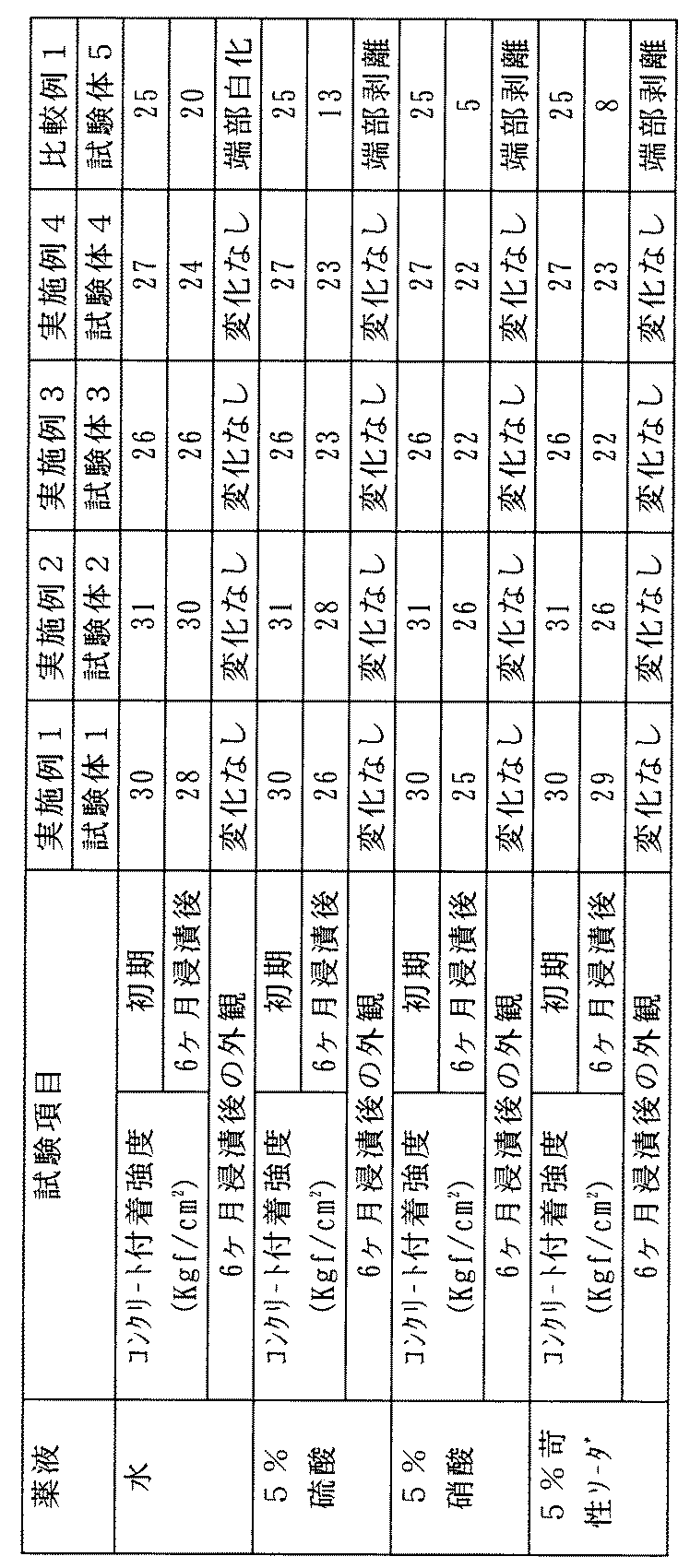
【0074】
(耐食試験)
試験体−1,2,3,4および5を水、5%硫酸、5%硝酸、5%苛性ソーダ水溶液の各薬液に浸漬し、常温で6ヶ月間放置し、外観観察、建研式コンクリート付着強度試験を行った結果、試験体−1,2,3,4は大きな外観変化、コンクリート付着強度の低下も無く良好な結果であった。
一方試験体−5はラップ部の端部から薬液の浸透が見られ、コンクリート付着強度が低下した。また、一部剥離も見られた。これらの結果を表5に示す。
【0075】
【表5】
実施例5(試験体−6の作製)
室内で30cm×30cm×5cmの大きさのコンクリート板を表面処理を施した後、光、熱硬化性プライマー−1を150g/m2となるように塗布後、プリプレグシート−1(30cm×45cm)2枚を使用し、上下のPETフィルムを剥がして30cm×30cmの面の中央にラップ部が来るようにラップさせて貼り付け、且つプライマーで端部の隙間を埋めながら貼り付けた。次に、プリプレグシート−1(30cm×15cm)2枚を上下のPETフィルムを剥がして側面に貼り付け30cm×30cmの面でラップさせた。更にプリプレグシート−1(10cm×5cm)4枚を上下のPETフィルムを剥がして側面のコーナー部に貼り付けた。
最後に光、トップコートとして光、熱硬化性樹脂−1を端部処理を含め全面に塗布して、屋外に出して直射日光下で20分間直射日光面に放置し硬化して(30cm×30cmの面を上に10分間づつ放置して硬化)、 プライマー、プリプレグシート、トップコートを一括硬化した試験体−6を得た。
【0077】
実施例6(試験体−7の作製)
室内で30cm×30cm×5cmの大きさのコンクリート板を表面処理を施した後、エポキシ樹脂プライマーとして商品名:クリートコートEX2001プライマー(主剤:300部/変性脂環式ポリアミン硬化剤:100部の混合物、大日本色材工業(株)製)を100g/m2となるように塗布し、その上に可視光硬化性プライマー用ビニルエステル樹脂リポキシLC−720PTを100g/m2となるように塗布後、プリプレグシート−1(30cm×45cm)2枚を使用し、下側のPETフィルムを剥がして30cm×30cmの面の中央にラップ部が来るように貼り付けた。ラップ部は下側に来るプリプレグシートラップ部の上側のPETフィルムを一時剥がしてラップして剥がしていたPETフィルムを上側のプリプレグシートのPET面の上から重ねた。このときプライマーで下側のプリプレグシート端部とコンクリート面側の隙間を埋め、上側に来たプリプレグシート端部も埋めた。この状態で屋外に出して直射日光下で20分間直射日光面に放置し硬化して(30cm×30cmの面を上に10分間づつ放置して硬化)、表面のPETフィルムを剥がした。
【0078】
次に、残った側面(光、熱硬化性プライマー−1の硬化面)に、プリプレグシート−1(30cm×15cm)2枚を下側のPETフィルムを剥がして貼り付け30cm×30cmの面でラップさせた。シートの端部、隙間はプライマーで埋め、この状態で屋外に出して直射日光下で20分間直射日光面に放置し硬化して(30cm×30cmの面を上に10分間づつ放置して硬化)、表面のPETフィルムを剥がした。
最後にプリプレグシート−1(10cm×5cm)4枚を下側のPETフィルムを剥がして側面のコーナー部に貼り付けた。シートの端部、隙間はプライマーで埋め、この状態で屋外に出して直射日光下で20分間直射日光面に放置し硬化して(30cm×30cmの面を上に10分間づつ放置して硬化)、表面のPETフィルムを剥がして試験体−7を得た。
【0079】
比較例2(試験体−8の作製)
室内で30cm×30cm×5cmの大きさのコンクリート板の表面処理を施した後、光、熱硬化性プライマー−1を塗布後、屋外に出し、直射日光下で20分間直射日光面に放置し硬化した(30cm×30cmの面を上に10分間づつ放置して硬化)。
次に、30cm×75cmのプリプレグシート−1を巻きつけ、5cmラップさせた状態で貼り付けた。ラップ部は片側のPETフィルムをその部分のみ剥がして切断して貼り合せ、表面は全てPETフィルムになるようにした。残された30cm×5cmの2面は、プリプレグシート−1を30cm×5cmのサイズにして貼り付け、更に出隅部の隙間を光、熱硬化性樹脂−1で埋め、再度屋外に出して直射日光下で20分間直射日光面に放置し硬化して(30cm×30cmの面を上に10分間づつ放置して硬化)、ラップ部を含む試験体−8を得た。
【0080】
(耐食試験)
また前記の耐食試験と同様に、試験体−6,7及び8を水、5%硫酸、5%硝酸、5%苛性ソーダ水溶液の各薬液に浸漬し、常温で6ヶ月管放置し、外観観察、建研式コンクリート付着強度試験を行った結果、試験体−6,7は大きな外観変化、コンクリート付着強度の低下も無く良好な結果であった。結果は表6にまとめた。
一方、試験体−8は、ラップ部の端部から薬液の浸透が見られ、コンクリート付着強度が低下した。また、一部剥離も見られた。結果は表6に示す。
【0081】
【表6】
【発明の効果】
本発明は、短波長の光重合開始剤と長波長の光重合開始剤を含む樹脂組成物を繊維強化材に含浸し、予備重合せしめることにより、短波長の光に感光性を有する光重合開始剤を残存させた、Bステージ化の光硬化性プリプレグシートとし、該プリプレグシートを使用した工法で、従来問題とされてきた完全硬化までに長時間を必要とされ、このために揮発性の反応性モノマーの揮発を防止することにより、配合比率の変化による樹脂性能の低下、樹脂量の損失、臭気の発生、作業環境の汚染を防止するとともに、非熟練者によっても施工可能とすることに成功したものである。そして得られた硬化体は機械的強度が大であり、プリプレグシート同士を非熟練者であっても容易に完全に接着でき防水工法である。[0001]
TECHNICAL FIELD OF THE INVENTION
The present invention relates to a method for applying an FRP lining using a short-wavelength light-curable prepreg sheet for the purpose of protecting concrete tanks, pipes, floors, rooftops, verandas, etc., which require corrosion resistance and waterproofness.
[0002]
[Prior art]
In the field of anticorrosion, corrosion-resistant FRP has been widely used because of its excellent corrosion resistance, inexpensiveness, room-temperature curability and easy moldability. Examples of the resin used as the matrix of the corrosion-resistant FRP include each of unsaturated polyester resins such as isophthalic acid type, bisphenol type, and heptonic acid type, vinyl ester resin, epoxy resin, and phenol resin. However, due to its superiority in corrosion resistance, it has been used in fields of application that are not applicable to unsaturated polyester resins, and its application is expanding.
In the field of waterproofing, the characteristics required of waterproofing materials used as a waterproof covering on concrete or mortar of civil engineering buildings such as rooftops, verandas, parking lots, corridors, pools, etc. It is necessary to withstand the impact of cracks in base concrete and mortar, to have alkali resistance, and to have high adhesiveness to the base, so that it can replace conventional asphalt and urethane resin. In recent years, the FRP method using a flexible unsaturated polyester resin or vinyl ester resin combined with a fiber reinforcing material is often used.
The thermosetting resin used in the FRP method has been particularly advanced in recent years,
There are proposals such as a type having both flexibility and chemical resistance, a type having a large elongation at low temperatures, and an air-drying type. (See Patent Documents 1 to 7)
[0003]
However, when lining is performed using an unsaturated polyester resin or a vinyl ester resin, normal temperature curing is usually performed using a peroxide catalyst, and a long time is required until complete curing. If the curing takes too much time, not only does the work efficiency decrease, but also the volatile reactive monomer (styrene monomer, etc.) contained in these resins volatilizes, resulting in a change in the resin composition due to a change in the mixing ratio of the resin composition. Not only decrease, loss of resin amount, but also generation of odor, air pollution at the work site, and danger of ignition. In addition, from the technical point of view, when performing lining work, defoaming work on site is required, and the work requires skill, and it is difficult to work so that air bubbles do not completely enter.
[0004]
As one means of solving these drawbacks, attempts have been made to take measures against air pollution and odor at the site by replacing volatile monomers such as styrene in the resin with other high-boiling unsaturated compounds. However, the corrosion-resistant layer used in applications requiring high corrosion resistance was insufficient in corrosion resistance performance, and could not be completely defoamed during lining construction.
Therefore, a method has been proposed in which a fiber reinforced material is impregnated with an unsaturated polyester resin or vinyl ester resin in advance and a B-staged sheet is used. In this method, by attaching a prepreg sheet without any air bubbles, it is possible to perform FRP lining work without defoaming work, but a gap is easily formed where the sheet is wrapped, and the problem in the work has not been solved .
[0005]
As one of these measures, an unsaturated polyester resin syrup obtained by esterifying an unsaturated polybasic acid and a saturated polybasic acid together with a glycol and dissolving it in a copolymerizable monomer is impregnated and molded into glass fiber, A method has been proposed in which the thus obtained flexible glass fiber reinforced resin molded sheet is coated on a substrate surface via a synthetic resin adhesive having high elasticity of 100% to 300% (see Patent Document 8). ).
According to this method, since the cured FRP sheet has flexibility, even if the base material has a complicated shape, there is an advantage that coating can be performed according to the shape. Has the effect of minimizing the formation of the coating, but the sheet used for coating requires flexibility, and thus has a fatal defect that the mechanical strength of the coating material is insufficient.
[0006]
Also, after coating the prepreg sheet impregnated with the photocurable resin composition on the waterproof base, curing the prepreg sheet by light irradiation, and between the prepreg sheets impregnated with the photocurable resin composition. As a bonding method, a waterproofing method has been proposed in which a part of the prepreg sheet is overlapped and temporarily bonded, and then the sheet is cured by light irradiation so that the prepreg sheets are completely bonded to each other.
When this method is used, the prepreg sheet impregnated with the photocurable resin composition is coated on the waterproof substrate, and then cured by light irradiation. In the case of coating, since it is necessary to partially cure the prepreg sheets and temporarily bond them, and then to cure the whole by light irradiation, there is a disadvantage that the coating operation itself requires a high degree of technical skill. (See Patent Document 9)
[0007]
[Patent Document 1]
JP-A-8-319328
[Patent Document 2]
JP-A-1-2013362
[Patent Document 3]
JP-A-8-31805
[Patent Document 4]
JP-A-5-295860
[Patent Document 5]
JP-A-1-96079
[Patent Document 6]
JP-A-4-253717
[Patent Document 7]
JP-A-4-142323
[Patent Document 8]
JP-A-9-11376
[Patent Document 9]
JP-A-10-331345
[Patent Document 10]
JP-B-45-37377
[Patent Document 11]
JP-A-3-111402
[Patent Document 12]
JP-A-3-179003
[Patent Document 13]
JP-A-4-146905
[Patent Document 14]
JP-A-4-261405
[Patent Document 15]
JP-A-4-261406
[Patent Document 16]
JP-A-5-194609
[Non-patent document 1]
Yamaoka et al., “Surface”, 27 (7), 548 (1989)
[Non-patent document 2]
Sato et al., "Abstracts of the 3rd Polymer Material Forum", IBP18 (1994)
[0008]
[Problems to be solved by the present invention]
In view of this situation, the present invention impregnates a resin composition containing a short-wavelength photopolymerization initiator and a long-wavelength photopolymerization initiator into a fiber reinforcing material, and prepolymerizes the resin composition, thereby increasing the sensitivity to short-wavelength light. It is an object of the present invention to provide a B-staged photocurable prepreg sheet having a photopolymerization initiator remaining therein, and to solve the above-mentioned problems in construction by a method using the prepreg sheet.
[0009]
[Means for Solving the Problems]
The present invention
[1] (A) One or more radical polymerizable resins selected from unsaturated polyester resins, vinyl ester resins, urethane (meth) acrylate resins, and polyester (meth) acrylate resins: 100 parts by weight,
(B) A combination of a photopolymerization initiator having photosensitivity in the visible light or near-infrared light region with a wavelength of 500 nm or more and a photopolymerization initiator having photosensitivity in the visible light and / or ultraviolet region of less than 500 nm. At least two photopolymerization initiators: 0.01 to 10 parts by weight and
(C) Inorganic or organic filler: 100 parts by weight or less
By impregnating the fiber reinforcing material with a resin composition containing the compound, and pre-polymerizing a part of the radically polymerizable unsaturated groups in the composition, so that photopolymerization sensitive to light having a wavelength of at least less than 500 nm is obtained. After leaving a part of the initiator and radically polymerizable unsaturated groups and performing B-stage to obtain a photocurable prepreg sheet, the prepreg sheet is laid on a concrete surface with a mortar composed of an aqueous emulsion resin and powder. Made and then applied to a substrate coated with a photo-curing and / or thermo-setting primer, and sealing the edges of the prepreg sheet and the gap between the prepreg sheets with a photo-curing and / or thermo-setting resin. An FRP lining method, characterized by:
[0010]
[2] After applying a photo-curable and / or thermo-curable primer to the base, a B-staged photo-curable prepreg sheet that is impregnated with a fiber-reinforced material with a curable resin and adhered so as not to generate a wrap portion. The FRP lining method according to the above [1], wherein a gap between the end portion of the prepreg sheet and the prepreg sheet is sealed with a photocurable and / or thermosetting resin;
[3] After applying a photo-curable and / or thermo-curable primer to the substrate, a B-staged photo-curable prepreg sheet is impregnated with a fiber-reinforced material with a curable resin and attached so that a wrap does not occur. After sealing the gap between the prepreg sheets with a photocurable and / or thermosetting resin, further covering the upper portion of the gap with a prepreg sheet, and then curing the end of the prepreg sheet with a photocurable and / or thermosetting resin. The FRP lining method according to the above [1], wherein the FRP lining is cured by sealing with a resin,
[4] After applying a photocurable and / or thermosetting primer to the base, a photocurable prepreg sheet impregnated with a curable resin into a fiber reinforced material and B-staged is adhered and wrapped on the prepreg sheet. The FRP lining method according to the above [1], wherein after coating with another photocurable prepreg sheet, the end of the prepreg sheet is sealed with a photocurable and / or thermosetting resin and cured.
[0011]
[5] The method according to any one of [1] to [4], wherein the photocurable and / or thermosetting resin used for sealing the end portion of the prepreg sheet and the gap between the prepreg sheets is a putty material. FRP lining method,
[6] Any of the above-mentioned [1] to [5], wherein, when a photo-curable and / or thermosetting primer is applied to the base, a water-based emulsion resin primer is applied to the base and then a photo-curable primer is applied. The FRP lining method described in Crab,
[7] The radical polymerization type resin as the component (A) is subjected to radical polymerization with respect to 100 parts by weight of at least one polymer selected from unsaturated polyesters, vinyl esters, urethane (meth) acrylates, and polyester (meth) acrylates. The FRP lining method according to the above [1], which is a resin component containing 10 to 250 parts by weight of a unsaturated monomer.
[0012]
[8] The photopolymerization initiator of the component (B) comprises (b1) a photopolymerization initiator having photosensitivity in the visible light or near infrared light region having a wavelength of 500 nm or more, and (b2) a visible light having a wavelength of less than 500 nm and / or Or the compounding ratio of a photopolymerization initiator which is a combination of at least two types of photopolymerization initiators having photosensitivity in the ultraviolet region is b1: b2 = 1: 50 to 50: 1. FRP lining method,
[9] As the photopolymerization initiator, (b1) a photopolymerization initiator having photosensitivity in the visible light or near-infrared light region having a wavelength of 500 nm or more, and (b2) a photopolymerization initiator having a visible light and / or ultraviolet light region of less than 500 nm. The FRP lining method according to the above [8], wherein a combination of the photopolymerization initiator having photosensitivity and 0.02 to 50 parts by weight of a thermal polymerization initiator per 1 part by weight of the photopolymerization initiator is further blended;
[0013]
[10] After applying a photocurable and / or thermosetting primer to the substrate, a B-staged photocurable prepreg sheet obtained by impregnating a curable resin with a fiber reinforced material is attached, Alternatively, in the FRP lining method of burying and curing with a thermosetting putty material, the work was performed in an uncured state of the curable resin in each step of applying a primer, attaching a photocurable prepreg sheet, and filling with a putty material. The FRP lining method according to any one of the above [1] to [4], wherein the FRP lining is hardened later at once.
[11] After applying a photocurable and / or thermosetting primer to the substrate, a B-staged photocurable prepreg sheet obtained by impregnating a curable resin with a fiber reinforcing material is applied, and the photocurable and / or Alternatively, in the FRP lining method of embedding and curing with a thermosetting putty material, each step of applying a primer, attaching a photocurable prepreg sheet and filling with a putty material is performed by curing the curable resin for each step, and The above object has been solved by developing the FRP lining method according to any one of the above [1] to [4] for performing the process.
[0014]
BEST MODE FOR CARRYING OUT THE INVENTION
The present invention provides a radical based on an unsaturated polyester resin or the like containing at least two types of photopolymerization initiators, a photopolymerization initiator having photosensitivity at a long wavelength and a photopolymerization initiator having photosensitivity at a short wavelength. The polymerizable resin is impregnated into the fiber reinforcement, and the generated radicals are easily controlled, and some of the unsaturated groups in the resin can be easily stopped by radical polymerization, and the fiber reinforcement, filler, pigment, etc. By irradiating with a long wavelength light that can easily promote the reaction even in a system to which is added, a photopolymerization initiator having short wavelength sensitivity and some radical polymerizable unsaturated groups in the base resin (Some unsaturated groups and some radically polymerizable unsaturated monomers in the polymer in the radically polymerizable resin) are left to form a B-stage prepreg, and a primer treatment is performed using the prepreg sheet. It was there to be pasted by providing a joint in the base.
[0015]
For this reason, the content of the radical polymerizable unsaturated monomer in the B-staged prepreg sheet is significantly reduced as compared with the impregnated resin composition, and the radical polymerizable unsaturated monomer is volatilized. This greatly reduces the properties of the resin composition, thereby preventing the composition of the resin composition from being changed and preventing the working environment from being contaminated by radically polymerizable unsaturated monomers. In addition, the prepreg sheet in the B stage has an advantage that it can be easily stored and handled at a construction site. In addition, since it is in a B-stage state, the prepreg sheet adhered to the photopolymerization initiator having photosensitivity at the short wavelength remaining by irradiating light of the short wavelength and the radical polymerizable in the base resin. It can be easily cured by the unsaturated group to form a coating having high hardness.
[0016]
The B-staged photocurable prepreg sheet in which the curable resin used in the present invention is impregnated with a fiber reinforcing material and is B-staged is obtained by (A) unsaturated polyester resin, vinyl ester resin, urethane (meth) acrylate resin, polyester (meth) ) At least one resin selected from acrylate resins: 100 parts by weight and (B) a photopolymerization initiator having photosensitivity in the visible light or near-infrared light region having a wavelength of 500 nm or more, and visible light having a wavelength of less than 500 nm and / or At least two photopolymerization initiators which are a combination of photopolymerization initiators having photosensitivity in the ultraviolet region: 0.01 to 10 parts by weight and (C) an inorganic or organic filler: 100 parts by weight or less (filler Impregnated into a fiber reinforced material, and irradiated with a light having a wavelength of 500 nm or more to obtain a radical polymerizable compound in the composition. Some with allowed to prepolymerization saturated group, in which is left photopolymerization initiator having photosensitivity to light having a wavelength less than at least 500 nm, and a part of the radical polymerizable unsaturated group.
[0017]
The component (A) as the resin used in the prepreg sheet of the present invention is selected from unsaturated polyester resins, vinyl ester resins, urethane (meth) acrylate resins, and polyester (meth) acrylate resins.
First, as the unsaturated polyester, those manufactured by a known method may be used.Specifically, polymerizable unsaturated bonds such as phthalic anhydride, isophthalic acid, terephthalic acid, tetrahydrophthalic acid, adipic acid, and sebacic acid are used. Unsaturated polybasic acid or its anhydride and fumaric acid, maleic anhydride, maleic acid, unsaturated polybasic acid having an active unsaturated bond such as itaconic acid or its anhydride as an acid component, This and ethylene glycol, propylene glycol, diethylene glycol, dipropylene glycol, 1,2-butanediol, 1,3-butanediol, 1,5-pentanediole, 1,6- Hexanediol, 2-methyl-1,3-propanediol, 2,2-dimethyl-1,3-propanediol, cyclohexane-1,4-dimethanol Bisphenol - ethylene oxide adducts of Le A, bisphenol - multivalent or propylene oxide adduct of Le A alcohol - Le alcohol - are those prepared by reacting a Le component.
[0018]
The vinyl ester is produced by a known method, and is obtained by reacting an epoxy resin with an unsaturated monobasic acid such as acrylic acid or methacrylic acid, or epoxy (meth) acrylate, or saturated dicarboxylic acid and / or Saturated polyester or unsaturated polyester obtained by using a saturated polyester or unsaturated polyester having a terminal carboxyl group obtained from an unsaturated dicarboxylic acid and a polyhydric alcohol and an epoxy compound containing an α, β-unsaturated carboxylic ester group as a component Is a polyester (meth) acrylate.
Examples of the epoxy resin as a raw material include bisphenol A diglycidyl ether, its high-molecular-weight homologues, and novolak-type polyglycidyl ethers.
As an epoxy compound containing an α, β-unsaturated carboxylic acid ester group used in the production of vinyl ester, glycidyl methacrylate is a typical example.
[0019]
The urethane (meth) acrylate used in the present invention is not particularly limited. For example, after reacting a polyisocyanate with a polyhydroxy compound or a polyhydric alcohol, a hydroxyl group-containing (meth) acrylic compound and a A radically polymerizable unsaturated group-containing oligomer which can be obtained by reacting a hydroxyl group-containing allyl ether compound accordingly. Further, after the hydroxyl group-containing (meth) acrylic compound is reacted with a polyhydroxy compound or a polyhydric alcohol, a polyisocyanate may be further reacted.
[0020]
The polyester (meth) acrylate used in the present invention includes (1) a polyester having a terminal carboxyl group obtained from a saturated polybasic acid and / or an unsaturated polybasic acid and a polyhydric alcohol, and an α, β-unsaturated carboxylic acid. (Meth) acrylate obtained by reacting an epoxy compound having an ester group, (2) a hydroxyl group-containing acrylate to a polyester having a terminal carboxyl group obtained from a saturated polybasic acid and / or an unsaturated polybasic acid and a polyhydric alcohol; (Meth) acrylic acid is reacted with (meth) acrylate obtained by reacting (meth) acrylate, (3) polyester having a terminal hydroxyl group obtained from saturated polybasic acid and / or unsaturated polybasic acid and polyhydric alcohol. ) Acrylate.
[0021]
The radical-curable resin used in the present invention may be any of the above-mentioned unsaturated polyesters, vinyl esters, urethane (meth) acrylates, polyester (meth) acrylates and radical polymerizable resins such as styrene monomer and methyl (meth) acrylate. It contains a saturated monomer.
[0022]
Specific examples of the radically polymerizable unsaturated monomer other than styrene monomer and methyl (meth) acrylate include α-, o-, mp-alkyl, nitro, cyano, amide, ester derivatives of styrene, and chlorostyrene. Styrene monomers such as vinyl toluene and divinylbenzene, butenes such as butadiene, 2,3-dimethylbutadiene, isoprene and chloroprene, ethyl (meth) acrylate, n-propyl (meth) acrylate, (meth) acryl Acid i-propyl, n-butyl (meth) acrylate, sec-butyl (meth) acrylate, ter-butyl (meth) acrylate, pentyl (meth) acrylate, neopentyl (meth) acrylate, Isoamyl (meth) acrylate, hexyl (meth) acrylate, 2- (meth) acrylate Lehexyl, lauryl (meth) acrylate, dodecyl (meth) acrylate, cyclopentyl (meth) acrylate, cyclohexyl (meth) acrylate, 2-methylcyclohexyl (meth) acrylate, dicyclohexyl (meth) acrylate, (meth) Isobornyl acrylate, adamantyl (meth) acrylate, allyl (meth) acrylate, propargyl (meth) acrylate, phenyl (meth) acrylate, naphthyl (meth) acrylate, anthracenyl (meth) acrylate, (meth) acryl Anthraninonyl acid, piperonyl (meth) acrylate, salicyl (meth) acrylate, furyl (meth) acrylate, furfuryl (meth) acrylate, tetrahydrofuryl (meth) acrylate, pyranyl (meth) acrylate, (meth) ) Benzyl acrylate Phenethyl (meth) acrylate, cresyl (meth) acrylate, 1,1,1-trifluoroethyl (meth) acrylate, perfluoroethyl (meth) acrylate, perfluoro (meth) acrylate n-propyl, perfluoro-i-propyl (meth) acrylate, triphenylmethyl (meth) acrylate, cumyl (meth) acrylate, 3- (N, N-dimethylamino) propyl (meth) acrylate, ( (Meth) acrylic esters such as 2-hydroxyethyl (meth) acrylate, 2-hydroxypropyl (meth) acrylate, (meth) acrylamide, N, N-dimethylamide (meth) acrylate, ( (Meth) acrylic acid N, N-diethylamide, (meth) acrylic acid N, N-dipropylamide, (meth) acrylic acid N, N- -(Meth) acrylic amides such as i-propylamide, (meth) acrylic anthracenylamide, (meth) acrylic anilide, (meth) acryloylnitrile, acrolein, vinyl chloride, vinylidene chloride, vinyl fluoride, fluorine Vinyl compounds such as vinylidene fluoride, N-vinylpyrrolidone, vinylpyridine and vinyl acetate; unsaturated dicarboxylic acid diesters such as diethyl citraconic acid, diethyl maleate, diethyl fumarate and diethyl itaconate; N-phenylmaleimide; N-cyclohexylmaleimide , N-laurylmaleimide, monomaleimide compounds such as N- (4-hydroxyphenyl) maleimide, and N- (meth) acryloylphthalimide.
[0023]
In the present invention, a (meth) acrylate compound having two or more (meth) acryloyl groups in the molecule may be used, and a known compound may be used. Specific examples thereof include ethylene glycol di (meth) acrylate, diethylene glycol di (meth) acrylate, triethylene glycol di (meth) acrylate, polyethylene glycol di (meth) acrylate, 1,4-butanediol di (meth) acrylate, 1,6-hexanediol di (meth) acrylate, 1,9-nonanediol di (meth) acrylate, neopentyl glycol di (meth) acrylate, glycerin di (meth) acrylate, 2-hydroxy-3-acryloyloxypropyl Examples include (meth) acrylates of various glycols such as (meth) acrylate and trimethylolpropane tri (meth) acrylate, and those represented by the general formula (1).
[0024]
Embedded image
[0025]
Commercially available products include 2,2-bis [4- (methacryloxyethoxy) phenyl] propane (BPE-100, manufactured by Shin-Nakamura Chemical Co., Ltd.) and 2,2-bis [4- (methacryloxy diethoxy). Phenyl] propane (Shin-Nakamura Chemical Co., Ltd .: BPE-200), 2,2-bis [4- (methacryloxypolyethoxy) phenyl] propane (Shin-Nakamura Chemical Co., Ltd .: BPE-500), 2 2,2-bis [4- (acryloxydiethoxy) phenyl] propane (A-BPE-4 manufactured by Shin-Nakamura Chemical Co., Ltd.) and 2,2-bis [4- (acryloxypolyethoxy) phenyl] propane (new A-BPE-10, manufactured by Nakamura Chemical Industry Co., Ltd.).
[0026]
The radically polymerizable unsaturated monomer blended in the resin of the present invention is important for lowering the viscosity of the resin and improving hardness, strength, weather resistance, water resistance, abrasion resistance, etc. It is used in an amount of 10 to 250 parts by weight, preferably 20 to 100 parts by weight, based on 100 parts by weight of vinyl ester, urethane (meth) acrylate, polyester (meth) acrylate and the like. If the amount is less than 10 parts by weight, workability and impregnation deteriorate due to high viscosity. If the amount is more than 250 parts by weight, sufficient coating film hardness cannot be obtained, various physical properties are insufficient, and curability for FRP lining is low. It is not preferable as a material.
[0027]
A room temperature radical polymerization initiator is mainly used as the thermal polymerization initiator used in the present invention. Examples of the room temperature radical polymerization initiator include a known combination of a ketone peroxide and a reducing agent, a combination of a hydroperoxide and a reducing agent, and a combination of a diacyl peroxide and a reducing agent.Specific examples of the reducing agent include: Cobalt salts such as cobalt naphthenate and cobalt octylate; vanadium compounds such as vanadium pentoxide; amines such as dimethylaniline; Among them, a combination of a peroxyester and a cobalt salt is particularly effective in terms of pot life and the like.
[0028]
In addition, a known radical polymerization initiator may be used as the thermal polymerization initiator. Examples thereof are ketone peroxide, peroxyketal, hydroperoxide, diallyl peroxide, diacyl peroxide, peroxyester, and peroxydicarbonate, and azo compounds are also effective.
[0029]
Specific examples include, for example, benzoyl peroxide, dicumyl peroxide, diisopropyl peroxide, di-t-butyl peroxide, t-butylperoxybenzoate, 1,1-bis (t-butylperoxy) -3,3. , 5-Trimethylcyclohexane, 2,5-dimethyl-2,5-bis (t-butylperoxy) hexyne-3, 3-isopropyl hydroperoxide, t-butyl hydroperoxide, dicumyl peroxide, dicumyl hydroper Oxide, acetyl peroxide, bis (4-t-butylcyclohexyl) peroxydicarbonate, diisopropylperoxydicarbonate, isobutyl peroxide, 3,3,5-trimethylhexanoyl peroxide, lauryl peroxide, azobi Isobutyronitrile, available such as azobis carbonamido.
[0030]
The amount of the room-temperature radical polymerization initiator used is 0.01 to 15 parts by weight, preferably 0.05 to 10 parts by weight, based on 100 parts by weight of the resin or the like. When the amount of the room-temperature curing type radical polymerization initiator photopolymerization initiator combined with the organic peroxide or the reducing agent is less than 0.01 part by weight, the thickening reaction or the polymerization after the thickening is likely to be insufficient, If the amount exceeds 15 parts by weight, the strength of the cured product is insufficient.
[0031]
As the photopolymerization initiator used in the present invention, those having photosensitivity in a visible light region and / or an ultraviolet light region can be used.
Examples of visible light polymerization initiators having photosensitivity in the visible light region include camphorquinone, benzyltrimethylbenzoyldiphenylphosphine oxide, methylthioxanthone, and dicyclopentadienyltitanium described in Non-Patent Documents 1 and 2. Di (pentafluorophenyl) or other single visible light polymerization initiator, organic peroxide / dye system, diphenyliodonium salt / dye, imidazole / keto compound, hexaarylbiimidazole compound / hydrogen donating compound, mercapto Known complex initiator systems such as benzothiazole / thiopyrylium salts and hexaarylbiimidazole / radical generators such as metal arenes / cyanine dyes (see Non-Patent Document 10) can be mentioned.
[0032]
Further, an acylphosphine oxide compound is effective as an initiator having photosensitivity from ultraviolet light to visible light. Specific examples thereof include bis (2,6-dichlorobenzoyl) -phenylphosphine oxide, bis (2,6-dichlorobenzoyl) -2,5-dimethylphenylphosphine oxide, and bis (2,6-dichlorobenzoyl). ) -4-ethoxyphenylphosphine oxide, bis (2,6-dichlorobenzoyl) -4-biphenylphosphine oxide, bis (2,6-dichlorobenzoyl) -4-propylphenylphosphine oxide, bis (2,6- Dichlorobenzoyl) -2-naphthylphosphine oxide, bis (2,6-dichlorobenzoyl) -1-naphthylphosphine oxide, bis (2,6-dichlorobenzoyl) -4-chlorophenylphosphine oxide, bis (2 6-dichlorobenzoyl) -2,2-dimethoxy Phenylphosphine oxide, bis (2,6-dichlorobenzoyl) -dodecylphosphine oxide, bis (2,6-dichlorobenzoyl) -4-octylphenylphosphine oxide, bis (2,4,6-trimethylbenzoyl) -2 , 5-dimethylphenylphosphine oxide, bis (2,6-dichloro-3,4,5-trimethoxybenzoyl) -2,5-dimethylphenylphosphine oxide, bis (2,6-dichloro-3,4,5- Trimethoxybenzoyl) -4-ethoxyphenylphosphine oxide, bis (2-methyl-1-naphthoyl) -2,5-phenylphosphine oxide, bis (2-methyl-1-naphthoyl) -4-biphenylphosphine oxide, bis ( 2-methyl-1-naphthoyl) -4-ethoxy Biphenylphosphine oxide, bis (2-methyl-1-naphthoyl) -2-naphthylphosphine oxide, bis (2-methyl-1-naphthoyl) -4-propylphenylphosphine oxide, bis (2-methyl-1-naphthoyl)- 2,5-dimethylphenylphosphine oxide, bis (2-methyl-1-naphthoyl) -4-methoxyphenylphosphine oxide, bis (2,6-dimethoxybenzoyl) -2,4,4-trimethylpentylphosphine oxide, 2, 4,6-trimethylbenzoyl-diphenylphosphine oxide, 2,6-diphenylbenzoyl-diphenylphosphine oxide, 2,6-dimethoxybenzoyl-diphenylphosphine oxide, 2,3,5,6-tetramethylbenzoyl-diphene Nylphosphine oxide, 2,6-dichlorobenzoyl-diphenylphosphine oxide, 2,3,6-trimethylbenzoyl-diphenylphosphine oxide, 2-phenyl-6-methylbenzoyl-diphenylphosphine oxide, 2,6-dibromobenzoyl- Diphenylphosphine oxide, 2,8-dimethylnaphthalene-1-carbonyl-diphenylphosphine oxide, 1,3-dimethoxynaphthalene-2-carbonyl-diphenylphosphine oxide, 2,4,6-trimethylbenzoyl-phenylphosphinic acid methyl ester, 2 2,6-dimethylbenzoyl-phenylphosphinic acid methyl ester, 2,6-dichlorobenzoyl-phenylphosphinic acid methyl ester, and the like.
[0033]
Specifically, for example, 2-hydroxy-2-methyl-1-phenylpropan-1-one (trade name: Darocur 1173, manufactured by Ciba Specialty Chemicals Co., Ltd.) and bis (2,6-dimethoxybenzoyl) -2, Irgacure-1700 (manufactured by Ciba Specialty Chemicals Co., Ltd.) mixed with 4,4-trimethylpentylphosphine oxide (manufactured by Ciba Specialty Chemicals Co., Ltd.) at a ratio of 75% / 25%, 1-hydroxy- Cyclohexyl-phenyl-ketone (trade name: Irgacure 184, manufactured by Ciba Specialty Chemicals Co., Ltd.) and bis (2,6-dimethoxybenzoyl) -2,4,4-trimethylpentylphosphine oxide (Ciba Specialty Chemicals, Inc.) )) At a ratio of 75% / 25% Trade name Irgacure 1800 (manufactured by Ciba Specialty Chemicals Co., Ltd.), trade names Irgacure 1850 (manufactured by Ciba Specialty Chemicals Co., Ltd.) mixed at a ratio of 50% / 50%, screws (2, 4 , 6-Trimethylbenzoyl) -phenylphosphine oxide (trade name: Irgacure 819, manufactured by Ciba Specialty Chemicals Co., Ltd.), 2,4,6-trimethylbenzoyl-diphenylphosphine oxide (trade name: Lucirin TPO, BASF Corporation) 2-hydroxy-2-methyl-1-phenylpropan-1-one (trade name: Darocur 1173, manufactured by Ciba Specialty Chemicals) and 2,4,6-trimethylbenzoyl-diphenylphosphine oxide (trade name) Lucirin TP O, BASF Corp.) in a ratio of 50% / 50%, such as Darocur4265 (trade name). The visible light initiator may be any photopolymerization initiator having photosensitivity in the wavelength range of 380 nm to 780 nm, and may be used in combination.
[0034]
As the UV polymerization initiator, known polymerization initiators such as acetophenone-based, benzyl ketal-based, and (bis) acylphosphine oxide-based can be used. Because of low transmittance, it is preferable to use an ultraviolet polymerization initiator such as a (bis) acylphosphine oxide-based compound having photosensitivity in a relatively long wavelength region, preferably in a wavelength region of 300 nm or more.
[0035]
The amount of photopolymerization to be used is 0.01 to 20 parts by weight, preferably 0.05 to 15 parts by weight, based on 100 parts by weight of the resin or the like. If the amount of the photopolymerization initiator is less than 0.01 part by weight, the thickening reaction and polymerization after the thickening tend to be insufficient, and if the amount exceeds 20 parts by weight, the strength of the cured product is insufficient.
[0036]
Next, primers other than the radical polymerization type will be described. Examples of primers other than the radical polymerization type primer include a room temperature curing type epoxy primer and a moisture curing type urethane primer.
The epoxy compound used for the cold-setting epoxy primer may be one produced by a known method, and may be a thermosetting epoxy resin having at least two or more epoxy groups in one component and a curing agent for epoxy. Means a combination.
[0037]
Examples of the epoxy resin include an ether type bisphenol type epoxy resin, a novolak type epoxy resin, a polyphenol type epoxy resin, an aliphatic type epoxy resin, an ester type aromatic epoxy resin, a cyclic aliphatic epoxy resin, and an ether / ester type epoxy resin. And these may be used alone or in combination of two or more. An amine-based curing agent is generally used as the epoxy resin curing agent, and examples thereof include aliphatic amines, aromatic amines, polyamides, and heterocyclic amines, and a combination of known ones such as modified amines can also be used.
[0038]
In the present invention, the water-based emulsion resin primer is an emulsion type such as an epoxy resin or an acrylic resin. For example, trade name MF40 / CAT-EPK (manufactured by Toyo Morton Co., Ltd.) in which the main agent is an acrylic resin and the curing agent is an epoxy resin. Can also be included.
The mortar composed of the water-based emulsion resin and the powder is a combination of the water-based emulsion resin and the powder, which compensates for the disadvantages of the cement mortar / concrete and further provides a special function. Acrylic resin, epoxy resin, ethylene vinyl acetate resin (EVA), styrene butadiene rubber (SBR), chloroprene rubber (CR), etc. are used for the aqueous emulsion, and cement, aggregate, pigment, etc. are used for the powder. You. It hardens due to the hydration reaction of cement, and can be made into a quick-setting type depending on the type of cement. Specific examples include Showet SA-1 (trade name, manufactured by Showa Denko Kenzai Co., Ltd.).
[0039]
The urethane resin used for the moisture-curable urethane primer is a polymer mainly composed of urethane bonds obtained by reacting a diisocyanate with an organic compound having two or more active hydrogen atoms (usually a diol). "Plastic Industry Dictionary" (industry research committee, published in 1985) that isocyanate groups react with each other under the action of heat or a catalyst or react with isocyanate groups and water, glycol, etc. to become a thermosetting resin. ), And known resins can be used.
For example, a compound obtained by reacting a compound having two or more hydroxyl groups at a terminal with a compound having an isocyanate group larger than the number of moles of hydroxyl groups may be used, and may contain a solvent. An example of a trade name is UM-50P (manufactured by Showa Polymer Co., Ltd.).
[0040]
The photocurable resin primer and the room temperature curable resin primer may be used alone, but it is also effective to use both the photocuring function and the room temperature curing function.
[0041]
The resin used for the prepreg sheet, the photopolymerization initiator and the thermopolymerization initiator having photosensitivity in the visible light region and / or ultraviolet region of less than 500 nm are used for the above-mentioned photocurable and / or thermosetting primer. The same resin, photopolymerization initiator and thermal polymerization initiator are used.
The photopolymerization initiator having photosensitivity in the visible or near-infrared light region having a wavelength of 500 nm or more used in the present invention is represented by the general formula (2):
D + ・ A − ・ ・ ・ ・ ・ ・ (2)
(Where D + Are methine, polymethine, cyanine, xanthene, oxazine, thiazine, arylmethane, and pyrylium dye cations having a sensitivity to visible light or near infrared light. ー Represents various anions. )
And a cationic dye represented by
[0042]
General formula (3)
Embedded image
The photopolymerization initiator which combined the boron compound represented by these is preferable.
[0043]
The cation “Z” in the general formula (2) + Examples of the quaternary ammonium cation, quaternary pyridinium cation, quaternary quinolinium cation, diazonium cation, tetrazolium cation, sulfonium cation, which is not sensitive to visible light or near infrared light Oxosulfonium cations, metal cations such as sodium, potassium, lithium, magnesium and calcium, (organic) compounds having a cation charge on oxygen atoms such as flavylium and pyrium salts, and carbon cations such as tropylium and cyclopropylium And cations of metal compounds such as arsenic, cobalt, palladium, chromium, titanium, tin, and antimony.
[0044]
By combining this organic boron compound with a cationic dye having a photosensitive wavelength in the visible light or near-infrared light region, the dye irradiated with light having a wavelength in the photosensitive region is excited to exchange electrons with the organic boron compound. As a result, the dye is decolorized and radicals are generated, and a polymerization reaction of the coexisting polymerizable unsaturated compound occurs. In this polymerization reaction, unlike the conventional ultraviolet polymerization reaction and the like, the generated radicals are easily controlled, and the radicals can be easily stopped when a part of the unsaturated groups in the resin is radically polymerized. Further, since a long wavelength in the visible light or near infrared region is used, the reaction can be easily promoted even in a system to which a filler or a pigment is added.
[0045]
Examples of the combination of the cationic dye and the boron-based compound are described in detail in Patent Literature 11, Patent Literature 12, Patent Literature 13, Patent Literature 14, Patent Literature 15, Patent Literature 16, and the like. The cationic dye “D + Are shown in Tables 1 to 4. Among these cationic dyes, cyanine-based, styryl-based cationic dyes and triarylmethane-based dyes are preferably used. Cyanine-based and styryl-based cationic dyes are preferred in that the electron transfer with an organic boron-based compound generally occurs easily and the reaction of the present invention is easily caused.
[0046]
[Table 1]
[Table 2]
[Table 3]
[Table 4]
A which is a counter anion of the cationic dye represented by the general formula (2) − Is any anion such as p-toluenesulfonate ion, organic carboxylate ion, perchlorate ion and halide ion, and is represented by the general formula (4)
Embedded image
Is particularly preferred.
The composition ratio of [organic boron compound] / [near-infrared light or visible light-absorbing cationic dye compound] of the present invention is 1/5 to 1 / 0.05, preferably 1/1 to 1/1/1 by weight. 0.1. In general, it is preferable to use a larger amount of the organic boron compound than the cationic dye from the viewpoints of the decoloring reaction of the dye and the radical generation efficiency.
[0051]
At least two kinds of photopolymerization initiators having photosensitivity in the visible light or near-infrared light region having a wavelength of 500 nm or more and photopolymerization initiators having photosensitivity in the visible light and / or ultraviolet light region having a wavelength of less than 500 nm. Is used in an amount of 0.01 to 20 parts by weight, preferably 0.05 to 15 parts by weight, based on 100 parts by weight of the resin or the like. When the amount of the photopolymerization initiator is less than 0.01 part by weight, the B-stage reaction and the polymerization after the B-stage are apt to be insufficient, and when the amount exceeds 20 parts by weight, the strength of the cured product is insufficient.
[0052]
A photopolymerization initiator having a photosensitivity in the visible light or near-infrared light region having a wavelength of 500 nm or more for a prepolymerization reaction for bringing into a B-stage state, and visible light of less than 500 nm for fully curing the prepolymerized reaction product and / or When a photopolymerization initiator having photosensitivity in the ultraviolet region is used in combination, the composition ratio is 0.1 / 5 to 5 / 0.1, preferably 0.5 / 5 to 5/0. 5 When the ratio of the photopolymerization initiator for prepolymerization to the photopolymerization initiator for main curing is less than 0.1 / 5, the light of the photosensitive wavelength (500 to 1200 nm) of the photopolymerization initiator for prepolymerization for bringing into the B-stage state. Even if irradiation is performed, the prepolymerization reaction may not proceed, while if the ratio exceeds 5 / 0.1, the prepolymerization reaction may proceed too much.
[0053]
A photopolymerization initiator having photosensitivity in the visible light region and / or ultraviolet region of less than 500 nm is used as a polymerization initiator when the prepolymerized product is fully cured, but may be combined with a thermal polymerization initiator. When a thermal polymerization initiator is used in combination, the composition ratio is 0.1 / 5 to 5 / 0.1, preferably 0.5 / 5 to 5 / 0.5 by weight.
[0054]
The fiber reinforcing material used in the present invention is a cloth or mat such as an organic and / or inorganic fiber such as glass fiber, carbon fiber, aramid fiber, polyethylene terephthalate fiber, vinylon fiber, polyester fiber, amide fiber, metal fiber, and ceramic fiber. A known material such as a nonwoven fabric is used. Of course, two or more of these fibers may be used in combination. Among these reinforcing materials, glass fibers and organic fibers are particularly desirable in the present invention, and cloths and mats are preferred in view of workability and the like.
[0055]
In the present invention, a filler may be added, and the filler used is an inorganic filler, an organic filler or a polymer. Examples of the inorganic filler include aluminum hydroxide, calcium carbonate, talc, clay, and glass powder. Known materials such as silica, barium sulfate, titanium oxide, and cement are used, but aluminum hydroxide is effective for imparting flame retardancy to the curable prepreg composition. Of course, these inorganic fillers can also be used in combination, and the amount used is 0 to 200 parts by weight, preferably 0 to 100 parts by weight, based on 100 parts by weight of the polymerizable unsaturated compound. When the amount of the inorganic filler is more than 200 parts by weight, the viscosity is too high, the workability is reduced, and the foam is likely to remain, and the strength is reduced.
Further, in the present invention, thixotropic may be imparted by a known method. As the thixotropic agent, for example, silica powder (aerosil type), mica powder, casium carbonate powder and the like can be used in an amount of 100 parts by weight of a polymerizable unsaturated compound. 0.1 to 50 parts by weight based on the weight of the mixture.
[0056]
In addition, as the organic filler or polymer that can be added to the composition of the present invention, for example, known polystyrene, polyvinyl acetate, polymethyl methacrylate, polyethylene, polyvinylidene chloride microballoon, and polystyrene which are also effective as a low shrinkage agent Acrylonitrile microballoons and the like can be used. When used as a low shrinkage agent, the amount used is 0 to 200 parts by weight, preferably 0 to 50 parts by weight, per 100 parts by weight of the resin.
Pigments can be used in the present invention. There is no particular limitation on the type, and organic pigments and inorganic pigments can be used. At that time, the compounding amount is at most 20 parts by weight, preferably up to 10 parts by weight, based on 100 parts by weight of the resin.
[0057]
In the present invention, ultraviolet light refers to light rays in a wavelength range of 280 to 380 nm, visible light refers to light rays in a wavelength range of 380 to 780 nm, and near infrared light refers to light rays in a wavelength range of 780 to 1200 nm.
As a light source used in the prepolymerization reaction for obtaining the prepreg-like curable material for preventing concrete from falling off in the B-stage state of the present invention, a light source having a spectral distribution in a photosensitive wavelength region of a photopolymerization initiator is used. For example, a near-infrared lamp, a sodium lamp, a halogen lamp, a fluorescent lamp, a metal halide lamp, or the like can be used. In addition, it is also possible to select and irradiate a wavelength necessary for the prepolymerization reaction by combining these lamps or light in a wide wavelength range with a light source and a wavelength cut filter.
The wavelength used for the prepolymerization reaction is preferably light on the long wavelength side having a low energy level. In particular, when near infrared light is used, the B-stage reaction can be easily controlled.
[0058]
The irradiation time of the lamp for pre-polymerizing to be in the B-stage state cannot be defined unconditionally because the effective wavelength range of the light source, the output, the irradiation distance, the thickness of the composition, etc. are different, but 0.01 hours or more. Irradiation is preferably performed for 0.05 hours or more.
A specific production example will be described. For example, vinylon mesh and vinylon mat are laminated using a vinyl ester resin to which a visible ray initiator and a near-infrared initiator are added, and those sandwiched between films are irradiated with near-infrared rays to perform prepolymerization by near-infrared radical polymerization. By proceeding, it is possible to produce a curable material for concrete exfoliation prevention as a visible light curable prepreg sheet in which a visible light initiator and a polymerizable unsaturated group remain.
The prepreg-shaped curable material for concrete exfoliation prevention manufactured in this way can be quickly and completely cured by light irradiation with the remaining photopolymerization initiator.
The light source for light irradiation may be any light source having a spectral distribution in the photosensitive wavelength region of the remaining photopolymerization initiator, such as sunlight, a metal halide lamp, a halogen lamp, an ultraviolet lamp, and a fluorescent lamp.
[0059]
The primer used in the present invention may be a radical polymerizable resin or an epoxy resin photo-curable and / or thermo-curable primer. The resin (A) used for the photo-curable prepreg sheet is a thermo-curable resin. One that has been made to be light curable, one that has been cured at room temperature, or one that has both functions can be used.
As the photo-curable and / or thermo-curable resin used in the present invention, a combination of the resin (A) used for the above-described photo-curable prepreg sheet and a polymerization initiator is used.
Further, as the putty material, a material prepared by further combining a filler with a photocurable and / or thermosetting resin may be used, or a commercially available putty material may be used. Epoxy-based and urethane-based putty materials can be used.
[0060]
In the curing method of the present invention, the surface of concrete is treated, a primer is applied, a prepreg sheet is attached so that a wrap portion is not generated, and a gap between the prepreg sheets is filled with a putty material and cured by light irradiation or the like. Alternatively, each step may be independently cured to proceed to the next step. After the primer is cured, the prepreg sheet may be adhered so that no wrap is formed, and the gap between the prepreg sheets may be filled with putty material and cured together, or the primer and prepreg sheet may be cured together. Later, the gap between the prepreg sheets may be filled with a putty material and cured.
[0061]
Alternatively, the gap between the prepreg sheets may be filled with a putty material, and then the prepreg sheet may be further attached and protected. At this time, if the prepreg sheet is to be pasted after the lower side is cured, it is desirable that the prepreg sheet be pasted and cured after sanding and primer application. If the lower side is not cured, a prepreg sheet may be pasted and cured as it is.
[0062]
[Example]
Hereinafter, the content of the present invention will be described in detail with reference to Examples and Comparative Examples, where “parts” in each example is based on weight. The present invention is not limited to only these examples.
[Preparation of raw materials]
<Preparation of primer>
Vinyl ester resin lipoxy LC-720PT for visible light curable primer (thixotropic modification type manufactured by Showa Polymer Co., Ltd.): 100 parts by weight of a normal temperature radical curing agent methyl ethyl ketone peroxide (trade name, Permec N: Nippon Oil & Fats) (Co., Ltd.): 1.0 part and Co: naphthenate: 0.5 part were added to obtain a light- and thermosetting primer-1.
[0063]
<Preparation of prepreg sheet>
Vinyl ester resin Lipoxy R-806 (manufactured by Showa Polymer Co., Ltd.): 100 parts by weight, triethylamine: 1.0 part, 1,1,5,5-tetrakis (p-diethylaminophenyl) shown in No. 3 of Table 1 -2,4-pentadienyl triphenyl-n-butyl borate (manufactured by Showa Denko KK; hereinafter abbreviated as IRB; near-infrared light absorbing cationic dye): 0.03 part and tetra-n-butylammonium. Triphenyl-n-butyl borate (manufactured by Showa Denko KK, hereinafter abbreviated as P3B. Boron compound): Near-infrared photopolymerization initiator for B-stage combining 0.15 parts, I-1800: 1.0 part was added to obtain a curable resin composition.
[0064]
Next, a 50 cm × 50 cm vinylon triaxial mesh (trade name: TRINEO, manufactured by Unitika Ltd.) and a polyester nonwoven fabric (trade name: Sontara 8005H, manufactured by Dupont) are combined with a fiber content of 10 Wt. % Is covered with a transparent PET film, and AL-Spotlight (ALF-10) 1KW which is a light source including a wavelength range of 380 to 1200 nm is used in combination with SC-50 which is a cut filter of 500 nm or less. Then, when irradiation was performed at a distance of 20 cm, the B-stage was formed in 2 minutes, and the B-stage state was not changed even after one spectral irradiation was continued. Therefore, the B-stage state after light irradiation for 3 minutes was designated as prepreg sheet-1, and the storage stability in a dark place at 30 ° C. was examined. As a result, the hardness of the prepreg did not change for 6 months or more.
[0065]
<Preparation of putty>
Vinyl ester resin Lipoxy R-802 (manufactured by Showa Polymer Co., Ltd.): 100 parts by weight, talc: 80 parts by weight, calcium carbonate: 30 parts by weight, I-1800: 1.0 part, methyl ethyl ketone as a room temperature radical curing agent 1.0 part of peroxide (trade name, Permec N: manufactured by NOF CORPORATION) and 0.5 part of naphthenic acid Co were added to obtain a light- and thermosetting putty-1.
[0066]
<Adjustment of photocurable and / or thermosetting resin>
Vinyl ester resin Lipoxy LC-720 for visible light curable primer (manufactured by Showa Polymer Co., Ltd.): 100 parts by weight of a methyl ethyl ketone peroxide as a room temperature radical curing agent (trade name, Permec N: manufactured by NOF Corporation) : 1.0 part and Co: 0.5 part of naphthenate were added to obtain a light- and thermosetting resin-1.
[0067]
[Production of test specimen]
Example 1 (Production of Specimen-1)
After performing a surface treatment on a concrete plate having a size of 30 cm × 30 cm × 5 cm in a room, a mortar composed of water-based emulsion resin and powder, Showet SA-1 (trade name, manufactured by Showa Denko Kenzai Co., Ltd.) is applied. Thickness: applied to 1 mm, cured for 2 days, then coated with light and thermosetting primer-1 at 150 g / m 2 After the application, the prepreg sheet-1 was affixed with the PET film attached to the surface so that the protruding corner portion became a gap of 1 mm or less without wrapping the 30 cm × 30 cm2 sheet and the 30 cm × 5 cm4 sheet. Was placed outdoors in direct sunlight for 20 minutes to cure on the surface exposed to direct sunlight (curing by leaving the 30 cm × 30 cm surface on top for 10 minutes each). The PET film on the surface was peeled off after curing.
Next, the gap between the prepreg sheets is filled with light and thermosetting putty-1 in a room, and then put out again and left under direct sunlight for 20 minutes in a direct sunlight surface to be cured (10 cm on a 30 cm × 30 cm surface up). After curing the primer and the prepreg sheet at one time, a putty was cured to obtain a test body-1.
[0068]
Example 2 (production of test body-2)
After performing a surface treatment on a concrete plate having a size of 30 cm × 30 cm × 5 cm in a room, a mortar composed of water-based emulsion resin and powder, Showet SA-1 (trade name, manufactured by Showa Denko Kenzai Co., Ltd.) is applied. Thickness: applied to 1 mm, cured for 2 days, then coated with light and thermosetting primer-1 at 150 g / m 2 After application, the prepreg sheet-1 was affixed with a PET film attached to the surface so that the protruding corner portion was a gap of 1 mm or less without wrapping 30 cm × 30 cm2 and 30 cm × 5 cm4.
Next, while the primer and the prepreg sheet remain uncured, the gap between the prepreg sheets is filled with light and thermosetting putty-1 indoors, put out of the room, and left for 20 minutes under direct sunlight to cure. (A 30 cm × 30 cm surface is left on each for 10 minutes to cure). The PET film on the surface was peeled off after curing. Specimen-2 in which all of the primer, prepreg sheet and putty were cured at one time was obtained.
[0069]
Example 3 (Production of test body-3)
After performing a surface treatment on a concrete plate having a size of 30 cm × 30 cm × 5 cm in a room, a mortar composed of an aqueous emulsion resin and powder, Showet SA-1 (trade name, manufactured by Showa Denko Kenzai Co., Ltd.) is applied. Film thickness: applied to 1 mm and cured for 2 days, then 100 g / m of MF40 / CAT-EPK (manufactured by Toyo Morton Co., Ltd.) as an aqueous emulsion primer 2 After curing for an additional day, 100 g / m of lipoxy LC-720PT, a vinyl ester resin for visible light curable primer, was applied thereon. 2 After coating, a vinyl ester resin for visible light curable primer, Lipoxy LC-720PT, was coated thereon at 100 g / m2. 2 After the application, the film was put outdoors and left for 20 minutes under direct sunlight to cure on the surface exposed to direct sunlight (curing by leaving the 30 cm × 30 cm surface on each side for 10 minutes).
[0070]
Next, 30 cm × 30 cm 2 sheets and 30 cm × 5 cm 4 sheets of the prepreg sheet-1 were stuck together with the PET film attached on the surface so that the protruding corner portion was a gap of 1 mm or less without being wrapped, and then outdoors. It was then left in direct sunlight for 20 minutes in direct sunlight to cure (hardening by leaving the 30 cm × 30 cm surface on top for 10 minutes each). The PET film on the surface was peeled off after curing.
Next, the gap between the prepreg sheets is filled with light and thermosetting putty-1 in a room, and then put out again and left under direct sunlight for 20 minutes in a direct sunlight surface to be cured (10 cm on a 30 cm × 30 cm surface up). The cured product was allowed to stand for each minute, and a primer-3, a prepreg sheet, and a putty were separately cured to obtain a test sample-3.
[0071]
Example 4 (production of test body-4)
After performing a surface treatment on a concrete plate having a size of 30 cm × 30 cm × 5 cm in a room, a mortar composed of water-based emulsion resin and powder, Showet SA-1 (trade name, manufactured by Showa Denko Kenzai Co., Ltd.) is applied. Thickness: applied to 1 mm, cured for 2 days, then coated with light and thermosetting primer-1 at 150 g / m 2 After the application, the film was put outdoors and left for 20 minutes under direct sunlight to cure on the surface exposed to direct sunlight (curing by leaving the 30 cm × 30 cm surface on each side for 10 minutes).
Next, without wrapping 30 cm x 30 cm2 and 30 cm x 5 cm4 of the prepreg sheet-1, a PET film is attached to the surface so that the protruding corner portion is a gap within 1 mm, and further, the prepreg sheet remains uncured. Fill the gap of the prepreg sheet with light and thermosetting putty-1 indoors, and then put it outdoors and leave it in direct sunlight for 20 minutes under direct sunlight and cure (left side of 30cm x 30cm surface for 10 minutes) And cured). The PET film on the surface was peeled off after curing.
[0072]
After curing the primer as described above, the prepreg sheet and the putty were cured at one time. 2 And prepreg sheet-1 of 30 cm × 5 cm is adhered, and the end of the prepreg sheet is sealed with light and thermosetting primer-1 and put out, and exposed to direct sunlight for 20 minutes under direct sunlight (30 cm × 30 cm surface was cured by leaving it on each side for 10 minutes). Specimen-4 was obtained in which a prepreg sheet was further stuck on the putty material (protruding corner) between the prepreg sheets.
[0073]
Comparative Example 1 (Preparation of test piece)
After performing a surface treatment on a concrete plate having a size of 30 cm × 30 cm × 5 cm in a room, a mortar composed of water-based emulsion resin and powder, Showet SA-1 (trade name, manufactured by Showa Denko Kenzai Co., Ltd.) is applied. Thickness: applied to 1 mm, cured for 2 days, coated with light and thermosetting primer-1, put out, left to stand in direct sunlight for 20 minutes under direct sunlight, and cured (30 cm × 30 cm surface Leave on top for 10 minutes to cure).
Next, prepreg sheet-1 of 30 cm × 75 cm was wound around and pasted in a state of 5 cm wrap. The wrap portion was obtained by peeling off only one side of the PET film and cutting and bonding the whole, so that the entire surface became a PET film. The remaining two sides of 30 cm × 5 cm are pasted on a prepreg sheet-1 having a size of 30 cm × 5 cm, and the gaps at the corners are filled with light and thermosetting putty-1. The specimen was cured by leaving it on a direct sunlight surface for 20 minutes in the sunlight (30 cm × 30 cm surface was left standing for 10 minutes each) to obtain a test body-5 including a wrap portion.
[0074]
(Corrosion resistance test)
Specimens-1, 2, 3, 4, and 5 were immersed in water, 5% sulfuric acid, 5% nitric acid, and 5% aqueous caustic soda solution, allowed to stand at room temperature for 6 months, observed for appearance, and adhered to Kenken-type concrete As a result of the strength test, the specimens 1, 2, 3, and 4 showed good results without a large change in appearance and a decrease in concrete adhesion strength.
On the other hand, in the test body-5, the penetration of the chemical solution was observed from the end of the lap portion, and the concrete adhesion strength was reduced. Partial peeling was also observed. Table 5 shows the results.
[0075]
[Table 5]
Example 5 (Production of test body-6)
After performing a surface treatment on a concrete plate having a size of 30 cm × 30 cm × 5 cm indoors, 150 g / m of light and thermosetting primer-1 is applied. 2 After applying so that two sheets of prepreg sheet-1 (30 cm × 45 cm) are used, the upper and lower PET films are peeled off and wrapped so that the wrap portion comes to the center of the 30 cm × 30 cm surface, and adhered, and It was affixed while filling the gap at the end with a primer. Next, two sheets of prepreg sheet-1 (30 cm × 15 cm) were peeled off the upper and lower PET films, stuck on side surfaces, and wrapped on a 30 cm × 30 cm surface. Further, four prepreg sheets-1 (10 cm × 5 cm) were peeled off from the upper and lower PET films and attached to the corners on the side surfaces.
Finally, light and thermosetting resin-1 are applied to the entire surface including the edge treatment as a top coat, and then put out and left under direct sunlight for 20 minutes under direct sunlight to cure (30 cm × 30 cm). Was left standing for 10 minutes each side to cure), to obtain a test body-6 in which the primer, the prepreg sheet, and the top coat were collectively cured.
[0077]
Example 6 (Preparation of test body-7)
After a concrete plate having a size of 30 cm × 30 cm × 5 cm is subjected to a surface treatment in a room, a mixture of trade name: Cleatcoat EX2001 primer (main agent: 300 parts / modified alicyclic polyamine curing agent: 100 parts) is used as an epoxy resin primer. 100 g / m from Dainippon Color Material Co., Ltd. 2 Is applied so that the vinyl ester resin for visible light curable primer Lipoxy LC-720PT is 100 g / m2. 2 After the application, two prepreg sheets-1 (30 cm × 45 cm) were used, the lower PET film was peeled off, and the sheet was affixed so that the lap portion came to the center of the 30 cm × 30 cm surface. As for the wrap portion, the PET film on the upper side of the prepreg sheet wrap portion coming down was temporarily peeled off, and the PET film which had been wrapped and peeled was overlaid on the PET surface of the upper prepreg sheet. At this time, the gap between the lower end of the prepreg sheet and the concrete surface side was filled with the primer, and the end of the prepreg sheet coming above was also filled. In this state, the film was taken out of the room and left under direct sunlight for 20 minutes under direct sunlight to be cured (the surface of 30 cm × 30 cm was cured by leaving it up for 10 minutes), and the PET film on the surface was peeled off.
[0078]
Next, on the remaining side surface (cured surface of the light and thermosetting primer-1), two prepreg sheets-1 (30 cm × 15 cm) were peeled off and the lower PET film was peeled off and wrapped with a 30 cm × 30 cm surface. I let it. The edges and gaps of the sheet are filled with a primer, put out in this state, and left under direct sunlight for 20 minutes under direct sunlight, and cured (cured by leaving a 30 cm × 30 cm surface on each side for 10 minutes). Then, the PET film on the surface was peeled off.
Lastly, four prepreg sheets-1 (10 cm × 5 cm) were peeled off from the lower PET film and attached to the side corners. The edges and gaps of the sheet are filled with a primer, put out in this state, and left under direct sunlight for 20 minutes under direct sunlight, and cured (cured by leaving a 30 cm × 30 cm surface on each side for 10 minutes). Then, the PET film on the surface was peeled off to obtain a test body-7.
[0079]
Comparative Example 2 (Production of Specimen-8)
After applying a surface treatment of a concrete board of 30 cm x 30 cm x 5 cm indoors, apply a light and thermosetting primer-1 and then put it outdoors and leave it in direct sunlight for 20 minutes under direct sunlight to cure (Hardened by leaving the 30 cm × 30 cm surface on each side for 10 minutes).
Next, prepreg sheet-1 of 30 cm × 75 cm was wound around and pasted in a state of 5 cm wrap. The wrap portion was obtained by peeling off only one side of the PET film and cutting and bonding the whole, so that the entire surface became a PET film. The remaining two sides of 30 cm × 5 cm are pasted on a prepreg sheet-1 having a size of 30 cm × 5 cm, and the gaps at the protruding corners are filled with light and thermosetting resin-1. The specimen was cured by leaving it on a direct sunlight surface for 20 minutes in the sunlight (30 cm × 30 cm surface was left standing for 10 minutes each) to obtain a test piece-8 including a wrap portion.
[0080]
(Corrosion resistance test)
In the same manner as in the above-described corrosion resistance test, test specimens -6, 7, and 8 were immersed in water, 5% sulfuric acid, 5% nitric acid, and 5% aqueous solution of caustic soda, left in a tube at room temperature for 6 months, and observed for appearance. As a result of the Kenken-type concrete adhesion strength test, the test specimens -6 and 7 showed good results without a large change in appearance and a decrease in concrete adhesion strength. The results are summarized in Table 6.
On the other hand, in the test body-8, the penetration of the chemical solution was observed from the end of the lap portion, and the concrete adhesion strength was reduced. Partial peeling was also observed. The results are shown in Table 6.
[0081]
[Table 6]
【The invention's effect】
The present invention impregnates a resin composition containing a short-wavelength photopolymerization initiator and a long-wavelength photopolymerization initiator into a fiber reinforcing material, and prepolymerizes the resin composition to initiate photopolymerization having photosensitivity to short-wavelength light. A B-staged photocurable prepreg sheet with the agent remaining is required, and the method using the prepreg sheet requires a long time to complete curing, which has been a problem in the past, and therefore, volatile reaction By preventing the volatilization of the reactive monomer, it is possible to prevent the deterioration of the resin performance due to the change of the mixing ratio, the loss of the resin amount, the generation of odor and the pollution of the working environment, and also to make it possible for unskilled workers to work It was done. The obtained cured product has high mechanical strength, and is a waterproofing method that enables even non-experts to easily and completely adhere prepreg sheets to each other.
Claims (11)
(B)500nm以上波長の可視光あるいは近赤外光領域に感光性を有する光重合開始剤と、500nm未満の可視光及び/または紫外光領域に感光性を有する光重合開始剤の組み合わせである少なくとも2種の光重合開始剤:・・・・・0.01〜10重量部及び
(C)無機質または有機質の充填材: ・・・・・100重量部以下
を含有する樹脂組成物を繊維強化材に含浸して、該組成物中のラジカル重合性不飽和基の一部を予備重合せしめることにより、少なくとも500nm未満の波長の光に感光性を有する光重合開始剤及びラジカル重合性不飽和基の一部を残存させ、Bステージ化して光硬化性プリプレグシートとしたあと、該プリプレグシートを、コンクリート表面に水系エマルジョン樹脂と粉体とからなるモルタルで下地を作り、さらに光硬化性および/または熱硬化性のプライマーを塗布した下地に貼り付け、プリプレグシートの端部およびプリプレグシートの間の隙間を光硬化性および/または熱硬化性樹脂で封止することを特徴とするFRPライニング方法。(A) at least one radical polymerizable resin selected from unsaturated polyester resins, vinyl ester resins, urethane (meth) acrylate resins, and polyester (meth) acrylate resins: 100 parts by weight;
(B) A combination of a photopolymerization initiator having photosensitivity in the visible light or near-infrared light region with a wavelength of 500 nm or more and a photopolymerization initiator having photosensitivity in the visible light and / or ultraviolet region of less than 500 nm. A resin composition containing at least two kinds of photopolymerization initiators:... 0.01 to 10 parts by weight and (C) an inorganic or organic filler:. A photopolymerization initiator and a radically polymerizable unsaturated group that are photosensitive to light having a wavelength of at least less than 500 nm by impregnating the material and prepolymerizing a part of the radically polymerizable unsaturated group in the composition. After leaving a part of the prepreg sheet and making it into the B stage to form a photocurable prepreg sheet, the prepreg sheet is formed on a concrete surface with a mortar composed of an aqueous emulsion resin and powder. Further, the photo-curable and / or thermo-curable primer is applied to the base, and the end of the prepreg sheet and the gap between the prepreg sheets are sealed with a photo-curable and / or thermo-curable resin. A featured FRP lining method.
Priority Applications (1)
| Application Number | Priority Date | Filing Date | Title |
|---|---|---|---|
| JP2003205973A JP2004181934A (en) | 2002-10-10 | 2003-08-05 | Method for frp lining |
Applications Claiming Priority (2)
| Application Number | Priority Date | Filing Date | Title |
|---|---|---|---|
| JP2002297154 | 2002-10-10 | ||
| JP2003205973A JP2004181934A (en) | 2002-10-10 | 2003-08-05 | Method for frp lining |
Publications (1)
| Publication Number | Publication Date |
|---|---|
| JP2004181934A true JP2004181934A (en) | 2004-07-02 |
Family
ID=32774323
Family Applications (1)
| Application Number | Title | Priority Date | Filing Date |
|---|---|---|---|
| JP2003205973A Pending JP2004181934A (en) | 2002-10-10 | 2003-08-05 | Method for frp lining |
Country Status (1)
| Country | Link |
|---|---|
| JP (1) | JP2004181934A (en) |
Cited By (10)
| Publication number | Priority date | Publication date | Assignee | Title |
|---|---|---|---|---|
| JP2006116748A (en) * | 2004-10-19 | 2006-05-11 | Showa Highpolymer Co Ltd | Manufacturing method for structure having fiber reinforced resin molded body |
| JP2006188552A (en) * | 2004-12-28 | 2006-07-20 | Toho Earthtech Inc | Viscous resin composition |
| JP2007051466A (en) * | 2005-08-18 | 2007-03-01 | Kumagai Gumi Co Ltd | Concrete structure construction method |
| JP2008063530A (en) * | 2006-09-11 | 2008-03-21 | Shimizu Corp | Non-land surface correction material |
| JP2008265245A (en) * | 2007-04-24 | 2008-11-06 | Yoshika Kk | Photocuring method for photocurable lining material and photocuring system used for the method |
| JP2011113988A (en) * | 2009-11-24 | 2011-06-09 | Sharp Corp | Solar cell module, and method of manufacturing the same and method of installing the same |
| JP2012016834A (en) * | 2010-07-06 | 2012-01-26 | Sekisui Chem Co Ltd | Method of regenerating existing pipe |
| CN1955253B (en) * | 2005-10-26 | 2012-10-03 | 住友化学株式会社 | Resin-impregnated base substrate and method for producing the same |
| KR101759131B1 (en) * | 2016-07-28 | 2017-07-31 | 이광교 | UV-Curable sheet for lining and lining method using the sheet |
| WO2018078997A1 (en) * | 2016-10-26 | 2018-05-03 | 昭和電工株式会社 | Radical-polymerizable resin composition |
Citations (3)
| Publication number | Priority date | Publication date | Assignee | Title |
|---|---|---|---|---|
| JP2000220259A (en) * | 1999-02-01 | 2000-08-08 | Yamatomi Shoji Kk | Joining method for fiber reinforced plastic sheet and waterproof construction method using it |
| JP2001089266A (en) * | 1999-09-27 | 2001-04-03 | I S Kosan Kk | Rapidly built construct of waterproof layer for concrete member and method for executing construction work of the same |
| JP2001294687A (en) * | 2000-04-14 | 2001-10-23 | Showa Highpolymer Co Ltd | Curable prepreg composition, production method and curing method |
-
2003
- 2003-08-05 JP JP2003205973A patent/JP2004181934A/en active Pending
Patent Citations (3)
| Publication number | Priority date | Publication date | Assignee | Title |
|---|---|---|---|---|
| JP2000220259A (en) * | 1999-02-01 | 2000-08-08 | Yamatomi Shoji Kk | Joining method for fiber reinforced plastic sheet and waterproof construction method using it |
| JP2001089266A (en) * | 1999-09-27 | 2001-04-03 | I S Kosan Kk | Rapidly built construct of waterproof layer for concrete member and method for executing construction work of the same |
| JP2001294687A (en) * | 2000-04-14 | 2001-10-23 | Showa Highpolymer Co Ltd | Curable prepreg composition, production method and curing method |
Cited By (14)
| Publication number | Priority date | Publication date | Assignee | Title |
|---|---|---|---|---|
| JP2006116748A (en) * | 2004-10-19 | 2006-05-11 | Showa Highpolymer Co Ltd | Manufacturing method for structure having fiber reinforced resin molded body |
| JP2006188552A (en) * | 2004-12-28 | 2006-07-20 | Toho Earthtech Inc | Viscous resin composition |
| JP2007051466A (en) * | 2005-08-18 | 2007-03-01 | Kumagai Gumi Co Ltd | Concrete structure construction method |
| CN1955253B (en) * | 2005-10-26 | 2012-10-03 | 住友化学株式会社 | Resin-impregnated base substrate and method for producing the same |
| JP2008063530A (en) * | 2006-09-11 | 2008-03-21 | Shimizu Corp | Non-land surface correction material |
| JP2008265245A (en) * | 2007-04-24 | 2008-11-06 | Yoshika Kk | Photocuring method for photocurable lining material and photocuring system used for the method |
| JP2011113988A (en) * | 2009-11-24 | 2011-06-09 | Sharp Corp | Solar cell module, and method of manufacturing the same and method of installing the same |
| JP2012016834A (en) * | 2010-07-06 | 2012-01-26 | Sekisui Chem Co Ltd | Method of regenerating existing pipe |
| KR101759131B1 (en) * | 2016-07-28 | 2017-07-31 | 이광교 | UV-Curable sheet for lining and lining method using the sheet |
| WO2018078997A1 (en) * | 2016-10-26 | 2018-05-03 | 昭和電工株式会社 | Radical-polymerizable resin composition |
| CN109863179A (en) * | 2016-10-26 | 2019-06-07 | 昭和电工株式会社 | Radical polymerizable resin composition |
| JPWO2018078997A1 (en) * | 2016-10-26 | 2019-09-12 | 昭和電工株式会社 | Radical polymerizable resin composition |
| CN109863179B (en) * | 2016-10-26 | 2021-11-16 | 昭和电工株式会社 | Radical polymerizable resin composition |
| JP7111430B2 (en) | 2016-10-26 | 2022-08-02 | 昭和電工株式会社 | Radically polymerizable resin composition |
Similar Documents
| Publication | Publication Date | Title |
|---|---|---|
| JP5424644B2 (en) | Pre-preg and in-situ hardened surfaces prepared therefrom | |
| JP4246448B2 (en) | Curable material for preventing concrete peeling and concrete peeling preventing method | |
| KR101141967B1 (en) | A high-strength quick-curing sheet composition and a photocurable sheet material | |
| JP2004181934A (en) | Method for frp lining | |
| JP2001294687A (en) | Curable prepreg composition, production method and curing method | |
| US6316089B1 (en) | Photocurable prepreg sheet for waterproofing, method and apparatus for production of prepreg sheet, and waterproofing method using the sheet | |
| JPH11263857A (en) | Photocurable, waterproofing prepreg sheet and preparation process, preparation device and waterproofing coating process of prepreg sheet | |
| JP2006045404A (en) | Curable resin composition, prepreg and method for producing the same | |
| JP4342684B2 (en) | Water-reactive photocurable urethane resin composition, resin composition for FRP lining, primer resin composition, and curing method thereof | |
| JP2001335612A (en) | Curing material for covering or repairing inside face of tubular molded product and its covering method | |
| EP0922727B1 (en) | Photocurable prepreg sheet for waterproofing | |
| JP4465259B2 (en) | Tubular lining material | |
| JP3289302B2 (en) | Waterproofing material composition for civil engineering construction, waterproof composite covering structure, construction method of waterproof composite covering structure for civil engineering building, and asphalt waterproofing repair method | |
| JP2001089266A (en) | Rapidly built construct of waterproof layer for concrete member and method for executing construction work of the same | |
| JP6238461B2 (en) | Curable material for repairing inner surface of tubular molded body and repair method | |
| JPH11228649A (en) | Photo-setting waterproof material and waterproof coating execution | |
| JP2005008717A (en) | Curable resin composition and working method therefor, and structure therefrom | |
| JPH0977836A (en) | Photocurable composite material composition | |
| JPH1149835A (en) | Primer composition for concrete structure and its hardening | |
| JP2006274723A (en) | Photocurable primer composition for concrete | |
| JP2003286355A (en) | Curable prepreg sheet and its manufacturing method and curing method | |
| JPH11270147A (en) | How to reinforce structures | |
| JP3278001B2 (en) | Adhesive composition and bonding method using the same | |
| JP2004293161A (en) | Floor covering construction method | |
| JP2002018991A (en) | Curable prepreg, production method and curing method |
Legal Events
| Date | Code | Title | Description |
|---|---|---|---|
| RD13 | Notification of appointment of power of sub attorney |
Free format text: JAPANESE INTERMEDIATE CODE: A7433 Effective date: 20050622 |
|
| A621 | Written request for application examination |
Free format text: JAPANESE INTERMEDIATE CODE: A621 Effective date: 20060801 |
|
| A977 | Report on retrieval |
Free format text: JAPANESE INTERMEDIATE CODE: A971007 Effective date: 20080904 |
|
| A131 | Notification of reasons for refusal |
Free format text: JAPANESE INTERMEDIATE CODE: A131 Effective date: 20081104 |
|
| A02 | Decision of refusal |
Free format text: JAPANESE INTERMEDIATE CODE: A02 Effective date: 20090310 |