JP2004178535A - Storage controller, storage card, magnetic disk drive - Google Patents
Storage controller, storage card, magnetic disk drive Download PDFInfo
- Publication number
- JP2004178535A JP2004178535A JP2002382705A JP2002382705A JP2004178535A JP 2004178535 A JP2004178535 A JP 2004178535A JP 2002382705 A JP2002382705 A JP 2002382705A JP 2002382705 A JP2002382705 A JP 2002382705A JP 2004178535 A JP2004178535 A JP 2004178535A
- Authority
- JP
- Japan
- Prior art keywords
- controller
- storage
- scsi
- interface
- atapi
- Prior art date
- Legal status (The legal status is an assumption and is not a legal conclusion. Google has not performed a legal analysis and makes no representation as to the accuracy of the status listed.)
- Pending
Links
- 230000006870 function Effects 0.000 claims abstract description 72
- 238000012546 transfer Methods 0.000 claims description 28
- 238000000034 method Methods 0.000 claims description 18
- 238000000638 solvent extraction Methods 0.000 claims description 4
- 238000005192 partition Methods 0.000 abstract description 4
- 230000000694 effects Effects 0.000 description 15
- 238000012545 processing Methods 0.000 description 12
- 238000006243 chemical reaction Methods 0.000 description 9
- 238000010586 diagram Methods 0.000 description 8
- 230000005540 biological transmission Effects 0.000 description 6
- 239000004973 liquid crystal related substance Substances 0.000 description 6
- 238000004891 communication Methods 0.000 description 5
- 238000012217 deletion Methods 0.000 description 4
- 230000037430 deletion Effects 0.000 description 4
- HIIJOGIBQXHFKE-HHKYUTTNSA-N Ala-Thr-Ala-Pro Chemical compound C[C@H](N)C(=O)N[C@@H]([C@H](O)C)C(=O)N[C@@H](C)C(=O)N1CCC[C@H]1C(O)=O HIIJOGIBQXHFKE-HHKYUTTNSA-N 0.000 description 3
- 238000012423 maintenance Methods 0.000 description 3
- 238000005516 engineering process Methods 0.000 description 2
- 238000009396 hybridization Methods 0.000 description 1
- 239000004065 semiconductor Substances 0.000 description 1
- 238000012559 user support system Methods 0.000 description 1
Images


Landscapes
- Signal Processing For Digital Recording And Reproducing (AREA)
Abstract
Description
【0001】
【発明の属する技術分野】
本発明は、ストレージコントローラー、ストレージカード、磁気ディスクドライブに係り、特にストレージカードのフラッシュメモリーや磁気ストレージディスクの制御に用いられるストレージコントローラー、及びそれを組み込んだストレージカード、磁気ディスクドライブに関する。
【0002】
【従来の技術】
近年、PDAやデジタルカメラ等のデータを記憶するメモリーカードとして、小型で軽量であるフラッシュメモリーを用いたCFカード規格に準拠したCFメモリーカード、CFI/O(CF+)カードや、SDカード規格に準拠したSDI/Oカード等のメディアカードが広く使用されるに至っている。
【0003】
【発明が解決しようとする課題】
しかし、前記CFメモリカードや、SDメモリカードにおいては、IDE(ATA)ハードディスク互換のストレージとする場合においては、前記CFI/OカードやSDI/Oカード規格に準拠したSCSIブリッジアダプターやATAPIブリッジアダプター、或いはその他の変換アダプタ類を別途接続する必要があるため、適宜それらを携帯する必要があり構成が複雑で大掛かりなものとなっていた。そのため、小型で軽量であり良好な携帯性を得ることができモバイル機器での使用に最適であるという小型メモリーカードとしての特徴を十分生かすことができない。
【0004】
また、前記CFメモリカードや、SDメモリカードにおいては、ロジカルユニットナンバー(Logical Unit Number、以下LUNと呼称する。)に対応していないため、記録媒体内をRAM領域とROM領域に区画して駆動制御することができなかった。
【0005】
この点に関して説明すると、先に本願出願人は、フラッシュメモリーをRAM領域とROM領域に区画して制御することが可能なコントローラーが組み込まれたハイブリッドストレージデバイスの提案を行っている(特許文献1参照。)。このUSB規格によるハイブリッドストレージデバイスによれば、コントローラーによってフラッシュメモリーをRAM領域とROM領域に区画して制御することが可能であるため、例えばROM領域に書き込まれたソフトウェアが誤って消去されてしまうことがないとともに、RAM領域には自由に書き込みを行うことができるとするものである。
【0006】
しかしながら、従来のSDメモリカード、CFメモリカードにおけるストレージコントローラーにおいては、ホストコントローラーがホスト側にしかないとともに、システムインターフェースとしてSCSIインターフェース或いはATAPIインターフェースを有するコントローラーを有していないため、LUNに対応することができず、RAM領域とROM領域を区画して、それぞれにLUNを作成し付与して制御することができなかった。そのため、前記ハイブリッド技術をそのまま転用してもハイブリッド化することができないものであった。
【0007】
本発明の目的は、この点に鑑みて、システムインターフェースとしてSCSIインターフェース或いはATAPIインターフェースを組み込むことにより、単体でIDE(ATA)ハードディスク互換のストレージとすることができ、小型で軽量であり良好な携帯性を得ることができモバイル機器での使用に最適であるという小型メモリーカードとしての特徴を十分生かすことができるとともに、SCSI規格或いはATAPI規格のLUN機能が使用可能となるため、メモリ領域をRAM領域とROM領域に区画して、それぞれにLUNを作成し付与して制御することを可能とすることによって、ハイブリッドストレージデバイス化を可能とすることである。
【0008】
また、同様に、ハードディスクドライブ又はフレキシブルディスクドライブ又はZIPドライブ又は光磁気ディスクドライブなどの磁気記録媒体においても、LUNを作成し付与して制御することによって、ひとつのハードディスクドライブや一枚のメディアのハイブリッドストレージデバイス化が可能となる。
【特許文献1】特願2002−155684号
【0009】
【課題を解決するための手段】
本発明は、前記問題点を解決するために創作されたものであって、第1には、フラッシュメモリーへのデータの読みだし及び書き込みをコントロールするストレージコントローラーであって、所定のカード規格に準拠したインターフェースコントローラーと、所定のデータ転送方式のシステムインターフェースを有するホストコントローラーと、所定のデータ転送方式のシステムインターフェースを有するスレーブコントローラーとを有することを特徴とする。
【0010】
この第1の構成のストレージコントローラーにおいては、所定のカード規格に準拠したインターフェースコントローラーと、所定のデータ転送方式のシステムインターフェースを有するホストコントローラーと、所定のデータ転送方式のシステムインターフェースを有するスレーブコントローラーとを有しているため、ホストコントローラーをスレーブ側にも配設するとともに、所定のカード規格と所定のデータ転送方式のシステムインターフェース間のブリッジ機能がストレージコントローラーに内蔵されることになり、メモリーカードに組み込まれた場合には、ブリッジアダプターやその他の変換アダプターを別途接続する必要がないため、適宜それらを携帯する必要がなく簡略な構成となるため、CFメモリーカードやSDメモリーカードなどの小型で軽量なストレージカード類において良好な携帯性を得ることができ、モバイル機器に利用した場合に最適となる特徴を十分生かすことが可能となる。
【0011】
また、第2には、前記第1の構成のストレージコントローラーにおいて、前記ホストコントローラー及びスレーブコントローラーの所定のデータ転送方式のシステムインターフェースが、SCSIインターフェース又はATAPIインターフェースであることを特徴とする。
【0012】
この第2の構成のストレージコントローラーにおいては、前記ホストコントローラー及びスレーブコントローラーの所定のデータ転送方式のシステムインターフェースが、SCSIインターフェース又はATAPIインターフェースであるため、所定のカード規格とSCSIインターフェース又はATAPIインターフェース間のブリッジ機能がストレージコントローラーに内蔵されることになり、メモリーカードに組み込まれた場合には、単体でIDE(ATA)ハードディスク互換のストレージとすることができて、SCSI又はATAPIブリッジアダプターやその他の変換アダプターを別途接続する必要がなくなる。
【0013】
また、第3には、前記第1又は2の構成のストレージコントローラーにおいて、前記所定のカード規格がSDI/O規格であるとともに、インターフェースコントローラーがSDI/Oインターフェースコントローラーであることを特徴とする。
【0014】
この第3の構成のストレージコントローラーにおいては、前記所定のカード規格がSDI/O規格であるとともに、インターフェースコントローラーがSDI/Oインターフェースコントローラーであるため、SDI/Oに準拠したカードとしての前記構成1又は2に記載の効果を得ることができる。
【0015】
また、第4には、前記第1又は2の構成のストレージコントローラーにおいて、前記所定のカード規格がCF+規格であるとともに、インターフェースコントローラーがCFI/Oインターフェースコントローラーであることを特徴とする。
【0016】
この第4の構成のストレージコントローラーにおいては、前記所定のカード規格がCF+規格であるとともに、インターフェースコントローラーがCFI/Oインターフェースコントローラーであるため、CF+カード規格に準拠したカードとしての前記構成1又は2に記載の効果を得ることができる。
【0017】
また、第5には、前記第1又は2又は3又は4の構成のストレージコントローラーにおいて、前記フラッシュメモリー内をRAM領域とROM領域とに区画して制御することを特徴とする。
【0018】
また、第6には、前記第5の構成のストレージコントローラーにおいて、前記RAM領域をFATファイルシステムによって管理するとともに、前記ROM領域をISO9660ファイルシステム又はHFSによって管理することを特徴とする。
【0019】
この第5又は6の構成のストレージコントローラーにおいては、SCSIやATAPIなどのロジカルユニットナンバー機能を有するデータ転送方式のシステムインターフェースとすることにより、前記フラッシュメモリー内をRAM領域とROM領域とに区画した際に、該RAM領域とROM領域それぞれにロジカルユニットナンバーを付与して制御することが可能になるため、前記フラッシュメモリーのハイブリッド化が可能となり、ROM領域に書き込まれたソフトウェアが誤って消去されてしまうことがないとともに、RAM領域には自由に書き込みを行うことができるストレージデバイスの提供が可能になる。
【0020】
また、第7には、ストレージカードであって、前記第1又は2又は3又は4又は5又は6の構成のストレージコントローラーを内蔵することを特徴とする。
【0021】
この第7の構成のストレージカードにおいては、前記第1又は2又は3又は4又は5又は6の構成のストレージコントローラーを内蔵するため、前記第1又は2又は3又は4又は5又は6の構成の効果を有するストレージカードとすることができる。
【0022】
また、第8には、前記第7の構成のストレージカードにおいて、特定のRAM領域又はROM領域へのアクセスを制限或いは制限の解除を可能とする切替機能を有することを特徴とする。
【0023】
この第8の構成のストレージカードにおいては、特定のRAM領域又はROM領域へのアクセスを制限或いは制限の解除を可能とする切替機能を有しているため、接続するホスト機器などに応じて、単純なデータ用CD−ROMとしてのみの使用や、リームーバブルディスクとしてのみの使用とすることができ、使い勝手を向上させることができる。
【0024】
また、第9には、所定の磁気記録媒体へのデータの読みだし及び書き込みをコントロールするストレージコントローラーであって、所定の規格に準拠したインターフェースコントローラーと、ロジカルユニットナンバーに対応した所定のデータ転送方式のシステムインターフェースを有するホストコントローラーとを有しており、前記磁気記録媒体内をRAM領域とROM領域とに区画して制御することを特徴とする。
【0025】
この第9の構成のストレージコントローラーにおいては、ホストコントローラーをスレーブ側にも配設するとともに、SCSIやATAPIなどのロジカルユニットナンバー機能を有するデータ転送方式のシステムインターフェースとすることにより、前記磁気記録媒体内をRAM領域とROM領域とに区画した際に、該RAM領域とROM領域それぞれにロジカルユニットナンバーを付与して制御することが可能になるため、前記磁気記録媒体のハイブリッド化が可能となり、ROM領域に書き込まれたソフトウェアが誤って消去されてしまうことがないとともに、RAM領域には自由に書き込みを行うことができる磁気記録媒体の提供が可能になる。
【0026】
また、第10には、磁気ディスクドライブであって、前記第9の構成のストレージコントローラーを内蔵することを特徴とする。
【0027】
また、第11には、前記第10の構成の磁気ディスクドライブにおいて、前記磁気ディスクドライブが、ハードディスクドライブ又はフレキシブルディスクドライブ又はZIPディスクドライブ又は光磁気ディスクドライブのいずれかであることを特徴とする。
【0028】
この第10又は11の構成の磁気ディスクドライブにおいては、前記第9の構成のストレージコントローラーを内蔵するため、前記第9の構成の効果を有するものとすることができる。
【0029】
【発明の実施の形態】
本発明の実施の形態としての実施例を、図面を利用して以下に説明する。
【0030】
[第1実施例]
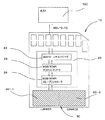
本発明の第1実施例に基づくSDI/Oストレージカード10は、SDカード規格にI/O機能を持たせたSDI/O規格に準拠したストレージカードであり、図1に示すように、SDI/Oストレージコントローラー20、フラッシュメモリー30を有している。
【0031】
また、前記SDI/Oストレージカード10は、ホスト機器100のスロットに挿入されて電気的に接続されることによって、ホスト機器100にデータを記憶するストレージカードとして外部記憶機能を付加する。なお、ここで、前記ホスト機器100としては、PDA、PC、デジタルカメラ、携帯電話等、多様な機器が想定される。
【0032】
また、前記SDI/Oストレージコントローラー20は、SDI/Oインターフェイスコントローラー22、SCSI/ATAPIホストコントローラー24、SCSI/ATAPIスレーブコントローラー26を有している。なお、SDI/Oインターフェイスコントローラー22、SCSI/ATAPIホストコントローラー24、SCSI/ATAPIスレーブコントローラー26は、全てSDI/Oストレージコントローラー20内に一つの機能ブロックとして実装される。
【0033】
前記SDI/Oインターフェイスコントローラー22は、SDカード規格に準拠したインターフェースコントローラーであり、信号ピン、SDI/Oバスを介してホスト機器100と通信するためのインターフェイス機能を有しており、SDI/Oストレージカード10とホスト機器100とのデータやコマンドの送受信を制御する。
【0034】
前記SCSI/ATAPIホストコントローラー24は、通常ホスト側に配設されるホストコントローラーをスレーブ側であるSDI/Oストレージコントローラー20内に組み込んだものであり、所定のオペレーティングシステム(OS)上で実行される制御プログラムに従って、ホスト機器100からの各種指令、データの転送を制御してSCSI/ATAPIスレーブコントローラー26に与えるとともに、フラッシュメモリー30の状態を管理する。
【0035】
また、SCSI/ATAPIホストコントローラー24は、SCSIインターフェース及びATAPIインターフェースを有しているため、SCSIブリッジ機能、ATAPIブリッジ機能を得ることができ、SCSIコマンド及びATAPIコマンドへの対応が可能となっている。
【0036】
前記SCSI/ATAPIスレーブコントローラー26は、前記SCSI/ATAPIホストコントローラー24と同じOS上で実行される制御プログラムに従って、フラッシュメモリー30を制御する。
【0037】
また、前記SCSI/ATAPIスレーブコントローラー26は、SCSIインターフェース及びATAPIインターフェースを有しているため、SCSIブリッジ機能、ATAPIブリッジ機能を得ることができ、SCSIコマンド及びATAPIコマンドへの対応が可能となっている。
【0038】
前記フラッシュメモリー30は、記憶保持動作が不要な半導体メモリーであり、前記SCSI/ATAPIスレーブコントローラー26から送られてきたデータを指定されたアドレス位置に記憶する。また、指定されたアドレス位置のデータを取り出して、前記SCSI/ATAPIスレーブコントローラー26に送る。
【0039】
また、本第1実施例によるSDI/Oストレージカード10は、SCSIコマンド及びATAPIコマンドへの対応が可能となっているため、LUN機能を使用することができる。ここで、LUN(Logical Unit Number)機能とは、1つのSCSIデバイス或いはATAPIデバイスでありながら複数のアクセス可能な論理ユニット構成を持つ場合に、それらの識別を行うために付与されるアドレスであり、LUNを持たせることで例えば3連装のCD−ROMドライブでは、3台のドライブユニットとして駆動することが可能となる。
【0040】
このLUN機能により、本第1実施例によるSDI/Oストレージカード10は、前記フラッシュメモリー30内を複数のRAM領域に区画することが可能になる。つまり、図1に示すように、フラッシュメモリー30内をRAM領域30−1とRAM領域30−2とに区画した場合において、該RAM領域30−1とRAM領域30−2それぞれにLUN#1、LUN#2を作成し付与して制御することが可能になる。
【0041】
そのため、ホスト機器100側はSCSI−ID、及びLUN#1又は2の両方の指定を行って前記SDI/Oストレージカード10にアクセスし、図2に示すように、ホスト機器100がPCの場合であれば、前記SDI/Oストレージカード10はディスプレイ上に、2つのリムーバブルディスクドライブ(E)、及びリムーバブルディスクドライブ(F)として表示される。
【0042】
以上の構成とすることによって、本第1実施例によるSDI/Oストレージカード10は、SDI/OとSCSI及びATAPI間のブリッジ機能を得ることができ、SCSIコマンド及びATAPIコマンドへの対応が可能となっている。そのため、単体でIDE(ATA)ハードディスク互換のストレージとすることが可能になる。そのため、別途ブリッジアダプターやその他の変換アダプターを接続する必要がないため、小型で軽量なストレージカード類において良好な携帯性を得ることができ、モバイル機器に利用した場合に最適であるという小型メモリーカードとしての特徴を十分生かすことが可能となる。
【0043】
また、本第1実施例によるSDI/Oストレージカード10は、通常ホスト側に配設されるSCSI/ATAPIホストコントローラー24をスレーブ側であるSDI/Oストレージコントローラー20内に組み込んでいるため、ホスト100側はSDI/Oストレージカード10との通信機能を有していれば、特別なソフトウェアを備える必要がない。そのため、多様な機器で使用することが可能となっている。
【0044】
また、本発明の第1実施例に基づくSDI/Oストレージカード10は、SDI/O規格に準拠しているため、所謂「プラグアンドプレイ」を実現するためのドライバーやメモリー領域が定義されており、プラグアンドプレイが可能となっている。従って、従前の構成のように、ホスト機器100への取り外しや取り付け時毎に電源を切る必要がないため、使い勝手が大幅に向上する。
【0045】
[第2実施例]
本発明の第2実施例に基づくCFストレージカードC10は、カード規格として前記第1実施例におけるストレージカードがSDI/O規格に準拠したSDI/Oストレージカード10であったのに対して、カード規格がCFカードにI/O機能を持たせたCF+カード規格(TypeI、TypeII)であるとともに、インターフェースコントローラーがCFインターフェースコントローラーC22である点及びRAM領域の区分を行わない点が異なっている。従って、前記第1実施例におけるSDI/Oストレージカード10と重複する説明に関しては、一部説明を省略する。
【0046】
本発明の第2実施例に基づくCFI/OストレージカードC10は、CF+規格に準拠したストレージカードであり、図3に示すように、CFI/OストレージコントローラーC20、フラッシュメモリーC30を有している。
【0047】
また、前記CFI/OストレージカードC10は、ホスト機器C100のスロットに挿入されて電気的に接続されることによって、ホスト機器C100にデータを記憶するストレージカードとして外部記憶機能を付加する。
【0048】
また、前記CFI/OストレージコントローラーC20は、CFI/OインターフェイスコントローラーC22、SCSI/ATAPIホストコントローラーC24、SCSI/ATAPIスレーブコントローラーC26を有している。なお、CFI/OインターフェイスコントローラーC22、SCSI/ATAPIホストコントローラーC24、SCSI/ATAPIスレーブコントローラーC26は、全てCFI/OストレージコントローラーC20内に一つの機能ブロックとして実装される。
【0049】
前記CFI/OインターフェイスコントローラーC22は、CFカード規格に準拠したインターフェースコントローラーであり、信号ピン、CFI/Oバスを介してホスト機器C100と通信するためのインターフェイス機能を有しており、CFI/OストレージカードC10とホスト機器C100とのデータやコマンドの送受信を制御する。
【0050】
前記SCSI/ATAPIホストコントローラーC24は、通常ホスト側に配設されるホストコントローラーをスレーブ側であるCFI/OストレージコントローラーC20内に組み込んだものであり、所定のオペレーティングシステム(OS)上で実行される制御プログラムに従って、ホスト機器C100からの各種指令、データの転送を制御してSCSI/ATAPIスレーブコントローラーC26に与えるとともに、フラッシュメモリーC30の状態を管理する。
【0051】
また、SCSI/ATAPIホストコントローラーC24は、SCSIインターフェース及びATAPIインターフェースを有しているため、SCSIブリッジ機能、ATAPIブリッジ機能を得ることができ、SCSIコマンド及びATAPIコマンドへの対応が可能となっている。
【0052】
前記SCSI/ATAPIスレーブコントローラーC26は、前記SCSI/ATAPIホストコントローラーC24と同じOS上で実行される制御プログラムに従って、フラッシュメモリーC30を制御する。
【0053】
また、前記SCSI/ATAPIスレーブコントローラーC26は、SCSIインターフェース及びATAPIインターフェースを有しているため、SCSIブリッジ機能、ATAPIブリッジ機能を得ることができ、SCSIコマンド及びATAPIコマンドへの対応が可能となっている。
【0054】
また、本第2実施例によるCFI/OストレージカードC10は、SCSIコマンド及びATAPIコマンドへの対応が可能となっているため、LUN機能を使用することができる。そのため、ホスト機器C100側はSCSI−ID及びLUN#1の両方の指定を行って前記CFI/OストレージカードC10にアクセスする。
【0055】
以上の構成とすることによって、本第2実施例によるCFI/OストレージカードC10は、CF+カード規格とSCSI及びATAPI間のブリッジ機能を得ることができ、SCSIコマンド及びATAPIコマンドへの対応が可能となっている。そのため、単体でIDE(ATA)ハードディスク互換のストレージとすることが可能になる。そのため、別途ブリッジアダプターやその他の変換アダプターを別途接続する必要がないため、小型で軽量なストレージカード類において良好な携帯性を得ることができ、モバイル機器に利用した場合に最適であるという小型メモリーカードとしての特徴を十分生かすことが可能となる。
【0056】
[第3実施例]
本発明の第3実施例に基づくSDI/OハイブリッドストレージカードH10は、カード規格として前記第1実施例におけるストレージカードと同じSDI/Oカード規格に準拠したストレージカードであり、フラッシュメモリーH30がハイブリッド化されている点が異なっている。従って、前記第1実施例におけるSDI/Oストレージカード10と重複する説明に関しては、一部説明を省略する。
【0057】
本発明の第3実施例に基づくSDI/OハイブリッドストレージカードH10は、図4に示すように、SDI/OストレージコントローラーH20、フラッシュメモリーH30を有している。
【0058】
また、前記SDI/OハイブリッドストレージカードH10は、ホスト機器H100のスロットに挿入されて電気的に接続されることによって、ホスト機器H100にデータを記憶するストレージカードとして外部記憶機能を付加する。
【0059】
また、前記SDI/OストレージコントローラーH20は、SDI/OインターフェイスコントローラーH22、SCSI/ATAPIホストコントローラーH24、SCSI/ATAPIスレーブコントローラーH26を有している。なお、SDI/OインターフェイスコントローラーH22、SCSI/ATAPIホストコントローラーH24、SCSI/ATAPIスレーブコントローラーH26は、全てSDI/OストレージコントローラーH20内に一つの機能ブロックとして実装される。
【0060】
前記SDI/OインターフェイスコントローラーH22は、SDI/O規格に準拠したインターフェースコントローラーであり、信号ピン、SDI/Oバスを介してホスト機器H100と通信するためのインターフェイス機能を有しており、SDI/OハイブリッドストレージカードH10とホスト機器H100とのデータやコマンドの送受信を制御する。
【0061】
前記SCSI/ATAPIホストコントローラーH24は、通常ホスト側に配設されるホストコントローラーをスレーブ側であるSDI/OストレージコントローラーH20内に組み込んだものであり、所定のオペレーティングシステム(OS)上で実行される制御プログラムに従って、ホスト機器H100からの各種指令、データの転送を制御してSCSI/ATAPIスレーブコントローラーH26に与えるとともに、フラッシュメモリーH30の状態を管理する。
【0062】
また、SCSI/ATAPIホストコントローラーH24は、SCSIインターフェース及びATAPIインターフェースを有しているため、SCSIブリッジ機能、ATAPIブリッジ機能を得ることができ、SCSIコマンド及びATAPIコマンドへの対応が可能となっている。
【0063】
前記SCSI/ATAPIスレーブコントローラーH26は、前記SCSI/ATAPIホストコントローラーH24と同じOS上で実行される制御プログラムに従って、フラッシュメモリーH30を制御する。
【0064】
また、前記SCSI/ATAPIスレーブコントローラーH26は、SCSIインターフェース及びATAPIインターフェースを有しているため、SCSIブリッジ機能、ATAPIブリッジ機能を得ることができ、SCSIコマンド及びATAPIコマンドへの対応が可能となっている。
【0065】
また、本第3実施例によるSDI/OハイブリッドストレージカードH10は、通常ホスト側に配設されるSCSI/ATAPIホストコントローラーH24をスレーブ側であるSDI/OストレージコントローラーH20内に組み込んでいるとともに、SCSIコマンド及びATAPIコマンドへの対応が可能となっているため、ホストH100側はSDI/OハイブリッドストレージカードH10との通信機能を有していれば、特別なソフトウェアを備える必要がない。そのため、多様な機器で使用することが可能となっている。
【0066】
また、本第3実施例によるSDI/OハイブリッドストレージカードH10は、SCSIコマンド及びATAPIコマンドへの対応が可能となっているため、LUN機能を使用することができる。そのため、前記フラッシュメモリーH30内をRAM領域とROM領域とに区画することが可能になる。
【0067】
つまり、図4に示すように、フラッシュメモリーH30内をROM領域H30−1とRAM領域H30−2とに区画した場合において、該ROM領域H30−1とRAM領域H30−2それぞれにLUN#1、LUN#2を作成し付与して制御することが可能になるため、前記フラッシュメモリーH30のハイブリッド化を図ることが可能となる。
【0068】
また、前記フラッシュメモリーH30内のROM領域H30−1とRAM領域H30−2とは、異なるファイルシステムによって管理されている。具体的には、ROM領域H30−1はISO9660ファイルシステム又はHFSによって管理され、RAM領域H30−2はFATファイルシステムによって管理されている。ここで、ISO9660ファイルシステムは、主にデータ用CD−ROMに使用されるファイルシステムであり、FATファイルシステムは、主にMS−DOSにおけるブロックデバイス(フレキシブルディスク、ハードディスク等)上のファイルを管理するためのシステムであり、またHFS(Hierarchical File System)は、階層構造を使ってファイルを分類することにより、数多くのファイルがハードディスクにあってもフォルダでファイルを上手に整理できるとするものである。
【0069】
また、ROM領域H30−1がISO9660ファイルシステムによって管理されているため、ホスト機器H100側にCD−ROMドライブとして認識させることができる。そのため、ROM領域H30−1に実行ファイルを書き込むことで、自動再生機能である所謂「オートラン(AUTO RUN)」をホスト機器H100に行わせることが可能となっている。
【0070】
また、以上のように、前記フラッシュメモリーH30内のROM領域H30−1とRAM領域H30−2とを、異なるファイルシステムによって管理することによって、書き込み/読み出し/削除が、異なる手段(ソフト)によるものとなるため、一方の領域には書き込み/読み出し/削除の何れかをできないようにすることができるとともに、一方の領域をユーザーから見えないようにすることも可能となる。
【0071】
以上のように、フラッシュメモリーH30内をROM領域H30−1とRAM領域H30−2とに区画することによって、ROM領域H30−1に書き込まれたソフトウェアが誤って消去されてしまうことがないとともに、RAM領域H30−2には自由に書き込みを行うことができるストレージデバイスとすることができ、本第3実施例によるSDI/OハイブリッドストレージカードH10は、今までに無い多様な実施態様、独特な効果を得ることが可能になる。
【0072】
例えば、SDI/OハイブリッドストレージカードH10にホスト機器H100の保守サービス機能を付加することが可能になる。具体的には、フラッシュメモリーH30のROM領域H30−1にホスト機器H100の設定情報を診断・出力するソフトウェアを記録し、出力結果をRAM領域H30−2に保存する。また、ROM領域H30−1にプログラムの自動アップデートプログラムを収録し、RAM領域H30−2にアップデートファイルを収録することで、ユーザーサポートや保守などに利用することが可能になる。
【0073】
また、SDI/OハイブリッドストレージカードH10をキーデバイスとして用いることも可能になる。具体的には、フラッシュメモリーH30のROM領域H30−1に暗号/復号ソフトを収録し、固有IDをセキュリティキーとして設定する。そして、機密情報は、ROM領域H30−1に収録された暗号/復号ソフトとセキュリティキーで暗号化した状態で保存する。
【0074】
このように構成すれば、前記SDI/OハイブリッドストレージカードH10が接続された状態でないと機密情報を復号化できないので、機密情報の流出を防ぐことが可能になるため、前記SDI/OハイブリッドストレージカードH10がキーデバイスとして機能する。また、会員限定で提供されるウェブコンテンツへのアクセスキーとしても利用することができる。
【0075】
また、SDI/OハイブリッドストレージカードH10をアプリケーションデバイスとして用いることも可能になる。具体的には、フラッシュメモリーH30のROM領域H30−1にアプリケーションプログラムを収録する。この場合、ROM領域H30−1に書き込まれたアプリケーションプログラムは、ユーザーが誤って消去してしまうことがないため適切に保護されるとともに、RAM領域H30−2にはアプリケーションプログラムのデータ等を自由に保存することができる。つまり、ROM領域H30−1に書き込まれたアプリケーションプログラムがゲームソフトである場合には、そのゲームの結果やスコアー、経過データなどをRAM領域H30−2に書き込むことができる。
【0076】
また、SDI/OハイブリッドストレージカードH10を広告宣伝用のノベルティデバイスとして用いることも可能になる。具体的には、フラッシュメモリーH30のROM領域H30−1にコマーシャル表示ソフトや広告宣伝が表示されるウェブページへのリンクアドレスを収録し、RAM領域H30−2の使用時毎に表示されるようにしてユーザーに配布する。ユーザーは、ROM領域H30−1を消去することができないため、RAM領域H30−2を使用する毎にコマーシャル画像や広告宣伝が表示されるウェブページへのリンクアドレスが表示されるため、好適に広告宣伝効果を得ることができる。
【0077】
なお、ROM領域H30−1へのデータの書き込みは、「CD−R書き込みソフト」のような専用ソフトを用いて行われ、別途該専用ソフトを用いることにより何回でも書き込み、書き換えを行うことは可能である。
【0078】
次に、このように構成された本第3実施例によるSDI/OハイブリッドストレージカードH10の、各局面における適用制御例を説明する。なお、特に記載が無い場合、ホスト機器H100はPDAあり、SDI/OハイブリッドストレージカードH10をゲームソフトを組み込んだアプリケーションデバイスとして用いる例を示すものとする。
【0079】
まず、ゲームソフトを組み込んだアプリケーションデバイスであるSDI/OハイブリッドストレージカードH10を、ホスト機器H100のスロットに装着した場合のイニシャル処理ルーチンについて説明する。図5は、本第3実施例によるイニシャル処理ルーチンを示すフローチャートである。
【0080】
ステップ10で、SDI/OハイブリッドストレージカードH10がホスト機器H100のスロットに挿入されると、ROM領域H30−1がISO9660ファイルシステムによって管理されているため、ROM領域H30−1はホスト機器H100側にCD−ROMドライブとして仮想的に認識される。そのため、ステップ20で、前記SCSI/ATAPIホストコントローラーH24によって、ROM領域H30−1に格納された実行ファイルが自動実行(オートラン)される。従って、ROM領域H30−1に格納されたゲームソフトのプログラムが実行されて、ゲームの初期状態の画面が表示され、ゲームの開始が可能となる。
【0081】
また、ステップ30で、前記SCSI/ATAPIホストコントローラーH24によってSCSI−ID及びLUNが、ホスト機器H100であるPDA側に認識される。そのため、ステップ40でホスト機器H100は、認識したSCSI−ID及びLUNによりフラッシュメモリーH30のROM領域H30−1側をCD−ROM領域と、RAM領域H30−2側をリムーバブル領域として認識する。それにより、ホスト機器H100であるPDAの液晶ディスプレイ上には、図6に示すように、システムホルダとしてCD−ROMドライブ(E)とリムーバブルディスクドライブ(F)の2つの表示が可能となる。
【0082】
次に、ゲームソフトを組み込んだアプリケーションデバイスであるSDI/OハイブリッドストレージカードH10がホスト機器H100であるPDAのスロットに装着された状態から、SDI/OハイブリッドストレージカードH10からデータを読み出す場合の読み出し処理ルーチンについて説明する。図7は、本第3実施例による読み出し処理ルーチンを示すフローチャートである。
【0083】
ステップ100で、図6に示すPDAの液晶ディスプレイ上に表示されたCD−ROMドライブ(E)を開いてアプリケーションのアイコンをダブルクリックすると、ステップ110で前記SCSI/ATAPIスレーブコントローラーH26がフラッシュメモリーH30を制御して、ROM領域H30−1に書き込まれたアプリケーションプログラムを読み出し、ステップ120で前記SCSI/ATAPIホストコントローラーH24が前記SDI/OインターフェイスコントローラーH22を介してそのアプリケーションプログラムをホスト機器H100であるPDAに送信する。
【0084】
それにより、ステップ130でホスト機器H100であるPDAによって、アプリケーションプログラムが実行され、ゲームの初期画面が表示され、ゲームの実行が可能となる。
【0085】
一方、ステップ140で、図6に示すPDAの液晶ディスプレイ上に表示されたリムーバブルディスク(F)を開いてファイルのアイコンをダブルクリックすると、ステップ150で前記SCSI/ATAPIスレーブコントローラーH26がフラッシュメモリーH30を制御して、RAM領域H30−2に書き込まれたデータを読み出し、ステップ160で前記SCSI/ATAPIホストコントローラーH24が前記SDI/OインターフェイスコントローラーH22を介してそのデータをホスト機器H100であるPDAに送信する。それにより、ステップ170でホスト機器H100であるPDAによって、そのデータの使用、処理が可能となる。
【0086】
次に、ゲームソフトを組み込んだアプリケーションデバイスであるSDI/OハイブリッドストレージカードH10がホスト機器H100であるPDAのスロットに装着された状態から、SDI/OハイブリッドストレージカードH10に書き込み削除を行う場合の書き込み削除処理ルーチンについて説明する。図8は、本第3実施例による書き込み削除処理ルーチンを示すフローチャートである。
【0087】
ステップ200で、図6に示すPDAの液晶ディスプレイ上に表示されたCD−ROMドライブ(E)を選択して書き込み或いは削除の要求が行われた場合、ステップ210でフラッシュメモリーH30のROM領域H30−1への当該書き込み或いは削除の要求は拒否される。これは、ホスト機器H100であるPDAは、フラッシュメモリーH30のROM領域H30−1側をCD−ROMドライブ(E)として仮想的に認識しているためである。そのため、ROM領域H30−1に格納されているアプリケーションプログラムの変更や削除は受付られずにエラー処理される。
【0088】
また、ステップ200及びステップ220で、図6に示すPDAの液晶ディスプレイ上に表示されたリムーバブルディスク(F)を選択して書き込み或いは削除の要求が行われた場合には、ステップ230で前記SCSI/ATAPIホストコントローラーH24がフラッシュメモリーH30のROM領域H30−1へのデータの書き込み或いは削除を許可し、そのデータをステップ240で前記SDI/OインターフェイスコントローラーH22を介してホスト機器H100であるPDAから受信する。
【0089】
それにより、ステップ250で前記SCSI/ATAPIスレーブコントローラーH26がフラッシュメモリーH30を制御して、RAM領域H30−2へのデータを書き込みを行う。
【0090】
以上の構成とすることによって、本第3実施例によるSDI/OハイブリッドストレージカードH10は、SDI/Oカード規格とSCSI及びATAPI間のブリッジ機能を得ることができ、SCSIコマンド及びATAPIコマンドへの対応が可能となっている。そのため、ブリッジアダプターやその他の変換アダプターを別途接続する必要がないため、適宜それらを携帯する必要がなく簡略な構成となるため、小型で軽量なストレージカード類において良好な携帯性を得ることができ、モバイル機器に利用した場合に最適であるという小型メモリーカードとしての特徴を十分生かすことが可能となる。
【0091】
また、本第3実施例によるSDI/OハイブリッドストレージカードH10は、通常ホスト側に配設されるSCSI/ATAPIホストコントローラーH24をスレーブ側であるSDI/OストレージコントローラーH20内に組み込んでいるとともに、SCSIコマンド及びATAPIコマンドへの対応が可能となっているため、LUN機能を使用することができ、上述したように前記フラッシュメモリーH30内をRAM領域とROM領域とに区画することが可能になっている。そのため、本第3実施例によるSDI/OハイブリッドストレージカードH10は、上述したように、ホスト機器の保守サービス機能の付加、キーデバイス、アプリケーションデバイス、ノベルティデバイスなど今までに無い多様な実施態様、独特な効果を得ることが可能になる。
【0092】
[第4実施例]
本発明の第4実施例に基づくCFハイブリッドストレージカードR10は、カード規格として前記第2実施例におけるCFI/OストレージカードC10と同じCF+カード規格に準拠したストレージカードであり、フラッシュメモリーR30がハイブリッド化されている点が異なっている。また、同じくハイブリッド化されている前記第3実施例におけるSDI/OハイブリッドストレージカードH10とは、カード規格がCF+カード規格に準拠したストレージカードである点、フラッシュメモリーのアクセスを制限或いは制限の解除を可能とする切替機能を有する点、及びメモリの領域の変更が可能である点が異なっている。従って、前記第1〜第3実施例におけるストレージカードと重複する説明に関しては、一部説明を省略する。
【0093】
本発明の第4実施例に基づくCFI/OハイブリッドストレージカードR10は、図9に示すように、CFI/OストレージコントローラーR20、フラッシュメモリーR30を有している。
【0094】
また、前記CFI/OハイブリッドストレージカードR10は、ホスト機器R100のスロットに挿入されて電気的に接続されることによって、ホスト機器R100にデータを記憶するストレージカードとして外部記憶機能を付加する。
【0095】
また、前記CFI/OストレージコントローラーR20は、CFI/OインターフェイスコントローラーR22、SCSI/ATAPIホストコントローラーR24、SCSI/ATAPIスレーブコントローラーR26を有している。なお、CFI/OインターフェイスコントローラーR22、SCSI/ATAPIホストコントローラーR24、SCSI/ATAPIスレーブコントローラーR26は、全てCFI/OストレージコントローラーR20内に一つの機能ブロックとして実装される。
【0096】
前記CFI/OインターフェイスコントローラーR22は、CF+規格に準拠したインターフェースコントローラーであり、信号ピン、CFI/Oバスを介してホスト機器R100と通信するためのインターフェイス機能を有しており、CFバスを介してCFI/OハイブリッドストレージカードR10とホスト機器R100とのデータやコマンドの送受信を制御する。
【0097】
前記SCSI/ATAPIホストコントローラーR24は、通常ホスト側に配設されるホストコントローラーをスレーブ側であるCFI/OストレージコントローラーR20内に組み込んだものであり、所定のオペレーティングシステム(OS)上で実行される制御プログラムに従って、ホスト機器R100からの各種指令、データの転送を制御してSCSI/ATAPIスレーブコントローラーR26に与えるとともに、フラッシュメモリーR30の状態を管理する。
【0098】
また、SCSI/ATAPIホストコントローラーR24は、SCSIインターフェース及びATAPIインターフェースを有しているため、SCSIブリッジ機能、ATAPIブリッジ機能を得ることができ、SCSIコマンド及びATAPIコマンドへの対応が可能となっている。
【0099】
前記SCSI/ATAPIスレーブコントローラーR26は、前記SCSI/ATAPIホストコントローラーR24と同じOS上で実行される制御プログラムに従って、フラッシュメモリーR30を制御する。
【0100】
また、前記SCSI/ATAPIスレーブコントローラーR26は、SCSIインターフェース及びATAPIインターフェースを有しているため、SCSIブリッジ機能、ATAPIブリッジ機能を得ることができ、SCSIコマンド及びATAPIコマンドへの対応が可能となっている。
【0101】
また、本第4実施例によるCFI/OハイブリッドストレージカードR10は、通常ホスト側に配設されるSCSI/ATAPIホストコントローラーR24をスレーブ側であるCFI/OストレージコントローラーR20内に組み込んでいるとともに、SCSIコマンド及びATAPIコマンドへの対応が可能となっているため、ホストR100側はCFI/OハイブリッドストレージカードR10との通信機能を有していれば、特別なソフトウェアを備える必要がない。そのため、多様な機器で使用することが可能となっている。
【0102】
また、本第4実施例によるCFI/OハイブリッドストレージカードR10は、SCSIコマンド及びATAPIコマンドへの対応が可能となっているため、LUN機能を使用することができる。そのため、前記フラッシュメモリーR30内をRAM領域とROM領域とに区画することが可能になる。
【0103】
つまり、図9に示すように、フラッシュメモリーR30内をROM領域R30−1とRAM領域R30−2とに区画した場合において、該ROM領域R30−1とRAM領域R30−2それぞれにLUN#1、LUN#2を作成し付与して制御することが可能になるため、前記フラッシュメモリーR30のハイブリッド化を図ることが可能となる。
【0104】
また、前記フラッシュメモリーR30内のROM領域R30−1とRAM領域R30−2とは、異なるファイルシステムによって管理されている。具体的には、ROM領域R30−1はISO9660ファイルシステム又はHFSによって管理され、RAM領域R30−2はFATファイルシステムによって管理されている。
【0105】
以上のように、フラッシュメモリーR30内をROM領域R30−1とRAM領域R30−2とに区画することによって、ROM領域R30−1に書き込まれたソフトウェアが誤って消去されてしまうことがないとともに、RAM領域R30−2には自由に書き込みを行うことができるストレージデバイスとすることができ、本第4実施例によるCFI/OハイブリッドストレージカードR10は、今までに無い多様な実施態様、独特な効果を得ることが可能になる。
【0106】
また、本第4実施例によるCFI/OハイブリッドストレージカードR10は、特定のRAM領域又はROM領域へのアクセスを制限或いは制限の解除を可能とする切替機能を有している。
【0107】
具体的には、CFI/OストレージコントローラーR20内のアトリビュートメモリにコンフィグレーションレジスタを構築し、該コンフィグレーションレジスタのモードを切替えてコンフィグレーションを行うことにより、フラッシュメモリーH30のROM領域R30−1又はRAM領域R30−2へのアクセスの制限或いは制限の解除を可能とする。これにより、接続するホスト機器などに応じて、RAM領域R30−2へのアクセスを制限することによる単純なデータ用CD−ROMとしてのみの使用や、ROM領域R30−1へのアクセスを制限することによる単純なリームーバブルディスクとしてのみの使用など用途を限定して使用することができ、使い勝手を向上させることができる。
【0108】
また、本第4実施例によるCFI/OハイブリッドストレージカードR10は、フラッシュメモリーH30のROM領域R30−1とRAM領域R30−2の大きさ、つまり領域サイズの変更が可能となっている。このROM領域R30−1とRAM領域R30−2の大きさの変更は、前記ホストR100側の特殊な専用ソフトによって行われる。該特殊な専用ソフトによるROM領域R30−1とRAM領域R30−2の領域サイズの変更を、図10に示す本第4実施例による領域サイズ変更処理ルーチンを示すフローチャートに基づいて説明する。
【0109】
ステップ300で、ホストR100の領域サイズ変更ソウトウェアが、フラッシュメモリーH30のROM領域R30−1とRAM領域R30−2の領域サイズの変更する指令を行うと、ステップ310で前記SCSI/ATAPIスレーブコントローラーH26が、アドレス範囲に関する情報を領域サイズ変更ソフトウェアから指令された情報に変更する。
【0110】
続いて、ステップ320で、各領域のファイルシステムが初期化されて、領域サイズの変更処理が終了する。
【0111】
このように、本第4実施例によるCFI/OハイブリッドストレージカードR10は、フラッシュメモリーH30のROM領域R30−1とRAM領域R30−2の領域サイズの変更が可能となっているため、何らかの事情によりフラッシュメモリーH30のROM領域R30−1とRAM領域R30−2の大きさを変更する必要が生じた際には、好適に領域サイズの変更を行うことができる。
【0112】
従って、例えば、フラッシュメモリーH30の容量が32MBである場合に、28MBが必要なソフトウェアを書き込む必要が生じた場合などにおいて、ROM領域R30−1を28MBと、RAM領域R30−2を4MBなどとすることができる。
【0113】
また、例えば、フラッシュメモリーH30の容量が32MBである場合に、ROM領域R30−1が28MBであるのに10MBしか使用されていない場合には、ROM領域R30−1を10MBと、RAM領域R30−2を22MBとして、RAM領域R30−2の容量を増やすなど、フラッシュメモリーH30の容量を最大限効率的に利用することができる。また、全領域をROM領域或いはRAM領域に設定することも可能である。
【0114】
[第5実施例]
本発明の第5実施例に基づくハイブリッドハードディスクJ10は、同じくハイブリッド化を行う前記第3実施例におけるSDI/OハイブリッドストレージカードH10とは、記憶媒体がフラッシュメモリーとハードディスクという大きな違いがあるが、ハイブリッド化の概念的には共通している。従って、前記第1〜第4実施例におけるストレージカードと重複する説明に関しては、一部説明を省略する。
【0115】
本発明の第5実施例に基づく前記ハイブリッドハードディスクJ10は、図11に示すように、SCSI/ATAPIストレージコントローラーJ20、磁気ディスクJ30を有している。
【0116】
また、前記ハイブリッドハードディスクJ10は、ホスト機器J100と電気的に接続されることによって、ホスト機器R100にデータを記憶するストレージディスクとして外部記憶機能を付加する。
【0117】
また、前記SCSI/ATAPIストレージコントローラーJ20は、SCSI/ATAPIインターフェイスコントローラーJ22、SCSI/ATAホストコントローラーJ24を有している。なお、SCSI/ATAPIインターフェイスコントローラーJ22、及びSCSI/ATAホストコントローラーJ24は、SCSI/ATAPIストレージコントローラーJ20内に一つの機能ブロックとして実装される。
【0118】
前記SCSI/ATAPIインターフェイスコントローラーJ22は、SCSI/ATA規格に準拠したインターフェースコントローラーであり、ホスト機器J100と通信するためのインターフェイス機能を有しており、SCSI/ATAPIバスを介してハイブリッドハードディスクJ10とホスト機器J100とのデータやコマンドの送受信を制御する。
【0119】
前記SCSI/ATAホストコントローラーJ24は、通常ホスト側に配設されるホストコントローラーをSCSI/ATAPIストレージコントローラーJ20内に組み込んだものであり、所定のオペレーティングシステム(OS)上で実行される制御プログラムに従って、ホスト機器J100からの各種指令、データの転送を制御して、磁気ディスクJ30の状態を管理する。
【0120】
また、SCSI/ATAホストコントローラーJ24は、SCSIインターフェース及びATAインターフェースを有しているため、SCSIブリッジ機能、ATAPブリッジ機能を得ることができ、SCSIコマンド及びATAPコマンドへの対応が可能となっている。
【0121】
また、本第5実施例によるハイブリッドハードディスクJ10は、通常ホスト側に配設されるSCSI/ATAPホストコントローラーJ24をスレーブ側であるSCSI/ATAPIストレージコントローラーJ20内に組み込んでいるとともに、SCSIコマンド及びATAPIコマンドへの対応が可能となっているため、ホストJ100側はハイブリッドハードディスクJ10との通信機能を有していれば、特別なソフトウェアを備える必要がない。そのため、多様な機器で使用することが可能となっている。
【0122】
また、本第5実施例によるハイブリッドハードディスクJ10は、SCSIコマンド及びATAPIコマンドへの対応が可能となっているため、LUN機能を使用することができる。そのため、前記磁気ディスクJ30内をRAM領域とROM領域とに区画することが可能になる。
【0123】
つまり、図11に示すように、前記磁気ディスクJ30内をROM領域J30−1とRAM領域J30−2とに区画した場合において、該ROM領域J30−1とRAM領域J30−2それぞれにLUN#1、LUN#2を作成し付与して制御することが可能になるため、前記磁気ディスクJ30のハイブリッド化を図ることが可能となる。
【0124】
以上のように、磁気ディスクJ30内をROM領域J30−1とRAM領域J30−2とに区画することによって、ROM領域J30−1に書き込まれたソフトウェアが誤って消去されてしまうことがないとともに、RAM領域J30−2には自由に書き込みを行うことができるストレージデバイスとすることができ、本第5実施例によるハイブリッドハードディスクJ10は、今までに無い多様な実施態様、独特な効果を得ることが可能になる。
【0125】
[第6実施例]
本発明の第6実施例に基づくハイブリッドZIPドライブZ10は、同じくハイブリッド化を行う前記第5実施例におけるハイブリッドハードディスクJ10とは、記憶媒体がZIPディスクとハードディスクという大きな違いがあるが、ハイブリッド化の概念的には共通している。従って、前記第1〜第5実施例におけるストレージカード、ストレージディスクと重複する説明に関しては、一部説明を省略する。
【0126】
本発明の第6実施例に基づく前記ハイブリッドZIPドライブZ10は、図12に示すように、SCSI/ATAPIストレージコントローラーZ20が内蔵されているとともに、ZIPディスクD10を挿入するためのスロットZ30が形成されている。そして、該スロットZ30にZIPディスクD10が装着され前記ハイブリッドZIPドライブZ10とホスト機器Z100が接続されることによって、ホスト機器Z100にデータを記憶するストレージディスクとして外部記憶機能を付加する。
【0127】
また、前記SCSI/ATAPIストレージコントローラーZ20は、SCSI/ATAPIインターフェイスコントローラーZ22、SCSI/ATAホストコントローラーZ24を有している。なお、SCSI/ATAPIインターフェイスコントローラーZ22、及びSCSI/ATAホストコントローラーZ24は、SCSI/ATAPIストレージコントローラーZ20内に一つの機能ブロックとして実装される。
【0128】
前記SCSI/ATAPIインターフェイスコントローラーZ22は、SCSI/ATA規格に準拠したインターフェースコントローラーであり、ホスト機器Z100と通信するためのインターフェイス機能を有しており、SCSIバスを介してハイブリッドZIPドライブZ10とホスト機器Z100とのデータやコマンドの送受信を制御する。
【0129】
前記SCSI/ATAホストコントローラーZ24は、通常ホスト側に配設されるホストコントローラーをSCSI/ATAPIストレージコントローラーZ20内に組み込んだものであり、所定のオペレーティングシステム(OS)上で実行される制御プログラムに従って、ホスト機器Z100からの各種指令、データの転送を制御して、ZIPディスクD10の状態を管理する。
【0130】
また、SCSI/ATAホストコントローラーZ24は、SCSIインターフェース及びATAインターフェースを有しているため、SCSIブリッジ機能、ATAブリッジ機能を得ることができ、SCSIコマンド及びATAコマンドへの対応が可能となっている。
【0131】
また、本第6実施例によるハイブリッドZIPドライブZ10は、通常ホスト側に配設されるSCSI/ATAPホストコントローラーZ24をスレーブ側であるSCSI/ATAPIストレージコントローラーZ20内に組み込んでいるとともに、SCSIコマンド及びATAPIコマンドへの対応が可能となっているため、ホストZ100側はハイブリッドZIPドライブZ10との通信機能を有していれば、特別なソフトウェアを備える必要がない。そのため、多様な機器で使用することが可能となっている。
【0132】
また、本第6実施例によるハイブリッドZIPドライブZ10は、SCSIコマンド及びATAPIコマンドへの対応が可能となっているため、LUN機能を使用することができる。そのため、前記ZIPディスクD10の書き込み領域D20内を複数のRAM領域とROM領域とに区画することが可能になる。
【0133】
つまり、図12に示すように、前記ZIPディスクD10の書き込み領域D20内をROM領域D20−1、RAM領域D20−2、RAM領域D20−3と3つに区画した場合において、該ROM領域D20−1、RAM領域D20−2、RAM領域D20−3それぞれにLUN#1、LUN#2、LUN#3を作成し付与して制御することが可能になるため、前記ZIPディスクD10のハイブリッド化を図ることが可能となる。
【0134】
以上のように、前記ZIPディスクD10の書き込み領域D20内をROM領域D20−1、RAM領域D20−2、RAM領域D20−3と3つに区画することによって、ROM領域D20−1に書き込まれたソフトウェアが誤って消去されてしまうことがないとともに、RAM領域D20−2、RAM領域D20−3には自由に書き込みを行うことができるストレージデバイスとすることができ、本第6実施例によるハイブリッドZIPドライブZ10は、今までに無い多様な実施態様、独特な効果を得ることが可能になる。
【0135】
以上述べたように、上記第1〜第6実施例によれば、システムインターフェースとしてSCSIインターフェース或いはATAPIインターフェースを組み込むことにより、LUNを作成し付与して制御することを可能とすることによって、ハイブリッドストレージデバイス化が可能となる。
【0136】
なお、本技術は、上記各実施例の構成のみに限定されるものではなく、多様な態様が可能である。例えば、上記各ストレージデバイスにデータを書き込む際に、そのデータを圧縮するようにしてもよい。そして、該ストレージデバイスからデータを読み込んだ際にそのデータを解凍するようにしてもよい。
【0137】
また、上記各実施例における上記各ストレージデバイスのROM領域或いはRAM領域を区画する区画数は任意でよく、また、区画した場合のROM領域或いはRAM領域の容量割合も任意でよい。
【0138】
また、上記第4実施例によるCFI/OハイブリッドストレージカードR10においては、CFI/OストレージコントローラーR20内のアトリビュートメモリにコンフィグレーションレジスタを構築し、該コンフィグレーションレジスタのモードを切替えてコンフィグレーションを行うことにより、フラッシュメモリーH30のROM領域R30−1又はRAM領域R30−2へのアクセスの制限或いは制限の解除を可能としているが、それのみに限定されるものではなく、別途物理的なハードの切替スイッチを設定し、該切替スイッチによってフラッシュメモリーH30のROM領域R30−1又はRAM領域R30−2へのアクセスの制限或いは制限の解除を行うようにしてもよい。
【0139】
また、所定のデータ転送方式のシステムインターフェースとして、SCSIインターフェース又はATAPIインターフェースを例示しているが、それのみに限定されるものではなく、それに準じたインターフェース或いは今後開発されるようなインターフェースなど、同様にLUN機能を使用可能なものであれば全て含まれる。
【0140】
また、前記所定のカード規格として、SDI/O規格及びCF+規格を例示しているが、それのみに限定されるものではなく、それに準じた規格或いは今後開発されるようなカード規格など、セキュリティ機能などの問題があるものでなければ全て含まれる。
【0141】
また、本発明によるストレージコントローラーを搭載するものとして、メモリーカード規格に準拠したもの、ハードディスクドライブ、ZIPディスクドライブを例示しているが、それのみに限定されるものではなく、フレキシブルディスクドライブ、スーパーフレキシブルディスクドライブ、光磁気ディスクドライブ(所謂「MOディスクドライブ」)、またはそれらに準じたデバイス或いは今後開発されるような記憶メディアなど全て含まれる。
【0142】
【発明の効果】
本発明に基づく請求項1に記載のストレージコントローラーによれば、所定のカード規格に準拠したインターフェースコントローラーと、所定のデータ転送方式のシステムインターフェースを有するホストコントローラーと、所定のデータ転送方式のシステムインターフェースを有するスレーブコントローラーとを有しているため、ホストコントローラーをスレーブ側にも配設するとともに、所定のカード規格と所定のデータ転送方式のシステムインターフェース間のブリッジ機能がストレージコントローラーに内蔵されることになり、メモリーカードに組み込まれた場合には、ブリッジアダプターやその他の変換アダプターを別途接続する必要がないため、適宜それらを携帯する必要がなく簡略な構成となるため、CFメモリーカードやSDメモリーカードなどの小型で軽量なストレージカード類において良好な携帯性を得ることができ、モバイル機器に利用した場合に最適となる特徴を十分生かすことが可能となる。
【0143】
また、特に、請求項2に記載のストレージコントローラーによれば、前記ホストコントローラー及びスレーブコントローラーの所定のデータ転送方式のシステムインターフェースが、SCSIインターフェース又はATAPIインターフェースであるため、所定のカード規格とSCSIインターフェース又はATAPIインターフェース間のブリッジ機能がストレージコントローラーに内蔵されることになり、メモリーカードに組み込まれた場合には、単体でIDE(ATA)ハードディスク互換のストレージとすることができて、SCSI又はATAPIブリッジアダプターやその他の変換アダプターを別途接続する必要がなくなる。
【0144】
また、特に、請求項3に記載のストレージコントローラーによれば、前記所定のカード規格がSDI/O規格であるとともに、インターフェースコントローラーがSDI/Oインターフェースコントローラーであるため、SDI/Oに準拠したカードとしての前記請求項1又は2に記載の効果を得ることができる。
【0145】
また、特に、請求項4に記載のストレージコントローラーによれば、前記所定のカード規格がCF+規格であるとともに、インターフェースコントローラーがCFI/Oインターフェースコントローラーであるため、CF+カード規格に準拠したカードとしての前記構成1又は2に記載の効果を得ることができる。
【0146】
また、特に、請求項5又は6に記載のストレージコントローラーによれば、SCSIやATAPIなどのロジカルユニットナンバー機能を有するデータ転送方式のシステムインターフェースとすることにより、前記フラッシュメモリー内をRAM領域とROM領域とに区画した際に、該RAM領域とROM領域それぞれにロジカルユニットナンバーを付与して制御することが可能になるため、前記フラッシュメモリーのハイブリッド化が可能となり、ROM領域に書き込まれたソフトウェアが誤って消去されてしまうことがないとともに、RAM領域には自由に書き込みを行うことができるストレージデバイスの提供が可能になる。
【0147】
また、特に、請求項7に記載のストレージカードによれば、前記請求項1又は2又は3又は4又は5又は6のストレージコントローラーを内蔵するため、前記請求項1又は2又は3又は4又は5又は6の効果を有するストレージカードとすることができる。
【0148】
また、特に、請求項8に記載のストレージカードによれば、特定のRAM領域又はROM領域へのアクセスを制限或いは制限の解除を可能とする切替機能を有しているため、接続するホスト機器などに応じて、単純なデータ用CD−ROMとしてのみの使用や、リームーバブルディスクとしてのみの使用とすることができ、使い勝手を向上させることができる。
【0149】
また、特に、請求項9に記載のストレージコントローラーによれば、ホストコントローラーをスレーブ側にも配設するとともに、SCSIやATAPIなどのロジカルユニットナンバー機能を有するデータ転送方式のシステムインターフェースとすることにより、前記磁気記録媒体内をRAM領域とROM領域とに区画した際に、該RAM領域とROM領域それぞれにロジカルユニットナンバーを付与して制御することが可能になるため、前記磁気記録媒体のハイブリッド化が可能となり、ROM領域に書き込まれたソフトウェアが誤って消去されてしまうことがないとともに、RAM領域には自由に書き込みを行うことができる磁気記録媒体の提供が可能になる。
【0150】
また、特に、請求項10又は11に記載の磁気ディスクドライブによれば、前記請求項9のストレージコントローラーを内蔵するため、前記請求項9の効果を有するものとすることができる。
【図面の簡単な説明】
【図1】本発明の第1実施例に基づくSDI/Oストレージカードの構成を示すブロック図である。
【図2】第1実施例によるSDI/OストレージカードのPCのディスプレイ上の表示例を示す説明図である。
【図3】本発明の第2実施例に基づくCFストレージカードの構成を示すブロック図である。
【図4】本発明の第3実施例に基づくSDI/Oハイブリッドストレージカードの構成を示すブロック図である。
【図5】第3実施例によるイニシャル処理ルーチンを示すフローチャートである。
【図6】第3実施例によるSDI/OハイブリッドストレージカードのPDAの液晶ディスプレイ上の表示例を示す説明図である。
【図7】第3実施例による読み出し処理ルーチンを示すフローチャートである。
【図8】第3実施例による書き込み処理ルーチンを示すフローチャートである。
【図9】本発明の第4実施例に基づくCFI/Oハイブリッドストレージカードの構成を示すブロック図である。
【図10】第4実施例による領域サイズ変更処理ルーチンを示すフローチャートである。
【図11】本発明の第5実施例に基づくハイブリッドハードディスクドライブの構成を示すブロック図である。
【図12】本発明の第6実施例に基づくハイブリッドZIPドライブの構成を示すブロック図である。
【符号の説明】
10、C10、H10、R10 ストレージカード
20、C20、H20、R20、J20、Z20 ストレージコントローラー
22、C22、H22、R22、J22、Z22 インターフェースコントローラー
24、C24、H24、R24、J24、Z24 ホストコントローラー
26、C26、H26、R26、Z26 スレーブコントローラー
30、C30、H30、R30 フラッシュメモリー
30−1、30−2、C30、H30−2、R30−2、J30−2、Z20−2、Z20−3 RAM領域
H30−1、R30−1、J30−1、Z20−1 ROM領域
J10 ハードディスクドライブ
Z10 ZIPディスクドライブ[0001]
TECHNICAL FIELD OF THE INVENTION
The present invention relates to a storage controller, a storage card, and a magnetic disk drive, and more particularly to a storage controller used for controlling a flash memory and a magnetic storage disk of a storage card, and a storage card and a magnetic disk drive incorporating the same.
[0002]
[Prior art]
In recent years, as a memory card for storing data of a PDA, a digital camera, or the like, a CF memory card compliant with a CF card standard using a small and lightweight flash memory, a CFI / O (CF +) card, and a SD card standard Media cards such as SDI / O cards have been widely used.
[0003]
[Problems to be solved by the invention]
However, when the CF memory card or the SD memory card is used as a storage compatible with an IDE (ATA) hard disk, a SCSI bridge adapter or an ATAPI bridge adapter conforming to the CFI / O card or SDI / O card standard, Alternatively, since it is necessary to separately connect other conversion adapters, it is necessary to carry them appropriately, and the configuration is complicated and large-scale. Therefore, the characteristics of a small memory card, which is small and lightweight, can achieve good portability, and is optimal for use in mobile devices, cannot be fully utilized.
[0004]
In addition, since the CF memory card and the SD memory card do not correspond to a logical unit number (hereinafter referred to as LUN), the recording medium is divided into a RAM area and a ROM area for driving. Could not control.
[0005]
To explain this point, the applicant of the present application has previously proposed a hybrid storage device in which a controller capable of controlling a flash memory divided into a RAM area and a ROM area is incorporated (see Patent Document 1). .). According to the USB standard hybrid storage device, since the flash memory can be partitioned into the RAM area and the ROM area by the controller and controlled, for example, software written in the ROM area is accidentally erased. In addition to this, writing can be freely performed in the RAM area.
[0006]
However, in conventional storage controllers in SD memory cards and CF memory cards, the host controller is located only on the host side, and does not have a controller having a SCSI interface or ATAPI interface as a system interface. It was not possible to partition the RAM area and the ROM area, create and assign LUNs to each, and control them. Therefore, even if the hybrid technology is diverted as it is, it cannot be made into a hybrid.
[0007]
In view of this, it is an object of the present invention to incorporate a SCSI interface or an ATAPI interface as a system interface, thereby enabling a single unit to be a storage compatible with an IDE (ATA) hard disk. In addition to being able to take full advantage of the features of a small memory card, which is optimal for use in mobile devices, it is possible to use the SCSI standard or ATAPI standard LUN function. The purpose of the present invention is to provide a hybrid storage device by partitioning into a ROM area and making it possible to create, assign and control LUNs.
[0008]
Similarly, in a magnetic recording medium such as a hard disk drive, a flexible disk drive, a ZIP drive, or a magneto-optical disk drive, by creating, providing, and controlling a LUN, a hybrid of one hard disk drive or one medium can be obtained. It becomes possible to make a storage device.
[Patent Document 1] Japanese Patent Application No. 2002-155684
[0009]
[Means for Solving the Problems]
SUMMARY OF THE INVENTION The present invention has been made to solve the above problems, and firstly, a storage controller for controlling reading and writing of data to a flash memory, which is compliant with a predetermined card standard. And a host controller having a system interface of a predetermined data transfer method, and a slave controller having a system interface of a predetermined data transfer method.
[0010]
In the storage controller of the first configuration, an interface controller conforming to a predetermined card standard, a host controller having a system interface of a predetermined data transfer method, and a slave controller having a system interface of a predetermined data transfer method are included. As a result, the host controller is also installed on the slave side, and the bridge function between the specified card standard and the system interface of the specified data transfer method is built in the storage controller, and it is built into the memory card In this case, there is no need to connect a bridge adapter or other conversion adapter separately, so it is not necessary to carry them properly, and the configuration becomes simple, so a CF memory card or SD memory card is used. In compact and lightweight storage cards such as de can obtain good portability, it is possible to utilize sufficiently the features to be optimized when using the mobile device.
[0011]
Secondly, in the storage controller having the first configuration, a system interface of the predetermined data transfer method of the host controller and the slave controller is a SCSI interface or an ATAPI interface.
[0012]
In the storage controller having the second configuration, since the system interface of the predetermined data transfer method of the host controller and the slave controller is a SCSI interface or an ATAPI interface, a bridge between a predetermined card standard and the SCSI interface or the ATAPI interface is provided. The function will be built into the storage controller, and if it is built into a memory card, it can be used alone as IDE (ATA) hard disk compatible storage, and a SCSI or ATAPI bridge adapter or other conversion adapter can be used. There is no need to connect separately.
[0013]
Thirdly, in the storage controller of the first or second configuration, the predetermined card standard is an SDI / O standard, and the interface controller is an SDI / O interface controller.
[0014]
In the storage controller having the third configuration, the predetermined card standard is the SDI / O standard and the interface controller is the SDI / O interface controller. The effect described in 2 can be obtained.
[0015]
Fourth, in the storage controller of the first or second configuration, the predetermined card standard is a CF + standard, and the interface controller is a CFI / O interface controller.
[0016]
In the storage controller having the fourth configuration, the predetermined card standard is the CF + standard, and the interface controller is the CFI / O interface controller. The described effect can be obtained.
[0017]
Fifth, in the storage controller having the first, second, third, or fourth configuration, the flash memory is controlled by partitioning the flash memory into a RAM area and a ROM area.
[0018]
Sixth, in the storage controller having the fifth configuration, the RAM area is managed by a FAT file system, and the ROM area is managed by an ISO9660 file system or HFS.
[0019]
In the storage controller having the fifth or sixth configuration, a data transfer system interface having a logical unit number function such as SCSI or ATAPI is used, so that the flash memory is divided into a RAM area and a ROM area. In addition, since it is possible to assign a logical unit number to each of the RAM area and the ROM area for control, the flash memory can be hybridized, and software written in the ROM area is erased by mistake. In addition to this, it is possible to provide a storage device that can freely write data in the RAM area.
[0020]
Seventh, a storage card is characterized in that it has a built-in storage controller having the configuration of the first or second or third or fourth or fifth or sixth configuration.
[0021]
In the storage card of the seventh configuration, since the storage controller of the first or second or third or fourth or fifth or sixth configuration is built in, the storage card of the first or second or third or fourth or fifth or sixth configuration is used. A storage card having an effect can be obtained.
[0022]
Eighthly, the storage card of the seventh configuration is characterized in that the storage card has a switching function capable of restricting or canceling the access to a specific RAM area or ROM area.
[0023]
The storage card of the eighth configuration has a switching function for restricting or canceling the access to a specific RAM area or ROM area. It can be used only as a compact data CD-ROM or only as a removable disk, and the usability can be improved.
[0024]
Ninth, a storage controller that controls reading and writing of data to and from a predetermined magnetic recording medium includes an interface controller conforming to a predetermined standard and a predetermined data transfer method corresponding to a logical unit number. And a host controller having the following system interface, wherein the inside of the magnetic recording medium is divided into a RAM area and a ROM area for control.
[0025]
In the storage controller having the ninth configuration, the host controller is also provided on the slave side, and a data transfer system interface having a logical unit number function such as SCSI or ATAPI is used. Is divided into a RAM area and a ROM area, a logical unit number can be assigned to each of the RAM area and the ROM area, so that the magnetic recording medium can be hybridized. It is possible to provide a magnetic recording medium that does not accidentally erase software written in the RAM and that can freely write in the RAM area.
[0026]
A tenth aspect is a magnetic disk drive, wherein the storage controller having the ninth configuration is built therein.
[0027]
Eleventh, in the magnetic disk drive of the tenth configuration, the magnetic disk drive is any one of a hard disk drive, a flexible disk drive, a ZIP disk drive, and a magneto-optical disk drive.
[0028]
In the magnetic disk drive of the tenth or eleventh configuration, since the storage controller of the ninth configuration is incorporated, the effects of the ninth configuration can be obtained.
[0029]
BEST MODE FOR CARRYING OUT THE INVENTION
Embodiments of the present invention will be described below with reference to the drawings.
[0030]
[First embodiment]
The SDI /
[0031]
The SDI /
[0032]
Further, the SDI /
[0033]
The SDI /
[0034]
The SCSI /
[0035]
Further, since the SCSI /
[0036]
The SCSI /
[0037]
Further, since the SCSI /
[0038]
The
[0039]
In addition, the SDI /
[0040]
With this LUN function, the SDI /
[0041]
Therefore, the
[0042]
With the above configuration, the SDI /
[0043]
In the SDI /
[0044]
Further, since the SDI /
[0045]
[Second embodiment]
In the CF storage card C10 according to the second embodiment of the present invention, the storage card in the first embodiment is the SDI /
[0046]
The CFI / O storage card C10 according to the second embodiment of the present invention is a storage card compliant with the CF + standard, and has a CFI / O storage controller C20 and a flash memory C30 as shown in FIG.
[0047]
Further, the CFI / O storage card C10 is inserted into a slot of the host device C100 and is electrically connected to add an external storage function as a storage card for storing data in the host device C100.
[0048]
The CFI / O storage controller C20 includes a CFI / O interface controller C22, a SCSI / ATAPI host controller C24, and a SCSI / ATAPI slave controller C26. The CFI / O interface controller C22, SCSI / ATAPI host controller C24, and SCSI / ATAPI slave controller C26 are all implemented as one functional block in the CFI / O storage controller C20.
[0049]
The CFI / O interface controller C22 is an interface controller conforming to the CF card standard, has an interface function for communicating with the host device C100 via a signal pin and a CFI / O bus, and has a CFI / O storage device. It controls transmission and reception of data and commands between the card C10 and the host device C100.
[0050]
The SCSI / ATAPI host controller C24 incorporates a host controller normally provided on the host side in the CFI / O storage controller C20 on the slave side, and is executed on a predetermined operating system (OS). In accordance with the control program, it controls the transfer of various commands and data from the host device C100 to give it to the SCSI / ATAPI slave controller C26 and manages the state of the flash memory C30.
[0051]
Further, since the SCSI / ATAPI host controller C24 has a SCSI interface and an ATAPI interface, a SCSI bridge function and an ATAPI bridge function can be obtained, and it is possible to support SCSI commands and ATAPI commands.
[0052]
The SCSI / ATAPI slave controller C26 controls the flash memory C30 according to a control program executed on the same OS as the SCSI / ATAPI host controller C24.
[0053]
Further, since the SCSI / ATAPI slave controller C26 has a SCSI interface and an ATAPI interface, a SCSI bridge function and an ATAPI bridge function can be obtained, and it is possible to support SCSI commands and ATAPI commands. .
[0054]
Also, the CFI / O storage card C10 according to the second embodiment can use the LUN function because it can support SCSI commands and ATAPI commands. Therefore, the host device C100 accesses the CFI / O storage card C10 by specifying both the SCSI-ID and
[0055]
With the above configuration, the CFI / O storage card C10 according to the second embodiment can obtain a bridge function between the CF + card standard and SCSI and ATAPI, and can support SCSI commands and ATAPI commands. Has become. For this reason, it is possible to provide a storage unit compatible with an IDE (ATA) hard disk by itself. Therefore, there is no need to separately connect a bridge adapter or other conversion adapters, which makes it possible to obtain good portability with small and lightweight storage cards and is ideal for use in mobile devices. It is possible to make full use of the features of the card.
[0056]
[Third embodiment]
The SDI / O hybrid storage card H10 according to the third embodiment of the present invention is a storage card that conforms to the same SDI / O card standard as the storage card in the first embodiment as a card standard, and the flash memory H30 is a hybrid. That is different. Therefore, the description overlapping with the SDI /
[0057]
The SDI / O hybrid storage card H10 according to the third embodiment of the present invention has an SDI / O storage controller H20 and a flash memory H30 as shown in FIG.
[0058]
Further, the SDI / O hybrid storage card H10 is inserted into a slot of the host device H100 and is electrically connected to add an external storage function as a storage card for storing data in the host device H100.
[0059]
The SDI / O storage controller H20 includes an SDI / O interface controller H22, a SCSI / ATAPI host controller H24, and a SCSI / ATAPI slave controller H26. The SDI / O interface controller H22, SCSI / ATAPI host controller H24, and SCSI / ATAPI slave controller H26 are all implemented as one functional block in the SDI / O storage controller H20.
[0060]
The SDI / O interface controller H22 is an interface controller conforming to the SDI / O standard, and has an interface function for communicating with the host device H100 via a signal pin and an SDI / O bus. It controls transmission and reception of data and commands between the hybrid storage card H10 and the host device H100.
[0061]
The SCSI / ATAPI host controller H24 incorporates a host controller normally provided on the host side in the SDI / O storage controller H20 on the slave side, and is executed on a predetermined operating system (OS). In accordance with the control program, it controls the transfer of various commands and data from the host device H100 to give it to the SCSI / ATAPI slave controller H26, and manages the state of the flash memory H30.
[0062]
Further, since the SCSI / ATAPI host controller H24 has a SCSI interface and an ATAPI interface, a SCSI bridge function and an ATAPI bridge function can be obtained, and it is possible to support SCSI commands and ATAPI commands.
[0063]
The SCSI / ATAPI slave controller H26 controls the flash memory H30 according to a control program executed on the same OS as the SCSI / ATAPI host controller H24.
[0064]
Further, since the SCSI / ATAPI slave controller H26 has a SCSI interface and an ATAPI interface, it can obtain a SCSI bridge function and an ATAPI bridge function, and can respond to SCSI commands and ATAPI commands. .
[0065]
In the SDI / O hybrid storage card H10 according to the third embodiment, the SCSI / ATAPI host controller H24 normally provided on the host side is incorporated in the SDI / O storage controller H20 on the slave side. Commands and ATAPI commands, it is not necessary for the host H100 to have special software as long as the host H100 has a communication function with the SDI / O hybrid storage card H10. Therefore, it can be used with various devices.
[0066]
Also, the SDI / O hybrid storage card H10 according to the third embodiment can use the LUN function because it can support SCSI commands and ATAPI commands. Therefore, the inside of the flash memory H30 can be partitioned into a RAM area and a ROM area.
[0067]
That is, as shown in FIG. 4, when the inside of the flash memory H30 is partitioned into a ROM area H30-1 and a RAM area H30-2,
[0068]
The ROM area H30-1 and the RAM area H30-2 in the flash memory H30 are managed by different file systems. Specifically, the ROM area H30-1 is managed by the ISO9660 file system or HFS, and the RAM area H30-2 is managed by the FAT file system. Here, the ISO9660 file system is a file system mainly used for data CD-ROM, and the FAT file system mainly manages files on block devices (flexible disk, hard disk, etc.) in MS-DOS. The HFS (Hierarchical File System) classifies the files using a hierarchical structure so that even if a large number of files are on a hard disk, the files can be well organized in folders.
[0069]
Further, since the ROM area H30-1 is managed by the ISO9660 file system, the host device H100 can be recognized as a CD-ROM drive. Therefore, by writing the execution file in the ROM area H30-1, it is possible to cause the host device H100 to perform a so-called “AUTO RUN” which is an automatic reproduction function.
[0070]
Further, as described above, the ROM area H30-1 and the RAM area H30-2 in the flash memory H30 are managed by different file systems, so that writing / reading / deletion is performed by different means (software). Therefore, it is possible to prevent any one of writing / reading / deleting from being performed on one of the areas, and to make the one area invisible to the user.
[0071]
As described above, dividing the flash memory H30 into the ROM area H30-1 and the RAM area H30-2 prevents software written in the ROM area H30-1 from being accidentally erased, and In the RAM area H30-2, a storage device that can be freely written can be used. The SDI / O hybrid storage card H10 according to the third embodiment has various embodiments and unique effects that have never been seen before. Can be obtained.
[0072]
For example, it becomes possible to add a maintenance service function of the host device H100 to the SDI / O hybrid storage card H10. Specifically, software for diagnosing and outputting the setting information of the host device H100 is recorded in the ROM area H30-1 of the flash memory H30, and the output result is stored in the RAM area H30-2. In addition, the automatic update program of the program is recorded in the ROM area H30-1 and the update file is recorded in the RAM area H30-2, so that it can be used for user support and maintenance.
[0073]
Also, the SDI / O hybrid storage card H10 can be used as a key device. Specifically, encryption / decryption software is recorded in the ROM area H30-1 of the flash memory H30, and a unique ID is set as a security key. Then, the confidential information is stored in a state of being encrypted with the encryption / decryption software and the security key recorded in the ROM area H30-1.
[0074]
With this configuration, the SDI / O hybrid storage card H10 cannot be decrypted unless the SDI / O hybrid storage card H10 is connected, so that leakage of the confidential information can be prevented. H10 functions as a key device. It can also be used as an access key to web content provided only to members.
[0075]
Further, the SDI / O hybrid storage card H10 can be used as an application device. Specifically, the application program is recorded in the ROM area H30-1 of the flash memory H30. In this case, the application program written in the ROM area H30-1 is appropriately protected since the user does not accidentally erase it, and the RAM area H30-2 can freely store application program data and the like. Can be saved. That is, when the application program written in the ROM area H30-1 is game software, the result, score, progress data, and the like of the game can be written in the RAM area H30-2.
[0076]
Further, the SDI / O hybrid storage card H10 can be used as a novelty device for advertisement. Specifically, a link address to a web page where commercial display software and advertisements are displayed is recorded in the ROM area H30-1 of the flash memory H30, and is displayed every time the RAM area H30-2 is used. To distribute to users. Since the user cannot erase the ROM area H30-1, a link address to a web page displaying a commercial image or an advertisement is displayed each time the RAM area H30-2 is used. Advertising effect can be obtained.
[0077]
Note that writing of data to the ROM area H30-1 is performed using dedicated software such as "CD-R writing software", and writing and rewriting can be performed any number of times by using the dedicated software separately. It is possible.
[0078]
Next, an example of application control in each aspect of the SDI / O hybrid storage card H10 according to the third embodiment configured as described above will be described. Unless otherwise stated, an example is shown in which the host device H100 has a PDA and uses the SDI / O hybrid storage card H10 as an application device incorporating game software.
[0079]
First, an initial processing routine when the SDI / O hybrid storage card H10, which is an application device incorporating the game software, is mounted in a slot of the host device H100 will be described. FIG. 5 is a flowchart showing an initial processing routine according to the third embodiment.
[0080]
In
[0081]
Also, in
[0082]
Next, a read process for reading data from the SDI / O hybrid storage card H10 while the SDI / O hybrid storage card H10, which is an application device incorporating the game software, is mounted in the slot of the PDA, which is the host device H100. The routine will be described. FIG. 7 is a flowchart showing a read processing routine according to the third embodiment.
[0083]
In
[0084]
Accordingly, in step 130, the application program is executed by the PDA which is the host device H100, an initial screen of the game is displayed, and the game can be executed.
[0085]
On the other hand, in step 140, when the removable disk (F) displayed on the liquid crystal display of the PDA shown in FIG. 6 is opened and the file icon is double-clicked, in step 150, the SCSI / ATAPI slave controller H26 deletes the flash memory H30. The SCSI / ATAPI host controller H24 transmits the data to the PDA which is the host device H100 via the SDI / O interface controller H22 in step 160 by reading the data written in the RAM area H30-2. . As a result, the data can be used and processed by the PDA which is the host device H100 in step 170.
[0086]
Next, when the SDI / O hybrid storage card H10, which is an application device incorporating the game software, is inserted into the slot of the PDA, which is the host device H100, writing to the SDI / O hybrid storage card H10 for writing and deleting is performed. The deletion processing routine will be described. FIG. 8 is a flowchart showing a write deletion processing routine according to the third embodiment.
[0087]
In
[0088]
Also, in
[0089]
Accordingly, in step 250, the SCSI / ATAPI slave controller H26 controls the flash memory H30 to write data to the RAM area H30-2.
[0090]
With the above configuration, the SDI / O hybrid storage card H10 according to the third embodiment can obtain a bridge function between the SDI / O card standard and the SCSI and ATAPI commands, and can support SCSI commands and ATAPI commands. Is possible. Therefore, since there is no need to separately connect a bridge adapter or other conversion adapters, it is not necessary to carry them appropriately, and the configuration is simple, so that good portability can be obtained in a small and lightweight storage card. This makes it possible to make full use of the characteristics of a small memory card that is optimal for use in a mobile device.
[0091]
In the SDI / O hybrid storage card H10 according to the third embodiment, the SCSI / ATAPI host controller H24 normally provided on the host side is incorporated in the SDI / O storage controller H20 on the slave side. Since commands and ATAPI commands can be handled, a LUN function can be used, and the flash memory H30 can be partitioned into a RAM area and a ROM area as described above. . Therefore, as described above, the SDI / O hybrid storage card H10 according to the third embodiment has a variety of unprecedented embodiments such as the addition of a maintenance service function of a host device, a key device, an application device, and a novelty device. Effects can be obtained.
[0092]
[Fourth embodiment]
The CF hybrid storage card R10 according to the fourth embodiment of the present invention is a storage card that conforms to the same CF + card standard as the CFI / O storage card C10 in the second embodiment as a card standard, and the flash memory R30 is a hybrid. That is different. The SDI / O hybrid storage card H10 in the third embodiment, which is also hybridized, is a storage card whose card standard conforms to the CF + card standard, and restricts or releases the access to the flash memory. The difference lies in that it has a switching function that enables it, and that the area of the memory can be changed. Therefore, the description overlapping with the storage card in the first to third embodiments is partially omitted.
[0093]
The CFI / O hybrid storage card R10 according to the fourth embodiment of the present invention has a CFI / O storage controller R20 and a flash memory R30 as shown in FIG.
[0094]
The CFI / O hybrid storage card R10 is inserted into a slot of the host device R100 and is electrically connected thereto, thereby adding an external storage function as a storage card for storing data in the host device R100.
[0095]
The CFI / O storage controller R20 has a CFI / O interface controller R22, a SCSI / ATAPI host controller R24, and a SCSI / ATAPI slave controller R26. The CFI / O interface controller R22, SCSI / ATAPI host controller R24, and SCSI / ATAPI slave controller R26 are all implemented as one functional block in the CFI / O storage controller R20.
[0096]
The CFI / O interface controller R22 is an interface controller conforming to the CF + standard, and has an interface function for communicating with the host device R100 via a signal pin and a CFI / O bus. It controls transmission and reception of data and commands between the CFI / O hybrid storage card R10 and the host device R100.
[0097]
The SCSI / ATAPI host controller R24 incorporates a host controller normally provided on the host side in the CFI / O storage controller R20 on the slave side, and is executed on a predetermined operating system (OS). In accordance with the control program, it controls the transfer of various commands and data from the host device R100 to give it to the SCSI / ATAPI slave controller R26 and manages the state of the flash memory R30.
[0098]
Further, since the SCSI / ATAPI host controller R24 has a SCSI interface and an ATAPI interface, a SCSI bridge function and an ATAPI bridge function can be obtained, and it is possible to support SCSI commands and ATAPI commands.
[0099]
The SCSI / ATAPI slave controller R26 controls the flash memory R30 according to a control program executed on the same OS as the SCSI / ATAPI host controller R24.
[0100]
Further, since the SCSI / ATAPI slave controller R26 has a SCSI interface and an ATAPI interface, a SCSI bridge function and an ATAPI bridge function can be obtained, and it is possible to respond to SCSI commands and ATAPI commands. .
[0101]
In the CFI / O hybrid storage card R10 according to the fourth embodiment, the SCSI / ATAPI host controller R24 normally provided on the host side is incorporated in the CFI / O storage controller R20 on the slave side, and the SCSI Commands and ATAPI commands, it is not necessary for the host R100 to have special software as long as the host R100 has a communication function with the CFI / O hybrid storage card R10. Therefore, it can be used with various devices.
[0102]
Also, the CFI / O hybrid storage card R10 according to the fourth embodiment can use the LUN function because it can support SCSI commands and ATAPI commands. Therefore, the inside of the flash memory R30 can be partitioned into a RAM area and a ROM area.
[0103]
That is, as shown in FIG. 9, when the inside of the flash memory R30 is partitioned into a ROM area R30-1 and a RAM area R30-2,
[0104]
The ROM area R30-1 and the RAM area R30-2 in the flash memory R30 are managed by different file systems. Specifically, the ROM area R30-1 is managed by the ISO9660 file system or HFS, and the RAM area R30-2 is managed by the FAT file system.
[0105]
As described above, by dividing the flash memory R30 into the ROM area R30-1 and the RAM area R30-2, the software written in the ROM area R30-1 is not erased by mistake, and A storage device capable of freely writing data in the RAM area R30-2 can be used. The CFI / O hybrid storage card R10 according to the fourth embodiment has various embodiments and unique effects which have not been achieved so far. Can be obtained.
[0106]
In addition, the CFI / O hybrid storage card R10 according to the fourth embodiment has a switching function that can restrict access to a specific RAM area or ROM area or release the restriction.
[0107]
Specifically, a configuration register is constructed in the attribute memory in the CFI / O storage controller R20, and the configuration of the configuration register is switched to perform the configuration, thereby setting the ROM area R30-1 or the RAM in the flash memory H30. Restriction of access to the area R30-2 or release of the restriction is enabled. This restricts access to the RAM area R30-2 by restricting access to the RAM area R30-2, and restricts access to the ROM area R30-1 according to the host device to be connected. For example, the disk drive can be used for a limited purpose such as use only as a simple removable disk, and the usability can be improved.
[0108]
In the CFI / O hybrid storage card R10 according to the fourth embodiment, the sizes of the ROM area R30-1 and the RAM area R30-2 of the flash memory H30, that is, the area size can be changed. The change of the sizes of the ROM area R30-1 and the RAM area R30-2 is performed by special dedicated software on the host R100 side. The change of the area size of the ROM area R30-1 and the RAM area R30-2 by the special dedicated software will be described with reference to a flowchart showing an area size change processing routine according to the fourth embodiment shown in FIG.
[0109]
In step 300, when the area size changing software of the host R100 issues a command to change the area sizes of the ROM area R30-1 and the RAM area R30-2 of the flash memory H30, the SCSI / ATAPI slave controller H26 in step 310 Then, the information related to the address range is changed to information instructed by the area size changing software.
[0110]
Subsequently, in step 320, the file system of each area is initialized, and the area size change processing ends.
[0111]
As described above, in the CFI / O hybrid storage card R10 according to the fourth embodiment, the area sizes of the ROM area R30-1 and the RAM area R30-2 of the flash memory H30 can be changed. When it is necessary to change the sizes of the ROM area R30-1 and the RAM area R30-2 of the flash memory H30, the area size can be changed suitably.
[0112]
Therefore, for example, when the capacity of the flash memory H30 is 32 MB, when it is necessary to write software that requires 28 MB, the ROM area R30-1 is set to 28MB and the RAM area R30-2 is set to 4MB. be able to.
[0113]
Further, for example, when the capacity of the flash memory H30 is 32 MB and only 10 MB is used while the ROM area R30-1 is 28 MB, the ROM area R30-1 is set to 10 MB and the RAM area R30- 2 as 22 MB, the capacity of the flash memory H30 can be used as efficiently as possible, such as increasing the capacity of the RAM area R30-2. Also, the entire area can be set in the ROM area or the RAM area.
[0114]
[Fifth embodiment]
The hybrid hard disk J10 according to the fifth embodiment of the present invention is different from the SDI / O hybrid storage card H10 according to the third embodiment in that the storage medium is a flash memory and a hard disk. Conceptualization is common. Therefore, the description overlapping with the storage card in the first to fourth embodiments is partially omitted.
[0115]
The hybrid hard disk J10 according to the fifth embodiment of the present invention has a SCSI / ATAPI storage controller J20 and a magnetic disk J30 as shown in FIG.
[0116]
The hybrid hard disk J10 is electrically connected to the host device J100 to add an external storage function as a storage disk for storing data in the host device R100.
[0117]
Further, the SCSI / ATAPI storage controller J20 has a SCSI / ATAPI interface controller J22 and a SCSI / ATA host controller J24. The SCSI / ATAPI interface controller J22 and the SCSI / ATA host controller J24 are implemented as one functional block in the SCSI / ATAPI storage controller J20.
[0118]
The SCSI / ATAPI interface controller J22 is an interface controller conforming to the SCSI / ATA standard, has an interface function for communicating with the host device J100, and connects the hybrid hard disk J10 and the host device via a SCSI / ATAPI bus. Controls transmission and reception of data and commands with J100.
[0119]
The SCSI / ATA host controller J24 incorporates a host controller normally provided on the host side in the SCSI / ATAPI storage controller J20, and according to a control program executed on a predetermined operating system (OS), It controls the transfer of various commands and data from the host device J100 to manage the state of the magnetic disk J30.
[0120]
Further, since the SCSI / ATA host controller J24 has a SCSI interface and an ATA interface, it can obtain a SCSI bridge function and an ATAP bridge function, and can respond to SCSI commands and ATAP commands.
[0121]
In the hybrid hard disk J10 according to the fifth embodiment, the SCSI / ATAP host controller J24 normally provided on the host side is incorporated in the SCSI / ATAPI storage controller J20 on the slave side, and a SCSI command and an ATAPI command are provided. Therefore, if the host J100 has a communication function with the hybrid hard disk J10, there is no need to provide special software. Therefore, it can be used with various devices.
[0122]
Also, the hybrid hard disk J10 according to the fifth embodiment can use the LUN function because it can support SCSI commands and ATAPI commands. Therefore, the inside of the magnetic disk J30 can be partitioned into a RAM area and a ROM area.
[0123]
That is, as shown in FIG. 11, when the inside of the magnetic disk J30 is partitioned into a ROM area J30-1 and a RAM area J30-2,
[0124]
As described above, partitioning the magnetic disk J30 into the ROM area J30-1 and the RAM area J30-2 prevents software written in the ROM area J30-1 from being accidentally erased. In the RAM area J30-2, a storage device capable of freely writing can be used. The hybrid hard disk J10 according to the fifth embodiment can provide various embodiments and unique effects that have not been achieved so far. Will be possible.
[0125]
[Sixth embodiment]
The hybrid ZIP drive Z10 according to the sixth embodiment of the present invention differs greatly from the hybrid hard disk J10 in the fifth embodiment, which also performs the hybridization, in that the storage medium is a ZIP disk and a hard disk. In common. Therefore, the description overlapping with the storage card and the storage disk in the first to fifth embodiments is partially omitted.
[0126]
The hybrid ZIP drive Z10 according to the sixth embodiment of the present invention has a built-in SCSI / ATAPI storage controller Z20 and a slot Z30 for inserting a ZIP disk D10, as shown in FIG. I have. The ZIP disk D10 is mounted in the slot Z30, and the hybrid ZIP drive Z10 is connected to the host device Z100, so that an external storage function is added to the host device Z100 as a storage disk for storing data.
[0127]
Further, the SCSI / ATAPI storage controller Z20 has a SCSI / ATAPI interface controller Z22 and a SCSI / ATA host controller Z24. Note that the SCSI / ATAPI interface controller Z22 and the SCSI / ATA host controller Z24 are mounted as one functional block in the SCSI / ATAPI storage controller Z20.
[0128]
The SCSI / ATAPI interface controller Z22 is an interface controller conforming to the SCSI / ATA standard, has an interface function for communicating with the host device Z100, and has a hybrid ZIP drive Z10 and a host device Z100 via a SCSI bus. Control the transmission and reception of data and commands to and from the
[0129]
The SCSI / ATA host controller Z24 incorporates a host controller normally provided on the host side in the SCSI / ATAPI storage controller Z20, and according to a control program executed on a predetermined operating system (OS), The transfer of various commands and data from the host device Z100 is controlled to manage the state of the ZIP disk D10.
[0130]
Further, since the SCSI / ATA host controller Z24 has a SCSI interface and an ATA interface, it can obtain a SCSI bridge function and an ATA bridge function, and can respond to SCSI commands and ATA commands.
[0131]
In the hybrid ZIP drive Z10 according to the sixth embodiment, the SCSI / ATAP host controller Z24 normally provided on the host side is incorporated in the SCSI / ATAPI storage controller Z20 on the slave side, and SCSI commands and ATAPI are provided. Since it is possible to respond to the command, if the host Z100 has a communication function with the hybrid ZIP drive Z10, there is no need to provide special software. Therefore, it can be used with various devices.
[0132]
In addition, the hybrid ZIP drive Z10 according to the sixth embodiment can use the LUN function because it can support SCSI commands and ATAPI commands. Therefore, it is possible to partition the inside of the writing area D20 of the ZIP disk D10 into a plurality of RAM areas and ROM areas.
[0133]
That is, as shown in FIG. 12, when the inside of the writing area D20 of the ZIP disk D10 is divided into three areas of the ROM area D20-1, the RAM area D20-2, and the RAM area D20-3, the ROM area D20- 1.
[0134]
As described above, the writing area D20 of the ZIP disk D10 is divided into the ROM area D20-1, the RAM area D20-2, and the RAM area D20-3, whereby the data is written into the ROM area D20-1. The software can be used as a storage device that does not accidentally erase software and can freely write into the RAM areas D20-2 and D20-3. The drive Z10 can achieve a variety of embodiments and unique effects that have never been seen before.
[0135]
As described above, according to the first to sixth embodiments, by incorporating a SCSI interface or an ATAPI interface as a system interface, it is possible to create, assign, and control LUNs, thereby enabling hybrid storage. Device conversion becomes possible.
[0136]
Note that the present technology is not limited to only the configuration of each of the above embodiments, and various embodiments are possible. For example, when writing data to each storage device, the data may be compressed. Then, when data is read from the storage device, the data may be decompressed.
[0137]
Further, the number of sections for dividing the ROM area or the RAM area of each storage device in each of the embodiments may be arbitrary, and the capacity ratio of the ROM area or the RAM area in the case of division may be arbitrary.
[0138]
In the CFI / O hybrid storage card R10 according to the fourth embodiment, the configuration register is constructed in the attribute memory in the CFI / O storage controller R20, and the configuration is performed by switching the mode of the configuration register. Can restrict or release the access to the ROM area R30-1 or the RAM area R30-2 of the flash memory H30, but the present invention is not limited to this, and a separate physical hardware switch May be set, and access to the ROM area R30-1 or the RAM area R30-2 of the flash memory H30 is restricted or the restriction is released by the changeover switch.
[0139]
In addition, the SCSI interface or the ATAPI interface is illustrated as a system interface of a predetermined data transfer method, but the present invention is not limited thereto, and similarly, an interface according to the interface or an interface to be developed in the future. All that can use the LUN function are included.
[0140]
Although the SDI / O standard and the CF + standard are exemplified as the predetermined card standard, the present invention is not limited to the SDI / O standard and the CF + standard. All are included unless there is a problem such as.
[0141]
In addition, the storage controller according to the present invention is exemplified by a memory card compliant hard disk drive, a ZIP disk drive, and the like, but is not limited thereto. A disk drive, a magneto-optical disk drive (a so-called “MO disk drive”), a device corresponding thereto, or a storage medium to be developed in the future are all included.
[0142]
【The invention's effect】
According to the storage controller according to
[0143]
Further, in particular, according to the storage controller of claim 2, since the system interface of the predetermined data transfer method of the host controller and the slave controller is a SCSI interface or an ATAPI interface, a predetermined card standard and a SCSI interface or The bridge function between the ATAPI interfaces will be built into the storage controller, and when built into a memory card, it can be used as a single storage compatible with IDE (ATA) hard disk, and can be used as a SCSI or ATAPI bridge adapter or There is no need to separately connect other conversion adapters.
[0144]
According to the storage controller of the third aspect, the predetermined card standard is an SDI / O standard and the interface controller is an SDI / O interface controller. The effect according to
[0145]
According to the storage controller of the fourth aspect, the predetermined card standard is the CF + standard, and the interface controller is a CFI / O interface controller. The effects described in
[0146]
Further, in particular, according to the storage controller according to
[0147]
In addition, in particular, according to the storage card of claim 7, since the storage controller of
[0148]
In particular, according to the storage card of the eighth aspect, since the storage card has a switching function for restricting or canceling the access to a specific RAM area or ROM area, a host device to be connected or the like can be used. According to the above, it can be used only as a simple data CD-ROM or only as a removable disk, and the usability can be improved.
[0149]
In particular, according to the storage controller of the ninth aspect, the host controller is provided on the slave side, and a system interface of a data transfer system having a logical unit number function such as SCSI or ATAPI is provided. When the inside of the magnetic recording medium is partitioned into a RAM area and a ROM area, it is possible to assign a logical unit number to each of the RAM area and the ROM area and to control the RAM area and the ROM area. This makes it possible to provide a magnetic recording medium in which software written in the ROM area is not erased by mistake and the RAM area can be freely written.
[0150]
According to the magnetic disk drive of the tenth or eleventh aspect, the storage controller of the ninth aspect is built in, so that the effect of the ninth aspect can be obtained.
[Brief description of the drawings]
FIG. 1 is a block diagram showing a configuration of an SDI / O storage card according to a first embodiment of the present invention.
FIG. 2 is an explanatory diagram showing a display example of a SDI / O storage card according to a first embodiment on a display of a PC;
FIG. 3 is a block diagram showing a configuration of a CF storage card according to a second embodiment of the present invention.
FIG. 4 is a block diagram showing a configuration of an SDI / O hybrid storage card according to a third embodiment of the present invention.
FIG. 5 is a flowchart illustrating an initial processing routine according to a third embodiment.
FIG. 6 is an explanatory diagram showing a display example on a liquid crystal display of a PDA of an SDI / O hybrid storage card according to a third embodiment.
FIG. 7 is a flowchart illustrating a read processing routine according to a third embodiment.
FIG. 8 is a flowchart illustrating a write processing routine according to a third embodiment.
FIG. 9 is a block diagram showing a configuration of a CFI / O hybrid storage card according to a fourth embodiment of the present invention.
FIG. 10 is a flowchart illustrating an area size change processing routine according to a fourth embodiment.
FIG. 11 is a block diagram showing a configuration of a hybrid hard disk drive according to a fifth embodiment of the present invention.
FIG. 12 is a block diagram showing a configuration of a hybrid ZIP drive according to a sixth embodiment of the present invention.
[Explanation of symbols]
10, C10, H10, R10 storage card
20, C20, H20, R20, J20, Z20 storage controller
22, C22, H22, R22, J22, Z22 Interface controller
24, C24, H24, R24, J24, Z24 Host controller
26, C26, H26, R26, Z26 Slave controller
30, C30, H30, R30 Flash memory
30-1, 30-2, C30, H30-2, R30-2, J30-2, Z20-2, Z20-3 RAM area
H30-1, R30-1, J30-1, Z20-1 ROM area
J10 hard disk drive
Z10 ZIP disk drive
Claims (11)
所定のカード規格に準拠したインターフェースコントローラーと、
所定のデータ転送方式のシステムインターフェースを有するホストコントローラーと、
所定のデータ転送方式のシステムインターフェースを有するスレーブコントローラーと
を有することを特徴とするストレージコントローラー。A storage controller that controls reading and writing of data to a flash memory,
An interface controller conforming to a predetermined card standard,
A host controller having a system interface of a predetermined data transfer method,
A storage controller, comprising: a slave controller having a system interface of a predetermined data transfer method.
所定の規格に準拠したインターフェースコントローラーと、ロジカルユニットナンバーに対応した所定のデータ転送方式のシステムインターフェースを有するホストコントローラーとを有しており、
前記磁気記録媒体内をRAM領域とROM領域とに区画して制御することを特徴とするストレージコントローラー。A storage controller that controls reading and writing of data to a predetermined magnetic recording medium,
An interface controller conforming to a predetermined standard, and a host controller having a system interface of a predetermined data transfer method corresponding to a logical unit number,
A storage controller wherein the inside of the magnetic recording medium is divided into a RAM area and a ROM area for control.
Priority Applications (1)
| Application Number | Priority Date | Filing Date | Title |
|---|---|---|---|
| JP2002382705A JP2004178535A (en) | 2002-11-25 | 2002-11-25 | Storage controller, storage card, magnetic disk drive |
Applications Claiming Priority (1)
| Application Number | Priority Date | Filing Date | Title |
|---|---|---|---|
| JP2002382705A JP2004178535A (en) | 2002-11-25 | 2002-11-25 | Storage controller, storage card, magnetic disk drive |
Publications (1)
| Publication Number | Publication Date |
|---|---|
| JP2004178535A true JP2004178535A (en) | 2004-06-24 |
Family
ID=32708665
Family Applications (1)
| Application Number | Title | Priority Date | Filing Date |
|---|---|---|---|
| JP2002382705A Pending JP2004178535A (en) | 2002-11-25 | 2002-11-25 | Storage controller, storage card, magnetic disk drive |
Country Status (1)
| Country | Link |
|---|---|
| JP (1) | JP2004178535A (en) |
Cited By (6)
| Publication number | Priority date | Publication date | Assignee | Title |
|---|---|---|---|---|
| JP2006301772A (en) * | 2005-04-18 | 2006-11-02 | Security Electronics Co Ltd | Usb storage device |
| WO2006129138A1 (en) * | 2005-06-03 | 2006-12-07 | Chan Kam-Fu | Method of connecting hard disk |
| CN102236591A (en) * | 2010-04-28 | 2011-11-09 | Lsi公司 | System and method for customizing a SCSI error response received from a SCSI target in a storage network environment |
| JP2012010330A (en) * | 2010-06-03 | 2012-01-12 | Huawei Device Co Ltd | Wireless accessing module, data card, method for communicating between wireless access module and host |
| CN103309828A (en) * | 2013-05-31 | 2013-09-18 | 杭州晟元芯片技术有限公司 | SD (secure digital) card subordinate controller and control method thereof |
| US8972716B2 (en) | 2010-04-23 | 2015-03-03 | Huawei Device Co., Ltd. | Wireless internet access module, communication method for host and wireless internet access module, and data card |
-
2002
- 2002-11-25 JP JP2002382705A patent/JP2004178535A/en active Pending
Cited By (13)
| Publication number | Priority date | Publication date | Assignee | Title |
|---|---|---|---|---|
| JP2006301772A (en) * | 2005-04-18 | 2006-11-02 | Security Electronics Co Ltd | Usb storage device |
| WO2006129138A1 (en) * | 2005-06-03 | 2006-12-07 | Chan Kam-Fu | Method of connecting hard disk |
| US10261552B2 (en) | 2005-06-03 | 2019-04-16 | Kam Fu Chan | Method of connecting mass storage device |
| US9003179B2 (en) | 2010-04-23 | 2015-04-07 | Huawei Device Co., Ltd. | Wireless internet access module, communication method for host and wireless internet access module, and data card |
| US9146692B2 (en) | 2010-04-23 | 2015-09-29 | Huawei Device Co., Ltd. | Wireless internet access module, communication method for host and wireless internet access module, and data card |
| US9110605B2 (en) | 2010-04-23 | 2015-08-18 | Huawei Device Co., Ltd. | Wireless internet access module, communication method for host and wireless internet access module, and data card |
| US9092157B2 (en) | 2010-04-23 | 2015-07-28 | Huawei Device Co., Ltd. | Wireless internet-accessing module, host, communication method thereof, and data card |
| US8972716B2 (en) | 2010-04-23 | 2015-03-03 | Huawei Device Co., Ltd. | Wireless internet access module, communication method for host and wireless internet access module, and data card |
| JP2011233127A (en) * | 2010-04-28 | 2011-11-17 | Lsi Corp | System and method for customizing scsi error response received from scsi target in storage network environment |
| CN102236591A (en) * | 2010-04-28 | 2011-11-09 | Lsi公司 | System and method for customizing a SCSI error response received from a SCSI target in a storage network environment |
| JP2014075796A (en) * | 2010-06-03 | 2014-04-24 | Huwei Device Co Ltd | Communication method between host and wireless internet access module, and host communication module |
| JP2012010330A (en) * | 2010-06-03 | 2012-01-12 | Huawei Device Co Ltd | Wireless accessing module, data card, method for communicating between wireless access module and host |
| CN103309828A (en) * | 2013-05-31 | 2013-09-18 | 杭州晟元芯片技术有限公司 | SD (secure digital) card subordinate controller and control method thereof |
Similar Documents
| Publication | Publication Date | Title |
|---|---|---|
| EP1650665B1 (en) | File management method and information processing device | |
| US8239395B2 (en) | Storage device presenting to hosts only files compatible with a defined host capability | |
| US11163442B2 (en) | Self-formatting data storage device | |
| CN101789019B (en) | Control method of movable disk under Windows | |
| JP4722704B2 (en) | INFORMATION RECORDING MEDIUM, ACCESS DEVICE AND ACCESS METHOD FOR INFORMATION RECORDING MEDIUM | |
| KR20080098511A (en) | Data storage device using two types of storage media | |
| KR20120000065A (en) | System to optimize transmission of stored content in response to triggering events | |
| US20090187720A1 (en) | Automatic backup method and computer system with automatic backup function | |
| US20080250172A1 (en) | Information processing system, information processing terminal and host device | |
| CN101430700B (en) | File system management device and method, and storage device | |
| KR100761473B1 (en) | File management device and file management method of portable device | |
| JP2009540437A (en) | Method for protecting confidential information on a portable storage medium | |
| CN102136274A (en) | Mobile hard disk with two storage media | |
| KR100367295B1 (en) | An apparatus and method for writing a region code in a DVD driver | |
| JP2004178535A (en) | Storage controller, storage card, magnetic disk drive | |
| JP2005050192A (en) | Information recording system | |
| JP4714291B2 (en) | Information recording apparatus, information recording method, and information recording program | |
| JPH0935026A (en) | Card for computer | |
| JP2004362523A (en) | Wireless type storage device, wireless type hard disk, wireless type flash memory disc, storage device authentication method | |
| WO2005064475A1 (en) | Data processing apparatus | |
| JP5161989B2 (en) | Information recording apparatus, information recording method, and information recording program | |
| KR20040039679A (en) | Portable storage with emulator | |
| JPWO2008102610A1 (en) | MEMORY CONTROLLER, NONVOLATILE STORAGE DEVICE, AND NONVOLATILE STORAGE SYSTEM | |
| JP2011023089A (en) | Recording and reproducing device | |
| JP2005063047A (en) | FAT file system rewriting method and apparatus |
Legal Events
| Date | Code | Title | Description |
|---|---|---|---|
| A977 | Report on retrieval |
Free format text: JAPANESE INTERMEDIATE CODE: A971007 Effective date: 20060518 |
|
| A131 | Notification of reasons for refusal |
Free format text: JAPANESE INTERMEDIATE CODE: A131 Effective date: 20060526 |
|
| A02 | Decision of refusal |
Free format text: JAPANESE INTERMEDIATE CODE: A02 Effective date: 20061026 |