JP2004091241A - Tungsten carbide type super-hard material and manufacturing method thereof - Google Patents
Tungsten carbide type super-hard material and manufacturing method thereof Download PDFInfo
- Publication number
- JP2004091241A JP2004091241A JP2002252661A JP2002252661A JP2004091241A JP 2004091241 A JP2004091241 A JP 2004091241A JP 2002252661 A JP2002252661 A JP 2002252661A JP 2002252661 A JP2002252661 A JP 2002252661A JP 2004091241 A JP2004091241 A JP 2004091241A
- Authority
- JP
- Japan
- Prior art keywords
- tungsten carbide
- sintering
- hard material
- carbon
- binderless
- Prior art date
- Legal status (The legal status is an assumption and is not a legal conclusion. Google has not performed a legal analysis and makes no representation as to the accuracy of the status listed.)
- Granted
Links
Images


Landscapes
- Ceramic Products (AREA)
Abstract
Description
【0001】
【産業上の利用分野】
本発明は炭化タングステン系超硬質材料及びその製造方法に関し、更に詳細には、例えば、レンズ用金型等の金型、メカニカルシール、ノズル等の耐摩耗部品、耐腐蝕部品、耐熱部品或いは切削工具等の材料として使用するのに適した、高い硬度を有しかつ耐摩耗性、耐腐食性を有する高密度で高強度を有する、炭化タングステン及び不可避不純物のみからなる、いわゆるバインダーレスの炭化タングステン系超硬質材料及びそのような超硬質材料をパルス通電加圧焼結法を用いて製造する製造方法に関する。
【従来技術】
【0002】
高い硬度を有しかつ耐摩耗性、耐腐食性を有する炭化タングステン系の超硬質材料は従来から種々開発され提案されている。かかる炭化タングステン系の超硬質材料の中でコバルト(Co)などのバインダーをほどんど有しない、いわゆるバインダーレスの炭化タングステン系硬質焼結体としては、例えば、特開平3−115541号公報(公報(1))、特開平8−208335号(公報(2))に示されるよに、既知のものがある。ここで、「バインダーレス」とは、バインダーとなるCo、Ni等の結合金属元素を全く含まない場合だけでなく、かかる元素の含有量がバインダーとして機能し得る最低限の量に満たない場合、例えば、1重量%以下或いは不可避的不純物として含まれる場合、も含む意味である。
【0003】
上記既知の炭化タングステン系硬質焼結体のうち、上記公報(1)に示された焼結体は真空雰囲気下で行う通常の加圧焼結法により焼結するものであるから焼結時間が長いため、焼結過程で粉末の炭化タングステンが粒成長してしまい、焼結体の粒子が大きくなって、微細組織構造で高い硬度の焼結体を得ることが出来ない問題があるだけでなく、炭化タングステン及び不可避不純物の他に炭化タンタル、炭化チタン或いは窒化チタンを含むもので本発明が意図している炭化タングステン系超硬質材料とは異なる。また、上記公報(2)に記載の焼結体はパルス通電加圧焼結法を用いて焼結した炭化タングステン及び不可避不純物から成る焼結体ではあるが、平均粒径が0.3μm以上であり、また出発原料粉末中のフリーカーボン量及び焼結体中のトータル(総)カーボン量を制御する技術思想は上記公報(2)には開示されておらず、本発明が意図する超硬質材料は提供し得ない。
【発明が解決しようとする課題】
ところで、0.5μm以下の平均粒径を有する超微粒バインダレス炭化タングステン(WC)粉末は比表面積が大きく、またコバルト(Co)、ニッケル(Ni)等の比較的低い焼結温度で液相を生成し結合相をつくる金属バインダー成分もないため、マイクロポアがなく緻密で健全な焼結体を作製するには極めて難しい、いわゆる難焼結材料の一つである。
【0004】
従来の焼結法と異なり、放電プラズマ焼結法に代表されるパルス通電加圧焼結法(放電プラズマ焼結、放電焼結、プラズマ活性化焼結法等を含む)においては原理的に出発原料粉末の粒子表面での拡散が支配的であり、この焼結機構に合致した特に原料粉末の粒子表面性状、組成の適切な選択が高品位の焼結体を得る上で重要な因子となっている。
市販のバインダレス炭化タングステンの粉末は、その製造工程上、WCと、1重量%以下のクロム(Cr)と、酸素(O)及び0.05〜0.09%程度のフリーカーボン(C)と、ppmオーダーの各種の不可避不純物としてのAl、Ca、Cu、Fe、Mg、Mn、Mo、Ni、Si及びSn等とを含有している。
【0005】
本発明者は、このような市販の原料粉末を用いた、いわゆるバインダレスの炭化タングステン系超硬質材料の製造方法について鋭意研究を重ねた結果、緻密で健全な高品質の係る超硬質材料を得るには、パルス通電加圧焼結法により焼結体としてつくり、しかもトータルカーボン量(総炭素量)の調整と、特定の最適焼結条件との組合せが極めて重要であることを見出した。
例えば、従来よりWC−Co系合金の場合、η層(Co3W3C)が生成されず、かつフリーカーボンが残留しない健全な相域は、Coの量を5〜25重量%添加で適正カーボン量(C)約5.7〜6.2重量%程度、最大で3.5重量%の幅を有するということが従来から知られている。低Co合金側であればあるほどCの量の許容値は狭く、例えばCo量が5重量%では約6.1〜6.2重量%と僅か0.1%の許容幅とされている。更にCo量が0%ではフリーカーボンがなくW2C相が生成されない健全相域は6.13〜6.2%の範囲と考えられている。
【0006】
WCの化学量論組成の炭素量は6.13%であるが、格子常数の変化によって変わっていくものと思われる。
また、米国特許第5,681,783号によれば、ホットプレス法、常圧焼結法で作製された、0.2重量%以下のコバルトを含むバインダレスWC焼結体は、密度97%、98%でそれぞれビッカース硬度が2400kg/mm2以上、2500kg/mm2以上を示し、いずれもトータルカーボン量5.0〜6.05重量%とされている。
従来の既知の炭化タングステン系の超硬質材料はWCの高純度材料の観点からは必ずしも満足できるものではなく、更なる改良が望まれていた。
【0007】
本発明の目的は、炭化タングステン(WC)及び不可避不純物のみから成り、高い硬度を有しかつ耐摩耗性、耐腐食性を有する高密度で高強度を有する、いわゆるバインダーレス炭化タングステン系超硬質材料及びその製造方法を提供することである。
本発明の他の目的は、市販のバインダーレス炭化タングステンの粉末を使用して、高い硬度を有しかつ耐摩耗性、耐腐食性を有する高密度で高強度を有する、高品質のいわゆるバインダーレス炭化タングステン系超硬質材料及びその製造方法を提供することである。
本発明の別の目的は、WC及び不可避不純物のみから成っていてW2Cを含まず、フリーカーボンもなく、微細組織構造で高い硬度を有しかつ耐摩耗性、耐腐食性を有する高密度で高強度を有する、いわゆるバインダレス炭化タングステン系超硬質材料及びその製造方法を提供することである。
本発明の目的は、WC及び不可避不純物のみから成っていてW2C、フリーカーボン及びバインダー元素を全く含まず、微細組織構造で高い硬度を有しかつ耐摩耗性、耐腐食性を有する高密度で高強度を有する、WC単一相の高純度バインダレス炭化タングステン系超硬質材料及びその製造方法を提供することである。
【0008】
【課題を解決するための手段】
本願の一つの発明は、炭化タングステン(WC)及び不可避不純物から成る炭化タングステン系バインダーレス超硬質材料であって、粒子の平均粒径が好ましくは0.3μm未満の原料粉末を使用して焼結され、焼結体の理論密度比が99.0%以上であり、カーボン(C)の総含有量が好ましくは6.20重量%を超え6.45重量%以下の範囲内で、かつバインダー及び1炭化2タングステン(W2C)を実質的に含まない、放電プラズマ焼結法で代表されるパルス通電加圧焼結法により焼結されている点に特徴を有する。
上記一つの発明において、原料粉末の平均粒径を、より好ましくは0.3μm未満で0.1μm以上とし、カーボン(C)の総含有量を、より好ましくは6.25重量%を超え6.40重量%の範囲内としてもよい。
ここにおいて、バインダーを実質的に含まないとは、バインダーとしての機能を有する元素、例えばコバルト(Co)、ニッケル(Ni)等を、その機能を発揮できる量だけ含んでいないことを言い、具体的には、不可避不純物として含まれる場合或いは1重量%未満の場合を言う。W2Cを実質的に含まないとしたのは、不可避不純物として含まれる場合があるからである。なお、炭化タングステンの理論密度は15.5ないし15.7の幅があるが、本発明では15.55(実施例1ないし5)及び15.45(実施例6)の値を採用して理論密度比を決めている。これは、炭化タングステンの炭素の固溶域には幅があり、本発明の実施例1ないし5の焼結体では高炭素固溶域となるので15.55を理論密度とし、実施例6の焼結体ではCoを含んでいるので15.45とした。
【0009】
通常市販のバインダレス超硬WC焼結体ではトータルカーボン量は6.0〜6.2重量%程度含まれているが、放電プラズマ焼結法で緻密で健全なWC単相の焼結体(フリーカーボン、W2Cを含まない)を得るには、6.20〜6.45%となり、前述の許容値幅0.1%から見ると大きく、トータルカーボン量を増加させることで高品質の焼結体が得られる。前記米国特許の内容から比較すれば、最大値で1.45%もの大幅な違いとなる。
【0010】
この微量のカーボン量の調整は、グラファイト型中で短時間の迅速焼結を行う放電プラズマ焼結では、焼結途上でグラファイト(カーボン)型の内壁面及び/又は型内壁面に塗布した離型剤との接触面、WC原料粉末に含まれているごく微量のフリーカーボン、クロム、吸着酸素、必要に応じて適宜使用される離型剤などとWC原料粉末中のWCとを反応させながら焼結を進行させていくため、WC単一相焼結体を得る上でパルス通電焼結条件(通電時間、パルス幅、周波数、加圧力、温度、冷却方法、型構造、型の材質等)との適合性により変化する重要な要素である。
【0011】
放電プラズマ焼結法では、オン・オフパルス通電による粒界での急速加熱、放電プラズマ、放電衝撃圧力、ジュール熱などの熱拡散効果と電磁場による電界拡散効果などを生じるため、従来のプロセスとは異なる焼結メカニズムでWC粒子同士が結合していく。焼結条件の適正な選択を図ることで密度99.0%以上の緻密度でマイクロポアの全くない健全なWC単一相焼結体を安定的に再現性高く得ることが可能となった。
【0012】
焼結中、出発原料粉末内部のカーボン量が過少であれば反応焼結した結果W2C(1炭化2タングステン)を生成し、物性劣化のもととなる。カーボン量が過多であれば、フリーカーボンが残留して物性低下のもととなる。そこで出発原料粉末中のフリーカーボン量を適正に制御する事で反応焼結を進めつつ粒子表面の吸着ガス、CO、CO2ガスとなり消失する分を考慮して研究した結果、最終焼結体段階ではW2Cの生成もなく、フリーカーボンも発生しない方法を見出した。本焼結条件下で焼結前の粉末中の適正フリーカーボン量は0.14〜0.18重量%の範囲が好ましい。市販の原料粉末状態でのフリーカーボン量の、0.05〜0.09重量%では不足となる。従って、最終的にはWC焼結体のトータルカーボン量を6.2〜6.45重量%となるような原料粉末組成とすることが必要であることが分かった。
【0013】
上記炭化タングステン系バインダーレス超硬質材料において、粒子の平均粒径を好ましくは0.3μ未満としたのは、平均粒径がその値を超えると、放電プラズマ焼結法で粒成長を抑制した焼結を行い超微細組織構造のWC単一相焼結体を得るうえで、市販品で入手可能な範囲、すなわちコスト的に有利なより粒度の細かいものを選択する必要があるからである。またより好ましくは0.3μm未満で0.1μm以上であるとしたのは0.1μm未満の粉末材料の価格が極端に高価になり、コスト的に実用に適さないからである。カーボンの総含有量を好ましくは6.20重量%を超え6.45重量%以下の範囲内としたのは、総含有量が6.20重量%以下では、カーボン量不足でW2Cが生じてしまい単一相にならず、ばらつきなく均質に安定して焼結できなくなるからであり、6.45重量%以下としたのは総含有量が6.45重量%を超えると焼結体中にフリーカーボンが生じてしまい、硬質材料の特性に悪影響を与えるからである。更に、理論密度比を99.0%以上としたのは、理論密度比がその値未満では焼結体として硬度が低下し、マイクロポアが残留したりして良好な硬質材料にならず、また、ばらつきなく均質に安定的に焼結できないからである。更にまた、バインダー及びW2Cを実質的に含まないとしたは、それらの含有量が多くなると硬度、靱性、抗折力等の機械的性質が低下し、硬質材料としての特性が劣化するからである。
【0014】
上記炭化タングステン系バインダレス超硬質材料において、前記バインダーの含有量がゼロ(ゼロと見なし得る量も含む)であってもよく、また、W2Cの含有量がゼロであってもよい。
このようにすることによって、炭化タングステン系超硬質材料の純度を高め、硬度、耐腐食性、耐摩耗性等の向上を図ることができ、例えば、本発明の超硬質材料を非球面のみならず球面レンズ用のレンズ金型に応用してもエッチピットなどを生じることはなく、耐蝕性、耐摩耗性及び耐熱性のある極めて高品位の鏡面を有する成形面が得られるからである。
更に、上記炭化タングステン系バインダレス超硬質材料において、フリーカーボンを実質的に含まないようにしてもよい。このようにすることによって、炭化タングステン系超硬質材料の純度を高め、上記と同様に炭化タングステン系超硬質材料の純度を高め、硬度、耐腐食性、耐摩耗性等の向上を図ることができるからである。
【0015】
本願の他の発明は、炭化タングステン(WC)及び不可避不純物から成る炭化タングステン系バインダーレス超硬質材料の製造方法において、
炭化タングステン粉末及び不可避不純物から成り、平均粒径が0.3μm未満であり、バインダーを実質的に含まない原料粉末を用意し、
前記原料粉末に、焼結後の硬質材料中のカーボンの総含有量が6.20重量%を超え6.45重量%以下の範囲内となるように原料粉末中のカーボン量を調整し、
前記原料粉末を所望量グラファイト製の焼結型内に充填し、
前記焼結型を真空又は不活性雰囲気内に置いて、所望のパルス通電加圧焼結条件で焼結する、ことに特徴を有する。
【0016】
粒子の平均粒径を好ましくは0.3μ未満とし、より好ましくは0.3μm未満で0.1μm以上であるとした理由、カーボンの総含有量が好ましくは6.20重量%を超え6.45重量%以下の範囲内となるように粉末のカーボン量を調整する理由は、前記一つの発明の理由と同じである。また、焼結を行う焼結型をグラファイトとしたのは、現時点では、コスト的に有利で通電性がありかつ高温に耐える焼結型材が他に見あたらないからである。更に、パルス通電加圧焼結法により焼結するとしたのは、従来の他の焼結法では焼結時間が長くなり、粒成長と結晶の粗大化により硬度、抗折力、靱性等の機械的性質が低下するからである。またパルス通電加圧法による特有の効果、すなわち、粒界での急速加熱、放電プラズマ、放電衝撃圧力及びジュール熱などの熱拡散効果と電磁場による電界拡散効果等、短時間で固相拡散焼結ができ、緻密化速度、拡散速度を変化させWCの格子定数を変えるような現象を引き起こし、化学量論組成と異なるトータルカーボン量を有する単一相のWCを得る効果を、従来の他の焼結法では期待できないからである。
【0017】
上記炭化タングステン系バインダーレス超硬質材料の製造方法において、前記添加するカーボンの量(重量%)を、焼結により形成される焼結体の表面積及び容積の少なくとも一方を考慮して決定してもよい。このようにすることによって、グラファイト製焼結型から焼結体に移行するカーボン量を予測でき、カーボンの総含有量の制御を正確にできるからである。
また、上記炭化タングステン系バインダーレス超硬質材料の製造方法において、 前記パルス通電加圧焼結の焼結条件を、好ましくは、焼結温度1600〜1900℃、加圧力10〜100MPa、昇温速度30〜150℃/分、保持時間0〜5分としてもよく、より好ましくは、焼結温度1600〜1800℃、加圧力30〜50MPa、昇温速度30〜70℃/分、保持時間0〜3分としてもよい。
更に、上記焼結条件に加えて、焼結電圧が20V以下、焼結電流が2000〜8000A(直流パルス電流)及び電流密度が70〜280A/cm2等の条件を付加してもよい。
【0018】
【実施例】
以下、本発明の実施例について説明する。
本願による炭化タングステン(WC)及び不可避不純物から成る炭化タングステン系バインダーレス超硬質材料を製造する場合、前述のように、まず、炭化タングステン粉末及び不可避不純物から成る原料粉末を、例えば市販のものを購入する等して用意する。この場合、原料粉末の粒子の平均粒径は、焼結後の焼結体(超硬質材料)の粒子の平均粒径を1.0μm以下の超微細組織構造にすることを考慮して、0.3μm未満とする。そして、原料粉末にはバインダーが実質的に含まないようにする。このように用意した原料粉末には、焼結後の超硬質材料中のカーボンの総含有量が6.20重量%を超え6.45重量%以下の範囲内となるように、単体のカーボンを加え、原料粉末中のカーボン量を調整する。
【0019】
前記原料粉末pを所望量、例えば、図1に示されるような焼結型1内に充填する。この焼結型1は、貫通する穴3を画成する中空円筒形の型本体2と、穴の下部に挿入される下パンチ4と、穴の上部に挿入される上パンチ5とを備え、型本体2及び上、下パンチ4、5はグラファイトで作られている。そして原料粉末pは穴3内で下パンチ4と上パンチ5との間に装入し、焼結型への装入が完了する。
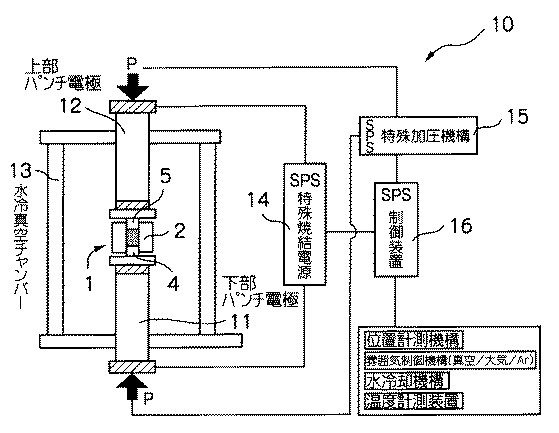
上記のように装入が完了した焼結型を図2において原理構成が示されているパルス通電加圧焼結装置としての放電プラズマ焼結機10にセットする。図2において、11は下部パンチ電極、12は上部パンチ電極、13は焼結領域を真空雰囲気にする水冷可能な真空チャンバ、14は下部及び上部パンチ電極11及び12に接続された焼結電源、15は下部パンチ電極11及び/又は上部パンチ電極12に加圧力を作用させる加圧機構、16は制御装置である。焼結電源が供給できる電力は、電圧が20V以下で、電流が、例えば1000〜30000Aである。下部パンチ電極11と上部パンチ電極12との間に焼結型1を挟み、真空チャンバ13内で、下記のような焼結条件で焼結する。なお、下記の焼結温度とは、焼結型の表面を非接触で測定して得た温度であ。
焼結温度 : 1600〜1900℃
加圧力 : 10〜100MPa
昇温速度 : 30〜150℃/分、
保持時間 : 0〜5分
焼結電圧 : 20V以下
焼結電流 : 2000〜8000A(直流パルス電流)
電流密度 : 70〜280A/cm2
焼結雰囲気 : 真空又は不活性ガス
【0020】
(実施例1)
原料粉末として、平均粒径が0.2μmで、BET法により測定した表面積が3.23m2/gの、下記表1に示す組成から成る市販の炭化タングステン焼結用原料粉末を、220g用意した。
【表1】
【0021】
上記原料に単体カーボンを0.13g(0.006重量%)添加しよく混ぜ合わせた。この単体カーボンは前記公報(2)で開示された添加カーボン量(0.1ないし0.3重量%)より明らかに少ない。
上記のようにカーボン量を厳密に調整した原料粉末を図1に示されるような焼結型に充填し、図2に示されるようの基本構成を有するパルス通電加圧焼結装置にセットし、真空雰囲気下で下記の焼結条件で焼結を行った。
焼結温度 : 1870℃
加圧力 : 30MPa
昇温速度 : 55℃/分、
保持時間 : 1分
焼結電圧 : 5.5V
焼結電流 : 6500A(直流パルス電流)
電流密度 : 230A/cm2
通電時間 : 35分
上記のように焼結して得られた炭化タングステン系バインダーレス超硬質材料を走査型電子顕微鏡及びX線マイクロアナライザ(EPMA)によって分析した結果は表5に示す通りであり、その機械的及び物理的特性は表6に示す通りである。
【0022】
(実施例2)
原料粉末として、平均粒径が0.2μmで、BET法により測定した表面積が3.30m2/gの、下記表1に示す組成から成る市販の炭化タングステン焼結用原料粉末を、55g用意した。
【表2】
【0023】
上記原料に単体カーボンを0.03g(0.05重量%)添加しよく混ぜ合わせた。この単体カーボンは前記公報(2)で開示された添加カーボン量(0.1ないし0.3重量%)より明らかに少ない。
上記のようにカーボン量を厳密に調整した原料粉末を図1に示されるような焼結型に充填し、図2に示されるようの基本構成を有するパルス通電加圧焼結装置にセットし、真空雰囲気下で下記の焼結条件で焼結を行った。
焼結温度 : 1850℃
加圧力 : 20MPa
昇温速度 : 60℃/分、
保持時間 : 2分
焼結電圧 : 4.8V
焼結電流 : 4000A(直流パルス電流)
電流密度 : 320A/cm2
通電時間 : 33分
上記のように焼結して得られた炭化タングステン系バインダーレス超硬質材料を走査型電子顕微鏡及びX線マイクロアナライザ(EPMA)によって分析した結果は表5に示す通りであり、その機械的及び物理的特性は表6に示す通りである。
【0024】
(実施例3)
原料粉末として、平均粒径が0.2μmで、BET法により測定した表面積が3.23m2/gの、下記表1に示す組成から成る市販の炭化タングステン焼結用原料粉末を、440g用意した。
【表3】
【0025】
上記原料に単体カーボンを0.27g(0.06重量%)添加しよく混ぜ合わせた。この単体カーボンは前記公報(2)で開示された添加カーボン量(0.1ないし0.3重量%)より明らかに少ない。
上記のようにカーボン量を厳密に調整した原料粉末を図1に示されるような焼結型に充填し、図2に示されるようの基本構成を有するパルス通電加圧焼結装置にセットし、真空雰囲気下で下記の条件で焼結を行った。
焼結温度 : 1750℃
加圧力 : 40MPa
昇温速度 : 50℃/分、
保持時間 : 5分
焼結電圧 : 5.2V
焼結電流 : 7800A(直流パルス電流)
電流密度 : 275A/cm2
通電時間 : 38分
上記のように焼結して得られた炭化タングステン系バインダーレス超硬質材料を走査型電子顕微鏡及びX線マイクロアナライザ(EPMA)によって分析した結果は表5に示す通りであり、その機械的及び物理的特性は表6に示す通りである。
【0026】
表5及び表6において、実施例4及び5による炭化タングステン系超硬質材料の機械的及び物理的性質のみを示し、実施例1ないし3に関する前記記載と同様の詳細な説明はここでは省略する。
(実施例6)
原料粉末として、平均粒径が0.2μmで、BET法により測定した表面積が3.35m2/gの、下記表1に示す組成から成る市販の炭化タングステン焼結原料粉末を、400g用意した。
【表4】
【0027】
上記原料に単体カーボンを0.20g(0.05重量%)添加しよく混ぜ合わせた。この単体カーボンは前記公報(2)で開示された添加カーボン量(0.1ないし0.3重量%)より明らかに少ない。
上記のようにカーボン量を厳密に調整した原料粉末を図1に示されるような焼結型に充填し、図2に示されるようの基本構成を有するパルス通電加圧焼結装置にセットし、真空雰囲気下で下記の条件で焼結を行った。
焼結温度 : 1630℃
加圧力 : 50MPa
昇温速度 : 55℃/分、
保持時間 : 5分
焼結電圧 : 4.2V
焼結電流 : 10000A(直流パルス電流)
電流密度 : 200A/cm2
通電時間 : 35分
上記のように焼結して得られた炭化タングステン系バインダーレス超硬質材料を走査型電子顕微鏡及びX線マイクロアナライザ(EPMA)によって分析した結果は表5に示す通りであり、その機械的及び物理的特性は表6に示す通りである。
【0028】
【表5】
本発明によれば、次にような効果を奏することが可能委である。
(イ)微細組織構造で純度が高く、硬質で耐摩耗性、耐腐蝕性、耐熱性に優れた炭化タングステン系の超硬質材料を得ることができる。
(ロ)エッチピットが生じず、優れた鏡面仕上げが可能で、ガラスレンズなど高温成形に適した高精度の金型材料を得ることができる。
【図面の簡単な説明】
【図1】焼結型の例を示す断面図である。
【図2】パルス通電加圧焼結装置の基本構成を説明する図である。[0001]
[Industrial applications]
BACKGROUND OF THE
[Prior art]
[0002]
Various tungsten carbide-based super-hard materials having high hardness and abrasion resistance and corrosion resistance have been conventionally developed and proposed. Among such tungsten carbide-based super-hard materials, a so-called binder-less tungsten carbide-based hard sintered body having almost no binder such as cobalt (Co) is disclosed in, for example, Japanese Patent Application Laid-Open No. HEI 3-115541. 1)), there are known ones as shown in Japanese Patent Application Laid-Open No. 8-208335 (JP-A-208335). Here, "binderless" refers to not only a case where the binder does not contain any binding metal element such as Co and Ni, but also a case where the content of such an element is less than the minimum amount that can function as a binder. For example, it is meant to include 1% by weight or less or as an unavoidable impurity.
[0003]
Among the known tungsten carbide-based hard sintered bodies, the sintered body described in the above publication (1) is sintered by a normal pressure sintering method performed in a vacuum atmosphere. Due to its long length, the tungsten carbide powder grows during the sintering process, and the grains of the sintered body become large, which not only has a problem that it is not possible to obtain a sintered body having a high microstructure and high hardness. , Which contains tantalum carbide, titanium carbide or titanium nitride in addition to tungsten carbide and unavoidable impurities, and is different from the tungsten carbide super-hard material intended by the present invention. Further, the sintered body described in the above publication (2) is a sintered body composed of tungsten carbide and unavoidable impurities sintered using a pulse current pressure sintering method, but has an average particle size of 0.3 μm or more. The technical idea of controlling the amount of free carbon in the starting raw material powder and the amount of total (total) carbon in the sintered body is not disclosed in the above publication (2), and the ultra-hard material intended by the present invention is not disclosed. Cannot provide.
[Problems to be solved by the invention]
By the way, ultrafine binderless tungsten carbide (WC) powder having an average particle size of 0.5 μm or less has a large specific surface area and a liquid phase at a relatively low sintering temperature such as cobalt (Co) and nickel (Ni). Since there is no metal binder component that forms and forms a binder phase, it is one of the so-called difficult sintering materials, which is extremely difficult to produce a dense and sound sintered body without micropores.
[0004]
Unlike conventional sintering methods, pulse current pressure sintering methods (including discharge plasma sintering, discharge sintering, plasma activated sintering, etc.) represented by spark plasma sintering start in principle Diffusion on the particle surface of the raw material powder is dominant, and the appropriate selection of the particle surface properties and composition of the raw material powder, which is suitable for this sintering mechanism, is an important factor in obtaining a high-quality sintered body. ing.
Due to the manufacturing process, commercially available binderless tungsten carbide powder contains WC, 1% by weight or less of chromium (Cr), oxygen (O), and 0.05 to 0.09% of free carbon (C). , Al, Ca, Cu, Fe, Mg, Mn, Mo, Ni, Si, Sn and the like as various unavoidable impurities in the ppm order.
[0005]
The present inventor has conducted intensive studies on a method for producing a so-called binderless tungsten carbide-based ultra-hard material using such commercially available raw material powder, and as a result, has obtained a dense, sound, and high-quality ultra-hard material. It has been found that a combination of adjusting the total amount of carbon (total carbon amount) with specific optimum sintering conditions is extremely important.
For example, in the case of a conventional WC-Co alloy, a sound phase region in which an η layer (Co 3 W 3 C) is not generated and free carbon does not remain can be appropriately adjusted by adding a Co amount of 5 to 25% by weight. It is conventionally known that the carbon content (C) has a width of about 5.7 to 6.2% by weight and a maximum of 3.5% by weight. The lower the Co alloy side, the narrower the allowable value of the amount of C. For example, when the amount of Co is 5% by weight, the allowable range is about 6.1 to 6.2% by weight, which is only 0.1%. Furthermore, when the Co content is 0%, the healthy phase region in which no free carbon is generated and no W 2 C phase is generated is considered to be in the range of 6.13 to 6.2%.
[0006]
The stoichiometric composition of WC has a carbon content of 6.13%, but it is thought to change with the change in lattice constant.
According to U.S. Pat. No. 5,681,783, a binderless WC sintered body produced by hot pressing and normal pressure sintering and containing 0.2% by weight or less of cobalt has a density of 97%. , And 98%, the Vickers hardness is 2400 kg / mm 2 or more and 2500 kg / mm 2 or more, respectively, and the total carbon amount is 5.0 to 6.05% by weight.
Conventionally known tungsten carbide-based ultra-hard materials are not always satisfactory from the viewpoint of WC high-purity materials, and further improvements have been desired.
[0007]
An object of the present invention is a so-called binderless tungsten carbide super-hard material comprising only tungsten carbide (WC) and unavoidable impurities, having high hardness, high abrasion resistance and corrosion resistance and high density and high strength. And a method for producing the same.
Another object of the present invention is to use a commercially available binderless tungsten carbide powder to provide a high-density and high-strength so-called binderless having high hardness and abrasion and corrosion resistance. An object of the present invention is to provide a tungsten carbide super-hard material and a method for producing the same.
Another object of the present invention is to provide a high-density, high-hardness, wear- and corrosion-resistant microstructure with only WC and unavoidable impurities, no W 2 C, no free carbon. It is an object of the present invention to provide a so-called binderless tungsten carbide super-hard material having high strength and a method for producing the same.
SUMMARY OF THE INVENTION An object of the present invention is to provide a high-density structure that is composed of only WC and unavoidable impurities, does not contain W 2 C, free carbon and binder elements, has a high microstructure and high hardness, and has wear resistance and corrosion resistance. It is an object of the present invention to provide a WC single-phase, high-purity binderless tungsten carbide-based ultra-hard material having high strength and a method for producing the same.
[0008]
[Means for Solving the Problems]
One invention of the present application is a tungsten carbide-based binderless super-hard material comprising tungsten carbide (WC) and unavoidable impurities, and sintered using a raw material powder having an average particle diameter of preferably less than 0.3 μm. The theoretical density ratio of the sintered body is 99.0% or more, the total content of carbon (C) is preferably in the range of more than 6.20% by weight and 6.45% by weight or less, and the binder and It is characterized in that it is sintered by a pulse current pressure sintering method typified by a spark plasma sintering method, which does not substantially contain 2 tungsten carbide (W 2 C).
In the above invention, the average particle size of the raw material powder is more preferably less than 0.3 μm and 0.1 μm or more, and the total content of carbon (C) is more preferably more than 6.25% by weight. It may be in the range of 40% by weight.
Here, “contains substantially no binder” means that an element having a function as a binder, for example, cobalt (Co), nickel (Ni), or the like is not contained in an amount capable of exerting the function. Refers to the case where it is contained as inevitable impurities or the case where it is less than 1% by weight. The reason why W 2 C is not substantially contained is that W 2 C may be contained as inevitable impurities. Although the theoretical density of tungsten carbide has a range of 15.5 to 15.7, the present invention adopts the theoretical values of 15.55 (Examples 1 to 5) and 15.45 (Example 6). Determine the density ratio. This is because the solid solution zone of carbon of tungsten carbide has a width, and the sintered bodies of Examples 1 to 5 of the present invention have a high carbon solid solution zone. Since the sintered body contains Co, it was set to 15.45.
[0009]
Normally, the total carbon content of a commercially available binderless carbide WC sintered body is about 6.0 to 6.2% by weight, but a dense and sound WC single-phase sintered body (sintered by a discharge plasma sintering method) In order to obtain free carbon and W 2 C), it is 6.20 to 6.45%, which is large from the above-mentioned allowable value range of 0.1%, and is high quality by increasing the total carbon amount. Solidification is obtained. Compared to the contents of the above-mentioned U.S. patents, the maximum value is a significant difference of 1.45%.
[0010]
Adjustment of this small amount of carbon is achieved by spark plasma sintering in which rapid sintering is performed in a graphite mold in a short period of time, and in the course of sintering, the release mold applied to the inner wall surface of the graphite (carbon) mold and / or the inner wall surface of the mold Baking while reacting the WC in the WC raw material powder with a trace amount of free carbon, chromium, adsorbed oxygen contained in the WC raw material powder, and a release agent appropriately used as necessary. In order to progress the sintering, pulse current sintering conditions (current time, pulse width, frequency, pressing force, temperature, cooling method, mold structure, mold material, etc.) are necessary to obtain a WC single phase sintered body. Is an important factor that changes depending on the suitability of
[0011]
The spark plasma sintering method differs from conventional processes because it causes rapid heating at grain boundaries due to on / off pulse conduction, thermal diffusion effects such as discharge plasma, discharge impact pressure, and Joule heat, and electric field diffusion effects due to electromagnetic fields. The WC particles are bound together by the sintering mechanism. By properly selecting the sintering conditions, a sound WC single-phase sintered body having a density of 99.0% or more and having no micropores can be stably obtained with high reproducibility.
[0012]
During sintering, if the amount of carbon inside the starting material powder is too small, reaction sintering results in the generation of W 2 C (tungsten carbide 1), which is a source of physical property deterioration. If the amount of carbon is excessive, free carbon remains and causes deterioration of physical properties. Therefore, as a result of conducting research by properly controlling the amount of free carbon in the starting raw material powder while promoting reaction sintering and considering the amount of gas that disappears as adsorbed gas, CO, and CO 2 gas on the particle surface, the final sintered body stage was obtained. Has found a method in which no W 2 C is generated and no free carbon is generated. The proper amount of free carbon in the powder before sintering under the main sintering conditions is preferably in the range of 0.14 to 0.18% by weight. If the amount of free carbon in the state of a commercially available raw material powder is 0.05 to 0.09% by weight, the amount is insufficient. Therefore, it has been found that it is necessary to finally set the raw material powder composition so that the total carbon amount of the WC sintered body becomes 6.2 to 6.45% by weight.
[0013]
In the above tungsten carbide-based binderless ultra-hard material, the average particle diameter of the particles is preferably smaller than 0.3 μm. This is because, in order to obtain a WC single-phase sintered body having an ultrafine structure structure by performing sintering, it is necessary to select a range that can be obtained as a commercial product, that is, a finer grain size that is advantageous in terms of cost. Further, the reason why it is more preferably smaller than 0.3 μm and larger than 0.1 μm is because the price of the powder material smaller than 0.1 μm becomes extremely expensive and is not suitable for practical use in terms of cost. The reason that the total content of carbon is preferably in the range of more than 6.20% by weight and not more than 6.45% by weight is that, when the total content is not more than 6.20% by weight, W 2 C is generated due to insufficient carbon amount. This is because it does not become a single phase and cannot be uniformly and stably sintered without variation. The reason why the content is set to 6.45% by weight or less is that if the total content exceeds 6.45% by weight, This causes free carbon to be generated, which adversely affects the properties of the hard material. Furthermore, the reason why the theoretical density ratio is set to 99.0% or more is that if the theoretical density ratio is less than that value, the hardness decreases as a sintered body, micropores remain, and a good hard material is not obtained. This is because sintering cannot be performed uniformly and stably without variation. Furthermore, the reason that the binder and W 2 C are not substantially contained is that when the content thereof is increased, mechanical properties such as hardness, toughness, bending strength and the like are reduced, and properties as a hard material are deteriorated. It is.
[0014]
In the tungsten carbide-based binderless ultra-hard material, the content of the binder may be zero (including an amount that can be regarded as zero), and the content of W 2 C may be zero.
By doing so, the purity of the tungsten carbide based super hard material can be increased, and the hardness, corrosion resistance, abrasion resistance, etc. can be improved. This is because even when applied to a lens mold for a spherical lens, no etch pits or the like are generated, and a molded surface having a very high quality mirror surface having corrosion resistance, abrasion resistance and heat resistance can be obtained.
Further, in the tungsten carbide-based binder-less ultra-hard material, free carbon may not be substantially contained. By doing so, it is possible to increase the purity of the tungsten carbide super hard material, increase the purity of the tungsten carbide super hard material in the same manner as described above, and improve the hardness, corrosion resistance, wear resistance, etc. Because.
[0015]
Another invention of the present application is directed to a method for producing a tungsten carbide-based binderless ultra-hard material comprising tungsten carbide (WC) and unavoidable impurities,
Prepare raw material powder consisting of tungsten carbide powder and unavoidable impurities, having an average particle size of less than 0.3 μm, and substantially containing no binder,
In the raw material powder, the amount of carbon in the raw material powder is adjusted so that the total content of carbon in the hard material after sintering is in the range of more than 6.20% by weight and 6.45% by weight or less,
Fill the desired amount of the raw material powder into a graphite sintering mold,
The method is characterized in that the sintering mold is placed in a vacuum or an inert atmosphere and is sintered under desired pulse current pressure sintering conditions.
[0016]
The reason that the average particle diameter of the particles is preferably less than 0.3 μm, more preferably less than 0.3 μm and 0.1 μm or more, the total content of carbon is preferably more than 6.20% by weight and 6.45%. The reason for adjusting the amount of carbon in the powder so as to be within the range of not more than% by weight is the same as the reason of the one invention. In addition, the reason why the sintering mold for sintering is made of graphite is that at present, there is no other sintered mold material that is advantageous in terms of cost, has electrical conductivity, and can withstand high temperatures. Furthermore, the sintering by the pulse current pressure sintering method is because the sintering time is longer in other conventional sintering methods, and mechanical properties such as hardness, bending strength, and toughness are increased due to grain growth and crystal coarsening. This is because the mechanical properties deteriorate. In addition, solid phase diffusion sintering in a short time, such as rapid heating at grain boundaries, thermal diffusion effects such as discharge plasma, discharge impact pressure and Joule heat, and electric field diffusion effect by electromagnetic field, etc. The effect of obtaining a single-phase WC having a total carbon amount different from the stoichiometric composition by causing a phenomenon such as changing the densification rate and diffusion rate and changing the lattice constant of WC is another conventional sintering method. Because it cannot be expected by law.
[0017]
In the above method for producing a tungsten carbide-based binderless ultra-hard material, the amount (% by weight) of the carbon to be added may be determined in consideration of at least one of the surface area and volume of a sintered body formed by sintering. Good. By doing so, the amount of carbon transferred from the graphite sintering mold to the sintered body can be predicted, and the control of the total carbon content can be accurately performed.
In the above method for producing a tungsten carbide-based binder-less super-hard material, the sintering conditions of the pulsed current pressure sintering are preferably set to a sintering temperature of 1600 to 1900 ° C., a pressure of 10 to 100 MPa, and a heating rate of 30 150150 ° C./min, holding time 0-5 minutes, more preferably sintering temperature 1600-1800 ° C., pressure 30-50 MPa, heating rate 30-70 ° C./min, holding time 0-3 minutes It may be.
Further, in addition to the above sintering conditions, conditions such as a sintering voltage of 20 V or less, a sintering current of 2000 to 8000 A (DC pulse current), and a current density of 70 to 280 A / cm 2 may be added.
[0018]
【Example】
Hereinafter, examples of the present invention will be described.
When manufacturing a tungsten carbide binderless super-hard material comprising tungsten carbide (WC) and unavoidable impurities according to the present application, as described above, first, a raw material powder comprising tungsten carbide powder and unavoidable impurities is purchased, for example, a commercially available material. Prepare it. In this case, the average particle diameter of the particles of the raw material powder is set to 0 in consideration of making the average particle diameter of the particles of the sintered body (ultra-hard material) after sintering into an ultrafine structure of 1.0 μm or less. 0.3 μm or less. The binder is not substantially contained in the raw material powder. The raw material powder thus prepared is mixed with simple carbon so that the total content of carbon in the superhard material after sintering is in the range of more than 6.20% by weight and 6.45% by weight or less. In addition, the amount of carbon in the raw material powder is adjusted.
[0019]
The raw material powder p is filled in a desired amount, for example, in a
The sintering mold, which has been charged as described above, is set in a discharge
Sintering temperature: 1600-1900 ° C
Pressure: 10-100MPa
Heating rate: 30 to 150 ° C / min,
Holding time: 0 to 5 minutes Sintering voltage: 20 V or less Sintering current: 2000 to 8000 A (DC pulse current)
Current density: 70 to 280 A / cm 2
Sintering atmosphere: vacuum or inert gas
(Example 1)
As raw material powder, 220 g of commercially available raw material powder for tungsten carbide sintering having an average particle diameter of 0.2 μm and a surface area measured by a BET method of 3.23 m 2 / g and having a composition shown in Table 1 below was prepared. .
[Table 1]
[0021]
0.13 g (0.006% by weight) of simple carbon was added to the above raw materials and mixed well. This simple carbon is clearly smaller than the added carbon amount (0.1 to 0.3% by weight) disclosed in the above-mentioned publication (2).
The raw material powder whose carbon amount is strictly adjusted as described above is filled in a sintering mold as shown in FIG. 1 and set in a pulse current pressure sintering apparatus having a basic configuration as shown in FIG. Sintering was performed under the following sintering conditions in a vacuum atmosphere.
Sintering temperature: 1870 ° C
Pressure: 30MPa
Heating rate: 55 ° C / min.
Holding time: 1 minute Sintering voltage: 5.5V
Sintering current: 6500A (DC pulse current)
Current density: 230 A / cm 2
Energizing time: 35 minutes The results of analyzing the tungsten carbide based binderless superhard material obtained by sintering as described above with a scanning electron microscope and an X-ray microanalyzer (EPMA) are as shown in Table 5, Its mechanical and physical properties are as shown in Table 6.
[0022]
(Example 2)
As a raw material powder, 55 g of a commercially available raw material powder for tungsten carbide sintering having an average particle diameter of 0.2 μm and a surface area measured by a BET method of 3.30 m 2 / g and having a composition shown in Table 1 below was prepared. .
[Table 2]
[0023]
0.03 g (0.05% by weight) of simple carbon was added to the above raw materials and mixed well. This simple carbon is clearly smaller than the added carbon amount (0.1 to 0.3% by weight) disclosed in the above-mentioned publication (2).
The raw material powder whose carbon amount is strictly adjusted as described above is filled in a sintering mold as shown in FIG. 1 and set in a pulse current pressure sintering apparatus having a basic configuration as shown in FIG. Sintering was performed under the following sintering conditions in a vacuum atmosphere.
Sintering temperature: 1850 ° C
Pressure: 20MPa
Heating rate: 60 ° C / min,
Holding time: 2 minutes Sintering voltage: 4.8 V
Sintering current: 4000A (DC pulse current)
Current density: 320 A / cm 2
Energization time: 33 minutes The results of analyzing the tungsten carbide-based binderless superhard material obtained by sintering as described above with a scanning electron microscope and an X-ray microanalyzer (EPMA) are as shown in Table 5, Its mechanical and physical properties are as shown in Table 6.
[0024]
(Example 3)
As the raw material powder, 440 g of a commercially available raw material powder for sintering tungsten carbide having an average particle size of 0.2 μm and a surface area measured by a BET method of 3.23 m 2 / g and having a composition shown in Table 1 below was prepared. .
[Table 3]
[0025]
To the above raw materials, 0.27 g (0.06% by weight) of simple carbon was added and mixed well. This simple carbon is clearly smaller than the added carbon amount (0.1 to 0.3% by weight) disclosed in the above-mentioned publication (2).
The raw material powder whose carbon amount is strictly adjusted as described above is filled in a sintering mold as shown in FIG. 1 and set in a pulse current pressure sintering apparatus having a basic configuration as shown in FIG. Sintering was performed under the following conditions in a vacuum atmosphere.
Sintering temperature: 1750 ° C
Pressure: 40MPa
Heating rate: 50 ° C / min,
Holding time: 5 minutes Sintering voltage: 5.2V
Sintering current: 7800A (DC pulse current)
Current density: 275 A / cm 2
Energization time: 38 minutes The results of analyzing the tungsten carbide-based binderless superhard material obtained by sintering as described above with a scanning electron microscope and an X-ray microanalyzer (EPMA) are as shown in Table 5, Its mechanical and physical properties are as shown in Table 6.
[0026]
In Tables 5 and 6, only the mechanical and physical properties of the tungsten carbide based ultra-hard materials according to Examples 4 and 5 are shown, and detailed descriptions similar to those described above for Examples 1 to 3 are omitted here.
(Example 6)
As a raw material powder, 400 g of a commercially available tungsten carbide sintered raw material powder having an average particle size of 0.2 μm and a surface area measured by a BET method of 3.35 m 2 / g and having a composition shown in Table 1 below was prepared.
[Table 4]
[0027]
To the above raw materials, 0.20 g (0.05% by weight) of simple carbon was added and mixed well. This simple carbon is clearly smaller than the added carbon amount (0.1 to 0.3% by weight) disclosed in the above-mentioned publication (2).
The raw material powder whose carbon amount was strictly adjusted as described above was filled in a sintering mold as shown in FIG. 1, and set in a pulse current pressure sintering apparatus having a basic structure as shown in FIG. Sintering was performed under the following conditions in a vacuum atmosphere.
Sintering temperature: 1630 ° C
Pressing force: 50MPa
Heating rate: 55 ° C / min.
Holding time: 5 minutes Sintering voltage: 4.2V
Sintering current: 10000A (DC pulse current)
Current density: 200 A / cm 2
Energizing time: 35 minutes The results of analyzing the tungsten carbide-based binderless superhard material obtained by sintering as described above with a scanning electron microscope and an X-ray microanalyzer (EPMA) are as shown in Table 5, Its mechanical and physical properties are as shown in Table 6.
[0028]
[Table 5]
According to the present invention, the following effects can be obtained.
(A) It is possible to obtain a tungsten carbide super-hard material having a fine structure, high purity, and being hard and excellent in wear resistance, corrosion resistance and heat resistance.
(B) It is possible to obtain a high-precision mold material, such as a glass lens, which is suitable for high-temperature molding and which can produce excellent mirror-finish without generating etch pits.
[Brief description of the drawings]
FIG. 1 is a sectional view showing an example of a sintering die.
FIG. 2 is a diagram illustrating a basic configuration of a pulse current pressure sintering apparatus.
Claims (7)
炭化タングステン粉末及び不可避不純物から成り、平均粒径が0.3μm未満であり、バインダーを実質的に含まない原料粉末を用意し、
前記原料粉末に、焼結後の硬質材料中のカーボンの総含有量が6.20重量%を超え6.45重量%以下の範囲内となるように原料粉末中のカーボン量を調整し、
前記原料粉末を所望量グラファイト製の焼結型内に充填し、
前記焼結型を真空又は不活性雰囲気内に置いて、所望のパルス通電加圧焼結条件で焼結する、
ことを特徴とする超硬質材料の製造方法。In a method for producing a tungsten carbide-based ultra-hard material comprising tungsten carbide (WC) and unavoidable impurities,
Prepare raw material powder consisting of tungsten carbide powder and unavoidable impurities, having an average particle size of less than 0.3 μm, and substantially containing no binder,
In the raw material powder, the amount of carbon in the raw material powder is adjusted so that the total content of carbon in the hard material after sintering is in the range of more than 6.20% by weight and 6.45% by weight or less,
Fill the desired amount of the raw material powder into a graphite sintering mold,
Place the sintering mold in a vacuum or inert atmosphere, and sinter under the desired pulsed current pressure sintering conditions,
A method for producing a super-hard material, characterized in that:
前記添加するカーボンの量(重量%)を、焼結により形成される焼結体の表面積及び容積の少なくとも一方を考慮して決定することを特徴とする炭化タングステン系超硬質材料の製造方法。The method for producing a tungsten carbide-based binderless super-hard material according to claim 5,
A method for producing a tungsten carbide-based ultra-hard material, wherein the amount (% by weight) of the carbon to be added is determined in consideration of at least one of the surface area and the volume of a sintered body formed by sintering.
前記パルス通電加圧焼結の焼結条件を、焼結温度1600℃〜1900℃、加圧力10〜100MPa、昇温速度30℃/分〜150℃/分、保持時間0〜5分とすることを特徴とする炭化タングステン系超硬質材料の製造方法。The method for producing a tungsten carbide-based binderless super-hard material according to claim 5 or 6,
The sintering conditions of the pulse current pressure sintering are as follows: sintering temperature 1600 ° C. to 1900 ° C., pressure 10 to 100 MPa, heating rate 30 ° C./min to 150 ° C./min, holding time 0 to 5 minutes. A method for producing a tungsten carbide-based super-hard material, characterized by comprising:
Priority Applications (3)
| Application Number | Priority Date | Filing Date | Title |
|---|---|---|---|
| JP2002252661A JP3935029B2 (en) | 2002-08-30 | 2002-08-30 | Tungsten carbide ultra-hard material and method for producing the same |
| KR1020020084049A KR100763287B1 (en) | 2001-12-26 | 2002-12-26 | Tungsten carbide-based super hard material, its manufacturing method and surface forming mold using the material and manufacturing method thereof |
| KR1020070026466A KR100787016B1 (en) | 2001-12-26 | 2007-03-19 | Tungsten carbide-based ultra-hard material, producing method thereof, molding mold for molding surfaces using said material, and producing method of said mold |
Applications Claiming Priority (1)
| Application Number | Priority Date | Filing Date | Title |
|---|---|---|---|
| JP2002252661A JP3935029B2 (en) | 2002-08-30 | 2002-08-30 | Tungsten carbide ultra-hard material and method for producing the same |
Publications (2)
| Publication Number | Publication Date |
|---|---|
| JP2004091241A true JP2004091241A (en) | 2004-03-25 |
| JP3935029B2 JP3935029B2 (en) | 2007-06-20 |
Family
ID=32058875
Family Applications (1)
| Application Number | Title | Priority Date | Filing Date |
|---|---|---|---|
| JP2002252661A Expired - Lifetime JP3935029B2 (en) | 2001-12-26 | 2002-08-30 | Tungsten carbide ultra-hard material and method for producing the same |
Country Status (1)
| Country | Link |
|---|---|
| JP (1) | JP3935029B2 (en) |
Cited By (9)
| Publication number | Priority date | Publication date | Assignee | Title |
|---|---|---|---|---|
| JP2005343749A (en) * | 2004-06-03 | 2005-12-15 | Shinko Electric Ind Co Ltd | Cemented carbide and method for producing the same |
| JP2015525188A (en) * | 2012-05-29 | 2015-09-03 | エレメント、シックス、ゲゼルシャフト、ミット、ベシュレンクテル、ハフツングElement Six Gmbh | Polycrystalline material, body including the same, tool including the same, and method of manufacturing the same |
| EP3054029A4 (en) * | 2014-03-26 | 2017-11-08 | JX Nippon Mining & Metals Corporation | Sputtering target comprising tungsten carbide or titanium carbide |
| WO2018003877A1 (en) * | 2016-06-30 | 2018-01-04 | 三菱マテリアル株式会社 | Super hard sintered body |
| WO2018164118A1 (en) * | 2017-03-07 | 2018-09-13 | 三井金属鉱業株式会社 | Paste composition, carbide sintered body, method for producing same, and refractory member |
| CN109692955A (en) * | 2019-03-04 | 2019-04-30 | 郑州大学 | A kind of pure WC hard alloy preparation method and pure WC hard alloy |
| WO2019159851A1 (en) * | 2018-02-13 | 2019-08-22 | 三井金属鉱業株式会社 | Metal carbide sintered body, and heat-resistant member comprising same for silicon carbide semiconductor production device |
| CN115925422A (en) * | 2021-08-19 | 2023-04-07 | 自贡金成硬质合金有限公司 | Preparation method of binderless tungsten carbide target |
| US20240186127A1 (en) * | 2022-06-23 | 2024-06-06 | Intel Corporation | Sputter targets for self-doped source and drain contacts |
-
2002
- 2002-08-30 JP JP2002252661A patent/JP3935029B2/en not_active Expired - Lifetime
Cited By (15)
| Publication number | Priority date | Publication date | Assignee | Title |
|---|---|---|---|---|
| JP2005343749A (en) * | 2004-06-03 | 2005-12-15 | Shinko Electric Ind Co Ltd | Cemented carbide and method for producing the same |
| JP2015525188A (en) * | 2012-05-29 | 2015-09-03 | エレメント、シックス、ゲゼルシャフト、ミット、ベシュレンクテル、ハフツングElement Six Gmbh | Polycrystalline material, body including the same, tool including the same, and method of manufacturing the same |
| EP3054029A4 (en) * | 2014-03-26 | 2017-11-08 | JX Nippon Mining & Metals Corporation | Sputtering target comprising tungsten carbide or titanium carbide |
| JPWO2018003877A1 (en) * | 2016-06-30 | 2019-08-08 | 三菱マテリアル株式会社 | Super hard sintered body |
| WO2018003877A1 (en) * | 2016-06-30 | 2018-01-04 | 三菱マテリアル株式会社 | Super hard sintered body |
| CN108884530A (en) * | 2016-06-30 | 2018-11-23 | 三菱综合材料株式会社 | hard sintered body |
| JPWO2018164118A1 (en) * | 2017-03-07 | 2020-01-09 | 三井金属鉱業株式会社 | Paste composition, sintered carbide, method for producing the same, and refractory member |
| WO2018164118A1 (en) * | 2017-03-07 | 2018-09-13 | 三井金属鉱業株式会社 | Paste composition, carbide sintered body, method for producing same, and refractory member |
| WO2019159851A1 (en) * | 2018-02-13 | 2019-08-22 | 三井金属鉱業株式会社 | Metal carbide sintered body, and heat-resistant member comprising same for silicon carbide semiconductor production device |
| JPWO2019159851A1 (en) * | 2018-02-13 | 2021-01-28 | 三井金属鉱業株式会社 | Metal carbide sintered body and heat-resistant member for silicon carbide semiconductor manufacturing equipment provided with it |
| JP7178400B2 (en) | 2018-02-13 | 2022-11-25 | 三井金属鉱業株式会社 | Metal carbide sintered body and heat-resistant member for silicon carbide semiconductor manufacturing equipment provided with the same |
| US12024435B2 (en) | 2018-02-13 | 2024-07-02 | Mitsui Mining & Smelting Co., Ltd. | Sintered metal carbide and heat-resistant member for silicon carbide semiconductor manufacturing device comprising same |
| CN109692955A (en) * | 2019-03-04 | 2019-04-30 | 郑州大学 | A kind of pure WC hard alloy preparation method and pure WC hard alloy |
| CN115925422A (en) * | 2021-08-19 | 2023-04-07 | 自贡金成硬质合金有限公司 | Preparation method of binderless tungsten carbide target |
| US20240186127A1 (en) * | 2022-06-23 | 2024-06-06 | Intel Corporation | Sputter targets for self-doped source and drain contacts |
Also Published As
| Publication number | Publication date |
|---|---|
| JP3935029B2 (en) | 2007-06-20 |
Similar Documents
| Publication | Publication Date | Title |
|---|---|---|
| US8377339B2 (en) | Electrode for electric discharge surface treatment, method of electric discharge surface treatment, and apparatus for electric discharge surface treatment | |
| Kim et al. | Rapid sintering of ultrafine WC–Ni cermets | |
| US4097275A (en) | Cemented carbide metal alloy containing auxiliary metal, and process for its manufacture | |
| Kim et al. | Rapid sintering process and mechanical properties of binderless ultra fine tungsten carbide | |
| Huang et al. | Microstructure and mechanical properties of NbC-matrix hardmetals with secondary carbide addition and different metal binders | |
| WO1993005191A1 (en) | Hard alloy and production thereof | |
| CN103451648A (en) | A kind of laser cladding TiB2-Ni base cermet coating and preparation method thereof | |
| JP4170340B2 (en) | Discharge surface treatment method | |
| EP1420076A1 (en) | Hard alloy and W-based composite carbide powder used as starting material | |
| CN1322165C (en) | Electric discharge surface treating electrode and production method thereof and electric discharge surface treating method | |
| JP2004091241A (en) | Tungsten carbide type super-hard material and manufacturing method thereof | |
| KR20190134242A (en) | COMPOSITE MATERIAL FOR WC-Co BASED CARBIDE TOOL AND PREPARATION METHOD THEREOF | |
| CN100374599C (en) | Treatment method of tungsten carbide particles | |
| JP6805454B2 (en) | Cemented carbide and its manufacturing method, and cemented carbide tools | |
| JP2010208942A (en) | High strength-high wear resistant diamond sintered body and method of producing the same | |
| JPWO2020166380A1 (en) | Sputtering target material | |
| KR102477415B1 (en) | Multi-nano-phase separation-based high-entropy refractory metal-oxide composite and manufacturing method thereof | |
| Jiang et al. | Parameters investigation during simultaneous synthesis and densification WC–Ni composites by field-activated combustion | |
| JP5207922B2 (en) | Binderless powder for surface hardening | |
| JP2001261440A (en) | Oxidation-resistant hafnium carbide sintered body, oxidation-resistant hafnium carbide-LaB6 sintered body, their production method, and plasma generating electrode using the same | |
| JP4450812B2 (en) | Discharge surface treatment method | |
| JP3421479B2 (en) | Manufacturing method of functionally graded material | |
| JP2001198710A (en) | Cemented carbide extruded material, manufacturing method and cutting tool | |
| JP6943378B2 (en) | Conductive tip member and its manufacturing method | |
| Altas et al. | Fabrication of cermets by mechanical alloying |
Legal Events
| Date | Code | Title | Description |
|---|---|---|---|
| A621 | Written request for application examination |
Free format text: JAPANESE INTERMEDIATE CODE: A621 Effective date: 20040609 |
|
| A711 | Notification of change in applicant |
Free format text: JAPANESE INTERMEDIATE CODE: A712 Effective date: 20050810 |
|
| A977 | Report on retrieval |
Free format text: JAPANESE INTERMEDIATE CODE: A971007 Effective date: 20060908 |
|
| A131 | Notification of reasons for refusal |
Free format text: JAPANESE INTERMEDIATE CODE: A131 Effective date: 20061114 |
|
| A521 | Written amendment |
Free format text: JAPANESE INTERMEDIATE CODE: A523 Effective date: 20070115 |
|
| TRDD | Decision of grant or rejection written | ||
| A01 | Written decision to grant a patent or to grant a registration (utility model) |
Free format text: JAPANESE INTERMEDIATE CODE: A01 Effective date: 20070216 |
|
| A61 | First payment of annual fees (during grant procedure) |
Free format text: JAPANESE INTERMEDIATE CODE: A61 Effective date: 20070316 |
|
| R150 | Certificate of patent or registration of utility model |
Ref document number: 3935029 Country of ref document: JP Free format text: JAPANESE INTERMEDIATE CODE: R150 Free format text: JAPANESE INTERMEDIATE CODE: R150 |
|
| FPAY | Renewal fee payment (event date is renewal date of database) |
Free format text: PAYMENT UNTIL: 20110330 Year of fee payment: 4 |
|
| R250 | Receipt of annual fees |
Free format text: JAPANESE INTERMEDIATE CODE: R250 |
|
| FPAY | Renewal fee payment (event date is renewal date of database) |
Free format text: PAYMENT UNTIL: 20110330 Year of fee payment: 4 |
|
| FPAY | Renewal fee payment (event date is renewal date of database) |
Free format text: PAYMENT UNTIL: 20120330 Year of fee payment: 5 |
|
| R250 | Receipt of annual fees |
Free format text: JAPANESE INTERMEDIATE CODE: R250 |
|
| FPAY | Renewal fee payment (event date is renewal date of database) |
Free format text: PAYMENT UNTIL: 20120330 Year of fee payment: 5 |
|
| S111 | Request for change of ownership or part of ownership |
Free format text: JAPANESE INTERMEDIATE CODE: R313113 |
|
| R350 | Written notification of registration of transfer |
Free format text: JAPANESE INTERMEDIATE CODE: R350 |
|
| FPAY | Renewal fee payment (event date is renewal date of database) |
Free format text: PAYMENT UNTIL: 20120330 Year of fee payment: 5 |
|
| FPAY | Renewal fee payment (event date is renewal date of database) |
Free format text: PAYMENT UNTIL: 20130330 Year of fee payment: 6 |
|
| R250 | Receipt of annual fees |
Free format text: JAPANESE INTERMEDIATE CODE: R250 |
|
| FPAY | Renewal fee payment (event date is renewal date of database) |
Free format text: PAYMENT UNTIL: 20130330 Year of fee payment: 6 |
|
| FPAY | Renewal fee payment (event date is renewal date of database) |
Free format text: PAYMENT UNTIL: 20140330 Year of fee payment: 7 |
|
| R250 | Receipt of annual fees |
Free format text: JAPANESE INTERMEDIATE CODE: R250 |
|
| R250 | Receipt of annual fees |
Free format text: JAPANESE INTERMEDIATE CODE: R250 |
|
| R250 | Receipt of annual fees |
Free format text: JAPANESE INTERMEDIATE CODE: R250 |
|
| R250 | Receipt of annual fees |
Free format text: JAPANESE INTERMEDIATE CODE: R250 |
|
| R250 | Receipt of annual fees |
Free format text: JAPANESE INTERMEDIATE CODE: R250 |
|
| R250 | Receipt of annual fees |
Free format text: JAPANESE INTERMEDIATE CODE: R250 |
|
| R250 | Receipt of annual fees |
Free format text: JAPANESE INTERMEDIATE CODE: R250 |
|
| R250 | Receipt of annual fees |
Free format text: JAPANESE INTERMEDIATE CODE: R250 |