FR2727634A1 - CHEMICAL PROCESSING REDUCER PROCESS OF COMPLEX CHEMICAL STRUCTURES IN A SUPERCRITICAL FLUID - Google Patents
CHEMICAL PROCESSING REDUCER PROCESS OF COMPLEX CHEMICAL STRUCTURES IN A SUPERCRITICAL FLUID Download PDFInfo
- Publication number
- FR2727634A1 FR2727634A1 FR9414664A FR9414664A FR2727634A1 FR 2727634 A1 FR2727634 A1 FR 2727634A1 FR 9414664 A FR9414664 A FR 9414664A FR 9414664 A FR9414664 A FR 9414664A FR 2727634 A1 FR2727634 A1 FR 2727634A1
- Authority
- FR
- France
- Prior art keywords
- sep
- chemical
- transformation
- solvent
- supercritical
- Prior art date
- Legal status (The legal status is an assumption and is not a legal conclusion. Google has not performed a legal analysis and makes no representation as to the accuracy of the status listed.)
- Granted
Links
- 239000000126 substance Substances 0.000 title claims abstract description 68
- 238000000034 method Methods 0.000 title claims abstract description 31
- 239000012530 fluid Substances 0.000 title claims description 23
- 230000008569 process Effects 0.000 title claims description 19
- 239000003638 chemical reducing agent Substances 0.000 title description 3
- 238000012993 chemical processing Methods 0.000 title 1
- 238000006243 chemical reaction Methods 0.000 claims abstract description 43
- 239000002904 solvent Substances 0.000 claims abstract description 33
- 238000006722 reduction reaction Methods 0.000 claims abstract description 11
- 239000000047 product Substances 0.000 claims description 27
- 230000009466 transformation Effects 0.000 claims description 25
- 239000000654 additive Substances 0.000 claims description 22
- 230000000996 additive effect Effects 0.000 claims description 20
- 239000001257 hydrogen Substances 0.000 claims description 19
- 229910052739 hydrogen Inorganic materials 0.000 claims description 19
- 239000000203 mixture Substances 0.000 claims description 18
- UFHFLCQGNIYNRP-UHFFFAOYSA-N Hydrogen Chemical compound [H][H] UFHFLCQGNIYNRP-UHFFFAOYSA-N 0.000 claims description 17
- LFQSCWFLJHTTHZ-UHFFFAOYSA-N Ethanol Chemical group CCO LFQSCWFLJHTTHZ-UHFFFAOYSA-N 0.000 claims description 15
- 239000012429 reaction media Substances 0.000 claims description 15
- 239000000725 suspension Substances 0.000 claims description 14
- 230000015572 biosynthetic process Effects 0.000 claims description 13
- XLYOFNOQVPJJNP-UHFFFAOYSA-N water Substances O XLYOFNOQVPJJNP-UHFFFAOYSA-N 0.000 claims description 12
- 230000015556 catabolic process Effects 0.000 claims description 11
- 238000006731 degradation reaction Methods 0.000 claims description 11
- 230000003750 conditioning effect Effects 0.000 claims description 7
- 230000009467 reduction Effects 0.000 claims description 7
- 150000001875 compounds Chemical class 0.000 claims description 6
- 230000001131 transforming effect Effects 0.000 claims description 5
- 239000003054 catalyst Substances 0.000 claims description 4
- 239000012467 final product Substances 0.000 claims description 4
- 239000012279 sodium borohydride Substances 0.000 claims description 4
- 229910000033 sodium borohydride Inorganic materials 0.000 claims description 4
- 239000003153 chemical reaction reagent Substances 0.000 claims description 2
- 238000011426 transformation method Methods 0.000 claims 3
- VHUUQVKOLVNVRT-UHFFFAOYSA-N Ammonium hydroxide Chemical compound [NH4+].[OH-] VHUUQVKOLVNVRT-UHFFFAOYSA-N 0.000 claims 1
- 239000007795 chemical reaction product Substances 0.000 claims 1
- JEGUKCSWCFPDGT-UHFFFAOYSA-N h2o hydrate Chemical compound O.O JEGUKCSWCFPDGT-UHFFFAOYSA-N 0.000 claims 1
- 239000003295 industrial effluent Substances 0.000 abstract description 2
- 229930014626 natural product Natural products 0.000 abstract description 2
- 238000012545 processing Methods 0.000 abstract description 2
- 231100001261 hazardous Toxicity 0.000 abstract 1
- 238000011282 treatment Methods 0.000 description 37
- 239000007789 gas Substances 0.000 description 19
- VNWKTOKETHGBQD-UHFFFAOYSA-N methane Chemical compound C VNWKTOKETHGBQD-UHFFFAOYSA-N 0.000 description 18
- 239000010802 sludge Substances 0.000 description 11
- 239000007791 liquid phase Substances 0.000 description 10
- OKTJSMMVPCPJKN-UHFFFAOYSA-N Carbon Chemical compound [C] OKTJSMMVPCPJKN-UHFFFAOYSA-N 0.000 description 8
- 238000004458 analytical method Methods 0.000 description 8
- 229910052799 carbon Inorganic materials 0.000 description 8
- 238000002474 experimental method Methods 0.000 description 7
- 239000007792 gaseous phase Substances 0.000 description 7
- 229930195733 hydrocarbon Natural products 0.000 description 7
- 150000002430 hydrocarbons Chemical class 0.000 description 7
- 239000000976 ink Substances 0.000 description 6
- 239000007788 liquid Substances 0.000 description 6
- CURLTUGMZLYLDI-UHFFFAOYSA-N Carbon dioxide Chemical compound O=C=O CURLTUGMZLYLDI-UHFFFAOYSA-N 0.000 description 4
- 239000003921 oil Substances 0.000 description 4
- 239000007787 solid Substances 0.000 description 4
- 239000012448 Lithium borohydride Substances 0.000 description 3
- HEMHJVSKTPXQMS-UHFFFAOYSA-M Sodium hydroxide Chemical compound [OH-].[Na+] HEMHJVSKTPXQMS-UHFFFAOYSA-M 0.000 description 3
- 239000005018 casein Substances 0.000 description 3
- BECPQYXYKAMYBN-UHFFFAOYSA-N casein, tech. Chemical compound NCCCCC(C(O)=O)N=C(O)C(CC(O)=O)N=C(O)C(CCC(O)=N)N=C(O)C(CC(C)C)N=C(O)C(CCC(O)=O)N=C(O)C(CC(O)=O)N=C(O)C(CCC(O)=O)N=C(O)C(C(C)O)N=C(O)C(CCC(O)=N)N=C(O)C(CCC(O)=N)N=C(O)C(CCC(O)=N)N=C(O)C(CCC(O)=O)N=C(O)C(CCC(O)=O)N=C(O)C(COP(O)(O)=O)N=C(O)C(CCC(O)=N)N=C(O)C(N)CC1=CC=CC=C1 BECPQYXYKAMYBN-UHFFFAOYSA-N 0.000 description 3
- 235000021240 caseins Nutrition 0.000 description 3
- 239000002761 deinking Substances 0.000 description 3
- 238000010586 diagram Methods 0.000 description 3
- -1 for example slurry Natural products 0.000 description 3
- 229910052751 metal Inorganic materials 0.000 description 3
- 239000002184 metal Substances 0.000 description 3
- IJGRMHOSHXDMSA-UHFFFAOYSA-N Atomic nitrogen Chemical compound N#N IJGRMHOSHXDMSA-UHFFFAOYSA-N 0.000 description 2
- VEXZGXHMUGYJMC-UHFFFAOYSA-N Hydrochloric acid Chemical compound Cl VEXZGXHMUGYJMC-UHFFFAOYSA-N 0.000 description 2
- 239000005862 Whey Substances 0.000 description 2
- 102000007544 Whey Proteins Human genes 0.000 description 2
- 108010046377 Whey Proteins Proteins 0.000 description 2
- 239000002253 acid Substances 0.000 description 2
- 230000009471 action Effects 0.000 description 2
- 239000008346 aqueous phase Substances 0.000 description 2
- QVGXLLKOCUKJST-UHFFFAOYSA-N atomic oxygen Chemical compound [O] QVGXLLKOCUKJST-UHFFFAOYSA-N 0.000 description 2
- 230000008901 benefit Effects 0.000 description 2
- 229910002092 carbon dioxide Inorganic materials 0.000 description 2
- 229920002678 cellulose Polymers 0.000 description 2
- 239000001913 cellulose Substances 0.000 description 2
- 230000007797 corrosion Effects 0.000 description 2
- 238000005260 corrosion Methods 0.000 description 2
- 150000002431 hydrogen Chemical class 0.000 description 2
- 230000003993 interaction Effects 0.000 description 2
- 238000012423 maintenance Methods 0.000 description 2
- 238000004519 manufacturing process Methods 0.000 description 2
- 239000000463 material Substances 0.000 description 2
- 229910000000 metal hydroxide Inorganic materials 0.000 description 2
- 150000004692 metal hydroxides Chemical class 0.000 description 2
- 150000002739 metals Chemical class 0.000 description 2
- 235000013336 milk Nutrition 0.000 description 2
- 239000008267 milk Substances 0.000 description 2
- 210000004080 milk Anatomy 0.000 description 2
- 230000007935 neutral effect Effects 0.000 description 2
- 230000003647 oxidation Effects 0.000 description 2
- 238000007254 oxidation reaction Methods 0.000 description 2
- 230000001590 oxidative effect Effects 0.000 description 2
- 239000001301 oxygen Substances 0.000 description 2
- 229910052760 oxygen Inorganic materials 0.000 description 2
- 150000003071 polychlorinated biphenyls Chemical class 0.000 description 2
- 238000001556 precipitation Methods 0.000 description 2
- 238000011084 recovery Methods 0.000 description 2
- 239000007790 solid phase Substances 0.000 description 2
- 238000005063 solubilization Methods 0.000 description 2
- 230000007928 solubilization Effects 0.000 description 2
- 239000004215 Carbon black (E152) Substances 0.000 description 1
- UGFAIRIUMAVXCW-UHFFFAOYSA-N Carbon monoxide Chemical compound [O+]#[C-] UGFAIRIUMAVXCW-UHFFFAOYSA-N 0.000 description 1
- 229910000531 Co alloy Inorganic materials 0.000 description 1
- QXZUUHYBWMWJHK-UHFFFAOYSA-N [Co].[Ni] Chemical compound [Co].[Ni] QXZUUHYBWMWJHK-UHFFFAOYSA-N 0.000 description 1
- 150000001242 acetic acid derivatives Chemical class 0.000 description 1
- 150000001335 aliphatic alkanes Chemical class 0.000 description 1
- 229910045601 alloy Inorganic materials 0.000 description 1
- 239000000956 alloy Substances 0.000 description 1
- 150000001491 aromatic compounds Chemical class 0.000 description 1
- 125000004429 atom Chemical group 0.000 description 1
- 239000001569 carbon dioxide Substances 0.000 description 1
- 239000003575 carbonaceous material Substances 0.000 description 1
- 238000001311 chemical methods and process Methods 0.000 description 1
- 238000004587 chromatography analysis Methods 0.000 description 1
- 239000000470 constituent Substances 0.000 description 1
- 230000006378 damage Effects 0.000 description 1
- 230000007423 decrease Effects 0.000 description 1
- 239000007857 degradation product Substances 0.000 description 1
- 238000004332 deodorization Methods 0.000 description 1
- 238000004090 dissolution Methods 0.000 description 1
- 238000004821 distillation Methods 0.000 description 1
- 230000000694 effects Effects 0.000 description 1
- 239000002360 explosive Substances 0.000 description 1
- 238000000855 fermentation Methods 0.000 description 1
- 230000004151 fermentation Effects 0.000 description 1
- 239000000295 fuel oil Substances 0.000 description 1
- 238000004817 gas chromatography Methods 0.000 description 1
- 238000007429 general method Methods 0.000 description 1
- 238000003306 harvesting Methods 0.000 description 1
- 238000005984 hydrogenation reaction Methods 0.000 description 1
- XLYOFNOQVPJJNP-UHFFFAOYSA-M hydroxide Chemical compound [OH-] XLYOFNOQVPJJNP-UHFFFAOYSA-M 0.000 description 1
- 229910052500 inorganic mineral Inorganic materials 0.000 description 1
- 230000002045 lasting effect Effects 0.000 description 1
- 230000007246 mechanism Effects 0.000 description 1
- 239000012528 membrane Substances 0.000 description 1
- 239000011707 mineral Substances 0.000 description 1
- 238000002156 mixing Methods 0.000 description 1
- 230000004048 modification Effects 0.000 description 1
- 238000012986 modification Methods 0.000 description 1
- 229910052750 molybdenum Inorganic materials 0.000 description 1
- 229910052759 nickel Inorganic materials 0.000 description 1
- 150000002823 nitrates Chemical class 0.000 description 1
- 229910052757 nitrogen Inorganic materials 0.000 description 1
- 239000010899 old newspaper Substances 0.000 description 1
- 238000005457 optimization Methods 0.000 description 1
- 239000011368 organic material Substances 0.000 description 1
- 229910052763 palladium Inorganic materials 0.000 description 1
- 239000010893 paper waste Substances 0.000 description 1
- 239000002245 particle Substances 0.000 description 1
- 239000012071 phase Substances 0.000 description 1
- 229910052697 platinum Inorganic materials 0.000 description 1
- 238000003825 pressing Methods 0.000 description 1
- 238000004064 recycling Methods 0.000 description 1
- 229920006395 saturated elastomer Polymers 0.000 description 1
- 229930195734 saturated hydrocarbon Natural products 0.000 description 1
- 230000002000 scavenging effect Effects 0.000 description 1
- 238000004062 sedimentation Methods 0.000 description 1
- 238000000926 separation method Methods 0.000 description 1
- 239000002002 slurry Substances 0.000 description 1
- 239000011877 solvent mixture Substances 0.000 description 1
- 230000002195 synergetic effect Effects 0.000 description 1
- 150000003505 terpenes Chemical class 0.000 description 1
- 235000007586 terpenes Nutrition 0.000 description 1
- 238000012360 testing method Methods 0.000 description 1
- 229930195735 unsaturated hydrocarbon Natural products 0.000 description 1
Classifications
-
- A—HUMAN NECESSITIES
- A62—LIFE-SAVING; FIRE-FIGHTING
- A62D—CHEMICAL MEANS FOR EXTINGUISHING FIRES OR FOR COMBATING OR PROTECTING AGAINST HARMFUL CHEMICAL AGENTS; CHEMICAL MATERIALS FOR USE IN BREATHING APPARATUS
- A62D3/00—Processes for making harmful chemical substances harmless or less harmful, by effecting a chemical change in the substances
- A62D3/30—Processes for making harmful chemical substances harmless or less harmful, by effecting a chemical change in the substances by reacting with chemical agents
- A62D3/37—Processes for making harmful chemical substances harmless or less harmful, by effecting a chemical change in the substances by reacting with chemical agents by reduction, e.g. hydrogenation
-
- B—PERFORMING OPERATIONS; TRANSPORTING
- B01—PHYSICAL OR CHEMICAL PROCESSES OR APPARATUS IN GENERAL
- B01J—CHEMICAL OR PHYSICAL PROCESSES, e.g. CATALYSIS OR COLLOID CHEMISTRY; THEIR RELEVANT APPARATUS
- B01J3/00—Processes of utilising sub-atmospheric or super-atmospheric pressure to effect chemical or physical change of matter; Apparatus therefor
-
- B—PERFORMING OPERATIONS; TRANSPORTING
- B01—PHYSICAL OR CHEMICAL PROCESSES OR APPARATUS IN GENERAL
- B01J—CHEMICAL OR PHYSICAL PROCESSES, e.g. CATALYSIS OR COLLOID CHEMISTRY; THEIR RELEVANT APPARATUS
- B01J3/00—Processes of utilising sub-atmospheric or super-atmospheric pressure to effect chemical or physical change of matter; Apparatus therefor
- B01J3/008—Processes carried out under supercritical conditions
-
- C—CHEMISTRY; METALLURGY
- C02—TREATMENT OF WATER, WASTE WATER, SEWAGE, OR SLUDGE
- C02F—TREATMENT OF WATER, WASTE WATER, SEWAGE, OR SLUDGE
- C02F11/00—Treatment of sludge; Devices therefor
- C02F11/06—Treatment of sludge; Devices therefor by oxidation
- C02F11/08—Wet air oxidation
- C02F11/086—Wet air oxidation in the supercritical state
-
- A—HUMAN NECESSITIES
- A62—LIFE-SAVING; FIRE-FIGHTING
- A62D—CHEMICAL MEANS FOR EXTINGUISHING FIRES OR FOR COMBATING OR PROTECTING AGAINST HARMFUL CHEMICAL AGENTS; CHEMICAL MATERIALS FOR USE IN BREATHING APPARATUS
- A62D2101/00—Harmful chemical substances made harmless, or less harmful, by effecting chemical change
- A62D2101/20—Organic substances
-
- A—HUMAN NECESSITIES
- A62—LIFE-SAVING; FIRE-FIGHTING
- A62D—CHEMICAL MEANS FOR EXTINGUISHING FIRES OR FOR COMBATING OR PROTECTING AGAINST HARMFUL CHEMICAL AGENTS; CHEMICAL MATERIALS FOR USE IN BREATHING APPARATUS
- A62D2101/00—Harmful chemical substances made harmless, or less harmful, by effecting chemical change
- A62D2101/20—Organic substances
- A62D2101/24—Organic substances containing heavy metals
-
- A—HUMAN NECESSITIES
- A62—LIFE-SAVING; FIRE-FIGHTING
- A62D—CHEMICAL MEANS FOR EXTINGUISHING FIRES OR FOR COMBATING OR PROTECTING AGAINST HARMFUL CHEMICAL AGENTS; CHEMICAL MATERIALS FOR USE IN BREATHING APPARATUS
- A62D2101/00—Harmful chemical substances made harmless, or less harmful, by effecting chemical change
- A62D2101/20—Organic substances
- A62D2101/28—Organic substances containing oxygen, sulfur, selenium or tellurium, i.e. chalcogen
-
- Y—GENERAL TAGGING OF NEW TECHNOLOGICAL DEVELOPMENTS; GENERAL TAGGING OF CROSS-SECTIONAL TECHNOLOGIES SPANNING OVER SEVERAL SECTIONS OF THE IPC; TECHNICAL SUBJECTS COVERED BY FORMER USPC CROSS-REFERENCE ART COLLECTIONS [XRACs] AND DIGESTS
- Y02—TECHNOLOGIES OR APPLICATIONS FOR MITIGATION OR ADAPTATION AGAINST CLIMATE CHANGE
- Y02P—CLIMATE CHANGE MITIGATION TECHNOLOGIES IN THE PRODUCTION OR PROCESSING OF GOODS
- Y02P20/00—Technologies relating to chemical industry
- Y02P20/50—Improvements relating to the production of bulk chemicals
- Y02P20/54—Improvements relating to the production of bulk chemicals using solvents, e.g. supercritical solvents or ionic liquids
-
- Y—GENERAL TAGGING OF NEW TECHNOLOGICAL DEVELOPMENTS; GENERAL TAGGING OF CROSS-SECTIONAL TECHNOLOGIES SPANNING OVER SEVERAL SECTIONS OF THE IPC; TECHNICAL SUBJECTS COVERED BY FORMER USPC CROSS-REFERENCE ART COLLECTIONS [XRACs] AND DIGESTS
- Y10—TECHNICAL SUBJECTS COVERED BY FORMER USPC
- Y10S—TECHNICAL SUBJECTS COVERED BY FORMER USPC CROSS-REFERENCE ART COLLECTIONS [XRACs] AND DIGESTS
- Y10S208/00—Mineral oils: processes and products
- Y10S208/952—Solid feed treatment under supercritical conditions
Landscapes
- Chemical & Material Sciences (AREA)
- Organic Chemistry (AREA)
- Chemical Kinetics & Catalysis (AREA)
- Health & Medical Sciences (AREA)
- Toxicology (AREA)
- Engineering & Computer Science (AREA)
- Environmental & Geological Engineering (AREA)
- Water Supply & Treatment (AREA)
- Life Sciences & Earth Sciences (AREA)
- General Health & Medical Sciences (AREA)
- Hydrology & Water Resources (AREA)
- General Chemical & Material Sciences (AREA)
- Business, Economics & Management (AREA)
- Emergency Management (AREA)
- Organic Low-Molecular-Weight Compounds And Preparation Thereof (AREA)
- Treatment Of Water By Oxidation Or Reduction (AREA)
- Physical Or Chemical Processes And Apparatus (AREA)
- Fire-Extinguishing Compositions (AREA)
Abstract
Description
PROCEDE EN MILIEU REDUCTEUR DE TRANSFORMSTIoN CHIMIQUE
DE STRUCTURES CHIMIQUES COMPLEXES DANS UN FLUIDE
SUPERCRITIQUE
DESCRIPTIoN
Domaine technique
La présente invention concerne de façon générale un procédé de transformation de structures chimiques complexes dans un fluide supercritique.CHEMICAL TRANSFORMING MEDIUM REDUCING PROCESS
COMPLEX CHEMICAL STRUCTURES IN A FLUID
SUPERCRITICAL
Description
Technical area
The present invention generally relates to a method of transforming complex chemical structures in a supercritical fluid.
On entend par structure chimique complexe tout édifice chimique, c'est-à-dire toute association d'atomes ou de molécules, qui peut être soit solide, liquide ou gazeux. La structure chimique complexe peut être soit de nature organique telle que par exemple des huiles lourdes ou des composés aromatiques, soit de nature inorganique ou minérale telle que par exemple des nitrates, des acétates métalliques, des boues d'hydroxydes... By complex chemical structure is meant any chemical structure, that is to say any association of atoms or molecules, which can be either solid, liquid or gaseous. The complex chemical structure can be either of organic nature such as, for example, heavy oils or aromatic compounds, or of inorganic or mineral nature such as, for example, nitrates, metal acetates, hydroxide sludges, etc.
De même, la transformation peut concerner soit une seule structure chimique ou une association de structures chimiques complexes. Dans ce cas particulier, un effet de synergie peut être mis en oeuvre, l'une des structures chimiques complexes pouvant jouer le rôle de catalyseur vis-à-vis de l'autre (ou de ses produits de dégradation). Similarly, the transformation may involve either a single chemical structure or a combination of complex chemical structures. In this particular case, a synergistic effect can be implemented, one of the complex chemical structures that can act as a catalyst vis-à-vis the other (or its degradation products).
L'invention trouve des applications dans des domaines très variés. Elle peut être appliquée par exemple à la modification de structures moléculaires en ingénierie moléculaire ou en pharmacologie. Elle peut aussi être appliquée à la dégradation d'effluents industriels, par exemple la dégradation de boues de désencrage ou des boues d'hydroxydes métalliques. The invention has applications in a wide variety of fields. It can be applied for example to the modification of molecular structures in molecular engineering or in pharmacology. It can also be applied to the degradation of industrial effluents, for example the degradation of de-inking sludge or sludge of metal hydroxides.
L'invention peut être appliquée aussi à la destruction d'explosifs ou de produits dangereux, tels que par exemple les PCB (polychlorobiphényles). Un autre domaine encore peut être le recyclage de produits naturels tels que, par exemple les lisiers, les effluents de chais et ceux issus du traitement du lait.The invention can be applied also to the destruction of explosives or dangerous products, such as for example PCBs (polychlorinated biphenyls). Another area may be the recycling of natural products such as, for example slurry, cellar effluent and those from milk processing.
Etat de la technique antérieur
De façon générale, les structures chimiques complexes peuvent être transformées, dégradées et séparées en phases gazeuses, liquides et/ou solides, au travers de procédés physico-chimiques mettant en jeu des systèmes polyphasés. Les fluides supercritiques présentent l'avantage au travers d'un système monophasé - état supercritique - de mieux contrôler le procédé de transformation de structure complexes.State of the prior art
In general, the complex chemical structures can be transformed, degraded and separated into gaseous, liquid and / or solid phases, through physico-chemical processes involving multiphase systems. Supercritical fluids have the advantage through a single-phase system - supercritical state - to better control the complex structure transformation process.
Des traitements oxydants en milieu supercritique - principalement dans l'eau - ont été étudiés et développés. On peut citer à ce sujet le document (1) WO-A-81/00855 qui concerne le traitement de matériaux organiques dans de l'eau supercritique. Oxidative treatments in a supercritical medium - mainly in water - have been studied and developed. In this respect, mention may be made of document (1) WO-A-81/00855 relating to the treatment of organic materials in supercritical water.
Les produits obtenus lors de ce traitement sont essentiellement du monoxyde et du dioxyde de carbone.The products obtained during this treatment are essentially monoxide and carbon dioxide.
Ce document prévoit également d'utiliser des métaux capteurs d'hydrogène (Ni, Mo, Co, Pd, Pt) et leurs oxydes, comme catalyseurs du traitement.This document also provides for the use of hydrogen-sensing metals (Ni, Mo, Co, Pd, Pt) and their oxides as catalysts for the treatment.
De façon générale le caractère exothermique des réactions mises en jeu dans les traitements par oxydation, est, de façon connue, mis à profit dans l'entretien, tout au moins partiel du procédé de traitement. Ceci est le cas notamment lorsque le traitement est mis en oeuvre avec de l'eau supercritique dont la température critique est voisine de 374"C. In general, the exothermic nature of the reactions involved in the oxidation treatments is, in known manner, used in the maintenance, at least partially, of the treatment process. This is particularly the case when the treatment is carried out with supercritical water whose critical temperature is close to 374 ° C.
Les procédés de traitement par oxydation en milieu supercritique connus présentent cependant un certain nombre de limitations et d'effets désavantageux. Parmi ceux-ci, on peut relever tout d'abord le fait que la chaleur produite lors des traitements est difficilement stockable, ce qui à défaut de pouvoir la consommer directement sur place conduit à des pertes importantes en termes énergétiques. Par ailleurs, la dégradation ou la transformation des effluents aboutit en général à des produits peu valorisables ou pour le moins non directement valorisables, tels que H2O, CO2, CO par exemple. However, known oxidation treatment processes in a supercritical medium have a number of limitations and disadvantageous effects. Among these, we can note first of all the fact that the heat produced during the treatments is difficult to store, which, if it can not be consumed directly on site leads to significant losses in energy terms. In addition, the degradation or the transformation of the effluents generally results in products that are not highly recoverable or at least not directly recoverable, such as H2O, CO2, CO for example.
Un autre problème est celui de la corrosion et de la tenue mécanique des enceintes de traitement et plus généralement des moyens de confinement et des systèmes d'alimentation des enceintes. Ces dispositifs sont généralement réalisés en métaux ou en alliages sensibles au traitement oxydant. Another problem is that of corrosion and the mechanical strength of the treatment chambers and more generally containment means and speaker supply systems. These devices are generally made of metals or alloys sensitive to oxidative treatment.
Un but de la présente invention est de proposer de façon très générale un procédé de transformation de structures chimiques ne présentant pas les inconvénients et limitation évoqués ci-dessus. An object of the present invention is to provide a very general method of transformation of chemical structures do not have the disadvantages and limitations mentioned above.
Un autre but de la présente invention est de proposer un procédé de transformation de structures chimiques qui aboutisse directement, soit à des produits valorisables, soit à des produits dont les caractéristiques sont conformes aux normes de rejet dans le milieu naturel. Another object of the present invention is to propose a process for transforming chemical structures that directly leads to either products that can be upgraded or to products whose characteristics comply with the standards of rejection in the natural environment.
Un autre but encore de la présente invention est une transformation de structures chimiques qui ne soumette pas les enceintes et dispositifs de traitement à une action corrosive, ou qui tout au moins limite une telle action corrosive. Yet another object of the present invention is a chemical structure transformation which does not subject the enclosures and treatment devices to corrosive action, or which at the very least limits such corrosive action.
Exposé de l'invention
Pour atteindre ces objectifs, l'invention concerne plus précisément un procédé de transformation chimique d'au moins une structure chimique complexe en au moins un produit final, caractérisé en ce que la transformation chimique comporte au moins une réaction de réduction dans un solvant à l'état supercritique.Presentation of the invention
To achieve these objectives, the invention relates more precisely to a process for the chemical conversion of at least one complex chemical structure into at least one final product, characterized in that the chemical transformation comprises at least one reduction reaction in a solvent at least one supercritical state.
On entend par transformation chimique à la fois la dégradation de l'édifice moléculaire (ou atomique) de la ou des structures chimiques complexes, en une ou plusieurs structures chimiques avec un édifice moléculaire plus simple, et l'interaction chimique des édifices moléculaires plus ou moins complexes, entre eux, ou avec le solvant à l'état supercritique. By chemical transformation is meant both the degradation of the molecular (or atomic) structure of the complex chemical structure (s) into one or more chemical structures with a simpler molecular structure, and the chemical interaction of more or less molecular structures. less complex, with each other, or with the solvent in the supercritical state.
L'interaction chimique des édifices moléculaires se traduit par un ensemble de réactions ou de solubilisations dont une ou plusieurs sont des réductions. The chemical interaction of molecular edifices results in a set of reactions or solubilizations of which one or more are reductions.
On définit l'état supercritique, dans lequel ont lieu la ou les réductions, par rapport au solvant. The supercritical state in which the reduction (s) takes place is defined with respect to the solvent.
A titre d'exemple, le solvant peut être de l'eau, un alcool tel que l'éthanol, un mélange eau-alcool, ou tout autre solvant approprié. Son choix dépend essentiellement des structures chimiques que l'on souhaite transformer.For example, the solvent may be water, an alcohol such as ethanol, a water-alcohol mixture, or any other suitable solvent. Its choice depends essentially on the chemical structures that one wishes to transform.
De plus, en s'appuyant d'une part sur les propriétés physico-chimiques spécifiques des fluides supercritiques et, d'autre part, sur les conditions réductrices permettant de sauvegarder certaines fonctions pour les produits finaux résultant de la transformation, il est possible selon les structures à traiter d'aboutir simplement à la dégradation, ou à la formation de composés valorisables, comme cela apparaît dans la suite de la description. Moreover, by relying on the one hand on the specific physicochemical properties of supercritical fluids and, on the other hand, on the reducing conditions making it possible to safeguard certain functions for the final products resulting from the transformation, it is possible according to the structures to be treated simply lead to the degradation, or the formation of valuable compounds, as appears in the following description.
Selon la nature particulière des structures chimiques que l'on souhaite transformer, la mise en oeuvre du procédé peut être adaptée. Depending on the particular nature of the chemical structures that one wishes to transform, the implementation of the method can be adapted.
Dans une première mise en oeuvre du procédé, celui-ci peut comporter les étapes suivantes
a) - formation d'un fluide réactionnel comportant la (les) structure(s) chimique(s) complexe(s) en solution ou en suspension dans le solvant, et au moins un additif ayant un caractère réducteur, par exemple, si les mécanismes réactionnels prévus ne conduisent pas à un caractère réducteur suffisant dans les conditions d'utilisation,
b) - mise en condition supercritique pour provoquer la transformation chimique, et
c) - retour aux conditions de pression et de température ambiantes.In a first implementation of the method, it may comprise the following steps
a) - forming a reaction fluid comprising the complex chemical structure (s) in solution or suspension in the solvent, and at least one additive having a reducing character, for example, if the intended reaction mechanisms do not lead to a reducing character sufficient under the conditions of use,
b) - supercritical conditioning to cause the chemical transformation, and
c) - return to ambient pressure and temperature conditions.
Dans le cas où soit le solvant, soit la ou l'une des structures chimiques complexes que l'on souhaite transformer, présentent un caractère réducteur en conditions supercritiques, un additif réducteur spécifique n'est pas indispensable lors de la formation du fluide réactionnel. L'étape a) se résume alors à la formation d'un fluide réactionnel comportant au moins la (les) structure(s) chimique(s) complexe(s) en solution ou en suspension dans le solvant, le solvant et/ou au moins une des structures chimiques du fluide réactionnel présentant, au conditions de pression et de température supercritiques du solvant, un caractère réducteur. In the case where either the solvent or the one or more complex chemical structures that one wishes to transform have a reducing character under supercritical conditions, a specific reducing additive is not essential during the formation of the reaction fluid. Stage a) is then reduced to the formation of a reaction fluid comprising at least the complex chemical structure (s) in solution or suspension in the solvent, the solvent and / or at least one of the chemical structures of the reaction fluid having a reducing character at supercritical pressure and temperature conditions of the solvent.
Ceci est le cas d'un exemple détaillé plus loin, où on traite des boues de dés encrage de papiers de journaux qui contiennent des encres présentant en condition supercritique un caractère réducteur. L'ajout d'un additif (borohydrure de sodium par exemple) peut favoriser la transformation mais n'est pas indispensable. This is the case of an example detailed below, where one deals with sludge deodorization of newspaper papers which contain inks having in supercritical condition a reducing character. The addition of an additive (sodium borohydride for example) can promote the transformation but is not essential.
I1 est possible aussi qu'aucune des structures chimiques, ni le solvant, initialement présents dans le milieu réactionnel ne présentent de caractère réducteur, mais qu'au moins l'un d'entre eux se dégrade en une nouvelle structure chimique qui est réductrice dans les conditions supercritiques. It is also possible that none of the chemical structures or the solvent initially present in the reaction medium exhibit a reducing character, but that at least one of them degrades into a new chemical structure which is reducing in supercritical conditions.
L'étape a) du procédé comporte alors la formation d'un fluide réactionnel comportant la (les) structure(s) chimique(s) complexe(s) à traiter en solution ou en suspension dans le solvant, avec au moins l'une des structures chimiques complexes ou le solvant se transformant en condition supercritique en un composé présentant un caractère réducteur. Stage a) of the process then involves the formation of a reaction fluid comprising the complex chemical structure (s) to be treated in solution or in suspension in the solvent, with at least one complex chemical structures or the solvent transforming into a supercritical condition into a compound having a reducing character.
Ceci est le cas par exemple pour le traitement de la caséine qui se transforme notamment en hydrocarbures légers et en carbone. This is the case for example for the treatment of casein which is converted in particular into light hydrocarbons and carbon.
La mise en condition supercritique consiste pour l'essentiel à augmenter la pression et la température du milieu réactionnel à des valeurs au moins supérieures à la pression critique et à la température critique du solvant. The supercritical conditioning essentially consists in increasing the pressure and the temperature of the reaction medium to values at least greater than the critical pressure and the critical temperature of the solvent.
Par ailleurs, le fluide réactionnel comporte généralement de 1 à 20% en masse de structures chimiques complexes à transformer. Moreover, the reaction fluid generally comprises from 1 to 20% by weight of complex chemical structures to be processed.
Comme le montrent des essais détaillés plus loin, la durée de maintien de l'état supercritique n'a pas une influence décisive sur le résultat de la transformation, toutefois dans un certain nombre de cas il est préférable de maintenir les conditions de pression et de température supercritiques pendant une durée supérieure à 1 minute. As shown by the tests detailed below, the duration of maintenance of the supercritical state does not have a decisive influence on the result of the transformation, however in a certain number of cases it is preferable to maintain the conditions of pressure and supercritical temperature for a duration greater than 1 minute.
Selon un aspect particulier de l'invention, la transformation réductrice peut être décrite en terme d'équivalents hydrogène nécessaires pour obtenir, lors de celle-ci, les produits finaux ciblés. According to one particular aspect of the invention, the reducing transformation can be described in terms of the hydrogen equivalents necessary to obtain, during the latter, the final products targeted.
Dans ce cas, on peut déterminer en fonction du (des) produit(s) final(s) visé(s) un apport chimique en équivalent hydrogène (a.c.e.H.) nécessaire pour la transformation et on modifie la composition du milieu réactionnel pour disposer dans ce milieu d'un apport chimique en équivalent hydrogène supérieur ou égal à l'apport chimique en équivalent hydrogène résultant de la composition des réactifs (structures chimiques complexes, solvant), éventuellement au moyen d'un additif. In this case, it is possible, depending on the final product (s) targeted, to determine a chemical equivalent hydrogen equivalent (aceH) necessary for the conversion and to modify the composition of the reaction medium in order to dispose of medium of a chemical contribution in hydrogen equivalent greater than or equal to the chemical contribution in hydrogen equivalent resulting from the composition of the reagents (complex chemical structures, solvent), possibly by means of an additive.
Le fait d'ajuster l'apport chimique en équivalent hydrogène désigné par a.c.e.H dans la suite du texte, permet non seulement d'orienter la transformation vers des produits finaux particuliers tels que CH4 ou C2H6 par exemple, mais aussi d'entraver l'éventuelle corrosion des dispositifs et appareils de traitement en condition supercritique en ajustant l'a.c.e.H. à une valeur juste supérieure à l'a.c.e.H. The fact of adjusting the chemical contribution in hydrogen equivalent designated by aceH in the rest of the text makes it possible not only to direct the transformation towards particular final products such as CH4 or C2H6 for example, but also to hinder the eventual corrosion of treatment devices and devices in supercritical condition by adjusting the a.ceH at a value just above a.c.e.H.
requis pour obtenir les produits visés.required to obtain the affected products.
Après le retour aux conditions de pression et de température ambiantes, les produits issus de la transformation sont séparés selon des procédés connus tels que la sédimentation, la distillation, ou encore avec une méthode membranaire. After returning to ambient pressure and temperature conditions, the products resulting from the transformation are separated according to known methods such as sedimentation, distillation, or with a membrane method.
D'autres caractéristiques et avantages de l'invention ressortiront mieux de la description des exemples et des figures annexées qui va suivre. Cette description est donnée à titre purement illustratif et non limitatif. Other characteristics and advantages of the invention will emerge more clearly from the description of the examples and the appended figures which will follow. This description is given for purely illustrative and non-limiting purposes.
Brève description des figures
- la figure 1 est un diagramme illustrant de façon schématique une mise en oeuvre d'un procédé de transformation chimique conforme à l'invention,
- la figure 2 est un diagramme montrant en ordonnée la quantité de gaz (exprimée en unités arbitraires) produite lors d'une transformation chimique conforme à l'invention en fonction du temps compté à partir de la mise en condition supercritique du milieu réactionnel.Brief description of the figures
FIG. 1 is a diagram illustrating schematically an implementation of a chemical transformation process according to the invention,
FIG. 2 is a diagram showing on the ordinate the quantity of gas (expressed in arbitrary units) produced during a chemical conversion according to the invention as a function of the time counted from the supercritical conditioning of the reaction medium.
Exposé d'exemples expérimentaux de mise en oeuvre de l'invention
La figure 1 représente à la fois les étapes principales du procédé et leur enchaînement chronologique.Description of experimental examples of implementation of the invention
Figure 1 shows both the main steps of the process and their chronological sequence.
Une double flèche avec la référence 1 désigne la constitution d'un milieu réactionnel adapté à l'optimisation de la réduction (transformation) d'au moins une structure chimique complexe. A double arrow with reference numeral 1 denotes the constitution of a reaction medium suitable for optimizing the reduction (transformation) of at least one complex chemical structure.
Viennent ensuite, référencé par le caractère 2, le mélange et la mise en condition du milieu réactionnel correspondant à l'état supercritique du solvant utilisé. Next, referenced by the character 2, the mixing and conditioning of the reaction medium corresponding to the supercritical state of the solvent used.
La double flèche 3 désigne la transformation chimique en condition supercritique avec au moins une réaction de réduction, et la double flèche 4 désigne la récupération, l'analyse et la séparation des produits de la transformation. The double arrow 3 designates the chemical transformation in supercritical condition with at least one reduction reaction, and the double arrow 4 designates the recovery, the analysis and the separation of the products of the transformation.
Un réacteur 10, est alimenté respectivement par des lignes 12, 14, 16 et 18 en une ou plusieurs structures chimiques complexes 20, un solvant 22 et éventuellement un ou plusieurs additifs 24. A reactor 10 is fed respectively by lines 12, 14, 16 and 18 into one or more complex chemical structures 20, a solvent 22 and optionally one or more additives 24.
La ou les structure(s) chimique(s) à transformer peuvent être mises en solution ou en suspension dans le solvant, dans le réacteur 10, ce qui correspond aux lignes 12 et 14. Il est possible également que les structures chimiques soient déjà initialement en suspension ou en solution dans une phase liquide qui constitue le solvant, ce qui correspond à la ligne 12 (et éventuellement 16) lorsque le terme de solvant est élargi à la notion de structure chimique complexe. A titre d'exemple, lorsqu'on souhaite traiter des boues de désencrage, celles-ci comportent de la cellulose et des encres en suspension dans de l'eau. La cellulose et les encres sont ainsi les structures chimiques complexes à transformer et l'eau le solvant dont on peut contrôler la quantité. Le mélange structures chimiques-solvant est dans ce cas effectué préalablement à son introduction dans le réacteur (ligne 14). The chemical structure (s) to be converted can be dissolved or suspended in the solvent, in reactor 10, which corresponds to lines 12 and 14. It is also possible that the chemical structures are already initially in suspension or in solution in a liquid phase which constitutes the solvent, which corresponds to line 12 (and possibly 16) when the term of solvent is broadened to the notion of complex chemical structure. By way of example, when it is desired to treat de-inking sludge, these comprise cellulose and inks suspended in water. Cellulose and inks are thus the complex chemical structures to be transformed and water the solvent whose quantity can be controlled. In this case, the chemical-solvent mixture mixture is carried out prior to its introduction into the reactor (line 14).
A la sortie du réacteur 10, les références 28 et 30 désignent la récupération et l'analyse des produits de la transformation. Les produits récupérés sont ensuite séparés en produits valorisables 32 (solides, liquides ou gazeux), c'est-à-dire recyclables et stockables, et en produits non valorisables 34. At the outlet of the reactor 10, references 28 and 30 denote the recovery and analysis of the products of the transformation. The recovered products are then separated into recoverable products 32 (solid, liquid or gaseous), that is to say recyclable and storable, and non-recoverable products 34.
Enfin, la double flèche 5 distingue le domaine du contrôle commande du procédé.Finally, the double arrow 5 distinguishes the field of control command of the process.
Afin d'orienter la transformation vers des produits finaux ciblés et d'optimiser les réactions souhaitées, il est possible d'ajuster la composition du mélange initial. Le contrôle de la composition, qui porte la référence générale 36 est effectué en fonction de l'analyse 38 des produits issus de la transformation. In order to direct the transformation towards targeted final products and to optimize the desired reactions, it is possible to adjust the composition of the initial mixture. The control of the composition, which is generally referred to as 36, is performed according to the analysis of the products resulting from the transformation.
Les flèches 40, 42, 43 désignent un ajustage initial de la composition du fluide réactionnel, c'està-dire du mélange structures chimiques-solvant-additif réducteur (éventuellement). The arrows 40, 42, 43 designate an initial adjustment of the composition of the reaction fluid, that is to say the mixture of chemical structures-solvent-reducing additive (possibly).
Dans le cas d'une hydrogénation, l'ajustage de la composition du fluide réactionnel est effectué en vue de disposer d'un a.c.e.H. suffisant. In the case of a hydrogenation, the adjustment of the composition of the reaction fluid is carried out in order to have an a.c.e.H. sufficient.
Un contrôle consiste à vérifier le pH et/ou l'a.c.e.H. du fluide réactionnel. Ce contrôle porte les références 46 et 48. On peut noter à ce sujet que l'ajustage du pH et/ou l'a.c.e.H. en 46 et 48 peut avoir lieu essentiellement en agissant sur l'alimentation en additif du réacteur 10, mais il peut aussi concerner l'alimentation en structures chimiques ou en solvant. En particulier, un ou plusieurs additifs contrôlant respectivement le caractère réducteur, le pH ou l'a.c.e.H. peuvent être dosés. A check consists of checking the pH and / or the a.c.e.H. reaction fluid. This control bears the references 46 and 48. It may be noted in this regard that the adjustment of the pH and / or the a.c.e.H. at 46 and 48 can take place essentially by acting on the supply of additive reactor 10, but it can also relate to the supply of chemical structures or solvent. In particular, one or more additives respectively controlling the reducing character, pH or a.c.e.H. can be dosed.
A titre d'exemple, lors de la transformation d'une structure complexe de formule globale CXHyOzMi et si le principal produit final visé issu de la réduction est CH4, l'a.c.e.H. peut être défini comme l'apport chimique en équivalents hydrogène pour transformer tout le carbone en CH4 dans les conditions de l'expérience et compte tenu des équivalents hydrogène déjà présents dans la structure complexe initiale. Cet apport chimique en équivalents hydrogène peut être par exemple défini en milligrammes d'additif réducteur par gramme de matière initiale. By way of example, during the transformation of a complex structure of global formula CXHyOzMi and if the main final target product resulting from the reduction is CH4, the a.c.e.H. can be defined as the chemical contribution in hydrogen equivalents to transform all the carbon into CH4 under the conditions of the experiment and taking into account the hydrogen equivalents already present in the initial complex structure. This chemical contribution in hydrogen equivalents can be for example defined in milligrams of reducing additive per gram of initial material.
Si l'on imagine que la structure complexe CXHyOzMi de masse 12x+y+16z+Zi (Z= masse de l'élément
M) est diluée dans 10 litres de solvant (dissolution ou suspension), on peut définir l'a.c.e.H. également par rapport au volume : soit par litre de solvant.If we imagine that the complex structure CXHyOzMi of mass 12x + y + 16z + Zi (Z = mass of the element
M) is diluted in 10 liters of solvent (dissolution or suspension), it can be defined also with respect to the volume: either per liter of solvent.
Ainsi, pour transformer 12x grammes de carbone il faut 4x grammes d'hydrogène, mais y équivalents hydrogènes préexistant au sein de la structure complexe, l'a.c.e.H. nécessaire est (4x-y) grammes ou (4x-y).103 mg soit (4x-y)102 mg/litre. La quantité d'additif réducteur à apporter dépendra de son aptitude, par exemple, à libérer des hydrogènes (ou équivalents hydrogènes) par gramme. Elle est introduite alors au travers du contrôle de commande. Thus, to transform 12x grams of carbon, it takes 4x grams of hydrogen, but y pre-existing hydrogen equivalents within the complex structure, the a.c.e.H. necessary is (4x-y) grams or (4x-y) .103 mg or (4x-y) 102 mg / liter. The amount of reducing additive to be added will depend on its ability, for example, to release hydrogen (or hydrogen equivalents) per gram. It is then introduced through the control command.
Dans le cas où le réducteur ne contient pas d'hydrogène on doit prendre en compte son aptitude à capter l'oxygène de telle manière à garder le rapport
Cx/Hy. In the case where the reductant does not contain hydrogen, its oxygen scavenging ability must be taken into account in such a way as to keep the ratio
Cx / Hy.
Par ailleurs, l'une des structures complexes, ou l'un des produits issus de la dégradation de l'une d'entre elles peut servir de catalyseur pour l'obtention des produits finaux ciblés. In addition, one of the complex structures, or one of the products resulting from the degradation of one of them can serve as a catalyst for obtaining the final products targeted.
L'influence de différents paramètres gouvernant la transformation ressort de l'exposé d'exemples expérimentaux de mise en oeuvre de l'invention qui va suivre. The influence of various parameters governing the transformation is apparent from the description of experimental examples of implementation of the invention which follows.
EXEMPLE 1
Le tableau I, ci-après, se réfère à un premier exemple de mise en oeuvre expérimental de l'invention dans lequel environ 30 à 125ml de fluide réactionnel avec un pH égal à 7 contenant en suspension 3 à 5% en masse de boues issues d'une cellule de désencrage ayant traité des magazines (encres colorées) sont traités dans diverses conditions de pressions (30 < P < 9OMPa) et de température (500 < T < 6000C) au sein d'une enceinte réactionnelle étanche de 150cm3. La quantité de fluide réactionnel introduite dans l'enceinte permet alors de gouverner, pour une température donnée, la pression finale selon sa valeur propre d'expansion thermique. Le tableau I donne l'évolution des conditions de solubilisation des boues en fonction des paramètres de traitement (pression P et température T).La durée de traitement (durée du palier où P et T ont des valeurs constantes) est égale à 5 minutes.EXAMPLE 1
Table I, below, refers to a first example of experimental implementation of the invention in which about 30 to 125 ml of reaction fluid with a pH equal to 7 containing in suspension 3 to 5% by weight of sludge from of a deinking cell having treated magazines (colored inks) are treated under various pressure conditions (30 <P <9OMPa) and temperature (500 <T <6000C) within a sealed reaction chamber of 150cm3. The quantity of reaction fluid introduced into the chamber then makes it possible to govern, for a given temperature, the final pressure according to its eigenvalue of thermal expansion. Table I gives the evolution of the sludge solubilization conditions as a function of the treatment parameters (pressure P and temperature T). The treatment duration (duration of the plateau where P and T have constant values) is equal to 5 minutes.
On remarque que la solubilité croît lorsque la pression diminue. La quantité de gaz produite est, par contre, trop faible pour être recueillie et analysée quelle que soit la valeur du pH (acide, neutre ou basique). It is noted that the solubility increases when the pressure decreases. The amount of gas produced, on the other hand, is too small to be collected and analyzed regardless of the pH value (acid, neutral or basic).
EXEMPLE 2
Dans un second exemple expérimental, on utilise 3Oml d'un fluide réactionnel avec un pH égal à 7 contenant en suspension environ 3 à 5t en masse de boues de désencrage identiques à celles traitées dans l'exemple 1. On ajoute 5ml d'éthanol, pouvant, dans le domaine supercritique, induire un caractère réducteur.EXAMPLE 2
In a second experimental example, using 30 ml of a reaction fluid with a pH equal to 7, containing in suspension about 3 to 5% by weight of deinking sludge identical to those treated in example 1. 5 ml of ethanol are added, can, in the supercritical domain, induce a reducing character.
Après traitement dans les conditions optimales issues de l'exemple 1 (6000C, 40 MPa, pH 7, Smin), on n'observe pratiquement plus de résidu solide. En revanche, un certain nombre de gaz sont mis en évidence. Ces gaz comprennent principalement du méthane (CH4).After treatment under optimum conditions from Example 1 (6000C, 40 MPa, pH 7, Smin), no more solid residue is observed. In contrast, a number of gases are highlighted. These gases mainly comprise methane (CH4).
EXEMPLE 3
Dans un troisième exemple expérimental, 55ml d'un fluide réactionnel contenant en suspension des boues très noires, provenant de cellules de désencrage de vieux papiers de journaux (c'est-à-dire avec une encre traditionnelle fortement chargée en matières carbonées) sont placés dans une enceinte réactionnelle de 150ml environ. Les paramètres pression et température sont ajustés en fonction du rapport entre le volume de phase liquide introduit et celui de l'enceinte de réaction. En particulier lorsque la température est voisine de 6000C, la pression est de l'ordre de 60 MPa. La durée du traitement est modifiée de 3 à 30 puis à 60 minutes.EXAMPLE 3
In a third experimental example, 55 ml of a reaction fluid containing in suspension very black sludge, coming from de-inking cells of old newspaper papers (that is to say with a traditional ink heavily loaded with carbonaceous materials) are placed in a reaction chamber of about 150ml. The pressure and temperature parameters are adjusted according to the ratio between the volume of liquid phase introduced and that of the reaction chamber. In particular when the temperature is close to 6000C, the pressure is of the order of 60 MPa. The duration of the treatment is modified from 3 to 30 then to 60 minutes.
Les résultats expérimentaux de cet exemple sont résumés dans le tableau II ci-après. The experimental results of this example are summarized in Table II below.
De la valeur initiale 7, le pH de la solution passe après transformation à 8. En outre, un volume de gaz sensiblement voisin est recueilli après réaction dans les trois cas (3, 30 et 60 min, à 6000C et 600 bar (60MPa)). From the initial value 7, the pH of the solution passes after transformation to 8. In addition, a substantially similar volume of gas is collected after reaction in all three cases (3, 30 and 60 min, at 6000C and 600 bar (60MPa) ).
Une analyse par chromatographie en phase gazeuse montre que le gaz formé est principalement du méthane (CH4). Il apparaît donc qu'en fonction de la nature de l'encre utilisée pour l'impression, il est possible, sans ajout d'additif réducteur, d'obtenir une source énergétique gazeuse. Le traitement peut être optimisé en ajustant les conditions de pression et de température, mais la durée de traitement n'a pas un effet déterminant. Analysis by gas chromatography shows that the gas formed is mainly methane (CH4). It therefore appears that depending on the nature of the ink used for printing, it is possible, without the addition of reducing additive, to obtain a gaseous energy source. The treatment can be optimized by adjusting the pressure and temperature conditions, but the duration of treatment is not critical.
EXEMPLE 4
De façon très similaire un quatrième exemple expérimental montre l'influence sur les résultats du pH du milieu réactionnel avant traitement.EXAMPLE 4
Very similarly a fourth experimental example shows the influence on the pH results of the reaction medium before treatment.
Le tableau III ci-après résume à ce sujet les résultats d'un essai où, comme dans le troisième exemple 55ml d'un fluide réactionnel contenant en suspension des boues très noires provenant de cellules de désencrage de vieux papiers journaux sont placés dans une enceinte réactionnelle d'un volume voisin de 150ml. La quantité correspondante en matière sèche par rapport à la phase liquide est d'environ 3 à 5%. La température est gardée constante (6000C) ainsi que la durée du traitement qui est de 3 minutes. Plusieurs expériences sont réalisées à pression variable (de 60 à 100 MPa) et pour diverses valeurs du pH (4, 7, 13) sans ajout d'un additif réducteur. Table III below summarizes in this regard the results of an experiment where, as in the third example 55 ml of a reaction fluid containing in suspension very black sludge from deinking cells of waste paper are placed in a chamber reaction of a volume close to 150ml. The corresponding amount of dry matter relative to the liquid phase is about 3 to 5%. The temperature is kept constant (6000C) and the treatment duration is 3 minutes. Several experiments are carried out at variable pressure (from 60 to 100 MPa) and for various pH values (4, 7, 13) without the addition of a reducing additive.
On constate à la lecture des tableaux III et IV ci-après, que de faibles valeurs du pH ne facilitent pas la réduction de l'effluent en CH4. En revanche, l'accroissement de pression, pour une même valeur de pH, augmente la formation de CH4. It can be seen from Tables III and IV below that low pH values do not facilitate the reduction of the effluent to CH4. On the other hand, the increase in pressure, for the same pH value, increases the formation of CH4.
Il peut ainsi être avantageux d'ajuster le pH du milieu réactionnel à une valeur sensiblement neutre (pH~7) avant traitement, par exemple en y ajoutant soit un additif basique tel que de la soude, soit un acide tel que chlorhydrique par exemple. It may thus be advantageous to adjust the pH of the reaction medium to a substantially neutral value (pH ~ 7) before treatment, for example by adding either a basic additive such as sodium hydroxide or an acid such as hydrochloric acid, for example.
EXEMPLE 5
Un cinquième exemple de mise en oeuvre de l'invention concerne le traitement d'un effluent tel qu'un hydrocarbure.EXAMPLE 5
A fifth example of implementation of the invention relates to the treatment of an effluent such as a hydrocarbon.
Dans cet exemple, 30 à 125ml d'une phase liquide contenant environ 3% en masse d'huile de vidange d'automobile en suspension dans l'eau sont introduits dans une enceinte réactionnelle d'environ 150ml de volume utile. La température étant maintenue à environ 600"C, la pression peut etre modulée selon la quantité de fluide réactionnel introduit dans l'enceinte. In this example, 30 to 125 ml of a liquid phase containing about 3% by weight of automotive drier oil suspended in water are introduced into a reaction chamber of about 150 ml of useful volume. The temperature being maintained at about 600 ° C, the pressure can be modulated according to the amount of reaction fluid introduced into the chamber.
Le tableau V ci-après précise les conditions expérimentales utilisées, ainsi que les principaux résultats observés. Table V below indicates the experimental conditions used, as well as the main results observed.
La lecture du tableau V ci-après montre que l'accroissement de la pression tend à favoriser la dégradation de l'huile ainsi que la formation de gaz. Reading Table V below shows that the increase in pressure tends to promote the degradation of the oil and the formation of gas.
Ceci résulte notamment de la comparaison des expériences B2 et B6. L'ajout d'un additif (borohydrure de lithium) conférant au fluide réactionnel un caractère réducteur permet aussi de réduire la pression à laquelle est effectué le traitement, comme le montre l'expérience B7. Dans l'expérience B7, un additif réducteur tel que le LiBH4 a été ajouté dans des proportions d'environ 0,5g pour 50ml de fluide réactionnel. L'ajout de l'additif conduit aussi à une dégradation quasi-complète de l'huile et à une production de gaz plus importante.This results notably from the comparison of the B2 and B6 experiments. The addition of an additive (lithium borohydride) conferring on the reaction fluid a reducing character also makes it possible to reduce the pressure at which the treatment is carried out, as shown in experiment B7. In experiment B7, a reducing additive such as LiBH4 was added in proportions of about 0.5 g per 50 ml of reaction fluid. The addition of the additive also leads to a near-complete degradation of the oil and a greater gas production.
La figure 2 annexée est un diagramme obtenu par une analyse chromatographique et illustre l'influence de l'additif réducteur sur le dégagement de gaz. The appended FIG. 2 is a diagram obtained by a chromatographic analysis and illustrates the influence of the reducing additive on the evolution of gas.
Les courbes référencées B6 et B7 correspondent respectivement au dégagement de gaz lors des expériences B6 et B7. The curves referenced B6 and B7 respectively correspond to the evolution of gas during the experiments B6 and B7.
Il apparaît que la nature des gaz est sensiblement la même, principalement pour le premier pic dû au CH4, mais la quantité est fortement augmentée par l'ajout d'un agent réducteur. L'optimisation de ce dernier permet aussi de gouverner la nature et la pureté de la phase gazeuse obtenue selon le degré de réduction. Il est ainsi possible de commander par exemple la production d'hydrocarbures saturés ou insaturés lors du traitement. It appears that the nature of the gases is substantially the same, mainly for the first peak due to CH4, but the amount is greatly increased by the addition of a reducing agent. The optimization of the latter also makes it possible to govern the nature and the purity of the gaseous phase obtained according to the degree of reduction. It is thus possible to control, for example, the production of saturated or unsaturated hydrocarbons during the treatment.
EXEMPLE 6
Cet exemple concerne des boues d'hydroxydes métalliques et montre qu'il est possible dans ce cas également d'évaluer le rôle des divers paramètres (pression, température, durée) sur leur transformation.EXAMPLE 6
This example concerns sludge of metal hydroxides and shows that it is possible in this case also to evaluate the role of the various parameters (pressure, temperature, duration) on their transformation.
Les résultats expérimentaux de cet exemple sont reportés dans le tableau VI ci-après. Ce tableau montre que le domaine de 600"C, 600 bar (60MPa) conduit à une dégradation importante des boues. La masse de solide résiduelle est faible. Le temps de traitement ne joue pas un rôle déterminant. On peut noter, en outre, que la phase aqueuse résultant du traitement est incolore.The experimental results of this example are reported in Table VI below. This table shows that the range of 600 ° C., 600 bar (60 MPa) leads to a significant degradation of the sludge, the mass of residual solid is small, the treatment time does not play a determining role. that the aqueous phase resulting from the treatment is colorless.
Une analyse des principaux constituants contenus dans cette phase aqueuse montre qu'elle satisfait totalement aux normes de rejet dans la nature.An analysis of the main constituents contained in this aqueous phase shows that it completely meets the standards of rejection in nature.
EXEMPLE 7
Cet exemple concerne des résidus de pressage de vendange après fermentation et montre qu'il est possible d'appliquer le procédé à ce type de structures chimiques complexes associées.EXAMPLE 7
This example relates to harvest pressing residues after fermentation and shows that it is possible to apply the process to this type of complex associated chemical structures.
On prend 19g de ce mélange en présence de 50 cm3 d'eau. L'ensemble est porté à une température de 6000C et une pression de 800 bar. Après 5 minutes de palier dans ces conditions expérimentales, le mélange est ramené dans les conditions normales (température et pression ambiantes). On observe la formation d'une phase gazeuse comprenant divers hydrocarbures, d'une phase liquide comportant plusieurs composés chimiques, notamment des dérivés terpéniques, et une phase solide constituée de carbone pulvérulent d'une masse de l'ordre de lg. Take 19 g of this mixture in the presence of 50 cm3 of water. The assembly is heated to a temperature of 6000C and a pressure of 800 bar. After 5 minutes of bearing under these experimental conditions, the mixture is brought back to normal conditions (ambient temperature and pressure). The formation of a gaseous phase comprising various hydrocarbons, a liquid phase comprising several chemical compounds, in particular terpene derivatives, and a solid phase consisting of pulverulent carbon with a mass of about 1 g is observed.
EXEMPLE 8
Au mélange de structures chimiques complexes identique à celui traité à l'exemple 7 est ajouté O,lg de borohydrure de sodium pour 19g de matière initiale et 50cm3 d'eau. L'ensemble est traité pendant 5 minutes à une température de 600"C et une pression de 900 bar.EXAMPLE 8
To the mixture of complex chemical structures identical to that treated in Example 7 is added 0.1 g of sodium borohydride per 19 g of initial material and 50 cm 3 of water. The whole is treated for 5 minutes at a temperature of 600 ° C and a pressure of 900 bar.
Après retour aux conditions normales de l'ensemble, on observe un accroissement du volume de la phase gazeuse constituée d'hydrocarbures légers, montrant le rôle de l'apport chimique en équivalents hydrogène. Une phase liquide contenant du carbone en suspension est également extraite du réacteur. La masse du carbone est de l'ordre de lg.After returning to the normal conditions of the assembly, an increase in the volume of the gaseous phase consisting of light hydrocarbons is observed, showing the role of the chemical contribution in hydrogen equivalents. A liquid phase containing suspended carbon is also removed from the reactor. The mass of carbon is of the order of lg.
EXEMPLE 9
Dans un réacteur de 150cm3 réalisé en alliage à base de nickel-cobalt, on introduit 50cm3 d'éthanol. Le réacteur est porté à une température de 600"C. La pression atteinte est alors de l'ordre de 800 bar. La durée du traitement dans ces conditions étant maintenue à 1 minute, le réacteur est ensuite ramené dans les conditions normales. Après ouverture du réacteur, on observe la formation d'hydrocarbures légers provenant de la dégradation de l'alcool dans une partie du domaine supercritique.EXAMPLE 9
In a 150 cm3 reactor made of nickel-cobalt alloy, 50 cm3 of ethanol is introduced. The reactor is brought to a temperature of 600 ° C. The pressure reached is then of the order of 800 bar The duration of the treatment under these conditions being maintained at 1 minute, the reactor is then brought back to normal conditions. of the reactor, the formation of light hydrocarbons resulting from the degradation of the alcohol in part of the supercritical domain is observed.
EXEMPLE 10
Dans le même réacteur que celui utilisé à l'exemple 9, on introduit 125 cm3 d'éthanol. Le réacteur est porté à une température de 275"C, la pression étant alors voisine de 550 bar. Ce traitement est maintenu pendant 2 minutes environ.EXAMPLE 10
In the same reactor as that used in Example 9, 125 cm3 of ethanol are introduced. The reactor is heated to a temperature of 275 ° C., the pressure then being close to 550 bar This treatment is maintained for approximately 2 minutes.
Après retour dans les conditions normales, puis ouverture du réacteur, on n'observe pas de phase gazeuse, et la phase liquide présente est constituée d'éthanol. After returning to normal conditions, and then opening the reactor, no gaseous phase is observed, and the liquid phase present consists of ethanol.
EXEMPLE 11
Cet exemple concerne une association de structures chimiques complexes de type caséine. On prend 5g de caséine en présente de 50 cm3 d'eau. Le mélange est alors porté à une température de 600"C, la pression atteinte étant de l'ordre de 850 bar. Après un palier de 10 minutes, l'ensemble est ramené dans les conditions normales.EXAMPLE 11
This example relates to an association of complex chemical structures of the casein type. Take 5g of casein in the presence of 50 cm3 of water. The mixture is then brought to a temperature of 600 ° C., the pressure reached being of the order of 850 bar, and after a plateau of 10 minutes the whole is brought back to normal conditions.
Après ouverture du réacteur, on observe la formation d'une phase gazeuse constituée d'hydrocarbures légers, d'une phase liquide contenant divers composés chimiques à chaînes courtes et du carbone très finement divisé en suspension. La masse de carbone final est de l'ordre de 0,15g. After opening the reactor, the formation of a gaseous phase consisting of light hydrocarbons, a liquid phase containing various short-chain chemical compounds and very finely divided carbon in suspension is observed. The final mass of carbon is of the order of 0.15 g.
EXEMPLE 12
Cet exemple concerne une association de structures chimiques complexes dérivée du lait et connue sous le nom de lactosérum. On prend 50 cm3 de lactosérum et O,lg de NaHB4 (borohydrure de sodium).EXAMPLE 12
This example relates to an association of complex chemical structures derived from milk and known as whey. 50 cm3 of whey and 0.1 g of NaHB4 (sodium borohydride) are taken.
L'ensemble est porté à une température de 600"C, la pression atteinte étant de l'ordre de 750 bar. Après un tel traitement d'une durée de 15 minutes, l'ensemble est ramené dans les conditions normales.The assembly is brought to a temperature of 600 ° C., the pressure reached being of the order of 750 bar After such a treatment lasting 15 minutes, the whole is brought back to normal conditions.
Après ouverture du réacteur, on observe la formation d'une phase gazeuse inflammable et composée d'hydrocarbures légers, d'une phase liquide avec quelques particules carbonées en suspension. After opening the reactor, the formation of a flammable gaseous phase composed of light hydrocarbons, a liquid phase with some carbonaceous particles in suspension.
TABLEAU I
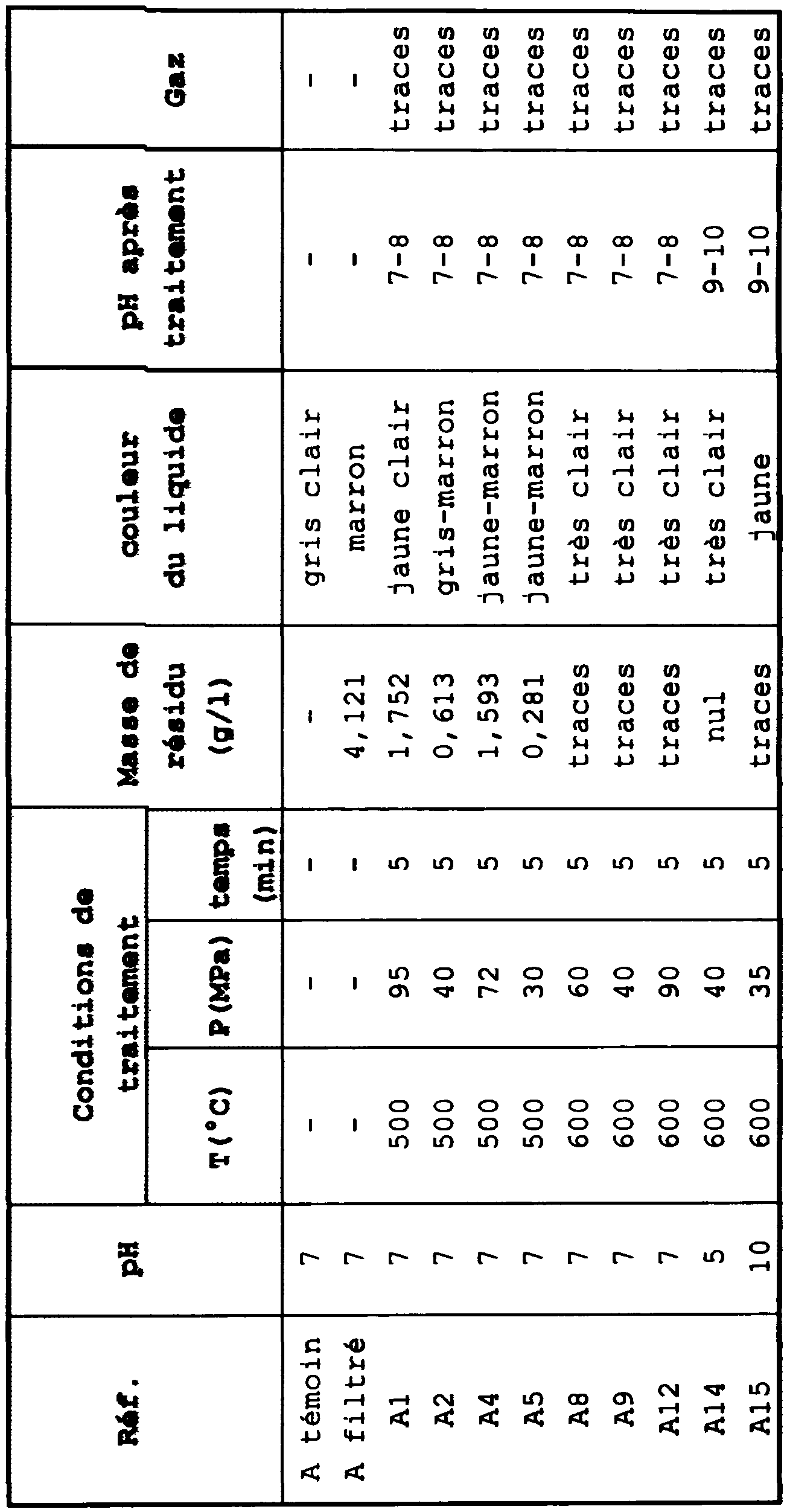
Conditions <SEP> de
<tb> Réf. <SEP> pH <SEP> traitement <SEP> Masse <SEP> de <SEP> couleur <SEP> pH <SEP> après
<tb> résidu <SEP> du <SEP> liquide <SEP> traitement <SEP> Gaz
<tb> T( C) <SEP> P(MPa) <SEP> temps <SEP> (g/l)
<tb> (min)
<tb> A <SEP> témoin <SEP> 7 <SEP> - <SEP> - <SEP> - <SEP> - <SEP> gris <SEP> clair <SEP> - <SEP>
A <SEP> filtré <SEP> 7 <SEP> - <SEP> - <SEP> - <SEP> 4,121 <SEP> marron <SEP> - <SEP>
A1 <SEP> 7 <SEP> 500 <SEP> 95 <SEP> 5 <SEP> 1,752 <SEP> jaune <SEP> clair <SEP> 7-8 <SEP> traces
<tb> A2 <SEP> 7 <SEP> 500 <SEP> 40 <SEP> 5 <SEP> 0,613 <SEP> gris-marron <SEP> 7-8 <SEP> traces
<tb> A4 <SEP> 7 <SEP> 500 <SEP> 72 <SEP> 5 <SEP> 1,593 <SEP> jaune-marron <SEP> 7-8 <SEP> traces
<tb> A5 <SEP> 7 <SEP> 500 <SEP> 30 <SEP> 5 <SEP> 0,281 <SEP> jaune-marron <SEP> 7-8 <SEP> traces
<tb> A8 <SEP> 7 <SEP> 600 <SEP> 60 <SEP> 5 <SEP> traces <SEP> très <SEP> clair <SEP> 7-8 <SEP> traces
<tb> A9 <SEP> 7 <SEP> 600 <SEP> 40 <SEP> 5 <SEP> traces <SEP> très <SEP> clair <SEP> 7-8 <SEP> traces
<tb> A12 <SEP> 7 <SEP> 600 <SEP> 90 <SEP> 5 <SEP> traces <SEP> très <SEP> clair <SEP> 7-8 <SEP> traces
<tb> A14 <SEP> 5 <SEP> 600 <SEP> 40 <SEP> 5 <SEP> nul <SEP> très <SEP> clair <SEP> 9-10 <SEP> traces
<tb> A15 <SEP> 10 <SEP> 600 <SEP> 35 <SEP> 5 <SEP> traces <SEP> jaune <SEP> 9-10 <SEP> traces
<tb> TABLEAU II
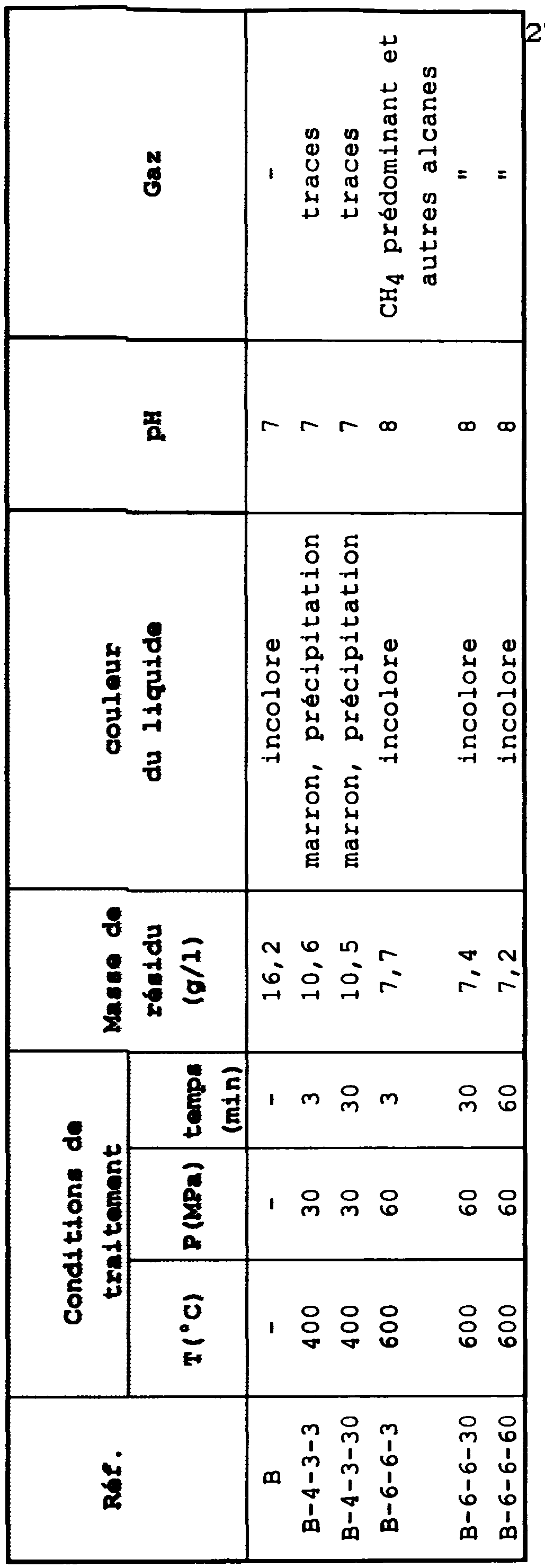
<tb> Ref. <SEP> pH <SEP> treatment <SEP> Mass <SEP> of <SEP> color <SEP> pH <SEP> after
<tb> residue <SEP> of <SEP> liquid <SEP> treatment <SEP> Gas
<tb> T (C) <SEP> P (MPa) <SEP> time <SEP> (g / l)
<tb> (min)
<tb> A <SEP> control <SEP> 7 <SEP> - <SEP> - <SEP> - <SEP> - <SEP> gray <SEP> clear <SEP> - <SEP>
A <SEP> filtered <SEP> 7 <SEP> - <SEP> - <SEP> - <SEP> 4,121 <SEP> brown <SEP> - <SEP>
A1 <SEP> 7 <SEP> 500 <SEP> 95 <SEP> 5 <SEP> 1,752 <SEP> yellow <SEP> clear <SEP> 7-8 <SEP> traces
<tb> A2 <SEP> 7 <SEP> 500 <SEP> 40 <SEP> 5 <SEP> 0.613 <SEP> gray-brown <SEP> 7-8 <SEP> traces
<tb> A4 <SEP> 7 <SEP> 500 <SEP> 72 <SEP> 5 <SEP> 1,593 <SEP> yellow-brown <SEP> 7-8 <SEP> traces
<tb> A5 <SEP> 7 <SEP> 500 <SEP> 30 <SEP> 5 <SEP> 0.281 <SEP> yellow-brown <SEP> 7-8 <SEP> traces
<tb> A8 <SEP> 7 <SEP> 600 <SEP> 60 <SEP> 5 <SEP> traces <SEP> very <SEP> clear <SEP> 7-8 <SEP> traces
<tb> A9 <SEP> 7 <SEP> 600 <SEP> 40 <SEP> 5 <SEP> traces <SEP> very <SEP> clear <SEP> 7-8 <SEP> traces
<tb> A12 <SEP> 7 <SEP> 600 <SEP> 90 <SEP> 5 <SEP> traces <SEP> very <SEP> clear <SEP> 7-8 <SEP> traces
<tb> A14 <SEP> 5 <SEP> 600 <SEP> 40 <SEP> 5 <SEP> Null <SEP> Very <SEP> Clear <SEP> 9-10 <SEP> Traces
<tb> A15 <SEP> 10 <SEP> 600 <SEP> 35 <SEP> 5 <SEP> traces <SEP> yellow <SEP> 9-10 <SEP> traces
<tb> TABLE II
Conditions <SEP> de
<tb> Réf.<SEP> traitement <SEP> Masse <SEP> de <SEP> couleur
<tb> résidu <SEP> du <SEP> liquide <SEP> pH <SEP> Gaz
<tb> T( C) <SEP> P(MPa) <SEP> temps <SEP> (g/l)
<tb> (min)
<tb> B <SEP> - <SEP> - <SEP> - <SEP> 16,2 <SEP> incolore <SEP> 7 <SEP>
B-4-3-3 <SEP> 400 <SEP> 30 <SEP> 3 <SEP> 10,6 <SEP> marron, <SEP> précipitation <SEP> 7 <SEP> traces
<tb> B-4-3-30 <SEP> 400 <SEP> 30 <SEP> 30 <SEP> 10,5 <SEP> marron, <SEP> précipitation <SEP> 7 <SEP> traces
<tb> B-6-6-3 <SEP> 600 <SEP> 60 <SEP> 3 <SEP> 7,7 <SEP> incolore <SEP> 8 <SEP> CH4 <SEP> prédominant <SEP> et
<tb> autres <SEP> alcanes
<tb> B-6-6-30 <SEP> 600 <SEP> 60 <SEP> 30 <SEP> 7,4 <SEP> incolore <SEP> 8 <SEP> "
<tb> B-6-6-60 <SEP> 600 <SEP> 60 <SEP> 60 <SEP> 7,2 <SEP> incolore <SEP> 8 <SEP> "
<tb> TABLEAU III

<tb> Ref. <SEP> treatment <SEP> Mass <SEP> of <SEP> color
<tb> residue <SEP> of <SEP> liquid <SEP> pH <SEP> Gas
<tb> T (C) <SEP> P (MPa) <SEP> time <SEP> (g / l)
<tb> (min)
<tb> B <SEP> - <SEP> - <SEP> - <SEP> 16.2 <SEP> colorless <SEP> 7 <SEP>
B-4-3-3 <SEP> 400 <SEP> 30 <SEP> 3 <SEP> 10.6 <SEP> brown, <SEP> precipitation <SEP> 7 <SEP> traces
<tb> B-4-3-30 <SEP> 400 <SEP> 30 <SEP> 30 <SEP> 10.5 <SEP> brown, <SEP> precipitation <SEP> 7 <SEP> traces
<tb> B-6-6-3 <SEP> 600 <SEP> 60 <SEP> 3 <SEP> 7.7 <SEP> colorless <SEP> 8 <SEP> CH4 <SEP> predominant <SEP> and
<tb> other <SEP> alkanes
<tb> B-6-6-30 <SEP> 600 <SEP> 60 <SEP> 30 <SEP> 7.4 <SEP> colorless <SEP> 8 <SEP>"
<tb> B-6-6-60 <SEP> 600 <SEP> 60 <SEP> 60 <SEP> 7.2 <SEP> colorless <SEP> 8 <SEP>"
<tb> TABLE III
Conditions
<tb> expérimentales
<tb> Réf.<SEP> pH <SEP> Aspect <SEP> du <SEP> pH <SEP> Quantité <SEP> Analyse
<tb> initial <SEP> liquide <SEP> final <SEP> de <SEP> gaz <SEP> des <SEP> gaz
<tb> T( C) <SEP> P(MPa) <SEP> durée
<tb> (min)
<tb> BR <SEP> 7 <SEP> 600 <SEP> 60 <SEP> 3 <SEP> clair+dépôt <SEP> gris <SEP> 7-8 <SEP> ++ <SEP> CH4
<tb> BR1 <SEP> 4 <SEP> 600 <SEP> 60 <SEP> 3 <SEP> foncé+dépôt <SEP> noir <SEP> 6-7 <SEP> 0 <SEP>
BR2 <SEP> 4 <SEP> 600 <SEP> 100 <SEP> 3 <SEP> foncé+dépôt <SEP> noir <SEP> 6-7 <SEP> + <SEP> CH4
<tb> BR10 <SEP> 13 <SEP> 600 <SEP> 50 <SEP> 3 <SEP> gris <SEP> clair+dépôt <SEP> gris <SEP> 8 <SEP> + <SEP> CH4
<tb> Les signes -, +, ++, +++ désignent respectivement une présence trop faible pour l'analyse d'un produit déterminé, une présence faible, une présence moyenne et une forte présence du produit. terms
<tb> experimental
<tb> Ref. <SEP> pH <SEP><SEP>Aspect><SEP> pH <SEP> Quantity <SEP> Analysis
<tb> initial <SEP> liquid <SEP> final <SEP> of <SEP> gas <SEP> of <SEP> gases
<tb> T (C) <SEP> P (MPa) <SEP> Duration
<tb> (min)
<tb> BR <SEP> 7 <SEP> 600 <SEP> 60 <SEP> 3 <SEP> clear + deposit <SEP> gray <SEP> 7-8 <SEP> ++ <SEP> CH4
<tb> BR1 <SEP> 4 <SEP> 600 <SEP> 60 <SEP> 3 <SEP> dark + depot <SEP> black <SEP> 6-7 <SEP> 0 <SEP>
BR2 <SEP> 4 <SEP> 600 <SEP> 100 <SEP> 3 <SEP> dark + deposit <SEP> black <SEP> 6-7 <SEP> + <SEP> CH4
<tb> BR10 <SEP> 13 <SEP> 600 <SEP> 50 <SEP> 3 <SEP> gray <SEP> clear + deposit <SEP> gray <SEP> 8 <SEP> + <SEP> CH4
<tb> Signs -, +, ++, +++ indicate respectively a presence too weak for the analysis of a certain product, a weak presence, an average presence and a strong presence of the product.
TABLEAU IV

Temps
<tb> pH <SEP> initial <SEP> T( C) <SEP> P(MPa) <SEP> SOLUTION <SEP> GAZ
<tb> (min)
<tb> 3-4 <SEP> 600 <SEP> 60 <SEP> 3 <SEP> Tout <SEP> est <SEP> solubilisé <SEP> Neant
<tb> solution <SEP> de <SEP> couleur
<tb> 3-4 <SEP> 600 <SEP> 100 <SEP> 3 <SEP> plus <SEP> foncée <SEP> que <SEP> dans <SEP> le <SEP> Quantité <SEP> importante
<tb> cas <SEP> de <SEP> 600 C <SEP> 600bar, <SEP> (CH4,...)
<tb> pH=7
<tb> 7 <SEP> 600 <SEP> 100 <SEP> 3 <SEP> Solution <SEP> foncée <SEP> avec <SEP> Quantité <SEP> très
<tb> présence <SEP> d'un <SEP> dépôt <SEP> importante <SEP> de <SEP> gaz
<tb> blanchâtre <SEP> (CH4,...)
<tb> TABLEAU V
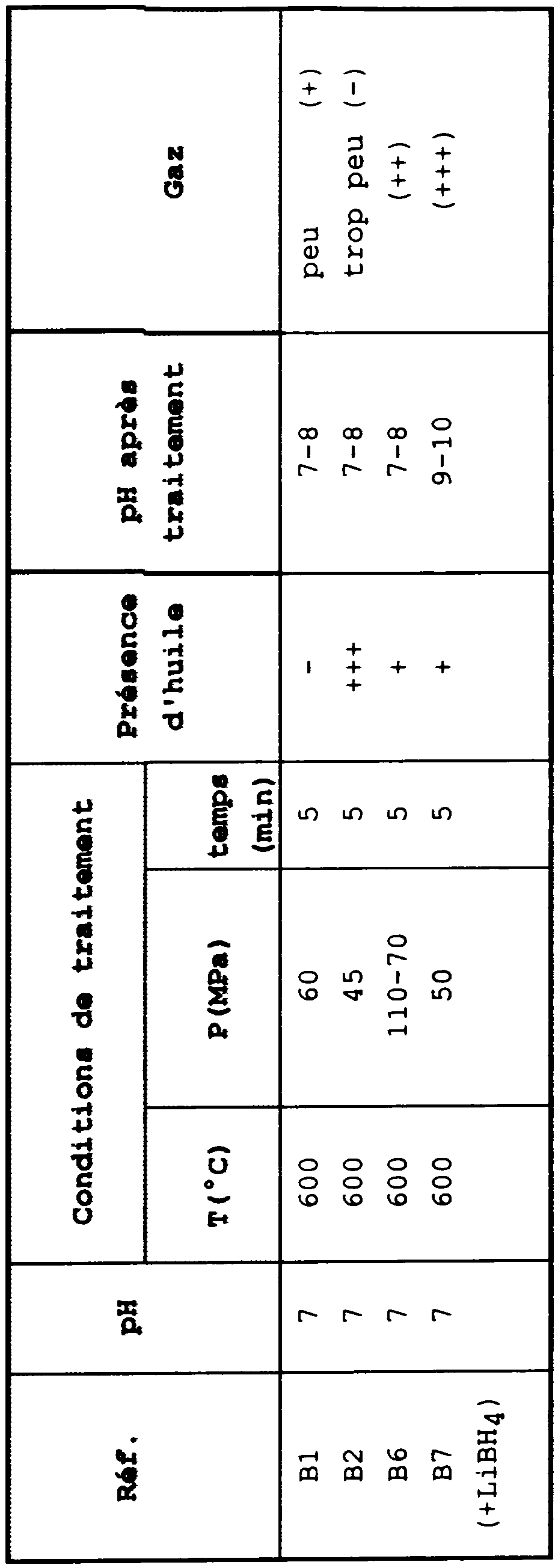
<tb> pH <SEP> initial <SEP> T (C) <SEP> P (MPa) <SEP> SOLUTION <SEP> GAS
<tb> (min)
<tb> 3-4 <SEP> 600 <SEP> 60 <SEP> 3 <SEP> All <SEP> is <SEP> solubilized <SEP> Neant
<tb> solution <SEP> of <SEP> color
<tb> 3-4 <SEP> 600 <SEP> 100 <SEP> 3 <SEP> more <SEP> dark <SEP> than <SEP> in <SEP> the <SEP> Quantity <SEP> important
<tb> case <SEP> of <SEP> 600 C <SEP> 600bar, <SEP> (CH4, ...)
<tb> pH = 7
<tb> 7 <SEP> 600 <SEP> 100 <SEP> 3 <SEP> Solution <SEP> dark <SEP> with <SEP> Quantity <SEP> very
<tb> presence <SEP> of a <SEP> large <SEP> depot <SEP> of <SEP> gas
<tb> whitish <SEP> (CH4, ...)
<tb> TABLE V
Conditions <SEP> de <SEP> traitement
<tb> Réf.<SEP> pH <SEP> Présence <SEP> pH <SEP> après
<tb> d'huile <SEP> traitement <SEP> Gaz
<tb> T( C) <SEP> P(MPa) <SEP> temps
<tb> (min)
<tb> B1 <SEP> 7 <SEP> 600 <SEP> 60 <SEP> 5 <SEP> - <SEP> 7-8 <SEP> peu <SEP> (+)
<tb> B2 <SEP> 7 <SEP> 600 <SEP> 45 <SEP> 5 <SEP> +++ <SEP> 7-8 <SEP> trop <SEP> peu <SEP> (-)
<tb> B6 <SEP> 7 <SEP> 600 <SEP> 110-70 <SEP> 5 <SEP> + <SEP> 7-8 <SEP> (++)
<tb> B7 <SEP> 7 <SEP> 600 <SEP> 50 <SEP> 5 <SEP> + <SEP> 9-10 <SEP> (+++)
<tb> (+LiBH4)
<tb> Les signes -, +, ++, +++ désignent respectivement une présence trop faible pour l'analyse d'un produit déterminé, une présence faible, une présence moyenne et une forte présence du produit. <SEP> conditions of <SEP> treatment
<tb> Ref. <SEP> pH <SEP> Presence <SEP> pH <SEP> after
<tb> oil <SEP> treatment <SEP> Gas
<tb> T (C) <SEP> P (MPa) <SEP> time
<tb> (min)
<tb> B1 <SEP> 7 <SEP> 600 <SEP> 60 <SEP> 5 <SEP> - <SEP> 7-8 <SEP> little <SEP> (+)
<tb> B2 <SEP> 7 <SEP> 600 <SEP> 45 <SEP> 5 <SEP> +++ <SEP> 7-8 <SEP> too <SEP> little <SEP> (-)
<tb> B6 <SEP> 7 <SEP> 600 <SEP> 110-70 <SEP> 5 <SEP> + <SEP> 7-8 <SEP> (++)
<tb> B7 <SEP> 7 <SEP> 600 <SEP> 50 <SEP> 5 <SEP> + <SEP> 9-10 <SEP> (+++)
<tb> (+ LiBH4)
<tb> Signs -, +, ++, +++ indicate respectively a presence too weak for the analysis of a certain product, a weak presence, an average presence and a strong presence of the product.
TABLEAU VI
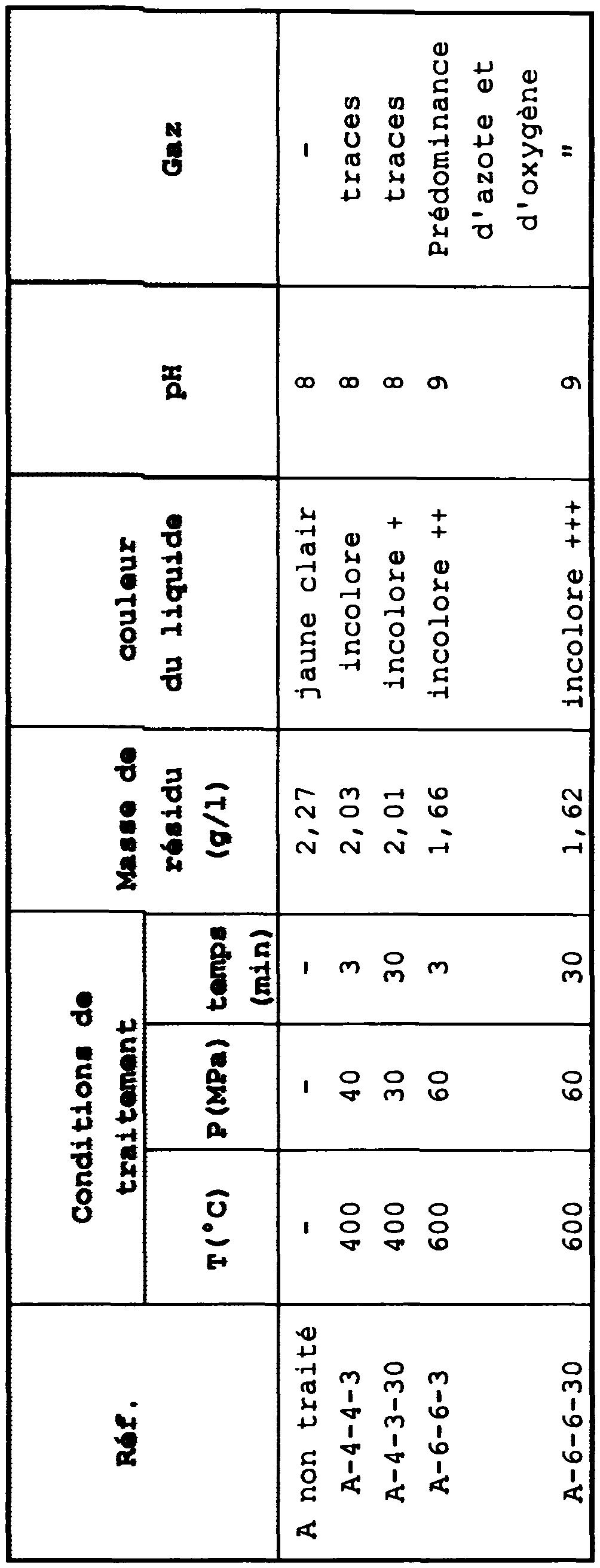
Conditions <SEP> de
<tb> Réf. <SEP> traitement <SEP> Masse <SEP> de <SEP> couleur
<tb> résidu <SEP> du <SEP> liquide <SEP> pH <SEP> Gaz
<tb> T( C) <SEP> P(MPa) <SEP> temps <SEP> (g/l)
<tb> (min)
<tb> A <SEP> non <SEP> traité <SEP> - <SEP> - <SEP> - <SEP> 2,27 <SEP> jaune <SEP> clair <SEP> 8 <SEP>
A-4-4-3 <SEP> 400 <SEP> 40 <SEP> 3 <SEP> 2,03 <SEP> incolore <SEP> 8 <SEP> traces
<tb> A-4-3-30 <SEP> 400 <SEP> 30 <SEP> 30 <SEP> 2,01 <SEP> incolore <SEP> + <SEP> 8 <SEP> traces
<tb> A-6-6-3 <SEP> 600 <SEP> 60 <SEP> 3 <SEP> 1,66 <SEP> incolore <SEP> ++ <SEP> 9 <SEP> Prédominance
<tb> d'azote <SEP> et
<tb> d'oxygène
<tb> A-6-6-30 <SEP> 600 <SEP> 60 <SEP> 30 <SEP> 1,62 <SEP> incolore <SEP> +++ <SEP> 9 <SEP> "
<tb> <SEP> Conditions of
<tb> Ref. <SEP> treatment <SEP> Mass <SEP> of <SEP> color
<tb> residue <SEP> of <SEP> liquid <SEP> pH <SEP> Gas
<tb> T (C) <SEP> P (MPa) <SEP> time <SEP> (g / l)
<tb> (min)
<tb> A <SEP> no <SEP> treated <SEP> - <SEP> - <SEP> - <SEP> 2.27 <SEP> yellow <SEP> clear <SEP> 8 <SEP>
A-4-4-3 <SEP> 400 <SEP> 40 <SEP> 3 <SEP> 2.03 <SEP> colorless <SEP> 8 <SEP> traces
<tb> A-4-3-30 <SEP> 400 <SEP> 30 <SEP> 30 <SEP> 2.01 <SEP> colorless <SEP> + <SEP> 8 <SEP> traces
<tb> A-6-6-3 <SEP> 600 <SEP> 60 <SEP> 3 <SEP> 1.66 <SEP> colorless <SEP> ++ <SEP> 9 <SEP> Predominance
<tb> nitrogen <SEP> and
<tb> oxygen
<tb> A-6-6-30 <SEP> 600 <SEP> 60 <SEP> 30 <SEP> 1.62 <SEP> colorless <SEP> +++ <SEP> 9 <SEP>"
<Tb>
Claims (15)
Priority Applications (7)
| Application Number | Priority Date | Filing Date | Title |
|---|---|---|---|
| FR9414664A FR2727634A1 (en) | 1994-12-06 | 1994-12-06 | CHEMICAL PROCESSING REDUCER PROCESS OF COMPLEX CHEMICAL STRUCTURES IN A SUPERCRITICAL FLUID |
| PCT/FR1995/001600 WO1996017680A1 (en) | 1994-12-06 | 1995-12-05 | Method for the chemical conversion of complex chemical structures under reducing conditions in a supercritical fluid |
| AT95941765T ATE171884T1 (en) | 1994-12-06 | 1995-12-05 | METHOD FOR CONVERSING COMPLEX CHEMICAL STRUCTURES UNDER REDUCING CONDITIONS IN A SUPERCRITICAL FLUID |
| DE69505271T DE69505271T2 (en) | 1994-12-06 | 1995-12-05 | METHOD FOR CONVERTING COMPLEX CHEMICAL STRUCTURES UNDER REDUCING CONDITIONS IN A SUPERCRITICAL FLUID |
| EP95941765A EP0796143B1 (en) | 1994-12-06 | 1995-12-05 | Method for the chemical conversion of complex chemical structures under reducing conditions in a supercritical fluid |
| US08/849,265 US5914031A (en) | 1994-12-06 | 1995-12-05 | Process in a reducing medium of chemically transforming complex chemical structures in a supercritical fluid |
| DK95941765T DK0796143T3 (en) | 1994-12-06 | 1995-12-05 | Process for Chemical Conversion of Complex Chemical Structures in Reducing Environment into a Supercritical Fluid |
Applications Claiming Priority (1)
| Application Number | Priority Date | Filing Date | Title |
|---|---|---|---|
| FR9414664A FR2727634A1 (en) | 1994-12-06 | 1994-12-06 | CHEMICAL PROCESSING REDUCER PROCESS OF COMPLEX CHEMICAL STRUCTURES IN A SUPERCRITICAL FLUID |
Publications (2)
| Publication Number | Publication Date |
|---|---|
| FR2727634A1 true FR2727634A1 (en) | 1996-06-07 |
| FR2727634B1 FR2727634B1 (en) | 1997-02-21 |
Family
ID=9469528
Family Applications (1)
| Application Number | Title | Priority Date | Filing Date |
|---|---|---|---|
| FR9414664A Granted FR2727634A1 (en) | 1994-12-06 | 1994-12-06 | CHEMICAL PROCESSING REDUCER PROCESS OF COMPLEX CHEMICAL STRUCTURES IN A SUPERCRITICAL FLUID |
Country Status (7)
| Country | Link |
|---|---|
| US (1) | US5914031A (en) |
| EP (1) | EP0796143B1 (en) |
| AT (1) | ATE171884T1 (en) |
| DE (1) | DE69505271T2 (en) |
| DK (1) | DK0796143T3 (en) |
| FR (1) | FR2727634A1 (en) |
| WO (1) | WO1996017680A1 (en) |
Families Citing this family (15)
| Publication number | Priority date | Publication date | Assignee | Title |
|---|---|---|---|---|
| US6124519A (en) * | 1996-12-13 | 2000-09-26 | Director-General Of Agency Of Industrial Science And Technology | Method of decomposing polychlorobiphenyls |
| FR2780986B1 (en) * | 1998-07-10 | 2000-09-29 | Electrolyse L | PROCESS FOR TRANSFORMATION OF CHEMICAL STRUCTURES IN A FLUID UNDER PRESSURE AND AT TEMPERATURE AND DEVICE FOR ITS IMPLEMENTATION |
| US6486355B1 (en) | 2000-02-23 | 2002-11-26 | Brookhaven Science Associates Llc | Application of chiral critical clusters to assymetric synthesis |
| US7144498B2 (en) * | 2004-01-30 | 2006-12-05 | Kellogg Brown & Root Llc | Supercritical hydrocarbon conversion process |
| US7833408B2 (en) * | 2004-01-30 | 2010-11-16 | Kellogg Brown & Root Llc | Staged hydrocarbon conversion process |
| US20080099374A1 (en) * | 2006-10-31 | 2008-05-01 | Chevron U.S.A. Inc. | Reactor and process for upgrading heavy hydrocarbon oils |
| US20080099378A1 (en) * | 2006-10-31 | 2008-05-01 | Chevron U.S.A. Inc. | Process and reactor for upgrading heavy hydrocarbon oils |
| US20080099376A1 (en) * | 2006-10-31 | 2008-05-01 | Chevron U.S.A. Inc. | Upgrading heavy hydrocarbon oils |
| US20080099377A1 (en) * | 2006-10-31 | 2008-05-01 | Chevron U.S.A. Inc. | Process for upgrading heavy hydrocarbon oils |
| JP5111072B2 (en) * | 2007-11-22 | 2012-12-26 | 三菱電機株式会社 | Liquid crystal display |
| KR20100105611A (en) * | 2007-11-28 | 2010-09-29 | 사우디 아라비안 오일 컴퍼니 | Process to upgrade highly waxy crude oil by hot pressurized water |
| US20090166261A1 (en) * | 2007-12-28 | 2009-07-02 | Chevron U.S.A. Inc. | Upgrading heavy hydrocarbon oils |
| US20110133406A1 (en) * | 2009-12-09 | 2011-06-09 | I-Cheng Chiu | Game Apparatus Which Combines with Gears and Blocks |
| US8394260B2 (en) | 2009-12-21 | 2013-03-12 | Saudi Arabian Oil Company | Petroleum upgrading process |
| US9382485B2 (en) | 2010-09-14 | 2016-07-05 | Saudi Arabian Oil Company | Petroleum upgrading process |
Citations (3)
| Publication number | Priority date | Publication date | Assignee | Title |
|---|---|---|---|---|
| EP0157339A2 (en) * | 1984-04-04 | 1985-10-09 | Fried. Krupp Gesellschaft mit beschränkter Haftung | Process for the preparation of hydrocarbons from active sludge |
| US5118447A (en) * | 1991-04-12 | 1992-06-02 | Battelle Memorial Institute | Thermochemical nitrate destruction |
| WO1992018426A1 (en) * | 1991-04-12 | 1992-10-29 | Battelle Memorial Institute | Aqueous phase removal of nitrogen from nitrogen compounds |
Family Cites Families (2)
| Publication number | Priority date | Publication date | Assignee | Title |
|---|---|---|---|---|
| US4483761A (en) * | 1983-07-05 | 1984-11-20 | The Standard Oil Company | Upgrading heavy hydrocarbons with supercritical water and light olefins |
| US4840725A (en) * | 1987-06-19 | 1989-06-20 | The Standard Oil Company | Conversion of high boiling liquid organic materials to lower boiling materials |
-
1994
- 1994-12-06 FR FR9414664A patent/FR2727634A1/en active Granted
-
1995
- 1995-12-05 AT AT95941765T patent/ATE171884T1/en not_active IP Right Cessation
- 1995-12-05 DE DE69505271T patent/DE69505271T2/en not_active Expired - Fee Related
- 1995-12-05 WO PCT/FR1995/001600 patent/WO1996017680A1/en not_active Ceased
- 1995-12-05 EP EP95941765A patent/EP0796143B1/en not_active Expired - Lifetime
- 1995-12-05 DK DK95941765T patent/DK0796143T3/en active
- 1995-12-05 US US08/849,265 patent/US5914031A/en not_active Expired - Fee Related
Patent Citations (3)
| Publication number | Priority date | Publication date | Assignee | Title |
|---|---|---|---|---|
| EP0157339A2 (en) * | 1984-04-04 | 1985-10-09 | Fried. Krupp Gesellschaft mit beschränkter Haftung | Process for the preparation of hydrocarbons from active sludge |
| US5118447A (en) * | 1991-04-12 | 1992-06-02 | Battelle Memorial Institute | Thermochemical nitrate destruction |
| WO1992018426A1 (en) * | 1991-04-12 | 1992-10-29 | Battelle Memorial Institute | Aqueous phase removal of nitrogen from nitrogen compounds |
Also Published As
| Publication number | Publication date |
|---|---|
| WO1996017680A1 (en) | 1996-06-13 |
| FR2727634B1 (en) | 1997-02-21 |
| DE69505271D1 (en) | 1998-11-12 |
| DK0796143T3 (en) | 1999-06-21 |
| EP0796143A1 (en) | 1997-09-24 |
| DE69505271T2 (en) | 1999-04-08 |
| ATE171884T1 (en) | 1998-10-15 |
| US5914031A (en) | 1999-06-22 |
| EP0796143B1 (en) | 1998-10-07 |
Similar Documents
| Publication | Publication Date | Title |
|---|---|---|
| FR2727634A1 (en) | CHEMICAL PROCESSING REDUCER PROCESS OF COMPLEX CHEMICAL STRUCTURES IN A SUPERCRITICAL FLUID | |
| EP2467452B1 (en) | Process for upgrading a pyrolysis oil, in particular in a refinery | |
| JPH10500168A (en) | Separation method of oil containing emulsion | |
| WO2002068567A1 (en) | Method for desulphurizing a hydrocarbon mixture | |
| FR2735785A1 (en) | PROCESS FOR REFINING OILS USED BY ALKALINE TREATMENT | |
| FR2473541A1 (en) | PROCESS FOR THE DESULFURIZATION OF A SULFUR-CONTAINING FUEL USING AN ALCOHOLIC SOLUTION OF AN ALKALI METAL HYDROGENOSULFIDE | |
| EP3429960B1 (en) | Method for the production of hydrogen-enriched syngas | |
| WO2023006956A1 (en) | New liquid organic hydrogen carriers, uses thereof for transporting and storing hydrogen, and methods for generating hydrogen using same | |
| EP4623047A1 (en) | Production of synthetic fuels from carbon dioxide with carbon dioxide separation | |
| WO2024110373A1 (en) | Production of synthetic fuels from co2 with partial oxy-fuel combustion of by-products and separation of co2 | |
| EP3188815B1 (en) | Method of selective extraction of platinoids, from a support containing same, with an extraction medium consisting of a supercritical fluid and an organic ligand | |
| FR2607145A1 (en) | IMPROVED PROCESS FOR THERMALLY CONVERTING HEAVY PETROLEUM FRACTIONS AND REFINING RESIDUES IN THE PRESENCE OF OXYGEN COMPOUNDS OF SULFUR, NITROGEN OR PHOSPHORUS | |
| Prestigiacomo et al. | Sewage sludge and olive oil pomace residues as real waste models to feed hydrothermal liquefaction: effect of acid and basic pretreatments | |
| EP3643766B1 (en) | Method for refining bio-oil from pyrolysis | |
| WO2024110372A1 (en) | Production of synthetic fuels from carbon dioxide with partial or total oxy-fuel combustion of by-products | |
| FR2802828A1 (en) | Separating liquid products from slurry containing Fischer-Tropsch catalyst comprises two-stage separation after adding hydrocarbon diluent | |
| FR2743570A1 (en) | PROCESS FOR TREATING LUBRICATING OILS USED IN A WATER-BASED DISPERSE PHASE FOR THEIR RECYCLING | |
| WO2025131657A1 (en) | Method for treating a liquid carbonaceous feedstock resulting from a hydrothermal liquefaction treatment | |
| FR2486536A1 (en) | Catalytic hydro-liquefaction of coal - using hydrogen-donor solvent and ferric sulphonate complex catalyst | |
| WO2010128216A1 (en) | Method for completely removing the mercury in a liquid hydrocarbon feedstock in one step using a hybrid organic-inorganic material | |
| WO1997026217A1 (en) | Dearomatisation of aromatic organo-halogenated and/or organo-oxygenated compounds in the presence of a ruthenium catalyst | |
| WO2009004206A2 (en) | Device and method for removing a compound from bio-diesel, method for purifying bio-diesel from a transesterification step, and equipment for producing bio-diesel including same | |
| EP4479492A1 (en) | Method for producing a stabilised biomass oil | |
| WO2025131656A1 (en) | Method for treating a liquid carbonaceous feedstock resulting from a hydrothermal liquefaction treatment | |
| BE888426R (en) | PROCESS FOR CONVERTING COAL INTO GASEOUS HYDROCARBONS, |
Legal Events
| Date | Code | Title | Description |
|---|---|---|---|
| ST | Notification of lapse |