FR2701029A1 - Process for obtaining chitin and/or chitosan - Google Patents
Process for obtaining chitin and/or chitosan Download PDFInfo
- Publication number
- FR2701029A1 FR2701029A1 FR9300512A FR9300512A FR2701029A1 FR 2701029 A1 FR2701029 A1 FR 2701029A1 FR 9300512 A FR9300512 A FR 9300512A FR 9300512 A FR9300512 A FR 9300512A FR 2701029 A1 FR2701029 A1 FR 2701029A1
- Authority
- FR
- France
- Prior art keywords
- chitin
- chitosan
- demineralization
- fatty alcohol
- deproteinization
- Prior art date
- Legal status (The legal status is an assumption and is not a legal conclusion. Google has not performed a legal analysis and makes no representation as to the accuracy of the status listed.)
- Granted
Links
- 229920002101 Chitin Polymers 0.000 title claims abstract description 41
- 238000000034 method Methods 0.000 title claims abstract description 39
- 230000008569 process Effects 0.000 title claims abstract description 16
- 229920001661 Chitosan Polymers 0.000 title claims description 30
- 238000005115 demineralization Methods 0.000 claims abstract description 32
- 241000238424 Crustacea Species 0.000 claims abstract description 13
- 150000002191 fatty alcohols Chemical class 0.000 claims abstract description 13
- 239000004094 surface-active agent Substances 0.000 claims abstract description 12
- 241000238366 Cephalopoda Species 0.000 claims abstract description 9
- 125000001570 methylene group Chemical group [H]C([H])([*:1])[*:2] 0.000 claims abstract description 9
- 229920006395 saturated elastomer Polymers 0.000 claims abstract description 6
- 125000002723 alicyclic group Chemical group 0.000 claims abstract description 4
- 125000001931 aliphatic group Chemical group 0.000 claims abstract description 4
- 125000002887 hydroxy group Chemical group [H]O* 0.000 claims abstract description 4
- 150000002894 organic compounds Chemical class 0.000 claims abstract description 4
- 125000001183 hydrocarbyl group Chemical group 0.000 claims abstract 2
- 230000002328 demineralizing effect Effects 0.000 claims description 25
- 230000003544 deproteinization Effects 0.000 claims description 16
- LFQSCWFLJHTTHZ-UHFFFAOYSA-N Ethanol Chemical compound CCO LFQSCWFLJHTTHZ-UHFFFAOYSA-N 0.000 claims description 12
- 238000003381 deacetylation reaction Methods 0.000 claims description 10
- 239000002904 solvent Substances 0.000 claims description 10
- 230000006196 deacetylation Effects 0.000 claims description 9
- 238000005507 spraying Methods 0.000 claims description 4
- 238000010348 incorporation Methods 0.000 claims description 2
- 239000003795 chemical substances by application Substances 0.000 abstract description 4
- KBPLFHHGFOOTCA-UHFFFAOYSA-N 1-Octanol Chemical compound CCCCCCCCO KBPLFHHGFOOTCA-UHFFFAOYSA-N 0.000 description 12
- CURLTUGMZLYLDI-UHFFFAOYSA-N Carbon dioxide Chemical compound O=C=O CURLTUGMZLYLDI-UHFFFAOYSA-N 0.000 description 12
- VTYYLEPIZMXCLO-UHFFFAOYSA-L Calcium carbonate Chemical compound [Ca+2].[O-]C([O-])=O VTYYLEPIZMXCLO-UHFFFAOYSA-L 0.000 description 10
- 239000002253 acid Substances 0.000 description 8
- 239000006260 foam Substances 0.000 description 8
- 238000000605 extraction Methods 0.000 description 7
- 229920000642 polymer Polymers 0.000 description 7
- VEXZGXHMUGYJMC-UHFFFAOYSA-N Hydrochloric acid Chemical compound Cl VEXZGXHMUGYJMC-UHFFFAOYSA-N 0.000 description 6
- 229910002092 carbon dioxide Inorganic materials 0.000 description 6
- 102000004169 proteins and genes Human genes 0.000 description 6
- 108090000623 proteins and genes Proteins 0.000 description 6
- 229910000019 calcium carbonate Inorganic materials 0.000 description 5
- 235000010216 calcium carbonate Nutrition 0.000 description 5
- 239000001569 carbon dioxide Substances 0.000 description 5
- 239000002518 antifoaming agent Substances 0.000 description 4
- 238000006243 chemical reaction Methods 0.000 description 4
- 150000001875 compounds Chemical class 0.000 description 4
- 150000004676 glycans Chemical class 0.000 description 4
- 229920001282 polysaccharide Polymers 0.000 description 4
- 239000005017 polysaccharide Substances 0.000 description 4
- 239000000126 substance Substances 0.000 description 4
- XLYOFNOQVPJJNP-UHFFFAOYSA-N water Substances O XLYOFNOQVPJJNP-UHFFFAOYSA-N 0.000 description 4
- KFZMGEQAYNKOFK-UHFFFAOYSA-N Isopropanol Chemical compound CC(C)O KFZMGEQAYNKOFK-UHFFFAOYSA-N 0.000 description 3
- 230000021736 acetylation Effects 0.000 description 3
- 238000006640 acetylation reaction Methods 0.000 description 3
- 230000000694 effects Effects 0.000 description 3
- 229910052739 hydrogen Inorganic materials 0.000 description 3
- 239000001257 hydrogen Substances 0.000 description 3
- 239000002609 medium Substances 0.000 description 3
- 229920005615 natural polymer Polymers 0.000 description 3
- 229920000768 polyamine Polymers 0.000 description 3
- BBMCTIGTTCKYKF-UHFFFAOYSA-N 1-heptanol Chemical compound CCCCCCCO BBMCTIGTTCKYKF-UHFFFAOYSA-N 0.000 description 2
- 241000238557 Decapoda Species 0.000 description 2
- 230000002378 acidificating effect Effects 0.000 description 2
- 150000007513 acids Chemical class 0.000 description 2
- 150000001412 amines Chemical group 0.000 description 2
- 239000012736 aqueous medium Substances 0.000 description 2
- MSWZFWKMSRAUBD-UHFFFAOYSA-N beta-D-galactosamine Natural products NC1C(O)OC(CO)C(O)C1O MSWZFWKMSRAUBD-UHFFFAOYSA-N 0.000 description 2
- MSWZFWKMSRAUBD-QZABAPFNSA-N beta-D-glucosamine Chemical compound N[C@H]1[C@H](O)O[C@H](CO)[C@@H](O)[C@@H]1O MSWZFWKMSRAUBD-QZABAPFNSA-N 0.000 description 2
- 230000015572 biosynthetic process Effects 0.000 description 2
- 229920002678 cellulose Polymers 0.000 description 2
- 239000001913 cellulose Substances 0.000 description 2
- MWKFXSUHUHTGQN-UHFFFAOYSA-N decan-1-ol Chemical compound CCCCCCCCCCO MWKFXSUHUHTGQN-UHFFFAOYSA-N 0.000 description 2
- 235000014113 dietary fatty acids Nutrition 0.000 description 2
- 239000000194 fatty acid Substances 0.000 description 2
- 229930195729 fatty acid Natural products 0.000 description 2
- 150000004665 fatty acids Chemical class 0.000 description 2
- 239000007789 gas Substances 0.000 description 2
- 238000006460 hydrolysis reaction Methods 0.000 description 2
- 201000006747 infectious mononucleosis Diseases 0.000 description 2
- 229910052500 inorganic mineral Inorganic materials 0.000 description 2
- 230000003993 interaction Effects 0.000 description 2
- 150000002632 lipids Chemical class 0.000 description 2
- 239000011707 mineral Substances 0.000 description 2
- 235000010755 mineral Nutrition 0.000 description 2
- 239000000203 mixture Substances 0.000 description 2
- ZWRUINPWMLAQRD-UHFFFAOYSA-N nonan-1-ol Chemical compound CCCCCCCCCO ZWRUINPWMLAQRD-UHFFFAOYSA-N 0.000 description 2
- GLDOVTGHNKAZLK-UHFFFAOYSA-N octadecan-1-ol Chemical compound CCCCCCCCCCCCCCCCCCO GLDOVTGHNKAZLK-UHFFFAOYSA-N 0.000 description 2
- 229930195734 saturated hydrocarbon Natural products 0.000 description 2
- 230000007928 solubilization Effects 0.000 description 2
- 238000005063 solubilization Methods 0.000 description 2
- 229930195735 unsaturated hydrocarbon Natural products 0.000 description 2
- NMRPBPVERJPACX-UHFFFAOYSA-N (3S)-octan-3-ol Natural products CCCCCC(O)CC NMRPBPVERJPACX-UHFFFAOYSA-N 0.000 description 1
- YIWUKEYIRIRTPP-UHFFFAOYSA-N 2-ethylhexan-1-ol Chemical compound CCCCC(CC)CO YIWUKEYIRIRTPP-UHFFFAOYSA-N 0.000 description 1
- 241000238421 Arthropoda Species 0.000 description 1
- 241000894006 Bacteria Species 0.000 description 1
- OYPRJOBELJOOCE-UHFFFAOYSA-N Calcium Chemical compound [Ca] OYPRJOBELJOOCE-UHFFFAOYSA-N 0.000 description 1
- VEXZGXHMUGYJMC-UHFFFAOYSA-M Chloride anion Chemical compound [Cl-] VEXZGXHMUGYJMC-UHFFFAOYSA-M 0.000 description 1
- 241000195493 Cryptophyta Species 0.000 description 1
- 241000233866 Fungi Species 0.000 description 1
- 241001465754 Metazoa Species 0.000 description 1
- LRHPLDYGYMQRHN-UHFFFAOYSA-N N-Butanol Chemical compound CCCCO LRHPLDYGYMQRHN-UHFFFAOYSA-N 0.000 description 1
- OVRNDRQMDRJTHS-UHFFFAOYSA-N N-acelyl-D-glucosamine Natural products CC(=O)NC1C(O)OC(CO)C(O)C1O OVRNDRQMDRJTHS-UHFFFAOYSA-N 0.000 description 1
- OVRNDRQMDRJTHS-FMDGEEDCSA-N N-acetyl-beta-D-glucosamine Chemical compound CC(=O)N[C@H]1[C@H](O)O[C@H](CO)[C@@H](O)[C@@H]1O OVRNDRQMDRJTHS-FMDGEEDCSA-N 0.000 description 1
- 108010039918 Polylysine Proteins 0.000 description 1
- 240000004808 Saccharomyces cerevisiae Species 0.000 description 1
- QAOWNCQODCNURD-UHFFFAOYSA-L Sulfate Chemical compound [O-]S([O-])(=O)=O QAOWNCQODCNURD-UHFFFAOYSA-L 0.000 description 1
- 125000002777 acetyl group Chemical group [H]C([H])([H])C(*)=O 0.000 description 1
- 230000009471 action Effects 0.000 description 1
- 239000013543 active substance Substances 0.000 description 1
- 150000001298 alcohols Chemical class 0.000 description 1
- -1 alicyclic alcohols Chemical class 0.000 description 1
- 125000000217 alkyl group Chemical group 0.000 description 1
- 125000003277 amino group Chemical group 0.000 description 1
- 150000001450 anions Chemical class 0.000 description 1
- 230000004071 biological effect Effects 0.000 description 1
- 230000007321 biological mechanism Effects 0.000 description 1
- 229910052791 calcium Inorganic materials 0.000 description 1
- 239000011575 calcium Substances 0.000 description 1
- 150000004649 carbonic acid derivatives Chemical class 0.000 description 1
- 150000007942 carboxylates Chemical class 0.000 description 1
- 239000003518 caustics Substances 0.000 description 1
- 210000002421 cell wall Anatomy 0.000 description 1
- 150000001805 chlorine compounds Chemical class 0.000 description 1
- 230000003749 cleanliness Effects 0.000 description 1
- 229920001577 copolymer Polymers 0.000 description 1
- 239000002537 cosmetic Substances 0.000 description 1
- 230000001419 dependent effect Effects 0.000 description 1
- 238000010494 dissociation reaction Methods 0.000 description 1
- 230000005593 dissociations Effects 0.000 description 1
- 239000003814 drug Substances 0.000 description 1
- 238000011049 filling Methods 0.000 description 1
- MSWZFWKMSRAUBD-IVMDWMLBSA-N glucosamine group Chemical group OC1[C@H](N)[C@@H](O)[C@H](O)[C@H](O1)CO MSWZFWKMSRAUBD-IVMDWMLBSA-N 0.000 description 1
- 230000035876 healing Effects 0.000 description 1
- 230000007062 hydrolysis Effects 0.000 description 1
- 238000011065 in-situ storage Methods 0.000 description 1
- 238000004519 manufacturing process Methods 0.000 description 1
- 239000000463 material Substances 0.000 description 1
- 229910052751 metal Inorganic materials 0.000 description 1
- 239000002184 metal Substances 0.000 description 1
- 150000002739 metals Chemical class 0.000 description 1
- 230000003020 moisturizing effect Effects 0.000 description 1
- 125000002950 monocyclic group Chemical group 0.000 description 1
- 239000000178 monomer Substances 0.000 description 1
- 229950006780 n-acetylglucosamine Drugs 0.000 description 1
- GOQYKNQRPGWPLP-UHFFFAOYSA-N n-heptadecyl alcohol Natural products CCCCCCCCCCCCCCCCCO GOQYKNQRPGWPLP-UHFFFAOYSA-N 0.000 description 1
- 239000002245 particle Substances 0.000 description 1
- 230000037361 pathway Effects 0.000 description 1
- 239000000049 pigment Substances 0.000 description 1
- 229920000447 polyanionic polymer Polymers 0.000 description 1
- 125000003367 polycyclic group Chemical group 0.000 description 1
- 229920000656 polylysine Polymers 0.000 description 1
- 238000006116 polymerization reaction Methods 0.000 description 1
- 150000003138 primary alcohols Chemical class 0.000 description 1
- 230000001172 regenerating effect Effects 0.000 description 1
- 238000007127 saponification reaction Methods 0.000 description 1
- 150000003333 secondary alcohols Chemical group 0.000 description 1
- 235000015170 shellfish Nutrition 0.000 description 1
- 241000894007 species Species 0.000 description 1
- 239000007858 starting material Substances 0.000 description 1
- 238000003756 stirring Methods 0.000 description 1
- 239000000758 substrate Substances 0.000 description 1
- 150000005846 sugar alcohols Polymers 0.000 description 1
- 238000003786 synthesis reaction Methods 0.000 description 1
- 150000003505 terpenes Chemical class 0.000 description 1
- 235000007586 terpenes Nutrition 0.000 description 1
- 230000017105 transposition Effects 0.000 description 1
- PCFOZHPCKQPZCN-UHFFFAOYSA-N undecan-5-ol Chemical compound CCCCCCC(O)CCCC PCFOZHPCKQPZCN-UHFFFAOYSA-N 0.000 description 1
- 238000009834 vaporization Methods 0.000 description 1
- 230000008016 vaporization Effects 0.000 description 1
- 235000013311 vegetables Nutrition 0.000 description 1
- 238000005406 washing Methods 0.000 description 1
Classifications
-
- C—CHEMISTRY; METALLURGY
- C08—ORGANIC MACROMOLECULAR COMPOUNDS; THEIR PREPARATION OR CHEMICAL WORKING-UP; COMPOSITIONS BASED THEREON
- C08B—POLYSACCHARIDES; DERIVATIVES THEREOF
- C08B37/00—Preparation of polysaccharides not provided for in groups C08B1/00 - C08B35/00; Derivatives thereof
- C08B37/0006—Homoglycans, i.e. polysaccharides having a main chain consisting of one single sugar, e.g. colominic acid
- C08B37/0024—Homoglycans, i.e. polysaccharides having a main chain consisting of one single sugar, e.g. colominic acid beta-D-Glucans; (beta-1,3)-D-Glucans, e.g. paramylon, coriolan, sclerotan, pachyman, callose, scleroglucan, schizophyllan, laminaran, lentinan or curdlan; (beta-1,6)-D-Glucans, e.g. pustulan; (beta-1,4)-D-Glucans; (beta-1,3)(beta-1,4)-D-Glucans, e.g. lichenan; Derivatives thereof
- C08B37/0027—2-Acetamido-2-deoxy-beta-glucans; Derivatives thereof
- C08B37/003—Chitin, i.e. 2-acetamido-2-deoxy-(beta-1,4)-D-glucan or N-acetyl-beta-1,4-D-glucosamine; Chitosan, i.e. deacetylated product of chitin or (beta-1,4)-D-glucosamine; Derivatives thereof
Landscapes
- Chemical & Material Sciences (AREA)
- Life Sciences & Earth Sciences (AREA)
- Health & Medical Sciences (AREA)
- Biochemistry (AREA)
- Molecular Biology (AREA)
- Engineering & Computer Science (AREA)
- General Health & Medical Sciences (AREA)
- Materials Engineering (AREA)
- Chemical Kinetics & Catalysis (AREA)
- Medicinal Chemistry (AREA)
- Polymers & Plastics (AREA)
- Organic Chemistry (AREA)
- Cosmetics (AREA)
- Polysaccharides And Polysaccharide Derivatives (AREA)
Abstract
Description
La présente invention concerne l'obtention de chitine et/ou de chitosane par extraction de la chitine des carapaces de crustacés ou des endosquelettes de céphalopodes. Elle concerne plus particulièrement un procédé pour l'amélioration de la phase de déminéralisation du procédé d'extraction de la chitine des carapaces de crustacés ou des endosquelettes de céphalopodes. The present invention relates to obtaining chitin and / or chitosan by extracting chitin from crustacean shells or endoskeletons from cephalopods. More particularly, it relates to a method for improving the demineralization phase of the chitin extraction process of crustacean shells or cephalopod endoskeletons.
Pour simplifier, l'invention sera décrite dans la suite de la présente description en référence à l'exosquelette des crustacés, mais elle s'applique également à l'extraction à partir des endosquelettes des céphalopodes, sous réserve des transpositions que l'homme du métier est à même de prévoir pour ce faire. Pour une telle extraction à partir des endosquelettes des céphalopodes, l'hydrolyse est cependant plus difficile. For simplicity, the invention will be described in the following description with reference to the exoskeleton of crustaceans, but it also applies to the extraction from the endoskeletons cephalopods, subject to transpositions that the man of the profession is able to provide for this. For such extraction from the endoskeletons of cephalopods, hydrolysis is however more difficult.
La chitine, ou poly(N-acétyl-D-glucosamine), est le polysaccharide le plus abondant sur terre, avec la cellulose. On peut la représenter par la formule développée ci-apres:
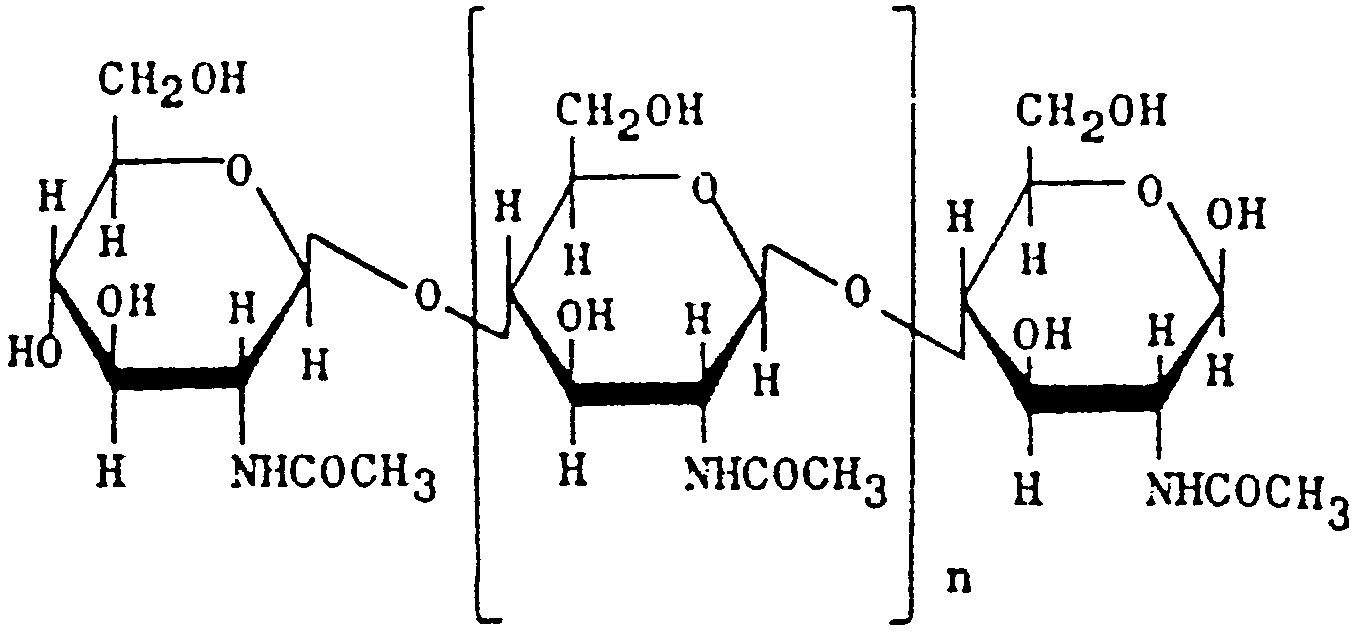
La chitine est le polymère de structure des exosquelettes de tous les arthropodes, ainsi que des endosquelettes des céphalopodes. On la rencontre également dans la paroi des cellules de la plupart des champignons et dans certaines bactéries, levures et algues. C'est un polymère naturel qui, de par son rôle et son abondance, est dans le règne animal l'équivalent de la cellulose dans le règne végétal. Chitin is the structural polymer of exoskeletons of all arthropods, as well as endoskeletons of cephalopods. It is also found in the cell wall of most fungi and in certain bacteria, yeasts and algae. It is a natural polymer which, because of its role and its abundance, is in the animal kingdom the equivalent of cellulose in the vegetable kingdom.
La chitine est notamment utile: en médecine, pour ses effets régénérants et cicatrisants, ainsi que dans la synthèse des protéines; en cosmétique, pour ses effets dermoprotecteur et hydratant; en agriculture, pour son aptitude à protéger les plantes; et également pour son effet chélateur des métaux. Chitin is particularly useful: in medicine, for its regenerating and healing effects, as well as in the synthesis of proteins; in cosmetics, for its dermoprotective and moisturizing effects; in agriculture, for its ability to protect plants; and also for its chelating effect of metals.
Le chitosane est un polysaccharide issu de la chitine par désacétylation de celle-ci. C'est plus précisément une chitine suffisamment N-désacétylée pour qu'elle devienne soluble dans les acides dilués. La chitine est en effet insoluble en millieu aqueux acide, alors que le chitosane est soluble dans un tel milieu. On atteint un degré significatif de solubilisation dans les acides dilués pour des degrés d'acétylation résiduels (DA) du chitosane 130%, tandis que si la désacétylation est totale on est en présence de polyglucosamine.

CHITOSANE
Les propriétés physico-chimiques du chitosane sont étroitement liées au fait que ce polymère est à la fois un polymère naturel, un polysaccharide et une polyamine.CHITOSAN
The physico-chemical properties of chitosan are closely related to the fact that this polymer is at the same time a natural polymer, a polysaccharide and a polyamine.
En tant que:
- polymère naturel, il peut intervenir directement ou indirectement sur de nombreux mécanismes biologiques et est totalement biodégradable;
- polysaccharide, il possède des propriétés intéressantes, comme celle de générer des liaisons hydrogène ou de donner des viscosités élevées à faible concentration. De plus, les liaisons glycosidiques de type 5(1- > 4) reliant les unités glucosamines lui confèrent des propriétés d'agent filmogène et la possibilité d'être filé avec de bonnes propriétés mécaniques à l'état sec. C'est en outre un excellent rétenteur d'eau;
- polyamine, il a des propriétés qui dépendent largement de son comportement acide-base, en relation avec l'équilibre de dissociation:
-NH3+ < - > -NH2 + H+.As:
- natural polymer, it can intervene directly or indirectly on many biological mechanisms and is completely biodegradable;
polysaccharide, it has interesting properties, such as that of generating hydrogen bonds or of giving high viscosities at low concentration. In addition, the glycosidic linkages of type 5 (1-> 4) linking the glucosamine units confer on it film-forming agent properties and the possibility of being spun with good mechanical properties in the dry state. It is also an excellent water retainer;
- polyamine, it has properties that largely depend on its acid-base behavior, in relation to the dissociation equilibrium:
-NH3 + <-> -NH2 + H +.
La valeur du pKo (pKa intrinsèque), voisine de 6,5 et relativement faible par comparaison avec celle d'autres polyamines comme la polylysine pour lesquelles elle se situe généralement autour de 10, lui donne des propriétés originales. Ainsi, aux valeurs de pH inférieures à 6,5, le chitosane peut être considéré comme un polycation, alors qu'à pH > 6,5 il est majoritairement sous forme amine libre. Il est alors insoluble dans l'eau à la suite de l'établissement de liaisons hydrogène intermoléculaires. La forme -NH3+ lui donne la possibilité de s'associer sélectivement avec les anions et de former des complexes polyanions-polycation avec tous les polyanions, qu'ils soient de type sulfate ou carboxylates, par exemple.La forme -NH2 lui confère d'excellentes propriétés chélatantes; elle est le lieu d'un large éventail de modifications chimiques en plus de celles que l'on peut opérer, classiquement, sur les fonctions alcool primaire et secondaire. Elle lui donne également la possibilité de s'adsorber sur de nombreux substrats au moyen d'interactions de type liaison hydrogène. The value of pKo (intrinsic pKa), close to 6.5 and relatively low compared with other polyamines such as polylysine for which it is generally around 10, gives it original properties. Thus, at pH values below 6.5, chitosan can be considered a polycation, whereas at pH> 6.5 it is predominantly in the free amine form. It is then insoluble in water as a result of the establishment of intermolecular hydrogen bonds. The -NH3 + form gives it the possibility of selectively associating with the anions and of forming polyanion-polycation complexes with all the polyanions, whether of the sulfate or carboxylate type, for example. The -NH 2 form confers on it excellent chelating properties; it is the site of a wide range of chemical changes in addition to those that can be performed, classically, on primary and secondary alcohol functions. It also gives it the ability to adsorb to many substrates by means of hydrogen bonding interactions.
Le chitosane peut avoir des applications semblables à celles mentionnées ci-dessus pour la chitine. Chitosan may have similar applications to those mentioned above for chitin.
Chitine et chitosane sont tous deux des copolymères linéaires, non ramifiés, de D-glucosamine et de D-glucosamine N-acétylée, reliés entre eux par des ponts glucosidiques ss(1- > 4). Seul un taux différent d'acétylation les différencie du point de vue de leur constitution chimique. Chitin and chitosan are both linear, unbranched copolymers of D-glucosamine and N-acetylated D-glucosamine, linked together by ss (1-> 4) glucosidic bridges. Only a different rate of acetylation differentiates them from the point of view of their chemical constitution.
Sur le plan physique, la chitine est insoluble en milieu aqueux acide, alors que le chitosane est soluble dans un tel milieu. Cela tient au fait que la chitine a un taux d'acétylation d'au moins 50%, de préférence d'au moins 60% et même avantageusement d'au moins 70% environ, la répartition des groupes acétyle étant ou non statistique. On a physical level, chitin is insoluble in acidic aqueous medium, whereas chitosan is soluble in such a medium. This is because the chitin has an acetylation level of at least 50%, preferably at least 60% and even more preferably at least about 70%, the distribution of the acetyl groups being or not statistical.
Un autre paramètre caractérisant ces composés est leur degré de polymérisation (DP), qui s'exprime par le nombre moyen d'unités monomères présentes dans la chaîne polymère. A ce facteur peuvent être rattachées de multiples différences dans les propriétés du polymère. Another parameter characterizing these compounds is their degree of polymerization (DP), which is expressed by the average number of monomer units present in the polymer chain. To this factor can be attached multiple differences in the properties of the polymer.
C'est ainsi que la viscosité en solution du chitosane est dépendante de ce DP, tout comme le sont de nombreuses propriétés physiques, chimiques ou biologiques du polymère chitosane.Thus, the solution viscosity of chitosan is dependent on this DP, as are many physical, chemical or biological properties of the chitosan polymer.
La carapace des crustacés est constituée de divers composés. Selon les espèces la composition de cette carapace varie de façon importante; une composition moyenne est la suivante (% en poids/poids):
chitine 5 à 25
CaCO3 40 à 80%
Protéines, lipides, pigments
et eau de structure < 40
Pour extraire la chitine de ces carapaces, il est nécessaire d'éliminer les minéraux et les protéines que celles-ci contiennent. The crustacean shell consists of various compounds. Depending on the species, the composition of this carapace varies significantly; an average composition is the following (% by weight / weight):
chitin 5 to 25
CaCO3 40 to 80%
Proteins, lipids, pigments
and structural water <40
To extract chitin from these shells, it is necessary to eliminate the minerals and the proteins that they contain.
Classiquement les minéraux, en particulier le carbonate de calcium, sont éliminés par déminéralisation en milieu acide. Classically minerals, in particular calcium carbonate, are removed by demineralization in acidic medium.
Quant aux protéines, elles sont extraites en pratique par des passages en bains caustiques (déprotéinisation). As for the proteins, they are extracted in practice by passages in caustic baths (deproteinization).
Ces deux techniques sont mises en oeuvre successivement, dans un ordre quelconque. These two techniques are implemented successively, in any order.
Le choix qui en résulte conduit à deux voies principales d'obtention de la chitine. Chacune de cellesci présente un ensemble d'avantages et d'inconvénients. Si l'on tient compte de la qualité des produits de départ, de leur granulométrie, de leur fraîcheur et d'autres paramètres habituels pour l'homme du métier, il peut être plus ou moins opportun d'appliquer la déminéralisation avant la déprotéinisation, ou l'inverse. The resulting choice leads to two main routes for obtaining chitin. Each of these presents a set of advantages and disadvantages. Taking into account the quality of the starting materials, their particle size, their freshness and other parameters customary for those skilled in the art, it may be more or less appropriate to apply the demineralization before the deproteinization, or the opposite.
Selon la technique antérieure la déminéralisation est par exemple mise en oeuvre avant la déprotéinisation et il est alors classique d'utiliser de l'acide chlorhydrique à des concentrations de 0,5 à 3 ou même 4 N pour transformer le carbonate de calcium en chlorure de calcium qui, étant soluble dans liteau, peut être éliminé soit en bain acide, soit au cours de lavages ultérieurs. According to the prior art demineralization is for example carried out before deproteinization and it is conventional to use hydrochloric acid at concentrations of 0.5 to 3 or even 4 N to convert the calcium carbonate into chloride. calcium which, being soluble in water, can be removed either in acid bath or during subsequent washings.
La transformation des carbonates en chlorures s'accompagne d'un fort dégagement de gaz carbonique. Sous la pression de ce dégagement gazeux la structure de la carapace et celle de la chitine sont modifiées. The conversion of carbonates into chlorides is accompanied by a strong release of carbon dioxide. Under the pressure of this gas release the structure of the carapace and that of chitin are modified.
Il s'ensuit une plus grande accessibilité de cette chitine lors de futures réactions, en particulier lors de la réaction de désacétylation gui vise à transformer la chitine en chitosane. This results in greater accessibility of this chitin in future reactions, in particular during the deacetylation reaction which aims to transform chitin into chitosan.
La méthode connue empruntant cette voie permet généralement d'obtenir des taux de transformation plus importants sur la chaîne polymère. Toutefois elle présente des inconvénients:
- Le fort dégagement de gaz carbonique obtenu se traduit, en raison de la présence de divers composés dans les carapaces ou de leur formation in situ sous l'effet des réactions d'hydrolyse, par l'apparition d'une mousse abondante, difficile à maîtriser et qui limite singulièrement la vitesse de rajout ou addition soit d'acide sur la carapace, soit de carapace dans le bain d'acide.The known method using this route generally makes it possible to obtain higher conversion rates on the polymer chain. However, it has disadvantages:
- The strong release of carbon dioxide obtained results, due to the presence of various compounds in the shells or their formation in situ under the effect of hydrolysis reactions, by the appearance of an abundant foam, difficult to to control and which limits singularly the rate of addition or addition of acid on the shell, or of shell in the bath of acid.
C'est ainsi que, à titre d'exemple, une tonne de carapace transformée de cette manière génère entre cent et deux cents kilogrammes de chitine et produit près de deux cents mètres cubes de gaz carbonique. Si ce gaz reste piégé dans la mousse, il est difficile de pouvoir considérer comme acceptable industriellement la voie d'une déminéralisation/déprotéinisation. For example, a ton of carapace transformed in this way generates between one hundred and two hundred kilograms of chitin and produces nearly two hundred cubic meters of carbon dioxide. If this gas remains trapped in the foam, it is difficult to consider as industrially acceptable the demineralization / deproteinization route.
L'autre mode opératoire connu, qui est celui de la voie de déprotéinisation/déminéralisation, consistant à éliminer initialement les protéines, puis les lipides, par saponification et ensuite solubilisation d'une grande partie des acides gras responsables de l'émission des mousses, ne présente pas ces inconvénients. The other known procedure, which is that of the deproteinization / demineralization pathway, consisting in initially removing the proteins, then the lipids, by saponification and then solubilization of a large part of the fatty acids responsible for the emission of the foams, does not have these disadvantages.
Il existait donc un besoin pour une méthode plus pratique et utilisable industriellement d'une manière générale et sans les inconvénients précités pour l'obtention de chitine, et de chitosane par désacétylation de celle-ci, notamment à partir des carapaces de crustacés. There was therefore a need for a more practical method that can be used industrially in general and without the abovementioned disadvantages for obtaining chitin, and for chitosan by deacetylation thereof, in particular from crustacean shells.
L'invention a comme objectif principal de fournir une telle méthode,qui s'affranchisse de l'obligation de faire précéder la déminéralisation de ces carapaces d'une déprotéinisat ion. The main purpose of the invention is to provide such a method, which avoids the need to precede the demineralization of these shells with a deproteinization.
L'invention a également comme objet une telle méthode, dans laquelle l'étape de déminéralisation intervient avant ou après l'étape de déprotéinisation. Another subject of the invention is such a method, in which the demineralization step occurs before or after the deproteinization step.
Un premier aspect de la présente invention est un procédé d'obtention de chitine et/ou de chitosane par extraction à partir de carapaces de crustacés, permettant d'accroître les vitesses de déminéralisation de ces carapaces par rapport aux méthodes traditionnelles. A first aspect of the present invention is a process for obtaining chitin and / or chitosan by extraction from crustacean shells, making it possible to increase the demineralization rates of these shells compared with traditional methods.
Un autre aspect de la présente invention est un procédé d'obtention de chitine et/ou de chitosane par un procédé comportant une étape de déminéralisation dont le déroulement est contrôlé ou maîtrisé. Another aspect of the present invention is a process for obtaining chitin and / or chitosan by a process comprising a demineralization step whose progress is controlled or controlled.
On a maintenant trouvé de manière inattendue que l'on peut obtenir de la chitine ou du chitosane, notamment à partir de carapaces de crustacés, aussi bien par l'une que par l'autre des deux voies susdites, en utilisant au moins un alcool gras comme agent de surface (= tensioactif) dans la phase de déminéralisation du procédé d'extraction de la chitine. It has now surprisingly been found that chitin or chitosan, in particular from crustacean shells, can be obtained by either of the two aforementioned routes using at least one alcohol. fat as surface agent (= surfactant) in the demineralisation phase of the chitin extraction process.
On a également constaté que la chitine obtenue par ce procédé selon la présente invention a une structure plus réactive, ce qui se traduit par un taux de désacétylation plus élevé dans le chitosane obtenu par la transformation ultérieure. It has also been found that the chitin obtained by this process according to the present invention has a more reactive structure, which results in a higher deacetylation rate in the chitosan obtained by the subsequent conversion.
La présente invention a donc pour premier objet un procédé pour l'obtention de chitine et/ou de chitosane, notamment à partir de carapaces de crustacés, dans lequel on utilise dans la phase de déminéralisation, à titre d'agent de surface, au moins un alcool gras, principalement choisi parmi les composés organiques contenant au moins un groupe hydroxy et comprenant une chaîne hydrocarbonée linéaire ou ramifiée, aliphatique ou alicyclique, saturée ou insaturée, dont la chaîne principale comporte au moins quatre groupes méthylène, et de préférence de quatre à seize groupes méthylène. The first subject of the present invention is therefore a process for obtaining chitin and / or chitosan, in particular from crustacean shells, in which at least one surfactant is used in the demineralization phase as a surfactant. a fatty alcohol, mainly chosen from organic compounds containing at least one hydroxyl group and comprising a linear or branched, aliphatic or alicyclic, saturated or unsaturated hydrocarbon-based chain, the main chain of which comprises at least four methylene groups, and preferably from four to sixteen methylene groups.
En variante, le procédé susdit comporte en outre une étape de désacétylation au moins partielle et transforme ainsi en chitosane tout ou partie de la chitine. In a variant, the aforesaid process further comprises an at least partial deacetylation step and thus converts all or part of the chitin into chitosan.
L'invention a également pour objet l'utilisation d'un alcool gras, notamment tel que défini ci-dessus, comme agent de surface utile dans la phase de déminéralisation d'un procédé d'extraction de la chitine, éventuellement partiellement transformée en chitosane, à partir de carapaces de crustacés. The subject of the invention is also the use of a fatty alcohol, especially as defined above, as a surfactant useful in the demineralization phase of a chitin extraction process, optionally partially converted into chitosan , from shells of shellfish.
Un autre objet de l'invention est représenté par la chitine et le chitosane obtenus par ce procédé. Another object of the invention is represented by chitin and chitosan obtained by this method.
Le procédé selon l'invention comporte donc l'utilisation d'un alcool gras, notamment tel que défini plus haut, dans l'étape de déminéralisation d'un procédé pour l'obtention de chitine et/ou de chitosane, par une technique de déminéralisation/déprotéinisation ou de déprotéinisation/déminéralisation, à partir des exosquelettes de crustacés ou des endosquelettes de céphalopodes. The method according to the invention therefore comprises the use of a fatty alcohol, especially as defined above, in the demineralization step of a process for obtaining chitin and / or chitosan, by a technique of demineralization / deproteinization or deproteinization / demineralisation, from crustacean exoskeletons or cephalopod endoskeletons.
L'incorporation de l'alcool gras dans l'étape considérée peut se faire par tout moyen approprié connu de l'homme du métier, en particulier par pulvérisation ou vaporisation à la surface du bain de traitement de déminéralisation desdites carapaces, l'alcool gras étant alors mis en oeuvre soit à l'état pur, soit en solution dans un solvant. L'utilisation en solution dans un solvant approprié est préférée, car elle permet d'accroître la répartition de l'agent actif à la surface du bain. Les solvants appropriés sont principalement tous les alcools, en toutes proportions. The incorporation of the fatty alcohol into the step in question may be carried out by any appropriate means known to those skilled in the art, in particular by spraying or spraying on the surface of the demineralisation treatment bath of said shells, the fatty alcohol then being used either in the pure state or in solution in a solvent. The use in solution in a suitable solvent is preferred because it makes it possible to increase the distribution of the active agent on the surface of the bath. Suitable solvents are mainly all alcohols, in all proportions.
Le procédé selon l'invention permet de limiter la forte production de mousse qui accompagnait jusqu'ici la phase de déminéralisation des procédés d'extraction de chitine par déminéralisation/déprotéinisation de matières en contenant. The process according to the invention makes it possible to limit the high foam production which until now has accompanied the demineralization phase of the chitin extraction processes by demineralization / deproteinization of materials containing it.
Il aurait été a priori envisageable à ce titre de recourir à un quelconque agent de surface à propriété antimousse. La libération de mousse engendrée par l'action de l'acide sur le carbonate de calcium devait en effet pouvoir s'accomoder d'un traitement abaisseur de mousse, dont le rôle serait de rompre la structure "bulle créée par l'interaction acides gras/protéines sous la pression du gaz carbonique. It would have been possible in principle to use any surfactant with antifoam property. The release of foam generated by the action of the acid on the calcium carbonate had indeed to be able to be accomodated by a step-down treatment of foam, whose role would be to break the structure "bubble created by the interaction fatty acids / proteins under the pressure of carbon dioxide.
Or on a trouvé de manière surprenante que l'utilisation des agents antimousses classiques était sans effet dans ce contexte et qu'un agent de surface, pour être efficace comme agent antimousse dans le procédé considéré, doit être choisi parmi les mono- ou pluri-alcools aliphatiques ou alicycliques, ramifiés ou non, saturés ou insaturés, y compris les terpènes oxygénés mono- ou polycycliques, et de préférence parmi les mono- ou plurialcools primaires linéaires, saturés ou insaturés, ayant une chaîne alkyle comportant au moins quatre, avantageusement de quatre à seize, groupes méthylène sur la chaîne grasse principale.Surprisingly, it has been found that the use of conventional defoamers has no effect in this context and that a surfactant, to be effective as an antifoam agent in the process under consideration, must be selected from the mono- aliphatic or alicyclic alcohols, branched or unbranched, saturated or unsaturated, including mono- or polycyclic oxygenated terpenes, and preferably from saturated or unsaturated linear primary mono- or polyhydric alcohols, having an alkyl chain comprising at least four, advantageously from four to sixteen, methylene groups on the main fatty chain.
En d'autes termes, l'alcool gras est principalement choisi parmi les composés organiques contenant au moins un groupe hydroxy et comprenant une chaîne hydrocarbonée linéaire ou ramifiée, aliphatique ou alicyclique, saturée ou insaturée, dont la chaîne principale comporte au moins quatre groupes méthylène, et de préférence de quatre à seize groupes méthylène.In other words, the fatty alcohol is mainly chosen from organic compounds containing at least one hydroxyl group and comprising a linear or branched, aliphatic or alicyclic, saturated or unsaturated hydrocarbon-based chain, the main chain of which contains at least four methylene groups. and preferably from four to sixteen methylene groups.
Les quantités d'agent de surface qu'il convient en pratique d'utiliser dans ce procédé sont faibles en regard des masses traitées et sont avantageusement d'environ 0,2 à 2 ml par kilogramme de carapace. The amounts of surfactant that are conveniently used in this process are low in comparison to the treated masses and are preferably about 0.2 to 2 ml per kilogram of shell.
Dans la pratique, on opère comme suit pour mettre en oeuvre l'étape de déminéralisation du procédé d'obtention de chitine à partir de carapaces de crustacés:
- une quantité connue de carapace de crabes et/ou de crevettes est introduite dans un bain acide deux à trois fois molaire en acide chlorhydrique contenu dans une cuve appropriée et dans un temps réputé court et correspondant à un débit égal à une tonne par heure ou voisin de cette valeur.L'émission de gaz carbonique attendue est estimée aux environs de deux cents fois cette quantité volumique,
- l'agent antimousse selon l'invention est, durant ce temps et pendant la demi-heure qui suit la fin de l'intro-duction de carapace, pulvérisé ou vaporisé à la surface de la cuve par tout système adapté, et ce dans des quantités de préférence juste suffisantes pour détruire l'apparition de mousse observée dès le début de l'introduction des carapaces;
- l'addition de l'agent antimousse peut se faire par ajout du composé à l'état pur ou, selon une variante préférée, en solution dans un solvant approprié.In practice, the procedure for carrying out the demineralization step of the process for obtaining chitin from crustacean shells is as follows:
a known quantity of carapace of crabs and / or shrimps is introduced into a two to three-fold molar acid bath in hydrochloric acid contained in a suitable vat and in a time deemed short and corresponding to a flow rate equal to one ton per hour; the expected emission of carbon dioxide is estimated at around two hundred times this volume quantity,
the antifoaming agent according to the invention is, during this time and during the half-hour following the end of the carapace intro-duction, sprayed or vaporized on the surface of the tank by any suitable system, and this in quantities preferably just sufficient to destroy the appearance of foam observed from the beginning of the introduction of the shells;
the addition of the antifoaming agent can be carried out by adding the compound in the pure state or, according to a preferred variant, in solution in a suitable solvent.
L'invention est décrite plus en détail en référence aux exemples illustratifs ci-après, qui ne la limitent aucunement. Les pourcentages sont en poids, sauf indication contraire. The invention is described in more detail with reference to the following illustrative examples, which do not limit it in any way. Percentages are by weight unless otherwise indicated.
Exemole 1
Dans une cuve de 5 m3 munie dlun système d'agitation et contenant 3200 litres d'une solution d'acide chlorhydrique 3,75N, on a versé pour une première déminéralisation une quantité de 1,500 tonne de carapaces de crabe, d'une propreté voisine de 50% et contenant, à l'état propre et sec, près de 80% de carbonate de calcium.Exemole 1
In a tank of 5 m3 equipped with a stirring system and containing 3200 liters of a hydrochloric acid solution 3.75 N, was poured for a first demineralization of a quantity of 1,500 tons of crab shells, a similar cleanliness 50% and containing, in a clean and dry state, almost 80% of calcium carbonate.
Dans ces conditions le dégagement de CO2 attendu était de près de 130 m3. Under these conditions, the expected release of CO2 was close to 130 m3.
L'introduction d'environ 0,3 1 d'agent de surface alcool octylique a permis l'arrêt immédiat du développement de la mousse. Il était alors possible d'accroître considérablement la vitesse d'introduction ou rajout de la carapace à traiter et de ramener ainsi le temps total de remplissage à une durée de une heure et demie. The introduction of about 0.3 1 octyl alcohol surfactant allowed the immediate stop of the development of the foam. It was then possible to considerably increase the speed of introduction or addition of the carapace to be treated and thus reduce the total filling time to a duration of one hour and a half.
On a ensuite fait subir à la charge de carapaces de la cuve une étape classique de déprotéinisation, suivie d'une désacétylation en vue de l'obtention de chitosane à partir de la chitine obtenue. The tubular shell charge was then subjected to a conventional deproteinization step, followed by deacetylation to obtain chitosan from the obtained chitin.
Le chitosane obtenu avait plus de 90% de groupes amines libres sur la chaîne polymère. The chitosan obtained had more than 90% of free amine groups on the polymer chain.
Exemple 2
On a opéré comme indiqué dans l'exemple 1, mais en inversant les étapes de déminéralisation et de déprotéinisation. La chitine obtenue, traitée dans les mêmes conditions de désacétylation ne donnait qu'un taux d'amine libre de 80% environ.Example 2
The procedure was as indicated in Example 1, but inverting the demineralization and deproteinization steps. The chitin obtained, treated under the same deacetylation conditions gave a free amine level of about 80%.
Exemple 3
En procédant comme dans l'exemple 1, mais en remplaçant l'alcool octylique par de l'alcool heptylique à raison d'environ 0,2 ml par kg de carapace et en utilisant de l'éthanol comme solvant, on a obtenu des résultats semblables.Example 3
By proceeding as in Example 1, but replacing the octyl alcohol with heptyl alcohol at a rate of about 0.2 ml per kg of shell and using ethanol as the solvent, results were obtained. similar.
Exemple 4
En procédant comme dans l'exemple 1, mais en remplaçant l'alcool octylique par de l'alcool nonylique à raison d'environ 2 ml par kg de carapace et en utilisant de l'éthanol comme solvant, on a obtenu des résultats semblables.Example 4
By proceeding as in Example 1, but replacing the octyl alcohol with nonyl alcohol at about 2 ml per kg shell and using ethanol as the solvent, similar results were obtained.
Exemple 5
En suivant le mode opératoire de l'exemple 4 avec 0,3 ml de l'agent de surface indiqué par kg de carapace, on a obtenu des résultats semblables. Example 5
By following the procedure of Example 4 with 0.3 ml of the surfactant indicated per kg shell, similar results were obtained.
Exermle 6
En procédant comme dans l'exemple 1, mais en remplaçant l'alcool octylique par de l'alcool décylique, sensiblement dans la même proportion, on a obtenu des résultats semblables.Exclude 6
By proceeding as in Example 1, but replacing the octyl alcohol with decyl alcohol in substantially the same proportion, similar results were obtained.
Exemple 7
En procédant comme dans l'exemple 1, avec de l'alcool stéarylique au lieu d'alcool octylique et dans la même proportion que ce dernier, on n'a obtenu aucun résultat.Example 7
By proceeding as in Example 1, with stearyl alcohol instead of octyl alcohol and in the same proportion as the latter, no results were obtained.
Exemtle 8
En remplaçant dans le procédé selon l'exemple 1 les 0,2 ml/kg de carapace d'alcool octylique par la même proportion d'alcool butyrique et en utilisant de l'éthanol comme solvant, on n'a obtenu aucun résultat.Exemtle 8
By replacing in the process according to Example 1 the 0.2 ml / kg of octyl alcohol shell with the same proportion of butyric alcohol and using ethanol as solvent, no results were obtained.
Exemple 9
On a répété les exemples 3 à 5, mais en remplaçant l'éthanol par de l'alcool isopropylique en tant que solvant et obtenu dans chaque cas des résultats semblables.Example 9
Examples 3 to 5 were repeated but replacing the ethanol with isopropyl alcohol as the solvent and obtained in each case similar results.
Exermle 10
En remplaçant l'éthanol par de l'octanol en tant que solvant dans chacun des exemples 3 à 5, on a obtenu des résultats semblables dans chaque cas. Cependant des difficultés technologiques ont été rencontrées lors de la vaporisation. Exclude 10
Replacing ethanol with octanol as the solvent in each of Examples 3 to 5 gave similar results in each case. However, technological difficulties were encountered during the vaporization.
Exemple 11
En procédant comme indiqué dans l'exemple 1, mais en remplaçant l'octanol par une quantité double d'éthyl hexanol, on a obtenu les mêmes résultats.Example 11
Proceeding as indicated in Example 1, but replacing the octanol with a double amount of ethyl hexanol, the same results were obtained.
Exemple 12
En procédant comme dans l'exemple 1, mais avec du butyl heptanol au lieu de l'octanol, en une quantité voisine du double, on a obtenu sensiblement les mêmes résultats. Example 12
By proceeding as in Example 1, but with butyl heptanol instead of octanol, in an amount close to twice, substantially the same results were obtained.
Claims (8)
Priority Applications (1)
| Application Number | Priority Date | Filing Date | Title |
|---|---|---|---|
| FR9300512A FR2701029B1 (en) | 1993-01-20 | 1993-01-20 | Process for obtaining chitin and / or chitosan. |
Applications Claiming Priority (1)
| Application Number | Priority Date | Filing Date | Title |
|---|---|---|---|
| FR9300512A FR2701029B1 (en) | 1993-01-20 | 1993-01-20 | Process for obtaining chitin and / or chitosan. |
Publications (2)
| Publication Number | Publication Date |
|---|---|
| FR2701029A1 true FR2701029A1 (en) | 1994-08-05 |
| FR2701029B1 FR2701029B1 (en) | 1995-04-07 |
Family
ID=9443196
Family Applications (1)
| Application Number | Title | Priority Date | Filing Date |
|---|---|---|---|
| FR9300512A Expired - Fee Related FR2701029B1 (en) | 1993-01-20 | 1993-01-20 | Process for obtaining chitin and / or chitosan. |
Country Status (1)
| Country | Link |
|---|---|
| FR (1) | FR2701029B1 (en) |
Cited By (3)
| Publication number | Priority date | Publication date | Assignee | Title |
|---|---|---|---|---|
| WO1996016991A1 (en) * | 1994-12-02 | 1996-06-06 | Henkel Kommanditgesellschaft Auf Aktien | Cationic biopolymers |
| FR2859726A1 (en) * | 2003-09-17 | 2005-03-18 | Etienne Jules Paul M Hannecart | Production of derivatives of chitin or chitosan, involves ball-milling crab shells etc. with solid strong base and a little water, adding organic acid but keeping the mixture as powder, and then extracting with water |
| RU2330670C1 (en) * | 2007-04-17 | 2008-08-10 | Давид Борух-Лейбович Фрайман | Method of chitosan production |
Citations (3)
| Publication number | Priority date | Publication date | Assignee | Title |
|---|---|---|---|---|
| JPS58132001A (en) * | 1982-02-01 | 1983-08-06 | Unitika Ltd | Production of molded chitin product |
| JPS61181375A (en) * | 1985-02-06 | 1986-08-14 | Res Assoc Petroleum Alternat Dev<Rapad> | Immobilized microorganism and production thereof |
| WO1986006082A1 (en) * | 1985-04-12 | 1986-10-23 | MATCON RA^oDGIVENDE INGENIO^/RFIRMA A/S | A process for recovering chitin from materials in which chitin occurs together with or connected to proteinaceous substances |
-
1993
- 1993-01-20 FR FR9300512A patent/FR2701029B1/en not_active Expired - Fee Related
Patent Citations (3)
| Publication number | Priority date | Publication date | Assignee | Title |
|---|---|---|---|---|
| JPS58132001A (en) * | 1982-02-01 | 1983-08-06 | Unitika Ltd | Production of molded chitin product |
| JPS61181375A (en) * | 1985-02-06 | 1986-08-14 | Res Assoc Petroleum Alternat Dev<Rapad> | Immobilized microorganism and production thereof |
| WO1986006082A1 (en) * | 1985-04-12 | 1986-10-23 | MATCON RA^oDGIVENDE INGENIO^/RFIRMA A/S | A process for recovering chitin from materials in which chitin occurs together with or connected to proteinaceous substances |
Non-Patent Citations (2)
| Title |
|---|
| PATENT ABSTRACTS OF JAPAN vol. 11, no. 003 (C-395)7 Octobre 1987 & JP-A-61 181 375 ( RES ASSOC PETROLEUM ALTERNAT DEV<RAPAD> ) * |
| PATENT ABSTRACTS OF JAPAN vol. 7, no. 242 (C-192)27 Octobre 1983 & JP-A-58 132 001 ( UNITIKA KK ) * |
Cited By (5)
| Publication number | Priority date | Publication date | Assignee | Title |
|---|---|---|---|---|
| WO1996016991A1 (en) * | 1994-12-02 | 1996-06-06 | Henkel Kommanditgesellschaft Auf Aktien | Cationic biopolymers |
| US5962663A (en) * | 1994-12-02 | 1999-10-05 | Henkel Kommanditgesellschaft Auf Aktien | Cationic biopolymers |
| CN1081643C (en) * | 1994-12-02 | 2002-03-27 | 汉克尔股份两合公司 | Cationic biopolymers |
| FR2859726A1 (en) * | 2003-09-17 | 2005-03-18 | Etienne Jules Paul M Hannecart | Production of derivatives of chitin or chitosan, involves ball-milling crab shells etc. with solid strong base and a little water, adding organic acid but keeping the mixture as powder, and then extracting with water |
| RU2330670C1 (en) * | 2007-04-17 | 2008-08-10 | Давид Борух-Лейбович Фрайман | Method of chitosan production |
Also Published As
| Publication number | Publication date |
|---|---|
| FR2701029B1 (en) | 1995-04-07 |
Similar Documents
| Publication | Publication Date | Title |
|---|---|---|
| EP0124439B1 (en) | Process for the modification of pectins from sugar beets, products obtained and their use | |
| CA1175814A (en) | Injection aided crude oil extraction | |
| WO2012168618A1 (en) | Extraction of chitins in a single step by enzymatic hydrolysis in an acid medium | |
| EP0001192A1 (en) | Gel forming compositions based on galactomannans and de-acetylated xanthanand process for obtaining them. | |
| EP1625135A2 (en) | Fondaparinux sodium composition of high purity | |
| CA1115222A (en) | Use of fermented must for the recovery of crude oil | |
| FR2701029A1 (en) | Process for obtaining chitin and/or chitosan | |
| EP0979301B1 (en) | Pseudomonas alginovora strain producing alginate-lyase and its use for the depolymerisation of alginate | |
| Bornet et al. | Applications and interest of chitin, chitosan and their derivatives in enology | |
| EP0014011B1 (en) | Process for the enzymatic preparation of aldonic acids | |
| EP0975228B1 (en) | Method for potentiating and stimulating plant natural defence system | |
| FR2650282A1 (en) | Process for the preparation of chitosan by N-deacetylation of chitin | |
| CA2518930A1 (en) | Method for the potentiation and stimulation of natural plant defences | |
| CA1121097A (en) | Preparation of sulfonium bearing polymers | |
| CA1045152A (en) | Salts of x-hydroxyacrylic polyacide | |
| FR2701030A1 (en) | Process for the hydrolysis of chitin and/or of chitosan and D-glucosamine hydrochloride oligomers obtained | |
| FR3142480A1 (en) | process for extracting xyloglucan from the primary walls of plant cells | |
| De Laat et al. | Sous-Produits D'Ozonation du Glucose en Milieu Aqueux Ozonation By-Products of Glucose in Water | |
| FR2601674A1 (en) | PROCESS FOR THE PREPARATION OF AN AQUEOUS SOLUTION OF METHIONINE SODIUM SALT | |
| Uju et al. | Preparation and characterization of semi-refined carrageenan from Kappaphycus alvarezii seaweed bleached by Peracetic Acid | |
| WO2008061984A2 (en) | Method for extracting aloine | |
| FR2700973A1 (en) | Carbon black-chitosan complex and its use in binding and extraction processes | |
| BE1024624A1 (en) | An improved process for the preparation of a vinegar salt in the form of an aqueous solution, and in particular an aqueous solution free from haze. | |
| BE505856A (en) | ||
| FR2666810A1 (en) | New 2-acylamido-2-deoxy-3,6-anhydrohexoses and alkyl 2-acylamido-3,6-anhydro-hexosides, and process for their preparation |
Legal Events
| Date | Code | Title | Description |
|---|---|---|---|
| ST | Notification of lapse |