FR2690358A1 - Denitrification of exhaust gas contg. oxygen esp. from internal combustion engine - Google Patents
Denitrification of exhaust gas contg. oxygen esp. from internal combustion engine Download PDFInfo
- Publication number
- FR2690358A1 FR2690358A1 FR9304631A FR9304631A FR2690358A1 FR 2690358 A1 FR2690358 A1 FR 2690358A1 FR 9304631 A FR9304631 A FR 9304631A FR 9304631 A FR9304631 A FR 9304631A FR 2690358 A1 FR2690358 A1 FR 2690358A1
- Authority
- FR
- France
- Prior art keywords
- hydrocarbons
- type
- internal combustion
- exhaust gas
- added
- Prior art date
- Legal status (The legal status is an assumption and is not a legal conclusion. Google has not performed a legal analysis and makes no representation as to the accuracy of the status listed.)
- Granted
Links
Classifications
-
- B—PERFORMING OPERATIONS; TRANSPORTING
- B01—PHYSICAL OR CHEMICAL PROCESSES OR APPARATUS IN GENERAL
- B01D—SEPARATION
- B01D53/00—Separation of gases or vapours; Recovering vapours of volatile solvents from gases; Chemical or biological purification of waste gases, e.g. engine exhaust gases, smoke, fumes, flue gases, aerosols
- B01D53/34—Chemical or biological purification of waste gases
- B01D53/92—Chemical or biological purification of waste gases of engine exhaust gases
- B01D53/94—Chemical or biological purification of waste gases of engine exhaust gases by catalytic processes
- B01D53/9404—Removing only nitrogen compounds
- B01D53/9409—Nitrogen oxides
-
- F—MECHANICAL ENGINEERING; LIGHTING; HEATING; WEAPONS; BLASTING
- F01—MACHINES OR ENGINES IN GENERAL; ENGINE PLANTS IN GENERAL; STEAM ENGINES
- F01N—GAS-FLOW SILENCERS OR EXHAUST APPARATUS FOR MACHINES OR ENGINES IN GENERAL; GAS-FLOW SILENCERS OR EXHAUST APPARATUS FOR INTERNAL-COMBUSTION ENGINES
- F01N3/00—Exhaust or silencing apparatus having means for purifying, rendering innocuous, or otherwise treating exhaust
- F01N3/08—Exhaust or silencing apparatus having means for purifying, rendering innocuous, or otherwise treating exhaust for rendering innocuous
- F01N3/10—Exhaust or silencing apparatus having means for purifying, rendering innocuous, or otherwise treating exhaust for rendering innocuous by thermal or catalytic conversion of noxious components of exhaust
- F01N3/18—Exhaust or silencing apparatus having means for purifying, rendering innocuous, or otherwise treating exhaust for rendering innocuous by thermal or catalytic conversion of noxious components of exhaust characterised by methods of operation; Control
- F01N3/20—Exhaust or silencing apparatus having means for purifying, rendering innocuous, or otherwise treating exhaust for rendering innocuous by thermal or catalytic conversion of noxious components of exhaust characterised by methods of operation; Control specially adapted for catalytic conversion
- F01N3/206—Adding periodically or continuously substances to exhaust gases for promoting purification, e.g. catalytic material in liquid form, NOx reducing agents
- F01N3/2066—Selective catalytic reduction [SCR]
-
- F—MECHANICAL ENGINEERING; LIGHTING; HEATING; WEAPONS; BLASTING
- F01—MACHINES OR ENGINES IN GENERAL; ENGINE PLANTS IN GENERAL; STEAM ENGINES
- F01N—GAS-FLOW SILENCERS OR EXHAUST APPARATUS FOR MACHINES OR ENGINES IN GENERAL; GAS-FLOW SILENCERS OR EXHAUST APPARATUS FOR INTERNAL-COMBUSTION ENGINES
- F01N2610/00—Adding substances to exhaust gases
- F01N2610/03—Adding substances to exhaust gases the substance being hydrocarbons, e.g. engine fuel
-
- Y—GENERAL TAGGING OF NEW TECHNOLOGICAL DEVELOPMENTS; GENERAL TAGGING OF CROSS-SECTIONAL TECHNOLOGIES SPANNING OVER SEVERAL SECTIONS OF THE IPC; TECHNICAL SUBJECTS COVERED BY FORMER USPC CROSS-REFERENCE ART COLLECTIONS [XRACs] AND DIGESTS
- Y02—TECHNOLOGIES OR APPLICATIONS FOR MITIGATION OR ADAPTATION AGAINST CLIMATE CHANGE
- Y02T—CLIMATE CHANGE MITIGATION TECHNOLOGIES RELATED TO TRANSPORTATION
- Y02T10/00—Road transport of goods or passengers
- Y02T10/10—Internal combustion engine [ICE] based vehicles
- Y02T10/12—Improving ICE efficiencies
Landscapes
- Chemical & Material Sciences (AREA)
- Engineering & Computer Science (AREA)
- Chemical Kinetics & Catalysis (AREA)
- Combustion & Propulsion (AREA)
- Health & Medical Sciences (AREA)
- Biomedical Technology (AREA)
- Mechanical Engineering (AREA)
- General Engineering & Computer Science (AREA)
- Toxicology (AREA)
- Environmental & Geological Engineering (AREA)
- Analytical Chemistry (AREA)
- General Chemical & Material Sciences (AREA)
- Oil, Petroleum & Natural Gas (AREA)
- Exhaust Gas Treatment By Means Of Catalyst (AREA)
- Treating Waste Gases (AREA)
- Catalysts (AREA)
Abstract
L'invention concerne un procédé pour réduire les oxydes d'azote dans des gaz d'échappement contenant de l'oxygène. Ce procédé qui opère par réaction sur un catalyseur zéolitique pour la réduction d'oxydes d'azote contenus dans des gaz d'échappement renfermant de l'oxygène se caractérisé par le fait qu'on fait arriver des hydrocarbures oxocyliques comme agent réducteur aux gaz d'échappement dans la direction d'écoulement, en amont du catalyseur zéolitique. Application, notamment, à la réduction des oxydes d'azote dans les gaz d'échappement de moteurs à combustion interne.The invention relates to a method for reducing nitrogen oxides in exhaust gases containing oxygen. This process, which operates by reaction on a zeolite catalyst for the reduction of nitrogen oxides contained in exhaust gases containing oxygen, is characterized by the fact that oxocylic hydrocarbons are made to arrive as a reducing agent for the gases of 'exhaust in the direction of flow, upstream of the zeolite catalyst. Application, in particular, to the reduction of nitrogen oxides in the exhaust gases of internal combustion engines.
Description
La présente invention concerne un procédé de réduction des oxydes d'azote présents dans des gaz d'échappement contenant de l'oxygène, notamment des gaz d'échappement de moteurs à combustion interne, dans lequel les gaz d'échappement sont amenés à réagir par passage sur un catalyseur zéolitique après l'amenée d'hydrocarbures réducteurs. Ce procédé s'adresse alors en particulier à l'élimination d'oxydes d'azote de gaz d'échappement, contenant de l'oxygène, de moteurs à combustion interne, tels qu'on en utilise pour l'entraînement de véhicules automobiles. The present invention relates to a process for reducing nitrogen oxides present in oxygen-containing exhaust gases, in particular exhaust gases from internal combustion engines, in which the exhaust gases are reacted by means of passing on a zeolitic catalyst after the supply of reducing hydrocarbons. This process is then particularly directed to the removal of oxides of nitrogen from oxygen-containing exhaust gases from internal combustion engines as used for driving motor vehicles.
Un procédé de ce genre est connu d'après le document DE-OS 36 42 018, BOLS, 53/36. Un avantage fondamental d'un tel procédé opérant avec des catalyseurs zéolitiques réside dans le fait qu'il évite l'utilisation d'ammoniac comme agent réducteur, qui doit être considéré comme dangereux pour la santé. A method of this kind is known from DE-OS 36 42 018, BOLS 53/36. A fundamental advantage of such a process operating with zeolite catalysts is that it avoids the use of ammonia as a reducing agent, which must be considered as dangerous to health.
Tandis que le document précité indique une multiplicité de zéolites qui peuvent être utilisées pour l'édification du catalyseur, aucune indication détaillée n'est communiquée en ce qui concerne les hydrocarbures qui peuvent être amenés. While the aforementioned document indicates a multiplicity of zeolites that can be used for the construction of the catalyst, no detailed information is provided regarding the hydrocarbons that can be supplied.
En conséquence, le problème sur lequel se fonde l'invention est de concevoir un procédé du genre mentionné en conservant ses avantages en ce qui concerne le choix des hydrocarbures amenés, de manière à assurer une réduction efficace des oxydes d'azote dans les limites d'une plage de températures réaliste même pour des moteurs à combustion interne. Consequently, the problem on which the invention is based is to design a process of the kind mentioned, retaining its advantages as regards the choice of the hydrocarbons brought, so as to ensure an effective reduction of the nitrogen oxides within the limits of a realistic temperature range even for internal combustion engines.
La solution que l'invention apporte à ce problème réside dans le fait que l'on ajoute des hydrocarbures du type d'hydrocarbures oxocycliques dont la décomposition thermique des molécules s'accompagne de la formation tout au moins d'une molécule de type acétaldéhydique d'un produit intermédiaire de réaction. The solution that the invention brings to this problem lies in the fact that we add hydrocarbons of the oxocyclic hydrocarbon type whose thermal decomposition of the molecules is accompanied by the formation of at least one acetaldehyde-type molecule. an intermediate reaction product.
D'autres caractéristiques et avantages de la présente invention ressortiront de la description détaillée qui va suivre. Other features and advantages of the present invention will become apparent from the detailed description which follows.
On doit ajouter ici que dans le cadre du procédé conforme à l'invention, on peut aussi utiliser des zéolites telles qu'en mentionne déjà le document DE-OS 36 42 018 précité, c'est-à-dire par exemple des zéolites dans lesquelles du cuivre est introduit par échange, notamment en association avec au moins un autre élément de la quatrième période, des zéolites naturelles ou synthétiques, des zéolites du type X ou du type Y ou aussi des zéolites du type de la mordénite. It should be added here that in the context of the process according to the invention, it is also possible to use zeolites as already mentioned in DE-OS 36 42 018 mentioned above, that is to say for example zeolites in which copper is introduced by exchange, especially in combination with at least one other element of the fourth period, natural or synthetic zeolites, type X zeolites or type Y or also zeolites of the mordenite type.
Les hydrocarbures oxocycliques ajoutés conformément à l'invention sont des hétéroalcanes ou des hétéroalcènes cycliques, c'est-à-dire des hydrocarbures cycliques saturés ou non saturés qui contiennent comme hétéroatomes dans le noyau carboné, au moins un atome d'oxygène. Les composés peuvent être monocycliques ou bien ils peuvent aussi être bicycliques ou polycycliques. The oxocyclic hydrocarbons added according to the invention are cyclic heteroalkanes or heteroalkenes, that is to say saturated or unsaturated cyclic hydrocarbons which contain as hetero atoms in the carbon nucleus at least one oxygen atom. The compounds can be monocyclic or they can also be bicyclic or polycyclic.
Lors de la décomposition thermique d'une molécule de ces composés, il doit se former au moins une molécule contenant de l'acétaldéhyde d'un produit intermédiaire de réaction. On utilise de préférence à cet effet des hydrocarbures que l'on doit considérer comme de l'acétaldéhyde oligomérisé, le nombre de molécules d'acétaldéhyde dans la molécule d'hydrocarbure étant égal ou supérieur à un. During the thermal decomposition of a molecule of these compounds, at least one molecule containing acetaldehyde of an intermediate reaction product must be formed. Hydrocarbons which are to be considered as oligomerized acetaldehyde are preferably used for this purpose, the number of acetaldehyde molecules in the hydrocarbon molecule being equal to or greater than one.
Exemples
Avec des représentants simples de cette classe de substances, on a effectué des essais de réduction des oxydes d'azote dans les conditions suivantes - Catalyseur : H-ZSM5 (module 90) à 2 % de
W03, traité 2 fois par échange
avec du cuivre - Composition du gaz : NO : 1500 vpm
O2 : 6,5 % en volume
N2 : le reste - Conditions expérimentales : Vitesse spatiale : 23 800 h~1
Plage de températures : 300 7b0C - Hydrocarbures ajoutés

1,4-Dioxanne 2,4,6-Trimfithyl-1,3,5-Trioxarme Te'trahydrofuranne (Paraldéhyde) tTI1F) - Résultats (Abaissement de la proportion de NOx en %)
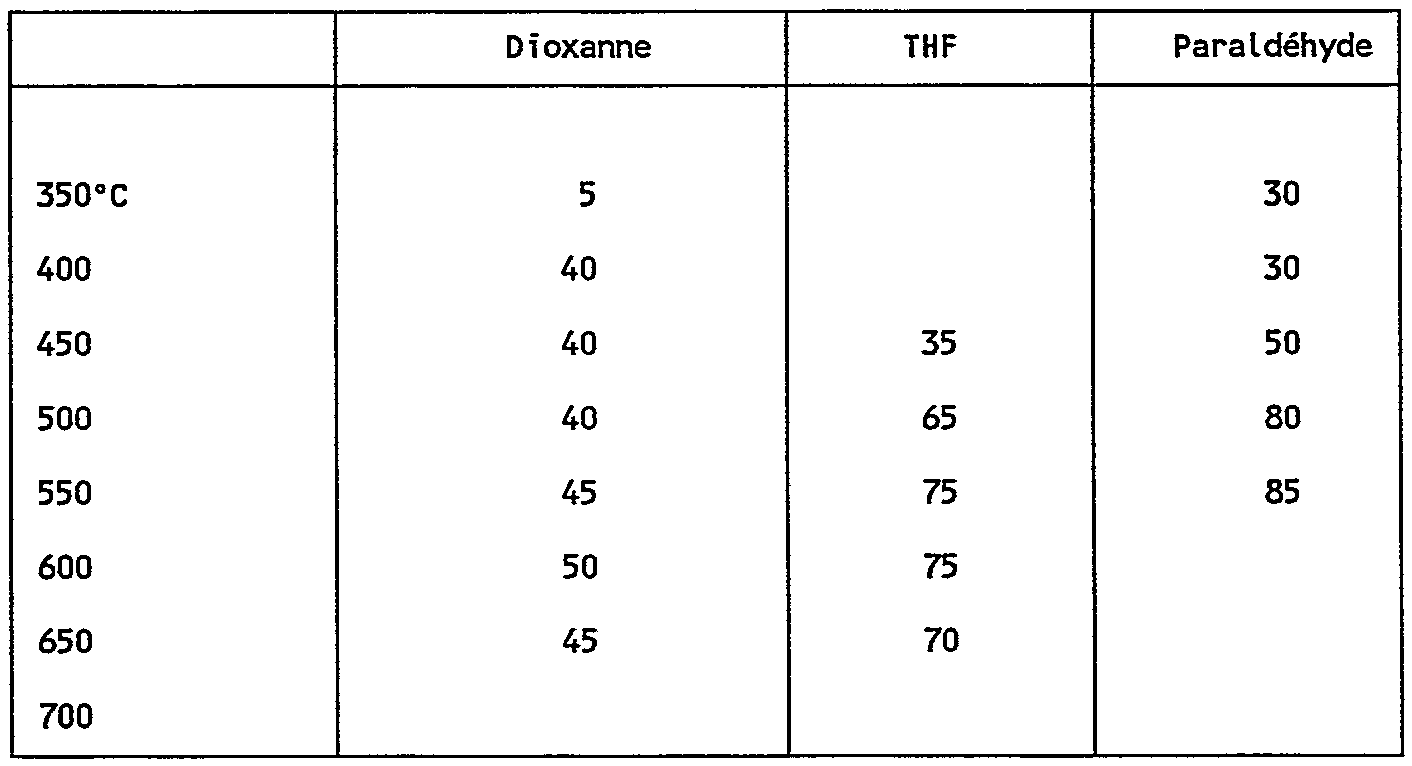
With simple representatives of this class of substances, nitrogen oxide reduction tests were carried out under the following conditions: Catalyst: H-ZSM5 (module 90) at 2%
W03, treated twice by exchange
with copper - Composition of the gas: NO: 1500 vpm
O2: 6.5% by volume
N2: the rest - Experimental conditions: Spatial velocity: 23 800 h ~ 1
Temperature range: 300 7b0C - Hydrocarbons added
1,4-Dioxan 2,4,6-Trimethyl-1,3,5-Trioxarme Te'trahydrofuran (Paraldehyde) tTI1F) - Results (Decrease of NOx proportion in%)
<tb> <SEP> Dioxanne <SEP> TF <SEP> Paraldéhyde
<tb> 350C <SEP> 5 <SEP> 30
<tb> 400 <SEP> 40 <SEP> 30
<tb> 450 <SEP> 40 <SEP> 35 <SEP> 50
<tb> 500 <SEP> 40 <SEP> 65 <SEP> 80
<tb> 550 <SEP> 45 <SEP> 75 <SEP> 85
<tb> 600 <SEP> 50 <SEP> 75
<tb> 650 <SEP> 45 <SEP> 70
<tb> 700
<tb>
La figure unique du dessin annexé représente un moteur à combustion interne - dans ce cas, un moteur Diesel comportant des dispositifs qui permettent la mise en oeuvre du procédé conforme à l'invention.<tb><SEP> Dioxane <SEP> TF <SEP> Paraldehyde
<tb> 350C <SEP> 5 <SEP> 30
<tb> 400 <SEP> 40 <SEP> 30
<tb> 450 <SEP> 40 <SEP> 35 <SEP> 50
<tb> 500 <SEP> 40 <SEP> 65 <SEP> 80
<tb> 550 <SEP> 45 <SEP> 75 <SEP> 85
<tb> 600 <SEP> 50 <SEP> 75
<tb> 650 <SEP> 45 <SEP> 70
<tb> 700
<Tb>
The single figure of the appended drawing represents an internal combustion engine - in this case, a diesel engine comprising devices that allow the implementation of the method according to the invention.
L'appareil de commande 2, auquel sont envoyés des signaux d'un détecteur de température 3 dans un catalyseur 5 disposé dans le pot d'échappement 4 du moteur et dans un détecteur 6 de vitesse de rotation, est associé au moteur à combustion interne, désigné dans son ensemble par 1, dont la construction est connue et ne nécessite donc pas ici une description plus détaillée. Les courbes caractéristiques du moteur et une courbe caractéristique de l'émission des oxydes
NOx sont mémorisées dans l'appareil de commande 2. Ce dernier délivre au compresseur 7 et au gicleur 8, en exploitant les signaux du détecteur ainsi que des signaux de charge, des signaux de réglage tirés des courbes caractéristiques pour l'amenée d'hydrocarbure oxocyclique se trouvant dans le réservoir 9 aux gaz d'échappement se trouvant dans le conduit 4 dans la direction d'écoulement en avant du catalyseur zéolitique 5. Par conséquent, il se produit ainsi une addition commandée de cet hydrocarbure aux gaz d'échappement devant être traités, en fonction de l'émission concernée d'oxydes NOx du moteur.The control apparatus 2, to which signals are sent from a temperature detector 3 in a catalyst 5 disposed in the muffler 4 of the engine and in a speed detector 6, is associated with the internal combustion engine. , designated as a whole by 1, whose construction is known and therefore does not require a more detailed description. The characteristic curves of the motor and a characteristic curve of the emission of the oxides
NOx are stored in the control unit 2. The latter delivers to the compressor 7 and the nozzle 8, by using the detector signals as well as load signals, control signals derived from the characteristic curves for the hydrocarbon feed. oxocyclic in the exhaust gas reservoir 9 in the conduit 4 in the forward flow direction of the zeolitic catalyst 5. As a result, there is thus a controlled addition of this hydrocarbon to the exhaust gases in front of to be treated, depending on the emission of NOx oxides from the engine.
Comme le fait apparaître le tableau de résultats présenté ci-dessus, l'invention crée un procédé du genre défini qui se distingue par un haut degré de transformation des oxydes d'azote se trouvant dans les gaz d'échappement. As is apparent from the results table presented above, the invention creates a process of the defined kind which is distinguished by a high degree of conversion of the nitrogen oxides in the exhaust gas.
Claims (5)
Applications Claiming Priority (1)
| Application Number | Priority Date | Filing Date | Title |
|---|---|---|---|
| DE4213649 | 1992-04-25 |
Publications (2)
| Publication Number | Publication Date |
|---|---|
| FR2690358A1 true FR2690358A1 (en) | 1993-10-29 |
| FR2690358B1 FR2690358B1 (en) | 1995-01-13 |
Family
ID=6457471
Family Applications (1)
| Application Number | Title | Priority Date | Filing Date |
|---|---|---|---|
| FR9304631A Expired - Fee Related FR2690358B1 (en) | 1992-04-25 | 1993-04-20 | Process for the reduction of nitrogen oxides in exhaust gases containing oxygen. |
Country Status (2)
| Country | Link |
|---|---|
| JP (1) | JPH0631137A (en) |
| FR (1) | FR2690358B1 (en) |
Families Citing this family (1)
| Publication number | Priority date | Publication date | Assignee | Title |
|---|---|---|---|---|
| JP4710866B2 (en) | 2007-04-18 | 2011-06-29 | トヨタ自動車株式会社 | Exhaust gas purification device for internal combustion engine |
Citations (4)
| Publication number | Priority date | Publication date | Assignee | Title |
|---|---|---|---|---|
| EP0459396A1 (en) * | 1990-05-28 | 1991-12-04 | The Agency of Industrial Science and Technology | Process for removing nitrogen oxides from exhaust gases |
| US5078982A (en) * | 1990-09-20 | 1992-01-07 | Molecular Technology Corporation | Reduction of nitrogen oxide in effluent gases using formaldehyde |
| US5149511A (en) * | 1991-10-07 | 1992-09-22 | Ford Motor Company | Method of selectively reducing NOx |
| EP0526099A1 (en) * | 1991-07-23 | 1993-02-03 | Kabushiki Kaisha Riken | Exhaust gas cleaner |
-
1993
- 1993-04-20 FR FR9304631A patent/FR2690358B1/en not_active Expired - Fee Related
- 1993-04-23 JP JP5098104A patent/JPH0631137A/en not_active Withdrawn
Patent Citations (4)
| Publication number | Priority date | Publication date | Assignee | Title |
|---|---|---|---|---|
| EP0459396A1 (en) * | 1990-05-28 | 1991-12-04 | The Agency of Industrial Science and Technology | Process for removing nitrogen oxides from exhaust gases |
| US5078982A (en) * | 1990-09-20 | 1992-01-07 | Molecular Technology Corporation | Reduction of nitrogen oxide in effluent gases using formaldehyde |
| EP0526099A1 (en) * | 1991-07-23 | 1993-02-03 | Kabushiki Kaisha Riken | Exhaust gas cleaner |
| US5149511A (en) * | 1991-10-07 | 1992-09-22 | Ford Motor Company | Method of selectively reducing NOx |
Also Published As
| Publication number | Publication date |
|---|---|
| JPH0631137A (en) | 1994-02-08 |
| FR2690358B1 (en) | 1995-01-13 |
Similar Documents
| Publication | Publication Date | Title |
|---|---|---|
| US7743602B2 (en) | Reformer assisted lean NOx catalyst aftertreatment system and method | |
| DE102014103678B4 (en) | COMPACT EXHAUST TREATMENT SYSTEM FOR A DIESEL ENGINE | |
| Suzuki et al. | Development of catalysts for diesel particulate NO x reduction | |
| KR0127757B1 (en) | A process for the reduction of the nitrogen oxides in exhaust gases using a zeolite-containing catalyst | |
| EP0830201B1 (en) | Diesel engine exhaust gas purification system | |
| US20020029564A1 (en) | System for reducing NOx transient emission | |
| EP3254749A1 (en) | Denox of diesel engine exhaust gases using a temperature-controlled precatalyst for providing no2 in accordance with the requirements | |
| JP2011527404A (en) | Dual catalyst NOx reduction system for exhaust gas of lean burn internal combustion engine | |
| CN101915146A (en) | The NO that is used for the hydrocarbon fuels power source XEmission control systems | |
| US8806851B2 (en) | Method for reducing emission of nitrogen oxide in a motor vehicle having a lean burning internal combustion engine | |
| KR20130103502A (en) | Combined slip catalyst and hydrocarbon exotherm catalyst | |
| CN1353006A (en) | Waste gas treatment apparatus of selective catalytic reduction nitrogen oxide and its waste gas treatment method | |
| WO2006008625A1 (en) | Hybrid catalyst system for exhaust emissions reduction | |
| RU2004120435A (en) | SYSTEM AND METHODS FOR MANAGING THE CONTENT OF HARMFUL COMPONENTS IN EXHAUST GASES OF INTERNAL COMBUSTION ENGINES AND FUEL TREATMENT UNIT | |
| EP2283213A1 (en) | Process and apparatus for purifying exhaust gases from an internal combustion engine | |
| US20200248606A1 (en) | Ammonia production catalyst and after treatment system | |
| Zheng et al. | Enhanced low-temperature NOx conversion by high-frequency hydrocarbon pulsing on a dual layer LNT-SCR catalyst | |
| US20160082949A1 (en) | System for improving exhaust gas purifying performance of diesel hybrid electric vehicle | |
| WO2023158798A1 (en) | Device for the reduction of ammonia and nitrogen oxides emissions | |
| Zheng et al. | Rapid propylene pulsing for enhanced low temperature NOx conversion on combined LNT-SCR catalysts | |
| FR2690358A1 (en) | Denitrification of exhaust gas contg. oxygen esp. from internal combustion engine | |
| US3908365A (en) | Treatment of gaseous effluent | |
| Church et al. | Catalyst formulations 1960 to present | |
| JP2616799B2 (en) | Automotive exhaust purification system | |
| FR2944316A3 (en) | METHOD OF REDUCING NITROGEN PROTOXIDE FROM EXHAUST GAS OF MOTOR VEHICLE |
Legal Events
| Date | Code | Title | Description |
|---|---|---|---|
| ST | Notification of lapse |