FR2664530A1 - Process for making polyester films - Google Patents
Process for making polyester films Download PDFInfo
- Publication number
- FR2664530A1 FR2664530A1 FR9009269A FR9009269A FR2664530A1 FR 2664530 A1 FR2664530 A1 FR 2664530A1 FR 9009269 A FR9009269 A FR 9009269A FR 9009269 A FR9009269 A FR 9009269A FR 2664530 A1 FR2664530 A1 FR 2664530A1
- Authority
- FR
- France
- Prior art keywords
- units
- thermotropic
- polyester
- aromatic
- process according
- Prior art date
- Legal status (The legal status is an assumption and is not a legal conclusion. Google has not performed a legal analysis and makes no representation as to the accuracy of the status listed.)
- Pending
Links
- 238000000034 method Methods 0.000 title claims abstract description 24
- 230000008569 process Effects 0.000 title claims abstract description 16
- 229920006267 polyester film Polymers 0.000 title claims abstract description 12
- 229920000642 polymer Polymers 0.000 claims abstract description 58
- 229920000728 polyester Polymers 0.000 claims abstract description 51
- 229910045601 alloy Inorganic materials 0.000 claims abstract description 12
- 239000000956 alloy Substances 0.000 claims abstract description 12
- 238000002156 mixing Methods 0.000 claims abstract description 12
- 125000003118 aryl group Chemical group 0.000 claims description 17
- 239000000203 mixture Substances 0.000 claims description 14
- 229920001634 Copolyester Polymers 0.000 claims description 8
- LYCAIKOWRPUZTN-UHFFFAOYSA-N ethylene glycol Natural products OCCO LYCAIKOWRPUZTN-UHFFFAOYSA-N 0.000 claims description 7
- 229910052801 chlorine Chemical group 0.000 claims description 6
- 239000000460 chlorine Chemical group 0.000 claims description 6
- 125000002496 methyl group Chemical group [H]C([H])([H])* 0.000 claims description 6
- WKBOTKDWSSQWDR-UHFFFAOYSA-N Bromine atom Chemical group [Br] WKBOTKDWSSQWDR-UHFFFAOYSA-N 0.000 claims description 5
- KZBUYRJDOAKODT-UHFFFAOYSA-N Chlorine Chemical group ClCl KZBUYRJDOAKODT-UHFFFAOYSA-N 0.000 claims description 5
- 238000000354 decomposition reaction Methods 0.000 claims description 4
- 230000007704 transition Effects 0.000 claims description 4
- KKEYFWRCBNTPAC-UHFFFAOYSA-L terephthalate(2-) Chemical compound [O-]C(=O)C1=CC=C(C([O-])=O)C=C1 KKEYFWRCBNTPAC-UHFFFAOYSA-L 0.000 claims description 3
- 239000004760 aramid Substances 0.000 claims description 2
- 229920003235 aromatic polyamide Polymers 0.000 claims description 2
- QUPDWYMUPZLYJZ-UHFFFAOYSA-N ethyl Chemical group C[CH2] QUPDWYMUPZLYJZ-UHFFFAOYSA-N 0.000 claims description 2
- 229920000343 polyazomethine Polymers 0.000 claims description 2
- 229920006149 polyester-amide block copolymer Polymers 0.000 claims 2
- WGCNASOHLSPBMP-UHFFFAOYSA-N hydroxyacetaldehyde Natural products OCC=O WGCNASOHLSPBMP-UHFFFAOYSA-N 0.000 claims 1
- 229920001515 polyalkylene glycol Polymers 0.000 claims 1
- 238000000576 coating method Methods 0.000 abstract description 10
- 150000003254 radicals Chemical class 0.000 description 10
- KKEYFWRCBNTPAC-UHFFFAOYSA-N Terephthalic acid Chemical compound OC(=O)C1=CC=C(C(O)=O)C=C1 KKEYFWRCBNTPAC-UHFFFAOYSA-N 0.000 description 7
- 239000011248 coating agent Substances 0.000 description 7
- 239000004594 Masterbatch (MB) Substances 0.000 description 6
- 239000002245 particle Substances 0.000 description 6
- 238000005299 abrasion Methods 0.000 description 5
- 238000004519 manufacturing process Methods 0.000 description 5
- 150000004649 carbonic acid derivatives Chemical class 0.000 description 4
- 125000001495 ethyl group Chemical group [H]C([H])([H])C([H])([H])* 0.000 description 4
- 238000001125 extrusion Methods 0.000 description 4
- 239000000945 filler Substances 0.000 description 4
- 239000008187 granular material Substances 0.000 description 4
- 239000002184 metal Substances 0.000 description 4
- 239000012764 mineral filler Substances 0.000 description 4
- 238000002360 preparation method Methods 0.000 description 4
- 230000003746 surface roughness Effects 0.000 description 4
- 238000012876 topography Methods 0.000 description 4
- -1 1,4-phenylene radical Chemical class 0.000 description 3
- OFOBLEOULBTSOW-UHFFFAOYSA-N Malonic acid Chemical compound OC(=O)CC(O)=O OFOBLEOULBTSOW-UHFFFAOYSA-N 0.000 description 3
- WERYXYBDKMZEQL-UHFFFAOYSA-N butane-1,4-diol Chemical compound OCCCCO WERYXYBDKMZEQL-UHFFFAOYSA-N 0.000 description 3
- MTHSVFCYNBDYFN-UHFFFAOYSA-N diethylene glycol Chemical compound OCCOCCO MTHSVFCYNBDYFN-UHFFFAOYSA-N 0.000 description 3
- 238000009998 heat setting Methods 0.000 description 3
- 239000000463 material Substances 0.000 description 3
- 238000002844 melting Methods 0.000 description 3
- 230000008018 melting Effects 0.000 description 3
- 238000012360 testing method Methods 0.000 description 3
- 101100443249 Caenorhabditis elegans dig-1 gene Proteins 0.000 description 2
- 239000002202 Polyethylene glycol Substances 0.000 description 2
- 239000002253 acid Substances 0.000 description 2
- WNLRTRBMVRJNCN-UHFFFAOYSA-N adipic acid Chemical compound OC(=O)CCCCC(O)=O WNLRTRBMVRJNCN-UHFFFAOYSA-N 0.000 description 2
- 230000006835 compression Effects 0.000 description 2
- 238000007906 compression Methods 0.000 description 2
- 238000001816 cooling Methods 0.000 description 2
- 150000002009 diols Chemical class 0.000 description 2
- USIUVYZYUHIAEV-UHFFFAOYSA-N diphenyl ether Chemical compound C=1C=CC=CC=1OC1=CC=CC=C1 USIUVYZYUHIAEV-UHFFFAOYSA-N 0.000 description 2
- 238000009826 distribution Methods 0.000 description 2
- NWVVVBRKAWDGAB-UHFFFAOYSA-N hydroquinone methyl ether Natural products COC1=CC=C(O)C=C1 NWVVVBRKAWDGAB-UHFFFAOYSA-N 0.000 description 2
- 238000010348 incorporation Methods 0.000 description 2
- QQVIHTHCMHWDBS-UHFFFAOYSA-N isophthalic acid Chemical compound OC(=O)C1=CC=CC(C(O)=O)=C1 QQVIHTHCMHWDBS-UHFFFAOYSA-N 0.000 description 2
- 239000000155 melt Substances 0.000 description 2
- 229910001092 metal group alloy Inorganic materials 0.000 description 2
- 229910044991 metal oxide Inorganic materials 0.000 description 2
- 150000004706 metal oxides Chemical class 0.000 description 2
- KYTZHLUVELPASH-UHFFFAOYSA-N naphthalene-1,2-dicarboxylic acid Chemical compound C1=CC=CC2=C(C(O)=O)C(C(=O)O)=CC=C21 KYTZHLUVELPASH-UHFFFAOYSA-N 0.000 description 2
- 230000003287 optical effect Effects 0.000 description 2
- 229920001279 poly(ester amides) Polymers 0.000 description 2
- 229920001223 polyethylene glycol Polymers 0.000 description 2
- CXMXRPHRNRROMY-UHFFFAOYSA-N sebacic acid Chemical compound OC(=O)CCCCCCCCC(O)=O CXMXRPHRNRROMY-UHFFFAOYSA-N 0.000 description 2
- CNHDIAIOKMXOLK-UHFFFAOYSA-N toluquinol Chemical compound CC1=CC(O)=CC=C1O CNHDIAIOKMXOLK-UHFFFAOYSA-N 0.000 description 2
- 238000011282 treatment Methods 0.000 description 2
- WSLDOOZREJYCGB-UHFFFAOYSA-N 1,2-Dichloroethane Chemical compound ClCCCl WSLDOOZREJYCGB-UHFFFAOYSA-N 0.000 description 1
- PXGZQGDTEZPERC-UHFFFAOYSA-N 1,4-cyclohexanedicarboxylic acid Chemical compound OC(=O)C1CCC(C(O)=O)CC1 PXGZQGDTEZPERC-UHFFFAOYSA-N 0.000 description 1
- ISPYQTSUDJAMAB-UHFFFAOYSA-N 2-chlorophenol Chemical compound OC1=CC=CC=C1Cl ISPYQTSUDJAMAB-UHFFFAOYSA-N 0.000 description 1
- WXNZTHHGJRFXKQ-UHFFFAOYSA-N 4-chlorophenol Chemical compound OC1=CC=C(Cl)C=C1 WXNZTHHGJRFXKQ-UHFFFAOYSA-N 0.000 description 1
- FJKROLUGYXJWQN-UHFFFAOYSA-N 4-hydroxybenzoic acid Chemical compound OC(=O)C1=CC=C(O)C=C1 FJKROLUGYXJWQN-UHFFFAOYSA-N 0.000 description 1
- ZAMOUSCENKQFHK-UHFFFAOYSA-N Chlorine atom Chemical compound [Cl] ZAMOUSCENKQFHK-UHFFFAOYSA-N 0.000 description 1
- 241000790917 Dioxys <bee> Species 0.000 description 1
- 239000004952 Polyamide Substances 0.000 description 1
- KDYFGRWQOYBRFD-UHFFFAOYSA-N Succinic acid Natural products OC(=O)CCC(O)=O KDYFGRWQOYBRFD-UHFFFAOYSA-N 0.000 description 1
- 238000002441 X-ray diffraction Methods 0.000 description 1
- ORLQHILJRHBSAY-UHFFFAOYSA-N [1-(hydroxymethyl)cyclohexyl]methanol Chemical compound OCC1(CO)CCCCC1 ORLQHILJRHBSAY-UHFFFAOYSA-N 0.000 description 1
- 230000009471 action Effects 0.000 description 1
- 125000002015 acyclic group Chemical group 0.000 description 1
- 239000001361 adipic acid Substances 0.000 description 1
- 235000011037 adipic acid Nutrition 0.000 description 1
- 239000002671 adjuvant Substances 0.000 description 1
- 125000005907 alkyl ester group Chemical group 0.000 description 1
- 229920006125 amorphous polymer Polymers 0.000 description 1
- 239000002216 antistatic agent Substances 0.000 description 1
- 125000001246 bromo group Chemical group Br* 0.000 description 1
- KDYFGRWQOYBRFD-NUQCWPJISA-N butanedioic acid Chemical compound O[14C](=O)CC[14C](O)=O KDYFGRWQOYBRFD-NUQCWPJISA-N 0.000 description 1
- 125000004432 carbon atom Chemical group C* 0.000 description 1
- 125000002915 carbonyl group Chemical group [*:2]C([*:1])=O 0.000 description 1
- 230000003197 catalytic effect Effects 0.000 description 1
- 230000000052 comparative effect Effects 0.000 description 1
- 229920001577 copolymer Polymers 0.000 description 1
- 238000000151 deposition Methods 0.000 description 1
- 230000006866 deterioration Effects 0.000 description 1
- 125000004989 dicarbonyl group Chemical group 0.000 description 1
- 238000004455 differential thermal analysis Methods 0.000 description 1
- 230000000694 effects Effects 0.000 description 1
- 125000004185 ester group Chemical group 0.000 description 1
- RTZKZFJDLAIYFH-UHFFFAOYSA-N ether Substances CCOCC RTZKZFJDLAIYFH-UHFFFAOYSA-N 0.000 description 1
- 238000001704 evaporation Methods 0.000 description 1
- 230000008020 evaporation Effects 0.000 description 1
- 230000001747 exhibiting effect Effects 0.000 description 1
- 230000009477 glass transition Effects 0.000 description 1
- 125000005842 heteroatom Chemical group 0.000 description 1
- ORTFAQDWJHRMNX-UHFFFAOYSA-N hydroxidooxidocarbon(.) Chemical group O[C]=O ORTFAQDWJHRMNX-UHFFFAOYSA-N 0.000 description 1
- 230000006872 improvement Effects 0.000 description 1
- 239000011256 inorganic filler Substances 0.000 description 1
- 229910003475 inorganic filler Inorganic materials 0.000 description 1
- 229910052500 inorganic mineral Inorganic materials 0.000 description 1
- 239000007788 liquid Substances 0.000 description 1
- 238000005259 measurement Methods 0.000 description 1
- 239000011707 mineral Substances 0.000 description 1
- 239000000178 monomer Substances 0.000 description 1
- SLCVBVWXLSEKPL-UHFFFAOYSA-N neopentyl glycol Chemical compound OCC(C)(C)CO SLCVBVWXLSEKPL-UHFFFAOYSA-N 0.000 description 1
- 229940117969 neopentyl glycol Drugs 0.000 description 1
- 125000005740 oxycarbonyl group Chemical group [*:1]OC([*:2])=O 0.000 description 1
- 238000004806 packaging method and process Methods 0.000 description 1
- 229940090668 parachlorophenol Drugs 0.000 description 1
- 125000001997 phenyl group Chemical group [H]C1=C([H])C([H])=C(*)C([H])=C1[H] 0.000 description 1
- 125000000843 phenylene group Chemical group C1(=C(C=CC=C1)*)* 0.000 description 1
- 229920002647 polyamide Polymers 0.000 description 1
- 239000002861 polymer material Substances 0.000 description 1
- 239000000843 powder Substances 0.000 description 1
- 238000012545 processing Methods 0.000 description 1
- YPFDHNVEDLHUCE-UHFFFAOYSA-N propane-1,3-diol Chemical compound OCCCO YPFDHNVEDLHUCE-UHFFFAOYSA-N 0.000 description 1
- 238000005086 pumping Methods 0.000 description 1
- 150000003839 salts Chemical class 0.000 description 1
- 238000005070 sampling Methods 0.000 description 1
- 238000000926 separation method Methods 0.000 description 1
- 239000012748 slip agent Substances 0.000 description 1
- 239000007787 solid Substances 0.000 description 1
- 239000011877 solvent mixture Substances 0.000 description 1
- 238000004544 sputter deposition Methods 0.000 description 1
- 230000003068 static effect Effects 0.000 description 1
- 238000003860 storage Methods 0.000 description 1
- 239000000126 substance Substances 0.000 description 1
- 239000003017 thermal stabilizer Substances 0.000 description 1
- 229920001169 thermoplastic Polymers 0.000 description 1
- 239000004416 thermosoftening plastic Substances 0.000 description 1
- XLYOFNOQVPJJNP-UHFFFAOYSA-N water Substances O XLYOFNOQVPJJNP-UHFFFAOYSA-N 0.000 description 1
- 238000004804 winding Methods 0.000 description 1
Classifications
-
- C—CHEMISTRY; METALLURGY
- C08—ORGANIC MACROMOLECULAR COMPOUNDS; THEIR PREPARATION OR CHEMICAL WORKING-UP; COMPOSITIONS BASED THEREON
- C08J—WORKING-UP; GENERAL PROCESSES OF COMPOUNDING; AFTER-TREATMENT NOT COVERED BY SUBCLASSES C08B, C08C, C08F, C08G or C08H
- C08J5/00—Manufacture of articles or shaped materials containing macromolecular substances
- C08J5/18—Manufacture of films or sheets
-
- B—PERFORMING OPERATIONS; TRANSPORTING
- B29—WORKING OF PLASTICS; WORKING OF SUBSTANCES IN A PLASTIC STATE IN GENERAL
- B29D—PRODUCING PARTICULAR ARTICLES FROM PLASTICS OR FROM SUBSTANCES IN A PLASTIC STATE
- B29D7/00—Producing flat articles, e.g. films or sheets
- B29D7/01—Films or sheets
-
- B—PERFORMING OPERATIONS; TRANSPORTING
- B29—WORKING OF PLASTICS; WORKING OF SUBSTANCES IN A PLASTIC STATE IN GENERAL
- B29K—INDEXING SCHEME ASSOCIATED WITH SUBCLASSES B29B, B29C OR B29D, RELATING TO MOULDING MATERIALS OR TO MATERIALS FOR MOULDS, REINFORCEMENTS, FILLERS OR PREFORMED PARTS, e.g. INSERTS
- B29K2067/00—Use of polyesters or derivatives thereof, as moulding material
-
- B—PERFORMING OPERATIONS; TRANSPORTING
- B29—WORKING OF PLASTICS; WORKING OF SUBSTANCES IN A PLASTIC STATE IN GENERAL
- B29K—INDEXING SCHEME ASSOCIATED WITH SUBCLASSES B29B, B29C OR B29D, RELATING TO MOULDING MATERIALS OR TO MATERIALS FOR MOULDS, REINFORCEMENTS, FILLERS OR PREFORMED PARTS, e.g. INSERTS
- B29K2105/00—Condition, form or state of moulded material or of the material to be shaped
- B29K2105/0079—Liquid crystals
-
- B—PERFORMING OPERATIONS; TRANSPORTING
- B29—WORKING OF PLASTICS; WORKING OF SUBSTANCES IN A PLASTIC STATE IN GENERAL
- B29K—INDEXING SCHEME ASSOCIATED WITH SUBCLASSES B29B, B29C OR B29D, RELATING TO MOULDING MATERIALS OR TO MATERIALS FOR MOULDS, REINFORCEMENTS, FILLERS OR PREFORMED PARTS, e.g. INSERTS
- B29K2995/00—Properties of moulding materials, reinforcements, fillers, preformed parts or moulds
- B29K2995/0037—Other properties
- B29K2995/0072—Roughness, e.g. anti-slip
-
- C—CHEMISTRY; METALLURGY
- C08—ORGANIC MACROMOLECULAR COMPOUNDS; THEIR PREPARATION OR CHEMICAL WORKING-UP; COMPOSITIONS BASED THEREON
- C08J—WORKING-UP; GENERAL PROCESSES OF COMPOUNDING; AFTER-TREATMENT NOT COVERED BY SUBCLASSES C08B, C08C, C08F, C08G or C08H
- C08J2367/00—Characterised by the use of polyesters obtained by reactions forming a carboxylic ester link in the main chain; Derivatives of such polymers
Landscapes
- Engineering & Computer Science (AREA)
- Chemical & Material Sciences (AREA)
- Manufacturing & Machinery (AREA)
- Materials Engineering (AREA)
- Health & Medical Sciences (AREA)
- Chemical Kinetics & Catalysis (AREA)
- Medicinal Chemistry (AREA)
- Polymers & Plastics (AREA)
- Organic Chemistry (AREA)
- Mechanical Engineering (AREA)
- Manufacture Of Macromolecular Shaped Articles (AREA)
Abstract
Description
PROCEDE DE PREPARATION DE FILMS POLYESTER
La présente invention a pour objet un procédé d'obtention de films polyester contenant un polymère thermotrope.POLYESTER FILMS PREPARATION PROCESS
The present invention relates to a process for obtaining polyester films containing a thermotropic polymer.
En raison de leurs propriétés mécaniques et chimiques, les films polyester constituent un matériau de choix comme support de revêtements magnétiques d'enregistrement (oxydes métalliques ou alliages métalliques). Due to their mechanical and chemical properties, polyester films are a material of choice as a support for magnetic recording coatings (metal oxides or metal alloys).
Cependant, les films polyester manquent de glissant, ce qui occasionne des difficultés de mise en oeuvre et en particulier de bobinage, conséquence d'un coefficient de frottement élevé des films glissant sur eux-mêmes ou sur des surfaces métalliques lisses fixes ou en mouvement telles que celles présentes dans les appareils de fabrication des films (galets, cylindres) ou dans les appareils de reproduction de signaux enregistrés. Pour résoudre1-: le problème posé par l'absence de glissant des films polyester, le moyen le plus utilisé consiste à leur communiquer une rugosité de surface par incorporation de particules inertes de sels ou d'oxydes métalliques qui génèrent des aspérités à la surface des films.Si pour de nombreuses applications la présence de ces aspérités n'est pas gênante, il n'en est pas de même dans le domaine du film magnétique.However, the polyester films lack slippage, which causes difficulties of implementation and in particular of winding, consequence of a high coefficient of friction of the films sliding on themselves or on smooth fixed or moving metal surfaces such as than those present in film-making apparatus (rollers, cylinders) or in apparatus for reproducing recorded signals. To solve1-: the problem posed by the lack of slip of polyester films, the most used means consists in imparting a surface roughness to them by incorporation of inert particles of salts or metal oxides which generate asperities on the surface of the films. If the presence of these roughness is not a problem for many applications, it is not the same in the field of magnetic film.
En effet, les irrégularités de surface du film support se traduisent par des irrégularités de surface du revêtement magnétique et même par une discontinuité de ce revêtement qui entraînent une perte d'information à l'enregistrement et/ou à la lecture de l'information. Par ailleurs, l'abrasion de ces aspérités lors des usages répétés des films magnétiques contribue également à leur détérioration.L'abrasion trouve sa source notamment dans le manque de cohésion entre les particules de charges minérales et le polymère qui les entoure En effet, il est connu qu'en raison de l'incompatibilité entre ces charges et les polyesters des vides en proportions plus ou moins importantes se créent entre la charge et le polymère lors des opérations d'étirages ; ces vides augmentent la turbidité des films d'une part et facilite la séparation de la charge et du polymère sous l'action des frottements engendrés lors des opérations de filmature et/ou d'utilisation des films. Pour résoudre ces problèmes, il a fallu réaliser un compromis entre les propriétés de glissant et la rugosité de surface des films par la sélection des quantités de charges à mettre en oeuvre et de leurs dimensions particulaires.De nombreuses solutions ont été proposées qui se sont révélées satisfaisantes pour l'obtention de films d'enregistrement magnétiques de sons ou d'images (films vidéo) dans lesquels le revêtement magnétique est réalisé par dépôt d'un enduit magnétique. Dans ce cas, l'épaisseur de la couche magnétique est en général suffisante pour atténuer la topographie de la surface du film support.Par contre, ces solutions trouvent rapidement leurs limites lorsqu'il s'agit de fabriquer des films d'enregistrement magnétique à haute densité d'informations dans lesquels le revêtement magnétique, formé par évaporation d'oxydes ou d'alliages métalliques ou par revêtement cathodique (sputtering), est extrêmement mince : habituellement entre 0,01 et 0,2 pm. En effet, il convient dans ce cas de faire appel à des films dont la face recevant le revêtement magnétique doit être pratiquement lisse. Il devient alors difficile de bobiner le film en raison de l'augmentation de son coefficient de frottement.En définitive, dans le cas des films magnétiques à haute densité d'information, il devient difficile sinon impossible de concilier de bonnes propriétés de machinabilité avec de bonnes propriétés d'enregistrement et de restitution de l'information par incorporation de particules solides dans le film support, l'amélioration de chacune de ces propriétés se faisant au détriment des autres. Pour tenter de résoudre ce problème, on a proposé de faire appel à des films supports présentant une face lisse et une face rugueuse. Néanmoins, il a été constaté que la couche magnétique est alors endommagée par la face rugueuse adjacente lors du stockage en bobine, les irrégularités de cette face étant imprimées dans la couche magnétique. Indeed, the surface irregularities of the support film result in surface irregularities of the magnetic coating and even by a discontinuity of this coating which lead to a loss of information on recording and / or reading of the information. In addition, the abrasion of these asperities during repeated use of magnetic films also contributes to their deterioration. The abrasion finds its source in particular in the lack of cohesion between the particles of inorganic fillers and the polymer which surrounds them. It is known that due to the incompatibility between these fillers and the polyesters, voids in more or less large proportions are created between the filler and the polymer during stretching operations; these voids increase the turbidity of the films on the one hand and facilitate the separation of the filler and the polymer under the action of the friction generated during the filming operations and / or use of the films. To solve these problems, it was necessary to achieve a compromise between the sliding properties and the surface roughness of the films by selecting the amounts of fillers to be used and their particle sizes. Numerous solutions have been proposed which have been found to be proven. satisfactory for obtaining magnetic sound or image recording films (video films) in which the magnetic coating is produced by depositing a magnetic coating. In this case, the thickness of the magnetic layer is generally sufficient to attenuate the topography of the surface of the support film. On the other hand, these solutions quickly find their limits when it comes to manufacturing magnetic recording films at high information density in which the magnetic coating, formed by evaporation of oxides or metal alloys or by cathodic coating (sputtering), is extremely thin: usually between 0.01 and 0.2 µm. In fact, it is appropriate in this case to use films whose face receiving the magnetic coating must be practically smooth. It then becomes difficult to wind the film due to the increase in its coefficient of friction. Ultimately, in the case of magnetic films with high information density, it becomes difficult if not impossible to reconcile good machinability properties with high information density. good properties for recording and restoring information by incorporating solid particles into the support film, the improvement of each of these properties being done to the detriment of the others. In an attempt to resolve this problem, it has been proposed to use support films having a smooth face and a rough face. Nevertheless, it has been observed that the magnetic layer is then damaged by the adjacent rough face during storage on a reel, the irregularities of this face being printed in the magnetic layer.
Dans la demande de brevet européen publiée sous le n O 304 153, on a proposé de résoudre le problème posé par l'obtention de films thermoplastiques présentant à la fois une faible rugosité, un bon glissant et une excellente résistance à l'abrasion, en incorporant un polymère thermotrope dans le polymère destiné à constituer le film. On a constaté que dans les films obtenus à partir de tels mélanges, le polymère thermotrope est présent sous forme de structures globulaires (sphériques ou elliptiques) générant la topographie de surface du film ; la rugosité de surface dépend de la quantité de polymère thermotrope présente dans le polymère hôte. Le polymère thermotrope doit présenter une température de fusion inférieure à la température de décomposition du polymère hôte.Dan le cas des films polyester celà limite le choix des polymères thermotropes à ceux qui présentent une température de fusion inférieure à environ 300 C. En raison des différences de propriétés rhéologiques des polymères hôtes, et notamment des polyesters, et des polymères thermotropes il s'avère en outre difficile d'assurer une répartition régulière du polymère thermotrope dans le polymère hôte et, par conséquent, une topographie régulière des films obtenus à partir de tels mélanges. Par ailleurs, le problème s'est posé de pouvoir assurer une rugosité aussi faible que possible pour une quantité donnée de polymère thermotrope. In the European patent application published under No. 304 153, it has been proposed to solve the problem posed by obtaining thermoplastic films exhibiting both low roughness, good slip and excellent abrasion resistance, by incorporating a thermotropic polymer in the polymer intended to constitute the film. It has been observed that in the films obtained from such mixtures, the thermotropic polymer is present in the form of globular structures (spherical or elliptical) generating the surface topography of the film; the surface roughness depends on the amount of thermotropic polymer present in the host polymer. The thermotropic polymer must have a melting point lower than the decomposition temperature of the host polymer. In the case of polyester films this limits the choice of thermotropic polymers to those which have a melting point lower than about 300 C. Due to the differences of rheological properties of the host polymers, and in particular of the polyesters, and of the thermotropic polymers, it also proves difficult to ensure a regular distribution of the thermotropic polymer in the host polymer and, consequently, a regular topography of the films obtained from such mixtures. Furthermore, the problem has arisen of being able to ensure as low a roughness as possible for a given quantity of thermotropic polymer.
La présente invention se propose précisément de pallier ces différents inconvénients. The present invention specifically proposes to overcome these various drawbacks.
Plus spécifiquement, la présente invention a pour objet un procédé d'obtention de films polyester semi-cristallins orientés présentant une rugosité tridimensionnelle SRa inférieure à 0,035 nm à partir d'un alliage d'un polyester linéaire isotrope cristallisable et de 0,1 à 3 % en poids d'un polymère thermotrope caractérisé en ce que ledit alliage est obtenu par mélangeage des deux polymères dans une extrudeuse sous une vitesse de cisaillement supérieure à 100 5-1. More specifically, the present invention relates to a process for obtaining oriented semi-crystalline polyester films having a three-dimensional roughness SRa of less than 0.035 nm from an alloy of a crystallizable isotropic linear polyester and from 0.1 to 3. % by weight of a thermotropic polymer characterized in that said alloy is obtained by mixing the two polymers in an extruder at a shear rate greater than 100 5-1.
Il a été constaté de façon inattendue que la vitesse de cisaillement exerce un effet sur la rugosité des films obtenus à partir des alliages de polyesters isotropes et de polymères thermotropes : pour une quantité déterminée de polymère thermotrope la rugosité du film est d'autant plus faible que la vitesse de cisaillement mise en oeuvre lors de l'opération de mélangeage est plus élevée. On a constaté en outre que le recours à des vitesses de cisaillement élevée permet d'abaisser la température mise en oeuvre lors de l'opération de mélangeage des polymères sans provoquer une augmentation néfaste de la rugosité du film fini ; il est dès lors possible de préparer l'alliage à des températures inférieures à la température de décomposition du polyester isotrope et notamment à température inférieure ou égale à 310ex et, de préférence à 300C, même en faisant appel à des polymères thermotropes ayant une température de transition nématique supérieure à la température de décomposition du polyester isotrope. It was unexpectedly found that the shear rate exerts an effect on the roughness of the films obtained from the alloys of isotropic polyesters and of thermotropic polymers: for a determined quantity of thermotropic polymer, the roughness of the film is all the lower. that the shear rate used during the mixing operation is higher. It has also been observed that the use of high shear rates makes it possible to lower the temperature used during the mixing operation of the polymers without causing a harmful increase in the roughness of the finished film; it is therefore possible to prepare the alloy at temperatures below the decomposition temperature of the isotropic polyester and in particular at a temperature below or equal to 310ex and, preferably at 300C, even by using thermotropic polymers having a temperature of nematic transition greater than the decomposition temperature of the isotropic polyester.
Les polymères thermotropes qui conviennent pour la mise en oeuvre de la présente invention peuvent être pris parmi ceux cités dans la demande de brevet européen 0 304 153 ; ils comprennent les polyesters totalement aromatiques, les polyesters alkylaromatiques, les poly(ester-amides) totalement aromatiques, les poly(ester-amides) alkylaromatiques, les polyazométhines aromatiques, les polyesters carbonates aromatiques, les polyamides aromatiques et les mélanges de ces polymères. The thermotropic polymers which are suitable for the implementation of the present invention can be taken from those mentioned in European patent application 0 304 153; they include fully aromatic polyesters, alkyl aromatic polyesters, fully aromatic poly (ester amides), alkyl aromatic poly (ester amides), aromatic polyazomethines, aromatic polyesters carbonates, aromatic polyamides and mixtures of these polymers.
Selon une modalité préférentielle de mise en oeuvre de la présente invention, les polymères thermotropes auxquels on fait appel sont les polyesters totalement aromatiques, les polyesters alkylaromatiques, les polyesters carbonates aromatiques et les mélanges de ces polymères. According to a preferred embodiment of the present invention, the thermotropic polymers which are used are totally aromatic polyesters, alkylaromatic polyesters, aromatic polyesters carbonates and mixtures of these polymers.
Des polyesters totalement aromatiques qui sont thermotropes, c'est-à-dire qui sont capables de former des masses fondues anisotropes t sont décrits par exemple : dans les brevets américains n 3 991 013, 3 991 014, 4 066 620, 4075 262, 4 118372, 4 130 545, 4 181 792, 4 188 476, 4 219 461, 4 224 433, 4 130 817, 4 346 208 ; et dans la demande de brevet européen publiée sous le ne o 191 705. Fully aromatic polyesters which are thermotropic, i.e. which are capable of forming anisotropic melts t are described, for example: in U.S. Patents 3,991,013, 3,991,014, 4,066,620, 4,075,262, 4,118372, 4,130,545, 4,181,792, 4,188,476, 4,219,461, 4,224,433, 4,130,817, 4,346,208; and in the European patent application published under No. 191,705.
Des copolyesteramides thermotropes sont décrits dans les demandes de brevets européens publiées sous les ne 0 272 992, 0 298 883, 0 298 884 et 0 301 976. Thermotropic copolyesteramides are described in European patent applications published under Nos. 0 272 992, 0 298 883, 0 298 884 and 0 301 976.
Des polyamides thermotropes qui peuvent être utilisés conformément à la présente invention sont décrits notamment par J. PRESTON dans l'ouvrage édité par A. BLUMSTEIN "Liquid cristalline Order in
Polymers" (1978) p. 143 à 150.Thermotropic polyamides which can be used in accordance with the present invention are described in particular by J. PRESTON in the work edited by A. BLUMSTEIN "Liquid crystalline Order in
Polymers "(1978) pp. 143-150.
Des polyesters alkylaromatiques thermotropes sont décrits par exemple dans les brevets américains ne 3 778 410, 3 804 805, 4 248 995, 4 311 824 et 4 355 133. Thermotropic alkylaromatic polyesters are described, for example, in U.S. Patents 3,778,410, 3,804,805, 4,248,995, 4,311,824 and 4,355,133.
Des polyesters carbonates qui sont thermotropes sont décrits par exemple dans les brevets américains ne 4 107 143, 4 284 757 et 4 371 660. Polyester carbonates which are thermotropic are described, for example, in U.S. Patents 4,107,143, 4,284,757 and 4,371,660.
Les polymères thermotropes qui conviennent plus particulièrement pour la mise en oeuvre de la présente invention sont ceux, appartenant aux familles générales ou préférées précitées, qui possèdent une viscosité inhérente au moins égale à 0,3 dig-1 et se situant plus précisément dans l'intervalle allant de 0,5 à 4,0 dig-1. La viscosité inhérente est mesurée à 250C sur une solution renfermant 0,5 g de polymère pour 100 cm3 d'un mélange solvant parachlorophénol/dichloro-1,2 éthane (50/50 en volume). The thermotropic polymers which are more particularly suitable for the implementation of the present invention are those, belonging to the aforementioned general or preferred families, which have an inherent viscosity at least equal to 0.3 dig-1 and more precisely located in the range from 0.5 to 4.0 dig-1. The inherent viscosity is measured at 250C on a solution containing 0.5 g of polymer per 100 cm3 of a parachlorophenol / 1,2-dichloroethane solvent mixture (50/50 by volume).
Plus préférentiellement encore, on fait appel à des polymères thermotropes tels que le rapport de leur viscosité à l'état fondu, mesurée sous un gradient de cisaillement de 240 s-1 et à une température inférieure ou égale de 150C à sa température de transition nématique, à la viscosité fondue du polyester isotrope mesurée dans les mêmes conditions, est inférieur à 10. More preferably still, use is made of thermotropic polymers such as the ratio of their viscosity in the molten state, measured under a shear gradient of 240 s-1 and at a temperature less than or equal to 150 ° C. at its nematic transition temperature. , at the melt viscosity of the isotropic polyester measured under the same conditions, is less than 10.
Des polyesters totalement aromatiques thermotropes qui sont tout spécialement préférés pour la mise en oeuvre de la présente invention sont ceux décrits dans la demande de brevet européen publiée sous le ne 0 191 705. Ces polyesters présentent les particularités suivantes
- il comprennent des unités de récurrence de formules (I), éventuellement (II, (III) et (IV) : t (I) désignant la structure
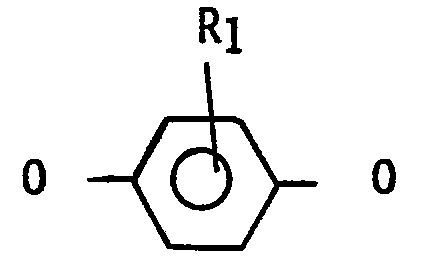
dans laquelle R1 représente un radical méthyle ou éthyle ou un atome de chlore ou de brome, les unités (I) pouvant être identiques ou différentes entre elles, (II) désignant la structure (III) désignant la structure (IV) désignant la structure
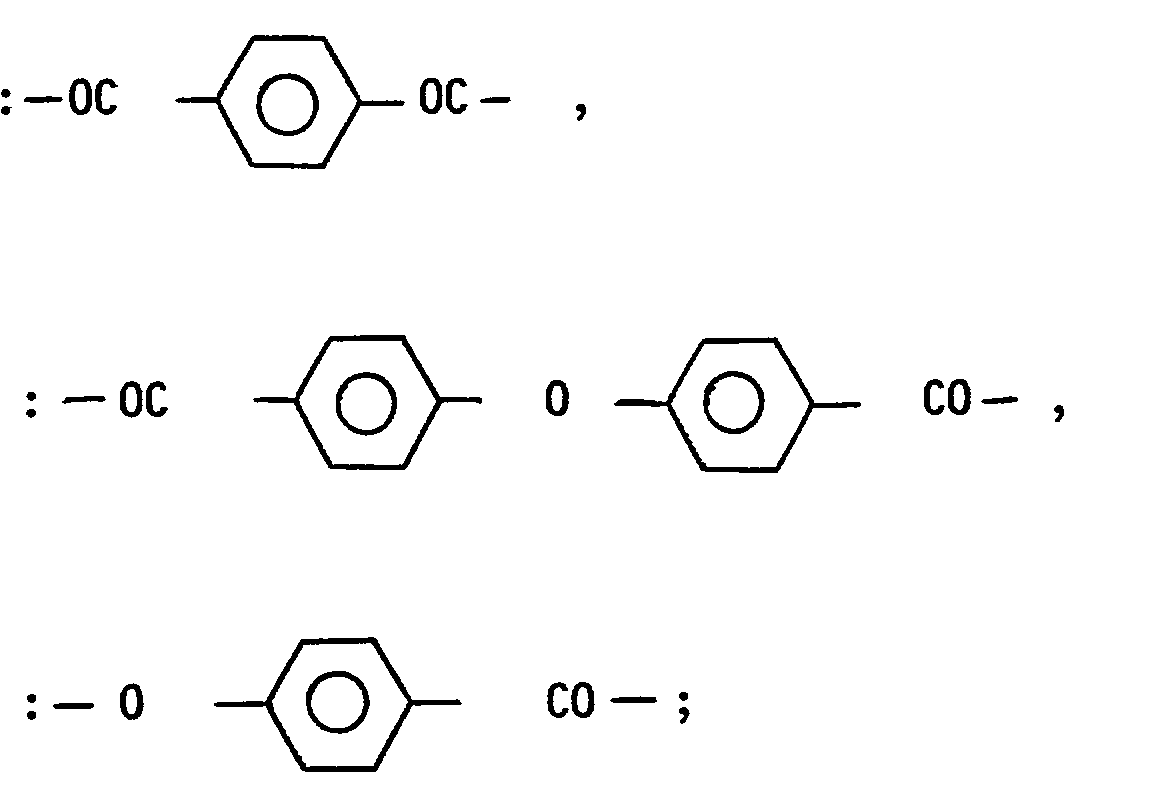
- le rapport molaire des unités (I) par rapport à la somme des unités (II) + (III) se situe dans l'intervalle allant de 0,95 à 1,05
- la quantité des unités (II) dans le mélange (II) + (III) se situe dans l'intervalle allant de 0 à 70 % en mole et celle des unités (III), par rapport à la même référence, se situe dans l'intervalle allant de 100 à 30 % en mole
- la quantité des unités (IV), exprimée par rapport à la quantité des unités (I), se situe dans l'intervalle allant de 10 à 300 % en mole.Thermotropic totally aromatic polyesters which are very especially preferred for the implementation of the present invention are those described in the European patent application published under the number 0 191 705. These polyesters have the following particularities.
- they include recurrence units of formulas (I), possibly (II, (III) and (IV): t (I) designating the structure
in which R1 represents a methyl or ethyl radical or a chlorine or bromine atom, the units (I) possibly being identical or different from one another, (II) designating the structure (III) designating the structure (IV) designating the structure
- the molar ratio of the units (I) relative to the sum of the units (II) + (III) is in the range from 0.95 to 1.05
- the amount of units (II) in the mixture (II) + (III) is in the range from 0 to 70 mol% and that of units (III), relative to the same reference, is in the range from 100 to 30 mole%
- the amount of units (IV), expressed relative to the amount of units (I), is in the range from 10 to 300 mol%.
Ces polyesters totalement aromatiques spécialement préférés englobent aussi les polymères qui peuvent contenir en outre dans leur structure des unités aromatiques génératrices de fonctions esters (unités dioxy et/ou unités dicarbonyle et/ou unités mixtes oxy/carbonyle) ayant une structure autre que celle des unités (I), (II), (III) et (IV), la quantité totale de ces unités supplémentaires étant au plus égale à 10 % en mole par rapport à la quantité des unités (I).Une liste non limitative de ces unités supplémentaires est la suivante et/ou
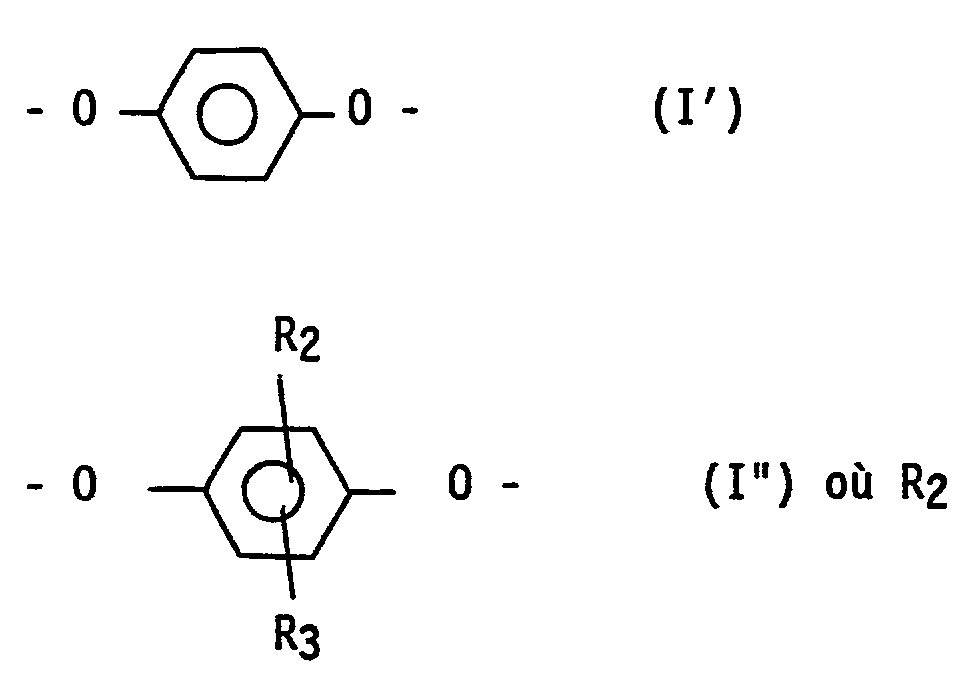
et R3, qui peuvent être identiques ou différents, ont chacun la définition donnée ci-avant pour R1, les unités (I") pouvant être identiques ou différentes entre elles, et/ou
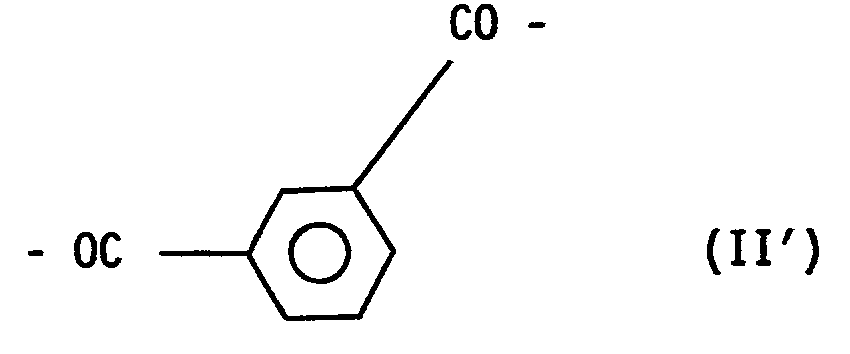
et/ou
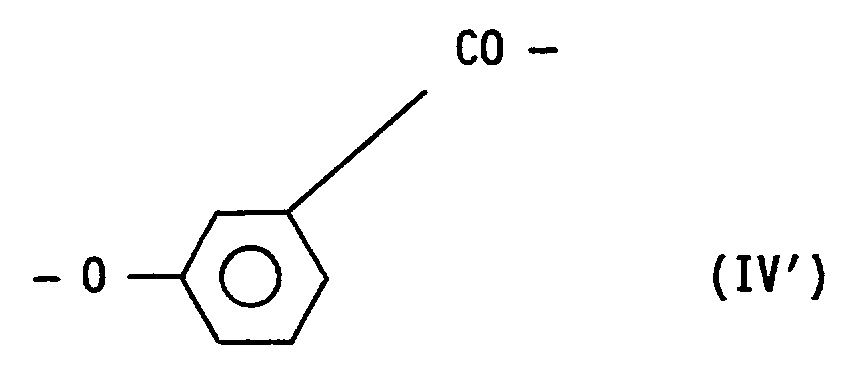
and R3, which may be identical or different, each have the definition given above for R1, the units (I ") may be identical or different from one another, and / or
and or
Des polyesters alkylaromatiques thermotropes qui sont tout spécialement préférés sont ceux décrits dans les brevets américains ne 4 248 995 ET 4 311 824.Ces polyesters sont constitués d'unités de formule
(V) (- O - X1 - O -)a (- O - X2 - O -)b (- O - X3 - O -)c
(VI) - CO - Y - CO
(VII) - CO - Z - CO dans laquelle
- X1 représente un radical phénylène-1,4 monosubstitué par un groupe méthyle, éthyle ou un atome de chlore ou brome,
- X2 un radical phénylène-1,4 non substitué,
- X3 représente un radical phénylène-1,4 disubstitué par deux groupes méthyle, éthyle ou 2 atomes de chlore ou brome, ou un radical diphénylène-4,4' ou p-p'-diphénylène éther dans lequel chaque noyau aromatique peut être susbstitué par un groupe méthyle, éthyle ou un atome de chlore ou brome,
avec 0,4 s a s 1
0 s b 5 0,6 O S C 5 0,1
et a + b + c = 1,
Y représente
- un radical phénylène-1,4 cyclohexylène-1,4
- ou un radical comportant deux groupes phénylène pouvant être reliés entre eux par une liaison simple ou une chaîne acyclique pouvant comporter jusqu'à 8 atomes de carbone, et éventuellement 1 ou 2 hétéroatomes,
- ou un radical aromatique divalent comportant au moins deux noyaux phényles condensés dans lequel les liaisons rattachées aux groupes carbonyles sont opposés et parallèles, et
- Z représente un radical - (CH2)n - avec 3 s n s 10
- le rapport molaire Z/Y + Z étant compris entre 20 et 50 %.Especially preferred thermotropic alkylaromatic polyesters are those described in U.S. Patents Nos. 4,248,995 AND 4,311,824. These polyesters consist of units of the formula
(V) (- O - X1 - O -) a (- O - X2 - O -) b (- O - X3 - O -) c
(VI) - CO - Y - CO
(VII) - CO - Z - CO in which
- X1 represents a phenylene-1,4 monosubstituted radical with a methyl or ethyl group or a chlorine or bromine atom,
- X2 an unsubstituted 1,4-phenylene radical,
- X3 represents a phenylene-1,4 radical disubstituted with two methyl, ethyl or 2 chlorine or bromine atoms, or a diphenylene-4,4 'or p-p'-diphenylene ether radical in which each aromatic nucleus can be substituted by a methyl or ethyl group or a chlorine or bromine atom,
with 0.4 airlock 1
0 sb 5 0.6 OSC 5 0.1
and a + b + c = 1,
Y represents
- a phenylene-1,4-cyclohexylene-1,4 radical
- or a radical comprising two phenylene groups which can be linked together by a single bond or an acyclic chain which can contain up to 8 carbon atoms, and optionally 1 or 2 heteroatoms,
- or a divalent aromatic radical comprising at least two condensed phenyl rings in which the bonds attached to the carbonyl groups are opposite and parallel, and
- Z represents a radical - (CH2) n - with 3 sns 10
- the Z / Y + Z molar ratio being between 20 and 50%.
Des polyesters carbonates thermotropes qui sont tout spécialement préférés sont ceux décrits dans le brevets américain n 4 284 757. Ces polyesters sont constitués d'unités de formule
(VIII) (- O - R4 - O -)a' (- O - R5 - O -)b'
o
(IX)
-C-
(X) - CO - R6 - CO dans lesquelles
- les radicaux R4, identiques, représentent chacun un radical phénylène-1,4 monosubstitué par un groupe méthyle, éthyle, ou un atome de chlore ou de brome
- les radicaux Rs représentent chacun un radical phénylène-1,4 non substitué ;
. avec 0,3 a' s 1 ; O s b' sO,7 ;; et a' + b' = 1 ;
les radicaux R6, qui peuvent être identiques ou différents, représentent chacun un radical choisi parmi les groupes phénylène-1,4, cyclohexylène-I,4, biphénylène-4,4', naphtylène-2,6, éthylènedioxy-4,4' diphénylène-1,1', butylènedioxy-4,4' diphénylène-1,1', hexylènedioxy-4,4' diphénylène-1,1' ; la quantité des unités (IX) dans le mélange (IX) et (X) étant comprise entre 30 et 90 % en mole et le rapport molaire des unités (VIII) par rapport à la somme des unités (IX) + (X) étant compris entre 0,95 et 1,05.Especially preferred thermotropic polyesters carbonates are those described in U.S. Patent No. 4,284,757. These polyesters consist of units of the formula
(VIII) (- O - R4 - O -) a '(- O - R5 - O -) b'
o
(IX)
-VS-
(X) - CO - R6 - CO in which
- the radicals R4, which are identical, each represent a phenylene-1,4 radical monosubstituted by a methyl or ethyl group, or a chlorine or bromine atom
the Rs radicals each represent an unsubstituted 1,4-phenylene radical;
. with 0.3 a 's 1; O sb 'sO, 7 ;; and a '+ b' = 1;
the radicals R6, which may be identical or different, each represent a radical chosen from the groups phenylene-1,4, cyclohexylene-I, 4, biphenylene-4,4 ', naphthylene-2,6, ethylenedioxy-4,4' diphenylene-1,1 ', butylenedioxy-4,4' diphenylene-1,1 ', hexylenedioxy-4,4' diphenylene-1,1 '; the amount of units (IX) in the mixture (IX) and (X) being between 30 and 90 mol% and the molar ratio of units (VIII) relative to the sum of units (IX) + (X) being between 0.95 and 1.05.
Par polyester cristallisable, on désigne dans la présente demande, des polyesters ou copolyesters qui, après extrusion à l'état fondu à travers une filière puis étirage du polymère amorphe, conduisent à des polyesters ou copolyesters semi-cristallins. La cristallinité des polymères est déterminée par les moyens usuels bien connus du spécialiste tels que la diffraction des rayons X, l'analyse thermique différentielle (cf. S.H.LIN et al J. Polymer Sci. Polymer. Symposium 71 121-135 (1984) et le test de densité. The term “crystallizable polyester” denotes, in the present application, polyesters or copolyesters which, after extrusion in the molten state through a die and then drawing of the amorphous polymer, result in semi-crystalline polyesters or copolyesters. The crystallinity of the polymers is determined by the usual means well known to those skilled in the art such as X-ray diffraction, differential thermal analysis (cf. SHLIN et al J. Polymer Sci. Polymer. Symposium 71 121-135 (1984) and the density test.
Comme polyesters linéaires cristallisables non thermotropes on fait appel à ceux utilisés habituellement pour l'obtention des films polyester orientés par étirage et présentant, après étirage, une structure semi-cristalline. Non-thermotropic crystallizable linear polyesters are used those usually used for obtaining polyester films oriented by stretching and having, after stretching, a semi-crystalline structure.
A ce titre, on peut faire appel à tout polyester filmogène obtenu à partir d'un ou de plusieurs diacide(s) carboxylique(s) ou de leurs esters d'alkyle inférieur, (acide téréphtalique, acide isophtalique, acide naphtalènedicarboxylique-2,5, acide naphtalènedicarboxylique-2,6, acide t naphtalènedicarboxylique-2,7, acide succinique, acide sébacique, acide adipique, acide azélalque, acide diphényldicarboxylique et acide hexahydrotéréphtalique). As such, use can be made of any film-forming polyester obtained from one or more dicarboxylic acid (s) or their lower alkyl esters (terephthalic acid, isophthalic acid, naphthalenedicarboxylic acid-2, 5, naphthalenedicarboxylic acid-2,6, t-naphthalenedicarboxylic acid-2,7, succinic acid, sebacic acid, adipic acid, azelalic acid, diphenyldicarboxylic acid and hexahydroterephthalic acid).
Les diols associés aux diacides sont ceux habituellement utilisés pour l'obtention de polyesters cristallisables ; on peut citer, à titre non limitatif : l'éthylèneglycol, le propanediol-1,3, le butanediol-1,4, le néopentylglycol, le cyclohexane-diméthanol, le diéthylèneglycol. Ces diols peuvent être utilisés seuls ou en mélanges. Lorsqu'on fait appel à des copolymères, il doivent présenter un taux suffisant du ou des composant(s) monomères(s) conférant la cristallinité. On fait appel de préférence aux homopolyesters et aux copolyesters dérivés de l'acide téréphtalique. Dans ce cas, les copolyesters, comportent de préférence un taux de motifs téréphtalates représentant au moins 80 % en moles des motifs diacides et plus préférentiellement au moins 90 %.Les polyesters et copolyesters dérivés de ltéthylèneglycol et du butanediol-1,4 constituent une classe préférée de polymères utilisés pour la réalisation du film Avantageusement, le polyester est un polytéréphtalate d'éthylèneglycol dont la viscosité intrinsèque mesurée à 250C dans l'o-chlorophénol est comprise entre 0,6 et 0,75 dl/g. The diols associated with the diacids are those usually used to obtain crystallizable polyesters; non-limiting mention may be made of: ethylene glycol, propanediol-1,3, butanediol-1,4, neopentylglycol, cyclohexane-dimethanol, diethylene glycol. These diols can be used alone or in mixtures. When copolymers are used, they must have a sufficient level of the monomer component (s) conferring crystallinity. Homopolyesters and copolyesters derived from terephthalic acid are preferably used. In this case, the copolyesters preferably comprise a level of terephthalate units representing at least 80% by moles of the diacid units and more preferably at least 90%. Polyesters and copolyesters derived from ethylene glycol and from 1,4-butanediol constitute a class preferred of polymers used for the production of the film Advantageously, the polyester is a polyethylene glycol terephthalate, the intrinsic viscosity of which, measured at 250 ° C. in o-chlorophenol, is between 0.6 and 0.75 dl / g.
Le polyester cristallisable non thermotrope peut contenir les adjuvants utilisés habituellement pour la fabrication de films biétirés tels que des stabilisants thermiques, des agents antistatiques, des agents glissants. Bien que l'introduction de charges minérales ne soit pas nécessaire en raison de la présence du ou des polymères thermotropes, on ne sortirait pas du cadre de la présente invention en incorporant au polyester non thermotrope constituant la phase continue du mélange une quantité mineure d'une charge minérale et plus particulièrement une charge minérale présentant une faible dimension particulaire, une monodispersité élevée et une forme pratiquement sphérique. The non-thermotropic crystallizable polyester can contain the adjuvants usually used for the manufacture of double-stretched films such as thermal stabilizers, antistatic agents, slip agents. Although the introduction of mineral fillers is not necessary due to the presence of the thermotropic polymer (s), it would not be departing from the scope of the present invention to incorporate in the non-thermotropic polyester constituting the continuous phase of the mixture a minor amount of a mineral filler and more particularly a mineral filler having a low particle size, a high monodispersity and a practically spherical shape.
La quantité de polymère thermotrope introduite dans le polyester non thermotrope est fixée dans l'intervalle de 0,1 à 3 % en poids en fonction des propriétés désirées pour les films. Une concentration en polymère thermotrope comprise entre 0,2 et 1,5 % en poids se revèle particulièrement avantageuse. The amount of thermotropic polymer introduced into the non-thermotropic polyester is set in the range of 0.1 to 3% by weight depending on the properties desired for the films. A concentration of thermotropic polymer of between 0.2 and 1.5% by weight is particularly advantageous.
Les alliages convenant à la mise en oeuvre de la présente t invention peuvent être obtenus selon les procédés usuels de mélangeage des matières polymères. Ainsi les différents composants peuvent être mélangés à l'état de poudres fines ou de granulés dans des mélangeurs à vis ou à rouleau, puis le mélange des particules peut être extrudé dans les appareils usuels sous formes de joncs qui sont ensuite transformés en granules. Il est également possible de réaliser un mélange-maître riche en polymère thermotrope, c'est-à-dire un mélange de polyester non thermotrope contenant au moins 5 % en poids de polymère thermotrope et d'utiliser ce mélange-maître pour préparer les compositions conformes à l'invention par mélange avec un polyester linéaire exempt de polymère thermotrope. The alloys suitable for the implementation of the present invention can be obtained according to the usual methods of mixing polymer materials. Thus the various components can be mixed in the form of fine powders or granules in screw or roller mixers, then the mixture of the particles can be extruded in the usual apparatus in the form of rods which are then transformed into granules. It is also possible to produce a masterbatch rich in thermotropic polymer, that is to say a mixture of non-thermotropic polyester containing at least 5% by weight of thermotropic polymer and to use this masterbatch to prepare the compositions. according to the invention by mixing with a linear polyester free from thermotropic polymer.
Dans tous les cas, la vitesse de cisaillement doit être portée à une valeur supérieure à 100 s-1 par les moyens usuels connus de l'homme de métier. De préférence la vitesse de cisaillement est supérieure ou égale à 200 s-1. Bien qu'il n'y ait pas de valeur supérieure critique de la vitesse de cisaillement, il n'est en général pas nécessaire de dépasser une valeur de 500 s-1. Le choix de la vitesse de cisaillement dépend de la température à laquelle est réalisé le mélange : plus cette température est basse plus la vitesse de cisaillement doit être élevée. In all cases, the shear rate must be brought to a value greater than 100 s-1 by the usual means known to those skilled in the art. Preferably the shear speed is greater than or equal to 200 s-1. Although there is no critical upper value of the shear rate, it is generally not necessary to exceed a value of 500 s-1. The choice of the shear rate depends on the temperature at which the mixing is carried out: the lower this temperature, the higher the shear rate must be.
Lorsque l'alliage de polyester isotrope et de polymère thermotrope est préparé par la technique du mélange-maître, il n'est pas indispensable que les deux étapes soient réalisées dans les conditions de vitesse de cisaillement selon l'invention. Il suffit, pour atteindre les objectifs recherchés, que l'une des deux étapes, par exemple la première, soit réalisée dans ces conditions. When the alloy of isotropic polyester and thermotropic polymer is prepared by the masterbatch technique, it is not essential that the two stages be carried out under the shear rate conditions according to the invention. To achieve the desired objectives, it suffices for one of the two stages, for example the first, to be carried out under these conditions.
L'incorporation des polymères thermotropes à des concentrations comprises entre 0,1 et 3 % en poids dans les polyesters cristallisables permet d'obtenir des films biorientés présentant d'excellentes propriétés de surface, de faibles coefficients de frottement et une excellente résistance à l'abrasion sans qu'il soit nécessaire de recourir à l'emploi des charges minérales usuelles. The incorporation of thermotropic polymers at concentrations between 0.1 and 3% by weight in the crystallizable polyesters allows to obtain bioriented films having excellent surface properties, low coefficients of friction and excellent resistance to water. abrasion without having to resort to the use of the usual mineral fillers.
Les films obtenus par le procédé selon la présente invention se caractérisent par un ensemble de propriétés qui les rend particulièrement intéressants notamment pour l'obtention de matériaux d'enregistrement d'informations. The films obtained by the process according to the present invention are characterized by a set of properties which makes them particularly advantageous in particular for obtaining information recording materials.
Au regard de leur topographie on a constaté par exemple par examen au microscope électronique à balayage qu'ils présentent essentiellement des pics de hauteur moyenne inférieure ou égale à environ 0,1 pm, et une faible densité de pics supérieurs à 0,1 pm et notamment de pics de hauteur moyenne comprise entre 0,13 pm et moins de 0,67 pm. Plus spécifiquement, les films selon l'invention comportent moins de 5000 pics par mm2 de hauteur comprise entre 0,13 pm et 0,4 pm, moins de 20 d pics par mm2 de hauteur comprise entre plus de 0,4 et 0,67 pm et sont exempts de pics supérieurs à 0,67 pm. With regard to their topography, it has been observed, for example, by examination with a scanning electron microscope that they essentially exhibit peaks of average height less than or equal to about 0.1 μm, and a low density of peaks greater than 0.1 μm and in particular peaks with an average height of between 0.13 μm and less than 0.67 μm. More specifically, the films according to the invention comprise less than 5000 peaks per mm2 of height comprised between 0.13 μm and 0.4 μm, less than 20 d peaks per mm2 of height comprised between more than 0.4 and 0.67 µm and are free from peaks greater than 0.67 µm.
Les films obtenus par le procédé selon la présente invention se distinguent encore par leur faible rugosité. Ainsi ils présentent une rugosité tridimentionnelle SRa, telle que définie et mesurée ci-après, inférieure ou égale à 0,035 et SRz inférieure ou égale à 0,55. Ils présentent également un coefficient de frottement film/métal itk mesuré selon la méthode et dans les conditions indiquées ci-après inférieur à 0,35 et une turbidité inférieure à 3 %. The films obtained by the process according to the present invention are further distinguished by their low roughness. Thus they have a three-dimensional roughness SRa, as defined and measured below, less than or equal to 0.035 and SRz less than or equal to 0.55. They also exhibit a film / metal coefficient of friction itk measured according to the method and under the conditions indicated below of less than 0.35 and a turbidity of less than 3%.
Les films polyester selon l'invention sont obtenus de façon classique par extrusion d'une nappe fondue de polyester amorphe non thermotrope contenant une quantité adéquate de polymère thermotrope, refroidissement de cette nappe, étirages dans deux directions perpendiculaires, thermofixation des films biétirés et, le cas échéant, traitements destinés à l'obtention de films équilibrés ou surétirés. Les étirages peuvent être réalisés en une ou plusieurs fois, à des températures et à des taux identiques ou différents. Les étirages peuvent être conduits simultanément ou successivement.D'une manière générale on procède à un étirage longitudinal (dans le sens de la machine) à une température comprise entre 70 et 100in, à un taux compris entre 3 et 5 puis à un étirage transversal (perpendiculaire au sens de la machine) à une température comprise entre 100 et 1200C, et à un taux compris entre 3 et 5, l'ordre de ces étirages pouvant être inversé. On peut également les réaliser simultanément à une température comprise entre 70 et lolo'C et à un taux compris entre 3 et 5. La température de thermofixation est en général comprise entre 180 et 230 C. The polyester films according to the invention are obtained in a conventional manner by extrusion of a molten web of non-thermotropic amorphous polyester containing an adequate quantity of thermotropic polymer, cooling of this web, stretching in two perpendicular directions, heat-setting of the bi-stretched films and, the where appropriate, treatments intended to obtain balanced or stretched films. The stretching can be carried out on one or more occasions, at the same or different temperatures and rates. The stretching can be carried out simultaneously or successively. In general, a longitudinal stretching (in the machine direction) is carried out at a temperature between 70 and 100in, at a rate between 3 and 5, then a transverse stretching (perpendicular to the direction of the machine) at a temperature between 100 and 1200C, and at a rate between 3 and 5, the order of these stretching can be reversed. They can also be produced simultaneously at a temperature of between 70 and 100 ° C. and at a rate of between 3 and 5. The heat-setting temperature is generally between 180 and 230 C.
Selon les emplois auxquels ils sont destinés l'épaisseur des films peut varier dans de larges limites. Ainsi elle peut varier entre 5 et 150 ym. Depending on the uses for which they are intended, the thickness of the films can vary within wide limits. Thus it can vary between 5 and 150 µm.
En raison de leurs propriétés de surface (faible rugosité, bonne résistance à l'abrasion, faibles coefficient de frottement) et de leur transparence élevée (faible turbidité), les films obtenus par le procédé selon la présente invention peuvent trouver de nombreuses applications pour lesquelles ces propriétés sont recherchées. Ainsi ils conviennent tout spécialement bien comme support de revêtements magnétiques et en particulier pour la fabrication de matériaux d'enregistrements magnétiques à haute densité d'information tels que ceux utilisés pour les bandes vidéo et notamment les bandes vidéo de 8 mm. Par leur transparence élevée ils se prêtent bien à la fabrication d'emballages et à un emploi dans les arts graphiques. Due to their surface properties (low roughness, good abrasion resistance, low coefficient of friction) and their high transparency (low turbidity), the films obtained by the process according to the present invention can find many applications for which these properties are sought after. Thus they are very particularly suitable as a support for magnetic coatings and in particular for the manufacture of magnetic recording materials with a high information density such as those used for video tapes and in particular 8 mm video tapes. By their high transparency they lend themselves well to the manufacture of packaging and to use in the graphic arts.
Les exemples suivants illustrent l'invention et montrent comment elle peut être mise en pratique. Dans ces exemples, on a procédé à la détermination de certaines propriétés des films selon les méthodes suivantes :
1. - Rugosités
Rugosité tridimentionnelle optique SRa et SRz
La rugosité SRa représente l'écart moyen arithmétique de la rugosité de surface par rapport au plan moyen exprimée en pm (il s'agit de l'extention de la rugosité Ra à une surface).The following examples illustrate the invention and show how it can be put into practice. In these examples, the determination of certain properties of the films was carried out according to the following methods:
1. - Roughness
Optical three-dimensional roughness SRa and SRz
The roughness SRa represents the arithmetic mean deviation of the surface roughness from the mean plane expressed in pm (this is the extension of the roughness Ra to a surface).
La rugosité SRz est l'écart entre deux plans moyens parallèles
- un plan moyen supérieur défini par la moyenne des cinq pics les plus hauts.The roughness SRz is the difference between two parallel mean planes
- a higher mean plane defined by the average of the five highest peaks.
- un plan moyen inférieur défini par la moyenne des cinq vallées les plus profondes. - a lower mean plane defined by the average of the five deepest valleys.
Les rugosités SRa et SRz ont été déterminées conformément à la norme DIN 4 768 et au moyen d'un appareil de marque SURFCORDER ET-30 HK équipé de l'unité de traitement SPA 11 de la Société KOSAKA Laboratories
Ltd et d'un capteur de type optique de marque HIPOSS, dans les conditions suivantes
- longueur d'onde de coupure (Cut-Off) - 0,08 mm
- grandissement : x 20 000
- vitesse de pal page : 20 pm/s
- longueur de pal page : 0,25 mm avec un pas d'échantillonnage
de 0,5 m
- nombre de profils : 150 avec un pas entre profils de 0,5 wï'. The roughness SRa and SRz were determined in accordance with standard DIN 4 768 and using a SURFCORDER ET-30 HK brand device equipped with the SPA 11 treatment unit from KOSAKA Laboratories.
Ltd and a HIPOSS brand optical type sensor, under the following conditions
- cut-off wavelength - 0.08 mm
- magnification: x 20,000
- speed of pal page: 20 pm / s
- pal page length: 0.25 mm with a sampling pitch
0.5 m
- number of profiles: 150 with a pitch between profiles of 0.5 wï '.
- surface testée : 0,25 mm x 0,075 mm
- gain : 1
- hystérésis : 1
La distribution des hauteurs de pics (PCD) est obtenue par traitement informatique des données résultant de la détermination des rugosités.- tested surface: 0.25 mm x 0.075 mm
- gain: 1
- hysteresis: 1
The peak height distribution (PCD) is obtained by computer processing of the data resulting from the determination of the roughness.
2 - Coefficients de friction
a) Film sur métal :
La mesure du k a été réalisée selon la méthode décrite page il ≈3 de la demande de brevet européen 0 66 997 dans les conditions suivantes :
- diamètre du galet fixe ........ 10 mm
- largeur de bande .............. 2,5 cm
- vitesse de défilement ........ 5 m/mn
- tension de bande .............. 200 g et 600 g
- durée ......................... 20 mn - température .................... 25 0C
- humidité relative ............. 35 %
- aire de contact ............... 5 cm2
- angle d'embarrage sur le galet 205 0
b) Coefficients de friction statique (u s) et dvnamique (ud) film/métal et film/film
Ils ont été déterminés selon la méthode dite "SHOE-SHINE" décrite dans la demande de brevet japonais J 63 28627 en utilisant un appareil analogue à celui décrit dans ladite demande avec les conditions suivantes
- diamètre du galet 6 mm
- largeur de bande 1,27 cm
- vitesse de défilement 0,9 m/mn
- tension 50 g
- durée.......................... 15 mn
- température 250C
- humidité relative 52 %
- aire de contact 1,27 x 0,7 cm2
La fréquence de sollicitation en cisaillement est de l'ordre de 1 1 Hz.2 - Coefficients of friction
a) Film on metal:
The measurement of k was carried out according to the method described on page il ≈3 of European patent application 0 66 997 under the following conditions:
- diameter of the fixed roller ........ 10 mm
- band width .............. 2.5 cm
- scrolling speed ........ 5 m / min
- belt tension .............. 200 g and 600 g
- duration ......................... 20 min - temperature ................... . 25 0C
- relative humidity ............. 35%
- contact area ............... 5 cm2
- embedding angle on the roller 205 0
b) Coefficients of static friction (us) and dynamic (ud) film / metal and film / film
They were determined according to the so-called "SHOE-SHINE" method described in Japanese patent application J 63 28627 using an apparatus similar to that described in said application with the following conditions
- roller diameter 6 mm
- band width 1.27 cm
- scroll speed 0.9 m / min
- tension 50 g
- duration .......................... 15 min
- temperature 250C
- relative humidity 52%
- contact area 1.27 x 0.7 cm2
The shear stress frequency is of the order of 1 1 Hz.
3 - Turbidité
Cette propriété qui représente le pourcentage de lumière dispersée transmise est mesurée selon la norme ASTM D 100.3 - Turbidity
This property, which represents the percentage of scattered light transmitted, is measured according to the ASTM D 100 standard.
EXEMPLE 1
19 - Préparation d'un mélange maître de polyester non thermotrope contenant 5 % en poids d'un polymère thermotrope.EXAMPLE 1
19 - Preparation of a non-thermotropic polyester masterbatch containing 5% by weight of a thermotropic polymer.
Les polymères utilisés, sont les suivants :
A - Un polytéréphtalate d'éthylène glycol exempt de toute charge minérale externe et de résidus catalytiques précipités et présentant les caractéristiques suivantes
Viscosité à l'état fondu (2850C) : 200 Pas.s-1
Température de transition vitreuses (Tg) : 68 0C
Température de fusion (Tf) : 255 C
B - Un polyester aromatique thermotrope obtenu selon le procédé décrit dans la demande européenne n 0 191 705 et constitué par une pluralité de motifs dérivés
a) de l'acide téréphtalique
b) du bis (hydroxycarbonyl)-4,4' diphényléther
c) de la méthyl-hydroquinone
d) de l'acide p.hydroxybenzoïque
Les rapports molaires de ces différents motifs sont les suivants
a/b = 1
c/a+b = 1
d/a+b = 0,6
Ce polyester aromatique thermotrope présente les caractéristiques suivantes : Tg 105ex
température de transition nématique : 2950C
viscosité de l'état fondu : 1200 Pas.s-1
Le mélange-maître est obtenu par passage dans une extrudeuse àt double-vis et extrusion d'un mélange de granulés de PET et de polymère thermotrope dans la proportion de 100/5. L'extrudeuse est à double-vis corotative engrenantes, de diamètre 34 mm et de longueur égale à 35 fois son diamètre .Elle présente la configuration suivante :
Zone 1 120 mm transporteur pas de 60
Zone 2 60 mm 45
60 mm 30
Zone 3 120 mm 30
Zone 4 60 mm malaxeur à 900
30 mm contrefilet pas de 30
30 mm transporteur pas de 45
Zone 5 120 mm pas de 45
Zone 6 120 mm pas de 30
Zone 7 30 mm pas de 30
30 mm malaxeur à 900
30 mm contrefilet pas de 30
30 mm transporteur pas de 30
Zone 8 120 mm pas de 30
Zone 9 60 mm pas de 30
60 mm pas de 20
Zone 10 120 mm pas de 20
Les zones 5 et 8 sont ouvertes et maintenues à une pression réduite à 6666 Pascals ; la zone 1 est refroidie, la zone 2 est maintenue à 275in et les zones suivantes sont maintenues suivant le cas à 280 ou 3000C. The polymers used are as follows:
A - A polyethylene glycol terephthalate free from any external mineral charge and precipitated catalytic residues and having the following characteristics
Viscosity in the molten state (2850C): 200 Pas.s-1
Glass transition temperature (Tg): 68 0C
Melting point (Tf): 255 C
B - A thermotropic aromatic polyester obtained according to the process described in European Application No. 0 191 705 and consisting of a plurality of derived units
a) terephthalic acid
b) bis (hydroxycarbonyl) -4,4 'diphenyl ether
c) methyl hydroquinone
d) p.hydroxybenzoic acid
The molar ratios of these different units are as follows
a / b = 1
c / a + b = 1
d / a + b = 0.6
This thermotropic aromatic polyester has the following characteristics: Tg 105ex
nematic transition temperature: 2950C
melt viscosity: 1200 Pas.s-1
The masterbatch is obtained by passing through a twin-screw extruder and extrusion of a mixture of granules of PET and of thermotropic polymer in the proportion of 100/5. The extruder has a meshing corotating twin screw, 34 mm in diameter and 35 times its diameter. It has the following configuration:
Zone 1 120 mm conveyor pitch 60
Zone 2 60 mm 45
60 mm 30
Zone 3 120 mm 30
Zone 4 60 mm mixer at 900
30 mm interlocking thread pitch 30
30 mm conveyor pitch 45
Zone 5 120 mm pitch 45
Zone 6 120 mm step of 30
Zone 7 30 mm step of 30
30 mm mixer at 900
30 mm interlocking thread pitch 30
30 mm conveyor step of 30
Zone 8 120 mm step of 30
Zone 9 60 mm step of 30
60 mm step 20
Zone 10 120 mm step 20
Zones 5 and 8 are opened and maintained at reduced pressure at 6666 Pascals; zone 1 is cooled, zone 2 is maintained at 275in and the following zones are maintained as appropriate at 280 or 3000C.
La vitesse de rotation des vis a été fixée à 300 t/mn ou à 100 t/mn (essai comparatif), ce qui, en première approximation, correspond à des vitesses de cisaillement moyennes de 300 5-1 et 100 5-1 . On obtient de cette façon un jonc de 4 mm qui est transformé en granulés.The speed of rotation of the screws was fixed at 300 rpm or at 100 rpm (comparative test), which, as a first approximation, corresponds to average shear speeds of 300 5-1 and 100 5-1. In this way, a 4 mm rod is obtained which is transformed into granules.
2- - Préparation d'un alliage à 0,5 % de polymère thermotrope. 2- - Preparation of an alloy containing 0.5% of thermotropic polymer.
Le mélange à 0,5 % en thermotrope est préparé en monovis d'extrusion-filmage en mélangeant 10 % du mélange-maître à 5 % obtenu précédemment avec 90 % d'un PET exempt de charge. The 0.5% thermotropic mixture is prepared by single-screw extrusion-filming by mixing 10% of the 5% masterbatch obtained previously with 90% of a PET free of charge.
Les polymères ont été préalablement séchés en lit fluidisé pendant 12 heures à 1300C. The polymers were previously dried in a fluidized bed for 12 hours at 1300C.
La configuration de la monovis de diamètre 65 mm et de longueur égale à 25 fois son diamètre est la suivante
. Alimentation T : 2650C 8 filets
. Compression T : 2750C 7 filets
. Pompage T : 285 C 10 filets.The configuration of the single screw with a diameter of 65 mm and a length equal to 25 times its diameter is as follows
. Power supply T: 2650C 8 threads
. Compression T: 2750C 7 threads
. Pumping T: 285 C 10 threads.
Le taux de compression est de 3.6 et la vitesse de rotation de 100 t/mn (la vitesse de cisaillement est d'environ 150 s-1). The compression ratio is 3.6 and the speed of rotation is 100 rpm (the shear speed is about 150 s-1).
30 - Préparation d'un film
A partir de l'alliage à 0,5 % de polyester thermotrope on a préparé des films biétirés par extrusion de l'alliage porté à une température de 290il à travers une filière à fente de 200 mm de largeur, sous forme d'un film extrudé de 140 ym d'épaisseur qui est ensuite refroidi à 200C sur un tambour de refroidissement. Le film amorphe ainsi obtenu subit un étirage longitudinal à une température comprise entre 85 et 820C sur une distance de 160 mm et avec un taux de 3,4 puis un étirage transversal à une température de 110 C et avec un taux de 4. Le film biétiré est ensuite soumis à une thermofixation à 2000C pendant 2 s et bobiné. On a obtenu de cette façon des films de 12 ym d'épaisseur dont les propriétés sont indiquées dans le tableau 1. 30 - Preparation of a film
From the 0.5% thermotropic polyester alloy, bi-stretched films were prepared by extrusion of the alloy brought to a temperature of 290 µl through a slit die 200 mm in width, in the form of a film. 140 µm thick extruded which is then cooled to 200C on a cooling drum. The amorphous film thus obtained undergoes longitudinal stretching at a temperature between 85 and 820C over a distance of 160 mm and with a rate of 3.4, then transverse stretching at a temperature of 110 C and with a rate of 4. The film bi-stretched is then subjected to heat setting at 2000C for 2 s and wound. In this way, films 12 µm in thickness were obtained, the properties of which are shown in Table 1.
TABNLEAU I
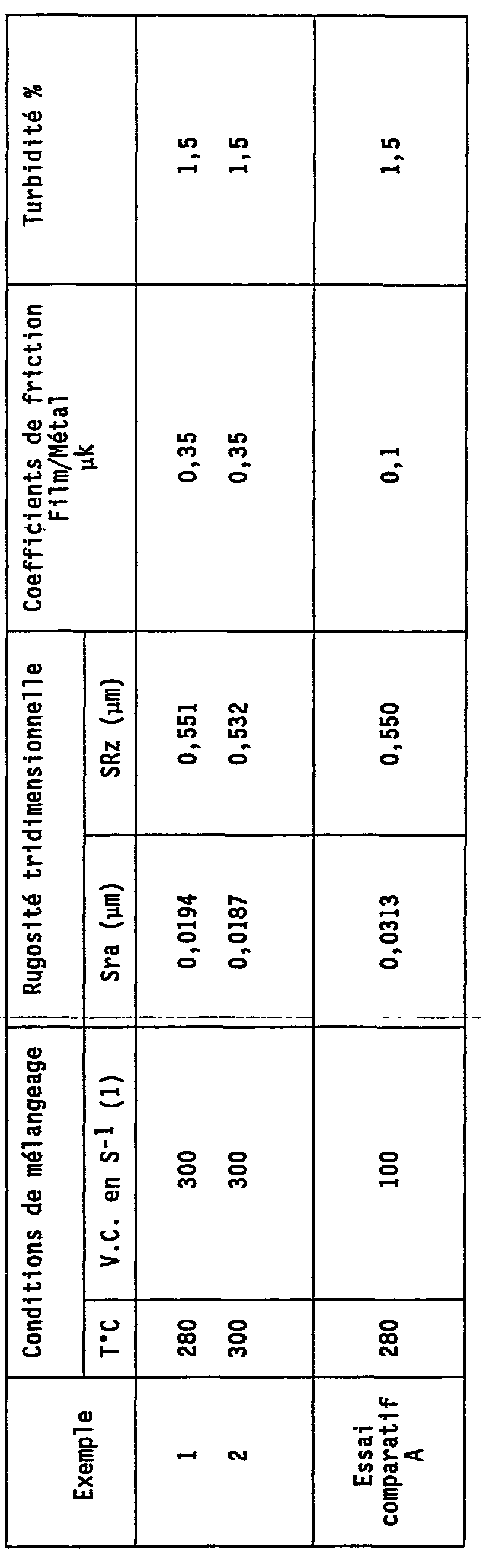
<SEP> Conditions <SEP> de <SEP> mélangeage <SEP> Rugosité <SEP> tridimensionnelle <SEP> Coefficients <SEP> de <SEP> friction <SEP> Turbidité <SEP> %
<tb> Exemple <SEP> T C <SEP> V.C. <SEP> en <SEP> S-1 <SEP> (1) <SEP> Sra <SEP> ( m) <SEP> SRz <SEP> ( m) <SEP> k
<tb> <SEP> 1 <SEP> 280 <SEP> 300 <SEP> 0,0194 <SEP> 0,551 <SEP> 0,35 <SEP> 1,5
<tb> <SEP> 2 <SEP> 300 <SEP> 300 <SEP> 0,0187 <SEP> 0,532 <SEP> 0,35 <SEP> 1,5
<tb> Essai
<tb> comparatif280 <SEP> 100 <SEP> 0,0313 <SEP> 0,550 <SEP> 0,1 <SEP> 1,5
<tb> <SEP> A
<tb> (1) V.C. = Vitesse de cisaillement. <SEP> Conditions <SEP> of <SEP> mixing <SEP> Three-dimensional roughness <SEP><SEP> Coefficients <SEP> of <SEP> friction <SEP> Turbidity <SEP>%
<tb> Example <SEP> TC <SEP> VC <SEP> en <SEP> S-1 <SEP> (1) <SEP> Sra <SEP> (m) <SEP> SRz <SEP> (m) <SEP > k
<tb><SEP> 1 <SEP> 280 <SEP> 300 <SEP> 0.0194 <SEP> 0.551 <SEP> 0.35 <SEP> 1.5
<tb><SEP> 2 <SEP> 300 <SEP> 300 <SEP> 0.0187 <SEP> 0.532 <SEP> 0.35 <SEP> 1.5
<tb> Test
<tb> comparative280 <SEP> 100 <SEP> 0.0313 <SEP> 0.550 <SEP> 0.1 <SEP> 1.5
<tb><SEP> A
<tb> (1) VC = Shear rate.
Claims (5)


Priority Applications (1)
| Application Number | Priority Date | Filing Date | Title |
|---|---|---|---|
| FR9009269A FR2664530A1 (en) | 1990-07-16 | 1990-07-16 | Process for making polyester films |
Applications Claiming Priority (1)
| Application Number | Priority Date | Filing Date | Title |
|---|---|---|---|
| FR9009269A FR2664530A1 (en) | 1990-07-16 | 1990-07-16 | Process for making polyester films |
Publications (1)
| Publication Number | Publication Date |
|---|---|
| FR2664530A1 true FR2664530A1 (en) | 1992-01-17 |
Family
ID=9398925
Family Applications (1)
| Application Number | Title | Priority Date | Filing Date |
|---|---|---|---|
| FR9009269A Pending FR2664530A1 (en) | 1990-07-16 | 1990-07-16 | Process for making polyester films |
Country Status (1)
| Country | Link |
|---|---|
| FR (1) | FR2664530A1 (en) |
Cited By (1)
| Publication number | Priority date | Publication date | Assignee | Title |
|---|---|---|---|---|
| EP0861868A3 (en) * | 1997-02-26 | 1999-01-20 | Toray Industries, Inc. | A polyester film and a process for its production |
Citations (5)
| Publication number | Priority date | Publication date | Assignee | Title |
|---|---|---|---|---|
| EP0041327A1 (en) * | 1980-05-30 | 1981-12-09 | Imperial Chemical Industries Plc | Improved melt spinning process |
| EP0030417B1 (en) * | 1979-11-30 | 1983-12-07 | Imperial Chemical Industries Plc | Compositions of melt-processable polymers having improved processibility, and method of processing |
| EP0191705A1 (en) * | 1985-01-11 | 1986-08-20 | Rhone-Poulenc Chimie | Thermotropic aromatic copolyesters |
| EP0304153A2 (en) * | 1987-08-21 | 1989-02-22 | Minnesota Mining And Manufacturing Company | Films containing liquid crystalline polymers |
| JPH01110555A (en) * | 1987-10-24 | 1989-04-27 | Unitika Ltd | Polyester film having good slipperiness |
-
1990
- 1990-07-16 FR FR9009269A patent/FR2664530A1/en active Pending
Patent Citations (5)
| Publication number | Priority date | Publication date | Assignee | Title |
|---|---|---|---|---|
| EP0030417B1 (en) * | 1979-11-30 | 1983-12-07 | Imperial Chemical Industries Plc | Compositions of melt-processable polymers having improved processibility, and method of processing |
| EP0041327A1 (en) * | 1980-05-30 | 1981-12-09 | Imperial Chemical Industries Plc | Improved melt spinning process |
| EP0191705A1 (en) * | 1985-01-11 | 1986-08-20 | Rhone-Poulenc Chimie | Thermotropic aromatic copolyesters |
| EP0304153A2 (en) * | 1987-08-21 | 1989-02-22 | Minnesota Mining And Manufacturing Company | Films containing liquid crystalline polymers |
| JPH01110555A (en) * | 1987-10-24 | 1989-04-27 | Unitika Ltd | Polyester film having good slipperiness |
Non-Patent Citations (1)
| Title |
|---|
| PATENT ABSTRACTS OF JAPAN, vol. 013, no. 331 (C-622), 25 juillet 1989; & JP-A-1 110 555 (UNITIKA) 27-04-1989 * |
Cited By (1)
| Publication number | Priority date | Publication date | Assignee | Title |
|---|---|---|---|---|
| EP0861868A3 (en) * | 1997-02-26 | 1999-01-20 | Toray Industries, Inc. | A polyester film and a process for its production |
Similar Documents
| Publication | Publication Date | Title |
|---|---|---|
| EP0275801B1 (en) | Method of making thick composite polyester films with improved adhesion, and films obtained | |
| CA1290531C (en) | Composite transparent polyester films useable namely for the production of very shiny metallized films | |
| EP0403525B1 (en) | Improved-adherence composite polyester films and process for their production | |
| CA1335851C (en) | Films containing liquid crystalline polymers | |
| CA2006696C (en) | Composite polyester films especially usable as supports for magnetic recording material and magnetic recording materials thereof | |
| FR2682915A1 (en) | ORIENTED SEMI-CRYSTALLINE POLYESTER FILMS, THEIR PROCESS OF OBTAINING AND THEIR USE AS A MAGNETIC COATING SUPPORT. | |
| EP0267856B1 (en) | Composite polyester films with improved adhesion, and method of making such films | |
| FR2664530A1 (en) | Process for making polyester films | |
| JPH0430974B2 (en) | ||
| FR2609665A1 (en) | PROCESS FOR OBTAINING POLYESTER FILMS WITH VINYLIDENE POLYCHLORIDE COATING AND NEW COMPOSITE FILMS THUS OBTAINED | |
| JPH0756689B2 (en) | Biaxially stretched polyester film | |
| JP3876509B2 (en) | Polyester film and method for producing the same | |
| JPH01204959A (en) | Polyester composition and biaxially oriented polyester film prepared therefrom | |
| JP2824448B2 (en) | Biaxially oriented polyester film | |
| JPH01223156A (en) | Polyester composition and biaxially oriented polyester film therefrom | |
| JP2507522B2 (en) | Biaxially oriented polyester film | |
| JP4934063B2 (en) | Biaxially oriented polyester film | |
| JPH0238444A (en) | Thermoplastic polyester composition | |
| KR0130659B1 (en) | Biaxially Oriented Polyester Film | |
| JPH03199238A (en) | Biaxially oriented polyester film for magnetic recording medium | |
| JP2000119416A (en) | Polyester film and its production | |
| KR0148709B1 (en) | Process for preparing biaxial oriented polyester film | |
| JP7223307B2 (en) | Polyester composition, polyester film and magnetic recording medium | |
| JP2541683B2 (en) | Biaxially oriented polyester film for magnetic recording media | |
| KR940002182B1 (en) | Processing method of bi-axial oriented polyester film |