ES2817900T3 - Mutated immunoglobulin-binding polypeptides - Google Patents
Mutated immunoglobulin-binding polypeptides Download PDFInfo
- Publication number
- ES2817900T3 ES2817900T3 ES15797940T ES15797940T ES2817900T3 ES 2817900 T3 ES2817900 T3 ES 2817900T3 ES 15797940 T ES15797940 T ES 15797940T ES 15797940 T ES15797940 T ES 15797940T ES 2817900 T3 ES2817900 T3 ES 2817900T3
- Authority
- ES
- Spain
- Prior art keywords
- seq
- zvar
- polypeptide
- multimer
- lndaqapk
- Prior art date
- Legal status (The legal status is an assumption and is not a legal conclusion. Google has not performed a legal analysis and makes no representation as to the accuracy of the status listed.)
- Active
Links
- 229920001184 polypeptide Polymers 0.000 title claims abstract description 66
- 108090000765 processed proteins & peptides Proteins 0.000 title claims abstract description 66
- 102000004196 processed proteins & peptides Human genes 0.000 title claims abstract description 66
- 108060003951 Immunoglobulin Proteins 0.000 title claims description 28
- 102000018358 immunoglobulin Human genes 0.000 title claims description 28
- HEMHJVSKTPXQMS-UHFFFAOYSA-M Sodium hydroxide Chemical compound [OH-].[Na+] HEMHJVSKTPXQMS-UHFFFAOYSA-M 0.000 claims description 90
- 239000011159 matrix material Substances 0.000 claims description 42
- 102000004169 proteins and genes Human genes 0.000 claims description 40
- 108090000623 proteins and genes Proteins 0.000 claims description 40
- 235000018102 proteins Nutrition 0.000 claims description 39
- 238000000034 method Methods 0.000 claims description 29
- 238000000926 separation method Methods 0.000 claims description 25
- 238000010168 coupling process Methods 0.000 claims description 24
- 230000008878 coupling Effects 0.000 claims description 22
- 238000005859 coupling reaction Methods 0.000 claims description 22
- 239000007788 liquid Substances 0.000 claims description 21
- 238000004140 cleaning Methods 0.000 claims description 16
- 235000001014 amino acid Nutrition 0.000 claims description 14
- 150000001413 amino acids Chemical class 0.000 claims description 13
- 239000007787 solid Substances 0.000 claims description 9
- 210000004027 cell Anatomy 0.000 claims description 8
- 125000000151 cysteine group Chemical group N[C@@H](CS)C(=O)* 0.000 claims description 8
- 238000010828 elution Methods 0.000 claims description 8
- 210000004899 c-terminal region Anatomy 0.000 claims description 7
- 150000004676 glycans Chemical class 0.000 claims description 5
- 229920001282 polysaccharide Polymers 0.000 claims description 5
- 239000005017 polysaccharide Substances 0.000 claims description 5
- 238000005406 washing Methods 0.000 claims description 5
- 125000000487 histidyl group Chemical group [H]N([H])C(C(=O)O*)C([H])([H])C1=C([H])N([H])C([H])=N1 0.000 claims description 2
- 125000003588 lysine group Chemical group [H]N([H])C([H])([H])C([H])([H])C([H])([H])C([H])([H])C([H])(N([H])[H])C(*)=O 0.000 claims description 2
- 150000003568 thioethers Chemical class 0.000 claims description 2
- 102220470113 Aldo-keto reductase family 1 member C2_N43A_mutation Human genes 0.000 description 41
- 102220491177 Sestrin-1_L44I_mutation Human genes 0.000 description 36
- 239000003446 ligand Substances 0.000 description 36
- 125000000539 amino acid group Chemical group 0.000 description 28
- 102220563749 Cysteine and histidine-rich protein 1_A42K_mutation Human genes 0.000 description 21
- 102200092204 rs34282181 Human genes 0.000 description 20
- QNAYBMKLOCPYGJ-REOHCLBHSA-N L-alanine Chemical compound C[C@H](N)C(O)=O QNAYBMKLOCPYGJ-REOHCLBHSA-N 0.000 description 14
- KDXKERNSBIXSRK-UHFFFAOYSA-N Lysine Natural products NCCCCC(N)C(O)=O KDXKERNSBIXSRK-UHFFFAOYSA-N 0.000 description 14
- 235000004279 alanine Nutrition 0.000 description 14
- 238000011534 incubation Methods 0.000 description 14
- 230000035772 mutation Effects 0.000 description 14
- 229940024606 amino acid Drugs 0.000 description 13
- 239000000243 solution Substances 0.000 description 13
- 235000018977 lysine Nutrition 0.000 description 12
- 239000004472 Lysine Substances 0.000 description 11
- WHUUTDBJXJRKMK-UHFFFAOYSA-N Glutamic acid Natural products OC(=O)C(N)CCC(O)=O WHUUTDBJXJRKMK-UHFFFAOYSA-N 0.000 description 10
- FAPWRFPIFSIZLT-UHFFFAOYSA-M Sodium chloride Chemical compound [Na+].[Cl-] FAPWRFPIFSIZLT-UHFFFAOYSA-M 0.000 description 10
- 108010088160 Staphylococcal Protein A Proteins 0.000 description 10
- 239000000872 buffer Substances 0.000 description 10
- 239000000499 gel Substances 0.000 description 10
- 235000013922 glutamic acid Nutrition 0.000 description 10
- 239000004220 glutamic acid Substances 0.000 description 10
- 239000000047 product Substances 0.000 description 10
- 102220198512 rs141447598 Human genes 0.000 description 10
- 102220491086 ADP-ribosylation factor 6_N28A_mutation Human genes 0.000 description 9
- 239000000523 sample Substances 0.000 description 9
- 229920000936 Agarose Polymers 0.000 description 8
- KDXKERNSBIXSRK-YFKPBYRVSA-N L-lysine Chemical compound NCCCC[C@H](N)C(O)=O KDXKERNSBIXSRK-YFKPBYRVSA-N 0.000 description 8
- 238000001042 affinity chromatography Methods 0.000 description 8
- 239000011324 bead Substances 0.000 description 8
- 229940072221 immunoglobulins Drugs 0.000 description 8
- 235000018417 cysteine Nutrition 0.000 description 7
- XUJNEKJLAYXESH-UHFFFAOYSA-N cysteine Natural products SCC(N)C(O)=O XUJNEKJLAYXESH-UHFFFAOYSA-N 0.000 description 7
- 239000002609 medium Substances 0.000 description 7
- 150000007523 nucleic acids Chemical class 0.000 description 7
- 102220095975 rs746088302 Human genes 0.000 description 7
- 239000013598 vector Substances 0.000 description 7
- 102220495583 Caspase-5_S33K_mutation Human genes 0.000 description 6
- 239000012149 elution buffer Substances 0.000 description 6
- 239000012634 fragment Substances 0.000 description 6
- 108020004707 nucleic acids Proteins 0.000 description 6
- 102000039446 nucleic acids Human genes 0.000 description 6
- WHUUTDBJXJRKMK-VKHMYHEASA-N L-glutamic acid Chemical compound OC(=O)[C@@H](N)CCC(O)=O WHUUTDBJXJRKMK-VKHMYHEASA-N 0.000 description 5
- 239000000356 contaminant Substances 0.000 description 5
- -1 polyethyleneoxy Polymers 0.000 description 5
- 239000011148 porous material Substances 0.000 description 5
- 239000011780 sodium chloride Substances 0.000 description 5
- CKLJMWTZIZZHCS-REOHCLBHSA-N L-aspartic acid Chemical compound OC(=O)[C@@H](N)CC(O)=O CKLJMWTZIZZHCS-REOHCLBHSA-N 0.000 description 4
- 229920002684 Sepharose Polymers 0.000 description 4
- 239000012670 alkaline solution Substances 0.000 description 4
- 125000000613 asparagine group Chemical group N[C@@H](CC(N)=O)C(=O)* 0.000 description 4
- 239000003153 chemical reaction reagent Substances 0.000 description 4
- 239000003795 chemical substances by application Substances 0.000 description 4
- 108010025221 plasma protein Z Proteins 0.000 description 4
- 229920000642 polymer Polymers 0.000 description 4
- 238000000746 purification Methods 0.000 description 4
- 102220239971 rs1554273605 Human genes 0.000 description 4
- 238000001179 sorption measurement Methods 0.000 description 4
- 238000010561 standard procedure Methods 0.000 description 4
- 239000000126 substance Substances 0.000 description 4
- 238000002198 surface plasmon resonance spectroscopy Methods 0.000 description 4
- XLYOFNOQVPJJNP-UHFFFAOYSA-N water Chemical compound O XLYOFNOQVPJJNP-UHFFFAOYSA-N 0.000 description 4
- DCXYFEDJOCDNAF-UHFFFAOYSA-N Asparagine Natural products OC(=O)C(N)CC(N)=O DCXYFEDJOCDNAF-UHFFFAOYSA-N 0.000 description 3
- 229920002307 Dextran Polymers 0.000 description 3
- KCXVZYZYPLLWCC-UHFFFAOYSA-N EDTA Chemical compound OC(=O)CN(CC(O)=O)CCN(CC(O)=O)CC(O)=O KCXVZYZYPLLWCC-UHFFFAOYSA-N 0.000 description 3
- BRLQWZUYTZBJKN-UHFFFAOYSA-N Epichlorohydrin Chemical compound ClCC1CO1 BRLQWZUYTZBJKN-UHFFFAOYSA-N 0.000 description 3
- 102000008394 Immunoglobulin Fragments Human genes 0.000 description 3
- 108010021625 Immunoglobulin Fragments Proteins 0.000 description 3
- DCXYFEDJOCDNAF-REOHCLBHSA-N L-asparagine Chemical compound OC(=O)[C@@H](N)CC(N)=O DCXYFEDJOCDNAF-REOHCLBHSA-N 0.000 description 3
- ROHFNLRQFUQHCH-YFKPBYRVSA-N L-leucine Chemical compound CC(C)C[C@H](N)C(O)=O ROHFNLRQFUQHCH-YFKPBYRVSA-N 0.000 description 3
- ROHFNLRQFUQHCH-UHFFFAOYSA-N Leucine Natural products CC(C)CC(N)C(O)=O ROHFNLRQFUQHCH-UHFFFAOYSA-N 0.000 description 3
- 229910019142 PO4 Inorganic materials 0.000 description 3
- 238000002835 absorbance Methods 0.000 description 3
- 150000001412 amines Chemical class 0.000 description 3
- 235000009582 asparagine Nutrition 0.000 description 3
- 229960001230 asparagine Drugs 0.000 description 3
- 235000003704 aspartic acid Nutrition 0.000 description 3
- 239000002585 base Substances 0.000 description 3
- 230000008901 benefit Effects 0.000 description 3
- OQFSQFPPLPISGP-UHFFFAOYSA-N beta-carboxyaspartic acid Natural products OC(=O)C(N)C(C(O)=O)C(O)=O OQFSQFPPLPISGP-UHFFFAOYSA-N 0.000 description 3
- 125000003178 carboxy group Chemical group [H]OC(*)=O 0.000 description 3
- 210000004978 chinese hamster ovary cell Anatomy 0.000 description 3
- 238000004587 chromatography analysis Methods 0.000 description 3
- 239000012153 distilled water Substances 0.000 description 3
- ZDXPYRJPNDTMRX-UHFFFAOYSA-N glutamine Natural products OC(=O)C(N)CCC(N)=O ZDXPYRJPNDTMRX-UHFFFAOYSA-N 0.000 description 3
- 238000004519 manufacturing process Methods 0.000 description 3
- 239000002245 particle Substances 0.000 description 3
- NBIIXXVUZAFLBC-UHFFFAOYSA-K phosphate Chemical compound [O-]P([O-])([O-])=O NBIIXXVUZAFLBC-UHFFFAOYSA-K 0.000 description 3
- 239000010452 phosphate Substances 0.000 description 3
- 239000002953 phosphate buffered saline Substances 0.000 description 3
- 239000000725 suspension Substances 0.000 description 3
- QTBSBXVTEAMEQO-UHFFFAOYSA-M Acetate Chemical compound CC([O-])=O QTBSBXVTEAMEQO-UHFFFAOYSA-M 0.000 description 2
- 229920001817 Agar Polymers 0.000 description 2
- 239000004475 Arginine Substances 0.000 description 2
- KAKZBPTYRLMSJV-UHFFFAOYSA-N Butadiene Chemical group C=CC=C KAKZBPTYRLMSJV-UHFFFAOYSA-N 0.000 description 2
- 238000001712 DNA sequencing Methods 0.000 description 2
- 241000588724 Escherichia coli Species 0.000 description 2
- 230000005526 G1 to G0 transition Effects 0.000 description 2
- DHMQDGOQFOQNFH-UHFFFAOYSA-N Glycine Chemical compound NCC(O)=O DHMQDGOQFOQNFH-UHFFFAOYSA-N 0.000 description 2
- MHAJPDPJQMAIIY-UHFFFAOYSA-N Hydrogen peroxide Chemical compound OO MHAJPDPJQMAIIY-UHFFFAOYSA-N 0.000 description 2
- AGPKZVBTJJNPAG-WHFBIAKZSA-N L-isoleucine Chemical compound CC[C@H](C)[C@H](N)C(O)=O AGPKZVBTJJNPAG-WHFBIAKZSA-N 0.000 description 2
- OUYCCCASQSFEME-QMMMGPOBSA-N L-tyrosine Chemical compound OC(=O)[C@@H](N)CC1=CC=C(O)C=C1 OUYCCCASQSFEME-QMMMGPOBSA-N 0.000 description 2
- KZSNJWFQEVHDMF-BYPYZUCNSA-N L-valine Chemical compound CC(C)[C@H](N)C(O)=O KZSNJWFQEVHDMF-BYPYZUCNSA-N 0.000 description 2
- 241000219823 Medicago Species 0.000 description 2
- 102220641747 Metalloproteinase inhibitor 1_Q32A_mutation Human genes 0.000 description 2
- 102220523770 NEDD8_Q40E_mutation Human genes 0.000 description 2
- 108091028043 Nucleic acid sequence Proteins 0.000 description 2
- KFSLWBXXFJQRDL-UHFFFAOYSA-N Peracetic acid Chemical compound CC(=O)OO KFSLWBXXFJQRDL-UHFFFAOYSA-N 0.000 description 2
- 108010076504 Protein Sorting Signals Proteins 0.000 description 2
- 102000007056 Recombinant Fusion Proteins Human genes 0.000 description 2
- 108010008281 Recombinant Fusion Proteins Proteins 0.000 description 2
- 240000004808 Saccharomyces cerevisiae Species 0.000 description 2
- 235000014680 Saccharomyces cerevisiae Nutrition 0.000 description 2
- MTCFGRXMJLQNBG-UHFFFAOYSA-N Serine Natural products OCC(N)C(O)=O MTCFGRXMJLQNBG-UHFFFAOYSA-N 0.000 description 2
- VYPSYNLAJGMNEJ-UHFFFAOYSA-N Silicium dioxide Chemical compound O=[Si]=O VYPSYNLAJGMNEJ-UHFFFAOYSA-N 0.000 description 2
- CDBYLPFSWZWCQE-UHFFFAOYSA-L Sodium Carbonate Chemical compound [Na+].[Na+].[O-]C([O-])=O CDBYLPFSWZWCQE-UHFFFAOYSA-L 0.000 description 2
- UIIMBOGNXHQVGW-UHFFFAOYSA-M Sodium bicarbonate Chemical compound [Na+].OC([O-])=O UIIMBOGNXHQVGW-UHFFFAOYSA-M 0.000 description 2
- PPBRXRYQALVLMV-UHFFFAOYSA-N Styrene Chemical compound C=CC1=CC=CC=C1 PPBRXRYQALVLMV-UHFFFAOYSA-N 0.000 description 2
- KZSNJWFQEVHDMF-UHFFFAOYSA-N Valine Natural products CC(C)C(N)C(O)=O KZSNJWFQEVHDMF-UHFFFAOYSA-N 0.000 description 2
- 230000004913 activation Effects 0.000 description 2
- 239000008272 agar Substances 0.000 description 2
- 150000001450 anions Chemical class 0.000 description 2
- ODKSFYDXXFIFQN-UHFFFAOYSA-N arginine Natural products OC(=O)C(N)CCCNC(N)=N ODKSFYDXXFIFQN-UHFFFAOYSA-N 0.000 description 2
- 235000009697 arginine Nutrition 0.000 description 2
- 150000001732 carboxylic acid derivatives Chemical class 0.000 description 2
- 125000002057 carboxymethyl group Chemical group [H]OC(=O)C([H])([H])[*] 0.000 description 2
- 238000004113 cell culture Methods 0.000 description 2
- 230000000249 desinfective effect Effects 0.000 description 2
- 238000011161 development Methods 0.000 description 2
- 239000006167 equilibration buffer Substances 0.000 description 2
- RTZKZFJDLAIYFH-UHFFFAOYSA-N ether Substances CCOCC RTZKZFJDLAIYFH-UHFFFAOYSA-N 0.000 description 2
- 238000000855 fermentation Methods 0.000 description 2
- 230000004151 fermentation Effects 0.000 description 2
- 238000001914 filtration Methods 0.000 description 2
- 102000037865 fusion proteins Human genes 0.000 description 2
- 108020001507 fusion proteins Proteins 0.000 description 2
- 238000002523 gelfiltration Methods 0.000 description 2
- 125000002887 hydroxy group Chemical group [H]O* 0.000 description 2
- 230000003993 interaction Effects 0.000 description 2
- 229960000310 isoleucine Drugs 0.000 description 2
- AGPKZVBTJJNPAG-UHFFFAOYSA-N isoleucine Natural products CCC(C)C(N)C(O)=O AGPKZVBTJJNPAG-UHFFFAOYSA-N 0.000 description 2
- 239000012528 membrane Substances 0.000 description 2
- 239000000178 monomer Substances 0.000 description 2
- 210000001322 periplasm Anatomy 0.000 description 2
- 239000012466 permeate Substances 0.000 description 2
- 239000008363 phosphate buffer Substances 0.000 description 2
- 239000013612 plasmid Substances 0.000 description 2
- 125000002924 primary amino group Chemical group [H]N([H])* 0.000 description 2
- 230000008569 process Effects 0.000 description 2
- 231100000812 repeated exposure Toxicity 0.000 description 2
- 102220121434 rs886042841 Human genes 0.000 description 2
- 125000006850 spacer group Chemical group 0.000 description 2
- 241000894007 species Species 0.000 description 2
- 150000003573 thiols Chemical class 0.000 description 2
- OUYCCCASQSFEME-UHFFFAOYSA-N tyrosine Natural products OC(=O)C(N)CC1=CC=C(O)C=C1 OUYCCCASQSFEME-UHFFFAOYSA-N 0.000 description 2
- 239000004474 valine Substances 0.000 description 2
- 108091032973 (ribonucleotides)n+m Proteins 0.000 description 1
- STMDPCBYJCIZOD-UHFFFAOYSA-N 2-(2,4-dinitroanilino)-4-methylpentanoic acid Chemical compound CC(C)CC(C(O)=O)NC1=CC=C([N+]([O-])=O)C=C1[N+]([O-])=O STMDPCBYJCIZOD-UHFFFAOYSA-N 0.000 description 1
- HPILSDOMLLYBQF-UHFFFAOYSA-N 2-[1-(oxiran-2-ylmethoxy)butoxymethyl]oxirane Chemical compound C1OC1COC(CCC)OCC1CO1 HPILSDOMLLYBQF-UHFFFAOYSA-N 0.000 description 1
- DJQYYYCQOZMCRC-UHFFFAOYSA-N 2-aminopropane-1,3-dithiol Chemical compound SCC(N)CS DJQYYYCQOZMCRC-UHFFFAOYSA-N 0.000 description 1
- LJGHYPLBDBRCRZ-UHFFFAOYSA-N 3-(3-aminophenyl)sulfonylaniline Chemical compound NC1=CC=CC(S(=O)(=O)C=2C=C(N)C=CC=2)=C1 LJGHYPLBDBRCRZ-UHFFFAOYSA-N 0.000 description 1
- FWMNVWWHGCHHJJ-SKKKGAJSSA-N 4-amino-1-[(2r)-6-amino-2-[[(2r)-2-[[(2r)-2-[[(2r)-2-amino-3-phenylpropanoyl]amino]-3-phenylpropanoyl]amino]-4-methylpentanoyl]amino]hexanoyl]piperidine-4-carboxylic acid Chemical compound C([C@H](C(=O)N[C@H](CC(C)C)C(=O)N[C@H](CCCCN)C(=O)N1CCC(N)(CC1)C(O)=O)NC(=O)[C@H](N)CC=1C=CC=CC=1)C1=CC=CC=C1 FWMNVWWHGCHHJJ-SKKKGAJSSA-N 0.000 description 1
- 102000009027 Albumins Human genes 0.000 description 1
- 108010088751 Albumins Proteins 0.000 description 1
- IJGRMHOSHXDMSA-UHFFFAOYSA-N Atomic nitrogen Chemical compound N#N IJGRMHOSHXDMSA-UHFFFAOYSA-N 0.000 description 1
- 241000194110 Bacillus sp. (in: Bacteria) Species 0.000 description 1
- 241000894006 Bacteria Species 0.000 description 1
- 102220477127 C-X-C chemokine receptor type 4_N11A_mutation Human genes 0.000 description 1
- 102000014914 Carrier Proteins Human genes 0.000 description 1
- KRKNYBCHXYNGOX-UHFFFAOYSA-K Citrate Chemical compound [O-]C(=O)CC(O)(CC([O-])=O)C([O-])=O KRKNYBCHXYNGOX-UHFFFAOYSA-K 0.000 description 1
- 108091026890 Coding region Proteins 0.000 description 1
- 108020004414 DNA Proteins 0.000 description 1
- 241001646716 Escherichia coli K-12 Species 0.000 description 1
- 108010074124 Escherichia coli Proteins Proteins 0.000 description 1
- BDAGIHXWWSANSR-UHFFFAOYSA-M Formate Chemical compound [O-]C=O BDAGIHXWWSANSR-UHFFFAOYSA-M 0.000 description 1
- 108010058643 Fungal Proteins Proteins 0.000 description 1
- 239000004471 Glycine Substances 0.000 description 1
- 238000012855 HCP-ELISA Methods 0.000 description 1
- 241000235058 Komagataella pastoris Species 0.000 description 1
- ODKSFYDXXFIFQN-BYPYZUCNSA-P L-argininium(2+) Chemical compound NC(=[NH2+])NCCC[C@H]([NH3+])C(O)=O ODKSFYDXXFIFQN-BYPYZUCNSA-P 0.000 description 1
- ZDXPYRJPNDTMRX-VKHMYHEASA-N L-glutamine Chemical compound OC(=O)[C@@H](N)CCC(N)=O ZDXPYRJPNDTMRX-VKHMYHEASA-N 0.000 description 1
- PEEHTFAAVSWFBL-UHFFFAOYSA-N Maleimide Chemical compound O=C1NC(=O)C=C1 PEEHTFAAVSWFBL-UHFFFAOYSA-N 0.000 description 1
- 102100035971 Molybdopterin molybdenumtransferase Human genes 0.000 description 1
- 101710119577 Molybdopterin molybdenumtransferase Proteins 0.000 description 1
- NQTADLQHYWFPDB-UHFFFAOYSA-N N-Hydroxysuccinimide Chemical compound ON1C(=O)CCC1=O NQTADLQHYWFPDB-UHFFFAOYSA-N 0.000 description 1
- 102220483565 Nuclear cap-binding protein subunit 1_N23T_mutation Human genes 0.000 description 1
- 108091034117 Oligonucleotide Proteins 0.000 description 1
- 102000004160 Phosphoric Monoester Hydrolases Human genes 0.000 description 1
- 108090000608 Phosphoric Monoester Hydrolases Proteins 0.000 description 1
- 239000004372 Polyvinyl alcohol Substances 0.000 description 1
- ONIBWKKTOPOVIA-UHFFFAOYSA-N Proline Natural products OC(=O)C1CCCN1 ONIBWKKTOPOVIA-UHFFFAOYSA-N 0.000 description 1
- 229920001218 Pullulan Polymers 0.000 description 1
- 239000004373 Pullulan Substances 0.000 description 1
- 229920005654 Sephadex Polymers 0.000 description 1
- 239000012507 Sephadex™ Substances 0.000 description 1
- 241000191967 Staphylococcus aureus Species 0.000 description 1
- 229920002472 Starch Polymers 0.000 description 1
- 108091081024 Start codon Proteins 0.000 description 1
- 101710120037 Toxin CcdB Proteins 0.000 description 1
- 239000007983 Tris buffer Substances 0.000 description 1
- 241000700605 Viruses Species 0.000 description 1
- JLCPHMBAVCMARE-UHFFFAOYSA-N [3-[[3-[[3-[[3-[[3-[[3-[[3-[[3-[[3-[[3-[[3-[[5-(2-amino-6-oxo-1H-purin-9-yl)-3-[[3-[[3-[[3-[[3-[[3-[[5-(2-amino-6-oxo-1H-purin-9-yl)-3-[[5-(2-amino-6-oxo-1H-purin-9-yl)-3-hydroxyoxolan-2-yl]methoxy-hydroxyphosphoryl]oxyoxolan-2-yl]methoxy-hydroxyphosphoryl]oxy-5-(5-methyl-2,4-dioxopyrimidin-1-yl)oxolan-2-yl]methoxy-hydroxyphosphoryl]oxy-5-(6-aminopurin-9-yl)oxolan-2-yl]methoxy-hydroxyphosphoryl]oxy-5-(6-aminopurin-9-yl)oxolan-2-yl]methoxy-hydroxyphosphoryl]oxy-5-(6-aminopurin-9-yl)oxolan-2-yl]methoxy-hydroxyphosphoryl]oxy-5-(6-aminopurin-9-yl)oxolan-2-yl]methoxy-hydroxyphosphoryl]oxyoxolan-2-yl]methoxy-hydroxyphosphoryl]oxy-5-(5-methyl-2,4-dioxopyrimidin-1-yl)oxolan-2-yl]methoxy-hydroxyphosphoryl]oxy-5-(4-amino-2-oxopyrimidin-1-yl)oxolan-2-yl]methoxy-hydroxyphosphoryl]oxy-5-(5-methyl-2,4-dioxopyrimidin-1-yl)oxolan-2-yl]methoxy-hydroxyphosphoryl]oxy-5-(5-methyl-2,4-dioxopyrimidin-1-yl)oxolan-2-yl]methoxy-hydroxyphosphoryl]oxy-5-(6-aminopurin-9-yl)oxolan-2-yl]methoxy-hydroxyphosphoryl]oxy-5-(6-aminopurin-9-yl)oxolan-2-yl]methoxy-hydroxyphosphoryl]oxy-5-(4-amino-2-oxopyrimidin-1-yl)oxolan-2-yl]methoxy-hydroxyphosphoryl]oxy-5-(4-amino-2-oxopyrimidin-1-yl)oxolan-2-yl]methoxy-hydroxyphosphoryl]oxy-5-(4-amino-2-oxopyrimidin-1-yl)oxolan-2-yl]methoxy-hydroxyphosphoryl]oxy-5-(6-aminopurin-9-yl)oxolan-2-yl]methoxy-hydroxyphosphoryl]oxy-5-(4-amino-2-oxopyrimidin-1-yl)oxolan-2-yl]methyl [5-(6-aminopurin-9-yl)-2-(hydroxymethyl)oxolan-3-yl] hydrogen phosphate Polymers Cc1cn(C2CC(OP(O)(=O)OCC3OC(CC3OP(O)(=O)OCC3OC(CC3O)n3cnc4c3nc(N)[nH]c4=O)n3cnc4c3nc(N)[nH]c4=O)C(COP(O)(=O)OC3CC(OC3COP(O)(=O)OC3CC(OC3COP(O)(=O)OC3CC(OC3COP(O)(=O)OC3CC(OC3COP(O)(=O)OC3CC(OC3COP(O)(=O)OC3CC(OC3COP(O)(=O)OC3CC(OC3COP(O)(=O)OC3CC(OC3COP(O)(=O)OC3CC(OC3COP(O)(=O)OC3CC(OC3COP(O)(=O)OC3CC(OC3COP(O)(=O)OC3CC(OC3COP(O)(=O)OC3CC(OC3COP(O)(=O)OC3CC(OC3COP(O)(=O)OC3CC(OC3COP(O)(=O)OC3CC(OC3COP(O)(=O)OC3CC(OC3CO)n3cnc4c(N)ncnc34)n3ccc(N)nc3=O)n3cnc4c(N)ncnc34)n3ccc(N)nc3=O)n3ccc(N)nc3=O)n3ccc(N)nc3=O)n3cnc4c(N)ncnc34)n3cnc4c(N)ncnc34)n3cc(C)c(=O)[nH]c3=O)n3cc(C)c(=O)[nH]c3=O)n3ccc(N)nc3=O)n3cc(C)c(=O)[nH]c3=O)n3cnc4c3nc(N)[nH]c4=O)n3cnc4c(N)ncnc34)n3cnc4c(N)ncnc34)n3cnc4c(N)ncnc34)n3cnc4c(N)ncnc34)O2)c(=O)[nH]c1=O JLCPHMBAVCMARE-UHFFFAOYSA-N 0.000 description 1
- 238000010521 absorption reaction Methods 0.000 description 1
- 239000002253 acid Substances 0.000 description 1
- 150000001252 acrylic acid derivatives Chemical class 0.000 description 1
- 238000001261 affinity purification Methods 0.000 description 1
- 235000010419 agar Nutrition 0.000 description 1
- 239000011543 agarose gel Substances 0.000 description 1
- 239000003513 alkali Substances 0.000 description 1
- 238000004458 analytical method Methods 0.000 description 1
- 238000005571 anion exchange chromatography Methods 0.000 description 1
- 125000000129 anionic group Chemical group 0.000 description 1
- 239000000427 antigen Substances 0.000 description 1
- 102000036639 antigens Human genes 0.000 description 1
- 108091007433 antigens Proteins 0.000 description 1
- 239000012736 aqueous medium Substances 0.000 description 1
- 229940009098 aspartate Drugs 0.000 description 1
- 230000001580 bacterial effect Effects 0.000 description 1
- 230000009286 beneficial effect Effects 0.000 description 1
- 150000001555 benzenes Chemical class 0.000 description 1
- 108091008324 binding proteins Proteins 0.000 description 1
- 238000010364 biochemical engineering Methods 0.000 description 1
- 229960000074 biopharmaceutical Drugs 0.000 description 1
- 238000004364 calculation method Methods 0.000 description 1
- 150000001718 carbodiimides Chemical class 0.000 description 1
- 150000001720 carbohydrates Chemical class 0.000 description 1
- 235000014633 carbohydrates Nutrition 0.000 description 1
- 125000005518 carboxamido group Chemical group 0.000 description 1
- 238000005277 cation exchange chromatography Methods 0.000 description 1
- 239000001913 cellulose Substances 0.000 description 1
- 229920002678 cellulose Polymers 0.000 description 1
- 235000010980 cellulose Nutrition 0.000 description 1
- 238000012412 chemical coupling Methods 0.000 description 1
- 238000006243 chemical reaction Methods 0.000 description 1
- 239000012501 chromatography medium Substances 0.000 description 1
- 238000010367 cloning Methods 0.000 description 1
- 238000011109 contamination Methods 0.000 description 1
- 239000007822 coupling agent Substances 0.000 description 1
- 238000004132 cross linking Methods 0.000 description 1
- 239000003431 cross linking reagent Substances 0.000 description 1
- 239000012228 culture supernatant Substances 0.000 description 1
- 230000001186 cumulative effect Effects 0.000 description 1
- ATDGTVJJHBUTRL-UHFFFAOYSA-N cyanogen bromide Chemical compound BrC#N ATDGTVJJHBUTRL-UHFFFAOYSA-N 0.000 description 1
- 230000003247 decreasing effect Effects 0.000 description 1
- 230000001419 dependent effect Effects 0.000 description 1
- 238000001514 detection method Methods 0.000 description 1
- 239000000539 dimer Substances 0.000 description 1
- 229910001873 dinitrogen Inorganic materials 0.000 description 1
- LOKCTEFSRHRXRJ-UHFFFAOYSA-I dipotassium trisodium dihydrogen phosphate hydrogen phosphate dichloride Chemical compound P(=O)(O)(O)[O-].[K+].P(=O)(O)([O-])[O-].[Na+].[Na+].[Cl-].[K+].[Cl-].[Na+] LOKCTEFSRHRXRJ-UHFFFAOYSA-I 0.000 description 1
- VHJLVAABSRFDPM-QWWZWVQMSA-N dithiothreitol Chemical compound SC[C@@H](O)[C@H](O)CS VHJLVAABSRFDPM-QWWZWVQMSA-N 0.000 description 1
- 230000000694 effects Effects 0.000 description 1
- 238000005516 engineering process Methods 0.000 description 1
- 150000002118 epoxides Chemical group 0.000 description 1
- 230000001747 exhibiting effect Effects 0.000 description 1
- 238000002474 experimental method Methods 0.000 description 1
- 239000013604 expression vector Substances 0.000 description 1
- 230000006870 function Effects 0.000 description 1
- 238000001879 gelation Methods 0.000 description 1
- 238000012239 gene modification Methods 0.000 description 1
- 238000010353 genetic engineering Methods 0.000 description 1
- 230000005017 genetic modification Effects 0.000 description 1
- 235000013617 genetically modified food Nutrition 0.000 description 1
- 150000003944 halohydrins Chemical group 0.000 description 1
- HNDVDQJCIGZPNO-UHFFFAOYSA-N histidine Natural products OC(=O)C(N)CC1=CN=CN1 HNDVDQJCIGZPNO-UHFFFAOYSA-N 0.000 description 1
- 229910052739 hydrogen Inorganic materials 0.000 description 1
- 230000005660 hydrophilic surface Effects 0.000 description 1
- 238000004191 hydrophobic interaction chromatography Methods 0.000 description 1
- 229920001600 hydrophobic polymer Polymers 0.000 description 1
- 238000003018 immunoassay Methods 0.000 description 1
- 238000002955 isolation Methods 0.000 description 1
- 150000002632 lipids Chemical class 0.000 description 1
- 238000004895 liquid chromatography mass spectrometry Methods 0.000 description 1
- 230000007774 longterm Effects 0.000 description 1
- 150000002669 lysines Chemical class 0.000 description 1
- 210000004962 mammalian cell Anatomy 0.000 description 1
- 238000010907 mechanical stirring Methods 0.000 description 1
- 150000002734 metacrylic acid derivatives Chemical class 0.000 description 1
- 238000001471 micro-filtration Methods 0.000 description 1
- 244000005700 microbiome Species 0.000 description 1
- 239000000203 mixture Substances 0.000 description 1
- 102000035118 modified proteins Human genes 0.000 description 1
- 108091005573 modified proteins Proteins 0.000 description 1
- PJUIMOJAAPLTRJ-UHFFFAOYSA-N monothioglycerol Chemical compound OCC(O)CS PJUIMOJAAPLTRJ-UHFFFAOYSA-N 0.000 description 1
- 238000012433 multimodal chromatography Methods 0.000 description 1
- 238000002703 mutagenesis Methods 0.000 description 1
- 231100000350 mutagenesis Toxicity 0.000 description 1
- 230000007935 neutral effect Effects 0.000 description 1
- RVTZCBVAJQQJTK-UHFFFAOYSA-N oxygen(2-);zirconium(4+) Chemical compound [O-2].[O-2].[Zr+4] RVTZCBVAJQQJTK-UHFFFAOYSA-N 0.000 description 1
- 239000008188 pellet Substances 0.000 description 1
- 150000002978 peroxides Chemical class 0.000 description 1
- 150000004965 peroxy acids Chemical class 0.000 description 1
- 229920002401 polyacrylamide Polymers 0.000 description 1
- 229920002451 polyvinyl alcohol Polymers 0.000 description 1
- 238000002360 preparation method Methods 0.000 description 1
- 235000019624 protein content Nutrition 0.000 description 1
- 235000019423 pullulan Nutrition 0.000 description 1
- 238000011002 quantification Methods 0.000 description 1
- 239000002994 raw material Substances 0.000 description 1
- 238000011084 recovery Methods 0.000 description 1
- 230000009467 reduction Effects 0.000 description 1
- 238000011160 research Methods 0.000 description 1
- 239000011347 resin Substances 0.000 description 1
- 229920005989 resin Polymers 0.000 description 1
- 102220008240 rs116840789 Human genes 0.000 description 1
- 150000003839 salts Chemical class 0.000 description 1
- 210000002966 serum Anatomy 0.000 description 1
- 239000000377 silicon dioxide Substances 0.000 description 1
- 238000002741 site-directed mutagenesis Methods 0.000 description 1
- 238000001542 size-exclusion chromatography Methods 0.000 description 1
- 235000017557 sodium bicarbonate Nutrition 0.000 description 1
- 229910000030 sodium bicarbonate Inorganic materials 0.000 description 1
- 235000017550 sodium carbonate Nutrition 0.000 description 1
- 229910000029 sodium carbonate Inorganic materials 0.000 description 1
- 239000008107 starch Substances 0.000 description 1
- 235000019698 starch Nutrition 0.000 description 1
- 238000004659 sterilization and disinfection Methods 0.000 description 1
- KDYFGRWQOYBRFD-UHFFFAOYSA-L succinate(2-) Chemical compound [O-]C(=O)CCC([O-])=O KDYFGRWQOYBRFD-UHFFFAOYSA-L 0.000 description 1
- 229920001059 synthetic polymer Polymers 0.000 description 1
- 230000001225 therapeutic effect Effects 0.000 description 1
- 229940035024 thioglycerol Drugs 0.000 description 1
- 230000009466 transformation Effects 0.000 description 1
- 239000013638 trimer Substances 0.000 description 1
- 238000000108 ultra-filtration Methods 0.000 description 1
- 229910001928 zirconium oxide Inorganic materials 0.000 description 1
Classifications
-
- C—CHEMISTRY; METALLURGY
- C07—ORGANIC CHEMISTRY
- C07K—PEPTIDES
- C07K16/00—Immunoglobulins [IGs], e.g. monoclonal or polyclonal antibodies
- C07K16/46—Hybrid immunoglobulins
-
- B—PERFORMING OPERATIONS; TRANSPORTING
- B01—PHYSICAL OR CHEMICAL PROCESSES OR APPARATUS IN GENERAL
- B01D—SEPARATION
- B01D15/00—Separating processes involving the treatment of liquids with solid sorbents; Apparatus therefor
- B01D15/08—Selective adsorption, e.g. chromatography
- B01D15/26—Selective adsorption, e.g. chromatography characterised by the separation mechanism
- B01D15/38—Selective adsorption, e.g. chromatography characterised by the separation mechanism involving specific interaction not covered by one or more of groups B01D15/265 and B01D15/30 - B01D15/36, e.g. affinity, ligand exchange or chiral chromatography
- B01D15/3804—Affinity chromatography
- B01D15/3809—Affinity chromatography of the antigen-antibody type, e.g. protein A, G or L chromatography
-
- B—PERFORMING OPERATIONS; TRANSPORTING
- B01—PHYSICAL OR CHEMICAL PROCESSES OR APPARATUS IN GENERAL
- B01D—SEPARATION
- B01D15/00—Separating processes involving the treatment of liquids with solid sorbents; Apparatus therefor
- B01D15/08—Selective adsorption, e.g. chromatography
- B01D15/26—Selective adsorption, e.g. chromatography characterised by the separation mechanism
- B01D15/38—Selective adsorption, e.g. chromatography characterised by the separation mechanism involving specific interaction not covered by one or more of groups B01D15/265 and B01D15/30 - B01D15/36, e.g. affinity, ligand exchange or chiral chromatography
- B01D15/3804—Affinity chromatography
-
- B—PERFORMING OPERATIONS; TRANSPORTING
- B01—PHYSICAL OR CHEMICAL PROCESSES OR APPARATUS IN GENERAL
- B01J—CHEMICAL OR PHYSICAL PROCESSES, e.g. CATALYSIS OR COLLOID CHEMISTRY; THEIR RELEVANT APPARATUS
- B01J20/00—Solid sorbent compositions or filter aid compositions; Sorbents for chromatography; Processes for preparing, regenerating or reactivating thereof
- B01J20/281—Sorbents specially adapted for preparative, analytical or investigative chromatography
- B01J20/286—Phases chemically bonded to a substrate, e.g. to silica or to polymers
- B01J20/289—Phases chemically bonded to a substrate, e.g. to silica or to polymers bonded via a spacer
-
- B—PERFORMING OPERATIONS; TRANSPORTING
- B01—PHYSICAL OR CHEMICAL PROCESSES OR APPARATUS IN GENERAL
- B01J—CHEMICAL OR PHYSICAL PROCESSES, e.g. CATALYSIS OR COLLOID CHEMISTRY; THEIR RELEVANT APPARATUS
- B01J20/00—Solid sorbent compositions or filter aid compositions; Sorbents for chromatography; Processes for preparing, regenerating or reactivating thereof
- B01J20/30—Processes for preparing, regenerating, or reactivating
- B01J20/32—Impregnating or coating ; Solid sorbent compositions obtained from processes involving impregnating or coating
- B01J20/3214—Impregnating or coating ; Solid sorbent compositions obtained from processes involving impregnating or coating characterised by the method for obtaining this coating or impregnating
- B01J20/3217—Resulting in a chemical bond between the coating or impregnating layer and the carrier, support or substrate, e.g. a covalent bond
- B01J20/3219—Resulting in a chemical bond between the coating or impregnating layer and the carrier, support or substrate, e.g. a covalent bond involving a particular spacer or linking group, e.g. for attaching an active group
-
- B—PERFORMING OPERATIONS; TRANSPORTING
- B01—PHYSICAL OR CHEMICAL PROCESSES OR APPARATUS IN GENERAL
- B01J—CHEMICAL OR PHYSICAL PROCESSES, e.g. CATALYSIS OR COLLOID CHEMISTRY; THEIR RELEVANT APPARATUS
- B01J20/00—Solid sorbent compositions or filter aid compositions; Sorbents for chromatography; Processes for preparing, regenerating or reactivating thereof
- B01J20/30—Processes for preparing, regenerating, or reactivating
- B01J20/32—Impregnating or coating ; Solid sorbent compositions obtained from processes involving impregnating or coating
- B01J20/3231—Impregnating or coating ; Solid sorbent compositions obtained from processes involving impregnating or coating characterised by the coating or impregnating layer
- B01J20/3242—Layers with a functional group, e.g. an affinity material, a ligand, a reactant or a complexing group
- B01J20/3268—Macromolecular compounds
- B01J20/3272—Polymers obtained by reactions otherwise than involving only carbon to carbon unsaturated bonds
- B01J20/3274—Proteins, nucleic acids, polysaccharides, antibodies or antigens
-
- C—CHEMISTRY; METALLURGY
- C07—ORGANIC CHEMISTRY
- C07K—PEPTIDES
- C07K1/00—General methods for the preparation of peptides, i.e. processes for the organic chemical preparation of peptides or proteins of any length
- C07K1/14—Extraction; Separation; Purification
- C07K1/16—Extraction; Separation; Purification by chromatography
- C07K1/22—Affinity chromatography or related techniques based upon selective absorption processes
-
- C—CHEMISTRY; METALLURGY
- C07—ORGANIC CHEMISTRY
- C07K—PEPTIDES
- C07K14/00—Peptides having more than 20 amino acids; Gastrins; Somatostatins; Melanotropins; Derivatives thereof
- C07K14/195—Peptides having more than 20 amino acids; Gastrins; Somatostatins; Melanotropins; Derivatives thereof from bacteria
- C07K14/305—Peptides having more than 20 amino acids; Gastrins; Somatostatins; Melanotropins; Derivatives thereof from bacteria from Micrococcaceae (F)
- C07K14/31—Peptides having more than 20 amino acids; Gastrins; Somatostatins; Melanotropins; Derivatives thereof from bacteria from Micrococcaceae (F) from Staphylococcus (G)
-
- C—CHEMISTRY; METALLURGY
- C07—ORGANIC CHEMISTRY
- C07K—PEPTIDES
- C07K16/00—Immunoglobulins [IGs], e.g. monoclonal or polyclonal antibodies
-
- C—CHEMISTRY; METALLURGY
- C07—ORGANIC CHEMISTRY
- C07K—PEPTIDES
- C07K16/00—Immunoglobulins [IGs], e.g. monoclonal or polyclonal antibodies
- C07K16/06—Immunoglobulins [IGs], e.g. monoclonal or polyclonal antibodies from serum
- C07K16/065—Purification, fragmentation
-
- C—CHEMISTRY; METALLURGY
- C12—BIOCHEMISTRY; BEER; SPIRITS; WINE; VINEGAR; MICROBIOLOGY; ENZYMOLOGY; MUTATION OR GENETIC ENGINEERING
- C12N—MICROORGANISMS OR ENZYMES; COMPOSITIONS THEREOF; PROPAGATING, PRESERVING, OR MAINTAINING MICROORGANISMS; MUTATION OR GENETIC ENGINEERING; CULTURE MEDIA
- C12N15/00—Mutation or genetic engineering; DNA or RNA concerning genetic engineering, vectors, e.g. plasmids, or their isolation, preparation or purification; Use of hosts therefor
- C12N15/09—Recombinant DNA-technology
Landscapes
- Chemical & Material Sciences (AREA)
- Organic Chemistry (AREA)
- Health & Medical Sciences (AREA)
- Life Sciences & Earth Sciences (AREA)
- Molecular Biology (AREA)
- Analytical Chemistry (AREA)
- General Health & Medical Sciences (AREA)
- Biochemistry (AREA)
- Genetics & Genomics (AREA)
- Biophysics (AREA)
- Medicinal Chemistry (AREA)
- Proteomics, Peptides & Aminoacids (AREA)
- Chemical Kinetics & Catalysis (AREA)
- Immunology (AREA)
- Gastroenterology & Hepatology (AREA)
- Engineering & Computer Science (AREA)
- Bioinformatics & Cheminformatics (AREA)
- Wood Science & Technology (AREA)
- Biotechnology (AREA)
- General Engineering & Computer Science (AREA)
- Biomedical Technology (AREA)
- Zoology (AREA)
- Plant Pathology (AREA)
- Microbiology (AREA)
- Physics & Mathematics (AREA)
- Peptides Or Proteins (AREA)
- Micro-Organisms Or Cultivation Processes Thereof (AREA)
- Preparation Of Compounds By Using Micro-Organisms (AREA)
- Treatment Of Liquids With Adsorbents In General (AREA)
- Solid-Sorbent Or Filter-Aiding Compositions (AREA)
Abstract
Un polipéptido de unión a Fc que comprende una secuencia seleccionada del grupo que consiste en SEQ ID NO 8, SEQ ID NO 9, SEQ ID NO 10, SEQ ID NO 11, SEQ ID NO 24, y SEQ ID NO 25.An Fc-binding polypeptide comprising a sequence selected from the group consisting of SEQ ID NO 8, SEQ ID NO 9, SEQ ID NO 10, SEQ ID NO 11, SEQ ID NO 24, and SEQ ID NO 25.
Description
DESCRIPCIÓNDESCRIPTION
Polipéptidos de unión a inmunoglobulina mutadosMutated immunoglobulin-binding polypeptides
Campo técnico de la invenciónTechnical field of the invention
La presente invención se refiere al campo de la cromatografía de afinidad, y más específicamente a los dominios de unión a inmunoglobulina mutados de la Proteína A, que son útiles en la cromatografía de afinidad de inmunoglobulinas. La invención se refiere también a multímeros de los dominios mutados y a las matrices de separación que contienen dominios o multímeros mutados.The present invention relates to the field of affinity chromatography, and more specifically to the mutated immunoglobulin-binding domains of Protein A, which are useful in immunoglobulin affinity chromatography. The invention also relates to multimers of mutated domains and to separation matrices containing mutated domains or multimers.
Antecedentes de la invenciónBackground of the invention
Las inmunoglobulinas representan los productos biofarmacéuticos más frecuentes en la fabricación o el desarrollo en todo el mundo. La alta demanda comercial y, por tanto, el valor de este mercado terapéutico particular ha llevado a que las empresas farmacéuticas hagan hincapié en maximizar la productividad de sus respectivos procesos de fabricación de mAb mientras se controlan los costes asociados.Immunoglobulins represent the most common biopharmaceuticals in manufacturing or development worldwide. High commercial demand and thus the value of this particular therapeutic market has led pharmaceutical companies to place an emphasis on maximizing the productivity of their respective mAb manufacturing processes while controlling the associated costs.
La cromatografía de afinidad se utiliza en la mayoría de los casos, como una de las etapas clave en la purificación de estas moléculas de inmunoglobulina, tales como anticuerpos monoclonales o policlonales. Una clase particularmente interesante de reactivos de afinidad son las proteínas capaces de unirse específicamente a partes invariables de una molécula de inmunoglobulina, siendo dicha interacción independiente de la especificidad de unión al antígeno del anticuerpo. Dichos reactivos pueden ser ampliamente utilizados para la recuperación por cromatografía de afinidad de inmunoglobulinas de diferentes muestras tales como, pero no limitadas a, preparaciones de suero o plasma o materias primas derivadas de cultivos celulares. Un ejemplo de dicha proteína es la proteína estafilocócica A, que contiene dominios capaces de unirse a las porciones Fc y Fab de las inmunoglobulinas IgG de diferentes especies. Estos dominios se denominan comúnmente dominios E, D, A, B y C. Los reactivos basados en la proteína estafilocócica A (SpA), debido a su alta afinidad y selectividad, han encontrado un uso generalizado en el campo de la biotecnología, por ejemplo, en cromatografía de afinidad para la captura y purificación de anticuerpos, así como para la detección y cuantificación. En la actualidad, el medio de afinidad basado en SpA es probablemente el medio de afinidad más ampliamente utilizado para el aislamiento de anticuerpos monoclonales y sus fragmentos de diferentes muestras incluyendo sobrenadantes de cultivos celulares industriales. En consecuencia, varias matrices que comprenden ligandos de la proteína A están disponibles comercialmente, por ejemplo, en forma de proteína A nativa (por ejemplo, Protein A SEPHAROSE™, GE Healthcare, Uppsala, Sweden) y también compuestas por proteína A recombinante (por ejemplo, rProtein A-SEPHAROSE™, GE Healthcare). Más específicamente, la manipulación genética realizada en el producto de proteína A recombinante comercial tiene como objetivo facilitar la unión de la misma a un soporte y aumentar la productividad del ligando. Estas aplicaciones, como otras aplicaciones de la cromatografía de afinidad, requieren atención integral para la eliminación definitiva de los contaminantes. Dichos contaminantes pueden ser, por ejemplo, moléculas no eluidas adsorbidas en la fase estacionaria o matriz en un procedimiento cromatográfico, tales como biomoléculas o microorganismos no deseados, incluyendo por ejemplo proteínas, carbohidratos, lípidos, bacterias y virus. La eliminación de dichos contaminantes de la matriz se realiza generalmente después de la primera elución del producto deseado para regenerar la matriz antes del siguiente uso. Dicha eliminación implica normalmente un procedimiento conocido como limpieza in situ (CIP), en donde se utilizan agentes capaces de eluir los contaminantes de la fase estacionaria. Una de dichas clases de agentes utilizadas a menudo son las disoluciones alcalinas que se pasan sobre dicha fase estacionaria. En la actualidad, el agente de limpieza y desinfección más utilizado es el NaOH, y la concentración del mismo puede oscilar entre 0,1 hasta, por ejemplo, 1 M, dependiendo del grado y la naturaleza de la contaminación. Esta estrategia está asociada con la exposición de la matriz a disoluciones con valores de pH superiores a 13. Para muchas matrices de cromatografía de afinidad que contienen ligandos de afinidad proteínicos, dicho entorno alcalino es una condición muy dura y, en consecuencia, da como resultado capacidades disminuidas debido a la inestabilidad del ligando al pH elevado implicado.Affinity chromatography is used in most cases, as one of the key steps in the purification of these immunoglobulin molecules, such as monoclonal or polyclonal antibodies. A particularly interesting class of affinity reagents are proteins capable of specifically binding to invariant parts of an immunoglobulin molecule, said interaction being independent of the antigen-binding specificity of the antibody. Such reagents can be widely used for the affinity chromatographic recovery of immunoglobulins from different samples such as, but not limited to, serum or plasma preparations or cell culture derived raw materials. An example of such a protein is staphylococcal protein A, which contains domains capable of binding to the Fc and Fab portions of IgG immunoglobulins from different species. These domains are commonly referred to as domains E, D, A, B and C. Reagents based on staphylococcal protein A (SpA), due to their high affinity and selectivity, have found widespread use in the field of biotechnology, for example , in affinity chromatography for the capture and purification of antibodies, as well as for the detection and quantification. At present, the SpA-based affinity medium is probably the most widely used affinity medium for the isolation of monoclonal antibodies and their fragments from different samples including industrial cell culture supernatants. Consequently, various matrices comprising protein A ligands are commercially available, for example, in the form of native protein A (e.g., Protein A SEPHAROSE ™, GE Healthcare, Uppsala, Sweden) and also composed of recombinant protein A (for example, rProtein A-SEPHAROSE ™, GE Healthcare). More specifically, the genetic manipulation carried out on the commercial recombinant protein A product is aimed at facilitating its binding to a support and increasing the productivity of the ligand. These applications, like other affinity chromatography applications, require comprehensive attention for the ultimate removal of contaminants. Said contaminants can be, for example, non-eluted molecules adsorbed on the stationary or matrix phase in a chromatographic procedure, such as biomolecules or unwanted microorganisms, including for example proteins, carbohydrates, lipids, bacteria and viruses. Removal of such contaminants from the matrix is generally done after the first elution of the desired product to regenerate the matrix before the next use. Said removal normally involves a procedure known as clean-in-place (CIP), where agents capable of eluting contaminants from the stationary phase are used. One such class of agents often used is alkaline solutions that are passed over said stationary phase. Currently, the most widely used cleaning and disinfection agent is NaOH, and its concentration can range from 0.1 to, for example, 1 M, depending on the degree and nature of the contamination. This strategy is associated with exposing the matrix to solutions with pH values above 13. For many affinity chromatography matrices containing protein affinity ligands, such an alkaline environment is a very harsh condition and consequently results in decreased capacities due to ligand instability at the high pH involved.
Por lo tanto, se ha centrado una extensa investigación en el desarrollo de ligandos de proteínas modificadas genéticamente que muestran una capacidad mejorada para soportar valores de pH alcalinos. Por ejemplo, Gülich et al. (Susanne Gülich, Martin Linhult, Per-Ake Nygren, Mathias Uhlén, Sophia Hober, Journal of Biotechnology 80 (2000), 169-178) sugirieron la modificación genética de proteínas para mejorar las propiedades de estabilidad de un dominio de unión a albúmina (ABD) de estreptococos en entornos alcalinos. Gülich et al. crearon un mutante de ABD, en el que los cuatro residuos de asparagina han sido reemplazados por leucina (un residuo), aspartato (dos residuos) y lisina (un residuo). Además, Gülich et al. reportan que su mutante muestra un comportamiento de unión a la proteína diana similar al de la proteína nativa, y que las columnas de afinidad que contienen el ligado modificado genéticamente muestran mayores capacidades de unión después de la exposición repetida a condiciones alcalinas que las columnas preparadas utilizando el ligando parental no modificado. Por lo tanto, se concluye en la presente memoria que los cuatro residuos de asparagina se pueden reemplazar sin ningún efecto significativo sobre la estructura y función. Therefore, extensive research has been focused on the development of genetically modified protein ligands that show an enhanced ability to withstand alkaline pH values. For example, Gülich et al. (Susanne Gülich, Martin Linhult, Per-Ake Nygren, Mathias Uhlén, Sophia Hober, Journal of Biotechnology 80 (2000), 169-178) suggested genetic modification of proteins to improve the stability properties of an albumin-binding domain ( ABD) from streptococci in alkaline environments. Gülich et al. created an ABD mutant, in which the four asparagine residues have been replaced by leucine (one residue), aspartate (two residues), and lysine (one residue). Furthermore, Gülich et al. report that their mutant shows a binding behavior to the target protein similar to that of the native protein, and that the affinity columns containing the genetically modified ligand show greater binding capacities after repeated exposure to alkaline conditions than the columns prepared using the unmodified parental ligand. Therefore, it is concluded herein that the four asparagine residues can be replaced without any significant effect on structure and function.
Un trabajo reciente muestra que también se pueden realizar cambios en la proteína A (SpA) para lograr propiedades similares. La publicación de solicitud de patente estadounidense US 2005/0143566 describe que cuando al menos un residuo de asparagina se muta a un aminoácido distinto de glutamina o ácido aspártico, la mutación confiere un aumento de la estabilidad química a valores de pH de hasta aproximadamente 13-14 en comparación con el SpA parental, tal como el dominio B del SpA, o la proteína Z, un constructo sintético derivado del dominio B del SpA (documento US 5.143.844). Los autores muestran que cuando estas proteínas mutadas se utilizan como ligandos de afinidad, los medios de separación, como se esperaba, pueden resistir mejor los procedimientos de limpieza que utilizan agentes alcalinos. Además, mutaciones de los dominios de la proteína A con el propósito de aumentar la estabilidad alcalina se han publicado en los documentos WO 2008/039141, JP 2006304633A, EP 1992692A1, EP 2202310A2, WO 2010/110288, WO 2012/086660, WO 2012/083425, WO 2012/087230, WO 2014/146350, EP 2728000 A1, WO 03/080655 A1, JP 2010081866 A, US 5011686 y WO 2015/005859 A1, así como en Hober et al.: J Chromatogr B, 848(1), 40-47, 2007. Sin embargo, las mutaciones actualmente disponibles siguen siendo sensibles al pH alcalino y la concentración de NaOH durante la limpieza suele limitarse a 0,1 M, lo que significa que es difícil conseguir una limpieza completa. Concentraciones más altas de NaOH, que mejorarían la limpieza, conducen a pérdidas de capacidad inaceptables.Recent work shows that changes can also be made to protein A (SpA) to achieve similar properties. US patent application publication US 2005/0143566 describes that when at least one asparagine residue is mutated to an amino acid other than glutamine or aspartic acid, the mutation confers increased chemical stability at pH values up to about 13- 14 compared to parental SpA, such as SpA domain B, or protein Z, a synthetic construct derived from SpA domain B (US 5,143,844). The authors show that when these mutated proteins are used as affinity ligands, the separation media, as expected, can better withstand cleaning procedures using alkaline agents. Furthermore, mutations of protein A domains with the purpose of increasing alkaline stability have been published in documents WO 2008/039141, JP 2006304633A, EP 1992692A1, EP 2202310A2, WO 2010/110288, WO 2012/086660, WO 2012 / 083425, WO 2012/087230, WO 2014/146350, EP 2728000 A1, WO 03/080655 A1, JP 2010081866 A, US 5011686 and WO 2015/005859 A1, as well as in Hober et al .: J Chromatogr B, 848 ( 1), 40-47, 2007. However, currently available mutations are still sensitive to alkaline pH, and the NaOH concentration during cleanup is usually limited to 0.1M, which means that complete cleanup is difficult to achieve. Higher NaOH concentrations, which would improve cleaning, lead to unacceptable capacity losses.
Por lo tanto, todavía existe la necesidad en este campo de obtener una matriz de separación que contenga ligandos de proteína que tenga una estabilidad mejorada adicional frente a los procedimientos de limpieza alcalina.Therefore, there is still a need in this field to obtain a separation matrix containing protein ligands that has further improved stability against alkaline cleaning procedures.
Compendio de la invenciónCompendium of the invention
Un aspecto de la invención es proporcionar un polipéptido con una estabilidad alcalina mejorada. Esto se logra con un polipéptido como se define en la reivindicación 1.One aspect of the invention is to provide a polypeptide with improved alkaline stability. This is accomplished with a polypeptide as defined in claim 1.
Una ventaja es que la estabilidad alcalina se mejora con respecto a los polipéptidos parentales, con una unión altamente selectiva mantenida hacia inmunoglobulinas y otras proteínas que contienen Fc.One advantage is that alkaline stability is improved over parental polypeptides, with highly selective binding maintained towards immunoglobulins and other Fc-containing proteins.
Un segundo aspecto de la invención es proporcionar un multímero con estabilidad alcalina mejorada, que comprende una pluralidad de polipéptidos. Esto se logra con un multímero como se define en las reivindicaciones. Un tercer aspecto de la invención es proporcionar un ácido nucleico o un vector que codifica un polipéptido o multímero con estabilidad alcalina mejorada. Esto se logra con un ácido nucleico o vector como se define en las reivindicaciones.A second aspect of the invention is to provide a multimer with improved alkaline stability, comprising a plurality of polypeptides. This is accomplished with a multimer as defined in the claims. A third aspect of the invention is to provide a nucleic acid or vector encoding a polypeptide or multimer with improved alkaline stability. This is accomplished with a nucleic acid or vector as defined in the claims.
Un cuarto aspecto de la invención es proporcionar un sistema de expresión capaz de expresar un polipéptido o multímero con estabilidad alcalina mejorada. Esto se logra con un sistema de expresión como se define en las reivindicaciones.A fourth aspect of the invention is to provide an expression system capable of expressing a polypeptide or multimer with improved alkaline stability. This is achieved with an expression system as defined in the claims.
Un quinto aspecto de la invención es proporcionar una matriz de separación capaz de unir selectivamente inmunoglobulinas y otras proteínas que contienen Fc y mostrar una estabilidad alcalina mejorada. Esto se logra con una matriz de separación como se define en las reivindicaciones.A fifth aspect of the invention is to provide a separation matrix capable of selectively binding immunoglobulins and other Fc-containing proteins and exhibiting improved alkaline stability. This is achieved with a separation matrix as defined in the claims.
Un sexto aspecto de la invención es proporcionar un método eficaz y económico para aislar una inmunoglobulina u otra proteína que contiene Fc. Esto se logra con un método como se define en las reivindicaciones.A sixth aspect of the invention is to provide an efficient and inexpensive method for isolating an immunoglobulin or other Fc-containing protein. This is achieved with a method as defined in the claims.
Realizaciones adecuadas adicionales de la invención se describen en las reivindicaciones dependientes.Further suitable embodiments of the invention are described in the dependent claims.
DefinicionesDefinitions
Los términos “anticuerpo” e “inmunoglobulina” se utilizan indistintamente en la presente memoria, y se entiende que incluyen también fragmentos de anticuerpos, proteínas de fusión que comprenden anticuerpos o fragmentos de anticuerpos y conjugados que comprenden anticuerpos o fragmentos de anticuerpos.The terms "antibody" and "immunoglobulin" are used interchangeably herein, and are understood to also include antibody fragments, fusion proteins comprising antibodies or antibody fragments, and conjugates comprising antibodies or antibody fragments.
Los términos “polipéptido de unión a Fc” y “proteína de unión a Fc” significan un polipéptido o proteína respectivamente, capaz de unirse a la parte cristalizable (Fc) de un anticuerpo e incluye, por ejemplo, la Proteína A y la Proteína G, o cualquier fragmento o proteína de fusión de las mismas que haya mantenido dicha propiedad de unión.The terms "Fc-binding polypeptide" and "Fc-binding protein" mean a polypeptide or protein respectively, capable of binding to the crystallizable part (Fc) of an antibody and includes, for example, Protein A and Protein G , or any fragment or fusion protein thereof that has maintained said binding property.
El término “enlazador” en la presente memoria significa un elemento que une dos unidades polipeptídicas, monómeros o dominios entre sí en un multímero.The term "linker" as used herein means an element that links two polypeptide units, monomers, or domains to each other in a multimer.
El término “espaciador” en la presente memoria significa un elemento que conecta un polipéptido o un multímero polipeptídico a un soporte.The term "spacer" as used herein means an element that connects a polypeptide or polypeptide multimer to a support.
Breve descripción de las figurasBrief description of the figures
La Figura 1 muestra una alineación de los dominios de unión a Fc como se define en SEQ ID NO: 1-7 y 51-52. Figure 1 shows an alignment of the Fc-binding domains as defined in SEQ ID NO: 1-7 and 51-52.
La Figura 2 muestra los resultados del Ejemplo 2 para la estabilidad alcalina de las variantes del polipéptido Zvar tetramérico parental y mutado (SEQ ID nO 7) acoplado a un chip biosensor SPR.Figure 2 shows the results of Example 2 for the alkaline stability of the parental and mutated tetrameric Zvar polypeptide variants (SEQ ID No. 7) coupled to an SPR biosensor chip.
La Figura 3 muestra los resultados del Ejemplo 4 para la estabilidad alcalina (NaOH 0,5 M) de las variantes del polipéptido Zvar tetramérico parental y mutado (SEQ ID NO 7) acoplado a perlas de agarosa.Figure 3 shows the results of Example 4 for the alkaline stability (0.5 M NaOH) of the parental and mutated tetrameric Zvar polypeptide variants (SEQ ID NO 7) coupled to agarose beads.
La Figura 4 muestra los resultados del Ejemplo 4 para la estabilidad alcalina (NaOH 1,0 M) de las variantes del polipéptido Zvar tetramérico parental y mutado (SEQ ID NO 7) acoplado a perlas de agarosa.Figure 4 shows the results of Example 4 for the alkaline stability (1.0 M NaOH) of the parental and mutated tetrameric Zvar polypeptide variants (SEQ ID NO 7) coupled to agarose beads.
Descripción detallada de las realizacionesDetailed description of the realizations
En un aspecto la presente invención describe un polipéptido de unión a Fc como se define en la reivindicación 1, que comprende, o consiste esencialmente en, un mutante de un dominio de unión a Fc de la Proteína estafilocócica A (SpA), según lo definido por, o que tiene al menos 90%, al menos 95% o al menos 98% de identidad con, SEQ ID nO: 1 (dominio E), SEQ ID NO: 2 (dominio D), SEQ ID NO: 3 (dominio A), SEQ ID NO: 22 (variante del dominio A), SEQ ID NO: 4 (dominio B), SEQ ID NO: 5 (dominio C), SEQ ID NO: 6 (Proteína Z), SEQ ID NO: 7 (Zvar), SEQ ID NO 51 (Zvar sin los aminoácidos de la región enlazadora 1-6) o SEQ ID NO 52 (dominio C sin los aminoácidos de la región enlazadora 1-6) como se ilustra en la Figura 1, en donde al menos el residuo de asparagina (o serina, en el caso de SEQ ID NO 2) en la posición* que corresponde a la posición 11 en SEQ ID NO: 4-7 ha sido mutado a un aminoácido seleccionado del grupo que consiste en ácido glutámico, y lisina.In one aspect the present invention describes an Fc-binding polypeptide as defined in claim 1, which comprises, or consists essentially of, a mutant of an Fc-binding domain of Staphylococcal Protein A (SpA), as defined by, or having at least 90%, at least 95% or at least 98% identity with, SEQ ID nO: 1 (domain E), SEQ ID NO: 2 (domain D), SEQ ID NO: 3 (domain A), SEQ ID NO: 22 (domain A variant), SEQ ID NO: 4 (domain B), SEQ ID NO: 5 (domain C), SEQ ID NO: 6 (Protein Z), SEQ ID NO: 7 (Zvar), SEQ ID NO 51 (Zvar without linker region amino acids 1-6) or SEQ ID NO 52 (C domain without linker region amino acids 1-6) as illustrated in Figure 1, where at least the asparagine residue (or serine, in the case of SEQ ID NO 2) at position * corresponding to position 11 in SEQ ID NO: 4-7 has been mutated to an amino acid selected from the group consisting of acid glutamic, and lysine.
La Proteína Z (SEQ ID NO: 6) es un dominio B mutado como se describe en el documento de Patente US5143844, mientras que SeQ ID NO 7 indica una variante mutada adicional de la Proteína Z, denominada en la presente memoria Zvar, con las mutaciones N3A, N6 D, N23T. SEQ ID NO: 22 es una variante natural del dominio A en la Proteína A de la cepa N315 de Staphylococcus aureus, que tiene una mutación A46S, utilizando la terminología de posición de la Figura 1. La mutación de N11 en estos dominios confiere una estabilidad alcalina mejorada en comparación con el dominio/polipéptido parental, sin alterar las propiedades de unión a inmunoglobulinas. Por lo tanto, el polipéptido se puede describir también como un polipéptido de unión a Fc- o inmunoglobulina, o alternativamente como una unidad polipeptídica de unión a Fc- o inmunoglobulina.Protein Z (SEQ ID NO: 6) is a mutated B domain as described in US5143844, while SeQ ID NO 7 indicates a further mutated variant of Protein Z, referred to herein as Zvar, with the following N3A, N6 D, N23T mutations. SEQ ID NO: 22 is a natural variant of domain A in Protein A of Staphylococcus aureus strain N315, which has an A46S mutation, using the position terminology of Figure 1. The mutation of N11 in these domains confers stability improved alkaline compared to the parent domain / polypeptide, without altering immunoglobulin binding properties. Thus, the polypeptide can also be described as an Fc- or immunoglobulin-binding polypeptide, or alternatively as an Fc- or immunoglobulin-binding polypeptide unit.
*A lo largo de esta descripción, se utiliza la convención de numeración de la posición del residuo de aminoácido de la Figura 1, y los números de posición se designan como correspondientes a los de la SEQ ID NO 4-7.* Throughout this description, the amino acid residue position numbering convention of Figure 1 is used, and the position numbers are designated as corresponding to those of SEQ ID NO 4-7.
La descripción también describe un polipéptido de unión a Fc que comprende una secuencia como se define por, o que tiene al menos 90%, al menos 95% o al menos 98% de identidad con SEQ ID NO 53.The disclosure also describes an Fc-binding polypeptide comprising a sequence as defined by, or having at least 90%, at least 95%, or at least 98% identity with SEQ ID NO 53.
SEQ ID NO 53 SEQ ID NO 53
KEXiQ X2AFYEILX3LP NLTEEQRX4X5F IXeXyLKDXsPSXg SX10X11X12LAEAKX13KEXiQ X2AFYEILX3LP NLTEEQRX4X5F IXeXyLKDXsPSXg SX10X11X12LAEAKX13
X14NDAQAPKX14NDAQAPK
donde individualmente uno de otro:where individually one from another:
XI = A o QXI = A or Q
X2 =E, K, Y, T, F, L, W, I, M, V, A, H o RX2 = E, K, Y, T, F, L, W, I, M, V, A, H or R
X3 = H o KX3 = H or K
X4 = A o NX4 = A or N
X5 =A o GX5 = A or G
X6 = Q o EX6 = Q or E
X7 = S o KX7 = S or K
X8 = E o DX8 = E or D
X9 = Q o VX9 = Q or V
X10 = K, R o AX10 = K, R or A
XII = A, E o NXII = A, E or N
X12 = I o LX12 = I or L
X13 = K o RX13 = K or R
X14 = L o Y X14 = L or Y
El residuo de aminoácido en la posición correspondiente a la posición 9 en SEQ ID NO: 4-7 (Xi ) es una alanina. La combinación de las mutaciones en las posiciones 9 y 11 proporciona una estabilidad alcalina particularmente buena, como se muestra en los ejemplos. En realizaciones específicas, en SEQ ID NO: 7 el residuo de aminoácido en la posición 9 es una alanina y el residuo de aminoácido en la posición 11 es una lisina o ácido glutámico, por ejemplo, una lisina. Las mutaciones en la posición 9 se describen también en la solicitud de Patente en trámite PCT/SE2014/050872.The amino acid residue at position corresponding to position 9 in SEQ ID NO: 4-7 (X i ) is an alanine. The combination of the mutations at positions 9 and 11 provides particularly good alkaline stability, as shown in the examples. In specific embodiments, in SEQ ID NO: 7 the amino acid residue at position 9 is an alanine and the amino acid residue at position 11 is a lysine or glutamic acid, eg, a lysine. Mutations at position 9 are also described in pending patent application PCT / SE2014 / 050872.
En algunas realizaciones, el residuo de aminoácido en la posición correspondiente a la posición 50 en SEQ ID NO: 4-7 (X13) es una arginina.In some embodiments, the amino acid residue at position corresponding to position 50 in SEQ ID NO: 4-7 (X 13 ) is an arginine.
El residuo de aminoácido en la posición correspondiente a la posición 3 en SEQ ID NO: 4-7 es una alanina y el residuo de aminoácido en la posición correspondiente a la posición 6 en SEQ ID NO: 4-7 es un ácido aspártico. En algunas realizaciones el residuo de aminoácido en la posición correspondiente a la posición 43 en SEQ ID NO: 4 7 (X11) es una alanina o un ácido glutámico, por ejemplo, una alanina. En realizaciones específicas, los residuos de aminoácidos en las posiciones 9 y 11 en SEQ ID NO: 7 son alanina y lisina/ácido glutámico respectivamente, mientras que el residuo de aminoácido en la posición 43 es alanina o ácido glutámico.The amino acid residue at position corresponding to position 3 in SEQ ID NO: 4-7 is an alanine and the amino acid residue at position corresponding to position 6 in SEQ ID NO: 4-7 is an aspartic acid. In some embodiments the amino acid residue at position corresponding to position 43 in SEQ ID NO: 4 7 (X 11 ) is an alanine or a glutamic acid, eg, an alanine. In specific embodiments, the amino acid residues at positions 9 and 11 in SEQ ID NO: 7 are alanine and lysine / glutamic acid respectively, while the amino acid residue at position 43 is alanine or glutamic acid.
En ciertas realizaciones el residuo de aminoácido en la posición correspondiente a la posición 28 en SEQ ID NO: 4-7 (X5) es una alanina o una asparagina, por ejemplo, una alanina.In certain embodiments the amino acid residue at position corresponding to position 28 in SEQ ID NO: 4-7 (X 5 ) is an alanine or an asparagine, eg, an alanine.
En algunas realizaciones el residuo de aminoácido en la posición correspondiente a la posición 40 en SEQ ID NO: 4 7 (X9) es valina. En realizaciones específicas, los residuos de aminoácidos en las posiciones 9 y 11 en SEQ ID NO: 7 son alanina y ácido glutámico respectivamente, mientras que el residuo de aminoácido en la posición 40 es valina. Opcionalmente, el residuo de aminoácido en la posición 43 puede ser entonces alanina o ácido glutámico.In some embodiments the amino acid residue at position corresponding to position 40 in SEQ ID NO: 4 7 (X 9 ) is valine. In specific embodiments, the amino acid residues at positions 9 and 11 in SEQ ID NO: 7 are alanine and glutamic acid respectively, while the amino acid residue at position 40 is valine. Optionally, the amino acid residue at position 43 can then be alanine or glutamic acid.
En ciertas realizaciones el residuo de aminoácido en la posición correspondiente a la posición 42 en SEQ ID NO: 4-7 (X10) es una alanina, lisina o arginina.In certain embodiments the amino acid residue at position corresponding to position 42 in SEQ ID NO: 4-7 (X 10 ) is an alanine, lysine, or arginine.
En algunas realizaciones el residuo de aminoácido en la posición correspondiente a la posición 18 en SEQ ID NO: 4 7 (X3) es una lisina o una histidina, por ejemplo, una lisina.In some embodiments the amino acid residue at position corresponding to position 18 in SEQ ID NO: 4 7 (X 3 ) is a lysine or a histidine, eg, a lysine.
En ciertas realizaciones el residuo de aminoácido en la posición correspondiente a la posición 33 en SEQ ID NO: 4-7 (X7) es una lisina o una serina, por ejemplo, una lisina.In certain embodiments the amino acid residue at position corresponding to position 33 in SEQ ID NO: 4-7 (X 7 ) is a lysine or a serine, eg, a lysine.
En algunas realizaciones el residuo de aminoácido en la posición correspondiente a la posición 37 en SEQ ID NO: 4 7 (X8) es un ácido glutámico o un ácido aspártico, por ejemplo, un ácido glutámico.In some embodiments the amino acid residue at position corresponding to position 37 in SEQ ID NO: 4 7 (X 8 ) is a glutamic acid or an aspartic acid, eg, a glutamic acid.
En ciertas realizaciones el residuo de aminoácido en la posición correspondiente a la posición 51 en SEQ ID NO: 4-7 (X14) es una tirosina o una leucina, por ejemplo, una tirosina.In certain embodiments the amino acid residue at position corresponding to position 51 in SEQ ID NO: 4-7 (X 14 ) is a tyrosine or a leucine, eg, a tyrosine.
En algunas realizaciones, el residuo de aminoácido en la posición correspondiente a la posición 44 en SEQ ID NO: 4-7 (X12) es una leucina o una isoleucina. En realizaciones específicas, los residuos de aminoácidos en las posiciones 9 y 11 en SEQ ID NO: 7 son alanina y lisina/ácido glutámico respectivamente, mientras que el residuo de aminoácido en la posición 44 es isoleucina. Opcionalmente, el residuo de aminoácido en la posición 43 puede ser entonces alanina o ácido glutámico.In some embodiments, the amino acid residue at position corresponding to position 44 in SEQ ID NO: 4-7 (X 12 ) is a leucine or an isoleucine. In specific embodiments, the amino acid residues at positions 9 and 11 in SEQ ID NO: 7 are alanine and lysine / glutamic acid respectively, while the amino acid residue at position 44 is isoleucine. Optionally, the amino acid residue at position 43 can then be alanine or glutamic acid.
La mutación en SEQ ID NO 7, se selecciona del grupo que consiste en: Q9A, N11E, N43A;The mutation in SEQ ID NO 7, is selected from the group consisting of: Q9A, N11E, N43A;
Q9A, N11 E, N28A, N43A; Q9A, N11 E, Q40V, A42K, N43E, L44I;Q9A, N11 E, N28A, N43A; Q9A, N11 E, Q40V, A42K, N43E, L44I;
Q9A, N11 E, Q40V, A42K, N43A, L44I; Q9A, N11E, N28A, Q40V, A42K, N43A, L44I; yQ9A, N11 E, Q40V, A42K, N43A, L44I; Q9A, N11E, N28A, Q40V, A42K, N43A, L44I; Y
Q9A, N11K, H18K, S33K, D37E, A42R, N43A, L44I, K50R, L51Y. Estas mutaciones proporcionan estabilidades alcalinas particularmente altas.Q9A, N11K, H18K, S33K, D37E, A42R, N43A, L44I, K50R, L51Y. These mutations provide particularly high alkaline stabilities.
El polipéptido comprende o consiste esencialmente en una secuencia seleccionada del grupo que consiste en: SEQ ID NO 8 , SEQ ID NO 9, SEQ ID NO 10, SEQ ID NO 11 SEQ ID NO 24, y SEQ ID NO 25. El polipéptido puede, por ejemplo, definirse mediante una secuencia seleccionada de los grupos anteriores o de subgrupos de estos grupos, pero puede comprender también residuos de aminoácidos adicionales en el extremo N- y/o C-terminal, por ejemplo, una secuencia líder en el extremo N-terminal y/o una secuencia de cola en el extremo C-terminal.The polypeptide comprises or consists essentially of a sequence selected from the group consisting of: SEQ ID NO 8, SEQ ID NO 9, SEQ ID NO 10, SEQ ID NO 11 SEQ ID NO 24, and SEQ ID NO 25. The polypeptide may, for example, defined by a sequence selected from the above groups or from subgroups of these groups, but may also comprise additional amino acid residues at the N- and / or C-terminus, for example, a leader sequence at the N- terminus. terminal and / or a tail sequence at the C-terminal end.
SEQ ID NO 8 Zvar(Q9A,N 11E,N43A)SEQ ID NO 8 Zvar (Q9A, N 11E, N43A)
VDAKFDKEAQ EAFYEILHLP NLTEEQRNAF IQSLKDDPSQ SAALLAEAKK LNDAQAPK VDAKFDKEAQ EAFYEILHLP NLTEEQRNAF IQSLKDDPSQ SAALLAEAKK LNDAQAPK
SEQ ID NO 9 Zvar(Q9A,N 11E,N28A,N43A)SEQ ID NO 9 Zvar (Q9A, N 11E, N28A, N43A)
VDAKFDKEAQ EAFYEILHLP NLTEEQRAAF IQSLKDDPSQ SAALLAEAKK LNDAQAPK VDAKFDKEAQ EAFYEILHLP NLTEEQRAAF IQSLKDDPSQ SAALLAEAKK LNDAQAPK
SEQ ID NO 10 Zvar(Q9A,Nl 1E,Q40V,A42K,N43E,L44I)SEQ ID NO 10 Zvar (Q9A, Nl 1E, Q40V, A42K, N43E, L44I)
VDAKFDKEAQ EAFYEILHLP NLTEEQRNAF IQSLKDDPSV SKEILAEAKK LNDAQAPK VDAKFDKEAQ EAFYEILHLP NLTEEQRNAF IQSLKDDPSV SKEILAEAKK LNDAQAPK
SEQ ID NO 11 Zvar(Q9A,NllE,Q40V,A42K,N43A,L44I)SEQ ID NO 11 Zvar (Q9A, NllE, Q40V, A42K, N43A, L44I)
VDAKFDKEAQ EAFYEILHLP NLTEEQRNAF IQSLKDDPSV SKAILAEAKK LNDAQAPK VDAKFDKEAQ EAFYEILHLP NLTEEQRNAF IQSLKDDPSV SKAILAEAKK LNDAQAPK
SEQ ID NO 12 Zvar(N 11E,Q32A)SEQ ID NO 12 Zvar (N 11E, Q32A)
VDAKFDKEQQ EAFYEILHLP NLTEEQRNAF IASLKDDPSQ SANLLAEAKK LNDAQAPK VDAKFDKEQQ EAFYEILHLP NLTEEQRNAF IASLKDDPSQ SANLLAEAKK LNDAQAPK
SEQ ID NO 13 Zvar(NllE)SEQ ID NO 13 Zvar (NllE)
VDAKFDKEQQ EAFYEILHLP NLTEEQRNAF IQSLKDDPSQ SANLLAEAKK LNDAQAPK VDAKFDKEQQ EAFYEILHLP NLTEEQRNAF IQSLKDDPSQ SANLLAEAKK LNDAQAPK
SEQ ID NO 14 Zvar(N 11E,Q32E,Q40E)SEQ ID NO 14 Zvar (N 11E, Q32E, Q40E)
VDAKFDKEQQ EAFYEILHLP NLTEEQRNAF IESLKDDPSE SANLLAEAKK LNDAQAPK VDAKFDKEQQ EAFYEILHLP NLTEEQRNAF IESLKDDPSE SANLLAEAKK LNDAQAPK
SEQ ID NO 15 Zvar(N 11E,Q32E,K50R)SEQ ID NO 15 Zvar (N 11E, Q32E, K50R)
VDAKFDKEQQ EAFYEILHLP NLTEEQRNAF IESLKDDPSQ SANLLAEAKR LNDAQAPK VDAKFDKEQQ EAFYEILHLP NLTEEQRNAF IESLKDDPSQ SANLLAEAKR LNDAQAPK
SEQ ID NO 16 Zvar(N 11K)SEQ ID NO 16 Zvar (N 11K)
VDAKFDKEQQ KAFYEILHLP NLTEEQRNAF IQSLKDDPSQ SANLLAEAKK LNDAQAPK VDAKFDKEQQ KAFYEILHLP NLTEEQRNAF IQSLKDDPSQ SANLLAEAKK LNDAQAPK
SEQ ID NO 23 Zvar(NllK,H18K,S33K,D37E,A42R,N43A,L44I,K50R,L51Y) VDAKFDKEQQ KAFYEILKLP NLTEEQRNAF IQKLKDEPSQ SRAILAEAKR YNDAQAPK SEQ ID NO 23 Zvar (NllK, H18K, S33K, D37E, A42R, N43A, L44I, K50R, L51Y) VDAKFDKEQQ KAFYEILKLP NLTEEQRNAF IQKLKDEPSQ SRAILAEAKR YNDAQAPK
SEQ ID NO 24 Zvar(Q9A,Nl 1E,N28A,Q40V,A42K,N43A,L44I) VDAKFDKEAQ EAFYEILHLP NLTEEQRAAF IQSLKDDPSV SKAILAEAKK LNDAQAPK SEQ ID NO 24 Zvar (Q9A, Nl 1E, N28A, Q40V, A42K, N43A, L44I) VDAKFDKEAQ EAFYEILHLP NLTEEQRAAF IQSLKDDPSV SKAILAEAKK LNDAQAPK
SEQ ID NO 25 Zvar(Q9A,NllK,H18K,S33K,D37E,A42R,N43A,L44I,K50R,L51Y) VDAKFDKEAQ KAFYEILKLP NLTEEQRAAF IQKLKDEPSQ SRAILAEAKR YNDAQAPK SEQ ID NO 25 Zvar (Q9A, NllK, H18K, S33K, D37E, A42R, N43A, L44I, K50R, L51Y) VDAKFDKEAQ KAFYEILKLP NLTEEQRAAF IQKLKDEPSQ SRAILAEAKR YNDAQAPK
SEQ ID NO 26 Zvar(Nl 1K, H18K, D37E, A42R, N43A, L44I) VDAKFDKEQQ KAFYEILKLP NLTEEQRNAF IQSLKDEPSQ SRAILAEAKK LNDAQAPK SEQ ID NO 26 Zvar (Nl 1K, H18K, D37E, A42R, N43A, L44I) VDAKFDKEQQ KAFYEILKLP NLTEEQRNAF IQSLKDEPSQ SRAILAEAKK LNDAQAPK
SEQ ID NO 27 Zvar(Q9A, NI 1K, H18K, D37E, A42R, N43A, L44I) VDAKFDKEAQ KAFYEILKLP NLTEEQRNAF IQSLKDEPSQ SRAILAEAKK LNDAQAPK SEQ ID NO 27 Zvar (Q9A, NI 1K, H18K, D37E, A42R, N43A, L44I) VDAKFDKEAQ KAFYEILKLP NLTEEQRNAF IQSLKDEPSQ SRAILAEAKK LNDAQAPK
SEQ ID NO 28 Zvar(Q9A, NI 1K, H18K, D37E, A42R, N43A, L44I, K50R) VDAKFDKEAQ KAFYEILKLP NLTEEQRNAF IQSLKDEPSQ SRAILAEAKR LNDAQAPK SEQ ID NO 28 Zvar (Q9A, NI 1K, H18K, D37E, A42R, N43A, L44I, K50R) VDAKFDKEAQ KAFYEILKLP NLTEEQRNAF IQSLKDEPSQ SRAILAEAKR LNDAQAPK
SEQ ID NO 29 Zvar(Q9A,Nl 1K,H18K,D37E,A42R)SEQ ID NO 29 Zvar (Q9A, Nl 1K, H18K, D37E, A42R)
VDAKFDKEAQ KAFYEILKLP NLTEEQRNAF IQSLKDEPSQ SRNLLAEAKK LNDAQAPK VDAKFDKEAQ KAFYEILKLP NLTEEQRNAF IQSLKDEPSQ SRNLLAEAKK LNDAQAPK
SEQ ID NO 36 B(Q9A,N11E,Q40Y,A42K,N43A,L44I)SEQ ID NO 36 B (Q9A, N11E, Q40Y, A42K, N43A, L44I)
ADNKFNKEAQ EAFYEILHLP NLNEEQRNGF IQSLKDDPSV SKAILAEAKK LNDAQAPK SEQ ID NO 37 C(Q9A,N11E,E43A)ADNKFNKEAQ EAFYEILHLP NLNEEQRNGF IQSLKDDPSV SKAILAEAKK LNDAQAPK SEQ ID NO 37 C (Q9A, N11E, E43A)
ADNKFNKEAQ EAFYEILHLP NLTEEQRNGF IQSLKDDPSV SKAILAEAKK LNDAQAPK SEQ ID NO 38 Zvar(NllY)ADNKFNKEAQ EAFYEILHLP NLTEEQRNGF IQSLKDDPSV SKAILAEAKK LNDAQAPK SEQ ID NO 38 Zvar (NllY)
VDAKFDKEQQ YAFYEILHLP NLTEEQRNAF IQSLKDDPSQ SANLLAEAKK LNDAQAPK SEQ ID NO 39 Zvar(Nl IT)VDAKFDKEQQ YAFYEILHLP NLTEEQRNAF IQSLKDDPSQ SANLLAEAKK LNDAQAPK SEQ ID NO 39 Zvar (Nl IT)
VDAKFDKEQQ TAFYEILHLP NLTEEQRNAF IQSLKDDPSQ SANLLAEAKK LNDAQAPK SEQ ID NO 40 Zvar(N 11F)VDAKFDKEQQ TAFYEILHLP NLTEEQRNAF IQSLKDDPSQ SANLLAEAKK LNDAQAPK SEQ ID NO 40 Zvar (N 11F)
VDAKFDKEQQ FAFYEILHLP NLTEEQRNAF IQSLKDDPSQ SANLLAEAKK LNDAQAPK SEQ ID NO 41 Zvar(N 11L)VDAKFDKEQQ FAFYEILHLP NLTEEQRNAF IQSLKDDPSQ SANLLAEAKK LNDAQAPK SEQ ID NO 41 Zvar (N 11L)
VDAKFDKEQQ LAFYEILHLP NLTEEQRNAF IQSLKDDPSQ SANLLAEAKK LNDAQAPK SEQ ID NO 42 Zvar(Nl 1W)VDAKFDKEQQ LAFYEILHLP NLTEEQRNAF IQSLKDDPSQ SANLLAEAKK LNDAQAPK SEQ ID NO 42 Zvar (Nl 1W)
VDAKFDKEQQ WAFYEILHLP NLTEEQRNAF IQSLKDDPSQ SANLLAEAKK LNDAQAPK SEQ ID NO 43 Zvar(Nl II)VDAKFDKEQQ WAFYEILHLP NLTEEQRNAF IQSLKDDPSQ SANLLAEAKK LNDAQAPK SEQ ID NO 43 Zvar (Nl II)
VDAKFDKEQQ IAFYEILHLP NLTEEQRNAF IQSLKDDPSQ SANLLAEAKK LNDAQAPK SEQ ID NO 44 Zvar(Nl 1M)VDAKFDKEQQ IAFYEILHLP NLTEEQRNAF IQSLKDDPSQ SANLLAEAKK LNDAQAPK SEQ ID NO 44 Zvar (Nl 1M)
VDAKFDKEQQ MAFYEILHLP NLTEEQRNAF IQSLKDDPSQ SANLLAEAKK LNDAQAPK SEQ ID NO 45 Zvar(NllV)VDAKFDKEQQ MAFYEILHLP NLTEEQRNAF IQSLKDDPSQ SANLLAEAKK LNDAQAPK SEQ ID NO 45 Zvar (NllV)
VDAKFDKEQQ VAFYEILHLP NLTEEQRNAF IQSLKDDPSQ SANLLAEAKK LNDAQAPK SEQ ID NO 46 Zvar(Nl 1A)VDAKFDKEQQ VAFYEILHLP NLTEEQRNAF IQSLKDDPSQ SANLLAEAKK LNDAQAPK SEQ ID NO 46 Zvar (Nl 1A)
VDAKFDKEQQ AAFYEILHLP NLTEEQRNAF IQSLKDDPSQ SANLLAEAKK LNDAQAPK SEQ ID NO 47 Zvar(Nl 1H)VDAKFDKEQQ AAFYEILHLP NLTEEQRNAF IQSLKDDPSQ SANLLAEAKK LNDAQAPK SEQ ID NO 47 Zvar (Nl 1H)
VDAKFDKEQQ HAFYEILHLP NLTEEQRNAF IQSLKDDPSQ SANLLAEAKK LNDAQAPK SEQ ID NO 48 Zvar(Nl IR)VDAKFDKEQQ HAFYEILHLP NLTEEQRNAF IQSLKDDPSQ SANLLAEAKK LNDAQAPK SEQ ID NO 48 Zvar (Nl IR)
VDAKFDKEQQ RAFYEILHLP NLTEEQRNAF IQSLKDDPSQ SANLLAEAKK LNDAQAPK SEQ ID NO 49 Zvar(Q9A,Nl 1E,D37E,Q40V,A42K,N43A,L44I) VDAKFDKEAQ EAFYEILHLP NLTEEQRNAF IQSLKDEPSV SKAILAEAKK LNDAQAPK SEQ ID NO 50 Zvar(Q9A,NllE,D37E,Q40V,A42R,N43A,L44I) VDAKFDKEAQ EAFYEILHLP NLTEEQRNAF IQSLKDEPSV SRAILAEAKK LNDAQAPK VDAKFDKEQQ RAFYEILHLP NLTEEQRNAF IQSLKDDPSQ SANLLAEAKK LNDAQAPK SEQ ID NO 49 Zvar (Q9a, Nl 1E, D37E, Q40V, A42K, N43A, L44I) VDAKFDKEAQ EAFYEILHLP NLTEEQRNAF IQSLKDEPSV SKAILAEAKK LNDAQAPK SEQ ID NO 50 Zvar (Q9a, NLLE, D37E, Q40V, A42R, N43A , L44I) VDAKFDKEAQ EAFYEILHLP NLTEEQRNAF IQSLKDEPSV SRAILAEAKK LNDAQAPK
En un segundo aspecto la presente invención describe un multímero que comprende, o consiste esencialmente en, una pluralidad de unidades polipeptídicas como se define por una cualquiera de las realizaciones descritas anteriormente. El multímero puede, por ejemplo, ser un dímero, un trímero, un tetrámero, un pentámero, un hexámero, un heptámero, un octámero o un nonámero. Puede ser un homomultímero, donde todas las unidades en el multímero son idénticas o puede ser un heteromultímero, donde al menos una unidad difiere de las otras.In a second aspect the present invention describes a multimer that comprises, or consists essentially of, a plurality of polypeptide units as defined by any one of the embodiments described above. The multimer can, for example, be a dimer, a trimer, a tetramer, a pentamer, a hexamer, a heptamer, an octamer, or a nonamer. It can be a homomultimer, where all units in the multimer are identical, or it can be a heteromultimer, where at least one unit differs from the others.
Ventajosamente, todas las unidades en el multímero son estables a los álcalis, por ejemplo, comprendiendo las mutaciones descritas anteriormente. Los polipéptidos se pueden unir unos con otros directamente mediante enlaces peptídicos entre los extremos C-terminal y N-terminal de los polipéptidos. Alternativamente, dos o más unidades en el multímero se pueden unir mediante enlazadores que comprenden especies oligoméricas o poliméricas, tales como elementos que comprenden hasta 15 o 30 aminoácidos, por ejemplo, 1-5, 1-10 o 5-10 aminoácidos. Este es el caso en particular para mutaciones de los polipéptidos de SEQ ID NO 51 y 52 y para SEQ ID NO 53, donde ejemplos específicos de enlazadores pueden ser, por ejemplo, VDAKFD o ADNKFN, por ejemplo, VDAKFD. La naturaleza de dicho enlazador preferiblemente no debería desestabilizar la conformación espacial de las unidades de proteínas. Esto puede lograrse, por ejemplo, evitando la presencia de prolina en los enlazadores. Además, dicho enlazador debería ser preferiblemente también suficientemente estable en entornos alcalinos para no perjudicar las propiedades de las unidades de proteína mutadas. Para este fin, es ventajoso si los enlazadores no contienen asparagina. Puede ser adicionalmente ventajoso si los enlazadores no contienen glutamina. El multímero puede comprender además en el extremo N-terminal una pluralidad de residuos de aminoácidos, por ejemplo, que se originan en el proceso de clonación o que constituyen un residuo de una secuencia de señalización eliminada. El número de residuos de aminoácidos adicionales puede ser, por ejemplo, 15 o menos, por ejemplo 10 o menos o 5 o menos. Como un ejemplo específico, el multímero puede comprender una secuencia AQ en el extremo N-terminal. Advantageously, all units in the multimer are stable to alkalis, for example, comprising the mutations described above. Polypeptides can be linked to one another directly via peptide bonds between the C-terminal and N-terminal ends of the polypeptides. Alternatively, two or more units in the multimer can be linked by linkers comprising oligomeric or polymeric species, such as elements comprising up to 15 or 30 amino acids, eg, 1-5, 1-10 or 5-10 amino acids. This is the case in particular for mutations of the polypeptides of SEQ ID NO 51 and 52 and for SEQ ID NO 53, where specific examples of linkers can be, for example, VDAKFD or ADNKFN, for example VDAKFD. The nature of such a linker should preferably not destabilize the spatial conformation of the protein units. This can be achieved, for example, by avoiding the presence of proline in the linkers. Furthermore, said linker should preferably also be sufficiently stable in alkaline environments so as not to impair the properties of the mutated protein units. For this purpose, it is advantageous if the linkers do not contain asparagine. It may be additionally advantageous if the linkers do not contain glutamine. The multimer may further comprise at the N-terminus a plurality of amino acid residues, for example, originating in the cloning process or constituting a residue of a deleted signal sequence. The number of additional amino acid residues can be, for example, 15 or less, for example 10 or less or 5 or less. As a specific example, the multimer may comprise an AQ sequence at the N-terminus.
En ciertas realizaciones, el multímero puede comprender, o consistir esencialmente en, una secuencia seleccionada del grupo que consiste en: SEQ ID NO 17, SEQ ID NO 18, SEQ ID NO 19, SEQ ID NO 20, SEQ ID NO 30, SEQ ID NO 31, SEQ ID NO 32, SEQ ID NO 33, SEQ ID NO 34 y SEQ ID NO 35. Estas secuencias se enumeran a continuación y se denominan Padre(Mutaciones)n, donde n es el número de unidades de monómero en un multímero.In certain embodiments, the multimer may comprise, or consist essentially of, a sequence selected from the group consisting of: SEQ ID NO 17, SEQ ID NO 18, SEQ ID NO 19, SEQ ID NO 20, SEQ ID NO 30, SEQ ID NO 31, SEQ ID NO 32, SEQ ID NO 33, SEQ ID NO 34 and SEQ ID NO 35. These sequences are listed below and are called Parent (Mutations) n, where n is the number of monomer units in a multimer .
SEQ ID NO 17 Zvar(Q9A,N 11E,N43A)4SEQ ID NO 17 Zvar (Q9A, N 11E, N43A) 4
AQGT VDAKFDKEAQ EAFYEILHLP NLTEEQRNAF IQSLKDDPSQ SAALLAEAKK LNDAQAPK VDAKFDKEAQ EAFYEILHLP NLTEEQRNAF IQSLKDDPSQ SAALLAEAKK LNDAQAPK VDAKFDKEAQ EAFYEILHLP NLTEEQRNAF IQSLKDDPSQ SAALLAEAKK LNDAQAPK VDAKFDKEAQ EAFYEILHLP NLTEEQRNAF IQSLKDDPSQ SAALLAEAKK LNDAQAPKC AQGT VDAKFDKEAQ EAFYEILHLP NLTEEQRNAF IQSLKDDPSQ SAALLAEAKK LNDAQAPK VDAKFDKEAQ EAFYEILHLP NLTEEQRNAF IQSLKDDPSQ SAALLAEAKK LNDAQAPK VDAKFDKEAQ EAFYEILHLP NLTEEQRNAF IQSLKDDPSQ SAALLAEAKK LNDAQAPK VDAKFDKEAQ EAFYEILHLP NLTEEQRNAF IQSLKDDPSQ SAALLAEAKK LNDAQAPKC
SEQ ID NO 18 Zvar(Q9A,Nl 1E,N28A,N43A)4SEQ ID NO 18 Zvar (Q9A, Nl 1E, N28A, N43A) 4
AQGT VDAKFDKEAQ EAFYEILHLP NLTEEQRAAF IQSLKDDPSQ SAALLAEAKK LNDAQAPK VDAKFDKEAQ EAFYEILHLP NLTEEQRAAF IQSLKDDPSQ SAALLAEAKK LNDAQAPK VDAKFDKEAQ EAFYEILHLP NLTEEQRAAF IQSLKDDPSQ SAALLAEAKK LNDAQAPK VDAKFDKEAQ EAFYEILHLP NLTEEQRAAF IQSLKDDPSQ SAALLAEAKK LNDAQAPKC AQGT VDAKFDKEAQ EAFYEILHLP NLTEEQRAAF IQSLKDDPSQ SAALLAEAKK LNDAQAPK VDAKFDKEAQ EAFYEILHLP NLTEEQRAAF IQSLKDDPSQ SAALLAEAKK LNDAQAPK VDAKFDKEAQ EAFYEILHLP NLTEEQRAAF IQSLKDDPSQ SAALLAEAKK LNDAQAPK VDAKFDKEAQ EAFYEILHLP NLTEEQRAAF IQSLKDDPSQ SAALLAEAKK LNDAQAPKC
SEQ ID NO 19 Zvar(Q9A,N 11E,Q40V,A42K,N43E,L44I)4SEQ ID NO 19 Zvar (Q9A, N 11E, Q40V, A42K, N43E, L44I) 4
AQGT VDAKFDKEAQ EAFYEILHLP NLTEEQRNAF IQSLKDDPSV SKEILAEAKK LNDAQAPK VDAKFDKEAQ EAFYEILHLP NLTEEQRNAF IQSLKDDPSV SKEILAEAKK LNDAQAPK VDAKFDKEAQ EAFYEILHLP NLTEEQRNAF IQSLKDDPSV SKEILAEAKK LNDAQAPK VDAKFDKEAQ EAFYEILHLP NLTEEQRNAF IQSLKDDPSV SKEILAEAKK LNDAQAPKC AQGT VDAKFDKEAQ EAFYEILHLP NLTEEQRNAF IQSLKDDPSV SKEILAEAKK LNDAQAPK VDAKFDKEAQ EAFYEILHLP NLTEEQRNAF IQSLKDDPSV SKEILAEAKK LNDAQAPK VDAKFDKEAQ EAFYEILHLP NLTEEQRNAF IQSLKDDPSV SKEILAEAKK LNDAQAPK VDAKFDKEAQ EAFYEILHLP NLTEEQRNAF IQSLKDDPSV SKEILAEAKK LNDAQAPKC
SEQ ID NO 20 Zvar(Q9A,N 11E,Q40V,A42K,N43A,L44I)4SEQ ID NO 20 Zvar (Q9A, N 11E, Q40V, A42K, N43A, L44I) 4
AQGT VDAKFDKEAQ EAFYEILHLP NLTEEQRNAF IQSLKDDPSV SKAILAEAKK LNDAQAPK VDAKFDKEAQ EAFYEILHLP NLTEEQRNAF IQSLKDDPSV SKAILAEAKK LNDAQAPK VDAKFDKEAQ EAFYEILHLP NLTEEQRNAF IQSLKDDPSV SKAILAEAKK LNDAQAPK VDAKFDKEAQ EAFYEILHLP NLTEEQRNAF IQSLKDDPSV SKAILAEAKK LNDAQAPKC AQGT VDAKFDKEAQ EAFYEILHLP NLTEEQRNAF IQSLKDDPSV SKAILAEAKK LNDAQAPK VDAKFDKEAQ EAFYEILHLP NLTEEQRNAF IQSLKDDPSV SKAILAEAKK LNDAQAPK VDAKFDKEAQ EAFYEILHLP NLTEEQRNAF IQSLKDDPSV SKAILAEAKK LNDAQAPK VDAKFDKEAQ EAFYEILHLP NLTEEQRNAF IQSLKDDPSV SKAILAEAKK LNDAQAPKC
SEQ ID NO 30 Zvar(NllK,H18K,S33K,D37E,A42R,N43A,L44I,K50R,L51Y)4SEQ ID NO 30 Zvar (NllK, H18K, S33K, D37E, A42R, N43A, L44I, K50R, L51Y) 4
AQGT VDAKFDKEQQ KAFYEILKLP NLTEEQRNAF IQKLKDEPSQ SRAILAEAKR YNDAQAPK VDAKFDKEQQ KAFYEILKLP NLTEEQRNAF IQKLKDEPSQ SRAILAEAKR YNDAQAPK VDAKFDKEQQ KAFYEILKLP NLTEEQRNAF IQKLKDEPSQ SRAILAEAKR YNDAQAPK VDAKFDKEQQ KAFYEILKLP NLTEEQRNAF IQKLKDEPSQ SRAILAEAKR YNDAQAPKC AQGT VDAKFDKEQQ KAFYEILKLP NLTEEQRNAF IQKLKDEPSQ SRAILAEAKR YNDAQAPK VDAKFDKEQQ KAFYEILKLP NLTEEQRNAF IQKLKDEPSQ SRAILAEAKR YNDAQAPK VDAKFDKEQQ KAFYEILKLP NLTEEQRNAF IQKLKDEPSQ SRAILAEAKR YNDAQAPK VDAKFDKEQQ KAFYEILKLP NLTEEQRNAF IQKLKDEPSQ SRAILAEAKR YNDAQAPKC
SEQ ID NO 31 Zvar(Q9A,Nl 1K,H18K,D37E,A42R)4SEQ ID NO 31 Zvar (Q9A, Nl 1K, H18K, D37E, A42R) 4
AQGT VDAKFDKEAQ KAFYEILKLP NLTEEQRNAF IQSLKDEPSQ SRNLLAEAKK LNDAQAPK VDAKFDKEAQ KAFYEILKLP NLTEEQRNAF IQSLKDEPSQ SRNLLAEAKK LNDAQAPK VDAKFDKEAQ KAFYEILKLP NLTEEQRNAF IQSLKDEPSQ SRNLLAEAKK LNDAQAPK VDAKFDKEAQ KAFYEILKLP NLTEEQRNAF IQSLKDEPSQ SRNLLAEAKK LNDAQAPKC AQGT VDAKFDKEAQ KAFYEILKLP NLTEEQRNAF IQSLKDEPSQ SRNLLAEAKK LNDAQAPK VDAKFDKEAQ KAFYEILKLP NLTEEQRNAF IQSLKDEPSQ SRNLLAEAKK LNDAQAPK VDAKFDKEAQ KAFYEILKLP NLTEEQRNAF IQSLKDEPSQ SRNLLAEAKK LNDAQAPK VDAKFDKEAQ KAFYEILKLP NLTEEQRNAF IQSLKDEPSQ SRNLLAEAKK LNDAQAPKC
SEQ ID NO 32 Zvar(Q9A,Nl 1E,N28A,Q40V,A42K,N43A,L44I)4SEQ ID NO 32 Zvar (Q9A, Nl 1E, N28A, Q40V, A42K, N43A, L44I) 4
AQGT VDAKFDKEAQ EAFYEILHLP NLTEEQRAAF IQSLKDDPSV SKAILAEAKK LNDAQAPK VDAKFDKEAQ EAFYEILHLP NLTEEQRAAF IQSLKDDPSV SKAILAEAKK LNDAQAPK VDAKFDKEAQ EAFYEILHLP NLTEEQRAAF IQSLKDDPSV SKAILAEAKK LNDAQAPK VDAKFDKEAQ EAFYEILHLP NLTEEQRAAF IQSLKDDPSV SKAILAEAKK LNDAQAPKC AQGT VDAKFDKEAQ EAFYEILHLP NLTEEQRAAF IQSLKDDPSV SKAILAEAKK LNDAQAPK VDAKFDKEAQ EAFYEILHLP NLTEEQRAAF IQSLKDDPSV SKAILAEAKK LNDAQAPK VDAKFDKEAQ EAFYEILHLP NLTEEQRAAF IQSLKDDPSV SKAILAEAKK LNDAQAPK VDAKFDKEAQ EAFYEILHLP NLTEEQRAAF IQSLKDDPSV SKAILAEAKK LNDAQAPKC
SEQ ID NO 33 Zvar(Q9A,Nl 1E,Q40V,A42K,N43A,L44I)6SEQ ID NO 33 Zvar (Q9A, Nl 1E, Q40V, A42K, N43A, L44I) 6
AQGT VDAKFDKEAQ EAFYEILHLP NLTEEQRNAF IQSLKDDPSV SKAILAEAKK LNDAQAPK VDAKFDKEAQ EAFYEILHLP NLTEEQRNAF IQSLKDDPSV SKAILAEAKK LNDAQAPK VDAKFDKEAQ EAFYEILHLP NLTEEQRNAF IQSLKDDPSV SKAILAEAKK LNDAQAPK VDAKFDKEAQ EAFYEILHLP NLTEEQRNAF IQSLKDDPSV SKAILAEAKK LNDAQAPK VDAKFDKEAQ EAFYEILHLP NLTEEQRNAF IQSLKDDPSV SKAILAEAKK LNDAQAPK VDAKFDKEAQ EAFYEILHLP NLTEEQRNAF IQSLKDDPSV SKAILAEAKK LNDAQAPKC AQGT VDAKFDKEAQ EAFYEILHLP NLTEEQRNAF IQSLKDDPSV SKAILAEAKK LNDAQAPK VDAKFDKEAQ EAFYEILHLP NLTEEQRNAF IQSLKDDPSV SKAILAEAKK LNDAQAPK VDAKFDKEAQ EAFYEILHLP NLTEEQRNAF IQSLKDDPSV SKAILAEAKK LNDAQAPK VDAKFDKEAQ EAFYEILHLP NLTEEQRNAF IQSLKDDPSV SKAILAEAKK LNDAQAPK VDAKFDKEAQ EAFYEILHLP NLTEEQRNAF IQSLKDDPSV SKAILAEAKK LNDAQAPK VDAKFDKEAQ EAFYEILHLP NLTEEQRNAF IQSLKDDPSV SKAILAEAKK LNDAQAPKC
SEQ ID NO 34 Zvar(Q9A,Nl 1E,D37E,Q40V,A42K,N43A,L44I)4SEQ ID NO 34 Zvar (Q9A, Nl 1E, D37E, Q40V, A42K, N43A, L44I) 4
AQGT VDAKFDKEAQ EAFYEILHLP NLTEEQRNAF IQSLKDEPSV SKA ILA E A K K LNDAQAPK VDAKFDKEAQ EAFYEILHLP NLTEEQRNAF IQSLKDEPSV S K A ILA E A K K LNDAQAPK VDAKFDKEAQ EAFYEILHLP NLTEEQRNAF IQSLKDEPSV S K A ILA E A K K LNDAQAPK VDAKFDKEAQ EAFYEILHLP NLTEEQRNAF IQSLKDEPSV S K A ILA E A K K LNDAQAPKC AQGT VDAKFDKEAQ EAFYEILHLP NLTEEQRNAF IQSLKDEPSV SKA ILA E A K K LNDAQAPK VDAKFDKEAQ EAFYEILHLP NLTEEQRNAF IQSLKDEPSV S K A ILA E A K K LNDAQAPK VDAKFDKEAQ EAFYEILHLP NLTEEQRNAF IQSLKDEPSV S K A ILA E A K K LNDAQAPK VDAKFDKEAQ EAFYEILHLP NLTEEQRNAF IQSLKDEPSV S K A ILA E A K K LNDAQAPKC
SEQ ID NO 35 Zvar(Q9A,NllE,D37E,Q40V,A42R,N43A,L44I)4SEQ ID NO 35 Zvar (Q9A, NllE, D37E, Q40V, A42R, N43A, L44I) 4
AQGT VDAKFDKEAQ EAFYEILHLP NLTEEQRNAF IQSLKDEPSV SRAILAEAKK LNDAQAPK VDAKFDKEAQ EAFYEILHLP NLTEEQRNAF IQSLKDEPSV SRAILAEAKK LNDAQAPK VDAKFDKEAQ EAFYEILHLP NLTEEQRNAF IQSLKDEPSV SR AILAEAKK LNDAQAPK VDAKFDKEAQ EAFYEILHLP NLTEEQRNAF IQSLKDEPSV SR AILAEAKK LNDAQAPKCAQGT VDAKFDKEAQ EAFYEILHLP NLTEEQRNAF IQSLKDEPSV SRAILAEAKK LNDAQAPK VDAKFDKEAQ EAFYEILHLP NLTEEQRNAF IQSLKDEPSV SRAILAEAKK LNDAQAPK VDAKFDKEAQ EAFYEILHLP NLTEEQRNAF IQSLKDEPSV SR AILAEAKK LNDAQAPK VDAKFDKEAQ EAFYEILHLP NLTEEQRNAF IQSLKDEPSV SR AILAEAKK LNDAQAPKC
En algunas realizaciones, el polipéptido y/o multímero, como se describió anteriormente, comprende además en el extremo C-terminal o N-terminal uno o más elementos de acoplamiento, seleccionados del grupo que consiste en uno o más residuos de cisteína, una pluralidad de residuos de lisina y una pluralidad de residuos de histidina. El/los elemento(s) de acoplamiento también se pueden localizar dentro de 1-5 residuos de aminoácidos, por ejemplo, dentro de 1-3 o 1-2 residuos de aminoácidos del extremo C-terminal o N-terminal. El elemento de acoplamiento puede ser, por ejemplo, una única cisteína en el extremo C-terminal. El/los elemento(s) de acoplamiento puede unirse directamente al extremo C- o N-terminal, o él/ellos pueden unirse mediante una extensión que comprende hasta 15 aminoácidos, por ejemplo, 1-5, 1-10 o 5-10 aminoácidos. Esta extensión sería preferiblemente también suficientemente estable en entornos alcalinos para no perjudicar las propiedades de la proteína mutada. Para este fin, es ventajoso si la extensión no contiene asparagina. Adicionalmente puede ser ventajoso si la extensión no contiene glutamina. Una ventaja de tener una cisteína C-terminal es que el acoplamiento del punto final de la proteína se puede lograr mediante la reacción del tiol de la cisteína con un grupo electrófilo sobre un soporte. Esto proporciona una excelente movilidad de la proteína acoplada que es importante para la capacidad de unión.In some embodiments, the polypeptide and / or multimer, as described above, further comprises at the C-terminal or N-terminal end one or more coupling elements, selected from the group consisting of one or more cysteine residues, a plurality of lysine residues and a plurality of histidine residues. The coupling element (s) can also be located within 1-5 amino acid residues, eg, within 1-3 or 1-2 amino acid residues from the C-terminal or N-terminal end. The coupling element can be, for example, a single cysteine at the C-terminus. The coupling element (s) may be attached directly to the C- or N-terminus, or he / they may be attached by an extension comprising up to 15 amino acids, for example 1-5, 1-10 or 5-10 amino acids. This extension would preferably also be sufficiently stable in alkaline environments so as not to impair the properties of the mutated protein. For this purpose, it is advantageous if the smear does not contain asparagine. Additionally it may be advantageous if the extension does not contain glutamine. An advantage of having a C-terminal cysteine is that protein end point coupling can be achieved by reacting the thiol of the cysteine with an electrophilic group on a support. This provides excellent mobility of the coupled protein which is important for binding ability.
La estabilidad alcalina del polipéptido o multímero se puede evaluar acoplándolo a un chip SPR, por ejemplo, a los chips de un sensor Biacore CM5 como se describe en los ejemplos, utilizando, por ejemplo, las químicas de acoplamiento de NHS- o maleimida, y midiendo la capacidad de unión de inmunoglobulina del chip, utilizando normalmente IgG policlonal humana, antes y después de la incubación en disoluciones alcalinas a una temperatura especificada, por ejemplo, 22 /- 22C. La incubación puede realizarse, por ejemplo, en NaOH 0,5 M para un número de ciclos de 10 min, tal como 100 , 200 o 300 ciclos. La capacidad de la IgG de la matriz después de 100 ciclos de incubación de 10 min en NaOH 0,5 M a 22 /- 2°C puede ser al menos 55, por ejemplo, al menos 60, al menos 80 o al menos 90% de la capacidad de la IgG antes de la incubación. Alternativamente, la capacidad de la IgG restante después de 100 ciclos para un mutante particular medido como anteriormente se puede comparar con la capacidad de la IgG restante para el polipéptido/multímero parental. En este caso, la capacidad de la IgG restante para el mutante puede ser al menos 105%, por ejemplo, al menos 110%, al menos 125%, al menos 150% o al menos 200% de la del polipéptido/multímero parental.The alkaline stability of the polypeptide or multimer can be evaluated by coupling it to an SPR chip, for example, to the chips of a Biacore CM5 sensor as described in the examples, using, for example, the chemistries of coupling of NHS- or maleimide, and measuring the immunoglobulin binding capacity of the chip, typically using human polyclonal IgG, before and after incubation in alkaline solutions at a specified temperature, eg, 22 / - 22C. Incubation can be carried out, for example, in 0.5 M NaOH for a number of cycles of 10 min, such as 100, 200 or 300 cycles. The IgG capacity of the matrix after 100 incubation cycles of 10 min in 0.5 M NaOH at 22 / - 2 ° C can be at least 55, for example at least 60, at least 80 or at least 90 % of IgG capacity before incubation. Alternatively, the capacity of the IgG remaining after 100 cycles for a particular mutant measured as above can be compared to the capacity of the remaining IgG for the parent polypeptide / multimer. In this case, the capacity of the remaining IgG for the mutant can be at least 105%, for example, at least 110%, at least 125%, at least 150% or at least 200% of that of the parent polypeptide / multimer.
En un tercer aspecto la presente invención describe un ácido nucleico que codifica un polipéptido o un multímero según una cualquiera de las realizaciones descritas anteriormente. Por tanto, la invención abarca todas las formas de la secuencia de ácido nucleico presente tales como el RNA y el DNA que codifica el polipéptido o multímero. La invención abarca un vector, tal como un plásmido, que además de la secuencia codificante comprende las secuencias de señal requeridas para la expresión del polipéptido o multímero según la invención. En una realización, el vector comprende un ácido nucleico que codifica un multímero según la invención, en donde los ácidos nucleicos separados que codifican cada unidad pueden tener secuencias de DNA homólogas o heterólogas.In a third aspect the present invention describes a nucleic acid encoding a polypeptide or a multimer according to any one of the embodiments described above. Thus, the invention encompasses all forms of the nucleic acid sequence present such as RNA and DNA encoding the polypeptide or multimer. The invention encompasses a vector, such as a plasmid, which in addition to the coding sequence comprises the signal sequences required for the expression of the polypeptide or multimer according to the invention. In one embodiment, the vector comprises a nucleic acid encoding a multimer according to the invention, wherein the separate nucleic acids encoding each unit may have homologous or heterologous DNA sequences.
En un cuarto aspecto la presente invención describe un sistema de expresión, que comprende, un ácido nucleico o un vector como se describe anteriormente. El sistema de expresión puede ser, por ejemplo, un sistema de células huésped procariotas gram-positivas o gram-negativas, por ejemplo, E. colio Bacillus sp. que ha sido modificado para expresar el presente polipéptido o multímero. En una realización alternativa, el sistema de expresión es un sistema de células huésped eucariota, como una levadura, por ejemplo, Pichia pastoris o Saccharomyces cerevisiae, o células mamíferas, por ejemplo, células CHO.In a fourth aspect the present invention describes an expression system, comprising a nucleic acid or a vector as described above. The expression system can be, for example, a gram-positive or gram-negative prokaryotic host cell system, for example, E. coli or Bacillus sp. that has been modified to express the present polypeptide or multimer. In an alternative embodiment, the expression system is a eukaryotic host cell system, such as a yeast, eg, Pichia pastoris or Saccharomyces cerevisiae, or mammalian cells, eg, CHO cells.
En un quinto aspecto, la presente invención describe una matriz de separación, en donde una pluralidad de polipéptidos o multímeros según una cualquiera de las realizaciones descritas anteriormente se ha acoplado a un soporte sólido. Dicha matriz es útil para la separación de inmunoglobulinas u otras proteínas que contienen Fc y, debido a la estabilidad alcalina mejorada de los polipéptidos/multímeros, la matriz resistirá condiciones altamente alcalinas durante la limpieza, lo cual es esencial para el uso repetido a largo plazo en un ajuste de separación de bioprocesos. La estabilidad alcalina de la matriz se puede evaluar midiendo la capacidad de unión a inmunoglobulina, utilizando normalmente IgG humana policlonal, antes y después de la incubación en disoluciones alcalinas a una temperatura especificada, por ejemplo, 22 /- 2°C. La incubación puede realizarse, por ejemplo, en NaOH 0,5 M o 1,0 M durante un número de ciclos de 15 min, por ejemplo, 100, 200 o 300 ciclos, que corresponde a un tiempo de incubación total de 25, 50 o 75 horas. La capacidad de la IgG de la matriz después de 96-100 ciclos de incubación de 15 min o un tiempo de incubación total de 24 o 25 horas en NaOH 0,5 M a 22 /- 2°C puede ser al menos 80, por ejemplo, al menos 85, al menos 90 o al menos 95% de la capacidad de la IgG antes de la incubación. La capacidad de la matriz después de un tiempo de incubación total de 24 horas en NaOH 1,0 M a 22 /- 2°C puede ser al menos 70, por ejemplo, al menos 80 o al menos 90% de la capacidad de la IgG antes de la incubación.In a fifth aspect, the present invention describes a separation matrix, wherein a plurality of polypeptides or multimers according to any one of the embodiments described above has been coupled to a solid support. Such a matrix is useful for the separation of immunoglobulins or other Fc-containing proteins and, due to the improved alkaline stability of the polypeptides / multimers, the matrix will withstand highly alkaline conditions during cleaning, which is essential for long-term repeated use. in a bioprocess separation setting. The alkaline stability of the matrix can be assessed by measuring immunoglobulin binding capacity, typically using polyclonal human IgG, before and after incubation in alkaline solutions at a specified temperature, eg, 22 / -2 ° C. Incubation can be carried out, for example, in 0.5 M or 1.0 M NaOH for a number of cycles of 15 min, for example 100, 200 or 300 cycles, corresponding to a total incubation time of 25, 50 or 75 hours. The IgG capacity of the matrix after 96-100 15 min incubation cycles or a total incubation time of 24 or 25 hours in 0.5 M NaOH at 22 / - 2 ° C can be at least 80, for For example, at least 85, at least 90, or at least 95% of the IgG capacity prior to incubation. The capacity of the matrix after a total incubation time of 24 hours in 1.0 M NaOH at 22 / - 2 ° C can be at least 70, for example, at least 80 or at least 90% of the capacity of the matrix. IgG before incubation.
Como comprenderá el experto, el polipéptido o multímero expresado debería purificarse en un grado apropiado antes de inmovilizarse en un soporte. Dichos métodos de purificación son bien conocidos en el campo y la inmovilización de ligandos basados en proteínas en soportes se lleva a cabo fácilmente utilizando métodos estándar. Los métodos y soportes adecuados se analizarán a continuación con más detalle.As will be understood by the skilled person, the expressed polypeptide or multimer should be purified to an appropriate degree before being immobilized on a support. Such purification methods are well known in the art and immobilization of protein-based ligands on supports is easily carried out using standard methods. Suitable methods and supports will be discussed in more detail below.
El soporte sólido de la matriz según la invención puede ser de cualquier tipo adecuado bien conocido. Una matriz de separación por afinidad convencional es a menudo de naturaleza orgánica y se basa en polímeros que exponen una superficie hidrófila al medio acuoso utilizado, es decir, exponen grupos hidroxilo (-OH), carboxilo (-COOH), carboxamido (-CONH2, posiblemente en formas N-sustituidas), amino (-NH2, posiblemente en formas sustituidas), oligo- o polietilenoxi en sus superficies externas y, si están presentes, también en las internas. El soporte sólido puede ser adecuadamente poroso. La porosidad puede expresarse como un valor de Kav o Kd (la fracción de volumen de poro disponible para una molécula de sonda de un tamaño particular) medido mediante cromatografía de exclusión por tamaño inverso, por ejemplo, según los métodos descritos en Gel Filtration Principles and Methods, Pharmacia LKB Biotechnology 1991, págs. 6-13. Por definición, tanto los valores de Kd como Kav siempre se encuentran dentro del rango de 0 - 1. El valor de Kav puede ser ventajosamente 0,6 - 0,95, por ejemplo, 0,7 - 0,90 o 0,6 - 0,8, medido con dextrano de peso molecular 110 kDa como una molécula sonda. Una ventaja de esto es que el soporte tiene una gran fracción de poros capaces de acomodar tanto los polipéptidos/multímeros de la invención como las inmunoglobulinas que se unen a los polipéptidos/multímeros y proporcionar transporte masivo de inmunoglobulinas hacia y desde los sitios de unión.The solid support of the matrix according to the invention can be of any suitable well-known type. A conventional affinity separation matrix is often organic in nature and is based on polymers that expose a hydrophilic surface to the aqueous medium used, that is, they expose hydroxyl (-OH), carboxyl (-COOH), carboxamido (-CONH2, possibly in N-substituted forms), amino (-NH2, possibly substituted forms), oligo- or polyethyleneoxy on their outer surfaces and, if present, also on the inner ones. The solid support can be suitably porous. Porosity can be expressed as a Kav or Kd value (the fraction of pore volume available for a probe molecule of a particular size) measured by inverse size exclusion chromatography, for example, according to the methods described in Gel Filtration Principles and Methods, Pharmacia LKB Biotechnology 1991, pp. 6-13. By definition, both the Kd and Kav values are always within the range of 0 - 1. The Kav value can advantageously be 0.6 - 0.95, for example 0.7 - 0.90 or 0.6 - 0.8, measured with dextran of molecular weight 110 kDa as a probe molecule. An advantage of this is that the support has a large fraction of pores capable of accommodating both the polypeptides / multimers of the invention and the immunoglobulins that bind to the polypeptides / multimers and provide mass transport of immunoglobulins to and from the binding sites.
Los polipéptidos o multímeros puede unirse al soporte mediante técnicas de acoplamiento convencionales utilizando, por ejemplo, grupos tiol, amino y/o carboxilo presentes en el ligando. Bisepóxidos, epiclorhidrina, CNBr, N-hidroxisuccinimida (NHS) etc son agentes de acoplamiento bien conocidos. Entre el soporte y el polipéptido/multímero se puede introducir una molécula conocida como espaciador, que mejora la disponibilidad del polipéptido/multímero y facilita el acoplamiento químico del polipéptido/multímero al soporte. Dependiendo de la naturaleza del polipéptido/multímero y las condiciones de acoplamiento, el acoplamiento puede ser un acoplamiento multipunto (por ejemplo, mediante una pluralidad de lisinas) o un acoplamiento de un solo punto (por ejemplo, mediante una sola cisteína). Alternativamente, el polipéptido/multímero puede unirse al soporte mediante un enlace no covalente, tal como adsorción física o adsorción bioespecífica.Polypeptides or multimers can be attached to the support by conventional coupling techniques using, for example, thiol, amino and / or carboxyl groups present on the ligand. Bisepoxides, epichlorohydrin, CNBr, N-hydroxysuccinimide (NHS) etc are well known coupling agents. Between the support and the polypeptide / multimer a molecule known as a spacer can be introduced, which improves the availability of the polypeptide / multimer and facilitates the chemical coupling of the polypeptide / multimer to the support. Depending on the nature of the polypeptide / multimer and the coupling conditions, the coupling may be a coupling multipoint (eg, via a plurality of lysines) or a single point coupling (eg, via a single cysteine). Alternatively, the polypeptide / multimer can be attached to the support via a non-covalent bond, such as physical adsorption or biospecific adsorption.
En algunas realizaciones la matriz comprende 5 - 25, tal como 5 - 20 mg/ml, 5 - 15 mg/ml, 5 - 11 mg/ml o 6 -11 mg/ml del polipéptido o multímero acoplado al soporte. La cantidad de polipéptido/multímero acoplado se puede controlar mediante la concentración de polipéptido/multímero utilizado en el proceso de acoplamiento, mediante las condiciones de activación y acoplamiento utilizadas y/o por la estructura porosa del soporte utilizado. Como regla general, la capacidad de unión absoluta de la matriz aumenta con la cantidad de polipéptido/multímero acoplado, al menos hasta un punto en que los poros se estrechan significativamente por el polipéptido/multímero acoplado. La capacidad de unión relativa por mg de polipéptido/multímero acoplado disminuirá a niveles altos de acoplamiento, dando como resultado un óptimo de costo-beneficio dentro de los rangos especificados anteriormente.In some embodiments the matrix comprises 5-25, such as 5-20 mg / ml, 5-15 mg / ml, 5-11 mg / ml, or 6-11 mg / ml of the polypeptide or multimer coupled to the support. The amount of polypeptide / multimer coupled can be controlled by the concentration of polypeptide / multimer used in the coupling process, by the activation and coupling conditions used and / or by the porous structure of the support used. As a general rule, the absolute binding capacity of the matrix increases with the amount of coupled polypeptide / multimer, at least to a point where the pores are significantly narrowed by the coupled polypeptide / multimer. The relative binding capacity per mg of coupled polypeptide / multimer will decrease at high levels of coupling, resulting in optimal cost-benefit within the ranges specified above.
En ciertas realizaciones los polipéptidos o multímeros se acoplan al soporte mediante enlaces tioiéter. Los métodos para realizar dicho acoplamiento son bien conocidos en este campo y fácilmente realizables por el experto en este campo utilizando técnicas y equipos estándar. Los enlaces tioiéter son flexibles y estables y normalmente adecuados para su uso en cromatografía de afinidad. En particular cuando el enlace tioéter es mediante un residuo de cisteína terminal o casi terminal en el polipéptido o multímero, la movilidad del polipéptido/multímero acoplado aumenta, lo que proporciona una capacidad de unión y una cinética de unión mejoradas. En algunas realizaciones, el polipéptido/multímero se acopla mediante una cisteína C-terminal proporcionada en la proteína como se describió anteriormente. Esto permite un acoplamiento eficaz del tiol de la cisteína a grupos electrofílicos, por ejemplo, grupos epóxido, grupos halohidrina, etc. sobre un soporte, dando como resultado un acoplamiento de puente tioéter.In certain embodiments the polypeptides or multimers are coupled to the support via thioether linkages. The methods for performing such coupling are well known in the art and readily achievable by the skilled in the art using standard techniques and equipment. Thioether bonds are flexible and stable and normally suitable for use in affinity chromatography. In particular when the thioether bond is via a terminal or near terminal cysteine residue in the polypeptide or multimer, the mobility of the coupled polypeptide / multimer is increased, providing improved binding capacity and binding kinetics. In some embodiments, the polypeptide / multimer is coupled via a C-terminal cysteine provided on the protein as described above. This allows efficient coupling of the cysteine thiol to electrophilic groups, eg, epoxide groups, halohydrin groups, etc. on a support, resulting in a thioether bridge coupling.
En ciertas realizaciones el soporte comprende un polímero polihidroxilo, tal como un polisacárido. Ejemplos de polisacáridos incluyen, por ejemplo, dextrano, almidón, celulosa, pululano, agar, agarosa, etc. Los polisacáridos son inherentemente hidrófilos con bajos grados de interacciones inespecíficas, proporcionan un alto contenido de grupos hidroxilo reactivos (activables) y generalmente son estables frente a las disoluciones de limpieza alcalinas utilizadas en el bioprocesamiento.In certain embodiments the support comprises a polyhydroxy polymer, such as a polysaccharide. Examples of polysaccharides include, for example, dextran, starch, cellulose, pullulan, agar, agarose, etc. Polysaccharides are inherently hydrophilic with low degrees of nonspecific interactions, provide a high content of reactive (activatable) hydroxyl groups, and are generally stable against alkaline cleaning solutions used in bioprocessing.
En algunas realizaciones el soporte comprende agar o agarosa. Los soportes utilizados en la presente invención se pueden preparar fácilmente según métodos estándar, tales como gelificación en suspensión inversa (S Hjertén: Biochim Biophys Acta 79 (2), 393-398 (1964). Alternativamente, las matrices base son productos comercialmente disponibles, tal como las perlas de agarosa reticuladas vendidas bajo el nombre de SEPHAROSE™ FF (GE Healthcare). En una realización, que es especialmente ventajosa para las separaciones a gran escala, el soporte se ha adaptado para aumentar su rigidez utilizando los métodos descritos en los documentos de Patente US6602990 o US7396467 y por lo tanto hacen que la matriz sea más adecuada para caudales altos.In some embodiments the support comprises agar or agarose. The supports used in the present invention can be easily prepared according to standard methods, such as reverse suspension gelation (S Hjertén: Biochim Biophys Acta 79 (2), 393-398 (1964). Alternatively, the base matrices are commercially available products, such as the cross-linked agarose beads sold under the name SEPHAROSE ™ FF (GE Healthcare) .In one embodiment, which is especially advantageous for large-scale separations, the support has been adapted to increase its rigidity using the methods described in the Patent documents US6602990 or US7396467 and therefore make the matrix more suitable for high flow rates.
En ciertas realizaciones el soporte, tal como un soporte de polisacárido o agarosa, está reticulado, como por ejemplo con reticulaciones de hidroxialquil éter. Los reactivos reticulantes que producen dichas reticulaciones pueden ser, por ejemplo, epihalohidrinas como epiclorhidrina, diepóxidos como butanodiol diglicidil éter, reactivos alilantes como el haluro de alilo o el alil glicidil éter. La reticulación es beneficiosa para la rigidez del soporte y mejora la estabilidad química. Las reticulaciones de hidroxialquil éter son estables a los álcalis y no provocan una adsorción inespecífica significativa.In certain embodiments the support, such as a polysaccharide or agarose support, is cross-linked, such as with hydroxyalkyl ether cross-links. The crosslinking reagents that produce such crosslinks can be, for example, epihalohydrins such as epichlorohydrin, diepoxides such as butanediol diglycidyl ether, allylating reagents such as allyl halide or allyl glycidyl ether. Crosslinking is beneficial for the rigidity of the support and improves chemical stability. Hydroxyalkyl ether crosslinks are alkali stable and do not cause significant nonspecific adsorption.
Alternativamente, el soporte sólido se basa en polímeros sintéticos, tales como alcohol polivinílico, acrilatos de polihidroxialquilo, metacrilatos de polihidroxialquilo, poliacrilamidas, polimetacrilamidas, etc. En caso de polímeros hidrófobos, tales como matrices basadas en bencenos divinil y monovinil sustituidos, la superficie de la matriz se hidrofiliza a menudo para exponer los grupos hidrófilos como se definió anteriormente a un líquido acuoso circundante. Dichos polímeros se producen fácilmente según métodos estándar, véase, por ejemplo, “Styrene based polymer supports developed by suspension polymerization” (R Arshady: Chimica e L’Industria 70(9), 70-75 (1988)). Alternativamente, se utiliza un producto comercialmente disponible, tal como SOURCETM (GE Healthcare). En otra alternativa, el soporte sólido según la invención comprende un soporte de naturaleza inorgánica, por ejemplo, sílice, óxido de circonio, etc.Alternatively, the solid support is based on synthetic polymers, such as polyvinyl alcohol, polyhydroxyalkyl acrylates, polyhydroxyalkyl methacrylates, polyacrylamides, polymethacrylamides, etc. In the case of hydrophobic polymers, such as matrices based on divinyl and monovinyl substituted benzenes, the surface of the matrix is often hydrophilized to expose the hydrophilic groups as defined above to a surrounding aqueous liquid. Said polymers are easily produced according to standard methods, see, for example, "Styrene based polymer supports developed by suspension polymerization" (R Arshady: Chimica e L'Industria 70 (9), 70-75 (1988)). Alternatively, a commercially available product is used, such as SOURCETM (GE Healthcare). In another alternative, the solid support according to the invention comprises a support of inorganic nature, for example, silica, zirconium oxide, etc.
En otra realización más, el soporte sólido tiene otra forma, como una superficie, un chip, capilares, o un filtro (por ejemplo, una membrana o una matriz de filtro de profundidad).In yet another embodiment, the solid support has another shape, such as a surface, a chip, capillaries, or a filter (eg, a membrane or depth filter matrix).
En cuanto a la forma de la matriz según la invención, en una realización la matriz está en la forma de un monolito poroso. En una realización alternativa, la matriz está en forma de perlas o partículas que pueden ser porosas o no porosas. Las matrices en forma de perlas o partículas se pueden utilizar como lecho empacado o en forma suspendida. Las formas suspendidas incluyen las conocidas como lechos expandidos y suspensiones puras, en las que las partículas o perlas pueden moverse libremente. En el caso de monolitos, lechos empacados y lechos expandidos, el procedimiento de separación sigue comúnmente la cromatografía convencional con un gradiente de concentración. En caso de la suspensión pura, se utilizará el modo por lotes.Regarding the shape of the matrix according to the invention, in one embodiment the matrix is in the form of a porous monolith. In an alternative embodiment, the matrix is in the form of beads or particles that can be porous or non-porous. Matrices in the form of beads or particles can be used as a packed bed or in suspended form. Suspended forms include those known as expanded beds and neat suspensions, in which the particles or beads can move freely. In the case of monoliths, packed beds, and expanded beds, the separation procedure commonly follows conventional chromatography with a concentration gradient. In case of pure suspension, batch mode will be used.
En un sexto aspecto, la presente invención describe un método para aislar una inmunoglobulina, en donde se utiliza una matriz de separación como se describió anteriormente. In a sixth aspect, the present invention describes a method for isolating an immunoglobulin, wherein a separation matrix is used as described above.
En ciertas realizaciones, el método comprende las etapas de:In certain embodiments, the method comprises the steps of:
a) poner en contacto una muestra líquida que comprende una inmunoglobulina con una matriz de separación como se describió anteriormente,a) contacting a liquid sample comprising an immunoglobulin with a separation matrix as described above,
b) lavar dicha matriz de separación con un líquido de lavado,b) washing said separation matrix with a washing liquid,
c) eluir la inmunoglobulina desde la matriz de separación con un líquido de elución, yc) eluting the immunoglobulin from the separation matrix with an elution liquid, and
d) limpiar la matriz de separación con un líquido de limpieza, que puede llamarse alternativamente líquido de limpieza in situ (CIP), por ejemplo, con un tiempo de contacto (incubación) de al menos 10 min.d) cleaning the separation matrix with a cleaning liquid, which may alternatively be called cleaning-in-place (CIP) liquid, for example, with a contact (incubation) time of at least 10 min.
El método puede comprender también las etapas de, antes de la etapa a), proporcionar una matriz de separación por afinidad según una cualquiera de las realizaciones descritas anteriormente y proporcionar una disolución que comprenda una inmunoglobulina y al menos otra sustancia como una muestra líquida y de, después de la etapa c), recuperar el eluido y opcionalmente someter el eluido a etapas de separación adicionales, por ejemplo, mediante una cromatografía de intercambio aniónico o catiónico, cromatografía multimodal y/o cromatografía de interacción hidrófoba. Las composiciones adecuadas de la muestra líquida, el líquido de lavado y el líquido de elución, así como las condiciones generales para realizar la separación son bien conocidas en la técnica de la cromatografía de afinidad y en particular en la técnica de cromatografía de la Proteína A. La muestra líquida que comprende una proteína que contiene Fc y al menos otra sustancia puede comprender proteínas de células huésped (HCP), tales como células CHO, E Coli o proteínas de levadura. Los contenidos de células CHO y de proteínas de E Coli se pueden determinar convenientemente mediante inmunoensayos dirigidos hacia estas proteínas, por ejemplo, los kits de ELISA CHO HCP o E Coli HCP de Cygnus Techologies. Las proteínas de células huésped o proteínas de células CHO/E Coli se pueden desorber durante la etapa b).The method may also comprise the steps of, prior to step a), providing an affinity separation matrix according to any one of the embodiments described above and providing a solution comprising an immunoglobulin and at least one other substance such as a liquid sample and of , after step c), recovering the eluate and optionally subjecting the eluate to further separation steps, for example, by anion or cation exchange chromatography, multimodal chromatography and / or hydrophobic interaction chromatography. The suitable compositions of the liquid sample, the wash liquid and the elution liquid, as well as the general conditions to carry out the separation are well known in the affinity chromatography art and in particular in the Protein A chromatography art. The liquid sample comprising an Fc-containing protein and at least one other substance may comprise host cell proteins (HCP), such as CHO cells, E Coli cells, or yeast proteins. CHO cell and E Coli protein contents can be conveniently determined by immunoassays directed towards these proteins, eg, the CHO HCP or E Coli HCP ELISA kits from Cygnus Technologies. Host cell proteins or CHO / E Coli cell proteins can be desorbed during step b).
La elución se puede realizar utilizando cualquier disolución adecuada utilizada para la elución del medio de Proteína A. Esta puede ser, por ejemplo, una disolución o tampón con pH 5 o menor, tal como pH 2,5 - 5 o 3 - 5. Puede ser también en algunos casos una disolución o tampón con pH 11 o mayor, tal como pH 11 - 14 o pH 11 - 13. En algunas realizaciones el tampón de elución o el gradiente del tampón de elución comprende al menos un ácido carboxílico mono- di- o trifuncional o una sal de dicho ácido carboxílico. En ciertas realizaciones el tampón de elución o el gradiente del tampón de elución comprende al menos una especie aniónica seleccionada del grupo que consiste en acetato, citrato, glicina, succinato, fosfato, y formiato.Elution can be performed using any suitable solution used for the elution of the Protein A medium. This can be, for example, a solution or buffer with pH 5 or lower, such as pH 2.5 - 5 or 3-5. It can also in some cases be a solution or buffer with pH 11 or higher, such as pH 11-14 or pH 11-13. In some embodiments the elution buffer or the elution buffer gradient comprises at least one mono di carboxylic acid - or trifunctional or a salt of said carboxylic acid. In certain embodiments the elution buffer or elution buffer gradient comprises at least one anionic species selected from the group consisting of acetate, citrate, glycine, succinate, phosphate, and formate.
En algunas realizaciones, el líquido de limpieza es alcalino, por ejemplo, con un pH de 13 - 14. Dichas disoluciones proporcionan una limpieza eficaz de la matriz, en particular en el extremo superior del intervalo.In some embodiments, the cleaning liquid is alkaline, for example, with a pH of 13-14. Such solutions provide effective cleaning of the matrix, particularly at the upper end of the range.
En ciertas realizaciones, el líquido de limpieza comprende NaOH o KOH 0,1-2,0 M, por ejemplo, NaOH o KOH 0,5 2,0 o 0,5-1,0 M. Estas son disoluciones de limpieza eficientes, y en particular cuando la concentración de NaOH o KOH es superior a 0,1 M o al menos 0,5 M. La alta estabilidad de los polipéptidos de la invención permite el uso de dichas disoluciones fuertemente alcalinas.In certain embodiments, the cleaning liquid comprises 0.1-2.0 M NaOH or KOH, for example 0.5 2.0 or 0.5-1.0 M NaOH or KOH. These are efficient cleaning solutions, and in particular when the concentration of NaOH or KOH is greater than 0.1 M or at least 0.5 M. The high stability of the polypeptides of the invention allows the use of said strongly alkaline solutions.
El método puede incluir también una etapa de desinfección de la matriz con un líquido de desinfección, que puede comprender, por ejemplo, un peróxido, tal como peróxido de hidrógeno y/o un perácido, tal como ácido peracético o ácido perfórmico.The method may also include a step of disinfecting the matrix with a disinfecting liquid, which may comprise, for example, a peroxide, such as hydrogen peroxide and / or a peracid, such as peracetic acid or performic acid.
En algunas realizaciones, las etapas a)-d) se repiten al menos 10 veces, por ejemplo, al menos 50 veces o 50 - 200 veces, 50 - 300 o 50 - 500 veces. Esto es importante para la economía del proceso ya que la matriz se puede reutilizar muchas veces.In some embodiments, steps a) -d) are repeated at least 10 times, for example, at least 50 times or 50-200 times, 50-300 or 50-500 times. This is important for the economy of the process as the matrix can be reused many times.
Las etapas a) - c) pueden repetirse también al menos 10 veces, por ejemplo, al menos 50 veces, 50 - 200, 50 - 300 o 50 - 500 veces, realizándose la etapa d) después de una pluralidad de ejemplos de la etapa c), de modo que la etapa d) se realiza al menos 10 veces, por ejemplo, al menos 50 veces. La etapa d) se puede realizar, por ejemplo, desde cada segundo hasta el vigésimo ejemplo de la etapa c).Steps a) -c) can also be repeated at least 10 times, for example at least 50 times, 50-200, 50-300 or 50-500 times, with step d) being performed after a plurality of examples of step c), so that step d) is carried out at least 10 times, for example at least 50 times. Step d) can be carried out, for example, from every second to the twentieth example of step c).
EjemplosExamples
Mutagénesis de proteínaProtein mutagenesis
La mutagénesis dirigida al sitio se realizó mediante una PCR de dos etapas utilizando oligonucleótidos que codifican las mutaciones. Como plantilla se utilizó un plásmido que contiene un único dominio de Z, B o C. Los fragmentos de PCR se ligaron en un vector de expresión de E. Coli. Se utilizó secuenciación de DNA para verificar la secuencia correcta de los fragmentos insertados.Site-directed mutagenesis was performed by a two-step PCR using oligonucleotides encoding the mutations. A plasmid containing a single Z, B or C domain was used as a template. The PCR fragments were ligated into an E. Coli expression vector. DNA sequencing was used to verify the correct sequence of the inserted fragments.
Para formar multímeros de mutantes se utilizó un sitio Acc I localizado en los codones de inicio (GTA GAC) del dominio B, C o Z, que corresponde a los aminoácidos VD. El vector para el dominio monomérico se digirió con Acc I y trató con fosfatasa. Se diseñaron cebadores de extremos pegajosos Acc I, específicos para cada variante, y se generaron dos productos de PCR superpuestos de cada plantilla. Los productos de PCR se purificaron y la concentración se estimó por comparación de los productos de PCR sobre gel de agarosa al 2%. Se hibridaron cantidades iguales de los productos de PCR por parejas (902C ^ 252C en 45 minutos) en tampón de ligación. El producto resultante consiste aproximadamente en % de fragmentos que probablemente se ligarán en un sitio Acc I (fragmentos de PCR correctos y/o el vector digerido). Después de la ligación y la transformación, las colonias se cribaron por PCR para identificar los constructos que contienen el mutante deseado. Los clones positivos se verificaron mediante secuenciación de DNA.To form mutant multimers, an Acc I site located in the start codons (GTA GAC) of domain B, C or Z, which corresponds to amino acids VD, was used. The vector for the monomeric domain was digested with Acc I and treated with phosphatase. Variant-specific Acc I sticky end primers were designed and two overlapping PCR products were generated from each template. The PCR products were purified and the concentration was estimated by comparing the PCR products on 2% agarose gel. They hybridized equal amounts of the PCR products in pairs (902C ^ 252C in 45 minutes) in ligation buffer. The resulting product consists of approximately% fragments that are likely to be ligated into an Acc I site (correct PCR fragments and / or the digested vector). After ligation and transformation, colonies were screened by PCR to identify constructs that contain the desired mutant. Positive clones were verified by DNA sequencing.
Expresión del constructo y purificaciónConstruct expression and purification
Los constructos se expresaron en el periplasma bacteriano mediante fermentación de E. Coli K12 en medio estándar. Después de la fermentación las células se trataron térmicamente para liberar el contenido de periplasma en el medio. Los constructos liberados en el medio se recuperaron por microfiltración con una membrana que tiene un tamaño de poro de 0,2 pm.The constructs were expressed in the bacterial periplasm by fermentation of E. Coli K12 in standard medium. After fermentation the cells were heat treated to release the periplasm content into the medium. Constructs released into the medium were recovered by microfiltration with a membrane having a pore size of 0.2 pm.
Cada constructo, ahora en el permeado de la etapa de filtración, se purificó por afinidad. El permeado se cargó en un medio de cromatografía que contenía la IgG inmovilizada (IgG Sepharose 6 FF, GE Healthcare). El producto cargado se lavó con una disolución salina tamponada con fosfato y se eluyó disminuyendo el pH.Each construct, now in the permeate from the filtration step, was affinity purified. The permeate was loaded onto a chromatography medium containing the immobilized IgG (IgG Sepharose 6 FF, GE Healthcare). The loaded product was washed with phosphate buffered saline and eluted by lowering the pH.
El conjunto de elución se ajustó a un pH neutro (pH 8) y se redujo mediante la adición de ditiotreitol. La muestra se cargó después en un intercambiador aniónico. Después de la etapa de lavado el constructo se eluyó en un gradiente de NaCl para separarlo de cualquier contaminante. El conjunto de elución se concentró mediante ultrafiltración a 40 50 mg/ml. Cabe señalar que la purificación por afinidad satisfactoria de un constructo en un medio de IgG inmovilizada indica que el constructo en cuestión tiene una alta afinidad por la IgG.The elution pool was adjusted to a neutral pH (pH 8) and reduced by the addition of dithiothreitol. The sample was then loaded onto an anion exchanger. After the washing step the construct was eluted on a NaCl gradient to separate it from any contaminants. The elution pool was concentrated by ultrafiltration at 50 mg / ml. It should be noted that successful affinity purification of a construct on immobilized IgG medium indicates that the construct in question has a high affinity for IgG.
Los ligandos purificados se analizaron con RPC LC-MS para determinar la pureza y comprobar que el peso molecular correspondía al esperado (basado en la secuencia de aminoácidos).The purified ligands were analyzed with RPC LC-MS to determine the purity and to verify that the molecular weight corresponded to the expected one (based on the amino acid sequence).
Ejemplo 1Example 1
Los ligandos monoméricos purificados listados en la Tabla 1, que comprenden además una secuencia líder AQGT en el extremo N-terminal y una cisteína en el extremo C-terminal, se inmovilizaron en los chips de sensor Biacore CM5 (GE Healthcare, Sweden), utilizando el kit de acoplamiento de amina de GE Helathcare (para el acoplamiento de carbodiimidas de aminas en los grupos carboximetilo en el chip) en una cantidad suficiente para dar una intensidad de señal de aproximadamente 200-1500 RU en un instrumento de resonancia de plasmón superficial Biacore (SPR) (GE Healthcare, Sweden). Para seguir la capacidad de unión de IgG de la superficie inmovilizada, se hizo fluir 1mg/ml de IgG policlonal humana (Gammanorm) sobre el chip y se anotó la intensidad de la señal (proporcional a la cantidad de unión). A continuación, la superficie se sometió a una limpieza in situ (CIP), es decir, se lavó abundantemente con NaOH 500 mM durante 10 minutos a temperatura ambiente (22 /- 2°C). Esto se repitió durante 96-100 ciclos y la estabilidad alcalina del ligando inmovilizado se siguió como la capacidad de unión de la IgG restante (intensidad de señal) después de cada ciclo. Los resultados se muestran en la Tabla 1 e indican que al menos los ligandos Zvar(N11K)1, Zvar(N11E)1, Zvar(N11Y)1, Zvar(N11T)1, Zvar(N11F)1, Zvar(N11L)1, Zvar(N11W)1, ZN111)1, Zvar(N11M)1, Zvar(N11V)1, Zvar(N11A)1, Zvar(N11H1), Zvar(N11R)1, Zvar(N11E, Q32A)1, Zvar(N11E, Q32E, Q40E)1 y Zvar(N11E, Q32E, K50R)1, Zvar(Q9A, N11E, N43A)1, Zvar(Q9A, N11E, N28A, N43A)1, Zvar(Q9A, N11E, Q40V, A42K, N43E, L44I)1, Zvar(Q9A, N11E, Q40V, A42K, N43A, L44I)1, Zvar(Q9A, N11E, N28A, Q40V, A42K, N43A, L44I)1, Zvar(N11K, H18K, S33K, D37E, A42R, N43A, L44I, K50R, L51Y)1, Zvar(Q9A, N11K, H18K, S33K, D37E, A42R, N43A, L44I, K50R, L51Y)1, Zvar(N11K, H18K, D37E, A42R, N43A, L44I) 1, Zvar(Q9A, N11K, H18K, D37E, A42R, N43A, L44I)1 y Zvar(Q9A, N11K, H18K, D37E, A42R, N43A, L44I, K50R)1 tienen una estabilidad alcalina mejorada en comparación con la estructura Zvar1 parental, utilizada como referencia. Además, los ligandos B(Q9A, N11E, Q40V, A42K, N43A, L44I) 1 y C(Q9A, N11E, E43A)1 tienen una estabilidad mejorada en comparación con los dominios B y C parentales, utilizados como referencia.The purified monomeric ligands listed in Table 1, further comprising an AQGT leader sequence at the N-terminus and a cysteine at the C-terminus, were immobilized on the Biacore CM5 sensor chips (GE Healthcare, Sweden), using GE Helathcare's amine coupling kit (for coupling carbodiimides of amines to the carboxymethyl groups on the chip) in an amount sufficient to give a signal intensity of approximately 200-1500 RU on a Biacore surface plasmon resonance instrument (SPR) (GE Healthcare, Sweden). To monitor the IgG binding capacity of the immobilized surface, 1mg / ml human polyclonal IgG (Gammanorm) was flowed over the chip and the signal intensity (proportional to the amount of binding) was noted. The surface was then subjected to clean-in-place (CIP), that is, flushed with 500 mM NaOH for 10 minutes at room temperature (22 / -2 ° C). This was repeated for 96-100 cycles and the alkaline stability of the immobilized ligand was followed as the binding capacity of the remaining IgG (signal intensity) after each cycle. The results are shown in Table 1 and indicate that at least the ligands Zvar (N11K) 1, Zvar (N11E) 1, Zvar (N11Y) 1, Zvar (N11T) 1, Zvar (N11F) 1, Zvar (N11L) 1 , Zvar (N11W) 1, ZN111) 1, Zvar (N11M) 1, Zvar (N11V) 1, Zvar (N11A) 1, Zvar (N11H1), Zvar (N11R) 1, Zvar (N11E, Q32A) 1, Zvar ( N11E, Q32E, Q40E) 1 and Zvar (N11E, Q32E, K50R) 1, Zvar (Q9A, N11E, N43A) 1, Zvar (Q9A, N11E, N28A, N43A) 1, Zvar (Q9A, N11E, Q40V, A42K, N43E, L44I) 1, Zvar (Q9A, N11E, Q40V, A42K, N43A, L44I) 1, Zvar (Q9A, N11E, N28A, Q40V, A42K, N43A, L44I) 1, Zvar (N11K, H18K, S33K, D37E, A42R, N43A, L44I, K50R, L51Y) 1, Zvar (Q9A, N11K, H18K, S33K, D37E, A42R, N43A, L44I, K50R, L51Y) 1, Zvar (N11K, H18K, D37E, A42R, N43A, L44I) 1, Zvar (Q9A, N11K, H18K, D37E, A42R, N43A, L44I) 1 and Zvar (Q9A, N11K, H18K, D37E, A42R, N43A, L44I, K50R) 1 have improved alkaline stability compared to Zvar1 structure parental, used as a reference. Furthermore, ligands B (Q9A, N11E, Q40V, A42K, N43A, L44I) 1 and C (Q9A, N11E, E43A) 1 have improved stability compared to parental B and C domains, used as a reference.
Tabla 1. Ligandos monoméricos, evaluados por Biacore (NaOH 0,5 M)Table 1. Monomeric ligands, evaluated by Biacore (0.5 M NaOH)


Ejemplo 2Example 2
Los ligandos tetraméricos y hexaméricos purificados indicados en la Tabla 2 se inmovilizaron en los chips de sensor Biacore CM5 (GE Healthcare, Sweden), utilizando el kit de acoplamiento de amina de GE Helathcare (para el acoplamiento de carbodiimidas de aminas en los grupos carboximetilo en el chip) en una cantidad suficiente para dar una intensidad de señal de aproximadamente 200-1500 RU en un instrumento Biacore (GE Healthcare, Sweden). Para seguir la capacidad de unión de la IgG de la superficie inmovilizada, se hizo fluir 1mg/ml de la IgG policlonal humana (Gammanorm) sobre el chip y se anotó la intensidad de la señal (proporcional a la cantidad de unión). A continuación, la superficie sometió a una limpieza in situ (CIP), es decir, se lavó abundantemente con NaOH 500 mM durante 10 minutos a temperatura ambiente (22 /- 2°C). Esto se repitió durante 300 ciclos y la estabilidad alcalina del ligando inmovilizado se siguió como la capacidad de unión de la IgG restante (intensidad de señal) después de cada ciclo. Los resultados se muestran en la Tabla 2 y en la Figura 2 e indican que al menos los ligandos Zvar(Q9A, N11E, N43A)4, Zvar(Q9A, N11E, N28A, N43A)4, Zvar(Q9A, N11E, Q40V, A42K, N43E, L44I)4 y Zvar(Q9A, N11E, Q40V, A42K, N43A, L44I)4, Zvar(Q9A, N11E, D37E, Q40V, A42K, N43A, L44I)4 y Zvar(Q9A, N11E, D37E, Q40V, A42R, N43A, L44I)4 tienen una estabilidad alcalina mejorada en comparación con la estructura de Zvar4 parental, que se utilizó como referencia. El ligando hexamérico Zvar(Q9A, N11E, Q40V, A42K, N43A, L44I)6 tiene también una estabilidad alcalina mejorada en comparación con la estructura Zvar6 parental, utilizada como referencia.The purified tetrameric and hexameric ligands indicated in Table 2 were immobilized on the Biacore CM5 sensor chips (GE Healthcare, Sweden), using the GE Helathcare amine coupling kit (for the coupling of amine carbodiimides at the carboxymethyl groups in chip) in an amount sufficient to give a signal intensity of approximately 200-1500 RU on a Biacore instrument (GE Healthcare, Sweden). To monitor the IgG binding capacity of the immobilized surface, 1mg / ml of human polyclonal IgG (Gammanorm) was flowed over the chip and the intensity of the signal (proportional to the amount of binding) was recorded. The surface was then cleaned in place (CIP), that is, flushed with 500 mM NaOH for 10 minutes at room temperature (22 / -2 ° C). This was repeated for 300 cycles and the alkaline stability of the immobilized ligand was followed as the binding capacity of the remaining IgG (signal intensity) after each cycle. The results are shown in Table 2 and Figure 2 and indicate that at least the ligands Zvar (Q9A, N11E, N43A) 4, Zvar (Q9A, N11E, N28A, N43A) 4, Zvar (Q9A, N11E, Q40V, A42K, N43E, L44I) 4 and Zvar (Q9A, N11E, Q40V, A42K, N43A, L44I) 4, Zvar (Q9A, N11E, D37E, Q40V, A42K, N43A, L44I) 4 and Zvar (Q9A, N11E, D37E, Q40V, A42R, N43A, L44I) 4 have improved alkaline stability compared to the parental Zvar4 structure, which was used as a reference. The hexameric ligand Zvar (Q9A, N11E, Q40V, A42K, N43A, L44I) 6 also has improved alkaline stability compared to the parent Zvar6 structure, used as a reference.
Tabla 2. Ligandos tetraméricos y hexaméricos, evaluados por Biacore (NaOH 0,5 M).Table 2. Tetrameric and hexameric ligands, evaluated by Biacore (0.5 M NaOH).

Ejemplo 3Example 3
El Ejemplo 2 se repitió con 100 ciclos CIP de tres ligandos utilizando NaOH 1 M en vez de 500 mM como en el Ejemplo 2. Los resultados se muestran en la Tabla 3 y muestran que los tres ligandos tienen una estabilidad alcalina mejorada también en NaOH 1 M, en comparación con la estructura Zvar4 parental que se utilizó como referencia. Example 2 was repeated with 100 CIP cycles of three ligands using 1 M NaOH instead of 500 mM as in Example 2. The results are shown in Table 3 and show that all three ligands have improved alkaline stability also in 1 NaOH M, compared to the parental Zvar4 structure that was used as a reference.
Tabla 3. Ligandos tetraméricos, evaluados por Biacore (NaOH 1 M).Table 3. Tetrameric ligands, evaluated by Biacore (1 M NaOH).

Ejemplo 4Example 4
Los ligandos tetraméricos de la Tabla 2 (todos con una cisteína N-terminal adicional) se inmovilizaron sobre perlas de agarosa utilizando los métodos descritos a continuación y evaluados para la capacidad y estabilidad. Los resultados se muestran en la Tabla 4 y la Figura 3.The tetrameric ligands in Table 2 (all with an additional N-terminal cysteine) were immobilized on agarose beads using the methods described below and evaluated for capacity and stability. The results are shown in Table 4 and Figure 3.
Tabla 4. Matrices con ligandos tetramétricos, evaluados en columnas (NaOH 0,5 M)Table 4. Matrices with tetrametric ligands, evaluated in columns (0.5 M NaOH)
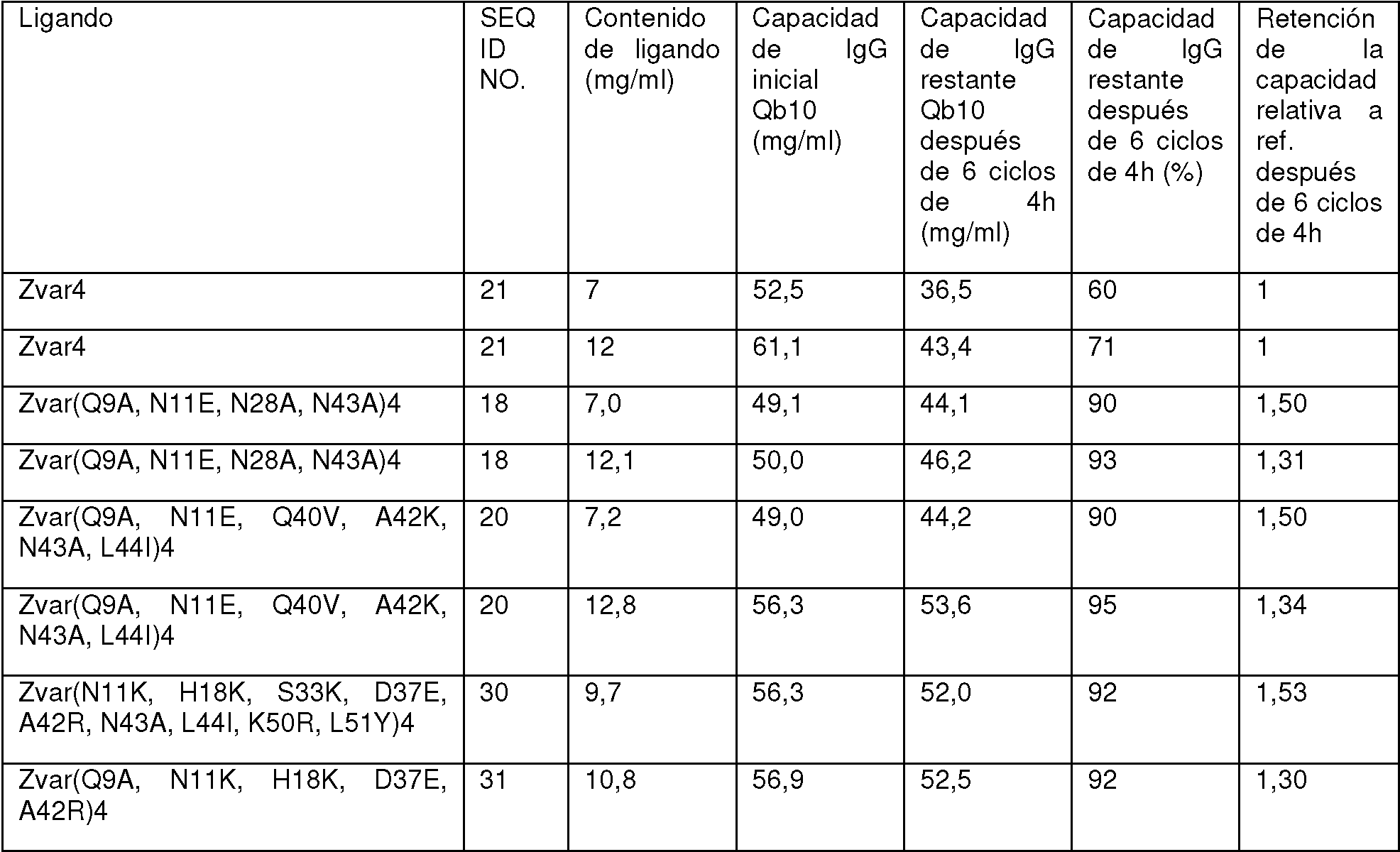
ActivaciónActivation
La matriz base utilizada fueron perlas de agarosa reticuladas rígidas de 85 micrómetros de diámetro medio (ponderado en volumen, d50V), preparadas según los métodos del documento de Patente US6602990 y con un tamaño de poro correspondiente a un valor de Kav de cromatografía de filtración en gel inversa de 0,70 para el dextrano de peso molecular 110 kDa, según los métodos descritos en Gel Filtration Principles and Methods, Pharmacia LKB Biotechnology 1991, págs. 6-13.The base matrix used was rigid cross-linked agarose beads of 85 microns in mean diameter (volume weighted, d50V), prepared according to the methods of Patent document US6602990 and with a pore size corresponding to a Kav value of filtration chromatography in 0.70 reverse gel for the 110 kDa molecular weight dextran, according to the methods described in Gel Filtration Principles and Methods, Pharmacia LKB Biotechnology 1991, pp. 6-13.
Se mezclaron 25 mL (g) de matriz base drenada, 10,0 mL de agua destilada y 2,02 g de NaOH (s) en un matraz de 100 mL con agitación mecánica durante 10 min a 25°C. Se añadieron 4,0 mL de epiclorhidrina y la reacción progresó durante 2 horas. El gel activado se lavó con 10 volúmenes de sedimento de gel (GV) de agua.25 mL (g) of drained base matrix, 10.0 mL of distilled water and 2.02 g of NaOH (s) were mixed in a 100 mL flask with mechanical stirring for 10 min at 25 ° C. 4.0 mL of epichlorohydrin was added and the reaction progressed for 2 hours. The activated gel was washed with 10 gel pellet volumes (GV) of water.
AcoplamientoCoupling
A 20 mL de disolución de ligando (50 mg/mL) en un tubo Falcon de 50 ml se añadieron 169 mg de NaHCO3, 21 mg de Na2CO3, 175 mg de NaCl y 7 mg de EDTA. El tubo Falcon se colocó en una mesa giratoria durante 5-10 minutos, y después se añadieron 77 mg de DTE. La reducción prosiguió durante > 45 minutos. La disolución de ligando se desaló, después, en una columna PD10 empaquetada con Sephadex G-25. El contenido de ligando en la disolución desalada se determinó midiendo la absorción de UV a 276 nm.To 20 mL of ligand solution (50 mg / mL) in a 50 mL Falcon tube, 169 mg of NaHCO3, 21 mg of Na2CO3, 175 mg of NaCl and 7 mg of EDTA were added. The Falcon tube was placed on a rotary table for 5-10 minutes, and then 77 mg of DTE was added. The reduction continued for> 45 minutes. The ligand solution is it was then desalted on a PD10 column packed with Sephadex G-25. The ligand content in the desalted solution was determined by measuring the UV absorption at 276 nm.
El gel activado se lavó con 3-5 GV {fosfato 0,1 M/EDTA 1 mM pH 8 ,6 } y después el ligando se acoplo según el método descrito en el documento de Patente US6399750. Todos los tampones utilizados en los experimentos se habían desgasificado con gas nitrógeno durante al menos 5-10 minutos. El contenido de ligando de los geles se podía controlar variando la cantidad y la concentración de la disolución de ligando.The activated gel was washed with 3-5 GV {0.1 M phosphate / 1 mM EDTA pH 8.6} and then the ligand was coupled according to the method described in patent document US6399750. All buffers used in the experiments had been degassed with nitrogen gas for at least 5-10 minutes. The ligand content of the gels could be controlled by varying the amount and concentration of the ligand solution.
Después de la inmovilización los geles se lavaron 3xGV con agua destilada. Los geles 1 GV {fosfato 0,1 M/EDTA 1 mM/tioglicerol al 10% pH 8 ,6 } se mezclaron y los tubos se dejaron en una mesa de agitación a temperatura ambiente durante la noche. Después, los geles se lavaron alternativamente con 3xGV {TRIS 0,1 M/NaCl 0,15 M pH 8 ,6} y HAc 0,5 M y después 8-10xGV con agua destilada. Las muestras de gel se enviaron a un laboratorio externo para el análisis de aminoácidos y el contenido de ligando (mg/ml de gel) se calculó a partir del contenido total de aminoácidos.After immobilization the gels were washed 3xGV with distilled water. The 1 GV {0.1 M phosphate / 1 mM EDTA / 10% thioglycerol pH 8.6} gels were mixed and the tubes were left on a shaking table at room temperature overnight. The gels were then alternately washed with 3xGV {0.1M TRIS / 0.15M NaCl pH 8.6} and 0.5M HAc and then 8-10xGV with distilled water. The gel samples were sent to an external laboratory for amino acid analysis and the ligand content (mg / ml gel) was calculated from the total amino acid content.
ProteínaProtein
165 mg/ml de Gammanorm (Octapharma), diluido a 2 mg/ml en tampón de equilibrio.165 mg / ml of Gammanorm (Octapharma), diluted to 2 mg / ml in equilibrium buffer.
Tampón de equilibrioBalance buffer
Tampón fosfato PBS 10 mM NaCl 0,14 M KCl 0,0027 M, pH 7,4 (Medicago)PBS phosphate buffer 10 mM NaCl 0.14 M KCl 0.0027 M, pH 7.4 (Medicago)
Tampón de adsorciónAdsorption buffer
Tampón fosfato PBS 10 mM NaCl 0,14 M KCl 0,0027 M, pH 7,4 (Medicago)PBS phosphate buffer 10 mM NaCl 0.14 M KCl 0.0027 M, pH 7.4 (Medicago)
Tampones de eluciónElution buffers
Acetato 100 mM pH 2,9100 mM acetate pH 2.9
Capacidad de unión dinámicaDynamic binding capacity
Se empaquetaron 2 ml de resina en columnas TRICORN™ 5 100. La capacidad de progreso se determinó con un sistema ÁKTAExplorer 10 a un tiempo de residencia de 6 minutos (caudal de 0,33 ml/min). Se pasó el tampón de equilibrio a través de la columna de derivación hasta que se obtuvo una línea base estable. Esto se hizo antes de la puesta a cero automática. La muestra se aplicó a la columna hasta que se obtuvo una señal de UV del 100%. Después, se aplicó de nuevo el tampón de equilibrio hasta que se obtuvo una línea base estable.2 ml of resin was packed into TRICORN ™ 5 100 columns. The progress capacity was determined with an ÁKTAExplorer 10 system at a residence time of 6 minutes (flow rate 0.33 ml / min). The equilibrium buffer was passed through the bypass column until a stable baseline was obtained. This was done before automatic zeroing. The sample was applied to the column until a 100% UV signal was obtained. The equilibrium buffer was then applied again until a stable baseline was obtained.
La muestra se cargó en la columna hasta que se alcanzó una señal de UV del 85% de la absorbancia máxima. Después, la columna se lavó con 5 volúmenes de columna (CV) de tampón de equilibrio a un caudal de 0,5 ml/min. La proteína se eluyó con tampón de elución con 5 CV a un caudal de 0,5 ml/min. Después, la columna se lavó con NaOH 0,5 M a un caudal de 0,2 ml/min y se volvió a equilibrar con tampón de equilibrio.The sample was loaded onto the column until a UV signal of 85% of the maximum absorbance was reached. The column was then washed with 5 column volumes (CV) of equilibrium buffer at a flow rate of 0.5 ml / min. Protein was eluted with 5 CV elution buffer at a flow rate of 0.5 ml / min. The column was then washed with 0.5M NaOH at a flow rate of 0.2 ml / min and re-equilibrated with equilibration buffer.
Para el cálculo de la capacidad de progreso al 10%, se utilizó la siguiente ecuación. Esa es la cantidad de IgG que se carga en la columna hasta que la concentración de IgG en el efluente de la columna es el 10% de la concentración de la IgG en la alimentación.For the calculation of the progress capacity at 10%, the following equation was used. That is the amount of IgG that is loaded onto the column until the IgG concentration in the column effluent is 10% of the IgG concentration in the feed.

A100% = 100% de señal de UVA100% = 100% UV signal
Asub = contribución a la absorbancia de la subclase de IgG no enlazante;A sub = contribution to absorbance of the non-binding IgG subclass;
A(V) = absorbancia de un volumen aplicado dado;A (V) = absorbance of a given applied volume;
Vc = volumen de columna;V c = column volume;
Vapp = volumen aplicado hasta un progreso del 10%;V app = volume applied up to 10% progress;
Vsys = volumen muerto del sistema;V sys = dead volume of the system;
C0 = concentración de la alimentación.C 0 = feed concentration.
Se calculó la capacidad de unión dinámica (DBC) a un progreso del 10%. La capacidad de unión dinámica (DBC) se calculó para un progreso del 10 y 80%.Dynamic Binding Capacity (DBC) was calculated at 10% progress. Dynamic Binding Capacity (DBC) was calculated for 10 and 80% progress.
CIP - NaOH 0,5 M CIP - 0.5 M NaOH
La DBC (Qb10) a un progreso del 10% se determinó tanto antes como después de exposiciones repetidas a disoluciones de limpieza alcalinas. Cada ciclo incluyó una etapa CIP con NaOH 0,5 M bombeada a través de la columna a un caudal de 0,5 /min durante 20 minutos, después de lo cual la columna se dejó en reposo durante 4 h. La exposición tuvo lugar a temperatura ambiente (22 /- 2°C). Después de esta incubación, la columna se lavó con tampón de equilibrio durante 20 minutos a un caudal de 0,5 ml/min. La Tabla 4 muestra la capacidad remanente después de seis ciclos de 4 h (es decir, un tiempo de exposición acumulativo de 24 h a NaOH 0,5 M), tanto en números absolutos como relativos a la capacidad inicial.DBC (Qb10) at 10% progress was determined both before and after repeated exposures to alkaline cleaning solutions. Each cycle included a CIP step with 0.5 M NaOH pumped through the column at a flow rate of 0.5 / min for 20 minutes, after which the column was allowed to stand for 4 h. Exposure took place at room temperature (22 / -2 ° C). After this incubation, the column was washed with equilibration buffer for 20 minutes at a flow rate of 0.5 ml / min. Table 4 shows the remaining capacity after six cycles of 4 h (ie, a cumulative exposure time of 24 h to 0.5 M NaOH), both in absolute numbers and relative to the initial capacity.
Ejemplo 5Example 5
El Ejemplo 4 se repitió con los ligandos tetraméricos mostrados en la Tabla 5, pero con el NaOH 1,0 M utilizado en las etapas CIP en vez de 0,5 M. Los resultados se muestran en la Tabla 5 y la Figura 4.Example 4 was repeated with the tetrameric ligands shown in Table 5, but with the 1.0 M NaOH used in the CIP steps instead of 0.5 M. The results are shown in Table 5 and Figure 4.
Tabla 5. Matrices con ligandos tetraméricos, evaluados en columnas - NaOH 1,0 M.Table 5. Matrices with tetrameric ligands, evaluated in columns - 1.0 M NaOH.

Esta descripción escrita utiliza ejemplos para describir la invención, incluyendo el mejor modo, y también para permitir que cualquier persona experta en la técnica practique la invención, incluyendo la fabricación y el uso de cualquier dispositivo o sistema y la realización de cualquier método incorporado. El alcance patentable de la invención está definido por las reivindicaciones, y puede incluir otros ejemplos que se les ocurran a los expertos en la técnica. Estos otros ejemplos están destinados a estar dentro del alcance de las reivindicaciones si tienen elementos estructurales que no difieren del lenguaje literal de las reivindicaciones. This written description uses examples to describe the invention, including the best mode, and also to enable any person skilled in the art to practice the invention, including the manufacture and use of any device or system and the performance of any incorporated method. The patentable scope of the invention is defined by the claims, and may include other examples that occur to those skilled in the art. These other examples are intended to be within the scope of the claims if they have structural elements that do not differ from the literal language of the claims.
Claims (13)
Applications Claiming Priority (4)
| Application Number | Priority Date | Filing Date | Title |
|---|---|---|---|
| SE1451376 | 2014-11-17 | ||
| GBGB1510261.9A GB201510261D0 (en) | 2015-06-12 | 2015-06-12 | Mutated immunoglobulin-binding polypeptides |
| GBGB1510263.5A GB201510263D0 (en) | 2015-06-12 | 2015-06-12 | Mutated immunoglobulin-binding polypeptides |
| PCT/EP2015/076639 WO2016079033A1 (en) | 2014-11-17 | 2015-11-16 | Mutated immunoglobulin-binding polypeptides |
Publications (1)
| Publication Number | Publication Date |
|---|---|
| ES2817900T3 true ES2817900T3 (en) | 2021-04-08 |
Family
ID=54695687
Family Applications (2)
| Application Number | Title | Priority Date | Filing Date |
|---|---|---|---|
| ES20185632T Active ES2993234T3 (en) | 2014-11-17 | 2015-11-16 | Mutated immunoglobulin-binding polypeptides |
| ES15797940T Active ES2817900T3 (en) | 2014-11-17 | 2015-11-16 | Mutated immunoglobulin-binding polypeptides |
Family Applications Before (1)
| Application Number | Title | Priority Date | Filing Date |
|---|---|---|---|
| ES20185632T Active ES2993234T3 (en) | 2014-11-17 | 2015-11-16 | Mutated immunoglobulin-binding polypeptides |
Country Status (13)
| Country | Link |
|---|---|
| US (5) | US11566082B2 (en) |
| EP (4) | EP3221347B1 (en) |
| JP (5) | JP6724000B2 (en) |
| KR (2) | KR102697609B1 (en) |
| CN (3) | CN118546242A (en) |
| AU (2) | AU2015348640B2 (en) |
| DE (1) | DE112015005181T5 (en) |
| DK (2) | DK3221347T3 (en) |
| ES (2) | ES2993234T3 (en) |
| RU (2) | RU2712882C2 (en) |
| SG (2) | SG11201702796WA (en) |
| SI (1) | SI3221347T1 (en) |
| WO (2) | WO2016079033A1 (en) |
Families Citing this family (51)
| Publication number | Priority date | Publication date | Assignee | Title |
|---|---|---|---|---|
| SE0200943D0 (en) * | 2002-03-25 | 2002-03-25 | Amersham Biosciences Ab | Mutant protein |
| US11566082B2 (en) * | 2014-11-17 | 2023-01-31 | Cytiva Bioprocess R&D Ab | Mutated immunoglobulin-binding polypeptides |
| ES2975669T3 (en) | 2014-12-17 | 2024-07-11 | Cytiva Bioprocess R & D Ab | Modified kappa light chain binding polypeptides |
| WO2017014259A1 (en) * | 2015-07-22 | 2017-01-26 | 株式会社カネカ | ANTIBODY-BINDING PROTEIN HAVING REDUCED ANTIBODY-BINDING CAPACITY IN ACIDIC pH REGION |
| GB201515339D0 (en) * | 2015-08-28 | 2015-10-14 | Ge Healthcare Bio Sciences Ab | A seperation matrix and a method of seperating antibodies |
| US11813336B2 (en) | 2016-05-04 | 2023-11-14 | Navigo Proteins Gmbh | Targeted compounds for the site-specific coupling of chemical moieties comprising a peptide linker |
| CN109219613B (en) * | 2016-05-11 | 2022-09-23 | 思拓凡生物工艺研发有限公司 | Separation method |
| US10889615B2 (en) | 2016-05-11 | 2021-01-12 | Cytiva Bioprocess R&D Ab | Mutated immunoglobulin-binding polypeptides |
| US11753438B2 (en) | 2016-05-11 | 2023-09-12 | Cytiva Bioprocess R&D Ab | Method of cleaning and/or sanitizing a separation matrix |
| US10703774B2 (en) | 2016-09-30 | 2020-07-07 | Ge Healthcare Bioprocess R&D Ab | Separation method |
| US11708390B2 (en) | 2016-05-11 | 2023-07-25 | Cytiva Bioprocess R&D Ab | Method of storing a separation matrix |
| EP3455243B1 (en) | 2016-05-11 | 2021-03-24 | Cytiva BioProcess R&D AB | Separation matrix |
| US10730908B2 (en) | 2016-05-11 | 2020-08-04 | Ge Healthcare Bioprocess R&D Ab | Separation method |
| US10654887B2 (en) | 2016-05-11 | 2020-05-19 | Ge Healthcare Bio-Process R&D Ab | Separation matrix |
| JP7031934B2 (en) * | 2016-05-11 | 2022-03-08 | サイティバ・バイオプロセス・アールアンドディ・アクチボラグ | Separation matrix |
| ES2914278T3 (en) * | 2016-05-11 | 2022-06-08 | Cytiva Bioprocess R & D Ab | Mutated immunoglobulin-binding polypeptides |
| CN117736281A (en) * | 2016-08-11 | 2024-03-22 | 瑞普利金公司 | Alkaline stable FC binding proteins for affinity chromatography |
| US12448411B2 (en) | 2016-09-30 | 2025-10-21 | Cytiva Bioprocess R&D Ab | Separation method |
| GB201703116D0 (en) | 2017-02-27 | 2017-04-12 | Ge Healthcare Bioprocess R&D Ab | A seperation matrix and a method of seperating antibodies |
| US11660550B2 (en) * | 2017-03-07 | 2023-05-30 | Jmva Biotech Ab | Modified adsorptive surfaces |
| GB201708277D0 (en) | 2017-05-24 | 2017-07-05 | Ge Healthcare | A Recombinant protein |
| EP3546476A1 (en) * | 2018-03-26 | 2019-10-02 | Repligen Corporation | Fc binding proteins with cysteine in the c-terminal helical region |
| JP7355729B2 (en) * | 2017-08-07 | 2023-10-03 | レプリゲン・コーポレイション | FC-binding protein with cysteine in the C-terminal helical region |
| US12180581B2 (en) | 2017-09-18 | 2024-12-31 | Waters Technologies Corporation | Use of vapor deposition coated flow paths for improved chromatography of metal interacting analytes |
| US12181452B2 (en) | 2017-09-18 | 2024-12-31 | Waters Technologies Corporation | Use of vapor deposition coated flow paths for improved chromatography of metal interacting analytes |
| US11709156B2 (en) | 2017-09-18 | 2023-07-25 | Waters Technologies Corporation | Use of vapor deposition coated flow paths for improved analytical analysis |
| US11709155B2 (en) | 2017-09-18 | 2023-07-25 | Waters Technologies Corporation | Use of vapor deposition coated flow paths for improved chromatography of metal interacting analytes |
| US11414466B2 (en) | 2017-11-07 | 2022-08-16 | Navigo Proteins Gmbh | Fusion proteins with specificity for ED-B and long serum half-life for diagnosis or treatment of cancer |
| CN111315887B (en) * | 2017-11-09 | 2024-02-06 | 东曹株式会社 | Immunoglobulin binding proteins |
| GB2569585A (en) | 2017-12-20 | 2019-06-26 | Ge Healthcare Bio Sciences Ab | A method for preparation of a separation matrix |
| GB201800448D0 (en) * | 2018-01-11 | 2018-02-28 | Puridify Ltd | Chromatography media and methods for producing them |
| EP4249097A3 (en) * | 2018-02-01 | 2024-01-10 | Repligen Corporation | Fc binding proteins with cysteine in the c-terminal helical region |
| TWI853807B (en) | 2018-03-28 | 2024-09-01 | 美商必治妥美雅史谷比公司 | Interleukin-2/interleukin-2 receptor alpha fusion proteins and methods of use |
| CA3104686A1 (en) | 2018-07-03 | 2020-01-09 | Bristol-Myers Squibb Company | Fgf-21 formulations |
| JP7335881B2 (en) * | 2018-08-24 | 2023-08-30 | Jsr株式会社 | Immunoglobulin-binding protein and affinity carrier using the same |
| KR20210122788A (en) * | 2019-02-01 | 2021-10-12 | 나피고 프로타인스 게엠베하 | Immunoglobulin Binding Proteins for Affinity Purification |
| GB201904125D0 (en) | 2019-03-26 | 2019-05-08 | Ge Healthcare Bio Sciences Ab | Method for sanitization of a chromatography column |
| AU2020273471A1 (en) | 2019-05-14 | 2021-12-23 | The University Of Chicago | Methods and compositions comprising Staphylococcus protein A (SpA) variants |
| JP7432813B2 (en) * | 2019-09-10 | 2024-02-19 | 東ソー株式会社 | immunoglobulin binding protein |
| WO2021072005A1 (en) * | 2019-10-08 | 2021-04-15 | North Carolina State University | Immunoglobulin purification peptides and their use |
| US11918936B2 (en) | 2020-01-17 | 2024-03-05 | Waters Technologies Corporation | Performance and dynamic range for oligonucleotide bioanalysis through reduction of non specific binding |
| JP7587200B2 (en) * | 2020-08-19 | 2024-11-20 | 東ソー株式会社 | Immunoglobulin-binding polypeptides |
| EP4628889A3 (en) | 2020-09-24 | 2025-12-10 | Waters Technologies Corporation | Chromatographic hardware improvements for the separation of reactive molecules |
| EP4229068A1 (en) | 2020-10-13 | 2023-08-23 | Avitide LLC | Affinity ligand libraries of three-helix bundle proteins and uses thereof |
| CN117241866A (en) | 2021-02-19 | 2023-12-15 | 艾维泰有限责任公司 | AAV2 affinity agents |
| GB202113626D0 (en) | 2021-09-24 | 2021-11-10 | Cytiva Bioprocess R & D Ab | FC binding polypeptides |
| GB202203478D0 (en) | 2022-03-14 | 2022-04-27 | Cytiva Bioprocess R & D Ab | Vh3 binding polypeptides |
| CN117700501A (en) * | 2022-09-13 | 2024-03-15 | 普米斯生物技术(珠海)有限公司 | Immunoglobulin binding proteins and uses thereof |
| WO2025083267A1 (en) * | 2023-10-20 | 2025-04-24 | Cytiva Bioprocess R&D Ab | Aav9 binding polypeptides |
| EP4541444A1 (en) | 2023-10-20 | 2025-04-23 | Cytiva BioProcess R&D AB | Fusion protein for affinity capture |
| EP4541814A1 (en) | 2023-10-20 | 2025-04-23 | Cytiva BioProcess R&D AB | Stabilized polypeptides |
Family Cites Families (185)
| Publication number | Priority date | Publication date | Assignee | Title |
|---|---|---|---|---|
| SE451946B (en) | 1982-12-10 | 1987-11-09 | Gambro Lundia Ab | DEVICE FOR THE DISPOSAL OF ONE OR MORE FRACTIONS OF WHOLE BLOOD, PLASMA OR SIMILAR BODY WASHES |
| US4704366A (en) | 1984-06-22 | 1987-11-03 | Bio-Rad Laboratories, Inc. | Process for binding IgG to protein A |
| SE8505922D0 (en) | 1985-12-13 | 1985-12-13 | Kabigen Ab | CONSTRUCTION OF AN IGG BINDING PROTEIN TO FACILITATE DOWNSTREAM PROCESSING USING PROTEIN ENGINEERING |
| US4801687A (en) | 1986-10-27 | 1989-01-31 | Bioprobe International, Inc. | Monoclonal antibody purification process using protein A |
| DE3853515T3 (en) | 1987-05-21 | 2005-08-25 | Micromet Ag | MULTIFUNCTIONAL PROTEINS WITH SPECIFIC OBJECTIVES. |
| US5011686A (en) | 1987-09-21 | 1991-04-30 | Creative Biomolecules, Inc. | Thrombus specific conjugates |
| US5084398A (en) | 1987-11-20 | 1992-01-28 | Creative Biomolecules | Selective removal of immune complexes |
| US4933435A (en) | 1989-04-05 | 1990-06-12 | Bioprobe International | Antibody purification process |
| JP2500329B2 (en) | 1991-05-09 | 1996-05-29 | 工業技術院長 | ALPHA.-Amino acid polymer having crown compound residue and method for producing the same |
| DE69230061T2 (en) | 1991-07-25 | 2000-01-05 | Oriental Yeast Co. Ltd., Tokio/Tokyo | ARTIFICIAL IMMUNOGLOBULIN-BINDING PROTEIN |
| SE9400088D0 (en) | 1994-01-14 | 1994-01-14 | Kabi Pharmacia Ab | Bacterial receptor structures |
| SE9503925D0 (en) | 1995-11-07 | 1995-11-07 | Pharmacia Biotech Ab | Separation medium for IgG |
| SE9601368D0 (en) | 1996-04-11 | 1996-04-11 | Pharmacia Biotech Ab | Process for the production of a porous cross-linked polysaccharide gel |
| DK1900751T3 (en) | 1996-11-27 | 2010-04-19 | Genentech Inc | Affinity purification of a polypeptide on Protein A matrix |
| DE60325334D1 (en) | 2002-02-05 | 2009-01-29 | Genentech Inc | PROTEIN PURIFICATION |
| SE0200943D0 (en) * | 2002-03-25 | 2002-03-25 | Amersham Biosciences Ab | Mutant protein |
| US7709209B2 (en) | 2002-03-25 | 2010-05-04 | Ge Healthcare Bio-Sciences Ab | Protein ligands |
| JP2006507249A (en) | 2002-09-13 | 2006-03-02 | バイオジェン アイデック インコーポレイテッド | Method for purifying a polypeptide by simulated moving bed chromatography |
| JP2006507839A (en) | 2002-11-27 | 2006-03-09 | ジーティーシー バイオセラピューティックス インコーポレイテッド | Modified antibody stably produced in milk and method for producing the same |
| EP1685159B1 (en) | 2003-10-03 | 2012-08-01 | Brigham & Women's Hospital | Tim-3 polypeptides |
| US8084032B2 (en) | 2004-01-21 | 2011-12-27 | Ajinomoto Co., Inc. | Purification method which prevents denaturation of an antibody |
| SE0400274D0 (en) | 2004-02-09 | 2004-02-09 | Affibody Ab | New polypeptide |
| SE0402322D0 (en) | 2004-09-22 | 2004-09-22 | Amersham Biosciences Ab | Method of preparing a chromatography matrix |
| JP2006304633A (en) | 2005-04-26 | 2006-11-09 | Apro Life Science Institute Inc | Immunoglobulin binding protein |
| WO2006126942A1 (en) | 2005-05-24 | 2006-11-30 | Ge Healthcare Bio-Sciences Ab | Regeneration of a chromatography matrix |
| NZ565044A (en) | 2005-06-17 | 2010-05-28 | Elan Pharma Int Ltd | Methods of purifying anti A beta antibodies with calcium chloride |
| US7951885B2 (en) | 2005-08-03 | 2011-05-31 | Merck Patent Gmbh | Hydrophilic crosslinked polymer |
| EP1926747A1 (en) | 2005-08-12 | 2008-06-04 | Schering Corporation | Mcp1 fusions |
| AU2007204987B2 (en) | 2006-01-06 | 2011-11-24 | Amgen Inc. | Methods and systems for isolating target molecules from complex solutions by column-chromatography using eluants containing organic solvents |
| EP1974215B1 (en) | 2006-01-06 | 2017-12-27 | EMD Millipore Corporation | Affinity chromatography matrices and methods of making and using the same |
| US7884264B2 (en) | 2006-01-17 | 2011-02-08 | Biolex Therapeutics, Inc. | Compositions and methods for inhibition of fucosyltransferase and xylosyltransferase expression in duckweed plants |
| WO2007097361A1 (en) | 2006-02-21 | 2007-08-30 | Protenova Co., Ltd. | Immunoglobulin affinity ligand |
| US8263750B2 (en) | 2006-03-16 | 2012-09-11 | Amgen Inc. | Method for purifying a protein using protein-A affinity chromatography using an intermediate wash step |
| PL2650305T3 (en) | 2006-03-24 | 2024-09-16 | Bioverativ Therapeutics Inc. | PC5 as a factor IX propeptide processing enzyme |
| US8377448B2 (en) | 2006-05-15 | 2013-02-19 | The Board Of Trustees Of The Leland Standford Junior University | CD47 related compositions and methods for treating immunological diseases and disorders |
| WO2007144476A1 (en) | 2006-06-16 | 2007-12-21 | Groupe Novasep | Multi-column sequence separation method |
| PL1873166T3 (en) | 2006-06-30 | 2011-03-31 | Conaris Res Institute Ag | Improved sgp 130Fc dimers |
| KR20090058532A (en) | 2006-08-28 | 2009-06-09 | 아레스 트레이딩 에스.에이. | How to Purify FFC Fusion Proteins |
| KR20090064377A (en) | 2006-09-08 | 2009-06-18 | 와이어쓰 | Arginine washing in protein purification using affinity chromatography |
| CN101522278B (en) | 2006-09-29 | 2016-08-10 | 通用电气健康护理生物科学股份公司 | Chromatographic ligands comprising domain C from Staphylococcus aureus protein A for antibody isolation |
| US8853371B2 (en) | 2006-10-19 | 2014-10-07 | Janssen Biotech, Inc. | Process for preparing unaggregated antibody Fc domains |
| US7691608B2 (en) * | 2006-12-06 | 2010-04-06 | Repligen Corporation | Nucleic acids encoding recombinant protein A |
| US20080167450A1 (en) | 2007-01-05 | 2008-07-10 | Hai Pan | Methods of purifying proteins |
| WO2008143199A1 (en) * | 2007-05-21 | 2008-11-27 | Nomadic Bioscience Co., Ltd. | Novel polypeptide, material for affinity chromatography, and method for separation and/or purification of immunoglobulin |
| US7901581B2 (en) | 2007-06-15 | 2011-03-08 | Ge Healthcare Bio-Sciences Ab | Chromatography method |
| US20110117605A1 (en) | 2008-04-23 | 2011-05-19 | Symphogen A/S | Methods for Manufacturing a Polyclonal Protein |
| US8592555B2 (en) * | 2008-08-11 | 2013-11-26 | Emd Millipore Corporation | Immunoglobulin-binding proteins with improved specificity |
| SG2013061528A (en) | 2008-08-14 | 2015-03-30 | Merck Sharp & Dohme | Methods for purifying antibodies using protein a affinity chromatography |
| JP5229888B2 (en) | 2008-09-30 | 2013-07-03 | 独立行政法人産業技術総合研究所 | Protein A mutant protein and antibody capture agent with improved easy dissociation in weakly acidic region |
| US8183207B2 (en) | 2008-11-26 | 2012-05-22 | Five Prime Therapeutics, Inc. | Treatment of osteolytic disorders and cancer using CSF1R extracellular domain fusion molecules |
| WO2010062399A2 (en) | 2008-11-26 | 2010-06-03 | Five Prime Therapeutics, Inc. | Csf1r extracellular domain fusion molecules and treatments using same |
| SG162687A1 (en) | 2008-12-24 | 2010-07-29 | Millipore Corp | Caustic stable chromatography ligands |
| JP2012515160A (en) | 2009-01-12 | 2012-07-05 | ジーイー・ヘルスケア・バイオサイエンス・アクチボラグ | Affinity chromatography matrix |
| US9403883B2 (en) | 2009-03-24 | 2016-08-02 | Kaneka Corporation | Protein having affinity for immunoglobulin, and immunoglobulin-binding affinity ligand |
| WO2010120514A2 (en) | 2009-03-31 | 2010-10-21 | The Trustees Of The University Of Pennsylvania | Antigen-binding proteins comprising recombinant protein scaffolds |
| KR101431318B1 (en) | 2009-04-02 | 2014-08-20 | 로슈 글리카트 아게 | Multispecific antibodies comprising full length antibodies and single chain fab fragments |
| KR20110139292A (en) | 2009-04-20 | 2011-12-28 | 화이자 인코포레이티드 | Control of protein glycosylation and compositions and methods associated therewith |
| CA2766220C (en) | 2009-06-26 | 2021-02-09 | Regeneron Pharmaceuticals, Inc. | Readily isolated bispecific antibodies with native immunoglobulin format |
| WO2010151214A1 (en) | 2009-06-26 | 2010-12-29 | Ge Healthcare Bio-Sciences Ab | A method in a chromatography system |
| EP3219723B1 (en) | 2009-08-27 | 2021-10-06 | Novo Nordisk A/S | Targeting tissue factor to activated platelets |
| HRP20141032T1 (en) | 2009-09-29 | 2015-01-30 | Roche Glycart Ag | Bispecific death receptor agonistic antibodies |
| PT2513134T (en) | 2009-12-18 | 2017-12-14 | Novartis Ag | Wash solution and method for affinity chromatography |
| KR101753569B1 (en) | 2010-01-22 | 2017-07-04 | 베링거 인겔하임 인터내셔날 게엠베하 | Chromatographic method for purifying fc-containing proteins |
| WO2011107518A1 (en) | 2010-03-05 | 2011-09-09 | Boehringer Ingelheim International Gmbh | Selective enrichment of antibodies |
| SG184184A1 (en) * | 2010-03-24 | 2012-10-30 | Kaneka Corp | Protein capable of binding specifically to immunoglobulin, and immunoglobulin-binding affinity ligand |
| KR20130018256A (en) | 2010-03-31 | 2013-02-20 | 제이에스알 가부시끼가이샤 | Filler for affinity chromatography |
| FR2958936A1 (en) | 2010-04-14 | 2011-10-21 | Sanofi Aventis | ROBO1-FC FUSION PROTEIN AND ITS USE IN THE TREATMENT OF TUMORS |
| US9517264B2 (en) | 2010-04-15 | 2016-12-13 | Amgen Inc. | Human FGF receptor and β-Klotho binding proteins |
| TW201742925A (en) | 2010-04-23 | 2017-12-16 | 建南德克公司 | Production of heteromultimeric proteins |
| KR101152036B1 (en) | 2010-04-27 | 2012-06-08 | (주)셀트리온 | A method to improve the sorbent efficiency of protein A chromatography using switching column with continuous feeding |
| US20130231464A1 (en) | 2010-04-28 | 2013-09-05 | Oncolmmune, Inc. | Methods of use of soluble cd24 for therapy of rheumatoid arthritis |
| CA2798390A1 (en) | 2010-05-06 | 2011-11-10 | Novartis Ag | Compositions and methods of use for therapeutic low density lipoprotein - related protein 6 (lrp6) multivalent antibodies |
| CN103168048B (en) | 2010-06-09 | 2017-02-15 | 酶原遗传学有限公司 | dimeric VSTM3 fusion proteins and related compositions and methods |
| WO2011162210A1 (en) | 2010-06-21 | 2011-12-29 | 協和発酵キリン株式会社 | Method for purifying protein using amino acid |
| US8883134B2 (en) | 2010-10-20 | 2014-11-11 | Handok Pharmaceuticals, Inc. | Human interleukin-1 receptor antagonist—hybrid Fc fusion protein |
| US20120263722A1 (en) | 2010-11-04 | 2012-10-18 | Abbott Laboratories | Dual Variable Domain Immunoglobulins and Uses Thereof |
| US9676871B2 (en) | 2010-11-05 | 2017-06-13 | Pfizer Inc. | Engineered polypeptide conjugates and methods for making thereof using transglutaminase |
| JP6092782B2 (en) | 2010-11-16 | 2017-03-08 | エクセリミューン, インコーポレイテッド | Method for producing recombinant protein |
| EP2646126A4 (en) | 2010-11-29 | 2014-12-17 | Ge Healthcare Bio Sciences Ab | AFFINITY CHROMATOGRAPHY MATRIX |
| TWI424121B (en) | 2010-12-10 | 2014-01-21 | Prosol Corp | Turbo molecular pump with improved blade structures |
| JP5974343B2 (en) | 2010-12-20 | 2016-08-23 | ジーイー・ヘルスケア・バイオプロセス・アールアンドディ・アクチボラグ | Affinity chromatography matrix |
| US9683013B2 (en) | 2010-12-20 | 2017-06-20 | Ge Healthcare Bioprocess R&D Ab | Affinity chromatography matrix |
| US9051375B2 (en) | 2010-12-21 | 2015-06-09 | The University Of Western Ontario | Alkali-resistant variants of protein A and their use in affinity chromatography |
| JP5298242B2 (en) | 2010-12-21 | 2013-09-25 | Jsr株式会社 | Carrier for affinity chromatography and method for isolating immunoglobulin |
| EP2658979B1 (en) | 2010-12-27 | 2018-02-14 | Alexion Pharmaceuticals, Inc. | Compositions comprising natriuretic peptides and methods of use thereof |
| US20120238730A1 (en) | 2011-03-15 | 2012-09-20 | Abbott Laboratories | Integrated approach to the isolation and purification of antibodies |
| EP2690173B1 (en) * | 2011-03-25 | 2019-07-03 | Kaneka Corporation | Protein for affinity-separation matrix |
| CN103443120B (en) | 2011-03-25 | 2016-08-31 | 株式会社钟化 | Novel Immunoglobulin Binding Polypeptides |
| DK2691411T3 (en) | 2011-03-29 | 2020-05-11 | Glaxosmithkline Llc | PROTEIN PURIFICATION BUFFER SYSTEM |
| CN102757930A (en) * | 2011-04-27 | 2012-10-31 | 长春安贝生物科技有限公司 | Ultra-low IgG newly-born bovine serum production technology |
| PT2714714T (en) | 2011-06-01 | 2018-10-22 | Novartis Ag | Wash solution and method for affinity chromatography |
| WO2012165544A1 (en) * | 2011-06-03 | 2012-12-06 | 独立行政法人産業技術総合研究所 | Protein a mutant protein having reduced affinity in acidic region, and antibody capture agent |
| SG10201604554WA (en) | 2011-06-08 | 2016-07-28 | Emd Millipore Corp | Chromatography matrices including novel staphylococcus aureus protein a based ligands |
| US9499608B2 (en) | 2011-06-08 | 2016-11-22 | Arizona Board Of Regents, A Body Corporate Of The State Of Arizona Acting For And On Behalf Of Arizona State University | Bispecific monoclonal antibody therapeutics against West Nile virus with improved CNS penetration |
| PL2723773T3 (en) | 2011-06-22 | 2018-07-31 | F.Hoffmann-La Roche Ag | Removal of target cells by circulating virus-specific cytotoxic t-cells using mhc class i comprising complexes |
| MX2014000031A (en) | 2011-07-01 | 2014-07-09 | Bayer Ip Gmbh | Relaxin fusion polypeptides and uses thereof. |
| CA2840951A1 (en) | 2011-07-08 | 2013-01-17 | Merck Sharp & Dohme Corp. | Methods for purifying fc-fusion protein |
| EP2729494A1 (en) | 2011-07-08 | 2014-05-14 | Bayer Intellectual Property GmbH | Fusion proteins releasing relaxin and uses thereof |
| CN104039825A (en) | 2011-09-01 | 2014-09-10 | 人类基因科学公司 | Viral clearance methods |
| WO2013041462A1 (en) | 2011-09-23 | 2013-03-28 | Roche Glycart Ag | Bispecific anti-egfr/anti igf-1r antibodies |
| CA2848520C (en) | 2011-09-29 | 2019-11-26 | Seattle Genetics, Inc. | Intact mass determination of protein conjugated agent compounds |
| EP2578286A1 (en) | 2011-10-04 | 2013-04-10 | Merck Patent GmbH | Method and apparatus for chromatographic purification |
| SG10201805291TA (en) | 2011-10-27 | 2018-08-30 | Genmab As | Production of heterodimeric proteins |
| WO2013075740A1 (en) | 2011-11-23 | 2013-05-30 | Sanofi | Antibody purification method |
| US9657055B2 (en) | 2011-11-30 | 2017-05-23 | Ge Healthcare Bioprocess R&D Ab | Affinity chromatography matrix |
| BR112014014418A2 (en) | 2011-12-15 | 2019-09-24 | Nat Res Council Canada | soluble igf receptor fc fusion proteins and uses thereof |
| JP6169608B2 (en) | 2011-12-29 | 2017-07-26 | エータイアー ファーマ, インコーポレイテッド | Aspartyl tRNA synthetase-Fc conjugate |
| US10189891B2 (en) | 2012-03-28 | 2019-01-29 | Ge Healthcare Bioprocess R&D Ab | Affinity chromatography matrix |
| KR101674784B1 (en) | 2012-04-05 | 2016-11-09 | 에프. 호프만-라 로슈 아게 | Bispecific antibodies against human tweak and human il17 and uses thereof |
| EP2656892A1 (en) | 2012-04-23 | 2013-10-30 | Merck Patent GmbH | Chromatography method |
| US20140154270A1 (en) | 2012-05-21 | 2014-06-05 | Chen Wang | Purification of non-human antibodies using kosmotropic salt enhanced protein a affinity chromatography |
| ES2672974T3 (en) | 2012-06-01 | 2018-06-19 | Ibc Pharmaceuticals, Inc. | Multimeric complexes with improved in vivo stability, improved pharmacokinetics and efficacy |
| EP2682168A1 (en) | 2012-07-02 | 2014-01-08 | Millipore Corporation | Purification of biological molecules |
| SMT202100621T1 (en) | 2012-07-13 | 2022-01-10 | Roche Glycart Ag | Bispecific anti-vegf/anti-ang-2 antibodies and their use in the treatment of ocular vascular diseases |
| US9540442B2 (en) | 2012-08-02 | 2017-01-10 | Jn Biosciences Llc | Antibodies or fusion proteins multimerized via cysteine mutation and a mu tailpiece |
| CA2876099A1 (en) | 2012-08-02 | 2014-02-06 | F. Hoffmann-La Roche Ag | Method for producing monomeric and multimeric molecules and uses thereof |
| MX2015000681A (en) | 2012-08-02 | 2015-04-10 | Hoffmann La Roche | METHOD FOR PRODUCING SOLUBLE FcR AS Fc-FUSION WITH INERT IMMUNOGLOBULIN Fc-REGION AND USES THEREOF. |
| EP3586874A1 (en) | 2012-08-14 | 2020-01-01 | IBC Pharmaceuticals, Inc. | T-cell redirecting bispecific antibodies for treatment of disease |
| MX366666B (en) | 2012-09-13 | 2019-07-19 | Bristol Myers Squibb Co | Fibronectin based scaffold domain proteins that bind to myostatin. |
| EP2899271B1 (en) | 2012-09-21 | 2018-07-25 | Kaneka Corporation | Protein ligand for affinity isolation matrix |
| ES2819573T3 (en) | 2012-12-13 | 2021-04-16 | Immunomedics Inc | Method for Producing Antibody-SN-38 Immunoconjugates with a CL2A Linker |
| HK1218930A1 (en) | 2013-02-08 | 2017-03-17 | Abbvie Stemcentrx Llc | Novel multispecific constructs |
| DK2772289T3 (en) | 2013-03-01 | 2015-08-10 | Chromacon Ag | Chromatographic method for the enrichment and isolation |
| CN105073769B (en) | 2013-03-14 | 2019-09-10 | Emd密理博公司 | Increase the method for purity of protein using the chromatography based on A albumen |
| AU2014233494B2 (en) | 2013-03-15 | 2018-10-04 | Genentech, Inc. | IL-22 polypeptides and IL-22 Fc fusion proteins and methods of use |
| JP6397479B2 (en) | 2013-03-15 | 2018-09-26 | エータイアー ファーマ, インコーポレイテッド | Histidyl-tRNA synthetase Fc conjugate |
| AU2013203043B2 (en) | 2013-03-15 | 2016-10-06 | Takeda Pharmaceutical Company Limited | Methods to produce a human plasma-derived igg preparation enriched in brain disease-related natural iggs |
| US20140302037A1 (en) | 2013-03-15 | 2014-10-09 | Amgen Inc. | BISPECIFIC-Fc MOLECULES |
| CN104059133B (en) | 2013-03-18 | 2019-03-15 | 南京金斯瑞生物科技有限公司 | The albumin A with high alkaline-resisting characteristic of one kind mutation and its application |
| JP6192390B2 (en) | 2013-07-05 | 2017-09-06 | キヤノン株式会社 | Photoelectric conversion device, photoelectric conversion system |
| CA2910945A1 (en) | 2013-05-08 | 2014-11-13 | Zymeworks Inc. | Bispecific her2 and her3 antigen binding constructs |
| AU2014265624B2 (en) | 2013-05-15 | 2019-09-12 | Medimmune Limited | Purification of recombinantly produced polypeptides |
| JP6147340B2 (en) | 2013-05-29 | 2017-06-14 | Jsr株式会社 | Cleaning composition, protein purification method, and protein |
| WO2014204988A2 (en) | 2013-06-17 | 2014-12-24 | Asana Biosciences, Llc | 5t4-targeted immunofusion molecule and methods |
| ES2742855T3 (en) | 2013-07-09 | 2020-02-17 | Ablbio | New double target protein that specifically binds to DLL4 and CEGF, and use of it |
| WO2015005859A1 (en) | 2013-07-10 | 2015-01-15 | Ge Healthcare Bio-Sciences Ab | Mutated immunoglobulin-binding polypeptides |
| HK1218252A1 (en) | 2013-07-25 | 2017-02-10 | Novartis Ag | Bioconjugates of synthetic apelin polypeptides |
| BR112016002008B1 (en) | 2013-08-02 | 2021-06-22 | Pfizer Inc. | ANTI-CXCR4 ANTIBODIES, THEIR USE, ANTIBODY-DRUG CONJUGATE AND PHARMACEUTICAL COMPOSITION |
| KR20160050062A (en) | 2013-09-05 | 2016-05-10 | 제넨테크, 인크. | Method for chromatography reuse |
| HUE057005T2 (en) | 2013-09-25 | 2022-04-28 | Bioverativ Therapeutics Inc | Column virus inactivation procedures |
| US10221211B2 (en) | 2013-09-27 | 2019-03-05 | Kaneka Corporation | Process for producing porous cellulose beads using alkali aqueous solution |
| MX2021008464A (en) | 2013-10-15 | 2023-03-03 | Seattle Genetics Inc | Pegylated drug-linkers for improved ligand-drug conjugate pharmacokinetics. |
| WO2015077891A1 (en) | 2013-11-27 | 2015-06-04 | Zymeworks Inc. | Bispecific antigen-binding constructs targeting her2 |
| KR102178323B1 (en) | 2013-11-29 | 2020-11-13 | 삼성전자주식회사 | Anti-c-Met/anti-Ang2 bispecific antibody |
| BR112016012538A2 (en) | 2013-12-17 | 2017-09-26 | Novartis Ag | cytotoxic peptides and conjugates thereof |
| WO2015110935A1 (en) | 2014-01-27 | 2015-07-30 | Pfizer Inc. | Bifunctional cytotoxic agents |
| US20160152725A1 (en) | 2014-02-25 | 2016-06-02 | Memorial Sloan-Kettering Cancer Center | Antigen-binding proteins specific for hla-a2-restricted wilms tumor 1 peptide |
| RU2732226C2 (en) | 2014-03-17 | 2020-09-14 | Мицубиси Танабе Фарма Корпорейшн | Antibody-fynomer conjugates |
| JP2017517272A (en) | 2014-03-28 | 2017-06-29 | ニューヨーク・ユニバーシティ | FGF23 fusion protein |
| SI3134127T1 (en) | 2014-04-25 | 2020-06-30 | Rinat Neuroscience Corp. | Conjugate drugs with high-level antibodies |
| CN106459142B (en) | 2014-04-30 | 2021-07-13 | 诺和诺德股份有限公司 | A method for protein purification using caprylic acid |
| JP6695812B2 (en) | 2014-05-14 | 2020-05-20 | エフ・ホフマン−ラ・ロシュ・アクチェンゲゼルシャフト | HER3 / HER2 bispecific antibody that binds to the beta hairpin of HER3 and domain II of HER2 |
| HK1231490A1 (en) | 2014-05-28 | 2017-12-22 | Zymeworks, Inc. | Modified antigen binding polypeptide constructs and uses thereof |
| AU2015273098B2 (en) | 2014-06-13 | 2018-05-10 | Novartis Ag | Auristatin derivatives and conjugates thereof |
| WO2015189832A1 (en) | 2014-06-13 | 2015-12-17 | Lupin Limited | Process for the purification of tnfr:fc fusion protein |
| US9777073B2 (en) | 2014-07-21 | 2017-10-03 | Wuhan Yzy Biopharma Co., Ltd. | Construction and application of bispecific antibody EpCAM×CD3 |
| AR101262A1 (en) | 2014-07-26 | 2016-12-07 | Regeneron Pharma | PURIFICATION PLATFORM FOR Bispecific Antibodies |
| KR102259232B1 (en) | 2014-08-25 | 2021-05-31 | 삼성전자주식회사 | Anti-c-Met/anti-Ang2 bispecific antibody |
| SI3185908T1 (en) | 2014-08-28 | 2020-08-31 | Pfizer Inc. | Stability-modulating linkers for use with antibody drug conjugates |
| EP3194447B1 (en) | 2014-09-17 | 2021-12-01 | Novo Nordisk A/S | Antibodies capable of binding two epitopes on tissue factor pathway inhibitor (1-161) |
| JP6369807B2 (en) | 2014-10-21 | 2018-08-08 | 株式会社プロテイン・エクスプレス | Protein L mutant |
| JP2016079153A (en) | 2014-10-21 | 2016-05-16 | 株式会社プロテイン・エクスプレス | Protein G variant |
| SG11201607162QA (en) | 2014-10-24 | 2016-10-28 | Gemtier Medical Shanghai Inc | Disposable Safe Vein Transfusion Puncture Needle |
| US11566082B2 (en) | 2014-11-17 | 2023-01-31 | Cytiva Bioprocess R&D Ab | Mutated immunoglobulin-binding polypeptides |
| CA2969908A1 (en) | 2014-12-09 | 2016-06-16 | Abbvie Inc. | Antibody drug conjugates with cell permeable bcl-xl inhibitors |
| CA2970161A1 (en) | 2014-12-09 | 2016-06-16 | Abbvie Inc. | Bcl-xl inhibitory compounds and antibody drug conjugates including the same |
| WO2016097300A1 (en) | 2014-12-19 | 2016-06-23 | Genmab A/S | Rodent bispecific heterodimeric proteins |
| CA2975410A1 (en) | 2015-04-07 | 2016-10-13 | Immunomedics, Inc. | Y-90-labeled anti-cd22 antibody (epratuzumab tetraxetan) in refractory/relapsed adult cd22+ b-cell acute lymphoblastic leukemia |
| US11820807B2 (en) | 2015-06-12 | 2023-11-21 | Ubi Pharma Inc | Immunoglobulin fusion proteins and uses thereof |
| WO2017011342A1 (en) | 2015-07-10 | 2017-01-19 | Abbvie Inc. | Igm-or-ige-modified binding proteins and uses thereof |
| WO2017009421A1 (en) | 2015-07-16 | 2017-01-19 | Scil Proteins Gmbh | Novel immunoglobulin-binding proteins and their use in affinity purification |
| WO2017026453A1 (en) | 2015-08-10 | 2017-02-16 | 三菱化学株式会社 | Separating agent and liquid-chromatography column |
| GB201515339D0 (en) | 2015-08-28 | 2015-10-14 | Ge Healthcare Bio Sciences Ab | A seperation matrix and a method of seperating antibodies |
| ES2896475T3 (en) | 2015-09-25 | 2022-02-24 | Hoffmann La Roche | Recombinant immunoglobulin heavy chains comprising a sortase conjugation loop and conjugates thereof |
| EP3356403A2 (en) | 2015-10-02 | 2018-08-08 | H. Hoffnabb-La Roche Ag | Bispecific antibodies specific for a costimulatory tnf receptor |
| WO2017055391A1 (en) | 2015-10-02 | 2017-04-06 | F. Hoffmann-La Roche Ag | Bispecific t cell activating antigen binding molecules binding mesothelin and cd3 |
| MY193013A (en) | 2015-10-07 | 2022-09-22 | Hoffmann La Roche | Bispecific antibodies with tetravalency for a costimulatory tnf receptor |
| TWI637966B (en) | 2015-11-30 | 2018-10-11 | 輝瑞股份有限公司 | Antibodies and antibody fragments for site-specific ligation |
| US10654887B2 (en) | 2016-05-11 | 2020-05-19 | Ge Healthcare Bio-Process R&D Ab | Separation matrix |
| US10703774B2 (en) | 2016-09-30 | 2020-07-07 | Ge Healthcare Bioprocess R&D Ab | Separation method |
| US10730908B2 (en) | 2016-05-11 | 2020-08-04 | Ge Healthcare Bioprocess R&D Ab | Separation method |
| CN109219613B (en) | 2016-05-11 | 2022-09-23 | 思拓凡生物工艺研发有限公司 | Separation method |
| US10889615B2 (en) | 2016-05-11 | 2021-01-12 | Cytiva Bioprocess R&D Ab | Mutated immunoglobulin-binding polypeptides |
| US11708390B2 (en) | 2016-05-11 | 2023-07-25 | Cytiva Bioprocess R&D Ab | Method of storing a separation matrix |
| EP3455243B1 (en) | 2016-05-11 | 2021-03-24 | Cytiva BioProcess R&D AB | Separation matrix |
-
2015
- 2015-11-11 US US15/525,688 patent/US11566082B2/en active Active
- 2015-11-16 RU RU2017115345A patent/RU2712882C2/en active
- 2015-11-16 CN CN202410340970.XA patent/CN118546242A/en active Pending
- 2015-11-16 WO PCT/EP2015/076639 patent/WO2016079033A1/en not_active Ceased
- 2015-11-16 EP EP15797940.2A patent/EP3221347B1/en active Active
- 2015-11-16 EP EP20185646.5A patent/EP3757124A1/en not_active Withdrawn
- 2015-11-16 KR KR1020177012872A patent/KR102697609B1/en active Active
- 2015-11-16 SG SG11201702796WA patent/SG11201702796WA/en unknown
- 2015-11-16 ES ES20185632T patent/ES2993234T3/en active Active
- 2015-11-16 JP JP2017525397A patent/JP6724000B2/en active Active
- 2015-11-16 ES ES15797940T patent/ES2817900T3/en active Active
- 2015-11-16 KR KR1020177012873A patent/KR102552335B1/en active Active
- 2015-11-16 EP EP20185632.5A patent/EP3757123B1/en active Active
- 2015-11-16 AU AU2015348640A patent/AU2015348640B2/en active Active
- 2015-11-16 WO PCT/EP2015/076642 patent/WO2016079034A1/en not_active Ceased
- 2015-11-16 JP JP2017525398A patent/JP6770727B2/en active Active
- 2015-11-16 CN CN201580062170.5A patent/CN107001432B/en active Active
- 2015-11-16 SG SG11201703053PA patent/SG11201703053PA/en unknown
- 2015-11-16 EP EP15797942.8A patent/EP3221338B1/en active Active
- 2015-11-16 US US15/526,941 patent/US10501557B2/en active Active
- 2015-11-16 RU RU2017115342A patent/RU2701695C2/en active
- 2015-11-16 CN CN201580062121.1A patent/CN107001448A/en active Pending
- 2015-11-16 DK DK15797940.2T patent/DK3221347T3/en active
- 2015-11-16 DK DK20185632.5T patent/DK3757123T3/en active
- 2015-11-16 AU AU2015348641A patent/AU2015348641B2/en active Active
- 2015-11-16 DE DE112015005181.3T patent/DE112015005181T5/en active Pending
- 2015-11-16 SI SI201531353T patent/SI3221347T1/en unknown
-
2019
- 2019-10-07 US US16/594,731 patent/US20200079878A1/en not_active Abandoned
-
2020
- 2020-06-23 JP JP2020107847A patent/JP7015868B2/en active Active
- 2020-07-15 JP JP2020121312A patent/JP2020184999A/en active Pending
-
2021
- 2021-01-15 US US17/149,830 patent/US12221492B2/en active Active
-
2022
- 2022-01-21 JP JP2022007919A patent/JP2022062096A/en active Pending
-
2023
- 2023-01-05 US US18/093,624 patent/US20230331870A1/en active Pending
Also Published As
Similar Documents
| Publication | Publication Date | Title |
|---|---|---|
| ES2817900T3 (en) | Mutated immunoglobulin-binding polypeptides | |
| JP6862008B2 (en) | Mutant immunoglobulin binding polypeptide | |
| ES2914278T3 (en) | Mutated immunoglobulin-binding polypeptides | |
| ES2874974T3 (en) | Separation matrix | |
| US20190144496A1 (en) | Mutated Immunoglobulin-Binding Polypeptides | |
| ES2909833T3 (en) | Cleaning and/or disinfection method of a separation matrix | |
| BR112017008106B1 (en) | FC-BINDING POLYPEPTIDE, MULTIMER, SEPARATION MATRIX, AND METHOD FOR ISOLATING AN IMMUNOGLOBIN |