ES2753244T3 - Novel Compounds 1,2,4 Oxadiazole Active Against Gram Positive Pathogens - Google Patents
Novel Compounds 1,2,4 Oxadiazole Active Against Gram Positive Pathogens Download PDFInfo
- Publication number
- ES2753244T3 ES2753244T3 ES14718750T ES14718750T ES2753244T3 ES 2753244 T3 ES2753244 T3 ES 2753244T3 ES 14718750 T ES14718750 T ES 14718750T ES 14718750 T ES14718750 T ES 14718750T ES 2753244 T3 ES2753244 T3 ES 2753244T3
- Authority
- ES
- Spain
- Prior art keywords
- nhc
- compounds
- use according
- pharmaceutical composition
- enantiomer
- Prior art date
- Legal status (The legal status is an assumption and is not a legal conclusion. Google has not performed a legal analysis and makes no representation as to the accuracy of the status listed.)
- Active
Links
- 150000001875 compounds Chemical class 0.000 title claims abstract description 128
- 244000000059 gram-positive pathogen Species 0.000 title description 3
- BBVIDBNAYOIXOE-UHFFFAOYSA-N 1,2,4-oxadiazole Chemical compound C=1N=CON=1 BBVIDBNAYOIXOE-UHFFFAOYSA-N 0.000 title description 2
- 239000000203 mixture Substances 0.000 claims abstract description 48
- 125000002496 methyl group Chemical group [H]C([H])([H])* 0.000 claims abstract description 43
- 229910052731 fluorine Inorganic materials 0.000 claims abstract description 28
- HBAQYPYDRFILMT-UHFFFAOYSA-N 8-[3-(1-cyclopropylpyrazol-4-yl)-1H-pyrazolo[4,3-d]pyrimidin-5-yl]-3-methyl-3,8-diazabicyclo[3.2.1]octan-2-one Chemical class C1(CC1)N1N=CC(=C1)C1=NNC2=C1N=C(N=C2)N1C2C(N(CC1CC2)C)=O HBAQYPYDRFILMT-UHFFFAOYSA-N 0.000 claims abstract description 24
- 229910052801 chlorine Inorganic materials 0.000 claims abstract description 24
- 229910052717 sulfur Inorganic materials 0.000 claims abstract description 20
- 229910052760 oxygen Inorganic materials 0.000 claims abstract description 19
- 125000003118 aryl group Chemical group 0.000 claims abstract description 14
- 208000015181 infectious disease Diseases 0.000 claims abstract description 14
- 125000006273 (C1-C3) alkyl group Chemical group 0.000 claims abstract description 12
- 125000001072 heteroaryl group Chemical group 0.000 claims abstract description 12
- 125000005913 (C3-C6) cycloalkyl group Chemical group 0.000 claims abstract description 11
- 229910052794 bromium Inorganic materials 0.000 claims abstract description 11
- 241000192125 Firmicutes Species 0.000 claims abstract description 8
- 125000001997 phenyl group Chemical group [H]C1=C([H])C([H])=C(*)C([H])=C1[H] 0.000 claims abstract description 8
- 125000002252 acyl group Chemical group 0.000 claims abstract description 7
- 125000001449 isopropyl group Chemical group [H]C([H])([H])C([H])(*)C([H])([H])[H] 0.000 claims abstract description 6
- 125000000956 methoxy group Chemical group [H]C([H])([H])O* 0.000 claims abstract description 6
- 125000004123 n-propyl group Chemical group [H]C([H])([H])C([H])([H])C([H])([H])* 0.000 claims abstract description 6
- 229910052739 hydrogen Inorganic materials 0.000 claims abstract description 5
- MDFFNEOEWAXZRQ-UHFFFAOYSA-N aminyl Chemical compound [NH2] MDFFNEOEWAXZRQ-UHFFFAOYSA-N 0.000 claims abstract description 3
- 239000000243 solution Substances 0.000 claims description 29
- 238000000034 method Methods 0.000 claims description 23
- 239000003242 anti bacterial agent Substances 0.000 claims description 19
- 239000008194 pharmaceutical composition Substances 0.000 claims description 18
- 238000002360 preparation method Methods 0.000 claims description 16
- 241000894006 Bacteria Species 0.000 claims description 13
- 229940088710 antibiotic agent Drugs 0.000 claims description 13
- VUWZPRWSIVNGKG-UHFFFAOYSA-N fluoromethane Chemical compound F[CH2] VUWZPRWSIVNGKG-UHFFFAOYSA-N 0.000 claims description 11
- WBLIXGSTEMXDSM-UHFFFAOYSA-N chloromethane Chemical compound Cl[CH2] WBLIXGSTEMXDSM-UHFFFAOYSA-N 0.000 claims description 10
- 125000001607 1,2,3-triazol-1-yl group Chemical group [*]N1N=NC([H])=C1[H] 0.000 claims description 8
- 239000000839 emulsion Substances 0.000 claims description 8
- 125000001495 ethyl group Chemical group [H]C([H])([H])C([H])([H])* 0.000 claims description 7
- 239000000725 suspension Substances 0.000 claims description 7
- 239000002105 nanoparticle Substances 0.000 claims description 6
- 230000008569 process Effects 0.000 claims description 5
- 239000002047 solid lipid nanoparticle Substances 0.000 claims description 5
- 125000001424 substituent group Chemical group 0.000 claims description 5
- 241000191940 Staphylococcus Species 0.000 claims description 4
- 229910052740 iodine Inorganic materials 0.000 claims description 4
- 241000194033 Enterococcus Species 0.000 claims description 3
- 241000194017 Streptococcus Species 0.000 claims description 3
- 125000001153 fluoro group Chemical group F* 0.000 claims description 3
- 239000006199 nebulizer Substances 0.000 claims description 3
- 230000001225 therapeutic effect Effects 0.000 claims description 3
- 230000000699 topical effect Effects 0.000 claims description 3
- 239000006071 cream Substances 0.000 claims description 2
- 239000000499 gel Substances 0.000 claims description 2
- 239000002502 liposome Substances 0.000 claims description 2
- 239000002674 ointment Substances 0.000 claims description 2
- 239000006188 syrup Substances 0.000 claims description 2
- 235000020357 syrup Nutrition 0.000 claims description 2
- 239000003826 tablet Substances 0.000 claims description 2
- 239000002775 capsule Substances 0.000 claims 1
- 239000006185 dispersion Substances 0.000 claims 1
- 239000002088 nanocapsule Substances 0.000 claims 1
- 101100516563 Caenorhabditis elegans nhr-6 gene Proteins 0.000 abstract 1
- 101100516568 Caenorhabditis elegans nhr-7 gene Proteins 0.000 abstract 1
- 125000001436 propyl group Chemical group [H]C([*])([H])C([H])([H])C([H])([H])[H] 0.000 abstract 1
- TYZROVQLWOKYKF-ZDUSSCGKSA-N linezolid Chemical compound O=C1O[C@@H](CNC(=O)C)CN1C(C=C1F)=CC=C1N1CCOCC1 TYZROVQLWOKYKF-ZDUSSCGKSA-N 0.000 description 47
- 229960003907 linezolid Drugs 0.000 description 46
- 210000004027 cell Anatomy 0.000 description 28
- 238000004458 analytical method Methods 0.000 description 20
- 230000000694 effects Effects 0.000 description 20
- IZXIZTKNFFYFOF-UHFFFAOYSA-N 2-Oxazolidone Chemical class O=C1NCCO1 IZXIZTKNFFYFOF-UHFFFAOYSA-N 0.000 description 16
- 239000002904 solvent Substances 0.000 description 16
- XEKOWRVHYACXOJ-UHFFFAOYSA-N Ethyl acetate Chemical compound CCOC(C)=O XEKOWRVHYACXOJ-UHFFFAOYSA-N 0.000 description 15
- 238000005481 NMR spectroscopy Methods 0.000 description 15
- 239000003814 drug Substances 0.000 description 14
- 0 *c(cccc1)c1C(Cl)=O Chemical compound *c(cccc1)c1C(Cl)=O 0.000 description 13
- 229940079593 drug Drugs 0.000 description 13
- IAZDPXIOMUYVGZ-UHFFFAOYSA-N Dimethylsulphoxide Chemical compound CS(C)=O IAZDPXIOMUYVGZ-UHFFFAOYSA-N 0.000 description 12
- 241000191967 Staphylococcus aureus Species 0.000 description 11
- 230000000844 anti-bacterial effect Effects 0.000 description 11
- RJQXTJLFIWVMTO-TYNCELHUSA-N Methicillin Chemical compound COC1=CC=CC(OC)=C1C(=O)N[C@@H]1C(=O)N2[C@@H](C(O)=O)C(C)(C)S[C@@H]21 RJQXTJLFIWVMTO-TYNCELHUSA-N 0.000 description 10
- 229960003085 meticillin Drugs 0.000 description 10
- 238000003786 synthesis reaction Methods 0.000 description 10
- 230000001580 bacterial effect Effects 0.000 description 9
- IAZDPXIOMUYVGZ-WFGJKAKNSA-N Dimethyl sulfoxide Chemical compound [2H]C([2H])([2H])S(=O)C([2H])([2H])[2H] IAZDPXIOMUYVGZ-WFGJKAKNSA-N 0.000 description 8
- 230000003833 cell viability Effects 0.000 description 8
- -1 fluoroquinolones Chemical compound 0.000 description 8
- 102000004169 proteins and genes Human genes 0.000 description 8
- 108090000623 proteins and genes Proteins 0.000 description 8
- 230000002829 reductive effect Effects 0.000 description 8
- 238000005160 1H NMR spectroscopy Methods 0.000 description 7
- 230000003115 biocidal effect Effects 0.000 description 7
- 230000015572 biosynthetic process Effects 0.000 description 7
- 235000019439 ethyl acetate Nutrition 0.000 description 7
- 230000009467 reduction Effects 0.000 description 7
- 150000005071 1,2,4-oxadiazoles Chemical class 0.000 description 6
- VVJKKWFAADXIJK-UHFFFAOYSA-N Allylamine Chemical compound NCC=C VVJKKWFAADXIJK-UHFFFAOYSA-N 0.000 description 6
- HEMHJVSKTPXQMS-UHFFFAOYSA-M Sodium hydroxide Chemical compound [OH-].[Na+] HEMHJVSKTPXQMS-UHFFFAOYSA-M 0.000 description 6
- 230000002401 inhibitory effect Effects 0.000 description 6
- 239000012074 organic phase Substances 0.000 description 6
- XLYOFNOQVPJJNP-UHFFFAOYSA-N water Substances O XLYOFNOQVPJJNP-UHFFFAOYSA-N 0.000 description 6
- 108020005196 Mitochondrial DNA Proteins 0.000 description 5
- 229930182555 Penicillin Natural products 0.000 description 5
- JGSARLDLIJGVTE-MBNYWOFBSA-N Penicillin G Chemical compound N([C@H]1[C@H]2SC([C@@H](N2C1=O)C(O)=O)(C)C)C(=O)CC1=CC=CC=C1 JGSARLDLIJGVTE-MBNYWOFBSA-N 0.000 description 5
- 230000000845 anti-microbial effect Effects 0.000 description 5
- 238000006243 chemical reaction Methods 0.000 description 5
- 238000000338 in vitro Methods 0.000 description 5
- 210000004072 lung Anatomy 0.000 description 5
- 230000004048 modification Effects 0.000 description 5
- 238000012986 modification Methods 0.000 description 5
- AEXITZJSLGALNH-UHFFFAOYSA-N n'-hydroxyethanimidamide Chemical compound CC(N)=NO AEXITZJSLGALNH-UHFFFAOYSA-N 0.000 description 5
- 229940049954 penicillin Drugs 0.000 description 5
- 239000000126 substance Substances 0.000 description 5
- 108091003079 Bovine Serum Albumin Proteins 0.000 description 4
- 239000006144 Dulbecco’s modified Eagle's medium Substances 0.000 description 4
- 241000194031 Enterococcus faecium Species 0.000 description 4
- LFQSCWFLJHTTHZ-UHFFFAOYSA-N Ethanol Chemical compound CCO LFQSCWFLJHTTHZ-UHFFFAOYSA-N 0.000 description 4
- 239000007832 Na2SO4 Substances 0.000 description 4
- PMZURENOXWZQFD-UHFFFAOYSA-L Sodium Sulfate Chemical compound [Na+].[Na+].[O-]S([O-])(=O)=O PMZURENOXWZQFD-UHFFFAOYSA-L 0.000 description 4
- 241000191963 Staphylococcus epidermidis Species 0.000 description 4
- 241000193998 Streptococcus pneumoniae Species 0.000 description 4
- 150000001412 amines Chemical class 0.000 description 4
- 238000002474 experimental method Methods 0.000 description 4
- 239000012091 fetal bovine serum Substances 0.000 description 4
- 238000002734 oxidative phosphorylation assay Methods 0.000 description 4
- 239000011541 reaction mixture Substances 0.000 description 4
- 238000000926 separation method Methods 0.000 description 4
- 229910052938 sodium sulfate Inorganic materials 0.000 description 4
- 235000011152 sodium sulphate Nutrition 0.000 description 4
- 229940031000 streptococcus pneumoniae Drugs 0.000 description 4
- UCSJYZPVAKXKNQ-HZYVHMACSA-N streptomycin Chemical compound CN[C@H]1[C@H](O)[C@@H](O)[C@H](CO)O[C@H]1O[C@@H]1[C@](C=O)(O)[C@H](C)O[C@H]1O[C@@H]1[C@@H](NC(N)=N)[C@H](O)[C@@H](NC(N)=N)[C@H](O)[C@H]1O UCSJYZPVAKXKNQ-HZYVHMACSA-N 0.000 description 4
- 125000000999 tert-butyl group Chemical group [H]C([H])([H])C(*)(C([H])([H])[H])C([H])([H])[H] 0.000 description 4
- 238000012360 testing method Methods 0.000 description 4
- 150000003556 thioamides Chemical class 0.000 description 4
- 231100000419 toxicity Toxicity 0.000 description 4
- 230000001988 toxicity Effects 0.000 description 4
- 125000003626 1,2,4-triazol-1-yl group Chemical group [*]N1N=C([H])N=C1[H] 0.000 description 3
- WFDIJRYMOXRFFG-UHFFFAOYSA-N Acetic anhydride Chemical compound CC(=O)OC(C)=O WFDIJRYMOXRFFG-UHFFFAOYSA-N 0.000 description 3
- 229940126062 Compound A Drugs 0.000 description 3
- NLDMNSXOCDLTTB-UHFFFAOYSA-N Heterophylliin A Natural products O1C2COC(=O)C3=CC(O)=C(O)C(O)=C3C3=C(O)C(O)=C(O)C=C3C(=O)OC2C(OC(=O)C=2C=C(O)C(O)=C(O)C=2)C(O)C1OC(=O)C1=CC(O)=C(O)C(O)=C1 NLDMNSXOCDLTTB-UHFFFAOYSA-N 0.000 description 3
- VEXZGXHMUGYJMC-UHFFFAOYSA-N Hydrochloric acid Chemical compound Cl VEXZGXHMUGYJMC-UHFFFAOYSA-N 0.000 description 3
- ZMANZCXQSJIPKH-UHFFFAOYSA-N Triethylamine Chemical compound CCN(CC)CC ZMANZCXQSJIPKH-UHFFFAOYSA-N 0.000 description 3
- 108010059993 Vancomycin Proteins 0.000 description 3
- 230000009471 action Effects 0.000 description 3
- 239000004599 antimicrobial Substances 0.000 description 3
- 238000003556 assay Methods 0.000 description 3
- 150000007980 azole derivatives Chemical class 0.000 description 3
- 230000008901 benefit Effects 0.000 description 3
- 238000002815 broth microdilution Methods 0.000 description 3
- 239000003153 chemical reaction reagent Substances 0.000 description 3
- 230000001472 cytotoxic effect Effects 0.000 description 3
- 238000010586 diagram Methods 0.000 description 3
- 206010073071 hepatocellular carcinoma Diseases 0.000 description 3
- 238000004128 high performance liquid chromatography Methods 0.000 description 3
- 230000005764 inhibitory process Effects 0.000 description 3
- 230000007246 mechanism Effects 0.000 description 3
- 239000012528 membrane Substances 0.000 description 3
- 239000000546 pharmaceutical excipient Substances 0.000 description 3
- 239000007787 solid Substances 0.000 description 3
- 150000003585 thioureas Chemical class 0.000 description 3
- MYPYJXKWCTUITO-LYRMYLQWSA-N vancomycin Chemical compound O([C@@H]1[C@@H](O)[C@H](O)[C@@H](CO)O[C@H]1OC1=C2C=C3C=C1OC1=CC=C(C=C1Cl)[C@@H](O)[C@H](C(N[C@@H](CC(N)=O)C(=O)N[C@H]3C(=O)N[C@H]1C(=O)N[C@H](C(N[C@@H](C3=CC(O)=CC(O)=C3C=3C(O)=CC=C1C=3)C(O)=O)=O)[C@H](O)C1=CC=C(C(=C1)Cl)O2)=O)NC(=O)[C@@H](CC(C)C)NC)[C@H]1C[C@](C)(N)[C@H](O)[C@H](C)O1 MYPYJXKWCTUITO-LYRMYLQWSA-N 0.000 description 3
- 229960003165 vancomycin Drugs 0.000 description 3
- MYPYJXKWCTUITO-UHFFFAOYSA-N vancomycin Natural products O1C(C(=C2)Cl)=CC=C2C(O)C(C(NC(C2=CC(O)=CC(O)=C2C=2C(O)=CC=C3C=2)C(O)=O)=O)NC(=O)C3NC(=O)C2NC(=O)C(CC(N)=O)NC(=O)C(NC(=O)C(CC(C)C)NC)C(O)C(C=C3Cl)=CC=C3OC3=CC2=CC1=C3OC1OC(CO)C(O)C(O)C1OC1CC(C)(N)C(O)C(C)O1 MYPYJXKWCTUITO-UHFFFAOYSA-N 0.000 description 3
- 230000035899 viability Effects 0.000 description 3
- FANCTJAFZSYTIS-IQUVVAJASA-N (1r,3s,5z)-5-[(2e)-2-[(1r,3as,7ar)-7a-methyl-1-[(2r)-4-(phenylsulfonimidoyl)butan-2-yl]-2,3,3a,5,6,7-hexahydro-1h-inden-4-ylidene]ethylidene]-4-methylidenecyclohexane-1,3-diol Chemical compound C([C@@H](C)[C@@H]1[C@]2(CCCC(/[C@@H]2CC1)=C\C=C\1C([C@@H](O)C[C@H](O)C/1)=C)C)CS(=N)(=O)C1=CC=CC=C1 FANCTJAFZSYTIS-IQUVVAJASA-N 0.000 description 2
- VHYFNPMBLIVWCW-UHFFFAOYSA-N 4-Dimethylaminopyridine Chemical compound CN(C)C1=CC=NC=C1 VHYFNPMBLIVWCW-UHFFFAOYSA-N 0.000 description 2
- CSCPPACGZOOCGX-UHFFFAOYSA-N Acetone Chemical compound CC(C)=O CSCPPACGZOOCGX-UHFFFAOYSA-N 0.000 description 2
- 206010065553 Bone marrow failure Diseases 0.000 description 2
- YMWUJEATGCHHMB-UHFFFAOYSA-N Dichloromethane Chemical compound ClCCl YMWUJEATGCHHMB-UHFFFAOYSA-N 0.000 description 2
- RTZKZFJDLAIYFH-UHFFFAOYSA-N Diethyl ether Chemical compound CCOCC RTZKZFJDLAIYFH-UHFFFAOYSA-N 0.000 description 2
- 241000194032 Enterococcus faecalis Species 0.000 description 2
- JNCMHMUGTWEVOZ-UHFFFAOYSA-N F[CH]F Chemical compound F[CH]F JNCMHMUGTWEVOZ-UHFFFAOYSA-N 0.000 description 2
- 230000005526 G1 to G0 transition Effects 0.000 description 2
- 108010081348 HRT1 protein Hairy Proteins 0.000 description 2
- 102100021881 Hairy/enhancer-of-split related with YRPW motif protein 1 Human genes 0.000 description 2
- WTDHULULXKLSOZ-UHFFFAOYSA-N Hydroxylamine hydrochloride Chemical compound Cl.ON WTDHULULXKLSOZ-UHFFFAOYSA-N 0.000 description 2
- ZDXPYRJPNDTMRX-VKHMYHEASA-N L-glutamine Chemical compound OC(=O)[C@@H](N)CCC(N)=O ZDXPYRJPNDTMRX-VKHMYHEASA-N 0.000 description 2
- 229930182816 L-glutamine Natural products 0.000 description 2
- LGDSHSYDSCRFAB-UHFFFAOYSA-N Methyl isothiocyanate Chemical compound CN=C=S LGDSHSYDSCRFAB-UHFFFAOYSA-N 0.000 description 2
- 102000006404 Mitochondrial Proteins Human genes 0.000 description 2
- 108010058682 Mitochondrial Proteins Proteins 0.000 description 2
- 102000010909 Monoamine Oxidase Human genes 0.000 description 2
- 108010062431 Monoamine oxidase Proteins 0.000 description 2
- 108091093105 Nuclear DNA Proteins 0.000 description 2
- 206010034133 Pathogen resistance Diseases 0.000 description 2
- JUJWROOIHBZHMG-UHFFFAOYSA-N Pyridine Chemical compound C1=CC=NC=C1 JUJWROOIHBZHMG-UHFFFAOYSA-N 0.000 description 2
- PXIPVTKHYLBLMZ-UHFFFAOYSA-N Sodium azide Chemical compound [Na+].[N-]=[N+]=[N-] PXIPVTKHYLBLMZ-UHFFFAOYSA-N 0.000 description 2
- 241000192087 Staphylococcus hominis Species 0.000 description 2
- 238000002835 absorbance Methods 0.000 description 2
- WETWJCDKMRHUPV-UHFFFAOYSA-N acetyl chloride Chemical compound CC(Cl)=O WETWJCDKMRHUPV-UHFFFAOYSA-N 0.000 description 2
- 239000012346 acetyl chloride Substances 0.000 description 2
- 239000004480 active ingredient Substances 0.000 description 2
- 150000001408 amides Chemical class 0.000 description 2
- 125000006295 amino methylene group Chemical group [H]N(*)C([H])([H])* 0.000 description 2
- 238000013459 approach Methods 0.000 description 2
- 239000012298 atmosphere Substances 0.000 description 2
- 150000001540 azides Chemical class 0.000 description 2
- KGNDCEVUMONOKF-UGPLYTSKSA-N benzyl n-[(2r)-1-[(2s,4r)-2-[[(2s)-6-amino-1-(1,3-benzoxazol-2-yl)-1,1-dihydroxyhexan-2-yl]carbamoyl]-4-[(4-methylphenyl)methoxy]pyrrolidin-1-yl]-1-oxo-4-phenylbutan-2-yl]carbamate Chemical compound C1=CC(C)=CC=C1CO[C@H]1CN(C(=O)[C@@H](CCC=2C=CC=CC=2)NC(=O)OCC=2C=CC=CC=2)[C@H](C(=O)N[C@@H](CCCCN)C(O)(O)C=2OC3=CC=CC=C3N=2)C1 KGNDCEVUMONOKF-UGPLYTSKSA-N 0.000 description 2
- AOJDZKCUAATBGE-UHFFFAOYSA-N bromomethane Chemical compound Br[CH2] AOJDZKCUAATBGE-UHFFFAOYSA-N 0.000 description 2
- 229910052799 carbon Inorganic materials 0.000 description 2
- SFZULDYEOVSIKM-UHFFFAOYSA-N chembl321317 Chemical compound C1=CC(C(=N)NO)=CC=C1C1=CC=C(C=2C=CC(=CC=2)C(=N)NO)O1 SFZULDYEOVSIKM-UHFFFAOYSA-N 0.000 description 2
- 229940125833 compound 23 Drugs 0.000 description 2
- 125000001995 cyclobutyl group Chemical group [H]C1([H])C([H])([H])C([H])(*)C1([H])[H] 0.000 description 2
- 125000000113 cyclohexyl group Chemical group [H]C1([H])C([H])([H])C([H])([H])C([H])(*)C([H])([H])C1([H])[H] 0.000 description 2
- 125000001511 cyclopentyl group Chemical group [H]C1([H])C([H])([H])C([H])([H])C([H])(*)C1([H])[H] 0.000 description 2
- 125000001559 cyclopropyl group Chemical group [H]C1([H])C([H])([H])C1([H])* 0.000 description 2
- 231100000433 cytotoxic Toxicity 0.000 description 2
- 231100000135 cytotoxicity Toxicity 0.000 description 2
- 230000003013 cytotoxicity Effects 0.000 description 2
- 238000011161 development Methods 0.000 description 2
- 229940032049 enterococcus faecalis Drugs 0.000 description 2
- AEOCXXJPGCBFJA-UHFFFAOYSA-N ethionamide Chemical compound CCC1=CC(C(N)=S)=CC=N1 AEOCXXJPGCBFJA-UHFFFAOYSA-N 0.000 description 2
- 210000003527 eukaryotic cell Anatomy 0.000 description 2
- 229940124307 fluoroquinolone Drugs 0.000 description 2
- 238000009472 formulation Methods 0.000 description 2
- 125000000524 functional group Chemical group 0.000 description 2
- 125000005843 halogen group Chemical group 0.000 description 2
- 231100000844 hepatocellular carcinoma Toxicity 0.000 description 2
- 125000000623 heterocyclic group Chemical group 0.000 description 2
- 125000002962 imidazol-1-yl group Chemical group [*]N1C([H])=NC([H])=C1[H] 0.000 description 2
- 230000003993 interaction Effects 0.000 description 2
- 239000000543 intermediate Substances 0.000 description 2
- CFHGBZLNZZVTAY-UHFFFAOYSA-N lawesson's reagent Chemical compound C1=CC(OC)=CC=C1P1(=S)SP(=S)(C=2C=CC(OC)=CC=2)S1 CFHGBZLNZZVTAY-UHFFFAOYSA-N 0.000 description 2
- 239000003120 macrolide antibiotic agent Substances 0.000 description 2
- 229940041033 macrolides Drugs 0.000 description 2
- 230000014759 maintenance of location Effects 0.000 description 2
- 239000002609 medium Substances 0.000 description 2
- VNWKTOKETHGBQD-UHFFFAOYSA-N methane Natural products C VNWKTOKETHGBQD-UHFFFAOYSA-N 0.000 description 2
- 238000010534 nucleophilic substitution reaction Methods 0.000 description 2
- WCPAKWJPBJAGKN-UHFFFAOYSA-N oxadiazole Chemical group C1=CON=N1 WCPAKWJPBJAGKN-UHFFFAOYSA-N 0.000 description 2
- BWHMMNNQKKPAPP-UHFFFAOYSA-L potassium carbonate Chemical compound [K+].[K+].[O-]C([O-])=O BWHMMNNQKKPAPP-UHFFFAOYSA-L 0.000 description 2
- 239000002243 precursor Substances 0.000 description 2
- 125000002924 primary amino group Chemical group [H]N([H])* 0.000 description 2
- 238000001243 protein synthesis Methods 0.000 description 2
- 230000002685 pulmonary effect Effects 0.000 description 2
- RWWYLEGWBNMMLJ-YSOARWBDSA-N remdesivir Chemical compound NC1=NC=NN2C1=CC=C2[C@]1([C@@H]([C@@H]([C@H](O1)CO[P@](=O)(OC1=CC=CC=C1)N[C@H](C(=O)OCC(CC)CC)C)O)O)C#N RWWYLEGWBNMMLJ-YSOARWBDSA-N 0.000 description 2
- 230000002441 reversible effect Effects 0.000 description 2
- 238000013207 serial dilution Methods 0.000 description 2
- 238000001228 spectrum Methods 0.000 description 2
- 229960005322 streptomycin Drugs 0.000 description 2
- DYHSDKLCOJIUFX-UHFFFAOYSA-N tert-butoxycarbonyl anhydride Chemical compound CC(C)(C)OC(=O)OC(=O)OC(C)(C)C DYHSDKLCOJIUFX-UHFFFAOYSA-N 0.000 description 2
- 125000004149 thio group Chemical group *S* 0.000 description 2
- 230000014616 translation Effects 0.000 description 2
- 239000003981 vehicle Substances 0.000 description 2
- GLGNXYJARSMNGJ-VKTIVEEGSA-N (1s,2s,3r,4r)-3-[[5-chloro-2-[(1-ethyl-6-methoxy-2-oxo-4,5-dihydro-3h-1-benzazepin-7-yl)amino]pyrimidin-4-yl]amino]bicyclo[2.2.1]hept-5-ene-2-carboxamide Chemical compound CCN1C(=O)CCCC2=C(OC)C(NC=3N=C(C(=CN=3)Cl)N[C@H]3[C@H]([C@@]4([H])C[C@@]3(C=C4)[H])C(N)=O)=CC=C21 GLGNXYJARSMNGJ-VKTIVEEGSA-N 0.000 description 1
- SHAHPWSYJFYMRX-GDLCADMTSA-N (2S)-2-(4-{[(1R,2S)-2-hydroxycyclopentyl]methyl}phenyl)propanoic acid Chemical compound C1=CC([C@@H](C(O)=O)C)=CC=C1C[C@@H]1[C@@H](O)CCC1 SHAHPWSYJFYMRX-GDLCADMTSA-N 0.000 description 1
- KAFZOLYKKCWUBI-HPMAGDRPSA-N (2s)-2-[[(2s)-2-[[(2s)-1-[(2s)-3-amino-2-[[(2s)-2-[[(2s)-2-(3-cyclohexylpropanoylamino)-4-methylpentanoyl]amino]-5-methylhexanoyl]amino]propanoyl]pyrrolidine-2-carbonyl]amino]-5-(diaminomethylideneamino)pentanoyl]amino]butanediamide Chemical compound N([C@@H](CC(C)C)C(=O)N[C@@H](CCC(C)C)C(=O)N[C@@H](CN)C(=O)N1[C@@H](CCC1)C(=O)N[C@@H](CCCN=C(N)N)C(=O)N[C@@H](CC(N)=O)C(N)=O)C(=O)CCC1CCCCC1 KAFZOLYKKCWUBI-HPMAGDRPSA-N 0.000 description 1
- WWTBZEKOSBFBEM-SPWPXUSOSA-N (2s)-2-[[2-benzyl-3-[hydroxy-[(1r)-2-phenyl-1-(phenylmethoxycarbonylamino)ethyl]phosphoryl]propanoyl]amino]-3-(1h-indol-3-yl)propanoic acid Chemical compound N([C@@H](CC=1C2=CC=CC=C2NC=1)C(=O)O)C(=O)C(CP(O)(=O)[C@H](CC=1C=CC=CC=1)NC(=O)OCC=1C=CC=CC=1)CC1=CC=CC=C1 WWTBZEKOSBFBEM-SPWPXUSOSA-N 0.000 description 1
- VIMMECPCYZXUCI-MIMFYIINSA-N (4s,6r)-6-[(1e)-4,4-bis(4-fluorophenyl)-3-(1-methyltetrazol-5-yl)buta-1,3-dienyl]-4-hydroxyoxan-2-one Chemical compound CN1N=NN=C1C(\C=C\[C@@H]1OC(=O)C[C@@H](O)C1)=C(C=1C=CC(F)=CC=1)C1=CC=C(F)C=C1 VIMMECPCYZXUCI-MIMFYIINSA-N 0.000 description 1
- 125000002861 (C1-C4) alkanoyl group Chemical group 0.000 description 1
- IGVKWAAPMVVTFX-BUHFOSPRSA-N (e)-octadec-5-en-7,9-diynoic acid Chemical compound CCCCCCCCC#CC#C\C=C\CCCC(O)=O IGVKWAAPMVVTFX-BUHFOSPRSA-N 0.000 description 1
- ONBQEOIKXPHGMB-VBSBHUPXSA-N 1-[2-[(2s,3r,4s,5r)-3,4-dihydroxy-5-(hydroxymethyl)oxolan-2-yl]oxy-4,6-dihydroxyphenyl]-3-(4-hydroxyphenyl)propan-1-one Chemical compound O[C@@H]1[C@H](O)[C@@H](CO)O[C@H]1OC1=CC(O)=CC(O)=C1C(=O)CCC1=CC=C(O)C=C1 ONBQEOIKXPHGMB-VBSBHUPXSA-N 0.000 description 1
- CSSURDNJAORVRQ-UHFFFAOYSA-N 1-[[3-[3-fluoro-4-(3-methyl-1,2,4-oxadiazol-5-yl)phenyl]-2-oxo-1,3-oxazolidin-5-yl]methyl]-3-methylthiourea Chemical compound O=C1OC(CNC(=S)NC)CN1C(C=C1F)=CC=C1C1=NC(C)=NO1 CSSURDNJAORVRQ-UHFFFAOYSA-N 0.000 description 1
- NWADECSPEHIMSM-UHFFFAOYSA-N 1-methyl-3-[[3-[4-(3-methyl-1,2,4-oxadiazol-5-yl)phenyl]-2-oxo-1,3-oxazolidin-5-yl]methyl]thiourea Chemical compound O=C1OC(CNC(=S)NC)CN1C1=CC=C(C=2ON=C(C)N=2)C=C1 NWADECSPEHIMSM-UHFFFAOYSA-N 0.000 description 1
- 238000001644 13C nuclear magnetic resonance spectroscopy Methods 0.000 description 1
- QWENRTYMTSOGBR-UHFFFAOYSA-N 1H-1,2,3-Triazole Chemical compound C=1C=NNN=1 QWENRTYMTSOGBR-UHFFFAOYSA-N 0.000 description 1
- JSWRVDNTKPAJLB-UHFFFAOYSA-N 2,4-difluorobenzoyl chloride Chemical compound FC1=CC=C(C(Cl)=O)C(F)=C1 JSWRVDNTKPAJLB-UHFFFAOYSA-N 0.000 description 1
- GEFZWBCMTWREOP-LBPRGKRZSA-N 2-[2-[4-[(5s)-5-(acetamidomethyl)-2-oxo-1,3-oxazolidin-3-yl]-2-fluoroanilino]ethoxy]acetic acid Chemical compound O=C1O[C@@H](CNC(=O)C)CN1C1=CC=C(NCCOCC(O)=O)C(F)=C1 GEFZWBCMTWREOP-LBPRGKRZSA-N 0.000 description 1
- JGOXQNABWWZJSO-LBPRGKRZSA-N 2-[4-[(5s)-5-(acetamidomethyl)-2-oxo-1,3-oxazolidin-3-yl]-2-fluoro-n-(2-hydroxyethyl)anilino]acetic acid Chemical compound O=C1O[C@@H](CNC(=O)C)CN1C1=CC=C(N(CCO)CC(O)=O)C(F)=C1 JGOXQNABWWZJSO-LBPRGKRZSA-N 0.000 description 1
- FTZIQBGFCYJWKA-UHFFFAOYSA-N 3-(4,5-dimethylthiazol-2-yl)-2,5-diphenyltetrazolium Chemical compound S1C(C)=C(C)N=C1[N+]1=NC(C=2C=CC=CC=2)=NN1C1=CC=CC=C1 FTZIQBGFCYJWKA-UHFFFAOYSA-N 0.000 description 1
- CZKLEJHVLCMVQR-UHFFFAOYSA-N 4-fluorobenzoyl chloride Chemical compound FC1=CC=C(C(Cl)=O)C=C1 CZKLEJHVLCMVQR-UHFFFAOYSA-N 0.000 description 1
- MVNWXHNJEZJGPQ-UHFFFAOYSA-N 5-(2,4-difluorophenyl)-3-methyl-1,2,4-oxadiazole Chemical compound CC1=NOC(C=2C(=CC(F)=CC=2)F)=N1 MVNWXHNJEZJGPQ-UHFFFAOYSA-N 0.000 description 1
- YTSHBDOOEVBVHX-UHFFFAOYSA-N 5-(4-fluorophenyl)-3-methyl-1,2,4-oxadiazole Chemical compound CC1=NOC(C=2C=CC(F)=CC=2)=N1 YTSHBDOOEVBVHX-UHFFFAOYSA-N 0.000 description 1
- GRJUSQBCWMQUIP-UHFFFAOYSA-N 5-(aminomethyl)-3-[3-fluoro-4-(3-methyl-1,2,4-oxadiazol-5-yl)phenyl]-1,3-oxazolidin-2-one Chemical compound CC1=NOC(C=2C(=CC(=CC=2)N2C(OC(CN)C2)=O)F)=N1 GRJUSQBCWMQUIP-UHFFFAOYSA-N 0.000 description 1
- SXWGXLHSDHHWOU-UHFFFAOYSA-N 5-(aminomethyl)-3-[4-(3-methyl-1,2,4-oxadiazol-5-yl)phenyl]-1,3-oxazolidin-2-one Chemical compound CC1=NOC(C=2C=CC(=CC=2)N2C(OC(CN)C2)=O)=N1 SXWGXLHSDHHWOU-UHFFFAOYSA-N 0.000 description 1
- CHTBEUNDXYYXMC-UHFFFAOYSA-N 5-(azidomethyl)-3-[3-fluoro-4-(3-methyl-1,2,4-oxadiazol-5-yl)phenyl]-1,3-oxazolidin-2-one Chemical compound CC1=NOC(C=2C(=CC(=CC=2)N2C(OC(CN=[N+]=[N-])C2)=O)F)=N1 CHTBEUNDXYYXMC-UHFFFAOYSA-N 0.000 description 1
- ULLGVMQEZHRZKE-UHFFFAOYSA-N 5-(azidomethyl)-3-[4-(3-methyl-1,2,4-oxadiazol-5-yl)phenyl]-1,3-oxazolidin-2-one Chemical compound CC1=NOC(C=2C=CC(=CC=2)N2C(OC(CN=[N+]=[N-])C2)=O)=N1 ULLGVMQEZHRZKE-UHFFFAOYSA-N 0.000 description 1
- WEVYAHXRMPXWCK-UHFFFAOYSA-N Acetonitrile Chemical compound CC#N WEVYAHXRMPXWCK-UHFFFAOYSA-N 0.000 description 1
- 108010077805 Bacterial Proteins Proteins 0.000 description 1
- 208000035143 Bacterial infection Diseases 0.000 description 1
- 101150065749 Churc1 gene Proteins 0.000 description 1
- 108010065152 Coagulase Proteins 0.000 description 1
- 208000035473 Communicable disease Diseases 0.000 description 1
- 102100034741 Cyclin-dependent kinase 20 Human genes 0.000 description 1
- 201000003883 Cystic fibrosis Diseases 0.000 description 1
- 208000032376 Lung infection Diseases 0.000 description 1
- 101500014379 Lymnaea stagnalis Ovulation hormone Proteins 0.000 description 1
- 231100000002 MTT assay Toxicity 0.000 description 1
- 238000000134 MTT assay Methods 0.000 description 1
- YNAVUWVOSKDBBP-UHFFFAOYSA-N Morpholine Chemical group C1COCCN1 YNAVUWVOSKDBBP-UHFFFAOYSA-N 0.000 description 1
- TZYWCYJVHRLUCT-VABKMULXSA-N N-benzyloxycarbonyl-L-leucyl-L-leucyl-L-leucinal Chemical compound CC(C)C[C@@H](C=O)NC(=O)[C@H](CC(C)C)NC(=O)[C@H](CC(C)C)NC(=O)OCC1=CC=CC=C1 TZYWCYJVHRLUCT-VABKMULXSA-N 0.000 description 1
- 101710202686 Penicillin-sensitive transpeptidase Proteins 0.000 description 1
- 206010035664 Pneumonia Diseases 0.000 description 1
- 240000001987 Pyrus communis Species 0.000 description 1
- PLXBWHJQWKZRKG-UHFFFAOYSA-N Resazurin Chemical compound C1=CC(=O)C=C2OC3=CC(O)=CC=C3[N+]([O-])=C21 PLXBWHJQWKZRKG-UHFFFAOYSA-N 0.000 description 1
- 206010057190 Respiratory tract infections Diseases 0.000 description 1
- 102000002278 Ribosomal Proteins Human genes 0.000 description 1
- 108010000605 Ribosomal Proteins Proteins 0.000 description 1
- VYPSYNLAJGMNEJ-UHFFFAOYSA-N Silicium dioxide Chemical compound O=[Si]=O VYPSYNLAJGMNEJ-UHFFFAOYSA-N 0.000 description 1
- 241000295644 Staphylococcaceae Species 0.000 description 1
- 206010041925 Staphylococcal infections Diseases 0.000 description 1
- 101100054666 Streptomyces halstedii sch3 gene Proteins 0.000 description 1
- 238000000692 Student's t-test Methods 0.000 description 1
- NINIDFKCEFEMDL-UHFFFAOYSA-N Sulfur Chemical compound [S] NINIDFKCEFEMDL-UHFFFAOYSA-N 0.000 description 1
- FEOPXPWTDPWZRZ-YIQNTIGJSA-N [(z)-[(2e,4e)-5-(4-fluorophenyl)penta-2,4-dienylidene]amino]urea Chemical compound NC(=O)N\N=C/C=C/C=C/C1=CC=C(F)C=C1 FEOPXPWTDPWZRZ-YIQNTIGJSA-N 0.000 description 1
- VZCUDXSTYNADOY-UHFFFAOYSA-N [N].O=C1NCCO1 Chemical group [N].O=C1NCCO1 VZCUDXSTYNADOY-UHFFFAOYSA-N 0.000 description 1
- 238000009825 accumulation Methods 0.000 description 1
- 210000001132 alveolar macrophage Anatomy 0.000 description 1
- 239000008346 aqueous phase Substances 0.000 description 1
- 208000022362 bacterial infectious disease Diseases 0.000 description 1
- 230000009286 beneficial effect Effects 0.000 description 1
- PASDCCFISLVPSO-UHFFFAOYSA-N benzoyl chloride Chemical compound ClC(=O)C1=CC=CC=C1 PASDCCFISLVPSO-UHFFFAOYSA-N 0.000 description 1
- 238000009640 blood culture Methods 0.000 description 1
- 238000009835 boiling Methods 0.000 description 1
- 210000000621 bronchi Anatomy 0.000 description 1
- 235000013877 carbamide Nutrition 0.000 description 1
- 125000004432 carbon atom Chemical group C* 0.000 description 1
- 239000000969 carrier Substances 0.000 description 1
- 150000001768 cations Chemical class 0.000 description 1
- 238000004113 cell culture Methods 0.000 description 1
- 238000003570 cell viability assay Methods 0.000 description 1
- 238000013043 cell viability test Methods 0.000 description 1
- 239000003795 chemical substances by application Substances 0.000 description 1
- 238000004587 chromatography analysis Methods 0.000 description 1
- 229940125758 compound 15 Drugs 0.000 description 1
- 229940126142 compound 16 Drugs 0.000 description 1
- 229940126208 compound 22 Drugs 0.000 description 1
- 238000010276 construction Methods 0.000 description 1
- 238000011443 conventional therapy Methods 0.000 description 1
- 210000000172 cytosol Anatomy 0.000 description 1
- 238000002784 cytotoxicity assay Methods 0.000 description 1
- 231100000263 cytotoxicity test Toxicity 0.000 description 1
- 230000008021 deposition Effects 0.000 description 1
- 238000002405 diagnostic procedure Methods 0.000 description 1
- HFPGRVHMFSJMOL-UHFFFAOYSA-N dibromomethane Chemical compound Br[CH]Br HFPGRVHMFSJMOL-UHFFFAOYSA-N 0.000 description 1
- ZJULYDCRWUEPTK-UHFFFAOYSA-N dichloromethyl Chemical compound Cl[CH]Cl ZJULYDCRWUEPTK-UHFFFAOYSA-N 0.000 description 1
- 201000010099 disease Diseases 0.000 description 1
- 208000037265 diseases, disorders, signs and symptoms Diseases 0.000 description 1
- 239000012153 distilled water Substances 0.000 description 1
- 238000011156 evaluation Methods 0.000 description 1
- 238000001914 filtration Methods 0.000 description 1
- 238000003818 flash chromatography Methods 0.000 description 1
- 238000007306 functionalization reaction Methods 0.000 description 1
- 239000011521 glass Substances 0.000 description 1
- 239000001963 growth medium Substances 0.000 description 1
- 239000007902 hard capsule Substances 0.000 description 1
- 125000005842 heteroatom Chemical group 0.000 description 1
- QKGYJVXSKCDGOK-UHFFFAOYSA-N hexane;propan-2-ol Chemical compound CC(C)O.CCCCCC QKGYJVXSKCDGOK-UHFFFAOYSA-N 0.000 description 1
- 125000004435 hydrogen atom Chemical group [H]* 0.000 description 1
- 125000002883 imidazolyl group Chemical group 0.000 description 1
- 238000001727 in vivo Methods 0.000 description 1
- 238000002329 infrared spectrum Methods 0.000 description 1
- 239000002054 inoculum Substances 0.000 description 1
- 150000002496 iodine Chemical class 0.000 description 1
- 210000002510 keratinocyte Anatomy 0.000 description 1
- 210000001985 kidney epithelial cell Anatomy 0.000 description 1
- 150000002632 lipids Chemical class 0.000 description 1
- 239000007788 liquid Substances 0.000 description 1
- 210000002540 macrophage Anatomy 0.000 description 1
- 238000002844 melting Methods 0.000 description 1
- 230000008018 melting Effects 0.000 description 1
- 239000002207 metabolite Substances 0.000 description 1
- 208000015688 methicillin-resistant staphylococcus aureus infectious disease Diseases 0.000 description 1
- 238000012009 microbiological test Methods 0.000 description 1
- 210000003470 mitochondria Anatomy 0.000 description 1
- 230000002438 mitochondrial effect Effects 0.000 description 1
- 230000022886 mitochondrial translation Effects 0.000 description 1
- 238000002156 mixing Methods 0.000 description 1
- UOCRSSPZGFHJIM-UHFFFAOYSA-N n-[[3-[3-fluoro-4-(3-methyl-1,2,4-oxadiazol-5-yl)phenyl]-2-oxo-1,3-oxazolidin-5-yl]methyl]acetamide Chemical compound O=C1OC(CNC(=O)C)CN1C(C=C1F)=CC=C1C1=NC(C)=NO1 UOCRSSPZGFHJIM-UHFFFAOYSA-N 0.000 description 1
- WJMUXBODIOAGNW-UHFFFAOYSA-N n-[[3-[3-fluoro-4-(3-methyl-1,2,4-oxadiazol-5-yl)phenyl]-2-oxo-1,3-oxazolidin-5-yl]methyl]ethanethioamide Chemical compound O=C1OC(CNC(=S)C)CN1C(C=C1F)=CC=C1C1=NC(C)=NO1 WJMUXBODIOAGNW-UHFFFAOYSA-N 0.000 description 1
- RXEXFZAUCCALOG-UHFFFAOYSA-N n-[[3-[4-(3-methyl-1,2,4-oxadiazol-5-yl)phenyl]-2-oxo-1,3-oxazolidin-5-yl]methyl]acetamide Chemical compound O=C1OC(CNC(=O)C)CN1C1=CC=C(C=2ON=C(C)N=2)C=C1 RXEXFZAUCCALOG-UHFFFAOYSA-N 0.000 description 1
- AOLIBQFMGZKCNT-UHFFFAOYSA-N n-[[3-[4-(3-methyl-1,2,4-oxadiazol-5-yl)phenyl]-2-oxo-1,3-oxazolidin-5-yl]methyl]ethanethioamide Chemical compound O=C1OC(CNC(=S)C)CN1C1=CC=C(C=2ON=C(C)N=2)C=C1 AOLIBQFMGZKCNT-UHFFFAOYSA-N 0.000 description 1
- 125000004108 n-butyl group Chemical group [H]C([H])([H])C([H])([H])C([H])([H])C([H])([H])* 0.000 description 1
- 239000013642 negative control Substances 0.000 description 1
- 238000000655 nuclear magnetic resonance spectrum Methods 0.000 description 1
- 230000010627 oxidative phosphorylation Effects 0.000 description 1
- 235000011837 pasties Nutrition 0.000 description 1
- 244000052769 pathogen Species 0.000 description 1
- 230000001717 pathogenic effect Effects 0.000 description 1
- 230000002085 persistent effect Effects 0.000 description 1
- 239000003208 petroleum Substances 0.000 description 1
- 230000000144 pharmacologic effect Effects 0.000 description 1
- 239000012071 phase Substances 0.000 description 1
- 229910000027 potassium carbonate Inorganic materials 0.000 description 1
- 235000015320 potassium carbonate Nutrition 0.000 description 1
- 230000003389 potentiating effect Effects 0.000 description 1
- 239000002244 precipitate Substances 0.000 description 1
- 239000000047 product Substances 0.000 description 1
- 230000002035 prolonged effect Effects 0.000 description 1
- 230000005180 public health Effects 0.000 description 1
- 238000000746 purification Methods 0.000 description 1
- 125000004353 pyrazol-1-yl group Chemical group [H]C1=NN(*)C([H])=C1[H] 0.000 description 1
- 125000003226 pyrazolyl group Chemical group 0.000 description 1
- UMJSCPRVCHMLSP-UHFFFAOYSA-N pyridine Natural products COC1=CC=CN=C1 UMJSCPRVCHMLSP-UHFFFAOYSA-N 0.000 description 1
- 125000000168 pyrrolyl group Chemical group 0.000 description 1
- 150000003254 radicals Chemical class 0.000 description 1
- 230000008261 resistance mechanism Effects 0.000 description 1
- 208000020029 respiratory tract infectious disease Diseases 0.000 description 1
- 230000004044 response Effects 0.000 description 1
- 230000000717 retained effect Effects 0.000 description 1
- 210000003705 ribosome Anatomy 0.000 description 1
- 210000004708 ribosome subunit Anatomy 0.000 description 1
- 238000007363 ring formation reaction Methods 0.000 description 1
- 238000007142 ring opening reaction Methods 0.000 description 1
- 125000002914 sec-butyl group Chemical group [H]C([H])([H])C([H])([H])C([H])(*)C([H])([H])[H] 0.000 description 1
- 239000000741 silica gel Substances 0.000 description 1
- 229910002027 silica gel Inorganic materials 0.000 description 1
- 210000003491 skin Anatomy 0.000 description 1
- 206010040872 skin infection Diseases 0.000 description 1
- 239000007901 soft capsule Substances 0.000 description 1
- 238000010186 staining Methods 0.000 description 1
- 239000007858 starting material Substances 0.000 description 1
- 239000011550 stock solution Substances 0.000 description 1
- 238000006467 substitution reaction Methods 0.000 description 1
- 239000011593 sulfur Substances 0.000 description 1
- 238000007910 systemic administration Methods 0.000 description 1
- 230000009885 systemic effect Effects 0.000 description 1
- 231100000057 systemic toxicity Toxicity 0.000 description 1
- 238000002560 therapeutic procedure Methods 0.000 description 1
- 210000001519 tissue Anatomy 0.000 description 1
- 231100000331 toxic Toxicity 0.000 description 1
- 230000002588 toxic effect Effects 0.000 description 1
- 230000014621 translational initiation Effects 0.000 description 1
- 150000003672 ureas Chemical class 0.000 description 1
- 238000003041 virtual screening Methods 0.000 description 1
- 150000003952 β-lactams Chemical class 0.000 description 1
Classifications
-
- C—CHEMISTRY; METALLURGY
- C07—ORGANIC CHEMISTRY
- C07D—HETEROCYCLIC COMPOUNDS
- C07D413/00—Heterocyclic compounds containing two or more hetero rings, at least one ring having nitrogen and oxygen atoms as the only ring hetero atoms
- C07D413/02—Heterocyclic compounds containing two or more hetero rings, at least one ring having nitrogen and oxygen atoms as the only ring hetero atoms containing two hetero rings
- C07D413/10—Heterocyclic compounds containing two or more hetero rings, at least one ring having nitrogen and oxygen atoms as the only ring hetero atoms containing two hetero rings linked by a carbon chain containing aromatic rings
-
- A—HUMAN NECESSITIES
- A61—MEDICAL OR VETERINARY SCIENCE; HYGIENE
- A61P—SPECIFIC THERAPEUTIC ACTIVITY OF CHEMICAL COMPOUNDS OR MEDICINAL PREPARATIONS
- A61P31/00—Antiinfectives, i.e. antibiotics, antiseptics, chemotherapeutics
- A61P31/04—Antibacterial agents
-
- C—CHEMISTRY; METALLURGY
- C07—ORGANIC CHEMISTRY
- C07D—HETEROCYCLIC COMPOUNDS
- C07D413/00—Heterocyclic compounds containing two or more hetero rings, at least one ring having nitrogen and oxygen atoms as the only ring hetero atoms
- C07D413/14—Heterocyclic compounds containing two or more hetero rings, at least one ring having nitrogen and oxygen atoms as the only ring hetero atoms containing three or more hetero rings
Landscapes
- Chemical & Material Sciences (AREA)
- Organic Chemistry (AREA)
- Health & Medical Sciences (AREA)
- Chemical Kinetics & Catalysis (AREA)
- Life Sciences & Earth Sciences (AREA)
- General Chemical & Material Sciences (AREA)
- Medicinal Chemistry (AREA)
- Nuclear Medicine, Radiotherapy & Molecular Imaging (AREA)
- Communicable Diseases (AREA)
- Pharmacology & Pharmacy (AREA)
- Oncology (AREA)
- Animal Behavior & Ethology (AREA)
- General Health & Medical Sciences (AREA)
- Public Health (AREA)
- Veterinary Medicine (AREA)
- Pharmaceuticals Containing Other Organic And Inorganic Compounds (AREA)
- Plural Heterocyclic Compounds (AREA)
- Medicinal Preparation (AREA)
Abstract
Compuestos de fórmula general:**Fórmula** Como mezclas racémicas enantiómeros puros o mezclas enriquecidas con uno de los enantiómeros S ó R, en los que: R = F, Cl, Br, l, alquilo C1-C3 (metilo, propilo, n-propilo, iso-propilo), cicloalquilo C3-C6,fenilo,arilo, heteroarilo, NH2, OH, SH, NHR6, N(R6)2, OR6 con R6 = alquilo C1-C3 arilo, heteroaliro, acilo C1-C4. R1-4 = de manera independiente, H, F, Cl, Br, CH3, OH, OCH3; R5 = -NH2; -l;- N3; -OH;-NCH, NHC(X) CH3 con X = O ó S; -NHC (X) CH2Z con X=O, S, Z = F, Cl;-NHC(X)CH2Z con X=O, S, Z = F, CL; -NHC(X)CZ3 con X=O; S, Z = F, Cl;- NHC(X)NHR7 con X=O, S, R7=H, alquilo C1-C3 cicloalquilo C3-C6, arilo, heteroarilo, acilo C1-C3, para la utilización en el tratamiento de infecciones causadas por bacteriasgram positivas.Compounds of general formula: ** Formula ** As pure enantiomeric racemic mixtures or mixtures enriched with one of the S or R enantiomers, in which: R = F, Cl, Br, l, C1-C3 alkyl (methyl, propyl, n-propyl, iso-propyl), C3-C6 cycloalkyl, phenyl, aryl, heteroaryl, NH2, OH, SH, NHR6, N (R6) 2, OR6 with R6 = C1-C3 alkyl aryl, heteroalyro, C1-C4 acyl . R1-4 = independently, H, F, Cl, Br, CH3, OH, OCH3; R5 = -NH2; -l; -N3; -OH, -NCH, NHC (X) CH3 with X = O or S; -NHC (X) CH2Z with X = O, S, Z = F, Cl; -NHC (X) CH2Z with X = O, S, Z = F, CL; -NHC (X) CZ3 with X = O; S, Z = F, Cl; - NHC (X) NHR7 with X = O, S, R7 = H, C1-C3 alkyl, C3-C6 cycloalkyl, aryl, heteroaryl, C1-C3 acyl, for use in the treatment of infections caused by gram positive bacteria.
Description
DESCRIPCIÓNDESCRIPTION
Compuestos novedosos 1,2,4-oxadiazol activos contra patógenos gram positivosNovel 1,2,4-oxadiazole compounds active against gram positive pathogens
ESTADO DE LA TÉCNICA ANTERIORSTATE OF THE PREVIOUS TECHNIQUE
La utilización y el mal uso de agentes antibacterianos han dado lugar al desarrollo de resistencia bacteriana a todos los antibióticos en uso clínico, con independencia de la clase química o diana molecular del fármaco. Las infecciones causadas por cocos gram positivos multirresistentes, tales como Staphylococcus aureus resistente a meticilina (MRSA), enterococos resistentes a vancomicina (VRE) y Streptococcus pneumoniae resistente a penicilina (PNSSP), han surgido como un importante problema de salud pública, tanto en entornos hospitalarios y en comunidades a nivel mundial. La necesidad de nuevos antibióticos instó a la Sociedad de Enfermedades Infecciosas de América (IDSA, por sus siglas en inglés) a establecer el desafío de desarrollar diez nuevos antibióticos para antes del año 2020.The use and misuse of antibacterial agents have led to the development of bacterial resistance to all antibiotics in clinical use, regardless of the chemical class or molecular target of the drug. Infections caused by multiresistant gram-positive cocci, such as methicillin- resistant Staphylococcus aureus (MRSA), vancomycin-resistant enterococci (VRE), and penicillin-resistant Streptococcus pneumoniae (PNSSP), have emerged as a major public health problem in both settings. hospitals and in communities worldwide. The need for new antibiotics urged the Infectious Diseases Society of America (IDSA) to take up the challenge of developing ten new antibiotics by 2020.
Las oxazolidinonas son una clase de agentes antibacterianos que mostraban actividad contra una variedad de patógenos gram positivos y son muy potentes contra las bacterias resistentes a múltiples fármacos. En particular, las oxazolidinonas se utilizan para tratar infecciones de la piel y de las vías respiratorias causadas por Staphylococcus aureus y cepas de estreptococos, además de ser activas frente a Enterococcus faecium resistente a vancomicina. Se ha demostrado que el linezolid (figura 1), el primer antibiótico de oxazolidinona aprobado para uso clínico, inhibe la traducción en la fase de iniciación de la síntesis de proteínas en bacterias mediante la unión a la subunidad ribosomal 50S. Desde 2001, sin embargo, la resistencia a linezolid comenzó a aparecer en aislados clínicos de Staphylococcus aureus y Enterococcus faecium y la tasa de resistencia aumentó, en especial, entre enterococos y cepas de Staphylococcus epidermidis con su utilización. [1-4] Además, la terapia con linezolid no es sin efectos secundarios, tales como mielosupresión reversible e inhibición de la monoamino oxidasas (MAO).Oxazolidinones are a class of antibacterial agents that showed activity against a variety of gram positive pathogens and are very potent against multi-drug resistant bacteria. In particular, oxazolidinones are used to treat skin and respiratory tract infections caused by Staphylococcus aureus and streptococcal strains, in addition to being active against vancomycin- resistant Enterococcus faecium . Linezolid (Figure 1), the first oxazolidinone antibiotic approved for clinical use, has been shown to inhibit translational initiation of protein synthesis in bacteria by binding to the 50S ribosomal subunit. Since 2001, however, resistance to linezolid began to appear in clinical isolates of Staphylococcus aureus and Enterococcus faecium, and the resistance rate increased, especially among enterococci and Staphylococcus epidermidis strains with its use. [1-4] In addition, linezolid therapy is not without side effects, such as reversible myelosuppression and monoamine oxidase (MAO) inhibition.
Son posibles un conjunto de soluciones al problema de la resistencia bacteriana. Entre las estrategias exitosas se incluyen una combinación de agentes antibacterianos existentes con otros fármacos, así como el desarrollo de procedimientos de diagnóstico mejores que puedan conducir a la rápida identificación del patógeno causante y permitan la utilización de agentes antibacterianos con un espectro estrecho de actividad. Otra estrategia es el descubrimiento de nuevas clases de agentes antibacterianos que actúan a través de nuevos mecanismos de acción. Sin embargo, el enfoque más común, y todavía el más prometedor, es la modificación de clases existentes de agentes antibacterianos para proporcionar nuevos análogos con actividades mejoradas, aunque la actividad y la toxicidad de los nuevos análogos no son fácilmente predecibles.A set of solutions to the problem of bacterial resistance are possible. Successful strategies include a combination of existing antibacterial agents with other drugs, as well as the development of better diagnostic procedures that can lead to rapid identification of the causative pathogen and allow the use of antibacterial agents with a narrow spectrum of activity. Another strategy is the discovery of new classes of antibacterial agents that act through new mechanisms of action. However, the most common, and still the most promising, approach is modifying existing classes of antibacterial agents to provide new analogs with improved activities, although the activity and toxicity of the new analogs are not easily predictable.
En este contexto, muchos investigadores han tratado de modificar, incluso sin obtener resultados como para conducir a la aprobación para la utilización de nuevas moléculas, la estructura del linezolid para mejorar la actividad antibacteriana. A efectos de racionalizar el sitio de las modificaciones, la estructura del linezolid se puede dividir formalmente en cuatro partes según la nomenclatura antibacteriana de oxazolidinonas [5]: i) el anillo A, que consiste en el heterociclo central de oxazolidinona; ii) el anillo B, que consiste en un resto N-arilo unido al nitrógeno de oxazolidinona; iii) el anillo C, que consiste en un grupo funcional carbo-heterocíclico, no necesariamente aromático; iv) la cadena lateral, que consiste en cualquier grupo funcional unido al C(5) de oxazolidinona o en una posición isostérica con respecto a un anillo A de tipo general (figura 1).In this context, many researchers have tried to modify, even without obtaining results as to lead to the approval for the use of new molecules, the structure of linezolid to improve antibacterial activity. In order to rationalize the site of the modifications, the linezolid structure can be formally divided into four parts according to the antibacterial nomenclature of oxazolidinones [5]: i) ring A, which consists of the central heterocycle of oxazolidinone; ii) ring B, consisting of an N-aryl residue attached to the oxazolidinone nitrogen; iii) ring C, consisting of a carbo-heterocyclic functional group, not necessarily aromatic; iv) the side chain, which consists of any functional group attached to the oxazolidinone C (5) or in an isosteric position with respect to a general type A ring (figure 1).

Anillo C Anillo B Anillo A CadenaRing C Ring B Ring A Chain
lateral de C5side of C5
LinezolidLinezolid
Figura 1Figure 1
En la bibliografía se han descrito diferentes tipos de modificaciones; la más común se refiere al anillo C, mientras que sólo se describieron algunas modificaciones para el anillo A, y en algunos casos se retuvo una buena actividad.Different types of modifications have been described in the bibliography; the most common refers to ring C, while only some modifications were described for ring A, and in some cases good activity was retained.
[6-7][6-7]
Nuestro grupo describió anteriormente que la sustitución de la oxazolidinona (anillo A) por un anillo heteroaromático de 1,2,4-oxadiazol isostérico dio lugar a una falta de actividad. [8] Por lo tanto, estos compuestos se han elegido como referencia para compuestos inactivos similares a linezolid en un enfoque de cribado virtual. Our group previously described that the replacement of oxazolidinone (ring A) by an isosteric 1,2,4-oxadiazole heteroaromatic ring resulted in a lack of activity. [8] Therefore, these compounds have been chosen as a reference for inactive linezolid-like compounds in a virtual screening approach.
El propósito de la presente invención es encontrar nuevas moléculas adecuadas como medicamentos que superen los límites y desventajas de las moléculas del estado de la técnica anterior, en términos de actividad antibacteriana, en especial, contra cepas resistentes, e inocuidad.The purpose of the present invention is to find new molecules suitable as drugs that overcome the limits and disadvantages of the molecules of the state of the prior art, in terms of antibacterial activity, especially against resistant strains, and safety.
CARACTERÍSTICAS DE LA INVENCIÓNCHARACTERISTICS OF THE INVENTION
La presente invención se basa en el descubrimiento de que la sustitución del anillo C de moléculas similares a linezolid por un anillo heterocíclico de cinco elementos, también sustituido, que contiene 2 o 3 heteroátomos, es eficaz para la obtención de nuevos antibióticos de oxazolidinona con una actividad regulable por la presencia de modificaciones adicionales en el anillo B y en la cadena lateral C(5) del núcleo de oxazolidinona.The present invention is based on the discovery that the replacement of the C ring of linezolid-like molecules by a five-element heterocyclic ring, also substituted, containing 2 or 3 heteroatoms, is effective in obtaining new oxazolidinone antibiotics with a activity regulatable by the presence of additional modifications in the B ring and in the C (5) side chain of the oxazolidinone nucleus.
Por lo tanto, el objetivo de la presente invención son compuestos nuevos con una fórmula general (I) para la utilización en el tratamiento de infecciones causadas por bacterias gram positivas,Therefore, the objective of the present invention are new compounds with a general formula (I) for use in the treatment of infections caused by gram positive bacteria,

como mezclas racémicas o enantiómeros puros o mezclas enriquecidas con uno de los enantiómeros S o R en los que:as racemic mixtures or pure enantiomers or mixtures enriched with one of the S or R enantiomers in which:
R = F, Cl, Br, I, alquilo (C1-C3) (metilo, etilo, n-propilo, iso-propilo), cicloalquilo (C3-C6), fenilo, arilo, heteroarilo, NH2, OH, SH, NHR6, N(R6)2, OR6 con R6 = alquilo (C1-C3), cicloalquilo (C3-C6), arilo, heteroarilo, acilo (C1-C4);R = F, Cl, Br, I, (C1-C3) alkyl (methyl, ethyl, n-propyl, iso-propyl), (C3-C6) cycloalkyl, phenyl, aryl, heteroaryl, NH2, OH, SH, NHR 6 , N (R6) 2, OR 6 with R 6 = (C1-C3) alkyl, (C3-C6) cycloalkyl, aryl, heteroaryl, (C1-C4) acyl;
R1-4 = de manera independiente, H, F, Cl, Br, CH3, OH, OCH3;R1-4 = independently, H, F, Cl, Br, CH3, OH, OCH3;
R5 = -NH2; -I; -N3; -OH; -NCS, -NHC(X)CH3 con X = O o S; -NHC(X)CH2Z con X = O, S, Z = F, Cl; -NHC(X)CHZ2 con X = O, S, Z = F, Cl; -NHC(X)CZ3 con X = O, S, Z = F, Cl; -NHC(X)NHRy con X = O, S, R7 = H, alquilo (C1-C3), cicloalquilo (C3-C6), arilo, heteroarilo, acilo (C1-C3).R5 = -NH2; -I; -N3; -OH; -NCS, -NHC (X) CH 3 with X = O or S; -NHC (X) CH2Z with X = O, S, Z = F, Cl; -NHC (X) CHZ2 with X = O, S, Z = F, Cl; -NHC (X) CZ3 with X = O, S, Z = F, Cl; -NHC (X) NHRy with X = O, S, R7 = H, (C1-C3) alkyl, (C3-C6) cycloalkyl, aryl, heteroaryl, (C1-C3) acyl.
Una realización específica de la presente invención consiste en compuestos con fórmula general (I), en los que R es metilo, etilo, n-propilo, iso-propilo;A specific embodiment of the present invention consists of compounds with general formula (I), in which R is methyl, ethyl, n-propyl, iso-propyl;
o compuestos con fórmula general (I), en los que, como mínimo, uno entre R1, R2, R3 o R4 es un átomo de flúor, mientras que los otros son H;or compounds with general formula (I), in which at least one of R1, R2, R3 or R4 is a fluorine atom, while the others are H;
o compuestos con fórmula general (I), en los que R5 se selecciona entre: -NHC(=O)CH3, -NHC(=S)CH3, -NHC(=O)CH2F, -NHC(=S)CH2F, -NHC(=O)CH2Cl, -NHC(=S)CH2Cl, -NHC(=S)NH2, NHC(=O)NH2, -NHC(=O)NHCH3, -NHC(=S)NHC H3, -NHC(=O)NHC2H5, -NHC(=S)NHC2H5, -NCS; 1,2,3-triazol-1-ilo;or compounds with general formula (I), in which R5 is selected from: -NHC (= O) CH3, -NHC (= S) CH3, -NHC (= O) CH2F, -NHC (= S) CH 2 F , -NHC (= O) CH 2 Cl, -NHC (= S) CH 2 Cl, -NHC (= S) NH 2 , NHC (= O) NH 2 , -NHC (= O) NHCH 3 , -NHC ( = S) NHC H3, -NHC (= O) NHC2H5, -NHC (= S) NHC2H5, -NCS; 1,2,3-triazol-1-yl;
o compuestos con fórmula general (I), en los que R es un metilo y R5 se selecciona entre: -NHC(=O)CH3, -NHC(=S)CH3, -NHC(=O)CH2F, -NHC(=S)CH2F, -NHC(=O)CH2Cl, -NHC(=S)CH2Cl, -NHC(=S)NH2, NHC(=O)NH2, -NHC(=O)NHCH3, -NHC(=S)NHCH3, -NHC(=O)NHC2H5, -NHC(=S)NHC2H5 , -NCS; 1,2,3-triazol-1-ilo; o compuestos con fórmula general (I), en los que R1 es F, R2, R3 y R4 son H y R es un metilo y R5 se selecciona entre: -NHC(=O)CH3, -NHC(=S)CH3, -NHC(=O)CH2F, -NHC(=S)CH2F, -NHC(=O)CH2Cl, -NHC(=S)CH2Cl, -NHC(=S) NH2, NHC(=O)NH2, -NHC(=O)NHCH3, -NHC(=S)NHCH3, -NHC(=O)NHC2H5, -NHC(=S)NHC2H5, -NCS; 1,2,3 triazol-1-ilo.or compounds with general formula (I), in which R is a methyl and R 5 is selected from: -NHC (= O) CH 3 , -NHC (= S) CH 3 , -NHC (= O) CH2F, - NHC (= S) CH2F, -NHC (= O) CH2Cl, -NHC (= S) CH2Cl, -NHC (= S) NH2, NHC (= O) NH2, -NHC (= O) NHCH 3 , -NHC ( = S) NHCH 3 , -NHC (= O) NHC2H5, -NHC (= S) NHC2H 5 , -NCS; 1,2,3-triazol-1-yl; or compounds with general formula (I), in which R1 is F, R2, R3 and R4 are H and R is a methyl and R5 is selected from: -NHC (= O) CH3, -NHC (= S) CH3, -NHC (= O) CH2F, -NHC (= S) CH2F, -NHC (= O) CH2Cl, -NHC (= S) CH2Cl, -NHC (= S) NH2, NHC (= O) NH2, -NHC ( = O) NHCH 3 , -NHC (= S) NHCH 3 , -NHC (= O) NHC 2 H 5 , -NHC (= S) NHC 2 H 5 , -NCS; 1,2,3 triazol-1-yl.
En una realización preferente de la presente invención, todos los compuestos indicados anteriormente son enantiómero S puro o en una mezcla enriquecida con el enantiómero S.In a preferred embodiment of the present invention, all the compounds indicated above are pure S-enantiomer or in a mixture enriched with S-enantiomer.
En una realización adicional de la presente invención, los compuestos reivindicados pretenden utilizarse en el tratamiento de infecciones causadas por bacterias gram positivas, de manera preferente, resistentes a múltiples antibióticos (también llamados multirresistentes), por ejemplo, en el tratamiento de infecciones causadas por Staphylococcus spp, Enterococcus spp, Streptococcus spp, en particular, de la infección causada por Staphylococcus aureus, Staphylococcus epidermidis, Staphylococcus hominis, Enterococcus faecium, Enterococcus faecalis, Streptococcus pneumoniae. En especial, si es resistente a uno o más de los antibióticos meticilina, vancomicina, penicilina, macrólidos, fluoroquinolonas y linezolid.In a further embodiment of the present invention, the claimed compounds are intended to be used in the treatment of infections caused by gram positive bacteria, preferably resistant to multiple antibiotics (also called multidrug resistant), for example, in the treatment of infections caused by Staphylococcus spp, Enterococcus spp, Streptococcus spp, in particular, from infection caused by Staphylococcus aureus, Staphylococcus epidermidis, Staphylococcus hominis, Enterococcus faecium, Enterococcus faecalis, Streptococcus pneumoniae. Especially if you are resistant to one or more of the antibiotics methicillin, vancomycin, penicillin, macrolides, fluoroquinolones, and linezolid.
Un segundo objetivo de la presente invención son composiciones farmacéuticas que comprenden los compuestos de la presente invención como principios activos y un excipiente farmacéuticamente aceptable, para la utilización en el tratamiento de infecciones por bacterias gram positivas, que incluyen cepas multirresistentes. A second objective of the present invention are pharmaceutical compositions comprising the compounds of the present invention as active ingredients and a pharmaceutically acceptable excipient, for use in the treatment of infections by gram positive bacteria, including multi-resistant strains.
Un tercer objetivo de la presente invención son procedimientos para preparar los compuestos de la presente invención que comprenden las etapas mostradas en los diagramas 1, 2 y 3.A third objective of the present invention are processes for preparing the compounds of the present invention comprising the steps shown in diagrams 1, 2 and 3.
En una realización de la presente invención, los procedimientos comprenden una o más etapas de separación de los enantiómeros S y R o el enriquecimiento de la mezcla racémica en uno de los enantiómeros, de manera preferente, el enantiómero S.In an embodiment of the present invention, the methods comprise one or more steps of separation of the S and R enantiomers or enrichment of the racemic mixture in one of the enantiomers, preferably, the S enantiomer.
Un cuarto objetivo de la presente invención son procedimientos para la preparación de composiciones farmacéuticas que comprenden la etapa de mezclar los principios activos con un excipiente farmacológicamente aceptable.A fourth objective of the present invention are processes for the preparation of pharmaceutical compositions comprising the step of mixing the active ingredients with a pharmacologically acceptable excipient.
Un objetivo adicional de la presente invención es la utilización de los compuestos de la presente invención para la preparación de un medicamento para el tratamiento de infecciones por cepas gram positivas multirresistentes.A further object of the present invention is the use of the compounds of the present invention for the preparation of a medicament for the treatment of infections by multiresistant gram positive strains.
Las ventajas ofrecidas por la presente invención residen en la obtención de nuevos compuestos antibióticos con actividad equivalente o comparable a la del linezolid frente a cepas bacterianas susceptibles de linezolid, pero con mayor eficacia que el linezolid frente a cepas bacterianas resistentes a linezolid y/o a otros antibióticos. Además, algunas de estas sustancias poseen niveles de citotoxicidad comparables o menores que la del linezolid. Por último, la sustitución del anillo de morfolina del linezolid por el anillo de oxadiazol, tal como se describe en el presente documento, impide la apertura del anillo y la formación de metabolitos inactivos, tales como PNU-142586 y PNU-142300.The advantages offered by the present invention lie in obtaining new antibiotic compounds with activity equivalent or comparable to that of linezolid against bacterial strains susceptible to linezolid, but with greater efficacy than linezolid against bacterial strains resistant to linezolid and / or other antibiotics In addition, some of these substances have cytotoxicity levels comparable to or lower than that of linezolid. Finally, the substitution of the linezolid morpholine ring for the oxadiazole ring, as described herein, prevents ring opening and the formation of inactive metabolites, such as PNU-142586 and PNU-142300.
Descripción de las figurasDescription of the figures
Figura 1. Fórmula del linezolid con los elementos estructurales que lo componen y nomenclatura.Figure 1. Linezolid formula with the structural elements that compose it and nomenclature.
4b 
(compuestos 106 y 107 de la tabla 1) en forma de sus enantiómeros respectivos.(compounds 106 and 107 of table 1) in the form of their respective enantiomers.
Figura 6: Resultados del ensayo OXPHOS sobre células HepG2 tratadas con los compuestos A4aS y A4bS (compuestos 22 y 23 de la tabla 1) en forma de sus respectivos enantiómeros S.Figure 6: Results of the OXPHOS assay on HepG2 cells treated with compounds A4aS and A4bS (compounds 22 and 23 in Table 1) as their respective S enantiomers.
Figura 7: Esquema 1 de la síntesis química de los compuestos 1-5 y A1.Figure 7: Scheme 1 of the chemical synthesis of compounds 1-5 and A1.
Figura 8: Esquema 2 de la síntesis química de los compuestos A y B.Figure 8: Scheme 2 of the chemical synthesis of compounds A and B.
Figura 9: Esquema 3 de síntesis química de los compuestos de interés A y B.Figure 9: Scheme 3 of chemical synthesis of compounds of interest A and B.
DESCRIPCIÓN DETALLADA DE LA INVENCIÓNDETAILED DESCRIPTION OF THE INVENTION
Compuestos:Compounds:
La estructura química de los compuestos de la presente invención [fórmulas (I)] consiste en un anillo de oxazolidinona (anillo A), un anillo de fenilo (anillo B), un anillo de oxadiazol (anillo C) y una cadena lateral unida a la posición C5 de la oxazolidinona (cadena lateral unida a C5).The chemical structure of the compounds of the present invention [formulas (I)] consists of an oxazolidinone ring (ring A), a phenyl ring (ring B), an oxadiazole ring (ring C) and a side chain attached to the C5 position of oxazolidinone (side chain attached to C5).

Anillo CRing C
El anillo C es un heterociclo de 1,2,4-oxadiazol unido a través de C(5) al anillo B. El sustituyente R en el anillo C puede ser un sustituyente elegido entre: F, Cl, Br, I, metilo, etilo, n-propilo, isopropilo, n-butilo, sec-butilo, ferc-butilo, ciclopropilo, ciclobutilo, ciclopentilo, ciclohexilo, fenilo, arilo, heteroarilo, -NH2, NHCH3, NHC2H5, -N(CH3)2, N(CH3)(C2H5), -NC(=O)CH3, -NC(=O)C2H5, -NH(ciclopropilo), NH(ciclobutilo), NH(ciclopentilo), NH(ciclohexilo), -OH, -OCH3, -OC2H5, -O-n-propilo, -O-/-propilo, -s H, SCH3. Ring C is a 1,2,4-oxadiazole heterocycle linked through C (5) to ring B. Substituent R on ring C can be a substituent chosen from: F, Cl, Br, I, methyl, ethyl, n-propyl, isopropyl, n-butyl, sec-butyl, ferc-butyl, cyclopropyl, cyclobutyl, cyclopentyl, cyclohexyl, phenyl, aryl, heteroaryl, -NH2, NHCH3, NHC2H5, -N (CH3) 2, N ( CH3) (C2H5), -NC (= O) CH3, -NC (= O) C2H5, -NH (cyclopropyl), NH (cyclobutyl), NH (cyclopentyl), NH (cyclohexyl), -OH, -OCH3, - OC2H5, -On-propyl, -O - / - propyl, -s H, SCH3.
Anillo BRing B
Los grupos R-i, R2, R3, R4 son, de manera independiente entre sí, H, F, Cl, Br, CH 3, OH, OCH3. De manera preferente, como mínimo, uno de ellos es un átomo de halógeno, por ejemplo, R1 es F, Cl, o Br, o R1 y R2 son F, Cl o Br, o R1, R2 y R3 son F o Cl. En una realización específica, el átomo de halógeno es F y los grupos R restantes son átomos de hidrógeno. En una fórmula preferente, R1 o R2 son F y R3 y R4 son H.The groups R-i, R2, R3, R4 are, independently of each other, H, F, Cl, Br, CH 3, OH, OCH3. Preferably at least one of them is a halogen atom, for example R1 is F, Cl, or Br, or R1 and R2 are F, Cl or Br, or R1, R2 and R3 are F or Cl. In a specific embodiment, the halogen atom is F and the remaining R groups are hydrogen atoms. In a preferred formula, R1 or R2 are F and R3 and R4 are H.
Cadena lateral de C5C5 side chain
El sustituyente R5 en la cadena lateral de C5 unida en la posición 5 del núcleo de oxazolidinona es tal como se define en la presente reivindicación 1. Por ejemplo, R5 se puede elegir de un grupo que comprende los siguientes radicales: I, -N3, -NHC(=O)CH3, -NHC(=S)CH3, -NHC(=O)CH2F, -NHC(=S)CH2F, -NHC(=O)CH2Cl, -NHC(=S)CH2Cl, -NHC(=O)CH2Br, -NHC(=S)CH2Br, -NHC(=O)CHF2, -NHC(=S)CHF2, -NHC(=O)CHCl2, -NHC(=S)CHCh , -NHC(=O)C HBr2, -NHC(=S)CHBr2, -NHC(=O)CF3, -NHC(=S)CF3, -NHC(=O)CCl3, -NHC(=S)CCl3, -NHC(=O)CBr3, -NHC(=S)CBr3, -NHC(=S)NH2, -NHC(=O)NH2, -NHC(=O)NHCH3, -NHC(=S)NHCH3, -NHC(=O)NHC2H5, -NHC(=S)NHC2H5, -NHC (=O)NH-nC3Hy, -NHC(=S)NH-nC3Hy, -NHC(=O)NH-iC3H7, -NHC(=S)NH-iC3H7, NHC(=S)NH-ciclopropilo, -NHC(=O)NH-ciclopropilo, NHC(=S)NH-ciclobutilo, -NHC(=O)NH-ciclobutilo, NHC(=S)NH-ciclopentilo, -NHC(=O)NH-ciclopentilo, NHC(=S)NH-ciclohexilo, -NHC(=O)NH-ciclohexilo, NHC(=O)NHC(=O)CH3, NHC(=S)NHC(=O)CH3, NHC(=O)NHC(=O)C2H3, NHC(=O)NH-heteroarilo, -NCS, pirrolilo, pirazolilo, imidazolilo, 1,2,3-triazol-1-ilo, 1,2,4-triazol-1-ilo.The R 5 substituent in the side chain of C5 attached at the 5 position of the oxazolidinone nucleus is as defined in present claim 1. For example, R5 can be chosen from a group comprising the following radicals: I, -N3 , -NHC (= O) CH3, -NHC (= S) CH3, -NHC (= O) CH2F, -NHC (= S) CH2F, -NHC (= O) CH2Cl, -NHC (= S) CH2Cl, - NHC (= O) CH2Br, -NHC (= S) CH2Br, -NHC (= O) CHF2, -NHC (= S) CHF2, -NHC (= O) CHCl2, -NHC (= S) CHCh, -NHC ( = O) C HBr2, -NHC (= S) CHBr2, -NHC (= O) CF 3 , -NHC (= S) CF 3 , -NHC (= O) CCl 3 , -NHC (= S) CCl 3 , -NHC (= O) CBr 3 , -NHC (= S) CBr 3 , -NHC (= S) NH 2 , -NHC (= O) NH 2 , -NHC (= O) NHCH3, -NHC (= S) NHCH 3 , -NHC (= O) NHC 2 H 5 , -NHC (= S) NHC 2 H 5 , -NHC (= O) NH-nC3Hy, -NHC (= S) NH-nC3Hy, -NHC (= O ) NH-iC3H7, -NHC (= S) NH-iC3H7, NHC (= S) NH-cyclopropyl, -NHC (= O) NH-cyclopropyl, NHC (= S) NH-cyclobutyl, -NHC (= O) NH -cyclobutyl, NHC (= S) NH-cyclopentyl, -NHC (= O) NH-cyclopentyl, NHC (= S) NH-cyclohexyl, -NHC (= O) NH-cyclohexyl, NHC (= O) NHC (= O ) CH3, NHC (= S) NHC (= O) CH3, NHC (= O) NHC (= O) C2H 3 , NHC (= O) NH-heteroaryl, -NCS, pyrrolyl, pyrazolyl, imidazolyl, 1,2,3-triazol-1-yl, 1,2,4-triazol-1-yl.
Se observó que los compuestos que comprenden un grupo tio, tal como se ha indicado anteriormente, parecen presentar una mejor solubilidad y una mayor capacidad para atravesar las membranas biológicas.It was observed that the compounds that comprise a thio group, as indicated above, seem to have a better solubility and a greater capacity to cross biological membranes.
Teniendo en cuenta la configuración asimétrica del átomo de carbono en la posición 5 del anillo A, todos los compuestos identificados anteriormente son ópticamente activos. Por lo tanto, la presente invención se refiere a: mezclas racémicas de estos compuestos, mezclas enriquecidas en uno cualquiera de los enantiómeros y cualquiera de los enantiómeros aislados. Para el alcance de la presente invención, se entiende como mezcla racémica una mezcla 50%:50% de los dos enantiómeros R y S. Se entiende como mezcla enriquecida en uno de los enantiómeros una mezcla que contiene más del 50% de un enantiómero (ya sea S o R), por ejemplo, el 55%, 60%, 65%, 70%, 75% o más. Como enantiómero aislado se entiende un enantiómero puro, es decir, el 100% o una mezcla altamente enriquecida en ese enantiómero, por ejemplo, el 98%, 95%, 93%, 90%, 88%, 85%, 80%.Taking into account the asymmetric configuration of the carbon atom at position 5 of ring A, all the compounds identified above are optically active. Therefore, the present invention relates to: racemic mixtures of these compounds, mixtures enriched in any one of the enantiomers and any of the isolated enantiomers. For the scope of the present invention, a racemic mixture is understood to be a 50%: 50% mixture of the two R and S enantiomers. An mixture enriched in one of the enantiomers is understood to be a mixture containing more than 50% of an enantiomer ( either S or R), for example 55%, 60%, 65%, 70%, 75% or more. By isolated enantiomer is meant a pure enantiomer, i.e. 100% or a mixture highly enriched in that enantiomer, for example 98%, 95%, 93%, 90%, 88%, 85%, 80%.
Una forma específica de realización de la presente invención implica compuestos que consisten en el enantiómero S o composiciones que comprenden el enantiómero S, ya sea como mezcla enriquecida o como enantiómero puro. Una segunda forma específica de realización de la presente invención comprende compuestos que consisten en las mezclas racémicas R/S o composiciones que comprenden las mezclas racémicas R/S. Una forma adicional de realización específica, menos preferente, implica una mezcla enriquecida en el enantiómero R.A specific embodiment of the present invention involves compounds consisting of the S enantiomer or compositions comprising the S enantiomer, either as an enriched mixture or as a pure enantiomer. A second specific embodiment of the present invention comprises compounds consisting of the R / S racemic mixtures or compositions comprising the R / S racemic mixtures. A further specific, less preferred embodiment involves a mixture enriched in the R enantiomer.
Los compuestos preferentes que tienen la fórmula general (I) se indican en la tabla 1 a continuación.Preferred compounds having the general formula (I) are listed in Table 1 below.
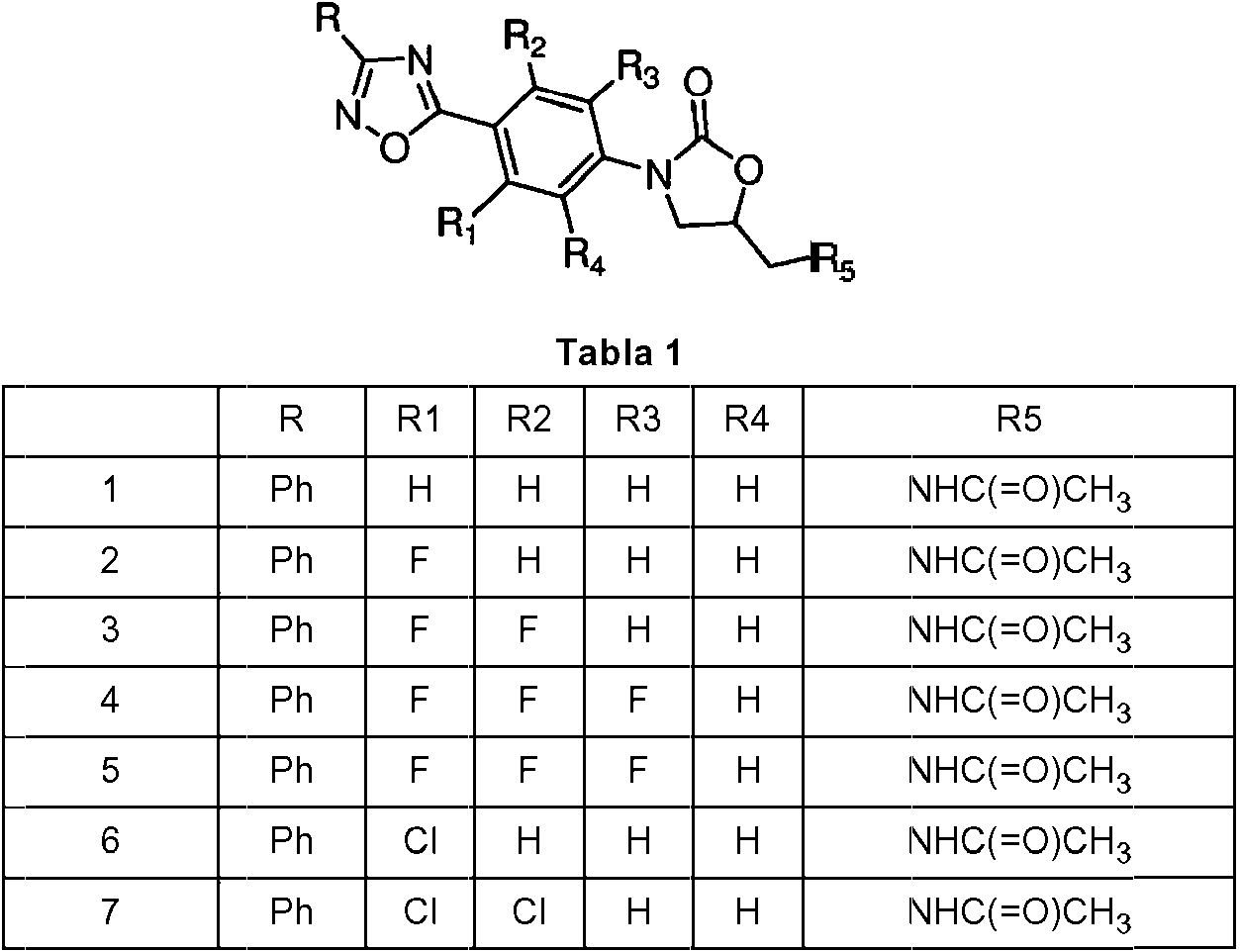

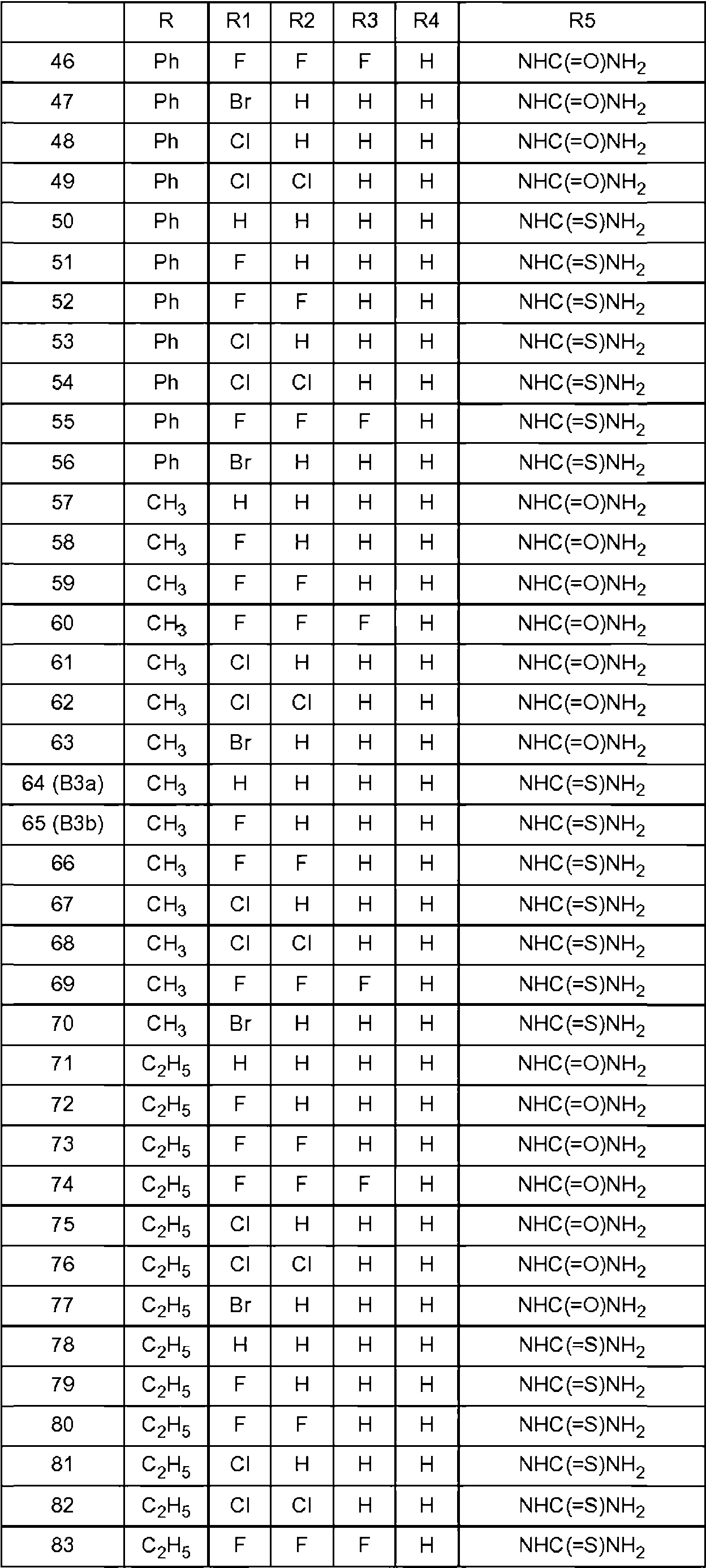


Cada compuesto identificado anteriormente se entiende como el enantiómero S, así como una mezcla enriquecida con el enantiómero S o una mezcla racémica. Para los compuestos 127-133 y 148-161 se entiende como el enantiómero R que se prefiere tanto puro como una mezcla enriquecida en el enantiómero R.Each compound identified above is understood as the S enantiomer, as well as a mixture enriched with the S enantiomer or a racemic mixture. For compounds 127-133 and 148-161 it is understood as the R enantiomer that is preferred both pure and as a mixture enriched in the R enantiomer.
Preparación de los compuestos de la invenciónPreparation of the compounds of the invention
La síntesis de los compuestos de interés A y B y de los compuestos intermedios correspondientes, se describe a continuación. Los compuestos de la presente invención se sintetizaron a partir de la construcción del anillo de 1,2,4-oxadiazol siguiendo la ruta de amidoxima clásica (esquema 1), tal como se describe en [9]. De este modo, la amidoxima 1 se hizo reaccionar con el correspondiente cloruro de benzoílo 2 , produciendo 1,2,4-oxadiazoles 3. Estos últimos compuestos, en los que la posición para se activa para experimentar una sustitución nucleófila aromática, [10-13] se hicieron reaccionar con alilamina, produciendo los compuestos 4. La reacción con di-(t-butil)-dicarbonato y posterior ciclación [14] de los derivados resultantes 5 , produjo las oxazolidinonas de interés A1 como precursores ideales para posteriores modificaciones de la cadena lateral.The synthesis of the compounds of interest A and B and of the corresponding intermediate compounds is described below. The compounds of the present invention were synthesized from the 1,2,4-oxadiazole ring construction following the classical amidoxime route (scheme 1), as described in [9]. Thus, amidoxime 1 was reacted with the corresponding benzoyl chloride 2 , producing 1,2,4-oxadiazoles 3 . These latter compounds, in which the para position is activated to undergo aromatic nucleophilic substitution, [10-13] were reacted with allylamine, producing compounds 4 . Reaction with di- (t-butyl) -dicarbonate and subsequent cyclization [14] of the resulting derivatives 5 , produced the oxazolidinones of interest A1 as ideal precursors for subsequent side chain modifications.

Esquema 1Scheme 1
La funcionalización posterior de la cadena lateral (esquema 2) incluyó el resto de acetamidometilo A3, así como las tioamidas A4, tioureas B4 y derivados azólicos A5-7, Bl correspondientes.Subsequent functionalization of the side chain (scheme 2) included the remainder of acetamidomethyl A3 , as well as the corresponding thioamides A4 , thioureas B4 and azole derivatives A5-7, Bl .
Los precursores de azida A2 se obtuvieron mediante la reacción de compuestos A1 con una fuente de azida. Su posterior reducción produjo los correspondientes derivados de amino 6 [15]. Los derivados de amino 6 se hicieron reaccionar fácilmente con cloruro de acetilo o anhídrido acético, produciendo los compuestos A3. Los derivados de acetamidometilo A3 se hicieron reaccionar con reactivos sulfurantes (es decir, el reactivo de Lawesson o P2S5), produciendo derivados de tioamida A4 (esquema 2). A2 azide precursors were obtained by reacting compounds A1 with an azide source. Its subsequent reduction produced the corresponding amino 6 derivatives [15]. The amino 6 derivatives were easily reacted with acetyl chloride or acetic anhydride, yielding compounds A3 . Acetamidomethyl A3 derivatives were reacted with sulfurating reagents (ie, Lawesson's reagent or P2S5), producing thioamide derivatives A4 (scheme 2).
Los derivados de azol A5-7, B1, se obtuvieron mediante sustitución nucleófila a partir de derivados de yodo A1, mientras que se obtuvieron (tio)ureas B4 a través de reacciones de aminas 6 con iso(tio)c¡ianatos (esquema 2). Azole derivatives A5-7, B1 were obtained by nucleophilic substitution from iodine derivatives A1 , while (thio) ureas B4 were obtained through reactions of amines 6 with iso (thio) cyanates (scheme 2 ).

Esquema 2Scheme 2
Los compuestos obtenidos de este modo, sintetizados como mezclas racémicas, se separaron en los enantiómeros correspondientes (S o R) mediante separaciones por HPLC utilizando una fase estacionaria quiral.The compounds thus obtained, synthesized as racemic mixtures, were separated into the corresponding enantiomers (S or R) by separations by HPLC using a chiral stationary phase.
Las composiciones farmacéuticasPharmaceutical compositions
Las composiciones farmacéuticas adecuadas para la administración de los compuestos de la presente invención son composiciones diseñadas para utilización oral, parenteral o tópica.Pharmaceutical compositions suitable for the administration of the compounds of the present invention are compositions designed for oral, parenteral or topical use.
Las composiciones orales pueden estar, por ejemplo, en forma de comprimido, comprimido recubierto, cápsula dura, cápsula blanda, jarabe, solución, suspensión, emulsión. Las composiciones parenterales pueden estar, por ejemplo, en forma de solución o emulsión acuosa u oleosa. Las composiciones tópicas pueden estar, por ejemplo, en forma de pomada, crema, gel, solución, emulsión O/W o W/O, o suspensión.The oral compositions may be, for example, in the form of a tablet, coated tablet, hard capsule, soft capsule, syrup, solution, suspension, emulsion. The parenteral compositions can be, for example, in the form of an aqueous or oily solution or emulsion. The topical compositions may be, for example, in the form ointment, cream, gel, solution, O / W or W / O emulsion, or suspension.
En una realización específica, las composiciones se administran mediante inhalación.In a specific embodiment, the compositions are administered by inhalation.
En la preparación de composiciones farmacéuticas, uno o más compuestos de la presente invención se mezclan con varios excipientes terapéuticamente aceptables adecuados para composiciones sólidas, líquidas o pastosas.In the preparation of pharmaceutical compositions, one or more compounds of the present invention are mixed with various therapeutically acceptable excipients suitable for solid, liquid or pasty compositions.
Las suspensiones/emulsiones, cualquiera que sea su vía de administración, pueden comprender nanopartículas y/o liposomas como vehículo o portador del medicamento.Suspensions / emulsions, whatever their route of administration, may comprise nanoparticles and / or liposomes as the vehicle or carrier of the drug.
Dado que algunas infecciones pulmonares persistentes, a menudo, muestran una baja tasa de respuesta a la terapia convencional, en parte, debido a la falta de selectividad de los fármacos, en parte, debido a su baja biodisponibilidad, en especial, cuando se administran de manera sistémica, se ha prestado especial atención, dentro de la presente invención, a la vía de administración mediante inhalación endotraqueal como alternativa a la administración sistémica no invasiva de los compuestos descritos en el presente documento.Since some persistent lung infections often show a low response rate to conventional therapy, in part due to the lack of selectivity of the drugs, in part due to their low bioavailability, especially when administered Systemically, special attention has been given, within the present invention, to the route of administration by endotracheal inhalation as an alternative to the non-invasive systemic administration of the compounds described herein.
Por lo tanto, una realización específica de la presente invención implica la administración mediante inhalación endotraqueal del fármaco, de manera preferente, encapsulado en nanopartículas.Therefore, a specific embodiment of the present invention involves administration by endotracheal inhalation of the drug, preferably encapsulated in nanoparticles.
De hecho, la nanoencapsulación de fármacos y su liberación pulmonar promueven una mayor acumulación y retención del fármaco dentro de los pulmones. La principal ventaja de esta formulación y de la vía de administración es ser capaz de tratar las enfermedades compartimentadas por vía tópica, tales como las que están dentro del pulmón o bronquios, lo que permite la administración de altas dosis del fármaco implicado en la zona y una toxicidad sistémica reducida y, por lo tanto, una probabilidad reducida de ocasionar efectos secundarios sistémicos.In fact, the nanoencapsulation of drugs and their pulmonary release promote greater accumulation and retention of the drug within the lungs. The main advantage of this formulation and the route of administration is being able to treat compartmentalized diseases topically, such as those that are inside the lung or bronchi, allowing the administration of high doses of the drug involved in the area and reduced systemic toxicity and therefore a reduced probability of causing systemic side effects.
Las formulaciones basadas en portadores de nanopartículas ofrecen la ventaja adicional de mejorar el cruce de membranas biológicas, tales como la membrana externa de las bacterias, ampliando el espectro de acción de fármacos activos también contra bacterias gram negativas;Formulations based on nanoparticle carriers offer the additional advantage of improving the crossing of biological membranes, such as the outer membrane of bacteria, broadening the spectrum of action of active drugs also against gram negative bacteria;
En particular, los presentes inventores han desarrollado un nebulizador de nanopartículas sólidas de lípidos compatible (Nebulizer - Compatible Solid Lipid Nanoparticle (SLN) para la liberación de agentes antimicrobianos de la presente invención. Las SLN se pueden utilizar como vehículo para la liberación pulmonar o bronquial de fármacos antimicrobianos, mejorando la estabilidad, así como el tiempo de retención in vivo en los pulmones, obteniendo así una mayor biodisponibilidad.In particular, the present inventors have developed a compatible lipid solid nanoparticle nebulizer (Nebulizer - Compatible Solid Lipid Nanoparticle (SLN) for the release of antimicrobial agents of the present invention. SLNs can be used as a vehicle for pulmonary or bronchial delivery of antimicrobial drugs, improving stability, as well as retention time in vivo in the lungs, thus obtaining greater bioavailability.
Los estudios sobre la farmacocinética y la biodistribución de SLN han demostrado que los macrófagos pulmonares intersticiales, en contacto más estrecho con la circulación en comparación con los macrófagos alveolares, contribuyen significativamente a la captación de SLN. Además, se observó que factores, tales como un tiempo de circulación prolongado, una menor exposición de fármacos a nivel renal y un depósito marcadamente aumentado en tejidos pulmonares, son características importantes para que los compuestos antimicrobianos sean también eficaces en el tratamiento de la neumonía causada por bacterias resistentes a beta-lactamas (por ejemplo, Staphylococcus aureus resistente a meticilina (MRSA)).Studies on the pharmacokinetics and biodistribution of SLN have shown that interstitial lung macrophages, in closer contact with the circulation compared to alveolar macrophages, contribute significantly to SLN uptake. Furthermore, it was observed that factors, such as a prolonged circulation time, a lower exposure of drugs to the renal level and a markedly increased deposition in lung tissues, are important characteristics so that antimicrobial compounds are also effective in the treatment of pneumonia caused by beta-lactam resistant bacteria (eg methicillin resistant Staphylococcus aureus (MRSA)).
Aplicaciones terapéuticasTherapeutic applications
Los compuestos reivindicados son nuevos antibióticos para la utilización en el tratamiento de infecciones causadas por bacterias, esencialmente extremadamente resistentes por bacterias gram positivas. Por ejemplo, pero sin limitación a las mismas, Staphylococcus spp, Enterococcus spp, Streptococcus spp, en particular en el tratamiento de infecciones causadas por Staphylococcus aureus, Staphylococcus epidermidis, Enterococcus faecium, Enterococcus faecalis, Streptococcus pneumoniae, Haemophilus influenzae, Haemophilus parainfluenzae, Moraxella catarrhalis. Los compuestos de la presente invención han demostrado ser activos también sobre bacterias resistentes a otros antibióticos o resistentes al compuesto de referencia, linezolid. De manera ventajosa, los compuestos de la presente invención son eficaces incluso contra bacterias resistentes a más de un antibiótico, contra bacterias multirresistentes, por ejemplo, a dos o más antibióticos seleccionados entre meticilina, vancomicina, penicilina, macrólidos, fluoroquinolonas o linezolid.The claimed compounds are new antibiotics for use in the treatment of infections caused by bacteria, essentially extremely resistant by gram positive bacteria. For example, but without limitation, Staphylococcus spp, Enterococcus spp, Streptococcus spp, in particular in the treatment of infections caused by Staphylococcus aureus, Staphylococcus epidermidis, Enterococcus faecium, Enterococcus faecalis, Streptococcus pneumoniae, Streptococcus pneumoniae, catarrhalis. The compounds of the present invention have also been shown to be active on bacteria resistant to other antibiotics or resistant to the reference compound, linezolid. Advantageously, the compounds of the present invention are effective even against bacteria resistant to more than one antibiotic, against multi-resistant bacteria, for example, to two or more antibiotics selected from methicillin, vancomycin, penicillin, macrolides, fluoroquinolones or linezolid.
Además, los compuestos novedosos de la presente invención combinan la actividad inhibidora o bactericida contra bacterias susceptibles o (multi)rresistentes a antibióticos conocidos a una toxicidad totalmente aceptable o incluso menor que la del compuesto de referencia, linezolid, ofreciendo así un perfil clínico/terapéutico completamente beneficioso.Furthermore, the novel compounds of the present invention combine inhibitory or bactericidal activity against known antibiotic-susceptible or (multi) resistant bacteria to a totally acceptable or even lower toxicity than the reference compound, linezolid, thus offering a clinical / therapeutic profile completely beneficial.
Sin vincular la presente invención a algunas teorías científicas particulares, la eficacia de los compuestos de la presente invención en el tratamiento de infecciones bacterianas, en especial las causadas por bacterias también resistentes a otros antibióticos, parece basarse en mecanismos de acción que implican la modulación y/o inhibición de la síntesis y/o actividad de proteínas bacterianas. La eficacia de las moléculas de la presente invención parece estar vinculada, en teoría, no sólo a una interacción con proteínas responsables de los mecanismos de resistencia desarrollados por bacterias, tales como por ejemplo, la proteína expresada por cepas de MRSA (Staphylococcus aureus resistente a metacillina) PBP2a, sino también a una interacción de los compuestos de la presente invención con mecanismos de síntesis de proteínas ribosómicas.Without linking the present invention to some particular scientific theories, the efficacy of the compounds of the present invention in the treatment of bacterial infections, especially those caused by bacteria also resistant to other antibiotics, seems to be based on mechanisms of action that involve modulation and / or inhibition of the synthesis and / or activity of bacterial proteins. The efficacy of the molecules of the present invention seems to be linked, in theory, not only to an interaction with proteins responsible for resistance mechanisms developed by bacteria, such as, for example, the protein expressed by strains of MRSA (Staphylococcus aureus resistant to methacillin) PBP2a, but also to an interaction of the compounds of the present invention with mechanisms of synthesis of ribosomal proteins.
SECCION EXPERIMENTALEXPERIMENTAL SECTION
Evaluación de la actividad farmacológicaEvaluation of pharmacological activity
Ensayos microbiológicosMicrobiological tests
(i) Cepas bacterianas(i) Bacterial strains
Se utilizaron varios aislados de Staphylococcus aureus bien caracterizados por su fenotipo de susceptibilidad a antibióticos para la determinación de la actividad antibacteriana in vitro de los compuestos estudiados. En particular, se utilizaron la cepa estándar de referencia S. aureus ATCC 29213 y S. aureus M923 (cepa de colección) como cepas de MSSA. Entre los MRSA, se utilizaron la cepa estándar de referencia S. aureus MU50 (ATCC 700699) y dos cepas de colección (433 y F511) para los ensayos de susceptibilidad.Several Staphylococcus aureus isolates well characterized by their antibiotic susceptibility phenotype were used to determine the in vitro antibacterial activity of the studied compounds. In particular, the reference standard strain S. aureus ATCC 29213 and S. aureus M923 (collection strain) were used as MSSA strains. Among MRSAs, the reference standard strain S. aureus MU50 (ATCC 700699) and two collection strains (433 and F511) were used for susceptibility testing.
En particular, se investigaron once estafilococos negativos en coagulasa y resistentes a linezolid (CoNS) (diez S. epidermidis y uno S. hominis). Las once cepas resistentes a linezolid se aislaron en varios entornos hospitalarios entre 2010 y 2011 a partir de hemocultivos positivos. Para la comparación de las actividades antimicrobianas de los diferentes compuestos, se utilizó una colección de cuarenta MRSA susceptibles a linezolid, recientemente aislados de pacientes con fibrosis quística, que mostraban diferentes perfiles de multirresistencia a diferentes clases de antimicrobianos (tablas 4 y 5).In particular, eleven coagulase negative and linezolid resistant (CoNS) staphylococci were investigated (ten S. epidermidis and one S. hominis). The eleven linezolid resistant strains were isolated in various hospital settings between 2010 and 2011 from positive blood cultures. For the comparison of the antimicrobial activities of the different compounds, a collection of forty linezolid-susceptible MRSA, recently isolated from cystic fibrosis patients, showing different multidrug profiles to different classes of antimicrobials was used (Tables 4 and 5).
(ii) Determinación de la concentración mínima inhibitoria (CMI)(ii) Determination of the minimum inhibitory concentration (MIC)
La actividad antibacteriana in vitro de los nuevos agentes se estudió mediante la determinación de sus concentraciones mínimas inhibitorias (CMI) mediante el procedimiento de microdilución de caldo, según las directrices del Laboratory Standards Institute (CLSI). [16] De manera resumida, se realizaron diluciones en serie de 2 veces de cada compuesto utilizando el caldo de Mueller-Hinton ajustado con catión (CAMHB) en placas de microtitulación de 96 pocillos. Se utilizó dimetilsulfóxido (DMSO) como disolvente para todos los compuestos sintetizados. Se añadió un volumen igual de inóculo bacteriano (1x10⁶ UFC/ml) a cada pocillo en la placa de microtitulación que contenía 0,05 ml de las diluciones en serie de antibiótico. A continuación, la placa de microtitulación se incubó a 37 °C durante 18-24 h, después de lo cual, cada pocillo se analizó por la presencia de crecimiento bacteriano. La CMI se definió como la concentración más baja de agente antimicrobiano capaz de causar la inhibición del crecimiento bacteriano, tal como se muestra por la falta de turbidez del medio de cultivo. Se probaron las actividades antibacterianas in vitro de los nuevos 1,2,4-oxadiazoles similares a linezolid y se compararon con la de la oxazolidinona de referencia en el uso clínico: Linezolid (Sigma-Aldrich). Las concentraciones finales de DMSO también se tuvieron en cuenta en todos los ensayos biológicos.The in vitro antibacterial activity of the new agents was studied by determining their minimum inhibitory concentrations (MIC) using the broth microdilution procedure, according to the guidelines of the Laboratory Standards Institute (CLSI). [16] Briefly, 2-fold serial dilutions of each compound were made using Cation Adjusted Mueller-Hinton Broth (CAMHB) in 96-well microtiter plates. Dimethyl sulfoxide (DMSO) was used as solvent for all synthesized compounds. An equal volume of bacterial inoculum (1x10⁶ CFU / ml) was added to each well in the microtiter plate containing 0.05 ml of the serial dilutions of antibiotic. The microtiter plate was then incubated at 37 ° C for 18-24 h, after which time each well was analyzed for the presence of bacterial growth. MIC was defined as the lowest concentration of antimicrobial agent capable of causing inhibition of bacterial growth, as shown by the lack of turbidity of the culture medium. The antibacterial activities of the new 1,2,4-oxadiazoles similar to linezolid were tested in vitro and compared with that of the reference oxazolidinone in clinical use: Linezolid (Sigma-Aldrich). Final DMSO concentrations were also taken into account in all biological tests.
Prueba de concentración mínima inhibitoriaMinimum inhibitory concentration test
Se analizaron catorce nuevos compuestos en una mezcla racémica (grupo A), tal como se muestra a continuación, por su actividad antibacteriana contra cepas de Staphylococcus aureus en términos de cepas estándar de referencia y cepas clínicas, susceptibles a meticilina (MSSA) o resistentes a meticilina (MRSA).Fourteen new compounds were tested in a racemic mixture (group A), as shown below, for their antibacterial activity against Staphylococcus aureus strains in terms of standard reference strains and clinical strains, methicillin-susceptible (MSSA) or resistant to methicillin (MRSA).

R1 R2R1 R2

A5a H pirazol-1-ilo A5a H pyrazole-1-yl
A5b F pirazol-1-ilo A5b F pyrazol-1-yl
A6a H imidazol-1-ilo A6a H imidazol-1-yl
A6b F imidazol-1-ilo A6b F imidazol-1-yl
A7a H 1,2,4-triazol-1-ilo A7a H 1,2,4-triazol-1-yl
A7b F 1,2,4-triazol-1-ilo A7b F 1,2,4-triazol-1-yl
Las actividades antimicrobianas, que se resumen en la tabla 2, se determinaron mediante el procedimiento del "patrón de oro" de microdilución en caldo, según lo recomendado por el Clinical Laboratory Standards Institute (CLSI) (véase la sección experimental). Los valores de las concentraciones mínimas inhibitorias (CMI) se expresaron en |ig/ml y se realizaron pruebas de viabilidad celular para evaluar la toxicidad selectiva antibacteriana de los compuestos más activos. El linezolid se ha utilizado como un antibiótico de referencia. En detalle, se probaron las cepas bacterianas: Staphylococcus aureus ATCC 29213, una cepa clínica de S. aureus susceptible a meticilina (M923), S. aureus MU50 (MRSA resistente a meticilina) y dos cepas clínicas resistentes a meticilina, 433 y F511. Se encontró que todas las cepas ensayadas eran susceptibles a linezolid. Entre estas moléculas, las más activas, en forma racémica, han demostrado ser los compuestos A4a y A4b.Antimicrobial activities, summarized in Table 2, were determined using the broth microdilution "gold standard" procedure, as recommended by the Clinical Laboratory Standards Institute (CLSI) (see experimental section). The values of the minimum inhibitory concentrations (MIC) were expressed in | ig / ml and cell viability tests were carried out to evaluate the selective antibacterial toxicity of the most active compounds. Linezolid has been used as a reference antibiotic. In detail, the bacterial strains were tested: Staphylococcus aureus ATCC 29213, a clinical strain of methicillin - susceptible S. aureus (M923), S. aureus MU50 (methicillin-resistant MRSA) and two methicillin-resistant clinical strains, 433 and F511. All strains tested were found to be susceptible to linezolid. Among these molecules, the most active, in racemic form, have been shown to be compounds A4a and A4b .
Tabla 2Table 2
CMI (|ig/mL)MIC (| ig / mL)
ATCC MSSA MRSA MRSA MRSA ATCC MSSA MRSA MRSA MRSA
Compuesto A 29213 M923 MU50 433 F511Compound A 29213 M923 MU50 433 F511
A la >50 >50 50 25 50 At >50> 50 50 25 50
A1b >50 >50 50 50 >50 A1b >50> 50 50 50> 50
A2a >50 >50 >50 >50 >50 A2a >50>50>50>50> 50
A2b >50 >50 >50 >50 >50 A2b >50>50>50>50> 50
A3a 12,5 6,25 6,25 1,6 12,5 A3a 12.5 6.25 6.25 1.6 12.5
A3b 12,5 6,25 6,25 1,6 12,5 A3b 12.5 6.25 6.25 1.6 12.5
A4a 3,13 1,6 <0,4 1,6 1,6 A4a 3.13 1.6 <0.4 1.6 1.6
A4b 1,6 1,6 <0,4 0,8 1,6 A4b 1.6 1.6 <0.4 0.8 1.6
A5a >50 >50 >50 >50 >50 A5a >50>50>50>50> 50
A5b >50 >50 >50 >50 >50 A5b >50>50>50>50> 50
A6a >50 >50 >50 >50 >50 A6a >50>50>50>50> 50
A6b >50 >50 >50 >50 >50 A6b >50>50>50>50> 50
A7a >50 >50 >50 >50 >50 A7a >50>50>50>50> 50
A7b >50 >50 >50 >50 >50 A7b >50>50>50>50> 50
Linezolid <0,4 3,13 0,8 1,6 3,13 Linezolid <0.4 3.13 0.8 1.6 3.13
Los compuestos A3a, A3b, A4a, A4b, A la, A1b corresponden a los compuestos 15, 16, 22, 23, 148 y 149 de la tabla 1Compounds A3a, A3b, A4a, A4b, A through A1b correspond to compounds 15, 16, 22, 23, 148 and 149 of Table 1
Cuatro de los catorce compuestos ensayados (ver tabla 2) mostraron valores de CMI, contra cepas de MSSA y de MRSA, con una potencia comparable o superior a la del linezolid. Además, se ha mostrado una mejor actividad contra cepas de MSSA y MRSA en comparación con linezolid por derivados que contienen azufre A4a y A4b, mientras que los compuestos A3a y A3b se mostraron menos activos que el linezolid, a excepción de la cepa de MRSA 433. La comparación con el linezolid debería tener en cuenta el hecho de que los compuestos ensayados se utilizaron como una mezcla racémica, por tanto, la actividad antibacteriana de A3a, A3b, A4a y A4b se supone que está subestimada en comparación con el enantiómero más activo puro.Four of the fourteen compounds tested (see Table 2) showed MIC values, against MSSA and MRSA strains, with a potency comparable to or greater than that of linezolid. Furthermore, better activity has been shown against MSSA and MRSA strains compared to linezolid by sulfur-containing derivatives A4a and A4b , while compounds A3a and A3b were less active than linezolid, except for MRSA strain 433 The comparison with linezolid should take into account the fact that the tested compounds were used as a racemic mixture, therefore the antibacterial activity of A3a, A3b, A4a and A4b is assumed to be underestimated compared to the most active enantiomer pure.
De otros compuestos (grupo B), que se muestran a continuación, se evaluaron las actividades de la mezcla racémica y los enantiómeros S y R. From other compounds (group B), shown below, the activities of the racemic mixture and the S and R enantiomers were evaluated.
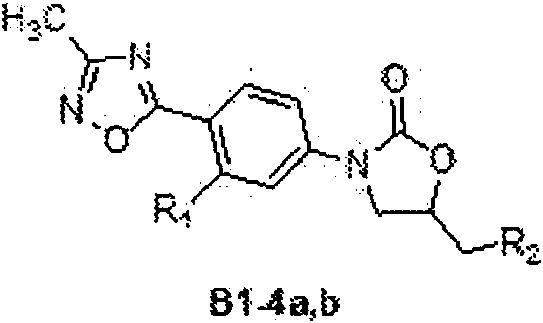
R1 R2R1 R2
B1a H 1,2,3-triazol-1-ilo B1a H 1,2,3-triazol-1-yl
B1b F 1,2,3-triazol-1-ilo B1b F 1,2,3-triazol-1-yl
B2a H NCS B2a H NCS
B2b F NCS B2b F NCS
B3a H NH(C=S)NH2 B3a H NH (C = S) N H 2
B3b F NH(C=S)NH2 B3b F NH (C = S) N H 2
B4a H NH(C=S)NHCH3 B4a H NH (C = S) N H CH3
B4b F NH(C=S)NHCH3 B4b F NH (C = S) N H CH3
Las actividades antimicrobianas, que se resumen en la tabla 3, se determinaron mediante el procedimiento del "patrón de oro" de microdilución en caldo, según lo recomendado por el Clinical Laboratory Standards Institute (CLSI) (véase la sección experimental). Los valores de las concentraciones mínimas inhibitorias (CMI) se expresaron en ^g/ml. El linezolid se ha utilizado como un antibiótico de referencia. En detalle, las cepas bacterianas ensayadas fueron: Staphylococcus aureus ATCC 29213, una cepa clínica de S. aureus susceptible a meticilina (M923), cepa de S. aureus MU50 (MRSA resistente a meticilina) y dos cepas clínicas resistentes a meticilina, 433 y F511. Se encontró que todas las cepas ensayadas eran susceptibles a linezolid. Entre estas nuevas moléculas ensayadas, las más activas, en forma racémica, han demostrado ser los compuestos B4a y B4b, seguido de B1a y B1b que poseen una cantidad suficiente de actividad (tabla 3).Antimicrobial activities, summarized in Table 3, were determined using the broth microdilution "gold standard" procedure, as recommended by the Clinical Laboratory Standards Institute (CLSI) (see Experimental section). The values of the minimum inhibitory concentrations (MIC) were expressed in ^ g / ml. Linezolid has been used as a reference antibiotic. In detail, the bacterial strains tested were: Staphylococcus aureus ATCC 29213, a clinical strain of S. aureus susceptible to methicillin (M923), strain of S. aureus MU50 (MRSA resistant to methicillin) and two clinical strains resistant to methicillin, 433 and F511. All strains tested were found to be susceptible to linezolid. Among these new tested molecules, the most active, in racemic form, have been shown to be compounds B4a and B4b , followed by B1a and B1b that possess a sufficient amount of activity (Table 3).
Tabla 3Table 3
CMI (iig/mL)MIC (iig / mL)
A MRSA MRSA MRSAA MRSA MRSA MRSA
Compuesto B ATCC MSSCompound B ATCC MSS
29213 M923 MU50 433 F511 29213 M923 MU50 433 F511
B1a 25 25 3,125 12,5 12,5 B1a 25 25 3,125 12.5 12.5
B1b 25 25 1,6 6,25 12,5 B1b 25 25 1.6 6.25 12.5
B2a >50 >50 >50 >50 50 B2a >50>50>50> 50 50
B2b >50 >50 >50 >50 >50 B2b >50>50>50>50> 50
B3a >50 >50 >50 >50 >50 B3a >50>50>50>50> 50
B3b >50 >50 >50 >50 >50 B3b >50>50>50>50> 50
B4a 6,25 6,25 1,6 3,125 6,25 B4a 6.25 6.25 1.6 3,125 6.25
B4b 6,25 6,25 1,6 3,125 6,25 B4b 6.25 6.25 1.6 3,125 6.25
Linezolid <0,4 3,125 0,8 1,6 3,125 Linezolid <0.4 3.125 0.8 1.6 3.125
Entre estos, los compuestos B4a y B4b (que corresponden a los compuestos 106 y 107 de la tabla 1) mostraron una actividad antibacteriana muy similar a la de linezolid frente a cepas de S. aureus susceptibles a linezolid.Among these, compounds B4a and B4b (corresponding to compounds 106 and 107 in Table 1) showed antibacterial activity very similar to that of linezolid against S. aureus strains susceptible to linezolid.
De una manera totalmente sorprendente, los mismos compuestos, separados en sus enantiómeros, han mostrado una eficacia de 8 a 32 veces mayor que el linezolid contra cepas de Staphylococcus spp. resistentes a linezolid. Los resultados se presentan en las tablas 4 y 5. En un caso (A4bS), se ha invertido de manera bastante completa la resistencia a linezolid en susceptibilidad. De estas moléculas, las separaciones enantioméricas han permitido asignar la potencia al enantiómero S, mientras que el R demostró ser inactivo (véase la tabla 4).In a totally surprising way, the same compounds, separated into their enantiomers, have shown an efficiency of 8 to 32 times greater than linezolid against Staphylococcus spp. Strains. resistant to linezolid. The results are presented in Tables 4 and 5. In one case (A4bS), linezolid resistance in susceptibility has been reversed quite completely. Of these molecules, the enantiomeric separations have allowed the potency to be assigned to the S enantiomer, while the R proved to be inactive (see Table 4).
Los compuestos B4a y B4b corresponden a mezclas racémicas de los dos compuestos B4a y B4b, los compuestos B4bS y B4bR y B4aS y B4aR se separan en enantiómeros S y R, respectivamente.Compounds B4a and B4b correspond to racemic mixtures of the two compounds B4a and B4b , compounds B4bS and B4bR and B4aS and B4aR are separated into S and R enantiomers, respectively.
Tabla 4Table 4
Valores de CMICMI values


Tabla 5Table 5
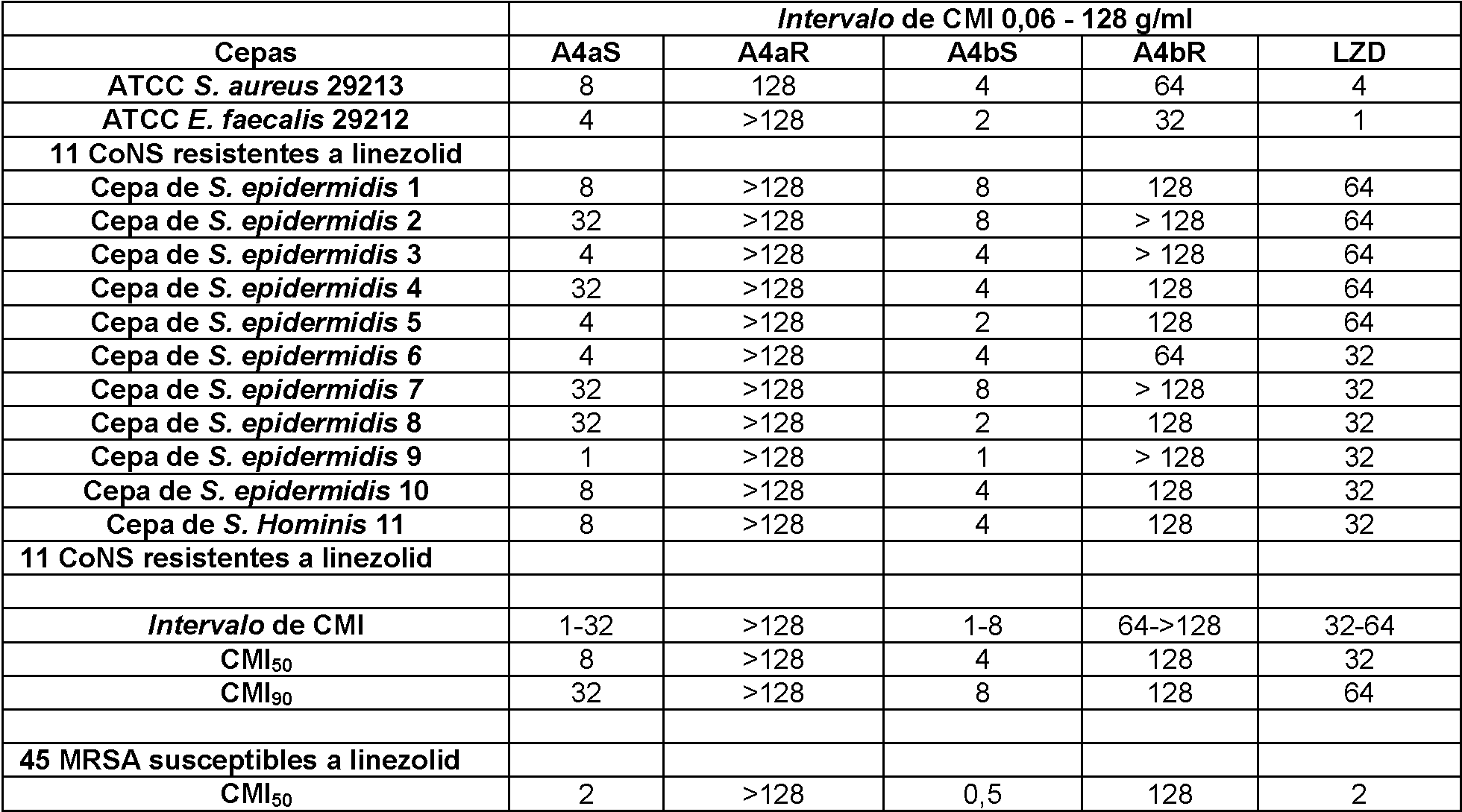
Viabilidad celular (ensayo de citotoxicidad)Cell viability (cytotoxicity assay)
Para evaluar si el efecto mostrado contra células bacterianas podría estar relacionado con una toxicidad seleccionada o con un efecto tóxico más general, los presentes inventores realizaron un ensayo de primer nivel en diferentes tipos de líneas de células eucariotas para cribar los nuevos compuestos por su actividad citotóxica general.To assess whether the effect shown against bacterial cells could be related to a selected toxicity or a more general toxic effect, the present inventors performed a first-level assay on different types of eukaryotic cell lines to screen for new compounds for their cytotoxic activity general.
Viabilidad celularCell viability
Los efectos de A4b, (compuesto 23 de la tabla 1), y linezolid sobre la viabilidad celular se estudiaron in vitro en las líneas celulares PK15 (células epiteliales de riñón porcino), HaCaT (queratinocitos humanos) y HepG2 (carcinoma hepatocelular humano). [17-19] Las células HepG2 y HaCat se cultivaron en medio de Eagle modificado por Dulbecco (DMEM), mientras que PK15 en DMEM/M199 (1:1). Todos los medios se complementaron con suero bovino fetal (FBS) inactivado con calor al 10%, L-glutamina 2 mM, 100 unidades/ml de penicilina y estreptomicina 100 |ig/ml. Las células se mantuvieron a 37 °C en una atmósfera de CO2 al 5 %. Todos los reactivos para el cultivo celular fueron de Euroclone (Pero, Italia).The effects of A4b, (compound 23 in Table 1), and linezolid on cell viability were studied in vitro in cell lines PK15 (porcine kidney epithelial cells), HaCaT (human keratinocytes) and HepG2 (human hepatocellular carcinoma). [17-19] HepG2 and HaCat cells were grown in Dulbecco's Modified Eagle's Medium (DMEM), while PK15 in DMEM / M199 (1: 1). All media were supplemented with 10% heat inactivated fetal bovine serum (FBS), 2mM L-glutamine, 100 units / ml penicillin, and 100 µg / ml streptomycin. Cells were maintained at 37 ° C in a 5% CO2 atmosphere. All reagents for cell culture were from Euroclone (Pero, Italy).
La viabilidad celular se midió mediante el ensayo MTT. [20] De forma resumida, se añadió una solución madre de MTT [bromuro de 3-(4,5-dimetiltiazol-2-il)-2,5-difeniltetrazolio] (5 mg/ml) a cada pocillo hasta una concentración final de 1,2 mM y se incubaron las células durante 1 hora y 30 minutos a 37 °C. Después de extraer la solución de MTT, la reacción se detuvo mediante la adición de etanol al 90 %. Las células resuspendidas se centrifugaron 10 minutos a 800 x g. La absorbancia se midió con el espectrofotómetro Multilabel Victor3 (Perkin Elmer, Turku, Finlandia) a una longitud de onda de 570 nm. Los datos son las medias ± D.E. de 3 experimentos independientes realizados por triplicado. Cell viability was measured by the MTT assay. [20] Briefly, a stock solution of MTT [3- (4,5-dimethylthiazol-2-yl) -2,5-diphenyltetrazolium] (5 mg / ml) was added to each well to a final concentration 1.2 mM and cells were incubated for 1 hour and 30 minutes at 37 ° C. After extracting the MTT solution, the reaction was stopped by adding 90% ethanol. The resuspended cells were centrifuged 10 minutes at 800 x g. Absorbance was measured with the Multilabel Victor3 spectrophotometer (Perkin Elmer, Turku, Finland) at a wavelength of 570 nm. Data are means ± SD of 3 independent experiments performed in triplicate.
Análisis estadísticoStatistic analysis
La significación estadística se obtuvo con la prueba t de Student en comparación con controles * = P < 0,05, ** = P < 0,001. Los datos son las medias ± D.E. de 3 experimentos independientes realizados por triplicado.Statistical significance was obtained with Student's t-test compared to controls * = P <0.05, ** = P <0.001. Data are means ± SD. of 3 independent experiments performed in triplicate.
Todas las líneas celulares ensayadas fueron tratadas con concentraciones crecientes (5-400 |ig/ml) de A4a y linezolid como compuesto de referencia. Otro control fue DMSO utilizado como disolvente.All cell lines tested were treated with increasing concentrations (5-400 | ig / ml) of A4a and linezolid as reference compound. Another control was DMSO used as a solvent.
La molécula A4b indujo una reducción moderada de la viabilidad (menos del 10%) en la línea celular PK15, con una significación estadística a las concentraciones de 25 (P < 0,01), 50 (P < 0,05) y 200 □ |ig/ml (P < 0,05), respectivamente (figura 2). Esta tendencia es comparable con la obtenida con linezolid a las mismas concentraciones.The A4b molecule induced a moderate reduction in viability (less than 10%) in the PK15 cell line, with statistical significance at concentrations of 25 (P <0.01), 50 (P <0.05) and 200 □ | ig / ml (P <0.05), respectively (figure 2). This trend is comparable to that obtained with linezolid at the same concentrations.
La reducción de la viabilidad celular causada por la molécula A4b fue ligeramente más evidente en la línea celular HaCaT, alcanzando niveles de mortalidad estadísticamente significativa en comparación con los valores obtenidos con linezolid solamente a una concentración de 400 □ |ig/ml (P < 0,01; figura 3).The reduction in cell viability caused by the A4b molecule was slightly more evident in the HaCaT cell line, reaching statistically significant levels of mortality compared to the values obtained with linezolid only at a concentration of 400 □ | ig / ml (P <0 , 01; figure 3).
Las células HepG2 mostraron una reducción en la viabilidad de 50 □ |ig/ml del compuesto A4b (figura 4).HepG2 cells showed a reduction in viability of 50 □ | ig / ml of compound A4b (Figure 4).
A continuación, se evaluaron in vitro los efectos de las moléculas B4A y B4b sobre la viabilidad celular en la línea celular de hepatoma humano, HepG2, y en comparación con la citotoxicidad inducida por linezolid (control negativo). The effects of B4A and B4b molecules on cell viability were then evaluated in vitro in the human hepatoma cell line, HepG2, and compared to linezolid-induced cytotoxicity (negative control).
Las células se cultivaron en medio de Eagle modificado por Dulbecco (DMEM) complementado con suero bovino fetal (FBS) inactivado por calor al 10%, L-glutamina a una concentración final de 2 mM, 100 unidades/ml de penicilina y 100 microgramos/ml de estreptomicina. Las células se mantuvieron a 37 °C en una atmósfera de CO2 al 5 %.Cells were grown in Dulbecco's Modified Eagle's (DMEM) medium supplemented with 10% heat-inactivated fetal bovine serum (FBS), L-glutamine at a final concentration of 2 mM, 100 units / ml penicillin and 100 micrograms / ml of streptomycin. Cells were maintained at 37 ° C in a 5% CO2 atmosphere.
Tratamiento citotóxico: las células, sembradas en placas a una densidad de 40.000 células/cm2 y mantenidas en cultivo durante dos días, se trataron durante 48 horas con concentraciones crecientes (25-100 □ |ig/ml) de ambos enantiómeros de las sustancias B4a y B4b.Cytotoxic treatment: the cells, plated at a density of 40,000 cells / cm2 and kept in culture for two days, were treated for 48 hours with increasing concentrations (25-100 □ | ig / ml) of both enantiomers of substances B4a and B4b .
La viabilidad celular se evaluó mediante un ensayo de viabilidad celular con reactivo PrestoBlue®, una solución que contenía resazurina que penetra las células y explota el poder reductor cuando están vivas y metabólicamente activas. De manera resumida, la solución PrestoBlue® se administra directamente al medio de las células en el cultivo siguiendo las instrucciones del fabricante que ha suministrado el producto. Las células se incuban durante 1 hora a 37 °C, en cuyo momento, la solución de PrestoBlue®, metabolizada por las células vivas, cambia la tinción de azul a rojo. La absorbancia se mide utilizando un espectrofotómetro multifunción Victor3 (Perkin Elmer, Turku, Finlandia) a una longitud de onda de 570 nm. Los resultados obtenidos y representados en el gráfico corresponden a la media ± D.E. de experimentos independientes realizados por triplicado.Cell viability was assessed using a cell viability assay with PrestoBlue® reagent, a resazurin-containing solution that penetrates cells and exploits reducing power when alive and metabolically active. In summary, the PrestoBlue® solution is administered directly to the medium of the cells in the culture following the instructions of the manufacturer that has supplied the product. The cells are incubated for 1 hour at 37 ° C, at which time the PrestoBlue® solution, metabolized by living cells, changes the staining from blue to red. Absorbance is measured using a Victor3 multifunction spectrophotometer (Perkin Elmer, Turku, Finland) at a wavelength of 570 nm. The results obtained and represented in the graph correspond to the mean ± SD. of independent experiments performed in triplicate.
La línea celular HepG2 se sometió a un tratamiento con concentraciones crecientes (25-100 |ig/ml) de ambos enantiómeros de las moléculas B4a y B4b. El linezolid se utiliza como molécula de referencia solamente hasta una concentración final de 100 microgramos/ml. Además, como control adicional, las células también se tratan con DMSO al 0,9 % y se utilizan como disolvente de las sustancias.The HepG2 cell line was subjected to treatment with increasing concentrations (25-100 | ig / ml) of both enantiomers of molecules B4a and B4b . Linezolid is used as a reference molecule only up to a final concentration of 100 micrograms / ml. Furthermore, as an additional control, the cells are also treated with 0.9% DMSO and used as a solvent for the substances.
Ambos enantiómeros de la molécula de B4b han inducido una reducción moderada de la viabilidad (< del 12 %) en la línea celular HepG2 a todas las concentraciones ensayadas (figura 5).Both enantiomers of the B4b molecule have induced a moderate reduction in viability (<12%) in the HepG2 cell line at all concentrations tested (Figure 5).
El enantiómero S de la molécula B4a tiene un ligero efecto citotóxico independiente de la concentración en las células HepG2 (evidente sólo a 25 microgramos/ml), mientras que el enantiómero R no determina una reducción aparente en la viabilidad celular. Las células HepG2, tal como se esperaba, está sujeta a una mortalidad del 20 % después del tratamiento con 100 microgramos/ml de linezolid.The S enantiomer of the B4a molecule has a slight concentration-independent cytotoxic effect in HepG2 cells (evident only at 25 micrograms / ml), while the R enantiomer does not determine an apparent reduction in cell viability. HepG2 cells, as expected, are subject to a 20% mortality after treatment with 100 micrograms / ml of linezolid.
Ensayo de fosforilación oxidativa (OXPHOS)Oxidative Phosphorylation Assay (OXPHOS)
Este ensayo (Nadaciva S. et al., 2010) se utiliza para controlar el nivel de síntesis de proteínas mitocondriales de algunas proteínas clave en el proceso de fosforilación oxidativa de células eucariotas, comparándolo con el nivel de síntesis de proteínas mitocondriales codificadas por ADN nuclear. Este estudio nos permite analizar los efectos de A4bS sobre las proteínas codificadas por ADN mitocondrial (ADNmt).This assay (Nadaciva S. et al., 2010) is used to control the level of mitochondrial protein synthesis of some key proteins in the oxidative phosphorylation process of eukaryotic cells, comparing it with the level of synthesis of mitochondrial proteins encoded by nuclear DNA . This study allows us to analyze the effects of A4bS on proteins encoded by mitochondrial DNA (mtDNA).
Los resultados, mostrados en la figura 6, confirman que el linezolid (100^ |ig/ml) actúa de forma negativa sobre la síntesis de proteínas mitocondriales. De hecho, las proteínas del complejo I, III (núcleo 2) y IV (sintetizadas por ADNmt) experimentan una disminución significativa después del tratamiento de linezolid. En paralelo, se puede comparar la molécula A4bS (10-100 |ig/ml), que tal como el linezolid, provoca una reducción de la síntesis de las proteínas del complejo I y IV con respecto al control (células no tratadas). Sin embargo, cabe indicar que la disminución en la síntesis de proteínas inducida por el compuesto A4bS es de una entidad menor que la inducida por linezolid, dicho efecto pone de relieve una disminución de los efectos secundarios vinculados a la mielosupresión reversible. Los resultados presentados en la figura 6 se obtuvieron de la siguiente manera: los niveles de las proteínas codificadas por el ADN mitocondrial (ADNmt) sintetizadas en ribosoma mitocondrial (complejo IV, complejo I) y de las proteínas codificadas por el ADN nuclear sintetizadas en el ribosoma en el citosol (complejo II, subunidad V del complejo), e importadas en las mitocondrias, se analizaron mediante el anticuerpo WB humano MitoProfile® Total OXPHOS después del tratamiento de las células HepG2 (células de carcinoma hepatocelular humano) con el compuesto A4bS. Los datos representan la media ± SEM de tres experimentos independientes realizados por triplicado. La significación estadística se obtiene mediante la prueba de Student en comparación con los compuestos.The results, shown in figure 6, confirm that linezolid (100 ^ | ig / ml) acts negatively on the synthesis of mitochondrial proteins. In fact, proteins of complex I, III (nucleus 2) and IV (synthesized by mtDNA) experience a significant decrease after linezolid treatment. In parallel, the A4bS molecule (10-100 | ig / ml) can be compared, which, like linezolid, causes a reduction in the synthesis of complex I and IV proteins with respect to the control (untreated cells). However, it should be noted that the decrease in protein synthesis induced by the A4bS compound is of a lesser entity than that induced by linezolid, this effect highlights a decrease in the side effects linked to reversible myelosuppression. The results presented in figure 6 were obtained as follows: the levels of the proteins encoded by mitochondrial DNA (mtDNA) synthesized in mitochondrial ribosome (complex IV, complex I) and the proteins encoded by nuclear DNA synthesized in the Ribosomes in the cytosol (complex II, subunit V of the complex), and imported into the mitochondria, were analyzed using the human WB antibody MitoProfile® Total OXPHOS after treatment of HepG2 cells (human hepatocellular carcinoma cells) with the compound A4bS. Data represent the mean ± SEM of three independent experiments performed in triplicate. Statistical significance is obtained using the Student test in comparison with the compounds.
* = p < 0,05; ** = p < 0,01.* = p <0.05; ** = p <0.01.
Síntesis químicaChemical synthesis
Los puntos de fusión se determinaron en un aparato de platina caliente Reichart-Thermovar y no están corregidos. Los espectros de IR (Nujol) se determinaron con un instrumento Shimadzu FTIR-8300; los espectros de RMN de H se registraron en un espectrómetro Bruker 300 Avance utilizando TMS como patrón interno. Se realizó una cromatografía ultrarrápida (“flash”) utilizando gel de sílice (0,040-0,063 mm) y mezclas de acetato de etilo y éter de petróleo (fracción que hierve en el intervalo de 40-60 °C) en diversas proporciones. La pureza de los compuestos, en todos los casos superior al 95 %, se ha comprobado mediante análisis por RMN y HPLC. La separación de racematos se realizó mediante HPLC con fase estacionaria quiral (Daicel, Chiralpak-IA), mediante la utilización de hexano-iPrOH (70:30) como fase móvil y 1 ml/min de flujo. En todos los casos se obtuvo un ee > 99 %.Melting points were determined on a Reichart-Thermovar hot stage apparatus and are uncorrected. IR spectra (Nujol) were determined with a Shimadzu FTIR-8300 instrument; H NMR spectra were recorded on a Bruker 300 Advance spectrometer using TMS as the internal standard. Flash chromatography was performed using silica gel (0.040-0.063 mm) and mixtures of ethyl acetate and petroleum ether (fraction boiling in the 40-60 ° C range) in various proportions. The purity of the compounds, in all cases greater than 95%, has been verified by NMR and HPLC analysis. The separation of racemates was performed by HPLC with chiral stationary phase (Daicel, Chiralpak-IA), using hexane-iPrOH (70:30) as mobile phase and 1 ml / min of flow. In all cases, an ee> 99% was obtained.
Los compuestos más interesantes:The most interesting compounds:
A la (compuesto 148 de la tabla 1), A1b (compuesto 149 de la tabla 1), A3a (compuesto 15 de la tabla 1), A3b (compuesto 16 de la tabla 1), A4a (compuesto 22 de la tabla 1), A4b (compuesto 23 de la tabla 1), B1a (compuesto 155 de la tabla 1), B1b (compuesto 156 de la tabla 1), B4a (compuesto 106 de la tabla 1), B4b (compuesto 107 de la tabla 1); descritos en la tabla 2 (grupo A) y 3 (grupo B), y los intermedios correspondientes 1-6, se obtuvieron de acuerdo a metodologías generales representadas en los esquemas 1 y 2, siguientes las especificaciones indicadas a continuación y en el esquema 3. To the (compound 148 of table 1), A1b (compound 149 of table 1), A3a (compound 15 of table 1), A3b (compound 16 of table 1), A4a (compound 22 of table 1) , A4b (compound 23 of table 1), B1a (compound 155 of table 1), B1b (compound 156 of table 1), B4a (compound 106 of table 1), B4b (compound 107 of table 1) ; described in table 2 (group A) and 3 (group B), and the corresponding intermediates 1-6 , were obtained according to general methodologies represented in diagrams 1 and 2, following the specifications indicated below and in diagram 3 .
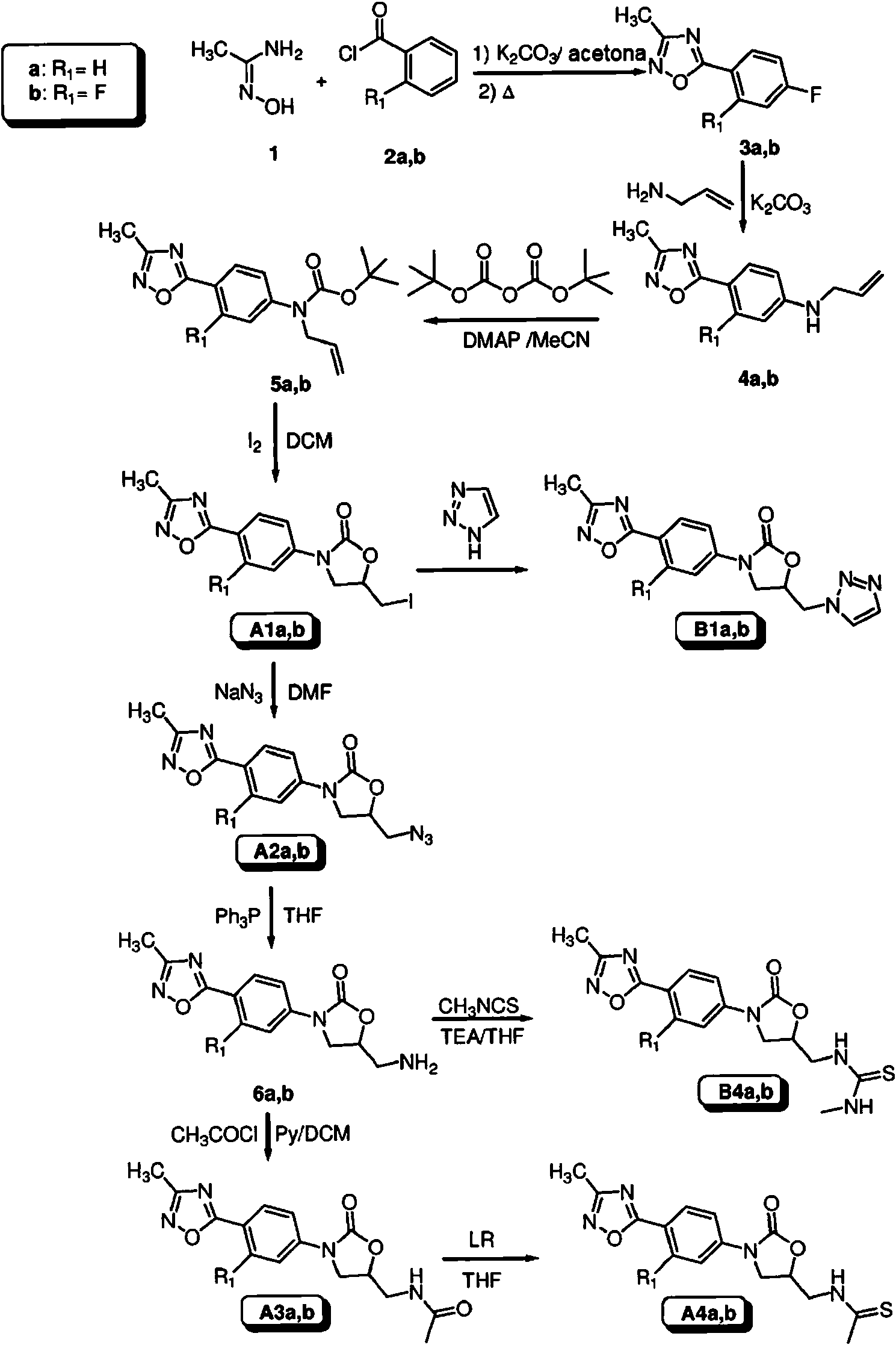
Esquema 3Scheme 3
Procedimiento general para la preparación de compuestos 3a,b General procedure for the preparation of compounds 3a, b
Se añadió una solución de clorhidrato de hidroxilamina (1,00 g, 14,4 mmol) y NaOH (0,57 g, 14,4 mmol) en agua (5 ml) (en aproximadamente 15 minutos) a 15 ml de CH3CN. La mezcla de reacción se agitó a temperatura ambiente durante 24 horas. El disolvente se extrajo a presión reducida y el residuo se trató con etanol; la suspensión resultante se filtró y el disolvente se extrajo a presión reducida produciendo 1,659 g de acetamidoxima 1 (77%). A continuación, se añadieron cloruro de 4-fluorobenzoílo (2a) o cloruro de 2,4-difluorobenzoílo (2b) (14,8 mmol) a una solución de 1 (1,00 g; 13,5 mmol) en acetona (35 ml) que contenía también K2CO3 (2,05 g, 14,8 mmol). La mezcla se agitó a temperatura ambiente durante aproximadamente 90 minutos, después de lo cual, se extrajo el disolvente a presión reducida. El residuo se trató con agua y el precipitado sólido se recogió por filtración. La O-acilamidoxima obtenida se calentó, sin ninguna purificación adicional, a aproximadamente 130 °C durante 90 minutos en un tubo sellado. El residuo obtenido se sometió a cromatografía produciendo los correspondientes 1,2,4-oxadiazoles 3a y 3b.A solution of hydroxylamine hydrochloride (1.00g, 14.4mmol) and NaOH (0.57g, 14.4mmol) in water (5ml) (in about 15 minutes) was added to 15ml CH3CN. The reaction mixture was stirred at room temperature for 24 hours. The solvent was removed under reduced pressure and the residue was treated with ethanol; The resulting suspension was filtered and the solvent was removed under reduced pressure yielding 1.659 g of acetamidoxime 1 (77%). Next, 4-fluorobenzoyl chloride ( 2a ) or 2,4-difluorobenzoyl chloride ( 2b ) (14.8 mmol) was added to a solution of 1 (1.00 g; 13.5 mmol) in acetone (35 ml) also containing K2CO3 (2.05 g, 14.8 mmol). The mixture was stirred at room temperature for about 90 minutes, after which, the solvent was removed at reduced pressure. The residue was treated with water and the solid precipitate was collected by filtration. The obtained O-acylamidoxime was heated, without any further purification, at approximately 130 ° C for 90 minutes in a sealed tube. The obtained residue was subjected to chromatography producing the corresponding 1,2,4-oxadiazoles 3a and 3b .
3-metil-5-(4'-fluorofenil)-1,2,4-oxadiazol (3a): Rendimiento (72 %); p.f. 80,0-81,0 °C; RMN de 1H (300 MHz; CDCl3) 2,45 (s, 3H, Me); 7,16-7,23 (m, 2H, Ar); 8,08-8,14 (m, 2H, Ar). Análisis encontrado (calculado) para C9H7FN2O (%): C, 60,65 (60,67); H, 3,90 (3,96); N, 15,70 (15,72).3-methyl-5- (4'-fluorophenyl) -1,2,4-oxadiazole ( 3a ): Yield (72%); mp 80.0-81.0 ° C; 1 H NMR (300 MHz; CDCl 3) 2.45 (s, 3H, Me); 7.16-7.23 (m, 2H, Ar); 8.08-8.14 (m, 2H, Ar). Analysis found (calculated) for C9H7FN2O (%): C, 60.65 (60.67); H, 3.90 (3.96); N, 15.70 (15.72).
3-metil-5-(2',4'-difluorofenil)-1,2,4-oxadiazol (3b): Rendimiento (72 %); p.f. 57,0-60,0 °C; RMN de 1H (300 MHz; CDCla) 2,46 (s, 3H, Me); 6,95-7,07 (m, 2H, Ar); 8,04-8,14 (m, 1H, Ar). Análisis encontrado (calculado) para C9H6F2N2O (%): C, 55,15 (55,11); H, 3,10 (3,08); N, 14,25 (14,28).3-methyl-5- (2 ', 4'-difluorophenyl) -1,2,4-oxadiazole ( 3b ): Yield (72%); mp 57.0-60.0 ° C; 1 H NMR (300 MHz, CDCla) 2.46 (s, 3H, Me); 6.95-7.07 (m, 2H, Ar); 8.04-8.14 (m, 1H, Ar). Analysis found (calculated) for C9H6F2N2O (%): C, 55.15 (55.11); H, 3.10 (3.08); N, 14.25 (14.28).
Preparación de N-alil-4-(3'-metil-1,2,4-oxadiazol-5'-il)-anilina (4a)Preparation of N-allyl-4- (3'-methyl-1,2,4-oxadiazol-5'-yl) -aniline ( 4a )
Se calentó el compuesto 3a (0,61 g; 3,43 mmol) con alilamina (3,0 ml; 2,28 g; 40,0 mmol) y K2CO3 (2,00 g; 14,5 mmol), a aproximadamente 60 °C durante 8 días. La mezcla de reacción se trató con agua y se extrajo con EtOAc. Se recogieron las fases orgánicas, se secaron sobre Na2SO4 anhidro, se filtraron y se extrajo el disolvente. El residuo se sometió a cromatografía produciendo el compuesto 3a: Rendimiento (54 %); p.f. 63,9-65,5 °C; IR (Nujol) 3.335 (NH), 1.607 (C=N) cm' 1; RMN de 1H (300 MHz; DMSO-d6) 2,31 (s, 3H, Me); 3,76-3,79 (m, 2H, CH2); 5,12 (dd, 1H, J1 = 10,5 Hz, J2 = 1,8 Hz, -CH=CH2); 5,22 (dd, 1H, J1 = 17,1 Hz, J2 = 1,8 Hz, -CH=CH2); 5,82-5,93 (m, 1H, -CH=CH2); 6,68 (d, 2H, J = 9,0 Hz, Ar); 6,87 (t, 1H, J = 5,7 Hz, NH, intercambiado con D2O); 7,76 (d, 2H, J = 9,0 Hz, Ar). Análisis encontrado (calculado) para C12H13N3O (%): C, 66,95 (66,96); H, 6,10 (6,09); N, 19,45 (19,52).Compound 3a (0.61 g; 3.43 mmol) was heated with allylamine (3.0 mL; 2.28 g; 40.0 mmol) and K 2 CO 3 (2.00 g; 14.5 mmol) , at approximately 60 ° C for 8 days. The reaction mixture was treated with water and extracted with EtOAc. The organic phases were collected, dried over anhydrous Na2SO4, filtered, and the solvent was removed. The residue was chromatographed yielding compound 3a : Yield (54%); mp 63.9-65.5 ° C; IR (Nujol) 3,335 (NH), 1,607 (C = N) cm '1 ; 1 H NMR (300 MHz, DMSO-d 6) 2.31 (s, 3H, Me); 3.76-3.79 (m, 2H, CH2); 5.12 (dd, 1H, J1 = 10.5 Hz, J2 = 1.8 Hz, -CH = CH2); 5.22 (dd, 1H, J1 = 17.1Hz, J2 = 1.8Hz, -CH = CH2); 5.82-5.93 (m, 1H, -CH = CH2); 6.68 (d, 2H, J = 9.0Hz, Ar); 6.87 (t, 1H, J = 5.7 Hz, NH, exchanged with D2O); 7.76 (d, 2H, J = 9.0Hz, Ar). Analysis found (calculated) for C12H13N3O (%): C, 66.95 (66.96); H, 6.10 (6.09); N, 19.45 (19.52).
Preparación de N-alil-3-fluoro-4-(3'-metil-1,2,4-oxadiazol-5'-il)-anilina (4b)Preparation of N-allyl-3-fluoro-4- (3'-methyl-1,2,4-oxadiazol-5'-yl) -aniline ( 4b )
A una solución de 3b (0,86 g; 4,38 mmol) en DMF (2,0 ml) se añadió alilamina (1,64 ml; 1,25 g; 22,0 mmol). La mezcla de reacción se agitó durante 2 días, después de lo cual, la solución se trató con agua y se extrajo con EtOAc. Se recogieron las fases orgánicas, se secaron sobre Na2SO4 anhidro, se filtraron y se extrajo el disolvente. El residuo se sometió a cromatografía produciendo el compuesto 4b: Rendimiento (49 %); p.f.To a solution of 3b (0.86 g; 4.38 mmol) in DMF (2.0 mL) was added allylamine (1.64 mL; 1.25 g; 22.0 mmol). The reaction mixture was stirred for 2 days, after which the solution was treated with water and extracted with EtOAc. The organic phases were collected, dried over anhydrous Na 2 SO 4 , filtered, and the solvent was removed. The residue was chromatographed yielding compound 4b : Yield (49%); pf
57,9-59,9 °C; IR (Nujol) 3.335 (NH), 1.626 (C=N) cm’ 1; RMN de 1H (300 MHz; DMSO-d6) 2,34 (s, 3H, Me); 3,77-3,81 (m, 2H, CH2); 5,13 (dd, 1H, J1 = 13,2 Hz, J2 = 1,2 Hz, -CH=CH2); 5,23 (dd, 1H, J1 = 17,4 Hz, J2 = 1,2 Hz, -CH=CH2); 5,81-5,93 (m, 1H, -CH=CH2); 6,46 (dd, 1H, J1 = 14,4 Hz, J2 = 1,8 Hz, Ar); 6,56 (dd, 1H, J1 = 8,7 Hz, J2 = 1,8 Hz, Ar); 7,17-7,21 (s ancho, 1H, Nh , intercambiado con D2O); 7,72-7,77 (m, 1H, Ar). Análisis encontrado (calculado) para C12H12FN3O (%): C, 61,80 (61,79); H, 5,10 (5,19); N, 18,15 (18,02).57.9-59.9 ° C; IR (Nujol) 3,335 (NH), 1,626 (C = N) cm '1 ; 1 H NMR (300 MHz, DMSO-d 6) 2.34 (s, 3H, Me); 3.77-3.81 (m, 2H, CH2); 5.13 (dd, 1H, J1 = 13.2Hz, J2 = 1.2Hz, -CH = CH2); 5.23 (dd, 1H, J1 = 17.4 Hz, J2 = 1.2 Hz, -CH = CH2); 5.81-5.93 (m, 1H, -CH = CH2); 6.46 (dd, 1H, J1 = 14.4Hz, J2 = 1.8Hz, Ar); 6.56 (dd, 1H, J1 = 8.7Hz, J2 = 1.8Hz, Ar); 7.17-7.21 (broad s, 1H, Nh, exchanged with D2O); 7.72-7.77 (m, 1H, Ar). Analysis found (calculated) for C12H12FN3O (%): C, 61.80 (61.79); H, 5.10 (5.19); N, 18.15 (18.02).
Procedimiento general para la preparación de los compuestos 5a,b General procedure for the preparation of compounds 5a, b
Se disolvieron el compuesto 4a o el compuesto 4b (2,15 mmol) en CH3CN (25 ml); se añadieron di-(t-butil)-dicarbonato (0,51 g; 2,36 mmol) y 4-dimetilaminopiridina (0,29 g; 2,36 mmol) y la mezcla se agitó durante 2 días o 2,5 horas, respectivamente. El disolvente se extrajo a presión reducida y el residuo obtenido se sometió a cromatografía produciendo los correspondientes compuestos 5a y 5b.Compound 4a or compound 4b (2.15 mmol) were dissolved in CH 3 CN (25 ml); Di- (t-butyl) -dicarbonate (0.51 g; 2.36 mmol) and 4-dimethylaminopyridine (0.29 g; 2.36 mmol) were added and the mixture was stirred for 2 days or 2.5 hours , respectively. The solvent was removed under reduced pressure and the obtained residue was chromatographed producing the corresponding compounds 5a and 5b .
N-alil-(4-(3'-metil-1,2,4-oxadiazol-5'-il)-fenil)-carbamato de terc-butilo (5a): aceite; rendimiento (73 %); IR (Nujol) 1.711 (NCO2), 1.614 (C=N) cm-1; RMN de 1H (300 MHz; CDCl3) 1,27 (s, 9H, t-Bu); 2,25 (s, 3H, Me); 4,10 (d, 2H, J = 5,1 Hz, CH2); 4,95-4,97 (m, 1H, -CH=CH2); 4,99-5,01 (m, 1H, -CH=CH2); 5,67-5,78 (m, 1H, -CH=CH2); 7,23 (d, 2H, J = 9,0 Hz, Ar); 7,84 (d, 2H, J = 9,0 Hz, Ar). Análisis encontrado (calculado) para C17H21N3O3 (%): C, 64,70 (64,74); H, 6,80 (6,71); N, 13,35 (13,32).Tert-Butyl N-allyl- (4- (3'-methyl-1,2,4-oxadiazol-5'-yl) -phenyl) -carbamate ( 5a ): oil; yield (73%); IR (Nujol) 1,711 (NCO2), 1,614 (C = N) cm -1 ; 1 H NMR (300 MHz; CDCl 3) 1.27 (s, 9H, t-Bu); 2.25 (s, 3H, Me); 4.10 (d, 2H, J = 5.1Hz, CH2); 4.95-4.97 (m, 1H, -CH = CH2); 4.99-5.01 (m, 1H, -CH = CH2); 5.67-5.78 (m, 1H, -CH = CH2); 7.23 (d, 2H, J = 9.0Hz, Ar); 7.84 (d, 2H, J = 9.0Hz, Ar). Analysis found (calculated) for C17H21N3O3 (%): C, 64.70 (64.74); H, 6.80 (6.71); N, 13.35 (13.32).
N-alil-(3-fluoro-4-(3'-metil-1,2,4-oxadiazol-5'-il)-fenil)-carbamato de terc-butilo (5b): aceite; rendimiento (72 %); IR (Nujol) 1.713 (NCO2), 1.615 (C=N) cm-1; RMN de 1H (300 MHz; CDCh ) 1,53 (s, 9H, t-Bu); 2,53 (s, 3H, Me); 4,36 (d, 2H, J = 5,1 Hz, CH2); 5,21-5,28 (m, 2H, -CH=CH2); 5,91-6,02 (m, 1H, -CH=CH2); 7,28-7,36 (m, 2H, Ar); 8,02-8,08 (m, 1H, Ar). Análisis encontrado (calculado) para C17H20FN3O3 (%): C, 61,25 (61,25); H, 6,10 (6,05); N, 12,65 (12,61). Tert-Butyl N-allyl- (3-fluoro-4- (3'-methyl-1,2,4-oxadiazol-5'-yl) -phenyl) -carbamate ( 5b ): oil; yield (72%); IR (Nujol) 1,713 (NCO2), 1,615 (C = N) cm -1 ; 1 H NMR (300 MHz; CDCH) 1.53 (s, 9H, t-Bu); 2.53 (s, 3H, Me); 4.36 (d, 2H, J = 5.1Hz, CH2); 5.21-5.28 (m, 2H, -CH = CH2); 5.91-6.02 (m, 1H, -CH = CH2); 7.28-7.36 (m, 2H, Ar); 8.02-8.08 (m, 1H, Ar). Analysis found (calculated) for C17H20FN3O3 (%): C, 61.25 (61.25); H, 6.10 (6.05); N, 12.65 (12.61).
Procedimiento general para la preparación de los compuestos A1a,b General procedure for the preparation of compounds A1a, b
A una solución de 1,70 mmol del compuesto 5a o el compuesto 5b en CH2Cl2 (10 ml) se añadió I2 sublimado (1,29 g; 5,10 mmol). La solución se agitó durante 24 horas, después de lo cual, la reacción se trató con una solución de Na2SO3; la fase orgánica se secó sobre Na2SO4 anhidro, se filtró y se extrajo el disolvente. El residuo se sometió a cromatografía produciendo los correspondientes compuestos A la y A1b.To a solution of 1.70 mmol of compound 5a or compound 5b in CH2Cl2 (10 ml) was added sublimated I2 (1.29 g; 5.10 mmol). The solution was stirred for 24 hours, after which the reaction was treated with a Na2SO 3 solution; The organic phase was dried over anhydrous Na2SO4, filtered, and the solvent was removed. The residue was chromatographed producing the corresponding compounds A la and A1b .
3-(4'-(3"-metil-1,2,4-oxadiazol-5"-il)-fenil)-5-(yodometil)-oxazolidin-2-ona (A la ): Rendimiento (89 %); p.f.3- (4 '- (3 "-methyl-1,2,4-oxadiazol-5" -yl) -phenyl) -5- (iodomethyl) -oxazolidin-2-one ( A la ): Yield (89%) ; pf
145,0-147,0 °C; IR (Nujol) 1.763 (NCO2), 1.618 (C=N) cm-1; RMN de 1H (300 MHz; DMSO-d6) 2,47 (s, 3H, Me); 3,62-3,73 (m, 2H, CH2-I); 3,80 (dd, 1H, J1 = 9,3 Hz, J2 = 6,0 Hz, C4-H); 4,34 (dd, 1H, J1 = 9,3 Hz, J2 = 9,0 Hz, C4-H); 4,81-4,90 (m, 1H, C5-H); 7,88 (d, 2H, J = 9,0 Hz, Ar); 8,17 (d, 2H, J = 9,0 Hz, Ar). Análisis encontrado (calculado) para C13H12IN3O3 (%): C, 40,55 (40,54); H, 3,15 (3,14); N, 10,85 (10,91).145.0-147.0 ° C; IR (Nujol) 1,763 (NCO2), 1,618 (C = N) cm -1 ; 1 H NMR (300 MHz, DMSO-d 6) 2.47 (s, 3H, Me); 3.62-3.73 (m, 2H, CH2-I); 3.80 (dd, 1H, J1 = 9.3Hz, J2 = 6.0Hz, C4-H); 4.34 (dd, 1H, J1 = 9.3Hz, J2 = 9.0Hz, C4-H); 4.81-4.90 (m, 1H, C5-H); 7.88 (d, 2H, J = 9.0Hz, Ar); 8.17 (d, 2H, J = 9.0Hz, Ar). Analysis found (calculated) for C13H12IN3O3 (%): C, 40.55 (40.54); H, 3.15 (3.14); N, 10.85 (10.91).
3-(3'-fluoro-4'-(3"-metil-1,2,4-oxadiazol-5"-il)-fenil)-5-(yodometil)-oxazolidin-2-ona (A1b): Rendimiento (76 %); p.f.3- (3'-fluoro-4 '- (3 "-methyl-1,2,4-oxadiazol-5" -yl) -phenyl) -5- (iodomethyl) -oxazolidin-2-one ( A1b ): Yield (76%); pf
148.0- 149,0 °C; IR (Nujol) 1.743 (NCO2), 1.637 (C=N) cm-1; RMN de 1H (300 MHz; DMSO-d6) 2,48 (s, 3H, Me); 3,61-3,72 (m, 2H, CH2-I); 3,81 (dd, 1H, J1 = 9,6 Hz, J2 = 6,0 Hz, C4-H); 4,33 (dd, 1H, J1 = 9,6 Hz, J2 = 9,0 Hz, C4-H); 4,83-4,93 (m, 1H, C5-H); 7,68 (dd, 1H, J1 = 8,7 Hz, J2 = 2,1 Hz, Ar); 7,80 (dd, 1H, J1 = 13,8 Hz, J2 = 2,1 Hz, Ar); 8,16 (dd, 1H, J1 = 8,7 Hz, J2 = 8,5 Hz, Ar). Análisis encontrado (calculado) para C13H11FIN3O3 (%): C, 38,75 (38,73); H, 2,55 (2,75); N, 10,35 (10,42).148.0- 149.0 ° C; IR (Nujol) 1,743 (NCO2), 1,637 (C = N) cm -1 ; 1 H NMR (300 MHz, DMSO-d 6) 2.48 (s, 3H, Me); 3.61-3.72 (m, 2H, CH2-I); 3.81 (dd, 1H, J1 = 9.6 Hz, J2 = 6.0 Hz, C4-H); 4.33 (dd, 1H, J1 = 9.6 Hz, J2 = 9.0 Hz, C4-H); 4.83-4.93 (m, 1H, C5-H); 7.68 (dd, 1H, J1 = 8.7Hz, J2 = 2.1Hz, Ar); 7.80 (dd, 1H, J1 = 13.8Hz, J2 = 2.1Hz, Ar); 8.16 (dd, 1H, J1 = 8.7 Hz, J2 = 8.5 Hz, Ar). Analysis found (calculated) for C13H11FIN3O3 (%): C, 38.75 (38.73); H, 2.55 (2.75); N, 10.35 (10.42).
Procedimiento general para la preparación de los compuestos A2a,b General procedure for the preparation of compounds A2a, b
A una solución de 0,75 mmol del compuesto A la o el compuesto A1b en DMF (6 ml) se añadió NaN3 (0,39 g; 6,00 mmol). La solución se agitó durante 24 horas, después de lo cual, la reacción se trató con agua y se extrajo con EtOAc; las fases orgánicas se secaron sobre Na2SO4 anhidro, se filtraron y se extrajo el disolvente. El residuo se sometió a cromatografía produciendo los correspondientes compuestos A2a y A2b.To a solution of 0.75 mmol of Compound A or Compound A1b in DMF (6 mL) was added NaN3 (0.39 g; 6.00 mmol). The solution was stirred for 24 hours, after which the reaction was treated with water and extracted with EtOAc; The organic phases were dried over anhydrous Na 2 SO 4 , filtered, and the solvent was removed. The residue was chromatographed producing the corresponding compounds A2a and A2b .
3-(4'-(3"-metil-1,2,4-oxadiazol-5-il)-fenil)-5-(azidometil)-oxazolidin-2-ona (A2a): Rendimiento (94 %); p.f.3- (4 '- (3 "-methyl-1,2,4-oxadiazol-5-yl) -phenyl) -5- (azidomethyl) -oxazolidin-2-one ( A2a ): Yield (94%); mp
133,9-135,0 °C; IR (Nujol) 2.095 (N3), 1.765 (NCO2), 1.727 (NCO2), 1.618 (C=N) cm' 1; RMN de 1H (300 MHz; DMSO-d6) 2,46 (s, 3H, Me); 3,75-3,88 (m, 2H, CH2-N3); 3,92 (dd, 1H, J1 = 9,3 Hz, J2 = 6,0 Hz, C4-H); 4,28 (t, 1H, J = 9,3 Hz, C4-H); 4,96-5,03 (m, 1H, C5-H); 7,86 (d, 2H, J = 9,0 Hz, Ar); 8,16 (d, 2H, J = 9,0 Hz, Ar). Análisis encontrado (calculado) para C13H12N6O3 (%): C, 52,05 (52,00); H, 4,10 (4,03); N, 27,85 (27,99).133.9-135.0 ° C; IR (Nujol) 2,095 (N3), 1,765 (NCO2), 1,727 (NCO2), 1,618 (C = N) cm '1 ; 1 H NMR (300 MHz, DMSO-d 6) 2.46 (s, 3H, Me); 3.75-3.88 (m, 2H, CH2-N3); 3.92 (dd, 1H, J1 = 9.3Hz, J2 = 6.0Hz, C4-H); 4.28 (t, 1H, J = 9.3Hz, C4-H); 4.96-5.03 (m, 1H, C5-H); 7.86 (d, 2H, J = 9.0Hz, Ar); 8.16 (d, 2H, J = 9.0Hz, Ar). Analysis found (calculated) for C13H12N6O3 (%): C, 52.05 (52.00); H, 4.10 (4.03); N, 27.85 (27.99).
3-(3'-fluoro-4'-(3"-metil-1,2,4-oxadiazol-5-il)-fenil)-5-(azidometil)-oxazolidin-2-ona (A2b): Rendimiento (99 %); p.f.3- (3'-fluoro-4 '- (3 "-methyl-1,2,4-oxadiazol-5-yl) -phenyl) -5- (azidomethyl) -oxazolidin-2-one ( A2b ): Yield ( 99%); mp
126.2- 127,7 °C; IR (Nujol) 2.107 (N3), 1.758 (NCO2), 1.743 (NCO2), 1.630 (C=N) cm’ 1; RMN de 1H (300 MHz; DMSO-d6) 2,41 (s, 3H, Me); 3,69-3,82 (m, 2H, CH2-N3); 3,86 (dd, 1H, J1 = 9,3 Hz, J2 = 6,0 Hz, C4-H); 4,21 (t, 1H, J = 9,3 Hz, C4-H); 4,91-4,99 (m, 1H, C5-H); 7,60 (dd, 1H, J1 = 9,0 Hz, J2 = 1,8 Hz, Ar); 7,72 (dd, 1H, J1 = 13,5 Hz, J2 = 1,8 Hz, Ar); 8,08-8,14 (m, 1H, Ar). Análisis encontrado (calculado) para C13H11FN6O3 (%): C, 49,10 (49,06); H, 3,50 (3,48); N, 26,45 (26,41).126.2-127.7 ° C; IR (Nujol) 2,107 (N3), 1,758 (NCO2), 1,743 (NCO2), 1,630 (C = N) cm '1 ; 1 H NMR (300 MHz, DMSO-d 6) 2.41 (s, 3H, Me); 3.69-3.82 (m, 2H, CH2-N3); 3.86 (dd, 1H, J1 = 9.3 Hz, J2 = 6.0 Hz, C4-H); 4.21 (t, 1H, J = 9.3Hz, C4-H); 4.91-4.99 (m, 1H, C5-H); 7.60 (dd, 1H, J1 = 9.0Hz, J2 = 1.8Hz, Ar); 7.72 (dd, 1H, J1 = 13.5Hz, J2 = 1.8Hz, Ar); 8.08-8.14 (m, 1H, Ar). Analysis found (calculated) for C13H11FN6O3 (%): C, 49.10 (49.06); H, 3.50 (3.48); N, 26.45 (26.41).
Procedimiento general para la preparación de los compuestos 6a,b General procedure for the preparation of compounds 6a, b
A una solución de 0,45 mmol del compuesto A2a o el compuesto A2b en THF (15 ml) se añadió PPh3 (0,16 g; 0,60 mmol). La solución se agitó durante aproximadamente 90 minutos, después de lo cual, se añadieron 100 l de agua destilada y la mezcla resultante se sometió a reflujo durante 4 horas. El THF se extrajo a presión reducida, el residuo resultante se neutralizó con ácido clorhídrico y se extrajo con EtOAc. Se añadió una solución de NaOH (pH ~ 9) a la fase acuosa, que se extrajo con EtOAc; las fases orgánicas se secaron sobre Na2SO4 anhidro, se filtraron y se extrajo el disolvente produciendo los correspondientes compuestos 6a y 6b.To a solution of 0.45 mmol of compound A2a or compound A2b in THF (15 ml) was added PPh 3 (0.16 g; 0.60 mmol). The solution was stirred for approximately 90 minutes, after which 100 l of distilled water was added and the resulting mixture was refluxed for 4 hours. THF was extracted under reduced pressure, the resulting residue was neutralized with hydrochloric acid, and extracted with EtOAc. A NaOH solution (pH ~ 9) was added to the aqueous phase, which was extracted with EtOAc; The organic phases were dried over anhydrous Na2SO4, filtered and the solvent was extracted, producing the corresponding compounds 6a and 6b .
3-(4'-(3"-metil-1,2,4-oxadiazol-5-il)-fenil)-5-(aminometil)-oxazolidin-2-ona (6a): Rendimiento (66%); p.f.3- (4 '- (3 "-methyl-1,2,4-oxadiazol-5-yl) -phenyl) -5- (aminomethyl) -oxazolidin-2-one ( 6a ): Yield (66%); mp
139.3- 141,3 °C; IR (Nujol) 3.390 (NH), 3.361 (NH), 1.748 (NCO2), 1.616 (C=N) cm-1; RMN de 1H (300 MHz; DMSO-d6) 2,22 (s ancho, 2H, NH2, intercambiado con D2O); 2,39 (s, 3H, Me); 2,77-2,91 (m, 2H, CH2-NH 2); 3,94 (dd, 1H, J1 = 9,0 Hz, J2 = 6,3 Hz, C4-H); 4,13 (t, 1H, J = 9,0 Hz, C4-H); 4,61-4,70 (m, 1H, C5-H); 7,80 (d, 2H, J = 9,0 Hz, Ar); 8,09 (d, 2H, J = 9,0 Hz, Ar). Análisis encontrado (calculado) para C13H14N4O3 (%): C, 56,90 (56,93); H, 5,15 (5,14); N, 20,45 (20,43).139.3- 141.3 ° C; IR (Nujol) 3,390 (NH), 3,361 (NH), 1,748 (NCO2), 1,616 (C = N) cm -1 ; 1 H NMR (300 MHz, DMSO-d 6) 2.22 (s, 2H, NH2, exchange with D2O); 2.39 (s, 3H, Me); 2.77-2.91 (m, 2H, CH2-NH 2); 3.94 (dd, 1H, J1 = 9.0Hz, J2 = 6.3Hz, C4-H); 4.13 (t, 1H, J = 9.0Hz, C4-H); 4.61-4.70 (m, 1H, C5-H); 7.80 (d, 2H, J = 9.0Hz, Ar); 8.09 (d, 2H, J = 9.0Hz, Ar). Analysis found (calculated) for C13H14N4O3 (%): C, 56.90 (56.93); H, 5.15 (5.14); N, 20.45 (20.43).
3-(3'-fluoro-4'-(3"-metil-1,2,4-oxadiazol-5-il)-fenil)-5-(aminometil)-oxazolidin-2-ona (6b): Rendimiento (88 %); p.f.3- (3'-fluoro-4 '- (3 "-methyl-1,2,4-oxadiazol-5-yl) -phenyl) -5- (aminomethyl) -oxazolidin-2-one ( 6b ): Yield ( 88%); mp
137.0- 140,0 °C; IR (Nujol) 3.372 (NH), 1.743 (NCO2), 1.630 (C=N) cm-1 ; RMN de 1H (300 MHz; DMSO-d6) 2,21 (s ancho, 2H, NH2, intercambiado con D2O); 2,41 (s, 3H, Me); 2,77-2,91 (m, 2H, CH2-NH 2); 3,93 (dd, 1H, J1 = 9,3 Hz, J2 = 6,3 Hz, C4-H); 4,13 (t, 1H, J = 9,0 Hz, C4-H); 4,63-4,71 (m, 1H, C5-H); 7,60 (dd, 1H, J1 = 9,0 Hz, J2 = 2,1 Hz, Ar); 7,73 (dd, 1H, J1 = 10,8 Hz, J2 = 2,1 Hz, Ar); 8,08-8,14 (m, 1H, Ar). Análisis encontrado (calculado) para C13H13FN4O3 (%): C, 53,40 (53,42); H, 4,45 (4,48); N, 19,25 (19,17).137.0-140.0 ° C; IR (Nujol) 3,372 (NH), 1,743 (NCO2), 1,630 (C = N) cm -1 ; 1 H NMR (300 MHz; DMSO-d 6 ) 2.21 (broad s, 2H, NH2, exchanged with D2O); 2.41 (s, 3H, Me); 2.77-2.91 (m, 2H, CH2-NH 2); 3.93 (dd, 1H, J1 = 9.3Hz, J2 = 6.3Hz, C4-H); 4.13 (t, 1H, J = 9.0Hz, C4-H); 4.63-4.71 (m, 1H, C5-H); 7.60 (dd, 1H, J1 = 9.0Hz, J2 = 2.1Hz, Ar); 7.73 (dd, 1H, J1 = 10.8 Hz, J2 = 2.1 Hz, Ar); 8.08-8.14 (m, 1H, Ar). Analysis found (calculated) for C13H13FN4O3 (%): C, 53.40 (53.42); H, 4.45 (4.48); N, 19.25 (19.17).
Procedimiento general para la preparación de compuestos A3a,b.General procedure for the preparation of compounds A3a, b .
Se añadió cloruro de acetilo (40 |il; 44 mg; 0,56 mmol) a una solución del compuesto A3a o el compuesto A3b (0,28 mmol) en CH2Cl2 (3 ml) que contenía también piridina (1 ml; 0,97 g; 12,3 mmol). La solución se agitó durante 30 minutos, después de lo cual, se extrajo el disolvente y el residuo se trató con HCl 1 M (20 ml) y se extrajo con EtOAc; las fases orgánicas se secaron sobre Na2SO4 anhidro, se filtraron y se extrajo el disolvente. El residuo se sometió a cromatografía produciendo los correspondientes compuestos A3a y A3b.Acetyl chloride (40 | yl; 44 mg; 0.56 mmol) was added to a solution of compound A3a or compound A3b (0.28 mmol) in CH 2 Cl 2 (3 ml) which also contained pyridine (1 ml ; 0.97 g; 12.3 mmol). The solution was stirred for 30 minutes, after which, the solvent was removed and the residue was treated with 1M HCl (20 mL) and extracted with EtOAc; The organic phases were dried over anhydrous Na2SO4, filtered, and the solvent was removed. The residue was chromatographed producing the corresponding compounds A3a and A3b .
3-(4'-(3” -metil-1,2,4-oxadiazol-5-il)-fenil)-5-(N-acetilaminometil)-oxazolidin-2-ona (A3a): Rendimiento (58 %); p.f.3- (4 '- (3 ”-methyl-1,2,4-oxadiazol-5-yl) -phenyl) -5- (N-acetylaminomethyl) -oxazolidin-2-one ( A3a ): Yield (58%) ; pf
214.0- 216,0 °C; IR (Nujol) 3.257 (NH), 1.751 (NCO2), 1.646 (amida), 1.616 (C=N) cm-1; RMN de 1H (300 MHz; DMSO-d6) 1,89 (s, 3H, COMe); 2,46 (s, 3H, Me); 3,50 (t, 2H, J = 5,7 Hz, CH2-NHCOMe); 3,88 (dd, 1H, J1 = 9,0 Hz, J2 = 6,6 Hz, C4-H); 4,25 (t, 1H, J = 9,0 Hz, C4-H); 4,79-4,87 (m, 1H, C5-H); 7,84 (d, 2H, J = 8,7 Hz, Ar); 8,16 (d, 2H, J = 8,7 Hz, Ar); 8,32 (t, 1H, J = 5,7 Hz, NH, intercambiado con D2O); RMN de 1bC (75 MHz; DMSO-d6) 11,4, 22,6, 41,5, 47,2, 72,0, 118,1 (señales superpuestas), 128,9, 142,6, 154,1, 167,7, 170,2, 174,5. Análisis encontrado (calculado) para C15H16N4O4 (%): C, 56,95 (56,96); H, 5,05 (5,10); N, 17,85 (17,71).214.0-216.0 ° C; IR (Nujol) 3,257 (NH), 1,751 (NCO2), 1,646 (amide), 1,616 (C = N) cm -1 ; 1 H NMR (300 MHz, DMSO-d 6) 1.89 (s, 3H, COMe); 2.46 (s, 3H, Me); 3.50 (t, 2H, J = 5.7 Hz, CH2-NHCOMe); 3.88 (dd, 1H, J1 = 9.0Hz, J2 = 6.6Hz, C4-H); 4.25 (t, 1H, J = 9.0Hz, C4-H); 4.79-4.87 (m, 1H, C5-H); 7.84 (d, 2H, J = 8.7Hz, Ar); 8.16 (d, 2H, J = 8.7Hz, Ar); 8.32 (t, 1H, J = 5.7 Hz, NH, exchanged with D2O); 1 bC NMR (75 MHz; DMSO-d 6 ) 11.4, 22.6, 41.5, 47.2, 72.0, 118.1 (overlapping signals), 128.9, 142.6, 154 , 1, 167.7, 170.2, 174.5. Analysis found (calculated) for C15H16N4O4 (%): C, 56.95 (56.96); H, 5.05 (5.10); N, 17.85 (17.71).
3-(3'-fluoro-4'-(3"-metil-1,2,4-oxadiazol-5-il)-fenil)-5-(N-acetilaminometil)-oxazolidin-2-ona (A3b): Rendimiento (62 %); p.f. 184,0-186,0 °C; IR (Nujol) 3.343 (NH), 1.751 (NCO2), 1.666 (amida), 1.628 (C=N) cm-1; RMN de 1H (300 MHz; DMSO-d6) 1,89 (s, 3H, COMe); 2,48 (s, 3H, Me); 3,50 (t, 2H, J = 5,4 Hz, CH2-NHCOMe); 3,88 (dd, 1H, J1 = 9,3 Hz, J2 = 6,3 Hz, C4-H); 4,25 (t, 1H, J = 9,0 Hz, C4-H); 4,81-4,88 (m, 1H, C5-H); 7,64 (dd, 1H, J1 = 9,0 Hz, J2 = 1,8 Hz, Ar); 7,77 (dd, 1H, J1 = 13,8 Hz, J2 = 1,8 Hz, Ar); 8,15-8,21 (m, 1H, Ar), 8,31 (m, 1H, NH, intercambiado con D2O); RMN de 13C (75 MHz; DMSO-d6) 11,32, 22,6, 41,5, 47,3, 72,2, 105,7 (d, Jc-f = 32 Hz), 106,2 (d, Jc-f = 14 Hz), 114,1, 131,4, 144,3 (d, Jc-f = 14 Hz), 153,9, 160,4 (d, Jc-f = 305 Hz), 167,5, 170,2, 171,6. Análisis encontrado (calculado) para C15H15FN4O4 (%): C, 53,90 (53,89); H, 4,65 (4,52); N, 16,65 (16,76).3- (3'-fluoro-4 '- (3 "-methyl-1,2,4-oxadiazol-5-yl) -phenyl) -5- (N-acetylaminomethyl) -oxazolidin-2-one ( A3b ): Yield (62%); mp 184.0-186.0 ° C; IR (Nujol) 3,343 (NH), 1,751 (NCO2), 1,666 (amide), 1,628 (C = N) cm-1; 1H NMR ( 300 MHz; DMSO-d6) 1.89 (s, 3H, COMe); 2.48 (s, 3H, Me); 3.50 (t, 2H, J = 5.4 Hz, CH2-NHCOMe); 3 , 88 (dd, 1H, J1 = 9.3 Hz, J2 = 6.3 Hz, C4-H); 4.25 (t, 1H, J = 9.0 Hz, C4-H); 4.81- 4.88 (m, 1H, C5-H); 7.64 (dd, 1H, J1 = 9.0 Hz, J2 = 1.8 Hz, Ar); 7.77 (dd, 1H, J1 = 13, 8 Hz, J2 = 1.8 Hz, Ar); 8.15-8.21 (m, 1H, Ar), 8.31 (m, 1H, NH, exchanged with D2O); 13C NMR (75 MHz; DMSO-d6) 11.32, 22.6, 41.5, 47.3, 72.2, 105.7 (d, Jc-f = 32 Hz), 106.2 (d, Jc-f = 14 Hz ), 114.1, 131.4, 144.3 (d, Jc-f = 14 Hz), 153.9, 160.4 (d, Jc-f = 305 Hz), 167.5, 170.2, 171.6 Analysis found (calculated) for C15H15FN4O4 (%): C, 53.90 (53.89); H, 4.65 (4.52); N, 16.65 (16.76).
Procedimiento general para la preparación de los compuestos A4a,b General procedure for the preparation of compounds A4a, b
Se añadió el reactivo de Lawesson (0,2 g; 0,49 mmol) a una solución de A3a o A3b (0,49 mmol) en THF (14 ml). La mezcla de reacción se sometió a reflujo durante 2 horas, después de lo cual, se extrajo el disolvente a presión reducida. El residuo se sometió a cromatografía produciendo los correspondientes compuestos A4a y A4b.Lawesson's reagent ( 0.2g; 0.49mmol ) was added to a solution of A3a or A3b ( 0.49mmol ) in THF ( 14ml ). The reaction mixture was refluxed for 2 hours, after which the solvent was removed under reduced pressure. The residue was chromatographed producing the corresponding compounds A4a and A4b .
3-(4'-(3” -metil-1,2,4-oxadiazol-5-il)-fenil)-5-(N-tioacetilaminometil)-oxazolidin-2-ona (A4a): Rendimiento (77 %); p.f.3- (4 '- (3 ”-methyl-1,2,4-oxadiazol-5-yl) -phenyl) -5- (N-thioacetylaminomethyl) -oxazolidin-2-one ( A4a) : Yield (77%) ; pf
199.4- 201,0 °C; IR (Nujol) 3.217 (NH), 1.721 (NCO2), 1.618 (tioamida) cm-1; RMN de 1H (300 MHz; DMSO-d6) 2,47 (s, 3H, Me); 2,51 (s, 3H, CSMe); 3,95-4,03 (m, 3H, señales solapadas); 4,28-4,34 (m, 1H, C4-H); 5,01-5,11 (m, 1H, C5-H); 7,85 (d, 2H, J = 9,0 Hz, Ar); 8,18 (d, 2H, J = 9,0 Hz, Ar); 10,45 (s ancho, 1H, NH, intercambiado con D2O). Análisis encontrado (calculado) para C15H16N4O3S (%): C, 54,15 (54,20); H, 4,85 (4,85); N, 16,90 (16,86).199.4-201.0 ° C; IR (Nujol) 3,217 (NH), 1,721 (NCO2), 1,618 (thioamide) cm-1; 1H NMR (300 MHz; DMSO-d6) 2.47 (s, 3H, Me); 2.51 (s, 3H, CSMe); 3.95-4.03 (m, 3H, overlapping signals); 4.28-4.34 (m, 1H, C4-H); 5.01-5.11 (m, 1H, C5-H); 7.85 (d, 2H, J = 9.0Hz, Ar); 8.18 (d, 2H, J = 9.0Hz, Ar); 10.45 (broad s, 1H, NH, exchanged with D2O). Analysis found (calculated) for C15H16N4O3S (%): C, 54.15 (54.20); H, 4.85 (4.85); N, 16.90 (16.86).
3-(3'-fluoro-4'-(3"-metil-1,2,4-oxadiazol-5-il)-fenil)-5-(N-tioacetilaminometil)-oxazolidin-2-ona (A4b): Rendimiento (93 %); p.f. 166,5-167,7 °C; IR (Nujol) 3.262 (NH), 1.746 (NCO2), 1.633 (tioamida) cm'1; RMN de 1H (300 MHz; DMSO-d6) 2,48 (s, 3H, Me); 2,51 (s, 3H, CSMe); 3,94-4,00 (m, 3H, señales solapadas); 4,28-4,34 (m, 1H, C4-H); 5.04- 5,12 (m, 1H, C5-H); 7,65 (dd, 1H, J1 = 9 Hz, J2 = 1,8 Hz, Ar); 7,78 (dd, 1H, J1 = 13,5 Hz, J2 = 1,8 Hz, Ar); 8,16-8,22 (m, 1H, Ar); 10,45 (s ancho, 1H, NH intercambiado con D2O). Análisis encontrado (calculado) para C15H14FN4O3S (%): C, 51,35 (51,42); H, 4,30 (4,32); N, 16,05 (15,99).3- (3'-fluoro-4 '- (3 "-methyl-1,2,4-oxadiazol-5-yl) -phenyl) -5- (N-thioacetylaminomethyl) -oxazolidin-2-one ( A4b ): Yield (93%); mp 166.5-167.7 ° C; IR (Nujol) 3,262 (NH), 1,746 (NCO2), 1,633 (thioamide) cm'1; 1H NMR (300 MHz; DMSO-d6) 2.48 (s, 3H, Me); 2.51 (s, 3H, CSMe); 3.94-4.00 (m, 3H, overlapping signals); 4.28-4.34 (m, 1H, C4-H); 5.04-5.12 (m, 1H, C5-H); 7.65 (dd, 1H, J1 = 9Hz, J2 = 1.8Hz, Ar); 7.78 (dd, 1H , J1 = 13.5 Hz, J2 = 1.8 Hz, Ar); 8.16-8.22 (m, 1H, Ar); 10.45 (broad s, 1H, NH exchanged with D2O). (calculated) for C15H14FN4O3S (%): C, 51.35 (51.42); H, 4.30 (4.32); N, 16.05 (15.99).
Procedimiento general para la preparación de los compuestos B1a,b General procedure for the preparation of compounds B1a, b
En un tubo de vidrio, a 0,45 mmol del compuesto A la o del compuesto A1b se añadió 1,2,3-triazol (0,124 g; 1,8 mmol). La mezcla se calentó hasta el consumo completo del material de partida controlada mediante CCF. El residuo se sometió a cromatografía produciendo los correspondientes compuestos B1a y B1b.In a glass tube, to 0.45 mmol of compound A or compound A1b was added 1,2,3-triazole (0.124 g; 1.8 mmol). The mixture was heated to complete consumption of the starting material controlled by TLC. The residue was chromatographed producing the corresponding compounds B1a and B1b .
((3-(4-(3-metil-1,2,4-oxadiazol-5-il)fenil)-oxazolidin-2-on-5-il)metil)-4,5-dihidro-1H-1,2,3-triazol (B1a): Rendimiento (73 %); p.f. 208-210 °C; IR (Nujol) 1.751 cm-1; RMN de 1H (300 MHz; CDCh) 2,46 (s, 3H), 4,03 (dd, J1 = 6,3 Hz, J2 = 9,3 Hz, 1H), 4,25 (dd, J1 = 9,3 Hz, J2 = 9,0 Hz, 1H), 4,82-4,83 (m, 2H), 5,08-5,14 (m, 1H), 7,59 (d, J = 9,0 Hz, 1H), 7,75 (s, 1H), 7,80 (s, 1H), 8,08 (d, J = 9,0 Hz, 1H). Análisis encontrado (calculado) para C15H14N6O3 (%): C, 55,30 (55,21); H, 4,39 (4,32); N, 25,69 (25,75).((3- (4- (3-methyl-1,2,4-oxadiazol-5-yl) phenyl) -oxazolidin-2-on-5-yl) methyl) -4,5-dihydro-1H-1, 2,3-triazole ( B1a ): Yield (73%); mp 208-210 ° C; IR (Nujol) 1,751 cm-1; 1H NMR (300 MHz; CDCh) 2.46 (s, 3H), 4.03 (dd, J1 = 6.3 Hz, J2 = 9.3 Hz, 1H), 4.25 (dd, J1 = 9 , 3 Hz, J2 = 9.0 Hz, 1H), 4.82-4.83 (m, 2H), 5.08-5.14 (m, 1H), 7.59 (d, J = 9, 0Hz, 1H), 7.75 (s, 1H), 7.80 (s, 1H), 8.08 (d, J = 9.0Hz, 1H). Analysis found (calculated) for C15H14N6O3 (%): C, 55.30 (55.21); H, 4.39 (4.32); N, 25.69 (25.75).
((3-(3-fluoro-4-(3-metil-1,2,4-oxadiazol-5-il)fenil)-oxazolidin-2-on-5-il)metil)-4,5 dihidro-1H-1,2,3-triazol (B1b): Rendimiento (64 %); p.f. 176,2-177,8 °C; IR (Nujol) 1.751 cm-1; RMN de 1H (300 MHz; CDCh) 2,48 (s, 3H), 4,03 (dd, J1 = 9,3 Hz, J2 = 6,0 Hz, 1H), 4,25 (dd, J1 = 9,6 Hz, J2 = 9,0 Hz, 1H), 4,82-4,83 (m, 2H), 5,15-5,30 (m, 1H), 7,27 (dd, J1 = 8,3 Hz, J2 = 1,8 Hz, 1H), 7,56 (dd, J1 = 12,6 Hz, J2 = 1,8 Hz, 1H), 7,75 (s, 1H), 7,79 (s, 1H), 8,02 (t, J = 8,3 Hz, 1H). Análisis encontrado (calculado) para C15H13FN6O3 (%): C, 52,37 (52,33); H, 3,85 (3,81); N, 24,47 (24,41).((3- (3-fluoro-4- (3-methyl-1,2,4-oxadiazol-5-yl) phenyl) -oxazolidin-2-on-5-yl) methyl) -4.5 dihydro-1H -1,2,3-triazole ( B1b ): Yield (64%); mp 176.2-177.8 ° C; IR (Nujol) 1,751 cm-1; 1H NMR (300 MHz; CDCh) 2.48 (s, 3H), 4.03 (dd, J1 = 9.3 Hz, J2 = 6.0 Hz, 1H), 4.25 (dd, J1 = 9 , 6 Hz, J2 = 9.0 Hz, 1H), 4.82-4.83 (m, 2H), 5.15-5.30 (m, 1H), 7.27 (dd, J1 = 8, 3 Hz, J2 = 1.8 Hz, 1H), 7.56 (dd, J1 = 12.6 Hz, J2 = 1.8 Hz, 1H), 7.75 (s, 1H), 7.79 (s , 1H), 8.02 (t, J = 8.3 Hz, 1H). Analysis found (calculated) for C15H13FN6O3 (%): C, 52.37 (52.33); H, 3.85 (3.81); N, 24.47 (24.41).
Procedimiento general para la preparación de los compuestos B4a,b General procedure for the preparation of compounds B4a, b
A una solución de 0,55 mmol del compuesto 6a o del compuesto 6b en THF (5 ml) se añadió CH3NCS (0,041 ml; 0,60 mmol) y trietilamina (0,084 ml; 0,60 mmol). La solución se agitó durante 3 horas a temperatura ambiente. A continuación, se extrajo el disolvente al vacío. El residuo se sometió a cromatografía produciendo los correspondientes compuestos B4a y B4b.To a solution of 0.55 mmol of compound 6a or compound 6b in THF (5 ml) was added CH3NCS (0.041 ml; 0.60 mmol) and triethylamine (0.084 ml; 0.60 mmol). The solution was stirred for 3 hours at room temperature. Then, the solvent was removed in vacuo. The residue was chromatographed producing the corresponding compounds B4a and B4b .
1-((3-(4-(3-metil-1,2,4-oxadiazol-5-il)fenil)-oxazolidin-2-ona-5-il)metil)-3-metiltiourea (B4a): Rendimiento (80 %); p.f.1 - ((3- (4- (3-methyl-1,2,4-oxadiazol-5-yl) phenyl) -oxazolidin-2-one-5-yl) methyl) -3-methylthiourea ( B4a ): Yield (80%); pf
189.4- 191,8 °C; IR (Nujol) 3.364, 1.732 cm-1; RMN de 1H (300 MHz; CDCh) 2,39 (s, 3H), 2,82 (s ancho, 3H), 3,82-4,00 (m, 3H), 4,20 (dd, J1 = 8,7 Hz, J2 = 6,0 Hz, 1H), 4,91 (s ancho, 1H), 7,77-7,80 (m, 3H), 8,09 (d, J = 6,9 Hz, 2H). Análisis encontrado (calculado) para C15H17N5O3S (%): C, 51,91 (51,86); H, 5,00 (4,93); N, 20,20 (20,16).189.4-191.8 ° C; IR (Nujol) 3,364, 1,732 cm-1; 1H NMR (300 MHz; CDC) 2.39 (s, 3H), 2.82 (broad s, 3H), 3.82-4.00 (m, 3H), 4.20 (dd, J1 = 8 , 7 Hz, J2 = 6.0 Hz, 1H), 4.91 (broad s, 1H), 7.77-7.80 (m, 3H), 8.09 (d, J = 6.9 Hz, 2H). Analysis found (calculated) for C15H17N5O3S (%): C, 51.91 (51.86); H, 5.00 (4.93); N, 20.20 (20.16).
1-((3-(3-fluoro-4-(3-metil-1,2,4-oxadiazol-5-il)fenil)-oxazolidin-2-ona-5-il)metil)-3-metiltiourea (B4b): Rendimiento (88 %); p.f. 170,7-172,4 °C; IR (Nujol) 3.370, 1.739 cm-1; RMN de 1H (300 MHz, DMSO) 2,48 (s, 3H), 2,89 (s ancho, 3H), 3,89-4,07 (m, 3H), 4,24-4,30 (m, 1H), 4,89 (s ancho, 1H), 7,74 ( s, 1H), 7,79 (dd, J1 = 13,5 Hz, J2 = 2,1 Hz, 2H), 8,20 (t, J = 9,0 Hz, 2H). Análisis encontrado (calculado) para C15H16FN5O3S (%): C, 49,21 (49,31); H, 4,35 (4,41); N, 19,10 (19,17). 1 - ((3- (3-fluoro-4- (3-methyl-1,2,4-oxadiazol-5-yl) phenyl) -oxazolidin-2-one-5-yl) methyl) -3-methylthiourea ( B4b ): Yield (88%); mp 170.7-172.4 ° C; IR (Nujol) 3,370, 1,739 cm-1; 1H NMR (300 MHz, DMSO) 2.48 (s, 3H), 2.89 (broad s, 3H), 3.89-4.07 (m, 3H), 4.24-4.30 (m , 1H), 4.89 (broad s, 1H), 7.74 (s, 1H), 7.79 (dd, J1 = 13.5 Hz, J2 = 2.1 Hz, 2H), 8.20 ( t, J = 9.0 Hz, 2H). Analysis found (calculated) for C15H16FN5O3S (%): C, 49.21 (49.31); H, 4.35 (4.41); N, 19.10 (19.17).
REFERENCIASREFERENCES
[1] S. Tsiodras, H. S. Gold, G. Sakoulas, G. M. Eliopoulos, C. Wennersten, L. Venkataraman, R. C. Moellering, M. J. Ferraro, Lancet 2001, 358, 207-208.[1] S. Tsiodras, H. S. Gold, G. Sakoulas, G. M. Eliopoulos, C. Wennersten, L. Venkataraman, R. C. Moellering, M. J. Ferraro, Lancet 2001, 358, 207-208.
[2] C. Auckland, L. Teare, F. Cooke, M. E. Kaufmann, M. Warner, G. Jones, K. Bamford, H. Ayles, A. P. Johnson, J. Antimicrob. Chemother. 2002, 50, 743-746.[2] C. Auckland, L. Teare, F. Cooke, M. E. Kaufmann, M. Warner, G. Jones, K. Bamford, H. Ayles, A. P. Johnson, J. Antimicrob. Chemother. 2002, 50, 743-746.
[3] J. Seedat, G. Zick, I. Klare, C. Konstabel, N. Weiler, H. Sahly, Antimicrob. Ag. Chemother. 2006, 50, 4217-4219.[3] J. Seedat, G. Zick, I. Klare, C. Konstabel, N. Weiler, H. Sahly, Antimicrob. Ag. Chemother. 2006, 50, 4217-4219.
[4] S. Kelly, J. Collins, M. Maguire, C. Gowing, M. Flanagan, M. Donnelly, P. G. Murphy, J. Antimicrob. Chemother.[4] S. Kelly, J. Collins, M. Maguire, C. Gowing, M. Flanagan, M. Donnelly, P. G. Murphy, J. Antimicrob. Chemother.
2008, 61, 901-907.2008, 61, 901-907.
[5] J. V. N. Vara Prasad, Curr. Op. Microbiol. 2007, 10, 454-460.[5] J. V. N. Vara Prasad, Curr. Op. Microbiol. 2007, 10, 454-460.
[6] C. Farrerons Gallemi, 2005, Patente de Estados Unidos 2005/0014806.[6] C. Farrerons Gallemi, 2005, US Patent 2005/0014806.
[7 ] L. B. Snyder, Z. Meng, R. Mate, S. V. D'Andrea, A. Marinier, et al.; Bioorg. Med. Chem. Lett., 2004, 14, 4.735-4.739.[7] L. B. Snyder, Z. Meng, R. Mate, S. V. D'Andrea, A. Marinier, et al .; Bioorg. Med. Chem. Lett., 2004, 14, 4,735-4,739.
[8] A. Palumbo Piccionello, R. Musumeci, C. Cocuzza, C. G. Fortuna, A. Guarcello, P. Pierro, A. Pace, Eur. J. Med. Chem. 2012, 50, 441-448.[8] A. Palumbo Piccionello, R. Musumeci, C. Cocuzza, C. G. Fortuna, A. Guarcello, P. Pierro, A. Pace, Eur. J. Med. Chem. 2012, 50, 441-448.
[9] A. Pace, P. Pierro, Org. Biomol. Chem. 2009, 7, 4.337-4.348.[9] A. Pace, P. Pierro, Org. Biomol. Chem. 2009, 7, 4,337-4,348.
[10] S. Buscemi, A. Pace, R. Calabrese, N. Vivona, P. Metrangolo, Tetrahedron 2001, 57, 5.865-5.871.[10] S. Buscemi, A. Pace, R. Calabrese, N. Vivona, P. Metrangolo, Tetrahedron 2001, 57, 5,865-5,871.
[11 ] S. Buscemi, A. Pace, A. Palumbo Piccionello, I. Pibiri, N. Vivona, Heterocycles 2004, 63, 1.619-1.628.[11] S. Buscemi, A. Pace, A. Palumbo Piccionello, I. Pibiri, N. Vivona, Heterocycles 2004, 63, 1.619-1.628.
[12] A. Palumbo Piccionello, A. Pace, I. Pibiri, S. Buscemi, N. Vivona, Tetrahedron 2006, 62, 8.792-8.797.[12] A. Palumbo Piccionello, A. Pace, I. Pibiri, S. Buscemi, N. Vivona, Tetrahedron 2006, 62, 8,792-8,797.
[13] A. Palumbo Piccionello, A. Pace, P. Pierro, I. Pibiri, S. Buscemi, N. Vivona, Tetrahedron 2009, 65, 119-127.[13] A. Palumbo Piccionello, A. Pace, P. Pierro, I. Pibiri, S. Buscemi, N. Vivona, Tetrahedron 2009, 65, 119-127.
[14] K. C. Grega, M. R. Barbachyn, S. J. Brickner, S. A. Mizsak, J. Org. Chem. 1995, 60, 5.255-5.261.[14] K. C. Grega, M. R. Barbachyn, S. J. Brickner, S. A. Mizsak, J. Org. Chem. 1995, 60, 5,255-5,261.
[15 ] H. Biswajit Das, H. Sonali Rudra, A. Songita Songita, P. Mohammad Salman, H. Ashok Rattan, 2008, Patente de Estados Unidos 2008/0188470.[15] H. Biswajit Das, H. Sonali Rudra, A. Songita Songita, P. Mohammad Salman, H. Ashok Rattan, 2008, US Patent 2008/0188470.
[16] Clinical and Laboratory Standards Institute. Methods for Dilution Antimicrobial Susceptibility Tests for Bacteria That Grow Aerobically; Approved Standard - Novena edición. 2011, M07-A9, 32, Wayne, Pennsylvenia.[16] Clinical and Laboratory Standards Institute. Methods for Dilution Antimicrobial Susceptibility Tests for Bacteria That Grow Aerobically; Approved Standard - Ninth edition. 2011, M07-A9, 32, Wayne, Pennsylvenia.
[17] E. C. Pirtle, Am. J. Vet. Res. 1966, 27, 747-749.[17] E. C. Pirtle, Am. J. Vet. Res. 1966, 27, 747-749.
[18] D. P. Aden, A. Fogel, S. Plotkin, I. Damjanov, B. B. Knowles, Nature 1979, 282, 615-616.[18] D. P. Aden, A. Fogel, S. Plotkin, I. Damjanov, B. B. Knowles, Nature 1979, 282, 615-616.
[19] G. Pozzi, M. Guidi, F. Laudicina, M. Marazzi, L. Falcone, R. Betti, C. Crosti, E. Müller, G. E. Di Mattia, V. Locatelli, A. Torsello, J. Endocrinol. Invest. 2004, 27, 142-149.[19] G. Pozzi, M. Guidi, F. Laudicina, M. Marazzi, L. Falcone, R. Betti, C. Crosti, E. Müller, GE Di Mattia, V. Locatelli, A. Torsello, J. Endocrinol . Invest. 2004, 27, 142-149.
[20] A. Bulbarelli, E. Lonati, E. Cazzaniga, M. Gregori, M. Masserini, Mol. Cell. Neurosci. 2009, 42, 75-80. [20] A. Bulbarelli, E. Lonati, E. Cazzaniga, M. Gregori, M. Masserini, Mol. Cell. Neurosci. 2009, 42, 75-80.
Claims (23)

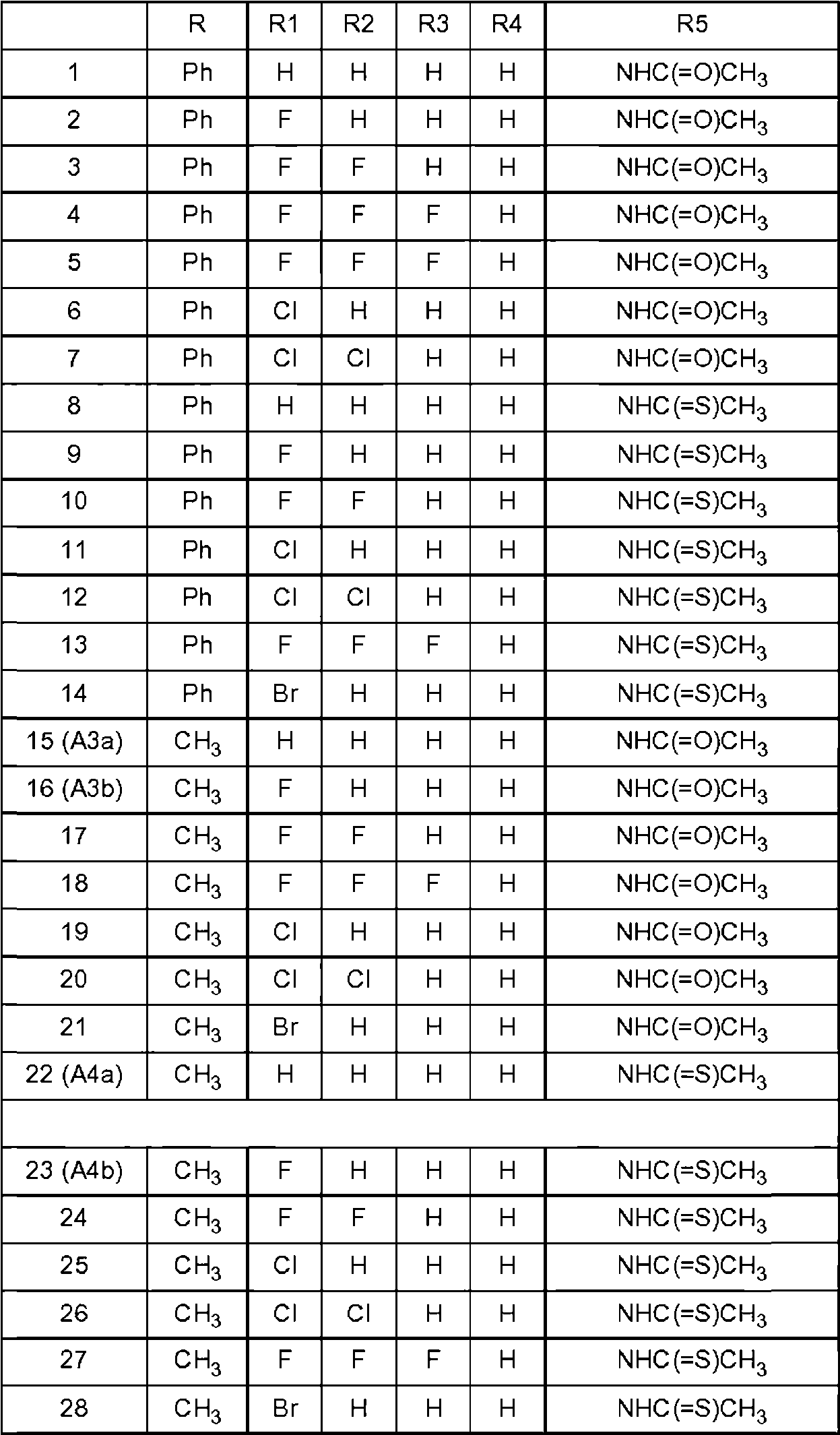


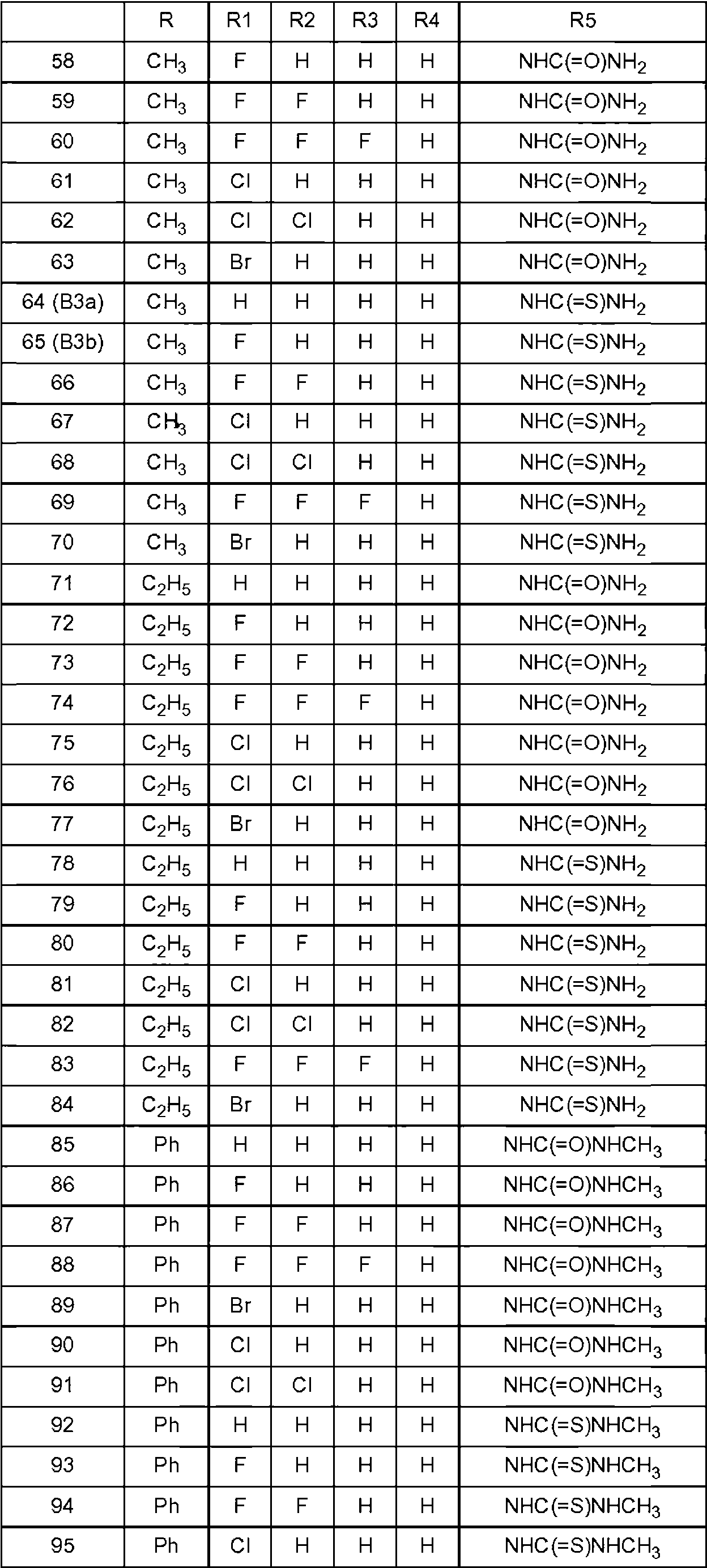
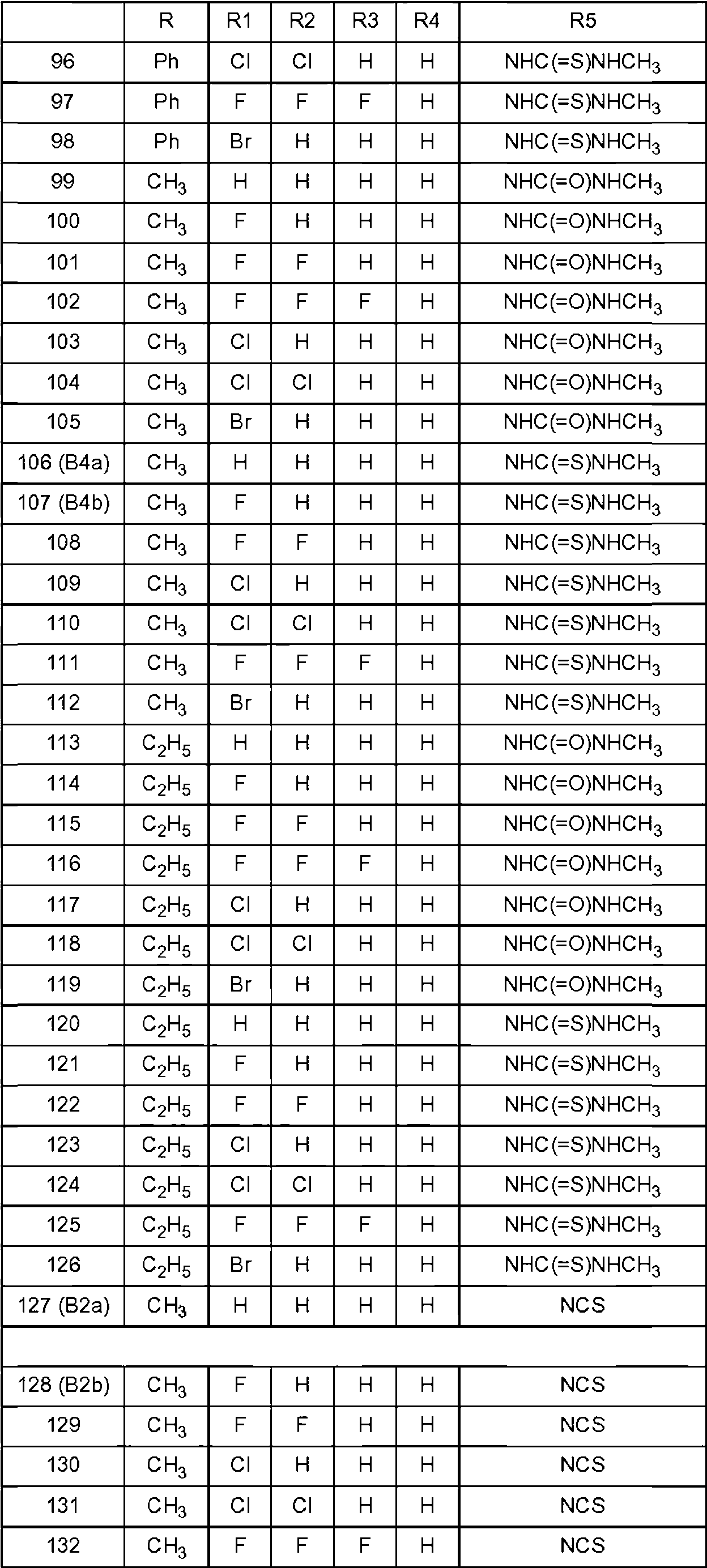

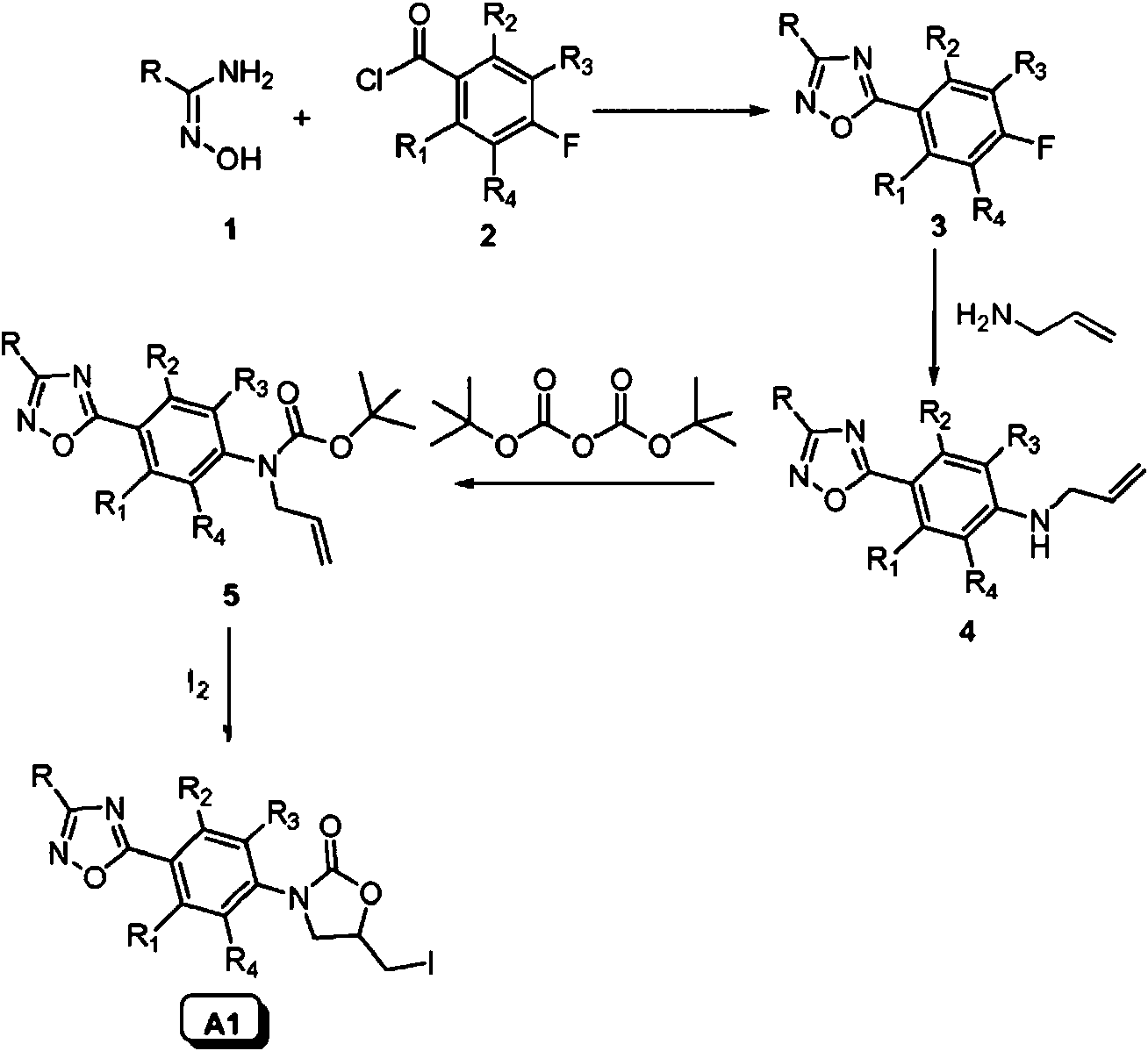

Applications Claiming Priority (3)
| Application Number | Priority Date | Filing Date | Title |
|---|---|---|---|
| IT000155A ITRM20130155A1 (en) | 2013-03-15 | 2013-03-15 | NEW 1,2,4-OXADIAZOLIC ACTIVE COMPOUNDS AGAINST GRAM-POSITIVE PATHOGENS. |
| US13/839,485 US9862710B2 (en) | 2013-03-15 | 2013-03-15 | 1,2,4-oxadiazol compounds active against gram-positive pathogens |
| PCT/IB2014/059896 WO2014141218A1 (en) | 2013-03-15 | 2014-03-17 | Novel 1, 2, 4-oxadiazol compounds active against gram-positive pathogens |
Publications (1)
| Publication Number | Publication Date |
|---|---|
| ES2753244T3 true ES2753244T3 (en) | 2020-04-07 |
Family
ID=50543263
Family Applications (1)
| Application Number | Title | Priority Date | Filing Date |
|---|---|---|---|
| ES14718750T Active ES2753244T3 (en) | 2013-03-15 | 2014-03-17 | Novel Compounds 1,2,4 Oxadiazole Active Against Gram Positive Pathogens |
Country Status (8)
| Country | Link |
|---|---|
| US (1) | US9920039B2 (en) |
| EP (1) | EP2970244B1 (en) |
| JP (1) | JP6402120B2 (en) |
| CN (1) | CN105209458B (en) |
| CA (1) | CA2907032C (en) |
| ES (1) | ES2753244T3 (en) |
| PL (1) | PL2970244T3 (en) |
| WO (1) | WO2014141218A1 (en) |
Families Citing this family (2)
| Publication number | Priority date | Publication date | Assignee | Title |
|---|---|---|---|---|
| CN108753646B (en) * | 2018-06-12 | 2021-10-22 | 上海交通大学医学院附属仁济医院 | A human staphylococcus with broad-spectrum antibacterial activity against gram-positive drug-resistant bacteria and its screening method and application |
| CN111320618A (en) * | 2018-12-17 | 2020-06-23 | 好医生药业集团有限公司 | Novel anti-staphylococcus small molecule compound and preparation method and application thereof |
Family Cites Families (11)
| Publication number | Priority date | Publication date | Assignee | Title |
|---|---|---|---|---|
| US4847043A (en) | 1988-01-25 | 1989-07-11 | General Electric Company | Steam-assisted jet pump |
| US4948801A (en) | 1988-07-29 | 1990-08-14 | E. I. Du Pont De Nemours And Company | Aminomethyloxooxazolidinyl arylbenzene derivatives useful as antibacterial agents |
| CA2294293A1 (en) * | 1997-07-11 | 1999-01-21 | Pharmacia & Upjohn Company | Thiadiazolyl and oxadiazolyl phenyl oxazolidinone antibacterial agents |
| GB9821938D0 (en) * | 1998-10-09 | 1998-12-02 | Zeneca Ltd | Chemical compounds |
| ES2180456B1 (en) | 2001-07-20 | 2004-05-01 | Laboratorios S.A.L.V.A.T., S.A. | SUBSTITUTED ISOXAZOLS AND ITS USE AS ANTIBIOTICS. |
| EP1446403B1 (en) * | 2001-10-25 | 2006-04-12 | AstraZeneca AB | Aryl substituted oxazolidinones with antibacterial activity |
| WO2006109156A1 (en) | 2005-04-15 | 2006-10-19 | Ranbaxy Laboratories Limited | Oxazolidinone derivatives as antimicrobials |
| DK1901749T3 (en) * | 2005-05-18 | 2016-10-24 | Raptor Pharmaceuticals Inc | Aerosolized fluoroquinolones AND USES THEREOF |
| US7838532B2 (en) * | 2005-05-18 | 2010-11-23 | Mpex Pharmaceuticals, Inc. | Aerosolized fluoroquinolones and uses thereof |
| US20080146573A1 (en) * | 2006-12-04 | 2008-06-19 | Auspex Pharmaceuticals, Inc. | Preparation and utility of substituted oxzolidinones |
| US20100298384A1 (en) * | 2006-12-04 | 2010-11-25 | Mohamed Takhi | Novel oxazolidinone compounds as antiinfective agents |
-
2014
- 2014-03-17 ES ES14718750T patent/ES2753244T3/en active Active
- 2014-03-17 WO PCT/IB2014/059896 patent/WO2014141218A1/en not_active Ceased
- 2014-03-17 PL PL14718750T patent/PL2970244T3/en unknown
- 2014-03-17 US US14/777,508 patent/US9920039B2/en active Active
- 2014-03-17 CN CN201480015509.1A patent/CN105209458B/en active Active
- 2014-03-17 EP EP14718750.4A patent/EP2970244B1/en active Active
- 2014-03-17 CA CA2907032A patent/CA2907032C/en active Active
- 2014-03-17 JP JP2015562542A patent/JP6402120B2/en active Active
Also Published As
| Publication number | Publication date |
|---|---|
| CA2907032C (en) | 2021-04-20 |
| JP6402120B2 (en) | 2018-10-10 |
| US9920039B2 (en) | 2018-03-20 |
| CN105209458B (en) | 2019-01-04 |
| EP2970244B1 (en) | 2019-05-29 |
| WO2014141218A1 (en) | 2014-09-18 |
| PL2970244T3 (en) | 2020-01-31 |
| US20160297807A1 (en) | 2016-10-13 |
| CA2907032A1 (en) | 2014-09-18 |
| CN105209458A (en) | 2015-12-30 |
| JP2016512228A (en) | 2016-04-25 |
| EP2970244A1 (en) | 2016-01-20 |
Similar Documents
| Publication | Publication Date | Title |
|---|---|---|
| CN109790112B (en) | Cyanopyrrolidine derivatives having activity as USP30 inhibitors | |
| CN109790148B (en) | Cyano-substituted heterocycles with USP30 inhibitor activity | |
| ES2703723T3 (en) | Methods for using MEK inhibitors | |
| US11345678B2 (en) | Benzopyrazole compound used as RHO kinase inhibitor | |
| US20130123249A1 (en) | Novel benzoxazine oxazolidinone compounds, preparation methods and uses thereof | |
| JP2016536338A (en) | Antimicrobial compounds and methods for their production and use | |
| EA023350B1 (en) | Antimicrobial compounds, methods of making and using the same | |
| CN108727406B (en) | Nitrogen heterocyclic ring substituted benzoxazine oxazolidinone compound and preparation method and application thereof | |
| US10072006B2 (en) | Heterocyclic compounds and their use in preventing or treating bacterial infections | |
| JP2019038808A (en) | Method of producing and use of antimicrobial compound and antimicrobial compound | |
| TW201815390A (en) | Composition comprising antibiotic compound and an heterocyclic compound and their use in preventing or treating bacterial infections | |
| WO2018060481A1 (en) | Heterocyclic compounds and their use in preventing or treating bacterial infections | |
| CN110312722A (en) | Antimicrobial and its preparation and application | |
| ES2753244T3 (en) | Novel Compounds 1,2,4 Oxadiazole Active Against Gram Positive Pathogens | |
| ES2526120T3 (en) | Novel oxazolidinone derivatives with cyclic amidoxime or cyclic amidrazone and pharmaceutical compositions thereof | |
| TW200403241A (en) | Chemical compounds | |
| KR101169359B1 (en) | Novel Oxazolidinone derivatives with cyclic amidrazone and Pharmaceutical Compositions thereof | |
| US9862710B2 (en) | 1,2,4-oxadiazol compounds active against gram-positive pathogens | |
| CN102190656A (en) | Oxazolidinone bacteriophage containing azaheterocycle | |
| CN101597283A (en) | Triazolyl oxazolidinone compounds and their antibacterial applications | |
| ITRM20130155A1 (en) | NEW 1,2,4-OXADIAZOLIC ACTIVE COMPOUNDS AGAINST GRAM-POSITIVE PATHOGENS. | |
| US20230365551A1 (en) | Inhibitors of human respiratory syncytial virus and metapneumovirus | |
| CN120136894A (en) | A type of cyclic small molecule compound with hexacyclic and pentacyclic aromatic heterocycles and its application | |
| KR20120081579A (en) | Novel oxazolidinone derivatives with cyclic amidrazone and pharmaceutical compositions thereof | |
| BR112019006371B1 (en) | COMPOUND, PHARMACEUTICAL COMPOSITIONS, USE OF A COMPOUND AND KITS |