ES2731653T3 - Methods and uses to predict the response to eribulin - Google Patents
Methods and uses to predict the response to eribulin Download PDFInfo
- Publication number
- ES2731653T3 ES2731653T3 ES12710643T ES12710643T ES2731653T3 ES 2731653 T3 ES2731653 T3 ES 2731653T3 ES 12710643 T ES12710643 T ES 12710643T ES 12710643 T ES12710643 T ES 12710643T ES 2731653 T3 ES2731653 T3 ES 2731653T3
- Authority
- ES
- Spain
- Prior art keywords
- eribulin
- biomarker
- expression
- subject
- pharmaceutically acceptable
- Prior art date
- Legal status (The legal status is an assumption and is not a legal conclusion. Google has not performed a legal analysis and makes no representation as to the accuracy of the status listed.)
- Active
Links
- 0 CC*(C(*(*)C(C(*CN)C[C@@](C(C)(C)C(C1)I)OC1*C1[O+]C(CC[C@@]2(CC3OC4C5OC(CC6)C7OC6C6)OC7[C@@]4(C)*35IC2)C(*)C1(C)I)C(*)(*)[C@@]6(C)I)[O+])C(C)(*)* Chemical compound CC*(C(*(*)C(C(*CN)C[C@@](C(C)(C)C(C1)I)OC1*C1[O+]C(CC[C@@]2(CC3OC4C5OC(CC6)C7OC6C6)OC7[C@@]4(C)*35IC2)C(*)C1(C)I)C(*)(*)[C@@]6(C)I)[O+])C(C)(*)* 0.000 description 3
Classifications
-
- C—CHEMISTRY; METALLURGY
- C12—BIOCHEMISTRY; BEER; SPIRITS; WINE; VINEGAR; MICROBIOLOGY; ENZYMOLOGY; MUTATION OR GENETIC ENGINEERING
- C12Q—MEASURING OR TESTING PROCESSES INVOLVING ENZYMES, NUCLEIC ACIDS OR MICROORGANISMS; COMPOSITIONS OR TEST PAPERS THEREFOR; PROCESSES OF PREPARING SUCH COMPOSITIONS; CONDITION-RESPONSIVE CONTROL IN MICROBIOLOGICAL OR ENZYMOLOGICAL PROCESSES
- C12Q1/00—Measuring or testing processes involving enzymes, nucleic acids or microorganisms; Compositions therefor; Processes of preparing such compositions
- C12Q1/68—Measuring or testing processes involving enzymes, nucleic acids or microorganisms; Compositions therefor; Processes of preparing such compositions involving nucleic acids
- C12Q1/6876—Nucleic acid products used in the analysis of nucleic acids, e.g. primers or probes
- C12Q1/6883—Nucleic acid products used in the analysis of nucleic acids, e.g. primers or probes for diseases caused by alterations of genetic material
- C12Q1/6886—Nucleic acid products used in the analysis of nucleic acids, e.g. primers or probes for diseases caused by alterations of genetic material for cancer
-
- A—HUMAN NECESSITIES
- A61—MEDICAL OR VETERINARY SCIENCE; HYGIENE
- A61K—PREPARATIONS FOR MEDICAL, DENTAL OR TOILETRY PURPOSES
- A61K31/00—Medicinal preparations containing organic active ingredients
- A61K31/33—Heterocyclic compounds
- A61K31/335—Heterocyclic compounds having oxygen as the only ring hetero atom, e.g. fungichromin
- A61K31/35—Heterocyclic compounds having oxygen as the only ring hetero atom, e.g. fungichromin having six-membered rings with one oxygen as the only ring hetero atom
-
- A—HUMAN NECESSITIES
- A61—MEDICAL OR VETERINARY SCIENCE; HYGIENE
- A61P—SPECIFIC THERAPEUTIC ACTIVITY OF CHEMICAL COMPOUNDS OR MEDICINAL PREPARATIONS
- A61P15/00—Drugs for genital or sexual disorders; Contraceptives
-
- A—HUMAN NECESSITIES
- A61—MEDICAL OR VETERINARY SCIENCE; HYGIENE
- A61P—SPECIFIC THERAPEUTIC ACTIVITY OF CHEMICAL COMPOUNDS OR MEDICINAL PREPARATIONS
- A61P35/00—Antineoplastic agents
-
- G01N33/57515—
-
- C—CHEMISTRY; METALLURGY
- C12—BIOCHEMISTRY; BEER; SPIRITS; WINE; VINEGAR; MICROBIOLOGY; ENZYMOLOGY; MUTATION OR GENETIC ENGINEERING
- C12Q—MEASURING OR TESTING PROCESSES INVOLVING ENZYMES, NUCLEIC ACIDS OR MICROORGANISMS; COMPOSITIONS OR TEST PAPERS THEREFOR; PROCESSES OF PREPARING SUCH COMPOSITIONS; CONDITION-RESPONSIVE CONTROL IN MICROBIOLOGICAL OR ENZYMOLOGICAL PROCESSES
- C12Q2600/00—Oligonucleotides characterized by their use
- C12Q2600/106—Pharmacogenomics, i.e. genetic variability in individual responses to drugs and drug metabolism
Landscapes
- Health & Medical Sciences (AREA)
- Chemical & Material Sciences (AREA)
- Life Sciences & Earth Sciences (AREA)
- Organic Chemistry (AREA)
- Proteomics, Peptides & Aminoacids (AREA)
- Engineering & Computer Science (AREA)
- Immunology (AREA)
- General Health & Medical Sciences (AREA)
- Analytical Chemistry (AREA)
- Pathology (AREA)
- Wood Science & Technology (AREA)
- Genetics & Genomics (AREA)
- Zoology (AREA)
- Bioinformatics & Cheminformatics (AREA)
- Molecular Biology (AREA)
- Biochemistry (AREA)
- Microbiology (AREA)
- Biotechnology (AREA)
- Hospice & Palliative Care (AREA)
- Physics & Mathematics (AREA)
- Oncology (AREA)
- Medicinal Chemistry (AREA)
- Pharmacology & Pharmacy (AREA)
- Veterinary Medicine (AREA)
- Public Health (AREA)
- Biophysics (AREA)
- General Engineering & Computer Science (AREA)
- Animal Behavior & Ethology (AREA)
- General Chemical & Material Sciences (AREA)
- Nuclear Medicine, Radiotherapy & Molecular Imaging (AREA)
- Chemical Kinetics & Catalysis (AREA)
- Epidemiology (AREA)
- Reproductive Health (AREA)
- Endocrinology (AREA)
- Measuring Or Testing Involving Enzymes Or Micro-Organisms (AREA)
- Investigating Or Analysing Biological Materials (AREA)
- Biomedical Technology (AREA)
- Hematology (AREA)
- Urology & Nephrology (AREA)
- Cell Biology (AREA)
Abstract
Un método para determinar si la eribulina, un análogo de la misma, o una sal farmacéuticamente aceptable de la misma, puede usarse para tratar un sujeto que padece cáncer de mama, comprendiendo el método determinar el nivel de expresión de un biomarcador seleccionado del grupo de biomarcadores enumerado en la Tabla 1 en una muestra derivada de dicho sujeto, en donde un nivel bajo de expresión del biomarcador es indicativo de que la eribulina, un análogo de la misma, o una sal farmacéuticamente aceptable de la misma, será efectiva para tratar a dicho sujeto.A method for determining whether eribulin, an analog thereof, or a pharmaceutically acceptable salt thereof, can be used to treat a subject suffering from breast cancer, the method comprising determining the expression level of a biomarker selected from the group of biomarkers listed in Table 1 in a sample derived from said subject, where a low level of biomarker expression is indicative that eribulin, an analogue thereof, or a pharmaceutically acceptable salt thereof, will be effective in treating said subject.
Description
DESCRIPCIÓNDESCRIPTION
Métodos y usos para predecir la respuesta a la eribulinaMethods and uses to predict the response to eribulin
Antecedentes de la invenciónBackground of the invention
Cáncer es un término usado para describir una amplia variedad de enfermedades que se caracterizan por el crecimiento incontrolado de un tipo particular de célula. Comienza en un tejido que contiene dicha célula y, si el cáncer no se ha extendido a ningún tejido adicional en el momento del diagnóstico, puede ser tratado, por ejemplo, mediante cirugía, radiación u otro tipo de terapia localizada. Sin embargo, cuando existe evidencia de que el cáncer se ha metastatizado desde el tejido de origen, habitualmente se usan diferentes estrategias de tratamiento. De hecho, debido a que no es posible determinar la extensión de la metástasis, habitualmente se contemplan estrategias sistémicas de terapia cuando se detecta cualquier evidencia de expansión. Estas estrategias implican la administración de fármacos quimioterapéuticos que interfieren con el crecimiento de las células en rápida división, tal como células cancerosas. Cancer is a term used to describe a wide variety of diseases that are characterized by uncontrolled growth of a particular type of cell. It begins in a tissue that contains said cell and, if the cancer has not spread to any additional tissue at the time of diagnosis, it can be treated, for example, by surgery, radiation or other localized therapy. However, when there is evidence that the cancer has metastasized from the tissue of origin, different treatment strategies are usually used. In fact, because it is not possible to determine the extent of metastasis, systemic therapy strategies are usually contemplated when any evidence of expansion is detected. These strategies involve the administration of chemotherapeutic drugs that interfere with the growth of rapidly dividing cells, such as cancer cells.
La halicondrina B es un compuesto macrocíclico estructuralmente complejo que fue aislado originalmente de la esponja marina Halichondria okadai, y posteriormente se encontró en Axinella sp., Phakellia carteri, y Lissodendoryx sp. En 1992 se publicó una síntesis total de la halicondrina B (Aicher et al., J. Am. Chem. Soc. 114: 3162-3164, 1992). Se ha demostrado que la halicondrina B inhibe la polimerización de tubulina, el ensamblaje de microtúbulos, la reticulación de beta-tubulina, la unión de GTP y vinblastina a tubulina, y la hidrólisis de GTP dependiente de tubulina in vitro. También se ha demostrado que esta molécula posee propiedades anticancerígenas in vitro e in vivo. En la Patente de EE.UU. n° 6.214.865 B1 se describen análogos de halicondrina B.Halicondrine B is a structurally complex macrocyclic compound that was originally isolated from the marine sponge Halichondria okadai, and subsequently found in Axinella sp., Phakellia carteri, and Lissodendoryx sp. A total synthesis of halicondrine B was published in 1992 (Aicher et al., J. Am. Chem. Soc. 114: 3162-3164, 1992). Halicondrine B has been shown to inhibit tubulin polymerization, microtubule assembly, beta-tubulin crosslinking, GTP and vinblastine binding to tubulin, and tubulin-dependent GTP hydrolysis in vitro. It has also been shown that this molecule has anticancer properties in vitro and in vivo. In US Pat. No. 6,214,865 B1 describes halicondrine B analogues.
En particular, el mesilato de eribulina, un análogo de halicondrina B, ha sido desarrollado como fármaco anticancerígeno. Recientemente, el mesilato de eribulina ha sido aprobado para el tratamiento de pacientes con cáncer de mama metastásico que han recibido previamente al menos dos regímenes quimioterapéuticos para el tratamiento de enfermedad metastásica, en donde la terapia previa puede haber incluido una antraciclina y/o un taxano en el adyuvante o el marco metastásico. La capacidad de predecir antes del tratamiento si un paciente de cáncer tiene probabilidad de responder a un agente anticancerígeno puede servir de guía en la selección del tratamiento apropiado, y ser beneficioso para los pacientes. Por consiguiente, existe una necesidad de métodos y composiciones útiles para determinar o predecir la capacidad de respuesta a la eribulina en pacientes que padecen cáncer y, en particular, cáncer de mama.In particular, eribulin mesylate, an analogue of halicondrine B, has been developed as an anticancer drug. Recently, eribulin mesylate has been approved for the treatment of patients with metastatic breast cancer who have previously received at least two chemotherapeutic regimens for the treatment of metastatic disease, where prior therapy may have included an anthracycline and / or a taxane in the adjuvant or metastatic framework. The ability to predict before treatment if a cancer patient is likely to respond to an anticancer agent can guide the selection of appropriate treatment, and be beneficial for patients. Therefore, there is a need for useful methods and compositions to determine or predict the ability to respond to eribulin in patients suffering from cancer and, in particular, breast cancer.
Sumario de la invenciónSummary of the invention
La invención se basa, al menos en parte, en la observación de que un nivel bajo de expresión, p.ej., la ausencia de expresión, de los biomarcadores identificados en la presente memoria, es indicativo de la capacidad de respuesta a eribulina, a un análogo de la misma, o a una sal farmacéuticamente aceptable de la misma (p.ej., mesilato de eribulina). Específicamente, la ausencia de expresión o un nivel bajo de expresión de uno o más de los biomarcadores establecidos en la Tabla 1, en un sujeto, es indicativo de que el sujeto responderá al tratamiento con eribulina, un análogo de la misma, o una sal farmacéuticamente aceptable de la misma (p.ej., mesilato de eribulina).The invention is based, at least in part, on the observation that a low level of expression, eg, the absence of expression, of the biomarkers identified herein, is indicative of the ability to respond to eribulin, to an analogue thereof, or to a pharmaceutically acceptable salt thereof (eg, eribulin mesylate). Specifically, the absence of expression or a low level of expression of one or more of the biomarkers established in Table 1, in a subject, is indicative that the subject will respond to treatment with eribulin, an analogue thereof, or a salt pharmaceutically acceptable thereof (eg, eribulin mesylate).
La invención queda definida por las reivindicaciones.The invention is defined by the claims.
Por consiguiente, en un aspecto, la presente invención proporciona un método para determinar si la eribulina, un análogo de la misma, o una sal farmacéuticamente aceptable de la misma (p.ej., mesilato de eribulina), puede usarse para tratar un sujeto que padece cáncer, realizando un ensayo de una muestra derivada del sujeto para determinar el nivel de expresión en la muestra de un biomarcador seleccionado del grupo de biomarcadores enumerado en la Tabla 1, en donde un nivel bajo de expresión del biomarcador es indicativo de que la eribulina, un análogo de la misma, o una sal farmacéuticamente aceptable de la misma (p.ej., mesilato de eribulina), será efectiva en el tratamiento del sujeto que padece cáncer de mama. En otro aspecto, la presente invención proporciona un método para determinar si la eribulina, un análogo de la misma, o una sal farmacéuticamente aceptable de la misma (p.ej., mesilato de eribulina), puede usarse para tratar a un sujeto que padece cáncer de mama, determinando el nivel de expresión de un biomarcador seleccionado del grupo de biomarcadores enumerados en la Tabla 1 en una muestra derivada del sujeto, en donde un nivel bajo de expresión del biomarcador es indicativo de que la eribulina, un análogo de la misma, o una sal farmacéuticamente aceptable de la misma (p.ej., mesilato de eribulina), será efectiva en el tratamiento del sujeto que padece cáncer de mama. En un aspecto adicional, la presente invención proporciona un método para predecir si la eribulina, un análogo de la misma, o una sal farmacéuticamente aceptable de la misma (p.ej., mesilato de eribulina), puede usarse para tratar un sujeto que padece cáncer de mama, determinando el nivel de expresión de un biomarcador seleccionado del grupo de biomarcadores enumerado en la Tabla 1 en una muestra derivada del sujeto, y predecir que la eribulina, un análogo de la misma, o una sal farmacéuticamente aceptable de la misma (p.ej., mesilato de eribulina), será efectiva en el tratamiento de un sujeto que padece cáncer de mama cuando existe un nivel bajo de expresión del biomarcador en la muestra. En una realización de los aspectos precedentes de la invención, el método puede incluir además obtener una muestra de un sujeto.Accordingly, in one aspect, the present invention provides a method of determining whether eribulin, an analog thereof, or a pharmaceutically acceptable salt thereof (eg, eribulin mesylate), can be used to treat a subject. suffering from cancer, performing a test of a sample derived from the subject to determine the level of expression in the sample of a biomarker selected from the group of biomarkers listed in Table 1, where a low level of biomarker expression is indicative that the Eribulin, an analogue thereof, or a pharmaceutically acceptable salt thereof (eg, eribulin mesylate), will be effective in the treatment of the subject suffering from breast cancer. In another aspect, the present invention provides a method for determining whether eribulin, an analog thereof, or a pharmaceutically acceptable salt thereof (e.g., eribulin mesylate), can be used to treat a subject suffering from breast cancer, determining the expression level of a biomarker selected from the group of biomarkers listed in Table 1 in a sample derived from the subject, where a low level of biomarker expression is indicative of eribulin, an analogue thereof , or a pharmaceutically acceptable salt thereof (eg, eribulin mesylate), will be effective in the treatment of the subject suffering from breast cancer. In a further aspect, the present invention provides a method of predicting whether eribulin, an analog thereof, or a pharmaceutically acceptable salt thereof (e.g., eribulin mesylate), can be used to treat a subject suffering from breast cancer, determining the level of expression of a biomarker selected from the group of biomarkers listed in Table 1 in a sample derived from the subject, and predicting that eribulin, an analogue thereof, or a pharmaceutically acceptable salt thereof ( eg, eribulin mesylate), will be effective in the treatment of a subject suffering from breast cancer when there is a low level of biomarker expression in the sample. In an embodiment of the preceding aspects of the invention, the method may further include obtaining a sample of a subject.
En otro aspecto adicional, la presente invención proporciona un método para determinar la sensibilidad de un tumor de mama, por ejemplo, derivado de un sujeto que padece cáncer de mama, al tratamiento con eribulina, un análogo de la misma, o una sal farmacéuticamente aceptable de la misma (p.ej., mesilato de eribulina), determinando el nivel de expresión de un biomarcador seleccionado del grupo de biomarcadores enumerados en la Tabla 1 en el tumor, en donde un nivel bajo de expresión del biomarcador en el tumor indica que el tumor es sensible al tratamiento con eribulina, o un análogo de la misma. En otro aspecto adicional, la presente invención proporciona un método para determinar la sensibilidad de un tumor de mama, por ejemplo, derivado de un sujeto que padece cáncer de mama, frente al tratamiento con eribulina, un análogo de la misma, o una sal farmacéuticamente aceptable de la misma (p.ej., mesilato de eribulina), determinando el nivel de expresión de un biomarcador seleccionado del grupo de biomarcadores enumerado en la Tabla 1 en el tumor, e identificando el tumor como sensible al tratamiento con eribulina, un análogo de la misma, o una sal farmacéuticamente aceptable de la misma (p.ej., mesilato de eribulina), cuando el biomarcador es expresado en el tumor en un nivel bajo.In a further aspect, the present invention provides a method for determining the sensitivity of a breast tumor, for example, derived from a subject suffering from breast cancer, to treatment with eribulin, an analogue. thereof, or a pharmaceutically acceptable salt thereof (eg, eribulin mesylate), determining the level of expression of a biomarker selected from the group of biomarkers listed in Table 1 in the tumor, where a low level Biomarker expression in the tumor indicates that the tumor is sensitive to treatment with eribulin, or an analogue thereof. In a further aspect, the present invention provides a method for determining the sensitivity of a breast tumor, for example, derived from a subject suffering from breast cancer, versus treatment with eribulin, an analog thereof, or a pharmaceutically salt. acceptable for it (eg, eribulin mesylate), determining the expression level of a biomarker selected from the group of biomarkers listed in Table 1 in the tumor, and identifying the tumor as sensitive to treatment with eribulin, an analogue thereof, or a pharmaceutically acceptable salt thereof (eg, eribulin mesylate), when the biomarker is expressed in the tumor at a low level.
En un aspecto adicional, la invención proporciona eribulina, un análogo de la misma, o una sal farmacéuticamente aceptable de la misma, para uso en un método de tratamiento de un sujeto que padece cáncer de mama. Los métodos incluyen identificar un sujeto que padece cáncer de mama en el que un biomarcador seleccionado del grupo de biomarcadores enumerados en la Tabla 1 está expresado en un nivel bajo, y administrar una cantidad terapéuticamente efectiva de eribulina, un análogo de la misma, o una sal farmacéuticamente aceptable de la misma (p.ej., mesilato de eribulina), al sujeto.In a further aspect, the invention provides eribulin, an analog thereof, or a pharmaceutically acceptable salt thereof, for use in a method of treating a subject suffering from breast cancer. The methods include identifying a subject suffering from breast cancer in which a biomarker selected from the group of biomarkers listed in Table 1 is expressed at a low level, and administering a therapeutically effective amount of eribulin, an analog thereof, or a pharmaceutically acceptable salt thereof (eg, eribulin mesylate), to the subject.
En otro aspecto adicional, la presente invención proporciona eribulina, un análogo de la misma, o una sal farmacéuticamente aceptable de la misma, para uso en un método de tratamiento de un sujeto que padece cáncer de mama, evaluando una muestra derivada del sujeto para determinar el nivel de expresión en la muestra de un biomarcador seleccionado del grupo de biomarcadores enumerados en la Tabla 1, y administrar una cantidad terapéuticamente efectiva de eribulina, un análogo de la misma, o una sal farmacéuticamente aceptable de la misma (p.ej., mesilato de eribulina), al sujeto cuando se detecta un nivel bajo de expresión del biomarcador en la muestra. En un ejemplo de la descripción, los métodos pueden incluir además la obtención de una muestra de un sujeto.In a further aspect, the present invention provides eribulin, an analog thereof, or a pharmaceutically acceptable salt thereof, for use in a method of treating a subject suffering from breast cancer, evaluating a sample derived from the subject to determine the level of expression in the sample of a biomarker selected from the group of biomarkers listed in Table 1, and administering a therapeutically effective amount of eribulin, an analogue thereof, or a pharmaceutically acceptable salt thereof (e.g., eribulin mesylate), to the subject when a low level of biomarker expression is detected in the sample. In an example of the description, the methods may also include obtaining a sample of a subject.
En una realización particular, la presente invención proporciona eribulina, un análogo de las mismas, o una sal farmacéuticamente aceptable de la misma, para uso en un método de tratamiento de un sujeto que presenta cáncer de mama que es sensible a eribulina, un análogo de la misma, o una sal farmacéuticamente aceptable de la misma. Los métodos incluyen identificar un sujeto que padece cáncer de mama que es sensible a eribulina, un análogo de la misma, o una sal farmacéuticamente aceptable de la misma, (p.ej., un cáncer de mama en el que un biomarcador seleccionado del grupo de biomarcadores enumerado en la Tabla 1 es expresado en un nivel bajo), y administrar una cantidad terapéuticamente efectiva de eribulina, un análogo de la misma, o una sal farmacéuticamente aceptable de la misma (p.ej., mesilato de eribulina), al sujeto. Se describen adicionalmente métodos de tratamiento de un sujeto que padece cáncer de mama que es sensible a eribulina, un análogo de la misma, o una sal farmacéuticamente aceptable de la misma, evaluando una muestra derivado del sujeto para determinar el nivel de expresión en la muestra de un biomarcador seleccionado del grupo de biomarcadores enumerados en la Tabla 1, y administrar una cantidad terapéuticamente efectiva de eribulina, un análogo de la misma, o una sal farmacéuticamente aceptable de la misma (p.ej., mesilato de eribulina), al sujeto cuando se detecta un nivel bajo de expresión del biomarcador en la muestra. Los métodos pueden incluir adicionalmente la obtención de una muestra de un sujeto.In a particular embodiment, the present invention provides eribulin, an analog thereof, or a pharmaceutically acceptable salt thereof, for use in a method of treating a subject presenting breast cancer that is sensitive to eribulin, an analogue of the same, or a pharmaceutically acceptable salt thereof. The methods include identifying a subject suffering from breast cancer that is sensitive to eribulin, an analog thereof, or a pharmaceutically acceptable salt thereof, (eg, a breast cancer in which a biomarker selected from the group of biomarkers listed in Table 1 is expressed at a low level), and administer a therapeutically effective amount of eribulin, an analogue thereof, or a pharmaceutically acceptable salt thereof (e.g., eribulin mesylate), at subject. Methods of treating a subject suffering from breast cancer that is sensitive to eribulin, an analog thereof, or a pharmaceutically acceptable salt thereof are further described, evaluating a sample derived from the subject to determine the level of expression in the sample. of a biomarker selected from the group of biomarkers listed in Table 1, and administering a therapeutically effective amount of eribulin, an analogue thereof, or a pharmaceutically acceptable salt thereof (e.g., eribulin mesylate), to the subject when a low level of biomarker expression is detected in the sample. The methods may additionally include obtaining a sample of a subject.
En varias realizaciones, el sujeto no ha sido tratado previamente con eribulina, un análogo de la misma, o una sal farmacéuticamente aceptable de la misma (p.ej., mesilato de eribulina). Alternativamente, el sujeto ha sido tratado previamente con eribulina, un análogo de la misma, o una sal farmacéuticamente aceptable de la misma. En determinadas realizaciones, el cáncer de mama es un cáncer de mama negativo de Receptor de Estrógeno (ER) y/o un cáncer de mama negativo de Receptor de Progesterona (PR) y/o un cáncer de mama negativo de Her-2.In several embodiments, the subject has not previously been treated with eribulin, an analog thereof, or a pharmaceutically acceptable salt thereof (eg, eribulin mesylate). Alternatively, the subject has been previously treated with eribulin, an analog thereof, or a pharmaceutically acceptable salt thereof. In certain embodiments, breast cancer is a estrogen receptor (ER) negative breast cancer and / or a Progesterone Receptor (PR) negative breast cancer and / or a Her-2 negative breast cancer.
En varias realizaciones, se determina el nivel de expresión de al menos 2, al menos 3, al menos 4 o al menos 5 biomarcadores seleccionados del grupo de biomarcadores enumerados en la Tabla 1.In several embodiments, the expression level of at least 2, at least 3, at least 4 or at least 5 biomarkers selected from the group of biomarkers listed in Table 1 is determined.
En realizaciones particulares, se usa una firma genética predictiva que comprende una sub-combinación de 2 o más biomarcadores seleccionados del grupo de biomarcadores enumerados en la Tabla 1. En varias realizaciones, se determina el nivel de expresión de al menos 2, al menos 3, al menos 4 o al menos 5 biomarcadores seleccionados del grupo de biomarcadores enumerados en la Tabla 1. Por ejemplo, la firma genética predictiva puede incluir al menos 2 biomarcadores, p.ej., DYSF y EDIL3; GNAT1 y ERGIC3; KRT24 y PAPLN; MANSC1 y PDGFB; PCDH1 y PDGFB; o PHOSPHO2 y PSENEN. En otra realización, la firma genética predictiva puede incluir al menos 3 biomarcadores; p.ej., COL7A1, YTHDF1 y ZIC5; CKLF, IL10 y TUBB6; CDC20, CFL1 y TMEM79; HYAL2, NCBP1 y SNX11; o CEP152, NCBP1 y SATB1. En otra realización, la firma genética predictiva puede incluir al menos 4 biomarcadores; p.ej., APBB2, CCL26, PSENEN y SATB1; ANG, JAM3, KLHL17 y PAPLN; ITFG3, MAD2L1BP, NMU y PDGFB; SPTA1, TYROBP, SNX11 y PSENEN; GRAMD4, GNAT1, TMIGD2 y YTHDF1; o GRAMD4, HYAL2, PHOSPHO2 y TUBB6. En otra realización, la firma genética predictiva puede incluir al menos 5 biomarcadores; p.ej., CCL26, CDC20, ERGIC3, EDIL3 y PCDH1; DYSF, NMU, PHOSPHO2, PSENEN y SNX11; APBB2, CKLF, CYP4F3, TUBB6 y YTHDF1; o CEP152, MAD2L1BP, SPTA1, TMEM79 y ZIC5.In particular embodiments, a predictive genetic signature is used comprising a sub-combination of 2 or more biomarkers selected from the group of biomarkers listed in Table 1. In several embodiments, the level of expression of at least 2, at least 3, is determined. , at least 4 or at least 5 biomarkers selected from the group of biomarkers listed in Table 1. For example, the predictive genetic signature may include at least 2 biomarkers, eg, DYSF and EDIL3; GNAT1 and ERGIC3; KRT24 and PAPLN; MANSC1 and PDGFB; PCDH1 and PDGFB; or PHOSPHO2 and PSENEN. In another embodiment, the predictive genetic signature may include at least 3 biomarkers; eg, COL7A1, YTHDF1 and ZIC5; CKLF, IL10 and TUBB6; CDC20, CFL1 and TMEM79; HYAL2, NCBP1 and SNX11; or CEP152, NCBP1 and SATB1. In another embodiment, the predictive genetic signature may include at least 4 biomarkers; eg, APBB2, CCL26, PSENEN and SATB1; ANG, JAM3, KLHL17 and PAPLN; ITFG3, MAD2L1BP, NMU and PDGFB; SPTA1, TYROBP, SNX11 and PSENEN; GRAMD4, GNAT1, TMIGD2 and YTHDF1; or GRAMD4, HYAL2, PHOSPHO2 and TUBB6. In another embodiment, the predictive genetic signature may include at least 5 biomarkers; eg, CCL26, CDC20, ERGIC3, EDIL3 and PCDH1; DYSF, NMU, PHOSPHO2, PSENEN and SNX11; APBB2, CKLF, CYP4F3, TUBB6 and YTHDF1; or CEP152, MAD2L1BP, SPTA1, TMEM79 and ZIC5.
En realizaciones particulares, la firma genética predictiva puede incluir 2 o más de los biomarcadores ABI3, ANG, APBB2, CCL26, CDC20, CEP152, CFL1, CKLF, COL7A1, CYP4F3, DYSF, GNAT1, GRAMD4, HYAL2, IL10, ITFG3, JAM3, KLHL17, KRT24, MAD2L1BP, MANSC1, MOBKL1B, NCBP1, NMU, PCDH1, PHOSPHO2, SPTA1, TMIGD2, TYROBP, ZIC5, ERGIC3, PDGFB, PSENEN, SATB1, SNX11, TMEM79 y YTHDF1, p.ej., ABI3 y ANG; APBB2 y CCL26; GNAT1 y GRAMD4; IL10 y ITFG3; MACSC1 y MOBKL1B; NMU y PCDH1; o TYROBP y ZIC5. En otras realizaciones, la firma genética predictiva incluye al menos 3 de los biomarcadores mencionados previamente, p.ej., ABI3, ANG y APBB2; CCL26, CKLF y COL7A1; DYSF, GNAT1 y HYAL2; JAM3, KLHL17 y KRT24; NCBP1, NMU y PCDH1; SPTA1, TMIGD2 y TYROBP; o ZIC5, MAD2L1BP y CDC20. En otras realizaciones, la firma genética predictiva incluye al menos 4 de los biomarcadores mencionados previamente, p.ej., ABI3, ANG, APBB2 y CCL26; CEP152, CFL1, CKLF y COL7A1; KRT24, MANSC1, MOBKL1B y SPTA1; TYROBP, TMIGD2, PHOSPHO2 y NMU; ABI3, GNAT1, KLHL17 y SPTA1; o CEP152, HYAL2, PCDH1 y TMIGD2. En otras realizaciones adicionales, la firma genética predictiva incluye al menos 5 de los biomarcadores mencionados previamente, p.ej., CKLF, COL7A1, GRAMD4, JAM3 y PCDH1; APBB2, CEP152, DYSF, IL10 y TYROBP; CYP4F3, HYAL2, ITFG3, KLHL17 y KRT24; NCBP1, SPTA1, TMIGD2, IL10 y JAM3; o CCL26, PHOSPHO2, SPTA1, TMIGD2 y ZIC5.In particular embodiments, the predictive genetic signature may include 2 or more of the biomarkers ABI3, ANG, APBB2, CCL26, CDC20, CEP152, CFL1, CKLF, COL7A1, CYP4F3, DYSF, GNAT1, GRAMD4, HYAL2, IL10, ITFG3, JAM3, KLHL17, KRT24, MAD2L1BP, MANSC1, MOBKL1B, NCBP1, NMU, PCDH1, PHOSPHO2, SPTA1, TMIGD2, TYROBP, ZIC5, ERGIC3, PDGFB, PSENEN, SATB1, SNX11, TMEM79 and YTHDF1, eg, ABI3 and ANG; APBB2 and CCL26; GNAT1 and GRAMD4; IL10 and ITFG3; MACSC1 and MOBKL1B; NMU and PCDH1; or TYROBP and ZIC5. In other embodiments, the predictive genetic signature includes at least 3 of the biomarkers mentioned above, eg, ABI3, ANG and APBB2; CCL26, CKLF and COL7A1; DYSF, GNAT1 and HYAL2; JAM3, KLHL17 and KRT24; NCBP1, NMU and PCDH1; SPTA1, TMIGD2 and TYROBP; or ZIC5, MAD2L1BP and CDC20. In other embodiments, the predictive genetic signature includes at least 4 of the biomarkers mentioned above, eg, ABI3, ANG, APBB2 and CCL26; CEP152, CFL1, CKLF and COL7A1; KRT24, MANSC1, MOBKL1B and SPTA1; TYROBP, TMIGD2, PHOSPHO2 and NMU; ABI3, GNAT1, KLHL17 and SPTA1; or CEP152, HYAL2, PCDH1 and TMIGD2. In other additional embodiments, the predictive genetic signature includes at least 5 of the biomarkers mentioned above, eg, CKLF, COL7A1, GRAMD4, JAM3 and PCDH1; APBB2, CEP152, DYSF, IL10 and TYROBP; CYP4F3, HYAL2, ITFG3, KLHL17 and KRT24; NCBP1, SPTA1, TMIGD2, IL10 and JAM3; or CCL26, PHOSPHO2, SPTA1, TMIGD2 and ZIC5.
En otras realizaciones, la firma genética predictiva puede incluir 2 o más de los biomarcadores ERGIC3, PDGFB, PSENEN, SATB1, SNX11, TMEM79 o Yt Hd F1, o cualquier sub-combinación de los mismos, p.ej., ERGIC3 y PDGFB; ERGIC3 y PSENEN; ERGIC3 y SATB1; ERGIC3 y SNX11; ERGIC3 y TMEM79; ERGIC3 y YTHDF1; PDGFB y PSENEN; PDGFB y SATB1; PDGFB y SNX11; PDGFB y TMEM79; PDGFB y YTHDF1; PSENEN y SATB1; PSENEN y SNX11; PSENEN y TMEM79; PSENEN y YTHDF1; SATB1 y SNX11; SATB1 y TMEM79; SATB1 y YTHDF1; SNX11 y TMEM79; SNX11 y YTHDF1; o TMEM79 y YTHDF1. En otras realizaciones, la firma genética predictiva incluye al menos 3 biomarcadores, por ejemplo, ERGIC3, PDGFB y PSENEN; SATB1, SNX11 y TMEM79; SNX11, TMEM79 y YTHDF1; o ERGIC3, PDGFB y SATB1. En realizaciones adicionales, la firma genética predictiva incluye al menos 4 biomarcadores, por ejemplo, ERGIC3, PDGFB, PSENEN y SATB1; SNX11, TMEM79, YTHDF1 y ERGIC3; o ERGIC3, PDGFB, PSENEN y YTHDF1. En realizaciones adicionales, la firma genética predictiva incluye al menos 5 biomarcadores, por ejemplo, ERGIC3, PDGFB, PSENEN, SATB1 y SNX11; ERGIC3, PDGFB, PSENEN, SATB1 y TMEM79; o Ps En EN, sAt B1, SNX11, TMEM79 y YTHDF1. En otras realizaciones adicionales, la firma genética predictiva incluye al menos 6 biomarcadores, por ejemplo, ERGIC3, PDGFB, PSENEN, SATB1, SNX11 y TMEM79; PDGFB, PSENEN, SATB1, SNX11, TMEM79 y YTHDF1; o ERGIC3, PSENEN, SATB1, SNX11, TMEM79 y YTHDF1. En otra realización adicional, la firma genética predictiva incluye 7 biomarcadores, por ejemplo, ERGIC3, PDGFB, PSENEN, SATB1, SNX11, TMEM79 y YTHDF1.In other embodiments, the predictive genetic signature may include 2 or more of the biomarkers ERGIC3, PDGFB, PSENEN, SATB1, SNX11, TMEM79 or Yt Hd F1, or any sub-combination thereof, eg, ERGIC3 and PDGFB; ERGIC3 and PSENEN; ERGIC3 and SATB1; ERGIC3 and SNX11; ERGIC3 and TMEM79; ERGIC3 and YTHDF1; PDGFB and PSENEN; PDGFB and SATB1; PDGFB and SNX11; PDGFB and TMEM79; PDGFB and YTHDF1; PSENEN and SATB1; PSENEN and SNX11; PSENEN and TMEM79; PSENEN and YTHDF1; SATB1 and SNX11; SATB1 and TMEM79; SATB1 and YTHDF1; SNX11 and TMEM79; SNX11 and YTHDF1; or TMEM79 and YTHDF1. In other embodiments, the predictive genetic signature includes at least 3 biomarkers, for example, ERGIC3, PDGFB and PSENEN; SATB1, SNX11 and TMEM79; SNX11, TMEM79 and YTHDF1; or ERGIC3, PDGFB and SATB1. In additional embodiments, the predictive genetic signature includes at least 4 biomarkers, for example, ERGIC3, PDGFB, PSENEN and SATB1; SNX11, TMEM79, YTHDF1 and ERGIC3; or ERGIC3, PDGFB, PSENEN and YTHDF1. In additional embodiments, the predictive genetic signature includes at least 5 biomarkers, for example, ERGIC3, PDGFB, PSENEN, SATB1 and SNX11; ERGIC3, PDGFB, PSENEN, SATB1 and TMEM79; or Ps In EN, sAt B1, SNX11, TMEM79 and YTHDF1. In other additional embodiments, the predictive genetic signature includes at least 6 biomarkers, for example, ERGIC3, PDGFB, PSENEN, SATB1, SNX11 and TMEM79; PDGFB, PSENEN, SATB1, SNX11, TMEM79 and YTHDF1; or ERGIC3, PSENEN, SATB1, SNX11, TMEM79 and YTHDF1. In another additional embodiment, the predictive genetic signature includes 7 biomarkers, for example, ERGIC3, PDGFB, PSENEN, SATB1, SNX11, TMEM79 and YTHDF1.
En varias realizaciones, el biomarcador no es uno o más de SPTA1, PAPLN, PCDH1, TMIGD2 y/o KRT24. En una realización particular, el biomarcador no es SPTA1, PAPLN, PCDH1, TMIGD2 y KRT24. En una realización, el biomarcador no es SPTA1. En otra realización, el biomarcador no es PAPLN. En otra realización, el biomarcador no es PCDH1. En otra realización, el biomarcador no es TMIGD2. En otra realización adicional, el biomarcador no es KRT24.In several embodiments, the biomarker is not one or more of SPTA1, PAPLN, PCDH1, TMIGD2 and / or KRT24. In a particular embodiment, the biomarker is not SPTA1, PAPLN, PCDH1, TMIGD2 and KRT24. In one embodiment, the biomarker is not SPTA1. In another embodiment, the biomarker is not PAPLN. In another embodiment, the biomarker is not PCDH1. In another embodiment, the biomarker is not TMIGD2. In another additional embodiment, the biomarker is not KRT24.
En realizaciones particulares, la firma genética predictiva puede incluir 2 o más biomarcadores ABI3, ANG, APBB2, CCL26, CDC20, CEP152, CFL1, CKLF, COL7A1, CYP4F3, DYSF, GNAT1, GRAMD4, HYAL2, IL10, ITFG3, JAM3, KLHL17, MAD2L1BP, MANSC1, MOBKL1B, NCBP1, NMU, PHOSPHO2, TYROBP, ZIC5, ERGIC3, PDGFB, PSENEN, SATB1, SNX11, TMEM79, YTHDF1, EDIL3 y TUBB6, p.ej., ABI3 y ANG; GRAMD4 y HYAL2; NMU y PHOSPHO2; ZIC5 y PSENEN; o SNX11 y MOBKL1B. En otras realizaciones, la firma genética predictiva incluye al menos 3 de los biomarcadores mencionados previamente, p.ej., APBB2, CDC20 y CKLF; COL7 A 1 , DYSF y GNAT1; NCBP1, SATB1 y EDIL3; PSENEN, DYSF y GNAT1; MANSC1, ZIC5 y CFL1; o CKLF, GRAMD4 y NMU. En otras realizaciones, la firma genética predictiva incluye al menos 4 de los biomarcadores mencionados previamente, p.ej., ANG, CCL26, CEP152 y JAM3; APBB2, CYP4F3, ITFG3 y TYROBP; CYP4F3, MANSC1, PDGFB y YTHDF1; TUBB6, DYSF, PHOSPHO2 y CDC20; o CKLF, KLHL17, HYAL2 y ZIC5. En otras realizaciones adicionales, la firma genética predictiva incluye al menos 5 de los biomarcadores mencionados previamente, p.ej., IL10, CEP152, COL7A1, TYROBP y ERGIC3; TMEM79, SNX11, PSENEN, GNAT1 y GRAMD4; JAM3, SNX11, KLHL17, MOBKL1B y ERGIC3; o NMU, PHOSPHO2, PDGFB, CFL1 y ANG.In particular embodiments, the predictive genetic signature may include 2 or more biomarkers ABI3, ANG, APBB2, CCL26, CDC20, CEP152, CFL1, CKLF, COL7A1, CYP4F3, DYSF, GNAT1, GRAMD4, HYAL2, IL10, ITFG3, JAM3, KLHL17 MAD2L1BP, MANSC1, MOBKL1B, NCBP1, NMU, PHOSPHO2, TYROBP, ZIC5, ERGIC3, PDGFB, PSENEN, SATB1, SNX11, TMEM79, YTHDF1, EDIL3 and TUBB6, eg, ABI3 and ANG; GRAMD4 and HYAL2; NMU and PHOSPHO2; ZIC5 and PSENEN; or SNX11 and MOBKL1B. In other embodiments, the predictive genetic signature includes at least 3 of the biomarkers mentioned above, eg, APBB2, CDC20 and CKLF; COL 7 A 1 , DYSF and GNAT1; NCBP1, SATB1 and EDIL3; PSENEN, DYSF and GNAT1; MANSC1, ZIC5 and CFL1; or CKLF, GRAMD4 and NMU. In other embodiments, the predictive genetic signature includes at least 4 of the biomarkers mentioned above, eg, ANG, CCL26, CEP152 and JAM3; APBB2, CYP4F3, ITFG3 and TYROBP; CYP4F3, MANSC1, PDGFB and YTHDF1; TUBB6, DYSF, PHOSPHO2 and CDC20; or CKLF, KLHL17, HYAL2 and ZIC5. In other additional embodiments, the predictive genetic signature includes at least 5 of the biomarkers mentioned above, eg, IL10, CEP152, COL7A1, TYROBP and ERGIC3; TMEM79, SNX11, PSENEN, GNAT1 and GRAMD4; JAM3, SNX11, KLHL17, MOBKL1B and ERGIC3; or NMU, PHOSPHO2, PDGFB, CFL1 and ANG.
En varios métodos y/o kits de la invención, el biomarcador no es ABI3, no es ANG, no es APBB2, no es CCL26, no es CDC20, no es CEP152, no es CFL1, no es CKLF, no es COL7A1, no es CYP4F3, no es DYSF, no es GNAT1, no es GRAMD4, no es HYAL2, no es IL10, no es ITFG3, no es JAM3, no es KLHL17, no es KRT24, no es MAD2L1BP, no es MANSC1, no es MOBKL1B, no es NCBP1, no es NMU, no es PCDH1, no es PHOSPHO2, no es SPTA1, no es TMIGD2, no es TYROBP, no es ZIC5, no es ERGIC3, no es PDGFB, no es PSENEN, no es SATB1, no es SNX11, no es TMEM79, no es EDIL3, no es PAPLN, no es TUBB6 y/o no es YTHDF1.In various methods and / or kits of the invention, the biomarker is not ABI3, is not ANG, is not APBB2, is not CCL26, is not CDC20, is not CEP152, is not CFL1, is not CKLF, is not COL7A1, no it's CYP4F3, it's not DYSF, it's not GNAT1, it's not GRAMD4, it's not HYAL2, it's not IL10, it's not ITFG3, it's not JAM3, it's not KLHL17, it's not KRT24, it's not MAD2L1BP, it's not MANSC1, it's not MOBKL1B , it's not NCBP1, it's not NMU, it's not PCDH1, it's not PHOSPHO2, it's not SPTA1, it's not TMIGD2, it's not TYROBP, it's not ZIC5, it's not ERGIC3, it's not PDGFB, it's not PSENEN, it's not SATB1, no it is SNX11, it is not TMEM79, it is not EDIL3, it is not PAPLN, it is not TUBB6 and / or it is not YTHDF1.
En determinadas realizaciones, el biomarcador no se expresa en un nivel detectable. En otra realización, el biomarcador se expresa en un nivel bajo en comparación con un control. La expresión se puede determinar directa o indirectamente mediante cualquier método adecuado. En determinadas realizaciones, el nivel de expresión del biomarcador se determina a nivel de ácido nucleico usando cualquier método adecuado. Por ejemplo, el nivel de expresión del biomarcador se puede determinar mediante la detección de ADNc, ARNm o ADN. En realizaciones particulares, el nivel de expresión del biomarcador se determina usando una técnica seleccionada del grupo que consiste en reacción de amplificación de reacción en cadena de polimerasa (PCR), análisis de PCR de transcriptasa inversa, análisis de PCR de transcriptasa inversa cuantitativa, análisis de transferencia Northern blot, ensayo de protección de ARNasa, detección/cuantificación de ARN digital (p.ej., nanoString) y combinaciones o sub combinaciones de los mismos. In certain embodiments, the biomarker is not expressed at a detectable level. In another embodiment, the biomarker is expressed at a low level compared to a control. The expression can be determined directly or indirectly by any suitable method. In certain embodiments, the expression level of the biomarker is determined at the nucleic acid level using any suitable method. For example, the level of expression of the biomarker can be determined by detecting cDNA, mRNA or DNA. In particular embodiments, the level of biomarker expression is determined using a technique selected from the group consisting of polymerase chain reaction amplification reaction (PCR), reverse transcriptase PCR analysis, quantitative reverse transcriptase PCR analysis, analysis Northern blot transfer, RNAse protection assay, detection / quantification of digital RNA (eg, nanoString) and combinations or sub combinations thereof.
En determinadas realizaciones, el nivel de expresión del biomarcador puede determinarse detectando miARN. Específicamente, la expresión de ARNm se puede determinar indirectamente estableciendo los niveles de miARN, en donde un nivel elevado de un miARN que controla la expresión de un ARNm es indicativo de un nivel bajo de expresión del ARNm que codifica el biomarcador.In certain embodiments, the level of expression of the biomarker can be determined by detecting miRNA. Specifically, mRNA expression can be determined indirectly by establishing miRNA levels, where a high level of a miRNA that controls the expression of an mRNA is indicative of a low level of mRNA expression encoding the biomarker.
En otras realizaciones, el nivel de expresión del biomarcador se determina a nivel de proteína usando cualquier método adecuado. Por ejemplo, la presencia o el nivel de la proteína pueden detectarse usando un anticuerpo o un fragmento de unión a antígeno del mismo, que se une específicamente a la proteína. En realizaciones particulares, el anticuerpo o fragmento de unión a antígeno del mismo se selecciona del grupo que consiste en un anticuerpo de ratón, un anticuerpo humano, un anticuerpo humanizado, un anticuerpo bi-específico, un anticuerpo quimérico, un Fab, Fab', F(ab')2, ScFv, SMIP, aficuerpo, avímero, versacuerpo, nanocuerpo, y un anticuerpo de dominio, o un fragmento de unión a antígeno de cualquiera de los anteriores. En realizaciones particulares, el anticuerpo o porción de unión a antígeno del mismo es marcado, por ejemplo, con una etiqueta seleccionada del grupo que consiste en una radiomarca, una marca de biotina, una marca de cromóforo, una marca de fluoróforo y una marca enzimática. En determinadas realizaciones, el nivel de expresión del biomarcador se determina usando una técnica seleccionada del grupo que consiste en un inmunoensayo, un análisis de transferencia Western blot, un radioinmunoensayo, inmunofluorimetría, inmunoprecipitación, diálisis de equilibrio, inmunodifusión, inmunoensayo de electroquimioluminiscencia (ECLIA), ensayo ELISA, reacción en cadena de inmunopolimerasa y combinaciones o sub combinaciones de los mismos. En realizaciones particulares, el inmunoensayo es un inmunoensayo basado en disolución seleccionado del grupo que consiste en electroquimioluminiscencia, quimioluminiscencia, quimioluminiscencia fluorogénica, polarización de fluorescencia, y fluorescencia resuelta en el tiempo. En otras realizaciones, el inmunoensayo es un inmunoensayo sándwich seleccionado del grupo que consiste en electroquimioluminiscencia, quimioluminiscencia, y quimioluminiscencia fluorogénica. También se pueden usar otros ensayos que se basan en agentes capaces de detectar la proteína, tal como los basados en una pareja de unión adecuada o una actividad enzimática adecuada (p.ej., uso de un ligando para detectar una molécula receptora). In other embodiments, the level of biomarker expression is determined at the protein level using any suitable method. For example, the presence or level of the protein can be detected using an antibody or an antigen-binding fragment thereof, which specifically binds to the protein. In particular embodiments, the antibody or antigen binding fragment thereof is selected from the group consisting of a mouse antibody, a human antibody, a humanized antibody, a bi-specific antibody, a chimeric antibody, a Fab, Fab ', F (ab ') 2 , ScFv, SMIP, star, avimer, versabody, nanobody, and a domain antibody, or an antigen-binding fragment of any of the foregoing. In particular embodiments, the antibody or antigen-binding portion thereof is labeled, for example, with a label selected from the group consisting of a radiolabel, a biotin label, a chromophore mark, a fluorophore mark and an enzymatic mark. . In certain embodiments, the biomarker expression level is determined using a technique selected from the group consisting of an immunoassay, a Western blot transfer analysis, a radioimmunoassay, immunofluorimetry, immunoprecipitation, equilibrium dialysis, immunodiffusion, electrochemiluminescence immunoassay (ECLIA) , ELISA assay, immunopolymerase chain reaction and combinations or sub combinations thereof. In particular embodiments, the immunoassay is a solution-based immunoassay selected from the group consisting of electrochemiluminescence, chemiluminescence, fluorogenic chemiluminescence, fluorescence polarization, and time-resolved fluorescence. In other embodiments, the immunoassay is a sandwich immunoassay selected from the group consisting of electrochemiluminescence, chemiluminescence, and fluorogenic chemiluminescence. Other assays that are based on agents capable of detecting the protein, such as those based on a suitable binding partner or a suitable enzymatic activity (eg, use of a ligand to detect a receptor molecule), can also be used.
Las muestras pueden haber sido obtenidas de un sujeto mediante cualquier método adecuado, y pueden haber sido sometidas opcionalmente a etapa(s) de procesamiento adicional(es) (p.ej., congelación, fraccionamiento, fijación, tratamiento de guanidina, etc.). Se puede usar cualquier muestra adecuada derivada de un sujeto, tal como cualquier tejido (p.ej., biopsia), célula o fluido, así como cualquier componente de los mismos, tal como una fracción o extracto. En varias realizaciones, la muestra es un fluido obtenido del sujeto, o un componente de dicho fluido. Por ejemplo, el fluido puede ser sangre, plasma, suero, esputo, linfa, fluido quístico, aspirado de pezón, orina o fluido recogido de una biopsia (p.ej., biopsia de bulto). En otras realizaciones, la muestra es un tejido o componente del mismo obtenido del sujeto. Por ejemplo, el tejido puede ser tejido obtenido de una biopsia (p.ej., biopsia de bulto), tejido de mama, tejido conectivo, y/o tejido linfático. En una realización particular, el tejido es tejido de mama, o un componente del mismo (p.ej., células recogidas del tejido de mama). En una realización particular, el componente del tejido de mama son células de tejido de mama. En otra realización, el componente del tejido de mama son células tumorales de mama en circulación.Samples may have been obtained from a subject by any suitable method, and may have optionally been subjected to additional processing stage (s) (eg, freezing, fractionation, fixation, guanidine treatment, etc.) . Any suitable sample derived from a subject can be used, such as any tissue (eg, biopsy), cell or fluid, as well as any component thereof, such as a fraction or extract. In various embodiments, the sample is a fluid obtained from the subject, or a component of said fluid. For example, the fluid may be blood, plasma, serum, sputum, lymph, cystic fluid, nipple aspirate, urine or fluid collected from a biopsy (eg, lump biopsy). In other embodiments, the sample is a tissue or component thereof obtained from the subject. For example, the tissue may be tissue obtained from a biopsy (eg, lump biopsy), breast tissue, connective tissue, and / or lymphatic tissue. In a particular embodiment, the tissue is breast tissue, or a component thereof (eg, cells collected from breast tissue). In a particular embodiment, the breast tissue component is breast tissue cells. In another embodiment, the breast tissue component is circulating breast tumor cells.
En una realización, el sujeto es un humano.In one embodiment, the subject is a human.
En otro aspecto, la presente invención proporciona el uso de un kit, tal como se define en la reivindicación 15, para predecir si la eribulina, un análogo de la misma, o una sal farmacéuticamente aceptable de la misma (p.ej., mesilato de eribulina), se puede usar para tratar un sujeto que padece cáncer de mama, que incluye reactivos para determinar el nivel de expresión de un biomarcador seleccionado del grupo de biomarcadores enumerados en la Tabla 1; e instrucciones para uso del kit para predecir si la eribulina, un análogo de la misma, o una sal farmacéuticamente aceptable de la misma (p.ej., mesilato de eribulina), puede usarse para tratar un sujeto que presenta cáncer de mama. Por ejemplo, el reactivo para determinar el nivel de expresión del biomarcador puede ser una sonda para identificar una mutación nula en el biomarcador. El reactivo para determinar el nivel de expresión del biomarcador puede ser una sonda para amplificar y/o detectar el biomarcador. En otra realización adicional, el reactivo para determinar el nivel de expresión del biomarcador puede ser un anticuerpo, por ejemplo, un anticuerpo específico para el producto de la expresión de la versión silvestre o mutante nula del biomarcador.In another aspect, the present invention provides the use of a kit, as defined in claim 15, to predict whether eribulin, an analog thereof, or a pharmaceutically acceptable salt thereof (eg, mesylate of eribulin), can be used to treat a subject suffering from breast cancer, which includes reagents to determine the level of expression of a biomarker selected from the group of biomarkers listed in Table 1; and instructions for using the kit to predict whether eribulin, an analogue thereof, or a pharmaceutically acceptable salt thereof (eg, eribulin mesylate), can be used to treat a subject presenting with breast cancer. For example, the reagent to determine the level of expression of the biomarker can be a probe to identify a null mutation in the biomarker. The reagent to determine the level of expression of the biomarker can be a probe to amplify and / or detect the biomarker. In another additional embodiment, the reagent for determining the level of expression of the biomarker may be an antibody, for example, an antibody specific for the product of the expression of the wild-type or null mutant version of the biomarker.
En una realización particular, el kit incluye además reactivos para obtener una muestra biológica de un sujeto. En otra realización, el kit incluye una muestra de control.In a particular embodiment, the kit also includes reagents to obtain a biological sample of a subject. In another embodiment, the kit includes a control sample.
En otro aspecto, la presente invención proporciona métodos para determinar si la eribulina, un análogo de la misma, o una sal farmacéuticamente aceptable de la misma (p.ej., mesilato de eribulina), se puede usar para tratar un sujeto que padece cáncer de mama determinando y/o identificando sin el sujeto porta al menos un gen, seleccionado del grupo de biomarcadores establecido en la Tabla 1, que contiene una mutación nula. En otro aspecto, la presente invención proporciona métodos para predecir si la eribulina, un análogo de la misma, o una sal farmacéuticamente aceptable de la misma (p.ej., mesilato de eribulina), puede usarse para tratar un sujeto que padece cáncer de mama evaluando una muestra derivada del sujeto para determinar si el sujeto porta al menos un gen, seleccionado del grupo de biomarcadores establecido en la Tabla 1, que contiene una mutación nula. En un aspecto adicional, la presente invención proporciona métodos para determinar la sensibilidad de un tumor de mama frente al tratamiento con eribulina, un análogo de la misma, o una sal farmacéuticamente aceptable de la misma determinando y/o identificando si dicho tumor se caracteriza por al menos un gen, seleccionado del grupo de biomarcadores establecido en la Tabla 1, que contiene una mutación nula.In another aspect, the present invention provides methods for determining whether eribulin, an analog thereof, or a pharmaceutically acceptable salt thereof (e.g., eribulin mesylate), can be used to treat a subject suffering from cancer. of breast determining and / or identifying without the subject carries at least one gene, selected from the group of biomarkers established in Table 1, which contains a null mutation. In another aspect, the present invention provides methods for predicting whether eribulin, an analog thereof, or a pharmaceutically acceptable salt thereof (eg, eribulin mesylate), can be used to treat a subject suffering from cancer of breast evaluating a sample derived from the subject to determine if the subject carries at least one gene, selected from the group of biomarkers established in Table 1, which contains a null mutation. In a further aspect, the present invention provides methods for determining the sensitivity of a breast tumor against treatment with eribulin, an analog thereof, or a pharmaceutically acceptable salt thereof by determining and / or identifying if said tumor is characterized by at least one gene, selected from the group of biomarkers established in Table 1, which contains a null mutation.
En otro aspecto adicional, la presente invención proporciona eribulina, un análogo de la misma, o una sal farmacéuticamente aceptable de la misma, para uso en un método de tratamiento de un sujeto que padece cáncer de mama, identificando si al menos un gen, seleccionado del grupo de biomarcadores establecido en la Tabla 1, que contiene una mutación nula, y administrando una cantidad terapéuticamente efectiva de eribulina, un análogo de la misma, o una sal farmacéuticamente aceptable de la misma (p.ej., mesilato de eribulina) al sujeto.In a further aspect, the present invention provides eribulin, an analog thereof, or a pharmaceutically acceptable salt thereof, for use in a method of treating a subject suffering from breast cancer, identifying whether at least one gene, selected. from the group of biomarkers established in Table 1, which contains a null mutation, and administering a therapeutically effective amount of eribulin, an analogue thereof, or a pharmaceutically acceptable salt thereof (e.g., eribulin mesylate) to subject.
Breve descripción de las figurasBrief description of the figures
Figura 1: muestra los métodos de cribado de ARNsi de alta capacidad en líneas celulares de cáncer de mama llevados a cabo como se describe en el Ejemplo 1.Figure 1: shows the methods of high capacity siRNA screening in breast cancer cell lines carried out as described in Example 1.
Figura 2: muestra la identificación y selección de determinados genes para consideración adicional como biomarcadores de eficacia de eribulina, un análogo de la misma, o una sal farmacéuticamente aceptable de la misma. Figure 2: shows the identification and selection of certain genes for further consideration as biomarkers of eribulin efficacy, an analogue thereof, or a pharmaceutically acceptable salt thereof.
Figura 3: muestra los ensayos de confirmación llevados a cabo como se describe en el Ejemplo 1.Figure 3: shows the confirmation tests carried out as described in Example 1.
Figura 4: muestra los resultados de los ensayos QuantiTect SYBR para determinar las cantidades relativas de ADNcs después del tratamiento con ARNsi establecido en el Ejemplo 1.Figure 4: shows the results of the QuantiTect SYBR assays to determine the relative amounts of cDNAs after siRNA treatment set forth in Example 1.
Descripción detallada de la invenciónDetailed description of the invention
La presente invención proporciona métodos para determinar si la eribulina, un análogo de la misma, o una sal farmacéuticamente aceptable de la misma (p.ej., mesilato de eribulina), puede usarse para tratar un sujeto que padece cáncer, métodos para predecir si la eribulina, un análogo de la misma, o una sal farmacéuticamente aceptable de la misma (p.ej., mesilato de eribulina), puede usarse para tratar un sujeto que padece cáncer de mama, métodos para determinar la sensibilidad de un tumor de mama frente al tratamiento con eribulina, un análogo de la misma, o una sal farmacéuticamente aceptable de la misma (p.ej., mesilato de eribulina), y métodos de tratamiento de un sujeto que padece cáncer de mama. Generalmente, los métodos implican determinar el nivel de expresión de al menos un biomarcador establecido en la Tabla 1 en una muestra derivada del sujeto, en donde un nivel bajo de expresión del biomarcador es una indicación de que la eribulina, o un análogo de la misma, puede usarse para tratar cáncer de mama y/o que el tumor de mama es sensible al tratamiento con eribulina, un análogo de la misma, o una sal farmacéuticamente aceptable de la misma (p.ej., mesilato de eribulina).The present invention provides methods for determining whether eribulin, an analog thereof, or a pharmaceutically acceptable salt thereof (e.g., eribulin mesylate), can be used to treat a subject suffering from cancer, methods for predicting whether Eribulin, an analogue thereof, or a pharmaceutically acceptable salt thereof (eg, eribulin mesylate), can be used to treat a subject suffering from breast cancer, methods for determining the sensitivity of a breast tumor versus treatment with eribulin, an analogue thereof, or a pharmaceutically acceptable salt thereof (eg, eribulin mesylate), and methods of treating a subject suffering from breast cancer. Generally, the methods involve determining the level of expression of at least one biomarker established in Table 1 in a sample derived from the subject, where a low level of biomarker expression is an indication that the eribulin, or an analogue thereof. , it can be used to treat breast cancer and / or that the breast tumor is sensitive to treatment with eribulin, an analog thereof, or a pharmaceutically acceptable salt thereof (eg, eribulin mesylate).
La invención se basa, al menos en parte, en la observación de que un nivel bajo de expresión, p.ej., la ausencia de expresión, de los biomarcadores identificados en la presente memoria es indicativa de respuesta a eribulina, un análogo de la misma, o una sal farmacéuticamente aceptable de la misma (p.ej., mesilato de eribulina). Tal como se muestra en la presente memoria, se emplearon técnicas de ARNsi para “bloquear” la expresión de determinados genes y determinar la sensibilidad de las células bloqueadas resultantes a mesilato de eribulina. En base a lo observado en estos estudios, se identificó que un nivel bajo de expresión de cada uno de los genes establecidos en la Tabla 1 está asociado a la sensibilidad de las células de cáncer de mama frente al tratamiento con eribulina, un análogo de la misma, o una sal farmacéuticamente aceptable de la misma (p.ej., mesilato de eribulina).The invention is based, at least in part, on the observation that a low level of expression, eg, the absence of expression, of the biomarkers identified herein is indicative of response to eribulin, an analogue of the same, or a pharmaceutically acceptable salt thereof (eg, eribulin mesylate). As shown herein, siRNA techniques were used to "block" the expression of certain genes and determine the sensitivity of the resulting blocked cells to eribulin mesylate. Based on what was observed in these studies, it was identified that a low level of expression of each of the genes established in Table 1 is associated with the sensitivity of breast cancer cells to treatment with eribulin, an analogue of the same, or a pharmaceutically acceptable salt thereof (eg, eribulin mesylate).
A menos que se defina de otro modo en la presente memoria, los términos científicos y técnicos usados en relación a la presente invención tendrán el significado habitualmente utilizado por los especialistas en la técnica. El significado y alcance de los términos debería estar claro, sin embargo, en el caso de cualquier ambigüedad latente, las definiciones proporcionadas en la presente memoria adoptarán precedente sobre cualquier definición de diccionario o extrínseca. Además, a menos que el contexto requiera lo contrario, los términos en singular, por ejemplo, aquellos caracterizados por “un” o “una”, incluirán el plural, p.ej., uno o más biomarcadores. En esta solicitud, el uso de “o” significa “y/o”, a menos que se indique lo contrario. Adicionalmente, el uso del término “que incluye”, así como otras formas del término, tales como “incluye” e “incluido”, no es limitativo. Asimismo, términos tales como “elemento” o “componente” abarcan tanto elementos y componentes que comprenden una unidad como elementos y componentes que comprenden más de una unidad, a menos que específicamente se indique lo contrario.Unless otherwise defined herein, the scientific and technical terms used in relation to the present invention will have the meaning commonly used by those skilled in the art. The meaning and scope of the terms should be clear, however, in the case of any latent ambiguity, the definitions provided herein will take precedence over any dictionary or extrinsic definition. In addition, unless the context requires otherwise, the singular terms, for example, those characterized by "a" or "a", will include the plural, eg, one or more biomarkers. In this application, the use of "o" means "and / or", unless otherwise indicated. Additionally, the use of the term "which includes", as well as other forms of the term, such as "includes" and "included", is not limiting. Likewise, terms such as "element" or "component" encompass both elements and components that comprise a unit and elements and components that comprise more than one unit, unless specifically indicated otherwise.
La frase “determinar si la eribulina, un análogo de la misma, o una sal farmacéuticamente aceptable de la misma (p.ej., mesilato de eribulina), puede usarse para tratar un sujeto que padece cáncer de mama” se refiere a determinar la probabilidad de que el tratamiento de un sujeto con eribulina, un análogo de la misma, o una sal farmacéuticamente aceptable de la misma (p.ej., mesilato de eribulina) será efectivo (p.ej., proporcionará un beneficio terapéutico al sujeto) o no será efectivo en el sujeto. La determinación de la probabilidad de que el tratamiento sea o no sea efectivo se puede llevar a cabo típicamente antes de que se haya iniciado el tratamiento con eribulina, un análogo de la misma, o una sal farmacéuticamente aceptable de la misma (p.ej., mesilato de eribulina), o antes de que se retome el tratamiento. Alternativamente o en combinación, la determinación de la probabilidad de un tratamiento eficaz se puede llevar a cabo durante el tratamiento, por ejemplo, para determinar si el tratamiento debería continuarse o finalizarse. Por ejemplo, dicha determinación se puede llevar a cabo (a) determinando el nivel de expresión de un biomarcador, por ejemplo, un biomarcador seleccionado del grupo de biomarcadores enumerado en la Tabla 1, en una muestra derivada de dicho sujeto, en donde un nivel bajo de expresión del biomarcador indica que la eribulina, un análogo de la misma, o una sal farmacéuticamente aceptable de la misma, puede usarse para tratar dicho sujeto que padece cáncer de mama, o (b) evaluando una muestra derivada de dicho sujeto para determinar el nivel de expresión en dicha muestra de un biomarcador, por ejemplo, un biomarcador seleccionado del grupo de biomarcadores enumerado en la Tabla 1, en donde un nivel bajo de expresión del biomarcador indica que la eribulina, un análogo de la misma, o una sal farmacéuticamente aceptable de la misma, puede usarse para tratar dicho sujeto que padece cáncer de mama. The phrase "determine if eribulin, an analogue thereof, or a pharmaceutically acceptable salt thereof (eg, eribulin mesylate), can be used to treat a subject suffering from breast cancer" refers to determining the Probability that treatment of a subject with eribulin, an analogue thereof, or a pharmaceutically acceptable salt thereof (e.g., eribulin mesylate) will be effective (e.g., it will provide a therapeutic benefit to the subject) or it will not be effective on the subject. The determination of the likelihood that the treatment is or may not be effective can typically be carried out before treatment with eribulin, an analog thereof, or a pharmaceutically acceptable salt thereof has been initiated (eg. , eribulin mesylate), or before treatment is resumed. Alternatively or in combination, the determination of the probability of an effective treatment can be carried out during the treatment, for example, to determine whether the treatment should be continued or terminated. For example, said determination can be carried out (a) by determining the level of expression of a biomarker, for example, a biomarker selected from the group of biomarkers listed in Table 1, in a sample derived from said subject, wherein a low level of biomarker expression indicates that eribulin, an analog thereof, or a pharmaceutically acceptable salt thereof, can be used to treat said subject suffering from breast cancer, or (b) evaluating a sample derived from said subject to determine the level of expression in said sample of a biomarker, for example, a biomarker selected from the group of biomarkers listed in Table 1, wherein a low level of biomarker expression indicates that eribulin, an analog thereof, or a pharmaceutically acceptable salt thereof, can be used to treat said subject suffering from breast cancer.
La frase “determinar la sensibilidad de un tumor de mama frente al tratamiento con eribulina, un análogo de la misma, o una sal farmacéuticamente aceptable de la misma”, tal como se usa en la presente memoria, pretende referirse a la determinación de la susceptibilidad de un tumor de mama, p.ej., células de cáncer de mama, al tratamiento con eribulina, un análogo de la misma, o una sal farmacéuticamente aceptable de la misma (p.ej., mesilato de eribulina). La sensibilidad de un tumor puede incluir la capacidad de la eribulina, un análogo de la misma, o una sal farmacéuticamente aceptable de la misma (p.ej., mesilato de eribulina), para matar células tumorales, para inhibir la extensión y/o metástasis de las células tumorales, y/o para inhibir el crecimiento de células tumorales completa o parcialmente (p.ej., frenar el crecimiento de células tumorales en al menos un 5%, 10%, 15%, 20%, 25%, 30%, 35%, 40%, 45%, 50%, 55%, 60%, 65%, 70%, 75%, 80%, 85%, 90% o 95%). La determinación puede llevarse a cabo (i) antes de que haya comenzado el tratamiento con eribulina, un análogo de la misma, o una sal farmacéuticamente aceptable de la misma (p.ej., mesilato de eribulina); (ii) antes de que el tratamiento se retome en el sujeto; y/o durante el tratamiento, por ejemplo, para determinar si el tratamiento debería continuarse o finalizarse. Por ejemplo, dicha determinación se puede llevar a cabo (a) determinando el nivel de expresión de un biomarcador, p.ej., un biomarcador seleccionado del grupo de biomarcadores enumerado en la Tabla 1, en dicho tumor, en donde un nivel bajo de expresión del biomarcador en dicho tumor indica que dicho tumor es sensible al tratamiento con eribulina, un análogo de la misma, o una sal farmacéuticamente aceptable de la misma, o (b) determinando el nivel de expresión de un biomarcador p.ej., un biomarcador seleccionado del grupo que consiste en los biomarcadores enumerados en la Tabla 1, en dicho tumor, e identificando dicho tumor como sensible al tratamiento con eribulina, un análogo de la misma, o una sal farmacéuticamente aceptable de la misma, cuando dicho biomarcador es expresado en dicho tumor en un nivel bajo.The phrase "determine the sensitivity of a breast tumor against treatment with eribulin, an analogue thereof, or a pharmaceutically acceptable salt thereof," as used herein, is intended to refer to the determination of susceptibility. of a breast tumor, eg, breast cancer cells, to treatment with eribulin, an analogue thereof, or a pharmaceutically acceptable salt thereof (eg, eribulin mesylate). The sensitivity of a tumor may include the ability of eribulin, an analogue thereof, or a pharmaceutically acceptable salt thereof (eg, eribulin mesylate), to kill tumor cells, to inhibit the spread and / or metastasis of tumor cells, and / or to inhibit the growth of tumor cells completely or partially (eg, slow the growth of tumor cells by at least 5%, 10%, 15%, 20%, 25%, 30%, 35%, 40%, 45%, 50%, 55%, 60%, 65%, 70%, 75%, 80%, 85%, 90% or 95%). The determination can be carried out (i) before treatment with eribulin, an analogue thereof, or a pharmaceutically acceptable salt thereof (eg, eribulin mesylate) has begun; (ii) before the treatment is resumed in the subject; and / or during the treatment, for example, to determine whether the treatment should be continued or terminated. For example, said determination can be carried out (a) by determining the level of expression of a biomarker, eg, a biomarker selected from the group of biomarkers listed in Table 1, in said tumor, where a low level of expression of the biomarker in said tumor indicates that said tumor is sensitive to treatment with eribulin, an analog thereof, or a pharmaceutically acceptable salt thereof, or (b) determining the level of expression of a biomarker e.g., a biomarker selected from the group consisting of the biomarkers listed in Table 1, in said tumor, and identifying said tumor as sensitive to treatment with eribulin, an analogue thereof, or a pharmaceutically acceptable salt thereof, when said biomarker is expressed in said tumor at a low level.
El término “eribulina” tal como se usa en la presente memoria se refiere al análogo de cetona macrocíclica completamente sintético reconocido en la técnica de la halicondrina B. Tal como se establece en la Patente de EE.UU. n° 6.214.865, la eribulina tiene la siguiente estructuraThe term "eribulin" as used herein refers to the fully synthetic macrocyclic ketone analog recognized in the technique of halicondrine B. As set forth in US Pat. No. 6,214,865, eribulin has the following structure

y puede generarse usando técnicas como las descritas en la presente memoria o como se describe en Kim DS et al. (noviembre de 2009) J. Am. Chem. Soc. 131 (43): 15636-41. La eribulina también es conocida como ER-086526 y se identifica mediante el número CAS 253128-41-5. El mesilato de eribulina también es conocido como E7389.and can be generated using techniques such as those described herein or as described in Kim DS et al. (November 2009) J. Am. Chem. Soc. 131 (43): 15636-41. Eribulin is also known as ER-086526 and is identified by CAS number 253128-41-5. Eribulin mesylate is also known as E7389.
Tal como se usa en la presente memoria, el término “análogo de eribulina” incluye compuestos en los que uno o más átomos o grupos funcionales de eribulina han sido reemplazados con diferentes átomos o grupos funcionales. Por ejemplo, los análogos de eribulina incluyen compuestos que presentan la siguiente fórmula (I), que también abarca la eribulina: As used herein, the term "eribulin analog" includes compounds in which one or more atoms or functional groups of eribulin have been replaced with different atoms or functional groups. For example, eribulin analogs include compounds that have the following formula (I), which also encompasses eribulin:

En la fórmula (I), A es un esqueleto hidrocarbonado C1-6 saturado o C2-6 insaturado, estando sustituido el esqueleto o presentando entre 1 y 13 sustituyentes, preferiblemente entre 1 y 10 sustituyentes, p.ej., al menos un sustituyente seleccionado entre ciano, halo, azido, Q1, y oxo. Cada Q1 se selecciona de forma independiente entre OR1, SR1, SO2 R1, OSO2R1, NR2R1, NR2(CO)R1, NR2(CO)(CO)R1, NR4(CO)NR2R1, NR2(CO)OR1, (CO)OR1, O(CO)R1, (CO)NR2R1, y O(CO)NR2R1. El número de sustituyentes puede ser, por ejemplo, de 1 a 6, de 1 a 8, de 2 a 5, o de 1 a 4. A lo largo de toda la descripción, se entiende que los rangos numéricos son inclusivos.In the formula (I), A is a saturated C1-6 or unsaturated C2-6 hydrocarbon skeleton, the skeleton being substituted or having between 1 and 13 substituents, preferably between 1 and 10 substituents, e.g., at least one substituent selected from cyano, halo, azido, Q1, and oxo. Each Q1 is independently selected from OR1, SR1, SO2 R1, OSO2R1, NR2R1, NR2 (CO) R1, NR2 (CO) (CO) R1, NR4 (CO) NR2R1, NR2 (CO) OR1, (CO) OR1 , O (CO) R1, (CO) NR2R1, and O (CO) NR2R1. The number of substituents can be, for example, from 1 to 6, from 1 to 8, from 2 to 5, or from 1 to 4. Throughout the description, it is understood that the numerical ranges are inclusive.
Cada uno de R1, R2, R4, R5, y R6 se selecciona de forma independiente entre H, alquilo C1-6, haloalquilo C1-6, hidroxialquilo C1-6, aminoalquilo C1-6, arilo C6-10, haloarilo C6-10 (p.ej., p-fluorofenilo o p-clorofenilo), hidroxiarilo C6-10, alcoxi-C1-4-arilo C 6 (p.ej., alcoxi-C1-3-arilo C 6, p-metoxifenilo, 3,4 ,5-trimetoxifenilo, p-etoxifenilo, o 3,5-dietoxifenilo), arilo-C6-10-alquilo C1-6 (p.ej., bencilo o fenetilo), alquilo-C1_6-arilo C6-10, haloarilo-C6-10-alquilo C1.6, alquilo-C1-6-haloarilo C6-10, (alcoxi-C1-3-arilo C 6)-alquilo C1.3, radical heterocíclico C2-9, radical heterocíclico C2-9-alquilo C1-6, heteroarilo C2-9, y heteroarilo C2-9-alquilo C1.6. Puede haber más de un R1, por ejemplo, si A está sustituido con dos grupos alcoxi (OR1) diferentes tal como butoxi y 2-aminoetoxi.Each of R1, R2, R4, R5, and R6 is independently selected from H, C1-6 alkyl, C1-6 haloalkyl, C1-6 hydroxyalkyl, C1-6 aminoalkyl, C6-10 aryl, C6-10 haloaryl (e.g., p-fluorophenyl or p-chlorophenyl), C6-10 hydroxyaryl, C1-4 alkoxy-C6 (eg, C1-3 alkoxy-C6-aryl, p-methoxyphenyl, 3 , 4, 5-trimethoxyphenyl, p-ethoxyphenyl, or 3,5-diethoxyphenyl), C6-10 aryl-C 1-6 alkyl (eg, benzyl or phenethyl), C 1-6 alkyl-C6-10 aryl, haloaryl -C6-10-C1.6 alkyl, C1-6 alkyl-C6-10 haloaryl, (C1-C3 alkoxy) -C1.3 alkyl, C2-9 heterocyclic radical, C2-9 heterocyclic radical C1-6 alkyl, C2-9 heteroaryl, and C2-9 heteroaryl-C1.6 alkyl. There may be more than one R1, for example, if A is substituted with two different alkoxy groups (OR1) such as butoxy and 2-aminoethoxy.
Los ejemplos de A incluyen 2 ,3-dihidroxipropilo, 2-hidroxietilo, 3-hidroxi-4-perfluorobutilo, 2 ,4 ,5-trihidroxipentilo, 3-amino-2-hidroxipropilo, 1,2-dihidroxietilo, 2 ,3-dihidroxi-4-perfluorobutilo, 3-ciano-2-hidroxipropilo, 2-amino-1-hidroxi etilo, 3-azido-2-hidroxipropilo, 3,3-difluoro-2 ,4-dihidroxibutilo, 2 ,4-dihidroxibutilo, 2-hidroxi-2(p-fluorofenilo)-etilo, -CH2 (CO)(arilo sustituido o no sustituido), -CH2 (CO)(alquilo sustituido o no sustituido, tal como haloalquilo o hidroxialquilo) y 3,3-difluoro-2-hidroxipent-4-enilo.Examples of A include 2,3-dihydroxypropyl, 2-hydroxyethyl, 3-hydroxy-4-perfluorobutyl, 2,4,5-trihydroxypentyl, 3-amino-2-hydroxypropyl, 1,2-dihydroxyethyl, 2,3-dihydroxy -4-perfluorobutyl, 3-cyano-2-hydroxypropyl, 2-amino-1-hydroxy ethyl, 3-azido-2-hydroxypropyl, 3,3-difluoro-2, 4-dihydroxybutyl, 2, 4-dihydroxybutyl, 2- hydroxy-2 (p-fluorophenyl) -ethyl, -CH2 (CO) (substituted or unsubstituted aryl), -CH2 (CO) (substituted or unsubstituted alkyl, such as haloalkyl or hydroxyalkyl) and 3,3-difluoro-2 -hydroxipent-4-enyl.
Los ejemplos de Q1 incluyen -NH(CO)(CO)-(radical heterocíclico o heteroarilo), -OSO2 -(arilo o arilo sustituido), -O(CO)NH-(arilo o arilo sustituido), aminoalquilo, hidroxialquilo, -NH(CO)(CO)-(arilo o arilo sustituido), -NH(CO)(alquilo)(heteroarilo o radical heterocíclico), O(alquilo sustituido o no sustituido)(arilo sustituido o no sustituido), y -NH(CO)(alquilo)(arilo o arilo sustituido).Examples of Q1 include -NH (CO) (CO) - (heterocyclic radical or heteroaryl), -OSO2 - (aryl or substituted aryl), -O (CO) NH- (aryl or substituted aryl), aminoalkyl, hydroxyalkyl, - NH (CO) (CO) - (aryl or substituted aryl), -NH (CO) (alkyl) (heteroaryl or heterocyclic radical), O (substituted or unsubstituted alkyl) (substituted or unsubstituted aryl), and -NH ( CO) (alkyl) (aryl or substituted aryl).
Cada uno de D y D' es seleccionado de forma independiente entre R3 y OR3, en donde R3 es H, alquilo C1-3, o haloalquilo C1.3. Los ejemplos de D y D' son metoxi, metilo, etoxi, y etilo. En algunas realizaciones, uno de D y D' es H.Each of D and D 'is independently selected from R3 and OR3, where R3 is H, C1-3 alkyl, or C1.3 haloalkyl. Examples of D and D 'are methoxy, methyl, ethoxy, and ethyl. In some embodiments, one of D and D 'is H.
El valor para n es 1 o preferiblemente 0, formando de este modo un anillo de seis miembros o un anillo de cinco miembros. Dicho anillo puede estar sin sustituir o sustituido, p.ej., donde E es R5 u OR5, y puede ser un radical heterocíclico o un cicloalquilo, p.ej., donde G es S, CH2, NR6 o preferiblemente O.The value for n is 1 or preferably 0, thereby forming a six-member ring or a five-member ring. Said ring may be unsubstituted or substituted, eg, where E is R5 or OR5, and it can be a heterocyclic radical or a cycloalkyl, eg, where G is S, CH2, NR6 or preferably O.
Cada uno de J y J' es de forma independiente H, alcoxi C1-6, o alquilo C1-6; o J y J' considerados juntos son =CH2 o -O-(alquileno C1-5 lineal o ramificado)-O-, tal como un metilideno exocíclico, isopropilideno, metileno o etileno.Each of J and J 'is independently H, C1-6 alkoxy, or C1-6 alkyl; or J and J 'considered together are = CH2 or -O- (linear or branched C1-5 alkylene) -O-, such as an exocyclic methylidene, isopropylidene, methylene or ethylene.
Q es alquilo C1-3, y preferiblemente es metilo.Q is C1-3 alkyl, and preferably is methyl.
T es etileno o etenileno, opcionalmente sustituido con (CO)OR7, donde R7 es H o alquilo C1-6.T is ethylene or ethenylene, optionally substituted with (CO) OR7, where R7 is H or C1-6 alkyl.
Cada uno de U y U' es de forma independiente H, alcoxi C1-6, o alquilo C1-6; o U y U' considerados juntos son =CH2 o -O-(alquileno C1-5 lineal o ramificado)-O-.Each of U and U 'is independently H, C1-6 alkoxy, or C1-6 alkyl; or U and U 'considered together are = CH2 or -O- (linear or branched C1-5 alkylene) -O-.
X es H o alcoxi C1-6.X is H or C1-6 alkoxy.
Cada uno de Y e Y' es de forma independiente H o alcoxi C1-6; o Y e Y' considerados juntos son =O, =CH2 o -O -(alquileno C1-5 lineal o ramificado)-O-. Each of Y and Y 'is independently H or C1-6 alkoxy; or Y and Y 'considered together are = O, = CH2 or -O - (linear or branched C1-5 alkylene) -O-.
Cada uno de Z y Z' es de forma independiente H o alcoxi Ci-a; o Z y Z' considerados juntos son =O, =CH2 o -O -(alquileno C1-5 lineal o ramificado)-O-.Each of Z and Z 'is independently H or Ci-a alkoxy; or Z and Z 'considered together are = O, = CH2 or -O - (linear or branched C1-5 alkylene) -O-.
En determinadas realizaciones, los análogos de eribulina incluyen compuestos que tienen la siguiente fórmula (II):In certain embodiments, eribulin analogs include compounds having the following formula (II):
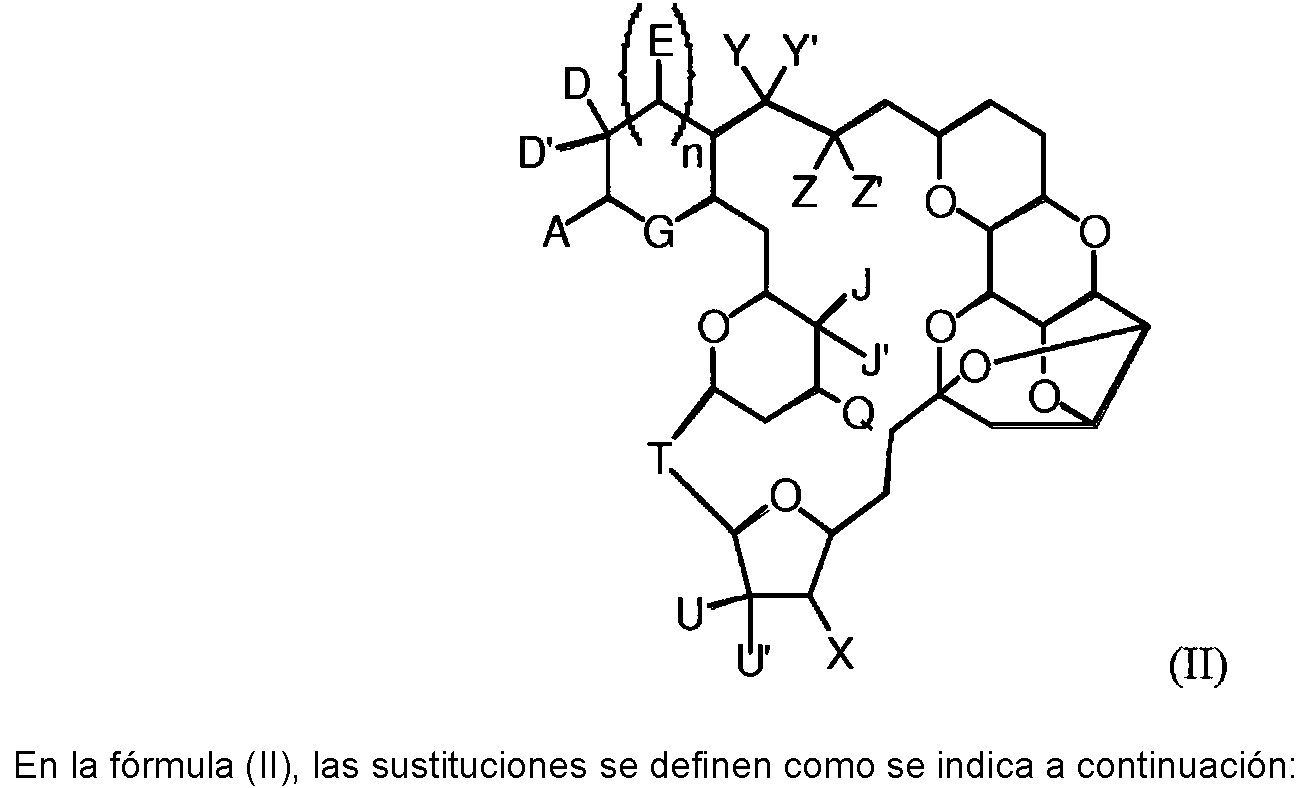
A es un esqueleto hidrocarbonado C ^ saturado o C2-6 insaturado, estando sustituido dicho esqueleto o presentando entre 1 y 10 sustituyentes, inclusive, seleccionados de forma independiente entre ciano, halo, azido, oxo, y Q1. Cada Q1 se selecciona de forma independiente entre OR1, SR1, SO2R1, OSO2R1, NR2R1, NR2(CO)R1, NR2(CO)(CO)R1, NR4(CO)NR2R1, NR2(CO)OR1, (CO)OR1, O(CO)R1, (CO)NR2R1, y O(CO)NR2R1.A is a C ^ saturated or C2-6 unsaturated hydrocarbon skeleton, said skeleton being substituted or having between 1 and 10 substituents, inclusive, independently selected from cyano, halo, azido, oxo, and Q1. Each Q1 is independently selected from OR1, SR1, SO2R1, OSO2R1, NR2R1, NR2 (CO) R1, NR2 (CO) (CO) R1, NR4 (CO) NR2R1, NR2 (CO) OR1, (CO) OR1, O (CO) R1, (CO) NR2R1, and O (CO) NR2R1.
Cada uno de R1, R2, y R4 se selecciona de forma independiente entre H, alquilo C ^ , haloalquilo C ^ , hidroxialquilo C1-6, aminoalquilo C ^ , arilo C6-10, haloarilo C6-10, hidroxiarilo C6-10, alcoxi-C1-3-arilo C 6, arilo-C6-10-alquilo C ^ , alquilo-C1-6-arilo C6-10, haloarilo-C6-10-alquilo C ^ , alquilo-C1-6-haloarilo C6-10, (alcoxi-C1-3-arilo C 6)-alquilo C1.3, radical heterocíclico C2-9, radical heterocíclico C2-9-alquilo C ^ , heteroarilo C2-9, y heteroarilo C2-9-alquilo C ^ .Each of R1, R2, and R4 is independently selected from H, C ^ alkyl, C ^ haloalkyl, C1-6 hydroxyalkyl, C ^ aminoalkyl, C6-10 aryl, C6-10 haloaryl, C6-10 hydroxyaryl, alkoxy -C1-3-C6 aryl, C6-10 aryl-C ^ alkyl, C1-6 alkyl-C6-10 aryl, C6-10 haloaryl-C ^ alkyl, C1-6 alkyl-C6-10 haloaryl , (C1-3 alkoxy-C6-aryl) -C1.3 alkyl, C2-9 heterocyclic radical, C2-9 heterocyclic radical-C ^-alkyl, C2-9 heteroaryl, and C2-9-heteroaryl-C--alkyl.
Cada uno de D y D' se selecciona de forma independiente entre R3 y OR3, en donde R3 es H, alquilo C1-3, o haloalquilo C1-3.Each of D and D 'is independently selected from R3 and OR3, where R3 is H, C1-3 alkyl, or C1-3 haloalkyl.
n es 0 o 1.n is 0 or 1.
E es R5 u OR5, en donde R5 se selecciona de forma independiente entre H, alquilo C ^ , haloalquilo C ^ , hidroxialquilo C1-6 y aminoalquilo C ^ .E is R5 or OR5, wherein R5 is independently selected from H, C ^ alkyl, C ^ haloalkyl, C1-6 hydroxyalkyl and C ^ aminoalkyl.
G es O.G is O.
Cada uno de J y J' es de forma independiente H, alcoxi C ^ , o alquilo C ^ ; o J y J' considerados juntos son =CH2. Q es alquilo C1-3.Each of J and J 'is independently H, C ^ alkoxy, or C ^ alkyl; or J and J 'considered together are = CH2. Q is C1-3 alkyl.
T es etileno o etenileno.T is ethylene or ethenylene.
Cada uno de U y U' es de forma independiente H, alcoxi C ^ , o alquilo C ^ ; o U y U' considerados juntos son =CH2. X es H o alcoxi C ^ .Each of U and U 'is independently H, C ^ alkoxy, or C ^ alkyl; or U and U 'considered together are = CH2. X is H or C ^ alkoxy.
Cada uno de Y e Y' es de forma independiente H o alcoxi C ^ ; o Y e Y' considerados juntos son =O.Each of Y and Y 'is independently H or C ^ alkoxy; or Y and Y 'considered together are = O.
Cada uno de Z y Z' es de forma independiente H o alcoxi C ^ ; o Z y Z' considerados juntos son =O.Each of Z and Z 'is independently H or C ^ alkoxy; or Z and Z 'considered together are = O.
En algunas realizaciones, los análogos de eribulina incluyen compuestos que tienen la siguiente fórmula (III): In some embodiments, eribulin analogs include compounds having the following formula (III):
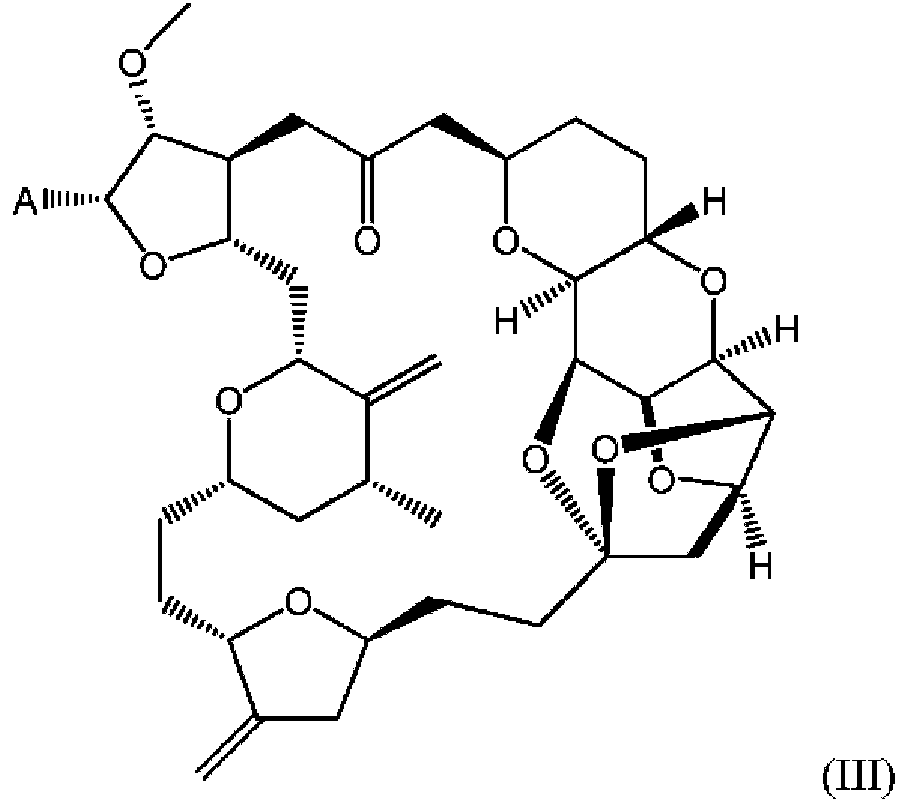
en donde A es un esqueleto hidrocarbonado C1-6 saturado o C2-6 insaturado, estando sustituido el esqueleto o presentando entre 1 y 13 sustituyentes, p.ej., entre 1 y 10 sustituyentes seleccionados entre ciano, halo, azido, Q1, y oxo;wherein A is a saturated C 1-6 hydrocarbon skeleton or unsaturated C 2-6 , the skeleton being substituted or having between 1 and 13 substituents, eg, between 1 and 10 substituents selected from cyano, halo, azido, Q 1 , and oxo;
cada Q1 se selecciona de forma independiente entre OR1, SR1, SO2R1, OSO2R1, NR2R1, NR2(CO)R1, NR2(CO)(CO)R1, NR4(CO)NR2R1, NR2(CO)OR1, (CO)OR1, O(CO)R1, (CO)NR2R1, y O(CO)NR2R1; yEach Q 1 is independently selected from OR 1 , SR 1 , SO 2 R 1 , OSO 2 R 1 , NR 2 R 1 , NR 2 (CO) R 1 , NR 2 (CO) (CO) R 1 , NR4 (CO) NR2R1, NR 2 (CO) OR 1 , (CO) OR 1 , O (CO) R 1 , (CO) NR 2 R 1 , and O (CO) NR 2 R 1 ; and
cada uno de R1, R2, y R4 se selecciona de forma independiente entre H, alquilo C1-6, haloalquilo C1-6, hidroxialquilo C1-6, aminoalquilo C1-6, arilo C6-10, haloarilo C6-10, hidroxiarilo C6-10, alcoxi-C1-4-arilo C6, arilo-C6-10-alquilo C1-6, alquilo-C1-6-arilo C6-10, haloarilo-C6-10-alquilo C1-6, alquilo-C1-6-haloarilo C6-10, (alcoxi-C1-3-arilo C6)-alquilo C1-3, radical heterocíclico C2-9, radical heterocíclico C2-9-alquilo C1.6, heteroarilo C2-9, y heteroarilo C2-9-alquilo C1-6.each of R 1, R 2 and R 4 are independently selected from H, C1-6 alkyl, C1-6 haloalkyl, hydroxy C 1 -6, C 1-6 aminoalkyl, C 6-10 aryl, C 6-10 haloaryl, hydroxyaryl C 6-10 alkoxy-C 1-4 -aryl C6, C 6-10 aryl-C 1-6 -alkyl, C 1 -6 alkyl-C 6-10 -aryl, haloarilo- C 6-10 -alkyl C 1-6 alkyl-C 1-6 -haloarilo C 10.06, (C1-3 alkoxy-C6 aryl) -C 1-3, C 2-9 heterocyclic radical, radical C 2-9 heterocyclic -C 1.6 alkyl, C 2-9 heteroaryl, and C 2-9 heteroaryl-C 1-6 alkyl.
Los esqueletos hidrocarbonados contienen átomos de carbono y de hidrógeno y pueden ser lineales, ramificados o cíclicos. Los hidrocarburos insaturados incluyen uno, dos, tres o más enlaces dobles C--C (sp2) o enlaces triples C--C (sp). Los ejemplos de radicales hidrocarbonados insaturados incluyen etinilo, 2-propinilo, 1-propenilo, 2-butenilo, 1,3-butadienilo, 2-pentenilo, vinilo (etenilo), alilo, e isopropenilo. Los ejemplos de radicales hidrocarbonados insaturados bivalentes incluyen alquenilenos y alquilidenos tales como metilidina, etilideno, etilidina, vinilideno e isopropilideno. En general, los compuestos presentan esqueletos hidrocarbonados (“A” en la fórmula (I)) que están sustituidos, p.ej., con hidroxi, amino, ciano, azido, heteroarilo, arilo y otros grupos funcionales descritos en la presente memoria. Los esqueletos hidrocarbonados pueden tener dos átomos de hidrógeno geminales reemplazados con oxo, un átomo de oxígeno de carbonilo bivalente (=O), o un sustituyente formador de anillo, tal como --O-(alquileno o alquilideno lineal o ramificado)-O-- para formar un acetal o cetal.Hydrocarbon skeletons contain carbon and hydrogen atoms and can be linear, branched or cyclic. Unsaturated hydrocarbons include one, two, three or more C-C (sp2) double bonds or C-C (sp) triple bonds. Examples of unsaturated hydrocarbon radicals include ethynyl, 2-propynyl, 1-propenyl, 2-butenyl, 1,3-butadienyl, 2-pentenyl, vinyl (ethenyl), allyl, and isopropenyl. Examples of bivalent unsaturated hydrocarbon radicals include alkenylenes and alkylidenes such as methylidine, ethylidene, ethylidine, vinylidene and isopropylidene. In general, the compounds have hydrocarbon skeletons ("A" in formula (I)) that are substituted, eg, with hydroxy, amino, cyano, azido, heteroaryl, aryl and other functional groups described herein. The hydrocarbon skeletons may have two oxo-substituted geminal hydrogen atoms, a bivalent carbonyl oxygen atom (= O), or a ring-forming substituent, such as --O- (linear or branched alkylene or alkylidene) -O- - to form an acetal or ketal.
Alquilo C1-6 incluye hidrocarburos lineales, ramificados y cíclicos, tal como metilo, etilo, propilo, isopropilo, butilo, isobutilo, sec-butilo, terc-butilo, pentilo, isopentilo, sec-pentilo, neo-pentilo, terc-pentilo, ciclopentilo, hexilo, isohexilo, sec-hexilo, ciclohexilo, 2-metilpentilo, terc-hexilo, 2,3-dimetilbutilo, 3,3-dimetilbutilo, 1,3-dimetilbutilo, y 2,3-dimetilbuti-2-ilo. Alcoxi (--OR), alquiltio (--SR), y otros grupos funcionales derivados de alquilo (sustituidos, insaturados o bivalentes) son análogos a los grupos alquilo (R). Los grupos alquilo, y los grupos derivados de alquilo tales como los grupos alcoxi, haloalquilo, hidroxialquilo, alquenilo, alquilideno y alquileno representativos pueden ser C2-6, C3-6, C1-3, o C2-4.C 1-6 alkyl includes linear, branched and cyclic hydrocarbons, such as methyl, ethyl, propyl, isopropyl, butyl, isobutyl, sec-butyl, tert-butyl, pentyl, isopentyl, sec-pentyl, neo-pentyl, tert-pentyl , cyclopentyl, hexyl, isohexyl, sec-hexyl, cyclohexyl, 2-methylpentyl, tert-hexyl, 2,3-dimethylbutyl, 3,3-dimethylbutyl, 1,3-dimethylbutyl, and 2,3-dimethylbuti-2-yl. Alkoxy (--OR), alkylthio (--SR), and other alkyl-derived functional groups (substituted, unsaturated or bivalent) are analogous to alkyl (R) groups. Alkyl groups, and alkyl derived groups such as representative alkoxy, haloalkyl, hydroxyalkyl, alkenyl, alkylidene and alkylene groups may be C 2-6 , C 3-6 , C 1-3 , or C2-4.
Los alquilos sustituidos con halógeno, hidroxi, amino, ciano, azido, etc., pueden tener 1, 2, 3, 4, 5 o más sustituyentes, que se seleccionan de forma independiente (pueden ser el mismo o no) y que pueden estar en el mismo átomo de carbono o no. Por ejemplo, los haloalquilos son grupos alquilo con al menos un sustituyente seleccionado entre flúor, cloro, bromo y iodo. Los haloalquilos pueden tener dos o más sustituyentes halo que pueden ser el mismo halógeno o no, y que pueden estar en el mismo átomo de carbono o no. Los ejemplos incluyen clorometilo, periodometilo, 3,3-dicloropropilo, 1,3-difluorobutilo, y 1-bromo-2-cloropropilo.Alkyls substituted with halogen, hydroxy, amino, cyano, azido, etc., may have 1, 2, 3, 4, 5 or more substituents, which are independently selected (they may be the same or not) and they may be in the same carbon atom or not. For example, haloalkyl are alkyl groups with at least one substituent selected from fluorine, chlorine, bromine and iodine. Haloalkyl may have two or more halo substituents that may be the same or not, and may be on the same carbon atom or not. Examples include chloromethyl, periodomethyl, 3,3-dichloropropyl, 1,3-difluorobutyl, and 1-bromo-2-chloropropyl.
Los radicales heterocíclicos y los heteroarilos incluyen furilo, piranilo, isobenzofuranilo, cromenilo, xantenilo, fenoxatienilo, 2H-pirrolilo, pirrolilo, imidazolilo (p.ej., 1-, 2- o 4-imidazolilo), pirazolilo, isotiazolilo, isoxazolilo, piridilo (p.ej., 1-, 2- o 3-piridilo), pirazinilo, pirimidinilo, piridazinilo, indolizinilo, isoindolilo, 3H-indolilo, indolilo (p.ej., 1-, 2- o 3-indolilo), indazolilo, purinilo, 4H-quinolizinilo, isoquinolilo, quinolilo, ftalazinilo, naftiridinilo, quinoxalinilo, quinazolinilo, cinnolinilo, pteridinilo, pirrolinilo, pirrolidinilo, imidazolidinilo, pirazolidinilo, pirazolinilo, piperidilo, piperazinilo, indolinilo, isoindolinilo, y morfolinilo. Los radicales heterocíclicos y los heteroarilos pueden estar ligados al resto de la molécula en cualquier posición del anillo. Los radicales heterocíclicos y los heteroarilos pueden ser C2-9, o más pequeños, tal como C3-6, C2-5, o C3-7. Heterocyclic radicals and heteroaryls include furyl, pyranyl, isobenzofuranyl, chromenyl, xanthenyl, phenoxyatienyl, 2H-pyrrolyl, pyrrolyl, imidazolyl (e.g., 1-, 2- or 4-imidazolyl), pyrazolyl, isothiazolyl, isoxazolyl, pyridyl (e.g., 1-, 2- or 3-pyridyl), pyrazinyl, pyrimidinyl, pyridazinyl, indolizinyl, isoindolyl, 3H-indolyl, indolyl (e.g., 1-, 2- or 3-indolyl), indazolyl , purinyl, 4H-quinolizinyl, isoquinolyl, quinolyl, phthalazinyl, naphthyridinyl, quinoxalinyl, quinazolinyl, cinnolinyl, pteridinyl, pyrrolinyl, pyrrolidinyl, imidazolidinyl, pyrazolidinyl, pyrazolinyl, piperidyl, piperazinyl, indolinyl, isoindolinyl, and morpholinyl. Heterocyclic radicals and heteroaryls may be linked to the rest of the molecule at any position in the ring. Heterocyclic radicals and heteroaryls may be C 2-9 , or smaller, such as C 3-6 , C 2-5 , or C 3-7 .
Los grupos arilo incluyen fenilo, bencilo, naftilo, tolilo, mesitilo, xililo y cumenilo.Aryl groups include phenyl, benzyl, naphthyl, tolyl, mesityl, xylyl and cumenyl.
Debe entenderse que “radical heterocíclico”, “arilo”, y “heteroarilo” incluyen aquellos que tienen 1, 2, 3, 4 o más sustituyentes seleccionados de forma independiente entre alquilo inferior, alcoxi inferior, amino, halo, ciano, nitro, azido y hidroxilo. Los radicales heterocíclicos, heteroarilos, y arilos también pueden ser sustituyentes bivalentes del esqueleto hidrocarbonado “A” de la fórmula (I).It should be understood that "heterocyclic radical", "aryl", and "heteroaryl" include those having 1, 2, 3, 4 or more substituents independently selected from lower alkyl, lower alkoxy, amino, halo, cyano, nitro, azido and hydroxyl. The heterocyclic radicals, heteroaryls, and aryls can also be bivalent substituents of the "A" hydrocarbon skeleton of the formula (I).
El término “análogo de eribulina” incluye profármacos de eribulina. El término “profármacos de eribulina” incluye eribulina que ha sido modificada químicamente para ser inactiva o menos activa hasta bioactivación (p.ej., metabolismo in vivo) por una enzima que rompe la porción modificada químicamente del profármaco de eribulina, proporcionando de este modo la forma activa de la eribulina.The term "eribulin analog" includes eribulin prodrugs. The term "eribulin prodrugs" includes eribulin that has been chemically modified to be inactive or less active until bioactivation (eg, in vivo metabolism ) by an enzyme that breaks the chemically modified portion of the eribulin prodrug, thereby providing the active form of eribulin.
Tal como se usa en la presente memoria, el término “análogo de eribulina” incluye todos los estereoisómeros de eribulina y otros compuestos de fórmula (I), que incluyen diastereoisómeros y enantiómeros de los mismos. “Estereoisómeros” se refiere a isómeros que difieren solo en la disposición de los átomos en el espacio. “Diastereoisómeros” se refiere a estereoisómeros que son imágenes especulares no superponibles uno respecto al otro. Por ejemplo, la Fórmula (IV) abarca eribulina y dichos estereoisómeros:As used herein, the term "eribulin analogue" includes all eribulin stereoisomers and other compounds of formula (I), which include diastereoisomers and enantiomers thereof. "Stereoisomers" refers to isomers that differ only in the arrangement of atoms in space. "Diastereoisomers" refers to stereoisomers that are non-superimposable mirror images with respect to each other. For example, Formula (IV) encompasses eribulin and such stereoisomers:

La frase “sal farmacéuticamente aceptable”, tal como se usa en la presente memoria, en una sal formada a partir de un ácido y un grupo de nitrógeno básico de eribulina o un análogo de eribulina. Los ejemplos de dichas sales incluyen sales de adición ácida y sales de adición básica, tal como sales de ácidos inorgánicos o sales de ácidos orgánicos (p.ej., sal de ácido clorhídrico, sal de ácido sulfúrico, sal de ácido bromhídrico, sal de ácido yodhídrico, sal de ácido nítrico, bisulfato, sal de ácido fosfórico, sal de ácido superfosfórico, sal de ácido isonicotínico, sal de ácido acético, sal de ácido láctico, sal de ácido salicílico, sal de ácido tartárico, sal de ácido pantoténico, sal de ácido ascórbico, sal de ácido succínico, sal de ácido maleico, sal de ácido fumárico, sal de ácido glucónico, sal de ácido sacarínico, sal de ácido fórmico, sal de ácido benzoico, sal de ácido glutámico, sal de ácido metanosulfónico, sal de ácido etanosulfónico, sal de ácido bencenosulfónico, sal de ácido p-toluenosulfónico, sal de ácido pamoico (pamoato)), así como sales de aluminio, calcio, litio, magnesio, calcio, sodio, zinc y dietanolamina. Debe entenderse que la referencia a eribulina, un análogo de la misma, o una sal farmacéuticamente aceptable de la misma, incluye sales farmacéuticamente aceptables de eribulina y sales farmacéuticamente aceptables de un análogo de la misma. Los ejemplos de dichas sales farmacéuticamente aceptables incluyen, aunque sin limitación, una sal farmacéuticamente aceptable de Fórmula I, una sal farmacéuticamente aceptable de Fórmula II, una sal farmacéuticamente aceptable de Fórmula III o una sal farmacéuticamente aceptable de Fórmula IV.The phrase "pharmaceutically acceptable salt", as used herein, in a salt formed from an acid and a basic nitrogen group of eribulin or an eribulin analog. Examples of such salts include acid addition salts and basic addition salts, such as salts of inorganic acids or salts of organic acids (eg, hydrochloric acid salt, sulfuric acid salt, hydrobromic acid salt, salt of iohydric acid, nitric acid salt, bisulfate, phosphoric acid salt, superphosphoric acid salt, isonicotinic acid salt, acetic acid salt, lactic acid salt, salicylic acid salt, tartaric acid salt, pantothenic acid salt, ascorbic acid salt, succinic acid salt, maleic acid salt, fumaric acid salt, gluconic acid salt, saccharic acid salt, formic acid salt, benzoic acid salt, glutamic acid salt, methanesulfonic acid salt, ethanesulfonic acid salt, benzenesulfonic acid salt, p-toluenesulfonic acid salt, pamoic acid salt (pamoate), as well as aluminum, calcium, lithium, magnesium, calcium, sodium, zinc and die salts Tanolamine It should be understood that the reference to eribulin, an analog thereof, or a pharmaceutically acceptable salt thereof, includes pharmaceutically acceptable salts of eribulin and pharmaceutically acceptable salts of an analog thereof. Examples of such pharmaceutically acceptable salts include, but are not limited to, a pharmaceutically acceptable salt of Formula I, a pharmaceutically acceptable salt of Formula II, a pharmaceutically acceptable salt of Formula III or a pharmaceutically acceptable salt of Formula IV.
En una realización particular, se pretende indicar mesilato de eribulina, una forma salina farmacéuticamente aceptable de la eribulina. El mesilato de eribulina se vende bajo la marca comercia1 HALAVEN®. El nombre químico correspondiente al mesilato de eribulina es 11,15:18,21:24,28-Triepoxi-7,9-etano-12,15-metano-9H,15H-furo[3,2-i]furo[2',3':5,6]pirano[4,3-b] [1,4]dioxoaciclopentacosin-5(4H)-ona, 2-[(2S)-3-amino-2-hidroxipropil]hexacosahidro-3-metoxi-26-metil-20,27-bis(metileno)-(2R,3R,3aS,7R,8aS,9S,10aR,11S,12R,13aR,13bS,15S,18S,21S,24S,26R,28R, 29aS)-metanosulfonato (sal). El mesilato de eribulina tiene la siguiente estructura: In a particular embodiment, it is intended to indicate eribulin mesylate, a pharmaceutically acceptable saline form of eribulin. Eribulin mesylate is sold under the trademark HALAVEN®. The chemical name corresponding to eribulin mesylate is 11.15: 18.25: 24.28-Triepoxy-7,9-ethane-12,15-methane-9H, 15H-furo [3,2-i] furo [2 ', 3': 5,6] pyran [4,3-b] [1,4] dioxoaciclopentacosin-5 (4H) -one, 2 - [(2S) -3-amino-2-hydroxypropyl] hexacosahydro-3- methoxy-26-methyl-20,27-bis (methylene) - (2R, 3R, 3aS, 7R, 8aS, 9S, 10aR, 11S, 12R, 13aR, 13bS, 15S, 18S, 21S, 24S, 26R, 28R, 29aS) -methanesulfonate (salt). Eribulin mesylate has the following structure:

El mesilato de eribulina está indicado para el tratamiento de pacientes con cáncer de mama metastásico que han recibido previamente al menos dos regímenes quimioterapéuticos para el tratamiento de la enfermedad metastásica, que incluyen, por ejemplo, terapia con una antraciclina y un taxano en el conjunto de adyuvante o metastásico. Eribulin mesylate is indicated for the treatment of patients with metastatic breast cancer who have previously received at least two chemotherapeutic regimens for the treatment of metastatic disease, which include, for example, therapy with an anthracycline and a taxane as a whole. adjuvant or metastatic.
Tal como se usa en la presente memoria, el término “biomarcador” pretende abarcar una sustancia que se usa como indicador de un estado biológico e incluye por ejemplo, genes (o porciones de los mismos), ARNms (o porciones de los mismos), miARNs (microARNs), y proteínas (o porciones de las mismas). Un “patrón de expresión de biomarcador” pretende referirse a un sumario cuantitativo o cualitativo de la expresión de uno o más biomarcadores en un sujeto, tal como en comparación con un estándar o un control.As used herein, the term "biomarker" is intended to encompass a substance that is used as an indicator of a biological state and includes, for example, genes (or portions thereof), mRNAs (or portions thereof), miRNAs (microRNAs), and proteins (or portions thereof). A "biomarker expression pattern" is intended to refer to a quantitative or qualitative summary of the expression of one or more biomarkers in a subject, such as in comparison to a standard or a control.
Varios biomarcadores que pueden usarse en los métodos descritos en la presente memoria se resumen en la Tabla 1. La Tabla 1 proporciona abreviaturas de genes, números Gen_ID y Números de Acceso para tránscritos a partir de los cuales se pueden identificar secuencias génicas de nucleótidos codificadoras. Por ejemplo, gen ABI3 se refiere a la familia ABI de Homo sapiens, miembro 3. La secuencia de nucleótidos correspondiente a la variante 1 de tránscrito de ABI3 se puede encontrar en el Número de Acceso NM_016428. La referencia a un gen (p.ej., ABI3) pretende abarcar las versiones naturales o endógenas del gen, que incluyen la silvestre, polimórfica o variantes alélicas o mutantes (p.ej., mutación de línea germinal, mutación somática) del gen, que pueden encontrarse en un sujeto y/o tumor de un sujeto. En algunas realizaciones, la secuencia del gen biomarcador es al menos aproximadamente el 80%, al menos aproximadamente el 85%, al menos aproximadamente el 90%, al menos aproximadamente el 91%, al menos aproximadamente el 92%, al menos aproximadamente el 93%, al menos aproximadamente el 94%, al menos aproximadamente el 95%, al menos aproximadamente el 96%, al menos aproximadamente el 97%, al menos aproximadamente el 98%, o al menos aproximadamente el 99% idéntica a una secuencia identificada en la Tabla 1 mediante el Número de Acceso o el número Gen_ID. Por ejemplo, la identidad de secuencia se puede determinar comparando secuencias usando NCBI BLAST (p.ej., Megablast con los parámetros por defecto).Several biomarkers that can be used in the methods described herein are summarized in Table 1. Table 1 provides abbreviations of genes, Gen_ID numbers and Access Numbers for transcripts from which gene sequences of coding nucleotides can be identified. For example, ABI3 gene refers to the ABI family of Homo sapiens, member 3. The nucleotide sequence corresponding to the transcript variant 1 of ABI3 can be found in Accession Number NM_016428. The reference to a gene (eg, ABI3) is intended to cover natural or endogenous versions of the gene, including wild, polymorphic or allelic or mutant variants (eg, germline mutation, somatic mutation) of the gene , which can be found in a subject and / or tumor of a subject. In some embodiments, the biomarker gene sequence is at least about 80%, at least about 85%, at least about 90%, at least about 91%, at least about 92%, at least about 93 %, at least about 94%, at least about 95%, at least about 96%, at least about 97%, at least about 98%, or at least about 99% identical to a sequence identified in Table 1 through the Access Number or the Gen_ID number. For example, sequence identity can be determined by comparing sequences using NCBI BLAST (eg, Megablast with the default parameters).
Tal como se usa en la presente memoria, la frase “firma genética predictiva” se refiere a los niveles de expresión de dos o más biomarcadores de la presente invención en un sujeto que son indicativos de la capacidad de respuesta al tratamiento con eribulina, o un análogo de eribulina. Por ejemplo, la expresión de nivel bajo de al menos 2, al menos 3, al menos 4, al menos 5, al menos 6, al menos 7, al menos 8, al menos 9 o al menos 10 biomarcadores de la Tabla 1 en un sujeto puede constituir una firma genética que indica que el sujeto responderá positivamente al tratamiento con eribulina, un análogo de la misma, o una sal farmacéuticamente aceptable de la misma (p.ej., mesilato de eribulina). Cualquier sub-combinación de 2 o más marcadores de la Tabla 1 puede constituir una firma genética predictiva de la invención. En otro ejemplo, la expresión de al menos 1, al menos 2, al menos 3, al menos 4, al menos 5, al menos 6, al menos 7, al menos 8, al menos 9 o al menos 10 biomarcadores de la Tabla 1 por debajo de niveles de umbral particulares, o cualquier sub-combinación de los mismos, constituye una firma genética que indica que el sujeto responderá positivamente al tratamiento con eribulina, un análogo de la misma, o una sal farmacéuticamente aceptable de la misma (p.ej., mesilato de eribulina).As used herein, the phrase "predictive genetic signature" refers to the expression levels of two or more biomarkers of the present invention in a subject that are indicative of the responsiveness to eribulin treatment, or a Eribulin analog. For example, the low level expression of at least 2, at least 3, at least 4, at least 5, at least 6, at least 7, at least 8, at least 9 or at least 10 biomarkers of Table 1 in A subject may constitute a genetic signature indicating that the subject will respond positively to treatment with eribulin, an analogue thereof, or a pharmaceutically acceptable salt thereof (eg, eribulin mesylate). Any sub-combination of 2 or more markers in Table 1 may constitute a predictive genetic signature of the invention. In another example, the expression of at least 1, at least 2, at least 3, at least 4, at least 5, at least 6, at least 7, at least 8, at least 9 or at least 10 biomarkers of the Table 1 below particular threshold levels, or any sub-combination thereof, constitutes a genetic signature indicating that the subject will respond positively to treatment with eribulin, an analogue thereof, or a pharmaceutically acceptable salt thereof (p .ej., eribulin mesylate).
Una “expresión de nivel bajo” del biomarcador, por ejemplo, un biomarcador seleccionado del grupo de biomarcadores enumerado en la Tabla 1, se refiere a un nivel de expresión del biomarcador en una muestra de ensayo (p.ej., una muestra derivada de un sujeto) que se correlaciona con la sensibilidad a la eribulina, un análogo de la misma, o una sal farmacéuticamente aceptable de la misma (p.ej., mesilato de eribulina). Esto puede determinarse comparando el nivel de expresión del biomarcador en la muestra de ensayo con el de un control adecuado. Un “nivel bajo de expresión” también incluye una falta de expresión detectable del biomarcador.A "low level expression" of the biomarker, for example, a biomarker selected from the group of biomarkers listed in Table 1, refers to a biomarker expression level in a test sample (eg, a sample derived from a subject) that correlates with eribulin sensitivity, an analog thereof, or a pharmaceutically acceptable salt thereof (eg, eribulin mesylate). This can be determined by comparing the level of expression of the biomarker in the test sample with that of an appropriate control. A "low level of expression" also includes a lack of detectable expression of the biomarker.
En algunas realizaciones, el nivel de expresión del biomarcador se determina respecto a una muestra de control, tal como el nivel de expresión del biomarcador en tejido normal (p.ej., un rango determinado a partir de los niveles de expresión del biomarcador observados en muestras de tejido normal). En dichas realizaciones, un nivel bajo de expresión estará por debajo o dentro de los límites inferiores de dicho rango. En algunas realizaciones, el nivel de expresión del biomarcador se determina respecto a una muestra de control, tal como el nivel de expresión del biomarcador en muestras (p.ej., muestras tumorales, células tumorales en circulación) de otros sujetos. Por ejemplo, se puede determinar el nivel de expresión del biomarcador en muestras de otros sujetos para definir los niveles de expresión que se correlacionan con la sensibilidad al tratamiento con eribulina, un análogo de la misma, o una sal farmacéuticamente aceptable de la misma (p.ej., mesilato de eribulina), y el nivel de expresión del biomarcador en la muestra del sujeto de interés se compara con dichos niveles de expresión, en donde un nivel de expresión comparable o inferior en la muestra procedente del sujeto es indicativo de un “bajo nivel de expresión” del biomarcador en la muestra. En otro ejemplo, se puede determinar el nivel de expresión del biomarcador en muestras (p.ej., muestras tumorales, células tumorales en circulación) procedentes de otros sujetos para definir los niveles de expresión que se correlacionan con resistencia o falta de respuesta al tratamiento con eribulina, un análogo de la misma, o una sal farmacéuticamente aceptable de la misma (p.ej., mesilato de eribulina), y el nivel de expresión del biomarcador en la muestra procedente del sujeto de interés se compara con dichos niveles de expresión, en donde un nivel de expresión más bajo en la muestra del sujeto es indicativo de un “nivel bajo de expresión” del biomarcador en la muestra.In some embodiments, the level of expression of the biomarker is determined relative to a control sample, such as the level of expression of the biomarker in normal tissue (eg, a range determined from the levels of expression of the biomarker observed in normal tissue samples). In said embodiments, a low level of expression will be below or within the lower limits of said range. In some embodiments, the level of expression of the biomarker is determined with respect to a control sample, such as the level of expression of the biomarker in samples (eg, tumor samples, circulating tumor cells) of other subjects. For example, the level of expression of the biomarker in samples of other subjects can be determined to define the levels of expression that correlates with sensitivity to treatment with eribulin, an analogue thereof, or a pharmaceutically acceptable salt thereof (eg, eribulin mesylate), and the level of expression of the biomarker in the sample of the subject of Interest is compared with such expression levels, where a comparable or lower level of expression in the sample from the subject is indicative of a "low level of expression" of the biomarker in the sample. In another example, the level of expression of the biomarker can be determined in samples (eg, tumor samples, circulating tumor cells) from other subjects to define expression levels that correlate with resistance or lack of response to treatment. with eribulin, an analogue thereof, or a pharmaceutically acceptable salt thereof (eg, eribulin mesylate), and the level of expression of the biomarker in the sample from the subject of interest is compared with said expression levels. , where a lower level of expression in the subject's sample is indicative of a "low level of expression" of the biomarker in the sample.
El término “nivel estándar conocido” o “nivel de control” puede referirse a un nivel de expresión aceptado o pre determinado del biomarcador, por ejemplo, un biomarcador seleccionado del grupo de biomarcadores enumerados en la Tabla 1, que se usa para comparar con el nivel del biomarcador en una muestra derivada de un sujeto. En una realización, el nivel de expresión de control del biomarcador es el nivel de expresión promedio del biomarcador en muestras derivadas de una población de sujetos. Por ejemplo, el nivel de expresión de control puede ser el nivel de expresión promedio del biomarcador en células de cáncer de mama derivadas de una población de sujetos con cáncer de mama. La población pueden ser sujetos que no han respondido al tratamiento con eribulina, un análogo de la misma, o una sal farmacéuticamente aceptable de la misma (p.ej., mesilato de eribulina), o la población puede ser un grupo de sujetos que expresan el respectivo biomarcador en niveles altos o normales. En algunas realizaciones, el nivel de control puede constituir un rango de expresión del biomarcador en tejido normal, como se ha descrito anteriormente. Por ejemplo, el nivel de control puede constituir un rango de expresión del biomarcador en muestras tumorales procedentes de una variedad de sujetos que padecen cáncer de mama, tal como se ha descrito anteriormente.The term "known standard level" or "control level" may refer to a level of accepted or pre-determined expression of the biomarker, for example, a biomarker selected from the group of biomarkers listed in Table 1, which is used to compare with the Biomarker level in a sample derived from a subject. In one embodiment, the biomarker control expression level is the average biomarker expression level in samples derived from a population of subjects. For example, the level of control expression may be the average expression level of the biomarker in breast cancer cells derived from a population of subjects with breast cancer. The population may be subjects that have not responded to treatment with eribulin, an analogue thereof, or a pharmaceutically acceptable salt thereof (eg, eribulin mesylate), or the population may be a group of subjects expressing the respective biomarker at high or normal levels. In some embodiments, the level of control may constitute a range of expression of the biomarker in normal tissue, as described above. For example, the level of control may constitute a range of biomarker expression in tumor samples from a variety of subjects suffering from breast cancer, as described above.
Según se vaya disponiendo de más información como resultado de la aplicación rutinaria de los métodos descritos en la presente memoria, se pueden usar los valores promedio de población para el nivel de expresión de “control” de los biomarcadores de la presente invención. En otras realizaciones, el nivel de expresión de “control” de los biomarcadores se puede determinar determinando el nivel de expresión del biomarcador respectivo en una muestra sujeto obtenida de un sujeto antes del inicio sospechado del cáncer de mama en el sujeto, a partir de muestras sujeto archivadas, etcétera.As more information becomes available as a result of the routine application of the methods described herein, the average population values can be used for the level of "control" expression of the biomarkers of the present invention. In other embodiments, the level of "control" expression of the biomarkers can be determined by determining the level of expression of the respective biomarker in a subject sample obtained from a subject before the suspected onset of breast cancer in the subject, from samples subject filed, etc.
Los niveles de expresión de control de biomarcadores de la invención pueden encontrarse disponibles en bases de datos disponibles públicamente. Adicionalmente, se pueden usar como controles “Universal Reference Total RNA” (Clontech Laboratories) y “Universal Human Reference RNA” (Stratagene) y similares. Por ejemplo, se puede usar qPCR para determinar el nivel de expresión de un biomarcador, y un aumento en el número de ciclos necesarios para detectar la expresión de un biomarcador en una muestra procedente de un sujeto, respecto al número de ciclos necesarios para la detección usando dicho control, es indicativo de un nivel bajo de expresión del biomarcador. The biomarker control expression levels of the invention may be available in publicly available databases. Additionally, "Universal Reference Total RNA" (Clontech Laboratories) and "Universal Human Reference RNA" (Stratagene) and the like can be used as controls. For example, qPCR can be used to determine the level of expression of a biomarker, and an increase in the number of cycles necessary to detect the expression of a biomarker in a sample from a subject, with respect to the number of cycles necessary for detection using said control, it is indicative of a low level of biomarker expression.
Tal como se usa en la presente memoria, el término “sujeto” o “paciente” se refiere a animales humanos y no humanos, p.ej., pacientes veterinarios. El término “animal no humano” incluye vertebrados, p.ej., mamíferos, tales como primates no humanos, ratones, conejos, ovejas, perro, gato, caballo, vaca u otra especie de roedor, ovino, canino, felino, equino o bovino. En una realización, el sujeto es un humano.As used herein, the term "subject" or "patient" refers to human and non-human animals, eg, veterinary patients. The term "non-human animal" includes vertebrates, eg, mammals, such as non-human primates, mice, rabbits, sheep, dog, cat, horse, cow or other rodent species, sheep, canine, feline, equine or bovine. In one embodiment, the subject is a human.
El término “muestra” tal como se usa en la presente memoria se refiere a células, tejidos o fluidos aislados de un sujeto, así como células, tejidos o fluidos presentes en un sujeto. El término “muestra” incluye cualquier fluido corporal (p.ej., sangre, linfa, fluido quístico, aspirados de pezón, orina y fluidos recolectados de una biopsia (p.ej., biopsia de bulto)), tejido o una células o colección de células de un sujeto, así como cualquier componente de los mismos, tal como una fracción o extracto. En una realización, el tejido o célula ha sido extraído del sujeto. Otras muestras incluyen lágrimas, plasma, suero, fluido cerebroespinal, heces, esputo y extractos celulares. En una realización, la muestra contiene proteína (p.ej., proteínas o péptidos) procedente del sujeto. En otra realización, la muestra contiene ARN (p.ej., moléculas de ARNm) procedente del sujeto o ADN (p.ej., moléculas de ADN genómico) procedentes del sujeto. The term "sample" as used herein refers to cells, tissues or fluids isolated from a subject, as well as cells, tissues or fluids present in a subject. The term "sample" includes any body fluid (eg, blood, lymph, cystic fluid, nipple aspirates, urine and fluids collected from a biopsy (eg, lump biopsy)), tissue or a cell or collection of cells of a subject, as well as any component thereof, such as a fraction or extract. In one embodiment, the tissue or cell has been removed from the subject. Other samples include tears, plasma, serum, cerebrospinal fluid, feces, sputum and cell extracts. In one embodiment, the sample contains protein (eg, proteins or peptides) from the subject. In another embodiment, the sample contains RNA (eg, mRNA molecules) from the subject or DNA (eg, genomic DNA molecules) from the subject.
Tal como se usa en la presente memoria, el término “cáncer de mama” se refiere generalmente al crecimiento incontrolado de tejido de mama y, más específicamente, a una afección que se caracteriza por la proliferación anómala rápida de células anormales en una o ambas mamas de un sujeto. Las células anormales a menudo son referidas como células malignas o “células neoplásicas”, que son células transformadas que pueden formar un tumor sólido. El término “tumor” se refiere a una masa anormal o población anormal de células (es decir, dos o más células) que es el resultado de una división celular excesiva o anormal, tanto maligna como benigna, y células pre-cancerosas y cancerosas. Los tumores malignos se distinguen de los crecimientos o tumores benignos en que, además de la proliferación celular incontrolada, pueden invadir los tejidos circundantes y pueden metastatizarse. En el cáncer de mama, las células neoplásicas pueden identificarse en una o ambas mamas solo y no en ningún otro tejido u órgano, en una o ambas mamas y en uno o más tejidos u órganos adyacentes (p.ej., nodo linfático), en un una mama y en uno o más tejidos u órganos no adyacentes a los cuales han metastatizado las células de cáncer de mama. As used herein, the term "breast cancer" generally refers to uncontrolled growth of breast tissue and, more specifically, to a condition characterized by rapid abnormal proliferation of abnormal cells in one or both breasts. of a subject. Abnormal cells are often referred to as malignant cells or "neoplastic cells," which are transformed cells that can form a solid tumor. The term "tumor" refers to an abnormal mass or abnormal population of cells (ie, two or more cells) that is the result of excessive or abnormal cell division, both malignant and benign, and pre-cancerous and cancerous cells. Malignant tumors differ from benign growths or tumors in that, in addition to uncontrolled cell proliferation, they can invade surrounding tissues and metastasize. In breast cancer, neoplastic cells can be identified in one or both breasts alone and not in any other tissue or organ, in one or both breasts and in one or more adjacent tissues or organs (e.g., lymph node), in one breast and in one or more tissues or organs not adjacent to which the breast cancer cells have metastasized.
La eribulina, un análogo de la misma, o una sal farmacéuticamente aceptable de la misma, pueden usarse para tratar el cáncer de mama, y, por consiguiente, los métodos de la presente invención pueden usarse en el cáncer de mama y en sujetos que padecen cáncer de mama.Eribulin, an analogue thereof, or a pharmaceutically acceptable salt thereof, can be used to treat breast cancer, and, therefore, the methods of the present invention can be used in breast cancer and in subjects suffering from it. breast cancer
En una realización, el cáncer de mama es cáncer de mama negativo de Receptor de Estrógeno (ER), cáncer de mama negativo de Receptor de Progesterona (PR) y/o cáncer de mama negativo de HER-2. Por ejemplo, el cáncer de mama puede ser cáncer de mama negativo de Receptor de Estrógeno (ER) y negativo de Receptor de Progesterona (PR); cáncer de mama negativo de Receptor de Estrógeno (ER) y negativo de HER-2; cáncer de mama negativo de Receptor de Progesterona (PR) y negativo de HER-2; o cáncer de mama negativo de Receptor de Estrógeno (ER), cáncer de mama negativo de Receptor de Progesterona (PR) y cáncer de mama negativo de HER-2 (triple negativo). La determinación del estatus ER, PR y HER-2 se puede realizar usando cualquier método adecuado. Por ejemplo, el estatus de HER-2 se puede determinar mediante inmunohistoquímica (IHC) y/o amplificación génica mediante hibridación in situ de fluorescencia (FISH), por ejemplo según las guías de la “National Comprehensive Cancer Network” [NCCN].In one embodiment, the breast cancer is estrogen receptor negative (ER) breast cancer, Progesterone Receptor (PR) negative breast cancer and / or HER-2 negative breast cancer. For example, breast cancer may be estrogen receptor negative (ER) and progesterone receptor negative (PR); estrogen receptor negative (ER) and HER-2 negative breast cancer; Progesterone Receptor (PR) negative and HER-2 negative breast cancer; or Estrogen Receptor (ER) negative breast cancer, Progesterone Receptor (PR) negative breast cancer and HER-2 (triple negative) negative breast cancer. The determination of ER, PR and HER-2 status can be performed using any suitable method. For example, the status of HER-2 can be determined by immunohistochemistry (IHC) and / or gene amplification by fluorescence in situ hybridization (FISH), for example according to the guidelines of the "National Comprehensive Cancer Network" [NCCN].
Por ejemplo, el cáncer de mama puede ser adenocarcinoma, cáncer de mama inflamatorio, cáncer de mama recurrente (p.ej., recurrente localmente) y/o metastásico. En algunas realizaciones, el cáncer de mama es refractario endocrino o refractario a hormona. Los términos “refractario endocrino” y “refractario a hormona” se refieren a un cáncer que es resistente al tratamiento con terapia hormonal para el cáncer de mama, p.ej., inhibidores de aromatasa o tamoxifen. Los cánceres de mama surgen con mayor frecuencia en el recubrimiento de los conductos lácteos de la mama (carcinoma ductal), o en los lóbulos en los que se produce la leche (carcinoma lobular). Por consiguiente, en varias realizaciones de la invención, el cáncer de mama puede ser carcinoma ductal o carcinoma lobular. Las células cancerosas de la(s) mama(s) pueden invadir o metastatizarse a cualquier otro órgano o tejido del cuerpo. Por ejemplo, las células cancerosas a menudo invaden células de nodos linfáticos y/o se metastatizan al hígado, cerebro y/o hueso. For example, breast cancer can be adenocarcinoma, inflammatory breast cancer, recurrent breast cancer (eg, locally recurrent) and / or metastatic. In some embodiments, breast cancer is endocrine refractory or hormone refractory. The terms "endocrine refractory" and "hormone refractory" refer to a cancer that is resistant to treatment with hormonal therapy for breast cancer, eg, aromatase or tamoxifen inhibitors. Breast cancers arise more frequently in the lining of the milk ducts of the breast (ductal carcinoma), or in the lobes in which milk is produced (lobular carcinoma). Accordingly, in several embodiments of the invention, breast cancer can be ductal carcinoma or lobular carcinoma. Cancer cells of the breast (s) can invade or metastasize to any other organ or tissue in the body. For example, cancer cells often invade lymph node cells and / or metastasize to the liver, brain and / or bone.
En varias realizaciones de la presente invención, el sujeto puede estar padeciendo cáncer de mama de Estadio I, Estadio II, Estadio III o Estadio IV. El estadio de un cáncer de mama puede clasificarse como un rango de estadios entre Estadio 0 y Estadio IV en base a su tamaño y al grado en el que se ha extendido. La siguiente tabla resume los estadios, que son bien conocidos por los médicos:In various embodiments of the present invention, the subject may be suffering from stage I, stage II, stage III or stage IV breast cancer. The stage of a breast cancer can be classified as a range of stages between Stage 0 and Stage IV based on its size and the extent to which it has spread. The following table summarizes the stages, which are well known to doctors:

En las siguientes subsecciones se describen varios aspectos de la invención con más detalle.Several aspects of the invention are described in more detail in the following subsections.
I. Predicción de la capacidad de respuesta a la eribulina, un análogo de la misma, o una sal farmacéuticamente aceptable de la misma (p.ej., mesilato de eribulina) en sujetos con cáncer de mamaI. Prediction of responsiveness to eribulin, an analogue thereof, or a pharmaceutically acceptable salt thereof (eg, eribulin mesylate) in subjects with breast cancer
En un aspecto, la invención proporciona un método para determinar si la eribulina, un análogo de la misma, o una sal farmacéuticamente aceptable de la misma (p.ej., mesilato de eribulina), puede usarse para tratar un sujeto que padece cáncer de mama y/o para determinar la sensibilidad de un tumor de mama al tratamiento con eribulina, un análogo de la misma, o una sal farmacéuticamente aceptable de la misma (p.ej., mesilato de eribulina). Los métodos implican la determinación del nivel de expresión de al menos un biomarcador, por ejemplo, evaluando una muestra derivada de un sujeto que padece cáncer de mama. La identificación de niveles bajos de expresión de al menos un biomarcador es indicativa de que la eribulina, un análogo de la misma, o una sal farmacéuticamente aceptable de la misma (p.ej., mesilato de eribulina) puede usarse para el tratamiento del cáncer de mama y/o que el tumor de mama es sensible al tratamiento con eribulina, un análogo de la misma, o una sal farmacéuticamente aceptable de la misma (p.ej., mesilato de eribulina).In one aspect, the invention provides a method for determining whether eribulin, an analog thereof, or a pharmaceutically acceptable salt thereof (e.g., eribulin mesylate), can be used to treat a subject suffering from cancer of breast and / or to determine the sensitivity of a breast tumor to treatment with eribulin, an analogue thereof, or a pharmaceutically acceptable salt thereof (eg, eribulin mesylate). The methods involve determining the level of expression of at least one biomarker, for example, by evaluating a sample derived from a subject suffering from breast cancer. The identification of low levels of expression of at least one biomarker is indicative that eribulin, an analog thereof, or a pharmaceutically acceptable salt thereof (eg, eribulin mesylate) can be used for the treatment of cancer. of breast cancer and / or that the breast tumor is sensitive to treatment with eribulin, an analogue thereof, or a pharmaceutically acceptable salt thereof (eg, eribulin mesylate).
En los métodos de la invención, se determina el nivel de expresión de al menos un biomarcador seleccionado del grupo de biomarcadores establecido en la Tabla 1, que, como se ha explicado en la presente memoria, puede comprender determinar el nivel de expresión de uno o más de estos genes (p.ej., ABI3, ANG) usando diversas aproximaciones, tal como determinar en una muestra adecuada la presencia de determinados polimorfismos de ADN o mutaciones nulas, determinando el nivel de ARN expresado a partir de un gen, que incluye un ARNm ejemplificado en la Tabla 1 y/u otros tránscritos a partir del gen, o un(os) producto(s) de proteína de cualquiera de los anteriores. In the methods of the invention, the level of expression of at least one biomarker selected from the group of biomarkers established in Table 1 is determined, which, as explained herein, may comprise determining the level of expression of one or more more of these genes (eg, ABI3, ANG) using various approaches, such as determining in a suitable sample the presence of certain DNA polymorphisms or null mutations, determining the level of RNA expressed from a gene, which includes an mRNA exemplified in Table 1 and / or other transcripts from the gene, or a protein product (s) of any of the above.
Tabla 1: Biomarcadores de capacidad de respuesta a eribulina, un análogo de la misma, o una sal farmacéuticamente aceptable de la misma (p.ej., mesilato de eribulina)Table 1: Biomarkers of responsiveness to eribulin, an analogue thereof, or a pharmaceutically acceptable salt thereof (eg, eribulin mesylate)
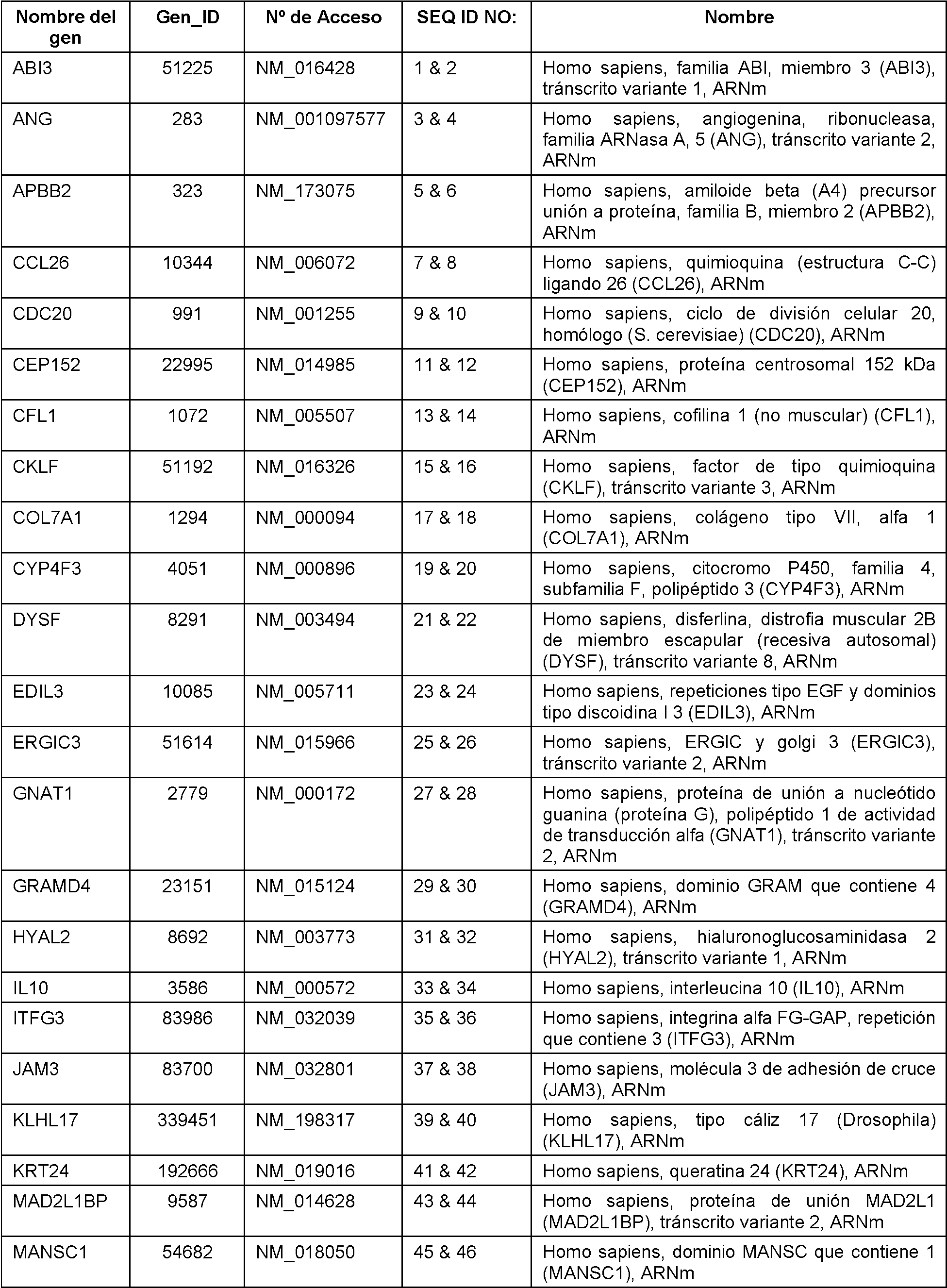
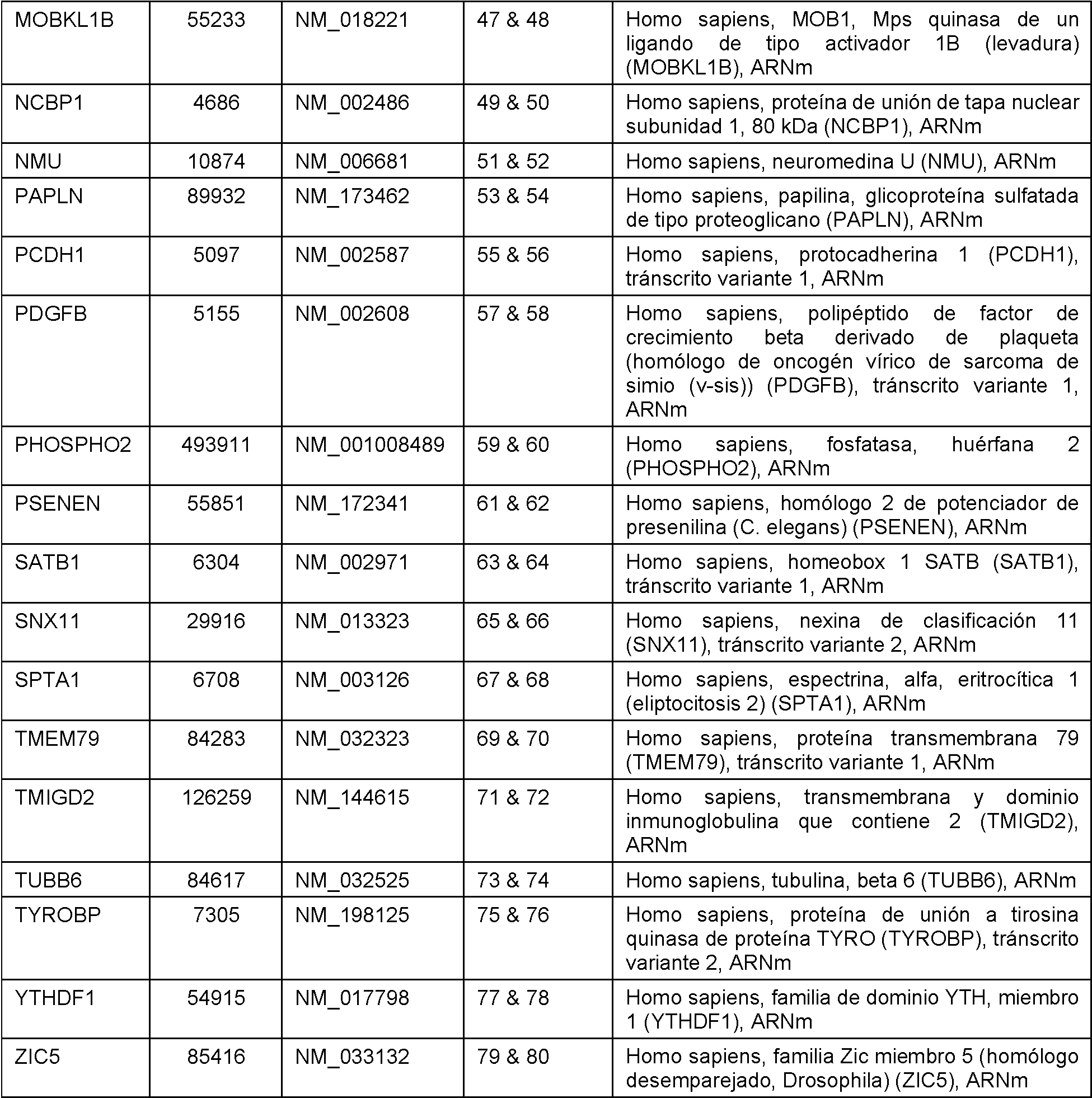
Cada uno de los números de acceso identificados en la Tabla 1, y sus correspondientes secuencias, se incorporan a la presente memoria a modo de referencia.Each of the access numbers identified in Table 1, and their corresponding sequences, are incorporated herein by reference.
En varias realizaciones, se determina el nivel de expresión de al menos 2, 3, 4, 5, 6, 7, 8, 9 o 10 biomarcadores seleccionados del grupo de biomarcadores enumerados en la Tabla 1.In several embodiments, the expression level of at least 2, 3, 4, 5, 6, 7, 8, 9 or 10 biomarkers selected from the group of biomarkers listed in Table 1 is determined.
En realizaciones particulares, se usa una firma genética predictiva que comprende una sub-combinación de 2 más biomarcadores seleccionados del grupo de biomarcadores enumerados en la Tabla 1. En varias realizaciones, se determina el nivel de expresión de al menos 2, al menos 3, al menos 4 o al menos 5 biomarcadores seleccionados del grupo de biomarcadores enumerados en la Tabla 1. Por ejemplo, la firma genética predictiva puede incluir al menos 2 biomarcadores, p.ej., DYSF y EDIL3; GNAT1 y ERGIC3; KRT24 y PAPLN; MANSC1 y PDGFB; PCDH1 y PDGFB; o PHOSPHO2 y PSENEN. En otra realización, la firma genética predictiva puede incluir al menos 3 biomarcadores, p.ej., COL7A1, YTHDF1 y ZIC5; CKLF, IL10 y TUBB6; CDC20, CFL1 y TMEM79; HYAL2, NCBP1 y SNX11; o CEP152, NCBP1 y SATB1. En otra realización, la firma genética predictiva puede incluir al menos 4 biomarcadores, p.ej., APBB2, CCL26, PSENEN y SATB1; ANG, JAM3, KLHL17 y PAPLN; ITFG3, MAD2L1BP, NMU y PDGFB; SPTA1, TYROBP, SNX11 y PSENEN; GRAMD4, GNAT1, TMIGD2 y YTHDF1; o GRAMD4, HYAL2, PHOSPHO2 y TUBB6. En otra realización, la firma genética predictiva puede incluir al menos 5 biomarcadores, p.ej., CCL26, CDC20, ERGIC3, EDIL3 y PCDH1; DYSF, NMU, PHOSPHO2, PSENEN y SNX11; APBB2, CKLF, CYP4F3, TUBB6 y YTHDF1; o CEP152, MAD2L1BP, SPTA1, TMEM79 y ZIC5. In particular embodiments, a predictive genetic signature is used comprising a sub-combination of 2 more biomarkers selected from the group of biomarkers listed in Table 1. In several embodiments, the expression level of at least 2, at least 3, is determined. at least 4 or at least 5 biomarkers selected from the group of biomarkers listed in Table 1. For example, the predictive genetic signature may include at least 2 biomarkers, eg, DYSF and EDIL3; GNAT1 and ERGIC3; KRT24 and PAPLN; MANSC1 and PDGFB; PCDH1 and PDGFB; or PHOSPHO2 and PSENEN. In another embodiment, the predictive genetic signature may include at least 3 biomarkers, eg, COL7A1, YTHDF1 and ZIC5; CKLF, IL10 and TUBB6; CDC20, CFL1 and TMEM79; HYAL2, NCBP1 and SNX11; or CEP152, NCBP1 and SATB1. In another embodiment, the predictive genetic signature may include at least 4 biomarkers, eg, APBB2, CCL26, PSENEN and SATB1; ANG, JAM3, KLHL17 and PAPLN; ITFG3, MAD2L1BP, NMU and PDGFB; SPTA1, TYROBP, SNX11 and PSENEN; GRAMD4, GNAT1, TMIGD2 and YTHDF1; or GRAMD4, HYAL2, PHOSPHO2 and TUBB6. In another embodiment, the predictive genetic signature may include at least 5 biomarkers, eg, CCL26, CDC20, ERGIC3, EDIL3 and PCDH1; DYSF, NMU, PHOSPHO2, PSENEN and SNX11; APBB2, CKLF, CYP4F3, TUBB6 and YTHDF1; or CEP152, MAD2L1BP, SPTA1, TMEM79 and ZIC5.
En realizaciones particulares, la firma genética predictiva puede incluir 2 o más de los biomarcadores ABI3, ANG, APBB2, CCL26, CDC20, CEP152, CFL1, CKLF, COL7A1, CYP4F3, DYSF, GNAT1, GRAMD4, HYAL2, IL10, ITFG3, JAM3, KLHL17, KRT24, MAD2L1BP, MANSC1, MOBKL1B, NCBP1, NMU, PCDH1, PHOSPHO2, SPTA1, TMIGD2, TYROBP, ZIC5, ERGIC3, PDGFB, PSENEN, SATB1, SNX11, TMEM79 e YTHDF1, p.ej., ABI3 y ANG; APBB2 y CCL26; GNAT1 y GRAMD4; IL10 e ITFG3; MACSC1 y MOBKL1B; NMU y PCDH1; o TYROBP y ZIC5. En otras realizaciones, la firma genética predictiva incluye al menos 3 de los biomarcadores enumerados previamente, p.ej., ABI3, ANG y APBB2; CCL26, CKLF y COL7A1; DYSF, GNAT1 y HYAL2; JAM3, KLHL17 y KRT24; NCBP1, NMU y PCDH1; SPTA1, TMIGD2 y TYROBP; o ZIC5, MAD2L1BP y CDC20. En otras realizaciones, la firma genética predictiva incluye al menos 4 de los biomarcadores enumerados previamente, p.ej., ABI3, ANG, APBB2 y CCL26; CEP152, CFL1, CKLF y COL7A1; KRT24, MANSC1, MOBKL1B y SPTA1; TYROBP, TMIGD2, PHOSPHO2 y NMU; ABI3, GNAT1, KLHL17 y SPTA1; o CEP152, HYAL2, PCDH1 y TMIGD2. En otras realizaciones adicionales, la firma genética predictiva incluye al menos 5 de los biomarcadores enumerados previamente, p.ej., CKLF, COL7A1, GRAMD4, JAM3 y PCDH1; APBB2, CEP152, DYSF, IL10 y TYROBP; CYP4F3, HYAL2, ITFG3, KLHL17 y KRT24; NCBP1, SPTA1, TMIGD2, IL10 y JAM3; o CCL26, PHOSPHO2, SPTA1, TMIGD2 y ZIC5.In particular embodiments, the predictive genetic signature may include 2 or more of the biomarkers ABI3, ANG, APBB2, CCL26, CDC20, CEP152, CFL1, CKLF, COL7A1, CYP4F3, DYSF, GNAT1, GRAMD4, HYAL2, IL10, ITFG3, JAM3, KLHL17, KRT24, MAD2L1BP, MANSC1, MOBKL1B, NCBP1, NMU, PCDH1, PHOSPHO2, SPTA1, TMIGD2, TYROBP, ZIC5, ERGIC3, PDGFB, PSENEN, SATB1, SNX11, TMEM79 and YTHDF1, and YJD.F1, YJD.F1, YTHDF1, P3 and YTHDF1, E and ANGJ, P3, YJD, P1, E3 and YJD, P1, E3 and YJD, P1, E3 and YJD, P1, E3 and YJD, P1, E3 and YJD, P3, E3 and YJD, P3, E3 and YJD, P3, E3 and Y3; APBB2 and CCL26; GNAT1 and GRAMD4; IL10 and ITFG3; MACSC1 and MOBKL1B; NMU and PCDH1; or TYROBP and ZIC5. In other embodiments, the predictive genetic signature includes at least 3 of the biomarkers listed previously, eg, ABI3, ANG and APBB2; CCL26, CKLF and COL7A1; DYSF, GNAT1 and HYAL2; JAM3, KLHL17 and KRT24; NCBP1, NMU and PCDH1; SPTA1, TMIGD2 and TYROBP; or ZIC5, MAD2L1BP and CDC20. In other embodiments, the predictive genetic signature includes at least 4 of the biomarkers listed previously, eg, ABI3, ANG, APBB2 and CCL26; CEP152, CFL1, CKLF and COL7A1; KRT24, MANSC1, MOBKL1B and SPTA1; TYROBP, TMIGD2, PHOSPHO2 and NMU; ABI3, GNAT1, KLHL17 and SPTA1; or CEP152, HYAL2, PCDH1 and TMIGD2. In other additional embodiments, the predictive genetic signature includes at least 5 of the biomarkers listed previously, eg, CKLF, COL7A1, GRAMD4, JAM3 and PCDH1; APBB2, CEP152, DYSF, IL10 and TYROBP; CYP4F3, HYAL2, ITFG3, KLHL17 and KRT24; NCBP1, SPTA1, TMIGD2, IL10 and JAM3; or CCL26, PHOSPHO2, SPTA1, TMIGD2 and ZIC5.
En otras realizaciones, la firma genética predictiva puede incluir 2 o más de los biomarcadores ERGIC3, PDGFB, PSENEN, SATB1, SNX11, TMEM79 o Yt Hd F1, o cualquier sub-combinación de los mismos, p.ej., ERGIC3 y PDGFB; ERGIC3 y PSENEN; ERGIC3 y SATB1; ERGIC3 y SNX11; ERGIC3 y TMEM79; ERGIC3 e YTHDF1; PDGFB y PSENEN; PDGFB y SATB1; PDGFB y SNX11; PDGFB y TMEM79; PDGFB e YTHDF1; PSENEN y SATB1; PSENEN y SNX11; PSENEN y TMEM79; PSENEN e YTHDF1; SATB1 y SNX11; SATB1 y TMEM79; SATB1 e YTHDF1; SNX11 y TMEM79; SNX11 e YTHDF1; o TMEM79 e YTHDF1. En otras realizaciones, la firma genética predictiva incluye al menos 3 biomarcadores, por ejemplo, ERGIC3, PDGFB y PSENEN; SATB1, SNX11 y TMEM79; SNX11, TMEM79 e YTHDF1; o ERGIC3, PDGFB y SATB1. En realizaciones adicionales, la firma genética predictiva incluye al menos 4 biomarcadores, por ejemplo, ERGIC3, PDGFB, PSENEN y SATB1; SNX11, TMEM79, YTHDF1 y ERGIC3; o ERGIC3, PDGFB, PSENEN e YTHDF1. En realizaciones adicionales, la firma genética predictiva incluye al menos 5 biomarcadores, por ejemplo, ERGIC3, PDGFB, PSENEN, SATB1 y SNX11; ERGIC3, PDGFB, PSENEN, SATB1 y TMEM79; o Ps En EN, sAt B1, SNX11, TMEM79 e YTHDF1. En otras realizaciones adicionales, la firma genética predictiva incluye al menos 6 biomarcadores, por ejemplo, ERGIC3, PDGFB, PSENEN, SATB1, SNX11 y TMEM79; PDGFB, PSENEN, SATB1, SNX11, TMEM79 e YTHDF1; o ERGIC3, PSENEN, SATB1, SNX11, TMEM79 e YTHDF1. En otra realización adicional, la firma genética predictiva incluye 7 biomarcadores, por ejemplo, ERGIC3, PDGFB, PSENEN, SATB1, SNX11, TMEM79 e YTHDF1.In other embodiments, the predictive genetic signature may include 2 or more of the biomarkers ERGIC3, PDGFB, PSENEN, SATB1, SNX11, TMEM79 or Yt Hd F1, or any sub-combination thereof, eg, ERGIC3 and PDGFB; ERGIC3 and PSENEN; ERGIC3 and SATB1; ERGIC3 and SNX11; ERGIC3 and TMEM79; ERGIC3 and YTHDF1; PDGFB and PSENEN; PDGFB and SATB1; PDGFB and SNX11; PDGFB and TMEM79; PDGFB and YTHDF1; PSENEN and SATB1; PSENEN and SNX11; PSENEN and TMEM79; PSENEN and YTHDF1; SATB1 and SNX11; SATB1 and TMEM79; SATB1 and YTHDF1; SNX11 and TMEM79; SNX11 and YTHDF1; or TMEM79 and YTHDF1. In other embodiments, the predictive genetic signature includes at least 3 biomarkers, for example, ERGIC3, PDGFB and PSENEN; SATB1, SNX11 and TMEM79; SNX11, TMEM79 and YTHDF1; or ERGIC3, PDGFB and SATB1. In additional embodiments, the predictive genetic signature includes at least 4 biomarkers, for example, ERGIC3, PDGFB, PSENEN and SATB1; SNX11, TMEM79, YTHDF1 and ERGIC3; or ERGIC3, PDGFB, PSENEN and YTHDF1. In additional embodiments, the predictive genetic signature includes at least 5 biomarkers, for example, ERGIC3, PDGFB, PSENEN, SATB1 and SNX11; ERGIC3, PDGFB, PSENEN, SATB1 and TMEM79; or Ps In EN, sAt B1, SNX11, TMEM79 and YTHDF1. In other additional embodiments, the predictive genetic signature includes at least 6 biomarkers, for example, ERGIC3, PDGFB, PSENEN, SATB1, SNX11 and TMEM79; PDGFB, PSENEN, SATB1, SNX11, TMEM79 and YTHDF1; or ERGIC3, PSENEN, SATB1, SNX11, TMEM79 and YTHDF1. In another additional embodiment, the predictive genetic signature includes 7 biomarkers, for example, ERGIC3, PDGFB, PSENEN, SATB1, SNX11, TMEM79 and YTHDF1.
En varias realizaciones, el biomarcador no es uno o más de SPTA1, PAPLN, PCDH1, TMIGD2 y/o KRT24. En una realización particular, el biomarcador no es SPTA1, PAPLN, PCDH1, TMIGD2 y KRT24. En una realización, el biomarcador no es SPTA1. En otra realización, el biomarcador no es PAPLN. En otra realización, el biomarcador no es PCDH1. En una realización alternativa, el biomarcador no es TMIGD2. En otra realización adicional, el biomarcador no es KRT24.In several embodiments, the biomarker is not one or more of SPTA1, PAPLN, PCDH1, TMIGD2 and / or KRT24. In a particular embodiment, the biomarker is not SPTA1, PAPLN, PCDH1, TMIGD2 and KRT24. In one embodiment, the biomarker is not SPTA1. In another embodiment, the biomarker is not PAPLN. In another embodiment, the biomarker is not PCDH1. In an alternative embodiment, the biomarker is not TMIGD2. In another additional embodiment, the biomarker is not KRT24.
En realizaciones particulares, la firma genética predictiva puede incluir 2 o más de los biomarcadores ABI3, ANG, APBB2, CCL26, CDC20, CEP152, CFL1, CKLF, COL7A1, CYP4F3, DYSF, GNAT1, GRAMD4, HYAL2, IL10, ITFG3, JAM3, KLHL17, MAD2L1BP, MANSC1, MOBKL1B, NCBP1, NMU, PHOSPHO2, TYROBP, ZIC5, ERGIC3, PDGFB, PSENEN, SATB1, SNX11, TMEM79, YTHDF1, EDIL3 y TUBB6, p.ej., ABI3 y ANG; GRAMD4 y HYAL2; NMU y PHOSPHO2; ZIC5 y PSENEN; o SNX11 y MOBKL1B. En otras realizaciones, la firma genética predictiva incluye al menos 3 de los biomarcadores enumerados previamente, p.ej., APBB2, CDC20 y CKLF; COL7A1, DYSF y GNAT1; NCBP1, SATB1 y EDIL3; PSENEN, DYSF y GNAT1; MANSC1, ZIC5 y CFL1; o CKLF, GRAMD4 y NMU. En otras realizaciones, la firma genética predictiva incluye al menos 4 de los biomarcadores enumerados previamente, p.ej., ANG, CCL26, CEP152 y JAM3; APBB2, CYP4F3, ITFG3 y TYROBP; CYP4F3, MANSC1, PDGFB y YTHDF1; TUBB6, DYSF, PHOSPHO2 y CDC20; o CKLF, KLHL17, HYAL2 y ZIC5. En otras realizaciones adicionales, la firma genética predictiva incluye al menos 5 de los biomarcadores enumerados previamente, p.ej., IL10, CEP152, COL7A1, TYROBP y ERGIC3; TMEM79, SNX11, PSENEN, GNAT1 y GRAMD4; JAM3, SNX11, KLHL17, MOBKL1B y ERGIC3; o NMU, PHOSPHO2, PDGFB, CFL1 y ANG.In particular embodiments, the predictive genetic signature may include 2 or more of the biomarkers ABI3, ANG, APBB2, CCL26, CDC20, CEP152, CFL1, CKLF, COL7A1, CYP4F3, DYSF, GNAT1, GRAMD4, HYAL2, IL10, ITFG3, JAM3, KLHL17, MAD2L1BP, MANSC1, MOBKL1B, NCBP1, NMU, PHOSPHO2, TYROBP, ZIC5, ERGIC3, PDGFB, PSENEN, SATB1, SNX11, TMEM79, YTHDF1, EDIL3 and TUBB6, e.g., ABI3 and ABI3 and ABI3; GRAMD4 and HYAL2; NMU and PHOSPHO2; ZIC5 and PSENEN; or SNX11 and MOBKL1B. In other embodiments, the predictive genetic signature includes at least 3 of the biomarkers listed previously, eg, APBB2, CDC20 and CKLF; COL7A1, DYSF and GNAT1; NCBP1, SATB1 and EDIL3; PSENEN, DYSF and GNAT1; MANSC1, ZIC5 and CFL1; or CKLF, GRAMD4 and NMU. In other embodiments, the predictive genetic signature includes at least 4 of the biomarkers listed previously, eg, ANG, CCL26, CEP152 and JAM3; APBB2, CYP4F3, ITFG3 and TYROBP; CYP4F3, MANSC1, PDGFB and YTHDF1; TUBB6, DYSF, PHOSPHO2 and CDC20; or CKLF, KLHL17, HYAL2 and ZIC5. In other additional embodiments, the predictive genetic signature includes at least 5 of the biomarkers listed previously, eg, IL10, CEP152, COL7A1, TYROBP and ERGIC3; TMEM79, SNX11, PSENEN, GNAT1 and GRAMD4; JAM3, SNX11, KLHL17, MOBKL1B and ERGIC3; or NMU, PHOSPHO2, PDGFB, CFL1 and ANG.
En varios métodos y/o kits de la invención, el biomarcador no es ABI3, no es ANG, no es APBB2, no es CCL26, no es CDC20, no es CEP152, no es CFL1, no es CKLF, no es COL7A1, no es CYP4F3, no es DYSF, no es GNAT1, no es GRAMD4, no es HYAL2, no es IL10, no es ITFG3, no es JAM3, no es KLHL17, no es KRT24, no es MAD2L1BP, no es MANSC1, no es MOBKL1B, no es NCBP1, no es NMU, no es PCDH1, no es PHOSPHO2, no es SPTA1, no es TMIGD2, no es TYROBP, no es ZIC5, no es ERGIC3, no es PDGFB, no es PSENEN, no es SATB1, no es SNX11, no es TMEM79, no es EDIL3, no es PAPLN, no es TUBB6 y/o no es YTHDF1.In various methods and / or kits of the invention, the biomarker is not ABI3, is not ANG, is not APBB2, is not CCL26, is not CDC20, is not CEP152, is not CFL1, is not CKLF, is not COL7A1, no it's CYP4F3, it's not DYSF, it's not GNAT1, it's not GRAMD4, it's not HYAL2, it's not IL10, it's not ITFG3, it's not JAM3, it's not KLHL17, it's not KRT24, it's not MAD2L1BP, it's not MANSC1, it's not MOBKL1B , it's not NCBP1, it's not NMU, it's not PCDH1, it's not PHOSPHO2, it's not SPTA1, it's not TMIGD2, it's not TYROBP, it's not ZIC5, it's not ERGIC3, it's not PDGFB, it's not PSENEN, it's not SATB1, no it is SNX11, it is not TMEM79, it is not EDIL3, it is not PAPLN, it is not TUBB6 and / or it is not YTHDF1.
Cualquier método analítico adecuado, puede ser utilizado en los métodos de la invención para determinar (directa o indirectamente) el nivel de expresión de un biomarcador en una muestra. En algunas realizaciones, se observa una diferencia entre el nivel de expresión de un biomarcador, en comparación con el nivel de expresión de control del biomarcador. En una realización, la diferencia es superior al límite de detección del método para determinar el nivel de expresión del biomarcador. En realizaciones adicionales, la diferencia es superior o igual al error estándar del método de determinación, y preferiblemente la diferencia es aproximadamente 2 veces, aproximadamente 3 veces, aproximadamente 4 veces, aproximadamente 5 veces, aproximadamente 6 veces, aproximadamente 7 veces, aproximadamente 8 veces, aproximadamente 9 veces, aproximadamente 10 veces, aproximadamente 15 veces, aproximadamente 20 veces, aproximadamente 25 veces, aproximadamente 100 veces, aproximadamente 500 veces o aproximadamente 1000 veces superior al error estándar del método de determinación. En algunas realizaciones, el nivel de expresión del biomarcador en una muestra en comparación con un nivel de expresión de control se determina usando estadística descriptiva paramétrica o no paramétrica, comparaciones, análisis de regresión, etcétera.Any suitable analytical method can be used in the methods of the invention to determine (directly or indirectly) the level of expression of a biomarker in a sample. In some embodiments, a difference is observed between the level of expression of a biomarker, compared to the level of control expression of the biomarker. In one embodiment, the difference is greater than the detection limit of the method for determining the level of expression of the biomarker. In further embodiments, the difference is greater than or equal to the standard error of the determination method, and preferably the difference is approximately 2 times, approximately 3 times, approximately 4 times, approximately 5 times, approximately 6 times, approximately 7 times, approximately 8 times, approximately 9 times, approximately 10 times, approximately 15 times, approximately 20 times, approximately 25 times, approximately 100 times, approximately 500 times or approximately 1000 times greater than the standard error of the method of determination. In some embodiments, the level of expression of the biomarker in a sample compared to a level of control expression is determined using parametric or non-parametric descriptive statistics, comparisons, regression analysis, and so on.
En algunas realizaciones, se detecta una diferencia en el nivel de expresión del biomarcador en la muestra derivada del sujeto con respecto al control, y la diferencia es aproximadamente un 5%, aproximadamente un 10%, aproximadamente un 15%, aproximadamente un 20%, aproximadamente un 25%, aproximadamente un 30%, aproximadamente un 40%, aproximadamente un 50%, aproximadamente un 60%, aproximadamente un 70%, aproximadamente un 80%, o aproximadamente un 90% inferior al nivel de expresión del biomarcador en la muestra de control.In some embodiments, a difference in the level of expression of the biomarker is detected in the sample derived from the subject with respect to the control, and the difference is about 5%, about 10%, about 15%, about 20%, approximately 25%, approximately 30%, approximately 40%, approximately 50%, approximately 60%, approximately 70%, approximately 80%, or approximately 90% lower than the biomarker expression level in the sample of control.
El nivel de expresión de un biomarcador, por ejemplo, como los establecidos en la Tabla 1, en una muestra obtenida de un sujeto se puede evaluar mediante cualquiera de una amplia variedad de técnicas y métodos, que transforman el biomarcador de la muestra en un grupo funcional que puede ser detectado y/o cuantificado. Los ejemplos no limitativos de dichos métodos incluyen analizar la muestra usando métodos inmunológicos para la detección de proteínas, métodos de purificación de proteínas, ensayos de función o actividad de proteínas, métodos de hibridación de ácido nucleico, métodos de transcripción inversa de ácidos nucleicos, y métodos de amplificación de ácido nucleico, inmunotinción, transferencia Western, transferencia Northern, microscopía electrónica, espectrometría de masas, p.ej., MALDI-TOF y SELDI-TOF, inmunoprecipitaciones, inmunofluorescencia, inmunohistoquímica, ensayos inmunosorbentes ligados a enzima (ELISAs), p.ej., ELISA amplificado, ensayos cuantitativos de base sanguínea, p.ej., ELISA de suero, ensayos cuantitativos de base orina, citometría de flujo, hibridaciones Southern, análisis de conjunto, y similares, y combinaciones o sub-combinaciones de los mismos.The level of expression of a biomarker, for example, as established in Table 1, in a sample obtained from a subject can be evaluated by any of a wide variety of techniques and methods, which transform the biomarker of the sample into a group Functional that can be detected and / or quantified. Non-limiting examples of such methods include analyzing the sample using immunological methods for protein detection, protein purification methods, protein function or activity assays, nucleic acid hybridization methods, nucleic acid reverse transcription methods, and nucleic acid amplification methods, immunostaining, Western blotting, Northern blotting, electron microscopy, mass spectrometry, eg, MALDI-TOF and SELDI-TOF, immunoprecipitations, immunofluorescence, immunohistochemistry, enzyme-linked immunosorbent assays (ELISAs), eg, amplified ELISA, quantitative blood-based assays, eg, serum ELISA, quantitative urine-based assays, flow cytometry, Southern hybridizations, set analysis, and the like, and combinations or sub-combinations of the same.
En una realización, el nivel de expresión del biomarcador en una muestra se determina detectando un polinucleótido transcrito, o una porción del mismo, p.ej., ARNm, o ADNc, del gen biomarcador. El ARN se puede extraer de células usando técnicas de extracción de ARN que incluyen, por ejemplo, el uso de extracción ácida de fenol/isotiocianato de guanidina (RNAzol B; Biogenesis), kits de preparación de ARN RNeasy (Qiagen) o PAXgene (PreAnalytix, Suiza). Los formatos de ensayo típicos que usan hibridación de ácido ribonucleico incluyen ensayos run-on nucleares, RT-PCR, análisis PCR cuantitativo, ensayos de protección de ARNasa (Melton et al., Nuc. Acids Res. 12: 7035), transferencia Northern e hibridación in situ. Otros sistemas adecuados para análisis de muestras de ARNm incluyen análisis de microconjuntos (p.ej., usando el sistema de microconjuntos de Affymetrix o la Tecnología BeadArray de Illumina). In one embodiment, the level of expression of the biomarker in a sample is determined by detecting a transcribed polynucleotide, or a portion thereof, eg, mRNA, or cDNA, of the biomarker gene. RNA can be extracted from cells using RNA extraction techniques that include, for example, the use of acid extraction of phenol / guanidine isothiocyanate (RNAzol B; Biogenesis), RNA preparation kits RNeasy (Qiagen) or PAXgene (PreAnalytix , Switzerland). Typical test formats using ribonucleic acid hybridization include nuclear run-on assays, RT-PCR, quantitative PCR analysis, RNAse protection assays (Melton et al., Nuc. Acids Res. 12: 7035), Northern e transfer in situ hybridization . Other suitable systems for mRNA sample analysis include microset analysis (eg, using the Affymetrix microset system or Illumina BeadArray Technology).
En una realización, el nivel de expresión del biomarcador se determina usando una sonda de ácido nucleico. El término “sonda”, tal como se usa en la presente memoria, se refiere a cualquier molécula que es capaz de unirse selectivamente a un biomarcador específico. Las sondas pueden ser sintetizadas por un especialista en la técnica, o derivar de preparaciones biológicas apropiadas. Las sondas pueden diseñarse específicamente para ser marcadas, por adición o incorporación de una etiqueta. Los ejemplos de moléculas que pueden utilizarse como sondas incluyen, aunque sin limitación, ARN, ADN, proteínas, anticuerpos, y moléculas orgánicas.In one embodiment, the expression level of the biomarker is determined using a nucleic acid probe. The term "probe", as used herein, refers to any molecule that is capable of selectively binding to a specific biomarker. The probes can be synthesized by a person skilled in the art, or derived from appropriate biological preparations. The probes can be specifically designed to be labeled, by adding or incorporating a tag. Examples of molecules that can be used as probes include, but are not limited to, RNA, DNA, proteins, antibodies, and organic molecules.
Tal como se ha indicado anteriormente, se puede usar ARNm aislado en ensayos de hibridación o amplificación que incluyen, aunque sin limitación, análisis Southern o Northern, análisis de reacción en cadena de polimerasa (PCR) y conjuntos de sondas. Un método para la determinación de los niveles de ARNm implica poner en contacto el ARNm aislado con una molécula de ácido nucleico (sonda) que puede hibridarse con el ARNm biomarcador. La sonda de ácido nucleico puede ser, por ejemplo, un ADNc de longitud completa, o una porción del mismo, tal como un oligonucleótido de al menos aproximadamente 7, 10, 15, 20, 25, 30, 35, 40, 45, 50, 100, 250 o aproximadamente 500 nucleótidos de longitud y suficiente para hibridarse específicamente en las condiciones de hibridación apropiadas con el ADN genómico biomarcador. En una realización particular la sonda se unirá al ADN genómico biomarcador en condiciones severas. Dichas condiciones severas, por ejemplo, hibridación en 6X cloruro sódico/citrato sódico (SSC) a aproximadamente 45°C, seguido de uno o más lavados en 0,2X SSC, 0,1% de SDS a 50-65°C, son conocidas por los especialistas en la técnica y pueden encontrarse en “Current Protocols in Molecular Biology”, Ausubel et al., eds., John Wiley & Sons, Inc. (1995), secciones 2, 4 y 6. Otras condiciones severas adicionales pueden encontrarse en “Molecular Cloning: A Laboratory Manual”, Sambrook et al., Cold Spring Harbor Press, Cold Spring Harbor, N.Y. (1989), capítulos 7, 9 y 11.As indicated above, isolated mRNA can be used in hybridization or amplification assays that include, but are not limited to, Southern or Northern analysis, polymerase chain reaction (PCR) analysis and probe sets. One method for determining mRNA levels involves contacting the isolated mRNA with a nucleic acid molecule (probe) that can hybridize with the biomarker mRNA. The nucleic acid probe can be, for example, a full-length cDNA, or a portion thereof, such as an oligonucleotide of at least about 7, 10, 15, 20, 25, 30, 35, 40, 45, 50 , 100, 250 or about 500 nucleotides in length and sufficient to specifically hybridize under the appropriate hybridization conditions with the biomarker genomic DNA. In a particular embodiment the probe will bind to the biomarker genomic DNA under severe conditions. Such severe conditions, for example, hybridization in 6X sodium chloride / sodium citrate (SSC) at approximately 45 ° C, followed by one or more washes in 0.2X SSC, 0.1% SDS at 50-65 ° C, are known to those skilled in the art and can be found in "Current Protocols in Molecular Biology", Ausubel et al., eds., John Wiley & Sons, Inc. (1995), sections 2, 4 and 6. Other additional severe conditions may found in “Molecular Cloning: A Laboratory Manual,” Sambrook et al., Cold Spring Harbor Press, Cold Spring Harbor, NY (1989), chapters 7, 9 and 11.
En una realización, el ARNm se inmoviliza sobre una superficie sólida y se pone en contacto con una sonda, por ejemplo, haciendo correr el ARNm aislado en un gel de agarosa y transfiriendo el ARNm del gel a una membrana, tal como nitrocelulosa. En una realización alternativa, la(s) sonda(s) se inmoviliza(n) sobre una superficie sólida, por ejemplo, en un conjunto chip génico Affymetrix, y la(s) sonda(s) se pone(n) en contacto con ARNm. El especialista en la técnica puede adaptar fácilmente los métodos de detección de ARNm para uso en la determinación del nivel del ARNm biomarcador.In one embodiment, the mRNA is immobilized on a solid surface and contacted with a probe, for example, by running the isolated mRNA on an agarose gel and transferring the mRNA from the gel to a membrane, such as nitrocellulose. In an alternative embodiment, the probe (s) is immobilized on a solid surface, for example, in an Affymetrix gene chip set, and the probe (s) is contacted with MRNA The person skilled in the art can easily adapt the mRNA detection methods for use in determining the level of the biomarker mRNA.
El nivel de expresión del biomarcador en una muestra también se puede determinar usando métodos que implican el uso de amplificación de ácido nucleico y/o transcriptasa inversa (para preparar ADNc) de por ejemplo ARNm en la muestra, p.ej., mediante RT-PCR (la realización experimental establecida en Mullis, 1987, Patente de EE.UU. N° 4.683.202), reacción en cadena de ligasa (Barany (1991) Proc. Natl. Acad. Sci. USA 88: 189-193), replicación de secuencia auto-sostenida (Guatelli et al. (1990) Proc. Natl. Acad. Sci. USA 87: 1874-1878), sistema de amplificación transcripcional (Kwoh et al (1989) Proc. Natl. Acad. Sci. USA 86: 1173-1177), Q-Beta Replicasa (Lizardi et al (1988) Bio/Technology 6: 1197), replicación de círculo rotatorio (Lizardi et al, Patente de EE.UU. n° 5.854.033) o cualquier otro método de amplificación de ácido nucleico, seguido de la detección de las moléculas amplificadas. Estas estrategias son especialmente útiles para la detección de moléculas de ácido nucleico si dichas moléculas están presentes en cantidades muy pequeñas. En aspectos particulares de la invención, el nivel de expresión del biomarcador se determina mediante RT-PCR fluorogénica cuantitativa (p.ej., el sistema TaqMan™). Dichos métodos utilizan habitualmente pares de cebadores de oligonucleótido que son específicos para el biomarcador. Los métodos para diseñar cebadores de oligonucleótido específicos para una secuencia conocida son bien conocidos en la técnica. The level of expression of the biomarker in a sample can also be determined using methods that involve the use of nucleic acid amplification and / or reverse transcriptase (to prepare cDNA) of for example mRNA in the sample, e.g., by RT- PCR (the experimental embodiment established in Mullis, 1987, US Patent No. 4,683,202), ligase chain reaction (Barany (1991) Proc. Natl. Acad. Sci. USA 88: 189-193), replication of self-sustained sequence (Guatelli et al. (1990) Proc. Natl. Acad. Sci. USA 87: 1874-1878), transcriptional amplification system (Kwoh et al (1989) Proc. Natl. Acad. Sci. USA 86: 1173-1177), Q-Beta Replicase (Lizardi et al (1988) Bio / Technology 6: 1197), rotary circle replication (Lizardi et al, US Patent No. 5,854,033) or any other method of nucleic acid amplification, followed by the detection of the amplified molecules. These strategies are especially useful for the detection of nucleic acid molecules if such molecules are present in very small amounts. In particular aspects of the invention, the level of expression of the biomarker is determined by quantitative fluorogenic RT-PCR (eg, the TaqMan ™ system). Such methods usually use pairs of oligonucleotide primers that are specific to the biomarker. Methods for designing oligonucleotide primers specific for a known sequence are well known in the art.
Los niveles de expresión del ARNm biomarcador pueden monitorizarse usando una transferencia a membrana (tal como las usadas en análisis de hibridación tales como Northern, Southern, dot, y similares), o micropocillos, tubos de muestra, geles, perlas o fibras (o cualquier soporte sólido que comprenda ácidos nucleicos ligados). Véase, por ejemplo, las Patentes de EE.UU. n° 5.770.722, 5.874.219, 5.744.305, 5.677.195 y 5.445.934.Expression levels of the biomarker mRNA can be monitored using a membrane transfer (such as those used in hybridization analyzes such as Northern, Southern, dot, and the like), or microwells, sample tubes, gels, beads or fibers (or any solid support comprising bound nucleic acids). See, for example, US Pat. No. 5,770,722, 5,874,219, 5,744,305, 5,677,195 and 5,445,934.
La determinación del nivel de expresión de biomarcador puede comprender también el uso de sondas de ácido nucleico en disolución.The determination of the level of biomarker expression may also comprise the use of nucleic acid probes in solution.
En una realización de la invención, se usan microconjuntos para detectar el nivel de expresión de un biomarcador. Los microconjuntos son particularmente adecuados para este propósito debido a la reproducibilidad entre experimentos diferentes. Los microconjuntos de ADN proporcionan un método para la medida simultánea de los niveles de expresión de grandes números de genes. Cada conjunto consiste en un patrón reproducible de sondas de captura unidas a un soporte sólido. El ARN o ADN marcado se hibridan a sondas complementarias del conjunto y a continuación es detectado mediante escaneo láser. Se determinan las intensidades de hibridación de cada sonda del conjunto y se convierten a un valor cuantitativo que representa niveles de expresión génica relativos. Véase, p.ej., las Patentes de EE.UU. n° 6.040.138, 5.800.992 y 6.020.135, 6.033.860 y 6.334.316. Los conjuntos de oligonucleótidos de alta densidad son particularmente útiles para determinar el perfil de expresión génica correspondiente a un gran número de ARNs en una muestra.In one embodiment of the invention, microsets are used to detect the level of expression of a biomarker. The microsets are particularly suitable for this purpose due to the reproducibility between different experiments. DNA microsets provide a method for the simultaneous measurement of expression levels of large numbers of genes. Each set consists of a reproducible pattern of capture probes attached to a solid support. The labeled RNA or DNA is hybridized to complementary probes of the set and is then detected by laser scanning. The hybridization intensities of each probe in the set are determined and converted to a quantitative value representing relative gene expression levels. See, e.g., U.S. Pat. 6,040,138, 5,800,992 and 6,020,135, 6,033,860 and 6,334,316. High density oligonucleotide assemblies are particularly useful for determining the gene expression profile corresponding to a large number of RNAs in a sample.
La expresión de un biomarcador también puede determinarse a nivel de proteína, usando un reactivo de detección que detecta el producto proteínico codificado por el ARNm del biomarcador, directa o indirectamente. Por ejemplo, si se dispone de un reactivo de anticuerpo que se une específicamente a un producto proteínico de biomarcador a detectar, entonces dicho reactivo de anticuerpo puede usarse para detectar la expresión del biomarcador en una muestra procedente del sujeto, usando técnicas tales como inmunohistoquímica, ELISA, análisis FACS y similares. The expression of a biomarker can also be determined at the protein level, using a detection reagent that detects the protein product encoded by the biomarker mRNA, directly or indirectly. For example, if an antibody reagent that specifically binds to a biomarker protein product to be detected is available, then said antibody reagent can be used to detect expression of the biomarker in a sample from the subject, using techniques such as immunohistochemistry, ELISA, FACS analysis and the like.
Otros métodos conocidos para detectar el biomarcador a nivel de proteína incluyen métodos tales como electroforesis, electroforesis capilar, cromatografía de líquidos de alta resolución (HPLC), cromatografía de capa fina (TLC), cromatografía de hiperdifusión, y similares, o varios métodos inmunológicos tales como reacciones de precipitación de fluido o de gel, inmunodifusión (sencilla o doble), inmunoelectroforesis, radioinmunoensayos (RIA), ensayos inmunosorbentes ligados a enzima (ELISAs), ensayos inmunofluorescentes, y análisis de transferencia Western. Other known methods for detecting the biomarker at the protein level include methods such as electrophoresis, capillary electrophoresis, high resolution liquid chromatography (HPLC), thin layer chromatography (TLC), hyperdiffusion chromatography, and the like, or various immunological methods such such as fluid or gel precipitation reactions, immunodiffusion (single or double), immunoelectrophoresis, radioimmunoassays (RIA), enzyme-linked immunosorbent assays (ELISAs), immunofluorescent assays, and Western blot analysis.
Las proteínas procedentes de las muestras pueden aislarse usando una variedad de técnicas, que incluyen aquellas bien conocidas por el especialista en la técnica. Los métodos de aislamiento de proteínas empleados pueden ser, por ejemplo, los descritos en Harlow y Lane (Harlow and Lane, 1988, Antibodies: A Laboratory Manual, Cold Spring Harbor Laboratory Press, Cold Spring Harbor, Nueva York).Proteins from the samples can be isolated using a variety of techniques, including those well known to those skilled in the art. The methods of protein isolation employed can be, for example, those described in Harlow and Lane (Harlow and Lane, 1988, Antibodies: A Laboratory Manual, Cold Spring Harbor Laboratory Press, Cold Spring Harbor, New York).
En una realización, los anticuerpos, o fragmentos de anticuerpo, se usan en métodos tales como análisis Western o técnicas de inmunofluorescencia para detectar las proteínas expresadas. Los anticuerpos para determinar la expresión de los biomarcadores usados en la invención se encuentran disponibles comercialmente. Por ejemplo, los anticuerpos específicos de ERGIC-3 se encuentran disponibles comercialmente en Santa Cruz Biotechnology, Inc. (ERGIC-3 (P-16) Antibody and ERGIC-3 (Y-23) Antibody) y en Sigma Aldrich (HPA015968, AV47209, HPA015242, SAB4502151). Los anticuerpos específicos de PDGFB se encuentran disponibles comercialmente en Santa Cruz Biotechnology, Inc. (p.ej., PDGF-B (C-5) Antibody y PDGF-B (H-55) Antibody) y en Sigma Aldrich (p.ej., HPA011972, SAB2101755 y Sa B2900226). Los anticuerpos específicos de PSENEN se encuentran disponibles comercialmente en Origene (p.ej., n° de catálogo TA306367) y en Sigma Aldrich (p.ej., PRS3981, WH0055851M1, PRS3979 y P5622). Adicionalmente a modo de ejemplo, los anticuerpos de SATB1 se encuentran disponibles comercialmente, por ejemplo, en Abcam (n° de catálogo ab49061, ab92307 y ab70004), Abnova Corporation (n° de catálogo PAB13379), y Aviva Systems Biology (n° de catálogo ARP33362_P050). Los anticuerpos de SNX11 se encuentran disponibles comercialmente en Abcam (n° de catálogo ab4128, ab67578, ab76816 y ab76762) y en Abnova Corporation (n° de catálogo PAB6362 y H00029916-B01). Los anticuerpos de TMEM79 se encuentran disponibles comercialmente, por ejemplo, en Abcam (n° de catálogo ab81539) y en Sigma Aldrich (n° de catálogo SAB2102475). Finalmente, los anticuerpos de YTHDF1 se encuentran disponibles comercialmente, por ejemplo, en Abnova Corporation (n° de catálogo PAB17446), Aviva Systems Biology (n° de catálogo ARP57032_P050) y Santa Cruz Biotechnology (n° de catálogo sc-86026).In one embodiment, the antibodies, or antibody fragments, are used in methods such as Western analysis or immunofluorescence techniques to detect the expressed proteins. Antibodies to determine the expression of biomarkers used in the invention are commercially available. For example, ERGIC-3 specific antibodies are commercially available from Santa Cruz Biotechnology, Inc. (ERGIC-3 (P-16) Antibody and ERGIC-3 (Y-23) Antibody) and Sigma Aldrich (HPA015968, AV47209 , HPA015242, SAB4502151). PDGFB-specific antibodies are commercially available from Santa Cruz Biotechnology, Inc. (e.g., PDGF-B (C-5) Antibody and PDGF-B (H-55) Antibody) and Sigma Aldrich (e.g. ., HPA011972, SAB2101755 and Sa B2900226). PSENEN-specific antibodies are commercially available from Origene (e.g., catalog number TA306367) and Sigma Aldrich (e.g., PRS3981, WH0055851M1, PRS3979 and P5622). Additionally by way of example, SATB1 antibodies are commercially available, for example, from Abcam (catalog no. Ab49061, ab92307 and ab70004), Abnova Corporation (catalog no. PAB13379), and Aviva Systems Biology (no. catalog ARP33362_P050). SNX11 antibodies are commercially available from Abcam (catalog No. ab4128, ab67578, ab76816 and ab76762) and from Abnova Corporation (catalog No. PAB6362 and H00029916-B01). TMEM79 antibodies are commercially available, for example, in Abcam (catalog no. Ab81539) and in Sigma Aldrich (catalog no. SAB2102475). Finally, YTHDF1 antibodies are commercially available, for example, from Abnova Corporation (catalog No. PAB17446), Aviva Systems Biology (catalog No. ARP57032_P050) and Santa Cruz Biotechnology (catalog No. sc-86026).
Generalmente es preferible inmovilizar el anticuerpo o las proteínas sobre un soporte sólido para los ensayos de transferencia Western y para las técnicas de inmunofluorescencia. Los soportes o vehículos de fase sólida adecuados incluyen cualquier soporte capaz de unirse a un antígeno o a un anticuerpo. Los soportes y vehículos bien conocidos incluyen vidrio, poliestireno, polipropileno, polietileno, dextrano, nylon, amilasas, celulosas naturales y modificadas, poliacrilamidas, gabros, y magnetita.It is generally preferable to immobilize the antibody or proteins on a solid support for Western blotting assays and for immunofluorescence techniques. Suitable solid phase carriers or vehicles include any support capable of binding to an antigen or an antibody. Well-known brackets and vehicles They include glass, polystyrene, polypropylene, polyethylene, dextran, nylon, amylases, natural and modified celluloses, polyacrylamides, gabros, and magnetite.
El especialista en la técnica conocerá otros vehículos adecuados para unir el anticuerpo o antígeno, y será capaz de adaptar dicho soporte para uso con la presente invención. Por ejemplo, la proteína aislada de las células se puede hacer correr en una electroforesis de gel de poliacrilamida e inmovilizarse sobre un soporte de fase sólida tal como nitrocelulosa. A continuación, el soporte puede ser lavado con tampones adecuados, seguido de tratamiento con el anticuerpo marcado de forma detectable. El soporte de fase sólida se puede lavar entonces con el tampón una segunda vez para eliminar el anticuerpo no ligado. La cantidad de marca unida sobre el soporte sólido puede detectarse a continuación empleando medios convencionales. Los medios para detectar proteínas usando técnicas electroforéticas son bien conocidos por los especialistas en la técnica (ver de forma general, R. Scopes (1982) Protein Purification, Springer-Verlag, N.Y.; Deutscher, (1990) Methods in Enzymology Vol. 182: Guide to Protein Purification, Academic Press, Inc., N.Y.).The person skilled in the art will know other suitable vehicles for binding the antibody or antigen, and will be able to adapt said support for use with the present invention. For example, the protein isolated from the cells can be run on a polyacrylamide gel electrophoresis and immobilized on a solid phase support such as nitrocellulose. Then, the support can be washed with suitable buffers, followed by treatment with the detectably labeled antibody. The solid phase support can then be washed with the buffer a second time to remove unbound antibody. The amount of bound label on the solid support can then be detected using conventional means. Means for detecting proteins using electrophoretic techniques are well known to those skilled in the art (see generally, R. Scopes (1982) Protein Purification, Springer-Verlag, NY; Deutscher, (1990) Methods in Enzymology Vol. 182: Guide to Protein Purification, Academic Press, Inc., NY).
Otros métodos estándar incluyen técnicas de inmunoensayo que son bien conocidas por el especialista en la técnica y pueden encontrarse en “Principles And Practice Of Immunoassay”, 2nd Edition, Price and Newman, Eds., MacMillan (1997) y en “Antibodies, A Laboratory Manual”, Harlow and Lane, Eds., Cold Spring Harbor Laboratory”, Capítulo 9 (1988).Other standard methods include immunoassay techniques that are well known to those skilled in the art and can be found in "Principles And Practice Of Immunoassay", 2nd Edition, Price and Newman, Eds., MacMillan (1997) and in "Antibodies, A Laboratory Manual ”, Harlow and Lane, Eds., Cold Spring Harbor Laboratory”, Chapter 9 (1988).
Los anticuerpos usados en inmunoensayos para determinar el nivel de expresión del biomarcador, pueden marcarse con una etiqueta detectable. El término “marcar”, con respecto a la sonda o anticuerpo, pretende abarcar el marcado directo de la sonda o anticuerpo por incorporación de una etiqueta (p.ej., un átomo radiactivo), acoplamiento (es decir, unión física) de una sustancia detectable por la sonda o anticuerpo, así como el marcado indirecto de la sonda o anticuerpo por reactividad con otro reactivo que esté marcado directamente. Los ejemplos de marcado indirecto incluyen la detección de un anticuerpo primario usando un anticuerpo secundario marcado fluorescentemente y el marcado de extremo de una sonda de ADN con biotina, de tal modo que pueda ser detectada con estreptavidina marcada fluorescentemente.The antibodies used in immunoassays to determine the level of expression of the biomarker can be labeled with a detectable label. The term "labeling", with respect to the probe or antibody, is intended to encompass direct labeling of the probe or antibody by incorporation of a tag (eg, a radioactive atom), coupling (ie, physical binding) of a substance detectable by the probe or antibody, as well as the indirect labeling of the probe or antibody by reactivity with another reagent that is directly labeled. Examples of indirect labeling include the detection of a primary antibody using a fluorescently labeled secondary antibody and the end labeling of a biotin DNA probe, such that it can be detected with fluorescently labeled streptavidin.
En una realización, el anticuerpo está marcado, p.ej., un anticuerpo radio-marcado, marcado con cromóforo, marcado con fluoróforo, o marcado con enzima. En otra realización, se usa un derivado de anticuerpo (p.ej., un anticuerpo conjugado con un sustrato o con la proteína o ligando de un par proteína-ligando (p.ej., biotina-estreptavidina), o un fragmento de anticuerpo (p.ej., un anticuerpo de cadena sencilla, o un dominio hipervariable de anticuerpo aislado) que se une específicamente con el biomarcador.In one embodiment, the antibody is labeled, eg, a radiolabelled, chromophore-labeled, fluorophore-labeled, or enzyme-labeled antibody. In another embodiment, an antibody derivative (eg, an antibody conjugated to a substrate or to the protein or ligand of a protein-ligand pair (eg, biotin-streptavidin), or an antibody fragment is used (eg, a single chain antibody, or a hypervariable domain of isolated antibody) that specifically binds to the biomarker.
En una realización de la invención, se usan métodos proteómicos, p.ej., espectrometría de masas. La espectrometría de masas es una técnica analítica que consiste en ionizar compuestos químicos para generar moléculas cargadas (o fragmentos de las mismas) y medir sus ratios masa-a-carga. En un procedimiento de espectrometría de masas típico, se obtiene una muestra de un sujeto, se carga en la espectrometría de masas, y sus componentes (p.ej., el biomarcador) son ionizados mediante diferentes métodos (p.ej., impactándolos con un haz de electrones), dando como resultado la formación de partículas cargadas (iones). La ratio masa-a-carga de las partículas se calcula entonces a partir del movimiento de los iones según avanzan a través de campos electromagnéticos.In one embodiment of the invention, proteomic methods are used, eg, mass spectrometry. Mass spectrometry is an analytical technique that consists of ionizing chemical compounds to generate charged molecules (or fragments thereof) and measuring their mass-to-charge ratios. In a typical mass spectrometry procedure, a sample of a subject is obtained, loaded into mass spectrometry, and its components (e.g., the biomarker) are ionized by different methods (e.g., impacting them with an electron beam), resulting in the formation of charged particles (ions). The mass-to-charge ratio of the particles is then calculated from the movement of the ions as they move through electromagnetic fields.
Por ejemplo, se puede usar la espectrometría de masas de tiempo-de-vuelo de desorción/ionización por láser asociado a matriz (MALDI-TOF MS) o la espectrometría de masas de tiempo-de-vuelo de desorción/ionización por láser potenciado superficialmente (SELDI-TOF MS) que implica la aplicación de una muestra biológica, tal como suero, a un chip de unión a proteína (Wright, G.L., Jr., et al (2002) Expert Rev Mol Diagn 2: 549; Li, J. et al (2002) Clin Chem 48: 1296; Laronga, C., et al (2003) Dis biomarkers 19: 229; Petricoin, E.F., et al (2002) 359: 572; Adam, B.L., et al (2002) Cancer Res 62: 3609; Tolson, J., et al (2004) Lab Invest 84: 845; Xiao, Z., et al (2001) Cancer Res 61: 6029) para determinar el nivel de expresión de un biomarcador a nivel de proteína.For example, matrix-associated laser desorption / ionization time-of-flight mass spectrometry (MALDI-TOF MS) or surface-enhanced laser desorption / ionization time-of-flight mass spectrometry can be used. (SELDI-TOF MS) which involves the application of a biological sample, such as serum, to a protein binding chip (Wright, GL, Jr., et al (2002) Expert Rev Mol Diagn 2: 549; Li, J et al (2002) Clin Chem 48: 1296; Laronga, C., et al (2003) Dis biomarkers 19: 229; Petricoin, EF, et al (2002) 359: 572; Adam, BL, et al (2002) Cancer Res 62: 3609; Tolson, J., et al (2004) Lab Invest 84: 845; Xiao, Z., et al (2001) Cancer Res 61: 6029) to determine the level of expression of a biomarker at the level of protein.
Adicionalmente, las técnicas in vivo para la determinación del nivel de expresión del biomarcador incluyen introducir en un sujeto un anticuerpo marcado dirigido contra el biomarcador, que se une y transforma el biomarcador en una molécula detectable. Como se ha discutido anteriormente, la presencia, nivel, o incluso la localización del biomarcador detectable en un sujeto puede detectarse mediante técnicas estándar de imagen.Additionally, in vivo techniques for determining the level of expression of the biomarker include introducing into a subject a labeled antibody directed against the biomarker, which binds and transforms the biomarker into a detectable molecule. As discussed above, the presence, level, or even the location of the detectable biomarker in a subject can be detected by standard imaging techniques.
En general, cuando se va a detectar una diferencia en el nivel de expresión de un biomarcador y el control, es preferible que la diferencia entre el nivel de expresión del biomarcador en una muestra de un sujeto que padece cáncer de mama y que está siendo tratado con eribulina, un análogo de la misma, o una sal farmacéuticamente aceptable de la misma (p.ej., mesilato de eribulina), o que está siendo considerado para tratamiento con eribulina, un análogo de la misma, o una sal farmacéuticamente aceptable de la misma (p.ej., mesilato de eribulina), y la cantidad del biomarcador en una muestra de control, sea lo más grande posible. Aunque dicha diferencia puede ser tan pequeña como el límite de detección del método de determinación del nivel de expresión, se prefiere que la diferencia sea mayor que el límite de detección del método o mayor que el error estándar del método de evaluación, y preferiblemente una diferencia de al menos aproximadamente 2 veces, aproximadamente 3 veces, aproximadamente 4 veces, aproximadamente 5 veces, aproximadamente 6 veces, aproximadamente 7 veces, aproximadamente 8 veces, aproximadamente 9 veces, aproximadamente 10 veces, aproximadamente 15 veces, aproximadamente 20 veces, aproximadamente 25 veces, aproximadamente 100 veces, aproximadamente 500 veces, aproximadamente 1000 veces mayor que el error estándar del método de evaluación.In general, when a difference in the level of expression of a biomarker and the control is to be detected, it is preferable that the difference between the level of expression of the biomarker in a sample of a subject suffering from breast cancer and being treated with eribulin, an analogue thereof, or a pharmaceutically acceptable salt thereof (eg, eribulin mesylate), or being considered for treatment with eribulin, an analogue thereof, or a pharmaceutically acceptable salt of it (eg, eribulin mesylate), and the amount of the biomarker in a control sample, be as large as possible. Although said difference may be as small as the detection limit of the expression level determination method, it is preferred that the difference be greater than the detection limit of the method or greater than the standard error of the evaluation method, and preferably a difference at least about 2 times, about 3 times, about 4 times, about 5 times, about 6 times, about 7 times, about 8 times, about 9 times, about 10 times, about 15 times, about 20 times, about 25 times , approximately 100 times, approximately 500 times, approximately 1000 times greater than the standard error of the evaluation method.
En otro aspecto, la presente invención proporciona métodos para determinar si la eribulina, un análogo de la misma, o una sal farmacéuticamente aceptable de la misma (p.ej., mesilato de eribulina), puede usarse para tratar a un sujeto que padece cáncer de mama determinando y/o identificando si el sujeto porta la menos un gen, seleccionado del grupo de biomarcadores establecido en la Tabla 1, que contiene un polimorfismo, por ejemplo, una mutación, que da como resultado una expresión reducida y/o una función reducida de la proteína codificada, en donde la presencia de un polimorfismo en al menos un gen es indicativa de que la eribulina, un análogo de la misma, o una sal farmacéuticamente aceptable de la misma, será efectiva para el tratamiento de un sujeto. En otro aspecto, la presente invención proporciona métodos para predecir si la eribulina, un análogo de la misma, o una sal farmacéuticamente aceptable de la misma (p.ej., mesilato de eribulina) será efectiva para tratar un sujeto que padece cáncer de mama ensayando una muestra derivada del sujeto para determinar si el sujeto porta al menos un gen, seleccionado del grupo de biomarcadores establecidos en la Tabla 1, que contiene un polimorfismo, por ejemplo, una mutación, que da como resultado una expresión reducida y/o una función reducida de la proteína codificada, en donde la presencia del polimorfismo en al menos un gen en dicha muestra es indicativa de que la eribulina, un análogo de la misma, o una sal farmacéuticamente aceptable de la misma, puede usarse para tratar dicho sujeto. En un aspecto adicional, se proporciona un método para predecir si la eribulina, un análogo de la misma, o una sal farmacéuticamente aceptable de la misma, será efectiva para el tratamiento de un sujeto que padece cáncer de mama, comprendiendo el método la determinación de la presencia de un polimorfismo que da como resultado una expresión reducida y/o una función reducida en un gen que codifica un biomarcador seleccionado del grupo de biomarcadores enumerado en la Tabla 1 en una muestra derivada de dicho sujeto, y prediciendo que la eribulina, un análogo de la misma, o una sal farmacéuticamente aceptable de la misma, puede usarse para tratar dicho sujeto en base a la presencia del polimorfismo.In another aspect, the present invention provides methods for determining whether eribulin, an analog thereof, or a pharmaceutically acceptable salt thereof (e.g., eribulin mesylate), can be used to treat a subject suffering from cancer. of breast determining and / or identifying if the subject carries at least one gene, selected from the group of biomarkers established in Table 1, which contains a polymorphism, for example, a mutation, which results in a reduced expression and / or a function Reduced encoded protein, where the presence of a polymorphism in at least one gene is indicative that eribulin, an analogue thereof, or a pharmaceutically acceptable salt thereof, will be effective for the treatment of a subject. In another aspect, the present invention provides methods for predicting whether eribulin, an analog thereof, or a pharmaceutically acceptable salt thereof (eg, eribulin mesylate) will be effective in treating a subject suffering from breast cancer. testing a sample derived from the subject to determine if the subject carries at least one gene, selected from the group of biomarkers set forth in Table 1, which contains a polymorphism, for example, a mutation, which results in a reduced expression and / or a reduced function of the encoded protein, wherein the presence of polymorphism in at least one gene in said sample is indicative that eribulin, an analogue thereof, or a pharmaceutically acceptable salt thereof, can be used to treat said subject. In a further aspect, a method is provided to predict whether eribulin, an analog thereof, or a pharmaceutically acceptable salt thereof, will be effective for the treatment of a subject suffering from breast cancer, the method comprising determining the presence of a polymorphism that results in reduced expression and / or reduced function in a gene that encodes a biomarker selected from the group of biomarkers listed in Table 1 in a sample derived from said subject, and predicting that eribulin, a analog thereof, or a pharmaceutically acceptable salt thereof, can be used to treat said subject based on the presence of polymorphism.
En un aspecto adicional, la presente invención proporciona métodos para determinar la sensibilidad de un tumor de mama al tratamiento con eribulina, un análogo de la misma, o una sal farmacéuticamente aceptable de la misma, determinando y/o identificando si dicho tumor contiene un polimorfismo en al menos un gen que da resultado a una expresión reducida y/o una función reducida de la proteína codificada, en donde el gen se selecciona del grupo de biomarcadores establecido en la Tabla 1. La identificación y/o la determinación de que el tumor contiene dicho polimorfismo son indicativas de la sensibilidad de dicho tumor al tratamiento con eribulina, un análogo de la misma, o una sal farmacéuticamente aceptable de la misma.In a further aspect, the present invention provides methods for determining the sensitivity of a breast tumor to treatment with eribulin, an analog thereof, or a pharmaceutically acceptable salt thereof, determining and / or identifying whether said tumor contains a polymorphism. in at least one gene that results in reduced expression and / or reduced function of the encoded protein, wherein the gene is selected from the group of biomarkers set forth in Table 1. The identification and / or determination that the tumor Contains said polymorphism are indicative of the sensitivity of said tumor to treatment with eribulin, an analogue thereof, or a pharmaceutically acceptable salt thereof.
En otro aspecto adicional, la presente invención está dirigida a eribulina, un análogo de la misma, o una sal farmacéuticamente aceptable de la misma para uso en un método para tratar un sujeto que padece cáncer de mama, comprendiendo el método identificar si una muestra derivada de dicho sujeto presenta al menos un gen, seleccionado del grupo de biomarcadores establecido en la Tabla 1, que contiene un polimorfismo que resulta en una expresión reducida y/o una función reducida de la proteína codificada y administrar una cantidad terapéuticamente efectiva de eribulina, un análogo de la misma, o una sal farmacéuticamente aceptable de la misma (p.ej., mesilato de eribulina) al sujeto cuando se identifica el polimorfismo.In a further aspect, the present invention is directed to eribulin, an analog thereof, or a pharmaceutically acceptable salt thereof for use in a method of treating a subject suffering from breast cancer, the method comprising identifying whether a derived sample of said subject has at least one gene, selected from the group of biomarkers established in Table 1, which contains a polymorphism that results in reduced expression and / or reduced function of the encoded protein and administering a therapeutically effective amount of eribulin, a analog thereof, or a pharmaceutically acceptable salt thereof (eg, eribulin mesylate) to the subject when polymorphism is identified.
En otro aspecto, la presente invención proporciona métodos para determinar si la eribulina, un análogo de la misma, o una sal farmacéuticamente aceptable de la misma (p.ej., mesilato de eribulina), puede usarse para tratar un sujeto que padece cáncer de mama determinando y/o identificando si el sujeto porta al menos un gen, seleccionado del grupo de biomarcadores establecido en la Tabla 1, que contiene una mutación nula, en donde la presencia de una mutación nula en al menos un gen es indicativa de que la eribulina, un análogo de la misma, o una sal farmacéuticamente aceptable de la misma, será efectiva para el tratamiento del sujeto. En otro aspecto, la presente invención proporciona métodos para predecir si la eribulina, un análogo de la misma, o una sal farmacéuticamente aceptable de la misma (p.ej., mesilato de eribulina), puede usarse para tratar un sujeto que padece cáncer de mama ensayando una muestra derivada del sujeto para determinar si el sujeto porta al menos un gen, seleccionado del grupo de biomarcadores establecido en la Tabla 1, que contiene una mutación nula, en donde la presencia de una mutación nula en al menos un gen en dicha muestra es indicativa de que la eribulina, un análogo de la misma, o una sal farmacéuticamente aceptable de la misma, será efectiva en el tratamiento del sujeto. En un aspecto adicional, se proporciona un método para predecir si la eribulina, un análogo de la misma, o una sal farmacéuticamente aceptable de la misma, puede usarse para tratar un sujeto que padece cáncer de mama, comprendiendo el método la determinación de la presencia de una mutación nula en un biomarcador seleccionado del grupo de biomarcadores enumerado en la Tabla 1 en una muestra derivada de dicho sujeto, y prediciendo que la eribulina, un análogo de la misma, o una sal farmacéuticamente aceptable de la misma, puede usarse para tratar dicho sujeto en base a la presencia de dicha mutación nula.In another aspect, the present invention provides methods for determining whether eribulin, an analog thereof, or a pharmaceutically acceptable salt thereof (e.g., eribulin mesylate), can be used to treat a subject suffering from cancer of breast determining and / or identifying if the subject carries at least one gene, selected from the group of biomarkers established in Table 1, which contains a null mutation, where the presence of a null mutation in at least one gene is indicative that the Eribulin, an analogue thereof, or a pharmaceutically acceptable salt thereof, will be effective for the treatment of the subject. In another aspect, the present invention provides methods for predicting whether eribulin, an analog thereof, or a pharmaceutically acceptable salt thereof (eg, eribulin mesylate), can be used to treat a subject suffering from cancer of breast testing a sample derived from the subject to determine if the subject carries at least one gene, selected from the group of biomarkers established in Table 1, which contains a null mutation, where the presence of a null mutation in at least one gene in said gene Sample is indicative that eribulin, an analogue thereof, or a pharmaceutically acceptable salt thereof, will be effective in treating the subject. In a further aspect, a method is provided to predict whether eribulin, an analog thereof, or a pharmaceutically acceptable salt thereof, can be used to treat a subject suffering from breast cancer, the method comprising determining the presence. of a null mutation in a biomarker selected from the group of biomarkers listed in Table 1 in a sample derived from said subject, and predicting that eribulin, an analogue thereof, or a pharmaceutically acceptable salt thereof, can be used to treat said subject based on the presence of said null mutation.
En un aspecto adicional, la presente invención proporciona métodos para determinar la sensibilidad de un tumor de mama al tratamiento con eribulina, un análogo de la misma, o una sal farmacéuticamente aceptable de la misma, determinando y/o identificando si dicho tumor contiene una mutación nula en al menos un gen, seleccionado del grupo de biomarcadores establecido en la Tabla 1. La identificación y/o determinación de que el tumor contiene una mutación nula son indicativas de la sensibilidad de dicho tumor al tratamiento con eribulina, un análogo de la misma, o una sal farmacéuticamente aceptable de la misma. Se describen métodos para tratar un sujeto que padece cáncer de mama con eribulina, un análogo de la misma, o una sal farmacéuticamente aceptable de la misma, identificando si una muestra derivada de dicho sujeto tiene al menos un gen, seleccionado del grupo de biomarcadores establecido en la Tabla 1, que contiene una mutación nula, y administrando una cantidad terapéuticamente efectiva de eribulina, un análogo de la misma, o una sal farmacéuticamente aceptable de la misma (p.ej., mesilato de eribulina) al sujeto cuando se identifica una mutación nula.In a further aspect, the present invention provides methods for determining the sensitivity of a breast tumor to treatment with eribulin, an analog thereof, or a pharmaceutically acceptable salt thereof, determining and / or identifying whether said tumor contains a mutation. null in at least one gene, selected from the group of biomarkers established in Table 1. The identification and / or determination that the tumor contains a null mutation are indicative of the sensitivity of said tumor to treatment with eribulin, an analogue thereof. , or a pharmaceutically acceptable salt thereof. Methods for treating a subject suffering from breast cancer with eribulin, an analogue thereof, or a pharmaceutically acceptable salt thereof are described, identifying whether a Sample derived from said subject has at least one gene, selected from the group of biomarkers established in Table 1, which contains a null mutation, and administering a therapeutically effective amount of eribulin, an analogue thereof, or a pharmaceutically acceptable salt of the same (eg, eribulin mesylate) to the subject when a null mutation is identified.
Tal como se usa en la presente memoria, el término “mutación nula” se refiere a una mutación en una secuencia de ADN genómico que hace que el producto del gen esté no funcional o ampliamente ausente. Dichas mutaciones pueden producirse en las regiones de codificación y/o de regulación del gen, y pueden ser cambios de residuos individuales, o inserciones o eliminaciones de regiones de ácidos nucleicos. Dichas mutaciones también pueden producirse en las regiones de codificación y/o regulación de otros genes que pueden regular o controlar el gen y/o el producto del gen de tal modo que hagan que el producto génico esté no funcional o ampliamente ausente. La mutación nula puede ser una eliminación del gen nativo o de una porción del mismo. Estas alteraciones o modificaciones de secuencia pueden incluir inserciones, mutaciones contrasentido, mutaciones de cambio estructural, eliminaciones o sustituciones, o reemplazamientos de secuencia de ADN, o cualquier combinación de los mismos. Por ejemplo, la mutación nula puede dar como resultado la inserción de un codón de parada prematura. La mutación nula da como resultado la desactivación funcional del producto génico, por ejemplo, inhibiendo su producción parcial o completamente; alterando, inhibiendo o acortando la traducción del producto proteínico, o dando como resultado una proteína no funcional. La mutación nula puede ser una mutación pre-existente en el sujeto o una mutación que surge en un tumor. La presencia de una mutación nula en un biomarcador puede venir indicada por la carencia de expresión detectable del biomarcador. Sin embargo, la presencia de una mutación nula puede determinarse mediante otros métodos. Por ejemplo, en dichas realizaciones, se puede secuenciar una muestra del ADN del sujeto para identificar la presencia de una mutación nula. Se puede usar cualquiera de los métodos bien conocidos para secuenciamiento de los biomarcadores en los métodos de la invención, tal como los métodos descritos, por ejemplo, en la Patente de EE.UU. n° 5.075.216, Engelke et al (1988) Proc. Natl. Acad. Sci. U.S.A. 85, 544-548 y Wong et al (1987) Nature 330, 384-386; Maxim y Gilbert (1977) Proc. Natl. Acad. Sci. U.S.A. 74: 560; o Sanger (1977) Proc. Natl. Acad. Sci. U.S.A. 74: 5463. Adicionalmente, se puede utilizar cualquiera de una variedad de procedimientos de secuenciamiento automatizados, véase, p.ej., Naeve, C.W. et al (1995) Biotechniques 19: 448, incluyendo el secuenciamiento mediante espectrometría de masas (véase, p.ej., la Publicación PCT Internacional n° WO 94/16101; Cohen et al (1996) Adv. Chromatogr. 36: 127-162; y Griffin et al (1993) Appl. Biochem. Biotechnol. 38: 147-159.As used herein, the term "null mutation" refers to a mutation in a genomic DNA sequence that causes the gene product to be nonfunctional or widely absent. Such mutations can occur in the coding and / or regulatory regions of the gene, and can be changes of individual residues, or insertions or deletions of nucleic acid regions. Such mutations can also occur in the coding and / or regulation regions of other genes that can regulate or control the gene and / or the gene product in such a way as to make the gene product non-functional or widely absent. The null mutation can be a deletion of the native gene or a portion thereof. These sequence alterations or modifications may include insertions, nonsense mutations, structural change mutations, deletions or substitutions, or DNA sequence replacements, or any combination thereof. For example, the null mutation can result in the insertion of a premature stop codon. The null mutation results in the functional deactivation of the gene product, for example, inhibiting its production partially or completely; altering, inhibiting or shortening the translation of the protein product, or resulting in a non-functional protein. The null mutation can be a pre-existing mutation in the subject or a mutation that arises in a tumor. The presence of a null mutation in a biomarker may be indicated by the lack of detectable expression of the biomarker. However, the presence of a null mutation can be determined by other methods. For example, in said embodiments, a sample of the subject's DNA can be sequenced to identify the presence of a null mutation. Any of the well known methods for sequencing the biomarkers can be used in the methods of the invention, such as the methods described, for example, in US Pat. No. 5,075,216, Engelke et al (1988) Proc. Natl Acad. Sci. USA 85, 544-548 and Wong et al (1987) Nature 330, 384-386; Maxim and Gilbert (1977) Proc. Natl Acad. Sci. USA 74: 560; or Sanger (1977) Proc. Natl Acad. Sci. USA 74: 5463. Additionally, any of a variety of automated sequencing procedures can be used, see, eg, Naeve, CW et al (1995) Biotechniques 19: 448, including sequencing by mass spectrometry ( see, eg, International PCT Publication No. WO 94/16101; Cohen et al (1996) Adv. Chromatogr. 36: 127-162; and Griffin et al (1993) Appl. Biochem. Biotechnol. 38: 147 -159.
La determinación de la presencia o ausencia de una mutación nula en la muestra también se puede llevar a cabo usando diversas técnicas tales como la reacción de amplificación de reacción en cadena de polimerasa (PCR), el análisis de PCR de transcriptasa inversa, el análisis de polimorfismo de conformación de cadena sencilla (SSCP), la detección de ruptura de discordancia, el análisis de heterodúplex, el análisis de transferencia Southern, el análisis de transferencia Western, el secuenciamiento de ácido desoxirribonucleico, el análisis de polimorfismo de longitud de fragmento de restricción, el análisis de haplotipo, el serotipado, y combinaciones o sub-combinaciones de los mismos. The determination of the presence or absence of a null mutation in the sample can also be carried out using various techniques such as polymerase chain reaction amplification reaction (PCR), reverse transcriptase PCR analysis, analysis of single chain conformation polymorphism (SSCP), mismatch rupture detection, heteroduplex analysis, Southern transfer analysis, Western transfer analysis, deoxyribonucleic acid sequencing, restriction fragment length polymorphism analysis , haplotype analysis, serotyping, and combinations or sub-combinations thereof.
Se puede usar cualquier muestra adecuada obtenida de un sujeto que padece cáncer de mama para determinar el nivel de expresión, que incluye una falta de expresión, del biomarcador, por ejemplo, un biomarcador proporcionado en la Tabla 1. Por ejemplo, la muestra puede ser cualquier fluido o componente del mismo, tal como una fracción o extracto, p.ej., sangre, plasma, linfa, fluido quístico, orina, aspirados de pezón, o fluidos recogidos en una biopsia (p.ej., biopsia de bulto), obtenido del sujeto. En una situación típica, el fluido puede ser sangre, o un componente de la misma, obtenida del sujeto, que incluye sangre entera o componentes de la misma, incluyendo, plasma, suero y células sanguíneas, tal como glóbulos rojos, glóbulos blancos y plaquetas. La muestra también puede ser cualquier tejido o fragmento o componente del mismo, p.ej., tejido de mama, tejido conectivo, tejido linfático o tejido muscular, obtenido del sujeto.Any suitable sample obtained from a subject suffering from breast cancer can be used to determine the level of expression, which includes a lack of expression, of the biomarker, for example, a biomarker provided in Table 1. For example, the sample may be any fluid or component thereof, such as a fraction or extract, eg, blood, plasma, lymph, cystic fluid, urine, nipple aspirates, or fluids collected in a biopsy (eg, lump biopsy) , obtained from the subject. In a typical situation, the fluid may be blood, or a component thereof, obtained from the subject, which includes whole blood or components thereof, including, plasma, serum and blood cells, such as red blood cells, white blood cells and platelets . The sample can also be any tissue or fragment or component thereof, eg, breast tissue, connective tissue, lymphatic tissue or muscle tissue, obtained from the subject.
Las técnicas o métodos para obtener muestras de un sujeto son bien conocidos en la técnica e incluyen, por ejemplo, obtener muestras con un frotis de boca o con un lavado de boca; extrayendo sangre; u obteniendo una biopsia. El aislamiento de los componentes de muestras de fluido o de tejido (p.ej., células o ARN o ADN) se puede llevar a cabo usando una variedad de técnicas.The techniques or methods for obtaining samples of a subject are well known in the art and include, for example, obtaining samples with a mouth smear or with a mouth wash; drawing blood; or getting a biopsy. Isolation of the components of fluid or tissue samples (eg, cells or RNA or DNA) can be carried out using a variety of techniques.
La muestra del cáncer se puede obtener mediante biopsia del cáncer del paciente. Se puede obtener más de una muestra del tumor del paciente a fin de adquirir una muestra representativa de células para un estudio adicional. Por ejemplo, un paciente con cáncer de mama puede tener una biopsia de aguja para obtener una muestra de células cancerosas. Se pueden usar varias biopsias del tumor para obtener una muestra de células cancerosas. En otras realizaciones, la muestra puede haberse obtenido por escisión quirúrgica del tumor. En este caso, se pueden tomar una o más muestras del tumor escindido para análisis usando los métodos de la invención.The cancer sample can be obtained by biopsy of the patient's cancer. More than one sample of the patient's tumor may be obtained in order to acquire a representative sample of cells for further study. For example, a patient with breast cancer may have a needle biopsy to obtain a sample of cancer cells. Several tumor biopsies can be used to obtain a sample of cancer cells. In other embodiments, the sample may have been obtained by surgical excision of the tumor. In this case, one or more samples of the excised tumor can be taken for analysis using the methods of the invention.
Después de obtener la muestra, puede ser procesada adicionalmente. Las células cancerosas pueden ser cultivadas, lavadas, o seleccionadas de otro modo para eliminar el tejido normal. Las células puede ser tripsinizadas para eliminar las células de la muestra tumoral. Las células pueden clasificarse mediante clasificación celular activada por fluorescencia (FACS) u otra técnica de clasificación celular. Las células pueden cultivarse para obtener un mayor número de células para estudio. En determinados casos, las células pueden ser inmortalizadas. Para algunas aplicaciones, las células pueden ser congeladas o las células pueden embeberse en parafina. After obtaining the sample, it can be processed further. Cancer cells can be cultured, washed, or otherwise selected to remove normal tissue. The cells can be trypsinized to remove the cells from the tumor sample. Cells can be classified by fluorescence activated cell sorting (FACS) or other cell sorting technique. Cells can be cultured to obtain a larger number of cells for study. In certain cases, the cells can be immortalized. For some applications, the cells can be frozen or the cells can be embedded in paraffin.
II. Tratamiento con eribulina, análogos de la misma, o sales farmacéuticamente aceptables de la misma (p.ej., mesilato de eribulina)II. Treatment with eribulin, analogues thereof, or pharmaceutically acceptable salts thereof (eg, eribulin mesylate)
Dada la observación de que los niveles de expresión de determinados biomarcadores, por ejemplo. los establecidos en la Tabla 1. en un sujeto que padece cáncer de mama influyen en la capacidad de respuesta del sujeto a la eribulina. un análogo de la misma. o una sal farmacéuticamente aceptable de la misma (p.ej., mesilato de eribulina). un especialista en la técnica puede seleccionar un régimen de tratamiento apropiado para el sujeto en base a los niveles de expresión de los biomarcadores en el sujeto. Por consiguiente. la presente invención proporciona eribulina. un análogo de la misma. o una sal farmacéuticamente aceptable de la misma. para uso en un método de tratamiento de un sujeto que padece cáncer de mama (i) identificando un sujeto que padece cáncer de mama en el que al menos un biomarcador seleccionado del grupo de biomarcadores enumerados en la Tabla 1 presenta un nivel bajo de expresión y (ii) administrando una cantidad terapéuticamente efectiva de eribulina. un análogo de la misma. o una sal farmacéuticamente aceptable de la misma (p.ej., mesilato de eribulina). al sujeto. En otro aspecto. la presente descripción proporciona métodos para tratar un sujeto que presenta cáncer de mama (i) evaluando una muestra derivada del sujeto para determinar el nivel de expresión de al menos un biomarcador seleccionado del grupo de biomarcadores enumerado en la Tabla 1 y (ii) administrando una cantidad terapéuticamente efectiva de eribulina. un análogo de la misma. o una sal farmacéuticamente aceptable de la misma (p.ej., mesilato de eribulina) al sujeto cuando se detecta en la muestra un nivel bajo de expresión del al menos un biomarcador.Given the observation that the expression levels of certain biomarkers, for example. those established in Table 1. in a subject suffering from breast cancer influence the ability of the subject to respond to eribulin. An analogue of it. or a pharmaceutically acceptable salt thereof (eg, eribulin mesylate). A person skilled in the art can select an appropriate treatment regimen for the subject based on the expression levels of the biomarkers in the subject. Therefore. The present invention provides eribulin. An analogue of it. or a pharmaceutically acceptable salt thereof. for use in a method of treating a subject suffering from breast cancer (i) identifying a subject suffering from breast cancer in which at least one biomarker selected from the group of biomarkers listed in Table 1 has a low level of expression and (ii) administering a therapeutically effective amount of eribulin. An analogue of it. or a pharmaceutically acceptable salt thereof (eg, eribulin mesylate). to the subject In another aspect. The present description provides methods for treating a subject presenting with breast cancer (i) by evaluating a sample derived from the subject to determine the level of expression of at least one biomarker selected from the group of biomarkers listed in Table 1 and (ii) administering a therapeutically effective amount of eribulin. An analogue of it. or a pharmaceutically acceptable salt thereof (eg, eribulin mesylate) to the subject when a low level of expression of at least one biomarker is detected in the sample.
En varias realizaciones. el sujeto puede haber sido tratado previamente con eribulina. un análogo de la misma. o una sal farmacéuticamente aceptable de la misma (p.ej., mesilato de eribulina). En otras realizaciones. el sujeto puede estar bajo consideración para tratamiento con eribulina. un análogo de la misma. o una sal farmacéuticamente aceptable de la misma (p.ej., mesilato de eribulina). por vez primera. Se determina el nivel de expresión de uno o más. p.ej., al menos 1. 2. 3. 4. 5. 6. 7. 8. 9 o 10. biomarcadores identificados en la Tabla 1. Si se determina que el nivel de expresión de al menos un biomarcador (p.ej., 1.2. 3. 4. 5. 6. 7. 8. 9 o 10 biomarcadores) es un nivel de expresión bajo. es probable que el tratamiento con eribulina. un análogo de la misma. o una sal farmacéuticamente aceptable de la misma (p.ej., mesilato de eribulina). sea eficaz. Sin embargo. no es necesario que todos los biomarcadores evaluados presenten un nivel bajo de expresión en comparación con el control respectivo. Por ejemplo. aunque determinados biomarcadores pueden estar presentes en niveles normales o elevados de expresión. el tratamiento con eribulina. un análogo de la misma. o una sal farmacéuticamente aceptable de la misma (p.ej., mesilato de eribulina). puede estar indicado cuando. por ejemplo. hay presente un nivel bajo de expresión correspondiente a al menos 1. al menos 2. al menos 3. al menos 4. al menos 5. al menos 6. al menos 7. al menos 8. al menos 9 o al menos 10 biomarcadores. In several embodiments. the subject may have been previously treated with eribulin. An analogue of it. or a pharmaceutically acceptable salt thereof (eg, eribulin mesylate). In other embodiments. the subject may be under consideration for treatment with eribulin. An analogue of it. or a pharmaceutically acceptable salt thereof (eg, eribulin mesylate). for the first time The level of expression of one or more is determined. eg, at least 1. 2. 3. 4. 5. 6. 7. 8. 9 or 10. biomarkers identified in Table 1. If the level of expression of at least one biomarker is determined (p. 1.2, 3. 3. 5. 5. 6. 7. 8. 9 or 10 biomarkers) is a low level of expression. It is likely that treatment with eribulin. An analogue of it. or a pharmaceutically acceptable salt thereof (eg, eribulin mesylate). be effective Nevertheless. it is not necessary that all the biomarkers evaluated have a low level of expression compared to the respective control. For example. although certain biomarkers may be present at normal or elevated levels of expression. Eribulin treatment. An analogue of it. or a pharmaceutically acceptable salt thereof (eg, eribulin mesylate). may be indicated when. for example. there is a low level of expression corresponding to at least 1. at least 2. at least 3. at least 4. at least 5. at least 6. at least 7. at least 8. at least 9 or at least 10 biomarkers.
Cuando se observa un nivel de expresión bajo de uno o más de los biomarcadores de la Tabla 1 (p.ej., debido a la presencia de una mutación nula en el gen biomarcador) en una muestra derivada de un sujeto que padece cáncer de mama. el sujeto puede ser tratado con eribulina. que tiene la siguiente estructura. con una sal farmacéuticamente aceptable de eribulina. o con un análogo de eribulina o farmacéuticamente aceptable de la misma.When a low level of expression of one or more of the biomarkers of Table 1 is observed (eg, due to the presence of a null mutation in the biomarker gene) in a sample derived from a subject suffering from breast cancer . The subject can be treated with eribulin. It has the following structure. with a pharmaceutically acceptable salt of eribulin. or with an eribulin analogue or pharmaceutically acceptable thereof.

En algunas realizaciones. se administra al sujeto una sal farmacéuticamente aceptable de eribulina. tal como mesilato de eribulina.In some embodiments. a pharmaceutically acceptable salt of eribulin is administered to the subject. such as eribulin mesylate.
El régimen de tratamiento de eribulina. un análogo de la misma. o una sal farmacéuticamente aceptable de la misma (p.ej., mesilato de eribulina). que se selecciona típicamente incluye al menos uno de los siguientes parámetros y más típicamente incluye muchos o todos los siguientes parámetros: la dosis. la formulación. la ruta de administración y/o la frecuencia de administración. La selección de los parámetros particulares del régimen de tratamiento puede basarse en parámetros de tratamiento conocidos para la eribulina establecidos previamente en la técnica. tal como los descritos en los protocolos de dosis y administración establecidos en la marca aprobada por la FDA HALAVEN®. Por ejemplo. el mesilato de eribulina se puede administrar intravenosamente en los días 1 y 8 de un ciclo de 21 días. por ejemplo en una dosis de 1.4 mg/m2, o si está indicada una reducción de la dosis (p.ej., por afección hepática o renal). a una dosis de 0.7 mg/m2 o 1.1 mg/m2. Se pueden realizar diversas modificaciones de dosis. formulación. ruta de administración y/o frecuencia de administración en base a diversos factores. que incluyen. por ejemplo. la enfermedad. The eribulin treatment regimen. An analogue of it. or a pharmaceutically acceptable salt thereof (eg, eribulin mesylate). which is typically selected includes at least one of the following parameters and more typically includes many or all of the following parameters: the dose. the formulation the route of administration and / or the frequency of administration. The selection of the particular parameters of the treatment regimen may be based on known treatment parameters for eribulin previously established in the art. as described in the dose and administration protocols established in the FDA approved HALAVEN® brand. For example. Eribulin mesylate can be administered intravenously on days 1 and 8 of a 21-day cycle. for example at a dose of 1.4 mg / m2, or if a dose reduction is indicated (eg, due to liver or kidney disease). at a dose of 0.7 mg / m2 or 1.1 mg / m2. Various dose modifications can be made. formulation. administration route and / or frequency of administration based on various factors. including. for example. the illness.
edad, sexo y peso del paciente, así como la gravedad o estadio del cáncer (véase, por ejemplo, la Patente de EE.UU. n° 6.653.341 y la Patente de EE.UU. n° 6.469.182).age, sex and weight of the patient, as well as the severity or stage of the cancer (see, for example, US Patent No. 6,653,341 and US Patent No. 6,469,182).
Tal como se usa en la presente memoria, el término “cantidad terapéuticamente efectiva” significa una cantidad de eribulina, un análogo de la misma, o una sal farmacéuticamente aceptable de la misma (p.ej., mesilato de eribulina) tal como se ha descrito en la presente memoria, que es capaz de tratar el cáncer de mama. La dosis de un compuesto a administrar será determinada, por supuesto, a la luz de las circunstancias particulares que rodeen el caso, incluyendo, por ejemplo, el compuesto administrado, la ruta de administración, la condición del paciente, y la afección patológica que esté siendo tratada, por ejemplo, el estadio del cáncer de mama.As used herein, the term "therapeutically effective amount" means an amount of eribulin, an analogue thereof, or a pharmaceutically acceptable salt thereof (eg, eribulin mesylate) as has been described herein, which is capable of treating breast cancer. The dose of a compound to be administered will, of course, be determined in light of the particular circumstances surrounding the case, including, for example, the compound administered, the route of administration, the patient's condition, and the pathological condition that is present. being treated, for example, the stage of breast cancer.
Para administración a un sujeto, la eribulina, un análogo de la misma, o una sal farmacéuticamente aceptable de la misma (p.ej., mesilato de eribulina), se formula típicamente en una composición farmacéutica que comprende eribulina, un análogo de la misma, o una sal farmacéuticamente aceptable de la misma, y un vehículo farmacéuticamente aceptable. Las composiciones terapéuticas típicamente deberían ser estériles y adecuadamente estables en las condiciones de fabricación y almacenamiento. Las composiciones farmacéuticas también pueden administrarse en una terapia de combinación, es decir, combinadas con otros agentes, tal como los agentes establecidos más adelante (véase, por ejemplo, la Patente de EE.UU. n° 6.214.865 y la Patente de EE.UU. n° 6.653.341).For administration to a subject, eribulin, an analogue thereof, or a pharmaceutically acceptable salt thereof (e.g., eribulin mesylate), is typically formulated in a pharmaceutical composition comprising eribulin, an analogue thereof. , or a pharmaceutically acceptable salt thereof, and a pharmaceutically acceptable carrier. Therapeutic compositions should typically be sterile and adequately stable under the conditions of manufacture and storage. The pharmaceutical compositions can also be administered in a combination therapy, that is, in combination with other agents, such as the agents set forth below (see, for example, US Patent No. 6,214,865 and US Pat. U.S. 6,653,341).
Tal como se usa en la presente memoria, “vehículo farmacéuticamente aceptable” incluye cualquiera y todos los disolventes, medios de dispersión, recubrimientos, agentes antibacterianos y antifúngicos, agentes isotónicos y de retraso de la absorción, y similares, que sean fisiológicamente compatibles. Preferiblemente, el vehículo es adecuado para administración parenteral (p.ej., intravenosa, intramuscular, subcutánea, intratecal) (p.ej., mediante inyección o infusión). Dependiendo de la ruta de administración, el compuesto activo puede estar recubierto de un material para proteger el compuesto de la acción de ácidos y otras condiciones naturales que pueden desactivar el compuesto. As used herein, "pharmaceutically acceptable carrier" includes any and all solvents, dispersion media, coatings, antibacterial and antifungal agents, isotonic and absorption delay agents, and the like, which are physiologically compatible. Preferably, the vehicle is suitable for parenteral administration (e.g., intravenous, intramuscular, subcutaneous, intrathecal) (e.g., by injection or infusion). Depending on the route of administration, the active compound may be coated with a material to protect the compound from the action of acids and other natural conditions that may deactivate the compound.
Las composiciones farmacéuticas pueden incluir una o más sales farmacéuticamente aceptables, como se ha definido anteriormente.The pharmaceutical compositions may include one or more pharmaceutically acceptable salts, as defined above.
Existen numerosos tipos de estrategias anticancerígenas que pueden usarse en combinación con la eribulina, un análogo de la misma, o una sal farmacéuticamente aceptable de la misma (p.ej., mesilato de eribulina) para uso en el tratamiento, según la invención. Éstos incluyen, por ejemplo, el tratamiento con agentes quimioterapéuticos, agentes biológicos (p.ej., agentes hormonales, citocinas (tal como interleucinas, interferonas, factor estimulante de colonia de granulocitos (G-CSF), factor estimulante de colonia de macrófagos (M-CSF), y factor estimulante de colonia de granulocito-macrófagos (GM-CSF)), quimioquinas, antígenos de vacuna, y anticuerpos), agentes anti-angiogénicos (p.ej., angiostatina y endostatina), radiación, y cirugía, como se describe con más detalle en la Patente de EE.UU. n° 6.653.341 B1 y en la Publicación de EE.UU. n° 2006/0104984 A1.There are numerous types of anti-cancer strategies that can be used in combination with eribulin, an analog thereof, or a pharmaceutically acceptable salt thereof (e.g., eribulin mesylate) for use in the treatment, according to the invention. These include, for example, treatment with chemotherapeutic agents, biological agents (eg, hormonal agents, cytokines (such as interleukins, interferons, granulocyte colony stimulating factor (G-CSF), macrophage colony stimulating factor ( M-CSF), and granulocyte-macrophage colony stimulating factor (GM-CSF)), chemokines, vaccine antigens, and antibodies), anti-angiogenic agents (e.g., angiostatin and endostatin), radiation, and surgery , as described in more detail in US Pat. No. 6,653,341 B1 and in the US Publication No. 2006/0104984 A1.
La eribulina para uso en la invención puede emplear estas estrategias para tratar los mismos tipos de cánceres para los que ya es conocido su uso en la técnica, así como otros, como pueden determinar los especialistas en la técnica. Asimismo, dichas estrategias pueden llevarse a cabo según los parámetros (p.ej., regímenes y dosis) que son similares a los conocidos en la técnica para su uso. Sin embargo, como es conocido en la técnica, puede ser deseable ajustar alguno de dichos parámetros, debido al uso adicional de eribulina, un análogo de la misma, o una sal farmacéuticamente aceptable de la misma (p.ej., mesilato de eribulina), con estas estrategias. Por ejemplo, si un fármaco se administra normalmente como agente terapéutico único, cuando se combina con eribulina puede ser deseable reducir la dosis del fármaco, como pueden determinar los especialistas en esta técnica. Los ejemplos de los métodos y de las composiciones que pueden usarse en dichos métodos se proporcionan más adelante.Eribulin for use in the invention can employ these strategies to treat the same types of cancers for which their use in the art is already known, as well as others, as those skilled in the art can determine. Likewise, such strategies can be carried out according to the parameters (eg, regimens and doses) that are similar to those known in the art for use. However, as is known in the art, it may be desirable to adjust some of said parameters, due to the additional use of eribulin, an analogue thereof, or a pharmaceutically acceptable salt thereof (eg, eribulin mesylate) , with these strategies. For example, if a drug is normally administered as a single therapeutic agent, when combined with eribulin it may be desirable to reduce the dose of the drug, as those skilled in this art can determine. Examples of the methods and compositions that can be used in such methods are provided below.
Fármacos quimioterapéuticos de diferentes tipos que incluyen, por ejemplo, antimetabolitos, antibióticos, agentes alquilantes, alcaloides vegetales, agentes hormonales, anticoagulantes, antitrombóticos, y otros productos naturales, entre otros, pueden usarse en combinación con eribulina, un análogo de la misma, o una sal farmacéuticamente aceptable de la misma. Los ejemplos específicos no limitativos de dichas clases de fármacos, así como los cánceres que pueden ser tratados para su uso, son los siguientes.Chemotherapeutic drugs of different types that include, for example, antimetabolites, antibiotics, alkylating agents, plant alkaloids, hormonal agents, anticoagulants, antithrombotic agents, and other natural products, among others, can be used in combination with eribulin, an analogue thereof, or a pharmaceutically acceptable salt thereof. Specific non-limiting examples of such classes of drugs, as well as cancers that can be treated for use, are as follows.
En la técnica se conocen numerosas estrategias para administrar fármacos anti-cancerígenos, y se pueden adaptar fácilmente. En el caso de que se tenga que administrar uno o más fármacos en combinación con eribulina, un análogo de la misma, o una sal farmacéuticamente aceptable de la misma (p.ej., mesilato de eribulina), por ejemplo, los fármacos se pueden administrar juntos, en una única composición, o por separado, como parte de un régimen de tratamiento completo. Para administración sistémica, los fármacos se pueden administrar, por ejemplo, mediante infusión intravenosa (continua o en bolo). El calendario y la dosificación apropiados para dicha administración pueden ser determinados fácilmente por los especialistas en esta técnica en base a, por ejemplo, estudios preclínicos en animales y estudios clínicos (p.ej., estudios de fase I) en humanos.Numerous strategies for administering anti-cancer drugs are known in the art, and can be easily adapted. In the event that one or more drugs have to be administered in combination with eribulin, an analog thereof, or a pharmaceutically acceptable salt thereof (e.g., eribulin mesylate), for example, the drugs can be Administer together, in a single composition, or separately, as part of a complete treatment regimen. For systemic administration, drugs can be administered, for example, by intravenous infusion (continuous or bolus). The appropriate timing and dosage for such administration can easily be determined by those skilled in this art based on, for example, preclinical studies in animals and clinical studies (eg, phase I studies) in humans.
Muchos regímenes usados para administrar fármacos quimioterapéuticos implican, por ejemplo, la administración intravenosa de un fármaco (o fármaco) seguida de la repetición de dicho tratamiento tras un periodo (p.ej., 1-4 semanas) durante el cual el paciente se recupera de cualquier efecto adverso del tratamiento. Puede ser deseable usar ambos fármacos en cada administración o, alternativamente, hacer que algunos (o todos) de los tratamientos incluyan solo un fármaco (o un subconjunto de fármacos). Many regimens used to administer chemotherapeutic drugs involve, for example, intravenous administration of a drug (or drug) followed by repeated treatment after a period (eg, 1-4 weeks) during which the patient recovers. of any adverse effects of the treatment. It may be desirable to use both drugs in each administration or, alternatively, have some (or all) of the treatments include only one drug (or a subset of drugs).
Uso de los kits de la invenciónUse of the kits of the invention
La invención también proporciona composiciones y el uso de un kit para predecir si la eribulina, un análogo de la misma, o una sal farmacéuticamente aceptable de la misma (p.ej., mesilato de eribulina), puede usarse para tratar un sujeto que padece cáncer de mama. Estos kits incluyen reactivos para determinar el nivel de expresión de al menos uno, por ejemplo, 1, 2, 3, 4, 5, 6, 7, 8, 9 o 10 biomarcadores seleccionados del grupo de biomarcadores enumerados en la Tabla 1, e instrucciones de uso del kit para predecir si la eribulina, un análogo de la misma, o una sal farmacéuticamente aceptable de la misma (p.ej., mesilato de eribulina), puede usarse para tratar un sujeto que padece cáncer de mama.The invention also provides compositions and the use of a kit to predict whether eribulin, an analogue thereof, or a pharmaceutically acceptable salt thereof (eg, eribulin mesylate), can be used to treat a subject suffering from breast cancer These kits include reagents to determine the level of expression of at least one, for example, 1, 2, 3, 4, 5, 6, 7, 8, 9 or 10 biomarkers selected from the group of biomarkers listed in Table 1, and Instructions for use of the kit to predict whether eribulin, an analogue thereof, or a pharmaceutically acceptable salt thereof (eg, eribulin mesylate), can be used to treat a subject suffering from breast cancer.
Los kits pueden comprender opcionalmente componentes adicionales útiles para llevar a cabo los métodos descritos. A modo de ejemplo, los kits pueden comprender reactivos para obtener una muestra biológica a partir de un sujeto, una muestra de control, y/o eribulina, un análogo de la misma, o una sal farmacéuticamente aceptable de la misma (p.ej., mesilato de eribulina).The kits may optionally comprise additional components useful for carrying out the described methods. By way of example, the kits may comprise reagents for obtaining a biological sample from a subject, a control sample, and / or eribulin, an analogue thereof, or a pharmaceutically acceptable salt thereof (eg. , eribulin mesylate).
En una realización, los reactivos para determinar el nivel de expresión de al menos un biomarcador en una muestra biológica procedente del sujeto comprenden una preparación de ácido nucleico suficiente para detectar la expresión de un ácido nucleico, p.ej., ARNm, que codifica el biomarcador. Esta preparación de ácido nucleico incluye al menos una, y puede incluir más de una, sonda de ácido nucleico o cebador, cuya(s) secuencias se diseña(n) de tal modo que la preparación de ácido nucleico puede detectar la expresión de ácido nucleico, p.ej., ARNm, que codifica el biomarcador en la muestra procedente del sujeto. Una preparación de ácido nucleico preferida incluye dos o más cebadores de PCR que permiten la amplificación de PCR de un segmento del ARNm que codifica el biomarcador de interés. En otras realizaciones, el kit incluye una preparación de ácido nucleico para cada uno de al menos 1, 2, 3, 4, 5, 6, 7, 8, 9 o 10 biomarcadores proporcionados en la Tabla 1.In one embodiment, the reagents for determining the level of expression of at least one biomarker in a biological sample from the subject comprise a nucleic acid preparation sufficient to detect the expression of a nucleic acid, eg, mRNA, which encodes the biomarker This nucleic acid preparation includes at least one, and may include more than one, nucleic acid probe or primer, whose sequences (s) are designed such that the nucleic acid preparation can detect the expression of nucleic acid. , eg, mRNA, which encodes the biomarker in the sample from the subject. A preferred nucleic acid preparation includes two or more PCR primers that allow PCR amplification of a segment of the mRNA encoding the biomarker of interest. In other embodiments, the kit includes a nucleic acid preparation for each of at least 1, 2, 3, 4, 5, 6, 7, 8, 9 or 10 biomarkers provided in Table 1.
Alternativamente, los reactivos para detectar los niveles de expresión en el sujeto de uno o más biomarcadores predictivos de la capacidad de respuesta a eribulina, un análogo de la misma, o una sal farmacéuticamente aceptable de la misma (p.ej., mesilato de eribulina), puede comprender un reactivo que detecta el producto génico del ácido nucleico que codifica el(los) biomarcador(es) de interés lo suficiente para distinguirlo de otros productos génicos en una muestra del sujeto. Un ejemplo no limitativo de dicho reactivo es una preparación de anticuerpo monoclonal (que comprende uno o más anticuerpos monoclonales) suficiente para detectar la expresión proteínica de al menos un biomarcador en una muestra del sujeto, tal como una muestra de células mononucleares sanguíneas periféricas. Alternatively, reagents for detecting the expression levels in the subject of one or more biomarkers predictive of the ability to respond to eribulin, an analog thereof, or a pharmaceutically acceptable salt thereof (e.g., eribulin mesylate ), may comprise a reagent that detects the nucleic acid gene product encoding the biomarker (s) of interest enough to distinguish it from other gene products in a sample of the subject. A non-limiting example of said reagent is a monoclonal antibody preparation (comprising one or more monoclonal antibodies) sufficient to detect the protein expression of at least one biomarker in a sample of the subject, such as a sample of peripheral blood mononuclear cells.
Los medios para determinar el nivel de expresión de los biomarcadores de la Tabla 1 también puede incluir, por ejemplo, tampones u otros reactivos para uso en un ensayo para evaluar la expresión (p.ej., a nivel de ácido nucleico o de proteína).Means for determining the level of expression of the biomarkers in Table 1 may also include, for example, buffers or other reagents for use in an assay to evaluate expression (eg, at the level of nucleic acid or protein) .
En otra realización, el kit puede comprender además eribulina, un análogo de la misma, o una sal farmacéuticamente aceptable de la misma (p.ej., mesilato de eribulina), para tratar cáncer de mama u otro cáncer, tal como se describe en la presente memoria en el sujeto.In another embodiment, the kit may further comprise eribulin, an analog thereof, or a pharmaceutically acceptable salt thereof (eg, eribulin mesylate), to treat breast cancer or other cancer, as described in the present memory in the subject.
Preferiblemente, el kit está diseñado para uso con un sujeto humano.Preferably, the kit is designed for use with a human subject.
La presente invención queda ilustrada adicionalmente a través de los siguientes ejemplos, que no deberían ser considerados como limitativos.The present invention is further illustrated by the following examples, which should not be considered as limiting.
EjemplosExamples
Ejemplo 1 : Identificación de biomarcadores de resistencia para el tratamiento con eribulina Example 1 : Identification of resistance biomarkers for treatment with eribulin
Se emplearon técnicas siARN para “bloquear” la expresión de determinados genes y determinar la sensibilidad de las células bloqueadas resultantes frente a la eribulina. En base a estos estudios, se identificó la expresión de los genes establecidos en la Tabla 1 como asociada a la sensibilidad de las células de cáncer de mama al tratamiento con eribulina, un análogo de la misma, o una sal farmacéuticamente aceptable de la misma.SiRNA techniques were used to "block" the expression of certain genes and determine the sensitivity of the resulting blocked cells against eribulin. Based on these studies, the expression of the genes established in Table 1 was identified as associated with the sensitivity of breast cancer cells to treatment with eribulin, an analogue thereof, or a pharmaceutically acceptable salt thereof.
Optimización de la transfección siARN y desarrollo del ensayoOptimization of siRNA transfection and trial development
Las condiciones de transfección para líneas celulares de cáncer de mama humano MDA-MB-231 (n° de catálogo ATCC HTB26™) y BT-549 (n° de catálogo ATCC HTB122TM) fueron optimizadas usando el reactivo de transfección DharmaFect 1 de Dharmacon. Se ha publicado que las líneas celulares MDA-MB-231 y BT-549 son negativas para receptor de estrógeno (ER), negativas para receptor de progesterona (PR) y negativas para HER-2 (triple negativo). Como control negativo no dirigido usamos siARN de control negativo silenciador n°1 de Applied Biosystems. El control de transfección siGENOME TOX (siTOX) (Dharmacon), un dúplex de ARN diseñado para inducir la muerte celular, se usó como control positivo para los ensayos de proliferación celular. En todos los experimentos se usó un procedimiento de transfección inversa en el que en primer lugar se mezcló siARN con reactivo de transfección y después se añadieron las células al pocillo. Se comparó la viabilidad celular en células tratadas con medio, siARN de control negativo y reactivo siTOX combinado con diferente cantidad de DharmaFect 1. Las condiciones de transfección seleccionadas finales fueron las siguientes: células MDA-MB-231 a 0,035 pL de DharmaFect 1 por pocillo, y las células BT-549 a 0,05 |jL de DharmaFect 1 por pocilio. Los ensayos y el cribado de biblioteca se llevaron a cabo a una concentración final de siARNs de 50 nM. La eficacia de la transfección se confirmó adicionalmente mediante qPCR con reactivos de control de siARN SMARTpool dirigidos a genes PPIA y GAPDH (Dharmacon).Transfection conditions for human breast cancer cell lines MDA-MB-231 (ATCC catalog number HTB26 ™) and BT-549 (ATCC catalog number HTB122TM) were optimized using DharmaFect 1 DharmaFect 1 transfection reagent. It has been published that the MDA-MB-231 and BT-549 cell lines are negative for estrogen receptor (ER), negative for progesterone receptor (PR) and negative for HER-2 (triple negative). As a non-directed negative control, we use siRNA of negative control silencer n ° 1 of Applied Biosystems. The siGENOME TOX (sitox) (Dharmacon) transfection control, an RNA duplex designed to induce cell death, was used as a positive control for cell proliferation assays. In all experiments a reverse transfection procedure was used in which siRNA was first mixed with transfection reagent and then the cells were added to the well. Cell viability was compared in cells treated with medium, negative control siRNA and siTOX reagent combined with different amount of DharmaFect 1. The final selected transfection conditions were as follows: MDA-MB-231 cells at 0.035 pL of DharmaFect 1 per well , and BT-549 cells to 0.05 | jL of DharmaFect 1 per well. The assays and library screening were carried out at a final concentration of siRNAs of 50 nM. The efficiency of transfection was further confirmed by qPCR with SMARTpool siRNA control reagents targeting PPIA and GAPDH genes (Dharmacon).
Cribado de siARN de alta capacidadHigh capacity siRNA screening
Se adquirió en Dharmacon la biblioteca de siARN del genoma humano completo. La biblioteca se diluyó a 5 j M. Cada pocillo contenía 4 reactivos de siARN SMARTpool, cada uno dirigido contra un gen particular (cuatro siARNs dirigidos al mismo gen en un pocillo individual). Con esta librería se actuó sobre más de 18.500 genes humanos. 4 j L de cada conjunto de siARNs procedente de las placas de biblioteca fueron transferidos a placas maestras de 384 pocillos que contenían 36 j L de medio OPTI-MEM por pocillo. Se añadieron 40 j L de reactivo DharmaFect 1 diluido a cada pocillo de la placa maestra y se mezclaron. Se distribuyeron 10 j L de siARN y mezcla de reactivo de transfección por pocillo en cinco placas de cribado. Después de 10 minutos de incubación, a cada pocillo se añadieron células en 40 j L de medio de crecimiento. Cada placa de cribado incluyó pocillos que contenían varias réplicas de siARN de control negativo, control positivo siTOX, así como medio más reactivo de transfección (sin siARN). Después de 24 horas de incubación, 3 placas de cribado recibieron 10 j L de DMSO diluido en medio de crecimiento celular, mientras que 2 repeticiones fueron tratadas con 10 j L de mesilato de eribulina (E7389) en medio de crecimiento, dando lugar a una concentración final que corresponde a la IC20 para E7389 para la línea evaluada (0,75 nM de E7389 para MDA-MB-231; la eribulina se proporcionó en una disolución reserva de DMSO y diluida en medio de crecimiento) (véase la Figura 1). Se determinó la viabilidad celular a las 96 horas de la transfección con un ensayo luminiscente CellTiter-Glo de Promega. Se usaron 10 j L de disolución CellTiter-Glo por pocillo. Las placas fueron mezcladas durante 2 minutos en un agitador horizontal, se incubaron durante 10 minutos y se leyeron en un lector de placa multietiqueta EnVision® de PerkinElmer.The complete human genome siRNA library was purchased at Dharma. The library was diluted to 5 jM. Each well contained 4 SMARTpool siRNA reagents, each directed against a particular gene (four siRNAs directed to the same gene in an individual well). This library acted on more than 18,500 human genes. 4 jL of each set of siRNAs from the library plates were transferred to 384 well master plates containing 36 jL of OPTI-MEM medium per well. 40 μL of diluted DharmaFect 1 reagent was added to each well of the master plate and mixed. 10 µL of siRNA and transfection reagent mixture were distributed per well in five screening plates. After 10 minutes of incubation, cells in 40 µL of growth medium were added to each well. Each screening plate included wells containing several replicas of negative control siRNA, positive siTOX control, as well as more transfection reagent medium (without siRNA). After 24 hours of incubation, 3 screening plates received 10 μL of DMSO diluted in cell growth medium, while 2 repetitions were treated with 10 μL of eribulin mesylate (E7389) in growth medium, resulting in a final concentration corresponding to IC 20 for E7389 for the line evaluated (0.75 nM of E7389 for MDA-MB-231; eribulin was provided in a DMSO stock solution and diluted in growth medium) (see Figure 1 ). Cell viability was determined 96 hours after transfection with a CellTiter-Glo luminescent assay from Promega. 10 µL of CellTiter-Glo solution was used per well. The plates were mixed for 2 minutes on a horizontal shaker, incubated for 10 minutes and read on an EnVision® multi-label plate reader from PerkinElmer.
Identificación de dianas primariasPrimary Target Identification
La identificación de genes con un efecto significativo sobre la sensibilidad celular a E7389 se llevó a cabo mediante un método que fue similar al método descrito para un cribado de siARN de paclitaxel (Whitehurst et al. (2007) Nature 446: 815-819). Resumidamente, la medida de cada pocillo se normalizó mediante promedio de pocillos de referencia que contenían medio más reactivo de transfección en una placa (32 pocillos/placa). Los replicados biológicos fueron promediados para las placas tratadas con DMSO y E7389. Para cada gen, se llevó a cabo un ensayo-t de dos muestras para identificar los valores significativamente diferentes para pocillos tratados con dos condiciones diferentes. Para reducir la lista de dianas, la magnitud de la respuesta se tuvo en cuenta organizando todos los datos según una ratio de tasa de cambio (promedio de E7389/promedio de DMSO) en orden creciente. 364 genes con una tasa de cambio entre el percentil 5 inferior de la distribución pasaron el nivel de corte. A continuación, se excluyeron los marcos de lectura abiertos hipotéticos y los genes que codifican proteínas hipotéticas y el análisis se centró en los 240 genes restantes (véase la Figura 2).The identification of genes with a significant effect on cellular sensitivity to E7389 was carried out by a method that was similar to the method described for paclitaxel siRNA screening (Whitehurst et al. (2007) Nature 446: 815-819). In summary, the measurement of each well was normalized by average reference wells containing more transfection reagent medium in one plate (32 wells / plate). Biological replicates were averaged for plates treated with DMSO and E7389. For each gene, a two-sample t-test was carried out to identify significantly different values for wells treated with two different conditions. To reduce the list of targets, the magnitude of the response was taken into account by organizing all the data according to an exchange rate ratio (average of E7389 / average of DMSO) in increasing order. 364 genes with a rate of change between the 5th percentile of the distribution passed the cutoff level. Next, hypothetical open reading frames and genes encoding hypothetical proteins were excluded and the analysis focused on the remaining 240 genes (see Figure 2).
Ensayos de confirmaciónConfirmation Essays
Se pidieron siARN SMARTpools para los 240 genes seleccionados en formato ON-TARGETp/us de Dharmacon. Estos reactivos contienen una cadena sentido modificada para prevenir la interacción con RISC y favorecer la captación de cadena antisentido. La región de semilla de cadena antisentido se modifica para disminuir la actividad fuera de diana y potenciar la especificidad de diana. Estos reactivos se usaron para el cribado secundario de confirmación. Para identificar los genes comunes que influyen en la sensibilidad de células cancerosas frente a E7389, las células de cáncer de mama BT-549 fueron cribadas con los 240 grupos de siARN seleccionados. Este cribado se llevó a cabo usando el mismo protocolo que en el cribado primario con células MDA-MB-231, correspondiente la concentración final de mesilato de eribulina (E7389) en cada pocillo a la IC20 para células BT-549 (E73890,25 nM).SMARTpools siRNAs were requested for the 240 genes selected in Dharmacon ON-TARGETp / us format. These reagents contain a modified sense chain to prevent interaction with RISC and favor the uptake of antisense chain. The antisense chain seed region is modified to decrease target activity and enhance target specificity. These reagents were used for secondary confirmation screening. To identify common genes that influence the sensitivity of cancer cells against E7389, BT-549 breast cancer cells were screened with the 240 selected siRNA groups. This screening was carried out using the same protocol as in the primary screening with MDA-MB-231 cells, corresponding the final concentration of eribulin mesylate (E7389) in each well to IC 20 for BT-549 cells (E73890.25 nM).
El análisis de datos mostró que el tratamiento con 40 de los 240 grupos de siARN provocó diferencias significativas al comparar los pocillos tratados con E7389 con los pocillos tratados con vehículo en ambas líneas celulares (Tabla 2). Data analysis showed that treatment with 40 of the 240 siRNA groups caused significant differences when comparing wells treated with E7389 with wells treated with vehicle in both cell lines (Table 2).
Para confirmar la regulación a la baja específica de 40 genes con grupos de siARN, se llevó a cabo el análisis PCR cuantitativo de ARNms diana. Se transfectaron células MDA-MB-231 y BT-549 con 40 siARNs ON-TARGETp/us o con siARN de control negativo no dirigido según el protocolo anterior. 48 horas después las células fueron lisadas y se sintetizaron ADNcs según las instrucciones del fabricante para uso del Kit TaqMan® Gene Expression Cells-to-CT™ (Applied Biosystems). Las cantidades relativas de ADNcs remanentes después del tratamiento con siARNs fueron evaluadas usando el kit QuantiTect SYBR Green PCR con los ensayos de cebador QuantiTect específicos de gen (Qiagen). Los resultados del análisis se muestran en la Figura 4. Los siguientes 18 genes fueron regulados a la baja más de un 50 por ciento en ambas líneas celulares evaluadas: CFL1, NMU, MOBKL1B, HYAL2, PSENEN, CYP4F3, ITFG3, EDIL3, YTHDF1, CDC20, CCL26, TMEM79, MANSC1, DYSF, ERGIC3, GRAMD4, NCBP1, SNX11. 14 genes fueron regulados a la baja más del 50 por ciento en al menos una línea celular (PDGFB, APBB2, SATB1, MAD2L1BP, TUBB6, CEP152, KLH17, COL7A1, CKLF, PHOSPHO2, GNAT1, ABI3, TYROBP, IL10), mientras que otros 3 genes fueron regulados a la baja más del 35 por ciento en al menos una línea celular (ANG, ZIC5, JAM3). La expresión de SPTA1, PAPLN, PCDH1, TMIGD2, y Kr T24 fue no detectable mediante este método en células MdA-m B-231 o no cambión después del tratamiento con siARN en células BT-549. Los resultados anteriores indican que la regulación a la baja de los 40 genes puede conducir a un aumento de la sensibilidad a la eribulina, un análogo de la misma, o una sal farmacéuticamente aceptable de la misma.To confirm the specific down-regulation of 40 genes with siRNA groups, quantitative PCR analysis of target mRNAs was carried out. MDA-MB-231 and BT-549 cells were transfected with 40 ON-TARGETp / us siRNAs or with non-directed negative control siRNA according to the previous protocol. 48 hours later the cells were lysed and cDNAs were synthesized according to the manufacturer's instructions for use of the TaqMan® Gene Expression Cells-to-CT ™ Kit (Applied Biosystems). The relative amounts of remaining cDNAs after treatment with siRNAs were evaluated using the QuantiTect SYBR Green PCR kit with the gene-specific QuantiTect primer assays (Qiagen). The results of the analysis are shown in Figure 4. The following 18 genes were downregulated by more than 50 percent in both cell lines evaluated: CFL1, NMU, MOBKL1B, HYAL2, PSENEN, CYP4F3, ITFG3, EDIL3, YTHDF1, CDC20, CCL26, TMEM79, MANSC1, DYSF, ERGIC3, GRAMD4, NCBP1, SNX11. 14 genes were downregulated by more than 50 percent in at least one cell line (PDGFB, APBB2, SATB1, MAD2L1BP, TUBB6, CEP152, KLH17, COL7A1, CKLF, PHOSPHO2, GNAT1, ABI3, TYROBP, IL10), while 3 other genes were downregulated by more than 35 percent in at least one cell line (ANG, ZIC5, JAM3). The expression of SPTA1, PAPLN, PCDH1, TMIGD2, and Kr T24 was not detectable by this method in MdA-m B-231 cells or did not change after treatment with siRNA in BT-549 cells. The previous results indicate that the regulation to The lowering of the 40 genes can lead to an increase in sensitivity to eribulin, an analogue thereof, or a pharmaceutically acceptable salt thereof.
Tabla 2. Lista de 40 genes solapados del cribado de células MDA-MB-231 y BT-549. Se muestran las tasas de cambio (FC, del inglés “Fold Changes”) en comparación con el control y los valores-p asociados.Table 2. List of 40 overlapping genes of MDA-MB-231 and BT-549 cell screening. Exchange rates (FC) are shown in comparison to the control and associated p-values.

Claims (18)
Applications Claiming Priority (2)
| Application Number | Priority Date | Filing Date | Title |
|---|---|---|---|
| US201161454426P | 2011-03-18 | 2011-03-18 | |
| PCT/US2012/029479 WO2012129100A1 (en) | 2011-03-18 | 2012-03-16 | Methods and compositions for predicting response to eribulin |
Publications (1)
| Publication Number | Publication Date |
|---|---|
| ES2731653T3 true ES2731653T3 (en) | 2019-11-18 |
Family
ID=45879070
Family Applications (1)
| Application Number | Title | Priority Date | Filing Date |
|---|---|---|---|
| ES12710643T Active ES2731653T3 (en) | 2011-03-18 | 2012-03-16 | Methods and uses to predict the response to eribulin |
Country Status (8)
| Country | Link |
|---|---|
| US (1) | US9637795B2 (en) |
| EP (1) | EP2686441B1 (en) |
| JP (3) | JP2014509515A (en) |
| CN (1) | CN103562406B (en) |
| CA (1) | CA2828959A1 (en) |
| ES (1) | ES2731653T3 (en) |
| SG (2) | SG193489A1 (en) |
| WO (1) | WO2012129100A1 (en) |
Families Citing this family (15)
| Publication number | Priority date | Publication date | Assignee | Title |
|---|---|---|---|---|
| DK2415470T3 (en) | 2009-03-30 | 2016-09-19 | Eisai R&D Man Co Ltd | liposome |
| KR20150090921A (en) * | 2012-12-04 | 2015-08-06 | 에자이 알앤드디 매니지먼트 가부시키가이샤 | Use of Eribulin in the Treatment of Breast Cancer |
| ES2705698T3 (en) * | 2013-06-26 | 2019-03-26 | Eisai R&D Man Co Ltd | Combination therapy for cancer treatment comprising eribulin and lenvatinib |
| BR112016026545A8 (en) * | 2014-05-28 | 2021-07-06 | Eisai R&D Man Co Ltd | eribulin or a pharmaceutically acceptable salt thereof, its uses and kit for use in the treatment of breast cancer |
| JP6648040B2 (en) * | 2014-05-28 | 2020-02-14 | エーザイ・アール・アンド・ディー・マネジメント株式会社 | Use of eribulin and poly (ADP-ribose) polymerase (PARP) inhibitors as combination therapy for cancer treatment |
| KR20170122810A (en) | 2015-03-04 | 2017-11-06 | 머크 샤프 앤드 돔 코포레이션 | A combination of PD-1 antagonist and eribulin for treating cancer |
| EP4053278A1 (en) | 2015-05-01 | 2022-09-07 | Japan Science and Technology Agency | Anti-tumor agent suppressing or inhibiting zic5 |
| CN114191428B (en) | 2016-03-02 | 2024-09-24 | 卫材研究发展管理有限公司 | Eribulin-based antibody-drug conjugates and methods of use |
| WO2017188350A1 (en) | 2016-04-28 | 2017-11-02 | エーザイ・アール・アンド・ディー・マネジメント株式会社 | Method for inhibiting tumor growth |
| EP3713565A1 (en) | 2017-11-20 | 2020-09-30 | Basilea Pharmaceutica International AG | Pharmaceutical combinations for use in the treatment of neoplastic diseases |
| WO2020179712A1 (en) * | 2019-03-01 | 2020-09-10 | Eisai R&D Management Co., Ltd. | Methods for predicting tumor response to eribulin |
| US11083705B2 (en) | 2019-07-26 | 2021-08-10 | Eisai R&D Management Co., Ltd. | Pharmaceutical composition for treating tumor |
| US12036204B2 (en) | 2019-07-26 | 2024-07-16 | Eisai R&D Management Co., Ltd. | Pharmaceutical composition for treating tumor |
| CN113174427B (en) * | 2021-04-29 | 2023-02-28 | 遵义医科大学 | Method for detecting ERGIC3 mRNA based on DNA molecule |
| CN113512733B (en) * | 2021-05-13 | 2022-07-26 | 浙江工业大学 | Method for synthesizing eribulin intermediate through electrochemical NHK reaction |
Family Cites Families (20)
| Publication number | Priority date | Publication date | Assignee | Title |
|---|---|---|---|---|
| US4683202A (en) | 1985-03-28 | 1987-07-28 | Cetus Corporation | Process for amplifying nucleic acid sequences |
| US5075216A (en) | 1988-09-23 | 1991-12-24 | Cetus Corporation | Methods for dna sequencing with thermus aquaticus dna polymerase |
| US5800992A (en) | 1989-06-07 | 1998-09-01 | Fodor; Stephen P.A. | Method of detecting nucleic acids |
| US5744101A (en) | 1989-06-07 | 1998-04-28 | Affymax Technologies N.V. | Photolabile nucleoside protecting groups |
| US5143854A (en) | 1989-06-07 | 1992-09-01 | Affymax Technologies N.V. | Large scale photolithographic solid phase synthesis of polypeptides and receptor binding screening thereof |
| US6040138A (en) | 1995-09-15 | 2000-03-21 | Affymetrix, Inc. | Expression monitoring by hybridization to high density oligonucleotide arrays |
| EP0916396B1 (en) | 1991-11-22 | 2005-04-13 | Affymetrix, Inc. (a Delaware Corporation) | Combinatorial strategies for polymer synthesis |
| ATE267877T1 (en) | 1993-01-07 | 2004-06-15 | Sequenom Inc | DNA SEQUENCING THROUGH MASS SPECTRONOMY |
| US5556752A (en) | 1994-10-24 | 1996-09-17 | Affymetrix, Inc. | Surface-bound, unimolecular, double-stranded DNA |
| US5545531A (en) | 1995-06-07 | 1996-08-13 | Affymax Technologies N.V. | Methods for making a device for concurrently processing multiple biological chip assays |
| US5854033A (en) | 1995-11-21 | 1998-12-29 | Yale University | Rolling circle replication reporter systems |
| EP0880598A4 (en) | 1996-01-23 | 2005-02-23 | Affymetrix Inc | Nucleic acid analysis techniques |
| WO1999023254A1 (en) | 1997-10-31 | 1999-05-14 | Affymetrix, Inc. | Expression profiles in adult and fetal organs |
| US6020135A (en) | 1998-03-27 | 2000-02-01 | Affymetrix, Inc. | P53-regulated genes |
| US8097648B2 (en) | 1998-06-17 | 2012-01-17 | Eisai R&D Management Co., Ltd. | Methods and compositions for use in treating cancer |
| JP4454151B2 (en) | 1998-06-17 | 2010-04-21 | エーザイ・アール・アンド・ディー・マネジメント株式会社 | Macrocyclic analogs and their use and methods of preparation |
| US6653341B1 (en) | 1998-06-17 | 2003-11-25 | Eisai Co., Ltd. | Methods and compositions for use in treating cancer |
| WO2005032347A2 (en) * | 2003-10-01 | 2005-04-14 | The Ohio State University Research Foundation | Determining the chemosensitivity of cells to cytotoxic agents |
| JP2008522623A (en) * | 2004-12-09 | 2008-07-03 | エーザイ株式会社 | Screening for tubulin isotypes in cancer treatment using halichondrin B analogs |
| WO2011109637A1 (en) * | 2010-03-03 | 2011-09-09 | Koo Foundation Sun Yat-Sen Cancer Center | Methods for classifying and treating breast cancers |
-
2012
- 2012-03-16 ES ES12710643T patent/ES2731653T3/en active Active
- 2012-03-16 SG SG2013069646A patent/SG193489A1/en unknown
- 2012-03-16 SG SG10201602147YA patent/SG10201602147YA/en unknown
- 2012-03-16 WO PCT/US2012/029479 patent/WO2012129100A1/en not_active Ceased
- 2012-03-16 CN CN201280013701.8A patent/CN103562406B/en not_active Expired - Fee Related
- 2012-03-16 JP JP2013558214A patent/JP2014509515A/en active Pending
- 2012-03-16 EP EP12710643.3A patent/EP2686441B1/en active Active
- 2012-03-16 CA CA2828959A patent/CA2828959A1/en not_active Abandoned
- 2012-03-16 US US14/001,737 patent/US9637795B2/en not_active Expired - Fee Related
-
2017
- 2017-03-10 JP JP2017046070A patent/JP6612280B2/en not_active Expired - Fee Related
-
2019
- 2019-04-01 JP JP2019069638A patent/JP2019150027A/en active Pending
Also Published As
| Publication number | Publication date |
|---|---|
| EP2686441B1 (en) | 2019-05-08 |
| CN103562406A (en) | 2014-02-05 |
| WO2012129100A1 (en) | 2012-09-27 |
| SG193489A1 (en) | 2013-10-30 |
| US9637795B2 (en) | 2017-05-02 |
| CA2828959A1 (en) | 2012-09-27 |
| SG10201602147YA (en) | 2016-05-30 |
| JP6612280B2 (en) | 2019-11-27 |
| JP2017148049A (en) | 2017-08-31 |
| JP2014509515A (en) | 2014-04-21 |
| US20140235707A1 (en) | 2014-08-21 |
| CN103562406B (en) | 2018-03-27 |
| JP2019150027A (en) | 2019-09-12 |
| EP2686441A1 (en) | 2014-01-22 |
Similar Documents
| Publication | Publication Date | Title |
|---|---|---|
| ES2731653T3 (en) | Methods and uses to predict the response to eribulin | |
| EP3458604B1 (en) | Method for determining sensitivity to a cdk4/6 inhibitor | |
| Sharma et al. | LncRNA ZFAS1 inhibits triple-negative breast cancer by targeting STAT3 | |
| ES2900301T3 (en) | Biomarkers associated with BRM inhibition | |
| JP2020022469A (en) | Methods and assays relating to circulating tumor cells | |
| US20130042333A1 (en) | Markers for cancer prognosis and therapy and methods of use | |
| CN112522394B (en) | Novel exosome release-related targets and their applications in monitoring and suppressing tumors | |
| US20240084400A1 (en) | Methods for prognosing, diagnosing, and treating colorectal cancer | |
| WO2017069710A1 (en) | Composition for modulating irak1 | |
| KR102238258B1 (en) | A novel biomarker for diagnosing liver cancer and a treating method using thereof | |
| KR20110107768A (en) | NLK as a diagnostic marker for liver cancer and therapeutic agent | |
| US20190234952A1 (en) | Methods of detecting hypoxia-associate peptides | |
| WO2016075455A1 (en) | Larp1 as cancer marker in serum or plasma | |
| KR102199000B1 (en) | A novel biomarker for diagnosing liver cancer | |
| US20130123335A1 (en) | Idh1 and idh2 mutations in cholangiocarcinoma | |
| CN114214418A (en) | Biomarker for evaluating sensitivity of lung cancer patient to proton radiotherapy and application thereof | |
| KR20180092135A (en) | Use of VLDLR for preventing, diagnosing or treating colorectal and rectal cancer | |
| US20250002918A1 (en) | Compositions and methods for treatment of mic60 depleted cancers and metastasis | |
| KR102199001B1 (en) | A novel biomarker for diagnosing liver cancer | |
| US20240041842A1 (en) | Pharmaceutical composition for inhibiting cancer metastasis | |
| Zhao et al. | Cancer-derived exosomal miR-199b-5p inhibits distant metastases of prostate cancer by counteracting the DDR1-MAPK/ERK-EMT pathway | |
| US20240102105A1 (en) | Biomarker for predicting responsiveness to anticancer agent and use thereof | |
| KR101370108B1 (en) | Use of HDAC2 as a diagnostic marker for gastic cancer | |
| KR102259708B1 (en) | Novel biomarker for predicting drug-responsibility to colon cancer | |
| JP2014082953A (en) | Cancer detection method, cancer detection kit, method for screening for therapeutic agent for cancer, and therapeutic agent for cancer |