ES2709631T3 - Ziegler-Natta catalysts supported modified with donor - Google Patents
Ziegler-Natta catalysts supported modified with donor Download PDFInfo
- Publication number
- ES2709631T3 ES2709631T3 ES13165940T ES13165940T ES2709631T3 ES 2709631 T3 ES2709631 T3 ES 2709631T3 ES 13165940 T ES13165940 T ES 13165940T ES 13165940 T ES13165940 T ES 13165940T ES 2709631 T3 ES2709631 T3 ES 2709631T3
- Authority
- ES
- Spain
- Prior art keywords
- compound
- bridge
- group
- procatalyst
- alkyl
- Prior art date
- Legal status (The legal status is an assumption and is not a legal conclusion. Google has not performed a legal analysis and makes no representation as to the accuracy of the status listed.)
- Active
Links
Classifications
-
- C—CHEMISTRY; METALLURGY
- C08—ORGANIC MACROMOLECULAR COMPOUNDS; THEIR PREPARATION OR CHEMICAL WORKING-UP; COMPOSITIONS BASED THEREON
- C08F—MACROMOLECULAR COMPOUNDS OBTAINED BY REACTIONS ONLY INVOLVING CARBON-TO-CARBON UNSATURATED BONDS
- C08F210/00—Copolymers of unsaturated aliphatic hydrocarbons having only one carbon-to-carbon double bond
- C08F210/04—Monomers containing three or four carbon atoms
- C08F210/08—Butenes
-
- C—CHEMISTRY; METALLURGY
- C08—ORGANIC MACROMOLECULAR COMPOUNDS; THEIR PREPARATION OR CHEMICAL WORKING-UP; COMPOSITIONS BASED THEREON
- C08F—MACROMOLECULAR COMPOUNDS OBTAINED BY REACTIONS ONLY INVOLVING CARBON-TO-CARBON UNSATURATED BONDS
- C08F210/00—Copolymers of unsaturated aliphatic hydrocarbons having only one carbon-to-carbon double bond
- C08F210/16—Copolymers of ethene with alpha-alkenes, e.g. EP rubbers
Landscapes
- Chemical & Material Sciences (AREA)
- Health & Medical Sciences (AREA)
- Chemical Kinetics & Catalysis (AREA)
- Medicinal Chemistry (AREA)
- Polymers & Plastics (AREA)
- Organic Chemistry (AREA)
- Transition And Organic Metals Composition Catalysts For Addition Polymerization (AREA)
- Engineering & Computer Science (AREA)
- Materials Engineering (AREA)
Abstract
Un proceso para producir un procatalizador, en donde el proceso comprende las etapas en el orden de: (a) poner en contacto un soporte inorgánico (IS) con un cloruro alquil-metálico (AMC) obteniendo un primer producto de reacción (1er RP), (b) poner en contacto dicho primer producto de reacción (1er RP) con un compuesto donador de electrones (ED) obteniendo un segundo producto de reacción (2º RP), (c) poner en contacto dicho segundo producto de reacción (2º RP) con un compuesto (M) o mezcla (MI) obteniendo un tercer producto de reacción (3er RPa) y posteriormente poner en contacto dicho tercer producto de reacción (3er RPa) con un compuesto de titanio (TC) obteniendo el procatalizador, en donde (i) el cloruro alquil-metálico (AMC) es de fórmula (I) RnMeCl3-n (I) en donde R es un grupo alquilo C1-C20, Me es un metal del grupo 13 de la Tabla Periódica, y n es 1 o 2, (ii) el compuesto (M) y la mezcla (MI) comprenden un hidrocarbilo y/u óxido de hidrocarbilo unido a magnesio, (iii) el compuesto de titanio (TC) es de fórmula (III) (OR')4-xTiClx (III) en donde R' es un grupo hidrocarbilo C2-C20 y x es un número entero de 3 o 4, y (iv) el compuesto donador de electrones (ED) es un compuesto (C) que comprende dos anillos que contienen oxígeno, en donde dichos dos anillos están unidos mediante un puente seleccionado entre el grupo que consiste en un puente de carbono, un puente de silicio, un puente de etano-1,2-diílo, un puente de eteno-1,2-diílo, un puente de alquilaminometilo y un puente de imina, (v) la relación molar de ED/Mg es de 0,01 a por debajo de 0,40.A process to produce a procatalyst, wherein the process comprises the steps in the order of: (a) contacting an inorganic support (IS) with an alkyl metal chloride (AMC) obtaining a first reaction product (1st RP) , (b) contacting said first reaction product (1st RP) with an electron donor compound (ED) obtaining a second reaction product (2nd RP), (c) contacting said second reaction product (2nd RP ) with a compound (M) or mixture (MI) obtaining a third reaction product (3rd RPa) and subsequently contacting said third reaction product (3rd RPa) with a titanium compound (TC) obtaining the procatalyst, where (i) alkyl metal chloride (AMC) is of formula (I) RnMeCl3-n (I) where R is a C1-C20 alkyl group, Me is a metal from group 13 of the Periodic Table, and n is 1 or 2, (ii) compound (M) and mixture (MI) comprise a magnesium-bonded hydrocarbyl and/or hydrocarbyl oxide, (iii) compu This titanium (TC) is of formula (III) (OR')4-xTiClx (III) where R' is a C2-C20 hydrocarbyl group and x is an integer of 3 or 4, and (iv) the donor compound (ED) is a compound (C) comprising two oxygen-containing rings, wherein said two rings are joined by a bridge selected from the group consisting of a carbon bridge, a silicon bridge, an ethane bridge -1,2-diyl, an ethene-1,2-diyl bridge, an alkylaminomethyl bridge and an imine bridge, (v) ED/Mg molar ratio is 0.01 to below 0.40 .
Description
DESCRIPCIONDESCRIPTION
Catalizadores de Ziegler-Natta soportados modificados con donadorZiegler-Natta catalysts supported modified with donor
La presente invencion se refiere a un nuevo procatalizador, su preparacion y su uso en la preparacion de un homopolimero y un copolimero de etileno.The present invention relates to a new procatalyst, its preparation and its use in the preparation of a homopolymer and an ethylene copolymer.
Los catalizadores de Ziegler Natta, como los catalizadores de Ziegler-Natta soportados, son bien conocidos en la tecnica. Tambien se sabe que dichos catalizadores pueden usarse en procesos de polimerizacion para producir copolimeros de etileno. Se ha desarrollado una gran variedad de catalizadores de Ziegler-Natta para satisfacer las diferentes demandas en la polimerizacion por catalisis. Un requisito en la polimerizacion de polietileno es obtener un polimero con una distribucion de pesos moleculares bastante estrecha. Otros requisitos importantes son alta actividad y buena respuesta de comonomero. Un catalizador de Ziegler-Natta que contiene tetrahidrofurano como donador de electrones muestra una buena respuesta de comonomero y permite producir copolimeros de etileno con una distribucion de pesos moleculares estrecha. Sin embargo, su actividad tiende a disminuir en comparacion con el catalizador sin el donador de tetrahidrofurano, es decir, la actividad no es muy alta. Hoy en dia ademas, las politicas de HSE (salud, seguridad y medio ambiente) son un factor importante en la produccion de catalizadores y polimeros. En otras palabras, los polimeros deben cumplir con los estrictos requisitos sanitarios y ambientales de las instituciones nacionales e internacionales. El tetrahidrofurano ha sido reconocido como una sustancia peligrosa y, por lo tanto, debe sustituirse por compuestos no toxicos que tengan una respuesta de comonomero similar y garanticen la preparacion de polimeros con una distribucion de peso molecular bastante estrecha.The Ziegler Natta catalysts, like the supported Ziegler-Natta catalysts, are well known in the art. It is also known that such catalysts can be used in polymerization processes to produce ethylene copolymers. A large variety of Ziegler-Natta catalysts have been developed to meet the different demands on polymerization by catalysis. A requirement in the polymerization of polyethylene is to obtain a polymer with a fairly narrow molecular weight distribution. Other important requirements are high activity and good comonomero response. A Ziegler-Natta catalyst containing tetrahydrofuran as an electron donor shows a good comonomer response and allows to produce ethylene copolymers with a narrow molecular weight distribution. However, its activity tends to decrease in comparison with the catalyst without the tetrahydrofuran donor, that is, the activity is not very high. Nowadays, HSE policies (health, safety and environment) are an important factor in the production of catalysts and polymers. In other words, polymers must comply with the stringent health and environmental requirements of national and international institutions. Tetrahydrofuran has been recognized as a dangerous substance and, therefore, must be replaced by non-toxic compounds that have a similar comonomer response and guarantee the preparation of polymers with a rather narrow molecular weight distribution.
Una demanda adicional es encontrar sistemas catalizadores que permitan la produccion de polimeros de un peso molecular bastante alto.An additional demand is to find catalyst systems that allow the production of polymers of a very high molecular weight.
Por tanto, el objeto de la presente invencion es proporcionar un catalizador y su fabricacion, que tenga una alta respuesta de comonomero, sea respetuoso con el medio ambiente y sostenible y soporte la preparacion de polimeros con una distribucion de pesos moleculares bastante estrecha y un peso molecular bastante alto. Ademas, es altamente deseado que el catalizador tenga una actividad bastante alta, es decir, debe estar preferentemente en el mismo nivel que el catalizador sin el donador.Therefore, the object of the present invention is to provide a catalyst and its manufacture, which has a high comonomer response, is environmentally friendly and sustainable and supports the preparation of polymers with a rather narrow molecular weight distribution and a weight very high molecular Furthermore, it is highly desired that the catalyst has a fairly high activity, ie, it must preferably be at the same level as the catalyst without the donor.
El descubrimiento de la presente invencion es sustituir tetrahidrofurano con un compuesto de bi(anillo que contiene oxigeno) especial.The discovery of the present invention is to replace tetrahydrofuran with a special bi (ring containing oxygen) compound.
Por tanto, un primer aspecto de la presente invencion se refiere a un proceso para producir un procatalizador, en donde el proceso comprende las etapas en el orden de:Therefore, a first aspect of the present invention relates to a process for producing a procatalyst, wherein the process comprises the steps in the order of:
(a) poner en contacto un soporte inorganico (IS) con un cloruro alquil-metalico (AMC) obteniendo un primer producto de reaccion (1er RP),(a) contacting an inorganic support (IS) with an alkyl metal chloride (AMC) obtaining a first reaction product (1st RP),
(b) poner en contacto dicho primer producto de reaccion (1er RP) con un compuesto donador de electrones (ED) obteniendo un segundo producto de reaccion (2° RP), y(b) contacting said first reaction product (1st RP) with an electron donor compound (ED) obtaining a second reaction product (2 ° RP), and
(c) poner en contacto dicho segundo producto de reaccion (2° RP) con un compuesto (M) o mezcla (MI) obteniendo un tercer producto de reaccion (3er RPa) y posteriormente poner en contacto dicho tercer producto de reaccion (3er RPa) con un compuesto de titanio (TC) obteniendo el procatalizador,(c) contacting said second reaction product (2 ° RP) with a compound (M) or mixture (MI) obtaining a third reaction product (3rd RPa) and subsequently contacting said third reaction product (3rd RPA) ) with a titanium compound (TC) obtaining the procatalyst,
en dondewhere
(i) el cloruro alquil-metalico (AMC) es de formula (I)(i) alkyl metal chloride (AMC) is of formula (I)
RnMeCl3 -n (I)RnMeCl 3 -n (I)
en dondewhere
R es un grupo alquilo C1 -C20,R is a C1-C20 alkyl group,
Me es un metal del grupo 13 de la Tabla Periodica, yMe is a metal of group 13 of the Periodic Table, and
n es 1 o 2,n is 1 or 2,
(ii) el compuesto (M) y la mezcla (MI) comprenden un hidrocarbilo y/u oxido de hidrocarbilo unido a magnesio, preferentemente el compuesto (M) unido a magnesio es de formula (II) y la mezcla (MI) comprende diferentes compuestos de formula (II), en donde la formula (II) es(ii) the compound (M) and the mixture (MI) comprise a hydrocarbyl and / or hydrocarbyl oxide bound to magnesium, preferably the compound (M) bound to magnesium is of the formula (II) and the mixture (MI) comprises different compounds of formula (II), wherein formula (II) is
Mg(R)n(OR)2-n, Mg (R) n (OR) 2-n,
donde n es 0, 1 o 2,where n is 0, 1 or 2,
cada R puede ser un grupo hidrocarbilo igual o diferente de 1 a 20 atomos de C;each R can be a hydrocarbyl group equal to or different from 1 to 20 C atoms;
(iii) el compuesto de titanio (TC) es de formula (III)(iii) the titanium compound (TC) is of formula (III)
(ORVxTiClx (III)(ORVxTiClx (III)
en dondewhere
R' es un grupo hidrocarbilo C2-C20 yR 'is a C2-C20 hydrocarbyl group and
x es un numero entero de 3 o 4, yx is an integer of 3 or 4, and
(iv) el compuesto donador de electrones (ED) es un compuesto (C) que comprende dos anillos que contienen oxigeno, en donde dichos dos anillos estan unidos mediante un puente seleccionado entre el grupo que consiste en un puente de carbono, un puente de silicio, un puente de etano-1,2-diilo, un puente de eteno-1,2-diilo, un puente de alquilaminometilo y un puente de imina,(iv) the electron donor compound (ED) is a compound (C) comprising two oxygen-containing rings, wherein said two rings are joined by a bridge selected from the group consisting of a carbon bridge, a bridge silicon, an ethane-1,2-diyl bridge, an ethene-1,2-diyl bridge, an alkylaminomethyl bridge and an imine bridge,
(v) la relacion molar de ED/Mg es de 0,01 a por debajo de 0,40.(v) the molar ratio of ED / Mg is from 0.01 to below 0.40.
Se ha descubierto sorprendentemente que el proceso de acuerdo con esta invencion proporciona un catalizador que tiene una alta respuesta de comonomero, es ambientalmente sostenible y soporta la preparacion de polimeros con una distribucion de pesos moleculares bastante estrecha y un peso molecular bastante alto. Ademas, el catalizador tiene una alta actividad.It has surprisingly been found that the process according to this invention provides a catalyst that has a high comonomer response, is environmentally sustainable and supports the preparation of polymers with a fairly narrow molecular weight distribution and a rather high molecular weight. In addition, the catalyst has a high activity.
El documento EP 2746306 A1 publicado posteriormente desvela un procatalizador de Ziegler-Natta que comprende un soporte inorganico, preferentemente silice, un compuesto de cloro, preferentemente dicloruro de etil-aluminio, un compuesto de magnesio, preferentemente etil butil magnesio, un compuesto de titanio, preferentemente tetracloruro de titanio, y un donador de electrones interno, preferentemente 2,2-di(2-tetrahidrofuril)propano, en donde en la preparacion del procatalizador, se usan otras secuencias de adicion de los compuestos en comparacion con el presente proceso de la invencion. No se mencionan relaciones molares especificas de ED/Mg en el documento EP 2 746306 A1.EP 2746306 A1 published subsequently discloses a Ziegler-Natta procatalyst comprising an inorganic support, preferably silica, a chlorine compound, preferably ethyl aluminum dichloride, a magnesium compound, preferably ethyl butyl magnesium, a titanium compound, preferably titanium tetrachloride, and an internal electron donor, preferably 2,2-di (2-tetrahydrofuryl) propane, wherein in the preparation of the procatalyst, other addition sequences of the compounds are used in comparison with the present process of the invention. invention. Specific molar ratios of ED / Mg are not mentioned in EP 2 746306 A1.
Cuando en la siguiente referencia se hace referencia a realizaciones preferidas o detalles tecnicos del proceso de la invencion, debe entenderse que estas realizaciones preferidas o detalles tecnicos tambien se refieren al procatalizador de la invencion, asi como al catalizador de la invencion y al proceso de la invencion para producir un copolimero de etileno.When reference is made in the following reference to preferred embodiments or technical details of the process of the invention, it should be understood that these preferred embodiments or technical details also refer to the procatalyst of the invention, as well as to the catalyst of the invention and to the process of the invention. invention to produce an ethylene copolymer.
De acuerdo con otro aspecto, la presente invencion se refiere a un procatalizador que comprendeAccording to another aspect, the present invention relates to a procatalyst comprising
(a) un soporte inorganico (IS),(a) an inorganic support (IS),
(b) un compuesto de cloro portado sobre dicho soporte,(b) a chlorine compound carried on said support,
(c) un compuesto de magnesio portado sobre dicho soporte,(c) a magnesium compound carried on said support,
(d) un compuesto de titanio portado sobre dicho soporte, y(d) a titanium compound carried on said support, and
(e) un compuesto donador de electrones (ED) que es un compuesto (C) que comprende dos anillos que contienen oxigeno, en donde dichos dos anillos estan unidos mediante un puente seleccionado entre el grupo que consiste en un puente de carbono, un puente de silicio, un puente de etano-1,2-diilo, un puente de eteno-1,2-diilo, un puente de alquilaminometilo y un puente de imina,(e) an electron donor compound (ED) which is a compound (C) comprising two oxygen-containing rings, wherein said two rings are joined by a bridge selected from the group consisting of a carbon bridge, a bridge of silicon, an ethane-1,2-diyl bridge, an ethene-1,2-diyl bridge, an alkylaminomethyl bridge and an imine bridge,
en donde el procatalizador se ha producido de acuerdo con el proceso de la invencion del primer aspecto con una relacion molar de ED/Mg de 0,01 a por debajo de 0,40.wherein the procatalyst has been produced according to the process of the invention of the first aspect with a molar ratio of ED / Mg from 0.01 to below 0.40.
Un aspecto adicional de la presente invencion se refiere a un sistema catalizador que comprende el procatalizador de la presente invencion y un cocatalizador de activacion, preferentemente un cocatalizador de activacion que es un compuesto organometalico de formula (V)A further aspect of the present invention relates to a catalyst system comprising the procatalyst of the present invention and an activating cocatalyst, preferably an activating cocatalyst which is an organometallic compound of formula (V)
(R")3 -nAlXn (V)(R ") 3 -nAlXn (V)
en donde R" es un alquilo de C1 a C20 y n es 0, 1 o 2, X es halogenowherein R "is a C1 to C20 alkyl and n is 0, 1 or 2, X is halogen
Un aspecto aun mas adicional de la presente invencion se refiere a un proceso para producir un copolimero de etileno, el proceso comprende:A still further aspect of the present invention relates to a process for producing an ethylene copolymer, the process comprising:
(a) introducir el procatalizador de la presente invencion en un reactor de polimerizacion,(a) introducing the procatalyst of the present invention into a polymerization reactor,
(b) introducir un cocatalizador, como un cocatalizador que es un compuesto organometalico de formula (V) como se ha definido anteriormente, capaz de activar dicho procatalizador en el reactor de polimerizacion(b) introducing a cocatalyst, such as a cocatalyst which is an organometallic compound of formula (V) as is defined above, capable of activating said procatalyst in the polymerization reactor
(c) introducir etileno, opcionalmente a-olefinas de C3-C12 y opcionalmente hidrogeno en el reactor de polimerizacion,(c) introducing ethylene, optionally C3-C12 α-olefins and optionally hydrogen in the polymerization reactor,
(d) mantener dicho reactor de polimerizacion en condiciones tales que se produzca un homo- o copolfmero de etileno.(d) maintaining said polymerization reactor under conditions such that an ethylene homo- or copolymer is produced.
Cuando en la siguiente referencia se hace referencia a realizaciones preferidas o detalles tecnicos del proceso de la invencion para producir un procatalizador, debe entenderse que estas realizaciones preferidas o detalles tecnicos tambien se refieren al procatalizador de la invencion, asf como al sistema catalizador de la invencion que comprende el procatalizador y al proceso de la invencion para producir un homo- o copolfmero de etileno.When reference is made in the following reference to preferred embodiments or technical details of the process of the invention for producing a procatalyst, it should be understood that these preferred embodiments or technical details also refer to the procatalyst of the invention, as well as to the catalyst system of the invention. comprising the procatalyst and the process of the invention to produce an ethylene homo- or copolymer.
De acuerdo con una realizacion de la presente invencion, el soporte inorganico (IS) es un oxido inorganico que tiene grupos hidroxilo superficiales, preferentemente sflice.According to one embodiment of the present invention, the inorganic support (IS) is an inorganic oxide having surface hydroxyl groups, preferably silica.
De acuerdo con otra realizacion de la presente invencion, el metal Me del cloruro alquil-metalico (AMC) de formula (I) es Al.According to another embodiment of the present invention, the metal Me of the alkyl metal chloride (AMC) of formula (I) is Al.
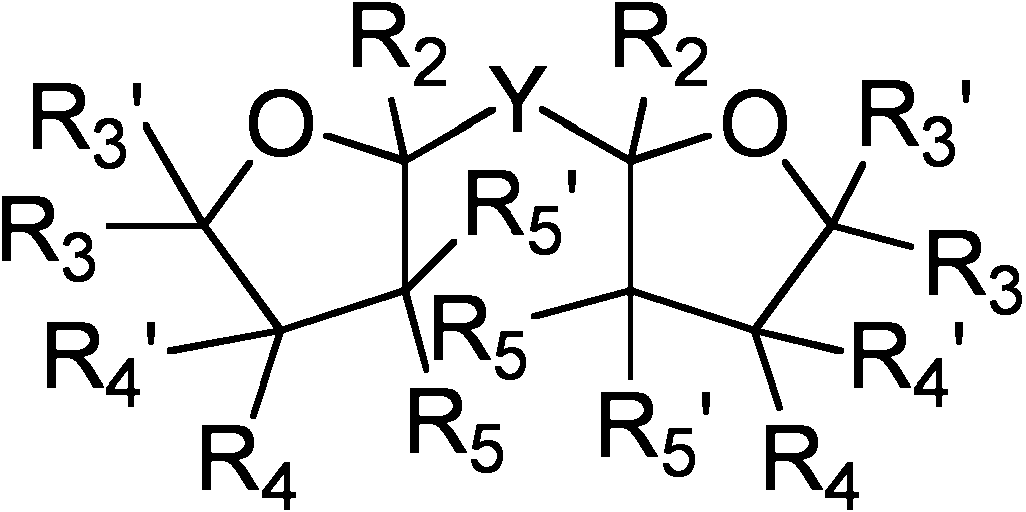
Preferentemente el compuesto (C) de la presente invencion es de formula (IV)Preferably the compound (C) of the present invention is of formula (IV)
en dondewhere
Y se selecciona entre el grupo que consiste en C(Ri )2, Si(Ri )2, CHR1-CHR1, CRi =CRi , CHR1-NR1 y CRi =N, en donde cada R1 puede ser igual o diferente y puede ser hidrogeno, un grupo alquilo de C1 a Cs lineal o ramificado, o un grupo alquileno C2-C8, o los dos R1 pueden formar juntos un anillo alifatico de 3 a 6 miembros opcionalmente sustituido con los atomos de C o Si a los que estan unidos yAnd it is selected from the group consisting of C (R i ) 2, Si (Ri) 2, CHR1-CHR1, CRi = CRi, CHR1-NR1 and CRi = N, wherein each R1 may be the same or different and may be hydrogen, a straight or branched C1 to Cs alkyl group, or a C2-C8 alkylene group, or the two R1 can together form a 3-6 membered aliphatic ring optionally substituted with the C or Si atoms to which they are attached Y
R2, R3, R3 ', R4, R ,^ R5 y R5 ' son iguales o diferentes y pueden ser hidrogeno, un alquilo de C1 a Cs lineal o ramificado, o un grupo alquileno C3-C8, en donde dos o mas de R2, R3, R3 , R4, R4, R5 y R5 ' pueden formar un anillo, o dos R2, R3, R4 y R5 vecinos cualesquiera pueden representar un doble enlace, y opcionalmente al menos uno de los atomos de C del anillo en los anillos que contienen oxfgeno puede sustituirse por un heteroatomo seleccionado entre O, N y P, n es igual para ambos anillos que contienen oxfgeno y puede ser 0, 1 o 2, preferentemente 1 o 2.R 2, R 3 , R 3 ', R 4, R, R 5 and R 5 ' are the same or different and can be hydrogen, a linear or branched C 1 to Cs alkyl, or a C 3 -C 8 alkylene group, wherein two or more R2, R3, R3, R4, R4, R5 and R 5 'may form a ring, or two R2, R3, R4 and R5 vicinal can represent a double bond, and optionally at least one of the atoms in the ring in the oxygen-containing rings it can be replaced by a heteroatom selected from O, N and P, n is the same for both oxygen-containing rings and can be 0, 1 or 2, preferably 1 or 2.
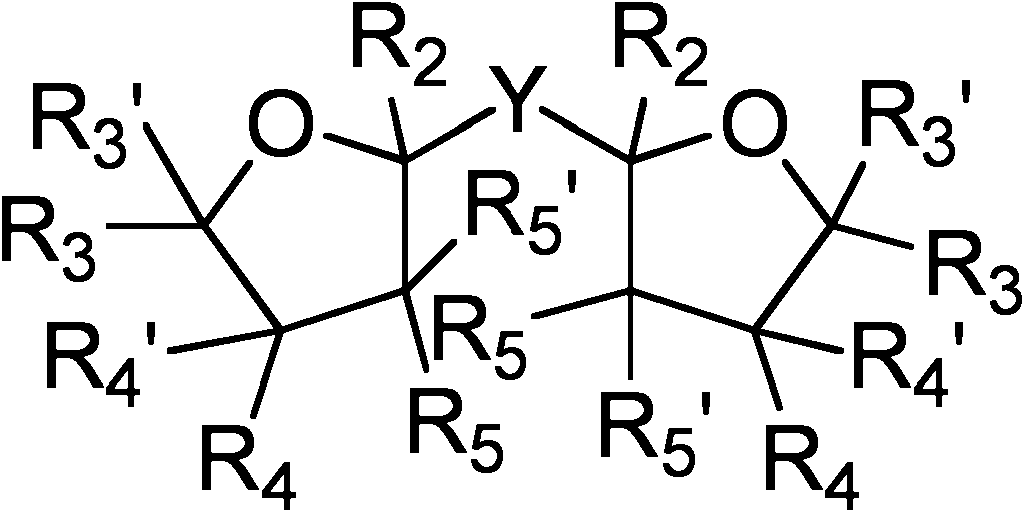
Mas preferentemente el compuesto (C) de la presente invencion es de formula (IV)More preferably, the compound (C) of the present invention is of formula (IV)
en dondewhere
Y se selecciona entre el grupo que consiste en C(R1)2, Si(R1 )2, CHR1-CHR1, CR1=CR1, CHR1-NR1 y CR1=N, en donde cada R1 puede ser igual o diferente y puede ser hidrogeno, un grupo alquilo de C1 a Cs lineal o ramificado, o un grupo alquileno C2-C8, o los dos Ri pueden formar juntos un anillo alifatico de 3 a 6 miembros opcionalmente sustituido con los atomos de C o Si a los que estan unidos yAnd it is selected from the group consisting of C (R1) 2, Si (R1) 2, CHR1-CHR1, CR1 = CR1, CHR1-NR1 and CR1 = N, wherein each R1 may be the same or different and may be hydrogen , a straight or branched C1 to Cs alkyl group, or a C2-C8 alkylene group, or both Ri can together form a 3-6 membered aliphatic ring optionally substituted with the C or Si atoms to which they are attached and
R2, R3, R3', R4, R4', R5 y R5' son iguales o diferentes y pueden ser hidrogeno, un alquilo de Ci a C8 lineal o ramificado, o un grupo alquileno C3-C8, en donde dos o mas de R2, R3, R3', R4, R4', R5 y R5' pueden formar un anillo, n es igual para ambos anillos que contienen oxigeno y puede ser 0, 1 o 2, preferentemente 1 o 2.R2, R3, R3 ', R4, R4', R5 and R5 'are identical or different and can be hydrogen, alkyl of Ci to C 8 linear or branched, or a C3-C8 alkylene group, wherein two or more of R2, R3, R3 ', R4, R4', R5 and R5 'can form a ring, n is the same for both oxygen-containing rings and can be 0, 1 or 2, preferably 1 or 2.
Preferentemente en la formula (IV)Preferably in the formula (IV)
Y es C(R1)2 o Si(R1)2, mas preferentemente Y es C(R1)2,Y is C (R1) 2 or Si (R1) 2, more preferably Y is C (R1) 2,
R1 son iguales y son un grupo alquilo de C1 a C5 lineal o ramificado, mas preferentemente son iguales y se seleccionan entre el grupo que consiste en CH3, CH2CH3 y CH2CH2CH3,R1 are the same and are a straight or branched C1 to C5 alkyl group, more preferably they are the same and are selected from the group consisting of CH3, CH2CH3 and CH2CH2CH3,
R2, R3, R3', R4, R4', R5 y R5' son iguales o diferentes y pueden ser hidrogeno, un grupo alquilo de C1 a C5 lineal o ramificado, mas preferentemente son H, CH3 o CH2CH3,R2, R3, R3 ', R4, R4', R5 and R5 'are the same or different and can be hydrogen, a straight or branched C1 to C5 alkyl group, more preferably they are H, CH3 or CH2CH3,
en donde los dos anillos que contienen oxigeno son tetrahidrofurano o tetrahidropirano.wherein the two rings containing oxygen are tetrahydrofuran or tetrahydropyran.
Aun mas preferentemente el compuesto (C) es 2,2-di(2-tetrahidrofuril)propano (DTHFP).Even more preferably compound (C) is 2,2-di (2-tetrahydrofuryl) propane (DTHFP).
De acuerdo con otra realizacion de la presente invencion, el compuesto (M) o la mezcla (MI) que comprende hidrocarbilo y/u oxido de hidrocarbilo unido a magnesio se ha preparado poniendo en contacto dialquil C1-C10-magnesio y un alcohol C1-C12. Se prefiere que la relacion molar del dialquil C1-C10-magnesio respecto al alcohol C1-C12 este entre 1:1,33 y 1:2,2.According to another embodiment of the present invention, the compound (M) or the mixture (MI) comprising hydrocarbyl and / or hydrocarbyl oxide bound to magnesium has been prepared by contacting C1-C10 dialkyl-magnesium and a C1- C12 It is preferred that the molar ratio of the C1-C10 dialkyl magnesium to the C1-C12 alcohol be between 1: 1.33 and 1: 2.2.
Debe entenderse que, para los fines de la presente invencion, los siguientes terminos tienen los siguientes significados:It should be understood that, for the purposes of the present invention, the following terms have the following meanings:
La expresion "componente catalizador solido" o "procatalizador" se refiere al componente catalizador soportado solido.The expression "solid catalyst component" or "procatalyst" refers to the solid supported catalyst component.
El termino "catalizador" o "catalizador de polimerizacion" o "sistema catalizador" se refiere al catalizador activo, que se ha obtenido activando el componente de catalizador solido con el cocatalizador.The term "catalyst" or "polymerization catalyst" or "catalyst system" refers to the active catalyst, which has been obtained by activating the catalyst component solid with the cocatalyst.
A continuacion, se describe la invencion con mas detalle.In the following, the invention is described in more detail.
Soporte inorganico (IS)Inorganic support (IS)
De acuerdo con la etapa (a) del proceso para producir un procatalizador, se usa un soporte inorganico (IS).According to step (a) of the process for producing a procatalyst, an inorganic support (IS) is used.
El soporte inorganico (IS) usado en la invencion puede ser cualquier soporte adecuado, que tenga las propiedades quimicas y fisicas adecuadas para actuar como soporte para el componente activo del procatalizador. El material de soporte tiene preferentemente un tamano de particula promedio y una distribucion de tamano de particula adecuados, una alta porosidad y una gran superficie especifica. Se obtienen resultados especialmente buenos si el material de soporte tiene una superficie especifica de entre 100 y 1.000 m2 /g de soporte y un volumen de poros de 1 a 3 ml/g de soporte. El material de soporte puede opcionalmente ser pretratado quimicamente, por ejemplo, por sililacion o por tratamiento con alquilos de aluminio.The inorganic support (IS) used in the invention can be any suitable support, which has the appropriate chemical and physical properties to act as a support for the active component of the procatalyst. The support material preferably has an average particle size and a suitable particle size distribution, a high porosity and a large specific surface area. Especially good results are obtained if the support material has a specific surface of between 100 and 1,000 m 2 / g of support and a pore volume of 1 to 3 ml / g of support. The support material can optionally be chemically pretreated, for example, by silylation or by treatment with aluminum alkyls.
De acuerdo con una realizacion de la invencion, el soporte inorganico (IS) es un oxido inorganico. Por ejemplo, el soporte inorganico (IS) es un monoxido inorganico o un oxido mixto inorganico de un elemento seleccionado de los grupos 3-6 y 13-14 de la Tabla Periodica de los elementos (IUPAC 1990), preferentemente un monoxido inorganico o un oxido mixto inorganico de silicio o aluminio. En una realizacion de la presente invencion, el soporte inorganico (IS) es silice.According to one embodiment of the invention, the inorganic support (IS) is an inorganic oxide. For example, the inorganic support (IS) is an inorganic monoxide or an inorganic mixed oxide of an element selected from groups 3-6 and 13-14 of the Periodic Table of the Elements (IUPAC 1990), preferably an inorganic monoxide or a mixed inorganic oxide of silicon or aluminum. In one embodiment of the present invention, the inorganic support (IS) is silica.
El tamano de particula promedio del soporte de silice puede ser tipicamente de 7 a 100 pm, preferentemente de 10 a 80 pm. Sin embargo, ha resultado que pueden obtenerse ventajas especiales si el soporte tiene un tamano de particula promedio de 10 a 30 pm, preferentemente de 15 a 30 pm. Como alternativa, el soporte puede tener un tamano de particula promedio de 30 a 80 pm, preferentemente de 30 a 50 pm. Ademas, en algunas aplicaciones se podria usar un soporte de silice con un tamano de particula muy pequeno, como de 7 a 15, preferentemente de 8 a 12 pm.The average particle size of the silica support can typically be from 7 to 100 pm, preferably from 10 to 80 pm. However, it has turned out that special advantages can be obtained if the support has an average particle size of 10 to 30 pm, preferably 15 to 30 pm. Alternatively, the support may have an average particle size of 30 to 80 μm, preferably 30 to 50 μm. Furthermore, in some applications a silica support with a very small particle size could be used, such as from 7 to 15, preferably from 8 to 12 pm.
De acuerdo con una realizacion, el soporte inorganico (IS) es un monoxido inorganico o un oxido mixto inorganico que tiene grupos hidroxilo superficiales. Por ejemplo, el soporte inorganico (IS) que es un monoxido inorganico o un oxido mixto inorganico que tiene grupos hidroxilo superficiales es silice.According to one embodiment, the inorganic support (IS) is an inorganic monoxide or an inorganic mixed oxide having surface hydroxyl groups. For example, the inorganic support (IS) which is an inorganic monoxide or an inorganic mixed oxide having surface hydroxyl groups is silica.
Habitualmente, el soporte inorganico (IS) se seca antes de impregnarlo con otros componentes de catalizador. Ademas, la cantidad de grupos hidroxilo, que aparecen en la superficie de la mayoria de los oxidos inorganicos, puede reducirse mediante tratamiento termico y/o tratamiento quimico. Los buenos resultados se consiguen, por ejemplo, tratando el soporte con calor a una temperatura de 100 a 900 °C, preferentemente de 400 a 800 °C, durante un tiempo suficiente para reducir los grupos hidroxilo en la superficie a un nivel inferior. Preferentemente, el soporte inorganico tratado (IS) contiene a lo sumo 2,0 mmol y mas preferentemente a lo sumo 1,0 mmol de grupos hidroxilo/g de soporte.Usually, the inorganic support (IS) is dried before being impregnated with other catalyst components. In addition, the amount of hydroxyl groups, which appear on the surface of most inorganic oxides, can be reduced by thermal treatment and / or chemical treatment. Good results are achieved, for example, treating the support with heat at a temperature of 100 to 900 ° C, preferably 400 to 800 ° C, for a sufficient time to reduce the hydroxyl groups on the surface to a lower level. Preferably, the treated inorganic support (IS) contains at most 2.0 mmol and more preferably at most 1.0 mmol of hydroxyl groups / g of support.
El soporte inorganico (IS) puede contener ademas compuestos adicionales. Especialmente util es un material de soporte de silice que comprende haluro de magnesio en una cantidad tal que el soporte contenga del 1 al 20 %, preferentemente del 1 al 10 %, mas preferentemente del 2 al 6 % en peso de magnesio, como se desvela en el documento WO 99/51646.The inorganic support (IS) may also contain additional compounds. Especially useful is a silica support material comprising magnesium halide in an amount such that the support contains from 1 to 20%, preferably from 1 to 10%, more preferably from 2 to 6% by weight of magnesium, as disclosed in WO 99/51646.
Cloruro alquil-metalico (AMC)Metal-alkyl chloride (AMC)
De acuerdo con la etapa (b) del proceso para producir un procatalizador, se usa un cloruro alquil-metalico (AMC). Se aprecia que el cloruro alquil-metalico (AMC) clora la superficie del soporte y actua parcialmente como un precursor de cocatalizador. Sin embargo, el cloruro alquil-metalico (AMC) no esta concebido como cocatalizador, sino que el sistema catalizador presupone grandes cantidades de un cocatalizador independiente, vease a continuacion.According to step (b) of the process for producing a procatalyst, an alkyl metal chloride (AMC) is used. It is appreciated that the alkyl metal chloride (AMC) chlorinates the surface of the support and acts partially as a precursor of cocatalyst. However, alkyl metal chloride (AMC) is not conceived as a cocatalyst, but the catalyst system assumes large quantities of an independent cocatalyst, see below.
El cloruro alquil-metalico (AMC) debe ser un compuesto metalico que contiene cloro que es soluble en disolventes hidrocarbonados no polares. El compuesto es, por tanto, un cloruro alquil-metalico (AMC) de formula (I)Metal-alkyl chloride (AMC) must be a metal compound containing chlorine that is soluble in non-polar hydrocarbon solvents. The compound is, therefore, an alkyl metal chloride (AMC) of formula (I)
RnMeCl3 -n (I)RnMeCl 3 -n (I)
en donde R es un grupo alquilo C1-C20, Me es un metal del grupo 13 de la Tabla Periodica, y n es 1 o 2.wherein R is a C1-C20 alkyl group, Me is a metal of group 13 of the Periodic Table, and n is 1 or 2.
Se aprecia que el grupo alquilo R puede ser lineal, ramificado o ciclico, o una mezcla de dichos grupos. En una realizacion de la presente invencion, R es un alquilo C1-C20, preferentemente un alquilo C1-C10, mas preferentemente un alquilo C2-C6 y de la forma mas preferente un alquilo C2-C4. Por ejemplo, R es un alquilo C1-C20 lineal, preferentemente un alquilo C1-C10 lineal, mas preferentemente un alquilo C2-C6 lineal y de la forma mas preferente un alquilo C2-C4 lineal.It is appreciated that the alkyl group R may be linear, branched or cyclic, or a mixture of said groups. In one embodiment of the present invention, R is a C 1 -C 20 alkyl, preferably a C 1 -C 10 alkyl, more preferably a C 2 -C 6 alkyl and most preferably a C 2 -C 4 alkyl. For example, R is a linear C1-C20 alkyl, preferably a linear C1-C10 alkyl, more preferably a linear C2-C6 alkyl and most preferably a linear C2-C4 alkyl.
En una realizacion de la presente invencion, el Me del cloruro alquil-metalico (AMC) es un metal del grupo 13 de la Tabla Periodica, tal como boro, aluminio o galio. Por ejemplo, el Me del cloruro alquil-metalico (AMC) que es un metal del grupo 13 de la Tabla Periodica es aluminio.In one embodiment of the present invention, the Me of the metal alkyl chloride (AMC) is a metal of group 13 of the Periodic Table, such as boron, aluminum or gallium. For example, the Me of the alkyl metal chloride (AMC) which is a metal of group 13 of the Periodic Table is aluminum.
En una realizacion de la presente invencion, el cloruro alquil-metalico (AMC) es un cloruro de alquil-aluminio, preferentemente un dicloruro de alquil-aluminio inferior. Por ejemplo, el cloruro alquil-metalico (AMC) es dicloruro de etil-aluminio.In one embodiment of the present invention, the alkyl metal chloride (AMC) is an alkyl aluminum chloride, preferably a lower alkyl aluminum dichloride. For example, the alkyl metal chloride (AMC) is ethyl aluminum dichloride.
Tambien se puede usar una combinacion de diferentes cloruros alquil-metalicos (AMC).A combination of different alkyl metal chlorides (AMC) can also be used.
Es recomendable poner en contacto el cloruro alquil-metalico (AMC) directa o indirectamente con el soporte inorganico (IS) en forma de una solucion, que penetra en los poros del soporte inorganico (IS) y reacciona con tantos grupos superficiales o moleculas de reactivo previamente depositadas, como sea posible. Por tanto, de acuerdo con una realizacion, dicho cloruro alquil-metalico (AMC) puede ponerse en contacto con dicho soporte inorganico (IS) de manera que el cloruro alquil-metalico (AMC) este en solucion hidrocarbonada, preferentemente en un 5 al 30 % en peso, como en una solucion hidrocarbonada del 10 al 25% en peso, cuya viscosidad esta de la manera mas preferente por debajo de 10 mPa s a temperatura ambiente. Son disolventes adecuados hidrocarburos ciclicos o aromaticos de C6 a C12, alifaticos de C1 a C10, como alcanos y/e hidrocarburos aromaticos de C1 a C8 , especialmente alcanos de C5 a C8 tales pentano, hexano y heptano o tolueno. En un ejemplo especifico se usa heptano como disolvente. Por consiguiente, en una realizacion especifica, se usa una solucion en heptano del 20 a 30 % en peso, como del 23 al 27 % en peso, por ejemplo el 25 % en peso, de un cloruro alquil-metalico (AMC), especialmente de dicloruro de etil-aluminio.It is advisable to contact the metal-alkyl chloride (AMC) directly or indirectly with the inorganic support (IS) in the form of a solution, which penetrates the pores of the inorganic support (IS) and reacts with so many surface groups or reagent molecules previously deposited, as possible. Therefore, according to one embodiment, said alkyl metal chloride (AMC) can be contacted with said inorganic support (IS) so that the alkyl metal chloride (AMC) is in hydrocarbon solution, preferably in a 5 to 30%. % by weight, as in a hydrocarbon solution of 10 to 25% by weight, whose viscosity is most preferably below 10 mPa at room temperature. Suitable solvents are cyclic hydrocarbons or aromatic C 6 to C12, aliphatic C1 to C10, alkanes and as / and aromatic hydrocarbons of C1 to C 8 alkanes especially C5 to C8 such pentane, hexane and heptane or toluene. In a specific example, heptane is used as the solvent. Accordingly, in a specific embodiment, a heptane solution of 20 to 30% by weight, such as 23 to 27% by weight, for example 25% by weight, of an alkyl metal chloride (AMC), is used, especially of ethyl aluminum dichloride.
Cuando se pone en contacto el cloruro alquil-metalico (AMC) con un soporte inorganico (IS) que tiene grupos hidroxilo superficiales, tales como silice, la relacion molar entre el cloruro alquil-metalico (AMC) y los hidroxilos superficiales del soporte inorganico esta preferentemente entre 1 y 4 y de la forma mas preferente entre 1 y 3. La temperatura de contacto preferida esta entre 0 y 110 °C, preferentemente entre 10 y 70 °C y de la forma mas preferente entre 20 y 50 °C.When the alkyl metal chloride (AMC) is contacted with an inorganic support (IS) having surface hydroxyl groups, such as silica, the molar ratio between the alkyl metal chloride (AMC) and the surface hydroxyls of the inorganic support is preferably between 1 and 4 and most preferably between 1 and 3. The preferred contact temperature is between 0 and 110 ° C, preferably between 10 and 70 ° C and most preferably between 20 and 50 ° C.
Compuesto (M) o mezcla (MI) Compound (M) or mixture (MI)
De acuerdo con la etapa (c), es decir, de acuerdo con una de las etapas (c1) a (c4) del proceso para producir un procatalizador, se usa un compuesto (M) o mezcla (MI) que comprende hidrocarbilo y/u oxido de hidrocarbilo unido a magnesio.According to step (c), that is, according to one of steps (c1) to (c4) of the process for producing a procatalyst, a compound (M) or mixture (MI) comprising hydrocarbyl and / or hydrocarbyl oxide bound to magnesium.
Preferentemente el compuesto (M) unido a magnesio es de formula (II)Preferably the compound (M) bound to magnesium is of formula (II)
Mg(R)n(OR)2-n,Mg (R) n (OR) 2-n,
donde n es 0, 1 o 2,where n is 0, 1 or 2,
cada R puede ser un grupo hidrocarbilo igual o diferente de 1 a 20 atomos de C.each R can be a hydrocarbyl group equal to or different from 1 to 20 C atoms.
La mezcla (MI) puede comprender diferentes compuestos de formula (II).The mixture (MI) can comprise different compounds of formula (II).
Por consiguiente, el compuesto (M) o mezcla (MI) que comprende hidrocarbilo y/u oxido de hidrocarbilo unido a magnesio usado en una de las etapas (c1) a (c4) puede ser cualquier mezcla adecuada que comprenda uno o mas compuestos de magnesio, preferentemente uno o mas compuestos de magnesio de formula (II). Por tanto, puede ser un dialquil(C1 - C20)magnesio, tal como dialquil(C2 - C10), como butil-octil-magnesio, butil-etil magnesio, dietil magnesio o dibutil magnesio.Accordingly, the compound (M) or mixture (MI) comprising hydrocarbyl and / or hydrocarbyl oxide bound to magnesium used in one of steps (c1) to (c4) can be any suitable mixture comprising one or more compounds of magnesium, preferably one or more magnesium compounds of formula (II). Thus, it can be a dialkyl (C 1 -C 20) magnesium, such as dialkyl (C 2 -C 10), such as butyl octyl magnesium, butyl ethyl magnesium, diethyl magnesium or dibutyl magnesium.
En una realizacion de la presente invencion, El compuesto (M) es un compuesto de dialcoxi magnesio. Por ejemplo, el compuesto (M) tiene una formula general Mg(OR)2, en donde R es independientemente un alquilo C2-C16, preferentemente alquilo C4-C12.In one embodiment of the present invention, the compound (M) is a dialkoxy magnesium compound. For example, the compound (M) has a general formula Mg (OR) 2, wherein R is independently a C2-C16 alkyl, preferably C4-C12 alkyl.
Uno de los fines de la invencion es obtener un procatalizador de alta actividad a pesar de las altas concentraciones de hidrogeno en la polimerizacion. Entonces, el componente de magnesio del procatalizador puede tener tanto enlaces Mg-C como enlaces Mg-O-C. Estos enlaces pueden estar en el mismo compuesto (M) tal como RMgOR, o en diferentes compuestos (M). Por tanto, las mezclas (MI) de R2Mg y Mg(OR)2 estan dentro del alcance de la invencion, asi como las mezclas de R2Mg y RMgOR y las mezclas de RMgOR y Mg(OR)2. Preferentemente, el compuesto (M) o la mezcla (MI) que comprende hidrocarbilo y oxido de hidrocarbilo unido a magnesio es soluble en hidrocarburo, lo que da una solucion capaz de penetrar eficazmente en los huecos y poros del soporte.One of the purposes of the invention is to obtain a high activity procatalyst despite the high concentrations of hydrogen in the polymerization. Then, the magnesium component of the procatalyst can have both Mg-C bonds and Mg-O-C bonds. These bonds can be in the same compound (M) such as RMgOR, or in different compounds (M). Therefore, mixtures (MI) of R2Mg and Mg (OR) 2 are within the scope of the invention, as well as mixtures of R2Mg and RMgOR and mixtures of RMgOR and Mg (OR) 2. Preferably, the compound (M) or the mixture (MI) comprising hydrocarbyl and hydrocarbyl oxide bound to magnesium is soluble in hydrocarbon, which gives a solution capable of effectively penetrating the voids and pores of the support.
De acuerdo con una realizacion de la presente invencion, el compuesto (M) o la mezcla (MI) que comprende hidrocarbilo y oxido de hidrocarbilo unido a magnesio es un producto de contacto de un dialquil C1-C10-magnesio y un alcohol C1-C12, es decir el compuesto (M) o la mezcla (MI) que comprende hidrocarbilo y oxido de hidrocarbilo unido a magnesio se prepara poniendo en contacto dialquil C1-C10-magnesio y un alcohol C1-C12.According to an embodiment of the present invention, the compound (M) or mixture (MI) comprising hydrocarbyl and hydrocarbyl oxide bound to magnesium is a contact product of a C1-C10-dialkyl magnesium and a C1-C12 alcohol , ie the compound (M) or mixture (MI) comprising hydrocarbyl and hydrocarbyl oxide bound to magnesium is prepared by contacting C1-C10 dialkyl-magnesium and a C1-C12 alcohol.
Preferentemente, el dialquilC1-C10-magnesio es dibutil magnesio, butil etil magnesio, dietil magnesio o butil octil magnesio. Por ejemplo, el dialquilC1-C10-magnesio es butil octil magnesio. Preferentemente, el alcohol C1-C12 es un alcohol ramificado, preferentemente un 2-alquil alcanol, de la forma mas preferente 2-etil-1-hexanol o 2-metil-1-pentanol. Por ejemplo, el alcohol C1-C12 es 2-etil-1-hexanol.Preferably, the C 1 -C 10 dialkyl magnesium is dibutyl magnesium, butyl ethyl magnesium, diethyl magnesium or butyl octyl magnesium. For example, dialkyl C 1 -C 10 -magnesium is butyl octyl magnesium. Preferably, the C1-C12 alcohol is a branched alcohol, preferably a 2-alkyl alkanol, most preferably 2-ethyl-1-hexanol or 2-methyl-1-pentanol. For example, the C1-C12 alcohol is 2-ethyl-1-hexanol.
En una realizacion de la presente invencion, el dialquiC1-C10-magnesio es butil octil magnesio y el alcohol C1-C12 es 2-etil-1-hexanol.In one embodiment of the present invention, the dialkylC10-magnesium is butyl octyl magnesium and the C1-C12 alcohol is 2-ethyl-1-hexanol.
Cuando el compuesto (M) o la mezcla (MI) que comprende hidrocarbilo y oxido de hidrocarbilo unido a magnesio es un producto de contacto de un dialquil C1-C10-magnesio y un alcohol C1-C12, la relacion molar correspondiente de dialquilC1-C10-magnesio respecto a alcohol C1-C12 es preferentemente de 1:1,3 a 1:2,2 y mas preferentemente de 1:1,78 a 1:1,99. Por ejemplo, la relacion molar de dialquilC1-C10-magnesio respecto a alcohol C1-C12 es de 1:1,80 a 1:1,98.When the compound (M) or mixture (MI) comprising hydrocarbyl and hydrocarbyl oxide bound to magnesium is a contact product of a C1-C10 dialkyl magnesium and a C1-C12 alcohol, the corresponding molar ratio of dialkyl C1-C10 -magnesium with respect to C1-C12 alcohol is preferably from 1: 1.3 to 1: 2.2 and more preferably from 1: 1.78 to 1: 1.99. For example, the molar ratio of dialkylC1-C10-magnesium to C1-C12 alcohol is from 1: 1.80 to 1: 1.98.
El compuesto (M) o la mezcla (MI) que comprende hidrocarbilo y oxido de hidrocarbilo unido a magnesio esta preferentemente en una solucion hidrocarbonada no polar, de la manera mas preferentemente en una solucion hidrocarbonada no polar cuya viscosidad es inferior a 10 mPas a temperatura ambiente. La viscosidad se puede reducir ventajosamente anadiendo un cloruro alquil-metalico (AMC) a la solucion. El cloruro alquil-metalico (AMC) tiene preferentemente la formula (I). Sin embargo, en el presente caso, no se prefiere que el cloruro alquil-metalico (AMC) se use para adaptar la viscosidad del compuesto (M) o la mezcla (MI). La viscosidad reducida permite que se consiga una penetracion completa del compuesto (M) o la mezcla (MI) en los huecos y los poros del soporte inorganico (IS). Esto mejora la morfologia del procatalizador y, por tanto, la morfologia de los copolimeros de etileno preparados mediante el, tambien.The compound (M) or mixture (MI) comprising hydrocarbyl and hydrocarbyl oxide bound to magnesium is preferably in a non-polar hydrocarbon solution, most preferably in a non-polar hydrocarbon solution whose viscosity is less than 10 mPas at temperature ambient. The viscosity can be advantageously reduced by adding an alkyl metal chloride (AMC) to the solution. The metal alkyl chloride (AMC) preferably has the formula (I). However, in the present case, it is not preferred that the metal alkyl chloride (AMC) be used to adapt the viscosity of the compound (M) or the mixture (MI). The reduced viscosity allows complete penetration of the compound (M) or mixture (MI) into the pores and pores of the inorganic support (IS). This improves the morphology of the procatalyst and, therefore, the morphology of the ethylene copolymers prepared by it, too.
Cuando se pone en contacto el compuesto (M) o la mezcla (MI) que comprende hidrocarbilo y oxido de hidrocarbilo unido a magnesio, se obtiene un buen deposito sobre la superficie del soporte inorganico (IS) si el volumen de solucion que comprende el compuesto (M) o la mezcla (MI) que comprende hidrocarbilo y oxido de hidrocarbilo unido a magnesio es aproximadamente dos veces el volumen de poros del material de soporte. Esto se consigue si la concentracion del complejo en el disolvente hidrocarbonado es del 5 a 60 % con respecto al hidrocarburo usado como disolvente. El disolvente puede ser un alcano C1-C8 y/o un hidrocarburo aromatico C6-C12, por ejemplo, una mezcla de una cantidad mayor de pentano, hexano o heptano y una cantidad menor de, por ejemplo, tolueno.When the compound (M) or mixture (MI) which comprises hydrocarbyl and hydrocarbyl oxide bound to magnesium is contacted, a good deposit is obtained on the surface of the inorganic support (IS) if the volume of solution comprising the compound (M) or the mixture (MI) comprising hydrocarbyl and hydrocarbyl oxide bound to magnesium is approximately twice the pore volume of the support material. This is achieved if the The concentration of the complex in the hydrocarbon solvent is from 5 to 60% with respect to the hydrocarbon used as the solvent. The solvent may be a C 1 -C 8 alkane and / or a C 6 -C 12 aromatic hydrocarbon, for example, a mixture of a greater amount of pentane, hexane or heptane and a minor amount of, for example, toluene.
Compuesto de titanio (TC)Titanium compound (TC)
Ademas, en el presente proceso para producir un procatalizador, se usa un compuesto de titanio (TC).In addition, in the present process for producing a procatalyst, a titanium compound (TC) is used.
Uno de los componentes principales del catalizador es el compuesto de titanio (TC), que se supone que forma el centro activo durante la polimerizacion de olefinas C2-C12.One of the main components of the catalyst is the titanium compound (TC), which is supposed to form the active center during the polymerization of C2-C12 olefins.
Se aprecia que el compuesto de titanio (TC) es de formula (III)It is appreciated that the titanium compound (TC) is of formula (III)
(OR')4 -xTiClx (III)(OR ') 4 -xTiClx (III)
en donde R' es un grupo hidrocarbilo C2-C20 y x es un numero entero de 3 o 4.where R 'is a C2-C20 hydrocarbyl group and x is an integer of 3 or 4.
Se aprecia que el grupo hidrocarbilo R' puede ser lineal, ramificado o ciclico, o una mezcla de dichos grupos. En una realizacion de la presente invencion, R' es un hidrocabilo C2-C20, preferentemente un hidrocabilo C2-C10, mas preferentemente un hidrocabilo C2-C6 y de la forma mas preferente un hidrocabilo C2-C4. Por ejemplo, R' es un hidrocabilo C2-C20 lineal, preferentemente un hidrocabilo C2-C10 lineal, mas preferentemente un hidrocabilo C2-C6 lineal y de la forma mas preferente un hidrocabilo C2-C4 lineal. En una realizacion de la presente invencion, R' es etilo.It is appreciated that the hydrocarbyl group R 'may be linear, branched or cyclic, or a mixture of said groups. In one embodiment of the present invention, R 'is a C2-C20 hydrocarbyl, preferably a C2-C10 hydrocarbyl, more preferably a C2-C6 hydrocarbyl and most preferably a C2-C4 hydrocarbyl. For example, R 'is a linear C2-C20 hydrocarbyl, preferably a linear C2-C10 hydrocarbyl, more preferably a linear C2-C6 hydrocarbyl and most preferably a linear C2-C4 hydrocarbyl. In one embodiment of the present invention, R 'is ethyl.
El compuesto de titanio (TC) es, preferentemente, un alcoholato clorado, es decir, TiCb-OR', o un compuesto que contiene unicamente cloruro, tal como TiCU. Por tanto, se aprecia que x es preferentemente un numero entero de 3 o 4. En una realizacion de la presente invencion, x es 4. Por tanto, se prefiere que el compuesto de titanio (TC) mas preferible sea tetracloruro de titanio.The titanium compound (TC) is preferably a chlorinated alcoholate, ie, TiCb-OR ', or a compound containing only chloride, such as TiCU. Therefore, it is appreciated that x is preferably an integer of 3 or 4. In one embodiment of the present invention, x is 4. Therefore, it is preferred that the more preferable titanium compound (TC) is titanium tetrachloride.
Compuesto donador de electrones (ED)Electron donor compound (ED)
Un componente esencial adicional en la presente invencion es el compuesto donador de electrones (ED). De acuerdo con la presente invencion, el compuesto donador de electrones (ED) es un compuesto (C) que comprende dos anillos que contienen oxigeno, en donde dichos dos anillos estan unidos mediante un puente seleccionado entre el grupo que consiste en un puente de carbono, un puente de silicio, un puente de etano-1,2-diilo, un puente de eteno-1,2-diilo, un puente de alquilaminometilo y un puente de imina.A further essential component in the present invention is the electron donor compound (ED). According to the present invention, the electron donor compound (ED) is a compound (C) comprising two oxygen-containing rings, wherein said two rings are joined by a bridge selected from the group consisting of a carbon bridge , a silicon bridge, an ethane-1,2-diyl bridge, an ethene-1,2-diyl bridge, an alkylaminomethyl bridge and an imine bridge.
Preferentemente, los dos anillos que contienen oxigeno son anillos iguales. El termino "iguales" indica que los dos anillos que contienen oxigeno tienen la misma estructura de anillo. Sin embargo, cada anillo puede contener diferentes residuos unidos a el.Preferably, the two rings containing oxygen are equal rings. The term "equals" indicates that the two rings containing oxygen have the same ring structure. However, each ring may contain different residues attached to it.
La expresion "puente de carbono" indica que los dos anillos que contienen oxigeno estan unidos a traves de un resto de atomo de carbono. Este resto de atomo de carbono puede estar sustituido. Por tanto, el puente de carbono puede ser, por ejemplo, CH2, CHR1 o C(R1)2, en donde R1 es preferentemente un grupo alquilo de C1 a C8 lineal o ramificado, o un grupo alquileno C2-C8 lineal o ramificado, mas preferentemente el puente de carbono es C(R1)2, en donde ambos R1 son iguales y un grupo alquilo de C1 a C8 lineal o ramificado, como un grupo alquilo de C1 a C5 lineal o ramificado, especialmente metilo, etilo o propilo.The expression "carbon bridge" indicates that the two rings containing oxygen are bound through a carbon atom residue. This carbon atom residue may be substituted. Therefore, the carbon bridge may be, for example, CH2, CHR1 or C (R1) 2 wherein R1 is preferably a C1 to C8 linear or branched, or a linear alkylene group C2-C8 or branched , more preferably the bridge carbon is C (R1) 2, where both R1 are identical and an alkyl group of C1 to C8 linear or branched, such as an alkyl group of C1 to linear or branched C5 alkyl, especially methyl, ethyl or propyl.
La expresion "puente de silicio" indica que los dos anillos que contienen oxigeno estan unidos a traves de un resto de atomo de silicio. Este resto de atomo de silicio puede estar sustituido. Por tanto, el puente de silicio puede ser, por ejemplo, SiH2, SiHR1 o Si(R1)2, en donde R1 es preferentemente un grupo alquilo de C1 a C8 lineal o ramificado, o un grupo alquileno C2-C8 lineal o ramificado, mas preferentemente el puente de silicio es Si(R1 )2, en donde ambos R1 son iguales y un grupo alquilo de C1 a C8 lineal o ramificado, como un grupo alquilo de C1 a C5 lineal o ramificado, especialmente metilo, etilo o propilo.The expression "silicon bridge" indicates that the two rings containing oxygen are attached through a silicon atom residue. This remaining silicon atom may be substituted. Therefore, the silicon bridge can be, for example, SiH2, SiHR1 or Si (R1) 2 wherein R1 is preferably a C1 to C8 linear or branched, or a linear alkylene group C2-C8 or branched , more preferably the silicon bridge is Si (R1) 2, where both R1 are identical and an alkyl group of C1 to C8 linear or branched, such as an alkyl group of C1 to linear or branched C5 alkyl, especially methyl, ethyl or propyl.
Tanto en el "puente de carbono" como en el "puente de silicio", los grupos R1 pueden formar un anillo con el atomo de carbono o silicio al que estan unidos.Both in the "carbon bridge" and in the "silicon bridge", the R1 groups can form a ring with the carbon or silicon atom to which they are attached.
La expresion "puente de etano-1,2-diilo" indica que los dos anillos que contienen oxigeno estan unidos preferentemente mediante un resto C(R1)2-C(R1)2, en donde R1 puede ser cualquier residuo organico, preferentemente un residuo como se define en este parrafo. Por tanto, el puente de etano-1,2-diilo puede ser, por ejemplo, CHR1-CHR1, CHR1-C(R1)2, o C(R1)2-C(R1)2, en donde ambos R1 pueden ser iguales o diferentes, preferentemente iguales, y R1 es preferentemente un grupo alquilo de C1 a C8 lineal o ramificado, o un grupo alquileno C2-C8 lineal o ramificado, en donde ademas ambos Ri pueden formar un anillo saturado o insaturado, como uno aromatico. Mas preferentemente, el puente de etano-1,2-diflo es CHR1-CHR1, en donde ambos R1 son iguales y un grupo alquilo de C1 a C8 lineal o ramificado, como un grupo alquilo de C1 a C5 lineal.The expression "ethane-1,2-diyl bridge" indicates that the two oxygen-containing rings are preferably linked by a C (R1) 2-C (R1) 2 residue, wherein R1 can be any organic residue, preferably a waste as defined in this paragraph. Thus, the ethane-1,2-diyl bridge can be, for example, CHR1-CHR1, CHR1-C (R1) 2, or C (R1) 2-C (R1) 2, wherein both R1 can be same or different, preferably identical, and R1 is preferably a C1 to C8 linear or branched, or a group C2-C8 straight or branched alkylene, wherein both Ri can also form a saturated or unsaturated ring, such as an aromatic one. More preferably, the bridge ethane-1,2-CHR1-CHR1 Diflo is, where both R1 are identical and an alkyl group of C1 to C8 linear or branched alkyl group as a C1 to C5 linear.
La expresion "anillo aromatico" en el parrafo anterior incluye benceno, compuestos aromaticos policfclicos y compuestos aromaticos heterocfclicos tales como furano, pirrol y tiofenoThe expression "aromatic ring" in the preceding paragraph includes benzene, polycyclic aromatic compounds and heterocyclic aromatic compounds such as furan, pyrrole and thiophene
La expresion "puente de eteno-1,2-dnlo" indica que los dos anillos que contienen oxfgeno estan unidos preferentemente mediante un resto CR1=CR1, en donde R1 puede ser cualquier residuo organico, preferentemente un residuo como se define en este parrafo. Por tanto, el puente de eteno-1,2-diflo puede ser, por ejemplo, CH=CH, CH=CR1 o CR1=CR1, en donde ambos R1 pueden ser iguales o diferentes, preferentemente iguales, y R1 es preferentemente un grupo alquilo de C1 a C8 lineal o ramificado, o un grupo alquileno C2-C8 lineal o ramificado, en donde ademas ambos R1 pueden formar un anillo saturado o insaturado, como uno aromatico. Mas preferentemente, el puente de eteno-1,2-diflo es CR1=CR1, en donde ambos R1 son iguales y un grupo alquilo de C1 a C8 lineal o ramificado, como un grupo alquilo de C1 a C5 lineal.The expression "ethene-1,2-dnon bridge" indicates that the two oxygen-containing rings are preferably linked by a radical CR 1 = CR 1, where R 1 can be any organic residue, preferably a residue as defined in this paragraph. Thus, the ethene-1,2-diflo bridge can be, for example, CH = CH, CH = CR1 or CR1 = CR1, wherein both R1 can be the same or different, preferably the same, and R1 is preferably a group C1 to C8 linear or branched alkylene or linear or branched C2-C8 group, wherein both R1 also may form a saturated or unsaturated, aromatic one. More preferably, the bridge ethene-1,2-CR1 = CR1 Diflo is, where both R1 are identical and an alkyl group of C1 to C8 linear or branched alkyl group as a C1 to C5 linear.
La expresion "puente de alquilaminometilo" indica que los dos anillos que contienen oxfgeno estan unidos preferentemente mediante un resto C(R1)2-NR1, en donde R1 puede ser cualquier residuo organico, preferentemente un residuo como se define en este parrafo. Por tanto, el puente de alquilaminometilo puede ser, por ejemplo, CH2-NR1, CHR1-NR1 o C(R1)2-NR1, en donde ambos R1 pueden ser iguales o diferentes, preferentemente iguales, y R1 es preferentemente un grupo alquilo de C1 a C8 lineal o ramificado, o un grupo alquileno C2-C8 lineal o ramificado, en donde ademas, un R1 unido a C y el R1 unido a N pueden formar un anillo saturado o insaturado, como uno aromatico. Mas preferentemente, el puente de alquilaminometilo es CHR1-NR1, en donde ambos R1 son iguales y un grupo alquilo de C1 a C8 lineal o ramificado, como un grupo alquilo de C1 a C5 lineal.The term "alkylaminomethyl bridge" indicates that the two oxygen-containing rings are preferably linked by a C (R1) 2-NR1 moiety, wherein R1 may be any organic residue, preferably a residue as defined in this paragraph. Thus, the alkylaminomethyl bridge may be, for example, CH2-NR1, CHR1-NR1 or C (R1) 2-NR1, wherein both R1 may be the same or different, preferably the same, and R1 is preferably an alkyl group of C1 to C8 linear or branched alkylene group or C2-C8 linear or branched, where besides a C - linked R1 and R1 attached to N may form a saturated or unsaturated, aromatic one. More preferably the bridge is CHR1-alkylaminomethyl NR1, where both R1 are identical and an alkyl group of C1 to C8 linear or branched alkyl group such as a C1 to C5 linear.
La expresion "puente de imina" indica que los dos anillos que contienen oxfgeno estan unidos preferentemente mediante un resto CR1=N, en donde R1 puede ser cualquier residuo organico, preferentemente un residuo como se define en este parrafo. Por tanto, el puente de imina puede ser, por ejemplo, CH=N o CR1=N, en donde R1 es preferentemente un grupo alquilo de C1 a C8 lineal o ramificado, o un grupo alquileno C2-C8 lineal o ramificado. Mas preferentemente, el puente de imina es CR1=N, en donde R1 es un grupo alquilo de C1 a C8 lineal o ramificado, como un grupo alquilo de C1 a C5 lineal.The term "imine bridge" indicates that the two oxygen-containing rings are preferably linked by a moiety CR1 = N, where R1 can be any organic residue, preferably a residue as defined in this paragraph. Thus the imine bridge can be, for example, CH = N or CR1 = N, wherein R1 is preferably a C1 to C8 linear or branched alkylene group or C2-C8 linear or branched. More preferably, the imine bridge is CR1 = N, wherein R1 is an alkyl group of C1 to C8 linear or branched alkyl group as a C1 to C5 linear.
Preferentemente, los dos anillos que contienen oxfgeno son individualmente anillos de 4, 5, 6 o 7 miembros, preferentemente ambos anillos que contienen oxfgeno son de 4, 5, 6 o 7 miembros. En una realizacion preferida, los dos anillos que contienen oxfgeno son ambos anillos de 5 miembros. En otra realizacion preferida, los dos anillos que contienen oxfgeno son ambos anillos de 6 miembrosPreferably, the two oxygen-containing rings are individually 4, 5, 6 or 7-membered rings, preferably both oxygen-containing rings are 4, 5, 6 or 7 members. In a preferred embodiment, the two oxygen-containing rings are both 5-membered rings. In another preferred embodiment, the two oxygen-containing rings are both 6-membered rings
Los dos anillos que contienen oxfgeno pueden estar saturados o insaturados individualmente. Preferentemente, ambos anillos que contienen oxfgeno estan saturados o insaturados, preferentemente ambos anillos que contienen oxfgeno estan saturados.The two rings containing oxygen may be saturated or unsaturated individually. Preferably, both oxygen-containing rings are saturated or unsaturated, preferably both oxygen-containing rings are saturated.
Ademas, los dos anillos que contienen oxfgeno pueden comprender, adicionalmente al atomo de oxfgeno requerido, de 1 a 3 heteroatomos adicionales entre O, N y P, preferentemente entre O y N. Preferentemente, los dos anillos que contienen oxfgeno comprenden solo el O requerido como heteroatomo.In addition, the two oxygen-containing rings can comprise, in addition to the required oxygen atom, from 1 to 3 additional heteroatoms between O, N and P, preferably between O and N. Preferably, the two oxygen-containing rings comprise only the O required as a heteroatom.
Por tanto, los ejemplos de anillos que contienen oxfgeno saturados preferidos son:Thus, examples of preferred saturated oxygen-containing rings are:

(tetrahidrofurano) y(tetrahydrofuran) and

(tetrahidropirano). (tetrahydropyran).
Los ejemplos de anillos que contienen oxigeno insaturados preferidos son:Examples of preferred unsaturated oxygen containing rings are:

Mas preferentemente, el compuesto (C) comprende dos estructuras de anillo que contienen oxigeno identicas como se han definido anteriormente.More preferably, the compound (C) comprises two identical oxygen-containing ring structures as defined above.
Mas preferentemente el compuesto (C) de la presente invencion es de formula (IV)More preferably, the compound (C) of the present invention is of formula (IV)
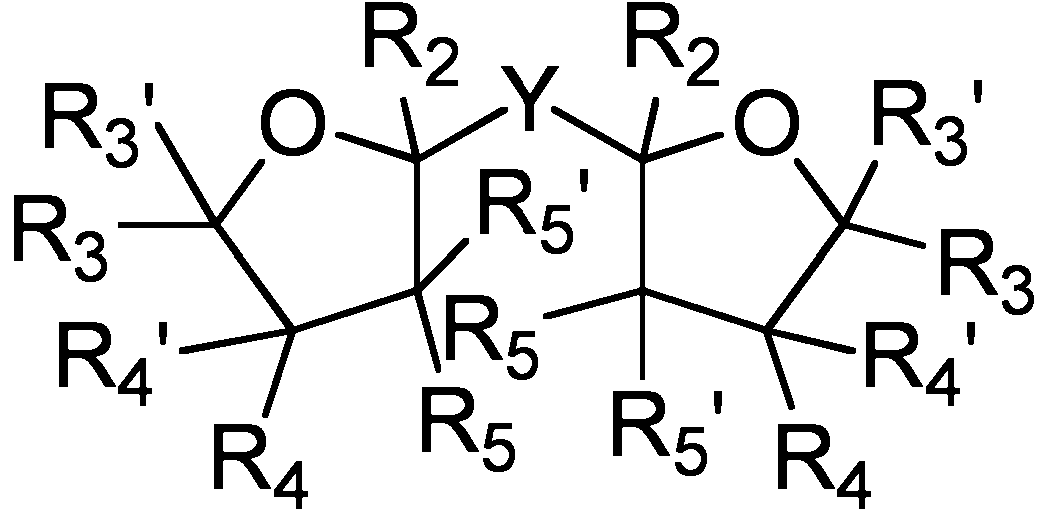
en dondewhere
Y se selecciona entre el grupo que consiste en C(Ri )2, Si(Ri )2, CHR1-CHR1, CRi =CRi , CHR1-NR1 y CRi =N, en donde cada R1 puede ser igual o diferente y puede ser hidrogeno, un grupo alquilo de C1 a Cs lineal o ramificado, o un grupo alquileno C2-C8, o los dos R1 pueden formar juntos un anillo alifatico de 3 a 6 miembros opcionalmente sustituido con los atomos de C o Si a los que estan unidos yAnd it is selected from the group consisting of C (R i ) 2, Si (Ri) 2, CHR1-CHR1, CRi = CRi, CHR1-NR1 and CRi = N, wherein each R1 may be the same or different and may be hydrogen, a straight or branched C1 to Cs alkyl group, or a C2-C8 alkylene group, or the two R1 can together form a 3-6 membered aliphatic ring optionally substituted with the C or Si atoms to which they are attached Y
R2, R3, R3 ', R4, R ,^ R5 y R5 ' son iguales o diferentes y pueden ser hidrogeno, un alquilo de C1 a Cs lineal o ramificado, o un grupo alquileno C3-C8, en donde dos o mas de R2, R3, R3 , R4, R4, R5 y R5 ' pueden formar un anillo, o dos R2, R3, R4 y R5 vecinos cualesquiera pueden representar un doble enlace, y opcionalmente al menos uno de los atomos de C del anillo en los anillos que contienen oxigeno puede sustituirse por un heteroatomo seleccionado entre O, N y P, n es igual para ambos anillos que contienen oxigeno y puede ser 0, 1 o 2, preferentemente 1 o 2.R 2, R 3 , R 3 ', R 4, R, R 5 and R 5 ' are the same or different and can be hydrogen, a linear or branched C 1 to Cs alkyl, or a C 3 -C 8 alkylene group, wherein two or more R2, R3, R3, R4, R4, R5 and R 5 'may form a ring, or two R2, R3, R4 and R5 vicinal can represent a double bond, and optionally at least one of the atoms in the ring in the rings containing oxygen can be replaced by a heteroatom selected from O, N and P, n is the same for both rings containing oxygen and can be 0, 1 or 2, preferably 1 or 2.
Preferentemente, los anillos que contienen oxigeno no contienen heteroatomos adicionales.Preferably, the oxygen-containing rings do not contain additional heteroatoms.
Por consiguiente, se prefiere especialmente que el compuesto (C) de la presente invencion sea de formula (IV)Accordingly, it is especially preferred that the compound (C) of the present invention be of formula (IV)

en dondewhere
Y se selecciona entre el grupo que consiste en C(R1)2, Si(R1 )2, CHR1-CHR1, CR1=CR1, CHR1-NR1 y CR1=N, en donde cada R1 puede ser igual o diferente y puede ser hidrogeno, un grupo alquilo de C1 a Cs lineal o ramificado, o un grupo alquileno C2-C8, o los dos R1 pueden formar juntos un anillo alifatico de 3 a 6 miembros opcionalmente sustituido con los atomos de C o Si a los que estan unidos yAnd it is selected from the group consisting of C (R1) 2, Si (R1) 2, CHR1-CHR1, CR1 = CR1, CHR1-NR1 and CR1 = N, wherein each R1 may be the same or different and may be hydrogen , a linear or branched C1 to Cs alkyl group, or a C2-C8 alkylene group, or both R1 can together form a 3-6 membered aliphatic ring optionally substituted with the C or Si atoms to which they are attached and
R2, R3, R3 ', R4, R4, R5 y R5 ' son iguales o diferentes y pueden ser hidrogeno, un alquilo de C1 a Cs lineal o ramificado, o un grupo alquileno C3-C8, en donde dos o mas de R2, R3, R3', R4, R4, R5 y R5 ' pueden formar un anillo, n es igual para ambos anillos que contienen oxfgeno y puede ser 0, 1 o 2, preferentemente 1 o 2.R 2, R 3 , R 3 ', R 4, R 4, R 5 and R 5 ' are the same or different and can be hydrogen, a straight or C 1 to C 4 alkyl branched, or a C3-C8 alkylene group, wherein two or more of R2, R3, R3 ', R4, R4, R5 and R 5' may form a ring, n is equal to both rings containing oxygen and can be 0 , 1 or 2, preferably 1 or 2.
Estos compuestos son conocidos, por ejemplo, de los documentos EP 2495266 A1 o WO-2011157742 como aleatorizador/agente polar en la preparacion de caucho de estireno-butadieno basado en solucion de alto contenido en vinilo con alto contenido de estireno o del documento EP 183538 A1 como un diluyente reactivo en resinas epoxi. En caso de que Y comprenda dos R1 se prefiere que sean iguales.These compounds are known, for example, from EP 2495266 A1 or WO-2011157742 as a randomizer / polar agent in the preparation of styrene-butadiene rubber based on high vinyl solution with high styrene content or EP 183538 A1 as a reactive diluent in epoxy resins. In case Y understands two R1 it is preferred that they be equal.
Ejemplos de grupos alquilo de C1 a C8 lineales o ramificados son metilo, etilo, n-propilo, i-propilo, n-butilo, sec-butilo, terc-butilo, pentilos, hexilo, y similares.Examples of alkyl groups C1 to C 8 linear or branched are methyl, ethyl, n-propyl, i-propyl, n-butyl, sec-butyl, tert-butyl, pentyls, hexyl, and the like.
Ejemplos de grupos alquileno C2-C8 son pentileno, butilenos y similares.Examples of C2-C8 alkylene groups are pentylene, butylenes and the like.
En la formula (IV) Y es preferentemente C(R1)2 o Si(R1)2, de la manera mas preferente C(R1)2.In the formula (IV) Y is preferably C (R1) 2 or Si (R1) 2, most preferably C (R1) 2.
Tal como se ha mencionado anteriormente, dos o mas de R2, R3, R3', R4, R4', R5 y R5' tambien pueden formar un anillo. Si uno o mas anillos estan formados por los residuos R2, R3, R3', R4, R4', R5 y R5', estos estan formados preferentemente por R3 y R4 y/o R4 y R5.As mentioned above, two or more of R2, R3, R3 ', R4, R4', R5 and R5 'can also form a ring. If one or more rings are formed by the residues R2, R3, R3 ', R4, R4', R5 and R5 ', these are preferably formed by R3 and R4 and / or R4 and R5.
Preferentemente los residuos R2, R3, R3', R4, R4', R5 y R5' no forman anillos.Preferably the residues R2, R3, R3 ', R4, R4', R5 and R5 'do not form rings.
Los dos R1 son preferentemente iguales y pueden ser un alquilo lineal de C1 a C4, mas preferentemente metilo o etilo y de la manera mas preferente ambos R1 son metilo.The two R1 are preferably the same and can be a linear alkyl of C1 to C4, more preferably methyl or ethyl and most preferably both R1 are methyl.
R2, R3, R3', R4, R4', R5 y R5' son preferentemente iguales o diferentes y pueden ser H, metilo o etilo, mas preferentemente solamente hasta cuatro de los residuos R2, R3, R3', R4, R4', R5 y R5 son un metilo, los otros son H y de la manera mas preferente R2, R3, R3', R4, R4', R5 y R5' son todos H.R2, R3, R3 ', R4, R4', R5 and R5 'are preferably the same or different and can be H, methyl or ethyl, more preferably only up to four of the residues R2, R3, R3', R4, R4 ', R5 and R5 are a methyl, the others are H and most preferably R2, R3, R3 ', R4, R4', R5 and R5 'are all H.
Para ambos anillos que contienen oxfgeno, n es preferentemente igual y es 0, 1 o 2, preferentemente 1 o 2 y mas preferentemente 1.For both oxygen-containing rings, n is preferably the same and is 0, 1 or 2, preferably 1 or 2 and more preferably 1.
En una realizacion preferida, el compuesto (C) es de formula (IV) en dondeIn a preferred embodiment, the compound (C) is of formula (IV) wherein
Y es C(R1)2,And it is C (R1) 2,
R1 son iguales y son un grupo alquilo de C1 a C4 lineal, yR1 are the same and are a linear C1 to C4 alkyl group, and
R2, R3, R3', R4, R4', R5 y R5' son iguales o diferentes y pueden ser hidrogeno (H), metilo (CH3) o etilo (CH2CH3), con lo que los dos anillos que contienen oxfgeno son tetrahidrofurano o tetrahidropirano, preferentemente tetrahidrofurano.R2, R3, R3 ', R4, R4', R5 and R5 'are the same or different and can be hydrogen (H), methyl (CH3) or ethyl (CH2CH3), whereby the two oxygen-containing rings are tetrahydrofuran or tetrahydropyran, preferably tetrahydrofuran.
En una realizacion especffica, el compuesto (C) es de formula (IV)In a specific embodiment, the compound (C) is of formula (IV)
en dondewhere
Y es C(CH3 )2 o C(CH2 CH3 )2 , preferentemente C(CH3 )2 , yY is C (CH 3 ) 2 or C (CH 2 CH 3 ) 2 , preferably C (CH 3 ) 2 , and
R2, R3, R3', R4, R4', R5 y R5' son hidrogeno (H),R2, R3, R3 ', R4, R4', R5 and R5 'are hydrogen (H),
con lo que los dos anillos que contienen oxfgeno son tetrahidrofurano o tetrahidropirano, preferentemente tetrahidrofurano.whereby the two oxygen-containing rings are tetrahydrofuran or tetrahydropyran, preferably tetrahydrofuran.
Por consiguiente, ejemplos especfficos de compuestos adecuados (C) son 2,2-di(2-tetrahidrofuril)propano, 2,2-di(2-tetrahidropiranil)propano, 2,2-di(2- (3,4-dihidro-2H-piranil))propano, 2,2-di(2-piranil)propano, 2,2-di(2-furan)propano, as ^como sus compuestos de alcano analogos, como butano, hexano, etc. De la forma mas preferente, el compuesto (C) es 2,2-di(2-tetrahidrofuril)propano (DTHFP).Accordingly, specific examples of suitable compounds (C) are 2,2-di (2-tetrahydrofuryl) propane, 2,2-di (2-tetrahydropyranyl) propane, 2,2-di (2- (3,4-dihydro) -2H-pyranyl)) propane, 2,2-di (2-pyranyl) propane, 2,2-di (2-furan) propane, as well as its analogous alkane compounds, such as butane, hexane, etc. Most preferably, the compound (C) is 2,2-di (2-tetrahydrofuryl) propane (DTHFP).
Tambien se pueden usar mezclas de isomeros de los donadores descritos anteriormente.It is also possible to use mixtures of isomers of the donors described above.
Cantidades preferidas de compuestosPreferred amounts of compounds
La cantidad de soporte inorganico (IS), cloruro alquil-metalico (AMC), compuesto (M) o mezcla (MI) que comprende hidrocarbilo y/u oxido de hidrocarbilo unido a magnesio y compuesto de titanio (TC) usados en el proceso para producir un procatalizador se puede modificar y optimizar en un amplio intervalo para obtener los mejores resultados posibles. Sin embargo, se prefieren las siguientes cantidades.The amount of inorganic support (IS), alkyl metal chloride (AMC), compound (M) or mixture (MI) comprising hydrocarbyl and / or hydrocarbyl oxide bound to magnesium and titanium compound (TC) used in the process for producing a procatalyst can be modified and optimized over a wide range to obtain the best possible results. However, the following amounts are preferred.
En el proceso para producir un procatalizador, la relacion molar entre dicho compuesto de titanio (TC) y dicho cloruro alquil-metalico (AMC) medida como mol Ti/mol Al esta preferentemente en el intervalo de 0,1 a 5, preferentemente de 0,1 a 3,0, mas preferentemente de 0,1 a 2,0, de la forma mas preferente de 0,2 a 1,5, especialmente de 0,2 a 1,0. La cantidad de dicho cloruro alquil-metalico (AMC) con respecto a la masa del soporte inorganico (IS), medida como soporte de mmol de Al/g, es preferentemente de 0,1 a 30 mmol/g, mas preferentemente de 0,5 a 10,0 mmol/g, y de la forma mas preferente de 1,0 a 5,0 mmol/g de soporte.In the process to produce a procatalyst, the molar ratio between said titanium compound (TC) and said chloride alkyl metal (AMC) measured as mol Ti / mol Al is preferably in the range of 0.1 to 5, preferably 0.1 to 3.0, more preferably 0.1 to 2.0, of the form preferably from 0.2 to 1.5, especially from 0.2 to 1.0. The amount of said alkyl metal chloride (AMC) with respect to the mass of the inorganic support (IS), measured as a support of mmol of Al / g, is preferably from 0.1 to 30 mmol / g, more preferably from 0, 5 to 10.0 mmol / g, and most preferably 1.0 to 5.0 mmol / g of support.
La cantidad de dicho compuesto (M) o mezcla (MI) que comprende hidrocarbilo y/u oxido de hidrocarbilo unido a magnesio con respecto a dicho cloruro alquil-metalico (AMC), expresada como mol Mg/mol Al, es preferentemente de 0,1 a 5,0, mas preferentemente de 0,1 a 2,0 y en particular de 0,5 a 1,5.The amount of said compound (M) or mixture (MI) comprising hydrocarbyl and / or hydrocarbyl oxide bound to magnesium with respect to said alkyl metal chloride (AMC), expressed as mol Mg / mol Al, is preferably 0, 1 to 5.0, more preferably from 0.1 to 2.0 and in particular from 0.5 to 1.5.
La cantidad de dicho compuesto donador de electrones (ED) con respecto a dicho compuesto (M) o mezcla (MI) que comprende hidrocarbilo y/u oxido de hidrocarbilo unido a magnesio, expresada como mol ED/mol Mg, es de 0,01 a por debajo de 0,40, preferentemente de 0,05 a 0,35 y en particular de 0,10 a 0,30, como de 0,15 a 0,28. Un intervalo adecuado de relacion molar esta entre 0,20 y 0,25.The amount of said electron donor compound (ED) with respect to said compound (M) or mixture (MI) comprising hydrocarbyl and / or hydrocarbyl oxide bound to magnesium, expressed as ED mol / mol Mg, is 0.01. to below 0.40, preferably from 0.05 to 0.35 and in particular from 0.10 to 0.30, and from 0.15 to 0.28. A suitable range of molar ratio is between 0.20 and 0.25.
La cantidad de dicho compuesto donador de electrones (ED) respecto a dicho compuesto de titanio (TC), expresada como mol ED/mol Ti, es preferentemente de 0,01 a 10,0, mas preferentemente de 0,02 a 5,0 y en particular de 0,05 a 3,0.The amount of said electron donor compound (ED) with respect to said titanium compound (TC), expressed as ED mol / mol Ti, is preferably 0.01 to 10.0, more preferably 0.02 to 5.0 and in particular from 0.05 to 3.0.
Metodo de produccion de procatalizadorProcatalyst production method
Ademas de la seleccion especifica del compuesto donador de electrones (DE), tambien el orden de las etapas usadas para la fabricacion del procatalizador de acuerdo con esta invencion es de importancia esencial. Por consiguiente, el compuesto donador de electrones (ED) se anade al soporte inorganico (IS) despues de la adicion del cloruro alquil-metalico (AMC). En otras palabras, el soporte inorganico (IS) en primer lugar se pone en contacto (se trata) con cloruro alquil-metalico (AMC) obteniendo de este modo un primer producto de reaccion (1er RP) y, posteriormente, dicho primer producto de reaccion (1er RP) se pone en contacto (se trata) con el compuesto donador de electrones (DE) obteniendo de este modo un segundo producto de reaccion (2° RP).In addition to the specific selection of the electron donor compound (DE), also the order of the steps used for the manufacture of the procatalyst according to this invention is of essential importance. Accordingly, the electron donor compound (ED) is added to the inorganic support (IS) after the addition of the metal alkyl chloride (AMC). In other words, the inorganic support (IS) is first contacted (treated) with alkyl metal chloride (AMC) thereby obtaining a first reaction product (1st RP) and, subsequently, said first product of reaction (1st RP) is brought into contact (treated) with the electron donor compound (DE) thereby obtaining a second reaction product (2 ° RP).
Despues de este orden de contacto (orden de tratamiento), sigue un contacto del compuesto (M) o mezcla (MI) y el compuesto de titanio (TC), respectivamente. De este modo, el segundo producto de reaccion (2° RP) se puede poner en contacto (tratar) de la siguiente manera: poner en contacto dicho segundo producto de reaccion (2° RP) con el compuesto (M) o mezcla (MI) obteniendo un tercer producto de reaccion (3er RPa) y posteriormente poner en contacto dicho tercer producto de reaccion (3er RPa) con los compuestos de titanio (TC) obteniendo el procatalizador.After this contact order (order of treatment), a contact of the compound (M) or mixture (MI) and the titanium compound (TC) follows, respectively. In this way, the second reaction product (2 ° RP) can be contacted (treated) in the following manner: contacting said second reaction product (2 ° RP) with the compound (M) or mixture (MI). ) obtaining a third reaction product (3rd RPa) and then contacting said third reaction product (3rd RPa) with the titanium compounds (TC) obtaining the procatalyst.
Por tanto, el procatalizador se produce mediante las etapas en el orden de:Therefore, the procatalyst is produced by the steps in the order of:
(a) poner en contacto un soporte inorganico (IS) con un cloruro alquil-metalico (AMC) obteniendo un primer producto de reaccion (1er RP),(a) contacting an inorganic support (IS) with an alkyl metal chloride (AMC) obtaining a first reaction product (1st RP),
(b) poner en contacto dicho primer producto de reaccion (1er RP) con un compuesto donador de electrones (ED) obteniendo un segundo producto de reaccion (2° RP),(b) contacting said first reaction product (1st RP) with an electron donor compound (ED) obtaining a second reaction product (2 ° RP),
(c) poner en contacto dicho segundo producto de reaccion (2° RP) con un compuesto (M) o mezcla (MI) obteniendo un tercer producto de reaccion (3er RPa) y posteriormente poner en contacto dicho tercer producto de reaccion (3er RPa) con un compuesto de titanio (TC) obteniendo el procatalizador.(c) contacting said second reaction product (2 ° RP) with a compound (M) or mixture (MI) obtaining a third reaction product (3rd RPa) and subsequently contacting said third reaction product (3rd RPA) ) with a titanium compound (TC) obtaining the procatalyst.
Preferentemente, todas las etapas (a) a (c) de poner en contacto los componentes se llevan a cabo en un disolvente hidrocarbonado, que no contiene ningun heteroatomo, tal como oxigeno, nitrogeno, azufre o halogeno, o sin ningun disolvente adicional.Preferably, all steps (a) to (c) of contacting the components are carried out in a hydrocarbon solvent, which does not contain any heteroatom, such as oxygen, nitrogen, sulfur or halogen, or without any additional solvent.
Mas preferentemente, el disolvente es un compuesto de bajo punto de ebullicion que contiene de cinco a ocho atomos de carbono, que puede eliminarse facilmente del componente catalitico solido. Dichos compuestos son, entre otros, pentanos, hexanos, heptanos, octanos, ciclopentanos, ciclohexanos, cicloheptanos y algunos compuestos aromaticos, tales como tolueno. Los disolventes especialmente preferidos son n-pentano o n-hexano o n-heptano. Por ejemplo, el disolvente es n-pentano o n-heptano.More preferably, the solvent is a low-boiling compound containing from five to eight carbon atoms, which can be easily removed from the solid catalyst component. Said compounds are, among others, pentanes, hexanes, heptanes, octanes, cyclopentanes, cyclohexanes, cycloheptanes and some aromatic compounds, such as toluene. Especially preferred solvents are n-pentane or n-hexane or n-heptane. For example, the solvent is n-pentane or n-heptane.
Tipicamente, la temperatura en la etapa (a) en dicha puesta en contacto es de 5 a 80 °C, preferentemente de 10 a 60 °C, mas preferentemente de 20 a 55 °C, como de 25 a 50 °C. Preferentemente, el tiempo de contacto en la etapa (a) esta entre 30 y 150 minutos, mas preferentemente entre 40 y 120 minutos, como entre 50 y 90 minutos.Typically, the temperature in step (a) in said contacting is from 5 to 80 ° C, preferably from 10 to 60 ° C, more preferably from 20 to 55 ° C, as from 25 to 50 ° C. Preferably, the contact time in step (a) is between 30 and 150 minutes, more preferably between 40 and 120 minutes, and between 50 and 90 minutes.
Tipicamente, la temperatura en la etapa (b) en dicha puesta en contacto es de 5 a 80 °C, preferentemente de 10 a 60°C, mas preferentemente de 20 a 55 °C, como de 25 a 50°C. Preferentemente, el tiempo de contacto en la etapa (a) esta entre 30 y 150 minutos, mas preferentemente entre 40 y 120 minutos, como entre 50 y 90 minutos. Typically, the temperature in step (b) in said contacting is from 5 to 80 ° C, preferably from 10 to 60 ° C, more preferably from 20 to 55 ° C, as from 25 to 50 ° C. Preferably, the contact time in step (a) is between 30 and 150 minutes, more preferably between 40 and 120 minutes, and between 50 and 90 minutes.
Tipicamente, la temperatura en la puesta en contacto de dicho 2° producto de reaccion (2° RP) con el compuesto (M) o la mezcla (MI) que obtiene el tercer producto de la reaccion (3er RPb) es de 5 a 80 °C, preferentemente de 10 a 70 °C, mas preferentemente de 20 a 60 °C, como de 25 a 50 °C. Preferentemente, el tiempo de contacto esta entre 30 y 180 minutos, mas preferentemente entre 50 y 120 minutos, como entre 60 y 100 minutos. Posteriormente, dicho tercer producto de reaccion (3er RPb) se pone en contacto con el compuesto de titanio (TC), preferentemente a de 10 a 80 °C, mas preferentemente de 30 a 70 °C, como de 35 a 60 °C. Preferentemente, el tiempo de contacto esta entre 30 y 120 minutos, mas preferentemente entre 40 y 90 minutos, como entre 50 y 70 minutos.Typically, the temperature at the contacting of said 2nd reaction product (2 ° RP) with the compound (M) or the mixture (MI) which obtains the third product of the reaction (3rd RPb) is from 5 to 80 ° C, preferably from 10 to 70 ° C, more preferably from 20 to 60 ° C, as from 25 to 50 ° C. Preferably, the contact time is between 30 and 180 minutes, more preferably between 50 and 120 minutes, and between 60 and 100 minutes. Subsequently, said third reaction product (3rd RPb) is contacted with the titanium compound (TC), preferably at 10 to 80 ° C, more preferably 30 to 70 ° C, and 35 to 60 ° C. Preferably, the contact time is between 30 and 120 minutes, more preferably between 40 and 90 minutes, such as between 50 and 70 minutes.
En caso de que el 2° producto de reaccion (2° RP) se ponga en contacto primero con el compuesto de titanio (TC) y, posteriormente, con el compuesto (M) o la mezcla (MI), las condiciones son preferentemente las siguientes. La temperatura en la puesta en contacto de dicho 2° producto de reaccion (2° RP) con el compuesto de titanio (TC) que obtiene el tercer producto de la reaccion (3er RPb) es de 5 a 80 °C, preferentemente de 10 a 70 °C, mas preferentemente de 20 a 60 °C, como de 25 a 50 °C. Preferentemente, el tiempo de contacto esta entre 30 y 120 minutos, mas preferentemente entre 40 y 90 minutos, como entre 50 y 70 minutos. Posteriormente, dicho tercer producto de reaccion (3er RPb) se pone en contacto con el compuesto (M) o la mezcla (MI), preferentemente a de 10 a 80 °C, mas preferentemente de 30 a 70 °C, como de 35 a 60 °C. Preferentemente, el tiempo de contacto esta entre 30 y 120 minutos, mas preferentemente entre 40 y 90 minutos, como entre 50 y 70 minutos.In case the 2nd reaction product (2 ° RP) is first contacted with the titanium compound (TC) and subsequently with the compound (M) or the mixture (MI), the conditions are preferably next. The temperature at the contacting of said 2nd reaction product (2 ° RP) with the titanium compound (TC) which obtains the third reaction product (3rd RPb) is from 5 to 80 ° C, preferably from 10 at 70 ° C, more preferably from 20 to 60 ° C, as from 25 to 50 ° C. Preferably, the contact time is between 30 and 120 minutes, more preferably between 40 and 90 minutes, such as between 50 and 70 minutes. Subsequently, said third reaction product (3rd RPb) is contacted with the compound (M) or the mixture (MI), preferably at 10 to 80 ° C, more preferably 30 to 70 ° C, as of 35 a 60 ° C. Preferably, the contact time is between 30 and 120 minutes, more preferably between 40 and 90 minutes, such as between 50 and 70 minutes.
El procatalizador obtenido se puede lavar despues de cualquier estado de la sintesis, usando metodos conocidos en la tecnica, tales como filtracion o decantacion. Los hidrocarburos inertes, tales como pentano, hexano o heptano, pueden usarse como liquidos de lavado.The obtained procatalyst can be washed after any state of the synthesis, using methods known in the art, such as filtration or decantation. Inert hydrocarbons, such as pentane, hexane or heptane, can be used as wash liquids.
ProcatalizadorProcatalyst
De acuerdo con los compuestos descritos anteriormente, el procatalizador de la presente invencion comprende (a) un soporte inorganico (IS),According to the compounds described above, the procatalyst of the present invention comprises (a) an inorganic support (IS),
(b) un compuesto de cloro portado sobre dicho soporte,(b) a chlorine compound carried on said support,
(c) un compuesto de magnesio portado sobre dicho soporte,(c) a magnesium compound carried on said support,
(d) un compuesto de titanio portado sobre dicho soporte, y(d) a titanium compound carried on said support, and
(e) un compuesto donador de electrones (ED) que es un compuesto (C) que comprende dos anillos que contienen oxigeno, en donde dichos dos anillos estan unidos mediante un puente seleccionado entre el grupo que consiste en un puente de carbono, un puente de silicio, un puente de etano-1,2-diilo, un puente de eteno-1,2-diilo, un puente de alquilaminometilo y un puente de imina.(e) an electron donor compound (ED) which is a compound (C) comprising two oxygen-containing rings, wherein said two rings are joined by a bridge selected from the group consisting of a carbon bridge, a bridge of silicon, an ethane-1,2-diyl bridge, an ethene-1,2-diyl bridge, an alkylaminomethyl bridge and an imine bridge.
Preferentemente el compuesto (C) es de formula (IV)Preferably compound (C) is of formula (IV)

en dondewhere
Y se selecciona entre el grupo que consiste en C(R1)2, Si(R1 )2, CHR1-CHR1, CR1=CR1, CHR1-NR1 y CR1=N, en donde cada R1 puede ser igual o diferente y puede ser hidrogeno, un grupo alquilo de C1 a Cs lineal o ramificado, o un grupo alquileno C2-C8, o los dos R1 pueden formar juntos un anillo alifatico de 3 a 6 miembros opcionalmente sustituido con los atomos de C o Si a los que estan unidos yAnd it is selected from the group consisting of C (R1) 2, Si (R1) 2, CHR1-CHR1, CR1 = CR1, CHR1-NR1 and CR1 = N, wherein each R1 may be the same or different and may be hydrogen , a linear or branched C1 to Cs alkyl group, or a C2-C8 alkylene group, or both R1 can together form a 3-6 membered aliphatic ring optionally substituted with the C or Si atoms to which they are attached and
R2, R3, R3', R4, R4', R5 y R5' son iguales o diferentes y pueden ser hidrogeno, un alquilo de C1 a C8 lineal o ramificado, o un grupo alquileno C3-C8, en donde dos o mas de R2, R3, R3', R4, R4', R5 y R5' pueden formar un anillo, o dos R2, R3, R4 y R5 vecinos cualesquiera pueden representar un doble enlace, y opcionalmente al menos uno de los atomos de C del anillo en los anillos que contienen oxigeno puede sustituirse por un heteroatomo seleccionado entre O, N y P, n es igual para ambos anillos que contienen oxigeno y puede ser 0, 1 o 2, preferentemente 1 o 2.R2, R3, R3 ', R4, R4', R5 and R5 'are identical or different and can be hydrogen, a C1 to C8 linear or branched, or an alkylene group C3-C8, wherein two or more of R2, R3, R3 ', R4, R4', R5 and R5 'can form a ring, or any two neighboring R2, R3, R4 and R5 can represent a double bond, and optionally at least one of the ring C atoms. in the rings containing oxygen can be replaced by a heteroatom selected from O, N and P, n is the same for both rings containing oxygen and can be 0, 1 or 2, preferably 1 or 2.
Preferentemente, los anillos que contienen oxigeno no contienen heteroatomos adicionales. Preferably, the oxygen-containing rings do not contain additional heteroatoms.
Por consiguiente, se prefiere especialmente que el compuesto (C) sea de formula (IV)Accordingly, it is especially preferred that the compound (C) be of formula (IV)

en dondewhere
Y se selecciona entre el grupo que consiste en C(R1)2, Si(R1 )2, CHR1-CHR1, CR1=CR1, CHR1-NR1 y CR1=N, en donde cada R1 puede ser igual o diferente y puede ser hidrogeno, un grupo alquilo de C1 a Cs lineal o ramificado, o un grupo alquileno C2-C8, o los dos R1 pueden formar juntos un anillo alifatico de 3 a 6 miembros opcionalmente sustituido con los atomos de C o Si a los que estan unidos yAnd it is selected from the group consisting of C (R1) 2, Si (R1) 2, CHR1-CHR1, CR1 = CR1, CHR1-NR1 and CR1 = N, wherein each R1 may be the same or different and may be hydrogen , a linear or branched C1 to Cs alkyl group, or a C2-C8 alkylene group, or both R1 can together form a 3-6 membered aliphatic ring optionally substituted with the C or Si atoms to which they are attached and
R2, R3, R3', R4, R4', R5 y R5' son iguales o diferentes y pueden ser hidrogeno, un alquilo de C1 a Cs lineal o ramificado, o un grupo alquileno C3-C8, en donde dos o mas de R2, R3, R3, R4, R4', R5 y R5' pueden formar un anillo, n es igual para ambos anillos que contienen oxigeno y puede ser 0, 1 o 2, preferentemente 1 o 2.R2, R3, R3 ', R4, R4', R5 and R5 'are the same or different and can be hydrogen, a straight or branched C1 to Cs alkyl, or a C3-C8 alkylene group, wherein two or more R2 , R3, R3, R4, R4 ', R5 and R5' can form a ring, n is the same for both oxygen-containing rings and can be 0, 1 or 2, preferably 1 or 2.
Con respecto a las realizaciones preferidas del compuesto (C), se hace referencia a la informacion proporcionada anteriormente en la seccion "Compuesto donador de electrones (ED)". Por tanto, en una realizacion preferida, el compuesto (C) es 2,2-di(2-tetrahidrofuril)propano (DTHFP).With respect to the preferred embodiments of the compound (C), reference is made to the information given above in the section "Electron donor compound (ED)". Thus, in a preferred embodiment, the compound (C) is 2,2-di (2-tetrahydrofuryl) propane (DTHFP).
Con respecto a la definicion del soporte inorganico (IS) y las realizaciones preferidas del mismo, se hace referencia a la seccion "Soporte inorganico (SI)".With respect to the definition of the inorganic support (IS) and the preferred embodiments thereof, reference is made to the section "Inorganic support (SI)".
El compuesto de cloro portado sobre dicho soporte (IS), el compuesto de magnesio portado sobre dicho soporte (IS), el compuesto de titanio portado sobre dicho soporte (IS), son preferentemente los productos de reaccion del cloruro alquil-metalico (AMC), el compuesto (M) (o la mezcla (MI)) y el compuesto de titanio (TC), respectivamente. Por tanto, tambien se hace referencia a estos componentes en las secciones "Cloruro alquil-metalico (AMC)", "Compuesto (M) o mezcla (MI)" "Compuesto de titanio (TC)", "Cantidades preferidas de compuestos" y "Metodo de produccion de procatalizador ".The chlorine compound carried on said support (IS), the magnesium compound carried on said support (IS), the titanium compound carried on said support (IS), are preferably the reaction products of the alkyl metal chloride (AMC) , the compound (M) (or the mixture (MI)) and the titanium compound (TC), respectively. Therefore, these components are also referred to in the sections "Alkyl Metal Chloride (AMC)", "Compound (M) or Mixture (MI)" "Titanium Compound (TC)", "Preferred Amounts of Compounds" and "Procatalyst production method".
El procatalizador de la presente invencion se produce preferentemente mediante el proceso para producir un procatalizador como se ha descrito anteriormente.The procatalyst of the present invention is preferably produced by the process for producing a procatalyst as described above.
Por consiguiente, en una realizacion preferida, el procatalizador de la presente invencion que comprende el soporte inorganico (IS), el compuesto de cloro portado sobre dicho soporte (IS), el compuesto de magnesio portado sobre dicho soporte (IS), el compuesto de titanio portado sobre dicho soporte (IS), y el compuesto donador de electrones (ED) que es un compuesto (C), preferentemente un compuesto (C) de formula (IV) como se ha definido anteriormente, se obtiene mediante el proceso que comprende las etapas en el orden de:Accordingly, in a preferred embodiment, the procatalyst of the present invention comprising the inorganic support (IS), the chlorine compound carried on said support (IS), the magnesium compound carried on said support (IS), the compound of titanium carried on said support (IS), and the electron donor compound (ED) which is a compound (C), preferably a compound (C) of formula (IV) as defined above, is obtained by the process comprising the stages in the order of:
(a) poner en contacto el soporte inorganico (IS) con un cloruro alquil-metalico (AMC) obteniendo un primer producto de reaccion (1er RP),(a) contacting the inorganic support (IS) with an alkyl metal chloride (AMC) obtaining a first reaction product (1st RP),
(b) poner en contacto dicho primer producto de reaccion (1er RP) con un compuesto donador de electrones (ED) obteniendo un segundo producto de reaccion (2° RP), y(b) contacting said first reaction product (1st RP) with an electron donor compound (ED) obtaining a second reaction product (2 ° RP), and
(c) poner en contacto dicho segundo producto de reaccion (2° RP) con un compuesto (M) o mezcla (MI) obteniendo un tercer producto de reaccion (3er RPa) y posteriormente poner en contacto dicho tercer producto de reaccion (3er RPa) con un compuesto de titanio (TC) obteniendo el procatalizador,(c) contacting said second reaction product (2 ° RP) with a compound (M) or mixture (MI) obtaining a third reaction product (3rd RPa) and subsequently contacting said third reaction product (3rd RPA) ) with a titanium compound (TC) obtaining the procatalyst,
en dondewhere
(i) el cloruro alquil-metalico (AMC) es de formula (I)(i) alkyl metal chloride (AMC) is of formula (I)
RnMeCl3 -n (I)RnMeCl 3 -n (I)
en donde where
R es un grupo alquilo C1-C20,R is a C1-C20 alkyl group,
Me es un metal del grupo 13 de la Tabla Periodica, yMe is a metal of group 13 of the Periodic Table, and
n es 1 o 2,n is 1 or 2,
(ii) el compuesto (M) y la mezcla (MI) comprenden un hidrocarbilo y/u oxido de hidrocarbilo unido a magnesio, (iii) el compuesto de titanio (TC) es de formula (III)(ii) the compound (M) and the mixture (MI) comprise a hydrocarbyl and / or hydrocarbyl oxide bound to magnesium, (iii) the titanium compound (TC) is of the formula (III)
(ORV x TiClx (III)(ORV x TiClx (III)
en dondewhere
R' es un grupo hidrocarbilo C2-C20 yR 'is a C2-C20 hydrocarbyl group and
x es un numero entero de 3 o 4, yx is an integer of 3 or 4, and
(iv) el compuesto donador de electrones (ED) es un compuesto (C) que comprende dos anillos que contienen oxigeno, en donde dichos dos anillos estan unidos mediante un puente seleccionado entre el grupo que consiste en un puente de carbono, un puente de silicio, un puente de etano-1,2-diilo, un puente de eteno-1,2-diilo, un puente de alquilaminometilo y un puente de imina,(iv) the electron donor compound (ED) is a compound (C) comprising two oxygen-containing rings, wherein said two rings are joined by a bridge selected from the group consisting of a carbon bridge, a bridge silicon, an ethane-1,2-diyl bridge, an ethene-1,2-diyl bridge, an alkylaminomethyl bridge and an imine bridge,
(v) la relacion molar de ED/Mg es de 0,01 a por debajo de 0,40.(v) the molar ratio of ED / Mg is from 0.01 to below 0.40.
Preferentemente el compuesto (C) es de formula (IV) como se ha definido en detalle anteriormente.Preferably compound (C) is of formula (IV) as defined in detail above.
Con realizaciones preferidas del proceso se hace referencia a la informacion proporcionada anteriormente.With preferred embodiments of the process reference is made to the information provided above.
CatalizadorCatalyst
El procatalizador descrito anteriormente se combina con un cocatalizador de activacion de modo que pueda usarse en un proceso de polimerizacion.The procatalyst described above is combined with an activating cocatalyst so that it can be used in a polymerization process.
El cocatalizador de activacion es preferentemente un compuesto organometalico de formula (V)The activating cocatalyst is preferably an organometallic compound of formula (V)
R' 3 -nAlXn (V)R ' 3 -nAlXn (V)
en donde R" es un alquilo de C1 a C20 y X es halogeno, preferentemente Cl, y n es 0, 1 o 2.wherein R "is a C1 to C20 alkyl and X is halogen, preferably Cl, and n is 0, 1 or 2.
Se aprecia que el grupo alquilo R" puede ser lineal, ramificado o ciclico, o una mezcla de dichos grupos. En una realizacion de la presente invencion, R" es un alquilo C1-C20, preferentemente un alquilo C1-C10, mas preferentemente un alquilo C1-C6 y de la forma mas preferente un alquilo C1-C4. Por ejemplo, R" es un alquilo C1-C20 lineal, preferentemente un alquilo C1-C10 lineal, mas preferentemente un alquilo C1-C6 lineal y de la forma mas preferente un alquilo C1-C4 lineal.It is appreciated that the alkyl group R "may be linear, branched or cyclic, or a mixture of said groups In one embodiment of the present invention, R" is a C1-C20 alkyl, preferably a C1-C10 alkyl, more preferably a C1-C6 alkyl and most preferably a C1-C4 alkyl. For example, R "is a linear C 1 -C 20 alkyl, preferably a linear C 1 -C 10 alkyl, more preferably a linear C 1 -C 6 alkyl and most preferably a linear C 1 -C 4 alkyl.
En una realizacion de la presente invencion, R" es metilo o etilo.In one embodiment of the present invention, R "is methyl or ethyl.
n es preferentemente 0 o 1, mas preferentemente 0.n is preferably 0 or 1, more preferably 0.
Ejemplos de alquilos de aluminio adecuados son trimetil aluminio, trietil aluminio, tri-n-octil aluminio, triisobutilaluminio, trihexilaluminio e isoprenil aluminio y, los cocatalizadores de aluminio halogenados adecuados son cloruro de dialquil aluminio o dicloruro de alquil aluminio, como cloruro de dietilaluminio, cloruro de dimetilaluminio, dicloruro de etilaluminio o sesquicloruro de etilaluminio, especialmente cloruro de dietilaluminio o cloruro de dimetilaluminio. Se prefiere especialmente trietilaluminio.Examples of suitable aluminum alkyls are trimethyl aluminum, triethyl aluminum, tri-n-octyl aluminum, triisobutylaluminum, trihexylaluminum and isoprenyl aluminum, and suitable halogenated aluminum cocatalysts are dialkyl aluminum chloride or alkyl aluminum dichloride, such as diethylaluminum chloride, dimethylaluminum chloride, ethylaluminum dichloride or ethylaluminum sesquichloride, especially diethylaluminum chloride or dimethylaluminum chloride. Triethylaluminum is especially preferred.
Como alternativa, el cocatalizador puede ser una mezcla de compuestos seleccionados del grupo que consiste en compuestos de trialquilC1-C10-aluminio, donde uno de los componentes comprende grupos alquilo de cadena corta (1-3 atomos de carbono) y el otro componente comprende grupos alquilo de cadena larga (4-20 atomos de carbono). Ejemplos de alquilos de aluminio adecuados que comprenden grupos alquilo de cadena corta son trimetil aluminio y, en particular, trietil aluminio. Ejemplos de componentes adecuados que comprenden grupos alquilo de cadena larga son tri-n-octil aluminio y en particular isoprenil aluminio. En particular, el cocatalizador es una mezcla de isoprenil aluminio y trietil aluminio o isoprenil aluminio y trimetil aluminio.Alternatively, the cocatalyst can be a mixture of compounds selected from the group consisting of C1-C10-aluminum trialkyl compounds, where one of the components comprises short chain alkyl groups (1-3 carbon atoms) and the other component comprises groups long chain alkyl (4-20 carbon atoms). Examples of suitable aluminum alkyls comprising short chain alkyl groups are trimethyl aluminum and, in particular, triethyl aluminum. Examples of suitable components comprising long chain alkyl groups are tri-n-octyl aluminum and in particular isoprenyl aluminum. In particular, the cocatalyst is a mixture of isoprenyl aluminum and triethyl aluminum or isoprenyl aluminum and trimethyl aluminum.
En el sistema catalitico de polimerizacion de olefinas C2-C12 de acuerdo con la presente invencion, la relacion molar entre el aluminio en dicho cocatalizador y el titanio de dicho procatalizador es preferentemente de 1:1 a 100:1, mas preferentemente de 3:1 a 60:1 y de la forma mas preferente de 5:1 a 50:1. In the catalytic polymerization system of C2-C12 olefins according to the present invention, the molar ratio between the aluminum in said cocatalyst and the titanium of said procatalyst is preferably from 1: 1 to 100: 1, more preferably from 3: 1. at 60: 1 and most preferably from 5: 1 to 50: 1.
Se ha descubierto que usando el procatalizador como se ha descrito anteriormente, es posible producir copolimeros de etileno que tienen una distribucion de peso molecular mas estrecha y un peso molecular mas alto que cuando se usa un procatalizador que no contiene el compuesto donador de electrones (ED) como se define en la presente invencion en las mismas condiciones del reactor. Ademas, el catalizador tiene una actividad bastante alta, tiene una alta respuesta de comonomero y es respetuoso con el medio ambiente.It has been discovered that by using the procatalyst as described above, it is possible to produce ethylene copolymers having a narrower molecular weight distribution and a higher molecular weight than when using a procatalyst that does not contain the electron donor compound (ED ) as defined in the present invention under the same reactor conditions. In addition, the catalyst has a fairly high activity, has a high comonomero response and is respectful with the environment.
El procatalizador y el cocatalizador pueden ponerse en contacto entre si antes de su introduccion en el reactor de polimerizacion. Sin embargo, es igualmente posible introducir los dos componentes del catalizador por separado en el reactor.The procatalyst and the cocatalyst can be contacted with each other before their introduction into the polymerization reactor. However, it is also possible to introduce the two components of the catalyst separately into the reactor.
Proceso de polimerizacionPolymerization process
El procatalizador se puede usar en un proceso para producir un copolimero de etileno. En particular, el proceso para producir un copolimero de etileno comprende las etapas deThe procatalyst can be used in a process to produce an ethylene copolymer. In particular, the process for producing an ethylene copolymer comprises the steps of
(a) introducir un procatalizador como se ha definido anteriormente en un reactor de polimerizacion(a) introducing a procatalyst as defined above in a polymerization reactor
(b) introducir un cocatalizador, como un cocatalizador que es un compuesto organometalico de formula (V) como en la seccion "Catalizador", capaz de activar dicho procatalizador en el reactor de polimerizacion,(b) introducing a cocatalyst, such as a cocatalyst which is an organometallic compound of formula (V) as in the "Catalyst" section, capable of activating said procatalyst in the polymerization reactor,
(c) introducir etileno, a-olefinas de C3-C12 y opcionalmente hidrogeno en el reactor de polimerizacion;(c) introducing ethylene, C3-C12 α-olefins and optionally hydrogen into the polymerization reactor;
(d) mantener dicho reactor de polimerizacion en condiciones tales que se produzca un copolimero de etileno. Preferentemente, el procatalizador se obtiene mediante el proceso que comprende las etapas en el orden de:(d) maintaining said polymerization reactor under conditions such that an ethylene copolymer is produced. Preferably, the procatalyst is obtained by the process comprising the steps in the order of:
(a) poner en contacto el soporte inorganico (IS) con un cloruro alquil-metalico (AMC) obteniendo un primer producto de reaccion (1er RP),(a) contacting the inorganic support (IS) with an alkyl metal chloride (AMC) obtaining a first reaction product (1st RP),
(b) poner en contacto dicho primer producto de reaccion (1er RP) con un compuesto donador de electrones (ED) obteniendo un segundo producto de reaccion (2° RP), y(b) contacting said first reaction product (1st RP) with an electron donor compound (ED) obtaining a second reaction product (2 ° RP), and
(c) poner en contacto dicho segundo producto de reaccion (2° RP) con un compuesto (M) o mezcla (MI) obteniendo un tercer producto de reaccion (3er RPa) y posteriormente poner en contacto dicho tercer producto de reaccion (3er RPa) con un compuesto de titanio (TC) obteniendo el procatalizador,(c) contacting said second reaction product (2 ° RP) with a compound (M) or mixture (MI) obtaining a third reaction product (3rd RPa) and subsequently contacting said third reaction product (3rd RPA) ) with a titanium compound (TC) obtaining the procatalyst,
en dondewhere
(i) el cloruro alquil-metalico (AMC) es de formula (I)(i) alkyl metal chloride (AMC) is of formula (I)
RnMeCl3 -n (I)RnMeCl 3 -n (I)
en dondewhere
R es un grupo alquilo C1-C20,R is a C1-C20 alkyl group,
Me es un metal del grupo 13 de la Tabla Periodica, yMe is a metal of group 13 of the Periodic Table, and
n es 1 o 2,n is 1 or 2,
(ii) el compuesto (M) y la mezcla (MI) comprenden un hidrocarbilo y/u oxido de hidrocarbilo unido a magnesio, preferentemente el compuesto (M) unido a magnesio es de formula (II) y la mezcla (MI) comprende diferentes compuestos de formula (II), en donde la formula (II) es(ii) the compound (M) and the mixture (MI) comprise a hydrocarbyl and / or hydrocarbyl oxide bound to magnesium, preferably the compound (M) bound to magnesium is of the formula (II) and the mixture (MI) comprises different compounds of formula (II), wherein formula (II) is
Mg(R)n(OR)2-n,Mg (R) n (OR) 2-n,
donde n es 0, 1 o 2,where n is 0, 1 or 2,
cada R puede ser un grupo hidrocarbilo igual o diferente de 1 a 20 atomos de C;each R can be a hydrocarbyl group equal to or different from 1 to 20 C atoms;
(iii) el compuesto de titanio (TC) es de formula (III)(iii) the titanium compound (TC) is of formula (III)
(ORV x TiClx (III)(ORV x TiClx (III)
en dondewhere
R' es un grupo hidrocarbilo C2-C20 yR 'is a C2-C20 hydrocarbyl group and
x es un numero entero de 3 o 4, yx is an integer of 3 or 4, and
(iv) el compuesto donador de electrones (ED) es un compuesto (C) que comprende dos anillos que contienen oxigeno, en donde dichos dos anillos estan unidos mediante un puente seleccionado entre el grupo que consiste en un puente de carbono, un puente de silicio, un puente de etano-1,2-diilo, un puente de eteno-1,2-diilo, un puente de alquilaminometilo y un puente de imina,(iv) the electron donor compound (ED) is a compound (C) comprising two oxygen-containing rings, wherein said two rings are linked by a bridge selected from the group consisting of in a carbon bridge, a silicon bridge, an ethane-1,2-diyl bridge, an ethene-1,2-diyl bridge, an alkylaminomethyl bridge and an imine bridge,
(v) la relacion molar de ED/Mg es de 0,01 a por debajo de 0,40.(v) the molar ratio of ED / Mg is from 0.01 to below 0.40.
Preferentemente el compuesto (C) es de formula (IV) como se ha definido en detalle anteriormente.Preferably compound (C) is of formula (IV) as defined in detail above.
Con respecto a otras realizaciones preferidas del proceso para la preparacion del procatalizador, se hace referencia a la informacion proporcionada anteriormente.With respect to other preferred embodiments of the process for the preparation of the procatalyst, reference is made to the information provided above.
Se aprecia que el procatalizador se puede usar en cualquier proceso de polimerizacion convencional que comprende las etapas mencionadas anteriormente. Dichos procesos incluyen, entre otros, el proceso de polimerizacion en suspension, el proceso de polimerizacion en fase gaseosa en lecho fluidizado, el proceso de polimerizacion en fase gaseosa en lecho agitado y el proceso de polimerizacion en solucion. El componente catalitico tambien se puede usar en un proceso que es una combinacion de los procesos mencionados anteriormente.It is appreciated that the procatalyst can be used in any conventional polymerization process comprising the steps mentioned above. Said processes include, among others, the suspension polymerization process, the gas phase polymerization process in a fluidized bed, the gas phase polymerization process in a stirred bed and the solution polymerization process. The catalytic component can also be used in a process that is a combination of the processes mentioned above.
En una alternativa, el procatalizador se usa en la copolimerizacion en fase gaseosa de comonomeros de etileno y alfa-olefina que tienen de 3 a 12 atomos de carbono. La polimerizacion en fase gaseosa se puede realizar en un reactor de lecho fluidizado, en un reactor de lecho fluidizado rapido o en un reactor de lecho fijo o en cualquier combinacion de estos. Cuando se usa una combinacion de reactores, el polimero se transfiere de un reactor de polimerizacion a otro. Ademas, una parte o la totalidad del polimero de una etapa de polimerizacion puede devolverse a una etapa de polimerizacion previa. Tipicamente, el reactor de polimerizacion en fase gaseosa funciona a una temperatura dentro del intervalo de 50 a 100 °C, preferentemente de 65 a 90 °C. La presion es adecuadamente de 10 a 40 bares, preferentemente de 15 a 30 bares.In an alternative, the procatalyst is used in the gas phase copolymerization of ethylene and alpha-olefin comonomers having from 3 to 12 carbon atoms. The gas phase polymerization can be carried out in a fluidized bed reactor, in a fast fluidized bed reactor or in a fixed bed reactor or in any combination thereof. When a combination of reactors is used, the polymer is transferred from one polymerization reactor to another. In addition, some or all of the polymer of a polymerization step can be returned to a previous polymerization step. Typically, the gas phase polymerization reactor operates at a temperature within the range of 50 to 100 ° C, preferably 65 to 90 ° C. The pressure is suitably 10 to 40 bar, preferably 15 to 30 bar.
La polimerizacion se puede llevar a cabo tambien en reactor en suspension. A continuacion, las particulas de polimero formadas en la polimerizacion, junto con el catalizador fragmentado y dispersado dentro de las particulas, se suspenden en el hidrocarburo fluido. La suspension se agita para permitir la transferencia de reactivos del fluido a las particulas.The polymerization can also be carried out in a suspension reactor. Next, the polymer particles formed in the polymerization, together with the catalyst fragmented and dispersed within the particles, are suspended in the fluid hydrocarbon. The suspension is stirred to allow the transfer of reagents from the fluid to the particles.
La polimerizacion habitualmente tiene lugar en un diluyente inerte, tipicamente un diluyente hidrocarbonado tal como metano, etano, propano, n-butano, isobutano, pentanos, hexanos, heptanos, octanos, etc., o sus mezclas. Preferentemente, el diluyente es un hidrocarburo de bajo punto de ebullicion que tiene de 1 a 4 atomos de carbono o una mezcla de dichos hidrocarburos. Un diluyente especialmente preferido es propano, que posiblemente contenga una cantidad menor de metano, etano y/o butano.The polymerization usually takes place in an inert diluent, typically a hydrocarbon diluent such as methane, ethane, propane, n-butane, isobutane, pentanes, hexanes, heptanes, octanes, etc., or mixtures thereof. Preferably, the diluent is a low boiling hydrocarbon having from 1 to 4 carbon atoms or a mixture of said hydrocarbons. An especially preferred diluent is propane, which possibly contains a minor amount of methane, ethane and / or butane.
La temperatura en la polimerizacion en suspension es tipicamente de 50 a 115 °C, preferentemente de 60 a 110 °C y en particular de 70 a 100 °C. La presion es de 1 a 150 bares, preferentemente de 10 a 100 bares.The temperature in the suspension polymerization is typically from 50 to 115 ° C, preferably from 60 to 110 ° C and in particular from 70 to 100 ° C. The pressure is from 1 to 150 bar, preferably from 10 to 100 bar.
La polimerizacion en suspension se puede llevar a cabo en cualquier reactor conocido usado para la polimerizacion en suspension. Dichos reactores incluyen un reactor de tanque agitado continuo y un reactor de bucle. Se prefiere especialmente llevar a cabo la polimerizacion en reactor de bucle.The suspension polymerization can be carried out in any known reactor used for suspension polymerization. Said reactors include a continuous stirred tank reactor and a loop reactor. It is especially preferred to carry out the polymerization in a loop reactor.
A veces es ventajoso llevar a cabo la polimerizacion en suspension por encima de la temperatura y presion criticas de la mezcla fluida. Dicha operacion se describe en el documento US-A-5391654. En dicha operacion, la temperatura es tipicamente de 85 a 110 °C, preferentemente de 90 a 105 °C y la presion es de 40 a 150 bares, preferentemente de 50 a 100 bares.It is sometimes advantageous to carry out the polymerization in suspension above the critical temperature and pressure of the fluid mixture. Said operation is described in document US-A-5391654. In said operation, the temperature is typically from 85 to 110 ° C, preferably from 90 to 105 ° C and the pressure is from 40 to 150 bar, preferably from 50 to 100 bar.
Como alternativa, el catalizador se usa en un proceso de polimerizacion de multiples etapas, en cuyas etapas se pueden usar diferentes cantidades de hidrogeno como agente regulador del peso molecular (el llamado agente de transferencia de cadena). Ademas, se pueden usar diferentes cantidades de comonomeros en cada etapa. Por tanto, los componentes de polimero producidos en las dos etapas tendran diferentes pesos moleculares promedio. Un proceso tipico de polimerizacion de multiples etapas es un proceso de dos etapas, en el que las presiones de hidrogeno se desvian considerablemente entre si. Habitualmente se obtiene una amplia distribucion de pesos moleculares. Uno de dichos procesos se ha descrito en el documento EP-B-517868.Alternatively, the catalyst is used in a multi-stage polymerization process, in which stages different amounts of hydrogen can be used as molecular weight regulating agent (the so-called chain transfer agent). In addition, different amounts of comonomeros can be used in each stage. Therefore, the polymer components produced in the two steps will have different average molecular weights. A typical multistage polymerization process is a two-stage process, in which the hydrogen pressures deviate considerably from one another. Usually a broad molecular weight distribution is obtained. One such process has been described in EP-B-517868.
En un proceso de multiples etapas particularmente preferido, el etileno se copolimeriza con una o mas a-olefinas de C3-C12 en presencia de un catalizador de polimerizacion que comprende los componentes de las etapas (a) a (e) descritas anteriormente en dos o mas etapas de polimerizacion. En una primera etapa de polimerizacion, se produce un primer componente homo- o copolimero que tiene un peso molecular promedio en peso de 5000 a 50000 g/mol y un contenido de comonomero del 0 al 5 % en moles. En una segunda etapa de polimerizacion, se produce un segundo componente copolimero que tiene un peso molecular promedio en peso de 300000 a 900000 g/mol y un contenido de comonomero del 0,5 al 10 % en moles. La composicion polimerica resultante comprende preferentemente del 35 al 55 % en peso del componente de bajo peso molecular y del 45 al 65 % en peso del componente de alto peso molecular.In a particularly preferred multistage process, ethylene is copolymerized with one or more C3-C12 α-olefins in the presence of a polymerization catalyst comprising the components of steps (a) to (e) described above in two or more stages of polymerization. In a first polymerization step, a first homo- or copolymer component having a weight-average molecular weight of 5000 to 50000 g / mol and a comonomer content of 0 to 5 mol% is produced. In a second polymerization step, a second copolymer component having a weight average molecular weight of 300,000 to 900,000 g / mol and a comonomer content of 0.5 to 10 mol% is produced. The resulting polymer composition preferably comprises from 35 to 55% by weight of the low molecular weight component and from 45 to 65% by weight of the high molecular weight component.
Tiene preferentemente un peso molecular promedio en peso de 150000 a 350000 g/mol y un contenido de comonomero del 1 al 7 % en moles. La primera y segunda fases de polimerizacion se pueden realizar en cualquier orden y utilizando cualquier configuracion de reactor. Se prefiere, sin embargo, llevar a cabo la primera fase de polimerizacion en un reactor de bucle en suspension y la segunda fase de polimerizacion en el reactor de fase gaseosa. Las condiciones adecuadas para reactores en suspension y de fase gaseosa se han desvelado anteriormente.It preferably has a weight-average molecular weight of 150000 to 350000 g / mol and a comonomer content of 1 to 7 mol%. The first and second phases of polymerization can be carried out in any order and using any reactor configuration. It is preferred, however, to carry out the first phase of polymerization in a loop reactor in suspension and the second phase of polymerization in the gas phase reactor. Suitable conditions for suspension and gas phase reactors have been disclosed above.
A continuacion se prefiere introducir de forma continua o intermitente el procatalizador, cocatalizador, etileno, hidrogeno, opcionalmente comonomero y diluyente en el reactor de bucle, extraer la suspension de forma continua o intermitente del reactor de bucle, hacerla pasar a una fase de separacion para retirar al menos parte de los hidrocarburos, y dirigir el primer componente polimerico al reactor de fase gaseosa, junto con etileno adicional, comonomero y, opcionalmente, hidrogeno y un eventual gas inerte para producir el segundo componente de copolimero. La composicion de copolimero resultante se extrae luego del reactor de fase gaseosa, de forma continua o intermitente.It is then preferred to continuously or intermittently introduce the procatalyst, cocatalyst, ethylene, hydrogen, optionally comonomer and diluent into the loop reactor, extract the suspension continuously or intermittently from the loop reactor, pass it to a separation phase for removing at least part of the hydrocarbons, and directing the first polymer component to the gas phase reactor, together with additional ethylene, comonomer and, optionally, hydrogen and an inert gas to produce the second copolymer component. The resulting copolymer composition is then removed from the gas phase reactor, continuously or intermittently.
Debe entenderse que el proceso de multiples etapas descrito anteriormente puede incluir etapas adicionales de precontacto o prepolimerizacion, donde el catalizador se pretrata o se prepolimeriza antes de que se introduzca en la primera fase de polimerizacion. Un proceso que incluye una fase de prepolimerizacion se ha descrito en el documento WO-A-96/18662. La temperatura en la etapa de prepolimerizacion es tipicamente de 0 a 90 °C, preferentemente de 20 a 70 °C y mas preferentemente de 30 a 60 °C. La presion no es critica y es tipicamente de 1 a 150 bares, preferentemente de 10 a 100 bares.It should be understood that the multi-step process described above may include additional pre-contact or pre-polymerization steps, where the catalyst is pre-treated or prepolymerized before it is introduced in the first polymerization phase. A process that includes a prepolymerization phase has been described in WO-A-96/18662. The temperature in the prepolymerization step is typically from 0 to 90 ° C, preferably from 20 to 70 ° C and more preferably from 30 to 60 ° C. The pressure is not critical and is typically from 1 to 150 bars, preferably from 10 to 100 bars.
En el proceso de polimerizacion, dicho monomero de a-olefina de C3-C12 puede sel cualquier monomero que tenga de tres a trece atomos de carbono, tal como propileno, 1-buteno, isobuteno, 3-metil-1-buteno, 1-hexeno, 4-metil-1-penteno, 4,4-dimetil-1-penteno, vinilciclohexano, ciclopenteno, ciclobuteno y norborneno. De la forma mas preferente, dicho monomero de a-olefina de C3-C12 es una a-olefina de C3-C10, como una a-olefina de C3-C7- o aolefina de C3-C5. Por ejemplo, dicho monomero de a-olefina de C3-C12 es 1 -buteno o 1 -hexeno.In the polymerization process, said C3-C12 α-olefin monomer can be any monomer having three to thirteen carbon atoms, such as propylene, 1-butene, isobutene, 3-methyl-1-butene, 1- hexene, 4-methyl-1-pentene, 4,4-dimethyl-1-pentene, vinylcyclohexane, cyclopentene, cyclobutene and norbornene. Most preferably, said C3-C12 α-olefin monomer is a C3-C10 α-olefin, such as a C3-C7 α-olefin or C3-C5 α-olefin. For example, said C3-C12 α-olefin monomer is 1-butene or 1 -hexene.
A continuacion, la presente invencion se describira con mas detalle mediante los siguientes ejemplos proporcionados.Next, the present invention will be described in more detail by the following examples provided.
EjemplosExamples
Los siguientes ejemplos no limitantes se proporcionan para ilustrar la invencion y compararla con la tecnica anterior.The following non-limiting examples are provided to illustrate the invention and compare it with the prior art.
1. Definiciones/metodos de medicion1. Definitions / measurement methods
Las siguientes definiciones de terminos y metodos de determinacion se aplican a la descripcion general anterior de la invencion, asi como a los siguientes ejemplos, a menos que se defina lo contrario.The following definitions of terms and methods of determination apply to the above general description of the invention, as well as to the following examples, unless otherwise defined.
El MFR2 (190 °C) se mide segun la ISO 1133 (190 °C, 2,16 kg de carga).The MFR 2 (190 ° C) is measured according to ISO 1133 (190 ° C, 2.16 kg load).
El MFR21 (190 °C) se mide segun la ISO 1133 (190 °C, 21,6 kg de carga).The MFR 21 (190 ° C) is measured according to ISO 1133 (190 ° C, 21.6 kg load).
La densidad se mide segun la ISO 1183-1 - metodo A (2004). La preparacion de la muestra se realizo mediante moldeo por compresion de acuerdo con la ISO 1872-2:2007.The density is measured according to ISO 1183-1 - method A (2004). The preparation of the sample was carried out by compression molding in accordance with ISO 1872-2: 2007.
Porosidad: BET con N2 gaseoso, ASTM 4641, aparato Micromeritics Tristar 3000; preparacion de muestras: a una temperatura de 50 °C, 6 horas al vacio. Porosity: BET with gaseous N2, ASTM 4641, Micromeritics Tristar 3000 device; Preparation of samples: at a temperature of 50 ° C, 6 hours in vacuum.
Area superficial: BET con N2 gaseoso ASTM D 3663, aparato Micromeritics Tristar 3000: preparacion de muestras: a una temperatura de 50 °C, 6 horas al vacio. Surface area: BET with N2 gaseous ASTM D 3663, Micromeritics Tristar 3000 device: preparation of samples: at a temperature of 50 ° C, 6 hours in vacuum.
La densidad aparente se mide usando el metodo ASTM D 1895V.The bulk density is measured using the method ASTM D 1895V.
Contenido de comonomero a partir de PE (FTIR)Comonomer content from PE (FTIR)
El contenido de comonomero se determino de una manera conocida basada en la determinacion de espectroscopia infrarroja por transformada de Fourier (FTIR) usando el espectrometro Nicolet Magna 550 IR junto con el software Nicolet Omnic FTIR.The content of the comonomer was determined in a known manner based on the determination of Fourier transform infrared spectroscopy (FTIR) using the Nicolet Magna 550 IR spectrometer together with the Nicolet Omnic FTIR software.
Las peliculas que tenian un espesor de aproximadamente 220 a 250 pm se moldearon por compresion a partir de las muestras. Se prepararon peliculas similares a partir de las muestras de calibracion que tenian un contenido conocido del comonomero. Los espesores se midieron desde al menos cinco puntos de la pelicula. Las peliculas se frotaron con papel de lija para eliminar los reflejos. Las peliculas no se tocaron con la mano para evitar la contaminacion. Para cada muestra y la muestra de calibracion se prepararon al menos dos peliculas. Las peliculas se prensaron a partir de granulos usando una prensa de pelicula Graceby Specac a 150 °C usando 3 2 minutos de precalentamiento, 1 minuto de compresion y de 4 a 5 minutos de enfriamiento. Para muestras de peso molecular muy alto, el tiempo de precalentamiento puede prolongarse o se puede aumentar la temperatura.Films having a thickness of about 220 to 250 μm were compression molded from the samples. Similar films were prepared from the calibration samples that had a known content of the comonomer. The thicknesses were measured from at least five points of the film. The films were rubbed with sandpaper to eliminate reflections. The films did not touch with the hand to avoid contamination. At least two films were prepared for each sample and the calibration sample. The films were pressed from granules using a Graceby Specac film press at 150 ° C using 3 2 minutes of preheating, 1 minute of compression and 4 to 5 minutes of cooling. For samples of very high molecular weight, the preheating time may be extended or the temperature may be increased.
El contenido de comonomero se determino a partir de la absorbancia en el numero de onda de aproximadamente 1378 cm- 1. El comonomero usado en las muestras de calibracion fue el mismo que el comonomero presente en las muestras. El analisis se realizo usando la resolucion de 2 cm- 1 , el intervalo del numero de onda de 4000 a 400 cm-1 y el numero de barridos de 128. Se ejecutaron al menos dos espectros de cada pelicula.The comonomer content was determined from the absorbance at the wave number of approximately 1378 cm -1 . The comonomer used in the calibration samples was the same as the comonomer present in the samples. The analysis was carried out using the resolution of 2 cm -1 , the wave number interval from 4000 to 400 cm -1 and the number of sweeps of 128. At least two spectra of each film were executed.
El contenido de comonomero se determino a partir del espectro del intervalo de numero de onda de 1430 a 1100 cm-1. La absorbancia se mide como la altura del pico mediante la seleccion del denominado momento basal corto o largo o ambos. El momento basal corto se extiende en aproximadamente 1410 - 1320 cm-1 a traves de los puntos minimos y el momento basal largo aproximadamente entre 1410 y 1220 cm- 1. Resulta necesario realizar, de manera especifica, las calibraciones para cada tipo de momento basal. Ademas, el contenido de comonomero de la muestra no conocida necesita encontrarse dentro del intervalo del contenido de comonomero de las muestras de calibracion. A partir de las muestras de calibracion se obtiene una linea recta de la siguiente manera:The comonomer content was determined from the spectrum of the wave number range from 1430 to 1100 cm -1 . The absorbance is measured as the height of the peak by selecting the so-called short or long basal moment or both. The short basal moment extends at approximately 1410 - 1320 cm -1 through the minimal points and the long basal moment approximately between 1410 and 1220 cm - 1 . It is necessary to perform, in a specific way, the calibrations for each type of basal moment. In addition, the comonomer content of the unknown sample needs to be within the range of the comonomer content of the calibration samples. From the calibration samples a straight line is obtained as follows:
C r ; = , k - ^--- 1--3-7--8-, C r ; = , k - ^ --- 1 - 3 - 7 - 8 - ,
Si -i + . , b Yes - i + . , b
dondewhere
Ci es el contenido de comonomero de la muestra de calibracion iCi is the comonomer content of the calibration sample i
A1378 ,i es la absorbancia a aprox. 1378 cm-1 de muestra iAt 1378 , i is the absorbance at approx. 1378 cm -1 of sample i
si es el espesor de la pelicula preparada de la muestra de calibracion iif it is the thickness of the prepared film of the calibration sample i
k es la pendiente de la linea de calibracion (obtenida mediante analisis de regresion), yk is the slope of the calibration line (obtained by regression analysis), and
b es la interseccion de la linea de calibracion (obtenida mediante analisis de regresion). Utilizando los parametros obtenidos de este modo k y b, el contenido de comonomero de las muestras se obtuvo deb is the intersection of the calibration line (obtained by regression analysis). Using the parameters obtained in this way k and b, the comonomer content of the samples was obtained from
C „ x = , k - ^ -- 1 -- 3-7-8-, - x --- + , b C " x = , k - ^ - 1 - 3 - 7 - 8 - , - x --- + , b
Sx S x
dondewhere
Cx es el contenido de comonomero de la muestra desconocidaCx is the comonomer content of the unknown sample
A1378 ,x es la absorbancia a aprox. 1378 cm-1 de la muestra desconocidaAt 1378 , x is the absorbance at approx. 1378 cm -1 of the unknown sample
sx es el espesor de la pelicula preparada de la muestra desconocidasx is the thickness of the film prepared from the unknown sample
k es la pendiente de la linea de calibracion obtenida a partir de las muestras de calibracion como anteriormentek is the slope of the calibration line obtained from the calibration samples as above
b es la interseccion de la linea de calibracion obtenida a partir de las muestras de calibracion.b is the intersection of the calibration line obtained from the calibration samples.
El metodo proporciona el contenido de comonomero en % en peso o en % en moles, dependiendo de lo que se uso en la calibracion. Si se calibra correctamente, el mismo enfoque tambien se puede usar para determinar el numero de grupos metilo, es decir, CH3 por 1000 atomos de carbono.The method provides the content of comonomer in% by weight or% in moles, depending on what was used in the calibration. If calibrated correctly, the same approach can also be used to determine the number of methyl groups, that is, CH3 per 1000 carbon atoms.
2. Ejemplos2. Examples
Productos quimicos usados en los ejemplosChemical products used in the examples
Silice - Grace Davison ES 757,Silice - Grace Davison ES 757,
THF (tetrahidrofurano) - N° CAS 109-99-9, proveedor ScharlauTHF (tetrahydrofuran) - CAS No. 109-99-9, supplier Scharlau
2,2-di(2-tetrahidrofuril)propano (DTHFP), TCI Europe2,2-di (2-tetrahydrofuryl) propane (DTHFP), TCI Europe
EADC (di-cloruro de etil-aluminio) - proveedor Sigma-AldrichEADC (di-ethyl-aluminum chloride) - supplier for Sigma-Aldrich
BOMa G (octil-butil-Mg)- (Mg(Bu)1,5(Oct)0 ,5 ) - proveedor ChemturaBOMa G (octyl-butyl-Mg) - (Mg (Bu) 1,5 (Oct) 0, 5 ) - supplier Chemtura
A. Ejemplos de catalizadorA. Examples of catalyst
En los ejemplos a continuacion, las relaciones molares (Donador/Mg) son relaciones de componentes anadidos durante el procedimiento de preparacion del catalizador.In the examples below, the molar ratios (Donator / Mg) are ratios of added components during the catalyst preparation process.
Ejemplo de comparacion 1 (EC1) - sin donador Example of comparison 1 (EC1) - without donor
Silice calcinada a 600 °C durante 6 h se usa como material portador. Se usan 5 g de silice para la sintesis. Se anaden 1,1 mmoles de solucion al 25 % en heptano de di-cloruro de etil-aluminio (EADC) por gramo de silice. El EADC se deja reaccionar con la silice a una temperatura entre 30 °C y 40 °C durante 1 h. Posteriormente, se anade 1,0 mmol de una solucion de Mg-alcoholato por gramo de silice. La solucion de Mg se prepara anadiendo 2-etilhexanol a una solucion de octil-butil-Mg (BOMAG) en una relacion molar de 1,83 a 1. El reactivo de Mg se deja reaccionar con el EADC durante 11/2 h a una temperatura entre 30 °C y 40 °C. Se anade heptano para crear una suspension. La temperatura de reaccion durante la preparacion se mantiene entre 30 °C y 40 °C. Posteriormente, se anaden lentamente 0,5 mmoles de TiCl4 por gramo de silice durante un tiempo de adicion de / h. A los componentes se les deja reaccionar entre si durante 1 h. La temperatura de reaccion se mantiene entre 40 °C y 50 °C. Finalmente, el catalizador se seca bajo una corriente de nitrogeno a una temperatura entre 60 °C y 90 °C.Silica calcined at 600 ° C for 6 h is used as a carrier material. 5 g of silica is used for the synthesis. 1.1 mmol of 25% solution is added in heptane of ethyl aluminum di-chloride (EADC) per gram of silica. The EADC is allowed to react with the silica at a temperature between 30 ° C and 40 ° C for 1 h. Subsequently, 1.0 mmol of a Mg-alcoholate solution per gram of silica is added. The Mg solution is prepared by adding 2-ethylhexanol to an octyl-butyl-Mg (BOMAG) solution in a molar ratio of 1.83 to 1. The Mg reagent is allowed to react with the EADC for 11/2 h at a temperature between 30 ° C and 40 ° C. Heptane is added to create a suspension. The reaction temperature during the preparation is maintained between 30 ° C and 40 ° C. Subsequently, 0.5 mmoles of TiCl4 are slowly added per gram of silica during a time of addition of / h. The components are allowed to react with each other for 1 h. The reaction temperature is maintained between 40 ° C and 50 ° C. Finally, the catalyst is dried under a stream of nitrogen at a temperature between 60 ° C and 90 ° C.
Ejemplo comparative 2 (EC2) - THF como donadorComparative example 2 (EC2) - THF as donor
El mismo catalizador se prepara de acuerdo con la descripcion del ejemplo comparativo 1, excepto que se anaden 0,52 mmoles de THF por gramo de silice a una temperatura entre 30 °C y 40 °C durante un periodo de 20 minutos despues de la titanacion (relacion molar THF/Mg de 0,52)The same catalyst is prepared according to the description of Comparative Example 1, except that 0.52 mmol of THF per gram of silica is added at a temperature between 30 ° C and 40 ° C for a period of 20 minutes after titanation (THF / Mg molar ratio of 0.52)
Ejemplo comparativo 3 (EC3) - DTHFP como donador - Adicion de DTHFP con solucion de MgComparative Example 3 (EC3) - DTHFP as donor - Addition of DTHFP with Mg solution
Se uso la misma receta que en el ejemplo comparativo 1, con la excepcion de que DTHFP se mezclo con la solucion de magnesio-alcoholato y, por tanto, se anadio DTHFP junto con la solucion de Mg-alcoholato a la silice tratada con EADC. La relacion molar DTHFP/Mg fue de 0,25. La adicion se realizo entre 30 °C y 40 °C durante un periodo de 20 minutos.The same recipe was used as in comparative example 1, with the exception that DTHFP was mixed with the magnesium-alcoholate solution and, therefore, DTHFP was added along with the Mg-alcoholate solution to the EADC-treated silica. The DTHFP / Mg molar ratio was 0.25. The addition was made between 30 ° C and 40 ° C for a period of 20 minutes.
Ejemplo comparativo 4 (EC4) - DTHFP como donador - Adicion de DTHFP con solucion de MgComparative Example 4 (EC4) - DTHFP as donor - Addition of DTHFP with Mg solution
Se uso la misma receta que en el ejemplo de comparacion 3, pero la relacion molar DTHFP/Mg fue de 0,1.The same recipe was used as in comparison example 3, but the DTHFP / Mg molar ratio was 0.1.
Ejemplo comparativo 5 (EC5) - DTHFP como donador - Adicion de DTHFP despues de la adicion de TiCU Se siguio el mismo procedimiento que en el ejemplo comparativo 2, con la excepcion de que en lugar de THF, se anadio DTHFP despues de la adicion de TiCL (relacion molar DTHFP/Mg de 0,25) a una temperatura entre 30 - 40 °C, el tiempo de adicion fue de 20 minutos. Comparative Example 5 (EC5) - DTHFP as a donor - Addition of DTHFP after the addition of TiCU The same procedure was followed as in comparative example 2, with the exception that instead of THF, DTHFP was added after the addition of TiCL (DTHFP / Mg ratio of 0.25) at a temperature between 30 - 40 ° C, the addition time was 20 minutes.
Ejemplo comparativo 6 (EC6) - THF como donador - Adicion de THF despues de la adicion de EADCComparative Example 6 (EC6) - THF as a donor - Addition of THF after the addition of EADC
Se siguio el mismo procedimiento que en el ejemplo 1 de la invencion, con la excepcion de que se uso THF en lugar de DTHFP (relacion molar THF/Mg de 0,25). El tiempo de adicion fue de 20 minutos y la temperatura de adicion de 30 °CThe same procedure was followed as in Example 1 of the invention, with the exception that THF was used instead of DTHFP (THF / Mg molar ratio of 0.25). The addition time was 20 minutes and the addition temperature of 30 ° C
Ejemplo de la invencion 1 (EI1) - DTHFP como donador - Adicion de DTHFP despues de la adicion de EADC Se siguio el mismo procedimiento que en el ejemplo comparativo 6 con la excepcion de que, en lugar de THF como donador, se uso DTHFP, que se anadio sobre el soporte de silice despues de la adicion de EADC pero antes de la adicion de la solucion de Mg. La relacion molar DTHF/Mg fue de 0,25, El tiempo de adicion fue de 20 minutos y la temperatura de adicion de 30 °C Example of the invention 1 (EI1) - DTHFP as a donor - Addition of DTHFP after the addition of EADC The same procedure was followed as in comparative example 6 with the exception that, instead of THF as a donor, DTHFP was used, which was added on the silica support after the addition of EADC but before the addition of the Mg solution. The DTHF / Mg molar ratio was 0.25, The addition time was 20 minutes and the addition temperature was 30 ° C.
Ejemplo comparativo 7 (EC7) - DTHFP como donador - Adicion de DTHFP despues de la adicion de EADC, mayor relacion donador/Mg.Comparative Example 7 (EC7) - DTHFP as donor - Addition of DTHFP after the addition of EADC, higher donor / Mg ratio.
Se siguio el mismo procedimiento que en el ejemplo de la invencion 1, pero la relacion molar de DTHFP/Mg fue de 0,50.The same procedure was followed as in the example of the invention 1, but the molar ratio of DTHFP / Mg was 0.50.
B. Ejemplos de polimerizacion (copolimerizacion de etileno-1-buteno)B. Examples of polymerization (copolymerization of ethylene-1-butene)
Todos los catalizadores se ensayaron en copolimerizacion de 1-buteno. Se usaron de 40 a 50 mg de catalizador en todas las polimerizaciones y se uso trietilaluminio (TEA) como cocatalizador con una relacion Al/Ti de 30. Las polimerizaciones se llevaron a cabo en un reactor a escala de laboratorio de 3 l, cuyo procedimiento es el siguiente: a un reactor vacio de 3 l se le anadieron 55 ml de 1-buteno usando 0,2 bares de presion de nitrogeno y se inicio la agitacion a 200 rpm. Se alimentaron 1250 ml de propano al reactor de polimerizacion como medio de polimerizacion. Despues de la adicion del medio de reaccion, se introdujo hidrogeno (0,75 bares), despues de lo cual la temperatura se incremento a 85 °C. Se anadio un lote de etileno (3,7 bares), a continuacion se dejo que la presion del reactor se mantuviera estable a 0,2 bares de sobrepresion y la velocidad de agitacion se incremento a 450 rpm. A continuacion, el catalizador y el cocatalizador se anadieron mediante alimentacion automatica usando N2 y 100 ml de propano. La presion total del reactor fue de 38 bares, que se mantuvo mediante una alimentacion continua de etileno. El tiempo de polimerizacion fue de 60 minutos, despues de lo cual se detuvo la polimerizacion ventilando el monomero junto con el medio de reaccion. La actividad del catalizador se midio sobre la base de la cantidad de polimero producido. Se recibio cierta informacion sobre el peso molecular y la amplitud del peso molecular a traves de los valores de MFR. La cantidad de comonomero de buteno se midio por IR. Los resultados se enumeran en la tabla 1.All the catalysts were tested in copolymerization of 1-butene. 40 to 50 mg of catalyst were used in all polymerizations and triethylaluminium (TEA) was used as cocatalyst with an Al / Ti ratio of 30. The polymerizations were carried out in a 3 l laboratory scale reactor, whose process is as follows: to a vacuum reactor of 3 l was added 55 ml of 1-butene using 0.2 bar of nitrogen pressure and agitation was started at 200 rpm. 1250 ml of propane was fed to the polymerization reactor as a polymerization medium. After the addition of the reaction medium, hydrogen (0.75 bar) was introduced, after which the temperature was increased to 85 ° C. A batch of ethylene (3.7 bar) was added, then the reactor pressure was allowed to remain stable at 0.2 bar overpressure and the stirring speed was increased to 450 rpm. Then, the catalyst and the cocatalyst were added by automatic feeding using N2 and 100 ml of propane. The total pressure of the reactor was 38 bar, which was maintained by a continuous feed of ethylene. The polymerization time was 60 minutes, after which the polymerization was stopped by ventilating the monomer together with the reaction medium. The activity of the catalyst was measured on the basis of the amount of polymer produced. Some information on the molecular weight and the molecular weight amplitude was received through the MFR values. The amount of butene comonomer was measured by IR. The results are listed in table 1.
T l 1: L r l lim riz i n T l 1: L rl lim riz in
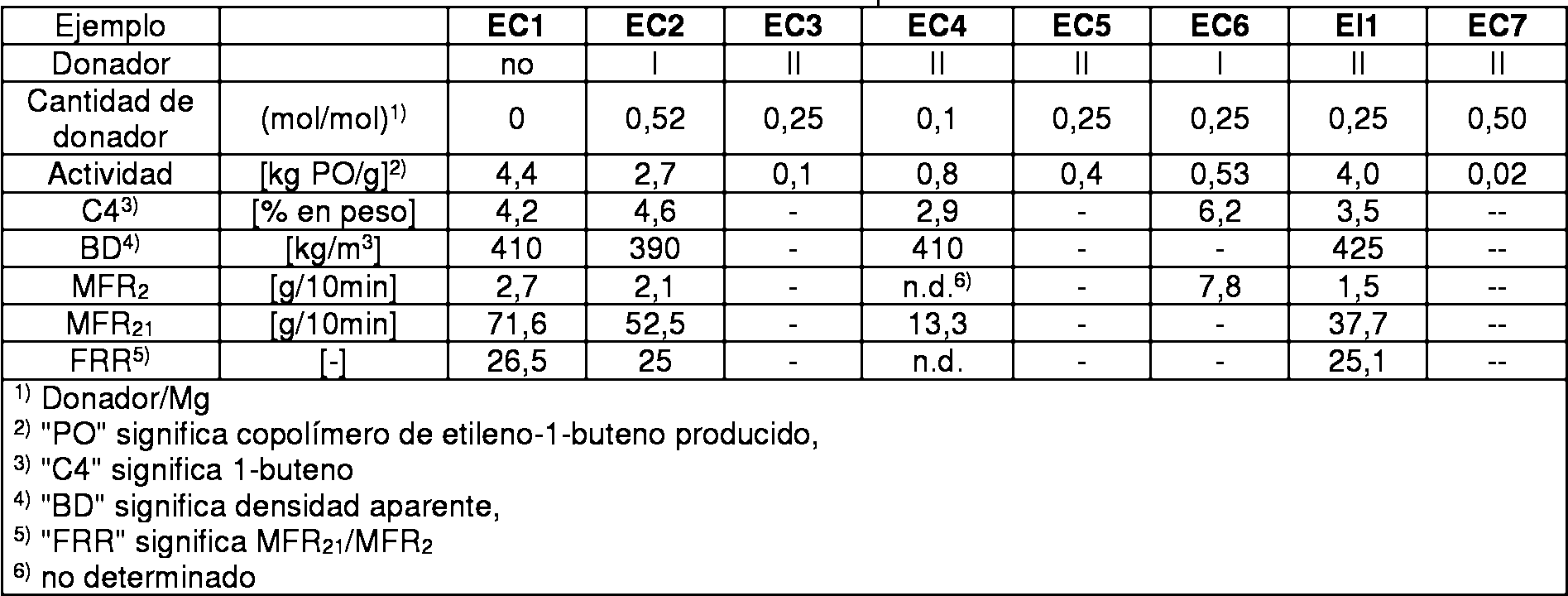
I THF II DTHFPI THF II DTHFP
El polimero de los ejemplos comparativos EC3, EC5 y EC6 no se analizo debido a la actividad muy pobre.The polymer of the comparative examples EC3, EC5 and EC6 was not analyzed due to very poor activity.
Los resultados muestran que el donador DTHFP se debe anadir a la silice despues de la adicion de EADC para conseguir una actividad razonable en la copolimerizacion. Ademas, los resultados muestran que cantidades demasiado altas de donadores dan como resultado la perdida de actividad.The results show that the DTHFP donor must be added to the silica after the addition of EADC to achieve a reasonable activity in the copolymerization. In addition, the results show that too high amounts of donors result in loss of activity.
Se consigue una distribucion de peso molecular mas estrecha (FRR = 25,1) para EI1 en comparacion con el EC1. Se puede ver que el peso molecular del EI1 es mayor que el del EC1 y el EC2 (MFR mas bajo). En el EC4 el peso molecular es aun mas alto que en el EI1, pero la actividad es muy baja y la incorporacion de C4 es mas pequena. La densidad aparente tambien es mayor en la presente invencion. A narrower molecular weight distribution (FRR = 25.1) is obtained for EI1 compared to EC1. It can be seen that the molecular weight of EI1 is higher than that of EC1 and EC2 (lower MFR). In the EC4 the molecular weight is even higher than in the EI1, but the activity is very low and the incorporation of C4 is smaller. The bulk density is also higher in the present invention.
Claims (13)

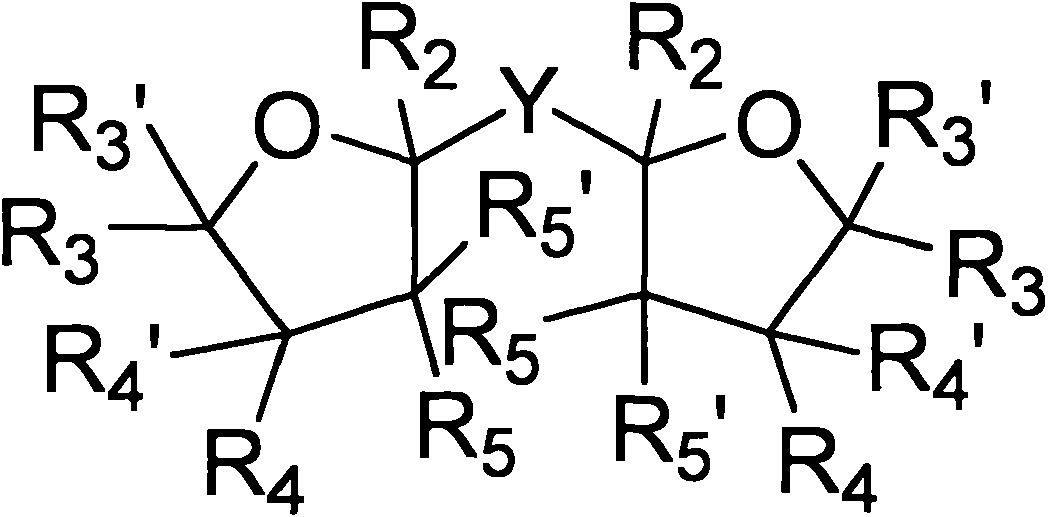
Applications Claiming Priority (1)
| Application Number | Priority Date | Filing Date | Title |
|---|---|---|---|
| EP13165940.1A EP2799456B1 (en) | 2013-04-30 | 2013-04-30 | Supported donor modified Ziegler-Natta catalysts |
Publications (1)
| Publication Number | Publication Date |
|---|---|
| ES2709631T3 true ES2709631T3 (en) | 2019-04-17 |
Family
ID=48227012
Family Applications (1)
| Application Number | Title | Priority Date | Filing Date |
|---|---|---|---|
| ES13165940T Active ES2709631T3 (en) | 2013-04-30 | 2013-04-30 | Ziegler-Natta catalysts supported modified with donor |
Country Status (5)
| Country | Link |
|---|---|
| US (1) | US9556295B2 (en) |
| EP (1) | EP2799456B1 (en) |
| CN (1) | CN105102491B (en) |
| ES (1) | ES2709631T3 (en) |
| WO (1) | WO2014177480A1 (en) |
Families Citing this family (10)
| Publication number | Priority date | Publication date | Assignee | Title |
|---|---|---|---|---|
| EP2746300B1 (en) * | 2012-12-21 | 2016-12-07 | Borealis AG | Process for producing a ziegler natta procatalyst for ethylene polymerisation |
| ES2653868T3 (en) | 2012-12-21 | 2018-02-09 | Borealis Ag | Ziegler Natta procatalyst supported for the polymerization of ethylene |
| CA2970848C (en) * | 2014-12-18 | 2023-04-11 | Borealis Ag | Ziegler-natta catalyst and preparation thereof |
| ES2707391T3 (en) | 2015-06-23 | 2019-04-03 | Borealis Ag | Procedure for the production of LLDPE resins |
| EP3249009B1 (en) | 2016-05-27 | 2021-06-23 | Abu Dhabi Polymers Co. Ltd (Borouge) L.L.C. | Polymer composition for films having improved photosynthetically active radiation (par) performance |
| US11427660B2 (en) | 2016-08-17 | 2022-08-30 | Formosa Plastics Corporation, Usa | Organosilicon compounds as electron donors for olefin polymerization catalysts and methods of making and using same |
| WO2020109289A1 (en) | 2018-11-28 | 2020-06-04 | Abu Dhabi Polymers Co. Ltd (Borouge) L.L.C. | Polyethylene composition for film applications |
| EP4019583B1 (en) | 2020-12-28 | 2024-04-10 | ABU DHABI POLYMERS CO. LTD (BOROUGE) - Sole Proprietorship L.L.C. | Polyethylene composition for film applications with improved toughness and stiffness |
| US20250109218A1 (en) | 2023-09-29 | 2025-04-03 | Formosa Plastics Corporation, U.S.A. | Method for preparing catalyst component for polymerization of polyolefin without the use of internal electron donors |
| EP4541583A1 (en) | 2023-10-18 | 2025-04-23 | Abu Dhabi Polymers Co. Ltd (Borouge) - Sole Proprietorship L.L.C. | Multilayer film |
Family Cites Families (12)
| Publication number | Priority date | Publication date | Assignee | Title |
|---|---|---|---|---|
| US4577035A (en) | 1984-11-28 | 1986-03-18 | Huffman George W | 2,2'-Isopropylidine bis(tetrahydrofuran) |
| FI89929C (en) | 1990-12-28 | 1993-12-10 | Neste Oy | Process for homo- or copolymerization of ethylene |
| FI86867C (en) | 1990-12-28 | 1992-10-26 | Neste Oy | FLERSTEGSPROCESS FOR FRAMSTAELLNING AV POLYETEN |
| FI96216C (en) | 1994-12-16 | 1996-05-27 | Borealis Polymers Oy | Process for the production of polyethylene |
| FI111372B (en) | 1998-04-06 | 2003-07-15 | Borealis Polymers Oy | Catalyst component for polymerization of olefins, its preparation and use thereof |
| EP1481994A1 (en) * | 2003-05-28 | 2004-12-01 | Borealis Technology Oy | Novel polymerisation catalyst |
| BRPI0705994A2 (en) * | 2007-10-19 | 2009-10-06 | Braskem Sa | catalytic support preparation process and supported bimetallic catalysts for the production of ethylene homopolymers and copolymers with high and ultra high molecular weight alpha olefins and with wide molecular weight distribution in sludge, mass and gas phase processes and products obtained |
| CN101798362B (en) * | 2010-02-10 | 2012-07-11 | 中国科学院上海有机化学研究所 | Ziegler-Natta olefin polymerization catalysts with single-site center property |
| TW201211083A (en) | 2010-06-15 | 2012-03-16 | Styron Europe Gmbh | Low vinyl styrene-butadiene polymers and methods of making the same |
| EP2495266A1 (en) | 2011-03-04 | 2012-09-05 | Styron Deutschland GmbH | High styrene high vinyl styrene-butadiene rubber and methods for preparation thereof |
| CN103044591B (en) * | 2011-10-11 | 2014-08-27 | 中国石油化工股份有限公司 | Polyethylene catalyst component with narrow molecular weight distribution, preparation method and application |
| ES2653868T3 (en) * | 2012-12-21 | 2018-02-09 | Borealis Ag | Ziegler Natta procatalyst supported for the polymerization of ethylene |
-
2013
- 2013-04-30 ES ES13165940T patent/ES2709631T3/en active Active
- 2013-04-30 EP EP13165940.1A patent/EP2799456B1/en active Active
-
2014
- 2014-04-28 US US14/783,668 patent/US9556295B2/en active Active
- 2014-04-28 CN CN201480020538.7A patent/CN105102491B/en active Active
- 2014-04-28 WO PCT/EP2014/058531 patent/WO2014177480A1/en not_active Ceased
Also Published As
| Publication number | Publication date |
|---|---|
| CN105102491B (en) | 2017-05-10 |
| EP2799456A1 (en) | 2014-11-05 |
| CN105102491A (en) | 2015-11-25 |
| EP2799456B1 (en) | 2018-11-21 |
| WO2014177480A1 (en) | 2014-11-06 |
| US20160060372A1 (en) | 2016-03-03 |
| US9556295B2 (en) | 2017-01-31 |
Similar Documents
| Publication | Publication Date | Title |
|---|---|---|
| ES2709631T3 (en) | Ziegler-Natta catalysts supported modified with donor | |
| ES2759324T3 (en) | Ziegler-Natta catalyst and preparation thereof | |
| US10457758B2 (en) | Supported Ziegler Natta procatalyst for ethylene polymerisation | |
| CN107207662A (en) | Process for the production of polyethylene | |
| KR20110138254A (en) | Improved Ethylene Polymerization Catalyst Composition | |
| JP2019112623A (en) | Multinary polar group-containing olefin copolymer | |
| EP4048710A1 (en) | Ziegler-natta produced polyethylene and methods thereof | |
| CN100417673C (en) | Novel Polymerization Catalyst | |
| CN110312740A (en) | Ziegler-Natta catalyst and preparation thereof | |
| CN105218711A (en) | A kind of double activated component olefin polymerization catalysis and preparation method | |
| KR101561381B1 (en) | Method for manufacturing polybutene-1 homopolymer or copolymer | |
| US9353196B2 (en) | Bimodal polymerization process utilizing chromium/silica catalysts | |
| KR20150006856A (en) | A process for the polymerisation of ethylene | |
| JP2023524449A (en) | Ziegler-Natta (pro)catalyst systems made with (multialkoxy)silane compounds | |
| WO2014096335A1 (en) | Environmentally sustainable ziegler-natta catalyst | |
| CN107880178B (en) | Catalyst component for olefin polymerization and preparation and application thereof | |
| BRPI0900952A2 (en) | catalyst and process for obtaining high activity catalyst | |
| Yakovlev et al. | Polymerisation of dienes in the presence of a cobalt catalyst with the participation of methylalumoxane | |
| CN105085739A (en) | Alkene polymerization catalyst composition, preparation method and application |