ES2703602T3 - Polyethylene composition, method for manufacturing it, and films made from it - Google Patents
Polyethylene composition, method for manufacturing it, and films made from it Download PDFInfo
- Publication number
- ES2703602T3 ES2703602T3 ES16382095T ES16382095T ES2703602T3 ES 2703602 T3 ES2703602 T3 ES 2703602T3 ES 16382095 T ES16382095 T ES 16382095T ES 16382095 T ES16382095 T ES 16382095T ES 2703602 T3 ES2703602 T3 ES 2703602T3
- Authority
- ES
- Spain
- Prior art keywords
- low density
- linear low
- density polyethylene
- polyethylene composition
- composition according
- Prior art date
- Legal status (The legal status is an assumption and is not a legal conclusion. Google has not performed a legal analysis and makes no representation as to the accuracy of the status listed.)
- Active
Links
- 239000000203 mixture Substances 0.000 title claims abstract description 73
- -1 Polyethylene Polymers 0.000 title claims description 40
- 239000004698 Polyethylene Substances 0.000 title claims description 24
- 229920000573 polyethylene Polymers 0.000 title claims description 24
- 238000004519 manufacturing process Methods 0.000 title claims description 17
- 238000000034 method Methods 0.000 title description 48
- 229920000092 linear low density polyethylene Polymers 0.000 claims abstract description 70
- 239000004707 linear low-density polyethylene Substances 0.000 claims abstract description 42
- 239000000155 melt Substances 0.000 claims abstract description 13
- LIKMAJRDDDTEIG-UHFFFAOYSA-N 1-hexene Chemical compound CCCCC=C LIKMAJRDDDTEIG-UHFFFAOYSA-N 0.000 claims description 12
- VGGSQFUCUMXWEO-UHFFFAOYSA-N Ethene Chemical compound C=C VGGSQFUCUMXWEO-UHFFFAOYSA-N 0.000 claims description 11
- 239000005977 Ethylene Substances 0.000 claims description 11
- 229920001684 low density polyethylene Polymers 0.000 claims description 9
- 239000004702 low-density polyethylene Substances 0.000 claims description 9
- VXNZUUAINFGPBY-UHFFFAOYSA-N 1-Butene Chemical compound CCC=C VXNZUUAINFGPBY-UHFFFAOYSA-N 0.000 claims description 8
- KWKAKUADMBZCLK-UHFFFAOYSA-N 1-octene Chemical compound CCCCCCC=C KWKAKUADMBZCLK-UHFFFAOYSA-N 0.000 claims description 7
- 238000010528 free radical solution polymerization reaction Methods 0.000 claims description 5
- IAQRGUVFOMOMEM-UHFFFAOYSA-N butene Natural products CC=CC IAQRGUVFOMOMEM-UHFFFAOYSA-N 0.000 claims 1
- 230000001747 exhibiting effect Effects 0.000 claims 1
- 125000004432 carbon atom Chemical group C* 0.000 description 35
- 125000001183 hydrocarbyl group Chemical group 0.000 description 31
- 229920000642 polymer Polymers 0.000 description 23
- 125000003118 aryl group Chemical group 0.000 description 19
- 230000003213 activating effect Effects 0.000 description 16
- 239000003426 co-catalyst Substances 0.000 description 16
- 125000000217 alkyl group Chemical group 0.000 description 15
- 239000003054 catalyst Substances 0.000 description 15
- 238000010828 elution Methods 0.000 description 15
- 239000002904 solvent Substances 0.000 description 15
- 125000002947 alkylene group Chemical group 0.000 description 13
- 150000001875 compounds Chemical class 0.000 description 12
- 239000003446 ligand Substances 0.000 description 12
- 239000000523 sample Substances 0.000 description 12
- 238000012360 testing method Methods 0.000 description 12
- 238000009826 distribution Methods 0.000 description 11
- 229910052739 hydrogen Inorganic materials 0.000 description 11
- 239000001257 hydrogen Substances 0.000 description 11
- 125000004435 hydrogen atom Chemical class [H]* 0.000 description 10
- 238000006116 polymerization reaction Methods 0.000 description 10
- 125000000391 vinyl group Chemical group [H]C([*])=C([H])[H] 0.000 description 10
- 239000004711 α-olefin Substances 0.000 description 10
- IJGRMHOSHXDMSA-UHFFFAOYSA-N Atomic nitrogen Chemical compound N#N IJGRMHOSHXDMSA-UHFFFAOYSA-N 0.000 description 9
- 239000000654 additive Substances 0.000 description 9
- 230000000052 comparative effect Effects 0.000 description 9
- 238000005227 gel permeation chromatography Methods 0.000 description 9
- 125000005843 halogen group Chemical group 0.000 description 9
- 125000004429 atom Chemical group 0.000 description 8
- 229910052799 carbon Inorganic materials 0.000 description 8
- 239000002356 single layer Substances 0.000 description 8
- 229910052782 aluminium Inorganic materials 0.000 description 7
- 150000004696 coordination complex Chemical group 0.000 description 7
- 125000000753 cycloalkyl group Chemical group 0.000 description 7
- 238000002474 experimental method Methods 0.000 description 7
- 239000000178 monomer Substances 0.000 description 7
- 230000007935 neutral effect Effects 0.000 description 7
- 239000002841 Lewis acid Substances 0.000 description 6
- 125000000732 arylene group Chemical group 0.000 description 6
- UORVGPXVDQYIDP-UHFFFAOYSA-N borane Chemical compound B UORVGPXVDQYIDP-UHFFFAOYSA-N 0.000 description 6
- 125000005842 heteroatom Chemical group 0.000 description 6
- 125000000743 hydrocarbylene group Chemical group 0.000 description 6
- 150000007517 lewis acids Chemical class 0.000 description 6
- OBAJXDYVZBHCGT-UHFFFAOYSA-N tris(pentafluorophenyl)borane Chemical compound FC1=C(F)C(F)=C(F)C(F)=C1B(C=1C(=C(F)C(F)=C(F)C=1F)F)C1=C(F)C(F)=C(F)C(F)=C1F OBAJXDYVZBHCGT-UHFFFAOYSA-N 0.000 description 6
- RFFLAFLAYFXFSW-UHFFFAOYSA-N 1,2-dichlorobenzene Chemical compound ClC1=CC=CC=C1Cl RFFLAFLAYFXFSW-UHFFFAOYSA-N 0.000 description 5
- 239000004215 Carbon black (E152) Substances 0.000 description 5
- 239000004793 Polystyrene Substances 0.000 description 5
- 239000007983 Tris buffer Substances 0.000 description 5
- 238000006243 chemical reaction Methods 0.000 description 5
- 125000002993 cycloalkylene group Chemical group 0.000 description 5
- 229930195733 hydrocarbon Natural products 0.000 description 5
- 239000010410 layer Substances 0.000 description 5
- 229910052757 nitrogen Inorganic materials 0.000 description 5
- 229920002223 polystyrene Polymers 0.000 description 5
- 239000000126 substance Substances 0.000 description 5
- 125000001424 substituent group Chemical group 0.000 description 5
- QVLAWKAXOMEXPM-DICFDUPASA-N 1,1,1,2-tetrachloro-2,2-dideuterioethane Chemical compound [2H]C([2H])(Cl)C(Cl)(Cl)Cl QVLAWKAXOMEXPM-DICFDUPASA-N 0.000 description 4
- OKTJSMMVPCPJKN-UHFFFAOYSA-N Carbon Chemical compound [C] OKTJSMMVPCPJKN-UHFFFAOYSA-N 0.000 description 4
- VYPSYNLAJGMNEJ-UHFFFAOYSA-N Silicium dioxide Chemical compound O=[Si]=O VYPSYNLAJGMNEJ-UHFFFAOYSA-N 0.000 description 4
- 238000012644 addition polymerization Methods 0.000 description 4
- 150000001721 carbon Chemical group 0.000 description 4
- 239000003795 chemical substances by application Substances 0.000 description 4
- 238000002425 crystallisation Methods 0.000 description 4
- 230000008025 crystallization Effects 0.000 description 4
- 238000001125 extrusion Methods 0.000 description 4
- 229910021482 group 13 metal Inorganic materials 0.000 description 4
- 239000000463 material Substances 0.000 description 4
- 229910052760 oxygen Inorganic materials 0.000 description 4
- 125000003367 polycyclic group Chemical group 0.000 description 4
- 238000000926 separation method Methods 0.000 description 4
- 239000000741 silica gel Substances 0.000 description 4
- 229910002027 silica gel Inorganic materials 0.000 description 4
- 239000000243 solution Substances 0.000 description 4
- 229910052717 sulfur Inorganic materials 0.000 description 4
- VOITXYVAKOUIBA-UHFFFAOYSA-N triethylaluminium Chemical compound CC[Al](CC)CC VOITXYVAKOUIBA-UHFFFAOYSA-N 0.000 description 4
- 229920002554 vinyl polymer Polymers 0.000 description 4
- 229910052726 zirconium Inorganic materials 0.000 description 4
- QXALIERKYGCHHA-UHFFFAOYSA-N (2,3,4,5,6-pentafluorophenyl)borane Chemical compound BC1=C(F)C(F)=C(F)C(F)=C1F QXALIERKYGCHHA-UHFFFAOYSA-N 0.000 description 3
- JRZJOMJEPLMPRA-UHFFFAOYSA-N 1-nonene Chemical compound CCCCCCCC=C JRZJOMJEPLMPRA-UHFFFAOYSA-N 0.000 description 3
- UFHFLCQGNIYNRP-UHFFFAOYSA-N Hydrogen Chemical compound [H][H] UFHFLCQGNIYNRP-UHFFFAOYSA-N 0.000 description 3
- 239000003963 antioxidant agent Substances 0.000 description 3
- 235000006708 antioxidants Nutrition 0.000 description 3
- 229910000085 borane Inorganic materials 0.000 description 3
- 229920001577 copolymer Polymers 0.000 description 3
- 125000004122 cyclic group Chemical group 0.000 description 3
- 238000002347 injection Methods 0.000 description 3
- 239000007924 injection Substances 0.000 description 3
- 238000012417 linear regression Methods 0.000 description 3
- 238000005259 measurement Methods 0.000 description 3
- 229910052751 metal Inorganic materials 0.000 description 3
- 239000002184 metal Substances 0.000 description 3
- 125000002496 methyl group Chemical group [H]C([H])([H])* 0.000 description 3
- TVMXDCGIABBOFY-UHFFFAOYSA-N n-Octanol Natural products CCCCCCCC TVMXDCGIABBOFY-UHFFFAOYSA-N 0.000 description 3
- 238000002360 preparation method Methods 0.000 description 3
- 238000000079 presaturation Methods 0.000 description 3
- 229920006395 saturated elastomer Polymers 0.000 description 3
- 125000000999 tert-butyl group Chemical group [H]C([H])([H])C(*)(C([H])([H])[H])C([H])([H])[H] 0.000 description 3
- 125000000008 (C1-C10) alkyl group Chemical group 0.000 description 2
- 125000006702 (C1-C18) alkyl group Chemical group 0.000 description 2
- 125000003837 (C1-C20) alkyl group Chemical group 0.000 description 2
- 125000006376 (C3-C10) cycloalkyl group Chemical group 0.000 description 2
- 125000006651 (C3-C20) cycloalkyl group Chemical group 0.000 description 2
- 125000006736 (C6-C20) aryl group Chemical group 0.000 description 2
- RELMFMZEBKVZJC-UHFFFAOYSA-N 1,2,3-trichlorobenzene Chemical compound ClC1=CC=CC(Cl)=C1Cl RELMFMZEBKVZJC-UHFFFAOYSA-N 0.000 description 2
- ZGEGCLOFRBLKSE-UHFFFAOYSA-N 1-Heptene Chemical compound CCCCCC=C ZGEGCLOFRBLKSE-UHFFFAOYSA-N 0.000 description 2
- AFFLGGQVNFXPEV-UHFFFAOYSA-N 1-decene Chemical compound CCCCCCCCC=C AFFLGGQVNFXPEV-UHFFFAOYSA-N 0.000 description 2
- 238000005160 1H NMR spectroscopy Methods 0.000 description 2
- AQZWEFBJYQSQEH-UHFFFAOYSA-N 2-methyloxaluminane Chemical class C[Al]1CCCCO1 AQZWEFBJYQSQEH-UHFFFAOYSA-N 0.000 description 2
- WSSSPWUEQFSQQG-UHFFFAOYSA-N 4-methyl-1-pentene Chemical compound CC(C)CC=C WSSSPWUEQFSQQG-UHFFFAOYSA-N 0.000 description 2
- QGZKDVFQNNGYKY-UHFFFAOYSA-O Ammonium Chemical compound [NH4+] QGZKDVFQNNGYKY-UHFFFAOYSA-O 0.000 description 2
- ZOXJGFHDIHLPTG-UHFFFAOYSA-N Boron Chemical compound [B] ZOXJGFHDIHLPTG-UHFFFAOYSA-N 0.000 description 2
- 229920000089 Cyclic olefin copolymer Polymers 0.000 description 2
- 238000005481 NMR spectroscopy Methods 0.000 description 2
- QCWXUUIWCKQGHC-UHFFFAOYSA-N Zirconium Chemical group [Zr] QCWXUUIWCKQGHC-UHFFFAOYSA-N 0.000 description 2
- 239000012190 activator Substances 0.000 description 2
- 239000008186 active pharmaceutical agent Substances 0.000 description 2
- 125000002015 acyclic group Chemical group 0.000 description 2
- 125000003545 alkoxy group Chemical group 0.000 description 2
- 238000007664 blowing Methods 0.000 description 2
- 238000009835 boiling Methods 0.000 description 2
- 229910052796 boron Inorganic materials 0.000 description 2
- 230000006835 compression Effects 0.000 description 2
- 238000007906 compression Methods 0.000 description 2
- 238000004090 dissolution Methods 0.000 description 2
- 125000002573 ethenylidene group Chemical group [*]=C=C([H])[H] 0.000 description 2
- 125000001495 ethyl group Chemical group [H]C([H])([H])C([H])([H])* 0.000 description 2
- 239000000945 filler Substances 0.000 description 2
- 238000005194 fractionation Methods 0.000 description 2
- 239000007789 gas Substances 0.000 description 2
- 229910052735 hafnium Inorganic materials 0.000 description 2
- 150000002430 hydrocarbons Chemical class 0.000 description 2
- CBFCDTFDPHXCNY-UHFFFAOYSA-N icosane Chemical compound CCCCCCCCCCCCCCCCCCCC CBFCDTFDPHXCNY-UHFFFAOYSA-N 0.000 description 2
- 125000001449 isopropyl group Chemical group [H]C([H])([H])C([H])(*)C([H])([H])[H] 0.000 description 2
- CPOFMOWDMVWCLF-UHFFFAOYSA-N methyl(oxo)alumane Chemical compound C[Al]=O CPOFMOWDMVWCLF-UHFFFAOYSA-N 0.000 description 2
- 238000002156 mixing Methods 0.000 description 2
- 239000002808 molecular sieve Substances 0.000 description 2
- 125000002950 monocyclic group Chemical group 0.000 description 2
- 125000004123 n-propyl group Chemical group [H]C([H])([H])C([H])([H])C([H])([H])* 0.000 description 2
- 238000001208 nuclear magnetic resonance pulse sequence Methods 0.000 description 2
- 230000001590 oxidative effect Effects 0.000 description 2
- 238000004806 packaging method and process Methods 0.000 description 2
- 238000012856 packing Methods 0.000 description 2
- NFHFRUOZVGFOOS-UHFFFAOYSA-N palladium;triphenylphosphane Chemical compound [Pd].C1=CC=CC=C1P(C=1C=CC=CC=1)C1=CC=CC=C1.C1=CC=CC=C1P(C=1C=CC=CC=1)C1=CC=CC=C1.C1=CC=CC=C1P(C=1C=CC=CC=1)C1=CC=CC=C1.C1=CC=CC=C1P(C=1C=CC=CC=1)C1=CC=CC=C1 NFHFRUOZVGFOOS-UHFFFAOYSA-N 0.000 description 2
- 239000008188 pellet Substances 0.000 description 2
- YWAKXRMUMFPDSH-UHFFFAOYSA-N pentene Chemical compound CCCC=C YWAKXRMUMFPDSH-UHFFFAOYSA-N 0.000 description 2
- YNPNZTXNASCQKK-UHFFFAOYSA-N phenanthrene Chemical compound C1=CC=C2C3=CC=CC=C3C=CC2=C1 YNPNZTXNASCQKK-UHFFFAOYSA-N 0.000 description 2
- 125000001997 phenyl group Chemical group [H]C1=C([H])C([H])=C(*)C([H])=C1[H] 0.000 description 2
- 239000002685 polymerization catalyst Substances 0.000 description 2
- QQONPFPTGQHPMA-UHFFFAOYSA-N propylene Natural products CC=C QQONPFPTGQHPMA-UHFFFAOYSA-N 0.000 description 2
- 125000004805 propylene group Chemical group [H]C([H])([H])C([H])([*:1])C([H])([H])[*:2] 0.000 description 2
- 238000011002 quantification Methods 0.000 description 2
- 239000012925 reference material Substances 0.000 description 2
- 229920005989 resin Polymers 0.000 description 2
- 239000011347 resin Substances 0.000 description 2
- 125000006413 ring segment Chemical group 0.000 description 2
- 150000003839 salts Chemical class 0.000 description 2
- 239000012488 sample solution Substances 0.000 description 2
- 239000012748 slip agent Substances 0.000 description 2
- URGAHOPLAPQHLN-UHFFFAOYSA-N sodium aluminosilicate Chemical compound [Na+].[Al+3].[O-][Si]([O-])=O.[O-][Si]([O-])=O URGAHOPLAPQHLN-UHFFFAOYSA-N 0.000 description 2
- 230000003068 static effect Effects 0.000 description 2
- 239000011550 stock solution Substances 0.000 description 2
- 238000006467 substitution reaction Methods 0.000 description 2
- 239000000758 substrate Substances 0.000 description 2
- 238000010998 test method Methods 0.000 description 2
- 229910052719 titanium Inorganic materials 0.000 description 2
- 239000010936 titanium Substances 0.000 description 2
- 125000002023 trifluoromethyl group Chemical group FC(F)(F)* 0.000 description 2
- XLYOFNOQVPJJNP-UHFFFAOYSA-N water Substances O XLYOFNOQVPJJNP-UHFFFAOYSA-N 0.000 description 2
- LWNGJAHMBMVCJR-UHFFFAOYSA-N (2,3,4,5,6-pentafluorophenoxy)boronic acid Chemical compound OB(O)OC1=C(F)C(F)=C(F)C(F)=C1F LWNGJAHMBMVCJR-UHFFFAOYSA-N 0.000 description 1
- 125000006659 (C1-C20) hydrocarbyl group Chemical group 0.000 description 1
- 125000004178 (C1-C4) alkyl group Chemical group 0.000 description 1
- DYEQHQNRKZJUCT-UHFFFAOYSA-N 1,2-dimethylidenecyclohexane Chemical compound C=C1CCCCC1=C DYEQHQNRKZJUCT-UHFFFAOYSA-N 0.000 description 1
- XBJHZEUYCYYCLK-UHFFFAOYSA-N 1,2-dimethylidenecyclopentane Chemical compound C=C1CCCC1=C XBJHZEUYCYYCLK-UHFFFAOYSA-N 0.000 description 1
- YBYIRNPNPLQARY-UHFFFAOYSA-N 1H-indene Natural products C1=CC=C2CC=CC2=C1 YBYIRNPNPLQARY-UHFFFAOYSA-N 0.000 description 1
- WEOIMVGRKQBCKD-UHFFFAOYSA-N 2,3-dimethylidenebicyclo[2.2.2]octane Chemical compound C1CC2CCC1C(=C)C2=C WEOIMVGRKQBCKD-UHFFFAOYSA-N 0.000 description 1
- AFTBJQDQENGCPC-UHFFFAOYSA-N 2,5-ditert-butyl-4-methylphenol Chemical compound CC1=CC(C(C)(C)C)=C(O)C=C1C(C)(C)C AFTBJQDQENGCPC-UHFFFAOYSA-N 0.000 description 1
- NMXLXQGHBSPIDR-UHFFFAOYSA-N 2-(2-methylpropyl)oxaluminane Chemical group CC(C)C[Al]1CCCCO1 NMXLXQGHBSPIDR-UHFFFAOYSA-N 0.000 description 1
- XOGYKECMMMACIU-UHFFFAOYSA-N 7,7-dimethyl-2,3-dimethylidenebicyclo[2.2.1]heptane Chemical compound C1CC2C(=C)C(=C)C1C2(C)C XOGYKECMMMACIU-UHFFFAOYSA-N 0.000 description 1
- 239000007848 Bronsted acid Substances 0.000 description 1
- 101100167062 Caenorhabditis elegans chch-3 gene Proteins 0.000 description 1
- RWSOTUBLDIXVET-UHFFFAOYSA-N Dihydrogen sulfide Chemical class S RWSOTUBLDIXVET-UHFFFAOYSA-N 0.000 description 1
- UAUDZVJPLUQNMU-UHFFFAOYSA-N Erucasaeureamid Natural products CCCCCCCCC=CCCCCCCCCCCCC(N)=O UAUDZVJPLUQNMU-UHFFFAOYSA-N 0.000 description 1
- 241000735215 Lepidocybium flavobrunneum Species 0.000 description 1
- 229920010126 Linear Low Density Polyethylene (LLDPE) Polymers 0.000 description 1
- 239000006057 Non-nutritive feed additive Substances 0.000 description 1
- CYTYCFOTNPOANT-UHFFFAOYSA-N Perchloroethylene Chemical group ClC(Cl)=C(Cl)Cl CYTYCFOTNPOANT-UHFFFAOYSA-N 0.000 description 1
- RTAQQCXQSZGOHL-UHFFFAOYSA-N Titanium Chemical group [Ti] RTAQQCXQSZGOHL-UHFFFAOYSA-N 0.000 description 1
- 239000000853 adhesive Substances 0.000 description 1
- 230000001070 adhesive effect Effects 0.000 description 1
- 238000013019 agitation Methods 0.000 description 1
- 150000001298 alcohols Chemical class 0.000 description 1
- 150000001336 alkenes Chemical class 0.000 description 1
- XAGFODPZIPBFFR-UHFFFAOYSA-N aluminium Chemical compound [Al] XAGFODPZIPBFFR-UHFFFAOYSA-N 0.000 description 1
- 150000001412 amines Chemical class 0.000 description 1
- 125000003277 amino group Chemical group 0.000 description 1
- 238000004458 analytical method Methods 0.000 description 1
- 150000001450 anions Chemical class 0.000 description 1
- 239000003429 antifungal agent Substances 0.000 description 1
- 229940121375 antifungal agent Drugs 0.000 description 1
- 239000004599 antimicrobial Substances 0.000 description 1
- 239000002216 antistatic agent Substances 0.000 description 1
- QVGXLLKOCUKJST-UHFFFAOYSA-N atomic oxygen Chemical compound [O] QVGXLLKOCUKJST-UHFFFAOYSA-N 0.000 description 1
- 239000011324 bead Substances 0.000 description 1
- 125000002619 bicyclic group Chemical group 0.000 description 1
- 230000015572 biosynthetic process Effects 0.000 description 1
- 238000011088 calibration curve Methods 0.000 description 1
- 125000005517 carbenium group Chemical group 0.000 description 1
- 230000015556 catabolic process Effects 0.000 description 1
- 230000003197 catalytic effect Effects 0.000 description 1
- 125000002091 cationic group Chemical group 0.000 description 1
- 239000003638 chemical reducing agent Substances 0.000 description 1
- 238000007796 conventional method Methods 0.000 description 1
- 125000005724 cycloalkenylene group Chemical group 0.000 description 1
- 125000001995 cyclobutyl group Chemical group [H]C1([H])C([H])([H])C([H])(*)C1([H])[H] 0.000 description 1
- 125000000582 cycloheptyl group Chemical group [H]C1([H])C([H])([H])C([H])([H])C([H])([H])C([H])(*)C([H])([H])C1([H])[H] 0.000 description 1
- 125000000113 cyclohexyl group Chemical group [H]C1([H])C([H])([H])C([H])([H])C([H])(*)C([H])([H])C1([H])[H] 0.000 description 1
- 125000006547 cyclononyl group Chemical group [H]C1([H])C([H])([H])C([H])([H])C([H])([H])C([H])([H])C([H])(*)C([H])([H])C([H])([H])C1([H])[H] 0.000 description 1
- 125000000640 cyclooctyl group Chemical group [H]C1([H])C([H])([H])C([H])([H])C([H])([H])C([H])(*)C([H])([H])C([H])([H])C1([H])[H] 0.000 description 1
- 125000001511 cyclopentyl group Chemical group [H]C1([H])C([H])([H])C([H])([H])C([H])(*)C1([H])[H] 0.000 description 1
- 125000001559 cyclopropyl group Chemical group [H]C1([H])C([H])([H])C1([H])* 0.000 description 1
- 238000013480 data collection Methods 0.000 description 1
- 230000003247 decreasing effect Effects 0.000 description 1
- 238000007872 degassing Methods 0.000 description 1
- 238000006731 degradation reaction Methods 0.000 description 1
- 238000001739 density measurement Methods 0.000 description 1
- 150000001993 dienes Chemical class 0.000 description 1
- 238000009792 diffusion process Methods 0.000 description 1
- 125000004639 dihydroindenyl group Chemical group C1(CCC2=CC=CC=C12)* 0.000 description 1
- 125000000118 dimethyl group Chemical group [H]C([H])([H])* 0.000 description 1
- 238000006073 displacement reaction Methods 0.000 description 1
- 239000000975 dye Substances 0.000 description 1
- 238000005868 electrolysis reaction Methods 0.000 description 1
- 238000004049 embossing Methods 0.000 description 1
- 239000003623 enhancer Substances 0.000 description 1
- UAUDZVJPLUQNMU-KTKRTIGZSA-N erucamide Chemical compound CCCCCCCC\C=C/CCCCCCCCCCCC(N)=O UAUDZVJPLUQNMU-KTKRTIGZSA-N 0.000 description 1
- 125000005678 ethenylene group Chemical group [H]C([*:1])=C([H])[*:2] 0.000 description 1
- 238000002270 exclusion chromatography Methods 0.000 description 1
- 239000003063 flame retardant Substances 0.000 description 1
- 125000003983 fluorenyl group Chemical group C1(=CC=CC=2C3=CC=CC=C3CC12)* 0.000 description 1
- 235000013305 food Nutrition 0.000 description 1
- 235000013611 frozen food Nutrition 0.000 description 1
- 238000012685 gas phase polymerization Methods 0.000 description 1
- 229910052732 germanium Inorganic materials 0.000 description 1
- 239000011521 glass Substances 0.000 description 1
- 239000008187 granular material Substances 0.000 description 1
- VBJZVLUMGGDVMO-UHFFFAOYSA-N hafnium atom Chemical group [Hf] VBJZVLUMGGDVMO-UHFFFAOYSA-N 0.000 description 1
- 150000004820 halides Chemical class 0.000 description 1
- 238000010438 heat treatment Methods 0.000 description 1
- 125000004836 hexamethylene group Chemical group [H]C([H])([*:2])C([H])([H])C([H])([H])C([H])([H])C([H])([H])C([H])([H])[*:1] 0.000 description 1
- 150000004678 hydrides Chemical class 0.000 description 1
- 125000003427 indacenyl group Chemical group 0.000 description 1
- 125000003454 indenyl group Chemical group C1(C=CC2=CC=CC=C12)* 0.000 description 1
- 238000002354 inductively-coupled plasma atomic emission spectroscopy Methods 0.000 description 1
- 125000000959 isobutyl group Chemical group [H]C([H])([H])C([H])(C([H])([H])[H])C([H])([H])* 0.000 description 1
- 238000003475 lamination Methods 0.000 description 1
- 239000007788 liquid Substances 0.000 description 1
- 239000000314 lubricant Substances 0.000 description 1
- 229920002521 macromolecule Polymers 0.000 description 1
- 239000011159 matrix material Substances 0.000 description 1
- 239000012968 metallocene catalyst Substances 0.000 description 1
- 125000004108 n-butyl group Chemical group [H]C([H])([H])C([H])([H])C([H])([H])C([H])([H])* 0.000 description 1
- 125000001280 n-hexyl group Chemical group C(CCCCC)* 0.000 description 1
- VFLWKHBYVIUAMP-UHFFFAOYSA-N n-methyl-n-octadecyloctadecan-1-amine Chemical compound CCCCCCCCCCCCCCCCCCN(C)CCCCCCCCCCCCCCCCCC VFLWKHBYVIUAMP-UHFFFAOYSA-N 0.000 description 1
- 125000000740 n-pentyl group Chemical group [H]C([H])([H])C([H])([H])C([H])([H])C([H])([H])C([H])([H])* 0.000 description 1
- 125000001624 naphthyl group Chemical group 0.000 description 1
- 239000003605 opacifier Substances 0.000 description 1
- 230000003534 oscillatory effect Effects 0.000 description 1
- 230000003647 oxidation Effects 0.000 description 1
- 238000007254 oxidation reaction Methods 0.000 description 1
- 150000002923 oximes Chemical class 0.000 description 1
- 239000001301 oxygen Substances 0.000 description 1
- 239000002245 particle Substances 0.000 description 1
- 125000000538 pentafluorophenyl group Chemical group FC1=C(F)C(F)=C(*)C(F)=C1F 0.000 description 1
- 230000000704 physical effect Effects 0.000 description 1
- 239000000049 pigment Substances 0.000 description 1
- 229920003023 plastic Polymers 0.000 description 1
- 239000004033 plastic Substances 0.000 description 1
- 239000002952 polymeric resin Substances 0.000 description 1
- 230000000379 polymerizing effect Effects 0.000 description 1
- 229920000098 polyolefin Polymers 0.000 description 1
- 239000011148 porous material Substances 0.000 description 1
- 239000012005 post-metallocene catalyst Substances 0.000 description 1
- 238000003825 pressing Methods 0.000 description 1
- 125000002924 primary amino group Chemical group [H]N([H])* 0.000 description 1
- 238000012545 processing Methods 0.000 description 1
- 239000012429 reaction media Substances 0.000 description 1
- 239000003507 refrigerant Substances 0.000 description 1
- 238000011160 research Methods 0.000 description 1
- 229930195734 saturated hydrocarbon Natural products 0.000 description 1
- 238000007789 sealing Methods 0.000 description 1
- 125000002914 sec-butyl group Chemical group [H]C([H])([H])C([H])([H])C([H])(*)C([H])([H])[H] 0.000 description 1
- 150000004819 silanols Chemical class 0.000 description 1
- 229910052710 silicon Inorganic materials 0.000 description 1
- SCABQASLNUQUKD-UHFFFAOYSA-N silylium Chemical class [SiH3+] SCABQASLNUQUKD-UHFFFAOYSA-N 0.000 description 1
- 239000007787 solid Substances 0.000 description 1
- 239000003381 stabilizer Substances 0.000 description 1
- 229910001220 stainless steel Inorganic materials 0.000 description 1
- 239000010935 stainless steel Substances 0.000 description 1
- 125000005717 substituted cycloalkylene group Chemical group 0.000 description 1
- 238000004381 surface treatment Methods 0.000 description 1
- 239000000725 suspension Substances 0.000 description 1
- 229920003002 synthetic resin Polymers 0.000 description 1
- 239000003760 tallow Substances 0.000 description 1
- 229950011008 tetrachloroethylene Drugs 0.000 description 1
- 125000001712 tetrahydronaphthyl group Chemical group C1(CCCC2=CC=CC=C12)* 0.000 description 1
- 125000000383 tetramethylene group Chemical group [H]C([H])([*:1])C([H])([H])C([H])([H])C([H])([H])[*:2] 0.000 description 1
- 238000009823 thermal lamination Methods 0.000 description 1
- 238000003856 thermoforming Methods 0.000 description 1
- 230000001131 transforming effect Effects 0.000 description 1
- WYXIGTJNYDDFFH-UHFFFAOYSA-Q triazanium;borate Chemical compound [NH4+].[NH4+].[NH4+].[O-]B([O-])[O-] WYXIGTJNYDDFFH-UHFFFAOYSA-Q 0.000 description 1
- MCULRUJILOGHCJ-UHFFFAOYSA-N triisobutylaluminium Chemical group CC(C)C[Al](CC(C)C)CC(C)C MCULRUJILOGHCJ-UHFFFAOYSA-N 0.000 description 1
- 125000002221 trityl group Chemical group [H]C1=C([H])C([H])=C([H])C([H])=C1C([*])(C1=C(C(=C(C(=C1[H])[H])[H])[H])[H])C1=C([H])C([H])=C([H])C([H])=C1[H] 0.000 description 1
- 239000003643 water by type Substances 0.000 description 1
- 238000004876 x-ray fluorescence Methods 0.000 description 1
Classifications
-
- C—CHEMISTRY; METALLURGY
- C08—ORGANIC MACROMOLECULAR COMPOUNDS; THEIR PREPARATION OR CHEMICAL WORKING-UP; COMPOSITIONS BASED THEREON
- C08L—COMPOSITIONS OF MACROMOLECULAR COMPOUNDS
- C08L23/00—Compositions of homopolymers or copolymers of unsaturated aliphatic hydrocarbons having only one carbon-to-carbon double bond; Compositions of derivatives of such polymers
- C08L23/02—Compositions of homopolymers or copolymers of unsaturated aliphatic hydrocarbons having only one carbon-to-carbon double bond; Compositions of derivatives of such polymers not modified by chemical after-treatment
- C08L23/04—Homopolymers or copolymers of ethene
- C08L23/08—Copolymers of ethene
- C08L23/0807—Copolymers of ethene with unsaturated hydrocarbons only containing four or more carbon atoms
- C08L23/0815—Copolymers of ethene with unsaturated hydrocarbons only containing four or more carbon atoms with aliphatic 1-olefins containing one carbon-to-carbon double bond
-
- B—PERFORMING OPERATIONS; TRANSPORTING
- B32—LAYERED PRODUCTS
- B32B—LAYERED PRODUCTS, i.e. PRODUCTS BUILT-UP OF STRATA OF FLAT OR NON-FLAT, e.g. CELLULAR OR HONEYCOMB, FORM
- B32B27/00—Layered products comprising a layer of synthetic resin
- B32B27/06—Layered products comprising a layer of synthetic resin as the main or only constituent of a layer, which is next to another layer of the same or of a different material
-
- B—PERFORMING OPERATIONS; TRANSPORTING
- B32—LAYERED PRODUCTS
- B32B—LAYERED PRODUCTS, i.e. PRODUCTS BUILT-UP OF STRATA OF FLAT OR NON-FLAT, e.g. CELLULAR OR HONEYCOMB, FORM
- B32B27/00—Layered products comprising a layer of synthetic resin
- B32B27/06—Layered products comprising a layer of synthetic resin as the main or only constituent of a layer, which is next to another layer of the same or of a different material
- B32B27/08—Layered products comprising a layer of synthetic resin as the main or only constituent of a layer, which is next to another layer of the same or of a different material of synthetic resin
-
- B—PERFORMING OPERATIONS; TRANSPORTING
- B32—LAYERED PRODUCTS
- B32B—LAYERED PRODUCTS, i.e. PRODUCTS BUILT-UP OF STRATA OF FLAT OR NON-FLAT, e.g. CELLULAR OR HONEYCOMB, FORM
- B32B27/00—Layered products comprising a layer of synthetic resin
- B32B27/18—Layered products comprising a layer of synthetic resin characterised by the use of special additives
-
- B—PERFORMING OPERATIONS; TRANSPORTING
- B32—LAYERED PRODUCTS
- B32B—LAYERED PRODUCTS, i.e. PRODUCTS BUILT-UP OF STRATA OF FLAT OR NON-FLAT, e.g. CELLULAR OR HONEYCOMB, FORM
- B32B27/00—Layered products comprising a layer of synthetic resin
- B32B27/18—Layered products comprising a layer of synthetic resin characterised by the use of special additives
- B32B27/20—Layered products comprising a layer of synthetic resin characterised by the use of special additives using fillers, pigments, thixotroping agents
-
- B—PERFORMING OPERATIONS; TRANSPORTING
- B32—LAYERED PRODUCTS
- B32B—LAYERED PRODUCTS, i.e. PRODUCTS BUILT-UP OF STRATA OF FLAT OR NON-FLAT, e.g. CELLULAR OR HONEYCOMB, FORM
- B32B27/00—Layered products comprising a layer of synthetic resin
- B32B27/32—Layered products comprising a layer of synthetic resin comprising polyolefins
-
- B—PERFORMING OPERATIONS; TRANSPORTING
- B32—LAYERED PRODUCTS
- B32B—LAYERED PRODUCTS, i.e. PRODUCTS BUILT-UP OF STRATA OF FLAT OR NON-FLAT, e.g. CELLULAR OR HONEYCOMB, FORM
- B32B7/00—Layered products characterised by the relation between layers; Layered products characterised by the relative orientation of features between layers, or by the relative values of a measurable parameter between layers, i.e. products comprising layers having different physical, chemical or physicochemical properties; Layered products characterised by the interconnection of layers
- B32B7/04—Interconnection of layers
-
- B—PERFORMING OPERATIONS; TRANSPORTING
- B32—LAYERED PRODUCTS
- B32B—LAYERED PRODUCTS, i.e. PRODUCTS BUILT-UP OF STRATA OF FLAT OR NON-FLAT, e.g. CELLULAR OR HONEYCOMB, FORM
- B32B7/00—Layered products characterised by the relation between layers; Layered products characterised by the relative orientation of features between layers, or by the relative values of a measurable parameter between layers, i.e. products comprising layers having different physical, chemical or physicochemical properties; Layered products characterised by the interconnection of layers
- B32B7/04—Interconnection of layers
- B32B7/12—Interconnection of layers using interposed adhesives or interposed materials with bonding properties
-
- B—PERFORMING OPERATIONS; TRANSPORTING
- B65—CONVEYING; PACKING; STORING; HANDLING THIN OR FILAMENTARY MATERIAL
- B65D—CONTAINERS FOR STORAGE OR TRANSPORT OF ARTICLES OR MATERIALS, e.g. BAGS, BARRELS, BOTTLES, BOXES, CANS, CARTONS, CRATES, DRUMS, JARS, TANKS, HOPPERS, FORWARDING CONTAINERS; ACCESSORIES, CLOSURES, OR FITTINGS THEREFOR; PACKAGING ELEMENTS; PACKAGES
- B65D75/00—Packages comprising articles or materials partially or wholly enclosed in strips, sheets, blanks, tubes or webs of flexible sheet material, e.g. in folded wrappers
- B65D75/008—Standing pouches, i.e. "Standbeutel"
-
- C—CHEMISTRY; METALLURGY
- C08—ORGANIC MACROMOLECULAR COMPOUNDS; THEIR PREPARATION OR CHEMICAL WORKING-UP; COMPOSITIONS BASED THEREON
- C08F—MACROMOLECULAR COMPOUNDS OBTAINED BY REACTIONS ONLY INVOLVING CARBON-TO-CARBON UNSATURATED BONDS
- C08F2/00—Processes of polymerisation
- C08F2/01—Processes of polymerisation characterised by special features of the polymerisation apparatus used
-
- C—CHEMISTRY; METALLURGY
- C08—ORGANIC MACROMOLECULAR COMPOUNDS; THEIR PREPARATION OR CHEMICAL WORKING-UP; COMPOSITIONS BASED THEREON
- C08F—MACROMOLECULAR COMPOUNDS OBTAINED BY REACTIONS ONLY INVOLVING CARBON-TO-CARBON UNSATURATED BONDS
- C08F210/00—Copolymers of unsaturated aliphatic hydrocarbons having only one carbon-to-carbon double bond
- C08F210/16—Copolymers of ethene with alpha-alkenes, e.g. EP rubbers
-
- C—CHEMISTRY; METALLURGY
- C08—ORGANIC MACROMOLECULAR COMPOUNDS; THEIR PREPARATION OR CHEMICAL WORKING-UP; COMPOSITIONS BASED THEREON
- C08J—WORKING-UP; GENERAL PROCESSES OF COMPOUNDING; AFTER-TREATMENT NOT COVERED BY SUBCLASSES C08B, C08C, C08F, C08G or C08H
- C08J5/00—Manufacture of articles or shaped materials containing macromolecular substances
- C08J5/18—Manufacture of films or sheets
-
- C—CHEMISTRY; METALLURGY
- C08—ORGANIC MACROMOLECULAR COMPOUNDS; THEIR PREPARATION OR CHEMICAL WORKING-UP; COMPOSITIONS BASED THEREON
- C08L—COMPOSITIONS OF MACROMOLECULAR COMPOUNDS
- C08L23/00—Compositions of homopolymers or copolymers of unsaturated aliphatic hydrocarbons having only one carbon-to-carbon double bond; Compositions of derivatives of such polymers
- C08L23/02—Compositions of homopolymers or copolymers of unsaturated aliphatic hydrocarbons having only one carbon-to-carbon double bond; Compositions of derivatives of such polymers not modified by chemical after-treatment
- C08L23/04—Homopolymers or copolymers of ethene
- C08L23/06—Polyethene
-
- B—PERFORMING OPERATIONS; TRANSPORTING
- B32—LAYERED PRODUCTS
- B32B—LAYERED PRODUCTS, i.e. PRODUCTS BUILT-UP OF STRATA OF FLAT OR NON-FLAT, e.g. CELLULAR OR HONEYCOMB, FORM
- B32B2307/00—Properties of the layers or laminate
- B32B2307/70—Other properties
- B32B2307/72—Density
-
- B—PERFORMING OPERATIONS; TRANSPORTING
- B32—LAYERED PRODUCTS
- B32B—LAYERED PRODUCTS, i.e. PRODUCTS BUILT-UP OF STRATA OF FLAT OR NON-FLAT, e.g. CELLULAR OR HONEYCOMB, FORM
- B32B2307/00—Properties of the layers or laminate
- B32B2307/70—Other properties
- B32B2307/732—Dimensional properties
-
- B—PERFORMING OPERATIONS; TRANSPORTING
- B32—LAYERED PRODUCTS
- B32B—LAYERED PRODUCTS, i.e. PRODUCTS BUILT-UP OF STRATA OF FLAT OR NON-FLAT, e.g. CELLULAR OR HONEYCOMB, FORM
- B32B2439/00—Containers; Receptacles
- B32B2439/70—Food packaging
-
- B—PERFORMING OPERATIONS; TRANSPORTING
- B32—LAYERED PRODUCTS
- B32B—LAYERED PRODUCTS, i.e. PRODUCTS BUILT-UP OF STRATA OF FLAT OR NON-FLAT, e.g. CELLULAR OR HONEYCOMB, FORM
- B32B2553/00—Packaging equipment or accessories not otherwise provided for
-
- B—PERFORMING OPERATIONS; TRANSPORTING
- B65—CONVEYING; PACKING; STORING; HANDLING THIN OR FILAMENTARY MATERIAL
- B65D—CONTAINERS FOR STORAGE OR TRANSPORT OF ARTICLES OR MATERIALS, e.g. BAGS, BARRELS, BOTTLES, BOXES, CANS, CARTONS, CRATES, DRUMS, JARS, TANKS, HOPPERS, FORWARDING CONTAINERS; ACCESSORIES, CLOSURES, OR FITTINGS THEREFOR; PACKAGING ELEMENTS; PACKAGES
- B65D2207/00—Standing packages
-
- C—CHEMISTRY; METALLURGY
- C08—ORGANIC MACROMOLECULAR COMPOUNDS; THEIR PREPARATION OR CHEMICAL WORKING-UP; COMPOSITIONS BASED THEREON
- C08F—MACROMOLECULAR COMPOUNDS OBTAINED BY REACTIONS ONLY INVOLVING CARBON-TO-CARBON UNSATURATED BONDS
- C08F4/00—Polymerisation catalysts
- C08F4/42—Metals; Metal hydrides; Metallo-organic compounds; Use thereof as catalyst precursors
- C08F4/44—Metals; Metal hydrides; Metallo-organic compounds; Use thereof as catalyst precursors selected from light metals, zinc, cadmium, mercury, copper, silver, gold, boron, gallium, indium, thallium, rare earths or actinides
- C08F4/60—Metals; Metal hydrides; Metallo-organic compounds; Use thereof as catalyst precursors selected from light metals, zinc, cadmium, mercury, copper, silver, gold, boron, gallium, indium, thallium, rare earths or actinides together with refractory metals, iron group metals, platinum group metals, manganese, rhenium technetium or compounds thereof
- C08F4/62—Refractory metals or compounds thereof
- C08F4/64—Titanium, zirconium, hafnium or compounds thereof
- C08F4/659—Component covered by group C08F4/64 containing a transition metal-carbon bond
- C08F4/65908—Component covered by group C08F4/64 containing a transition metal-carbon bond in combination with an ionising compound other than alumoxane, e.g. (C6F5)4B-X+
-
- C—CHEMISTRY; METALLURGY
- C08—ORGANIC MACROMOLECULAR COMPOUNDS; THEIR PREPARATION OR CHEMICAL WORKING-UP; COMPOSITIONS BASED THEREON
- C08J—WORKING-UP; GENERAL PROCESSES OF COMPOUNDING; AFTER-TREATMENT NOT COVERED BY SUBCLASSES C08B, C08C, C08F, C08G or C08H
- C08J2323/00—Characterised by the use of homopolymers or copolymers of unsaturated aliphatic hydrocarbons having only one carbon-to-carbon double bond; Derivatives of such polymers
- C08J2323/02—Characterised by the use of homopolymers or copolymers of unsaturated aliphatic hydrocarbons having only one carbon-to-carbon double bond; Derivatives of such polymers not modified by chemical after treatment
- C08J2323/04—Homopolymers or copolymers of ethene
- C08J2323/08—Copolymers of ethene
-
- C—CHEMISTRY; METALLURGY
- C08—ORGANIC MACROMOLECULAR COMPOUNDS; THEIR PREPARATION OR CHEMICAL WORKING-UP; COMPOSITIONS BASED THEREON
- C08J—WORKING-UP; GENERAL PROCESSES OF COMPOUNDING; AFTER-TREATMENT NOT COVERED BY SUBCLASSES C08B, C08C, C08F, C08G or C08H
- C08J2423/00—Characterised by the use of homopolymers or copolymers of unsaturated aliphatic hydrocarbons having only one carbon-to-carbon double bond; Derivatives of such polymers
- C08J2423/02—Characterised by the use of homopolymers or copolymers of unsaturated aliphatic hydrocarbons having only one carbon-to-carbon double bond; Derivatives of such polymers not modified by chemical after treatment
- C08J2423/04—Homopolymers or copolymers of ethene
- C08J2423/06—Polyethene
-
- C—CHEMISTRY; METALLURGY
- C08—ORGANIC MACROMOLECULAR COMPOUNDS; THEIR PREPARATION OR CHEMICAL WORKING-UP; COMPOSITIONS BASED THEREON
- C08L—COMPOSITIONS OF MACROMOLECULAR COMPOUNDS
- C08L2203/00—Applications
- C08L2203/16—Applications used for films
-
- C—CHEMISTRY; METALLURGY
- C08—ORGANIC MACROMOLECULAR COMPOUNDS; THEIR PREPARATION OR CHEMICAL WORKING-UP; COMPOSITIONS BASED THEREON
- C08L—COMPOSITIONS OF MACROMOLECULAR COMPOUNDS
- C08L2205/00—Polymer mixtures characterised by other features
- C08L2205/02—Polymer mixtures characterised by other features containing two or more polymers of the same C08L -group
-
- C—CHEMISTRY; METALLURGY
- C08—ORGANIC MACROMOLECULAR COMPOUNDS; THEIR PREPARATION OR CHEMICAL WORKING-UP; COMPOSITIONS BASED THEREON
- C08L—COMPOSITIONS OF MACROMOLECULAR COMPOUNDS
- C08L2207/00—Properties characterising the ingredient of the composition
- C08L2207/06—Properties of polyethylene
- C08L2207/066—LDPE (radical process)
-
- C—CHEMISTRY; METALLURGY
- C08—ORGANIC MACROMOLECULAR COMPOUNDS; THEIR PREPARATION OR CHEMICAL WORKING-UP; COMPOSITIONS BASED THEREON
- C08L—COMPOSITIONS OF MACROMOLECULAR COMPOUNDS
- C08L2314/00—Polymer mixtures characterised by way of preparation
- C08L2314/06—Metallocene or single site catalysts
Landscapes
- Chemical & Material Sciences (AREA)
- Organic Chemistry (AREA)
- Health & Medical Sciences (AREA)
- Chemical Kinetics & Catalysis (AREA)
- Medicinal Chemistry (AREA)
- Polymers & Plastics (AREA)
- Engineering & Computer Science (AREA)
- Manufacturing & Machinery (AREA)
- Materials Engineering (AREA)
- Mechanical Engineering (AREA)
- Addition Polymer Or Copolymer, Post-Treatments, Or Chemical Modifications (AREA)
- Manufacture Of Macromolecular Shaped Articles (AREA)
- Transition And Organic Metals Composition Catalysts For Addition Polymerization (AREA)
- Compositions Of Macromolecular Compounds (AREA)
Abstract
Una composición de polietileno lineal de baja densidad, la cual exhibe cada una de las siguientes propiedades: (1) una fracción CEF de 70 a 90°C igual a o mayor que 80% de las fracciones CEF totales; (2) un índice de fluidez de la masa fundida, I2, medido según la norma ASTM D 1238 (2,16 kg @190°C), en el intervalo de 0,8 a 1,5 g/10 minutos; y (3) una relación de índices de fluidez de la masa fundida, I10/I2, en el intervalo de 7,0 a 8,0.A linear low density polyethylene composition, which exhibits each of the following properties: (1) a CEF fraction of 70 to 90 ° C equal to or greater than 80% of the total CEF fractions; (2) a melt flow index, I2, measured according to ASTM D 1238 (2.16 kg @ 190 ° C), in the range of 0.8 to 1.5 g / 10 minutes; and (3) a ratio of melt flow rates, I10 / I2, in the range of 7.0 to 8.0.
Description
DESCRIPCIÓNDESCRIPTION
Composición de polietileno, método para fabricar la misma, y películas fabricadas a partir de la mismaPolyethylene composition, method for manufacturing it, and films made from it
Campo de la invenciónField of the invention
La presente invención se refiere a una composición de polietileno lineal de baja densidad, a un método para fabricar la composición, y a películas fabricadas a partir de la misma.The present invention relates to a linear low density polyethylene composition, to a method for making the composition, and to films made therefrom.
Antecedentes de la invenciónBACKGROUND OF THE INVENTION
El uso de composiciones de polietileno, tales como polietilenos lineales de baja densidad (LLDPE), en la fabricación de películas es en general conocido. Para producir dichas composiciones de polietileno puede emplearse cualquier método convencional, tal como un procedimiento en fase gaseosa, un procedimiento en suspensión, o un procedimiento en disolución. Además, para producir dichas películas puede emplearse cualquier procedimiento convencional de formación de películas, tal como un procedimiento de extrusión de películas por soplado.The use of polyethylene compositions, such as linear low density polyethylenes (LLDPE), in the manufacture of films is generally known. To produce such polyethylene compositions, any conventional method may be employed, such as a gas phase process, a suspension process, or a solution process. In addition, any conventional film-forming process, such as a blown film extrusion process, can be used to produce such films.
Para producir dichas composiciones de polietileno adecuadas para aplicaciones de producción de películas se han empleado varias técnicas de polimerización usando diferentes sistemas catalíticos. Las composiciones de polietileno actualmente disponibles no reúnen todas las propiedades deseadas de las películas, aunque proporcionan beneficios adicionales de costes.To produce such polyethylene compositions suitable for film production applications, various polymerization techniques have been employed using different catalyst systems. The currently available polyethylene compositions do not meet all the desired properties of the films, although they provide additional cost benefits.
A pesar de los esfuerzos de investigación para desarrollar composiciones de polietileno adecuadas para aplicaciones de producción de películas, aún existe la necesidad de una composición de polietileno lineal de baja densidad de menor coste que tenga mejores propiedades.Despite research efforts to develop polyethylene compositions suitable for film production applications, there is still a need for a lower cost linear low density polyethylene composition having better properties.
Sumario de la invenciónSummary of the invention
La presente descripción proporciona una composición de polietileno lineal de baja densidad, un método para fabricar la composición, películas fabricadas a partir de la misma, y métodos para fabricar las películas. En una realización, la presente descripción proporciona composiciones de polietileno lineal de baja densidad las cuales exhiben cada una de las siguientes propiedades: (1) una fracción CEF de 70 a 90°C de igual a o mayor que 80% de las fracciones CEF totales; (2) un índice de fluidez de la masa fundida, I2, medido según la norma ASTM D 1238 (2,16 kg @190°C), en el intervalo de 0,8 a 1,5 g/10 minutos; y (3) una relación de índices de fluidez de la masa fundida, I10/I2 , en el intervalo de 7,0 a 8,0.The present disclosure provides a linear low density polyethylene composition, a method for making the composition, films made therefrom, and methods for making the films. In one embodiment, the present disclosure provides linear low density polyethylene compositions which exhibit each of the following properties: (1) a CEF fraction of 70 to 90 ° C of equal to or greater than 80% of the total CEF fractions; (2) a melt flow index, I 2 , measured according to ASTM D 1238 (2.16 kg @ 190 ° C), in the range of 0.8 to 1.5 g / 10 minutes; and (3) a ratio of melt flow rates, I 10 / I 2 , in the range of 7.0 to 8.0.
En una realización alternativa, la presente descripción proporciona además una capa de película que comprende una composición de polietileno lineal de baja densidad la cual exhibe cada una de las siguientes propiedades: (1) una fracción CEF de 70 a 90°C igual a o mayor que 80% de las fracciones CEF totales; (2) un índice de fluidez de la masa fundida, I2 , medido según la norma ASTM D 1238 (2,16 kg @190°C), en el intervalo de 0,8 a 1,5 g/10 minutos; y (3) una relación de índices de fluidez de la masa fundida, I10/I2, en el intervalo de 7,0 a 8,0.In an alternative embodiment, the present disclosure further provides a film layer comprising a linear low density polyethylene composition which exhibits each of the following properties: (1) a CEF fraction of 70 to 90 ° C equal to or greater than 80% of the total CEF fractions; (2) a melt flow index, I 2 , measured according to ASTM D 1238 (2.16 kg @ 190 ° C), in the range of 0.8 to 1.5 g / 10 minutes; and (3) a ratio of melt flow rates, I 10 / I 2 , in the range of 7.0 to 8.0.
En una realización alternativa, la presente descripción proporciona además un método para producir una película que comprende: (a) extruir por soplado una composición de polietileno lineal de baja densidad la cual exhibe cada una de las siguientes propiedades: (1) una fracción CEF de 70 a 90°C igual a o mayor que 80% de las fracciones CEF totales; (2) un índice de fluidez de la masa fundida, I2, medido según la norma ASTM D 1238 (2,16 kg @190°C), en el intervalo de 0,8 a 1,5 g/10 minutos; y (3) una relación de índices de fluidez de la masa fundida, I10/I2 , en el intervalo de 7,0 a 8,0.In an alternative embodiment, the present disclosure further provides a method for producing a film comprising: (a) extruding by blowing a linear low density polyethylene composition which exhibits each of the following properties: (1) a CEF fraction of 70 to 90 ° C equal to or greater than 80% of the total CEF fractions; (2) a melt flow index, I 2 , measured according to ASTM D 1238 (2.16 kg @ 190 ° C), in the range of 0.8 to 1.5 g / 10 minutes; and (3) a ratio of melt flow rates, I 10 / I 2 , in the range of 7.0 to 8.0.
En una realización alternativa, la presente descripción proporciona además composiciones de polietileno lineal de baja densidad, películas y un método para fabricar las mismas según cualquiera de las reivindicaciones precedentes, excepto que la resina de polietileno lineal de baja densidad exhibe además una densidad (medida según la norma ASTM D792) de 0,914 a 0,920 g/cm2.In an alternative embodiment, the present disclosure further provides linear low density polyethylene compositions, films and a method for manufacturing same according to any of the preceding claims, except that the linear low density polyethylene resin also exhibits a density (measured according to ASTM D792) from 0.914 to 0.920 g / cm2.
En una realización alternativa, la presente descripción proporciona además composiciones de polietileno lineal de baja densidad, películas y un método para fabricar las mismas según cualquiera de las reivindicaciones precedentes, excepto que el polietileno lineal de baja densidad comprende unidades derivadas de etileno y unidades derivadas de uno o más comonómeros de tipo alfa-olefinas.In an alternative embodiment, the present disclosure further provides linear low density polyethylene compositions, films and a method for manufacturing same according to any of the preceding claims, except that the linear low density polyethylene comprises units derived from ethylene and units derived from one or more alpha-olefin type comonomers.
En una realización alternativa, la presente descripción proporciona además composiciones de polietileno lineal de baja densidad, películas y un método para fabricar las mismas según cualquiera de las reivindicaciones precedentes, excepto que el comonómero es 1-hexeno.In an alternative embodiment, the present disclosure further provides linear low density polyethylene compositions, films and a method for manufacturing same according to any of the preceding claims, except that the comonomer is 1-hexene.
En una realización alternativa, la presente descripción proporciona además composiciones de polietileno lineal de baja densidad, películas y un método para fabricar las mismas según cualquiera de las reivindicaciones precedentes, excepto que el comonómero es 1-octeno.In an alternative embodiment, the present disclosure further provides linear low density polyethylene compositions, films and a method for manufacturing same according to any of the preceding claims, except that the comonomer is 1-octene.
En una realización alternativa, la presente descripción proporciona además composiciones de polietileno lineal de baja densidad, películas y un método para fabricar las mismas según cualquiera de las reivindicaciones precedentes, excepto que el comonómero es 1-buteno.In an alternative embodiment, the present disclosure further provides linear low density polyethylene compositions, films and a method for manufacturing the same according to any of the claims. precedents, except that the comonomer is 1-butene.
En una realización alternativa, la presente descripción proporciona además composiciones de polietileno lineal de baja densidad, películas y un método para fabricar las mismas según cualquiera de las reivindicaciones precedentes, excepto que la composición de polietileno lineal de baja densidad se produce mediante un procedimiento en fase de disolución que utiliza un reactor.In an alternative embodiment, the present disclosure further provides linear low density polyethylene compositions, films and a method for manufacturing same according to any of the preceding claims, except that the linear low density polyethylene composition is produced by an in-phase process. of dissolution that uses a reactor.
En una realización alternativa, la presente descripción proporciona además composiciones de polietileno lineal de baja densidad, películas y un método para fabricar las mismas según cualquiera de las reivindicaciones precedentes, excepto que la composición de polietileno lineal de baja densidad se produce en un reactor de polimerización en disolución de un único bucle en presencia de hexeno.In an alternative embodiment, the present disclosure further provides linear low density polyethylene compositions, films and a method for manufacturing same according to any of the preceding claims, except that the linear low density polyethylene composition is produced in a polymerization reactor. in solution of a single loop in the presence of hexene.
En una realización alternativa, la presente descripción proporciona además composiciones de polietileno lineal de baja densidad, películas y un método para fabricar las mismas según cualquiera de las reivindicaciones precedentes, excepto que la capa de película comprende la composición de polietileno lineal de baja densidad y un polietileno de baja densidad.In an alternative embodiment, the present disclosure further provides linear low density polyethylene compositions, films and a method for manufacturing the same according to any of the preceding claims, except that the film layer comprises the linear low density polyethylene composition and a low density polyethylene.
Breve descripción de los dibujosBRIEF DESCRIPTION OF THE DRAWINGS
Con el fin de ilustrar la invención, en los dibujos se muestra una forma que es ejemplar; sin embargo, se entiende que esta invención no está limitada a las precisas disposiciones e instrumentaciones mostradas.In order to illustrate the invention, a form that is exemplary is shown in the drawings; however, it is understood that this invention is not limited to the precise arrangements and instrumentation shown.
La Fig. 1 es un gráfico que ilustra los resultados CEF (masa eluida (dWT/dT frente a la temperatura) para cada uno de los Ejemplos Comparativos 1 y 2 y el Ejemplo Inventivo 1.Fig. 1 is a graph illustrating the CEF (eluted mass (dWT / dT versus temperature) results for each of Comparative Examples 1 and 2 and Inventive Example 1.
Descripción detallada de la invenciónDetailed description of the invention
La presente descripción proporciona composiciones de polietileno lineal de baja densidad, películas y un método para fabricar las mismas. Las composiciones de polietileno lineal de baja densidad, según la presente descripción, exhiben cada una de las siguientes propiedades: (1) una fracción CEF de 70 a 90°C igual a o mayor que 80% de las fracciones CEF totales; (2) un índice de fluidez de la masa fundida, I2, medido según la norma ASTM D 1238 (2,16 kg @190°C), en el intervalo de 0,8 a 1,5 g/10 minutos; y (3) una relación de índices de fluidez de la masa fundida, I10/I2, en el intervalo de 7,0 a 8,0.The present disclosure provides linear low density polyethylene compositions, films and a method for making the same. The linear low density polyethylene compositions, according to the present disclosure, exhibit each of the following properties: (1) a CEF fraction of 70 to 90 ° C equal to or greater than 80% of the total CEF fractions; (2) a melt flow index, I 2 , measured according to ASTM D 1238 (2.16 kg @ 190 ° C), in the range of 0.8 to 1.5 g / 10 minutes; and (3) a ratio of melt flow rates, I 10 / I 2 , in the range of 7.0 to 8.0.
Las capas de películas, según la presente descripción, comprenden una composición de polietileno lineal de baja densidad la cual exhibe cada una de las siguientes propiedades: (1) una fracción CEF de 70 a 90°C igual a o mayor que 80% de las fracciones CEF totales; (2) un índice de fluidez de la masa fundida, I2, medido según la norma ASTM D 1238 (2,16 kg @190°C), en el intervalo de 0,8 a 1,5 g/10 minutos; y (3) una relación de índices de fluidez de la masa fundida, I10/I2, en el intervalo de 7,0 a 8,0.Las capas de películas, según la presente descripción, pueden comprender la composición de polietileno lineal de baja densidad y un polietileno de baja densidad. Las capas de películas pueden comprender de menos que 50 por ciento en peso de un polietileno de baja densidad, por ejemplo, de 5 a 45 por ciento en peso, o de 5 a 35 por ciento en peso, o de 15 a 35 por ciento en peso.The film layers, according to the present disclosure, comprise a linear low density polyethylene composition which exhibits each of the following properties: (1) a CEF fraction of 70 to 90 ° C equal to or greater than 80% of the fractions Total CEF; (2) a melt flow index, I 2 , measured according to ASTM D 1238 (2.16 kg @ 190 ° C), in the range of 0.8 to 1.5 g / 10 minutes; and (3) a ratio of melt flow rates, I 10 / I 2 , in the range of 7.0 to 8.0. The film layers, according to the present disclosure, may comprise the linear polyethylene composition. of low density and a low density polyethylene. The film layers may comprise less than 50 weight percent of a low density polyethylene, for example, 5 to 45 weight percent, or 5 to 35 weight percent, or 15 to 35 weight percent. in weigh.
Polietileno lineal de baja densidadLinear low density polyethylene
La composición de polietileno lineal de baja densidad la cual exhibe cada una de las siguientes propiedades: (1) una fracción CEF de 70 a 90°C igual a o mayor que 80% de las fracciones CEF totales; (2) un índice de fluidez de la masa fundida, I2 , medido según la norma ASTM D 1238 (2,16 kg @190°C), en el intervalo de 0,8 a 1,5 g/10 minutos; y (3) una relación de índices de fluidez de la masa fundida, I10/I2, en el intervalo de 7,0 a 8,0.The linear low density polyethylene composition which exhibits each of the following properties: (1) a CEF fraction of 70 to 90 ° C equal to or greater than 80% of the total CEF fractions; (2) a melt flow index, I 2 , measured according to ASTM D 1238 (2.16 kg @ 190 ° C), in the range of 0.8 to 1.5 g / 10 minutes; and (3) a ratio of melt flow rates, I 10 / I 2 , in the range of 7.0 to 8.0.
El polietileno lineal de baja densidad (LLDPE) comprende un copolímero de etileno/a-olefina que comprende: (a) menos que o igual a 100 por ciento, por ejemplo, al menos 70 por ciento, o al menos 80 por ciento, o al menos 90 por ciento, en peso de las unidades derivadas de etileno; y (b) menos que 30 por ciento, por ejemplo, menos que 25 por ciento, o menos que 20 por ciento, o menos que 10 por ciento, en peso de unidades derivadas de uno o más comonómeros tipo a-olefinas. La expresión “copolímero de etileno/a-olefina” se refiere a un polímero que contiene más que 50 por ciento en moles de monómero de etileno polimerizado (basado en la cantidad total de monómeros polimerizables) y al menos otro comonómero.Linear low density polyethylene (LLDPE) comprises an ethylene / α-olefin copolymer comprising: (a) less than or equal to 100 percent, eg, at least 70 percent, or at least 80 percent, or at least 90 percent, by weight of the units derived from ethylene; and (b) less than 30 percent, for example, less than 25 percent, or less than 20 percent, or less than 10 percent, by weight of units derived from one or more α-olefin type comonomers. The term "ethylene / α-olefin copolymer" refers to a polymer that contains more than 50 mole percent polymerized ethylene monomer (based on the total amount of polymerizable monomers) and at least one other comonomer.
Los comonómeros de tipo a-olefinas típicamente no tienen más que 20 átomos de carbono. Por ejemplo, los comonómeros de tipo a-olefinas pueden preferiblemente tener 3 a 8 átomos de carbono, y más preferiblemente 3 a 6 átomos de carbono. Comonómeros ilustrativos de tipo a-olefinas incluyen, pero no se limitan a, propileno, 1-buteno, 1-penteno, 1-hexeno, 1-hepteno, 1-octeno, 1-noneno, 1-deceno, y 4-metil-1-penteno. El uno o más comonómeros de tipo a-olefinas pueden, por ejemplo, seleccionarse del grupo que consiste en propileno, 1-buteno, 1-hexeno, o alternativamente, del grupo que consiste en 1-buteno y 1-hexeno. En una realización, la resina de polietileno lineal de baja densidad no comprende ninguna unidad derivada de 1-octeno.The α-olefin type comonomers typically have no more than 20 carbon atoms. For example, the α-olefin comonomers may preferably have 3 to 8 carbon atoms, and more preferably 3 to 6 carbon atoms. Illustrative comonomers of the α-olefin type include, but are not limited to, propylene, 1-butene, 1-pentene, 1-hexene, 1-heptene, 1-octene, 1-nonene, 1-decene, and 4-methyl- 1-pentene The one or more α-olefin comonomers may, for example, be selected from the group consisting of propylene, 1-butene, 1-hexene, or alternatively, from the group consisting of 1-butene and 1-hexene. In one embodiment, the linear low density polyethylene resin does not comprise any unit derived from 1-octene.
El LLDPE tiene una fracción CEF de 70 a 90°C igual a o mayor que 80% de las fracciones CEF totales, por ejemplo, el LLDPE tiene una fracción CEF de 70 a 90°C igual a o mayor que 85% de las fracciones CEF totales, o alternativamente, el LLDPE tiene una fracción CEF de 70 a 90°C igual a o mayor que 90% de las fracciones CEF totales.The LLDPE has a CEF fraction of 70 to 90 ° C equal to or greater than 80% of the total CEF fractions, for example, the LLDPE has a CEF fraction of 70 to 90 ° C equal to or greater than 85% of the total CEF fractions , or alternatively, LLDPE has a CEF fraction of 70 to 90 ° C equal to or greater than 90% of the total CEF fractions.
El LLDPE tiene un índice de fluidez de la masa fundida, I2, medido según la norma ASTM D 1238 (2,16 kg @190°C), en el intervalo de 0,8 a 1,5 g/10 min. Todos los valores individuales y subintervalos de 0,8 a 1,5 g/10 min están incluidos y descritos en la presente memoria; por ejemplo, el I2 puede variar de un límite inferior de 0,8, 1,0, 1,2 o 1,4 g/10 min a un límite superior de 0,9, 1,1, 1,3 o 1,5 g/10 min. Por ejemplo, el I2 puede ser de 0,8 a 1,5 g/10 min, o alternativamente, de 0,9 a 1,2 g/10 min, o alternativamente, de 1,0 a 1,5 g/10 min.The LLDPE has a melt flow index, I 2 , measured according to ASTM D 1238 (2.16 kg @ 190 ° C), in the range of 0.8 to 1.5 g / 10 min. All individual values and subintervals of 0.8 to 1.5 g / 10 min are included and described herein; for example, I 2 may vary from a lower limit of 0.8, 1.0, 1.2 or 1.4 g / 10 min to an upper limit of 0.9, 1.1, 1.3 or 1 5 g / 10 min. For example, the I 2 can be from 0.8 to 1.5 g / 10 min, or alternatively, from 0.9 to 1.2 g / 10 min, or alternatively, from 1.0 to 1.5 g / 10 minutes.
El LLDPE se caracteriza por tener una relación de viscosidad a cizalladura cero (ZSVR) en el intervalo de 1,2 a 5. Todos los valores individuales y subintervalos están descritos e incluidos en la presente memoria; por ejemplo, la ZSVR puede variar de un límite inferior de 1,2, 2,2, 3,2 o 4,2 a un límite superior de 1,5, 2,6, 3,5, 4,4 o 5. Por ejemplo, la ZSVR puede variar de 1,2 a 5, o alternativamente, de 1,5 a 4, o alternativamente, de 1,2 a 3,1, o alternativamente, de 3 a 5, o alternativamente, de 2 a 4.LLDPE is characterized by having a zero shear viscosity ratio (ZSVR) in the range of 1.2 to 5. All individual values and subintervals are described and included herein; for example, the ZSVR can vary from a lower limit of 1.2, 2.2, 3.2 or 4.2 to an upper limit of 1.5, 2.6, 3.5, 4.4 or 5. For example, the ZSVR can vary from 1.2 to 5, or alternatively, from 1.5 to 4, or alternatively, from 1.2 to 3.1, or alternatively, from 3 to 5, or alternatively, from 2 to Four.
El LLDPE tiene una densidad en el intervalo de 0,914 a 0,920 g/cm3. Todos los valores individuales y subintervalos de 0,914 a 0,920 g/cm3 están incluidos y descritos en la presente memoria. Por ejemplo, la densidad puede ser desde un límite inferior de 0,914, 0,916, 0,918 g/cm3 a un límite superior de 0,920, 0,917, o 0,915 g/cm3. Por ejemplo, la densidad puede variar de 0,914 a 0,920 g/cm3, o alternativamente, de 0,914 a 0,918 g/cm3, o alternativamente, de 0,913 a 0,919 g/cm3, o alternativamente, de 0,918 a 0,920 g/cm3, o alternativamente, de 0,915 a 0,919 g/cm3.The LLDPE has a density in the range of 0.914 to 0.920 g / cm3. All individual values and subintervals of 0.914 to 0.920 g / cm3 are included and described herein. For example, the density can be from a lower limit of 0.914, 0.916, 0.918 g / cm3 to an upper limit of 0.920, 0.917, or 0.915 g / cm3. For example, the density may vary from 0.914 to 0.920 g / cm3, or alternatively, from 0.914 to 0.918 g / cm3, or alternatively, from 0.913 to 0.919 g / cm3, or alternatively, from 0.918 to 0.920 g / cm3, or alternatively , from 0.915 to 0.919 g / cm3.
El LLDPE tiene una distribución de pesos moleculares (Mw/Mn) en el intervalo de 2,0 a 3,5. Todos los valores individuales y subintervalos de 2,0 a 3,5 están incluidos y descritos en la presente memoria; por ejemplo, la distribución de pesos moleculares (Mw/Mn) puede variar de un límite inferior de 2, 2,1, 2,2, 2,4, 2,5, o 2,6 a un límite superior de 2,2, 2,3, 2,4, 2,5, 2,7, 2,9, 3,2, o 3,5. Por ejemplo, la distribución de pesos moleculares (Mw/Mn) puede ser de 2,0 a 3,5, o alternativamente, de 2,0 a 2,4, o alternativamente, de 2,0 a 2,8, o alternativamente, de 2,8 a 3,5. El LLDPE tiene una distribución de pesos moleculares (Mz/Mn) en el intervalo de 3,5 a 6. Todos los valores individuales y subintervalos de 3,5 a 6 están incluidos y descritos en la presente memoria; por ejemplo, la distribución de pesos moleculares (Mz/Mn) puede ser de un límite inferior de 3,5, 3,7, 3,9, 4,5 o 5 a un límite superior de 3,5, 4,0, 4,2, 4,4, 4,7, 5,0, 5,5 o 6,0. Por ejemplo, la distribución de pesos moleculares (Mz/Mn) puede variar de 3,5 a 6, o alternativamente, de 3,5 a 4,8, o alternativamente, de 4,8 a 6, o alternativamente, de 4 a 5, o alternativamente, de 3,5 a 4,5.The LLDPE has a molecular weight distribution (Mw / Mn) in the range of 2.0 to 3.5. All individual values and subintervals from 2.0 to 3.5 are included and described herein; for example, the molecular weight distribution (Mw / Mn) can vary from a lower limit of 2, 2.1, 2.2, 2.4, 2.5, or 2.6 to an upper limit of 2.2 , 2,3, 2,4, 2,5, 2,7, 2,9, 3,2, or 3,5. For example, the molecular weight distribution (Mw / Mn) can be from 2.0 to 3.5, or alternatively, from 2.0 to 2.4, or alternatively, from 2.0 to 2.8, or alternatively , from 2.8 to 3.5. LLDPE has a molecular weight distribution (Mz / Mn) in the range of 3.5 to 6. All individual values and subranges of 3.5 to 6 are included and described herein; for example, the molecular weight distribution (Mz / Mn) can be from a lower limit of 3.5, 3.7, 3.9, 4.5 or 5 to an upper limit of 3.5, 4.0, 4.2, 4.4, 4.7, 5.0, 5.5 or 6.0. For example, the molecular weight distribution (Mz / Mn) can vary from 3.5 to 6, or alternatively, from 3.5 to 4.8, or alternatively, from 4.8 to 6, or alternatively, from 4 to 5, or alternatively, from 3.5 to 4.5.
El LLDPE tiene una distribución de pesos moleculares asimétrica [(Mw/Mn)/(Mz/Mw)], es decir Mw2/(Mn*Mz) en el intervalo de 1,00 a 1,40. Por ejemplo, la distribución de pesos moleculares asimétrica Mw2/(Mn*Mz) puede ser de un límite inferior de 1,0, 1,05, 1,10, 1,15 o 1,20 a un límite superior de 1,25, 1,30, 1,35, o 1,40. Por ejemplo, la distribución de pesos moleculares asimétrica Mw2/(Mn*Mz) puede variar de 1,00 a 1,40, o alternativamente, de 1,00 a 1,20, o alternativamente, de 1,20 a 1,40, o alternativamente, de 1,10 a 1,30.The LLDPE has an asymmetric molecular weight distribution [(Mw / Mn) / (Mz / Mw)], ie Mw2 / (Mn * Mz) in the range of 1.00 to 1.40. For example, the asymmetric molecular weight distribution Mw2 / (Mn * Mz) can be from a lower limit of 1.0, 1.05, 1.10, 1.15 or 1.20 to an upper limit of 1.25 , 1.30, 1.35, or 1.40. For example, the asymmetric molecular weight distribution Mw2 / (Mn * Mz) can vary from 1.00 to 1.40, or alternatively, from 1.00 to 1.20, or alternatively, from 1.20 to 1.40 , or alternatively, from 1.10 to 1.30.
El LLDPE tiene una insaturación vinílica de menos que 0,15 grupos vinilo por mil átomos de carbono presentes en la cadena macromolecular del LLDPE. Todos los valores individuales de menos que 0,15 grupos vinilo por mil átomos de carbono están incluidos y descritos en la presente memoria. Por ejemplo, el LLDPE puede tener una insaturación vinílica de menos que 0,15 grupos vinilo por mil átomos de carbono, o alternativamente, menos que 0,12 grupos vinilo por mil átomos de carbono, o alternativamente, menos que 0,09 grupos vinilo por mil átomos de carbono, o alternativamente, menos que 0,06 grupos vinilo por mil átomos de carbono.LLDPE has a vinyl unsaturation of less than 0.15 vinyl groups per one thousand carbon atoms present in the macromolecular chain of LLDPE. All individual values of less than 0.15 vinyl groups per thousand carbon atoms are included and described herein. For example, LLDPE may have a vinyl unsaturation of less than 0.15 vinyl groups per one thousand carbon atoms, or alternatively, less than 0.12 vinyl groups per one thousand carbon atoms, or alternatively, less than 0.09 vinyl groups per thousand carbon atoms, or alternatively, less than 0.06 vinyl groups per thousand carbon atoms.
En una realización, el LLDPE comprende menos que o igual a 100 partes, por ejemplo, menos que 10 partes, menos que 8 partes, menos que 5 partes, menos que 4 partes, menos que 1 parte, menos que 0,5 partes, o menos que 0,1 partes, en peso de residuos de complejos metálicos procedentes de un sistema catalítico que comprende un complejo metálico de un ariloxiéter polivalente por un millón de partes del LLDPE. Los residuos de complejos metálicos procedentes del sistema catalítico que comprende un complejo metálico de un ariloxiéter polivalente en el LLDPE pueden medirse por fluorescencia de rayos X (XRF), la cual se calibra con patrones de referencia. Los gránulos de resina de polímero pueden moldearse por compresión a elevada temperatura en forma de placas, que en un método preferido tienen un espesor de aproximadamente 0,952 cm para la medición por rayos X. A muy bajas concentraciones de complejo metálico, tales como por debajo de 0,1 ppm, el ICP-AES sería un método adecuado para determinar residuos de complejos metálicos presentes en el LLDPE.In one embodiment, the LLDPE comprises less than or equal to 100 parts, for example, less than 10 parts, less than 8 parts, less than 5 parts, less than 4 parts, less than 1 part, less than 0.5 parts, or less than 0.1 parts, by weight, of metal complex residues from a catalyst system comprising a metal complex of a polyvalent aryloxyether per one million parts of LLDPE. Residues of metal complexes from the catalytic system comprising a metal complex of a polyvalent aryloxyether in the LLDPE can be measured by X-ray fluorescence (XRF), which is calibrated with reference standards. The polymer resin granules can be compression molded at high temperature in the form of plates, which in a preferred method have a thickness of about 0.952 cm for the X-ray measurement. At very low concentrations of metal complex, such as below 0.1 ppm, the ICP-AES would be an adequate method to determine residues of metal complexes present in the LLDPE.
El LLDPE puede además comprender componentes adicionales tales como uno o más de otros polímeros y/o uno o más aditivos. Dichos aditivos incluyen, pero no se limitan a, agentes antiestáticos, reforzantes del color, colorantes, lubricantes, cargas tales como TO 2 o CaCO3 , opacificantes, nucleantes, compuestos auxiliares de procesado, pigmentos, antioxidantes primarios, antioxidantes secundarios, compuestos auxiliares de procesado, agentes estabilizantes UV, agentes antiadherentes, agentes deslizantes, agentes de pegajosidad, retardantes del fuego, agentes anti-microbianos, agentes reductores del olor, agentes antifúngicos, y sus combinaciones. El LLDPE puede contener de aproximadamente 0,1 a aproximadamente 10 por ciento en peso combinado de dichos aditivos, basado en el peso del LLDPE que incluye dichos aditivos. The LLDPE may further comprise additional components such as one or more other polymers and / or one or more additives. Such additives include, but are not limited to, antistatic agents, color enhancers, dyes, lubricants, fillers such as TO 2 or CaCO 3 , opacifiers, nucleants, processing aids, pigments, primary antioxidants, secondary antioxidants, auxiliary compounds of processed, UV stabilizing agents, anti-stick agents, slip agents, tackifiers, fire retardants, anti-microbial agents, odor reducing agents, antifungal agents, and combinations thereof. The LLDPE may contain from about 0.1 to about 10 weight percent combined of said additives, based on the weight of the LLDPE including said additives.
Para producir el LLDPE puede emplearse cualquier procedimiento convencional de reacción de (co)polimerización en disolución en un único reactor. Un método para fabricar el LLDPE descrito en la presente memoria se describe con detalle en la patente de EE.UU. 5.977.251, cuya descripción se incorpora en su totalidad en la presente memoria como referencia.Any conventional process for reacting (co) polymerization in solution in a single reactor can be used to produce the LLDPE. A method for manufacturing the LLDPE described herein is described in detail in U.S. Pat. 5,977,251, the disclosure of which is hereby incorporated by reference in its entirety.
En una realización, el LLDPE se prepara mediante un procedimiento de polimerización en disolución en un único reactor, en donde el procedimiento comprende polimerizar etileno y opcionalmente una o más a-olefinas en presencia de un sistema catalítico que comprende un complejo metálico de un ariloxiéter polivalente correspondiente a la fórmula:In one embodiment, the LLDPE is prepared by a solution polymerization process in a single reactor, wherein the process comprises polymerizing ethylene and optionally one or more α-olefins in the presence of a catalyst system comprising a metal complex of a polyvalent aryloxyether corresponding to the formula:
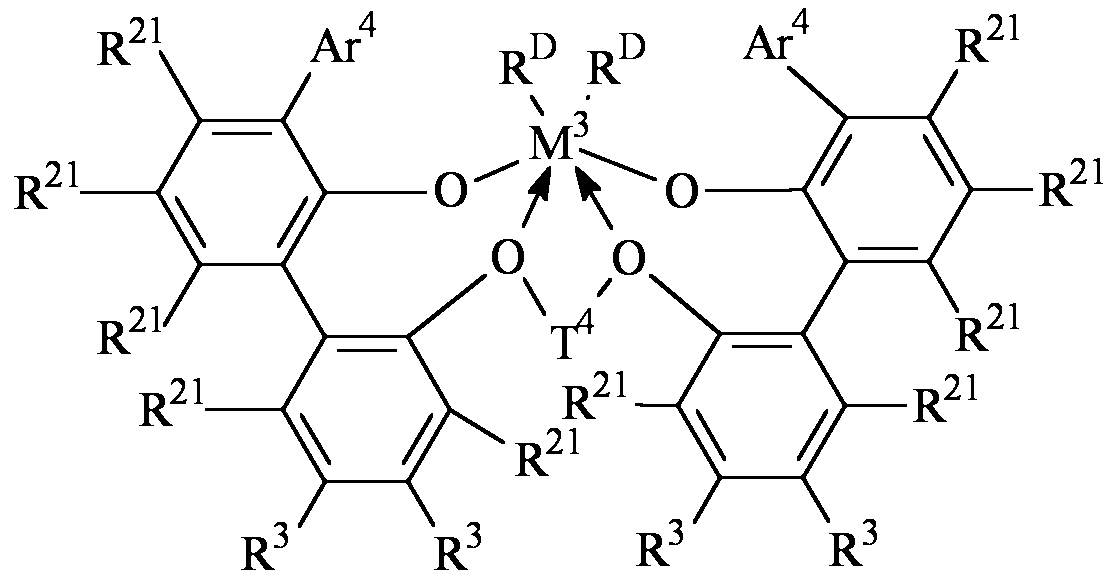
en donde M3 es Ti, Hf o Zr, preferiblemente Zr;wherein M3 is Ti, Hf or Zr, preferably Zr;
Ar4 es independientemente en cada aparición un grupo arilo de C9-20 sustituido, en donde los sustituyentes, independientemente en cada aparición, se seleccionan del grupo que consiste en grupos alquilo; cicloalquilo; y arilo; y sus derivados halo, trihidrocarbilsilil y halohidrocarbil sustituidos, con la condición de que al menos un sustituyente carezca de coplanaridad con el grupo arilo al que está unido;Ar 4 is independently at each occurrence a substituted C 9-20 aryl group, wherein the substituents, independently at each occurrence, are selected from the group consisting of alkyl groups; cycloalkyl; and aryl; and its halo, trihydrocarbylsilyl and substituted halohydrocarbyl derivatives, with the proviso that at least one substituent lacks coplanarity with the aryl group to which it is attached;
T4 es independientemente en cada aparición un grupo alquileno, cicloalquileno o cicloalquenileno de C2-20, o uno de sus derivados inertemente sustituidos;T4 is independently at each occurrence an alkylene, cycloalkylene or cycloalkenylene group of C2-20 , or one of its inertly substituted derivatives;
R21 es independientemente en cada aparición hidrógeno, un grupo halo, hidrocarbilo, trihidrocarbilsililo, trihidrocarbilsililhidrocarbilo, alcoxi o di(hidrocarbil)amino de hasta 50 átomos sin contar el hidrógeno;R21 is independently at each occurrence hydrogen, a halo, hydrocarbyl, trihydrocarbylsilyl, trihydrocarbylsilylhydrocarbyl, alkoxy or di (hydrocarbyl) amino group of up to 50 atoms not counting hydrogen;
R3 es independientemente en cada aparición hidrógeno, halo, hidrocarbilo, trihidrocarbilsililo, trihidrocarbilsililhidrocarbilo, alcoxi o amino de hasta 50 átomos sin contar el hidrógeno, o dos grupos R3 sobre el mismo anillo de arileno juntos, o un grupo R3 y un grupo R21 sobre el mismo o diferente anillo de arileno juntos, forman un grupo ligando divalente unido al grupo arileno en dos posiciones o unen dos anillos arileno diferentes conjuntamente; yR3 is independently at each occurrence hydrogen, halo, hydrocarbyl, trihydrocarbylsilyl, trihydrocarbylsilylhydrocarbyl, alkoxy or amino of up to 50 atoms not counting hydrogen, or two R3 groups on the same arylene ring together, or a group R3 and a group R21 on the same or different arylene ring together, form a divalent ligand group attached to the arylene group in two positions or join two different arylene rings together; Y
RD es independientemente en cada aparición un grupo halo o un grupo hidrocarbilo o trihidrocarbilsililo de hasta 20 átomos sin contar el hidrógeno, o 2 grupos RD juntos son un grupo hidrocarbileno, hidrocarbadiilo, dieno, o poli(hidrocarbil)silileno.RD is independently at each occurrence a halo group or a hydrocarbyl or trihydrocarbylsilyl group of up to 20 atoms not counting hydrogen, or 2 RD groups together are a hydrocarbylene, hydrocarbaryl, diene, or poly (hydrocarbyl) silylene group.
La composición de interpolímero de etileno/a-olefina puede producirse mediante una polimerización en disolución según el siguiente procedimiento ilustrativo.The ethylene / α-olefin interpolymer composition can be produced by a solution polymerization according to the following illustrative procedure.
Todos los materiales (etileno, 1-hexeno) y el disolvente del procedimiento (un disolvente isoparafínico de alta pureza de estrecho intervalo de puntos de ebullición comercialmente disponible con el nombre comercial de ISOPAR E en ExxonMobil Corporation) se purifican con tamices moleculares antes de la introducción en el medio de reacción. El hidrógeno se suministra en cilindros presurizados como un grado de alta pureza y no se purifica adicionalmente. La corriente de alimentación de monómero (etileno) al reactor se presuriza mediante un compresor mecánico hasta una presión que es superior a la presión del reactor, aproximadamente hasta 51 bar (750 psi). La alimentación del disolvente y del comonómero (l-hexeno) se presuriza mediante una bomba mecánica de desplazamiento positivo hasta una presión que es superior a la presión del reactor, aproximadamente 51 bar (750 psi). Los componentes catalizadores individuales se diluyen manualmente en discontinuo con disolvente purificado (ISOPAR E) hasta concentraciones especificadas del componente y se presurizan hasta una presión que es superior a la presión del reactor, aproximadamente 51 bar (750 psi). Todos los caudales de alimentación de reacción se miden con caudalímetros de masa, independientemente controlados con sistemas automatizados computarizados de control de válvulas.All the materials (ethylene, 1-hexene) and the process solvent (a high purity isoparaffin solvent of narrow boiling range commercially available under the tradename ISOPAR E at ExxonMobil Corporation) are purified with molecular sieves prior to introduction in the reaction medium. The hydrogen is supplied in pressurized cylinders as a degree of high purity and is not further purified. The monomer (ethylene) feed stream to the reactor is pressurized by a mechanical compressor to a pressure that is higher than the reactor pressure, approximately up to 51 bar (750 psi). The solvent and comonomer (l-hexene) feed is pressurized by a positive displacement mechanical pump to a pressure that is higher than the reactor pressure, approximately 51 bar (750 psi). The individual catalyst components are manually diluted in batch with purified solvent (ISOPAR E) to specified concentrations of the component and pressurized to a pressure that is higher than the reactor pressure, approximately 51 bar (750 psi). All reaction feed rates are measured with mass flow meters, independently controlled with computerized automated valve control systems.
Se controla independientemente la temperatura de la alimentación combinada al reactor de disolvente, monómero, comonómero e hidrógeno en cualquier punto entre 5°C y 50°C, y típicamente 40°C, pasando la corriente de alimentación a través de un intercambiador de calor. La alimentación de comonómero de reciente preparación al reactor de polimerización se inyecta en el reactor. Los componentes del catalizador se inyectan en el reactor de polimerización a través de aguijones de inyección especialmente diseñados sin entrar en contacto antes de entrar en el reactor. La alimentación del componente catalizador primario se controla por ordenador para mantener la concentración de monómero en el reactor en un valor diana especificado. Los dos componentes cocatalizadores se alimentan sobre la base de relaciones en moles especificadas calculadas respecto al componente catalizador primario. Inmediatamente tras cada punto de nueva inyección (de alimentación o de catalizador), las corrientes de alimentación se mezclan con el contenido circulante del reactor de polimerización con elementos estáticos de mezclamiento. El contenido del reactor se circula continuamente a través de intercambiadores de calor responsables de eliminar gran parte del calor de reacción y con la temperatura del lado del refrigerante responsable de mantener el ambiente isotermo de reacción a la temperatura especificada. La circulación alrededor de cada bucle del rector es proporcionada mediante una bomba de tornillo. Cuando la corriente sale del reactor, se pone en contacto con un agente desactivador, por ejemplo, agua, para parar la reacción. Además, en este punto pueden añadirse varios aditivos tales como anti-oxidantes. A continuación, la corriente va a través de otra serie de elementos estáticos de mezclado para dispersar uniformemente el agente desactivador del catalizador y los aditivos.The temperature of the combined feed is controlled independently to the reactor of solvent, monomer, comonomer and hydrogen at any point between 5 ° C and 50 ° C, and typically 40 ° C, passing the feed stream through a heat exchanger. The comonomer feed of recent preparation at Polymerization reactor is injected into the reactor. The catalyst components are injected into the polymerization reactor through specially designed injection stubs without coming into contact before entering the reactor. The feed of the primary catalyst component is controlled by computer to maintain the monomer concentration in the reactor at a specified target value. The two cocatalyst components are fed on the basis of specified molar ratios calculated with respect to the primary catalyst component. Immediately after each point of new injection (feed or catalyst), the feed streams are mixed with the circulating content of the polymerization reactor with static mixing elements. The content of the reactor is continuously circulated through heat exchangers responsible for removing much of the heat of reaction and with the temperature of the refrigerant side responsible for maintaining the isothermal reaction environment at the specified temperature. Circulation around each rector loop is provided by a screw pump. When the current leaves the reactor, it is contacted with a deactivating agent, for example, water, to stop the reaction. In addition, at this point various additives such as anti-oxidants can be added. Next, the stream goes through another series of static mixing elements to uniformly disperse the catalyst deactivating agent and the additives.
Tras la adición de los aditivos, el efluente (que contiene disolvente, monómero, comonómero, hidrógeno, componentes catalizadores, y polímero fundido) pasa a través de un intercambiador de calor para subir la temperatura de la corriente para prepararla para la separación del polímero de los otros componentes de reacción de bajo punto de ebullición. A continuación, la corriente entra en un sistema de dos etapas de separación y desvolatilización en el que el polímero se separa del disolvente, hidrógeno, y de los monómeros y comonómeros sin reaccionar. La corriente reciclada se purifica antes de entrar de nuevo en el reactor. La masa fundida de polímero separada y desvolatilizada se bombea a través de una boquilla especialmente diseñada para la formación de pelets bajo agua, se corta en pelets sólidos uniformes, se seca, y se transfiere a una tolva.After the addition of the additives, the effluent (containing solvent, monomer, comonomer, hydrogen, catalyst components, and molten polymer) passes through a heat exchanger to raise the temperature of the stream to prepare it for polymer separation. the other low-boiling reaction components. Next, the stream enters a two-stage separation and devolatilization system in which the polymer is separated from the solvent, hydrogen, and the unreacted monomers and comonomers. The recycled stream is purified before entering the reactor again. The separated and devolatilized polymer melt is pumped through a nozzle specially designed for the formation of pellets under water, cut into uniform solid pellets, dried, and transferred to a hopper.
En una realización, el LLDPE se prepara mediante un procedimiento de polimerización en un único sistema de reactores de bucle en fase de disolución, en donde el sistema catalizador comprende: (a) uno o más procatalizadores que comprenden a complejo metal-ligando de fórmula (I) siguiente:In one embodiment, the LLDPE is prepared by a polymerization process in a single loop reactor system in the dissolution phase, wherein the catalyst system comprises: (a) one or more procatalysts comprising a metal-ligand complex of formula ( I) next:

en donde:where:
M es titanio, zirconio, o hafnio, estando cada uno independientemente en un estado formal de oxidación de 2, 3, o 4; y n es un número entero de 0 a 3, y en donde cuando n es 0, X está ausente; yM is titanium, zirconium, or hafnium, each independently being in a formal oxidation state of 2, 3, or 4; and n is an integer from 0 to 3, and where when n is 0, X is absent; Y
cada X es independientemente un ligando monodentado que es neutro, monoaniónico, o dianiónico; o dos Xs se toman conjuntamente para formar un ligando bidentado que es neutro, monoaniónico, o dianiónico; y X y n se escogen de tal forma que el complejo metal-ligando de fórmula (I) es, en conjunto, neutro; yeach X is independently a monodentate ligand that is neutral, monoanionic, or dianionic; or two Xs are taken together to form a bidentate ligand that is neutral, monoanionic, or dianionic; and X and n are chosen in such a way that the metal-ligand complex of formula (I) is, overall, neutral; Y
cada Z es independientemente O, S, N-hidrocarbilo de (C1-C40), o P-hidrocarbilo de (C1-C40); yeach Z is independently O, S, N-hydrocarbyl of (C 1 -C 40 ), or P-hydrocarbyl of (C 1 -C 40 ); Y
L es hidrocarbileno de (C3-C40) o heterohidrocarbileno de (C3-C40), en donde el hidrocarbileno de (C3-C40) tiene una parte que comprende una cadena enlazante de 3 a 10 átomos de carbono que une los átomos Z en la fórmula (I) (a la cual está enlazado L) y el heterohidrocarbileno de (C3-C40) tiene una parte que comprende una cadena enlazante de 3 a 10 átomos de carbono que une los átomos Z en la fórmula (I), en donde cada uno de los 3 a 10 átomos de la cadena enlazante de 3 a 10 átomos de carbono del heterohidrocarbileno de (C3-C40) es independientemente un átomo de carbono o un heteroátomo, en donde cada heteroátomo es independientemente O, S, S(O), S(O)2, Si(RC)2, Ge(RC)2, P(RP), o N(RN), en donde independientemente cada RC es hidrocarbilo de (C1-C30), cada RP es hidrocarbilo de (C1-C30); y cada RN es hidrocarbilo de (C1-C30) o está ausente; yL is hydrocarbylene of (C 3 -C 40) or heterohydrocarbylene of (C 3 -C 40), wherein the hydrocarbylene of (C 3 -C 40) has a portion comprising a linking chain of 3 to 10 carbon atoms joins the Z atoms in the formula (I) (to which L is bonded) and the heterohydrocarbylene of (C 3 -C 40 ) has a part comprising a linking chain of 3 to 10 carbon atoms linking the Z atoms in the formula (I), wherein each of the 3 to 10 atoms of the linking chain of 3 to 10 carbon atoms of the heterohydrocarbylene of (C 3 -C 40 ) is independently carbon atom or a heteroatom, where each heteroatom is independently O, S, S (O), S (O) 2 , Si (RC) 2 , Ge (RC) 2 , P (RP), or N (RN) , wherein independently each RC is hydrocarbyl of (C 1 -C 30 ), each RP is hydrocarbyl of (C 1 -C 30 ); and each RN is hydrocarbyl of (C 1 -C 30 ) or is absent; Y
R1-26 se seleccionan cada uno independientemente del grupo que consiste en un hidrocarbilo de (C1-C40), heterohidrocarbilo de (C1-C40), Si(RC)3, Ge(RC)3, P(Rp)2 , N(RN)2, ORC, SRC, NO2, CN, CF3 , RCS(O)-, RCS(O)2-, (RC)2C=N-, RCC(O)O-, RCOC(O)-, RCC(O)N(R)-, (RC)2NC(O)-, átomo de halógeno, átomo de hidrógeno, y cualquiera de sus combinaciones, cada uno de los grupos hidrocarbilo, heterohidrocarbilo, Si(RC)3, Ge(RC)3, P(Rp)2 , n (r n)2 , ORC, SRC, RCS(O)-, RCS(O)2-, (RC)2C=N-, RCC(O)O-, RCOC(O)-, RCC(O)N(R)-, (RC)2NC(O)-, hidrocarbileno, y heterohidrocarbileno está independientemente sin sustituir o sustituido con uno o más sustituyentes RS, cada RS es independientemente un átomo de halógeno, una sustitución polifluoro, una sustitución perfluoro, alquilo de (C1-C18) sin sustituir, F3C-, FCH2O-, F2HCO-, F3CO-, R3Si-, R3Ge-, RO-, RS-, RS(O)-, RS(O) 2-, R2P-, R2N-, R2C=N-, NC-, RC(O)O-, ROC(O)-, RC(O)N(R)-, o R2NC(O)-, o dos de los RS se toman conjuntamente para formar un alquileno de (C1-C18) sin sustituir, en donde cada R es independientemente un alquilo de (C1-C18) no sustituido;R1-26 are each independently selected from the group consisting of a hydrocarbyl of (C 1 -C 40 ), heterohydrocarbyl of (C 1 -C 40 ), Si (RC) 3 , Ge (RC) 3 , P (Rp) 2 , N (RN) 2 , ORC, SRC, NO2, CN, CF 3 , RCS (O) -, RCS (O) 2 -, (RC) 2C = N-, RCC (O) O-, RCOC (O ) -, RCC (O) N (R) -, (RC) 2NC (O) -, halogen atom, hydrogen atom, and any combination thereof, each of the hydrocarbyl groups, heterohydrocarbyl, Si (RC) 3 , Ge (RC) 3 , P (R p ) 2 , n ( rn ) 2 , ORC, SRC, RCS (O) -, RCS (O) 2 -, (RC) 2 C = N-, RCC (O) O-, RCOC (O) -, RCC (O) N (R) -, (RC) 2 NC (O) -, hydrocarbylene, and heterohydrocarbylene is independently unsubstituted or substituted with one or more substituents RS, each RS is independently a halogen atom, a polyfluoro substitution, a perfluoro substitution, unsubstituted (C 1 -C 18 ) alkyl, F 3 C-, FCH 2 O-, F 2 HCO-, F 3 CO-, R 3 Si-, R 3 Ge-, RO-, RS-, RS (O) -, RS (O) 2 -, R 2 P-, R 2 N-, R 2 C = N-, NC-, RC (O) O- , ROC (O) -, RC (O) N (R) -, or R 2 NC (O) -, or d I of the RS taken together to form an alkylene (C 1 -C 18) alkyl, wherein each R is independently alkyl (C 1 -C 18) unsubstituted;
cuando R7 es H, entonces R8 es un hidrocarbilo de (C1-C40); heterohidrocarbilo de (C1-C40); Si(RC)3, Ge(RC)3, P(Rp)2 , N(RN)2, ORC, SRC, NO2, CN, CF3, RCS(O)-, RCS(O)2-, (RC)2C=N-, RCC(O)O-, RCOC(O)-, RCC(O)N(R)-, (RC)2NC(O)- o átomo de halógeno; o cuando R8 es H, entonces R7 es un hidrocarbilo de (C1-C40); heterohidrocarbilo de (C1-C40); Si(RC)3 , Ge(RC)3 , P(RP)2 , N(RN)2 , ORC, SRC, NO2 , CN, CF3, RCS(O)-, RCS(O)2-, (RC)2C=N-, RCC(O)O-, RCOC(O)-, RCC(O)N(R)-, (RC) 2NC(O)- o átomo de halógeno;when R7 is H, then R8 is a hydrocarbyl of (C 1 -C 40 ); heterohydrocarbyl of (C 1 -C 40 ); Yes (RC) 3 , Ge (RC) 3 , P (R p ) 2 , N (RN) 2, ORC, SRC, NO 2 , CN, CF 3 , RCS (O) -, RCS (O) 2 -, (RC) 2 C = N-, RCC (O) O-, RCOC (O) -, RCC (O) N (R) -, (RC) 2 NC (O) - or halogen atom; or when R8 is H, then R7 is a hydrocarbyl of (C 1 -C 40 ); heterohydrocarbyl of (C 1 -C 40 ); Yes (RC) 3 , Ge (RC) 3 , P (RP) 2 , N (RN) 2 , ORC, SRC, NO 2 , CN, CF 3 , RCS (O) -, RCS (O) 2 -, ( RC) 2 C = N-, RCC (O) O-, RCOC (O) -, RCC (O) N (R) -, (RC) 2 NC (O) - or halogen atom;
opcionalmente dos o más grupos R de los grupos R1-26 (por ejemplo, de R1-7, R8’14, R8-11, R1-3, R4'7, R15'20, R21-26) pueden combinarse conjuntamente en estructuras de tipo anillo teniendo dichas estructuras de tipo anillo de 3 a 50 átomos en el anillo excluyendo cualquier átomo de hidrógeno; e Y tiene la fórmula -T(Rd)b y contiene más que cuatro átomos diferentes que el hidrógeno, en donde T se selecciona, independientemente para cada aparición de Y, del grupo que consiste en C, Si, Ge, N, O, S, P o una de sus combinaciones y en donde T está sustituido con sustituyentes Rd, siendo b un número entero de 1 a 3, dependiendo de la valencia de T y Rd, cada Rd es un sustituyente y se selecciona del grupo que consiste en hidrógeno, hidrocarbilo de (C1-C40); heterohidrocarbilo de (C1-C40); Si(RC)3, Ge(RC)3 , P(RP)2, N(RN)2, ORC, SRC, NO2, CN, CF3, RCS(O)-, RCS(O)2-, (RC)2C=N-, RCC(O)O-, RCOC(O)-, RCC(O)N(R)-, (RC) 2NC(O)-, átomos de halógeno, y cualquiera de sus combinaciones.optionally two or more R groups of the groups R1-26 (for example, of R1-7, R8'14, R8-11, R1-3, R4'7, R15'20, R21-26) can be combined together into structures of ring type having said ring-like structures of 3 to 50 atoms in the ring excluding any hydrogen atom; and Y has the formula -T (Rd) b and contains more than four atoms other than hydrogen, where T is selected, independently for each occurrence of Y, from the group consisting of C, Si, Ge, N, O, S , P or one of its combinations and wherein T is substituted with substituents Rd, where b is an integer from 1 to 3, depending on the valency of T and Rd, each Rd is a substituent and is selected from the group consisting of hydrogen , hydrocarbyl (C 1 -C 40 ); heterohydrocarbyl of (C 1 -C 40 ); Yes (RC) 3 , Ge (RC) 3 , P (RP) 2 , N (RN) 2 , ORC, SRC, NO 2 , CN, CF 3 , RCS (O) -, RCS (O) 2 -, ( RC) 2 C = N-, RCC (O) O-, RCOC (O) -, RCC (O) N (R) -, (RC) 2 NC (O) -, halogen atoms, and any combination thereof .
Cuando se usa en la presente memoria, la expresión “hidrocarbilo de (C1-C40)” quiere decir un radical hidrocarburo de 1 a 40 átomos de carbono y la expresión “hidrocarbileno de (C1-C40)” quiere decir un dirradical hidrocarburo de 1 a 40 átomos de carbono, en donde cada radical y dirradical hidrocarburo es independientemente aromático (6 átomos de carbono o más) o no-aromático, saturado o insaturado, de cadena lineal o ramificada, cíclico (que incluye mono y policíclico, policíclico condensado y no condensado, que incluyen bicíclico; 3 átomos de carbono o más) o acíclico, o una combinación de dos o más de los mismos; y cada radical y dirradical hidrocarburo es independientemente el mismo que o diferente de otro radical y dirradical hidrocarburo, respectivamente, y está independientemente sin sustituir o sustituido por uno o más RSWhen used herein, the term "(C 1 -C 40 ) hydrocarbyl" means a hydrocarbon radical of 1 to 40 carbon atoms and the expression "(C 1 -C 40 hydrocarbylene)" means a hydrocarbon diradical of 1 to 40 carbon atoms, wherein each hydrocarbon radical and diradical is independently aromatic (6 carbon atoms or more) or non-aromatic, saturated or unsaturated, straight-chain or branched, cyclic (including mono and polycyclic) , condensed and non-condensed polycyclic, including bicyclic, 3 carbon atoms or more) or acyclic, or a combination of two or more thereof; and each hydrocarbon radical and diradical is independently the same as or different from another radical and hydrocarbon diradical, respectively, and is independently unsubstituted or substituted by one or more RS
Preferiblemente, un hidrocarbilo de (C1-C40) es independientemente un alquilo de (C1-C40), cicloalquilo de (C3-C40), cicloalquilo de (C3-C20)-alquileno de (C1-C20), arilo de (C6-C40), o arilo de (C6-C20)-alquileno de (C1-C20), sin sustituir o sustituidos. Más preferiblemente, cada uno de los grupos hidrocarbilo de (C1-C40) anteriormente mencionados tiene independientemente un máximo de 20 átomos de carbono (es decir, hidrocarbilo de (C1-C20)), y aún más preferiblemente un máximo de 12 átomos de carbono.Preferably, a hydrocarbyl of (C 1 -C 40 ) is independently an alkyl of (C 1 -C 40 ), cycloalkyl of (C 3 -C 40 ), cycloalkyl of (C 3 -C 20 ) -alkylene of (C 1) -C 20 ), aryl of (C 6 -C 40 ), or aryl of (C 6 -C 20 ) -alkylene of (C 1 -C 20 ), unsubstituted or substituted. More preferably, each of the aforementioned (C 1 -C 40 ) hydrocarbyl groups independently has a maximum of 20 carbon atoms (ie, (C 1 -C 20 ) hydrocarbyl), and even more preferably a maximum of 20 carbon atoms. 12 carbon atoms.
Las expresiones “alquilo de (C1-C40)” y “alquilo de (C1-C18)” quieren decir un radical hidrocarburo saturado de cadena lineal o ramificada de 1 a 40 átomos de carbono o de 1 a 18 átomos de carbono, respectivamente, que está sin sustituir o sustituido por uno o más RS Ejemplos de grupo alquilo de (C1-C40) sin sustituir son alquilo de (C1-C20) sin sustituir; alquilo de (C1-C10) sin sustituir; alquilo de (C1-C5) sin sustituir; metilo; etilo; 1 -propilo; 2-propilo; 1 -butilo; 2-butilo; 2-metilpropilo; 1,1-dimetiletilo; 1-pentilo; 1-hexilo; 1-heptilo; 1-nonilo; y 1-decilo. Ejemplos de alquilo de (C1-C40) sustituido son alquilo de (C1-C20) sustituido, alquilo de (C1-C10) sustituido, trifluorometilo, y alquilo de (C45). El alquilo de (C45) es, por ejemplo, un alquilo de (C27-C40) sustituido por un RS, el cual es un alquilo de (C18-C5), respectivamente. Preferiblemente, cada alquilo de (C1-C5) es independientemente metilo, trifluorometilo, etilo, 1-propilo, 1 -metiletilo, o 1,1-dimetiletilo.The terms "(C 1 -C 40 ) alkyl" and "(C 1 -C 18 ) alkyl" mean a straight or branched chain saturated hydrocarbon radical of 1 to 40 carbon atoms or 1 to 18 carbon atoms. carbon, respectively, which is unsubstituted or substituted by one or more RS Examples of unsubstituted (C 1 -C 40 ) alkyl group are unsubstituted (C 1 -C 20 ) alkyl; (C 1 -C 10 ) alkyl unsubstituted; (C 1 -C 5 ) alkyl unsubstituted; methyl; ethyl; 1-propyl; 2-propyl; 1-butyl; 2-butyl; 2-methylpropyl; 1,1-dimethylethyl; 1-pentyl; 1-hexyl; 1-heptyl; 1-nonyl; and 1-decyl. Examples of substituted (C 1 -C 40 ) alkyl are substituted (C 1 -C 20 ) alkyl, substituted (C 1 -C 10 ) alkyl, trifluoromethyl, and (C 45 ) alkyl. The alkyl of (C 45 ) is, for example, a (C 27 -C 40 ) alkyl substituted by an RS, which is a (C 18 -C 5 ) alkyl, respectively. Preferably, each alkyl of (C 1 -C 5 ) is independently methyl, trifluoromethyl, ethyl, 1-propyl, 1-methylethyl, or 1,1-dimethylethyl.
La expresión “arilo de (C6-C40)” quiere decir un radical hidrocarburo aromático mono, bi o tricíclico sin sustituir o sustituido (por uno o más RS) de 6 a 40 átomos de carbono, de los cuales al menos de 6 a 14 de los átomos de carbono son átomos de carbono del anillo aromático, y el radical mono, bi o tricíclico comprende 1, 2 o 3 anillos, respectivamente; en donde el anillo 1 es aromático y los anillos 2 o 3 independientemente están condensados o no y al menos uno de los 2 o 3 anillos es aromático. Ejemplos de arilo de (C6-C40) sin sustituir son arilo de (C6-C20) sin sustituir; arilo de (Ce-C^) sin sustituir; 2-alquilo de (C1-C5)-fenilo; 2,4-bis-alquilo de (C1-C5)-fenilo; fenilo; fluorenilo; tetrahidrofluorenilo; indacenilo; hexahidroindacenilo; indenilo; dihidroindenilo; naftilo; tetrahidronaftilo; y fenantreno. Ejemplos de arilo de (C6-C40) sustituido son arilo de (C6-C20) sustituido; arilo de (C6 -C18) sustituido; 2,4-bis[alquilo de (C20)]-fenilo; polifluorofenilo; pentafluorofenilo; y fluoren-9-ona-1-ilo.The term "(C 6 -C 40 ) aryl" means a mono-, bi- or tricyclic aromatic hydrocarbon radical unsubstituted or substituted (by one or more RS) of 6 to 40 carbon atoms, of which at least 6 to 14 of the carbon atoms are carbon atoms of the aromatic ring, and the mono, bi or tricyclic radical comprises 1, 2 or 3 rings, respectively; wherein the ring 1 is aromatic and the rings 2 or 3 are independently condensed or not and at least one of the 2 or 3 rings is aromatic. Examples of unsubstituted (C 6 -C 40 ) aryl are unsubstituted (C 6 -C 20 ) aryl; aryl of (Ce-C ^) unsubstituted; 2-C 1 -C 5 -alkyl-alkyl; 2,4-bis-(C 1 -C 5 ) -phenyl alkyl; phenyl; fluorenyl; tetrahydrofluorenyl; indacenyl; hexahydroindacenyl; indenyl; dihydroindenyl; naphthyl; tetrahydronaphthyl; and phenanthrene. Examples of substituted (C 6 -C 40 ) aryl are substituted (C 6 -C 20 ) aryl; substituted (C 6 -C 18 ) aryl; 2,4-bis [(C 20 ) alkyl] -phenyl; polyfluorophenyl; pentafluorophenyl; and fluoren-9-one-1-yl.
La expresión “cicloalquilo de (C3-C40)” quiere decir un radical hidrocarburo cíclico saturado de 3 a 40 átomos de carbono que está sin sustituir o sustituido por uno o más RS. Otros grupos cicloalquilo (por ejemplo, alquilo de (C3-C12)) se definen de manera análoga. Ejemplos de cicloalquilo de (C3-C40) sin sustituir son cicloalquilo de (C3-C20) sin sustituir, cicloalquilo de (C3-C10) sin sustituir, ciclopropilo, ciclobutilo, ciclopentilo, ciclohexilo, cicloheptilo, ciclooctilo, ciclononilo, y ciclodecilo. Ejemplos de cicloalquilo de (C3-C40) sustituido son cicloalquilo de (C3-C20) sustituido, cicloalquilo de (C3-C10) sustituido, ciclopentanon-2-ilo, y 1-fluorociclohexilo.The term "(C 3 -C 40 ) cycloalkyl" means a saturated cyclic hydrocarbon radical of 3 to 40 carbon atoms. carbon that is unsubstituted or substituted by one or more RS. Other cycloalkyl groups (for example, (C 3 -C 12 ) alkyl are defined analogously. Examples of unsubstituted (C 3 -C 40 ) cycloalkyl are unsubstituted (C 3 -C 20 ) cycloalkyl, unsubstituted (C 3 -C 10 ) cycloalkyl, cyclopropyl, cyclobutyl, cyclopentyl, cyclohexyl, cycloheptyl, cyclooctyl, cyclononyl, and cyclodecyl. Examples of substituted (C 3 -C 40 ) cycloalkyl are substituted (C 3 -C 20 ) cycloalkyl, substituted (C 3 -C 10 ) cycloalkyl, cyclopentanon-2-yl, and 1-fluorocyclohexyl.
Ejemplos de hidrocarbileno de (C1-C40) son arileno de (C6-C40) sin sustituir o sustituido, cicloalquileno de (C3-C40), y alquileno de (C1-C40) (por ejemplo, alquileno de (C1-C20). En algunas realizaciones, los dirradicales están en un mismo átomo de carbono (por ejemplo, -CH2-) o en átomos de carbono adyacentes (es decir, 1,2-dirradicales), o están separados por uno, dos o más átomos de carbono participantes (por ejemplo, los respectivos 1,3-dirradicales, 1,4-dirradicales, etc.). Se prefiere un 1,2-, 1,3-, 1,4-, o un alfa,omega-dirradical, y más preferiblemente un 1,2-dirradical. El alfa, omega-dirradical es un dirradical que tiene una separación máxima de la cadena carbonada entre los átomos de carbono del radical. El más preferido es una versión 1,2-dirradical, 1,3-dirradical, o 1,4-dirradical de arileno de (Ca-C^), cicloalquileno de (C3-C20), o alquileno de (C2-C20).Examples of hydrocarbylene (C 1 -C 40) are arylene (C 6 -C 40) unsubstituted or substituted cycloalkylene (C 3 -C 40) alkylene and (C 1 -C 40) (e.g. (C 1 -C 20 ) alkylene In some embodiments, the diradicals are on the same carbon atom (e.g., -CH 2 -) or on adjacent carbon atoms (i.e., 1,2-diradicals), or they are separated by one, two or more carbon atoms involved (for example, the respective 1,3-dirradicales, 1,4-dirradicales, etc.). 1,2-, 1,3-, 1,4 is preferred. -, or an alpha, omega-diradical, and more preferably a 1,2-diradical.The alpha, omega-diradical is a diradical having a maximum separation of the carbon chain between the carbon atoms of the radical.The most preferred is a 1,2-diradical, 1,3-diradical, or 1,4-diradical version of arylene of (Ca-C ^), cycloalkylene of (C 3 -C 20 ), or alkylene of (C 2 -C 20 ) .
La expresión “alquileno de (C1-C40)” quiere decir un dirradical saturado de cadena lineal o ramificada (es decir, los radicales no están sobre átomos del anillo) de 1 a 40 átomos de carbono que está sin sustituir o sustituido por uno o más RS Ejemplos de alquileno de (C1-C40) sin sustituir son alquileno de (C1-C20) sin sustituir, que incluye alquileno de 1,2-(C2-C10) sin sustituir; alquileno de 1,3-(C3-C10); alquileno de 1,4-(C4-C10); -CH2-, -CH2CH2-, -(CH2)3-, The term "(C 1 -C 40 ) alkylene" means a straight or branched chain saturated diradical (i.e., the radicals are not on ring atoms) of 1 to 40 carbon atoms which is unsubstituted or substituted by one or more RS Examples of unsubstituted (C 1 -C 40 ) alkylene are unsubstituted (C 1 -C 20 ) alkylene, which includes unsubstituted 1,2- (C 2 -C 10 ) alkylene; 1,3- (C3-C10) alkylene; 1,4- (C4-C10) alkylene; -CH 2 -, -CH 2 CH 2 -, - (CH 2 ) 3 -,
-CH2CHCH3 , -(CH2)4-, -(CH2)5-, -(CH2)a-, -(CH2)7-, -(CH2)8-, y -(CH2)4C(H)(CH3)-. Ejemplos de alquileno de (C1-C40) sustituido son alquileno de (C1-C20) sustituido, -CF2-, -C(O)-, y -(CH2)14C(CH3)2(CH2)5- (es decir, un 6,6-dimetil sustituido normal-1,20-eicosileno). Puesto que como se mencionó previamente dos RS pueden tomarse conjuntamente para formar un alquileno de (C1-C18), ejemplos de alquileno de (C1-C40) sustituido también incluyen 1,2-bis(metileno)ciclopentano, 1,2-bis(metileno)ciclohexano, 2,3-bis(metileno)-7,7-dimetil-biciclo[2,2,1]heptano, y 2,3-bis(metileno)biciclo[2,2,2]octano.-CH 2 CHCH 3, - (CH 2 ) 4 -, - (CH 2 ) 5 -, - (CH 2 ) a-, - (CH 2 ) 7 -, - (CH 2 ) 8 -, and - (CH 2 ) 4 C (H) (CH 3 ) -. Examples of substituted (C 1 -C 40 ) alkylene are substituted (C 1 -C 20 ) alkylene, -CF 2 -, -C (O) -, and - (CH 2 ) 14 C (CH 3 ) 2 ( CH 2 ) 5 - (i.e., a normal 6,6-dimethyl substituted-1,20-eicosylene). Since as previously mentioned two SRs can be taken together to form an alkylene of (C 1 -C 18 ), examples of substituted alkylene (C 1 -C 40 ) also include 1,2-bis (methylene) cyclopentane, 1, 2-bis (methylene) cyclohexane, 2,3-bis (methylene) -7,7-dimethyl-bicyclo [2.2.1] heptane, and 2,3-bis (methylene) bicyclo [2.2.2] octane.
La expresión “cicloalquileno de (C3-C40)” quiere decir un dirradical cíclico (es decir, los radicales están sobre los átomos del anillo) de 3 a 40 átomos de carbono que está sin sustituir o sustituido por uno o más RS Ejemplos de cicloalquileno de (C3-C40) sin sustituir son 1,3-ciclopropileno, 1,1-ciclopropileno, y 1,2-ciclohexileno. Ejemplos de cicloalquileno de (C3-C40) sustituido son 2-oxo-1,3-ciclopropileno y 1,2-dimetil-1,2-ciclohexileno.The term "(C 3 -C 40 ) cycloalkylene" means a cyclic diradical (i.e., the radicals are on the ring atoms) of 3 to 40 carbon atoms that is unsubstituted or substituted by one or more RS Examples of unsubstituted (C 3 -C 40 ) cycloalkylene are 1,3-cyclopropylene, 1,1-cyclopropylene, and 1,2-cyclohexylene. Examples of substituted (C 3 -C 40 ) cycloalkylene are 2-oxo-1,3-cyclopropylene and 1,2-dimethyl-1,2-cyclohexylene.
La expresión “heterohidrocarbilo de (C1-C40)” quiere decir un radical heterohidrocarburo de 1 a 40 átomos de carbono y la expresión “heterohidrocarbileno de (C1-C40)” quiere decir un dirradical heterohidrocarburo de 1 a 40 átomos de carbono, y cada heterohidrocarburo tiene independientemente uno o más heteroátomos O; S; S(O); S(O)2; Si(RC)2 ; Ge(RC)2; P(RP); y N(RN), en donde independientemente cada RC es un hidrocarbilo de (C1-C18) sin sustituir, cada RP es un hidrocarbilo de (C1-C18) sin sustituir; y cada RN es un hidrocarbilo de (C1-C18) sin sustituir o está ausente (por ejemplo, ausente cuando N comprende -N= o N sustituido con tres átomos de carbono). El radical heterohidrocarburo y cada uno de los dirradicales heterohidrocarburo están independientemente sobre un átomo de carbono o heteroátomo del mismo, aunque preferiblemente está sobre un átomo de carbono cuando está enlazado a un heteroátomo en la fórmula (I) o a un heteroátomo de otro heterohidrocarbilo o heterohidrocarbileno. Cada heterohidrocarbilo de (C1-C40) y heterohidrocarbileno de (C1-C40) está independientemente sin sustituir o sustituido (por uno o más RS), aromático o no aromático, saturado o insaturado, de cadena lineal o ramificada, cíclico (que incluye mono- y poli-cíclico, policíclico condensado y no condensado) o acíclico, o una combinación de dos o más de los mismos; y cada uno es respectivamente el mismo que o diferente del otro.The term "heterohydrocarbyl of (C 1 -C 40 )" means a heterohydrocarbon radical of from 1 to 40 carbon atoms and the term "heterohydrocarbylene of (C 1 -C 40 )" means a diradical heterohydrocarbon of from 1 to 40 carbon atoms. carbon, and each heterohydrocarbon independently has one or more O heteroatoms; S; SW); S (O) 2 ; Yes (RC) 2 ; Ge (RC) 2 ; P (RP); and N (RN), wherein independently each RC is a hydrocarbyl of (C 1 -C 18 ) unsubstituted, each RP is a hydrocarbyl of (C 1 -C 18 ) unsubstituted; and each RN is a hydrocarbyl of (C 1 -C 18 ) unsubstituted or absent (eg, absent when N comprises -N = or N substituted with three carbon atoms). The heterohydrocarbon radical and each of the heterohydrocarbon radicals are independently on a carbon atom or heteroatom thereof, although preferably it is on a carbon atom when linked to a heteroatom in the formula (I) or to a heteroatom of another heterohydrocarbyl or heterohydrocarbylene . Each heterohydrocarbyl of (C 1 -C 40 ) and heterohydrocarbylene of (C 1 -C 40 ) is independently unsubstituted or substituted (by one or more RS), aromatic or non-aromatic, saturated or unsaturated, straight or branched chain, cyclic (which includes mono- and polycyclic, condensed and non-condensed polycyclic) or acyclic, or a combination of two or more thereof; and each one is respectively the same as or different from the other.
Componente co-catalizadorCo-catalyst component
El procatalizador que comprende el complejo metal-ligando de fórmula (I) puede volverse catalíticamente activo, en algunas realizaciones, poniéndole en contacto con, o combinándolo con, el co-catalizador activador o usando métodos activadores tales como los que son conocidos en la técnica para usar con reacciones de polimerización de olefinas basadas en metales. Co-catalizadores activadores adecuados para usar en la presente memoria incluyen alquil aluminio; alumoxanos poliméricos u oligoméricos (también conocidos como aluminoxanos); ácidos de Lewis neutros; y compuestos no poliméricos, no coordinantes, compuestos formadores de iones (que incluyen el uso de dichos compuestos en condiciones oxidantes). Un método activador adecuado es la electrólisis en masa. También están contempladas combinaciones de uno o más de los co-catalizadores activadores y de las técnicas precedentes. La expresión “alquil aluminio” quiere decir un dihidruro de monoalquilaluminio o dihaluro de monoalquilaluminio, un hidruro de dialquilaluminio o haluro de dialquilaluminio, o un trialquilaluminio. Los aluminoxanos y sus preparaciones son conocidos, por ejemplo, por la Patente de Estados Unidos (Patente de EE.UU.) número 6.103.657. Ejemplos de alumoxanos poliméricos u oligoméricos preferidos son metilalumoxano, metilalumoxano modificado con triisobutilaluminio, e isobutilalumoxano.The procatalyst comprising the metal-ligand complex of formula (I) may become catalytically active, in some embodiments, by contacting it with, or in combination with, the activating co-catalyst or using activating methods such as are known in the art. for use with metal-based olefin polymerization reactions. Activating co-catalysts suitable for use herein include aluminum alkyl; polymeric or oligomeric alumoxanes (also known as aluminoxanes); neutral Lewis acids; and non-polymeric, noncoordinating compounds, ion-forming compounds (which include the use of said compounds under oxidizing conditions). A suitable activating method is mass electrolysis. Combinations of one or more of the activating co-catalysts and the preceding techniques are also contemplated. The term "aluminum alkyl" means a monoalkylaluminum dihydride or monoalkylaluminum dihalide, a dialkylaluminum hydride or dialkylaluminum halide, or a trialkylaluminum. Aluminoxanes and their preparations are known, for example, from U.S. Patent No. 6,103,657. Examples of preferred polymeric or oligomeric alumoxanes are methylalumoxane, methylalumoxane modified with triisobutylaluminum, and isobutylalumoxane.
Co-catalizadores activadores de tipo ácido de Lewis ilustrativos son compuestos de los metales del Grupo 13 que contienen de 1 a 3 sustituyentes hidrocarbilo que se describen en la presente memoria. En algunas realizaciones, los compuestos ilustrativos de los metales del Grupo 13 son compuestos tri(hidrocarbil)-sustituido-aluminio o tri(hidrocarbil)-boro. Exemplary Lewis acid activating co-catalysts are compounds of Group 13 metals containing from 1 to 3 hydrocarbyl substituents as described herein. In some embodiments, illustrative compounds of Group 13 metals are tri (hydrocarbyl) -substituted-aluminum or tri (hydrocarbyl) -boro compounds.
En algunas otras realizaciones, los compuestos ilustrativos de los metales del Grupo 13 son compuestos tri(hidrocarbil)-sustituido-aluminio o tri(hidrocarbil)-boro son compuestos de tri(alquilo de (C1-C1o))aluminio o tri(arilo de (C6-Ci8))boro y derivados halogenados (que incluyen perhalogenados) de los mismos. En algunas otras realizaciones, los compuestos ilustrativos de los metales del Grupo 13 son tris(fenil fluoro-sustituido)borano, en otras realizaciones, tris(pentafluorofenil)borano. En algunas realizaciones, el co-catalizador activador es un borato de tris(hidrocarbilo de (C1-C20)) (por ejemplo, tetrafluoroborano de tritilo) o un tetra(hidrocarbilo de (C1-C2o))borano de tri(hidrocarbilo de (C1-C2o))amonio (por ejemplo, tetrakis(pentafluorofenil)borano de bis(octadecil)metilamonio). Cuando se usa en la presente memoria, la expresión “amonio” quiere decir un catión de nitrógeno que es un (hidrocarbilo de (C1-C2o))4N+, un (hidrocarbilo de (C1-C2o))3N(H)+, un (hidrocarbilo de (C1-C2o))2N(H)2+, hidrocarbilo de (C1-C2o)N(H)3+, o N(H)4+, en donde cada uno de los hidrocarbilos de (C1-C2o) puede ser el mismo o diferente.In some other embodiments, the illustrative compounds of the Group 13 metals are tri (hydrocarbyl) -substituted-aluminum or tri (hydrocarbyl) -boron compounds are tri (C 1 -C 1 ) or aluminum alkyl or tri (aryl of (C6-Ci8)) boron and halogenated derivatives (including perhalogenates) thereof. In some other embodiments, the illustrative compounds of Group 13 metals are tris (phenyl fluoro-substituted) borane, in other embodiments, tris (pentafluorophenyl) borane. In some embodiments, the activating co-catalyst is a tris (hydrocarbyl (C 1 -C 20 ) hydrocarbyl (for example, trityl tetrafluoroborane) or a tetra (hydrocarbyl (C 1 -C 2 o)) borane tri ((C 1 -C 2 o)) ammonium hydrocarbyl (for example, bis (octadecyl) methylammonium tetrakis (pentafluorophenyl) borane). When used herein, the term "ammonium" means a nitrogen cation that is a hydrocarbyl of (C 1 -C 2 o) 4 N +, a hydrocarbyl of (C 1 -C 2 o)) 3 N (H) + a (hydrocarbyl (C 1 -C 2 o)) 2 N (H) 2+, hydrocarbyl (C 1 -C 2 o) N (H) 3 +, or N (H) 4 +, wherein each of the hydrocarbyls of (C 1 -C 2 or) may be the same or different.
Combinaciones ilustrativas de co-catalizadores activadores de tipo ácidos de Lewis neutros incluyen mezclas que comprenden una combinación de un compuesto tri(alquilo de (C1-C4))aluminio y un compuesto halogenado de tri(arilo de (C6-C18))boro, especialmente un tris(pentafluorofenil)borano. Otras realizaciones ilustrativas son combinaciones de dichas mezclas de ácidos de Lewis neutros con un alumoxano polimérico u oligomérico, y combinaciones de un único ácido de Lewis neutro, especialmente tris(pentafluorofenil)borano, con un alumoxano polimérico u oligomérico. Realizaciones ilustrativas de relaciones de números de moles de (complejo metalligando):(tris(pentafluoro-fenilborano):(alumoxano) [por ejemplo, (complejo metal del Grupo 4-ligando):(tris(pentafluoro-fenilborano):(alumoxano)] son de 1:1:1 a 1:1o:3o, otras realizaciones ilustrativas son de 1:1:1,5 a 1:5:1o.Illustrative combinations of neutral Lewis acid type activating co-catalysts include blends comprising a combination of a tri (C 1 -C 4 ) alkyl aluminum compound and a halogenated compound of (C 6 -C 18) aryl. )) boron, especially a tris (pentafluorophenyl) borane. Other illustrative embodiments are combinations of said neutral Lewis acid mixtures with a polymeric or oligomeric alumoxane, and combinations of a single neutral Lewis acid, especially tris (pentafluorophenyl) borane, with a polymeric or oligomeric alumoxane. Illustrative embodiments of ratios of numbers of moles of (metalligand complex) :( tris (pentafluoro-phenylborane) :( alumoxane) [eg, (metal complex of Group 4-ligand) :( tris (pentafluoro-phenylborane) :( alumoxane) ] are from 1: 1: 1 to 1: 1: 3, other illustrative embodiments are from 1: 1: 1.5 to 1: 5: 1o.
Muchos co-catalizadores activadores y técnicas activadoras se han enseñado previamente con respecto a diferentes complejos metal-ligando en las siguientes Patentes de EE.UU.: US 5.o64.8o2; US 5.153.157; Us 5.296.433; US 5.321.1o6; US 5.35o.723; US 5.425.872; US 5.625.o87; US 5.721.185; US 5.783.512; US 5.883.2o4; US 5.919.983; US 6.696.379; y US 7.163.9o7. Ejemplos de hidrocarbilóxidos adecuados se describen en la Patente de EE.UU.Many activating co-catalysts and activating techniques have been previously taught with respect to different metal-ligand complexes in the following US Patents: US 5o64.8o2; US 5,153,157; Us 5,296,433; US 5,321,16; US 5,335,723; U.S. 5,425,872; US 5,625.87; US 5,721,185; US 5,783,512; US 5,883.24; U.S. 5,919,983; US 6,696,379; and US 7,163.9o7. Examples of suitable hydrocarbyloxides are described in U.S. Pat.
5.296.433. Ejemplos de sales de ácidos de Bronsted adecuados para catalizadores de polimerizaciones de adición se describen en las patentes de EE.UU. US 5.o64.8o2; US 5.919.983; US 5.783.512. Ejemplos de sales adecuadas de un agente catiónico oxidante y un anión no coordinante compatible como co-catalizadores activadores para catalizadores de polimerizaciones de adición se describen en la patente de EE.UU. 5.321.1o6. Ejemplos de sales de carbenio adecuadas como co-catalizadores activadores para catalizadores de polimerizaciones de adición se describen en la patente de EE.UU. 5.35o.723. Ejemplos de sales de sililio adecuadas como co-catalizadores activadores para catalizadores de polimerizaciones de adición se describen en la patente de EE.UU. 5.625.o87. Ejemplos de complejos adecuados de alcoholes, mercaptanos, silanoles y oximas con tris(pentafluorofenil)borano se describen en la patente de EE.UU. 5.296.433. Algunos de estos catalizadores también se describen en una parte de la Patente de EE.UU. 6.515.155 B1 que comienza en la columna 5o, línea 39 y continúa hasta la columna 56, línea 55, solo la parte de la cual se incorpora como referencia en la presente memoria.5,296,433. Examples of Bronsted acid salts suitable for addition polymerization catalysts are described in U.S. Pat. US 5.o64.8o2; U.S. 5,919,983; US 5,783,512. Examples of suitable salts of an oxidizing cationic agent and a compatible non-coordinating anion as activating co-catalysts for addition polymerizations are described in U.S. Pat. 5.321.1o6. Examples of carbenium salts suitable as activator co-catalysts for addition polymerizations are described in U.S. Pat. 5.35o.723. Examples of silylium salts suitable as activating co-catalysts for addition polymerization catalysts are described in U.S. Pat. 5.625.o87. Examples of suitable complexes of alcohols, mercaptans, silanols and oximes with tris (pentafluorophenyl) borane are described in U.S. Pat. 5,296,433. Some of these catalysts are also described in a part of U.S. Pat. 6,515,155 B1 beginning at column 5o, line 39 and continuing to column 56, line 55, only the part of which is incorporated herein by reference.
En algunas realizaciones, el procatalizador que comprende el complejo metal-ligando de fórmula (I) puede ser activado para formar una composición activa de catalizador por combinación con uno o más cocatalizadores tales como un cocatalizador formador de cationes, un ácido de Lewis fuerte, o una de sus combinaciones. Cocatalizadores adecuados para usar incluyen aluminoxanos poliméricos u oligoméricos, especialmente metil aluminoxano, así como compuestos inertes, compatibles, no coordinantes, formadores de iones. Ejemplos de cocatalizadores adecuados incluyen, pero no se limitan a, metil aluminoxano modificado (MMAO), bis(sebo hidrogenado alquilo)metilo, tetrakis(pentafluorofenil)borato(1-) amina, trietil aluminio (TEA), y cualquiera de sus combinaciones.In some embodiments, the procatalyst comprising the metal-ligand complex of formula (I) can be activated to form an active catalyst composition by combination with one or more cocatalysts such as a cation-forming cocatalyst, a strong Lewis acid, or one of its combinations. Cocatalysts suitable for use include polymeric or oligomeric aluminoxanes, especially methyl aluminoxane, as well as inert, compatible, non-coordinating, ion-forming compounds. Examples of suitable cocatalysts include, but are not limited to, modified methyl aluminoxane (MMAO), bis (hydrogenated tallow alkyl) methyl, tetrakis (pentafluorophenyl) borate (1-) amine, triethyl aluminum (TEA), and any combination thereof.
En algunas realizaciones, uno o más de los co-catalizadores activadores precedentes se usan juntos en combinación. Una combinación especialmente preferida es una mezcla de un tri(hidrocarbilo de (C1-C4))aluminio, tri(hidrocarbilo de (C1-C4))borano, o un borato de amonio con un compuesto tipo alumoxano oligomérico o polimérico.In some embodiments, one or more of the foregoing activating co-catalysts are used together in combination. An especially preferred combination is a mixture of a tri (hydrocarbyl (C 1 -C 4 )) aluminum, tri (hydrocarbyl (C 1 -C 4 )) borane, or an ammonium borate with an oligomeric or polymeric alumoxane type compound .
La relación del número total de moles de uno o más complejos metal-ligando de fórmula (I) al número total de moles de uno o más de los co-catalizadores activadores es de 1:1o.ooo a 1oo:1. En algunas realizaciones, la relación es al menos 1:5ooo, en algunas otras realizaciones, al menos 1:1ooo; y 1o:1 o menos, y en algunas otras realizaciones, 1:1 o menos. Cuando se usa un alumoxano solo como el co-catalizador activador, preferiblemente el número de moles del alumoxano que se emplean es al menos 1oo veces el número de moles del complejo metal-ligando de fórmula (I). Cuando se usa solo tris(pentafluorofenil)borano como el co-catalizador activador, en algunas otras realizaciones, el número de moles del tris(pentafluorofenil)borano que se emplean al número total de moles de uno o más complejos metal-ligando de fórmula (I) es de o,5:1 a 1o:1, en algunas otras realizaciones, de 1:1 a 6:1, en algunas otras realizaciones, de 1:1 a 5:1. Los co-catalizadores activadores restantes son en general empleados en cantidades en moles aproximadamente iguales a las cantidades totales en moles de uno o más complejos metalligando de fórmula (I).The ratio of the total number of moles of one or more metal-ligand complexes of formula (I) to the total number of moles of one or more of the activating co-catalysts is from 1: 100 to 100: 1. In some embodiments, the ratio is at least 1: 500, in some other embodiments, at least 1: 1000; and 1o: 1 or less, and in some other embodiments, 1: 1 or less. When an alumoxane alone is used as the activating co-catalyst, preferably the number of moles of the alumoxane that is employed is at least 100 times the number of moles of the metal-ligand complex of formula (I). When only tris (pentafluorophenyl) borane is used as the co-catalyst activator, in some other embodiments, the number of moles of the tris (pentafluorophenyl) borane that are employed to the total number of moles of one or more metal-ligand complexes of formula ( I) is from, 5: 1 to 1: 1, in some other embodiments, from 1: 1 to 6: 1, in some other embodiments, from 1: 1 to 5: 1. The remaining activating co-catalysts are generally employed in molar amounts approximately equal to the total molar amounts of one or more metalligand complexes of formula (I).
Aplicaciones de uso finalEnd-use applications
Los LLDPEs según la presente descripción son adecuados para un procedimiento de extrusión de películas por soplado. Los LLDPEs según la presente descripción pueden ser extruidos en forma pura o en mezclas con otros polímeros, aditivos y cargas. Las películas pueden ser monocapa o coextruirse en películas de múltiples capas obtenidas mediante varias extrusiones a través de una única matriz o de múltiples matrices. Las películas resultantes pueden usarse como están o pueden laminarse con otras películas o sustratos, por ejemplo, por laminación térmica, adhesiva o extrusión directa sobre un sustrato. Las películas y laminados resultantes pueden someterse a otras operaciones de conformado tales como realce, estiramiento, termo-conformado. Pueden aplicarse tratamientos superficiales tales como corona y las películas pueden imprimirse.The LLDPEs according to the present disclosure are suitable for a blown film extrusion process. The LLDPEs according to the present disclosure can be extruded in pure form or in mixtures with other polymers, additives and fillers. The films can be monolayer or coextruded into multilayer films obtained by various extrusions through a single matrix or multiple matrices. The resulting films can be used as they are or can be laminated with other films or substrates, for example, by thermal lamination, adhesive or direct extrusion on a substrate. The resulting films and laminates can be subjected to other forming operations such as embossing, stretching, thermoforming. Surface treatments such as corona can be applied and films can be printed.
Las películas según la presente invención tienen un espesor en el intervalo de 20 a 120 micrómetros. Todos los valores individuales y subintervalos de 20 a 120 micrómetros (|jm) están descritos e incluidos en la presente memoria. Por ejemplo, el espesor de la película puede variar de un límite inferior de 20, 40, 60, 80 o 100 micrómetros a un límite superior de 30, 50, 70, 90, 1l0 o 120 micrómetros. Por ejemplo, el espesor de la película puede variar de 20 a 120 micrómetros, o alternativamente, de 20 a 60 micrómetros, o alternativamente, de 40 a 100 micrómetros, o alternativamente de 20 a 70 micrómetros.The films according to the present invention have a thickness in the range of 20 to 120 micrometers. All individual values and subintervals of 20 to 120 micrometers (| jm) are described and included herein. For example, the thickness of the film may vary from a lower limit of 20, 40, 60, 80 or 100 micrometers to an upper limit of 30, 50, 70, 90, 110 or 120 micrometers. For example, the thickness of the film can vary from 20 to 120 micrometers, or alternatively, from 20 to 60 micrometers, or alternatively, from 40 to 100 micrometers, or alternatively from 20 to 70 micrometers.
En una realización particular, la película se fabrica a partir de la composición de la invención de polietileno lineal de baja densidad y ningún otro componente polimérico.In a particular embodiment, the film is made from the composition of the invention of linear low density polyethylene and no other polymer component.
En otra realización, la película se fabrica a partir de una mezcla de la composición de la invención de polietileno lineal de baja densidad mezclada con un polietileno de baja densidad (LDpE). En una realización particular, se produce solamente una película monocapa que tiene un espesor de 50 micrómetros a partir de la composición de la invención de polietileno lineal de baja densidad y exhibe una opacidad de igual a o menos que 30%.In another embodiment, the film is made from a mixture of the composition of the invention of linear low density polyethylene blended with a low density polyethylene (LDPE). In a particular embodiment, only a monolayer film having a thickness of 50 micrometers is produced from the linear low density polyethylene composition of the invention and exhibits an opacity of equal to or less than 30%.
En una realización particular, se produce solamente una película monocapa que tiene un espesor de 50 micrómetros a partir de la composición de la invención de polietileno lineal de baja densidad y exhibe una resistencia al impacto por dardo de igual a o mayor que 1.000 gramos (g). Al mismo tiempo, la procesabilidad del polietileno de la invención da lugar a una presión de la masa fundida al menos un 8% menor, y al menos un consumo de amperaje 8% menor, comparado con un metaloceno-LLDPE común fabricado en el procedimiento en fase gas, a valores similares del índice de fluidez de la masa fundida y densidad y condiciones de quipo de procesado equivalentes. En aún otra realización, se produce una película monocapa que tiene un espesor de 50 micrómetros a partir de 85% en peso de la composición de la invención de polietileno lineal de baja densidad y 15% en peso de un LDPE (que tiene una densidad de 0,923 g/cm3 y un I2 de 0,75 g/10 min) y la película exhibe una opacidad de igual a o menos que 5%.In a particular embodiment, only one monolayer film having a thickness of 50 micrometers is produced from the linear low density polyethylene composition of the invention and exhibits an impact resistance per dart of equal to or greater than 1,000 grams (g) . At the same time, the processability of the polyethylene of the invention results in a melt pressure of at least 8% less, and at least an 8% lower amperage consumption, compared to a common metallocene-LLDPE manufactured in the process in gas phase, at similar values of melt flow rate and density and equivalent processing equipment conditions. In yet another embodiment, a monolayer film having a thickness of 50 micrometers from 85% by weight of the inventive composition of linear low density polyethylene and 15% by weight of a LDPE (having a density of 0.923 g / cm3 and an I2 of 0.75 g / 10 min) and the film exhibits an opacity of equal to or less than 5%.
En una realización particular, se produce una película monocapa que tiene un espesor de 50 micrómetros a partir de 85% en peso de la composición de la invención de polietileno lineal de baja densidad y 15% en peso de un LDPE (que tiene una densidad de 0,923 g/cm3 y un I2 de 0,75 g/10 min) y la película exhibe una resistencia al impacto por dardo de igual a o mayor que 450 gramos (g).In a particular embodiment, a monolayer film having a thickness of 50 micrometers is produced from 85% by weight of the composition of the invention of linear low density polyethylene and 15% by weight of a LDPE (having a density of 0.923 g / cm3 and an I2 of 0.75 g / 10 min) and the film exhibits a dart impact resistance of more than or equal to 450 grams (g).
Las películas fabricadas a partir de las composiciones de la invención pueden usarse en una variedad de fines, por ejemplo, películas para laminación, para envasar comida congelada, para envolver ensilados, para películas para fundas estirables, y muchas otras aplicaciones agrícolas, de envasado de alimentos y envasado industrial.The films made from the compositions of the invention can be used in a variety of purposes, for example, films for lamination, for packing frozen food, for wrapping silages, for films for stretch sleeves, and many other agricultural applications, for packaging food and industrial packaging.
EjemplosExamples
Los siguientes ejemplos ilustran la presente invención, pero no se pretende que limiten el alcance de la invención. Los ejemplos de la presente invención demuestran que la selección del LLDPE de la presente descripción conduce a mejores propiedades a la vez que mantiene el procedimiento de polimerización a bajo coste.The following examples illustrate the present invention, but are not intended to limit the scope of the invention. The examples of the present invention demonstrate that the selection of the LLDPE of the present disclosure leads to better properties while maintaining the polymerization process at a low cost.
La composición comparativa 1 es EXCEED 1018, un copolímero de etileno-hexeno preparado mediante un procedimiento de polimerización en fase gas en presencia de un sistema catalizador de metaloceno que tiene un índice de fluidez de la masa fundida (I2) de aproximadamente 1,0 g/10 minutos, una densidad de aproximadamente 0,918 g/cm3, una fracción CEF de 70 a 90°C de 61,9%, una relación I10/I2 de aproximadamente 6,0, el cual está comercialmente disponible en ExxonMobil Chemical Company (Houston, TX, EE.UU.).The comparative composition 1 is EXCEED 1018, an ethylene-hexene copolymer prepared by a gas phase polymerization process in the presence of a metallocene catalyst system having a melt flow index (I 2 ) of about 1.0. g / 10 minutes, a density of about 0.918 g / cm3, one CEF 70 fraction at 90 ° C of 61.9%, an I 10 / I 2 of about 6.0, which is commercially available from ExxonMobil Chemical Company (Houston, TX, USA).
La composición comparativa 2 es DOWLEX 4056G que es un copolímero de etileno-hexeno que tiene un índice de fluidez de la masa fundida (I2) de 1,3 g/10 min, una densidad de 0,916 g/cm3, una fracción CEF de 70 a 90°C de 50,3%, una relación I10/I2 de 7,4, que está comercialmente disponible en The Dow Chemical Company (Midland, MI, USA).The comparative composition 2 is DOWLEX 4056G which is an ethylene-hexene copolymer having a melt flow index (I 2 ) of 1.3 g / 10 min, a density of 0.916 g / cm 3, a CEF fraction of 70 to 90 ° C of 50.3%, an I 10 / I 2 ratio of 7.4, which is commercially available from The Dow Chemical Company (Midland, MI, USA).
La composición de la invención 1 es un copolímero de etileno-hexeno preparado mediante un procedimiento de polimerización en disolución en un único reactor en presencia de un sistema catalizador que comprende un complejo metálico de un ariloxiéter polivalente que tiene un índice de fluidez de la masa fundida (I2) de 1,05 g/10 minutos, una densidad de 0,916 g/cm3, una fracción CEF de 70 a 90°C de 90,3%, una relación I10/I2 de 7,3. La composición de la invención 1 se prepara mediante polimerización en disolución en un sistema reactor de un único bucle que se describe en la patente de EE.UU. 5.977.251 en presencia de un sistema catalizador basado en zirconio (“Catalizador Post-Metaloceno”) que comprende [2,2"-[1,3-propanodiilbis(oxi-KO)]bis[3",5,5M-tris(1,1-dimetiletil)-5'-metil[1,1':3',1M-terfenil]-2'-olato-KO]]dimetil-, (OC-6-33)-Zirconio, representado por la siguiente fórmula: The composition of the invention 1 is an ethylene-hexene copolymer prepared by a solution polymerization process in a single reactor in the presence of a catalyst system comprising a metal complex of a polyvalent aryloxyether having a melt flow rate. (I 2 ) of 1.05 g / 10 minutes, a density of 0.916 g / cm3, a CEF fraction of 70 to 90 ° C of 90.3%, an I 10 / I 2 ratio of 7.3. The composition of the invention 1 is prepared by solution polymerization in a single loop reactor system which is described in U.S. Pat. 5,977,251 in the presence of a zirconium-based catalyst system ("Post-Metallocene Catalyst") comprising [2,2 "- [1,3-propanediylbis (oxy-KO)] bis [3", 5,5M-tris (1,1-dimethylethyl) -5'-methyl [1,1 ': 3', 1M-terphenyl] -2'-olate-KO]] dimethyl-, (OC-6-33) -Zirconium, represented by following formula:
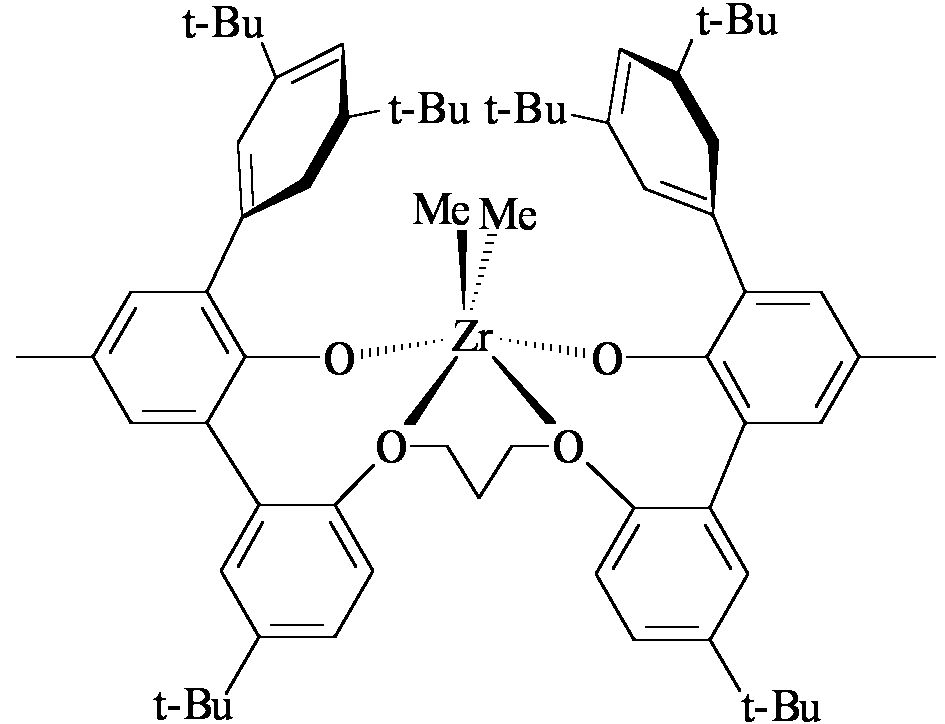
Las condiciones de polimerización para la composición de la invención 1 se dan en las Tablas 1 y 2. Con referencia a las Tablas 1 y 2, TEA es trietilaluminio y PETROSOL D 100/120 es un disolvente que está comercialmente disponible en CEPSA (Compañía Española de Petróleos, S.A.U., Madrid, España). Las propiedades del peso molecular de las composiciones de la invención y comparativas se miden y dan en la Tabla 3.The polymerization conditions for the composition of the invention 1 are given in Tables 1 and 2. With reference to Tables 1 and 2, TEA is triethylaluminum and PETROSOL D 100/120 is a solvent that is commercially available from CEPSA (Spanish Company de Petróleos, SAU, Madrid, Spain). The molecular weight properties of the compositions of the invention and comparatives are measured and given in Table 3.
Tabla 1Table 1
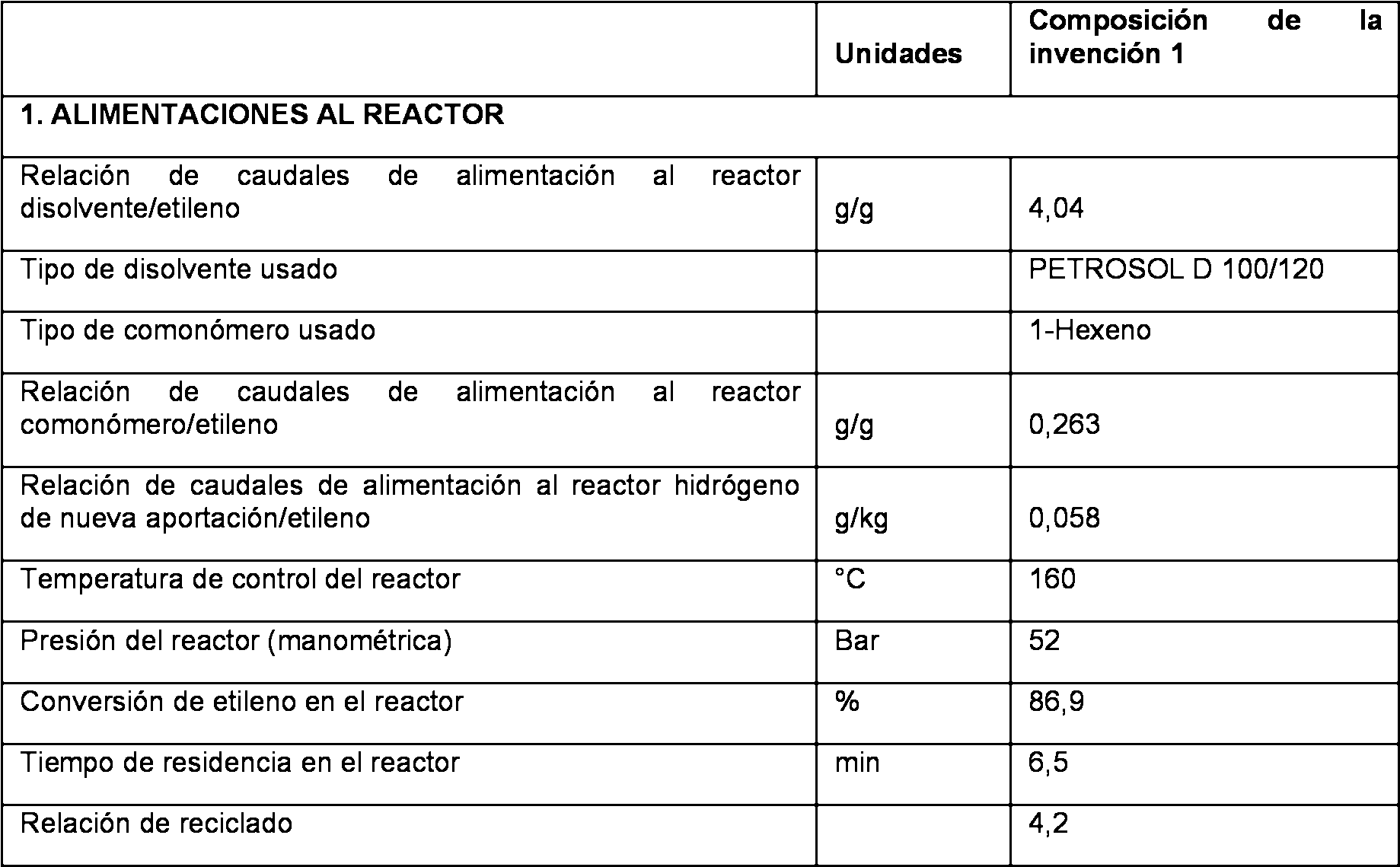
Tabla 2Table 2
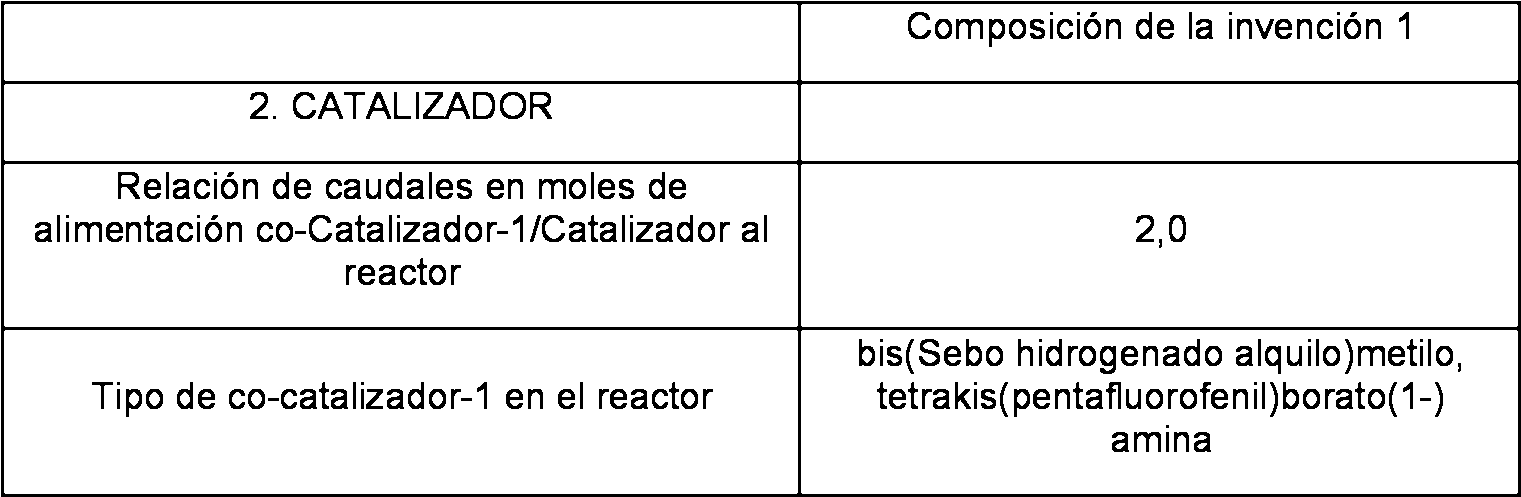

Tabla 3Table 3
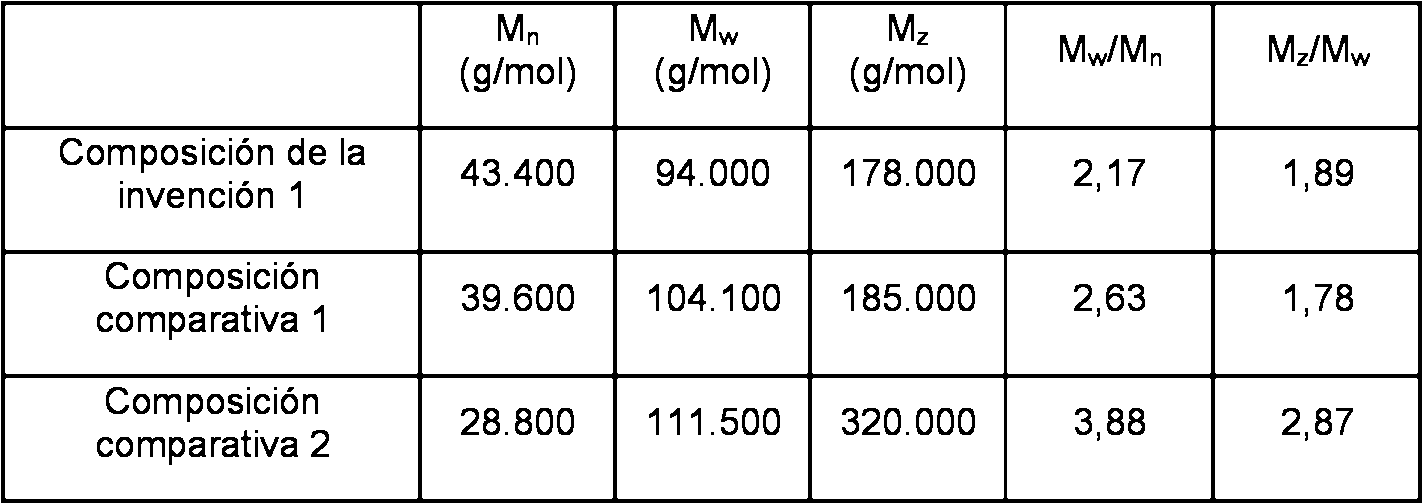
La composición de la invención 1 y las composiciones comparativas 1 y 2 se extruyen en una línea COVEX de formación de películas de 45 mm por soplado para producir películas monocapa para formar la Película de la Invención 1, la Película Comparativa 1 y la Película Comparativa 2. Las películas monocapa se producen según las condiciones del procedimiento mostradas en las Tablas 4 y 5. Se fabricaron películas monocapa adicionales en las mismas condiciones para mezclas en la tolva de la extrusora de 85% en peso de cada de las composiciones de la invención 1 y comparativas 1 y 2, y 15% en peso de LDPE 310E (que está comercialmente disponible en The Dow Chemical Company), como se muestra en la Tabla 6.The composition of the invention 1 and the comparative compositions 1 and 2 are extruded in a COVEX line of 45 mm film forming by blowing to produce monolayer films to form the Film of Invention 1, the Comparative Film 1 and the Comparative Film 2 The monolayer films are produced according to the process conditions shown in Tables 4 and 5. Additional monolayer films were manufactured under the same conditions for blends in the 85% by weight extruder hopper of each of the compositions of the invention. and comparatives 1 and 2, and 15% by weight of LDPE 310E (which is commercially available from The Dow Chemical Company), as shown in Table 6.
Tabla 4Table 4
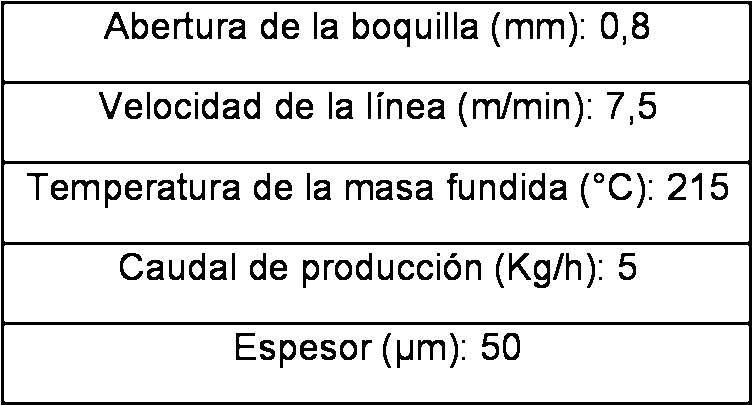
Tabla 5Table 5
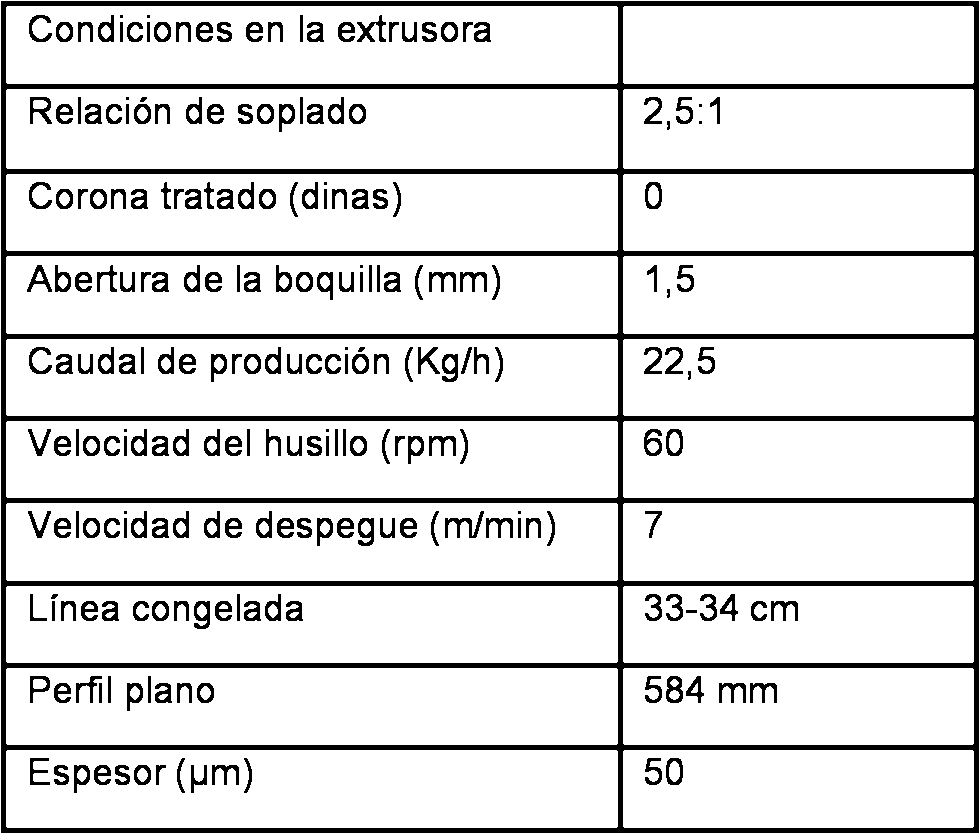
Tabla 6Table 6

Las Tablas 7 y 8 proporcionan un número de propiedades para cada una de las Películas de la invención 1 y 2 y las Películas comparativas 1-4.Tables 7 and 8 provide a number of properties for each of the Films of the invention 1 and 2 and the Comparative films 1-4.
Tabla 7Table 7
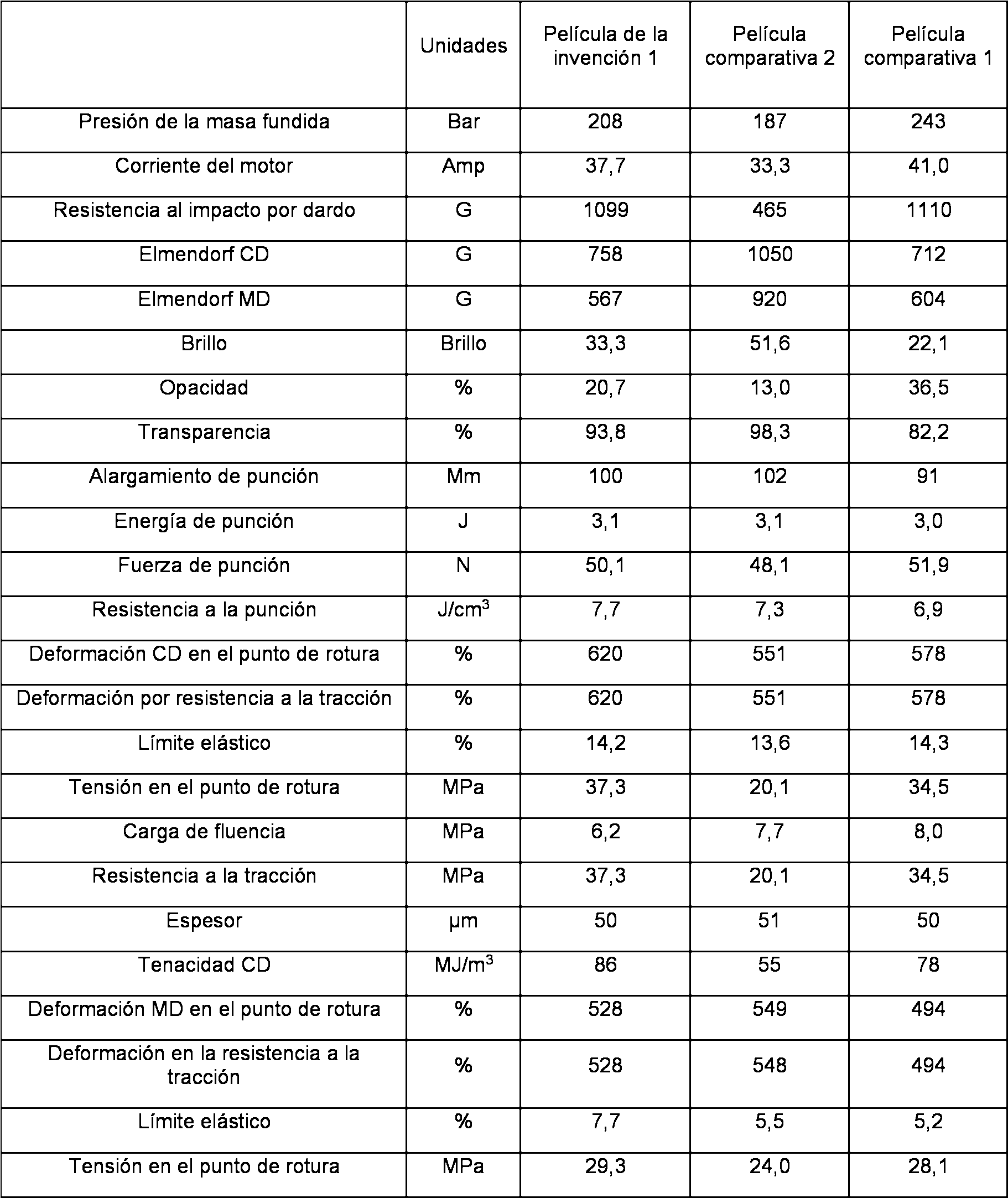

Tabla 8Table 8
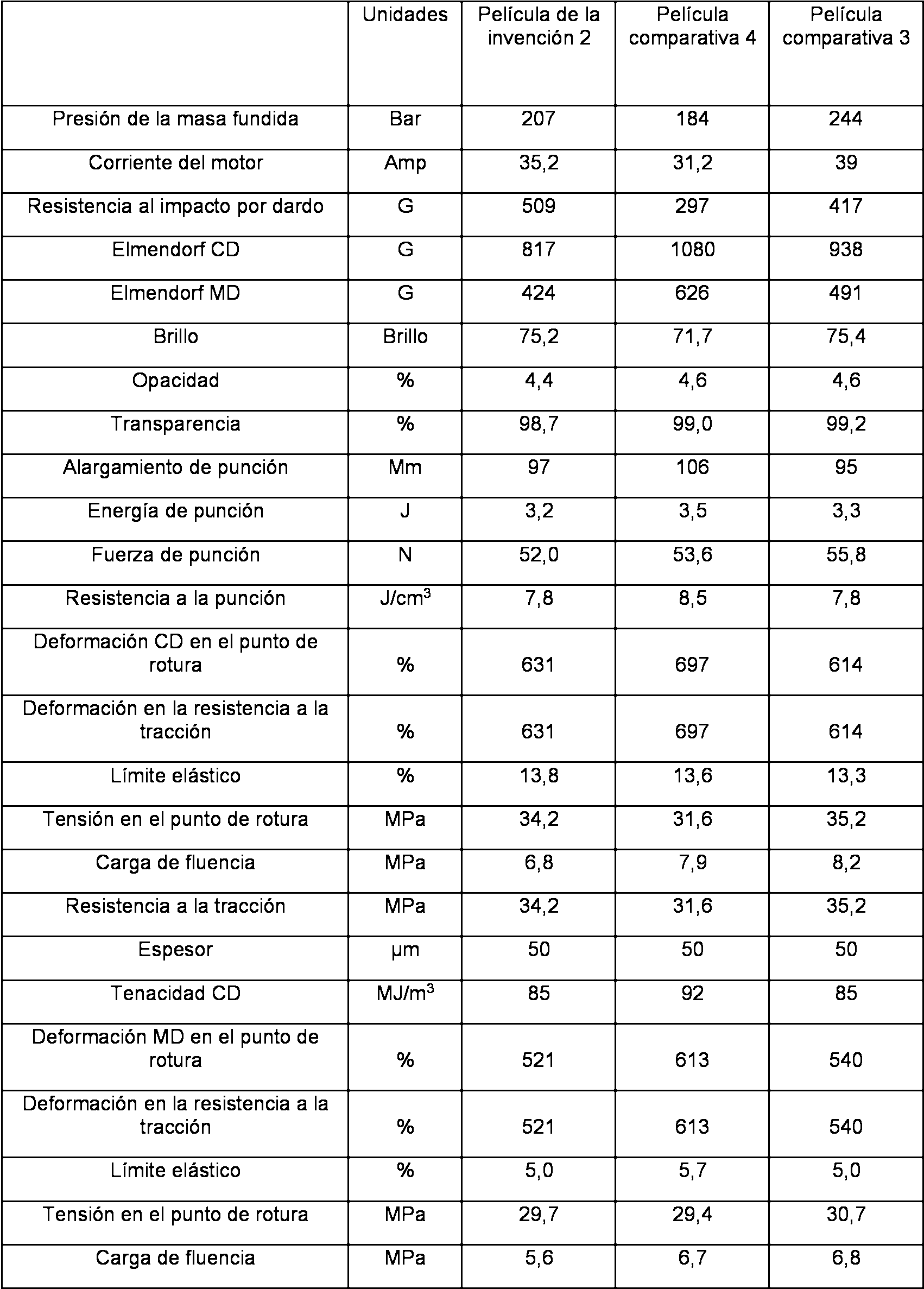

Métodos de ensayoTest methods
Los métodos de ensayo incluyen los siguientes:The test methods include the following:
Índice de fluidez de la masa fundidaMelt flow rate
Los índices de fluidez de la masa fundida (I2 y I10) se midieron según la norma ASTM D-1238 a 190°C y a 2,16 kg y 10 kg de carga, respectivamente. Sus valores se dan en g/10 min.Melt flow rates (I 2 and I 10 ) were measured according to ASTM D-1238 at 190 ° C and 2.16 kg and 10 kg load, respectively. Its values are given in g / 10 min.
DensidadDensity
Las muestras para la medida de la densidad se prepararon según la norma ASTM D4703. Las medidas se hicieron en la hora siguiente al prensado de la muestra usando la norma ASTM D792, Método B.Samples for density measurement were prepared according to ASTM D4703. The measurements were made in the hour following the pressing of the sample using ASTM D792, Method B.
Cromatografía de exclusión molecular a alta temperaturaHigh temperature temperature exclusion chromatography
El sistema de cromatografía de exclusión molecular (GPC) consiste en un cromatógrafo Waters (Milford, Mass) 150C de alta temperatura (otros instrumentos de GPC adecuados para altas temperaturas incluyen Polymer Laboratories (Shropshire, RU) Modelo 210 y Modelo 220) provisto de un refractómetro diferencial (RI) (otros detectores adecuados de la concentración pueden incluir un detector de infrarrojos IR4 Polymer ChAR (Valencia, España)). La recogida de datos se lleva a cabo usando el paquete informático Viscotek TriSEC, versión 3, y un Gestor de Datos Viscotek DM400 de 4 canales. El sistema también está provisto de un dispositivo en línea para desgasificar el disolvente de Polymer Laboratories (Shropshire, Reino Unido).The gel permeation chromatography (GPC) system consists of a Waters (Milford, Mass) 150C high temperature chromatograph (other GPC instruments suitable for high temperatures include Polymer Laboratories (Shropshire, UK) Model 210 and Model 220) equipped with a differential refractometer (RI) (other suitable detectors of the concentration may include an infrared detector IR4 Polymer ChAR (Valencia, Spain)). The data collection is carried out using the Viscotek TriSEC software package, version 3, and a 4-channel Viscotek DM400 Data Manager. The system is also provided with an in-line device for degassing the solvent from Polymer Laboratories (Shropshire, United Kingdom).
Pueden usarse columnas de GPC adecuadas para altas temperaturas tales como cuatro columnas Shodex HT803 de 30 cm de longitud y 3 micrómetros o cuatro columnas Polymer Labs de 30 cm y de un empaquetamiento de tamaño de poro mixto de 20 micrómetros (MixA LS, Polymer Labs). El compartimento del carrusel de muestras se opera a 140°C y el de la columna a 150°C. Las muestras se preparan a una concentración de 0,1 gramos de polímero en 50 mililitros de disolvente. El disolvente cromatográfico y el disolvente de preparación de muestras contienen 200 ppm de triclorobenceno (TCB). Ambos disolventes se borbotean con nitrógeno. Las muestras de polietileno se agitan suavemente a 160°C durante cuatro horas. El volumen de inyección es de 200 microlitros. El caudal a través de la GPC se fija en 1 mL/minuto.GPC columns suitable for high temperatures can be used such as four Shodex HT803 columns of 30 cm length and 3 micrometers or four columns Polymer Labs of 30 cm and of a mixed pore size packing of 20 micrometers (MixA LS, Polymer Labs) . The compartment of the sample carousel is operated at 140 ° C and that of the column at 150 ° C. The samples are prepared at a concentration of 0.1 grams of polymer in 50 milliliters of solvent. The chromatographic solvent and the sample preparation solvent contain 200 ppm of trichlorobenzene (TCB). Both solvents are bubbled with nitrogen. The polyethylene samples are gently stirred at 160 ° C for four hours. The injection volume is 200 microliters. The flow rate through the GPC is set at 1 mL / minute.
La serie de columnas de GPC se calibran trabajando con 21 patrones de poliestireno de estrecha distribución de pesos moleculares. El peso molecular (MW) de los patrones varía de 580 a 8.400.000, y los patrones están contenidos en 6 mezclas “cóctel”. Cada mezcla patrón tiene al menos un decenio de separación entre pesos moleculares individuales. Las mezclas de patrones se compran a Polymer Laboratories. Los patrones de poliestireno se preparan a razón de 0,025 g en 50 mL de disolvente para pesos moleculares iguales a o mayores que 1.000.000 y 0,05 g en 50 mL de disolvente para pesos moleculares menores que 1.000.000. Los patrones de poliestireno se disolvieron a 80°C con suave agitación durante 30 minutos. Las mezclas estrechas de patrones se trabajan en primer lugar y en orden decreciente desde el componente de mayor peso molecular para minimizar la degradación. Los pesos moleculares de los picos de los patrones de poliestireno se convierten en peso molecular de polietileno usando la siguiente ecuación (que se describe en Williams y Ward, J. Polym. Sci., Polym. Letters, 6, 621 (1968)):The series of GPC columns are calibrated by working with 21 polystyrene patterns of narrow molecular weight distribution. The molecular weight (MW) of the standards varies from 580 to 8,400,000, and the patterns are contained in 6 "cocktail" mixtures. Each master mix has at least a decade of separation between individual molecular weights. Standard blends are purchased from Polymer Laboratories. The polystyrene standards are prepared in a proportion of 0.025 g in 50 mL of solvent for molecular weights equal to or greater than 1,000,000 and 0.05 g in 50 mL of solvent for molecular weights less than 1,000,000. The polystyrene standards were dissolved at 80 ° C with gentle agitation for 30 minutes. Narrow pattern mixtures are worked first and in decreasing order from the higher molecular weight component to minimize degradation. The molecular weights of the peaks of the polystyrene standards are converted to polyethylene molecular weight using the following equation (described in Williams and Ward, J. Polym, Sci., Polym, Letters, 6, 621 (1968)):
Mpolietileno _ A x (Mpoliestireno)B,Mpolyethylene _ A x (Mpolystyrene) B,
en la que M es el peso molecular de polietileno o poliestireno (como está marcado), y B es igual a 1,0. También es conocido por los expertos en la técnica que A puede estar en un intervalo de aproximadamente 0,38 a aproximadamente 0,44 y se determina en el momento de la calibración usando un patrón de polietileno ancho. El uso de este método de calibración con polietileno para obtener valores del peso molecular, tales como la distribución de pesos moleculares (MWD o Mw/Mn), y estadísticas relacionadas (en general se refiere a resultados convencionales de GPC o cc-GPC), se define en la presente memoria como el método modificado de Williams y Ward.wherein M is the molecular weight of polyethylene or polystyrene (as marked), and B equals 1.0. It is also known to those skilled in the art that A may be in a range of about 0.38 to about 0.44 and is determined at the time of calibration using a wide polyethylene standard. The use of this method of calibration with polyethylene to obtain molecular weight values, such as the molecular weight distribution (MWD or Mw / Mn), and related statistics (in general refers to conventional results of GPC or cc-GPC), it is defined herein as the modified method of Williams and Ward.
Método de fraccionamiento por elución y cristalización (CEF)Method of fractionation by elution and crystallization (CEF)
El método de fraccionamiento por elución y cristalización (CEF) se lleva a cabo según el método descrito en Monrabal et al, Macromol. Symp. 257, 71-79 (2007), el cual se incorpora en la presente memoria como referencia. El instrumento de CEF está provisto de un detector IR-4 (tal como el vendido comercialmente por Polymer Char, España) y un detector de difusión de luz de dos ángulos Modelo 2040 (tal como los comercialmente vendidos por Precision Detectors). El detector IR-4 opera en el modo composicional con dos filtros: C006 y B057. Antes del detector IR en el horno del detector se instala una columna de seguridad de 10 micrómetros de 50 mm x 4,6 mm (tal como la vendida comercialmente por Polymer Labs). Se obtienen orto-diclorobenceno (ODCB, 99% grado anhidro) y 2,5-di-terc-butil-4-metilfenol (BHT) (tal como el comercialmente disponible en Sigma-Aldrich). También se obtiene Silica gel 40 (tamaño de partícula 0,2~0,5 mm) (tal como el comercialmente disponible en EMD Chemicals). El gel de sílice se seca a vacío en un horno de vacío a 160°C durante aproximadamente dos horas antes de su uso. Se añaden ocho cientos miligramos de BHT y cinco gramos de gel de sílice a dos litros de ODCB. De aquí en adelante, al ODCB que contiene BHT y gel de sílice se le denomina “ODCB-m.” Se borbotea nitrógeno seco (N2) por el ODCB-m antes de su uso durante una hora. El nitrógeno seco se obtiene pasando nitrógeno a < 6,1 bar sobre CaCO3 y tamices moleculares de 5Á. Se prepara una disolución de muestra, usando el automuestreador, disolviendo una muestra de polímero en ODCB-m a razón de 4 mg/mL con agitación por sacudidas a 160°C durante 2 horas. Se inyectan 300 pL de la disolución de muestra en la columna. El perfil de temperaturas de CEF es: cristalización a 3°C/min de ll0 °C a 25°C, equilibrio térmico a 30°C durante 5 minutos (que incluye el Tiempo de Elución de la Fracción Soluble que se fija en 2 minutos), y elución a 3°C/min de 25°C a 140°C. El caudal durante la cristalización es 0,052 mL/min. El caudal durante la elución es 0,50 mL/min. Los datos de la señal del detector IR-4 se recogen a razón de un dato/segundo.The fractionation method by elution and crystallization (CEF) is carried out according to the method described in Monrabal et al, Macromol. Symp. 257, 71-79 (2007), which is incorporated herein by reference. The CEF instrument is provided with an IR-4 detector (such as that sold commercially by Polymer Char, Spain) and a Model 2040 two-angle light diffusion detector (such as those commercially sold by Precision Detectors). The IR-4 detector operates in the compositional mode with two filters: C006 and B057. Before the IR detector in the detector oven is installed a 10 micrometer 50 mm x 4.6 mm safety column (such as that commercially sold by Polymer Labs). Ortho-dichlorobenzene (ODCB, 99% anhydrous grade) and 2,5-di-tert-butyl-4-methylphenol (BHT) (such as commercially available from Sigma-Aldrich) are obtained. Silica gel 40 (particle size 0.2 ~ 0.5 mm) is also obtained (such as is commercially available from EMD Chemicals). The silica gel is dried under vacuum in a vacuum oven at 160 ° C for about two hours before use. Eight hundred milligrams of BHT and five grams of silica gel are added to two liters of ODCB. Hereinafter, the ODCB containing BHT and silica gel is called "ODCB-m." Dry nitrogen (N 2 ) is bubbled through the ODCB-m before use for one hour. Dry nitrogen is obtained by passing nitrogen at <6.1 bar over CaCO 3 and molecular sieves of 5Á. A sample solution is prepared, using the autosampler, by dissolving a polymer sample in ODCB-m at a rate of 4 mg / mL with shaking at 160 ° C for 2 hours. 300 pL of the sample solution is injected into the column. The temperature profile of CEF is: crystallization at 3 ° C / min from 110 ° C to 25 ° C, thermal equilibrium at 30 ° C for 5 minutes (which includes the Elution Time of the Soluble Fraction which is set at 2 minutes ), and elution at 3 ° C / min from 25 ° C to 140 ° C. The flow rate during crystallization is 0.052 mL / min. The flow rate during the elution is 0.50 mL / min. The signal data of the IR-4 detector is collected at a rate of one second.
La columna de CEF se empaqueta con bolas de vidrio a 125 pm ± 6% (tales como las comercialmente disponibles en MO-SCI Specialty Products) con tubos de acero inoxidable de 0,3175 cm según el documento U.S.The CEF column is packaged with 125 ± 6% glass beads (such as those commercially available from MO-SCI Specialty Products) with 0.3175 cm stainless steel tubes according to U.S.
2011/0015346 A 1. El volumen interno de líquido de la columna de CEF está entre 2,1 mL y 2,3 mL. El calibrado de temperaturas se realiza usando una mezcla de material de referencia patrón polietileno lineal 1475a NIST (1,0 mg/mL) y eicosano (2 mg/mL) en ODCB-m. La calibración consiste en cuatro etapas: (1) calcular el volumen de retardo definido como la temperatura compensada entre la temperatura de elución máxima medida del eicosano menos 30,00°C; (2) sustraer la temperatura compensada de la temperatura de elución a partir de los datos brutos de temperatura de la CEF. Se advierte que esta temperatura compensada es una función de las condiciones experimentales, tales como la temperatura de elución, el caudal de elución, etc.; (3) crear una línea de calibrado lineal transformando la temperatura de elución a través de un intervalo de 25,00°C y 140,00°C tal que el polietileno lineal 1475a NIST tenga una temperatura máxima a 101,00°C, y el eicosano tenga una temperatura máxima de 30,00°C, (4) para la fracción soluble medida isotérmicamente a 30°C, la temperatura de elución se extrapola linealmente usando una velocidad de calentamiento en la elución de 3°C/min. Se obtienen las temperaturas máximas de elución dadas tal que la curva de calibrado del contenido de comonómero observado concuerde con la previamente dada en el documento U.S. 8.372.931.2011/0015346 A 1 . The internal liquid volume of the CEF column is between 2.1 mL and 2.3 mL. The temperature calibration is performed using a mixture of 1475a NIST linear polyethylene standard reference material (1.0 mg / mL) and eicosano (2 mg / mL) in ODCB-m. The calibration consists of four stages: (1) calculate the volume of delay defined as the temperature compensated between the maximum measured elution temperature of the eicosano minus 30.00 ° C; (2) subtract the temperature compensated from the elution temperature from the raw temperature data of the CEF. It is noted that this compensated temperature is a function of the experimental conditions, such as the elution temperature, the elution flow rate, etc .; (3) create a linear calibration line by transforming the elution temperature through a range of 25.00 ° C and 140.00 ° C such that linear polyethylene 1475a NIST has a maximum temperature at 101.00 ° C, and the eicosane has a maximum temperature of 30.00 ° C, (4) for the soluble fraction measured isothermally at 30 ° C, the elution temperature is extrapolated linearly using a heating rate in the elution of 3 ° C / min. The maximum elution temperatures are obtained given that the calibration curve of the observed comonomer content agrees with that previously given in US 8,372,931.
La fracción CEF de 70 a 90°C se define como la integral del cromatograma IR-4 (canal de medida con sustracción de la línea base) en la temperatura de elución que varía de 70,0 a 90,0°C dividida por la integral total de 25 a 140,0°C según la siguiente ecuación:The CEF fraction from 70 to 90 ° C is defined as the integral of the IR-4 chromatogram (measuring channel with subtraction of the baseline) at the elution temperature ranging from 70.0 to 90.0 ° C divided by the total integral from 25 to 140.0 ° C according to the following equation:
Q lR d TQ lR d T
Fracción CEF de 70 c . = - 7^ -------nl üOM Fraction CEF of 70 c. = - 7 ^ ------- nl üOM
en la que T es la temperatura de elución (de la calibración tratada anteriormente).where T is the elution temperature (from the calibration discussed above).
Se calcula una línea base lineal seleccionando dos datos: uno antes de que el polímero eluya, usualmente a una temperatura de 25,5°C, y otro después de que el polímero eluya, usualmente a 118°C. Para cada punto, la señal del detector se sustrae de la línea base antes de integrar.A linear baseline is calculated by selecting two data: one before the polymer elutes, usually at a temperature of 25.5 ° C, and another after the polymer elutes, usually at 118 ° C. For each point, the detector signal is subtracted from the baseline before integrating.
Método de medida de la viscosidad de fluencia a cizalladura ceroMethod of measuring the zero shear creep viscosity
Las viscosidades a cizalladura cero se obtienen mediante ensayos de fluencia que se llevaron a cabo en un reómetro AR-G2 de tensión controlada (TA Instruments; New Castle, Del) usando platos paralelos de 25 mm de diámetro a 190°C. El horno del reómetro se fija a la temperatura de ensayo durante al menos 30 minutos antes del ajuste a cero. A la temperatura de ensayo se inserta un disco de muestra moldeado por compresión entre los platos y se deja que se alcance el equilibrio durante 5 minutos. El plato superior se baja a continuación hasta 50 pm por encima de la abertura de ensayo deseado (1,5 mm). Cualquier material superfluo se recorta y se baja el plato superior hasta la abertura deseada. Las mediciones se hacen purgando con nitrógeno a un caudal de 5 L/min. El tiempo de fluencia predeterminado se fija en 2 horas.The zero shear viscosities are obtained by creep tests which were carried out on a controlled tension rheometer AR-G2 (TA Instruments, New Castle, Del) using parallel plates of 25 mm diameter at 190 ° C. The rheometer oven is set at the test temperature for at least 30 minutes before zeroing. At the test temperature, a sample disk molded by compression is inserted between the plates and the equilibrium is allowed to be reached for 5 minutes. The upper plate is then lowered to 50 μm above the desired test opening (1.5 mm). Any superfluous material is trimmed and the top plate is lowered to the desired opening. The measurements are purged with nitrogen at a flow rate of 5 L / min. The default creep time is set at 2 hours.
Se aplica un bajo esfuerzo de cizalladura constante de 20 Pa para todas las muestras para asegurar que la velocidad de cizalladura en el estado de equilibrio sea lo bastante baja para estar en la región Newtoniana. Las velocidades de cizalladura resultantes en el estado de equilibrio están en el intervalo de 10'3 a 10'4 s_1 para las muestras de este estudio. El estado de equilibrio se determina tomando una regresión lineal para todos los datos en el último 10% de la ventana de tiempos de la representación de log (J(t)) vs log(t), en la que J(t) es la deformación por fluencia y t es el tiempo de fluencia. Si la pendiente de la regresión lineal es mayor que 0,97, se considera que se ha alcanzado el estado de equilibrio, entonces se para el ensayo de fluencia. En este estudio, en todos los casos, la pendiente cumple el criterio antes de 2 horas. La velocidad de cizalladura en el estado de equilibrio se determina a partir de la pendiente de la regresión lineal de todos los datos en el último 10% de la ventana de tiempos de la representación de £ vs t, en la que £ es la deformación. La viscosidad a cizalladura cero se determina a partir del esfuerzo aplicado a partir de la relación del esfuerzo aplicado a la velocidad de cizalladura en el estado de equilibrio. Con el fin de determinar si la muestra se degrada durante el ensayo de fluencia, se lleva a cabo un ensayo de cizalladura oscilatoria de pequeña amplitud de 0,1 a 100 rad/s antes y después del ensayo de fluencia sobre la misma probeta. Se comparan los valores complejos de viscosidad de los dos ensayos. Si la diferencia de los valores de viscosidad a 0,1 rad/s es mayor que 5%, se considera que la muestra se ha degradado durante el ensayo de fluencia, y el resultado se descarta.A constant low shear stress of 20 Pa is applied for all samples to ensure that the shear rate in the steady state is low enough to be in the Newtonian region. The resulting shear rates at steady state are in the range of 10'3 to 10'4 s_1 for the samples in this study. The steady state is determined by taking a linear regression for all data in the last 10% of the time window of the log representation (J (t)) vs log (t), where J (t) is the creep deformation and t is the creep time. If the slope of the linear regression is greater than 0.97, it is considered that the equilibrium state has been reached, then the creep test is stopped. In this study, in all cases, the slope meets the criterion before 2 hours. The shear rate in the steady state is determined from the slope of the linear regression of all the data in the last 10% of the time window of the representation of £ vs t, where £ is the deformation. The zero shear viscosity is determined from the applied stress from the ratio of the applied stress to the shear rate in the equilibrium state. In order to determine if the sample is degraded during the creep test, a small amplitude oscillatory shear test of 0.1 to 100 rad / s is carried out before and after the creep test on the same specimen. The complex viscosity values of the two tests are compared. If the difference of the viscosity values at 0.1 rad / s is greater than 5%, the sample is considered to have degraded during the creep test, and the result is discarded.
La relación de viscosidades a cizalladura cero (ZSVR) se define como la relación de la viscosidad a cizalladura cero (ZSV) del material de polietileno ramificado a la ZSV del material de polietileno lineal al peso molecular promedio en peso equivalente (Mw-gpc) según la siguiente ecuación:The zero shear viscosity ratio (ZSVR) is defined as the ratio of the zero shear viscosity (ZSV) of the branched polyethylene material to the ZSV of the linear polyethylene material to the weight average molecular weight equivalent (Mw-gpc) as The following equation:

El valor de ZSV se obtiene a partir del ensayo de fluencia a 190°C mediante el método descrito anteriormente. El valor de Mw-gpc se determina por el método convencional de GPC. La correlación entre la ZSV del polietileno lineal y su Mw-gpc se estableció sobre la base de una serie de materiales de referencia de polietileno lineal. Una descripción de la relación ZSV-Mw puede encontrarse en las actas de ANTEC: Karjala, Teresa P.; Sammler, Robert L.; Mangnus, Marc A.; Hazlitt, Lonnie G.; Johnson, Mark S.; Hagen, Charles M., Jr.; Huang, Joe W. L.; Reichek, Kenneth N. Detection of low levels of long-chain branching in polyolefins. Annual Technical Conference - Society of Plastics Engineers (2008), 66th, 887-891.The value of ZSV is obtained from the creep test at 190 ° C by the method described above. The value of Mw-gpc is determined by the conventional GPC method. The correlation between the ZSV of the linear polyethylene and its Mw-gpc was established on the basis of a series of linear polyethylene reference materials. A description of the ZSV-Mw relationship can be found in the ANTEC minutes: Karjala, Teresa P .; Sammler, Robert L .; Mangnus, Marc A .; Hazlitt, Lonnie G .; Johnson, Mark S .; Hagen, Charles M., Jr .; Huang, Joe W. L .; Reichek, Kenneth N. Detection of low levels of long-chain branching in polyolefins. Annual Technical Conference - Society of Plastics Engineers (2008), 66th, 887-891.
Método de1H RMNMethod of 1H NMR
Se añaden 3,26 g de disolución madre a 0,133 g de muestra poliolefina en un tubo de RMN de 10 mm. La disolución madre es una mezcla de tetracloroetano-d2 (TCE) y percloroetileno (50:50, p:p) con Cr3+ 0,001M. La disolución en el tubo se purga con N2 durante 5 minutos para reducir la cantidad de oxígeno. El tubo de muestra tapado se deja a temperatura ambiente durante toda la noche para hinchar la muestra de polímero. La muestra se disuelve a 110°C con agitación por sacudidas. Las muestras están exentas de los aditivos que pueden contribuir a la insaturación, por ejemplo, agentes de deslizamiento tales como erucamida.3.26 g of stock solution is added to 0.133 g of polyolefin sample in a 10 mm NMR tube. The stock solution is a mixture of tetrachloroethane-d 2 (TCE) and perchlorethylene (50:50, p: p) with Cr 3 + 0,001M. The solution in the tube is purged with N 2 for 5 minutes to reduce the amount of oxygen. The capped sample tube is left at room temperature overnight to swell the polymer sample. The sample is dissolved at 110 ° C with shaking. Samples are exempt from additives that may contribute to unsaturation, for example, slip agents such as erucamide.
Los 1H-RMN se realizan con una criosonda de 10 mm a 120°C en un espectrómetro Bruker AVANCE 400 MHz. Se realizan dos experimentos para conseguir la insaturación: el testigo y los experimentos de doble presaturación. Para el experimento testigo, los datos se procesan con la función ventana exponencial con LB=1 Hz, la línea base se corrigió de 7 a -2 ppm. La señal del 1H residual de TCE se fija a 100, la integral Itotal de -0,5 a 3 ppm se usa como la señal del polímero completo en el experimento testigo. El número de grupos CH2, NCH2 , en el polímero se calcula como sigue:The 1 H-NMR is performed with a 10 mm cryoprobe at 120 ° C on a Bruker AVANCE 400 MHz spectrometer. Two experiments are carried out to achieve the unsaturation: the control and the double presaturation experiments. For the control experiment, the data is processed with the exponential window function with LB = 1 Hz, the baseline was corrected from 7 to -2 ppm. The signal of the residual 1H TCE is set to 100, the Itotal integral of -0.5 to 3 ppm is used as the signal of the complete polymer in the control experiment. The number of CH 2 , NCH 2 groups in the polymer is calculated as follows:
NCH2=Itotal/2NCH2 = Itotal / 2
Para el experimento de doble presaturación, los datos se procesan con la función ventana exponencial con LB=1 Hz, la línea base se corrigió de 6,6 a 4,5 ppm. La señal del 1H residual de TCE se fija a 100, las correspondientes integrales de las insaturaciones (Ivinileno, Itrisustituido, Ivinilo e Ivinilideno) se integraron basadas en la región mostrada en el gráfico siguiente For the double presaturation experiment, the data is processed with the exponential window function with LB = 1 Hz, the baseline was corrected from 6.6 to 4.5 ppm. The residual 1H signal of TCE is set to 100, the corresponding integrals of the insaturations (Ivinylene, Itrisubstituted, Ivinyl and Ivinylidene) were integrated based on the region shown in the following graph
Se calculan el número de unidades de insaturación de vinileno, trisustituido, vinilo y vinilideno:The number of units of unsaturation of vinylene, trisubstituted, vinyl and vinylidene are calculated:
Nv¡n¡leno_|v¡n¡lenc/2Nv¡n¡leno_ | v¡n¡lenc / 2
Ntrisustituido_|trisustituidoNtrisubstituted_ | trisubstituted
Nvinilo— |vinilo/2Nvinyl- | vinyl / 2
Nvinilideno—|vinilideno/2Nvinylidene- | vinylidene / 2
Las unidades de insaturación/ 1.000.000 de átomos de carbono se calculan como sigue:The units of unsaturation / 1,000,000 carbon atoms are calculated as follows:
Nvinileno/1.000.000C — (Nvinileno/NCH2)*1.000.000Nvinylene / 1,000,000C - (Nvinylene / NCH2) * 1,000,000
Ntrisustituido^ .000.000C — (Ntrisustituido/NCH2)*1.000.000Ntrisubstituted ^ .000.000C - (Ntrisubstituted / NCH2) * 1,000,000
Nvinilo/1.000.000C — (Nvinilo/NCH2)*1.000.000Nvinyl / 1,000,000C - (Nvinilo / NCH2) * 1,000,000
Nv¡n¡l¡deno/1.000.000C — (Nvinilidenc/NCH2)*1.000.000Nv¡n¡l¡deno / 1,000,000C - (Nvinilidenc / NCH2) * 1,000,000
El requisito para el análisis de insaturaciones por RMN incluye: el nivel de cuantificación es 0,47 ± 0,02/1.000.000 átomos de carbono para Vd2 con 200 barridos (menos que 1 hora de adquisición de datos que incluye el tiempo de ejecución del experimento testigo) con 3,9% en peso de muestra (para la estructura Vd2, véase Macromolecules, vol. 38, 6988, 2005), criosonda de 10 mm para alta temperatura. El nivel de cuantificación se define como la relación señal a ruido de 10.The requirement for NMR unsaturation analysis includes: the level of quantification is 0.47 ± 0.02 / 1,000,000 carbon atoms for Vd2 with 200 scans (less than 1 hour of data acquisition including execution time of the control experiment) with 3.9% by weight of sample (for structure Vd2, see Macromolecules, volume 38, 6988, 2005), 10 mm cryoprobe for high temperature. The level of quantification is defined as the signal-to-noise ratio of 10.
La referencia de desplazamiento químico se fija en 6,0 ppm para la señal de 1H del protón residual de TCT-d2. El testigo se realiza con pulso ZG, TD 32768, nS 4, DS 12, SWH 10.000 Hz, AQ 1,64 s, D1 14s. El experimento de doble presaturación se realiza con una secuencia de pulsos modificada, O1P 1,354 ppm, O2P 0,960 ppm, PL957db, PL21 70 db, TD 32768, NS 200, DS 4, SWH 10,000 Hz, AQ 1,64s, D1 1s, D13 13s. Las secuencias de pulsos modificadas para la insaturación con el espectrómetro Bruker AVANCE 400 MHz se muestran a continuación:The chemical shift reference is set at 6.0 ppm for the 1H signal of the residual TCT-d2 proton. The control is performed with pulse ZG, TD 32768, n S 4, DS 12, SWH 10,000 Hz, AQ 1.64 s, D1 14 s. The double presaturation experiment is performed with a modified pulse sequence, O1P 1.354 ppm, O2P 0.960 ppm, PL957db, PL21 70 db, TD 32768, NS 200, DS 4, SWH 10,000 Hz, AQ 1.64s, D1 1s, D13 13s. The pulse sequences modified for unsaturation with the Bruker AVANCE 400 MHz spectrometer are shown below:

Condiciones de ensayo de las películasTest conditions of the films
Se miden las siguientes propiedades físicas de las películas producidas:The following physical properties of the films produced are measured:
Resistencia al impacto por caída de dardo: ISO 7765-1/1998Resistance to impact due to dart fall: ISO 7765-1 / 1998
Resistencia a la tracción: ASTM 527-3Tensile strength: ASTM 527-3
Encogimiento: ASTM D2732Shrinkage: ASTM D2732
Punción: ASTM D-5748-95 Puncture: ASTM D-5748-95
Resistencia al rasgado Elmendorf: ASTM D1922-09Tear resistance Elmendorf: ASTM D1922-09
Brillo @ 45 grados: ASTM D2457-08Brightness @ 45 degrees: ASTM D2457-08
Opacidad: ASTM D1003-11Opacity: ASTM D1003-11
Pegajosidad en caliente CD: ASTM F1921-98Hot stickiness CD: ASTM F1921-98
Resistencia al sellado CD: ASTM F2029-00Resistance to sealing CD: ASTM F2029-00
La presente invención puede realizarse en otras formas sin apartarse de su espíritu y atributos esenciales, y, por consiguiente, debe hacerse referencia a las reivindicaciones anexas, más que a la memoria descriptiva precedente, ya que indican el alcance de la invención. The present invention may be embodied in other forms without departing from its essential spirit and attributes, and, therefore, reference should be made to the appended claims, rather than to the preceding specification, since they indicate the scope of the invention.
Claims (9)
Applications Claiming Priority (1)
| Application Number | Priority Date | Filing Date | Title |
|---|---|---|---|
| EP16382095.4A EP3214115B1 (en) | 2016-03-03 | 2016-03-03 | Polyethylene composition, method of making the same, and films made therefrom |
Publications (1)
| Publication Number | Publication Date |
|---|---|
| ES2703602T3 true ES2703602T3 (en) | 2019-03-11 |
Family
ID=55521661
Family Applications (1)
| Application Number | Title | Priority Date | Filing Date |
|---|---|---|---|
| ES16382095T Active ES2703602T3 (en) | 2016-03-03 | 2016-03-03 | Polyethylene composition, method for manufacturing it, and films made from it |
Country Status (9)
| Country | Link |
|---|---|
| US (1) | US10800908B2 (en) |
| EP (1) | EP3214115B1 (en) |
| JP (1) | JP6980673B2 (en) |
| KR (1) | KR102307740B1 (en) |
| CN (2) | CN118931018A (en) |
| BR (1) | BR112018017333B1 (en) |
| ES (1) | ES2703602T3 (en) |
| SG (1) | SG11201807281TA (en) |
| WO (1) | WO2017152078A1 (en) |
Families Citing this family (14)
| Publication number | Priority date | Publication date | Assignee | Title |
|---|---|---|---|---|
| ES2849149T5 (en) * | 2016-03-03 | 2025-12-11 | Dow Global Technologies Llc | Artificial turfs and method of making the same |
| AR113268A1 (en) * | 2017-10-10 | 2020-03-11 | Dow Global Technologies Llc | UNIAXIAL ORIENTED POLYMERIC FILMS AND ARTICLES MANUFACTURED FROM THEM |
| WO2019241475A1 (en) | 2018-06-15 | 2019-12-19 | Dow Global Technologies Llc | Bimodal ethylene-based polymers having high molecular weight high density fractions |
| CN112292417B (en) | 2018-06-15 | 2023-10-13 | 陶氏环球技术有限责任公司 | Blown film including a bimodal ethylene polymer having a high molecular weight high density fraction |
| WO2019241517A1 (en) | 2018-06-15 | 2019-12-19 | Dow Global Technologies Llc | Cast films comprising bimodal ethylene-based polymers having high molecular weight high density fractions |
| EP3807332B1 (en) | 2018-06-15 | 2025-05-14 | Dow Global Technologies LLC | Process for the production of bimodal ethylene-based polymers having high molecular weight high density fractions |
| KR102130594B1 (en) | 2018-10-10 | 2020-07-06 | 주식회사 휴모트 | Method of manufacturing bulk type thermoelectric element |
| TWI839414B (en) | 2018-11-30 | 2024-04-21 | 美商陶氏全球科技有限責任公司 | Polymer-based film with balanced properties |
| US12059875B2 (en) | 2018-12-28 | 2024-08-13 | Dow Global Technologies Llc | Laminate structures and flexible packaging materials incorporating same |
| JP7480150B2 (en) | 2018-12-28 | 2024-05-09 | ダウ グローバル テクノロジーズ エルエルシー | Laminated structure and flexible packaging material incorporating same - Patents.com |
| CN114008090B (en) * | 2019-05-31 | 2023-12-22 | 陶氏环球技术有限责任公司 | Ziegler-Natta catalyzed polyethylene resin and membrane incorporating said polyethylene resin |
| MX2022001496A (en) * | 2019-08-06 | 2022-03-11 | Dow Global Technologies Llc | POLYETHYLENE COMPOSITIONS. |
| WO2021162051A1 (en) * | 2020-02-14 | 2021-08-19 | 凸版印刷株式会社 | Freezing packaging film, freezing packaging bag, frozen food package and method of evaluating storage properties of freezing packaging film |
| WO2025165636A1 (en) | 2024-01-31 | 2025-08-07 | Dow Global Technologies Llc | Tie layers comprising functionalized polyethylene and multilayer structures incorporating same |
Family Cites Families (34)
| Publication number | Priority date | Publication date | Assignee | Title |
|---|---|---|---|---|
| US7163907B1 (en) | 1987-01-30 | 2007-01-16 | Exxonmobil Chemical Patents Inc. | Aluminum-free monocyclopentadienyl metallocene catalysts for olefin polymerization |
| US5153157A (en) | 1987-01-30 | 1992-10-06 | Exxon Chemical Patents Inc. | Catalyst system of enhanced productivity |
| US5064802A (en) | 1989-09-14 | 1991-11-12 | The Dow Chemical Company | Metal complex compounds |
| JP2545006B2 (en) | 1990-07-03 | 1996-10-16 | ザ ダウ ケミカル カンパニー | Addition polymerization catalyst |
| US5721185A (en) | 1991-06-24 | 1998-02-24 | The Dow Chemical Company | Homogeneous olefin polymerization catalyst by abstraction with lewis acids |
| US5296433A (en) | 1992-04-14 | 1994-03-22 | Minnesota Mining And Manufacturing Company | Tris(pentafluorophenyl)borane complexes and catalysts derived therefrom |
| US5350723A (en) | 1992-05-15 | 1994-09-27 | The Dow Chemical Company | Process for preparation of monocyclopentadienyl metal complex compounds and method of use |
| US6448341B1 (en) * | 1993-01-29 | 2002-09-10 | The Dow Chemical Company | Ethylene interpolymer blend compositions |
| US5372682A (en) | 1993-06-24 | 1994-12-13 | The Dow Chemical Company | Electrochemical preparation of addition polymerization catalysts |
| US5625087A (en) | 1994-09-12 | 1997-04-29 | The Dow Chemical Company | Silylium cationic polymerization activators for metallocene complexes |
| AU1991297A (en) | 1996-03-27 | 1997-10-17 | Dow Chemical Company, The | Solution polymerization process with dispersed catalyst activator |
| EP0889912B1 (en) | 1996-03-27 | 2000-07-12 | The Dow Chemical Company | Highly soluble olefin polymerization catalyst activator |
| US5977251A (en) | 1996-04-01 | 1999-11-02 | The Dow Chemical Company | Non-adiabatic olefin solution polymerization |
| US5783512A (en) | 1996-12-18 | 1998-07-21 | The Dow Chemical Company | Catalyst component dispersion comprising an ionic compound and solid addition polymerization catalysts containing the same |
| US6103657A (en) | 1997-07-02 | 2000-08-15 | Union Carbide Chemicals & Plastics Technology Corporation | Catalyst for the production of olefin polymers |
| US6696379B1 (en) | 1997-09-19 | 2004-02-24 | The Dow Chemical Company | Supported modified alumoxane catalyst activator |
| AU1773901A (en) | 1999-12-10 | 2001-06-18 | Dow Chemical Company, The | Substituted group 4 metal complexes, catalysts and olefin polymerization process |
| AR053693A1 (en) * | 2004-03-17 | 2007-05-16 | Dow Global Technologies Inc | COMPOSITIONS OF ETHYLENE / ALFA-OLEFINE INTERPOLIMERO MULTIBLOCK SUITABLE FOR FILMS |
| JP4923422B2 (en) | 2005-03-24 | 2012-04-25 | 東ソー株式会社 | Polyethylene resin composition and film comprising the same |
| AR060642A1 (en) | 2006-05-17 | 2008-07-02 | Dow Global Technologies Inc | ETHYLENE / ALPHA-OLEFINE / DIENO AND POLYMER SOLUTION POLYMERIZATION PROCESS |
| US8957158B2 (en) | 2008-09-25 | 2015-02-17 | Basell Polyolefine Gmbh | Impact resistant LLDPE composition and films made thereof |
| US20110003940A1 (en) | 2009-07-01 | 2011-01-06 | Dow Global Technologies Inc. | Ethylene-based polymer compositions for use as a blend component in shrinkage film applications |
| JP5858935B2 (en) * | 2010-03-02 | 2016-02-10 | ダウ グローバル テクノロジーズ エルエルシー | Ethylene polymer composition |
| US8709611B2 (en) | 2010-06-08 | 2014-04-29 | Equistar Chemicals, Lp | Multilayer films having reduced curling |
| EP2580279B1 (en) * | 2010-06-14 | 2019-01-09 | Dow Global Technologies LLC | Ethylene-based polymer compositions for use as a blend component in shrinkage film applications |
| US9029478B2 (en) | 2011-02-07 | 2015-05-12 | Equistar Chemicals, Lp | High clarity polyethylene films |
| CA2845410A1 (en) * | 2011-08-26 | 2013-03-07 | Dow Global Technologies Llc | Bioriented polyethylene film |
| US8993693B2 (en) | 2012-03-23 | 2015-03-31 | Formosa Plastics Corporation | Ethylene copolymers with a novel composition distribution and processes for making the same |
| JP6400571B2 (en) * | 2012-06-26 | 2018-10-03 | ダウ グローバル テクノロジーズ エルエルシー | Polyethylene blend composition suitable for inflation film and film made therefrom |
| WO2014058639A1 (en) * | 2012-10-09 | 2014-04-17 | Dow Global Technologies Llc | Sealant composition |
| US9751998B2 (en) * | 2012-12-27 | 2017-09-05 | Dow Global Technologies Llc | Catalyst systems for olefin polymerization |
| US9752021B2 (en) * | 2013-03-28 | 2017-09-05 | Dow Global Technologies Llc | Ethylene/alpha-olefin interpolymer composition |
| BR112016024010A2 (en) * | 2014-04-16 | 2017-08-15 | Dow Global Technologies Llc | shrink films with high tear strength and methods of making them |
| EP3161022A1 (en) * | 2014-06-30 | 2017-05-03 | Dow Global Technologies LLC | Ethylene-based polymers |
-
2016
- 2016-03-03 ES ES16382095T patent/ES2703602T3/en active Active
- 2016-03-03 EP EP16382095.4A patent/EP3214115B1/en active Active
-
2017
- 2017-03-03 CN CN202410629804.1A patent/CN118931018A/en active Pending
- 2017-03-03 WO PCT/US2017/020704 patent/WO2017152078A1/en not_active Ceased
- 2017-03-03 SG SG11201807281TA patent/SG11201807281TA/en unknown
- 2017-03-03 US US16/081,286 patent/US10800908B2/en active Active
- 2017-03-03 KR KR1020187027160A patent/KR102307740B1/en active Active
- 2017-03-03 JP JP2018544465A patent/JP6980673B2/en active Active
- 2017-03-03 BR BR112018017333-9A patent/BR112018017333B1/en active IP Right Grant
- 2017-03-03 CN CN201780011809.6A patent/CN108699268A/en active Pending
Also Published As
| Publication number | Publication date |
|---|---|
| WO2017152078A1 (en) | 2017-09-08 |
| SG11201807281TA (en) | 2018-09-27 |
| KR102307740B1 (en) | 2021-10-06 |
| JP6980673B2 (en) | 2021-12-15 |
| KR20180120192A (en) | 2018-11-05 |
| BR112018017333B1 (en) | 2023-02-28 |
| BR112018017333A2 (en) | 2018-12-26 |
| EP3214115A1 (en) | 2017-09-06 |
| CN118931018A (en) | 2024-11-12 |
| US20190062540A1 (en) | 2019-02-28 |
| US10800908B2 (en) | 2020-10-13 |
| JP2019508555A (en) | 2019-03-28 |
| CN108699268A (en) | 2018-10-23 |
| EP3214115B1 (en) | 2018-10-03 |
Similar Documents
| Publication | Publication Date | Title |
|---|---|---|
| ES2703602T3 (en) | Polyethylene composition, method for manufacturing it, and films made from it | |
| ES3042305T3 (en) | Ethylene-based polymer composition for films with improved toughness | |
| ES3032493T3 (en) | Cast films with improved toughness | |
| ES2634639T3 (en) | A polyolefin composition | |
| ES2959311T3 (en) | Modified polyethylene compositions and method for preparing the same | |
| ES2983885T3 (en) | Polyolefin resin composition and production method thereof | |
| ES2453115T3 (en) | A composition suitable for a stretch cover, a method for the production of it and articles made from it | |
| ES2881182T3 (en) | Polyethylene laminates for use in flexible packaging materials | |
| ES2970349T3 (en) | Compositions and structures of multi-layer stretch covers | |
| JP7328965B2 (en) | Compositions having multimodal ethylene-based polymers with improved low temperature toughness | |
| US11028241B2 (en) | Breathable films and method of making the same | |
| TWI838377B (en) | Blown films comprising bimodal ethylene-based polymers having high molecular weight high density fractions | |
| ES2485815T3 (en) | Composition of fractional melt index polyethylene and films prepared therefrom | |
| ES2979248T3 (en) | Thermoformed film compositions with improved toughness after thermoforming processes | |
| ES2691556T3 (en) | A composition of an ethylene / alpha-olefin copolymer, and articles comprising the same | |
| ES2985407T3 (en) | Polymeric formulations and irrigation tubes including polymeric formulations | |
| ES2772829T3 (en) | Process to obtain ethylene-based polymers using carbon-carbon free radical initiators |