EP4346773B1 - A plurality of tasquinimod particles and use thereof - Google Patents
A plurality of tasquinimod particles and use thereof Download PDFInfo
- Publication number
- EP4346773B1 EP4346773B1 EP22730773.3A EP22730773A EP4346773B1 EP 4346773 B1 EP4346773 B1 EP 4346773B1 EP 22730773 A EP22730773 A EP 22730773A EP 4346773 B1 EP4346773 B1 EP 4346773B1
- Authority
- EP
- European Patent Office
- Prior art keywords
- range
- particles
- tasquinimod
- cancer
- dosage unit
- Prior art date
- Legal status (The legal status is an assumption and is not a legal conclusion. Google has not performed a legal analysis and makes no representation as to the accuracy of the status listed.)
- Active
Links
Images


Classifications
-
- A—HUMAN NECESSITIES
- A61—MEDICAL OR VETERINARY SCIENCE; HYGIENE
- A61K—PREPARATIONS FOR MEDICAL, DENTAL OR TOILETRY PURPOSES
- A61K9/00—Medicinal preparations characterised by special physical form
- A61K9/14—Particulate form, e.g. powders, Processes for size reducing of pure drugs or the resulting products, Pure drug nanoparticles
-
- A—HUMAN NECESSITIES
- A61—MEDICAL OR VETERINARY SCIENCE; HYGIENE
- A61K—PREPARATIONS FOR MEDICAL, DENTAL OR TOILETRY PURPOSES
- A61K31/00—Medicinal preparations containing organic active ingredients
- A61K31/33—Heterocyclic compounds
- A61K31/395—Heterocyclic compounds having nitrogen as a ring hetero atom, e.g. guanethidine or rifamycins
- A61K31/435—Heterocyclic compounds having nitrogen as a ring hetero atom, e.g. guanethidine or rifamycins having six-membered rings with one nitrogen as the only ring hetero atom
- A61K31/47—Quinolines; Isoquinolines
- A61K31/4704—2-Quinolinones, e.g. carbostyril
-
- A—HUMAN NECESSITIES
- A61—MEDICAL OR VETERINARY SCIENCE; HYGIENE
- A61P—SPECIFIC THERAPEUTIC ACTIVITY OF CHEMICAL COMPOUNDS OR MEDICINAL PREPARATIONS
- A61P35/00—Antineoplastic agents
-
- A—HUMAN NECESSITIES
- A61—MEDICAL OR VETERINARY SCIENCE; HYGIENE
- A61P—SPECIFIC THERAPEUTIC ACTIVITY OF CHEMICAL COMPOUNDS OR MEDICINAL PREPARATIONS
- A61P35/00—Antineoplastic agents
- A61P35/02—Antineoplastic agents specific for leukemia
Definitions
- the present invention relates to a plurality of particles of tasquinimod or of a pharmaceutically acceptable salt of tasquinimod, and to the use thereof in therapy, as well as to a pharmaceutical composition containing such a plurality of particles.
- the invention further relates to a solid pharmaceutical dosage unit, e.g. a solid oral pharmaceutical dosage form, such as a capsule or tablet for oral administration, containing a plurality of such particles.
- Tasquinimod and a method for its preparation were described in International Applications No. PCT/SE99/00676 , published as WO 99/55678 and No. PCT/SE99/01270 , published as WO 00/03991 , which applications also disclosed the utility of tasquinimod and some other quinoline carboxamides for the treatment of diseases resulting from autoimmunity, such as multiple sclerosis, insulin-dependent diabetes mellitus, systemic lupus erythematosus, rheumatoid arthritis, inflammatory bowel disease and psoriasis and, furthermore, diseases where pathologic inflammation plays a major role, such as asthma, atherosclerosis, stroke and Alzheimer's disease.
- diseases resulting from autoimmunity such as multiple sclerosis, insulin-dependent diabetes mellitus, systemic lupus erythematosus, rheumatoid arthritis, inflammatory bowel disease and psoriasis and,
- PCT/EP2016/053288 published as WO 2016/146329 , discloses tasquinimod for use in combination with a PD-1 and/or PD-L1 inhibitor in the treatment of cancer, in particular bladder cancer.
- the use of tasquinimod for the treatment of myeloproliferative neoplasms, such as myelofibrosis, has been disclosed in International Application No. PCT/EP2021/070629 , published as WO 2022/018240 .
- the use of tasquinimod for the treatment of myelodysplastic syndrome has been described in International Application No. PCT/EP2022/050891 , not yet published.
- the above identified prior art publications are all incorporated herein by reference.
- a particular compound has a therapeutic activity useful in treatment of a particular disease, but a suitable form for administration thereof must also be provided to render it practically useful.
- oral administration of drugs is normally preferred.
- the bioavailability is an important factor to consider, and is generally governed by the solubility, gastrointestinal permeability, and dissolution rate of the substance to be administered. Further parameters that must be taken into consideration are associated with the oral administration form, including the ease of manufacturing, the drug product stability and shelf-life, the ease of use for the patient.
- unit dosage formulations such as capsules and tablets, may be preferred over liquid formulations, and the former are also generally preferred for ease of transportation and in case of ill-tasting drug substances.
- Tasquinimod or 4-hydroxy-5-methoxy-N,1-dimethyl-2-oxo-N-[4-(trifluoromethyl)phenyl]-1,2-dihydroquinoline-3-carboxamide is a compound having the structural formula:
- Tasquinimod is a compound having high gastrointestinal permeability and high aqueous solubility. Indeed, the gastrointestinal permeability of tasquinimod using the Caco-2 cell model, the permeability coefficient of tasquinimod was found to be 43.5 ⁇ 0.9.10 -6 cm.s -1 , which ranks tasquinimod as "highly permeable” according to the Biopharmaceutics Classification System (BCS). For a drug compound to be classified as "highly soluble" according to the BCS, the highest single therapeutic dose thereof should be completely soluble in 250 ml or less of aqueous media over the pH range of 1.2-6.8 at 37 ⁇ 1°C.
- BCS Biopharmaceutics Classification System
- tasquinimod exceeds this cut-off value ten-fold under the stated conditions, while at physiological pH at 7.4 the solubility is as high as 50-fold over this cut-off: the solubility of tasquinimod at pH 7.4 is as high as 0.25 mg/ml. Based on these properties, tasquinimod is classified as a BCS Class I compound. If the highly soluble tasquinimod is formulated in an immediate release formulation, the dissolution rate is expected to be high with a dissolution criterion of not less than 85% released in 30 minutes at 37°C. However, the present inventors found the dissolution rate of tasquinimod particles to be surprisingly low.
- the low dissolution rate of tasquinimod particles in aqueous phase was completely unexpected.
- a low dissolution rate is susceptible of reducing the bioavailability and may pose an obstacle to an efficient oral administration of an otherwise therapeutically active compound.
- the present invention is based on the surprising finding that the highly water soluble compound tasquinimod suffers from an unexpectedly low aqueous dissolution rate.
- a first aspect therefore is a plurality of particles of tasquinimod in free base form or as a pharmaceutically acceptable salt, said particles having a D(v,0.9) of at most 25 ⁇ m and a D(v,0.5) of at most 10 ⁇ m.
- a further aspect is the plurality of particles of tasquinimod in free base form or as a pharmaceutically acceptable salt as defined herein, for use in therapy.
- a further aspect is a pharmaceutical composition
- a pharmaceutical composition comprising the plurality of particles of tasquinimod in free base form or as a pharmaceutically acceptable salt as defined herein, and preferably one or more pharmaceutically acceptable excipients.
- a further aspect is a pharmaceutical dosage unit comprising the pharmaceutical composition as defined herein.
- D(v,0.9) means that 90 % of the particles in a composition (based on volume) have a diameter equal to or below a specified value.
- a D(v,0.9) of 25 ⁇ m means that 90% of the particles, by volume, have a diameter of or below 25 ⁇ m.
- subject refers to a mammal.
- a mammal contemplated by the present invention include a human as well as a non-human mammal, such as a mammal selected from primates, domesticated animals such as farm animals, e.g. cattle, sheep, pigs, horses and the like, as well as pet animals, such as dogs and cats, and the like.
- the mammal is a human.
- tasquinimod particle or “particle of tasquinimod” may be used, and should be understood to refer to particles of tasquinimod, wherein “tasquinimod” should be understood to refer to either tasquinimod free base or tasquinimod in pharmaceutically acceptable salt form, unless otherwise apparent from the context or unless otherwise specified.
- tasquinimod as used herein may have any degree of deuteration.
- tasquinimod has a degree of deuteration corresponding to the natural abundance of the deuterium isotope.
- tasquinimod as used herein is as described in WO 2012/175541 , cf. herein above.
- Examples of pharmaceutically acceptable salts comprise salts with (as counter ion) an alkali metal ion, e.g. Li+, Na+ or K+, or with an alkaline earth metal ion, e.g. Mg2+ or Ca2+, or with any other pharmaceutically acceptable metal ion, e.g. Zn2+ or Al3+; or pharmaceutically acceptable salts formed with organic bases, such as diethanolamine, ethanolamine, N-methylglucamine, triethanolamine or tromethamine.
- an alkali metal ion e.g. Li+, Na+ or K+
- an alkaline earth metal ion e.g. Mg2+ or Ca2+
- any other pharmaceutically acceptable metal ion e.g. Zn2+ or Al3+
- pharmaceutically acceptable salts formed with organic bases such as diethanolamine, ethanolamine, N-methylglucamine, triethanolamine or tromethamine.
- treating encompasses, e.g., inducing inhibition, regression, or stasis of a disease, disorder or condition, or ameliorating or alleviating a symptom of a disease, disorder or condition.
- “Ameliorating” or “alleviating” a condition or state as used herein shall mean to relieve or lessen the symptoms of that condition or state.
- “Inhibition” of disease progression or disease complication in a subject as used herein means preventing or reducing the disease progression and/or disease complication in the subject.
- the tasquinimod particle present in the plurality of tasquinimod particles as provided herein essentially consists of tasquinimod, which means that at least 90 % by weight of the particle consists of tasquinimod, e.g. at least 95 % by weight, preferably at least 96% by weight, more preferably at least 97 % by weight, even more preferably at least 98 % by weight, at least 98.5 % by weight, at least 99 % by weight, or at least 99.5 % by weight.
- the tasquinimod particles should have a particle size distribution characterised by a D(v,0.9) of at most 25 ⁇ m.
- the particles have a D(v,0.9) of at most 24 ⁇ m. In some embodiments, the particles have a D(v,0.9) of at most 23 ⁇ m. In some embodiments, the particles have a D(v,0.9) of at most 22 ⁇ m. In some embodiments, the particles have a D(v,0.9) of at most 21 ⁇ m. In some embodiments, the particles have a D(v,0.9) of at most 20 ⁇ m. In some embodiments, the particles have a D(v,0.9) of at most 19 ⁇ m. In some embodiments, the particles have a D(v,0.9) of at most 18 ⁇ m. In some embodiments, the particles have a D(v,0.9) of at most 17 ⁇ m.
- the particles have a D(v,0.9) of at most 16 ⁇ m. In some embodiments, the particles have a D(v,0.9) of at most 15 ⁇ m. In some embodiments, the particles have a D(v,0.9) of at most 14 ⁇ m. In some embodiments, the particles have a D(v,0.9) of at most 13 ⁇ m. In some embodiments, the particles have a D(v,0.9) of at most 12 ⁇ m. In some embodiments, the particles have a D(v,0.9) of at most 11 ⁇ m. In some embodiments, the particles have a D(v,0.9) of at most 10 ⁇ m. In some embodiments, the particles have a D(v,0.9) of at most 9 ⁇ m. In some embodiments, the particles have a D(v,0.9) of at most 8 ⁇ m. In some embodiments, the particles have a D(v,0.9) of at most 7 ⁇ m.
- the particles have a D(v,0.9) of about 25 ⁇ m. In some embodiments, the particles have a D(v,0.9) of about 24 ⁇ m. In some embodiments, the particles have a D(v,0.9) of about 23 ⁇ m. In some embodiments, the particles have a D(v,0.9) of about 22 ⁇ m. In some embodiments, the particles have a D(v,0.9) of about 21 ⁇ m. In some embodiments, the particles have a D(v,0.9) of about 20 ⁇ m. In some embodiments, the particles have a D(v,0.9) of about 19 ⁇ m. In some embodiments, the particles have a D(v,0.9) of about 18 ⁇ m.
- the particles have a D(v,0.9) of about 17 ⁇ m. In some embodiments, the particles have a D(v,0.9) of about 16 ⁇ m. In some embodiments, the particles have a D(v,0.9) of about 15 ⁇ m. In some embodiments, the particles have a D(v,0.9) of about 14 ⁇ m. In some embodiments, the particles have a D(v,0.9) of about 13 ⁇ m. In some embodiments, the particles have a D(v,0.9) of about 12 ⁇ m. In some embodiments, the particles have a D(v,0.9) of about 11 ⁇ m. In some embodiments, the particles have a D(v,0.9) of about 10 ⁇ m.
- the particles have a D(v,0.9) of about 9 ⁇ m. In some embodiments, the particles have a D(v,0.9) of about 8 ⁇ m. In some embodiments, the particles have a D(v,0.9) of about 7 ⁇ m. In some embodiments, the particles have a D(v,0.9) of about 6 ⁇ m.
- the particles have a D(v,0.9) in the range of 6 to 25 ⁇ m, in the range of 7 to 25 ⁇ m, in the range of 8 to 25 ⁇ m, in the range of 9 to 25 ⁇ m, in the range of 10 to 25 ⁇ m, in the range of 11 to 25 ⁇ m, in the range of 12 to 25 ⁇ m, in the range of 13 to 25 ⁇ m, in the range of 14 to 25 ⁇ m, in the range of 15 to 25 ⁇ m, in the range of 16 to 25 ⁇ m, in the range of 17 to 25 ⁇ m, in the range of 18 to 25 ⁇ m, in the range of 19 to 25 ⁇ m, in the range of 20 to 25 ⁇ m, in the range of 21 to 25 ⁇ m, in the range of 22 to 25 ⁇ m, in the range of 23 to 25 ⁇ m, or in the range of 24 to 25 ⁇ m.
- the particles have a D(v,0.9) in the range of 6 to 24 ⁇ m, in the range of 7 to 24 ⁇ m, in the range of 8 to 24 ⁇ m, in the range of 9 to 24 ⁇ m, in the range of 10 to 24 ⁇ m, in the range of 11 to 24 ⁇ m, in the range of 12 to 24 ⁇ m, in the range of 13 to 24 ⁇ m, in the range of 14 to 24 ⁇ m, in the range of 15 to 24 ⁇ m, in the range of 16 to 24 ⁇ m, in the range of 17 to 24 ⁇ m, in the range of 18 to 24 ⁇ m, in the range of 19 to 24 ⁇ m, in the range of 20 to 24 ⁇ m, in the range of 21 to 24 ⁇ m, in the range of 22 to 24 ⁇ m, or in the range of 23 to 24 ⁇ m.
- the particles have a D(v,0.9) in the range of 6 to 23 ⁇ m, in the range of 7 to 23 ⁇ m, in the range of 8 to 23 ⁇ m, in the range of 9 to 23 ⁇ m, in the range of 10 to 23 ⁇ m, in the range of 11 to 23 ⁇ m, in the range of 12 to 23 ⁇ m, in the range of 13 to 23 ⁇ m, in the range of 14 to 23 ⁇ m, in the range of 15 to 23 ⁇ m, in the range of 16 to 23 ⁇ m, in the range of 17 to 23 ⁇ m, in the range of 18 to 23 ⁇ m, in the range of 19 to 23 ⁇ m, in the range of 20 to 23 ⁇ m, in the range of 21 to 23 ⁇ m, or in the range of 22 to 23 ⁇ m.
- the particles have a D(v,0.9) in the range of 6 to 22 ⁇ m, in the range of 7 to 22 ⁇ m, in the range of 8 to 22 ⁇ m, in the range of 9 to 22 ⁇ m, in the range of 10 to 22 ⁇ m, in the range of 11 to 22 ⁇ m, in the range of 12 to 22 ⁇ m, in the range of 13 to 22 ⁇ m, in the range of 14 to 22 ⁇ m, in the range of 15 to 22 ⁇ m, in the range of 16 to 22 ⁇ m, in the range of 17 to 22 ⁇ m, in the range of 18 to 22 ⁇ m, in the range of 19 to 22 ⁇ m, in the range of 20 to 22 ⁇ m, or in the range of 21 to 22 ⁇ m.
- the particles have a D(v,0.9) in the range of 6 to 21 ⁇ m, in the range of 7 to 21 ⁇ m, in the range of 8 to 21 ⁇ m, in the range of 9 to 21 ⁇ m, in the range of 10 to 21 ⁇ m, in the range of 11 to 21 ⁇ m, in the range of 12 to 21 ⁇ m, in the range of 13 to 21 ⁇ m, in the range of 14 to 21 ⁇ m, in the range of 15 to 21 ⁇ m, in the range of 16 to 21 ⁇ m, in the range of 17 to 21 ⁇ m, in the range of 18 to 21 ⁇ m, in the range of 19 to 21 ⁇ m, or in the range of 20 to 21 ⁇ m.
- the particles have a D(v,0.9) in the range of 6 to 20 ⁇ m, in the range of 7 to 20 ⁇ m, in the range of 8 to 20 ⁇ m, in the range of 9 to 20 ⁇ m, in the range of 10 to 20 ⁇ m, in the range of 11 to 20 ⁇ m, in the range of 12 to 20 ⁇ m, in the range of 13 to 20 ⁇ m, in the range of 14 to 20 ⁇ m, in the range of 15 to 20 ⁇ m, in the range of 16 to 20 ⁇ m, in the range of 17 to 20 ⁇ m, in the range of 18 to 20 ⁇ m, or in the range of 19 to 20 ⁇ m.
- the particles have a D(v,0.9) in the range of 6 to 19 ⁇ m, in the range of 7 to 19 ⁇ m, in the range of 8 to 19 ⁇ m, in the range of 9 to 19 ⁇ m, in the range of 10 to 19 ⁇ m, in the range of 11 to 19 ⁇ m, in the range of 12 to 19 ⁇ m, in the range of 13 to 19 ⁇ m, in the range of 14 to 19 ⁇ m, in the range of 15 to 19 ⁇ m, in the range of 16 to 19 ⁇ m, in the range of 17 to 19 ⁇ m, or in the range of 18 to 19 ⁇ m.
- the particles have a D(v,0.9) in the range of 6 to 18 ⁇ m, in the range of 7 to 18 ⁇ m, in the range of 8 to 18 ⁇ m, in the range of 9 to 18 ⁇ m, in the range of 10 to 18 ⁇ m, in the range of 11 to 18 ⁇ m, in the range of 12 to 18 ⁇ m, in the range of 13 to 18 ⁇ m, in the range of 14 to 18 ⁇ m, in the range of 15 to 18 ⁇ m, in the range of 16 to 18 ⁇ m, or in the range of 17 to 18 ⁇ m.
- the particles have a D(v,0.9) in the range of 6 to 17 ⁇ m, in the range of 7 to 17 ⁇ m, in the range of 8 to 17 ⁇ m, in the range of 9 to 17 ⁇ m, in the range of 10 to 17 ⁇ m, in the range of 11 to 17 ⁇ m, in the range of 12 to 17 ⁇ m, in the range of 13 to 17 ⁇ m, in the range of 14 to 17 ⁇ m, in the range of 15 to 17 ⁇ m, or in the range of 16 to 17 ⁇ m.
- the particles have a D(v,0.9) in the range of 6 to 16 ⁇ m, in the range of 7 to 16 ⁇ m, in the range of 8 to 16 ⁇ m, in the range of 9 to 16 ⁇ m, in the range of 10 to 16 ⁇ m, in the range of 11 to 16 ⁇ m, in the range of 12 to 16 ⁇ m, in the range of 13 to 16 ⁇ m, in the range of 14 to 16 ⁇ m, or in the range of 15 to 16 ⁇ m.
- the particles have a D(v,0.9) in the range of 6 to 15 ⁇ m, in the range of 7 to 15 ⁇ m, in the range of 8 to 15 ⁇ m, in the range of 9 to 15 ⁇ m, in the range of 10 to 15 ⁇ m, in the range of 11 to 15 ⁇ m, in the range of 12 to 15 ⁇ m, in the range of 13 to 15 ⁇ m, or in the range of 14 to 15 ⁇ m.
- the particles have a D(v,0.9) in the range of 6 to 14 ⁇ m, in the range of 7 to 14 ⁇ m, in the range of 8 to 14 ⁇ m, in the range of 9 to 14 ⁇ m, in the range of 10 to 14 ⁇ m, in the range of 11 to 14 ⁇ m, in the range of 12 to 14 ⁇ m, or in the range of 13 to 14 ⁇ m.
- the particles have a D(v,0.9) in the range of 6 to 12 ⁇ m, in the range of 7 to 12 ⁇ m, in the range of 8 to 12 ⁇ m, in the range of 9 to 12 ⁇ m, in the range of 10 to 12 ⁇ m, or in the range of 11 to 12 ⁇ m.
- the particles have a D(v,0.9) in the range of 6 to 10 ⁇ m, in the range of 7 to 10 ⁇ m, in the range of 8 to 10 ⁇ m, or in the range of 9 to 10 ⁇ m.
- the tasquinimod particles as provided herein should have a particle size distribution characterised by a D(v,0.5) of at most 10 ⁇ m.
- the particles have a D(v,0.5) of 9 ⁇ m.
- the particles have a D(v,0.5) of 8 ⁇ m.
- the particles have a D(v,0.5) of 7 ⁇ m.
- the particles have a D(v,0.5) of 6 ⁇ m.
- the particles have a D(v,0.5) of 5 ⁇ m.
- the particles have a D(v,0.5) of 4 ⁇ m.
- the particles have a D(v,0.5) of 3 ⁇ m. In some embodiments, the particles have a D(v,0.5) of 2 ⁇ m. In some embodiments, the particles have a D(v,0.5) of 1 ⁇ m.
- the particles have a D(v,0.5) in the range of 1 to 10 ⁇ m, in the range of 2 to 10 ⁇ m, in the range of 3 to 10 ⁇ m, in the range of 4 to 10 ⁇ m, in the range of 5 to 10 ⁇ m, in the range of 6 to 10 ⁇ m, in the range of 7 to 10 ⁇ m, in the range of 8 to 10 ⁇ m, or in the range of 9 to 10 ⁇ m.
- the particles have a D(v,0.5) in the range of 1 to 9 ⁇ m, in the range of 2 to 9 ⁇ m, in the range of 3 to 9 ⁇ m, in the range of 4 to 9 ⁇ m, in the range of 5 to 9 ⁇ m, in the range of 6 to 9 ⁇ m, in the range of 7 to 9 ⁇ m, or in the range of 8 to 9 ⁇ m.
- the particles have a D(v,0.5) in the range of 1 to 8 ⁇ m, in the range of 2 to 8 ⁇ m, in the range of 3 to 8 ⁇ m, in the range of 4 to 8 ⁇ m, in the range of 5 to 8 ⁇ m, in the range of 6 to 8 ⁇ m, or in the range of 7 to 8 ⁇ m.
- the particles have a D(v,0.5) in the range of 1 to 5 ⁇ m, in the range of 2 to 5 ⁇ m, in the range of 3 to 5 ⁇ m, or in the range of 4 to 5 ⁇ m.
- the particles have a D(v,0.5) in the range of 1 to 4 ⁇ m, in the range of 2 to 4 ⁇ m, or in the range of 3 to 4 ⁇ m.
- the particles have a D(v,0.5) in the range of 1 to 3 ⁇ m, in the range of 2 to 3 ⁇ m, or in the range of 1 to 2 ⁇ m.
- D(v,0.5) is in the range of 3 ⁇ m to 9 ⁇ m, and D(v,0.9) is at most 25 ⁇ m, e.g. D(v,0.9) is in the range of 6 to 25 ⁇ m.
- D(v,0.5) is in the range of 3 ⁇ m to 8 ⁇ m, and D(v,0.9) is at most 25 ⁇ m, e.g. D(v,0.9) is in the range of 6 to 25 ⁇ m.
- D(v,0.5) is in the range of 3 ⁇ m to 7 ⁇ m, and D(v,0.9) is at most 25 ⁇ m, e.g.
- D(v,0.5) is in the range of 3 ⁇ m to 9 ⁇ m
- D(v,0.9) is in the range of 10 to 25 ⁇ m
- D(v,0.5) is in the range of 3 ⁇ m to 8 ⁇ m
- D(v,0.9) is in the range of 10 to 25 ⁇ m
- D(v,0.5) is in the range of 3 ⁇ m to 7 ⁇ m
- D(v,0.9) is in the range of 10 to 25 ⁇ m.
- D(v,0.5) is in the range of 2 ⁇ m to 9 ⁇ m, in the range of 2 ⁇ m to 8 ⁇ m, in the range of 2 ⁇ m to 7 ⁇ m, in the range of 3 ⁇ m to 9 ⁇ m, in the range of 3 ⁇ m to 8 ⁇ m, or in the range of 3 ⁇ m to 7 ⁇ m, and D(v,0.9) is at most 16 ⁇ m, e.g. in the range of 10 to 16 ⁇ m.
- the particle population provided herein has a ratio r of at most 6, at most 5, at most 4.5, at most 4, at most 3.5, at most 3, at most 2.5, at most 2.4, at most 2.3, at most 2.2, at most 2.1, or at most 2.
- the particle population provided herein has a ratio r in the range of 1 to 6, 1 to 5, 1 to 4, 1 to 3.5, 1 to 3, 1 to 2.5, 1 to 2.4, 1 to 2.3, 1 to 2.2, 1 to 2.1, or 1 to 2.
- Tasquinimod in powder form is commercially available, e.g. from MilliporeSigma, and may also be prepared e.g. by following the methods as described in WO 03/106424 and WO 2012/004338 (cf. herein above).
- the tasquinimod particles as used herein may be prepared starting from tasquinimod in powder form, and by applying any suitable method for obtaining particles of the required particle size distribution, e.g. by micronization, using common micronization equipment, such as mechanical impact mills (spiral jet mills) or fluid energy (fluid bed) impact mills.
- the tasquinimod particles are prepared by micronizing tasquinimod powder with a fluid energy jet mill using nitrogen as the processing gas. In some embodiments, the tasquinimod particles are prepared by preparing tasquinimod as described in WO 2012/004338 , e.g. in Example 4 of WO 2012/004338 , and by micronizing the obtained product, e.g. with a fluid energy jet mill using nitrogen as the processing gas.
- the tasquinimod particles of the invention may comprise crystalline tasquinimod as well as amorphous tasquinimod.
- the particles at least partly consist of crystalline tasquinimod, e.g. at least 50 % by weight of the total amount of tasquinimod is crystalline, or at least 60%, or at least 70%, or at least 80 %, or at least 90 %, or at least 95 %, or at least 96 %, or at least 97 %, or at least 98 %, or at least 99 % by weight of the total amount of tasquinimod is crystalline.
- the particles consist of crystalline tasquinimod. In some other embodiments, at least some of the particles consist of amorphous tasquinimod, or most of the particles consist of amorphous tasquinimod, or all of the particles consist of amorphous tasquinimod.
- the particle size distribution of the tasquinimod particles may be determined using laser diffraction technology, e.g. a laser particle size analyzer, e.g. a Malvern Mastersizer instrument as commercially available from Malvern Panalytical.
- laser diffraction technology e.g. a laser particle size analyzer, e.g. a Malvern Mastersizer instrument as commercially available from Malvern Panalytical.
- the composition comprises tasquinimod particles, pregelatinised starch, and hydrogenated vegetable oil.
- the pharmaceutical composition provided herein may comprise tasquinimod particles in an amount of, for example, about 0.1 to about 10 % by total weight of the composition, or about 0.1 to about 9 % by total weight of the composition, e.g. about 0.1 to about 8 %, about 0.1 to about 7 %, about 0.1 to about 6 %, about 0.1 to about 5 %, about 0.1 to about 4 %, or about 0.1 to about 3 %, about 0.1 to about 2 %, or about 0.1 to about 1 %, by total weight of the composition.
- the pharmaceutical composition provided herein may comprise excipient(s) in an amount of about, for example, 90 to about 99.9 % by total weight of the composition, or about 95 to about 99.9 % by total weight of the composition, e.g. about 96 to about 99.9 %, about 97 to about 99.9 %, about 97.5 to about 99.9 %, about 98 to about 99.9 %, about 98.5 to about 99.9 %, or about 99 to about 99.9 %, by total weight of the composition.
- the main portion of the excipients consists of the filler, whereas the amount of lubricant, if present, generally is rather small, e.g. about 0.5 to 4 % by weight, about 0.5 to 3 % by weight, about 1 to 3 % by weight, or about 1.5 to 2.5 % by weight, by total weight of the composition.
- the pharmaceutical composition provided herein comprises about 0.1 to 2 % by weight of tasquinimod particles, about 0.5 to 4 % by weight of lubricant, and about 94 to about 99.4 % by weight of filler, based on the total weight of the composition; e.g. about 0.1 to 1 % of tasquinimod particles, about 1 to 3 % by weight of lubricant, and about 96 % to about 98.9 % by weight of filler, based on the total weight of the composition.
- the composition comprises tasquinimod particles in an amount of about 0.1 to 1 %, lubricant in an amount of about 1.5 to 2.5 % by weight, and filler in an amount of about 96.5 to about 98.4 % by weight, based on the total weight of the composition.
- a pharmaceutical dosage unit containing a therapeutically effective amount of tasquinimod in the form of the tasquinimod particles as disclosed herein.
- the pharmaceutical dosage unit may comprise, for example, 0.1 to 2 mg of tasquinimod particles, e.g. about 0.25 to 1.5 mg, in particular about 0.5 to about 1.25 mg, such as 1.0 mg of tasquinimod particles and optionally one or more excipients.
- the pharmaceutical dosage unit comprises a pharmaceutical composition as defined herein in an amount corresponding to a therapeutically effective amount of the tasquinimod particles, such as 0.1 to 2 mg, e.g. about 0.25 to 1.5 mg, in particular about 0.5 to about 1.25 mg, such as about 1.0 mg.
- the pharmaceutical dosage unit is an immediate-release pharmaceutical dosage unit.
- the pharmaceutical dosage unit is a capsule suitable for oral administration (which may also be referred to as an oral capsule), such as a hard-shell or soft-shell capsule comprising a pharmaceutically effective amount of the pharmaceutical composition as disclosed herein.
- the capsule is a hard-shell capsule, such as HMPC or gelatine capsule.
- the capsule is a size 4 or size 3 capsule.
- the capsule is a hard-shell size 4 capsule, such as a hard-shell size 4 gelatine capsule.
- the pharmaceutical dosage unit is a hard-shell capsule, e.g. a size 4 capsule, containing an effective amount of tasquinimod particles, and one or more pharmaceutically acceptable excipients, e.g. a filler and a lubricant.
- the capsule is a hard-shell capsule containing about 100 to 250 mg, e.g. about 150 to 200 mg, of the pharmaceutical composition provided herein.
- the pharmaceutical dosage unit is a size 4 or size 3 hard-shell capsule containing about 0.1 to 2 mg of tasquinimod particles, e.g.
- Tasquinimod particles having D(v,0.5) of 5.2 ⁇ m and D(v,0.9) of 16.0 ⁇ m
- Tasquinimod particles (total amount 2.0 kg) were prepared essentially as described in EXAMPLE 1.
- Example 15 Using the tasquinimod particles of Example 15, the procedure of Example 13 was repeated, to obtain 200 000 capsules, each capsule containing 1.0 mg of tasquinimod.
- Example 16 Using the tasquinimod particles of Examples 16, the procedure of Example 13 was repeated, to obtain 3 batches of 200 000 capsules, each capsule containing 1.0 mg of tasquinimod.
- the dissolution rates of the capsules of Examples 17-20 were measured in an assay as described herein above. The results are shown in Figure 4 .
- the dissolution profiles of the different batches of capsules are very similar for capsules containing tasquinimod particles having D(v,0.5) of 4.8 ⁇ m (Example 17) and 5.2 ⁇ m (Examples 18-20), respectively, and the dissolution profiles correspond to an immediate release formulation.
- Tasquinimod particles having D(v,0.5) of 6.0 ⁇ m and D(v,0.9) of 16 ⁇ m
- Tasquinimod powder 300 g was micronized with an Alpine ® Spiral Jet Mill 50 AS (from Hosokawa Alpine AG, Germany) using nitrogen as the processing gas.
- the feed rate for the unmicronized material was controlled at 10 g/min by use of a vibratory feeder, and the injector pressure was set at 1.8-5 bar.
- the mill pressure was set at 0.5-1 bar to obtain the desired particle size distribution parameters (D(v,0.5) and D(v, 0.9)).
- Oral capsule containing 0.25 mg of tasquinimod (D(v,0.5) of 6.0 ⁇ m, D(v,0.9) of 16 ⁇ m)
- a capsule for oral administration containing tasquinimod particles of Example 21 in admixture with filler and lubricant, was manufactured in an industrial scale as follows: Tasquinimod particles (0.17 % by total weight of mixture) were first blended with filler (97.83 % by total weight of mixture), whereafter lubricant (2.00 % by total weight of mixture) was admixed. The obtained mixture (7.5 kg) was filled into white hard gelatine size 4 capsules. Each capsule contained 150 mg of the mixture, corresponding to a dose strength of 0.25 mg of tasquinimod, resulting in a maximum batch size of 50,000 capsules.
- the dissolution rates of capsules of Example 22 were measured in an assay as described herein above.
- the obtained dissolution profiles were similar to those of Examples 17-20 and corresponded to an immediate release formulation.
Landscapes
- Health & Medical Sciences (AREA)
- Public Health (AREA)
- Veterinary Medicine (AREA)
- Chemical & Material Sciences (AREA)
- Medicinal Chemistry (AREA)
- Pharmacology & Pharmacy (AREA)
- Life Sciences & Earth Sciences (AREA)
- Animal Behavior & Ethology (AREA)
- General Health & Medical Sciences (AREA)
- Epidemiology (AREA)
- Nuclear Medicine, Radiotherapy & Molecular Imaging (AREA)
- General Chemical & Material Sciences (AREA)
- Chemical Kinetics & Catalysis (AREA)
- Organic Chemistry (AREA)
- Bioinformatics & Cheminformatics (AREA)
- Engineering & Computer Science (AREA)
- Hematology (AREA)
- Oncology (AREA)
- Pharmaceuticals Containing Other Organic And Inorganic Compounds (AREA)
- Medicinal Preparation (AREA)
- Powder Metallurgy (AREA)
Description
- The present invention relates to a plurality of particles of tasquinimod or of a pharmaceutically acceptable salt of tasquinimod, and to the use thereof in therapy, as well as to a pharmaceutical composition containing such a plurality of particles. The invention further relates to a solid pharmaceutical dosage unit, e.g. a solid oral pharmaceutical dosage form, such as a capsule or tablet for oral administration, containing a plurality of such particles.
- Tasquinimod and a method for its preparation were described in International Applications No.
PCT/SE99/00676 WO 99/55678 PCT/SE99/01270 WO 00/03991 - Processes for preparing tasquinimod also have been described in International Application No.
PCT/SE2003/000780 WO 03/106424 PCT/EP2011/061490 WO 2012/004338 . A deuterated form of tasquinimod was described in International Application No.PCT/EP2012/061798 WO 2012/175541 . - The use of various quinoline carboxamides for the treatment of cancer, more particularly solid cancers, such as prostate cancer and breast cancer, was disclosed in International Application No.
PCT/SE00/02055 WO 01/30758 - International Application No.
PCT/EP2015/075769 WO 2016/078921 , discloses tasquinimod for use in the treatment of leukemia including acute lymphoblastic leukemia, acute myeloid leukemia, chronic lymphocytic leukemia and chronic myeloid leukemia. International Application No.PCT/EP2015/071391 WO 2016/042112 , discloses tasquinimod for use in the treatment of multiple myeloma. International Application No.PCT/EP2016/053288 WO 2016/146329 , discloses tasquinimod for use in combination with a PD-1 and/or PD-L1 inhibitor in the treatment of cancer, in particular bladder cancer. The use of tasquinimod for the treatment of myeloproliferative neoplasms, such as myelofibrosis, has been disclosed in International Application No.PCT/EP2021/070629 WO 2022/018240 . The use of tasquinimod for the treatment of myelodysplastic syndrome has been described in International Application No.PCT/EP2022/050891 - As is well-known, it is not sufficient to establish that a particular compound has a therapeutic activity useful in treatment of a particular disease, but a suitable form for administration thereof must also be provided to render it practically useful. For ease of administration and patient compliance, oral administration of drugs is normally preferred. In connection with oral administration, the bioavailability is an important factor to consider, and is generally governed by the solubility, gastrointestinal permeability, and dissolution rate of the substance to be administered. Further parameters that must be taken into consideration are associated with the oral administration form, including the ease of manufacturing, the drug product stability and shelf-life, the ease of use for the patient. For example, to obtain a precise and consistent dosage, unit dosage formulations, such as capsules and tablets, may be preferred over liquid formulations, and the former are also generally preferred for ease of transportation and in case of ill-tasting drug substances.
- Tasquinimod, or 4-hydroxy-5-methoxy-N,1-dimethyl-2-oxo-N-[4-(trifluoromethyl)phenyl]-1,2-dihydroquinoline-3-carboxamide is a compound having the structural formula:
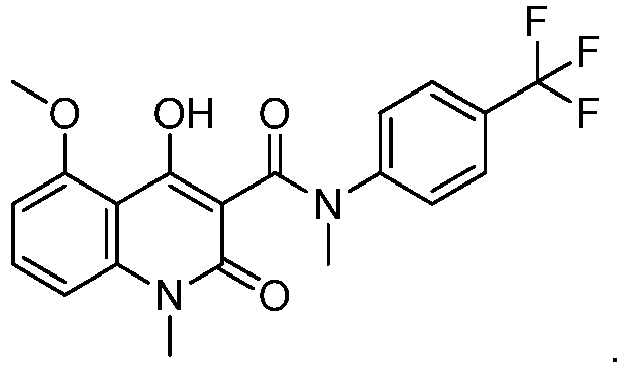
- Tasquinimod is a compound having high gastrointestinal permeability and high aqueous solubility. Indeed, the gastrointestinal permeability of tasquinimod using the Caco-2 cell model, the permeability coefficient of tasquinimod was found to be 43.5±0.9.10-6 cm.s-1, which ranks tasquinimod as "highly permeable" according to the Biopharmaceutics Classification System (BCS). For a drug compound to be classified as "highly soluble" according to the BCS, the highest single therapeutic dose thereof should be completely soluble in 250 ml or less of aqueous media over the pH range of 1.2-6.8 at 37±1°C. The solubility of tasquinimod exceeds this cut-off value ten-fold under the stated conditions, while at physiological pH at 7.4 the solubility is as high as 50-fold over this cut-off: the solubility of tasquinimod at pH 7.4 is as high as 0.25 mg/ml. Based on these properties, tasquinimod is classified as a BCS Class I compound. If the highly soluble tasquinimod is formulated in an immediate release formulation, the dissolution rate is expected to be high with a dissolution criterion of not less than 85% released in 30 minutes at 37°C. However, the present inventors found the dissolution rate of tasquinimod particles to be surprisingly low. In view of the high water-solubility of tasquinimod, the low dissolution rate of tasquinimod particles in aqueous phase was completely unexpected. A low dissolution rate is susceptible of reducing the bioavailability and may pose an obstacle to an efficient oral administration of an otherwise therapeutically active compound.
- Thus, the present invention is based on the surprising finding that the highly water soluble compound tasquinimod suffers from an unexpectedly low aqueous dissolution rate.
- A first aspect therefore is a plurality of particles of tasquinimod in free base form or as a pharmaceutically acceptable salt, said particles having a D(v,0.9) of at most 25 µm and a D(v,0.5) of at most 10 µm.
- A further aspect is the plurality of particles of tasquinimod in free base form or as a pharmaceutically acceptable salt as defined herein, for use in therapy.
- A further aspect is a pharmaceutical composition comprising the plurality of particles of tasquinimod in free base form or as a pharmaceutically acceptable salt as defined herein, and preferably one or more pharmaceutically acceptable excipients.
- A further aspect is a pharmaceutical dosage unit comprising the pharmaceutical composition as defined herein.
- A still further aspect is the plurality of particles of tasquinimod, or the pharmaceutical composition, or the pharmaceutical dosage unit, as defined herein, for use in the treatment of cancer. The cancer may be selected from multiple myeloma, lymphoma, myelodysplastic syndrome, myeloproliferative neoplasm, leukemia, bladder cancer, melanoma, lung cancer, colorectal cancer, breast cancer, pancreatic cancer, prostate cancer, renal cell carcinoma, ovarian cancer, neuroendocrine tumors (NET) and gastroenteropancreatic neuroendocrine tumors (GEP-NET).
- Further aspects and embodiments thereof will become evident from the following description and the claims.
-
-
FIGURE 1 represents the % by weight of tasquinimod dissolved as a function of time from capsules of Examples 4-6, containing 1 mg of tasquinimod particles having D(v,0.5) of 2.3 µm, 4.9 µm, and 6.4 µm, respectively, and of Comparative Examples 1-3 (not according to the invention), containing 1 mg of tasquinimod particles having D(v,0.5) of 15.9 µm, 22.4 µm, and 39.9 µm, respectively, in an in vitro dissolution test. -
FIGURE 2 represents the density distribution (q3) measured by laser diffraction, as a function of particle size in µm, for tasquinimod particles of Examples 7, 8 and 9. -
FIGURE 3 represents the % by weight of tasquinimod dissolved as a function of time from capsules of Examples 13 and 14, each containing 1 mg of tasquinimod particles having D(v,0.5) of 3.4 µm and 8.5 µm, respectively, in an in vitro dissolution test. -
FIGURE 4 represents the % by weight of tasquinimod dissolved as a function of time from capsules of Example 17, containing 1.0 mg of tasquinimod particles having D(v,0.5) of 4.8 µm, and capsules of Examples 18-20, containing 1.0 mg of tasquinimod particles having D(v,0.5) of 5.2 µm. - Unless defined otherwise or clearly indicated by context, all technical and scientific terms and abbreviations used herein have the same meaning as commonly understood by one of ordinary skill in the field of art to which this disclosure belongs. However, definitions of some of the terms used herein will be given herein below.
- The term "D(v,0.9)" as used herein means that 90 % of the particles in a composition (based on volume) have a diameter equal to or below a specified value. Thus, for example, a D(v,0.9) of 25 µm means that 90% of the particles, by volume, have a diameter of or below 25 µm.
- The term "D(v,0.5)" as used herein means that 50 % of the particles in a composition (based on volume) have a diameter equal to or below a specified value. Thus, for example, a D(v,0.5) of 15 µm means that 50% of the particles, by volume, have a diameter equal to or below 15 µm. A D(v,0.5) ranging from 3 µm to 7 µm means that 50% of the particles, by volume, have a diameter equal to or below a value between 7 µm and 3 µm.
- As used herein, the term "effective", as in an amount effective to achieve an end, i.e., "therapeutically effective amount", means the quantity of a component that is sufficient to yield an indicated therapeutic response without undue adverse side effects (such as toxicity, irritation, or allergic response) commensurate with a reasonable benefit/risk ratio when used in the manner of this disclosure. An effective amount may vary according to factors known in the art, such as the disease state, age, sex, and weight of the human or animal being treated.
- The term "excipient" refers to pharmaceutically acceptable chemicals, such as known to those of ordinary skill in the art of pharmacy to aid the administration of the medicinal agent. It is a compound that is useful in preparing a pharmaceutical composition, generally safe, non-toxic and neither biologically nor otherwise undesirable, and includes excipients that are acceptable for veterinary use as well as human pharmaceutical use. Exemplary excipients include encapsulating agents, sweeteners, taste-masking agents, carriers, binders, fillers, diluents, disintegrants, anti-adherents, and lubricants.
- The term "filler" (which in the pharmaceutical field may also be referred to as a "diluent" or "bulking agent") refers to an ingredient (excipient) in a pharmaceutical composition that lacks pharmacological activity but may be pharmaceutically necessary or desirable, e.g. to enhance or improve the properties of the pharmaceutical blend for manufacturing or physiological purposes. For example, a filler may be used to increase the bulk of an active ingredient the mass of which is too small for manufacture or administration.
- The term "lubricant" refers to an excipient which for example prevents ingredients and excipients to lump together, and/or sticking to the dosage form filling machine. A lubricant may also ensure that the formation, filing and ejection of the dosage form can occur, for example by lowering friction. Examples of lubricants are vegetable oils, talc, silicon dioxide (silica), and fatty acids or fatty acid salts.
- The term "micronization" as used herein refers to the process of reducing the average diameter of a particles of a solid material. Usually, the term micronization is used when the obtained particles that are produced are only a few micrometres (typically less than 10 µm) in diameter. Micronization techniques are typically based on the use of friction to reduce particle size, e.g. by milling and grinding.
- "Optional" or "optionally" means that the subsequently described event or circumstance may or may not occur, and that the description includes instances where the event or circumstance occurs and instances where it does not.
- The term "pharmaceutical dosage unit" as used herein includes any device useful for administering a given dose of a drug to a patient, e.g. a capsule, a tablet, a sachet, a microcapsule, etc.
- By "pharmaceutically acceptable" is meant a material that is not biologically or otherwise undesirable, i.e., the material can be administered to an individual along with the relevant active compound without causing clinically unacceptable biological effects or interacting in a deleterious manner with any of the other components of the formulation in which it is contained.
- The term "subject" as used herein refers to a mammal. A mammal contemplated by the present invention include a human as well as a non-human mammal, such as a mammal selected from primates, domesticated animals such as farm animals, e.g. cattle, sheep, pigs, horses and the like, as well as pet animals, such as dogs and cats, and the like. Preferably, the mammal is a human.
- Herein below, the expression "tasquinimod particle", or "particle of tasquinimod" may be used, and should be understood to refer to particles of tasquinimod, wherein "tasquinimod" should be understood to refer to either tasquinimod free base or tasquinimod in pharmaceutically acceptable salt form, unless otherwise apparent from the context or unless otherwise specified.
- It should be noted that tasquinimod as used herein may have any degree of deuteration. In some embodiments, tasquinimod has a degree of deuteration corresponding to the natural abundance of the deuterium isotope. In some other embodiments, tasquinimod as used herein is as described in
WO 2012/175541 , cf. herein above. - Examples of pharmaceutically acceptable salts comprise salts with (as counter ion) an alkali metal ion, e.g. Li+, Na+ or K+, or with an alkaline earth metal ion, e.g. Mg2+ or Ca2+, or with any other pharmaceutically acceptable metal ion, e.g. Zn2+ or Al3+; or pharmaceutically acceptable salts formed with organic bases, such as diethanolamine, ethanolamine, N-methylglucamine, triethanolamine or tromethamine.
- As used herein, "treating" encompasses, e.g., inducing inhibition, regression, or stasis of a disease, disorder or condition, or ameliorating or alleviating a symptom of a disease, disorder or condition.
- "Ameliorating" or "alleviating" a condition or state as used herein shall mean to relieve or lessen the symptoms of that condition or state. "Inhibition" of disease progression or disease complication in a subject as used herein means preventing or reducing the disease progression and/or disease complication in the subject.
- The tasquinimod particle present in the plurality of tasquinimod particles as provided herein essentially consists of tasquinimod, which means that at least 90 % by weight of the particle consists of tasquinimod, e.g. at least 95 % by weight, preferably at least 96% by weight, more preferably at least 97 % by weight, even more preferably at least 98 % by weight, at least 98.5 % by weight, at least 99 % by weight, or at least 99.5 % by weight.
- As noted herein, to have a required dissolution rate, the tasquinimod particles should have a particle size distribution characterised by a D(v,0.9) of at most 25 µm.
- In some embodiments, the particles have a D(v,0.9) of at most 24 µm. In some embodiments, the particles have a D(v,0.9) of at most 23 µm. In some embodiments, the particles have a D(v,0.9) of at most 22 µm. In some embodiments, the particles have a D(v,0.9) of at most 21 µm. In some embodiments, the particles have a D(v,0.9) of at most 20 µm. In some embodiments, the particles have a D(v,0.9) of at most 19 µm. In some embodiments, the particles have a D(v,0.9) of at most 18 µm. In some embodiments, the particles have a D(v,0.9) of at most 17 µm. In some embodiments, the particles have a D(v,0.9) of at most 16 µm. In some embodiments, the particles have a D(v,0.9) of at most 15 µm. In some embodiments, the particles have a D(v,0.9) of at most 14 µm. In some embodiments, the particles have a D(v,0.9) of at most 13 µm. In some embodiments, the particles have a D(v,0.9) of at most 12 µm. In some embodiments, the particles have a D(v,0.9) of at most 11 µm. In some embodiments, the particles have a D(v,0.9) of at most 10 µm. In some embodiments, the particles have a D(v,0.9) of at most 9 µm. In some embodiments, the particles have a D(v,0.9) of at most 8 µm. In some embodiments, the particles have a D(v,0.9) of at most 7 µm.
- In some embodiments, the particles have a D(v,0.9) of about 25 µm. In some embodiments, the particles have a D(v,0.9) of about 24 µm. In some embodiments, the particles have a D(v,0.9) of about 23 µm. In some embodiments, the particles have a D(v,0.9) of about 22 µm. In some embodiments, the particles have a D(v,0.9) of about 21 µm. In some embodiments, the particles have a D(v,0.9) of about 20 µm. In some embodiments, the particles have a D(v,0.9) of about 19 µm. In some embodiments, the particles have a D(v,0.9) of about 18 µm. In some embodiments, the particles have a D(v,0.9) of about 17 µm. In some embodiments, the particles have a D(v,0.9) of about 16 µm. In some embodiments, the particles have a D(v,0.9) of about 15 µm. In some embodiments, the particles have a D(v,0.9) of about 14 µm. In some embodiments, the particles have a D(v,0.9) of about 13 µm. In some embodiments, the particles have a D(v,0.9) of about 12 µm. In some embodiments, the particles have a D(v,0.9) of about 11 µm. In some embodiments, the particles have a D(v,0.9) of about 10 µm. In some embodiments, the particles have a D(v,0.9) of about 9 µm. In some embodiments, the particles have a D(v,0.9) of about 8 µm. In some embodiments, the particles have a D(v,0.9) of about 7 µm. In some embodiments, the particles have a D(v,0.9) of about 6 µm.
- In some embodiments, the particles have a D(v,0.9) in the range of 6 to 25 µm, in the range of 7 to 25 µm, in the range of 8 to 25 µm, in the range of 9 to 25 µm, in the range of 10 to 25 µm, in the range of 11 to 25 µm, in the range of 12 to 25 µm, in the range of 13 to 25 µm, in the range of 14 to 25 µm, in the range of 15 to 25 µm, in the range of 16 to 25 µm, in the range of 17 to 25 µm, in the range of 18 to 25 µm, in the range of 19 to 25 µm, in the range of 20 to 25 µm, in the range of 21 to 25 µm, in the range of 22 to 25 µm, in the range of 23 to 25 µm, or in the range of 24 to 25 µm.
- In some embodiments, the particles have a D(v,0.9) in the range of 6 to 24 µm, in the range of 7 to 24 µm, in the range of 8 to 24 µm, in the range of 9 to 24 µm, in the range of 10 to 24 µm, in the range of 11 to 24 µm, in the range of 12 to 24 µm, in the range of 13 to 24 µm, in the range of 14 to 24 µm, in the range of 15 to 24 µm, in the range of 16 to 24 µm, in the range of 17 to 24 µm, in the range of 18 to 24 µm, in the range of 19 to 24 µm, in the range of 20 to 24 µm, in the range of 21 to 24 µm, in the range of 22 to 24 µm, or in the range of 23 to 24 µm.
- In some embodiments, the particles have a D(v,0.9) in the range of 6 to 23 µm, in the range of 7 to 23 µm, in the range of 8 to 23 µm, in the range of 9 to 23 µm, in the range of 10 to 23 µm, in the range of 11 to 23 µm, in the range of 12 to 23 µm, in the range of 13 to 23 µm, in the range of 14 to 23 µm, in the range of 15 to 23 µm, in the range of 16 to 23 µm, in the range of 17 to 23 µm, in the range of 18 to 23 µm, in the range of 19 to 23 µm, in the range of 20 to 23 µm, in the range of 21 to 23 µm, or in the range of 22 to 23 µm.
- In some embodiments, the particles have a D(v,0.9) in the range of 6 to 22 µm, in the range of 7 to 22 µm, in the range of 8 to 22 µm, in the range of 9 to 22 µm, in the range of 10 to 22 µm, in the range of 11 to 22 µm, in the range of 12 to 22 µm, in the range of 13 to 22 µm, in the range of 14 to 22 µm, in the range of 15 to 22 µm, in the range of 16 to 22 µm, in the range of 17 to 22 µm, in the range of 18 to 22 µm, in the range of 19 to 22 µm, in the range of 20 to 22 µm, or in the range of 21 to 22 µm.
- In some embodiments, the particles have a D(v,0.9) in the range of 6 to 21 µm, in the range of 7 to 21 µm, in the range of 8 to 21 µm, in the range of 9 to 21 µm, in the range of 10 to 21 µm, in the range of 11 to 21 µm, in the range of 12 to 21 µm, in the range of 13 to 21 µm, in the range of 14 to 21 µm, in the range of 15 to 21 µm, in the range of 16 to 21 µm, in the range of 17 to 21 µm, in the range of 18 to 21 µm, in the range of 19 to 21 µm, or in the range of 20 to 21 µm.
- In some embodiments, the particles have a D(v,0.9) in the range of 6 to 20 µm, in the range of 7 to 20 µm, in the range of 8 to 20 µm, in the range of 9 to 20 µm, in the range of 10 to 20 µm, in the range of 11 to 20 µm, in the range of 12 to 20 µm, in the range of 13 to 20 µm, in the range of 14 to 20 µm, in the range of 15 to 20 µm, in the range of 16 to 20 µm, in the range of 17 to 20 µm, in the range of 18 to 20 µm, or in the range of 19 to 20 µm.
- In some embodiments, the particles have a D(v,0.9) in the range of 6 to 19 µm, in the range of 7 to 19 µm, in the range of 8 to 19 µm, in the range of 9 to 19 µm, in the range of 10 to 19 µm, in the range of 11 to 19 µm, in the range of 12 to 19 µm, in the range of 13 to 19 µm, in the range of 14 to 19 µm, in the range of 15 to 19 µm, in the range of 16 to 19 µm, in the range of 17 to 19 µm, or in the range of 18 to 19 µm.
- In some embodiments, the particles have a D(v,0.9) in the range of 6 to 18 µm, in the range of 7 to 18 µm, in the range of 8 to 18 µm, in the range of 9 to 18 µm, in the range of 10 to 18 µm, in the range of 11 to 18 µm, in the range of 12 to 18 µm, in the range of 13 to 18 µm, in the range of 14 to 18 µm, in the range of 15 to 18 µm, in the range of 16 to 18 µm, or in the range of 17 to 18 µm.
- In some embodiments, the particles have a D(v,0.9) in the range of 6 to 17 µm, in the range of 7 to 17 µm, in the range of 8 to 17 µm, in the range of 9 to 17 µm, in the range of 10 to 17 µm, in the range of 11 to 17 µm, in the range of 12 to 17 µm, in the range of 13 to 17 µm, in the range of 14 to 17 µm, in the range of 15 to 17 µm, or in the range of 16 to 17 µm.
- In some embodiments, the particles have a D(v,0.9) in the range of 6 to 16 µm, in the range of 7 to 16 µm, in the range of 8 to 16 µm, in the range of 9 to 16 µm, in the range of 10 to 16 µm, in the range of 11 to 16 µm, in the range of 12 to 16 µm, in the range of 13 to 16 µm, in the range of 14 to 16 µm, or in the range of 15 to 16 µm.
- In some embodiments, the particles have a D(v,0.9) in the range of 6 to 15 µm, in the range of 7 to 15 µm, in the range of 8 to 15 µm, in the range of 9 to 15 µm, in the range of 10 to 15 µm, in the range of 11 to 15 µm, in the range of 12 to 15 µm, in the range of 13 to 15 µm, or in the range of 14 to 15 µm.
- In some embodiments, the particles have a D(v,0.9) in the range of 6 to 14 µm, in the range of 7 to 14 µm, in the range of 8 to 14 µm, in the range of 9 to 14 µm, in the range of 10 to 14 µm, in the range of 11 to 14 µm, in the range of 12 to 14 µm, or in the range of 13 to 14 µm.
- In some embodiments, the particles have a D(v,0.9) in the range of 6 to 13 µm, in the range of 7 to 13 µm, in the range of 8 to 13 µm, in the range of 9 to 13 µm, in the range of 10 to 13 µm, in the range of 11 to 13 µm, or in the range of 12 to 13 µm.
- In some embodiments, the particles have a D(v,0.9) in the range of 6 to 12 µm, in the range of 7 to 12 µm, in the range of 8 to 12 µm, in the range of 9 to 12 µm, in the range of 10 to 12 µm, or in the range of 11 to 12 µm.
- In some embodiments, the particles have a D(v,0.9) in the range of 6 to 11 µm, in the range of 7 to 11 µm, in the range of 8 to 11 µm, in the range of 9 to 11 µm, or in the range of 10 to 11 µm.
- In some embodiments, the particles have a D(v,0.9) in the range of 6 to 10 µm, in the range of 7 to 10 µm, in the range of 8 to 10 µm, or in the range of 9 to 10 µm.
- In some embodiments, the particles have a D(v,0.9) in the range of 6 to 9 µm, in the range of 7 to 9 µm, or in the range of 8 to 9 µm. In some embodiments, the particles have a D(v,0.9) in the range of 6 to 8 µm, or in the range of 7 to 8 µm. In some embodiments, the particles have a D(v,0.9) in the range of 6 to 7 µm.
- The tasquinimod particles as provided herein should have a particle size distribution characterised by a D(v,0.5) of at most 10 µm. In some embodiments, the particles have a D(v,0.5) of 9 µm. In some embodiments, the particles have a D(v,0.5) of 8 µm. In some embodiments, the particles have a D(v,0.5) of 7 µm. In some embodiments, the particles have a D(v,0.5) of 6 µm. In some embodiments, the particles have a D(v,0.5) of 5 µm. In some embodiments, the particles have a D(v,0.5) of 4 µm. In some embodiments, the particles have a D(v,0.5) of 3 µm. In some embodiments, the particles have a D(v,0.5) of 2 µm. In some embodiments, the particles have a D(v,0.5) of 1 µm.
- In some embodiments, the particles have a D(v,0.5) in the range of 1 to 10 µm, in the range of 2 to 10 µm, in the range of 3 to 10 µm, in the range of 4 to 10 µm, in the range of 5 to 10 µm, in the range of 6 to 10 µm, in the range of 7 to 10 µm, in the range of 8 to 10 µm, or in the range of 9 to 10 µm.
- In some embodiments, the particles have a D(v,0.5) in the range of 1 to 9 µm, in the range of 2 to 9 µm, in the range of 3 to 9 µm, in the range of 4 to 9 µm, in the range of 5 to 9 µm, in the range of 6 to 9 µm, in the range of 7 to 9 µm, or in the range of 8 to 9 µm.
- In some embodiments, the particles have a D(v,0.5) in the range of 1 to 8 µm, in the range of 2 to 8 µm, in the range of 3 to 8 µm, in the range of 4 to 8 µm, in the range of 5 to 8 µm, in the range of 6 to 8 µm, or in the range of 7 to 8 µm.
- In some embodiments, the particles have a D(v,0.5) in the range of 1 to 7 µm, in the range of 2 to 7 µm, in the range of 3 to 7 µm, in the range of 4 to 7 µm, in the range of 5 to 7 µm, or in the range of 6 to 7 µm.
- In some embodiments, the particles have a D(v,0.5) in the range of 1 to 6 µm, in the range of 2 to 6 µm, in the range of 3 to 6 µm, in the range of 4 to 6 µm, or in the range of 5 to 6 µm.
- In some embodiments, the particles have a D(v,0.5) in the range of 1 to 5 µm, in the range of 2 to 5 µm, in the range of 3 to 5 µm, or in the range of 4 to 5 µm.
- In some embodiments, the particles have a D(v,0.5) in the range of 1 to 4 µm, in the range of 2 to 4 µm, or in the range of 3 to 4 µm.
- In some embodiments, the particles have a D(v,0.5) in the range of 1 to 3 µm, in the range of 2 to 3 µm, or in the range of 1 to 2 µm.
- In some further embodiments, D(v,0.5) is in the range of 1 µm to 9 µm, and D(v,0.9) is at most 25 µm, e.g. D(v,0.9) is in the range of 6 to 25 µm.
- In some further embodiments, D(v,0.5) is in the range of 2 µm to 10 µm, and D(v,0.9) is at most 25 µm, e.g. D(v,0.9) is in the range of 6 to 25 µm. In some further embodiments, D(v,0.5) is in the range of 2 µm to 9 µm, and D(v,0.9) is at most 25 µm, e.g. D(v,0.9) is in the range of 6 to 25 µm.
- In some further embodiments, D(v,0.5) is in the range of 3 µm to 9 µm, and D(v,0.9) is at most 25 µm, e.g. D(v,0.9) is in the range of 6 to 25 µm. In some further embodiments, D(v,0.5) is in the range of 3 µm to 8 µm, and D(v,0.9) is at most 25 µm, e.g. D(v,0.9) is in the range of 6 to 25 µm. In some further embodiments, D(v,0.5) is in the range of 3 µm to 7 µm, and D(v,0.9) is at most 25 µm, e.g. D(v,0.9) is in the range of 6 to 25 µm. In some of these embodiments, D(v,0.9) is in the range of 7 to 25 µm, or 8 to 25 µm, or 9 to 25 µm, or 10 to 25 µm.
- Thus, in some further embodiments, D(v,0.5) is in the range of 3 µm to 9 µm, and D(v,0.9) is in the range of 10 to 25 µm, or D(v,0.5) is in the range of 3 µm to 8 µm, and D(v,0.9) is in the range of 10 to 25 µm, or D(v,0.5) is in the range of 3 µm to 7 µm, and D(v,0.9) is in the range of 10 to 25 µm.
- In some further embodiments, D(v,0.5) is in the range of 2 µm to 9 µm, in the range of 2 µm to 8 µm, in the range of 2 µm to 7 µm, in the range of 3 µm to 9 µm, in the range of 3 µm to 8 µm, or in the range of 3 µm to 7 µm, and D(v,0.9) is at most 20 µm, e.g. in the range of 10 to 20 µm.
- In some further embodiments, D(v,0.5) is in the range of 2 µm to 9 µm, in the range of 2 µm to 8 µm, in the range of 2 µm to 7 µm, in the range of 3 µm to 9 µm, in the range of 3 µm to 8 µm, or in the range of 3 µm to 7 µm, and D(v,0.9) is at most 16 µm, e.g. in the range of 10 to 16 µm.
- It goes without saying that for any given particle population, the value of D(v,0.9) will always be higher than the value of D(v,0.5). It is preferred that the difference between D(v,0.5) and D(v,0.9) be as small as possible, corresponding to as narrow a particle size distribution as possible.
- A narrow particle size distribution will correspond to a low value for the ratio r obtained by dividing the difference between the values of D(v,0.9) and D(v,0.5), by the value of D(v,0.5), as expressed by the equation:

- In some embodiments, the particle population provided herein has a ratio r of at most 6, at most 5, at most 4.5, at most 4, at most 3.5, at most 3, at most 2.5, at most 2.4, at most 2.3, at most 2.2, at most 2.1, or at most 2. For example, in some embodiments, the particle population provided herein has a ratio r in the range of 1 to 6, 1 to 5, 1 to 4, 1 to 3.5, 1 to 3, 1 to 2.5, 1 to 2.4, 1 to 2.3, 1 to 2.2, 1 to 2.1, or 1 to 2. In some embodiments, the particle population provided herein has a ratio r in the range of 1.5 to 5, 1.5 to 4, 1.5 to 3.5, 1.5 to 3, 1.5 to 2.5, 1.5 to 2.4, 1.5 to 2.3, 1.5 to 2.2, 1.5 to 2.1, or 1.5 to 2. In some further embodiments, the particle population provided herein has a ratio r in the range of 2 to 5, 2 to 4, 2 to 3.5, 2 to 3, 2 to 2.5, 2 to 2.4, 2 to 2.3, 2 to 2.2, or 2 to 2.1.
- Tasquinimod in powder form is commercially available, e.g. from MilliporeSigma, and may also be prepared e.g. by following the methods as described in
WO 03/106424 WO 2012/004338 (cf. herein above). The tasquinimod particles as used herein may be prepared starting from tasquinimod in powder form, and by applying any suitable method for obtaining particles of the required particle size distribution, e.g. by micronization, using common micronization equipment, such as mechanical impact mills (spiral jet mills) or fluid energy (fluid bed) impact mills. In some embodiments, the tasquinimod particles are prepared by micronizing tasquinimod powder with a fluid energy jet mill using nitrogen as the processing gas. In some embodiments, the tasquinimod particles are prepared by preparing tasquinimod as described inWO 2012/004338 , e.g. in Example 4 ofWO 2012/004338 , and by micronizing the obtained product, e.g. with a fluid energy jet mill using nitrogen as the processing gas. - The tasquinimod particles of the invention may comprise crystalline tasquinimod as well as amorphous tasquinimod. In some embodiments, the particles at least partly consist of crystalline tasquinimod, e.g. at least 50 % by weight of the total amount of tasquinimod is crystalline, or at least 60%, or at least 70%, or at least 80 %, or at least 90 %, or at least 95 %, or at least 96 %, or at least 97 %, or at least 98 %, or at least 99 % by weight of the total amount of tasquinimod is crystalline. In some embodiments, the particles consist of crystalline tasquinimod. In some other embodiments, at least some of the particles consist of amorphous tasquinimod, or most of the particles consist of amorphous tasquinimod, or all of the particles consist of amorphous tasquinimod.
- The particle size distribution of the tasquinimod particles may be determined using laser diffraction technology, e.g. a laser particle size analyzer, e.g. a Malvern Mastersizer instrument as commercially available from Malvern Panalytical.
- The pharmaceutical composition provided herein comprises tasquinimod particles of the invention and preferably one or more pharmaceutically acceptable excipients. In some embodiments, the composition comprises a filler (which may also be termed "diluent") and/or a lubricant. A suitable filler may be, for example, silicified microcrystalline cellulose, pregelatinised starch, e.g. from maize, mannitol, lactose monohydrate, microcrystalline cellulose, or calcium hydrogen phosphate. A suitable lubricant may be, for example, hydrogenated vegetable oil, magnesium stearate, or sodium stearate fumarate.
- In some embodiments, the lubricant is hydrogenated vegetable oil. Hydrogenated vegetable oil occurs as white to yellowish-white flakes or pellets. It is made from fully hydrogenated refined vegetable oil that is sprayed resulting in a dry, fine powder. The molecular formula of hydrogenated vegetable oil is R1COOCH2-CH(OOCR2)-CH2COOR3 (where R1, R2 and R3 are mainly C15 and C17 alkyl). Examples of hydrogenated vegetable oil that may be used in the pharmaceutical compositions are Sterotex®, commercially available from Abitec Corp., and Lubritab®, commercially available from JRS Pharma.
- In some embodiments, the filler is pregelatinised starch, i.e. starch that has been chemically and/or mechanically processed to rupture all or part of the starch granules, and having the molecular formula (C6H10O5)n (where n = 300 to 1000). Non-limiting examples of pregelatinised starch that may be used in the pharmaceutical composition are Starch 1500®, commercially available from Colorcon Inc., and Lycatab C®, commercially available from Roquette.
- In some embodiments, the composition comprises a filler, such as pregelatinised starch, and a lubricant, such as hydrogenated vegetable oil.
- In some embodiments, the composition comprises tasquinimod particles, pregelatinised starch, and hydrogenated vegetable oil.
- The pharmaceutical composition provided herein may comprise tasquinimod particles in an amount of, for example, about 0.1 to about 10 % by total weight of the composition, or about 0.1 to about 9 % by total weight of the composition, e.g. about 0.1 to about 8 %, about 0.1 to about 7 %, about 0.1 to about 6 %, about 0.1 to about 5 %, about 0.1 to about 4 %, or about 0.1 to about 3 %, about 0.1 to about 2 %, or about 0.1 to about 1 %, by total weight of the composition.
- The pharmaceutical composition provided herein may comprise excipient(s) in an amount of about, for example, 90 to about 99.9 % by total weight of the composition, or about 95 to about 99.9 % by total weight of the composition, e.g. about 96 to about 99.9 %, about 97 to about 99.9 %, about 97.5 to about 99.9 %, about 98 to about 99.9 %, about 98.5 to about 99.9 %, or about 99 to about 99.9 %, by total weight of the composition.
- Generally, the main portion of the excipients consists of the filler, whereas the amount of lubricant, if present, generally is rather small, e.g. about 0.5 to 4 % by weight, about 0.5 to 3 % by weight, about 1 to 3 % by weight, or about 1.5 to 2.5 % by weight, by total weight of the composition.
- In some embodiments, the pharmaceutical composition provided herein comprises about 0.1 to 2 % by weight of tasquinimod particles, about 0.5 to 4 % by weight of lubricant, and about 94 to about 99.4 % by weight of filler, based on the total weight of the composition; e.g. about 0.1 to 1 % of tasquinimod particles, about 1 to 3 % by weight of lubricant, and about 96 % to about 98.9 % by weight of filler, based on the total weight of the composition.
- In some embodiments, the composition comprises tasquinimod particles in an amount of about 0.1 to 1 %, lubricant in an amount of about 1.5 to 2.5 % by weight, and filler in an amount of about 96.5 to about 98.4 % by weight, based on the total weight of the composition.
- An advantageous feature of the pharmaceutical composition as provided herein is the rapid dissolution of the tasquinimod particles contained in the composition. In some embodiments, at least 80 %, more preferably at least 85 % by weight of the tasquinimod particles of the composition dissolve within 30 minutes, when tested in a type I basket apparatus using 1 mg of the composition in 500 ml of a 0.05 M phosphate buffer, pH 6.8, at 37 °C bath temperatures and 100 rpm stirring speed. Such a high dissolution rate corresponds to an in vivo immediate release, and therefore, in some embodiments, the composition of the present invention is useful as an immediate release formulation.
- Also provided herein is a pharmaceutical dosage unit containing a therapeutically effective amount of tasquinimod in the form of the tasquinimod particles as disclosed herein.
- The pharmaceutical dosage unit may comprise, for example, 0.1 to 2 mg of tasquinimod particles, e.g. about 0.25 to 1.5 mg, in particular about 0.5 to about 1.25 mg, such as 1.0 mg of tasquinimod particles and optionally one or more excipients.
- In some embodiments, the pharmaceutical dosage unit comprises a pharmaceutical composition as defined herein in an amount corresponding to a therapeutically effective amount of the tasquinimod particles, such as 0.1 to 2 mg, e.g. about 0.25 to 1.5 mg, in particular about 0.5 to about 1.25 mg, such as about 1.0 mg.
- In some embodiments, the pharmaceutical dosage unit is suitable for oral administration, e.g. it is a capsule or tablet for oral administration.
- In some embodiments, the pharmaceutical dosage unit is an immediate-release pharmaceutical dosage unit.
- In some embodiments, the pharmaceutical dosage unit is a capsule suitable for oral administration (which may also be referred to as an oral capsule), such as a hard-shell or soft-shell capsule comprising a pharmaceutically effective amount of the pharmaceutical composition as disclosed herein. In some embodiments, the capsule is a hard-shell capsule, such as HMPC or gelatine capsule. In some embodiments, the capsule is a size 4 or
size 3 capsule. In some embodiments, the capsule is a hard-shell size 4 capsule, such as a hard-shell size 4 gelatine capsule. - In some embodiments, the pharmaceutical dosage unit is a hard-shell capsule, e.g. a size 4 capsule, containing an effective amount of tasquinimod particles, and one or more pharmaceutically acceptable excipients, e.g. a filler and a lubricant. In some embodiments, the capsule is a hard-shell capsule containing about 100 to 250 mg, e.g. about 150 to 200 mg, of the pharmaceutical composition provided herein. In some embodiments, the pharmaceutical dosage unit is a size 4 or
size 3 hard-shell capsule containing about 0.1 to 2 mg of tasquinimod particles, e.g. about 0.25 to 1.5 mg, in particular about 0.5 to about 1.25 mg, such as 1.0 mg of tasquinimod particles, in combination with a filler and a lubricant, e.g. pregelatinised starch and hydrogenated vegetable oil. In some embodiments, the pharmaceutical dosage unit is a size 4 hard-shell capsule containing about 0.5 to about 1.25 mg tasquinimod particles, such as 1.0 mg of tasquinimod particles, in combination with a filler and a lubricant, e.g. pregelatinised starch and hydrogenated vegetable oil. - The pharmaceutical composition provided herein, containing small and homogeneously sized tasquinimod particles, will allow for a consistent and rapid release of tasquinimod in the gastrointestinal tract of the treated subject, which is advantageous for the purpose of providing a dosage unit having a high and uniform bioavailabilty of tasquinimod. As shown herein, the pharmaceutical composition of the invention may be used to prepare an immediate release pharmaceutical dosage unit. Thus, in some embodiments, the pharmaceutical dosage unit is an immediate release oral dosage unit, e.g. an immediate release capsule.
- In some embodiments, the composition is provided in an oral capsule that has an enteric coating, i.e. a coating that resists dissolution under acidic conditions, and that dissolves only in the intestine, to provide an immediate release of tasquinimod in the intestinal compartment (delayed immediate release). Enteric coating materials are well-known to the person of ordinary skill in the art and are commercially available. A non-limiting example is Kollicoat® 100 P, a coating material based on a methacrylic aid-ethyl acrylate copolymer. Thus, in some embodiments, the pharmaceutical dosage unit provided herein is a delayed immediate release oral dosage unit, e.g. an enteric capsule.
- As mentioned herein above, the therapeutic activity of tasquinimod in the treatment of various diseases has been previously shown. It is considered that the plurality of tasquinimod particles, the pharmaceutical composition and the pharmaceutical dosage unit prepared by use of such particles will be useful in therapy, in particular in the treatment of any of those diseases for which tasquinimod has been previously shown as having a therapeutic activity. Thus, a further aspect is said plurality of particles, pharmaceutical composition and pharmaceutical dosage unit, for use in the treatment of cancer.
- The plurality of particles of tasquinimod or the pharmaceutical composition containing such plurality of particles is useful in the manufacture of a medicament for the treatment of cancer. The manufacture may comprise encapsulating a pharmaceutical composition as defined herein, applying encapsulating techniques well-known in the technical field. In some other embodiments, the manufacture comprises preparing a tablet, using tabletting techniques, also well-known in the technical field.
- The plurality of particles of tasquinimod or the pharmaceutical composition or dosage unit as provided herein is useful in a method for the treatment of cancer by administration of an effective amount thereof to a mammal in need of such treatment. Preferably, the method comprises oral administration of the composition, e.g. in the form of an oral dosage unit, such as an oral tablet or capsule, preferably an oral capsule.
- In some embodiments, the cancer is selected from bladder cancer, melanoma, lung cancer such as NSCLC (Non-Small Cell Lung Cancer), colorectal cancer, breast cancer, pancreatic cancer, prostate cancer, renal cell carcinoma, hematologic malignancies, in particular advanced hematologic malignancies, ovarian cancer, in particular, platinum-resistant ovarian cancer, neuroendocrine tumors (NET) and gastroenteropancreatic neuroendocrine tumors (GEP-NET). The cancer treated with the composition of the present invention can be any stage, e.g. early stage or late stage. In some embodiments, the treatment results in sustained response in the individual after cessation of the treatment. In some embodiments, the treatment produces a complete response, a partial response, or stable disease in the individual.
- In some embodiments, the cancer is a hematologic cancer, such as leukemia, lymphoma, myelodysplastic syndrome, myeloproliferative neoplasm, or multiple myeloma. In some embodiments, the hematological cancer is selected from leukemia and multiple myeloma. In some embodiments, the hematological cancer is selected from leukemia, myelodysplastic syndrome, and myeloproliferative neoplasm.
- In some embodiments, the hematologic cancer is leukemia. In some embodiments, the hematologic cancer is lymphoma. In some embodiments, the hematologic cancer is myelodysplastic syndrome. In some embodiments, the hematologic cancer is a myeloproliferative neoplasm. In some embodiments, the hematologic cancer is multiple myeloma.
- The leukemia may be selected from chronic lymphocytic leukemia, including hairy cell leukemia, chronic myeloid leukemia, acute lymphocytic leukemia, and acute myeloid leukemia and its precursor, myelodysplastic syndrome. In some embodiments, the leukemia is acute lymphocytic leukemia, or acute myeloid leukemia and its precursor, myelodysplastic syndrome. In some embodiments, the leukemia is acute lymphocytic leukemia. In some embodiments, the leukemia is acute myeloid leukemia.
- In some embodiments, a myeloproliferative neoplasm is selected from the group consisting of myelofibrosis, essential thrombocythemia (ET), polycythemia vera (PV), chronic neutrophilic leukemia, chronic myelogenous leukemia, acute myelogenous leukemia, chronic eosinophilic leukemia and mastocytosis. In some embodiments, the myeloproliferative neoplasm is selected from the group consisting of myelofibrosis, essential thrombocythemia, polycythemia vera, chronic neutrophilic leukemia, chronic eosinophilic leukemia and mastocytosis. In some embodiments, the myeloproliferative neoplasm is selected from the group consisting of myelofibrosis, essential thrombocythemia, and polycythemia vera. In some embodiments, the myeloproliferative neoplasm is myelofibrosis. In some embodiments, the myeloproliferative neoplasm is essential thrombocythemia or polycythemia vera. Essential thrombocythemia and polycythemia vera can both develop into myelofibrosis. Therefore, in some embodiments, the particles of the invention or a pharmaceutical composition or medicament prepared by use of the particles of the invention are for use to prevent or reduce the progression into fibrotic phase of a myeloproliferative neoplasm such as essential thrombocythemia or polycythemia vera. Therefore, the term "myelofibrosis" as used herein refers to primary myelofibrosis, as well as secondary myelofibrosis, including post-ET myelofibrosis, and post-PV myelofibrosis. In some embodiments, the myelofibrosis is primary myelofibrosis. In some embodiments, the myelofibrosis is secondary myelofibrosis.
- In some further embodiments, the cancer is a solid cancer, e.g. bladder cancer, prostate cancer or breast cancer. In some embodiments, the cancer is selected from bladder cancer (such as particular non muscle invasive bladder cancer, muscle invasive bladder cancer and metastatic and urothelial bladder cancer), prostate cancer and renal cell carcinoma. In some embodiments, the cancer is bladder cancer.
- In the medical treatment of any given subject by use of the plurality of particles, the pharmaceutical composition, or the pharmaceutical dosage unit provided herein, the dosage level and frequency will generally be determined by the treating physician, with due regard to factors such as and the sex, age, corporal weight and relative health of the treated subject, the selected route and form of administration, the additional use of other drugs, e.g. in a combination therapy.
- Generally, a daily dosage ranging from a minimum of 0.001 mg/kg body weight, or 0.002 mg/kg body weight or 0.005 mg/kg body weight or 0.01 mg/kg body weight, to a maximum of 0.2 mg/kg body weight, or 0.1 mg/kg body weight, or 0.05 mg/kg body weight, or 0.02 mg/kg body weight is contemplated.
- In some embodiments, the particles of tasquinimod are administered in an amount of 0.1 to 4 mg/day, or 0.2 to 2 mg/day, 0.4 to 1.8 mg/day, 0.5 to 1.5 mg/day, or 0.6 to 1.2 mg/day, e.g. 1 mg/day.
- In some embodiments, the dosage may be gradually adjusted to reach optimal results, so-called dosage titration. For example, dosage titration may comprise starting with a low daily dosage of e.g. 0.25 mg and maintaining this dose level for a period of 1 or 2 weeks. In case no significant side effects are encountered that may contraindicate raising the dose, the level may then be increased, e.g. to 0.5 mg/day for 1 or 2 weeks, after which period another increase may be contemplated, to reach a daily dosage of 1 mg, and so on. In such a method, if any significant side effects occur after an incremental increase of the dosage, the dosage may again be reduced to a previous level. Side effects that may occur include those that may generally be encountered in this type of treatment, e.g. gastrointestinal problems, tiredness, and flu-like syndrome, considered to be related to dosage.
- Tasquinimod preferably is administrated on a daily basis, e.g. 1-3 times a day, or 1-2 times a day, such as once daily. However, in some embodiments, the drug is administrated on a less frequent basis, e.g. every two days, once a week etc.
- It should be noted that if a pharmaceutically acceptable salt of tasquinimod is administered, an equivalent dosage would be one resulting in the indicated dosage of tasquinimod in non-salt form (i.e. as a free base).
- The invention will be further illustrated in the following non-limiting Examples.
- In the Examples, the tasquinimod particle size distribution was determined using laser light diffraction in a Malvern Mastersizer instrument to determine D(v,0.5) and D(v,0.9) values for micronized tasquinimod.
- Analysis conditions are shown in Table 1.
Table 1. Analysis Conditions Sample Unit Malvern Wet cell accessory Sample Size ~ 100 mg Analysis Model General Purpose (Irregular) Sample Dispersant Water Stir speed 2000 rpm Wetting agent Triton-X-100 (or equivalent) Stirring time 5 minutes Recirculation 30 seconds at 2000 rpm Obscuration 15 - 25 % - The filler used in the Examples was pregelatinised starch, viz. either Starch 1500® or Lycatab C®, and the lubricant was hydrogenated vegetable oil, viz. either Sterotex® and Lubritab®.
- Tasquinimod powder (80 g) was micronized with a fluid energy jet mill using nitrogen as the processing gas. The feed rate for the unmicronized material was controlled at 6 kg/h by use of a loss-in-weight screw feeder, and the Venturi pressure was set at 69-103 kPa (10-15 psi). The mill pressure was set below 276 kPa (40 psi) and adjusted depending on the result of the in-process control analysis to obtain the desired particle size distribution parameters (D(v,0.5) and D(v, 0.9)).
- Tasquinimod particles were prepared described in EXAMPLE 1.
- Tasquinimod particles were prepared as described in EXAMPLE 1.
- A capsule for oral administration containing tasquinimod particles of Example 1 in admixture with filler and lubricant was prepared as follows: Tasquinimod particles (0.5 g) were first blended with filler (73 g), whereafter lubricant (1.5 g) was admixed. The obtained mixture was filled into white hard gelatine size 4 capsules. In total, 500 capsules were obtained, each containing 150 mg of the mixture, corresponding to a dose strength of 1.0 mg of tasquinimod.
- Using the tasquinimod particles of Example 2, the procedure of Example 4 was repeated, to obtain 500 capsules, each having a dose strength of 1.0 mg of tasquinimod.
- Using the tasquinimod particles of Example 3, the procedure of Example 4 was repeated, to obtain 500 capsules, each having a dose strength of 1.0 mg of tasquinimod.
- A capsule containing micronized tasquinimod particles having D(v,0.5) of 15.9 µm and D(v,0.9) of 38.1 µm, in admixture with filler and lubricant, was prepared by following the procedure of Example 4. Each capsule contained 150 mg of the mixture, corresponding to a dose strength of 1.0 mg of tasquinimod.
- A capsule containing micronized tasquinimod particles having D(v,0.5) of 22.4 µm and D(v,0.9) of 63.8 µm, in admixture with filler and lubricant, was prepared by following the procedure of Example 4. Each capsule contained 150 mg of the mixture, corresponding to a dose strength of 1.0 mg of tasquinimod.
- A capsule containing unmicronized tasquinimod particles, having D(v,0.5) of 39.9 µm and D(v,0.9) of 121.0 µm, in admixture with filler and lubricant, was prepared by following the procedure of Example 4. Each capsule contained 150 mg of the mixture, corresponding to a dose strength of 1.0 mg of tasquinimod.
- The dissolution rate of Examples 4-6 and of Comparative Examples 1-3, respectively, was studied using a Ph. Eur. / USP dissolution apparatus 1 (Type I basket) with 500 mL volume of dissolution media with 37 °C bath temperature and 100 rpm stirring speed, and with liquid chromatography (LC) sample testing.
- The dissolution media was 0.05 M phosphate buffer, pH 6.8, selected to ensure that at least 85% of tasquinimod would be dissolved at the end of the test, tasquinimod being a weak acid with a pKa of 6.5 and with a solubility that increases with pH. The dissolution profiles obtained are shown in
Figure 1 . It is noted that even at a D(v,0.5) of only 15.9 µm, the tasquinimod particles have a surprisingly low dissolution rate. - For further investigation, the obtained dissolution profiles were compared statistically using the f1/f2 tests (Model Independent Approach Using a Similarity Factor) with Example 5 selected as a reference, cf. Table 2.
Table 2. Statistical comparison of drug products dissolution profiles Oral Capsule Ex. 4 Ex. 5 Ex. 6 Comp. Ex. 1 Comp. Ex. 2 Comp. Ex. 3 D(v,0.5) (µm) 2.3 4.9 6.4 15.9 22.4 39.9 D(v,0.9) (µm) 6.9 14.0 16.9 38.1 63.8 121.0 tasquinimod dissolved after 30 minutes (% by weight) 96 96 95 87 82 59 Difference factor f1 3.5 Ref. 5.2 19.2 27.4 52.8 Similarity factor f2 64.1 Ref. 63.5 36.8 29.8 16.5 - In the comparison of dissolution profiles using f1/f2 values, f1 values up to 15 (0-15) and f2 values greater than 50 (50-100) are considered indicative of similarity or equivalence of two dissolution profiles. The f1/f2 statistical comparison tests showed that the capsules of Examples 4 and 6, containing tasquinimod particles having D(v,0.5) of 2.3 µm and 6.4 µm, respectively, had dissolution profiles similar to that of Example 5, whereas Comparative Examples 1-3, containing tasquinimod particles having D(v,0.5) ranging from 15.9 to 39.9 µm had dissolution profiles corresponding to a significantly slower dissolution rate than that of Example 5.
- Tasquinimod particles (total amount 4.5 kg) were prepared essentially as described in EXAMPLE 1.
- Tasquinimod particles (total amount 0.9 kg) were prepared essentially as described in EXAMPLE 1.
- Tasquinimod particles (total amount 4.5 kg) were prepared essentially as described in EXAMPLE 1.
- The particle size distribution was measured for the particles of Examples 7 to 9. The results are shown in
Figure 2 . - Tasquinimod particles (total amount 2.8 kg) were prepared essentially as described in EXAMPLE 1.
- A capsule for oral administration containing tasquinimod particles of Example 7 in admixture with filler and lubricant was manufactured in industrial scale as follows: Tasquinimod particles (0.17 % by total weight of mixture) were first blended with filler (97.83 % by total weight of mixture), whereafter lubricant (2.00 % by total weight of mixture) was admixed. The obtained mixture (180 kg) was filled into white hard gelatine size 4 capsules. Each capsule contained 150 mg of the mixture, corresponding to a dose strength of 0.25 mg of tasquinimod, resulting in a maximum batch size of 1,200,000 capsules.
- A capsule for oral administration containing tasquinimod particles of Example 8 in admixture with filler and lubricant was manufactured in industrial scale as follows: Tasquinimod particles (0.33 % by total weight of mixture) were first blended with filler (97.67 % by total weight of mixture), whereafter lubricant (2.00 % by total weight of mixture) was admixed. The obtained mixture (180 kg) was filled into white hard gelatine size 4 capsules. Each capsule contained 150 mg of the mixture, corresponding to a dose strength of 0.5 mg of tasquinimod, resulting in a maximum batch size of 1,200,000 capsules.
- A capsule for oral administration containing tasquinimod particles of Example 9 in admixture with filler and lubricant was manufactured in an industrial scale as follows: Tasquinimod particles (0.67 % by total weight of mixture) were first blended with filler (97.33 % by total weight of mixture), whereafter lubricant (2.00 % by total weight of mixture) was admixed. The obtained mixture (180 kg) was filled into white hard gelatine size 4 capsules. Each capsule contained 150 mg of the mixture, corresponding to a dose strength of 1.0 mg of tasquinimod, resulting in a maximum batch size of 1,200,000 capsules.
- A capsule for oral administration containing tasquinimod particles of Example 10 in admixture with filler and lubricant was manufactured in an industrial scale as follows: Tasquinimod particles (0.67 % by total weight of mixture) were first blended with filler (97.33 % by total weight of mixture), whereafter lubricant (2.00 % by total weight of mixture) was admixed. The obtained mixture (180 kg) was filled into white hard gelatine size 4 capsules. Each capsule contained 150 mg of the mixture, corresponding to a dose strength of 1.0 mg of tasquinimod, resulting in a maximum batch size of 1,200,000 capsules. The dissolution rates of the capsules of Examples 13 and 14 were measured in an assay as described herein above. The results are shown in
Figure 3 . - Tasquinimod particles (total amount 0.9 kg) were prepared essentially as described in EXAMPLE 1.
- Tasquinimod particles (total amount 2.0 kg) were prepared essentially as described in EXAMPLE 1.
- Using the tasquinimod particles of Example 15, the procedure of Example 13 was repeated, to obtain 200 000 capsules, each capsule containing 1.0 mg of tasquinimod.
- Using the tasquinimod particles of Examples 16, the procedure of Example 13 was repeated, to obtain 3 batches of 200 000 capsules, each capsule containing 1.0 mg of tasquinimod. The dissolution rates of the capsules of Examples 17-20 were measured in an assay as described herein above. The results are shown in
Figure 4 . - As illustrated in
Figure 4 , the dissolution profiles of the different batches of capsules are very similar for capsules containing tasquinimod particles having D(v,0.5) of 4.8 µm (Example 17) and 5.2 µm (Examples 18-20), respectively, and the dissolution profiles correspond to an immediate release formulation. - Tasquinimod powder (300 g) was micronized with an Alpine®
Spiral Jet Mill 50 AS (from Hosokawa Alpine AG, Germany) using nitrogen as the processing gas. The feed rate for the unmicronized material was controlled at 10 g/min by use of a vibratory feeder, and the injector pressure was set at 1.8-5 bar. The mill pressure was set at 0.5-1 bar to obtain the desired particle size distribution parameters (D(v,0.5) and D(v, 0.9)). - A capsule for oral administration, containing tasquinimod particles of Example 21 in admixture with filler and lubricant, was manufactured in an industrial scale as follows: Tasquinimod particles (0.17 % by total weight of mixture) were first blended with filler (97.83 % by total weight of mixture), whereafter lubricant (2.00 % by total weight of mixture) was admixed. The obtained mixture (7.5 kg) was filled into white hard gelatine size 4 capsules. Each capsule contained 150 mg of the mixture, corresponding to a dose strength of 0.25 mg of tasquinimod, resulting in a maximum batch size of 50,000 capsules.
- The dissolution rates of capsules of Example 22 were measured in an assay as described herein above. The obtained dissolution profiles were similar to those of Examples 17-20 and corresponded to an immediate release formulation.
Claims (15)
- A plurality of particles comprising tasquinimod in free base form or as a pharmaceutically acceptable salt, said particles having a D(v,0.9) of at most 25 µm and a D(v,0.5) of at most 10 µm.
- The plurality of particles of claim 1, wherein said particles have a D(v,0.5) in the range of 2 µm to 9 µm.
- The plurality of particles of claim 1 or 2, wherein said particles have a D(v,0.5) in the range of 3 to 7 µm.
- The plurality of particles of any one of claims 1-3, for use in therapy.
- A pharmaceutical composition comprising the plurality of particles of any one of claims 1 to 3, and one or more pharmaceutically acceptable excipients.
- The pharmaceutical composition of claim 5, comprising said plurality of particles in an amount of from 0.1 to 10 % by weight of the composition.
- The pharmaceutical composition of claim 5 or 6, wherein the pharmaceutically acceptable excipients comprise a filler and a lubricant.
- A pharmaceutical dosage unit comprising the pharmaceutical composition of any one of claims 5 to 7.
- The pharmaceutical dosage unit of claim 8, containing the plurality of particles in an amount in the range of 0.1 mg to 2 mg, preferably in the range of 0.2 mg to 1 mg.
- The pharmaceutical dosage unit of claim 8 or 9, for oral administration.
- The pharmaceutical dosage unit of claim 10, which is a capsule or tablet.
- The pharmaceutical dosage unit of any one of claims 8 to 11, which is an immediate-release pharmaceutical dosage unit.
- The plurality of particles of any one of claims 1 to 3, or the pharmaceutical composition of any one of claims 5 to 7, or the pharmaceutical dosage unit of any one of claims 8 to 12, for use in the treatment of cancer.
- The plurality of particles, pharmaceutical composition, or pharmaceutical dosage unit, for the use of claim 13, wherein the cancer is a hematologic cancer, or a solid cancer.
- The plurality of particles, pharmaceutical composition, or pharmaceutical dosage unit, for the use of claim 14, wherein the hematological cancer is selected from multiple myeloma, lymphoma, myelodysplastic syndrome, myeloproliferative neoplasm, and leukemia, and/or the solid cancer is selected from from bladder cancer, melanoma, lung cancer, colorectal cancer, breast cancer, pancreatic cancer, prostate cancer, renal cell carcinoma, ovarian cancer, neuroendocrine tumors (NET) and gastroenteropancreatic neuroendocrine tumors (GEP-NET).
Applications Claiming Priority (2)
| Application Number | Priority Date | Filing Date | Title |
|---|---|---|---|
| EP21175623 | 2021-05-25 | ||
| PCT/EP2022/063887 WO2022248401A1 (en) | 2021-05-25 | 2022-05-23 | A plurality of tasquinimod particles and use thereof |
Publications (3)
| Publication Number | Publication Date |
|---|---|
| EP4346773A1 EP4346773A1 (en) | 2024-04-10 |
| EP4346773B1 true EP4346773B1 (en) | 2025-07-02 |
| EP4346773C0 EP4346773C0 (en) | 2025-07-02 |
Family
ID=76098832
Family Applications (1)
| Application Number | Title | Priority Date | Filing Date |
|---|---|---|---|
| EP22730773.3A Active EP4346773B1 (en) | 2021-05-25 | 2022-05-23 | A plurality of tasquinimod particles and use thereof |
Country Status (14)
| Country | Link |
|---|---|
| US (1) | US12485095B2 (en) |
| EP (1) | EP4346773B1 (en) |
| JP (1) | JP2024520307A (en) |
| KR (1) | KR20240012436A (en) |
| CN (1) | CN117295492A (en) |
| AU (1) | AU2022281056A1 (en) |
| BR (1) | BR112023023715A2 (en) |
| CA (1) | CA3218977A1 (en) |
| ES (1) | ES3048983T3 (en) |
| IL (1) | IL308542A (en) |
| MX (1) | MX2023013301A (en) |
| PL (1) | PL4346773T3 (en) |
| WO (1) | WO2022248401A1 (en) |
| ZA (1) | ZA202311594B (en) |
Families Citing this family (1)
| Publication number | Priority date | Publication date | Assignee | Title |
|---|---|---|---|---|
| WO2025228998A1 (en) * | 2024-04-30 | 2025-11-06 | Institut National de la Santé et de la Recherche Médicale | Use of hdac4 inhibitors for the treatment of melanoma |
Family Cites Families (13)
| Publication number | Priority date | Publication date | Assignee | Title |
|---|---|---|---|---|
| SE9801474D0 (en) | 1998-04-27 | 1998-04-27 | Active Biotech Ab | Quinoline Derivatives |
| SE9802549D0 (en) | 1998-07-15 | 1998-07-15 | Active Biotech Ab | Quinoline derivatives |
| SE0002320D0 (en) | 1999-10-25 | 2000-06-21 | Active Biotech Ab | Malignant tumors |
| SE0201778D0 (en) | 2002-06-12 | 2002-06-12 | Active Biotech Ab | Process for the manufacture of quinoline derivatives |
| AU2011275720B2 (en) | 2010-07-09 | 2015-05-14 | Active Biotech Ab | Method for manufacturing of quinoline-3-carboxamides |
| EP2537517A1 (en) | 2011-06-22 | 2012-12-26 | Active Biotech AB | Deuterium-enriched 4-hydroxy-5-methoxy-n,1-dimethyl-2-oxo-n-[(4-trifluoro-methyl)phenyl]-1,2-dihydroquinoline-3-carboxamide |
| WO2015160696A1 (en) | 2014-04-14 | 2015-10-22 | Yale University | Compositions and methods of inhibiting histone deacetylases |
| WO2016042112A1 (en) | 2014-09-23 | 2016-03-24 | Active Biotech Ab | Quinoline carboxamides for use in the treatment of multiple myeloma |
| ES2663836T3 (en) | 2014-11-19 | 2018-04-17 | Active Biotech Ab | Quinoline Carboxamides for use in the treatment of leukemia |
| EP3067062A1 (en) | 2015-03-13 | 2016-09-14 | Ipsen Pharma S.A.S. | Combination of tasquinimod or a pharmaceutically acceptable salt thereof and a pd1 and/or pdl1 inhibitor, for use as a medicament |
| WO2018105943A1 (en) | 2016-12-07 | 2018-06-14 | 순천향대학교 산학협력단 | Pharmaceutical composition for treatment or alleviation of pulmonary fibrosis and asthma |
| US20230293512A1 (en) | 2020-07-23 | 2023-09-21 | Erasmus University Medical Center Rotterdam | S100 proteins as novel therapeutic targets in myeloproliferative neoplasms |
| JP2024503372A (en) | 2021-01-18 | 2024-01-25 | アクティブ バイオテック エイビー | tasquinimod or a pharmaceutically acceptable salt thereof for use in the treatment of myelodysplastic syndromes |
-
2022
- 2022-05-23 WO PCT/EP2022/063887 patent/WO2022248401A1/en not_active Ceased
- 2022-05-23 CA CA3218977A patent/CA3218977A1/en active Pending
- 2022-05-23 CN CN202280034543.8A patent/CN117295492A/en active Pending
- 2022-05-23 EP EP22730773.3A patent/EP4346773B1/en active Active
- 2022-05-23 MX MX2023013301A patent/MX2023013301A/en unknown
- 2022-05-23 PL PL22730773.3T patent/PL4346773T3/en unknown
- 2022-05-23 US US18/289,738 patent/US12485095B2/en active Active
- 2022-05-23 BR BR112023023715A patent/BR112023023715A2/en unknown
- 2022-05-23 ES ES22730773T patent/ES3048983T3/en active Active
- 2022-05-23 AU AU2022281056A patent/AU2022281056A1/en active Pending
- 2022-05-23 IL IL308542A patent/IL308542A/en unknown
- 2022-05-23 JP JP2023570225A patent/JP2024520307A/en active Pending
- 2022-05-23 KR KR1020237042849A patent/KR20240012436A/en active Pending
-
2023
- 2023-12-18 ZA ZA2023/11594A patent/ZA202311594B/en unknown
Also Published As
| Publication number | Publication date |
|---|---|
| EP4346773A1 (en) | 2024-04-10 |
| WO2022248401A1 (en) | 2022-12-01 |
| IL308542A (en) | 2024-01-01 |
| EP4346773C0 (en) | 2025-07-02 |
| US20240285532A1 (en) | 2024-08-29 |
| CA3218977A1 (en) | 2022-12-01 |
| US12485095B2 (en) | 2025-12-02 |
| PL4346773T3 (en) | 2025-11-03 |
| AU2022281056A1 (en) | 2023-11-30 |
| JP2024520307A (en) | 2024-05-24 |
| ES3048983T3 (en) | 2025-12-12 |
| KR20240012436A (en) | 2024-01-29 |
| BR112023023715A2 (en) | 2024-02-20 |
| CN117295492A (en) | 2023-12-26 |
| ZA202311594B (en) | 2025-04-30 |
| MX2023013301A (en) | 2023-12-04 |
Similar Documents
| Publication | Publication Date | Title |
|---|---|---|
| US8383150B2 (en) | Granulate formulation of pirfenidone and pharmaceutically acceptable excipients | |
| RU2685724C2 (en) | Apixaban formulations | |
| HK1243947A1 (en) | Apixaban formulations | |
| HK1243945A1 (en) | Apixaban formulations | |
| SK287869B6 (en) | Beta-carboline pharmaceutical compositions | |
| KR20110004852A (en) | Oral pharmaceutical compositions in solid dispersions preferably comprising Posaconazole and HPMCAS | |
| CZ212799A3 (en) | A ziprasidone-based composition, a method of treating psychosis, and a method of making large ziprasidone crystals | |
| JP2023055940A (en) | Improved bromocriptine formulations | |
| WO2021030607A1 (en) | Pimavanserin for treating neurodegenerative diseases | |
| EP4346773B1 (en) | A plurality of tasquinimod particles and use thereof | |
| JP2021512860A (en) | Pharmaceutical product | |
| HK40107035A (en) | A plurality of tasquinimod particles and use thereof | |
| HK40107035B (en) | A plurality of tasquinimod particles and use thereof | |
| CN110582278A (en) | Pharmaceutical composition and its use | |
| JP2011246478A (en) | Solid dosage formulation of telcagepant potassium | |
| AU2013201986B2 (en) | Capsule Formulation Of Pirfenidone And Pharmaceutically Acceptable Excipients | |
| WO2026032974A1 (en) | Formulation of linaprazan glurate | |
| TW202245786A (en) | Applications of quinazoline compound and pharmaceutical composition | |
| WO2024085821A1 (en) | Content uniformity of teriflunomid in pharmaceutical dosage forms | |
| CN119060046A (en) | Pharmaceutical preparation containing glapiron hydrochloride and preparation method thereof | |
| CN121313643A (en) | A palbociclib pharmaceutical composition and its preparation method | |
| EA040951B1 (en) | DOSAGE FORMS CIS-4-[2-{[(3S,4R)-3-FLUOROXAN-4-YL]AMINO}-8-(2,4,6-TRICHLORORANINO)-9H-PURINE-9-YL]-1 -METHYLCYCLOHEXANE-1-CARBOXAMIDE AND THEIR USE IN A METHOD FOR CANCER TREATMENT | |
| JP2021181483A (en) | A pharmaceutical composition comprising dimethyl fumarate for administration at a low daily dose | |
| HK40031930A (en) | Apixaban formulations | |
| BR112020006599A2 (en) | cis-4- [2 - {[(3s, 4r) -3-fluoro-oxan-4-yl] amino} -8- (2,4,6-trichloroanilino) -9h-purin compositions and methods of use 9-yl] -1-methylcyclohexane-1-carboxamide |
Legal Events
| Date | Code | Title | Description |
|---|---|---|---|
| STAA | Information on the status of an ep patent application or granted ep patent |
Free format text: STATUS: UNKNOWN |
|
| STAA | Information on the status of an ep patent application or granted ep patent |
Free format text: STATUS: THE INTERNATIONAL PUBLICATION HAS BEEN MADE |
|
| PUAI | Public reference made under article 153(3) epc to a published international application that has entered the european phase |
Free format text: ORIGINAL CODE: 0009012 |
|
| STAA | Information on the status of an ep patent application or granted ep patent |
Free format text: STATUS: REQUEST FOR EXAMINATION WAS MADE |
|
| 17P | Request for examination filed |
Effective date: 20231205 |
|
| AK | Designated contracting states |
Kind code of ref document: A1 Designated state(s): AL AT BE BG CH CY CZ DE DK EE ES FI FR GB GR HR HU IE IS IT LI LT LU LV MC MK MT NL NO PL PT RO RS SE SI SK SM TR |
|
| DAV | Request for validation of the european patent (deleted) | ||
| DAX | Request for extension of the european patent (deleted) | ||
| STAA | Information on the status of an ep patent application or granted ep patent |
Free format text: STATUS: EXAMINATION IS IN PROGRESS |
|
| 17Q | First examination report despatched |
Effective date: 20240903 |
|
| REG | Reference to a national code |
Ref country code: HK Ref legal event code: DE Ref document number: 40107035 Country of ref document: HK |
|
| GRAP | Despatch of communication of intention to grant a patent |
Free format text: ORIGINAL CODE: EPIDOSNIGR1 |
|
| STAA | Information on the status of an ep patent application or granted ep patent |
Free format text: STATUS: GRANT OF PATENT IS INTENDED |
|
| INTG | Intention to grant announced |
Effective date: 20250210 |
|
| GRAS | Grant fee paid |
Free format text: ORIGINAL CODE: EPIDOSNIGR3 |
|
| GRAA | (expected) grant |
Free format text: ORIGINAL CODE: 0009210 |
|
| STAA | Information on the status of an ep patent application or granted ep patent |
Free format text: STATUS: THE PATENT HAS BEEN GRANTED |
|
| AK | Designated contracting states |
Kind code of ref document: B1 Designated state(s): AL AT BE BG CH CY CZ DE DK EE ES FI FR GB GR HR HU IE IS IT LI LT LU LV MC MK MT NL NO PL PT RO RS SE SI SK SM TR |
|
| REG | Reference to a national code |
Ref country code: GB Ref legal event code: FG4D |
|
| REG | Reference to a national code |
Ref country code: CH Ref legal event code: EP |
|
| REG | Reference to a national code |
Ref country code: DE Ref legal event code: R096 Ref document number: 602022016942 Country of ref document: DE |
|
| REG | Reference to a national code |
Ref country code: IE Ref legal event code: FG4D |
|
| U01 | Request for unitary effect filed |
Effective date: 20250710 |
|
| U07 | Unitary effect registered |
Designated state(s): AT BE BG DE DK EE FI FR IT LT LU LV MT NL PT RO SE SI Effective date: 20250716 |
|
| REG | Reference to a national code |
Ref country code: ES Ref legal event code: FG2A Ref document number: 3048983 Country of ref document: ES Kind code of ref document: T3 Effective date: 20251212 |
|
| PG25 | Lapsed in a contracting state [announced via postgrant information from national office to epo] |
Ref country code: IS Free format text: LAPSE BECAUSE OF FAILURE TO SUBMIT A TRANSLATION OF THE DESCRIPTION OR TO PAY THE FEE WITHIN THE PRESCRIBED TIME-LIMIT Effective date: 20251102 |
|
| PG25 | Lapsed in a contracting state [announced via postgrant information from national office to epo] |
Ref country code: NO Free format text: LAPSE BECAUSE OF FAILURE TO SUBMIT A TRANSLATION OF THE DESCRIPTION OR TO PAY THE FEE WITHIN THE PRESCRIBED TIME-LIMIT Effective date: 20251002 |
|
| PG25 | Lapsed in a contracting state [announced via postgrant information from national office to epo] |
Ref country code: HR Free format text: LAPSE BECAUSE OF FAILURE TO SUBMIT A TRANSLATION OF THE DESCRIPTION OR TO PAY THE FEE WITHIN THE PRESCRIBED TIME-LIMIT Effective date: 20250702 |
|
| PG25 | Lapsed in a contracting state [announced via postgrant information from national office to epo] |
Ref country code: GR Free format text: LAPSE BECAUSE OF FAILURE TO SUBMIT A TRANSLATION OF THE DESCRIPTION OR TO PAY THE FEE WITHIN THE PRESCRIBED TIME-LIMIT Effective date: 20251003 |
|
| PG25 | Lapsed in a contracting state [announced via postgrant information from national office to epo] |
Ref country code: CZ Free format text: LAPSE BECAUSE OF FAILURE TO SUBMIT A TRANSLATION OF THE DESCRIPTION OR TO PAY THE FEE WITHIN THE PRESCRIBED TIME-LIMIT Effective date: 20250702 |
|
| PG25 | Lapsed in a contracting state [announced via postgrant information from national office to epo] |
Ref country code: RS Free format text: LAPSE BECAUSE OF FAILURE TO SUBMIT A TRANSLATION OF THE DESCRIPTION OR TO PAY THE FEE WITHIN THE PRESCRIBED TIME-LIMIT Effective date: 20251002 |