EP4216136A1 - Sales system, inhaler, sales terminal, and sales method - Google Patents
Sales system, inhaler, sales terminal, and sales method Download PDFInfo
- Publication number
- EP4216136A1 EP4216136A1 EP20954112.7A EP20954112A EP4216136A1 EP 4216136 A1 EP4216136 A1 EP 4216136A1 EP 20954112 A EP20954112 A EP 20954112A EP 4216136 A1 EP4216136 A1 EP 4216136A1
- Authority
- EP
- European Patent Office
- Prior art keywords
- inhaler device
- information
- substrate
- sales
- user
- Prior art date
- Legal status (The legal status is an assumption and is not a legal conclusion. Google has not performed a legal analysis and makes no representation as to the accuracy of the status listed.)
- Pending
Links
Images



Classifications
-
- G—PHYSICS
- G06—COMPUTING OR CALCULATING; COUNTING
- G06Q—INFORMATION AND COMMUNICATION TECHNOLOGY [ICT] SPECIALLY ADAPTED FOR ADMINISTRATIVE, COMMERCIAL, FINANCIAL, MANAGERIAL OR SUPERVISORY PURPOSES; SYSTEMS OR METHODS SPECIALLY ADAPTED FOR ADMINISTRATIVE, COMMERCIAL, FINANCIAL, MANAGERIAL OR SUPERVISORY PURPOSES, NOT OTHERWISE PROVIDED FOR
- G06Q30/00—Commerce
- G06Q30/06—Buying, selling or leasing transactions
-
- G—PHYSICS
- G06—COMPUTING OR CALCULATING; COUNTING
- G06Q—INFORMATION AND COMMUNICATION TECHNOLOGY [ICT] SPECIALLY ADAPTED FOR ADMINISTRATIVE, COMMERCIAL, FINANCIAL, MANAGERIAL OR SUPERVISORY PURPOSES; SYSTEMS OR METHODS SPECIALLY ADAPTED FOR ADMINISTRATIVE, COMMERCIAL, FINANCIAL, MANAGERIAL OR SUPERVISORY PURPOSES, NOT OTHERWISE PROVIDED FOR
- G06Q30/00—Commerce
- G06Q30/06—Buying, selling or leasing transactions
- G06Q30/0601—Electronic shopping [e-shopping]
Definitions
- the present invention relates to a sales system, an inhaler device, a sales terminal, and a sales method.
- an inhaler device uses an aerosol source and a substrate including a flavor source to generate an aerosol to which a flavor component is imparted.
- the aerosol source is used to generate the aerosol
- the flavor source is used to impart the flavor component to the generated aerosol. The user can enjoy the flavor by inhaling the aerosol that is generated by the inhaler device and to which the flavor component is imparted.
- Patent Literature 1 discloses a technology in which a terminal of a store that sells substrates receives, in a wireless manner, identification information of a substrate that a user wants to purchase from the user terminal such as a smartphone, and the terminal of the store specifies, on the basis of the received identification information, the position of the substrate that the user wants to purchase on the display shelves.
- Patent Literature 1 Japanese Patent No. 6691138
- Patent Literature 1 a smartphone is operated to transmit the identification information, so that it takes time and effort.
- An object of the present invention is to provide a mechanism that can further improve usability.
- the sales system includes an inhaler device that generates, using a substrate, an aerosol to be inhaled by a user, and a sales terminal that performs processing for selling the substrate.
- the sales terminal receives, from the inhaler device, information stored in the inhaler device and performs processing corresponding to the received information.
- the information stored in the inhaler device may include identification information of the substrate.
- the information stored in the inhaler device may include profile information indicating a profile in which an operation is defined that the inhaler device performs to heat the substrate in order to generate the aerosol.
- the information stored in the inhaler device may include information indicating a combination of the identification information of the substrate and the profile.
- the information stored in the inhaler device may include at least one of identification information of the inhaler device or identification information of the user.
- the sales terminal may output substrate position information indicating a position where the substrate is stored, the substrate being indicated by the identification information of the substrate included in the information received from the inhaler device.
- the sales terminal may store, for a plurality of the substrates that are for sale, the substrate position information regarding each of the substrates and output, among the stored items of substrate position information, the substrate position information corresponding to the substrate indicated by the identification information of the substrate included in the information received from the inhaler device.
- the sales terminal may receive, from the inhaler device through short-range wireless communication, the information stored in the inhaler device.
- the inhaler device may have a near field communication (NFC) tag, and the sales terminal may read out information stored in the NFC tag of the inhaler device.
- NFC near field communication
- the information stored in the inhaler device may be updated by a user terminal used by the user.
- the user terminal may update, in a case where a predetermined condition is met, the information stored in the inhaler device.
- an inhaler device includes a generator that generates, using a substrate, an aerosol to be inhaled by a user, a memory that stores information, and a communicator that transmits information stored in the memory to a sales terminal that performs processing for selling the substrate.
- the sales terminal includes a communicator that receives, from an inhaler device that generates using a substrate an aerosol to be inhaled by a user, information stored in the inhaler device, and a controller that performs processing for selling the substrate in accordance with the information received by the communicator.
- the sales method includes, in a sales system including an inhaler device that generates, using a substrate, an aerosol to be inhaled by a user, and a sales terminal that performs processing for selling the substrate, receiving, from the inhaler device, information stored in the inhaler device and performing processing corresponding to the received information, the receiving and the performing being performed using the sales terminal.
- a mechanism is provided that can further improve usability.
- elements having substantially the same functional configurations may be differentiated by adding alphabets after the same reference numerals.
- a plurality of elements having substantially the same functional configurations are differentiated as needed as in inhaler devices 100A and 100B.
- the plurality of elements having substantially the same functional configurations are denoted only by the same reference numerals.
- the inhaler devices 100A and 100B do not have to be differentiated from each other, the inhaler devices 100A and 100B are simply referred to as inhaler devices 100.
- An inhaler device generates material to be inhaled by a user.
- the material generated by the inhaler device is an aerosol.
- the material generated by the inhaler device may be gas.
- FIG. 1 is a schematic diagram of the inhaler device according to the first configuration example.
- an inhaler device 100A according to the present configuration example includes a power supply unit 110, a cartridge 120, and a flavor imparting cartridge 130.
- the power supply unit 110 includes a power supply 111A, a sensor 112A, a notifier 113A, a memory 114A, a communicator 115A, and a controller 116A.
- the cartridge 120 includes a heater 121A, a liquid guide 122, and a liquid storage 123.
- the flavor imparting cartridge 130 includes a flavor source 131 and a mouthpiece 124. In the cartridge 120 and the flavor imparting cartridge 130, an airflow path 180 is defined.
- the power supply 111A stores electric power.
- the power supply 111A supplies electric power to the structural elements of the inhaler device 100A under the control of the controller 116A.
- the power supply 111A may be a rechargeable battery such as a lithium ion secondary battery.
- the sensor 112A acquires various items of information regarding the inhaler device 100A.
- the sensor 112A may be a pressure sensor such as a microphone condenser, a flow sensor, or a temperature sensor, and acquire a value generated in accordance with the user's inhalation.
- the sensor 112A may be an input device that receives information input by the user, such as a button or a switch.
- the notifier 113A provides information to the user.
- the notifier 113A may be a light-emitting device that emits light, a display device that displays an image, a sound output device that outputs sound, or a vibration device that vibrates.
- the memory 114A stores various items of information for operation of the inhaler device 100A.
- the memory 114A may be a non-volatile storage medium such as flash memory.
- the communicator 115A is a communication interface capable of communication in conformity with any wired or wireless communication standard.
- a communication standard may be, for example, Wi-Fi (registered trademark) or Bluetooth (registered trademark).
- the controller 116A functions as an arithmetic processing unit and a control circuit, and controls the overall operations of the inhaler device 100A in accordance with various programs.
- the controller 116A includes an electronic circuit such as a central processing unit (CPU) and a microprocessor, for example.
- the liquid storage 123 stores an aerosol source.
- the aerosol source is atomized to generate an aerosol.
- the aerosol source is a liquid such as polyhydric alcohol and water. Examples of the polyhydric alcohol include glycerine and propylene glycol.
- the aerosol source may include a flavor component that is either derived from tobacco or not derived from tobacco.
- the aerosol source may include a medicine.
- the liquid guide 122 guides, from the liquid storage 123, the aerosol source that is the liquid stored in the liquid storage 123, and holds the aerosol source.
- the liquid guide 122 is, for example, a wick formed by twining fiber material such as glass fiber or porous material such as porous ceramic. In this case, the capillary action of the wick guides the aerosol source stored in the liquid storage 123.
- the heater 121A heats the aerosol source to atomize the aerosol source and generate the aerosol.
- the heater 121A includes a coil wound around the liquid guide 122.
- the heater 121A produces heat, the aerosol source held by the liquid guide 122 is heated and atomized to generate the aerosol.
- the heater 121A produces heat when receiving electric power from the power supply 111A.
- the electric power may be supplied in response to the sensor 112A detecting a start of the user's inhalation and/or an input of predetermined information. Subsequently, the supply of the electric power may be stopped in response to the sensor 112A detecting an end of the user's inhalation and/or an input of predetermined information.
- the flavor source 131 is a structural element for imparting a flavor component to the aerosol.
- the flavor source 131 may include a flavor component that is either derived from tobacco or not derived from tobacco.
- the airflow path 180 is a flow path of air to be inhaled by the user.
- the airflow path 180 has a tubular structure having an air inlet hole 181 and an air outlet hole 182 at both ends.
- the air inlet hole 181 is an inlet of air into the airflow path 180
- the air outlet hole 182 is an outlet of the air from the airflow path 180.
- the liquid guide 122 is on the airflow path 180 at an upstream position (closer to the air inlet hole 181)
- the flavor source 131 is on the airflow path 180 at a downstream position (closer to the air outlet hole 182). Air flowing in through the air inlet hole 181 when the user inhales mixes with the aerosol generated by the heater 121A.
- the mixture fluid of the aerosol and the air passes through the flavor source 131 and is conveyed to the air outlet hole 182.
- the flavor component included in the flavor source 131 is imparted to the aerosol.
- the mouthpiece 124 is to be held in a mouth of the user during inhalation.
- the mouthpiece 124 has the air outlet hole 182. When the user inhales with the mouthpiece 124 in his/her mouth, the mixture fluid of the aerosol and the air enters the oral cavity of the user.
- the configuration example of the inhaler device 100A has been described above.
- the inhaler device 100A is not limited to the above configuration, and may be configured in various ways as exemplified below.
- the inhaler device 100A does not have to include the flavor imparting cartridge 130.
- the cartridge 120 includes the mouthpiece 124.
- the inhaler device 100A may include various types of aerosol sources. Still another type of aerosol may be generated by mixing a plurality of types of aerosols generated from the plurality of types of aerosol sources in the airflow path 180 and causing a chemical reaction.
- means for atomizing the aerosol source is not limited to heating by the heater 121A.
- the means for atomizing the aerosol source may be vibration atomization or induction heating.
- FIG. 2 is a schematic diagram of the inhaler device according to the second configuration example.
- an inhaler device 100B according to the present configuration example includes a power supply 111B, a sensor 112B, a notifier 113B, a memory 114B, a communicator 115B, a controller 116B, a heater 121B, a holder 140, and a heat insulator 144.
- the power supply 111B, the sensor 112B, the notifier 113B, the memory 114B, the communicator 115B, and the controller 116B are substantially the same as the respective corresponding structural elements included in the inhaler device 100A according to the first configuration example.
- the holder 140 has an internal space 141, and holds a stick substrate 150 in a manner partially accommodated in the internal space 141.
- the holder 140 has an opening 142 that allows the internal space 141 to communicate with outside.
- the holder 140 holds the stick substrate 150 that is inserted into the internal space 141 through the opening 142.
- the holder 140 may be a tubular body having the opening 142 and a bottom 143 on its ends, and may define the pillar-shaped internal space 141.
- the holder 140 has the function of defining a flow path of air to be supplied to the stick substrate 150.
- the bottom 143 has an air inlet hole that is an inlet of air into the flow path.
- the opening 142 is an air outlet hole that is an outlet of the air from the flow path.
- the stick substrate 150 includes a substrate 151 and an inhalation port 152.
- the substrate 151 includes an aerosol source. Note that, in the present configuration example, the aerosol source does not have to be liquid and may also be solid.
- the stick substrate 150 held by the holder 140 includes the substrate 151 at least partially accommodated in the internal space 141 and the inhalation port 152 at least partially protruding from the opening 142. When the user inhales with the inhalation port 152 protruding from the opening 142 in his/her mouth, air flows into the internal space 141 from an air inlet hole (not illustrated), and the air and an aerosol generated from the substrate 151 reach inside the mouth of the user.
- the heater 121B has the substantially the same configuration as the heater 121A according to the first configuration example. Note that, in the example illustrated in Fig. 2 , the heater 121B has a film-like shape and surrounds the outer circumference of the holder 140. Subsequently, heat produced from the heater 121B heats the substrate 151 of the stick substrate 150 from the outer circumference, generating the aerosol.
- the heat insulator 144 prevents heat from transferring from the heater 121B to the other structural elements.
- the heat insulator 144 may be a vacuum heat insulator or an aerogel heat insulator.
- the configuration example of the inhaler device 100B has been described above.
- the inhaler device 100B is not limited to the above configuration, and may be configured in various ways as exemplified below.
- the heater 121B may have a blade-like shape, and may be disposed so that the heater 121B protrudes from the bottom 143 of the holder 140 toward the internal space 141. In this case, the heater 121B having the blade-like shape is inserted into the substrate 151 of the stick substrate 150 and heats the substrate 151 of the stick substrate 150 from its inside. In another example, the heater 121B may be disposed so that the heater 121B covers the bottom 143 of the holder 140. In still another example, the heater 121B may be implemented as a combination of two or more selected from a first heater that covers the outer circumference of the holder 140, a second heater having the blade-like shape, and a third heater that covers the bottom 143 of the holder 140.
- the holder 140 may include an opening/closing mechanism that at least partially opens and closes an outer shell defining the internal space 141.
- the opening/closing mechanism include a hinge.
- the holder 140 may sandwich the stick substrate 150 inserted into the internal space 141 by opening and closing the outer shell.
- the heater 121B may be at the sandwiching position of the holder 140 and may produce heat while pressing the stick substrate 150.
- means for atomizing the aerosol source is not limited to heating by the heater 121B.
- the means for atomizing the aerosol source may be induction heating.
- the inhaler device 100B may also include the heater 121A, the liquid guide 122, the liquid storage 123, and the airflow path 180 according to the first configuration example.
- the air outlet hole 182 for the airflow path 180 may also function as an air inlet hole into the internal space 141. In this case, a mixture fluid of the air and an aerosol generated by the heater 121A flows into the internal space 141, mixes further with an aerosol generated by the heater 121B, and then reaches the oral cavity of the user.
- Fig. 3 is a diagram illustrating an example of the configuration of a sales system 1 according to the present embodiment.
- the sales system 1 includes inhaler devices 100, user terminals 200, a sales terminal 300, and a server 400.
- Fig. 3 illustrates an example in which the sales system 1 has two inhaler devices 100 (100A and 100B), two user terminals 200 (200A and 200B), one sales terminal 300, and one server 400.
- the number of devices is not limited to the number mentioned in the example.
- An inhaler device generates material to be inhaled by a user.
- the material generated by the inhaler device is an aerosol.
- the material generated by the inhaler device may be gas.
- the material generated by the inhaler device being inhaled by the user is also referred to as "inhalation” or "puffing".
- Each inhaler device 100 generates an aerosol to be inhaled by the user using a substrate.
- a heater 121 is an example of a generator that generates an aerosol.
- the cartridge 120 and the flavor imparting cartridge 130 in the first configuration example and the stick substrate 150 in the second configuration example are examples of the substrate according to the present invention.
- the inhaler device 100 generates an aerosol using a substrate attached to the inhaler device 100.
- the cartridge 120 and the flavor imparting cartridge 130 connected to the power supply unit 110 in the first configuration example are an example of the substrate attached to the inhaler device 100.
- the stick substrate 150 inserted into the inhaler device 100 in the second configuration example is an example of the substrate attached to the inhaler device 100.
- the inhaler device 100 may have any one of the first configuration example or the second configuration example described above.
- the inhaler device 100 used by a user A will be referred to as the inhaler device 100A
- the inhaler device 100 used by a user B will be referred to as the inhaler device 100B. That is, the configuration of the inhaler device 100A in Fig. 3 does not always have to match the configuration illustrated in Fig. 1 and may match the configuration illustrated in Fig. 2 , for example. Similarly, the configuration of the inhaler device 100B in Fig. 3 does not always have to match the configuration illustrated in Fig. 2 and may match the configuration illustrated in Fig. 1 , for example.
- a communicator 115 may perform wireless communication based on short-range wireless communication standards, which are near field communication (NFC) or Bluetooth (registered trademark).
- short-range wireless communication standards which are near field communication (NFC) or Bluetooth (registered trademark).
- Each user terminal 200 is a terminal device used by the user of an inhaler device 100.
- the user terminal 200 is implemented as a smartphone, a tablet computer, a wearable device, or the like.
- An inhaler device 100 and a user terminal 200 used by the same user are associated with each other.
- the user registers information regarding the inhaler device 100 in the user terminal 200, registers information regarding the user terminal 200 in the inhaler device 100, or registers, in the server 400, the inhaler device 100 and user terminal 200 being used by the same user.
- the configuration of the user terminal 200 will be described with reference to Fig. 4 .
- Fig. 4 is a block diagram illustrating an example of the configuration of the user terminal 200 according to the present embodiment.
- the user terminal 200 includes an input unit 210, an output unit 220, a communicator 230, a memory 240, and a controller 250.
- the input unit 210 has the function of receiving various items of information that are input.
- the input unit 210 may include an input device that receives information input by the user. Examples of the input device include a button, a keyboard, a touch screen, and a microphone.
- the input unit 210 may further include various sensors such as an image sensor.
- the output unit 220 has the function of outputting information.
- the output unit 220 may include an output device that outputs information to the user.
- Examples of the output device include a display device that displays information, a light-emitting device that emits light, a vibration device that vibrates, and a sound output device that outputs sound.
- An example of the display device is a display.
- An example of the light-emitting device is a light emitting diode (LED).
- An example of the vibration device is an eccentric motor.
- An example of the sound output device is a speaker.
- the output unit 220 provides information to the user by outputting information input from the controller 250.
- the communicator 230 is a communication interface for transmitting and receiving information between the user terminal 200 and other devices.
- the communicator 230 performs communication based on any wired or wireless communication standard.
- a communication standard for example, a wireless local area network (LAN), a wired LAN, Wi-Fi (registered trademark), or Bluetooth (registered trademark) may be used.
- the communicator 230 may perform wireless communication based on a short-range wireless communication standard such as near field communication (NFC) or Bluetooth (registered trademark).
- NFC near field communication
- Bluetooth registered trademark
- the memory 240 stores various items of information for operation of the user terminal 200.
- the memory 240 may be a non-volatile storage medium such as a flash memory.
- the controller 250 functions as an arithmetic processing unit and a control circuit, and controls the overall operations of the user terminal 200 in accordance with various programs.
- the controller 250 includes an electronic circuit such as a CPU and a microprocessor, for example.
- the controller 250 may further include a read only memory (ROM) and a random access memory (RAM).
- the ROM stores, for example, programs and operation parameters to be used.
- the RAM temporarily stores, for example, parameters that change as appropriate.
- the user terminal 200 performs various types of processing under control performed by the controller 250. Processing of information input by the input unit 210, output of information using the output unit 220, transmission and reception of information using the communicator 230, and storage of information in the memory 240 and reading out information from the memory 240 are examples of processing controlled by the controller 250. Other types of processing performed by the user terminal 200 are also controlled by the controller 250. Examples of the other types of processing include input of information to various structural elements and processing based on information output from various structural elements.
- controller 250 may be realized using applications.
- the applications may be preinstalled or downloaded.
- functions of the controller 250 may also be realized using progressive web apps (PWA).
- PWA progressive web apps
- the sales terminal 300 is a terminal device that performs processing for selling substrates.
- the sales terminal 300 may be implemented as, for example, a cash register or a point-of-sale (POS) terminal.
- the sales terminal 300 is installed in a store that sells substrates.
- Examples of processing for selling substrates include payment processing regarding the giving and receiving of money and sales management processing for registering, for example, the brands of substrates that were sold and the number of sales of the substrates.
- a user who uses the sales terminal 300 is typically a salesperson. In the following, the configuration of the sales terminal 300 will be described with reference to Fig. 5 .
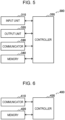
- Fig. 5 is a block diagram illustrating an example of the configuration of the sales terminal 300 according to the present embodiment.
- the sales terminal 300 includes an input unit 310, an output unit 320, a communicator 330, a memory 340, and a controller 350.
- the input unit 310 has the function of receiving various items of information that are input.
- the input unit 310 may include an input device that receives information input by a salesperson. Examples of the input device include a button, a keyboard, a touch screen, and a microphone.
- the input unit 310 may further include various sensors such as an image sensor.
- the output unit 320 has the function of outputting information.
- the output unit 320 may include an output device that outputs information to the salesperson.
- Examples of the output device include a display device that displays information, a light-emitting device that emits light, a vibration device that vibrates, and a sound output device that outputs sound.
- An example of the display device is a display.
- An example of the light-emitting device is an LED.
- An example of the vibration device is an eccentric motor.
- An example of the sound output device is a speaker.
- the output unit 320 provides information to the salesperson by outputting information input from the controller 350.
- the communicator 330 is a communication interface for transmitting and receiving information between the sales terminal 300 and other devices.
- the communicator 330 performs communication based on any wired or wireless communication standard.
- a communication standard for example, a wireless LAN, a wired LAN, or Wi-Fi (registered trademark) may be used.
- the communicator 330 may perform wireless communication based on a short-range wireless communication standard such as near field communication (NFC) or Bluetooth (registered trademark).
- NFC near field communication
- Bluetooth registered trademark
- the memory 340 stores various items of information for operation of the sales terminal 300.
- the memory 340 may be a non-volatile storage medium such as a flash memory.
- the controller 350 functions as an arithmetic processing unit and a control circuit, and controls the overall operations of the sales terminal 300 in accordance with various programs.
- the controller 350 includes an electronic circuit such as a CPU and a microprocessor, for example.
- the controller 350 may further include a ROM and a RAM.
- the ROM stores, for example, programs and operation parameters to be used.
- the RAM temporarily stores, for example, parameters that change as appropriate.
- the sales terminal 300 performs various types of processing under control performed by the controller 350. Processing of information input by the input unit 310, output of information using the output unit 320, transmission and reception of information using the communicator 330, and storage of information in the memory 340 and reading out information from the memory 340 are examples of processing controlled by the controller 350. Other types of processing performed by the sales terminal 300 are also controlled by the controller 350. Examples of the other types of processing include input of information to various structural elements and processing based on information output from various structural elements.
- controller 350 may be realized using applications.
- the applications may be preinstalled or downloaded.
- functions of the controller 350 may also be realized using progressive web apps (PWA).
- PWA progressive web apps
- the server 400 is an information processing apparatus that provides various types of services regarding the inhaler devices 100.
- the server 400 provides membership services to the users of the inhaler devices 100.
- the server 400 collects and accumulates information regarding each inhaler device 100, analyzes the accumulated information, and provides membership services in accordance with the analysis result.
- the user accesses the server 400 to apply for a membership registration in advance, so that the user can receive various types of membership services such as provision of information regarding the inhaler device 100.
- the configuration of the server 400 will be described with reference to Fig. 6 .
- Fig. 6 is a block diagram illustrating an example of the configuration of the server 400 according to the present embodiment.
- the server 400 includes a communicator 410, a memory 420, and a controller 430.
- the communicator 410 is a communication interface for transmitting and receiving information between the server 400 and other devices.
- the communicator 410 communicates with the other devices via the Internet, for example.
- the memory 420 stores various items of information for operation of the server 400.
- the memory 420 may be a non-volatile storage medium such as a hard disc drive (HDD) or a solid state drive (SSD).
- HDD hard disc drive
- SSD solid state drive
- the controller 430 functions as an arithmetic processing unit and a control circuit, and controls the overall operations of the server 400 in accordance with various programs.
- the controller 430 includes an electronic circuit such as a CPU and a microprocessor, for example.
- the controller 430 may further include a ROM and a RAM.
- the ROM stores, for example, programs and operation parameters to be used.
- the RAM temporarily stores, for example, parameters that change as appropriate.
- the server 400 performs various types of processing under control performed by the controller 430. Transmission and reception of information using the communicator 410, and storage of information in the memory 420 and reading out information from the memory 420 are examples of processing controlled by the controller 430. Other types of processing performed by the server 400 are also controlled by the controller 430. Examples of the other types of processing include input of information to various structural elements and processing based on information output from various structural elements.
- communication may be performed between the devices included in the sales system 1.
- the inhaler device 100A can communicate with the user terminal 200A, which is used by the same user, the inhaler device 100B, which is another device used by another user, and the sales terminal 300.
- Each user terminal 200 can communicate with the inhaler device 100 used by the same user and the server 400.
- the sales terminal 300 can communicate with the inhaler devices 100 and the server 400.
- the server 400 can communicate with the sales terminal 300 and the user terminals 200.
- Each inhaler device 100 stores various items of information. Part of the information stored in the inhaler device 100 is collected by the sales terminal 300 and/or by the server 400 via the sales terminal 300. Out of the information stored by the inhaler device 100, the information collected by the sales terminal 300 and/or the server 400 will also be referred to as collection target information in the following. An example of the collection target information will be described in the following.
- Collection target information stored in the inhaler device 100 may include the identification information of a substrate.
- the identification information of the substrate is information for identifying the brand (that is, a kind) of the substrate.
- the identification information of the substrate will also be referred to as brand information.
- the collection target information stored in the inhaler device 100 may include at least one of the identification information of the inhaler device 100 or the identification information of the user of the inhaler device 100.
- the identification information of the inhaler device 100 is information for uniquely identifying the inhaler device 100.
- the identification information of the user of the inhaler device 100 is information for uniquely identifying the user.
- the identification information of users may be personal information such as the names of the users or may also be user IDs for identifying the respective users registered in the membership services.
- the collection target information stored in the inhaler device 100 may include profile information indicating a profile in which an operation is defined that the inhaler device 100 performs to heat a substrate in order to generate an aerosol.
- the inhaler device 100 heats the substrate in accordance with the profile indicated by the stored profile information to generate an aerosol.
- a profile in the first configuration example is information in which an electric power supply time to the heater 121A and an electric power supply amount per unit time (for example, a voltage) are defined.
- the controller 116 performs control such that the power supply amount per unit time defined in the profile is supplied from the power supply 1 1 1 to the heater 121A for the power supply time defined in the profile.
- Such electric power supply control is performed, for example, every time puffing is detected.
- a profile in the second configuration example is information in which a relationship between the time that has elapsed from when the heater 121B starts heating and the temperature of the heater 121B is defined.
- the controller 116 controls the heater 121B such that a temperature change similar to that in the profile is realized in the heater 121B.
- the heater 121B may include a conductive track including a resistor, and the sensor 112 may detect the temperature of the heater 121B on the basis of the electrical resistance of the conductive track.
- the heater 121B may be controlled by controlling, for example, electric power supply from the power supply 111 to the heater 121B. Control of power supply may be performed under, for example, pulse width modulation (PWM) control.
- PWM pulse width modulation
- the profile information may be the profile itself.
- a settable profile may be predetermined in such a manner that, for example, a profile is provided through the membership services.
- the profile information may be identification information indicating the profile.
- the profile may be a customizable profile, in which the user can adjust for example a parameter such as an electric power supply time.
- the collection target information stored in the inhaler device 100 may include information indicating a combination of the identification information of a substrate and a profile.
- the profile the user prefers may differ on a substrate basis, and the inhaler device 100 may store information indicating a combination of brand information and a profile appropriate for a substrate of the brand indicated by the brand information.
- the collection target information stored in the inhaler device 100 may include authentication information.
- the authentication information is information indicating that the user is entitled to purchase substrates.
- the authentication information includes, for example, information that proves the age of the user.
- the inhaler device 100 may store one item of information or a plurality of items of information.
- the inhaler device 100 may store one or more items of brand information and one or more profiles.
- the collection target information stored in the inhaler device 100 is updated by another device.
- an example of an update method will be described.
- Each user terminal 200 has the function of managing the collection target information stored in the inhaler device 100. Specifically, the user terminal 200 updates the collection target information stored in the inhaler device 100.
- the user terminal 200 may store synchronization target information and achieve synchronization between the user terminal 200 and the inhaler device 100 at a predetermined timing. That is, the user terminal 200 may write the synchronization target information into the inhaler device 100 such that the synchronization target information matches the information stored in the inhaler device 100.
- These functions of managing the collection target information stored in the inhaler device 100 may be realized by a management application. That is, the user terminal 200 may manage, using the management application, the collection target information stored in the inhaler device 100.
- the management application may be implemented as a native application or also as a PWA.
- the user terminal 200 transmits synchronization target information to the inhaler device 100 via short-range wireless communication and causes the inhaler device 100 to store the synchronization target information.
- the inhaler device 100 may have an NFC tag.
- An NFC tag is a tag having an antenna for performing communication using NFC and an integrated circuit (IC) chip for performing processing for communication using NFC and is typically formed so as to have a thin seal-like shape. Information can be written into or read out from an NFC tag using NFC. That is, the NFC tag of the inhaler device 100 may function as the memory 114, the communicator 115, and the controller 116. In contrast, the user terminal 200 may have an NFC reader/writer.
- An NFC reader/writer is a device that functions as both an NFC reader capable of reading out information from an NFC tag and an NFC writer capable of writing information into an NFC tag. That is, the NFC reader/writer of the user terminal 200 may function as the communicator 230. In this manner, in a case where the inhaler device 100 has an NFC tag, and the user terminal 200 has an NFC reader/writer, the user terminal 200 writes, using the NFC reader/writer, information into the NFC tag of the inhaler device 100.
- the user terminal 200 updates the collection target information stored in the inhaler device 100.
- the predetermined conditions may include the distance between the user terminal 200 and the inhaler device 100 becoming small enough to perform short-range wireless communication.
- the predetermined conditions may include the management application being active in the user terminal 200.
- the predetermined conditions may include synchronization target information stored in the management application having been updated since the last writing into the inhaler device 100.
- the predetermined conditions may include the synchronization target information stored in the management application being different from the information stored in the inhaler device 100.
- the NFC reader/writer can detect, by periodically performing polling, NFC tags present in a range where short-range wireless communication is possible.
- the user terminal 200 may start up the management application. Subsequently, after being started up, the management application may automatically achieve synchronization between the user terminal 200 and the inhaler device 100.
- the user terminal 200 acquires synchronization target information such as brand information from various information sources.
- the user terminal 200 may acquire synchronization target information through the membership services provided from the server 400.
- the user terminal 200 may acquire synchronization target information from a Web site.
- the user terminal 200 may acquire, as synchronization target information, the brand information of a substrate, the brand information being acquired by performing image recognition on an image obtained by capturing the package of the substrate.
- the user causes the user terminal 200 to store, as synchronization target information, the brand information of a substrate that the user wants to purchase, so that it is thus possible to improve usability at the time of purchase of the substrate as will be described below.
- the user terminal 200 manages information stored in the inhaler device 100 associated with the user terminal 200 (that is, the inhaler device 100 used by the same user).
- the user terminal 200A manages information stored in the inhaler device 100A.
- Each inhaler device 100 may have an NFC communication module.
- the NFC communication module is a communication module capable of performing communication using NFC and supports three communication modes, which are a card emulation mode, a reader-writer mode, and a peer-to-peer (P2P) mode.
- the NFC communication module operates in the card emulation mode, the NFC communication module operates as an NFC tag itself, so that an NFC reader/writer performs reading and writing on the NFC communication module.
- the NFC communication module operates in the reader-writer mode
- the NFC communication module operates as an NFC reader/writer itself, so that the NFC communication module performs reading and writing on an NFC tag.
- the NFC communication module operates in the P2P mode
- the NFC communication module communicates with other NFC communication modules operating in the P2P mode.
- the inhaler device 100 may write information into another inhaler device 100, or another inhaler device 100 may write information into the inhaler device 100. That is, the information stored in each inhaler device 100 may be updated by another inhaler device 100.
- Each inhaler device 100 may identify the brand information of a substrate. For example, information representing the brand information of a substrate may be given to the substrate. In this case, the inhaler device 100 can identify the brand information of a stick substrate 150 on the basis of the identification given to the substrate. For example, a colored line, a bar code, and the like can be provided on the surface of the substrate.
- the sensor 112 may include an image sensor for reading information added to the surface of the substrate.
- the controller 116 identifies the brand information of the substrate by performing image recognition on an image obtained by the image sensor.
- the inhaler device 100 may automatically identify the brand information of a substrate attached thereto and store the brand information.
- the sales terminal 300 can acquire, as information regarding a brand that is desired to be purchased, the brand information of a substrate that was attached to the inhaler device 100 in the past and perform processing for selling a corresponding substrate.
- the user can purchase a substrate that is often used by the user.
- Each inhaler device 100 transmits collection target information stored in the inhaler device 100 to the sales terminal 300.
- the sales terminal 300 receives, from the inhaler device 100, the collection target information stored in the inhaler device 100.
- short-range wireless communication is performed between the inhaler device 100 and the sales terminal 300. That is, the sales terminal 300 may receive, from the inhaler device 100, the collection target information stored in the inhaler device 100 through short-range wireless communication.
- the sales terminal 300 receives the collection target information from the inhaler device 100 that has approached the sales terminal 300 and entered the range where short-range wireless communication is possible, and thus it is possible to prevent radio interference even when, for example, the shop is crowded.
- the inhaler device 100 may have an NFC tag.
- the sales terminal 300 may have an NFC reader functioning as the communicator 330.
- the sales terminal 300 uses the NFC reader to read out information stored in the NFC tag of the inhaler device 100.
- the user can transmit collection target information only by, for example, placing the inhaler device 100 above the NFC reader of the sales terminal 300, so that usability can be improved.
- the sales terminal 300 Upon receiving collection target information from the inhaler device 100, the sales terminal 300 performs processing corresponding to the received collection target information. With such a configuration, the sales terminal 300 can receive collection target information not from the user terminal 200 but from the inhaler device 100 and perform processing corresponding to the received collection target information. Thus, the user's time and effort for operating the user terminal 200 to transmit information are saved, so that usability can be improved.
- the sales terminal 300 transmits the collection target information received from the inhaler device 100 to the server 400.
- the server 400 accumulates and analyzes the collection target information received from the sales terminal 300.
- An analysis result from the server 400 can be used in marketing or the like.
- the server 400 provides membership services on the basis of the analysis result.
- the server 400 specifies, on the basis of the accumulated collection target information, a substrate and a profile that are popular among the members and provides, as a membership service, information for recommending the substrate and profile.
- the membership services are provided to the user terminal 200, for example, as Web services through the Internet. With such a configuration, the user can receive appropriate membership services reflecting the purchase behaviors of the members only by purchasing a substrate using the inhaler device 100, that is, without taking time and effort to operate the user terminal 200 to transmit information to the server 400.
- the sales terminal 300 may perform processing for selling a substrate in accordance with the collection target information received from the inhaler device 100.
- the sales terminal 300 may perform processing for selling, as a substrate that the user wants to purchase, a substrate corresponding to the brand information included in the collection target information received from the inhaler device 100.
- the user can purchase a desired substrate without verbally specifying the desired substrate to a salesperson.
- the sales terminal 300 may output substrate position information indicating the position where substrates of the brand indicated by the brand information included in the collection target information received from the inhaler device 100 are stored.
- the substrate position information includes information indicating the position where substrates of the target brand are displayed.
- the substrate position information may be displayed as, for example, an image on a display of the sales terminal 300.
- the brand name and package of a substrate of the target brand may be displayed together with the substrate position information. It is desirable that not only the salesperson but also the user can confirm these items of information in order to prevent purchase of an undesired substrate.
- the display shelves have light-emitting devices at positions corresponding to a plurality of respective brands of substrates
- the light-emitting device provided at the position corresponding to the desired substrate may emit light as output of the substrate position information.
- the sales terminal 300 may store substrate position information regarding a plurality of substrates that the store sells. For example, the sales terminal 300 may associate the brand information of each of the plurality of substrates, which the store sells, with the substrate position information of the substrate and store the associated information. The sales terminal 300 may output, among the plurality of stored items of substrate position information, substrate position information corresponding to the substrates indicated by the brand information included in the information received from the inhaler device 100. With such a configuration, the sales terminal 300 can properly output the substrate position information of a desired substrate.
- the inhaler device 100 may store a plurality of items of brand information.
- the sales terminal 300 may receive a plurality of items of brand information.
- the sales terminal 300 may output, for each of the substrates of a plurality of brands indicated by the plurality of items of brand information, substrate position information regarding the substrate.
- the sales terminal 300 may select any one of the plurality of items of brand information and output substrate position information regarding a substrate of the brand indicated by the brand information. For example, the latest (that is, the most recently) stored brand information in the inhaler device 100 may be selected from among the plurality of items of brand information.
- the sales terminal 300 may perform authentication on the basis of the authentication information included in the collection target information received from the inhaler device 100. For example, the sales terminal 300 determines that the user is successfully verified in a case where the age of the user indicated by the authentication information is a predetermined age or older, and determines that the user is not successfully verified in a case other than the above case. With such a configuration, it is possible to prevent a substrate from being accidentally sold to a user who is not entitled to purchase substrates.
- Fig. 7 is a sequence diagram illustrating an example of the procedure of processing performed by the sales system 1 according to the present embodiment.
- the inhaler device 100, the user terminal 200, the sales terminal 300, and the server 400 are involved in the present sequence.
- the user terminal 200 stores synchronization target information (step S102).
- the user terminal 200 stores, as the synchronization target information, brand information obtained by performing image recognition on the package of a substrate and a profile that is appropriate for the substrate and acquired from the Web site.
- the user terminal 200 transmits the synchronization target information (step S104).
- the inhaler device 100 stores the received synchronization target information (step S106). For example, in a case where the inhaler device 100 has approached the user terminal 200 and entered the range where short-range wireless communication is possible, the user terminal 200 writes, using the NFC reader/writer, the brand information and profile stored in step S102 into the NFC tag of the inhaler device 100.
- the inhaler device 100 transmits collection target information (step S108).
- the collection target information may include the information stored in step S106.
- the sales terminal 300 reads out, using the NFC reader, the brand information and profile as well as the user ID, the authentication information, and so forth stored in the NFC tag of the inhaler device 100.
- the sales terminal 300 performs, on the basis of the received collection target information, processing for selling a substrate (step S110).
- the sales terminal 300 outputs substrate position information indicating the position at which substrates corresponding to the brand information included in the collection target information are stored.
- the sales terminal 300 performs authentication on the basis of the authentication information included in the collection target information.
- the sales terminal 300 transmits the collection target information to the server 400 (step S112). For example, the sales terminal 300 transmits at least part of the collection target information received in step S108.
- the server 400 accumulates and analyzes the collection target information received from the sales terminal 300 (step S114). For example, the server 400 specifies popular brands for respective user attributes on the basis of combinations of user IDs and brand information included in collection target information from a plurality of inhaler devices 100, which are transmission sources.
- the server 400 provides membership services to the user terminal 200 (step S116). For example, the server 400 transmits, to the user terminal 200, information for recommending a popular brand on a user attribute basis and obtained through the analysis performed in step S114.
- the sales terminal 300 is implemented as a cash register or a POS terminal installed in a store that sells substrates; however, the present invention is not limited to this example.
- the sales terminal 300 may be implemented as a vending machine.
- the sales terminal 300 may display, in an exaggerated manner, a button for selecting a substrate corresponding to brand information received from an inhaler device 100 and can provide the substrate in exchange for insertion of money from the user.
- the examples have been mainly described in which NFC is used in wireless communication between the inhaler device 100 and the user terminal 200, wireless communication between the inhaler device 100 and the sales terminal 300, and wireless communication between the inhaler device 100 and another inhaler device 100; however, the present invention is not limited to these examples.
- at least any one out of these wireless communications may be performed using another short-range wireless communication standard such as Bluetooth.
- the inhaler device 100 may be configured such that the outer shell is changeable, and the communication module may be provided in the outer shell.
- the communication module may be provided in the outer shell.
- an NFC tag may be provided in the outer shell.
- the structural elements included in the sales terminal 300 may be externally attached to the sales terminal 300.
- the function of communicating with inhaler devices 100 for example, an NFC reader/writer
- the server 400 collects information via the sales terminal 300; however, the present invention is not limited to this example.
- the user terminal 200 may transmit information to the server 400.
- the user terminal 200 may transmit, to the server 400 in a separate manner, information for which synchronization has been achieved between the user terminal 200 and the inhaler device 100.
- the series of processes performed by each device and described in the present specification may be realized using any one out of software, hardware, and a combination of software and hardware.
- Programs constituting the software are prestored in, for example, recording media (non-transitory media) provided inside or outside the individual devices. Subsequently, when each program is executed by a computer, the program is loaded into, for example, a RAM of the computer and executed by a processor such as a CPU of the computer.
- Examples of the recording media described above include a magnetic disk, an optical disc, a magneto-optical disk, and a flash memory.
- the computer programs described above may be distributed through, for example, networks without using recording media.
Landscapes
- Business, Economics & Management (AREA)
- Accounting & Taxation (AREA)
- Finance (AREA)
- Development Economics (AREA)
- Economics (AREA)
- Marketing (AREA)
- Strategic Management (AREA)
- Physics & Mathematics (AREA)
- General Business, Economics & Management (AREA)
- General Physics & Mathematics (AREA)
- Engineering & Computer Science (AREA)
- Theoretical Computer Science (AREA)
- Management, Administration, Business Operations System, And Electronic Commerce (AREA)
- Information Transfer Between Computers (AREA)
- Control Of Vending Devices And Auxiliary Devices For Vending Devices (AREA)
- Cash Registers Or Receiving Machines (AREA)
Abstract
Description
- The present invention relates to a sales system, an inhaler device, a sales terminal, and a sales method.
- Inhaler devices such as electronic cigarettes and nebulizers that generate material to be inhaled by users have come into widespread use. For example, an inhaler device uses an aerosol source and a substrate including a flavor source to generate an aerosol to which a flavor component is imparted. The aerosol source is used to generate the aerosol, and the flavor source is used to impart the flavor component to the generated aerosol. The user can enjoy the flavor by inhaling the aerosol that is generated by the inhaler device and to which the flavor component is imparted.
- Recently, provision of various services regarding inhaler devices through wireless transmission and reception of information regarding the inhaler devices has been studied. For example, Patent Literature 1 below discloses a technology in which a terminal of a store that sells substrates receives, in a wireless manner, identification information of a substrate that a user wants to purchase from the user terminal such as a smartphone, and the terminal of the store specifies, on the basis of the received identification information, the position of the substrate that the user wants to purchase on the display shelves.
- Patent Literature 1:
Japanese Patent No. 6691138 - However, in the technology described in Patent Literature 1 above, a smartphone is operated to transmit the identification information, so that it takes time and effort.
- The present invention has been made in light of the problem described above. An object of the present invention is to provide a mechanism that can further improve usability.
- In order to solve the above-described problem, according to a certain aspect of the present invention, there is provided a sales system. The sales system includes an inhaler device that generates, using a substrate, an aerosol to be inhaled by a user, and a sales terminal that performs processing for selling the substrate. The sales terminal receives, from the inhaler device, information stored in the inhaler device and performs processing corresponding to the received information.
- The information stored in the inhaler device may include identification information of the substrate.
- The information stored in the inhaler device may include profile information indicating a profile in which an operation is defined that the inhaler device performs to heat the substrate in order to generate the aerosol.
- The information stored in the inhaler device may include information indicating a combination of the identification information of the substrate and the profile.
- The information stored in the inhaler device may include at least one of identification information of the inhaler device or identification information of the user.
- The sales terminal may output substrate position information indicating a position where the substrate is stored, the substrate being indicated by the identification information of the substrate included in the information received from the inhaler device.
- The sales terminal may store, for a plurality of the substrates that are for sale, the substrate position information regarding each of the substrates and output, among the stored items of substrate position information, the substrate position information corresponding to the substrate indicated by the identification information of the substrate included in the information received from the inhaler device.
- The sales terminal may receive, from the inhaler device through short-range wireless communication, the information stored in the inhaler device.
- The inhaler device may have a near field communication (NFC) tag, and the sales terminal may read out information stored in the NFC tag of the inhaler device.
- The information stored in the inhaler device may be updated by a user terminal used by the user.
- The user terminal may update, in a case where a predetermined condition is met, the information stored in the inhaler device.
- In order to solve the above-described problem, according to another aspect of the present invention, there is provided an inhaler device. The inhaler device includes a generator that generates, using a substrate, an aerosol to be inhaled by a user, a memory that stores information, and a communicator that transmits information stored in the memory to a sales terminal that performs processing for selling the substrate.
- In order to solve the above-described problem, according to another aspect of the present invention, there is provided a sales terminal. The sales terminal includes a communicator that receives, from an inhaler device that generates using a substrate an aerosol to be inhaled by a user, information stored in the inhaler device, and a controller that performs processing for selling the substrate in accordance with the information received by the communicator.
- In order to solve the above-described problem, according to another aspect of the present invention, there is provided a sales method. The sales method includes, in a sales system including an inhaler device that generates, using a substrate, an aerosol to be inhaled by a user, and a sales terminal that performs processing for selling the substrate, receiving, from the inhaler device, information stored in the inhaler device and performing processing corresponding to the received information, the receiving and the performing being performed using the sales terminal.
- As described above, according to the present invention, a mechanism is provided that can further improve usability.
-
- [
Fig. 1] Fig. 1 is a schematic diagram of an inhaler device according to a first configuration example. - [
Fig. 2] Fig. 2 is a schematic diagram of an inhaler device according to a second configuration example. - [
Fig. 3] Fig. 3 is a diagram illustrating an example of the configuration of a sales system according to the present embodiment. - [
Fig. 4] Fig. 4 is a block diagram illustrating an example of the configuration of a user terminal according to the present embodiment. - [
Fig. 5] Fig. 5 is a block diagram illustrating an example of the configuration of a sales terminal according to the present embodiment. - [
Fig. 6] Fig. 6 is a block diagram illustrating an example of the configuration of a server according to the present embodiment. - [
Fig. 7] Fig. 7 is a sequence diagram illustrating an example of the procedure of processing performed by the sales system according to the present embodiment. - Preferable embodiments of the present invention will be described in detail below with reference to the attached drawings. Note that, in the present specification and the drawings, structural elements having substantially the same functional configurations will be denoted by the same reference numerals to omit redundant description.
- Moreover, in the present specification and drawings, elements having substantially the same functional configurations may be differentiated by adding alphabets after the same reference numerals. For example, a plurality of elements having substantially the same functional configurations are differentiated as needed as in
inhaler devices inhaler devices inhaler devices inhaler devices 100. - An inhaler device generates material to be inhaled by a user. In the example described below, the material generated by the inhaler device is an aerosol. Alternatively, the material generated by the inhaler device may be gas.
-
Fig. 1 is a schematic diagram of the inhaler device according to the first configuration example. As illustrated inFig. 1 , aninhaler device 100A according to the present configuration example includes apower supply unit 110, acartridge 120, and a flavor impartingcartridge 130. Thepower supply unit 110 includes apower supply 111A, asensor 112A, anotifier 113A, amemory 114A, acommunicator 115A, and acontroller 116A. Thecartridge 120 includes aheater 121A, aliquid guide 122, and aliquid storage 123. The flavor impartingcartridge 130 includes aflavor source 131 and amouthpiece 124. In thecartridge 120 and theflavor imparting cartridge 130, anairflow path 180 is defined. - The
power supply 111A stores electric power. Thepower supply 111A supplies electric power to the structural elements of theinhaler device 100A under the control of thecontroller 116A. Thepower supply 111A may be a rechargeable battery such as a lithium ion secondary battery. - The
sensor 112A acquires various items of information regarding theinhaler device 100A. In an example, thesensor 112A may be a pressure sensor such as a microphone condenser, a flow sensor, or a temperature sensor, and acquire a value generated in accordance with the user's inhalation. In another example, thesensor 112A may be an input device that receives information input by the user, such as a button or a switch. - The
notifier 113A provides information to the user. Thenotifier 113A may be a light-emitting device that emits light, a display device that displays an image, a sound output device that outputs sound, or a vibration device that vibrates. - The
memory 114A stores various items of information for operation of theinhaler device 100A. Thememory 114A may be a non-volatile storage medium such as flash memory. - The
communicator 115A is a communication interface capable of communication in conformity with any wired or wireless communication standard. Such a communication standard may be, for example, Wi-Fi (registered trademark) or Bluetooth (registered trademark). - The
controller 116A functions as an arithmetic processing unit and a control circuit, and controls the overall operations of theinhaler device 100A in accordance with various programs. Thecontroller 116A includes an electronic circuit such as a central processing unit (CPU) and a microprocessor, for example. - The
liquid storage 123 stores an aerosol source. The aerosol source is atomized to generate an aerosol. The aerosol source is a liquid such as polyhydric alcohol and water. Examples of the polyhydric alcohol include glycerine and propylene glycol. The aerosol source may include a flavor component that is either derived from tobacco or not derived from tobacco. For theinhaler device 100A that is a medical inhaler such as a nebulizer, the aerosol source may include a medicine. - The
liquid guide 122 guides, from theliquid storage 123, the aerosol source that is the liquid stored in theliquid storage 123, and holds the aerosol source. Theliquid guide 122 is, for example, a wick formed by twining fiber material such as glass fiber or porous material such as porous ceramic. In this case, the capillary action of the wick guides the aerosol source stored in theliquid storage 123. - The
heater 121A heats the aerosol source to atomize the aerosol source and generate the aerosol. In the example illustrated inFig. 1 , theheater 121A includes a coil wound around theliquid guide 122. When theheater 121A produces heat, the aerosol source held by theliquid guide 122 is heated and atomized to generate the aerosol. Theheater 121A produces heat when receiving electric power from thepower supply 111A. In an example, the electric power may be supplied in response to thesensor 112A detecting a start of the user's inhalation and/or an input of predetermined information. Subsequently, the supply of the electric power may be stopped in response to thesensor 112A detecting an end of the user's inhalation and/or an input of predetermined information. - The
flavor source 131 is a structural element for imparting a flavor component to the aerosol. Theflavor source 131 may include a flavor component that is either derived from tobacco or not derived from tobacco. - The
airflow path 180 is a flow path of air to be inhaled by the user. Theairflow path 180 has a tubular structure having anair inlet hole 181 and anair outlet hole 182 at both ends. Theair inlet hole 181 is an inlet of air into theairflow path 180, and theair outlet hole 182 is an outlet of the air from theairflow path 180. Theliquid guide 122 is on theairflow path 180 at an upstream position (closer to the air inlet hole 181), and theflavor source 131 is on theairflow path 180 at a downstream position (closer to the air outlet hole 182). Air flowing in through theair inlet hole 181 when the user inhales mixes with the aerosol generated by theheater 121A. Subsequently, as indicated by anarrow 190, the mixture fluid of the aerosol and the air passes through theflavor source 131 and is conveyed to theair outlet hole 182. When the mixture fluid of the aerosol and the air passes through theflavor source 131, the flavor component included in theflavor source 131 is imparted to the aerosol. - The
mouthpiece 124 is to be held in a mouth of the user during inhalation. Themouthpiece 124 has theair outlet hole 182. When the user inhales with themouthpiece 124 in his/her mouth, the mixture fluid of the aerosol and the air enters the oral cavity of the user. - The configuration example of the
inhaler device 100A has been described above. Theinhaler device 100A is not limited to the above configuration, and may be configured in various ways as exemplified below. - In an example, the
inhaler device 100A does not have to include theflavor imparting cartridge 130. In this case, thecartridge 120 includes themouthpiece 124. - In another example, the
inhaler device 100A may include various types of aerosol sources. Still another type of aerosol may be generated by mixing a plurality of types of aerosols generated from the plurality of types of aerosol sources in theairflow path 180 and causing a chemical reaction. - In addition, means for atomizing the aerosol source is not limited to heating by the
heater 121A. For example, the means for atomizing the aerosol source may be vibration atomization or induction heating. -
Fig. 2 is a schematic diagram of the inhaler device according to the second configuration example. As illustrated inFig. 2 , aninhaler device 100B according to the present configuration example includes apower supply 111B, asensor 112B, anotifier 113B, amemory 114B, acommunicator 115B, acontroller 116B, aheater 121B, aholder 140, and aheat insulator 144. - The
power supply 111B, thesensor 112B, thenotifier 113B, thememory 114B, thecommunicator 115B, and thecontroller 116B are substantially the same as the respective corresponding structural elements included in theinhaler device 100A according to the first configuration example. - The
holder 140 has aninternal space 141, and holds astick substrate 150 in a manner partially accommodated in theinternal space 141. Theholder 140 has anopening 142 that allows theinternal space 141 to communicate with outside. Theholder 140 holds thestick substrate 150 that is inserted into theinternal space 141 through theopening 142. For example, theholder 140 may be a tubular body having theopening 142 and a bottom 143 on its ends, and may define the pillar-shapedinternal space 141. Theholder 140 has the function of defining a flow path of air to be supplied to thestick substrate 150. For example, the bottom 143 has an air inlet hole that is an inlet of air into the flow path. In contrast, theopening 142 is an air outlet hole that is an outlet of the air from the flow path. - The
stick substrate 150 includes asubstrate 151 and aninhalation port 152. Thesubstrate 151 includes an aerosol source. Note that, in the present configuration example, the aerosol source does not have to be liquid and may also be solid. Thestick substrate 150 held by theholder 140 includes thesubstrate 151 at least partially accommodated in theinternal space 141 and theinhalation port 152 at least partially protruding from theopening 142. When the user inhales with theinhalation port 152 protruding from theopening 142 in his/her mouth, air flows into theinternal space 141 from an air inlet hole (not illustrated), and the air and an aerosol generated from thesubstrate 151 reach inside the mouth of the user. - The
heater 121B has the substantially the same configuration as theheater 121A according to the first configuration example. Note that, in the example illustrated inFig. 2 , theheater 121B has a film-like shape and surrounds the outer circumference of theholder 140. Subsequently, heat produced from theheater 121B heats thesubstrate 151 of thestick substrate 150 from the outer circumference, generating the aerosol. - The
heat insulator 144 prevents heat from transferring from theheater 121B to the other structural elements. For example, theheat insulator 144 may be a vacuum heat insulator or an aerogel heat insulator. - The configuration example of the
inhaler device 100B has been described above. Theinhaler device 100B is not limited to the above configuration, and may be configured in various ways as exemplified below. - In an example, the
heater 121B may have a blade-like shape, and may be disposed so that theheater 121B protrudes from thebottom 143 of theholder 140 toward theinternal space 141. In this case, theheater 121B having the blade-like shape is inserted into thesubstrate 151 of thestick substrate 150 and heats thesubstrate 151 of thestick substrate 150 from its inside. In another example, theheater 121B may be disposed so that theheater 121B covers thebottom 143 of theholder 140. In still another example, theheater 121B may be implemented as a combination of two or more selected from a first heater that covers the outer circumference of theholder 140, a second heater having the blade-like shape, and a third heater that covers thebottom 143 of theholder 140. - In another example, the
holder 140 may include an opening/closing mechanism that at least partially opens and closes an outer shell defining theinternal space 141. Examples of the opening/closing mechanism include a hinge. In addition, theholder 140 may sandwich thestick substrate 150 inserted into theinternal space 141 by opening and closing the outer shell. In this case, theheater 121B may be at the sandwiching position of theholder 140 and may produce heat while pressing thestick substrate 150. - In addition, means for atomizing the aerosol source is not limited to heating by the
heater 121B. For example, the means for atomizing the aerosol source may be induction heating. - In addition, the
inhaler device 100B may also include theheater 121A, theliquid guide 122, theliquid storage 123, and theairflow path 180 according to the first configuration example. Theair outlet hole 182 for theairflow path 180 may also function as an air inlet hole into theinternal space 141. In this case, a mixture fluid of the air and an aerosol generated by theheater 121A flows into theinternal space 141, mixes further with an aerosol generated by theheater 121B, and then reaches the oral cavity of the user. -
Fig. 3 is a diagram illustrating an example of the configuration of a sales system 1 according to the present embodiment. As illustrated inFig. 3 , the sales system 1 includesinhaler devices 100,user terminals 200, asales terminal 300, and aserver 400. Note thatFig. 3 illustrates an example in which the sales system 1 has two inhaler devices 100 (100A and 100B), two user terminals 200 (200A and 200B), onesales terminal 300, and oneserver 400. However, for each device included in the sales system 1, the number of devices is not limited to the number mentioned in the example. - An inhaler device generates material to be inhaled by a user. In the example described below, the material generated by the inhaler device is an aerosol. Alternatively, the material generated by the inhaler device may be gas. In the following, the material generated by the inhaler device being inhaled by the user is also referred to as "inhalation" or "puffing".
- Each
inhaler device 100 according to the present embodiment generates an aerosol to be inhaled by the user using a substrate. A heater 121 is an example of a generator that generates an aerosol. Thecartridge 120 and theflavor imparting cartridge 130 in the first configuration example and thestick substrate 150 in the second configuration example are examples of the substrate according to the present invention. Theinhaler device 100 generates an aerosol using a substrate attached to theinhaler device 100. Thecartridge 120 and theflavor imparting cartridge 130 connected to thepower supply unit 110 in the first configuration example are an example of the substrate attached to theinhaler device 100. Thestick substrate 150 inserted into theinhaler device 100 in the second configuration example is an example of the substrate attached to theinhaler device 100. - The
inhaler device 100 may have any one of the first configuration example or the second configuration example described above. InFig. 3 , theinhaler device 100 used by a user A will be referred to as theinhaler device 100A, and theinhaler device 100 used by a user B will be referred to as theinhaler device 100B. That is, the configuration of theinhaler device 100A inFig. 3 does not always have to match the configuration illustrated inFig. 1 and may match the configuration illustrated inFig. 2 , for example. Similarly, the configuration of theinhaler device 100B inFig. 3 does not always have to match the configuration illustrated inFig. 2 and may match the configuration illustrated inFig. 1 , for example. - In particular, a communicator 115 according to the present embodiment may perform wireless communication based on short-range wireless communication standards, which are near field communication (NFC) or Bluetooth (registered trademark).
- Each
user terminal 200 is a terminal device used by the user of aninhaler device 100. For example, theuser terminal 200 is implemented as a smartphone, a tablet computer, a wearable device, or the like. Aninhaler device 100 and auser terminal 200 used by the same user are associated with each other. For example, the user registers information regarding theinhaler device 100 in theuser terminal 200, registers information regarding theuser terminal 200 in theinhaler device 100, or registers, in theserver 400, theinhaler device 100 anduser terminal 200 being used by the same user. In the following, the configuration of theuser terminal 200 will be described with reference toFig. 4 . -
Fig. 4 is a block diagram illustrating an example of the configuration of theuser terminal 200 according to the present embodiment. As illustrated inFig. 4 , theuser terminal 200 includes aninput unit 210, anoutput unit 220, acommunicator 230, amemory 240, and acontroller 250. - The
input unit 210 has the function of receiving various items of information that are input. Theinput unit 210 may include an input device that receives information input by the user. Examples of the input device include a button, a keyboard, a touch screen, and a microphone. Theinput unit 210 may further include various sensors such as an image sensor. - The
output unit 220 has the function of outputting information. Theoutput unit 220 may include an output device that outputs information to the user. Examples of the output device include a display device that displays information, a light-emitting device that emits light, a vibration device that vibrates, and a sound output device that outputs sound. An example of the display device is a display. An example of the light-emitting device is a light emitting diode (LED). An example of the vibration device is an eccentric motor. An example of the sound output device is a speaker. Theoutput unit 220 provides information to the user by outputting information input from thecontroller 250. - The
communicator 230 is a communication interface for transmitting and receiving information between theuser terminal 200 and other devices. Thecommunicator 230 performs communication based on any wired or wireless communication standard. As such a communication standard, for example, a wireless local area network (LAN), a wired LAN, Wi-Fi (registered trademark), or Bluetooth (registered trademark) may be used. In particular, thecommunicator 230 may perform wireless communication based on a short-range wireless communication standard such as near field communication (NFC) or Bluetooth (registered trademark). - The
memory 240 stores various items of information for operation of theuser terminal 200. Thememory 240 may be a non-volatile storage medium such as a flash memory. - The
controller 250 functions as an arithmetic processing unit and a control circuit, and controls the overall operations of theuser terminal 200 in accordance with various programs. Thecontroller 250 includes an electronic circuit such as a CPU and a microprocessor, for example. Thecontroller 250 may further include a read only memory (ROM) and a random access memory (RAM). The ROM stores, for example, programs and operation parameters to be used. The RAM temporarily stores, for example, parameters that change as appropriate. Theuser terminal 200 performs various types of processing under control performed by thecontroller 250. Processing of information input by theinput unit 210, output of information using theoutput unit 220, transmission and reception of information using thecommunicator 230, and storage of information in thememory 240 and reading out information from thememory 240 are examples of processing controlled by thecontroller 250. Other types of processing performed by theuser terminal 200 are also controlled by thecontroller 250. Examples of the other types of processing include input of information to various structural elements and processing based on information output from various structural elements. - Note that the functions of the
controller 250 may be realized using applications. The applications may be preinstalled or downloaded. In another example, the functions of thecontroller 250 may also be realized using progressive web apps (PWA). - The
sales terminal 300 is a terminal device that performs processing for selling substrates. Thesales terminal 300 may be implemented as, for example, a cash register or a point-of-sale (POS) terminal. In this case, thesales terminal 300 is installed in a store that sells substrates. Examples of processing for selling substrates include payment processing regarding the giving and receiving of money and sales management processing for registering, for example, the brands of substrates that were sold and the number of sales of the substrates. A user who uses thesales terminal 300 is typically a salesperson. In the following, the configuration of thesales terminal 300 will be described with reference toFig. 5 . -
Fig. 5 is a block diagram illustrating an example of the configuration of thesales terminal 300 according to the present embodiment. As illustrated inFig. 5 , thesales terminal 300 includes aninput unit 310, anoutput unit 320, acommunicator 330, amemory 340, and acontroller 350. - The
input unit 310 has the function of receiving various items of information that are input. Theinput unit 310 may include an input device that receives information input by a salesperson. Examples of the input device include a button, a keyboard, a touch screen, and a microphone. Theinput unit 310 may further include various sensors such as an image sensor. - The
output unit 320 has the function of outputting information. Theoutput unit 320 may include an output device that outputs information to the salesperson. Examples of the output device include a display device that displays information, a light-emitting device that emits light, a vibration device that vibrates, and a sound output device that outputs sound. An example of the display device is a display. An example of the light-emitting device is an LED. An example of the vibration device is an eccentric motor. An example of the sound output device is a speaker. Theoutput unit 320 provides information to the salesperson by outputting information input from thecontroller 350. - The
communicator 330 is a communication interface for transmitting and receiving information between thesales terminal 300 and other devices. Thecommunicator 330 performs communication based on any wired or wireless communication standard. As such a communication standard, for example, a wireless LAN, a wired LAN, or Wi-Fi (registered trademark) may be used. In particular, thecommunicator 330 may perform wireless communication based on a short-range wireless communication standard such as near field communication (NFC) or Bluetooth (registered trademark). - The
memory 340 stores various items of information for operation of thesales terminal 300. Thememory 340 may be a non-volatile storage medium such as a flash memory. - The
controller 350 functions as an arithmetic processing unit and a control circuit, and controls the overall operations of thesales terminal 300 in accordance with various programs. Thecontroller 350 includes an electronic circuit such as a CPU and a microprocessor, for example. Thecontroller 350 may further include a ROM and a RAM. The ROM stores, for example, programs and operation parameters to be used. The RAM temporarily stores, for example, parameters that change as appropriate. Thesales terminal 300 performs various types of processing under control performed by thecontroller 350. Processing of information input by theinput unit 310, output of information using theoutput unit 320, transmission and reception of information using thecommunicator 330, and storage of information in thememory 340 and reading out information from thememory 340 are examples of processing controlled by thecontroller 350. Other types of processing performed by thesales terminal 300 are also controlled by thecontroller 350. Examples of the other types of processing include input of information to various structural elements and processing based on information output from various structural elements. - Note that the functions of the
controller 350 may be realized using applications. The applications may be preinstalled or downloaded. In another example, the functions of thecontroller 350 may also be realized using progressive web apps (PWA). - The
server 400 is an information processing apparatus that provides various types of services regarding theinhaler devices 100. In an example, theserver 400 provides membership services to the users of theinhaler devices 100. Theserver 400 collects and accumulates information regarding eachinhaler device 100, analyzes the accumulated information, and provides membership services in accordance with the analysis result. For example, the user accesses theserver 400 to apply for a membership registration in advance, so that the user can receive various types of membership services such as provision of information regarding theinhaler device 100. In the following, the configuration of theserver 400 will be described with reference toFig. 6 . -
Fig. 6 is a block diagram illustrating an example of the configuration of theserver 400 according to the present embodiment. As illustrated inFig. 6 , theserver 400 includes acommunicator 410, amemory 420, and acontroller 430. - The
communicator 410 is a communication interface for transmitting and receiving information between theserver 400 and other devices. Thecommunicator 410 communicates with the other devices via the Internet, for example. - The
memory 420 stores various items of information for operation of theserver 400. Thememory 420 may be a non-volatile storage medium such as a hard disc drive (HDD) or a solid state drive (SSD). - The
controller 430 functions as an arithmetic processing unit and a control circuit, and controls the overall operations of theserver 400 in accordance with various programs. Thecontroller 430 includes an electronic circuit such as a CPU and a microprocessor, for example. Thecontroller 430 may further include a ROM and a RAM. The ROM stores, for example, programs and operation parameters to be used. The RAM temporarily stores, for example, parameters that change as appropriate. Theserver 400 performs various types of processing under control performed by thecontroller 430. Transmission and reception of information using thecommunicator 410, and storage of information in thememory 420 and reading out information from thememory 420 are examples of processing controlled by thecontroller 430. Other types of processing performed by theserver 400 are also controlled by thecontroller 430. Examples of the other types of processing include input of information to various structural elements and processing based on information output from various structural elements. - As illustrated in
Fig. 3 , communication may be performed between the devices included in the sales system 1. For example, theinhaler device 100A can communicate with theuser terminal 200A, which is used by the same user, theinhaler device 100B, which is another device used by another user, and thesales terminal 300. Eachuser terminal 200 can communicate with theinhaler device 100 used by the same user and theserver 400. Thesales terminal 300 can communicate with theinhaler devices 100 and theserver 400. Theserver 400 can communicate with thesales terminal 300 and theuser terminals 200. - Each
inhaler device 100 stores various items of information. Part of the information stored in theinhaler device 100 is collected by thesales terminal 300 and/or by theserver 400 via thesales terminal 300. Out of the information stored by theinhaler device 100, the information collected by thesales terminal 300 and/or theserver 400 will also be referred to as collection target information in the following. An example of the collection target information will be described in the following. - Collection target information stored in the
inhaler device 100 may include the identification information of a substrate. The identification information of the substrate is information for identifying the brand (that is, a kind) of the substrate. In the following, the identification information of the substrate will also be referred to as brand information. - The collection target information stored in the
inhaler device 100 may include at least one of the identification information of theinhaler device 100 or the identification information of the user of theinhaler device 100. The identification information of theinhaler device 100 is information for uniquely identifying theinhaler device 100. The identification information of the user of theinhaler device 100 is information for uniquely identifying the user. The identification information of users may be personal information such as the names of the users or may also be user IDs for identifying the respective users registered in the membership services. - The collection target information stored in the
inhaler device 100 may include profile information indicating a profile in which an operation is defined that theinhaler device 100 performs to heat a substrate in order to generate an aerosol. Theinhaler device 100 heats the substrate in accordance with the profile indicated by the stored profile information to generate an aerosol. - A profile in the first configuration example is information in which an electric power supply time to the
heater 121A and an electric power supply amount per unit time (for example, a voltage) are defined. The controller 116 performs control such that the power supply amount per unit time defined in the profile is supplied from the power supply 1 1 1 to theheater 121A for the power supply time defined in the profile. Such electric power supply control is performed, for example, every time puffing is detected. - A profile in the second configuration example is information in which a relationship between the time that has elapsed from when the
heater 121B starts heating and the temperature of theheater 121B is defined. The controller 116 controls theheater 121B such that a temperature change similar to that in the profile is realized in theheater 121B. Theheater 121B may include a conductive track including a resistor, and the sensor 112 may detect the temperature of theheater 121B on the basis of the electrical resistance of the conductive track. Theheater 121B may be controlled by controlling, for example, electric power supply from the power supply 111 to theheater 121B. Control of power supply may be performed under, for example, pulse width modulation (PWM) control. - The profile information may be the profile itself. A settable profile may be predetermined in such a manner that, for example, a profile is provided through the membership services. In this case, the profile information may be identification information indicating the profile. In addition, the profile may be a customizable profile, in which the user can adjust for example a parameter such as an electric power supply time.
- The collection target information stored in the
inhaler device 100 may include information indicating a combination of the identification information of a substrate and a profile. For example, the profile the user prefers may differ on a substrate basis, and theinhaler device 100 may store information indicating a combination of brand information and a profile appropriate for a substrate of the brand indicated by the brand information. - The collection target information stored in the
inhaler device 100 may include authentication information. The authentication information is information indicating that the user is entitled to purchase substrates. The authentication information includes, for example, information that proves the age of the user. - Note that, for each information described above, the
inhaler device 100 may store one item of information or a plurality of items of information. For example, theinhaler device 100 may store one or more items of brand information and one or more profiles. - The collection target information stored in the
inhaler device 100 is updated by another device. In the following, an example of an update method will be described. - Each
user terminal 200 has the function of managing the collection target information stored in theinhaler device 100. Specifically, theuser terminal 200 updates the collection target information stored in theinhaler device 100. In an example, theuser terminal 200 may store synchronization target information and achieve synchronization between theuser terminal 200 and theinhaler device 100 at a predetermined timing. That is, theuser terminal 200 may write the synchronization target information into theinhaler device 100 such that the synchronization target information matches the information stored in theinhaler device 100. These functions of managing the collection target information stored in theinhaler device 100 may be realized by a management application. That is, theuser terminal 200 may manage, using the management application, the collection target information stored in theinhaler device 100. The management application may be implemented as a native application or also as a PWA. - The
user terminal 200 transmits synchronization target information to theinhaler device 100 via short-range wireless communication and causes theinhaler device 100 to store the synchronization target information. In an example, theinhaler device 100 may have an NFC tag. An NFC tag is a tag having an antenna for performing communication using NFC and an integrated circuit (IC) chip for performing processing for communication using NFC and is typically formed so as to have a thin seal-like shape. Information can be written into or read out from an NFC tag using NFC. That is, the NFC tag of theinhaler device 100 may function as the memory 114, the communicator 115, and the controller 116. In contrast, theuser terminal 200 may have an NFC reader/writer. An NFC reader/writer is a device that functions as both an NFC reader capable of reading out information from an NFC tag and an NFC writer capable of writing information into an NFC tag. That is, the NFC reader/writer of theuser terminal 200 may function as thecommunicator 230. In this manner, in a case where theinhaler device 100 has an NFC tag, and theuser terminal 200 has an NFC reader/writer, theuser terminal 200 writes, using the NFC reader/writer, information into the NFC tag of theinhaler device 100. - In a case where predetermined conditions are met, the
user terminal 200 updates the collection target information stored in theinhaler device 100. The predetermined conditions may include the distance between theuser terminal 200 and theinhaler device 100 becoming small enough to perform short-range wireless communication. The predetermined conditions may include the management application being active in theuser terminal 200. The predetermined conditions may include synchronization target information stored in the management application having been updated since the last writing into theinhaler device 100. The predetermined conditions may include the synchronization target information stored in the management application being different from the information stored in theinhaler device 100. - Note that the NFC reader/writer can detect, by periodically performing polling, NFC tags present in a range where short-range wireless communication is possible. In a case where
inhaler devices 100 have NFC tags and where theuser terminal 200 detects, by performing polling, aninhaler device 100 present in the range where short-range wireless communication is possible, theuser terminal 200 may start up the management application. Subsequently, after being started up, the management application may automatically achieve synchronization between theuser terminal 200 and theinhaler device 100. - The
user terminal 200 acquires synchronization target information such as brand information from various information sources. In an example, theuser terminal 200 may acquire synchronization target information through the membership services provided from theserver 400. In another example, theuser terminal 200 may acquire synchronization target information from a Web site. In another example, theuser terminal 200 may acquire, as synchronization target information, the brand information of a substrate, the brand information being acquired by performing image recognition on an image obtained by capturing the package of the substrate. The user causes theuser terminal 200 to store, as synchronization target information, the brand information of a substrate that the user wants to purchase, so that it is thus possible to improve usability at the time of purchase of the substrate as will be described below. - Typically, the
user terminal 200 manages information stored in theinhaler device 100 associated with the user terminal 200 (that is, theinhaler device 100 used by the same user). For example, theuser terminal 200A manages information stored in theinhaler device 100A. - Each
inhaler device 100 may have an NFC communication module. The NFC communication module is a communication module capable of performing communication using NFC and supports three communication modes, which are a card emulation mode, a reader-writer mode, and a peer-to-peer (P2P) mode. When the NFC communication module operates in the card emulation mode, the NFC communication module operates as an NFC tag itself, so that an NFC reader/writer performs reading and writing on the NFC communication module. When the NFC communication module operates in the reader-writer mode, the NFC communication module operates as an NFC reader/writer itself, so that the NFC communication module performs reading and writing on an NFC tag. When the NFC communication module operates in the P2P mode, the NFC communication module communicates with other NFC communication modules operating in the P2P mode. - In a case where the
inhaler device 100 has an NFC communication module, theinhaler device 100 may write information into anotherinhaler device 100, or anotherinhaler device 100 may write information into theinhaler device 100. That is, the information stored in eachinhaler device 100 may be updated by anotherinhaler device 100. - Each
inhaler device 100 may identify the brand information of a substrate. For example, information representing the brand information of a substrate may be given to the substrate. In this case, theinhaler device 100 can identify the brand information of astick substrate 150 on the basis of the identification given to the substrate. For example, a colored line, a bar code, and the like can be provided on the surface of the substrate. The sensor 112 may include an image sensor for reading information added to the surface of the substrate. The controller 116 identifies the brand information of the substrate by performing image recognition on an image obtained by the image sensor. - The
inhaler device 100 may automatically identify the brand information of a substrate attached thereto and store the brand information. In this case, thesales terminal 300 can acquire, as information regarding a brand that is desired to be purchased, the brand information of a substrate that was attached to theinhaler device 100 in the past and perform processing for selling a corresponding substrate. Thus, without operating the management application, the user can purchase a substrate that is often used by the user. - Each
inhaler device 100 transmits collection target information stored in theinhaler device 100 to thesales terminal 300. Thesales terminal 300 receives, from theinhaler device 100, the collection target information stored in theinhaler device 100. For example, in a case where thesales terminal 300 and theinhaler device 100 have become close to each other such that the distance therebetween is within the range where short-range wireless communication is possible, short-range wireless communication is performed between theinhaler device 100 and thesales terminal 300. That is, thesales terminal 300 may receive, from theinhaler device 100, the collection target information stored in theinhaler device 100 through short-range wireless communication. With such a configuration, thesales terminal 300 receives the collection target information from theinhaler device 100 that has approached thesales terminal 300 and entered the range where short-range wireless communication is possible, and thus it is possible to prevent radio interference even when, for example, the shop is crowded. - In an example, the
inhaler device 100 may have an NFC tag. In contrast, thesales terminal 300 may have an NFC reader functioning as thecommunicator 330. In this manner, in a case where theinhaler device 100 has an NFC tag, and thesales terminal 300 has an NFC reader, thesales terminal 300 uses the NFC reader to read out information stored in the NFC tag of theinhaler device 100. With such a configuration, the user can transmit collection target information only by, for example, placing theinhaler device 100 above the NFC reader of thesales terminal 300, so that usability can be improved. - Upon receiving collection target information from the
inhaler device 100, thesales terminal 300 performs processing corresponding to the received collection target information. With such a configuration, thesales terminal 300 can receive collection target information not from theuser terminal 200 but from theinhaler device 100 and perform processing corresponding to the received collection target information. Thus, the user's time and effort for operating theuser terminal 200 to transmit information are saved, so that usability can be improved. - In an example, the
sales terminal 300 transmits the collection target information received from theinhaler device 100 to theserver 400. Theserver 400 accumulates and analyzes the collection target information received from thesales terminal 300. An analysis result from theserver 400 can be used in marketing or the like. Theserver 400 provides membership services on the basis of the analysis result. For example, theserver 400 specifies, on the basis of the accumulated collection target information, a substrate and a profile that are popular among the members and provides, as a membership service, information for recommending the substrate and profile. The membership services are provided to theuser terminal 200, for example, as Web services through the Internet. With such a configuration, the user can receive appropriate membership services reflecting the purchase behaviors of the members only by purchasing a substrate using theinhaler device 100, that is, without taking time and effort to operate theuser terminal 200 to transmit information to theserver 400. - In another example, the
sales terminal 300 may perform processing for selling a substrate in accordance with the collection target information received from theinhaler device 100. For example, thesales terminal 300 may perform processing for selling, as a substrate that the user wants to purchase, a substrate corresponding to the brand information included in the collection target information received from theinhaler device 100. With such a configuration, the user can purchase a desired substrate without verbally specifying the desired substrate to a salesperson. - More specifically, the
sales terminal 300 may output substrate position information indicating the position where substrates of the brand indicated by the brand information included in the collection target information received from theinhaler device 100 are stored. In a case where substrates are displayed by brand on display shelves installed in the store, the substrate position information includes information indicating the position where substrates of the target brand are displayed. The substrate position information may be displayed as, for example, an image on a display of thesales terminal 300. In this case, for example, the brand name and package of a substrate of the target brand may be displayed together with the substrate position information. It is desirable that not only the salesperson but also the user can confirm these items of information in order to prevent purchase of an undesired substrate. In addition, in a case where the display shelves have light-emitting devices at positions corresponding to a plurality of respective brands of substrates, the light-emitting device provided at the position corresponding to the desired substrate may emit light as output of the substrate position information. With such a configuration, the salesperson can accurately and quickly find a substrate desired by the user from the display shelves. - To perform processing described above, the
sales terminal 300 may store substrate position information regarding a plurality of substrates that the store sells. For example, thesales terminal 300 may associate the brand information of each of the plurality of substrates, which the store sells, with the substrate position information of the substrate and store the associated information. Thesales terminal 300 may output, among the plurality of stored items of substrate position information, substrate position information corresponding to the substrates indicated by the brand information included in the information received from theinhaler device 100. With such a configuration, thesales terminal 300 can properly output the substrate position information of a desired substrate. - Note that the
inhaler device 100 may store a plurality of items of brand information. In order to do this, thesales terminal 300 may receive a plurality of items of brand information. In this case, thesales terminal 300 may output, for each of the substrates of a plurality of brands indicated by the plurality of items of brand information, substrate position information regarding the substrate. In contrast, thesales terminal 300 may select any one of the plurality of items of brand information and output substrate position information regarding a substrate of the brand indicated by the brand information. For example, the latest (that is, the most recently) stored brand information in theinhaler device 100 may be selected from among the plurality of items of brand information. - The
sales terminal 300 may perform authentication on the basis of the authentication information included in the collection target information received from theinhaler device 100. For example, thesales terminal 300 determines that the user is successfully verified in a case where the age of the user indicated by the authentication information is a predetermined age or older, and determines that the user is not successfully verified in a case other than the above case. With such a configuration, it is possible to prevent a substrate from being accidentally sold to a user who is not entitled to purchase substrates. -
Fig. 7 is a sequence diagram illustrating an example of the procedure of processing performed by the sales system 1 according to the present embodiment. Theinhaler device 100, theuser terminal 200, thesales terminal 300, and theserver 400 are involved in the present sequence. - As illustrated in
Fig. 7 , first, theuser terminal 200 stores synchronization target information (step S102). For example, theuser terminal 200 stores, as the synchronization target information, brand information obtained by performing image recognition on the package of a substrate and a profile that is appropriate for the substrate and acquired from the Web site. - Next, the
user terminal 200 transmits the synchronization target information (step S104). Next, theinhaler device 100 stores the received synchronization target information (step S106). For example, in a case where theinhaler device 100 has approached theuser terminal 200 and entered the range where short-range wireless communication is possible, theuser terminal 200 writes, using the NFC reader/writer, the brand information and profile stored in step S102 into the NFC tag of theinhaler device 100. - Next, the
inhaler device 100 transmits collection target information (step S108). The collection target information may include the information stored in step S106. For example, thesales terminal 300 reads out, using the NFC reader, the brand information and profile as well as the user ID, the authentication information, and so forth stored in the NFC tag of theinhaler device 100. - Next, the
sales terminal 300 performs, on the basis of the received collection target information, processing for selling a substrate (step S110). In an example, thesales terminal 300 outputs substrate position information indicating the position at which substrates corresponding to the brand information included in the collection target information are stored. In another example, thesales terminal 300 performs authentication on the basis of the authentication information included in the collection target information. - Next, the
sales terminal 300 transmits the collection target information to the server 400 (step S112). For example, thesales terminal 300 transmits at least part of the collection target information received in step S108. - Next, the
server 400 accumulates and analyzes the collection target information received from the sales terminal 300 (step S114). For example, theserver 400 specifies popular brands for respective user attributes on the basis of combinations of user IDs and brand information included in collection target information from a plurality ofinhaler devices 100, which are transmission sources. - Next, the
server 400 provides membership services to the user terminal 200 (step S116). For example, theserver 400 transmits, to theuser terminal 200, information for recommending a popular brand on a user attribute basis and obtained through the analysis performed in step S114. - Preferable embodiments of the present invention have been described above in detail with reference to the attached drawings; however, the present invention is not limited to these examples. It is clear that a person with ordinary knowledge in the technical field which the present invention belongs to can conceive various types of change examples or modification examples within the scope of the technical ideas described in the claims. It is understood that these also clearly belong to the technical scope of the present invention.
- For example, in the embodiments described above, the example has been described in which the
sales terminal 300 is implemented as a cash register or a POS terminal installed in a store that sells substrates; however, the present invention is not limited to this example. For example, thesales terminal 300 may be implemented as a vending machine. In this case, thesales terminal 300 may display, in an exaggerated manner, a button for selecting a substrate corresponding to brand information received from aninhaler device 100 and can provide the substrate in exchange for insertion of money from the user. - For example, in the embodiments described above, the examples have been mainly described in which NFC is used in wireless communication between the
inhaler device 100 and theuser terminal 200, wireless communication between theinhaler device 100 and thesales terminal 300, and wireless communication between theinhaler device 100 and anotherinhaler device 100; however, the present invention is not limited to these examples. For example, at least any one out of these wireless communications may be performed using another short-range wireless communication standard such as Bluetooth. - The
inhaler device 100 may be configured such that the outer shell is changeable, and the communication module may be provided in the outer shell. For example, an NFC tag may be provided in the outer shell. - For example, at least some of the structural elements included in the
sales terminal 300 may be externally attached to thesales terminal 300. For example, among the functions of thecommunicator 330, the function of communicating with inhaler devices 100 (for example, an NFC reader/writer) may be externally attached to thesales terminal 300. The same applies to the other structural elements of thesales terminal 300 and the structural elements of other devices. - For example, in the embodiments described above, the example has been described in which the
server 400 collects information via thesales terminal 300; however, the present invention is not limited to this example. For example, theuser terminal 200 may transmit information to theserver 400. In an example, theuser terminal 200 may transmit, to theserver 400 in a separate manner, information for which synchronization has been achieved between theuser terminal 200 and theinhaler device 100. - Note that the series of processes performed by each device and described in the present specification may be realized using any one out of software, hardware, and a combination of software and hardware. Programs constituting the software are prestored in, for example, recording media (non-transitory media) provided inside or outside the individual devices. Subsequently, when each program is executed by a computer, the program is loaded into, for example, a RAM of the computer and executed by a processor such as a CPU of the computer. Examples of the recording media described above include a magnetic disk, an optical disc, a magneto-optical disk, and a flash memory. Moreover, the computer programs described above may be distributed through, for example, networks without using recording media.
- The processes described using the flowchart and sequence diagram in the present specification do not always have to be performed in the illustrated order. Some of the processing steps may be performed in parallel. Moreover, additional processing steps may be performed, or some of the processing steps may be omitted.
- Note that the configurations as in the following also belong to the technical scope of the present invention.
- (1) A sales system including:
- an inhaler device that generates, using a substrate, an aerosol to be inhaled by a user, and
- a sales terminal that performs processing for selling the substrate,
- in which the sales terminal receives, from the inhaler device, information stored in the inhaler device and performs processing corresponding to the received information.
- (2) The sales system according to (1) described above,
in which the information stored in the inhaler device includes identification information of the substrate. - (3) The sales system according to (2) described above,
in which the information stored in the inhaler device includes profile information indicating a profile in which an operation is defined that the inhaler device performs to heat the substrate in order to generate the aerosol. - (4) The sales system according to (3) described above,
in which the information stored in the inhaler device includes information indicating a combination of the identification information of the substrate and the profile. - (5) The sales system according to any one of (1) to (4) described above,
in which the information stored in the inhaler device includes at least one of identification information of the inhaler device or identification information of the user. - (6) The sales system according to any one of (2) to (4) described above,
in which the sales terminal outputs substrate position information indicating a position where the substrate is stored, the substrate being indicated by the identification information of the substrate included in the information received from the inhaler device. - (7) The sales system according to (6) described above,
in which the sales terminal stores, for a plurality of the substrates that are for sale, the substrate position information regarding each of the substrates and outputs, among the stored items of substrate position information, the substrate position information corresponding to the substrate indicated by the identification information of the substrate included in the information received from the inhaler device. - (8) The sales system according to any one of (1) to (7) described above,
in which the sales terminal receives, from the inhaler device through short-range wireless communication, the information stored in the inhaler device. - (9) The sales system according to (8) described above, in which
- the inhaler device has a near field communication (NFC) tag, and
- the sales terminal reads out information stored in the NFC tag of the inhaler device.
- (10) The sales system according to any one of (1) to (9) described above,
in which the information stored in the inhaler device is updated by a user terminal used by the user. - (11) The sales system according to (10) described above,
in which the user terminal updates, in a case where a predetermined condition is met, the information stored in the inhaler device. - (12) An inhaler device including:
- a generator that generates, using a substrate, an aerosol to be inhaled by a user,
- a memory that stores information, and
- a communicator that transmits information stored in the memory to a sales terminal that performs processing for selling the substrate.
- (13) A sales terminal including:
- a communicator that receives, from an inhaler device that generates using a substrate an aerosol to be inhaled by a user, information stored in the inhaler device, and
- a controller that performs processing for selling the substrate in accordance with the information received by the communicator.
- (14) A sales method including:
- in a sales system including an inhaler device that generates, using a substrate, an aerosol to be inhaled by a user, and a sales terminal that performs processing for selling the substrate,
- receiving, from the inhaler device, information stored in the inhaler device and performing processing corresponding to the received information, the receiving and the performing being performed using the sales terminal.
-
- 1
- sales system
- 100
- inhaler device
- 110
- power supply unit
- 111
- power supply
- 112
- sensor
- 113
- notifier
- 114
- memory
- 115
- communicator
- 116
- controller
- 120
- cartridge
- 121
- heater
- 122
- liquid guide
- 123
- liquid storage
- 124
- mouthpiece
- 130
- flavor imparting cartridge
- 131
- flavor source
- 140
- holder
- 141
- internal space
- 142
- opening
- 143
- bottom
- 144
- heat insulator
- 150
- stick substrate
- 151
- substrate
- 152
- inhalation port
- 180
- airflow path
- 181
- air inlet hole
- 182
- air outlet hole
- 200
- user terminal
- 300
- sales terminal
- 400
- server
Claims (14)
- A sales system comprising:an inhaler device that generates, using a substrate, an aerosol to be inhaled by a user; anda sales terminal that performs processing for selling the substrate,wherein the sales terminal receives, from the inhaler device, information stored in the inhaler device and performs processing corresponding to the received information.
- The sales system according to claim 1,
wherein the information stored in the inhaler device includes identification information of the substrate. - The sales system according to claim 2,
wherein the information stored in the inhaler device includes profile information indicating a profile in which an operation is defined that the inhaler device performs to heat the substrate in order to generate the aerosol. - The sales system according to claim 3,
wherein the information stored in the inhaler device includes information indicating a combination of the identification information of the substrate and the profile. - The sales system according to any one of claims 1 to 4,
wherein the information stored in the inhaler device includes at least one of identification information of the inhaler device or identification information of the user. - The sales system according to any one of claims 2 to 4,
wherein the sales terminal outputs substrate position information indicating a position where the substrate is stored, the substrate being indicated by the identification information of the substrate included in the information received from the inhaler device. - The sales system according to claim 6,
wherein the sales terminal stores, for a plurality of the substrates that are for sale, the substrate position information regarding each of the substrates and outputs, among the stored items of substrate position information, the substrate position information corresponding to the substrate indicated by the identification information of the substrate included in the information received from the inhaler device. - The sales system according to any one of claims 1 to 7,
wherein the sales terminal receives, from the inhaler device through short-range wireless communication, the information stored in the inhaler device. - The sales system according to claim 8, whereinthe inhaler device has a near field communication (NFC) tag, andthe sales terminal reads out information stored in the NFC tag of the inhaler device.
- The sales system according to any one of claims 1 to 9,
wherein the information stored in the inhaler device is updated by a user terminal used by the user. - The sales system according to claim 10,
wherein the user terminal updates, in a case where a predetermined condition is met, the information stored in the inhaler device. - An inhaler device comprising:a generator that generates, using a substrate, an aerosol to be inhaled by a user;a memory that stores information; anda communicator that transmits information stored in the memory to a sales terminal that performs processing for selling the substrate.
- A sales terminal comprising:a communicator that receives, from an inhaler device that generates using a substrate an aerosol to be inhaled by a user, information stored in the inhaler device; anda controller that performs processing for selling the substrate in accordance with the information received by the communicator.
- A sales method comprising:in a sales system including an inhaler device that generates, using a substrate, an aerosol to be inhaled by a user, and a sales terminal that performs processing for selling the substrate,receiving, from the inhaler device, information stored in the inhaler device and performing processing corresponding to the received information, the receiving and the performing being performed using the sales terminal.
Applications Claiming Priority (1)
| Application Number | Priority Date | Filing Date | Title |
|---|---|---|---|
| PCT/JP2020/035237 WO2022059126A1 (en) | 2020-09-17 | 2020-09-17 | Sales system, inhaler, sales terminal, and sales method |
Publications (2)
| Publication Number | Publication Date |
|---|---|
| EP4216136A1 true EP4216136A1 (en) | 2023-07-26 |
| EP4216136A4 EP4216136A4 (en) | 2024-01-24 |
Family
ID=80776613
Family Applications (1)
| Application Number | Title | Priority Date | Filing Date |
|---|---|---|---|
| EP20954112.7A Pending EP4216136A4 (en) | 2020-09-17 | 2020-09-17 | Sales system, inhaler, sales terminal, and sales method |
Country Status (4)
| Country | Link |
|---|---|
| EP (1) | EP4216136A4 (en) |
| JP (1) | JP7544833B2 (en) |
| TW (1) | TW202211826A (en) |
| WO (1) | WO2022059126A1 (en) |
Cited By (1)
| Publication number | Priority date | Publication date | Assignee | Title |
|---|---|---|---|---|
| EP4627947A1 (en) * | 2024-04-02 | 2025-10-08 | Nicoventures Trading Limited | Aerosol provision device and system |
Family Cites Families (3)
| Publication number | Priority date | Publication date | Assignee | Title |
|---|---|---|---|---|
| WO2017104004A1 (en) | 2015-12-15 | 2017-06-22 | 日本たばこ産業株式会社 | Sales system, sales terminal, user terminal, and program |
| JP7011667B2 (en) | 2017-12-26 | 2022-01-26 | 日本たばこ産業株式会社 | Aerosol aspirator brand designation system |
| WO2020136866A1 (en) * | 2018-12-28 | 2020-07-02 | 日本たばこ産業株式会社 | Information processing device, information processing method, and program |
-
2020
- 2020-09-17 EP EP20954112.7A patent/EP4216136A4/en active Pending
- 2020-09-17 WO PCT/JP2020/035237 patent/WO2022059126A1/en not_active Ceased
- 2020-09-17 JP JP2022550256A patent/JP7544833B2/en active Active
-
2021
- 2021-02-08 TW TW110104743A patent/TW202211826A/en unknown
Cited By (1)
| Publication number | Priority date | Publication date | Assignee | Title |
|---|---|---|---|---|
| EP4627947A1 (en) * | 2024-04-02 | 2025-10-08 | Nicoventures Trading Limited | Aerosol provision device and system |
Also Published As
| Publication number | Publication date |
|---|---|
| TW202211826A (en) | 2022-04-01 |
| EP4216136A4 (en) | 2024-01-24 |
| JP7544833B2 (en) | 2024-09-03 |
| WO2022059126A1 (en) | 2022-03-24 |
| JPWO2022059126A1 (en) | 2022-03-24 |
Similar Documents
| Publication | Publication Date | Title |
|---|---|---|
| US12520881B2 (en) | Inhalation device, system, and non-transitory computer readable medium | |
| RU2655596C2 (en) | Digital marketing application for electronic cigarette users | |
| US11517042B2 (en) | Digital marketing applications for electronic cigarette users | |
| JP7633266B2 (en) | Suction device, control method, and program | |
| EP3000245B1 (en) | Application development for a network with an electronic cigarette | |
| US20130340775A1 (en) | Application development for a network with an electronic cigarette | |
| EP4216136A1 (en) | Sales system, inhaler, sales terminal, and sales method | |
| JP7579349B2 (en) | SYSTEM, TERMINAL DEVICE, CONTROL METHOD, AND PROGRAM | |
| EP4216137A1 (en) | Sales system, inhalation device, information processing device, sales method, and program | |
| EP4212045A1 (en) | Control method, inhalation device, terminal device, and program | |
| WO2024261960A1 (en) | Inhalation device, control method, and program | |
| EP4282293A1 (en) | Control device, terminal device, and information processing method | |
| EP4131914B1 (en) | Information processing device, information processing method, and information processing program | |
| EP4285973A1 (en) | Control device, terminal device, and information processing method | |
| KR20250036498A (en) | Aerosol-generating device communicating with nfc | |
| WO2025126385A1 (en) | Control device, control method, and program | |
| WO2025126381A1 (en) | Control device and terminal device | |
| WO2023105614A1 (en) | Information processing apparatus, terminal device, and information processing method |
Legal Events
| Date | Code | Title | Description |
|---|---|---|---|
| STAA | Information on the status of an ep patent application or granted ep patent |
Free format text: STATUS: THE INTERNATIONAL PUBLICATION HAS BEEN MADE |
|
| PUAI | Public reference made under article 153(3) epc to a published international application that has entered the european phase |
Free format text: ORIGINAL CODE: 0009012 |
|
| STAA | Information on the status of an ep patent application or granted ep patent |
Free format text: STATUS: REQUEST FOR EXAMINATION WAS MADE |
|
| 17P | Request for examination filed |
Effective date: 20230329 |
|
| AK | Designated contracting states |
Kind code of ref document: A1 Designated state(s): AL AT BE BG CH CY CZ DE DK EE ES FI FR GB GR HR HU IE IS IT LI LT LU LV MC MK MT NL NO PL PT RO RS SE SI SK SM TR |
|
| REG | Reference to a national code |
Ref country code: DE Ref legal event code: R079 Free format text: PREVIOUS MAIN CLASS: G06Q0030060000 Ipc: G06Q0030060100 |
|
| DAV | Request for validation of the european patent (deleted) | ||
| DAX | Request for extension of the european patent (deleted) | ||
| A4 | Supplementary search report drawn up and despatched |
Effective date: 20231221 |
|
| RIC1 | Information provided on ipc code assigned before grant |
Ipc: A24F 40/65 20200101ALI20231215BHEP Ipc: G06Q 30/06 20230101ALI20231215BHEP Ipc: G06Q 30/0601 20230101AFI20231215BHEP |