EP4167940B1 - Agent for dyeing keratinous fibers containing certain nonionic emulsifiers, pigments and aminosilicones - Google Patents
Agent for dyeing keratinous fibers containing certain nonionic emulsifiers, pigments and aminosilicones Download PDFInfo
- Publication number
- EP4167940B1 EP4167940B1 EP21723233.9A EP21723233A EP4167940B1 EP 4167940 B1 EP4167940 B1 EP 4167940B1 EP 21723233 A EP21723233 A EP 21723233A EP 4167940 B1 EP4167940 B1 EP 4167940B1
- Authority
- EP
- European Patent Office
- Prior art keywords
- agent
- acid
- amino
- pigments
- formula
- Prior art date
- Legal status (The legal status is an assumption and is not a legal conclusion. Google has not performed a legal analysis and makes no representation as to the accuracy of the status listed.)
- Active
Links
Classifications
-
- A—HUMAN NECESSITIES
- A61—MEDICAL OR VETERINARY SCIENCE; HYGIENE
- A61K—PREPARATIONS FOR MEDICAL, DENTAL OR TOILETRY PURPOSES
- A61K8/00—Cosmetics or similar toiletry preparations
- A61K8/18—Cosmetics or similar toiletry preparations characterised by the composition
- A61K8/30—Cosmetics or similar toiletry preparations characterised by the composition containing organic compounds
- A61K8/33—Cosmetics or similar toiletry preparations characterised by the composition containing organic compounds containing oxygen
- A61K8/39—Derivatives containing from 2 to 10 oxyalkylene groups
-
- A—HUMAN NECESSITIES
- A61—MEDICAL OR VETERINARY SCIENCE; HYGIENE
- A61K—PREPARATIONS FOR MEDICAL, DENTAL OR TOILETRY PURPOSES
- A61K8/00—Cosmetics or similar toiletry preparations
- A61K8/18—Cosmetics or similar toiletry preparations characterised by the composition
- A61K8/30—Cosmetics or similar toiletry preparations characterised by the composition containing organic compounds
- A61K8/58—Cosmetics or similar toiletry preparations characterised by the composition containing organic compounds containing atoms other than carbon, hydrogen, halogen, oxygen, nitrogen, sulfur or phosphorus
- A61K8/585—Organosilicon compounds
-
- A—HUMAN NECESSITIES
- A61—MEDICAL OR VETERINARY SCIENCE; HYGIENE
- A61K—PREPARATIONS FOR MEDICAL, DENTAL OR TOILETRY PURPOSES
- A61K8/00—Cosmetics or similar toiletry preparations
- A61K8/18—Cosmetics or similar toiletry preparations characterised by the composition
- A61K8/72—Cosmetics or similar toiletry preparations characterised by the composition containing organic macromolecular compounds
- A61K8/84—Cosmetics or similar toiletry preparations characterised by the composition containing organic macromolecular compounds obtained by reactions otherwise than those involving only carbon-carbon unsaturated bonds
- A61K8/89—Polysiloxanes
- A61K8/896—Polysiloxanes containing atoms other than silicon, carbon, oxygen and hydrogen, e.g. dimethicone copolyol phosphate
- A61K8/898—Polysiloxanes containing atoms other than silicon, carbon, oxygen and hydrogen, e.g. dimethicone copolyol phosphate containing nitrogen, e.g. amodimethicone, trimethyl silyl amodimethicone or dimethicone propyl PG-betaine
-
- A—HUMAN NECESSITIES
- A61—MEDICAL OR VETERINARY SCIENCE; HYGIENE
- A61Q—SPECIFIC USE OF COSMETICS OR SIMILAR TOILETRY PREPARATIONS
- A61Q5/00—Preparations for care of the hair
- A61Q5/06—Preparations for styling the hair, e.g. by temporary shaping or colouring
- A61Q5/065—Preparations for temporary colouring the hair, e.g. direct dyes
-
- A—HUMAN NECESSITIES
- A61—MEDICAL OR VETERINARY SCIENCE; HYGIENE
- A61Q—SPECIFIC USE OF COSMETICS OR SIMILAR TOILETRY PREPARATIONS
- A61Q5/00—Preparations for care of the hair
- A61Q5/10—Preparations for permanently dyeing the hair
Definitions
- the present application relates to an agent for coloring keratinic material, in particular human hair, which contains at least one non-ionic emulsifier with an HLB value of 4.0 to 12.0 (a1), at least one pigment (a2) and at least one amino-functionalized silicone polymer (a3).
- This application further relates to a method for coloring keratin material, in particular human hair, wherein a ready-to-use coloring agent is first prepared by mixing various agents, said agents containing at least one non-ionic emulsifier with an HLB value of 4.0 to 12.0 (a1), a pigment (a2), and an amino-functionalized silicone polymer (a3).
- a ready-to-use coloring agent is first prepared by mixing various agents, said agents containing at least one non-ionic emulsifier with an HLB value of 4.0 to 12.0 (a1), a pigment (a2), and an amino-functionalized silicone polymer (a3).
- coloring agent refers to the coloring of keratin material, particularly hair, caused by the use of pigments.
- the pigments as color-imparting compounds, are deposited in a particularly homogeneous and uniform film on the surface of the keratin material.
- non-ionic emulsifiers with an HLB value of 4.0 to 12.0 (a1)
- the polarity of the non-ionic emulsifier which can be characterized by the HLB value, determines its ability to disperse the pigments in the agent according to the invention.
- the agent according to the invention contains at least one pigment (a2).
- Pigments within the meaning of the present invention are understood to be color-imparting compounds which have a solubility in water at 25°C of less than 0.5 g/L, preferably less than 0.1 g/L, and even more preferably less than 0.05 g/L.
- Water solubility can be determined, for example, using the method described below: 0.5 g of the pigment is weighed into a beaker. A stir bar is added. Then, one liter of distilled water is added. This mixture is heated to 25°C for one hour while stirring on a magnetic stirrer.
- Suitable color pigments can be of inorganic and/or organic origin.
- Preferred color pigments are selected from synthetic or natural inorganic pigments.
- Inorganic color pigments of natural origin can be made from chalk, ochre, umber, green earth, burnt sienna, or graphite, for example.
- Other inorganic color pigments that can be used include black pigments such as iron oxide black, colored pigments such as ultramarine or iron oxide red, as well as fluorescent or phosphorescent pigments.
- an agent according to the invention is characterized in that it contains at least one coloring compound (a2) from the group of pigments selected from mica- or mica-based pigments coated with one or more metal oxides from the group of titanium dioxide (CI 77891), black iron oxide (CI 77499), yellow iron oxide (CI 77492), red and/or brown iron oxide (CI 77491, CI 77499), manganese violet (CI 77742), ultramarines (sodium aluminum sulfosilicates, CI 77007, Pigment Blue 29), chromium oxide hydrate (CI 77289), chromium oxide (CI 77288) and/or iron blue (ferric ferrocyanide, CI 77510).
- a2 from the group of pigments selected from mica- or mica-based pigments coated with one or more metal oxides from the group of titanium dioxide (CI 77891), black iron oxide (CI 77499), yellow iron oxide (CI 77492), red and/or brown iron oxide (CI 77491, CI 7
- the agent according to the invention may also contain one or more coloring compounds (a2) from the group of organic pigments
- the organic pigments according to the invention are correspondingly insoluble, organic dyes or lakes which can be selected, for example, from the group of nitroso, nitro, azo, xanthene, anthraquinone, isoindolinone, isoindoline, quinacridone, perinone, perylene, diketopyrrolopyorrole, indigo, thioindido, dioxazine and/or triarylmethane compounds.
- Particularly suitable organic pigments are, for example, carmine, quinacridone, phthalocyanine, sorghum, blue pigments with the color index numbers CI 42090, CI 69800, CI 69825, CI 73000, CI 74100, CI 74160, yellow pigments with the color index numbers CI 11680, CI 11710, CI 15985, CI 19140, CI 20040, CI 21100, CI 21108, CI 47000, CI 47005, green pigments with the color index numbers CI 61565, CI 61570, CI 74260, orange pigments with the color index numbers CI 11725, CI 15510, CI 45370, CI 71105, red pigments with the Color Index Numbers CI 12085, CI 12120, CI 12370, CI 12420, CI 12490, CI 14700, CI 15525, CI 15580, CI 15620, CI 15630, CI 15800,
- the pigments (a2) represent the second essential component of the agent according to the invention and are preferably used in the agent in certain quantity ranges.
- an agent according to the invention is characterized in that the agent - based on the total weight of the agent - contains one or more pigments (a2) in a total amount of 0.01 to 10.0 wt.%, preferably 0.1 to 5.0 wt.%, more preferably from 0.2 to 2.5 wt.% and very particularly preferably from 0.25 to 1.5 wt.%.
- an agent according to the invention is characterized in that the agent - based on the total weight of the agent - contains one or more inorganic pigments (a2) in a total amount of 0.01 to 10.0 wt.%, preferably 0.1 to 5.0 wt.%, more preferably from 0.2 to 2.5 wt.% and very particularly preferably from 0.25 to 1.5 wt.%.
- Silicone polymers comprise many Si-O repeating units, where the Si atoms may carry organic residues such as alkyl or substituted alkyl groups. Alternatively, a silicone polymer is therefore also referred to as polydimethylsiloxane.
- the structural units of the formula (Si-amino) represent repeating units in the amino-functionalized silicone polymer (a3), so that the silicone polymer comprises several structural units of the formula (Si-amino).
- an agent according to the invention is characterized in that it contains at least one amino-functionalized silicone polymer (a3) which comprises structural units of the formula (Si-I) and the formula (Si-II)
- a corresponding amino-functionalized silicone polymer with the structural units (Si-I) and (Si-II) is, for example, the commercial product DC 2-8566 or Dowsil 2-8566 Amino Fluid, which is commercially distributed by the Dow Chemical Company and which has the designation "Siloxanes and Silicones, 3-[(2-Aminoethyl)amino]-2-methylpropyl Me, Di-Me-Siloxane" as well as the CAS number 106842-44-8 carries.
- the silicones of formulas (Si-III) and (Si-IV) differ in the grouping at the Si atom carrying the nitrogen-containing group:
- R2 is a hydroxyl group or a C1-4 alkoxy group, while the residue in formula (Si-IV) is a methyl group.
- Q is most preferably a polar, amine-functional radical of the formula -CH 2 CH 2 CH 2 NHCH 2 CH 2 NH 2 .
- "a” takes on values in the range of about 0 to about 2
- "b” takes on values in the range of about 2 to about 3
- "a” + "b” is less than or equal to 3
- "c” is a number in the range of about 1 to about 3.
- the molar ratio of the R a Q b SiO (4-ab)/2 units to the R c SiO (4-c)/2 units is in the range of about 1:2 to 1:65, preferably from about 1:5 to about 1:65, and most preferably from about 1:15 to about 1:20. If one or more silicones of the above formula are employed, the various variable substituents in the above formula can be different for the various silicone components present in the silicone mixture.
- agents according to the invention which contain an amino-functional silicone polymer (a3) whose amine number is above 0.25 meq/g, preferably above 0.3 meq/g, and in particular above 0.4 meq/g.
- the amine number represents the milliequivalents of amine per gram of the amino-functional silicone. It can be determined by titration and can also be expressed in mg KOH/g.
- agents containing a special 4-morpholinomethyl-substituted silicone polymer (a3) are also suitable.
- This amino-functionalized silicone polymer comprises structural units of the formulas (SI-VIII) and (Si-IX).
- a preferred amino-functionalized silicone polymer is known under the name Amodimethicone/Morpholinomethyl Silsesquioxane Copolymer is known and is commercially available in the form of the raw material Belsil ADM 8301 E from Wacker.
- the agent according to the invention contains the amino-functionalized silicone polymer(s) (a3) in certain quantity ranges. Particularly good results were obtained when the agent contains—based on the total weight of the agent—a total amount of 0.1 to 8.0 wt.%, preferably 0.2 to 5.0 wt.%, more preferably 0.3 to 3.0 wt.%, and most preferably 0.4 to 2.5 wt.%.
- the product is to be delivered in the form of an emulsion or cream, the use of at least one fatty component has proven particularly advantageous.
- Fatty components are hydrophobic substances that can form emulsions in the presence of water, forming micelle systems.
- the preferred representatives for branched fatty alcohols are 2-octyldodecanol, 2-hexyldodecanol and/or 2-butyldodecanol.
- a C 12 -C 30 fatty acid diglyceride is the diester of the trihydric alcohol glycerol with two equivalents of fatty acid.
- either the middle and one terminal hydroxyl group of the glycerol can be esterified with two equivalents of fatty acid, or both terminal hydroxyl groups of the glycerol can be esterified with one fatty acid each.
- the glycerol can be esterified with either two structurally identical or two different fatty acids.
- an agent according to the invention is characterized in that it contains at least one C 12 -C 30 fatty acid monoglyceride which is selected from the monoesters of glycerol with one equivalent of fatty acid from the group consisting of dodecanoic acid, tetradecanoic acid, hexadecanoic acid, tetracosanoic acid, octadecanoic acid, eicosanoic acid and/or docosanoic acid.
- the C 12 -C 30 fatty acid mono-, C 12 -C 30 fatty acid di-, and/or C 12 -C 30 fatty acid triglycerides can be used as the sole fatty components (a4) in the compositions.
- the agent may also contain at least one hydrocarbon.
- the agent described above is a ready-to-use agent that can be applied to the keratinous material.
- This ready-to-use agent preferably has a high water content. It has been found that agents that contain—based on the total weight of the agent—50.0 to 98.0 wt.%, preferably 60.0 to 90.0 wt.%, more preferably 70.0 to 90.0 wt.%, and most preferably 75.0 to 90.0 wt.% water are particularly suitable.
- surfactants refers to surface-active substances that form adsorption layers at surfaces and interfaces or can aggregate in bulk phases to form micelle colloids or lyotropic mesophases.
- anionic surfactants consisting of a hydrophobic residue and a negatively charged hydrophilic head group
- amphoteric surfactants which carry both a negative and a compensating positive charge
- cationic surfactants which have a positively charged hydrophilic group in addition to a hydrophobic residue
- nonionic surfactants which have no charges but strong dipole moments and are highly hydrated in aqueous solution.
- an agent according to the invention is characterized in that it contains at least one non-ionic surfactant.
- a particularly stable agent can be obtained with which color results of particularly high intensity can be achieved on the keratin material.
- the agent according to the invention can additionally contain at least one film-forming polymer.
- the film-forming polymer can, for example, be selected from the group consisting of polyvinylpyrrolidone (PVP), vinylpyrrolidone/vinyl acetate copolymers, vinylpyrrolidone/styrene copolymers, vinylpyrrolidone/ethylene copolymers, vinylpyrrolidone/propylene copolymers, vinylpyrrolidone/vinylcaprolactam copolymers, vinylpyrrolidone/vinylformamide copolymers, and/or vinylpyrrolidone/vinyl alcohol copolymers, explicitly most preferably polyvinylpyrrolidone (PVP).
- PVP polyvinylpyrrolidone
- Further film-forming polymers can be selected from the homo- or copolymers of isooctyl (meth)acrylate; isononyl (meth)acrylate; 2-ethylhexyl (meth)acrylate; lauryl (meth)acrylate; isopentyl (meth)acrylate; n-butyl (meth)acrylate); isobutyl (meth)acrylate; ethyl (meth)acrylate; methyl (meth)acrylate; tert-butyl (meth)acrylate; stearyl (meth)acrylate; hydroxyethyl (meth)acrylate; 2-hydroxypropyl (meth)acrylate; 3-hydroxypropyl (meth)acrylate and/or mixtures thereof.
- Further film-forming polymers can be selected from the homo- or copolymers of (meth)acrylamide; N-alkyl-(meth)acrylamides, in particular those with C2-C18 alkyl groups, such as for example N-ethyl acrylamide, N-tert-butyl acrylamide, le N-octyl acrylamide; N-Di(C1-C4)alkyl-(meth)acrylamide.
- Suitable polymers based on vinyl monomers include, for example, the homo- and copolymers of N-vinylpyrrolidone, vinylcaprolactam, vinyl-(C1-C6)alkylpyrrole, vinyloxazole, vinylthiazole, vinylpyrimidine, and vinylimidazole.
- Suitable polymers based on olefins include, for example, the homo- and copolymers of ethylene, propylene, butene, isoprene and butadiene.
- block copolymers comprising at least one block of styrene or styrene derivatives can be used as film-forming hydrophobic polymers.
- These block copolymers can be copolymers containing one or more additional blocks in addition to a styrene block, such as styrene/ethylene, styrene/ethylene/butylene, styrene/butylene, styrene/isoprene, styrene/butadiene.
- Corresponding polymers are marketed commercially by BASF under the trade name "Luvitol HSB".
- agent (a) and/or (b) may contain at least one alkalizing agent.
- the pH values within the meaning of the present invention are pH values measured at a temperature of 22°C.
- the agents can contain, for example, ammonia, alkanolamines and/or basic amino acids.
- alkanolamines usable in the agent according to the invention are preferably selected from primary amines having a C 2 -C 6 alkyl parent structure bearing at least one hydroxyl group.
- Preferred alkanolamines are selected from the group consisting of 2-aminoethan-1-ol (monoethanolamine), 3-aminopropan-1-ol, 4-aminobutan-1-ol, 5-aminopentan-1-ol, 1-aminopropan-2-ol, 1-aminobutan-2-ol, 1-aminopentan-2-ol, 1-aminopentan-3-ol, 1-aminopentan-4-ol, 3-amino-2-methylpropan-1-ol, 1-amino-2-methylpropan-2-ol, 3-aminopropan-1,2-diol, and 2-amino-2-methylpropan-1,3-diol.
- amino acid within the meaning of the invention is an organic compound that contains in its structure at least one protonatable amino group and at least one -COOH or -SO 3 H group.
- Preferred amino acids are aminocarboxylic acids, in particular ⁇ -(alpha)-aminocarboxylic acids and ⁇ -aminocarboxylic acids, with ⁇ -aminocarboxylic acids being particularly preferred.
- basic amino acids are those amino acids which have an isoelectric point pl of greater than 7.0.
- the agent may contain further alkalizing agents, particularly inorganic alkalizing agents.
- Inorganic alkalizing agents that can be used according to the invention are preferably selected from the group consisting of sodium hydroxide, potassium hydroxide, Calcium hydroxide, barium hydroxide, sodium phosphate, potassium phosphate, sodium silicate, sodium metasilicate, potassium silicate, sodium carbonate and potassium carbonate.
- the agent according to the invention may also contain at least one buffer system consisting of at least one inorganic or organic acid and at least one salt of this acid.
- a particularly suitable inorganic acid is potassium dihydrogen phosphate.
- Potassium dihydrogen phosphate has the molecular formula KH 2 PO 4 and carries the CAS number 7778-77-0 Potassium dihydrogen phosphate has a molar mass of 136.09 g/mol. It is highly soluble in water (222 g/l at 20 °C) and has an acidic reaction in water. A 5% solution of potassium dihydrogen phosphate in water has a pH of 4.4.
- step (1) of the method according to the invention the agent of the first subject matter of the invention is applied to the keratinic material, which is most preferably human hair.
- a major advantage of the dyeing system according to the invention is that an intensive color result can be achieved even in very short periods of time after short exposure times. For this reason, it is advantageous if the application mixture remains on the keratin material after its application only for comparatively short periods of 30 seconds to 15 minutes, preferably from 30 seconds to 10 minutes, and particularly preferably from 1 to 5 minutes.
- step (3) of the process After the application mixture has acted on the keratin material, it is finally rinsed out with water in step (3) of the process.
- a process for coloring keratin material in which the ready-to-use agent is first prepared.
- the ready-to-use agent is prepared by mixing at least two different agents, the first of these two agents comprises the mixture of non-ionic emulsifier (a1) and pigment(s) (a2).
- the mixture of non-ionic emulsifier (a1) and pigment(s) (a2) can, for example, represent a pre-dispersion that is provided in the form of a concentrate.
- the second agent contains at least one amino-functionalized silicone polymer (a3) and can, for example, represent a water-containing, cosmetic carrier formulation.
- the first agent which comprises the mixture of non-ionic emulsifier (a1) and pigment(s) (a2)
- the second agent which contains the amino-functionalized silicone polymer (a3)
- the two aforementioned agents are then shaken or stirred together.
- the agent (III) represents a cosmetic carrier formulation or a base cream containing the emulsifiers (a4) and/or (a5).
- agent (I) preferably represents a predispersion of the pigments (a2) in the nonionic surfactant(s) (a1), which may be present, for example, in the form of a concentrate.
- Agent (II) is preferably also a concentrate containing the amino-functionalized silicone polymer(s) (a3).
- the carrier formulation contains water and preferably has a high water content.
- the optionally usable additional ingredients of the first subject matter of the invention can also be contained in this carrier formulation.
- the preparation method may be advantageous, for example, if the pigment(s) (a2) are to be used in smaller amounts and/or in powder form. Packaging the pigments in powder form simplifies the quantitative transfer of the pigments into a mixing vessel or other container.
Landscapes
- Health & Medical Sciences (AREA)
- Life Sciences & Earth Sciences (AREA)
- Animal Behavior & Ethology (AREA)
- General Health & Medical Sciences (AREA)
- Public Health (AREA)
- Veterinary Medicine (AREA)
- Birds (AREA)
- Epidemiology (AREA)
- Emergency Medicine (AREA)
- Cosmetics (AREA)
Description
Gegenstand der vorliegenden Anmeldung ist ein Mittel zum Färben von keratinischem Material, insbesondere menschlichen Haaren, welches mindestens einen nichtionischen Emulgator mit einem HLB-Wert von 4,0 bis 12,0 (a1), mindestens ein Pigment (a2) und mindestens ein aminofunktionalisiertes Silikonpolymer (a3) enthält.The present application relates to an agent for coloring keratinic material, in particular human hair, which contains at least one non-ionic emulsifier with an HLB value of 4.0 to 12.0 (a1), at least one pigment (a2) and at least one amino-functionalized silicone polymer (a3).
Ein weiterer Gegenstand dieser Anmeldung ist ein Verfahren zum Färben von keratinischem Material, insbesondere menschlichen Haaren, wobei zunächst ein anwendungsbereites Färbemittel durch Vermischen von verschiedenen Mitteln hergestellt wird, wobei diese Mittel mindestens einen nichtionischen Emulator mit einem HLB-Wert von 4,0 bis 12,0 (a1), ein Pigment (a2) und ein aminofunktionalisiertes Silikonpolymer (a3) enthalten. Diese anwendungsbereiten Mittel werden auf die Keratinfasern appliziert, einwirken gelassen und wieder ausgespült.This application further relates to a method for coloring keratin material, in particular human hair, wherein a ready-to-use coloring agent is first prepared by mixing various agents, said agents containing at least one non-ionic emulsifier with an HLB value of 4.0 to 12.0 (a1), a pigment (a2), and an amino-functionalized silicone polymer (a3). These ready-to-use agents are applied to the keratin fibers, allowed to act, and rinsed out again.
Ein weiterer Gegenstände dieser Anmeldung sind Mehrkomponenten-Verpackungseinheiten, welche getrennt konfektioniert in verschiedenen Containern die Mittel (I), (II) sowie gegebenenfalls (III) umfassen, wobei diese Mittel nichtionischen Emulator mit einem HLB-Wert von 4,0 bis 12,0 (a1), Pigment (a2) und aminofunktionalisiertes Silikonpolymer (a3) enthalten.A further subject matter of this application are multi-component packaging units which comprise the agents (I), (II) and optionally (III) separately packaged in different containers, said agents containing non-ionic emulator with an HLB value of 4.0 to 12.0 (a1), pigment (a2) and amino-functionalized silicone polymer (a3).
Die Veränderung von Form und Farbe von keratinischem Material, insbesondere von menschlichen Haaren, stellt einen wichtigen Bereich der modernen Kosmetik dar. Zur Veränderung der Haarfarbe kennt der Fachmann je nach Anforderung an die Färbung diverse Färbesysteme. Für permanente, intensive Färbungen mit guten Echtheitseigenschaften und guter Grauabdeckung werden üblicherweise Oxidationsfärbemittel verwendet. Solche Färbemittel enthalten Oxidationsfarbstoffvorprodukte, sogenannte Entwicklerkomponenten und Kupplerkomponenten, die unter dem Einfluss von Oxidationsmitteln wie beispielsweise Wasserstoffperoxid untereinander die eigentlichen Farbstoffe ausbilden. Oxidationsfärbemittel zeichnen sich durch sehr langanhaltende Färbeergebnisse aus.Altering the shape and color of keratinous material, especially human hair, represents an important area of modern cosmetics. Depending on the coloring requirements, hair coloring specialists are familiar with various coloring systems. For permanent, intense colorings with good fastness properties and good gray coverage, oxidation dyes are typically used. Such dyes contain oxidation dye precursors, so-called developer components, and coupler components, which, under the influence of oxidizing agents such as hydrogen peroxide, form the actual dyes. Oxidation dyes are characterized by very long-lasting coloring results.
Bei dem Einsatz von direktziehenden Farbstoffen diffundieren bereits fertig ausgebildete Farbstoffe aus dem Färbemittel in die Haarfaser hinein. Im Vergleich zur oxidativen Haarfärbung weisen die mit direktziehenden Farbstoffen erhaltenen Färbungen eine geringere Haltbarkeit und schnellere Auswaschbarkeit auf. Färbungen mit direktziehenden Farbstoffen verbleiben üblicherweise für einen Zeitraum zwischen 5 und 20 Haarwäschen auf dem Haar.When using direct dyes, the fully formed pigments diffuse from the dyeing agent into the hair fiber. Compared to oxidative hair coloring, the colors obtained with direct dyes are less durable and wash out more quickly. Colorations with direct dyes typically remain on the hair for between 5 and 20 washes.
Für kurzzeitige Farbveränderungen auf dem Haar und/oder der Haut ist der Einsatz von Farbpigmenten bekannt. Unter Farbpigmenten werden im Allgemeinen unlösliche, farbgebende Substanzen verstanden. Diese liegen ungelöst in Form kleiner Partikel in der Färbeformulierung vor und lagern sich lediglich von außen auf den Haarfasern und/oder der Hautoberfläche ab. Daher lassen sie sich in der Regel durch einige Wäschen mit tensidhaltigen Reinigungsmitteln wieder rückstandslos entfernen. Unter dem Namen Haar-Mascara sind verschiedene Produkte dieses Typs auf dem Markt erhältlich.The use of color pigments is known for temporary color changes on hair and/or skin. Color pigments are generally understood to be insoluble, color-imparting substances. These are present undissolved in the form of small particles in the coloring formulation and are deposited only externally on the hair fibers and/or the skin surface. Therefore, they can usually be removed without residue after several washes with surfactant-containing cleansers. Various products of this type are available on the market under the name hair mascara.
Wünscht sich der Anwender besonders langanhaltende Färbungen, so ist die Verwendung von oxidativen Färbemitteln bislang seine einzige Option. Doch trotz vielfacher Optimierungsversuche lässt sich bei der oxidativen Haarfärbung ein unangenehmer Ammoniakgeruch bzw. Amingeruch nicht vollständig vermeiden. Auch die mit dem Einsatz der oxidativen Färbemittel nach wie vor verbundene Haarschädigung wirkt sich auf das Haar des Anwenders nachteilig aus. Eine nach wie vor bestehende Herausforderung ist daher die Suche nach alternativen, leistungsstarken Färbemitteln und Färbeverfahren. In der letzten Zeit besonders im Fokus stehen Färbesysteme, die auf Pigmenten basieren. Siehe z.B.
Es war die Aufgabe der vorliegenden Erfindung, ein Färbmittel bereitzustellen, das es ermöglicht, Pigmente in extrem dauerhafter Weise auf den Haaren zu fixieren. Bei Anwendung des Mittels in einem Färbeverfahren sollten besonders intensive Färbeergebnisse erzielt werden. Weiterhin sollten auch Färbungen mit einer guten Waschechtheit, einem guten Egalisiervermögen und einem besonders gleichmäßigen Farbresultat erzielt werden.The object of the present invention was to provide a colorant that allows pigments to be fixed to the hair in an extremely permanent manner. When used in a coloring process, the agent should achieve particularly intense coloring results. Furthermore, colorations with good washfastness, good leveling ability, and a particularly uniform color result should be achieved.
Überraschenderweise hat sich nun herausgestellt, dass die vorgenannte Aufgabe hervorragend gelöst werden kann, wenn keratinisches Material, insbesondere menschliche Haare, mit einem Mittel gefärbt werden, welches mindestens einen nichtionischen Emulgator (a1) mit einem HLB-Wert im Bereich von 4,0 bis 12,0, mindestens ein Pigment (a2) und mindestens ein aminofunktionalisiertes Silikonpolymer (a3) enthält.Surprisingly, it has now been found that the above-mentioned object can be excellently achieved if keratinic material, in particular human hair, is dyed with an agent which contains at least one non-ionic emulsifier (a1) with an HLB value in the range from 4.0 to 12.0, at least one pigment (a2) and at least one amino-functionalized silicone polymer (a3).
Ein erster Gegenstand der vorliegenden Erfindung ist ein Mittel zum Färben von keratinischem Material, insbesondere menschlichen Haaren, wie in den Ansprüchen definiert, enthaltend
- (a1) mindestens einen nichtionischen Emulgator mit einem HLB-Wert von 4,0 bis 12,0,
- (a2) mindestens ein Pigment, und
- (a3) mindestens ein aminofunktionalisiertes Silikonpolymer.
- (a1) at least one non-ionic emulsifier having an HLB value of 4.0 to 12.0,
- (a2) at least one pigment, and
- (a3) at least one amino-functionalized silicone polymer.
Im Rahmen der zu dieser Erfindung führenden Arbeiten konnte herausgefunden werden, dass ganz besonders intensive Farbergebnisse erhalten werden konnten, wenn das oder die Pigmente (a2) in Abmischung mit mindestens einem nichtionischen Emulgator (a1), dessen HLB-Wert in einem bestimmten Bereich liegt, und mindestens einem Aminosilikon (a3) auf das Kertinmateial, insbesondere das menschliche Haar, appliziert wurden.In the course of the work leading to this invention, it was discovered that particularly intensive colour results could be obtained when the pigment(s) (a2) were mixed with at least one non-ionic emulsifier (a1) whose HLB value was in a range certain range, and at least one aminosilicone (a3) were applied to the keratin material, in particular the human hair.
Unter keratinischem Material sind Haare, die Haut, die Nägel (wie beispielsweise Fingernägel und/oder Fußnägel) zu verstehen. Weiterhin fallen auch Wolle, Pelze und Federn unter die Definition des keratinischen Materials.Keratinous material includes hair, skin, and nails (such as fingernails and/or toenails). Wool, fur, and feathers also fall under the definition of keratinous material.
Bevorzugt werden unter keratinischem Material das menschliche Haar, die menschliche Haut und menschliche Nägel, insbesondere Finger- und Fußnägel, verstanden. Ganz besonders bevorzugt wird unter keratinischem Material das menschliche Haar verstanden.Keratinous material is preferably understood to mean human hair, human skin, and human nails, especially fingernails and toenails. Keratinous material is most preferably understood to mean human hair.
Der Begriff "Mittel zur Färbung" wird im Rahmen dieser Erfindung für eine durch Einsatz von Pigmenten hervorgerufene Farbgebung des Keratinmaterials, insbesondere des Haares, verwendet. Bei dieser Färbung lagern sich die Pigmente als farbgebende Verbindungen in einem besonders homogenen und gleichmäßigen Film an der Oberfläche des Keratinmaterials ab.In the context of this invention, the term "coloring agent" refers to the coloring of keratin material, particularly hair, caused by the use of pigments. During this coloring, the pigments, as color-imparting compounds, are deposited in a particularly homogeneous and uniform film on the surface of the keratin material.
Das Färbemittel stellt erfindungsgemäß ein anwendungsbereites Mittel dar. Dieses anwendungsbereite Mittel kann beispielsweise in einen Container abgefüllt und in dieser Form ohne weitere Verdünungs-, Mischungs- oder andere Verfahrens-Schritte auf das Keratinmaterial appliziert werden. Aus Gründen der Lagerstabilität hat sich jedoch als ganz besonders bevorzugt herausgestellt, wenn das anwendungsbereite kosmetische Mittel vom Friseur oder Anwender erst kurz vor der Anwendung hergestellt wird. Zur Herstellung des anwendungsbereiten Mittels kann beispielsweise das Gemisch oder die Vordispersion aus nichtionischem Emulgator (a1) und Pigment (a2) mit einem oder mehreren weiteren Mitteln erfolgen, wobei eines dieser weiteren Mittel mindestens ein aminofunktionalisiertes Silikonpolymer (a3) enthält. Genauso ist jedoch auch denkbar, dass das anwendungsbereite Mittel durch Abmischung von mindestens drei verschiedenen Mitteln hergestellt wird, wobei eines dieser Mittel mindestens einen nichtionischen Emulgator (a1), ein weiteres Mittel mindestens ein Pigment (a2) und noch ein weiteres Mittel mindestens aminofunktionalisiertes Silikonpolymer (a3) beinhaltet. Das Vermischen der Mittel kann zum Beispiel durch Verschütteln erfolgen und gewährleistet auf diese Weise eine ganz besonders gleichmäßige Verteilung der dispergierten Pigmente.According to the invention, the colorant is a ready-to-use agent. This ready-to-use agent can, for example, be filled into a container and applied in this form to the keratin material without further dilution, mixing, or other processing steps. For reasons of storage stability, however, it has proven particularly preferred if the ready-to-use cosmetic agent is prepared by the hairdresser or user shortly before use. To prepare the ready-to-use agent, for example, the mixture or pre-dispersion of non-ionic emulsifier (a1) and pigment (a2) can be carried out with one or more further agents, wherein one of these further agents contains at least one amino-functionalized silicone polymer (a3). However, it is equally conceivable for the ready-to-use agent to be produced by blending at least three different agents, wherein one of these agents contains at least one non-ionic emulsifier (a1), another agent contains at least one pigment (a2), and yet another agent contains at least one amino-functionalized silicone polymer (a3). The agents can be mixed, for example, by shaking, thus ensuring a particularly even distribution of the dispersed pigments.
In anderen Worten ist ein erster Gegenstand der vorliegenden Anmeldung ein Mittel, bevorzugt ein anwendungsbereites Mittel, zum Färben von keratinischem Material, insbesondere menschlichen Haaren, enthaltend in einem kosmetischen Träger
- (a1) mindestens einen nichtionischen Emulgator mit einem HLB-Wert von 4,0 bis 12,0,
- (a2) mindestens ein Pigment, und
- (a3) mindestens ein aminofunktionalisiertes Silikonpolymer.
- (a1) at least one non-ionic emulsifier having an HLB value of 4.0 to 12.0,
- (a2) at least one pigment, and
- (a3) at least one amino-functionalized silicone polymer.
Als ersten wesentlichen Inhaltsstoff enthalten die erfindungsgemäßen Mittel mindestens einen nichtionischen Emulgator mit einem HLB-Wert von 4,0 bis 12,0 (a1). Nichtionisch im Sinne der Erfindung bedeutet dabei, dass der Emulgator in wässriger Lösung keine Ionen bildet.As the first essential ingredient, the agents according to the invention contain at least one non-ionic emulsifier with an HLB value of 4.0 to 12.0 (a1). Non-ionic within the meaning of the invention means that the emulsifier does not form ions in aqueous solution.
Der Begriff des HLB-Wertes ist den Fachmannn gut bekannt und bezeichnet das hydrophil-lipophile Gleichgewicht einesTensids. Der HLB-Wert ist ein von Griffin (1950) eingeführtes Maß für die Wasser- bzw. Öllöslichkeit von Verbindungen, wobei Verbindungen mit niedrigen HLB-Werten hydrophobere Eigenschaften besitzen als Verbindungen mit hohen HLB-Werten.The term HLB value is well known to those skilled in the art and refers to the hydrophilic-lipophilic balance of a surfactant. The HLB value is a measure of the water or oil solubility of compounds introduced by Griffin (1950), with compounds with low HLB values having more hydrophobic properties than compounds with high HLB values.
Für die Definition des HLB-Wertes wird auf die Ausführungen in
Unter einem HLB-Wert im Sinne der vorliegenden Anmeldung wird ganz besonders bevorzugt der HLB-Wert nach Griffin verstanden, dessen Berechnung in der
Die HLB-Werte für nichtionische Tenside können folgendermaßen berechnet werden 
- MI ist die Molmasse des lipophilen Anteils eines Moleküls, und
- M ist die Molmasse des gesamten Moleküls.
- M I is the molecular mass of the lipophilic portion of a molecule, and
- M is the molar mass of the entire molecule.
Bei einem ethoxylierten Fettalkohol entspricht der hydrophile Teil den an der Fettkette berfindlichen Oxyethylen-Einheiten (d.h. den Ethoxy-Einheiten). Bei einem Ester oder Amid entspricht der hydrophile Part des Emulgators dfinitionsgemäß dem Molekülteil sich, beginnend von der Fettkette an, hinter der Carbonylgruppe befindet.In an ethoxylated fatty alcohol, the hydrophilic part corresponds to the oxyethylene units (i.e., the ethoxy units) located on the fatty chain. In an ester or amide, the hydrophilic part of the emulsifier corresponds, by definition, to the part of the molecule located behind the carbonyl group, starting from the fatty chain.
Ohne auf diese Theorie beschränkt zu sein wird vermutet, dass die durch den HLB-Wert charakterisierbare Polarität des nichtionischen Emulgators seine Fähigkeit zur Dispergierung der Pigmente im erfindungsgemäßen Mittel mitbestimmt.Without being limited to this theory, it is assumed that the polarity of the non-ionic emulsifier, which can be characterized by the HLB value, determines its ability to disperse the pigments in the agent according to the invention.
Es hat sich herausgestellt, dass insbesondere Emulgatoren mit mittlerer Polarität das oder die Pigmente besonders gut im Mittel zu dispergieren vermögen und auch zu besonders intensiven Farbergebnissen führen. Daher ist es besonders bevorzugt, einen nichtionischen Emulgator im erfindungsgemäßen Mittel einzusetzen, der einen HLB-Wert von 4,5 bis 11,5, bevorzugt von 5,0 bis 10,0,weiter bevorzugt von 5,5 bis 9,5, und besonders bevorzugt von 6,0 bis 9,0 besitzt.It has been found that emulsifiers with medium polarity, in particular, are particularly capable of dispersing the pigment(s) in the composition and also lead to particularly intense color results. Therefore, it is particularly preferred to use a nonionic emulsifier in the composition according to the invention that has an HLB value of 4.5 to 11.5, preferably 5.0 to 10.0, more preferably 5.5 to 9.5, and particularly preferably 6.0 to 9.0.
Im Rahmen einer Ausführungsform ist ein besonders bevorzugtes erfindungsgemäßes Mittel dadurch gekennzeichnet, dass es
(a1) mindestens einen nichtionischen Emulgator mit einem HLB-Wert von 4,5 bis 11,5, bevorzugt von 5,0 bis 10,0,weiter bevorzugt von 5,5 bis 9,5, und besonders bevorzugt von 6,0 bis 9,0 enthält.Within the scope of one embodiment, a particularly preferred agent according to the invention is characterized in that it
(a1) contains at least one nonionic emulsifier having an HLB value of 4.5 to 11.5, preferably 5.0 to 10.0, more preferably 5.5 to 9.5, and particularly preferably 6.0 to 9.0.
In einer weiteren bevorzugten Ausführungsform ist ein erfindungsgemäßes Mittel daher dadurch gekennzeichnet, dass es mindestens einen nichtionischen Emulgator (a1) enthält, der ausgewählt ist aus der Gruppe aus Laureth-2, Laureth-3, Laureth-4, Steareth-2, Steareth-3, Steareth-4, Steareth-5, Steareth-6, Ceteth-2, Ceteth-3, Ceteth-4, Ceteth-5 Ceteareth-2, Ceteareth-3, Ceteareth-4, Ceteareth-5, Beheneth-5, Cocamide MEA, Cocamide MIPA, Cocamide DEA, Stearamide DEA, Myristamide DEA, Myristamide MEA, Polyglyceryl-2 distearate, Polyglyceryl-3 distearate, Polyglyceryl-2 stearate, Polyglyceryl-3 stearate, Sorbitan distearate, Sorbitan palmitate, Sorbitan stearate, Myristyl glucoside, Cetearyl glucoside und Arachidyl glucoside.In a further preferred embodiment, an agent according to the invention is therefore characterized in that it contains at least one non-ionic emulsifier (a1) which is selected from the group consisting of Laureth-2, Laureth-3, Laureth-4, Steareth-2, Steareth-3, Steareth-4, Steareth-5, Steareth-6, Ceteth-2, Ceteth-3, Ceteth-4, Ceteth-5 Ceteareth-2, Ceteareth-3, Ceteareth-4, Ceteareth-5, Beheneth-5, Cocamide MEA, Cocamide MIPA, Cocamide DEA, Stearamide DEA, Myristamide DEA, Myristamide MEA, Polyglyceryl-2 distearate, Polyglyceryl-3 distearate, Polyglyceryl-2 stearate, Polyglyceryl-3 stearate, Sorbitan distearate, Sorbitan palmitate, Sorbitan stearate, Myristyl glucoside, Cetearyl glucoside and Arachidyl glucoside.
Innerhalb dieser Gruppe nochmals ganz besonders bevorzugt sind die nichtionischen Emulgatoren (a1) aus der Gruppe aus Laureth-2, Laureth-3, Laureth-4, Steareth-2, Steareth-3, Steareth-4, Steareth-5, Steareth-6, Ceteth-2, Ceteth-3, Ceteth-4, Ceteth-5 Ceteareth-2, Ceteareth-3, Ceteareth-4, Ceteareth-5 und Beheneth-5.Within this group, the non-ionic emulsifiers (a1) from the group consisting of Laureth-2, Laureth-3, Laureth-4, Steareth-2, Steareth-3, Steareth-4, Steareth-5, Steareth-6, Ceteth-2, Ceteth-3, Ceteth-4, Ceteth-5, Ceteareth-2, Ceteareth-3, Ceteareth-4, Ceteareth-5 and Beheneth-5 are particularly preferred.
In einer weiteren ganz besonder bevorzugten Ausführungsform ist ein erfindungsgemäßes Mittel daher dadurch gekennzeichnet, dass es mindestens einen nichtionischen Emulgator (a1) enthält, der ausgewählt ist aus der Gruppe aus Laureth-2, Laureth-3, Laureth-4, Steareth-2, Steareth-3, Steareth-4, Steareth-5, Steareth-6, Ceteth-2, Ceteth-3, Ceteth-4, Ceteth-5 Ceteareth-2, Ceteareth-3, Ceteareth-4, Ceteareth-5 und Beheneth-5.In a further very particularly preferred embodiment, an agent according to the invention is therefore characterized in that it contains at least one non-ionic emulsifier (a1) which is selected from the group consisting of Laureth-2, Laureth-3, Laureth-4, Steareth-2, Steareth-3, Steareth-4, Steareth-5, Steareth-6, Ceteth-2, Ceteth-3, Ceteth-4, Ceteth-5 Ceteareth-2, Ceteareth-3, Ceteareth-4, Ceteareth-5 and Beheneth-5.
Die vorgenannten ganz besonders gut geeigneten nichtionischen Emulgatoren (a1) sind ausgewählt aus der Gurppe der ethoxylierten Fettalkohole, wobei insbesondere diejenigen Fettalkohole mit einem niedrigen Ethoxylierungsgrad gute Ergebnisse mit besonders hoher Farbintensität geliefert haben. Entsprechende niedrige ethoxylierte Fettalkohole sind Verbindungen der allgemeinen Formel (E-I),

- Ra
- für eine gesättigte oder ungesättigte, unverzweigte oder verzweigte C12-C24-Alkylgruppe steht und
- n
- für eine ganze Zahl von 1 bis 6, bevorzugt für eine ganze Zahl von 1 bis 5, und besonders bevorzugt für eine ganze Zahl von 2 bis 4 steht.
- Ra
- represents a saturated or unsaturated, unbranched or branched C 12 -C 24 alkyl group and
- n
- represents an integer from 1 to 6, preferably an integer from 1 to 5, and particularly preferably an integer from 2 to 4.
In einer weiteren bevorzugten Ausführungsform ist ein erfindungsgemäßes Mittel daher dadurch gekennzeichnet, dass es mindestens einen nichtionischen Emulgator (a1) der Formel (E-I) enthält,

- Ra
- für eine gesättigte oder ungesättigte, unverzweigte oder verzweigte C12-C24-Alkylgruppe steht und
- n
- für eine ganze Zahl von 1 bis 6, bevorzugt für eine ganze Zahl von 1 bis 5, und besonders bevorzugt für eine ganze Zahl von 2 bis 4 steht.
- Ra
- represents a saturated or unsaturated, unbranched or branched C 12 -C 24 alkyl group and
- n
- represents an integer from 1 to 6, preferably an integer from 1 to 5, and particularly preferably an integer from 2 to 4.
Der Rest Ra steht für eine gesättigte oder ungesättigte, unverzweigte oder verzweigte C12-C24-Alkylgruppe. Besonders bevorzugt steht der Rest Ra für eine gesättigte, unverzweigte C12-C24-Alkylgruppe. Ganz besonders bevorzgt steht der Rest Ra für eine gesättigte, unverzweigte C12-C18-Alkylgruppe.The radical Ra represents a saturated or unsaturated, unbranched or branched C 12 -C 24 alkyl group. The radical Ra particularly preferably represents a saturated, unbranched C 12 -C 24 alkyl group. The radical Ra most preferably represents a saturated, unbranched C 12 -C 18 alkyl group.
Als Beispiele für eine gesättigte, unverzweigte C12-C24-Alkylgruppe kann beispielsweise eine lineare C12-Alkylgruppe, eine lineare C14-Alkylgruppe, eine lineare C16-Alkylgruppe, eine lineare C18-Alkylgruppe, eine lineare C20-Alkylgruppe, eine lineare C22-Alkylgruppe und eine lineare C24-Alkylgruppe genannt werden.Examples of a saturated, unbranched C 12 -C 24 alkyl group include, for example, a linear C 12 alkyl group, a linear C 14 alkyl group, a linear C 16 alkyl group, a linear C 18 alkyl group, a linear C 20 alkyl group, a linear C 22 alkyl group and a linear C 24 alkyl group.
Die Indexzahl n steht für eine ganze Zahl von 1 bis 6, bevorzugt für eine ganze Zahl von 1 bis 5, und besonders bevorzugt für eine ganze Zahl von 2 bis 4.The index number n stands for an integer from 1 to 6, preferably for an integer from 1 to 5, and particularly preferably for an integer from 2 to 4.
In einer weiteren ganz bevorzugten Ausführungsform ist ein erfindungsgemäßes Mittel daher dadurch gekennzeichnet, dass es mindestens einen nichtionischen Emulgator (a1) der Formel (E-I) enthält,
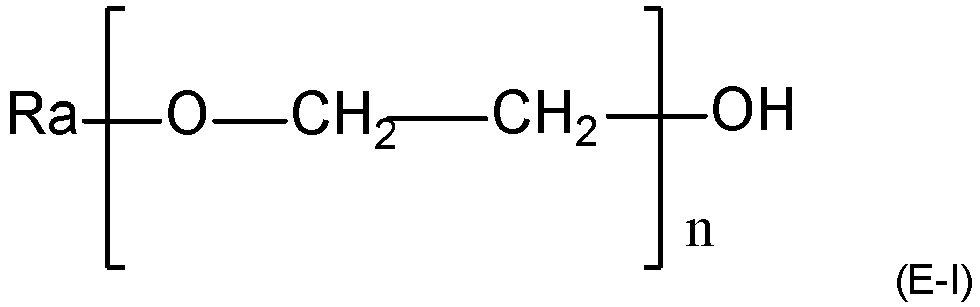
- Ra
- für eine gesättigte, unverzweigte C12-C18-Alkylgruppe steht und
- n
- für eine ganze Zahl von 1 bis 6, bevorzugt für eine ganze Zahl von 1 bis 5, und besonders bevorzugt für eine ganze Zahl von 2 bis 4 steht.
- Ra
- represents a saturated, unbranched C 12 -C 18 alkyl group and
- n
- represents an integer from 1 to 6, preferably an integer from 1 to 5, and particularly preferably an integer from 2 to 4.
Ein ganz besonders gut geeigneter nichtionischer Emulgator (a1) ist beispielweise Laureth-2, welcher die
Um eine besonders feine Dispergierung der Pigmente (a2) im erfindungsgemäßen Mittel zu gewährleisten, werden das oder die nichtionischen Emulgatoren (a1) bevorzugt in bestimmten Mengenbereichen eingesetzt. So hat es sich als besonders vorteilhaft herausgestellt, wenn das Mittel - bezogen auf sein Gesamtgewicht - einen oder mehrere nichtionische Emulgatoren (a1), deren HLB-Werte in dem zuvor beschriebenen erfindungsgemäßen Bereich liegen, in einer Gesamtmenge von 0,1 bis 10,0 Gew.-%, bevorzugt von 0,2 bis 8,0 Gew.-%, weiter bevorzugt von 0,4 bis 6,0 Gew.-% und ganz besonders bevorzugt von 0,8 bis 2,5 Gew.-% enthält.To ensure particularly fine dispersion of the pigments (a2) in the agent according to the invention, the nonionic emulsifier(s) (a1) are preferably used in specific quantity ranges. It has proven particularly advantageous if the agent contains—based on its total weight—one or more nonionic emulsifiers (a1) whose HLB values are within the above-described inventive range in a total amount of 0.1 to 10.0 wt. %, preferably 0.2 to 8.0 wt. %, more preferably 0.4 to 6.0 wt. %, and most preferably 0.8 to 2.5 wt. %.
In einer weiteren besonders bevorzugten Ausführungsform ist ein erfindungsgemäßes Mittel dadurch gekennzeichnet, dass es - bezogen auf das Gesamtgewicht des Mittels - einen oder mehrere nichtionische Emulgatoren (a1) in einer Gesamtmenge von 0,1 bis 10,0 Gew.-%, bevorzugt von 0,2 bis 8,0 Gew.-%, weiter bevorzugt von 0,4 bis 6,0 Gew.-% und ganz besonders bevorzugt von 0,8 bis 2,5 Gew.-% enthält.In a further particularly preferred embodiment, an agent according to the invention is characterized in that it contains - based on the total weight of the agent - one or more non-ionic emulsifiers (a1) in a total amount of 0.1 to 10.0 wt.%, preferably 0.2 to 8.0 wt.%, more preferably 0.4 to 6.0 wt.% and most preferably 0.8 to 2.5 wt.%.
In einer weiteren besonders bevorzugten Ausführungsform ist ein erfindungsgemäßes Mittel dadurch gekennzeichnet, dass es - bezogen auf das Gesamtgewicht des Mittels - 0,1 bis 10,0 Gew.-%, bevorzugt von 0,2 bis 8,0 Gew.-%, weiter bevorzugt von 0,4 bis 6,0 Gew.-% und ganz besonders bevorzugt von 0,8 bis 2,5 Gew.-% Laurteh-2 enthält.In a further particularly preferred embodiment, an agent according to the invention is characterized in that it contains - based on the total weight of the agent - 0.1 to 10.0 wt.%, preferably from 0.2 to 8.0 wt.%, more preferably from 0.4 to 6.0 wt.% and very particularly preferably from 0.8 to 2.5 wt.% Laurteh-2.
Als zweiten wesentlichen Bestandteil enthält das erfindungsgemäße Mittel mindestens ein Pigment (a2). Unter Pigmenten im Sinne der vorliegenden Erfindung werden farbgebende Verbindungen verstanden, welche bei 25 °C in Wasser eine Löslichkeit von weniger als 0,5 g/L, bevorzugt von weniger als 0,1 g/L, noch weiter bevorzugt von weniger als 0,05 g/L besitzen. Die Wasserlöslichkeit kann beispielsweise mittels der nachfolgend beschriebenen Methode erfolgen: 0,5 g des Pigments werden in einem Becherglas abgewogen. Ein Rührfisch wird hinzugefügt. Dann wird ein Liter destilliertes Wasser hinzugegeben. Dieses Gemisch wird unter Rühren auf einem Magnetrührer für eine Stunde auf 25 °C erhitzt. Sind in der Mischung nach diesem Zeitraum noch ungelöste Bestandteile des Pigments sichtbar, so liegt die Löslichkeit des Pigments unterhalb von 0,5 g/L. Sofern sich die Pigment-Wasser-Mischung aufgrund der hohen Intensität des gegebenenfalls feindispergiert vorliegenden Pigments nicht visuell beurteilten lässt, wird die Mischung filtriert. Bleibt auf dem Filterpapier ein Anteil an ungelösten Pigmenten zurück, so liegt die Löslichkeit des Pigments unterhalb von 0,5 g/L.As a second essential component, the agent according to the invention contains at least one pigment (a2). Pigments within the meaning of the present invention are understood to be color-imparting compounds which have a solubility in water at 25°C of less than 0.5 g/L, preferably less than 0.1 g/L, and even more preferably less than 0.05 g/L. Water solubility can be determined, for example, using the method described below: 0.5 g of the pigment is weighed into a beaker. A stir bar is added. Then, one liter of distilled water is added. This mixture is heated to 25°C for one hour while stirring on a magnetic stirrer. If undissolved components of the pigment are still visible in the mixture after this period, the solubility of the pigment is below 0.5 g/L. If the pigment-water mixture cannot be visually assessed due to the high intensity of the pigment, which may be present in finely dispersed form, the mixture is filtered. If a portion of undissolved pigments remains on the filter paper, the solubility of the pigment is below 0.5 g/L.
Geeignete Farbpigmente können anorganischen und/oder organischen Ursprungs sein.Suitable color pigments can be of inorganic and/or organic origin.
In einer bevorzugten Ausführungsform ist ein erfindungsgemäßes Mittel dadurch gekennzeichnet, dass es mindestens eine farbgebende Verbindung (a2) aus der Gruppe der anorganischen und/oder organischen Pigmente enthält.In a preferred embodiment, an agent according to the invention is characterized in that it contains at least one color-providing compound (a2) from the group of inorganic and/or organic pigments.
Bevorzugte Farbpigmente sind ausgewählt aus synthetischen oder natürlichen anorganischen Pigmenten. Anorganische Farbpigmente natürlichen Ursprungs können beispielsweise aus Kreide, Ocker, Umbra, Grünerde, gebranntem Terra di Siena oder Graphit hergestellt werden. Weiterhin können als anorganische Farbpigmente Schwarzpigmente wie z. B. Eisenoxidschwarz, Buntpigmente wie z. B. Ultramarin oder Eisenoxidrot sowie Fluoreszenz- oder Phosphoreszenzpigmente eingesetzt werden.Preferred color pigments are selected from synthetic or natural inorganic pigments. Inorganic color pigments of natural origin can be made from chalk, ochre, umber, green earth, burnt sienna, or graphite, for example. Other inorganic color pigments that can be used include black pigments such as iron oxide black, colored pigments such as ultramarine or iron oxide red, as well as fluorescent or phosphorescent pigments.
Besonders geeignet sind farbige Metalloxide, -hydroxide und -oxidhydrate, Mischphasenpigmente, schwefelhaltige Silicate, Silicate, Metallsulfide, komplexe Metallcyanide, Metallsulfate, -chromate und/oder -molybdate. Insbesondere bevorzugte Farbpigmente sind schwarzes Eisenoxid (CI 77499), gelbes Eisenoxid (CI 77492), rotes und braunes Eisenoxid (CI 77491), Manganviolett (CI 77742), Ultramarine (Natrium-Aluminiumsulfosilikate, CI 77007, Pigment Blue 29), Chromoxidhydrat (CI77289), Eisenblau (Ferric Ferrocyanide, CI77510) und/oder Carmine (Cochineal).Particularly suitable are colored metal oxides, hydroxides, and oxide hydrates, mixed-phase pigments, sulfur-containing silicates, silicates, metal sulfides, complex metal cyanides, metal sulfates, chromates, and/or molybdates. Particularly preferred color pigments are black iron oxide (CI 77499), yellow iron oxide (CI 77492), red and brown iron oxide (CI 77491), manganese violet (CI 77742), ultramarines (sodium aluminum sulfosilicates, CI 77007, Pigment Blue 29), chromium oxide hydrate (CI 77289), iron blue (ferric ferrocyanide, CI 77510), and/or carmine (cochineal).
Erfindungsgemäß ebenfalls besonders bevorzugte Farbpigmente sind farbige Perlglanzpigmente. Diese basieren üblicherweise auf Mica- und/oder Glimmerbasis und können mit einem oder mehreren Metalloxiden beschichtet sein. Glimmer gehört zu den Schicht-Silicaten. Die wichtigsten Vertreter dieser Silicate sind Muscovit, Phlogopit, Paragonit, Biotit, Lepidolith und Margarit. Zur Herstellung der Perlglanzpigmente in Verbindung mit Metalloxiden wird der Glimmer, überwiegend Muscovit oder Phlogopit, mit einem Metalloxid beschichtet.Also particularly preferred color pigments according to the invention are colored pearlescent pigments. These are usually based on mica and/or mica and can be coated with one or more metal oxides. Mica belongs to the phyllosilicates. The most important representatives of these silicates are muscovite, phlogopite, paragonite, biotite, lepidolite, and margarite. To produce pearlescent pigments in combination with metal oxides, the mica, predominantly muscovite or phlogopite, is coated with a metal oxide.
Alternativ zu natürlichem Glimmer kann auch ggfs. mit einem oder mehrere Metalloxide(en) beschichtetes, synthetisches Mica als Perlglanzpigment verwendet werden. Besonders bevorzugte Perlglanzpigmente basieren auf natürlichem oder synthetischem Mica (Glimmer) und sind mit einem oder mehreren der zuvor genannten Metalloxide beschichtet. Die Farbe der jeweiligen Pigmente kann durch Variation der Schichtdicke des oder der Metalloxids(e) variiert werden.As an alternative to natural mica, synthetic mica, optionally coated with one or more metal oxides, can also be used as a pearlescent pigment. Particularly preferred pearlescent pigments are based on natural or synthetic mica and coated with one or more of the aforementioned metal oxides. The color of the respective pigments can be varied by varying the layer thickness of the metal oxide(s).
In einer weiteren bevorzugten Ausführungsform ist ein erfindungsgemäßes Mittel dadurch gekennzeichnet, dass es mindestens ein anorganisches Pigment (a2) enthält, das bevorzugt ausgewählt ist aus der Gruppe der farbigen Metalloxide, Metallhydroxide, Metalloxidhydrate, Silicate, Metallsulfide, komplexen Metallcyanide, Metallsulfate, Bronzepigmente und/oder aus farbigen Pigmenten auf Mica- oder Glimmerbasis, die mit mindestens einem Metalloxid und/oder einem Metalloxychlorid beschichtet sind.In a further preferred embodiment, an agent according to the invention is characterized in that it contains at least one inorganic pigment (a2), which is preferably selected from the group of colored metal oxides, metal hydroxides, metal oxide hydrates, silicates, metal sulfides, complex metal cyanides, metal sulfates, bronze pigments and/or colored pigments based on mica or mica, which are coated with at least one metal oxide and/or one metal oxychloride.
In einer weiteren bevorzugten Ausführungsform ist ein erfindungsgemäßes Mittel dadurch gekennzeichnet, dass es mindestens eine farbgebende Verbindung (a2) aus der Gruppe der Pigmente enthält, die ausgewählt ist aus Pigmenten auf Mica- oder Glimmerbasis, die mit einem oder mehreren Metalloxiden aus der Gruppe aus Titandioxid (CI 77891), schwarzem Eisenoxid (CI 77499), gelbem Eisenoxid (CI 77492), rotem und/oder braunem Eisenoxid (CI 77491, CI 77499), Manganviolett (CI 77742), Ultramarine (Natrium-Aluminiumsulfosilikate, CI 77007, Pigment Blue 29), Chromoxidhydrat (CI 77289), Chromoxid (CI 77288) und/oder Eisenblau (Ferric Ferrocyanide, CI 77510) beschichtet sind.In a further preferred embodiment, an agent according to the invention is characterized in that it contains at least one coloring compound (a2) from the group of pigments selected from mica- or mica-based pigments coated with one or more metal oxides from the group of titanium dioxide (CI 77891), black iron oxide (CI 77499), yellow iron oxide (CI 77492), red and/or brown iron oxide (CI 77491, CI 77499), manganese violet (CI 77742), ultramarines (sodium aluminum sulfosilicates, CI 77007, Pigment Blue 29), chromium oxide hydrate (CI 77289), chromium oxide (CI 77288) and/or iron blue (ferric ferrocyanide, CI 77510).
Beispiele für besonders geeignete Farbpigmente sind im Handel beispielsweise unter den Handelsbezeichnungen Rona®, Colorona®, Xirona®, Dichrona® und Timiron® von der Firma Merck, Ariabel® und Unipure® von der Firma Sensient, Prestige® von der Firma Eckart Cosmetic Colors und Sunshine® von der Firma Sunstar erhältlich.Examples of particularly suitable color pigments are commercially available under the trade names Rona ® , Colorona ® , Xirona ® , Dichrona ® and Timiron ® from Merck, Ariabel ® and Unipure ® from Sensient, Prestige ® from Eckart Cosmetic Colors and Sunshine ® from Sunstar.
Ganz besonders bevorzugte Farbpigmente mit der Handelsbezeichnung Colorona® sind beispielsweise:
- Colorona Copper, Merck, MICA, CI 77491 (IRON OXIDES)
- Colorona Passion Orange, Merck, Mica, CI 77491 (Iron Oxides), Alumina
- Colorona Patina Silver, Merck, MICA, CI 77499 (IRON OXIDES), CI 77891 (TITANIUM DIOXIDE)
- Colorona RY, Merck, CI 77891 (TITANIUM DIOXIDE), MICA, CI 75470 (CARMINE)
- Colorona Oriental Beige, Merck, MICA, CI 77891 (TITANIUM DIOXIDE), CI 77491 (IRON OXIDES)
- Colorona Dark Blue, Merck, MICA, TITANIUM DIOXIDE, FERRIC FERROCYANIDE
- Colorona Chameleon, Merck, CI 77491 (IRON OXIDES), MICA
- Colorona Aborigine Amber, Merck, MICA, CI 77499 (IRON OXIDES), CI 77891 (TITANIUM DIOXIDE)
- Colorona Blackstar Blue, Merck, CI 77499 (IRON OXIDES), MICA
- Colorona Patagonian Purple, Merck, MICA, CI 77491 (IRON OXIDES), CI 77891 (TITANIUM DIOXIDE), CI 77510 (FERRIC FERROCYANIDE)
- Colorona Red Brown, Merck, MICA, CI 77491 (IRON OXIDES), CI 77891 (TITANIUM DIOXIDE)
- Colorona Russet, Merck, CI 77491 (TITANIUM DIOXIDE), MICA, CI 77891 (IRON OXIDES)
- Colorona Imperial Red, Merck, MICA, TITANIUM DIOXIDE (CI 77891), D&C RED NO. 30 (CI 73360)
- Colorona Majestic Green, Merck, CI 77891 (TITANIUM DIOXIDE), MICA, CI 77288 (CHROMIUM OXIDE GREENS)
- Colorona Light Blue, Merck, MICA, TITANIUM DIOXIDE (CI 77891), FERRIC FERROCYANIDE (CI 77510)
- Colorona Red Gold, Merck, MICA, CI 77891 (TITANIUM DIOXIDE), CI 77491 (IRON OXIDES)
- Colorona Gold Plus MP 25, Merck, MICA, TITANIUM DIOXIDE (CI 77891), IRON OXIDES (CI 77491)
- Colorona Carmine Red, Merck, MICA, TITANIUM DIOXIDE, CARMINE
- Colorona Blackstar Green, Merck, MICA, CI 77499 (IRON OXIDES)
- Colorona Bordeaux, Merck, MICA, CI 77491 (IRON OXIDES)
- Colorona Bronze, Merck, MICA, CI 77491 (IRON OXIDES)
- Colorona Bronze Fine, Merck, MICA, CI 77491 (IRON OXIDES)
- Colorona Fine Gold MP 20, Merck, MICA, CI 77891 (TITANIUM DIOXIDE), CI 77491 (IRON OXIDES)
- Colorona Sienna Fine, Merck, CI 77491 (IRON OXIDES), MICA
- Colorona Sienna, Merck, MICA, CI 77491 (IRON OXIDES)
- Colorona Precious Gold, Merck, Mica, CI 77891 (Titanium dioxide), Silica, CI 77491 (Iron oxides), Tin oxide
- Colorona Sun Gold Sparkle MP 29, Merck, MICA, TITANIUM DIOXIDE, IRON OXIDES, MICA, CI 77891, CI 77491 (EU)
- Colorona Mica Black, Merck, CI 77499 (Iron oxides), Mica, CI 77891 (Titanium dioxide)
- Colorona Bright Gold, Merck, Mica, CI 77891 (Titanium dioxide), CI 77491(Iron oxides)
- Colorona Blackstar Gold, Merck, MICA, CI 77499 (IRON OXIDES)
- Colorona Copper, Merck, MICA, CI 77491 (IRON OXIDES)
- Colorona Passion Orange, Merck, Mica, CI 77491 (Iron Oxides), Alumina
- Colorona Patina Silver, Merck, MICA, CI 77499 (IRON OXIDES), CI 77891 (TITANIUM DIOXIDE)
- Colorona RY, Merck, CI 77891 (TITANIUM DIOXIDE), MICA, CI 75470 (CARMINE)
- Colorona Oriental Beige, Merck, MICA, CI 77891 (TITANIUM DIOXIDE), CI 77491 (IRON OXIDES)
- Colorona Dark Blue, Merck, MICA, TITANIUM DIOXIDE, FERRIC FERROCYANIDE
- Colorona Chameleon, Merck, CI 77491 (IRON OXIDES), MICA
- Colorona Aboriginal Amber, Merck, MICA, CI 77499 (IRON OXIDES), CI 77891 (TITANIUM DIOXIDE)
- Colorona Blackstar Blue, Merck, CI 77499 (IRON OXIDES), MICA
- Colorona Patagonian Purple, Merck, MICA, CI 77491 (IRON OXIDES), CI 77891 (TITANIUM DIOXIDE), CI 77510 (FERRIC FERROCYANIDE)
- Colorona Red Brown, Merck, MICA, CI 77491 (IRON OXIDES), CI 77891 (TITANIUM DIOXIDE)
- Colorona Russet, Merck, CI 77491 (TITANIUM DIOXIDE), MICA, CI 77891 (IRON OXIDES)
- Colorona Imperial Red, Merck, MICA, TITANIUM DIOXIDE (CI 77891), D&C RED NO. 30 (CI 73360)
- Colorona Majestic Green, Merck, CI 77891 (TITANIUM DIOXIDE), MICA, CI 77288 (CHROMIUM OXIDE GREENS)
- Colorona Light Blue, Merck, MICA, TITANIUM DIOXIDE (CI 77891), FERRIC FERROCYANIDE (CI 77510)
- Colorona Red Gold, Merck, MICA, CI 77891 (TITANIUM DIOXIDE), CI 77491 (IRON OXIDES)
- Colorona Gold Plus MP 25, Merck, MICA, TITANIUM DIOXIDE (CI 77891), IRON OXIDES (CI 77491)
- Colorona Carmine Red, Merck, MICA, TITANIUM DIOXIDE, CARMINE
- Colorona Blackstar Green, Merck, MICA, CI 77499 (IRON OXIDES)
- Colorona Bordeaux, Merck, MICA, CI 77491 (IRON OXIDES)
- Colorona Bronze, Merck, MICA, CI 77491 (IRON OXIDES)
- Colorona Bronze Fine, Merck, MICA, CI 77491 (IRON OXIDES)
- Colorona Fine Gold MP 20, Merck, MICA, CI 77891 (TITANIUM DIOXIDE), CI 77491 (IRON OXIDES)
- Colorona Sienna Fine, Merck, CI 77491 (IRON OXIDES), MICA
- Colorona Sienna, Merck, MICA, CI 77491 (IRON OXIDES)
- Colorona Precious Gold, Merck, Mica, CI 77891 (Titanium dioxide), Silica, CI 77491 (Iron oxides), Tin oxide
- Colorona Sun Gold Sparkle MP 29, Merck, MICA, TITANIUM DIOXIDE, IRON OXIDES, MICA, CI 77891, CI 77491 (EU)
- Colorona Mica Black, Merck, CI 77499 (Iron oxides), Mica, CI 77891 (Titanium dioxide)
- Colorona Bright Gold, Merck, Mica, CI 77891 (Titanium dioxide), CI 77491(Iron oxides)
- Colorona Blackstar Gold, Merck, MICA, CI 77499 (IRON OXIDES)
Weiterhin besonders bevorzugte Farbpigmente mit der Handelsbezeichnung Xirona® sind beispielsweise:
- Xirona Golden Sky, Merck, Silica, CI 77891 (Titanium Dioxide), Tin Oxide
- Xirona Caribbean Blue, Merck, Mica, CI 77891 (Titanium Dioxide), Silica, Tin Oxide
- Xirona Kiwi Rose, Merck, Silica, CI 77891 (Titanium Dioxide), Tin Oxide
- Xirona Magic Mauve, Merck, Silica, CI 77891 (Titanium Dioxide), Tin Oxide.
- Xirona Golden Sky, Merck, Silica, CI 77891 (Titanium Dioxide), Tin Oxide
- Xirona Caribbean Blue, Merck, Mica, CI 77891 (Titanium Dioxide), Silica, Tin Oxide
- Xirona Kiwi Rose, Merck, Silica, CI 77891 (Titanium Dioxide), Tin Oxide
- Xirona Magic Mauve, Merck, Silica, CI 77891 (Titanium Dioxide), Tin Oxide.
Zudem sind besonders bevorzugte Farbpigmente mit der Handelsbezeichnung Unipure® beispielsweise:
- Unipure Red LC 381 EM, Sensient CI 77491 (Iron Oxides), Silica
- Unipure Black LC 989 EM, Sensient, CI 77499 (Iron Oxides), Silica
- Unipure Yellow LC 182 EM, Sensient, CI 77492 (Iron Oxides), Silica
- Unipure Red LC 381 EM, Sensient CI 77491 (Iron Oxides), Silica
- Unipure Black LC 989 EM, Sensient, CI 77499 (Iron Oxides), Silica
- Unipure Yellow LC 182 EM, Sensient, CI 77492 (Iron Oxides), Silica
Im Rahmen einer weiteren Ausführungsform kann das erfindungsgemäße Mittel auch ein oder mehrere farbgebende Verbindungen (a2) aus der Gruppe der organischen Pigmente enthalten
Bei den erfindungsgemäßen organischen Pigmenten handelt es sich um entsprechend unlösliche, organische Farbstoffe oder Farblacke, die beispielsweise aus der Gruppe der Nitroso-, Nitro- Azo-, Xanthen-, Anthrachinon-, Isoindolinon-, Isoindolin-, Chinacridon-, Perinon-, Perylen- , Diketopyrrolopyorrol-, Indigo-, Thioindido-, Dioxazin-, und/oder Triarylmethan-Verbindungen ausgewählt sein können.In a further embodiment, the agent according to the invention may also contain one or more coloring compounds (a2) from the group of organic pigments
The organic pigments according to the invention are correspondingly insoluble, organic dyes or lakes which can be selected, for example, from the group of nitroso, nitro, azo, xanthene, anthraquinone, isoindolinone, isoindoline, quinacridone, perinone, perylene, diketopyrrolopyorrole, indigo, thioindido, dioxazine and/or triarylmethane compounds.
Als besonders gut geeignete organische Pigmente können beispielsweise Carmin, Chinacridon, Phthalocyanin, Sorgho, blaue Pigmente mit den Color Index Nummern CI 42090, CI 69800, CI 69825, CI 73000, CI 74100, CI 74160, gelbe Pigmente mit den Color Index Nummern CI 11680, CI 11710, CI 15985, CI 19140, CI 20040, CI 21100, CI 21108, CI 47000, CI 47005, grüne Pigmente mit den Color Index Nummern CI 61565, CI 61570, CI 74260, orange Pigmente mit den Color Index Nummern CI 11725, CI 15510, CI 45370, CI 71105, rote Pigmente mit den Color Index Nummern CI 12085, CI 12120, CI 12370, CI 12420, CI 12490, CI 14700, CI 15525, CI 15580, CI 15620, CI 15630, CI 15800, CI 15850, CI 15865, CI 15880, CI 17200, CI 26100, CI 45380, CI 45410, CI 58000, CI 73360, CI 73915 und/oder CI 75470 genannt werden.Particularly suitable organic pigments are, for example, carmine, quinacridone, phthalocyanine, sorghum, blue pigments with the color index numbers CI 42090, CI 69800, CI 69825, CI 73000, CI 74100, CI 74160, yellow pigments with the color index numbers CI 11680, CI 11710, CI 15985, CI 19140, CI 20040, CI 21100, CI 21108, CI 47000, CI 47005, green pigments with the color index numbers CI 61565, CI 61570, CI 74260, orange pigments with the color index numbers CI 11725, CI 15510, CI 45370, CI 71105, red pigments with the Color Index Numbers CI 12085, CI 12120, CI 12370, CI 12420, CI 12490, CI 14700, CI 15525, CI 15580, CI 15620, CI 15630, CI 15800, CI 15850, CI 15865, CI 15880, CI 17200, CI 26100, CI 45380, CI 45410, CI 58000, CI 73360, CI 73915 and/or CI 75470.
In einer weiteren besonders bevorzugten Ausführungsform ist ein erfindungsgemäßes Mittel dadurch gekennzeichnet, dass es mindestens ein organisches Pigment (a2) enthält, das bevorzugt ausgewählt ist aus der Gruppe aus Carmin, Chinacridon, Phthalocyanin, Sorgho, blaue Pigmente mit den Color Index Nummern CI 42090, CI 69800, CI 69825, CI 73000, CI 74100, CI 74160, gelbe Pigmente mit den Color Index Nummern CI 11680, CI 11710, CI 15985, CI 19140, CI 20040, CI 21100, CI 21108, CI 47000, CI 47005, grüne Pigmente mit den Color Index Nummern CI 61565, CI 61570, CI 74260, orange Pigmente mit den Color Index Nummern CI 11725, CI 15510, CI 45370, CI 71105, rote Pigmente mit den Color Index Nummern CI 12085, CI 12120, CI 12370, CI 12420, CI 12490, CI 14700, CI 15525, CI 15580, CI 15620, CI 15630, CI 15800, CI 15850, CI 15865, CI 15880, CI 17200, CI 26100, CI 45380, CI 45410, CI 58000, CI 73360, CI 73915 und/oder CI 75470.In a further particularly preferred embodiment, a composition according to the invention is characterized in that it contains at least one organic pigment (a2), which is preferably selected from the group consisting of carmine, quinacridone, phthalocyanine, sorghum, blue pigments with the color index numbers CI 42090, CI 69800, CI 69825, CI 73000, CI 74100, CI 74160, yellow pigments with the color index numbers CI 11680, CI 11710, CI 15985, CI 19140, CI 20040, CI 21100, CI 21108, CI 47000, CI 47005, green pigments with the color index numbers CI 61565, CI 61570, CI 74260, orange pigments with the color index numbers CI 11725, CI 15510, CI 45370, CI 71105, red pigments with the color index numbers CI 12085, CI 12120, CI 12370, CI 12420, CI 12490, CI 14700, CI 15525, CI 15580, CI 15620, CI 15630, CI 15800, CI 15850, CI 15865, CI 15880, CI 17200, CI 26100, CI 45380, CI 45410, CI 58000, CI 73360, CI 73915 and/or CI 75470.
Bei dem organischen Pigment kann es sich weiterhin auch um einen Farblack handeln. Unter der Bezeichnung Farblack wird im Sinn der Erfindung Partikel verstanden, welche eine Schicht aus absorbierten Farbstoffen umfassen, wobei die Einheit aus Partikel und Farbstoff unter den o.g. Bedingungen unlöslich ist. Bei den Partikeln kann es sich beispielsweise um anorganische Substrate handeln, die Aluminium, Silica, Calciumborosilkat, Calciumaluminiumborosilikat oder auch Aluminium sein können.The organic pigment can also be a colored lake. For the purposes of the invention, the term colored lake refers to particles comprising a layer of absorbed dyes, the unit consisting of particles and dyes being classified under the above-mentioned conditions. The particles can be, for example, inorganic substrates such as aluminum, silica, calcium borosilicate, calcium aluminum borosilicate, or even aluminum.
Als Farblack kann beispielsweise der Alizarin-Farblack eingesetzt werden.Alizarin varnish, for example, can be used as a colored varnish.
Aufgrund ihrer ausgezeichneten Licht- und Temperaturbeständigkeit ist die Verwendung der zuvor genannten Pigmente in dem erfindungsgemäßen Mittel ganz besonders bevorzugt. Weiterhin ist es bevorzugt, wenn die eingesetzten Pigmente eine bestimmte Teilchengröße aufweisen. Es ist daher erfindungsgemäß vorteilhaft, wenn das mindestens eine Pigment eine mittlere Teilchengröße D50 von 1,0 bis 50 µm, vorzugsweise von 5,0 bis 45 µm, bevorzugt von 10 bis 40 µm, insbesondere von 14 bis 30 µm, aufweist. Die mittlere Teilchengröße D50 kann beispielsweise unter Verwendung von dynamischer Lichtstreuung (DLS) bestimmt werden.Due to their excellent light and temperature stability, the use of the aforementioned pigments in the agent according to the invention is particularly preferred. Furthermore, it is preferred if the pigments used have a specific particle size. It is therefore advantageous according to the invention if the at least one pigment has an average particle size D 50 of 1.0 to 50 µm, preferably of 5.0 to 45 µm, more preferably of 10 to 40 µm, in particular of 14 to 30 µm. The average particle size D 50 can be determined, for example, using dynamic light scattering (DLS).
Die Pigmente (a2) stellen den zweiten wesentlichen des erfindungsgemäßen Mittels dar und werden bevorzugt in bestimmten Mengenbereichen im Mittel eingesetzt.The pigments (a2) represent the second essential component of the agent according to the invention and are preferably used in the agent in certain quantity ranges.
Besonders gute Ergebnisse wurden erhalten, wenn das Mittel - bezogen auf das Gesamtgewicht des Mittels - ein odere mehrere Pigmente (a2) in einer Gesamtmenge von 0,01 bis 10,0 Gew.-%, bevorzugt 0,1 bis 5,0 Gew.-%, weiter bevorzugt von 0,2 bis 2,5 Gew.-% und ganz besonders bevorzugt von 0,25 bis 1,5 Gew.-% enthielt.Particularly good results were obtained when the agent - based on the total weight of the agent - contained one or more pigments (a2) in a total amount of 0.01 to 10.0 wt.%, preferably 0.1 to 5.0 wt.%, more preferably 0.2 to 2.5 wt.% and most preferably 0.25 to 1.5 wt.%.
In einer weiteren ganz besonders bevorzugten Ausführungsform ist ein erfindungsgemäßes Mittel dadurch gekennzeichnet, dass das Mittel - bezogen auf das Gesamtgewicht des Mittels - ein odere mehrere Pigmente (a2) in einer Gesamtmenge von 0,01 bis 10,0 Gew.-%, bevorzugt 0,1 bis 5,0 Gew.-%, weiter bevorzugt von 0,2 bis 2,5 Gew.-% und ganz besonders bevorzugt von 0,25 bis 1,5 Gew.-% enthält.In a further very particularly preferred embodiment, an agent according to the invention is characterized in that the agent - based on the total weight of the agent - contains one or more pigments (a2) in a total amount of 0.01 to 10.0 wt.%, preferably 0.1 to 5.0 wt.%, more preferably from 0.2 to 2.5 wt.% and very particularly preferably from 0.25 to 1.5 wt.%.
In einer weiteren ganz besonders bevorzugten Ausführungsform ist ein erfindungsgemäßes Mittel dadurch gekennzeichnet, dass das Mittel - bezogen auf das Gesamtgewicht des Mittels - ein odere mehrere anorganische Pigmente (a2) in einer Gesamtmenge von 0,01 bis 10,0 Gew.-%, bevorzugt 0,1 bis 5,0 Gew.-%, weiter bevorzugt von 0,2 bis 2,5 Gew.-% und ganz besonders bevorzugt von 0,25 bis 1,5 Gew.-% enthält.In a further very particularly preferred embodiment, an agent according to the invention is characterized in that the agent - based on the total weight of the agent - contains one or more inorganic pigments (a2) in a total amount of 0.01 to 10.0 wt.%, preferably 0.1 to 5.0 wt.%, more preferably from 0.2 to 2.5 wt.% and very particularly preferably from 0.25 to 1.5 wt.%.
In einer weiteren ganz besonders bevorzugten Ausführungsform ist ein erfindungsgemäßes Mittel dadurch gekennzeichnet, dass das Mittel - bezogen auf das Gesamtgewicht des Mittels - ein odere mehrere organische Pigmente (a2) in einer Gesamtmenge von 0,01 bis 10,0 Gew.-%, bevorzugt 0,1 bis 5,0 Gew.-%, weiter bevorzugt von 0,2 bis 2,5 Gew.-% und ganz besonders bevorzugt von 0,25 bis 1,5 Gew.-% enthält.In a further very particularly preferred embodiment, an agent according to the invention is characterized in that the agent - based on the total weight of the agent - contains one or more organic pigments (a2) in a total amount of 0.01 to 10.0 wt.%, preferably 0.1 to 5.0 wt.%, more preferably from 0.2 to 2.5 wt.% and very particularly preferably from 0.25 to 1.5 wt.%.
Als dritten erfindungswesentlichen Inhaltsstoff enthält das erfindungsgemäße Mittel mindestens ein aminofunktionalisiertes Silikonpolymer (a3). Das aminofunktionalisiertes Silikonpolymer kann alternativ auch als Aminosilikon oder Amodimethicone bezeichnet werden.As a third ingredient essential to the invention, the agent according to the invention contains at least one amino-functionalized silicone polymer (a3). The amino-functionalized silicone polymer can alternatively also be referred to as aminosilicone or amodimethicone.
Silikonpolymere sind im allgemeinen Makromoleküle mit einem Molekulargewicht von mindestens 500 g/mol, bevorzugt mindestens 1000 g/mol, weiter bevorzugt von mindestens 2500 g/mol, besonders bevorzugt von mindestens 5000 g/mol, welche sich wiederholende organische Einheiten umfassen.Silicone polymers are generally macromolecules having a molecular weight of at least 500 g/mol, preferably at least 1000 g/mol, more preferably at least 2500 g/mol, particularly preferably at least 5000 g/mol, which comprise repeating organic units.
Das maximale Molekulargewicht des Silikonpolymers hängt von dem Polymerisationsgrad (Anzahl der polymerisierten Monomere) und der Ansatzgröße ab und wird durch die Polymerisationsmethode mitbestimmt. Im Sinne der vorliegenden Erfindung ist es bevorzugt, wenn das maximale Molekulargewicht des Silikonpolymers nicht mehr als 107 g/mol, bevorzugt nicht mehr als 106 g/mol und besonders bevorzugt nicht mehr als 105 g/mol beträgt.The maximum molecular weight of the silicone polymer depends on the degree of polymerization (number of polymerized monomers) and the batch size, and is also determined by the polymerization method. For the purposes of the present invention, it is preferred if the maximum molecular weight of the silicone polymer is not more than 10 7 g/mol, preferably not more than 10 6 g/mol, and particularly preferably not more than 10 5 g/mol.
Die Silikonpolymere umfassen viele Si-O-Wiederholungseinheiten, wobei die Si-Atome organische Reste wie beispielsweise Alkylgruppen oder substituierte Alkylgruppen tragen können. Alternativ wird ein Silikonpolymer daher auch als Polydimethylsiloxan bezeichnet.Silicone polymers comprise many Si-O repeating units, where the Si atoms may carry organic residues such as alkyl or substituted alkyl groups. Alternatively, a silicone polymer is therefore also referred to as polydimethylsiloxane.
In Entsprechung des hohen Molekulargewichts der Silikonpolymere basieren diese auf mehr als 10 Si-O Wiederholungseinheiten, bevorzugt mehr als 50 Si-O-Wiederholungseinheiten und besonders bevorzugt mehr als 100 Si-O-Wiederholungseinheiten, ganz besonders bevorzugt mehr als 500 Si-O-Wiederholungseinheiten.In accordance with the high molecular weight of the silicone polymers, these are based on more than 10 Si-O repeating units, preferably more than 50 Si-O repeating units and particularly preferably more than 100 Si-O repeating units, most preferably more than 500 Si-O repeating units.
Unter einem aminofunktionalisierten Silikonpolymer wird ein funktionalisiertes Silikon verstanden, welches mindestens eine Struktureinheit mit einer Aminogruppe trägt. Bevorzugt trägt das aminofunktionalisierte Silikonpolymer mehrere Struktureinheiten mit jeweils mindestens einer Aminogruppe. Unter einer Aminogruppe wird eine primäre Aminogruppe, eine sekundäre Aminogruppe und eine tertiäre Aminogruppe verstanden. Alle diese Aminogruppen können im sauren Milieu protoniert werden und liegen dann in ihrer kationischen Form vor.An amino-functionalized silicone polymer is a functionalized silicone that carries at least one structural unit with an amino group. The amino-functionalized silicone polymer preferably carries multiple structural units, each with at least one amino group. An amino group is understood to mean a primary amino group, a secondary amino group, and a tertiary amino group. All of these amino groups can be protonated in an acidic environment and are then present in their cationic form.
Prinzipiell konnten gute Effekte aminofunktionalisierten Silikonpolymeren (a3) erzielt werden, wenn diese mindestens eine primäre, mindestens eine sekundäre und/oder mindestens eine tertiäre Aminogruppe tragen. Färbungen mit den höchsten Farbintensitäten wurden jedoch beobachtet, wenn ein aminofunktionalisiertes Silikonpolymer (a3) im Mittel eingesetzt wurde, welches mindestens eine sekundäre Aminogruppe enthält.In principle, good results could be achieved with amino-functionalized silicone polymers (a3) if they contain at least one primary, at least one secondary, and/or at least one tertiary amino group. However, colorations with the highest color intensities were observed when an amino-functionalized silicone polymer (a3) containing at least one secondary amino group was used in the product.
In einer ganz besonders bevorzugten Ausführungsform ist ein erfindungsgemäßes Mittel dadurch gekennzeichnet, dass es zusätzlich
(a3) mindestens ein aminofunktionalisiertes Silikonpolymer mit mindestens einer sekundären Aminogruppe, enthält.In a particularly preferred embodiment, an agent according to the invention is characterized in that it additionally
(a3) at least one amino-functionalized silicone polymer having at least one secondary amino group.
Die sekundäre Aminogruppe(n) kann bzw. können sich an verschiedenen Positionen des aminofunktionalisierten Silikonpolymers befinden. Ganz besonders gute Effekt wurden gefunden, wenn ein aminofunktionalisiertes Silikonpolymer (a3) eingesetzt wurde, dass mindestens eine, bevorzugt mehrere Struktureinheiten der Formel (Si-Amino) besitzt.

In den Struktureinheiten der Formel (Si-Amino) steht die Kürzel ALK1 und ALK2 unabhängig voneinander für eine lineare oder verzweigte, zweiwertige C1-C20-Alkylengruppe.In the structural units of the formula (Si-Amino), the abbreviations ALK1 and ALK2 independently represent a linear or branched, divalent C 1 -C 20 alkylene group.
In einer weiteren ganz besonders bevorzugten Ausführungsform ist ein erfindungsgemäßes Mittel dadurch gekennzeichnet, dass das Mittel mindestens ein aminofunktionalisiertes Silikonpolymer (a3) enthält, das mindestens eine Struktureinheit der Formel (Si-Amino) umfasst,
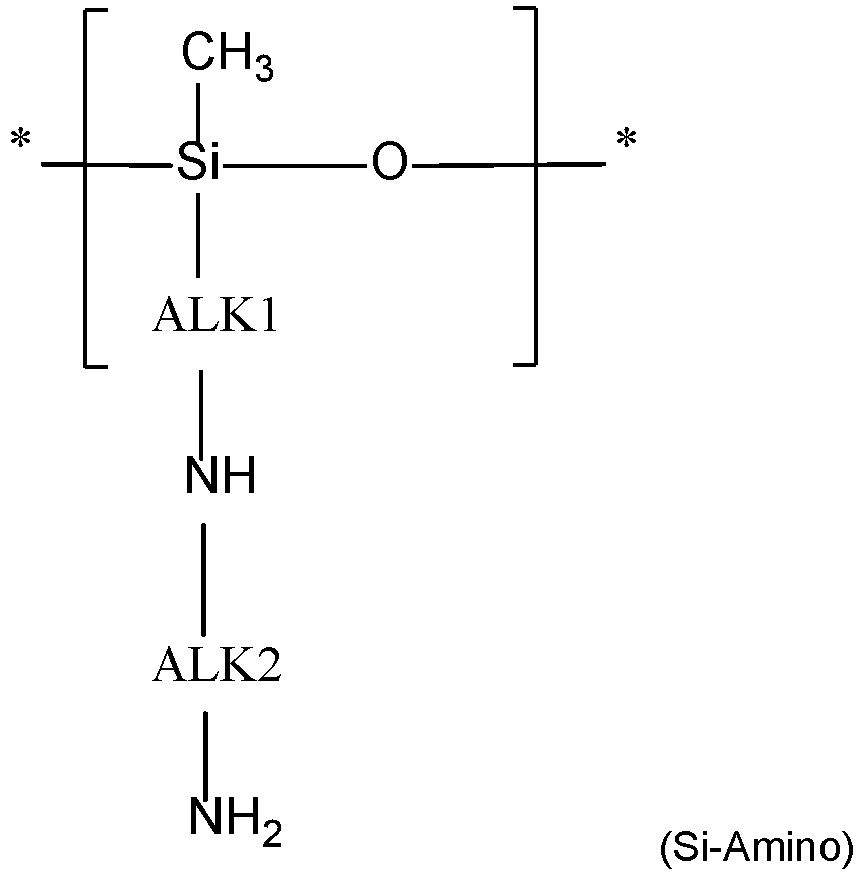
- ALK1 und ALK2
- unabhängig voneinander für eine lineare oder verzweigte, zweiwertige C1-C20-Alkylengruppe stehen.
- ALK1 and ALK2
- independently of one another represent a linear or branched, divalent C 1 -C 20 alkylene group.
Die mit einem Stern (*) gekennzeichneten Position geben hierbei jeweils die Bindung zu weiteren Struktureinheiten des Silikonpolymers an. Beispielsweise kann das dem Stern benachbarte Silicium-Atom an ein weiteres Sauerstoffatom gebunden sein, und das dem Stern benachbarte Sauerstoffatom kann an ein weiteres Siliciumatom oder auch an eine C1-C6-Alkylgruppe gebunden sein.The positions marked with an asterisk (*) indicate the bond to other structural units of the silicone polymer. For example, the silicon atom adjacent to the star can be bonded to another oxygen atom, and the oxygen atom adjacent to the star can be bonded to another silicon atom or to a C 1 -C 6 alkyl group.
Eine zweiwertige C1-C20-Alkylengruppe kann alternativ auch als eine divalente oder zweibindige C1-C20-Alkylengruppe bezeichnet werden, womit gemeint ist, dass jede Gruppierung ALK1 bzw. AK2 zwei Bindungen eingehen kann.A divalent C 1 -C 20 alkylene group can alternatively be referred to as a divalent or divalent C 1 -C 20 alkylene group, which means that each group ALK1 or AK2 can form two bonds.
Im Fall von ALK1 erfolgt eine Bindung vom Silicium-Atom zur Gruppierung ALK1, und die zweite Bindung besteht zwischen ALK1 und der sekundären Aminogruppe.In the case of ALK1, one bond is formed from the silicon atom to the ALK1 group, and the second bond is formed between ALK1 and the secondary amino group.
Im Fall von ALK2 erfolgt eine Bindung von der sekundären Aminogruppe zur Gruppierung ALK2, und die zweite Bindung besteht zwischen ALK2 und der primären Aminogruppe.In the case of ALK2, one bond is formed from the secondary amino group to the ALK2 moiety, and the second bond is formed between ALK2 and the primary amino group.
Beispiele für eine lineare zweiwertige C1-C20-Alkylengruppe sind beispielsweise die Methylen-gruppe (-CH2-), die Ethylengruppe (-CH2-CH2-), die Propylengruppe (-CH2-CH2-CH2-) und die Butylengruppe (-CH2-CH2-CH2-CH2-). Die Propylengruppe (-CH2-CH2-CH2-) ist besonders bevorzugt. Ab einer Kettenlänge von 3 C-Atomen können zweiwertige Alkylengruppen auch verzweigt sein. Beispiele für verzweigte, zweiwertige C3-C20-Alkylengruppen sind (-CH2-CH(CH3)-) und (-CH2-CH(CH3)-CH2-).Examples of a linear divalent C 1 -C 20 alkylene group are, for example, the methylene group (-CH 2 -), the ethylene group (-CH 2 -CH 2 -), the propylene group (-CH 2 -CH 2 -CH 2 -) and the butylene group (-CH 2 -CH 2 -CH 2 -CH 2 -). The propylene group (-CH 2 -CH 2 -CH 2 -) is particularly preferred. From a chain length of 3 C atoms, divalent alkylene groups can also be branched. Examples of branched, divalent C 3 -C 20 alkylene groups are (-CH 2 -CH(CH 3 )-) and (-CH 2 -CH(CH 3 )-CH 2 -).
In einer weiteren besonders bevorzugten Ausführungsform stellen die Struktureinheiten der Formel (Si-Amino) Wiederholungseinheiten im aminofunktionalisierten Silikonpolymer (a3) dar, so dass das Silikonpolymer mehrer Struktureinheiten der Formel (Si-Amino) umfasst.In a further particularly preferred embodiment, the structural units of the formula (Si-amino) represent repeating units in the amino-functionalized silicone polymer (a3), so that the silicone polymer comprises several structural units of the formula (Si-amino).
Im Folgenden werden besonders gut geeignete aminofunktionalisierte Silikonpolymere (a3) mit mindestens einer sekundären Aminogruppe aufgelistet.Particularly suitable amino-functionalized silicone polymers (a3) with at least one secondary amino group are listed below.
Färbungen mit den allerhöchsten Farbintensitäten konnten erhalten werden, wenn ein Mittel auf dem keratinischen Material appliziert wurde, das mindestens ein aminofunktionalisiertes Silikonpolymer (a3) enthält, das Struktureinheiten der Formel (Si-I) und der Formel (Si-II) umfasst

In einer weiteren explizit ganz besonders bevorzugten Ausführungsform ist ein erfindungsgemäßes Mittel dadurch gekennzeichnet, dass es mindestens ein aminofunktionalisiertes Silikonpolymer (a3) enthält, das Struktureinheiten der Formel (Si-I) und der Formel (Si-II) umfasst

Ein entsprechendes aminofunkionalisiertes Silikonpolymer mit den Struktureinheiten (Si-I) und (Si-II) ist beispielweise das Handelsprodukt DC 2-8566 bzw. Dowsil 2-8566 Amino Fluid, das von der Firma Dow Chemical Company komerziell vertrieben wird und welches die Benennung "Siloxanes and Silicones, 3-[(2-Aminoethyl)amino]-2-methylpropyl Me, Di-Me-Siloxane" sowie die
Im Rahmen einer weiteren bevorzugten Ausführungsform ist ein erfindungsgemäßes Mittel dadurch gekennzeichnet dass es mindestens ein aminofunktionelles Silikonpolymer (a3) der Formel der Formel (Si-III) enthält,
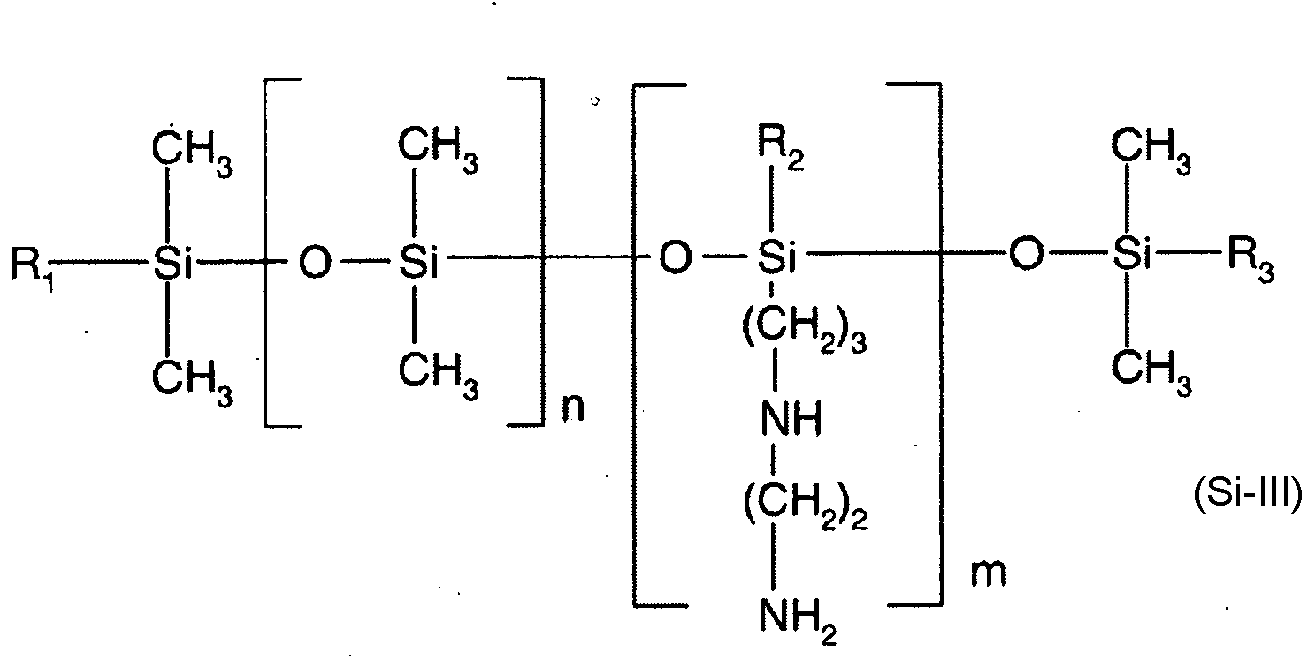
- m und n bedeuten Zahlen, die so gewählt sind, daß die Summe (n + m) im Bereich von 1 bis 1000 liegt,
- n ist eine Zahl im Bereich von 0 bis 999 und m ist eine Zahl im Bereich von 1 bis 1000,
- R1, R2 und R3, die gleich oder verschieden sind, bedeuten eine Hydroxygruppe oder eine C1-4-Alkoxygruppe,
- wobei mindestens eine der Gruppen R1 bis R3 eine Hydroxygruppe bedeutet;
- m and n are numbers chosen so that the sum (n + m) is in the range from 1 to 1000,
- n is a number in the range 0 to 999 and m is a number in the range 1 to 1000,
- R1, R2 and R3, which are the same or different, represent a hydroxy group or a C1-4 alkoxy group,
- wherein at least one of the groups R1 to R3 represents a hydroxy group;
Weitere erfindungsgemäß bevorzugte Mittel sind gekennzeichnet durch ihren Gehalt an mindestens einem aminofunktionellen Silikonpolymer (a3) der Formel der Formel (Si-IV) enthält,

- p und q bedeuten Zahlen, die so gewählt sind, daß die Summe (p + q) im Bereich von 1 bis 1000 liegt,
- p ist eine Zahl im Bereich von 0 bis 999 und q ist eine Zahl im Bereich von 1 bis 1000,
- R1 und R2, die verschieden sind, bedeuten eine Hydroxygruppe oder eine C1-4-Alkoxygruppe, wobei mindestens eine der Gruppen R1 bis R2 eine Hydroxygruppe bedeutet.
- p and q are numbers chosen so that the sum (p + q) is in the range from 1 to 1000,
- p is a number in the range 0 to 999 and q is a number in the range 1 to 1000,
- R1 and R2, which are different, represent a hydroxy group or a C1-4 alkoxy group, wherein at least one of the groups R1 to R2 represents a hydroxy group.
Die Silikone der Formeln (Si-III) und (Si-IV) unterscheiden sich durch die Gruppierung am Si-Atom, das die stickstoffhaltige Gruppe trägt: In Formel (Si-III) bedeutet R2 eine Hydroxygruppe oder eine C1-4-Alkoxygruppe, während der Rest in Formel (Si-IV) eine Methylgruppe ist. Die einzelnen Si-Gruppierungen, die mit den Indices m und n bzw. p und q gekennzeichnet sind, müssen nicht als Blöcke vorliegen, vielmehr können die einzelnen Einheiten auch statistisch verteilt vorliegen, d.h. in den Formeln (Si-III) und (Si-IV) ist nicht zwingend jedes R1-Si(CH3)2-Gruppe an eine -[O-Si(CH3)2]-Gruppierung gebunden.The silicones of formulas (Si-III) and (Si-IV) differ in the grouping at the Si atom carrying the nitrogen-containing group: In formula (Si-III), R2 is a hydroxyl group or a C1-4 alkoxy group, while the residue in formula (Si-IV) is a methyl group. The individual Si groups, which are designated by the indices m and n or p and q, do not have to be present as blocks; rather, the individual units can also be randomly distributed, i.e. in formulas (Si-III) and (Si-IV), not every R1-Si(CH 3 ) 2 group is necessarily bonded to an -[O-Si(CH 3 ) 2 ] group.
Als besonders wirkungsvoll im Hinblick auf die gewünschten Effekte haben sich auch erfindungsgemäße Mittel erwiesen, welche mindestens ein aminofunktionelles Silikonpolymer (a3) der Formel der Formel (Si-V) enthalten

- A
- für eine Gruppe -OH, -O-Si(CH3)3,-O-Si(CH3)2OH ,-O-Si(CH3)2OCH3 steht,
- D
- für eine Gruppe -H, -Si(CH3)3,-Si(CH3)2OH, -Si(CH3)2OCH3 steht,
- b, n und c
- für ganze Zahlen zwischen 0 und 1000 stehen,
mit den Maßgaben- n > 0 und b + c > 0
- mindestens eine der Bedingungen A = -OH bzw. D = -H ist erfüllt.
- A
- represents a group -OH, -O-Si(CH 3 ) 3 ,-O-Si(CH 3 ) 2 OH ,-O-Si(CH 3 ) 2 OCH 3 ,
- D
- represents a group -H, -Si(CH 3 ) 3 ,-Si(CH 3 ) 2 OH, -Si(CH 3 ) 2 OCH 3 ,
- b, n and c
- represent integers between 0 and 1000,
with the specifications- n > 0 and b + c > 0
- at least one of the conditions A = -OH or D = -H is fulfilled.
In der vorstehend genannten Formel (Si-V) sind die einzelnen Siloxaneinheiten mit den Indices b, c und n statistisch verteilt, d.h. es muß sich nicht zwingend um Blockcopolymere handeln.In the above-mentioned formula (Si-V), the individual siloxane units with the indices b, c and n are statistically distributed, i.e. they do not necessarily have to be block copolymers.
Das Mittel (a) kann weiterhin auch ein oder mehrere verschiedene aminofunktionalisierte Silikonpolymere enthalten, die durch die Formel (Si-VI)
M(RaQbSiO(4-a-b)/2)x(RcSiO(4-c)/2)yM (Si-VI)
beschrieben werden, wobei in der obigen Formel R ein Kohlenwasserstoff oder ein Kohlenwasserstoffrest mit 1 bis etwa 6 Kohlenstoffatomen ist, Q ein polarer Rest der allgemeinen Formel -R1HZ ist, worin R1 eine zweiwertige, verbindende Gruppe ist, die an Wasserstoff und den Rest Z gebunden ist, zusammengesetzt aus Kohlenstoff- und Wasserstoffatomen, Kohlenstoff-, Wasserstoff- und Sauerstoffatomen oder Kohlenstoff-, Wasserstoff- und Stickstoffatomen, und Z ein organischer, aminofunktioneller Rest ist, der mindestens eine aminofunktionelle Gruppe enthält; "a" Werte im Bereich von etwa 0 bis etwa 2 annimmt, "b" Werte im Bereich von etwa 1 bis etwa 3 annimmt, "a" + "b" kleiner als oder gleich 3 ist, und "c" eine Zahl im Bereich von etwa 1 bis etwa 3 ist, und x eine Zahl im Bereich von 1 bis etwa 2.000, vorzugsweise von etwa 3 bis etwa 50 und am bevorzugtesten von etwa 3 bis etwa 25 ist, und y eine Zahl im Bereich von etwa 20 bis etwa 10.000, vorzugsweise von etwa 125 bis etwa 10.000 und am bevorzugtesten von etwa 150 bis etwa 1.000 ist, und M eine geeignete Silicon-Endgruppe ist, wie sie im Stand der Technik bekannt ist, vorzugsweise Trimethylsiloxy. Nicht einschränkende Beispiele der durch R repräsentierten Reste schließen Alkylreste, wie Methyl, Ethyl, Propyl, Isopropyl, Isopropyl, Butyl, Isobutyl, Amyl, Isoamyl, Hexyl, Isohexyl und ähnliche; Alkenylreste, wie Vinyl, Halogenvinyl, Alkylvinyl, Allyl, Halogenallyl, Alkylallyl; Cycloalkylreste, wie Cyclobutyl, Cyclopentyl, Cyclohexyl und ähnliche; Phenylreste, Benzylreste, Halogenkohlenwasserstoffreste, wie 3- Chlorpropyl, 4-Brombutyl, 3,3,3-Trifluorpropyl, Chlorcyclohexyl, Bromphenyl, Chlorphenyl und ähnliche sowie schwefelhaltige Reste, wie Mercaptoethyl, Mercaptopropyl, Mercaptohexyl, Mercaptophenyl und ähnliche ein; vorzugsweise ist R ein Alkylrest, der 1 bis etwa 6 Kohlenstoffatomen enthält, und am bevorzugtesten ist R Methyl. Beispiele von R1 schließen Methylen, Ethylen, Propylen, Hexamethylen, Decamethylen, - CH2CH(CH3)CH2-, Phenylen, Naphthylen, -CH2CH2SCH2CH2-, -CH2CH2OCH2-, -OCH2CH2-, -OCH2 CH2CH2-, -CH2CH(CH3)C(O)OCH2-, -(CH2)3 CC(O)OCH2CH2-, -C6H 4C6H4-, -C6H 4CH2C6H4-; und -(CH 2)3C(O)SCH2CH2- ein.The agent (a) may further contain one or more different amino-functionalized silicone polymers represented by the formula (Si-VI)
M(R a Q b SiO (4-ab)/2)x (R c SiO (4-c)/2)y M (Si-VI)
wherein in the above formula R is a hydrocarbon or a hydrocarbon radical having 1 to about 6 carbon atoms, Q is a polar radical of the general formula -R 1 HZ, wherein R 1 is a divalent linking group bonded to hydrogen and the radical Z, composed of carbon and hydrogen atoms, carbon, hydrogen and oxygen atoms or carbon, hydrogen and nitrogen atoms, and Z is an organic amino-functional radical containing at least one amino-functional group; "a" takes on values in the range of about 0 to about 2, "b" takes on values in the range of about 1 to about 3, "a" + "b" is less than or equal to 3, and "c" is a number in the range of about 1 to about 3, and x is a number in the range of 1 to about 2,000, preferably from about 3 to about 50, and most preferably from about 3 to about 25, and y is a number in the range of about 20 to about 10,000, preferably from about 125 to about 10,000, and most preferably from about 150 to about 1,000, and M is a suitable silicone end group as known in the art, preferably trimethylsiloxy. Non-limiting examples of the radicals represented by R include alkyl radicals such as methyl, ethyl, propyl, isopropyl, butyl, isobutyl, amyl, isoamyl, hexyl, isohexyl, and the like; alkenyl radicals such as vinyl, halovinyl, alkylvinyl, allyl, haloallyl, alkylallyl; Cycloalkyl radicals such as cyclobutyl, cyclopentyl, cyclohexyl and the like; phenyl radicals, benzyl radicals, halohydrocarbon radicals such as 3-chloropropyl, 4-bromobutyl, 3,3,3-trifluoropropyl, chlorocyclohexyl, bromophenyl, chlorophenyl and the like; and sulfur-containing radicals such as mercaptoethyl, mercaptopropyl, mercaptohexyl, mercaptophenyl and the like; preferably, R is an alkyl radical containing from 1 to about 6 carbon atoms, and most preferably, R is methyl. Examples of R 1 include methylene, ethylene, propylene, hexamethylene, decamethylene, -CH 2 CH(CH 3 )CH 2 -, phenylene, naphthylene, -CH 2 CH 2 SCH 2 CH 2 -, -CH 2 CH 2 OCH 2 -, -OCH 2 CH 2 -, -OCH 2 CH 2 CH 2 -, -CH 2 CH(CH 3 )C(O)OCH 2 -, -(CH 2 ) 3 CC(O)OCH 2 CH 2 -, -C 6 H 4 C 6 H 4 -, -C 6 H 4 CH 2 C 6 H 4 -; and -(CH 2 ) 3 C(O)SCH 2 CH 2 -.
Z ist ein organischer, aminofunktioneller Rest, enthaltend mindestens eine funktionelle Aminogruppe. Eine mögliche Formel für Z ist NH(CH2 )zNH2, worin z 1 oder mehr ist. Eine andere mögliche Formel für Z ist -NH(CH2)z(CH 2)zzNH, worin sowohl z als auch zz unabhängig 1 oder mehr sind, wobei diese Struktur Diamino-Ringstrukturen umfaßt, wie Piperazinyl. Z ist am bevorzugtesten ein -NHCH2CH 2NH2-Rest. Eine andere mögliche Formel für Z ist - N(CH2)z(CH2)zzNX2 oder -NX2, worin jedes X von X2 unabhängig ausgewählt ist aus der Gruppe bestehend aus Wasserstoff und Alkylgruppen mit 1 bis 12 Kohlenstoffatomen, und zz 0 ist.Z is an organic, amino-functional radical containing at least one amino functional group. One possible formula for Z is NH(CH 2 ) z NH 2 , where z is 1 or more. Another possible formula for Z is -NH(CH 2 ) z (CH 2 ) zz NH, where both z and zz are independently 1 or more, this structure including diamino ring structures such as piperazinyl. Z is most preferably an -NHCH 2 CH 2 NH 2 radical. Another possible formula for Z is -N(CH 2 ) z (CH 2 ) zz NX 2 or -NX 2 , where each X of X 2 is independently selected from the group consisting of hydrogen and alkyl groups having 1 to 12 carbon atoms, and zz is 0.
Q ist am bevorzugtesten ein polarer, aminfunktioneller Rest der Formel -CH2CH2CH2NHCH2CH2NH 2. In den Formeln nimmt "a" Werte im Bereich von etwa 0 bis etwa 2 an, "b" nimmt Werte im Bereich von etwa 2 bis etwa 3 an, "a" + "b" ist kleiner als oder gleich 3, und "c" ist eine Zahl im Bereich von etwa 1 bis etwa 3. Das molare Verhältnis der RaQb SiO(4-a-b)/2-Einheiten zu den RcSiO(4-c)/2-Einheiten liegt im Bereich von etwa 1 : 2 bis 1 : 65, vorzugsweise von etwa 1 : 5 bis etwa 1 : 65 und am bevorzugtesten von etwa 1 : 15 bis etwa 1 : 20. Werden ein oder mehrere Silicone der obigen Formel eingesetzt, dann können die verschiedenen variablen Substituenten in der obigen Formel bei den verschiedenen Siliconkomponenten, die in der Siliconmischung vorhanden sind, verschieden sein.Q is most preferably a polar, amine-functional radical of the formula -CH 2 CH 2 CH 2 NHCH 2 CH 2 NH 2 . In the formulas, "a" takes on values in the range of about 0 to about 2, "b" takes on values in the range of about 2 to about 3, "a" + "b" is less than or equal to 3, and "c" is a number in the range of about 1 to about 3. The molar ratio of the R a Q b SiO (4-ab)/2 units to the R c SiO (4-c)/2 units is in the range of about 1:2 to 1:65, preferably from about 1:5 to about 1:65, and most preferably from about 1:15 to about 1:20. If one or more silicones of the above formula are employed, the various variable substituents in the above formula can be different for the various silicone components present in the silicone mixture.
Im Rahmen einer weiteren bevorzugten Ausführungsform ist ein erfindungsgemäßes Mittel dadurch gekennzeichnet dass es mindestens ein aminofunktionelles Silikonpolymer der Formel (Si-VII) enthält,
R'aG3-a-Si(OSiG2)n-(OSiGbR'2-b)m-O-SiG3-a-R'a (Si-VII),
worin bedeutet:
- G ist-H, eine Phenylgruppe, -OH, -O-CH3, -CH3, -O-CH2CH3, -CH2CH3, -O-CH2CH2CH3,-CH2CH2CH3, -O-CH(CH3)2, -CH(CH3)2, -O-CH2CH2CH2CH3, - CH2CH2CH2CH3, -O-CH2CH(CH3)2, -CH2CH(CH3)2, -O-CH(CH3)CH2CH3, - CH(CH3)CH2CH3, -O-C(CH3)3, -C(CH3)3 ;
- a steht für eine Zahl zwischen 0 und 3, insbesondere 0;
- b steht für eine Zahl zwischen 0 und 1, insbesondere 1,
- m und n sind Zahlen, deren Summe (m + n) zwischen 1 und 2000, vorzugsweise zwischen 50 und 150 beträgt, wobei n vorzugsweise Werte von 0 bis 1999 und insbesondere von 49 bis 149 und m vorzugsweise Werte von 1 bis 2000, insbesondere von 1 bis 10 annimmt,
- R' ist ein monovalenter Rest ausgewählt aus
- ∘ -Q-N(R")-CH2-CH2-N(R")2
- ∘ -Q-N(R")2
- ∘ -Q-N+(R")3A-
- ∘ -Q-N+H(R")2A-
- ∘ -Q-N'H2(R")A-
- ∘ -Q-N(R")-CH2-CH2-N+R"H2A-,
- wobei jedes Q für eine chemische Bindung, -CH2-, -CH2-CH2-, -CH2CH2CH2-, -C(CH3)2-, -CH2CH2CH2CH2-, -CH2C(CH3)2-, -CH(CH3)CH2CH2- steht,
- R" für gleiche oder verschiedene Reste aus der Gruppe -H, -Phenyl, -Benzyl, -CH2-CH(CH3)Ph, der C1-20-Alkylreste, vorzugsweise -CH3, -CH2CH3, -CH2CH2CH3, - CH(CH3)2, -CH2CH2CH2H3, -CH2CH(CH3)2, -CH(CH3)CH2CH3, -C(CH3)3, steht und A ein Anion repräsentiert, welches vorzugsweise ausgewählt ist aus Chlorid, Bromid, Iodid oder Methosulfat.
R' a G 3-a -Si(OSiG 2 ) n -(OSiG b R' 2-b ) m -O-SiG 3-a -R' a (Si-VII),
which means:
- G is -H, a phenyl group, -OH, -O-CH 3 , -CH 3 , -O-CH 2 CH 3 , -CH 2 CH 3 , -O-CH 2 CH 2 CH 3 , -CH 2 CH 2 CH 3 , -O-CH(CH 3 ) 2 , -CH(CH 3 ) 2 , -O-CH 2 CH 2 CH 2 CH 3 , - CH 2 CH 2 CH 2 CH 3 , -O-CH 2 CH(CH 3 ) 2 , -CH 2 CH(CH 3 ) 2 , -O-CH(CH 3 )CH 2 CH 3 , - CH(CH 3 )CH 2 CH 3 , -OC(CH 3 ) 3 , -C(CH 3 ) 3 ;
- a stands for a number between 0 and 3, especially 0;
- b stands for a number between 0 and 1, in particular 1,
- m and n are numbers whose sum (m + n) is between 1 and 2000, preferably between 50 and 150, where n preferably assumes values from 0 to 1999 and in particular from 49 to 149 and m preferably assumes values from 1 to 2000, in particular from 1 to 10,
- R' is a monovalent radical selected from
- ∘ -QN(R")-CH 2 -CH 2 -N(R") 2
- ∘ -QN(R") 2
- ∘ -QN + (R") 3 A -
- ∘ -QN + H(R") 2 A -
- ∘ -Q-N'H 2 (R")A -
- ∘ -QN(R")-CH 2 -CH 2 -N + R"H 2 A - ,
- where each Q represents a chemical bond, -CH 2 -, -CH 2 -CH 2 -, -CH 2 CH 2 CH 2 -, -C(CH 3 ) 2 -, -CH 2 CH 2 CH 2 CH 2 -, -CH 2 C(CH 3 ) 2 -, -CH(CH 3 )CH 2 CH 2 -,
- R" represents identical or different radicals from the group -H, -phenyl, -benzyl, -CH 2 -CH(CH 3 )Ph, the C 1-20 -alkyl radicals, preferably -CH 3 , -CH 2 CH 3 , -CH 2 CH 2 CH 3 , - CH(CH 3 ) 2 , -CH 2 CH 2 CH 2 H 3 , -CH 2 CH(CH 3 ) 2 , -CH(CH 3 )CH 2 CH 3 , -C(CH 3 ) 3 , and A represents an anion which is preferably selected from chloride, bromide, iodide or methosulfate.
Im Rahmen einer weiteren bevorzugten Ausführungsform ist ein erfindungsgemäßes Mittel dadurch gekennzeichnet, dass es mindestens ein aminofunktionelles Silikonpolymer (a3) der Formel (Si-VIIa) enthält,

Diese Silicone werden nach der INCI-Deklaration als Trimethylsilylamodimethicone bezeichnet.According to the INCI declaration, these silicones are called trimethylsilylamodimethicones.
Im Rahmen einer weiteren bevorzugten Ausführungsform ist ein erfindungsgemäßes Mittel dadurch gekennzeichnet, dass es mindestens ein aminofunktionelles Silikonpolymer der Formel (Si-VIIb) enthält

Diese aminofunktionalisierten Siliconpolymere werden nach der INCI-Deklaration als Amodimethicone bezeichnet.These amino-functionalized silicone polymers are referred to as amodimethicones according to the INCI declaration.
Unabhängig davon, welche aminofunktionellen Silicone eingesetzt werden, sind erfindungsgemäße Mittel bevorzugt, die ein aminofunktionelles Silikonpolymer (a3) enthalten, dessen Aminzahl oberhalb von 0,25 meq/g, vorzugsweise oberhalb von 0,3 meq/g und insbesondere oberhalb von 0,4 meq/g liegt. Die Aminzahl steht dabei für die Milli-Äquivalente Amin pro Gramm des aminofunktionellen Silicons. Sie kann durch Titration ermittelt und auch in der Einheit mg KOH/g angegeben werden.Regardless of which amino-functional silicones are used, agents according to the invention are preferred which contain an amino-functional silicone polymer (a3) whose amine number is above 0.25 meq/g, preferably above 0.3 meq/g, and in particular above 0.4 meq/g. The amine number represents the milliequivalents of amine per gram of the amino-functional silicone. It can be determined by titration and can also be expressed in mg KOH/g.
Weiterhin sind auch Mittel geeignet, welche ein spezielles 4-Morpholinomethyl-substituiertes Silikonpolymer (a3) enthielten. Dieses aminofunktionalisierte Silikonpolymer umfasst Struktureinheiten der Formeln (SI-VIII) und der Formel (Si-IX)

Entsprechende 4-Morpholinomethyl-substituiertes Silikonpolymere werden im folgenden beschrieben.Corresponding 4-morpholinomethyl-substituted silicone polymers are described below.
Ein bevorzugtes aminofunktionaliserte Silikonpolymer ist unter dem Namen Amodimethicone/Morpholinomethyl Silsesquioxane Copolymer bekannt und in Form des Rohstoffes Belsil ADM 8301 E von Wacker kommerziell erhältlich.A preferred amino-functionalized silicone polymer is known under the name Amodimethicone/Morpholinomethyl Silsesquioxane Copolymer is known and is commercially available in the form of the raw material Belsil ADM 8301 E from Wacker.
Als 4-morpholinomethyl-substituiertes Silikon kann beispielsweise ein Silikon eingesetzt werden, welches Struktureinheiten der Formeln (Si-VIII), (Si-IX) und (Si-X) aufweist

- R1
- für -CH3, -OH, -OCH3, -O-CH2CH3, -O-CH2CH2CH3, oder -O-CH(CH3)2 steht;
- R2
- für -CH3, -OH, oder -OCH3 steht.
- R1
- represents -CH 3 , -OH, -OCH 3 , -O-CH 2 CH 3 , -O-CH 2 CH 2 CH 3 , or -O-CH(CH 3 ) 2 ;
- R2
- stands for -CH 3 , -OH, or -OCH 3 .
Besonders bevorzugte erfindungsgemäße Mittel enthalten mindestens ein 4-morpholinomethylsubstituierten Silikons der Formel (Si-XI)
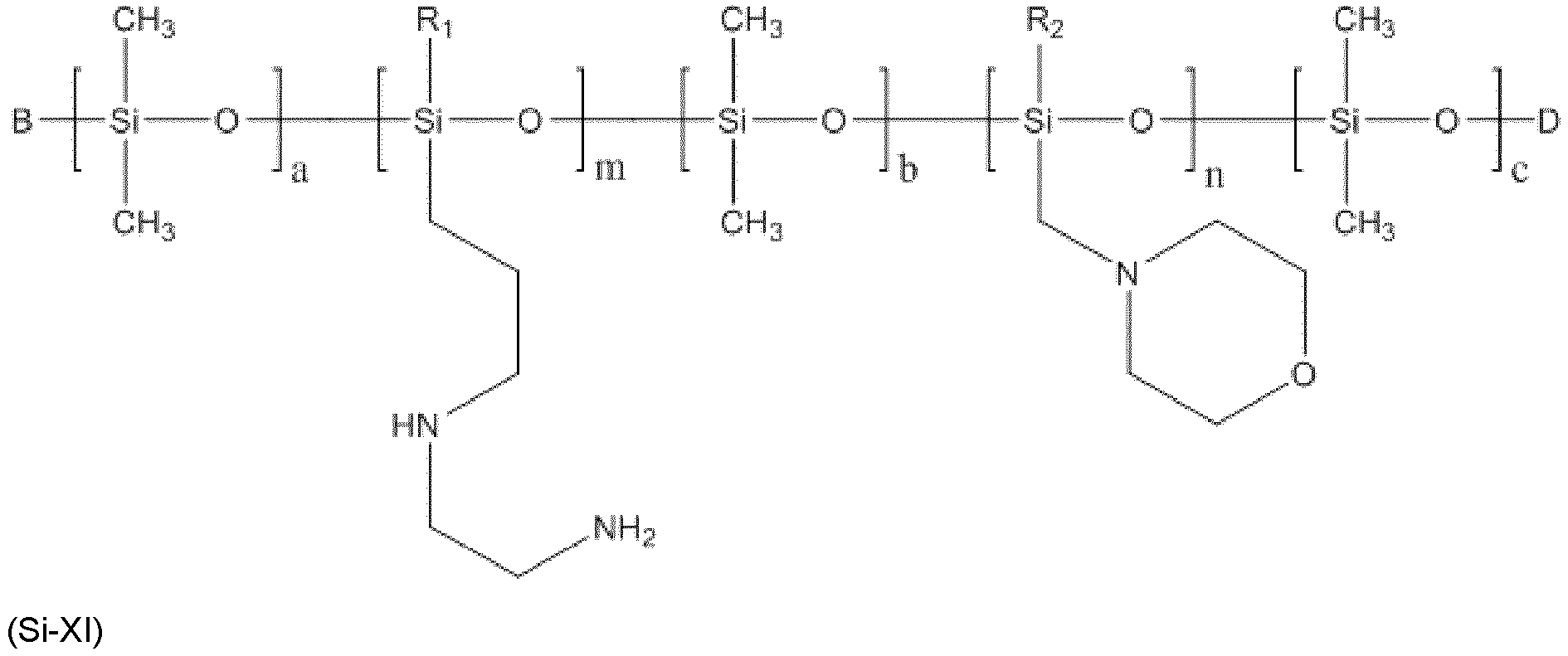
- R1
- für -CH3, -OH, -OCH3, -O-CH2CH3, -O-CH2CH2CH3, oder -O-CH(CH3)2 steht;
- R2
- für -CH3, -OH, oder -OCH3 steht.
- B
- für eine Gruppe -OH, -O-Si(CH3)3,-O-Si(CH3)2OH ,-O-Si(CH3)2OCH3 steht,
- D
- für eine Gruppe -H, -Si(CH3)3,-Si(CH3)2OH, -Si(CH3)2OCH3 steht,
- a, b und c unabhängig voneinander für ganze Zahlen zwischen 0 und 1000 stehen, mit der Maßgabe a + b + c> 0
- m und n unabhängig voneinander für ganze, Zahlen zwischen 1 und 1000 stehen mit den Maßgabe, daß
- mindestens eine der Bedingungen B = -OH bzw. D = -H erfüllt ist,
- die Einheiten a, b, c, m und n statistisch oder blockweise im Molekül verteilt vorliegen.
- R1
- represents -CH 3 , -OH, -OCH 3 , -O-CH 2 CH 3 , -O-CH 2 CH 2 CH 3 , or -O-CH(CH 3 ) 2 ;
- R2
- stands for -CH 3 , -OH, or -OCH 3 .
- B
- represents a group -OH, -O-Si(CH 3 ) 3 ,-O-Si(CH 3 ) 2 OH ,-O-Si(CH 3 ) 2 OCH 3 ,
- D
- represents a group -H, -Si(CH 3 ) 3 ,-Si(CH 3 ) 2 OH, -Si(CH 3 ) 2 OCH 3 ,
- a, b and c independently represent integers between 0 and 1000, with the proviso a + b + c> 0
- m and n independently represent integers between 1 and 1000 with the proviso that
- at least one of the conditions B = -OH or D = -H is fulfilled,
- the units a, b, c, m and n are distributed statistically or block-wise in the molecule.
Strukturformel (Si-XI) soll verdeutlichen, daß die Siloxangruppen n und m nicht zwingend direkt an eine Endgruppierung B bzw. D gebunden sein müssen. Vielmehr gilt in bevorzugten Formeln (Si-VI) a > 0 oder b > 0 und in besonders bevorzugten Formeln (Si-VI) a > 0 und c > 0, d.h. die terminale Gruppierung B bzw. D ist vorzugsweise an eine Dimethylsiloxy-Gruppierung gebunden. Auch in Formel (Si-VI) sind die Siloxaneinheiten a, b, c, m und n vorzugsweise statistisch verteilt.Structural formula (Si-XI) is intended to clarify that the siloxane groups n and m do not necessarily have to be directly bonded to an end grouping B or D. Rather, in preferred formulas (Si-VI), a > 0 or b > 0, and in particularly preferred formulas (Si-VI), a > 0 and c > 0, i.e., the terminal grouping B or D is preferably bonded to a dimethylsiloxy grouping. In formula (Si-VI), the siloxane units a, b, c, m, and n are also preferably randomly distributed.
Die durch Formel (Si-VI) dargestellten erfindungsgemäß eingesetzten Silikone können trimethylsilylterminiert sein (D oder B = -Si(CH3)3), sie können aber auch zweiseitig dimethylsilylhydroxy- oder einseitig dimethylsilylhydroxy- und dimethylsilylmethoxy-terminiert sein. Im Rahmen der vorliegenden Erfindung besonders bevorzugt eingesetzte Silikone sind ausgewählt aus Silikonen, in denen
- B = -O-Si(CH3)2OH und
- D = -Si(CH3)3
- B = -O-Si(CH3)2OH und
- D = -Si(CH3)2OH
- B = -O-Si(CH3)2OH und
- D = -Si(CH3)2OCH3
- B = -O-Si(CH3)3
- und D = -Si(CH3)2OH
- B = -O-Si(CH3)2OCH3
- und D = -Si(CH3)2OH
- B = -O-Si(CH3)2OH and
- D = -Si(CH 3 ) 3
- B = -O-Si(CH3)2OH and
- D = -Si(CH 3 ) 2 OH
- B = -O-Si(CH3)2OH and
- D = -Si(CH 3 ) 2 OCH 3
- B = -O-Si(CH3)3
- and D = -Si(CH 3 ) 2 OH
- B = -O-Si(CH3)2OCH3
- and D = -Si(CH 3 ) 2 OH
Es hat sich als besonders vorteilhaft herausgestellt, wenn das erfindungsgemäße Mittel das oder die aminofunktionalisierten Silikonpolymere (a3) in bestimmten Mengenbereichen enhält. Besonders gute Ergebnisse konnten erhalten werden, wenn das Mittel - bezogen auf das Gesamtgewicht des Mittels - in einer Gesamtmenge von 0,1 bis 8,0 Gew.-%, bevorzugt 0,2 bis 5,0 Gew.-%, weiter bevorzugt von 0,3 bis 3,0 Gew.-% und ganz besonders bevorzugt von 0,4 bis 2,5 Gew.-% enthält.It has proven particularly advantageous if the agent according to the invention contains the amino-functionalized silicone polymer(s) (a3) in certain quantity ranges. Particularly good results were obtained when the agent contains—based on the total weight of the agent—a total amount of 0.1 to 8.0 wt.%, preferably 0.2 to 5.0 wt.%, more preferably 0.3 to 3.0 wt.%, and most preferably 0.4 to 2.5 wt.%.
Im Rahmen einer weiteren besonders bevorzugten Ausführungsform ist ein erfindungsgemäßes Mittel dadurch gekennzeichnet, dass es - bezogen auf das Gesamtgewicht des Mittels - ein oder mehrere aminofunktionalisierte Silikonpolymere (a3) in einer Gesamtmenge von 0,1 bis 8,0 Gew.-%, bevorzugt 0,2 bis 5,0 Gew.-%, weiter bevorzugt von 0,3 bis 3,0 Gew.-% und ganz besonders bevorzugt von 0,4 bis 2,5 Gew.-% enthält.In a further particularly preferred embodiment, an agent according to the invention is characterized in that it contains - based on the total weight of the agent - one or more amino-functionalized silicone polymers (a3) in a total amount of 0.1 to 8.0 wt.%, preferably 0.2 to 5.0 wt.%, more preferably 0.3 to 3.0 wt.% and very particularly preferably 0.4 to 2.5 wt.%.
Abhängig von der gewünschten Form der Konfektionierung kann das erfindungsgemäße Mittel optional auch noch weitere Bestandteile oder Inhaltsstoffe enthalten.Depending on the desired form of packaging, the agent according to the invention may optionally also contain further components or ingredients.
Wenn das Mittel in Form einer Emulsion oder Creme zur Verfügung gestellt werden soll, hat sich der Einsatz mindestens eines Fettbestandteils als besonders vorteilhaft erwiesen. Bei den Fettbestandteilen handelt es sich um hydrophobe Substanzen, die in Gegenwart von Wasser unter Ausbildung von Mizell-Systemen Emulsionen formen können.If the product is to be delivered in the form of an emulsion or cream, the use of at least one fatty component has proven particularly advantageous. Fatty components are hydrophobic substances that can form emulsions in the presence of water, forming micelle systems.
Unter "Fettbestandteilen" werden im Sinne der Erfindung organische Verbindungen mit einer Löslichkeit in Wasser bei Raumtemperatur (22 °C) und atmosphärischem Druck (760 mmHg) von weniger als 1 Gew.-%, bevorzugt von weniger als 0,1 Gew.-% verstanden. Unter die Definition der Fettbestandteile fallen explizit nur ungeladene (d.h. nichtionische) Verbindungen. Fettbestandteile besitzen mindestens eine gesättigte oder ungesättigte Alkylgruppe mit mindestens 12 C-Atomen. Das Molgewicht der Fettbestandteile liegt bei maximal 5000 g/mol, bevorzugt bei maximal 2500 g/mol und besonders bevorzugt bei maximal 1000 g/mol. Bei den Fettbestandteilen handelt es sich weder um polyoxyalkylierte noch um polyglycerylierte Verbindungen.For the purposes of the invention, "fatty components" are understood to mean organic compounds with a solubility in water at room temperature (22 °C) and atmospheric pressure (760 mmHg) of less than 1 wt.%, preferably less than 0.1 wt.%. The definition of fatty components explicitly includes only uncharged (i.e., non-ionic) compounds. Fatty components contain at least one saturated or unsaturated alkyl group with at least 12 carbon atoms. The molecular weight of the fatty components is a maximum of 5000 g/mol, preferably a maximum of 2500 g/mol, and particularly preferably a maximum of 1000 g/mol. The fatty components are neither polyoxyalkylated nor polyglycerylated compounds.
Ganz besonders bevorzugt können die im Mittel zusätzlich eingesetzten Fettbestandteile ausgewählt werden aus der Gruppe der C12-C30-Fettalkohole, der C12-C30-Fettsäuretriglyceride, der C12-C30-Fett-säuremonoglyceride, der C12-C30-Fettsäurediglyceride und/oder der Kohlenwasserstoffe.Most preferably, the fat components additionally used in the composition can be selected from the group of C 12 -C 30 fatty alcohols, C 12 -C 30 fatty acid triglycerides, C 12 -C 30 fatty acid monoglycerides, C 12 -C 30 fatty acid diglycerides and/or hydrocarbons.
Im Rahmen einer weiteren bevorzugten Ausführungsform ist ein erfindungsgemäßes Mittel dadurch gekennzeichnet, dass es einen oder mehrere Fettbestandteile aus der Gruppe der C12-C30-Fettalkohole, der C12-C30-Fettsäuretriglyceride, der C12-C30-Fettsäuremonoglyceride, der C12-C30-Fettsäurediglyceride und/oder der Kohlenwasserstoffe enthält.In a further preferred embodiment, an agent according to the invention is characterized in that it contains one or more fatty components from the group of C 12 -C 30 fatty alcohols, C 12 -C 30 fatty acid triglycerides, C 12 -C 30 fatty acid monoglycerides, C 12 -C 30 fatty acid diglycerides and/or hydrocarbons.
Als ganz besonders bevorzugte Fettbestandteile werden in diesem Zusammenhang die Bestandteile aus der Gruppe der C12-C30-Fettalkohole, der C12-C30-Fettsäuretriglyceride, der C12-C30-Fettsäuremonoglyceride, der C12-C30-Fettsäurediglyceride und/oder der Kohlenwasserstoffe verstanden. Im Sinne der vorliegenden Erfindung werden explizit nur nichtionische Substanzen als Fettbestandteile betrachtet. Geladene Verbindungen wie beispielsweise Fettsäuren und ihre Salze werden nicht als Fettbestandteil verstanden.In this context, particularly preferred fatty constituents are those from the group of C 12 -C 30 fatty alcohols, C 12 -C 30 fatty acid triglycerides, C 12 -C 30 fatty acid monoglycerides, C 12 -C 30 fatty acid diglycerides, and/or hydrocarbons. For the purposes of the present invention, only non-ionic substances are explicitly considered fatty constituents. Charged compounds such as fatty acids and their salts are not considered fatty constituents.
Bei den C12-C30-Fettalkoholen kann es sich um gesättigte, ein- oder mehrfach ungesättigte, lineare oder verzweigte Fettalkohole mit 12 bis 30 C-Atomen handeln.C 12 -C 30 fatty alcohols can be saturated, mono- or polyunsaturated, linear or branched fatty alcohols with 12 to 30 C atoms.
Beispiele für bevorzugte lineare, gesättigte C12-C30-Fettalkohole sind Dodecan-1-ol (Dodecylalkohol, Laurylalkohol), Tetradecan-1-ol (Tetradecylalkohol, Myristylalkohol), Hexadecan-1-ol (Hexadecylalkohol, Cetylalkohol, Palmitylalkohol), Octadecan-1-ol (Octadecylalkohol, Stearylalkohol), Arachylalkohol (Eicosan-1-ol), Heneicosylalkohol (Heneicosan-1-ol) und/oder Behenylalkohol (Docosan-1-ol).Examples of preferred linear, saturated C 12 -C 30 fatty alcohols are dodecan-1-ol (dodecyl alcohol, lauryl alcohol), tetradecan-1-ol (tetradecyl alcohol, myristyl alcohol), hexadecan-1-ol (hexadecyl alcohol, cetyl alcohol, palmityl alcohol), octadecan-1-ol (octadecyl alcohol, stearyl alcohol), arachyl alcohol (eicosane-1-ol), heneicosyl alcohol (heneicosane-1-ol) and/or behenyl alcohol (docosan-1-ol).
Bevorzugte lineare, ungesättigte Fettalkohole sind (9Z)-Octadec-9-en-1-ol (Oleylalkohol), (9E)-Octadec-9-en-1-ol (Elaidylalkohol), (9Z,12Z)-Octadeca-9,12-dien-1-ol (Linoleylalkohol), (9Z,12Z,15Z)-Octadeca-9,12,15-trien-1-ol (Linolenoylalkohol), Gadoleylalkohol ((9Z)-Eicos-9-en-1-ol), Arachidonalkohol ((5Z,8Z,11Z,14Z)-Eicosa-5,8,11,14-tetraen-1-ol), Erucylalkohol ((13Z)-Docos-13-en-1-ol) und/oder Brassidylalkohol ((13E)-Docosen-1-ol).Preferred linear, unsaturated fatty alcohols are (9Z)-octadec-9-en-1-ol (oleyl alcohol), (9E)-octadec-9-en-1-ol (elaidyl alcohol), (9Z,12Z)-octadeca-9,12-dien-1-ol (linoleyl alcohol), (9Z,12Z,15Z)-octadeca-9,12,15-trien-1-ol (linolenoyl alcohol), gadoleyl alcohol ((9Z)-eicos-9-en-1-ol), arachidonic alcohol ((5Z,8Z,11Z,14Z)-eicosa-5,8,11,14-tetraen-1-ol), erucyl alcohol ((13Z)-docos-13-en-1-ol) and/or brassidyl alcohol ((13E)-docosen-1-ol).
Die bevorzugten Vertreter für verzweigte Fettalkohole sind 2-Octyl-dodecanol, 2-Hexyl-Dodecanol und/oder 2-Butyl-dodecanol.The preferred representatives for branched fatty alcohols are 2-octyldodecanol, 2-hexyldodecanol and/or 2-butyldodecanol.
Im Rahmen einer weiteren bevorzugten Ausführungsform ist ein erfindungsgemäßes Mittel dadurch gekennzeichnet, dass es einen oder mehrere C12-C30-Fettalkohole aus der Gruppe aus
- Dodecan-1-ol (Dodecylalkohol, Laurylalkohol),
- Tetradecan-1-ol (Tetradecylalkohol, Myristylalkohol),
- Hexadecan-1-ol (Hexadecylalkohol, Cetylalkohol, Palmitylalkohol),
- Octadecan-1-ol (Octadecylalkohol, Stearylalkohol),
- Arachylalkohol (Eicosan-1-ol),
- Heneicosylalkohol (Heneicosan-1-ol),
- Behenylalkohol (Docosan-1-ol),
- (9Z)-Octadec-9-en-1-ol (Oleylalkohol),
- (9E)-Octadec-9-en-1-ol (Elaidylalkohol),
- (9Z,12Z)-Octadeca-9,12-dien-1-ol (Linoleylalkohol),
- (9Z,12Z,15Z)-Octadeca-9,12,15-trien-1-ol (Linolenoylalkohol),
- Gadoleylalkohol ((9Z)-Eicos-9-en-1-ol),
- Arachidonalkohol ((5Z,8Z,11Z,14Z)-Eicosa-5,8,11,14-tetraen-1-ol),
- Erucylalkohol ((13Z)-Docos-13-en-1-ol),
- Brassidylalkohol ((13E)-Docosen-1-ol),
- 2-Octyl-dodecanol,
- 2-Hexyl-Dodecanol und/oder
- 2-Butyl-dodecanol enthält.
- Dodecan-1-ol (dodecyl alcohol, lauryl alcohol),
- Tetradecan-1-ol (tetradecyl alcohol, myristyl alcohol),
- Hexadecan-1-ol (hexadecyl alcohol, cetyl alcohol, palmityl alcohol),
- Octadecan-1-ol (octadecyl alcohol, stearyl alcohol),
- Arachyl alcohol (eicosan-1-ol),
- heneicosyl alcohol (heneicosan-1-ol),
- behenyl alcohol (docosan-1-ol),
- (9Z)-Octadec-9-en-1-ol (oleyl alcohol),
- (9E)-Octadec-9-en-1-ol (elaidyl alcohol),
- (9Z,12Z)-Octadeca-9,12-dien-1-ol (linoleyl alcohol),
- (9Z,12Z,15Z)-Octadeca-9,12,15-trien-1-ol (linolenoyl alcohol),
- gadoleyl alcohol ((9Z)-eicos-9-en-1-ol),
- Arachidone alcohol ((5Z,8Z,11Z,14Z)-Eicosa-5,8,11,14-tetraen-1-ol),
- Erucyl alcohol ((13Z)-Docos-13-en-1-ol),
- brassidyl alcohol ((13E)-docosen-1-ol),
- 2-octyldodecanol,
- 2-Hexyl-Dodecanol and/or
- Contains 2-butyldodecanol.
Es hat sich als ganz besonders bevorzugt erwiesen, ein oder mehrere C12-C30-Fettalkohole in ganz bestimmten Mengenbereichen einzusetzen.It has proven particularly preferable to use one or more C 12 -C 30 fatty alcohols in very specific quantity ranges.
Des weiteren ist es ganz besonders bevorzugt, wenn die das Mittel - bezogen auf das Gesamtgewicht des Mittels - einen oder mehrere C12-C30-Fettalkohole in einer Gesamtmenge von 2,0 bis 50,0 Gew.-%, bevorzugt von 3,0 bis 30,0 Gew.-%, weiter bevorzugt von 4,0 bis 20,0 Gew.-%, noch weiter bevorzugt von 5,0 bis 15,0 Gew.-% und ganz besonders bevorzugt von 5,0 bis 10,0 Gew.-% enthält.Furthermore, it is very particularly preferred if the agent - based on the total weight of the agent - contains one or more C 12 -C 30 fatty alcohols in a total amount of 2.0 to 50.0 wt.%, preferably from 3.0 to 30.0 wt.%, more preferably from 4.0 to 20.0 wt.%, even more preferably from 5.0 to 15.0 wt.% and very particularly preferably from 5.0 to 10.0 wt.%.
Weiterhin als ganz geeigneten Fettbestandteil kann das Mittel auch mindestens ein C12-C30-Fettsäuretriglycerid, der C12-C30-Fettsäuremonoglycerid und/oder C12-C30-Fettsäurediglycerid enthalten. Unter einem C12-C30-Fettsäuretriglycerid wird im Sinne der vorliegenden Erfindung der Triester des dreiwertigen Alkohols Glycerin mit drei Äquivalenten Fettsäure verstanden. Dabei können sowohl strukturgleiche als auch unterschiedliche Fettsäuren innerhalb eines Triglyceridmoleküls an den Esterbildungen beteiligt sein.Furthermore, as a very suitable fatty component, the product can also contain at least one C 12 -C 30 fatty acid triglyceride, C 12 -C 30 fatty acid monoglyceride, and/or C 12 -C 30 fatty acid diglyceride. For the purposes of the present invention, a C 12 -C 30 fatty acid triglyceride is understood to be the triester of the trihydric alcohol glycerol with three equivalents of fatty acid. Both structurally identical and different fatty acids within a triglyceride molecule can participate in the ester formation.
Unter Fettsäuren sind erfindungsgemäß gesättigte oder ungesättigte, unverzweigte oder verzweigte, unsubstituierte oder substituierte C12-C30-Carbonsäuren zu verstehen. Ungesättigte Fettsäuren können einfach oder mehrfach ungesättigt sein. Bei einer ungesättigten Fettsäure kann bzw. können deren C-C-Doppelbindung(en) die Cis- oder Trans-Konfiguration aufweisen.For the purposes of the invention, fatty acids are saturated or unsaturated, unbranched or branched, unsubstituted or substituted C 12 -C 30 carboxylic acids. Unsaturated fatty acids can be monounsaturated or polyunsaturated. In an unsaturated fatty acid, its CC double bond(s) can have the cis or trans configuration.
Es zeichnen sich die Fettsäuretriglyceride durch besondere Eignung aus, bei welchen mindestens eine der Estergruppen ausgehend von Glycerin mit einer Fettsäure ausgebildet wird, die ausgewählt wird aus Dodecansäure (Laurinsäure), Tetradecansäure (Myristinsäure), Hexadecansäure (Palmitinsäure), Tetracosansäure (Lignocerinsäure), Octadecansäure (Stearinsäure), Eicosansäure (Arachinsäure), Docosansäure (Behensäure), Petroselinsäure [(Z)-6-Octadecensäure], Palmitoleinsäure [(9Z)-Hexadec-9-ensäure], Ölsäure [(9Z)-Octadec-9-ensäure], Elaidinäsure [(9E)-Octadec-9-ensäure], Erucasäure [(13Z)-Docos-13-ensäure], Linolsäure [(9Z, 12Z)-Octadeca-9,12-diensäure, Linolensäure [(9Z,12Z,15Z)-Octadeca-9,12,15-triensäure, Elaeostearinäure [(9Z,11E,13E)-Octadeca-9,11,3-triensäure], Arachidonsäure [(5Z,8Z,11Z,14Z)-Icosa-5,8,11,14-tetraensäure] und/oder Nervonsäure [(15Z)- Tetracos-15-ensäure].The fatty acid triglycerides are particularly suitable in which at least one of the ester groups is formed from glycerol with a fatty acid selected from dodecanoic acid (lauric acid), tetradecanoic acid (myristic acid), hexadecanoic acid (palmitic acid), tetracosanoic acid (lignoceric acid), octadecanoic acid (stearic acid), eicosanoic acid (arachidic acid), docosanoic acid (behenic acid), petroselinic acid [(Z)-6-octadecenoic acid], palmitoleic acid [(9Z)-hexadec-9-enoic acid], oleic acid [(9Z)-octadec-9-enoic acid], elaidic acid [(9E)-octadec-9-enoic acid], erucic acid [(13Z)-docos-13-enoic acid], linoleic acid [(9Z, 12Z)-octadeca-9,12-dienoic acid, linolenic acid [(9Z,12Z,15Z)-octadeca-9,12,15-trienoic acid, elaeostearic acid [(9Z,11E,13E)-octadeca-9,11,3-trienoic acid], arachidonic acid [(5Z,8Z,11Z,14Z)-icosa-5,8,11,14-tetraenoic acid] and/or nervonic acid [(15Z)-tetracos-15-enoic acid].
Die Fettsäuretriglyceride können auch natürlichen Ursprungs sein. Die in Sojaöl, Erdnußöl, Olivenöl, Sonnenblumenöl, Macadamianussöl, Moringaöl, Aprikosenkernöl, Marulaöl und/oder gegebenenfalls gehärtetem Rizinusöl vorkommenden Fettsäure-Triglyceride bzw. deren Gemische sind zum Einsatz im erfindungsgemäßen Produkt besonders geeignet.The fatty acid triglycerides can also be of natural origin. The fatty acid triglycerides found in soybean oil, peanut oil, olive oil, sunflower oil, macadamia nut oil, moringa oil, apricot kernel oil, marula oil, and/or optionally hydrogenated castor oil, or mixtures thereof, are particularly suitable for use in the product according to the invention.
Unter einem C12-C30-Fettsäuremonoglycerid wird der Monoester des dreiwertigen Alkohols Glycerin mit einem Äquivalent Fettsäure verstanden. Hierbei kann entweder die mittlere Hydroxygruppe des Glycerins oder die endständige Hydroxygruppe des Glycerins mit der Fettsäure verestert sein.A C 12 -C 30 fatty acid monoglyceride is the monoester of the trihydric alcohol glycerol with one equivalent of fatty acid. Either the middle hydroxyl group of the glycerol or the terminal hydroxyl group of the glycerol can be esterified with the fatty acid.
Es zeichnen sich die C12-C30-Fettsäuremonoglycerid durch besondere Eignung aus, bei welchen eine Hydroxygruppe des Glycerins mit einer Fettsäure verestert wird, wobei die Fettsäuren ausgewählt sind aus Dodecansäure (Laurinsäure), Tetradecansäure (Myristinsäure), Hexadecansäure (Palmitinsäure), Tetracosansäure (Lignocerinsäure), Octadecansäure (Stearinsäure), Eicosansäure (Arachinsäure), Docosansäure (Behensäure), Petroselinsäure [(Z)-6-Octadecensäure], Palmitoleinsäure [(9Z)-Hexadec-9-ensäure], Ölsäure [(9Z)-Octadec-9-ensäure], Elaidinäsure [(9E)-Octadec-9-ensäure], Erucasäure [(13Z)-Docos-13-ensäure], Linolsäure [(9Z, 12Z)-Octadeca-9,12-diensäure, Linolensäure [(9Z,12Z,15Z)-Octadeca-9,12,15-triensäure, Elaeostearinäure [(9Z,11E,13E)-Octadeca-9,11,3-triensäure], Arachidonsäure [(5Z,8Z,11Z,14Z)-Icosa-5,8,11,14-tetraensäure] oder Nervonsäure [(15Z)- Tetracos-15-ensäure].The C 12 -C 30 fatty acid monoglycerides are particularly suitable in which a hydroxy group of the glycerol is esterified with a fatty acid, the fatty acids being selected from dodecanoic acid (lauric acid), tetradecanoic acid (myristic acid), hexadecanoic acid (palmitic acid), tetracosanoic acid (lignoceric acid), octadecanoic acid (stearic acid), eicosanoic acid (arachidic acid), docosanoic acid (behenic acid), petroselinic acid [(Z)-6-octadecenoic acid], palmitoleic acid [(9Z)-hexadec-9-enoic acid], oleic acid [(9Z)-octadec-9-enoic acid], elaidic acid [(9E)-octadec-9-enoic acid], erucic acid [(13Z)-docos-13-enoic acid], linoleic acid [(9Z, 12Z)-octadeca-9,12-dienoic acid, linolenic acid [(9Z,12Z,15Z)-octadeca-9,12,15-trienoic acid, elaeostearic acid [(9Z,11E,13E)-octadeca-9,11,3-trienoic acid], arachidonic acid [(5Z,8Z,11Z,14Z)-icosa-5,8,11,14-tetraenoic acid] or nervonic acid [(15Z)-tetracos-15-enoic acid].
Unter einem C12-C30-Fettsäurediglycerid wird der Diester des dreiwertigen Alkohols Glycerin mit zwei Äquivalenten Fettsäure verstanden. Hierbei können entweder die mittlere und eine endständige Hydroxygruppe des Glycerins mit zwei Äquivalenten Fettsäure verestert sein, oder aber beide endständigen Hydroxygruppen des Glycerins sind mit jeweils einer Fettsäure verestert. Das Glycerin kann hierbei sowohl mit zwei strukturgleichen als auch mit zwei unterschiedlichen Fettsäuren verestert sein.A C 12 -C 30 fatty acid diglyceride is the diester of the trihydric alcohol glycerol with two equivalents of fatty acid. In this case, either the middle and one terminal hydroxyl group of the glycerol can be esterified with two equivalents of fatty acid, or both terminal hydroxyl groups of the glycerol can be esterified with one fatty acid each. The glycerol can be esterified with either two structurally identical or two different fatty acids.
Es zeichnen sich die Fettsäurediglyceride durch besondere Eignung aus, bei welchen mindestens eine der Estergruppen ausgehend von Glycerin mit einer Fettsäure ausgebildet wird, die ausgewählt wird aus Dodecansäure (Laurinsäure), Tetradecansäure (Myristinsäure), Hexadecansäure (Palmitinsäure), Tetracosansäure (Lignocerinsäure), Octadecansäure (Stearinsäure), Eicosansäure (Arachinsäure), Docosansäure (Behensäure), Petroselinsäure [(Z)-6-Octadecensäure], Palmitoleinsäure [(9Z)-Hexadec-9-ensäure], Ölsäure [(9Z)-Octadec-9-ensäure], Elaidinäsure [(9E)-Octadec-9-ensäure], Erucasäure [(13Z)-Docos-13-ensäure], Linolsäure [(9Z, 12Z)-Octadeca-9,12-diensäure, Linolensäure [(9Z,12Z,15Z)-Octadeca-9,12,15-triensäure, Elaeostearinäure [(9Z,11E,13E)-Octadeca-9,11,3-triensäure], Arachidonsäure [(5Z,8Z,11Z,14Z)-Icosa-5,8,11,14-tetraensäure] und/oder Nervonsäure [(15Z)- Tetracos-15-ensäure].The fatty acid diglycerides are particularly suitable in which at least one of the ester groups is formed from glycerol with a fatty acid selected from dodecanoic acid (lauric acid), tetradecanoic acid (myristic acid), hexadecanoic acid (palmitic acid), tetracosanoic acid (lignoceric acid), octadecanoic acid (stearic acid), eicosanoic acid (arachidic acid), docosanoic acid (behenic acid), petroselinic acid [(Z)-6-octadecenoic acid], palmitoleic acid [(9Z)-hexadec-9-enoic acid], oleic acid [(9Z)-octadec-9-enoic acid], elaidic acid [(9E)-octadec-9-enoic acid], erucic acid [(13Z)-docos-13-enoic acid], linoleic acid [(9Z, 12Z)-octadeca-9,12-dienoic acid, linolenic acid [(9Z,12Z,15Z)-octadeca-9,12,15-trienoic acid, elaeostearic acid [(9Z,11E,13E)-octadeca-9,11,3-trienoic acid], arachidonic acid [(5Z,8Z,11Z,14Z)-icosa-5,8,11,14-tetraenoic acid] and/or nervonic acid [(15Z)-tetracos-15-enoic acid].
Ganz besonders gute Ergebnisse wurden erhalten, wenn das Mittel mindestens ein C12-C30-Fettsäuremonoglycerid enthielt, welches ausgewählt ist aus den Monoestern von Glycerin mit einem Äquivalent Fettsäure aus der Gruppe aus Dodecansäure (Laurinsäure), Tetradecansäure (Myristinsäure), Hexadecansäure (Palmitinsäure), Tetracosansäure (Lignocerinsäure), Octadecansäure (Stearinsäure), Eicosansäure (Arachinsäure), Docosansäure (Behensäure), Petroselinsäure [(Z)-6-Octadecensäure], Palmitoleinsäure [(9Z)-Hexadec-9-ensäure], Ölsäure [(9Z)-Octadec-9-ensäure], Elaidinäsure [(9E)-Octadec-9-ensäure], Erucasäure [(13Z)-Docos-13-ensäure], Linolsäure [(9Z, 12Z)-Octadeca-9,12-diensäure, Linolensäure [(9Z,12Z,15Z)-Octadeca-9,12,15-triensäure, Elaeostearinäure [(9Z,11E,13E)-Octadeca-9,11,3-triensäure], Arachidonsäure [(5Z,8Z,11Z,14Z)-lcosa-5,8,11,14-tetraensäure] und/oder Nervonsäure [(15Z)- Tetracos-15-ensäure].Particularly good results were obtained when the agent contained at least one C 12 -C 30 fatty acid monoglyceride, which is selected from the monoesters of glycerol with one equivalent of fatty acid from the group consisting of dodecanoic acid (lauric acid), tetradecanoic acid (myristic acid), hexadecanoic acid (palmitic acid), tetracosanoic acid (lignoceric acid), octadecanoic acid (stearic acid), eicosanoic acid (arachidic acid), docosanoic acid (behenic acid), petroselinic acid [(Z)-6-octadecenoic acid], palmitoleic acid [(9Z)-hexadec-9-enoic acid], oleic acid [(9Z)-octadec-9-enoic acid], elaidic acid [(9E)-octadec-9-enoic acid], erucic acid [(13Z)-docos-13-enoic acid], linoleic acid [(9Z, 12Z)-Octadeca-9,12-dienoic acid, linolenic acid [(9Z,12Z,15Z)-octadeca-9,12,15-trienoic acid, elaostearic acid [(9Z,11E,13E)-octadeca-9,11,3-trienoic acid], arachidonic acid [(5Z,8Z,11Z,14Z)-lcosa-5,8,11,14-tetraenoic acid] and/or nervonic acid [(15Z)-tetracos-15-enoic acid].
Im Rahmen einer weiteren Ausführungsform ist ein erfindungsgemäßes Mittel dadurch gekennzeichnet, dass es mindestens ein C12-C30-Fettsäuremonoglycerid enthält, welches ausgewählt ist aus den Monoestern von Glycerin mit einem Äquivalent Fettsäure aus der Gruppe aus Dodecansäure, Tetradecansäure, Hexadecansäure, Tetracosansäure, Octadecansäure, Eicosansäure und/oder Docosansäure.In a further embodiment, an agent according to the invention is characterized in that it contains at least one C 12 -C 30 fatty acid monoglyceride which is selected from the monoesters of glycerol with one equivalent of fatty acid from the group consisting of dodecanoic acid, tetradecanoic acid, hexadecanoic acid, tetracosanoic acid, octadecanoic acid, eicosanoic acid and/or docosanoic acid.
Es hat sich als bevorzugt erwiesen, ein oder mehrere C12-C30-Fettsäuremono-, C12-C30-Fettsäuredi- und/oder C12-C30-Fettsäuretriglyceride (a4) in ganz bestimmten Mengenbereichen im Mittel einzusetzen.It has been found to be preferable to use one or more C 12 -C 30 fatty acid mono-, C 12 -C 30 fatty acid di- and/or C 12 -C 30 fatty acid triglycerides (a4) in very specific quantity ranges in the composition.
Im Hinblick auf die Lösung der erfindungsgemäßen Aufgabenstellung hat es sich als vorteilhaft erwiesen, wenn das Mittel - bezogen auf das Gesamtgewicht des Mittels - ein oder mehrere C12-C30-Fettsäuremono-, C12-C30-Fettsäuredi- und/oder C12-C30-Fettsäuretriglyceride (a4) in einer Gesamtmenge von 0,1 bis 20,0 Gew.-%, bevorzugt 0,3 bis 15,0 Gew.-%, weiter bevorzugt 0,5 bis 10,0 Gew.-% und ganz besonders bevorzugt von 0,8 bis 5,0 Gew.-% enthielt.With regard to the solution of the problem according to the invention, it has proven advantageous if the agent - based on the total weight of the agent - contained one or more C 12 -C 30 fatty acid mono-, C 12 -C 30 fatty acid di- and/or C 12 -C 30 fatty acid triglycerides (a4) in a total amount of 0.1 to 20.0 wt.%, preferably 0.3 to 15.0 wt.%, more preferably 0.5 to 10.0 wt.% and very particularly preferably 0.8 to 5.0 wt.%.
Im Rahmen einer ganz besonders bevorzugten Ausführungsform ist ein erfindungsgemäßes Verfahren dadurch gekennzeichnet, dass das Mittel - bezogen auf das Gesamtgewicht des Mittels - ein oder mehrere C12-C30-Fettsäuremono-, C12-C30-Fettsäuredi- und/oder C12-C30-Fettsäuretriglyceride in einer Gesamtmenge von 0,1 bis 20,0 Gew.-%, bevorzugt 0,3 bis 15,0 Gew.-%, weiter bevorzugt 0,5 bis 10,0 Gew.-% und ganz besonders bevorzugt von 0,8 bis 5,0 Gew.-% enthält.In a particularly preferred embodiment, a method according to the invention is characterized in that the agent - based on the total weight of the agent - contains one or more C 12 -C 30 fatty acid mono-, C 12 -C 30 fatty acid di- and/or C 12 -C 30 fatty acid triglycerides in a total amount of 0.1 to 20.0 wt.%, preferably 0.3 to 15.0 wt.%, more preferably 0.5 to 10.0 wt.% and very particularly preferably 0.8 to 5.0 wt.%.
Die C12-C30-Fettsäuremono-, C12-C30-Fettsäuredi- und/oder C12-C30-Fettsäuretriglyceride können als alleinige Fettbestandteile (a4) in den Mitteln eingesetzt werden. Es kann sich jedoch auch erfindungsgemäß, mindestens ein C12-C30-Fettsäuremono-, C12-C30-Fettsäuredi- und/oder C12-C30-Fettsäuretriglycerid in Kombination mit mindestens einem C12-C30-Fettalkohol in das Mittel einzuarbeiten.The C 12 -C 30 fatty acid mono-, C 12 -C 30 fatty acid di-, and/or C 12 -C 30 fatty acid triglycerides can be used as the sole fatty components (a4) in the compositions. However, according to the invention, it is also possible to incorporate at least one C 12 -C 30 fatty acid mono-, C 12 -C 30 fatty acid di-, and/or C 12 -C 30 fatty acid triglyceride in combination with at least one C 12 -C 30 fatty alcohol into the composition.
Weiterhin als ganz besonders bevorzugten Fettbestandteil kann das Mittel auch mindestens einen Kohlenwasserstoff enthalten.Furthermore, as a particularly preferred fatty component, the agent may also contain at least one hydrocarbon.
Kohlenwasserstoffe sind ausschließlich aus den Atomen Kohlenstoff und Wasserstoff bestehende Verbindungen mit 8 bis 80 C-Atomen. Bevorzugt sind in diesem Zusammenhang insbesondere aliphatische Kohlenwasserstoffe wie beispielsweise Mineralöle, flüssige Paraffinöle (z.B. Paraffinium Liquidum oder Paraffinum Perliquidum), Isoparaffinöle, halbfeste Paraffinöle, Paraffinwachse, Hartparaffin (Paraffinum Solidum), Vaseline und Polydecene.Hydrocarbons are compounds consisting exclusively of carbon and hydrogen atoms and containing 8 to 80 carbon atoms. Aliphatic hydrocarbons such as mineral oils, liquid paraffin oils (e.g., paraffinium liquidum or paraffinum perliquidum), isoparaffin oils, semi-solid paraffin oils, paraffin waxes, hard paraffin (paraffinum solidum), petrolatum, and polydecenes are particularly preferred in this context.
Als besonders geeignet haben sich in diesem Zusammenhang flüssige Paraffinöle (Paraffinum Liquidum und Paraffinium Perliquidum) erwiesen. Ganz besonders bevorzugt handelt es sich bei dem Kohlenwasserstoff um Paraffinum Liquidum, auch Weißöl genannt. Bei Paraffinum Liquidum handelt es sich um ein Gemisch gereinigter, gesättigter, aliphatischer Kohlenwasserstoffe, das größtenteils aus Kohlenwasserstoffketten mit einer C-Kettenverteilung von 25 bis 35 C-Atomen besteht.Liquid paraffin oils (Paraffinum Liquidum and Paraffinium Perliquidum) have proven particularly suitable in this context. The hydrocarbon used is particularly preferred as Paraffinum Liquidum, also known as white oil. Paraffinum Liquidum is a mixture of purified, saturated, aliphatic hydrocarbons, consisting primarily of hydrocarbon chains with a carbon chain distribution of 25 to 35 carbon atoms.
Ganz besonders gute Ergebnisse wurden erhalten, wenn das Mittel mindestens einen Kohlenwasserstoff enthielt, der ausgewählt ist aus der Gruppe der Mineralöle, der flüssige Paraffinöle, Isoparaffinöle, halbfeste Paraffinöle, Paraffinwachse, Hartparaffin (Paraffinum Solidum), Vaseline und Polydecene.Particularly good results were obtained when the agent contained at least one hydrocarbon selected from the group of mineral oils, liquid paraffin oils, isoparaffin oils, semi-solid paraffin oils, paraffin waxes, hard paraffin (Paraffinum Solidum), petroleum jelly and polydecene.
Im Rahmen einer ganz besonders bevorzugten Ausführungsform ist ein erfindungsgemäßes Mittel dadurch gekennzeichnet, dass es mindestens einen Fettbestandteil aus der Gruppe der Kohlenwasserstoffe enthält.In a particularly preferred embodiment, an agent according to the invention is characterized in that it contains at least one fatty component from the group of hydrocarbons.
Im Hinblick auf die Lösung der erfindungsgemäßen Aufgabenstellung hat es sich als ganz besonders bevozugt erwiesen, wenn das Mittel - bezogen auf das Gesamtgewicht des Mittels - einen oder mehrere Kohlenwasserstoffe in einer Gesamtmenge von 0,5 bis 20,0 Gew.-%, bevorzugt 0,7 bis 10,0 Gew.-%, weiter bevorzugt von 0,9 bis 5,0 Gew.-% und ganz besonders bevorzugt von 1,0 bis 4,0 Gew.-% enthielt.With regard to the solution of the problem according to the invention, it has proven to be very particularly preferred if the agent - based on the total weight of the agent - contained one or more hydrocarbons in a total amount of 0.5 to 20.0 wt.%, preferably 0.7 to 10.0 wt.%, more preferably 0.9 to 5.0 wt.% and very particularly preferably 1.0 to 4.0 wt.%.
Bei dem zuvor beschriebenen Mittel handelt es sich um ein anwendungsbereites Mittel, welches auf das keratinische Material appliziert werden kann. Dieses anwendungsbereite Mittel besitzt bevorzugt einen hohen Wasseranteil. Es hat sich herausgestellt, dass besonders die Mittel besonders gut geeignet sind, die - bezogen auf das Gesamtgewicht des Mittels - 50,0 bis 98,0 Gew.-%, bevorzugt 60,0 bis 90,0 Gew.-%, weiter bevorzugt 70,0 bis 90,0 Gew.-% und ganz besonders bevorzugt 75,0 bis 90,0 Gew.-% Wasser enthalten.The agent described above is a ready-to-use agent that can be applied to the keratinous material. This ready-to-use agent preferably has a high water content. It has been found that agents that contain—based on the total weight of the agent—50.0 to 98.0 wt.%, preferably 60.0 to 90.0 wt.%, more preferably 70.0 to 90.0 wt.%, and most preferably 75.0 to 90.0 wt.% water are particularly suitable.
In einer weiteren explizit ganz besonders bevorzugten Ausführungsform ist ein erfindungsgemäßes Mittel dadurch gekennzeichnet, dass es - bezogen auf das Gesamtgewicht des Mittels - 50,0 bis 98,0 Gew.-%, bevorzugt 60,0 bis 90,0 Gew.-%, weiter bevorzugt 70,0 bis 90,0 Gew.-% und ganz besonders bevorzugt 75,0 bis 90,0 Gew.-% Wasser enthält.In a further explicitly very particularly preferred embodiment, an agent according to the invention is characterized in that it contains - based on the total weight of the agent - 50.0 to 98.0 wt.%, preferably 60.0 to 90.0 wt.%, more preferably 70.0 to 90.0 wt.% and very particularly preferably 75.0 to 90.0 wt.% of water.
Bedingt durch den optionalen, aber bevorzugten Gehalt an Wasser und Fettbestandteil liegt das erfindungsgemäße Mittel besonders bevorzugt in Form einer Emulsion vor. Um die Ausbildung der Emulsion weiter zu optimieren, kann es sich als bevorzugt erweisen, im Mittel weiterhin mindestens ein weiteres Tensid einzusetzen, einzusetzen.Due to the optional but preferred content of water and fat components, the agent according to the invention is particularly preferably in the form of an emulsion. In order to prevent the formation of To further optimize the emulsion, it may be preferable to continue to use at least one additional surfactant in the composition.
Unter dem Begriff Tenside (T) werden grenzflächenaktive Substanzen, die an Ober- und Grenzflächen Adsorptionsschichten bilden oder in Volumenphasen zu Mizell-Kolloiden oder lyotropen Mesophasen aggregieren können, verstanden. Man unterscheidet anionische Tenside bestehend aus einem hydrophoben Rest und einer negativ geladenen hydrophilen Kopfgruppe, amphotere Tenside, welche sowohl eine negative als auch eine kompensierende positive Ladung tragen, kationische Tenside, welche neben einem hydrophoben Rest eine positiv geladene hydrophile Gruppe aufweisen, und nichtionische Tenside, welche keine Ladungen sondern starke Dipolmomente aufweisen und in wässriger Lösung stark hydratisiert sind.The term surfactants (T) refers to surface-active substances that form adsorption layers at surfaces and interfaces or can aggregate in bulk phases to form micelle colloids or lyotropic mesophases. A distinction is made between anionic surfactants consisting of a hydrophobic residue and a negatively charged hydrophilic head group; amphoteric surfactants, which carry both a negative and a compensating positive charge; cationic surfactants, which have a positively charged hydrophilic group in addition to a hydrophobic residue; and nonionic surfactants, which have no charges but strong dipole moments and are highly hydrated in aqueous solution.
Im Rahmen einer ganz besonders bevorzugten Ausführungsform ist ein erfindungsgemäßes Mittel dadurch gekennzeichnet, dass es mindestens ein nichtionisches Tensid enthält.In a particularly preferred embodiment, an agent according to the invention is characterized in that it contains at least one non-ionic surfactant.
Nichtionische Tenside enthalten beipsielsweise als hydrophile Gruppe eine Polyolgruppe, eine Polyalkylenglykolethergruppe oder eine Kombination aus Polyol- und Polyglykolethergruppe. Solche Verbindungen sind beispielsweise
- Anlagerungsprodukte von 2 bis 50 Mol Ethylenoxid und/oder 0 bis 5 Mol Propylenoxid an lineare und verzweigte Fettalkohole mit 6 bis 30 C-Atomen, die Fettalkoholpolyglykolether bzw. die Fettalkoholpolypropylenglykolether bzw. gemischte Fettalkoholpolyether,
- Anlagerungsprodukte von 2 bis 50 Mol Ethylenoxid und/oder 0 bis 5 Mol Propylenoxid an lineare und verzweigte Fettsäuren mit 6 bis 30 C-Atomen, die Fettsäurepolyglykolether bzw. die Fettsäurepolypropylenglykolether bzw. gemischte Fettsäurepolyether,
- Anlagerungsprodukte von 2 bis 50 Mol Ethylenoxid und/oder 0 bis 5 Mol Propylenoxid an lineare und verzweigte Alkylphenole mit 8 bis 15 C-Atomen in der Alkylgruppe, die Alkylphenolpolyglykolether bzw. die Alkylpolypropylenglykolether, bzw. gemischte Alyklphenolpolyether,
- mit einem Methyl- oder C2 - C6 - Alkylrest endgruppenverschlossene Anlagerungsprodukte von 2 bis 50 Mol Ethylenoxid und/oder 0 bis 5 Mol Propylenoxid an lineare und verzweigte Fettalkohole mit 8 bis 30 C-Atomen, an Fettsäuren mit 8 bis 30 C-Atomen und an Alkylphenole mit 8 bis 15 C-Atomen in der Alkylgruppe, wie beispielsweise die unter den Verkaufsbezeichnungen Dehydol® LS, Dehydol® LT (Cognis) erhältlichen Typen,
- C12-C30-Fettsäuremono- und -diester von Anlagerungsprodukten von 1 bis 30 Mol Ethylenoxid an Glycerin,
- Anlagerungsprodukte von 5 bis 60 Mol Ethylenoxid an Rizinusöl und gehärtetes Rizinusöl,
- Polyolfettsäureester, wie beispielsweise das Handelsprodukt Hydagen® HSP (Cognis) oder Sovermol® - Typen (Cognis),
- alkoxilierte Triglyceride,
- alkoxilierte Fettsäurealkylester der Formel (Tnio-1)
R1CO-(OCH2CHR2)wOR3 (Tnio-1)
in der R1CO für einen linearen oder verzweigten, gesättigten und/oder ungesättigten Acylrest mit 6 bis 22 Kohlenstoffatomen, R2 für Wasserstoff oder Methyl, R3 für lineare oder verzweigte Alkylreste mit 1 bis 4 Kohlenstoffatomen und w für Zahlen von 1 bis 20 steht, - Aminoxide,
- Hydroxymischether, wie sie beispielsweise in der
DE-OS 19738866 - Sorbitanfettsäureester und Anlagerungeprodukte von Ethylenoxid an Sorbitanfettsäureester wie beispielsweise die Polysorbate,
- Anlagerungsprodukte von Ethylenoxid an Fettsäurealkanolamide und Fettamine,
- Addition products of 2 to 50 mol of ethylene oxide and/or 0 to 5 mol of propylene oxide with linear and branched fatty alcohols having 6 to 30 C atoms, the fatty alcohol polyglycol ethers or the fatty alcohol polypropylene glycol ethers or mixed fatty alcohol polyethers,
- Addition products of 2 to 50 mol of ethylene oxide and/or 0 to 5 mol of propylene oxide with linear and branched fatty acids having 6 to 30 C atoms, the fatty acid polyglycol ethers or the fatty acid polypropylene glycol ethers or mixed fatty acid polyethers,
- Addition products of 2 to 50 mol of ethylene oxide and/or 0 to 5 mol of propylene oxide with linear and branched alkylphenols having 8 to 15 C atoms in the alkyl group, the alkylphenol polyglycol ethers or the alkylpolypropylene glycol ethers, or mixed alkylphenol polyethers,
- Addition products of 2 to 50 mol of ethylene oxide and/or 0 to 5 mol of propylene oxide, end-capped with a methyl or C 2 - C 6 alkyl radical, to linear and branched fatty alcohols having 8 to 30 C atoms, to fatty acids having 8 to 30 C atoms and to alkylphenols having 8 to 15 C atoms in the alkyl group, such as the types available under the sales names Dehydol ® LS, Dehydol ® LT (Cognis),
- C 12 -C 30 fatty acid mono- and diesters of addition products of 1 to 30 moles of ethylene oxide with glycerol,
- Addition products of 5 to 60 moles of ethylene oxide with castor oil and hydrogenated castor oil,
- Polyol fatty acid esters, such as the commercial product Hydagen ® HSP (Cognis) or Sovermol ® types (Cognis),
- alkoxylated triglycerides,
- alkoxylated fatty acid alkyl esters of the formula (Tnio-1)
R 1 CO-(OCH 2 CHR 2 ) w OR 3 (Tnio-1)
in which R 1 CO represents a linear or branched, saturated and/or unsaturated acyl radical having 6 to 22 carbon atoms, R 2 represents hydrogen or methyl, R 3 represents linear or branched alkyl radicals having 1 to 4 carbon atoms and w represents numbers from 1 to 20, - Amine oxides,
- Hydroxy mixed ethers, such as those used in
DE-OS 19738866 - Sorbitan fatty acid esters and addition products of ethylene oxide to sorbitan fatty acid esters such as polysorbates,
- Addition products of ethylene oxide to fatty acid alkanolamides and fatty amines,
Weitere typische Beispiele für nichtionische Tenside sind Fettsäureamidpolyglycolether, Fettaminpolyglycolether, Mischether bzw. Mischformale, Proteinhydrolysate (insbesondere pflanzliche Produkte auf Weizenbasis) und Polysorbate.Other typical examples of non-ionic surfactants are fatty acid amide polyglycol ethers, fatty amine polyglycol ethers, mixed ethers or mixed formals, protein hydrolysates (especially wheat-based vegetable products) and polysorbates.
Als bevorzugte nichtionische Tenside haben sich die Alkylenoxid-Anlagerungsprodukte an gesättigte lineare Fettalkohole und Fettsäuren mit jeweils 2 bis 30 Mol Ethylenoxid pro Mol Fettalkohol bzw. Fettsäure sowie die Zuckertenside erwiesen. Zubereitungen mit hervorragenden Eigenschaften werden ebenfalls erhalten, wenn sie als nichtionische Tenside Fettsäureester von ethoxyliertem Glycerin enthalten.Alkylene oxide addition products with saturated linear fatty alcohols and fatty acids, each containing 2 to 30 moles of ethylene oxide per mole of fatty alcohol or fatty acid, as well as sugar surfactants, have proven to be preferred nonionic surfactants. Preparations with excellent properties are also obtained when they contain fatty acid esters of ethoxylated glycerol as nonionic surfactants.
Diese Verbindungen sind durch die folgenden Parameter gekennzeichnet. Der Alkylrest R enthält 6 bis 22 Kohlenstoffatome und kann sowohl linear als auch verzweigt sein. Bevorzugt sind primäre lineare und in 2-Stellung methylverzweigte aliphatische Reste. Solche Alkylreste sind beispielsweise 1-Octyl, 1-Decyl, 1-Lauryl, 1-Myristyl, 1-Cetyl und 1-Stearyl. Besonders bevorzugt sind 1-Octyl, 1-Decyl, 1-Lauryl, 1-Myristyl. Bei Verwendung sogenannter "Oxo-Alkohole" als Ausgangsstoffe überwiegen Verbindungen mit einer ungeraden Anzahl von Kohlenstoffatomen in der Alkylkette.These compounds are characterized by the following parameters. The alkyl radical R contains 6 to 22 carbon atoms and can be either linear or branched. Primary linear and 2-methyl-branched aliphatic radicals are preferred. Examples of such alkyl radicals include 1-octyl, 1-decyl, 1-lauryl, 1-myristyl, 1-cetyl, and 1-stearyl. 1-octyl, 1-decyl, 1-lauryl, and 1-myristyl are particularly preferred. When using so-called "oxo alcohols" as starting materials, compounds with an odd number of carbon atoms in the alkyl chain predominate.
Bei den als Tensid eingesetzten Verbindungen mit Alkylgruppen kann es sich jeweils um einheitliche Substanzen handeln. Es ist jedoch in der Regel bevorzugt, bei der Herstellung dieser Stoffe von nativen pflanzlichen oder tierischen Rohstoffen auszugehen, so dass man Substanzgemische mit unterschiedlichen, vom jeweiligen Rohstoff abhängigen Alkylkettenlängen erhält.The compounds containing alkyl groups used as surfactants can each be single substances. However, it is generally preferred to start with native plant or animal raw materials when producing these substances, resulting in mixtures of substances with different alkyl chain lengths, depending on the respective raw material.
Bei den Tensiden, die Anlagerungsprodukte von Ethylen- und/oder Propylenoxid an Fettalkohole oder Derivate dieser Anlagerungsprodukte darstellen, können sowohl Produkte mit einer "normalen" Homologenverteilung als auch solche mit einer eingeengten Homologenverteilung verwendet werden. Unter "normaler" Homologenverteilung werden dabei Mischungen von Homologen verstanden, die man bei der Umsetzung von Fettalkohol und Alkylenoxid unter Verwendung von Alkalimetallen, Alkalimetallhydroxiden oder Alkalimetallalkoholaten als Katalysatoren erhält. Eingeengte Homologenverteilungen werden dagegen erhalten, wenn beispielsweise Hydrotalcite, Erdalkalimetallsalze von Ethercarbonsäuren, Erdalkalimetalloxide, -hydroxide oder -alkoholate als Katalysatoren verwendet werden. Die Verwendung von Produkten mit eingeengter Homologenverteilung kann bevorzugt sein.In the case of surfactants that are addition products of ethylene and/or propylene oxide to fatty alcohols or derivatives of these addition products, both products with a "normal" Both those with a narrow homolog distribution and those with a narrow homolog distribution can be used. "Normal" homolog distribution refers to mixtures of homologs obtained in the reaction of fatty alcohols and alkylene oxides using alkali metals, alkali metal hydroxides, or alkali metal alkoxides as catalysts. Narrow homolog distributions, on the other hand, are obtained when, for example, hydrotalcites, alkaline earth metal salts of ether carboxylic acids, alkaline earth metal oxides, hydroxides, or alkoxides are used as catalysts. The use of products with a narrow homolog distribution may be preferred.
Besonders gute Ergebnisse im Hinblick auf die weitere Verbesserung der Farbintensität wurden erhalten, wenn das erfindungsgemäße Mittel zusätzlich zu den nichtionischen Tensiden (a1) ein weiteres nichtionisches Tensid (a4) enthielt. Bei diesem zusätzlichen nichtionischen Tensid (a4) handelt es sich ganz besonders bevorzugt um ein Tensid der Formel (E-II),
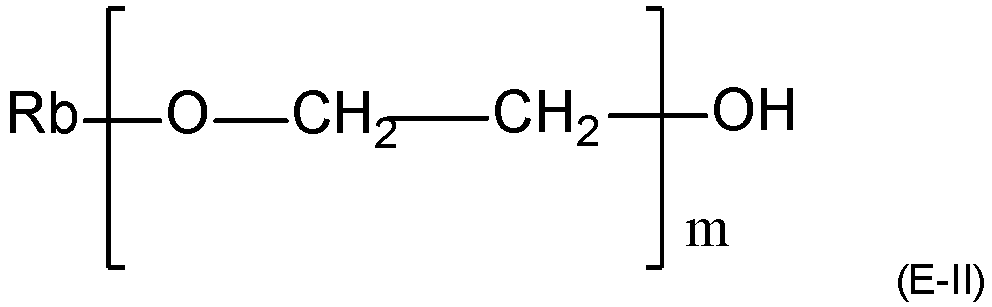
- Rb für eine gesättigte oder ungesättigte, unverzweigte oder verzweigte C12-C24-Alkylgruppe steht und und
- m für eine ganze Zahl von 20 bis 40, bevorzugt für eine ganze Zahl von 20 bis 35 und besonders bevorzugt für die Zahl 30, steht.
- Rb represents a saturated or unsaturated, unbranched or branched C 12 -C 24 alkyl group and and
- m stands for an integer from 20 to 40, preferably for an integer from 20 to 35 and particularly preferably for the number 30.
In einer weiteren ganz besonders bevorzugten Ausführungsform ist ein erfindungsgemäßes Mittel dadurch gekennzeichnet, dass es zusätzlich mindestens einen weiteren nichtionischen Emulgator (a4) der Formel (E-II) enthält,
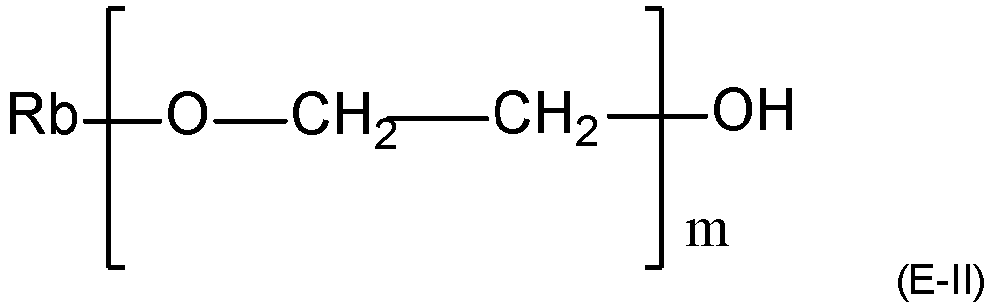
- Rb
- für eine gesättigte oder ungesättigte, unverzweigte oder verzweigte C12-C24-Alkylgruppe steht und und
- m
- für eine ganze Zahl von 20 bis 40, bevorzugt für eine ganze Zahl von 20 bis 35 und besonders bevorzugt für die Zahl 30, steht.
- Rb
- represents a saturated or unsaturated, unbranched or branched C 12 -C 24 alkyl group and and
- m
- stands for an integer from 20 to 40, preferably for an integer from 20 to 35 and particularly preferably for the number 30.
Bei einem besonders gut geeigneten nichtionischen Tensid dieses Typs handelt es sich um Ceteareth-30. Bei Ceteareth-30 handelt es sich um ein Gemisch aus Cetylalkohol und Stearylalkohol, die jeweils mit 30 Einheiten Ethylenoxid ethoxyliert sind. Das Gemisch aus Cetylalkohol und Stearylalkohol wird als Cetearylalkohol bezeichnet. Ceteareth-30 besitzt die
Weiterhin besonders gute Ergebnisse im Hinblick auf die Verbesserung der Farbintensität wurden erhalten, wenn das erfindungsgemäße Mittel zusätzlich zu den nichtionischen Tensiden (a1) ein weiteres nichtionisches Tensid (a5) enthielt. Bei diesem zusätzlichen nichtionischen Tensid (a5) handelt es sich ganz besonders bevorzugt um ein Tensid der Formel (E-III),

- Rc
- für eine gesättigte oder ungesättigte, unverzweigte oder verzweigte C12-C24-Alkylgruppe steht und und
- o
- für eine ganze Zahl von 80 bis 120, bevorzugt für eine ganze Zahl von 90 bis 110 und besonders bevorzugt für die Zahl 100, steht.
- Rc
- represents a saturated or unsaturated, unbranched or branched C 12 -C 24 alkyl group and and
- O
- stands for an integer from 80 to 120, preferably for an integer from 90 to 110 and particularly preferably for the number 100.
In einer weiteren ganz besonders bevorzugten Ausführungsform ist ein erfindungsgemäßes Mittel dadurch gekennzeichnet, dass es dass es zusätzlich mindestens einen weiteren nichtionischen Emulgator (a5) der Formel (E-III) enthält,

- Rc
- für eine gesättigte oder ungesättigte, unverzweigte oder verzweigte C12-C24-Alkylgruppe steht und und
- o
- für eine ganze Zahl von 80 bis 120, bevorzugt für eine ganze Zahl von 90 bis 110 und besonders bevorzugt für die Zahl 100, steht.
- Rc
- represents a saturated or unsaturated, unbranched or branched C 12 -C 24 alkyl group and and
- O
- stands for an integer from 80 to 120, preferably for an integer from 90 to 110 and particularly preferably for the number 100.
Ein besonders gut geeignetes nichtionisches Tensid dieses Typs trägt den Handelsnamen Brij S 100 bzw. Brij S 100 PA SG. Hierbei handelt es sich um Stearylalkohol, ethoxyliert mit 100 EO, der von der Firma Croda kommerziell erhältlich ist und die
Es hat sich als ganz besonders bevorzugt erwiesen, wenn das Mittel zusätzlich sowohl mindestens ein nichtionisches Tensid der Formel (E-I) als auch mindestens ein nichtionisches Tensid der Formel (E-II) enthält.It has proven to be particularly preferred if the agent additionally contains both at least one non-ionic surfactant of the formula (E-I) and at least one non-ionic surfactant of the formula (E-II).
Der Einsatz von Lösungsmitteln hat weiterhin zu sehr guten Ergebnissen geführt. Aus diesem Grund kann das erfindungsgemäße Mittel als optionalen Bestandteil zusätzlich mindestens ein Lösungmittel enthalten.The use of solvents has also led to very good results. For this reason, the agent according to the invention can additionally contain at least one solvent as an optional component.
Als geeignete Lösungsmittel können beispielsweise Lösungsmittel aus der Gruppe aus 1,2-Propylenglycol, 1,3-Propylenglycol, Ethylenglycol, 1,2- Butylenglycol, Dipropylenglycol, Ethanol, Isopropanol, Diethylenglycolmonoethylether, Glycerin, Phenoxyethanol und Benzylalkohol eingesetzt werden. Der Einsatz von 1,2-Propylenglycol ist ganz besonders bevorzugt.Suitable solvents include, for example, solvents from the group consisting of 1,2-propylene glycol, 1,3-propylene glycol, ethylene glycol, 1,2-butylene glycol, dipropylene glycol, ethanol, isopropanol, diethylene glycol monoethyl ether, glycerin, phenoxyethanol, and benzyl alcohol. The use of 1,2-propylene glycol is particularly preferred.
In einer weiteren ganz besonders bevorzugten Ausführungsform ist ein erfindungsgemäßes Mittel dadurch gekennzeichnet, dass es mindestens ein Lösungsmittel aus der Gruppe aus 1,2-Propylenglycol, 1,3-Propylenglycol, Ethylenglycol, 1,2- Butylenglycol, Dipropylenglycol, Ethanol, Isopropanol, Diethylenglycolmonoethylether, Glycerin, Phenoxyethanol und Benzylalkohol, ganz besonders bevorzugt 1,2-Propylenglycol, enthält.In a further very particularly preferred embodiment, an agent according to the invention is characterized in that it contains at least one solvent from the group consisting of 1,2-propylene glycol, 1,3-propylene glycol, ethylene glycol, 1,2-butylene glycol, dipropylene glycol, ethanol, isopropanol, diethylene glycol monoethyl ether, glycerol, phenoxyethanol and benzyl alcohol, very particularly preferably 1,2-propylene glycol.
1,2-Propylenglycol wird alternativ auch als 1,2-Propandiol bezeichnet wird und trägt die
Alle zuvor beschriebenen Lösungsmittel sind bei verschiedenen Chemikalien-Lieferanten wie beispielsweise Aldrich oder Fluka kommerziell erhältlich.All solvents described above are commercially available from various chemical suppliers such as Aldrich or Fluka.
Durch Verwendung der vorgenannten Lösungsmittel in geeigneten Einsatzmengen kann ein besonders stabiles Mittel erhalten werden, mit dem sich auf dem keratinischen Material Farbergebnisse mit ganz besonders hoher Intensität erhalten lassen.By using the aforementioned solvents in suitable quantities, a particularly stable agent can be obtained with which color results of particularly high intensity can be achieved on the keratin material.
In einer weiteren bevorzugten Ausführungsform ist ein erfindungsgemäßes Mittel dadurch gekennzeichnet, dass es - bezogen auf das Gesamtgewicht des Mittels- ein oder mehrere Lösungsmittel in einer Gesamtmenge von 1,0 bis 20,0 Gew.-%, bevorzugt 2,0 bis 15,0 Gew.-%, weiter bevorzugt 3,0 bis 15,0 Gew.-% und ganz besonders bevorzugt 4,0 bis 10,0 Gew.% 1,2-Propylenglycol enthält.In a further preferred embodiment, an agent according to the invention is characterized in that it contains - based on the total weight of the agent - one or more Solvent in a total amount of 1.0 to 20.0 wt.%, preferably 2.0 to 15.0 wt.%, more preferably 3.0 to 15.0 wt.% and most preferably 4.0 to 10.0 wt.% 1,2-propylene glycol.
Das erfindungsgemäße Mittel kann zusätzlich auch mindestens ein filmbildendes Polymer enthalten. Das filmbildende Polymer kann zum Beispiel ausgewählt ist aus der Gruppe aus Polyvinylpyrrolidon (PVP), Vinylpyrrolidon/Vinylacetat-Copolymeren, Vinylpyrrolidon/Styren-Copolymeren, Vinylpyrrolidon/Ethylen-Copolymeren, Vinylpyrrolidon/Propylen-Copolymeren, Vinylpyrrolidon/Vinylcaprolactam-Copolymeren, Vinylpyrrolidon/Vinylformamid-Copolymeren und/oder Vinylpyrrolidon/Vinylalkohol-Copolymeren, explizit ganz besonders bevorzugt Polyvinylpyrrolidon (PVP).The agent according to the invention can additionally contain at least one film-forming polymer. The film-forming polymer can, for example, be selected from the group consisting of polyvinylpyrrolidone (PVP), vinylpyrrolidone/vinyl acetate copolymers, vinylpyrrolidone/styrene copolymers, vinylpyrrolidone/ethylene copolymers, vinylpyrrolidone/propylene copolymers, vinylpyrrolidone/vinylcaprolactam copolymers, vinylpyrrolidone/vinylformamide copolymers, and/or vinylpyrrolidone/vinyl alcohol copolymers, explicitly most preferably polyvinylpyrrolidone (PVP).
Weitere geiegnete filmbildende Polymere können augewählt sein aus der Gruppe der Copolymere von Acrylsäure, der Copolymere der Methacrylsäure, der Homopolymere oder Copolymere von Acrylsäure-Estern, der Homopolymere oder Copolymere von Methacrylsäure-Estern, der Homopolymere oder Copolymere von Acrylsäureamiden, der Homopolymere oder Copolymere von Methacrylsäure-Amiden, der Copolymere des Vinylpyrrolidons, der Copolymere des Vinylalkohols, der Copolymere des Vinylacetats, der Homopolymere oder Copolymere des Ethylens, der Homopolymere oder Copolymere des Propylens, der Homopolymere oder Copolymere des Styrens, der Polyurethane, der Polyester und/oder der Polyamide.Further suitable film-forming polymers can be selected from the group of copolymers of acrylic acid, copolymers of methacrylic acid, homopolymers or copolymers of acrylic acid esters, homopolymers or copolymers of methacrylic acid esters, homopolymers or copolymers of acrylic acid amides, homopolymers or copolymers of methacrylic acid amides, copolymers of vinylpyrrolidone, copolymers of vinyl alcohol, copolymers of vinyl acetate, homopolymers or copolymers of ethylene, homopolymers or copolymers of propylene, homopolymers or copolymers of styrene, polyurethanes, polyesters and/or polyamides.
Es haben sich insbesondere die filmbildenden Polymere als gut geeignet erwiesen, die aus der Gruppe der synthetischen Polymere, der durch radikalische Polymerisation erhältlichen Polymere oder der natürlichen Polymere ausgewählt werden.In particular, film-forming polymers selected from the group of synthetic polymers, polymers obtainable by radical polymerization or natural polymers have proven to be particularly suitable.
Weitere besonders gut geeignete filmbildende Polymere können ausgewählt werden aus den Homopolymere oder Copolymeren von Olefinen, wie beispielsweise Cycloolefinen, Butadien, Isopren oder Styren, Vinylethern, Vinylamiden, den Estern oder Amiden von (Meth)Acrylsäure mit mindestens einer C1-C20-Alkylgruppe, einer Arylgruppe oder einer C2-C10-Hydroxyalkylgruppe.Other particularly suitable film-forming polymers can be selected from the homopolymers or copolymers of olefins, such as cycloolefins, butadiene, isoprene or styrene, vinyl ethers, vinylamides, the esters or amides of (meth)acrylic acid with at least one C 1 -C 20 alkyl group, an aryl group or a C 2 -C 10 hydroxyalkyl group.
Weitere filmbildende Polymere können ausgewählt sein aus den Homo- oder Copolymeren von Isooctyl-(meth)acrylat; Isononyl-(meth)acrylat; 2-Ethylhexyl-(meth)acrylat; Lauryl-(meth)acrylat); isopentyl-(meth)acrylat; n-Butyl-(meth)acrylat); Isobutyl-(meth)acrylat; Ethyl-(meth)acrylat; Methyl-(meth)acrylat; tert-Butyl-(meth)acrylat; Stearyl-(meth)acrylat; Hydroxyethyl-(meth)acrylat; 2-Hydroxypropyl-(methacrylat; 3-Hydroxypropyl-(meth)acrylat und/oder Gemischen hiervon.Further film-forming polymers can be selected from the homo- or copolymers of isooctyl (meth)acrylate; isononyl (meth)acrylate; 2-ethylhexyl (meth)acrylate; lauryl (meth)acrylate; isopentyl (meth)acrylate; n-butyl (meth)acrylate); isobutyl (meth)acrylate; ethyl (meth)acrylate; methyl (meth)acrylate; tert-butyl (meth)acrylate; stearyl (meth)acrylate; hydroxyethyl (meth)acrylate; 2-hydroxypropyl (meth)acrylate; 3-hydroxypropyl (meth)acrylate and/or mixtures thereof.
Weitere filmbildende Polymere können ausgewählt sein aus den Homo- oder Copolymeren von (Meth)acrylamid; N-Alkyl-(meth)acrylamiden, insbesondere solchen mit C2-C18 Alkylgruppen, wie beispielsweise N-Ethyl-acrylamid, N-tert-butyl-acrylamid, le N-Octyl-crylamid; N-Di(C1-C4)alkyl-(meth)acrylamid.Further film-forming polymers can be selected from the homo- or copolymers of (meth)acrylamide; N-alkyl-(meth)acrylamides, in particular those with C2-C18 alkyl groups, such as for example N-ethyl acrylamide, N-tert-butyl acrylamide, le N-octyl acrylamide; N-Di(C1-C4)alkyl-(meth)acrylamide.
Weitere geeignete anionische Copolymere sind beispielsweise Copolymere aus Acrylsäure, Methacrylsäure oder deren C1-C6-Alkylestern, wie sie unter der INCI-Deklaration Acrylates Copolymere vertrieben werden. Ein geeignetes Handelsprodukt ist beispielsweise Aculyn® 33 der Firma Rohm & Haas. Weiterhin bevorzugt sind aber auch Copolymere aus Acrylsäure, Methacrylsäure oder deren C1-C6-Alkylestern und den Estern einer ethylenisch ungesättigten Säure und einem alkoxylierten Fettalkohol. Geeignete ethylenisch ungesättigte Säuren sind insbesondere Acrylsäure, Methacrylsäure und Itaconsäure; geeignete alkoxylierte Fettalkohole sind insbesondere Steareth-20 oder Ceteth-20.Other suitable anionic copolymers include, for example, copolymers of acrylic acid, methacrylic acid, or their C 1 -C 6 alkyl esters, as sold under the INCI declaration "Acrylates Copolymers." A suitable commercial product is, for example, Aculyn® 33 from Rohm & Haas. Also preferred are copolymers of acrylic acid, methacrylic acid, or their C 1 -C 6 alkyl esters and the esters of an ethylenically unsaturated acid and an alkoxylated fatty alcohol. Suitable ethylenically unsaturated acids are, in particular, acrylic acid, methacrylic acid, and itaconic acid; suitable alkoxylated fatty alcohols are, in particular, Steareth-20 or Ceteth-20.
Auf dem Markt befindliche Polymere sind beispielsweise Aculyne 22 (Acrylates/Steareth-20 Methacrylate Copolymer), Aculyne 28 (Acrylates/Beheneth-25 Methacrylate Copolymer), Structure 2001®(Acryla-tes/Steareth-20 Itaconate Copolymer), Structure 3001®(Acrylates/Ceteth-20 Itaconate Copolymer), Structure Plus®(Acrylates/Aminoacrylates C10-30 Alkyl PEG-20 Itaconate Copolymer), Carbopol® 1342, 1382, Ultrez 20, Ultrez 21 (Acrylates/C10-30 Alkyl Acrylate Crosspolymer), Synthalen W 2000® (Acrylates/Palmeth-25 Acrylate Copolymer) oder das Rohme und Haas vertriebene Soltex OPT (Acrylates/C12-22 Alkyl methacrylate Copolymer).Polymers currently on the market include Aculyne 22 (Acrylates/Steareth-20 Methacrylate Copolymer), Aculyne 28 (Acrylates/Beheneth-25 Methacrylate Copolymer), Structure 2001 ® (Acrylates/Steareth-20 Itaconate Copolymer), Structure 3001 ® (Acrylates/Ceteth-20 Itaconate Copolymer), Structure Plus ® (Acrylates/Aminoacrylates C10-30 Alkyl PEG-20 Itaconate Copolymer), Carbopol ® 1342, 1382, Ultrez 20, Ultrez 21 (Acrylates/C10-30 Alkyl Acrylate Crosspolymer), Synthalen W 2000 ® (Acrylates/Palmeth-25 Acrylate Copolymer) or Soltex OPT (Acrylates/C12-22 Alkyl methacrylate copolymer).
Als geeignete Polymere auf der Basis von Vinyl-Monomeren können beispielsweise genannt werden die Homo- und Copolymere des N-Vinylpyrrolidons, des Vinylcaprolactams, des Vinyl-(C1-C6-)alkyl-Pyrrols, des Vinyl-oxazols, des Vinyl-thiazols, des Vinylpyrimidins, des Vinylimidazols.Suitable polymers based on vinyl monomers include, for example, the homo- and copolymers of N-vinylpyrrolidone, vinylcaprolactam, vinyl-(C1-C6)alkylpyrrole, vinyloxazole, vinylthiazole, vinylpyrimidine, and vinylimidazole.
Weiterhin geeignet sind die Copolymere Octylacrylamid/acrylates/ butylaminoethyl-methacrylate copolymer, wie es beispielsweise unter den Handelsnamen AMPHOMER® ou LOVOCRYL® 47 von NATIONAL STARCH kommerziell vertrieben wird, oder auch die Copolymere von Acrylates/Octylacrylamide die unter den Handelsnamen DERMACRYL® LT und DERMACRYL® 79 von NATIONAL STARCH vertrieben werden.Also suitable are the copolymers octylacrylamide/acrylates/butylaminoethyl-methacrylate copolymer, as sold commercially by NATIONAL STARCH under the trade names AMPHOMER ® or LOVOCRYL ® 47, or the copolymers of acrylates/octylacrylamide sold under the trade names DERMACRYL ® LT and DERMACRYL ® 79.
Als geeignete Polymere auf der Basis von Olefinen können beispielsweise genannt werden die Homo- und Copolymere des Ethylens, des Propylens, des Butens, des Isoprens und des Butadiens.Suitable polymers based on olefins include, for example, the homo- and copolymers of ethylene, propylene, butene, isoprene and butadiene.
Im Rahmen einer weiteren Ausführungsform können als filmbildende hydrophobe Polymere die Block-Copoylmere eingesetzt werden, die mindestens einen Block aus Styren oder den Derivaten des Styrens umfassen. Bei diesen Block-Copolymeren kann es sich um Copolymere handeln, die neben einem Styren-Block einen oder mehrere weitere Blöcke enthalten, wie beispielsweise Styren/Ethylen, Styren/Ethylen/Butylen, Styen/Butylen, Styren/Isopren, Styren/Butadien. Entsprechende Polymere werden von der BASF unter dem Handelsnamen "Luvitol HSB" kommerziell vertrieben.In a further embodiment, block copolymers comprising at least one block of styrene or styrene derivatives can be used as film-forming hydrophobic polymers. These block copolymers can be copolymers containing one or more additional blocks in addition to a styrene block, such as styrene/ethylene, styrene/ethylene/butylene, styrene/butylene, styrene/isoprene, styrene/butadiene. Corresponding polymers are marketed commercially by BASF under the trade name "Luvitol HSB".
Die Mittel können ferner auch noch weitere Wirk-, Hilfs- und Zusatzstoffe enthalten, wie beispielsweise Lösungsmittel, Strukturanten wie Glucose, Maleinsäure und Milchsäure, haarkonditionierende Verbindungen wie Phospholipide, beispielsweise Lecitin und Kephaline; Parfümöle, Dimethylisosorbid und Cyclodextrine; faserstrukturverbessernde Wirkstoffe, insbesondere Mono-, Di- und Oligosaccharide wie beispielsweise Glucose, Galactose, Fructose, Fruchtzucker und Lactose; Farbstoffe zum Anfärben des Mittels; Antischuppenwirkstoffe wie Piroctone Olamine, Zink Omadine und Climbazol; Aminosäuren und Oligopeptide; Proteinhydrolysate auf tierischer und/oder pflanzlicher Basis, sowie in Form ihrer Fettsäure-Kondensationsprodukte oder gegebenenfalls anionisch oder kationisch modifizierten Derivate; pflanzliche Öle; Lichtschutzmittel und UV-Blocker; Wirkstoffe wie Panthenol, Pantothensäure, Pantolacton, Allantoin, Pyrrolidinoncarbonsäuren und deren Salze sowie Bisabolol; Polyphenole, insbesondere Hydroxyzimtsäuren, 6,7-Dihydroxycumarine, Hydroxybenzoesäuren, Catechine, Tannine, Leukoanthocyanidine, Anthocyanidine, Flavanone, Flavone und Flavonole; Ceramide oder Pseudoceramide; Vitamine, Provitamine und Vitaminvorstufen; Pflanzenextrakte; Fette und Wachse wie Fettalkohole, Bienenwachs, Montanwachs und Paraffine; Quell- und Penetrationsstoffe wie Glycerin, Propylenglykolmonoethylether, Carbonate, Hydrogencarbonate, Guanidine, Harnstoffe sowie primäre, sekundäre und tertiäre Phosphate; Trübungsmittel wie Latex, Styrol/PVP- und Styrol/Acrylamid-Copolymere; Perlglanzmittel wie Ethylenglykolmono- und -distearat sowie PEG-3-distearat; sowie Treibmittel wie Propan-Butan-Gemische, N2O, Dimethylether, CO2 und Luft.The products may also contain other active ingredients, auxiliaries and additives, such as solvents, structuring agents such as glucose, maleic acid and lactic acid, hair conditioning compounds such as phospholipids, for example lecithin and cephalins; perfume oils, dimethyl isosorbide and cyclodextrins; fibre structure improving agents, in particular mono-, di- and oligosaccharides such as glucose, galactose, fructose, fructose and lactose; dyes for colouring the product; anti-dandruff agents such as piroctone olamine, zinc omadine and climbazole; amino acids and oligopeptides; protein hydrolysates of animal and/or plant origin, as well as in the form of their fatty acid condensation products or optionally anionically or cationically modified derivatives; vegetable oils; light protectants and UV blockers; Active ingredients such as panthenol, pantothenic acid, pantolactone, allantoin, pyrrolidinonecarboxylic acids and their salts and bisabolol; polyphenols, in particular hydroxycinnamic acids, 6,7-dihydroxycoumarins, hydroxybenzoic acids, catechins, tannins, leucoanthocyanidins, anthocyanidins, flavanones, flavones and flavonols; ceramides or pseudoceramides; vitamins, provitamins and vitamin precursors; plant extracts; fats and waxes such as fatty alcohols, beeswax, montan wax and paraffins; swelling and penetrating agents such as glycerol, propylene glycol monoethyl ether, carbonates, hydrogen carbonates, guanidines, ureas and primary, secondary and tertiary phosphates; opacifiers such as latex, styrene/PVP and styrene/acrylamide copolymers; Pearlescent agents such as ethylene glycol mono- and distearate and PEG-3 distearate; as well as propellants such as propane-butane mixtures, N2O , dimethyl ether, CO2 and air.
Die Auswahl dieser weiteren Stoffe wird der Fachmann gemäß der gewünschten Eigenschaften der Mittel treffen. Bezüglich weiterer fakultativer Komponenten sowie der eingesetzten Mengen dieser Komponenten wird ausdrücklich auf die dem Fachmann bekannten einschlägigen Handbücher verwiesen. Die zusätzlichen Wirk- und Hilfsstoffe werden in den erfindungsgemäßen Zubereitungen bevorzugt in Mengen von jeweils 0,0001 bis 25 Gew.-%, insbesondere von 0,0005 bis 15 Gew.-%, bezogen auf das Gesamtgewicht des jeweiligen Mittels, eingesetzt.The expert will select these additional substances based on the desired properties of the agent. Regarding further optional components and the amounts of these components used, reference is expressly made to the relevant manuals known to the expert. The additional active ingredients and excipients are preferably used in the preparations according to the invention in amounts of 0.0001 to 25 wt.%, in particular 0.0005 to 15 wt.%, based on the total weight of the respective agent.
Die pH-Werte des erfindungsgemäßen Mittels wird bevorzugt auf einen leicht sauren bis alkalischen pH-Wert eingestellt. Ganz besonders bevorzugt besitzt das Mittel einen alkalischen pH-Wert im Bereich von 4,0 bis 11,5 bevorzugt von 5,0 bis 11,0.The pH of the agent according to the invention is preferably adjusted to a slightly acidic to alkaline pH. The agent most preferably has an alkaline pH in the range of 4.0 to 11.5, preferably 5.0 to 11.0.
Zur Einstellung des gewünschten pH-Wertes kann das Mittel (a) und/oder (b) mindestens ein Alkalisierungsmittel enthalten. Bei den pH-Werten im Sinne der vorliegenden Erfindung handelt es sich um pH-Werte, die bei einer Temperatur von 22°C gemessen wurden.To adjust the desired pH, agent (a) and/or (b) may contain at least one alkalizing agent. The pH values within the meaning of the present invention are pH values measured at a temperature of 22°C.
Als Alkalisierungsmittel können die Mittel beispielsweise Ammoniak, Alkanolamine und/oder basische Aminosäuren enthalten.As alkalizing agents, the agents can contain, for example, ammonia, alkanolamines and/or basic amino acids.
Die in dem erfindungsgemäßen Mittel einsetzbaren Alkanolamine werden bevorzugt ausgewählt aus primären Aminen mit einem C2-C6-Alkylgrundkörper, der mindestens eine Hydroxylgruppe trägt. Bevorzugte Alkanolamine werden aus der Gruppe ausgewählt, die gebildet wird aus 2-Aminoethan-1-ol (Monoethanolamin), 3-Aminopropan-1-ol, 4-Aminobutan-1-ol, 5-Aminopentan-1-ol, 1-Aminopropan-2-ol, 1-Aminobutan-2-ol, 1-Aminopentan-2-ol, 1-Aminopentan-3-ol, 1-Aminopentan-4-ol, 3-Amino-2-methylpropan-1-ol, 1-Amino-2-methylpropan-2-ol, 3-Aminopropan-1,2-diol, 2-Amino-2-methylpropan-1,3-diol.The alkanolamines usable in the agent according to the invention are preferably selected from primary amines having a C 2 -C 6 alkyl parent structure bearing at least one hydroxyl group. Preferred alkanolamines are selected from the group consisting of 2-aminoethan-1-ol (monoethanolamine), 3-aminopropan-1-ol, 4-aminobutan-1-ol, 5-aminopentan-1-ol, 1-aminopropan-2-ol, 1-aminobutan-2-ol, 1-aminopentan-2-ol, 1-aminopentan-3-ol, 1-aminopentan-4-ol, 3-amino-2-methylpropan-1-ol, 1-amino-2-methylpropan-2-ol, 3-aminopropan-1,2-diol, and 2-amino-2-methylpropan-1,3-diol.
Erfindungsgemäß besonders bevorzugte Alkanolamine werden ausgewählt aus 2-Aminoethan-1-ol und/oder 2-Amino-2-methylpropan-1-ol. Eine besonders bevorzugte Ausführungsform ist daher dadurch gekennzeichnet, dass das erfindungsgemäße Mittel als Alkalisierungsmittel ein Alkanolamin ausgewählt aus 2-Aminoethan-1-ol und/oder 2-Amino-2-methylpropan-1-ol enthält.Particularly preferred alkanolamines according to the invention are selected from 2-aminoethane-1-ol and/or 2-amino-2-methylpropane-1-ol. A particularly preferred embodiment is therefore characterized in that the agent according to the invention contains an alkanolamine selected from 2-aminoethane-1-ol and/or 2-amino-2-methylpropane-1-ol as alkalizing agent.
Als Aminosäure im Sinne der Erfindung gilt eine organische Verbindung, die in ihrer Struktur mindestens eine protonierbare Aminogruppe und mindestens eine -COOH- oder eine -SO3H-Gruppe enthält. Bevorzugte Aminosäuren sind Aminocarbonsäuren, insbesondere α-(alpha)-Aminocarbonsäuren und ω-Aminocarbonsäuren, wobei α-Aminocarbonsäuren besonders bevorzugt sind.An amino acid within the meaning of the invention is an organic compound that contains in its structure at least one protonatable amino group and at least one -COOH or -SO 3 H group. Preferred amino acids are aminocarboxylic acids, in particular α-(alpha)-aminocarboxylic acids and ω-aminocarboxylic acids, with α-aminocarboxylic acids being particularly preferred.
Unter basischen Aminosäuren sind erfindungsgemäß solche Aminosäuren zu verstehen, welche einen isoelektrischen Punkt pl von größer 7,0 besitzen.According to the invention, basic amino acids are those amino acids which have an isoelectric point pl of greater than 7.0.
Basische α-Aminocarbonsäuren enthalten mindestens ein asymmetrisches Kohlenstoffatom. Im Rahmen der vorliegenden Erfindung können beide möglichen Enantiomere als spezifische Verbindung oder auch deren Gemische, insbesondere als Racemate, gleichermaßen eingesetzt werden. Es ist jedoch besonders vorteilhaft, die natürlich bevorzugt vorkommende Isomerenform, üblicherweise in L-Konfiguration, einzusetzen.Basic α-aminocarboxylic acids contain at least one asymmetric carbon atom. Within the scope of the present invention, both possible enantiomers can be used equally as specific compounds or as mixtures thereof, particularly as racemates. However, it is particularly advantageous to use the naturally occurring isomer form, usually in the L-configuration.
Die basischen Aminosäuren werden bevorzugt ausgewählt aus der Gruppe, die gebildet wird aus Arginin, Lysin, Ornithin und Histidin, besonders bevorzugt aus Arginin und Lysin. In einer weiteren besonders bevorzugten Ausführungsform ist ein erfindungsgemäßes Mittel daher dadurch gekennzeichnet, dass es sich bei dem Alkalisierungsmittel um eine basische Aminosäure aus der Gruppe Arginin, Lysin, Ornithin und/oder Histidin handelt.The basic amino acids are preferably selected from the group consisting of arginine, lysine, ornithine, and histidine, particularly preferably arginine and lysine. In another particularly preferred embodiment, an agent according to the invention is characterized in that the alkalizing agent is a basic amino acid from the group consisting of arginine, lysine, ornithine, and/or histidine.
Darüber hinaus kann das Mittel weitere Alkalisierungsmittel, insbesondere anorganische Alkalisierungsmittel enthalten. Erfindungsgemäß einsetzbare, anorganische Alkalisierungsmittel sind bevorzugt ausgewählt aus der Gruppe, die gebildet wird aus Natriumhydroxid, Kaliumhydroxid, Calciumhydroxid, Bariumhydroxid, Natriumphosphat, Kaliumphosphat, Natriumsilicat, Natriummetasilicat, Kaliumsilicat, Natriumcarbonat und Kaliumcarbonat.In addition, the agent may contain further alkalizing agents, particularly inorganic alkalizing agents. Inorganic alkalizing agents that can be used according to the invention are preferably selected from the group consisting of sodium hydroxide, potassium hydroxide, Calcium hydroxide, barium hydroxide, sodium phosphate, potassium phosphate, sodium silicate, sodium metasilicate, potassium silicate, sodium carbonate and potassium carbonate.
Ganz besonders bevorzugte Alkalisierungsmittel sind Ammoniak, 2-Aminoethan-1-ol (Monoethanolamin), 3-Aminopropan-1-ol, 4-Aminobutan-1-ol, 5-Aminopentan-1-ol, 1-Aminopropan-2-ol, 1-Aminobutan-2-ol, 1-Aminopentan-2-ol, 1-Aminopentan-3-ol, 1-Aminopentan-4-ol, 3-Amino-2-methylpropan-1-ol, 1-Amino-2-methylpropan-2-ol, 3-Aminopropan-1,2-diol, 2-Amino-2-methylpropan-1,3-diol, Arginin, Lysin, Ornithin, Histidin, Natriumhydroxid, Kaliumhydroxid, Calciumhydroxid, Bariumhydroxid, Natriumphosphat, Kaliumphosphat, Natriumsilicat, Natriummetasilicat, Kaliumsilicat, Natriumcarbonat und Kaliumcarbonat.Very particularly preferred alkalizing agents are ammonia, 2-aminoethan-1-ol (monoethanolamine), 3-aminopropan-1-ol, 4-aminobutan-1-ol, 5-aminopentan-1-ol, 1-aminopropan-2-ol, 1-aminobutan-2-ol, 1-aminopentan-2-ol, 1-aminopentan-3-ol, 1-aminopentan-4-ol, 3-amino-2-methylpropan-1-ol, 1-amino-2-methylpropan-2-ol, 3-aminopropan-1,2-diol, 2-amino-2-methylpropan-1,3-diol, arginine, lysine, ornithine, histidine, sodium hydroxide, potassium hydroxide, calcium hydroxide, barium hydroxide, sodium phosphate, potassium phosphate, sodium silicate, sodium metasilicate, potassium silicate, sodium carbonate and potassium carbonate.
In einer weiteren ganz besonders bevorzugten Ausführungsform ist ein erfindungsgemäßes Verfahren dadurch gekennzeichnet, dass das Färbemittel (a) mindestens ein Alkalisierungsmittel aus der Gruppe aus Ammoniak, 2-Aminoethan-1-ol (Monoethanolamin), 3-Aminopropan-1-ol, 4-Aminobutan-1-ol, 5-Aminopentan-1-ol, 1-Aminopropan-2-ol, 1-Aminobutan-2-ol, 1-Aminopentan-2-ol, 1-Aminopentan-3-ol, 1-Aminopentan-4-ol, 3-Amino-2-methylpropan-1-ol, 1-Amino-2-methyl-propan-2-ol, 3-Aminopropan-1,2-diol, 2-Amino-2-methylpropan-1,3-diol, Arginin, Lysin, Ornithin, Histidin, Natriumhydroxid, Kaliumhydroxid, Calciumhydroxid, Bariumhydroxid, Natriumphosphat, Kaliumphosphat, Natriumsilicat, Natriummetasilicat, Kaliumsilicat, Natriumcarbonat und Kaliumcarbonat enthält.In a further particularly preferred embodiment, a process according to the invention is characterized in that the coloring agent (a) comprises at least one alkalizing agent from the group consisting of ammonia, 2-aminoethan-1-ol (monoethanolamine), 3-aminopropan-1-ol, 4-aminobutan-1-ol, 5-aminopentan-1-ol, 1-aminopropan-2-ol, 1-aminobutan-2-ol, 1-aminopentan-2-ol, 1-aminopentan-3-ol, 1-aminopentan-4-ol, 3-amino-2-methylpropan-1-ol, 1-amino-2-methylpropan-2-ol, 3-aminopropan-1,2-diol, 2-amino-2-methylpropan-1,3-diol, arginine, lysine, ornithine, histidine, sodium hydroxide, potassium hydroxide, calcium hydroxide, barium hydroxide, sodium phosphate, potassium phosphate, Contains sodium silicate, sodium metasilicate, potassium silicate, sodium carbonate and potassium carbonate.
Zur Einstellung des gewünschten pH-Wertes kann das erfindungsgemäße Mittel auch mindestens ein ein Puffersystem aus mindestens einer anorganischen oder organischen Säure und mindestens einem Salz dieser Säure enthalten.To adjust the desired pH value, the agent according to the invention may also contain at least one buffer system consisting of at least one inorganic or organic acid and at least one salt of this acid.
Eine ganz besonders gut geeignete anorganische Säure ist hierbe Kaliumdihydrogenphosphat Kaliumdihydrogenphosphat besitzt die Summenformel KH2PO4 und trägt die
Eine weitere ganz besonders gut geeignete anorganische Säure (b2-I) ist Natriumdihydrogenphosphat. Natriumdihydrogenphosphat besitzt die Summenformel NaH2PO4 und trägt die
Besonders bevorzugt als korrespondierendes Salz der vorgenannten beiden Säuren ist Dikaliumhydrogenphosphat. Dikaliumhydrogenphosphat besitzt die Summenformel K2HPO4 und trägt die
Ebenfalls besonders bevorzugt als korresprondierdens Salz der vorgenannten beiden Säuren (b2-II) ist Dinatriumhydrogenphosphat. Dinatriumhydrogenphosphat besitzt die Summenformel Na2HPO4 und trägt die
Die zuvor beschriebenen Mittel lassen sich hervorragend in Verfahren zum Färben von keratinischem Material, insbesondere von menschlichen Haaren, einsetzen.The agents described above can be used excellently in processes for dyeing keratin material, especially human hair.
Ein zweiter Gegenstand der vorliegenden Erfindung ist daher ein Verfahren zum Färben von keratinischem Material, insbesondere menschlichen Haaren, bei welchem ein Mittel, wie es bei der Beschreibung des ersten Erfindungsgegenstands im Detail offenbart wurde, auf die keratinischen Fasern aufgetragen wird und gegebenenfalls nach einer Einwirkzeit von 30 Sekunden bis 45 Minuten wieder ausgespült wird.A second subject of the present invention is therefore a method for dyeing keratinic material, in particular human hair, in which an agent as disclosed in detail in the description of the first subject of the invention is applied to the keratinic fibers and, if appropriate, rinsed out again after a contact time of 30 seconds to 45 minutes.
Mit anderen Worten ist ein zweiter Gegenstand der Erfindung ein Verfahren zum Färben von keratinischen Fasern, insbesondere menschlichen Haaren, umfassend die folgenden Schritte:
- (1) Anwendung eines Färbemittels auf dem keratinischem Material, wobei das Färbemittel ein Mittel ist, wie es bei der Beschreibung der ersten Erfindungsgegenstand im Detail offenbart wurde,
- (2) Einwirken des Färbemittels auf dem keratinischen Material und
- (3) Ausspülen des Färbemittels mit Wasser.
- (1) applying a coloring agent to the keratinic material, wherein the coloring agent is an agent as disclosed in detail in the description of the first subject matter of the invention,
- (2) Action of the dye on the keratin material and
- (3) Rinse out the dye with water.
In Schritt (1) des erfindungsgemäßen Verfahrens wird das Mittel des ersten Erfindungsgegenstand auf dem keratinische Material, bei dem es sich ganz besonders bevorzugt um menschliche Haare handelt, angewendet.In step (1) of the method according to the invention, the agent of the first subject matter of the invention is applied to the keratinic material, which is most preferably human hair.
In Schritt (2) des erfindungsgemäßen Verfahrens wird das Mittel dann nach seiner Applikation auf das keratinische Material einwirken gelassen. In diesem Zusammenhang sind verschiedene Einwirkzeiten von beispielsweise 30 Sekunden bis 60 Minuten denkbar.In step (2) of the method according to the invention, the agent is then allowed to act on the keratin material after its application. Various exposure times, for example, from 30 seconds to 60 minutes, are conceivable.
Ein großer Vorteil des erfindungsgemäßen Färbesystems liegt jedoch darin, dass auch in sehr kurzen Zeiträumen nach kurzen Einwirkzeiten ein intensive Farbergebnis erzielt werden kann. Aus diesem Grund ist es von Vorteil, wenn die Anwendungsmischung nach ihrer Applikation nur für vergleichsweise kurze Zeiträume von 30 Sekunden bis 15 Minuten, bevorzugt von 30 Sekunden bis 10 Minuten, und besonders bevorzugt von 1 bis 5 Minuten auf dem Keratinmaterial verbleibt.However, a major advantage of the dyeing system according to the invention is that an intensive color result can be achieved even in very short periods of time after short exposure times. For this reason, it is advantageous if the application mixture remains on the keratin material after its application only for comparatively short periods of 30 seconds to 15 minutes, preferably from 30 seconds to 10 minutes, and particularly preferably from 1 to 5 minutes.
In einer weiteren bevorzugten Ausführungsform ist ein erfindungsgemäßes Verfahren gekennzeichnet durch das
(2) Einwirken des Färbemittels auf dem keratinischen Material für einen Zeitraum von 30 Sekunden bis 15 Minuten, bevorzugt von 30 Sekunden bis 10 Minuten, und besonders bevorzugt von 1 bis 5 Minuten.In a further preferred embodiment, a method according to the invention is characterized by
(2) Allowing the colorant to act on the keratinic material for a period of time from 30 seconds to 15 minutes, preferably from 30 seconds to 10 minutes, and particularly preferably from 1 to 5 minutes.
Im Anschluss an das Einwirken der Anwendungsmischung auf das Keratinmaterial wird diese schließlich in Schritt (3) des Verfahrens mit Wasser ausgespült.After the application mixture has acted on the keratin material, it is finally rinsed out with water in step (3) of the process.
Hierbei kann die Awendungsmischung in einer Ausführungsform nur mit Wasser, d.h. ohne Zuhilfenahme eines Nachbehandlungsmittels oder eines Shampoos, ausgewaschen werden. Auch die Anwendung eines Nachbehandlungsmittels oder Conditioners in Schritt (6) ist prinzipiell denkbar.In one embodiment, the application mixture can be washed out with water alone, i.e., without the aid of a post-treatment agent or shampoo. The use of a post-treatment agent or conditioner in step (6) is also conceivable in principle.
Zur Lösung der erfindungsgemäßen Aufgabenstellung und zur Erhöhung des Anwendungskomforts hat es sich jedoch als ganz besonders bevorzugt herausgestellt, das Ausspülen des Mittels in Schritt (3) ausschließlich mit Wasser ohne Zuhilfenahme eines weiteren Nachbehandlungsmittels, Shampoos oder Conditioners vorzunehmen.However, in order to achieve the object of the invention and to increase the comfort of use, it has been found to be particularly preferred to rinse out the agent in step (3) exclusively with water without the aid of any further after-treatment agent, shampoo or conditioner.
In einer weiteren bevorzugten Ausführungsform ist ein erfindungsgemäßes Verfahren gekennzeichnet durch das
(3) Ausspülen des Färbemittels ausschließlich mit Wasser.In a further preferred embodiment, a method according to the invention is characterized by
(3) Rinse out the dye with water only.
Wie bereits zuvor beschrieben, handelt es sich bei dem Mittel des ersten Erfindungsgegenstands um ein anwendungsbereits Mittel, das dem Anwender entweder direkt in seiner anwendungsbereiten Form zur Verfügung gestellt wird, oder aber das erst kurz vor der Anwendung durch Vermischen von verschiedenen Mitteln hergestellt wird.As already described above, the agent of the first subject matter of the invention is a ready-to-use agent that is either made available to the user directly in its ready-to-use form or that is prepared by mixing different agents shortly before use.
Um eine besonders feine Verteilung der Pigmente zu gewährleisten, hat es sich als ganz besonders bevorzugt herausgestellt, das anwendungsbereite Mittel kurz vor der Anwendung durch Vermischen von zwei oder drei verschiedenen Mitteln herzustellen.In order to ensure a particularly fine distribution of the pigments, it has proven particularly preferable to prepare the ready-to-use agent shortly before use by mixing two or three different agents.
Im Rahmen einer besonders bevorzugten Ausführungsform wird das anwendungsbereite Mittel demnach durch Vermischen von mindestens zwei verschiedenen Mitteln hergestellt, wobei das erste dieser beiden Mittel das Gemisch aus nichtionischem Emulgator (a1) und Pigment(en) (a2) umfasst. So kann das Gemisch aus nichtionischem Emulgator (a1) und Pigment(en) (a2) beispielsweise eine Vordispersion darstellen, die in Form eines Konzentrats zur Verfügung gestellt wird. Das zweite Mittel enthält mindestens ein aminofunkionalisiertes Silikonpolymer (a3) und kann beispielsweise eine wasserhaltige, kosmetische Trägerformulierung darsellen. Es ist ebenfalls erfindungsgemäß, wenn das erste Mittel, welches das Gemisch aus nichtionischem Emulgator (a1) und Pigment(en) (a2) umfasst, eine wasserhaltige kosmetische Trägerformulierung darstellt und das zweite Mittel, welches das aminofunkionalisiertes Silikonpolymer (a3) beinhaltet, in Form eines Konzentrats vorliegt. Zur Herstellung des anwendungsbereiten Mittes werden die beiden vorgenannten Mittel dann miteinander verschüttelt oder verrührt.In a particularly preferred embodiment, the ready-to-use agent is prepared by mixing at least two different agents, the first of these two agents comprises the mixture of non-ionic emulsifier (a1) and pigment(s) (a2). Thus, the mixture of non-ionic emulsifier (a1) and pigment(s) (a2) can, for example, represent a pre-dispersion that is provided in the form of a concentrate. The second agent contains at least one amino-functionalized silicone polymer (a3) and can, for example, represent a water-containing, cosmetic carrier formulation. It is also according to the invention if the first agent, which comprises the mixture of non-ionic emulsifier (a1) and pigment(s) (a2), represents a water-containing cosmetic carrier formulation and the second agent, which contains the amino-functionalized silicone polymer (a3), is in the form of a concentrate. To prepare the ready-to-use agent, the two aforementioned agents are then shaken or stirred together.
Ein weiterer Gegenstand der vorliegenden Anmeldung ist daher ein Verfahren zum Färben von keratinischem Material, insbesondere menschlichen Haaren, umfassend die folgenden Schritte:
- (1) Bereitstellung eines Mittels (I), wobei das Mittel (I) enthält:
- (a1) mindestens einen nichtionischen Emulgator mit einem HLB-Wert von 4,0 bis 12,0, und
- (a2) mindestens ein Pigment,
- (2) Bereitstellung eines Mittels (II), wobei das Mittel (II) enthält:
(a3) mindestens ein aminofunktionalisiertes Silikonpolymer, und - (3) Herstellung einer Anwendungsmischung durch Vermischen des Mittels (I) mit dem Mittel (II),
- (4) Applizieren der in Schritt (3) hergestellten Anwendungsmischung auf dem keratinischen Material,
- (5) Einwirken der in Schritt (4) applizierten Anwendungsmischung auf dem keratinischen Material und
- (6) Ausspülen der Anwendungsmischung mit Wasser,
- (1) Provision of an agent (I), the agent (I) containing:
- (a1) at least one non-ionic emulsifier having an HLB value of 4.0 to 12.0, and
- (a2) at least one pigment,
- (2) Provision of a means (II), the means (II) containing:
(a3) at least one amino-functionalized silicone polymer, and - (3) Preparation of an application mixture by mixing agent (I) with agent (II),
- (4) Applying the application mixture prepared in step (3) to the keratin material,
- (5) Allowing the application mixture applied in step (4) to act on the keratin material and
- (6) Rinse the application mixture with water,
Die optional zusätzlich anwendbaren nichtionischen Emulgatoren (a4) und/oder (a5) können im Rahmen dieser Ausführungsform beispielsweise im Mittel (I) und/oder im Mittel (II) enthalten sein.The optionally additionally applicable non-ionic emulsifiers (a4) and/or (a5) can, in the context of this embodiment, be contained, for example, in the agent (I) and/or in the agent (II).
Bevorzugt ist daher ein Verfahren zum Färben von keratinischem Material, insbesondere menschlichen Haaren, umfassend die folgenden Schritte:
- (1) Bereitstellung eines Mittels (I), wobei das Mittel (I) enthält:
- (a1) mindestens einen nichtionischen Emulgator mit einem HLB-Wert von 4,0 bis 12,0, und
- (a2) mindestens ein Pigment,
- (a4) mindestens einen nichtionischen Emulgator der Formel (E-II), und
- (a5) mindestnes einen nichtionischen Emulgator der Formel (E-III)
- (2) Bereitstellung eines Mittels (II), wobei das Mittel (II) enthält:
(a3) mindestens ein aminofunktionalisiertes Silikonpolymer, und - (3) Herstellung einer Anwendungsmischung durch Vermischen des Mittels (I) mit dem Mittel (II),
- (4) Applizieren der in Schritt (3) hergestellten Anwendungsmischung auf dem keratinischen Material,
- (5) Einwirken der in Schritt (4) applizierten Anwendungsmischung auf dem keratinischen Material und
- (6) Ausspülen der Anwendungsmischung mit Wasser,
- (1) Provision of an agent (I), the agent (I) containing:
- (a1) at least one non-ionic emulsifier having an HLB value of 4.0 to 12.0, and
- (a2) at least one pigment,
- (a4) at least one non-ionic emulsifier of formula (E-II), and
- (a5) at least one non-ionic emulsifier of formula (E-III)
- (2) Provision of a means (II), the means (II) containing:
(a3) at least one amino-functionalized silicone polymer, and - (3) Preparation of an application mixture by mixing agent (I) with agent (II),
- (4) Applying the application mixture prepared in step (3) to the keratin material,
- (5) Allowing the application mixture applied in step (4) to act on the keratin material and
- (6) Rinse the application mixture with water,
Ganz besonders bevorzugt ist ein Verfahren zum Färben von keratinischem Material, insbesondere menschlichen Haaren, umfassend die folgenden Schritte:
- (1) Bereitstellung eines Mittels (I), wobei das Mittel (I) enthält:
- (a1) mindestens einen nichtionischen Emulgator der Formel (E-I), und
- (a2) mindestens ein Pigment, und
- (a4) mindestens einen nichtionischen Emulgator der Formel (E-II), und
- (a5) mindestens einen nichtionischen Emulgator der Formel (E-III)
- (2) Bereitstellung eines Mittels (II), wobei das Mittel (II) enthält:
(a3) mindestens ein aminofunktionalisiertes Silikonpolymer, und - (3) Herstellung einer Anwendungsmischung durch Vermischen des Mittels (I) mit dem Mittel (II),
- (4) Applizieren der in Schritt (3) hergestellten Anwendungsmischung auf dem keratinischen Material,
- (5) Einwirken der in Schritt (4) applizierten Anwendungsmischung auf dem keratinischen Material und
- (6) Ausspülen der Anwendungsmischung mit Wasser,
- (1) Provision of an agent (I), the agent (I) containing:
- (a1) at least one non-ionic emulsifier of formula (EI), and
- (a2) at least one pigment, and
- (a4) at least one non-ionic emulsifier of formula (E-II), and
- (a5) at least one non-ionic emulsifier of formula (E-III)
- (2) Provision of a means (II), the means (II) containing:
(a3) at least one amino-functionalized silicone polymer, and - (3) Preparation of an application mixture by mixing agent (I) with agent (II),
- (4) Applying the application mixture prepared in step (3) to the keratin material,
- (5) Allowing the application mixture applied in step (4) to act on the keratin material and
- (6) Rinse the application mixture with water,
Abhängig vom gewählten pH-Wert hat das Aminosilikon (a3) in eingen Fällen eine verringerte Lagerstabilität in wässrigem Milieu gezeigt. In diesen Fällen kann es von Vorteil sein, auch das aminofunktionalisiertes Silikonpolymer (a3) in einem separaten Mittel zu konfektionieren und sowohl die Inhaltssoffe (a1) und (a2) als auch das Aminosilikon (a3) erst kurz vor der Anwendung mit einer Basis-Formulierung zu vermischen. In diesem Fall werden zur Herstellung des anwendungsbereiten Färbemittels mindestens drei verschiedene Mittel miteinander vermischt.Depending on the selected pH value, the aminosilicone (a3) has in some cases shown reduced storage stability in aqueous media. In these cases, it may be advantageous to also package the amino-functionalized silicone polymer (a3) in a separate product and to mix both ingredients (a1) and (a2) as well as the aminosilicone (a3) with a base formulation shortly before use. In this case, at least three different products are mixed together to produce the ready-to-use colorant.
Besonders bevorzugt ist daher ein Verfahren zum Färben von keratinischem Material, insbesondere menschlichen Haaren, umfassend die folgenden Schritte:
- (1) Bereitstellung eines Mittels (I), wobei das Mittel (I) enthält:
- (a1) mindestens einen nichtionischen Emulgator mit einem HLB-Wert von 4,0 bis 12,0, und
- (a2) mindestens ein Pigment,
- (2) Bereitstellung eines Mittels (II), wobei das Mittel (II) enthält:
(a3) mindestens ein aminofunktionalisiertes Silikonpolymer, und - (3) Bereitstellung eines Mittels (III), wobei das Mittel (III) enhält:
- (a4) mindestens einen nichtionischen Emulgator (a4) der Formel (E-II) und/oder
- (a5) mindestens einen nichtionischen Emulgator (a5) der Formel (E-III),
- (4) Herstellung einer Anwendungsmischung durch Vermischen des Mittels (I) mit dem Mittel (II) und gegebenenfalls mit dem Mittel (III),
- (5) Applizieren der in Schritt (4) hergestellten Anwendungsmischung auf dem keratinischen Material,
- (6) Einwirken der in Schritt (5) applizierten Anwendungsmischung auf dem keratinischen Material und
- (7) Ausspülen der Anwendungsmischung mit Wasser,
- (1) Provision of an agent (I), the agent (I) containing:
- (a1) at least one non-ionic emulsifier having an HLB value of 4.0 to 12.0, and
- (a2) at least one pigment,
- (2) Provision of a means (II), the means (II) containing:
(a3) at least one amino-functionalized silicone polymer, and - (3) Provision of a means (III), the means (III) containing:
- (a4) at least one non-ionic emulsifier (a4) of the formula (E-II) and/or
- (a5) at least one non-ionic emulsifier (a5) of formula (E-III),
- (4) Preparation of an application mixture by mixing agent (I) with agent (II) and optionally with agent (III),
- (5) Applying the application mixture prepared in step (4) to the keratin material,
- (6) Allowing the application mixture applied in step (5) to act on the keratin material and
- (7) Rinse the application mixture with water,
Das Mittel (III) stellt hierbei eine kosmetische Träger-Formulierung oder eine Basis-Creme dar, welche die Emulgatoren (a4) und/oder (a5) enthält.The agent (III) represents a cosmetic carrier formulation or a base cream containing the emulsifiers (a4) and/or (a5).
Zusammenfassend ist ein weiterer Gegenstand der vorliegenden Anmeldung ein Verfahren zum Färben von keratinischem Material, insbesondere menschlichen Haaren, umfassend die folgenden Schritte:
- (1) Bereitstellung eines Mittels (I), wobei das Mittel (I) enthält:
- (a1) mindestens einen nichtionischen Emulgator mit einem HLB-Wert von 4,0 bis 12,0, und
- (a2) mindestens ein Pigment,
- (2) Bereitstellung eines Mittels (II), wobei das Mittel (II) enthält:
(a3) mindestens ein aminofunktionalisiertes Silikonpolymer, und - (3) gegebenenfalls Bereitstellung eines Mittels (III), wobei das Mittel (III) enhält:
- (a4) mindestens einen nichtionischen Emulgator (a4) der Formel (E-II) und/oder
- (a5) mindestens einen nichtionischen Emulgator (a5) der Formel (E-III),
- (4) Herstellung einer Anwendungsmischung durch Vermischen des Mittels (I) mit dem Mittel (II) und gegebenenfalls mit dem Mittel (III),
- (5) Applizieren der in Schritt (4) hergestellten Anwendungsmischung auf dem keratinischen Material,
- (6) Einwirken der in Schritt (5) applizierten Anwendungsmischung auf dem keratinischen Material und
- (7) Ausspülen der Anwendungsmischung mit Wasser,
- (1) Provision of an agent (I), the agent (I) containing:
- (a1) at least one non-ionic emulsifier having an HLB value of 4.0 to 12.0, and
- (a2) at least one pigment,
- (2) Provision of a means (II), the means (II) containing:
(a3) at least one amino-functionalized silicone polymer, and - (3) where appropriate, provision of a means (III), the means (III) containing:
- (a4) at least one non-ionic emulsifier (a4) of the formula (E-II) and/or
- (a5) at least one non-ionic emulsifier (a5) of formula (E-III),
- (4) Preparation of an application mixture by mixing agent (I) with agent (II) and optionally with agent (III),
- (5) Applying the application mixture prepared in step (4) to the keratin material,
- (6) Allowing the application mixture applied in step (5) to act on the keratin material and
- (7) Rinse the application mixture with water,
Im Rahmen dieser Ausführungsform stellt das Mittel (I) bevorzugt eine Vordispersion der Pigmente (a2) in dem oder den nichtionischen Tensiden (a1) dar, die beispielsweise in Form eines Konzentrats vorliegen kann. Das Mittel (II) ist bevorzugt ebenfalls ein Konzentrat, welches das oder die aminofunktionalisierten Silikonpolymere (a3) enthält.In this embodiment, agent (I) preferably represents a predispersion of the pigments (a2) in the nonionic surfactant(s) (a1), which may be present, for example, in the form of a concentrate. Agent (II) is preferably also a concentrate containing the amino-functionalized silicone polymer(s) (a3).
Vor der Anwendung werden dann die beiden Mittel bzw. Konzentrate (I) und (II) mit der Trägerformulierung (III) vermischt. Die kosmetische Träger-Formulierung bzw. das Mittel (III), enthält im Rahmen dieser Ausführungsform die nichtionischen Emulgatoren (a4) und/oder (a5).Before application, the two agents or concentrates (I) and (II) are then mixed with the carrier formulation (III). The cosmetic carrier formulation or agent (III), in this embodiment, contains the nonionic emulsifiers (a4) and/or (a5).
Die Reihenfolge des Vermischens ist hierbei beliebig. So können zunächst die Mittel (I) und (II) minteinander vermischt werden, woraufhin diese Mischung dann mit dem Mittel (III) vermischt wird. Ebenso ist es denkbar, zunächst die Mittel (II) und (III) zu vermischen und diese Mischung dann mit dem Mittel (I) zu vermischen. Auch können alle drei Mittel (I), (II) und (III) zusammengegeben und denn erst durch Schütteln oder Rühren vermischt werden.The mixing order is arbitrary. For example, agents (I) and (II) can be mixed together first, followed by mixing this mixture with agent (III). It is also conceivable to first mix agents (II) and (III) and then mix this mixture with agent (I). Alternatively, all three agents (I), (II), and (III) can be combined and then mixed by shaking or stirring.
Die Trägerformulierung ist wasserhaltig und besitzt bevorzugt einen hohen Wassergehalt. Die optional einsatzbaren weiteren Inhaltsstoffe des ersten Erfindungsgegenstands können auch in dieser Trägerformulierung enthalten sein.The carrier formulation contains water and preferably has a high water content. The optionally usable additional ingredients of the first subject matter of the invention can also be contained in this carrier formulation.
Schließlich kann es sich im Rahmen einer weiteren Ausführungsform als vorteilhaft erweisen, auch die Bestandteile (a1) und (a2) voneinander zu trennen, so dass mit der Herstellung des anwendungsbereiten Mittels die drei zuvor voneinander getrennten Bestandteile (a1), (a2) und (a3) miteinaner vermischt werden. Diese Herstellungform kann beispielsweise dann von Vorteil sein, wenn das oder die Pigmente (a2) in geringeren Mengen und/oder in Form eines Pulvers eingesetzt werden sollen. Die Konfektionierung der Pigmente in Pulverform vereinfacht die quantitative Überführung der Pigmente in ein Mischgefäß oder einen anderen Container.Finally, in a further embodiment, it may prove advantageous to separate components (a1) and (a2) from one another, so that the three previously separated components (a1), (a2), and (a3) are mixed together during the preparation of the ready-to-use agent. This preparation method may be advantageous, for example, if the pigment(s) (a2) are to be used in smaller amounts and/or in powder form. Packaging the pigments in powder form simplifies the quantitative transfer of the pigments into a mixing vessel or other container.
Ein weiterer Gegenstand der vorliegenden Anmeldung ist damit ein Verfahren zum Färben von keratinischem Material, insbesondere menschlichen Haaren, umfassend die folgenden Schritte:
- (1) Bereitstellung eines Mittels (I), wobei das Mittel (I) enthält:
(a1) mindestens einen nichtionischen Emulgator mit einem HLB-Wert von 4,0 bis 12,0, - (2) Bereitstellung eines Mittels (II), wobei das Mittel (II) enthält:
(a2) mindestens Pigment, - (3) Bereitstellung eines Mittels (III), wobei das Mittel (III) enthält:
(a3) mindestens ein aminofunktionalisiertes Silikonpolymer, - (4) Herstellung einer Anwendungsmischung durch Vermischen der Mittel (I) und (II) und (III),
- (5) Applizieren der in Schritt (4) hergestellten Anwendungsmischung auf dem keratinischen Material,
- (6) Einwirken der in Schritt (5) applizierten Anwendungsmischung auf dem keratinischen Material und
- (7) Ausspülen der Anwendungsmischung mit Wasser,
- (1) Provision of an agent (I), the agent (I) containing:
(a1) at least one non-ionic emulsifier having an HLB value of 4.0 to 12.0, - (2) Provision of a means (II), the means (II) containing:
(a2) at least pigment, - (3) Provision of a means (III), the means (III) containing:
(a3) at least one amino-functionalized silicone polymer, - (4) Preparation of an application mixture by mixing the agents (I) and (II) and (III),
- (5) Applying the application mixture prepared in step (4) to the keratin material,
- (6) Allowing the application mixture applied in step (5) to act on the keratin material and
- (7) Rinse the application mixture with water,
Hierbei enthält das Mittel (I) mindestens nichtionischen Emulgator (a1) und kann beispielsweise in Form eines Konzentrats vorliegen. Es ist ebenfalls erfindungsgemäß, wenn das Mittel (I) in Form einer Träger-Formulierung oder einer Träger-Creme vorliegt, welche - neben weiteren optionalen Bestandteilen, den nichtionischen Emulgator (a1) enthält. Im Rahmen dieser Ausführungsform können auch die nichtionischen Emulgatoren (a4) und/oder (a5) in diesem Mittel enthalten sein.Here, the agent (I) contains at least nonionic emulsifier (a1) and can be in the form of a concentrate, for example. It is also according to the invention if the agent (I) is in the form of a carrier formulation or a carrier cream, which, in addition to other optional components, contains the nonionic emulsifier (a1). Within the scope of this embodiment, the nonionic emulsifiers (a4) and/or (a5) can also be present in this agent.
Das Mittel (II) enthält mindestens ein Pigment (a2). In einer möglichen Form der Konfektionierung wird das Pigment beipsielsweise in Form eines Pulvers bereitgestellt.The agent (II) contains at least one pigment (a2). In one possible packaging form, the pigment is provided, for example, in powder form.
Das Mittel (III) enthält mindestens ein aminofunktionalisiertes Silikonpolymer (a3) und liegt bevorzugt in Form eines Konzentrats vor.The agent (III) contains at least one amino-functionalized silicone polymer (a3) and is preferably in the form of a concentrate.
Zur Erhöhung des Anwenderkomforts können dem Anwender die zuvor beschriebenen Mittel in Form einer Mehrkomponenten-Verpackungseinheit zur Verfügung gestellt werden.To increase user convenience, the above-described agents can be made available to the user in the form of a multi-component packaging unit.
Ein weiterer Gegenstand ist daher eine Mehrkomponenten-Verpackungseinheit (Kit-of-parts) zum Färben von keratinischem Material, umfassend getrennt voneinander konfektioniert
- einen ersten Container mit einem Mittel (I), wobei das Mittel (I) enthält:
- (a1) mindestens einen nichtionischen Emulgator mit einem HLB-Wert von 4,0 bis 12,0,
- (a2) mindestens ein Pigment, und
- einen zweiten Container mit einem Mittel (II), wobei das Mittel (II) enthält:
(a3) mindestens ein aminofunktionalisiertes Silikonpolymer,
- a first container with an agent (I), the agent (I) containing:
- (a1) at least one non-ionic emulsifier having an HLB value of 4.0 to 12.0,
- (a2) at least one pigment, and
- a second container with an agent (II), the agent (II) containing:
(a3) at least one amino-functionalized silicone polymer,
Im Rahmen dieser Ausführungsform bevorzugt ist eine Mehrkomponenten-Verpackungseinheit (Kit-of-parts), umfassend getrennt konfektioniert
- einen dritten Container mit einem Mittel (III), wobei das Mittel (III) enthält:
- (a4) mindestens einen nichtionischen Emulgator der Formel (E-II) und/oder
- (a5) mindestens einen nichtionischen Emulgator der Formel (E-III),
- a third container with an agent (III), the agent (III) containing:
- (a4) at least one non-ionic emulsifier of formula (E-II) and/or
- (a5) at least one non-ionic emulsifier of formula (E-III),
Ein weiterer Gegenstand der vorliegenden Anmeldung ist eine Mehrkomponenten-Verpackungseinheit (Kit-of-parts) zum Färben von keraitnischem Material, inbesondere menschlichen Haaren, umfassend getrennt konfektioniert
- einen ersten Container mit einem Mittel (I), wobei das Mittel (I) enthält:
(a1) mindestens einen nichtionischen Emulgator mit einem HLB-Wert von 4,0 bis 12,0, - einen zweiten Container mit einem Mittel (II), wobei das Mittel (II) enthält:
(a2) mindestens Pigment, - einen dritten Container mit einem Mittel (III); wobei das Mittel (III) enthält:
(a3) mindestens ein aminofunktionalisiertes Silikonpolymer,
- a first container with an agent (I), the agent (I) containing:
(a1) at least one non-ionic emulsifier having an HLB value of 4.0 to 12.0, - a second container with an agent (II), the agent (II) containing:
(a2) at least pigment, - a third container with an agent (III); wherein the agent (III) contains:
(a3) at least one amino-functionalized silicone polymer,
Betreffend die weiteren bevorzugten Ausführungsformen der erfindungsgemäßen Verfahren und der erfindungsgemäßen Mehrkomponenten-Verpackungseinheit gilt mutatis mutantis das zum erfindungsgemäßen Mittel gesagte.With regard to the further preferred embodiments of the methods according to the invention and the multi-component packaging unit according to the invention, what has been said about the agent according to the invention applies mutatis mutantis .
Es wurden die folgenden Formulierungen hergestellt (alle Angaben, sofern nichts anderes angegeben ist, in Gewichtsprozent):
Zunächst wurde eine Träger-Formulierung bzw eine Basis-Creme hergestellt. Zu diesem Zweck wurden Cetylalkohol, Stearylalkohol und Paraffinum Liquidum vermischt und unter Rühren auf 80 °C erhitzt. Dann wurden Ceteareth-30, Ceteareth-100 und Glycerylstearat unter Rühren hinzugegeben. Mit Wasser wurde jeweils auf die entsprechende Menge aufgefüllt, dann wurden die Phosphatsalze und Phenoxyethanol hinzugefügt. Diese Basis-Creme wurde dann entsprechend den Angaben in der Tabelle mit den Inhaltstoffen (a1), (a2) und (a3) versetzt.
Die auf diese Weise erhaltenen anwendungsbereiten Mittel wurde auf eine Haarsträhne (Firma Kerling, Typ "Euronatur-haar weiß" (ENH)) aufgetragen (Flottenverhältnis: 1 g Mittel pro g Haarsträhne) und für drei Minuten einwirken gelassen. Im Anschluss daran wurden die Haarsträhne gründlich (1 Minute) mit Wasser ausgewaschen und getrocknet.The resulting ready-to-use product was applied to a strand of hair (Kerling, type "Euronatur-haar weiss" (ENH)) (liquor ratio: 1 g of product per g of hair strand) and left on for three minutes. The strand was then thoroughly rinsed with water (1 minute) and dried.
Vor dem unter Punkt 2 beschriebenen Färbevorgang wurden die Haarsträhnen mit einem Farbmessgerät der Firma Datacolor, Typ Spectraflash 450 vermessen. Nach dem Färben und Trocknen wurden die Strähnen erneut farbmetrisch vermessen.Before the coloring process described in point 2, the hair strands were measured using a Datacolor Spectraflash 450 colorimeter. After coloring and drying, the strands were colorimetrically measured again.
Der für die Beurteilung der Farbintensität herangezogene dL-Wert ergibt sich aus den an der jeweiligen Strähne gemessenen Farbmesswerten wie folgt:
- L0, = Messwert vor der Färbung
- Li = Messwert nach der Färbung
- L 0 , = measured value before staining
- L i = measured value after staining
Je größer der dL-Wert ist, desto dunkler ist die gefärbte Strähne im Vergleich zur ungefärbten Strähne und desto höher ist die Farbintensität.
Claims (18)
- An agent for dyeing keratinous material, in particular human hair, containing(a1) at least one non-ionic emulsifier having an HLB value from 4.0 to 12.0, in a total amount from 0.2 to 8.0 wt.% based on the total weight of the agent,(a2) at least one pigment, and(a3) at least one amino-functionalized silicone polymer,wherein it contains at least one non-ionic emulsifier (a1) having an HLB value from 4.5 to 10.0.
- The agent according to claim 1, characterized in that it contains
(a1) at least one non-ionic emulsifier having an HLB value from 5.5 to 9.5, and particularly preferably from 6.0 to 9.0. - The agent according to one of claims 1 to 2, characterized in that it contains
(a1) at least one non-ionic emulsifier selected from the group consisting of laureth-2, laureth-3, laureth-4, steareth-2, steareth-3, steareth-4, steareth-5, steareth-6, ceteth-2, ceteth-3, ceteth-4, ceteth-5, ceteareth-2, ceteareth-3, ceteareth-4, ceteareth-5, beheneth-5, cocamide MEA, cocamide MIPA, cocamide DEA, stearamide DEA, myristamide DEA, myristamide MEA, polyglyceryl-2 distearate, polyglyceryl-3 distearate, polyglyceryl-2 stearate, polyglyceryl-3 stearate, sorbitan distearate, sorbitan palmitate, sorbitan stearate, myristyl glucoside, cetearyl glucoside and arachidyl glucoside. - The agent according to one of claims 1 to 3, characterized in that it contains at least one non-ionic emulsifier (a1) of formula (E-I),
 Ra represents a saturated or unsaturated, unbranched or branched C12-C24 alkyl group, andn represents an integer from 1 to 6, preferably an integer from 1 to 5 and particularly preferably an integer from 2 to 4.
 - The agent according to one of claims 1 to 4, characterized in that it contains, based on the total weight of the agent, one or more non-ionic emulsifiers (a1) in a total amount from 0.4 to 6.0 wt.% and very particularly preferably from 0.8 to 2.5 wt.%.
- The agent according to one of claims 1 to 5, characterized in that it contains at least one inorganic pigment (a2), which is preferably selected from the group consisting of colored metal oxides, metal hydroxides, metal oxide hydrates, silicates, metal sulfides, complex metal cyanides, metal sulfates, bronze pigments and/or from mica-based colored pigments which are coated with at least one metal oxide and/or a metal oxychloride.
- The agent according to one of claims 1 to 6, characterized in that it contains at least one organic pigment (a2), which is preferably selected from the group consisting of carmine, quinacridone, phthalocyanine, sorghum, blue pigments having the Color Index Numbers CI 42090, CI 69800, CI 69825, CI 73000, CI 74100, CI 74160, yellow pigments having the Color Index Numbers CI 11680, CI 11710, CI 15985, CI 19140, CI 20040, CI 21100, CI 21108, CI 47000, CI 47005, green pigments having the Color Index Numbers CI 61565, CI 61570, CI 74260, orange pigments having the Color Index Numbers CI 11725, CI 15510, CI 45370, CI 71105, red pigments having the Color Index Numbers CI 12085, CI 12120, CI 12370, CI 12420, CI 12490, CI 14700, CI 15525, CI 15580, CI 15620, CI 15630, CI 15800, CI 15850, CI 15865, CI 15880, CI 17200, CI 26100, CI 45380, CI 45410, CI 58000, CI 73360, CI 73915 and/or CI 75470.
- The agent according to one of claims 1 to 7, characterized in that it contains, based on the total weight of the agent (a), one or more pigments (a2) in a total amount from 0.01 to 10.0 wt.%, preferably from 0.1 to 5.0 wt.%, more preferably from 0.2 to 2.5 wt.%, and very particularly preferably from 0.25 to 1.5 wt.%.
- The agent according to one of claims 1 to 8, characterized in that it contains at least one amino-functionalized silicone polymer (a3) having at least one secondary amino group.
- The agent according to one of claims 1 to 9, characterized in that it contains at least one amino-functionalized silicone polymer (a3) which comprises at least one structural unit of formula (Si-amino),

ALK1 and ALK2 represent, independently of one another, a linear or branched, divalent C1-C20 alkylene group. - The agent according to one of claims 1 to 10, characterized in that it contains at least one amino-functionalized silicone polymer (a3) which comprises structural units of formula (Si-I) and formula (Si-II)

- The agent according to one of claims 1 to 11, characterized in that it contains, based on the total weight of the agent, one or more amino-functionalized silicone polymers (a3) in a total amount from 0.1 to 8.0 wt.%, preferably from 0.2 to 5.0 wt.%, more preferably from 0.3 to 3.0 wt.%, and very particularly preferably from 0.4 to 2.5 wt.%.
- The agent according to one of claims 1 to 12, characterized in that it additionally contains at least one further non-ionic emulsifier (a4) of formula (E-II),
 Rb represents a saturated or unsaturated, unbranched or branched C12-C24 alkyl group, andm represents an integer from 20 to 40, preferably an integer from 20 to 35 and particularly preferably the integer 30.
 - The agent according to one of claims 1 to 13, characterized in that it additionally contains at least one further non-ionic emulsifier (a5) of formula (E-III),
 Rc represents a saturated or unsaturated, unbranched or branched C12-C24 alkyl group, andO represents an integer from 80 to 120, preferably an integer from 90 to 110 and particularly preferably the integer 100.
 - A method for dyeing keratinous material, in particular human hair, in which an agent as described in claims 1 to 14 is applied to the keratinous fibers and optionally rinsed after an exposure time of 30 seconds to 45 minutes.
- The method for dyeing keratinous material, in particular human hair, comprising the following steps:(1) providing an agent (I), wherein the agent (I) contains:(a1) at least one non-ionic emulsifier having an HLB value from 4.0 to 12.0, and(a2) at least one pigment,(2) providing an agent (II), wherein the agent (II) contains:
(a3) at least one amino-functionalized silicone polymer, and(3) optionally providing an agent (III), wherein the agent (III) contains:(a4) at least one non-ionic emulsifier (a4) of formula (E-II), and/or(a5) at least one non-ionic emulsifier (a5) of formula (E-III),(4) preparing an application mixture by mixing the agent (I) with the agent (II) and optionally with the agent (III),(5) applying the application mixture prepared in step (4) to the keratinous material,(6) exposing the keratinous material to the application mixture applied in step (5), and(7) rinsing the application mixture using water,
wherein the ingredients (a1), (a2), (a3) (a4) and (a5) are defined in claims 1 to 14. - A multi-component packaging unit (kit-of-parts) for dyeing keratinous material, comprising, packaged separately from one another,- a first container having an agent (I), wherein the agent (I) contains:(a1) at least one non-ionic emulsifier having an HLB value from 4.0 to 12.0,(a2) at least one pigment, and- a second container having an agent (II), wherein the agent (II) contains:wherein the ingredients (a1), (a2) and (a3) are defined in claims 1 to 14.(a3) at least one amino-functionalized silicone polymer,
- The multi-component packaging unit (kit-of-parts) according to claim 17, comprising, packaged separately,- a third container having an agent (III), wherein the agent (III) contains:wherein the ingredients (a4) and (a5) are defined in claims 13 to 14.(a4) at least one non-ionic emulsifier of formula (E-II), and/or(a5) at least one non-ionic emulsifier of formula (E-III),
Applications Claiming Priority (2)
| Application Number | Priority Date | Filing Date | Title |
|---|---|---|---|
| DE102020207605.7A DE102020207605A1 (en) | 2020-06-19 | 2020-06-19 | Agent for dyeing keratinic fibers containing certain nonionic emulsifiers, pigments and aminosilicones |
| PCT/EP2021/061543 WO2021254685A1 (en) | 2020-06-19 | 2021-05-03 | Substance for dyeing keratin fibers, containing specific nonionic emulsifiers, pigments and aminosilicones |
Publications (2)
| Publication Number | Publication Date |
|---|---|
| EP4167940A1 EP4167940A1 (en) | 2023-04-26 |
| EP4167940B1 true EP4167940B1 (en) | 2025-04-09 |
Family
ID=75787109
Family Applications (1)
| Application Number | Title | Priority Date | Filing Date |
|---|---|---|---|
| EP21723233.9A Active EP4167940B1 (en) | 2020-06-19 | 2021-05-03 | Agent for dyeing keratinous fibers containing certain nonionic emulsifiers, pigments and aminosilicones |
Country Status (4)
| Country | Link |
|---|---|
| US (1) | US12156933B2 (en) |
| EP (1) | EP4167940B1 (en) |
| DE (1) | DE102020207605A1 (en) |
| WO (1) | WO2021254685A1 (en) |
Families Citing this family (2)
| Publication number | Priority date | Publication date | Assignee | Title |
|---|---|---|---|---|
| DE102022200862A1 (en) * | 2022-01-26 | 2023-07-27 | Henkel Ag & Co. Kgaa | Composition for coloring keratinous material, in particular human hair, containing aminosilicones, pigments and the salts of divalent cations |
| DE102022203642A1 (en) * | 2022-04-12 | 2023-10-12 | Henkel Ag & Co. Kgaa | Method for coloring keratin fibers, comprising the use of a colorant with amino silicone and pigment and a conditioner with conditioning agent |
Family Cites Families (8)
| Publication number | Priority date | Publication date | Assignee | Title |
|---|---|---|---|---|
| DE19738866A1 (en) | 1997-09-05 | 1999-03-11 | Henkel Kgaa | Low-foaming surfactant mixtures with hydroxy mixed ethers |
| US7204855B2 (en) * | 2001-06-18 | 2007-04-17 | L'oreal S.A. | Compositions comprising a cationic homopolymer and their use for stabilization of an oxidizing solution |
| US7374582B2 (en) * | 2006-05-02 | 2008-05-20 | L'oreal | Conditioning cream color base having improved color deposition properties |
| DE102008036957A1 (en) * | 2008-08-08 | 2010-02-11 | Henkel Ag & Co. Kgaa | Matting additive for bleaching |
| FR3045346B1 (en) * | 2015-12-21 | 2019-08-30 | L'oreal | COLORING COMPOSITION COMPRISING A DIRECT COLOR OF TRIARYLMETHANE STRUCTURE AND SILICONE |
| FR3060980B1 (en) * | 2016-12-22 | 2019-05-31 | L'oreal | PROCESS FOR COLORING KERATIN FIBERS USING A COMPOSITION COMPRISING AT LEAST TWO ORGANOSILANES DIFFERENT FROM EACH OTHER |
| DE102018218634A1 (en) | 2018-10-31 | 2020-04-30 | Henkel Ag & Co. Kgaa | '' A method for treating hair comprising the use of a first agent (a) with silane and coloring compound and a second agent (b) with a film-forming polymer '' |
| DE102018222022A1 (en) | 2018-12-18 | 2020-06-18 | Henkel Ag & Co. Kgaa | Process for coloring keratinous material with coloring agent and acidic aftertreatment agent |
-
2020
- 2020-06-19 DE DE102020207605.7A patent/DE102020207605A1/en not_active Withdrawn
-
2021
- 2021-05-03 EP EP21723233.9A patent/EP4167940B1/en active Active
- 2021-05-03 WO PCT/EP2021/061543 patent/WO2021254685A1/en not_active Ceased
- 2021-05-03 US US18/002,469 patent/US12156933B2/en active Active
Also Published As
| Publication number | Publication date |
|---|---|
| US12156933B2 (en) | 2024-12-03 |
| EP4167940A1 (en) | 2023-04-26 |
| US20230233444A1 (en) | 2023-07-27 |
| DE102020207605A1 (en) | 2021-12-23 |
| WO2021254685A1 (en) | 2021-12-23 |
Similar Documents
| Publication | Publication Date | Title |
|---|---|---|
| WO2021058240A1 (en) | Product for dyeing keratinous material, containing aminosilicone, a chromophoric compound and ester oil | |
| EP4167940B1 (en) | Agent for dyeing keratinous fibers containing certain nonionic emulsifiers, pigments and aminosilicones | |
| WO2021104703A1 (en) | Agent for dyeing keratinous material, containing aminosilicone, a chromophoric compound and phosphorous-containing surfactant | |
| EP4034074A1 (en) | Kit and method for dyeing keratinous material by means of aminosilicone and a chromophoric compound | |
| EP4034260B1 (en) | Method for dyeing keratinous material by means of a premix of aminosilicone and a chromophoric compound | |
| EP4034075B1 (en) | Method for dyeing keratinous material by means of aminosilicone and a chromophoric compound | |
| EP3986362A1 (en) | Method for dyeing keratinous material by means of a premix of aminosilicone and a chromophoric compound | |
| WO2021058158A1 (en) | Product for dyeing keratinous material, containing aminosilicone, a chromophoric compound and ethoxylated fatty acid ester | |
| EP4065079A1 (en) | Method for improving colour retention of dyed keratinous material, especially human hair | |
| EP3986372A1 (en) | Method for dyeing keratinous material | |
| WO2020254008A1 (en) | Product for dyeing keratinous material, containing aminosilicone, a chromophoric compound, preservative and ethoxylated fatty alcohol | |
| EP3986373A1 (en) | Product for dyeing keratinous material, containing aminosilicones and pigments in specific weight relations | |
| WO2021058206A1 (en) | Kit and method for dyeing keratinous material by means of aminosilicone and a chromophoric compound | |
| EP4034259A1 (en) | Product for dyeing keratinous material, containing aminosilicone, a chromophoric compound and an organic carbonic acid ester | |
| EP4167947A1 (en) | Agent for dyeing keratinous fibres, containing pigments and c2-c30 alkyl methicones | |
| WO2021254804A1 (en) | Agent for dyeing keratinous material, in particular human hair, containing aminosilicones, pigments and alkylpolyglycosides | |
| DE102021203906A1 (en) | Composition for coloring keratinic material, in particular human hair, containing amino silicones, pigments and certain anionic surfactants |
Legal Events
| Date | Code | Title | Description |
|---|---|---|---|
| STAA | Information on the status of an ep patent application or granted ep patent |
Free format text: STATUS: UNKNOWN |
|
| STAA | Information on the status of an ep patent application or granted ep patent |
Free format text: STATUS: THE INTERNATIONAL PUBLICATION HAS BEEN MADE |
|
| PUAI | Public reference made under article 153(3) epc to a published international application that has entered the european phase |
Free format text: ORIGINAL CODE: 0009012 |
|
| STAA | Information on the status of an ep patent application or granted ep patent |
Free format text: STATUS: REQUEST FOR EXAMINATION WAS MADE |
|
| 17P | Request for examination filed |
Effective date: 20221012 |
|
| AK | Designated contracting states |
Kind code of ref document: A1 Designated state(s): AL AT BE BG CH CY CZ DE DK EE ES FI FR GB GR HR HU IE IS IT LI LT LU LV MC MK MT NL NO PL PT RO RS SE SI SK SM TR |
|
| P01 | Opt-out of the competence of the unified patent court (upc) registered |
Effective date: 20230530 |
|
| DAV | Request for validation of the european patent (deleted) | ||
| DAX | Request for extension of the european patent (deleted) | ||
| GRAP | Despatch of communication of intention to grant a patent |
Free format text: ORIGINAL CODE: EPIDOSNIGR1 |
|
| STAA | Information on the status of an ep patent application or granted ep patent |
Free format text: STATUS: GRANT OF PATENT IS INTENDED |
|
| INTG | Intention to grant announced |
Effective date: 20241211 |
|
| GRAS | Grant fee paid |
Free format text: ORIGINAL CODE: EPIDOSNIGR3 |
|
| GRAA | (expected) grant |
Free format text: ORIGINAL CODE: 0009210 |
|
| STAA | Information on the status of an ep patent application or granted ep patent |
Free format text: STATUS: THE PATENT HAS BEEN GRANTED |
|
| AK | Designated contracting states |
Kind code of ref document: B1 Designated state(s): AL AT BE BG CH CY CZ DE DK EE ES FI FR GB GR HR HU IE IS IT LI LT LU LV MC MK MT NL NO PL PT RO RS SE SI SK SM TR |
|
| REG | Reference to a national code |
Ref country code: GB Ref legal event code: FG4D Free format text: NOT ENGLISH |
|
| REG | Reference to a national code |
Ref country code: CH Ref legal event code: EP |
|
| REG | Reference to a national code |
Ref country code: DE Ref legal event code: R096 Ref document number: 502021007175 Country of ref document: DE |
|
| REG | Reference to a national code |
Ref country code: IE Ref legal event code: FG4D Free format text: LANGUAGE OF EP DOCUMENT: GERMAN |
|
| PGFP | Annual fee paid to national office [announced via postgrant information from national office to epo] |
Ref country code: DE Payment date: 20250521 Year of fee payment: 5 |
|
| PGFP | Annual fee paid to national office [announced via postgrant information from national office to epo] |
Ref country code: GB Payment date: 20250527 Year of fee payment: 5 |
|
| PGFP | Annual fee paid to national office [announced via postgrant information from national office to epo] |
Ref country code: FR Payment date: 20250603 Year of fee payment: 5 |
|
| PGFP | Annual fee paid to national office [announced via postgrant information from national office to epo] |
Ref country code: AT Payment date: 20250721 Year of fee payment: 5 |
|
| REG | Reference to a national code |
Ref country code: NL Ref legal event code: MP Effective date: 20250409 |
|
| PG25 | Lapsed in a contracting state [announced via postgrant information from national office to epo] |
Ref country code: NL Free format text: LAPSE BECAUSE OF FAILURE TO SUBMIT A TRANSLATION OF THE DESCRIPTION OR TO PAY THE FEE WITHIN THE PRESCRIBED TIME-LIMIT Effective date: 20250409 |
|
| PG25 | Lapsed in a contracting state [announced via postgrant information from national office to epo] |
Ref country code: FI Free format text: LAPSE BECAUSE OF FAILURE TO SUBMIT A TRANSLATION OF THE DESCRIPTION OR TO PAY THE FEE WITHIN THE PRESCRIBED TIME-LIMIT Effective date: 20250409 Ref country code: PT Free format text: LAPSE BECAUSE OF FAILURE TO SUBMIT A TRANSLATION OF THE DESCRIPTION OR TO PAY THE FEE WITHIN THE PRESCRIBED TIME-LIMIT Effective date: 20250811 Ref country code: ES Free format text: LAPSE BECAUSE OF FAILURE TO SUBMIT A TRANSLATION OF THE DESCRIPTION OR TO PAY THE FEE WITHIN THE PRESCRIBED TIME-LIMIT Effective date: 20250409 |
|
| REG | Reference to a national code |
Ref country code: LT Ref legal event code: MG9D |
|
| PG25 | Lapsed in a contracting state [announced via postgrant information from national office to epo] |
Ref country code: NO Free format text: LAPSE BECAUSE OF FAILURE TO SUBMIT A TRANSLATION OF THE DESCRIPTION OR TO PAY THE FEE WITHIN THE PRESCRIBED TIME-LIMIT Effective date: 20250709 Ref country code: GR Free format text: LAPSE BECAUSE OF FAILURE TO SUBMIT A TRANSLATION OF THE DESCRIPTION OR TO PAY THE FEE WITHIN THE PRESCRIBED TIME-LIMIT Effective date: 20250710 |
|
| PG25 | Lapsed in a contracting state [announced via postgrant information from national office to epo] |
Ref country code: PL Free format text: LAPSE BECAUSE OF FAILURE TO SUBMIT A TRANSLATION OF THE DESCRIPTION OR TO PAY THE FEE WITHIN THE PRESCRIBED TIME-LIMIT Effective date: 20250409 |
|
| PG25 | Lapsed in a contracting state [announced via postgrant information from national office to epo] |
Ref country code: BG Free format text: LAPSE BECAUSE OF FAILURE TO SUBMIT A TRANSLATION OF THE DESCRIPTION OR TO PAY THE FEE WITHIN THE PRESCRIBED TIME-LIMIT Effective date: 20250409 |
|
| PG25 | Lapsed in a contracting state [announced via postgrant information from national office to epo] |
Ref country code: HR Free format text: LAPSE BECAUSE OF FAILURE TO SUBMIT A TRANSLATION OF THE DESCRIPTION OR TO PAY THE FEE WITHIN THE PRESCRIBED TIME-LIMIT Effective date: 20250409 |
|
| PG25 | Lapsed in a contracting state [announced via postgrant information from national office to epo] |
Ref country code: RS Free format text: LAPSE BECAUSE OF FAILURE TO SUBMIT A TRANSLATION OF THE DESCRIPTION OR TO PAY THE FEE WITHIN THE PRESCRIBED TIME-LIMIT Effective date: 20250709 |
|
| PG25 | Lapsed in a contracting state [announced via postgrant information from national office to epo] |
Ref country code: IS Free format text: LAPSE BECAUSE OF FAILURE TO SUBMIT A TRANSLATION OF THE DESCRIPTION OR TO PAY THE FEE WITHIN THE PRESCRIBED TIME-LIMIT Effective date: 20250809 |
|
| PG25 | Lapsed in a contracting state [announced via postgrant information from national office to epo] |
Ref country code: LV Free format text: LAPSE BECAUSE OF FAILURE TO SUBMIT A TRANSLATION OF THE DESCRIPTION OR TO PAY THE FEE WITHIN THE PRESCRIBED TIME-LIMIT Effective date: 20250409 |
|
| REG | Reference to a national code |
Ref country code: CH Ref legal event code: H13 Free format text: ST27 STATUS EVENT CODE: U-0-0-H10-H13 (AS PROVIDED BY THE NATIONAL OFFICE) Effective date: 20251223 |
|
| PG25 | Lapsed in a contracting state [announced via postgrant information from national office to epo] |
Ref country code: SM Free format text: LAPSE BECAUSE OF FAILURE TO SUBMIT A TRANSLATION OF THE DESCRIPTION OR TO PAY THE FEE WITHIN THE PRESCRIBED TIME-LIMIT Effective date: 20250409 Ref country code: DK Free format text: LAPSE BECAUSE OF FAILURE TO SUBMIT A TRANSLATION OF THE DESCRIPTION OR TO PAY THE FEE WITHIN THE PRESCRIBED TIME-LIMIT Effective date: 20250409 |
|
| PG25 | Lapsed in a contracting state [announced via postgrant information from national office to epo] |
Ref country code: LU Free format text: LAPSE BECAUSE OF NON-PAYMENT OF DUE FEES Effective date: 20250503 |
|
| PG25 | Lapsed in a contracting state [announced via postgrant information from national office to epo] |
Ref country code: CH Free format text: LAPSE BECAUSE OF NON-PAYMENT OF DUE FEES Effective date: 20250531 |
|
| PG25 | Lapsed in a contracting state [announced via postgrant information from national office to epo] |
Ref country code: CZ Free format text: LAPSE BECAUSE OF FAILURE TO SUBMIT A TRANSLATION OF THE DESCRIPTION OR TO PAY THE FEE WITHIN THE PRESCRIBED TIME-LIMIT Effective date: 20250409 |
|
| PG25 | Lapsed in a contracting state [announced via postgrant information from national office to epo] |
Ref country code: EE Free format text: LAPSE BECAUSE OF FAILURE TO SUBMIT A TRANSLATION OF THE DESCRIPTION OR TO PAY THE FEE WITHIN THE PRESCRIBED TIME-LIMIT Effective date: 20250409 |
|
| PG25 | Lapsed in a contracting state [announced via postgrant information from national office to epo] |
Ref country code: SK Free format text: LAPSE BECAUSE OF FAILURE TO SUBMIT A TRANSLATION OF THE DESCRIPTION OR TO PAY THE FEE WITHIN THE PRESCRIBED TIME-LIMIT Effective date: 20250409 |
|
| PG25 | Lapsed in a contracting state [announced via postgrant information from national office to epo] |
Ref country code: IT Free format text: LAPSE BECAUSE OF FAILURE TO SUBMIT A TRANSLATION OF THE DESCRIPTION OR TO PAY THE FEE WITHIN THE PRESCRIBED TIME-LIMIT Effective date: 20250409 |
|
| PG25 | Lapsed in a contracting state [announced via postgrant information from national office to epo] |
Ref country code: MC Free format text: LAPSE BECAUSE OF FAILURE TO SUBMIT A TRANSLATION OF THE DESCRIPTION OR TO PAY THE FEE WITHIN THE PRESCRIBED TIME-LIMIT Effective date: 20250409 |