EP4066304B1 - Semi-interpenetrating polymer networks based on polycarbonates as separators for use in alkali-metal batteries - Google Patents
Semi-interpenetrating polymer networks based on polycarbonates as separators for use in alkali-metal batteries Download PDFInfo
- Publication number
- EP4066304B1 EP4066304B1 EP20811995.8A EP20811995A EP4066304B1 EP 4066304 B1 EP4066304 B1 EP 4066304B1 EP 20811995 A EP20811995 A EP 20811995A EP 4066304 B1 EP4066304 B1 EP 4066304B1
- Authority
- EP
- European Patent Office
- Prior art keywords
- solid electrolyte
- equal
- battery
- polymer
- alkali
- Prior art date
- Legal status (The legal status is an assumption and is not a legal conclusion. Google has not performed a legal analysis and makes no representation as to the accuracy of the status listed.)
- Active
Links
Images


Classifications
-
- H—ELECTRICITY
- H01—ELECTRIC ELEMENTS
- H01M—PROCESSES OR MEANS, e.g. BATTERIES, FOR THE DIRECT CONVERSION OF CHEMICAL ENERGY INTO ELECTRICAL ENERGY
- H01M10/00—Secondary cells; Manufacture thereof
- H01M10/05—Accumulators with non-aqueous electrolyte
- H01M10/056—Accumulators with non-aqueous electrolyte characterised by the materials used as electrolytes, e.g. mixed inorganic/organic electrolytes
- H01M10/0564—Accumulators with non-aqueous electrolyte characterised by the materials used as electrolytes, e.g. mixed inorganic/organic electrolytes the electrolyte being constituted of organic materials only
- H01M10/0565—Polymeric materials, e.g. gel-type or solid-type
-
- H—ELECTRICITY
- H01—ELECTRIC ELEMENTS
- H01M—PROCESSES OR MEANS, e.g. BATTERIES, FOR THE DIRECT CONVERSION OF CHEMICAL ENERGY INTO ELECTRICAL ENERGY
- H01M10/00—Secondary cells; Manufacture thereof
- H01M10/05—Accumulators with non-aqueous electrolyte
- H01M10/056—Accumulators with non-aqueous electrolyte characterised by the materials used as electrolytes, e.g. mixed inorganic/organic electrolytes
-
- H—ELECTRICITY
- H01—ELECTRIC ELEMENTS
- H01M—PROCESSES OR MEANS, e.g. BATTERIES, FOR THE DIRECT CONVERSION OF CHEMICAL ENERGY INTO ELECTRICAL ENERGY
- H01M10/00—Secondary cells; Manufacture thereof
- H01M10/05—Accumulators with non-aqueous electrolyte
- H01M10/052—Li-accumulators
-
- H—ELECTRICITY
- H01—ELECTRIC ELEMENTS
- H01M—PROCESSES OR MEANS, e.g. BATTERIES, FOR THE DIRECT CONVERSION OF CHEMICAL ENERGY INTO ELECTRICAL ENERGY
- H01M2300/00—Electrolytes
- H01M2300/0017—Non-aqueous electrolytes
- H01M2300/0065—Solid electrolytes
-
- H—ELECTRICITY
- H01—ELECTRIC ELEMENTS
- H01M—PROCESSES OR MEANS, e.g. BATTERIES, FOR THE DIRECT CONVERSION OF CHEMICAL ENERGY INTO ELECTRICAL ENERGY
- H01M2300/00—Electrolytes
- H01M2300/0017—Non-aqueous electrolytes
- H01M2300/0065—Solid electrolytes
- H01M2300/0082—Organic polymers
-
- H—ELECTRICITY
- H01—ELECTRIC ELEMENTS
- H01M—PROCESSES OR MEANS, e.g. BATTERIES, FOR THE DIRECT CONVERSION OF CHEMICAL ENERGY INTO ELECTRICAL ENERGY
- H01M2300/00—Electrolytes
- H01M2300/0088—Composites
- H01M2300/0091—Composites in the form of mixtures
-
- Y—GENERAL TAGGING OF NEW TECHNOLOGICAL DEVELOPMENTS; GENERAL TAGGING OF CROSS-SECTIONAL TECHNOLOGIES SPANNING OVER SEVERAL SECTIONS OF THE IPC; TECHNICAL SUBJECTS COVERED BY FORMER USPC CROSS-REFERENCE ART COLLECTIONS [XRACs] AND DIGESTS
- Y02—TECHNOLOGIES OR APPLICATIONS FOR MITIGATION OR ADAPTATION AGAINST CLIMATE CHANGE
- Y02E—REDUCTION OF GREENHOUSE GAS [GHG] EMISSIONS, RELATED TO ENERGY GENERATION, TRANSMISSION OR DISTRIBUTION
- Y02E60/00—Enabling technologies; Technologies with a potential or indirect contribution to GHG emissions mitigation
- Y02E60/10—Energy storage using batteries
Definitions
- the present invention relates to a solid electrolyte for an alkali metal solid-state battery, wherein the solid electrolyte comprises a mixture of two different alkali metal conducting salts and a semi-interpenetrating network (sIPN) of a crosslinked and a non-crosslinked polymer, wherein the semi-interpenetrating network comprises greater than or equal to 50 wt. % and less than or equal to 80 wt.
- sIPN semi-interpenetrating network
- % of a non-crosslinked polymer selected from the group consisting of polyethylene oxide (PEO), polycarbonate (PC), polycaprolactone (PCL), chain end-modified derivatives of these polymers or mixtures of at least two components thereof; and greater than or equal to 10% by weight and less than or equal to 50% by weight of a polycarbonate made of crosslinkable polyalkyl carbonate monomers with a carbon number of greater than or equal to 2 and less than or equal to 15 based on the individual monomer as crosslinked polymer, wherein the individual polyalkyl carbonate monomer can be substituted or unsubstituted and comprises two crosslinkable groups selected from the group consisting of acrylic, methacrylic, epoxy, vinyl, isocyanide or mixtures of two different groups thereof.
- the present invention further relates to an alkali metal battery with a solid electrolyte according to the invention.
- polymer-based solid-state batteries with highly viscous "solid” electrolytes are also known for secondary alkaline batteries.
- the optimal operating temperatures for these types are usually in the range of around 60°C, but the aim is to extend the possible operating temperature window to lower temperatures, for example to a temperature range of around 40°C or even 20°C.
- the most popular representative of this electrolyte class is polyethylene oxide (PEO), which is assumed to be oxidatively unstable (over 3.9 V vs. Li/Li+) when used with at least one lithium conducting salt, but is a cheap and readily available standard. Since PEO is easy to process and can also be produced without any problems on an industrial scale, many efforts are being made to produce PEO-based polymer electrolytes.
- Lithium iron phosphate (LFP) is usually used as the positive electrode, as this electrode material has sufficiently good compatibility with PEO.
- the WO 2014 147 648 A1 an electrolyte compositions with high ionic conductivity.
- the document discloses in particular highly ionic conductivity electrolyte compositions of semi-interpenetrating polymer networks and their nanocomposites as a quasi-solid/solid electrolyte matrix for energy generation, storage and delivery devices, in particular for hybrid solar cells, accumulators, capacitors, electrochemical systems and flexible devices.
- the binary or ternary component of a semi-interpenetrating polymer network electrolyte composition comprises: a) a polymer network with a polyether backbone (component I); b) a linear, branched, hyperbranched polymer with low molecular weight or any binary combination of such polymers with preferably non-reactive end groups (component II and/or component III to form a ternary semi-IPN system); c) an electrolyte salt and/or a redox couple and optionally d) a pure or surface-modified nanostructured material to form a nanocomposite.
- the CN 109 004 280 A discloses a manufacturing method for a solid-state polymer electrolyte and a solid-state polymer battery.
- the manufacturing steps of the electrolyte are as follows: polymerizing a polycarbonate monomer with a carboxyl or hydroxyl polycarbonate monomer to obtain a polymer A; adding polyether monomer, polyethylene glycol propylene monomer and functional polymer to a solvent, adding lithium salt, initiator, selectively adding auxiliary agent and functional filler, and conducting an initiation reaction to obtain polymer B; adding polymer A and polymer B to a solvent and selectively adding carboxyl crosslinking agent to uniformly mix to obtain a polymer blend system; the hydroxyl crosslinking agent is added to the polymer blend system and uniformly mixed, the obtained mixed liquid is uniformly coated on a mold, and the crosslinking reaction is carried out under an inert gas atmosphere in a vacuum drying box; At this end of the reaction, the polymer electrolyte membrane is vacuum dried
- the CN 107 768 717 A also solid electrolytes and processes for their production.
- the object is achieved according to the invention by a solid electrolyte with the features of claim 1.
- the object is further achieved according to the invention by an alkali metal battery according to claim 9.
- Preferred embodiments of the invention are specified in the subclaims, in the description or in the figures, wherein further features described or shown in the subclaims or in the description or in the figures can represent an object of the invention individually or in any combination, as long as the context does not clearly indicate the opposite.
- a solid electrolyte for an alkali metal solid battery wherein the solid electrolyte is a mixture of two different alkali metal conducting salts and a semi-interpenetrating Network (sIPN) of a crosslinked and a non-crosslinked polymer, wherein the semi-interpenetrating network comprises greater than or equal to 50 wt. % and less than or equal to 80 wt. % of a non-crosslinked polymer selected from the group consisting of polyethylene oxide (PEO), polycarbonate (PC), polycaprolactone (PCL), chain end-modified derivatives of these polymers or mixtures of at least two components thereof; and greater than or equal to 10 wt.
- PEO polyethylene oxide
- PC polycarbonate
- PCL polycaprolactone
- a solid electrolyte made of a semi-interpenetrating network based on cross-linked polycarbonates and uncross-linked PEO in combination with a double conducting salt leads to significantly improved properties for the solid electrolyte formed from it.
- the solid electrolyte has significantly greater mechanical stability.
- the greater mechanical stability in combination with the double conducting salt also means that the electrical properties of the solid electrolyte and batteries made with it are significantly more reproducible than those of batteries that are either based only on polyethylene oxide or have only a single conducting salt.
- the solid electrolyte according to the invention is a solid electrolyte for an alkali metal solid battery.
- a solid electrolyte is also called a solid-state electrolyte, solid electrolyte or solid ion conductor.
- the solid electrolyte has a coherent polymer carrier structure and alkali metal ions embedded therein, which are mobile within the polymer matrix of the solid electrolyte. An electric current can flow via the mobility of the ions in the solid electrolyte.
- Solid electrolytes are electrically conductive, but show a rather low electronic conductivity compared to metals.
- An alkali metal solid battery has at least two electrodes and a solid, in particular non-flowable, electrolyte arranged between the electrodes.
- a solid battery can have further layers or plies.
- a solid battery can have further plies between the solid electrolyte and the electrodes.
- the electrical properties of alkali metal solid-state batteries are based on the redox reaction of alkali metals, i.e. the metals from the 1st main group of the periodic table. Lithium, sodium and potassium can be used in particular as alkali metals.
- the solid electrolyte according to the invention comprises a mixture of two different alkali metal conducting salts.
- the alkali metal conducting salts consist essentially of alkali metal cations and inorganic or organic anions.
- the two conducting salts have the same cations but different anions.
- the solid electrolyte according to the invention can only contain one cation species, for example Lithium, but comprise two different anions.
- the amounts of the two different alkali metal conducting salts used do not have to be equimolar. It is also possible for the two different alkali metal conducting salts to be used in different concentrations.
- a mixture of two different alkali metal conducting salts is present if one of the two alkali metal conducting salts makes up at least 10 mol %, preferably 15 mol %, preferably 20 mol % of the total amount of alkali metal conducting salt.
- Possible anions can be selected from the group consisting of hexafluorophosphates, perchlorates, tetrafluoroborates, tris(pentafluoroethyl)trifluorophosphates, trifluoromethanesulfonates, bis(fluorosulfonyl)imides, bis(fluoromethanesulfonyl)imides, bis(perfluoroethanesulfonyl)imides, bis(oxalate)borates, difluoro(oxalato)borates, bis(fluoromalonato)borates, tetracyanoborates, dicyanotriazolates, dicyano-trifluoromethyl-imidazoles, dicyano-pentafluoroethyl-imidazoles, fluorosulfonyl-(tri-fluoromethanesulfonyl)imides or mixtures of at least two components thereof. Furthermore, at least one of the
- the solid electrolyte comprises a semi-interpenetrating network (sIPN) made of a cross-linked and a non-cross-linked polymer.
- the mechanical framework of the solid electrolyte is formed by a network of two different polymers and is also given its strength by this.
- a semi-interpenetrating network is a network that has two different polymer species.
- One polymer can be cross-linked to form a three-dimensional network by forming covalent bonds between the monomers, whereas the other polymer, due to the lack of functional groups, is linked purely via ionic or van der Waals interactions. Both polymer components can, at least in principle, be separated from one another via a washing process.
- both components physically penetrate each other and together form the semi-interpenetrating network.
- the other components of the solid electrolyte are the alkali metal conducting salts, which are present "dissolved" within the network or bound to it, but according to the invention are not considered to be a component of the semi-interpenetrating polymer network but rather a component of the solid electrolyte.
- the semi-interpenetrating network comprises greater than or equal to 50% by weight and less than or equal to 80% by weight of a non-crosslinked polymer selected from the group consisting of polyethylene oxide (PEO), polycarbonate (PC), polycaprolactone (PCL), chain-end-modified derivatives of these polymers or mixtures of at least two components thereof.
- a non-crosslinked polymer selected from the group consisting of polyethylene oxide (PEO), polycarbonate (PC), polycaprolactone (PCL), chain-end-modified derivatives of these polymers or mixtures of at least two components thereof.
- the semi-interpenetrating network made up of two polymer components thus has PEO, PC, PCL or mixtures of these components as the main weight component.
- PEO refers to monomers with the following structural formula where the index n can be conveniently chosen from 10 to 120,000.
- the radicals R can each independently represent hydrogen, a substituted or unsubstituted alkyl or aryl radical.
- the substituted or unsubstituted alkyl or aryl radicals can have a C number from C1 to C20 and have further, non-crosslinkable functional substituents, such as, for example, halogen, OH, NH 3 , NO 2 .
- Polycarbonates are compounds with the following structural formula where the index n can conveniently be chosen from 3 to 120,000.
- the radicals R at the chain ends correspond to the definition given above.
- the group R 1 stands for an aromatic or aliphatic C1-C15 group.
- Polycaprolactone refers to compounds with the following structural formula where the index n can be conveniently chosen from 3 to 120000.
- the radicals R at the chain ends correspond to the definition given above.
- the sIPN comprises greater than or equal to 10% by weight and less than or equal to 50% by weight of a polycarbonate made of crosslinkable polyalkyl carbonate monomers with a carbon number of greater than or equal to 2 and less than or equal to 15 based on the individual monomer as a crosslinked polymer.
- the crosslinkable component of the semi-interpenetrating network therefore comprises carbonate monomers which can be crosslinked with one another via functional groups in the monomer.
- an insoluble, covalent crosslinked structure can be formed within the semi-interpenetrating network, which can increase the mechanical stability of the network.
- a carbonate monomer can carry two crosslinkable groups, in particular two crosslinkable terminal groups.
- the carbonate monomer may have more than two functional groups.
- the weight ratios given above refer to the components of the semi-interpenetrating network and in particular do not include the portions of the solid electrolyte that are introduced via the alkali metal conducting salts.
- Possible polycarbonate base monomers without functional groups are, for example, straight-chain or branched alkyl polycarbonates with a carbon number of up to 15 between the carbonate groups.
- the molecular weight of the polyalkyl carbonate monomers can be between 100 g/mol and 5000 g/mol without the cross-linking functionalization.
- the individual polyalkyl carbonate monomer can be substituted or unsubstituted and can contain two crosslinkable groups selected from the group consisting of acrylic, methacrylic, epoxy, vinyl, isocyanide or mixtures of two different groups thereof.
- the polyalkyl carbonate monomers can therefore carry these or other functional groups, such as OH, NH 3 , CHO groups.
- the polyalkyl carbonate monomer has at least two crosslinkable functional groups from the functional groups specified above. These functional groups form covalent bonds between the individual polycarbonate monomers.
- the weight proportion of crosslinked to uncrosslinked polymer in the sIPN can be greater than or equal to 20 wt.% and less than or equal to 40 wt.%.
- concentration and miscibility of the individual components play an important role in creating a sufficiently stable, sponge-like structure of the network former within the polymer film.
- concentration range of over 20 wt.% polycarbonate network former based on PEO
- significantly increased reproducibility is observed compared to the pure PEO-conductive salt standard.
- any reduction in overall conductivity caused by the use of polycarbonate network formers can be compensated for by increasing the salt content to such an extent that at 60°C no capacity losses are obtained due to increased cell resistance compared to pure PEO-conductive salt combinations.
- the molecular weight of the polyalkyl carbonate monomers can be greater than or equal to 100 g/mol and less than or equal to 3500 g/mol.
- the polyalkyl carbonate monomers can be selected from the group consisting of straight-chain or branched, substituted or unsubstituted polyethylene, polymethylene, polypropylene, polybutylene, polyhexylene carbonates or mixtures of at least two components thereof.
- these polyalkyl carbonate monomers can be polyethylene carbonate (PEC), polypropylene carbonate (PPC) or polytrimethylene carbonates (PTMC), each with a molecular weight in the range from 500 g/mol to 5000 g/mol.
- the molecular weight of the polyalkyl carbonate monomers can preferably be in the range from 500 g/mol to 2000 g/mol.
- These alkyl polyalkyl carbonate monomers can provide particularly preferred mechanical properties of the matrix and particularly suitable electrical properties of the solid electrolyte.
- the polyalkyl carbonate monomers can each carry two identical functional groups and the functional group can be a methacrylic group. Symmetrical functionalization of the polyalkyl carbonate monomers via two methacrylic groups has proven to be particularly suitable for obtaining particularly mechanically stable semi-interpenetrating networks.
- the individual monomer therefore carries two methacrylic groups, preferably two terminal methacrylic groups.
- the service life of the solid electrolyte can be significantly increased due to the special mechanical stability of the semi-interpenetrating networks that are formed.
- the mixture of two different alkali metal conducting salts can comprise at least the salts alkali (fluorosulfonyl) (tri-fluoromethanesulfonyl) imide (FTFSI) and alkali bis (trifluoromethanesulfonyl) imide (TFSI).
- FTFSI fluorosulfonyl
- TFSI alkali bis (trifluoromethanesulfonyl) imide
- the combination of both alkali metal conducting salts mentioned above has proven to be particularly suitable for obtaining particularly long-lasting and efficient batteries.
- the solid electrolytes exhibit excellent conductivity and the time until the electrical failure of battery structures with these solid electrolytes could be significantly extended.
- Particularly suitable mixtures of both conducting salts have a proportion of FTFSI between 0.1 wt.% and 5 wt.% and a proportion of TFSI of 15 wt.% to 60 wt.% based on the weight of the sIPN including the conducting salts.
- the proportion of both conducting salts can be from 5 wt.% to 70 wt.% based on the weight of the sIPN including the conducting salts.
- conductive salts with cross-linkable anions have proven to be particularly advantageous, since the electrostatic interactions between the sIPN and the immobilized anion can counteract excessive deformation of the sIPN.
- cross-linkable conductive salts in the sIPN constructed according to the invention represents a particular advantage, since this addition further supports the formation of a highly amorphous, cation-conducting polymer phase. The formation of such mechanically stable, amorphous structures is not feasible with the compositions according to the prior art.
- the weight ratio of alkali (fluorosulfonyl) (trifluoromethanesulfonyl) imide (FTFSI) to the total weight of the components of the sIPN and the additional conducting salt, expressed as the weight of the alkali FTFSI divided by the sum of the weights of the sIPN and additional conducting salt, can be greater than or equal to 0.005 and less than or equal to 0.1.
- the ratio can be greater than or equal to 0.01 and less than or equal to equal to 0.075.
- the carbonyl groups of the network former have a weaker affinity to the Li + in the electrolyte than the linear PEO polymer, whereby the coordination of Li + takes place preferentially on the linear PEO polymer. This enables the use of lower salt concentrations compared to pure polyethers or polyethers as network formers using the same salt concentrations.
- the solid electrolyte can be a solid electrolyte for a Li solid-state battery. Due to the improved mechanical and electrical properties of the solid electrolyte, the solid electrolytes according to the invention are particularly suitable for electrically highly demanding applications in lithium-based battery types.
- the invention relates to an alkali metal battery having an anode, a cathode and a solid electrolyte arranged between the anode and the cathode, wherein the solid electrolyte is a solid electrolyte according to the invention.
- the solid electrolyte is a solid electrolyte according to the invention.
- the electrode layer comprises, for example, active materials such as LiNi x Mn y Co z O 2 (NMC), LiCoO 2 (LCO), LiFePO 4 (LFP) or LNi x Mn y O 4 (LNMO).
- the positive electrode can also comprise binders, electronically conductive material to increase the electronic conductivity, e.g. acetylene black, carbon black, graphite, carbon fiber and carbon nanotubes, as well as electrolyte material, in particular a polymer or solid electrolyte, to increase the ion conductivity, as well as other additives.
- the battery can be a Li-metal battery and the battery can have at least one high-current or high-voltage electrode.
- the suitability arises in particular from the high mechanical strength, as well as the fact that the solid electrolyte is also suitable for use with high-current or high-voltage electrodes.
- High-current electrodes are electrodes that can provide a specific capacity of over 100 mAh g -1 with a charging time of less than or equal to 15 hours.
- High-voltage electrodes can provide a final charging voltage of ⁇ 4V.
- the solid electrolyte according to the invention can be used in electrochemical devices.
- the electrochemical devices can also include fuel cells or capacitors.
- the solid electrolyte according to the invention can be used in electrochemical devices as a layer to improve the electrical contact ("wetting") of electrodes.
- a sIPN for a Li battery is manufactured.
- the synthesis of the polycarbonate network former is carried out under protective gas.
- To dry the polycarbonate approx. 0.5 g of magnesium sulfate is added and the mixture is stirred overnight. The mixture is filtered to remove the magnesium sulfate.
- DMAP 4-(dimethylamino)pyridine
- triethylamine (2 equivalents based on the terminal hydroxyl groups
- Methacryloyl chloride (1.2 equivalents based on the terminal hydroxyl groups) is carefully added dropwise while stirring and cooling to 0°C.
- the reaction mixture is stirred for three days at room temperature.
- the crude product is washed 5 times with 2M aqueous HCl solution (5 x 50 mL) to extract the polar reactants and reaction byproducts from the organic phase.
- a separatory funnel is used for phase separation.
- the organic phase was dried over magnesium sulfate and the solvent was removed under reduced pressure.
- the product is dried under vacuum at RT for several days. The dried product is stored under protective gas.
- the conductive salt combination in a molar ratio of 13 parts Li-TFSI (0.289 g) to 1 part Li-FTFSI (0.018 g) is dissolved together with polycarbonate (poly(1,6-hexanediol)carbonate dimethacrylate) (0.125 g) and the radical initiator AIBN (azobisisobutyronitrile) (0.018 g) in 3 mL acetonitrile or THF as solvent and then the PEO powder (0.5 g) is added.
- the mixture with a conductive salt to polymer ratio of 1 to 3 is stirred for several hours and, after complete homogenization, can be applied to a Mylar film by film casting in basically any thickness.
- the solvent is evaporated in a fume hood, the polymer film produced is polymerized at 70°C under a stream of nitrogen for one hour and then dried overnight under vacuum.
- Possible thicknesses for the solid electrolyte range from greater than or equal to 1 ⁇ m to less than or equal to 500 ⁇ m.
- a round piece of polymer film with a height of 200 ⁇ m and a diameter of 17 mm is punched out and used as a separator between the lithium metal electrode and the positive electrode consisting of 91 wt.% Li-Ni 0.6 Mn 0.2 Co 0.2 O 2 , 4 wt.% carbon black and 5 wt.% PVdF. Lithium metal battery cells produced in this way were tested at 60°C.
- the Figure 1 shows the voltage behavior of a Li ⁇ Li cell with an s-IPN without the use of two different electrolytes.
- the two Li electrodes are used alternately for one hour each as positive and negative electrode under the influence of a constant current of 50 ⁇ A/cm 2 , whereby Li is alternately transported from one side to the other through the electrolyte.
- the cell shows cell failure after a relatively short time of 100 hours, which can be attributed to a short circuit.
- the Figure 2 shows the voltage behavior of a conventional galvanostatic cycling of a Li ⁇ NMC622 cell with a polymer electrolyte made of PEO and polycarbonate, but only with a conducting salt (Li-TFSI) in a concentration of 30 wt.% conducting salt to the total weight of the s-IPN.
- the weight ratio of PEO to polycarbonate is 1 to 4. This cell also shows a time-dependent error, evident from the noise in the voltage curve.
- the Figure 3 shows the voltage curve of a Li plating/stripping test as a function of time, once for a cell structure according to the invention and once for a cell structure not according to the invention.
- the same Li ⁇ Li cell structure was run with the same s-IPN but once, according to the invention, with Li-FTFSI/Li-TFSI as "dual salt” electrolytes and once only with Li-TFSI as electrolyte. It is clearly visible that the double salt approach with Li-FTFSI and Li-TFSI runs significantly longer and without errors. Without being bound by theory, it is assumed that the Li electrode is stabilized by the combination of the s-IPN with Li-FTFSI and Li-TFSI.
- the Figure 4 shows the result of a galvanostatic cyclization of a Li ⁇ NMC622 cell with different compositions of the solid electrolytes. If only PEO and Li-TFSI are used (PEO 12 LiTFSI), the battery cell already shows a defect at the beginning of the cyclization, probably caused by a short circuit.
- PEO 12 LiTFSI Li-TFSI
- the addition of another lye salt to PEO as the sole polymer shows no significant improvement in the electrical behavior and the cell fails after a short time.
- the Figure 5 shows a mechanical stability test of a solid electrolyte according to the invention and a non-inventive solid electrolyte.
- solid electrolytes according to the invention with a sIPN made of cross-linked polycarbonates and uncross-linked PEO, a significant improvement in compressive strength is shown compared to a PEO network alone.
- the compressive strength was determined using a compressibility test bench in which a polymer sample of 2 mm height and 18 mm diameter was placed between two stainless steel plates under constant feed rate of 20 ⁇ m/min and the force required to do so is measured. This improved compressive strength, together with the dual-salt approach, could be the reason for the improved Li compatibility and error-free cycling of Li ⁇ NMC622 cells.
Landscapes
- Chemical & Material Sciences (AREA)
- Engineering & Computer Science (AREA)
- Manufacturing & Machinery (AREA)
- Chemical Kinetics & Catalysis (AREA)
- Electrochemistry (AREA)
- General Chemical & Material Sciences (AREA)
- Inorganic Chemistry (AREA)
- Condensed Matter Physics & Semiconductors (AREA)
- Physics & Mathematics (AREA)
- Dispersion Chemistry (AREA)
- General Physics & Mathematics (AREA)
- Secondary Cells (AREA)
- Electric Double-Layer Capacitors Or The Like (AREA)
- Conductive Materials (AREA)
- Battery Electrode And Active Subsutance (AREA)
- Fuel Cell (AREA)
Description
Die vorliegende Erfindung betrifft Festelektrolyt für eine Alkalimetall-Feststoffbatterie, wobei der Festelektrolyt eine Mischung zweier unterschiedlicher Alkalimetall-Leitsalze und ein semi-interpenetrierendes Netzwerk (sIPN) aus einem vernetzten und einem nicht-vernetzten Polymer umfasst, wobei das semi-interpenetrierende Netzwerk größer oder gleich 50 Gew.-% und kleiner oder gleich 80 Gew.-% eines nicht-vernetzten Polymers ausgesucht aus der Gruppe bestehend aus Polyethylenoxid (PEO), Polycarbonat (PC), Polycaprolacton (PCL), kettenendenmodifizierten Derivaten dieser Polymere oder Mischungen mindestens zweier Komponenten daraus; und größer oder gleich 10 Gew.-% und kleiner oder gleich 50 Gew.-% eines Polycarbonats aus vernetzbaren Polyalkyl-Carbonat-Monomeren mit einer Kohlenstoffanzahl von größer oder gleich 2 und kleiner oder gleich 15 bezogen auf das einzelne Monomer als vernetztes Polymer umfasst, wobei das einzelne Polyalkyl-Carbonat-Monomer substituiert oder unsubstituiert sein kann und zwei vernetzbare Gruppen ausgesucht aus der Gruppe bestehend aus acryl, methacryl, epoxy, vinyl, isocyanid oder Mischungen zweier unterschiedlicher Gruppen daraus umfasst. Des Weiteren betrifft die vorliegende Erfindung eine Alkali-Metall-Batterie mit einem erfindungsgemäßen Festelektrolyt.The present invention relates to a solid electrolyte for an alkali metal solid-state battery, wherein the solid electrolyte comprises a mixture of two different alkali metal conducting salts and a semi-interpenetrating network (sIPN) of a crosslinked and a non-crosslinked polymer, wherein the semi-interpenetrating network comprises greater than or equal to 50 wt. % and less than or equal to 80 wt. % of a non-crosslinked polymer selected from the group consisting of polyethylene oxide (PEO), polycarbonate (PC), polycaprolactone (PCL), chain end-modified derivatives of these polymers or mixtures of at least two components thereof; and greater than or equal to 10% by weight and less than or equal to 50% by weight of a polycarbonate made of crosslinkable polyalkyl carbonate monomers with a carbon number of greater than or equal to 2 and less than or equal to 15 based on the individual monomer as crosslinked polymer, wherein the individual polyalkyl carbonate monomer can be substituted or unsubstituted and comprises two crosslinkable groups selected from the group consisting of acrylic, methacrylic, epoxy, vinyl, isocyanide or mixtures of two different groups thereof. The present invention further relates to an alkali metal battery with a solid electrolyte according to the invention.
Die gestiegenen Anforderungen der Nutzer an Nachhaltigkeit und Mobilität haben in den letzten Jahrzehnten die Landschaft der dezentralen Energiespeicher deutlich verändert. Waren in der Vergangenheit die Möglichkeiten der technischen Nutzung von Batterien aufgrund der Größe, des Gewichts und der nur sehr begrenzten elektrischen Kapazität deutlich eingeschränkt, so haben seit dem Einsatz von Alkalimetall basierten Energiespeichern, beispielsweise in Form wiederaufladbarer Lithiumbatterien, die Einsatzmöglichkeiten deutlich zugenommen. Seit Beginn ihrer Markteinführung Anfang der 90er Jahre haben Lithium-Ionen-Batterien die Massentauglichkeit mobiler Anwendungen wie Smartphones und Laptops erst ermöglicht. Kontinuierliche Weiterentwicklungen haben zudem zu einer Steigerung der Energiedichten und der Anwendungssicherheit geführt. Gerade diese Optimierungsschritte haben dazu beigetragen, dass beispielsweise Lithium-Ionen-Batterien heutzutage als stationäre Energiespeicher für dezentral erzeugte Elektrizität im Privat- und Industriebereich in Frage kommen. Des Weiteren bilden diese innovativen elektrischen Speicher die Grundlage neuer, klimafreundlicher Verkehrskonzepte im Bereich der Elektromobilität.The increased demands of users for sustainability and mobility have significantly changed the landscape of decentralized energy storage in recent decades. In the past, the possibilities for the technical use of batteries were significantly limited due to their size, weight and very limited electrical capacity. Since the use of alkali metal-based energy storage devices, for example in the form of rechargeable lithium batteries, the range of applications has increased significantly. Since their market launch in the early 1990s, lithium-ion batteries have made mass-market mobile applications such as smartphones and laptops possible. Continuous developments have also led to an increase in energy density and application safety. It is precisely these optimization steps that have contributed to the fact that lithium-ion batteries, for example, are now considered as stationary energy storage devices for decentrally generated electricity in the private and industrial sectors. Furthermore, these innovative electrical storage devices form the basis of new, climate-friendly transport concepts in the field of electromobility.
Für sekundäre Alkali-Batterien sind neben den Batterien mit Flüssigelektrolyten auch polymerbasierte Feststoffbatterien mit hochviskosen "festen" Elektrolyten bekannt. Üblicherweise liegen die optimalen Betriebstemperaturen dieser Typen im Bereich um die 60°C, jedoch wird eine Ausweitung des möglichen Arbeitstemperaturfensters hin zu tieferen Temperaturen, beispielsweise in einen Temperaturbereich um die 40°C oder gar 20°C angestrebt. Der populärste Vertreter dieser Elektrolytklasse ist Polyethylenoxid (PEO), welches unter Nutzung mindestens eines Lithium-Leitsalzes zwar als oxidativ instabil (über 3.9 V vs. Li/Li+) angenommen wird, aber einen günstigen und leicht verfügbaren Standard darstellt. Da PEO einfach zu verarbeiten und auch in industriellem Maßstab problemlos herstellbar ist, werden viele Bestrebungen unternommen, Polymerelektrolyte auf PEO-Basis herzustellen. Üblicherweise wird als positive Elektrode Lithium-Eisen-Phosphat (LFP) eingesetzt, da dieses Elektrodenmaterial eine hinreichend gute Kompatibilität zu PEO aufweist.In addition to batteries with liquid electrolytes, polymer-based solid-state batteries with highly viscous "solid" electrolytes are also known for secondary alkaline batteries. The optimal operating temperatures for these types are usually in the range of around 60°C, but the aim is to extend the possible operating temperature window to lower temperatures, for example to a temperature range of around 40°C or even 20°C. The most popular representative of this electrolyte class is polyethylene oxide (PEO), which is assumed to be oxidatively unstable (over 3.9 V vs. Li/Li+) when used with at least one lithium conducting salt, but is a cheap and readily available standard. Since PEO is easy to process and can also be produced without any problems on an industrial scale, many efforts are being made to produce PEO-based polymer electrolytes. Lithium iron phosphate (LFP) is usually used as the positive electrode, as this electrode material has sufficiently good compatibility with PEO.
Bei Einsatz von PEO als Polymerelektrolyt kommt es selbst bei einer Betriebstemperatur von 60°C oberhalb von 3,9 V nach wiederholten Lade-/Entladezyklen zu Kurzschlüssen der Batteriezellen. Diese Situation wird für Hochspannungs-Elektroden, beispielsweise mit NMC-Elektroden (Lithium-Nickel-Mangan-Cobalt-Oxid), noch ungünstiger, da im Elektrolyten und an der Elektrode inhomogene Ladungszustände auftreten. Auch ist bekannt, das PEO-Leitsalz-Kombinationen ohne weitere Zusätze verschiedene kristalline und amorphe Phasen aufweisen, welche einen inhomogenen Li-Ionen-Transport wahrscheinlich machen. Diese Faktoren stehen einer ungehinderten kommerziellen Nutzung von Festelektrolyten in einem breiten Temperaturbereich und mit Hochvolt-Elektroden zur Zeit noch entgegen.When using PEO as a polymer electrolyte, short circuits in the battery cells occur after repeated charge/discharge cycles above 3.9 V, even at an operating temperature of 60°C. This situation is even more unfavorable for high-voltage electrodes, for example with NMC electrodes (lithium nickel manganese cobalt oxide), since the electrolyte and inhomogeneous charge states occur at the electrode. It is also known that PEO-conductive salt combinations without further additives exhibit various crystalline and amorphous phases, which make inhomogeneous Li-ion transport likely. These factors currently stand in the way of unhindered commercial use of solid electrolytes in a wide temperature range and with high-voltage electrodes.
Auch in der Patentliteratur finden sich einige Ansätze zur Verbesserung von Alkali-Festelektrolyten.Some approaches to improving alkali solid electrolytes can also be found in the patent literature.
So offenbart beispielsweise die
Die
- eine mischleitende Anode wird hergestellt oder bereitgestellt,
- eine mischleitende Kathode wird hergestellt oder bereitgestellt,
- die Oberfläche wenigstens einer der beiden Elektroden wird durch einen zusätzlichen Verfahrensschritt derart modifiziert, dass in einer oberflächennahen Schicht der Elektrode die elektronische Leitfähigkeit senkrecht zur Zelle auf weniger als 108 S/cm abgesenkt wird, und
- im Anschluss werden die Anode und die Kathode derart zu einer Festkörperbatterie zusammengebaut, dass die oberflächenmodifizierte Schicht wenigstens einer Elektrode an der Grenze zwischen Anode und Kathode als Elektrolytschicht angeordnet wird, und so die mischleitenden Elektroden dadurch elektronisch getrennt werden.
- a mixed conducting anode is manufactured or provided,
- a mixed conducting cathode is manufactured or provided,
- the surface of at least one of the two electrodes is modified by an additional process step such that the electronic conductivity perpendicular to the cell in a layer of the electrode close to the surface is reduced to less than 10 8 S/cm, and
- Subsequently, the anode and the cathode are assembled to form a solid-state battery in such a way that the surface-modified layer of at least one electrode is arranged at the boundary between the anode and the cathode as an electrolyte layer, and the mixed-conducting electrodes are thereby electronically separated.
In einem weiteren Patentdokument, der
Zudem offenbart die
Derartige aus dem Stand der Technik bekannte Lösungen können noch weiteres Verbesserungspotential bieten, insbesondere hinsichtlich einer verbesserten Reproduzierbarkeit von Ladungs- und Entladungsvorgängen sekundärer Alkali-Batterien.Such solutions known from the prior art can offer further potential for improvement, in particular with regard to improved reproducibility of charging and discharging processes of secondary alkaline batteries.
Es ist die Aufgabe der vorliegenden Erfindung, die aus dem Stand der Technik bekannten Nachteile zumindest teilweise zu überwinden. Es ist insbesondere die Aufgabe der vorliegenden Erfindung eine Lösung bereitzustellen, durch welche auch nach wiederholten Zyklen eine verbesserte Lade- und Entladestabilität bereitgestellt wird.It is the object of the present invention to at least partially overcome the disadvantages known from the prior art. In particular, it is the object of the present invention to provide a solution by which improved charging and discharging stability is provided even after repeated cycles.
Die Lösung der Aufgabe erfolgt erfindungsgemäß durch einen Festelektrolyt mit den Merkmalen des Anspruchs 1. Die Lösung der Aufgabe erfolgt ferner erfindungsgemäß durch eine Alkali-Metall-Batterie nach Anspruch 9. Bevorzugte Ausgestaltungen der Erfindung sind in den Unteransprüchen, in der Beschreibung oder den Figuren angegeben, wobei weitere in den Unteransprüchen oder in der Beschreibung oder den Figuren beschriebene oder gezeigte Merkmale einzeln oder in einer beliebigen Kombination einen Gegenstand der Erfindung darstellen können, solange sich aus dem Kontext nicht eindeutig das Gegenteil ergibt.The object is achieved according to the invention by a solid electrolyte with the features of claim 1. The object is further achieved according to the invention by an alkali metal battery according to claim 9. Preferred embodiments of the invention are specified in the subclaims, in the description or in the figures, wherein further features described or shown in the subclaims or in the description or in the figures can represent an object of the invention individually or in any combination, as long as the context does not clearly indicate the opposite.
Erfindungsgemäß ist ein Festelektrolyt für eine Alkalimetall-Feststoffbatterie, wobei der Festelektrolyt eine Mischung zweier unterschiedlicher Alkalimetall-Leitsalze und ein semi-interpenetrierendes Netzwerk (sIPN) aus einem vernetzten und einem nicht-vernetzten Polymer umfasst, wobei das semi-interpenetrierende Netzwerk größer oder gleich 50 Gew.-% und kleiner oder gleich 80 Gew.-% eines nicht-vernetzten Polymers ausgesucht aus der Gruppe bestehend aus Polyethylenoxid (PEO), Polycarbonat (PC), Polycaprolacton (PCL), kettenendenmodifizierten Derivaten dieser Polymere oder Mischungen mindestens zweier Komponenten daraus; und größer oder gleich 10 Gew.-% und kleiner oder gleich 50 Gew.-% eines Polycarbonats aus vernetzbaren Polyalkyl-Carbonat-Monomeren mit einer Kohlenstoffanzahl von größer oder gleich 2 und kleiner oder gleich 15 bezogen auf das einzelne Monomer als vernetztes Polymer umfasst, wobei das einzelne Polyalkyl-Carbonat-Monomer substituiert oder unsubstituiert sein kann und zwei vernetzbare Gruppen ausgesucht aus der Gruppe bestehend aus acryl, methacryl, epoxy, vinyl, isocyanid oder Mischungen zweier unterschiedlicher Gruppen daraus umfasst.According to the invention, a solid electrolyte for an alkali metal solid battery is provided, wherein the solid electrolyte is a mixture of two different alkali metal conducting salts and a semi-interpenetrating Network (sIPN) of a crosslinked and a non-crosslinked polymer, wherein the semi-interpenetrating network comprises greater than or equal to 50 wt. % and less than or equal to 80 wt. % of a non-crosslinked polymer selected from the group consisting of polyethylene oxide (PEO), polycarbonate (PC), polycaprolactone (PCL), chain end-modified derivatives of these polymers or mixtures of at least two components thereof; and greater than or equal to 10 wt. % and less than or equal to 50 wt. % of a polycarbonate of crosslinkable polyalkyl carbonate monomers with a carbon number of greater than or equal to 2 and less than or equal to 15 based on the individual monomer as crosslinked polymer, wherein the individual polyalkyl carbonate monomer can be substituted or unsubstituted and comprises two crosslinkable groups selected from the group consisting of acrylic, methacrylic, epoxy, vinyl, isocyanide or mixtures of two different groups thereof.
Überraschend wurde festgestellt, dass obiger Aufbau eines Festelektrolyten aus einem semi-interpenetrierenden Netzwerk auf Basis vernetzter Polycarbonate und unvernetztem PEO in Verbindung mit einem doppelten Leitsalz ("dual salt") zu deutlich verbesserten Eigenschaften für den daraus gebildeten Festelektrolyten führt. Der Festelektrolyt verfügt, im Gegensatz zu einem reinen Festelektrolyten auf Basis von PEO, über eine deutlich größere mechanische Stabilität. Die größere mechanische Stabilität in Kombination mit dem doppelten Leitsatz führt zudem dazu, dass die elektrischen Eigenschaften des Festelektrolyten und mit diesen gefertigter Batterien, deutlich reproduzierbarer sind, als die von Batterien, welche entweder nur auf Polyethylenoxid basieren oder aber nur ein einziges Leitsalz aufweisen. Die unter gleichen elektrischen Bedingungen erreichbare Zykluszahl und die Standzeit von Batterien wird durch den erfindungsgemäßen Aufbau insofern deutlich erhöht. Des Weiteren ist an diesem Festelektrolyten vorteilhaft, dass dieser mit verbesserten Eigenschaften auch in einem tieferen Temperaturfenster betrieben werden kann. Ohne durch die Theorie gebunden zu sein, scheint die annähernd gleiche Polarität der erfindungsgemäß eingesetzten Polycarbonate zum PEO ausschlaggebend für eine sehr gute Mischbarkeit zu sein, welches zu einer besonders homogenen Durchmischung und letztendlich zur Ausbildung stabiler und homogener Netzwerke führt. Gleichzeitig weisen Carbonat-Gruppen eine schwache Koordination zu Alkali-Ionen auf, was dazu führt, dass die Alkali-Ionen der Leitsalze primär an dem zugefügten Alkali-Ionen-leitenden Polymerelektrolyten, z.B. PEO, koordinieren und nicht an dem relativ unflexiblen Carbonat-Rückgrat des Netzwerkformers zurückgehalten werden.Surprisingly, it was found that the above structure of a solid electrolyte made of a semi-interpenetrating network based on cross-linked polycarbonates and uncross-linked PEO in combination with a double conducting salt ("dual salt") leads to significantly improved properties for the solid electrolyte formed from it. In contrast to a pure solid electrolyte based on PEO, the solid electrolyte has significantly greater mechanical stability. The greater mechanical stability in combination with the double conducting salt also means that the electrical properties of the solid electrolyte and batteries made with it are significantly more reproducible than those of batteries that are either based only on polyethylene oxide or have only a single conducting salt. The number of cycles that can be achieved under the same electrical conditions and the service life of batteries are significantly increased by the structure according to the invention. Another advantage of this solid electrolyte is that it can also be operated in a lower temperature window with improved properties. Without being bound by theory, the almost identical polarity of the polycarbonates used in the invention to the PEO seems to be crucial for a very good miscibility, which leads to a particularly homogeneous mixing and ultimately the formation of stable and homogeneous networks. At the same time, carbonate groups have a weak coordination to alkali ions, which means that the alkali ions of the conductive salts coordinate primarily to the added alkali ion-conducting polymer electrolyte, e.g. PEO, and are not retained on the relatively inflexible carbonate backbone of the network former.
Der erfindungsgemäße Festelektrolyt ist ein Festelektrolyt für eine Alkalimetall-Feststoffbatterie. Ein Festelektrolyt wird auch Festkörperelektrolyt, Feststoffelektrolyt oder fester Ionenleiter genannt. Der Festelektrolyt weist eine zusammenhängende polymere Trägerstruktur und darin eingebettete Alkalimetall-Ionen auf, welche innerhalb der polymeren Matrix des Festelektrolyten beweglich sind. Über die Beweglichkeit der Ionen im Festelektrolyt kann ein elektrischer Strom fließen. Festelektrolyte sind elektrisch leitend, zeigen aber verglichen mit Metallen eine eher geringe elektronische Leitfähigkeit. Eine Alkalimetall-Feststoffbatterie weist mindestens zwei Elektroden und einen zwischen den Elektroden angeordneten festen, insbesondere nicht fließfähigen Elektrolyten auf. Neben diesen Bestandteilen kann eine Feststoffbatterie noch weitere Schichten oder Lagen aufweisen. Beispielsweise kann eine Feststoffbatterie noch weitere Lagen zwischen dem Festelektrolyt und den Elektroden aufweisen. Die elektrischen Eigenschaften von Alkalimetall-Feststoffbatterien basieren auf der Redoxreaktion von Alkalimetallen, also den Metallen aus der 1. Hauptgruppe des Periodensystems. Insbesondere als Alkalimetalle lassen sich Lithium, Natrium und Kalium einsetzten.The solid electrolyte according to the invention is a solid electrolyte for an alkali metal solid battery. A solid electrolyte is also called a solid-state electrolyte, solid electrolyte or solid ion conductor. The solid electrolyte has a coherent polymer carrier structure and alkali metal ions embedded therein, which are mobile within the polymer matrix of the solid electrolyte. An electric current can flow via the mobility of the ions in the solid electrolyte. Solid electrolytes are electrically conductive, but show a rather low electronic conductivity compared to metals. An alkali metal solid battery has at least two electrodes and a solid, in particular non-flowable, electrolyte arranged between the electrodes. In addition to these components, a solid battery can have further layers or plies. For example, a solid battery can have further plies between the solid electrolyte and the electrodes. The electrical properties of alkali metal solid-state batteries are based on the redox reaction of alkali metals, i.e. the metals from the 1st main group of the periodic table. Lithium, sodium and potassium can be used in particular as alkali metals.
Der erfindungsgemäße Festelektrolyt weist eine Mischung zweier unterschiedlicher Alkalimetall-Leitsalze auf. Die Alkali-Metall-Leitsalze bestehen im Wesentlichen aus Alkali-MetallKationen und anorganischen oder organischen Anionen. Für die Ausbildung einer Mischung zweier unterschiedlicher Alkalimetall-Leitsalze ist es im Sinne der Erfindung ausreichend, wenn die beiden Leitsalze gleiche Kationen aber unterschiedliche Anionen aufweisen. Insofern kann der erfindungsgemäße Festelektrolyt nur eine Kationen-Spezies, beispielsweise Lithium, hingegen aber zwei unterschiedliche Anionen umfassen. Die eingesetzten Mengen der beiden unterschiedlichen Alkali-Metall-Leitsalze müssen nicht äquimolar sein. Es ist auch möglich, dass die beiden unterschiedlichen Alkali-Metall-Leitsalze in unterschiedlichen Konzentrationen eingesetzt werden. Im Sinne der Erfindung liegt eine Mischung zweier unterschiedlicher Alkalimetall-Leitsalze vor, wenn eines der beiden Alkali-Metall-Leitsalze mindestens 10 mol %, bevorzugt 15 mol %, bevorzugt 20 mol % der gesamten Menge an Alkali-Metall-Leitsalz ausmacht. Mögliche Anionen können ausgesucht sein aus der Gruppe bestehend aus Hexafluorophosphate, Perchlorate, Tetrafluoroborate, Tris(pentafluoroethyl)trifluorophosphate, Trifluoromethanesulfonate, bis(fluorosulfonyl)-imide, bis(fluoromethansulfonyl)imide, bis(perfluoroethanesulfonyl)imide, bis(oxalate)borate, difluoro(oxalato)borate, bis(fluoromalonato)borate, tetracyanoborate, dicyanotriazolate, dicyano-trifluoromethyl-imidazole, dicyano-pentafluoroethyl-imidazole, fluorosulfonyl-(tri-fluoromethansulfonyl)imide oder Mischungen mindestens zweier Komponenten daraus. Weiterhin kann mindestens eines der eingesetzten Leitsalze ein Anion mit vernetzbarer Funktionalisierung, beispielsweise eine Methacrylat-Gruppe, enthalten.The solid electrolyte according to the invention comprises a mixture of two different alkali metal conducting salts. The alkali metal conducting salts consist essentially of alkali metal cations and inorganic or organic anions. For the formation of a mixture of two different alkali metal conducting salts, it is sufficient within the meaning of the invention if the two conducting salts have the same cations but different anions. In this respect, the solid electrolyte according to the invention can only contain one cation species, for example Lithium, but comprise two different anions. The amounts of the two different alkali metal conducting salts used do not have to be equimolar. It is also possible for the two different alkali metal conducting salts to be used in different concentrations. For the purposes of the invention, a mixture of two different alkali metal conducting salts is present if one of the two alkali metal conducting salts makes up at least 10 mol %, preferably 15 mol %, preferably 20 mol % of the total amount of alkali metal conducting salt. Possible anions can be selected from the group consisting of hexafluorophosphates, perchlorates, tetrafluoroborates, tris(pentafluoroethyl)trifluorophosphates, trifluoromethanesulfonates, bis(fluorosulfonyl)imides, bis(fluoromethanesulfonyl)imides, bis(perfluoroethanesulfonyl)imides, bis(oxalate)borates, difluoro(oxalato)borates, bis(fluoromalonato)borates, tetracyanoborates, dicyanotriazolates, dicyano-trifluoromethyl-imidazoles, dicyano-pentafluoroethyl-imidazoles, fluorosulfonyl-(tri-fluoromethanesulfonyl)imides or mixtures of at least two components thereof. Furthermore, at least one of the conductive salts used can contain an anion with crosslinkable functionalization, for example a methacrylate group.
Der Festelektrolyt umfasst ein semi-interpenetrierendes Netzwerk (sIPN) aus einem vernetzten und einem nicht-vernetzten Polymer. Das mechanische Grundgerüst des Festelektrolyten wird durch ein Netzwerk zweier unterschiedlicher Polymere gebildet und erhält auch durch dieses seine Festigkeit. Ein semi-interpenetrierendes Netzwerk ist dabei ein Netzwerk, welches zwei unterschiedliche Polymerspezies aufweist. Das eine Polymer lässt sich unter Ausbildung kovalenter Bindungen zwischen den Monomeren zu einem drei-dimensionalen Netzwerk vernetzten, wohingegen das andere Polymer, mangels funktioneller Gruppen, rein über ionische oder van-der-Waals-Wechselwirkungen verknüpft ist. Beide Polymerbestandteile lassen sich, zumindest prinzipiell, über einen Auswaschvorgang voneinander trennen. Aufgrund der Tatsache, dass die Vernetzung des durch funktionelle Gruppen vernetzbaren Polymers erst nach einem physikalischen Mischvorgang mit dem nicht vernetzbaren Polymer erfolgt, durchdringen sich beide Komponenten physikalisch und bilden gemeinsam das semi-interpenetrierende Netzwerk. Die weiteren Bestandteile des Festelektrolyten bilden die Alkalimetall-Leitsalze, welche innerhalb des Netzwerkes "gelöst" oder an diesem gebunden vorliegen, aber erfindungsgemäß nicht als Bestandteil des semi-interpenetrierenden polymeren Netzwerkes aber als Bestandteil des Festelektrolyten angesehen werden.The solid electrolyte comprises a semi-interpenetrating network (sIPN) made of a cross-linked and a non-cross-linked polymer. The mechanical framework of the solid electrolyte is formed by a network of two different polymers and is also given its strength by this. A semi-interpenetrating network is a network that has two different polymer species. One polymer can be cross-linked to form a three-dimensional network by forming covalent bonds between the monomers, whereas the other polymer, due to the lack of functional groups, is linked purely via ionic or van der Waals interactions. Both polymer components can, at least in principle, be separated from one another via a washing process. Due to the fact that the cross-linking of the polymer that can be cross-linked by functional groups only takes place after a physical mixing process with the non-cross-linkable polymer, both components physically penetrate each other and together form the semi-interpenetrating network. Network. The other components of the solid electrolyte are the alkali metal conducting salts, which are present "dissolved" within the network or bound to it, but according to the invention are not considered to be a component of the semi-interpenetrating polymer network but rather a component of the solid electrolyte.
Das semi-interpenetrierende Netzwerk umfasst größer oder gleich 50 Gew.-% und kleiner oder gleich 80 Gew.-% eines nicht-vernetzten Polymers ausgesucht aus der Gruppe bestehend aus Polyethylenoxid (PEO), Polycarbonat (PC), Polycaprolacton (PCL), kettenendenmodifizierten Derivaten dieser Polymere oder Mischungen mindestens zweier Komponenten daraus. Das aus zwei polymeren Komponenten aufgebaute semi-interpenetrierende Netzwerk weist somit als Hauptgewichtskomponente PEO, PC, PCL oder Mischungen dieser Komponenten auf. Diese nicht vernetzbaren und im Netzwerk nicht vernetzt vorliegenden Polymere können an den Kettenenden jeweils durch funktionelle Gruppen substituiert sein.The semi-interpenetrating network comprises greater than or equal to 50% by weight and less than or equal to 80% by weight of a non-crosslinked polymer selected from the group consisting of polyethylene oxide (PEO), polycarbonate (PC), polycaprolactone (PCL), chain-end-modified derivatives of these polymers or mixtures of at least two components thereof. The semi-interpenetrating network made up of two polymer components thus has PEO, PC, PCL or mixtures of these components as the main weight component. These non-crosslinkable polymers, which are not crosslinked in the network, can each be substituted by functional groups at the chain ends.
Unter PEO werden Monomere mit folgender Strukturformel verstanden

Unter Polycarbonaten werden Verbindungen folgender Strukturformel verstanden
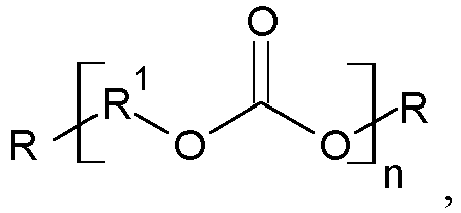
Unter Polycaprolacton werden Verbindungen folgender Strukturformel verstanden

Als weitere Komponente weist das sIPN zu größer oder gleich 10 Gew.-% und kleiner oder gleich 50 Gew.-% eines Polycarbonats aus vernetzbaren Polyalkyl-Carbonat-Monomeren mit einer Kohlenstoffanzahl von größer oder gleich 2 und kleiner oder gleich 15 bezogen auf das einzelne Monomer als vernetztes Polymer auf. Die vernetzbare Komponente des semi-interpenetrierenden Netzwerkes umfasst also Carbonat-Monomere, welche über funktionale Gruppen im Monomer miteinander vernetzt werden können. Auf diese Art und Weise kann innerhalb des semi-interpenetrierenden Netzwerkes eine unlösliche, kovalente vernetzte Struktur ausgebildet werden, welche die mechanische Stabilität des Netzwerkes erhöhen kann. Bevorzugt kann ein Carbonat-Monomer zwei vernetzbare Gruppen, insbesondere zwei vernetzbare endständige Gruppen tragen. Es ist aber auch möglich, dass das Carbonat-Monomer mehr als zwei funktionale Gruppen aufweist. Die oben angegebene Gewichtsrelationen bezieht sich dabei auf die Komponenten des semi-interpenetrierenden Netzwerkes und umfasst insbesondere nicht die Anteile des Festelektrolyten, welche über die Alkali-Metall-Leitsalze eingebracht werden. Mögliche Polycarbonat-Grund-Monomere, ohne funktionale Gruppen, sind beispielsweise geradkettige oder verzweigte Alkyl-Polycarbonate mit einer Kohlenstoffzahl bis zu 15 zwischen den Carbonat-Gruppen. Das Molekulargewicht der Polyalkyl-Carbonat-Monomere kann zwischen 100 g/mol und 5000 g/mol ohne die vernetzende Funktionalisierung betragen.As a further component, the sIPN comprises greater than or equal to 10% by weight and less than or equal to 50% by weight of a polycarbonate made of crosslinkable polyalkyl carbonate monomers with a carbon number of greater than or equal to 2 and less than or equal to 15 based on the individual monomer as a crosslinked polymer. The crosslinkable component of the semi-interpenetrating network therefore comprises carbonate monomers which can be crosslinked with one another via functional groups in the monomer. In this way, an insoluble, covalent crosslinked structure can be formed within the semi-interpenetrating network, which can increase the mechanical stability of the network. Preferably, a carbonate monomer can carry two crosslinkable groups, in particular two crosslinkable terminal groups. However, it is also possible for the carbonate monomer to have more than two functional groups. The weight ratios given above refer to the components of the semi-interpenetrating network and in particular do not include the portions of the solid electrolyte that are introduced via the alkali metal conducting salts. Possible polycarbonate base monomers without functional groups are, for example, straight-chain or branched alkyl polycarbonates with a carbon number of up to 15 between the carbonate groups. The molecular weight of the polyalkyl carbonate monomers can be between 100 g/mol and 5000 g/mol without the cross-linking functionalization.
Das einzelne Polyalkyl-Carbonat-Monomer kann substituiert oder unsubstituiert sein und zwei vernetzbare Gruppen ausgesucht aus der Gruppe bestehend aus acryl, methacryl, epoxy, vinyl, isocyanid oder Mischungen zweier unterschiedlicher Gruppen daraus umfassen. Die Polyalkyl-Carbonat-Monomeren können also solche, noch weitere funktionale Gruppen, wie beispielsweise OH, NH3, CHO-Gruppen tragen. Neben dieser allgemeinen Substitution des Grundgerüst des Monomers, weist das Polyalkyl-Carbonat-Monomer jedoch mindestens zwei vernetzbare funktionelle Gruppen aus oben angegebenen funktionellen Gruppen auf. Durch diese funktionellen Gruppen erfolgt die Ausbildung kovalenter Bindungen zwischen den einzelnen Polycarbonat-Monomeren.The individual polyalkyl carbonate monomer can be substituted or unsubstituted and can contain two crosslinkable groups selected from the group consisting of acrylic, methacrylic, epoxy, vinyl, isocyanide or mixtures of two different groups thereof. The polyalkyl carbonate monomers can therefore carry these or other functional groups, such as OH, NH 3 , CHO groups. In addition to this general substitution of the basic structure of the monomer, the polyalkyl carbonate monomer has at least two crosslinkable functional groups from the functional groups specified above. These functional groups form covalent bonds between the individual polycarbonate monomers.
In einer bevorzugten Ausführungsform des Festelektrolyten kann der Gewichtsanteil des vernetzten zum unvernetzten Polymer im sIPN größer oder gleich 20 Gew.-% und kleiner oder gleich 40 Gew.-% betragen. Die Konzentration und Mischbarkeit der Einzelkomponenten spielt eine wichtige Rolle um eine ausreichend stabile, schwammartige Struktur des Netzwerkformers innerhalb der Polymerfolie zu erzeugen. So werden ab oben angegebenen Konzentrationsbereich von über 20 Gew.-% Polycarbonat-Netzwerkformer (bezogen auf PEO) deutlich erhöhte Reproduzierbarkeiten gegenüber dem reinen PEO-Leitsalz-Standard beobachtet. Weiterhin kann eine durch den Einsatz von Polykarbonat-Netzwerkformern eventuell verminderte Gesamtleitfähigkeit durch die Erhöhung des Salzgehaltes soweit kompensiert werden, dass bei 60°C keine Kapazitätsverluste durch erhöhte Zellwiderstände gegenüber reinen PEO-Leitsalz-Kombinationen erhalten werden.In a preferred embodiment of the solid electrolyte, the weight proportion of crosslinked to uncrosslinked polymer in the sIPN can be greater than or equal to 20 wt.% and less than or equal to 40 wt.%. The concentration and miscibility of the individual components play an important role in creating a sufficiently stable, sponge-like structure of the network former within the polymer film. For example, from the above-mentioned concentration range of over 20 wt.% polycarbonate network former (based on PEO), significantly increased reproducibility is observed compared to the pure PEO-conductive salt standard. Furthermore, any reduction in overall conductivity caused by the use of polycarbonate network formers can be compensated for by increasing the salt content to such an extent that at 60°C no capacity losses are obtained due to increased cell resistance compared to pure PEO-conductive salt combinations.
Innerhalb einer bevorzugten Ausgestaltung des Festelektrolyten kann das Molekulargewicht der Polyalkyl-Carbonat-Monomere größer oder gleich 100 g/mol und kleiner oder gleich 3500 g/mol betragen. Die Untersuchung verschiedener Kettenlängen der Polyalkyl-Carbonat-Monomere hat ergeben, dass eine verbesserte elektrochemische Leistung mit geringeren Kettenlängen der Polyalkyl-Carbonat-Monomere erzielt werden kann. Anscheinend ist die Stabilität des sIPNs mit kürzeren Kettenlängen höher und dadurch können durch Quetschung hervorgerufene Kurzschlüsse von Batterieaufbauten mit dem erfindungsgemäßen Festelektrolyt vermieden werden.Within a preferred embodiment of the solid electrolyte, the molecular weight of the polyalkyl carbonate monomers can be greater than or equal to 100 g/mol and less than or equal to 3500 g/mol. The investigation of different chain lengths of the polyalkyl carbonate monomers has shown that improved electrochemical performance can be achieved with shorter chain lengths of the polyalkyl carbonate monomers. Apparently, the stability of the sIPN is higher with shorter chain lengths and thus short circuits caused by crushing in battery structures with the solid electrolyte according to the invention can be avoided.
Im Rahmen eines bevorzugten Aspektes des Festelektrolyten können die Polyalkyl-Carbonat-Monomere aus der Gruppe bestehend aus geradkettigen oder verzweigten, substituierten oder nicht-substituierten Polyethylen-, Polymethylen-, Polypropylen-, Polybutylen-, Polyhexylen-Carbonaten oder Mischungen mindestens zweier Komponenten daraus ausgesucht sein. Beispiele für diese Polyalkyl-Carbonat-Monomere können Polyethylen-Carbonat (PEC), Polypropylen-Carbonat (PPC) oder Polytrimethylen-Carbonate (PTMC) mit jeweils einem Molekulargewicht im Bereich von 500 g/mol bis zu 5000 g/mol sein. Bevorzugt kann das Molekulargewicht der Polyalkyl-Carbonat-Monomere im Bereich von 500 g/mol bis zu 2000 g/mol liegen. Durch diese Alkyl-Polyalkyl-Carbonat-Monomere können besonders bevorzugte mechanische Eigenschaften der Matrix und besonders geeignet elektrische Eigenschaften des Festelektrolyten bereitgestellt werden.In a preferred aspect of the solid electrolyte, the polyalkyl carbonate monomers can be selected from the group consisting of straight-chain or branched, substituted or unsubstituted polyethylene, polymethylene, polypropylene, polybutylene, polyhexylene carbonates or mixtures of at least two components thereof. Examples of these polyalkyl carbonate monomers can be polyethylene carbonate (PEC), polypropylene carbonate (PPC) or polytrimethylene carbonates (PTMC), each with a molecular weight in the range from 500 g/mol to 5000 g/mol. The molecular weight of the polyalkyl carbonate monomers can preferably be in the range from 500 g/mol to 2000 g/mol. These alkyl polyalkyl carbonate monomers can provide particularly preferred mechanical properties of the matrix and particularly suitable electrical properties of the solid electrolyte.
Innerhalb einer bevorzugten Ausführungsform des Festelektrolyten können die Polyalkyl-Carbonat-Monomere jeweils zwei gleiche funktionelle Gruppen tragen und die funktionelle Gruppe eine Methacryl-Gruppe sein. Für den Erhalt besonders mechanisch stabiler semiinterpenetrierender Netzwerke hat sich eine symmetrische Funktionalisierung der Polyalkyl-Carbonat-Monomere über zwei Methacryl-Gruppen als besonders geeignet herausgestellt. Das einzelne Monomer trägt insofern zwei Methacryl-Gruppen, bevorzugt zwei endständige Methacryl-Gruppen. Durch die besondere mechanische Stabilität der sich ausbildenden semi-interpenetrierende Netzwerke kann die Standzeit des Festelektrolyten deutlich erhöht werden.In a preferred embodiment of the solid electrolyte, the polyalkyl carbonate monomers can each carry two identical functional groups and the functional group can be a methacrylic group. Symmetrical functionalization of the polyalkyl carbonate monomers via two methacrylic groups has proven to be particularly suitable for obtaining particularly mechanically stable semi-interpenetrating networks. The individual monomer therefore carries two methacrylic groups, preferably two terminal methacrylic groups. The service life of the solid electrolyte can be significantly increased due to the special mechanical stability of the semi-interpenetrating networks that are formed.
Innerhalb einer bevorzugten Charakteristik des Festelektrolyten kann die Mischung zweier unterschiedlicher Alkalimetall-Leitsalze mindestens die Salze Alkali-(fluorosulfonyl)(tri-fluoromethansulfonyl)imide (FTFSI) und Alkali-bis(trifluoromethansulfonyl)imid) (TFSI) umfassen. Die Kombination beider oben genannter Alkalimetall-Leitsalze hat sich zum Erhalt besonders langlebiger und effizienter Batterien als besonders geeignet herausgestellt. Die Festelektrolyte zeigen eine ausgezeichnete Leitfähigkeit und die Zeitspannen bis zum elektrischen Versagen von Batterieaufbauten mit diesen Festelektrolyten konnte deutlich verlängert werden. Besonders geeignete Mischungen beider Leitsalze weisen einen Anteil von FTFSI zwischen 0,1 Gew.-% und 5 Gew.-% und einen Anteil von TFSI von 15 Gew.-% bis 60 Gew.-% bezogen auf das Gewicht des sIPNs inklusive der Leitsalze auf. Insbesondere kann der Anteil beider Leitsalze von 5 Gew.-% bis zu 70 Gew.-% bezogen auf das Gewicht des sIPNs inklusive der Leitsalze betragen. Weiterhin haben sich Leitsalze mit vernetzbarem Anion als besonders vorteilhaft herausgestellt, da die elektrostatischen Wechselwirkungen zwischen dem sIPN und dem immobilisierten Anion einer übermäßigen Verformung des sIPN entgegenwirken können. Der Einsatz vernetzbarer Leitsalze in dem erfindungsgemäß aufgebauten sIPN stellt einen besonderen Vorteil dar, da durch diesen Zusatz die Ausbildung einer hochgradig amorphen, kationen-leitenden Polymerphase noch weiter unterstützt wird. Die Ausbildung solch mechanisch stabiler, amorpher Strukturen ist mit den Zusammensetzungen nach dem Stand der Technik nicht realisierbar.Within a preferred characteristic of the solid electrolyte, the mixture of two different alkali metal conducting salts can comprise at least the salts alkali (fluorosulfonyl) (tri-fluoromethanesulfonyl) imide (FTFSI) and alkali bis (trifluoromethanesulfonyl) imide (TFSI). The combination of both alkali metal conducting salts mentioned above has proven to be particularly suitable for obtaining particularly long-lasting and efficient batteries. The solid electrolytes exhibit excellent conductivity and the time until the electrical failure of battery structures with these solid electrolytes could be significantly extended. Particularly suitable mixtures of both conducting salts have a proportion of FTFSI between 0.1 wt.% and 5 wt.% and a proportion of TFSI of 15 wt.% to 60 wt.% based on the weight of the sIPN including the conducting salts. In particular, the proportion of both conducting salts can be from 5 wt.% to 70 wt.% based on the weight of the sIPN including the conducting salts. Furthermore, conductive salts with cross-linkable anions have proven to be particularly advantageous, since the electrostatic interactions between the sIPN and the immobilized anion can counteract excessive deformation of the sIPN. The use of cross-linkable conductive salts in the sIPN constructed according to the invention represents a particular advantage, since this addition further supports the formation of a highly amorphous, cation-conducting polymer phase. The formation of such mechanically stable, amorphous structures is not feasible with the compositions according to the prior art.
Im Rahmen eines weiteren, bevorzugten Aspektes des Festelektrolyten kann das Gewichtsverhältnis von Alkali-(fluorosulfonyl)(trifluoromethansulfonyl)imide (FTFSI) zur Gewichtssumme aus den Komponenten des sIPN und dem weiteren Leitsalz, ausgedrückt als Gewicht des Alkali-FTFSI dividiert durch die Summe der Gewichte aus sIPN und weiteren Leitsalz, größer oder gleich 0,005 und kleiner oder gleich 0,1 betragen. Innerhalb dieses Verhältnisses aus FTFSI und sIPN inklusive dem weiteren Leitsalz lassen sich besonders günstige elektrische Eigenschaften des Festelektrolyten mit langen Standzeiten erhalten. In einer weiter bevorzugten Ausführungsform kann das Verhältnis größer oder gleich 0,01 und kleiner oder gleich 0,075 betragen. Die Carbonyl-Gruppen des Netzwerkformers weisen insgesamt eine schwächere Affinität zu dem Li+ im Elektrolyten als das lineare PEO Polymer auf, wodurch die Koordination von Li+ bevorzugt am linearen PEO Polymer stattfindet. Dies ermöglicht den Einsatz geringerer Salzkonzentration gegenüber reinen Polyethern oder Polyethern als Netzwerkformer unter Verwendung gleicher Salzkonzentrationen.In a further preferred aspect of the solid electrolyte, the weight ratio of alkali (fluorosulfonyl) (trifluoromethanesulfonyl) imide (FTFSI) to the total weight of the components of the sIPN and the additional conducting salt, expressed as the weight of the alkali FTFSI divided by the sum of the weights of the sIPN and additional conducting salt, can be greater than or equal to 0.005 and less than or equal to 0.1. Within this ratio of FTFSI and sIPN including the additional conducting salt, particularly favorable electrical properties of the solid electrolyte with long service lives can be obtained. In a further preferred embodiment, the ratio can be greater than or equal to 0.01 and less than or equal to equal to 0.075. The carbonyl groups of the network former have a weaker affinity to the Li + in the electrolyte than the linear PEO polymer, whereby the coordination of Li + takes place preferentially on the linear PEO polymer. This enables the use of lower salt concentrations compared to pure polyethers or polyethers as network formers using the same salt concentrations.
In einer weiteren, bevorzugten Ausführungsform kann der Festelektrolyt ein Festelektrolyt für eine Li-Feststoffbatterie sein. Durch die verbesserten mechanischen und elektrischen Eigenschaften des Festelektrolyten eigenen sich die erfindungsgemäßen Festelektrolyte besonders für die elektrisch hoch anspruchsvolle Anwendungen in Lithium-basierenden Batterietypen.In a further preferred embodiment, the solid electrolyte can be a solid electrolyte for a Li solid-state battery. Due to the improved mechanical and electrical properties of the solid electrolyte, the solid electrolytes according to the invention are particularly suitable for electrically highly demanding applications in lithium-based battery types.
Des Weiteren erfindungsgemäß ist eine Alkali-Metall-Batterie aufweisend eine Anode, eine Kathode und einen zwischen Anode und Kathode angeordneten Festelektrolyten, wobei der Festelektrolyt ein erfindungsgemäßer Festelektrolyt ist. Für die Vorteile der erfindungsgemäßen Alkali-Metall-Batterien wird explizit auf die Vorteile des erfindungsgemäßen Verfahrens und des erfindungsgemäßen polymeren Festelektrolyten Bezug genommen. Die Batterien können neben den erwähnten Bestandteilen generell noch weitere Schichten aufweisen.Furthermore, the invention relates to an alkali metal battery having an anode, a cathode and a solid electrolyte arranged between the anode and the cathode, wherein the solid electrolyte is a solid electrolyte according to the invention. For the advantages of the alkali metal batteries according to the invention, explicit reference is made to the advantages of the method according to the invention and the polymer solid electrolyte according to the invention. In addition to the components mentioned, the batteries can generally have further layers.
Für die positive Elektrode der Alkali-Metall-Batterie in einer Ausgestaltung als Li-Metall-Batterie können Materialien für All-Solid-State Lithium-Ionen-Batterien oder Lithium-Metall-Batterien eingesetzt werden. Die Elektrodenschicht umfasst dabei beispielsweise Aktivmaterialien wie LiNixMnyCozO2 (NMC), LiCoO2 (LCO), LiFePO4 (LFP) oder LNixMnyO4 (LNMO). Zudem kann die positive Elektrode darüber hinaus auch noch Binder, elektronisch leitendes Material zur Erhöhung der elektronischen Leitfähigkeit, z. B. Azetylen Schwarz, Ruß, Graphit, Kohlefaser und Kohlenstoffnanoröhrchen, sowie Elektrolytmaterial, insbesondere ein Polymer oder Festelektrolyt, zur Erhöhung der Ionenleitfähigkeit, sowie weitere Additive umfassen.Materials for all-solid-state lithium-ion batteries or lithium-metal batteries can be used for the positive electrode of the alkali metal battery in a Li-metal battery design. The electrode layer comprises, for example, active materials such as LiNi x Mn y Co z O 2 (NMC), LiCoO 2 (LCO), LiFePO 4 (LFP) or LNi x Mn y O 4 (LNMO). In addition, the positive electrode can also comprise binders, electronically conductive material to increase the electronic conductivity, e.g. acetylene black, carbon black, graphite, carbon fiber and carbon nanotubes, as well as electrolyte material, in particular a polymer or solid electrolyte, to increase the ion conductivity, as well as other additives.
Im Rahmen einer bevorzugten Ausführungsform der Alkali-Metall-Batterie kann die Batterie eine Li-Metall-Batterie sein und die Batterie mindestens eine Hochstrom- oder Hochspannungs-Elektrode aufweisen. Die Eignung ergibt sich insbesondere aufgrund der hohen mechanischen Festigkeit, sowie auf der Tatsache, dass der Festelektrolyt auch für den Einsatz mit Hochstrom- oder Hochspannungselektroden geeignet ist. Hochstromelektroden sind dabei Elektroden welche eine spezifische Kapazität von über 100 mAh g-1 bei einer Ladedauer von kleiner gleich 15 Stunden bereitstellen können. Hochvoltelektroden können eine Ladeschlussspannung von ≥ 4V bereitstellen.In a preferred embodiment of the alkali metal battery, the battery can be a Li-metal battery and the battery can have at least one high-current or high-voltage electrode. The suitability arises in particular from the high mechanical strength, as well as the fact that the solid electrolyte is also suitable for use with high-current or high-voltage electrodes. High-current electrodes are electrodes that can provide a specific capacity of over 100 mAh g -1 with a charging time of less than or equal to 15 hours. High-voltage electrodes can provide a final charging voltage of ≥ 4V.
In einer weiter bevorzugten Ausführungsform kann der erfindungsgemäße Festelektrolyt in elektrochemischen Geräten eingesetzt werden. Zu den elektrochemischen Geräten können neben den primären und sekundären Batterien auch Brennstoffzellen oder Kondensatoren fallen. Des Weiteren kann der erfindungsgemäße Festelektrolyt in elektrochemischen Geräten als Schicht zu Verbesserung der elektrischen Kontaktierung ("Benetzung") von Elektroden eingesetzt werden.In a further preferred embodiment, the solid electrolyte according to the invention can be used in electrochemical devices. In addition to primary and secondary batteries, the electrochemical devices can also include fuel cells or capacitors. Furthermore, the solid electrolyte according to the invention can be used in electrochemical devices as a layer to improve the electrical contact ("wetting") of electrodes.
Neben dem Einsatz als Polymerelektrolyt-Trennschicht in Lithium-Metall-Batterien, bei denen der erfindungsgemäße Polymer-Elektrolyt direkten Kontakt zur Kathode hat, ist auch der Einsatz in Sulfid-basierten Festelektrolytzellen möglich. Dieses Zellkonzept lässt sich auch auf Oxid-basierte Keramiken übertragen, bei denen der Polymer-Elektrolyt als Benetzungshilfe zur Lithium-Metall-Seite fungieren kann. Auch der Einsatz mehrerer verschiedener Polymerschichten für Anode und Kathode ist möglich. Alternativ zur thermischen radikalischen Polymerisation ist auch eine Photopolymerisation denkbar, bei dem eine UV-Lichtquelle eingesetzt wird um die Polymerisation zu initiieren. Auch die Zugabe kurzkettiger Polyethylenglykol-Derivate zur Ermöglichung einer geringeren Betriebstemperatur. Mit dem erfindungsgemäßen sIPN können auch andere Beschichtungssubstrate wie siloxiertes Papier, Polyethylene/Polypropylen-Folien, PTFE oder auch Glas oder chemisch Oberflächen wie modifiziertes Glas ausgerüstet werden.In addition to use as a polymer electrolyte separating layer in lithium metal batteries, in which the polymer electrolyte according to the invention has direct contact with the cathode, use in sulfide-based solid electrolyte cells is also possible. This cell concept can also be transferred to oxide-based ceramics, in which the polymer electrolyte can act as a wetting aid for the lithium metal side. The use of several different polymer layers for the anode and cathode is also possible. As an alternative to thermal radical polymerization, photopolymerization is also conceivable, in which a UV light source is used to initiate the polymerization. Also the addition of short-chain polyethylene glycol derivatives to enable a lower operating temperature. Other coating substrates such as siloxized paper, polyethylene/polypropylene films, PTFE or even glass or chemically modified surfaces such as glass can be equipped with the sIPN according to the invention.
Es wird eine sIPN für eine Li-Batterie hergestellt.A sIPN for a Li battery is manufactured.
Die Synthese des Polycarbonat-Netzwerkformers wird unter Schutzgas durchgeführt. 10g Poly(1,6-hexandiol)carbonat-diol (Mw = 1000 g/mol) werden in trockenem Dichlormethan (100 mL) gelöst. Zur Trocknung des Polycarbonats wird ca. 0,5 g Magnesiumsulfat hinzugegeben und die Mischung über Nacht gerührt. Die Mischung wird filtriert, um das Magnesiumsulfat zu entfernen. Anschließend wird DMAP (4-(dimethylamino)pyridin) (0,001 mol% pro terminaler Hydroxylgruppe), sowie Triethylamin (2 Äquivalente bezogen auf die terminalen Hydroxylgruppen) hinzugegeben. Unter Rühren und Kühlung auf 0°C wird Methacryloyl-Chlorid (1,2 Äquivalente bezogen auf die terminalen Hydroxylgruppen) vorsichtig hinzugetropft. Das Reaktionsgemisch wird für drei Tage bei Raumtemperatur gerührt. Das Rohprodukt wird 5 mal mit 2M wässriger HCl-Lösung gewaschen (5 x 50 mL), um aus der organischen Phase die polaren Edukte und Nebenprodukte der Reaktion zu extrahieren. Zur Phasenseparation wird ein Scheidetrichter verwendet. Die organische Phase wurde über Magnesiumsulfat getrocknet und das Lösungsmittel unter vermindertem Druck entfernt. Das Produkt wird mehrere Tage unter Vakuum bei RT getrocknet. Das getrocknete Produkt wird unter Schutzgas gelagert.The synthesis of the polycarbonate network former is carried out under protective gas. 10 g of poly(1,6-hexanediol)carbonate-diol (Mw = 1000 g/mol) are dissolved in dry dichloromethane (100 mL). To dry the polycarbonate, approx. 0.5 g of magnesium sulfate is added and the mixture is stirred overnight. The mixture is filtered to remove the magnesium sulfate. DMAP (4-(dimethylamino)pyridine) (0.001 mol% per terminal hydroxyl group) and triethylamine (2 equivalents based on the terminal hydroxyl groups) are then added. Methacryloyl chloride (1.2 equivalents based on the terminal hydroxyl groups) is carefully added dropwise while stirring and cooling to 0°C. The reaction mixture is stirred for three days at room temperature. The crude product is washed 5 times with 2M aqueous HCl solution (5 x 50 mL) to extract the polar reactants and reaction byproducts from the organic phase. A separatory funnel is used for phase separation. The organic phase was dried over magnesium sulfate and the solvent was removed under reduced pressure. The product is dried under vacuum at RT for several days. The dried product is stored under protective gas.
Die Leitsalz-Kombination im molaren Verhältnis von 13 Teilen Li-TFSI (0,289 g) zu 1 Teil Li-FTFSI (0.018 g) wird zusammen mit Polycarbonat (Poly(1,6-hexandiol)carbonat-dimethacrylate) (0,125 g) und dem Radikalstarter AIBN (Azobisisobutyronitrile) (0,018 g) in 3 mL Acetonitril oder THF als Lösungsmittel aufgelöst und anschließend das PEO-Pulver (0.5 g) hinzugefügt. Die Mischung mit einem Leitsalz zu Polymer-Verhältnis von 1 zu 3 wird für mehrere Stunden gerührt und kann nach vollständiger Homogenisierung mittels Foliengießen in prinzipiell beliebigen Dicken auf eine Mylar-Folie appliziert werden. Das Lösungsmittel wird in einem Abzug verdampft, die erzeugte Polymerfolie bei 70°C unter Stickstoff-Strom für eine Stunde polymerisiert und anschließend über Nacht unter Vakuum getrocknet. Mögliche Dicken für den Festelektrolyt ergeben sich von größer oder gleich 1 µm bis zu kleiner oder gleich 500 µm.The conductive salt combination in a molar ratio of 13 parts Li-TFSI (0.289 g) to 1 part Li-FTFSI (0.018 g) is dissolved together with polycarbonate (poly(1,6-hexanediol)carbonate dimethacrylate) (0.125 g) and the radical initiator AIBN (azobisisobutyronitrile) (0.018 g) in 3 mL acetonitrile or THF as solvent and then the PEO powder (0.5 g) is added. The mixture with a conductive salt to polymer ratio of 1 to 3 is stirred for several hours and, after complete homogenization, can be applied to a Mylar film by film casting in basically any thickness. The solvent is evaporated in a fume hood, the polymer film produced is polymerized at 70°C under a stream of nitrogen for one hour and then dried overnight under vacuum. Possible thicknesses for the solid electrolyte range from greater than or equal to 1 µm to less than or equal to 500 µm.
Für den Einsatz in Lithium-Metall-Batteriezellen wird ein rundes Stück Polymerfolie mit 200 µm Höhe und 17 mm Durchmesser ausgestanzt und analog zu einem Separator zwischen Lithium Metall Elektrode und positiver Elektrode bestehend aus 91 Gew.-% Li-Ni0.6Mn0.2Co0.2O2, 4 Gew.-% Carbon Black und 5 Gew.-% PVdF eingesetzt. Auf diese Weise hergestellte Lithium-Metall-Batteriezellen wurden bei 60°C getestet.For use in lithium metal battery cells, a round piece of polymer film with a height of 200 µm and a diameter of 17 mm is punched out and used as a separator between the lithium metal electrode and the positive electrode consisting of 91 wt.% Li-Ni 0.6 Mn 0.2 Co 0.2 O 2 , 4 wt.% carbon black and 5 wt.% PVdF. Lithium metal battery cells produced in this way were tested at 60°C.
Das elektrochemische Verhalten erfindungsgemäßer und nicht erfindungsgemäßer BatterieAufbauten ist in den
-
Figur 1 das Ergebnis eines Li-Plating/Stripping-Versuchs eines nicht erfindungsgemä-βen Zellaufbaus als Funktion der Zeit; -
Figur 2 -
Figur 3 -
Figur 4 -
Figur 5
-
Figure 1 the result of a Li-plating/stripping test of a cell structure not according to the invention as a function of time; -
Figure 2 the result of a galvanostatic cyclization of a cell structure not according to the invention as a function of time; -
Figure 3 the result of a Li-plating/stripping test, once with a cell structure not according to the invention and once with a cell structure according to the invention with a dual-salt electrolyte as a function of time; -
Figure 4 the result of a galvanostatic cyclization of cell structures not according to the invention and of a cell structure according to the invention with a dual-salt electrolyte as a function of time; -
Figure 5 the result of a mechanical stability test of a cell structure not according to the invention and of a cell structure according to the invention as a function of the pressure deflection.
Die
Die
Die
Die
Die
Claims (10)
- Solid electrolyte for an alkali metal solid state battery,
characterized in thatthe solid electrolyte comprises a mixture of two different alkali metal conducting salts and a semi-interpenetrating network (sIPN) of a crosslinked and a non-crosslinked polymer, wherein the semi-interpenetrating network comprisesgreater than or equal to 50 wt.-% and less than or equal to 80 wt.-% of a non-crosslinked polymer selected from the group consisting of polyethylene oxide (PEO), polycarbonate (PC), polycaprolactone (PCL), chain end modified derivatives of these polymers, or mixtures of at least two components thereof; andgreater than or equal to 10 wt.-% and less than or equal to 50 wt.-% of a polycarbonate of crosslinkable polyalkyl carbonate monomers having a carbon number greater than or equal to 2 and less than or equal to 15 based on the single monomer as the crosslinked polymer, wherein the single polyalkyl carbonate monomer may be substituted or unsubstituted and comprises two crosslinkable groups selected from the group consisting of acrylic, methacrylic, epoxy, vinyl, isocyanide or mixtures of two different groups thereof. - The solid electrolyte according to claim 1, wherein the weight fraction of crosslinked to uncrosslinked polymer in the sIPN is greater than or equal to 20 wt.-% and less than or equal to 40 wt.-%.
- The solid electrolyte according to any one of the preceding claims, wherein the molecular weight of the polyalkyl carbonate monomers is greater than or equal to 100 g/mol and less than or equal to 3500 g/mol.
- The solid electrolyte according to any one of the preceding claims, wherein the polyalkyl carbonate monomers are selected from the group consisting of straight-chain or branched, substituted or unsubstituted polyethylene, polymethylene, polypropylene, polybutylene, poly-hexylene carbonates or mixtures of at least two components thereof.
- The solid electrolyte according to any one of the preceding claims, wherein the polyalkyl carbonate monomers each carry two identical functional groups and the functional group is a methacryl group.
- The solid electrolyte according to any one of the preceding claims, wherein the mixture of two different alkali metal conducting salts comprises at least the salts alkali (fluorosulfonyl) (trifluoromethanesulfonyl)imide (FTFSI) and alkali bis(trifluoromethanesulfonyl)imide) (TFSI).
- The solid electrolyte according to claim 6, wherein the weight ratio of alkali (fluorosulfonyl) (trifluoromethanesulfonyl)imide (FTFSI) to the weight sum of the components of sIPN and the further conducting salt, expressed as the weight of alkali FTFSI divided by the sum of the weights of sIPN and further conducting salt, is greater than or equal to 0.005 and less than or equal to 0.1.
- The solid electrolyte according to any one of the preceding claims, wherein the solid electrolyte is a solid electrolyte for a Li-solid battery.
- Alkali metal battery comprising an anode, a cathode, and a solid electrolyte disposed between the anode and the cathode, characterized in that the solid electrolyte is a solid electrolyte according to any one of claims 1-8.
- The battery according to claim 9, wherein the battery is a Li metal battery and the battery comprises at least one high current or high voltage electrode.
Applications Claiming Priority (2)
| Application Number | Priority Date | Filing Date | Title |
|---|---|---|---|
| DE102019132370.3A DE102019132370B4 (en) | 2019-11-28 | 2019-11-28 | Semi-interpenetrating polymer networks based on polycarbonates as separators for use in alkali-metal batteries and alkali-metal batteries manufactured with them |
| PCT/EP2020/082964 WO2021105023A1 (en) | 2019-11-28 | 2020-11-20 | Semi-interpenetrating polymer networks based on polycarbonates as separators for use in alkali-metal batteries |
Publications (2)
| Publication Number | Publication Date |
|---|---|
| EP4066304A1 EP4066304A1 (en) | 2022-10-05 |
| EP4066304B1 true EP4066304B1 (en) | 2024-08-21 |
Family
ID=73554423
Family Applications (1)
| Application Number | Title | Priority Date | Filing Date |
|---|---|---|---|
| EP20811995.8A Active EP4066304B1 (en) | 2019-11-28 | 2020-11-20 | Semi-interpenetrating polymer networks based on polycarbonates as separators for use in alkali-metal batteries |
Country Status (8)
| Country | Link |
|---|---|
| US (1) | US20230006240A1 (en) |
| EP (1) | EP4066304B1 (en) |
| JP (1) | JP7780427B2 (en) |
| CN (1) | CN114982029A (en) |
| DE (1) | DE102019132370B4 (en) |
| ES (1) | ES2994117T3 (en) |
| HU (1) | HUE069171T2 (en) |
| WO (1) | WO2021105023A1 (en) |
Families Citing this family (1)
| Publication number | Priority date | Publication date | Assignee | Title |
|---|---|---|---|---|
| US20230058958A1 (en) * | 2021-08-06 | 2023-02-23 | Factorial Inc. | Article and method of making article |
Family Cites Families (20)
| Publication number | Priority date | Publication date | Assignee | Title |
|---|---|---|---|---|
| JP2000082330A (en) * | 1998-09-07 | 2000-03-21 | Sony Corp | Composition for electrolyte, electrolyte, method for producing the same, and battery using the same |
| JP3708733B2 (en) | 1999-01-07 | 2005-10-19 | 三井化学株式会社 | Polycarbonate (meth) acrylate and uses thereof |
| CA2333277A1 (en) * | 1999-03-23 | 2000-09-28 | Nisshinbo Industries, Inc. | Ion-conductive solid polymer-forming composition and ion-conductive solid polymer electrolyte, binder resin and secondary cell |
| JP4117528B2 (en) | 2002-01-31 | 2008-07-16 | ソニー株式会社 | Electrolyte composition, electrolyte, method for producing the same, and battery |
| FR2853320B1 (en) * | 2003-04-03 | 2005-05-06 | Rhodia Chimie Sa | RETICULABLE COMPOSITION FOR BATTERY ELECTROLYTE |
| JP2005285377A (en) * | 2004-03-26 | 2005-10-13 | Shirouma Science Co Ltd | Polysiloxane and polyolefin composite gel electrolyte and lithium battery using the same |
| FR2945292B1 (en) * | 2009-05-06 | 2011-05-27 | Electricite De France | ANION EXCHANGER POLYMER INTERPENETOR NETWORK, METHOD FOR MANUFACTURING THE SAME, AND USE THEREOF |
| WO2014147648A1 (en) * | 2013-03-19 | 2014-09-25 | Council Of Scientic & Industrial Reserach | High-ionic conductivity electrolyte compositions comprising semi-interpenetrating polymer networks and their composites |
| CN105531843A (en) * | 2013-09-18 | 2016-04-27 | 住友电气工业株式会社 | Electricity-storage device |
| DE102013017594A1 (en) * | 2013-09-27 | 2015-04-02 | Forschungszentrum Jülich GmbH | Production method for electrochemical cells of a solid-state battery |
| US10290900B2 (en) * | 2014-03-25 | 2019-05-14 | Nippon Shokubai Co., Ltd. | Non-aqueous electrolytic solution and lithium ion secondary battery comprising same |
| US10355310B2 (en) | 2015-05-28 | 2019-07-16 | Shenzhen Capchem Technology Co., Ltd. | Electrolyte compositions for electrochemical devices |
| JP6450030B2 (en) | 2015-10-30 | 2019-01-09 | エルジー・ケム・リミテッド | Multi-layer polymer electrolyte and all-solid-state battery including the same |
| KR102446987B1 (en) * | 2016-03-05 | 2022-09-23 | 시오 인코퍼레이티드 | Crosslinked-Interpenetrating Networked Block Copolymer Electrolyte for Lithium Batteries |
| CN107768717B (en) * | 2017-09-14 | 2020-10-27 | 哈尔滨工业大学无锡新材料研究院 | Ultraviolet-cured polycarbonate-based solid polymer electrolyte with semi-interpenetrating network structure and preparation method thereof |
| EP3748758B1 (en) * | 2018-01-31 | 2024-05-22 | Panasonic Intellectual Property Management Co., Ltd. | Non-aqueous electrolyte secondary battery, electrolyte solution, and method for manufacturing non-aqueous electrolyte secondary battery |
| CN109004280B (en) * | 2018-07-11 | 2021-06-08 | 珠海冠宇电池股份有限公司 | A kind of preparation method of all-solid polymer electrolyte and all-solid polymer battery |
| DE102018222593A1 (en) * | 2018-12-20 | 2020-06-25 | Robert Bosch Gmbh | High-voltage stable copolymer for the formation of a polymer electrolyte for a lithium or sodium cell |
| CN110233288B (en) * | 2019-06-03 | 2020-12-01 | 深圳市比克动力电池有限公司 | All-solid-state polymer electrolyte with semi-interpenetrating network structure and preparation method thereof |
| US20210226247A1 (en) * | 2019-11-15 | 2021-07-22 | North Carolina State University | Composite solid electrolytes for high-performance metallic or metal-ion batteries |
-
2019
- 2019-11-28 DE DE102019132370.3A patent/DE102019132370B4/en active Active
-
2020
- 2020-11-20 EP EP20811995.8A patent/EP4066304B1/en active Active
- 2020-11-20 US US17/781,262 patent/US20230006240A1/en active Pending
- 2020-11-20 JP JP2022525578A patent/JP7780427B2/en active Active
- 2020-11-20 WO PCT/EP2020/082964 patent/WO2021105023A1/en not_active Ceased
- 2020-11-20 ES ES20811995T patent/ES2994117T3/en active Active
- 2020-11-20 HU HUE20811995A patent/HUE069171T2/en unknown
- 2020-11-20 CN CN202080093678.2A patent/CN114982029A/en active Pending
Also Published As
| Publication number | Publication date |
|---|---|
| HUE069171T2 (en) | 2025-02-28 |
| JP2023504235A (en) | 2023-02-02 |
| CN114982029A (en) | 2022-08-30 |
| JP7780427B2 (en) | 2025-12-04 |
| DE102019132370B4 (en) | 2021-11-11 |
| US20230006240A1 (en) | 2023-01-05 |
| ES2994117T3 (en) | 2025-01-17 |
| WO2021105023A1 (en) | 2021-06-03 |
| DE102019132370A1 (en) | 2021-06-02 |
| EP4066304A1 (en) | 2022-10-05 |
Similar Documents
| Publication | Publication Date | Title |
|---|---|---|
| EP3794663A1 (en) | Rechargeable battery cell | |
| DE102012022607A1 (en) | Solid / gel electrolyte accumulator with inorganic-organic hybrid polymer binder and process for its preparation | |
| EP3494148B1 (en) | Use of thianthrene containing polymers as charge storage | |
| DE102015224335A1 (en) | Solid electrode with electrolyte-saturated active material particles | |
| WO2019080950A9 (en) | Solvent-free solid electrolyte | |
| EP2573845B1 (en) | Structural active material for battery electrodes | |
| WO2013182353A1 (en) | Method for the production of a polyacrylonitrile-sulfur composite material | |
| DE102018202929A1 (en) | Hybrid supercapacitor and method of making a hybrid supercapacitor | |
| DE102014202180A1 (en) | Electrolyte compositions for lithium-sulfur batteries | |
| DE102013225570A1 (en) | Binder materials for anode and cathode materials of lithium cells | |
| DE102014207233A1 (en) | Lithium cell, battery with the lithium cell, as well as motor vehicle, mobile device or stationary storage element comprising the battery | |
| EP4046222A1 (en) | Semi-interpenetrating polymer networks as separators for use in alkali metal batteries | |
| DE102019206133A1 (en) | Solid electrolyte layer and battery cell having a solid electrolyte layer | |
| EP4066304B1 (en) | Semi-interpenetrating polymer networks based on polycarbonates as separators for use in alkali-metal batteries | |
| DE69604898T2 (en) | SOLID POLYMER ELECTROLYTE, BATTERY AND SOLID DOUBLE LAYER CAPACITOR USING THEM AND METHOD FOR THE PRODUCTION THEREOF | |
| WO2022162008A1 (en) | Rechargeable battery cell | |
| DE112018007588T5 (en) | POLY (PYROCARBONATE) BASED POLYMER ELECTROLYTE FOR HIGH VOLTAGE LITHIUM ION BATTERIES | |
| DE102008041319B4 (en) | Method for producing lithium-ion cells and lithium-ion cell | |
| DE102008008483B4 (en) | Solid polymer electrolyte material, solid polymer electrolyte sheet and methods for their production and electrochemical battery device using such a sheet | |
| DE102019206131A1 (en) | Electrode and battery cell having an electrode | |
| WO2023111070A1 (en) | Rechargeable battery cell | |
| WO2023111072A1 (en) | Rechargeable battery cell | |
| DE102017217654A1 (en) | Electrochemical cell comprising at least one molecular sieve | |
| DE102016217709A1 (en) | Hybrid supercapacitor with SEI additives | |
| DE102020201424A1 (en) | ACRYLATE POLYMERS WITH DICARBONYL SIDE GROUPS AS ELECTROLYTE FOR LITHIUM ION BATTERIES |
Legal Events
| Date | Code | Title | Description |
|---|---|---|---|
| STAA | Information on the status of an ep patent application or granted ep patent |
Free format text: STATUS: UNKNOWN |
|
| STAA | Information on the status of an ep patent application or granted ep patent |
Free format text: STATUS: THE INTERNATIONAL PUBLICATION HAS BEEN MADE |
|
| PUAI | Public reference made under article 153(3) epc to a published international application that has entered the european phase |
Free format text: ORIGINAL CODE: 0009012 |
|
| STAA | Information on the status of an ep patent application or granted ep patent |
Free format text: STATUS: REQUEST FOR EXAMINATION WAS MADE |
|
| 17P | Request for examination filed |
Effective date: 20220620 |
|
| AK | Designated contracting states |
Kind code of ref document: A1 Designated state(s): AL AT BE BG CH CY CZ DE DK EE ES FI FR GB GR HR HU IE IS IT LI LT LU LV MC MK MT NL NO PL PT RO RS SE SI SK SM TR |
|
| DAV | Request for validation of the european patent (deleted) | ||
| DAX | Request for extension of the european patent (deleted) | ||
| GRAP | Despatch of communication of intention to grant a patent |
Free format text: ORIGINAL CODE: EPIDOSNIGR1 |
|
| STAA | Information on the status of an ep patent application or granted ep patent |
Free format text: STATUS: GRANT OF PATENT IS INTENDED |
|
| INTG | Intention to grant announced |
Effective date: 20240314 |
|
| GRAS | Grant fee paid |
Free format text: ORIGINAL CODE: EPIDOSNIGR3 |
|
| GRAA | (expected) grant |
Free format text: ORIGINAL CODE: 0009210 |
|
| STAA | Information on the status of an ep patent application or granted ep patent |
Free format text: STATUS: THE PATENT HAS BEEN GRANTED |
|
| AK | Designated contracting states |
Kind code of ref document: B1 Designated state(s): AL AT BE BG CH CY CZ DE DK EE ES FI FR GB GR HR HU IE IS IT LI LT LU LV MC MK MT NL NO PL PT RO RS SE SI SK SM TR |
|
| REG | Reference to a national code |
Ref country code: GB Ref legal event code: FG4D Free format text: NOT ENGLISH |
|
| REG | Reference to a national code |
Ref country code: CH Ref legal event code: EP |
|
| REG | Reference to a national code |
Ref country code: DE Ref legal event code: R096 Ref document number: 502020008970 Country of ref document: DE |
|
| REG | Reference to a national code |
Ref country code: IE Ref legal event code: FG4D Free format text: LANGUAGE OF EP DOCUMENT: GERMAN |
|
| P01 | Opt-out of the competence of the unified patent court (upc) registered |
Free format text: CASE NUMBER: APP_47215/2024 Effective date: 20240815 |
|
| REG | Reference to a national code |
Ref country code: LT Ref legal event code: MG9D |
|
| REG | Reference to a national code |
Ref country code: NL Ref legal event code: MP Effective date: 20240821 |
|
| PGFP | Annual fee paid to national office [announced via postgrant information from national office to epo] |
Ref country code: DE Payment date: 20241119 Year of fee payment: 5 |
|
| PGFP | Annual fee paid to national office [announced via postgrant information from national office to epo] |
Ref country code: NO Payment date: 20241119 Year of fee payment: 5 |
|
| PG25 | Lapsed in a contracting state [announced via postgrant information from national office to epo] |
Ref country code: FI Free format text: LAPSE BECAUSE OF FAILURE TO SUBMIT A TRANSLATION OF THE DESCRIPTION OR TO PAY THE FEE WITHIN THE PRESCRIBED TIME-LIMIT Effective date: 20240821 Ref country code: NL Free format text: LAPSE BECAUSE OF FAILURE TO SUBMIT A TRANSLATION OF THE DESCRIPTION OR TO PAY THE FEE WITHIN THE PRESCRIBED TIME-LIMIT Effective date: 20240821 Ref country code: PL Free format text: LAPSE BECAUSE OF FAILURE TO SUBMIT A TRANSLATION OF THE DESCRIPTION OR TO PAY THE FEE WITHIN THE PRESCRIBED TIME-LIMIT Effective date: 20240821 Ref country code: PT Free format text: LAPSE BECAUSE OF FAILURE TO SUBMIT A TRANSLATION OF THE DESCRIPTION OR TO PAY THE FEE WITHIN THE PRESCRIBED TIME-LIMIT Effective date: 20241223 Ref country code: GR Free format text: LAPSE BECAUSE OF FAILURE TO SUBMIT A TRANSLATION OF THE DESCRIPTION OR TO PAY THE FEE WITHIN THE PRESCRIBED TIME-LIMIT Effective date: 20241122 |
|
| REG | Reference to a national code |
Ref country code: ES Ref legal event code: FG2A Ref document number: 2994117 Country of ref document: ES Kind code of ref document: T3 Effective date: 20250117 |
|
| PG25 | Lapsed in a contracting state [announced via postgrant information from national office to epo] |
Ref country code: BG Free format text: LAPSE BECAUSE OF FAILURE TO SUBMIT A TRANSLATION OF THE DESCRIPTION OR TO PAY THE FEE WITHIN THE PRESCRIBED TIME-LIMIT Effective date: 20240821 |
|
| PGFP | Annual fee paid to national office [announced via postgrant information from national office to epo] |
Ref country code: FR Payment date: 20241120 Year of fee payment: 5 |
|
| PG25 | Lapsed in a contracting state [announced via postgrant information from national office to epo] |
Ref country code: LV Free format text: LAPSE BECAUSE OF FAILURE TO SUBMIT A TRANSLATION OF THE DESCRIPTION OR TO PAY THE FEE WITHIN THE PRESCRIBED TIME-LIMIT Effective date: 20240821 |
|
| PG25 | Lapsed in a contracting state [announced via postgrant information from national office to epo] |
Ref country code: IS Free format text: LAPSE BECAUSE OF FAILURE TO SUBMIT A TRANSLATION OF THE DESCRIPTION OR TO PAY THE FEE WITHIN THE PRESCRIBED TIME-LIMIT Effective date: 20241221 |
|
| PGFP | Annual fee paid to national office [announced via postgrant information from national office to epo] |
Ref country code: HU Payment date: 20241118 Year of fee payment: 5 |
|
| PG25 | Lapsed in a contracting state [announced via postgrant information from national office to epo] |
Ref country code: HR Free format text: LAPSE BECAUSE OF FAILURE TO SUBMIT A TRANSLATION OF THE DESCRIPTION OR TO PAY THE FEE WITHIN THE PRESCRIBED TIME-LIMIT Effective date: 20240821 |
|
| PG25 | Lapsed in a contracting state [announced via postgrant information from national office to epo] |
Ref country code: RS Free format text: LAPSE BECAUSE OF FAILURE TO SUBMIT A TRANSLATION OF THE DESCRIPTION OR TO PAY THE FEE WITHIN THE PRESCRIBED TIME-LIMIT Effective date: 20241121 |
|
| PGFP | Annual fee paid to national office [announced via postgrant information from national office to epo] |
Ref country code: IT Payment date: 20241129 Year of fee payment: 5 Ref country code: ES Payment date: 20241213 Year of fee payment: 5 |
|
| PG25 | Lapsed in a contracting state [announced via postgrant information from national office to epo] |
Ref country code: RS Free format text: LAPSE BECAUSE OF FAILURE TO SUBMIT A TRANSLATION OF THE DESCRIPTION OR TO PAY THE FEE WITHIN THE PRESCRIBED TIME-LIMIT Effective date: 20241121 Ref country code: PT Free format text: LAPSE BECAUSE OF FAILURE TO SUBMIT A TRANSLATION OF THE DESCRIPTION OR TO PAY THE FEE WITHIN THE PRESCRIBED TIME-LIMIT Effective date: 20241223 Ref country code: PL Free format text: LAPSE BECAUSE OF FAILURE TO SUBMIT A TRANSLATION OF THE DESCRIPTION OR TO PAY THE FEE WITHIN THE PRESCRIBED TIME-LIMIT Effective date: 20240821 Ref country code: NL Free format text: LAPSE BECAUSE OF FAILURE TO SUBMIT A TRANSLATION OF THE DESCRIPTION OR TO PAY THE FEE WITHIN THE PRESCRIBED TIME-LIMIT Effective date: 20240821 Ref country code: LV Free format text: LAPSE BECAUSE OF FAILURE TO SUBMIT A TRANSLATION OF THE DESCRIPTION OR TO PAY THE FEE WITHIN THE PRESCRIBED TIME-LIMIT Effective date: 20240821 Ref country code: IS Free format text: LAPSE BECAUSE OF FAILURE TO SUBMIT A TRANSLATION OF THE DESCRIPTION OR TO PAY THE FEE WITHIN THE PRESCRIBED TIME-LIMIT Effective date: 20241221 Ref country code: HR Free format text: LAPSE BECAUSE OF FAILURE TO SUBMIT A TRANSLATION OF THE DESCRIPTION OR TO PAY THE FEE WITHIN THE PRESCRIBED TIME-LIMIT Effective date: 20240821 Ref country code: GR Free format text: LAPSE BECAUSE OF FAILURE TO SUBMIT A TRANSLATION OF THE DESCRIPTION OR TO PAY THE FEE WITHIN THE PRESCRIBED TIME-LIMIT Effective date: 20241122 Ref country code: FI Free format text: LAPSE BECAUSE OF FAILURE TO SUBMIT A TRANSLATION OF THE DESCRIPTION OR TO PAY THE FEE WITHIN THE PRESCRIBED TIME-LIMIT Effective date: 20240821 Ref country code: BG Free format text: LAPSE BECAUSE OF FAILURE TO SUBMIT A TRANSLATION OF THE DESCRIPTION OR TO PAY THE FEE WITHIN THE PRESCRIBED TIME-LIMIT Effective date: 20240821 |
|
| REG | Reference to a national code |
Ref country code: HU Ref legal event code: AG4A Ref document number: E069171 Country of ref document: HU |
|
| PG25 | Lapsed in a contracting state [announced via postgrant information from national office to epo] |
Ref country code: RO Free format text: LAPSE BECAUSE OF FAILURE TO SUBMIT A TRANSLATION OF THE DESCRIPTION OR TO PAY THE FEE WITHIN THE PRESCRIBED TIME-LIMIT Effective date: 20240821 Ref country code: DK Free format text: LAPSE BECAUSE OF FAILURE TO SUBMIT A TRANSLATION OF THE DESCRIPTION OR TO PAY THE FEE WITHIN THE PRESCRIBED TIME-LIMIT Effective date: 20240821 Ref country code: SM Free format text: LAPSE BECAUSE OF FAILURE TO SUBMIT A TRANSLATION OF THE DESCRIPTION OR TO PAY THE FEE WITHIN THE PRESCRIBED TIME-LIMIT Effective date: 20240821 |
|
| PG25 | Lapsed in a contracting state [announced via postgrant information from national office to epo] |
Ref country code: EE Free format text: LAPSE BECAUSE OF FAILURE TO SUBMIT A TRANSLATION OF THE DESCRIPTION OR TO PAY THE FEE WITHIN THE PRESCRIBED TIME-LIMIT Effective date: 20240821 |
|
| PG25 | Lapsed in a contracting state [announced via postgrant information from national office to epo] |
Ref country code: CZ Free format text: LAPSE BECAUSE OF FAILURE TO SUBMIT A TRANSLATION OF THE DESCRIPTION OR TO PAY THE FEE WITHIN THE PRESCRIBED TIME-LIMIT Effective date: 20240821 |
|
| PG25 | Lapsed in a contracting state [announced via postgrant information from national office to epo] |
Ref country code: SK Free format text: LAPSE BECAUSE OF FAILURE TO SUBMIT A TRANSLATION OF THE DESCRIPTION OR TO PAY THE FEE WITHIN THE PRESCRIBED TIME-LIMIT Effective date: 20240821 |
|
| REG | Reference to a national code |
Ref country code: DE Ref legal event code: R097 Ref document number: 502020008970 Country of ref document: DE |
|
| PLBE | No opposition filed within time limit |
Free format text: ORIGINAL CODE: 0009261 |
|
| STAA | Information on the status of an ep patent application or granted ep patent |
Free format text: STATUS: NO OPPOSITION FILED WITHIN TIME LIMIT |
|
| REG | Reference to a national code |
Ref country code: CH Ref legal event code: PL |
|
| PG25 | Lapsed in a contracting state [announced via postgrant information from national office to epo] |
Ref country code: MC Free format text: LAPSE BECAUSE OF FAILURE TO SUBMIT A TRANSLATION OF THE DESCRIPTION OR TO PAY THE FEE WITHIN THE PRESCRIBED TIME-LIMIT Effective date: 20240821 |
|
| PG25 | Lapsed in a contracting state [announced via postgrant information from national office to epo] |
Ref country code: LU Free format text: LAPSE BECAUSE OF NON-PAYMENT OF DUE FEES Effective date: 20241120 |
|
| REG | Reference to a national code |
Ref country code: CH Ref legal event code: PL |
|
| GBPC | Gb: european patent ceased through non-payment of renewal fee |
Effective date: 20241121 |
|
| PG25 | Lapsed in a contracting state [announced via postgrant information from national office to epo] |
Ref country code: CH Free format text: LAPSE BECAUSE OF NON-PAYMENT OF DUE FEES Effective date: 20241130 |
|
| 26N | No opposition filed |
Effective date: 20250522 |
|
| REG | Reference to a national code |
Ref country code: BE Ref legal event code: MM Effective date: 20241130 |
|
| PG25 | Lapsed in a contracting state [announced via postgrant information from national office to epo] |
Ref country code: SE Free format text: LAPSE BECAUSE OF FAILURE TO SUBMIT A TRANSLATION OF THE DESCRIPTION OR TO PAY THE FEE WITHIN THE PRESCRIBED TIME-LIMIT Effective date: 20240821 |
|
| PG25 | Lapsed in a contracting state [announced via postgrant information from national office to epo] |
Ref country code: GB Free format text: LAPSE BECAUSE OF NON-PAYMENT OF DUE FEES Effective date: 20241121 Ref country code: BE Free format text: LAPSE BECAUSE OF NON-PAYMENT OF DUE FEES Effective date: 20241130 |
|
| PG25 | Lapsed in a contracting state [announced via postgrant information from national office to epo] |
Ref country code: IE Free format text: LAPSE BECAUSE OF NON-PAYMENT OF DUE FEES Effective date: 20241120 |
|
| PGFP | Annual fee paid to national office [announced via postgrant information from national office to epo] |
Ref country code: AT Payment date: 20260113 Year of fee payment: 5 |