EP3964497A1 - Substituted vicinal diamine compounds and their use in the treatment, amelioration or prevention of pain - Google Patents
Substituted vicinal diamine compounds and their use in the treatment, amelioration or prevention of pain Download PDFInfo
- Publication number
- EP3964497A1 EP3964497A1 EP20194568.0A EP20194568A EP3964497A1 EP 3964497 A1 EP3964497 A1 EP 3964497A1 EP 20194568 A EP20194568 A EP 20194568A EP 3964497 A1 EP3964497 A1 EP 3964497A1
- Authority
- EP
- European Patent Office
- Prior art keywords
- optionally substituted
- cyc
- alk
- alkyl
- optionally
- Prior art date
- Legal status (The legal status is an assumption and is not a legal conclusion. Google has not performed a legal analysis and makes no representation as to the accuracy of the status listed.)
- Withdrawn
Links
- 208000002193 Pain Diseases 0.000 title claims abstract description 77
- 230000036407 pain Effects 0.000 title claims abstract description 77
- 238000011282 treatment Methods 0.000 title claims abstract description 19
- 230000002265 prevention Effects 0.000 title claims abstract description 10
- -1 diamine compounds Chemical group 0.000 title description 59
- 150000001875 compounds Chemical class 0.000 claims abstract description 150
- 208000037265 diseases, disorders, signs and symptoms Diseases 0.000 claims abstract description 64
- 239000000203 mixture Substances 0.000 claims abstract description 55
- 208000035475 disorder Diseases 0.000 claims abstract description 37
- 150000003839 salts Chemical class 0.000 claims abstract description 28
- 206010012335 Dependence Diseases 0.000 claims abstract description 24
- 239000008194 pharmaceutical composition Substances 0.000 claims abstract description 23
- 239000012453 solvate Substances 0.000 claims abstract description 19
- 208000018522 Gastrointestinal disease Diseases 0.000 claims abstract description 14
- 208000012488 Opiate Overdose Diseases 0.000 claims abstract description 14
- 208000017520 skin disease Diseases 0.000 claims abstract description 14
- 208000000059 Dyspnea Diseases 0.000 claims abstract description 13
- 206010013975 Dyspnoeas Diseases 0.000 claims abstract description 13
- 206010043220 Temporomandibular joint syndrome Diseases 0.000 claims abstract description 13
- 201000010769 Prader-Willi syndrome Diseases 0.000 claims abstract description 12
- 239000000546 pharmaceutical excipient Substances 0.000 claims abstract description 7
- 125000004435 hydrogen atom Chemical group [H]* 0.000 claims description 56
- 125000001424 substituent group Chemical group 0.000 claims description 54
- 125000000547 substituted alkyl group Chemical group 0.000 claims description 46
- 125000000217 alkyl group Chemical group 0.000 claims description 41
- 229910052739 hydrogen Inorganic materials 0.000 claims description 33
- 239000001257 hydrogen Substances 0.000 claims description 33
- 229910052736 halogen Inorganic materials 0.000 claims description 27
- 125000004093 cyano group Chemical group *C#N 0.000 claims description 26
- 125000001072 heteroaryl group Chemical group 0.000 claims description 26
- 125000004452 carbocyclyl group Chemical group 0.000 claims description 25
- 125000002496 methyl group Chemical group [H]C([H])([H])* 0.000 claims description 25
- 125000000623 heterocyclic group Chemical group 0.000 claims description 23
- 125000003107 substituted aryl group Chemical group 0.000 claims description 21
- 125000000592 heterocycloalkyl group Chemical group 0.000 claims description 19
- 125000002947 alkylene group Chemical group 0.000 claims description 18
- 229910052799 carbon Inorganic materials 0.000 claims description 15
- 125000004474 heteroalkylene group Chemical group 0.000 claims description 15
- 125000001997 phenyl group Chemical group [H]C1=C([H])C([H])=C(*)C([H])=C1[H] 0.000 claims description 15
- 125000004404 heteroalkyl group Chemical group 0.000 claims description 14
- 125000001495 ethyl group Chemical group [H]C([H])([H])C([H])([H])* 0.000 claims description 13
- 125000000449 nitro group Chemical group [O-][N+](*)=O 0.000 claims description 12
- 125000005346 substituted cycloalkyl group Chemical group 0.000 claims description 12
- 125000002915 carbonyl group Chemical group [*:2]C([*:1])=O 0.000 claims description 11
- 208000010643 digestive system disease Diseases 0.000 claims description 10
- 208000018685 gastrointestinal system disease Diseases 0.000 claims description 10
- 125000001570 methylene group Chemical group [H]C([H])([*:1])[*:2] 0.000 claims description 10
- 125000001436 propyl group Chemical group [H]C([*])([H])C([H])([H])C([H])([H])[H] 0.000 claims description 9
- 125000001544 thienyl group Chemical group 0.000 claims description 9
- 125000004076 pyridyl group Chemical group 0.000 claims description 8
- UFHFLCQGNIYNRP-UHFFFAOYSA-N Hydrogen Chemical compound [H][H] UFHFLCQGNIYNRP-UHFFFAOYSA-N 0.000 claims description 7
- 125000001624 naphthyl group Chemical group 0.000 claims description 6
- PXGOKWXKJXAPGV-UHFFFAOYSA-N Fluorine Chemical compound FF PXGOKWXKJXAPGV-UHFFFAOYSA-N 0.000 claims description 5
- 229910052731 fluorine Inorganic materials 0.000 claims description 5
- 239000011737 fluorine Substances 0.000 claims description 5
- 125000001188 haloalkyl group Chemical group 0.000 claims description 5
- 125000002887 hydroxy group Chemical group [H]O* 0.000 claims description 4
- 238000000034 method Methods 0.000 abstract description 30
- 206010019233 Headaches Diseases 0.000 abstract description 6
- 231100000869 headache Toxicity 0.000 abstract description 6
- OKKJLVBELUTLKV-UHFFFAOYSA-N Methanol Chemical compound OC OKKJLVBELUTLKV-UHFFFAOYSA-N 0.000 description 260
- YMWUJEATGCHHMB-UHFFFAOYSA-N Dichloromethane Chemical compound ClCCl YMWUJEATGCHHMB-UHFFFAOYSA-N 0.000 description 105
- ZMANZCXQSJIPKH-UHFFFAOYSA-N Triethylamine Chemical compound CCN(CC)CC ZMANZCXQSJIPKH-UHFFFAOYSA-N 0.000 description 84
- 239000000243 solution Substances 0.000 description 72
- XEKOWRVHYACXOJ-UHFFFAOYSA-N Ethyl acetate Chemical compound CCOC(C)=O XEKOWRVHYACXOJ-UHFFFAOYSA-N 0.000 description 60
- 239000002904 solvent Substances 0.000 description 60
- QGZKDVFQNNGYKY-UHFFFAOYSA-N Ammonia Chemical compound N QGZKDVFQNNGYKY-UHFFFAOYSA-N 0.000 description 58
- 239000000543 intermediate Substances 0.000 description 57
- XLYOFNOQVPJJNP-UHFFFAOYSA-N water Substances O XLYOFNOQVPJJNP-UHFFFAOYSA-N 0.000 description 52
- 239000007787 solid Substances 0.000 description 45
- IAZDPXIOMUYVGZ-UHFFFAOYSA-N Dimethylsulphoxide Chemical compound CS(C)=O IAZDPXIOMUYVGZ-UHFFFAOYSA-N 0.000 description 44
- 239000000047 product Substances 0.000 description 44
- 229910001868 water Inorganic materials 0.000 description 42
- 238000001644 13C nuclear magnetic resonance spectroscopy Methods 0.000 description 39
- 238000005160 1H NMR spectroscopy Methods 0.000 description 39
- WEVYAHXRMPXWCK-UHFFFAOYSA-N Acetonitrile Chemical compound CC#N WEVYAHXRMPXWCK-UHFFFAOYSA-N 0.000 description 39
- 238000002844 melting Methods 0.000 description 35
- 230000008018 melting Effects 0.000 description 35
- HEDRZPFGACZZDS-MICDWDOJSA-N Trichloro(2H)methane Chemical compound [2H]C(Cl)(Cl)Cl HEDRZPFGACZZDS-MICDWDOJSA-N 0.000 description 33
- 125000006413 ring segment Chemical group 0.000 description 33
- VYPSYNLAJGMNEJ-UHFFFAOYSA-N Silicium dioxide Chemical compound O=[Si]=O VYPSYNLAJGMNEJ-UHFFFAOYSA-N 0.000 description 31
- 229910021529 ammonia Inorganic materials 0.000 description 29
- 201000010099 disease Diseases 0.000 description 27
- BDAGIHXWWSANSR-UHFFFAOYSA-N Formic acid Chemical compound OC=O BDAGIHXWWSANSR-UHFFFAOYSA-N 0.000 description 26
- 238000004128 high performance liquid chromatography Methods 0.000 description 26
- 238000003756 stirring Methods 0.000 description 26
- 239000003480 eluent Substances 0.000 description 25
- 238000006243 chemical reaction Methods 0.000 description 24
- 238000004296 chiral HPLC Methods 0.000 description 24
- 125000003118 aryl group Chemical group 0.000 description 22
- 125000004122 cyclic group Chemical group 0.000 description 22
- 229940005483 opioid analgesics Drugs 0.000 description 22
- 125000004043 oxo group Chemical group O=* 0.000 description 22
- CSCPPACGZOOCGX-UHFFFAOYSA-N Acetone Chemical compound CC(C)=O CSCPPACGZOOCGX-UHFFFAOYSA-N 0.000 description 21
- 238000002474 experimental method Methods 0.000 description 21
- 208000027418 Wounds and injury Diseases 0.000 description 20
- 230000006378 damage Effects 0.000 description 20
- 230000000694 effects Effects 0.000 description 20
- 238000003818 flash chromatography Methods 0.000 description 20
- 208000014674 injury Diseases 0.000 description 20
- 208000032131 Diabetic Neuropathies Diseases 0.000 description 18
- CDBYLPFSWZWCQE-UHFFFAOYSA-L Sodium Carbonate Chemical compound [Na+].[Na+].[O-]C([O-])=O CDBYLPFSWZWCQE-UHFFFAOYSA-L 0.000 description 18
- WYURNTSHIVDZCO-UHFFFAOYSA-N tetrahydrofuran Substances C1CCOC1 WYURNTSHIVDZCO-UHFFFAOYSA-N 0.000 description 17
- WSFSSNUMVMOOMR-UHFFFAOYSA-N Formaldehyde Chemical compound O=C WSFSSNUMVMOOMR-UHFFFAOYSA-N 0.000 description 16
- 239000012074 organic phase Substances 0.000 description 16
- 238000000746 purification Methods 0.000 description 16
- PMZURENOXWZQFD-UHFFFAOYSA-L Sodium Sulfate Chemical compound [Na+].[Na+].[O-]S([O-])(=O)=O PMZURENOXWZQFD-UHFFFAOYSA-L 0.000 description 15
- 125000002950 monocyclic group Chemical group 0.000 description 15
- 229910052757 nitrogen Inorganic materials 0.000 description 15
- 229910052938 sodium sulfate Inorganic materials 0.000 description 15
- 235000011152 sodium sulphate Nutrition 0.000 description 15
- 239000000126 substance Substances 0.000 description 15
- 229920000858 Cyclodextrin Polymers 0.000 description 14
- KFZMGEQAYNKOFK-UHFFFAOYSA-N Isopropanol Chemical compound CC(C)O KFZMGEQAYNKOFK-UHFFFAOYSA-N 0.000 description 14
- 239000008346 aqueous phase Substances 0.000 description 14
- 235000019253 formic acid Nutrition 0.000 description 14
- UIIMBOGNXHQVGW-UHFFFAOYSA-M Sodium bicarbonate Chemical compound [Na+].OC([O-])=O UIIMBOGNXHQVGW-UHFFFAOYSA-M 0.000 description 13
- 230000002503 metabolic effect Effects 0.000 description 13
- 208000024891 symptom Diseases 0.000 description 13
- OSWFIVFLDKOXQC-UHFFFAOYSA-N 4-(3-methoxyphenyl)aniline Chemical compound COC1=CC=CC(C=2C=CC(N)=CC=2)=C1 OSWFIVFLDKOXQC-UHFFFAOYSA-N 0.000 description 12
- BDAGIHXWWSANSR-UHFFFAOYSA-M Formate Chemical compound [O-]C=O BDAGIHXWWSANSR-UHFFFAOYSA-M 0.000 description 12
- HEMHJVSKTPXQMS-UHFFFAOYSA-M Sodium hydroxide Chemical compound [OH-].[Na+] HEMHJVSKTPXQMS-UHFFFAOYSA-M 0.000 description 12
- 238000002953 preparative HPLC Methods 0.000 description 12
- 230000011664 signaling Effects 0.000 description 12
- 239000000377 silicon dioxide Substances 0.000 description 12
- 239000000725 suspension Substances 0.000 description 12
- 108091006027 G proteins Proteins 0.000 description 11
- 102000030782 GTP binding Human genes 0.000 description 11
- 108091000058 GTP-Binding Proteins 0.000 description 11
- 125000004429 atom Chemical group 0.000 description 11
- 125000004432 carbon atom Chemical group C* 0.000 description 11
- 239000003814 drug Substances 0.000 description 11
- 229910052760 oxygen Inorganic materials 0.000 description 11
- OKTJSMMVPCPJKN-UHFFFAOYSA-N Carbon Chemical group [C] OKTJSMMVPCPJKN-UHFFFAOYSA-N 0.000 description 10
- OKKJLVBELUTLKV-MZCSYVLQSA-N Deuterated methanol Chemical compound [2H]OC([2H])([2H])[2H] OKKJLVBELUTLKV-MZCSYVLQSA-N 0.000 description 10
- LFQSCWFLJHTTHZ-UHFFFAOYSA-N Ethanol Chemical compound CCO LFQSCWFLJHTTHZ-UHFFFAOYSA-N 0.000 description 10
- OROGSEYTTFOCAN-DNJOTXNNSA-N codeine Chemical compound C([C@H]1[C@H](N(CC[C@@]112)C)C3)=C[C@H](O)[C@@H]1OC1=C2C3=CC=C1OC OROGSEYTTFOCAN-DNJOTXNNSA-N 0.000 description 10
- 125000005842 heteroatom Chemical group 0.000 description 10
- BQJCRHHNABKAKU-KBQPJGBKSA-N morphine Chemical compound O([C@H]1[C@H](C=C[C@H]23)O)C4=C5[C@@]12CCN(C)[C@@H]3CC5=CC=C4O BQJCRHHNABKAKU-KBQPJGBKSA-N 0.000 description 10
- 229910052717 sulfur Inorganic materials 0.000 description 10
- 206010012643 Diabetic amyotrophy Diseases 0.000 description 9
- DNIAPMSPPWPWGF-UHFFFAOYSA-N Propylene glycol Chemical compound CC(O)CO DNIAPMSPPWPWGF-UHFFFAOYSA-N 0.000 description 9
- 230000000052 comparative effect Effects 0.000 description 9
- 208000015122 neurodegenerative disease Diseases 0.000 description 9
- 229910000029 sodium carbonate Inorganic materials 0.000 description 9
- 102000003840 Opioid Receptors Human genes 0.000 description 8
- 108090000137 Opioid Receptors Proteins 0.000 description 8
- 230000008499 blood brain barrier function Effects 0.000 description 8
- 210000001218 blood-brain barrier Anatomy 0.000 description 8
- 210000004027 cell Anatomy 0.000 description 8
- 239000002552 dosage form Substances 0.000 description 8
- 230000035876 healing Effects 0.000 description 8
- 150000002431 hydrogen Chemical group 0.000 description 8
- 210000005036 nerve Anatomy 0.000 description 8
- 239000000843 powder Substances 0.000 description 8
- 230000007115 recruitment Effects 0.000 description 8
- 239000012321 sodium triacetoxyborohydride Substances 0.000 description 8
- 230000008961 swelling Effects 0.000 description 8
- 238000012360 testing method Methods 0.000 description 8
- 239000001116 FEMA 4028 Substances 0.000 description 7
- 206010020751 Hypersensitivity Diseases 0.000 description 7
- BZLVMXJERCGZMT-UHFFFAOYSA-N Methyl tert-butyl ether Chemical compound COC(C)(C)C BZLVMXJERCGZMT-UHFFFAOYSA-N 0.000 description 7
- 229940127450 Opioid Agonists Drugs 0.000 description 7
- YZCKVEUIGOORGS-IGMARMGPSA-N Protium Chemical compound [1H] YZCKVEUIGOORGS-IGMARMGPSA-N 0.000 description 7
- 241000700159 Rattus Species 0.000 description 7
- 208000026935 allergic disease Diseases 0.000 description 7
- 239000005557 antagonist Substances 0.000 description 7
- 229960004853 betadex Drugs 0.000 description 7
- 210000004556 brain Anatomy 0.000 description 7
- 150000001721 carbon Chemical group 0.000 description 7
- 125000000392 cycloalkenyl group Chemical group 0.000 description 7
- 150000002430 hydrocarbons Chemical group 0.000 description 7
- WBYWAXJHAXSJNI-UHFFFAOYSA-N methyl p-hydroxycinnamate Natural products OC(=O)C=CC1=CC=CC=C1 WBYWAXJHAXSJNI-UHFFFAOYSA-N 0.000 description 7
- 238000007920 subcutaneous administration Methods 0.000 description 7
- 238000003786 synthesis reaction Methods 0.000 description 7
- HPZJMUBDEAMBFI-WTNAPCKOSA-N (D-Ala(2)-mephe(4)-gly-ol(5))enkephalin Chemical compound C([C@H](N)C(=O)N[C@H](C)C(=O)NCC(=O)N(C)[C@@H](CC=1C=CC=CC=1)C(=O)NCCO)C1=CC=C(O)C=C1 HPZJMUBDEAMBFI-WTNAPCKOSA-N 0.000 description 6
- QCQCHGYLTSGIGX-GHXANHINSA-N 4-[[(3ar,5ar,5br,7ar,9s,11ar,11br,13as)-5a,5b,8,8,11a-pentamethyl-3a-[(5-methylpyridine-3-carbonyl)amino]-2-oxo-1-propan-2-yl-4,5,6,7,7a,9,10,11,11b,12,13,13a-dodecahydro-3h-cyclopenta[a]chrysen-9-yl]oxy]-2,2-dimethyl-4-oxobutanoic acid Chemical compound N([C@@]12CC[C@@]3(C)[C@]4(C)CC[C@H]5C(C)(C)[C@@H](OC(=O)CC(C)(C)C(O)=O)CC[C@]5(C)[C@H]4CC[C@@H]3C1=C(C(C2)=O)C(C)C)C(=O)C1=CN=CC(C)=C1 QCQCHGYLTSGIGX-GHXANHINSA-N 0.000 description 6
- QTBSBXVTEAMEQO-UHFFFAOYSA-N Acetic acid Chemical compound CC(O)=O QTBSBXVTEAMEQO-UHFFFAOYSA-N 0.000 description 6
- HEDRZPFGACZZDS-UHFFFAOYSA-N Chloroform Chemical compound ClC(Cl)Cl HEDRZPFGACZZDS-UHFFFAOYSA-N 0.000 description 6
- 206010010774 Constipation Diseases 0.000 description 6
- 208000026331 Disruptive, Impulse Control, and Conduct disease Diseases 0.000 description 6
- 206010021567 Impulsive behaviour Diseases 0.000 description 6
- CSNNHWWHGAXBCP-UHFFFAOYSA-L Magnesium sulfate Chemical compound [Mg+2].[O-][S+2]([O-])([O-])[O-] CSNNHWWHGAXBCP-UHFFFAOYSA-L 0.000 description 6
- 206010057852 Nicotine dependence Diseases 0.000 description 6
- 208000026251 Opioid-Related disease Diseases 0.000 description 6
- 229930040373 Paraformaldehyde Natural products 0.000 description 6
- 208000025569 Tobacco Use disease Diseases 0.000 description 6
- 238000003556 assay Methods 0.000 description 6
- 102000007379 beta-Arrestin 2 Human genes 0.000 description 6
- 108010032967 beta-Arrestin 2 Proteins 0.000 description 6
- UWTDFICHZKXYAC-UHFFFAOYSA-N boron;oxolane Chemical compound [B].C1CCOC1 UWTDFICHZKXYAC-UHFFFAOYSA-N 0.000 description 6
- 239000012230 colorless oil Substances 0.000 description 6
- 231100000867 compulsive behavior Toxicity 0.000 description 6
- 125000000753 cycloalkyl group Chemical group 0.000 description 6
- 230000009610 hypersensitivity Effects 0.000 description 6
- 206010023461 kleptomania Diseases 0.000 description 6
- OKKJLVBELUTLKV-VMNATFBRSA-N methanol-d1 Chemical compound [2H]OC OKKJLVBELUTLKV-VMNATFBRSA-N 0.000 description 6
- 229920002866 paraformaldehyde Polymers 0.000 description 6
- 239000002287 radioligand Substances 0.000 description 6
- 238000010992 reflux Methods 0.000 description 6
- 125000003003 spiro group Chemical group 0.000 description 6
- 125000002023 trifluoromethyl group Chemical group FC(F)(F)* 0.000 description 6
- WBYWAXJHAXSJNI-VOTSOKGWSA-M .beta-Phenylacrylic acid Natural products [O-]C(=O)\C=C\C1=CC=CC=C1 WBYWAXJHAXSJNI-VOTSOKGWSA-M 0.000 description 5
- 108700022183 Ala(2)-MePhe(4)-Gly(5)- Enkephalin Proteins 0.000 description 5
- 208000020925 Bipolar disease Diseases 0.000 description 5
- YZCKVEUIGOORGS-OUBTZVSYSA-N Deuterium Chemical compound [2H] YZCKVEUIGOORGS-OUBTZVSYSA-N 0.000 description 5
- 208000001613 Gambling Diseases 0.000 description 5
- GVGLGOZIDCSQPN-PVHGPHFFSA-N Heroin Chemical compound O([C@H]1[C@H](C=C[C@H]23)OC(C)=O)C4=C5[C@@]12CCN(C)[C@@H]3CC5=CC=C4OC(C)=O GVGLGOZIDCSQPN-PVHGPHFFSA-N 0.000 description 5
- 208000008589 Obesity Diseases 0.000 description 5
- 208000021384 Obsessive-Compulsive disease Diseases 0.000 description 5
- BRUQQQPBMZOVGD-XFKAJCMBSA-N Oxycodone Chemical compound O=C([C@@H]1O2)CC[C@@]3(O)[C@H]4CC5=CC=C(OC)C2=C5[C@@]13CCN4C BRUQQQPBMZOVGD-XFKAJCMBSA-N 0.000 description 5
- 208000003251 Pruritus Diseases 0.000 description 5
- 208000028017 Psychotic disease Diseases 0.000 description 5
- 206010048327 Supranuclear palsy Diseases 0.000 description 5
- 208000000323 Tourette Syndrome Diseases 0.000 description 5
- 208000016620 Tourette disease Diseases 0.000 description 5
- 238000004458 analytical method Methods 0.000 description 5
- 239000007864 aqueous solution Substances 0.000 description 5
- 230000015572 biosynthetic process Effects 0.000 description 5
- 125000001246 bromo group Chemical group Br* 0.000 description 5
- 229960004126 codeine Drugs 0.000 description 5
- 229910052805 deuterium Inorganic materials 0.000 description 5
- 229960002069 diamorphine Drugs 0.000 description 5
- 206010015037 epilepsy Diseases 0.000 description 5
- PJMPHNIQZUBGLI-UHFFFAOYSA-N fentanyl Chemical compound C=1C=CC=CC=1N(C(=O)CC)C(CC1)CCN1CCC1=CC=CC=C1 PJMPHNIQZUBGLI-UHFFFAOYSA-N 0.000 description 5
- 229960002428 fentanyl Drugs 0.000 description 5
- 125000001153 fluoro group Chemical group F* 0.000 description 5
- 229940080345 gamma-cyclodextrin Drugs 0.000 description 5
- OROGSEYTTFOCAN-UHFFFAOYSA-N hydrocodone Natural products C1C(N(CCC234)C)C2C=CC(O)C3OC2=C4C1=CC=C2OC OROGSEYTTFOCAN-UHFFFAOYSA-N 0.000 description 5
- 238000001727 in vivo Methods 0.000 description 5
- 230000007803 itching Effects 0.000 description 5
- 238000004895 liquid chromatography mass spectrometry Methods 0.000 description 5
- 229960005181 morphine Drugs 0.000 description 5
- 239000003921 oil Substances 0.000 description 5
- 239000002674 ointment Substances 0.000 description 5
- 229960002085 oxycodone Drugs 0.000 description 5
- 230000035515 penetration Effects 0.000 description 5
- 229920006395 saturated elastomer Polymers 0.000 description 5
- 201000000980 schizophrenia Diseases 0.000 description 5
- 239000003826 tablet Substances 0.000 description 5
- 238000002560 therapeutic procedure Methods 0.000 description 5
- HZAXFHJVJLSVMW-UHFFFAOYSA-N 2-Aminoethan-1-ol Chemical compound NCCO HZAXFHJVJLSVMW-UHFFFAOYSA-N 0.000 description 4
- 208000007848 Alcoholism Diseases 0.000 description 4
- 208000000103 Anorexia Nervosa Diseases 0.000 description 4
- 208000019901 Anxiety disease Diseases 0.000 description 4
- 208000006820 Arthralgia Diseases 0.000 description 4
- IJGRMHOSHXDMSA-UHFFFAOYSA-N Atomic nitrogen Chemical compound N#N IJGRMHOSHXDMSA-UHFFFAOYSA-N 0.000 description 4
- 208000027496 Behcet disease Diseases 0.000 description 4
- 208000009137 Behcet syndrome Diseases 0.000 description 4
- 206010006550 Bulimia nervosa Diseases 0.000 description 4
- 0 C*C(*)=C(*CCC(*)CC(*)(N(*)C=*)I*)*(C)C Chemical compound C*C(*)=C(*CCC(*)CC(*)(N(*)C=*)I*)*(C)C 0.000 description 4
- 206010058019 Cancer Pain Diseases 0.000 description 4
- 241000222122 Candida albicans Species 0.000 description 4
- 206010007134 Candida infections Diseases 0.000 description 4
- 208000020401 Depressive disease Diseases 0.000 description 4
- 206010012735 Diarrhoea Diseases 0.000 description 4
- 208000030814 Eating disease Diseases 0.000 description 4
- 208000019454 Feeding and Eating disease Diseases 0.000 description 4
- 208000001640 Fibromyalgia Diseases 0.000 description 4
- 201000011240 Frontotemporal dementia Diseases 0.000 description 4
- 208000017604 Hodgkin disease Diseases 0.000 description 4
- 208000010747 Hodgkins lymphoma Diseases 0.000 description 4
- 208000023105 Huntington disease Diseases 0.000 description 4
- VEXZGXHMUGYJMC-UHFFFAOYSA-N Hydrochloric acid Chemical compound Cl VEXZGXHMUGYJMC-UHFFFAOYSA-N 0.000 description 4
- 206010022562 Intermittent claudication Diseases 0.000 description 4
- 208000000913 Kidney Calculi Diseases 0.000 description 4
- TWRXJAOTZQYOKJ-UHFFFAOYSA-L Magnesium chloride Chemical compound [Mg+2].[Cl-].[Cl-] TWRXJAOTZQYOKJ-UHFFFAOYSA-L 0.000 description 4
- AFVFQIVMOAPDHO-UHFFFAOYSA-N Methanesulfonic acid Chemical compound CS(O)(=O)=O AFVFQIVMOAPDHO-UHFFFAOYSA-N 0.000 description 4
- 208000019695 Migraine disease Diseases 0.000 description 4
- 206010027603 Migraine headaches Diseases 0.000 description 4
- 206010028980 Neoplasm Diseases 0.000 description 4
- 206010029148 Nephrolithiasis Diseases 0.000 description 4
- 208000018737 Parkinson disease Diseases 0.000 description 4
- 206010034158 Pathological gambling Diseases 0.000 description 4
- 208000018262 Peripheral vascular disease Diseases 0.000 description 4
- NQRYJNQNLNOLGT-UHFFFAOYSA-N Piperidine Chemical compound C1CCNCC1 NQRYJNQNLNOLGT-UHFFFAOYSA-N 0.000 description 4
- 206010037423 Pulmonary oedema Diseases 0.000 description 4
- 208000003782 Raynaud disease Diseases 0.000 description 4
- 208000012322 Raynaud phenomenon Diseases 0.000 description 4
- 206010040744 Sinus headache Diseases 0.000 description 4
- 206010043269 Tension headache Diseases 0.000 description 4
- 208000008548 Tension-Type Headache Diseases 0.000 description 4
- 206010067584 Type 1 diabetes mellitus Diseases 0.000 description 4
- 208000024780 Urticaria Diseases 0.000 description 4
- 206010046914 Vaginal infection Diseases 0.000 description 4
- 201000008100 Vaginitis Diseases 0.000 description 4
- 239000002253 acid Substances 0.000 description 4
- 239000002246 antineoplastic agent Substances 0.000 description 4
- 208000029560 autism spectrum disease Diseases 0.000 description 4
- 102000000072 beta-Arrestins Human genes 0.000 description 4
- 108010080367 beta-Arrestins Proteins 0.000 description 4
- 208000014679 binge eating disease Diseases 0.000 description 4
- 238000001574 biopsy Methods 0.000 description 4
- 201000003984 candidiasis Diseases 0.000 description 4
- 229930016911 cinnamic acid Natural products 0.000 description 4
- 235000013985 cinnamic acid Nutrition 0.000 description 4
- 239000010779 crude oil Substances 0.000 description 4
- 229940127089 cytotoxic agent Drugs 0.000 description 4
- 235000014632 disordered eating Nutrition 0.000 description 4
- 239000012153 distilled water Substances 0.000 description 4
- 239000008098 formaldehyde solution Substances 0.000 description 4
- 238000009472 formulation Methods 0.000 description 4
- 125000002541 furyl group Chemical group 0.000 description 4
- 208000007565 gingivitis Diseases 0.000 description 4
- 125000004366 heterocycloalkenyl group Chemical group 0.000 description 4
- 230000008595 infiltration Effects 0.000 description 4
- 238000001764 infiltration Methods 0.000 description 4
- 208000021156 intermittent vascular claudication Diseases 0.000 description 4
- 210000001853 liver microsome Anatomy 0.000 description 4
- 238000009593 lumbar puncture Methods 0.000 description 4
- 230000001404 mediated effect Effects 0.000 description 4
- 201000006417 multiple sclerosis Diseases 0.000 description 4
- 208000031225 myocardial ischemia Diseases 0.000 description 4
- 210000000653 nervous system Anatomy 0.000 description 4
- 208000004296 neuralgia Diseases 0.000 description 4
- 208000021722 neuropathic pain Diseases 0.000 description 4
- 125000004433 nitrogen atom Chemical group N* 0.000 description 4
- 235000020824 obesity Nutrition 0.000 description 4
- 201000008482 osteoarthritis Diseases 0.000 description 4
- 125000004430 oxygen atom Chemical group O* 0.000 description 4
- 208000019906 panic disease Diseases 0.000 description 4
- 239000004031 partial agonist Substances 0.000 description 4
- 230000037361 pathway Effects 0.000 description 4
- 239000012071 phase Substances 0.000 description 4
- 201000006292 polyarteritis nodosa Diseases 0.000 description 4
- 229920001223 polyethylene glycol Polymers 0.000 description 4
- 208000005987 polymyositis Diseases 0.000 description 4
- 208000005333 pulmonary edema Diseases 0.000 description 4
- 230000002685 pulmonary effect Effects 0.000 description 4
- 125000003410 quininyl group Chemical group 0.000 description 4
- 238000001959 radiotherapy Methods 0.000 description 4
- 102000005962 receptors Human genes 0.000 description 4
- 108020003175 receptors Proteins 0.000 description 4
- 230000004044 response Effects 0.000 description 4
- 201000003068 rheumatic fever Diseases 0.000 description 4
- 201000000306 sarcoidosis Diseases 0.000 description 4
- 210000003491 skin Anatomy 0.000 description 4
- 201000005671 spondyloarthropathy Diseases 0.000 description 4
- 238000001694 spray drying Methods 0.000 description 4
- 238000011477 surgical intervention Methods 0.000 description 4
- 238000013268 sustained release Methods 0.000 description 4
- 239000012730 sustained-release form Substances 0.000 description 4
- 229940124597 therapeutic agent Drugs 0.000 description 4
- FYSNRJHAOHDILO-UHFFFAOYSA-N thionyl chloride Chemical compound ClS(Cl)=O FYSNRJHAOHDILO-UHFFFAOYSA-N 0.000 description 4
- 230000000699 topical effect Effects 0.000 description 4
- WBYWAXJHAXSJNI-VOTSOKGWSA-N trans-cinnamic acid Chemical compound OC(=O)\C=C\C1=CC=CC=C1 WBYWAXJHAXSJNI-VOTSOKGWSA-N 0.000 description 4
- DTQVDTLACAAQTR-UHFFFAOYSA-N trifluoroacetic acid Substances OC(=O)C(F)(F)F DTQVDTLACAAQTR-UHFFFAOYSA-N 0.000 description 4
- 208000001072 type 2 diabetes mellitus Diseases 0.000 description 4
- 208000019553 vascular disease Diseases 0.000 description 4
- VNPUTUJTRCGAMZ-KQPPXVQYSA-N (E)-N-[(2S)-2-(dimethylamino)-3-(4-hydroxyphenyl)propyl]-3-[2-(trifluoromethyl)phenyl]prop-2-enamide Chemical compound CN(C)[C@@H](CC(C=C1)=CC=C1O)CNC(/C=C/C1=C(C(F)(F)F)C=CC=C1)=O VNPUTUJTRCGAMZ-KQPPXVQYSA-N 0.000 description 3
- XETWNXDUCJDUSF-DHINHOHASA-N (E)-N-[(2S)-2-(dimethylamino)-3-(4-hydroxyphenyl)propyl]-3-[4-fluoro-3-(trifluoromethyl)phenyl]prop-2-enamide Chemical compound CN(C)[C@@H](CC(C=C1)=CC=C1O)CNC(/C=C/C(C=C1)=CC(C(F)(F)F)=C1F)=O XETWNXDUCJDUSF-DHINHOHASA-N 0.000 description 3
- QXQLAOJKPZFMSO-BLRBJFNZSA-N 4-[(2S)-2-(dimethylamino)-3-[[(E)-3-[3-(trifluoromethyl)phenyl]prop-2-enoyl]amino]propyl]benzamide Chemical compound CN(C)[C@@H](CC(C=C1)=CC=C1C(N)=O)CNC(/C=C/C1=CC(C(F)(F)F)=CC=C1)=O QXQLAOJKPZFMSO-BLRBJFNZSA-N 0.000 description 3
- LZTHOPOLVKCFPU-FRFYRWIFSA-N 4-[(2S)-2-(dimethylamino)-3-[[(E)-3-naphthalen-1-ylprop-2-enoyl]amino]propyl]benzamide Chemical compound CN(C)[C@@H](CC(C=C1)=CC=C1C(N)=O)CNC(/C=C/C1=CC=CC2=CC=CC=C12)=O LZTHOPOLVKCFPU-FRFYRWIFSA-N 0.000 description 3
- DFJWJVHPMBWDKC-NADMHLTPSA-N 4-[(2S)-2-amino-3-[[(E)-3-[3-(trifluoromethyl)phenyl]prop-2-enoyl]amino]propyl]benzamide Chemical compound N[C@@H](CC(C=C1)=CC=C1C(N)=O)CNC(/C=C/C1=CC(C(F)(F)F)=CC=C1)=O DFJWJVHPMBWDKC-NADMHLTPSA-N 0.000 description 3
- 229920001450 Alpha-Cyclodextrin Polymers 0.000 description 3
- 208000007415 Anhedonia Diseases 0.000 description 3
- WVDDGKGOMKODPV-UHFFFAOYSA-N Benzyl alcohol Chemical compound OCC1=CC=CC=C1 WVDDGKGOMKODPV-UHFFFAOYSA-N 0.000 description 3
- 208000011231 Crohn disease Diseases 0.000 description 3
- 206010013954 Dysphoria Diseases 0.000 description 3
- VGGSQFUCUMXWEO-UHFFFAOYSA-N Ethene Chemical class C=C VGGSQFUCUMXWEO-UHFFFAOYSA-N 0.000 description 3
- 239000005977 Ethylene Substances 0.000 description 3
- LYCAIKOWRPUZTN-UHFFFAOYSA-N Ethylene glycol Chemical compound OCCO LYCAIKOWRPUZTN-UHFFFAOYSA-N 0.000 description 3
- PIICEJLVQHRZGT-UHFFFAOYSA-N Ethylenediamine Chemical class NCCN PIICEJLVQHRZGT-UHFFFAOYSA-N 0.000 description 3
- VZCYOOQTPOCHFL-OWOJBTEDSA-N Fumaric acid Chemical compound OC(=O)\C=C\C(O)=O VZCYOOQTPOCHFL-OWOJBTEDSA-N 0.000 description 3
- 102000034354 Gi proteins Human genes 0.000 description 3
- 108091006101 Gi proteins Proteins 0.000 description 3
- CPELXLSAUQHCOX-UHFFFAOYSA-N Hydrogen bromide Chemical compound Br CPELXLSAUQHCOX-UHFFFAOYSA-N 0.000 description 3
- 229920002153 Hydroxypropyl cellulose Polymers 0.000 description 3
- 208000022559 Inflammatory bowel disease Diseases 0.000 description 3
- 241000699670 Mus sp. Species 0.000 description 3
- HSHXDCVZWHOWCS-UHFFFAOYSA-N N'-hexadecylthiophene-2-carbohydrazide Chemical compound CCCCCCCCCCCCCCCCNNC(=O)c1cccs1 HSHXDCVZWHOWCS-UHFFFAOYSA-N 0.000 description 3
- 229920002873 Polyethylenimine Polymers 0.000 description 3
- 208000004756 Respiratory Insufficiency Diseases 0.000 description 3
- 206010038678 Respiratory depression Diseases 0.000 description 3
- 229920002472 Starch Polymers 0.000 description 3
- OIJXLIIMXHRJJH-ZXJLXYCOSA-N [3h]diprenorphine Chemical compound N1([C@@H]2CC=3C4=C(C(=CC=3)O)O[C@@H]3[C@]4([C@]22C[C@@H]([C@]3(OC)CC2)C(C)(C)O)C([3H])C1[3H])CC1CC1 OIJXLIIMXHRJJH-ZXJLXYCOSA-N 0.000 description 3
- XJLXINKUBYWONI-DQQFMEOOSA-N [[(2r,3r,4r,5r)-5-(6-aminopurin-9-yl)-3-hydroxy-4-phosphonooxyoxolan-2-yl]methoxy-hydroxyphosphoryl] [(2s,3r,4s,5s)-5-(3-carbamoylpyridin-1-ium-1-yl)-3,4-dihydroxyoxolan-2-yl]methyl phosphate Chemical compound NC(=O)C1=CC=C[N+]([C@@H]2[C@H]([C@@H](O)[C@H](COP([O-])(=O)OP(O)(=O)OC[C@@H]3[C@H]([C@@H](OP(O)(O)=O)[C@@H](O3)N3C4=NC=NC(N)=C4N=C3)O)O2)O)=C1 XJLXINKUBYWONI-DQQFMEOOSA-N 0.000 description 3
- 230000004913 activation Effects 0.000 description 3
- 239000000556 agonist Substances 0.000 description 3
- 125000002723 alicyclic group Chemical group 0.000 description 3
- 229940043377 alpha-cyclodextrin Drugs 0.000 description 3
- 230000036592 analgesia Effects 0.000 description 3
- 239000012300 argon atmosphere Substances 0.000 description 3
- 230000009286 beneficial effect Effects 0.000 description 3
- 239000006227 byproduct Substances 0.000 description 3
- 239000003795 chemical substances by application Substances 0.000 description 3
- 125000001309 chloro group Chemical group Cl* 0.000 description 3
- 239000006071 cream Substances 0.000 description 3
- 238000002425 crystallisation Methods 0.000 description 3
- 230000008025 crystallization Effects 0.000 description 3
- 238000001514 detection method Methods 0.000 description 3
- 206010012601 diabetes mellitus Diseases 0.000 description 3
- 229940079593 drug Drugs 0.000 description 3
- 239000000839 emulsion Substances 0.000 description 3
- 238000011990 functional testing Methods 0.000 description 3
- 239000007903 gelatin capsule Substances 0.000 description 3
- 239000008187 granular material Substances 0.000 description 3
- 235000010977 hydroxypropyl cellulose Nutrition 0.000 description 3
- 239000001863 hydroxypropyl cellulose Substances 0.000 description 3
- 235000010979 hydroxypropyl methyl cellulose Nutrition 0.000 description 3
- 239000001866 hydroxypropyl methyl cellulose Substances 0.000 description 3
- 229920003088 hydroxypropyl methyl cellulose Polymers 0.000 description 3
- 125000002632 imidazolidinyl group Chemical group 0.000 description 3
- 238000001802 infusion Methods 0.000 description 3
- 238000002347 injection Methods 0.000 description 3
- 239000007924 injection Substances 0.000 description 3
- 238000001361 intraarterial administration Methods 0.000 description 3
- 238000007918 intramuscular administration Methods 0.000 description 3
- 238000007913 intrathecal administration Methods 0.000 description 3
- 238000001990 intravenous administration Methods 0.000 description 3
- 208000002551 irritable bowel syndrome Diseases 0.000 description 3
- 229910052943 magnesium sulfate Inorganic materials 0.000 description 3
- 235000019341 magnesium sulphate Nutrition 0.000 description 3
- 125000004573 morpholin-4-yl group Chemical group N1(CCOCC1)* 0.000 description 3
- 125000002757 morpholinyl group Chemical group 0.000 description 3
- VLKZOEOYAKHREP-UHFFFAOYSA-N n-Hexane Chemical compound CCCCCC VLKZOEOYAKHREP-UHFFFAOYSA-N 0.000 description 3
- 239000003887 narcotic antagonist Substances 0.000 description 3
- 230000007935 neutral effect Effects 0.000 description 3
- 229930027945 nicotinamide-adenine dinucleotide Natural products 0.000 description 3
- 238000000655 nuclear magnetic resonance spectrum Methods 0.000 description 3
- 239000000014 opioid analgesic Substances 0.000 description 3
- 239000003791 organic solvent mixture Substances 0.000 description 3
- 238000007911 parenteral administration Methods 0.000 description 3
- 230000035699 permeability Effects 0.000 description 3
- 235000019271 petrolatum Nutrition 0.000 description 3
- 150000003013 phosphoric acid derivatives Chemical class 0.000 description 3
- 125000004193 piperazinyl group Chemical group 0.000 description 3
- 125000003386 piperidinyl group Chemical group 0.000 description 3
- 230000008092 positive effect Effects 0.000 description 3
- 125000003072 pyrazolidinyl group Chemical group 0.000 description 3
- 125000000719 pyrrolidinyl group Chemical group 0.000 description 3
- 150000003254 radicals Chemical class 0.000 description 3
- 230000002829 reductive effect Effects 0.000 description 3
- 238000000926 separation method Methods 0.000 description 3
- 208000019116 sleep disease Diseases 0.000 description 3
- 239000002002 slurry Substances 0.000 description 3
- 239000008107 starch Substances 0.000 description 3
- 229940032147 starch Drugs 0.000 description 3
- 235000019698 starch Nutrition 0.000 description 3
- 239000007858 starting material Substances 0.000 description 3
- 150000003467 sulfuric acid derivatives Chemical class 0.000 description 3
- 125000005958 tetrahydrothienyl group Chemical group 0.000 description 3
- 208000002271 trichotillomania Diseases 0.000 description 3
- WDNZDJNOINCDQN-KRWDZBQOSA-N (2S)-2-(benzylamino)-3-(4-hydroxy-2,6-dimethylphenyl)propanamide Chemical compound CC1=CC(O)=CC(C)=C1C[C@@H](C(N)=O)NCC1=CC=CC=C1 WDNZDJNOINCDQN-KRWDZBQOSA-N 0.000 description 2
- FRMAQZNXPGVLPU-SFHVURJKSA-N (2S)-2-[benzyl(methyl)amino]-3-(4-hydroxy-2,6-dimethylphenyl)propanamide Chemical compound CC1=C(C[C@@H](C(N)=O)N(C)CC2=CC=CC=C2)C(C)=CC(O)=C1 FRMAQZNXPGVLPU-SFHVURJKSA-N 0.000 description 2
- KSBWHDDGWSYETA-SNAWJCMRSA-N (E)-3-(trifluoromethyl)cinnamic acid Chemical compound OC(=O)\C=C\C1=CC=CC(C(F)(F)F)=C1 KSBWHDDGWSYETA-SNAWJCMRSA-N 0.000 description 2
- VMPUXHVYZWVPAV-XAVZPLJISA-N (E)-N-[(2S)-2-(dimethylamino)-3-(4-hydroxyphenyl)propyl]-2-methyl-3-phenylprop-2-enamide Chemical compound C/C(\C(NC[C@H](CC(C=C1)=CC=C1O)N(C)C)=O)=C\C1=CC=CC=C1 VMPUXHVYZWVPAV-XAVZPLJISA-N 0.000 description 2
- KLPIVCMVWXKDAY-DLENHJPASA-N (E)-N-[(2S)-2-(dimethylamino)-3-(4-hydroxyphenyl)propyl]-3-(3-methylphenyl)prop-2-enamide Chemical compound CC1=CC(/C=C/C(NC[C@H](CC(C=C2)=CC=C2O)N(C)C)=O)=CC=C1 KLPIVCMVWXKDAY-DLENHJPASA-N 0.000 description 2
- FMFMTGIIOWAOJG-MZEUMTGBSA-N (E)-N-[(2S)-2-(dimethylamino)-3-(4-hydroxyphenyl)propyl]-3-[3-(trifluoromethyl)phenyl]prop-2-enamide Chemical compound CN(C)[C@@H](CC(C=C1)=CC=C1O)CNC(/C=C/C1=CC(C(F)(F)F)=CC=C1)=O FMFMTGIIOWAOJG-MZEUMTGBSA-N 0.000 description 2
- GMIUQCOQDRVWKE-NUCSPZLJSA-N (E)-N-[(2S)-2-(dimethylamino)-3-(4-hydroxyphenyl)propyl]-3-[4-(trifluoromethyl)phenyl]prop-2-enamide Chemical compound CN(C)[C@@H](CC(C=C1)=CC=C1O)CNC(/C=C/C1=CC=C(C(F)(F)F)C=C1)=O GMIUQCOQDRVWKE-NUCSPZLJSA-N 0.000 description 2
- PBXAMVAYKJUZSY-XAVZPLJISA-N (E)-N-[(2S)-2-(dimethylamino)-3-(4-hydroxyphenyl)propyl]-3-phenylbut-2-enamide Chemical compound C/C(\C1=CC=CC=C1)=C\C(NC[C@H](CC(C=C1)=CC=C1O)N(C)C)=O PBXAMVAYKJUZSY-XAVZPLJISA-N 0.000 description 2
- YNIBMRHBYUIHCP-WHWKNOJMSA-N (E)-N-[(2S)-2-(dimethylamino)-3-(4-hydroxyphenyl)propyl]-3-thiophen-3-ylprop-2-enamide Chemical compound CN(C)[C@@H](CC(C=C1)=CC=C1O)CNC(/C=C/C1=CSC=C1)=O YNIBMRHBYUIHCP-WHWKNOJMSA-N 0.000 description 2
- JIMZHVYCNFRYHH-LXXRFIIISA-N (E)-N-[(2S)-2-amino-3-(4-hydroxy-2,6-dimethylphenyl)propyl]-3-[3-(trifluoromethyl)phenyl]prop-2-enamide Chemical compound CC1=CC(O)=CC(C)=C1C[C@@H](CNC(/C=C/C1=CC(C(F)(F)F)=CC=C1)=O)N JIMZHVYCNFRYHH-LXXRFIIISA-N 0.000 description 2
- SERSNWGKBCGHRG-DVBCCOPCSA-N (E)-N-[(2S)-3-(4-hydroxy-2,6-dimethylphenyl)-2-(methylamino)propyl]-3-[3-(trifluoromethyl)phenyl]prop-2-enamide Chemical compound CC1=CC(O)=CC(C)=C1C[C@@H](CNC(/C=C/C1=CC(C(F)(F)F)=CC=C1)=O)NC SERSNWGKBCGHRG-DVBCCOPCSA-N 0.000 description 2
- UBOXGVDOUJQMTN-UHFFFAOYSA-N 1,1,2-trichloroethane Chemical compound ClCC(Cl)Cl UBOXGVDOUJQMTN-UHFFFAOYSA-N 0.000 description 2
- 125000004105 2-pyridyl group Chemical group N1=C([*])C([H])=C([H])C([H])=C1[H] 0.000 description 2
- 125000003349 3-pyridyl group Chemical group N1=C([H])C([*])=C([H])C([H])=C1[H] 0.000 description 2
- SUYGFWFGCAOEOM-SJFMBGHLSA-N 4-[(2S)-2-amino-3-[[(E)-3-naphthalen-1-ylprop-2-enoyl]amino]propyl]benzamide Chemical compound N[C@@H](CC(C=C1)=CC=C1C(N)=O)CNC(/C=C/C1=CC=CC2=CC=CC=C12)=O SUYGFWFGCAOEOM-SJFMBGHLSA-N 0.000 description 2
- PVBIGHRCTYTAKC-JTQLQIEISA-N 4-[(2S)-3-amino-2-(methylamino)propyl]-3,5-dimethylphenol Chemical compound CC1=CC(O)=CC(C)=C1C[C@@H](CN)NC PVBIGHRCTYTAKC-JTQLQIEISA-N 0.000 description 2
- 125000000339 4-pyridyl group Chemical group N1=C([H])C([H])=C([*])C([H])=C1[H] 0.000 description 2
- ZCYVEMRRCGMTRW-UHFFFAOYSA-N 7553-56-2 Chemical group [I] ZCYVEMRRCGMTRW-UHFFFAOYSA-N 0.000 description 2
- UUBAJFCLBWRKMM-SFHVURJKSA-N 9H-fluoren-9-ylmethyl N-[(2S)-1-(4-carbamoylphenyl)-3-hydroxypropan-2-yl]carbamate Chemical compound NC(C1=CC=C(C[C@@H](CO)NC(OCC2C3=CC=CC=C3C3=C2C=CC=C3)=O)C=C1)=O UUBAJFCLBWRKMM-SFHVURJKSA-N 0.000 description 2
- 102000003916 Arrestin Human genes 0.000 description 2
- 108090000328 Arrestin Proteins 0.000 description 2
- CIWBSHSKHKDKBQ-JLAZNSOCSA-N Ascorbic acid Chemical compound OC[C@H](O)[C@H]1OC(=O)C(O)=C1O CIWBSHSKHKDKBQ-JLAZNSOCSA-N 0.000 description 2
- 241000283690 Bos taurus Species 0.000 description 2
- VTYYLEPIZMXCLO-UHFFFAOYSA-L Calcium carbonate Chemical compound [Ca+2].[O-]C([O-])=O VTYYLEPIZMXCLO-UHFFFAOYSA-L 0.000 description 2
- 201000004311 Gilles de la Tourette syndrome Diseases 0.000 description 2
- PEDCQBHIVMGVHV-UHFFFAOYSA-N Glycerine Chemical compound OCC(O)CO PEDCQBHIVMGVHV-UHFFFAOYSA-N 0.000 description 2
- DHMQDGOQFOQNFH-UHFFFAOYSA-N Glycine Chemical compound NCC(O)=O DHMQDGOQFOQNFH-UHFFFAOYSA-N 0.000 description 2
- WHUUTDBJXJRKMK-VKHMYHEASA-N L-glutamic acid Chemical compound OC(=O)[C@@H](N)CCC(O)=O WHUUTDBJXJRKMK-VKHMYHEASA-N 0.000 description 2
- GUBGYTABKSRVRQ-QKKXKWKRSA-N Lactose Natural products OC[C@H]1O[C@@H](O[C@H]2[C@H](O)[C@@H](O)C(O)O[C@@H]2CO)[C@H](O)[C@@H](O)[C@H]1O GUBGYTABKSRVRQ-QKKXKWKRSA-N 0.000 description 2
- 241001465754 Metazoa Species 0.000 description 2
- NQZNGLPDJWOIMG-SFHVURJKSA-N N-[(2S)-2-(dimethylamino)-3-(4-hydroxyphenyl)propyl]-3-phenylprop-2-enamide Chemical compound CN(C)[C@@H](CC(C=C1)=CC=C1O)CNC(C=CC1=CC=CC=C1)=O NQZNGLPDJWOIMG-SFHVURJKSA-N 0.000 description 2
- JLWHHMGBSNMWRV-SFHVURJKSA-N N-[(2S)-2-(dimethylamino)-3-(4-hydroxyphenyl)propyl]-3-phenylprop-2-ynamide Chemical compound CN(C)[C@@H](CC(C=C1)=CC=C1O)CNC(C#CC1=CC=CC=C1)=O JLWHHMGBSNMWRV-SFHVURJKSA-N 0.000 description 2
- LHJAHCXTVIAQTG-KRWDZBQOSA-N N-[(2S)-2-amino-3-(4-hydroxy-2,6-dimethylphenyl)propyl]-3-phenylprop-2-enamide Chemical compound CC1=CC(O)=CC(C)=C1C[C@@H](CNC(C=CC1=CC=CC=C1)=O)N LHJAHCXTVIAQTG-KRWDZBQOSA-N 0.000 description 2
- 238000005481 NMR spectroscopy Methods 0.000 description 2
- KDLHZDBZIXYQEI-UHFFFAOYSA-N Palladium Chemical compound [Pd] KDLHZDBZIXYQEI-UHFFFAOYSA-N 0.000 description 2
- 239000004264 Petrolatum Substances 0.000 description 2
- FAPWRFPIFSIZLT-UHFFFAOYSA-M Sodium chloride Chemical compound [Na+].[Cl-] FAPWRFPIFSIZLT-UHFFFAOYSA-M 0.000 description 2
- 159000000021 acetate salts Chemical class 0.000 description 2
- 230000002378 acidificating effect Effects 0.000 description 2
- 125000002015 acyclic group Chemical group 0.000 description 2
- 239000000443 aerosol Substances 0.000 description 2
- 150000001408 amides Chemical class 0.000 description 2
- 229940024606 amino acid Drugs 0.000 description 2
- TVJORGWKNPGCDW-UHFFFAOYSA-N aminoboron Chemical compound N[B] TVJORGWKNPGCDW-UHFFFAOYSA-N 0.000 description 2
- 125000002393 azetidinyl group Chemical group 0.000 description 2
- 125000004069 aziridinyl group Chemical group 0.000 description 2
- 230000003542 behavioural effect Effects 0.000 description 2
- 230000008901 benefit Effects 0.000 description 2
- HUMNYLRZRPPJDN-UHFFFAOYSA-N benzaldehyde Chemical compound O=CC1=CC=CC=C1 HUMNYLRZRPPJDN-UHFFFAOYSA-N 0.000 description 2
- SRSXLGNVWSONIS-UHFFFAOYSA-M benzenesulfonate Chemical compound [O-]S(=O)(=O)C1=CC=CC=C1 SRSXLGNVWSONIS-UHFFFAOYSA-M 0.000 description 2
- 125000000499 benzofuranyl group Chemical group O1C(=CC2=C1C=CC=C2)* 0.000 description 2
- 239000011230 binding agent Substances 0.000 description 2
- 230000037396 body weight Effects 0.000 description 2
- 238000004364 calculation method Methods 0.000 description 2
- 239000002775 capsule Substances 0.000 description 2
- 238000012512 characterization method Methods 0.000 description 2
- 239000003610 charcoal Substances 0.000 description 2
- 230000001684 chronic effect Effects 0.000 description 2
- 150000001860 citric acid derivatives Chemical class 0.000 description 2
- 239000003086 colorant Substances 0.000 description 2
- 239000002299 complementary DNA Substances 0.000 description 2
- 229920001577 copolymer Polymers 0.000 description 2
- NKLCNNUWBJBICK-UHFFFAOYSA-N dess–martin periodinane Chemical compound C1=CC=C2I(OC(=O)C)(OC(C)=O)(OC(C)=O)OC(=O)C2=C1 NKLCNNUWBJBICK-UHFFFAOYSA-N 0.000 description 2
- ZBCBWPMODOFKDW-UHFFFAOYSA-N diethanolamine Chemical class OCCNCCO ZBCBWPMODOFKDW-UHFFFAOYSA-N 0.000 description 2
- 239000003085 diluting agent Substances 0.000 description 2
- 238000010790 dilution Methods 0.000 description 2
- 239000012895 dilution Substances 0.000 description 2
- 239000007884 disintegrant Substances 0.000 description 2
- 231100000673 dose–response relationship Toxicity 0.000 description 2
- CCIVGXIOQKPBKL-UHFFFAOYSA-M ethanesulfonate Chemical compound CCS([O-])(=O)=O CCIVGXIOQKPBKL-UHFFFAOYSA-M 0.000 description 2
- 125000001301 ethoxy group Chemical group [H]C([H])([H])C([H])([H])O* 0.000 description 2
- 238000001704 evaporation Methods 0.000 description 2
- 239000000945 filler Substances 0.000 description 2
- 239000000796 flavoring agent Substances 0.000 description 2
- 230000002496 gastric effect Effects 0.000 description 2
- 239000000499 gel Substances 0.000 description 2
- 125000005843 halogen group Chemical group 0.000 description 2
- 125000002883 imidazolyl group Chemical group 0.000 description 2
- 230000001771 impaired effect Effects 0.000 description 2
- 238000000338 in vitro Methods 0.000 description 2
- 238000011534 incubation Methods 0.000 description 2
- 125000003453 indazolyl group Chemical group N1N=C(C2=C1C=CC=C2)* 0.000 description 2
- 125000003406 indolizinyl group Chemical group C=1(C=CN2C=CC=CC12)* 0.000 description 2
- 125000001041 indolyl group Chemical group 0.000 description 2
- 238000007912 intraperitoneal administration Methods 0.000 description 2
- 125000002346 iodo group Chemical group I* 0.000 description 2
- SUMDYPCJJOFFON-UHFFFAOYSA-N isethionic acid Chemical compound OCCS(O)(=O)=O SUMDYPCJJOFFON-UHFFFAOYSA-N 0.000 description 2
- 125000001977 isobenzofuranyl group Chemical group C=1(OC=C2C=CC=CC12)* 0.000 description 2
- 125000000904 isoindolyl group Chemical group C=1(NC=C2C=CC=CC12)* 0.000 description 2
- 125000005956 isoquinolyl group Chemical group 0.000 description 2
- 125000003965 isoxazolidinyl group Chemical group 0.000 description 2
- 239000008101 lactose Substances 0.000 description 2
- 230000000670 limiting effect Effects 0.000 description 2
- 210000004185 liver Anatomy 0.000 description 2
- 239000006210 lotion Substances 0.000 description 2
- 239000000314 lubricant Substances 0.000 description 2
- 229910001629 magnesium chloride Inorganic materials 0.000 description 2
- HQKMJHAJHXVSDF-UHFFFAOYSA-L magnesium stearate Chemical compound [Mg+2].CCCCCCCCCCCCCCCCCC([O-])=O.CCCCCCCCCCCCCCCCCC([O-])=O HQKMJHAJHXVSDF-UHFFFAOYSA-L 0.000 description 2
- 238000004519 manufacturing process Methods 0.000 description 2
- 239000012528 membrane Substances 0.000 description 2
- 125000000956 methoxy group Chemical group [H]C([H])([H])O* 0.000 description 2
- 239000002480 mineral oil Substances 0.000 description 2
- 235000010446 mineral oil Nutrition 0.000 description 2
- 239000002808 molecular sieve Substances 0.000 description 2
- QIQXTHQIDYTFRH-UHFFFAOYSA-N octadecanoic acid Chemical compound CCCCCCCCCCCCCCCCCC(O)=O QIQXTHQIDYTFRH-UHFFFAOYSA-N 0.000 description 2
- 230000003287 optical effect Effects 0.000 description 2
- 125000000160 oxazolidinyl group Chemical group 0.000 description 2
- 125000003566 oxetanyl group Chemical group 0.000 description 2
- 230000036961 partial effect Effects 0.000 description 2
- 230000001575 pathological effect Effects 0.000 description 2
- 230000007310 pathophysiology Effects 0.000 description 2
- 229940066842 petrolatum Drugs 0.000 description 2
- 231100000572 poisoning Toxicity 0.000 description 2
- 230000000607 poisoning effect Effects 0.000 description 2
- 238000000711 polarimetry Methods 0.000 description 2
- 239000001267 polyvinylpyrrolidone Substances 0.000 description 2
- 229920000036 polyvinylpyrrolidone Polymers 0.000 description 2
- 235000013855 polyvinylpyrrolidone Nutrition 0.000 description 2
- BWHMMNNQKKPAPP-UHFFFAOYSA-L potassium carbonate Chemical compound [K+].[K+].[O-]C([O-])=O BWHMMNNQKKPAPP-UHFFFAOYSA-L 0.000 description 2
- 239000002243 precursor Substances 0.000 description 2
- 238000002360 preparation method Methods 0.000 description 2
- 239000003755 preservative agent Substances 0.000 description 2
- 102000004169 proteins and genes Human genes 0.000 description 2
- 108090000623 proteins and genes Proteins 0.000 description 2
- 230000005588 protonation Effects 0.000 description 2
- 125000003373 pyrazinyl group Chemical group 0.000 description 2
- 125000003226 pyrazolyl group Chemical group 0.000 description 2
- 125000002098 pyridazinyl group Chemical group 0.000 description 2
- 125000000714 pyrimidinyl group Chemical group 0.000 description 2
- 125000005493 quinolyl group Chemical group 0.000 description 2
- 230000009467 reduction Effects 0.000 description 2
- 229930195734 saturated hydrocarbon Natural products 0.000 description 2
- 230000035807 sensation Effects 0.000 description 2
- 239000011734 sodium Substances 0.000 description 2
- URGAHOPLAPQHLN-UHFFFAOYSA-N sodium aluminosilicate Chemical compound [Na+].[Al+3].[O-][Si]([O-])=O.[O-][Si]([O-])=O URGAHOPLAPQHLN-UHFFFAOYSA-N 0.000 description 2
- 239000011780 sodium chloride Substances 0.000 description 2
- 239000008137 solubility enhancer Substances 0.000 description 2
- 241000894007 species Species 0.000 description 2
- 239000007921 spray Substances 0.000 description 2
- 238000006467 substitution reaction Methods 0.000 description 2
- 239000000829 suppository Substances 0.000 description 2
- 239000006188 syrup Substances 0.000 description 2
- 235000020357 syrup Nutrition 0.000 description 2
- 150000003892 tartrate salts Chemical class 0.000 description 2
- 125000003718 tetrahydrofuranyl group Chemical group 0.000 description 2
- VXUYXOFXAQZZMF-UHFFFAOYSA-N titanium(IV) isopropoxide Chemical compound CC(C)O[Ti](OC(C)C)(OC(C)C)OC(C)C VXUYXOFXAQZZMF-UHFFFAOYSA-N 0.000 description 2
- JOXIMZWYDAKGHI-UHFFFAOYSA-N toluene-4-sulfonic acid Chemical compound CC1=CC=C(S(O)(=O)=O)C=C1 JOXIMZWYDAKGHI-UHFFFAOYSA-N 0.000 description 2
- VZCYOOQTPOCHFL-UHFFFAOYSA-N trans-butenedioic acid Natural products OC(=O)C=CC(O)=O VZCYOOQTPOCHFL-UHFFFAOYSA-N 0.000 description 2
- GETQZCLCWQTVFV-UHFFFAOYSA-N trimethylamine Chemical compound CN(C)C GETQZCLCWQTVFV-UHFFFAOYSA-N 0.000 description 2
- LSPHULWDVZXLIL-UHFFFAOYSA-N (+/-)-Camphoric acid Chemical compound CC1(C)C(C(O)=O)CCC1(C)C(O)=O LSPHULWDVZXLIL-UHFFFAOYSA-N 0.000 description 1
- YZOUYRAONFXZSI-SBHWVFSVSA-N (1S,3R,5R,6R,8R,10R,11R,13R,15R,16R,18R,20R,21R,23R,25R,26R,28R,30R,31S,33R,35R,36R,37S,38R,39S,40R,41S,42R,43S,44R,45S,46R,47S,48R,49S)-5,10,15,20,25,30,35-heptakis(hydroxymethyl)-37,39,40,41,42,43,44,45,46,47,48,49-dodecamethoxy-2,4,7,9,12,14,17,19,22,24,27,29,32,34-tetradecaoxaoctacyclo[31.2.2.23,6.28,11.213,16.218,21.223,26.228,31]nonatetracontane-36,38-diol Chemical compound O([C@@H]([C@H]([C@@H]1OC)OC)O[C@H]2[C@@H](O)[C@@H]([C@@H](O[C@@H]3[C@@H](CO)O[C@@H]([C@H]([C@@H]3O)OC)O[C@@H]3[C@@H](CO)O[C@@H]([C@H]([C@@H]3OC)OC)O[C@@H]3[C@@H](CO)O[C@@H]([C@H]([C@@H]3OC)OC)O[C@@H]3[C@@H](CO)O[C@@H]([C@H]([C@@H]3OC)OC)O3)O[C@@H]2CO)OC)[C@H](CO)[C@H]1O[C@@H]1[C@@H](OC)[C@H](OC)[C@H]3[C@@H](CO)O1 YZOUYRAONFXZSI-SBHWVFSVSA-N 0.000 description 1
- PCWPQSDFNIFUPO-VDQKLNDWSA-N (1S,3R,5R,6S,8R,10R,11S,13R,15R,16S,18R,20R,21S,23R,25R,26S,28R,30R,31S,33R,35R,36R,37S,38R,39S,40R,41S,42R,43S,44R,45S,46R,47S,48R,49S)-37,39,41,43,45,47,49-heptakis(2-hydroxyethoxy)-5,10,15,20,25,30,35-heptakis(hydroxymethyl)-2,4,7,9,12,14,17,19,22,24,27,29,32,34-tetradecaoxaoctacyclo[31.2.2.23,6.28,11.213,16.218,21.223,26.228,31]nonatetracontane-36,38,40,42,44,46,48-heptol Chemical compound OCCO[C@H]1[C@H](O)[C@@H]2O[C@H]3O[C@H](CO)[C@@H](O[C@H]4O[C@H](CO)[C@@H](O[C@H]5O[C@H](CO)[C@@H](O[C@H]6O[C@H](CO)[C@@H](O[C@H]7O[C@H](CO)[C@@H](O[C@H]8O[C@H](CO)[C@@H](O[C@H]1O[C@@H]2CO)[C@@H](O)[C@@H]8OCCO)[C@@H](O)[C@@H]7OCCO)[C@@H](O)[C@@H]6OCCO)[C@@H](O)[C@@H]5OCCO)[C@@H](O)[C@@H]4OCCO)[C@@H](O)[C@@H]3OCCO PCWPQSDFNIFUPO-VDQKLNDWSA-N 0.000 description 1
- LHBAGYXCUDVYMI-LBPRGKRZSA-N (2S)-2-(dimethylamino)-3-(4-hydroxyphenyl)-2-methylpropanamide Chemical compound C[C@](CC(C=C1)=CC=C1O)(C(N)=O)N(C)C LHBAGYXCUDVYMI-LBPRGKRZSA-N 0.000 description 1
- UXBXRBYNZYRYHI-NDEPHWFRSA-N (2S)-3-(4-hydroxy-2,6-dimethylphenyl)-2-(tritylamino)propanamide Chemical compound CC1=CC(O)=CC(C)=C1C[C@@H](C(N)=O)NC(C1=CC=CC=C1)(C1=CC=CC=C1)C1=CC=CC=C1 UXBXRBYNZYRYHI-NDEPHWFRSA-N 0.000 description 1
- KNBUOJFJEBZXMY-JTQLQIEISA-N (2s)-2-(dimethylamino)-3-(4-hydroxyphenyl)propanamide Chemical compound CN(C)[C@H](C(N)=O)CC1=CC=C(O)C=C1 KNBUOJFJEBZXMY-JTQLQIEISA-N 0.000 description 1
- ALYWNQGYSGHOMA-JTQLQIEISA-N (2s)-2-amino-3-(4-hydroxy-2,6-dimethylphenyl)propanamide Chemical compound CC1=CC(O)=CC(C)=C1C[C@H](N)C(N)=O ALYWNQGYSGHOMA-JTQLQIEISA-N 0.000 description 1
- BFBXBELLTSZNEF-JTQLQIEISA-N (2s)-2-amino-3-(4-hydroxyphenyl)-2-methylpropanamide Chemical compound NC(=O)[C@](N)(C)CC1=CC=C(O)C=C1 BFBXBELLTSZNEF-JTQLQIEISA-N 0.000 description 1
- XMQUEQJCYRFIQS-YFKPBYRVSA-N (2s)-2-amino-5-ethoxy-5-oxopentanoic acid Chemical compound CCOC(=O)CC[C@H](N)C(O)=O XMQUEQJCYRFIQS-YFKPBYRVSA-N 0.000 description 1
- LSNDLIKCFHLFKO-JTQLQIEISA-N (2s)-2-azaniumyl-3-(4-hydroxy-2,6-dimethylphenyl)propanoate Chemical compound CC1=CC(O)=CC(C)=C1C[C@H](N)C(O)=O LSNDLIKCFHLFKO-JTQLQIEISA-N 0.000 description 1
- MOUDARGFTMRCNS-UHFFFAOYSA-N (4-nitrophenyl) N-(2-thiophen-3-ylethyl)carbamate Chemical compound S1C=C(C=C1)CCNC(OC1=CC=C(C=C1)[N+](=O)[O-])=O MOUDARGFTMRCNS-UHFFFAOYSA-N 0.000 description 1
- 125000004178 (C1-C4) alkyl group Chemical group 0.000 description 1
- 125000004169 (C1-C6) alkyl group Chemical group 0.000 description 1
- 125000003161 (C1-C6) alkylene group Chemical group 0.000 description 1
- 125000006716 (C1-C6) heteroalkyl group Chemical group 0.000 description 1
- 125000006272 (C3-C7) cycloalkyl group Chemical group 0.000 description 1
- AMVYAIXPAGBXOM-AATRIKPKSA-N (E)-2-(trifluoromethyl)cinnamic acid Chemical compound OC(=O)\C=C\C1=CC=CC=C1C(F)(F)F AMVYAIXPAGBXOM-AATRIKPKSA-N 0.000 description 1
- ANRMAUMHJREENI-ZZXKWVIFSA-N (E)-4-(trifluoromethyl)cinnamic acid Chemical compound OC(=O)\C=C\C1=CC=C(C(F)(F)F)C=C1 ANRMAUMHJREENI-ZZXKWVIFSA-N 0.000 description 1
- QWQSTUJMJIXJJS-NKSQBSFPSA-N (E)-N-[(2S)-2-(dimethylamino)-3-(4-hydroxyphenyl)propyl]-3-naphthalen-1-ylprop-2-enamide Chemical compound CN(C)[C@@H](CC(C=C1)=CC=C1O)CNC(/C=C/C1=CC=CC2=CC=CC=C12)=O QWQSTUJMJIXJJS-NKSQBSFPSA-N 0.000 description 1
- YYYDNVQEOPRHNM-UHFFFAOYSA-N (N-benzylanilino)urea Chemical class NC(=O)NN(Cc1ccccc1)c1ccccc1 YYYDNVQEOPRHNM-UHFFFAOYSA-N 0.000 description 1
- XNCRUNXWPDJHGV-BQYQJAHWSA-N (e)-2-methyl-3-phenylprop-2-enoic acid Chemical compound OC(=O)C(/C)=C/C1=CC=CC=C1 XNCRUNXWPDJHGV-BQYQJAHWSA-N 0.000 description 1
- PEXWJYDPDXUVSV-BQYQJAHWSA-N (e)-3-phenylbut-2-enoic acid Chemical compound OC(=O)\C=C(/C)C1=CC=CC=C1 PEXWJYDPDXUVSV-BQYQJAHWSA-N 0.000 description 1
- VYRYYUKILKRGDN-OWOJBTEDSA-N (e)-3-thiophen-3-ylprop-2-enoic acid Chemical compound OC(=O)\C=C\C=1C=CSC=1 VYRYYUKILKRGDN-OWOJBTEDSA-N 0.000 description 1
- CITHEXJVPOWHKC-UUWRZZSWSA-N 1,2-di-O-myristoyl-sn-glycero-3-phosphocholine Chemical compound CCCCCCCCCCCCCC(=O)OC[C@H](COP([O-])(=O)OCC[N+](C)(C)C)OC(=O)CCCCCCCCCCCCC CITHEXJVPOWHKC-UUWRZZSWSA-N 0.000 description 1
- KILNVBDSWZSGLL-KXQOOQHDSA-N 1,2-dihexadecanoyl-sn-glycero-3-phosphocholine Chemical compound CCCCCCCCCCCCCCCC(=O)OC[C@H](COP([O-])(=O)OCC[N+](C)(C)C)OC(=O)CCCCCCCCCCCCCCC KILNVBDSWZSGLL-KXQOOQHDSA-N 0.000 description 1
- NRJAVPSFFCBXDT-HUESYALOSA-N 1,2-distearoyl-sn-glycero-3-phosphocholine Chemical compound CCCCCCCCCCCCCCCCCC(=O)OC[C@H](COP([O-])(=O)OCC[N+](C)(C)C)OC(=O)CCCCCCCCCCCCCCCCC NRJAVPSFFCBXDT-HUESYALOSA-N 0.000 description 1
- HNSDLXPSAYFUHK-UHFFFAOYSA-N 1,4-bis(2-ethylhexyl) sulfosuccinate Chemical compound CCCCC(CC)COC(=O)CC(S(O)(=O)=O)C(=O)OCC(CC)CCCC HNSDLXPSAYFUHK-UHFFFAOYSA-N 0.000 description 1
- OKMWKBLSFKFYGZ-UHFFFAOYSA-N 1-behenoylglycerol Chemical compound CCCCCCCCCCCCCCCCCCCCCC(=O)OCC(O)CO OKMWKBLSFKFYGZ-UHFFFAOYSA-N 0.000 description 1
- IIZPXYDJLKNOIY-JXPKJXOSSA-N 1-palmitoyl-2-arachidonoyl-sn-glycero-3-phosphocholine Chemical compound CCCCCCCCCCCCCCCC(=O)OC[C@H](COP([O-])(=O)OCC[N+](C)(C)C)OC(=O)CCC\C=C/C\C=C/C\C=C/C\C=C/CCCCC IIZPXYDJLKNOIY-JXPKJXOSSA-N 0.000 description 1
- SMZOUWXMTYCWNB-UHFFFAOYSA-N 2-(2-methoxy-5-methylphenyl)ethanamine Chemical compound COC1=CC=C(C)C=C1CCN SMZOUWXMTYCWNB-UHFFFAOYSA-N 0.000 description 1
- NIXOWILDQLNWCW-UHFFFAOYSA-N 2-Propenoic acid Natural products OC(=O)C=C NIXOWILDQLNWCW-UHFFFAOYSA-N 0.000 description 1
- BSKHPKMHTQYZBB-UHFFFAOYSA-N 2-methylpyridine Chemical class CC1=CC=CC=N1 BSKHPKMHTQYZBB-UHFFFAOYSA-N 0.000 description 1
- 229940080296 2-naphthalenesulfonate Drugs 0.000 description 1
- LEACJMVNYZDSKR-UHFFFAOYSA-N 2-octyldodecan-1-ol Chemical compound CCCCCCCCCCC(CO)CCCCCCCC LEACJMVNYZDSKR-UHFFFAOYSA-N 0.000 description 1
- 238000005084 2D-nuclear magnetic resonance Methods 0.000 description 1
- QOTAQTRFJWLFCR-UHFFFAOYSA-N 3,4-dihydro-2H-pyrano[2,3-b]quinolin-7-yl-(4-methoxycyclohexyl)methanone Chemical compound C1CC(OC)CCC1C(=O)C1=CC=C(N=C2C(CCCO2)=C2)C2=C1 QOTAQTRFJWLFCR-UHFFFAOYSA-N 0.000 description 1
- CDOUZKKFHVEKRI-UHFFFAOYSA-N 3-bromo-n-[(prop-2-enoylamino)methyl]propanamide Chemical compound BrCCC(=O)NCNC(=O)C=C CDOUZKKFHVEKRI-UHFFFAOYSA-N 0.000 description 1
- ZRPLANDPDWYOMZ-UHFFFAOYSA-N 3-cyclopentylpropionic acid Chemical compound OC(=O)CCC1CCCC1 ZRPLANDPDWYOMZ-UHFFFAOYSA-N 0.000 description 1
- JZINNAKNHHQBOS-AATRIKPKSA-N 3-methylcinnamic acid Chemical compound CC1=CC=CC(\C=C\C(O)=O)=C1 JZINNAKNHHQBOS-AATRIKPKSA-N 0.000 description 1
- KLPWVQKXTOBRFJ-JTQLQIEISA-N 4-[(2S)-2-(dimethylamino)-3-hydroxypropyl]phenol Chemical compound CN(C)[C@H](CO)Cc1ccc(O)cc1 KLPWVQKXTOBRFJ-JTQLQIEISA-N 0.000 description 1
- HYEJUGOGFRMTMJ-LBPRGKRZSA-N 4-[(2S)-3-amino-2-(dimethylamino)-2-methylpropyl]phenol Chemical compound C[C@](CC(C=C1)=CC=C1O)(CN)N(C)C HYEJUGOGFRMTMJ-LBPRGKRZSA-N 0.000 description 1
- BZQUFQJEVJFGHS-JTQLQIEISA-N 4-[(2S)-3-amino-2-(dimethylamino)propyl]phenol Chemical compound NC[C@H](CC1=CC=C(C=C1)O)N(C)C BZQUFQJEVJFGHS-JTQLQIEISA-N 0.000 description 1
- RGYFGKOOUVSSIB-KRWDZBQOSA-N 4-[(2S)-3-amino-2-[benzyl(methyl)amino]propyl]-3,5-dimethylphenol Chemical compound CC1=C(C[C@@H](CN)N(C)CC2=CC=CC=C2)C(C)=CC(O)=C1 RGYFGKOOUVSSIB-KRWDZBQOSA-N 0.000 description 1
- 125000004203 4-hydroxyphenyl group Chemical group [H]OC1=C([H])C([H])=C(*)C([H])=C1[H] 0.000 description 1
- HBAQYPYDRFILMT-UHFFFAOYSA-N 8-[3-(1-cyclopropylpyrazol-4-yl)-1H-pyrazolo[4,3-d]pyrimidin-5-yl]-3-methyl-3,8-diazabicyclo[3.2.1]octan-2-one Chemical class C1(CC1)N1N=CC(=C1)C1=NNC2=C1N=C(N=C2)N1C2C(N(CC1CC2)C)=O HBAQYPYDRFILMT-UHFFFAOYSA-N 0.000 description 1
- FLHMPDLIWOPQHL-SFHVURJKSA-N 9H-fluoren-9-ylmethyl N-[(2S)-1-(4-carbamoylphenyl)-3-oxopropan-2-yl]carbamate Chemical compound NC(C1=CC=C(C[C@@H](C=O)NC(OCC2C3=CC=CC=C3C3=C2C=CC=C3)=O)C=C1)=O FLHMPDLIWOPQHL-SFHVURJKSA-N 0.000 description 1
- HUORKFOSWCXJDG-SFHVURJKSA-N 9H-fluoren-9-ylmethyl N-[(2S)-1-amino-3-(4-carbamoylphenyl)propan-2-yl]carbamate Chemical compound NC[C@H](CC(C=C1)=CC=C1C(N)=O)NC(OCC1C2=CC=CC=C2C2=C1C=CC=C2)=O HUORKFOSWCXJDG-SFHVURJKSA-N 0.000 description 1
- QTBSBXVTEAMEQO-UHFFFAOYSA-M Acetate Chemical compound CC([O-])=O QTBSBXVTEAMEQO-UHFFFAOYSA-M 0.000 description 1
- GUBGYTABKSRVRQ-XLOQQCSPSA-N Alpha-Lactose Chemical compound O[C@@H]1[C@@H](O)[C@@H](O)[C@@H](CO)O[C@H]1O[C@@H]1[C@@H](CO)O[C@H](O)[C@H](O)[C@H]1O GUBGYTABKSRVRQ-XLOQQCSPSA-N 0.000 description 1
- 208000024827 Alzheimer disease Diseases 0.000 description 1
- 206010002650 Anorexia nervosa and bulimia Diseases 0.000 description 1
- 108010087765 Antipain Proteins 0.000 description 1
- 208000032467 Aplastic anaemia Diseases 0.000 description 1
- 206010003805 Autism Diseases 0.000 description 1
- 208000020706 Autistic disease Diseases 0.000 description 1
- 108010001478 Bacitracin Proteins 0.000 description 1
- 108091003079 Bovine Serum Albumin Proteins 0.000 description 1
- FERIUCNNQQJTOY-UHFFFAOYSA-M Butyrate Chemical compound CCCC([O-])=O FERIUCNNQQJTOY-UHFFFAOYSA-M 0.000 description 1
- FERIUCNNQQJTOY-UHFFFAOYSA-N Butyric acid Natural products CCCC(O)=O FERIUCNNQQJTOY-UHFFFAOYSA-N 0.000 description 1
- JXONGAALNKERRQ-BZROSYFNSA-N CN(C)[C@@H](CC(C=C1)=CC=C1O)CNC(/N=N/C1=CC=CC=C1)=O Chemical compound CN(C)[C@@H](CC(C=C1)=CC=C1O)CNC(/N=N/C1=CC=CC=C1)=O JXONGAALNKERRQ-BZROSYFNSA-N 0.000 description 1
- WALPJJOZHZXISJ-NSHDSACASA-N CN(C)[C@@H](Cc(cc1)ccc1O)C(OC)=O Chemical compound CN(C)[C@@H](Cc(cc1)ccc1O)C(OC)=O WALPJJOZHZXISJ-NSHDSACASA-N 0.000 description 1
- QRGLKYVHUHJIII-MDPDOIRHSA-N CN(C)[C@]1(CNC(/C=C/c2cccc3c2cccc3)=O)SC1Cc(cc1)ccc1O Chemical compound CN(C)[C@]1(CNC(/C=C/c2cccc3c2cccc3)=O)SC1Cc(cc1)ccc1O QRGLKYVHUHJIII-MDPDOIRHSA-N 0.000 description 1
- LCJBUYPGXDBAGF-DEOSSOPVSA-N CN(C)[Si@@H](Cc(cc1)ccc1O)CNC(C#Cc1ccccc1)=O Chemical compound CN(C)[Si@@H](Cc(cc1)ccc1O)CNC(C#Cc1ccccc1)=O LCJBUYPGXDBAGF-DEOSSOPVSA-N 0.000 description 1
- OYPRJOBELJOOCE-UHFFFAOYSA-N Calcium Chemical compound [Ca] OYPRJOBELJOOCE-UHFFFAOYSA-N 0.000 description 1
- 241000282472 Canis lupus familiaris Species 0.000 description 1
- 241000283707 Capra Species 0.000 description 1
- 241000282693 Cercopithecidae Species 0.000 description 1
- 241000282994 Cervidae Species 0.000 description 1
- 239000004381 Choline salt Substances 0.000 description 1
- WBYWAXJHAXSJNI-SREVYHEPSA-N Cinnamic acid Chemical compound OC(=O)\C=C/C1=CC=CC=C1 WBYWAXJHAXSJNI-SREVYHEPSA-N 0.000 description 1
- KRKNYBCHXYNGOX-UHFFFAOYSA-K Citrate Chemical compound [O-]C(=O)CC(O)(CC([O-])=O)C([O-])=O KRKNYBCHXYNGOX-UHFFFAOYSA-K 0.000 description 1
- 108020004635 Complementary DNA Proteins 0.000 description 1
- 206010010904 Convulsion Diseases 0.000 description 1
- 229920002785 Croscarmellose sodium Polymers 0.000 description 1
- RGHNJXZEOKUKBD-SQOUGZDYSA-M D-gluconate Chemical compound OC[C@@H](O)[C@@H](O)[C@H](O)[C@@H](O)C([O-])=O RGHNJXZEOKUKBD-SQOUGZDYSA-M 0.000 description 1
- 206010012289 Dementia Diseases 0.000 description 1
- FEWJPZIEWOKRBE-JCYAYHJZSA-N Dextrotartaric acid Chemical compound OC(=O)[C@H](O)[C@@H](O)C(O)=O FEWJPZIEWOKRBE-JCYAYHJZSA-N 0.000 description 1
- XBPCUCUWBYBCDP-UHFFFAOYSA-N Dicyclohexylamine Chemical compound C1CCCCC1NC1CCCCC1 XBPCUCUWBYBCDP-UHFFFAOYSA-N 0.000 description 1
- 102000003962 Dopamine D4 receptors Human genes 0.000 description 1
- 108090000357 Dopamine D4 receptors Proteins 0.000 description 1
- KCXVZYZYPLLWCC-UHFFFAOYSA-N EDTA Chemical compound OC(=O)CN(CC(O)=O)CCN(CC(O)=O)CC(O)=O KCXVZYZYPLLWCC-UHFFFAOYSA-N 0.000 description 1
- 102000004190 Enzymes Human genes 0.000 description 1
- 108090000790 Enzymes Proteins 0.000 description 1
- 108010010803 Gelatin Proteins 0.000 description 1
- WQZGKKKJIJFFOK-GASJEMHNSA-N Glucose Natural products OC[C@H]1OC(O)[C@H](O)[C@@H](O)[C@@H]1O WQZGKKKJIJFFOK-GASJEMHNSA-N 0.000 description 1
- 239000004471 Glycine Substances 0.000 description 1
- 244000068988 Glycine max Species 0.000 description 1
- 235000010469 Glycine max Nutrition 0.000 description 1
- AEMRFAOFKBGASW-UHFFFAOYSA-M Glycolate Chemical compound OCC([O-])=O AEMRFAOFKBGASW-UHFFFAOYSA-M 0.000 description 1
- XLYOFNOQVPJJNP-ZSJDYOACSA-N Heavy water Chemical compound [2H]O[2H] XLYOFNOQVPJJNP-ZSJDYOACSA-N 0.000 description 1
- 239000004705 High-molecular-weight polyethylene Substances 0.000 description 1
- 241000282412 Homo Species 0.000 description 1
- DGAQECJNVWCQMB-PUAWFVPOSA-M Ilexoside XXIX Chemical compound C[C@@H]1CC[C@@]2(CC[C@@]3(C(=CC[C@H]4[C@]3(CC[C@@H]5[C@@]4(CC[C@@H](C5(C)C)OS(=O)(=O)[O-])C)C)[C@@H]2[C@]1(C)O)C)C(=O)O[C@H]6[C@@H]([C@H]([C@@H]([C@H](O6)CO)O)O)O.[Na+] DGAQECJNVWCQMB-PUAWFVPOSA-M 0.000 description 1
- CKLJMWTZIZZHCS-REOHCLBHSA-N L-aspartic acid Chemical compound OC(=O)[C@@H](N)CC(O)=O CKLJMWTZIZZHCS-REOHCLBHSA-N 0.000 description 1
- KDXKERNSBIXSRK-YFKPBYRVSA-N L-lysine Chemical class NCCCC[C@H](N)C(O)=O KDXKERNSBIXSRK-YFKPBYRVSA-N 0.000 description 1
- PQFMNVGMJJMLAE-QMMMGPOBSA-N L-tyrosinamide Chemical compound NC(=O)[C@@H](N)CC1=CC=C(O)C=C1 PQFMNVGMJJMLAE-QMMMGPOBSA-N 0.000 description 1
- NHTGHBARYWONDQ-JTQLQIEISA-N L-α-methyl-Tyrosine Chemical compound OC(=O)[C@](N)(C)CC1=CC=C(O)C=C1 NHTGHBARYWONDQ-JTQLQIEISA-N 0.000 description 1
- JVTAAEKCZFNVCJ-UHFFFAOYSA-M Lactate Chemical compound CC(O)C([O-])=O JVTAAEKCZFNVCJ-UHFFFAOYSA-M 0.000 description 1
- 235000010643 Leucaena leucocephala Nutrition 0.000 description 1
- 240000007472 Leucaena leucocephala Species 0.000 description 1
- 241000124008 Mammalia Species 0.000 description 1
- 240000003183 Manihot esculenta Species 0.000 description 1
- 235000016735 Manihot esculenta subsp esculenta Nutrition 0.000 description 1
- 229920000168 Microcrystalline cellulose Polymers 0.000 description 1
- WHNWPMSKXPGLAX-UHFFFAOYSA-N N-Vinyl-2-pyrrolidone Chemical compound C=CN1CCCC1=O WHNWPMSKXPGLAX-UHFFFAOYSA-N 0.000 description 1
- UAMPSVXWPKEAOU-NRFANRHFSA-N N-[(2S)-2-(dimethylamino)-3-(4-hydroxyphenyl)-2-methylpropyl]-3-phenylprop-2-enamide Chemical compound C[C@](CC(C=C1)=CC=C1O)(CNC(C=CC1=CC=CC=C1)=O)N(C)C UAMPSVXWPKEAOU-NRFANRHFSA-N 0.000 description 1
- MBBZMMPHUWSWHV-BDVNFPICSA-N N-methylglucamine Chemical class CNC[C@H](O)[C@@H](O)[C@H](O)[C@H](O)CO MBBZMMPHUWSWHV-BDVNFPICSA-N 0.000 description 1
- 206010029164 Nephrotic syndrome Diseases 0.000 description 1
- PVNIIMVLHYAWGP-UHFFFAOYSA-N Niacin Chemical compound OC(=O)C1=CC=CN=C1 PVNIIMVLHYAWGP-UHFFFAOYSA-N 0.000 description 1
- 241001610364 Ovula Species 0.000 description 1
- MUBZPKHOEPUJKR-UHFFFAOYSA-N Oxalic acid Chemical compound OC(=O)C(O)=O MUBZPKHOEPUJKR-UHFFFAOYSA-N 0.000 description 1
- 229910019142 PO4 Inorganic materials 0.000 description 1
- 241001494479 Pecora Species 0.000 description 1
- NBIIXXVUZAFLBC-UHFFFAOYSA-L Phosphate ion(2-) Chemical compound OP([O-])([O-])=O NBIIXXVUZAFLBC-UHFFFAOYSA-L 0.000 description 1
- 239000002202 Polyethylene glycol Substances 0.000 description 1
- 229920001214 Polysorbate 60 Polymers 0.000 description 1
- XBDQKXXYIPTUBI-UHFFFAOYSA-M Propionate Chemical compound CCC([O-])=O XBDQKXXYIPTUBI-UHFFFAOYSA-M 0.000 description 1
- DBMJMQXJHONAFJ-UHFFFAOYSA-M Sodium laurylsulphate Chemical compound [Na+].CCCCCCCCCCCCOS([O-])(=O)=O DBMJMQXJHONAFJ-UHFFFAOYSA-M 0.000 description 1
- 244000061456 Solanum tuberosum Species 0.000 description 1
- 235000002595 Solanum tuberosum Nutrition 0.000 description 1
- HVUMOYIDDBPOLL-XWVZOOPGSA-N Sorbitan monostearate Chemical compound CCCCCCCCCCCCCCCCCC(=O)OC[C@@H](O)[C@H]1OC[C@H](O)[C@H]1O HVUMOYIDDBPOLL-XWVZOOPGSA-N 0.000 description 1
- 235000021355 Stearic acid Nutrition 0.000 description 1
- 208000007271 Substance Withdrawal Syndrome Diseases 0.000 description 1
- 229930006000 Sucrose Natural products 0.000 description 1
- CZMRCDWAGMRECN-UGDNZRGBSA-N Sucrose Chemical compound O[C@H]1[C@H](O)[C@@H](CO)O[C@@]1(CO)O[C@@H]1[C@H](O)[C@@H](O)[C@H](O)[C@@H](CO)O1 CZMRCDWAGMRECN-UGDNZRGBSA-N 0.000 description 1
- QAOWNCQODCNURD-UHFFFAOYSA-L Sulfate Chemical compound [O-]S([O-])(=O)=O QAOWNCQODCNURD-UHFFFAOYSA-L 0.000 description 1
- 206010043784 Thyroiditis subacute Diseases 0.000 description 1
- 208000028552 Treatment-Resistant Depressive disease Diseases 0.000 description 1
- GSEJCLTVZPLZKY-UHFFFAOYSA-N Triethanolamine Chemical compound OCCN(CCO)CCO GSEJCLTVZPLZKY-UHFFFAOYSA-N 0.000 description 1
- 239000007983 Tris buffer Substances 0.000 description 1
- 101710162629 Trypsin inhibitor Proteins 0.000 description 1
- 229940122618 Trypsin inhibitor Drugs 0.000 description 1
- 240000008042 Zea mays Species 0.000 description 1
- 235000005824 Zea mays ssp. parviglumis Nutrition 0.000 description 1
- 235000002017 Zea mays subsp mays Nutrition 0.000 description 1
- WGXGPGMBQVOZSQ-INIZCTEOSA-N [(2S)-2-(dimethylamino)-3-(4-hydroxyphenyl)propyl] N-(2-thiophen-3-ylethyl)carbamate Chemical compound CN(C)[C@@H](CC(C=C1)=CC=C1O)COC(NCCC1=CSC=C1)=O WGXGPGMBQVOZSQ-INIZCTEOSA-N 0.000 description 1
- JVFGXECLSQXABC-UHFFFAOYSA-N ac1l3obq Chemical compound O1C(C(C2O)O)C(COCC(C)O)OC2OC(C(C2O)O)C(COCC(C)O)OC2OC(C(C2O)O)C(COCC(C)O)OC2OC(C(C2O)O)C(COCC(C)O)OC2OC(C(C2O)O)C(COCC(C)O)OC2OC(C(O)C2O)C(COCC(O)C)OC2OC(C(C2O)O)C(COCC(C)O)OC2OC2C(O)C(O)C1OC2COCC(C)O JVFGXECLSQXABC-UHFFFAOYSA-N 0.000 description 1
- DPXJVFZANSGRMM-UHFFFAOYSA-N acetic acid;2,3,4,5,6-pentahydroxyhexanal;sodium Chemical compound [Na].CC(O)=O.OCC(O)C(O)C(O)C(O)C=O DPXJVFZANSGRMM-UHFFFAOYSA-N 0.000 description 1
- 125000000641 acridinyl group Chemical group C1(=CC=CC2=NC3=CC=CC=C3C=C12)* 0.000 description 1
- 230000009471 action Effects 0.000 description 1
- 239000004480 active ingredient Substances 0.000 description 1
- 230000001154 acute effect Effects 0.000 description 1
- 125000005073 adamantyl group Chemical group C12(CC3CC(CC(C1)C3)C2)* 0.000 description 1
- WNLRTRBMVRJNCN-UHFFFAOYSA-L adipate(2-) Chemical compound [O-]C(=O)CCCCC([O-])=O WNLRTRBMVRJNCN-UHFFFAOYSA-L 0.000 description 1
- 229910052783 alkali metal Inorganic materials 0.000 description 1
- 229910052784 alkaline earth metal Inorganic materials 0.000 description 1
- 230000007815 allergy Effects 0.000 description 1
- HFHDHCJBZVLPGP-RWMJIURBSA-N alpha-cyclodextrin Chemical compound OC[C@H]([C@H]([C@@H]([C@H]1O)O)O[C@H]2O[C@@H]([C@@H](O[C@H]3O[C@H](CO)[C@H]([C@@H]([C@H]3O)O)O[C@H]3O[C@H](CO)[C@H]([C@@H]([C@H]3O)O)O[C@H]3O[C@H](CO)[C@H]([C@@H]([C@H]3O)O)O3)[C@H](O)[C@H]2O)CO)O[C@@H]1O[C@H]1[C@H](O)[C@@H](O)[C@@H]3O[C@@H]1CO HFHDHCJBZVLPGP-RWMJIURBSA-N 0.000 description 1
- 230000001668 ameliorated effect Effects 0.000 description 1
- 125000003368 amide group Chemical group 0.000 description 1
- 125000003277 amino group Chemical group 0.000 description 1
- 150000003863 ammonium salts Chemical class 0.000 description 1
- 230000000202 analgesic effect Effects 0.000 description 1
- 125000002178 anthracenyl group Chemical group C1(=CC=CC2=CC3=CC=CC=C3C=C12)* 0.000 description 1
- 230000000049 anti-anxiety effect Effects 0.000 description 1
- 230000001430 anti-depressive effect Effects 0.000 description 1
- 239000000935 antidepressant agent Substances 0.000 description 1
- 239000000729 antidote Substances 0.000 description 1
- 229940075522 antidotes Drugs 0.000 description 1
- 239000003963 antioxidant agent Substances 0.000 description 1
- 235000006708 antioxidants Nutrition 0.000 description 1
- SDNYTAYICBFYFH-TUFLPTIASA-N antipain Chemical compound NC(N)=NCCC[C@@H](C=O)NC(=O)[C@H](C(C)C)NC(=O)[C@H](CCCN=C(N)N)NC(=O)N[C@H](C(O)=O)CC1=CC=CC=C1 SDNYTAYICBFYFH-TUFLPTIASA-N 0.000 description 1
- 238000013459 approach Methods 0.000 description 1
- 239000007900 aqueous suspension Substances 0.000 description 1
- 150000001483 arginine derivatives Chemical class 0.000 description 1
- 125000006615 aromatic heterocyclic group Chemical group 0.000 description 1
- 125000002029 aromatic hydrocarbon group Chemical group 0.000 description 1
- 229940072107 ascorbate Drugs 0.000 description 1
- 235000010323 ascorbic acid Nutrition 0.000 description 1
- 239000011668 ascorbic acid Substances 0.000 description 1
- 229940009098 aspartate Drugs 0.000 description 1
- 239000012298 atmosphere Substances 0.000 description 1
- QVGXLLKOCUKJST-UHFFFAOYSA-N atomic oxygen Chemical compound [O] QVGXLLKOCUKJST-UHFFFAOYSA-N 0.000 description 1
- YCNIBOIOWCTRCL-UHFFFAOYSA-N azane;2,2,2-trifluoroacetic acid Chemical compound [NH4+].[O-]C(=O)C(F)(F)F YCNIBOIOWCTRCL-UHFFFAOYSA-N 0.000 description 1
- 125000003725 azepanyl group Chemical group 0.000 description 1
- 229960003071 bacitracin Drugs 0.000 description 1
- 229930184125 bacitracin Natural products 0.000 description 1
- CLKOFPXJLQSYAH-ABRJDSQDSA-N bacitracin A Chemical compound C1SC([C@@H](N)[C@@H](C)CC)=N[C@@H]1C(=O)N[C@@H](CC(C)C)C(=O)N[C@H](CCC(O)=O)C(=O)N[C@@H]([C@@H](C)CC)C(=O)N[C@@H]1C(=O)N[C@H](CCCN)C(=O)N[C@@H]([C@@H](C)CC)C(=O)N[C@H](CC=2C=CC=CC=2)C(=O)N[C@@H](CC=2N=CNC=2)C(=O)N[C@H](CC(O)=O)C(=O)N[C@@H](CC(N)=O)C(=O)NCCCC1 CLKOFPXJLQSYAH-ABRJDSQDSA-N 0.000 description 1
- 230000004888 barrier function Effects 0.000 description 1
- 239000002585 base Substances 0.000 description 1
- UPABQMWFWCMOFV-UHFFFAOYSA-N benethamine Chemical class C=1C=CC=CC=1CNCCC1=CC=CC=C1 UPABQMWFWCMOFV-UHFFFAOYSA-N 0.000 description 1
- 229960000686 benzalkonium chloride Drugs 0.000 description 1
- JUHORIMYRDESRB-UHFFFAOYSA-N benzathine Chemical class C=1C=CC=CC=1CNCCNCC1=CC=CC=C1 JUHORIMYRDESRB-UHFFFAOYSA-N 0.000 description 1
- 229940077388 benzenesulfonate Drugs 0.000 description 1
- 125000003785 benzimidazolyl group Chemical group N1=C(NC2=C1C=CC=C2)* 0.000 description 1
- 125000004603 benzisoxazolyl group Chemical group O1N=C(C2=C1C=CC=C2)* 0.000 description 1
- 229940050390 benzoate Drugs 0.000 description 1
- WPYMKLBDIGXBTP-UHFFFAOYSA-N benzoic acid Chemical compound OC(=O)C1=CC=CC=C1 WPYMKLBDIGXBTP-UHFFFAOYSA-N 0.000 description 1
- 125000001164 benzothiazolyl group Chemical group S1C(=NC2=C1C=CC=C2)* 0.000 description 1
- RROBIDXNTUAHFW-UHFFFAOYSA-N benzotriazol-1-yloxy-tris(dimethylamino)phosphanium Chemical compound C1=CC=C2N(O[P+](N(C)C)(N(C)C)N(C)C)N=NC2=C1 RROBIDXNTUAHFW-UHFFFAOYSA-N 0.000 description 1
- 125000004541 benzoxazolyl group Chemical group O1C(=NC2=C1C=CC=C2)* 0.000 description 1
- 235000019445 benzyl alcohol Nutrition 0.000 description 1
- CADWTSSKOVRVJC-UHFFFAOYSA-N benzyl(dimethyl)azanium;chloride Chemical compound [Cl-].C[NH+](C)CC1=CC=CC=C1 CADWTSSKOVRVJC-UHFFFAOYSA-N 0.000 description 1
- QSRFYFHZPSGRQX-UHFFFAOYSA-N benzyl(tributyl)azanium Chemical class CCCC[N+](CCCC)(CCCC)CC1=CC=CC=C1 QSRFYFHZPSGRQX-UHFFFAOYSA-N 0.000 description 1
- VBQDSLGFSUGBBE-UHFFFAOYSA-N benzyl(triethyl)azanium Chemical class CC[N+](CC)(CC)CC1=CC=CC=C1 VBQDSLGFSUGBBE-UHFFFAOYSA-N 0.000 description 1
- YOUGRGFIHBUKRS-UHFFFAOYSA-N benzyl(trimethyl)azanium Chemical class C[N+](C)(C)CC1=CC=CC=C1 YOUGRGFIHBUKRS-UHFFFAOYSA-N 0.000 description 1
- WQZGKKKJIJFFOK-VFUOTHLCSA-N beta-D-glucose Chemical compound OC[C@H]1O[C@@H](O)[C@H](O)[C@@H](O)[C@@H]1O WQZGKKKJIJFFOK-VFUOTHLCSA-N 0.000 description 1
- WHGYBXFWUBPSRW-FOUAGVGXSA-N beta-cyclodextrin Chemical compound OC[C@H]([C@H]([C@@H]([C@H]1O)O)O[C@H]2O[C@@H]([C@@H](O[C@H]3O[C@H](CO)[C@H]([C@@H]([C@H]3O)O)O[C@H]3O[C@H](CO)[C@H]([C@@H]([C@H]3O)O)O[C@H]3O[C@H](CO)[C@H]([C@@H]([C@H]3O)O)O[C@H]3O[C@H](CO)[C@H]([C@@H]([C@H]3O)O)O3)[C@H](O)[C@H]2O)CO)O[C@@H]1O[C@H]1[C@H](O)[C@@H](O)[C@@H]3O[C@@H]1CO WHGYBXFWUBPSRW-FOUAGVGXSA-N 0.000 description 1
- 235000011175 beta-cyclodextrine Nutrition 0.000 description 1
- 239000012148 binding buffer Substances 0.000 description 1
- 230000000975 bioactive effect Effects 0.000 description 1
- 229920001222 biopolymer Polymers 0.000 description 1
- 239000008280 blood Substances 0.000 description 1
- 210000004369 blood Anatomy 0.000 description 1
- 150000001642 boronic acid derivatives Chemical class 0.000 description 1
- 229940098773 bovine serum albumin Drugs 0.000 description 1
- 239000000872 buffer Substances 0.000 description 1
- DQXBYHZEEUGOBF-UHFFFAOYSA-N but-3-enoic acid;ethene Chemical compound C=C.OC(=O)CC=C DQXBYHZEEUGOBF-UHFFFAOYSA-N 0.000 description 1
- 125000000484 butyl group Chemical group [H]C([*])([H])C([H])([H])C([H])([H])C([H])([H])[H] 0.000 description 1
- 229910052791 calcium Inorganic materials 0.000 description 1
- 239000011575 calcium Substances 0.000 description 1
- 229910000019 calcium carbonate Inorganic materials 0.000 description 1
- FUFJGUQYACFECW-UHFFFAOYSA-L calcium hydrogenphosphate Chemical compound [Ca+2].OP([O-])([O-])=O FUFJGUQYACFECW-UHFFFAOYSA-L 0.000 description 1
- MIOPJNTWMNEORI-UHFFFAOYSA-N camphorsulfonic acid Chemical class C1CC2(CS(O)(=O)=O)C(=O)CC1C2(C)C MIOPJNTWMNEORI-UHFFFAOYSA-N 0.000 description 1
- 125000000609 carbazolyl group Chemical group C1(=CC=CC=2C3=CC=CC=C3NC12)* 0.000 description 1
- 150000005323 carbonate salts Chemical class 0.000 description 1
- BVKZGUZCCUSVTD-UHFFFAOYSA-N carbonic acid Chemical class OC(O)=O BVKZGUZCCUSVTD-UHFFFAOYSA-N 0.000 description 1
- 125000002843 carboxylic acid group Chemical group 0.000 description 1
- 208000003295 carpal tunnel syndrome Diseases 0.000 description 1
- 239000000969 carrier Substances 0.000 description 1
- 150000001768 cations Chemical class 0.000 description 1
- 235000010980 cellulose Nutrition 0.000 description 1
- 229920002678 cellulose Polymers 0.000 description 1
- 239000001913 cellulose Substances 0.000 description 1
- 210000003169 central nervous system Anatomy 0.000 description 1
- PBAYDYUZOSNJGU-UHFFFAOYSA-N chelidonic acid Natural products OC(=O)C1=CC(=O)C=C(C(O)=O)O1 PBAYDYUZOSNJGU-UHFFFAOYSA-N 0.000 description 1
- 239000003153 chemical reaction reagent Substances 0.000 description 1
- 230000001055 chewing effect Effects 0.000 description 1
- 238000010568 chiral column chromatography Methods 0.000 description 1
- 235000019417 choline salt Nutrition 0.000 description 1
- 125000004230 chromenyl group Chemical group O1C(C=CC2=CC=CC=C12)* 0.000 description 1
- 125000004617 chromonyl group Chemical group O1C(=CC(C2=CC=CC=C12)=O)* 0.000 description 1
- 125000000259 cinnolinyl group Chemical group N1=NC(=CC2=CC=CC=C12)* 0.000 description 1
- 229940001468 citrate Drugs 0.000 description 1
- 238000004040 coloring Methods 0.000 description 1
- 230000002860 competitive effect Effects 0.000 description 1
- 208000012696 congenital leptin deficiency Diseases 0.000 description 1
- 238000013270 controlled release Methods 0.000 description 1
- 235000005822 corn Nutrition 0.000 description 1
- 125000000332 coumarinyl group Chemical group O1C(=O)C(=CC2=CC=CC=C12)* 0.000 description 1
- 229960001681 croscarmellose sodium Drugs 0.000 description 1
- 235000010947 crosslinked sodium carboxy methyl cellulose Nutrition 0.000 description 1
- 125000001047 cyclobutenyl group Chemical group C1(=CCC1)* 0.000 description 1
- 125000001995 cyclobutyl group Chemical group [H]C1([H])C([H])([H])C([H])(*)C1([H])[H] 0.000 description 1
- 229940097362 cyclodextrins Drugs 0.000 description 1
- 125000001162 cycloheptenyl group Chemical group C1(=CCCCCC1)* 0.000 description 1
- 125000000582 cycloheptyl group Chemical group [H]C1([H])C([H])([H])C([H])([H])C([H])([H])C([H])(*)C([H])([H])C1([H])[H] 0.000 description 1
- 125000003678 cyclohexadienyl group Chemical group C1(=CC=CCC1)* 0.000 description 1
- 125000000596 cyclohexenyl group Chemical group C1(=CCCCC1)* 0.000 description 1
- 125000000113 cyclohexyl group Chemical group [H]C1([H])C([H])([H])C([H])([H])C([H])(*)C([H])([H])C1([H])[H] 0.000 description 1
- 125000002433 cyclopentenyl group Chemical group C1(=CCCC1)* 0.000 description 1
- 125000001511 cyclopentyl group Chemical group [H]C1([H])C([H])([H])C([H])([H])C([H])(*)C1([H])[H] 0.000 description 1
- 125000000298 cyclopropenyl group Chemical group [H]C1=C([H])C1([H])* 0.000 description 1
- 125000001559 cyclopropyl group Chemical group [H]C1([H])C([H])([H])C1([H])* 0.000 description 1
- 238000007405 data analysis Methods 0.000 description 1
- DEZRYPDIMOWBDS-UHFFFAOYSA-N dcm dichloromethane Chemical compound ClCCl.ClCCl DEZRYPDIMOWBDS-UHFFFAOYSA-N 0.000 description 1
- GHVNFZFCNZKVNT-UHFFFAOYSA-N decanoic acid Chemical compound CCCCCCCCCC(O)=O GHVNFZFCNZKVNT-UHFFFAOYSA-N 0.000 description 1
- 239000007933 dermal patch Substances 0.000 description 1
- 230000006866 deterioration Effects 0.000 description 1
- 125000004431 deuterium atom Chemical group 0.000 description 1
- 238000011161 development Methods 0.000 description 1
- 125000005959 diazepanyl group Chemical group 0.000 description 1
- 235000019700 dicalcium phosphate Nutrition 0.000 description 1
- 229940095079 dicalcium phosphate anhydrous Drugs 0.000 description 1
- 235000005911 diet Nutrition 0.000 description 1
- 230000037213 diet Effects 0.000 description 1
- UXGNZZKBCMGWAZ-UHFFFAOYSA-N dimethylformamide dmf Chemical compound CN(C)C=O.CN(C)C=O UXGNZZKBCMGWAZ-UHFFFAOYSA-N 0.000 description 1
- 229960003724 dimyristoylphosphatidylcholine Drugs 0.000 description 1
- 235000019329 dioctyl sodium sulphosuccinate Nutrition 0.000 description 1
- 230000008034 disappearance Effects 0.000 description 1
- 239000006185 dispersion Substances 0.000 description 1
- 238000006073 displacement reaction Methods 0.000 description 1
- 239000000890 drug combination Substances 0.000 description 1
- 238000010410 dusting Methods 0.000 description 1
- 239000000975 dye Substances 0.000 description 1
- 239000007938 effervescent tablet Substances 0.000 description 1
- 229950005627 embonate Drugs 0.000 description 1
- 238000004945 emulsification Methods 0.000 description 1
- 239000003995 emulsifying agent Substances 0.000 description 1
- 230000001804 emulsifying effect Effects 0.000 description 1
- 239000008387 emulsifying waxe Substances 0.000 description 1
- 239000005038 ethylene vinyl acetate Substances 0.000 description 1
- 230000008020 evaporation Effects 0.000 description 1
- 230000029142 excretion Effects 0.000 description 1
- 239000000284 extract Substances 0.000 description 1
- HJUFTIJOISQSKQ-UHFFFAOYSA-N fenoxycarb Chemical compound C1=CC(OCCNC(=O)OCC)=CC=C1OC1=CC=CC=C1 HJUFTIJOISQSKQ-UHFFFAOYSA-N 0.000 description 1
- 235000013355 food flavoring agent Nutrition 0.000 description 1
- 235000003599 food sweetener Nutrition 0.000 description 1
- 238000001640 fractional crystallisation Methods 0.000 description 1
- 229940050411 fumarate Drugs 0.000 description 1
- 125000003838 furazanyl group Chemical group 0.000 description 1
- 108020001507 fusion proteins Proteins 0.000 description 1
- 102000037865 fusion proteins Human genes 0.000 description 1
- GDSRMADSINPKSL-HSEONFRVSA-N gamma-cyclodextrin Chemical compound OC[C@H]([C@H]([C@@H]([C@H]1O)O)O[C@H]2O[C@@H]([C@@H](O[C@H]3O[C@H](CO)[C@H]([C@@H]([C@H]3O)O)O[C@H]3O[C@H](CO)[C@H]([C@@H]([C@H]3O)O)O[C@H]3O[C@H](CO)[C@H]([C@@H]([C@H]3O)O)O[C@H]3O[C@H](CO)[C@H]([C@@H]([C@H]3O)O)O[C@H]3O[C@H](CO)[C@H]([C@@H]([C@H]3O)O)O3)[C@H](O)[C@H]2O)CO)O[C@@H]1O[C@H]1[C@H](O)[C@@H](O)[C@@H]3O[C@@H]1CO GDSRMADSINPKSL-HSEONFRVSA-N 0.000 description 1
- 230000005176 gastrointestinal motility Effects 0.000 description 1
- 239000008273 gelatin Substances 0.000 description 1
- 229920000159 gelatin Polymers 0.000 description 1
- 235000019322 gelatine Nutrition 0.000 description 1
- 235000011852 gelatine desserts Nutrition 0.000 description 1
- 230000002068 genetic effect Effects 0.000 description 1
- 229940050410 gluconate Drugs 0.000 description 1
- 239000008103 glucose Substances 0.000 description 1
- 229960002989 glutamic acid Drugs 0.000 description 1
- 150000002306 glutamic acid derivatives Chemical class 0.000 description 1
- 235000011187 glycerol Nutrition 0.000 description 1
- 150000002315 glycerophosphates Chemical class 0.000 description 1
- 229940049654 glyceryl behenate Drugs 0.000 description 1
- 238000005469 granulation Methods 0.000 description 1
- 230000003179 granulation Effects 0.000 description 1
- 150000002367 halogens Chemical class 0.000 description 1
- 230000036541 health Effects 0.000 description 1
- 238000010438 heat treatment Methods 0.000 description 1
- MNWFXJYAOYHMED-UHFFFAOYSA-N heptanoic acid Chemical compound CCCCCCC(O)=O MNWFXJYAOYHMED-UHFFFAOYSA-N 0.000 description 1
- FUZZWVXGSFPDMH-UHFFFAOYSA-N hexanoic acid Chemical compound CCCCCC(O)=O FUZZWVXGSFPDMH-UHFFFAOYSA-N 0.000 description 1
- 238000004896 high resolution mass spectrometry Methods 0.000 description 1
- 210000003630 histaminocyte Anatomy 0.000 description 1
- 125000000487 histidyl group Chemical class [H]N([H])C(C(=O)O*)C([H])([H])C1=C([H])N([H])C([H])=N1 0.000 description 1
- 238000002868 homogeneous time resolved fluorescence Methods 0.000 description 1
- 239000000017 hydrogel Substances 0.000 description 1
- XMBWDFGMSWQBCA-UHFFFAOYSA-N hydrogen iodide Chemical compound I XMBWDFGMSWQBCA-UHFFFAOYSA-N 0.000 description 1
- 229940072106 hydroxystearate Drugs 0.000 description 1
- 238000003384 imaging method Methods 0.000 description 1
- BCGWQEUPMDMJNV-UHFFFAOYSA-N imipramine Chemical compound C1CC2=CC=CC=C2N(CCCN(C)C)C2=CC=CC=C21 BCGWQEUPMDMJNV-UHFFFAOYSA-N 0.000 description 1
- 229960004801 imipramine Drugs 0.000 description 1
- 239000007943 implant Substances 0.000 description 1
- 230000006872 improvement Effects 0.000 description 1
- 239000011261 inert gas Substances 0.000 description 1
- 230000002757 inflammatory effect Effects 0.000 description 1
- 239000003999 initiator Substances 0.000 description 1
- 229910052500 inorganic mineral Inorganic materials 0.000 description 1
- 238000007917 intracranial administration Methods 0.000 description 1
- 238000007915 intraurethral administration Methods 0.000 description 1
- 238000007914 intraventricular administration Methods 0.000 description 1
- 150000002500 ions Chemical class 0.000 description 1
- 125000000959 isobutyl group Chemical group [H]C([H])([H])C([H])(C([H])([H])[H])C([H])([H])* 0.000 description 1
- 125000001449 isopropyl group Chemical group [H]C([H])([H])C([H])(*)C([H])([H])[H] 0.000 description 1
- 125000002183 isoquinolinyl group Chemical class C1(=NC=CC2=CC=CC=C12)* 0.000 description 1
- 125000001786 isothiazolyl group Chemical group 0.000 description 1
- 230000000155 isotopic effect Effects 0.000 description 1
- 125000000842 isoxazolyl group Chemical group 0.000 description 1
- 235000010445 lecithin Nutrition 0.000 description 1
- 239000000787 lecithin Substances 0.000 description 1
- 229940067606 lecithin Drugs 0.000 description 1
- 239000003446 ligand Substances 0.000 description 1
- 239000002502 liposome Substances 0.000 description 1
- 239000007788 liquid Substances 0.000 description 1
- 229940057995 liquid paraffin Drugs 0.000 description 1
- 239000012280 lithium aluminium hydride Substances 0.000 description 1
- 239000007937 lozenge Substances 0.000 description 1
- 159000000003 magnesium salts Chemical class 0.000 description 1
- 235000019359 magnesium stearate Nutrition 0.000 description 1
- 229940049920 malate Drugs 0.000 description 1
- VZCYOOQTPOCHFL-UPHRSURJSA-N maleic acid Chemical compound OC(=O)\C=C/C(O)=O VZCYOOQTPOCHFL-UPHRSURJSA-N 0.000 description 1
- BJEPYKJPYRNKOW-UHFFFAOYSA-N malic acid Chemical compound OC(=O)C(O)CC(O)=O BJEPYKJPYRNKOW-UHFFFAOYSA-N 0.000 description 1
- 238000004949 mass spectrometry Methods 0.000 description 1
- 239000000463 material Substances 0.000 description 1
- 239000011159 matrix material Substances 0.000 description 1
- 238000005259 measurement Methods 0.000 description 1
- 230000007246 mechanism Effects 0.000 description 1
- LSDITFBEJIMPKY-NSHDSACASA-N methyl (2s)-2-amino-3-(4-hydroxy-2,6-dimethylphenyl)propanoate Chemical compound COC(=O)[C@@H](N)CC1=C(C)C=C(O)C=C1C LSDITFBEJIMPKY-NSHDSACASA-N 0.000 description 1
- OOVDEPZODSXAMU-MERQFXBCSA-N methyl (2s)-2-amino-3-(4-hydroxyphenyl)-2-methylpropanoate;hydrochloride Chemical compound Cl.COC(=O)[C@@](C)(N)CC1=CC=C(O)C=C1 OOVDEPZODSXAMU-MERQFXBCSA-N 0.000 description 1
- MWZPENIJLUWBSY-VIFPVBQESA-N methyl L-tyrosinate Chemical compound COC(=O)[C@@H](N)CC1=CC=C(O)C=C1 MWZPENIJLUWBSY-VIFPVBQESA-N 0.000 description 1
- ZUZLIXGTXQBUDC-UHFFFAOYSA-N methyltrioctylammonium Chemical class CCCCCCCC[N+](C)(CCCCCCCC)CCCCCCCC ZUZLIXGTXQBUDC-UHFFFAOYSA-N 0.000 description 1
- 239000003094 microcapsule Substances 0.000 description 1
- 239000008108 microcrystalline cellulose Substances 0.000 description 1
- 229940016286 microcrystalline cellulose Drugs 0.000 description 1
- 235000019813 microcrystalline cellulose Nutrition 0.000 description 1
- 230000003228 microsomal effect Effects 0.000 description 1
- 210000001589 microsome Anatomy 0.000 description 1
- 235000010755 mineral Nutrition 0.000 description 1
- 239000011707 mineral Substances 0.000 description 1
- 150000007522 mineralic acids Chemical class 0.000 description 1
- 238000007479 molecular analysis Methods 0.000 description 1
- 208000001022 morbid obesity Diseases 0.000 description 1
- 102000051367 mu Opioid Receptors Human genes 0.000 description 1
- 206010028417 myasthenia gravis Diseases 0.000 description 1
- ACTNHJDHMQSOGL-UHFFFAOYSA-N n',n'-dibenzylethane-1,2-diamine Chemical class C=1C=CC=CC=1CN(CCN)CC1=CC=CC=C1 ACTNHJDHMQSOGL-UHFFFAOYSA-N 0.000 description 1
- 125000004108 n-butyl group Chemical group [H]C([H])([H])C([H])([H])C([H])([H])C([H])([H])* 0.000 description 1
- 125000004123 n-propyl group Chemical group [H]C([H])([H])C([H])([H])C([H])([H])* 0.000 description 1
- 229960004127 naloxone Drugs 0.000 description 1
- UZHSEJADLWPNLE-GRGSLBFTSA-N naloxone Chemical compound O=C([C@@H]1O2)CC[C@@]3(O)[C@H]4CC5=CC=C(O)C2=C5[C@@]13CCN4CC=C UZHSEJADLWPNLE-GRGSLBFTSA-N 0.000 description 1
- DQCKKXVULJGBQN-XFWGSAIBSA-N naltrexone Chemical compound N1([C@@H]2CC3=CC=C(C=4O[C@@H]5[C@](C3=4)([C@]2(CCC5=O)O)CC1)O)CC1CC1 DQCKKXVULJGBQN-XFWGSAIBSA-N 0.000 description 1
- 229960003086 naltrexone Drugs 0.000 description 1
- KVBGVZZKJNLNJU-UHFFFAOYSA-M naphthalene-2-sulfonate Chemical compound C1=CC=CC2=CC(S(=O)(=O)[O-])=CC=C21 KVBGVZZKJNLNJU-UHFFFAOYSA-M 0.000 description 1
- 125000004593 naphthyridinyl group Chemical group N1=C(C=CC2=CC=CN=C12)* 0.000 description 1
- 238000002610 neuroimaging Methods 0.000 description 1
- 230000002981 neuropathic effect Effects 0.000 description 1
- 230000000324 neuroprotective effect Effects 0.000 description 1
- 235000001968 nicotinic acid Nutrition 0.000 description 1
- 239000011664 nicotinic acid Substances 0.000 description 1
- 150000002823 nitrates Chemical class 0.000 description 1
- 239000012299 nitrogen atmosphere Substances 0.000 description 1
- 230000003040 nociceptive effect Effects 0.000 description 1
- 125000006574 non-aromatic ring group Chemical group 0.000 description 1
- 239000002736 nonionic surfactant Substances 0.000 description 1
- OQCDKBAXFALNLD-UHFFFAOYSA-N octadecanoic acid Natural products CCCCCCCC(C)CCCCCCCCC(O)=O OQCDKBAXFALNLD-UHFFFAOYSA-N 0.000 description 1
- 125000004930 octahydroisoquinolinyl group Chemical group C1(NCCC2CCCC=C12)* 0.000 description 1
- WWZKQHOCKIZLMA-UHFFFAOYSA-M octanoate Chemical compound CCCCCCCC([O-])=O WWZKQHOCKIZLMA-UHFFFAOYSA-M 0.000 description 1
- 229940049964 oleate Drugs 0.000 description 1
- ZQPPMHVWECSIRJ-KTKRTIGZSA-N oleic acid Chemical compound CCCCCCCC\C=C/CCCCCCCC(O)=O ZQPPMHVWECSIRJ-KTKRTIGZSA-N 0.000 description 1
- 239000003401 opiate antagonist Substances 0.000 description 1
- 229940124636 opioid drug Drugs 0.000 description 1
- 150000007524 organic acids Chemical class 0.000 description 1
- 239000012044 organic layer Substances 0.000 description 1
- 239000003960 organic solvent Substances 0.000 description 1
- 230000001151 other effect Effects 0.000 description 1
- 229940039748 oxalate Drugs 0.000 description 1
- 125000005961 oxazepanyl group Chemical group 0.000 description 1
- 125000002971 oxazolyl group Chemical group 0.000 description 1
- 239000001301 oxygen Substances 0.000 description 1
- 229910052763 palladium Inorganic materials 0.000 description 1
- NXJCBFBQEVOTOW-UHFFFAOYSA-L palladium(2+);dihydroxide Chemical compound O[Pd]O NXJCBFBQEVOTOW-UHFFFAOYSA-L 0.000 description 1
- QNGNSVIICDLXHT-UHFFFAOYSA-N para-ethylbenzaldehyde Natural products CCC1=CC=C(C=O)C=C1 QNGNSVIICDLXHT-UHFFFAOYSA-N 0.000 description 1
- VLTRZXGMWDSKGL-UHFFFAOYSA-N perchloric acid Chemical class OCl(=O)(=O)=O VLTRZXGMWDSKGL-UHFFFAOYSA-N 0.000 description 1
- 125000005327 perimidinyl group Chemical group N1C(=NC2=CC=CC3=CC=CC1=C23)* 0.000 description 1
- 230000002093 peripheral effect Effects 0.000 description 1
- 125000001792 phenanthrenyl group Chemical group C1(=CC=CC=2C3=CC=CC=C3C=CC12)* 0.000 description 1
- 125000004934 phenanthridinyl group Chemical group C1(=CC=CC2=NC=C3C=CC=CC3=C12)* 0.000 description 1
- 125000004625 phenanthrolinyl group Chemical group N1=C(C=CC2=CC=C3C=CC=NC3=C12)* 0.000 description 1
- 125000001791 phenazinyl group Chemical group C1(=CC=CC2=NC3=CC=CC=C3N=C12)* 0.000 description 1
- 125000001484 phenothiazinyl group Chemical group C1(=CC=CC=2SC3=CC=CC=C3NC12)* 0.000 description 1
- 125000005954 phenoxathiinyl group Chemical group 0.000 description 1
- 125000001644 phenoxazinyl group Chemical group C1(=CC=CC=2OC3=CC=CC=C3NC12)* 0.000 description 1
- XNERWVPQCYSMLC-UHFFFAOYSA-N phenylpropiolic acid Chemical compound OC(=O)C#CC1=CC=CC=C1 XNERWVPQCYSMLC-UHFFFAOYSA-N 0.000 description 1
- NBIIXXVUZAFLBC-UHFFFAOYSA-K phosphate Chemical compound [O-]P([O-])([O-])=O NBIIXXVUZAFLBC-UHFFFAOYSA-K 0.000 description 1
- 239000010452 phosphate Substances 0.000 description 1
- 229940067631 phospholipid Drugs 0.000 description 1
- 150000003904 phospholipids Chemical class 0.000 description 1
- 125000004592 phthalazinyl group Chemical group C1(=NN=CC2=CC=CC=C12)* 0.000 description 1
- 238000000053 physical method Methods 0.000 description 1
- 239000000049 pigment Substances 0.000 description 1
- IUGYQRQAERSCNH-UHFFFAOYSA-N pivalic acid Chemical class CC(C)(C)C(O)=O IUGYQRQAERSCNH-UHFFFAOYSA-N 0.000 description 1
- 229920001200 poly(ethylene-vinyl acetate) Polymers 0.000 description 1
- 229920000747 poly(lactic acid) Polymers 0.000 description 1
- 229920002338 polyhydroxyethylmethacrylate Polymers 0.000 description 1
- 229920000642 polymer Polymers 0.000 description 1
- 235000010482 polyoxyethylene sorbitan monooleate Nutrition 0.000 description 1
- 239000000244 polyoxyethylene sorbitan monooleate Substances 0.000 description 1
- 235000010989 polyoxyethylene sorbitan monostearate Nutrition 0.000 description 1
- 239000001818 polyoxyethylene sorbitan monostearate Substances 0.000 description 1
- 229940113124 polysorbate 60 Drugs 0.000 description 1
- 229940068968 polysorbate 80 Drugs 0.000 description 1
- 229920000053 polysorbate 80 Polymers 0.000 description 1
- 238000002600 positron emission tomography Methods 0.000 description 1
- 229910000027 potassium carbonate Inorganic materials 0.000 description 1
- 159000000001 potassium salts Chemical class 0.000 description 1
- 239000002244 precipitate Substances 0.000 description 1
- 230000002335 preservative effect Effects 0.000 description 1
- MFDFERRIHVXMIY-UHFFFAOYSA-N procaine Chemical class CCN(CC)CCOC(=O)C1=CC=C(N)C=C1 MFDFERRIHVXMIY-UHFFFAOYSA-N 0.000 description 1
- 230000008569 process Effects 0.000 description 1
- 238000011321 prophylaxis Methods 0.000 description 1
- 239000001572 propyl (E)-3-phenylprop-2-enoate Substances 0.000 description 1
- QQONPFPTGQHPMA-UHFFFAOYSA-N propylene Natural products CC=C QQONPFPTGQHPMA-UHFFFAOYSA-N 0.000 description 1
- 235000013772 propylene glycol Nutrition 0.000 description 1
- 125000004805 propylene group Chemical group [H]C([H])([H])C([H])([*:1])C([H])([H])[*:2] 0.000 description 1
- 125000001042 pteridinyl group Chemical group N1=C(N=CC2=NC=CN=C12)* 0.000 description 1
- 125000000561 purinyl group Chemical group N1=C(N=C2N=CNC2=C1)* 0.000 description 1
- 150000003222 pyridines Chemical class 0.000 description 1
- 125000000168 pyrrolyl group Chemical group 0.000 description 1
- 150000003242 quaternary ammonium salts Chemical class 0.000 description 1
- 238000010791 quenching Methods 0.000 description 1
- 150000003248 quinolines Chemical class 0.000 description 1
- 125000002943 quinolinyl group Chemical class N1=C(C=CC2=CC=CC=C12)* 0.000 description 1
- 125000001567 quinoxalinyl group Chemical group N1=C(C=NC2=CC=CC=C12)* 0.000 description 1
- 238000003653 radioligand binding assay Methods 0.000 description 1
- 239000012217 radiopharmaceutical Substances 0.000 description 1
- 229940121896 radiopharmaceutical Drugs 0.000 description 1
- 230000002799 radiopharmaceutical effect Effects 0.000 description 1
- 239000000376 reactant Substances 0.000 description 1
- 239000000018 receptor agonist Substances 0.000 description 1
- 229940044601 receptor agonist Drugs 0.000 description 1
- 239000013558 reference substance Substances 0.000 description 1
- 230000002441 reversible effect Effects 0.000 description 1
- KFQYTPMOWPVWEJ-INIZCTEOSA-N rotigotine Chemical compound CCCN([C@@H]1CC2=CC=CC(O)=C2CC1)CCC1=CC=CS1 KFQYTPMOWPVWEJ-INIZCTEOSA-N 0.000 description 1
- 229960003179 rotigotine Drugs 0.000 description 1
- YGSDEFSMJLZEOE-UHFFFAOYSA-M salicylate Chemical compound OC1=CC=CC=C1C([O-])=O YGSDEFSMJLZEOE-UHFFFAOYSA-M 0.000 description 1
- 229960001860 salicylate Drugs 0.000 description 1
- 239000000523 sample Substances 0.000 description 1
- 125000002914 sec-butyl group Chemical group [H]C([H])([H])C([H])([H])C([H])(*)C([H])([H])[H] 0.000 description 1
- 239000000741 silica gel Substances 0.000 description 1
- 229910002027 silica gel Inorganic materials 0.000 description 1
- 150000004760 silicates Chemical class 0.000 description 1
- 229910052708 sodium Inorganic materials 0.000 description 1
- 235000017557 sodium bicarbonate Nutrition 0.000 description 1
- 229910000030 sodium bicarbonate Inorganic materials 0.000 description 1
- 239000001509 sodium citrate Substances 0.000 description 1
- NLJMYIDDQXHKNR-UHFFFAOYSA-K sodium citrate Chemical compound O.O.[Na+].[Na+].[Na+].[O-]C(=O)CC(O)(CC([O-])=O)C([O-])=O NLJMYIDDQXHKNR-UHFFFAOYSA-K 0.000 description 1
- BEOOHQFXGBMRKU-UHFFFAOYSA-N sodium cyanoborohydride Chemical compound [Na+].[B-]C#N BEOOHQFXGBMRKU-UHFFFAOYSA-N 0.000 description 1
- 235000019333 sodium laurylsulphate Nutrition 0.000 description 1
- 239000008109 sodium starch glycolate Substances 0.000 description 1
- 229940079832 sodium starch glycolate Drugs 0.000 description 1
- 229920003109 sodium starch glycolate Polymers 0.000 description 1
- 239000008247 solid mixture Substances 0.000 description 1
- 235000011076 sorbitan monostearate Nutrition 0.000 description 1
- 239000001587 sorbitan monostearate Substances 0.000 description 1
- 229940035048 sorbitan monostearate Drugs 0.000 description 1
- 238000012453 sprague-dawley rat model Methods 0.000 description 1
- 239000003381 stabilizer Substances 0.000 description 1
- 238000012289 standard assay Methods 0.000 description 1
- 238000010561 standard procedure Methods 0.000 description 1
- 239000008117 stearic acid Substances 0.000 description 1
- 201000007497 subacute thyroiditis Diseases 0.000 description 1
- 125000005156 substituted alkylene group Chemical group 0.000 description 1
- 239000000758 substrate Substances 0.000 description 1
- 229940086735 succinate Drugs 0.000 description 1
- KDYFGRWQOYBRFD-UHFFFAOYSA-L succinate(2-) Chemical compound [O-]C(=O)CCC([O-])=O KDYFGRWQOYBRFD-UHFFFAOYSA-L 0.000 description 1
- 239000005720 sucrose Substances 0.000 description 1
- 229940097346 sulfobutylether-beta-cyclodextrin Drugs 0.000 description 1
- 150000008054 sulfonate salts Chemical class 0.000 description 1
- 239000006228 supernatant Substances 0.000 description 1
- 239000000375 suspending agent Substances 0.000 description 1
- 239000003765 sweetening agent Substances 0.000 description 1
- 239000000454 talc Substances 0.000 description 1
- 229910052623 talc Inorganic materials 0.000 description 1
- 229940095064 tartrate Drugs 0.000 description 1
- 125000000999 tert-butyl group Chemical group [H]C([H])([H])C(*)(C([H])([H])[H])C([H])([H])[H] 0.000 description 1
- DZLFLBLQUQXARW-UHFFFAOYSA-N tetrabutylammonium Chemical class CCCC[N+](CCCC)(CCCC)CCCC DZLFLBLQUQXARW-UHFFFAOYSA-N 0.000 description 1
- JRMUNVKIHCOMHV-UHFFFAOYSA-M tetrabutylammonium bromide Chemical compound [Br-].CCCC[N+](CCCC)(CCCC)CCCC JRMUNVKIHCOMHV-UHFFFAOYSA-M 0.000 description 1
- MHXBHWLGRWOABW-UHFFFAOYSA-N tetradecyl octadecanoate Chemical compound CCCCCCCCCCCCCCCCCC(=O)OCCCCCCCCCCCCCC MHXBHWLGRWOABW-UHFFFAOYSA-N 0.000 description 1
- CBXCPBUEXACCNR-UHFFFAOYSA-N tetraethylammonium Chemical class CC[N+](CC)(CC)CC CBXCPBUEXACCNR-UHFFFAOYSA-N 0.000 description 1
- WHRNULOCNSKMGB-UHFFFAOYSA-N tetrahydrofuran thf Chemical compound C1CCOC1.C1CCOC1 WHRNULOCNSKMGB-UHFFFAOYSA-N 0.000 description 1
- 125000005329 tetralinyl group Chemical group C1(CCCC2=CC=CC=C12)* 0.000 description 1
- QEMXHQIAXOOASZ-UHFFFAOYSA-N tetramethylammonium Chemical class C[N+](C)(C)C QEMXHQIAXOOASZ-UHFFFAOYSA-N 0.000 description 1
- 125000000383 tetramethylene group Chemical group [H]C([H])([*:1])C([H])([H])C([H])([H])C([H])([H])[*:2] 0.000 description 1
- WROMPOXWARCANT-UHFFFAOYSA-N tfa trifluoroacetic acid Chemical compound OC(=O)C(F)(F)F.OC(=O)C(F)(F)F WROMPOXWARCANT-UHFFFAOYSA-N 0.000 description 1
- 125000004627 thianthrenyl group Chemical group C1(=CC=CC=2SC3=CC=CC=C3SC12)* 0.000 description 1
- 125000000335 thiazolyl group Chemical group 0.000 description 1
- 150000003567 thiocyanates Chemical class 0.000 description 1
- 206010043778 thyroiditis Diseases 0.000 description 1
- 238000002877 time resolved fluorescence resonance energy transfer Methods 0.000 description 1
- 238000011200 topical administration Methods 0.000 description 1
- 230000037317 transdermal delivery Effects 0.000 description 1
- 239000012096 transfection reagent Substances 0.000 description 1
- 230000001052 transient effect Effects 0.000 description 1
- ODLHGICHYURWBS-LKONHMLTSA-N trappsol cyclo Chemical compound CC(O)COC[C@H]([C@H]([C@@H]([C@H]1O)O)O[C@H]2O[C@@H]([C@@H](O[C@H]3O[C@H](COCC(C)O)[C@H]([C@@H]([C@H]3O)O)O[C@H]3O[C@H](COCC(C)O)[C@H]([C@@H]([C@H]3O)O)O[C@H]3O[C@H](COCC(C)O)[C@H]([C@@H]([C@H]3O)O)O[C@H]3O[C@H](COCC(C)O)[C@H]([C@@H]([C@H]3O)O)O3)[C@H](O)[C@H]2O)COCC(O)C)O[C@@H]1O[C@H]1[C@H](O)[C@@H](O)[C@@H]3O[C@@H]1COCC(C)O ODLHGICHYURWBS-LKONHMLTSA-N 0.000 description 1
- JBWKIWSBJXDJDT-UHFFFAOYSA-N triphenylmethyl chloride Chemical compound C=1C=CC=CC=1C(C=1C=CC=CC=1)(Cl)C1=CC=CC=C1 JBWKIWSBJXDJDT-UHFFFAOYSA-N 0.000 description 1
- LENZDBCJOHFCAS-UHFFFAOYSA-N tris Chemical compound OCC(N)(CO)CO LENZDBCJOHFCAS-UHFFFAOYSA-N 0.000 description 1
- 239000002753 trypsin inhibitor Substances 0.000 description 1
- 229960004224 tyloxapol Drugs 0.000 description 1
- 229920001664 tyloxapol Polymers 0.000 description 1
- MDYZKJNTKZIUSK-UHFFFAOYSA-N tyloxapol Chemical compound O=C.C1CO1.CC(C)(C)CC(C)(C)C1=CC=C(O)C=C1 MDYZKJNTKZIUSK-UHFFFAOYSA-N 0.000 description 1
- 238000001195 ultra high performance liquid chromatography Methods 0.000 description 1
- ZDPHROOEEOARMN-UHFFFAOYSA-N undecanoic acid Chemical compound CCCCCCCCCCC(O)=O ZDPHROOEEOARMN-UHFFFAOYSA-N 0.000 description 1
- NQPDZGIKBAWPEJ-UHFFFAOYSA-N valeric acid Chemical compound CCCCC(O)=O NQPDZGIKBAWPEJ-UHFFFAOYSA-N 0.000 description 1
- 239000003871 white petrolatum Substances 0.000 description 1
- 125000001834 xanthenyl group Chemical group C1=CC=CC=2OC3=CC=CC=C3C(C12)* 0.000 description 1
- 150000003751 zinc Chemical class 0.000 description 1
- 125000004933 β-carbolinyl group Chemical group C1(=NC=CC=2C3=CC=CC=C3NC12)* 0.000 description 1
- 108020001612 μ-opioid receptors Proteins 0.000 description 1
Images
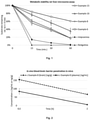
Classifications
-
- A—HUMAN NECESSITIES
- A61—MEDICAL OR VETERINARY SCIENCE; HYGIENE
- A61P—SPECIFIC THERAPEUTIC ACTIVITY OF CHEMICAL COMPOUNDS OR MEDICINAL PREPARATIONS
- A61P25/00—Drugs for disorders of the nervous system
- A61P25/30—Drugs for disorders of the nervous system for treating abuse or dependence
- A61P25/36—Opioid-abuse
-
- C—CHEMISTRY; METALLURGY
- C07—ORGANIC CHEMISTRY
- C07C—ACYCLIC OR CARBOCYCLIC COMPOUNDS
- C07C233/00—Carboxylic acid amides
- C07C233/01—Carboxylic acid amides having carbon atoms of carboxamide groups bound to hydrogen atoms or to acyclic carbon atoms
- C07C233/34—Carboxylic acid amides having carbon atoms of carboxamide groups bound to hydrogen atoms or to acyclic carbon atoms having the nitrogen atom of at least one of the carboxamide groups bound to a carbon atom of a hydrocarbon radical substituted by amino groups
- C07C233/35—Carboxylic acid amides having carbon atoms of carboxamide groups bound to hydrogen atoms or to acyclic carbon atoms having the nitrogen atom of at least one of the carboxamide groups bound to a carbon atom of a hydrocarbon radical substituted by amino groups with the substituted hydrocarbon radical bound to the nitrogen atom of the carboxamide group by an acyclic carbon atom
- C07C233/40—Carboxylic acid amides having carbon atoms of carboxamide groups bound to hydrogen atoms or to acyclic carbon atoms having the nitrogen atom of at least one of the carboxamide groups bound to a carbon atom of a hydrocarbon radical substituted by amino groups with the substituted hydrocarbon radical bound to the nitrogen atom of the carboxamide group by an acyclic carbon atom having the carbon atom of the carboxamide group bound to an acyclic carbon atom of a carbon skeleton containing six-membered aromatic rings
-
- C—CHEMISTRY; METALLURGY
- C07—ORGANIC CHEMISTRY
- C07C—ACYCLIC OR CARBOCYCLIC COMPOUNDS
- C07C237/00—Carboxylic acid amides, the carbon skeleton of the acid part being further substituted by amino groups
- C07C237/28—Carboxylic acid amides, the carbon skeleton of the acid part being further substituted by amino groups having the carbon atom of at least one of the carboxamide groups bound to a carbon atom of a non-condensed six-membered aromatic ring of the carbon skeleton
- C07C237/42—Carboxylic acid amides, the carbon skeleton of the acid part being further substituted by amino groups having the carbon atom of at least one of the carboxamide groups bound to a carbon atom of a non-condensed six-membered aromatic ring of the carbon skeleton having nitrogen atoms of amino groups bound to the carbon skeleton of the acid part, further acylated
-
- C—CHEMISTRY; METALLURGY
- C07—ORGANIC CHEMISTRY
- C07C—ACYCLIC OR CARBOCYCLIC COMPOUNDS
- C07C53/00—Saturated compounds having only one carboxyl group bound to an acyclic carbon atom or hydrogen
- C07C53/02—Formic acid
- C07C53/06—Salts thereof
-
- C—CHEMISTRY; METALLURGY
- C07—ORGANIC CHEMISTRY
- C07D—HETEROCYCLIC COMPOUNDS
- C07D333/00—Heterocyclic compounds containing five-membered rings having one sulfur atom as the only ring hetero atom
- C07D333/50—Heterocyclic compounds containing five-membered rings having one sulfur atom as the only ring hetero atom condensed with carbocyclic rings or ring systems
- C07D333/74—Naphthothiophenes
-
- C—CHEMISTRY; METALLURGY
- C07—ORGANIC CHEMISTRY
- C07B—GENERAL METHODS OF ORGANIC CHEMISTRY; APPARATUS THEREFOR
- C07B2200/00—Indexing scheme relating to specific properties of organic compounds
- C07B2200/07—Optical isomers
Definitions
- the present invention relates to a compound of formula (I) or (II), to a pharmaceutical composition comprising the compound of formula (I) or (II), as well as to these compounds for use in the treatment, amelioration or prevention of pain, opioid overdose, addiction, neuropsychiatric disorder, Prader-Willi Syndrome, gastrointestinal disorder, skin disorder, dyspnea, and temporomandibular joint dysfunction, including methods of treating, ameliorating or preventing pain, opioid overdose, addiction, neuropsychiatric disorder, Prader-Willi Syndrome, gastrointestinal disorder, skin disorder, dyspnea, and temporomandibular joint dysfunction involving administering to a patient in need thereof an effective amount of the compound having formula (I) or (II).
- Prescription opioids are used for the treatment of chronic and severe pain. When used appropriately, they are an essential part of pain therapy. But opioids may also pose serious risks, such as respiratory depression, constipation and addiction.
- the analgesic effects of opioid drugs are mainly mediated by the activation of the ⁇ -opioid receptor ( ⁇ OR) subtype.
- ⁇ OR ⁇ -opioid receptor
- Functionally selective drugs which are biased towards Gi protein activation over ⁇ -arrestin signaling at the ⁇ OR have been associated with an improved side effect profile in molecular studies recently.
- substances acting on the CNS-located opioid receptors have to be able to reach sufficient brain concentrations for the mediation of analgesia.
- pharmacokinetic properties like metabolic stability and blood-brain-barrier permeability have to be comprised.
- WO 2017/007695 WO 2018/129393 and WO 2019/036678 describe certain compounds which are intended to be used for treating pain in a subject in need of the treatment, which is described as reducing the risk of respiratory depression or constipation.
- the compounds described herein combine Gi protein pathway selective ⁇ OR activity with desirable pharmacokinetic properties.
- the present invention relates to a compound of the following formula (I) or (II), optionally in the form of a pharmaceutically acceptable salt, solvate, polymorph, cocrystal, tautomer, racemate, enantiomer, or diastereomer or mixture thereof: wherein
- the present invention furthermore relates to a pharmaceutical composition
- a pharmaceutical composition comprising a compound having formula (I) or (II), optionally in the form of a pharmaceutically acceptable salt, solvate, polymorph, cocrystal, tautomer, racemate, enantiomer, or diastereomer or mixture thereof, and optionally one or more pharmaceutically acceptable excipient(s) and/or carrier(s).
- the present invention also concerns a compound having formula (I) or (II), optionally in the form of a pharmaceutically acceptable salt, solvate, polymorph, cocrystal, tautomer, racemate, enantiomer, or diastereomer or mixture thereof, wherein the compound is for use in the treatment, amelioration or prevention of pain, opioid overdose, addiction, neuropsychiatric disorder, Prader-Willi Syndrome, gastrointestinal disorder, skin disorder, dyspnea, and temporomandibular joint dysfunction.
- the present invention relates to a method of treating, ameliorating or preventing pain, opioid overdose, addiction, neuropsychiatric disorder, Prader-Willi Syndrome, gastrointestinal disorder, skin disorder, dyspnea, and temporomandibular joint dysfunction, the method comprising administering to a patient in need thereof an effective amount of a compound having formula (I) or (II), optionally in the form of a pharmaceutically acceptable salt, solvate, polymorph, cocrystal, tautomer, racemate, enantiomer, or diastereomer or mixture thereof.
- the present invention refers to the use of a compound having formula (I) or (II), optionally in the form of a pharmaceutically acceptable salt, solvate, polymorph, cocrystal, tautomer, racemate, enantiomer, or diastereomer or mixture thereof, for the manufacture of a medicament for treating, ameliorating or preventing pain, opioid overdose, addiction, neuropsychiatric disorder, Prader-Willi Syndrome, gastrointestinal disorder, skin disorder, dyspnea, and temporomandibular joint dysfunction.
- the present invention relates to a compound of the following formula (I) or (II), optionally in the form of a pharmaceutically acceptable salt, solvate, polymorph, cocrystal, tautomer, racemate, enantiomer, or diastereomer or mixture thereof:
- R 1 , R 2a , R 2b , R 3 , R 4a , R 4b , R 5 , R 6 , R 7 , L and X are defined as follows.
- R 1 is an optionally substituted aryl group or an optionally substituted heteroaryl group.
- R 1 is an optionally substituted phenyl group.
- the optional substituent of the optionally substituted phenyl group is selected from the same list as the optional substituent of the optionally substituted aryl group.
- the optional substituent can be present at any available position but is typically present in para-position compared to the point of attachment to L. More preferably, R 1 is a phenyl group containing a hydroxy or amido substituent in para position and optionally one or two further substituents selected from methyl and fluoro.
- R 1 is a phenyl group containing a hydroxy or amido (e.g., -C(O)-NH 2 ) substituent in para position and optionally one or two further methyl substituents. Still more preferably, R 1 is a phenyl group containing at least one hydroxy or amido substituent in para position. Still more preferably, R 1 is a phenyl group having a hydroxy substituent in para position (4-hydroxyphenyl).
- this linked group is formed (in theory) by abstracting a hydrogen radical from R 1 and a hydrogen radical from R 6 and forming a bond between the thus formed two radicals of R 1 and R 6 .
- the non-hydrogen atoms between which the link is formed be both carbon atoms.
- one of the two non-hydrogen atoms may be a carbon atom and the other may be an oxygen atom, or one of the two non-hydrogen atoms may be a carbon atom and the other may be a nitrogen atom.
- L is selected from a bond and an optionally substituted alkylene and an optionally substituted heteroalkylene.
- L is selected from a bond, an optionally substituted methylene and an optionally substituted ethylene.
- L is an optionally substituted methylene group, more preferably an unsubstituted methylene group (-CH 2 -). It is to be understood that the optional substituent of the optionally substituted methylene group is selected from the same list as the optional substituent of the optionally substituted alkylene group.
- R 2a and R 2b are independently selected from hydrogen, optionally substituted alkyl, optionally substituted heteroalkyl, optionally substituted cycloalkyl, and optionally substituted heterocycloalkyl, provided that, when at least one of R 2a and R 2b is optionally substituted alkyl, the optionally substituted alkyl of R 2a or R 2b can optionally be linked to R 1 via a bond between a non-hydrogen atom of R 2a or R 2b and a non-hydrogen atom of R 1 .
- R 2a and R 2b are independently selected from hydrogen and optionally substituted alkyl. More preferably, R 2a and R 2b are independently selected from hydrogen, alkyl and haloalkyl.
- R 2a and R 2b are independently selected from hydrogen and alkyl. Still more preferably, R 2a and R 2b are independently selected from methyl, ethyl and propyl. Most preferably, both R 2a and R 2b are methyl.
- R 1 is linked to R 2a via a bond between a non-hydrogen atom of R 2a and a non-hydrogen atom of R 1
- this linked group is formed (in theory) by abstracting a hydrogen radical from R 1 and a hydrogen radical from R 2a and forming a bond between the thus formed two radicals of R 1 and R 2a .
- the non-hydrogen atoms between which the link is formed be both carbon atoms.
- one of the two non-hydrogen atoms may be a carbon atom and the other may be an oxygen atom, or one of the two non-hydrogen atoms may be a carbon atom and the other may be a nitrogen atom.
- R 1 is linked to R 2b via a bond between a non-hydrogen atom of R 2b and a non-hydrogen atom of R 1
- this linked group is formed (in theory) by abstracting a hydrogen radical from R 1 and a hydrogen radical from R 2b and forming a bond between the thus formed two radicals of R 1 and R 2b .
- the non-hydrogen atoms between which the link is formed be both carbon atoms.
- one of the two non-hydrogen atoms may be a carbon atom and the other may be an oxygen atom, or one of the two non-hydrogen atoms may be a carbon atom and the other may be a nitrogen atom.
- R 3 is selected from hydrogen and optionally substituted alkyl.
- R 3 is preferably selected from hydrogen and alkyl. More preferably, R 3 is hydrogen.
- R 4a and R 4b are independently selected from hydrogen, optionally substituted alkyl and optionally substituted heteroalkyl.
- R 4a and R 4b are independently selected from hydrogen, optionally substituted methyl, optionally substituted ethyl and optionally substituted propyl, wherein preferably at least one of R 4a and R 4b is hydrogen.
- R 4a and R 4b are independently selected from hydrogen, methyl, ethyl and propyl, wherein preferably at least one of R 4a and R 4b is hydrogen, even more preferably hydrogen or methyl.
- the optional substituent of the optionally substituted methyl, optionally substituted ethyl and optionally substituted propyl is selected from the same list as the optional substituent of the optionally substituted alkyl group.
- R 5 is selected from optionally substituted cycloalkyl, optionally substituted heterocycloalkyl, optionally substituted aryl and optionally substituted heteroaryl.
- R 5 is selected from an optionally substituted aryl group and an optionally substituted heteroaryl group.
- R 5 is selected from optionally substituted phenyl, optionally substituted naphthyl, optionally substituted pyridyl and optionally substituted thienyl.
- the substituent can be -CF 3 .
- R 7 is selected from optionally substituted cycloalkyl, optionally substituted heterocycloalkyl, optionally substituted aryl and optionally substituted heteroaryl.
- R 7 is selected from an optionally substituted aryl group and an optionally substituted heteroaryl group.
- R 7 is selected from optionally substituted phenyl, optionally substituted naphthyl, optionally substituted pyridyl and optionally substituted thienyl.
- the substituent can be -CF 3 .
- the optional substituent of the optionally substituted phenyl and the optionally substituted naphthyl is selected from the same list as the optional substituent of the optionally substituted aryl group.
- the optional substituent of the optionally substituted pyridyl and optionally substituted thienyl is selected from the same list as the optional substituent of the optionally substituted heteroaryl group.
- R 6 is hydrogen or optionally substituted alkyl, wherein the optionally substituted alkyl of R 6 can optionally be linked to R 1 via a bond between a non-hydrogen atom of R 6 and a non-hydrogen atom of R 1 .
- R 6 is hydrogen or optionally substituted alkyl, wherein alkyl is preferably selected from methyl, ethyl and propyl, more preferably methyl or ethyl, even more preferably methyl.
- R 6 is most preferably hydrogen.
- Any hydrogen atoms in formulae (I) and (II) can be optionally independently replaced by fluorine.
- the one or more optional substituents of the optionally substituted aryl group and the optionally substituted heteroaryl group are independently selected from the group consisting of -halogen, -CN, -C(O)R**, -COOR**, -C(O)NR**R**, -NR**R**, -NR**-C(O)R**, -N(R**)-C(O)-OR**, -N(R**)-C(O) -NR**R**, -N(R**)-S(O) 2 R**, -(optionally substituted alkyl), -OR**, -(optionally substituted heterocyclyl), -(optionally substituted alkylene)-(optionally substituted heterocyclyl), -(optionally substituted carbocyclyl), and -(optionally substituted alkylene)-(optionally substituted carbocyclyl).
- the one or more optional substituents of the optionally substituted aryl group and the optionally substituted heteroaryl group are independently selected from the group consisting of -halogen, -CN, -C(O)R**, -COOR**, -C(O)NR**R**, -NR**R**, -NR**-C(O)R**, -N(R**)-C(O)-OR**, -N(R**)-C(O) -NR**R**, -N(R**)-S(O) 2 R**, -(optionally substituted alkyl), and -OR**.
- the one or more optional substituents of the optionally substituted aryl group and the optionally substituted heteroaryl group are independently selected from the group consisting of -halogen, -CN, -C(O)R**, -COOR**, -C(O)NR**R**, -NR**R**, -NR**-C(O)R**, -N(R**)-C(O)-OR**, -N(R**)-C(O) -NR**R**, -N(R**)-S(O) 2 R**, -(optionally substituted alkyl), and -OR**.
- the one or more optional substituents of the optionally substituted aryl group and the optionally substituted heteroaryl group are independently selected from the group consisting of -halogen, -CN, -C(O)R**, -COOR**, -C(O)NR**R**, -NR**R**, -NR**-C(O)R**, -(optionally substituted alkyl), and -OR**.
- R** is H, -(optionally substituted alkyl), -(optionally substituted heterocyclyl), or -(optionally substituted carbocyclyl), preferably R** is H or -(optionally substituted alkyl).
- the optional substituent of the optionally substituted alkyl and the optionally substituted alkylene can be independently -halogen, -CN, -NO 2 , oxo, -C(O)R ar , -COOR ar , -C(O)NR ar R ar , -NR ar R ar , -NR ar -C(O)R ar , -N(R ar )-C(O)-OR ar , -N(R ar )-C(O)-NR ar R ar , -N(R ar )-S(O) 2 R ar , -OR ar , -O-C(O)R ar , -O-C(O)-NR ar R ar , -SR ar , -S(O)R ar , -S(O) 2 R ar , -S(O) 2
- the optional substituent of the optionally substituted alkyl and the optionally substituted alkylene can be independently -halogen, -CN, oxo, -C(O)R ar , -COOR ar , -C(O)NR ar R ar , -NR ar R ar , -NR ar -C(O)R ar , -N(R ar )-C(O)-OR ar , -N(R ar )-C(O)-NR ar R ar , -N(R ar )-S(O) 2 R ar , -OR ar , -O-C(O)R ar , -O-C(O)-NR ar R ar , -SR ar , -S(O)R ar , -S(O) 2 R ar , -S(O) 2 -NR ar R ar or -N(R ar )-S(O) 2 -NR ar R ar ; wherein R ar is H, alky
- the optional substituent of the optionally substituted alkyl and the optionally substituted alkylene can be independently -halogen, -CN, oxo, -C(O)R ar , -COOR ar , -C(O)NR ar R ar , -NR ar R ar , -NR ar -C(O)R ar , -N(R ar )-C(O)-OR ar , -N(R ar )-C(O)-NR ar R ar , -N(R ar )-S(O) 2 R ar , -OR ar , -O-C(O)R ar , -O-C(O)-NR ar R ar , -SR ar , -S(O)R ar , -S(O) 2 R ar , -S(O) 2 -NR ar R ar or -N(R ar )-S(O) 2 -NR ar R ar ; wherein R ar is H or alky
- the optional substituent of the optionally substituted heterocyclyl and the optionally substituted carbocyclyl can be independently alkyl, -halogen, -CN, -NO 2 , oxo, -C(O)R ar , -COOR ar , -C(O)NR ar R ar , -NR ar R ar , -NR ar -C(O)R ar , -N(R ar )-C(O)-OR ar , -N(R ar )-C(O)-NR ar R ar , -N(R ar )-S(O) 2 R ar , -OR ar , -O-C(O)R ar , -O-C(O)-NR ar R ar , -SR ar , -S(O)R ar , -S(O) 2 R ar ,
- the optional substituent of the optionally substituted heterocyclyl and the optionally substituted carbocyclyl can be independently alkyl, -halogen, -CN, oxo, -C(O)R ar , -COOR ar , -C(O)NR ar R ar , -NR ar R ar , -NR ar -C(O)R ar , -N(R ar )-C(O)-OR ar , -N(R ar )-C(O)-NR ar R ar , -N(R ar )-S(O) 2 R ar , -OR ar , -O-C(O)R ar , -O-C(O)-NR ar R ar , -SR ar , -S(O)R ar , -S(O) 2 R ar , -S(O) 2 -NR ar R ar or -N(R ar )-S(O) 2 -NR ar R ar .
- the optional substituent of the optionally substituted heterocyclyl and the optionally substituted carbocyclyl can be independently alkyl, -halogen, -CN, oxo, -C(O)R ar , -COOR ar , -C(O)NR ar R ar , -NR ar R ar , -NR ar -C(O)R ar , -N(R ar )-C(O)-OR ar , -N(R ar )-C(O)-NR ar R ar , -N(R ar )-S(O) 2 R ar , -OR ar , -O-C(O)R ar , -O-C(O)-NR ar R ar , -SR ar , -S(O)R ar , -S(O) 2 R ar , -S(O) 2 -NR ar R ar or -N(R ar )-S(O) 2 -NR ar R ar .
- R ar is preferably H, alkyl, heterocyclyl or carbocyclyl. More preferably, R ar is H or alkyl.
- the one or more optional substituents of the optionally substituted alkyl, optionally substituted alkylene, optionally substituted heteroalkylene, and optionally substituted heteroalkyl are independently selected from -halogen, -CN, -NO 2 , oxo, -C(O)R alk , -COOR alk , -C(O)NR alk R alk , -NR alk R alk , -NR alk -C(O)R alk , -N(R alk )-C(O)-OR alk , -N(R alk )-C(O)-NR alk R alk , -N(R alk )-S(O) 2 R alk , -OR alk , -O-C(O)R alk , -O-C(O)-NR alk R alk , -SR alk , -S(O)R alk , -S(O) 2 R al
- the one or more optional substituents of the optionally substituted alkyl, optionally substituted alkylene, optionally substituted heteroalkylene, and optionally substituted heteroalkyl are independently selected from -halogen, -CN, oxo, -C(O)R alk , -COOR alk , -C(O)NR alk R alk , -NR alk R alk , -NR alk -C(O)R alk , -N(R alk )-C(O)-OR alk , -N(R alk )-C(O)-NR alk R alk , -N(R alk )-S(O) 2 R alk , -OR alk , -O-C(O)R alk , -O-C(O)-NR alk R alk , -SR alk , -S(O)R alk , -S(O) 2 R alk ,
- the one or more optional substituents of the optionally substituted alkyl, optionally substituted alkylene, optionally substituted heteroalkylene, and optionally substituted heteroalkyl are independently selected from -halogen, -CN, oxo, -C(O)R alk , -COOR alk , -S(O)R alk , - S(O) 2 R alk and -S(O) 2 -NR alk R alk . -N(R alk )-S(O) 2 R alk , -OR alk , -O-C(O)R alk , -SR alk ,
- R alk is preferably H, alkyl or alkyl substituted with one or more F. More preferably, R alk is H or alkyl.
- the one or more optional substituents of the optionally substituted cycloalkyl and optionally substituted heterocycloalkyl are independently selected from -alkyl, -halogen, -CN, -NO 2 , oxo, -C(O)R cyc , -COOR cyc , -C(O)NR cyc R cyc , -NR cyc R cyc , -NR cyc -C(O)R cyc , -N(R cyc )-C(O)-OR cyc , -N(R cyc )-C(O)-NR cyc R cyc , -N(R cyc )-S(O) 2 R cyc , -OR cyc , -O-C(O)R cyc , -O-C(O)-NR cyc R c
- the one or more optional substituents of the optionally substituted cycloalkyl and optionally substituted heterocycloalkyl are independently selected from -alkyl, -halogen, -CN, oxo, -C(O)R cyc , -COOR cyc , -C(O)NR cyc R cyc , -NR cyc R cyc , -NR cyc -C(O)R cyc , -N(R cyc )-C(O)-OR cyc , -N(R cyc )-C(O)-NR cyc R cyc , -N(R cyc )-S(O) 2 R cyc , -OR cyc , -O-C(O)R cyc , -O-C(O)-NR cyc R cyc R cy
- the one or more optional substituents of the optionally substituted cycloalkyl and optionally substituted heterocycloalkyl are independently selected from -alkyl, -halogen, -CN, oxo, -C(O)R cyc , -COOR cyc , -C(O)NR cyc R cyc , -NR cyc R cyc , -NR cyc -C(O)R cyc , -N(R cyc )-S(O) 2 R cyc , -OR cyc , -O-C(O)R cyc , -SR cyc , -S(O)R cyc , -S(O) 2 R cyc and -S(O) 2 -N R cyc R cyc .
- R cyc is preferably H, alkyl or alkyl substituted with one or more F. More preferably, R cyc is H or alkyl.
- the compounds of formulae (I) and (II) are preferably represented by the following formulae (I-a) and (II-b), respectively: wherein R 1 , R 2a , R 2b , R 3 , R 4a , R 4b , R 5 , R 6 , R 7 , L and X are as defined above.
- the compounds of formulae (I) and (II) are selected from (S)-N-(2-(dimethylamino)-3-(4-hydroxyphenyl)propyl)cinnamamide, (S)-N-(2-(dimethylamino)-3-(4-hydroxyphenyl)propyl)-3-phenylpropiolamide, ( S , E )-N-(2-(dimethylamino)-3-(4-hydroxyphenyl)propyl)-3-phenylbut-2-enamide, ( S , E )-N-(2-(dimethylamino)-3-(4-hydroxyphenyl)propyl)-2-methyl-3-phenylacrylamide, ( S )-N-(2-(dimethylamino)-3-(4-hydroxyphenyl)-2-methylpropyl)cinnamamide ( S , E )-N-(2-(dimethylamino)-3-(4-hydroxyphenyl)propy
- the present invention furthermore relates to a pharmaceutical composition
- a pharmaceutical composition comprising a compound having formula (I) or (II), optionally in the form of a pharmaceutically acceptable salt, solvate, polymorph, cocrystal, tautomer, racemate, enantiomer, or diastereomer or mixture thereof, and optionally one or more pharmaceutically acceptable excipient(s) and/or carrier(s).
- the present invention also concerns a compound having formula (I) or (II), optionally in the form of a pharmaceutically acceptable salt, solvate, polymorph, cocrystal, tautomer, racemate, enantiomer, or diastereomer or mixture thereof, wherein the compound is for use in the treatment, amelioration or prevention of pain, opioid overdose, addiction, neuropsychiatric disorder, Prader-Willi Syndrome, gastrointestinal disorder, skin disorder, dyspnea, and temporomandibular joint dysfunction.
- the present invention relates to a method of treating, ameliorating or preventing pain, opioid overdose, addiction, neuropsychiatric disorder, Prader-Willi Syndrome, gastrointestinal disorder, skin disorder, dyspnea, and temporomandibular joint dysfunction, the method comprising administering to a patient in need thereof an effective amount of a compound having formula (I) or (II), optionally in the form of a pharmaceutically acceptable salt, solvate, polymorph, cocrystal, tautomer, racemate, enantiomer, or diastereomer or mixture thereof.
- the present invention refers to the use of a compound having formula (I) or (II), optionally in the form of a pharmaceutically acceptable salt, solvate, polymorph, cocrystal, tautomer, racemate, enantiomer, or diastereomer or mixture thereof, for the manufacture of a medicament for treating, ameliorating or preventing pain, opioid overdose, addiction, neuropsychiatric disorder, Prader-Willi Syndrome, gastrointestinal disorder, skin disorder, dyspnea, and temporomandibular joint dysfunction.
- alkyl refers to a monovalent saturated acyclic (i.e., non-cyclic) hydrocarbon group which may be linear or branched. Accordingly, an “alkyl” group does not comprise any carbon-to-carbon double bond or any carbon-to-carbon triple bond. Unless defined otherwise, the term “alkyl” preferably refers to C 1-6 alkyl, more preferably C 1-4 alkyl.
- Preferred exemplary alkyl groups are methyl, ethyl, propyl (e.g., n-propyl or isopropyl), or butyl (e.g., n-butyl, isobutyl, sec-butyl, or tert-butyl), more preferably methyl or ethyl, and even more preferably methyl.
- heteroalkyl refers to an alkyl group in which one or more, e.g., one or two (preferably one) of the -CH 2 - groups have been replaced each independently by a group selected from -O-, -S-, -S(O)-, -S(O) 2 - and -N(alkyl)-.
- heteroalkyl preferably refers to C 1-6 heteroalkyl, more preferably C 1-4 heteroalkyl, even more preferably to methylamino, dimethylamino, ethylamino, diethylamino, methoxy or ethoxy, even more preferably to methoxy or ethoxy, and still more preferably to methoxy.
- haloalkyl refers to an alkyl group substituted with one or more (preferably 1 to 6, more preferably 1 to 3) halogen atoms which are selected independently from fluoro, chloro, bromo and iodo, and are preferably all fluoro atoms. It will be understood that the maximum number of halogen atoms is limited by the number of available attachment sites and, thus, depends on the number of carbon atoms comprised in the alkyl moiety of the haloalkyl group.
- Haloalkyl may, e.g., refer to -CF 3 , -CHF 2 , -CH 2 F, -CF 2 -CH 3 , -CH 2 -CF 3 , -CH 2 -CHF 2 , -CH 2 -CF 2 -CH 3 , -CH 2 -CF 2 -CF 3 , or -CH(CF 3 ) 2 .
- alkylene refers to an alkanediyl group, i.e. a divalent saturated acyclic hydrocarbon group which may be linear or branched, preferably linear. Unless defined otherwise, the term “alkylene” preferably refers to C 1-6 alkylene, more preferably C 1-4 alkylene.
- Preferred exemplary alkylene groups are methylene (-CH 2 -), ethylene (e.g., -CH 2 -CH 2 - or -CH(-CH 3 )-), propylene (e.g., -CH 2 -CH 2 -CH 2 -, -CH(-CH 2 -CH 3 )-, -CH 2 -CH(-CH 3 )-, or -CH(-CH 3 )-CH 2 -), or butylene (e.g., -CH 2 -CH 2 -CH 2 -CH 2 -CH 2 -), more preferably methylene or ethylene, and even more preferably methylene.
- heteroalkylene refers to an alkylene group in which one or more (e.g., one or two, preferably one) of the -CH 2 - groups have been replaced each independently by a group selected from -O-, -S-, -S(O)-, -S(O) 2 - and -N(alkyl)-.
- heteroalkylene preferably refers to C 1-6 heteroalkylene , in particular C 1-4 heteroalkylene (including, in particular, linear C 1-4 heteroalkylene), more preferably to -G-CH 2 -, -G-CH 2 -CH 2 -, -G-CH 2 -CH 2 -CH 2 -, -CH 2 -G-, -CH 2 -G-CH 2 - -CH 2 -G-CH 2 -CH 2 -, -CH 2 -CH 2 -G-, -CH 2 -CH 2 -G-CH 2 - or -CH 2 -CH 2 -CH 2 -CH 2 -G-, wherein each G is independently selected from -O-, -S-, -S(O)-, -S(O) 2 - and -N(alkyl)-, preferably from -N(alkyl)- and -O-, more preferably from -O-.
- heteroalkylene refers to -G-CH 2 -, -G-CH 2 -CH 2 -, -CH 2 -G-, -CH 2 -G-CH 2 - or -CH 2 -CH 2 -G-, wherein each G is independently selected from -O-, -S-, -S(O)-, -S(O) 2 - and -N(alkyl)-, preferably from -N(alkyl)- and -O- , more preferably from -O-.
- heteroalkylene refers to -G-CH 2 - or -CH 2 -G-, wherein each G is independently selected from -O-, -S-, -S(O)-, -S(O) 2 - and -N(alkyl)-, preferably from -N(alkyl)- and -O-, more preferably from -O-.
- carbocyclyl refers to a hydrocarbon ring group, including monocyclic rings as well as bridged ring, spiro ring and/or fused ring systems (which may be composed, e.g., of two or three rings), wherein said ring group may be saturated, partially unsaturated (i.e., unsaturated but not aromatic) or aromatic.
- “carbocyclyl” preferably refers to aryl, cycloalkyl or cycloalkenyl.
- the number of carbon atoms in the carbocyclyl ring is not particularly limited and is preferably 3 to 14, more preferably 3 to 10, even more preferably 3 to 7.
- heterocyclyl refers to a ring group, including monocyclic rings as well as bridged ring, spiro ring and/or fused ring systems (which may be composed, e.g., of two or three rings), wherein said ring group comprises one or more (such as, e.g., one, two, three, or four) ring heteroatoms independently selected from O, S and N, and the remaining ring atoms are carbon atoms, wherein one or more S ring atoms (if present) and/or one or more N ring atoms (if present) may optionally be oxidized, wherein one or more carbon ring atoms may optionally be oxidized (i.e., to form an oxo group), and further wherein said ring group may be saturated, partially unsaturated (i.e., unsaturated but not aromatic) or aromatic.
- heterocyclyl preferably refers to heteroaryl, heterocycloalkyl or heterocycloalkenyl.
- the number of carbon atoms in the carbocyclyl ring is not particularly limited and is preferably 3 to 14, preferably 3 to 10, more preferably 3 to 7.
- aryl refers to an aromatic hydrocarbon ring group, including monocyclic aromatic rings as well as bridged ring and/or fused ring systems containing at least one aromatic ring (e.g., ring systems composed of two or three fused rings, wherein at least one of these fused rings is aromatic; or bridged ring systems composed of two or three rings, wherein at least one of these bridged rings is aromatic).
- an "aryl” preferably has 5 to 14 ring atoms, more preferably 6 to 10 ring atoms.
- Aryl may, e.g., refer to phenyl, naphthyl, dialinyl (i.e., 1,2-dihydronaphthyl), tetralinyl (i.e., 1,2,3,4-tetrahydronaphthyl), anthracenyl, or phenanthrenyl, more preferably aryl refers to phenyl or naphthyl, and most preferably aryl refers to phenyl.
- heteroaryl refers to an aromatic ring group, including monocyclic aromatic rings as well as bridged ring and/or fused ring systems containing at least one aromatic ring (e.g., ring systems composed of two or three fused rings, wherein at least one of these fused rings is aromatic; or bridged ring systems composed of two or three rings, wherein at least one of these bridged rings is aromatic), wherein said aromatic ring group comprises one or more (such as, e.g., one, two, three, or four) ring heteroatoms independently selected from O, S and N, and the remaining ring atoms are carbon atoms, wherein one or more S ring atoms (if present) and/or one or more N ring atoms (if present) may optionally be oxidized, and further wherein one or more carbon ring atoms may optionally be oxidized (i.e., to form an oxo group).
- aromatic ring group comprises one or more (such as, e.g., one, two,
- a “heteroaryl” preferably refers to a 5 to 14 membered (more preferably 5 to 10 membered) monocyclic ring or fused ring system comprising one or more (e.g., one, two, three or four) ring heteroatoms independently selected from O, S and N, wherein one or more S ring atoms (if present) and/or one or more N ring atoms (if present) are optionally oxidized, and wherein one or more carbon ring atoms are optionally oxidized; even more preferably, a “heteroaryl” refers to a 5 or 6 membered monocyclic ring comprising one or more (e.g., one, two or three) ring heteroatoms independently selected from O, S and N, wherein one or more S ring atoms (if present) and/or one or more N ring atoms (if present) are optionally oxidized, and wherein one or more carbon ring atoms are optionally oxidized;
- Heteroaryl may, e.g., refer to thienyl (i.e., thiophenyl), benzo[b]thienyl, naphtho[2,3-b]thienyl, thianthrenyl, furyl (i.e., furanyl), benzofuranyl, isobenzofuranyl, chromenyl, xanthenyl, phenoxathiinyl, pyrrolyl (e.g., 2H-pyrrolyl), imidazolyl, pyrazolyl, pyridyl (i.e., pyridinyl; e.g., 2-pyridyl, 3-pyridyl, or 4-pyridyl), pyrazinyl, pyrimidinyl, pyridazinyl, indolizinyl, isoindolyl, indolyl (e.g., 3H-indolyl), indazoly
- Heteroaryl preferably refers to thienyl (i.e., thiophenyl), benzo[b]thienyl, furyl (i.e., furanyl), benzofuranyl, isobenzofuranyl, imidazolyl, pyrazolyl, pyridyl (i.e., pyridinyl; e.g., 2-pyridyl, 3-pyridyl, or 4-pyridyl), pyrazinyl, pyrimidinyl, pyridazinyl, indolizinyl, isoindolyl, indolyl (e.g., 3H-indolyl), indazolyl, isoquinolyl or quinolyl.
- a more preferred example is thienyl.
- cycloalkyl refers to a saturated hydrocarbon ring group, including monocyclic rings as well as bridged ring, spiro ring and/or fused ring systems (which may be composed, e.g., of two or three rings; such as, e.g., a fused ring system composed of two or three fused rings).
- cycloalkyl preferably refers to a C 3-14 cycloalkyl, and more preferably refers to a C 3-7 cycloalkyl.
- a particularly preferred "cycloalkyl” is a monocyclic saturated hydrocarbon ring having 3 to 7 ring members.
- Cycloalkyl may, e.g., refer to cyclopropyl, cyclobutyl, cyclopentyl, cyclohexyl, cycloheptyl, or adamantyl.
- heterocycloalkyl refers to a saturated ring group, including monocyclic rings as well as bridged ring, spiro ring and/or fused ring systems (which may be composed, e.g., of two or three rings; such as, e.g., a fused ring system composed of two or three fused rings), wherein said ring group contains one or more (such as, e.g., one, two, three, or four) ring heteroatoms independently selected from O, S and N, and the remaining ring atoms are carbon atoms, wherein one or more S ring atoms (if present) and/or one or more N ring atoms (if present) may optionally be oxidized, and further wherein one or more carbon ring atoms may optionally be oxidized (i.e., to form an oxo group).
- heterocycloalkyl preferably refers to a 3 to 14 membered
- heterocycloalkyl refers to a 5 to 7 membered saturated monocyclic ring containing one or more (e.g., one, two, or three) ring heteroatoms independently selected from O, S and N, wherein one or more S ring atoms (if present) and/or one or more N ring atoms (if present) are optionally oxidized, and wherein one or more carbon ring atoms are optionally oxidized.
- Heterocycloalkyl may, e.g., refer to oxetanyl, tetrahydrofuranyl, piperidinyl, piperazinyl, aziridinyl, azetidinyl, pyrrolidinyl, imidazolidinyl, morpholinyl (e.g., morpholin-4-yl), pyrazolidinyl, tetrahydrothienyl, octahydroquinolinyl, octahydroisoquinolinyl, oxazolidinyl, isoxazolidinyl, azepanyl, diazepanyl, oxazepanyl or 2-oxa-5-aza-bicyclo[2.2.1]hept-5-yl.
- Heterocycloalkyl preferably refers to oxetanyl, tetrahydrofuranyl, piperidinyl, piperazinyl, aziridinyl, azetidinyl, pyrrolidinyl, imidazolidinyl, morpholinyl (e.g., morpholin-4-yl), pyrazolidinyl, tetrahydrothienyl, oxazolidinyl or isoxazolidinyl.
- morpholinyl e.g., morpholin-4-yl
- pyrazolidinyl tetrahydrothienyl
- oxazolidinyl or isoxazolidinyl.
- Heterocycloalkyl more preferably refers to piperidinyl, piperazinyl, pyrrolidinyl, imidazolidinyl, morpholinyl (e.g., morpholin-4-yl), pyrazolidinyl or tetrahydrothienyl.
- cycloalkenyl refers to an unsaturated alicyclic (non-aromatic) hydrocarbon ring group, including monocyclic rings as well as bridged ring, spiro ring and/or fused ring systems (which may be composed, e.g., of two or three rings; such as, e.g., a fused ring system composed of two or three fused rings), wherein said hydrocarbon ring group comprises one or more (e.g., one or two) carbon-to-carbon double bonds and does not comprise any carbon-to-carbon triple bond.
- cycloalkenyl preferably refers to a C 3-14 cycloalkenyl, and more preferably refers to a C 3-7 cycloalkenyl.
- a particularly preferred "cycloalkenyl” is a monocyclic unsaturated alicyclic hydrocarbon ring having 3 to 7 ring atoms and containing one or more (e.g., one or two; preferably one) carbon-to-carbon double bonds.
- Cycloalkenyl may, e.g., refer to cyclopropenyl, cyclobutenyl, cyclopentenyl, cyclohexenyl, cyclohexadienyl, cycloheptenyl, or cycloheptadienyl.
- heterocycloalkenyl refers to an unsaturated alicyclic (non-aromatic) ring group, including monocyclic rings as well as bridged ring, spiro ring and/or fused ring systems (which may be composed, e.g., of two or three rings; such as, e.g., a fused ring system composed of two or three fused rings), wherein said ring group contains one or more (such as, e.g., one, two, three, or four) ring heteroatoms independently selected from O, S and N, and the remaining ring atoms and carbon atoms, wherein one or more S ring atoms (if present) and/or one or more N ring atoms (if present) may optionally be oxidized, wherein one or more carbon ring atoms may optionally be oxidized (i.e., to form an oxo group), and further wherein said ring group comprises at least one double bond between
- heterocycloalkenyl preferably refers to a 3 to 14 membered unsaturated alicyclic ring, which is a monocyclic ring or a fused ring system (e.g., a fused ring system composed of two fused rings), wherein said ring group contains one or more (e.g., one, two, three, or four) ring heteroatoms independently selected from O, S and N, wherein one or more S ring atoms (if present) and/or one or more N ring atoms (if present) are optionally oxidized, wherein one or more carbon ring atoms are optionally oxidized, and wherein said ring group comprises at least one double bond between adjacent ring atoms and does not comprise any triple bond between adjacent ring atoms; more preferably, "heterocycloalkenyl” refers to a 5 to 7 membered monocyclic unsaturated non-aromatic ring containing one or more (e.g.
- halogen refers to fluoro (-F), chloro (-Cl), bromo (-Br), or iodo (-I).
- substituents such as, e.g., one, two, three or four substituents. It will be understood that the maximum number of substituents is limited by the number of attachment sites available on the substituted moiety.
- the "optionally substituted" groups referred to in this specification carry preferably not more than two substituents and may, in particular, carry only one substituent.
- the optional substituents are absent, i.e. that the corresponding groups are unsubstituted.
- an optional substituent is selected from the lists specified for the one or more optional substituents of the optionally substituted aryl group and the optionally substituted heteroaryl group.
- substituent groups comprised in the compounds of formula (I) and/or formula (II) may be attached to the remainder of the respective compound via a number of different positions of the corresponding specific substituent group. Unless defined otherwise, the preferred attachment positions for the various specific substituent groups are as illustrated in the examples.
- the terms “optional”, “optionally” and “may” denote that the indicated feature may be present but can also be absent.
- the present invention specifically relates to both possibilities, i.e., that the corresponding feature is present or, alternatively, that the corresponding feature is absent.
- the expression “X is optionally substituted with Y" (or “X may be substituted with Y”) means that X is either substituted with Y or is unsubstituted.
- a component of a composition is indicated to be “optional”
- the invention specifically relates to both possibilities, i.e., that the corresponding component is present (contained in the composition) or that the corresponding component is absent from the composition.
- a “solvate” refers to an association or complex of one or more solvent molecules and the compound of formula (I) and/or formula (II).
- solvents that form solvates include, but are not limited to, water, isopropanol, ethanol, methanol, dimethyl sulfoxide (DMSO), ethyl acetate, acetic acid, acetonitrile, and ethanolamine.
- DMSO dimethyl sulfoxide
- hydrate refers to the complex where the solvent molecule is water. It is to be understood that such solvates of the compounds of formula (I) and/or formula (II) also include solvates of pharmaceutically acceptable salts of the compounds of formula (I) and/or formula (II).
- a “cocrystal” refers to a crystalline structure that contains at least two different compounds that are solid in their pure form under ambient conditions. Cocrystals are made from neutral molecular species, and all species remain neutral after crystallization; further, typically and preferably, they are crystalline homogeneous phase materials where two or more building compounds are present in a defined stoichiometric ratio. See Wang Y and Chen A, 2013; and Springuel GR, et al., 2012; and US Patent 6,570,036 .
- any reference to a compound of formula (I) is to be understood as equally well applying to any specific examples of a compound of formula (I), such as compounds of formula (I-a).
- any reference to a compound of formula (II) is to be understood as equally well applying to any specific examples of a compound of formula (II), such as compounds of formula (II-a).
- the "treatment" of a disorder or disease, in particular pain may, for example, lead to a halt in the progression of the disorder or disease (e.g., no deterioration of symptoms) or a delay in the progression of the disorder or disease (in case the halt in progression is of a transient nature only).
- the "treatment” of a disorder or disease may also lead to a partial response (e.g., amelioration of symptoms) or complete response (e.g., disappearance of symptoms) of the subject/patient suffering from the disorder or disease. It is to be understood that a subject/patient may experience a broad range of responses to a treatment.
- amelioration of a disorder or disease typically refers to the partial response of the subject/patient suffering from the disorder or disease.
- prevention of a disorder or disease as used herein is also well known in the art.
- a patient/subject suspected of being prone to suffer from a disorder or disease may particularly benefit from a prevention of the disorder or disease.
- the subject/patient may have a susceptibility or predisposition for a disorder or disease, including but not limited to hereditary predisposition.
- Such a predisposition can be determined by standard methods or assays, using, e.g., genetic markers or phenotypic indicators.
- a disorder or disease to be prevented in accordance with the present invention has not been diagnosed or cannot be diagnosed in the patient/subject (for example, the patient/subject does not show any clinical or pathological symptoms).
- prevention comprises the use of the compounds of the present invention before any clinical and/or pathological symptoms are diagnosed or determined or can be diagnosed or determined by the attending physician.
- the disease or condition to be treated or prevented by the compounds of the present invention is preferably selected from pain, opioid overdose, addiction, neuropsychiatric disorder, Prader-Willi Syndrome, gastrointestinal disorder, skin disorder, dyspnea, and temporomandibular joint dysfunction.
- the disease or condition includes various diseases and conditions such as
- the disease or condition includes various diseases and conditions such as
- the disease or condition includes various diseases and conditions such as
- the neuropsychiatric disorders are preferably selected from obsessive compulsive disorder, Huntington's disease, Parkinson's disease, Tourette's syndrome, kleptomania, frontotemporal dementia, Alzheimer's disorder, depression including depressive disorders, anxiety disorder and panic disorder, anorexia nervosa, bulimia nervosa, binge eating disorder, obesity, sleep disruption associated with supranuclear palsy, epilepsy, schizophrenia, psychosis, bipolar disorder and autism spectrum disorder.
- the disease or condition to be treated or prevented by the compounds of the present invention is pain.
- the disease or condition includes various diseases and conditions related to pain, which can be due to various causes such as
- Patient refers to a living organism suffering from or prone to a disease or condition that can be treated by administration of a pharmaceutical composition as provided herein.
- Non-limiting examples include humans, other mammals, bovines, rats, mice, dogs, monkeys, goat, sheep, cows, deer, and other non-mammalian animals.
- the patient is preferably a human.
- an “effective amount” is an amount sufficient for a compound to accomplish a stated purpose relative to the absence of the compound (e.g., achieve the effect for which it is administered, i.e. the reduction of pain).
- An example of an “effective amount” is an amount sufficient to contribute to the treatment, prevention, or reduction of pain, which could also be referred to as a "therapeutically effective amount”.
- the term "about” preferably refers to ⁇ 10% of the indicated numerical value, more preferably to ⁇ 5% of the indicated numerical value, and in particular to the exact numerical value indicated.
- the expression “about 100” preferably refers to 100 ⁇ 10% (i.e., 90 to 110), more preferably to 100 ⁇ 5% (i.e., 95 to 105), and even more preferably to the specific value of 100. In connection with percentages, it is evident that 100 % can not be exceeded.
- the term "about” is used in connection with the endpoints of a range, it preferably refers to the range from the lower endpoint 10% of its indicated numerical value to the upper endpoint +10% of its indicated numerical value, more preferably to the range from of the lower endpoint 5% to the upper endpoint +5%, and even more preferably to the range defined by the exact numerical values of the lower endpoint and the upper endpoint.
- the expression “about 10 to about 20” preferably refers to the range of 9 to 22, more preferably to the range of 9.5 to 21, and even more preferably to the range of 10 to 20.
- the term "about” is used in connection with the endpoint of an open-ended range, it preferably refers to the corresponding range starting from the lower endpoint 10% or from the upper endpoint +10%, more preferably to the range starting from the lower endpoint 5% or from the upper endpoint +5%, and even more preferably to the open-ended range defined by the exact numerical value of the corresponding endpoint.
- the expression “at least about 10%” preferably refers to at least 9%, more preferably to at least 9.5%, and even more preferably to at least 10%.
- a comprising B and C has the meaning of "A containing, inter alia, B and C", wherein A may contain further optional elements (e.g., "A containing B, C and D" would also be encompassed), but this term also includes the meaning of "A consisting essentially of B and C” and the meaning of "A consisting of B and C" (i.e., no other components than B and C are comprised in A).
- any parameters referred to herein are preferably to be determined at standard ambient temperature and pressure conditions, particularly at a temperature of 25°C (298.15 K) and at an absolute pressure of 1 atm (101.325 kPa).
- the scope of the invention embraces all pharmaceutically acceptable salt forms of the compounds of formula (I) and/or formula (II) which may be formed, e.g., by protonation of an atom carrying an electron lone pair which is susceptible to protonation, such as an amino group, with an inorganic or organic acid, or as a salt of an acid group (such as a carboxylic acid group) with a physiologically acceptable cation.
- Exemplary base addition salts comprise, for example: alkali metal salts such as sodium or potassium salts; alkaline earth metal salts such as calcium or magnesium salts; zinc salts; ammonium salts; aliphatic amine salts such as trimethylamine, triethylamine, dicyclohexylamine, ethanolamine, diethanolamine, triethanolamine, procaine salts, meglumine salts, ethylenediamine salts, or choline salts; aralkyl amine salts such as N,N-dibenzylethylenediamine salts, benzathine salts, benethamine salts; heterocyclic aromatic amine salts such as pyridine salts, picoline salts, quinoline salts or isoquinoline salts; quaternary ammonium salts such as tetramethylammonium salts, tetraethylammonium salts, benzyltrimethylammonium salts, benzyltriethylam
- Exemplary acid addition salts comprise, for example: mineral acid salts such as hydrochloride, hydrobromide, hydroiodide, sulfate salts (such as, e.g., sulfate or hydrogensulfate salts), nitrate salts, phosphate salts (such as, e.g., phosphate, hydrogenphosphate, or dihydrogenphosphate salts), carbonate salts, hydrogencarbonate salts, perchlorate salts, borate salts, or thiocyanate salts; organic acid salts such as acetate, propionate, butyrate, pentanoate, hexanoate, heptanoate, octanoate, cyclopentanepropionate, decanoate, undecanoate, oleate, stearate, lactate, maleate, oxalate, fumarate, tartrate, malate, citrate, succinate, adipate, gluconate, glycolate, nic
- Preferred pharmaceutically acceptable salts of the compounds of formula (I) and/or formula (II) include a hydrochloride salt, a hydrobromide salt, a mesylate salt, a sulfate salt, a tartrate salt, a fumarate salt, an acetate salt, a citrate salt, and a phosphate salt.
- a particularly preferred pharmaceutically acceptable salt of the compound of formula (I) and/or formula (II) is a hydrochloride salt.
- the compound of formula (I) and/or formula (II), including any one of the specific compounds of formula (I) and/or formula (II) described herein, is in the form of a hydrochloride salt, a hydrobromide salt, a mesylate salt, a sulfate salt, a tartrate salt, a fumarate salt, an acetate salt, a citrate salt, or a phosphate salt, and it is particularly preferred that the compound of formula (I) and/or formula (II) is in the form of a hydrochloride salt.
- the compounds of formula (I) and/or formula (II) may exist in the form of different isomers, in particular stereoisomers (including, e.g., geometric isomers (or cis/trans isomers), enantiomers and diastereomers) or tautomers. All such isomers of the compounds of formula (I) and/or formula (II) are contemplated as being part of the present invention, either in admixture or in pure or substantially pure form.
- stereoisomers the invention embraces the isolated optical isomers of the compounds according to the invention as well as any mixtures thereof (including, in particular, racemic mixtures/racemates).
- racemates can be resolved by physical methods, such as, e.g., fractional crystallization, separation or crystallization of diastereomeric derivatives, or separation by chiral column chromatography.
- the individual optical isomers can also be obtained from the racemates via salt formation with an optically active acid followed by crystallization.
- the present invention further encompasses any tautomers of the compounds provided herein.
- the scope of the invention also embraces compounds of formula (I) and/or formula (II), in which one or more atoms are replaced by a specific isotope of the corresponding atom.
- the invention encompasses compounds of formula (I) and/or formula (II), in which one or more hydrogen atoms (or, e.g., all hydrogen atoms) are replaced by deuterium atoms (i.e., 2 H; also referred to as "D").
- the invention also embraces compounds of formula (I) and/or formula (II) which are enriched in deuterium.
- Naturally occurring hydrogen is an isotopic mixture comprising about 99.98 mol-% hydrogen-1 ( 1 H) and about 0.0156 mol-% deuterium ( 2 H or D).
- the content of deuterium in one or more hydrogen positions in the compounds of formula (I) and/or formula (II) can be increased using deuteration techniques known in the art.
- a compound of formula (I) and/or formula (II) or a reactant or precursor to be used in the synthesis of the compound of formula (I) and/or formula (II) can be subjected to an H/D exchange reaction using, e.g., heavy water (D 2 O).
- deuteration techniques are described in: Atzrodt J et al., Bioorg Med Chem, 20(18), 5658-5667, 2012 ; William JS et al., Journal of Labelled Compounds and Radiopharmaceuticals, 53(11-12), 635-644, 2010 ; Modvig A et al., J Org Chem, 79, 5861-5868, 2014 .
- the content of deuterium can be determined, e.g., using mass spectrometry or NMR spectroscopy.
- it is preferred that the compound of formula (I) and/or formula (II) is not enriched in deuterium. Accordingly, the presence of naturally occurring hydrogen atoms or 1 H hydrogen atoms in the compounds of formula (I) and/or formula (II) is preferred.
- the present invention also embraces compounds of formula (I) and/or formula (II), in which one or more atoms are replaced by a positron-emitting isotope of the corresponding atom, such as, e.g., 18 F, 11 C, 13 N, 15 O, 76 Br, 77 Br, 120 I and/or 124 I.
- a positron-emitting isotope of the corresponding atom such as, e.g., 18 F, 11 C, 13 N, 15 O, 76 Br, 77 Br, 120 I and/or 124 I.
- Such compounds can be used as tracers or imaging probes in positron emission tomography (PET).
- the invention thus includes (i) compounds of formula (I) and/or formula (II), in which one or more fluorine atoms are replaced by 18 F atoms, (ii) compounds of formula (I) and/or formula (II), in which one or more carbon atoms are replaced by 11 C atoms, (iii) compounds of formula (I) and/or formula (II), in which one or more nitrogen atoms are replaced by 13 N atoms, (iv) compounds of formula (I) and/or formula (II), in which one or more oxygen atoms are replaced by 15 O atoms, (v) compounds of formula (I) and/or formula (II), in which one or more bromine atoms are replaced by 76 Br atoms, (vi) compounds of formula (I) and/or formula (II), in which one or more bromine atoms are replaced by 77 Br atoms, (vii) compounds of formula (I) and/or formula (II), in which one or more iodine atoms
- the compounds provided herein may be administered as compounds per se or may be formulated as medicaments, e.g. as pharmaceutical composition or combination.
- the medicaments/pharmaceutical compositions may optionally comprise one or more pharmaceutically acceptable excipients, such as carriers, diluents, fillers, disintegrants, lubricating agents, binders, colorants, pigments, stabilizers, preservatives, antioxidants, and/or solubility enhancers, or any combination thereof.
- the pharmaceutical compositions may comprise one or more solubility enhancers, such as, e.g., poly(ethylene glycol), including poly(ethylene glycol) having a molecular weight in the range of about 200 to about 5,000 Da, ethylene glycol, propylene glycol, non-ionic surfactants, tyloxapol, polysorbate 80, macrogol-15-hydroxystearate, phospholipids, lecithin, dimyristoyl phosphatidylcholine, dipalmitoyl phosphatidylcholine, distearoyl phosphatidylcholine, cyclodextrins, ⁇ -cyclodextrin, ⁇ -cyclodextrin, ⁇ -cyclodextrin, hydroxyethyl- ⁇ -cyclodextrin, hydroxypropyl- ⁇ -cyclodextrin, hydroxyethyl- ⁇ -cyclodextrin, hydroxypropyl- ⁇ -cyclodextrin, di
- the tablets may contain excipients such as microcrystalline cellulose, lactose, sodium citrate, calcium carbonate, dibasic calcium phosphate and glycine, disintegrants such as starch (preferably corn, potato or tapioca starch), sodium starch glycolate, croscarmellose sodium and certain complex silicates, and granulation binders such as polyvinylpyrrolidone, hydroxypropylmethylcellulose (HPMC), hydroxypropylcellulose (HPC), sucrose, gelatin and acacia. Additionally, lubricating agents such as magnesium stearate, stearic acid, glyceryl behenate and talc may be included. Solid compositions of a similar type may also be employed as fillers in gelatin capsules.
- excipients such as microcrystalline cellulose, lactose, sodium citrate, calcium carbonate, dibasic calcium phosphate and glycine
- disintegrants such as starch (preferably corn, potato or tapioca starch), sodium starch glyco
- Preferred excipients in this regard include lactose, starch, a cellulose, or high molecular weight polyethylene glycols.
- the agent may be combined with various sweetening or flavoring agents, coloring matter or dyes, with emulsifying and/or suspending agents and with diluents such as water, ethanol, propylene glycol and glycerin, and combinations thereof.
- compositions can be formulated by techniques known to the person skilled in the art, such as the techniques published in " Remington: The Science and Practice of Pharmacy", Pharmaceutical Press, 22nd editi on.
- the pharmaceutical compositions can be formulated as dosage forms for oral, peroral, parenteral, such as intramuscular, intravenous, subcutaneous, intradermal, intraarterial, intracardial, intrathecal, rectal, nasal, topical, aerosol or vaginal administration.
- Dosage forms for oral administration include coated and uncoated tablets, soft gelatin capsules, hard gelatin capsules, lozenges, troches, solutions, emulsions, suspensions, syrups, elixirs, powders and granules for reconstitution, dispersible powders and granules, medicated gums, chewing tablets and effervescent tablets.
- Dosage forms for parenteral administration include solutions, emulsions, suspensions, dispersions and powders and granules for reconstitution. Emulsions are a preferred dosage form for parenteral administration.
- Dosage forms for rectal and vaginal administration include suppositories and ovula.
- Dosage forms for nasal administration can be administered via inhalation and insufflation, for example by a metered inhaler.
- Dosage forms for topical administration include creams, gels, ointments, salves, patches and transdermal delivery systems.
- the compounds of formula (I) and/or formula (II) or the above described pharmaceutical compositions comprising a compound of formula (I) and/or formula (II) may be administered to a subject by any convenient route of administration, whether systemically/peripherally or at the site of desired action, including but not limited to one or more of: oral (e.g., as a tablet, capsule, or as an ingestible solution), topical (e.g., transdermal, intranasal, ocular, buccal, and sublingual), parenteral (e.g., using injection techniques or infusion techniques, and including, for example, by injection, e.g., subcutaneous, intradermal, intramuscular, intravenous, intraarterial, intracardiac, intrathecal, intraspinal, intracapsular, subcapsular, intraorbital, intraperitoneal, intratracheal, subcuticular, intraarticular, subarachnoid, or intrasternal by, e.g., implant of a depot,
- examples of such administration include one or more of: intravenously, intraarterially, intraperitoneally, intrathecally, intraventricularly, intraurethrally, intrasternally, intracardially, intracranially, intramuscularly or subcutaneously administering the compounds or pharmaceutical compositions, and/or by using infusion techniques.
- parenteral administration the compounds are best used in the form of a sterile aqueous solution which may contain other substances, for example, enough salts or glucose to make the solution isotonic with blood.
- the aqueous solutions should be suitably buffered (preferably to a pH of from 3 to 9), if necessary.
- the preparation of suitable parenteral formulations under sterile conditions is readily accomplished by standard pharmaceutical techniques well known to those skilled in the art.
- Said compounds or pharmaceutical compositions can also be administered orally in the form of tablets, capsules, ovules, elixirs, solutions or suspensions, which may contain flavoring or coloring agents, for immediate-, delayed-, modified-, sustained-, pulsed- or controlled-release applications.
- said compounds or pharmaceutical compositions can be administered in the form of a suppository or pessary, or it may be applied topically in the form of a gel, hydrogel, lotion, solution, cream, ointment or dusting powder.
- the compounds of the present invention may also be dermally or transdermally administered, for example, by the use of a skin patch.
- sustained-release compositions include semi-permeable polymer matrices in the form of shaped articles, e.g., films, or microcapsules.
- Sustained-release matrices include, e.g., polylactides (see, e.g., US 3,773,919 ), copolymers of L-glutamic acid and gamma-ethyl-L-glutamate ( Sidman, U. et al., Biopolymers 22:547-556 (1983 )), poly(2-hydroxyethyl methacrylate) ( R. Langer et al., J. Biomed. Mater. Res.
- Sustained-release pharmaceutical compositions also include liposomally entrapped compounds.
- Liposomes containing a compound of the present invention can be prepared by methods known in the art, such as, e.g., the methods described in any one of: DE3218121 ; Epstein et al., Proc. Natl. Acad. Sci. (USA) 82:3688-3692 (1985 ); Hwang et al., Proc. Natl.
- Said compounds or pharmaceutical compositions may also be administered by the pulmonary route, rectal routes, or the ocular route.
- they can be formulated as micronized suspensions in isotonic, pH adjusted, sterile saline, or, preferably, as solutions in isotonic, pH adjusted, sterile saline, optionally in combination with a preservative such as a benzalkonium chloride.
- they may be formulated in an ointment such as petrolatum.
- dry powder formulations of the compounds of formula (I) and/or formula (II) for pulmonary administration, particularly inhalation may be prepared by spray drying under conditions which result in a substantially amorphous glassy or a substantially crystalline bioactive powder.
- dry powders of the compounds of the present invention can be made according to the emulsification/spray drying process disclosed in WO 99/16419 or WO 01/85136 .
- Spray drying of solution formulations of the compounds of the present invention can be carried out, e.g., as described generally in the " Spray Drying Handbook", 5th ed., K. Masters, John Wiley & Sons, Inc., NY (1991 ), and in WO 97/41833 or WO 03/053411 .
- said compounds or pharmaceutical compositions can be formulated as a suitable ointment containing the active compound suspended or dissolved in, for example, a mixture with one or more of the following: mineral oil, liquid petrolatum, white petrolatum, propylene glycol, emulsifying wax and water.
- they can be formulated as a suitable lotion or cream, suspended or dissolved in, for example, a mixture of one or more of the following: mineral oil, sorbitan monostearate, a polyethylene glycol, liquid paraffin, polysorbate 60, cetyl esters wax, 2-octyldodecanol, benzyl alcohol and water.
- the present invention thus relates to the compounds or the pharmaceutical compositions provided herein, wherein the corresponding compound or pharmaceutical composition is to be administered by any one of: an oral route; topical route, including by transdermal, intranasal, ocular, buccal, or sublingual route; parenteral route using injection techniques or infusion techniques, including by subcutaneous, intradermal, intramuscular, intravenous, intraarterial, intracardiac, intrathecal, intraspinal, intracapsular, subcapsular, intraorbital, intraperitoneal, intratracheal, subcuticular, intraarticular, subarachnoid, intrasternal, intraventricular, intraurethral, or intracranial route; pulmonary route, including by inhalation or insufflation therapy; gastrointestinal route; intrauterine route; intraocular route; subcutaneous route; ophthalmic route, including by intravitreal, or intracameral route; rectal route; or vaginal route.
- Particularly preferred routes of administration of the compounds or pharmaceutical compositions of the present invention
- a physician will determine the dosage which will be most suitable for an individual subject.
- the specific dose level and frequency of dosage for any particular individual subject may be varied and will depend upon a variety of factors including the age, body weight, general health, sex, diet, mode and time of administration, rate of excretion, drug combination, the severity of the particular condition, and the individual subject undergoing therapy.
- a proposed, yet non-limiting dose of the compounds according to the invention for administration to a human may be 0.05 to 2000 mg, preferably 0.1 mg to 1000 mg, of the active ingredient per unit dose.
- the unit dose may be administered, e.g., 1, 2, 3 or more times per day.
- the unit dose may also be administered 1 to 7 times per week, e.g., with one, two or more administration(s) per day. It will be appreciated that it may be necessary to make routine variations to the dosage depending on the age and weight of the patient/subject as well as the severity of the condition to be treated. The precise dose and also the route of administration will ultimately be at the discretion of the attendant physician.
- the compounds of formula (I) and/or formula (II) can be used in combination with other therapeutic agents, including in particular other anti-pain agents.
- the dose of each compound may differ from that when the compound is used alone.
- the combination of a compound of the present invention with a second therapeutic agent may comprise the administration of the second therapeutic agent simultaneously/concomitantly or sequentially/separately with the compound of the invention.
- the compounds described herein can be synthesized from commercially available precursors. Chemicals and solvents for synthesis were purchased from different manufacturers: Sigma Aldrich (via Merck, Darmstadt, Germany), Alfa Aesar (Rien, Germany), TCI (Eschborn, Germany), ACROS (via supplier Fisher Scientific, Niedderau, Germany or VWR International, Darmstadt, Germany). For preparative and analytical HPLC experiments, special HPLC-grade solvents were purchased from the above mentioned manufacturers.
- Microwave assisted reactions were carried out in sealed microwave vials in a BIOTAGE Initiator machine.
- a binary solvent gradient of either MeOH/H 2 O or acetonitrile / H 2 O was applied on a Kinetex 2.6 u C8 100A (75 mm x 2.1 mm, 2.6 ⁇ m) column or ZORBAX ECLIPSE XDB-C8 (3.0 x 100 mm, 3.5 ⁇ m, 0.4 mL/min flow).
- Masses were detected by electron spray ionization (ESI) in a Bruker Amazon SL mass spectrometer.
- ESI electron spray ionization
- NMR spectra were obtained on either a Bruker Avance 360 or Avance 600 and TMS was used for chemical shift referencing in the solvents indicated.
- HPLC analyses were performed on an Agilent 1200 series HPLC system with a DAD detector. Samples were separated on an Agilent Zorbax Eclipse XDB-C8 (4.6 mm x 150 mm, 5 ⁇ M) column. Different binary gradient solvent systems were applied. System 1: eluent : MeOH/H 2 O + 0.1 % HCOOH, flow: 0.5 mL/min. gradient- 5 % MeOH for 3 min, 5 % to 95 % MeOH in 15 min, 95 % MeOH for 6 min, 95 % to 5 % MeOH in 3 min, 5 % MeOH for 3 min.
- System 2 eluent : ACN/H 2 O + 0.1 % HCOOH, flow: 0.5 mL/min. gradient : 5 % ACN for 3 min, 5 % to 95 % ACN in 15 min, 95 % ACN for 6 min, 95 % to 5 % ACN in 3 min, 5 % ACN for 3 min.
- System 3 eluent: MeOH/H 2 O + 0.3 % TFA, flow: 0.5 mL/min. gradient : 5 % MeOH for 3 min, 5 % to 95 % MeOH in 15 min, 95 % MeOH for 6 min, 95 % to 5 % MeOH in 3 min, 5 % MeOH for 3 min.
- paraformaldehyde (308 mg, 10.2 mmol, 10 eq.) was refluxed for two hours to prepare a 35 wt. % solution in water.
- L-Tyrosine methyl ester 200 mg, 1.0 mmol, 1 eq. was dissolved in a mixture of 5 mL acetonitrile and 1 mL distilled water and cooled to -10 °C in an acetone/ice bath.
- sodium triacetoxyborohydride (1.09 g, 5.12 mmol, 5 eq.
- the formaldehyde solution was added.
- the slurry was diluted with 5 mL of dist. water.
- the aqueous phase was extracted five times with 10 mL of an organic solvent mixture of isopropanol: ethyl acetate 1 : 4.
- the combined organic phases were dried over sodium sulfate and evaporated to dryness. No further purification was necessary.
- the product was obtained as a light yellow syrup (228 mg, 1.0 mmol, 100 %).
- reaction was quenched by the slow addition of 20 mL dry methanol at reflux temperature in order to cleave the borane-amine complex.
- the mixture was refluxed for additional 30 minutes.
- the methanol addition-evaporation sequence was repeated twice.
- the remaining residue was subjected to flash column chromatography (eluent: DCM : MeOH + 0.1 % ammonia (25 % aq.), 10: 1 to 4: 1) which gave the product as a white solid (1.20 g, 6.18 mmol, 43 %).
- paraformaldehyde (340 mg, 11.3 mmol, 10 eq.) was refluxed for two hours to prepare a 35 wt. % solution in water.
- Intermediate 4 (220 mg, 1.13 mmol, 1 eq.) was dissolved in a mixture of 15 mL acetonitrile and 3 mL distilled water and cooled to -10 °C in an acetone/ice bath.
- sodium triacetoxyborohydride (15.2 g, 71.5 mmol, 5 eq.)
- the slurry was diluted with 5 mL of dist. water.
- the aqueous phase was extracted five times with 10 mL of an organic solvent mixture of isopropanol: ethyl acetate 1 : 4.
- the combined organic phases were dried over sodium sulfate and evaporated to dryness.
- Purification by flash column chromatography (eluent: DCM : MeOH + 0.1 % ammonia (25 % aq.), 20: 1) gave the product as a white solid (168 mg, 756 ⁇ mol, 67 %).
- the aqueous phase was extracted three times with 10 mL dichloromethane.
- the combined organic phases were dried over sodium sulfate and evaporated to dryness. No further purification was necessary.
- the product was obtained as a white solid (165 mg, 528 ⁇ mol, 73 %).
- N-Fmoc-L-4-Carbamoylphenylalanine (1.00 g, 2.32 mmol, 1 eq.) was suspended in 20 mL of dry THF under nitrogen atmosphere.
- Borane-THF complex (1 M, 23.23 mL, 23.23 mmol) was slowly added at 0°C.
- the white suspension turned into a clear solution upon completion of addition.
- 3 mL of methanol were slowly added in order to quench the reaction.
- Celite (1 g) was added to the solution and the solvent was evaporated.
- the crude was purified on silica gel, eluting with a gradient of DCM : MeOH 100 : 0 to 10 : 1.
- Example 7 ( S , E )-N-(2-(Dimethylamino)-3-(4-hydroxyphenyl)propyl)-3-(2-(trifluoromethyl)phenyl)acrylamide
- the product was obtained as a white solid (30 mg, 68 ⁇ mol, 89 %).
- Example 12 ( S , E )-N-(3-(4-Hydroxy-2,6-dimethylphenyl)-2-(methylamino)propyl)-3-(3-(trifluoromethyl)phenyl)acrylamide formiate
- the crude was passed through a silica plug (eluent: ethyl acetate + 0.1 % TEA) and then purified by flash column chromatography (eluent: DCM : MeOH + 0.1 % ammonia (25 % aq.), 100 %: 0 % to 97 %: 3 %).
- the product was obtained as a white solid (15 mg, 44 ⁇ mol, 57 %).
- the solvent was evaporated under vacuum and the crude was purified on a silica column eluting with a gradient of DCM : MeOH + 0.1 % ammonia (25 % aq.) 99: 1 to 94: 6.
- Formaldehyde was freshly prepared from paraformaldehyde (11 mg, 0.13 mmol, 5 eq., 35 % in water) by refluxing for 3h in a sealed tube.
- Example 14 (11 mg, 28 ⁇ mol, 1 eq.) was dissolved in a mixture of water: acetonitrile 0.5 mL : 2.5 mL.
- the aqueous phase was extracted five times with 5 mL dichloromethane and evaporated to dryness.
- the crude was dissolved in 2.5 mL of acetonitrile and 0.5 mL of a 2 M sodium hydroxide solution and stirred at r.t. for 1 h.
- the aqueous phase was diluted with 2.5 mL dist. water, extracted five times with 5 mL dichloromethane and evaporated to dryness. The procedure was repeated two times until no N-hydroxymethyl side product was found by LC-MS analysis.
- the product was obtained as a white solid (46 mg, 0.10 mmol, 56 %).
- Formaldehyde was freshly prepared from paraformaldehyde (12 mg, 0.14 mmol, 10 eq., 35 % in water) by refluxing for 3 h in a sealed tube.
- Example 17 (6.0 mg, 14 mol, 1 eq.) was dissolved in a mixture of water: acetonitrile 0.5 mL : 2.5 mL.
- the aqueous phase was extracted five times with 5 mL dichloromethane and evaporated to dryness.
- the crude was dissolved in 2.5 mL of acetonitrile and 0.5 mL of a 2 M sodium hydroxide solution and stirred at r.t. for 1 h.
- the aqueous phase was diluted with 2.5 mL dist. water, extracted five times with 5 mL dichloromethane and evaporated to dryness. The procedure was repeated two times until no N-hydroxymethyl side product was found by LC-MS analysis.
- Radioligand binding assays are very useful for obtaining detailed information on the binding properties of the described examples.
- the binding affinities of the described examples to the different human opioid receptors in an in-vitro test system were measured.
- HEK 293T cells were transiently transfected with the cDNAs coding for the human opioid receptor subtypes ⁇ OR, ⁇ OR, and kOR, respectively, using a solution of polyethylenimine in PBS (PEI, linear, 25 kDa, Polysciences) as transfection reagent at a 3:1 PEI to cDNA ratio ( I. Fish, A. Stoessel, K. Eitel, C. Valant, S. Albold, H. Huebner, D.
- Membranes were used with a protein concentration of 4-8 ⁇ g/assay tube, with a B max value of 2,800 ⁇ 530 fmol/mg, and a K D value of 0.10 ⁇ 0.021 nM for ⁇ OR, a B max of 2,000 ⁇ 300 fmol/mg, K D of 0.22 ⁇ 0.016 nM for ⁇ OR, and a B max of 3,900 ⁇ 1,000 fmol/mg, K D of 0.12 ⁇ 0.017 nM for kOR, respectively. Unspecific binding was determined in the presence of 10 ⁇ M of the naloxone. Protein concentrations were determined employing the method of Lowry with bovine serum albumin as standard ( O.H. Lowry, N.J.
- Example 9 Compound ⁇ OR ⁇ OR ⁇ OR [ 3 H]diprenorphine Example 1 (7) 25 (7) 120 (7) 13 Example 2 (2) 140 (2) 230 (2) 18 Example 3 (5) 120 (4) 120 (5) 28 Example 4 (3) 49 (4) 110 (6) 46 Example 5 (3) 1300 (3) 970 (3) 310 Example 6 (3) 220 (3) 180 (4) 18 Example 7 (4) 180 (4) 140 (4) 28 Example 8 (5) 120 (5) 580 (5) 30 Example 9 (3) 1100 (3) 2800 (3) 170 Example 10 (2) 510 (2) 440 (2) 58 Example 11 (5) 360 (5) 220 (5) 19 Example 12 (3) 310 (3) 310 (3) 12 Example 13 (4) 300 (4) 500 (5) 26 Example 14 (3) 2900 (3) 5600 (3) 460 Example 15 (4) 55 (4) 450 (5) 6.7 Example 16 (4) 250 (4) 600 (4) 23 Example 18 (4) 130 (4) 200 (5) 6.2 Example 19 (4) 59 (4) 130 (4) 8.5
- the number in brackets indicates the number of experiments and the subsequent number indicates the mean K i value in nM.
- HEK-293T cells were grown to confluence of approximately 70% and transiently transfected with the cDNA of the human ⁇ OR receptor and the hybrid G-protein G ⁇ qi . After one day cells were seeded into 384-well microplates. For testing cells were incubated with test compounds (final range of concentration from 1 pM up to 10 ⁇ M) for 180 min at 37 °C followed by addition of detection reagents. Time resolved fluorescence resonance energy transfer (HTRF) was determined using a microplate reader. Each compound was tested in duplicates in 3-9 individual experiments in comparison to the reference compound DAMGO.
- test compounds final range of concentration from 1 pM up to 10 ⁇ M
- the resulting dose response curves were analyzed by nonlinear regression using the algorithms in PRISM 6.0 (GraphPad software, San Diego, CA), fitted with a sigmoid model and normalized to basal activity (0 %) and the maximal effect caused by the reference full agonist DAMGO (100 %).
- Measurement of ⁇ -arrestin-2 recruitment was done applying an enzyme-fragment complementation assay as described previously ( C. Gentzsch, K. Seier, A. Drakopoulos, M.-L. Jobin, Y. Lanoiselee, Z. Koszegi, D. Maurel, R. Sounier, H. Huebner, P. Gmeiner, S. Granier, D. Calebiro, M. Decker. Ang. Chem. Int. Ed. 2020, 59, 2-9 . J. Hellmann, M. Drabek, J. Yin, J. Gunera, T. Proell, F. Kraus, C.J. Langmead, H. Huebner, D. Weikert, P.
- HEK-293 cells stably expressing the enzyme acceptor (EA) tagged ⁇ -arrestin-2 fusion protein were transiently co-transfected with the ProLink tagged ⁇ OR-PK1 After 24 h cells were transferred into 384-well microplates and cultured for further 24 h. To start arrestin recruitment compounds were added to the cells to get a final concentration in a range of 10 pM to 100 ⁇ M. After incubation for 90 min reaction was stopped by addition of detection mix. Chemiluminescence was determined in duplicates (3-8 individual experiments for each compound in comparison to the reference agonist DAMGO). Data analysis was done as described above.
- ND not determined.
- CBA could not be analyzed (in this case, the assay did not show a dose-response curve allowing an accurate determination of potency. This is typical for antagonists and very weak partial agonists)
- Pharmacokinetic properties such as metabolic stability and blood-brain-barrier permeability are important parameters for the development of drugs. Substances acting on the CNS-located opioid receptors should be able to reach sufficient brain concentrations for the mediation of analgesia. Thus, pharmacokinetic properties like metabolic stability and blood-brain-barrier permeability have been determined for selected compounds.
- the number in brackets indicates the number of experiments and the subsequent number indicates the mean K i value in nM.
- Example 1 which is according to the present invention, with Comparative Examples 1 to 3, it can be seen that the compounds of the present invention having the core structure shown in formula (I) are superior in activity and selectivity over compounds not having the N-X-groups and/or the adjacent C-C unsaturated group.
Landscapes
- Chemical & Material Sciences (AREA)
- Organic Chemistry (AREA)
- Health & Medical Sciences (AREA)
- Addiction (AREA)
- Psychiatry (AREA)
- Engineering & Computer Science (AREA)
- Bioinformatics & Cheminformatics (AREA)
- Biomedical Technology (AREA)
- Neurology (AREA)
- Neurosurgery (AREA)
- Chemical Kinetics & Catalysis (AREA)
- General Chemical & Material Sciences (AREA)
- Medicinal Chemistry (AREA)
- Nuclear Medicine, Radiotherapy & Molecular Imaging (AREA)
- Pharmacology & Pharmacy (AREA)
- Life Sciences & Earth Sciences (AREA)
- Animal Behavior & Ethology (AREA)
- General Health & Medical Sciences (AREA)
- Public Health (AREA)
- Veterinary Medicine (AREA)
- Pharmaceuticals Containing Other Organic And Inorganic Compounds (AREA)
Abstract
The present invention relates to a compound of the following formula (I) or (II), optionally in the form of a pharmaceutically acceptable salt, solvate, polymorph, cocrystal, tautomer, racemate, enantiomer, or diastereomer or mixture thereof:

The invention furthermore relates to a pharmaceutical composition comprising the compound having formula (I) or (II) and optionally one or more pharmaceutically acceptable excipient(s) and/or carrier(s), as well as to these compounds for use in the treatment, amelioration or prevention of pain, opioid overdose, addictions, neuropsychiatric disorders, Prader-Willi Syndrome, gastrointestinal disorders, skin disorders, dyspnea, headache and/or temporomandibular joint dysfunction, including methods of treating, ameliorating or preventing pain involving administering to a patient in need thereof an effective amount of the compound having formula (I) or (II).
Description
- The present invention relates to a compound of formula (I) or (II), to a pharmaceutical composition comprising the compound of formula (I) or (II), as well as to these compounds for use in the treatment, amelioration or prevention of pain, opioid overdose, addiction, neuropsychiatric disorder, Prader-Willi Syndrome, gastrointestinal disorder, skin disorder, dyspnea, and temporomandibular joint dysfunction, including methods of treating, ameliorating or preventing pain, opioid overdose, addiction, neuropsychiatric disorder, Prader-Willi Syndrome, gastrointestinal disorder, skin disorder, dyspnea, and temporomandibular joint dysfunction involving administering to a patient in need thereof an effective amount of the compound having formula (I) or (II).
- Prescription opioids are used for the treatment of chronic and severe pain. When used appropriately, they are an essential part of pain therapy. But opioids may also pose serious risks, such as respiratory depression, constipation and addiction. The analgesic effects of opioid drugs are mainly mediated by the activation of the µ-opioid receptor (µOR) subtype. Functionally selective drugs, which are biased towards Gi protein activation over β-arrestin signaling at the µOR have been associated with an improved side effect profile in molecular studies recently. Simultaneously, substances acting on the CNS-located opioid receptors have to be able to reach sufficient brain concentrations for the mediation of analgesia. Thus, pharmacokinetic properties like metabolic stability and blood-brain-barrier permeability have to be comprised.
-
WO 2017/007695 ,WO 2018/129393 andWO 2019/036678 describe certain compounds which are intended to be used for treating pain in a subject in need of the treatment, which is described as reducing the risk of respiratory depression or constipation. - In view of the problems of the prior art, the compounds described herein combine Gi protein pathway selective µOR activity with desirable pharmacokinetic properties.
- The present invention relates to a compound of the following formula (I) or (II), optionally in the form of a pharmaceutically acceptable salt, solvate, polymorph, cocrystal, tautomer, racemate, enantiomer, or diastereomer or mixture thereof:
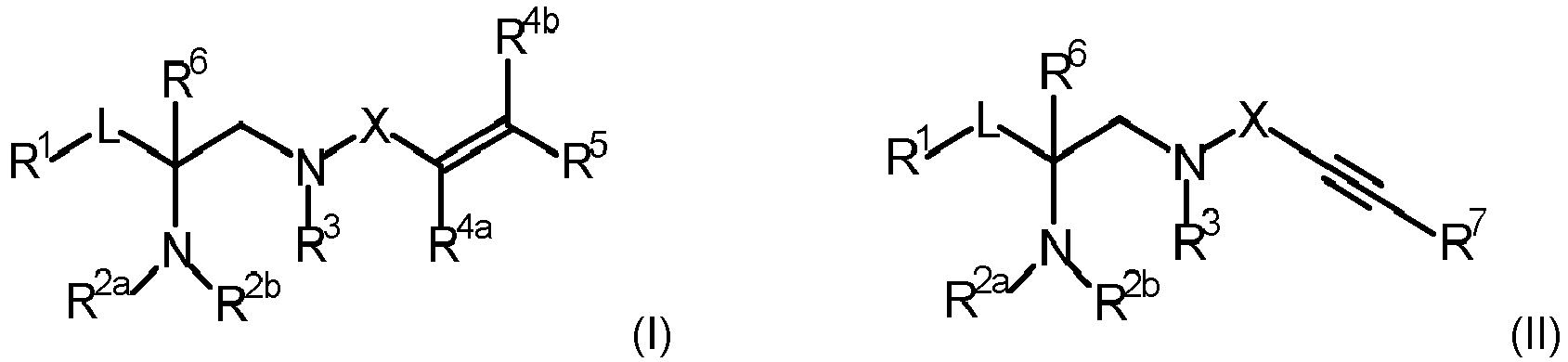
- R1 is an optionally substituted aryl group or an optionally substituted heteroaryl group,
- L is selected from a bond and an optionally substituted alkylene and an optionally substituted heteroalkylene,
- R2a and R2b are independently selected from hydrogen, optionally substituted alkyl, optionally substituted heteroalkyl, optionally substituted cycloalkyl, and optionally substituted heterocycloalkyl,
- wherein, when at least one of R2a and R2b is optionally substituted alkyl, the optionally substituted alkyl of R2a or R2b is optionally linked to R1 via a bond between a non-hydrogen atom of R2a or R2b and a non-hydrogen atom of R1,
- R3 is selected from hydrogen and optionally substituted alkyl,
- X is selected from >C=O, >C=S, C=N(NO2), C=C(NO2)(H), >C=C(F)(H), >C=CF2, >C=N(F), >C=C(CN)(H), >C=N(CN), >C=C(CN)(CN), >S(O), and >S(O)2,
- R4a and R4b are independently selected from hydrogen, optionally substituted alkyl and optionally substituted heteroalkyl,
- R5 and R7 are independently selected from optionally substituted cycloalkyl, optionally substituted heterocycloalkyl, optionally substituted aryl and optionally substituted heteroaryl,
- R6 is hydrogen or optionally substituted alkyl, wherein the optionally substituted alkyl of R6 is optionally linked to R1 via a bond between a non-hydrogen atom of R6 and a non-hydrogen atom of R1,
- wherein
- any hydrogen atoms in formulae (I) and (II) are optionally independently replaced by fluorine,
- the one or more optional substituents of the optionally substituted aryl group and the optionally substituted heteroaryl group are independently selected from the group consisting of -halogen, -CN, -C(O)R**, -COOR**, -C(O)NR**R**, -NR**R**, -NR**-C(O)R**, -N(R**)-C(O)-OR**, -N(R**)-C(O) -NR**R**, -N(R**)-S(O)2R**, -(optionally substituted alkyl), -OR**, -(optionally substituted heterocyclyl), -(optionally substituted alkylene)-(optionally substituted heterocyclyl), -(optionally substituted carbocyclyl), and -(optionally substituted alkylene)-(optionally substituted carbocyclyl), wherein R** is H, -(optionally substituted alkyl), -(optionally substituted heterocyclyl), or -(optionally substituted carbocyclyl), and
- wherein the optional substituent of the optionally substituted alkyl and the optionally substituted alkylene can be independently -halogen, -CN, -NO2, oxo, -C(O)Rar, -COORar, -C(O)NRarRar, -NRarRar, -NRar-C(O)Rar, -N(Rar)-C(O)-ORar, -N(Rar)-C(O)-NRarRar, -N(Rar)-S(O)2Rar, -ORar, -O-C(O)Rar, -O-C(O)-NRarRar, -SRar, -S(O)Rar, -S(O)2Rar, -S(O)2-NRarRar, -N(Rar)-S(O)2-NRarRar, -P(O)(ORar)2, or -O-P(O)(ORar)2; wherein Rar is H, alkyl, heterocyclyl or carbocyclyl;
- wherein the optional substituent of the optionally substituted heterocyclyl, the optionally substituted carbocyclyl can be independently alkyl, -halogen, -CN, -NO2, oxo, -C(O)Rar, -COORar, -C(O)NRarRar, -NRarRar, -NRar-C(O)Rar, -N(Rar)-C(O)-ORar, -N(Rar)-C(O)-NRarRar, -N(Rar)-S(O)2Rar, -ORar, -O-C(O)Rar, -O-C(O)-NRarRar, -SRar, -S(O)Rar, -S(O)2Rar, -S(O)2-NRarRar, -N(Rar)-S(O)2-NRarRar, -P(O)(ORar)2, or -O-P(O)(ORar)2; wherein Rar is H, alkyl, heterocyclyl or carbocyclyl;
- the one or more optional substituents of the optionally substituted alkyl, optionally substituted alkylene, optionally substituted heteroalkylene, and optionally substituted heteroalkyl are independently selected from -halogen, -CN, -NO2, oxo, -C(O)Ralk, -COORalk, -C(O)NRalkRalk, -NRalkRalk, -NRalk-C(O)Ralk, -N(Ralk)-C(O)-ORalk, -N(Ralk)-C(O)-NRalkRalk, -N(Ralk)-S(O)2Ralk, -ORalk, -O-C(O)Ralk, -O-C(O)-NRalkRalk, -SRalk, -S(O)Ralk, -S(O)2Ralk, -S(O)2-NRalkRalk, -N(Ralk)-S(O)2-NRalkRalk, -P(O)(ORalk)2, and -O-P(O)(ORalk)2; wherein Ralk is H, alkyl or alkyl substituted with one or more F, and
- the one or more optional substituents of the optionally substituted cycloalkyl and optionally substituted heterocycloalkyl are independently selected from -alkyl, -halogen, -CN, -NO2, oxo, -C(O)Rcyc, -COORcyc, -C(O)NRcycRcyc, -NRcycRcyc, -NRcyc-C(O)Rcyc, -N(Rcyc)-C(O)-ORcyc, -N(Rcyc)-C(O)-NRcycRcyc, -N(Rcyc)-S(O)2Rcyc, -ORcyc, -O-C(O)Rcyc, -O-C(O)-NRcycRcyc, -SRcyc, -S(O)Rcyc, -S(O)2Rcyc, -S(O)2-NRcycRcyc, -N(Rcyc)-S(O)2-NRcycRcyc, -P(O)(ORcyc)2, and -O-P(O)(ORcyc)2; wherein Rcyc is H, alkyl or alkyl substituted with one or more F.
- The present invention furthermore relates to a pharmaceutical composition comprising a compound having formula (I) or (II), optionally in the form of a pharmaceutically acceptable salt, solvate, polymorph, cocrystal, tautomer, racemate, enantiomer, or diastereomer or mixture thereof, and optionally one or more pharmaceutically acceptable excipient(s) and/or carrier(s).
- The present invention also concerns a compound having formula (I) or (II), optionally in the form of a pharmaceutically acceptable salt, solvate, polymorph, cocrystal, tautomer, racemate, enantiomer, or diastereomer or mixture thereof, wherein the compound is for use in the treatment, amelioration or prevention of pain, opioid overdose, addiction, neuropsychiatric disorder, Prader-Willi Syndrome, gastrointestinal disorder, skin disorder, dyspnea, and temporomandibular joint dysfunction.
- In addition, the present invention relates to a method of treating, ameliorating or preventing pain, opioid overdose, addiction, neuropsychiatric disorder, Prader-Willi Syndrome, gastrointestinal disorder, skin disorder, dyspnea, and temporomandibular joint dysfunction, the method comprising administering to a patient in need thereof an effective amount of a compound having formula (I) or (II), optionally in the form of a pharmaceutically acceptable salt, solvate, polymorph, cocrystal, tautomer, racemate, enantiomer, or diastereomer or mixture thereof.
- Furthermore, the present invention refers to the use of a compound having formula (I) or (II), optionally in the form of a pharmaceutically acceptable salt, solvate, polymorph, cocrystal, tautomer, racemate, enantiomer, or diastereomer or mixture thereof, for the manufacture of a medicament for treating, ameliorating or preventing pain, opioid overdose, addiction, neuropsychiatric disorder, Prader-Willi Syndrome, gastrointestinal disorder, skin disorder, dyspnea, and temporomandibular joint dysfunction.
-
- Fig. 1:
- Rat liver microsome assay for the assessment of metabolic stability of selected compounds of the experimental examples (Example A-5: Metabolic stability in rat liver microsomes). Data was pooled from three independent experiments. The reference substances imipramine and rotigotine, which are known to be rapidly metabolized, were tested in parallel. The concentrations of non-metabolized compounds (remaining substrate) were determined by LC-MS after the addition of an internal standard. Samples were collected at 0 min, 15 min, 30 min and 60 min. Unspecific binding to the matrix was assessed by parallel control experiments in the absence of the cofactor NADPH, determined after 60 minutes (blind value).
- Fig. 2:
- In vivo blood-brain barrier penetration of
example compound 8 of the experimental examples in mice examples (Example A-5: Blood-brain barrier penetration in vivo). Subcutaneous administration at a dose of 20 mg / kg. Plasma and brain samples taken from three individual animals at two time points 0.5 h and 2 h. - The present invention relates to a compound of the following formula (I) or (II), optionally in the form of a pharmaceutically acceptable salt, solvate, polymorph, cocrystal, tautomer, racemate, enantiomer, or diastereomer or mixture thereof:

- In formulae (I) and (II) R1, R2a, R2b, R3, R4a, R4b, R5, R6, R7, L and X are defined as follows.
- R1 is an optionally substituted aryl group or an optionally substituted heteroaryl group. Preferably, R1 is an optionally substituted phenyl group. It is to be understood that the optional substituent of the optionally substituted phenyl group is selected from the same list as the optional substituent of the optionally substituted aryl group. The optional substituent can be present at any available position but is typically present in para-position compared to the point of attachment to L. More preferably, R1 is a phenyl group containing a hydroxy or amido substituent in para position and optionally one or two further substituents selected from methyl and fluoro. Even more preferably, R1 is a phenyl group containing a hydroxy or amido (e.g., -C(O)-NH2) substituent in para position and optionally one or two further methyl substituents. Still more preferably, R1 is a phenyl group containing at least one hydroxy or amido substituent in para position. Still more preferably, R1 is a phenyl group having a hydroxy substituent in para position (4-hydroxyphenyl).
- When R1 is linked to R6 via a bond between a non-hydrogen atom of R6 and a non-hydrogen atom of R1, this linked group is formed (in theory) by abstracting a hydrogen radical from R1 and a hydrogen radical from R6 and forming a bond between the thus formed two radicals of R1 and R6. It is preferred that the non-hydrogen atoms between which the link is formed be both carbon atoms. Alternatively, one of the two non-hydrogen atoms may be a carbon atom and the other may be an oxygen atom, or one of the two non-hydrogen atoms may be a carbon atom and the other may be a nitrogen atom.
- L is selected from a bond and an optionally substituted alkylene and an optionally substituted heteroalkylene. Preferably, L is selected from a bond, an optionally substituted methylene and an optionally substituted ethylene. Further preferably, L is an optionally substituted methylene group, more preferably an unsubstituted methylene group (-CH2-). It is to be understood that the optional substituent of the optionally substituted methylene group is selected from the same list as the optional substituent of the optionally substituted alkylene group.
- R2a and R2b are independently selected from hydrogen, optionally substituted alkyl, optionally substituted heteroalkyl, optionally substituted cycloalkyl, and optionally substituted heterocycloalkyl, provided that, when at least one of R2a and R2b is optionally substituted alkyl, the optionally substituted alkyl of R2a or R2b can optionally be linked to R1 via a bond between a non-hydrogen atom of R2a or R2b and a non-hydrogen atom of R1. Preferably, R2a and R2b are independently selected from hydrogen and optionally substituted alkyl. More preferably, R2a and R2b are independently selected from hydrogen, alkyl and haloalkyl. Even more preferably, R2a and R2b are independently selected from hydrogen and alkyl. Still more preferably, R2a and R2b are independently selected from methyl, ethyl and propyl. Most preferably, both R2a and R2b are methyl.
- When R1 is linked to R2a via a bond between a non-hydrogen atom of R2a and a non-hydrogen atom of R1, this linked group is formed (in theory) by abstracting a hydrogen radical from R1 and a hydrogen radical from R2a and forming a bond between the thus formed two radicals of R1 and R2a. It is preferred that the non-hydrogen atoms between which the link is formed be both carbon atoms. Alternatively, one of the two non-hydrogen atoms may be a carbon atom and the other may be an oxygen atom, or one of the two non-hydrogen atoms may be a carbon atom and the other may be a nitrogen atom. Conversely, when R1 is linked to R2b via a bond between a non-hydrogen atom of R2b and a non-hydrogen atom of R1, this linked group is formed (in theory) by abstracting a hydrogen radical from R1 and a hydrogen radical from R2b and forming a bond between the thus formed two radicals of R1 and R2b. It is preferred that the non-hydrogen atoms between which the link is formed be both carbon atoms. Alternatively, one of the two non-hydrogen atoms may be a carbon atom and the other may be an oxygen atom, or one of the two non-hydrogen atoms may be a carbon atom and the other may be a nitrogen atom.
- R3 is selected from hydrogen and optionally substituted alkyl. R3 is preferably selected from hydrogen and alkyl. More preferably, R3 is hydrogen.
- X is selected from >C=O, >C=S, C=N(NO2), C=C(NO2)(H), >C=C(F)(H), >C=CF2, >C=N(F), >C=C(CN)(H), >C=N(CN), >C=C(CN)(CN), >S(O), and >S(O)2. Preferably, X is selected from >C=O, >C=S, >C=C(NO2)(H), >C=C(CN)(H), >C=C(CN)(CN), >S(O), and >S(O)2. More preferably, X is selected from >C=O and >C=S, even more preferably >C=O.
- R4a and R4b are independently selected from hydrogen, optionally substituted alkyl and optionally substituted heteroalkyl. Preferably, R4a and R4b are independently selected from hydrogen, optionally substituted methyl, optionally substituted ethyl and optionally substituted propyl, wherein preferably at least one of R4a and R4b is hydrogen. More preferably, R4a and R4b are independently selected from hydrogen, methyl, ethyl and propyl, wherein preferably at least one of R4a and R4b is hydrogen, even more preferably hydrogen or methyl. It is to be understood that the optional substituent of the optionally substituted methyl, optionally substituted ethyl and optionally substituted propyl is selected from the same list as the optional substituent of the optionally substituted alkyl group.
- R5 is selected from optionally substituted cycloalkyl, optionally substituted heterocycloalkyl, optionally substituted aryl and optionally substituted heteroaryl. Preferably, R5 is selected from an optionally substituted aryl group and an optionally substituted heteroaryl group. Even more preferably, R5 is selected from optionally substituted phenyl, optionally substituted naphthyl, optionally substituted pyridyl and optionally substituted thienyl. In a preferred option, the substituent can be -CF3.
- R7 is selected from optionally substituted cycloalkyl, optionally substituted heterocycloalkyl, optionally substituted aryl and optionally substituted heteroaryl. Preferably, R7 is selected from an optionally substituted aryl group and an optionally substituted heteroaryl group. Even more preferably, R7 is selected from optionally substituted phenyl, optionally substituted naphthyl, optionally substituted pyridyl and optionally substituted thienyl. In a preferred option, the substituent can be -CF3.
- It is to be understood that the optional substituent of the optionally substituted phenyl and the optionally substituted naphthyl is selected from the same list as the optional substituent of the optionally substituted aryl group. Furthermore, it is to be understood that the optional substituent of the optionally substituted pyridyl and optionally substituted thienyl is selected from the same list as the optional substituent of the optionally substituted heteroaryl group.
- R6 is hydrogen or optionally substituted alkyl, wherein the optionally substituted alkyl of R6 can optionally be linked to R1 via a bond between a non-hydrogen atom of R6 and a non-hydrogen atom of R1. Preferably, R6 is hydrogen or optionally substituted alkyl, wherein alkyl is preferably selected from methyl, ethyl and propyl, more preferably methyl or ethyl, even more preferably methyl. R6 is most preferably hydrogen.
- Any hydrogen atoms in formulae (I) and (II) can be optionally independently replaced by fluorine. Preferably, only hydrogen atoms bound to a carbon atom are optionally independently replaced by fluorine. However, it is preferred that none of the hydrogen atoms in formulae (I) and (II) are optionally independently replaced by fluorine.
- The one or more optional substituents of the optionally substituted aryl group and the optionally substituted heteroaryl group are independently selected from the group consisting of -halogen, -CN, -C(O)R**, -COOR**, -C(O)NR**R**, -NR**R**, -NR**-C(O)R**, -N(R**)-C(O)-OR**, -N(R**)-C(O) -NR**R**, -N(R**)-S(O)2R**, -(optionally substituted alkyl), -OR**, -(optionally substituted heterocyclyl), -(optionally substituted alkylene)-(optionally substituted heterocyclyl), -(optionally substituted carbocyclyl), and -(optionally substituted alkylene)-(optionally substituted carbocyclyl). Preferably, the one or more optional substituents of the optionally substituted aryl group and the optionally substituted heteroaryl group are independently selected from the group consisting of -halogen, -CN, -C(O)R**, -COOR**, -C(O)NR**R**, -NR**R**, -NR**-C(O)R**, -N(R**)-C(O)-OR**, -N(R**)-C(O) -NR**R**, -N(R**)-S(O)2R**, -(optionally substituted alkyl), and -OR**. More preferably, the one or more optional substituents of the optionally substituted aryl group and the optionally substituted heteroaryl group are independently selected from the group consisting of -halogen, -CN, -C(O)R**, -COOR**, -C(O)NR**R**, -NR**R**, -NR**-C(O)R**, -N(R**)-C(O)-OR**, -N(R**)-C(O) -NR**R**, -N(R**)-S(O)2R**, -(optionally substituted alkyl), and -OR**. Even more preferably, the one or more optional substituents of the optionally substituted aryl group and the optionally substituted heteroaryl group are independently selected from the group consisting of -halogen, -CN, -C(O)R**, -COOR**, -C(O)NR**R**, -NR**R**, -NR**-C(O)R**, -(optionally substituted alkyl), and -OR**.
- R** is H, -(optionally substituted alkyl), -(optionally substituted heterocyclyl), or -(optionally substituted carbocyclyl), preferably R** is H or -(optionally substituted alkyl).
- Within the definition of the one or more optional substituents of the optionally substituted aryl group and the optionally substituted heteroaryl group as given above, the optional substituent of the optionally substituted alkyl and the optionally substituted alkylene can be independently -halogen, -CN, -NO2, oxo, -C(O)Rar, -COORar, -C(O)NRarRar, -NRarRar, -NRar-C(O)Rar, -N(Rar)-C(O)-ORar, -N(Rar)-C(O)-NRarRar, -N(Rar)-S(O)2Rar, -ORar, -O-C(O)Rar, -O-C(O)-NRarRar, -SRar, -S(O)Rar, -S(O)2Rar, -S(O)2-NRarRar, -N(Rar)-S(O)2-NRarRar, -P(O)(ORar)2, or -O-P(O)(ORar)2; wherein Rar is H, alkyl, heterocyclyl or carbocyclyl. Preferably, the optional substituent of the optionally substituted alkyl and the optionally substituted alkylene can be independently -halogen, -CN, oxo, -C(O)Rar, -COORar, -C(O)NRarRar, -NRarRar, -NRar-C(O)Rar, -N(Rar)-C(O)-ORar, -N(Rar)-C(O)-NRarRar, -N(Rar)-S(O)2Rar, -ORar, -O-C(O)Rar, -O-C(O)-NRarRar, -SRar, -S(O)Rar, -S(O)2Rar, -S(O)2-NRarRar or -N(Rar)-S(O)2-NRarRar; wherein Rar is H, alkyl, heterocyclyl or carbocyclyl. More preferably, the optional substituent of the optionally substituted alkyl and the optionally substituted alkylene can be independently -halogen, -CN, oxo, -C(O)Rar, -COORar, -C(O)NRarRar, -NRarRar, -NRar-C(O)Rar, -N(Rar)-C(O)-ORar, -N(Rar)-C(O)-NRarRar, -N(Rar)-S(O)2Rar, -ORar, -O-C(O)Rar, -O-C(O)-NRarRar, -SRar, -S(O)Rar, -S(O)2Rar, -S(O)2-NRarRar or -N(Rar)-S(O)2-NRarRar; wherein Rar is H or alkyl.
- Within the definition of the one or more optional substituents of the optionally substituted aryl group and the optionally substituted heteroaryl group as given above, the optional substituent of the optionally substituted heterocyclyl and the optionally substituted carbocyclyl can be independently alkyl, -halogen, -CN, -NO2, oxo, -C(O)Rar, -COORar, -C(O)NRarRar, -NRarRar, -NRar-C(O)Rar, -N(Rar)-C(O)-ORar, -N(Rar)-C(O)-NRarRar, -N(Rar)-S(O)2Rar, -ORar, -O-C(O)Rar, -O-C(O)-NRarRar, -SRar, -S(O)Rar, -S(O)2Rar, -S(O)2-NRarRar, -N(Rar)-S(O)2-NRarRar, -P(O)(ORar)2, or -O-P(O)(ORar)2. Preferably, the optional substituent of the optionally substituted heterocyclyl and the optionally substituted carbocyclyl can be independently alkyl, -halogen, -CN, oxo, -C(O)Rar, -COORar, -C(O)NRarRar, -NRarRar, -NRar-C(O)Rar, -N(Rar)-C(O)-ORar, -N(Rar)-C(O)-NRarRar, -N(Rar)-S(O)2Rar, -ORar, -O-C(O)Rar, -O-C(O)-NRarRar, -SRar, -S(O)Rar, -S(O)2Rar, -S(O)2-NRarRar or -N(Rar)-S(O)2-NRarRar. More preferably, the optional substituent of the optionally substituted heterocyclyl and the optionally substituted carbocyclyl can be independently alkyl, -halogen, -CN, oxo, -C(O)Rar, -COORar, -C(O)NRarRar, -NRarRar, -NRar-C(O)Rar, -N(Rar)-C(O)-ORar, -N(Rar)-C(O)-NRarRar, -N(Rar)-S(O)2Rar, -ORar, -O-C(O)Rar, -O-C(O)-NRarRar, -SRar, -S(O)Rar, -S(O)2Rar, -S(O)2-NRarRar or -N(Rar)-S(O)2-NRarRar.
- Rar is preferably H, alkyl, heterocyclyl or carbocyclyl. More preferably, Rar is H or alkyl.
- The one or more optional substituents of the optionally substituted alkyl, optionally substituted alkylene, optionally substituted heteroalkylene, and optionally substituted heteroalkyl are independently selected from -halogen, -CN, -NO2, oxo, -C(O)Ralk, -COORalk, -C(O)NRalkRalk, -NRalkRalk, -NRalk-C(O)Ralk, -N(Ralk)-C(O)-ORalk, -N(Ralk)-C(O)-NRalkRalk, -N(Ralk)-S(O)2Ralk, -ORalk, -O-C(O)Ralk, -O-C(O)-NRalkRalk, -SRalk, -S(O)Ralk, -S(O)2Ralk, -S(O)2-NRalkRalk, -N(Ralk)-S(O)2-NRalkRalk, -P(O)(ORalk)2, and -O-P(O)(ORalk)2. Preferably, the one or more optional substituents of the optionally substituted alkyl, optionally substituted alkylene, optionally substituted heteroalkylene, and optionally substituted heteroalkyl are independently selected from -halogen, -CN, oxo, -C(O)Ralk, -COORalk, -C(O)NRalkRalk, -NRalkRalk, -NRalk-C(O)Ralk, -N(Ralk)-C(O)-ORalk, -N(Ralk)-C(O)-NRalkRalk, -N(Ralk)-S(O)2Ralk, -ORalk, -O-C(O)Ralk, -O-C(O)-NRalkRalk, -SRalk, -S(O)Ralk, -S(O)2Ralk, -S(O)2-NRalkRalk, and -N(Ralk)-S(O)2-NRalkRalk. More preferably, the one or more optional substituents of the optionally substituted alkyl, optionally substituted alkylene, optionally substituted heteroalkylene, and optionally substituted heteroalkyl are independently selected from -halogen, -CN, oxo, -C(O)Ralk, -COORalk, -S(O)Ralk, -S(O)2Ralk and -S(O)2-NRalkRalk. -N(Ralk)-S(O)2Ralk, -ORalk, -O-C(O)Ralk, -SRalk,
- Ralk is preferably H, alkyl or alkyl substituted with one or more F. More preferably, Ralk is H or alkyl.
- The one or more optional substituents of the optionally substituted cycloalkyl and optionally substituted heterocycloalkyl are independently selected from -alkyl, -halogen, -CN, -NO2, oxo, -C(O)Rcyc, -COORcyc, -C(O)NRcycRcyc, -NRcycRcyc, -NRcyc-C(O)Rcyc, -N(Rcyc)-C(O)-ORcyc, -N(Rcyc)-C(O)-NRcycRcyc, -N(Rcyc)-S(O)2Rcyc, -ORcyc, -O-C(O)Rcyc, -O-C(O)-NRcycRcyc, -SRcyc, -S(O)Rcyc, -S(O)2Rcyc, -S(O)2-NRcycRcyc, -N(Rcyc)-S(O)2-NRcycRcyc, -P(O)(ORcyc)2, and -O-P(O)(ORcyc)2. Preferably, the one or more optional substituents of the optionally substituted cycloalkyl and optionally substituted heterocycloalkyl are independently selected from -alkyl, -halogen, -CN, oxo, -C(O)Rcyc, -COORcyc, -C(O)NRcycRcyc, -NRcycRcyc, -NRcyc-C(O)Rcyc, -N(Rcyc)-C(O)-ORcyc, -N(Rcyc)-C(O)-NRcycRcyc, -N(Rcyc)-S(O)2Rcyc, -ORcyc, -O-C(O)Rcyc, -O-C(O)-NRcycRcyc, -SRcyc, -S(O)Rcyc, -S(O)2Rcyc, -S(O)2-NRcycRcyc and -N(Rcyc)-S(O)2-NRcycRcyc. More preferably, the one or more optional substituents of the optionally substituted cycloalkyl and optionally substituted heterocycloalkyl are independently selected from -alkyl, -halogen, -CN, oxo, -C(O)Rcyc, -COORcyc, -C(O)NRcycRcyc, -NRcycRcyc, -NRcyc-C(O)Rcyc, -N(Rcyc)-S(O)2Rcyc, -ORcyc, -O-C(O)Rcyc, -SRcyc, -S(O)Rcyc, -S(O)2Rcyc and -S(O)2-N RcycRcyc.
- Rcyc is preferably H, alkyl or alkyl substituted with one or more F. More preferably, Rcyc is H or alkyl.
- The compounds of formulae (I) and (II) are preferably represented by the following formulae (I-a) and (II-b), respectively:

- More preferably, the compounds of formulae (I) and (II) are selected from (S)-N-(2-(dimethylamino)-3-(4-hydroxyphenyl)propyl)cinnamamide, (S)-N-(2-(dimethylamino)-3-(4-hydroxyphenyl)propyl)-3-phenylpropiolamide, (S,E)-N-(2-(dimethylamino)-3-(4-hydroxyphenyl)propyl)-3-phenylbut-2-enamide, (S,E)-N-(2-(dimethylamino)-3-(4-hydroxyphenyl)propyl)-2-methyl-3-phenylacrylamide, (S)-N-(2-(dimethylamino)-3-(4-hydroxyphenyl)-2-methylpropyl)cinnamamide (S,E)-N-(2-(dimethylamino)-3-(4-hydroxyphenyl)propyl)-3-(naphthalen-1-yl)acrylamide, (S,E)-N-(2-(dimethylamino)-3-(4-hydroxyphenyl)propyl)-3-(2-(trifluoromethyl)phenyl)acrylamide, (S,E)-N-(2-(dimethylamino)-3-(4-hydroxyphenyl)propyl)-3-(3-(trifluoromethyl)phenyl)acrylamide, (S,E)-N-(2-(dimethylamino)-3-(4-hydroxyphenyl)propyl)-3-(4-(trifluoromethyl)phenyl)acrylamide, (S)-N-(2-amino-3-(4-hydroxy-2,6-dimethylphenyl)propyl)cinnamamide, (S,E)-N-(2-amino-3-(4-hydroxy-2,6-dimethylphenyl)propyl)-3-(3-(trifluoromethyl)phenyl)acrylamide, (S,E)-N-(3-(4-hydroxy-2,6-dimethylphenyl)-2-(methylamino)propyl)-3-(3-(trifluoromethyl)phenyl)acrylamide, (S,E)-N-(2-(dimethylamino)-3-(4-hydroxyphenyl)propyl)-3-(m-tolyl)acrylamide, (S,E)-4-(2-amino-3-(3-(3-(trifluoromethyl)phenyl)acrylamido)propyl)benzamide, (S,E)-4-(2-(dimethylamino)-3-(3-(3-(trifluoromethyl)phenyl)acrylamido)propyl)benzamide, (S,E)-N-(2-(dimethylamino)-3-(4-hydroxyphenyl)propyl)-3-(4-fluoro-3-(trifluoromethyl)phenyl)acrylamide, (S,E)-4-(2-amino-3-(3-(naphthalen-1-yl)acrylamido)propyl)benzamide, (S,E)-4-(2-(dimethylamino)-3-(3-(naphthalen-1-yl)acrylamido)propyl)benzamide, and (S,E)-N-(2-(dimethylamino)-3-(4-hydroxyphenyl)propyl)-3-(thiophen-3-yl)acrylamide, each optionally in the form of a pharmaceutically acceptable salt, solvate, polymorph, cocrystal, tautomer, racemate, enantiomer, or diastereomer or mixture thereof.
- The present invention furthermore relates to a pharmaceutical composition comprising a compound having formula (I) or (II), optionally in the form of a pharmaceutically acceptable salt, solvate, polymorph, cocrystal, tautomer, racemate, enantiomer, or diastereomer or mixture thereof, and optionally one or more pharmaceutically acceptable excipient(s) and/or carrier(s).
- The present invention also concerns a compound having formula (I) or (II), optionally in the form of a pharmaceutically acceptable salt, solvate, polymorph, cocrystal, tautomer, racemate, enantiomer, or diastereomer or mixture thereof, wherein the compound is for use in the treatment, amelioration or prevention of pain, opioid overdose, addiction, neuropsychiatric disorder, Prader-Willi Syndrome, gastrointestinal disorder, skin disorder, dyspnea, and temporomandibular joint dysfunction.
- In addition, the present invention relates to a method of treating, ameliorating or preventing pain, opioid overdose, addiction, neuropsychiatric disorder, Prader-Willi Syndrome, gastrointestinal disorder, skin disorder, dyspnea, and temporomandibular joint dysfunction, the method comprising administering to a patient in need thereof an effective amount of a compound having formula (I) or (II), optionally in the form of a pharmaceutically acceptable salt, solvate, polymorph, cocrystal, tautomer, racemate, enantiomer, or diastereomer or mixture thereof.
- Furthermore, the present invention refers to the use of a compound having formula (I) or (II), optionally in the form of a pharmaceutically acceptable salt, solvate, polymorph, cocrystal, tautomer, racemate, enantiomer, or diastereomer or mixture thereof, for the manufacture of a medicament for treating, ameliorating or preventing pain, opioid overdose, addiction, neuropsychiatric disorder, Prader-Willi Syndrome, gastrointestinal disorder, skin disorder, dyspnea, and temporomandibular joint dysfunction.
- The following definitions apply throughout the present specification, unless specifically indicated otherwise.
- As used herein, the term "alkyl" refers to a monovalent saturated acyclic (i.e., non-cyclic) hydrocarbon group which may be linear or branched. Accordingly, an "alkyl" group does not comprise any carbon-to-carbon double bond or any carbon-to-carbon triple bond. Unless defined otherwise, the term "alkyl" preferably refers to C1-6 alkyl, more preferably C1-4 alkyl. Preferred exemplary alkyl groups are methyl, ethyl, propyl (e.g., n-propyl or isopropyl), or butyl (e.g., n-butyl, isobutyl, sec-butyl, or tert-butyl), more preferably methyl or ethyl, and even more preferably methyl.
- As used herein, the term "heteroalkyl" refers to an alkyl group in which one or more, e.g., one or two (preferably one) of the -CH2- groups have been replaced each independently by a group selected from -O-, -S-, -S(O)-, -S(O)2- and -N(alkyl)-. Unless defined otherwise, the term "heteroalkyl" preferably refers to C1-6 heteroalkyl, more preferably C1-4 heteroalkyl, even more preferably to methylamino, dimethylamino, ethylamino, diethylamino, methoxy or ethoxy, even more preferably to methoxy or ethoxy, and still more preferably to methoxy.
- As used herein, the term "haloalkyl" refers to an alkyl group substituted with one or more (preferably 1 to 6, more preferably 1 to 3) halogen atoms which are selected independently from fluoro, chloro, bromo and iodo, and are preferably all fluoro atoms. It will be understood that the maximum number of halogen atoms is limited by the number of available attachment sites and, thus, depends on the number of carbon atoms comprised in the alkyl moiety of the haloalkyl group. "Haloalkyl" may, e.g., refer to -CF3, -CHF2, -CH2F, -CF2-CH3, -CH2-CF3, -CH2-CHF2, -CH2-CF2-CH3, -CH2-CF2-CF3, or -CH(CF3)2.
- As used herein, the term "alkylene" refers to an alkanediyl group, i.e. a divalent saturated acyclic hydrocarbon group which may be linear or branched, preferably linear. Unless defined otherwise, the term "alkylene" preferably refers to C1-6 alkylene, more preferably C1-4 alkylene. Preferred exemplary alkylene groups are methylene (-CH2-), ethylene (e.g., -CH2-CH2- or -CH(-CH3)-), propylene (e.g., -CH2-CH2-CH2-, -CH(-CH2-CH3)-, -CH2-CH(-CH3)-, or -CH(-CH3)-CH2-), or butylene (e.g., -CH2-CH2-CH2-CH2-), more preferably methylene or ethylene, and even more preferably methylene.
- As used herein, the term "heteroalkylene" refers to an alkylene group in which one or more (e.g., one or two, preferably one) of the -CH2- groups have been replaced each independently by a group selected from -O-, -S-, -S(O)-, -S(O)2- and -N(alkyl)-. Unless defined otherwise, the term "heteroalkylene" preferably refers to C1-6 heteroalkylene , in particular C1-4 heteroalkylene (including, in particular, linear C1-4 heteroalkylene), more preferably to -G-CH2-, -G-CH2-CH2-, -G-CH2-CH2-CH2-, -CH2-G-, -CH2-G-CH2- -CH2-G-CH2-CH2-, -CH2-CH2-G-, -CH2-CH2-G-CH2- or -CH2-CH2-CH2-G-, wherein each G is independently selected from -O-, -S-, -S(O)-, -S(O)2- and -N(alkyl)-, preferably from -N(alkyl)- and -O-, more preferably from -O-. More preferably, the term "heteroalkylene" refers to -G-CH2-, -G-CH2-CH2-, -CH2-G-, -CH2-G-CH2- or -CH2-CH2-G-, wherein each G is independently selected from -O-, -S-, -S(O)-, -S(O)2- and -N(alkyl)-, preferably from -N(alkyl)- and -O- , more preferably from -O-. Even more preferably, the term "heteroalkylene" refers to -G-CH2- or -CH2-G-, wherein each G is independently selected from -O-, -S-, -S(O)-, -S(O)2- and -N(alkyl)-, preferably from -N(alkyl)- and -O-, more preferably from -O-.
- As used herein, the term "carbocyclyl" refers to a hydrocarbon ring group, including monocyclic rings as well as bridged ring, spiro ring and/or fused ring systems (which may be composed, e.g., of two or three rings), wherein said ring group may be saturated, partially unsaturated (i.e., unsaturated but not aromatic) or aromatic. Unless defined otherwise, "carbocyclyl" preferably refers to aryl, cycloalkyl or cycloalkenyl. The number of carbon atoms in the carbocyclyl ring is not particularly limited and is preferably 3 to 14, more preferably 3 to 10, even more preferably 3 to 7.
- As used herein, the term "heterocyclyl" refers to a ring group, including monocyclic rings as well as bridged ring, spiro ring and/or fused ring systems (which may be composed, e.g., of two or three rings), wherein said ring group comprises one or more (such as, e.g., one, two, three, or four) ring heteroatoms independently selected from O, S and N, and the remaining ring atoms are carbon atoms, wherein one or more S ring atoms (if present) and/or one or more N ring atoms (if present) may optionally be oxidized, wherein one or more carbon ring atoms may optionally be oxidized (i.e., to form an oxo group), and further wherein said ring group may be saturated, partially unsaturated (i.e., unsaturated but not aromatic) or aromatic. Unless defined otherwise, "heterocyclyl" preferably refers to heteroaryl, heterocycloalkyl or heterocycloalkenyl. The number of carbon atoms in the carbocyclyl ring is not particularly limited and is preferably 3 to 14, preferably 3 to 10, more preferably 3 to 7.
- As used herein, the term "aryl" refers to an aromatic hydrocarbon ring group, including monocyclic aromatic rings as well as bridged ring and/or fused ring systems containing at least one aromatic ring (e.g., ring systems composed of two or three fused rings, wherein at least one of these fused rings is aromatic; or bridged ring systems composed of two or three rings, wherein at least one of these bridged rings is aromatic). Unless defined otherwise, an "aryl" preferably has 5 to 14 ring atoms, more preferably 6 to 10 ring atoms. "Aryl" may, e.g., refer to phenyl, naphthyl, dialinyl (i.e., 1,2-dihydronaphthyl), tetralinyl (i.e., 1,2,3,4-tetrahydronaphthyl), anthracenyl, or phenanthrenyl, more preferably aryl refers to phenyl or naphthyl, and most preferably aryl refers to phenyl.
- As used herein, the term "heteroaryl" refers to an aromatic ring group, including monocyclic aromatic rings as well as bridged ring and/or fused ring systems containing at least one aromatic ring (e.g., ring systems composed of two or three fused rings, wherein at least one of these fused rings is aromatic; or bridged ring systems composed of two or three rings, wherein at least one of these bridged rings is aromatic), wherein said aromatic ring group comprises one or more (such as, e.g., one, two, three, or four) ring heteroatoms independently selected from O, S and N, and the remaining ring atoms are carbon atoms, wherein one or more S ring atoms (if present) and/or one or more N ring atoms (if present) may optionally be oxidized, and further wherein one or more carbon ring atoms may optionally be oxidized (i.e., to form an oxo group). Unless defined otherwise, a "heteroaryl" preferably refers to a 5 to 14 membered (more preferably 5 to 10 membered) monocyclic ring or fused ring system comprising one or more (e.g., one, two, three or four) ring heteroatoms independently selected from O, S and N, wherein one or more S ring atoms (if present) and/or one or more N ring atoms (if present) are optionally oxidized, and wherein one or more carbon ring atoms are optionally oxidized; even more preferably, a "heteroaryl" refers to a 5 or 6 membered monocyclic ring comprising one or more (e.g., one, two or three) ring heteroatoms independently selected from O, S and N, wherein one or more S ring atoms (if present) and/or one or more N ring atoms (if present) are optionally oxidized, and wherein one or more carbon ring atoms are optionally oxidized. "Heteroaryl" may, e.g., refer to thienyl (i.e., thiophenyl), benzo[b]thienyl, naphtho[2,3-b]thienyl, thianthrenyl, furyl (i.e., furanyl), benzofuranyl, isobenzofuranyl, chromenyl, xanthenyl, phenoxathiinyl, pyrrolyl (e.g., 2H-pyrrolyl), imidazolyl, pyrazolyl, pyridyl (i.e., pyridinyl; e.g., 2-pyridyl, 3-pyridyl, or 4-pyridyl), pyrazinyl, pyrimidinyl, pyridazinyl, indolizinyl, isoindolyl, indolyl (e.g., 3H-indolyl), indazolyl, purinyl, isoquinolyl, quinolyl, phthalazinyl, naphthyridinyl, quinoxalinyl, cinnolinyl, pteridinyl, carbazolyl, beta-carbolinyl, phenanthridinyl, acridinyl, perimidinyl, phenanthrolinyl (e.g., [1,10]phenanthrolinyl, [1,7]phenanthrolinyl, or [4,7]phenanthrolinyl), phenazinyl, thiazolyl, isothiazolyl, phenothiazinyl, oxazolyl, isoxazolyl, furazanyl, phenoxazinyl, pyrazolo[1,5-a]pyrimidinyl (e.g., pyrazolo[1,5-a]pyrimidin-3-yl), 1,2-benzoisoxazol-3-yl, benzothiazolyl, benzoxazolyl, benzisoxazolyl, benzimidazolyl, 1H-tetrazolyl, 2H-tetrazolyl, coumarinyl, or chromonyl. "Heteroaryl" preferably refers to thienyl (i.e., thiophenyl), benzo[b]thienyl, furyl (i.e., furanyl), benzofuranyl, isobenzofuranyl, imidazolyl, pyrazolyl, pyridyl (i.e., pyridinyl; e.g., 2-pyridyl, 3-pyridyl, or 4-pyridyl), pyrazinyl, pyrimidinyl, pyridazinyl, indolizinyl, isoindolyl, indolyl (e.g., 3H-indolyl), indazolyl, isoquinolyl or quinolyl. A more preferred example is thienyl.
- As used herein, the term "cycloalkyl" refers to a saturated hydrocarbon ring group, including monocyclic rings as well as bridged ring, spiro ring and/or fused ring systems (which may be composed, e.g., of two or three rings; such as, e.g., a fused ring system composed of two or three fused rings). Unless defined otherwise, "cycloalkyl" preferably refers to a C3-14 cycloalkyl, and more preferably refers to a C3-7 cycloalkyl. A particularly preferred "cycloalkyl" is a monocyclic saturated hydrocarbon ring having 3 to 7 ring members. "Cycloalkyl" may, e.g., refer to cyclopropyl, cyclobutyl, cyclopentyl, cyclohexyl, cycloheptyl, or adamantyl.
- As used herein, the term "heterocycloalkyl" refers to a saturated ring group, including monocyclic rings as well as bridged ring, spiro ring and/or fused ring systems (which may be composed, e.g., of two or three rings; such as, e.g., a fused ring system composed of two or three fused rings), wherein said ring group contains one or more (such as, e.g., one, two, three, or four) ring heteroatoms independently selected from O, S and N, and the remaining ring atoms are carbon atoms, wherein one or more S ring atoms (if present) and/or one or more N ring atoms (if present) may optionally be oxidized, and further wherein one or more carbon ring atoms may optionally be oxidized (i.e., to form an oxo group).Unless defined otherwise, "heterocycloalkyl" preferably refers to a 3 to 14 membered saturated ring, which is a monocyclic ring or a fused ring system (e.g., a fused ring system composed of two fused rings), wherein said ring group contains one or more (e.g., one, two, three, or four) ring heteroatoms independently selected from O, S and N, wherein one or more S ring atoms (if present) and/or one or more N ring atoms (if present) are optionally oxidized, and wherein one or more carbon ring atoms are optionally oxidized. More preferably, "heterocycloalkyl" refers to a 5 to 7 membered saturated monocyclic ring containing one or more (e.g., one, two, or three) ring heteroatoms independently selected from O, S and N, wherein one or more S ring atoms (if present) and/or one or more N ring atoms (if present) are optionally oxidized, and wherein one or more carbon ring atoms are optionally oxidized. "Heterocycloalkyl" may, e.g., refer to oxetanyl, tetrahydrofuranyl, piperidinyl, piperazinyl, aziridinyl, azetidinyl, pyrrolidinyl, imidazolidinyl, morpholinyl (e.g., morpholin-4-yl), pyrazolidinyl, tetrahydrothienyl, octahydroquinolinyl, octahydroisoquinolinyl, oxazolidinyl, isoxazolidinyl, azepanyl, diazepanyl, oxazepanyl or 2-oxa-5-aza-bicyclo[2.2.1]hept-5-yl. "Heterocycloalkyl" preferably refers to oxetanyl, tetrahydrofuranyl, piperidinyl, piperazinyl, aziridinyl, azetidinyl, pyrrolidinyl, imidazolidinyl, morpholinyl (e.g., morpholin-4-yl), pyrazolidinyl, tetrahydrothienyl, oxazolidinyl or isoxazolidinyl. "Heterocycloalkyl" more preferably refers to piperidinyl, piperazinyl, pyrrolidinyl, imidazolidinyl, morpholinyl (e.g., morpholin-4-yl), pyrazolidinyl or tetrahydrothienyl.
- As used herein, the term "cycloalkenyl" refers to an unsaturated alicyclic (non-aromatic) hydrocarbon ring group, including monocyclic rings as well as bridged ring, spiro ring and/or fused ring systems (which may be composed, e.g., of two or three rings; such as, e.g., a fused ring system composed of two or three fused rings), wherein said hydrocarbon ring group comprises one or more (e.g., one or two) carbon-to-carbon double bonds and does not comprise any carbon-to-carbon triple bond. Unless defined otherwise, "cycloalkenyl" preferably refers to a C3-14 cycloalkenyl, and more preferably refers to a C3-7 cycloalkenyl. A particularly preferred "cycloalkenyl" is a monocyclic unsaturated alicyclic hydrocarbon ring having 3 to 7 ring atoms and containing one or more (e.g., one or two; preferably one) carbon-to-carbon double bonds. "Cycloalkenyl" may, e.g., refer to cyclopropenyl, cyclobutenyl, cyclopentenyl, cyclohexenyl, cyclohexadienyl, cycloheptenyl, or cycloheptadienyl.
- As used herein, the term "heterocycloalkenyl" refers to an unsaturated alicyclic (non-aromatic) ring group, including monocyclic rings as well as bridged ring, spiro ring and/or fused ring systems (which may be composed, e.g., of two or three rings; such as, e.g., a fused ring system composed of two or three fused rings), wherein said ring group contains one or more (such as, e.g., one, two, three, or four) ring heteroatoms independently selected from O, S and N, and the remaining ring atoms and carbon atoms, wherein one or more S ring atoms (if present) and/or one or more N ring atoms (if present) may optionally be oxidized, wherein one or more carbon ring atoms may optionally be oxidized (i.e., to form an oxo group), and further wherein said ring group comprises at least one double bond between adjacent ring atoms and does not comprise any triple bond between adjacent ring atoms. Unless defined otherwise, "heterocycloalkenyl" preferably refers to a 3 to 14 membered unsaturated alicyclic ring, which is a monocyclic ring or a fused ring system (e.g., a fused ring system composed of two fused rings), wherein said ring group contains one or more (e.g., one, two, three, or four) ring heteroatoms independently selected from O, S and N, wherein one or more S ring atoms (if present) and/or one or more N ring atoms (if present) are optionally oxidized, wherein one or more carbon ring atoms are optionally oxidized, and wherein said ring group comprises at least one double bond between adjacent ring atoms and does not comprise any triple bond between adjacent ring atoms; more preferably, "heterocycloalkenyl" refers to a 5 to 7 membered monocyclic unsaturated non-aromatic ring containing one or more (e.g., one, two, or three) ring heteroatoms independently selected from O, S and N, wherein one or more S ring atoms (if present) and/or one or more N ring atoms (if present) are optionally oxidized, wherein one or more carbon ring atoms are optionally oxidized, and wherein said ring group comprises at least one double bond between adjacent ring atoms and does not comprise any triple bond between adjacent ring atoms.
- As used herein, the term "halogen" refers to fluoro (-F), chloro (-Cl), bromo (-Br), or iodo (-I).
- As used herein, the term "oxo" refers to "=O", i.e. a double bond to an oxygen. In other words, it is a divalent substituent. Thus, if, for example, a methylene group is substituted with "oxo", it corresponds to a carbonyl group (>C=O).
- Various groups are referred to as being "optionally substituted" in this specification. Generally, these groups may carry one or more substituents, such as, e.g., one, two, three or four substituents. It will be understood that the maximum number of substituents is limited by the number of attachment sites available on the substituted moiety. Unless defined otherwise, the "optionally substituted" groups referred to in this specification carry preferably not more than two substituents and may, in particular, carry only one substituent. Moreover, unless defined otherwise, it is preferred that the optional substituents are absent, i.e. that the corresponding groups are unsubstituted. Unless defined otherwise, an optional substituent is selected from the lists specified for the one or more optional substituents of the optionally substituted aryl group and the optionally substituted heteroaryl group.
- A skilled person will appreciate that the substituent groups comprised in the compounds of formula (I) and/or formula (II) may be attached to the remainder of the respective compound via a number of different positions of the corresponding specific substituent group. Unless defined otherwise, the preferred attachment positions for the various specific substituent groups are as illustrated in the examples.
- As used herein, the terms "optional", "optionally" and "may" denote that the indicated feature may be present but can also be absent. Whenever the term "optional", "optionally" or "may" is used, the present invention specifically relates to both possibilities, i.e., that the corresponding feature is present or, alternatively, that the corresponding feature is absent. For example, the expression "X is optionally substituted with Y" (or "X may be substituted with Y") means that X is either substituted with Y or is unsubstituted. Likewise, if a component of a composition is indicated to be "optional", the invention specifically relates to both possibilities, i.e., that the corresponding component is present (contained in the composition) or that the corresponding component is absent from the composition.
- A "solvate" refers to an association or complex of one or more solvent molecules and the compound of formula (I) and/or formula (II). Examples of solvents that form solvates include, but are not limited to, water, isopropanol, ethanol, methanol, dimethyl sulfoxide (DMSO), ethyl acetate, acetic acid, acetonitrile, and ethanolamine. The term "hydrate" refers to the complex where the solvent molecule is water. It is to be understood that such solvates of the compounds of formula (I) and/or formula (II) also include solvates of pharmaceutically acceptable salts of the compounds of formula (I) and/or formula (II).
- A "cocrystal" refers to a crystalline structure that contains at least two different compounds that are solid in their pure form under ambient conditions. Cocrystals are made from neutral molecular species, and all species remain neutral after crystallization; further, typically and preferably, they are crystalline homogeneous phase materials where two or more building compounds are present in a defined stoichiometric ratio. See Wang Y and Chen A, 2013; and Springuel GR, et al., 2012; and
US Patent 6,570,036 . - As used herein, any reference to a compound of formula (I) is to be understood as equally well applying to any specific examples of a compound of formula (I), such as compounds of formula (I-a).
- As used herein, any reference to a compound of formula (II) is to be understood as equally well applying to any specific examples of a compound of formula (II), such as compounds of formula (II-a).
- The "treatment" of a disorder or disease, in particular pain, may, for example, lead to a halt in the progression of the disorder or disease (e.g., no deterioration of symptoms) or a delay in the progression of the disorder or disease (in case the halt in progression is of a transient nature only). The "treatment" of a disorder or disease may also lead to a partial response (e.g., amelioration of symptoms) or complete response (e.g., disappearance of symptoms) of the subject/patient suffering from the disorder or disease. It is to be understood that a subject/patient may experience a broad range of responses to a treatment.
- The term "amelioration" of a disorder or disease typically refers to the partial response of the subject/patient suffering from the disorder or disease.
- The term "prevention" (or "prophylaxis") of a disorder or disease as used herein is also well known in the art. For example, a patient/subject suspected of being prone to suffer from a disorder or disease may particularly benefit from a prevention of the disorder or disease. The subject/patient may have a susceptibility or predisposition for a disorder or disease, including but not limited to hereditary predisposition. Such a predisposition can be determined by standard methods or assays, using, e.g., genetic markers or phenotypic indicators. It is to be understood that a disorder or disease to be prevented in accordance with the present invention has not been diagnosed or cannot be diagnosed in the patient/subject (for example, the patient/subject does not show any clinical or pathological symptoms). Thus, the term "prevention" comprises the use of the compounds of the present invention before any clinical and/or pathological symptoms are diagnosed or determined or can be diagnosed or determined by the attending physician.
- The disease or condition to be treated or prevented by the compounds of the present invention is preferably selected from pain, opioid overdose, addiction, neuropsychiatric disorder, Prader-Willi Syndrome, gastrointestinal disorder, skin disorder, dyspnea, and temporomandibular joint dysfunction.
- More specifically, the disease or condition includes various diseases and conditions such as
- a) pain:
The pain can be due to various causes such as- i) pain associated with pulmonary edema, kidney stones, vaginitis, candidiasis, arthralgia (including osteoarthrosis such as lumbar spondylarthrosis), vascular diseases (including intermittent claudication, Raynaud's disease, peripheral vascular disease), headaches (including migraine headaches, sinus headaches, tension headaches), dental pain (including gingivitis), periarteritis nodosa, thyroiditis (in particular subacute thyroiditis), aplastic anemia, Hodgkin's disease, sclerodoma, rheumatic fever, type I diabetes (including diabetic peripheral neuropathy and diabetic amyotrophy), type II diabetes (including diabetic peripheral neuropathy and diabetic amyotrophy), carpal-tunnel syndrome, myasthenia gravis, multiple sclerosis, sarcoidosis, nephrotic syndrome, Behcet's syndrome, polymyositis, hypersensitivity (e.g. towards a substance or a stimulus), and/or myocardial ischemia, ,
- ii) pain associated with invasive procedures (e.g., lumbar puncture, biopsy, surgical intervention) including pain due to swelling occurring after injury and/or pain due to healing,
- iii) pain associated with mechanical and/or metabolic injury to the nervous system, neuropathic pain, and/or tumor infiltration of nerves and/or nerve roots,
- iv) pain associated with mechanical injury (e.g., minor injuries) including pain due to swelling occurring after injury and/or pain due to healing,
- vi) fibromyalgia,
- vii) cancer pain, including pain due to exposure to chemotherapeutic agents and/or radiation therapy,
- b) opioid overdoses such as poisoning due to opioids such as fentanyl, heroin, codeine, morphine and/or oxycodone,
- c) addictions such as opioid addiction (such as addiction to fentanyl, heroin, codeine, morphine and/or oxycodone), nicotine addiction, pathological gambling, alcohol addiction, and/or sex addiction,
- d) neuropsychiatric disorders such as compulsive behavior (e.g. obsessive compulsive disorder, trichotillomania, skin picking and/or compulsive behavior associated with neurodegenerative disorders such as Huntington's disease and/or Parkinson's disease), impulsive behavior (e.g., Tourette's syndrome, and/or kleptomania, and/or impulsive behavior associated with neurodegenerative disorders such as frontotemporal dementia and/or Alzheimer's disorder), depression (e.g., depressive disorders, anxiety disorder, panic disorder, dysphoria, and/or anhedonia), eating disorders (e.g. anorexia nervosa, bulimia nervosa, binge eating disorder, and/or obesity), sleep disorders (e.g. sleep disruption, in particular sleep disruption associated with a neurodegenerative disorder such as supranuclear palsy), epilepsy, schizophrenia, psychosis, bipolar disorder and/or autism spectrum disorder,
- e) Prader-Willi Syndrome,
- f) gastrointestinal disorders in particular impaired gastrointestinal motility such as constipation and/or diarrhea, or bowel disorders such as irritable bowel syndrome, inflammatory bowel disease, and/or Crohn's disease,
- g) skin disorders such as itching and/or urticaria,
- h) dyspnea,
- j) temporomandibular joint dysfunction.
- More preferably, the disease or condition includes various diseases and conditions such as
- a) pain:
The pain can be due to various causes such as- i) pain associated with pulmonary edema, kidney stones, vaginitis, candidiasis, arthralgia (including osteoarthrosis such as lumbar spondylarthrosis), vascular disease (including intermittent claudication, Raynaud's disease, peripheral vascular disease), headaches (including migraine headaches, sinus headaches, tension headaches), dental pain (including gingivitis), periarteritis nodosa, Hodgkin's disease, rheumatic fever, type I diabetes (including diabetic peripheral neuropathy and diabetic amyotrophy), type II diabetes (including diabetic peripheral neuropathy and diabetic amyotrophy), multiple sclerosis, sarcoidosis, Behcet's syndrome, polymyositis, hypersensitivity (e.g. towards a substance or a stimulus), and/or myocardial ischemia,
- ii) pain associated with invasive procedures (e.g., lumbar puncture, biopsy, surgical intervention) including pain due to swelling occurring after injury and/or pain due to healing,
- iii) pain associated with mechanical and/or metabolic injury to the nervous system, neuropathic pain, and/or tumor infiltration of nerves and/or nerve roots,
- iv) pain associated with mechanical injury (e.g., minor injuries) including pain due to swelling occurring after injury and/or pain due to healing,
- v) fibromyalgia,
- vi) cancer pain, including pain due to exposure to chemotherapeutic agents and/or radiation therapy,
- b) opioid overdoses such as poisoning due to opioids such as fentanyl, heroin, codeine, morphine and/or oxycodone,
- c) addictions such as opioid addiction (such as addiction to fentanyl, heroin, codeine, morphine and/or oxycodone), nicotine addiction, pathological gambling, alcohol addiction, and/or sex addiction,
- d) neuropsychiatric disorders such as compulsive behavior (e.g. obsessive compulsive disorder, trichotillomania, skin picking and/or compulsive behavior associated with neurodegenerative disorders such as Huntington's disease and/or Parkinson's disease), impulsive behavior (e.g., Tourette syndrome, and/or kleptomania, and/or impulsive behavior associated with neurodegenerative disorders such as frontotemporal dementia and/or Alzheimer's disorder), depression (e.g., depressive disorders, anxiety disorder, panic disorder, dysphoria, and/or anhedonia), eating disorders (e.g. anorexia nervosa, bulimia nervosa, binge eating disorder, and/or obesity), sleep disorders (e.g. sleep disruption, in particular sleep disruption associated with a neurodegenerative disorder such as supranuclear palsy), epilepsy, schizophrenia, psychosis, bipolar disorder and/or autism spectrum disorder,
- e) gastrointestinal disorders such as constipation, diarrhea, irritable bowel syndrome, inflammatory bowel disease, and/or Crohn's disease,
- f) skin disorders such as itching and/or urticaria,
- g) dyspnea,
- h) temporomandibular joint dysfunction.
- Even more preferably, the disease or condition includes various diseases and conditions such as
- a) pain:
The pain can be due to various causes such as- i) pain associated with pulmonary edema, kidney stones, vaginitis, candidiasis, arthralgia (including osteoarthrosis such as lumbar spondylarthrosis), vascular disease (including intermittent claudication, Raynaud's disease, peripheral vascular disease), headaches (including migraine headaches, sinus headaches, tension headaches), dental pain (including gingivitis), periarteritis nodosa, Hodgkin's disease, rheumatic fever, type I diabetes (including diabetic peripheral neuropathy and diabetic amyotrophy), type II diabetes (including diabetic peripheral neuropathy and diabetic amyotrophy), multiple sclerosis, sarcoidosis, Behcet's syndrome, polymyositis, hypersensitivity (e.g. towards a substance or a stimulus), and/or myocardial ischemia,
- ii) pain associated with invasive procedures (e.g., lumbar puncture, biopsy, surgical intervention) including pain due to swelling occurring after injury and/or pain due to healing,
- iii) pain associated with mechanical and/or metabolic injury to the nervous system, neuropathic pain, and/or tumor infiltration of nerves and/or nerve roots,
- iv) pain associated with mechanical injury (e.g., minor injuries) including pain due to swelling occurring after injury and/or pain due to healing,
- v) fibromyalgia,
- vi) cancer pain, including pain due to exposure to chemotherapeutic agents and/or radiation therapy,
- c) addictions such as opioid addiction (such as addiction to fentanyl, heroin, codeine, morphine and/or oxycodone), nicotine addiction, pathological gambling, alcohol addiction, and/or sex addiction,
- d) neuropsychiatric disorders such as compulsive behavior (e.g. obsessive compulsive disorder, trichotillomania, skin picking and/or compulsive behavior associated with neurodegenerative disorders such as Huntington's disease and/or Parkinson's disease), impulsive behavior (e.g., Tourette syndrome, and/or kleptomania, and/or impulsive behavior associated with neurodegenerative disorders such as frontotemporal dementia and/or Alzheimer's disorder), depression (e.g., depressive disorders, anxiety disorder, panic disorder, dysphoria, and/or anhedonia), eating disorders (e.g. anorexia nervosa, bulimia nervosa, binge eating disorder, and/or obesity), sleep disorders (e.g. sleep disruption, in particular sleep disruption associated with a neurodegenerative disorder such as supranuclear palsy), epilepsy, schizophrenia, psychosis, bipolar disorder and/or autism spectrum disorder,
- e) gastrointestinal disorders such as constipation, diarrhea, irritable bowel syndrome, inflammatory bowel disease, and/or Crohn's disease,
- f) skin disorders such as itching and/or urticaria.
- It is to be understood that the neuropsychiatric disorders are preferably selected from obsessive compulsive disorder, Huntington's disease, Parkinson's disease, Tourette's syndrome, kleptomania, frontotemporal dementia, Alzheimer's disorder, depression including depressive disorders, anxiety disorder and panic disorder, anorexia nervosa, bulimia nervosa, binge eating disorder, obesity, sleep disruption associated with supranuclear palsy, epilepsy, schizophrenia, psychosis, bipolar disorder and autism spectrum disorder.
- Still more preferably the disease or condition to be treated or prevented by the compounds of the present invention is pain. Thus, the disease or condition includes various diseases and conditions related to pain, which can be due to various causes such as
- i) pain associated with pulmonary edema, kidney stones, vaginitis, candidiasis, arthralgia (including osteoarthrosis such as lumbar spondylarthrosis), vascular disease (including intermittent claudication, Raynaud's disease, peripheral vascular disease), headaches (including migraine headaches, sinus headaches, tension headaches), dental pain (including gingivitis), periarteritis nodosa, Hodgkin's disease, rheumatic fever, type I diabetes (including diabetic peripheral neuropathy and diabetic amyotrophy), type II diabetes (including diabetic peripheral neuropathy and diabetic amyotrophy), multiple sclerosis, sarcoidosis, Behcet's syndrome, polymyositis, hypersensitivity (e.g. towards a substance or a stimulus), and/or myocardial ischemia,
- ii) pain associated with invasive procedures (e.g., lumbar puncture, biopsy, surgical intervention) including pain due to swelling occurring after injury and/or pain due to healing,
- iii) pain associated with mechanical and/or metabolic injury to the nervous system, neuropathic pain, and/or tumor infiltration of nerves and/or nerve roots,
- iv) pain associated with mechanical injury (e.g., minor injuries) including pain due to swelling occurring after injury and/or pain due to healing,
- v) fibromyalgia,
- vi) cancer pain, including pain due to exposure to chemotherapeutic agents and/or radiation therapy.
- Regarding point a): The above examples of pain which can be treated include a number of diseases in which pain is commonly experienced by the subject in addition to the other effects of the disease. The duration of pain in each of these cases may be acute and/or chronic. The type of pain may be nociceptive, inflammatory, neuropathic, dysfunctional. In the present invention, this pain is to be treated by opioid receptor modulators. All of the conditions described here are known to be associated with pain, even though the subject suffering from these diseases may not always suffer from pain. However, for all of them there is evidence that pain may be a common or an occasional symptom. A painful symptom of diabetes can, e.g., be diabetic peripheral neuropathy or diabetic amyotrophy. These conditions may occur in both type I and II of diabetes as described in Diabetes Care 2005 Feb; 28(2): 485-487. Hypersensitivity typically refers to increased sensation or pain due to a certain stimulus. Hypersensitivity may be caused and/or treated by opioids (Anesthesiology 7 2019, Vol. 131, pages 132-147 and The Journal of Allergy and Clinical Immunology: In Practice; Vol. 5(6), 2017, pages 1601-1606 and Curr Pain Headache Rep. 2011 Apr; 15(2): 129-136.).
- Regarding point b): Opioid overdose can be treated by opioid antagonists, which reverse the effects of opioid agonists. Novel antagonists for the G protein and β-arrestin-2 pathway are presented herein (see table for functional tests on G protein mediated signaling and β-arrestin-2 recruitment at the µOR).
- Regarding point c): Opioid addiction, also termed opioid use disorder, can be treated by opioid substitution therapy. For the substitution partial agonists and antagonists for the G protein pathway are of interest. Benefits may arise from low intrinsic activity for β-arrestin-2 recruitment. Novel substances with such properties are presented herein (see table for functional tests on G protein mediated signaling and β-arrestin-2 recruitment at the µOR). In nicotine addiction, signaling of the opioid system is altered. Restoring normal opioid signaling may be a possible way to treat nicotine addiction or opioids may alleviate the withdrawal symptoms of nicotine addiction, as described in Arch Gen Psychiatry. 1999; 56(7), pages 663-668. Opioids have been shown to exhibit positive effects on behavioral addictions such as kleptomania and pathological gambling as reported in Expert Opin Pharmacother. 2016; 17(6):835-44. The opioid antagonist naltrexone is approved for the treatment of alcohol addiction by the FDA. Opioid antagonists may be useful as opioid antidotes and may therefore be suitable for the treatment of addictions such as opioid addiction.
- Regarding point d): Neuropsychiatric disorders may be treated by opioid agonists, partial agonists and/or antagonists as clinical studies suggest. References for clinical studies that support the use of opioids in the treatment of neuropsychiatric disorders include the following:
Opioids have been successfully used in the treatment of obsessive compulsive disorder as described in J Clin Psychiatry. 2005 Mar;66(3):353-9. It is furthermore known that δOR serves an antiparkinsonism and neuroprotective role in the brain. Example 1 described herein bound to this receptor with high affinity (see table "Radioligand binding experiments"). (CNS Neurosci Ther. 2018; 24: 1089-1099). Positive effects of opoids in patients suffering from Tourette's syndrome have been described in Lancet. 1994 . Opioids showed positive effects on behavioral addictions such as kleptomania and gambling disorder as reported in Expert Opin Pharmacother. 2016;17(6):835-44. Amelioration of clinical symptoms in patients with advanced dementia by opoids are described in Int J Geriatr Psychiatry. 2003 Aug;18(8):700-5. The opioid receptor system is involved in the pathophysiology of Alzheimer's disease. Opioid treatment may be beneficial in ameliorating the clinical symptoms of the disorder as reported in J Neurosci Res. 2010 ). Opioids showed improvement in patients with treatment resistant depression in clinical studies (J Clin Psychiatry. 2014 Aug;75(8):e785-93). Opioids have shown anti-depressant and anti-anxiety effects in clinical studies (Int J Neuropsychopharmacol. 2018 Feb 1;21(2): 120-127). Opioids furthermore showed panicolytic-like effects as reported in Neuroscience. 2017 Jun 23;354:178-195. The opioid system is known to be involved in feeding mechanisms and therefore implicated in anorexia nervosa and bulimia nervosa as reported in Med Hypotheses. 1995 Nov;45(5):491-7. Patients with eating disorder or morbid obesity have an impaired level of µOR availability in the brain as described in Psychiatry Res Neuroimaging. 2018 . Opioids may be useful agents to restore normal µOR signaling. Opioids may furthermore be beneficial in ameliorating clinical symptoms of supranuclear palsy, schizophrenia and psychosis as described in Pharmac. Ther. Vol. 46, pp. 395-428, 1990. Opioid treatment can ameliorate the clinical symptoms of epilepsy, in particular seizures. (J Neurosci Res. 2010 ). In the same publication, it was reported that opioid receptor system is involved in the pathophysiology of autism. Opioid treatment may therefore be beneficial in ameliorating the clinical symptoms of the disorder. In addition, it has been reported that opioids ameliorated the symptoms of patients with bipolar disorder (J Neuropsychiatry Clin Neurosci. Fall 2007;19(4):449-52). - Regarding point e): Constipation is a well-known side effect of opioid agonists that could be treated with novel opioid agonists with lower side effects or peripheral antagonists. Diarrhea can be treated by opioid agonists, preferably peripherally acting, via the otherwise undesired side effect of opioid agonists.
- Regarding point f): Urticaria may be linked to mast-cell degranulation by opioids. Opioids can cause an itching sensation. Novel opioids may reduce the risk for itching.
- Regarding point g): A common side effect of opioid agonists is respiratory depression. This side effect can be reversed by opioid antagonists, such as the G protein pathway antagonists described herein.
- Terms such as "patient" or "subject in need thereof" refers to a living organism suffering from or prone to a disease or condition that can be treated by administration of a pharmaceutical composition as provided herein. Non-limiting examples include humans, other mammals, bovines, rats, mice, dogs, monkeys, goat, sheep, cows, deer, and other non-mammalian animals. The patient is preferably a human.
- An "effective amount" is an amount sufficient for a compound to accomplish a stated purpose relative to the absence of the compound (e.g., achieve the effect for which it is administered, i.e. the reduction of pain). An example of an "effective amount" is an amount sufficient to contribute to the treatment, prevention, or reduction of pain, which could also be referred to as a "therapeutically effective amount".
- The term "about" preferably refers to ±10% of the indicated numerical value, more preferably to ±5% of the indicated numerical value, and in particular to the exact numerical value indicated. For example, the expression "about 100" preferably refers to 100 ±10% (i.e., 90 to 110), more preferably to 100 ±5% (i.e., 95 to 105), and even more preferably to the specific value of 100. In connection with percentages, it is evident that 100 % can not be exceeded. If the term "about" is used in connection with the endpoints of a range, it preferably refers to the range from the lower endpoint 10% of its indicated numerical value to the upper endpoint +10% of its indicated numerical value, more preferably to the range from of the lower endpoint 5% to the upper endpoint +5%, and even more preferably to the range defined by the exact numerical values of the lower endpoint and the upper endpoint. Thus, the expression "about 10 to about 20" preferably refers to the range of 9 to 22, more preferably to the range of 9.5 to 21, and even more preferably to the range of 10 to 20. If the term "about" is used in connection with the endpoint of an open-ended range, it preferably refers to the corresponding range starting from the lower endpoint 10% or from the upper endpoint +10%, more preferably to the range starting from the lower endpoint 5% or from the upper endpoint +5%, and even more preferably to the open-ended range defined by the exact numerical value of the corresponding endpoint. For example, the expression "at least about 10%" preferably refers to at least 9%, more preferably to at least 9.5%, and even more preferably to at least 10%.
- The term "comprising" (or "comprise", "comprises", "contain", "contains", or "containing"), unless explicitly indicated otherwise or contradicted by context, has the meaning of "containing, inter alia", i.e., "containing, among further optional elements, ...". In addition thereto, this term also includes the narrower meanings of "consisting essentially of" and "consisting of". For example, the term "A comprising B and C" has the meaning of "A containing, inter alia, B and C", wherein A may contain further optional elements (e.g., "A containing B, C and D" would also be encompassed), but this term also includes the meaning of "A consisting essentially of B and C" and the meaning of "A consisting of B and C" (i.e., no other components than B and C are comprised in A).
- Any parameters referred to herein (including, e.g., any amounts/concentrations indicated in "mg/ml" or in "% (v/v)", and any pH values) are preferably to be determined at standard ambient temperature and pressure conditions, particularly at a temperature of 25°C (298.15 K) and at an absolute pressure of 1 atm (101.325 kPa).
- It is to be understood that the present invention specifically relates to each and every combination of features and embodiments described herein, including any combination of general and/or preferred features/embodiments.
- In this specification, a number of documents including patent applications and scientific literature are cited. The disclosure of these documents, while not considered relevant for the patentability of this invention, is herewith incorporated by reference in its entirety. More specifically, all referenced documents are incorporated by reference to the same extent as if each individual document was specifically and individually indicated to be incorporated by reference.
- The scope of the invention embraces all pharmaceutically acceptable salt forms of the compounds of formula (I) and/or formula (II) which may be formed, e.g., by protonation of an atom carrying an electron lone pair which is susceptible to protonation, such as an amino group, with an inorganic or organic acid, or as a salt of an acid group (such as a carboxylic acid group) with a physiologically acceptable cation. Exemplary base addition salts comprise, for example: alkali metal salts such as sodium or potassium salts; alkaline earth metal salts such as calcium or magnesium salts; zinc salts; ammonium salts; aliphatic amine salts such as trimethylamine, triethylamine, dicyclohexylamine, ethanolamine, diethanolamine, triethanolamine, procaine salts, meglumine salts, ethylenediamine salts, or choline salts; aralkyl amine salts such as N,N-dibenzylethylenediamine salts, benzathine salts, benethamine salts; heterocyclic aromatic amine salts such as pyridine salts, picoline salts, quinoline salts or isoquinoline salts; quaternary ammonium salts such as tetramethylammonium salts, tetraethylammonium salts, benzyltrimethylammonium salts, benzyltriethylammonium salts, benzyltributylammonium salts, methyltrioctylammonium salts or tetrabutylammonium salts; and basic amino acid salts such as arginine salts, lysine salts, or histidine salts. Exemplary acid addition salts comprise, for example: mineral acid salts such as hydrochloride, hydrobromide, hydroiodide, sulfate salts (such as, e.g., sulfate or hydrogensulfate salts), nitrate salts, phosphate salts (such as, e.g., phosphate, hydrogenphosphate, or dihydrogenphosphate salts), carbonate salts, hydrogencarbonate salts, perchlorate salts, borate salts, or thiocyanate salts; organic acid salts such as acetate, propionate, butyrate, pentanoate, hexanoate, heptanoate, octanoate, cyclopentanepropionate, decanoate, undecanoate, oleate, stearate, lactate, maleate, oxalate, fumarate, tartrate, malate, citrate, succinate, adipate, gluconate, glycolate, nicotinate, benzoate, salicylate, ascorbate, pamoate (embonate), camphorate, glucoheptanoate, or pivalate salts; sulfonate salts such as methanesulfonate (mesylate), ethanesulfonate (esylate), 2-hydroxyethanesulfonate (isethionate), benzenesulfonate (besylate), p-toluenesulfonate (tosylate), 2-naphthalenesulfonate (napsylate), 3-phenylsulfonate, or camphorsulfonate salts; glycerophosphate salts; and acidic amino acid salts such as aspartate or glutamate salts. Preferred pharmaceutically acceptable salts of the compounds of formula (I) and/or formula (II) include a hydrochloride salt, a hydrobromide salt, a mesylate salt, a sulfate salt, a tartrate salt, a fumarate salt, an acetate salt, a citrate salt, and a phosphate salt. A particularly preferred pharmaceutically acceptable salt of the compound of formula (I) and/or formula (II) is a hydrochloride salt. Accordingly, it is preferred that the compound of formula (I) and/or formula (II), including any one of the specific compounds of formula (I) and/or formula (II) described herein, is in the form of a hydrochloride salt, a hydrobromide salt, a mesylate salt, a sulfate salt, a tartrate salt, a fumarate salt, an acetate salt, a citrate salt, or a phosphate salt, and it is particularly preferred that the compound of formula (I) and/or formula (II) is in the form of a hydrochloride salt.
- Furthermore, the compounds of formula (I) and/or formula (II) may exist in the form of different isomers, in particular stereoisomers (including, e.g., geometric isomers (or cis/trans isomers), enantiomers and diastereomers) or tautomers. All such isomers of the compounds of formula (I) and/or formula (II) are contemplated as being part of the present invention, either in admixture or in pure or substantially pure form. As for stereoisomers, the invention embraces the isolated optical isomers of the compounds according to the invention as well as any mixtures thereof (including, in particular, racemic mixtures/racemates). The racemates can be resolved by physical methods, such as, e.g., fractional crystallization, separation or crystallization of diastereomeric derivatives, or separation by chiral column chromatography. The individual optical isomers can also be obtained from the racemates via salt formation with an optically active acid followed by crystallization. The present invention further encompasses any tautomers of the compounds provided herein.
- The scope of the invention also embraces compounds of formula (I) and/or formula (II), in which one or more atoms are replaced by a specific isotope of the corresponding atom. For example, the invention encompasses compounds of formula (I) and/or formula (II), in which one or more hydrogen atoms (or, e.g., all hydrogen atoms) are replaced by deuterium atoms (i.e., 2H; also referred to as "D"). Accordingly, the invention also embraces compounds of formula (I) and/or formula (II) which are enriched in deuterium. Naturally occurring hydrogen is an isotopic mixture comprising about 99.98 mol-% hydrogen-1 (1H) and about 0.0156 mol-% deuterium (2H or D). The content of deuterium in one or more hydrogen positions in the compounds of formula (I) and/or formula (II) can be increased using deuteration techniques known in the art. For example, a compound of formula (I) and/or formula (II) or a reactant or precursor to be used in the synthesis of the compound of formula (I) and/or formula (II) can be subjected to an H/D exchange reaction using, e.g., heavy water (D2O). Further suitable deuteration techniques are described in: Atzrodt J et al., Bioorg Med Chem, 20(18), 5658-5667, 2012; William JS et al., Journal of Labelled Compounds and Radiopharmaceuticals, 53(11-12), 635-644, 2010; Modvig A et al., J Org Chem, 79, 5861-5868, 2014. The content of deuterium can be determined, e.g., using mass spectrometry or NMR spectroscopy. Unless specifically indicated otherwise, it is preferred that the compound of formula (I) and/or formula (II) is not enriched in deuterium. Accordingly, the presence of naturally occurring hydrogen atoms or 1H hydrogen atoms in the compounds of formula (I) and/or formula (II) is preferred.
- The present invention also embraces compounds of formula (I) and/or formula (II), in which one or more atoms are replaced by a positron-emitting isotope of the corresponding atom, such as, e.g., 18F, 11C, 13N, 15O, 76Br, 77Br, 120I and/or 124I. Such compounds can be used as tracers or imaging probes in positron emission tomography (PET). The invention thus includes (i) compounds of formula (I) and/or formula (II), in which one or more fluorine atoms are replaced by 18F atoms, (ii) compounds of formula (I) and/or formula (II), in which one or more carbon atoms are replaced by 11C atoms, (iii) compounds of formula (I) and/or formula (II), in which one or more nitrogen atoms are replaced by 13N atoms, (iv) compounds of formula (I) and/or formula (II), in which one or more oxygen atoms are replaced by 15O atoms, (v) compounds of formula (I) and/or formula (II), in which one or more bromine atoms are replaced by 76Br atoms, (vi) compounds of formula (I) and/or formula (II), in which one or more bromine atoms are replaced by 77Br atoms, (vii) compounds of formula (I) and/or formula (II), in which one or more iodine atoms are replaced by 120I atoms, and (viii) compounds of formula (I) and/or formula (II), in which one or more iodine atoms are replaced by 124I atoms.
- As detailed above, the compounds provided herein may be administered as compounds per se or may be formulated as medicaments, e.g. as pharmaceutical composition or combination. The medicaments/pharmaceutical compositions may optionally comprise one or more pharmaceutically acceptable excipients, such as carriers, diluents, fillers, disintegrants, lubricating agents, binders, colorants, pigments, stabilizers, preservatives, antioxidants, and/or solubility enhancers, or any combination thereof.
- In particular, the pharmaceutical compositions may comprise one or more solubility enhancers, such as, e.g., poly(ethylene glycol), including poly(ethylene glycol) having a molecular weight in the range of about 200 to about 5,000 Da, ethylene glycol, propylene glycol, non-ionic surfactants, tyloxapol,
polysorbate 80, macrogol-15-hydroxystearate, phospholipids, lecithin, dimyristoyl phosphatidylcholine, dipalmitoyl phosphatidylcholine, distearoyl phosphatidylcholine, cyclodextrins, α-cyclodextrin, β-cyclodextrin, γ-cyclodextrin, hydroxyethyl-β-cyclodextrin, hydroxypropyl-β-cyclodextrin, hydroxyethyl-γ-cyclodextrin, hydroxypropyl-γ-cyclodextrin, dihydroxypropyl-β-cyclodextrin, sulfobutylether-β-cyclodextrin, sulfobutylether-γ-cyclodextrin, glucosyl-α-cyclodextrin, glucosyl-β-cyclodextrin, diglucosyl-β-cyclodextrin, maltosyl-α-cyclodextrin, maltosyl-β-cyclodextrin, maltosyl-γ-cyclodextrin, maltotriosyl-β-cyclodextrin, maltotriosyl-γ-cyclodextrin, dimaltosyl-β-cyclodextrin, methyl-β-cyclodextrin, carboxyalkyl thioethers, hydroxypropyl methylcellulose, hydroxypropylcellulose, polyvinylpyrrolidone, vinyl acetate copolymers, vinyl pyrrolidone, sodium lauryl sulfate, dioctyl sodium sulfosuccinate, or any combination thereof. - The tablets may contain excipients such as microcrystalline cellulose, lactose, sodium citrate, calcium carbonate, dibasic calcium phosphate and glycine, disintegrants such as starch (preferably corn, potato or tapioca starch), sodium starch glycolate, croscarmellose sodium and certain complex silicates, and granulation binders such as polyvinylpyrrolidone, hydroxypropylmethylcellulose (HPMC), hydroxypropylcellulose (HPC), sucrose, gelatin and acacia. Additionally, lubricating agents such as magnesium stearate, stearic acid, glyceryl behenate and talc may be included. Solid compositions of a similar type may also be employed as fillers in gelatin capsules. Preferred excipients in this regard include lactose, starch, a cellulose, or high molecular weight polyethylene glycols. For aqueous suspensions and/or elixirs, the agent may be combined with various sweetening or flavoring agents, coloring matter or dyes, with emulsifying and/or suspending agents and with diluents such as water, ethanol, propylene glycol and glycerin, and combinations thereof.
- The pharmaceutical compositions can be formulated by techniques known to the person skilled in the art, such as the techniques published in "Remington: The Science and Practice of Pharmacy", Pharmaceutical Press, 22nd edition. The pharmaceutical compositions can be formulated as dosage forms for oral, peroral, parenteral, such as intramuscular, intravenous, subcutaneous, intradermal, intraarterial, intracardial, intrathecal, rectal, nasal, topical, aerosol or vaginal administration. Dosage forms for oral administration include coated and uncoated tablets, soft gelatin capsules, hard gelatin capsules, lozenges, troches, solutions, emulsions, suspensions, syrups, elixirs, powders and granules for reconstitution, dispersible powders and granules, medicated gums, chewing tablets and effervescent tablets. Dosage forms for parenteral administration include solutions, emulsions, suspensions, dispersions and powders and granules for reconstitution. Emulsions are a preferred dosage form for parenteral administration. Dosage forms for rectal and vaginal administration include suppositories and ovula. Dosage forms for nasal administration can be administered via inhalation and insufflation, for example by a metered inhaler. Dosage forms for topical administration include creams, gels, ointments, salves, patches and transdermal delivery systems.
- The compounds of formula (I) and/or formula (II) or the above described pharmaceutical compositions comprising a compound of formula (I) and/or formula (II) may be administered to a subject by any convenient route of administration, whether systemically/peripherally or at the site of desired action, including but not limited to one or more of: oral (e.g., as a tablet, capsule, or as an ingestible solution), topical (e.g., transdermal, intranasal, ocular, buccal, and sublingual), parenteral (e.g., using injection techniques or infusion techniques, and including, for example, by injection, e.g., subcutaneous, intradermal, intramuscular, intravenous, intraarterial, intracardiac, intrathecal, intraspinal, intracapsular, subcapsular, intraorbital, intraperitoneal, intratracheal, subcuticular, intraarticular, subarachnoid, or intrasternal by, e.g., implant of a depot, for example, subcutaneously or intramuscularly), pulmonary (e.g., by inhalation or insufflation therapy using, e.g., an aerosol, e.g., through mouth or nose), gastrointestinal, intrauterine, intraocular, subcutaneous, ophthalmic (including intravitreal or intracameral), rectal, and vaginal.
- If said compounds or pharmaceutical compositions are administered parenterally, then examples of such administration include one or more of: intravenously, intraarterially, intraperitoneally, intrathecally, intraventricularly, intraurethrally, intrasternally, intracardially, intracranially, intramuscularly or subcutaneously administering the compounds or pharmaceutical compositions, and/or by using infusion techniques. For parenteral administration, the compounds are best used in the form of a sterile aqueous solution which may contain other substances, for example, enough salts or glucose to make the solution isotonic with blood. The aqueous solutions should be suitably buffered (preferably to a pH of from 3 to 9), if necessary. The preparation of suitable parenteral formulations under sterile conditions is readily accomplished by standard pharmaceutical techniques well known to those skilled in the art.
- Said compounds or pharmaceutical compositions can also be administered orally in the form of tablets, capsules, ovules, elixirs, solutions or suspensions, which may contain flavoring or coloring agents, for immediate-, delayed-, modified-, sustained-, pulsed- or controlled-release applications.
- Alternatively, said compounds or pharmaceutical compositions can be administered in the form of a suppository or pessary, or it may be applied topically in the form of a gel, hydrogel, lotion, solution, cream, ointment or dusting powder. The compounds of the present invention may also be dermally or transdermally administered, for example, by the use of a skin patch.
- Said compounds or pharmaceutical compositions may also be administered by sustained release systems. Suitable examples of sustained-release compositions include semi-permeable polymer matrices in the form of shaped articles, e.g., films, or microcapsules. Sustained-release matrices include, e.g., polylactides (see, e.g.,
US 3,773,919 ), copolymers of L-glutamic acid and gamma-ethyl-L-glutamate (Sidman, U. et al., Biopolymers 22:547-556 (1983)), poly(2-hydroxyethyl methacrylate) (R. Langer et al., J. Biomed. Mater. Res. 15:167-277 (1981), and R. Langer, Chem. Tech. 12:98-105 (1982)), ethylene vinyl acetate (R. Langer et al., Id.) or poly-D-(-)-3-hydroxybutyric acid (EP133988 DE3218121 ; Epstein et al., Proc. Natl. Acad. Sci. (USA) 82:3688-3692 (1985); Hwang et al., Proc. Natl. Acad. Sci. (USA) 77:4030-4034 (1980);EP0052322 ;EP0036676 ;EP088046 EP0143949 ;EP0142641 ;JP 83-118008 US 4,485,045 ;US 4,544,545 ; andEP0102324 . - Said compounds or pharmaceutical compositions may also be administered by the pulmonary route, rectal routes, or the ocular route. For ophthalmic use, they can be formulated as micronized suspensions in isotonic, pH adjusted, sterile saline, or, preferably, as solutions in isotonic, pH adjusted, sterile saline, optionally in combination with a preservative such as a benzalkonium chloride. Alternatively, they may be formulated in an ointment such as petrolatum.
- It is also envisaged to prepare dry powder formulations of the compounds of formula (I) and/or formula (II) for pulmonary administration, particularly inhalation. Such dry powders may be prepared by spray drying under conditions which result in a substantially amorphous glassy or a substantially crystalline bioactive powder. Accordingly, dry powders of the compounds of the present invention can be made according to the emulsification/spray drying process disclosed in
WO 99/16419 WO 01/85136 WO 97/41833 WO 03/053411 - For topical application to the skin, said compounds or pharmaceutical compositions can be formulated as a suitable ointment containing the active compound suspended or dissolved in, for example, a mixture with one or more of the following: mineral oil, liquid petrolatum, white petrolatum, propylene glycol, emulsifying wax and water. Alternatively, they can be formulated as a suitable lotion or cream, suspended or dissolved in, for example, a mixture of one or more of the following: mineral oil, sorbitan monostearate, a polyethylene glycol, liquid paraffin,
polysorbate 60, cetyl esters wax, 2-octyldodecanol, benzyl alcohol and water. - The present invention thus relates to the compounds or the pharmaceutical compositions provided herein, wherein the corresponding compound or pharmaceutical composition is to be administered by any one of: an oral route; topical route, including by transdermal, intranasal, ocular, buccal, or sublingual route; parenteral route using injection techniques or infusion techniques, including by subcutaneous, intradermal, intramuscular, intravenous, intraarterial, intracardiac, intrathecal, intraspinal, intracapsular, subcapsular, intraorbital, intraperitoneal, intratracheal, subcuticular, intraarticular, subarachnoid, intrasternal, intraventricular, intraurethral, or intracranial route; pulmonary route, including by inhalation or insufflation therapy; gastrointestinal route; intrauterine route; intraocular route; subcutaneous route; ophthalmic route, including by intravitreal, or intracameral route; rectal route; or vaginal route. Particularly preferred routes of administration of the compounds or pharmaceutical compositions of the present invention are oral forms, preferably peroral forms, of administration.
- Typically, a physician will determine the dosage which will be most suitable for an individual subject. The specific dose level and frequency of dosage for any particular individual subject may be varied and will depend upon a variety of factors including the age, body weight, general health, sex, diet, mode and time of administration, rate of excretion, drug combination, the severity of the particular condition, and the individual subject undergoing therapy.
- A proposed, yet non-limiting dose of the compounds according to the invention for administration to a human (of approximately 70 kg body weight) may be 0.05 to 2000 mg, preferably 0.1 mg to 1000 mg, of the active ingredient per unit dose. The unit dose may be administered, e.g., 1, 2, 3 or more times per day. The unit dose may also be administered 1 to 7 times per week, e.g., with one, two or more administration(s) per day. It will be appreciated that it may be necessary to make routine variations to the dosage depending on the age and weight of the patient/subject as well as the severity of the condition to be treated. The precise dose and also the route of administration will ultimately be at the discretion of the attendant physician.
- The compounds of formula (I) and/or formula (II) can be used in combination with other therapeutic agents, including in particular other anti-pain agents. When a compound of the invention is used in combination with a second therapeutic agent active against the same disease, the dose of each compound may differ from that when the compound is used alone. The combination of a compound of the present invention with a second therapeutic agent may comprise the administration of the second therapeutic agent simultaneously/concomitantly or sequentially/separately with the compound of the invention.
- The following examples describe the invention further, without limiting it to the content of the examples.
- The compounds described herein can be synthesized from commercially available precursors. Chemicals and solvents for synthesis were purchased from different manufacturers: Sigma Aldrich (via Merck, Darmstadt, Germany), Alfa Aesar (Rien, Germany), TCI (Eschborn, Germany), ACROS (via supplier Fisher Scientific, Niedderau, Germany or VWR International, Darmstadt, Germany). For preparative and analytical HPLC experiments, special HPLC-grade solvents were purchased from the above mentioned manufacturers.
- For HPLC purifications different solvent systems and methods were used on an AGILENT Series 1100 machine. Detailed conditions can be found in the compounds section. For separation, a Zorbax Eclipse XDB-C8 (21.2 mm x 150 mm, 5 µm) column was used.
- Microwave assisted reactions were carried out in sealed microwave vials in a BIOTAGE Initiator machine.
- Specific optical rotation measurement was performed in a JASCO P-2000 polarimeter in solution. Path length: 100 mm, volume: 1.2 mL.
- LC-MS analysis was carried out using a Dionex UltiMate 3000 UHPLC system with a RS diode array detector for detection at λ = 220 nm and 254 nm. A binary solvent gradient of either MeOH/H2O or acetonitrile / H2O was applied on a Kinetex 2.6 u C8 100A (75 mm x 2.1 mm, 2.6 µm) column or ZORBAX ECLIPSE XDB-C8 (3.0 x 100 mm, 3.5 µm, 0.4 mL/min flow). Masses were detected by electron spray ionization (ESI) in a Bruker Amazon SL mass spectrometer.
- High resolution masses were measured on an AB Sciex Triple TOF660 SCiex or a Bruker maXix UHR-TOF with electron spray ionization.
- NMR spectra were obtained on either a Bruker Avance 360 or Avance 600 and TMS was used for chemical shift referencing in the solvents indicated.
- HPLC analyses were performed on an Agilent 1200 series HPLC system with a DAD detector. Samples were separated on an Agilent Zorbax Eclipse XDB-C8 (4.6 mm x 150 mm, 5 µM) column. Different binary gradient solvent systems were applied.
System 1: eluent: MeOH/H2O + 0.1 % HCOOH, flow: 0.5 mL/min. gradient-5 % MeOH for 3 min, 5 % to 95 % MeOH in 15 min, 95 % MeOH for 6 min, 95 % to 5 % MeOH in 3 min, 5 % MeOH for 3 min. System 2: eluent: ACN/H2O + 0.1 % HCOOH, flow: 0.5 mL/min. gradient: 5 % ACN for 3 min, 5 % to 95 % ACN in 15 min, 95 % ACN for 6 min, 95 % to 5 % ACN in 3 min, 5 % ACN for 3 min. System 3: eluent: MeOH/H2O + 0.3 % TFA, flow: 0.5 mL/min. gradient: 5 % MeOH for 3 min, 5 % to 95 % MeOH in 15 min, 95 % MeOH for 6 min, 95 % to 5 % MeOH in 3 min, 5 % MeOH for 3 min. System 4: eluent: ACN/H2O + 0.3 % TFA, flow: 0.5 mL/min. gradient: 5 % ACN for 3 min, 5 % to 95 % ACN in 15 min, 95 % ACN for 6 min, 95 % to 5 % ACN in 3 min, 5 % ACN for 3 min. - Chiral HPLC analyses were performed on an Agilent 1200 series HPLC system with a DAD detector. Samples were separated on a Daicel Chiralpack IC (IC00CE-SK041, 4.6 mmx 250 mm, 5 µm) column. Different binary isocratic solvent systems were applied:
System Hexane [vol. %] Isopropanol + 0.1 % ethylenediamine [vol. %] Ethanol + 0.1 % ethylenediamine [vol. %] Flow [mL/min] Temperature [°C] A 70 30 0 1 R.t. B 80 20 0 1 R.t. C 90 0 10 1 R.t. D 95 0 5 1 R.t. E 85 15 0 1 R.t. F 85 15 0 1 20 G 90 10 0 1 R.t. H 40 60 0 1 20 I 70 30 0 1 20 J 60 40 0 1 20 K 80 20 0 1 20 L 30 70 0 1 20 M 40 60 0 1 20 N 97.5 2.5 0 1 20 - The following common abbreviations are used herein
ACN acetonitrile BOP (benzotriazol-1-yloxytris(dimethylamino)phosphonium hexafluorophosphate) DAMGO ((2S)-2-[[2-[[(2R)-2-[[(2S)-2-amino-3-(4-hydroxyphenyl)propanoyl]amino]propanoyl]amino]acetyl]-methylamino]-N-(2-hydroxyethyl)-3-phenylpropanamide) DCM dichloromethane DMF dimethylformamide MeOD deuterated methanol MeOH methanol MTBE methyl tert-butyl ether PyBOP benzotriazol-1-yl-oxytripyrrolidinophosphonium hexafluorophosphate r.t. room temperature TEA triethylamine TFA trifluoroacetic acid THF tetrahydrofuran -

- To a suspension of α-methyl-L-tyrosine (500 mg, 2.56 mmol, 1 eq.) in 5 mL of dry methanol was added thionyl chloride (0.56 mL, 7.7 mmol, 3 eq.) slowly at 0 °C. Remaining solids dissolved after completion of addition and the resulting solution was stirred for 23 h at reflux. The mixture was evaporated under vacuum and the remaining yellow oil was suspended in 15 mL of MTBE. The white solid was filtered and washed with 10 mL of MTBE to give the product as the hydrochloride salt (630 mg, 2.56 mmol, 100 %). No further purification was necessary.
Melting point 153 °C [α]D 25 + 5.9° (c = 0.738, MeOH) ESI (m/z) 209.94 [M+H]+ 1H NMR (400 MHz, DMSO-d 6) δ 9.53 (s, 1H), 8.67 (s, 3H), 6.99 - 6.93 (m, 2H), 6.77 - 6.70 (m, 2H), 3.72 (s, 3H), 3.09 - 2.98 (m, 2H), 1.49 (s, 3H). 13C NMR (101 MHz, DMSO) δ 170.9, 156.8, 130.9, 123.3, 115.3, 60.0, 52.8, 41.7, 21.2. -

- In a sealed microwave tube paraformaldehyde (308 mg, 10.2 mmol, 10 eq.) was refluxed for two hours to prepare a 35 wt. % solution in water. L-Tyrosine methyl ester (200 mg, 1.0 mmol, 1 eq.) was dissolved in a mixture of 5 mL acetonitrile and 1 mL distilled water and cooled to -10 °C in an acetone/ice bath. First, sodium triacetoxyborohydride (1.09 g, 5.12 mmol, 5 eq.), second, the formaldehyde solution was added. The reaction was quenched after 5 min by the addition of 5 mL saturated aqueous sodium bicarbonate solution and sodium carbonate to adjust to pH = 9. The slurry was diluted with 5 mL of dist. water. The aqueous phase was extracted five times with 10 mL of an organic solvent mixture of isopropanol: ethyl acetate 1 : 4. The combined organic phases were dried over sodium sulfate and evaporated to dryness. No further purification was necessary. The product was obtained as a light yellow syrup (228 mg, 1.0 mmol, 100 %).
[α]D 26 + 29.9° (c = 0.952, MeOH) ESI (m/z) 224.02 [M+H]+ 1H NMR (400 MHz, Methanol-d 4) δ 7.00 - 6.96 (m, 2H), 6.70 - 6.65 (m, 2H), 3.55 (s, 3H), 3.35 (dd, J = 9.3, 6.1 Hz, 1H), 2.91 - 2.83 (m, 2H), 2.36 (s, 6H). 13C NMR (151 MHz, MeOD) δ 173.2, 157.2, 131.1, 129.4, 116.2, 71.4, 51.6, 42.3, 36.1. -

- Intermediate 2 (209 mg, 0.94 mmol, 1 eq.) was suspended in 25 mL dry THF. Lithium aluminium hydride (0.7 mL, 2.81 mmol, 3 eq., 4 M solution in THF) was slowly added at 0°C. The reaction was stirred for 16 h at r.t. and quenched by the slow addition of 0.1 mL water at 0°C. Subsequently, 0.19 mL of a 2 N NaOH solution, 0.3 mL water and 0.5 g dry magnesium sulfate were added. The solids were filtered off and washed with 30 mL of a mixture of methanol + 0.1 % ammonia (25 %, aq.). The extracts were combined, dried over magnesium sulfate and evaporated under vacuum to yield a colorless oil. Purification by flash column chromatography (eluent: DCM . MeOH + 0.1 % ammonia (25 % aq.), 95:5 to 4:1) gave the product as a white solid (102 mg, 0.52 mmol, 56 %).
Melting point 119 - 121 °C [α]D 26 + 10.1° (c = 0.608, MeOH) ESI (m/z) 196.00 [M+H]+ 1H NMR (400 MHz, Methanol-d 4) δ 7.07 (d, J = 8.5 Hz, 2H), 6.79 - 6.69 (m, 2H), 3.60 (dd, J = 12.1, 4.2 Hz, 1H), 3.55 (dd, J = 12.1, 7.2 Hz, 1H), 3.17 - 3.05 (m, 1H), 2.93 (dd, J = 13.6, 4.3 Hz, 1H), 2.66 (s, 6H), 2.61 (dd, J = 13.6, 10.2 Hz, 1H). 13C NMR (151 MHz, MeOD) δ 157.3, 131.2, 129.5, 116.5, 69.4, 59.9, 41.1, 31.5. -

- Intermediate 1 (300 mg, 1.22 mmol, 1 eq.) was dissolved in a minimum amount of a 5 % aqueous solution of sodium carbonate. The solution was extracted three times with 10 mL of an isopropanol: ethyl acetate mixture (1:4). The combined organic phases were dried over sodium sulfate and evaporated to dryness. The remaining solid was dissolved in 6 mL of dry methanol. The solution was cooled to -10°C using an acetone/ice bath and gaseous ammonia was bubbled through the solution for five minutes. The reaction was carried out in a sealed pressure tube at 60 °C. Ammonia addition was repeated every 8 to 24 h until the starting material was consumed (TLC control). After 5 d the solvent was evaporated to give the amide product as a light orange solid (230 mg, 1.18 mmol, 97 %). No further purification was necessary.
Melting point 279 °C [α]D 23 - 11.2° (c = 0.595, MeOH) ESI (m/z) 194.95 [M+H]+ 1H NMR (400 MHz, DMSO-d 6) δ 7.48 (s, 1H), 7.17 (s, 1H), 6.99 (d, J = 7.9 Hz, 2H), 6.67 (d, J = 7.9 Hz, 2H), 2.96 (d, J = 13.4 Hz, 1H), 2.66 (d, J = 13.5 Hz, 1H), 1.25 (s, 3H). 13C NMR (101 MHz, DMSO) δ 176.4, 156.0, 131.0, 126.2, 114.7, 58.6, 43.8, 25.0. -
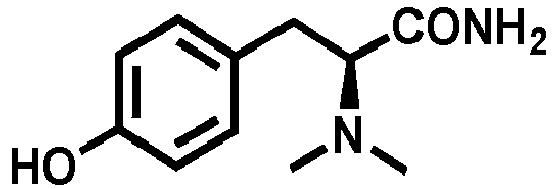
- This compound has previously been described in the literature and was synthesized by adapting the respective procedure (Manglik, A., et al., Structure-based discovery of opioid analgesics with reduced side effects. Nature, 2016. 537(7619): p. 185-190). In a sealed microwave tube paraformaldehyde (4.30 g, 143 mmol, 10 eq.) was refluxed for two hours to prepare a 35 wt. % solution in water. L-Tyrosine amide (2.58 g, 14.3 mmol, 1 eq.) was dissolved in a mixture of 60 mL acetonitrile and 12 mL distilled water and cooled to -10 °C in an acetone/ice bath. First, sodium triacetoxyborohydride (15.2 g, 71.5 mmol, 5 eq.), second, the formaldehyde solution was added. The reaction was quenched after 10 min by the addition of 40 mL saturated sodium bicarbonate solution and sodium carbonate to adjust to pH = 9. The slurry was diluted with 40 mL of dist. water. The aqueous phase was extracted five times with 100 mL of an organic solvent mixture of isopropanol: ethyl acetate 1 : 4. The combined organic phases were dried over sodium sulfate and evaporated to dryness. No further purification was necessary. The product was obtained as a white solid (2.98 g, 14.3 mmol, 100 %).
Melting point 105 °C [α]D 24 + 35.6° (c = 0.44, MeOH) ESI (m/z) 208.98 [M+H]+ 1H NMR (400 MHz, DMSO-d 6) δ 7.15 (d, J = 2.6 Hz, 1H), 6.99 - 6.94 (m, 2H), 6.84 (d, J = 2.5 Hz, 1H), 6.65 - 6.60 (m, 2H), 4.55 (s, 1H), 3.07 (dd, J = 9.1, 5.3 Hz, 1 H)NH2), 2.80 (dd, J = 13.4, 9.1 Hz, 1H), 2.60 (dd, J = 13.4, 5.3 Hz, 1H), 2.23 (s, 6H). 13C NMR (151 MHz, DMSO) δ 171.8, 155.4, 129.7, 129.2, 114.7, 69.0, 41.5, 33.3. -

- This compound has previously been described in the literature and was synthesized by adapting the respective procedure (Manglik, A., et al., Structure-based discovery of opioid analgesics with reduced side effects. Nature, 2016. 537(7619): p. 185-190). To an ice-cooled solution of Intermediate 5 (3.00 g, 14.4 mmol, 1 eq.) in 60 mL of dry THF, borane-THF complex (86.4 ml, 86.4 mmol, 1M in THF, 6 eq.) was added dropwise at 0°C. After addition, the mixture was refluxed for six hours. The reaction was quenched by the slow addition of 20 mL dry methanol at reflux temperature in order to cleave the borane-amine complex. The mixture was refluxed for additional 30 minutes. The methanol addition-evaporation sequence was repeated twice. The remaining residue was subjected to flash column chromatography (eluent: DCM : MeOH + 0.1 % ammonia (25 % aq.), 10: 1 to 4: 1) which gave the product as a white solid (1.20 g, 6.18 mmol, 43 %).
Melting point 179 °C [α]D 25 + 15.5° (c = 0.50, MeOH) ESI (m/z) 195.00 [M+H]+ 1H NMR (400 MHz, DMSO-d 6) δ 6.97 - 6.91 (m, 2H), 6.68 - 6.62 (m, 2H), 2.67 (dd, J = 13.3, 3.8 Hz, 1H), 2.50 - 2.36 (m, 2H), 2.33 (dd, J = 11.4, 3.2 Hz, 1H), 2.23 (s, 6H), 2.16 (dd, J = 13.3, 8.7 Hz, 1H). 13C NMR (151 MHz, DMSO) δ 155.1, 130.5, 129.7, 114.9, 68.2.0, 40.1, 30.3. - Based on the procedure described literature (Manglik, A., et al., Structure-based discovery of opioid analgesics with reduced side effects. Nature, 2016. 537(7619): p. 185-190) a portion of the pure product was converted to the dihydrochloride salt (
Intermediate 6 dihydrochloride) for referencing. The analytical data were identical. -

- In a sealed microwave tube paraformaldehyde (340 mg, 11.3 mmol, 10 eq.) was refluxed for two hours to prepare a 35 wt. % solution in water. Intermediate 4 (220 mg, 1.13 mmol, 1 eq.) was dissolved in a mixture of 15 mL acetonitrile and 3 mL distilled water and cooled to -10 °C in an acetone/ice bath. First, sodium triacetoxyborohydride (15.2 g, 71.5 mmol, 5 eq.), second, the formaldehyde solution was added. The reaction was quenched after 10 min by the addition of 5 mL saturated sodium bicarbonate solution and sodium carbonate to adjust to pH = 9. The slurry was diluted with 5 mL of dist. water. The aqueous phase was extracted five times with 10 mL of an organic solvent mixture of isopropanol: ethyl acetate 1 : 4. The combined organic phases were dried over sodium sulfate and evaporated to dryness. Purification by flash column chromatography (eluent: DCM : MeOH + 0.1 % ammonia (25 % aq.), 20: 1) gave the product as a white solid (168 mg, 756 µmol, 67 %).
Melting point 122 °C [α]D 23 + 28.6° (c = 0.359, MeOH) ESI (m/z) 222.98 [M+H]+ 1H NMR (400 MHz, DMSO-d 6) δ 9.12 (s, 1H), 7.12 (d, J = 2.8 Hz, 1H), 7.01 - 6.93 (m, 3H), 6.64 - 6.54 (m, 2H), 2.80 (d, J = 13.0 Hz, 1H), 2.66 (d, J = 13.0 Hz, 1H), 2.18 (s, 6H), 0.88 (s, 3H). 13C NMR (101 MHz, DMSO) δ 175.7, 155.5, 131.0, 127.8, 114.3, 66.6, 41.6, 38.9, 12.4. -
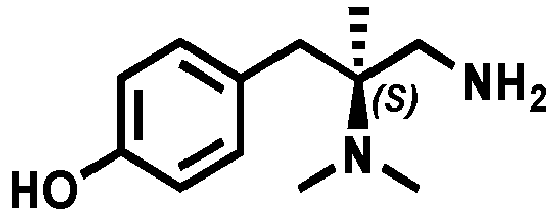
- To an ice-cooled solution of Intermediate 7 (103 mg, 463 µmol, 1 eq.) in 7 mL of dry THF, borane-THF complex (2.78 ml, 2.78 mmol, 1M in THF, 6 eq.) was added dropwise at 0°C. After addition, the mixture was refluxed for seven hours. The reaction was quenched by the slow addition of 10 mL dry methanol at reflux temperature in order to cleave the borane-amine complex. The mixture was refluxed overnight. The remaining residue was subjected to flash column chromatography (eluent: DCM : MeOH + 0.1 % ammonia (25 % aq.), 10: 1 to 4: 1) and gave the product as a white solid (58 mg, 0.28 mmol, 70 %).
Melting point 129 °C [α]D 25 + 11.8° (c = 0.446, MeOH) ESI (m/z) 208.95 [M+H]+ 1H NMR (400 MHz, DMSO-d 6) δ 7.10 - 6.88 (m, 2H), 6.65 - 6.61 (m, 2H), 3.33 (s, 2H), 2.53 - 2.51 (m, 2H), 2.48 - 2.43 (m, 1H), 2.27 - 2.16 (m, 7H), 0.77 (s, 3H). 13C NMR (101 MHz, DMSO) δ 155.2, 131.2, 128.8, 114.4, 59.1, 46.0, 37.8, 36.8, 17.5. -

- Intermediate 11 (218 mg, 1.05 mmol, 1 eq.), tritylchloride (379 mg, 1.36 mmol, 1.3 eq.), tetrabutylammonium bromide (101 mg, 314 µmol, 0.3 eq.) and triethylamine (190 µL, 1.36 mmol, 1.3 eq.) were dissolved in 1 mL of dry THF under an inert gas atmosphere. The reaction was stirred at 80 °C in a pressure tube for 3 h. The solvent was evaporated and the crude was purified by flash column chromatography (eluent: DCM : MeOH, 99 : 1) to give the product as a white solid (405 mg, 899 µmol, 86 %).
Melting point 56 °C [α]D 25 + 47.3° (c = 0.92, MeOH) ESI (m/z) 473.02 [M+H]+ 1H NMR (600 MHz, Chloroform-d) δ 7.20 - 7.14 (m, 15H), 6.55 (s, 2H), 5.38 - 5.32 (m, 1H), 4.98 (s, 1H), 4.43 (s, 1H), 3.44 (ddd, J = 9.5, 5.7, 3.7 Hz, 1H), 3.11 - 3.05 (m, 2H), 3.01 (dd, J = 14.5, 9.7 Hz, 1H), 2.28 (s, 6H). 13C NMR (151 MHz, CDCl3) δ 178.3, 154.2, 145.4, 139.4, 129.1, 127.9, 126.8, 126.3, 115.4, 71.2, 57.7, 34.9, 20.7. -

- To a suspension of 2,6-dimethyl-L-tyrosine (359 mg, 1.72 mmol, 1 eq.) in 6 mL of dry methanol was added thionyl chloride (0.50 mL, 6.9 mmol, 4 eq.) slowly at 0 °C. Remaining solids dissolved after completion of addition and the resulting solution was stirred for 24 h at reflux. The mixture was evaporated under vacuum and the remaining yellow oil was suspended in 15 mL of MTBE. The white solid was filtered and washed with 10 mL of MTBE to give product as the hydrochloride salt (448 mg, 1.72 mmol, 100 %). No further purification was necessary.
Melting point 211 °C [α]D 25 + 79.5° (c = 1.51, MeOH) ESI (m/z) 206.85 [M+H]+ 1H NMR (600 MHz, DMSO-d 6) δ 9.14 (s, 1H), 8.63 (s, 3H), 6.43 (s, 2H), 3.92 (dd, J = 9.0, 7.4 Hz, 1H), 3.54 (s, 3H), 3.06 - 3.03 (m, 2H), 2.15 (s, 6H). 13C NMR (101 MHz, DMSO) δ 170.0, 155.7, 137.8, 121.7, 114.9, 52.4, 51.5, 29.9, 19.6. -

- Intermediate 10 (360 mg, 1.39 mmol, 1 eq.) was dissolved in a minimum amount of a 5 % aqueous solution of sodium carbonate. The solution was extracted three times with 10 mL of an isopropanol: ethyl acetate mixture (1:4). The combined organic phases were dried over sodium sulfate and evaporated to dryness. The remaining solid was dissolved in 6 mL of dry methanol. The solution was cooled to -10°C using an acetone/ice bath and gaseous ammonia was bubbled through the solution for five minutes. The reaction flask was sealed and stirred at room temperature. Ammonia addition was repeated every 8 to 24 h until the starting material was consumed (TLC control). After 7 d the solvent was evaporated to give the amide product as a white solid (280 mg, 1.34 mmol, 97 %). No further purification was necessary.
Melting point 199 °C [α]D 25 + 66.8° (c = 0.89, MeOH) ESI (m/z) 208.89 [M+H]+ 1H NMR (400 MHz, DMSO-d 6) δ 8.92 (s, 1H), 7.18 (d, J = 2.7 Hz, 1H), 6.91 (d, J = 2.6 Hz, 1H), 6.38 (s, 2H), 3.23 (dd, J = 8.6, 5.8 Hz, 1H), 2.79 (dd, J = 13.9, 5.8 Hz, 1H), 2.57 - 2.53 (m, 1H), 2.20 (s, 6H), 1.65 (s, 2H). 13C NMR (151 MHz, DMSO) δ 177.2, 154.7, 137.7, 125.9, 114.7, 55.3, 34.5, 20.2. -

- To a solution of Intermediate 11 (258 mg, 1.24 mmol, 1 eq.) and acetic acid (127 µL, 2.23 mmol, 1.8 eq.) in 5 mL of acetonitrile and 0.5 mL of dist. water was subsequently added sodium triacetoxyborohydride (788 mg, 3.72 mmol, 3 eq.) and then benzaldehyde (125 µL, 1.24 mmol, 1 eq.) at 0 °C. After stirring for 2h at r.t., an additional amount of sodium triacetoxyborohydride (262 mg, 1.24 mmol, 1 eq.) was added. The reaction was stirred for 30 minutes and 5 mL of a saturated sodium bicarbonate solution were added. Sodium carbonate (5 % aqueous solution) was added until pH = 9 was reached. The aqueous phase was extracted three times with 10 mL dichloromethane. The combined organic layers were dried over sodium sulfate and evaporated to dryness. Purification by flash column chromatography (eluent: DCM: MeOH + 0.1 % ammonia (25 % aq.), 99: 1 to 98: 2) gave the product as a colorless oil (238 mg, 798 µmol, 64 %).
Melting point 54 °C [α]D 23 - 14.7° (c = 0.609, MeOH) ESI (m/z) 299.03 [M+H]+ 1H NMR (600 MHz, Chloroform-d) δ 7.24 - 7.18 (m, 3H), 7.09 (d, J = 4.8 Hz, 1H), 6.99 (d, J = 7.0 Hz, 2H), 6.51 (s, 2H), 5.72 (d, J = 5.1 Hz) 3.75 (d, J = 13.9 Hz, 1H), 3.47 (d, J = 13.9 Hz, 1H), 3.32 (dd, J = 10.2, 5.4 Hz, 1H), 3.11 (dd, J = 14.4, 5.4 Hz, 1H), 2.82 (dd, J = 14.4, 10.2 Hz, 1H), 2.21 (s, 6H). 13C NMR (151 MHz, CDCl3) δ 178.0, 154.5, 139.1, 138.8, 128.5, 127.6, 127.1, 125.4, 115.5, 61.1, 52.4, 32.8, 20.6. -

- In a sealed microwave tube paraformaldehyde (333 mg, 7.24 mmol, 10 eq.) was refluxed for two hours to prepare a 35 wt. % solution in water. Intermediate 12 (216 mg, 724 µmol, 1 eq.) was dissolved in 5 mL of acetonitrile and 0.5 mL of distilled water and cooled to -10 °C in an acetone/ice bath. First, sodium triacetoxyborohydride (767 mg, 3.62 mmol, 5 eq.), second, the formaldehyde solution was added. The reaction was quenched after 5 min by the addition of 10 mL saturated sodium bicarbonate solution and sodium carbonate to adjust to pH = 9. The aqueous phase was extracted three times with 10 mL dichloromethane. The combined organic phases were dried over sodium sulfate and evaporated to dryness. No further purification was necessary. The product was obtained as a white solid (165 mg, 528 µmol, 73 %).
Melting point 137 °C [α]D 25 - 1.0° (c = 0.745, MeOH) ESI (m/z) 313.06 [M+H]+ 1H NMR (600 MHz, Chloroform-d) δ 7.31 - 7.27 (m, 2H), 7.26 - 7.20 (m, 3H), 6.43 (s, 2H), 6.19 (s, 1H), 5.49 (s, 1H), 3.73 (d, J = 13.5 Hz, 1H), 3.61 (d, J = 13.5 Hz, 1H), 3.28 (dd, J = 8.7, 5.3 Hz, 1H), 3.21 (dd, J = 14.0, 8.7 Hz, 1H), 2.96 (dd, J = 14.0, 5.3 Hz, 1H), 2.44 (s, 3H), 2.25 (s, 6H). 13C NMR (151 MHz, CDCl3) δ 175.6, 153.8, 138.9, 138.3, 128.6, 128.4, 127.5, 127.2, 115.2, 66.1, 59.4, 38.4, 28.4, 20.5. -

- To an ice-cooled solution of Intermediate 13 (145 mg, 464 µmol, 1 eq.) in 3.0 mL of dry THF, borane-THF complex (2.78 ml, 2.78 mmol, 1M in THF, 6 eq.) was added dropwise at 0°C. After addition, the mixture was refluxed for six hours. The reaction was quenched by the slow addition of 0.4 mL of 2 N HCl at r.t. in order to cleave the borane-amine complex. The mixture was diluted with 5 mL dist. water and ammonia (25 % aq.) was added to adjust to pH = 9. The aqueous phase was extracted four times with 10 mL of dichloromethane. The combined organic phases were dried over sodium sulfate and evaporated to dryness. The remaining residue was subjected to flash column chromatography (eluent: DCM : MeOH + 0.1 % ammonia (25 % aq.), 100: 0 to 98: 2) which gave the product as a white solid (121 mg, 405 µmol, 87 %).
-
[α]D 24 - 8.0° (c = 0.51, MeOH) ESI (m/z) 299.06 [M+H]+ 1H NMR (600 MHz, Chloroform-d) δ 7.37 - 7.30 (m, 4H), 7.28 - 7.23 (m, 1H), 6.36 (s, 2H), 3.87 (d, J = 13.3 Hz, 1H), 3.67 (d, J = 13.3 Hz, 1H), 2.91 - 2.85 (m, 2H), 2.76 (dd, J = 12.6, 10.6 Hz, 1H), 2.55 (dd, J = 14.3, 12.0 Hz, 1H), 2.41 (dd, J = 12.6, 3.3 Hz, 1H), 2.32 (s, 3H), 2.18 (s, 6H). 13C NMR (151 MHz, CDCl3) δ 154.7, 139.9, 137.6, 128.6, 128.6, 127.0, 126.7, 115.7, 65.3, 57.8, 40.8, 36.1, 24.1, 20.6. -

- Intermediate 14 (110 mg, 269 µmol, 1 eq.), 1,1,2-trichloroethane (75 µL, 0.81 mmol, 2.2 eq.) and palladium (39 mg, 37 µmol, 0.1 eq., 10% on charcoal) were mixed in 8 mL of dry methanol. Hydrogen gas was purged into the flask and the reaction was left to stir at room temperature. Hydrogen addition was repeated every 8h to 16 h. After 48 h palladium hydroxide (52 mg, 36 µmol, 0.1 eq., 10 % on charcoal) was added and the suspension was stirred for 1 h. The mixture was filtered through a pad of celite and the solvent was evaporated. Purification by flash column chromatography (eluent: DCM: MeOH + 0.1 % ammonia (25 %, aq.), 20: 1 to 5: 1) gave the product as a white solid (49 mg, 0.24 mmol, 64 %).
Melting point 59 °C [α]D 24 + 18.7° (c = 0.41, MeOH) ESI (m/z) 208.94 [M+H]+ 1H NMR (600 MHz, DMSO-d 6) δ 6.42 (s, 2H), 2.79 (dd, J = 14.0, 5.5 Hz, 1H), 2.65-2.59 (m, 1H), 2.53 - 2.51 (m, 2H), 2.45 (dd, J = 13.9, 8.7 Hz, 1H), 2.34 (s, 3H), 2.19 (s, 6H). 13C NMR (151 MHz, DMSO) δ 154.8, 137.3, 125.8, 114.9, 59.3, 42.1, 33.0, 30.5, 20.2. -

- N-Fmoc-L-4-Carbamoylphenylalanine (1.00 g, 2.32 mmol, 1 eq.) was suspended in 20 mL of dry THF under nitrogen atmosphere. Borane-THF complex (1 M, 23.23 mL, 23.23 mmol) was slowly added at 0°C. The white suspension turned into a clear solution upon completion of addition. After stirring at 0°C for 24 h, 3 mL of methanol were slowly added in order to quench the reaction. Celite (1 g) was added to the solution and the solvent was evaporated. The crude was purified on silica gel, eluting with a gradient of DCM : MeOH 100 : 0 to 10 : 1.
- Remaining starting material was recovered (63 mg, 0.15 mmol). The product was obtained as a white solid (550 mg, 1.32 mmol, respective yield 61 %.).
Melting point 142 - 144 °C [α]D 25 - 22.0° (c = 1.025, DMSO) ESI (m/z) 417.15 [M+H]+ HRMS (m/z) [M+Na]+ calculated for C25H24N2O4: 439.1628, found: 439.1622. NMR NMR spectra were measured at 298 K and 318 K. At 298 K two sets of signals were observed in the DEPTQ experiment. At 318 K the signal sets merged to one single signal set. This indicates that at 298 K the molecule adopts two different conformations, e.g. due to a rotational barrier or an inter- or intramolecular hydrogen bond, which is broken at 318 K. 1H NMR (600 MHz, DMSO-d 6, T = 318 K) δ 7.87 (dt, J = 7.5, 1.0 Hz, 2H), 7.83 (dt, J = 7.5, 0.9 Hz, 2H), 7.79 - 7.77 (m, 3H), 7.41 (td, J = 7.4, 1.1 Hz, 2H), 7.34 (td, J = 7.4, 1.1 Hz, 2H), 7.27 (d, J = 8.1 Hz, 2H), 7.12 (s, 1H), 6.26 (s, 2H), 3.41 - 3.37 (m, 1H), 3.28 (dd, J = 10.4, 4.9 Hz, 1H), 3.19 (dd, J = 10.4, 6.4 Hz, 1H), 2.92 - 2.86 (m, 1H), 2.73 (dd, J = 13.3, 5.5 Hz, 1H), 2.49 - 2.45 (m, 1H), 1.46 - 1.42 (m, 1H). 13C NMR (151 MHz, DMSO, T = 318 K) δ 167.8, 143.4, 142.6, 139.4, 137.4, 131.9, 128.9, 128.8, 127.2, 127.2, 121.2, 119.9, 109.4, 65.9, 60.7, 54.2, 40.0, 29.2. Chiral HPLC system K: tR = 34.8 min, purity (λ = 254 nm): ≥ 99 % -

- Intermediate 16 (403 mg, 0.97 mmol, 1 eq.) was dissolved in 100 mL dry THF. The clear solution was cooled with an acetone/ice bath and Dess-Martin periodinane (616 mg, 1.45 mmol, 1.5 eq.) was added in small portions. The white suspension was stirred at 0 °C for 6 h. The solvent was evaporated in a nitrogen stream to avoid heating. Celite and 10 mL of water were added for lyophilizing overnight. Purification via a Biotage system (10 g, silica column) eluting with a ratio of 100: 0 to 95: 5 (DCM: MeOH) gave the product as a white solid (320 mg, 0.77 mmol, 80 %). Due to instability, the substance was directly used for the next step without detailed characterization.
ESI (m/z) 415.06 [M+H]+ HRMS (m/z) [2M+H]+ calculated for C25H22N2O4: 829.3232, found: 829.3242 -

- Intermediate 17 (310 mg, 0.76 mmol, 1 eq.) was dissolved in 60 mL of dry THF in an argon atmosphere. Dry molecular sieves were added and the solution was cooled to - 50 °C. Titanium tetraisopropoxide (443 µL, 1.50 mmol, 2 eq.) was slowly added and the mixture was stirred for 15 min. Ammonium trifluoroacetate (980 mg, 1.48 mmol, 10 eq.) and sodium cyanoborohydride (141 mg, 2.24 mmol, 3 eq.) in 20 mL dry THF were slowly added. The mixture was stirred at - 50 °C for two hours and then at -20 °C for three hours. Molecular sieves were filtered off and washed with 20 mL of methanol. The combined organic solvent fractions were evaporated in a nitrogen stream. Purification was performed on a Biotage system. The product was obtained as a white solid (90 mg, 0.20 µmol, 37 %, 60 mg of the respective alcohol were recovered, overall yield: 51 %).
Melting point 158 °C ESI (m/z) 416.08 [M+H]+ 1H NMR (600 MHz, DMSO-d 6) δ 8.24 (s, 1H), 7.90 - 7.82 (m, 4H), 7.81 - 7.79 (m, 2H), 7.63 - 7.60 (m, 2H), 7.44 - 7.39 (m, 2H), 7.37 - 7.28 (m, 4H), 7.26 (d, J = 8.0 Hz, 2H), 6.28 (s, 1H), 4.32 (dd, J = 9.9, 6.3 Hz, 1H)), 4.22 - 4.14 (m, 2H)), 3.87 - 3.80 (m, 1H), 2.88 - 2.80 (m, 2H), 2.78 - 2.69 (m, 2H). 13C NMR (151 MHz, DMSO) δ 167.5, 163.8, 155.7, 143.7, 142.5, 141.4, 140.6, 139.3, 137.3, 132.2, 128.9, 128.8, 127.5, 127.4, 127.2, 126.9, 125.0, 124.9, 121.3, 120.0, 109.6, 65.3, 51.4, 46.6, 42.7, 37.3. -
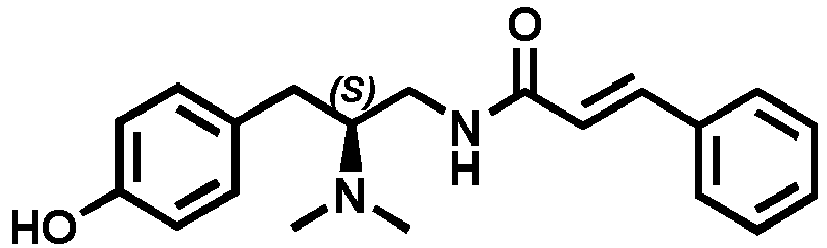
- To a solution of Intermediate 6 (13 mg, 67 µmol, 1 eq.) in 0.5 mL dry DMF were added (E)-cinnamic acid (12 mg, 80 µmol, 1.2 eq.), BOP (35 mg, 80 µmol, 1.2 eq.) and triethylamine (65 µL, 0.47 mmol, 7 eq.) in 0.5 mL dry DMF. After stirring for 72 h at room temperature the solvent was removed under vacuum. The crude oil was dissolved in 5 mL of dichloromethane and extracted three times with 5 mL of saturated sodium bicarbonate solution. The organic phase was dried over sodium sulfate and evaporated to dryness. The crude was purified by flash column chromatography (solvent system: DCM : MeOH + 0.1 % ammonia (25 % aq.), 20: 1). The product was obtained as a white solid (15 mg, 46 µmol, 69 %).
Melting point 164 °C [α]D 26 + 92.0° (c = 0.486, CHCl3) ESI (m/z) 325.21 [M+H]+ HRMS (m/z) [M+H]+ calculated for C20H24N2O2: 325.1911, found: 325.1908. 1H NMR (400 MHz, Chloroform-d) δ 7.59 (d, J = 15.6 Hz, 1H), 7.52 - 7.46 (m, 2H), 7.38 - 7.32 (m, 3H), 7.00 - 6.96 (m, 2H), 6.82 - 6.78 (m, 2H), 6.65 - 6.60 (m, 1H), 6.40 (d, J = 15.6 Hz, 1H), 3.60 (ddd, J = 14.0, 6.7, 4.5 Hz, 1H), 3.14 - 3.00 (m, 1H), 2.93 (dd, J = 13.3, 3.3 Hz, 1H), 2.81 - 2.71 (m, 1H), 2.38 (s, 6H), 2.29 (dd, J = 13.3, 10.5 Hz, 1H). 13C NMR (151 MHz, CDCl3) δ 166.3, 155.4, 141.2, 134.8, 129.9, 129.6, 129.4, 128.7, 127.9, 120.5, 115.7, 65.0, 40.2, 39.7, 30.5. HPLC system 1: tR = 14.8 min, purity (λ = 254 nm): 97 %, (λ = 280 nm): 98 % system 2: tR = 13.4 min, purity (λ = 254 nm): 96 %, (λ = 280 nm): 97 % Chiral HPLC system B: tR = 19.7 min, purity (λ = 254 nm): ≥ 99 % -

- To a solution of Intermediate 6 (18 mg, 67 µmol) in 0.5 mL dry DMF were added 3-phenylpropiolic acid (12 mg, 80 µmol, 1.2 eq.), BOP (36 mg, 80 µmol, 1.2 eq.) and triethylamine (65 µL, 0.47 mmol, 7 eq.) in 0.5 mL dry DMF. After stirring for 23 h at room temperature the solvent was removed under vacuum. The crude oil was dissolved in 5 mL of dichloromethane and extracted three times with 5 mL of saturated sodium bicarbonate solution. The organic phase was dried over sodium sulfate and evaporated to dryness. The crude was first passed through a silica plug (eluent: ethyl acetate + 0.1 % TEA) and then purified by flash column chromatography (solvent system: DCM : MeOH + 0.1 % ammonia (25 % aq.), 20: 1). The product was obtained as a white solid (16 mg, 50 µmol, 74 %).
Melting point 152 - 153 °C [α]D 26 + 10.5° (c = 0.523, CHCl3) ESI (m/z) 323.16 [M+H]+ HRMS (m/z) [M+H]+ calculated for C20H22N2O2: 323.1754, found: 323.1753. 1H NMR (400 MHz, Chloroform-d) δ 7.55 - 7.51 (m, 2H), 7.43 - 7.32 (m, 3H), 7.01 - 6.96 (m, 2H), 6.79 - 6.74 (m, 3H), 3.51 (ddd, J = 13.9, 6.8, 4.6 Hz, 1H), 3.05 - 2.97 (m, 1H), 2.93 (dd, J = 13.4, 3.5 Hz, 1H), 2.74 (m, 1H), 2.37 (s, 6H), 2.27 (dd, J = 13.4, 10.3 Hz, 1H). 13C NMR (101 MHz, CDCl3) δ 154.7, 153.5, 132.5, 130.1, 130.1, 130.0, 128.5, 120.3, 115.6, 84.7, 83.1, 64.6, 40.1, 39.9, 30.5. HPLC system 1: tR = 14.7 min, purity (λ = 254 nm): 96 %, (λ = 280 nm): 96 % system 2: tR = 13.4 min, purity (λ = 254 nm): 96 %, (λ = 280 nm): 96 % Chiral HPLC system B: tR = 19.9 min, purity (λ = 254 nm): ≥ 99 % -

- To a solution of Intermediate 6 (15 mg, 77 µmol, 1 eq.) in 0.5 mL dry DMF were added (E)-3-methyl-3-phenylacrylic acid (15 mg, 93 µmol, 1.2 eq.), PyBOP (48 mg, 93 µmol, 1.2 eq.) and triethylamine (54 µL, 0.39 mmol, 5 eq.) in 0.5 mL dry DMF. After stirring for 16 h at room temperature the solvent was removed under vacuum. The crude was first passed through a silica plug (eluent: ethyl acetate + 0.1 % TEA) and then purified by flash column chromatography (solvent system: DCM : MeOH + 0.1 % ammonia (25 % aq.), 95 : 5). The product was obtained as a white solid (14 mg,41 µmol, 54 %).
Melting point 151 °C [α]D 24 + 11.4° (c = 0.114, MeOH) ESI (m/z) 339.14 [M+H]+ HRMS (m/z) [M+H]+ calculated for C21H26N2O2: 339.2067, found: 339.2066. 1H NMR (600 MHz, Methanol-d 4) δ 7.48 - 7.43 (m, 2H), 7.36 - 7.33 (m, 2H), 7.33 - 7.29 (m, 1H), 7.05 - 7.02 (m, 2H), 6.73 - 6.70 (m, 2H), 6.10 (q, J = 1.4 Hz, 1H), 3.32 - 3.29 (m, 2H), 2.94 - 2.87 (m, 2H), 2.45 (d, J = 1.4 Hz, 3H), 2.43 - 2.38 (m, 1H), 2.37 (s, 6H). 13C NMR (151 MHz, MeOD) δ 169.5 156.9, 151.2, 144.0, 131.7, 131.1, 129.6, 129.5, 127.2, 121.1, 116.4, 66.5, 40.9, 40.4, 33.2, 17.8. HPLC system 1: tR = 15.7 min, purity (λ = 254 nm): ≥ 99 %, (λ = 280 nm): ≥ 99 % system 2: tR = 13.9 min, purity (λ = 254 nm): ≥ 99 %, (λ = 280 nm): ≥ 99 % Chiral HPLC system B: tR = 12.3 min, purity (λ = 254 nm): ≥ 99 % -

- To a solution of Intermediate 6 (15 mg, 77 µmol, 1 eq.) in 0.5 mL dry DMF was added (E)-2-methyl-3-phenylacrylic acid (15 mg, 93 µmol, 1.2 eq.), PyBOP (48 mg, 93 µmol, 1.2 eq.) and triethylamine (54 µL, 0.39 mmol, 5 eq.) in 0.5 mL dry DMF. After stirring for 24 h at room temperature the solvent was removed under vacuum. The crude was first passed through a silica plug (eluent: ethyl acetate + 0.1 % TEA) and then purified by flash column chromatography (solvent system: DCM : MeOH + 0.1 % ammonia (25 % aq.), 95 : 5). The product was obtained as a white solid (18 mg, 53 µmol, 69 %).
Melting point 187 °C [α]D 24 + 0.05° (c = 1.07, MeOH) ESI (m/z) 339.13 [M+H]+ HRMS (m/z) [M+H]+ calculated for C21H26N2O2: 339.2067, found: 339.2070. 1H NMR (400 MHz, Chloroform-d) δ 7.40 - 7.28 (m, 6H), 7.02 - 6.98 (m, 2H), 6.87 (d, J = 6.2 Hz, 1H), 6.81 - 6.77 (m, 2H), 3.56 (ddd, J = 13.9, 6.5, 4.6 Hz, 1H), 3.11 (ddd, J = 13.7, 10.6, 2.4 Hz, 1H), 2.95 (dd, J = 13.3, 3.4 Hz, 1H), 2.86 - 2.78 (m, 1H), 2.41 (s, 6H), 2.33 (dd, J = 13.2, 10.3 Hz, 1H), 2.06 (d, J = 1.4 Hz, 3H). 13C NMR (151 MHz, CDCl3) δ 169.9, 155.2, 136.2, 134.3, 131.6, 130.0, 129.7, 129.4, 128.3, 127.8, 115.7, 65.1, 40.2, 40.0, 30.8, 14.1. HPLC system 1: tR = 15.4 min, purity (λ = 254 nm): 98 %, (λ = 280 nm): 98 % system 2: tR = 13.8 min, purity (λ = 254 nm): 98 %, (λ = 280 nm): 98 % Chiral HPLC system B: tR = 16.6 min, purity (λ = 254 nm): ≥ 99 % -

- To a solution of Intermediate 8 (12 mg, 57 µmol, 1 eq.) in 0.5 mL dry DMF were added (E)-cinnamic acid (10 mg, 69 µmol, 1.2 eq.), PyBOP (36 mg, 69 µmol, 1.2 eq.) and triethylamine (40 µL, 0.29 mmol, 5 eq.) in 0.5 mL dry DMF. After stirring for 24 h at r.t. the solvent was removed under vacuum. The crude was first passed through a silica plug (eluent: ethyl acetate + 0.1 % TEA) and then purified by flash column chromatography (solvent system: DCM : MeOH + 0.1 % ammonia (25 % aq.), 95 : 5). The product was obtained as a clear oil (7.0 mg, 20 µmol, 36 %).
[α]D 24 + 63.5° (c = 0.207, MeOH) ESI (m/z) 339.13 [M+H]+ HRMS (m/z) [M+H]+ calculated for C21H26N2O2: 339.2067, found: 339.2067. 1H NMR (600 MHz, Chloroform-d) δ 7.62 (d, J = 15.6 Hz, 1H), 7.55 - 7.50 (m, 2H), 7.39 - 7.32 (m, 3H), 7.01 - 6.95 (m, 2H), 6.82 - 6.78 (m, 2H), 6.66 (s, 1H), 6.48 (d, J = 15.6 Hz, 1H), 3.34 (dd, J = 14.0, 4.0 Hz, 1H), 3.21 (dd, J = 14.0, 4.6 Hz, 1H), 2.68 (s, 2H), 2.35 (s, 6H), 0.94 (s, 3H). 13C NMR (151 MHz, CDCl3) δ 166.4, 155.5, 141.1, 134.9, 131.3, 129.6, 128.8, 128.2, 127.9, 120.6, 115.3, 58.7, 44.8, 38.1, 38.0, 17.9. HPLC system 1: tR = 15.0 min, purity (λ = 254 nm): ≥ 99 %, (λ = 280 nm): ≥ 99 % system 2: tR = 13.6 min, purity (λ = 254 nm): ≥ 99 %, (λ = 280 nm): ≥ 99 % Chiral HPLC system B: tR = 13.2 min, purity (λ = 254 nm): ≥ 99 % -

- To a solution of Intermediate 6 (15 mg, 77 µmol, 1 eq.) in 0.5 mL dry DMF were added (E)-3-(1-naphtyl) acrylic acid (15 mg, 77 µmol, 1 eq.), PyBOP (40 mg, 77 µmol, 1 eq.) and triethylamine (22 µL, 0.15 mmol, 2 eq.) in 0.5 mL dry DMF. After stirring for 2h at room temperature the solvent was removed under vacuum. The crude was purified by flash column chromatography (solvent system: DCM: ethyl acetate: MeOH + 0.1 % ammonia (25 % aq.), 90: 5: 5). The product was obtained as a colorless crystalline solid (26 mg, 69 µmol, 90 %).
Melting point 90 °C [α]D 25 + 30.0° (c = 0.364, MeOH) ESI (m/z) 375.08 [M+H]+ HRMS (m/z) [M+H]+ calculated for C24H26N2O2: 375.2067, found: 375.2066. 1H NMR (400 MHz, Chloroform-d) δ 8.44 (d, J = 15.3 Hz, 1H), 8.25 - 8.20 (m, 1H), 7.87 - 7.83 (m, 2H), 7.69 (dt, J = 7.2, 0.9 Hz, 1H), 7.58 - 7.48 (m, 2H), 7.47 - 7.42 (m, 1H), 7.04 - 7.00 (m, 2H), 6.86 - 6.81 (m, 2H), 6.66 - 6.59 (d, J = 5.2 Hz, 1H), 6.47 (d, J = 15.3 Hz, 1H), 3.66 (ddd, J = 14.0, 6.8, 4.5 Hz, 1H), 3.11 (ddd, J = 14.0, 10.4, 4.5 Hz, 1H), 2.95 (dd, J = 13.3, 3.3 Hz, 1H), 2.81 -2.73 (m, 1H), 2.38 (s, 6H), 2.31 (dd, J = 13.3, 10.5 Hz, 1H). 13C NMR (151 MHz, CDCl3) δ 166.2, 155.4, 138.4, 133.6, 132.5, 131.5, 130.0, 129.9, 129.7, 128.5, 126.7, 126.1, 125.3, 124.6, 123.8, 123.4, 115.7, 65.1, 40.2, 39.8, 30.5. HPLC system 1: tR = 16.7 min, purity (λ = 254 nm): ≥ 99 %, (λ = 230 nm): 97 % system 2: tR = 14.6 min, purity (λ = 254 nm): 97 %, (λ = 230 nm): 97 % Chiral HPLC system B: tR = 20.5 min, purity (λ = 254 nm): ≥ 99 % -

- To a solution of Intermediate 6 (15 mg, 77 µmol, 1 eq.) in 0.5 mL dry DMF were added (E)-o-(trifluoromethyl)cinnamic acid (17 mg, 77 µmol, 1 eq.), PyBOP (40 mg, 77 µmol, 1 eq.) and triethylamine (22 µL, 0.15 mmol, 2 eq.) in 0.5 mL dry DMF. After stirring for 30 min at room temperature the solvent was removed under vacuum. The crude was passed through a silica plug (eluent: ethyl acetate + 0.1 % TEA) and then purified flash chromatography (solvent system: DCM : MeOH + 0.1 % ammonia (25 % aq.), 97: 3). The product was obtained as a colorless crystalline solid (26 mg, 66 µmol, 86 %).
Melting point 57 -59 °C [α]D 25 + 39.3° (c = 0.603, MeOH) ESI (m/z) 393.01 [M+H]+ HRMS (m/z) [M+H]+ calculated for C21H23F3N2O2: 393.1784, found: 393.1783. 1H NMR (400 MHz, Methanol-d 4) δ 7.92 (dd, J = 15.5, 2.4 Hz, 1H), 7.81 (d, J = 7.8 Hz, 1H), 7.74 (d, J = 7.8 Hz, 1H), 7.65 (pseudo-t, J = 7.6 Hz, 1H), 7.55 (pseudo-t, J = 7.6 Hz, 1H), 7.15 - 7.09 (m, 2H), 6.80 - 6.72 (m, 2H), 6.57 (d, J = 15.5 Hz, 1H), 3.61 (dd, J = 15.1, 8.7 Hz, 1H), 3.42 - 3.34 (m, 2H), 3.05 (dd, J = 13.8, 4.1 Hz, 1H), 2.75 (s, 6H), 2.63 (dd, J = 13.7, 9.9 Hz, 1H). 13CNMR (101 MHz, Methanol-d 4) δ 168.6, 157.6, 137.7, 135.0, 133.7, 131.3, 130.8 130.8, 129.5 (q, J = 30.17 Hz), 129.1, 127.2 (q, J = 5.7 Hz), 125.7, 125.6 (q, J = 272.7 Hz, CF3), 116.7, 68.2, 40.7, 40.1, 32.5. HPLC system 1: tR = 16.2 min, purity (λ = 254 nm): ≥ 99 %, (λ = 280 nm): ≥ 99 % system 2: tR = 14.3 min, purity (λ = 254 nm): ≥ 99 %, (λ = 280 nm): ≥ 99 % Chiral HPLC system A: tR = 32.7 min, purity (λ = 254 nm): ≥ 99 % -
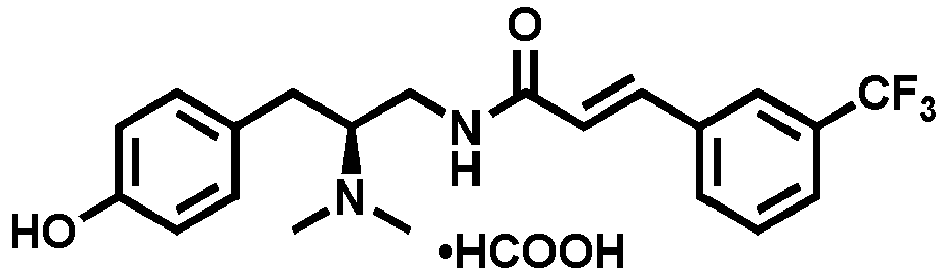
- To a solution of Intermediate 6 (15 mg, 77 µmol, 1 eq.) in 0.5 mL dry DMF were added (E)-m-(trifluoromethyl)cinnamic acid (17 mg, 77 µmol, 1 eq.), PyBOP (40 mg, 77 µmol, 1 eq.) and triethylamine (22 µL, 0.15 mmol, 2 eq.) in 0.5 mL dry DMF. After stirring for 30 min at room temperature the solvent was removed under vacuum. The crude was passed through a silica plug (eluent: ethyl acetate + 0.1 % TEA) and then purified by preparative HPLC (RP-C8, flow: 10 mL/min, solvent system: ACN/H2O + 0.1 % formic acid, 10 % ACN for 3 min, 10 % to 65 % ACN in 9 min, 65 % to 100 % ACN in 1 min, tR = 10.4 min). The product was obtained as a white solid (30 mg, 68 µmol, 89 %).
Melting point 67 -69 °C [α]D 24 + 13.1° (c = 0.865, MeOH) ESI (m/z) 393.00 [M+H]+ HRMS (m/z) [M+H]+ calculated for C21H23F3N2O2: 393.1784, found: 393.1785. 1H NMR (600 MHz, Methanol-d 4) δ 8.49 (s, 1H), 7.83 (s, 1H), 7.81 (d, J = 7.9 Hz, 1H), 7.67 (d, J = 7.7 Hz, 1H), 7.60 (pseudo-t, J = 7.8 Hz, 1H), 7.56 (d, J = 15.8 Hz, 1H), 7.14 - 7.10 (m, 2H), 6.79 - 6.75 (m, 2H), 6.67 (d, J = 15.8 Hz, 1H), 3.60 (dd, J = 14.7, 8.1 Hz, 1H), 3.44 - 3.35 (m, 2H), 3.06 (dd, J = 13.8, 4.2 Hz, 1H), 2.75 (s, 6H), 2.65 (dd, J = 13.8, 9.8 Hz, 1H). 13C NMR (151 MHz, MeOD) δ 169.6, 169.0, 157.7, 140.5, 137.3, 132.4 (q, J = 32.4, CCF3), 132.4, 131.3, 131.0, 128.9, 127.3 (q, J = 3.6 Hz), 125.4 (q, J = 3.8 Hz), 125.5 (q, J = 271.5 Hz, CF3), 123.5, 116.8, 68.2, 40.8, 40.0, 32.7. HPLC system 1: tR = 16.5 min, purity (λ = 254 nm): ≥ 99 %, (λ = 280 nm): ≥ 99 % system 2: tR = 14.6 min, purity (λ = 254 nm): ≥ 99 %, (λ = 280 nm): ≥ 99 % Chiral HPLC system A: tR = 32.8 min, purity (λ = 254 nm): ≥ 99 % -

- To a solution of Intermediate 6 (15 mg, 77 µmol, 1 eq.) in 0.5 mL dry DMF were added (E)-p-(trifluoromethyl)cinnamic acid (17 mg, 77 µmol, 1 eq.), PyBOP (40 mg, 77 µmol, 1 eq.) and triethylamine (22 µL, 0.15 mmol, 2 eq.) in 0.5 mL dry DMF. After stirring for 30 min at room temperature the solvent was removed under vacuum. The crude was passed through a silica plug (eluent: ethyl acetate + 0.1 % TEA) and then purified flash chromatography (solvent system: DCM : MeOH + 0.1 % ammonia (25 % aq.), 97: 3). The product was obtained as a colorless crystalline solid (26 mg, 61 µmol, 79 %).
Melting point 83 °C [α]D 24 + 7.2° (c = 0.607, MeOH) ESI (m/z) 393.01 [M+H]+ HRMS (m/z) [M+H]+ calculated for C21H23F3N2O2: 393.1784, found: 393.1784. 1H NMR (600 MHz, Methanol-d 4) δ 7.71 (d, J = 8.3 Hz, 2H), 7.67 (d, J = 8.3 Hz, 2H), 7.50 (d, J = 15.8 Hz, 1H), 7.07 - 7.05 (m, 2H), 6.74 - 6.71 (m, 2H), 6.68 (d, J = 15.8 Hz, 1H), 3.41 (dd, J = 14.3, 8.3 Hz, 1H), 3.37 (dd, J = 14.3, 5.2 Hz, 1H), 3.08 - 3.02 (m, 1H)), 2.95 (dd, J = 13.7, 4.3 Hz, 1H), 2.52 - 2.44 (m, 7H). 13CNMR (151 MHz, Methanol-d 4) δ 168.2, 157.1, 140.2, 139.9, 132.2 (q, J = 32.4 Hz), 131.1, 130.8, 129.3, 126.8 (q, J = 3.8 Hz), 125.5 (q, J = 271.0 Hz), 124.7, 116.5, 67.1, 40.8, 40.6, 32.9. HPLC system 1: tR = 16.8 min, purity (λ = 254 nm): ≥ 99 %, (λ = 280 nm): ≥ 99 % system 2: tR = 14.7 min, purity (λ = 254 nm): ≥ 99 %, (λ = 280 nm): ≥ 99 % Chiral HPLC system A: tR = 35.8 min, purity (λ = 254 nm): ≥ 99 % -

- Intermediate 9 (42 mg, 93 µmol, 1 eq.) was dissolved in 1 mL dry THF in a sealed tube under an argon atmosphere. Borane-THF (1M in THF, 0.56 mL, 0.56 mmol, 6 eq.) was added dropwise at 0°C. The mixture was heated at 85 °C for 7 h until completion. The reaction was quenched by the slow addition of 1 mL of dry methanol at r.t. in order to cleave the aminoborane complex. After stirring for 30 minutes, the solvent was evaporated to give a colorless oil. Due to instability, the intermediate was not further characterized.
- The colorless oil and triethylamine (26 µL, 186 µmol, 2 eq.) in 0.5 mL dry DMF were added to a mixture of trans-cinnamic acid (14 mg, 93 µmol, 1 eq.) and PyBOP (28 mg, 93 µmol, 1 eq.) in 0.5 mL dry DMF at room temperature. After stirring for 0.5 h, the solvent was evaporated under vacuum to give a clear foamy residue. Due to instability, the intermediate was not further characterized.
- The foamy residue was dissolved in 3 mL of dry dichloromethane and TFA (36 µL, 0.46 mmol, 5 eq.) was added at 0°C. The solution turned from colorless to bright yellow. The reaction was ended after stirring for 0.5 h at r.t. by dilution with 5 mL of dichloromethane. The organic phase was extracted five times with 5 mL of HCI (1M). The combined aqueous phases were basified with ammonia (25 % aq.) until pH = 9 - 10 was reached; the clear solution turned turbid. The aqueous phase was extracted five times with 5 mL of dichloromethane. The combined organic phases were dried over sodium sulfate and evaporated to dryness to yield a white solid. The product was purified by preparative HPLC (RP-C8, flow = 10 mL/min, solvent system: ACN/H2O + 0.1 % formic acid, 15 % ACN for 3 min, 15 % to 35 % ACN in 32 min, tR = 11.5 min). The product was obtained as a white solid (16.1 mg, 44 µmol, 47 %).
Melting point 116 °C [α]D 25 + 5.3° (c = 0.37, MeOH) ESI (m/z) 325.08 [M+H]+ HRMS (m/z) [M+H]+ calculated for C20H24N2O2: 325.1911, found: 325.1909. 1H NMR (600 MHz, DMSO-d 6) δ 8.98 (s, 1H), 8.19 (t, J = 5.7 Hz, 1H), 7.58 - 7.54 (m, 2H), 7.44 - 7.35 (m, 4H), 6.64 (d, J = 15.8 Hz, 1H), 6.42 (s, 2H), 3.22 - 3.13 (m, 2H), 3.09 - 3.04 (m, 1H), 2.66 (dd, J = 14.2, 6.8 Hz, 1H), 2.62 - 2.55 (m, 1H), 2.20 (s, 6H). 13C NMR (151 MHz, DMSO) δ 165.2, 163.6, 154.9, 138.5, 137.5, 134.8, 129.3, 128.8, 127.4, 125.4, 122.1, 114.9, 51.6, 43.9, 32.9, 20.2. HPLC system 1: tR = 15.1 min, purity (λ = 254 nm): ≥ 99 %, (λ = 280 nm): ≥ 99 % system 2: tR = 13.1 min, purity (λ = 254 nm): ≥ 99 %, (λ = 280 nm): ≥ 99 % Chiral HPLC system B: tR = 34.4 min, purity (λ = 280 nm): ≥ 99 % -

- Intermediate 9 (40 mg, 89 µmol, 1 eq.) was dissolved in 2 mL dry THF in a sealed tube under an argon atmosphere. Borane-THF (1M in THF, 0.80 mL, 0.80 mmol, 6 eq.) was added dropwise at 0°C. The mixture was heated at 85 °C for 7 h until completion. The reaction was quenched by the slow addition of 1 mL of dry methanol at r.t. in order to cleave the aminoborane complex. After stirring for 30 minutes, the solvent was evaporated to give a colorless oil. Due to instability, the intermediate was not further characterized.
- The colorless oil and triethylamine (25 µL, 0.18 mmol, 2 eq.) in 0.5 mL dry DMF was added to a mixture of (E)-3-trifluormethyl cinnamic acid (19 mg, 89 µmol, 1 eq.) and pyBOP (46 mg, 89 µmol, 1 eq.) in 0.5 mL dry DMF at room temperature. After stirring for 0.5 h, the solvent was evaporated under vacuum to give a clear foamy residue. Due to instability, the intermediate was not further characterized.
- The foamy residue was dissolved in 3 mL of dry dichloromethane and TFA (34 µL, 0.44 mmol, 5 eq.) was added at 0°C. The solution turned from colorless to bright yellow. The reaction was ended after stirring for 0.5 h at r.t. by dilution with 5 mL of dichloromethane. The organic phase was extracted five times with 5 mL of HCI (1M). The combined aqueous phases were basified with ammonia (25 % aq.) until pH = 9 - 10 was reached; the clear solution turned turbid. The suspension was extracted five times with 5 mL of dichloromethane. The combined organic phases were dried over sodium sulfate and evaporated to dryness to yield a white solid. The product was purified by preparative HPLC (RP-C8, flow = 10 mL/min, solvent system: ACN/H2O + 0.1 % formic acid, 15 % ACN for 3 min, 15 % to 35 % ACN in 32 min, tR = 21.2 min). The product was obtained as a white solid, 15.32 mg (35 µmol, 39 %).
Melting point 98 °C [α]D 24 + 17.1° (c = 0.13, DMSO) ESI (m/z) 393.17 [M+H]+ HRMS (m/z) [M+H]+ calculated for C21H23F3N2O2: 393.1784, found: 393.1784. 1H NMR (600 MHz, DMSO-d 6) δ 8.54 (t, J = 5.6 Hz, 1H), 8.41 (s, 1H), 7.91 (s, 1H), 7.87 (d, J = 7.8 Hz, 1H), 7.72 (d, J = 7.8 Hz, 1H), 7.65 (t, J = 7.8 Hz, 1H), 7.50 (d, J = 15.8 Hz, 1H), 6.82 (d, J = 15.9 Hz, 1H), 6.43 (s, 2H), 3.25 - 3.18 (m, 2H), 3.17 - 3.10 (m, 1H), 2.71 (dd, J = 14.2, 7.3 Hz, 1H), 2.66 (dd, J = 14.2, 7.0 Hz, 1H), 2.20 (s, 6H). 13C NMR (151 MHz, DMSO) δ 165.4, 164.9, 155.1, 137.5, 136.8, 136.0, 131.1, 130.0, 129.5 (q, J = 31.8 Hz), 125.6 (q, J = 3.8 Hz), 124.8, 124.3, 123.9 (q, J = 272.4 Hz), 123.8 (q, J = 3.8 Hz), 115.0, 51.3, 43.2, 32.4, 20.2. HPLC system 1: tR = 16.8 min, purity (λ = 254 nm): ≥ 99 %, (λ = 280 nm): ≥ 99 % system 2: tR = 14.2 min, purity (λ = 254 nm): ≥ 99 %, (λ = 280 nm): ≥ 99 % Chiral HPLC system F: tR = 27.6 min, purity (λ = 280 nm): ≥ 99 % -

- To a solution of Intermediate 15 (15 mg, 72 µmol, 1 eq.) in 0.5 mL dry DMF were added (E)-3-trifluoromethyl cinnamic acid (16 mg, 72 µmol, 1 eq.), PyBOP (38 mg, 72 µmol, 1 eq.) and triethylamine (20 µL, 0.14 mmol, 2 eq.). After stirring for 30 min at room temperature the solvent was evaporated under vacuum. The oily residue was dissolved in 5 mL of dichloromethane and extracted four times with 5 mL of 1 N HCl. The combined aqueous phases were basified with ammonia (25 % aq., pH = 9) and a white precipitate formed. The suspension was extracted four times with 5 mL dichloromethane. The combined organic phases were dried over sodium sulfate and evaporated to dryness. Purification by preparative HPLC (RP-C18, flow: 5 mL/min, solvent system: ACN/H2O + 0.1 % formic acid, 15 % ACN for 3 min, 15 % to 45 % ACN in 32 min,45 % ACN to 95 % ACN in 1 min, tR = 26.1 min) gave the product as a white solid (8.0 mg, 18 µmol, 25 %).
Melting point 104 °C [α]D 24 + 2.7° (c = 0.10, MeOH) ESI (m/z) 407.14 [M+H]+ HRMS (m/z) [M+H]+ calculated for C22H25F3N2O2: 407.1941, found: 407.1941. 1H NMR (600 MHz, DMSO-d 6) δ 8.95 (s, 1H), 8.33 (s, 1H), 8.00 (t, J = 5.5 Hz, 1H), 7.92 (s, 1H), 7.87 (d, J = 7.8 Hz, 1H), 7.72 (d, J = 7.8 Hz, 1H), 7.65 (t, J = 7.8 Hz, 1H), 7.48 (d, J = 15.8 Hz, 1H), 6.89 (d, J = 15.8 Hz, 1H), 6.40 (s, 2H), 3.22 - 3.17 (m, 1H), 3.14 - 3.09 (m, 1H), 2.71 - 2.65 (m, 2H), 2.55 - 2.52 (m, 1H), 2.30 (s, 3H), 2.19 (s, 6H). 13C NMR (151 MHz, DMSO-d 6) δ 164.6, 154.7, 137.4, 136.6, 136.1, 131.3, 129.9, 129.6 (q, J = 31.9 Hz), 126.3, 125.5 (q, J = 3.6 Hz), 123.9 (q, J = 272.7 Hz), 124.5, 123.6 (q, J = 3.8 Hz), 114.8, 59.3, 41.3, 33.6, 31.4, 20.2. HPLC system 1: tR = 16.7 min, purity (λ = 254 nm): ≥ 99 %, (λ = 280 nm): ≥ 99 % system 2: tR = 14.4 min, purity (λ = 254 nm): 95 %, (λ = 280 nm): 95 % Chiral HPLC system B: tR = 15.5 min, purity (λ = 280 nm): ≥ 99 % -

- To a solution of Intermediate 6 (15 mg, 77 µmol, 1 eq.) in 0.5 mL dry DMF were added (E)-m-methyl-cinnamic acid (13 mg, 77 µmol, 1 eq.), PyBOP (40 mg, 77 µmol, 1 eq.) and triethylamine (22 µL, 0.15 mmol, 2 eq.). After stirring for 30 min at room temperature the solvent was removed under vacuum. The crude was passed through a silica plug (eluent: ethyl acetate + 0.1 % TEA) and then purified by flash column chromatography (eluent: DCM : MeOH + 0.1 % ammonia (25 % aq.), 100 %: 0 % to 97 %: 3 %). The product was obtained as a white solid (15 mg, 44 µmol, 57 %).
Melting point 74 - 75 °C [α]D 26 + 2.3° (c = 0.42, MeOH) ESI (m/z) 339.07 [M+H]+ HRMS (m/z) [M+H]+ calculated for C21H26N2O2: 339.2067, found: 339.2068. 1H NMR (600 MHz, Methanol-d 4) δ 7.46 (d, J = 15.8 Hz, 1H), 7.35 (s, 1H), 7.33 (d, J = 7.8 Hz, 1H), 7.26 (t, J = 7.6 Hz, 1H), 7.18 (d, J = 7.6 Hz, 1H), 7.11 - 7.08 (m, 2H), 6.77 - 6.74 (m, 2H), 6.54 (d, J = 15.8 Hz, 1H), 3.52 (dd, J = 14.6, 8.4 Hz, 1H), 3.38 (dd, J = 14.6, 4.5 Hz, 1H), 3.28 - 3.22 (m, 1H), 3.01 (dd, J = 13.8, 4.4 Hz, 1H), 2.65 (s, 6H), 2.57 (dd, J = 13.8, 9.8 Hz, 1H), 2.34 (s, 3H). 13C NMR (151 MHz, MeOD) δ 169.5, 157.4, 142.4, 139.8, 136.1, 131.7, 131.2, 129.9, 129.7, 129.5, 126.1, 121.2, 116.6, 67.8, 40.8, 40.2, 32.7, 21.3. HPLC system 1: tR = 15.5 min, purity (λ = 254 nm): 96 %, (λ = 280 nm): 96 % system 2: tR = 13.6 min, purity (λ = 254 nm): 96 %, (λ = 280 nm): 96 % Chiral HPLC system K: tR = 19.0 min, purity (λ = 280 nm): ≥ 99 % -

- Intermediate 18 (40 mg, 87 µmol, 1 eq.) was dissolved in 1.5 mL dry DMF. PyBOP (45 mg, 87 µmol, 1 eq.), E-3-trifluormethyl cinnamic acid (19 mg, 87 µmol, 1 eq.) and TEA (24 µL, 0.17 mmol, 2 eq.) were dissolved in 1.5 mL dry DMF and were slowly added at 0 °C. The colorless solution was stirred at r.t. for 1 h and the solution turned slightly yellow. Piperidine (0.75 mL, 20 vol. % in DMF) was added and the mixture was allowed to stir for 1 h. The solvent was evaporated under vacuum and the crude was purified on a silica column eluting with a gradient of DCM : MeOH + 0.1 % ammonia (25 % aq.) 99: 1 to 94: 6. The oily product was further purified by preparative HPLC (RP-C8, flow: 10 mL/min, solvent system: ACN/H2O + 0.1 % formic acid, 10 % ACN for 3 min, 10 % to 50 % ACN in 12 min, 50 % to 100 % in 1 min, tR = 12.4 min) to give a white solid (18 mg, 41 µmol, 48 %).
Melting point 139 - 141 °C [α]D 24 + 18.3° (c = 0.20, MeOH) ESI (m/z) 392.04 [M+H]+ HRMS (m/z) [M+H]+ calculated for C20H20F3N3O2: 392.1580, found: 392.1581. 1H NMR (400 MHz, DMSO-d 6) δ 8.40 - 8.33 (m, 1H), 8.30 (s, 1H), 7.93 (s, 1H), 7.89 (d, J = 7.8 Hz, 1H), 7.84 - 7.79 (m, 2H), 7.74 (d, J = 7.8 Hz, 1H), 7.66 (t, J = 7.8 Hz, 1H), 7.52 (d, J = 15.8 Hz, 1H), 7.36 - 7.28 (m, 3H), 6.85 (d, J = 15.9 Hz, 1H), 3.33 - 3.23 (m, 1H), 3.19 - 3.08 (m, 2H), 2.79 (dd, J = 13.4, 5.3 Hz, 1H), 2.66 (dd, J = 13.6, 6.4 Hz, 1H). 13CNMR (151 MHz, DMSO-d 6) δ 167.6, 164.8, 164.1, 142.1, 136.8, 136.1 , 132.1, 131.2, 130.0, 129.5 (q, J = 31.7 Hz), 129.0, 127.4, 125.6 (q, J = 3.3 Hz), 124.4, 123.9 (q, J = 272.5 Hz), 123.7 (q, J = 3.6 Hz), 52.0, 44.0, 39.6. Chiral HPLC system I: tR = 16.1 min, purity (λ = 254 nm): ≥ 99 % -

- Formaldehyde was freshly prepared from paraformaldehyde (11 mg, 0.13 mmol, 5 eq., 35 % in water) by refluxing for 3h in a sealed tube. Example 14 (11 mg, 28 µmol, 1 eq.) was dissolved in a mixture of water: acetonitrile 0.5 mL : 2.5 mL. Sodium triacetoxyborohydride (16 mg, 75 µmol, 3 eq.) and subsequently formaldehyde (5 eq.) was added at ambient temperature. The reaction was stirred for 15 min. Saturated sodium bicarbonate solution (3 mL) and a spatula tip of sodium carbonate was added (pH = 9). The aqueous phase was extracted five times with 5 mL dichloromethane and evaporated to dryness. The crude was dissolved in 2.5 mL of acetonitrile and 0.5 mL of a 2 M sodium hydroxide solution and stirred at r.t. for 1 h. The aqueous phase was diluted with 2.5 mL dist. water, extracted five times with 5 mL dichloromethane and evaporated to dryness. The procedure was repeated two times until no N-hydroxymethyl side product was found by LC-MS analysis. The crude was purified by preparative HPLC (RP-C8, flow: 10 mL/min, solvent system: ACN/H2O + 0.1 % formic acid, 10 % ACN for 3 min, 10 % to 50 % ACN in 12 min, 50 % to 100 % in 1 min, tR = 12.4 min). The product was obtained as a white solid (7.5 mg, 16 µmol, 64 %).
[α]D 24 + 6.4° (c = 0.41, MeOH) ESI (m/z) 420.07 [M+H]+ HRMS (m/z) [M+H]+ calculated for C22H24F3N3O2: 420.1893, found: 420.1890. 1H NMR (400 MHz, DMSO-d 6) δ 8.26 (s, 1H), 7.95 - 7.84 (m, 4H), 7.82 - 7.77 (m, 2H), 7.72 (d, J = 7.8 Hz, 1H), 7.64 (t, J = 7.8 Hz, 1H), 7.44 (d, J = 15.8 Hz, 1H), 7.35 - 7.25 (m, 3H), 6.90 (d, J = 15.8 Hz, 1H), 3.19 (t, J = 6.0 Hz, 2H), 2.94 - 2.80 (m, 2H), 2.53 - 2.48 (1H, under DMSO signal), 2.29 (s, 6H). 13C NMR (151 MHz, DMSO-d 6) δ 167.7, 164.3, 163.9, 143.8, 136.5, 136.1, 131.8, 131.3, 129.9, 129.6 (q, J = 31.8 Hz), 128.7, 127.4, 125.5 (q, J = 3.7 Hz), 124.5, 123.9 (q, J = 272.4 Hz), 123.6 (q, J = 3.7 Hz), 64.5, 40.0, 38.5, 32.0. HPLC system 1: tR = 17.4 min, (λ = 254 nm): ≥ 99 % system 2: tR = 13.6 min, purity (λ = 230 nm): ≥ 99 %, (λ = 280 nm): ≥ 99 % Chiral HPLC system I: tR = 17.4 min, purity (λ = 254 nm): ≥ 99 % -

- To a solution of Intermediate 6 (35 mg, 0.18 mmol, 1 eq.) in 0.5 mL dry DMF were added (E)-4-fluoro-3-trifluormethyl cinnamic acid (42 mg, 0.18 mmol, 1 eq.), PyBOP (94 mg, 0.18 mmol, 1 eq.) and triethylamine (50 µL, 0.36 mmol, 2 eq.). After stirring for 30 min at room temperature the solvent was removed under vacuum. The crude was passed through a silica plug (eluent: ethyl acetate + 0.1 % TEA) and then purified by preparative HPLC (RP-C8, flow: 10 mL/min, solvent system: ACN/H2O + 0.1 % formic acid, 5 % ACN for 3 min, 5 % to 71 % ACN in 15 min, 71 % to 100 % in 3 min, tR = 13.0 min). The product was obtained as a white solid (46 mg, 0.10 mmol, 56 %).
Melting point 106 - 108 °C [α]D 25 - 12.5° (c = 2.05, MeOH) ESI (m/z) 411.08 [M+H]+ HRMS (m/z) [M+H]+ calculated for C21H22F4N2O2: 411.1690, found: 411.1688. 1H NMR (600 MHz, DMSO-d 6) δ 8.17 (s, 1H), 7.98 (dd, J = 7.0, 2.2 Hz, 1H), 7.94 (ddd, J = 8.4, 4.9, 2.2 Hz, 1H), 7.82 - 7.79 (m, 1H), 7.56 (dd, J = 10.6, 8.7 Hz, 1H), 7.43 (d, J = 15.8 Hz, 1H), 7.03 - 7.00 (m, 2H), 6.84 (d, J = 15.8 Hz, 2H), 6.70 - 6.67 (m, 2H), 3.22 (ddd, J = 14.0, 6.0, 4.8 Hz, 1H), 3.16 (ddd, J = 14.0, 8.3, 4.5 Hz, 1H), 2.83 - 2.75 (m, 2H), 2.36 - 2.30 (m, 7H). 13C NMR (151 MHz, DMSO-d 6) δ 164.3, 163.2, 158.9 (d, J = 256.0 Hz), 155.4, 135.6, 133.9 (d, J = 8.9 Hz), 132.3 (d, J = 3.6 Hz), 129.7, 129.6, 125.9 (q, J = 4.3 Hz), 124.4 (d, J = 1.6 Hz), 122.4 (q, J = 272.2 Hz), 117.8 (d, J = 20.9 Hz), 117.0 (qd, J = 32.4, 12.7 Hz), 115.0, 64.9, 40.0, 38.4, 30.9. HPLC system 1: tR = 16.5 min, purity (λ = 230 nm): ≥ 99 %, (λ = 280 nm): ≥ 99 % system 2: tR = 14.4 min, purity (λ = 230 nm): ≥ 99 %, (λ = 280 nm): ≥ 99 % Chiral HPLC system K: tR = 9.5 min, purity (λ = 254 nm): ≥ 99 % -

- Intermediate 18 (40 mg, 87 µmol, 1 eq.) was dissolved in 0.5 mL dry DMF. PyBOP (50 mg, 95 µmol, 1.1 eq.), E-(α-naphtyl) cinnamic acid (19 mg, 95 mmol, 1.1 eq.) and TEA (25 µL, 0.18 mmol, 2.1 eq.) were dissolved in 0.5 mL dry DMF and slowly added at 0 °C. The colorless solution was stirred at r.t. for 1 h. Piperidine (0.25 mL, 20 vol. % final concentration in DMF) was added. The mixture was allowed to stir for 1 h. The solvent was evaporated under vacuum and the crude was purified by flash column chromatography (eluent: ethyl acetate + 0.1 % TEA, then DCM : MeOH + 0.1 % ammonia (25 % aq.), 99: 1 to 94: 6). The product was further purified by preparative HPLC (RP-C8, flow: 10 mL/min, solvent system: ACN/H2O + 0.1 % formic acid, 10 % ACN for 3 min, 10 % to 50 % ACN in 12 min, 50 % to 100 % in 1 min, tR = 11.5 min) to give a white solid (10 mg, 27 µmol, 31 %).
Melting point 116 °C [α]D 25 + 15.2° (c = 0.29, MeOH) ESI (m/z) 374.18 [M+H]+ HRMS (m/z) [M+H]+ calculated for C23H23N3O2: 374.1863, found: 374.1863. 1H NMR (600 MHz, DMSO-d 6) δ 8.41 (t, J = 5.3 Hz, 1H), 8.31 (s, 1H), 8.22 - 8.19 (m, 2H), 8.00 - 7.96 (m, 2H), 7.91 (s, 1H), 7.84 - 7.81 (m, 2H), 7.80 - 7.77 (m, 1H), 7.63 (ddd, J = 8.4, 6.8, 1.5 Hz, 1H), 7.60 - 7.55 (m, 2H), 7.36 - 7.33 (m, 2H), 7.28 (s, 1H), 6.76 (d, J = 15.6 Hz, 1H), 3.35 - 3.29 (m, 1H), 3.19 - 3.13 (m, 2H), 2.82 (dd, J = 13.5, 5.6 Hz, 1H), 2.67 (dd, J = 13.4, 6.8 Hz, 1H). 13CNMR (151 MHz, DMSO) δ 167.6, 165.1, 164.4, 142.2, 135.0, 133.2, 132.1, 131.9, 130.7, 129.4, 129.0, 128.6, 127.4, 126.8, 126.1, 125.6, 125.2, 124.3, 123.1, 52.1, 44.2, 39.5. Chiral HPLC system J: tR = 30.6 min, purity (λ = 254 nm): ≥ 99 % -

- Formaldehyde was freshly prepared from paraformaldehyde (12 mg, 0.14 mmol, 10 eq., 35 % in water) by refluxing for 3 h in a sealed tube. Example 17 (6.0 mg, 14 mol, 1 eq.) was dissolved in a mixture of water: acetonitrile 0.5 mL : 2.5 mL. Sodium triacetoxyborohydride (15 mg, 72 µmol, 5 eq.) and subsequently formaldehyde (10 eq.) were added at ambient temperature. The reaction was stirred for 15 min. Saturated sodium bicarbonate solution (3 mL) and a spatula tip of sodium carbonate was added (pH = 9). The aqueous phase was extracted five times with 5 mL dichloromethane and evaporated to dryness. The crude was dissolved in 2.5 mL of acetonitrile and 0.5 mL of a 2 M sodium hydroxide solution and stirred at r.t. for 1 h. The aqueous phase was diluted with 2.5 mL dist. water, extracted five times with 5 mL dichloromethane and evaporated to dryness. The procedure was repeated two times until no N-hydroxymethyl side product was found by LC-MS analysis. The crude was purified by preparative HPLC (RP-C8, flow: 10 mL/min, solvent system: ACN/H2O + 0.1 % formic acid, 10 % ACN for 3 min, 10 % to 33 % ACN in 14 min, 33 % to 100 % in 1 min, tR = 15.1 min). The product was obtained as a white solid (5.0 mg, 11 µmol, 78 %).
Melting point 96 °C [α]D 25 + 24.4° (c = 0.19, MeOH) ESI (m/z) 402.20 [M+H]+ HRMS (m/z) [M+H]+ calculated for C25H27N3O2: 402.2176, found: 402.2175. 1H NMR (600 MHz, DMSO-d 6) δ 8.19 (s, 1H), 8.18 - 8.13 (m, 2H), 8.00 (t, J = 5.5 Hz, 1H), 7.99 - 7.95 (m, 2H), 7.89 (s, 1H), 7.82 - 7.79 (m, 2H), 7.77 - 7.76 (m, 1H), 7.61 (ddd, J = 8.4, 6.8, 1.5 Hz, 1H), 7.59 - 7.54 (m, 2H), 7.33 - 7.30 (m, 2H), 7.26 (s, 1H), 6.77 (d, J = 15.5 Hz, 1H), 3.28 - 3.20 (m, 2H), 2.94 - 2.86 (m, 2H), 2.55 - 2.52 (m, 1H), 2.31 (s, 6H). 13CNMR (151 MHz, DMSO) δ 167.7, 164.6, 163.4, 143.9, 134.8, 133.2, 131.9, 131.7, 130.7, 129.3, 128.7, 128.5, 127.4, 126.8, 126.1, 125.6, 125.2, 124.3, 123.0, 64.6, 40.1, 38.5, 32.2. HPLC system 1: tR = 15.7 min, purity (λ = 230 nm): 95 %, (λ = 254 nm): 97 % system 2: tR = 13.5 min, purity (λ = 230 nm): 95 %, (λ = 254 nm): 96 % Chiral HPLC system J: tR = 42.0 min, purity (λ = 280 nm): ≥ 99 % -

- To a solution of Intermediate 6 (20 mg, 120 µmol, 1 eq.) in 0.5 mL dry DMF were added (E)-3-(thiophen-3-yl)acrylic acid (19 mg, 120 µmol, 1.0 eq.), PyBOP (63 mg, 120 µmol, 1.0 eq.) and TEA (34 µL, 0.24 mmol, 2 eq.) in 0.5 mL dry DMF. After stirring for 1 h at room temperature the solvent was removed under vacuum. The crude oil was dissolved in 5 mL of dichloromethane and extracted three times with 5 mL of saturated sodium bicarbonate solution. The organic phase was extracted with four times 5 mL of 2 N HCI solution. The combined acidic phases were basified to pH = 10 with 6 N NaOH solution and five times extracted with 5 mL of DCM to remove side products. Afterwards, the basic phase was extracted four times with 5 mL of ethyl acetate to extract the product. The combined ethyl acetate phases were dried over sodium sulfate and evaporated to dryness. The product was obtained as a white solid (23 mg, 70 µmol, 58 %). Further purification was not necessary.
Melting point 168 - 170 °C [α]D 24 + 28.9 ° (c = 0.56, MeOH) ESI (m/z) 331.18 [M+H]+ HRMS (m/z) [M+H]+ calculated for C18H22N2O2S: 331.1475, found: 331.1476. 1H NMR (600 MHz, Chloroform-d) δ 7.57 (d, J = 15.6 Hz, 1H), 7.43 (dd, J = 2.8, 1.2 Hz, 1H), 7.30 (dd, J = 5.1, 2.9 Hz, 1H), 7.28 - 7.25 (m, 1H), 7.02 - 6.96 (m, 2H), 6.81 - 6.76 (m, 2H), 6.27 (d, J = 15.5 Hz, 1H), 3.66 - 3.58 (m, 1H), 3.13 - 3.07 (m, 1H), 2.95 (dd, J = 13.5, 3.6 Hz, 1H), 2.89 - 2.83 (m, 1H), 2.43 (s, 6H), 2.40 - 2.32 (m, 1H). 13C NMR (151 MHz, CDCl3) δ 166.6, 155.4, 137.8, 134.8, 130.0, 129.2, 127.2, 126.6, 125.2, 120.2, 115.8, 65.3, 40.2, 39.5, 30.7. HPLC system 1: tR = 13.7 min, purity (λ = 254 nm): ≥ 99 %, (λ = 280 nm): ≥ 99 % system 2: tR = 12.6 min, purity (λ = 254 nm): ≥ 99 %, (λ = 280 nm): 99 % Chiral HPLC system K: tR = 22.4 min, (λ = 254 nm): ≥ 99 % -

- Intermediate 3 (17.8 mg, 91 µmol) and 4-nitrophenyl (2-(thiophen-3-yl)ethyl)carbamate (26.7 mg, 92 µmol, 1eq.) were dissolved in 0.5 mL dry DMF and the bright yellow solution stirred at r.t. for 22 h. The solvent was evaporated under high vacuum and the remaining oil was dissolved in 5 mL of dichloromethane, washed with saturated sodium hydrogen carbonate solution (three times 5 mL) and dried over magnesium sulfate. After evaporation the crude was purified by flash column chromatography (eluent: DCM . MeOH + 0.1 % ammonia (25 % aq.), 95:5 to 5:1) to give a pale yellow oil, which was purified by preparative HPLC (RP-C8, flow = 7 mL/min, solvent system: ACN/H2O + 0.1 % formic acid, 5 % ACN for 3 min, 5 % ACN to 40 % ACN in 17 min, 40 % ACN to 95 % ACN in 2 min, tR = 15.2 min). The product was obtained as a white solid (5 mg, 13 µmol, 14 %).
[α]D 24 + 4.0° (c = 0.20, MeOH) ESI (m/z) 349.12 [M+H]+ HRMS (m/z) [M+H]+ calculated for C18H24N2O3S: 349.1580, found: 349.1579. 1H NMR (400 MHz, Methanol-d 4) δ 8.52 (s, 1H), 7.34 (dd, J = 4.9, 2.9 Hz, 1H), 7.32 - 7.28 (m, 2H), 7.15 - 7.11 (m, 1H), 7.07 - 7.03 (m, 2H), 7.02 (dd, J = 5.0, 1.3 Hz, 1H), 3.69 (dd, J = 12.5, 3.7 Hz, 1H), 3.60 (dd, J = 12.5, 7.3 Hz, 1H), 3.54 - 3.44 (m, 1H), 3.41 (t, J = 7.2 Hz, 2H), 3.15 (dd, J = 13.5, 4.2 Hz, 1H), 2.91 (s, 6H), 2.89 - 2.85 (m, 3H). 13C NMR (151 MHz, MeOD) δ 170.0, 157.2, 151.9, 140.6, 134.4, 131.2, 129.3, 126.6, 123.3, 122.3, 69.4, 58.8, 42.8, 40.8, 31.3, 31.2. HPLC system 1: tR = 15.1 min, purity (λ = 230 nm): 97 %, (λ = 254 nm): 95 % system 2: tR = 13.6 min, purity (λ = 230 nm): 97 %, (λ = 254 nm): 96 % Chiral HPLC system A: tR = 15.7 min, purity (λ = 254 nm): ≥ 99 % -

- To a solution of Intermediate 3 (16 mg, 82 µmol,. 1 eq.) in 0.5 mL dry DMF were added (E)-cinnamic acid (15 mg, 98 µmol, 1.2 eq.), PyBOP (52 mg, 98 µmol, 1.2 eq.) and triethylamine (23 µL, 0.16 mmol, 2 eq.) in 0.5 mL dry DMF. After stirring for 17 h at room temperature the solvent was removed under vacuum. The crude oil was dissolved in 5 mL of chloroform and extracted three times with 5 mL of saturated sodium bicarbonate solution. The organic phase was dried over sodium sulfate and evaporated to dryness. The crude was first passed through a silica plug (eluent: ethyl acetate + 0.1 % TEA) and then purified by flash column chromatography (solvent system: DCM : MeOH + 0.1 % ammonia (25 % aq.), 95: 5). The product was obtained as a white solid (7.0 mg, 22 µmol, 26 %).
Melting point 158 °C [α]D 25 + 59.1° (c = 0.183, MeOH) ESI (m/z) 326.18 [M+H]+ HRMS (m/z) [M+H]+ calculated for C20H23NO3: 326.1751, found: 326.1750. 1H NMR (400 MHz, Chloroform-d) δ 7.56 (d, J = 16.0 Hz, 1H), 7.46 - 7.40 (m, 2H), 7.33 - 7.29 (m, 3H), 7.02 - 6.96 (m, 2H), 6.70 - 6.63 (m, 2H), 6.36 (d, J = 16.0 Hz, 1H), 4.17 (dd, J = 11.9, 6.5 Hz, 1H), 4.12 (dd, J = 11.8, 4.2 Hz, 1H), 3.00-2.90 (m, 1H), 2.83 (dd, J = 13.8, 4.9 Hz, 1H), 2.50 (dd, J = 13.8, 9.4 Hz, 1H), 2.37 (s, 6H). 13C NMR (101 MHz, CDCl3) δ 167.1, 154.4, 145.0, 134.3, 130.9, 130.3, 130.1, 128.9, 128.1, 117.9, 115.5, 64.7, 62.7, 41.3, 32.6. HPLC system 1: tR = 19.5 min, purity (λ = 280 nm): 95 % system 2: tR = 18.0 min, purity (λ = 280 nm): 97 % -
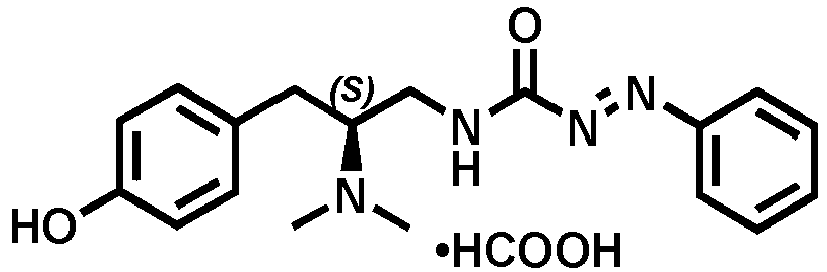
- The synthesis of tert-butyl phenylazocarboxylate has previously been described in the literature (Pirzer, A.S., et al., Benzyl Phenylsemicarbazides: A Chemistry-Driven Approach Leading to G Protein-Biased Dopamine D4 Receptor Agonists with High Subtype Selectivity.
- Journal of Medicinal Chemistry, 2019. 62(21): p. 9658-9679). tert-Butyl phenylazocarboxylate (20 mg, 0.10 mmol, 1 eq.) and potassium carbonate (71 mg, 0.51 mmol, 5 eq.) in 0.5 mL of dry DMF were slowly added a solution of
Intermediate 6 in 0.5 mL DMF at 0 °C. After stirring at r.t. for 20 h the solvent was evaporated under vacuum and the crude was purified by preparative HPLC (RP-C8, flow: 10 mL/min, solvent system: ACN/H2O + 0.1 % formic acid, 5 % ACN for 2 min, 5 % to 20 % ACN in 30 min, 20 % ACN to 95 % ACN in 2 min, tR = 16.7 min). The product was obtained as an orange solid (14 mg, 38 µmol, 37 %).Melting point 109 °C [α]D 25 + 5.8° (c = 0.80, MeOH) ESI (m/z) 327.13 [M+H]+ HRMS (m/z) [M+H]+ calculated for C18H22N4O2: 327.1816, found: 327.1817. 1H NMR (600 MHz, DMSO-d 6) δ 8.25 (t, J = 5.6 Hz, 1H), 8.20 (s, 1H), 7.85 - 7.81 (m, 2H), 7.66 - 7.59 (m, 3H), 7.04 - 6.99 (m, 2H), 6.69 - 6.66 (m, 2H), 3.32 (ddd, J = 14.0, 8.8, 5.4 Hz, 1H), 3.19 - 3.13 (m, 1H), 2.90 - 2.82 (m, 1H), 2.75 (dd, J = 13.8, 5.3 Hz, 1H), 2.36 (dd, J = 13.8, 8.4 Hz, 1H), 2.29 (s, 6H). 13CNMR (151 MHz, DMSO) δ 163.4, 162.5, 155.3, 151.0, 133.0, 129.9, 129.7, 129.5, 122.7, 115.0, 64.6, 40.0, under DMSO signal, identified by 2D-NMR), 31.2. HPLC system 1: tR = 13.2 min, purity (λ = 230 nm): ≥ 99 %, (λ = 280 nm): ≥ 99 % system 2: tR = 11.6 min, purity (λ = 230 nm): 98 %, (λ = 280 nm): ≥ 99 % Chiral HPLC system J: tR = 28.9 min, purity (λ = 280 nm): ≥ 99 % - Radioligand binding assays are very useful for obtaining detailed information on the binding properties of the described examples. To verify the subtype selectivity of the described compounds for µOR over δOP and κOR, respectively, the binding affinities of the described examples to the different human opioid receptors in an in-vitro test system were measured.
- For the determination of receptor binding affinity competitive radioligand binding experiments were performed as described in literature (H. Huebner, C. Haubmann, W. Utz, P. Gmeiner, J. Med. Chem., 2000, 43, 756-762). In brief, HEK 293T cells were transiently transfected with the cDNAs coding for the human opioid receptor subtypes µOR, δOR, and kOR, respectively, using a solution of polyethylenimine in PBS (PEI, linear, 25 kDa, Polysciences) as transfection reagent at a 3:1 PEI to cDNA ratio (I. Fish, A. Stoessel, K. Eitel, C. Valant, S. Albold, H. Huebner, D. Moeller, M.J. Clark, R.K. Sunahara, A. Christopoulos, B.K. Shoichet, P. Gmeiner, J. Med. Chem., 2017, 60, 9239-9250). After preparation of membranes, radioligand displacement assays were run in 96-well format at a final volume of 200 µL in binding buffer (50 mM Tris-HCI, 1 mM EDTA, 5 mM MgCl2, 100 µg/mL bacitracin, 5 µg/mL soybean trypsin inhibitor, pH 7.4) with the radioligand [3H]diprenorphine (specific activity = 31 Ci/mmol) at a final concentration of 0.20-0.30 nM. Membranes were used with a protein concentration of 4-8 µg/assay tube, with a Bmax value of 2,800 ± 530 fmol/mg, and a KD value of 0.10 ± 0.021 nM for µOR, a Bmax of 2,000 ± 300 fmol/mg, KD of 0.22 ± 0.016 nM for δOR, and a Bmax of 3,900 ± 1,000 fmol/mg, KD of 0.12 ± 0.017 nM for kOR, respectively. Unspecific binding was determined in the presence of 10 µM of the naloxone. Protein concentrations were determined employing the method of Lowry with bovine serum albumin as standard (O.H. Lowry, N.J. Rosebrough, A.L. Farr, R.J. Randall, J. Biol. Chem., 1951, 193, 265-275). The resulting competition curves of the receptor binding experiments were analyzed by nonlinear regression. The data were initially fit using a sigmoid model to provide IC50 values, which were subsequently transformed to Ki values according to the equation of Cheng and Prusoff (Y.-C. Cheng, W. H. Prusoff, Biochem. Pharmacol., 1973, 22, 3099-3108). Three to seven experiments per compound were performed, with each concentration in triplicate. Results are displayed in the table below.
Compound δOR κOR µOR [3H]diprenorphine Example 1 (7) 25 (7) 120 (7) 13 
Example 2 (2) 140 (2) 230 (2) 18 
Example 3 (5) 120 (4) 120 (5) 28 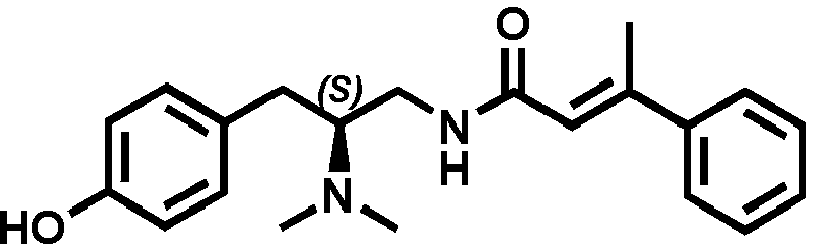
Example 4 (3) 49 (4) 110 (6) 46 
Example 5 (3) 1300 (3) 970 (3) 310 
Example 6 (3) 220 (3) 180 (4) 18 
Example 7 (4) 180 (4) 140 (4) 28 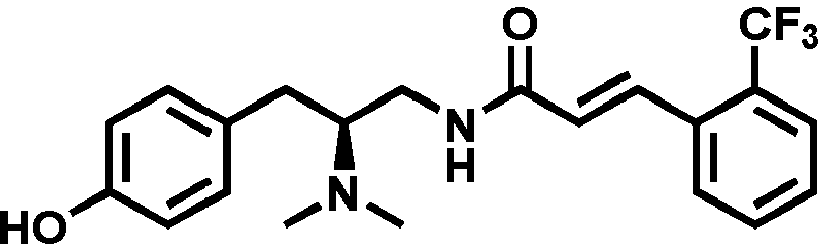
Example 8 (5) 120 (5) 580 (5) 30 
Example 9 (3) 1100 (3) 2800 (3) 170 
Example 10 (2) 510 (2) 440 (2) 58 
Example 11 (5) 360 (5) 220 (5) 19 
Example 12 (3) 310 (3) 310 (3) 12 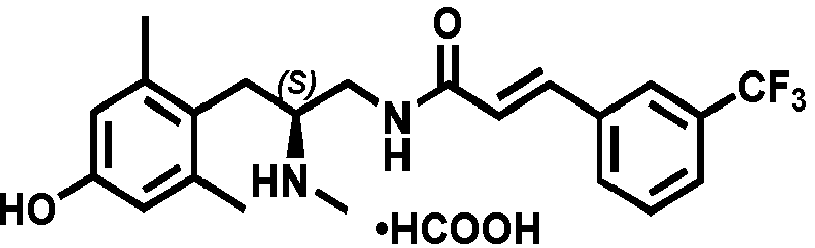
Example 13 (4) 300 (4) 500 (5) 26 
Example 14 (3) 2900 (3) 5600 (3) 460 
Example 15 (4) 55 (4) 450 (5) 6.7 
Example 16 (4) 250 (4) 600 (4) 23 
Example 18 (4) 130 (4) 200 (5) 6.2 
Example 19 (4) 59 (4) 130 (4) 8.5 
- In the above table, the number in brackets indicates the number of experiments and the subsequent number indicates the mean Ki value in nM.
- Functionally selective drugs, which are biased towards Gi protein activation over β-arrestin signaling at the µOR are indicated to show an improved side effect profile. Thus, the characterization of the functional properties of the described examples at the µOR were performed by determination of the ligand stimulated G-protein related signaling and β-arrestin recruitment applying cell based in-vitro test systems. Full and partial agonists as well as antagonists for G protein related signaling were identified. Results are displayed in the table below.
- The determination of G-protein stimulated µOR activation was measured applying an IP1 accumulation assay as described previously (J. Kruell, S.K. Fehler, L. Hofmann, N. Nebel, S. Maschauer, O. Prante, P. Gmeiner, H. Lanig, H. Huebner, M.R. Heinrich. . C. Gentzsch, K. Seier, A. Drakopoulos, M.-L. Jobin, Y. Lanoiselee, Z. Koszegi, D. Maurel, R. Sounier, H. Huebner, P. Gmeiner, S. Granier, D. Calebiro, M. Decker. Ang. Chem. Int. Ed. 2020, 59, 2-9). In brief, HEK-293T cells were grown to confluence of approximately 70% and transiently transfected with the cDNA of the human µOR receptor and the hybrid G-protein Gαqi. After one day cells were seeded into 384-well microplates. For testing cells were incubated with test compounds (final range of concentration from 1 pM up to 10 µM) for 180 min at 37 °C followed by addition of detection reagents. Time resolved fluorescence resonance energy transfer (HTRF) was determined using a microplate reader. Each compound was tested in duplicates in 3-9 individual experiments in comparison to the reference compound DAMGO. The resulting dose response curves were analyzed by nonlinear regression using the algorithms in PRISM 6.0 (GraphPad software, San Diego, CA), fitted with a sigmoid model and normalized to basal activity (0 %) and the maximal effect caused by the reference full agonist DAMGO (100 %).
- Measurement of β-arrestin-2 recruitment was done applying an enzyme-fragment complementation assay as described previously (C. Gentzsch, K. Seier, A. Drakopoulos, M.-L. Jobin, Y. Lanoiselee, Z. Koszegi, D. Maurel, R. Sounier, H. Huebner, P. Gmeiner, S. Granier, D. Calebiro, M. Decker. Ang. Chem. Int. Ed. 2020, 59, 2-9. J. Hellmann, M. Drabek, J. Yin, J. Gunera, T. Proell, F. Kraus, C.J. Langmead, H. Huebner, D. Weikert, P. Kolb, D.M. Rosenbaum, P. Gmeiner. PNAS 2020, 117, 18059-18067). In brief, HEK-293 cells stably expressing the enzyme acceptor (EA) tagged β-arrestin-2 fusion protein were transiently co-transfected with the ProLink tagged µOR-PK1 After 24 h cells were transferred into 384-well microplates and cultured for further 24 h. To start arrestin recruitment compounds were added to the cells to get a final concentration in a range of 10 pM to 100 µM. After incubation for 90 min reaction was stopped by addition of detection mix. Chemiluminescence was determined in duplicates (3-8 individual experiments for each compound in comparison to the reference agonist DAMGO). Data analysis was done as described above.
- Simultaneously, substances acting on the CNS-located opioid receptors should be able to reach sufficient brain concentrations for the mediation of analgesia. As a physico-chemical property like lipophilicity is a valuable parameter for describing compounds with improved pharmacokinetic properties the logP values of the example compounds have been calculated.
- Therefore, molecules were drawn in their neutral form and converted to SMILES code in Chemdraw (version 18.2). SMILES codes were converted to logP values using the RDKit (RDKit. RDKit: Open-source cheminformatics. 2020; Available from: http://www.rdkit.org.; version 2019.03.01) module in Python (Van Rossum, G.D., F.L., Python 3 Reference Manual. 2009, Scotts Valley, CA: CreateSpace.; version 3.7.3). The implemented logP calculation method was developed by Crippen et al. (S.A. Wildman, and G.M. Crippen, Journal of Chemical Information and Computer Sciences, 1999, 39, 868-873). The calculated logP values are displayed in the table below.
Compound G-protein signaling β-arrestin recruitment lipophilicity EC50 [nM] Emax [%] EC50 [nM] Emax [%] calculated logP 
7.0 63 CBA <5 2.70 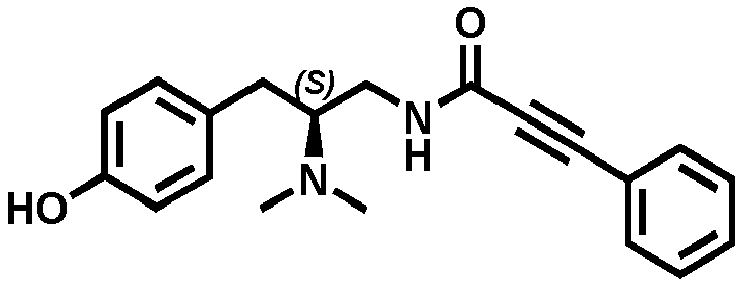
22 42 CBA <5 2.03 
11 76 CBA <5 3.09 Example 4 17 62 CBA <5 3.09 
Example 5 ND ND ND ND 3.09 
Example 6 20 92 CBA <5 3.85 
Example 7 13 44 CBA <5 3.71 
Example 8 15 100 CBA <5 3.71 
Example 9 67 92 CBA <5 3.71 
Example 10 CBA <5 CBA <5 2.71 
Example 11 CBA <5 ND ND 3.73 
Example 12 CBA <5 ND ND 3.99 
Example 13 41 78 ND ND 3.00 
Example 14 2200 75 CBA <5 2.50 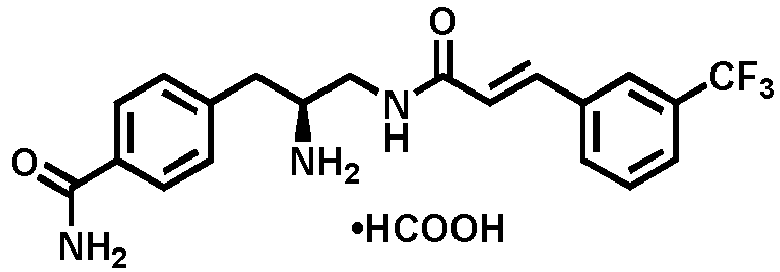
Example 15 6.3 95 130 5 3.11 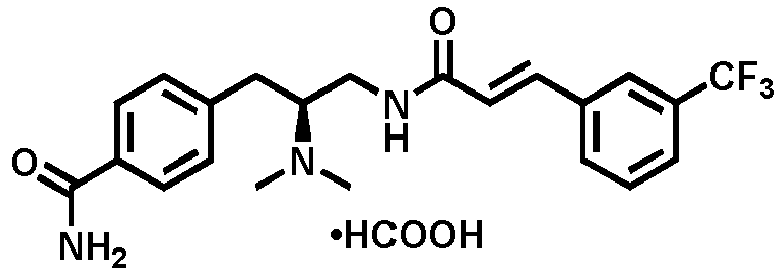
Example 16 40 102 ND ND 3.15 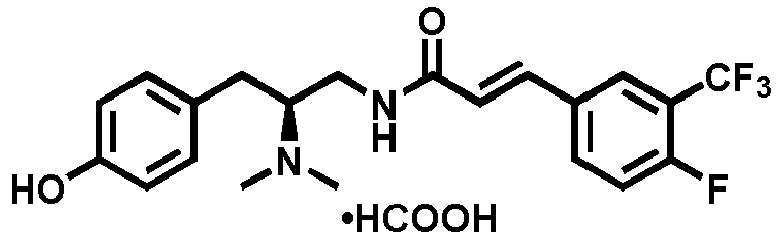
Example 18 9.8 92 120 4 3.24 
Example 19 7.5 53 CBA <5 2.76 
- In the above table, the numbers indicate mean EC50 values in nM and Emax values relative to the full effect of reference agonist DAMGO [=100%], respectively and are derived from 3-9 individual experiments for G-protein signaling and 3-8 tests for arrestin recruitment. ND = not determined. CBA = could not be analyzed (in this case, the assay did not show a dose-response curve allowing an accurate determination of potency. This is typical for antagonists and very weak partial agonists)
- Pharmacokinetic properties such as metabolic stability and blood-brain-barrier permeability are important parameters for the development of drugs. Substances acting on the CNS-located opioid receptors should be able to reach sufficient brain concentrations for the mediation of analgesia. Thus, pharmacokinetic properties like metabolic stability and blood-brain-barrier permeability have been determined for selected compounds.
- Metabolic stability experiments were performed as described previously (C. Hiller et al. Journal of Medicinal Chemistry, 2013, 56, 5130-5141.) with the only exception regarding the concentration of test compound of 20 µM used for the experiments. Pooled microsomes from rat liver (0.25 mg/test, male rat liver, Sprague-Dawley) were mixed with compound (20 µM final concentration) in a total volume of 500 µL buffer (48 mM Tris, 4.8 mM MgCl2). Incubation started by adding NADPH to the mixture (final concentration of 1 mM). The assay was performed in a shaking incubator (350 rpm at 37 °C). Samples were collected after defined time intervals of 0 min, 15 min, 30 min and 60 min and the microsomal reaction was terminated by the addition of ice-cold acetonitrile solution containing an internal standard (c = 5 µM). The suspensions were centrifuged (13.000 rpm, 1 min) and the supernatant was analyzed by LC-MS (flow rate 0.4 mL/min, binary solvent system of methanol and water supplemented with 0.1 % formic acid, methanol gradient: 10 % for 1 min, 10 % to 100 % in 20 min, constant at 100 % for 5 min, 100 % to 10 % in 2 min, kept constant at 10 % for 2 min). The area under the curve (AUC) of the extracted ion count (EIC) chromatogram of the compound and the internal standard was determined for each time point. Control experiments for the determination of unspecific binding were conducted in parallel to the metabolic stability experiments in the absence of the cofactor NADPH. The assay was repeated in three independent experiments. The corresponding results are shown in
Figure 1 . - Experiments on penetration of blood-brain barrier of
example compound 8 were performed in vivo in mice. After subcutaneous administration of 20 mg/kg ofexample compound 8 the concentrations of test compound in plasma and brain were determined. The results are shown inFigure 2 . - The following results were obtained in the same manner as set out above with respect to the inventive compounds in the section on "Radioligand binding experiments".
Compound δOR κOR µOR [3H]diprenorphine Comparative Example 1 (2) 3000 (2) 3300 (2) 2400 
Comparative Example 2 (2) 860 (2) 320 (2) 230 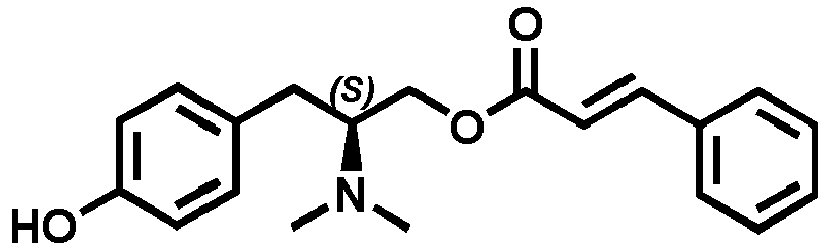
Comparative Example 3 (3) 630 (3) 540 (3) 66 
- In the above table, the number in brackets indicates the number of experiments and the subsequent number indicates the mean Ki value in nM.
- From a comparison of Example 1, which is according to the present invention, with Comparative Examples 1 to 3, it can be seen that the compounds of the present invention having the core structure shown in formula (I) are superior in activity and selectivity over compounds not having the N-X-groups and/or the adjacent C-C unsaturated group.
Claims (15)
- A compound of the following formula (I) or (II), optionally in the form of a pharmaceutically acceptable salt, solvate, polymorph, cocrystal, tautomer, racemate, enantiomer, or diastereomer or mixture thereof:
 R1 is an optionally substituted aryl group or an optionally substituted heteroaryl group,L is selected from a bond and an optionally substituted alkylene and an optionally substituted heteroalkylene,R2a and R2b are independently selected from hydrogen, optionally substituted alkyl, optionally substituted heteroalkyl, optionally substituted cycloalkyl, and optionally substituted heterocycloalkyl,wherein, when at least one of R2a and R2b is optionally substituted alkyl, the optionally substituted alkyl of R2a or R2b is optionally linked to R1 via a bond between a non-hydrogen atom of R2a or R2b and a non-hydrogen atom of R1,R3 is selected from hydrogen and optionally substituted alkyl,X is selected from >C=O, >C=S, C=N(NO2), C=C(NO2)(H), >C=C(F)(H), >C=CF2, >C=N(F), >C=C(CN)(H), >C=N(CN), >C=C(CN)(CN), >S(O), and >S(O)2,R4a and R4b are independently selected from hydrogen, optionally substituted alkyl and optionally substituted heteroalkyl,R5 and R7 are independently selected from optionally substituted cycloalkyl, optionally substituted heterocycloalkyl, optionally substituted aryl and optionally substituted heteroaryl,R6 is hydrogen or optionally substituted alkyl, wherein the optionally substituted alkyl of R6 is optionally linked to R1 via a bond between a non-hydrogen atom of R6 and a non-hydrogen atom of R1,whereinany hydrogen atoms in formulae (I) and (II) are optionally independently replaced by fluorine,the one or more optional substituents of the optionally substituted aryl group and the optionally substituted heteroaryl group are independently selected from the group consisting of -halogen, -CN, -C(O)R**, -COOR**, -C(O)NR**R**, -NR**R**, -NR**-C(O)R**, -N(R**)-C(O)-OR**, -N(R**)-C(O) -NR**R**, -N(R**)-S(O)2R**, -(optionally substituted alkyl), -OR**, -(optionally substituted heterocyclyl), -(optionally substituted alkylene)-(optionally substituted heterocyclyl), -(optionally substituted carbocyclyl), and -(optionally substituted alkylene)-(optionally substituted carbocyclyl), wherein R** is H, -(optionally substituted alkyl), -(optionally substituted heterocyclyl), or -(optionally substituted carbocyclyl), andwherein the optional substituent of the optionally substituted alkyl and the optionally substituted alkylene can be independently -halogen, -CN, -NO2, oxo, -C(O)Rar, -COORar, -C(O)NRarRar, -NRarRar, -NRar-C(O)Rar, -N(Rar)-C(O)-ORar, -N(Rar)-C(O)-NRarRar, -N(Rar)-S(O)2Rar, -ORar, -O-C(O)Rar, -O-C(O)-NRarRar, -SRar, -S(O)Rar, -S(O)2Rar, -S(O)2-NRarRar, -N(Rar)-S(O)2-NRarRar, -P(O)(ORar)2, or -O-P(O)(ORar)2; wherein Rar is H, alkyl, heterocyclyl or carbocyclyl;wherein the optional substituent of the optionally substituted heterocyclyl, the optionally substituted carbocyclyl can be independently alkyl, -halogen, -CN, -NO2, oxo, -C(O)Rar, -COORar, -C(O)NRarRar, -NRarRar, -NRar-C(O)Rar, -N(Rar)-C(O)-ORar, -N(Rar)-C(O)-NRarRar, -N(Rar)-S(O)2Rar, -ORar, -O-C(O)Rar, -O-C(O)-NRarRar, -SRar, -S(O)Rar, -S(O)2Rar, -S(O)2-NRarRar, -N(Rar)-S(O)2-NRarRar, -P(O)(ORar)2, or -O-P(O)(ORar)2; wherein Rar is H, alkyl, heterocyclyl or carbocyclyl;the one or more optional substituents of the optionally substituted alkyl, optionally substituted alkylene, optionally substituted heteroalkylene, and optionally substituted heteroalkyl are independently selected from -halogen, -CN, -NO2, oxo, -C(O)Ralk, -COORalk, -C(O)NRalkRalk, -NRalkRalk, -NRalk-C(O)Ralk, -N(Ralk)-C(O)-ORalk, -N(Ralk)-C(O)-NRalkRalk, -N(Ralk)-S(O)2Ralk, -ORalk, -O-C(O)Ralk, -O-C(O)-NRalkRalk, -SRalk, -S(O)Ralk, -S(O)2Ralk, -S(O)2-NRalkRalk, -N(Ralk)-S(O)2-NRalkRalk, -P(O)(ORalk)2, or -O-P(O)(ORalk)2; wherein Ralk is H, alkyl or alkyl substituted with one or more F, andthe one or more optional substituents of the optionally substituted cycloalkyl and optionally substituted heterocycloalkyl are independently selected from -alkyl, -halogen, -CN, -NO2, oxo, -C(O)Rcyc, -COORcyc, -C(O)NRcycRcyc, -NRcycRcyc, -NRcyc-C(O)Rcyc, -N(Rcyc)-C(O)-ORcyc, -N(Rcyc)-C(O)-NRcycRcyc, -N(Rcyc)-S(O)2Rcyc, -ORcyc, -O-C(O)Rcyc, -O-C(O)-NRcycRcyc, -SRcyc, -S(O)Rcyc, -S(O)2Rcyc, -S(O)2-NRcycRcyc, -N(Rcyc)-S(O)2-NRcycRcyc, -P(O)(ORcyc)2, or -O-P(O)(ORcyc)2; wherein Rcyc is H, alkyl or alkyl substituted with one or more F.
 - The compound according to claim 1, wherein R1 is an optionally substituted phenyl group which is optionally linked to R6 via a bond between a non-hydrogen atom of R6 and a non-hydrogen atom of R1.
- The compound according to claim 2, wherein the phenyl group in R1 contains at least one hydroxy or amido substituent in para position.
- The compound according to any one of the preceding claims, wherein L is selected from a bond, an optionally substituted methyl and an optionally substituted ethyl, preferably wherein L is an optionally substituted methylene group, preferably an unsubstituted methylene group.
- The compound according to any one of the preceding claims, wherein R2a and R2b are independently selected from optionally substituted alkyl, preferably wherein R2a and R2b are independently selected from alkyl or haloalkyl.
- The compound according to any one of the preceding claims, wherein R2a and R2b are independently selected from methyl, ethyl and propyl, wherein preferably both R2a and R2b are methyl.
- The compound according to any one of the preceding claims, wherein R3 is hydrogen.
- The compound according to any one of the preceding claims, wherein X is selected from >C=O, >C=S, >C=C(NO2)(H), >C=C(CN)(H), >C=C(CN)(CN), >S(O), and >S(O)2, preferably >C=O and >C=S, more preferably >C=O.
- The compound according to any one of the preceding claims, wherein R4a and R4b are independently selected from hydrogen, optionally substituted methyl, optionally substituted ethyl and optionally substituted propyl, wherein preferably at least one of R4a and R4b is hydrogen.
- The compound according to any one of the preceding claims, wherein R5 and R7 are independently selected from optionally substituted aryl and optionally substituted heteroaryl.
- The compound according to any one of the preceding claims, wherein R5 and R7 are independently selected from optionally substituted phenyl, optionally substituted naphthyl, optionally substituted pyridyl and optionally substituted thienyl.
- The compound according to any one of the preceding claims, wherein R6 is hydrogen or optionally substituted alkyl, wherein alkyl is preferably selected from methyl, ethyl and propyl, more preferably methyl or ethyl, even more preferably methyl, wherein R6 is most preferably hydrogen.
- The compound according to any one of the preceding claims, wherein formulae (I) and (II) are represented by the following formulae (I-a) and (II-b), respectively:

- A pharmaceutical composition comprising:a compound having formula (I) or (II) as defined in any of claims 1 to 13, optionally in the form of a pharmaceutically acceptable salt, solvate, polymorph, cocrystal, tautomer, racemate, enantiomer, or diastereomer or mixture thereof,and optionally one or more pharmaceutically acceptable excipient(s) and/or carrier(s).
- A compound having formula (I) or (II) as defined in any of claims 1 to 13, optionally in the form of a pharmaceutically acceptable salt, solvate, polymorph, cocrystal, tautomer, racemate, enantiomer, or diastereomer or mixture thereof, wherein the compound is for use in the treatment, amelioration or prevention of pain, opioid overdose, addiction, neuropsychiatric disorder, Prader-Willi Syndrome, gastrointestinal disorder, skin disorder, dyspnea, and temporomandibular joint dysfunction.
Priority Applications (2)
| Application Number | Priority Date | Filing Date | Title |
|---|---|---|---|
| EP20194568.0A EP3964497A1 (en) | 2020-09-04 | 2020-09-04 | Substituted vicinal diamine compounds and their use in the treatment, amelioration or prevention of pain |
| PCT/EP2021/073106 WO2022048922A1 (en) | 2020-09-04 | 2021-08-20 | Substituted vicinal diamine compounds and their use in the treatment, amelioration or prevention of pain |
Applications Claiming Priority (1)
| Application Number | Priority Date | Filing Date | Title |
|---|---|---|---|
| EP20194568.0A EP3964497A1 (en) | 2020-09-04 | 2020-09-04 | Substituted vicinal diamine compounds and their use in the treatment, amelioration or prevention of pain |
Publications (1)
| Publication Number | Publication Date |
|---|---|
| EP3964497A1 true EP3964497A1 (en) | 2022-03-09 |
Family
ID=72380971
Family Applications (1)
| Application Number | Title | Priority Date | Filing Date |
|---|---|---|---|
| EP20194568.0A Withdrawn EP3964497A1 (en) | 2020-09-04 | 2020-09-04 | Substituted vicinal diamine compounds and their use in the treatment, amelioration or prevention of pain |
Country Status (2)
| Country | Link |
|---|---|
| EP (1) | EP3964497A1 (en) |
| WO (1) | WO2022048922A1 (en) |
Families Citing this family (1)
| Publication number | Priority date | Publication date | Assignee | Title |
|---|---|---|---|---|
| CN119019296A (en) * | 2024-10-24 | 2024-11-26 | 江苏恒瑞医药股份有限公司 | A method for preparing tamsulosin or its pharmaceutically acceptable salt using a solid-supported catalyst |
Citations (23)
| Publication number | Priority date | Publication date | Assignee | Title |
|---|---|---|---|---|
| US3773919A (en) | 1969-10-23 | 1973-11-20 | Du Pont | Polylactide-drug mixtures |
| EP0036676A1 (en) | 1978-03-24 | 1981-09-30 | The Regents Of The University Of California | Method of making uniformly sized liposomes and liposomes so made |
| EP0052322A2 (en) | 1980-11-10 | 1982-05-26 | Gersonde, Klaus, Prof. Dr. | Method of preparing lipid vesicles by ultrasonic treatment, the use of this method and apparatus for its application |
| EP0088046A2 (en) | 1982-02-17 | 1983-09-07 | Ciba-Geigy Ag | Lipids in the aqueous phase |
| DE3218121A1 (en) | 1982-05-14 | 1983-11-17 | Leskovar, Peter, Dr.-Ing., 8000 München | Pharmaceutical compositions for tumour treatment |
| EP0102324A2 (en) | 1982-07-29 | 1984-03-07 | Ciba-Geigy Ag | Lipids and surfactants in an aqueous medium |
| US4485045A (en) | 1981-07-06 | 1984-11-27 | Research Corporation | Synthetic phosphatidyl cholines useful in forming liposomes |
| EP0133988A2 (en) | 1983-08-02 | 1985-03-13 | Hoechst Aktiengesellschaft | Regulating peptide-containing pharmaceutical preparations with retarded release, and process for their preparation |
| EP0142641A2 (en) | 1983-09-26 | 1985-05-29 | Udo Dr. Ehrenfeld | Means and product for the diagnosis and therapy of tumours and for the treatment of weaknesses of the cellular and humoral immune system |
| EP0143949A1 (en) | 1983-11-01 | 1985-06-12 | TERUMO KABUSHIKI KAISHA trading as TERUMO CORPORATION | Pharmaceutical composition containing urokinase |
| US4544545A (en) | 1983-06-20 | 1985-10-01 | Trustees University Of Massachusetts | Liposomes containing modified cholesterol for organ targeting |
| WO1997041833A1 (en) | 1996-05-08 | 1997-11-13 | Inhale Therapeutic Systems | Dispersible macromolecule compositions and methods for their preparation and use |
| WO1999016419A1 (en) | 1997-09-29 | 1999-04-08 | Inhale Therapeutic Systems, Inc. | Perforated microparticles and methods of use |
| WO2001085136A2 (en) | 2000-05-10 | 2001-11-15 | Alliance Pharmaceutical Corporation | Phospholipid-based powders for drug delivery |
| US6570036B1 (en) | 1999-03-05 | 2003-05-27 | Reuter Chemische Apparatebau Kg [De/De] | Co-crystallization process |
| WO2003053411A1 (en) | 2001-12-19 | 2003-07-03 | Nektar Therapeutics | Pulmonary delivery of aminoglycosides |
| JP2008118008A (en) | 2006-11-07 | 2008-05-22 | Nippon Telegr & Teleph Corp <Ntt> | Method for forming silicon compound thin film |
| CN101357893A (en) * | 2008-08-22 | 2009-02-04 | 山东大学 | Ethylenediamine Metalloproteinase Inhibitors and Their Applications |
| CN101503373A (en) * | 2009-03-13 | 2009-08-12 | 山东大学 | 2-amino-1-(4-nitro phenyl)-1-ethanol metalloid protease inhibitor, and preparation and use thereof |
| WO2017007695A1 (en) | 2015-07-09 | 2017-01-12 | The Regents Of The University Of California | Mu opioid receptor modulators |
| WO2018129393A1 (en) | 2017-01-06 | 2018-07-12 | The Regents Of The University Of California | Mu opioid receptor modulators |
| WO2019036678A1 (en) | 2017-08-17 | 2019-02-21 | The Regents Of The University Of California | Mu opioid receptor modulators |
| WO2019195634A1 (en) * | 2018-04-04 | 2019-10-10 | Epiodyne, Inc. | Opioid receptor modulators and products and methods related thereto |
-
2020
- 2020-09-04 EP EP20194568.0A patent/EP3964497A1/en not_active Withdrawn
-
2021
- 2021-08-20 WO PCT/EP2021/073106 patent/WO2022048922A1/en not_active Ceased
Patent Citations (23)
| Publication number | Priority date | Publication date | Assignee | Title |
|---|---|---|---|---|
| US3773919A (en) | 1969-10-23 | 1973-11-20 | Du Pont | Polylactide-drug mixtures |
| EP0036676A1 (en) | 1978-03-24 | 1981-09-30 | The Regents Of The University Of California | Method of making uniformly sized liposomes and liposomes so made |
| EP0052322A2 (en) | 1980-11-10 | 1982-05-26 | Gersonde, Klaus, Prof. Dr. | Method of preparing lipid vesicles by ultrasonic treatment, the use of this method and apparatus for its application |
| US4485045A (en) | 1981-07-06 | 1984-11-27 | Research Corporation | Synthetic phosphatidyl cholines useful in forming liposomes |
| EP0088046A2 (en) | 1982-02-17 | 1983-09-07 | Ciba-Geigy Ag | Lipids in the aqueous phase |
| DE3218121A1 (en) | 1982-05-14 | 1983-11-17 | Leskovar, Peter, Dr.-Ing., 8000 München | Pharmaceutical compositions for tumour treatment |
| EP0102324A2 (en) | 1982-07-29 | 1984-03-07 | Ciba-Geigy Ag | Lipids and surfactants in an aqueous medium |
| US4544545A (en) | 1983-06-20 | 1985-10-01 | Trustees University Of Massachusetts | Liposomes containing modified cholesterol for organ targeting |
| EP0133988A2 (en) | 1983-08-02 | 1985-03-13 | Hoechst Aktiengesellschaft | Regulating peptide-containing pharmaceutical preparations with retarded release, and process for their preparation |
| EP0142641A2 (en) | 1983-09-26 | 1985-05-29 | Udo Dr. Ehrenfeld | Means and product for the diagnosis and therapy of tumours and for the treatment of weaknesses of the cellular and humoral immune system |
| EP0143949A1 (en) | 1983-11-01 | 1985-06-12 | TERUMO KABUSHIKI KAISHA trading as TERUMO CORPORATION | Pharmaceutical composition containing urokinase |
| WO1997041833A1 (en) | 1996-05-08 | 1997-11-13 | Inhale Therapeutic Systems | Dispersible macromolecule compositions and methods for their preparation and use |
| WO1999016419A1 (en) | 1997-09-29 | 1999-04-08 | Inhale Therapeutic Systems, Inc. | Perforated microparticles and methods of use |
| US6570036B1 (en) | 1999-03-05 | 2003-05-27 | Reuter Chemische Apparatebau Kg [De/De] | Co-crystallization process |
| WO2001085136A2 (en) | 2000-05-10 | 2001-11-15 | Alliance Pharmaceutical Corporation | Phospholipid-based powders for drug delivery |
| WO2003053411A1 (en) | 2001-12-19 | 2003-07-03 | Nektar Therapeutics | Pulmonary delivery of aminoglycosides |
| JP2008118008A (en) | 2006-11-07 | 2008-05-22 | Nippon Telegr & Teleph Corp <Ntt> | Method for forming silicon compound thin film |
| CN101357893A (en) * | 2008-08-22 | 2009-02-04 | 山东大学 | Ethylenediamine Metalloproteinase Inhibitors and Their Applications |
| CN101503373A (en) * | 2009-03-13 | 2009-08-12 | 山东大学 | 2-amino-1-(4-nitro phenyl)-1-ethanol metalloid protease inhibitor, and preparation and use thereof |
| WO2017007695A1 (en) | 2015-07-09 | 2017-01-12 | The Regents Of The University Of California | Mu opioid receptor modulators |
| WO2018129393A1 (en) | 2017-01-06 | 2018-07-12 | The Regents Of The University Of California | Mu opioid receptor modulators |
| WO2019036678A1 (en) | 2017-08-17 | 2019-02-21 | The Regents Of The University Of California | Mu opioid receptor modulators |
| WO2019195634A1 (en) * | 2018-04-04 | 2019-10-10 | Epiodyne, Inc. | Opioid receptor modulators and products and methods related thereto |
Non-Patent Citations (41)
| Title |
|---|
| "Spray Drying Handbook", 1991, JOHN WILEY & SONS, INC. |
| ANESTHESIOLOGY, vol. 131, 2019, pages 132 - 147 |
| ARCH GEN PSYCHIATRY, vol. 56, no. 7, 1999, pages 663 - 668 |
| ATZRODT J ET AL., BIOORG MED CHEM, vol. 20, no. 18, 2012, pages 5658 - 5667 |
| C. GENTZSCHK. SEIERA. DRAKOPOULOSM.-L. JOBINY. LANOISELEEZ. KOSZEGID. MAURELR. SOUNIERH. HUEBNERP. GMEINER, ANG. CHEM. INT. ED., vol. 59, 2020, pages 2 - 9 |
| C. HILLER ET AL., JOURNAL OF MEDICINAL CHEMISTRY, vol. 56, 2013, pages 5130 - 5141 |
| CNS NEUROSCI THER., vol. 24, 2018, pages 1089 - 1099 |
| CURR PAIN HEADACHE REP., vol. 15, no. 2, April 2011 (2011-04-01), pages 129 - 136 |
| DIABETES CARE, vol. 28, no. 2, February 2005 (2005-02-01), pages 485 - 487 |
| EPSTEIN ET AL., PROC. NATL. ACAD. SCI. (USA, vol. 82, 1985, pages 3688 - 3692 |
| EXPERT OPIN PHARMACOTHER, vol. 17, no. 6, 2016, pages 835 - 44 |
| EXPERT OPIN PHARMACOTHER., vol. 17, no. 6, 2016, pages 835 - 44 |
| H. HUEBNERC. HAUBMANNW. UTZP. GMEINER, J. MED. CHEM., vol. 43, 2000, pages 756 - 762 |
| HWANG ET AL., PROC. NATL. ACAD. SCI. (USA, vol. 77, 1980, pages 4030 - 4034 |
| I. FISHA. STOESSELK. EITELC. VALANTS. ALBOLDH. HUEBNERD. MOELLERM.J. CLARKR.K. SUNAHARAA. CHRISTOPOULOS, J. MED. CHEM., vol. 60, 2017, pages 9239 - 9250 |
| INT J GERIATR PSYCHIATRY, vol. 18, no. 8, August 2003 (2003-08-01), pages 700 - 5 |
| INT J NEUROPSYCHOPHARMACOL, vol. 21, no. 2, 1 February 2018 (2018-02-01), pages 120 - 127 |
| J CLIN PSYCHIATRY, vol. 66, no. 3, March 2005 (2005-03-01), pages 353 - 9 |
| J CLIN PSYCHIATRY, vol. 75, no. 8, August 2014 (2014-08-01), pages e785 - 93 |
| J NEUROPSYCHIATRY CLIN NEUROSCI. FALL, vol. 19, no. 4, 2007, pages 449 - 52 |
| J NEUROSCI RES., vol. 88, no. 15, 15 November 2010 (2010-11-15), pages 3215 - 21 |
| J. HELLMANNM. DRABEKJ. YINJ. GUNERAT. PROELLF. KRAUSC.J. LANGMEADH. HUEBNERD. WEIKERTP. KOLB, PNAS, vol. 117, 2020, pages 18059 - 18067 |
| J. KRUELLS.K. FEHLERL. HOFMANNN. NEBELS. MASCHAUERO. PRANTEP. GMEINERH. LANIGH. HUEBNERM.R. HEINRICH., CHEMMEDCHEM, vol. 15, 2020, pages 1175 - 1186 |
| LANCET., vol. 343, no. 8905, 30 April 1994 (1994-04-30), pages 1107 - 8 |
| MANGLIK, A. ET AL.: "Structure-based discovery of opioid analgesics with reduced side effects", NATURE, vol. 537, no. 7619, 2016, pages 185 - 190, XP055507978, DOI: 10.1038/nature19112 |
| MED HYPOTHESES, vol. 45, no. 5, November 1995 (1995-11-01), pages 491 - 7 |
| MODVIG A ET AL., J ORG CHEM, vol. 79, 2014, pages 5861 - 5868 |
| NEUROSCIENCE, vol. 354, 23 June 2017 (2017-06-23), pages 178 - 195 |
| O.H. LOWRYN.J. ROSEBROUGHA.L. FARRR.J. RANDALL, J. BIOL. CHEM., vol. 193, 1951, pages 265 - 275 |
| PHARMAC. THER., vol. 46, 1990, pages 395 - 428 |
| PIRZER, A.S. ET AL.: "Benzyl Phenylsemicarbazides: A Chemistry-Driven Approach Leading to G Protein-Biased Dopamine D4 Receptor Agonists with High Subtype Selectivity", JOURNAL OF MEDICINAL CHEMISTRY, vol. 62, no. 21, 2019, pages 9658 - 9679 |
| PSYCHIATRY RES NEUROIMAGING, vol. 276, 30 June 2018 (2018-06-30), pages 41 - 45 |
| R. LANGER ET AL., J. BIOMED. MATER. RES., vol. 15, 1981, pages 167 - 277 |
| R. LANGER, CHEM. TECH., vol. 12, 1982, pages 98 - 105 |
| S.A. WILDMANG.M. CRIPPEN, JOURNAL OF CHEMICAL INFORMATION AND COMPUTER SCIENCES, vol. 39, 1999, pages 868 - 873 |
| SHANG L ET AL: "Novel 3-phenylpropane-1,2-diamine derivates as inhibitors of aminopeptidase N (APN)", BIOORGANIC & MEDICINAL CHEMISTRY, ELSEVIER, NL, vol. 16, no. 23, 1 December 2008 (2008-12-01), pages 9984 - 9990, XP025691298, ISSN: 0968-0896, [retrieved on 20081014], DOI: 10.1016/J.BMC.2008.10.025 * |
| SIDMAN, U. ET AL., BIOPOLYMERS, vol. 22, 1983, pages 547 - 556 |
| SYLVIE RADIX ET AL: "N,N'-disubstituted cinnamamide derivatives potentiate ciprofloxacin activity against overexpressing NorA efflux pump Staphylococcus aureus 1199B strains", EUROPEAN JOURNAL OF MEDICINAL CHEMISTRY, vol. 150, 1 April 2018 (2018-04-01), NL, pages 900 - 907, XP055771383, ISSN: 0223-5234, DOI: 10.1016/j.ejmech.2018.03.028 * |
| THE JOURNAL OF ALLERGY AND CLINICAL IMMUNOLOGY: IN PRACTICE, vol. 5, no. 6, 2017, pages 1601 - 1606 |
| WILLIAM JS ET AL., JOURNAL OF LABELLED COMPOUNDS AND RADIOPHARMACEUTICALS, vol. 53, no. 11-12, 2010, pages 635 - 644 |
| Y.-C. CHENGW. H. PRUSOFF, BIOCHEM. PHARMACOL., vol. 22, 1973, pages 3099 - 3108 |
Also Published As
| Publication number | Publication date |
|---|---|
| WO2022048922A1 (en) | 2022-03-10 |
Similar Documents
| Publication | Publication Date | Title |
|---|---|---|
| EP3116859B1 (en) | Novel compounds as histone deacetylase 6 inhibitors and pharmaceutical compositions comprising the same | |
| CN111836798A (en) | Prodrugs of ketamine, compositions and uses thereof | |
| CN102112465B (en) | Crystalline forms of 6- [ (4S) -2-methyl-4- (2-naphthyl) -1,2,3, 4-tetrahydroisoquinolin-7-yl ] pyridazin-3-amine | |
| CN101679273A (en) | 1-substituted tetrahydroisoquinoline compound | |
| JP6498672B2 (en) | Piperidine compounds having multiple mode activity against pain | |
| TWI360540B (en) | Tetrahydroisoquinolylsulphonamide derivatives, the | |
| EP3964497A1 (en) | Substituted vicinal diamine compounds and their use in the treatment, amelioration or prevention of pain | |
| CN103787954B (en) | Cyclic amine compound that one class fluorine replaces and preparation method thereof, pharmaceutical composition and purposes | |
| US8530453B2 (en) | Compounds and methods for the treatment of pain and other diseases | |
| EP3186257B1 (en) | Novel chromone oxime derivative and its use as allosteric modulator of metabotropic glutamate receptors | |
| CN110023310A (en) | Biaryl compositions and methods for modulating kinase cascades | |
| CN117447385A (en) | Preparation and use of deuterated 3-aminomethyl-4-phenylpiperidin-4-ol compounds | |
| CN111225901B (en) | Propylamine derivatives for the treatment of pain and pain-related disorders | |
| RU2451671C2 (en) | Condensed indan compounds | |
| US8329741B2 (en) | Substituted pyrrolidine compounds with central nervous system activity | |
| JP7759170B2 (en) | Novel benzimidazole derivatives as dual histamine H1 and histamine H4 receptor ligands | |
| WO1995025100A1 (en) | Use of 4-amino-5-chloro-2-methoxybenzoic esters as 5-ht4 agonists | |
| HK40115276A (en) | Flavonoid derivatives with gabaa receptor activity and methods of use | |
| WO2025162114A1 (en) | Heterocyclic compound and use thereof | |
| CN113861203A (en) | 4-aromatic alkynyl substituted 7H-pyrrolo [2,3-d ] pyrimidine amide compound and preparation method and application thereof | |
| HK40080061B (en) | Novel chroman derivatives having estrogen receptor degradation activity and uses thereof | |
| JP2004168772A (en) | Receptor modulator | |
| TW202031264A (en) | New alcoxyaminopyridine derivatives for treating pain and pain related conditions | |
| WO2006025471A1 (en) | Piperidine derivative or pharmaceutically acceptable salt thereof | |
| UA82518C2 (en) | Azetidine compounds, process for the preparation thereof (variants), pharmaceutical composition based thereon |
Legal Events
| Date | Code | Title | Description |
|---|---|---|---|
| PUAI | Public reference made under article 153(3) epc to a published international application that has entered the european phase |
Free format text: ORIGINAL CODE: 0009012 |
|
| STAA | Information on the status of an ep patent application or granted ep patent |
Free format text: STATUS: THE APPLICATION HAS BEEN PUBLISHED |
|
| AK | Designated contracting states |
Kind code of ref document: A1 Designated state(s): AL AT BE BG CH CY CZ DE DK EE ES FI FR GB GR HR HU IE IS IT LI LT LU LV MC MK MT NL NO PL PT RO RS SE SI SK SM TR |
|
| STAA | Information on the status of an ep patent application or granted ep patent |
Free format text: STATUS: THE APPLICATION IS DEEMED TO BE WITHDRAWN |
|
| 18D | Application deemed to be withdrawn |
Effective date: 20220910 |