EP3941717B1 - Flame retardant polyamides and copolyamides for 3d printing - Google Patents
Flame retardant polyamides and copolyamides for 3d printing Download PDFInfo
- Publication number
- EP3941717B1 EP3941717B1 EP20728106.4A EP20728106A EP3941717B1 EP 3941717 B1 EP3941717 B1 EP 3941717B1 EP 20728106 A EP20728106 A EP 20728106A EP 3941717 B1 EP3941717 B1 EP 3941717B1
- Authority
- EP
- European Patent Office
- Prior art keywords
- powder
- polyamide
- flame
- phosphonate ester
- ester type
- Prior art date
- Legal status (The legal status is an assumption and is not a legal conclusion. Google has not performed a legal analysis and makes no representation as to the accuracy of the status listed.)
- Active
Links
Images

Classifications
-
- B—PERFORMING OPERATIONS; TRANSPORTING
- B29—WORKING OF PLASTICS; WORKING OF SUBSTANCES IN A PLASTIC STATE IN GENERAL
- B29C—SHAPING OR JOINING OF PLASTICS; SHAPING OF MATERIAL IN A PLASTIC STATE, NOT OTHERWISE PROVIDED FOR; AFTER-TREATMENT OF THE SHAPED PRODUCTS, e.g. REPAIRING
- B29C64/00—Additive manufacturing, i.e. manufacturing of three-dimensional [3D] objects by additive deposition, additive agglomeration or additive layering, e.g. by 3D printing, stereolithography or selective laser sintering
- B29C64/10—Processes of additive manufacturing
- B29C64/141—Processes of additive manufacturing using only solid materials
- B29C64/153—Processes of additive manufacturing using only solid materials using layers of powder being selectively joined, e.g. by selective laser sintering or melting
-
- B—PERFORMING OPERATIONS; TRANSPORTING
- B33—ADDITIVE MANUFACTURING TECHNOLOGY
- B33Y—ADDITIVE MANUFACTURING, i.e. MANUFACTURING OF THREE-DIMENSIONAL [3-D] OBJECTS BY ADDITIVE DEPOSITION, ADDITIVE AGGLOMERATION OR ADDITIVE LAYERING, e.g. BY 3-D PRINTING, STEREOLITHOGRAPHY OR SELECTIVE LASER SINTERING
- B33Y10/00—Processes of additive manufacturing
-
- B—PERFORMING OPERATIONS; TRANSPORTING
- B33—ADDITIVE MANUFACTURING TECHNOLOGY
- B33Y—ADDITIVE MANUFACTURING, i.e. MANUFACTURING OF THREE-DIMENSIONAL [3-D] OBJECTS BY ADDITIVE DEPOSITION, ADDITIVE AGGLOMERATION OR ADDITIVE LAYERING, e.g. BY 3-D PRINTING, STEREOLITHOGRAPHY OR SELECTIVE LASER SINTERING
- B33Y70/00—Materials specially adapted for additive manufacturing
-
- C—CHEMISTRY; METALLURGY
- C08—ORGANIC MACROMOLECULAR COMPOUNDS; THEIR PREPARATION OR CHEMICAL WORKING-UP; COMPOSITIONS BASED THEREON
- C08K—Use of inorganic or non-macromolecular organic substances as compounding ingredients
- C08K5/00—Use of organic ingredients
- C08K5/49—Phosphorus-containing compounds
- C08K5/51—Phosphorus bound to oxygen
- C08K5/53—Phosphorus bound to oxygen bound to oxygen and to carbon only
- C08K5/5317—Phosphonic compounds, e.g. R—P(:O)(OR')2
- C08K5/5333—Esters of phosphonic acids
- C08K5/5357—Esters of phosphonic acids cyclic
-
- C—CHEMISTRY; METALLURGY
- C08—ORGANIC MACROMOLECULAR COMPOUNDS; THEIR PREPARATION OR CHEMICAL WORKING-UP; COMPOSITIONS BASED THEREON
- C08L—COMPOSITIONS OF MACROMOLECULAR COMPOUNDS
- C08L77/00—Compositions of polyamides obtained by reactions forming a carboxylic amide link in the main chain; Compositions of derivatives of such polymers
- C08L77/02—Polyamides derived from omega-amino carboxylic acids or from lactams thereof
-
- B—PERFORMING OPERATIONS; TRANSPORTING
- B29—WORKING OF PLASTICS; WORKING OF SUBSTANCES IN A PLASTIC STATE IN GENERAL
- B29K—INDEXING SCHEME ASSOCIATED WITH SUBCLASSES B29B, B29C OR B29D, RELATING TO MOULDING MATERIALS OR TO MATERIALS FOR MOULDS, REINFORCEMENTS, FILLERS OR PREFORMED PARTS, e.g. INSERTS
- B29K2077/00—Use of PA, i.e. polyamides, e.g. polyesteramides or derivatives thereof, as moulding material
-
- C—CHEMISTRY; METALLURGY
- C08—ORGANIC MACROMOLECULAR COMPOUNDS; THEIR PREPARATION OR CHEMICAL WORKING-UP; COMPOSITIONS BASED THEREON
- C08K—Use of inorganic or non-macromolecular organic substances as compounding ingredients
- C08K5/00—Use of organic ingredients
- C08K5/0008—Organic ingredients according to more than one of the "one dot" groups of C08K5/01 - C08K5/59
- C08K5/0066—Flame-proofing or flame-retarding additives
Definitions
- the present invention relates to a method for preparing flame retardant parts by powder bed fusion, in which the powder comprises at least one polyamide and/or copolyamide and at least one flame retardant, as well as the corresponding powder.
- Flame retardancy of polymers is traditionally provided by the dispersion of mineral fillers or flame retardant additives, particularly based on halogenated compounds.
- US 2005/027047 A1 discloses powders based on polyamide and a cyclic phosphonate ester flame retardant for the preparation of flame retardant parts by powder bed fusion.
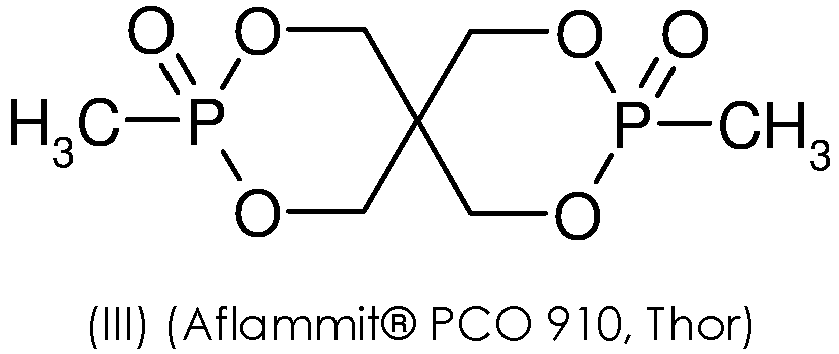
- the present invention arises from the unexpected discovery by the inventors that the addition to a powder for 3D printing of a flame retardant agent of the cyclic phosphonate ester type of the following formula (III): allowed the production of good quality parts in 3D printing while giving them fireproofing equivalent to or superior to that obtained using the state of the art.
- the present invention relates to a method for preparing flame retardant parts by powder bed fusion, in which the powder comprises at least one polyamide and/or copolyamide and at least one flame retardant agent of the cyclic phosphonate ester type.
- the present invention also relates to a powder intended for the preparation of flame-retardant parts by powder bed fusion, comprising at least one polyamide and/or copolyamide and at least one flame retardant agent of the cyclic phosphonate ester type.
- the present invention also relates to the use of a powder comprising at least one polyamide and/or copolyamide and at least one flame retardant agent of the cyclic phosphonate ester type in a powder bed fusion process, in particular a 3D printing process, more particularly by laser or infrared sintering, to produce a fireproof part.
- the present invention also relates to a process for preparing a powder as defined above, comprising the mixing of at least one polyamide and/or copolyamide and at least one flame retardant agent of the cyclic phosphonate ester type.
- a powder bed fusion process is an additive manufacturing process in which an object or part is obtained by the selective fusion of certain areas of a powder bed according to the invention.
- the method according to the invention is a 3D printing method and the powder is a powder for 3D printing. More preferably, the method according to the invention is a 3D printing method by laser or infrared sintering of the powder.
- 3D printing or “additive manufacturing” within the meaning of the invention, is meant any method of manufacturing parts in volume by adding or agglomerating powder, layer by layer.
- the agglomeration of powders by fusion (hereinafter “sintering") is caused by radiation, such as for example a laser beam (laser sintering), infrared radiation, UV radiation, or any source of electromagnetic radiation allowing the powder to be melted layer by layer to manufacture three-dimensional objects.
- laser sintering laser sintering
- infrared radiation infrared radiation
- UV radiation or any source of electromagnetic radiation
- 3D printing or “additive manufacturing” also means selective sintering technologies using an absorber, in particular the technologies known as “High Speed Sintering” (HSS) and “ Multi-Jet Fusion” (MJF).
- HSS High Speed Sintering
- MTF Multi-Jet Fusion
- the manufacturing of 3D objects is also done layer by layer from a digital file, the process using a powder (for example a polymer) which is melted in a controlled manner for each layer constituting the 3D object: an absorber is deposited on the layer (for example by means of a liquid ink in the "inkjet process") before exposing the layer to electromagnetic radiation (for example infrared) which causes the fusion of the areas containing said absorber.
- electromagnetic radiation for example infrared
- 3D printing is generally used to produce prototypes, part models ("rapid prototyping") or to produce functional parts in small series (“rapid manufacturing”), for example in the following fields: automotive, nautical, aeronautical, aerospace, medical (prosthetics, hearing systems, cellular tissues, etc.), textiles, clothing, fashion, decoration, housings for electronics, telephony, home automation, IT, lighting, sport, industrial tools.
- the Tf1-Tc gap of the PA powders used in sintering is in the range of 30°C to 50°C.
- polyamide powder with the following properties is also preferred:
- the molecular mass of the powder in the solid state is preferably sufficiently low, i.e. with an inherent viscosity in solution of less than 3, both so that the fusion of the grains does not require too much energy and so that the inter-grain coalescence is sufficient when the radiation passes through so as to obtain an object that is as non-porous as possible, with good mechanical properties.
- the inherent viscosity is measured by adapting the ISO 307:2007 standard (measuring temperature at 20°C instead of 25°C) using an Ubbelhode tube; the measurement is carried out at 20°C on a 75 mg sample at a concentration of 0.5% (m/m) in m-cresol.
- copolyamide As copolyamide according to the invention, mention may be made of copolyamides resulting from the condensation of at least two different monomers, for example of at least two different alpha-omega aminocarboxylic acids or of two different lactams or of a lactam and an alpha-omega aminocarboxylic acid of different carbon numbers. Mention may also be made of copolyamides resulting from the condensation of at least one alpha-omega aminocarboxylic acid (or a lactam), at least one diamine and at least one dicarboxylic acid.
- copolyamides resulting from the condensation of an aliphatic diamine with an aliphatic dicarboxylic acid and at least one other monomer chosen from aliphatic diamines different from the previous one and aliphatic diacids different from the previous one.
- copolyamides examples include copolymers of caprolactam and lauryllactam (PA 6/12), copolymers of caprolactam, adipic acid and hexamethylenediamine (PA 6/66), copolymers of caprolactam, lauryllactam, adipic acid and hexamethylenediamine (PA 6/12/66), copolymers of caprolactam, lauryllactam, 11-aminoundecanoic acid, azelaic acid and hexamethylenediamine (PA 6/69/11/12), copolymers of caprolactam, lauryllactam, 11-aminoundecanoic acid, adipic acid and hexamethylenediamine (PA 6/66/11/12), copolymers of lauryllactam, of azelaic acid and hexamethylenediamine (PA 69/12), copolymers of 11-aminoundecanoic acid, terephthal
- the NF EN ISO 1874-1: 2011 standard defines a nomenclature for polyamides.
- the term "monomer” in this description of polyamide-based powders must be taken to mean “repeating unit”.
- the case where a repeating unit of the polyamide is made up of the combination of a diacid with a diamine is special. It is considered that it is the combination of a diamine and a diacid, i.e. the "diaminediacid” pair, also called “XY”, in equimolar quantity which corresponds to the monomer. This is explained by the fact that individually, the diacid or the diamine is only a structural unit, which is not sufficient on its own to form a polymer.
- diamine X examples include aliphatic diamines having 6 to 18 atoms, diamine X may also be aryl and/or saturated cyclic. Examples include hexamethylenediamine, piperazine, tetramethylenediamine, octamethylenediamine, decamethylenediamine, dodecamethylenediamine, 1,5-diaminohexane, 2,2,4-trimethyl-1,6-diaminohexane, diamine polyols, isophoronediamine (IPD), methyl pentamethylenediamine (MPDM), bis(aminocyclohexyl)methane (BACM), bis(3-methyl-4-aminocyclohexyl)methane (BMACM), methaxylyenediamine, bis-p-aminocyclohexylmethane, and trimethylhexamethylenediamine.
- IPD isophoronediamine
- MPDM methyl pentamethylenedi
- diacid (or dicarboxylic acid) Y mention may be made of acids having between 4 and 36 carbon atoms. Mention may be made, for example, of adipic acid, sebacic acid, azelaic acid, suberic acid, isophthalic acid, butanedioic acid, 1,4-cyclohexyldicarboxylic acid, terephthalic acid, the sodium or lithium salt of sulfoisophthalic acid, dimerized fatty acids (these dimerized fatty acids have a dimer content of at least 98% and are preferably hydrogenated) and dodecanedioic acid HOOC-(CH2) 10 -COOH.
- Lactam or amino acid monomers are said to be of type “Z”:
- lactams include those having 3 to 12 carbon atoms on the main ring and which may be substituted. Examples include ⁇ , ⁇ -dimethylpropriolactam, ⁇ , ⁇ -dimethylpropriolactam, amylolactam, caprolactam, capryllactam, oenantholactam, 2-pyrrolidone and lauryllactam.
- amino acids examples include alpha-omega amino acids, such as aminocaproic, 7-aminoheptanoic, 11-aminoundecanoic, n-heptyl-11-aminoundecanoic, and 12-aminododecanoic acids.
- the powder comprising a polyamide and/or copolyamide of the invention comprises at least one polyamide and/or copolyamide chosen from the polyamides and copolyamides comprising at least one of the following XY or Z monomers: 46, 4T, 56, 59, 510, 512, 513, 514, 516, 518, 536, 6, 69, 610, 612, 613, 614, 616, 618, 636, 6T, 9, 109, 1010, 1012, 1013, 1014, 1016, 1018, 1036, 10T, 11, 12, 129, 1210, 1212, 1213, 1214, 1216, 1218, 1236, 12T, MXD6, MXD10, MXD12, MXD14, and mixtures thereof; in particular chosen from PA 11, PA 12, PA 1010, PA 6, PA 6/10, PA 6/12, PA 10/12, PA 11/1010, and mixtures thereof.
- the polyamide and/or copolyamide according to the invention may be a mixture of polyamides and/or copolyamides.
- a mixture mention may be made of mixtures of aliphatic polyamides/copolyamides and semi-aromatic polyamides/copolyamides and mixtures of aliphatic polyamides and cycloaliphatic polyamides.
- the polyamide and/or copolyamide according to the invention may be a copolymer with polyamide blocks, in particular a copolymer with polyamide blocks and polyether blocks.
- Polyamide sequences with dicarboxylic chain ends arise, for example, from the condensation of alpha-omega aminocarboxylic acids, lactams or dicarboxylic acids and diamines in the presence of a chain-limiting dicarboxylic acid.
- the polyether can be for example a polytetramethylene glycol (PTMG).
- PTMG polytetramethylene glycol
- PTHF polytetrahydrofuran
- the number-average molar mass of the polyamide blocks is between 300 and 15,000 and preferably between 600 and 5,000 g/mol.
- the molar mass of the polyether blocks is between 100 and 6,000 and preferably between 200 and 3,000 g/mol.
- the polymers with polyamide blocks and polyether blocks can also comprise randomly distributed units. These polymers can be prepared by the simultaneous reaction of the polyether and the precursors of the polyamide blocks.
- polyetherdiol, a lactam (or an alpha-omega amino acid) and a chain-limiting diacid can be reacted in the presence of water.
- the result is a polymer having essentially polyether blocks, polyamide blocks of very variable length, but also the various reactants having reacted randomly which are distributed statistically along the polymer chain.
- Polyetherdiol blocks are either used as such and copolycondensed with carboxyl-ended polyamide blocks, or they are aminated to be transformed into polyetherdiamines and condensed with carboxyl-ended polyamide blocks. They can also be blended with polyamide precursors and a chain limiter to make polyamide block and polyether block polymers having statistically distributed units.
- the ratio of the quantity of copolymer with polyamide blocks and polyether blocks to the quantity of polyamide is advantageously between 1/99 and 15/85 by weight.
- the polyamide and/or copolyamide according to the invention is selected from the group consisting of polyamide 6 (PA6), polyamide 66 (PA66), polyamide 610 (PA 610), polyamide 612 (PA 612), polyamide 11 (PA11) and polyamide 12 (PA12).
- PA6 polyamide 6
- PA66 polyamide 66
- PA 610 polyamide 610
- PA 612 polyamide 612
- PA 11 polyamide 11
- PA12 polyamide 12
- the polyamide and/or copolyamide according to the invention is PA11.
- the cyclic phosphonate ester flame retardant agent is of general formula (II): in which A 1 and A 2 , which may be identical or different, represent an alkyl group of 1 to 4 carbon atoms or an aryl group of 5 to 7 carbon atoms. Even more preferably, the cyclic phosphonate ester flame retardant agent is of the following formula (III):
- the flame retardant agent is a powder, which typically has a volume median diameter D50 in the range of 1 to 40 ⁇ m, preferably 5 to 30 ⁇ m.
- the powder according to the invention typically has a volume median diameter D50 in the range of 5 to 200 ⁇ m.
- the powder has a volume median diameter D50 in the range of 10 to 150 ⁇ m, preferably 20 to 100 ⁇ m, 25 to 80 ⁇ m.
- the volume median diameter (D50) of powder particles is measured according to ISO 9276 - parts 1 to 6: “Representation of data obtained by particle size analysis”.
- the powder may in particular be obtained by mixing the flame retardant agent of the cyclic phosphonate ester type with at least one polyamide and/or copolyamide. Any method known to those skilled in the art may be used.
- the process for preparing the powder according to the invention is carried out by dry blending the flame retardant and the at least one polyamide and/or copolyamide.
- a mixer known to those skilled in the art can be used, for example a Henschel, MAGIMIX, or LOEDIGE mixer.
- the mixing is advantageously carried out at room temperature.
- the rotation speed can be easily adjusted.
- the powders can optionally be sieved after mixing.
- the flame retardant agent in powder form is very easy to disperse in a polyamide powder using a simple mixer of the aforementioned type.
- the powder comprises from 5 to 40% by mass, preferably from 5 to 35% by mass, more preferably from 5 to 30% by mass, preferably from 5 to 25% by mass, relative to the total mass of the powder, of the cyclic phosphonate ester flame retardant agent.
- the powder comprises at least 40%, 50%, 60%, 70%, 80%, 90% or 95% by weight of polyamide and/or copolyamide relative to the total weight of the powder. Also preferably, the powder comprises at most 95%, 90%, 80%, 70%, 60%, 50% by weight of polyamide and/or copolyamide relative to the total weight of the powder.
- the powder may also comprise at least one other polymer.
- other polymers include polyolefins, polyesters, polycarbonate, PPO (abbreviation for polyphenylene oxide), PPS (abbreviation for polyphenylene sulfide), elastomers.
- the powder according to the invention does not comprise any other polymer than the polyamide and/or copolyamide according to the invention.
- the powder according to the invention comprises at least one other additive, in particular selected from the group consisting of a synergist of the flame retardant agent of the cyclic phosphoric acid ester type, a pigment, a dye, a plasticizer, an antioxidant, a flowability agent, and a UV absorption agent.
- a synergist of the flame retardant agent of the cyclic phosphoric acid ester type e.g., a pigment, a dye, a plasticizer, an antioxidant, a flowability agent, and a UV absorption agent.
- the synergist of the cyclic phosphonate ester flame retardant is selected from the group consisting of diethyl aluminum phosphinate (DEPAL), melamine cyanurate, pyrophosphate, red phosphorus, phosphates, melamine polyphosphate, and ammonium polyphosphate.
- DEPAL diethyl aluminum phosphinate
- melamine cyanurate pyrophosphate
- red phosphorus red phosphorus
- phosphates melamine polyphosphate
- ammonium polyphosphate ammonium polyphosphate
- the powder according to the invention does not comprise a synergist of the flame retardant agent of the cyclic phosphoric acid ester type.
- the powder of the present invention has good recyclability, especially when prepared by a dry mixing process.
- the invention makes it possible to recycle the powder not transformed into a part following 3D printing, namely, to reuse the untransformed powder in a subsequent 3D printing process to obtain fireproof objects with reproducible mechanical properties and fireproofing properties.
- the invention relates to a method for preparing fireproof parts by powder bed fusion, in particular by 3D printing, more particularly by 3D printing by laser sintering, using a recycled powder as defined above.
- the fireproof part according to the invention may be of any type capable of being produced by powder bed fusion, in particular by 3D printing, more particularly by 3D printing by laser sintering.
- the powder according to the invention is such that it allows the production of parts classified V-2, more advantageously V-1 and even more advantageously V-0 according to the UL 94 V and IEC 60695-11-10 standards, notably described in the examples.
- a powder according to the invention is produced by dry blending (using a Henschel mixer) 83% by mass relative to the total mass of the polyamide 11 powder (Rilsan Invent Natural (RIN), Arkema) and 17% by mass relative to the total mass of the powder of flame retardant agent of the cyclic phosphonate ester type of the following formula (III):
- a comparative powder is made which comprises 80% by mass relative to the total mass of polyamide 11 powder (Rilsan Invent Natural (RIN), Arkema) and 20% by mass relative to the total mass of melamine polyphosphate type flame retardant agent powder (Melapur TM 200, BASF).
- the powders are used to feed a Formiga ® P 100 (Eos) 3D printer and to print a bar-type part with the following dimensions: length 127 mm, width 12.7 mm and thickness 2.5 mm.
- Tests were carried out with a commercial flame retardant agent Technirez ® FR-001, having a viscous liquid appearance, which has the same molecule as the flame retardant agent Antiblaze 1045 ® .
- Test 1 Technirez® FR-001 flame retardant was introduced into the polyamide powder using a Henschel mixer.
- a very flaky powder is obtained. It is impossible to use it in the 3D printing machine, i.e. the sintering of the part could not be carried out.
- Test 2 The Technirez ® FR-001 flame retardant is preheated to 70°C before being introduced into a Henschel mixer with the polyamide powder under agitation.
- a very flaky powder is obtained. It is impossible to use it in the 3D printing machine, i.e. the sintering of the part could not be carried out.
- the part obtained from the powder according to the invention as defined in example 1 was tested according to the UL 94V standard.
- the length of the sample is 127 mm and its width is 12.7 mm. Its thickness must not exceed 12.7 mm.
- the sample is fixed at 1/4 of its upper end in a vertical position.
- a metal net covered with surgical cotton is placed 305 mm below the sample.
- the burner is adjusted to form a 19 mm blue flame which rises in temperature from 100 to 700 ° C in 44 ⁇ 2 seconds. This flame is directed from below on the lower edge of the plastic sample at a distance of 9.5 mm. It is applied for 10 seconds, then removed.
- the combustion time of the sample is measured. As soon as the combustion stops, the flame is reapplied for 10 seconds. As soon as it is removed, the combustion and incandescence time are measured again.
- the complete test is carried out on five samples.
- Test results according to UL 94V standard The part according to the invention is classified V-0 according to UL 94 standard measured with a thickness of 1.3 mm on the samples
- FR-106 Advanced Laser Materials, ALM
- PA11 PA D80-ST, ALM
- FR-1025 brominated polyacrylate flame retardant agent
- the mixture according to the invention is suitable for obtaining good quality parts in 3D printing while giving them flame retardancy equivalent to or superior to that obtained according to the state of the art.
- the mechanical properties of maximum stresses and elongation at break of the parts obtained using the powder according to the invention are equivalent to those of parts obtained with the comparative FR-106 powder comprising a halogenated flame retardant.
- the present invention thus provides a powder without halogenated additives, easy to prepare and use in 3D machines, making it possible to manufacture a part having a better flame retardant property while retaining the mechanical properties.
Landscapes
- Chemical & Material Sciences (AREA)
- Engineering & Computer Science (AREA)
- Materials Engineering (AREA)
- Medicinal Chemistry (AREA)
- Polymers & Plastics (AREA)
- Organic Chemistry (AREA)
- Health & Medical Sciences (AREA)
- Chemical Kinetics & Catalysis (AREA)
- Manufacturing & Machinery (AREA)
- Physics & Mathematics (AREA)
- Optics & Photonics (AREA)
- Mechanical Engineering (AREA)
- Compositions Of Macromolecular Compounds (AREA)
- Processes Of Treating Macromolecular Substances (AREA)
Description
La présente invention concerne un procédé de préparation de pièces ignifugées par fusion sur lit de poudre, dans lequel la poudre comprend au moins un polyamide et/ou copolyamide et au moins un agent retardateur de flamme, ainsi que la poudre correspondante.The present invention relates to a method for preparing flame retardant parts by powder bed fusion, in which the powder comprises at least one polyamide and/or copolyamide and at least one flame retardant, as well as the corresponding powder.
Les principaux défis industriels pour l'élaboration de poudres de polyamides ou de copolyamides ignifugées et pouvant être mises en oeuvre par toute technologie de fusion sur lit de poudre, notamment couche par couche pour une fabrication additive, peuvent se résumer en quatre points, à savoir :
- (i) atteindre le niveau de résistance au feu requis à moindre coût ;
- (ii) se placer dans le cadre d'un développement durable, notamment avec des additifs retardateur de flamme respectueux de l'environnement ;
- (iii) conserver, au maximum, les propriétés mécaniques du polyamide ; et
- (iv) obtenir une bonne mise en oeuvre de ces matériaux dans les machines 3D.
- (i) achieve the required level of fire resistance at lower cost;
- (ii) be placed within the framework of sustainable development, in particular with environmentally friendly flame retardant additives;
- (iii) preserve, as much as possible, the mechanical properties of the polyamide; and
- (iv) obtain a good implementation of these materials in 3D machines.
L'ignifugation des polymères est classiquement apportée par la dispersion de charges minérales ou des additifs retardateurs de flamme, notamment à base de composés halogénés.Flame retardancy of polymers is traditionally provided by the dispersion of mineral fillers or flame retardant additives, particularly based on halogenated compounds.
Toutefois, la plupart de ces composés utilisés, pourtant très efficaces, est soumise à diverses réglementations, limitant voire interdisant à terme leur utilisation du fait d'impacts environnementaux néfastes ou de leur toxicité.However, most of these compounds used, although very effective, are subject to various regulations, limiting or even ultimately prohibiting their use due to harmful environmental impacts or their toxicity.
Dans ce contexte, de nouveaux systèmes non-halogénés ont été développés tels les composés à base de phosphore, d'azote ou de composés inorganiques.In this context, new non-halogenated systems have been developed such as compounds based on phosphorus, nitrogen or inorganic compounds.
Ainsi, la demande de
Afin de satisfaire les besoins en poudres de polyamides ignifugées, il reste donc nécessaire de trouver d'autres alternatives à ces additifs retardateurs de flamme.In order to meet the needs for flame retardant polyamide powders, it is therefore necessary to find other alternatives to these flame retardant additives.
La présente invention découle de la mise en évidence inattendue, par les inventeurs, que l'ajout à une poudre pour impression 3D d'un agent retardateur de flamme de type ester de phosphonate cyclique de formule (III) suivante :

Il a été observé que le mélange d'une poudre pour impression 3D et l'agent retardateur de flamme de l'invention permet d'obtenir de pièces ignifugées bien frittées qui ne présentent pas de problème de coalescence, et ainsi garantissant de bonnes propriétés mécaniques.It has been observed that the mixture of a 3D printing powder and the flame retardant agent of the invention makes it possible to obtain well-sintered flame-retardant parts which do not present any coalescence problem, and thus guarantee good mechanical properties.
La présente invention concerne un procédé de préparation de pièces ignifugées par fusion sur lit de poudre, dans lequel la poudre comprend au moins un polyamide et/ou copolyamide et au moins un agent retardateur de flamme de type ester de phosphonate cyclique.The present invention relates to a method for preparing flame retardant parts by powder bed fusion, in which the powder comprises at least one polyamide and/or copolyamide and at least one flame retardant agent of the cyclic phosphonate ester type.
La présente invention concerne également une poudre destinée à la préparation de pièces ignifugées par fusion sur lit de poudre, comprenant au moins un polyamide et/ou copolyamide et au moins un agent retardateur de flamme de type ester de phosphonate cyclique.The present invention also relates to a powder intended for the preparation of flame-retardant parts by powder bed fusion, comprising at least one polyamide and/or copolyamide and at least one flame retardant agent of the cyclic phosphonate ester type.
La présente invention concerne également l'utilisation d'une poudre comprenant au moins un polyamide et/ou copolyamide et au moins un agent retardateur de flamme de type ester de phosphonate cyclique dans un procédé de fusion sur lit de poudre, en particulier un procédé d'impression 3D, plus particulièrement par frittage laser ou infra-rouge, pour produire une pièce ignifugée.The present invention also relates to the use of a powder comprising at least one polyamide and/or copolyamide and at least one flame retardant agent of the cyclic phosphonate ester type in a powder bed fusion process, in particular a 3D printing process, more particularly by laser or infrared sintering, to produce a fireproof part.
La présente invention concerne également un procédé de préparation d'une poudre telle que définie ci-dessus, comprenant le mélange d'au moins un polyamide et/ou copolyamide et d'au moins un agent retardateur de flamme de type ester de phosphonate cyclique.The present invention also relates to a process for preparing a powder as defined above, comprising the mixing of at least one polyamide and/or copolyamide and at least one flame retardant agent of the cyclic phosphonate ester type.
Comme on l'entend ici un procédé par fusion sur lit de poudre est un procédé de fabrication additive dans lequel un objet ou une pièce est obtenu par la fusion sélective de certaines zones d'un lit de poudre selon l'invention.As understood herein a powder bed fusion process is an additive manufacturing process in which an object or part is obtained by the selective fusion of certain areas of a powder bed according to the invention.
De préférence, le procédé selon l'invention est un procédé d'impression 3D et la poudre est une poudre pour impression 3D. Plus préférablement le procédé selon l'invention est un procédé d'impression 3D par frittage laser ou infra-rouge de la poudre.Preferably, the method according to the invention is a 3D printing method and the powder is a powder for 3D printing. More preferably, the method according to the invention is a 3D printing method by laser or infrared sintering of the powder.
Par « impression 3D » ou « fabrication additive » au sens de l'invention, on entend tout procédé de fabrication de pièces en volume par ajout ou agglomération de poudre, couche par couche. L'agglomération de poudres par fusion (ci-après « frittage ») est provoquée par un rayonnement, tel que par exemple un faisceau laser (laser sintering), un rayonnement infra-rouge, un rayonnement UV, ou toute source de rayonnement électromagnétique permettant de faire fondre la poudre couche par couche pour fabriquer des objets tridimensionnels. La technologie de fabrication d'objets couche par couche est décrite notamment dans la demande de brevet
Par « impression 3D » ou « fabrication additive » au sens de l'invention, on entend également les technologies de frittage sélectif utilisant un absorbeur, notamment les technologies connues sous les noms « High Speed Sintering » (HSS) et « Multi-Jet Fusion » (MJF). Dans ces technologies, la fabrication d'objets en 3D est faite également couche par couche à partir d'un fichier numérique, le procédé utilisant une poudre (par exemple un polymère) qui est fondue de manière maîtrisée pour chaque couche constituant l'objet 3D : un absorbeurest déposé sur la couche (au moyen par exemple d'une encre liquide dans le « procédé à jet d'encre ») avant l'exposition de la couche à un rayonnement électromagnétique (par exemple infra-rouge) qui provoque la fusion des zones contenant ledit absorbeur. Par exemple, les documents de brevet
L'impression 3D est généralement utilisée pour produire des prototypes, des modèles de pièces (« rapid prototyping ») ou pour produire des pièces fonctionnelles en petites séries (« rapid manufacturing »), par exemple dans les domaines : automobile, nautique, aéronautique, aérospatial, médical (prothèses, systèmes auditifs, tissus cellulaires...), le textile, l'habillement, la mode, la décoration, des boîtiers pour l'électronique, la téléphonie, la domotique, l'informatique, l'éclairage, le sport, l'outillage industriel.3D printing is generally used to produce prototypes, part models ("rapid prototyping") or to produce functional parts in small series ("rapid manufacturing"), for example in the following fields: automotive, nautical, aeronautical, aerospace, medical (prosthetics, hearing systems, cellular tissues, etc.), textiles, clothing, fashion, decoration, housings for electronics, telephony, home automation, IT, lighting, sport, industrial tools.
Le terme « frittage » dans la présente description inclut tous ces procédés, quel que soit le type de rayonnement. Même si, dans le texte qui suit, on fait référence le plus souvent au procédé laser sintering, ce qui est écrit pour le laser sintering est bien entendu valable pour les autres procédés de frittage.The term "sintering" in this description includes all these processes, regardless of the type of radiation. Even if, in the following text, reference is most often made to the laser sintering process, what is written for laser sintering is of course valid for the other sintering processes.
Dans les procédés de frittage, il est recommandé d'utiliser un polyamide dont l'écart entre la température de fusion de première chauffe Tf1 et la température de cristallisation Tc est le plus grand possible pour éviter les phénomènes de déformation, et dont l'enthalpie de fusion ΔHf est la plus élevée possible pour obtenir une bonne définition géométrique des pièces fabriquées. Cela permet d'accroître la fenêtre de travail avec la poudre polyamide et de rendre sa mise en oeuvre dans un procédé de frittage beaucoup plus aisée. Des procédés d'obtention de telles poudres sont notamment décrits dans les documents
Pour les procédés de frittage, tels que laser sintering, on privilégie également l'utilisation de poudre de polyamide avec les propriétés suivantes :
La masse moléculaire de la poudre à l'état solide est de préférence suffisamment faible, c'est-à-dire de viscosité inhérente en solution inférieure à 3, à la fois pour que la fusion des grains ne nécessite pas trop d'énergie et pour que la coalescence inter-grains soit suffisante lors du passage du rayonnement de façon à obtenir un objet le moins poreux possible, avec de bonnes propriétés mécaniques. La viscosité inhérente est mesurée en adaptant la norme ISO 307 :2007 (température de mesure à 20°C au lieu de 25°C) à l'aide d'un tube Ubbelhode ; la mesure est réalisée à 20°C sur un échantillon de 75 mg à la concentration de 0,5 % (m/m) dans du m-crésol. La viscosité inhérente est exprimée en (g/100 g)-1 et est calculée selon la formule suivante : 
The molecular mass of the powder in the solid state is preferably sufficiently low, i.e. with an inherent viscosity in solution of less than 3, both so that the fusion of the grains does not require too much energy and so that the inter-grain coalescence is sufficient when the radiation passes through so as to obtain an object that is as non-porous as possible, with good mechanical properties. The inherent viscosity is measured by adapting the ISO 307:2007 standard (measuring temperature at 20°C instead of 25°C) using an Ubbelhode tube; the measurement is carried out at 20°C on a 75 mg sample at a concentration of 0.5% (m/m) in m-cresol. The inherent viscosity is expressed in (g/100 g)-1 and is calculated according to the following formula:
On entend par « polyamide » au sens de l'invention les produits de condensation :
- d'un ou plusieurs aminoacides, tels les acides aminocaproïques, amino-7-heptanoïque, amino-11-undécanoïque et amino-12-dodécanoïque d'un ou plusieurs lactames tels que caprolactame, oenantholactame et lauryllactame ;
- d'un ou plusieurs sels ou mélanges de diamines telles l'hexaméthylènediamine, la décanediamine, la dodécaméthylènediarnine, la métaxylylènediamine, le bis-p aminocyclohexylméthane et la triméthylhexaméthylène diamine avec des diacides tels que les acides isophtalique, téréphtalique, adipique, azélaique, subérique, sébacique et dodécanedicarboxylique. A titre d'exemple de polyamide on peut citer le PA 6, le PA 66, le PA 610, le PA 612, le PA 1010, le PA 1012, le PA 11 et le PA 12.
- of one or more amino acids, such as aminocaproic, amino-7-heptanoic, amino-11-undecanoic and amino-12-dodecanoic acids of one or more lactams such as caprolactam, oenantholactam and lauryllactam;
- of one or more salts or mixtures of diamines such as hexamethylenediamine, decanediamine, dodecamethylenediamine, metaxylylenediamine, bis-p aminocyclohexylmethane and trimethylhexamethylenediamine with diacids such as isophthalic, terephthalic, adipic, azelaic, suberic, sebacic and dodecanedicarboxylic acids. Examples of polyamides that may be mentioned are PA 6, PA 66, PA 610, PA 612, PA 1010, PA 1012, PA 11 and PA 12.
A titre de copolyamide selon l'invention, on peut citer les copolyamides résultant de la condensation d'au moins deux monomères différents, par exemple d'au moins deux acides alpha oméga aminocarboxyliques différents ou de deux lactames différents ou d'un lactame et d'un acide alpha oméga aminocarboxylique de nombre de carbone différents. On peut encore citer les copolyamides résultant de la condensation d'au moins un acide alpha oméga aminocarboxylique (ou un lactame), au moins une diamine et au moins un acide dicarboxylique. On peut encore citer les copolyamides résultant de la condensation d'une diamine aliphatique avec un diacide carboxylique aliphatique et au moins un autre monomère choisi parmi les diamines aliphatiques différentes de la précédente et les diacides aliphatiques différents du précédent. A titre d'exemples de copolyamides, on peut citer des copolymères de caprolactame et de lauryllactame (PA 6/12), des copolymères de caprolactame, d'acide adipique et d'hexaméthylène diamine (PA 6/66), des copolymères de caprolactame, de lauryl lactame, d'acide adipique et d'hexaméthylène diamine (PA 6/12/66), des copolymères de caprolactame, de lauryllactame, d'acide amino 11 undécanoique, d'acide azelaïque et d'hexaméthylène diamine (PA 6/69/11/12), des copolymères de caprolactame, de lauryllactame, d'acide amino 11 undécanoïque, d'acide adipique et d'hexaméthylène diamine (PA 6/66/11/12), des copolymères de lauryllactame, d'acide azélaïque et d'hexaméthylène diamine (PA 69/12), des copolymères d'acide amino 11 undécanoïque, d'acide téréphtalique et de décaméthylène diamine (PA 11/10T).As copolyamide according to the invention, mention may be made of copolyamides resulting from the condensation of at least two different monomers, for example of at least two different alpha-omega aminocarboxylic acids or of two different lactams or of a lactam and an alpha-omega aminocarboxylic acid of different carbon numbers. Mention may also be made of copolyamides resulting from the condensation of at least one alpha-omega aminocarboxylic acid (or a lactam), at least one diamine and at least one dicarboxylic acid. Mention may also be made of copolyamides resulting from the condensation of an aliphatic diamine with an aliphatic dicarboxylic acid and at least one other monomer chosen from aliphatic diamines different from the previous one and aliphatic diacids different from the previous one. Examples of copolyamides include copolymers of caprolactam and lauryllactam (PA 6/12), copolymers of caprolactam, adipic acid and hexamethylenediamine (PA 6/66), copolymers of caprolactam, lauryllactam, adipic acid and hexamethylenediamine (PA 6/12/66), copolymers of caprolactam, lauryllactam, 11-aminoundecanoic acid, azelaic acid and hexamethylenediamine (PA 6/69/11/12), copolymers of caprolactam, lauryllactam, 11-aminoundecanoic acid, adipic acid and hexamethylenediamine (PA 6/66/11/12), copolymers of lauryllactam, of azelaic acid and hexamethylenediamine (PA 69/12), copolymers of 11-aminoundecanoic acid, terephthalic acid and decamethylenediamine (PA 11/10T).
La norme NF EN ISO 1874-1 : 2011 définit une nomenclature des polyamides. Le terme « monomère» dans la présente description des poudres à base de polyamides doit être pris au sens d' « unité répétitive ». Le cas où une unité répétitive du polyamide est constituée de l'association d'un diacide avec une diamine est particulier. On considère que c'est l'association d'une diamine et d'un diacide, c'est-à-dire le couple « diaminediacide », dit aussi « XY », en quantité équimolaire qui correspond au monomère. Ceci s'explique par le fait qu'individuellement, le diacide ou la diamine n'est qu'une unité structurale, qui ne suffit pas à elle seule à former un polymère.The NF EN ISO 1874-1: 2011 standard defines a nomenclature for polyamides. The term "monomer" in this description of polyamide-based powders must be taken to mean "repeating unit". The case where a repeating unit of the polyamide is made up of the combination of a diacid with a diamine is special. It is considered that it is the combination of a diamine and a diacid, i.e. the "diaminediacid" pair, also called "XY", in equimolar quantity which corresponds to the monomer. This is explained by the fact that individually, the diacid or the diamine is only a structural unit, which is not sufficient on its own to form a polymer.
A titre d'exemple de diamine X, on peut citer les diamines aliphatiques ayant de 6 à 18 atomes, la diamine X pouvant être aussi arylique et/ou cyclique saturée. A titre d'exemples on peut citer l'hexaméthylènediamine, la pipérazine, la tetraméthylène diamine, l'octaméthylène diamine, la décaméthylène diamine, la dodécaméthylène diamine, le 1,5 diaminohexane, le 2,2,4-triméthyl-1,6-diamino-hexane, les polyols diamine, l'isophorone diamine (IPD), le méthyl pentaméthylènediamine (MPDM), la bis(aminocyclohéxyl) méthane (BACM), la bis(3-méthyl-4 aminocyclohéxyl) méthane (BMACM), la méthaxylyènediamine, le bis-p aminocyclohexylméthane et la triméthylhexaméthylène diamine.Examples of diamine X include aliphatic diamines having 6 to 18 atoms, diamine X may also be aryl and/or saturated cyclic. Examples include hexamethylenediamine, piperazine, tetramethylenediamine, octamethylenediamine, decamethylenediamine, dodecamethylenediamine, 1,5-diaminohexane, 2,2,4-trimethyl-1,6-diaminohexane, diamine polyols, isophoronediamine (IPD), methyl pentamethylenediamine (MPDM), bis(aminocyclohexyl)methane (BACM), bis(3-methyl-4-aminocyclohexyl)methane (BMACM), methaxylyenediamine, bis-p-aminocyclohexylmethane, and trimethylhexamethylenediamine.
A titre d'exemple de diacide (ou acide dicarboxylique) Y, on peut citer les acides ayant entre 4 et 36 atomes de carbone. On peut citer par exemple, l'acide adipique, l'acide sébacique, l'acide azélaique, l'acide subérique, l'acide isophtalique, l'acide butanedioïque, l'acide 1,4 cyclohexyldicarboxylique, l'acide téréphtalique, le sel de sodium ou de lithium de l'acide sulfo-isophtalique, les acides gras dimérisés(ces acides gras dimérisés ont une teneur en dimère d'au moins 98% et sont de préférence hydrogénés) et l'acide dodécanédioïque HOOC-(CH2)10-COOH.As an example of diacid (or dicarboxylic acid) Y, mention may be made of acids having between 4 and 36 carbon atoms. Mention may be made, for example, of adipic acid, sebacic acid, azelaic acid, suberic acid, isophthalic acid, butanedioic acid, 1,4-cyclohexyldicarboxylic acid, terephthalic acid, the sodium or lithium salt of sulfoisophthalic acid, dimerized fatty acids (these dimerized fatty acids have a dimer content of at least 98% and are preferably hydrogenated) and dodecanedioic acid HOOC-(CH2) 10 -COOH.
Les monomères lactames ou aminoacides sont dits de type « Z » :
A titre d'exemple de lactames, on peut citer ceux ayant de 3 à 12 atomes de carbone sur le cycle principal et pouvant être substitués. On peut citer par exemple le β,β-diméthylpropriolactame, le a,a-diméthylpropriolactame, l'amylolactame, le caprolactame, le capryllactame, l'oenantholactame, le 2-pyrrolidone et le lauryllactame.Lactam or amino acid monomers are said to be of type “Z”:
Examples of lactams include those having 3 to 12 carbon atoms on the main ring and which may be substituted. Examples include β,β-dimethylpropriolactam, α,α-dimethylpropriolactam, amylolactam, caprolactam, capryllactam, oenantholactam, 2-pyrrolidone and lauryllactam.
A titre d'exemple d'aminoacide, on peut citer les alpha-oméga aminoacides, tels que les acides aminocaproïque, amino-7-heptanoïque, amino-11-undécanoïque, n-heptyl-11-aminoundécanôique et amino-12-dodécanoïque.Examples of amino acids include alpha-omega amino acids, such as aminocaproic, 7-aminoheptanoic, 11-aminoundecanoic, n-heptyl-11-aminoundecanoic, and 12-aminododecanoic acids.
De préférence, la poudre comprenant un polyamide et/ou copolyamide de l'invention comprend au moins un polyamide et/ou copolyamide choisi parmi les polyamides et copolyamides comprenant au moins un des monomères XY ou Z suivants : 46, 4T, 56, 59, 510, 512, 513, 514, 516, 518, 536, 6, 69, 610, 612, 613, 614, 616, 618, 636, 6T, 9, 109, 1010, 1012, 1013, 1014, 1016, 1018, 1036, 10T, 11, 12, 129, 1210, 1212, 1213, 1214, 1216, 1218, 1236, 12T, MXD6, MXD10, MXD12, MXD14, et leurs mélanges ; en particulier choisi parmi le PA 11, le PA 12, le PA 1010, le PA 6, le PA 6/10, le PA 6/12, le PA 10/12, le PA 11/1010, et leurs mélanges.Preferably, the powder comprising a polyamide and/or copolyamide of the invention comprises at least one polyamide and/or copolyamide chosen from the polyamides and copolyamides comprising at least one of the following XY or Z monomers: 46, 4T, 56, 59, 510, 512, 513, 514, 516, 518, 536, 6, 69, 610, 612, 613, 614, 616, 618, 636, 6T, 9, 109, 1010, 1012, 1013, 1014, 1016, 1018, 1036, 10T, 11, 12, 129, 1210, 1212, 1213, 1214, 1216, 1218, 1236, 12T, MXD6, MXD10, MXD12, MXD14, and mixtures thereof; in particular chosen from PA 11, PA 12, PA 1010, PA 6, PA 6/10, PA 6/12, PA 10/12, PA 11/1010, and mixtures thereof.
Le polyamide et/ou copolyamide selon l'invention peut être un mélange de polyamides et/ou copolyamides. A titre de mélange on peut citer des mélanges de polyamides/coplyamides aliphatiques et de polyamides/copolyamides semi-aromatiques et des mélanges de polyamides aliphatiques et de polyamides cycloaliphatiques.The polyamide and/or copolyamide according to the invention may be a mixture of polyamides and/or copolyamides. As a mixture, mention may be made of mixtures of aliphatic polyamides/copolyamides and semi-aromatic polyamides/copolyamides and mixtures of aliphatic polyamides and cycloaliphatic polyamides.
Le polyamide et/ou copolyamide selon l'invention peut être un copolymère à blocs polyamide, notamment un copolymère à blocs polyamide et blocs polyéther.The polyamide and/or copolyamide according to the invention may be a copolymer with polyamide blocks, in particular a copolymer with polyamide blocks and polyether blocks.
Les copolymères à blocs polyamides et blocs polyéthers résultent de la copolycondensation de séquences polyamides à extrémités réactives avec des séquences polyéthers à extrémités réactives, telles que, entre autres:
- 1) Séquences polyamides à bouts de chaînes diamines avec des séquences polyoxyalkylènes à bouts de chaînes dicarboxyliques.
- 2) Séquences polyamides à bouts de chaînes dicarboxyliques avec des séquences polyoxyalkylènes à bouts de chaînes diamines obtenues par cyanoéthylation et hydrogénation de séquences polyoxyalkylènes alpha-omega dihydroxylées aliphatiques appelées polyétherdiols.
- 3) Séquences polyamides à bouts de chaînes dicarboxyliques avec des polyétherdiols, les produits obtenus étant, dans ce cas particulier, des polyétheresteramides. On utilise avantageusement ces copolymères.
- 1) Polyamide sequences with diamine chain ends with polyoxyalkylene sequences with dicarboxylic chain ends.
- 2) Polyamide sequences with dicarboxylic chain ends with polyoxyalkylene sequences with diamine chain ends obtained by cyanoethylation and hydrogenation of aliphatic alpha-omega dihydroxylated polyoxyalkylene sequences called polyetherdiols.
- 3) Polyamide sequences with dicarboxylic chain ends with polyetherdiols, the products obtained being, in this particular case, polyetheresteramides. These copolymers are advantageously used.
Les séquences polyamides à bouts de chaînes dicarboxyliques proviennent, par exemple, de la condensation d'acides alpha-omega aminocarboxyliques, de lactames ou de diacides carboxyliques et diamines en présence d'un diacide carboxylique limiteur de chaîne.Polyamide sequences with dicarboxylic chain ends arise, for example, from the condensation of alpha-omega aminocarboxylic acids, lactams or dicarboxylic acids and diamines in the presence of a chain-limiting dicarboxylic acid.
Le polyéther peut être par exemple un polytétraméthylene glycol (PTMG). Ce dernier est aussi appelé polytétrahydrofurane (PTHF).The polyether can be for example a polytetramethylene glycol (PTMG). The latter is also called polytetrahydrofuran (PTHF).
La masse molaire en nombre des séquences polyamides est comprise entre 300 et 15000 et de préférence entre 600 et 5 000 g/mol. La masse molaire des séquences polyéther est comprise entre 100 et 6 000 et de préférence entre 200 et 3 000 g/mol. Les polymères à blocs polyamides et blocs polyéthers peuvent aussi comprendre des motifs repartis de façon aléatoire. Ces polymères peuvent être préparés par la réaction simultanée du polyéther et des précurseurs des blocs polyamides.The number-average molar mass of the polyamide blocks is between 300 and 15,000 and preferably between 600 and 5,000 g/mol. The molar mass of the polyether blocks is between 100 and 6,000 and preferably between 200 and 3,000 g/mol. The polymers with polyamide blocks and polyether blocks can also comprise randomly distributed units. These polymers can be prepared by the simultaneous reaction of the polyether and the precursors of the polyamide blocks.
Par exemple, on peut faire réagir du polyétherdiol, un lactame (ou un alpha-omega amino acide) et un diacide limiteur de chaîne en présence d'eau. On obtient un polymère ayant essentiellement des blocs polyéthers, des blocs polyamides de longueur très variable, mais aussi les différents réactifs ayant réagi de façon aléatoire qui sont repartis de façon statistique le long de la chaîne polymère.For example, polyetherdiol, a lactam (or an alpha-omega amino acid) and a chain-limiting diacid can be reacted in the presence of water. The result is a polymer having essentially polyether blocks, polyamide blocks of very variable length, but also the various reactants having reacted randomly which are distributed statistically along the polymer chain.
Les blocs polyétherdiol sont soit utilisés tels quels et copolycondensés avec des blocs polyamides à extrémités carboxyliques, soit ils sont aminés pour être transformés en polyéther diamines et condensés avec des blocs polyamides à extrémités carboxyliques. Ils peuvent être aussi mélangés avec des précurseurs de polyamide et un limiteur de chaîne pour faire les polymères à blocs polyamides et blocs polyéthers ayant des motifs répartis de façon statistique.Polyetherdiol blocks are either used as such and copolycondensed with carboxyl-ended polyamide blocks, or they are aminated to be transformed into polyetherdiamines and condensed with carboxyl-ended polyamide blocks. They can also be blended with polyamide precursors and a chain limiter to make polyamide block and polyether block polymers having statistically distributed units.
Le rapport de la quantité de copolymère à blocs polyamide et blocs polyéther sur la quantité de polyamide est avantageusement compris entre 1/99 et 15/85 en poids.The ratio of the quantity of copolymer with polyamide blocks and polyether blocks to the quantity of polyamide is advantageously between 1/99 and 15/85 by weight.
De préférence, le polyamide et/ou copolyamide selon l'invention est sélectionné dans le groupe constitué du polyamide 6 (PA6), du polyamide 66 (PA66), du poyamide 610 (PA 610), du polyamide 612 (PA 612), du polyamide 11 (PA11) et du polyamide 12 (PA12).Preferably, the polyamide and/or copolyamide according to the invention is selected from the group consisting of polyamide 6 (PA6), polyamide 66 (PA66), polyamide 610 (PA 610), polyamide 612 (PA 612), polyamide 11 (PA11) and polyamide 12 (PA12).
Plus préférablement, le polyamide et/ou copolyamide selon l'invention est le PA11.More preferably, the polyamide and/or copolyamide according to the invention is PA11.
De préférence l'agent retardateur de flamme de type ester de phosphonate cyclique est de formule générale (I) :

- j, k, l et m, identiques ou différents, représentent un entier de 1 à 3 ;
- A1 et A2, identiques ou différents, représentent un groupement alkyle de 1 à 4 atomes de carbone ou un groupement aryle de 5 à 7 atomes de carbone.
- j, k, l and m, identical or different, represent an integer from 1 to 3;
- A 1 and A 2 , identical or different, represent an alkyl group of 1 to 4 carbon atoms or an aryl group of 5 to 7 carbon atoms.
Plus préférablement, l'agent retardateur de flamme de type ester de phosphonate cyclique est de formule qénérale (II) :


Généralement, l'agent retardateur de flamme est une poudre, qui a typiquement un diamètre médian en volume D50 compris dans la gamme de 1 à 40 µm, de préférence de 5 à 30 µm.Generally, the flame retardant agent is a powder, which typically has a volume median diameter D50 in the range of 1 to 40 µm, preferably 5 to 30 µm.
La poudre selon l'invention a typiquement un diamètre médian en volume D50 compris dans la gamme de 5 à 200 µm.The powder according to the invention typically has a volume median diameter D50 in the range of 5 to 200 µm.
Selon un mode de réalisation, la poudre a un diamètre médian en volume D50 compris dans la gamme de 10 à 150 µm, de préférence de 20 à 100 µm, de 25 à 80 µm.According to one embodiment, the powder has a volume median diameter D50 in the range of 10 to 150 µm, preferably 20 to 100 µm, 25 to 80 µm.
Le diamètre médian en volume (D50) des particules de poudre est mesuré selon la norme ISO 9276 -parties 1 à 6 : « Représentation de données obtenues par analyse granulométrique ».The volume median diameter (D50) of powder particles is measured according to ISO 9276 - parts 1 to 6: “Representation of data obtained by particle size analysis”.
La poudre peut notamment être obtenue en mélangeant l'agent retardateur de flamme de type ester de phosphonate cyclique l'au moins un polyamide et/ou copolyamide. Toute méthode connue de l'homme du métier peut être utilisée.The powder may in particular be obtained by mixing the flame retardant agent of the cyclic phosphonate ester type with at least one polyamide and/or copolyamide. Any method known to those skilled in the art may be used.
A titre d'exemple, on peut citer : l'ajout l'agent retardateur de flamme de type ester de phosphonate cyclique lors de la synthèse du polyamide et/ou copolyamide, notamment en début ou en fin de synthèse ; le mélange par compoundage ; l'ajout de l'agent retardateur de flamme de type ester de phosphonate cyclique lors d'une quelconque étape d'un procédé de fabrication de poudre à partir dudit polyamide, notamment par dissolution-précipitation de polyamide dans un solvant contenant l'agent retardateur de flamme de type ester de phosphonate cyclique, par exemple dispersé ou dissous dans le solvant ; ou par mélange à sec (dry blend) avec la poudre. De préférence, le procédé de préparation de la poudre selon l'invention est réalisé par un mélange à sec de l'agent retardateur de flamme et l'au moins un polyamide et/ou copolyamide.By way of example, mention may be made of: adding the cyclic phosphonate ester flame retardant during the synthesis of the polyamide and/or copolyamide, in particular at the start or end of synthesis; mixing by compounding; adding the cyclic phosphonate ester flame retardant during any step of a process for manufacturing powder from said polyamide, in particular by dissolving-precipitating polyamide in a solvent containing the cyclic phosphonate ester flame retardant, for example dispersed or dissolved in the solvent; or by dry blending with the powder. Preferably, the process for preparing the powder according to the invention is carried out by dry blending the flame retardant and the at least one polyamide and/or copolyamide.
Pour réaliser le mélange à sec, on peut utiliser un mélangeur connu de l'homme du métier, par exemple un mélangeur Henschel, MAGIMIX, ou LOEDIGE. Le mélange est avantageusement réalisé à température ambiante. La vitesse de rotation peut être aisément ajustée.To carry out the dry mixing, a mixer known to those skilled in the art can be used, for example a Henschel, MAGIMIX, or LOEDIGE mixer. The mixing is advantageously carried out at room temperature. The rotation speed can be easily adjusted.
Les poudres peuvent être éventuellement tamisées après le mélange.The powders can optionally be sieved after mixing.
Ceci constitue un aspect intéressant de l'invention, à savoir, l'agent retardateur de flamme sous forme de poudre est très facile à disperser dans une poudre de polyamide à l'aide d'un simple mélangeur du type précité.This constitutes an interesting aspect of the invention, namely, the flame retardant agent in powder form is very easy to disperse in a polyamide powder using a simple mixer of the aforementioned type.
De préférence, la poudre comprend de 5 à 40% en masse, de préférence de 5 à 35% en masse, plus préférablement de 5 à 30% en masse, de préférence de 5 à 25% en masse, par rapport à la masse totale de la poudre, de l'agent retardateur de flamme de type ester de phosphonate cyclique.Preferably, the powder comprises from 5 to 40% by mass, preferably from 5 to 35% by mass, more preferably from 5 to 30% by mass, preferably from 5 to 25% by mass, relative to the total mass of the powder, of the cyclic phosphonate ester flame retardant agent.
De préférence, la poudre comprend au moins 40%, 50%, 60%, 70%, 80%, 90% ou 95% en masse de polyamide et/ou copolyamide par rapport à la masse totale de la poudre. De préférence également, la poudre comprend au plus 95%, 90%, 80%, 70%, 60%, 50% en masse de polyamide et/ou copolyamide par rapport à la masse totale de la poudre.Preferably, the powder comprises at least 40%, 50%, 60%, 70%, 80%, 90% or 95% by weight of polyamide and/or copolyamide relative to the total weight of the powder. Also preferably, the powder comprises at most 95%, 90%, 80%, 70%, 60%, 50% by weight of polyamide and/or copolyamide relative to the total weight of the powder.
La poudre peut également comprendre au moins un autre polymère. A titre d'exemple de cet autre polymère on peut citer les polyoléfines, les polyesters, le polycarbonate, le PPO (abréviation de polyphénylène oxide), le PPS (abréviation de polyphénylène sulfide), les élastomères. Dans un mode de réalisation particulier de l'invention la poudre selon l'invention ne comprend pas d'autre polymère que le polyamide et/ou copolyamide selon l'invention.The powder may also comprise at least one other polymer. Examples of such other polymers include polyolefins, polyesters, polycarbonate, PPO (abbreviation for polyphenylene oxide), PPS (abbreviation for polyphenylene sulfide), elastomers. In a particular embodiment of the invention, the powder according to the invention does not comprise any other polymer than the polyamide and/or copolyamide according to the invention.
De préférence, la poudre selon l'invention comprend au moins un autre additif, notamment sélectionné dans le groupe constitué d'un synergisant de l'agent retardateur de flamme de type ester de phopshonate cyclique, d'un pigment, d'un colorant, d'un plastifiant, d'un antioxydant, d'un agent de coulabilité, et d'un agent d'absorption des UV.Preferably, the powder according to the invention comprises at least one other additive, in particular selected from the group consisting of a synergist of the flame retardant agent of the cyclic phosphoric acid ester type, a pigment, a dye, a plasticizer, an antioxidant, a flowability agent, and a UV absorption agent.
De préférence, le synergisant de l'agent retardateur de flamme de type ester de phopshonate cyclique est sélectionné dans le groupe constitué du diéthyl-phosphinate d'aluminium (DEPAL), du cyanurate de mélamine, du pyrophosphate, du phosphore rouge, des phosphates, du polyphosphate de melamine, et du polyphosphate d'ammonium.Preferably, the synergist of the cyclic phosphonate ester flame retardant is selected from the group consisting of diethyl aluminum phosphinate (DEPAL), melamine cyanurate, pyrophosphate, red phosphorus, phosphates, melamine polyphosphate, and ammonium polyphosphate.
Dans un mode de réalisation de l'invention, la poudre selon l'invention ne comprend pas de synergisant de l'agent retardateur de flamme de type ester de phopshonate cyclique.In one embodiment of the invention, the powder according to the invention does not comprise a synergist of the flame retardant agent of the cyclic phosphoric acid ester type.
Il a été observé que la poudre de la présente invention présente une bonne recyclabilité, notamment lorsqu'elle est préparée par un procédé de mélange à sec. Ainsi, l'invention permet de recycler la poudre non transformée en pièce suite à une impression 3D, à savoir, réutiliser la poudre non transformée dans un procédé d'impression 3D ultérieur pour obtenir des objets ignifugés aux propriétés mécaniques et propriétés ignifugeantes reproductibles.It has been observed that the powder of the present invention has good recyclability, especially when prepared by a dry mixing process. Thus, the invention makes it possible to recycle the powder not transformed into a part following 3D printing, namely, to reuse the untransformed powder in a subsequent 3D printing process to obtain fireproof objects with reproducible mechanical properties and fireproofing properties.
Selon un aspect, l'invention concerne un procédé de préparation de pièces ignifugées par fusion sur lit de poudre, en particulier par impression 3D, plus particulièrement par impression 3D par frittage laser, en utilisant une poudre recyclée telle que définie ci-dessus.According to one aspect, the invention relates to a method for preparing fireproof parts by powder bed fusion, in particular by 3D printing, more particularly by 3D printing by laser sintering, using a recycled powder as defined above.
La pièce ignifugée selon l'invention peut être de tout type susceptible d'être produite par fusion sur lit de poudre, en particulier par impression 3D, plus particulièrement par impression 3D par frittage laser.The fireproof part according to the invention may be of any type capable of being produced by powder bed fusion, in particular by 3D printing, more particularly by 3D printing by laser sintering.
Avantageusement, la poudre selon l'invention est telle qu'elle permet l'obtention de pièces classées V-2, plus avantageusement V-1 et encore plus avantageusement V-0 selon les normes UL 94 V et IEC 60695-11-10, notamment décrites dans les exemples.Advantageously, the powder according to the invention is such that it allows the production of parts classified V-2, more advantageously V-1 and even more advantageously V-0 according to the UL 94 V and IEC 60695-11-10 standards, notably described in the examples.
-
La
Figure 1 est une photographie d'une pièce obtenue par impression 3D à partir d'une poudre selon l'invention.ThereFigure 1 is a photograph of a part obtained by 3D printing from a powder according to the invention. -
La
Figure 2 est une photographie d'une pièce obtenue par impression 3D à partir d'une poudre comparative.ThereFigure 2 is a photograph of a part obtained by 3D printing from a comparative powder.
L'invention sera davantage explicitée, de manière non limitative, à l'aide des exemples et figures qui suivent.The invention will be further explained, in a non-limiting manner, using the examples and figures which follow.
Une poudre selon l'invention est réalisée en mélangeant à sec (« dry blend », à l'aide d'un mélangeur Henschel) 83% en masse par rapport à la masse totale de la poudre de polyamide 11 (Rilsan Invent Natural (RIN), Arkema) et 17% en masse par rapport à la masse totale de la poudre d'agent retardateur de flamme de type ester de phosphonate cyclique de formule (III) suivante :
Une poudre comparative est réalisée qui comprend 80% en masse par rapport à la masse totale de la poudre de polyamide 11 (Rilsan Invent Natural (RIN), Arkema) et 20% en masse par rapport à la masse totale de la poudre d'agent retardateur de flamme de type mélamine polyphosphate (Melapur™ 200, BASF).A comparative powder is made which comprises 80% by mass relative to the total mass of polyamide 11 powder (Rilsan Invent Natural (RIN), Arkema) and 20% by mass relative to the total mass of melamine polyphosphate type flame retardant agent powder (Melapur ™ 200, BASF).
Les poudres sont utilisées pour alimenter une imprimante 3D Formiga® P 100 (Eos) et pour imprimer une pièce de type barreau ayant les dimensions suivantes : longueur 127 mm, largeur 12,7 mm et épaisseur 2,5 mm.The powders are used to feed a Formiga ® P 100 (Eos) 3D printer and to print a bar-type part with the following dimensions: length 127 mm, width 12.7 mm and thickness 2.5 mm.
Des photographies des pièces obtenues sont présentées dans la
On observe qu'alors que la poudre selon l'invention permet d'obtenir une pièce parfaitement lisse, la pièce obtenue avec la poudre comparative présente des problèmes de coalescence. La poudre comparative est donc impropre à une utilisation pour une impression 3D.It is observed that while the powder according to the invention makes it possible to obtain a perfectly smooth part, the part obtained with the comparative powder presents coalescence problems. The comparative powder is therefore unsuitable for use in 3D printing.
Des essais ont été réalisés avec un agent retardateur de flamme commercial Technirez® FR-001, présentant un aspect liquide visqueux, qui a la même molécule que l'agent retardateur de flamme Antiblaze 1045®.Tests were carried out with a commercial flame retardant agent Technirez ® FR-001, having a viscous liquid appearance, which has the same molecule as the flame retardant agent Antiblaze 1045 ® .
Essai 1 : L'agent retardateur de flamme Technirez® FR-001 a été introduit dans la poudre de polyamide au moyen d'un mélangeur Henschel.Test 1: Technirez® FR-001 flame retardant was introduced into the polyamide powder using a Henschel mixer.
On obtient une poudre très floconneuse. Il est impossible de l'utiliser dans la machine d'impression 3D, i.e. le frittage de pièce n'a pu être réalisé.A very flaky powder is obtained. It is impossible to use it in the 3D printing machine, i.e. the sintering of the part could not be carried out.
Essai 2 : On chauffe préalablement l'agent retardateur de flamme Technirez® FR-001 à 70°C avant de l'introduire, dans un mélangeur Henschel avec la poudre de polyamide sous agitation.Test 2: The Technirez ® FR-001 flame retardant is preheated to 70°C before being introduced into a Henschel mixer with the polyamide powder under agitation.
On obtient une poudre très floconneuse. Il est impossible de l'utiliser dans la machine d'impression 3D, i.e. le frittage de pièce n'a pu être réalisé.A very flaky powder is obtained. It is impossible to use it in the 3D printing machine, i.e. the sintering of the part could not be carried out.
La pièce obtenue à partir de la poudre selon l'invention telle que définie dans l'exemple 1 a été testée selon la norme UL 94V.The part obtained from the powder according to the invention as defined in example 1 was tested according to the UL 94V standard.
Brièvement, selon cette norme, la longueur de l'échantillon est de 127 mm et sa largeur de 12,7 mm. Son épaisseur ne doit pas excéder 12,7mm. L'échantillon est fixé à 1/4 de son extrémité supérieure en position verticale. Un filet métallique recouvert de coton chirurgical est placé à 305 mm sous l'échantillon. Le brûleur est réglé pour former une flamme bleue de 19 mm qui monte en température de 100 à 700°C en 44 ± 2 secondes. Cette flamme est dirigée de dessous sur le bord inférieur de l'échantillon plastique à une distance de 9,5 mm. Elle est appliquée pendant 10 secondes, puis retirée. Le temps de combustion de l'échantillon est mesuré. Dès que la combustion s'arrête, on réapplique la flamme pendant 10 secondes. Aussitôt retirée, on mesure de nouveau le temps de combustion et d'incandescence. Le test complet est pratiqué sur cinq échantillons.Briefly, according to this standard, the length of the sample is 127 mm and its width is 12.7 mm. Its thickness must not exceed 12.7 mm. The sample is fixed at 1/4 of its upper end in a vertical position. A metal net covered with surgical cotton is placed 305 mm below the sample. The burner is adjusted to form a 19 mm blue flame which rises in temperature from 100 to 700 ° C in 44 ± 2 seconds. This flame is directed from below on the lower edge of the plastic sample at a distance of 9.5 mm. It is applied for 10 seconds, then removed. The combustion time of the sample is measured. As soon as the combustion stops, the flame is reapplied for 10 seconds. As soon as it is removed, the combustion and incandescence time are measured again. The complete test is carried out on five samples.
Le matériau testé est classé UL 94 V-O si:
- A) Aucun des cinq échantillons ne brûle plus de 10 secondes après que la flamme du brûleur ait été retirée.
- B) Le temps de combustion totale sur les 10 tests ne dépasse pas 50 secondes.
- C) Aucun des échantillons testés ne brûle, soit avec une flamme, soit par incandescence, jusqu'à la mâchoire de maintien.
- D) Aucune goutte incandescente, pouvant enflammer le coton placé au-dessous, ne tombe d'aucun échantillon.
- E) Aucun échantillon ne présente un temps d'incandescence dépassant 30 secondes.
- A) None of the five samples burned for more than 10 seconds after the burner flame was removed.
- B) The total combustion time over the 10 tests does not exceed 50 seconds.
- C) None of the samples tested burn, either with a flame or by incandescence, up to the holding jaw.
- D) No incandescent drop, which could ignite the cotton placed below, falls from any sample.
- E) No sample has an incandescence time exceeding 30 seconds.
Le matériau testé est classé UL 94 V-1 si:
- A) Aucun des cinq échantillons ne brûle plus de 30 secondes après que la flamme du brûleur ait été retirée.
- B) Le temps de combustion totale sur les 10 tests ne dépasse pas 250 secondes.
- C) Aucun des échantillons testés ne brûle, soit avec une flamme, soit par incandescence, jusqu'à la mâchoire de maintien.
- D) Aucune goutte incandescente, pouvant enflammer le coton placé au-dessous, ne tombe d'aucun échantillon.
- E) Aucun échantillon ne présente un temps d'incandescence dépassant 60 secondes.
- A) None of the five samples burned for more than 30 seconds after the burner flame was removed.
- B) The total combustion time over the 10 tests does not exceed 250 seconds.
- C) None of the samples tested burn, either with a flame or by incandescence, up to the holding jaw.
- D) No incandescent drop, which could ignite the cotton placed below, falls from any sample.
- E) No sample has an incandescence time exceeding 60 seconds.
Le matériau testé est classé UL 94 V-2 si:
- A) Aucun des cinq échantillons ne brûle plus de 30 secondes après que la flamme du brûleur ait été retirée.
- B) Le temps de combustion totale sur les 10 tests ne dépasse pas 250 secondes.
- C) Aucun des échantillons testés ne brûle, soit avec une flamme, soit par incandescence, jusqu'à la mâchoire de maintien.
- D) Quelques fragments peuvent se détacher de l'échantillon testé, brûlant temporairement, et dont certains peuvent enflammer le coton placé au-dessous.
- E) Aucun échantillon ne présente un temps d'incandescence dépassant 60 secondes.
- A) None of the five samples burned for more than 30 seconds after the burner flame was removed.
- B) The total combustion time over the 10 tests does not exceed 250 seconds.
- C) None of the samples tested burn, either with a flame or by incandescence, up to the holding jaw.
- D) Some fragments may break off from the test sample, burning temporarily, and some of which may ignite the cotton placed below.
- E) No sample has an incandescence time exceeding 60 seconds.
Résultats de tests selon la norme UL 94V: La pièce selon l'invention est classée V-0 selon la norme UL 94 mesurée avec une épaisseur de 1,3 mm sur les échantillonsTest results according to UL 94V standard: The part according to the invention is classified V-0 according to UL 94 standard measured with a thickness of 1.3 mm on the samples
Par comparaison, une pièce de mêmes dimension obtenue avec la poudre FR-106 (Advanced Laser Materials, ALM) de polyamide ignifugée pour impression 3D à base de PA11 (PA D80-ST, ALM) et comprenant un agent retardateur de flamme de type polyacrylate bromé (FR-1025, ALM) a été testée et est classée V-2 selon la norme UL 94, mesurée avec une épaisseur de 2,5 mm sur les échantillons.For comparison, a part of the same dimensions obtained with FR-106 (Advanced Laser Materials, ALM) powder of flame retardant polyamide for 3D printing based on PA11 (PA D80-ST, ALM) and including a brominated polyacrylate flame retardant agent (FR-1025, ALM) was tested and is classified V-2 according to the UL 94 standard, measured with a thickness of 2.5 mm on the samples.
Le mélange selon l'invention est adapté à l'obtention de pièces de bonne qualité en impression 3D tout en leur conférant une ignifugation équivalente ou supérieure à celle obtenue selon l'état de la technique.The mixture according to the invention is suitable for obtaining good quality parts in 3D printing while giving them flame retardancy equivalent to or superior to that obtained according to the state of the art.
En outre, les propriétés mécaniques de contraintes maximales et d'allongement à la rupture des pièces obtenues à l'aide de la poudre selon l'invention sont équivalentes à celles de pièces obtenues avec la poudre FR-106 comparative comprenant un agent retardateur de flamme halogéné. On note même une amélioration du module de Young mesuré selon la norme ISO 527-2: 2012-1A, avec environ 2000 MPa pour les pièces de l'invention contre 1750 pour les pièces obtenues avec la poudre FR-106 comparative.Furthermore, the mechanical properties of maximum stresses and elongation at break of the parts obtained using the powder according to the invention are equivalent to those of parts obtained with the comparative FR-106 powder comprising a halogenated flame retardant. There is even an improvement in the Young's modulus measured according to the ISO 527-2: 2012-1A standard, with approximately 2000 MPa for the parts of the invention compared to 1750 for the parts obtained with the comparative FR-106 powder.
La présente invention fournit ainsi une poudre sans additifs halogénés, facile à préparer et à utiliser dans les machines 3D, permettant de fabriquer une pièce ayant une meilleure propriété ignifugeante tout en conservant les propriétés mécaniques.The present invention thus provides a powder without halogenated additives, easy to prepare and use in 3D machines, making it possible to manufacture a part having a better flame retardant property while retaining the mechanical properties.
Claims (15)
- Process for the preparation of flame-retarded parts by powder bed fusion, in which the powder comprises at least one polyamide and/or copolyamide and at least one flame-retardant agent of cyclic phosphonate ester type, in which the flame-retardant agent of cyclic phosphonate ester type is of general formula (I):
 j, k, 1 and m, which are identical or different, represent an integer from 1 to 3;A1 and A2, which are identical or different, represent an alkyl group of 1 to 4 carbon atoms or an aryl group of 5 to 7 carbon atoms.
 - Process according to Claim 1, in which the process is a 3D printing process and the powder is a powder for 3D printing; preferably, the process is a process for 3D printing by laser sintering of the powder.
- Process according to Claim 1 or 2, in which the polyamide is selected from the group consisting of polyamide 6 (PA 6), polyamide 66 (PA 66), polyamide 610 (PA 610), polyamide 612 (PA 612), polyamide 11 (PA 11) and polyamide 12 (PA 12); preferably, the polyamide is PA 11.
- Process according to one of Claims 1 to 3, in which the flame-retardant agent of cyclic phosphonate ester type is of general formula (II):

- Process according to one of Claims 1 to 4, in which the flame-retardant agent of cyclic phosphonate ester type is of following formula (III):

- Process according to one of Claims 1 to 5, in which the powder comprises from 5% to 40% by weight, preferably from 5% to 25% by weight, with respect to the total weight of the powder, of the flame-retardant agent of cyclic phosphonate ester type and/or the powder comprises at least 50% by weight of polyamide and/or copolyamide, with respect to the total weight of the powder.
- Process according to one of Claims 1 to 6, in which the powder comprises at least one other additive, in particular selected from the group consisting of a synergist of the flame-retardant agent of cyclic phosphonate ester type, of a pigment, of a dye, of a plasticizer, of an antioxidant, of a flow agent and of a UV absorption agent.
- Powder intended for the preparation of flame-retarded parts by powder bed fusion, comprising at least one polyamide and/or copolyamide, in particular as defined in Claim 3, and at least one flame-retardant agent of cyclic phosphonate ester type, in which the flame-retardant agent of cyclic phosphonate ester type is of general formula (I):
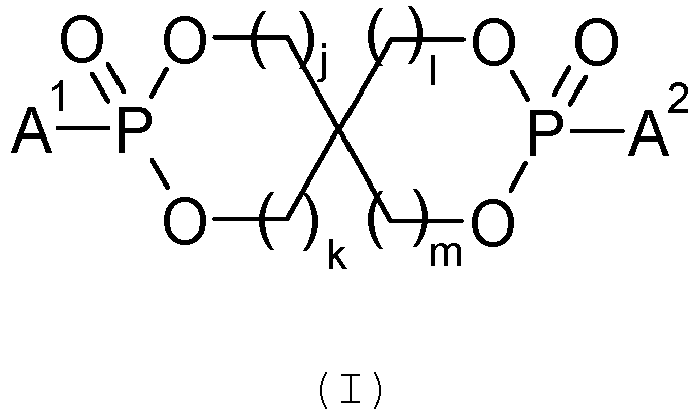 j, k, 1 and m, which are identical or different, represent an integer from 1 to 3;A1 and A2, which are identical or different, represent an alkyl group of 1 to 4 carbon atoms or an aryl group of 5 to 7 carbon atoms.
 - Powder according to Claim 8, intended for a 3D printing process, more particularly a process for 3D printing by laser sintering.
- Powder according to Claim 8 or 9, in which the flame-retardant agent of cyclic phosphonate ester type is of general formula (II):
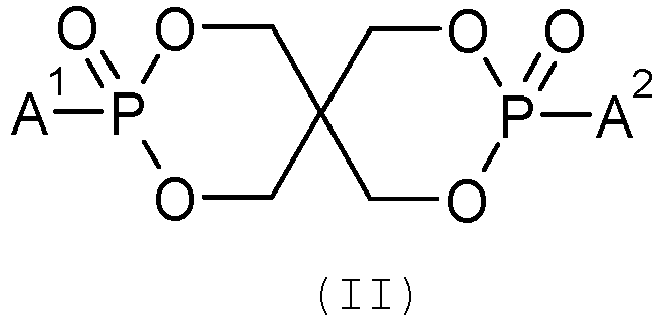

- Powder according to one of Claims 8 to 10, in which the powder comprises from 5% to 40% by weight, preferably from 5% to 25% by weight, with respect to the total weight of the powder, of the flame-retardant agent of cyclic phosphonate ester type and/or the powder comprises at least 50% by weight of polyamide and/or copolyamide, with respect to the total weight of the powder.
- Powder according to one of Claims 8 to 11, in which the powder comprises at least one other additive, in particular selected from the group consisting of a synergist of the flame-retardant agent of cyclic phosphonate ester type, of a pigment, of a dye, of a plasticizer, of an antioxidant, of a flow agent and of a UV absorption agent.
- Use of a powder as defined in one of Claims 8 to 12, in a powder bed fusion process, in particular a 3D printing process, more particularly a process for 3D printing by laser sintering, in order to produce a flame-retarded part.
- Process for the preparation of a powder as defined in one of Claims 8 to 12, comprising the blending of at least one polyamide and/or copolyamide and of at least one flame-retardant agent of cyclic phosphonate ester type, in which the flame-retardant agent of cyclic phosphonate ester type is of general formula (I):
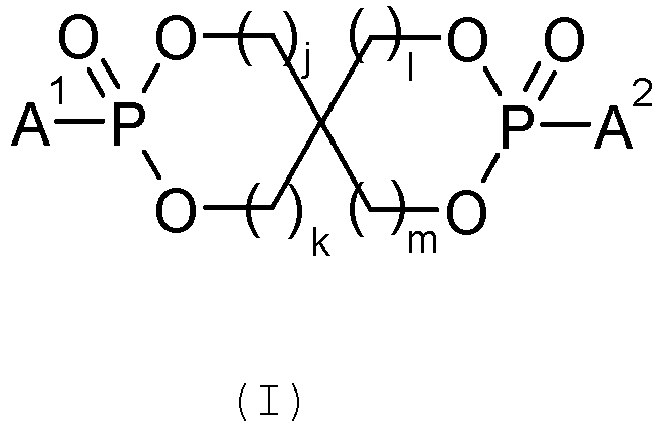 j, k, 1 and m, which are identical or different, represent an integer from 1 to 3;A1 and A2, which are identical or different, represent an alkyl group of 1 to 4 carbon atoms or an aryl group of 5 to 7 carbon atoms.
 - Process according to Claim 14, in which the blending is carried out by dry blending.
Applications Claiming Priority (2)
| Application Number | Priority Date | Filing Date | Title |
|---|---|---|---|
| FR1902769A FR3093945B1 (en) | 2019-03-18 | 2019-03-18 | FLAME-RETARDANT POLYAMIDES AND COPOLYAMIDES FOR 3D PRINTING |
| PCT/FR2020/050581 WO2020188220A1 (en) | 2019-03-18 | 2020-03-17 | Flame retardant polyamides and copolyamides for 3d printing |
Publications (2)
| Publication Number | Publication Date |
|---|---|
| EP3941717A1 EP3941717A1 (en) | 2022-01-26 |
| EP3941717B1 true EP3941717B1 (en) | 2024-12-11 |
Family
ID=67384017
Family Applications (1)
| Application Number | Title | Priority Date | Filing Date |
|---|---|---|---|
| EP20728106.4A Active EP3941717B1 (en) | 2019-03-18 | 2020-03-17 | Flame retardant polyamides and copolyamides for 3d printing |
Country Status (7)
| Country | Link |
|---|---|
| US (1) | US20220185991A1 (en) |
| EP (1) | EP3941717B1 (en) |
| JP (1) | JP7576560B2 (en) |
| KR (1) | KR20210138623A (en) |
| CN (1) | CN113597366A (en) |
| FR (1) | FR3093945B1 (en) |
| WO (1) | WO2020188220A1 (en) |
Families Citing this family (5)
| Publication number | Priority date | Publication date | Assignee | Title |
|---|---|---|---|---|
| WO2022106402A1 (en) * | 2020-11-19 | 2022-05-27 | Basf Se | Flame-retardant pulverulent composition and 3d-printed object obtained from the same |
| CN112322029B (en) * | 2020-11-19 | 2022-11-08 | 广东聚石科技研究有限公司 | Halogen-free flame-retardant nylon material and preparation method and application thereof |
| JP2025076529A (en) * | 2022-03-31 | 2025-05-16 | 三菱ケミカル株式会社 | 3D modeling materials |
| EP4569024A1 (en) * | 2022-08-12 | 2025-06-18 | 3D Systems, Inc. | Flame resistant compositions for additive manufacturing and associated printed 3d articles comprising oxygen-deprivation additives |
| EP4512846A1 (en) | 2023-08-21 | 2025-02-26 | Ems-Chemie Ag | Flame resistant materials for powder bed fusion technologies and using such materials in a layer-by-layer process |
Family Cites Families (18)
| Publication number | Priority date | Publication date | Assignee | Title |
|---|---|---|---|---|
| FR1F (en) | 1960-02-17 | 1961-03-03 | Georges Tixier | New drug, more especially used in geriatrics, in asthenic states in all their forms, in certain respiratory and nervous affections and in rheumatology. |
| GB0317387D0 (en) | 2003-07-25 | 2003-08-27 | Univ Loughborough | Method and apparatus for combining particulate material |
| DE102004001324A1 (en) | 2003-07-25 | 2005-02-10 | Degussa Ag | Powder composition used in the layerwise buildup of three-dimensional articles comprises a polymer and an ammonium polyphosphate flame retardant |
| DE10334497A1 (en) * | 2003-07-29 | 2005-02-24 | Degussa Ag | Polymer powder with phosphonate-based flame retardant, process for its preparation and moldings, made from this polymer powder |
| FR2867190B1 (en) | 2004-03-02 | 2007-08-17 | Arkema | METHOD FOR MANUFACTURING POLYAMIDE POWDER 12 WITH A HIGH MELTING POINT |
| DE102004020452A1 (en) | 2004-04-27 | 2005-12-01 | Degussa Ag | Method for producing three-dimensional objects by means of electromagnetic radiation and applying an absorber by inkjet method |
| FR2873380B1 (en) | 2004-07-20 | 2006-11-03 | Arkema Sa | FLAME RETARDANT POLYAMIDE POWDERS AND THEIR USE IN A FUSION AGGLOMERATION PROCESS |
| CN100412162C (en) * | 2006-06-20 | 2008-08-20 | 东华大学 | A kind of synthetic method of bicyclic phosphonate flame retardant |
| US20080153947A1 (en) * | 2006-12-21 | 2008-06-26 | Richard Benton Booth | Methods and systems for fabricating fire retardant materials |
| FR2930555B1 (en) | 2008-04-29 | 2012-08-24 | Arkema France | PROCESS FOR INCREASING THE DISTANCE BETWEEN THE FUSION TEMPERATURE AND THE CRYSTALLIZATION TEMPERATURE OF A POLYAMIDE POWDER |
| EP2264093A1 (en) * | 2009-06-16 | 2010-12-22 | THOR GmbH | Flame-retardant polyamide moulding materials |
| FR2951452B1 (en) * | 2009-10-16 | 2012-07-27 | Rhodia Operations | POLYAMIDE-BASED FLAME RETARDANT ARTICLE COMPRISING AN INTUMESCENT COATING |
| US20110274932A1 (en) * | 2010-05-05 | 2011-11-10 | Basf Se | Component comprising an insert part and plastics jacketing, and process for production of the component |
| FR2961518B1 (en) * | 2010-06-22 | 2012-07-27 | Rhodia Operations | POLYAMIDE COMPOSITION FOR SURFACE MOUNTED COMPONENTS |
| FR2976000B1 (en) * | 2011-05-31 | 2014-12-26 | Arkema France | PROCESS FOR INCREASING THE RECYCLABILITY OF A POLYAMIDE USED IN SINTERING |
| KR20150032514A (en) * | 2011-11-10 | 2015-03-26 | 에프알엑스 폴리머스, 인코포레이티드 | Flame retardant polyamide compositions |
| EP2746341B2 (en) * | 2012-12-21 | 2018-11-14 | Ems-Patent Ag | Stain-resistant articles and their use |
| WO2017158688A1 (en) * | 2016-03-14 | 2017-09-21 | 株式会社日立ハイテクノロジーズ | Resin powder material and method for producing resin shaped article |
-
2019
- 2019-03-18 FR FR1902769A patent/FR3093945B1/en active Active
-
2020
- 2020-03-17 JP JP2021556486A patent/JP7576560B2/en active Active
- 2020-03-17 CN CN202080022101.2A patent/CN113597366A/en active Pending
- 2020-03-17 EP EP20728106.4A patent/EP3941717B1/en active Active
- 2020-03-17 KR KR1020217030898A patent/KR20210138623A/en active Pending
- 2020-03-17 US US17/439,865 patent/US20220185991A1/en active Pending
- 2020-03-17 WO PCT/FR2020/050581 patent/WO2020188220A1/en not_active Ceased
Also Published As
| Publication number | Publication date |
|---|---|
| WO2020188220A1 (en) | 2020-09-24 |
| FR3093945B1 (en) | 2023-10-27 |
| US20220185991A1 (en) | 2022-06-16 |
| EP3941717A1 (en) | 2022-01-26 |
| KR20210138623A (en) | 2021-11-19 |
| CN113597366A (en) | 2021-11-02 |
| FR3093945A1 (en) | 2020-09-25 |
| JP2022526130A (en) | 2022-05-23 |
| JP7576560B2 (en) | 2024-10-31 |
Similar Documents
| Publication | Publication Date | Title |
|---|---|---|
| EP3941717B1 (en) | Flame retardant polyamides and copolyamides for 3d printing | |
| EP2530121B2 (en) | Method for increasing the recyclability of a polyamide used in sintering | |
| CN102300930B (en) | Reinforced flame retardant polyamide composition | |
| EP1765915A1 (en) | Flame-retardant polyamide powders and use thereof in a fusion agglomeration process | |
| JP6907224B2 (en) | Polyamide composition containing polyamide and additives | |
| FR3114593A1 (en) | Thermoplastic polymer powder for 3D printing with improved recyclability | |
| FR3101635A1 (en) | Thermoplastic polymer composition for construction of 3D articles | |
| US20060041041A1 (en) | Fireproofing polyamide powders and their use in a sintering process | |
| CA2491262A1 (en) | Thermoplastic polyamide moulding compositions | |
| WO2022074351A1 (en) | Yield-optimized method for producing a polyamide powder composition | |
| WO2021160963A1 (en) | Process for treating a polyamide-based composition | |
| FR3121681A1 (en) | FLAME RETARDANT POLYAMIDE COMPOSITIONS, THEIR USES AND THEIR METHODS OF PREPARING THEM | |
| WO2026027835A1 (en) | Polyamide powders for 3d printing | |
| FR3121680A1 (en) | FLAME RETARDANT POLYAMIDE COMPOSITIONS, THEIR USES AND THEIR METHODS OF PREPARING THEM | |
| FR3157406A1 (en) | Composition of thermoplastic polymer powders for 3D printing | |
| FR3140628A1 (en) | Process for recycling a used polyamide composition | |
| FR3157405A1 (en) | Polyamide 12 based powder for 3D printing | |
| JP2008056841A (en) | Polyamide composition and polyamide molded product composed of the same | |
| WO2021074543A1 (en) | Water-dispersible copolyamide | |
| WO2023281226A1 (en) | Thermoplastic polymer powder for constructing 3d items | |
| WO2023281227A1 (en) | Thermoplastic polymer powder for constructing 3d items | |
| JP2023001646A (en) | POLYAMIDE RESIN COMPOSITION PELLET, METHOD FOR PRODUCING THE SAME, AND MOLDED PRODUCT |
Legal Events
| Date | Code | Title | Description |
|---|---|---|---|
| STAA | Information on the status of an ep patent application or granted ep patent |
Free format text: STATUS: UNKNOWN |
|
| STAA | Information on the status of an ep patent application or granted ep patent |
Free format text: STATUS: THE INTERNATIONAL PUBLICATION HAS BEEN MADE |
|
| PUAI | Public reference made under article 153(3) epc to a published international application that has entered the european phase |
Free format text: ORIGINAL CODE: 0009012 |
|
| STAA | Information on the status of an ep patent application or granted ep patent |
Free format text: STATUS: REQUEST FOR EXAMINATION WAS MADE |
|
| 17P | Request for examination filed |
Effective date: 20211011 |
|
| AK | Designated contracting states |
Kind code of ref document: A1 Designated state(s): AL AT BE BG CH CY CZ DE DK EE ES FI FR GB GR HR HU IE IS IT LI LT LU LV MC MK MT NL NO PL PT RO RS SE SI SK SM TR |
|
| DAV | Request for validation of the european patent (deleted) | ||
| DAX | Request for extension of the european patent (deleted) | ||
| GRAP | Despatch of communication of intention to grant a patent |
Free format text: ORIGINAL CODE: EPIDOSNIGR1 |
|
| STAA | Information on the status of an ep patent application or granted ep patent |
Free format text: STATUS: GRANT OF PATENT IS INTENDED |
|
| INTG | Intention to grant announced |
Effective date: 20240722 |
|
| GRAS | Grant fee paid |
Free format text: ORIGINAL CODE: EPIDOSNIGR3 |
|
| GRAA | (expected) grant |
Free format text: ORIGINAL CODE: 0009210 |
|
| STAA | Information on the status of an ep patent application or granted ep patent |
Free format text: STATUS: THE PATENT HAS BEEN GRANTED |
|
| AK | Designated contracting states |
Kind code of ref document: B1 Designated state(s): AL AT BE BG CH CY CZ DE DK EE ES FI FR GB GR HR HU IE IS IT LI LT LU LV MC MK MT NL NO PL PT RO RS SE SI SK SM TR |
|
| REG | Reference to a national code |
Ref country code: GB Ref legal event code: FG4D Free format text: NOT ENGLISH |
|
| REG | Reference to a national code |
Ref country code: CH Ref legal event code: EP |
|
| REG | Reference to a national code |
Ref country code: IE Ref legal event code: FG4D Free format text: LANGUAGE OF EP DOCUMENT: FRENCH |
|
| REG | Reference to a national code |
Ref country code: DE Ref legal event code: R096 Ref document number: 602020042938 Country of ref document: DE |
|
| REG | Reference to a national code |
Ref country code: LT Ref legal event code: MG9D |
|
| PG25 | Lapsed in a contracting state [announced via postgrant information from national office to epo] |
Ref country code: HR Free format text: LAPSE BECAUSE OF FAILURE TO SUBMIT A TRANSLATION OF THE DESCRIPTION OR TO PAY THE FEE WITHIN THE PRESCRIBED TIME-LIMIT Effective date: 20241211 |
|
| PGFP | Annual fee paid to national office [announced via postgrant information from national office to epo] |
Ref country code: DE Payment date: 20250305 Year of fee payment: 6 |
|
| PG25 | Lapsed in a contracting state [announced via postgrant information from national office to epo] |
Ref country code: FI Free format text: LAPSE BECAUSE OF FAILURE TO SUBMIT A TRANSLATION OF THE DESCRIPTION OR TO PAY THE FEE WITHIN THE PRESCRIBED TIME-LIMIT Effective date: 20241211 |
|
| P01 | Opt-out of the competence of the unified patent court (upc) registered |
Free format text: CASE NUMBER: APP_11689/2025 Effective date: 20250311 |
|
| PG25 | Lapsed in a contracting state [announced via postgrant information from national office to epo] |
Ref country code: BG Free format text: LAPSE BECAUSE OF FAILURE TO SUBMIT A TRANSLATION OF THE DESCRIPTION OR TO PAY THE FEE WITHIN THE PRESCRIBED TIME-LIMIT Effective date: 20241211 |
|
| REG | Reference to a national code |
Ref country code: NL Ref legal event code: MP Effective date: 20241211 |
|
| PG25 | Lapsed in a contracting state [announced via postgrant information from national office to epo] |
Ref country code: ES Free format text: LAPSE BECAUSE OF FAILURE TO SUBMIT A TRANSLATION OF THE DESCRIPTION OR TO PAY THE FEE WITHIN THE PRESCRIBED TIME-LIMIT Effective date: 20241211 |
|
| PG25 | Lapsed in a contracting state [announced via postgrant information from national office to epo] |
Ref country code: NO Free format text: LAPSE BECAUSE OF FAILURE TO SUBMIT A TRANSLATION OF THE DESCRIPTION OR TO PAY THE FEE WITHIN THE PRESCRIBED TIME-LIMIT Effective date: 20250311 |
|
| PG25 | Lapsed in a contracting state [announced via postgrant information from national office to epo] |
Ref country code: LV Free format text: LAPSE BECAUSE OF FAILURE TO SUBMIT A TRANSLATION OF THE DESCRIPTION OR TO PAY THE FEE WITHIN THE PRESCRIBED TIME-LIMIT Effective date: 20241211 Ref country code: GR Free format text: LAPSE BECAUSE OF FAILURE TO SUBMIT A TRANSLATION OF THE DESCRIPTION OR TO PAY THE FEE WITHIN THE PRESCRIBED TIME-LIMIT Effective date: 20250312 |
|
| PGFP | Annual fee paid to national office [announced via postgrant information from national office to epo] |
Ref country code: FR Payment date: 20250310 Year of fee payment: 6 |
|
| PGFP | Annual fee paid to national office [announced via postgrant information from national office to epo] |
Ref country code: GB Payment date: 20250306 Year of fee payment: 6 |
|
| PG25 | Lapsed in a contracting state [announced via postgrant information from national office to epo] |
Ref country code: RS Free format text: LAPSE BECAUSE OF FAILURE TO SUBMIT A TRANSLATION OF THE DESCRIPTION OR TO PAY THE FEE WITHIN THE PRESCRIBED TIME-LIMIT Effective date: 20250311 |
|
| RAP4 | Party data changed (patent owner data changed or rights of a patent transferred) |
Owner name: ARKEMA FRANCE |
|
| PG25 | Lapsed in a contracting state [announced via postgrant information from national office to epo] |
Ref country code: NL Free format text: LAPSE BECAUSE OF FAILURE TO SUBMIT A TRANSLATION OF THE DESCRIPTION OR TO PAY THE FEE WITHIN THE PRESCRIBED TIME-LIMIT Effective date: 20241211 |
|
| REG | Reference to a national code |
Ref country code: AT Ref legal event code: MK05 Ref document number: 1750077 Country of ref document: AT Kind code of ref document: T Effective date: 20241211 |
|
| PG25 | Lapsed in a contracting state [announced via postgrant information from national office to epo] |
Ref country code: SM Free format text: LAPSE BECAUSE OF FAILURE TO SUBMIT A TRANSLATION OF THE DESCRIPTION OR TO PAY THE FEE WITHIN THE PRESCRIBED TIME-LIMIT Effective date: 20241211 |
|
| PG25 | Lapsed in a contracting state [announced via postgrant information from national office to epo] |
Ref country code: PL Free format text: LAPSE BECAUSE OF FAILURE TO SUBMIT A TRANSLATION OF THE DESCRIPTION OR TO PAY THE FEE WITHIN THE PRESCRIBED TIME-LIMIT Effective date: 20241211 |
|
| PG25 | Lapsed in a contracting state [announced via postgrant information from national office to epo] |
Ref country code: IS Free format text: LAPSE BECAUSE OF FAILURE TO SUBMIT A TRANSLATION OF THE DESCRIPTION OR TO PAY THE FEE WITHIN THE PRESCRIBED TIME-LIMIT Effective date: 20250411 |
|
| PG25 | Lapsed in a contracting state [announced via postgrant information from national office to epo] |
Ref country code: PT Free format text: LAPSE BECAUSE OF FAILURE TO SUBMIT A TRANSLATION OF THE DESCRIPTION OR TO PAY THE FEE WITHIN THE PRESCRIBED TIME-LIMIT Effective date: 20250411 |
|
| PG25 | Lapsed in a contracting state [announced via postgrant information from national office to epo] |
Ref country code: EE Free format text: LAPSE BECAUSE OF FAILURE TO SUBMIT A TRANSLATION OF THE DESCRIPTION OR TO PAY THE FEE WITHIN THE PRESCRIBED TIME-LIMIT Effective date: 20241211 |
|
| PGFP | Annual fee paid to national office [announced via postgrant information from national office to epo] |
Ref country code: CH Payment date: 20250401 Year of fee payment: 6 |
|
| PG25 | Lapsed in a contracting state [announced via postgrant information from national office to epo] |
Ref country code: RO Free format text: LAPSE BECAUSE OF FAILURE TO SUBMIT A TRANSLATION OF THE DESCRIPTION OR TO PAY THE FEE WITHIN THE PRESCRIBED TIME-LIMIT Effective date: 20241211 Ref country code: AT Free format text: LAPSE BECAUSE OF FAILURE TO SUBMIT A TRANSLATION OF THE DESCRIPTION OR TO PAY THE FEE WITHIN THE PRESCRIBED TIME-LIMIT Effective date: 20241211 |
|
| PG25 | Lapsed in a contracting state [announced via postgrant information from national office to epo] |
Ref country code: SK Free format text: LAPSE BECAUSE OF FAILURE TO SUBMIT A TRANSLATION OF THE DESCRIPTION OR TO PAY THE FEE WITHIN THE PRESCRIBED TIME-LIMIT Effective date: 20241211 |
|
| PG25 | Lapsed in a contracting state [announced via postgrant information from national office to epo] |
Ref country code: CZ Free format text: LAPSE BECAUSE OF FAILURE TO SUBMIT A TRANSLATION OF THE DESCRIPTION OR TO PAY THE FEE WITHIN THE PRESCRIBED TIME-LIMIT Effective date: 20241211 |
|
| PG25 | Lapsed in a contracting state [announced via postgrant information from national office to epo] |
Ref country code: IT Free format text: LAPSE BECAUSE OF FAILURE TO SUBMIT A TRANSLATION OF THE DESCRIPTION OR TO PAY THE FEE WITHIN THE PRESCRIBED TIME-LIMIT Effective date: 20241211 |
|
| REG | Reference to a national code |
Ref country code: DE Ref legal event code: R026 Ref document number: 602020042938 Country of ref document: DE |
|
| PG25 | Lapsed in a contracting state [announced via postgrant information from national office to epo] |
Ref country code: SE Free format text: LAPSE BECAUSE OF FAILURE TO SUBMIT A TRANSLATION OF THE DESCRIPTION OR TO PAY THE FEE WITHIN THE PRESCRIBED TIME-LIMIT Effective date: 20241211 |
|
| PLBI | Opposition filed |
Free format text: ORIGINAL CODE: 0009260 |
|
| PLAX | Notice of opposition and request to file observation + time limit sent |
Free format text: ORIGINAL CODE: EPIDOSNOBS2 |
|
| REG | Reference to a national code |
Ref country code: CH Ref legal event code: R18 Free format text: ST27 STATUS EVENT CODE: U-0-0-R10-R18 (AS PROVIDED BY THE NATIONAL OFFICE) Effective date: 20251008 |
|
| PG25 | Lapsed in a contracting state [announced via postgrant information from national office to epo] |
Ref country code: DK Free format text: LAPSE BECAUSE OF FAILURE TO SUBMIT A TRANSLATION OF THE DESCRIPTION OR TO PAY THE FEE WITHIN THE PRESCRIBED TIME-LIMIT Effective date: 20241211 |
|
| PG25 | Lapsed in a contracting state [announced via postgrant information from national office to epo] |
Ref country code: MC Free format text: LAPSE BECAUSE OF FAILURE TO SUBMIT A TRANSLATION OF THE DESCRIPTION OR TO PAY THE FEE WITHIN THE PRESCRIBED TIME-LIMIT Effective date: 20241211 |
|
| 26 | Opposition filed |
Opponent name: EVONIK OPERATIONS GMBH Effective date: 20250908 |
|
| PG25 | Lapsed in a contracting state [announced via postgrant information from national office to epo] |
Ref country code: LU Free format text: LAPSE BECAUSE OF NON-PAYMENT OF DUE FEES Effective date: 20250317 |
|
| REG | Reference to a national code |
Ref country code: BE Ref legal event code: MM Effective date: 20250331 |
|
| REG | Reference to a national code |
Ref country code: DE Ref legal event code: R081 Ref document number: 602020042938 Country of ref document: DE Owner name: ARKEMA FRANCE, FR Free format text: FORMER OWNER: ARKEMA FRANCE, COLOMBES, FR |
|
| PG25 | Lapsed in a contracting state [announced via postgrant information from national office to epo] |
Ref country code: BE Free format text: LAPSE BECAUSE OF NON-PAYMENT OF DUE FEES Effective date: 20250331 |
|
| PG25 | Lapsed in a contracting state [announced via postgrant information from national office to epo] |
Ref country code: IE Free format text: LAPSE BECAUSE OF NON-PAYMENT OF DUE FEES Effective date: 20250317 |
|
| PLBB | Reply of patent proprietor to notice(s) of opposition received |
Free format text: ORIGINAL CODE: EPIDOSNOBS3 |