EP3881787B1 - Forceps with linear trigger mechanism - Google Patents
Forceps with linear trigger mechanism Download PDFInfo
- Publication number
- EP3881787B1 EP3881787B1 EP21162507.4A EP21162507A EP3881787B1 EP 3881787 B1 EP3881787 B1 EP 3881787B1 EP 21162507 A EP21162507 A EP 21162507A EP 3881787 B1 EP3881787 B1 EP 3881787B1
- Authority
- EP
- European Patent Office
- Prior art keywords
- knife
- shaft
- flange
- trigger
- slot
- Prior art date
- Legal status (The legal status is an assumption and is not a legal conclusion. Google has not performed a legal analysis and makes no representation as to the accuracy of the status listed.)
- Active
Links
Images




Classifications
-
- A—HUMAN NECESSITIES
- A61—MEDICAL OR VETERINARY SCIENCE; HYGIENE
- A61B—DIAGNOSIS; SURGERY; IDENTIFICATION
- A61B18/00—Surgical instruments, devices or methods for transferring non-mechanical forms of energy to or from the body
- A61B18/04—Surgical instruments, devices or methods for transferring non-mechanical forms of energy to or from the body by heating
- A61B18/12—Surgical instruments, devices or methods for transferring non-mechanical forms of energy to or from the body by heating by passing a current through the tissue to be heated, e.g. high-frequency current
- A61B18/14—Probes or electrodes therefor
- A61B18/1442—Probes having pivoting end effectors, e.g. forceps
-
- A—HUMAN NECESSITIES
- A61—MEDICAL OR VETERINARY SCIENCE; HYGIENE
- A61B—DIAGNOSIS; SURGERY; IDENTIFICATION
- A61B18/00—Surgical instruments, devices or methods for transferring non-mechanical forms of energy to or from the body
- A61B2018/00571—Surgical instruments, devices or methods for transferring non-mechanical forms of energy to or from the body for achieving a particular surgical effect
- A61B2018/00607—Coagulation and cutting with the same instrument
-
- A—HUMAN NECESSITIES
- A61—MEDICAL OR VETERINARY SCIENCE; HYGIENE
- A61B—DIAGNOSIS; SURGERY; IDENTIFICATION
- A61B18/00—Surgical instruments, devices or methods for transferring non-mechanical forms of energy to or from the body
- A61B2018/00571—Surgical instruments, devices or methods for transferring non-mechanical forms of energy to or from the body for achieving a particular surgical effect
- A61B2018/0063—Sealing
-
- A—HUMAN NECESSITIES
- A61—MEDICAL OR VETERINARY SCIENCE; HYGIENE
- A61B—DIAGNOSIS; SURGERY; IDENTIFICATION
- A61B18/00—Surgical instruments, devices or methods for transferring non-mechanical forms of energy to or from the body
- A61B2018/0091—Handpieces of the surgical instrument or device
- A61B2018/00916—Handpieces of the surgical instrument or device with means for switching or controlling the main function of the instrument or device
- A61B2018/00922—Handpieces of the surgical instrument or device with means for switching or controlling the main function of the instrument or device by switching or controlling the treatment energy directly within the hand-piece
-
- A—HUMAN NECESSITIES
- A61—MEDICAL OR VETERINARY SCIENCE; HYGIENE
- A61B—DIAGNOSIS; SURGERY; IDENTIFICATION
- A61B18/00—Surgical instruments, devices or methods for transferring non-mechanical forms of energy to or from the body
- A61B18/04—Surgical instruments, devices or methods for transferring non-mechanical forms of energy to or from the body by heating
- A61B18/12—Surgical instruments, devices or methods for transferring non-mechanical forms of energy to or from the body by heating by passing a current through the tissue to be heated, e.g. high-frequency current
- A61B18/14—Probes or electrodes therefor
- A61B18/1442—Probes having pivoting end effectors, e.g. forceps
- A61B2018/1452—Probes having pivoting end effectors, e.g. forceps including means for cutting
- A61B2018/1455—Probes having pivoting end effectors, e.g. forceps including means for cutting having a moving blade for cutting tissue grasped by the jaws
Definitions
- the present disclosure relates to electrosurgical instruments and, more particularly, to electrosurgical forceps for grasping, treating, and/or dividing tissue.
- a surgical forceps is a plier-like instrument which relies on mechanical action between its jaws to grasp tissue. Electrosurgical forceps utilize both mechanical clamping action and electrical energy to treat tissue, e.g., coagulate, cauterize, and/or seal tissue.
- distal refers to the portion that is being described which is further from a surgeon
- proximal refers to the portion that is being described which is closer to a surgeon
- An electrosurgical forceps provided in accordance with aspects of the present disclosure includes first and second shaft members each having a jaw member disposed at a distal end thereof, the first and second shaft members configured to rotate about a pivot to move the jaw members between an open position and a closed position, the first and second shaft members defining a longitudinal axis therebetween.
- a knife deployment mechanism is disposed within the first shaft member and includes a trigger moveable along the longitudinal axis to deploy a knife (which may also be deployable along the longitudinal axis) operably coupled thereto between a retracted position relative to the jaw members and an extended position between the jaw members.
- the knife deployment mechanism includes first and second rack members operably coupled to one another by a gear disposed therebetween.
- the trigger is operably connected to the first rack member and the knife is operably coupled to the second rack member such that movement of the trigger moves the knife in an opposite direction relative thereto.
- a knife lockout is configured to move upon approximation of the first and second shaft members between an engaged position preventing deployment of the knife and a disengaged position allowing deployment of the knife.
- the knife lockout includes a flange operably connected to the first shaft member and depending therefrom in opposition to the second shaft member such that approximation of the first and second shaft members forces the flange against the second shaft member to disengage the knife lockout to allow actuation of the knife.
- the first shaft member includes a trigger slot defined therein, the trigger is configured to travel between a distal-most position wherein the trigger slot is exposed and a more proximal position wherein the trigger covers the trigger slot to reduce the chances of a user's finger being pinched within the trigger slot.
- the forceps further includes a switch assembly disposed on one of the first or second shaft members which is configured to be engaged by the other of the first or second shaft members when the jaw members are approximated to move the switch assembly between a deactivated position and an activated position to control delivery of electrosurgical energy to the jaw members.
- a knife return spring is operably coupled to the knife deployment mechanism and is configured to bias the knife toward the retracted position.
- the knife return spring is operable coupled to one or both of the first or second rack members.
- the knife lockout includes a slot defined in the flange configured to operably engage a lock pin disposed in the knife deployment mechanism to prevent movement of the knife when engaged.
- the flange upon approximation of the first and second shaft members, the flange is configured to dislodge the slot from engagement with the lock pin of the knife deployment mechanism to allow selective actuation of the knife.
- the flange is connected to the first shaft member by a flange pin.
- the flange is fixed at a distal end thereof by the flange pin and, upon approximation of the first and second shaft members, the flange is configured to cantilever or flex about the flange pin to dislodge the lock pin from the slot defined therein.
- the bias of the flange upon opening of the first and second shaft members relative to one another the bias of the flange reseats the lock pin within the slot.
- the knife deployment mechanism includes an elongated slot defined therein to allow reciprocation of the lock pin therein.
- the flange includes a ramp to facilitate reseating the lock pin within the slot upon return of the knife deployment mechanism.
- the knife lockout includes a boss disposed on the flange configured to operably engage one of a plurality of slots defined between a plurality of gears in the first rack to prevent movement of the knife when engaged.
- the boss on the flange upon approximation of the first and second shaft members, is configured to dislodge from the one of a plurality of slots to allow selective actuation of the knife.
- the flange is fixed at a proximal end thereof by the pivot and, upon approximation of the first and second shaft members, the flange is configured to rotate about the pivot to dislodge the boss from gear.
- a knife kickout mechanism is configured to force the knife forward upon movement of the first and second shaft members from an approximated position to a more open position.
- the knife kickout mechanism includes a flange depending from the knife deployment mechanism in oppositional alignment with the second shaft member wherein, upon approximation of the first and second shaft members and actuation of the knife deployment mechanism in a first direction, the knife kickout rides within a slot defined within the second shaft member to abutingly engage a ramp defined in the slot and wherein, upon opening of the first and second shaft members relative to one another, the ramp forces the knife kickout mechanism in an opposite direction to facilitate return of the knife deployment mechanism to an unactuated position.
- An electrosurgical forceps provided in accordance with additional aspects of the present disclosure includes first and second shaft members each having a jaw member disposed at a distal end thereof, the first and second shaft members configured to rotate about a pivot to move the jaw members between an open position and a closed position, the first and second shaft members defining a longitudinal axis therebetween.
- a knife deployment mechanism is disposed within the first shaft member and includes a trigger moveable along the longitudinal axis to deploy a knife operably coupled thereto between a retracted position relative to the jaw members and an extended position between the jaw members, the knife deployment mechanism including first and second rack members operably coupled to one another by a gear disposed therebetween, the trigger operably connected to the first rack member and the knife operably coupled to the second rack member such that movement of the trigger moves the knife in an opposite direction relative thereto.
- a knife kickout mechanism is configured to force the knife forward upon movement of the first and second shaft members from an approximated position to a more open position, the knife kickout mechanism including a flange depending from the knife deployment mechanism in oppositional alignment with the second shaft member wherein, upon approximation of the first and second shaft members and actuation of the knife deployment mechanism in a first direction, the knife kickout rides within a slot defined within the second shaft member to abutingly engage a ramp defined in the slot and wherein, upon opening of the first and second shaft members relative to one another, the ramp forces the knife kickout mechanism in an opposite direction to facilitate return of the knife deployment mechanism to an unactuated position.
- a switch assembly is disposed on one of the first or second shaft members and is configured to be engaged by the other of the first or second shaft members when the jaw members are approximated to move the switch assembly between a deactivated position and an activated position to control delivery of electrosurgical energy to the jaw members.
- a knife return spring is operably coupled to the knife deployment mechanism and configured to bias the knife toward the retracted position.
- An electrosurgical forceps provided in accordance with additional aspects of the present disclosure includes first and second shaft members each having a jaw member disposed at a distal end thereof, the first and second shaft members configured to rotate about a pivot to move the jaw members between an open position and a closed position, the first and second shaft members defining a longitudinal axis therebetween.
- a knife deployment mechanism is disposed within the first shaft member and includes a trigger moveable along the longitudinal axis to deploy a knife operably coupled thereto between a retracted position relative to the jaw members and an extended position between the jaw members, the knife deployment mechanism including a series of links operably coupled to one another and to a knife carrier configured to translate the knife.
- a knife lockout is configured to move upon approximation of the first and second shaft members between an engaged position preventing deployment of the knife and a disengaged position allowing deployment of the knife, the knife lockout including a flange operably connected to the first shaft member and depending therefrom in opposition to the second shaft member such that approximation of the first and second shaft members forces the flange against the second shaft member to disengage the knife lockout to allow actuation of the knife.
- the first shaft member includes a trigger slot defined therein, the trigger is configured to travel between a distal-most position wherein the trigger slot is exposed and a more proximal position wherein the trigger covers the trigger slot to reduce the chances of a user's finger being pinched within the trigger slot.
- a switch assembly is disposed on one of the first or second shaft members and is configured to be engaged by the other of the first or second shaft members when the jaw members are approximated to move the switch assembly between a deactivated position and an activated position to control delivery of electrosurgical energy to the jaw members.
- a knife return spring is operably coupled to the knife deployment mechanism and configured to bias the knife toward the retracted position. In other aspects according to the present disclosure, the knife return spring is operable coupled to at least one of the series of links.
- the knife lockout includes a slot defined in the flange configured to operably engage a lock pin disposed in the knife deployment mechanism to prevent movement of the knife when engaged.
- the flange upon approximation of the first and second shaft members, the flange is configured to dislodge the slot from engagement with the lock pin of the knife deployment mechanism to allow selective actuation of the knife.
- the flange is connected to the first shaft member by a sleeve.
- the flange includes an elongated shaft fixed at a distal end thereof by the sleeve disposed within the first shaft member and, upon approximation of the first and second shaft members, the elongated shaft of the flange is configured to cantilever or flex at the sleeve to dislodge the lock pin from the slot defined therein.
- the bias of the elongated shaft upon opening of the first and second shaft members relative to one another the bias of the elongated shaft reseats the lock pin within the slot.
- the knife deployment mechanism includes an elongated slot defined therein to allow reciprocation of the lock pin therein.
- the flange includes a ramp to facilitate reseating the lock pin within the slot of the flange upon return of the knife deployment mechanism.
- a knife kickout mechanism is configured to force the knife forward upon movement of the first and second shaft members from an approximated position to a more open position.
- the knife kickout mechanism includes a flange depending from the knife deployment mechanism in oppositional alignment with the second shaft member wherein, upon approximation of the first and second shaft members and actuation of the knife deployment mechanism in a first direction, the knife kickout rides within a slot defined within the second shaft member to abutingly engage a ramp defined in the slot and wherein, upon opening of the first and second shaft members relative to one another, the ramp forces the knife kickout mechanism in an opposite direction to facilitate return of the knife deployment mechanism to an unactuated position.
- An electrosurgical forceps provided in accordance with additional aspects of the present disclosure includes first and second shaft members each having a jaw member disposed at a distal end thereof, the first and second shaft members configured to rotate about a pivot to move the jaw members between an open position and a closed position, the first and second shaft members defining a longitudinal axis therebetween.
- a knife deployment mechanism is disposed within the first shaft member and includes a trigger moveable along the longitudinal axis to deploy a knife operably coupled thereto between a retracted position relative to the jaw members and an extended position between the jaw members, the knife deployment mechanism including a series of links operably coupled to one another and to a knife carrier configured to translate the knife.
- a knife kickout mechanism is configured to force the knife forward upon movement of the first and second shaft members from an approximated position to a more open position, the knife kickout mechanism including a flange depending from the knife deployment mechanism in oppositional alignment with the second shaft member wherein, upon approximation of the first and second shaft members and actuation of the knife deployment mechanism in a first direction, the knife kickout rides within a slot defined within the second shaft member to abutingly engage a ramp defined in the slot and wherein, upon opening of the first and second shaft members relative to one another, the ramp forces the knife kickout mechanism in an opposite direction to facilitate return of the knife deployment mechanism to an unactuated position.
- a switch assembly disposed on one of the first or second shaft members and configured to be engaged by the other of the first or second shaft members when the jaw members are approximated to move the switch assembly between a deactivated position and an activated position to control delivery of electrosurgical energy to the jaw members.
- a knife return spring operably coupled to the knife deployment mechanism and configured to bias the knife toward the retracted position
- An electrosurgical forceps provided in accordance with additional aspects of the present disclosure includes first and second shaft members each having a jaw member disposed at a distal end thereof, the first and second shaft members configured to rotate about a pivot to move the jaw members between an open position and a closed position, the first and second shaft members defining a longitudinal axis therebetween.
- a knife deployment mechanism is disposed within the first shaft member and includes a trigger moveable along the longitudinal axis to deploy a knife operably coupled thereto between a retracted position relative to the jaw members and an extended position between the jaw members.
- a knife lockout is configured to move upon approximation of the first and second shaft members between an engaged position preventing deployment of the knife and a disengaged position allowing deployment of the knife, the knife lockout including a flange operably connected to the first shaft member and depending therefrom in opposition to the second shaft member such that approximation of the first and second shaft members forces the flange against the second shaft member to disengage the knife lockout to allow actuation of the knife.
- a knife kickout mechanism is configured to force the knife forward upon movement of the first and second shaft members from an approximated position to a more open position, the knife kickout mechanism including a flange depending from the knife deployment mechanism in oppositional alignment with the second shaft member wherein, upon approximation of the first and second shaft members and actuation of the knife deployment mechanism in a first direction, the knife kickout rides within a slot defined within the second shaft member to abutingly engage a ramp defined in the slot and wherein, upon opening of the first and second shaft members relative to one another, the ramp forces the knife kickout mechanism in an opposite direction to facilitate return of the knife deployment mechanism to an unactuated position.
- the first shaft member includes a trigger slot defined therein, the trigger is configured to travel between a distal-most position wherein the trigger slot is exposed and a more proximal position wherein the trigger covers the trigger slot to reduce the chances of a user's finger being pinched within the trigger slot.
- a switch assembly is disposed on one of the first or second shaft members and is configured to be engaged by the other of the first or second shaft members when the jaw members are approximated to move the switch assembly between a deactivated position and an activated position to control delivery of electrosurgical energy to the jaw members.
- a knife return spring is operably coupled to the knife deployment mechanism and is configured to bias the knife toward the retracted position.
- the knife lockout includes a slot defined in the flange configured to operably engage a lock pin disposed in the knife deployment mechanism to prevent movement of the knife when engaged.
- the flange upon approximation of the first and second shaft members, is configured to dislodge the slot from engagement with the lock pin of the knife deployment mechanism to allow selective actuation of the knife.
- the flange is connected to the first shaft member by a sleeve.
- the flange is connected to the first shaft member by a flange pin.
- the flange includes an elongated shaft fixed at a distal end thereof to the first shaft member and, upon approximation of the first and second shaft members, the elongated shaft of the flange is configured to cantilever or flex to dislodge the lock pin from the slot defined therein.
- the knife deployment mechanism upon opening of the first and second shaft members relative to one another the bias of the elongated shaft reseats the lock pin within the slot.
- the knife deployment mechanism includes an elongated slot defined therein to allow reciprocation of the lock pin therein.
- the flange includes a ramp to facilitate reseating the lock pin within the slot of the flange upon return of the knife deployment mechanism.
- An electrosurgical forceps provided in accordance with additional aspects of the present disclosure includes first and second shaft members each having a jaw member disposed at a distal end thereof, the first and second shaft members configured to rotate about a pivot to move the jaw members between an open position and a closed position, the first and second shaft members defining a longitudinal axis therebetween.
- a knife deployment mechanism is disposed within the first shaft member and includes a trigger moveable along the longitudinal axis to deploy a knife operably coupled thereto between a retracted position relative to the jaw members and an extended position between the jaw members.
- a knife lockout is disposed within the first shaft member in oppositional alignment with the second shaft member and is configured to move upon approximation of the first and second shaft members between an engaged position preventing deployment of the knife and a disengaged position allowing deployment of the knife.
- a knife kickout mechanism is configured to force the knife forward upon movement of the first and second shaft members from an approximated position to a more open position, the knife kickout mechanism including a flange depending from the knife deployment mechanism in oppositional alignment with the second shaft member wherein, upon approximation of the first and second shaft members and actuation of the knife deployment mechanism in a first direction, the knife kickout rides within a slot defined within the second shaft member to abutingly engage a ramp defined in the slot and wherein, upon opening of the first and second shaft members relative to one another, the ramp forces the knife kickout mechanism in an opposite direction to facilitate return of the knife deployment mechanism to an unactuated position.
- An electrosurgical forceps provided in accordance with additional aspects of the present disclosure includes first and second shaft members each having a jaw member disposed at a distal end thereof, the first and second shaft members configured to rotate about a pivot to move the jaw members between an open position and a closed position, the first and second shaft members defining a longitudinal axis therebetween.
- a knife deployment mechanism is disposed within the first shaft member and includes a trigger moveable along the longitudinal axis to deploy a knife operably coupled thereto between a retracted position relative to the jaw members and an extended position between the jaw members.
- a knife lockout is configured to move upon approximation of the first and second shaft members between an engaged position preventing deployment of the knife and a disengaged position allowing deployment of the knife, the knife lockout including a flange operably connected to the first shaft member and depending therefrom in opposition to the second shaft member such that approximation of the first and second shaft members forces the flange against the second shaft member to disengage the knife lockout to allow actuation of the knife.
- a knife kickout mechanism is disposed within the first shaft member in oppositional alignment with the second shaft member and is configured to force the knife forward upon movement of the first and second shaft members from an approximated position to a more open position.
- the present disclosure describes electrosurgical forceps for grasping, treating, and/or dividing tissue.
- the forceps includes two shafts each having a jaw member disposed at a distal end thereof and movable between open and closed positions to grasp tissue.
- the electrosurgical forceps also includes a knife configured to divide grasped tissue following treatment of the tissue (e.g., a tissue seal cycle).
- a knife lockout works in conjunction with the shafts to prevent deployment of the knife prior to the shafts reaching a sufficiently-approximated position corresponding to a sufficiently-closed position of jaw members as well as to prevent deployment of the knife during treatment of tissue.
- a forceps 100 provided in accordance with the present disclosure includes first and second shafts 110, 120 each having a proximal end portion 112a, 122a and a distal end portion 112b, 122b.
- An end effector assembly 200 of forceps 100 includes first and second jaw members 210, 220 extending from distal end portions 112b, 122b of shafts 110, 120, respectively.
- Forceps 100 further includes a pivot member 130 pivotably coupling first and second shafts 110, 120 with one another, a knife 140 ( Fig. 1B ), a knife deployment mechanism 150 for selectively deploying knife 140 relative to end effector assembly 200, a knife lockout 170 ( Figs.
- An electrosurgical cable 300 electrically couples forceps 100 to a source of energy (not shown), e.g., an electrosurgical generator, to enable the supply of electrosurgical energy to jaw members 210, 220 of end effector assembly 200 upon activation of switch assembly 180.
- knife deployment mechanism 150 is coupled to shaft 110 and generally includes a pair of opposed triggers 152 ( Fig. 1D ) extending from either side of shaft 110, a first linkage 154, a second linkage 156, and a biasing spring 158. Knife deployment mechanism 150 is disposed within outer housing 116 of shaft 110 with the exception of opposed triggers 152 which extend from either side of outer housing 116.
- First linkage 154 is configured for positioning on one side of inner frame 114 ( Fig. 1C ) of shaft 110 and includes a pair of integral (or otherwise engaged) pivot bosses (not shown) extending from either side thereof at a first end portion of first linkage 154. Each pivot boss enables engagement of opposed triggers 152 therewith on either side of shaft 110, e.g., via press-fitting, adhesion, or other suitable engagement.
- a proximal end portion of second linkage 156 is pivotably coupled to first linkage 154 at a second end portion of first linkage 154.
- a distal end portion of second linkage 156 is pivotably coupled to knife 140 via a pivot pin 163 ( Fig. 1F ).
- Pivot pin 163 may be integrally formed with second linkage 156, e.g., as a post extending therefrom, or may be a separate component from second linkage 156. Pivot pin 163 extends transversely through a longitudinal slot 115e ( Fig. 1E ) of inner frame 114 of shaft 110 such that pivot pin 163 is constrained to longitudinal movement within longitudinal slot 115e.
- Second linkage 156 is disposed on one side of inner frame 114, which may be the same side as first linkage 154 or the opposite side (as shown). In either configuration, pivot pin 163 extends from second linkage 156 and through longitudinal slot 115e such that a portion of pivot pin 163 protrudes laterally from the opposite side of inner frame 114.
- Biasing spring 158 may be configured as an extension spring or other suitable biasing spring 158. A distal end portion of biasing spring 158 is engaged to first linkage 154 and a proximal end portion of biasing spring 158 is engaged to a support plate 166 ( Fig. 1C ). Spring 158 may be engaged to any moveable components of the knife deployment mechanism 150.
- Support plate 166 includes handle 118 of shaft 110 integrally formed therewith or otherwise engaged thereto, and may be secured within outer housing 116 in any suitable fashion, e.g., via protrusion-aperture engagement. Support plate 166 provides increased structural support to shaft 110 to inhibit splaying of shafts 110, 120 during use.
- Shaft 120 similarly includes a support plate 168 integrally formed with or otherwise engaging handle 128 of shaft 120 and secured to outer housing 126, although support plate 168 need not extend distally as with support plate 166.
- Biasing spring 158 biases first linkage 154 towards a first orientation, corresponding to the un-actuated position of triggers 152 and the proximal-most position of second linkage 156, thereby biasing knife 140 towards a retracted position (e.g., a proximal-most position of knife 140).
- first linkage 154 is rotated against the bias of biasing spring 158 to thereby urge second linkage 156 distally such that pivot pin 163 is driven distally through longitudinal slot 115e ( Fig. 1E ) to urge knife 140 from the retracted position towards an extended position, wherein knife 140 extends through a slot defined in pivot member 130, a channel of body plate 115, and knife channels of jaw members 210, 220.
- Knife deployment mechanism 150 is operably positioned on shaft 110 and relative to shaft 120 such that triggers 152 only slightly extend beyond the height dimension of forceps 100 in the vicinity of triggers 152, in the furthest-approximated position of shafts 110, 120.
- forceps 100 benefits from a low-profile design that reduces the chances of triggers 152 catching on the surgeon, patient, or on nearby objections during use and/or as forceps 100 is inserted and withdrawn from the surgical site.
- Knife lockout 170 works in conjunction with shafts 110, 120 to prevent deployment of knife 140 prior to shafts 110, 120 reaching a sufficiently-approximated position corresponding to a sufficiently-closed position of jaw members 210, 220.
- Knife lockout 170 includes a body 172 ( Figs. 1A-1C ) that is disposed about a portion of the inner frame 114 of shaft 110 and forms a portion of outer housing 116 of shaft 110. More specifically, as shown in Fig. 1A , body 172 of knife lockout 170 defines a complementarily-shaped abutting surface with the abutting surface of the adjacent other component(s) of housing 116 such that housing 116 defines a substantially continuous outer surface.
- Knife lockout 170 further includes a cantilever arm 174 extending proximally from body 172.
- Cantilever arm 174 and body 172 may be integrally formed, e.g., via injection molding, or may be attached in any other suitable fashion.
- Cantilever arm 174 extends along inner frame 114 of shaft 110 on an opposite side of inner frame 114 as compared to second linkage 156 of knife deployment mechanism 150.
- Cantilever arm 174 defines a relatively narrowed configuration to permit flexing of cantilever arm 174.
- a finger 176 integrally formed with cantilever arm 174 extends generally perpendicularly from a free end of cantilever arm 174 and through an opening defined in outer housing 116 of shaft 110 towards shaft 120.
- a first stop 179 is defined at the junction of cantilever arm 174 and finger 176.
- First stop 179 protrudes from cantilever arm 174 and defines an angled distal wall 179a and a vertical proximal wall 179b.
- the finger 176 includes a second stop 175 extending distally from a vertical distal wall 173 of finger 176.
- the second stop 175 defines a vertical proximal wall 177 that is generally parallel to vertical distal wall 173 of finger 176.
- a nook 178 is defined between vertical proximal wall 177 of second stop 175 and vertical distal wall 173 of finger 176.
- finger 176 of knife lockout 170 is spaced-apart from outer housing 126 of shaft 120 such that cantilever arm 174 is disposed in an at-rest position.
- cantilever arm 174 In its at-rest position, cantilever arm 174 extends along and in a generally parallel orientation relative to longitudinal slot 115e of inner frame 114 of shaft 110.
- vertical proximal wall 179b of first stop 179 is disposed at the proximal end portion of longitudinal slot 115e and prevents distal advancement of pivot pin through longitudinal slot 115e in the at-rest position of cantilever arm 174 and, accordingly, prevents deployment of knife 140.
- shafts 110, 120 are sufficiently approximated such that jaw members 210, 220 are moved to the closed position (e.g., to grasp tissue therebetween) and a portion of outer housing 126 of shaft 120 contacts finger 176 of knife lockout 170 to urge finger 176 further into housing 116 of shaft 110.
- jaw members 210, 220 are moved to the closed position (e.g., to grasp tissue therebetween) and a portion of outer housing 126 of shaft 120 contacts finger 176 of knife lockout 170 to urge finger 176 further into housing 116 of shaft 110.
- shaft 110 is sufficiently spaced from shaft 120 such that outer housing 116 of shaft 110 is spaced from or otherwise out of engagement with depressible button 183 of switch assembly 180 such that depressible button 183 is not depressed to activate switch assembly 180 for initiating the supply of energy from the energy source (not shown) to jaw members 210, 220.
- cantilever arm 174 is flexed such that vertical proximal wall 179b of first stop 179 is removed from the distal path of pivot pin 163.
- knife deployment mechanism 150 may be actuated, as detailed above, to advance pivot pin 163 distally through slot to move knife 140 from the retracted position towards the extended position.
- cantilever arm 174 is resiliently returned to its at-rest position. If knife 140 is disposed in the retracted position at this point, vertical proximal wall 179b is returned to block the distal path of pivot pin 163. However, if knife 140 is disposed in the deployed position or a partially-deployed position, the return of cantilever arm 174 to its at-rest position does not block the distal path of pivot pin 163 via vertical proximal wall 179b.
- pivot pin 163 upon subsequent return of knife 140 to the retracted position, pivot pin 163 is moved proximally and into contact with angled distal wall 179a of first stop 179, camming therealong and urging cantilever arm 174 to flex from the at-rest position sufficiently so as to enable pivot pin 163 to return to the proximal end of longitudinal slot 115e.
- cantilever arm 174 is returned to the at-rest position and, as a result, vertical proximal wall 179b is returned to blocking the distal path of pivot pin 163, thereby resetting knife lockout 170 to prevent movement of knife 140 from the retracted position towards the extended position until shafts 110, 120 are once again sufficiently approximated.
- the biasing force of biasing member 158 is sufficient to move pivot pin 163 proximally to deflect cantilever arm 174 and reset knife lockout 170 as detailed above. As such, resetting of knife lockout 170 occurs automatically (if shafts 110, 120 are sufficiently spaced-apart) upon return of knife 140 to the retracted position.
- switch assembly 180 to activate switch assembly 180 to initiate the supply of energy from the energy source (not shown) to jaw members 210, 220 for sealing tissue grasped between jaw members 210, 220, shafts 110, 120 are further approximated from the approximated position illustrated in Fig. 1E such that finger 176 is urged further into housing 116 of shaft 110 and depressible button 183b is engaged and depressed by a portion of outer housing 116 of shaft 110 to activate switch assembly 180 ( Fig. 1F ).
- cantilever arm 174 is further flexed such that vertical proximal wall 179b of first stop 179 remains removed from the distal path of pivot pin 163 and second stop 175 is urged further into housing 116 of shaft 110 such that the portion of pivot pin 163 that extends from second linkage 156 through longitudinal slot 115e is received within nook 178 of second stop 175.
- vertical proximal wall 177 of second stop 175 prevents distal advancement of pivot pin 163 through longitudinal slot 115e and, accordingly, prevents movement of knife 140 through jaw members 210, 220 during activation of switch assembly 180. In this manner, premature cutting of tissue during delivery of energy to tissue via jaw members 210, 220 (e.g., prior to completion of a tissue sealing cycle) is prevented.
- switch assembly 180 may be deactivated by returning shafts 110, 120 from an energy delivery position illustrated in Fig. 1F to the approximated position illustrated in Fig. 1E such that jaw members 210, 220 remain in the closed position and depressible button 183b is no longer depressed by outer housing 116 of shaft 110.
- cantilever arm 174 Upon returning to the approximated position illustrated in Fig. 1E , cantilever arm 174 remains sufficiently flexed such that vertical proximal wall 179b of first stop 179 is removed from the distal path of pivot pin 163.
- knife deployment mechanism 150 may be actuated, as detailed above, to advance pivot pin 163 distally through slot 115e to move knife 140 from the retracted position towards the extended position to cut tissue grasped between jaw members 210, 220 (e.g., subsequent to completion of sealing the grasped tissue).
- shafts 110, 120 may be moved apart from one another, as detailed above, to the spaced-apart position illustrated in Fig. 1D such that cantilever arm 174 is resiliently returned to its at-rest position to reset knife lockout 170 to prevent movement of knife 140 from the retracted position towards the extended position.
- Cantilever arm 174 in use functions as follows: when the shaft members 110, 120 are disposed in an open position, e.g., the jaw members 210, 220 are disposed in an open position, the blade 140 is prevented from being actuated as described above with respect to FIG. 1D . Upon initial closure of the shaft members 110, 120, the blade 140 may be actuated as described above with reference to FIG. 1E . Upon full actuation of the shaft members 110, 120, the blade is once against prevented from being actuated as described above with respect to FIG. 1F .
- Fig. 2A shows another embodiment of a forceps 1000 according to the present disclosure.
- Forceps 1000 is shown for illustrative purposes and includes opposing shafts 1110 and 1120 including an end effector assembly 1200 disposed at a distal end thereof.
- Shafts 1110 and 1120 are moveable via handles 1118, 1128 about a pivot 1130 to open and close the end effector assembly 1200.
- a trigger 1152 is disposed on shaft 1110 and is rotatable to deploy a knife (not shown) for cutting tissue much in the same fashion as described above with respect to forceps 100 of Figs. 1A-1F .
- Forceps 1000 is shown superimposed atop the frame of forceps 100 to illustrate how a distal end 1152a of trigger 1152 projects beyond the periphery of shaft 1120 when disposed in an unactuated condition.
- designing a forceps in which the trigger projects from beyond the periphery of the shaft frame is not desirous.
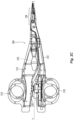
- Figs. 2B-2C show a lower profile, linear trigger design which is configured to inhibit the trigger from catching on the surgeon, patient, or on nearby objections during use and/or as forceps 2000 is inserted and withdrawn from the surgical site. More particularly, Figs. 2B-2C show forceps 2000 having trigger 2150 that is actuated linearly along longitudinal axis "A-A" defined between shafts 2110, 2120 to advance a knife (not shown, but see knife 140) through tissue disposed between jaw members 2210, 2220 of end effector assembly 2200. As such, the trigger 2150 does not extend beyond the periphery of either shaft 2110, 2120 during the range of linear motion.
- Fig. 2B shows the linear trigger 2150 in an un-actuated position wherein the knife (not shown, but see knife 140) is disposed in a retracted position within a knife channel (not shown) defined between the jaw members 2210, 2220. In this position, a trigger channel 2155 is exposed.
- Fig. 2C shows the trigger 2150 in a proximal, actuated position to deploy the knife between jaw members 2210, 2220 to cut tissue. In this position, the trigger 2150 covers the trigger channel 2155 to reduce the chances of pinching a surgical glove or finger during repeated actuation.
- Trigger 2150 is symmetric on both sides of shaft 2110 allowing actuation by right or left-handed surgeons.
- the internal working components of the knife deployment mechanism need to be slightly modified compared to the knife deployment mechanisms described above.
- Various types of deployment mechanism are envisioned and can generally be classified as linkage-type deployment mechanisms as shown in Figs. 3A-3D and gear-like deployment mechanisms as shown in Figs. 4A-4D .
- a linkage-type knife deployment mechanism 3150 includes a knife carrier 3170, a series of linkages 3160, 3180, 3190 and a knife return spring 3115 that cooperate to smoothly advance the knife (not shown) in a linear motion upon actuation of trigger 2150 ( Figs. 2B-2C ). More particularly, trigger 2150 connects to link 3190 via pin 3195 which, in turn, operably connects to crank link 3180 via pivot 3185. Pivot 3185 is configured to slide linearly in slot 3140 defined in knife support 3114. Crank link 3180 is operably connected to link 3160 via pivot 3175 which is supported within arcuate channel 3112 defined within shaft 3110.
- Link 3160 is operably connected to knife carrier 3170 via pin 3165.
- Pin 3165 is configured to translate knife carrier 3170 within slot 3120 defined in a distal end of knife support 3114.
- Knife support 3114 is, in turn, operably connected to knife (not shown, but see knife 140).
- knife return spring 3115 connects to crank link 3180 proximate link 3160 and moves concurrently therewith upon actuation of trigger 2150.
- the other end 3115b of spring 3115 is secured to shaft 3110.
- the linkage design with a linear trigger 2150 allows the forceps 2000 height to decrease, requiring less housing constraints while maintaining a similar mechanical advantage to previous designs.
- pin 3195 moves link 3190 proximally which, in turn, moves pivot 3185 proximally within slot 3140.
- a distal end 3180a of crank link 3180 moves therewith causing pin 3183 to move proximally and rotate clockwise within slot 3130 which, in turn, forces the proximal end 3180b of crank link 3180 distally.
- Movement of proximal end 3180b of crank link 3180 distally rotates link 3160 distally within arcuate slot 3112 against the bias of return spring 3115.
- Distal movement of link 3160 forces knife carrier 3170 distally within slot 3120 to advance knife (not shown) through tissue.
- a knife kickout may be used to force the knife proximally as the shafts 2110, 2120 are opened (See Figs. 6A-8B ).
- Fig. 3B shows another embodiment of the knife deployment mechanism 3150 for use with forceps 2000 which includes a trigger carrier 3300 that operably connects to the trigger 2150.
- Trigger carrier 3300 includes a cam slot 3310 defined therein that resides in general perpendicular registration with slot 3140 in knife carrier 3114 and that is configured to slidingly receive pivot 3185 therein.
- trigger carrier 3300 Upon actuation of the trigger 2150, trigger carrier 3300 is moved proximally and the pivot 3185 rides along the cam slot 3310 in a general perpendicular direction. Utilizing the cam slot 3310 allows for smoother and more consistent actuation of trigger 2150.
- Fig. 3C shows another embodiment of the knife deployment mechanism 3150 for use with forceps 2000 which includes a guide slot 3163 defined within a proximal end of link 3160 that allows pivot 3175 to ride therein during actuation of trigger 2150.
- link 3170 is moved proximally to pivot link crank 3180 distally which, in turn, forces link 3160 distally to advance knife (not shown).
- Utilizing the guide slot 3163 allows for smoother and more consistent actuation of the trigger 2150 and knife through their range of motion.
- Knife lockout mechanism 3370 shown in phantom
- Knife lockout mechanism 3370 is similar to knife lockout 170 of Figs. 1D-1F and, as such, is only described in brief detail herein.
- Knife lockout mechanism 3370 includes a flange 3355 disposed in operative engagement with the knife carrier 3170 and depending therefrom. When the trigger 2150 is in an unactuated position, flange 3355 is configured to project downwardly relative thereto in alignment with shaft 2120 of forceps 2000.
- the flange 3355 Upon closing of the handles 2118, 2128, the flange 3355 abuts against shaft 2120 and is forced inwardly toward shaft 2110 to disengage the flange 3355 from the knife carrier 3170. Once disengaged, the trigger 2150 is free to actuate the knife (not shown). When the trigger 2150 is returned to an unactuated position and the handles 2118, 2128 are moved away from one another, the flange 3355 re-engages the knife carrier 3170 to prevent translation of the knife.
- a gear-type knife deployment mechanism 4150 includes a blade rack 4170, a trigger rack 4160 and a gear 4155 disposed therebetween.
- Gear 4155 is configured to reverse direction between the two racks 4160, 4170 and may also be utilized to amplify overall force or distance therebetween.
- Blade rack 4170 is operably coupled to the trigger 2150 ( Fig. 2B ) via a trigger carrier 4300, which, in turn, includes one or more pins 4195 or other mechanical interfaces that engage the trigger 2150 directly such that movement of the trigger 2150 correspondingly moves the blade rack 4170.
- Gear 4155 is mounted about pin 4157 to shaft 4110 and between racks 4160, 4170. Movement of one rack, e.g., rack 4170 causes the other rack, e.g., rack 4160, to move in the opposite direction.
- Rack 4160 is operably couple to the knife carrier 4200. As such, proximal movement of the trigger 2150 is converted to distal movement of the knife (not shown).
- Fig. 4B shows an alternative setup of a gear-type knife deployment mechanism 4150 showing slightly modified blade and trigger racks 4170, 4160 for actuating the knife and return spring 4115 for facilitating the return of the knife.
- Return spring 4115 is operably coupled to the blade rack 4170 but may be coupled to either rack 4160, 4170 depending upon a particular purpose.
- Fig. 4C shows yet another embodiment of a gear-type knife deployment mechanism 4150' showing slightly modified blade and trigger racks 4170', 4160' and two gears for actuating the knife (not shown). More particularly, a single gear 4155a is operably associated with trigger rack 4160' and a compound gear 4155b is operably associated with blade rack 4170'. Compound gear 4155b allows the two gears 4155a, 4155b to align in general vertical registry while still providing the same reversing effect between the trigger 2150 and knife deployment. As can be appreciated, this may save valuable real estate within the shaft 4110 for additional components or a reduced profile.
- Fig. 4D shows another embodiment of a combination gear and lever-type knife deployment mechanism 5150 having a trigger rack 5160 operably coupled to a compound gear 5155c, multiple single gears 5155a, 5155b, a knife link 5190, and a knife carrier 5200.
- this combination deployment mechanism 5150 can be configured to provide mechanical advantages for amplifying overall force applied to the knife or distance the knife travels with trigger 2150 actuation.
- Knife kickout mechanism 4370 for use with the knife deployment mechanism 4150 of Fig. 4A .
- Knife kickout mechanism 4370 includes a flange 4355 disposed in operative engagement with the knife carrier 4200 (See Fig. 4A ) and depending therefrom.
- flange 4355 When the trigger 2150 is in an unactuated position, flange 4355 is configured to project downwardly relative thereto in alignment with shaft 2120 of forceps 2000.
- the flange 4355 Upon closing of the handles 2118, 2128, the flange 4355 is received within a slot defined in the shaft 2110 and is forced inwardly toward a kickout ramp 2121 (See FIG. 6A ).
- the flange 4355 engages the kickout ramp 212 to urge the knife carrier 4200 forward facilitating knife carrier 4200 return.
- Knife lockout mechanism 6370 for use with the knife deployment mechanism similar to those shown in Figs. 3A-3D .
- Knife lockout mechanism 6370 is similar to knife lockout 170 of Figs. 1D-1F and as such, is only described in brief detail herein.
- Knife lockout mechanism 6370 includes a flange 6355 disposed in rotational engagement with the knife carrier 6200. When the trigger 2150 is in an unactuated position, flange 6355 is configured to project downwardly relative thereto in alignment with shaft 2120 of forceps 2000. Upon closing of the handles 2118, 2128, the flange 6355 abuts against shaft 2120 and is forced inwardly toward shaft 2110 (See Figs.
- a distal end 6356 of the flange 6355 rotates out of engagement with a proximal hook portion 6201 of the knife carrier 6200.
- the trigger 2150 is free to actuate the knife (not shown).
- the distal end 6356 of the flange 6355 re-engages the hook portion 6201 of the knife carrier 6200 to prevent translation of the knife.
- a knife kickout various embodiments of a knife kickout are envisioned.
- the described knife kickout mechanisms are configured to work with many of the aforedescribed forceps and internal components thereof, and as such, only those components necessary for an accurate understanding of the kickout are described in detail herein.
- Knife kickout 6310 for use with trigger carrier 6300.
- Knife kickout 6310 is configured to depend from trigger carrier 6300 and align in vertical registration with an elongated kickout slot 2123 defined within shaft 2120.
- Shaft 2120 also includes a kickout ramp 2121 defined at a proximal-most portion of the kickout slot 2123.
- shafts 2110, 2120 are urged into close abutment with one another to either allow actuation of the knife (not shown) via trigger 2150 and/or activation of electrical energy via switch 2183.
- trigger carrier 6300 As the trigger carrier 6300 is actuated (proximally), the kickout 6310 rides within slot 2123 of shaft 2120 into abutment with kickout ramp 2121. Typically, upon release of the trigger 2150, trigger carrier 6300 is supposed to automatically return to a distal-most position under the bias of knife return spring 6315. If the knife (not shown) gets caught in the knife channel disposed between jaw members 2210, 2220 or gets caught on tissue, the bias of the knife return spring 6315 may not be enough and the knife may remain in a deployed position.
- the user simply begins to open the forceps 2000 causing the shafts 2110, 2120 to move relative to one another and causing the kickout ramp 2121 to essentially "kick" the knife kickout 6310 forward as the handles 2118, 2128 open. Forward motion of the knife kickout 6310, in turn, forces the trigger carrier 6300 forward and, thus, forces the knife proximally.
- Knife kickout 7310 is configured to depend from trigger carrier 7300 and align in vertical registration with an elongated kickout slot 2123 defined within shaft 2120.
- Shaft 2120 also includes a kickout ramp 2121 defined at a proximal-most portion of the kickout slot 2123.
- trigger carrier 7300 As the trigger carrier 7300 is actuated (proximally), the kickout 7310 rides within slot 2123 of shaft 2120 into abutment with kickout ramp 2121. Typically, upon release of the trigger 2150, trigger carrier 7300 is supposed to automatically return to a distal-most position under the bias of knife return spring 7315. If the knife (not shown) gets caught in the knife channel disposed between jaw members 2210, 2220 or gets caught on tissue, the bias of the knife return spring 7315 may not be enough and the knife may remain in a deployed position.
- the user simply begins to open the forceps 2000 causing the shafts 2110, 2120 to move relative to one another and causing the kickout ramp 2121 to essentially "kick" the knife kickout 7310 forward as the handles 2118, 2128 open. Forward motion of the knife kickout 7310, in turn, forces the trigger carrier 7300 forward and, thus, forces the knife proximally.
- Knife kickout 8310 is configured to depend from kickout link 8300 and align in vertical registration with an elongated kickout slot 2123 defined within shaft 2120.
- Shaft 2120 also includes a kickout ramp 2121 defined at a proximal-most portion of the kickout slot 2123.
- shafts 2110, 2120 are urged into close abutment with one another to either allow actuation of the knife (not shown) via trigger 2150 and/or activation of electrical energy via switch 2183.
- Kickout link 8300 is rotatingly engaged at one end to link 8180 and positioned proximally of pivot 8195 a distal end of link 8190 such that movement of link 8190 pulls kickout link 8300 proximally along therewith.
- kickout link 8300 As mentioned above with respect to Fig. 3A , as the trigger 2150 is actuated, kickout link 8300 is actuated (proximally), the kickout 8310 rides within slot 2123 of shaft 2120 into abutment with kickout ramp 2121. Typically, upon release of the trigger 2150, kickout link 8300 is supposed to automatically return to a distal-most position under the bias of knife return spring 8315. If the knife (not shown) gets caught in the knife channel disposed between jaw members 2210, 2220 or gets caught on tissue, the bias of the knife return spring 8315 may not be enough and the knife may remain in a deployed position.
- the user simply begins to open the forceps 2000 causing the shafts 2110, 2120 to move relative to one another and causing the kickout ramp 2121 to essentially "kick" the knife kickout 8310 and link 8180 forward as the handles 2118, 2128 open. Forward motion of the knife kickout 8310, in turn, forces the kickout link 8300 and link 8180 forward and, thus, forces the knife proximally.
- a knife lockout various embodiments of a knife lockout are envisioned.
- the described knife lockout mechanisms are configured to work with many of the aforedescribed forceps and internal components thereof, and as such, only those components necessary for an accurate understanding of the kickout are described in detail herein.
- Knife lockout 9000 is L-shaped and includes an elongated shaft 9050 connected at a distal end thereof to shaft 2110 by a flange pin 9175 and terminating at an opposite end thereof with a flange 9100 that depends in oppositional registry with shaft 2120.
- the distal end 9105 of flange 9100 is configured to abut shaft 2120 upon approximation of shaft members 2110, 2120 to force flange inwardly towards shaft 2110.
- Knife deployment mechanism 4150 includes a locking pin 4365 operably engaged with trigger rack 4160 (see FIG. 4B ) that is configured to ride within an elongated slot 4375 defined therein upon actuation of the knife deployment mechanism 4150.
- Flange 9100 includes a slot 9110 defined therein configured to seat locking pin 4365 therein to prevent actuation of the knife deployment mechanism 4150 when the shaft members 2110, 2120 are disposed in an open position.
- the knife deployment mechanism 4150 and the trigger 2150 are released and returned under the bias of the knife return spring 4115 (See Fig. 4A ).
- locking pin 4365 returns along elongated slot 4375 to its unactuated position.
- the locking pin 4365 engages ramp a 9115 disposed distally of slot 9110 which forces flange 9100 inwardly relative to shaft 2110 to allow the locking pin 4365 to reseat within slot 9110 re-locking the knife deployment mechanism 4150 and preventing movement thereof.
- Any type of conventional spring may also be utilized for this purpose.
- Knife lockout 10000 is L-shaped and includes an elongated shaft 10050 connected at a distal end thereof to shaft 2110 by a sleeve 10175 and terminating at an opposite end thereof with a flange 10100 that depends in oppositional registry with shaft 2120.
- the distal end 10105 of flange 10100 is configured to abut shaft 2120 upon approximation of shaft members 2110, 2120 to force flange inwardly towards shaft 2110.
- Knife deployment mechanism 3150 includes a locking pin 3165 that operably engages link 3160 and knife carrier 3170 and that is configured to ride within an elongated slot 3375 defined in knife carrier 3170 upon actuation of the knife deployment mechanism 3150.
- Flange 10100 includes a slot 10110 defined therein configured to seat locking pin 3165 therein to prevent actuation of the knife deployment mechanism 3150 when the shaft members 2110, 2120 are disposed in an open position.
- the locking pin 3165 is seated within slot 10110 preventing movement of the knife deployment mechanism 3150.
- the distal end 10105 of flange 10100 abuts shaft 2120 forcing the flange 10100 towards shaft 2110 and causing the elongated shaft 10050 to flex about sleeve 10175.
- locking pin 3165 is unseated or disengaged from slot 10110 allowing actuation of the knife deployment mechanism 3150.
- Locking pin 3165 rides along elongated slot 3375 during actuation.
- the knife deployment mechanism 3150 and the trigger 2150 are released and returned under the bias of the knife return spring 3115 (See Fig. 3A ).
- locking pin 3165 returns along elongated slot 3375 to its unactuated position.
- the locking pin 3165 engages ramp a 10115 disposed distally of slot 10110 which forces flange 10100 inwardly relative to shaft 2110 to allow the locking pin 3165 to reseat within slot 10110 re-locking the knife deployment mechanism 3150 and preventing movement thereof.
- Knife lockout 11000 is L-shaped and includes an elongated shaft 11050 connected at a proximal end thereof to shaft 2110 by a flange pin 11175 and terminating at an opposite end thereof with a flange 11100 that depends in oppositional registry with shaft 2120.
- the distal end 11105 of flange 11100 is configured to abut shaft 2120 upon approximation of shaft members 2110, 2120 to force flange inwardly towards shaft 2110.
- Flange 11100 includes a boss 11110 disposed thereon therein configured to seat within a gear slot 4171 defined in gear rack 4170 to prevent actuation of the knife deployment mechanism 4150 when the shaft members 2110, 2120 are disposed in an open position.
- boss 11110 is seated within gear slot 4171 preventing movement of the knife deployment mechanism 4150.
- the distal end 11105 of flange 11100 abuts shaft 2120 forcing the flange 11100 towards shaft 2110 and causing the elongated shaft 11050 to rotate about flange pin 11175.
- boss 11110 is unseated or disengaged from gear slot 4171 allowing actuation of the knife deployment mechanism 4150.
- Boss 11110 remains out of the way during movement of the opposing racks 4170, 4160 ( Fig. 4A ).
- the various embodiments disclosed herein may also be configured to work with robotic surgical systems and what is commonly referred to as "Telesurgery.”
- Such systems employ various robotic elements to assist the surgeon and allow remote operation (or partial remote operation) of surgical instrumentation.
- Various robotic arms, gears, cams, pulleys, electric and mechanical motors, etc. may be employed for this purpose and may be designed with a robotic surgical system to assist the surgeon during the course of an operation or treatment.
- Such robotic systems may include remotely steerable systems, automatically flexible surgical systems, remotely flexible surgical systems, remotely articulating surgical systems, wireless surgical systems, modular or selectively configurable remotely operated surgical systems, etc.
- the robotic surgical systems may be employed with one or more consoles that are next to the operating theater or located in a remote location.
- one team of surgeons or nurses may prep the patient for surgery and configure the robotic surgical system with one or more of the instruments disclosed herein while another surgeon (or group of surgeons) remotely controls the instruments via the robotic surgical system.
- a highly skilled surgeon may perform multiple operations in multiple locations without leaving his/her remote console which can be both economically advantageous and a benefit to the patient or a series of patients.
- the robotic arms of the surgical system are typically coupled to a pair of master handles by a controller.
- the handles can be moved by the surgeon to produce a corresponding movement of the working ends of any type of surgical instrument (e.g., end effectors, graspers, knifes, scissors, etc.) which may complement the use of one or more of the embodiments described herein.
- the movement of the master handles may be scaled so that the working ends have a corresponding movement that is different, smaller or larger, than the movement performed by the operating hands of the surgeon.
- the scale factor or gearing ratio may be adjustable so that the operator can control the resolution of the working ends of the surgical instrument(s).
- the master handles may include various sensors to provide feedback to the surgeon relating to various tissue parameters or conditions, e.g., tissue resistance due to manipulation, cutting or otherwise treating, pressure by the instrument onto the tissue, tissue temperature, tissue impedance, etc. As can be appreciated, such sensors provide the surgeon with enhanced tactile feedback simulating actual operating conditions.
- the master handles may also include a variety of different actuators for delicate tissue manipulation or treatment further enhancing the surgeon's ability to mimic actual operating conditions.
Landscapes
- Health & Medical Sciences (AREA)
- Surgery (AREA)
- Engineering & Computer Science (AREA)
- Life Sciences & Earth Sciences (AREA)
- Biomedical Technology (AREA)
- Otolaryngology (AREA)
- Nuclear Medicine, Radiotherapy & Molecular Imaging (AREA)
- Plasma & Fusion (AREA)
- Physics & Mathematics (AREA)
- Heart & Thoracic Surgery (AREA)
- Medical Informatics (AREA)
- Molecular Biology (AREA)
- Animal Behavior & Ethology (AREA)
- General Health & Medical Sciences (AREA)
- Public Health (AREA)
- Veterinary Medicine (AREA)
- Surgical Instruments (AREA)
Description
- The present disclosure relates to electrosurgical instruments and, more particularly, to electrosurgical forceps for grasping, treating, and/or dividing tissue.
- A surgical forceps is a plier-like instrument which relies on mechanical action between its jaws to grasp tissue. Electrosurgical forceps utilize both mechanical clamping action and electrical energy to treat tissue, e.g., coagulate, cauterize, and/or seal tissue.
- Typically, once tissue is treated, the surgeon has to accurately sever the treated tissue. Accordingly, many electrosurgical forceps have been designed which incorporate a knife configured to effectively sever tissue after treating the tissue. An electrosurgical forceps with a lockout assembly is known from
US2019/357962 A1 . - As used herein, the term "distal" refers to the portion that is being described which is further from a surgeon, while the term "proximal" refers to the portion that is being described which is closer to a surgeon. Further, to the extent consistent, any of the aspects described herein may be used in conjunction with any or all of the other aspects described herein.
- The invention is defined in independent claim 1 and relates to an electrosurgical forceps with a knife lockout . All aspects and embodiments relating to an electrosurgical forceps without a knife lockout are not claimed and shown for illustrative purposes only. An electrosurgical forceps provided in accordance with aspects of the present disclosure includes first and second shaft members each having a jaw member disposed at a distal end thereof, the first and second shaft members configured to rotate about a pivot to move the jaw members between an open position and a closed position, the first and second shaft members defining a longitudinal axis therebetween. A knife deployment mechanism is disposed within the first shaft member and includes a trigger moveable along the longitudinal axis to deploy a knife (which may also be deployable along the longitudinal axis) operably coupled thereto between a retracted position relative to the jaw members and an extended position between the jaw members. The knife deployment mechanism includes first and second rack members operably coupled to one another by a gear disposed therebetween. The trigger is operably connected to the first rack member and the knife is operably coupled to the second rack member such that movement of the trigger moves the knife in an opposite direction relative thereto. A knife lockout is configured to move upon approximation of the first and second shaft members between an engaged position preventing deployment of the knife and a disengaged position allowing deployment of the knife. The knife lockout includes a flange operably connected to the first shaft member and depending therefrom in opposition to the second shaft member such that approximation of the first and second shaft members forces the flange against the second shaft member to disengage the knife lockout to allow actuation of the knife.
- In aspects according to the present disclosure, the first shaft member includes a trigger slot defined therein, the trigger is configured to travel between a distal-most position wherein the trigger slot is exposed and a more proximal position wherein the trigger covers the trigger slot to reduce the chances of a user's finger being pinched within the trigger slot. In other aspects according to the present disclosure, the forceps further includes a switch assembly disposed on one of the first or second shaft members which is configured to be engaged by the other of the first or second shaft members when the jaw members are approximated to move the switch assembly between a deactivated position and an activated position to control delivery of electrosurgical energy to the jaw members.
- In aspects according to the present disclosure, a knife return spring is operably coupled to the knife deployment mechanism and is configured to bias the knife toward the retracted position. In other aspects according to the present disclosure, the knife return spring is operable coupled to one or both of the first or second rack members. In yet other aspects according to the present disclosure, the knife lockout includes a slot defined in the flange configured to operably engage a lock pin disposed in the knife deployment mechanism to prevent movement of the knife when engaged.
- In aspects according to the present disclosure, upon approximation of the first and second shaft members, the flange is configured to dislodge the slot from engagement with the lock pin of the knife deployment mechanism to allow selective actuation of the knife. In other aspects according to the present disclosure, the flange is connected to the first shaft member by a flange pin. In yet other aspects according to the present disclosure, the flange is fixed at a distal end thereof by the flange pin and, upon approximation of the first and second shaft members, the flange is configured to cantilever or flex about the flange pin to dislodge the lock pin from the slot defined therein. In yet other aspects according to the present disclosure, upon opening of the first and second shaft members relative to one another the bias of the flange reseats the lock pin within the slot.
- In aspects according to the present disclosure, the knife deployment mechanism includes an elongated slot defined therein to allow reciprocation of the lock pin therein. In other aspects according to the present disclosure, the flange includes a ramp to facilitate reseating the lock pin within the slot upon return of the knife deployment mechanism.
- In yet other aspects according to the present disclosure, the knife lockout includes a boss disposed on the flange configured to operably engage one of a plurality of slots defined between a plurality of gears in the first rack to prevent movement of the knife when engaged. In still other aspects according to the present disclosure, upon approximation of the first and second shaft members, the boss on the flange is configured to dislodge from the one of a plurality of slots to allow selective actuation of the knife. In aspects according to the present disclosure, the flange is fixed at a proximal end thereof by the pivot and, upon approximation of the first and second shaft members, the flange is configured to rotate about the pivot to dislodge the boss from gear.
- In aspects according to the present disclosure, a knife kickout mechanism is configured to force the knife forward upon movement of the first and second shaft members from an approximated position to a more open position. In other aspects according to the present disclosure, the knife kickout mechanism includes a flange depending from the knife deployment mechanism in oppositional alignment with the second shaft member wherein, upon approximation of the first and second shaft members and actuation of the knife deployment mechanism in a first direction, the knife kickout rides within a slot defined within the second shaft member to abutingly engage a ramp defined in the slot and wherein, upon opening of the first and second shaft members relative to one another, the ramp forces the knife kickout mechanism in an opposite direction to facilitate return of the knife deployment mechanism to an unactuated position.
- An electrosurgical forceps provided in accordance with additional aspects of the present disclosure includes first and second shaft members each having a jaw member disposed at a distal end thereof, the first and second shaft members configured to rotate about a pivot to move the jaw members between an open position and a closed position, the first and second shaft members defining a longitudinal axis therebetween. A knife deployment mechanism is disposed within the first shaft member and includes a trigger moveable along the longitudinal axis to deploy a knife operably coupled thereto between a retracted position relative to the jaw members and an extended position between the jaw members, the knife deployment mechanism including first and second rack members operably coupled to one another by a gear disposed therebetween, the trigger operably connected to the first rack member and the knife operably coupled to the second rack member such that movement of the trigger moves the knife in an opposite direction relative thereto. A knife kickout mechanism is configured to force the knife forward upon movement of the first and second shaft members from an approximated position to a more open position, the knife kickout mechanism including a flange depending from the knife deployment mechanism in oppositional alignment with the second shaft member wherein, upon approximation of the first and second shaft members and actuation of the knife deployment mechanism in a first direction, the knife kickout rides within a slot defined within the second shaft member to abutingly engage a ramp defined in the slot and wherein, upon opening of the first and second shaft members relative to one another, the ramp forces the knife kickout mechanism in an opposite direction to facilitate return of the knife deployment mechanism to an unactuated position.
- In aspects according to the present disclosure, a switch assembly is disposed on one of the first or second shaft members and is configured to be engaged by the other of the first or second shaft members when the jaw members are approximated to move the switch assembly between a deactivated position and an activated position to control delivery of electrosurgical energy to the jaw members. In other aspects according to the present disclosure, a knife return spring is operably coupled to the knife deployment mechanism and configured to bias the knife toward the retracted position.
- An electrosurgical forceps provided in accordance with additional aspects of the present disclosure includes first and second shaft members each having a jaw member disposed at a distal end thereof, the first and second shaft members configured to rotate about a pivot to move the jaw members between an open position and a closed position, the first and second shaft members defining a longitudinal axis therebetween. A knife deployment mechanism is disposed within the first shaft member and includes a trigger moveable along the longitudinal axis to deploy a knife operably coupled thereto between a retracted position relative to the jaw members and an extended position between the jaw members, the knife deployment mechanism including a series of links operably coupled to one another and to a knife carrier configured to translate the knife. A knife lockout is configured to move upon approximation of the first and second shaft members between an engaged position preventing deployment of the knife and a disengaged position allowing deployment of the knife, the knife lockout including a flange operably connected to the first shaft member and depending therefrom in opposition to the second shaft member such that approximation of the first and second shaft members forces the flange against the second shaft member to disengage the knife lockout to allow actuation of the knife.
- In aspects according to the present disclosure, the first shaft member includes a trigger slot defined therein, the trigger is configured to travel between a distal-most position wherein the trigger slot is exposed and a more proximal position wherein the trigger covers the trigger slot to reduce the chances of a user's finger being pinched within the trigger slot. In other aspects according to the present disclosure, a switch assembly is disposed on one of the first or second shaft members and is configured to be engaged by the other of the first or second shaft members when the jaw members are approximated to move the switch assembly between a deactivated position and an activated position to control delivery of electrosurgical energy to the jaw members.
- In aspects according to the present disclosure, a knife return spring is operably coupled to the knife deployment mechanism and configured to bias the knife toward the retracted position. In other aspects according to the present disclosure, the knife return spring is operable coupled to at least one of the series of links.
- In aspects according to the present disclosure, the knife lockout includes a slot defined in the flange configured to operably engage a lock pin disposed in the knife deployment mechanism to prevent movement of the knife when engaged. In other aspects according to the present disclosure, upon approximation of the first and second shaft members, the flange is configured to dislodge the slot from engagement with the lock pin of the knife deployment mechanism to allow selective actuation of the knife. In yet other aspects according to the present disclosure, the flange is connected to the first shaft member by a sleeve.
- In aspects according to the present disclosure, the flange includes an elongated shaft fixed at a distal end thereof by the sleeve disposed within the first shaft member and, upon approximation of the first and second shaft members, the elongated shaft of the flange is configured to cantilever or flex at the sleeve to dislodge the lock pin from the slot defined therein. In other aspects according to the present disclosure, upon opening of the first and second shaft members relative to one another the bias of the elongated shaft reseats the lock pin within the slot.
- In aspects according to the present disclosure, the knife deployment mechanism includes an elongated slot defined therein to allow reciprocation of the lock pin therein. In other aspects according to the present disclosure, the flange includes a ramp to facilitate reseating the lock pin within the slot of the flange upon return of the knife deployment mechanism.
- In aspects according to the present disclosure, a knife kickout mechanism is configured to force the knife forward upon movement of the first and second shaft members from an approximated position to a more open position. In other aspects according to the present disclosure, the knife kickout mechanism includes a flange depending from the knife deployment mechanism in oppositional alignment with the second shaft member wherein, upon approximation of the first and second shaft members and actuation of the knife deployment mechanism in a first direction, the knife kickout rides within a slot defined within the second shaft member to abutingly engage a ramp defined in the slot and wherein, upon opening of the first and second shaft members relative to one another, the ramp forces the knife kickout mechanism in an opposite direction to facilitate return of the knife deployment mechanism to an unactuated position.
- An electrosurgical forceps provided in accordance with additional aspects of the present disclosure includes first and second shaft members each having a jaw member disposed at a distal end thereof, the first and second shaft members configured to rotate about a pivot to move the jaw members between an open position and a closed position, the first and second shaft members defining a longitudinal axis therebetween. A knife deployment mechanism is disposed within the first shaft member and includes a trigger moveable along the longitudinal axis to deploy a knife operably coupled thereto between a retracted position relative to the jaw members and an extended position between the jaw members, the knife deployment mechanism including a series of links operably coupled to one another and to a knife carrier configured to translate the knife. A knife kickout mechanism is configured to force the knife forward upon movement of the first and second shaft members from an approximated position to a more open position, the knife kickout mechanism including a flange depending from the knife deployment mechanism in oppositional alignment with the second shaft member wherein, upon approximation of the first and second shaft members and actuation of the knife deployment mechanism in a first direction, the knife kickout rides within a slot defined within the second shaft member to abutingly engage a ramp defined in the slot and wherein, upon opening of the first and second shaft members relative to one another, the ramp forces the knife kickout mechanism in an opposite direction to facilitate return of the knife deployment mechanism to an unactuated position.
- In aspects according to the present disclosure, a switch assembly disposed on one of the first or second shaft members and configured to be engaged by the other of the first or second shaft members when the jaw members are approximated to move the switch assembly between a deactivated position and an activated position to control delivery of electrosurgical energy to the jaw members.
- In aspects according to the present disclosure, a knife return spring operably coupled to the knife deployment mechanism and configured to bias the knife toward the retracted position
An electrosurgical forceps provided in accordance with additional aspects of the present disclosure includes first and second shaft members each having a jaw member disposed at a distal end thereof, the first and second shaft members configured to rotate about a pivot to move the jaw members between an open position and a closed position, the first and second shaft members defining a longitudinal axis therebetween. A knife deployment mechanism is disposed within the first shaft member and includes a trigger moveable along the longitudinal axis to deploy a knife operably coupled thereto between a retracted position relative to the jaw members and an extended position between the jaw members. A knife lockout is configured to move upon approximation of the first and second shaft members between an engaged position preventing deployment of the knife and a disengaged position allowing deployment of the knife, the knife lockout including a flange operably connected to the first shaft member and depending therefrom in opposition to the second shaft member such that approximation of the first and second shaft members forces the flange against the second shaft member to disengage the knife lockout to allow actuation of the knife. A knife kickout mechanism is configured to force the knife forward upon movement of the first and second shaft members from an approximated position to a more open position, the knife kickout mechanism including a flange depending from the knife deployment mechanism in oppositional alignment with the second shaft member wherein, upon approximation of the first and second shaft members and actuation of the knife deployment mechanism in a first direction, the knife kickout rides within a slot defined within the second shaft member to abutingly engage a ramp defined in the slot and wherein, upon opening of the first and second shaft members relative to one another, the ramp forces the knife kickout mechanism in an opposite direction to facilitate return of the knife deployment mechanism to an unactuated position. - In aspects according to the present disclosure, the first shaft member includes a trigger slot defined therein, the trigger is configured to travel between a distal-most position wherein the trigger slot is exposed and a more proximal position wherein the trigger covers the trigger slot to reduce the chances of a user's finger being pinched within the trigger slot.
- In aspects according to the present disclosure, a switch assembly is disposed on one of the first or second shaft members and is configured to be engaged by the other of the first or second shaft members when the jaw members are approximated to move the switch assembly between a deactivated position and an activated position to control delivery of electrosurgical energy to the jaw members.
- In aspects according to the present disclosure, a knife return spring is operably coupled to the knife deployment mechanism and is configured to bias the knife toward the retracted position. In other aspects according to the present disclosure, the knife lockout includes a slot defined in the flange configured to operably engage a lock pin disposed in the knife deployment mechanism to prevent movement of the knife when engaged.
- In aspects according to the present disclosure, upon approximation of the first and second shaft members, the flange is configured to dislodge the slot from engagement with the lock pin of the knife deployment mechanism to allow selective actuation of the knife. In other aspects according to the present disclosure, the flange is connected to the first shaft member by a sleeve. In yet other aspects according to the present disclosure, the flange is connected to the first shaft member by a flange pin.
- In aspects according to the present disclosure, the flange includes an elongated shaft fixed at a distal end thereof to the first shaft member and, upon approximation of the first and second shaft members, the elongated shaft of the flange is configured to cantilever or flex to dislodge the lock pin from the slot defined therein. In other aspects according to the present disclosure, upon opening of the first and second shaft members relative to one another the bias of the elongated shaft reseats the lock pin within the slot. In still other aspects according to the present disclosure, the knife deployment mechanism includes an elongated slot defined therein to allow reciprocation of the lock pin therein.
- In aspects according to the present disclosure, the flange includes a ramp to facilitate reseating the lock pin within the slot of the flange upon return of the knife deployment mechanism.
- An electrosurgical forceps provided in accordance with additional aspects of the present disclosure includes first and second shaft members each having a jaw member disposed at a distal end thereof, the first and second shaft members configured to rotate about a pivot to move the jaw members between an open position and a closed position, the first and second shaft members defining a longitudinal axis therebetween. A knife deployment mechanism is disposed within the first shaft member and includes a trigger moveable along the longitudinal axis to deploy a knife operably coupled thereto between a retracted position relative to the jaw members and an extended position between the jaw members. A knife lockout is disposed within the first shaft member in oppositional alignment with the second shaft member and is configured to move upon approximation of the first and second shaft members between an engaged position preventing deployment of the knife and a disengaged position allowing deployment of the knife. A knife kickout mechanism is configured to force the knife forward upon movement of the first and second shaft members from an approximated position to a more open position, the knife kickout mechanism including a flange depending from the knife deployment mechanism in oppositional alignment with the second shaft member wherein, upon approximation of the first and second shaft members and actuation of the knife deployment mechanism in a first direction, the knife kickout rides within a slot defined within the second shaft member to abutingly engage a ramp defined in the slot and wherein, upon opening of the first and second shaft members relative to one another, the ramp forces the knife kickout mechanism in an opposite direction to facilitate return of the knife deployment mechanism to an unactuated position.
- An electrosurgical forceps provided in accordance with additional aspects of the present disclosure includes first and second shaft members each having a jaw member disposed at a distal end thereof, the first and second shaft members configured to rotate about a pivot to move the jaw members between an open position and a closed position, the first and second shaft members defining a longitudinal axis therebetween. A knife deployment mechanism is disposed within the first shaft member and includes a trigger moveable along the longitudinal axis to deploy a knife operably coupled thereto between a retracted position relative to the jaw members and an extended position between the jaw members. A knife lockout is configured to move upon approximation of the first and second shaft members between an engaged position preventing deployment of the knife and a disengaged position allowing deployment of the knife, the knife lockout including a flange operably connected to the first shaft member and depending therefrom in opposition to the second shaft member such that approximation of the first and second shaft members forces the flange against the second shaft member to disengage the knife lockout to allow actuation of the knife. A knife kickout mechanism is disposed within the first shaft member in oppositional alignment with the second shaft member and is configured to force the knife forward upon movement of the first and second shaft members from an approximated position to a more open position.
- Various aspects and features of the present electrosurgical forceps are described hereinbelow with reference to the drawings wherein like numerals designate identical or corresponding elements in each of the several views:
-
Fig. 1A-1F are various views of a prior art electrosurgical forceps including a knife lockout mechanism; -
Fig. 2A is a side view of a first iteration of an electrosurgical forceps according to the present disclosure shown superimposed upon the forceps ofFig. 1A illustrating the same rotating trigger mechanism as the trigger mechanism ofFig. 1A shown overhanging a bottom shaft of the presently disclosed forceps; -
Fig. 2B is a side view of a second iteration of the electrosurgical forceps ofFig. 2A showing a linear trigger mechanism prior to actuation thereof; -
Fig. 2C is a side view of the electrosurgical forceps ofFig. 2B after actuation of a trigger thereof; -
Fig. 3A is a partial, front perspective view of the forceps ofFig. 2B showing the internal components of a link-driven knife deployment mechanism according to the present disclosure; -
Fig. 3B is a side view of the forceps shown inFig. 3A including a trigger carrier disposed atop the link-driven knife deployment mechanism according to the present disclosure; -
Fig. 3C is a rear perspective view of another embodiment of a link-driven knife deployment mechanism according to the present disclosure; -
Fig. 3D is a side view of another embodiment of a link-driven knife deployment mechanism according to the present disclosure; -
Fig. 4A is a partial, front perspective view of the forceps ofFig. 2B showing the internal components of a rack and gear-driven knife deployment mechanism according to the present disclosure; -
Fig. 4B is a rear perspective view of another embodiment of a gear-driven knife deployment mechanism according to the present disclosure; -
Fig. 4C is a top perspective view of another embodiment of a gear-driven knife deployment mechanism according to the present disclosure; -
Fig. 4D is a side view of another embodiment of a compound gear-driven knife deployment mechanism according to the present disclosure; -
Fig. 5A is a side perspective view of the forceps and gear-driven knife deployment mechanisms ofFig. 4A showing a knife kickout according to the present disclosure; -
Fig. 5B is a side perspective view of another embodiment of a knife kickout according to the present disclosure; -
Figs. 6A-6B are side views of the knife kickout ofFig. 5A illustrating operational movement thereof; -
Figs. 7A-7B are side views of another embodiment of a knife kickout according to the present disclosure illustrating operational movement thereof; -
Figs. 8A-8B are side views of another embodiment of a knife kickout according to the present disclosure illustrating operational movement thereof; -
Fig. 9 is a side view of the knife lockout according to the present disclosure; -
Fig. 10 is a side view of another embodiment of a knife lockout according to the present disclosure; and -
Fig. 11 is a side view of another embodiment of a knife lockout according to the present disclosure. - The present disclosure describes electrosurgical forceps for grasping, treating, and/or dividing tissue. The forceps includes two shafts each having a jaw member disposed at a distal end thereof and movable between open and closed positions to grasp tissue. The electrosurgical forceps also includes a knife configured to divide grasped tissue following treatment of the tissue (e.g., a tissue seal cycle). A knife lockout works in conjunction with the shafts to prevent deployment of the knife prior to the shafts reaching a sufficiently-approximated position corresponding to a sufficiently-closed position of jaw members as well as to prevent deployment of the knife during treatment of tissue.
- Referring generally to
Figs. 1A-1F , aforceps 100 provided in accordance with the present disclosure includes first andsecond shafts proximal end portion distal end portion end effector assembly 200 offorceps 100 includes first andsecond jaw members distal end portions shafts Forceps 100 further includes apivot member 130 pivotably coupling first andsecond shafts Fig. 1B ), aknife deployment mechanism 150 for selectively deployingknife 140 relative to endeffector assembly 200, a knife lockout 170 (Figs. 1D-1F ) for preventing deployment ofknife 140 prior to sufficient closure ofjaw members switch assembly 180 including adepressible activation button 183 for enabling the selective supply of electrosurgical energy to endeffector assembly 200. Anelectrosurgical cable 300 electrically couples forceps 100 to a source of energy (not shown), e.g., an electrosurgical generator, to enable the supply of electrosurgical energy tojaw members end effector assembly 200 upon activation ofswitch assembly 180. - The internal working components of the prior art forceps of
Figs. 1A-1F and, in particular, the inner-working components of theknife lockout 170 are disclosed in commonly-ownedU.S. Patent Application No. 15/617,283 . - Continuing with reference to
Figs. 1A-1F ,knife deployment mechanism 150 is coupled toshaft 110 and generally includes a pair of opposed triggers 152 (Fig. 1D ) extending from either side ofshaft 110, afirst linkage 154, asecond linkage 156, and abiasing spring 158.Knife deployment mechanism 150 is disposed withinouter housing 116 ofshaft 110 with the exception ofopposed triggers 152 which extend from either side ofouter housing 116.First linkage 154 is configured for positioning on one side of inner frame 114 (Fig. 1C ) ofshaft 110 and includes a pair of integral (or otherwise engaged) pivot bosses (not shown) extending from either side thereof at a first end portion offirst linkage 154. Each pivot boss enables engagement ofopposed triggers 152 therewith on either side ofshaft 110, e.g., via press-fitting, adhesion, or other suitable engagement. - A proximal end portion of
second linkage 156 is pivotably coupled tofirst linkage 154 at a second end portion offirst linkage 154. A distal end portion ofsecond linkage 156 is pivotably coupled toknife 140 via a pivot pin 163 (Fig. 1F ).Pivot pin 163 may be integrally formed withsecond linkage 156, e.g., as a post extending therefrom, or may be a separate component fromsecond linkage 156.Pivot pin 163 extends transversely through alongitudinal slot 115e (Fig. 1E ) ofinner frame 114 ofshaft 110 such thatpivot pin 163 is constrained to longitudinal movement withinlongitudinal slot 115e.Second linkage 156 is disposed on one side ofinner frame 114, which may be the same side asfirst linkage 154 or the opposite side (as shown). In either configuration,pivot pin 163 extends fromsecond linkage 156 and throughlongitudinal slot 115e such that a portion ofpivot pin 163 protrudes laterally from the opposite side ofinner frame 114. -
Biasing spring 158 may be configured as an extension spring or othersuitable biasing spring 158. A distal end portion of biasingspring 158 is engaged tofirst linkage 154 and a proximal end portion of biasingspring 158 is engaged to a support plate 166 (Fig. 1C ).Spring 158 may be engaged to any moveable components of theknife deployment mechanism 150.Support plate 166 includes handle 118 ofshaft 110 integrally formed therewith or otherwise engaged thereto, and may be secured withinouter housing 116 in any suitable fashion, e.g., via protrusion-aperture engagement.Support plate 166 provides increased structural support toshaft 110 to inhibit splaying ofshafts Shaft 120 similarly includes asupport plate 168 integrally formed with or otherwise engaginghandle 128 ofshaft 120 and secured toouter housing 126, althoughsupport plate 168 need not extend distally as withsupport plate 166. -
Biasing spring 158 biasesfirst linkage 154 towards a first orientation, corresponding to the un-actuated position oftriggers 152 and the proximal-most position ofsecond linkage 156, thereby biasingknife 140 towards a retracted position (e.g., a proximal-most position of knife 140). Upon rotation of either oftriggers 152 relative toshaft 110,first linkage 154 is rotated against the bias of biasingspring 158 to thereby urgesecond linkage 156 distally such thatpivot pin 163 is driven distally throughlongitudinal slot 115e (Fig. 1E ) to urgeknife 140 from the retracted position towards an extended position, whereinknife 140 extends through a slot defined inpivot member 130, a channel of body plate 115, and knife channels ofjaw members - In use, a distal portion of
knife 140 is configured to reciprocate through the slot ofpivot member 130 to translate through knife channels ofjaw members trigger 152.Knife deployment mechanism 150 is operably positioned onshaft 110 and relative toshaft 120 such that triggers 152 only slightly extend beyond the height dimension offorceps 100 in the vicinity oftriggers 152, in the furthest-approximated position ofshafts forceps 100 benefits from a low-profile design that reduces the chances oftriggers 152 catching on the surgeon, patient, or on nearby objections during use and/or asforceps 100 is inserted and withdrawn from the surgical site. - Turning to
Figs. 1D-1F ,knife lockout 170 works in conjunction withshafts knife 140 prior toshafts jaw members Knife lockout 170 includes a body 172 (Figs. 1A-1C ) that is disposed about a portion of theinner frame 114 ofshaft 110 and forms a portion ofouter housing 116 ofshaft 110. More specifically, as shown inFig. 1A ,body 172 ofknife lockout 170 defines a complementarily-shaped abutting surface with the abutting surface of the adjacent other component(s) ofhousing 116 such thathousing 116 defines a substantially continuous outer surface. -
Knife lockout 170 further includes acantilever arm 174 extending proximally frombody 172.Cantilever arm 174 andbody 172 may be integrally formed, e.g., via injection molding, or may be attached in any other suitable fashion.Cantilever arm 174 extends alonginner frame 114 ofshaft 110 on an opposite side ofinner frame 114 as compared tosecond linkage 156 ofknife deployment mechanism 150.Cantilever arm 174 defines a relatively narrowed configuration to permit flexing ofcantilever arm 174. Afinger 176 integrally formed withcantilever arm 174 extends generally perpendicularly from a free end ofcantilever arm 174 and through an opening defined inouter housing 116 ofshaft 110 towardsshaft 120. Afirst stop 179 is defined at the junction ofcantilever arm 174 andfinger 176. First stop 179 protrudes fromcantilever arm 174 and defines an angleddistal wall 179a and a verticalproximal wall 179b. Thefinger 176 includes asecond stop 175 extending distally from a verticaldistal wall 173 offinger 176. Thesecond stop 175 defines a verticalproximal wall 177 that is generally parallel to verticaldistal wall 173 offinger 176. Anook 178 is defined between verticalproximal wall 177 ofsecond stop 175 and verticaldistal wall 173 offinger 176. - Referring to
Fig. 1D , withshafts jaw members finger 176 ofknife lockout 170 is spaced-apart fromouter housing 126 ofshaft 120 such thatcantilever arm 174 is disposed in an at-rest position. In its at-rest position,cantilever arm 174 extends along and in a generally parallel orientation relative tolongitudinal slot 115e ofinner frame 114 ofshaft 110. Further, verticalproximal wall 179b offirst stop 179 is disposed at the proximal end portion oflongitudinal slot 115e and prevents distal advancement of pivot pin throughlongitudinal slot 115e in the at-rest position ofcantilever arm 174 and, accordingly, prevents deployment ofknife 140. - Referring to
Fig. 1E , in order to disengageknife lockout 170 to permit deployment ofknife 140,shafts jaw members outer housing 126 ofshaft 120contacts finger 176 ofknife lockout 170 to urgefinger 176 further intohousing 116 ofshaft 110. However, as shown in the configuration ofFig. 1E ,shaft 110 is sufficiently spaced fromshaft 120 such thatouter housing 116 ofshaft 110 is spaced from or otherwise out of engagement withdepressible button 183 ofswitch assembly 180 such thatdepressible button 183 is not depressed to activateswitch assembly 180 for initiating the supply of energy from the energy source (not shown) tojaw members finger 176 is urged further intohousing 116 ofshaft 110,cantilever arm 174 is flexed such that verticalproximal wall 179b offirst stop 179 is removed from the distal path ofpivot pin 163. Once this has been achieved,knife deployment mechanism 150 may be actuated, as detailed above, to advancepivot pin 163 distally through slot to moveknife 140 from the retracted position towards the extended position. - Should
shafts shaft 120 no longer urgesfinger 176 to flexcantilever arm 174,cantilever arm 174 is resiliently returned to its at-rest position. Ifknife 140 is disposed in the retracted position at this point, verticalproximal wall 179b is returned to block the distal path ofpivot pin 163. However, ifknife 140 is disposed in the deployed position or a partially-deployed position, the return ofcantilever arm 174 to its at-rest position does not block the distal path ofpivot pin 163 via verticalproximal wall 179b. Rather, upon subsequent return ofknife 140 to the retracted position,pivot pin 163 is moved proximally and into contact with angleddistal wall 179a offirst stop 179, camming therealong and urgingcantilever arm 174 to flex from the at-rest position sufficiently so as to enablepivot pin 163 to return to the proximal end oflongitudinal slot 115e. - Once
pivot pin 163 reaches this position,cantilever arm 174 is returned to the at-rest position and, as a result, verticalproximal wall 179b is returned to blocking the distal path ofpivot pin 163, thereby resettingknife lockout 170 to prevent movement ofknife 140 from the retracted position towards the extended position untilshafts member 158 is sufficient to movepivot pin 163 proximally to deflectcantilever arm 174 and resetknife lockout 170 as detailed above. As such, resetting ofknife lockout 170 occurs automatically (ifshafts knife 140 to the retracted position. - Referring to
Figs. 1E and1F to activateswitch assembly 180 to initiate the supply of energy from the energy source (not shown) tojaw members jaw members shafts Fig. 1E such thatfinger 176 is urged further intohousing 116 ofshaft 110 anddepressible button 183b is engaged and depressed by a portion ofouter housing 116 ofshaft 110 to activate switch assembly 180 (Fig. 1F ). - As
finger 176 is urged further intohousing 116 ofshaft 110,cantilever arm 174 is further flexed such that verticalproximal wall 179b offirst stop 179 remains removed from the distal path ofpivot pin 163 andsecond stop 175 is urged further intohousing 116 ofshaft 110 such that the portion ofpivot pin 163 that extends fromsecond linkage 156 throughlongitudinal slot 115e is received withinnook 178 ofsecond stop 175. Oncepivot pin 163 is received withinnook 178, verticalproximal wall 177 ofsecond stop 175 prevents distal advancement ofpivot pin 163 throughlongitudinal slot 115e and, accordingly, prevents movement ofknife 140 throughjaw members switch assembly 180. In this manner, premature cutting of tissue during delivery of energy to tissue viajaw members 210, 220 (e.g., prior to completion of a tissue sealing cycle) is prevented. - Once a tissue sealing cycle is complete,
switch assembly 180 may be deactivated by returningshafts Fig. 1F to the approximated position illustrated inFig. 1E such thatjaw members depressible button 183b is no longer depressed byouter housing 116 ofshaft 110. Upon returning to the approximated position illustrated inFig. 1E ,cantilever arm 174 remains sufficiently flexed such that verticalproximal wall 179b offirst stop 179 is removed from the distal path ofpivot pin 163. - Accordingly,
knife deployment mechanism 150 may be actuated, as detailed above, to advancepivot pin 163 distally throughslot 115e to moveknife 140 from the retracted position towards the extended position to cut tissue grasped betweenjaw members 210, 220 (e.g., subsequent to completion of sealing the grasped tissue). Following cutting of the grasped tissue,shafts Fig. 1D such thatcantilever arm 174 is resiliently returned to its at-rest position to resetknife lockout 170 to prevent movement ofknife 140 from the retracted position towards the extended position. - Details relating to the operation of the
switch assembly 180 are disclosed in commonly-ownedU.S. Patent Application Serial 15/617,283 . -
Cantilever arm 174 in use, functions as follows: when theshaft members jaw members blade 140 is prevented from being actuated as described above with respect toFIG. 1D . Upon initial closure of theshaft members blade 140 may be actuated as described above with reference toFIG. 1E . Upon full actuation of theshaft members FIG. 1F . -
Fig. 2A shows another embodiment of aforceps 1000 according to the present disclosure.Forceps 1000 is shown for illustrative purposes and includes opposingshafts end effector assembly 1200 disposed at a distal end thereof.Shafts handles pivot 1130 to open and close theend effector assembly 1200. Atrigger 1152 is disposed onshaft 1110 and is rotatable to deploy a knife (not shown) for cutting tissue much in the same fashion as described above with respect toforceps 100 ofFigs. 1A-1F .Forceps 1000 is shown superimposed atop the frame offorceps 100 to illustrate how adistal end 1152a oftrigger 1152 projects beyond the periphery ofshaft 1120 when disposed in an unactuated condition. As can be appreciated, designing a forceps in which the trigger projects from beyond the periphery of the shaft frame is not desirous. -
Figs. 2B-2C show a lower profile, linear trigger design which is configured to inhibit the trigger from catching on the surgeon, patient, or on nearby objections during use and/or asforceps 2000 is inserted and withdrawn from the surgical site. More particularly,Figs. 2B- 2C show forceps 2000 havingtrigger 2150 that is actuated linearly along longitudinal axis "A-A" defined betweenshafts jaw members trigger 2150 does not extend beyond the periphery of eithershaft - It is important to note that the various previously-described components are not described with reference the remaining figures for the purposes of brevity and only those components necessary for each figure are described, however, it is intended that the former components or variations thereof may be used interchangeably with the remaining figures.
- Referring back to
Figs. 2B-2C ,Fig. 2B shows thelinear trigger 2150 in an un-actuated position wherein the knife (not shown, but see knife 140) is disposed in a retracted position within a knife channel (not shown) defined between thejaw members trigger channel 2155 is exposed.Fig. 2C shows thetrigger 2150 in a proximal, actuated position to deploy the knife betweenjaw members trigger 2150 covers thetrigger channel 2155 to reduce the chances of pinching a surgical glove or finger during repeated actuation.Trigger 2150 is symmetric on both sides ofshaft 2110 allowing actuation by right or left-handed surgeons. - With the reduced profile of the
forceps 2000, the internal working components of the knife deployment mechanism need to be slightly modified compared to the knife deployment mechanisms described above. Various types of deployment mechanism are envisioned and can generally be classified as linkage-type deployment mechanisms as shown inFigs. 3A-3D and gear-like deployment mechanisms as shown inFigs. 4A-4D . - Referring initially to
Figs. 3A-3B , a linkage-typeknife deployment mechanism 3150 is shown and includes aknife carrier 3170, a series oflinkages knife return spring 3115 that cooperate to smoothly advance the knife (not shown) in a linear motion upon actuation of trigger 2150 (Figs. 2B-2C ). More particularly,trigger 2150 connects to link 3190 viapin 3195 which, in turn, operably connects to cranklink 3180 viapivot 3185.Pivot 3185 is configured to slide linearly inslot 3140 defined inknife support 3114. Cranklink 3180 is operably connected to link 3160 viapivot 3175 which is supported withinarcuate channel 3112 defined withinshaft 3110.Link 3160 is operably connected toknife carrier 3170 viapin 3165.Pin 3165 is configured to translateknife carrier 3170 withinslot 3120 defined in a distal end ofknife support 3114.Knife support 3114 is, in turn, operably connected to knife (not shown, but see knife 140). - One
end 3115a ofknife return spring 3115 connects to cranklink 3180proximate link 3160 and moves concurrently therewith upon actuation oftrigger 2150. Theother end 3115b ofspring 3115 is secured toshaft 3110. - The linkage design with a
linear trigger 2150 allows theforceps 2000 height to decrease, requiring less housing constraints while maintaining a similar mechanical advantage to previous designs. - In use, when
trigger 2150 is actuated (pulled back proximally),pin 3195 moves link 3190 proximally which, in turn, movespivot 3185 proximally withinslot 3140. Aspivot 3185 moves proximally withinslot 3140, adistal end 3180a of crank link 3180 moves therewith causingpin 3183 to move proximally and rotate clockwise withinslot 3130 which, in turn, forces theproximal end 3180b of crank link 3180 distally. Movement ofproximal end 3180b of crank link 3180 distally rotateslink 3160 distally withinarcuate slot 3112 against the bias ofreturn spring 3115. Distal movement oflink 3160forces knife carrier 3170 distally withinslot 3120 to advance knife (not shown) through tissue. - Once actuated, the force of
spring 3115 reverses the motion of theknife carrier 3170 andlinks trigger 2150 distally back to an unactuated position. As explained in more detail below, if the knife (not shown) is stuck in the knife channel betweenjaw members shafts Figs. 6A-8B ). -
Fig. 3B shows another embodiment of theknife deployment mechanism 3150 for use withforceps 2000 which includes atrigger carrier 3300 that operably connects to thetrigger 2150.Trigger carrier 3300 includes acam slot 3310 defined therein that resides in general perpendicular registration withslot 3140 inknife carrier 3114 and that is configured to slidingly receivepivot 3185 therein. Upon actuation of thetrigger 2150,trigger carrier 3300 is moved proximally and thepivot 3185 rides along thecam slot 3310 in a general perpendicular direction. Utilizing thecam slot 3310 allows for smoother and more consistent actuation oftrigger 2150. -
Fig. 3C shows another embodiment of theknife deployment mechanism 3150 for use withforceps 2000 which includes aguide slot 3163 defined within a proximal end oflink 3160 that allowspivot 3175 to ride therein during actuation oftrigger 2150. Upon actuation of thetrigger 2150, link 3170 is moved proximally to pivot link crank 3180 distally which, in turn, forces link 3160 distally to advance knife (not shown). Utilizing theguide slot 3163 allows for smoother and more consistent actuation of thetrigger 2150 and knife through their range of motion. -
Fig. 3D shows another embodiment of theknife deployment mechanism 3150 for use withforceps 2000 which includes a knife lockout mechanism 3370 (shown in phantom) for use with theknife deployment mechanism 3150.Knife lockout mechanism 3370 is similar toknife lockout 170 ofFigs. 1D-1F and, as such, is only described in brief detail herein.Knife lockout mechanism 3370 includes aflange 3355 disposed in operative engagement with theknife carrier 3170 and depending therefrom. When thetrigger 2150 is in an unactuated position,flange 3355 is configured to project downwardly relative thereto in alignment withshaft 2120 offorceps 2000. Upon closing of thehandles flange 3355 abuts againstshaft 2120 and is forced inwardly towardshaft 2110 to disengage theflange 3355 from theknife carrier 3170. Once disengaged, thetrigger 2150 is free to actuate the knife (not shown). When thetrigger 2150 is returned to an unactuated position and thehandles flange 3355 re-engages theknife carrier 3170 to prevent translation of the knife. - Referring to
Figs. 4A and 4B , a gear-typeknife deployment mechanism 4150 is shown and includes ablade rack 4170, atrigger rack 4160 and agear 4155 disposed therebetween.Gear 4155 is configured to reverse direction between the tworacks Blade rack 4170 is operably coupled to the trigger 2150 (Fig. 2B ) via atrigger carrier 4300, which, in turn, includes one ormore pins 4195 or other mechanical interfaces that engage thetrigger 2150 directly such that movement of thetrigger 2150 correspondingly moves theblade rack 4170. -
Gear 4155 is mounted aboutpin 4157 toshaft 4110 and betweenracks rack 4170 causes the other rack, e.g.,rack 4160, to move in the opposite direction.Rack 4160 is operably couple to theknife carrier 4200. As such, proximal movement of thetrigger 2150 is converted to distal movement of the knife (not shown). -
Fig. 4B shows an alternative setup of a gear-typeknife deployment mechanism 4150 showing slightly modified blade andtrigger racks return spring 4115 for facilitating the return of the knife.Return spring 4115 is operably coupled to theblade rack 4170 but may be coupled to eitherrack -
Fig. 4C shows yet another embodiment of a gear-type knife deployment mechanism 4150' showing slightly modified blade and trigger racks 4170', 4160' and two gears for actuating the knife (not shown). More particularly, asingle gear 4155a is operably associated with trigger rack 4160' and acompound gear 4155b is operably associated with blade rack 4170'.Compound gear 4155b allows the twogears trigger 2150 and knife deployment. As can be appreciated, this may save valuable real estate within theshaft 4110 for additional components or a reduced profile. -
Fig. 4D shows another embodiment of a combination gear and lever-typeknife deployment mechanism 5150 having atrigger rack 5160 operably coupled to acompound gear 5155c, multiplesingle gears knife link 5190, and aknife carrier 5200. As can be appreciated, thiscombination deployment mechanism 5150 can be configured to provide mechanical advantages for amplifying overall force applied to the knife or distance the knife travels withtrigger 2150 actuation. -
Fig. 5A shows aknife kickout mechanism 4370 for use with theknife deployment mechanism 4150 ofFig. 4A .Knife kickout mechanism 4370 includes aflange 4355 disposed in operative engagement with the knife carrier 4200 (SeeFig. 4A ) and depending therefrom. When thetrigger 2150 is in an unactuated position,flange 4355 is configured to project downwardly relative thereto in alignment withshaft 2120 offorceps 2000. Upon closing of thehandles flange 4355 is received within a slot defined in theshaft 2110 and is forced inwardly toward a kickout ramp 2121 (SeeFIG. 6A ). When thetrigger 2150 is returned to an unactuated position and thehandles flange 4355 engages the kickout ramp 212 to urge theknife carrier 4200 forward facilitatingknife carrier 4200 return. -
Fig. 5B shows a knife lockout mechanism 6370 for use with the knife deployment mechanism similar to those shown inFigs. 3A-3D . Knife lockout mechanism 6370 is similar toknife lockout 170 ofFigs. 1D-1F and as such, is only described in brief detail herein. Knife lockout mechanism 6370 includes aflange 6355 disposed in rotational engagement with theknife carrier 6200. When thetrigger 2150 is in an unactuated position,flange 6355 is configured to project downwardly relative thereto in alignment withshaft 2120 offorceps 2000. Upon closing of thehandles flange 6355 abuts againstshaft 2120 and is forced inwardly toward shaft 2110 (SeeFigs. 2B and2C ) and adistal end 6356 of theflange 6355 rotates out of engagement with aproximal hook portion 6201 of theknife carrier 6200. Once disengaged, thetrigger 2150 is free to actuate the knife (not shown). When thetrigger 2150 is returned to an unactuated position and thehandles distal end 6356 of theflange 6355 re-engages thehook portion 6201 of theknife carrier 6200 to prevent translation of the knife. - Referring to
Figs. 6A-8B , various embodiments of a knife kickout are envisioned. The described knife kickout mechanisms are configured to work with many of the aforedescribed forceps and internal components thereof, and as such, only those components necessary for an accurate understanding of the kickout are described in detail herein. -
Figs. 6A-6B show one embodiment of aknife kickout 6310 for use withtrigger carrier 6300.Knife kickout 6310 is configured to depend fromtrigger carrier 6300 and align in vertical registration with anelongated kickout slot 2123 defined withinshaft 2120.Shaft 2120 also includes akickout ramp 2121 defined at a proximal-most portion of thekickout slot 2123. Upon approximation ofhandles Figs 2A-2C ),shafts trigger 2150 and/or activation of electrical energy viaswitch 2183. - As the
trigger carrier 6300 is actuated (proximally), thekickout 6310 rides withinslot 2123 ofshaft 2120 into abutment withkickout ramp 2121. Typically, upon release of thetrigger 2150,trigger carrier 6300 is supposed to automatically return to a distal-most position under the bias ofknife return spring 6315. If the knife (not shown) gets caught in the knife channel disposed betweenjaw members knife return spring 6315 may not be enough and the knife may remain in a deployed position. - In this instance, and in order to kick out the knife and get it moving proximally out of the knife channels, the user simply begins to open the
forceps 2000 causing theshafts kickout ramp 2121 to essentially "kick" theknife kickout 6310 forward as thehandles knife kickout 6310, in turn, forces thetrigger carrier 6300 forward and, thus, forces the knife proximally. -
Figs. 7A-7B show another embodiment of aknife kickout 7310 for use withtrigger carrier 7300.Knife kickout 7310 is configured to depend fromtrigger carrier 7300 and align in vertical registration with anelongated kickout slot 2123 defined withinshaft 2120.Shaft 2120 also includes akickout ramp 2121 defined at a proximal-most portion of thekickout slot 2123. Upon approximation ofhandles Figs 2A-2C ),shafts trigger 2150 and/or activation of electrical energy viaswitch 2183. - As the
trigger carrier 7300 is actuated (proximally), thekickout 7310 rides withinslot 2123 ofshaft 2120 into abutment withkickout ramp 2121. Typically, upon release of thetrigger 2150,trigger carrier 7300 is supposed to automatically return to a distal-most position under the bias ofknife return spring 7315. If the knife (not shown) gets caught in the knife channel disposed betweenjaw members knife return spring 7315 may not be enough and the knife may remain in a deployed position. - In this instance, and in order to kick out the knife and get it moving proximally out of the knife channels, the user simply begins to open the
forceps 2000 causing theshafts kickout ramp 2121 to essentially "kick" theknife kickout 7310 forward as thehandles knife kickout 7310, in turn, forces thetrigger carrier 7300 forward and, thus, forces the knife proximally. -
Figs. 8A-8B show another embodiment of aknife kickout 8310 for use withkickout link 8300.Knife kickout 8310 is configured to depend fromkickout link 8300 and align in vertical registration with anelongated kickout slot 2123 defined withinshaft 2120.Shaft 2120 also includes akickout ramp 2121 defined at a proximal-most portion of thekickout slot 2123. Upon approximation ofhandles Figs 2A-2C ),shafts trigger 2150 and/or activation of electrical energy viaswitch 2183.Kickout link 8300 is rotatingly engaged at one end to link 8180 and positioned proximally of pivot 8195 a distal end oflink 8190 such that movement oflink 8190 pullskickout link 8300 proximally along therewith. - As mentioned above with respect to
Fig. 3A , as thetrigger 2150 is actuated,kickout link 8300 is actuated (proximally), thekickout 8310 rides withinslot 2123 ofshaft 2120 into abutment withkickout ramp 2121. Typically, upon release of thetrigger 2150,kickout link 8300 is supposed to automatically return to a distal-most position under the bias ofknife return spring 8315. If the knife (not shown) gets caught in the knife channel disposed betweenjaw members knife return spring 8315 may not be enough and the knife may remain in a deployed position. - In this instance, and in order to kick out the knife and get it moving proximally out of the knife channels, the user simply begins to open the
forceps 2000 causing theshafts kickout ramp 2121 to essentially "kick" theknife kickout 8310 and link 8180 forward as thehandles knife kickout 8310, in turn, forces thekickout link 8300 and link 8180 forward and, thus, forces the knife proximally. - Referring to
Figs. 9-11 , various embodiments of a knife lockout are envisioned. The described knife lockout mechanisms are configured to work with many of the aforedescribed forceps and internal components thereof, and as such, only those components necessary for an accurate understanding of the kickout are described in detail herein. -
Fig. 9 shows one embodiment of aknife lockout 9000 for use with, for example,forceps 2000 andknife deployment mechanism 4150 described inFig. 4A .Knife lockout 9000 is L-shaped and includes anelongated shaft 9050 connected at a distal end thereof toshaft 2110 by aflange pin 9175 and terminating at an opposite end thereof with aflange 9100 that depends in oppositional registry withshaft 2120. Thedistal end 9105 offlange 9100 is configured toabut shaft 2120 upon approximation ofshaft members shaft 2110. -
Knife deployment mechanism 4150 includes alocking pin 4365 operably engaged with trigger rack 4160 (seeFIG. 4B ) that is configured to ride within anelongated slot 4375 defined therein upon actuation of theknife deployment mechanism 4150.Flange 9100 includes aslot 9110 defined therein configured to seat lockingpin 4365 therein to prevent actuation of theknife deployment mechanism 4150 when theshaft members - In use, when the
shaft members locking pin 4365 is seated withinslot 9110 preventing movement of theknife deployment mechanism 4150. When theshaft members distal end 9105 offlange 9100 abutsshaft 2120 forcing theflange 9100 towardsshaft 2110 and causing theelongated shaft 9050 to flex aboutflange pin 9175. As a result, lockingpin 4365 is unseated or disengaged fromslot 9110 allowing actuation of theknife deployment mechanism 4150. Lockingpin 4365 rides alongelongated slot 4375 during actuation.Flange pin 9175 is anchored toshaft 2110 tobias flange 9100. A conventional spring, e.g., torsion spring (not shown), may also be utilized for this purpose. - After actuation of the
knife deployment mechanism 4150, theknife deployment mechanism 4150 and thetrigger 2150 are released and returned under the bias of the knife return spring 4115 (SeeFig. 4A ). As a result thereof, lockingpin 4365 returns alongelongated slot 4375 to its unactuated position. Upon return, thelocking pin 4365 engages ramp a 9115 disposed distally ofslot 9110 which forces flange 9100 inwardly relative toshaft 2110 to allow thelocking pin 4365 to reseat withinslot 9110 re-locking theknife deployment mechanism 4150 and preventing movement thereof. Any type of conventional spring (not shown) may also be utilized for this purpose. -
Fig. 10 shows another embodiment of aknife lockout 10000 for use with, for example,forceps 2000 andknife deployment mechanism 3150 described inFig. 3A .Knife lockout 10000 is L-shaped and includes anelongated shaft 10050 connected at a distal end thereof toshaft 2110 by asleeve 10175 and terminating at an opposite end thereof with aflange 10100 that depends in oppositional registry withshaft 2120. Thedistal end 10105 offlange 10100 is configured toabut shaft 2120 upon approximation ofshaft members shaft 2110. -
Knife deployment mechanism 3150 includes alocking pin 3165 that operably engageslink 3160 andknife carrier 3170 and that is configured to ride within anelongated slot 3375 defined inknife carrier 3170 upon actuation of theknife deployment mechanism 3150.Flange 10100 includes aslot 10110 defined therein configured to seat lockingpin 3165 therein to prevent actuation of theknife deployment mechanism 3150 when theshaft members - In use, when the
shaft members locking pin 3165 is seated withinslot 10110 preventing movement of theknife deployment mechanism 3150. When theshaft members distal end 10105 offlange 10100 abutsshaft 2120 forcing theflange 10100 towardsshaft 2110 and causing theelongated shaft 10050 to flex aboutsleeve 10175. As a result, lockingpin 3165 is unseated or disengaged fromslot 10110 allowing actuation of theknife deployment mechanism 3150. Lockingpin 3165 rides alongelongated slot 3375 during actuation. - After actuation of the
knife deployment mechanism 3150, theknife deployment mechanism 3150 and thetrigger 2150 are released and returned under the bias of the knife return spring 3115 (SeeFig. 3A ). As a result thereof, lockingpin 3165 returns alongelongated slot 3375 to its unactuated position. Upon return, thelocking pin 3165 engages ramp a 10115 disposed distally ofslot 10110 which forces flange 10100 inwardly relative toshaft 2110 to allow thelocking pin 3165 to reseat withinslot 10110 re-locking theknife deployment mechanism 3150 and preventing movement thereof. -
Fig. 11 shows another embodiment of aknife lockout 11000 for use with, for example,forceps 2000 andknife deployment mechanism 4150 described inFig. 4A .Knife lockout 11000 is L-shaped and includes anelongated shaft 11050 connected at a proximal end thereof toshaft 2110 by aflange pin 11175 and terminating at an opposite end thereof with aflange 11100 that depends in oppositional registry withshaft 2120. Thedistal end 11105 offlange 11100 is configured toabut shaft 2120 upon approximation ofshaft members shaft 2110. -
Flange 11100 includes aboss 11110 disposed thereon therein configured to seat within agear slot 4171 defined ingear rack 4170 to prevent actuation of theknife deployment mechanism 4150 when theshaft members - In use, when the
shaft members boss 11110 is seated withingear slot 4171 preventing movement of theknife deployment mechanism 4150. When theshaft members distal end 11105 offlange 11100 abutsshaft 2120 forcing theflange 11100 towardsshaft 2110 and causing theelongated shaft 11050 to rotate aboutflange pin 11175. As a result,boss 11110 is unseated or disengaged fromgear slot 4171 allowing actuation of theknife deployment mechanism 4150.Boss 11110 remains out of the way during movement of the opposingracks 4170, 4160 (Fig. 4A ). - After actuation of the
knife deployment mechanism 4150, theknife deployment mechanism 4150 and thetrigger 2150 are released and returned under the bias of the knife return spring 4115 (SeeFig. 4A ). As a result thereof,boss 11110 re-engagesgear slot 4171 re-locking theknife deployment mechanism 4150 and preventing movement thereof. - The various embodiments disclosed herein may also be configured to work with robotic surgical systems and what is commonly referred to as "Telesurgery." Such systems employ various robotic elements to assist the surgeon and allow remote operation (or partial remote operation) of surgical instrumentation. Various robotic arms, gears, cams, pulleys, electric and mechanical motors, etc. may be employed for this purpose and may be designed with a robotic surgical system to assist the surgeon during the course of an operation or treatment. Such robotic systems may include remotely steerable systems, automatically flexible surgical systems, remotely flexible surgical systems, remotely articulating surgical systems, wireless surgical systems, modular or selectively configurable remotely operated surgical systems, etc.
- The robotic surgical systems may be employed with one or more consoles that are next to the operating theater or located in a remote location. In this instance, one team of surgeons or nurses may prep the patient for surgery and configure the robotic surgical system with one or more of the instruments disclosed herein while another surgeon (or group of surgeons) remotely controls the instruments via the robotic surgical system. As can be appreciated, a highly skilled surgeon may perform multiple operations in multiple locations without leaving his/her remote console which can be both economically advantageous and a benefit to the patient or a series of patients.
- The robotic arms of the surgical system are typically coupled to a pair of master handles by a controller. The handles can be moved by the surgeon to produce a corresponding movement of the working ends of any type of surgical instrument (e.g., end effectors, graspers, knifes, scissors, etc.) which may complement the use of one or more of the embodiments described herein. The movement of the master handles may be scaled so that the working ends have a corresponding movement that is different, smaller or larger, than the movement performed by the operating hands of the surgeon. The scale factor or gearing ratio may be adjustable so that the operator can control the resolution of the working ends of the surgical instrument(s).
- The master handles may include various sensors to provide feedback to the surgeon relating to various tissue parameters or conditions, e.g., tissue resistance due to manipulation, cutting or otherwise treating, pressure by the instrument onto the tissue, tissue temperature, tissue impedance, etc. As can be appreciated, such sensors provide the surgeon with enhanced tactile feedback simulating actual operating conditions. The master handles may also include a variety of different actuators for delicate tissue manipulation or treatment further enhancing the surgeon's ability to mimic actual operating conditions.
- From the foregoing and with reference to the various figure drawings, those skilled in the art will appreciate that certain modifications can also be made to the present disclosure without departing from the scope of the same. While several embodiments of the disclosure have been shown in the drawings, it is not intended that the disclosure be limited thereto, as it is intended that the disclosure be as broad in scope as the art will allow and that the specification be read likewise. Therefore, the above description should not be construed as limiting, but merely as exemplifications of particular embodiments. Those skilled in the art will envision other modifications within the scope of the claims appended hereto.
Claims (13)
- An electrosurgical forceps (100), comprising:first and second shaft members (110, 120, 2110, 2120) each having a jaw member (210, 220, 2210, 2220) disposed at a distal end thereof, the first and second shaft members configured to rotate about a pivot (1130) to move the jaw members between an open position and a closed position, the first and second shaft members defining a longitudinal axis therebetween;a knife deployment mechanism (150, 4150) disposed within the first shaft member and including a trigger (2150) moveable along the longitudinal axis to deploy a knife (140) operably coupled thereto between a retracted position relative to the jaw members and an extended position between the jaw members, the knife deployment mechanism including first and second rack members (4160, 4170) operably coupled to one another by a gear (4155) disposed therebetween, the trigger operably connected to the first rack member and the knife operably coupled to the second rack member such that movement of the trigger moves the knife in an opposite direction relative thereto; anda knife lockout (11000) configured to move upon approximation of the first and second shaft members between an engaged position preventing deployment of the knife and a disengaged position allowing deployment of the knife, the knife lockout including a flange (11100) operably connected to the first shaft member and depending therefrom in opposition to the second shaft member such that approximation of the first and second shaft members forces the flange against the second shaft member to disengage the knife lockout to allow actuation of the knife, characterised in that the knife lockout includes a boss (11110) disposed on the flange configured to operably engage one of a plurality of slots (4171) defined between a plurality of gears in the first rack to prevent movement of the knife when engaged .
- The electrosurgical forceps according to claim 1, wherein the first shaft member includes a trigger slot defined therein, the trigger is configured to travel between a distal-most position wherein the trigger slot is exposed and a more proximal position wherein the trigger covers the trigger slot to reduce the chances of a user's finger being pinched within the trigger slot.
- The electrosurgical forceps according to claim 1 or 2, further comprising a switch assembly (180) disposed on one of the first or second shaft members and configured to be engaged by the other of the first or second shaft members when the jaw members are approximated to move the switch assembly between a deactivated position and an activated position to control delivery of electrosurgical energy to the jaw members.
- The electrosurgical forceps according to claim 1, 2 or 3 further comprising a knife return spring (4115) operably coupled to the knife deployment mechanism and configured to bias the knife toward the retracted position.
- The electrosurgical forceps according to claim 4, wherein the knife return spring is operable coupled to at least one of the first or second rack members.
- The electrosurgical forceps according to any preceding claim, wherein the knife lockout includes a slot defined in the flange configured to operably engage a lock pin disposed in the knife deployment mechanism to prevent movement of the knife when engaged preferably wherein upon approximation of the first and second shaft members, the flange is configured to dislodge the slot from engagement with the lock pin of the knife deployment mechanism to allow selective actuation of the knife.
- The electrosurgical forceps according to claim 6, wherein the flange is connected to the first shaft member by a flange pin, preferably wherein the flange is fixed at a distal end thereof by the flange pin and, upon approximation of the first and second shaft members, the flange is configured to cantilever or flex about the flange pin to dislodge the lock pin from the slot defined therein.
- The electrosurgical forceps according to claim 7, wherein upon opening of the first and second shaft members relative to one another the bias of the flange reseats the lock pin within the slot.
- The electrosurgical forceps according to any one of claims 6 to 8, wherein the knife deployment mechanism includes an elongated slot defined therein to allow reciprocation of the lock pin therein.
- The electrosurgical forceps according to any one of claims 6 to 9, wherein the flange includes a ramp to facilitate reseating the lock pin within the slot upon return of the knife deployment mechanism.
- The electrosurgical forceps according to any preceding claim, wherein upon approximation of the first and second shaft members, the boss on the flange is configured to dislodge from the one of a plurality of slots to allow selective actuation of the knife and further preferably wherein the flange is fixed at a proximal end thereof by the pivot and, upon approximation of the first and second shaft members, the flange is configured to rotate about the pivot to dislodge the boss from gear.
- The electrosurgical forceps according to any preceding claim, further comprising a knife kickout mechanism (6310, 8310) configured to force the knife proximally upon movement of the first and second shaft members from an approximated position to a more open position.
- The electrosurgical forceps according to claim 12, wherein the knife kickout mechanism includes a flange depending from the knife deployment mechanism in oppositional alignment with the second shaft member wherein, upon approximation of the first and second shaft members and actuation of the knife deployment mechanism in a first direction, the knife kickout rides within a slot defined within the second shaft member to abutingly engage a ramp defined in the slot and wherein, upon opening of the first and second shaft members relative to one another, the ramp forces the knife kickout mechanism in an opposite direction to facilitate return of the knife deployment mechanism to an unactuated position.
Priority Applications (1)
| Application Number | Priority Date | Filing Date | Title |
|---|---|---|---|
| EP25176013.8A EP4578411A3 (en) | 2020-03-16 | 2021-03-15 | Forceps with linear trigger mechanism |
Applications Claiming Priority (2)
| Application Number | Priority Date | Filing Date | Title |
|---|---|---|---|
| US202062990277P | 2020-03-16 | 2020-03-16 | |
| US202117898892A | 2021-03-02 | 2021-03-02 |
Related Child Applications (1)
| Application Number | Title | Priority Date | Filing Date |
|---|---|---|---|
| EP25176013.8A Division EP4578411A3 (en) | 2020-03-16 | 2021-03-15 | Forceps with linear trigger mechanism |
Publications (2)
| Publication Number | Publication Date |
|---|---|
| EP3881787A1 EP3881787A1 (en) | 2021-09-22 |
| EP3881787B1 true EP3881787B1 (en) | 2025-05-14 |
Family
ID=74874670
Family Applications (2)
| Application Number | Title | Priority Date | Filing Date |
|---|---|---|---|
| EP21162507.4A Active EP3881787B1 (en) | 2020-03-16 | 2021-03-15 | Forceps with linear trigger mechanism |
| EP25176013.8A Pending EP4578411A3 (en) | 2020-03-16 | 2021-03-15 | Forceps with linear trigger mechanism |
Family Applications After (1)
| Application Number | Title | Priority Date | Filing Date |
|---|---|---|---|
| EP25176013.8A Pending EP4578411A3 (en) | 2020-03-16 | 2021-03-15 | Forceps with linear trigger mechanism |
Country Status (1)
| Country | Link |
|---|---|
| EP (2) | EP3881787B1 (en) |
Family Cites Families (3)
| Publication number | Priority date | Publication date | Assignee | Title |
|---|---|---|---|---|
| US7131970B2 (en) * | 2003-11-19 | 2006-11-07 | Sherwood Services Ag | Open vessel sealing instrument with cutting mechanism |
| US10653475B2 (en) * | 2017-06-08 | 2020-05-19 | Covidien Lp | Knife lockout for electrosurgical forceps |
| US11020169B2 (en) * | 2018-05-25 | 2021-06-01 | Cilag Gmbh International | Method and apparatus for open electrosurgical shears |
-
2021
- 2021-03-15 EP EP21162507.4A patent/EP3881787B1/en active Active
- 2021-03-15 EP EP25176013.8A patent/EP4578411A3/en active Pending
Also Published As
| Publication number | Publication date |
|---|---|
| EP3881787A1 (en) | 2021-09-22 |
| EP4578411A2 (en) | 2025-07-02 |
| EP4578411A3 (en) | 2025-09-10 |
Similar Documents
| Publication | Publication Date | Title |
|---|---|---|
| US20250359920A1 (en) | Forceps with linear trigger mechanism | |
| US12127784B2 (en) | Electrosurgical forceps for grasping, treating, and/or dividing tissue | |
| US10213250B2 (en) | Deployment and safety mechanisms for surgical instruments | |
| US12539164B2 (en) | Knife lockout for electrosurgical forceps | |
| EP3020351B1 (en) | Deployment mechanisms for surgical instruments | |
| US20160100902A1 (en) | Surgical Device with Overload Mechanism | |
| US12011209B2 (en) | Electrosurgical forceps for grasping, treating, and/or dividing tissue | |
| US20180049763A1 (en) | Surgical forceps | |
| US10772642B2 (en) | Surgical forceps | |
| US11510725B2 (en) | Electrosurgical forceps | |
| EP3881787B1 (en) | Forceps with linear trigger mechanism | |
| EP3005968B1 (en) | Deployment mechanisms for surgical instruments | |
| US11419665B2 (en) | Electrosurgical forceps | |
| EP3753503A1 (en) | Surgical instruments for performing tonsillectomy, adenoidectomy, and other surgical procedures | |
| US11304743B2 (en) | Electrosurgical forceps | |
| EP3799817A1 (en) | Surgical instruments for performing tonsillectomy, adenoidectomy, and other surgical procedures | |
| WO2025008738A1 (en) | Actuation mechanisms for surgical instruments and surgical instruments incorporating the same |
Legal Events
| Date | Code | Title | Description |
|---|---|---|---|
| PUAI | Public reference made under article 153(3) epc to a published international application that has entered the european phase |
Free format text: ORIGINAL CODE: 0009012 |
|
| STAA | Information on the status of an ep patent application or granted ep patent |
Free format text: STATUS: THE APPLICATION HAS BEEN PUBLISHED |
|
| AK | Designated contracting states |
Kind code of ref document: A1 Designated state(s): AL AT BE BG CH CY CZ DE DK EE ES FI FR GB GR HR HU IE IS IT LI LT LU LV MC MK MT NL NO PL PT RO RS SE SI SK SM TR |
|
| STAA | Information on the status of an ep patent application or granted ep patent |
Free format text: STATUS: REQUEST FOR EXAMINATION WAS MADE |
|
| 17P | Request for examination filed |
Effective date: 20220302 |
|
| RBV | Designated contracting states (corrected) |
Designated state(s): AL AT BE BG CH CY CZ DE DK EE ES FI FR GB GR HR HU IE IS IT LI LT LU LV MC MK MT NL NO PL PT RO RS SE SI SK SM TR |
|
| GRAP | Despatch of communication of intention to grant a patent |
Free format text: ORIGINAL CODE: EPIDOSNIGR1 |
|
| STAA | Information on the status of an ep patent application or granted ep patent |
Free format text: STATUS: GRANT OF PATENT IS INTENDED |
|
| RIC1 | Information provided on ipc code assigned before grant |
Ipc: A61B 18/00 20060101ALN20241114BHEP Ipc: A61B 18/14 20060101AFI20241114BHEP |
|
| RIC1 | Information provided on ipc code assigned before grant |
Ipc: A61B 18/00 20060101ALN20241120BHEP Ipc: A61B 18/14 20060101AFI20241120BHEP |
|
| RIC1 | Information provided on ipc code assigned before grant |
Ipc: A61B 18/00 20060101ALN20241126BHEP Ipc: A61B 18/14 20060101AFI20241126BHEP |
|
| INTG | Intention to grant announced |
Effective date: 20241210 |
|
| GRAS | Grant fee paid |
Free format text: ORIGINAL CODE: EPIDOSNIGR3 |
|
| GRAA | (expected) grant |
Free format text: ORIGINAL CODE: 0009210 |
|
| STAA | Information on the status of an ep patent application or granted ep patent |
Free format text: STATUS: THE PATENT HAS BEEN GRANTED |
|
| AK | Designated contracting states |
Kind code of ref document: B1 Designated state(s): AL AT BE BG CH CY CZ DE DK EE ES FI FR GB GR HR HU IE IS IT LI LT LU LV MC MK MT NL NO PL PT RO RS SE SI SK SM TR |
|
| REG | Reference to a national code |
Ref country code: GB Ref legal event code: FG4D |
|
| REG | Reference to a national code |
Ref country code: CH Ref legal event code: EP |
|
| REG | Reference to a national code |
Ref country code: IE Ref legal event code: FG4D |
|
| REG | Reference to a national code |
Ref country code: DE Ref legal event code: R096 Ref document number: 602021030671 Country of ref document: DE |
|
| REG | Reference to a national code |
Ref country code: NL Ref legal event code: MP Effective date: 20250514 |
|
| PG25 | Lapsed in a contracting state [announced via postgrant information from national office to epo] |
Ref country code: PT Free format text: LAPSE BECAUSE OF FAILURE TO SUBMIT A TRANSLATION OF THE DESCRIPTION OR TO PAY THE FEE WITHIN THE PRESCRIBED TIME-LIMIT Effective date: 20250915 Ref country code: FI Free format text: LAPSE BECAUSE OF FAILURE TO SUBMIT A TRANSLATION OF THE DESCRIPTION OR TO PAY THE FEE WITHIN THE PRESCRIBED TIME-LIMIT Effective date: 20250514 Ref country code: ES Free format text: LAPSE BECAUSE OF FAILURE TO SUBMIT A TRANSLATION OF THE DESCRIPTION OR TO PAY THE FEE WITHIN THE PRESCRIBED TIME-LIMIT Effective date: 20250514 |
|
| REG | Reference to a national code |
Ref country code: LT Ref legal event code: MG9D |
|
| PG25 | Lapsed in a contracting state [announced via postgrant information from national office to epo] |
Ref country code: NO Free format text: LAPSE BECAUSE OF FAILURE TO SUBMIT A TRANSLATION OF THE DESCRIPTION OR TO PAY THE FEE WITHIN THE PRESCRIBED TIME-LIMIT Effective date: 20250814 Ref country code: GR Free format text: LAPSE BECAUSE OF FAILURE TO SUBMIT A TRANSLATION OF THE DESCRIPTION OR TO PAY THE FEE WITHIN THE PRESCRIBED TIME-LIMIT Effective date: 20250815 |
|
| PG25 | Lapsed in a contracting state [announced via postgrant information from national office to epo] |
Ref country code: PL Free format text: LAPSE BECAUSE OF FAILURE TO SUBMIT A TRANSLATION OF THE DESCRIPTION OR TO PAY THE FEE WITHIN THE PRESCRIBED TIME-LIMIT Effective date: 20250514 Ref country code: NL Free format text: LAPSE BECAUSE OF FAILURE TO SUBMIT A TRANSLATION OF THE DESCRIPTION OR TO PAY THE FEE WITHIN THE PRESCRIBED TIME-LIMIT Effective date: 20250514 |
|
| REG | Reference to a national code |
Ref country code: AT Ref legal event code: MK05 Ref document number: 1794168 Country of ref document: AT Kind code of ref document: T Effective date: 20250514 |
|
| PG25 | Lapsed in a contracting state [announced via postgrant information from national office to epo] |
Ref country code: BG Free format text: LAPSE BECAUSE OF FAILURE TO SUBMIT A TRANSLATION OF THE DESCRIPTION OR TO PAY THE FEE WITHIN THE PRESCRIBED TIME-LIMIT Effective date: 20250514 |
|
| PG25 | Lapsed in a contracting state [announced via postgrant information from national office to epo] |
Ref country code: HR Free format text: LAPSE BECAUSE OF FAILURE TO SUBMIT A TRANSLATION OF THE DESCRIPTION OR TO PAY THE FEE WITHIN THE PRESCRIBED TIME-LIMIT Effective date: 20250514 |
|
| PG25 | Lapsed in a contracting state [announced via postgrant information from national office to epo] |
Ref country code: AT Free format text: LAPSE BECAUSE OF FAILURE TO SUBMIT A TRANSLATION OF THE DESCRIPTION OR TO PAY THE FEE WITHIN THE PRESCRIBED TIME-LIMIT Effective date: 20250514 |
|
| PG25 | Lapsed in a contracting state [announced via postgrant information from national office to epo] |
Ref country code: RS Free format text: LAPSE BECAUSE OF FAILURE TO SUBMIT A TRANSLATION OF THE DESCRIPTION OR TO PAY THE FEE WITHIN THE PRESCRIBED TIME-LIMIT Effective date: 20250814 |
|
| PG25 | Lapsed in a contracting state [announced via postgrant information from national office to epo] |
Ref country code: IS Free format text: LAPSE BECAUSE OF FAILURE TO SUBMIT A TRANSLATION OF THE DESCRIPTION OR TO PAY THE FEE WITHIN THE PRESCRIBED TIME-LIMIT Effective date: 20250914 |
|
| PG25 | Lapsed in a contracting state [announced via postgrant information from national office to epo] |
Ref country code: LV Free format text: LAPSE BECAUSE OF FAILURE TO SUBMIT A TRANSLATION OF THE DESCRIPTION OR TO PAY THE FEE WITHIN THE PRESCRIBED TIME-LIMIT Effective date: 20250514 |
|
| PG25 | Lapsed in a contracting state [announced via postgrant information from national office to epo] |
Ref country code: DK Free format text: LAPSE BECAUSE OF FAILURE TO SUBMIT A TRANSLATION OF THE DESCRIPTION OR TO PAY THE FEE WITHIN THE PRESCRIBED TIME-LIMIT Effective date: 20250514 Ref country code: SM Free format text: LAPSE BECAUSE OF FAILURE TO SUBMIT A TRANSLATION OF THE DESCRIPTION OR TO PAY THE FEE WITHIN THE PRESCRIBED TIME-LIMIT Effective date: 20250514 |
|
| PG25 | Lapsed in a contracting state [announced via postgrant information from national office to epo] |
Ref country code: CZ Free format text: LAPSE BECAUSE OF FAILURE TO SUBMIT A TRANSLATION OF THE DESCRIPTION OR TO PAY THE FEE WITHIN THE PRESCRIBED TIME-LIMIT Effective date: 20250514 |
|
| PG25 | Lapsed in a contracting state [announced via postgrant information from national office to epo] |
Ref country code: EE Free format text: LAPSE BECAUSE OF FAILURE TO SUBMIT A TRANSLATION OF THE DESCRIPTION OR TO PAY THE FEE WITHIN THE PRESCRIBED TIME-LIMIT Effective date: 20250514 |
|
| PG25 | Lapsed in a contracting state [announced via postgrant information from national office to epo] |
Ref country code: RO Free format text: LAPSE BECAUSE OF FAILURE TO SUBMIT A TRANSLATION OF THE DESCRIPTION OR TO PAY THE FEE WITHIN THE PRESCRIBED TIME-LIMIT Effective date: 20250514 Ref country code: SK Free format text: LAPSE BECAUSE OF FAILURE TO SUBMIT A TRANSLATION OF THE DESCRIPTION OR TO PAY THE FEE WITHIN THE PRESCRIBED TIME-LIMIT Effective date: 20250514 |
|
| PG25 | Lapsed in a contracting state [announced via postgrant information from national office to epo] |
Ref country code: IT Free format text: LAPSE BECAUSE OF FAILURE TO SUBMIT A TRANSLATION OF THE DESCRIPTION OR TO PAY THE FEE WITHIN THE PRESCRIBED TIME-LIMIT Effective date: 20250514 |