EP3861092B1 - Detergent compositions - Google Patents
Detergent compositions Download PDFInfo
- Publication number
- EP3861092B1 EP3861092B1 EP19778557.9A EP19778557A EP3861092B1 EP 3861092 B1 EP3861092 B1 EP 3861092B1 EP 19778557 A EP19778557 A EP 19778557A EP 3861092 B1 EP3861092 B1 EP 3861092B1
- Authority
- EP
- European Patent Office
- Prior art keywords
- composition
- total weight
- weight based
- mixtures
- iii
- Prior art date
- Legal status (The legal status is an assumption and is not a legal conclusion. Google has not performed a legal analysis and makes no representation as to the accuracy of the status listed.)
- Active
Links
Classifications
-
- C—CHEMISTRY; METALLURGY
- C11—ANIMAL OR VEGETABLE OILS, FATS, FATTY SUBSTANCES OR WAXES; FATTY ACIDS THEREFROM; DETERGENTS; CANDLES
- C11D—DETERGENT COMPOSITIONS; USE OF SINGLE SUBSTANCES AS DETERGENTS; SOAP OR SOAP-MAKING; RESIN SOAPS; RECOVERY OF GLYCEROL
- C11D3/00—Other compounding ingredients of detergent compositions covered in group C11D1/00
- C11D3/16—Organic compounds
- C11D3/26—Organic compounds containing nitrogen
- C11D3/32—Amides; Substituted amides
-
- C—CHEMISTRY; METALLURGY
- C11—ANIMAL OR VEGETABLE OILS, FATS, FATTY SUBSTANCES OR WAXES; FATTY ACIDS THEREFROM; DETERGENTS; CANDLES
- C11D—DETERGENT COMPOSITIONS; USE OF SINGLE SUBSTANCES AS DETERGENTS; SOAP OR SOAP-MAKING; RESIN SOAPS; RECOVERY OF GLYCEROL
- C11D1/00—Detergent compositions based essentially on surface-active compounds; Use of these compounds as a detergent
- C11D1/66—Non-ionic compounds
- C11D1/83—Mixtures of non-ionic with anionic compounds
-
- C—CHEMISTRY; METALLURGY
- C11—ANIMAL OR VEGETABLE OILS, FATS, FATTY SUBSTANCES OR WAXES; FATTY ACIDS THEREFROM; DETERGENTS; CANDLES
- C11D—DETERGENT COMPOSITIONS; USE OF SINGLE SUBSTANCES AS DETERGENTS; SOAP OR SOAP-MAKING; RESIN SOAPS; RECOVERY OF GLYCEROL
- C11D3/00—Other compounding ingredients of detergent compositions covered in group C11D1/00
- C11D3/16—Organic compounds
- C11D3/26—Organic compounds containing nitrogen
- C11D3/28—Heterocyclic compounds containing nitrogen in the ring
-
- C—CHEMISTRY; METALLURGY
- C11—ANIMAL OR VEGETABLE OILS, FATS, FATTY SUBSTANCES OR WAXES; FATTY ACIDS THEREFROM; DETERGENTS; CANDLES
- C11D—DETERGENT COMPOSITIONS; USE OF SINGLE SUBSTANCES AS DETERGENTS; SOAP OR SOAP-MAKING; RESIN SOAPS; RECOVERY OF GLYCEROL
- C11D3/00—Other compounding ingredients of detergent compositions covered in group C11D1/00
- C11D3/16—Organic compounds
- C11D3/26—Organic compounds containing nitrogen
- C11D3/33—Amino carboxylic acids
-
- C—CHEMISTRY; METALLURGY
- C11—ANIMAL OR VEGETABLE OILS, FATS, FATTY SUBSTANCES OR WAXES; FATTY ACIDS THEREFROM; DETERGENTS; CANDLES
- C11D—DETERGENT COMPOSITIONS; USE OF SINGLE SUBSTANCES AS DETERGENTS; SOAP OR SOAP-MAKING; RESIN SOAPS; RECOVERY OF GLYCEROL
- C11D1/00—Detergent compositions based essentially on surface-active compounds; Use of these compounds as a detergent
- C11D1/02—Anionic compounds
- C11D1/12—Sulfonic acids or sulfuric acid esters; Salts thereof
- C11D1/14—Sulfonic acids or sulfuric acid esters; Salts thereof derived from aliphatic hydrocarbons or mono-alcohols
- C11D1/143—Sulfonic acid esters
-
- C—CHEMISTRY; METALLURGY
- C11—ANIMAL OR VEGETABLE OILS, FATS, FATTY SUBSTANCES OR WAXES; FATTY ACIDS THEREFROM; DETERGENTS; CANDLES
- C11D—DETERGENT COMPOSITIONS; USE OF SINGLE SUBSTANCES AS DETERGENTS; SOAP OR SOAP-MAKING; RESIN SOAPS; RECOVERY OF GLYCEROL
- C11D1/00—Detergent compositions based essentially on surface-active compounds; Use of these compounds as a detergent
- C11D1/02—Anionic compounds
- C11D1/12—Sulfonic acids or sulfuric acid esters; Salts thereof
- C11D1/22—Sulfonic acids or sulfuric acid esters; Salts thereof derived from aromatic compounds
-
- C—CHEMISTRY; METALLURGY
- C11—ANIMAL OR VEGETABLE OILS, FATS, FATTY SUBSTANCES OR WAXES; FATTY ACIDS THEREFROM; DETERGENTS; CANDLES
- C11D—DETERGENT COMPOSITIONS; USE OF SINGLE SUBSTANCES AS DETERGENTS; SOAP OR SOAP-MAKING; RESIN SOAPS; RECOVERY OF GLYCEROL
- C11D1/00—Detergent compositions based essentially on surface-active compounds; Use of these compounds as a detergent
- C11D1/66—Non-ionic compounds
- C11D1/72—Ethers of polyoxyalkylene glycols
-
- C—CHEMISTRY; METALLURGY
- C11—ANIMAL OR VEGETABLE OILS, FATS, FATTY SUBSTANCES OR WAXES; FATTY ACIDS THEREFROM; DETERGENTS; CANDLES
- C11D—DETERGENT COMPOSITIONS; USE OF SINGLE SUBSTANCES AS DETERGENTS; SOAP OR SOAP-MAKING; RESIN SOAPS; RECOVERY OF GLYCEROL
- C11D2111/00—Cleaning compositions characterised by the objects to be cleaned; Cleaning compositions characterised by non-standard cleaning or washing processes
- C11D2111/10—Objects to be cleaned
- C11D2111/12—Soft surfaces, e.g. textile
Definitions
- the present invention relates to detergent compositions for the non-oxidative laundering of fabric stains.
- Stains are usually caused by molecules of coloured substances deposited on or in fibres or in residual soil. Highly coloured stains are particularly difficult to remove. They often originate from polyphenolic compounds, such as the natural flavonoids found in tea and red wine.
- Oxidizing bleaches such as peroxygen compounds have been used for the oxidative degradation and decolorisation of highly coloured stains. However, peroxygen compounds have reduced efficacy at lower temperatures and cannot generally be incorporated into liquid laundry detergents without storage stability problems. Oxidizing bleaches may also be unsuitable for prolonged or intensive use on coloured or delicate fabrics.
- Transition metal sequestrants have been used to improve stain removal at low temperatures. However, the most effective of these tend to be phosphorus-based compounds.
- DE 10 2010 028742 A1 discloses a solid particulate detergent composition comprising up to 10 wt% of detersive surfactant, and up to 4 or 5 wt% of deferoxamine E and/or deferoxamine B or a manganese complex of deferoxamine E and/or deferoxamine B.
- DE 10 2012 219405 A1 discloses solid particulate laundry detergent compositions comprising 0.1 to 0.3 wt% of an N-acylated deferoxamine B derivative, from 11.2 to 11.9 wt% of anionic and nonionic surfactants, 13 or 13.2 wt% of sodium percarbonate, 0.2 wt% of sodium hydroxy ethane diphosphonate, and other active ingredients.
- the present invention provides a detergent composition for the non-oxidative laundering of fabric stains, the composition comprising:
- composition contains from 0 to 0.01 % (by weight based on the total weight of the composition) of transition metal ions selected from Fe (III), Co (II), Co (III), Mn (II), Mn (III), Ce (III), Ce (IV), Zn (II) and Bi (III) and mixtures thereof; and in which the composition contains from 0 to 0.01% (by weight based on the total weight of the composition) of oxidising agents selected from halogen-based bleaches, oxygen-based bleaches and mixtures thereof.
- transition metal ions selected from Fe (III), Co (II), Co (III), Mn (II), Mn (III), Ce (III), Ce (IV), Zn (II) and Bi (III) and mixtures thereof
- oxidising agents selected from halogen-based bleaches, oxygen-based bleaches and mixtures thereof.
- the invention also provides a method for the non-oxidative laundering of fabric stains, comprising diluting a dose of the detergent composition defined above to obtain a wash liquor, and washing the stained fabric with the wash liquor so formed.
- composition of the invention comprises from 0.1 to 10% (by weight based on the total weight of the composition) of one or more of one or more deferoxamines corresponding to the general formula (I) as defined below; and/or an acid addition salt thereof selected from hydrochlorides, sulfates, phosphates, nitrates, methanesulfonates (mesylates), ethanesulfonates, ammonium salts and alkali metal salts (a).
- Definedamines in the context of this invention are a family of tris-hydroxamate siderophores, which are primarily assembled from alternating units of succinic or acetic acid and ⁇ -amino- ⁇ -hydroxyaminoalkanes such as 1-amino-5-N-hydroxyaminopentane, 1-amino-4-N-hydroxyaminobutane and 1-amino-3-N-hydroxyaminopropane.
- the role of siderophores is to scavenge extracellular iron from the environment and transport it into microbial cells.
- Siderophores generally form hexadentate, octahedral complexes with Fe 3+ preferentially, compared to other naturally abundant metal ions such as Zn 2+ , Cu 2+ , Ca 2+ , Mg 2+ and Al 3+ .
- the iron complexes are known as ferrioxamines
- the free chelators are referred to as deferoxamines (or alternatively desferri-ferrioxamines, desferrioxamines or deferrioxamines).
- Deferoxamines according to the present invention correspond to the general formula (I): in which m is 3, 4 or 5; n and o are each independently 4 or 5; p is 0 or 1; R 1 is a monovalent group selected from H- and CH 3 CO- or together with R 2 forms a divalent -CO(CH 2 ) 2 CO- group; and R 2 is a monovalent group selected from -H, -COCH 3 and - CO(CH 2 ) 2 COOH; or together with R 1 forms a divalent -CO(CH 2 ) 2 CO- group.
- m, n and o are each 5; p is 0; R 1 is H- and R 2 is -COCH 3 .
- deferoxamines of general formula (I) examples include deferoxamines A, B, C, D 1 , F, and G, which are linear, and deferoxamines D 2 and E, which are the cyclic counterparts to the linear deferoxamines D 1 and G.
- deferoxamine B in which m, n and o are each 5; p is 0; R 1 is H- and R 2 is -COCH 3 .
- the acid addition salts are selected from hydrochlorides, sulfates, phosphates, nitrates, methanesulfonates (mesylates), ethanesulfonates, ammonium salts and alkali metal (e.g. K, Li) salts.
- the total amount of deferoxamines and/or acid addition salts (a) in a composition of the invention preferably ranges from about 0.25 to 7.5%, more preferably from 0.5 to 6%, most preferably from 1 to 5% (by weight based on the total weight of the composition).
- detergent composition in the context of this invention denotes formulated compositions intended for and capable of wetting and cleaning domestic laundry such as clothing, linens and other household textiles.
- linen is often used to describe certain types of laundry items including bed sheets, pillow cases, towels, tablecloths, table napkins and uniforms.
- Textiles can include woven fabrics, non-woven fabrics, and knitted fabrics; and can include natural or synthetic fibres such as silk fibres, linen fibres, cotton fibres, polyester fibres, polyamide fibres such as nylon, acrylic fibres, acetate fibres, and blends thereof including cotton and polyester blends.
- detergent compositions include heavy-duty detergents for use in the wash cycle of automatic washing machines, as well as fine wash and colour care detergents such as those suitable for washing delicate garments (e.g. those made of silk or wool) either by hand or in the wash cycle of automatic washing machines.
- composition of the invention comprises 15 to 80% (by weight based on the total weight of the composition) of one or more detersive surfactants (b).
- detersive surfactant in the context of this invention denotes a surfactant which provides a detersive (i.e. cleaning) effect to laundry treated as part of a domestic laundering process.
- detersive surfactant and the amount present, will depend on the intended use of the detergent composition. For example, different surfactant systems may be chosen for hand-washing products and for products intended for use in different types of automatic washing machine. The total amount of detersive surfactant present will also depend on the intended end use. In compositions for machine washing of fabrics, an amount of from 15 to 35% (by weight based on the total weight of the composition) is generally appropriate. Higher levels may be used in compositions for washing fabrics by hand, such as up to 60% (by weight based on the total weight of the composition.
- Preferred detersive surfactants may be selected from non-soap anionic surfactants, nonionic surfactants and mixtures thereof.
- Non-soap anionic surfactants are principally used to facilitate particulate soil removal.
- Non-soap anionic surfactants for use in the invention are typically salts of organic sulfates and sulfonates having alkyl radicals containing from about 8 to about 22 carbon atoms, the term "alkyl” being used to include the alkyl portion of higher acyl radicals. Examples of such materials include alkyl sulfates, alkyl ether sulfates, alkaryl sulfonates, alphaolefin sulfonates and mixtures thereof.
- the alkyl radicals preferably contain from 10 to 18 carbon atoms and may be unsaturated.
- the alkyl ether sulfates may contain from one to ten ethylene oxide or propylene oxide units per molecule, and preferably contain one to three ethylene oxide units per molecule.
- the counterion for anionic surfactants is generally an alkali metal such as sodium or potassium; or an ammoniacal counterion such as monoethanolamine, (MEA) diethanolamine (DEA) or triethanolamine (TEA). Mixtures of such counterions may also be employed.
- a preferred class of non-soap anionic surfactant for use in the invention includes alkylbenzene sulfonates, particularly linear alkylbenzene sulfonates (LAS) with an alkyl chain length of from 10 to 18 carbon atoms.
- LAS linear alkylbenzene sulfonates
- Commercial LAS is a mixture of closely related isomers and homologues alkyl chain homologues, each containing an aromatic ring sulfonated at the " para " position and attached to a linear alkyl chain at any position except the terminal carbons.
- the linear alkyl chain typically has a chain length of from 11 to 15 carbon atoms, with the predominant materials having a chain length of about C12.
- Each alkyl chain homologue consists of a mixture of all the possible sulfophenyl isomers except for the 1-phenyl isomer.
- LAS is normally formulated into compositions in acid (i.e. HLAS) form and then at least partially neutralized in-situ.
- alkyl ether sulfates having a straight or branched chain alkyl group having 10 to 18, more preferably 12 to 14 carbon atoms and containing an average of 1 to 3EO units per molecule.
- a preferred example is sodium lauryl ether sulfate (SLES) in which the predominantly C12 lauryl alkyl group has been ethoxylated with an average of 3EO units per molecule.
- alkyl sulfate surfactant may be used, such as non-ethoxylated primary and secondary alkyl sulphates with an alkyl chain length of from 10 to 18.
- a preferred mixture of non-soap anionic surfactants for use in the invention comprises linear alkylbenzene sulfonate (preferably C 11 to C 15 linear alkyl benzene sulfonate) and sodium lauryl ether sulfate (preferably C 10 to C 18 alkyl sulfate ethoxylated with an average of 1 to 3 EO).
- the total level of non-soap anionic surfactant may suitably range from 5 to 30% (by weight based on the total weight of the composition).
- Nonionic surfactants may provide enhanced performance for removing very hydrophobic oily soil and for cleaning hydrophobic polyester and polyester/cotton blend fabrics.
- Nonionic surfactants for use in the invention are typically polyoxyalkylene compounds, i.e. the reaction product of alkylene oxides (such as ethylene oxide or propylene oxide or mixtures thereof) with starter molecules having a hydrophobic group and a reactive hydrogen atom which is reactive with the alkylene oxide.
- Such starter molecules include alcohols, acids, amides or alkyl phenols. Where the starter molecule is an alcohol, the reaction product is known as an alcohol alkoxylate.
- the polyoxyalkylene compounds can have a variety of block and heteric (random) structures.
- the blocks can comprise a single block of alkylene oxide, or they can be diblock alkoxylates or triblock alkoxylates.
- the blocks can be all ethylene oxide or all propylene oxide, or the blocks can contain a heteric mixture of alkylene oxides.
- examples of such materials include aliphatic alcohol ethoxylates such as C 8 to C 18 primary or secondary linear or branched alcohol ethoxylates with an average of from 2 to 40 moles of ethylene oxide per mole of alcohol.
- a preferred class of nonionic surfactant for use in the invention includes aliphatic C 8 to C18, more preferably C12 to C15 primary linear alcohol ethoxylates with an average of from 3 to 20, more preferably from 5 to 10 moles of ethylene oxide per mole of alcohol.
- the total level of nonionic surfactant may suitably range from 0 to 25% (by weight based on the total weight of the composition).
- a detergent composition of the invention may contain one or more cosurfactants (such as amphoteric (zwitterionic) and/or cationic surfactants) in addition to the non-soap anionic and/or nonionic detersive surfactants described above.
- cosurfactants such as amphoteric (zwitterionic) and/or cationic surfactants
- Specific cationic surfactants include C8 to C18 alkyl dimethyl ammonium halides and derivatives thereof in which one or two hydroxyethyl groups replace one or two of the methyl groups, and mixtures thereof.
- Cationic surfactant when included, may be present in an amount ranging from 0.1 to 5% (by weight based on the total weight of the composition).
- amphoteric (zwitterionic) surfactants include alkyl amine oxides, alkyl betaines, alkyl amidopropyl betaines, alkyl sulphobetaines (sultaines), alkyl glycinates, alkyl carboxyglycinates, alkyl amphoacetates, alkyl amphopropionates, alkylamphoglycinates, alkyl amidopropyl hydroxysultaines, acyl taurates and acyl glutamates, having alkyl radicals containing from about 8 to about 22 carbon atoms, the term "alkyl” being used to include the alkyl portion of higher acyl radicals.
- Amphoteric (zwitterionic) surfactant when included, may be present in an amount ranging from 0.1 to 5% (by weight based on the total weight of the composition).
- a detergent composition according to the invention may suitably be in liquid or particulate form, or a mixture thereof.
- particulate in the context of this invention denotes free-flowing or compacted solid forms such as powders, granules, pellets, flakes, bars, briquettes or tablets.
- a particulate detergent composition according to the invention is a free-flowing powdered solid, with a loose (unpackaged) bulk density generally ranging from about 200g/l to about 1,300 g/l, preferably from about 400 g/l to about 1,000 g/l, more preferably from about 500g/l to about 900 g/l.
- the detergent composition according to the invention is most preferably in liquid form.
- liquid in the context of this invention denotes that a continuous phase or predominant part of the composition is liquid and that the composition is flowable at 15°C and above. Accordingly, the term “liquid” may encompass emulsions, suspensions, and compositions having flowable yet stiffer consistency, known as gels or pastes.
- the viscosity of the composition may suitably range from about 200 to about 10,000 mPa.s at 25°C at a shear rate of 21 sec -1 . This shear rate is the shear rate that is usually exerted on the liquid when poured from a bottle.
- Pourable liquid compositions generally have a viscosity of from 200 to 2,500 mPa.s, preferably from 200 to 1500 mPa.s.
- Liquid compositions which are pourable gels generally have a viscosity of from 1,500 mPa.s to 6,000 mPa.s, preferably from 1,500 mPa.s to 2,000 mPa.s.
- a liquid detergent composition according to the invention may generally comprise from 5%, preferably from 10%, more preferably from 15% water, and comprises up to 84.9% water (by weight based on the total weight of the composition).
- the composition may also incorporate non-aqueous carriers such as hydrotropes, co-solvents and phase stabilizers.
- Such materials are typically low molecular weight, water-soluble or water-miscible organic liquids such as C1 to C5 monohydric alcohols (such as ethanol and n- or i-propanol); C2 to C6 diols (such as monopropylene glycol and dipropylene glycol); C3 to C9 triols (such as glycerol); polyethylene glycols having a weight average molecular weight (M w ) ranging from about 200 to 600; C1 to C3 alkanolamines such as mono-, di- and triethanolamines; and alkyl aryl sulfonates having up to 3 carbon atoms in the lower alkyl group (such as the sodium and potassium xylene, toluene, ethylbenzene and isopropyl benzene (cumene) sulfonates).
- C1 to C5 monohydric alcohols such as ethanol and n- or i-propanol
- Non-aqueous carriers when included in a liquid detergent composition according to the invention, may be present in an amount ranging from 0.1 to 20%, preferably from 1 to 15%, and more preferably from 3 to 12% (by weight based on the total weight of the composition).
- a detergent composition according to the invention may contain one or more builders.
- Builders enhance or maintain the cleaning efficiency of the surfactant, primarily by reducing water hardness. This is done either by sequestration or chelation (holding hardness minerals in solution), by precipitation (forming an insoluble substance), or by ion exchange (trading electrically charged particles).
- Builders for use in the invention can be of the organic or inorganic type, or a mixture thereof. Non-phosphate builders are preferred.
- Inorganic, non-phosphate builders for use in the invention include hydroxides, carbonates, silicates, zeolites, and mixtures thereof.
- Suitable hydroxide builders for use in the invention include sodium and potassium hydroxide.
- Suitable carbonate builders for use in the invention include mixed or separate, anhydrous or partially hydrated alkali metal carbonates, bicarbonates or sesquicarbonates.
- the alkali metal is sodium and/or potassium, with sodium carbonate being particularly preferred.
- Suitable silicate builders include amorphous forms and/or crystalline forms of alkali metal (such as sodium) silicates. Preferred are crystalline layered sodium silicates (phyllosilicates) of the general formula (I) NaMSi x O 2x+1 .yH 2 O (I)
- M is sodium or hydrogen
- x is a number from 1.9 to 4, preferably 2 or 3 and y is a number from 0 to 20.
- Sodium disilicates of the above formula in which M is sodium and x is 2 are particularly preferred. Such materials can be prepared with different crystal structures, referred to as ⁇ , ⁇ , ⁇ and ⁇ phases, with ⁇ -sodium disilicate being most preferred.
- Zeolites are naturally occurring or synthetic crystalline aluminosilicates composed of (SiO 4 ) 4- and (AlO 4 ) 5- tetrahedra, which share oxygen-bridging vertices and form cage-like structures in crystalline form.
- the frameworks acquire their negative charge by substitution of some Si by Al. The negative charge is neutralised by cations and the frameworks are sufficiently open to contain, under normal conditions, mobile water molecules.
- Suitable zeolite builders for use in the invention may be defined by the general formula (II): Na x [(AlO 2 ) x (SiO 2 ) y ] ⁇ zH 2 O (II)
- x and y are integers of at least 6, the molar ratio of x to y is in the range from about 1 to about 0.5, and z is an integer of at least 5, preferably from about 7.5 to about 276, more preferably from about 10 to about 264.
- Preferred inorganic, non-phosphate builders for use in the invention may be selected from zeolites (of the general formula (II) defined above), sodium carbonate, ⁇ -sodium disilicate and mixtures thereof.
- Suitable organic, non-phosphate builders for use in the invention include polycarboxylates, in acid and/or salt form.
- alkali metal e.g. sodium and potassium
- alkanolammonium salts are preferred.
- Specific examples of such materials include sodium and potassium citrates, sodium and potassium tartrates, the sodium and potassium salts of tartaric acid monosuccinate, the sodium and potassium salts of tartaric acid disuccinate, sodium and potassium ethylenediaminetetraacetates, sodium and potassium N(2-hydroxyethyl)-ethylenediamine triacetates, sodium and potassium nitrilotriacetates and sodium and potassium N-(2-hydroxyethyl)-nitrilodiacetates.
- Polymeric polycarboxylates may also be used, such as polymers of unsaturated monocarboxylic acids (e.g. acrylic, methacrylic, vinylacetic, and crotonic acids) and/or unsaturated dicarboxylic acids (e.g. maleic, fumaric, itaconic, mesaconic and citraconic acids and their anhydrides).
- unsaturated monocarboxylic acids e.g. acrylic, methacrylic, vinylacetic, and crotonic acids
- unsaturated dicarboxylic acids e.g. maleic, fumaric, itaconic, mesaconic and citraconic acids and their anhydrides
- Specific examples of such materials include polyacrylic acid, polymaleic acid, and copolymers of acrylic and maleic acid.
- the polymers may be in acid, salt or partially neutralised form and may suitably have a molecular weight (Mw) ranging from about 1,000 to 100,000, preferably from about 2,000 to about 85,000, and more
- Preferred organic, non-phosphate builders for builders for use in the invention may be selected from polycarboxylates (e.g. citrates) in acid and/or salt form and mixtures thereof.
- polycarboxylates e.g. citrates
- the level of phosphate builders in a detergent composition of the invention is no more than 0.2%, preferably from 0 to 0.1%, more preferably from 0 to 0.01% and most preferably 0% (by weight based on the total weight of the composition).
- phosphate builder in the context of this invention denotes alkali metal, ammonium and alkanolammonium salts of polyphosphate, orthophosphate, and/or metaphosphate (e.g. sodium tripolyphosphate).
- the overall level of builder when included, may range from about 0.1 to about 80%, preferably from about 0.5 to about 50% (by weight based on the total weight of the composition).
- a detergent composition according to the invention may contain additional transition metal ion sequestrants such as phosphonate sequestrants, in acid form and/or in salt form (such as the alkali metal (e.g. sodium and potassium) or alkanolammonium salts).
- additional transition metal ion sequestrants such as phosphonate sequestrants, in acid form and/or in salt form (such as the alkali metal (e.g. sodium and potassium) or alkanolammonium salts).
- phosphonate sequestrants such as phosphonate sequestrants
- acid form and/or in salt form such as the alkali metal (e.g. sodium and potassium) or alkanolammonium salts).
- alkali metal e.g. sodium and potassium
- the level of such phosphonate sequestrants in a detergent composition of the invention is typically no more than 0.2%, preferably from 0 to 0.1%, more preferably from 0 to 0.01% and most preferably 0% (by weight based on the total weight of the composition).
- a particulate detergent composition of the invention may include one or more fillers to assist in providing the desired density and bulk to the composition.
- Suitable fillers for use in the invention may generally be selected from neutral salts with a solubility in water of at least 1 gram per 100 grams of water at 20° C; such as alkali metal, alkaline earth metal, ammonium or substituted ammonium chlorides, fluorides, acetates and sulfates and mixtures thereof.
- Preferred fillers for use in the invention include alkali metal (more preferably sodium and/or potassium) sulfates and chlorides and mixtures thereof, with sodium sulfate and/or sodium chloride being most preferred.
- Filler when included, may be present in a total amount ranging from about 1 to about 80%, preferably from about 5 to about 50% (by weight based on the total weight of the composition).
- a detergent composition according to the invention may include one or more polymeric cleaning boosters such as antiredeposition polymers, soil release polymers and mixtures thereof.
- Anti-redeposition polymers stabilise the soil in the wash solution thus preventing redeposition of the soil.
- Suitable anti-redeposition polymers for use in the invention include alkoxylated polyethyleneimines.
- Polyethyleneimines are materials composed of ethylene imine units -CH 2 CH 2 NH- and, where branched, the hydrogen on the nitrogen is replaced by another chain of ethylene imine units.
- Preferred alkoxylated polyethylenimines for use in the invention have a polyethyleneimine backbone of about 300 to about 10000 weight average molecular weight (M w ).
- the polyethyleneimine backbone may be linear or branched. It may be branched to the extent that it is a dendrimer.
- the alkoxylation may typically be ethoxylation or propoxylation, or a mixture of both.
- a nitrogen atom is alkoxylated
- a preferred average degree of alkoxylation is from 10 to 30, preferably from 15 to 25 alkoxy groups per modification.
- a preferred material is ethoxylated polyethyleneimine, with an average degree of ethoxylation being from 10 to 30, preferably from 15 to 25 ethoxy groups per ethoxylated nitrogen atom in the polyethyleneimine backbone.
- Another type of suitable anti-redeposition polymer for use in the invention includes cellulose esters and ethers, for example sodium carboxymethyl cellulose.
- the overall level of anti-redeposition polymer when included, may range from 0.05 to 6%, more preferably from 0.1 to 5% (by weight based on the total weight of the composition).
- Soil release polymers help to improve the detachment of soils from fabric by modifying the fabric surface during washing.
- the adsorption of a SRP over the fabric surface is promoted by an affinity between the chemical structure of the SRP and the target fibre.
- SRPs for use in the invention may include a variety of charged (e.g. anionic) as well as non-charged monomer units and structures may be linear, branched or star-shaped.
- the SRP structure may also include capping groups to control molecular weight or to alter polymer properties such as surface activity.
- the weight average molecular weight (M w ) of the SRP may suitably range from about 1000 to about 20,000 and preferably ranges from about 1500 to about 10,000.
- SRPs for use in the invention may suitably be selected from copolyesters of dicarboxylic acids (for example adipic acid, phthalic acid or terephthalic acid), diols (for example ethylene glycol or propylene glycol) and polydiols (for example polyethylene glycol or polypropylene glycol).
- the copolyester may also include monomeric units substituted with anionic groups, such as for example sulfonated isophthaloyl units.
- oligomeric esters produced by transesterification/oligomerization of poly(ethyleneglycol) methyl ether, dimethyl terephthalate (“DMT”), propylene glycol (“PG”) and poly(ethyleneglycol) (“PEG”); partly- and fully-anionic-end-capped oligomeric esters such as oligomers from ethylene glycol ("EG”), PG, DMT and Na-3,6-dioxa-8-hydroxyoctanesulfonate; nonionic-capped block polyester oligomeric compounds such as those produced from DMT, Me-capped PEG and EG and/or PG, or a combination of DMT, EG and/or PG, Me-capped PEG and Na-dimethyl-5-sulfoisophthalate, and copolymeric blocks of ethylene terephthalate or propylene terephthalate with polyethylene oxide or polypropylene oxide terephthalate
- cellulosic derivatives such as hydroxyether cellulosic polymers, C 1 -C 4 alkylcelluloses and C 4 hydroxyalkyl celluloses
- Preferred SRPs for use in the invention include copolyesters formed by condensation of terephthalic acid ester and diol, preferably 1,2 propanediol, and further comprising an end cap formed from repeat units of alkylene oxide capped with an alkyl group. Examples of such materials have a structure corresponding to general formula (II):
- n, n and a are not necessarily whole numbers for the polymer in bulk.
- the overall level of SRP when included, may range from 0.1 to 10%, preferably from 0.3 to 7%, more preferably from 0.5 to 5% (by weight based on the total weight of the composition).
- a detergent composition according to the invention may in some cases contain one or more fatty acids and/or salts thereof.
- Suitable fatty acids in the context of this invention include aliphatic carboxylic acids of formula RCOOH, where R is a linear or branched alkyl or alkenyl chain containing from 6 to 24, more preferably 10 to 22, most preferably from 12 to 18 carbon atoms and 0 or 1 double bond.
- R is a linear or branched alkyl or alkenyl chain containing from 6 to 24, more preferably 10 to 22, most preferably from 12 to 18 carbon atoms and 0 or 1 double bond.
- saturated C12-18 fatty acids such as lauric acid, myristic acid, palmitic acid or stearic acid
- fatty acid mixtures in which 50 to 100% (by weight based on the total weight of the mixture) consists of saturated C12-18 fatty acids.
- Such mixtures may typically be derived from natural fats and/or optionally hydrogenated natural oils (such as coconut oil, palm kernel oil or tallow).
- the fatty acids may be present in the form of their sodium, potassium or ammonium salts and/or in the form of soluble salts of organic bases, such as mono-, di- or triethanolamine.
- Fatty acids and/or their salts when included, may be present in an amount ranging from about 0.25 to 5%, more preferably from 0.5 to 5%, most preferably from 0.75 to 4% (by weight based on the total weight of the composition).
- fatty acids and/or their salts are not included in the level of surfactant or in the level of builder.
- a liquid detergent composition according to the invention may comprise one or more rheology modifiers.
- rheology modifiers include polymeric thickeners and/or structurants such as hydrophobically modified alkali swellable emulsion (HASE) copolymers.
- HASE copolymers for use in the invention include linear or crosslinked copolymers that are prepared by the addition polymerization of a monomer mixture including at least one acidic vinyl monomer, such as (meth)acrylic acid (i.e. methacrylic acid and/or acrylic acid); and at least one associative monomer.
- associative monomer in the context of this invention denotes a monomer having an ethylenically unsaturated section (for addition polymerization with the other monomers in the mixture) and a hydrophobic section.
- a preferred type of associative monomer includes a polyoxyalkylene section between the ethylenically unsaturated section and the hydrophobic section.
- Preferred HASE copolymers for use in the invention include linear or crosslinked copolymers that are prepared by the addition polymerization of (meth)acrylic acid with (i) at least one associative monomer selected from linear or branched C 8 -C 40 alkyl (preferably linear C 12 -C 22 alkyl) polyethoxylated (meth)acrylates; and (ii) at least one further monomer selected from C 1 -C 4 alkyl (meth) acrylates, polyacidic vinyl monomers (such as maleic acid, maleic anhydride and/or salts thereof) and mixtures thereof.
- the polyethoxylated portion of the associative monomer (i) generally comprises about 5 to about 100, preferably about 10 to about 80, and more preferably about 15 to about 60 oxyethylene repeating units.
- Polymeric thickeners when included, may be present in an amount ranging from 0.1 to 5% (by weight based on the total weight of the composition).
- a liquid detergent composition according to the invention may also have its rheology modified by use of one or more external structurants which form a structuring network within the composition.
- external structurants include hydrogenated castor oil, microfibrous cellulose and citrus pulp fibre.
- the presence of an external structurant may provide shear thinning rheology and may also enable materials such as encapsulates and visual cues to be suspended stably in the liquid.
- a detergent composition according to the invention may comprise an effective amount of one or more enzymes selected from the group comprising, pectate lyase, protease, amylase, cellulase, lipase, mannanase and mixtures thereof.
- the enzymes are preferably present with corresponding enzyme stabilizers.
- a liquid detergent composition according to the invention preferably has a pH in the range of 5 to 9, more preferably 6 to 8, when measured on dilution of the composition to 1% (by weight based on the total weight of the composition) using demineralised water.
- a detergent composition of the invention may contain further optional ingredients to enhance performance and/or consumer acceptability.
- ingredients include fragrance oils, foam boosting agents, preservatives (e.g. bactericides), antioxidants, sunscreens, anticorrosion agents, colorants, pearlisers and/or opacifiers, and shading dye.
- preservatives e.g. bactericides
- sunscreens e.g. bactericides
- anticorrosion agents colorants
- pearlisers and/or opacifiers e.g. opacifiers
- a detergent composition of the invention generally contains no more than 0.2%, preferably from 0 to 0.1%, more preferably from 0 to 0.01% and most preferably 0% (by weight based on the total weight of the composition) of transition metal ions selected from Fe (III), Co (II), Co (III), Mn (II), Mn (III), Ce (III), Ce (IV), Zn (II) and Bi (III) and mixtures thereof.
- a detergent composition of the invention generally contains no more than 0.2%, preferably no more than 0.1%, more preferably no more than 0.01% and most preferably 0% (by weight based on the total weight of the composition) of oxidising agents selected from halogen-based bleaches (e.g. alkali metal hypochlorites and alkali metal salts of di- and tri-chloro and di- and tri-bromo cyanuric acids), oxygen-based bleaches (e.g. sodium perborate (tetra-or monohydrate), sodium percarbonate and hydrogen peroxide) and mixtures thereof.
- halogen-based bleaches e.g. alkali metal hypochlorites and alkali metal salts of di- and tri-chloro and di- and tri-bromo cyanuric acids
- oxygen-based bleaches e.g. sodium perborate (tetra-or monohydrate), sodium percarbonate and hydrogen peroxide
- the detergent composition of the invention may be packaged as unit doses in polymeric film soluble in the wash water.
- the detergent composition of the invention may be supplied in multidose plastics packs with a top or bottom closure.
- a dosing measure may be supplied with the pack either as a part of the cap or as an integrated system.
- a method for the non-oxidative laundering of fabric stains using a detergent composition according to the invention comprises diluting a dose of the detergent composition to obtain a wash liquor, and washing the stained fabric with the wash liquor so formed.
- the method may suitably be carried out in a top-loading or front-loading automatic washing machine, or can be carried out by hand.
- the dose of detergent composition is typically put into a dispenser and from there it is flushed into the machine by the water flowing into the 5 machine, thereby forming the wash liquor.
- Dosages for a typical front-loading washing machine (using 10 to 15 litres of water to form the wash liquor) may range from about 10 ml to about 100 ml, preferably about 15 to 75 ml.
- Dosages for a typical top-loading washing machine (using from 40 to 60 litres of water to form the wash liquor) may be higher, e.g. 100 ml or more.
- Lower dosages of detergent e.g. 50 ml or less) may be 10 used for hand washing methods (using about 1 to 10 litres of water to form the wash liquor).
- a subsequent aqueous rinse step and drying the laundry is preferred. Any input of water during any optional rinsing step(s) is not included when determining the volume of the wash liquor. Laundry drying can take place either in an automatic dryer or in the open air.
- Liquid laundry detergent formulations were prepared by sequential mixing of the ingredients as shown in Table 1.
- compositions according to the invention are indicated by a number; and comparative examples (not according to the invention) are indicated by a letter.
- Table 1 Ingredient wt% (active ingredient) Formulation Example A
- Example 1 Glycerol 2.0 2.0 2.0 Alcohol ethoxylate 4.3 4.3 4.3 LAS acid 5.8 5.8 5.8 TEA 8.8 8.8 8.8 Lauric acid 0.9 0.9 0.9 SLES 1 EO 4.4 4.4 Preservative 0.03 0.03 0.03 DFOM (1) 0 4.8 0 Dequest 2010 (HEDP) 0 0 1.5 Water q.s. to 100
- Deferoxamine B mesylate salt >92.5 % pure) from Sigma Aldrich
- Example 1 was prepared by post-dosing the DFOM solid into a premix of the remaining ingredients and allowing to stir overnight followed by storage at ambient temperature.
- Example B was prepared in the same manner but substituting an equimolar level of Dequest 2010 (60% w/w aqueous solution) for the DFOM.
- Example A (sequestrant free control) was prepared in the same manner but adding water in place of the sequestrants.
- Example 1 The formulation of Example 1 was colourless with a superior viscosity to that of Example A.
- the formulations were evaluated for their cleaning performance at 30°C using a Heraeus 12-pot Linitester to mimic the mechanical action of a front-loading automatic washing machine.
- Model wash waters were prepared by doping demineralized water with ppm levels of hardness and/or transition metal ions, as follows: Hard model wash water (a) was prepared by dissolving 0.235g calcium chloride dihydrate and 0.163g magnesium chloride hexahydrate into 1 litre of demineralised water to give 24° FH hardness and a 2:1 calcium to magnesium ratio.
- Transition metal doped model wash water (b) was prepared by first dissolving 5.18 g of ammonium iron (III) sulfate dodecahydrate, 1.298 g of copper (II) sulfate pentahydrate, 3.034 g of zinc sulfate heptahydrate and 0.111 g manganese sulfate monohydrate in 0.5 litres of demineralized water, then acidifying the solution to pH 1.0 by dropwise addition of concentrated sulfuric acid. 2.5 ml of the acidified solution was then added to 3 litres of demineralised water, immediately prior to use.
- Hard, transition metal doped model wash water (c) was prepared by first dissolving 5.18 g of ammonium iron (III) sulphate dodecahydrate, 1.298 g of copper (II) sulphate pentahydrate, 3.034 g of zinc sulphate heptahydrate and 0.111 g manganese sulphate monohydrate in 0.5 litres of demineralized water, then acidifying the solution to pH 1.0 by dropwise addition of concentrated sulfuric acid. 2.5 ml of the acidified solution was then added to 3 litres of hard model wash water (a), immediately prior to use.
- the in-wash concentrations of the transition metals in solutions b) and c) were 0.98 ppm Fe(III), 0.55 ppm copper (II), 1.15 ppm zinc (II), and 0.06 ppm manganese (II).
- Test wash liquors were prepared by diluting 2.9 g of the selected test formulation (Example A, B or 1 respectively) in 1 litre of model wash water (model wash water (a), (b) or (c) respectively).
- a 100 ml aliquot of the selected test wash liquor was dosed in a Linitest pot. 2.0 cm x 2.0 cm swatches of tea stained cotton and 20 cm x 20 cm swatches of unstained cotton ballast were placed into each Linitest pot. The pots were sealed and attached to the Linitester cradle and rotated at 40 rpm for 30 minutes at 30°C to simulate a main wash in a front-loader washing machine.
- the swatches were then removed from the pots and wrung out by hand to drain residual test wash liquor.
- the Linitest pots were rinsed and 100 ml of model wash water (of the same type as used to prepare the selected test wash liquor) was added.
- the swatches were returned to the pots and rinsed for 5 minutes.
- the swatches were then removed, wrung out and the rinse water drained and replaced with fresh model wash water (of the same type as used to prepare the selected test wash liquor) before returning the swatches to the pot and carrying out a second 5-minute rinse.
- the swatches were placed on laboratory paper towel and allowed to air dry in the open laboratory.
- SRI Stain Removal Index
- Example 1 The results show that the wash liquors made with Example 1 according to the invention provide significantly improved stain removal relative to those made with the control (Example A) and approaches the performance of those made with Example B (which uses a phosphonate sequestrant at the same molar concentration).
- Test wash liquors were prepared by adding varying quantities of the Example A and Example 1 formulations to 1 litre of model wash water (c), in order to vary the dosage of the DFOM component while maintaining constant levels of the other laundry liquid detergent components.
- the masses of each formulation used in generating the wash liquors are given in Table 3 together with the concentration of the DFOM present in the wash liquor.
- Table 3 Wash liquor Mass of Example A (g) Mass of Example 1 (g) DFOM concentration in wash liquor (mM) C 2.90 0 0 2 2.175 0.725 0.05 3 1.45 1.45 0.10 4 0 2.9 0.20
- wash liquors 2 to 4 all provide significantly improved stain removal relative to the control wash liquor (Example C).
- the DFOM concentration may be reduced without significantly impacting the stain removal performance.
- Test wash liquors were prepared immediately before use by combining, in a test vial, 4ml of either model wash water (a) or (b); 2ml of detergent solution prepared by dissolving 14.5g of the Example A formulation in 1 litre of demineralized water and 4 ml of sequestrant solution prepared by dissolving either DFOM, MGDA or citric acid in demineralized water to form a 0.5 mM solution.
- Sequestrant free control wash liquors were also prepared by substituting demineralized water for the sequestrant solution.
- the sequestrants and model wash waters used in generating each of the wash liquors are given in Table 5.
- 0.2 g swatches of tea stained cotton textile were added to each wash liquor in its respective test vial.
- the test vials were then sealed, placed in a REAX end-over end mixer and agitated on a setting of 4 for 30 minutes at ambient temperature (20.0 +/-0.6 °C) to mimic a main wash condition.
- the test wash liquor was then drained out of each test vial and replaced with 10 ml of fresh model wash water (of the same type as used to prepare the selected test wash liquor).
- the test vials were recapped and returned to the mixer for 5 minutes to mimic a rinsing step.
- the swatches were then removed from the test vials and allowed to air dry on a paper towel at ambient temperature in the open laboratory, before making reflectance measurements.
- wash liquors according to the invention outperform the wash liquors with an equimolar amount of MGDA (Examples E and H) and the wash liquors with an equimolar amount of citric acid (Examples F and I) on tea stained cotton.
Landscapes
- Chemical & Material Sciences (AREA)
- Life Sciences & Earth Sciences (AREA)
- Engineering & Computer Science (AREA)
- Chemical Kinetics & Catalysis (AREA)
- Oil, Petroleum & Natural Gas (AREA)
- Wood Science & Technology (AREA)
- Organic Chemistry (AREA)
- Detergent Compositions (AREA)
Description
- The present invention relates to detergent compositions for the non-oxidative laundering of fabric stains.
- Significant efforts have been invested in recent years towards improving the washing performance of laundry detergents at low temperatures. Lifecycle studies show that the largest environmental impact of the laundry process is during the use phase, especially when the water of the main wash is heated. Consequently, a temperature reduction is a pivotal driver to improve the overall sustainability profile of the laundry process. Washing at cooler temperatures is also advisable for care of coloured and/or delicate fabrics.
- At the same time, environmental regulations are becoming more stringent in many countries, making it necessary for formulators to produce detergents that reduce potential negative impacts on wastewater and water ways, and reduce greenhouse gas emissions.
- As consumers move to lower wash temperatures and seek products with improved environmental credentials, the satisfactory removal of stains presents a continuing challenge. Stains are usually caused by molecules of coloured substances deposited on or in fibres or in residual soil. Highly coloured stains are particularly difficult to remove. They often originate from polyphenolic compounds, such as the natural flavonoids found in tea and red wine.
- Oxidizing bleaches such as peroxygen compounds have been used for the oxidative degradation and decolorisation of highly coloured stains. However, peroxygen compounds have reduced efficacy at lower temperatures and cannot generally be incorporated into liquid laundry detergents without storage stability problems. Oxidizing bleaches may also be unsuitable for prolonged or intensive use on coloured or delicate fabrics.
- Transition metal sequestrants have been used to improve stain removal at low temperatures. However, the most effective of these tend to be phosphorus-based compounds.
-
DE 10 2010 028742 A1 discloses a solid particulate detergent composition comprising up to 10 wt% of detersive surfactant, and up to 4 or 5 wt% of deferoxamine E and/or deferoxamine B or a manganese complex of deferoxamine E and/or deferoxamine B. -
DE 10 2012 219405 A1 discloses solid particulate laundry detergent compositions comprising 0.1 to 0.3 wt% of an N-acylated deferoxamine B derivative, from 11.2 to 11.9 wt% of anionic and nonionic surfactants, 13 or 13.2 wt% of sodium percarbonate, 0.2 wt% of sodium hydroxy ethane diphosphonate, and other active ingredients. - It is an object of the present invention to solve one or more of the above problems.
- The present invention provides a detergent composition for the non-oxidative laundering of fabric stains, the composition comprising:
- (a) from 0.1 to 10% (by weight based on the total weight of the composition) of one or more deferoxamines corresponding to the general formula (I) as defined below; and/or an acid addition salt thereof selected from hydrochlorides, sulfates, phosphates, nitrates, methanesulfonates (mesylates), ethanesulfonates, ammonium salts and alkali metal salts; and
- (b) from 15 to 80% (by weight based on the total weight of the composition) of one or more detersive surfactants;
- in which the composition contains from 0 to 0.01 % (by weight based on the total weight of the composition) of transition metal ions selected from Fe (III), Co (II), Co (III), Mn (II), Mn (III), Ce (III), Ce (IV), Zn (II) and Bi (III) and mixtures thereof; and in which the composition contains from 0 to 0.01% (by weight based on the total weight of the composition) of oxidising agents selected from halogen-based bleaches, oxygen-based bleaches and mixtures thereof.
- The invention also provides a method for the non-oxidative laundering of fabric stains, comprising diluting a dose of the detergent composition defined above to obtain a wash liquor, and washing the stained fabric with the wash liquor so formed.
- The composition of the invention comprises from 0.1 to 10% (by weight based on the total weight of the composition) of one or more of one or more deferoxamines corresponding to the general formula (I) as defined below; and/or an acid addition salt thereof selected from hydrochlorides, sulfates, phosphates, nitrates, methanesulfonates (mesylates), ethanesulfonates, ammonium salts and alkali metal salts (a).
- "Deferoxamines" in the context of this invention are a family of tris-hydroxamate siderophores, which are primarily assembled from alternating units of succinic or acetic acid and ω-amino-α-hydroxyaminoalkanes such as 1-amino-5-N-hydroxyaminopentane, 1-amino-4-N-hydroxyaminobutane and 1-amino-3-N-hydroxyaminopropane.
- Siderophores are low molecular weight (about 0.5 to 1.5 kDa) compounds that typically have very high affinity constants for Fe3+ ions (generally in the range of β=1025 to β=1050). The role of siderophores is to scavenge extracellular iron from the environment and transport it into microbial cells. Siderophores generally form hexadentate, octahedral complexes with Fe3+ preferentially, compared to other naturally abundant metal ions such as Zn2+, Cu2+, Ca2+, Mg2+ and Al3+.
- Whereas the iron complexes are known as ferrioxamines, the free chelators are referred to as deferoxamines (or alternatively desferri-ferrioxamines, desferrioxamines or deferrioxamines).
- Deferoxamines according to the present invention correspond to the general formula (I):
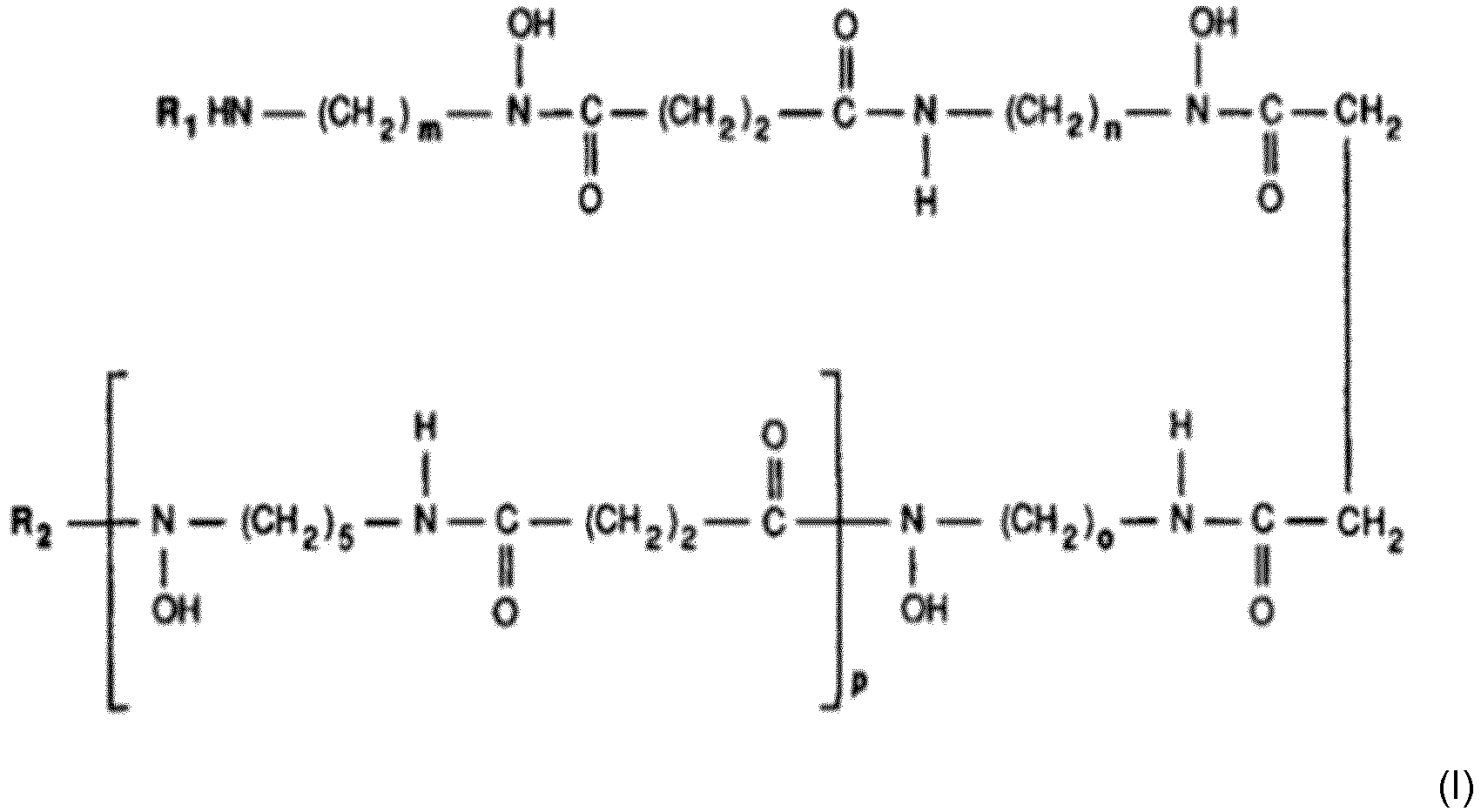
- Examples of deferoxamines of general formula (I) include deferoxamines A, B, C, D1, F, and G, which are linear, and deferoxamines D2 and E, which are the cyclic counterparts to the linear deferoxamines D1 and G.
- Preferred for use in the invention is deferoxamine B, in which m, n and o are each 5; p is 0; R1 is H- and R2 is -COCH3.
- The acid addition salts are selected from hydrochlorides, sulfates, phosphates, nitrates, methanesulfonates (mesylates), ethanesulfonates, ammonium salts and alkali metal (e.g. K, Li) salts.
- Mixtures of any of the above described materials may also be used.
- The total amount of deferoxamines and/or acid addition salts (a) in a composition of the invention preferably ranges from about 0.25 to 7.5%, more preferably from 0.5 to 6%, most preferably from 1 to 5% (by weight based on the total weight of the composition).
- The term "detergent composition" in the context of this invention denotes formulated compositions intended for and capable of wetting and cleaning domestic laundry such as clothing, linens and other household textiles. The term "linen" is often used to describe certain types of laundry items including bed sheets, pillow cases, towels, tablecloths, table napkins and uniforms. Textiles can include woven fabrics, non-woven fabrics, and knitted fabrics; and can include natural or synthetic fibres such as silk fibres, linen fibres, cotton fibres, polyester fibres, polyamide fibres such as nylon, acrylic fibres, acetate fibres, and blends thereof including cotton and polyester blends.
- Examples of detergent compositions include heavy-duty detergents for use in the wash cycle of automatic washing machines, as well as fine wash and colour care detergents such as those suitable for washing delicate garments (e.g. those made of silk or wool) either by hand or in the wash cycle of automatic washing machines.
- The composition of the invention comprises 15 to 80% (by weight based on the total weight of the composition) of one or more detersive surfactants (b).
- The term "detersive surfactant" in the context of this invention denotes a surfactant which provides a detersive (i.e. cleaning) effect to laundry treated as part of a domestic laundering process.
- The choice of detersive surfactant, and the amount present, will depend on the intended use of the detergent composition. For example, different surfactant systems may be chosen for hand-washing products and for products intended for use in different types of automatic washing machine. The total amount of detersive surfactant present will also depend on the intended end use. In compositions for machine washing of fabrics, an amount of from 15 to 35% (by weight based on the total weight of the composition) is generally appropriate. Higher levels may be used in compositions for washing fabrics by hand, such as up to 60% (by weight based on the total weight of the composition.
- Preferred detersive surfactants may be selected from non-soap anionic surfactants, nonionic surfactants and mixtures thereof.
- Non-soap anionic surfactants are principally used to facilitate particulate soil removal. Non-soap anionic surfactants for use in the invention are typically salts of organic sulfates and sulfonates having alkyl radicals containing from about 8 to about 22 carbon atoms, the term "alkyl" being used to include the alkyl portion of higher acyl radicals. Examples of such materials include alkyl sulfates, alkyl ether sulfates, alkaryl sulfonates, alphaolefin sulfonates and mixtures thereof. The alkyl radicals preferably contain from 10 to 18 carbon atoms and may be unsaturated. The alkyl ether sulfates may contain from one to ten ethylene oxide or propylene oxide units per molecule, and preferably contain one to three ethylene oxide units per molecule. The counterion for anionic surfactants is generally an alkali metal such as sodium or potassium; or an ammoniacal counterion such as monoethanolamine, (MEA) diethanolamine (DEA) or triethanolamine (TEA). Mixtures of such counterions may also be employed.
- A preferred class of non-soap anionic surfactant for use in the invention includes alkylbenzene sulfonates, particularly linear alkylbenzene sulfonates (LAS) with an alkyl chain length of from 10 to 18 carbon atoms. Commercial LAS is a mixture of closely related isomers and homologues alkyl chain homologues, each containing an aromatic ring sulfonated at the "para" position and attached to a linear alkyl chain at any position except the terminal carbons. The linear alkyl chain typically has a chain length of from 11 to 15 carbon atoms, with the predominant materials having a chain length of about C12. Each alkyl chain homologue consists of a mixture of all the possible sulfophenyl isomers except for the 1-phenyl isomer. LAS is normally formulated into compositions in acid (i.e. HLAS) form and then at least partially neutralized in-situ.
- Also suitable are alkyl ether sulfates having a straight or branched chain alkyl group having 10 to 18, more preferably 12 to 14 carbon atoms and containing an average of 1 to 3EO units per molecule. A preferred example is sodium lauryl ether sulfate (SLES) in which the predominantly C12 lauryl alkyl group has been ethoxylated with an average of 3EO units per molecule.
- Some alkyl sulfate surfactant (PAS) may be used, such as non-ethoxylated primary and secondary alkyl sulphates with an alkyl chain length of from 10 to 18.
- Mixtures of any of the above described materials may also be used. A preferred mixture of non-soap anionic surfactants for use in the invention comprises linear alkylbenzene sulfonate (preferably C11 to C15 linear alkyl benzene sulfonate) and sodium lauryl ether sulfate (preferably C10 to C18 alkyl sulfate ethoxylated with an average of 1 to 3 EO).
- In a detergent composition according to the invention, the total level of non-soap anionic surfactant may suitably range from 5 to 30% (by weight based on the total weight of the composition).
- Nonionic surfactants may provide enhanced performance for removing very hydrophobic oily soil and for cleaning hydrophobic polyester and polyester/cotton blend fabrics. Nonionic surfactants for use in the invention are typically polyoxyalkylene compounds, i.e. the reaction product of alkylene oxides (such as ethylene oxide or propylene oxide or mixtures thereof) with starter molecules having a hydrophobic group and a reactive hydrogen atom which is reactive with the alkylene oxide. Such starter molecules include alcohols, acids, amides or alkyl phenols. Where the starter molecule is an alcohol, the reaction product is known as an alcohol alkoxylate. The polyoxyalkylene compounds can have a variety of block and heteric (random) structures. For example, they can comprise a single block of alkylene oxide, or they can be diblock alkoxylates or triblock alkoxylates. Within the block structures, the blocks can be all ethylene oxide or all propylene oxide, or the blocks can contain a heteric mixture of alkylene oxides. Examples of such materials include aliphatic alcohol ethoxylates such as C8 to C18 primary or secondary linear or branched alcohol ethoxylates with an average of from 2 to 40 moles of ethylene oxide per mole of alcohol.
- A preferred class of nonionic surfactant for use in the invention includes aliphatic C8 to C18, more preferably C12 to C15 primary linear alcohol ethoxylates with an average of from 3 to 20, more preferably from 5 to 10 moles of ethylene oxide per mole of alcohol.
- Mixtures of any of the above described materials may also be used.
- In a detergent composition according to the invention, the total level of nonionic surfactant may suitably range from 0 to 25% (by weight based on the total weight of the composition).
- A detergent composition of the invention may contain one or more cosurfactants (such as amphoteric (zwitterionic) and/or cationic surfactants) in addition to the non-soap anionic and/or nonionic detersive surfactants described above.
- Specific cationic surfactants include C8 to C18 alkyl dimethyl ammonium halides and derivatives thereof in which one or two hydroxyethyl groups replace one or two of the methyl groups, and mixtures thereof. Cationic surfactant, when included, may be present in an amount ranging from 0.1 to 5% (by weight based on the total weight of the composition).
- Specific amphoteric (zwitterionic) surfactants include alkyl amine oxides, alkyl betaines, alkyl amidopropyl betaines, alkyl sulphobetaines (sultaines), alkyl glycinates, alkyl carboxyglycinates, alkyl amphoacetates, alkyl amphopropionates, alkylamphoglycinates, alkyl amidopropyl hydroxysultaines, acyl taurates and acyl glutamates, having alkyl radicals containing from about 8 to about 22 carbon atoms, the term "alkyl" being used to include the alkyl portion of higher acyl radicals. Amphoteric (zwitterionic) surfactant, when included, may be present in an amount ranging from 0.1 to 5% (by weight based on the total weight of the composition).
- A detergent composition according to the invention may suitably be in liquid or particulate form, or a mixture thereof.
- The term "particulate" in the context of this invention denotes free-flowing or compacted solid forms such as powders, granules, pellets, flakes, bars, briquettes or tablets. One preferred form for a particulate detergent composition according to the invention is a free-flowing powdered solid, with a loose (unpackaged) bulk density generally ranging from about 200g/l to about 1,300 g/l, preferably from about 400 g/l to about 1,000 g/l, more preferably from about 500g/l to about 900 g/l.
- The detergent composition according to the invention is most preferably in liquid form. The term "liquid" in the context of this invention denotes that a continuous phase or predominant part of the composition is liquid and that the composition is flowable at 15°C and above. Accordingly, the term "liquid" may encompass emulsions, suspensions, and compositions having flowable yet stiffer consistency, known as gels or pastes. The viscosity of the composition may suitably range from about 200 to about 10,000 mPa.s at 25°C at a shear rate of 21 sec-1. This shear rate is the shear rate that is usually exerted on the liquid when poured from a bottle. Pourable liquid compositions generally have a viscosity of from 200 to 2,500 mPa.s, preferably from 200 to 1500 mPa.s.
- Liquid compositions which are pourable gels generally have a viscosity of from 1,500 mPa.s to 6,000 mPa.s, preferably from 1,500 mPa.s to 2,000 mPa.s.
- A liquid detergent composition according to the invention may generally comprise from 5%, preferably from 10%, more preferably from 15% water, and comprises up to 84.9% water (by weight based on the total weight of the composition). The composition may also incorporate non-aqueous carriers such as hydrotropes, co-solvents and phase stabilizers. Such materials are typically low molecular weight, water-soluble or water-miscible organic liquids such as C1 to C5 monohydric alcohols (such as ethanol and n- or i-propanol); C2 to C6 diols (such as monopropylene glycol and dipropylene glycol); C3 to C9 triols (such as glycerol); polyethylene glycols having a weight average molecular weight (Mw) ranging from about 200 to 600; C1 to C3 alkanolamines such as mono-, di- and triethanolamines; and alkyl aryl sulfonates having up to 3 carbon atoms in the lower alkyl group (such as the sodium and potassium xylene, toluene, ethylbenzene and isopropyl benzene (cumene) sulfonates).
- Mixtures of any of the above described materials may also be used.
- Non-aqueous carriers, when included in a liquid detergent composition according to the invention, may be present in an amount ranging from 0.1 to 20%, preferably from 1 to 15%, and more preferably from 3 to 12% (by weight based on the total weight of the composition).
- A detergent composition according to the invention may contain one or more builders. Builders enhance or maintain the cleaning efficiency of the surfactant, primarily by reducing water hardness. This is done either by sequestration or chelation (holding hardness minerals in solution), by precipitation (forming an insoluble substance), or by ion exchange (trading electrically charged particles).
- Builders for use in the invention can be of the organic or inorganic type, or a mixture thereof. Non-phosphate builders are preferred.
- Inorganic, non-phosphate builders for use in the invention include hydroxides, carbonates, silicates, zeolites, and mixtures thereof.
- Suitable hydroxide builders for use in the invention include sodium and potassium hydroxide.
- Suitable carbonate builders for use in the invention include mixed or separate, anhydrous or partially hydrated alkali metal carbonates, bicarbonates or sesquicarbonates. Preferably the alkali metal is sodium and/or potassium, with sodium carbonate being particularly preferred.
- Suitable silicate builders include amorphous forms and/or crystalline forms of alkali metal (such as sodium) silicates. Preferred are crystalline layered sodium silicates (phyllosilicates) of the general formula (I)
NaMSixO2x+1.yH2O (I)
- in which M is sodium or hydrogen, x is a number from 1.9 to 4, preferably 2 or 3 and y is a number from 0 to 20. Sodium disilicates of the above formula in which M is sodium and x is 2 are particularly preferred. Such materials can be prepared with different crystal structures, referred to as α, β, γ and δ phases, with δ-sodium disilicate being most preferred.
- Zeolites are naturally occurring or synthetic crystalline aluminosilicates composed of (SiO4)4- and (AlO4)5- tetrahedra, which share oxygen-bridging vertices and form cage-like structures in crystalline form. The ratio between oxygen, aluminium and silicon is O:(Al + Si) = 2:1. The frameworks acquire their negative charge by substitution of some Si by Al. The negative charge is neutralised by cations and the frameworks are sufficiently open to contain, under normal conditions, mobile water molecules. Suitable zeolite builders for use in the invention may be defined by the general formula (II):
Nax[(AlO2)x(SiO2)y]·zH2O (II)
- in which x and y are integers of at least 6, the molar ratio of x to y is in the range from about 1 to about 0.5, and z is an integer of at least 5, preferably from about 7.5 to about 276, more preferably from about 10 to about 264.
- Preferred inorganic, non-phosphate builders for use in the invention may be selected from zeolites (of the general formula (II) defined above), sodium carbonate, δ-sodium disilicate and mixtures thereof.
- Suitable organic, non-phosphate builders for use in the invention include polycarboxylates, in acid and/or salt form. When utilized in salt form, alkali metal (e.g. sodium and potassium) or alkanolammonium salts are preferred. Specific examples of such materials include sodium and potassium citrates, sodium and potassium tartrates, the sodium and potassium salts of tartaric acid monosuccinate, the sodium and potassium salts of tartaric acid disuccinate, sodium and potassium ethylenediaminetetraacetates, sodium and potassium N(2-hydroxyethyl)-ethylenediamine triacetates, sodium and potassium nitrilotriacetates and sodium and potassium N-(2-hydroxyethyl)-nitrilodiacetates. Polymeric polycarboxylates may also be used, such as polymers of unsaturated monocarboxylic acids (e.g. acrylic, methacrylic, vinylacetic, and crotonic acids) and/or unsaturated dicarboxylic acids (e.g. maleic, fumaric, itaconic, mesaconic and citraconic acids and their anhydrides). Specific examples of such materials include polyacrylic acid, polymaleic acid, and copolymers of acrylic and maleic acid. The polymers may be in acid, salt or partially neutralised form and may suitably have a molecular weight (Mw) ranging from about 1,000 to 100,000, preferably from about 2,000 to about 85,000, and more preferably from about 2,500 to about 75,000.
- Preferred organic, non-phosphate builders for builders for use in the invention may be selected from polycarboxylates (e.g. citrates) in acid and/or salt form and mixtures thereof.
- Mixtures of any of the above described materials may also be used.
- Preferably the level of phosphate builders in a detergent composition of the invention is no more than 0.2%, preferably from 0 to 0.1%, more preferably from 0 to 0.01% and most preferably 0% (by weight based on the total weight of the composition). The term "phosphate builder" in the context of this invention denotes alkali metal, ammonium and alkanolammonium salts of polyphosphate, orthophosphate, and/or metaphosphate (e.g. sodium tripolyphosphate).
- The overall level of builder, when included, may range from about 0.1 to about 80%, preferably from about 0.5 to about 50% (by weight based on the total weight of the composition).
- In addition to the deferoxamines and/or acid addition salts thereof (a) as described above, a detergent composition according to the invention may contain additional transition metal ion sequestrants such as phosphonate sequestrants, in acid form and/or in salt form (such as the alkali metal (e.g. sodium and potassium) or alkanolammonium salts). Specific examples of such materials include aminotris(methylene phosphonic acid) (ATMP), 1-hydroxyethylidene diphosphonic acid (HEDP) and diethylenetriamine penta(methylene phosphonic acid (DTPMP) and their respective sodium or potassium salts. Mixtures of any of the above described materials may also be used.
- However the level of such phosphonate sequestrants in a detergent composition of the invention is typically no more than 0.2%, preferably from 0 to 0.1%, more preferably from 0 to 0.01% and most preferably 0% (by weight based on the total weight of the composition).
- A particulate detergent composition of the invention may include one or more fillers to assist in providing the desired density and bulk to the composition. Suitable fillers for use in the invention may generally be selected from neutral salts with a solubility in water of at least 1 gram per 100 grams of water at 20° C; such as alkali metal, alkaline earth metal, ammonium or substituted ammonium chlorides, fluorides, acetates and sulfates and mixtures thereof. Preferred fillers for use in the invention include alkali metal (more preferably sodium and/or potassium) sulfates and chlorides and mixtures thereof, with sodium sulfate and/or sodium chloride being most preferred.
- Filler, when included, may be present in a total amount ranging from about 1 to about 80%, preferably from about 5 to about 50% (by weight based on the total weight of the composition).
- A detergent composition according to the invention may include one or more polymeric cleaning boosters such as antiredeposition polymers, soil release polymers and mixtures thereof.
- Anti-redeposition polymers stabilise the soil in the wash solution thus preventing redeposition of the soil. Suitable anti-redeposition polymers for use in the invention include alkoxylated polyethyleneimines. Polyethyleneimines are materials composed of ethylene imine units -CH2CH2NH- and, where branched, the hydrogen on the nitrogen is replaced by another chain of ethylene imine units. Preferred alkoxylated polyethylenimines for use in the invention have a polyethyleneimine backbone of about 300 to about 10000 weight average molecular weight (Mw). The polyethyleneimine backbone may be linear or branched. It may be branched to the extent that it is a dendrimer. The alkoxylation may typically be ethoxylation or propoxylation, or a mixture of both. Where a nitrogen atom is alkoxylated, a preferred average degree of alkoxylation is from 10 to 30, preferably from 15 to 25 alkoxy groups per modification. A preferred material is ethoxylated polyethyleneimine, with an average degree of ethoxylation being from 10 to 30, preferably from 15 to 25 ethoxy groups per ethoxylated nitrogen atom in the polyethyleneimine backbone. Another type of suitable anti-redeposition polymer for use in the invention includes cellulose esters and ethers, for example sodium carboxymethyl cellulose.
- Mixtures of any of the above described materials may also be used.
- The overall level of anti-redeposition polymer, when included, may range from 0.05 to 6%, more preferably from 0.1 to 5% (by weight based on the total weight of the composition).
- Soil release polymers help to improve the detachment of soils from fabric by modifying the fabric surface during washing. The adsorption of a SRP over the fabric surface is promoted by an affinity between the chemical structure of the SRP and the target fibre.
- SRPs for use in the invention may include a variety of charged (e.g. anionic) as well as non-charged monomer units and structures may be linear, branched or star-shaped. The SRP structure may also include capping groups to control molecular weight or to alter polymer properties such as surface activity. The weight average molecular weight (Mw) of the SRP may suitably range from about 1000 to about 20,000 and preferably ranges from about 1500 to about 10,000.
- SRPs for use in the invention may suitably be selected from copolyesters of dicarboxylic acids (for example adipic acid, phthalic acid or terephthalic acid), diols (for example ethylene glycol or propylene glycol) and polydiols (for example polyethylene glycol or polypropylene glycol). The copolyester may also include monomeric units substituted with anionic groups, such as for example sulfonated isophthaloyl units. Examples of such materials include oligomeric esters produced by transesterification/oligomerization of poly(ethyleneglycol) methyl ether, dimethyl terephthalate ("DMT"), propylene glycol ("PG") and poly(ethyleneglycol) ("PEG"); partly- and fully-anionic-end-capped oligomeric esters such as oligomers from ethylene glycol ("EG"), PG, DMT and Na-3,6-dioxa-8-hydroxyoctanesulfonate; nonionic-capped block polyester oligomeric compounds such as those produced from DMT, Me-capped PEG and EG and/or PG, or a combination of DMT, EG and/or PG, Me-capped PEG and Na-dimethyl-5-sulfoisophthalate, and copolymeric blocks of ethylene terephthalate or propylene terephthalate with polyethylene oxide or polypropylene oxide terephthalate
- Other types of SRP for use in the invention include cellulosic derivatives such as hydroxyether cellulosic polymers, C1-C4 alkylcelluloses and C4 hydroxyalkyl celluloses; polymers with poly(vinyl ester) hydrophobic segments such as graft copolymers of poly(vinyl ester), for example C1-C6 vinyl esters (such as poly(vinyl acetate)) grafted onto polyalkylene oxide backbones; poly(vinyl caprolactam) and related co-polymers with monomers such as vinyl pyrrolidone and/or dimethylaminoethyl methacrylate; and polyester-polyamide polymers prepared by condensing adipic acid, caprolactam, and polyethylene glycol.
- Preferred SRPs for use in the invention include copolyesters formed by condensation of terephthalic acid ester and diol, preferably 1,2 propanediol, and further comprising an end cap formed from repeat units of alkylene oxide capped with an alkyl group. Examples of such materials have a structure corresponding to general formula (II):

- in which R1 and R2 independently of one another are X-(OC2H4)n-(OC3H6)m ;
- in which X is C1-4 alkyl and preferably methyl;
- n is a number from 12 to 120, preferably from 40 to 50;
- m is a number from 1 to 10, preferably from 1 to 7; and
- a is a number from 4 to 9.
- Because they are averages, m, n and a are not necessarily whole numbers for the polymer in bulk.
- Mixtures of any of the above described materials may also be used.
- The overall level of SRP, when included, may range from 0.1 to 10%, preferably from 0.3 to 7%, more preferably from 0.5 to 5% (by weight based on the total weight of the composition).
- A detergent composition according to the invention may in some cases contain one or more fatty acids and/or salts thereof.
- Suitable fatty acids in the context of this invention include aliphatic carboxylic acids of formula RCOOH, where R is a linear or branched alkyl or alkenyl chain containing from 6 to 24, more preferably 10 to 22, most preferably from 12 to 18 carbon atoms and 0 or 1 double bond. Preferred examples of such materials include saturated C12-18 fatty acids such as lauric acid, myristic acid, palmitic acid or stearic acid; and fatty acid mixtures in which 50 to 100% (by weight based on the total weight of the mixture) consists of saturated C12-18 fatty acids. Such mixtures may typically be derived from natural fats and/or optionally hydrogenated natural oils (such as coconut oil, palm kernel oil or tallow).
- The fatty acids may be present in the form of their sodium, potassium or ammonium salts and/or in the form of soluble salts of organic bases, such as mono-, di- or triethanolamine.
- Mixtures of any of the above described materials may also be used.
- Fatty acids and/or their salts, when included, may be present in an amount ranging from about 0.25 to 5%, more preferably from 0.5 to 5%, most preferably from 0.75 to 4% (by weight based on the total weight of the composition).
- For formula accounting purposes, in the formulation, fatty acids and/or their salts (as defined above) are not included in the level of surfactant or in the level of builder.
- A liquid detergent composition according to the invention may comprise one or more rheology modifiers. Examples of such materials include polymeric thickeners and/or structurants such as hydrophobically modified alkali swellable emulsion (HASE) copolymers. Exemplary HASE copolymers for use in the invention include linear or crosslinked copolymers that are prepared by the addition polymerization of a monomer mixture including at least one acidic vinyl monomer, such as (meth)acrylic acid (i.e. methacrylic acid and/or acrylic acid); and at least one associative monomer. The term "associative monomer" in the context of this invention denotes a monomer having an ethylenically unsaturated section (for addition polymerization with the other monomers in the mixture) and a hydrophobic section. A preferred type of associative monomer includes a polyoxyalkylene section between the ethylenically unsaturated section and the hydrophobic section. Preferred HASE copolymers for use in the invention include linear or crosslinked copolymers that are prepared by the addition polymerization of (meth)acrylic acid with (i) at least one associative monomer selected from linear or branched C8-C40 alkyl (preferably linear C12-C22 alkyl) polyethoxylated (meth)acrylates; and (ii) at least one further monomer selected from C1-C4 alkyl (meth) acrylates, polyacidic vinyl monomers (such as maleic acid, maleic anhydride and/or salts thereof) and mixtures thereof. The polyethoxylated portion of the associative monomer (i) generally comprises about 5 to about 100, preferably about 10 to about 80, and more preferably about 15 to about 60 oxyethylene repeating units.
- Mixtures of any of the above described materials may also be used.
- Polymeric thickeners, when included, may be present in an amount ranging from 0.1 to 5% (by weight based on the total weight of the composition).
- A liquid detergent composition according to the invention may also have its rheology modified by use of one or more external structurants which form a structuring network within the composition. Examples of such materials include hydrogenated castor oil, microfibrous cellulose and citrus pulp fibre. The presence of an external structurant may provide shear thinning rheology and may also enable materials such as encapsulates and visual cues to be suspended stably in the liquid.
- A detergent composition according to the invention may comprise an effective amount of one or more enzymes selected from the group comprising, pectate lyase, protease, amylase, cellulase, lipase, mannanase and mixtures thereof. The enzymes are preferably present with corresponding enzyme stabilizers.
- A liquid detergent composition according to the invention preferably has a pH in the range of 5 to 9, more preferably 6 to 8, when measured on dilution of the composition to 1% (by weight based on the total weight of the composition) using demineralised water.
- A detergent composition of the invention may contain further optional ingredients to enhance performance and/or consumer acceptability. Examples of such ingredients include fragrance oils, foam boosting agents, preservatives (e.g. bactericides), antioxidants, sunscreens, anticorrosion agents, colorants, pearlisers and/or opacifiers, and shading dye. Each of these ingredients will be present in an amount effective to accomplish its purpose. Generally, these optional ingredients are included individually at an amount of up to 5% (by weight based on the total weight of the composition).
- A detergent composition of the invention generally contains no more than 0.2%, preferably from 0 to 0.1%, more preferably from 0 to 0.01% and most preferably 0% (by weight based on the total weight of the composition) of transition metal ions selected from Fe (III), Co (II), Co (III), Mn (II), Mn (III), Ce (III), Ce (IV), Zn (II) and Bi (III) and mixtures thereof.
- A detergent composition of the invention generally contains no more than 0.2%, preferably no more than 0.1%, more preferably no more than 0.01% and most preferably 0% (by weight based on the total weight of the composition) of oxidising agents selected from halogen-based bleaches (e.g. alkali metal hypochlorites and alkali metal salts of di- and tri-chloro and di- and tri-bromo cyanuric acids), oxygen-based bleaches (e.g. sodium perborate (tetra-or monohydrate), sodium percarbonate and hydrogen peroxide) and mixtures thereof.
- The detergent composition of the invention may be packaged as unit doses in polymeric film soluble in the wash water. Alternatively, the detergent composition of the invention may be supplied in multidose plastics packs with a top or bottom closure. A dosing measure may be supplied with the pack either as a part of the cap or as an integrated system.
- A method for the non-oxidative laundering of fabric stains using a detergent composition according to the invention comprises diluting a dose of the detergent composition to obtain a wash liquor, and washing the stained fabric with the wash liquor so formed.
- The method may suitably be carried out in a top-loading or front-loading automatic washing machine, or can be carried out by hand.
- In automatic washing machines, the dose of detergent composition is typically put into a dispenser and from there it is flushed into the machine by the water flowing into the 5 machine, thereby forming the wash liquor. Dosages for a typical front-loading washing machine (using 10 to 15 litres of water to form the wash liquor) may range from about 10 ml to about 100 ml, preferably about 15 to 75 ml. Dosages for a typical top-loading washing machine (using from 40 to 60 litres of water to form the wash liquor) may be higher, e.g. 100 ml or more. Lower dosages of detergent (e.g. 50 ml or less) may be 10 used for hand washing methods (using about 1 to 10 litres of water to form the wash liquor).
- A subsequent aqueous rinse step and drying the laundry is preferred. Any input of water during any optional rinsing step(s) is not included when determining the volume of the wash liquor. Laundry drying can take place either in an automatic dryer or in the open air.
- The invention will now be further described with reference to the following non-limiting Examples.
- All weight percentages are by weight based on total weight unless otherwise specified.
- Liquid laundry detergent formulations were prepared by sequential mixing of the ingredients as shown in Table 1.
- Compositions according to the invention are indicated by a number; and comparative examples (not according to the invention) are indicated by a letter.
Table 1 Ingredient wt% (active ingredient) Formulation Example A Example 1 Example B Glycerol 2.0 2.0 2.0 Alcohol ethoxylate 4.3 4.3 4.3 LAS acid 5.8 5.8 5.8 TEA 8.8 8.8 8.8 Lauric acid 0.9 0.9 0.9 SLES 1 EO 4.4 4.4 4.4 Preservative 0.03 0.03 0.03 DFOM(1) 0 4.8 0 Dequest 2010 (HEDP) 0 0 1.5 Water q.s. to 100 (1) Deferoxamine B mesylate salt (>92.5 % pure) from Sigma Aldrich - Example 1 was prepared by post-dosing the DFOM solid into a premix of the remaining ingredients and allowing to stir overnight followed by storage at ambient temperature. Example B was prepared in the same manner but substituting an equimolar level of Dequest 2010 (60% w/w aqueous solution) for the DFOM. Example A (sequestrant free control) was prepared in the same manner but adding water in place of the sequestrants.
- The formulation of Example 1 was colourless with a superior viscosity to that of Example A.
- The formulations were evaluated for their cleaning performance at 30°C using a Heraeus 12-pot Linitester to mimic the mechanical action of a front-loading automatic washing machine.
- Cleaning performance was compared in the presence of different wash water conditions to mimic variations in global water quality. Model wash waters were prepared by doping demineralized water with ppm levels of hardness and/or transition metal ions, as follows:
Hard model wash water (a) was prepared by dissolving 0.235g calcium chloride dihydrate and 0.163g magnesium chloride hexahydrate into 1 litre of demineralised water to give 24° FH hardness and a 2:1 calcium to magnesium ratio. - Transition metal doped model wash water (b) was prepared by first dissolving 5.18 g of ammonium iron (III) sulfate dodecahydrate, 1.298 g of copper (II) sulfate pentahydrate, 3.034 g of zinc sulfate heptahydrate and 0.111 g manganese sulfate monohydrate in 0.5 litres of demineralized water, then acidifying the solution to pH 1.0 by dropwise addition of concentrated sulfuric acid. 2.5 ml of the acidified solution was then added to 3 litres of demineralised water, immediately prior to use.
- Hard, transition metal doped model wash water (c) was prepared by first dissolving 5.18 g of ammonium iron (III) sulphate dodecahydrate, 1.298 g of copper (II) sulphate pentahydrate, 3.034 g of zinc sulphate heptahydrate and 0.111 g manganese sulphate monohydrate in 0.5 litres of demineralized water, then acidifying the solution to pH 1.0 by dropwise addition of concentrated sulfuric acid. 2.5 ml of the acidified solution was then added to 3 litres of hard model wash water (a), immediately prior to use.
- The in-wash concentrations of the transition metals in solutions b) and c) were 0.98 ppm Fe(III), 0.55 ppm copper (II), 1.15 ppm zinc (II), and 0.06 ppm manganese (II).
- Test wash liquors were prepared by diluting 2.9 g of the selected test formulation (Example A, B or 1 respectively) in 1 litre of model wash water (model wash water (a), (b) or (c) respectively).
- A 100 ml aliquot of the selected test wash liquor was dosed in a Linitest pot. 2.0 cm x 2.0 cm swatches of tea stained cotton and 20 cm x 20 cm swatches of unstained cotton ballast were placed into each Linitest pot. The pots were sealed and attached to the Linitester cradle and rotated at 40 rpm for 30 minutes at 30°C to simulate a main wash in a front-loader washing machine.
- The swatches were then removed from the pots and wrung out by hand to drain residual test wash liquor. The Linitest pots were rinsed and 100 ml of model wash water (of the same type as used to prepare the selected test wash liquor) was added. The swatches were returned to the pots and rinsed for 5 minutes. The swatches were then removed, wrung out and the rinse water drained and replaced with fresh model wash water (of the same type as used to prepare the selected test wash liquor) before returning the swatches to the pot and carrying out a second 5-minute rinse. The swatches were placed on laboratory paper towel and allowed to air dry in the open laboratory.
- The extent of tea stain removal was measured by making diffuse reflectance measurements using a spectrometer, and expressed as the Stain Removal Index (SRI), defined as:
SRI = 100 - ΔE, where ΔE is the difference in colour of the stained cloth compared to an unstained cloth. - A higher SRI value indicates cleaner swatches. Three replicate swatches were measured for each test wash liquor. The results are shown in Table 2.
Table 2 Model wash water used in test wash liquor Formulation used in test wash liquor Example A Example 1 Example B Hard (a) 84.4 +/- 0.3 86.9 +/- 0.3 87.7 +/- 0.2 Transition metal doped (b) 86.5 +/- 0.1 87.0 +/- 0.2 88.4 +/- 0.2 Hard, transition metal doped (c) 79.8 +/- 0.4 84.9 +/- 0.2 87.7 +/- 0.1 - The results show that the wash liquors made with Example 1 according to the invention provide significantly improved stain removal relative to those made with the control (Example A) and approaches the performance of those made with Example B (which uses a phosphonate sequestrant at the same molar concentration).
- The impact of DFOM concentration on stain removal performance was examined in a separate experiment using a new batch of tea stained cotton. Test wash liquors were prepared by adding varying quantities of the Example A and Example 1 formulations to 1 litre of model wash water (c), in order to vary the dosage of the DFOM component while maintaining constant levels of the other laundry liquid detergent components. The masses of each formulation used in generating the wash liquors are given in Table 3 together with the concentration of the DFOM present in the wash liquor.
Table 3 Wash liquor Mass of Example A (g) Mass of Example 1 (g) DFOM concentration in wash liquor (mM) C 2.90 0 0 2 2.175 0.725 0.05 3 1.45 1.45 0.10 4 0 2.9 0.20 - Tea stained cotton and cotton ballast were washed in these wash liquors using the method described above. The SRI results are shown in Table 4.
Table 4 Wash liquor DFOM level in wash (mM) Equivalent DFOM level in neat laundry liquid product (wt%) SRI C 0.0 0 79.3 +/- 0.4 2 0.05 1.2 81.7 +/-0.4 3 0.10 2.4 81.5 +/- 0.6 4 0.20 4.8 82.0 +/- 0.4 - It can be seen from the results that wash liquors 2 to 4 (according to the invention) all provide significantly improved stain removal relative to the control wash liquor (Example C). Thus, the DFOM concentration may be reduced without significantly impacting the stain removal performance.
- In a further series of tests on tea stained cotton, the stain removal performance of DFOM was compared against two other phosphorus-free metal sequestrants used at the same molar concentration: MGDA (sourced as a 40% w/w aqueous solution of the trisodium salt) and citric acid (sourced as > 99.5% pure material).
- Test wash liquors were prepared immediately before use by combining, in a test vial, 4ml of either model wash water (a) or (b); 2ml of detergent solution prepared by dissolving 14.5g of the Example A formulation in 1 litre of demineralized water and 4 ml of sequestrant solution prepared by dissolving either DFOM, MGDA or citric acid in demineralized water to form a 0.5 mM solution. Sequestrant free control wash liquors were also prepared by substituting demineralized water for the sequestrant solution. The sequestrants and model wash waters used in generating each of the wash liquors are given in Table 5.
Table 5 Test wash liquor Sequestrant used in test wash liquor Model wash water used in test wash liquor D None Hard (a) 5 DFOM Hard (a) E MGDA Hard (a) F Citric acid Hard (a) G None Transition metal doped (b) 6 DFOM Transition metal doped (b) H MGDA Transition metal doped (b) I Citric acid Transition metal doped (b) - The pH values of each of the wash liquors of Table 5 were measured using a pH meter and all found to be in the range 7.6 +/- 0.1 units.
- 0.2 g swatches of tea stained cotton textile were added to each wash liquor in its respective test vial. The test vials were then sealed, placed in a REAX end-over end mixer and agitated on a setting of 4 for 30 minutes at ambient temperature (20.0 +/-0.6 °C) to mimic a main wash condition. The test wash liquor was then drained out of each test vial and replaced with 10 ml of fresh model wash water (of the same type as used to prepare the selected test wash liquor). The test vials were recapped and returned to the mixer for 5 minutes to mimic a rinsing step. The swatches were then removed from the test vials and allowed to air dry on a paper towel at ambient temperature in the open laboratory, before making reflectance measurements.
- The results are shown in Table 6.
Table 6 Test wash liquor SRI D 76.2 +/- 0.4 5 80.2 +/- 0.4 E 77.9 +/- 0.3 F 77.1 +/- 0.4 G 80.0 +/- 0.1 6 84.3 +/- 0.4 H 82.1 +/- 0.3 I 80.6 +/- 0.3 - These results show that the wash liquors according to the invention (Examples 5 and 6) outperform the wash liquors with an equimolar amount of MGDA (Examples E and H) and the wash liquors with an equimolar amount of citric acid (Examples F and I) on tea stained cotton.
Claims (6)
- A detergent composition for the non-oxidative laundering of fabric stains, the composition comprising:(a) from 0.1 to 10% (by weight based on the total weight of the composition) of one or more deferoxamines ; and(b) from 15 to 80% (by weight based on the total weight of the composition) of one or more detersive surfactants;in which the one or more deferoxamines correspond to the general formula (I):
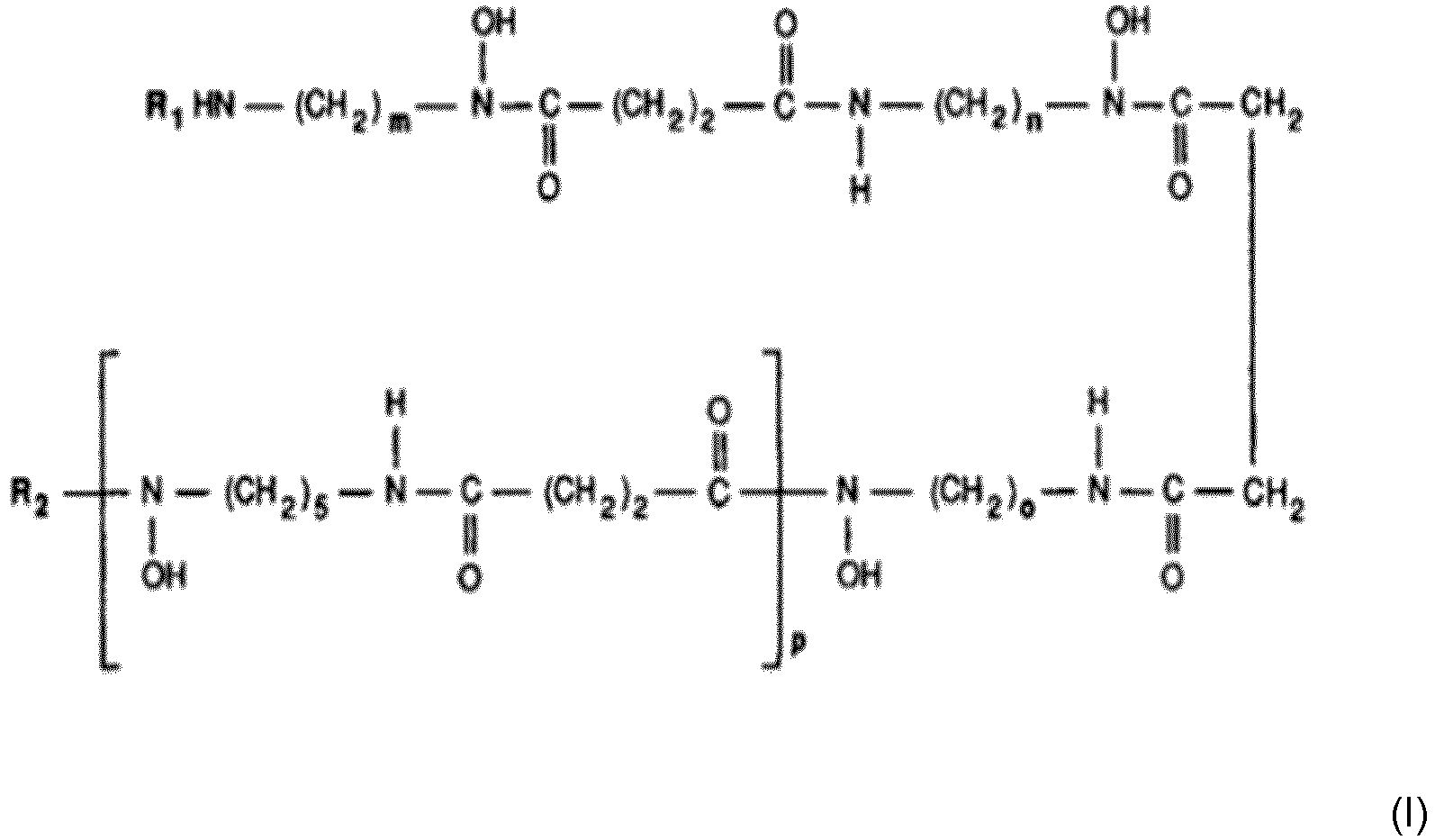 in which m is 3, 4 or 5; n and o are each independently 4 or 5; p is 0 or 1; R1 is a monovalent group selected from H- and CH3CO- or together with R2 forms a divalent -CO(CH2)2CO- group; and R2 is a monovalent group selected from -H, - COCH3 and -CO(CH2)2COOH; or together with R1 forms a divalent -CO(CH2)2CO-group; and/or an acid addition salt thereof selected from hydrochlorides, sulfates, phosphates, nitrates, methanesulfonates (mesylates), ethanesulfonates, ammonium salts and alkali metal salts;in which the composition contains from 0 to 0.01% (by weight based on the total weight of the composition) of transition metal ions selected from Fe (III), Co (II), Co (III), Mn (II), Mn (III), Ce (III), Ce (IV), Zn (II) and Bi (III) and mixtures thereof; and in which the composition contains from 0 to 0.01% (by weight based on the total weight of the composition) of oxidising agents selected from halogen-based bleaches, oxygen-based bleaches and mixtures thereof.
 - A composition according to claim 1, in which, in general formula (I), m, n and o are each 5; p is 0; R1 is H- and R2 is -COCH3.
- A composition according to claim 1 or 2, in which the total amount of deferoxamines and/or acid addition salts (a) ranges from 1 to 5% (by weight based on the total weight of the composition).
- A composition according to any one of claims 1 to 3, in which the one or more detersive surfactants (b) are selected from non-soap anionic surfactants, nonionic surfactants and mixtures thereof.
- A composition according to any preceding claim in which the level of phosphonate sequestrants is no more than 0.2%, preferably from 0 to 0.1%, more preferably from 0 to 0.01% and most preferably 0% (by weight based on the total weight of the composition)
- A method for the non-oxidative laundering of fabric stains, comprising diluting a dose of the detergent composition as defined in any one of claims 1 to 5to obtain a wash liquor, and washing the stained fabric with the wash liquor so formed.
Applications Claiming Priority (2)
| Application Number | Priority Date | Filing Date | Title |
|---|---|---|---|
| EP18198860 | 2018-10-05 | ||
| PCT/EP2019/076841 WO2020070257A1 (en) | 2018-10-05 | 2019-10-03 | Detergent compositions |
Publications (2)
| Publication Number | Publication Date |
|---|---|
| EP3861092A1 EP3861092A1 (en) | 2021-08-11 |
| EP3861092B1 true EP3861092B1 (en) | 2022-03-30 |
Family
ID=63787814
Family Applications (1)
| Application Number | Title | Priority Date | Filing Date |
|---|---|---|---|
| EP19778557.9A Active EP3861092B1 (en) | 2018-10-05 | 2019-10-03 | Detergent compositions |
Country Status (4)
| Country | Link |
|---|---|
| US (1) | US20210340465A1 (en) |
| EP (1) | EP3861092B1 (en) |
| CN (1) | CN112823201B (en) |
| WO (1) | WO2020070257A1 (en) |
Families Citing this family (4)
| Publication number | Priority date | Publication date | Assignee | Title |
|---|---|---|---|---|
| CN114423851A (en) * | 2019-09-19 | 2022-04-29 | 联合利华知识产权控股有限公司 | Detergent composition |
| BR112022019762A2 (en) * | 2020-04-30 | 2022-11-16 | Dow Global Technologies Llc | LIQUID DETERGENT FORMULATION FOR CLOTHING WASHING, AND METHOD FOR WASHING A FABRIC ARTICLE |
| EP4196563B1 (en) * | 2020-08-12 | 2024-04-24 | Unilever IP Holdings B.V. | Laundry detergent composition |
| WO2024132679A1 (en) * | 2022-12-21 | 2024-06-27 | Evonik Dr. Straetmans Gmbh | Compositions containing biosurfactants and desferrioxamines |
Family Cites Families (9)
| Publication number | Priority date | Publication date | Assignee | Title |
|---|---|---|---|---|
| US7939480B2 (en) * | 1995-07-21 | 2011-05-10 | Pz Cussons (International) Limited | Cleaning composition |
| US8999363B2 (en) * | 2005-02-07 | 2015-04-07 | Sishield Technologies, Inc. | Methods and compositions for antimicrobial surfaces |
| US8999357B2 (en) * | 2005-02-07 | 2015-04-07 | Sishield Technologies, Inc. | Methods and compositions for biocidal treatments |
| DE102010028742A1 (en) * | 2010-05-07 | 2011-11-10 | Henkel Ag & Co. Kgaa | Particulate washing agent, useful in textile washing, comprises a manganese complex with a ligand in the form of desferrioxamine E and/or desferrioxamine B |
| US20150031600A1 (en) * | 2010-12-14 | 2015-01-29 | The University Of Queensland | Designed biosurfactants, their manufacture, purification and use |
| WO2012170841A1 (en) * | 2011-06-10 | 2012-12-13 | Isp Investments Inc. | An aqueous volatile organic compound free disinfectant and/or cleaning composition and method of preparation |
| DE102012211121A1 (en) * | 2012-06-28 | 2014-01-02 | Evonik Industries Ag | Granular, functionalized silicic acid, process for their preparation and their use |
| DE102012219405A1 (en) * | 2012-10-24 | 2014-04-24 | Henkel Ag & Co. Kgaa | Use of metal complexes with nitrogen-acylated siderophore ligands e.g. for enhancing oxidizing power of inorganic peroxygen compounds in oxidizing-, washing-, cleaning- or disinfecting solutions |
| US9163202B2 (en) * | 2013-08-02 | 2015-10-20 | Eastman Chemical Company | Aqueous cleaning compositions including an alkyl 3-hydroxybutyrate |
-
2019
- 2019-10-03 EP EP19778557.9A patent/EP3861092B1/en active Active
- 2019-10-03 US US17/282,385 patent/US20210340465A1/en not_active Abandoned
- 2019-10-03 CN CN201980065738.7A patent/CN112823201B/en active Active
- 2019-10-03 WO PCT/EP2019/076841 patent/WO2020070257A1/en not_active Ceased
Also Published As
| Publication number | Publication date |
|---|---|
| US20210340465A1 (en) | 2021-11-04 |
| CN112823201B (en) | 2023-09-01 |
| WO2020070257A1 (en) | 2020-04-09 |
| CN112823201A (en) | 2021-05-18 |
| EP3861092A1 (en) | 2021-08-11 |
Similar Documents
| Publication | Publication Date | Title |
|---|---|---|
| EP3833730B1 (en) | Detergent | |
| EP3710571B1 (en) | Soil release polymers and laundry detergent compositions containing them | |
| EP4133043B1 (en) | Laundry detergent composition | |
| EP3861092B1 (en) | Detergent compositions | |
| WO2020160996A1 (en) | Improvements relating to fabric cleaning | |
| EP3947616B1 (en) | Detergent compositions | |
| WO2021053122A1 (en) | Detergent compositions | |
| CN112236508B (en) | Detergent composition | |
| EP3650526A1 (en) | Detergent compositions | |
| EP3650525A1 (en) | Detergent compositions | |
| WO2022078714A1 (en) | Composition | |
| BR112020009590B1 (en) | POLYMER PROVIDING DIRT RELEASE PROPERTIES, LAUNDRY DETERGENT COMPOSITION AND FABRIC WASHING METHOD | |
| WO2020193101A1 (en) | Method for washing a garment worn on the head | |
| BR112021001856B1 (en) | LIQUID LAUNDRY DETERGENT COMPOSITION AND METHOD FOR WASHING FABRICS |
Legal Events
| Date | Code | Title | Description |
|---|---|---|---|
| STAA | Information on the status of an ep patent application or granted ep patent |
Free format text: STATUS: UNKNOWN |
|
| STAA | Information on the status of an ep patent application or granted ep patent |
Free format text: STATUS: THE INTERNATIONAL PUBLICATION HAS BEEN MADE |
|
| PUAI | Public reference made under article 153(3) epc to a published international application that has entered the european phase |
Free format text: ORIGINAL CODE: 0009012 |
|
| STAA | Information on the status of an ep patent application or granted ep patent |
Free format text: STATUS: REQUEST FOR EXAMINATION WAS MADE |
|
| 17P | Request for examination filed |
Effective date: 20210325 |
|
| AK | Designated contracting states |
Kind code of ref document: A1 Designated state(s): AL AT BE BG CH CY CZ DE DK EE ES FI FR GB GR HR HU IE IS IT LI LT LU LV MC MK MT NL NO PL PT RO RS SE SI SK SM TR |
|
| GRAP | Despatch of communication of intention to grant a patent |
Free format text: ORIGINAL CODE: EPIDOSNIGR1 |
|
| STAA | Information on the status of an ep patent application or granted ep patent |
Free format text: STATUS: GRANT OF PATENT IS INTENDED |
|
| INTG | Intention to grant announced |
Effective date: 20211123 |
|
| RIN1 | Information on inventor provided before grant (corrected) |
Inventor name: THOMPSON, KATHERINE, MARY Inventor name: DA SILVA, HELDER, DANIEL, PEXIOTO |
|
| DAV | Request for validation of the european patent (deleted) | ||
| DAX | Request for extension of the european patent (deleted) | ||
| GRAS | Grant fee paid |
Free format text: ORIGINAL CODE: EPIDOSNIGR3 |
|
| GRAA | (expected) grant |
Free format text: ORIGINAL CODE: 0009210 |
|
| STAA | Information on the status of an ep patent application or granted ep patent |
Free format text: STATUS: THE PATENT HAS BEEN GRANTED |
|
| AK | Designated contracting states |
Kind code of ref document: B1 Designated state(s): AL AT BE BG CH CY CZ DE DK EE ES FI FR GB GR HR HU IE IS IT LI LT LU LV MC MK MT NL NO PL PT RO RS SE SI SK SM TR |
|
| REG | Reference to a national code |
Ref country code: GB Ref legal event code: FG4D |
|
| REG | Reference to a national code |
Ref country code: CH Ref legal event code: EP |
|
| REG | Reference to a national code |
Ref country code: AT Ref legal event code: REF Ref document number: 1479211 Country of ref document: AT Kind code of ref document: T Effective date: 20220415 |
|
| REG | Reference to a national code |
Ref country code: DE Ref legal event code: R096 Ref document number: 602019013193 Country of ref document: DE |
|
| REG | Reference to a national code |
Ref country code: IE Ref legal event code: FG4D |
|
| REG | Reference to a national code |
Ref country code: LT Ref legal event code: MG9D |
|
| PG25 | Lapsed in a contracting state [announced via postgrant information from national office to epo] |
Ref country code: SE Free format text: LAPSE BECAUSE OF FAILURE TO SUBMIT A TRANSLATION OF THE DESCRIPTION OR TO PAY THE FEE WITHIN THE PRESCRIBED TIME-LIMIT Effective date: 20220330 Ref country code: RS Free format text: LAPSE BECAUSE OF FAILURE TO SUBMIT A TRANSLATION OF THE DESCRIPTION OR TO PAY THE FEE WITHIN THE PRESCRIBED TIME-LIMIT Effective date: 20220330 Ref country code: NO Free format text: LAPSE BECAUSE OF FAILURE TO SUBMIT A TRANSLATION OF THE DESCRIPTION OR TO PAY THE FEE WITHIN THE PRESCRIBED TIME-LIMIT Effective date: 20220630 Ref country code: LT Free format text: LAPSE BECAUSE OF FAILURE TO SUBMIT A TRANSLATION OF THE DESCRIPTION OR TO PAY THE FEE WITHIN THE PRESCRIBED TIME-LIMIT Effective date: 20220330 Ref country code: HR Free format text: LAPSE BECAUSE OF FAILURE TO SUBMIT A TRANSLATION OF THE DESCRIPTION OR TO PAY THE FEE WITHIN THE PRESCRIBED TIME-LIMIT Effective date: 20220330 Ref country code: BG Free format text: LAPSE BECAUSE OF FAILURE TO SUBMIT A TRANSLATION OF THE DESCRIPTION OR TO PAY THE FEE WITHIN THE PRESCRIBED TIME-LIMIT Effective date: 20220630 |
|
| REG | Reference to a national code |
Ref country code: NL Ref legal event code: MP Effective date: 20220330 |
|
| REG | Reference to a national code |
Ref country code: AT Ref legal event code: MK05 Ref document number: 1479211 Country of ref document: AT Kind code of ref document: T Effective date: 20220330 |
|
| PG25 | Lapsed in a contracting state [announced via postgrant information from national office to epo] |
Ref country code: LV Free format text: LAPSE BECAUSE OF FAILURE TO SUBMIT A TRANSLATION OF THE DESCRIPTION OR TO PAY THE FEE WITHIN THE PRESCRIBED TIME-LIMIT Effective date: 20220330 Ref country code: GR Free format text: LAPSE BECAUSE OF FAILURE TO SUBMIT A TRANSLATION OF THE DESCRIPTION OR TO PAY THE FEE WITHIN THE PRESCRIBED TIME-LIMIT Effective date: 20220701 Ref country code: FI Free format text: LAPSE BECAUSE OF FAILURE TO SUBMIT A TRANSLATION OF THE DESCRIPTION OR TO PAY THE FEE WITHIN THE PRESCRIBED TIME-LIMIT Effective date: 20220330 |
|
| PG25 | Lapsed in a contracting state [announced via postgrant information from national office to epo] |
Ref country code: NL Free format text: LAPSE BECAUSE OF FAILURE TO SUBMIT A TRANSLATION OF THE DESCRIPTION OR TO PAY THE FEE WITHIN THE PRESCRIBED TIME-LIMIT Effective date: 20220330 |
|
| PG25 | Lapsed in a contracting state [announced via postgrant information from national office to epo] |
Ref country code: SM Free format text: LAPSE BECAUSE OF FAILURE TO SUBMIT A TRANSLATION OF THE DESCRIPTION OR TO PAY THE FEE WITHIN THE PRESCRIBED TIME-LIMIT Effective date: 20220330 Ref country code: SK Free format text: LAPSE BECAUSE OF FAILURE TO SUBMIT A TRANSLATION OF THE DESCRIPTION OR TO PAY THE FEE WITHIN THE PRESCRIBED TIME-LIMIT Effective date: 20220330 Ref country code: RO Free format text: LAPSE BECAUSE OF FAILURE TO SUBMIT A TRANSLATION OF THE DESCRIPTION OR TO PAY THE FEE WITHIN THE PRESCRIBED TIME-LIMIT Effective date: 20220330 Ref country code: PT Free format text: LAPSE BECAUSE OF FAILURE TO SUBMIT A TRANSLATION OF THE DESCRIPTION OR TO PAY THE FEE WITHIN THE PRESCRIBED TIME-LIMIT Effective date: 20220801 Ref country code: ES Free format text: LAPSE BECAUSE OF FAILURE TO SUBMIT A TRANSLATION OF THE DESCRIPTION OR TO PAY THE FEE WITHIN THE PRESCRIBED TIME-LIMIT Effective date: 20220330 Ref country code: EE Free format text: LAPSE BECAUSE OF FAILURE TO SUBMIT A TRANSLATION OF THE DESCRIPTION OR TO PAY THE FEE WITHIN THE PRESCRIBED TIME-LIMIT Effective date: 20220330 Ref country code: CZ Free format text: LAPSE BECAUSE OF FAILURE TO SUBMIT A TRANSLATION OF THE DESCRIPTION OR TO PAY THE FEE WITHIN THE PRESCRIBED TIME-LIMIT Effective date: 20220330 Ref country code: AT Free format text: LAPSE BECAUSE OF FAILURE TO SUBMIT A TRANSLATION OF THE DESCRIPTION OR TO PAY THE FEE WITHIN THE PRESCRIBED TIME-LIMIT Effective date: 20220330 |
|
| PG25 | Lapsed in a contracting state [announced via postgrant information from national office to epo] |
Ref country code: PL Free format text: LAPSE BECAUSE OF FAILURE TO SUBMIT A TRANSLATION OF THE DESCRIPTION OR TO PAY THE FEE WITHIN THE PRESCRIBED TIME-LIMIT Effective date: 20220330 Ref country code: IS Free format text: LAPSE BECAUSE OF FAILURE TO SUBMIT A TRANSLATION OF THE DESCRIPTION OR TO PAY THE FEE WITHIN THE PRESCRIBED TIME-LIMIT Effective date: 20220730 Ref country code: AL Free format text: LAPSE BECAUSE OF FAILURE TO SUBMIT A TRANSLATION OF THE DESCRIPTION OR TO PAY THE FEE WITHIN THE PRESCRIBED TIME-LIMIT Effective date: 20220330 |
|
| REG | Reference to a national code |
Ref country code: DE Ref legal event code: R097 Ref document number: 602019013193 Country of ref document: DE |
|
| PG25 | Lapsed in a contracting state [announced via postgrant information from national office to epo] |
Ref country code: DK Free format text: LAPSE BECAUSE OF FAILURE TO SUBMIT A TRANSLATION OF THE DESCRIPTION OR TO PAY THE FEE WITHIN THE PRESCRIBED TIME-LIMIT Effective date: 20220330 |
|
| PLBE | No opposition filed within time limit |
Free format text: ORIGINAL CODE: 0009261 |
|
| STAA | Information on the status of an ep patent application or granted ep patent |
Free format text: STATUS: NO OPPOSITION FILED WITHIN TIME LIMIT |
|
| 26N | No opposition filed |
Effective date: 20230103 |
|
| PG25 | Lapsed in a contracting state [announced via postgrant information from national office to epo] |
Ref country code: MC Free format text: LAPSE BECAUSE OF FAILURE TO SUBMIT A TRANSLATION OF THE DESCRIPTION OR TO PAY THE FEE WITHIN THE PRESCRIBED TIME-LIMIT Effective date: 20220330 |
|
| REG | Reference to a national code |
Ref country code: CH Ref legal event code: PL |
|
| P01 | Opt-out of the competence of the unified patent court (upc) registered |
Effective date: 20230428 |
|
| REG | Reference to a national code |
Ref country code: BE Ref legal event code: MM Effective date: 20221031 |
|
| PG25 | Lapsed in a contracting state [announced via postgrant information from national office to epo] |
Ref country code: LU Free format text: LAPSE BECAUSE OF NON-PAYMENT OF DUE FEES Effective date: 20221003 |
|
| PG25 | Lapsed in a contracting state [announced via postgrant information from national office to epo] |
Ref country code: LI Free format text: LAPSE BECAUSE OF NON-PAYMENT OF DUE FEES Effective date: 20221031 Ref country code: IT Free format text: LAPSE BECAUSE OF FAILURE TO SUBMIT A TRANSLATION OF THE DESCRIPTION OR TO PAY THE FEE WITHIN THE PRESCRIBED TIME-LIMIT Effective date: 20220330 Ref country code: CH Free format text: LAPSE BECAUSE OF NON-PAYMENT OF DUE FEES Effective date: 20221031 |
|
| PG25 | Lapsed in a contracting state [announced via postgrant information from national office to epo] |
Ref country code: BE Free format text: LAPSE BECAUSE OF NON-PAYMENT OF DUE FEES Effective date: 20221031 |
|
| PG25 | Lapsed in a contracting state [announced via postgrant information from national office to epo] |
Ref country code: IE Free format text: LAPSE BECAUSE OF NON-PAYMENT OF DUE FEES Effective date: 20221003 |
|
| PGFP | Annual fee paid to national office [announced via postgrant information from national office to epo] |
Ref country code: GB Payment date: 20231020 Year of fee payment: 5 |
|
| PGFP | Annual fee paid to national office [announced via postgrant information from national office to epo] |
Ref country code: FR Payment date: 20231026 Year of fee payment: 5 Ref country code: DE Payment date: 20231020 Year of fee payment: 5 |
|
| PG25 | Lapsed in a contracting state [announced via postgrant information from national office to epo] |
Ref country code: CY Free format text: LAPSE BECAUSE OF FAILURE TO SUBMIT A TRANSLATION OF THE DESCRIPTION OR TO PAY THE FEE WITHIN THE PRESCRIBED TIME-LIMIT Effective date: 20220330 |
|
| PG25 | Lapsed in a contracting state [announced via postgrant information from national office to epo] |
Ref country code: MK Free format text: LAPSE BECAUSE OF FAILURE TO SUBMIT A TRANSLATION OF THE DESCRIPTION OR TO PAY THE FEE WITHIN THE PRESCRIBED TIME-LIMIT Effective date: 20220330 Ref country code: HU Free format text: LAPSE BECAUSE OF FAILURE TO SUBMIT A TRANSLATION OF THE DESCRIPTION OR TO PAY THE FEE WITHIN THE PRESCRIBED TIME-LIMIT; INVALID AB INITIO Effective date: 20191003 |
|
| PG25 | Lapsed in a contracting state [announced via postgrant information from national office to epo] |
Ref country code: MT Free format text: LAPSE BECAUSE OF FAILURE TO SUBMIT A TRANSLATION OF THE DESCRIPTION OR TO PAY THE FEE WITHIN THE PRESCRIBED TIME-LIMIT Effective date: 20220330 |
|
| REG | Reference to a national code |
Ref country code: DE Ref legal event code: R119 Ref document number: 602019013193 Country of ref document: DE |
|
| GBPC | Gb: european patent ceased through non-payment of renewal fee |
Effective date: 20241003 |
|
| PG25 | Lapsed in a contracting state [announced via postgrant information from national office to epo] |
Ref country code: DE Free format text: LAPSE BECAUSE OF NON-PAYMENT OF DUE FEES Effective date: 20250501 |
|
| PG25 | Lapsed in a contracting state [announced via postgrant information from national office to epo] |
Ref country code: GB Free format text: LAPSE BECAUSE OF NON-PAYMENT OF DUE FEES Effective date: 20241003 |
|
| PG25 | Lapsed in a contracting state [announced via postgrant information from national office to epo] |
Ref country code: FR Free format text: LAPSE BECAUSE OF NON-PAYMENT OF DUE FEES Effective date: 20241031 |
|
| PG25 | Lapsed in a contracting state [announced via postgrant information from national office to epo] |
Ref country code: TR Free format text: LAPSE BECAUSE OF FAILURE TO SUBMIT A TRANSLATION OF THE DESCRIPTION OR TO PAY THE FEE WITHIN THE PRESCRIBED TIME-LIMIT Effective date: 20220330 |