EP3766990A1 - Primers for isothermal amplification - Google Patents
Primers for isothermal amplification Download PDFInfo
- Publication number
- EP3766990A1 EP3766990A1 EP19186396.8A EP19186396A EP3766990A1 EP 3766990 A1 EP3766990 A1 EP 3766990A1 EP 19186396 A EP19186396 A EP 19186396A EP 3766990 A1 EP3766990 A1 EP 3766990A1
- Authority
- EP
- European Patent Office
- Prior art keywords
- nucleic acid
- primer
- optionally
- lamp
- reverse
- Prior art date
- Legal status (The legal status is an assumption and is not a legal conclusion. Google has not performed a legal analysis and makes no representation as to the accuracy of the status listed.)
- Withdrawn
Links
- 238000011901 isothermal amplification Methods 0.000 title claims abstract description 74
- 238000007397 LAMP assay Methods 0.000 claims abstract description 222
- 150000007523 nucleic acids Chemical class 0.000 claims abstract description 178
- 102000039446 nucleic acids Human genes 0.000 claims abstract description 154
- 108020004707 nucleic acids Proteins 0.000 claims abstract description 154
- 238000000034 method Methods 0.000 claims abstract description 41
- 238000012986 modification Methods 0.000 claims abstract description 24
- 230000004048 modification Effects 0.000 claims abstract description 24
- 238000006467 substitution reaction Methods 0.000 claims abstract description 20
- 230000002441 reversible effect Effects 0.000 claims description 114
- 238000003776 cleavage reaction Methods 0.000 claims description 55
- 230000007017 scission Effects 0.000 claims description 55
- 108020004414 DNA Proteins 0.000 claims description 47
- 239000000975 dye Substances 0.000 claims description 37
- 230000000295 complement effect Effects 0.000 claims description 35
- BZTDTCNHAFUJOG-UHFFFAOYSA-N 6-carboxyfluorescein Chemical group C12=CC=C(O)C=C2OC2=CC(O)=CC=C2C11OC(=O)C2=CC=C(C(=O)O)C=C21 BZTDTCNHAFUJOG-UHFFFAOYSA-N 0.000 claims description 29
- 102000004190 Enzymes Human genes 0.000 claims description 26
- 108090000790 Enzymes Proteins 0.000 claims description 26
- 208000035657 Abasia Diseases 0.000 claims description 22
- 102000053602 DNA Human genes 0.000 claims description 22
- 108010036364 Deoxyribonuclease IV (Phage T4-Induced) Proteins 0.000 claims description 17
- ANRHNWWPFJCPAZ-UHFFFAOYSA-M thionine Chemical compound [Cl-].C1=CC(N)=CC2=[S+]C3=CC(N)=CC=C3N=C21 ANRHNWWPFJCPAZ-UHFFFAOYSA-M 0.000 claims description 12
- -1 2,5-Dioxo-1-pyrrolidinyl Chemical group 0.000 claims description 10
- HLRKQIBTEHWNND-UHFFFAOYSA-N 6-carboxy-2',7'-dichlorofluorescein Chemical compound C12=CC(Cl)=C(O)C=C2OC2=CC(O)=C(Cl)C=C2C11OC(=O)C2=CC=C(C(=O)O)C=C21 HLRKQIBTEHWNND-UHFFFAOYSA-N 0.000 claims description 9
- 241000193385 Geobacillus stearothermophilus Species 0.000 claims description 9
- 150000002148 esters Chemical class 0.000 claims description 9
- 108010042407 Endonucleases Proteins 0.000 claims description 5
- 102000004533 Endonucleases Human genes 0.000 claims 1
- 208000037265 diseases, disorders, signs and symptoms Diseases 0.000 abstract description 19
- 201000010099 disease Diseases 0.000 abstract description 13
- 208000035475 disorder Diseases 0.000 abstract description 6
- 238000003745 diagnosis Methods 0.000 abstract description 3
- 239000000523 sample Substances 0.000 description 118
- 241000588650 Neisseria meningitidis Species 0.000 description 104
- 238000001514 detection method Methods 0.000 description 73
- 238000003556 assay Methods 0.000 description 72
- 238000006243 chemical reaction Methods 0.000 description 63
- 210000001175 cerebrospinal fluid Anatomy 0.000 description 45
- 238000003199 nucleic acid amplification method Methods 0.000 description 33
- 241000606768 Haemophilus influenzae Species 0.000 description 31
- 108700028369 Alleles Proteins 0.000 description 30
- 238000005516 engineering process Methods 0.000 description 29
- 108091028043 Nucleic acid sequence Proteins 0.000 description 25
- 230000003321 amplification Effects 0.000 description 24
- 208000035473 Communicable disease Diseases 0.000 description 17
- 230000001580 bacterial effect Effects 0.000 description 16
- 208000015181 infectious disease Diseases 0.000 description 15
- 108091034117 Oligonucleotide Proteins 0.000 description 13
- 238000004458 analytical method Methods 0.000 description 11
- 239000012634 fragment Substances 0.000 description 11
- 238000012360 testing method Methods 0.000 description 11
- 101100029173 Phaeosphaeria nodorum (strain SN15 / ATCC MYA-4574 / FGSC 10173) SNP2 gene Proteins 0.000 description 10
- 101100094821 Saccharomyces cerevisiae (strain ATCC 204508 / S288c) SMX2 gene Proteins 0.000 description 10
- JLCPHMBAVCMARE-UHFFFAOYSA-N [3-[[3-[[3-[[3-[[3-[[3-[[3-[[3-[[3-[[3-[[3-[[5-(2-amino-6-oxo-1H-purin-9-yl)-3-[[3-[[3-[[3-[[3-[[3-[[5-(2-amino-6-oxo-1H-purin-9-yl)-3-[[5-(2-amino-6-oxo-1H-purin-9-yl)-3-hydroxyoxolan-2-yl]methoxy-hydroxyphosphoryl]oxyoxolan-2-yl]methoxy-hydroxyphosphoryl]oxy-5-(5-methyl-2,4-dioxopyrimidin-1-yl)oxolan-2-yl]methoxy-hydroxyphosphoryl]oxy-5-(6-aminopurin-9-yl)oxolan-2-yl]methoxy-hydroxyphosphoryl]oxy-5-(6-aminopurin-9-yl)oxolan-2-yl]methoxy-hydroxyphosphoryl]oxy-5-(6-aminopurin-9-yl)oxolan-2-yl]methoxy-hydroxyphosphoryl]oxy-5-(6-aminopurin-9-yl)oxolan-2-yl]methoxy-hydroxyphosphoryl]oxyoxolan-2-yl]methoxy-hydroxyphosphoryl]oxy-5-(5-methyl-2,4-dioxopyrimidin-1-yl)oxolan-2-yl]methoxy-hydroxyphosphoryl]oxy-5-(4-amino-2-oxopyrimidin-1-yl)oxolan-2-yl]methoxy-hydroxyphosphoryl]oxy-5-(5-methyl-2,4-dioxopyrimidin-1-yl)oxolan-2-yl]methoxy-hydroxyphosphoryl]oxy-5-(5-methyl-2,4-dioxopyrimidin-1-yl)oxolan-2-yl]methoxy-hydroxyphosphoryl]oxy-5-(6-aminopurin-9-yl)oxolan-2-yl]methoxy-hydroxyphosphoryl]oxy-5-(6-aminopurin-9-yl)oxolan-2-yl]methoxy-hydroxyphosphoryl]oxy-5-(4-amino-2-oxopyrimidin-1-yl)oxolan-2-yl]methoxy-hydroxyphosphoryl]oxy-5-(4-amino-2-oxopyrimidin-1-yl)oxolan-2-yl]methoxy-hydroxyphosphoryl]oxy-5-(4-amino-2-oxopyrimidin-1-yl)oxolan-2-yl]methoxy-hydroxyphosphoryl]oxy-5-(6-aminopurin-9-yl)oxolan-2-yl]methoxy-hydroxyphosphoryl]oxy-5-(4-amino-2-oxopyrimidin-1-yl)oxolan-2-yl]methyl [5-(6-aminopurin-9-yl)-2-(hydroxymethyl)oxolan-3-yl] hydrogen phosphate Polymers Cc1cn(C2CC(OP(O)(=O)OCC3OC(CC3OP(O)(=O)OCC3OC(CC3O)n3cnc4c3nc(N)[nH]c4=O)n3cnc4c3nc(N)[nH]c4=O)C(COP(O)(=O)OC3CC(OC3COP(O)(=O)OC3CC(OC3COP(O)(=O)OC3CC(OC3COP(O)(=O)OC3CC(OC3COP(O)(=O)OC3CC(OC3COP(O)(=O)OC3CC(OC3COP(O)(=O)OC3CC(OC3COP(O)(=O)OC3CC(OC3COP(O)(=O)OC3CC(OC3COP(O)(=O)OC3CC(OC3COP(O)(=O)OC3CC(OC3COP(O)(=O)OC3CC(OC3COP(O)(=O)OC3CC(OC3COP(O)(=O)OC3CC(OC3COP(O)(=O)OC3CC(OC3COP(O)(=O)OC3CC(OC3COP(O)(=O)OC3CC(OC3CO)n3cnc4c(N)ncnc34)n3ccc(N)nc3=O)n3cnc4c(N)ncnc34)n3ccc(N)nc3=O)n3ccc(N)nc3=O)n3ccc(N)nc3=O)n3cnc4c(N)ncnc34)n3cnc4c(N)ncnc34)n3cc(C)c(=O)[nH]c3=O)n3cc(C)c(=O)[nH]c3=O)n3ccc(N)nc3=O)n3cc(C)c(=O)[nH]c3=O)n3cnc4c3nc(N)[nH]c4=O)n3cnc4c(N)ncnc34)n3cnc4c(N)ncnc34)n3cnc4c(N)ncnc34)n3cnc4c(N)ncnc34)O2)c(=O)[nH]c1=O JLCPHMBAVCMARE-UHFFFAOYSA-N 0.000 description 10
- 230000000694 effects Effects 0.000 description 10
- 238000003752 polymerase chain reaction Methods 0.000 description 10
- 230000035945 sensitivity Effects 0.000 description 10
- 244000052769 pathogen Species 0.000 description 9
- 241000222122 Candida albicans Species 0.000 description 8
- 238000009396 hybridization Methods 0.000 description 8
- 210000004369 blood Anatomy 0.000 description 7
- 239000008280 blood Substances 0.000 description 7
- 238000013461 design Methods 0.000 description 7
- 230000004069 differentiation Effects 0.000 description 6
- 108090000623 proteins and genes Proteins 0.000 description 6
- 230000002829 reductive effect Effects 0.000 description 6
- WGTODYJZXSJIAG-UHFFFAOYSA-N tetramethylrhodamine chloride Chemical group [Cl-].C=12C=CC(N(C)C)=CC2=[O+]C2=CC(N(C)C)=CC=C2C=1C1=CC=CC=C1C(O)=O WGTODYJZXSJIAG-UHFFFAOYSA-N 0.000 description 6
- RWQNBRDOKXIBIV-UHFFFAOYSA-N thymine Chemical group CC1=CNC(=O)NC1=O RWQNBRDOKXIBIV-UHFFFAOYSA-N 0.000 description 6
- 241000588653 Neisseria Species 0.000 description 5
- 230000015572 biosynthetic process Effects 0.000 description 5
- 238000003205 genotyping method Methods 0.000 description 5
- 238000004519 manufacturing process Methods 0.000 description 5
- 238000012544 monitoring process Methods 0.000 description 5
- 239000002773 nucleotide Substances 0.000 description 5
- 230000001717 pathogenic effect Effects 0.000 description 5
- 239000013641 positive control Substances 0.000 description 5
- XLYOFNOQVPJJNP-UHFFFAOYSA-N water Substances O XLYOFNOQVPJJNP-UHFFFAOYSA-N 0.000 description 5
- 102100031780 Endonuclease Human genes 0.000 description 4
- 206010061190 Haemophilus infection Diseases 0.000 description 4
- 241000589499 Thermus thermophilus Species 0.000 description 4
- 125000000217 alkyl group Chemical group 0.000 description 4
- 238000013459 approach Methods 0.000 description 4
- OPTASPLRGRRNAP-UHFFFAOYSA-N cytosine Chemical compound NC=1C=CNC(=O)N=1 OPTASPLRGRRNAP-UHFFFAOYSA-N 0.000 description 4
- 108010052305 exodeoxyribonuclease III Proteins 0.000 description 4
- 238000001917 fluorescence detection Methods 0.000 description 4
- UYTPUPDQBNUYGX-UHFFFAOYSA-N guanine Chemical compound O=C1NC(N)=NC2=C1N=CN2 UYTPUPDQBNUYGX-UHFFFAOYSA-N 0.000 description 4
- 125000003729 nucleotide group Chemical group 0.000 description 4
- 238000003753 real-time PCR Methods 0.000 description 4
- ZAPTZHDIVAYRQU-UHFFFAOYSA-N 2-(dimethylaminodiazenyl)benzenesulfonic acid Chemical compound CN(C)N=NC1=CC=CC=C1S(O)(=O)=O ZAPTZHDIVAYRQU-UHFFFAOYSA-N 0.000 description 3
- 108020000946 Bacterial DNA Proteins 0.000 description 3
- 241000222120 Candida <Saccharomycetales> Species 0.000 description 3
- 206010007134 Candida infections Diseases 0.000 description 3
- 102000016928 DNA-directed DNA polymerase Human genes 0.000 description 3
- 206010027202 Meningitis bacterial Diseases 0.000 description 3
- 241000588652 Neisseria gonorrhoeae Species 0.000 description 3
- DZBUGLKDJFMEHC-UHFFFAOYSA-N acridine Chemical compound C1=CC=CC2=CC3=CC=CC=C3N=C21 DZBUGLKDJFMEHC-UHFFFAOYSA-N 0.000 description 3
- 230000000845 anti-microbial effect Effects 0.000 description 3
- 201000009904 bacterial meningitis Diseases 0.000 description 3
- 238000011109 contamination Methods 0.000 description 3
- 238000011161 development Methods 0.000 description 3
- 238000006073 displacement reaction Methods 0.000 description 3
- 238000011156 evaluation Methods 0.000 description 3
- 238000010348 incorporation Methods 0.000 description 3
- 238000009830 intercalation Methods 0.000 description 3
- 125000000547 substituted alkyl group Chemical group 0.000 description 3
- 125000004169 (C1-C6) alkyl group Chemical group 0.000 description 2
- IHXWECHPYNPJRR-UHFFFAOYSA-N 3-hydroxycyclobut-2-en-1-one Chemical compound OC1=CC(=O)C1 IHXWECHPYNPJRR-UHFFFAOYSA-N 0.000 description 2
- 108091023037 Aptamer Proteins 0.000 description 2
- 208000023275 Autoimmune disease Diseases 0.000 description 2
- 241000193830 Bacillus <bacterium> Species 0.000 description 2
- 208000035143 Bacterial infection Diseases 0.000 description 2
- BPYKTIZUTYGOLE-IFADSCNNSA-N Bilirubin Chemical compound N1C(=O)C(C)=C(C=C)\C1=C\C1=C(C)C(CCC(O)=O)=C(CC2=C(C(C)=C(\C=C/3C(=C(C=C)C(=O)N\3)C)N2)CCC(O)=O)N1 BPYKTIZUTYGOLE-IFADSCNNSA-N 0.000 description 2
- 208000024172 Cardiovascular disease Diseases 0.000 description 2
- 238000007400 DNA extraction Methods 0.000 description 2
- 108060002716 Exonuclease Proteins 0.000 description 2
- 206010017533 Fungal infection Diseases 0.000 description 2
- 208000018522 Gastrointestinal disease Diseases 0.000 description 2
- 241000606790 Haemophilus Species 0.000 description 2
- 101000690100 Homo sapiens U1 small nuclear ribonucleoprotein 70 kDa Proteins 0.000 description 2
- CSNNHWWHGAXBCP-UHFFFAOYSA-L Magnesium sulfate Chemical compound [Mg+2].[O-][S+2]([O-])([O-])[O-] CSNNHWWHGAXBCP-UHFFFAOYSA-L 0.000 description 2
- 208000034762 Meningococcal Infections Diseases 0.000 description 2
- 208000031888 Mycoses Diseases 0.000 description 2
- UFWIBTONFRDIAS-UHFFFAOYSA-N Naphthalene Chemical compound C1=CC=CC2=CC=CC=C21 UFWIBTONFRDIAS-UHFFFAOYSA-N 0.000 description 2
- 241000000255 Neisseria zoodegmatis Species 0.000 description 2
- 206010028980 Neoplasm Diseases 0.000 description 2
- 108091093037 Peptide nucleic acid Proteins 0.000 description 2
- 101100236128 Saccharomyces cerevisiae (strain ATCC 204508 / S288c) LSM2 gene Proteins 0.000 description 2
- 241000193998 Streptococcus pneumoniae Species 0.000 description 2
- 241000589596 Thermus Species 0.000 description 2
- 102100024121 U1 small nuclear ribonucleoprotein 70 kDa Human genes 0.000 description 2
- 238000000137 annealing Methods 0.000 description 2
- 230000000692 anti-sense effect Effects 0.000 description 2
- 125000003118 aryl group Chemical group 0.000 description 2
- 208000022362 bacterial infectious disease Diseases 0.000 description 2
- 201000011510 cancer Diseases 0.000 description 2
- 238000012937 correction Methods 0.000 description 2
- ZYGHJZDHTFUPRJ-UHFFFAOYSA-N coumarin Chemical compound C1=CC=C2OC(=O)C=CC2=C1 ZYGHJZDHTFUPRJ-UHFFFAOYSA-N 0.000 description 2
- 229940104302 cytosine Drugs 0.000 description 2
- 206010012601 diabetes mellitus Diseases 0.000 description 2
- 238000010586 diagram Methods 0.000 description 2
- 239000003814 drug Substances 0.000 description 2
- 229940079593 drug Drugs 0.000 description 2
- 230000005281 excited state Effects 0.000 description 2
- 102000013165 exonuclease Human genes 0.000 description 2
- 238000002866 fluorescence resonance energy transfer Methods 0.000 description 2
- 125000000524 functional group Chemical group 0.000 description 2
- PCHJSUWPFVWCPO-UHFFFAOYSA-N gold Chemical compound [Au] PCHJSUWPFVWCPO-UHFFFAOYSA-N 0.000 description 2
- 239000010931 gold Substances 0.000 description 2
- 229910052737 gold Inorganic materials 0.000 description 2
- 125000001072 heteroaryl group Chemical group 0.000 description 2
- 230000002401 inhibitory effect Effects 0.000 description 2
- 239000007788 liquid Substances 0.000 description 2
- 244000005700 microbiome Species 0.000 description 2
- 239000002105 nanoparticle Substances 0.000 description 2
- 238000012545 processing Methods 0.000 description 2
- 101150049824 pstA gene Proteins 0.000 description 2
- 239000002096 quantum dot Substances 0.000 description 2
- 238000010791 quenching Methods 0.000 description 2
- 229920002477 rna polymer Polymers 0.000 description 2
- 229940031000 streptococcus pneumoniae Drugs 0.000 description 2
- 230000008685 targeting Effects 0.000 description 2
- 229940113082 thymine Drugs 0.000 description 2
- 210000001519 tissue Anatomy 0.000 description 2
- 0 *C1C=Cc2ccccc2[C@]1N=Nc(cc1)ccc1N=Nc1ccccc1 Chemical compound *C1C=Cc2ccccc2[C@]1N=Nc(cc1)ccc1N=Nc1ccccc1 0.000 description 1
- SLLFVLKNXABYGI-UHFFFAOYSA-N 1,2,3-benzoxadiazole Chemical compound C1=CC=C2ON=NC2=C1 SLLFVLKNXABYGI-UHFFFAOYSA-N 0.000 description 1
- VGIRNWJSIRVFRT-UHFFFAOYSA-N 2',7'-difluorofluorescein Chemical compound OC(=O)C1=CC=CC=C1C1=C2C=C(F)C(=O)C=C2OC2=CC(O)=C(F)C=C21 VGIRNWJSIRVFRT-UHFFFAOYSA-N 0.000 description 1
- MPPQGYCZBNURDG-UHFFFAOYSA-N 2-propionyl-6-dimethylaminonaphthalene Chemical compound C1=C(N(C)C)C=CC2=CC(C(=O)CC)=CC=C21 MPPQGYCZBNURDG-UHFFFAOYSA-N 0.000 description 1
- BNBQQYFXBLBYJK-UHFFFAOYSA-N 2-pyridin-2-yl-1,3-oxazole Chemical compound C1=COC(C=2N=CC=CC=2)=N1 BNBQQYFXBLBYJK-UHFFFAOYSA-N 0.000 description 1
- BCHZICNRHXRCHY-UHFFFAOYSA-N 2h-oxazine Chemical compound N1OC=CC=C1 BCHZICNRHXRCHY-UHFFFAOYSA-N 0.000 description 1
- UDGUGZTYGWUUSG-UHFFFAOYSA-N 4-[4-[[2,5-dimethoxy-4-[(4-nitrophenyl)diazenyl]phenyl]diazenyl]-n-methylanilino]butanoic acid Chemical compound COC=1C=C(N=NC=2C=CC(=CC=2)N(C)CCCC(O)=O)C(OC)=CC=1N=NC1=CC=C([N+]([O-])=O)C=C1 UDGUGZTYGWUUSG-UHFFFAOYSA-N 0.000 description 1
- UWAUSMGZOHPBJJ-UHFFFAOYSA-N 4-nitro-1,2,3-benzoxadiazole Chemical compound [O-][N+](=O)C1=CC=CC2=C1N=NO2 UWAUSMGZOHPBJJ-UHFFFAOYSA-N 0.000 description 1
- GJCOSYZMQJWQCA-UHFFFAOYSA-N 9H-xanthene Chemical compound C1=CC=C2CC3=CC=CC=C3OC2=C1 GJCOSYZMQJWQCA-UHFFFAOYSA-N 0.000 description 1
- HRPVXLWXLXDGHG-UHFFFAOYSA-N Acrylamide Chemical compound NC(=O)C=C HRPVXLWXLXDGHG-UHFFFAOYSA-N 0.000 description 1
- 102100039819 Actin, alpha cardiac muscle 1 Human genes 0.000 description 1
- 229930024421 Adenine Natural products 0.000 description 1
- GFFGJBXGBJISGV-UHFFFAOYSA-N Adenine Chemical compound NC1=NC=NC2=C1N=CN2 GFFGJBXGBJISGV-UHFFFAOYSA-N 0.000 description 1
- VEXZGXHMUGYJMC-UHFFFAOYSA-M Chloride anion Chemical compound [Cl-] VEXZGXHMUGYJMC-UHFFFAOYSA-M 0.000 description 1
- 108091026890 Coding region Proteins 0.000 description 1
- 208000003322 Coinfection Diseases 0.000 description 1
- 230000004544 DNA amplification Effects 0.000 description 1
- 238000013382 DNA quantification Methods 0.000 description 1
- 238000001712 DNA sequencing Methods 0.000 description 1
- 102000010719 DNA-(Apurinic or Apyrimidinic Site) Lyase Human genes 0.000 description 1
- 108010063362 DNA-(Apurinic or Apyrimidinic Site) Lyase Proteins 0.000 description 1
- 108010014303 DNA-directed DNA polymerase Proteins 0.000 description 1
- 101001058087 Dictyostelium discoideum Endonuclease 4 homolog Proteins 0.000 description 1
- MYMOFIZGZYHOMD-UHFFFAOYSA-N Dioxygen Chemical group O=O MYMOFIZGZYHOMD-UHFFFAOYSA-N 0.000 description 1
- 241000588722 Escherichia Species 0.000 description 1
- 241000588724 Escherichia coli Species 0.000 description 1
- 241000025053 Escherichia coli DSM 30083 = JCM 1649 = ATCC 11775 Species 0.000 description 1
- 241000495778 Escherichia faecalis Species 0.000 description 1
- 108020000949 Fungal DNA Proteins 0.000 description 1
- 241000606788 Haemophilus haemolyticus Species 0.000 description 1
- 241000775133 Haemophilus parainfluenzae ATCC 33392 Species 0.000 description 1
- 241000606831 Histophilus somni Species 0.000 description 1
- 101000959247 Homo sapiens Actin, alpha cardiac muscle 1 Proteins 0.000 description 1
- 102100034343 Integrase Human genes 0.000 description 1
- 101710203526 Integrase Proteins 0.000 description 1
- 201000009906 Meningitis Diseases 0.000 description 1
- 241001478292 Moraxella caviae Species 0.000 description 1
- 241001478293 Moraxella cuniculi Species 0.000 description 1
- 241001148188 Moraxella ovis Species 0.000 description 1
- 241000588678 Neisseria animalis Species 0.000 description 1
- 241000000254 Neisseria animaloris Species 0.000 description 1
- 241000109432 Neisseria bacilliformis Species 0.000 description 1
- 241000588675 Neisseria canis Species 0.000 description 1
- 241001458908 Neisseria dentiae Species 0.000 description 1
- 241001582962 Neisseria elongata subsp. elongata Species 0.000 description 1
- 241000018639 Neisseria elongata subsp. glycolytica Species 0.000 description 1
- 241000293864 Neisseria elongata subsp. nitroreducens Species 0.000 description 1
- 241000588651 Neisseria flavescens Species 0.000 description 1
- 241000588649 Neisseria lactamica Species 0.000 description 1
- 241000162058 Neisseria lactamica ATCC 23970 Species 0.000 description 1
- 241000588674 Neisseria macacae Species 0.000 description 1
- 241000588659 Neisseria mucosa Species 0.000 description 1
- 241001464937 Neisseria perflava Species 0.000 description 1
- 241000588660 Neisseria polysaccharea Species 0.000 description 1
- 241000086764 Neisseria shayeganii Species 0.000 description 1
- 241000588645 Neisseria sicca Species 0.000 description 1
- 241001136170 Neisseria subflava Species 0.000 description 1
- 241000086765 Neisseria wadsworthii Species 0.000 description 1
- 241000021114 Neisseria weaveri LMG 5135 Species 0.000 description 1
- 108020005187 Oligonucleotide Probes Proteins 0.000 description 1
- 108010010677 Phosphodiesterase I Proteins 0.000 description 1
- 208000035109 Pneumococcal Infections Diseases 0.000 description 1
- WDVSHHCDHLJJJR-UHFFFAOYSA-N Proflavine Chemical compound C1=CC(N)=CC2=NC3=CC(N)=CC=C3C=C21 WDVSHHCDHLJJJR-UHFFFAOYSA-N 0.000 description 1
- 241000309145 Pseudomonas aeruginosa DSM 50071 = NBRC 12689 Species 0.000 description 1
- 206010040047 Sepsis Diseases 0.000 description 1
- 241000194017 Streptococcus Species 0.000 description 1
- 241000193985 Streptococcus agalactiae Species 0.000 description 1
- 241001134658 Streptococcus mitis Species 0.000 description 1
- 241001403829 Streptococcus pseudopneumoniae Species 0.000 description 1
- 208000036142 Viral infection Diseases 0.000 description 1
- ZHAFUINZIZIXFC-UHFFFAOYSA-N [9-(dimethylamino)-10-methylbenzo[a]phenoxazin-5-ylidene]azanium;chloride Chemical compound [Cl-].O1C2=CC(=[NH2+])C3=CC=CC=C3C2=NC2=C1C=C(N(C)C)C(C)=C2 ZHAFUINZIZIXFC-UHFFFAOYSA-N 0.000 description 1
- DPKHZNPWBDQZCN-UHFFFAOYSA-N acridine orange free base Chemical compound C1=CC(N(C)C)=CC2=NC3=CC(N(C)C)=CC=C3C=C21 DPKHZNPWBDQZCN-UHFFFAOYSA-N 0.000 description 1
- BGLGAKMTYHWWKW-UHFFFAOYSA-N acridine yellow Chemical compound [H+].[Cl-].CC1=C(N)C=C2N=C(C=C(C(C)=C3)N)C3=CC2=C1 BGLGAKMTYHWWKW-UHFFFAOYSA-N 0.000 description 1
- 229960000643 adenine Drugs 0.000 description 1
- PBYBMMHKAFZCIF-UHFFFAOYSA-N anthracene;pyrene Chemical compound C1=CC=CC2=CC3=CC=CC=C3C=C21.C1=CC=C2C=CC3=CC=CC4=CC=C1C2=C43 PBYBMMHKAFZCIF-UHFFFAOYSA-N 0.000 description 1
- 150000004056 anthraquinones Chemical class 0.000 description 1
- JPIYZTWMUGTEHX-UHFFFAOYSA-N auramine O free base Chemical compound C1=CC(N(C)C)=CC=C1C(=N)C1=CC=C(N(C)C)C=C1 JPIYZTWMUGTEHX-UHFFFAOYSA-N 0.000 description 1
- 239000000090 biomarker Substances 0.000 description 1
- 238000001574 biopsy Methods 0.000 description 1
- 230000000903 blocking effect Effects 0.000 description 1
- 210000001124 body fluid Anatomy 0.000 description 1
- 210000004556 brain Anatomy 0.000 description 1
- 239000006227 byproduct Substances 0.000 description 1
- 201000003984 candidiasis Diseases 0.000 description 1
- 125000003178 carboxy group Chemical group [H]OC(*)=O 0.000 description 1
- CZPLANDPABRVHX-UHFFFAOYSA-N cascade blue Chemical compound C=1C2=CC=CC=C2C(NCC)=CC=1C(C=1C=CC(=CC=1)N(CC)CC)=C1C=CC(=[N+](CC)CC)C=C1 CZPLANDPABRVHX-UHFFFAOYSA-N 0.000 description 1
- 210000004027 cell Anatomy 0.000 description 1
- 238000004113 cell culture Methods 0.000 description 1
- 239000003153 chemical reaction reagent Substances 0.000 description 1
- 239000003795 chemical substances by application Substances 0.000 description 1
- 230000000052 comparative effect Effects 0.000 description 1
- 229960000956 coumarin Drugs 0.000 description 1
- 235000001671 coumarin Nutrition 0.000 description 1
- 239000013078 crystal Substances 0.000 description 1
- 125000001295 dansyl group Chemical group [H]C1=C([H])C(N(C([H])([H])[H])C([H])([H])[H])=C2C([H])=C([H])C([H])=C(C2=C1[H])S(*)(=O)=O 0.000 description 1
- 238000007405 data analysis Methods 0.000 description 1
- 230000003111 delayed effect Effects 0.000 description 1
- 238000002405 diagnostic procedure Methods 0.000 description 1
- XZTWHWHGBBCSMX-UHFFFAOYSA-J dimagnesium;phosphonato phosphate Chemical compound [Mg+2].[Mg+2].[O-]P([O-])(=O)OP([O-])([O-])=O XZTWHWHGBBCSMX-UHFFFAOYSA-J 0.000 description 1
- 229910001882 dioxygen Inorganic materials 0.000 description 1
- 238000010494 dissociation reaction Methods 0.000 description 1
- 230000005593 dissociations Effects 0.000 description 1
- 231100000317 environmental toxin Toxicity 0.000 description 1
- 238000006911 enzymatic reaction Methods 0.000 description 1
- YQGOJNYOYNNSMM-UHFFFAOYSA-N eosin Chemical compound [Na+].OC(=O)C1=CC=CC=C1C1=C2C=C(Br)C(=O)C(Br)=C2OC2=C(Br)C(O)=C(Br)C=C21 YQGOJNYOYNNSMM-UHFFFAOYSA-N 0.000 description 1
- 239000000284 extract Substances 0.000 description 1
- 238000000605 extraction Methods 0.000 description 1
- GNBHRKFJIUUOQI-UHFFFAOYSA-N fluorescein Chemical compound O1C(=O)C2=CC=CC=C2C21C1=CC=C(O)C=C1OC1=CC(O)=CC=C21 GNBHRKFJIUUOQI-UHFFFAOYSA-N 0.000 description 1
- 230000002538 fungal effect Effects 0.000 description 1
- 238000001502 gel electrophoresis Methods 0.000 description 1
- 238000004128 high performance liquid chromatography Methods 0.000 description 1
- 238000001802 infusion Methods 0.000 description 1
- 230000005764 inhibitory process Effects 0.000 description 1
- 230000000977 initiatory effect Effects 0.000 description 1
- 230000003993 interaction Effects 0.000 description 1
- QDLAGTHXVHQKRE-UHFFFAOYSA-N lichenxanthone Natural products COC1=CC(O)=C2C(=O)C3=C(C)C=C(OC)C=C3OC2=C1 QDLAGTHXVHQKRE-UHFFFAOYSA-N 0.000 description 1
- 230000000670 limiting effect Effects 0.000 description 1
- 229910052943 magnesium sulfate Inorganic materials 0.000 description 1
- FDZZZRQASAIRJF-UHFFFAOYSA-M malachite green Chemical compound [Cl-].C1=CC(N(C)C)=CC=C1C(C=1C=CC=CC=1)=C1C=CC(=[N+](C)C)C=C1 FDZZZRQASAIRJF-UHFFFAOYSA-M 0.000 description 1
- 229940107698 malachite green Drugs 0.000 description 1
- 238000013507 mapping Methods 0.000 description 1
- 239000000463 material Substances 0.000 description 1
- 238000005259 measurement Methods 0.000 description 1
- 230000001404 mediated effect Effects 0.000 description 1
- DZVCFNFOPIZQKX-LTHRDKTGSA-M merocyanine Chemical compound [Na+].O=C1N(CCCC)C(=O)N(CCCC)C(=O)C1=C\C=C\C=C/1N(CCCS([O-])(=O)=O)C2=CC=CC=C2O\1 DZVCFNFOPIZQKX-LTHRDKTGSA-M 0.000 description 1
- 239000013642 negative control Substances 0.000 description 1
- XJCPMUIIBDVFDM-UHFFFAOYSA-M nile blue A Chemical compound [Cl-].C1=CC=C2C3=NC4=CC=C(N(CC)CC)C=C4[O+]=C3C=C(N)C2=C1 XJCPMUIIBDVFDM-UHFFFAOYSA-M 0.000 description 1
- VOFUROIFQGPCGE-UHFFFAOYSA-N nile red Chemical compound C1=CC=C2C3=NC4=CC=C(N(CC)CC)C=C4OC3=CC(=O)C2=C1 VOFUROIFQGPCGE-UHFFFAOYSA-N 0.000 description 1
- 239000002751 oligonucleotide probe Substances 0.000 description 1
- 238000002515 oligonucleotide synthesis Methods 0.000 description 1
- WCPAKWJPBJAGKN-UHFFFAOYSA-N oxadiazole Chemical compound C1=CON=N1 WCPAKWJPBJAGKN-UHFFFAOYSA-N 0.000 description 1
- GHTWDWCFRFTBRB-UHFFFAOYSA-M oxazine-170 Chemical compound [O-]Cl(=O)(=O)=O.N1=C2C3=CC=CC=C3C(NCC)=CC2=[O+]C2=C1C=C(C)C(N(C)CC)=C2 GHTWDWCFRFTBRB-UHFFFAOYSA-M 0.000 description 1
- 230000002974 pharmacogenomic effect Effects 0.000 description 1
- IEQIEDJGQAUEQZ-UHFFFAOYSA-N phthalocyanine Chemical compound N1C(N=C2C3=CC=CC=C3C(N=C3C4=CC=CC=C4C(=N4)N3)=N2)=C(C=CC=C2)C2=C1N=C1C2=CC=CC=C2C4=N1 IEQIEDJGQAUEQZ-UHFFFAOYSA-N 0.000 description 1
- RKCAIXNGYQCCAL-UHFFFAOYSA-N porphin Chemical compound N1C(C=C2N=C(C=C3NC(=C4)C=C3)C=C2)=CC=C1C=C1C=CC4=N1 RKCAIXNGYQCCAL-UHFFFAOYSA-N 0.000 description 1
- 238000001556 precipitation Methods 0.000 description 1
- 238000002360 preparation method Methods 0.000 description 1
- 229960000286 proflavine Drugs 0.000 description 1
- 210000004196 psta Anatomy 0.000 description 1
- 238000011897 real-time detection Methods 0.000 description 1
- 238000000611 regression analysis Methods 0.000 description 1
- 238000012552 review Methods 0.000 description 1
- PYWVYCXTNDRMGF-UHFFFAOYSA-N rhodamine B Chemical compound [Cl-].C=12C=CC(=[N+](CC)CC)C=C2OC2=CC(N(CC)CC)=CC=C2C=1C1=CC=CC=C1C(O)=O PYWVYCXTNDRMGF-UHFFFAOYSA-N 0.000 description 1
- 238000000926 separation method Methods 0.000 description 1
- 239000000126 substance Substances 0.000 description 1
- 230000001629 suppression Effects 0.000 description 1
- 238000003239 susceptibility assay Methods 0.000 description 1
- MPLHNVLQVRSVEE-UHFFFAOYSA-N texas red Chemical compound [O-]S(=O)(=O)C1=CC(S(Cl)(=O)=O)=CC=C1C(C1=CC=2CCCN3CCCC(C=23)=C1O1)=C2C1=C(CCC1)C3=[N+]1CCCC3=C2 MPLHNVLQVRSVEE-UHFFFAOYSA-N 0.000 description 1
- 235000011178 triphosphate Nutrition 0.000 description 1
- 239000001226 triphosphate Substances 0.000 description 1
- UNXRWKVEANCORM-UHFFFAOYSA-N triphosphoric acid Chemical compound OP(O)(=O)OP(O)(=O)OP(O)(O)=O UNXRWKVEANCORM-UHFFFAOYSA-N 0.000 description 1
- 238000004879 turbidimetry Methods 0.000 description 1
- 125000004417 unsaturated alkyl group Chemical group 0.000 description 1
- 238000010200 validation analysis Methods 0.000 description 1
- 230000009385 viral infection Effects 0.000 description 1
- 238000012800 visualization Methods 0.000 description 1
Images


Classifications
-
- C—CHEMISTRY; METALLURGY
- C12—BIOCHEMISTRY; BEER; SPIRITS; WINE; VINEGAR; MICROBIOLOGY; ENZYMOLOGY; MUTATION OR GENETIC ENGINEERING
- C12Q—MEASURING OR TESTING PROCESSES INVOLVING ENZYMES, NUCLEIC ACIDS OR MICROORGANISMS; COMPOSITIONS OR TEST PAPERS THEREFOR; PROCESSES OF PREPARING SUCH COMPOSITIONS; CONDITION-RESPONSIVE CONTROL IN MICROBIOLOGICAL OR ENZYMOLOGICAL PROCESSES
- C12Q1/00—Measuring or testing processes involving enzymes, nucleic acids or microorganisms; Compositions therefor; Processes of preparing such compositions
- C12Q1/68—Measuring or testing processes involving enzymes, nucleic acids or microorganisms; Compositions therefor; Processes of preparing such compositions involving nucleic acids
- C12Q1/6813—Hybridisation assays
- C12Q1/6827—Hybridisation assays for detection of mutation or polymorphism
-
- C—CHEMISTRY; METALLURGY
- C12—BIOCHEMISTRY; BEER; SPIRITS; WINE; VINEGAR; MICROBIOLOGY; ENZYMOLOGY; MUTATION OR GENETIC ENGINEERING
- C12Q—MEASURING OR TESTING PROCESSES INVOLVING ENZYMES, NUCLEIC ACIDS OR MICROORGANISMS; COMPOSITIONS OR TEST PAPERS THEREFOR; PROCESSES OF PREPARING SUCH COMPOSITIONS; CONDITION-RESPONSIVE CONTROL IN MICROBIOLOGICAL OR ENZYMOLOGICAL PROCESSES
- C12Q1/00—Measuring or testing processes involving enzymes, nucleic acids or microorganisms; Compositions therefor; Processes of preparing such compositions
- C12Q1/68—Measuring or testing processes involving enzymes, nucleic acids or microorganisms; Compositions therefor; Processes of preparing such compositions involving nucleic acids
- C12Q1/6844—Nucleic acid amplification reactions
- C12Q1/6858—Allele-specific amplification
Definitions
- the present invention relates to primers for isothermal amplification, in particular primers for loop-mediated isothermal amplification (LAMP), methods for performing LAMP, and methods for diagnosing a disease or disorder using LAMP.
- LAMP loop-mediated isothermal amplification
- Nucleic acid amplification technologies provide improved alternatives to conventional culture-based methods for the diagnosis of infectious diseases in terms of diagnostic sensitivity and specificity, time-to-detection, reduced contamination and high throughput capabilities.
- Real-time polymerase chain reaction (PCR) is the benchmark nucleic acid diagnostic technology.
- POC point-of-care
- Isothermal nucleic acid amplification techniques do not require thermocycling and thus offer a more convenient diagnostic option, and loop-mediated isothermal amplification (LAMP) is one of the most commonly used single-temperature nucleic acid amplification methods.
- LAMP incorporates strand-displacing bacterial DNA polymerase with target-specific forward and reverse outer primers, forward and reverse inner primers, and optionally forward and reverse loop primers.
- Typical LAMP reactions are performed at a single temperature ranging from 60°C to 65°C, enabling initial target hybridisation by the inner and outer primers.
- Strand-displacing primer extension combined with the sense and antisense inner primer sequences facilities the loop structure formation in LAMP, producing a unique double-looped DNA template. This template is targeted by the inner and loop primers, leading to rapid exponential target amplification.
- LAMP possesses single-digit genome copy sensitivity and very high specificity as the 4-6 target-specific primers recognise 6-8 distinct regions on the target nucleic acid.
- LAMP reactions can be performed using direct end-point visualisation or real-time turbidimetric analysis of magnesium pyrophosphate precipitation, a polymerisation by-product.
- Alternative real-time monitoring or post-amplification analysis of LAMP reactions can be achieved using intercalating, colourimetric, or pH sensitive dyes.
- LAMP is user-friendly, cost-effective, robust, capable of amplifying nucleic acid from samples without prior extraction and compatible with basic POC detection technologies, making it an ideal near-patient diagnostic option.
- nucleic acid diagnostics require multiplex detection capabilities for simultaneous pathogen detection, reduced analysis time, conservation of sample and incorporation of assay validating internal controls.
- SNP is a single nucleotide sequence variation at a specific genome location, present in at least 1% of a population. SNPs are the simplest and most abundant form of genetic sequence variation occurring approximately once in every 1,000 bases. Typically, SNPs are biallelic (two allele variants), with tri-allelic or tetra-allelic variants presenting less frequently, and are predominantly located in non-coding genome regions with minimal phenotypic impact. SNPs located in genome coding regions contribute to phenotypic variations, disease development and altered responses to drugs or environmental toxins. Various SNPs are associated with cancer, cardiovascular disorders, diabetes, autoimmune diseases, gastrointestinal disorders and infectious diseases.
- SNPs are commonly utilised as biomarkers for gene mapping and disease association studies, development of personalised medicines in pharmacogenetics, and molecular diagnostics.
- DNA sequencing is widely used for SNP analysis, however, due to the requirement of extensive instrumentation and data analysis, this approach is more practical for SNP discovery instead of rapid POC application.
- Nucleic acid infectious disease diagnostics utilise SNPs, and pathogen point-mutations associated with antimicrobial resistance, for accurate disease diagnosis facilitating improved treatment and reduced antimicrobial resistance dissemination.
- Nucleic acid diagnostic methods with SNP genotyping capabilities also enable greater specificity with effective differentiation of closely related pathogens. Typical nucleic acid SNP genotyping approaches involve differentiation of wild-type and mutant alleles using either allele-specific hybridisation or allele-specific enzymatic methods.
- a set of primers for isothermal amplification comprising (a) a forward outer primer; (b) a reverse outer primer; (c) a forward inner primer; and (d) a reverse inner primer; wherein each primer is capable of binding to a target nucleic acid having complementary first and second nucleic acid strands, wherein the first nucleic acid strand has first, second, third, fourth, fifth and sixth regions; and wherein the second nucleic acid strand has first, second, third, fourth, fifth and sixth regions; wherein the fourth, fifth and sixth regions of the first nucleic acid strand are complimentary to the third, second, and first regions of the second nucleic acid strand; and wherein the fourth, fifth and sixth regions of the second nucleic acid strand are complimentary to the third, second, and first regions of the first nucleic acid strand; and wherein the fourth, fifth and sixth regions of the second nucleic acid strand are complimentary to the third, second, and first regions of the first nucleic acid strand; and wherein
- the set of primers further comprises (e) a forward loop primer and/or (f) a reverse loop primer.
- the set of primers comprises (a) a forward outer primer; (b) a reverse outer primer; (c) a forward inner primer; (d) a reverse inner primer, and (e) a forward loop primer and/or (f) a reverse loop primer; wherein each primer is capable of binding to a target nucleic acid having complementary first and second nucleic acid strands, wherein the first nucleic acid strand has first, second, third, fourth, fifth and sixth regions; and wherein the second nucleic acid strand has first, second, third, fourth, fifth and sixth regions; wherein the fourth, fifth and sixth regions of the first nucleic acid strand are complimentary to the third, second, and first regions of the second nucleic acid strand; and wherein the fourth, fifth and sixth regions of the second nucleic acid strand are complimentary to the third, second, and first regions of the first nucleic acid strand; and wherein the fourth, fifth and sixth regions of the second nucleic acid strand are complimentary to the third, second, and first regions of the first nu
- the set of primers comprises (a) a forward outer primer; (b) a reverse outer primer; (c) a forward inner primer; (d) a reverse inner primer, and (e) a forward loop primer.
- the set of primers comprises (a) a forward outer primer; (b) a reverse outer primer; (c) a forward inner primer; (d) a reverse inner primer, and (f) a reverse loop primer.
- the set of primers comprises (a) a forward outer primer; (b) a reverse outer primer; (c) a forward inner primer; (d) a reverse inner primer, (e) a forward loop primer and (f) a reverse loop primer.
- the (c) forward inner primer comprises the reporter.
- the (d) reverse inner primer comprises the reporter.
- the (e) forward loop primer comprises the reporter.
- the (f) reverse loop primer comprises the reporter.
- the set of primers comprises (a) a forward outer primer; (b) a reverse outer primer; (c) a forward inner primer; (d) a reverse inner primer, (e) a forward loop primer and (f) a reverse loop primer; and the (e) forward loop primer comprises the reporter.
- the set of primers comprises (a) a forward outer primer; (b) a reverse outer primer; (c) a forward inner primer; (d) a reverse inner primer, (e) a forward loop primer and (f) a reverse loop primer; and the (f) reverse loop primer comprises the reporter.
- the set of primers comprises (a) a forward outer primer; (b) a reverse outer primer; (c) a forward inner primer; (d) a reverse inner primer, (e) a forward loop primer and (f) a reverse loop primer; and the (e) forward loop primer and the (f) reverse loop primer each comprise the reporter.
- a method for identifying a target nucleic acid comprising:
- a method for identifying a nucleic acid modification or substitution of a target nucleic acid comprising:
- a method for diagnosing a disease or disorder comprising:
- the isothermal amplification is loop-mediated isothermal amplification (LAMP).
- LAMP loop-mediated isothermal amplification
- the reporter is attached to at least one of the (c) forward inner primer, (d) reverse inner primer, (e) forward loop primer, and (f) reverse loop primer.
- the reporter is reversibly attached to at least one of the (c) forward inner primer, (d) reverse inner primer, (e) forward loop primer, and (f) reverse loop primer.
- the reporter is attached at or adjacent a terminal end of at least one of the (c) forward inner primer, (d) reverse inner primer, (e) forward loop primer, and (f) reverse loop primer.
- the reporter is attached at or adjacent the 5' terminal end of at least one of the (c) forward inner primer, (d) reverse inner primer, (e) forward loop primer, and (f) reverse loop primer.
- At least one of the (c) forward inner primer, (d) reverse inner primer, (e) forward loop primer, and (f) reverse loop primer further comprises a cleavage site.
- At least one of the (c) forward inner primer, (d) reverse inner primer, (e) forward loop primer, and (f) reverse loop primer further comprises an endonuclease cleavage site.
- At least one of the (c) forward inner primer, (d) reverse inner primer, (e) forward loop primer, and (f) reverse loop primer further comprises a cleavage site at or adjacent the reporter.
- At least one of the (c) forward inner primer, (d) reverse inner primer, (e) forward loop primer, and (f) reverse loop primer further comprises an endonuclease cleavage site at or adjacent the reporter.
- the reporter is attached at or adjacent the 5' terminal end of the cleavage site.
- the cleavage site is an apurinic/apyrimidinic site (abasic site).
- the reporter emits a signal.
- the reporter emits a detectable signal.
- the signal is an electrochemical or electromagnetic signal. Further optionally, the signal is an electromagnetic signal.
- the signal is a light signal. Further optionally, the signal is a visible light signal.
- the signal is a colorimetric, luminescent, fluorescent, or phosphorescent signal. Further optionally, the signal is a fluorescent signal.
- the reporter comprises at least one dye.
- the reporter comprises first and second dyes.
- the first and second dyes are not the same dye.
- At least one of the (c) forward inner primer, (d) reverse inner primer, (e) forward loop primer, and (f) reverse loop primer comprises first and second dyes, and a cleavage site.
- the first and second dyes are located at or adjacent opposing ends of the cleavage site.
- the cleavage site is located between the first and second dyes.
- the reporter comprises at least one dye and at least one quencher.
- At least one of the (c) forward inner primer, (d) reverse inner primer, (e) forward loop primer, and (f) reverse loop primer comprises at least one dye and at least one quencher, and a cleavage site.
- the at least one dye and at least one quencher are located at or adjacent opposing ends of the cleavage site.
- the cleavage site is located between the at least one dye and at least one quencher.
- the at least one dye is a chromophore, or fluorophore. Further optionally, the dye is a fluorophore.
- the at least one dye is selected from a derivative of any of: xanthene; cyanine; squaraine; squaraine rotaxane; naphthalene; coumarin; oxadiazole; anthracene; pyrene; oxazine; acridine; arylmethine; and tetrapyrrole.
- the at least one dye is selected from any of: fluorescein, rhodamine, Oregon green, eosin, Texas red, cyanine, indocarbocyanine, oxacarbocyanine, thiacarbocyanine, merocyanine, dansyl, prodan, pyridyloxazole, nitrobenzoxadiazole, benzoxadiazole, anthraquinones, cascade blue, Nile red, Nile blue, cresyl violet, oxazine 170, proflavin, acridine orange, acridine yellow auramine, crystal violet, malachite green, porphin, phthalocyanine, and bilirubin.
- the at least one dye is selected from 3',6'-dihydroxy-1-oxospiro[2-benzofuran-3,9'-xanthene]-5-carboxylic acid (6-Carboxyfluorescein; 6-FAM); 6-Carboxy-2',7'-dichlorofluorescein diacetate N-succinimidyl ester (6-hexachlorofluorescein; 6-HEX); and 1- ⁇ 6-[(2,5-Dioxo-1-pyrrolidinyl)oxy]-6-oxohexyl ⁇ -2-[(1E,3E,5E)-5-(1- ⁇ 6-[(2,5-dioxo-1-pyrrolidinyl)oxy]-6-oxohexyl ⁇ -3,3-dimethyl-5-sulfo-1,3-dihydro-2H-indol-2-ylidene)-1,3-pentadien-1-yl]-3,3-d
- the quencher is selected from molecular oxygen, iodide ions, chloride ions, and acrylamide.
- the quencher is a non-fluorescent chromophore.
- the quencher is a dark quencher.
- the quencher is selected from tetramethyl-rhodamine (TAMRA), dimethylaminoazobenzenesulfonic acid, and a quencher commercially-available under the trademark "Black Hole Quencher” (“BHQ”) from Biosearch Technologies, Inc., Novato, CA.
- TAMRA tetramethyl-rhodamine
- BHQ Black Hole Quencher
- the quencher is selected a quencher disclosed in United States Patent No 7019129 .
- the quencher is a quencher of excited state energy having the formula: wherein,
- the quencher is a quencher of excited state energy selected from: wherein,
- the reporter comprises at least one dye and a cleavage site.
- the reporter is attached at or adjacent the 5' terminal end of the (e) forward loop primer, and comprises at least one dye and a cleavage site.
- the reporter is attached at or adjacent the 5' terminal end of the (e) forward loop primer, and comprises first and second dyes located at or adjacent opposing ends of the cleavage site.
- the reporter is attached at or adjacent the 5' terminal end of the (e) forward loop primer, and comprises at least one dye and at least one quencher located at or adjacent opposing ends of the cleavage site.
- the reporter is attached at or adjacent the 5' terminal end of the (e) forward loop primer, and comprises at least one dye and at least one quencher located at or adjacent opposing ends of the cleavage site, and the cleavage site is an apurinic/apyrimidinic site (abasic site).
- the reporter is attached at or adjacent the 5' terminal end of the (e) forward loop primer, and comprises at least one dye selected from 3',6'-dihydroxy-1-oxospiro[2-benzofuran-3,9'-xanthene]-5-carboxylic acid (6-Carboxyfluorescein; 6-FAM); 6-Carboxy-2',7'-dichlorofluorescein diacetate N-succinimidyl ester (6-hexachlorofluorescein; 6-HEX); and 1- ⁇ 6-[(2,5-Dioxo-1-pyrrolidinyl)oxy]-6-oxohexyl ⁇ -2-[(1E,3E,5E)-5-(1- ⁇ 6-[(2,5-dioxo-1-pyrrolidinyl)oxy]-6-oxohexyl ⁇ -3,3-dimethyl-5-sulfo-1,3-dihydro-2H-indol-2-yliden
- the reporter is attached at or adjacent the 5' terminal end of the (e) forward loop primer, and comprises at least one dye selected from 3',6'-dihydroxy-1-oxospiro[2-benzofuran-3,9'-xanthene]-5-carboxylic acid (6-Carboxyfluorescein; 6-FAM); 6-Carboxy-2',7'-dichlorofluorescein diacetate N-succinimidyl ester (6-hexachlorofluorescein; 6-HEX); and 1- ⁇ 6-[(2,5-Dioxo-1-pyrrolidinyl)oxy]-6-oxohexyl ⁇ -2-[(1E,3E,5E)-5-(1- ⁇ 6-[(2,5-dioxo-1-pyrrolidinyl)oxy]-6-oxohexyl ⁇ -3,3-dimethyl-5-sulfo-1,3-dihydro-2H-indol-2-yliden
- the reporter is attached at or adjacent the 5' terminal end of the (e) forward loop primer, and comprises 3',6'-dihydroxy-1-oxospiro[2-benzofuran-3,9'-xanthene]-5-carboxylic acid (6-Carboxyfluorescein; 6-FAM) and a quencher commercially-available under the trademark "Black Hole Quencher” (“BHQ”) from Biosearch Technologies, Inc., Novato, CA. located at or adjacent opposing ends of the cleavage site, and the cleavage site is an apurinic/apyrimidinic site (abasic site).
- 6-FAM 3',6'-dihydroxy-1-oxospiro[2-benzofuran-3,9'-xanthene]-5-carboxylic acid
- BHQ Black Hole Quencher
- the reporter is attached at or adjacent the 5' terminal end of the (e) forward loop primer, and comprises 6-Carboxy-2',7'-dichlorofluorescein diacetate N-succinimidyl ester (6-hexachlorofluorescein; 6-HEX) and a quencher commercially-available under the trademark "Black Hole Quencher” (“BHQ”) from Biosearch Technologies, Inc., Novato, CA. located at or adjacent opposing ends of the cleavage site, and the cleavage site is an apurinic/apyrimidinic site (abasic site).
- 6-HEX 6-hexachlorofluorescein
- BHQ Black Hole Quencher
- the reporter is attached at or adjacent the 5' terminal end of the (e) forward loop primer, and comprises 1- ⁇ 6-[(2,5-Dioxo-1-pyrrolidinyl)oxy]-6-oxohexyl ⁇ -2-[(1E,3E,5E)-5-(1- ⁇ 6-[(2,5-dioxo-1-pyrrolidinyl)oxy]-6-oxohexyl ⁇ -3,3-dimethyl-5-sulfo-1,3-dihydro-2H-indol-2-ylidene)-1,3-pentadien-1-yl]-3,3-dimethyl-3H-indolium-5-sulfonate (cyanine; Cy5) and a quencher commercially-available under the trademark "Black Hole Quencher" ("BHQ") from Biosearch Technologies, Inc., Novato, CA. located at or adjacent opposing ends of the cleavage site, and the cleavage site is an apuri
- the reporter is attached at or adjacent the 5' terminal end of the (f) reverse loop primer, and comprises at least one dye and a cleavage site.
- the reporter is attached at or adjacent the 5' terminal end of the (f) reverse loop primer, and comprises first and second dyes located at or adjacent opposing ends of the cleavage site.
- the reporter is attached at or adjacent the 5' terminal end of the (f) reverse loop primer, and comprises at least one dye and at least one quencher located at or adjacent opposing ends of the cleavage site.
- the reporter is attached at or adjacent the 5' terminal end of the (f) reverse loop primer, and comprises at least one dye and at least one quencher located at or adjacent opposing ends of the cleavage site, and the cleavage site is an apurinic/apyrimidinic site (abasic site).
- the reporter is attached at or adjacent the 5' terminal end of the (f) reverse loop primer, and comprises at least one dye selected from 3',6'-dihydroxy-1-oxospiro[2-benzofuran-3,9'-xanthene]-5-carboxylic acid (6-Carboxyfluorescein; 6-FAM); 6-Carboxy-2',7'-dichlorofluorescein diacetate N-succinimidyl ester (6-hexachlorofluorescein; 6-HEX); and 1- ⁇ 6-[(2,5-Dioxo-1-pyrrolidinyl)oxy]-6-oxohexyl ⁇ -2-[(1E,3E,5E)-5-(1- ⁇ 6-[(2,5-dioxo-1-pyrrolidinyl)oxy]-6-oxohexyl ⁇ -3,3-dimethyl-5-sulfo-1,3-dihydro-2H-indol-2-yliden
- the reporter is attached at or adjacent the 5' terminal end of the (f) reverse loop primer, and comprises at least one dye selected from 3',6'-dihydroxy-1-oxospiro[2-benzofuran-3,9'-xanthene]-5-carboxylic acid (6-Carboxyfluorescein; 6-FAM); 6-Carboxy-2',7'-dichlorofluorescein diacetate N-succinimidyl ester (6-hexachlorofluorescein; 6-HEX); and 1- ⁇ 6-[(2,5-Dioxo-1-pyrrolidinyl)oxy]-6-oxohexyl ⁇ -2-[(1E,3E,5E)-5-(1- ⁇ 6-[(2,5-dioxo-1-pyrrolidinyl)oxy]-6-oxohexyl ⁇ -3,3-dimethyl-5-sulfo-1,3-dihydro-2H-indol-2-yliden
- the reporter is attached at or adjacent the 5' terminal end of the (f) reverse loop primer, and comprises 3',6'-dihydroxy-1-oxospiro[2-benzofuran-3,9'-xanthene]-5-carboxylic acid (6-Carboxyfluorescein; 6-FAM) and a quencher commercially-available under the trademark "Black Hole Quencher” (“BHQ”) from Biosearch Technologies, Inc., Novato, CA. located at or adjacent opposing ends of the cleavage site, and the cleavage site is an apurinic/apyrimidinic site (abasic site).
- 6-FAM 3',6'-dihydroxy-1-oxospiro[2-benzofuran-3,9'-xanthene]-5-carboxylic acid
- BHQ Black Hole Quencher
- the reporter is attached at or adjacent the 5' terminal end of the (f) reverse loop primer, and comprises 6-Carboxy-2',7'-dichlorofluorescein diacetate N-succinimidyl ester (6-hexachlorofluorescein; 6-HEX) and a quencher commercially-available under the trademark "Black Hole Quencher” (“BHQ”) from Biosearch Technologies, Inc., Novato, CA. located at or adjacent opposing ends of the cleavage site, and the cleavage site is an apurinic/apyrimidinic site (abasic site).
- 6-HEX 6-hexachlorofluorescein
- BHQ Black Hole Quencher
- the reporter is attached at or adjacent the 5' terminal end of the (f) reverse loop primer, and comprises 1- ⁇ 6-[(2,5-Dioxo-1-pyrrolidinyl)oxy]-6-oxohexyl ⁇ -2-[(1E,3E,5E)-5-(1- ⁇ 6-[(2,5-dioxo-1-pyrrolidinyl)oxy]-6-oxohexyl ⁇ -3,3-dimethyl-5-sulfo-1,3-dihydro-2H-indol-2-ylidene)-1,3-pentadien-1-yl]-3,3-dimethyl-3H-indolium-5-sulfonate (cyanine; Cy5) and a quencher commercially-available under the trademark "Black Hole Quencher" ("BHQ") from Biosearch Technologies, Inc., Novato, CA. located at or adjacent opposing ends of the cleavage site, and the cleavage site is an apuri
- the isothermal amplification is performed in the presence of an enzyme having polymerase activity.
- the isothermal amplification is performed in the presence of a polymerase enzyme.
- the isothermal amplification is performed in the presence of a nucleic acid polymerase enzyme.
- the isothermal amplification is performed in the presence of a deoxyribonucleic acid polymerase enzyme.
- the isothermal amplification is performed in the presence of a bacterial deoxyribonucleic acid polymerase enzyme.
- the isothermal amplification is performed in the presence of a Bacillus deoxyribonucleic acid polymerase enzyme.
- the isothermal amplification is performed in the presence of a Bacillus stearothermophilus deoxyribonucleic acid polymerase enzyme.
- the isothermal amplification is performed in the presence of a fragment/subunit of Bacillus stearothermophilus deoxyribonucleic acid polymerase enzyme.
- the isothermal amplification is performed in the presence of a large fragment/subunit of Bacillus stearothermophilus deoxyribonucleic acid polymerase enzyme.
- the isothermal amplification is performed in the presence of a large fragment/subunit of Bacillus stearothermophilus deoxyribonucleic acid polymerase enzyme having a reversibly-bound aptamer.
- the isothermal amplification is performed in the presence of a further enzyme having endonuclease activity.
- the isothermal amplification is performed in the presence of a further enzyme having apurinic/apyrimidinic endonuclease activity.
- the isothermal amplification is performed in the presence of a further enzyme having 3'-diesterease activity.
- the isothermal amplification is performed in the presence of an Endonuclease IV enzyme.
- the isothermal amplification is performed in the presence of a bacterial Endonuclease IV enzyme.
- the isothermal amplification is performed in the presence of a Thermus Endonuclease IV enzyme.
- the isothermal amplification is performed in the presence of a Thermus thermophilus Endonuclease IV enzyme.
- the isothermal amplification is performed in the presence of a Thermus thermophilus Tth Endonuclease IV enzyme.
- the isothermal amplification is performed in the presence of a further enzyme having exonuclease activity.
- the isothermal amplification is performed in the presence of a further enzyme having 3' ⁇ 5' exonuclease activity.
- the isothermal amplification is performed in the presence of a further enzyme having RNase H, 3'-phosphatase and/or AP-endonuclease activity.
- the isothermal amplification is performed in the presence of an Exonuclease III enzyme.
- the isothermal amplification is performed in the presence of a bacterial Exonuclease III enzyme.
- the isothermal amplification is performed in the presence of an Escherichia Exonuclease III enzyme.
- the isothermal amplification is performed in the presence of an E. coli Exonuclease III enzyme.
- the isothermal amplification is performed at a temperature of 40°C to 85°C.
- the isothermal amplification is performed at a temperature of 45°C to 85°C.
- the isothermal amplification is performed at a temperature of 55°C to 85°C.
- the isothermal amplification is performed at a temperature of 60°C to 80°C.
- the isothermal amplification is performed at a temperature of 67°C.
- the isothermal amplification is performed at a temperature of 65°C.
- the isothermal amplification is performed at a temperature of 70°C to 80°C.
- the isothermal amplification is performed at a temperature of 75°C.
- the isothermal amplification is performed in the presence of a deoxyribonucleic acid polymerase enzyme at a temperature of 67°C.
- the isothermal amplification is performed in the presence of a bacterial deoxyribonucleic acid polymerase enzyme at a temperature of 67°C.
- the isothermal amplification is performed in the presence of a Bacillus deoxyribonucleic acid polymerase enzyme at a temperature of 67°C.
- the isothermal amplification is performed in the presence of a Bacillus stearothermophilus deoxyribonucleic acid polymerase enzyme at a temperature of 67°C.
- the isothermal amplification is performed in the presence of a fragment/subunit of Bacillus stearothermophilus deoxyribonucleic acid polymerase enzyme at a temperature of 67°C.
- the isothermal amplification is performed in the presence of a large fragment/subunit of Bacillus stearothermophilus deoxyribonucleic acid polymerase enzyme at a temperature of 67°C.
- the isothermal amplification is performed in the presence of a large fragment/subunit of Bacillus stearothermophilus deoxyribonucleic acid polymerase enzyme having a reversibly-bound aptamer at a temperature of 67°C.
- the isothermal amplification is performed in the presence of an Endonuclease IV enzyme at a temperature of 67°C.
- the isothermal amplification is performed in the presence of a bacterial Endonuclease IV enzyme at a temperature of 67°C.
- the isothermal amplification is performed in the presence of a Thermus Endonuclease IV enzyme at a temperature of 67°C.
- the isothermal amplification is performed in the presence of a Thermus thermophilus Endonuclease IV enzyme at a temperature of 67°C.
- the isothermal amplification is performed in the presence of a Thermus thermophilus Tth Endonuclease IV enzyme at a temperature of 67°C.
- the isothermal amplification is performed for 10-80 minutes.
- the isothermal amplification is performed for 20-80 minutes.
- the isothermal amplification is performed for 15-60 minutes.
- the isothermal amplification is performed for 20-60 minutes.
- the isothermal amplification is performed for 25-60 minutes.
- the isothermal amplification is performed for 30-60 minutes.
- the isothermal amplification is performed for 60 minutes.
- the isothermal amplification is performed for 20-80 minutes at a temperature of 67°C.
- the isothermal amplification is performed for 30-60 minutes at a temperature of 67°C.
- the isothermal amplification is performed for 60 minutes at a temperature of 67°C.
- the nucleic acid modification or substitution of the target nucleic acid is a nucleic acid substitution.
- the nucleic acid modification or substitution of the target nucleic acid is a single-nucleotide polymorphism.
- the disease is selected from cancer, cardiovascular disorders, diabetes, autoimmune diseases, gastrointestinal disorders, and infectious diseases.
- the infectious disease is selected from a bacterial infection, a viral infection, and a fungal infection.
- the infectious disease is a bacterial infection.
- the infectious disease is a Neisseria, Streptococcus, or Haemophilus infection.
- the infectious disease is a Neisseria meningitidis, Streptococcus pneumoniae, or Haemophilus influenzae infection.
- the infectious disease is a Neisseria meningitidis infection
- the set of primers comprises at least one of:
- the infectious disease is a Streptococcus pneumoniae infection
- the set of primers comprises at least one of:
- the infectious disease is a Haemophilus influenzae infection
- the set of primers comprises at least one of:
- the infectious disease is a fungal infection.
- the infectious disease is a Candida infection.
- the infectious disease is a Candida albicans infection.
- the infectious disease is a Candida albicans infection
- the set of primers comprises at least one of:
- the sample is selected from a cell sample, a tissue sample such as a biopsy sample, and a liquid sample such as a bodily fluid sample.
- the sample is a liquid sample such as a blood sample or a cerebrospinal fluid (CSF) sample.
- a liquid sample such as a blood sample or a cerebrospinal fluid (CSF) sample.
- CSF cerebrospinal fluid
- the step of (a) providing a sample further comprises isolating nucleic acids in the sample.
- the step of (a) providing a sample further comprises isolating ribonucleic acids in the sample.
- the step of (a) providing a sample further comprises isolating deoxyribonucleic acids in the sample.
- the step of (c) performing isothermal amplification comprises contacting the set of primers according to the first aspect of the present invention with the sample.
- the step of (c) performing isothermal amplification comprises contacting the set of primers according to the first aspect of the present invention with the nucleic acids in the sample.
- the step of (c) performing isothermal amplification comprises contacting the set of primers according to the first aspect of the present invention with the ribonucleic acids in the sample.
- the step of (c) performing isothermal amplification comprises contacting the set of primers according to the first aspect of the present invention with the deoxyribonucleic acids in the sample.
- the step (d) detecting a nucleic acid target in the sample comprises detecting the signal emitted from the reporter.
- the step (d) detecting a nucleic acid target in the sample comprises detecting the detectable signal emitted from the reporter.
- the step (d) detecting a nucleic acid target in the sample comprises detecting the fluorescent signal emitted from the reporter.
- the step (d) detecting a nucleic acid target in the sample comprises detecting the fluorescent signal emitted from the reporter at a wavelength of 495-662 nm.
- the step (d) detecting a nucleic acid target in the sample comprises detecting the fluorescent signal emitted from the reporter at a wavelength of 495-520 nm.
- the step (d) detecting a nucleic acid target in the sample comprises detecting the fluorescent signal emitted from the reporter at a wavelength of 535-565 nm.
- the step (d) detecting a nucleic acid target in the sample comprises detecting the fluorescent signal emitted from the reporter at a wavelength of 646-662 nm.
- the reporter comprises 3',6'-dihydroxy-1-oxospiro[2-benzofuran-3,9'-xanthene]-5-carboxylic acid (6-Carboxyfluorescein; 6-FAM) and the step (d) detecting a nucleic acid target in the sample comprises detecting the fluorescent signal emitted from the reporter at a wavelength of 495-520 nm.
- the reporter comprises 6-Carboxy-2',7'-dichlorofluorescein diacetate N-succinimidyl ester (6-hexachlorofluorescein; 6-HEX) and the step (d) detecting a nucleic acid target in the sample comprises detecting the fluorescent signal emitted from the reporter at a wavelength of 535-565 nm.
- the reporter comprises 1- ⁇ 6-[(2,5-Dioxo-1-pyrrolidinyl)oxy]-6-oxohexyl ⁇ -2-[(1E,3E,5E)-5-(1- ⁇ 6-[(2,5-dioxo-1-pyrrolidinyl)oxy]-6-oxohexyl ⁇ -3,3-dimethyl-5-sulfo-1,3-dihydro-2H-indol-2-ylidene)-1,3-pentadien-1-yl]-3,3-dimethyl-3H-indolium-5-sulfonate (cyanine; Cy5) and the step (d) detecting a nucleic acid target in the sample comprises detecting the fluorescent signal emitted from the reporter at a wavelength of 646-662 nm.
- a presence of a signal emitted from the reporter indicates a presence of the nucleic acid target in the sample.
- an absence of a signal emitted from the reporter indicates an absence of the nucleic acid target in the sample.
- a presence of a signal emitted from the reporter indicates an absence of the nucleic acid modification or substitution of the target nucleic acid in the sample.
- an absence of a signal emitted from the reporter indicates a presence of the nucleic acid modification or substitution of the target nucleic acid in the sample.
- the presence of the nucleic acid target in the sample indicates the presence of a disease or disorder.
- the presence of the nucleic acid modification or substitution of the target nucleic acid in the sample indicates the presence of a disease or disorder associated with the nucleic acid modification or substitution of the target nucleic acid.
- the method for identifying a target nucleic acid comprises identifying the nucleic acid target in the sample when the nucleic acid target is present in the sample.
- the method for identifying a target nucleic acid comprises identifying the nucleic acid target in the sample when the sample comprises less than 10 5 copies of the nucleic acid target.
- the method for identifying a target nucleic acid comprises identifying the nucleic acid target in the sample when the sample comprises less than 10 3 copies of the nucleic acid target.
- the method for identifying a target nucleic acid comprises identifying the nucleic acid target in the sample when the sample comprises less than 10 2 copies of the nucleic acid target.
- the method for identifying a nucleic acid modification or substitution of a target nucleic acid comprises identifying the nucleic acid modification or substitution of the target nucleic acid in the sample when the nucleic acid target is present in the sample.
- the method for identifying a nucleic acid modification or substitution of a target nucleic acid comprises identifying the nucleic acid modification or substitution of the target nucleic acid in the sample when the sample comprises less than 10 5 copies of the nucleic acid target.
- the method for identifying a nucleic acid modification or substitution of a target nucleic acid comprises identifying the nucleic acid modification or substitution of the target nucleic acid in the sample when the sample comprises less than 10 3 copies of the nucleic acid target.
- the method for identifying a nucleic acid modification or substitution of a target nucleic acid comprises identifying the nucleic acid modification or substitution of the target nucleic acid in the sample when the sample comprises less than 10 2 copies of the nucleic acid target.
- the singleplex modified LAMP N. meningitidis assay was evaluated using a range of N. meningitidis, Neisseria and closely related non-Neisseria reference strains (Table 1).
- the multiplex modified LAMP N. meningitidis, S. pneumoniae and H. influenzae assay was performed using type-strains N . meningitidis NCTC 10025, S . pneumoniae DSM 20566 and H. influenzae DSM 4690.
- the singleplex modified LAMP Candida alibicans assay was performed using Candida alibicans CBS 562 type strain.
- All bacterial and fungal strains stored at -80°C, were cultured in brain heart infusion (BHI) media (Oxoid, Hampshire, UK) at 37°C for 18 h under microaerophilic conditions, excluding Haemophilus strains which were cultured using Haemophilus test media (Oxoid).
- DNA extractions were performed using the DNeasy Blood and Tissue kit (Qiagen, Hilden, Germany) followed by DNA quantification using the Qubit dsDNA broad range/high sensitivity assay kits and Qubit 2.0 fluorometer (Life Technologies, Warrington, UK). Genome size standards of 2.2 Mb, 2.1 Mb, 1.83 Mb, and 15.5 Mb for N. meningitidis, S. pneumoniae, H.
- Table 1 Singleplex modified LAMP Neisseria meningitidis assay specificity panel.
- Organism Strain modified LAMP Result Inclusivity Panel N. meningitidis reference strains N. meningitidis (A, type strain) NCTC 10025 + N. meningitidis (A) DSM 10036 + N. meningitidis (A) NCTC 3372 + N. meningitidis (A) NCTC 3375 + N. meningitidis (B) ATCC 13090 + N. meningitidis (C) ATCC 13102 + N.
- C meningitidis
- W meningitidis
- X NCTC 10790 + N. meningitidis
- Y NCTC 10791 + Exclusivity Panel Neisseria reference strains and closely related non-Neisseria reference strains N. animalis DSM 23392 - N. animaloris DSM 21642 - N. bacilliformis DSM 23338 - N. canis DSM 18000 - N. caviae DSM 23336 - N. cuniculi DSM 21768 - N. dentiae DSM 19151 - N. elongata subsp.
- albicans labelled with FAM, HEX, Cy5 and FAM fluorophores, respectively, and the state-of-the-art LAMP primer/probe labelled with a FAM fluorophore were HPLC purified and synthesised by Metabion International AG (Planegg, Germany). Each fluorophore corresponded to one of three detection channels of the LightCycler® 480 instrument II (Roche Diagnostics, Wales, UK) used to perform the modified LAMP reactions. Table 2: modified LAMP and state-of-the-art LAMP oligonucleotides. Primer Type Sequence (5'-3') N.
- the singleplex modified LAMP N. meningitidis assay reaction contained 1 ⁇ Isothermal Amplification Buffer (New England Biolabs, Hitchin, UK), 6 mM MgSO 4 (Roche Diagnostics), 1.4 mM deoxynucleotide triphosphate set (New England Biolabs), N.
- meningitidis oligonucleotides [1.6 ⁇ M forward and reverse inner, 0.4 ⁇ M modified LAMP primer/probe wild-type and reverse loop, 0.2 ⁇ M forward and reverse outer], 8 U Bst 2.0 WarmStart DNA polymerase (New England Biolabs), 1 U Endonuclease IV (New England Biolabs), 1 ⁇ L DNA template or 1 ⁇ L molecular grade water for NTC reaction, and molecular grade water to give a final reaction volume of 25 ⁇ L.
- meningitidis assay was prepared as per the modified LAMP assay, with modifications: the Endonuclease IV enzyme was replaced with 15 U Tth Endonuclease IV (New England Biolabs); the modified LAMP primer/probe wild-type was replaced with unmodified forward loop primer; and 0.8 ⁇ M of the forward inner primer was replaced with state-of-the-art LAMP primer/probe (Table 2). Reactions were performed for 60 x 1 min cycles at 67°C in a LightCycler® 480 instrument II (Roche Diagnostics). The fluorescence detection channel used was 495-520 nm (FAM) with fluorescent measurements recorded every min. Single-target detection using the singleplex modified LAMP and state-of-the-art LAMP N.
- meningitidis assays was demonstrated by challenging both assays with 10 3 copies of type-strain N. meningitidis genomic DNA ( Figure 2 ).
- No template control (NTC) reactions using molecular grade water in place of bacterial template were carried out in parallel. Positive results in each reaction were recorded on the LightCycler® 480 as exponential signal acquisition exceeding background fluorescence and represented as fluorescence amplification curves.
- Cycle threshold (Ct) values denoted cycles at which fluorescent signal exceeded background levels. As reactions were performed for 60 x 1 min cycles, resulting Ct-values acted as approximate time-to-positivity values in minutes.
- Analytical specificity of the singleplex modified LAMP N. meningitidis assay was evaluated using genomic DNA from a panel of bacterial reference strains (Table 1) at 10 5 genome copy concentrations.
- the limit of detection (LOD) of the singleplex modified LAMP N. meningitidis assay was determined by testing 6 replicates of 32, 16, 8, 4, 2 and 1 genome copy concentrations of type-strain N. meningitidis NCTC 10025 genomic DNA. Probit regression analysis was performed on the resulting data using Minitab 17 (Table 3) to establish assay LOD with 95% probability. The clinical application of the singleplex modified LAMP N.
- IMSRL Cerbrospinal fluid
- S. pneumoniae and H. influenzae were assessed using archived genomic DNA extracted from blood and cerebrospinal fluid (CSF) samples of confirmed bacterial meningitis cases.
- CSF cerebrospinal fluid
- IMSRL DNA extractions were carried out using a QIAsymphony SP/AS instrument with QIAamp DSP DNA Blood Mini Kits (Qiagen), as per manufacturer instructions, followed by real-time PCR analysis for N. meningitidis, S. pneumoniae and H. influenzae. We reconfirmed the presence of N. meningitidis, S. pneumoniae and H.
- Genome copy concentration tested Replicates tested / Replicates detected 32 6 / 6 16 6 / 6 8 6 / 6 4 6 / 6 2 6 / 4 1 6 / 1 Genome copy LOD per reaction (95% probability) 3.1 Table 4: PCR oligonucleotides.
- Type Sequence (5'-3') N. meningitidis Forward CGACATGTTCGAACGTAATCTCC Probe (FAM)TATCGGGCAAAGCCAAATGCGAAG(BHQ1) Reverse ATTTCGGTGGCGCGTTT S. pneumoniae Forward CTCGT AAGCGT AAACTCCTTG Probe (FAM)ACGCATGAAATCCATCGGATCAGTT(BHQ1) Reverse CATACTCAAGACGCTGAGGA H.
- Templates used to demonstrate modified LAMP single-base specificity were synthetic 500 bp DNA gBlocks® Gene Fragments (Table 7 and Table 6) purchased from Integrated DNA Technologies (Leuven, Belgium). Each template was based on a 500 bp sequence of the N. meningitidis NMO_1242 diagnostic target. SNPO was an exact copy of this sequence and acted as a wild-type template for positive control reactions. SNP1-6 were incomplete copies of this sequence containing single-base mismatches in close proximity to the modified LAMP primer/probe wild-type abasic site, and acted as mutant allele test templates for the modified LAMP assay.
- SNPA contained a single-base mismatch in close proximity to the state-of-the-art LAMP primer/probe abasic site and acted as a mutant allele test template for the state-of-the-art LAMP assay.
- the single-base mismatches between the gBlocks® Gene Fragment templates and their respective probes were designed to create either guanine to adenine, or cytosine to thymine, interactions (Table 7).
- Single-base specificity of the singleplex modified LAMP N. meningitidis assay was demonstrated by challenging the assay with SNP1-6 templates at 10 5 copies ( Figure 3 ). For comparison, the state-of-the-art LAMP assay was challenged with the SNPA template at 10 5 copies.
- modified LAMP Primer/Probe Wild-Type SNP0: AACTCTAACACAACCCGCCAAAC
- SNP1 SNP2: SNP3: SNP4: SNP5: SNP6: modified LAMP Primer/Probe Mutant: SNP0: SNP2: AACTCGAACACAACCCGCCAAAC state-of-the-art LAMP Primer/Probe: SNP0: ACAGCCACCGAAACAACCACCACAGCGCACGTTTGTCTATGCAGGC SNPA: Underline, dye labels; -, abasic site; bold, single base difference between modified LAMP Primer/Probe Wild-Type and modified LAMP Primer/Probe Mutant.
- the singleplex modified LAMP N. meningitidis assay was modified to incorporate the modified LAMP primer/probe mutant (Table 2), a SNP2 specific mutant allele HEX fluorophore labelled modified LAMP primer/probe, also at 0.4 ⁇ M concentration, creating the AS modified LAMP N. meningitidis assay.
- This assay was separately challenged with the wild-type SNP0 template and the mutant allele SNP2 template, each at 10 5 copies ( Figure 4 ). Reactions were performed as per the standard singleplex modified LAMP N. meningitidis assay with the addition of using two fluorescence detection channels, 495-520 nm (FAM, wild-type) and 535-565 nm (HEX, mutant allele).
- a colour compensation file generated as per LightCycler® 480 operator manual, was applied for correction of any channel-to-channel fluorescence crosstalk.
- a NTC reaction as previously described was carried out in parallel.
- the multiplex modified LAMP N. meningitidis, S. pneumoniae and H. influenzae assay was prepared as per the singleplex modified LAMP N. meningitidis assay, with the further addition of S . pneumoniae and H. influenzae modified LAMP oligonucleotides (Table 2) at the same concentration as the N. meningitidis oligonucleotides.
- the addition of molecular grade water was altered to maintain a final reaction volume of 25 ⁇ L.
- Simultaneous multiple-target detection using the multiplex modified LAMP N. meningitidis, S. pneumoniae and H. influenzae assay was demonstrated by challenging the assay with N. meningitidis NCTC 10025, S .
- influenzae DSM 4690 purified genomic DNA at 10 2 genome copies, in a single reaction ( Figure 5 ). This reaction was performed at 65°C using fluorescence detection channels 495-520 nm (FAM), 535-565 nm (HEX) and 646-662 nm (Cy5). A colour compensation file was generated as previously described and applied for correction of any channel-to-channel fluorescence crosstalk. A NTC reaction was carried out in parallel as previously described.
- meningitidis assay demonstrated 100% diagnostic sensitivity and specificity by successfully detecting all N. meningitidis positive clinical samples and none of the S. pneumoniae or H. influenzae positive clinical samples (Table 5). The positive controls reactions carried out in parallel were successfully detected with no detection observed in the NTC reactions.
- Allele-specific (AS) modified LAMP N meningitidis assay single-tube detection of either wild-type or mutant allele templates
- the AS modified LAMP N. meningitidis assay incorporating FAM labelled wild-type modified LAMP primer/probe and HEX labelled mutant SNP2 specific modified LAMP primer/probe, successfully demonstrated differential detection of wild-type or mutant allele templates at 10 5 copies, in single-tube reactions ( Figure 4 ).
- the SNP0 template acting as the wild-type template, was successfully detected by the wild-type specific FAM labelled modified LAMP primer/probe in the FAM detection channel ( Figure 4A , grey), with no detection of this template observed in the HEX detection channel ( Figure 4B , grey).
- the SNP2 template acting as the mutant allele template, was successfully detected by the mutant allele SNP2 specific HEX labelled modified LAMP primer/probe in the HEX detection channel ( Figure 4B , dashed grey), with no detection of this template observed in the FAM detection channel ( Figure 4A , dashed grey).
- the NTC reaction performed successfully as no signal was observed ( Figure 4 , black)
- Loop-mediated isothermal amplification provides rapid, robust, sensitive and specific, user-friendly, nucleic acid amplification technology for POC infectious disease diagnostics in low-resourced disease burdened areas.
- LAMP Loop-mediated isothermal amplification
- Nucleic acid diagnostics requires multiplex detection capabilities to facilitate simultaneous multiple-pathogen detection, reduced analysis time, sample conservation and incorporation of internal control validation.
- SNP identification capabilities in nucleic acid diagnostics enables effective differentiation of closely related pathogens, identification of point-mutations associated with antimicrobial resistance and more effective disease epidemiological surveillance/control.
- the present invention provides technology for singleplex or multiplex pathogen detection with SNP identification.
- the invention demonstrates single-target detection and SNP identification using a singleplex modified LAMP assay, with comparison to the previously reported state-of-the-art LAMP technology and evaluation in terms of analytical specificity, sensitivity and clinical application. Modified versions of this assay were subsequently used to demonstrate single-tube wild-type and mutant allele differentiation, and simultaneous multiple-pathogen detection.
- the invention demonstrates that the previously reported state-of-the-art LAMP technology does not enable single-base specificity as it amplified templates with and without SNPs located in the state-of-the-art LAMP primer/probe target region ( Figure 3B ). Presence of a 5'-end SNP in the state-of-the-art LAMP primer/probe target region may inhibit binding during loop formation, preventing abasic site dsDNA formation and inhibiting cleavage, which should subsequently enable SNP identification.
- the present invention successfully demonstrates single-base specificity as none of the SNP containing templates tested, SNP1-6 (Table 6), were detected ( Figure 3A ).
- this single-base specificity in modified LAMP may be due to a combination of reaction temperature with the presence of a SNP inhibiting efficient modified LAMP primer/probe target hybridisation, which prevents cleavage of the abasic site.
- the demonstration of SNP identification in this study ( Figure 3A ) further indicates that nucleotide mismatches located within a specific 6 base region of the modified LAMP primer/probe (Table 7) prevents detection. SNPs located directly outside this 6 base range on the modified LAMP primer/probe were also tested but identified as positive with the LightCycler® 480.
- the resulting amplification curves for these templates indicated low level detection which was easily differentiable from the positive control reactions used. Based on these results, the present invention demonstrates flexible assay design for obtaining SNP identification as targeted nucleotide mismatches can be located anywhere within this 6 base region (Table 7). There is currently no other real-time multiplex isothermal nucleic acid amplification method that offers this type of flexible SNP identification. Further to this, utilising the loop primer for SNP identification enables even greater design flexibility, as once the core inner and outer primer sequences are confirmed, different loop primers can be designed to target various sequences, and SNPs, located in the loop section. SNP identification was demonstrated using synthetic 500 bp DNA gBlocks® Gene Fragments instead of genomic DNA. However, the resulting modified LAMP and state-of-the-art LAMP amplification curves produced with these templates were very similar to resulting N. meningitidis genomic DNA amplification curves ( Figure 3 ).
- Modifications were made to the singleplex modified LAMP assay, including addition of a mutant modified LAMP primer/probe (Table 2) to create the allele-specific (AS) modified LAMP assay, and addition of S . pneumoniae and H. influenzae oligonucleotides (Table 2) to create the multiplex modified LAMP assay.
- the AS modified LAMP assay successfully demonstrated a single-tube reaction that can detect either wild-type or mutant allele templates ( Figure 4 ).
- Other LAMP technologies reporting SNP genotyping capabilities require separate reactions to independently detect wild-type or mutant allele templates, increasing reagent and sample specimen costs.
- the multiplex modified LAMP assay successfully demonstrated the simultaneous detection of N . meningitidis, S. pneumoniae and H. influenzae ( Figure 5 ) in a single reaction.
- the present invention demonstrates that the inner primers are not suitable for achieving LAMP SNP identification with the state-of-the-art LAMP primer/probe modifications ( Figure 3B ). Also, considering the outer primers do not target the unique double-looped LAMP template structure, the loop primers were chosen for development of modified LAMP technology. A small number of LAMP technologies have reported real-time detection and SNP identification capabilities through utilisation of the loop primers. FLOS-LAMP demonstrates real-time LAMP detection using self-quenching and de-quenching fluorogenic loop probes.
- PNA-LNA mediated LAMP has demonstrated SNP detection capabilities via an amplification blocking peptide nucleic acid (PNA) clamping probe that targets the loop regions in LAMP.
- PNA amplification blocking peptide nucleic acid
- LAMP-FLP incorporates a fluorescently labelled loop primer (FLP), and quencher probe (QP), enabling SNP detection by measuring resulting peak temperatures of fluorescence resonance energy transfer (FRET).
- This method requires increased oligonucleotide primer compared to standard LAMP, and is not fully isothermal as generation of a post-amplification annealing curve from 95°C to 35°C is required. It is also reported that a SNP LAMP technique using a similar principle to the SNP overlap allele-specific inner primer methods.
- This method however, utilises overlap between the loop and inner primer, and is subject to the same previously mentioned limitations of restrictive assay design and monitoring using intercalating dyes or turbidity.
- the present invention incorporates all of the previously reported properties of state-of-the-art LAMP technology, in terms of assay specificity, sensitivity and improved multiplex target detection over competing methods. However, the present invention further improves on state-of-the-art LAMP in terms of reaction time-to-positivity and fluorescence production, as well as now incorporating flexible SNP identification capabilities. Additionally, the present invention requires one fifteenth of the cleavage enzyme concentration, and half of the oligonucleotide probe concentration, required by state-of-the-art LAMP.
- the modified LAMP primer/probe also uses alternate fluorophore and quencher positioning to state-of-the-art LAMP, this has no impact on assay performance but further reduces assay cost in terms of oligonucleotide synthesis. Further reduced assay costs can be achieved by lowering the modified LAMP primer and probe concentrations by half, maintaining comparable detection times and fluorescence production with single-digit genome copy LOD.
- the present invention is the first report of a single-tube, real-time, multiplex LAMP method with SNP identification capabilities, providing state-of-the-art transferable isothermal nucleic acid amplification technology for POC infectious disease diagnostics.
Landscapes
- Chemical & Material Sciences (AREA)
- Organic Chemistry (AREA)
- Life Sciences & Earth Sciences (AREA)
- Zoology (AREA)
- Wood Science & Technology (AREA)
- Proteomics, Peptides & Aminoacids (AREA)
- Health & Medical Sciences (AREA)
- Engineering & Computer Science (AREA)
- Microbiology (AREA)
- Biochemistry (AREA)
- Physics & Mathematics (AREA)
- Molecular Biology (AREA)
- Biotechnology (AREA)
- Biophysics (AREA)
- Analytical Chemistry (AREA)
- Immunology (AREA)
- Bioinformatics & Cheminformatics (AREA)
- General Engineering & Computer Science (AREA)
- General Health & Medical Sciences (AREA)
- Genetics & Genomics (AREA)
- Chemical Kinetics & Catalysis (AREA)
- Measuring Or Testing Involving Enzymes Or Micro-Organisms (AREA)
Abstract
The present invention relates to primers for isothermal amplification, in particular primers for loop-mediated isothermal amplification (LAMP). Also disclosed are methods for identifying a target nucleic acid, and methods for identifying a nucleic acid modification or substitution of a target nucleic acid. The invention finds utility in the diagnosis of diseases or disorders.
Description
- The present invention relates to primers for isothermal amplification, in particular primers for loop-mediated isothermal amplification (LAMP), methods for performing LAMP, and methods for diagnosing a disease or disorder using LAMP.
- Nucleic acid amplification technologies provide improved alternatives to conventional culture-based methods for the diagnosis of infectious diseases in terms of diagnostic sensitivity and specificity, time-to-detection, reduced contamination and high throughput capabilities. Real-time polymerase chain reaction (PCR) is the benchmark nucleic acid diagnostic technology. However, for low-resourced, disease-burdened regions it is an impractical point-of-care (POC) diagnostic option due to requirement of expensive thermocycling equipment. Isothermal nucleic acid amplification techniques do not require thermocycling and thus offer a more convenient diagnostic option, and loop-mediated isothermal amplification (LAMP) is one of the most commonly used single-temperature nucleic acid amplification methods.
- LAMP incorporates strand-displacing bacterial DNA polymerase with target-specific forward and reverse outer primers, forward and reverse inner primers, and optionally forward and reverse loop primers. Typical LAMP reactions are performed at a single temperature ranging from 60°C to 65°C, enabling initial target hybridisation by the inner and outer primers. Strand-displacing primer extension combined with the sense and antisense inner primer sequences facilities the loop structure formation in LAMP, producing a unique double-looped DNA template. This template is targeted by the inner and loop primers, leading to rapid exponential target amplification. LAMP possesses single-digit genome copy sensitivity and very high specificity as the 4-6 target-specific primers recognise 6-8 distinct regions on the target nucleic acid. Monitoring LAMP reactions can be performed using direct end-point visualisation or real-time turbidimetric analysis of magnesium pyrophosphate precipitation, a polymerisation by-product. Alternative real-time monitoring or post-amplification analysis of LAMP reactions can be achieved using intercalating, colourimetric, or pH sensitive dyes. LAMP is user-friendly, cost-effective, robust, capable of amplifying nucleic acid from samples without prior extraction and compatible with basic POC detection technologies, making it an ideal near-patient diagnostic option.
- However, the non-exonuclease strand-displacement activity of the commonly used bacterial DNA polymerase in LAMP is not compatible with standard nucleic acid hybridisation probes, making multiplex detection very difficult. Clinical application of nucleic acid diagnostics requires multiplex detection capabilities for simultaneous pathogen detection, reduced analysis time, conservation of sample and incorporation of assay validating internal controls.
- An SNP is a single nucleotide sequence variation at a specific genome location, present in at least 1% of a population. SNPs are the simplest and most abundant form of genetic sequence variation occurring approximately once in every 1,000 bases. Typically, SNPs are biallelic (two allele variants), with tri-allelic or tetra-allelic variants presenting less frequently, and are predominantly located in non-coding genome regions with minimal phenotypic impact. SNPs located in genome coding regions contribute to phenotypic variations, disease development and altered responses to drugs or environmental toxins. Various SNPs are associated with cancer, cardiovascular disorders, diabetes, autoimmune diseases, gastrointestinal disorders and infectious diseases. As a result, SNPs are commonly utilised as biomarkers for gene mapping and disease association studies, development of personalised medicines in pharmacogenetics, and molecular diagnostics. DNA sequencing is widely used for SNP analysis, however, due to the requirement of extensive instrumentation and data analysis, this approach is more practical for SNP discovery instead of rapid POC application. Nucleic acid infectious disease diagnostics utilise SNPs, and pathogen point-mutations associated with antimicrobial resistance, for accurate disease diagnosis facilitating improved treatment and reduced antimicrobial resistance dissemination. Nucleic acid diagnostic methods with SNP genotyping capabilities also enable greater specificity with effective differentiation of closely related pathogens. Typical nucleic acid SNP genotyping approaches involve differentiation of wild-type and mutant alleles using either allele-specific hybridisation or allele-specific enzymatic methods.
- Combining SNP detection capabilities with rapid, sensitive and specific, multiplex isothermal nucleic acid techniques, such as LAMP, would provide very effective and transferable diagnostics technology for POC application.
- According to a first aspect of the present invention there is provided a set of primers for isothermal amplification comprising (a) a forward outer primer; (b) a reverse outer primer; (c) a forward inner primer; and (d) a reverse inner primer;
wherein each primer is capable of binding to a target nucleic acid having complementary first and second nucleic acid strands,
wherein the first nucleic acid strand has first, second, third, fourth, fifth and sixth regions; and
wherein the second nucleic acid strand has first, second, third, fourth, fifth and sixth regions;
wherein the fourth, fifth and sixth regions of the first nucleic acid strand are complimentary to the third, second, and first regions of the second nucleic acid strand; and
wherein the fourth, fifth and sixth regions of the second nucleic acid strand are complimentary to the third, second, and first regions of the first nucleic acid strand; and
wherein - (a) the forward outer primer is complementary to the first region of the first nucleic acid strand;
- (b) the reverse outer primer is complementary to the first region of the second nucleic acid strand;
- (c) the forward inner primer has first and second parts, wherein:
- (i) the first part is complementary to the second region of the first nucleic acid strand; and
- (ii) the second part is complementary to the fourth region of the second nucleic acid strand; and
- (d) the reverse inner primer has first and second parts, wherein:
- (i) the first part is complementary to the second region of the second nucleic acid strand; and
- (ii) the second part is complementary to the fourth region of the first nucleic acid strand;
- Optionally, the set of primers further comprises (e) a forward loop primer and/or (f) a reverse loop primer.
- Optionally, the set of primers comprises (a) a forward outer primer; (b) a reverse outer primer; (c) a forward inner primer; (d) a reverse inner primer, and (e) a forward loop primer and/or (f) a reverse loop primer;
wherein each primer is capable of binding to a target nucleic acid having complementary first and second nucleic acid strands,
wherein the first nucleic acid strand has first, second, third, fourth, fifth and sixth regions; and
wherein the second nucleic acid strand has first, second, third, fourth, fifth and sixth regions;
wherein the fourth, fifth and sixth regions of the first nucleic acid strand are complimentary to the third, second, and first regions of the second nucleic acid strand; and
wherein the fourth, fifth and sixth regions of the second nucleic acid strand are complimentary to the third, second, and first regions of the first nucleic acid strand; and
wherein - (a) the forward outer primer is complementary to the first region of the first nucleic acid strand;
- (b) the reverse outer primer is complementary to the first region of the second nucleic acid strand;
- (c) the forward inner primer has first and second parts, wherein:
- (i) the first part is complementary to the second region of the first nucleic acid strand; and
- (ii) the second part is complementary to the fourth region of the second nucleic acid strand; and
- (d) the reverse inner primer has first and second parts, wherein:
- (i) the first part is complementary to the second region of the second nucleic acid strand; and
- (ii) the second part is complementary to the fourth region of the first nucleic acid strand;
- (e) the forward loop primer is complementary to a region between the fourth and fifth regions of the second nucleic acid strand;
- (f) the reverse loop primer is complementary to a region between the fourth and fifth regions of the first nucleic acid strand;
- Optionally, the set of primers comprises (a) a forward outer primer; (b) a reverse outer primer; (c) a forward inner primer; (d) a reverse inner primer, and (e) a forward loop primer.
- Optionally, the set of primers comprises (a) a forward outer primer; (b) a reverse outer primer; (c) a forward inner primer; (d) a reverse inner primer, and (f) a reverse loop primer.
- Optionally, the set of primers comprises (a) a forward outer primer; (b) a reverse outer primer; (c) a forward inner primer; (d) a reverse inner primer, (e) a forward loop primer and (f) a reverse loop primer.
- Optionally, the (c) forward inner primer comprises the reporter.
- Optionally, the (d) reverse inner primer comprises the reporter.
- Optionally, the (e) forward loop primer comprises the reporter.
- Optionally, the (f) reverse loop primer comprises the reporter.
- Optionally, the set of primers comprises (a) a forward outer primer; (b) a reverse outer primer; (c) a forward inner primer; (d) a reverse inner primer, (e) a forward loop primer and (f) a reverse loop primer; and the (e) forward loop primer comprises the reporter.
- Optionally, the set of primers comprises (a) a forward outer primer; (b) a reverse outer primer; (c) a forward inner primer; (d) a reverse inner primer, (e) a forward loop primer and (f) a reverse loop primer; and the (f) reverse loop primer comprises the reporter.
- Optionally, the set of primers comprises (a) a forward outer primer; (b) a reverse outer primer; (c) a forward inner primer; (d) a reverse inner primer, (e) a forward loop primer and (f) a reverse loop primer; and the (e) forward loop primer and the (f) reverse loop primer each comprise the reporter.
- According to a second aspect of the present invention, there is provided a method for identifying a target nucleic acid, the method comprising:
- (a) providing a sample;
- (b) providing a set of primers according to the first aspect of the present invention;
- (c) performing isothermal amplification; and
- (d) identifying the nucleic acid target in the sample.
- According to a third aspect of the present invention, there is provided a method for identifying a nucleic acid modification or substitution of a target nucleic acid, the method comprising:
- (a) providing a sample;
- (b) providing a set of primers according to the first aspect of the present invention;
- (c) performing isothermal amplification; and
- (d) identifying the nucleic acid modification or substitution of the target nucleic acid in the sample.
- According to a fourth aspect of the present invention, there is provided a method for diagnosing a disease or disorder, the method comprising:
- (a) providing a sample;
- (b) providing a set of primers according to the first aspect of the present invention;
- (c) performing isothermal amplification; and
- (d) diagnosing the disease or disorder.
- Optionally, the isothermal amplification is loop-mediated isothermal amplification (LAMP).
- Optionally, the reporter is attached to at least one of the (c) forward inner primer, (d) reverse inner primer, (e) forward loop primer, and (f) reverse loop primer.
- Optionally, the reporter is reversibly attached to at least one of the (c) forward inner primer, (d) reverse inner primer, (e) forward loop primer, and (f) reverse loop primer.
- Optionally, the reporter is attached at or adjacent a terminal end of at least one of the (c) forward inner primer, (d) reverse inner primer, (e) forward loop primer, and (f) reverse loop primer.
- Optionally, the reporter is attached at or adjacent the 5' terminal end of at least one of the (c) forward inner primer, (d) reverse inner primer, (e) forward loop primer, and (f) reverse loop primer.
- Optionally, at least one of the (c) forward inner primer, (d) reverse inner primer, (e) forward loop primer, and (f) reverse loop primer further comprises a cleavage site.
- Optionally, at least one of the (c) forward inner primer, (d) reverse inner primer, (e) forward loop primer, and (f) reverse loop primer further comprises an endonuclease cleavage site.
- Optionally, at least one of the (c) forward inner primer, (d) reverse inner primer, (e) forward loop primer, and (f) reverse loop primer further comprises a cleavage site at or adjacent the reporter.
- Optionally, at least one of the (c) forward inner primer, (d) reverse inner primer, (e) forward loop primer, and (f) reverse loop primer further comprises an endonuclease cleavage site at or adjacent the reporter.
- Optionally, the reporter is attached at or adjacent the 5' terminal end of the cleavage site.
- Optionally, the cleavage site is an apurinic/apyrimidinic site (abasic site).
- Optionally, the reporter emits a signal.
- Optionally, the reporter emits a detectable signal.
- Optionally, the signal is an electrochemical or electromagnetic signal. Further optionally, the signal is an electromagnetic signal.
- Optionally, the signal is a light signal. Further optionally, the signal is a visible light signal.
- Optionally, the signal is a colorimetric, luminescent, fluorescent, or phosphorescent signal. Further optionally, the signal is a fluorescent signal.
- Optionally, the reporter comprises at least one dye.
- Optionally, the reporter comprises first and second dyes.
- Optionally, the first and second dyes are not the same dye.
- Optionally, at least one of the (c) forward inner primer, (d) reverse inner primer, (e) forward loop primer, and (f) reverse loop primer comprises first and second dyes, and a cleavage site.
- Optionally, the first and second dyes are located at or adjacent opposing ends of the cleavage site.
- Optionally, the cleavage site is located between the first and second dyes.
- Optionally, the reporter comprises at least one dye and at least one quencher.
- Optionally, at least one of the (c) forward inner primer, (d) reverse inner primer, (e) forward loop primer, and (f) reverse loop primer comprises at least one dye and at least one quencher, and a cleavage site.
- Optionally, the at least one dye and at least one quencher are located at or adjacent opposing ends of the cleavage site.
- Optionally, the cleavage site is located between the at least one dye and at least one quencher.
- Optionally, the at least one dye is a chromophore, or fluorophore. Further optionally, the dye is a fluorophore.
- Optionally, the at least one dye is selected from a derivative of any of: xanthene; cyanine; squaraine; squaraine rotaxane; naphthalene; coumarin; oxadiazole; anthracene; pyrene; oxazine; acridine; arylmethine; and tetrapyrrole.
- Optionally, the at least one dye is selected from any of: fluorescein, rhodamine, Oregon green, eosin, Texas red, cyanine, indocarbocyanine, oxacarbocyanine, thiacarbocyanine, merocyanine, dansyl, prodan, pyridyloxazole, nitrobenzoxadiazole, benzoxadiazole, anthraquinones, cascade blue, Nile red, Nile blue, cresyl violet, oxazine 170, proflavin, acridine orange, acridine yellow auramine, crystal violet, malachite green, porphin, phthalocyanine, and bilirubin.
- Optionally, the at least one dye is selected from 3',6'-dihydroxy-1-oxospiro[2-benzofuran-3,9'-xanthene]-5-carboxylic acid (6-Carboxyfluorescein; 6-FAM); 6-Carboxy-2',7'-dichlorofluorescein diacetate N-succinimidyl ester (6-hexachlorofluorescein; 6-HEX); and 1-{6-[(2,5-Dioxo-1-pyrrolidinyl)oxy]-6-oxohexyl}-2-[(1E,3E,5E)-5-(1-{6-[(2,5-dioxo-1-pyrrolidinyl)oxy]-6-oxohexyl}-3,3-dimethyl-5-sulfo-1,3-dihydro-2H-indol-2-ylidene)-1,3-pentadien-1-yl]-3,3-dimethyl-3H-indolium-5-sulfonate (cyanine; Cy5).
- Optionally, the quencher is selected from molecular oxygen, iodide ions, chloride ions, and acrylamide.
- Optionally, the quencher is a non-fluorescent chromophore.
- Optionally, the quencher is a dark quencher.
- Optionally, the quencher is selected from tetramethyl-rhodamine (TAMRA), dimethylaminoazobenzenesulfonic acid, and a quencher commercially-available under the trademark "Black Hole Quencher" ("BHQ") from Biosearch Technologies, Inc., Novato, CA.
- Optionally, the quencher is selected a quencher disclosed in United States Patent No
7019129 . - Optionally, the quencher is a quencher of excited state energy having the formula:
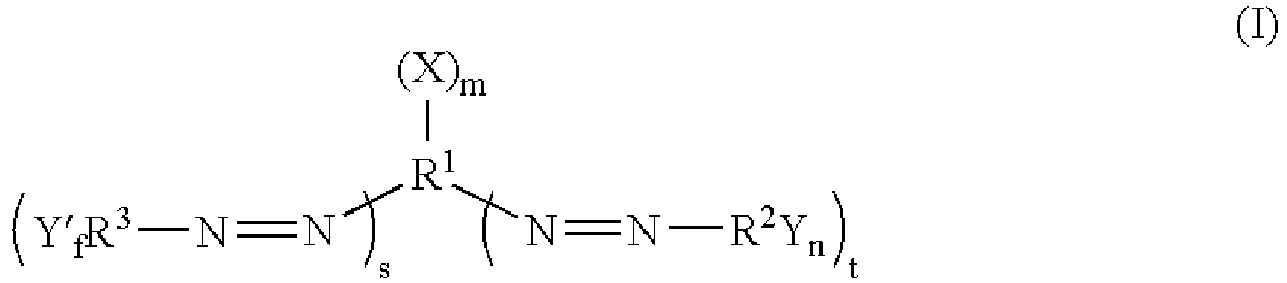
- R1, R2 and R3 are members independently selected from substituted or unsubstituted aryl, substituted or unsubstituted heteroaryl and substituted or unsubstituted unsaturated alkyl, with the proviso that at least two of R1, R2 and R3 are members selected from substituted or unsubstituted aryl, and substituted or unsubstituted heteroaryl;
- X, Y and Y' are members independently selected from reactive functional groups, wherein at least one of X, Y and Y' is:
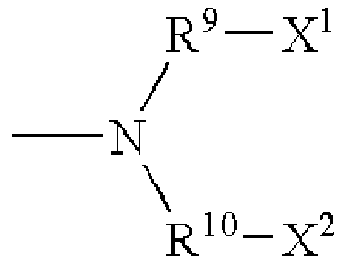
- R9 and R10 are members independently selected from alkyl and substituted alkyl; and X1 is a member selected from CH3, -OH, COOH, -NR'R", -SH, and -OP(OX3)(N(X4)2); X2 is OP(OX3)(N(X4)2)
wherein, - R', R", are members independently selected from H, and substituted or unsubstituted alkyl; and
- X3 and X4 are members independently selected from substituted and unsubstituted alkyl; f is a number selected from 0 to 4, inclusive, such that when (fxs) is greater than 1, the Y' groups are the same or different;
- m is a number selected from 1 to 4, inclusive, such that when m is greater than 1, the X groups are the same or different;
- n is a number from 0 to 6, inclusive, such that when (nxt) is greater than 1, the Y groups are the same or different;
- s is a number from 1 to 6, inclusive, such that when s is greater than 1 the R3 groups are the same or different; and
- t is a number from 1 to 6, inclusive, such that when t is greater than 1 the R2 groups are the same or different.
- R9 and R10 are members independently selected from alkyl and substituted alkyl; and X1 is a member selected from CH3, -OH, COOH, -NR'R", -SH, and -OP(OX3)(N(X4)2); X2 is OP(OX3)(N(X4)2)
- Optionally, the quencher is a quencher of excited state energy selected from:


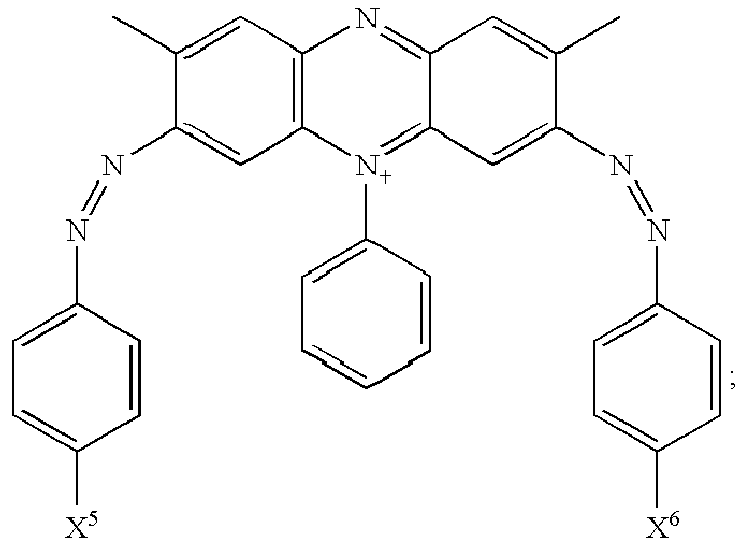


- X5 and X6 are members independently selected from H, substituted or unsubstituted C1-C6 alkyl, ER', DOOR', -NR'R"-SH, -OP(OX3)N(X4)2, wherein at least one of X5 and X6 is a reactive functional group;
- R' is a member selected from the group consisting of H, and alkyl or substituted alkyl;
- R" is a member selected from the group consisting of H and substituted alkyl; and
- X3 and X4 are members independently selected from CN, and substituted or unsubstituted C1-C6 alkyl.
- Optionally, the reporter comprises at least one dye and a cleavage site.
- Optionally, the reporter is attached at or adjacent the 5' terminal end of the (e) forward loop primer, and comprises at least one dye and a cleavage site.
- Optionally, the reporter is attached at or adjacent the 5' terminal end of the (e) forward loop primer, and comprises first and second dyes located at or adjacent opposing ends of the cleavage site.
- Optionally, the reporter is attached at or adjacent the 5' terminal end of the (e) forward loop primer, and comprises at least one dye and at least one quencher located at or adjacent opposing ends of the cleavage site.
- Optionally, the reporter is attached at or adjacent the 5' terminal end of the (e) forward loop primer, and comprises at least one dye and at least one quencher located at or adjacent opposing ends of the cleavage site, and the cleavage site is an apurinic/apyrimidinic site (abasic site).
- Optionally, the reporter is attached at or adjacent the 5' terminal end of the (e) forward loop primer, and comprises at least one dye selected from 3',6'-dihydroxy-1-oxospiro[2-benzofuran-3,9'-xanthene]-5-carboxylic acid (6-Carboxyfluorescein; 6-FAM); 6-Carboxy-2',7'-dichlorofluorescein diacetate N-succinimidyl ester (6-hexachlorofluorescein; 6-HEX); and 1-{6-[(2,5-Dioxo-1-pyrrolidinyl)oxy]-6-oxohexyl}-2-[(1E,3E,5E)-5-(1-{6-[(2,5-dioxo-1-pyrrolidinyl)oxy]-6-oxohexyl}-3,3-dimethyl-5-sulfo-1,3-dihydro-2H-indol-2-ylidene)-1,3-pentadien-1-yl]-3,3-dimethyl-3H-indolium-5-sulfonate (cyanine; Cy5) and at least one quencher located at or adjacent opposing ends of the cleavage site, and the cleavage site is an apurinic/apyrimidinic site (abasic site).
- Optionally, the reporter is attached at or adjacent the 5' terminal end of the (e) forward loop primer, and comprises at least one dye selected from 3',6'-dihydroxy-1-oxospiro[2-benzofuran-3,9'-xanthene]-5-carboxylic acid (6-Carboxyfluorescein; 6-FAM); 6-Carboxy-2',7'-dichlorofluorescein diacetate N-succinimidyl ester (6-hexachlorofluorescein; 6-HEX); and 1-{6-[(2,5-Dioxo-1-pyrrolidinyl)oxy]-6-oxohexyl}-2-[(1E,3E,5E)-5-(1-{6-[(2,5-dioxo-1-pyrrolidinyl)oxy]-6-oxohexyl}-3,3-dimethyl-5-sulfo-1,3-dihydro-2H-indol-2-ylidene)-1,3-pentadien-1-yl]-3,3-dimethyl-3H-indolium-5-sulfonate (cyanine; Cy5) and at least one quencher selected from tetramethyl-rhodamine (TAMRA), dimethylaminoazobenzenesulfonic acid, and a quencher commercially-available under the trademark "Black Hole Quencher" ("BHQ") from Biosearch Technologies, Inc., Novato, CA. located at or adjacent opposing ends of the cleavage site, and the cleavage site is an apurinic/apyrimidinic site (abasic site).
- Optionally, the reporter is attached at or adjacent the 5' terminal end of the (e) forward loop primer, and comprises 3',6'-dihydroxy-1-oxospiro[2-benzofuran-3,9'-xanthene]-5-carboxylic acid (6-Carboxyfluorescein; 6-FAM) and a quencher commercially-available under the trademark "Black Hole Quencher" ("BHQ") from Biosearch Technologies, Inc., Novato, CA. located at or adjacent opposing ends of the cleavage site, and the cleavage site is an apurinic/apyrimidinic site (abasic site).
- Optionally, the reporter is attached at or adjacent the 5' terminal end of the (e) forward loop primer, and comprises 6-Carboxy-2',7'-dichlorofluorescein diacetate N-succinimidyl ester (6-hexachlorofluorescein; 6-HEX) and a quencher commercially-available under the trademark "Black Hole Quencher" ("BHQ") from Biosearch Technologies, Inc., Novato, CA. located at or adjacent opposing ends of the cleavage site, and the cleavage site is an apurinic/apyrimidinic site (abasic site).
- Optionally, the reporter is attached at or adjacent the 5' terminal end of the (e) forward loop primer, and comprises 1-{6-[(2,5-Dioxo-1-pyrrolidinyl)oxy]-6-oxohexyl}-2-[(1E,3E,5E)-5-(1-{6-[(2,5-dioxo-1-pyrrolidinyl)oxy]-6-oxohexyl}-3,3-dimethyl-5-sulfo-1,3-dihydro-2H-indol-2-ylidene)-1,3-pentadien-1-yl]-3,3-dimethyl-3H-indolium-5-sulfonate (cyanine; Cy5) and a quencher commercially-available under the trademark "Black Hole Quencher" ("BHQ") from Biosearch Technologies, Inc., Novato, CA. located at or adjacent opposing ends of the cleavage site, and the cleavage site is an apurinic/apyrimidinic site (abasic site).
- Optionally, the reporter is attached at or adjacent the 5' terminal end of the (f) reverse loop primer, and comprises at least one dye and a cleavage site.
- Optionally, the reporter is attached at or adjacent the 5' terminal end of the (f) reverse loop primer, and comprises first and second dyes located at or adjacent opposing ends of the cleavage site.
- Optionally, the reporter is attached at or adjacent the 5' terminal end of the (f) reverse loop primer, and comprises at least one dye and at least one quencher located at or adjacent opposing ends of the cleavage site.
- Optionally, the reporter is attached at or adjacent the 5' terminal end of the (f) reverse loop primer, and comprises at least one dye and at least one quencher located at or adjacent opposing ends of the cleavage site, and the cleavage site is an apurinic/apyrimidinic site (abasic site).
- Optionally, the reporter is attached at or adjacent the 5' terminal end of the (f) reverse loop primer, and comprises at least one dye selected from 3',6'-dihydroxy-1-oxospiro[2-benzofuran-3,9'-xanthene]-5-carboxylic acid (6-Carboxyfluorescein; 6-FAM); 6-Carboxy-2',7'-dichlorofluorescein diacetate N-succinimidyl ester (6-hexachlorofluorescein; 6-HEX); and 1-{6-[(2,5-Dioxo-1-pyrrolidinyl)oxy]-6-oxohexyl}-2-[(1E,3E,5E)-5-(1-{6-[(2,5-dioxo-1-pyrrolidinyl)oxy]-6-oxohexyl}-3,3-dimethyl-5-sulfo-1,3-dihydro-2H-indol-2-ylidene)-1,3-pentadien-1-yl]-3,3-dimethyl-3H-indolium-5-sulfonate (cyanine; Cy5) and at least one quencher located at or adjacent opposing ends of the cleavage site, and the cleavage site is an apurinic/apyrimidinic site (abasic site).
- Optionally, the reporter is attached at or adjacent the 5' terminal end of the (f) reverse loop primer, and comprises at least one dye selected from 3',6'-dihydroxy-1-oxospiro[2-benzofuran-3,9'-xanthene]-5-carboxylic acid (6-Carboxyfluorescein; 6-FAM); 6-Carboxy-2',7'-dichlorofluorescein diacetate N-succinimidyl ester (6-hexachlorofluorescein; 6-HEX); and 1-{6-[(2,5-Dioxo-1-pyrrolidinyl)oxy]-6-oxohexyl}-2-[(1E,3E,5E)-5-(1-{6-[(2,5-dioxo-1-pyrrolidinyl)oxy]-6-oxohexyl}-3,3-dimethyl-5-sulfo-1,3-dihydro-2H-indol-2-ylidene)-1,3-pentadien-1-yl]-3,3-dimethyl-3H-indolium-5-sulfonate (cyanine; Cy5) and at least one quencher selected from tetramethyl-rhodamine (TAMRA), dimethylaminoazobenzenesulfonic acid, and a quencher commercially-available under the trademark "Black Hole Quencher" ("BHQ") from Biosearch Technologies, Inc., Novato, CA. located at or adjacent opposing ends of the cleavage site, and the cleavage site is an apurinic/apyrimidinic site (abasic site).
- Optionally, the reporter is attached at or adjacent the 5' terminal end of the (f) reverse loop primer, and comprises 3',6'-dihydroxy-1-oxospiro[2-benzofuran-3,9'-xanthene]-5-carboxylic acid (6-Carboxyfluorescein; 6-FAM) and a quencher commercially-available under the trademark "Black Hole Quencher" ("BHQ") from Biosearch Technologies, Inc., Novato, CA. located at or adjacent opposing ends of the cleavage site, and the cleavage site is an apurinic/apyrimidinic site (abasic site).
- Optionally, the reporter is attached at or adjacent the 5' terminal end of the (f) reverse loop primer, and comprises 6-Carboxy-2',7'-dichlorofluorescein diacetate N-succinimidyl ester (6-hexachlorofluorescein; 6-HEX) and a quencher commercially-available under the trademark "Black Hole Quencher" ("BHQ") from Biosearch Technologies, Inc., Novato, CA. located at or adjacent opposing ends of the cleavage site, and the cleavage site is an apurinic/apyrimidinic site (abasic site).
- Optionally, the reporter is attached at or adjacent the 5' terminal end of the (f) reverse loop primer, and comprises 1-{6-[(2,5-Dioxo-1-pyrrolidinyl)oxy]-6-oxohexyl}-2-[(1E,3E,5E)-5-(1-{6-[(2,5-dioxo-1-pyrrolidinyl)oxy]-6-oxohexyl}-3,3-dimethyl-5-sulfo-1,3-dihydro-2H-indol-2-ylidene)-1,3-pentadien-1-yl]-3,3-dimethyl-3H-indolium-5-sulfonate (cyanine; Cy5) and a quencher commercially-available under the trademark "Black Hole Quencher" ("BHQ") from Biosearch Technologies, Inc., Novato, CA. located at or adjacent opposing ends of the cleavage site, and the cleavage site is an apurinic/apyrimidinic site (abasic site).
- Optionally, the isothermal amplification is performed in the presence of an enzyme having polymerase activity.
- Optionally, the isothermal amplification is performed in the presence of a polymerase enzyme.
- Optionally, the isothermal amplification is performed in the presence of a nucleic acid polymerase enzyme.
- Optionally, the isothermal amplification is performed in the presence of a deoxyribonucleic acid polymerase enzyme.
- Optionally, the isothermal amplification is performed in the presence of a bacterial deoxyribonucleic acid polymerase enzyme.
- Optionally, the isothermal amplification is performed in the presence of a Bacillus deoxyribonucleic acid polymerase enzyme.
- Optionally, the isothermal amplification is performed in the presence of a Bacillus stearothermophilus deoxyribonucleic acid polymerase enzyme.
- Optionally, the isothermal amplification is performed in the presence of a fragment/subunit of Bacillus stearothermophilus deoxyribonucleic acid polymerase enzyme.
- Optionally, the isothermal amplification is performed in the presence of a large fragment/subunit of Bacillus stearothermophilus deoxyribonucleic acid polymerase enzyme.
- Optionally, the isothermal amplification is performed in the presence of a large fragment/subunit of Bacillus stearothermophilus deoxyribonucleic acid polymerase enzyme having a reversibly-bound aptamer.
- Optionally, the isothermal amplification is performed in the presence of a further enzyme having endonuclease activity.
- Optionally, the isothermal amplification is performed in the presence of a further enzyme having apurinic/apyrimidinic endonuclease activity.
- Optionally, the isothermal amplification is performed in the presence of a further enzyme having 3'-diesterease activity.
- Optionally, the isothermal amplification is performed in the presence of an Endonuclease IV enzyme.
- Optionally, the isothermal amplification is performed in the presence of a bacterial Endonuclease IV enzyme.
- Optionally, the isothermal amplification is performed in the presence of a Thermus Endonuclease IV enzyme.
- Optionally, the isothermal amplification is performed in the presence of a Thermus thermophilus Endonuclease IV enzyme.
- Optionally, the isothermal amplification is performed in the presence of a Thermus thermophilus Tth Endonuclease IV enzyme.
- Optionally, the isothermal amplification is performed in the presence of a further enzyme having exonuclease activity.
- Optionally, the isothermal amplification is performed in the presence of a further enzyme having 3' → 5' exonuclease activity.
- Optionally, the isothermal amplification is performed in the presence of a further enzyme having RNase H, 3'-phosphatase and/or AP-endonuclease activity.
- Optionally, the isothermal amplification is performed in the presence of an Exonuclease III enzyme.
- Optionally, the isothermal amplification is performed in the presence of a bacterial Exonuclease III enzyme.
- Optionally, the isothermal amplification is performed in the presence of an Escherichia Exonuclease III enzyme.
- Optionally, the isothermal amplification is performed in the presence of an E. coli Exonuclease III enzyme.
- Optionally, the isothermal amplification is performed at a temperature of 40°C to 85°C.
- Optionally, the isothermal amplification is performed at a temperature of 45°C to 85°C.
- Optionally, the isothermal amplification is performed at a temperature of 55°C to 85°C.
- Optionally, the isothermal amplification is performed at a temperature of 60°C to 80°C.
- Optionally, the isothermal amplification is performed at a temperature of 67°C.
- Optionally, the isothermal amplification is performed at a temperature of 65°C.
- Optionally, the isothermal amplification is performed at a temperature of 70°C to 80°C.
- Optionally, the isothermal amplification is performed at a temperature of 75°C.
- Optionally, the isothermal amplification is performed in the presence of a deoxyribonucleic acid polymerase enzyme at a temperature of 67°C. Optionally, the isothermal amplification is performed in the presence of a bacterial deoxyribonucleic acid polymerase enzyme at a temperature of 67°C. Optionally, the isothermal amplification is performed in the presence of a Bacillus deoxyribonucleic acid polymerase enzyme at a temperature of 67°C. Optionally, the isothermal amplification is performed in the presence of a Bacillus stearothermophilus deoxyribonucleic acid polymerase enzyme at a temperature of 67°C. Optionally, the isothermal amplification is performed in the presence of a fragment/subunit of Bacillus stearothermophilus deoxyribonucleic acid polymerase enzyme at a temperature of 67°C. Optionally, the isothermal amplification is performed in the presence of a large fragment/subunit of Bacillus stearothermophilus deoxyribonucleic acid polymerase enzyme at a temperature of 67°C. Optionally, the isothermal amplification is performed in the presence of a large fragment/subunit of Bacillus stearothermophilus deoxyribonucleic acid polymerase enzyme having a reversibly-bound aptamer at a temperature of 67°C.
- Optionally, the isothermal amplification is performed in the presence of an Endonuclease IV enzyme at a temperature of 67°C. Optionally, the isothermal amplification is performed in the presence of a bacterial Endonuclease IV enzyme at a temperature of 67°C. Optionally, the isothermal amplification is performed in the presence of a Thermus Endonuclease IV enzyme at a temperature of 67°C. Optionally, the isothermal amplification is performed in the presence of a Thermus thermophilus Endonuclease IV enzyme at a temperature of 67°C. Optionally, the isothermal amplification is performed in the presence of a Thermus thermophilus Tth Endonuclease IV enzyme at a temperature of 67°C.
- Optionally, the isothermal amplification is performed for 10-80 minutes.
- Optionally, the isothermal amplification is performed for 20-80 minutes.
- Optionally, the isothermal amplification is performed for 15-60 minutes.
- Optionally, the isothermal amplification is performed for 20-60 minutes.
- Optionally, the isothermal amplification is performed for 25-60 minutes.
- Optionally, the isothermal amplification is performed for 30-60 minutes.
- Optionally, the isothermal amplification is performed for 60 minutes.
- Optionally, the isothermal amplification is performed for 20-80 minutes at a temperature of 67°C. Optionally, the isothermal amplification is performed for 30-60 minutes at a temperature of 67°C. Optionally, the isothermal amplification is performed for 60 minutes at a temperature of 67°C.
- Optionally, the nucleic acid modification or substitution of the target nucleic acid is a nucleic acid substitution.
- Optionally, the nucleic acid modification or substitution of the target nucleic acid is a single-nucleotide polymorphism.
- Optionally, the disease is selected from cancer, cardiovascular disorders, diabetes, autoimmune diseases, gastrointestinal disorders, and infectious diseases.
- Optionally, the infectious disease is selected from a bacterial infection, a viral infection, and a fungal infection.
- Optionally, the infectious disease is a bacterial infection.
- Optionally, the infectious disease is a Neisseria, Streptococcus, or Haemophilus infection.
- Optionally, the infectious disease is a Neisseria meningitidis, Streptococcus pneumoniae, or Haemophilus influenzae infection.
- Optionally, the infectious disease is a Neisseria meningitidis infection, and the set of primers comprises at least one of:
- (a) a forward outer primer having a nucleic acid sequence as defined in SEQ ID NO:3;
- (b) a reverse outer primer having a nucleic acid sequence as defined in SEQ ID NO:4;
- (c) a forward inner primer having a nucleic acid sequence as defined in SEQ ID NO:1;
- (d) a reverse inner primer having a nucleic acid sequence as defined in SEQ ID NO:2;
- (e) a forward loop primer having a nucleic acid sequence as defined in SEQ ID NO:5 or in SEQ ID NO:6; and
- (f) a reverse loop primer having a nucleic acid sequence as defined in SEQ ID NO:7.
- Optionally, the infectious disease is a Streptococcus pneumoniae infection, and the set of primers comprises at least one of:
- (a) a forward outer primer having a nucleic acid sequence as defined in SEQ ID NO:10;
- (b) a reverse outer primer having a nucleic acid sequence as defined in SEQ ID NO:11;
- (c) a forward inner primer having a nucleic acid sequence as defined in SEQ ID NO:8;
- (d) a reverse inner primer having a nucleic acid sequence as defined in SEQ ID NO:9;
- (e) a forward loop primer having a nucleic acid sequence as defined in SEQ ID NO:12; and
- (f) a reverse loop primer having a nucleic acid sequence as defined in SEQ ID NO:13.
- Optionally, the infectious disease is a Haemophilus influenzae infection, and the set of primers comprises at least one of:
- (a) a forward outer primer having a nucleic acid sequence as defined in SEQ ID NO:16;
- (b) a reverse outer primer having a nucleic acid sequence as defined in SEQ ID NO:17;
- (c) a forward inner primer having a nucleic acid sequence as defined in SEQ ID NO:14;
- (d) a reverse inner primer having a nucleic acid sequence as defined in SEQ ID NO:15;
- (e) a forward loop primer having a nucleic acid sequence as defined in SEQ ID NO:18; and
- (f) a reverse loop primer having a nucleic acid sequence as defined in SEQ ID NO:19.
- Optionally, the infectious disease is a fungal infection.
- Optionally, the infectious disease is a Candida infection.
- Optionally, the infectious disease is a Candida albicans infection.
- Optionally, the infectious disease is a Candida albicans infection, and the set of primers comprises at least one of:
- (a) a forward outer primer having a nucleic acid sequence as defined in SEQ ID NO:54;
- (b) a reverse outer primer having a nucleic acid sequence as defined in SEQ ID NO:55;
- (c) a forward inner primer having a nucleic acid sequence as defined in SEQ ID NO:56;
- (d) a reverse inner primer having a nucleic acid sequence as defined in SEQ ID NO:57;
- (e) a forward loop primer having a nucleic acid sequence as defined in SEQ ID NO:5 or in SEQ ID NO:58; and
- (f) a reverse loop primer having a nucleic acid sequence as defined in SEQ ID NO:59.
- Optionally, the sample is selected from a cell sample, a tissue sample such as a biopsy sample, and a liquid sample such as a bodily fluid sample.
- Optionally, the sample is a liquid sample such as a blood sample or a cerebrospinal fluid (CSF) sample.
- Optionally, the step of (a) providing a sample further comprises isolating nucleic acids in the sample.
- Optionally, the step of (a) providing a sample further comprises isolating ribonucleic acids in the sample.
- Optionally, the step of (a) providing a sample further comprises isolating deoxyribonucleic acids in the sample.
- Optionally, the step of (c) performing isothermal amplification comprises contacting the set of primers according to the first aspect of the present invention with the sample.
- Optionally, the step of (c) performing isothermal amplification comprises contacting the set of primers according to the first aspect of the present invention with the nucleic acids in the sample.
- Optionally, the step of (c) performing isothermal amplification comprises contacting the set of primers according to the first aspect of the present invention with the ribonucleic acids in the sample.
- Optionally, the step of (c) performing isothermal amplification comprises contacting the set of primers according to the first aspect of the present invention with the deoxyribonucleic acids in the sample.
- Optionally, the step (d) detecting a nucleic acid target in the sample comprises detecting the signal emitted from the reporter.
- Optionally, the step (d) detecting a nucleic acid target in the sample comprises detecting the detectable signal emitted from the reporter.
- Optionally, the step (d) detecting a nucleic acid target in the sample comprises detecting the fluorescent signal emitted from the reporter.
- Optionally, the step (d) detecting a nucleic acid target in the sample comprises detecting the fluorescent signal emitted from the reporter at a wavelength of 495-662 nm.
- Optionally, the step (d) detecting a nucleic acid target in the sample comprises detecting the fluorescent signal emitted from the reporter at a wavelength of 495-520 nm.
- Optionally, the step (d) detecting a nucleic acid target in the sample comprises detecting the fluorescent signal emitted from the reporter at a wavelength of 535-565 nm.
- Optionally, the step (d) detecting a nucleic acid target in the sample comprises detecting the fluorescent signal emitted from the reporter at a wavelength of 646-662 nm.
- Optionally, the reporter comprises 3',6'-dihydroxy-1-oxospiro[2-benzofuran-3,9'-xanthene]-5-carboxylic acid (6-Carboxyfluorescein; 6-FAM) and the step (d) detecting a nucleic acid target in the sample comprises detecting the fluorescent signal emitted from the reporter at a wavelength of 495-520 nm.
- Optionally, the reporter comprises 6-Carboxy-2',7'-dichlorofluorescein diacetate N-succinimidyl ester (6-hexachlorofluorescein; 6-HEX) and the step (d) detecting a nucleic acid target in the sample comprises detecting the fluorescent signal emitted from the reporter at a wavelength of 535-565 nm.
- Optionally, the reporter comprises 1-{6-[(2,5-Dioxo-1-pyrrolidinyl)oxy]-6-oxohexyl}-2-[(1E,3E,5E)-5-(1-{6-[(2,5-dioxo-1-pyrrolidinyl)oxy]-6-oxohexyl}-3,3-dimethyl-5-sulfo-1,3-dihydro-2H-indol-2-ylidene)-1,3-pentadien-1-yl]-3,3-dimethyl-3H-indolium-5-sulfonate (cyanine; Cy5) and the step (d) detecting a nucleic acid target in the sample comprises detecting the fluorescent signal emitted from the reporter at a wavelength of 646-662 nm.
- Optionally, a presence of a signal emitted from the reporter indicates a presence of the nucleic acid target in the sample.
- Optionally, an absence of a signal emitted from the reporter indicates an absence of the nucleic acid target in the sample.
- Optionally, a presence of a signal emitted from the reporter indicates an absence of the nucleic acid modification or substitution of the target nucleic acid in the sample.
- Optionally, an absence of a signal emitted from the reporter indicates a presence of the nucleic acid modification or substitution of the target nucleic acid in the sample.
- Optionally, the presence of the nucleic acid target in the sample indicates the presence of a disease or disorder.
- Optionally, the presence of the nucleic acid modification or substitution of the target nucleic acid in the sample indicates the presence of a disease or disorder associated with the nucleic acid modification or substitution of the target nucleic acid.
- Optionally, the method for identifying a target nucleic acid comprises identifying the nucleic acid target in the sample when the nucleic acid target is present in the sample.
- Optionally, the method for identifying a target nucleic acid comprises identifying the nucleic acid target in the sample when the sample comprises less than 105 copies of the nucleic acid target.
- Optionally, the method for identifying a target nucleic acid comprises identifying the nucleic acid target in the sample when the sample comprises less than 103 copies of the nucleic acid target.
- Optionally, the method for identifying a target nucleic acid comprises identifying the nucleic acid target in the sample when the sample comprises less than 102 copies of the nucleic acid target.
- Optionally, the method for identifying a nucleic acid modification or substitution of a target nucleic acid comprises identifying the nucleic acid modification or substitution of the target nucleic acid in the sample when the nucleic acid target is present in the sample.
- Optionally, the method for identifying a nucleic acid modification or substitution of a target nucleic acid comprises identifying the nucleic acid modification or substitution of the target nucleic acid in the sample when the sample comprises less than 105 copies of the nucleic acid target.
- Optionally, the method for identifying a nucleic acid modification or substitution of a target nucleic acid comprises identifying the nucleic acid modification or substitution of the target nucleic acid in the sample when the sample comprises less than 103 copies of the nucleic acid target.
- Optionally, the method for identifying a nucleic acid modification or substitution of a target nucleic acid comprises identifying the nucleic acid modification or substitution of the target nucleic acid in the sample when the sample comprises less than 102 copies of the nucleic acid target.
- Embodiments of the invention will now be described with reference to the accompanying drawings in which:
-
Figure 1A is a schematic diagram of a set of primers of the invention comprising (a) a forward outer primer; (b) a reverse outer primer; (c) a forward inner primer; (d) a reverse inner primer, (e) a forward loop primer and (f) a reverse loop primer; wherein each primer is capable of binding to a target nucleic acid having complementary first (1.) and second (2.) nucleic acid strands, wherein the first (1.) nucleic acid strand has first (A), second (B), third (C), fourth (D), fifth (E) and sixth (F) regions; and wherein the second (2.) nucleic acid strand has first (F'), second (E'), third (D'), fourth (C'), fifth (B') and sixth (A') regions; wherein the fourth (D), fifth (E) and sixth (F) regions of the first (1.) nucleic acid strand are complimentary to the third (D'), second (E'), and first (F') regions of the second (2.) nucleic acid strand; and wherein the fourth (C'), fifth (B') and sixth (A') regions of the second (2.) nucleic acid strand are complimentary to the third (C), second (B), and first (A) regions of the first (1.) nucleic acid strand; and wherein (a) the forward outer primer is complementary to the first region (A) of the first (1.) nucleic acid strand; (b) the reverse outer primer is complementary to the first (F') region of the second (2.) nucleic acid strand; (c) the forward inner primer has first and second parts, wherein: (i) the first part is complementary to the second region (B) of the first (1.) nucleic acid strand; and (ii) the second part is complementary to the fourth (C') region of the second (2.) nucleic acid strand; and (d) the reverse inner primer has first and second parts, wherein: (i) the first part is complementary to the second (E') region of the second (2.) nucleic acid strand; and (ii) the second part is complementary to the fourth (D) region of the first (1.) nucleic acid strand; (e) the forward loop primer is complementary to a region between the fourth (C') and fifth (B') regions of the second (2.) nucleic acid strand; (f) the reverse loop primer is complementary to a region between the fourth (D) and fifth (E) regions of the first (1.) nucleic acid strand; -
Figure 1B is a schematic diagram of an isothermal amplification using the primers of the invention; wherein (A) loop regions of the double-looped LAMP template, produced by strand-displacing polymerase extension from the outer and inner primers, are targeted by the inner primer and primer/probe; (B) after primer and probe target hybridisation, strand-displacement polymerase extension initiates, unwinding both loop structures, and primer/probe target hybridisation produces a dsDNA abasic site initiating Endonuclease IV cleavage in the wild-type reaction, and presence of the SNP in the mutant allele reaction inhibits abasic site dsDNA formation, preventing cleavage; and (C) combination of reaction temperature and strand-displacement polymerase extension causes fluorophore and quencher dissociation in the wild-type reaction, producing fluorescence, wherein the mutant allele reaction, the fluorophore and quencher remain associated, preventing fluorescence production and enabling wild-type and mutant allele differentiation; -
Figure 2 shows the results of a singleplex N. meningitidis assay single-target detection using the primers of the invention (modified LAMP) compared to detection using the primers of the state of the art (state-of-the-art LAMP), wherein the singleplex modified LAMP (grey) and state-of-the-art LAMP (red) N. meningitidis assays were challenged with N. meningitidis genomic DNA at 103 copies, no template control (NTC) reactions (black) were performed in parallel, resulting LAMP fluorescence signal was recorded in the LightCycler® 480 FAM detection channel, with representative amplification curves for each reaction shown, successful modified LAMP and state-of-the-art LAMP detection of N. meningitidis is observed, however, modified LAMP produced earlier time-to-detection and increased fluorescence levels compared to state-of-the-art LAMP, and the NTC reactions performed successfully as no detection was observed; -
Figure 3 shows the results of a singleplex modified LAMP N. meningitidis assay SNP identification with comparison to state-of-the-art LAMP, wherein the singleplex modified LAMP and state-of-the-art LAMP N. meningitidis assays were separately challenged with templates without SNPs, N. meningitidis genomic DNA (grey) and SNPO (red), at 105 copies, in parallel, the modified LAMP and state-of-the-art LAMP assays were also challenged with templates containing SNPs, SNP1-6 (A, dashed black) and SNPA (B, dashed black) respectively, at 105 copies, no template control (NTC) reactions were performed in parallel (black), resulting amplification curves indicate modified LAMP single-base specificity as only templates without SNPs were detected, single-base specificity in the state-of-the-art LAMP assay was not observed as all templates, with or without SNPs, were detected, and the NTC reactions performed successfully as no detection was observed; -
Figure 4 shows the allele-specific (AS) modified LAMP N. meningitidis assay single-tube detection of either wild-type or mutant allele templates, wherein the AS modified LAMP N. meningitidis assay was separately challenged with the wild-type template SNPO (grey), and the mutant allele template SNP2 (red), at 105 copies, a NTC reaction was performed in parallel (black), resulting LAMP fluorescence signal was recorded in the LightCycler® 480 FAM (wild-type) and HEX (mutant allele) detection channels, with representative amplification curves for each reaction shown, successful modified LAMP detection of both templates was observed in respective detection channels only, with no unspecific detection of either template in non-corresponding channels observed, and the NTC reaction performed successfully as no detection was observed; -
Figure 5 shows multiplex modified LAMP N. meningitidis, S. pneumoniae and H. influenzae assay simultaneous multiple-target detection, wherein the multiplex modified LAMP assay was challenged with three bacterial templates, N. meningitidis (A, dashed black), S. pneumoniae (B, dashed black) and H. influenzae (C, dashed black), at 102 genome copies in a single reaction, a NTC reaction was also performed in parallel (black), resulting LAMP fluorescence signal was recorded in the LightCycler® 480 FAM (N. meningitidis), HEX (S. pneumoniae) and Cy5 (H. influenzae) detection channels with representative amplification curves for each reaction shown, and successful simultaneous detection of all three bacterial templates, with no amplification in the NTC control reaction, was observed; and -
Figure 6 shows single-target detection of C. albicans bacterial template at 10^5 genome copies was successfully demonstrated using the singleplex C. albicans modified LAMP assay (Figure 6 , grey). The NTC reaction performed successfully as no amplification was observed (Figure 6 , black). - Embodiments of the invention will now be described with reference to the following non-limiting examples:
- The singleplex modified LAMP N. meningitidis assay was evaluated using a range of N. meningitidis, Neisseria and closely related non-Neisseria reference strains (Table 1). The multiplex modified LAMP N. meningitidis, S. pneumoniae and H. influenzae assay was performed using type-strains N. meningitidis NCTC 10025, S. pneumoniae DSM 20566 and H. influenzae DSM 4690. The singleplex modified LAMP Candida alibicans assay was performed using Candida alibicans CBS 562 type strain. All bacterial and fungal strains, stored at -80°C, were cultured in brain heart infusion (BHI) media (Oxoid, Hampshire, UK) at 37°C for 18 h under microaerophilic conditions, excluding Haemophilus strains which were cultured using Haemophilus test media (Oxoid). DNA extractions were performed using the DNeasy Blood and Tissue kit (Qiagen, Hilden, Germany) followed by DNA quantification using the Qubit dsDNA broad range/high sensitivity assay kits and Qubit 2.0 fluorometer (Life Technologies, Warrington, UK). Genome size standards of 2.2 Mb, 2.1 Mb, 1.83 Mb, and 15.5 Mb for N. meningitidis, S. pneumoniae, H. influenzae, and Candida alibicans, respectively, were used to convert resulting DNA concentrations to genome copy values. Extracted DNA samples were stored at -80°C prior to use.
Table 1: Singleplex modified LAMP Neisseria meningitidis assay specificity panel. Organism Strain modified LAMP Result Inclusivity Panel N. meningitidis reference strains N. meningitidis (A, type strain) NCTC 10025 + N. meningitidis (A) DSM 10036 + N. meningitidis (A) NCTC 3372 + N. meningitidis (A) NCTC 3375 + N. meningitidis (B) ATCC 13090 + N. meningitidis (C) ATCC 13102 + N. meningitidis (C) DSM 15464 + N. meningitidis (W) NCTC 11203 + N. meningitidis (X) NCTC 10790 + N. meningitidis (Y) NCTC 10791 + Exclusivity Panel Neisseria reference strains and closely related non-Neisseria reference strains N. animalis DSM 23392 - N. animaloris DSM 21642 - N. bacilliformis DSM 23338 - N. canis DSM 18000 - N. caviae DSM 23336 - N. cuniculi DSM 21768 - N. dentiae DSM 19151 - N. elongata subsp. elongata DSM 17712 - N. elongata subsp. glycolytica DSM 23337 - N. elongata subsp. nitroreducens DSM 17632 - N. flavescens DSM 17633 - N. gonorrhoeae ATCC 19424 - N. gonorrhoeae DSM 9188 - N. gonorrhoeae DSM 9189 - N. lactamica ATCC 23970 - N. lactamica DSM 4691 - N. macacae DSM 19175 - N. mucosa DSM 17611 - N. ovis DSM 18075 - N. perflava DSM 18009 - N. polysaccharea DSM 22809 - N. shayeganii DSM 22246 - N. sicca DSM 17713 - N. subflava DSM 17610 - N. wadsworthii DSM 22247 - N. weaveri DSM 17688 - N. zoodegmatis DSM 21483 - N. zoodegmatis DSM 21643 - H. influenzae DSM 4690 - H. parainfluenzae DSM 8978 - H. haemolyticus CCUG 15312 - H. somnus CCUG 12839 - S. pneumoniae DSM 20566 - S. pseudopneumoniae DSM 18670 - S. agalactiae BCCM 15081 - S. mitis DSM 12643 - K. pneumoniae DSM 30104 - P. aeruginosa DSM 50071 - E. coli DSM 30083 - E. faecalis DSM 20371 - S. aureus DSM 346 - NCTC, National Collection of Type Cultures; DSM, Leibniz Institute DSMZ - German Collection of Microorganisms and Cell Cultures; ATCC, American Type Culture Collection; CCUG, Culture Collection, University of Göteborg, Sweden; BCCM, Belgian Coordinated Collections of Microorganisms; +, positive; -, negative. - N. meningitidis, S. pneumoniae, H. influenzae, and C. albicans state-of-the-art LAMP oligonucleotides, designed with PrimerExplorer V4 (Eiken Chemical) using diagnostic targets NMO_1242, SPNA45_01710 and pstA, respectively (Higgins, O.; Clancy, E.; Cormican, M.; Boo, T. W.; Cunney, R.; Smith, T. J., Evaluation of an Internally Controlled Multiplex Tth Endonuclease Cleavage Loop-Mediated Isothermal Amplification (state-of-the-art LAMP) Assay for the Detection of Bacterial Meningitis Pathogens. International journal of ) were modified to create the modified LAMP and state-of-the-art LAMP oligonucleotides used in this study (Table 2). Oligonucleotide modifications included design of new reverse loop primers for the S. pneumoniae and H. influenzae assays, with addition of two 5'-end thymine residues to the forward loop primer of the N. meningitidis assay. Standard desalted oligonucleotides were synthesised by Integrated DNA Technologies. The modified LAMP primer/probes for N. meningitidis, S. pneumoniae, H. influenzae, and C. albicans labelled with FAM, HEX, Cy5 and FAM fluorophores, respectively, and the state-of-the-art LAMP primer/probe labelled with a FAM fluorophore, were HPLC purified and synthesised by Metabion International AG (Planegg, Germany). Each fluorophore corresponded to one of three detection channels of the LightCycler® 480 instrument II (Roche Diagnostics, Sussex, UK) used to perform the modified LAMP reactions.
Table 2: modified LAMP and state-of-the-art LAMP oligonucleotides. Primer Type Sequence (5'-3') N. meningitidis modified LAMP Forward Inner 
Reverse Inner 
Forward Outer CCCAATTCCACATCAATACGTG Reverse Outer GTGGTGTCGGTGGTGTTG modified LAMP Primer/Probe Wild-Type (BHQ1)TTGA(dSpacer)A(FAM-dT)TGTGTTGGGCGGTTTG modified LAMP Primer/Probe Mutant (SNP2 template specific) (BHQ1)TTGA(dSpacer)C(HEX-dT)TGTGTTGGGCGGTTTG Reverse Loop CACCACTTGGAAAAACAGAGGC S. pneumoniae modified LAMP Forward Inner 
Reverse Inner 
Forward Outer TCCGTCAACGAGGCACAA Reverse Outer AGCAAACTCACCAAGCGC Forward Loop TGATGAAACAGACAAGCTGATTCT modified LAMP (BHQ1)ACTC(dSpacer)CA(HEX- Primer/Probe dT)GCGCAATGATGGTATAATCC H. influenzae modified LAMP Forward Inner 
Reverse Inner 
Forward Outer GGCTGGAGCATTCGCATT Reverse Outer TTCTCCTGAAATTCGGGCAA Forward Loop AACATATTGTCCGTAGTGCG modified LAMP Primer/Probe (BHQ2)TTGT(dSpacer)A(Cy5-dT)CGAGCAGCTAAATCAGGGA C. albicans modified LAMP Forward Inner 
Reverse Inner 
Forward Outer CACCAGAATTTAGGTGCCATG Reverse Outer GCGGAGTTGATTGTTTTGGTTG modified LAMP Primer/Probe BHQ 1 -TTCA(d Space r)C(FAM-dT)TGTACTGGAAG CTCGT Reverse Loop CCAACAAATTAAACACATTCAACAGC N. meningitidis state-of-the-art LAMP state-of-the-art LAMP Primer/Probe 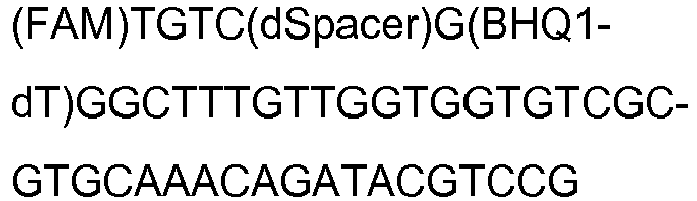
Forward Inner 
Reverse Inner 
Forward Outer CCCAATTCCACATCAATACGTG Reverse Outer GTGGTGTCGGTGGTGTTG Forward Loop TTGAGATTGTGTTGGGCGGTTTG Reverse Loop CACCACTTGGAAAAACAGAGGC -, separation between 5' antisense and 3' sense inner primer sequences; BHQ1-dT, black hole quencher 1 linked to thymine; dSpacer, 1',2'-dideoxyribose; FAM, 6-carboxyfluorescein fluorophore; HEX, 6-hexachlorofluorescein fluorophore; Cy5, cyanine fluorophore. - Singleplex modified LAMP N. meningitidis assay single-target detection with comparison to state-of-the-art LAMP
- The singleplex modified LAMP N. meningitidis assay reaction contained 1×Isothermal Amplification Buffer (New England Biolabs, Hitchin, UK), 6 mM MgSO4 (Roche Diagnostics), 1.4 mM deoxynucleotide triphosphate set (New England Biolabs), N. meningitidis oligonucleotides [1.6 µM forward and reverse inner, 0.4 µM modified LAMP primer/probe wild-type and reverse loop, 0.2 µM forward and reverse outer], 8 U Bst 2.0 WarmStart DNA polymerase (New England Biolabs), 1 U Endonuclease IV (New England Biolabs), 1 µL DNA template or 1 µL molecular grade water for NTC reaction, and molecular grade water to give a final reaction volume of 25 µL. The singleplex state-of-the-art LAMP N. meningitidis assay was prepared as per the modified LAMP assay, with modifications: the Endonuclease IV enzyme was replaced with 15 U Tth Endonuclease IV (New England Biolabs); the modified LAMP primer/probe wild-type was replaced with unmodified forward loop primer; and 0.8 µM of the forward inner primer was replaced with state-of-the-art LAMP primer/probe (Table 2). Reactions were performed for 60 x 1 min cycles at 67°C in a LightCycler® 480 instrument II (Roche Diagnostics). The fluorescence detection channel used was 495-520 nm (FAM) with fluorescent measurements recorded every min. Single-target detection using the singleplex modified LAMP and state-of-the-art LAMP N. meningitidis assays was demonstrated by challenging both assays with 103 copies of type-strain N. meningitidis genomic DNA (
Figure 2 ). No template control (NTC) reactions using molecular grade water in place of bacterial template were carried out in parallel. Positive results in each reaction were recorded on the LightCycler® 480 as exponential signal acquisition exceeding background fluorescence and represented as fluorescence amplification curves. Cycle threshold (Ct) values denoted cycles at which fluorescent signal exceeded background levels. As reactions were performed for 60 x 1 min cycles, resulting Ct-values acted as approximate time-to-positivity values in minutes. - Singleplex modified LAMP N. meningitidis assay analytical specificity, sensitivity and clinical sample testing
- All clinical samples were collected and processed by the IMSRL during routine diagnostic services in accordance with ethical review committee approved protocols. Samples were not analysed for human DNA in this study, and thus, the Ethics Committee of the National University of Ireland, Galway deemed that ethical approval for the evaluation of these samples was not required.
- Analytical specificity of the singleplex modified LAMP N. meningitidis assay was evaluated using genomic DNA from a panel of bacterial reference strains (Table 1) at 105 genome copy concentrations. The limit of detection (LOD) of the singleplex modified LAMP N. meningitidis assay was determined by testing 6 replicates of 32, 16, 8, 4, 2 and 1 genome copy concentrations of type-strain N. meningitidis NCTC 10025 genomic DNA. Probit regression analysis was performed on the resulting data using Minitab 17 (Table 3) to establish assay LOD with 95% probability. The clinical application of the singleplex modified LAMP N. meningitidis assay was assessed using archived genomic DNA extracted from blood and cerebrospinal fluid (CSF) samples of confirmed bacterial meningitis cases. The Irish Meningitis and Sepsis Reference Laboratory (IMSRL) supplied 72 anonymised samples which were previously collected and processed as part of routine diagnostic service. IMSRL DNA extractions were carried out using a QIAsymphony SP/AS instrument with QIAamp DSP DNA Blood Mini Kits (Qiagen), as per manufacturer instructions, followed by real-time PCR analysis for N. meningitidis, S. pneumoniae and H. influenzae. We reconfirmed the presence of N. meningitidis, S. pneumoniae and H. influenzae in each respective sample using singleplex real-time PCR assays targeting the N. meningitidis NMO_1242, S. pneumoniae lepA and H. influenzae pstA genes (Table 4). PCR reactions were performed on a LightCycler® 480 II instrument, using the LightCycler® 480 Probes Master kit (Roche Diagnostics) as per manufactures instructions, testing 2.5 µL of each sample (Table 5). For comparative purposes, the diagnostic sensitivity and specificity of the singleplex modified LAMP N. meningitidis assay was also determined by testing 2.5 µL of each sample (Table 5). Samples from cases of meningococcal infection were used to determine modified LAMP diagnostic sensitivity, and samples from cases of pneumococcal and Haemophilus infection were used to determine modified LAMP diagnostic specificity. Positive control reactions incorporating respective type-strain genomic DNA at 103 genome copies, and negative control reactions substituting molecular grade water for bacterial template, were carried out in parallel to the above reactions.
Table 3: Singleplex modified LAMP N. meningitidis assay limit-of-detection (LOD) Probit analysis. Genome copy concentration tested Replicates tested / Replicates detected 32 6 / 6 16 6 / 6 8 6 / 6 4 6 / 6 2 6 / 4 1 6 / 1 Genome copy LOD per reaction (95% probability) 3.1 Table 4: PCR oligonucleotides. Type Sequence (5'-3') N. meningitidis Forward CGACATGTTCGAACGTAATCTCC Probe (FAM)TATCGGGCAAAGCCAAATGCGAAG(BHQ1) Reverse ATTTCGGTGGCGCGTTT S. pneumoniae Forward CTCGT AAGCGT AAACTCCTTG Probe (FAM)ACGCATGAAATCCATCGGATCAGTT(BHQ1) Reverse CATACTCAAGACGCTGAGGA H. influenzae Forward GGTACGCACYACGGACAATATG Probe (FAM)AGCTCTTGGTTGCTCTCAATGGCA(BHQ1) Reverse CCTGATTTAGCYGCTCGATAACA FAM, 6-carboxyfluorescein fluorophore; BHQ1, black hole quencher Table 5: Singleplex modified LAMP N. meningitidis assay clinical sample testing using N. meningitidis, S. pneumoniae and H. influenzae PCR-positive DNA extracts from blood and CSF specimens of confirmed bacterial meningitis cases. N. meningitidis Clinical Samples Sample No. Clinical Specimen N. meningitidis PCR N. meningitidis modified LAMP (Ct Value) (Ct Value) 1 BLD 36.97 24.30 2 BLD 30.82 15.06 3 BLD 31.46 14.49 4 BLD 30.02 15.47 5 BLD 30.05 15.05 6 BLD 34.17 16.26 7 CSF 33.55 17.23 8 BLD 36.11 37.13 9 CSF 30.21 13.28 10 BLD 33.06 16.82 11 CSF 30.32 15.27 12 BLD 33.17 17.62 13 BLD 36.37 21.37 14 BLD 33.47 17.73 15 BLD 23.82 12.01 16 BLD 36.72 17.86 17 BLD 33.91 16.00 18 CSF 36.46 23.05 19 BLD 29.88 14.62 20 BLD 34.83 18.28 21 BLD 33.89 17.37 22 BLD 36.06 12.23 23 CSF 34.02 16.84 24 CSF 23.98 13.29 25 CSF 32.79 18.20 26 CSF 23.04 13.53 27 CSF 33.31 18.49 28 CSF 22.39 13.27 29 CSF 27.29 13.65 30 CSF 26.53 12.60 31 CSF 22.98 13.75 32 CSF 30.30 14.52 33 CSF 26.93 12.11 S. pneumoniae Clinical Samples Sample No. Clinical Specimen S. pneumoniae PCR N. meningitidis modified LAMP (Ct Value) (Ct Value) 34 BLD 31.61 - 35 CSF 24.13 - 36 BLD 28.01 - 37 CSF 34.64 - 38 CSF 26.33 - 39 BLD 28.59 - 40 CSF 30.47 - 41 CSF 33.22 - 42 CSF 31.99 - 43 CSF 25.32 - 44 BLD 31.84 - 45 BLD 26.87 - 46 CSF 29.31 - 47 BLD 27.05 - 48 BLD 32.61 - 49 CSF 25.60 - 50 CSF 23.18 - 51 CSF 28.83 - 52 CSF 23.61 - 53 CSF 26.34 - 54 CSF 31.06 - 55 CSF 28.81 - H. influenzae Clinical Samples Sample No. Clinical Specimen H. influenzae PCR (Ct Value) N. meningitidis modified LAMP (Ct Value) 56 BLD 38.50 - 57 CSF 37.26 - 58 BLD 37.48 - 59 CSF 36.54 - 60 CSF 32.24 - 61 CSF 28.65 - 62 CSF 27.95 - 63 BLD 35.50 - 64 BLD 38.40 - 65 BLD 37.73 - 66 BLD 34.44 - 67 BLD 38.61 - 68 BLD 31.18 - 69 BLD 38.45 - 70 BLD 37.13 - 71 CSF 35.73 - 72 CSF 30.99 - BLD, blood; CSF, cerebrospinal fluid; -, negative. - Singleplex modified LAMP N. meningitidis assay SNP identification with comparison to state-of-the-art LAMP
- Templates used to demonstrate modified LAMP single-base specificity were synthetic 500 bp DNA gBlocks® Gene Fragments (Table 7 and Table 6) purchased from Integrated DNA Technologies (Leuven, Belgium). Each template was based on a 500 bp sequence of the N. meningitidis NMO_1242 diagnostic target. SNPO was an exact copy of this sequence and acted as a wild-type template for positive control reactions. SNP1-6 were incomplete copies of this sequence containing single-base mismatches in close proximity to the modified LAMP primer/probe wild-type abasic site, and acted as mutant allele test templates for the modified LAMP assay. SNPA contained a single-base mismatch in close proximity to the state-of-the-art LAMP primer/probe abasic site and acted as a mutant allele test template for the state-of-the-art LAMP assay. The single-base mismatches between the gBlocks® Gene Fragment templates and their respective probes were designed to create either guanine to adenine, or cytosine to thymine, interactions (Table 7). Single-base specificity of the singleplex modified LAMP N. meningitidis assay was demonstrated by challenging the assay with SNP1-6 templates at 105 copies (
Figure 3 ). For comparison, the state-of-the-art LAMP assay was challenged with the SNPA template at 105 copies. Positive control reactions for both assays contained N. meningitidis genomic DNA and the SNPO template at 105 copies, with no template controls reactions performed in parallel.Table 6: N. meningitidis 500 bp DNA gBlocks® Gene Fragments with and without SNPs. SNPO (without SNP) 
SNP1 (with SNP) 

SNP2 (with SNP) 
SNP3 (with SNP) 
SNP4 (with SNP) 
SNP5 (with SNP) 

SNP6 (with SNP) 
SNPA (with SNP) 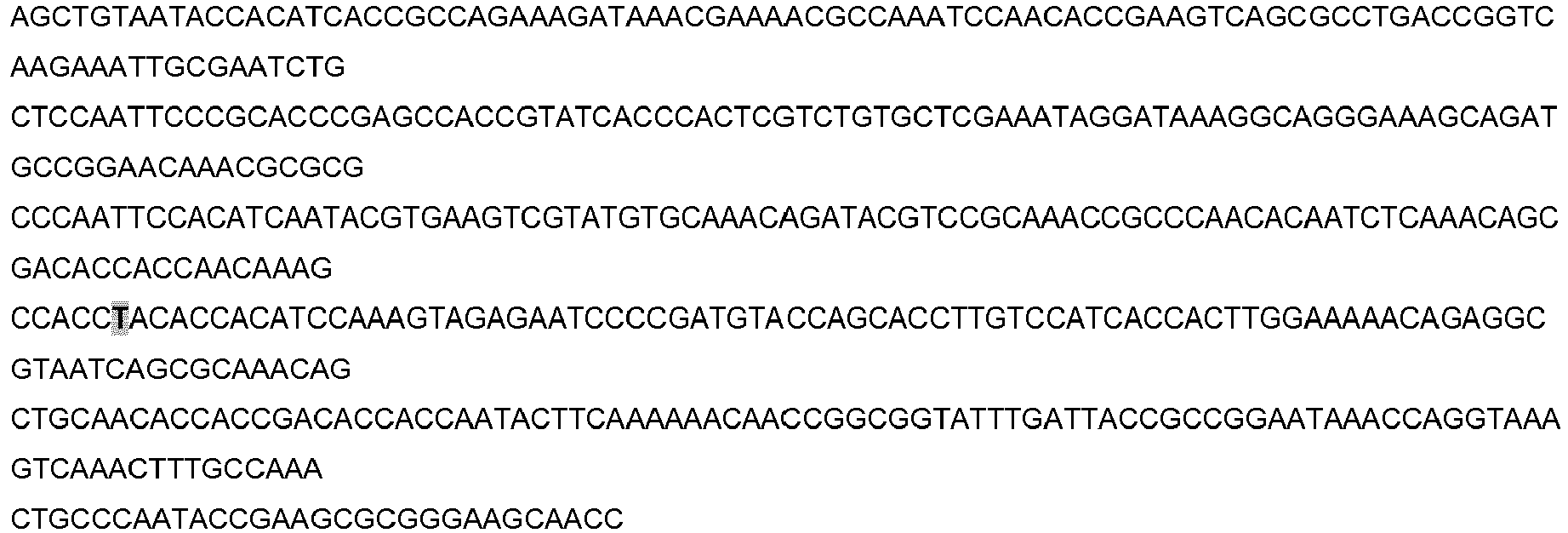
Highlight, SNP mismatch. Table 7: N. meningitidis modified LAMP and state-of-the-art LAMP primer/probes with complementary region of each gBlocks® Gene Fragment template (SNPs highlighted). modified LAMP Primer/Probe Wild-Type: 
SNP0: AACTCTAACACAACCCGCCAAAC SNP1: 
SNP2: 
SNP3: 
SNP4: 
SNP5: 
SNP6: 
modified LAMP Primer/Probe Mutant: 
SNP0: 
SNP2: AACTCGAACACAACCCGCCAAAC state-of-the-art LAMP Primer/Probe: 
SNP0: ACAGCCACCGAAACAACCACCACAGCGCACGTTTGTCTATGCAGGC SNPA: 
Underline, dye labels; -, abasic site; bold, single base difference between modified LAMP Primer/Probe Wild-Type and modified LAMP Primer/Probe Mutant. - AS modified LAMP N. meningitidis assay single-tube detection of either wild-type or mutant allele templates
- The singleplex modified LAMP N. meningitidis assay was modified to incorporate the modified LAMP primer/probe mutant (Table 2), a SNP2 specific mutant allele HEX fluorophore labelled modified LAMP primer/probe, also at 0.4 µM concentration, creating the AS modified LAMP N. meningitidis assay. This assay was separately challenged with the wild-type SNP0 template and the mutant allele SNP2 template, each at 105 copies (
Figure 4 ). Reactions were performed as per the standard singleplex modified LAMP N. meningitidis assay with the addition of using two fluorescence detection channels, 495-520 nm (FAM, wild-type) and 535-565 nm (HEX, mutant allele). A colour compensation file, generated as per LightCycler® 480 operator manual, was applied for correction of any channel-to-channel fluorescence crosstalk. A NTC reaction as previously described was carried out in parallel. - Multiplex modified LAMP N. meningitidis, S. pneumoniae and H. influenzae assay simultaneous multiple-target detection
- The multiplex modified LAMP N. meningitidis, S. pneumoniae and H. influenzae assay was prepared as per the singleplex modified LAMP N. meningitidis assay, with the further addition of S. pneumoniae and H. influenzae modified LAMP oligonucleotides (Table 2) at the same concentration as the N. meningitidis oligonucleotides. The addition of molecular grade water was altered to maintain a final reaction volume of 25 µL. Simultaneous multiple-target detection using the multiplex modified LAMP N. meningitidis, S. pneumoniae and H. influenzae assay was demonstrated by challenging the assay with N. meningitidis NCTC 10025, S. pneumoniae DSM 20566 and H. influenzae DSM 4690 purified genomic DNA at 102 genome copies, in a single reaction (
Figure 5 ). This reaction was performed at 65°C using fluorescence detection channels 495-520 nm (FAM), 535-565 nm (HEX) and 646-662 nm (Cy5). A colour compensation file was generated as previously described and applied for correction of any channel-to-channel fluorescence crosstalk. A NTC reaction was carried out in parallel as previously described. - Singleplex modified LAMP N. meningitidis assay single-target detection with comparison to state-of-the-art LAMP
- Both the singleplex modified LAMP and state-of-the-art LAMP N. meningitidis assays successfully demonstrated single-target detection of N. meningitidis at 103 genome copies (
Figure 2 , grey and dashed grey, respectively). However, the resulting amplification curves data highlighted significantly improved assay performance in the modified LAMP assay compared to the state-of-the-art LAMP assay. The modified LAMP assay produced time-to-positivity values of approximately 10 min compared to 20 min in the state-of-the-art LAMP assay. Additionally, the modified LAMP assay produced higher fluorescence levels compared to the state-of-the-art LAMP assay. The NTC reactions performed successfully as no amplification was observed (Figure 2 , black). - Singleplex modified LAMP N. meningitidis assay analytical specificity, sensitivity and clinical sample testing
- Complete analytical specificity was observed for the singleplex modified LAMP N. meningitidis assay as all N. meningitidis inclusivity panel reference strains were successfully detected, with no detection observed for the exclusivity panel reference strains (Table 1). The limit-of-detection (LOD) for the singleplex modified LAMP N. meningitidis assay was confirmed with 95% probability using Probit analysis to be 3.1 genome copies per reaction (Table 3). All IMSRL clinical samples provided, were successfully reconfirmed to be positive for the presence of respective pathogens N. meningitidis, S. pneumoniae or H. influenzae, using real-time PCR (Table 5). Compared to these PCR results, the singleplex modified LAMP N. meningitidis assay demonstrated 100% diagnostic sensitivity and specificity by successfully detecting all N. meningitidis positive clinical samples and none of the S. pneumoniae or H. influenzae positive clinical samples (Table 5). The positive controls reactions carried out in parallel were successfully detected with no detection observed in the NTC reactions.
- Singleplex modified LAMP N. meningitidis assay SNP identification with comparison to state-of-the-art LAMP
- Single-base specificity was successfully demonstrated in the singleplex modified LAMP N. meningitidis assay as only templates without SNPs, N. meningitidis genomic DNA (
Figure 3A , grey) and the SNP0 template (Figure 3A , grey), were successfully detected. All templates incorporating SNPs, SNP1-6, were not detected with the modified LAMP assay (Figure 3A , dashed black). The singleplex state-of-the-art LAMP N. meningitidis assay successfully detected templates without SNPs, N. meningitidis genomic DNA (Figure 3B , grey) and the SNP0 template (Figure 3B , grey). However, the state-of-the-art LAMP assay did not demonstrate single-base specificity as it also detected the SNP incorporating template, SNPA (Figure 3B , dashed grey). The no template control reactions performed successfully in both assays as no signal was observed (Figure 3 , black). - Allele-specific (AS) modified LAMP N. meningitidis assay single-tube detection of either wild-type or mutant allele templates
- The AS modified LAMP N. meningitidis assay, incorporating FAM labelled wild-type modified LAMP primer/probe and HEX labelled mutant SNP2 specific modified LAMP primer/probe, successfully demonstrated differential detection of wild-type or mutant allele templates at 105 copies, in single-tube reactions (
Figure 4 ). The SNP0 template, acting as the wild-type template, was successfully detected by the wild-type specific FAM labelled modified LAMP primer/probe in the FAM detection channel (Figure 4A , grey), with no detection of this template observed in the HEX detection channel (Figure 4B , grey). The SNP2 template, acting as the mutant allele template, was successfully detected by the mutant allele SNP2 specific HEX labelled modified LAMP primer/probe in the HEX detection channel (Figure 4B , dashed grey), with no detection of this template observed in the FAM detection channel (Figure 4A , dashed grey). The NTC reaction performed successfully as no signal was observed (Figure 4 , black) - Multiplex modified LAMP N. meningitidis, S. pneumoniae and H. influenzae assay simultaneous multiple-target detection
- Simultaneous multiple-target detection of all three bacterial templates at 102 genome copies, in a single reaction, was successfully demonstrated using the multiplex modified LAMP N. meningitidis, S. pneumoniae and H. influenzae assay (
Figure 5 , dashed black). Each target was detected in the appropriate respective fluorescence detection channel of the LightCycler® 480, N. meningitidis FAM (Figure 5A ), S. pneumoniae HEX (Figure 5B ) and H. influenzae Cy5 (Figure 5C ). The NTC reaction performed successfully as no amplification was observed (Figure 5 , black). - Singleplex modified LAMP C. albicans assay single-target detection
- Single-target detection of C. albicans bacterial template at 10^5 genome copies was successfully demonstrated using the singleplex C. albicans modified LAMP assay (
Figure 6 , grey). The NTC reaction performed successfully as no amplification was observed (Figure 6 , black). - Loop-mediated isothermal amplification (LAMP) provides rapid, robust, sensitive and specific, user-friendly, nucleic acid amplification technology for POC infectious disease diagnostics in low-resourced disease burdened areas. However, multiplex pathogen detection and SNP identification using LAMP is difficult to achieve. Nucleic acid diagnostics requires multiplex detection capabilities to facilitate simultaneous multiple-pathogen detection, reduced analysis time, sample conservation and incorporation of internal control validation. SNP identification capabilities in nucleic acid diagnostics enables effective differentiation of closely related pathogens, identification of point-mutations associated with antimicrobial resistance and more effective disease epidemiological surveillance/control. The present invention provides technology for singleplex or multiplex pathogen detection with SNP identification. The invention demonstrates single-target detection and SNP identification using a singleplex modified LAMP assay, with comparison to the previously reported state-of-the-art LAMP technology and evaluation in terms of analytical specificity, sensitivity and clinical application. Modified versions of this assay were subsequently used to demonstrate single-tube wild-type and mutant allele differentiation, and simultaneous multiple-pathogen detection.
- The singleplex modified LAMP N. meningitidis assay demonstrated earlier detection and increased fluorescence production compared to state-of-the-art LAMP (
Figure 2 ), highlighting improved assay performance. This result is possibly due to enhanced reaction kinetics resulting from reduced cleavage enzyme present in modified LAMP compared to state-of-the-art LAMP, and increased cleavage activity of Endonuclease IV in modified LAMP, compared to Tth Endonuclease IV in state-of-the-art LAMP. Also, perhaps the 5'-end inner primer state-of-the-art LAMP modifications effect loop structure formation compared to the unmodified inner primers in modified LAMP. The singleplex modified LAMP N. meningitidis assay was 100% analytically specific, as only the inclusivity panel reference strains were detected during specificity testing (Table 1). The LOD of the singleplex modified LAMP N. meningitidis assay was established to be 3.1 genome copies per reaction using Probit analysis (Table 3). Typical LODs for previously reported N. meningitidis LAMP assays range from 6-10 genome copies per reaction. Small scale clinical sample testing of the singleplex modified LAMP N. meningitidis assay, using DNA from N. meningitidis, S. pneumoniae and H. influenzae positive blood and CSF samples, demonstrated 100% diagnostic sensitivity and specificity as only the N. meningitidis samples were detected (Table 5). - The invention demonstrates that the previously reported state-of-the-art LAMP technology does not enable single-base specificity as it amplified templates with and without SNPs located in the state-of-the-art LAMP primer/probe target region (
Figure 3B ). Presence of a 5'-end SNP in the state-of-the-art LAMP primer/probe target region may inhibit binding during loop formation, preventing abasic site dsDNA formation and inhibiting cleavage, which should subsequently enable SNP identification. Without being bound by theory, it is hypothesised that during Bst polymerisation dissociating the loop structure, extension over the state-of-the-art LAMP primer/probe abasic site occurs, producing dsDNA which enables cleavage and fluorescence production regardless of the presence of a SNP. - The present invention successfully demonstrates single-base specificity as none of the SNP containing templates tested, SNP1-6 (Table 6), were detected (
Figure 3A ). Without being bound by theory, this single-base specificity in modified LAMP may be due to a combination of reaction temperature with the presence of a SNP inhibiting efficient modified LAMP primer/probe target hybridisation, which prevents cleavage of the abasic site. The demonstration of SNP identification in this study (Figure 3A ) further indicates that nucleotide mismatches located within a specific 6 base region of the modified LAMP primer/probe (Table 7) prevents detection. SNPs located directly outside this 6 base range on the modified LAMP primer/probe were also tested but identified as positive with the LightCycler® 480. However, the resulting amplification curves for these templates indicated low level detection which was easily differentiable from the positive control reactions used. Based on these results, the present invention demonstrates flexible assay design for obtaining SNP identification as targeted nucleotide mismatches can be located anywhere within this 6 base region (Table 7). There is currently no other real-time multiplex isothermal nucleic acid amplification method that offers this type of flexible SNP identification. Further to this, utilising the loop primer for SNP identification enables even greater design flexibility, as once the core inner and outer primer sequences are confirmed, different loop primers can be designed to target various sequences, and SNPs, located in the loop section. SNP identification was demonstrated using synthetic 500 bp DNA gBlocks® Gene Fragments instead of genomic DNA. However, the resulting modified LAMP and state-of-the-art LAMP amplification curves produced with these templates were very similar to resulting N. meningitidis genomic DNA amplification curves (Figure 3 ). - Modifications were made to the singleplex modified LAMP assay, including addition of a mutant modified LAMP primer/probe (Table 2) to create the allele-specific (AS) modified LAMP assay, and addition of S. pneumoniae and H. influenzae oligonucleotides (Table 2) to create the multiplex modified LAMP assay. The AS modified LAMP assay successfully demonstrated a single-tube reaction that can detect either wild-type or mutant allele templates (
Figure 4 ). Other LAMP technologies reporting SNP genotyping capabilities require separate reactions to independently detect wild-type or mutant allele templates, increasing reagent and sample specimen costs. The multiplex modified LAMP assay successfully demonstrated the simultaneous detection of N. meningitidis, S. pneumoniae and H. influenzae (Figure 5 ) in a single reaction. This result highlights the robustness of modified LAMP in terms of tolerance to co-amplification inhibition which is necessary for multiplex nucleic acid diagnostics in the occurrence of pathogen co-infection. The demonstration of multiplex modified LAMP detection also highlights the potential of this technology for incorporation of internal amplification controls, as with state-of-the-art LAMP. Multiplex modified LAMP was performed at the lower temperature of 65°C, compared to 67°C in singleplex modified LAMP, as this produced optimal detection of all three bacterial targets while maintaining efficient SNP identification capabilities. The combination of AS modified LAMP and multiplex modified LAMP capabilities highlights the potential for multiplex detection of closely positioned SNPs using a single core LAMP primer set. Previous PCR-based SNP genotyping technologies have been reported for the detection of SNPs clustered together in close proximity. Based on the multiplex capabilities of modified LAMP, the addition of further modified LAMP primer/probes to the AS modified LAMP assay, each targeting different SNPs and labelled with alternative fluorophores, could enable simultaneous detection of multiple closely located SNPs. - Various LAMP technologies with SNP and point-mutation genotyping capabilities have been reported. However, these methodologies have limitations compared to the present invention. Most reported methods employ allele-specific forward and reverse inner primers with overlapping 5'-end mismatches to a specific SNP, preventing hybridisation and amplification, and thus enabling differentiation between templates with and without this SNP. This strategy, however, has restrictive assay design as the entire LAMP primer set is based around a single nucleotide location. Also, this approach cannot guarantee complete SNP template amplification suppression, often leading to delayed SNP template detection and the occurrence of false positives or non-specific amplification. Monitoring this method is generally performed using intercalating dyes, which can inhibit LAMP reactions, or real-time turbidimetry. Both monitoring approaches, however, do not facilitate multiplex detection and require extensive optimisation to avoid non-specific amplification. It has been reported that SNP LAMP techniques using allele-specific oligonucleotide hybridisation (LAMP-ASO) and annealing selectivity of allele-specific inner primers with 3'-end or 5'-end mismatches (3'AS-LAMP and 5'AS-LAMP). However, LAMP-ASO is not a single-tube system requiring contamination prone post-amplification processing, and the AS-LAMP methods are prone to false-positive results. Also reported is the use of gold nanoparticles to achieve SNP LAMP. This method, however, is non-isothermal as template denaturing at 95°C is required, with laborious contamination prone post-amplification processing. Also reported is use of gold nanoparticles to achieve SNP LAMP, however, this method again requires post-amplification analysis.
- The present invention demonstrates that the inner primers are not suitable for achieving LAMP SNP identification with the state-of-the-art LAMP primer/probe modifications (
Figure 3B ). Also, considering the outer primers do not target the unique double-looped LAMP template structure, the loop primers were chosen for development of modified LAMP technology. A small number of LAMP technologies have reported real-time detection and SNP identification capabilities through utilisation of the loop primers. FLOS-LAMP demonstrates real-time LAMP detection using self-quenching and de-quenching fluorogenic loop probes. However, this technology has not demonstrated multiplex target detection, does not enable SNP identification, has a relatively poor LOD of 500 genome copies, and possesses restrictive design limitations requiring guanine or cytosine flanked thymine residues for probe design. PNA-LNA mediated LAMP has demonstrated SNP detection capabilities via an amplification blocking peptide nucleic acid (PNA) clamping probe that targets the loop regions in LAMP. However, this method does not enable multiplex detection and requires post-amplification PCR or gel electrophoresis analysis. LAMP-FLP incorporates a fluorescently labelled loop primer (FLP), and quencher probe (QP), enabling SNP detection by measuring resulting peak temperatures of fluorescence resonance energy transfer (FRET). This method, however, requires increased oligonucleotide primer compared to standard LAMP, and is not fully isothermal as generation of a post-amplification annealing curve from 95°C to 35°C is required. It is also reported that a SNP LAMP technique using a similar principle to the SNP overlap allele-specific inner primer methods. - This method, however, utilises overlap between the loop and inner primer, and is subject to the same previously mentioned limitations of restrictive assay design and monitoring using intercalating dyes or turbidity.
- The present invention incorporates all of the previously reported properties of state-of-the-art LAMP technology, in terms of assay specificity, sensitivity and improved multiplex target detection over competing methods. However, the present invention further improves on state-of-the-art LAMP in terms of reaction time-to-positivity and fluorescence production, as well as now incorporating flexible SNP identification capabilities. Additionally, the present invention requires one fifteenth of the cleavage enzyme concentration, and half of the oligonucleotide probe concentration, required by state-of-the-art LAMP. The modified LAMP primer/probe also uses alternate fluorophore and quencher positioning to state-of-the-art LAMP, this has no impact on assay performance but further reduces assay cost in terms of oligonucleotide synthesis. Further reduced assay costs can be achieved by lowering the modified LAMP primer and probe concentrations by half, maintaining comparable detection times and fluorescence production with single-digit genome copy LOD. the present invention is the first report of a single-tube, real-time, multiplex LAMP method with SNP identification capabilities, providing state-of-the-art transferable isothermal nucleic acid amplification technology for POC infectious disease diagnostics.


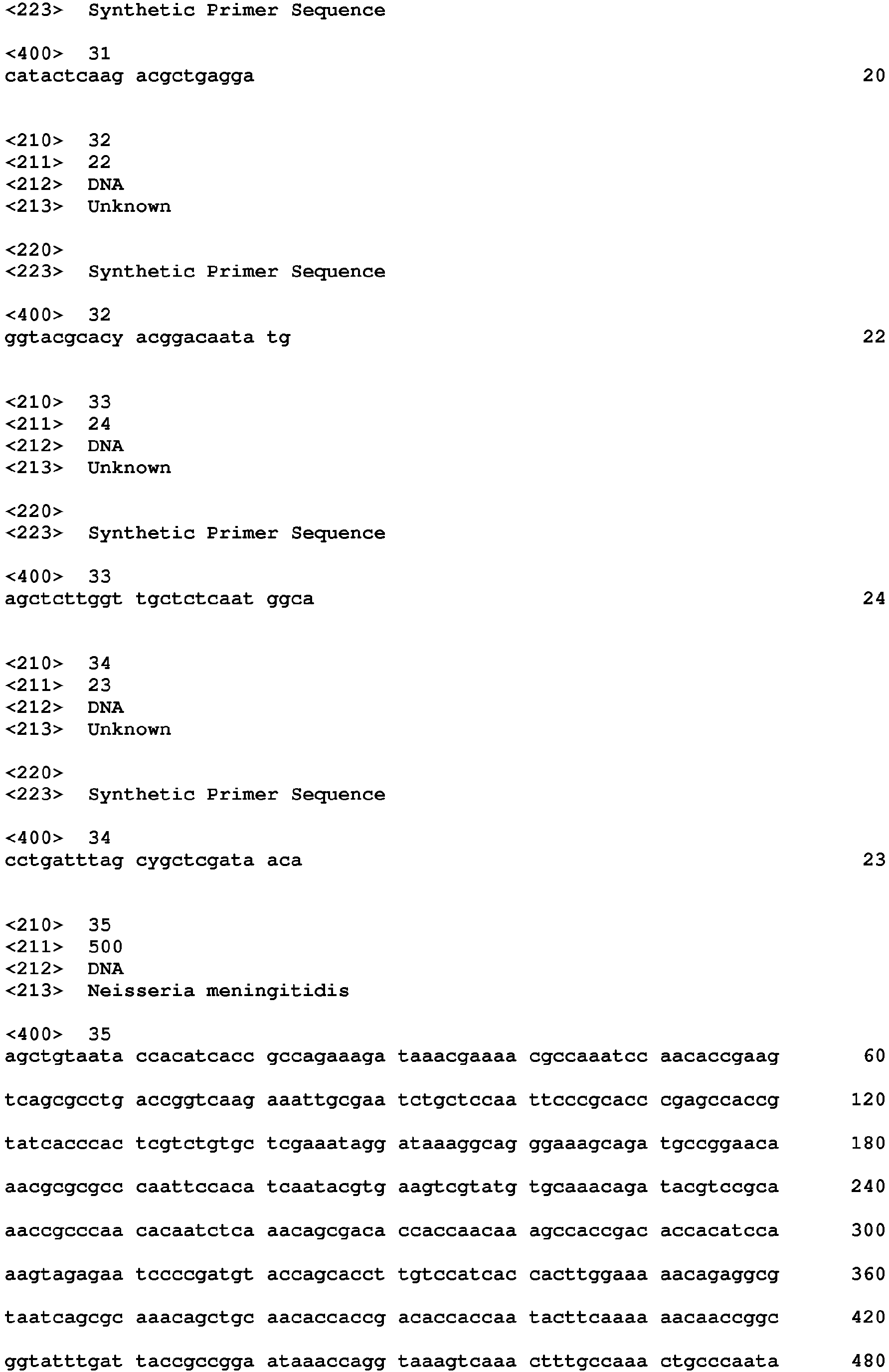

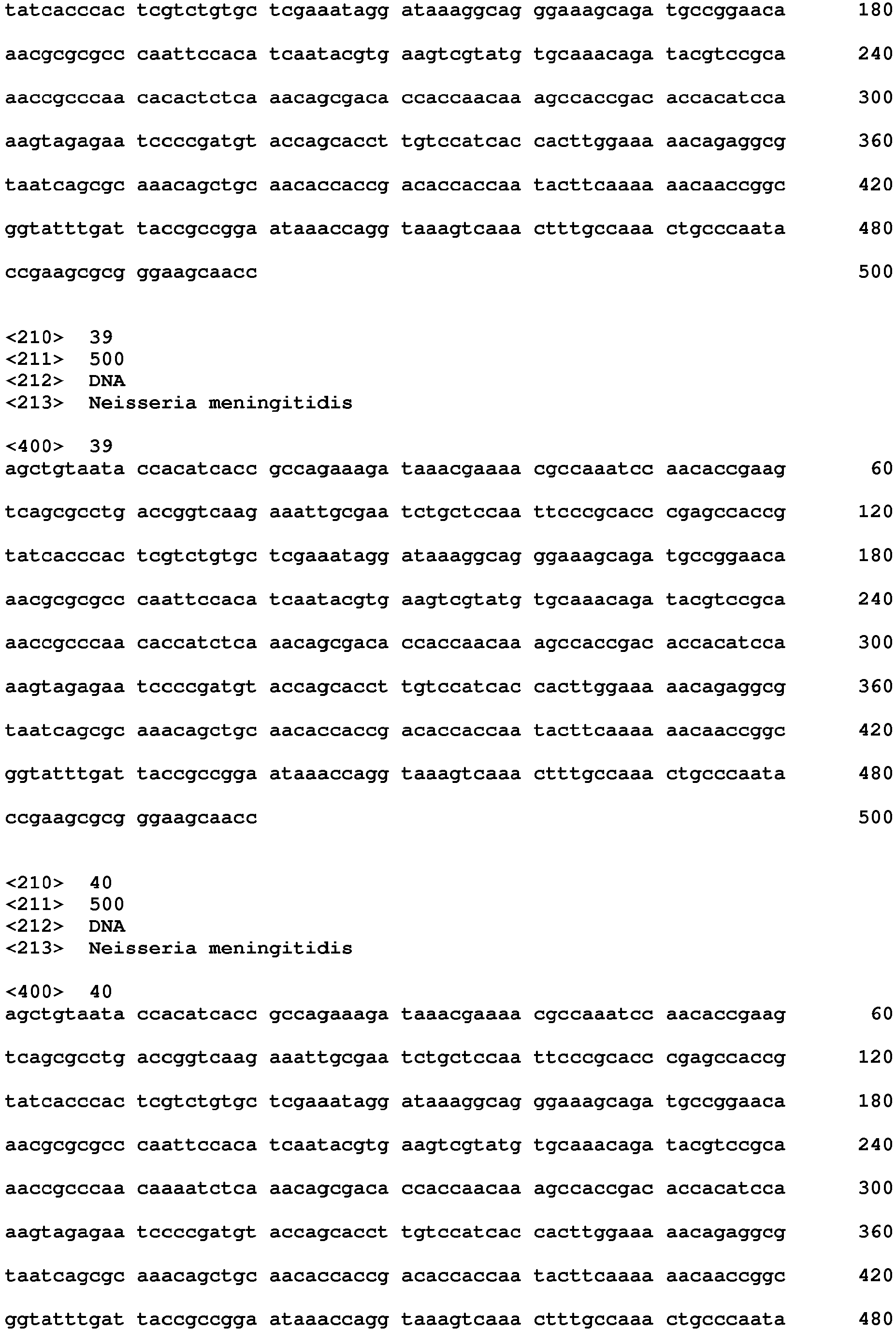

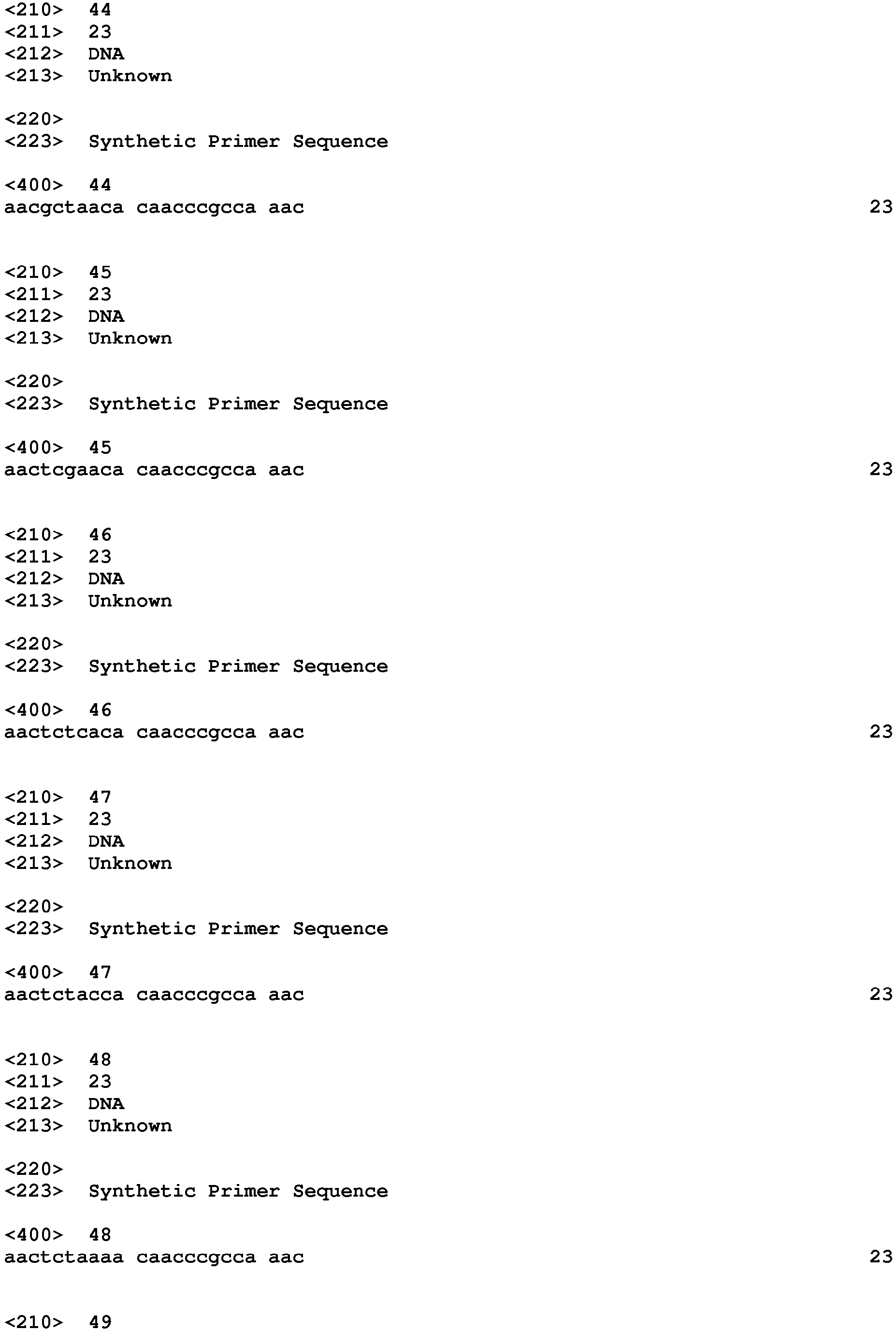


Claims (15)
- A set of primers for loop-mediated isothermal amplification (LAMP) comprising(a) a forward outer primer;(b) a reverse outer primer;(c) a forward inner primer;(d) a reverse inner primer,(e) a forward loop primer; and(f) a reverse loop primer;wherein each primer is capable of binding to a target nucleic acid having complementary first and second nucleic acid strands,
wherein the first nucleic acid strand has first, second, third, fourth, fifth and sixth regions; and
wherein the second nucleic acid strand has first, second, third, fourth, fifth and sixth regions;
wherein the fourth, fifth and sixth regions of the first nucleic acid strand are complimentary to the third, second, and first regions of the second nucleic acid strand; and
wherein the fourth, fifth and sixth regions of the second nucleic acid strand are complimentary to the third, second, and first regions of the first nucleic acid strand; and
wherein(a) the forward outer primer is complementary to the first region of the first nucleic acid strand;(b) the reverse outer primer is complementary to the first region of the second nucleic acid strand;(c) the forward inner primer has first and second parts, wherein:(i) the first part is complementary to the second region of the first nucleic acid strand; and(ii) the second part is complementary to the fourth region of the second nucleic acid strand; and(d) the reverse inner primer has first and second parts, wherein:(i) the first part is complementary to the second region of the second nucleic acid strand; and(ii) the second part is complementary to the fourth region of the first nucleic acid strand;(e) the forward loop primer is complementary to a region between the fourth and fifth regions of the second nucleic acid strand;(f) the reverse loop primer is complementary to a region between the fourth and fifth regions of the second nucleic acid strand;wherein at least one of the (e) forward loop and (f) reverse loop primers comprises a reporter. - A set of primers according to Claim 1, wherein the (e) forward loop primer comprises the reporter.
- A set of primers according to Claim 1, wherein the (f) reverse loop primer comprises the reporter.
- A set of primers according to any one of Claims 1-3, wherein the primer further comprises an endonuclease cleavage site.
- A set of primers according to Claim 4, wherein the cleavage site is an apurinic/apyrimidinic site (abasic site).
- A set of primers according to any one of Claims 1-5, wherein the reporter comprises first and second dyes.
- A set of primers according to Claim 4, wherein the first and second dyes are located at or adjacent opposing ends of the cleavage site.
- A set of primers according to any one of Claims 1-7, wherein reporter comprises a dye and a quencher.
- A set of primers according to Claim 8, wherein the dye is selected from 3',6'-dihydroxy-1-oxospiro[2-benzofuran-3,9'-xanthene]-5-carboxylic acid (6-Carboxyfluorescein; 6-FAM); 6-Carboxy-2',7'-dichlorofluorescein diacetate N-succinimidyl ester (6-hexachlorofluorescein; 6-HEX); and 1-{6-[(2,5-Dioxo-1-pyrrolidinyl)oxy]-6-oxohexyl}-2-[(1E,3E,5E)-5-(1-{6-[(2,5-dioxo-1-pyrrolidinyl)oxy]-6-oxohexyl}-3,3-dimethyl-5-sulfo-1,3-dihydro-2H-indol-2-ylidene)-1,3-pentadien-1-yl]-3,3-dimethyl-3H-indolium-5-sulfonate (cyanine; Cy5).
- A set of primers according to Claim 8 or 9, wherein the quencher is a dark quencher.
- A method for identifying a target nucleic acid, the method comprising:(a) providing a sample;(b) providing a set of primers according to any one of Claims 1-10;(c) performing isothermal amplification; and(d) identifying the nucleic acid target in the sample.
- A method for identifying a nucleic acid modification or substitution of a target nucleic acid, the method comprising:(a) providing a sample;(b) providing a set of primers according to any one of Claims 1-10;(c) performing isothermal amplification; and(d) identifying the nucleic acid modification or substitution of the target nucleic acid in the sample.
- A method according to Claim 11 or 12, wherein the isothermal amplification is performed in the presence of a Bacillus stearothermophilus deoxyribonucleic acid polymerase enzyme and an Endonuclease IV enzyme.
- A method according to any one of Claims 11-13, wherein the isothermal amplification is performed at a temperature of 65-67°C.
- A method according to any one of Claims 11-14, wherein the isothermal amplification is performed for 60 minutes.
Priority Applications (4)
| Application Number | Priority Date | Filing Date | Title |
|---|---|---|---|
| EP19186396.8A EP3766990A1 (en) | 2019-07-15 | 2019-07-15 | Primers for isothermal amplification |
| US17/627,166 US20220275431A1 (en) | 2019-07-15 | 2020-07-14 | Primers for isothermal amplification |
| EP20739377.8A EP3999659A1 (en) | 2019-07-15 | 2020-07-14 | Primers for isothermal amplification |
| PCT/EP2020/069920 WO2021009185A1 (en) | 2019-07-15 | 2020-07-14 | Primers for isothermal amplification |
Applications Claiming Priority (1)
| Application Number | Priority Date | Filing Date | Title |
|---|---|---|---|
| EP19186396.8A EP3766990A1 (en) | 2019-07-15 | 2019-07-15 | Primers for isothermal amplification |
Publications (1)
| Publication Number | Publication Date |
|---|---|
| EP3766990A1 true EP3766990A1 (en) | 2021-01-20 |
Family
ID=67303400
Family Applications (2)
| Application Number | Title | Priority Date | Filing Date |
|---|---|---|---|
| EP19186396.8A Withdrawn EP3766990A1 (en) | 2019-07-15 | 2019-07-15 | Primers for isothermal amplification |
| EP20739377.8A Pending EP3999659A1 (en) | 2019-07-15 | 2020-07-14 | Primers for isothermal amplification |
Family Applications After (1)
| Application Number | Title | Priority Date | Filing Date |
|---|---|---|---|
| EP20739377.8A Pending EP3999659A1 (en) | 2019-07-15 | 2020-07-14 | Primers for isothermal amplification |
Country Status (3)
| Country | Link |
|---|---|
| US (1) | US20220275431A1 (en) |
| EP (2) | EP3766990A1 (en) |
| WO (1) | WO2021009185A1 (en) |
Families Citing this family (3)
| Publication number | Priority date | Publication date | Assignee | Title |
|---|---|---|---|---|
| CN112852992A (en) * | 2021-02-18 | 2021-05-28 | 中国农业科学院农业质量标准与检测技术研究所 | Primer group, kit and method for identifying Pleurotus citrinopileatus based on loop-mediated isothermal amplification technology |
| WO2023096373A1 (en) * | 2021-11-24 | 2023-06-01 | 주식회사 위즈바이오솔루션 | Fluorescent labeling material primer set for multiple detection in loop-mediated isothermal amplification method and molecular diagnosis method using same |
| GB2620948A (en) * | 2022-07-26 | 2024-01-31 | Mast Group Ltd | Method and kit |
Citations (3)
| Publication number | Priority date | Publication date | Assignee | Title |
|---|---|---|---|---|
| US7019129B1 (en) | 2000-05-09 | 2006-03-28 | Biosearch Technologies, Inc. | Dark quenchers for donor-acceptor energy transfer |
| WO2013171140A1 (en) * | 2012-05-14 | 2013-11-21 | Peter Warthoe | Technique combining pcr and loop-mediated isothermal amplification for the detection of nucleic acids |
| WO2017109762A1 (en) * | 2015-12-24 | 2017-06-29 | Diasorin S.P.A. | Computer-based method for designing a set of primers |
Family Cites Families (1)
| Publication number | Priority date | Publication date | Assignee | Title |
|---|---|---|---|---|
| US10584363B2 (en) * | 2016-06-03 | 2020-03-10 | Takara Bio Usa, Inc. | Methods of producing and using single-stranded deoxyribonucleic acids and compositions for use in practicing the same |
-
2019
- 2019-07-15 EP EP19186396.8A patent/EP3766990A1/en not_active Withdrawn
-
2020
- 2020-07-14 US US17/627,166 patent/US20220275431A1/en not_active Abandoned
- 2020-07-14 EP EP20739377.8A patent/EP3999659A1/en active Pending
- 2020-07-14 WO PCT/EP2020/069920 patent/WO2021009185A1/en not_active Ceased
Patent Citations (3)
| Publication number | Priority date | Publication date | Assignee | Title |
|---|---|---|---|---|
| US7019129B1 (en) | 2000-05-09 | 2006-03-28 | Biosearch Technologies, Inc. | Dark quenchers for donor-acceptor energy transfer |
| WO2013171140A1 (en) * | 2012-05-14 | 2013-11-21 | Peter Warthoe | Technique combining pcr and loop-mediated isothermal amplification for the detection of nucleic acids |
| WO2017109762A1 (en) * | 2015-12-24 | 2017-06-29 | Diasorin S.P.A. | Computer-based method for designing a set of primers |
Non-Patent Citations (5)
| Title |
|---|
| FOO PHIAW CHONG ET AL: "Development of a thermostabilised triplex LAMP assay with dry-reagent four target lateral flow dipstick for detection ofEntamoeba histolyticaand non-pathogenicEntamoebaspp", ANALYTICA CHIMICA ACTA, ELSEVIER, AMSTERDAM, NL, vol. 966, 20 February 2017 (2017-02-20), pages 71 - 80, XP029964058, ISSN: 0003-2670, DOI: 10.1016/J.ACA.2017.02.019 * |
| HIGGINS, O.CLANCY, E.CORMICAN, M.BOO, T. W.CUNNEY, R.SMITH, T. J.: "Evaluation of an Internally Controlled Multiplex Tth Endonuclease Cleavage Loop-Mediated Isothermal Amplification (state-of-the-art LAMP) Assay for the Detection of Bacterial Meningitis Pathogens", NTERNATIONAL JOURNAL OF MOLECULAR SCIENCES, vol. 19, no. 2, 2018, pages 524 |
| NURUL NAJIAN A B ET AL: "Development of multiplex loop mediated isothermal amplification (m-LAMP) label-based gold nanoparticles lateral flow dipstick biosensor for detection of pathogenicLeptospira", ANALYTICA CHIMICA ACTA, ELSEVIER, AMSTERDAM, NL, vol. 903, 24 November 2015 (2015-11-24), pages 142 - 148, XP029364351, ISSN: 0003-2670, DOI: 10.1016/J.ACA.2015.11.015 * |
| OWEN HIGGINS ET AL: "Evaluation of an Internally Controlled Multiplex Tth Endonuclease Cleavage Loop-Mediated Isothermal Amplification (TEC-LAMP) Assay for the Detection of Bacterial Meningitis Pathogens", INT. J. MOL. SCI., vol. 19, no. 2, 9 February 2018 (2018-02-09), pages 524, XP055658943, ISSN: 1661-6596, DOI: 10.3390/ijms19020524 * |
| YU JIA ET AL: "Improvement and evaluation of loop-mediated isothermal amplification combined with a chromatographic flow dipstick assay and utilization in detection ofVibrio cholerae", ANALYTICAL AND BIOANALYTICAL CHEMISTRY, SPRINGER, DE, vol. 411, no. 3, 1 December 2018 (2018-12-01), pages 647 - 658, XP036685216, ISSN: 1618-2642, [retrieved on 20181201], DOI: 10.1007/S00216-018-1472-1 * |
Also Published As
| Publication number | Publication date |
|---|---|
| US20220275431A1 (en) | 2022-09-01 |
| WO2021009185A1 (en) | 2021-01-21 |
| EP3999659A1 (en) | 2022-05-25 |
Similar Documents
| Publication | Publication Date | Title |
|---|---|---|
| US20250115948A1 (en) | Multiplex invasive cleavage assays | |
| US9528157B2 (en) | Methods, compositions, and kits for determing the presence/absence of a variant nucleic acid sequence | |
| US7348141B2 (en) | Hybridization beacon and method of rapid sequence detection and discrimination | |
| EP2789689B1 (en) | Chimeric primers with hairpin conformations and methods of using same | |
| CN101845503B (en) | Kit for detecting drug resistant mycobacterium tuberculosis (MDR-TB) | |
| Higgins et al. | Loop-primer endonuclease cleavage–loop-mediated isothermal amplification technology for multiplex pathogen detection and single-nucleotide polymorphism identification | |
| US20160040256A1 (en) | Methods, compositions, and kits for detecting allelic variants | |
| US20140017689A1 (en) | Method for detecting nucleic acids | |
| US10400276B2 (en) | Multiplex amplification and detection | |
| CN102242211A (en) | Method and kit for detecting mutant nucleic acid sequence | |
| US20120164645A1 (en) | Multiplex amplification and detection | |
| US20150044680A1 (en) | Probes for improved melt discrimination and multiplexing in nucleic acid assays | |
| JP5940874B2 (en) | Probe for detecting exon12 mutation of NPM1 gene and use thereof | |
| EP4144867B1 (en) | Methods for detecting bordetella | |
| US20220275431A1 (en) | Primers for isothermal amplification | |
| JP5239853B2 (en) | Mutant gene detection method | |
| US20110189666A1 (en) | Nucleic acid probe set and method of using the same | |
| WO2010121298A1 (en) | Detection of staphylococcus aureus | |
| US8748590B2 (en) | Oligonucleotides for detection test of polymorphism of EGFR exon 19 and use therof | |
| US7718361B2 (en) | Quantitative test for bacterial pathogens | |
| EP3548634B1 (en) | Probe for detection of snps | |
| US20250263780A1 (en) | Method of increasing the number of usable channels in multiplex pcr | |
| Higgins | Novel multiplex isothermal nucleic acid amplification technologies for the detection of bacterial meningitis associated pathogens | |
| HK40090160A (en) | Methods for detecting bordetella | |
| HK40090160B (en) | Methods for detecting bordetella |
Legal Events
| Date | Code | Title | Description |
|---|---|---|---|
| PUAI | Public reference made under article 153(3) epc to a published international application that has entered the european phase |
Free format text: ORIGINAL CODE: 0009012 |
|
| STAA | Information on the status of an ep patent application or granted ep patent |
Free format text: STATUS: THE APPLICATION HAS BEEN PUBLISHED |
|
| AK | Designated contracting states |
Kind code of ref document: A1 Designated state(s): AL AT BE BG CH CY CZ DE DK EE ES FI FR GB GR HR HU IE IS IT LI LT LU LV MC MK MT NL NO PL PT RO RS SE SI SK SM TR |
|
| AX | Request for extension of the european patent |
Extension state: BA ME |
|
| STAA | Information on the status of an ep patent application or granted ep patent |
Free format text: STATUS: THE APPLICATION IS DEEMED TO BE WITHDRAWN |
|
| 18D | Application deemed to be withdrawn |
Effective date: 20210721 |