EP3752589B1 - Laundry detergent - Google Patents
Laundry detergent Download PDFInfo
- Publication number
- EP3752589B1 EP3752589B1 EP20700371.6A EP20700371A EP3752589B1 EP 3752589 B1 EP3752589 B1 EP 3752589B1 EP 20700371 A EP20700371 A EP 20700371A EP 3752589 B1 EP3752589 B1 EP 3752589B1
- Authority
- EP
- European Patent Office
- Prior art keywords
- laundry detergent
- detergent composition
- alkoxy
- dye
- shading
- Prior art date
- Legal status (The legal status is an assumption and is not a legal conclusion. Google has not performed a legal analysis and makes no representation as to the accuracy of the status listed.)
- Active
Links
Classifications
-
- C—CHEMISTRY; METALLURGY
- C11—ANIMAL OR VEGETABLE OILS, FATS, FATTY SUBSTANCES OR WAXES; FATTY ACIDS THEREFROM; DETERGENTS; CANDLES
- C11D—DETERGENT COMPOSITIONS; USE OF SINGLE SUBSTANCES AS DETERGENTS; SOAP OR SOAP-MAKING; RESIN SOAPS; RECOVERY OF GLYCEROL
- C11D3/00—Other compounding ingredients of detergent compositions covered in group C11D1/00
- C11D3/40—Dyes ; Pigments
- C11D3/42—Brightening agents ; Blueing agents
-
- C—CHEMISTRY; METALLURGY
- C11—ANIMAL OR VEGETABLE OILS, FATS, FATTY SUBSTANCES OR WAXES; FATTY ACIDS THEREFROM; DETERGENTS; CANDLES
- C11D—DETERGENT COMPOSITIONS; USE OF SINGLE SUBSTANCES AS DETERGENTS; SOAP OR SOAP-MAKING; RESIN SOAPS; RECOVERY OF GLYCEROL
- C11D3/00—Other compounding ingredients of detergent compositions covered in group C11D1/00
- C11D3/40—Dyes ; Pigments
-
- C—CHEMISTRY; METALLURGY
- C09—DYES; PAINTS; POLISHES; NATURAL RESINS; ADHESIVES; COMPOSITIONS NOT OTHERWISE PROVIDED FOR; APPLICATIONS OF MATERIALS NOT OTHERWISE PROVIDED FOR
- C09B—ORGANIC DYES OR CLOSELY-RELATED COMPOUNDS FOR PRODUCING DYES, e.g. PIGMENTS; MORDANTS; LAKES
- C09B29/00—Monoazo dyes prepared by diazotising and coupling
- C09B29/0025—Monoazo dyes prepared by diazotising and coupling from diazotized amino heterocyclic compounds
- C09B29/0029—Monoazo dyes prepared by diazotising and coupling from diazotized amino heterocyclic compounds the heterocyclic ring containing only nitrogen as heteroatom
- C09B29/0033—Monoazo dyes prepared by diazotising and coupling from diazotized amino heterocyclic compounds the heterocyclic ring containing only nitrogen as heteroatom containing a five-membered heterocyclic ring with one nitrogen atom
-
- C—CHEMISTRY; METALLURGY
- C09—DYES; PAINTS; POLISHES; NATURAL RESINS; ADHESIVES; COMPOSITIONS NOT OTHERWISE PROVIDED FOR; APPLICATIONS OF MATERIALS NOT OTHERWISE PROVIDED FOR
- C09B—ORGANIC DYES OR CLOSELY-RELATED COMPOUNDS FOR PRODUCING DYES, e.g. PIGMENTS; MORDANTS; LAKES
- C09B29/00—Monoazo dyes prepared by diazotising and coupling
- C09B29/06—Monoazo dyes prepared by diazotising and coupling from coupling components containing amino as the only directing group
- C09B29/08—Amino benzenes
- C09B29/0805—Amino benzenes free of acid groups
- C09B29/0807—Amino benzenes free of acid groups characterised by the amino group
- C09B29/0808—Amino benzenes free of acid groups characterised by the amino group unsubstituted amino group
-
- C—CHEMISTRY; METALLURGY
- C09—DYES; PAINTS; POLISHES; NATURAL RESINS; ADHESIVES; COMPOSITIONS NOT OTHERWISE PROVIDED FOR; APPLICATIONS OF MATERIALS NOT OTHERWISE PROVIDED FOR
- C09B—ORGANIC DYES OR CLOSELY-RELATED COMPOUNDS FOR PRODUCING DYES, e.g. PIGMENTS; MORDANTS; LAKES
- C09B31/00—Disazo and polyazo dyes of the type A->B->C, A->B->C->D, or the like, prepared by diazotising and coupling
- C09B31/02—Disazo dyes
- C09B31/10—Disazo dyes from a coupling component "C" containing reactive methylene groups
- C09B31/105—Disazo dyes from a coupling component "C" containing reactive methylene groups containing acid groups, e.g. -CO2H, -SO3H, -PO3H2, -OSO3H, -OPO2H2; Salts thereof
-
- C—CHEMISTRY; METALLURGY
- C09—DYES; PAINTS; POLISHES; NATURAL RESINS; ADHESIVES; COMPOSITIONS NOT OTHERWISE PROVIDED FOR; APPLICATIONS OF MATERIALS NOT OTHERWISE PROVIDED FOR
- C09B—ORGANIC DYES OR CLOSELY-RELATED COMPOUNDS FOR PRODUCING DYES, e.g. PIGMENTS; MORDANTS; LAKES
- C09B62/00—Reactive dyes, i.e. dyes which form covalent bonds with the substrates or which polymerise with themselves
- C09B62/002—Reactive dyes, i.e. dyes which form covalent bonds with the substrates or which polymerise with themselves with the linkage of the reactive group being alternatively specified
- C09B62/006—Azodyes
- C09B62/008—Monoazo dyes
- C09B62/0086—Monoazo dyes with coupling component containing a reactive methylene group
-
- C—CHEMISTRY; METALLURGY
- C09—DYES; PAINTS; POLISHES; NATURAL RESINS; ADHESIVES; COMPOSITIONS NOT OTHERWISE PROVIDED FOR; APPLICATIONS OF MATERIALS NOT OTHERWISE PROVIDED FOR
- C09B—ORGANIC DYES OR CLOSELY-RELATED COMPOUNDS FOR PRODUCING DYES, e.g. PIGMENTS; MORDANTS; LAKES
- C09B69/00—Dyes not provided for by a single group of this subclass
-
- C—CHEMISTRY; METALLURGY
- C11—ANIMAL OR VEGETABLE OILS, FATS, FATTY SUBSTANCES OR WAXES; FATTY ACIDS THEREFROM; DETERGENTS; CANDLES
- C11D—DETERGENT COMPOSITIONS; USE OF SINGLE SUBSTANCES AS DETERGENTS; SOAP OR SOAP-MAKING; RESIN SOAPS; RECOVERY OF GLYCEROL
- C11D1/00—Detergent compositions based essentially on surface-active compounds; Use of these compounds as a detergent
- C11D1/02—Anionic compounds
- C11D1/12—Sulfonic acids or sulfuric acid esters; Salts thereof
- C11D1/14—Sulfonic acids or sulfuric acid esters; Salts thereof derived from aliphatic hydrocarbons or mono-alcohols
- C11D1/143—Sulfonic acid esters
-
- C—CHEMISTRY; METALLURGY
- C11—ANIMAL OR VEGETABLE OILS, FATS, FATTY SUBSTANCES OR WAXES; FATTY ACIDS THEREFROM; DETERGENTS; CANDLES
- C11D—DETERGENT COMPOSITIONS; USE OF SINGLE SUBSTANCES AS DETERGENTS; SOAP OR SOAP-MAKING; RESIN SOAPS; RECOVERY OF GLYCEROL
- C11D1/00—Detergent compositions based essentially on surface-active compounds; Use of these compounds as a detergent
- C11D1/66—Non-ionic compounds
- C11D1/72—Ethers of polyoxyalkylene glycols
-
- C—CHEMISTRY; METALLURGY
- C11—ANIMAL OR VEGETABLE OILS, FATS, FATTY SUBSTANCES OR WAXES; FATTY ACIDS THEREFROM; DETERGENTS; CANDLES
- C11D—DETERGENT COMPOSITIONS; USE OF SINGLE SUBSTANCES AS DETERGENTS; SOAP OR SOAP-MAKING; RESIN SOAPS; RECOVERY OF GLYCEROL
- C11D1/00—Detergent compositions based essentially on surface-active compounds; Use of these compounds as a detergent
- C11D1/66—Non-ionic compounds
- C11D1/83—Mixtures of non-ionic with anionic compounds
-
- C—CHEMISTRY; METALLURGY
- C11—ANIMAL OR VEGETABLE OILS, FATS, FATTY SUBSTANCES OR WAXES; FATTY ACIDS THEREFROM; DETERGENTS; CANDLES
- C11D—DETERGENT COMPOSITIONS; USE OF SINGLE SUBSTANCES AS DETERGENTS; SOAP OR SOAP-MAKING; RESIN SOAPS; RECOVERY OF GLYCEROL
- C11D2111/00—Cleaning compositions characterised by the objects to be cleaned; Cleaning compositions characterised by non-standard cleaning or washing processes
- C11D2111/10—Objects to be cleaned
- C11D2111/12—Soft surfaces, e.g. textile
Definitions
- the present invention relates to a laundry detergent composition that comprises a pH stable shading dye.
- the invention further relates to a domestic method of treating a textile using a laundry detergent composition comprising the shading dye.
- Shading dyes comprising alkene groups provided the advantage of permitting further chemical reaction of the dye, for example by a radical addition reaction, without destroying the chromophore.
- WO2012/166768 discloses mono-azo thiophenes shading dyes covalently bound to alkoxy/alkyl-based side-chains containing alkene groups. Such dyes were found to be sensitive to hydrolysis in the pH range of 4 to 10. Alkaline conditions are typically found in laundry detergent compositions.
- It is an object of the present invention to provide a laundry detergent composition comprising shading dyes that are functionalized with an alkene group with a reduced sensitivity to hydrolysis in acidic and alkaline conditions and preferably in alkaline conditions.
- the object is to provide shading dyes functionalized with an alkene group which have a reduced sensitivity to hydrolysis in the pH range of 4 to 10 and/or which are more reactive to radical addition when compared to the dyes as disclosed in WO2012/166768 .
- the present invention provides a laundry detergent composition comprising:
- the at least one group is covalently bound to the shading dye.
- a linker group may be present. If a linker group is present it is an aromatic linker group. More preferably no linker group is present.
- the (poly) alkoxy chain is preferably not further substituted.
- alkoxy groups include those derived from butylene oxide, glycidol oxide, ethylene oxide and/or propylene oxide.
- the present invention provides a domestic method of treating a textile, the method comprising the steps of:
- Weight percentage is based on the total weight of the laundry detergent composition, unless otherwise indicated. It will be appreciated that the total weight amount of ingredients will not exceed 100 wt. %. Whenever an amount or concentration of a component is quantified herein, unless indicated otherwise, the quantified amount or quantified concentration relates to said component per se, even though it may be common practice to add such a component in the form of a solution or of a blend with one or more other ingredients. It is furthermore to be understood that the verb "to comprise” and its conjugations is used in its non-limiting sense to mean that items following the word are included, but items not specifically mentioned are not excluded.
- indefinite article “a” or “an” does not exclude the possibility that more than one of the elements is present, unless the context clearly requires that there be one and only one of the elements.
- the indefinite article “a” or “an” thus usually means “at least one”. Unless otherwise specified all measurements are taken at standard conditions. Whenever a parameter, such as a concentration or a ratio, is said to be less than a certain upper limit it should be understood that in the absence of a specified lower limit the lower limit for said parameter is 0.
- Dyes are described in Industrial Dyes (K. Hunger ed, Wiley VCH 2003 ) and Color Chemistry (H.Zollinger, 3rd edition, Wiley VCH 2003 ) . Many dyes are listed in the colour index (Society of Dyers and Colourists and American Association of Textile Chemists and Colorists). Leuco dyes are described in WO2018/085315 (Procter and Gamble) .
- Dyes are organic molecules that have an absorption coefficient of greater than 4000, preferably greater than 10 000 mol -1 L cm -1 at any wavelength in the range 400-700nm, preferably 540 to 640nm. Molar absorption coefficients are preferably measured in an organic solvent, preferably propan-2-ol, using a 1, 5 or 10 cm cell.
- Leuco dyes are organic molecules that exhibit a change from a colorless or slightly colored state to a dye upon exposure to specific chemical or physical triggers, such as oxidation, reduction, protonation or deprotonation. The change in color depth is visually perceptible by the human eye.
- the triggered color change of leuco dyes results from a change in the molar extinction coefficient in the 400-750 nm range.
- the increase in the molar extinction coefficient upon the triggering should be bigger than 50 %, preferably bigger than 200% and even more preferably bigger than 500%.
- Such leuco dyes are described in the prior art, such as WO2018/085300 , WO2018/085301 , WO2018/085302 , WO2018/085303 , WO2018/085304 , WO2018/085305 , WO2018/085306 , WO2018/085308 , WO2018/085309 , WO2018/085310 , WO2018/085311 , WO2018/085312 , WO2018/085313 , WO2018/085314 , WO2018/085315 .
- Preferred leuco shading dyes are according to claim 5 of WO2018/085300 , more preferably are according to claims 6 to 12 of WO2018/085302 wherein the more preferred leuco shading dyes are with the increasing claim number from claim 6 up to claim 12.
- the leuco shading dyes of claim 12 of WO2018/085302 thereby representing the most preferred leuco shading dyes.
- the subject matter of these claims of WO2018/085302 insofar as regarding the specified leuco shading dyes are considered to be repeated here.
- shading dye as used in this specification includes leuco dyes. However, preferably the shading dyes used in the invention are non-leuco shading dyes.
- the shading dyes (leuco- or non-leuco shading dyes) used in the present invention provide a shade to white fabric and preferably provide a blue or violet shade to white fabric.
- the shading dye gives a blue or violet color to a white cloth with a hue angle of 240 to 330, more preferably 260 to 320, most preferably 265 to 300.
- the white cloth used is bleached non-mercerised woven cotton sheeting.
- a 10 cm by 10 cm piece of white bleached non-mercerised woven cotton cloth is agitated in an aqueous solution (6° French Hard water, liquor 298K: cloth 30:1) 2g/L of a base detergent (10 wt.
- a hue angle of 360/0 is red, 270 is blue and 180 is green.
- the dye according to the invention is a shading dye which means it is able to deposit onto textile during domestic wash conditions in the presence of a wash liquor comprising surfactant. This may be assessed using the above test, where a shading dye will give a non-zero ⁇ E value.
- the shading dye may be covalently bound to multiple such groups of the same type or a to a mixture of different such groups.
- n is from 1 to 20 and wherein m is from 2 to 4.
- m is 2 or 3 and more preferably m is 2.
- n is from 1 to 10 and more preferably n is from 2 to 5.
- the (poly)alkoxy moiety if present is preferably a (poly)ethoxy moiety.
- n is from 1 to 10 and more preferably is from 2 to 5.
- 'n' refers to the molar average alkoxylate length.
- the non-leuco shading dye preferably contains a chromophore selected from the following chromophore classes: anthraquinone, azo, oxazine, azine, triphenodioxazine, triphenyl methane, xanthene and phthalocyanin, more preferably azo and anthraquinone most preferably mono-azo or bis-azo.
- a chromophore selected from the following chromophore classes: anthraquinone, azo, oxazine, azine, triphenodioxazine, triphenyl methane, xanthene and phthalocyanin, more preferably azo and anthraquinone most preferably mono-azo or bis-azo.
- the non-leuco shading dye chromophore is a mono-azo or bis-azo dye, and even more preferably is a mono-azo dye.
- a highly preferred non-leuco mono azo dye is of the structure (I):
- D denotes an aromatic of heteroaromatic group.
- D is selected from the group consisting of: azothiophenes, azobenzothiazoles and azopyridones.
- the aromatic rings may be further substituted, for example and preferably by a methyl group.
- the dye is an azo thiophene.
- More preferred non-leuco mono-azo dyes are of the structure (II):
- Preferred non-leuco bis-azo dyes are of structure (IV): wherein:
- More preferred non-leuco bis-azo dyes are of the structure (V): wherein n is from 1 to 10.
- the non-leuco bis-azo dyes may be present as the salt of an alkali metal, alkaline earth metal or a quaternary amine most preferably the counterion is the sodium salt.
- the structures (IV) and (V) are also to be interpreted as covering such salt forms and the free-acid forms.
- the preferred bis-azo dyes may be synthesised via well-known azo coupling reactions, for example
- Dehydration of the terminal alcohol group may be achieved by heating in the presence of strong acid, such as sulfuric or phosphoric acid, then purifying.
- the laundry detergent composition of the invention comprises from 2 to 70 wt. % of a surfactant, most preferably 10 to 30 wt. %.
- a surfactant most preferably 10 to 30 wt. %.
- the nonionic and anionic surfactants of the surfactant system may be chosen from the surfactants described " Surface Active Agents" Vol. 1, by Schwartz & Perry, Interscience 1949 , Vol. 2 by Schwartz, Perry & Berch, Interscience 1958 , in the current edition of " McCutcheon's Emulsifiers and Detergents” published by Manufacturing Confectioners Company or in " Tenside-Taschenbuch", H. Stache, 2nd Edn., Carl Hauser Verlag, 1981 .
- the surfactants used are saturated.
- Suitable nonionic surfactants may include, in particular, the reaction products of compounds having a hydrophobic group and a reactive hydrogen atom, for example, aliphatic alcohols, acids, amides with alkylene oxides, especially ethylene oxide either alone or with propylene oxide.
- Specific nonionic surfactants are the condensation products of aliphatic C 8 to C 18 primary or secondary linear or branched alcohols with ethylene oxide, generally 5 to 40 EO, preferably 7EO to 9EO.
- Suitable anionic surfactants which may be used are usually water-soluble alkali metal salts of organic sulfates and sulphonates having alkyl radicals containing from about 8 to about 22 carbon atoms, the term alkyl being used to include the alkyl portion of higher acyl radicals.
- suitable synthetic anionic surfactants are sodium and potassium alkyl sulfates, especially those obtained by sulphating higher C 8 to C 18 alcohols, produced for example from tallow or coconut oil, sodium and potassium alkyl C 9 to C 20 benzene sulphonates, particularly sodium linear secondary alkyl C 10 to C 15 benzene sulphonates; and sodium alkyl glyceryl ether sulfates, especially those ethers of the higher alcohols derived from tallow or coconut oil and synthetic alcohols derived from petroleum.
- the preferred anionic surfactants are sodium C 11 to C 15 alkyl benzene sulphonates and sodium C 12 to C 18 alkyl sulfates.
- anionic alkyl benzene sulfonates which more advantageously are linear alkyl benzene sulphonates.
- surfactants such as those described in EP-A-328 177 (Unilever ), which show resistance to salting-out, the alkyl polyglycoside surfactants described in EP-A-070 074, and alkyl monoglycosides.
- Preferred surfactant systems are mixtures of anionic and nonionic surfactants, in particular the groups and examples of anionic and nonionic surfactants pointed out in EP-A-346 995 (Unilever ).
- surfactant system that is a mixture of an alkali metal salt of a C 16 to C 18 primary alcohol sulfate together with a C 12 to C 15 primary alcohol 3 to 7 EO ethoxylate.
- the nonionic surfactant is preferably present in amounts of less than 50 wt. %, most preferably of less than 20 wt. % based on the total weight of the surfactant system.
- Anionic surfactants can be present for example in amounts in the range from 50 to 100 wt. % based on the total weight of the surfactant system.
- a highly advantageous surfactant comprises 50 to 100 wt. % of linear alkyl benzene sulfonates, based on the total weight of surfactants.
- Builder materials may be selected from 1) calcium sequestrant materials, 2) precipitating materials, 3) calcium ion-exchange materials and 4) mixtures thereof.
- calcium sequestrant builder materials examples include alkali metal polyphosphates, such as sodium tripolyphosphate and organic sequestrants, such as ethylene diamine tetra-acetic acid.
- precipitating builder materials examples include sodium orthophosphate and sodium carbonate.
- Examples of calcium ion-exchange builder materials include the various types of water-insoluble crystalline or amorphous aluminosilicates, of which zeolites are the best known representatives, e.g. zeolite A, zeolite B (also known as zeolite P), zeolite C, zeolite X, zeolite Y and also the zeolite P-type as described in EP-A-0,384,070 .
- zeolites are the best known representatives, e.g. zeolite A, zeolite B (also known as zeolite P), zeolite C, zeolite X, zeolite Y and also the zeolite P-type as described in EP-A-0,384,070 .
- the laundry detergent composition of the invention may also contain 0-65 wt. % of a builder or complexing agent such as ethylenediaminetetraacetic acid, diethylenetriamine-pentaacetic acid, alkyl- or alkenylsuccinic acid, nitrilotriacetic acid or the other builders mentioned below. Many builders are also bleach-stabilizing agents by virtue of their ability to complex metal ions.
- a builder or complexing agent such as ethylenediaminetetraacetic acid, diethylenetriamine-pentaacetic acid, alkyl- or alkenylsuccinic acid, nitrilotriacetic acid or the other builders mentioned below.
- Many builders are also bleach-stabilizing agents by virtue of their ability to complex metal ions.
- Zeolite and carbonate are preferred builders, whereof carbonate is the more preferred.
- the composition may contain as builder a crystalline aluminosilicate, preferably an alkali metal aluminosilicate, more preferably a sodium aluminosilicate. This is typically present at a level of less than 15 wt. %.
- Aluminosilicates are materials having the general formula: 0.8-1.5 M 2 O. Al 2 O 3 . 0.8-6 SiO 2 where M is a monovalent cation, preferably sodium. These materials contain some bound water and are required to have a calcium ion exchange capacity of at least 50 mg CaO/g.
- the preferred sodium aluminosilicates contain 1.5-3.5 SiO 2 units in the formula above. They can be prepared readily by reaction between sodium silicate and sodium aluminate, as amply described in the literature.
- the ratio of surfactants to alumuminosilicate (where present) is preferably greater than 5:2, more preferably greater than 3:1.
- phosphate builders may be used.
- 'phosphate' embraces diphosphate, triphosphate, and phosphonate species.
- Other forms of builder include silicates, such as soluble silicates, metasilicates, layered silicates (e.g. SKS-6 from Hoechst).
- the laundry detergent composition is a non-phosphate built laundry detergent formulation, i.e., contains less than 1 wt. % of phosphate.
- the laundry detergent composition is carbonate built.
- the laundry detergent composition of the invention preferably comprises a fluorescent agent (optical brightener).
- fluorescent agents are well known and many such fluorescent agents are available commercially. Usually, these fluorescent agents are supplied and used in the form of their alkali metal salts, for example, the sodium salts.
- the total amount of the fluorescent agent or agents used in the laundry detergent composition of the invention is generally from 0.005 to 2 wt. %, more preferably 0.01 to 0.1 wt. %.
- Preferred classes of fluorescer are: Di-styryl biphenyl compounds, e.g. Tinopal (Trade Mark) CBS-X, Di-amine stilbene di-sulphonic acid compounds, e.g.
- Preferred fluorescers are: sodium 2 (4-styryl-3-sulfophenyl)-2H-napthol[1,2-d]triazole, disodium 4,4'-bis ⁇ [(4-anilino-6-(N methyl-N-2 hydroxyethyl) amino 1,3,5-triazin-2-yl)]amino ⁇ stilbene-2-2' disulfonate, disodium 4,4'-bis ⁇ [(4-anilino-6-morpholino-1,3,5-triazin-2-yl)]amino ⁇ stilbene-2-2' disulfonate, and disodium 4,4'-bis(2-sulfostyryl)biphenyl.
- the laundry detergent composition according to the invention comprises a fluorescer.
- the aqueous solution used in the domestic method of treating a textile comprises a fluorescer.
- a fluorescer is present in said aqueous solution, it is preferably in the range from 0.0001 g/l to 0.1 g/l, preferably 0.001 to 0.02 g/l.
- the laundry detergent composition may comprise a mixture of different shading dyes according to the invention as well as a mixture of shading dyes according to the invention and further shading dyes not according to the invention.
- the laundry detergent composition comprises a perfume.
- the perfume is preferably in the range from 0.001 to 3 wt. %, most preferably 0.1 to 1 wt. %.
- CTFA Cosmetic, Toiletry and Fragrance Association
- Many suitable examples of perfumes are provided in the CTFA (Cosmetic, Toiletry and Fragrance Association) 1992 International Buyers Guide, published by CFTA Publications and OPD 1993 Chemicals Buyers Directory 80th Annual Edition, published by Schnell Publishing Co .
- laundry detergent compositions of the present invention it is envisaged that there will be four or more, preferably five or more, more preferably six or more or even seven or more different perfume components.
- top notes are defined by Poucher (Journal of the Society of Cosmetic Chemists 6(2):80 [1955 ]).
- Preferred top-notes are selected from citrus oils, linalool, linalyl acetate, lavender, dihydromyrcenol, rose oxide and cis-3-hexanol.
- Perfume and top note are advantageously used to cue the whiteness benefit provided by the laundry detergent composition of the invention.
- laundry detergent composition of the invention does not contain a peroxygen bleach, e.g., sodium percarbonate, sodium perborate, and peracid.
- a peroxygen bleach e.g., sodium percarbonate, sodium perborate, and peracid.
- the laundry detergent composition of the invention may comprise one or more further polymers.
- Examples are carboxymethylcellulose, poly (ethylene glycol), poly(vinyl alcohol), polycarboxylates such as polyacrylates, maleic/acrylic acid copolymers and lauryl methacrylate/acrylic acid copolymers.
- Polymers present to prevent dye deposition for example poly(vinylpyrrolidone), poly(vinylpyridine-N-oxide), and poly(vinylimidazole), are preferably absent from the formulation.
- One or more enzymes are preferably present in a laundry detergent composition of the invention and when practicing the method of the invention.
- the level of each enzyme in the laundry detergent composition of the invention is from 0.0001 wt. % to 0.1 wt. % protein.
- enzymes include proteases, alpha-amylases, cellulases, lipases, peroxidases/oxidases, pectate lyases, and mannanases, or mixtures thereof.
- Suitable lipases include those of bacterial or fungal origin. Chemically modified or protein engineered mutants are included. Examples of useful lipases include lipases from Humicola (synonym Thermomyces ) , e.g. from H. lanuginosa ( T. lanuginosus ) as described in EP 258 068 and EP 305 216 or from H. insolens as described in WO 96/13580 , a Pseudomonas lipase, e.g. from P . alcaligenes or P. pseudoalcaligenes ( EP 218 272 ), P. cepacia ( EP 331 376 ), P. stutzeri ( GB 1,372,034 ), P.
- lipase variants such as those described in WO 92/05249 , WO 94/01541 , EP 407 225 , EP 260 105 , WO 95/35381 , WO 96/00292 , WO 95/30744 , WO 94/25578 , WO 95/14783 , WO 95/22615 , WO 97/04079 and WO 97/07202 , WO 00/60063 .
- Lipolase TM and Lipolase Ultra TM Lipex TM and lipoclean TM (Novozymes A/S).
- Preferred phospholipases are classified as EC 3.1.1.4 and/or EC 3.1.1.32.
- the term phospholipase is an enzyme which has activity towards phospholipids.
- Phospholipids such as lecithin or phosphatidylcholine, consist of glycerol esterified with two fatty acids in an outer (sn-1) and the middle (sn-2) positions and esterified with phosphoric acid in the third position; the phosphoric acid, in turn, may be esterified to an amino-alcohol.
- Phospholipases are enzymes which participate in the hydrolysis of phospholipids.
- phospholipases A 1 and A 2 which hydrolyze one fatty acyl group (in the sn-1 and sn-2 position, respectively) to form lysophospholipid
- lysophospholipase or phospholipase B
- Phospholipase C and phospholipase D release diacyl glycerol or phosphatidic acid respectively.
- Enzyme and photobleach may show some interaction and should be chosen such that this interaction is not negative. Some negative interactions may be avoided by encapsulation of one or other of enzyme or photobleach and/or other segregation within the product.
- proteases include those of animal, vegetable or microbial origin. Microbial origin is preferred. Chemically modified or protein engineered mutants are included.
- the protease may be a serine protease or a metallo protease, preferably an alkaline microbial protease or a trypsin-like protease.
- Preferred commercially available protease enzymes include Alcalase TM , Savinase TM , Primase TM , Duralase TM , Dyrazym TM , Esperase TM , Everlase TM , Polarzyme TM , and Kannase TM , (Novozymes A/S), Maxatase TM , Maxacal TM , Maxapem TM , Properase TM , Purafect TM , Purafect OxP TM , FN2 TM , and FN3 TM (Genencor International Inc.).
- Preferred cutinases are classified in EC 3.1.1.74.
- the cutinase may be of any origin.
- Preferably cutinases are of microbial origin, in particular of bacterial, of fungal or of yeast origin.
- Suitable amylases include those of bacterial or fungal origin. Chemically modified or protein engineered mutants are included. Amylases include, for example, alpha-amylases obtained from Bacillus, e.g. a special strain of B. licheniformis, described in more detail in GB 1,296,839 , or the Bacillus sp. strains disclosed in WO 95/026397 or WO 00/060060 .
- amylases are Duramyl TM , Termamyl TM , Termamyl Ultra TM , Natalase TM , Stainzyme TM , Fungamyl TM and BAN TM (Novozymes A/S), Rapidase TM and Purastar TM (from Genencor International Inc.).
- Suitable cellulases include those of bacterial or fungal origin. Chemically modified or protein engineered mutants are included. Suitable cellulases include cellulases from the genera Bacillus, Pseudomonas, Humicola, Fusarium, Thielavia, Acremonium, e.g. the fungal cellulases produced from Humicola insolens, Thielavia terrestris, Myceliophthora thermophila, and Fusarium oxysporum disclosed in US 4,435,307 , US 5,648,263 , US 5,691,178 , US 5,776,757 , WO 89/09259 , WO 96/029397 , and WO 98/012307 .
- cellulases include Celluzyme TM , Carezyme TM , Celluclean TM , Endolase TM , Renozyme TM (Novozymes A/S), Clazinase TM and Puradax HA TM (Genencor International Inc.), and KAC-500(B) TM (Kao Corporation).
- Suitable peroxidases/oxidases include those of plant, bacterial or fungal origin. Chemically modified or protein engineered mutants are included. Examples of useful peroxidases include peroxidases from Coprinus, e.g. from C . cinereus, and variants thereof as those described in WO 93/24618 , WO 95/10602 , and WO 98/15257 . Commercially available peroxidases include Guardzyme TM and Novozym TM 51004 (Novozymes A/S).
- Preferred enzymes are proteases, lipases, amylase and cellulases, most advantageously a serine protease is comprised by the laundry detergent composition of the invention.
- Any enzyme present in the composition may be stabilized using conventional stabilizing agents, e.g., a polyol such as propylene glycol or glycerol, a sugar or sugar alcohol, lactic acid, boric acid, or a boric acid derivative, e.g., an aromatic borate ester, or a phenyl boronic acid derivative such as 4-formylphenyl boronic acid, and the composition may be formulated as described in e.g. WO 92/19709 and WO 92/19708 .
- a polyol such as propylene glycol or glycerol
- a sugar or sugar alcohol lactic acid, boric acid, or a boric acid derivative, e.g., an aromatic borate ester, or a phenyl boronic acid derivative such as 4-formylphenyl boronic acid
- alkyl groups are sufficiently long to form branched or cyclic chains, the alkyl groups encompass branched, cyclic and linear alkyl chains.
- the alkyl groups are preferably linear or branched, most preferably linear.
- the laundry detergent composition of the invention may be a liquid or powder.
- the shading dye of the invention is advantageously present in post-dosed granules, which contain less than 5 wt. % of the shading dye. It was further found that limiting the amount of the shading dye of the invention in the post-dose dye granules to at most 5 wt. % reduces spotting upon neat application of the product (e.g. as powder on wet textile).
- a further non-shading dye is added to the post-dose granule to give the granule a blue colour.
- the total amount of shading dye comprised by the post-dose dye granule is from 0.1 to 2 wt. %, based on the total weight of the post-dose dye granule.
- the shading dye may be pre-mixed with a water-soluble salt (such as sodium sulfate) to form a post-dose dye granule.
- a water-soluble salt such as sodium sulfate
- the post-dose dye granules can be made by known techniques in the art, such as granulation, fluid-bed agglomeration and the like.
- the post-dose dye granules of the invention can be subsequently mixed with the based detergent granules.
- the size of the post-dose dye granule may be in the range of 50 to 3000 ⁇ m. It is most preferred that the granule has a particle size in the range of 100 to 2000 ⁇ m, most preferably 180 ⁇ m to 1000 ⁇ m. The size as given is the maximum length in any one direction of the granule such that the granule passes through a standard sieve of the requisite size.
- the laundry detergent composition is a powder
- the composition preferably comprises a combination of linear alkyl benzene sulfonates, carbonate and sodium sulfate and post-dosed dye granules, wherein the post-dose dye granules comprise the shading dye according to the invention.
- the bottle preferably is a 1 to 5 L bottle with a resealable screw top where the maximum dimension of the pouring neck of the bottle is at least 3 times smaller than the maximum dimension of the bottle.
- the bottle On initial sale the bottle should be filled to greater than 95% of the bottle capacity by weight. Surprisingly this reduces the oxidation of the shading dye used in the invention in the formulation during storage.
- the laundry detergent composition is in the form of a unit dose, it preferably is a liquid unit dose product.
- Advantageously unit dose laundry detergent products are contained in a re-closable plastic box.
- the re-closable plastic box is highly advantageously a child resistance packaging.
- the requirement for child resistance packaging is given in ISO 8317.
- preferred aspects in the context of one aspect of the invention are also applicable as preferred aspects in the context of one of the other aspects, (e.g. the laundry detergent composition as used in the domestic method of treating a textile) mutatis mutandis.
- 0.001 wt.% of a shading dye can be used of the following structure:
- the wash liquor is prepared by dosing 4g/L of the liquid laundry detergent into 13°FH water in tergotometer pots and a 10 by 10 cm piece of woven cotton, knitted cotton, 65/35 polycotton, microfiber polyester or 80/20 nylon-elastane textile is added so that the wash liquor to textile ratio is 100:1.
- the wash solution is agitated at 200 rpm for 1 hour at room temperature, the textile rinsed in 13°FH water and dried.
- the colour of the textile is measured using a reflectometer and expressed as CIE L*a*b*.
- the colour change of the textile washed using either the laundry detergent powder according to Example 1 or according to Comparative A is expressed relative to that of the textile washed using the reference liquid.
- the relative deposition of the dye according to Example 1 or according to Comparative A can thus be compared.
- a powdered laundry detergent formulation can be prepared of the following formulation: Ingredient Weight% Linear alkyl benzene sulfonate 14.5 Sodium carbonate 20.0 Sodium sulphate 50.0 Sodium silicate 6.0 zeolite 2.5 Salt speckle granules (blue and red) 1.8 perfume 0.3 Sodium carboxymethylcellulose 0.1 Sokalan CP5 (ex BASF) 0.1 Shading dye granule 0.3 Minors (including fluorescer) and moisture to 100%
- the shading dye granule is as described in WO2006/053598 , and the formulation contains 0.0004wt% shading dye.
- 0.001 wt.% of a shading dye can be used of the following structure:
- Comparative B not according to the invention.
- the powder laundry detergent composition is used but without any added shading dye (reference powder).
- the wash liquor is prepared by dosing 4g/L of the laundry detergent powder into 13°FH water in tergotometer pots and a 10 by 10 cm piece of woven cotton, knitted cotton, 65/35 polycotton, microfiber polyester or 80/20 nylon-elastane textile is added so that the wash liquor to textile ratio is 100:1.
- the wash solution is agitated at 200 rpm for 1 hour at room temperature, the textile rinsed in 13°FH water and dried.
- the colour of the textile is measured using a reflectometer and expressed as CIE L*a*b*.
- the colour change of the textile washed using either the laundry detergent powder according to Example 2 or according to Comparative B is expressed relative to that of the textile washed using the reference powder.
- the relative deposition of the dye according to Example 2 or according to Comparative B can thus be compared.
- reference inventive pKa (pH 4 to 10) 7.5 and 9.9 None k(Methyl) M -1 s -1 9 ⁇ 10 2 1 ⁇ 10 4 hydrolysis observed not observed pKa values (acid dissociation constant) were measured for the reference dye by dissolving approximately 2 ⁇ 10 -5 mol L -1 of the dye in water then varying the pH from 9.6 to 1.9 and observing the changes in the UV-VIS spectrum at 570nm. Fitting of the changes to the a dual pK a for the 2 -COOH groups gave the values shown in the table. The pK a values are higher than expected for a free -COOH group which would be 3 to 4 and is attributed to the effect of the alkyl chains.
- the inventive compound is resistant to hydrolysis in the region of pH 4 to 10 and is more reactive to radical addition than the reference compound.
Landscapes
- Chemical & Material Sciences (AREA)
- Organic Chemistry (AREA)
- Life Sciences & Earth Sciences (AREA)
- Engineering & Computer Science (AREA)
- Chemical Kinetics & Catalysis (AREA)
- Oil, Petroleum & Natural Gas (AREA)
- Wood Science & Technology (AREA)
- Detergent Compositions (AREA)
Description
- The present invention relates to a laundry detergent composition that comprises a pH stable shading dye. The invention further relates to a domestic method of treating a textile using a laundry detergent composition comprising the shading dye.
- There is a need to maintain the white appearance of textiles such that the aesthetic value is retained as long as possible. Many textiles are white but over the lifetime of these textiles the whiteness fades or yellows reducing the aesthetic value of the textile. To counteract this laundry detergent manufacturers may incorporate shading dyes into their products. The purpose of the shading dye is to deposit to the fabric, and thereby typically to counteract the fading and yellowing of the textile by providing a preferably blue-violet hue to the laundered fabrics. The shading dye needs to be able to deposit from the laundry wash liquor, comprising surfactants, onto the textile during a domestic laundry process, while present in relatively low amounts.
- Shading dyes comprising alkene groups provided the advantage of permitting further chemical reaction of the dye, for example by a radical addition reaction, without destroying the chromophore.
WO2012/166768 (Procter and Gamble ) discloses mono-azo thiophenes shading dyes covalently bound to alkoxy/alkyl-based side-chains containing alkene groups. Such dyes were found to be sensitive to hydrolysis in the pH range of 4 to 10. Alkaline conditions are typically found in laundry detergent compositions. - It is an object of the present invention to provide a laundry detergent composition comprising shading dyes that are functionalized with an alkene group with a reduced sensitivity to hydrolysis in acidic and alkaline conditions and preferably in alkaline conditions. In particular the object is to provide shading dyes functionalized with an alkene group which have a reduced sensitivity to hydrolysis in the pH range of 4 to 10 and/or which are more reactive to radical addition when compared to the dyes as disclosed in
WO2012/166768 . - In a first aspect the present invention provides a laundry detergent composition comprising:
- (i) from 2 to 70 wt. % of a surfactant; and
- (ii) from 0.00001 to 0.1 wt. % of shading dye which is covalently bound to at least one alkoxy-CH=CH2 or -CH=CH2 capped polyalkoxy group.
- The at least one group is covalently bound to the shading dye. A linker group may be present. If a linker group is present it is an aromatic linker group. More preferably no linker group is present. The (poly) alkoxy chain is preferably not further substituted.
- Examples of alkoxy groups include those derived from butylene oxide, glycidol oxide, ethylene oxide and/or propylene oxide.
- In a second aspect the present invention provides a domestic method of treating a textile, the method comprising the steps of:
- a. treating a textile with an aqueous solution of 0.5 to 20 g/L, more preferably 1 to 10g/L of the laundry detergent composition according to the first aspect of the invention;
- b. preferably rinsing and drying the textile.
- The following benefits can be afforded by use of the shading dye according to the invention:
- Improved resistance to hydrolysis in the pH range of from 4 to 10; and/or
- Improved reactivity to radical addition; and/or
- Improved substantivity onto cellulosic and/or synthetic based textiles during a domestic wash method; and/or
- a more balanced deposition on cellulosic and one or more synthetic fibres-types such as nylon and polyester during a domestic wash method and/or on textiles based thereon.
- In a third aspect the invention relates to shading dyes which are covalently bound to at least one alkoxy-CH=CH2 or -CH=CH2 capped polyalkoxy group as claimed.
- Weight percentage (wt. %) is based on the total weight of the laundry detergent composition, unless otherwise indicated. It will be appreciated that the total weight amount of ingredients will not exceed 100 wt. %. Whenever an amount or concentration of a component is quantified herein, unless indicated otherwise, the quantified amount or quantified concentration relates to said component per se, even though it may be common practice to add such a component in the form of a solution or of a blend with one or more other ingredients. It is furthermore to be understood that the verb "to comprise" and its conjugations is used in its non-limiting sense to mean that items following the word are included, but items not specifically mentioned are not excluded. Finally, reference to an element by the indefinite article "a" or "an" does not exclude the possibility that more than one of the elements is present, unless the context clearly requires that there be one and only one of the elements. The indefinite article "a" or "an" thus usually means "at least one". Unless otherwise specified all measurements are taken at standard conditions. Whenever a parameter, such as a concentration or a ratio, is said to be less than a certain upper limit it should be understood that in the absence of a specified lower limit the lower limit for said parameter is 0.
- Dyes are described in Industrial Dyes (K. Hunger ed, Wiley VCH 2003) and Color Chemistry (H.Zollinger, 3rd edition, Wiley VCH 2003) . Many dyes are listed in the colour index (Society of Dyers and Colourists and American Association of Textile Chemists and Colorists). Leuco dyes are described in
WO2018/085315 (Procter and Gamble) . - Dyes are organic molecules that have an absorption coefficient of greater than 4000, preferably greater than 10 000 mol-1 L cm-1 at any wavelength in the range 400-700nm, preferably 540 to 640nm. Molar absorption coefficients are preferably measured in an organic solvent, preferably propan-2-ol, using a 1, 5 or 10 cm cell.
- Leuco dyes are organic molecules that exhibit a change from a colorless or slightly colored state to a dye upon exposure to specific chemical or physical triggers, such as oxidation, reduction, protonation or deprotonation. The change in color depth is visually perceptible by the human eye. The triggered color change of leuco dyes results from a change in the molar extinction coefficient in the 400-750 nm range. The increase in the molar extinction coefficient upon the triggering should be bigger than 50 %, preferably bigger than 200% and even more preferably bigger than 500%. Such leuco dyes are described in the prior art, such as
WO2018/085300 ,WO2018/085301 ,WO2018/085302 ,WO2018/085303 ,WO2018/085304 ,WO2018/085305 ,WO2018/085306 ,WO2018/085308 ,WO2018/085309 ,WO2018/085310 ,WO2018/085311 ,WO2018/085312 ,WO2018/085313 ,WO2018/085314 ,WO2018/085315 . - Preferred leuco shading dyes are according to claim 5 of
WO2018/085300 , more preferably are according to claims 6 to 12 ofWO2018/085302 wherein the more preferred leuco shading dyes are with the increasing claim number from claim 6 up to claim 12. The leuco shading dyes of claim 12 ofWO2018/085302 thereby representing the most preferred leuco shading dyes. The subject matter of these claims ofWO2018/085302 insofar as regarding the specified leuco shading dyes are considered to be repeated here. - Unless otherwise indicated, the term shading dye as used in this specification includes leuco dyes. However, preferably the shading dyes used in the invention are non-leuco shading dyes.
- The shading dyes (leuco- or non-leuco shading dyes) used in the present invention provide a shade to white fabric and preferably provide a blue or violet shade to white fabric. In this regard the shading dye gives a blue or violet color to a white cloth with a hue angle of 240 to 330, more preferably 260 to 320, most preferably 265 to 300. The white cloth used is bleached non-mercerised woven cotton sheeting. Preferably a 10 cm by 10 cm piece of white bleached non-mercerised woven cotton cloth is agitated in an aqueous solution (6° French Hard water, liquor 298K: cloth 30:1) 2g/L of a base detergent (10 wt. % linear alkyl benzene sulfonate, 5 wt.% primary alcohol ethoxylate (C12-15, with 7 moles of ethoxy groups), pH=8) for 30 minutes at room temperature. The cloths are removed rinsed and tumble dried. The experiment is repeated with and without the addition of shading dye. The color of the cloth is measured using a reflectometer and expressed as the CIE L*a*b* values. The experiment was repeated with the addition of 0.001 wt. % of the dye to the formulation.
- The total color added to the cloth was calculated as the ΔE value, such that

- The actual color of the cloth was calculated as the hue angle, which for the current range of colors is given by

- A hue angle of 360/0 is red, 270 is blue and 180 is green.
- The dye according to the invention is a shading dye which means it is able to deposit onto textile during domestic wash conditions in the presence of a wash liquor comprising surfactant. This may be assessed using the above test, where a shading dye will give a non-zero ΔE value.
- The shading dye is covalently bound to at least one alkoxy-CH=CH2 or -CH=CH2 capped polyalkoxy group. The shading dye may be covalently bound to multiple such groups of the same type or a to a mixture of different such groups.
- Preferably the shading dye used in the invention is covalently bound to one or two - alkoxy-CH=CH2 or -CH=CH2 capped polyalkoxy groups and more preferably is covalently bound to one alkoxy-CH=CH2 or -CH=CH2 capped polyalkoxy group.
- Most preferred groups are those adhering to the following formula: - ([CH2]mO)nCH=CH2 where n is from 1 to 20 and wherein m is from 2 to 4. Preferably m is 2 or 3 and more preferably m is 2. Preferably n is from 1 to 10 and more preferably n is from 2 to 5.
- Preferably the shading is bound to at least one -(CH2CH2O)nCH=CH2 group, wherein n is from 1 to 20. In this sense the (poly)alkoxy moiety if present is preferably a (poly)ethoxy moiety. Advantageously n is from 1 to 10 and more preferably is from 2 to 5.
- In case of a mixture of different (poly)alkoxylate lengths, 'n' refers to the molar average alkoxylate length.
- Preferably the shading dye is covalently bound to at least one alkoxy-CH=CH2 or-CH=CH2 capped polyalkoxy group via a heteroatom, wherein the heteroatom more preferably is O or N and wherein the heteroatom even more preferably is N.
- The non-leuco shading dye preferably contains a chromophore selected from the following chromophore classes: anthraquinone, azo, oxazine, azine, triphenodioxazine, triphenyl methane, xanthene and phthalocyanin, more preferably azo and anthraquinone most preferably mono-azo or bis-azo.
- Preferably the non-leuco shading dye chromophore is a mono-azo or bis-azo dye, and even more preferably is a mono-azo dye.
- A highly preferred non-leuco mono azo dye is of the structure (I):

- Wherein D denotes an aromatic of heteroaromatic group. Preferably D is selected from the group consisting of: azothiophenes, azobenzothiazoles and azopyridones. The aromatic rings may be further substituted, for example and preferably by a methyl group. Most preferably the dye is an azo thiophene.
- More preferred non-leuco mono-azo dyes are of the structure (II):

- In structure (I) and (II) at least one of R1 and R2 represents an alkoxy-CH=CH2 or - CH=CH2 capped polyalkoxy group. In structure (I) and (II) preferably one of R1 and R2 represents an alkoxy-CH=CH2 or -CH=CH2 capped polyalkoxy group; and the remaining one of R1 and R2 represents -H, -alkoxy or -polyalkoxy and more preferably represents -ethoxy or -polyethoxy.
- Even further preferred non-leuco mono-azo dyes of structure (III):

- Preferred non-leuco bis-azo dyes are of structure (IV):
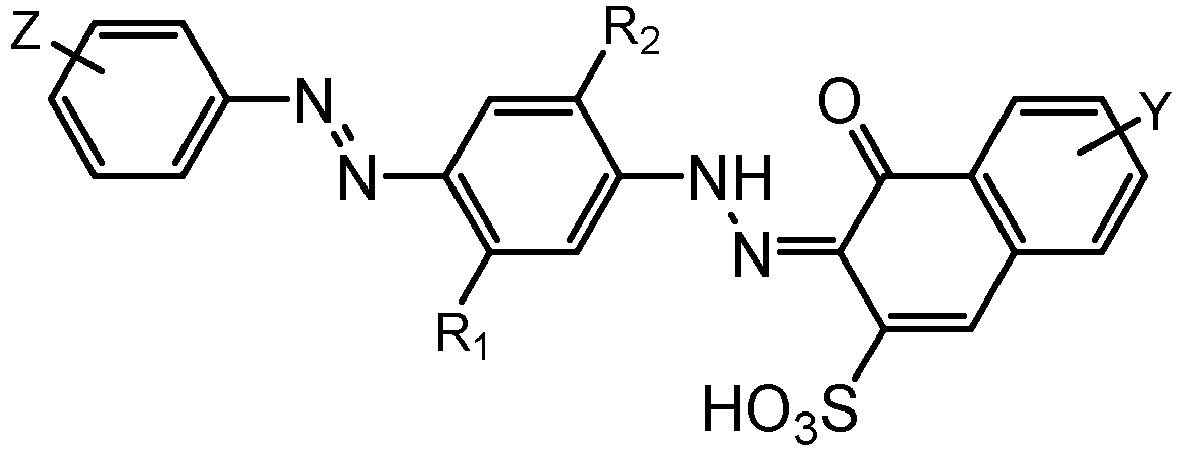
- R1 and R2 are independently H, alkyl, alkoxy, alkyleneoxy, alkyl capped alkyleneoxy, polyalkyleneoxy, alkyl capped polyalkyleneoxy, urea, amido or acetamido;
- Z is an oxygen, nitrogen or sulfonamido group further substituted with at least one, and preferably one, alkoxy-CH=CH2 or -CH=CH2 capped polyalkoxy group;
- Y is a substituted or unsubstituted amino group.
- More preferred non-leuco bis-azo dyes are of the structure (V):

- The structures (IV) and (V) describe bis-azo dyes structures wherein one of the azo groups is depicted in the hydrazone form. These structures are to be interpreted as also covering the bis-azo dyes wherein both azo groups are in the -N=N- from. Preferably one of the azo groups is in the hydrazone form, and one in the azo form when dissolved in water. Azo-hydrazone tautomerism is discussed in Organic Chemistry in Colour by P.F. Gordon and P. Gregory (Springer-Verlag 1983). Azo and hydrazone forms are illustrated below for the dye Direct Violet 9:

- The non-leuco bis-azo dyes may be present as the salt of an alkali metal, alkaline earth metal or a quaternary amine most preferably the counterion is the sodium salt. The structures (IV) and (V) are also to be interpreted as covering such salt forms and the free-acid forms.
- The preferred bis-azo dyes may be synthesised via well-known azo coupling reactions, for example
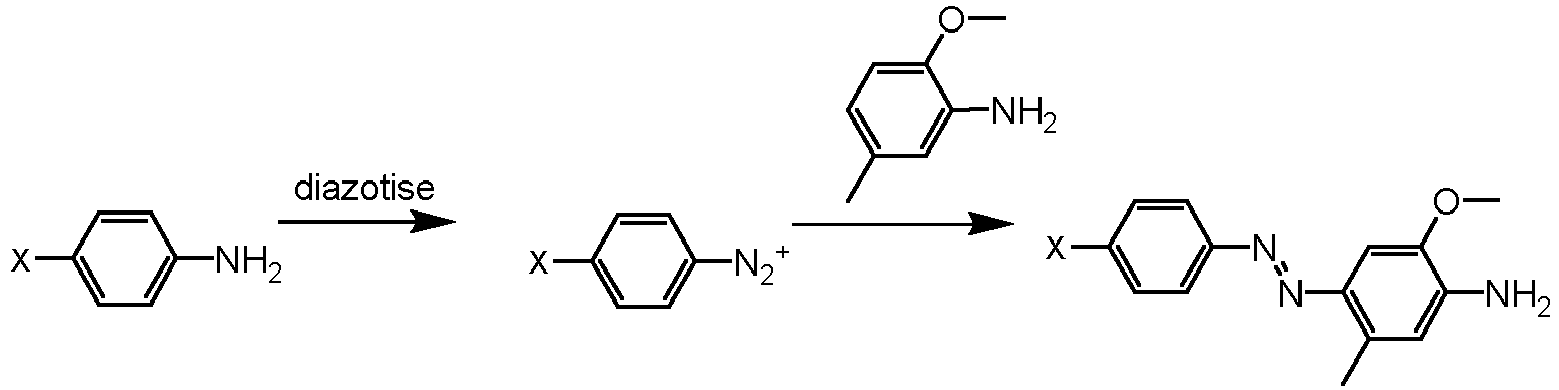


- Synthesis of a plurality of bis-azo dyes having at least one polyalkoxy chain, which are end-terminated by a -CH=CH2 group is described in
WO2012/054058 , although such dyes also contain further -COOH groups. - Synthesis of mono-azo thiophene dyes are described in
US4912203 andWO2011/017719 . The central coupling reaction is:
- Where at least of R1 and R2 represents an alkoxy-CH=CH2 or -CH=CH2 capped polyalkoxy group.
- The -CH=CH2 moiety may be obtained by dehydration of the corresponding ethoxylated material as illustrated below:


- Dehydration of the terminal alcohol group may be achieved by heating in the presence of strong acid, such as sulfuric or phosphoric acid, then purifying.
- Additional advantages of the inventive shading dyes are that the double bond is more active to radical addition, and the dyes have better deposition profiles to fabrics.
- The laundry detergent composition of the invention comprises from 2 to 70 wt. % of a surfactant, most preferably 10 to 30 wt. %. In general, the nonionic and anionic surfactants of the surfactant system may be chosen from the surfactants described "Surface Active Agents" Vol. 1, by Schwartz & Perry, Interscience 1949, Vol. 2 by Schwartz, Perry & Berch, Interscience 1958, in the current edition of "McCutcheon's Emulsifiers and Detergents" published by Manufacturing Confectioners Company or in "Tenside-Taschenbuch", H. Stache, 2nd Edn., Carl Hauser Verlag, 1981. Preferably the surfactants used are saturated.
- Suitable nonionic surfactants may include, in particular, the reaction products of compounds having a hydrophobic group and a reactive hydrogen atom, for example, aliphatic alcohols, acids, amides with alkylene oxides, especially ethylene oxide either alone or with propylene oxide. Specific nonionic surfactants are the condensation products of aliphatic C8 to C18 primary or secondary linear or branched alcohols with ethylene oxide, generally 5 to 40 EO, preferably 7EO to 9EO.
- Suitable anionic surfactants which may be used are usually water-soluble alkali metal salts of organic sulfates and sulphonates having alkyl radicals containing from about 8 to about 22 carbon atoms, the term alkyl being used to include the alkyl portion of higher acyl radicals. Examples of suitable synthetic anionic surfactants are sodium and potassium alkyl sulfates, especially those obtained by sulphating higher C8 to C18 alcohols, produced for example from tallow or coconut oil, sodium and potassium alkyl C9 to C20 benzene sulphonates, particularly sodium linear secondary alkyl C10 to C15 benzene sulphonates; and sodium alkyl glyceryl ether sulfates, especially those ethers of the higher alcohols derived from tallow or coconut oil and synthetic alcohols derived from petroleum. The preferred anionic surfactants are sodium C11 to C15 alkyl benzene sulphonates and sodium C12 to C18 alkyl sulfates. Highly preferred are anionic alkyl benzene sulfonates, which more advantageously are linear alkyl benzene sulphonates. Also applicable are surfactants such as those described in
EP-A-328 177 (Unilever - Preferred surfactant systems are mixtures of anionic and nonionic surfactants, in particular the groups and examples of anionic and nonionic surfactants pointed out in
EP-A-346 995 (Unilever - The nonionic surfactant is preferably present in amounts of less than 50 wt. %, most preferably of less than 20 wt. % based on the total weight of the surfactant system. Anionic surfactants can be present for example in amounts in the range from 50 to 100 wt. % based on the total weight of the surfactant system. Thus a highly advantageous surfactant comprises 50 to 100 wt. % of linear alkyl benzene sulfonates, based on the total weight of surfactants.
- Builder materials may be selected from 1) calcium sequestrant materials, 2) precipitating materials, 3) calcium ion-exchange materials and 4) mixtures thereof.
- Examples of calcium sequestrant builder materials include alkali metal polyphosphates, such as sodium tripolyphosphate and organic sequestrants, such as ethylene diamine tetra-acetic acid.
- Examples of precipitating builder materials include sodium orthophosphate and sodium carbonate.
- Examples of calcium ion-exchange builder materials include the various types of water-insoluble crystalline or amorphous aluminosilicates, of which zeolites are the best known representatives, e.g. zeolite A, zeolite B (also known as zeolite P), zeolite C, zeolite X, zeolite Y and also the zeolite P-type as described in
EP-A-0,384,070 . - The laundry detergent composition of the invention may also contain 0-65 wt. % of a builder or complexing agent such as ethylenediaminetetraacetic acid, diethylenetriamine-pentaacetic acid, alkyl- or alkenylsuccinic acid, nitrilotriacetic acid or the other builders mentioned below. Many builders are also bleach-stabilizing agents by virtue of their ability to complex metal ions.
- Zeolite and carbonate (carbonate (including bicarbonate and sesquicarbonate) are preferred builders, whereof carbonate is the more preferred.
- The composition may contain as builder a crystalline aluminosilicate, preferably an alkali metal aluminosilicate, more preferably a sodium aluminosilicate. This is typically present at a level of less than 15 wt. %. Aluminosilicates are materials having the general formula:
0.8-1.5 M2O. Al2O3. 0.8-6 SiO2
where M is a monovalent cation, preferably sodium. These materials contain some bound water and are required to have a calcium ion exchange capacity of at least 50 mg CaO/g. The preferred sodium aluminosilicates contain 1.5-3.5 SiO2 units in the formula above. They can be prepared readily by reaction between sodium silicate and sodium aluminate, as amply described in the literature. The ratio of surfactants to alumuminosilicate (where present) is preferably greater than 5:2, more preferably greater than 3:1. - Alternatively, or additionally to the aluminosilicate builders, phosphate builders may be used. In this art the term 'phosphate' embraces diphosphate, triphosphate, and phosphonate species. Other forms of builder include silicates, such as soluble silicates, metasilicates, layered silicates (e.g. SKS-6 from Hoechst).
- Preferably the laundry detergent composition is a non-phosphate built laundry detergent formulation, i.e., contains less than 1 wt. % of phosphate. Preferably the laundry detergent composition is carbonate built.
- The laundry detergent composition of the invention preferably comprises a fluorescent agent (optical brightener). Fluorescent agents are well known and many such fluorescent agents are available commercially. Usually, these fluorescent agents are supplied and used in the form of their alkali metal salts, for example, the sodium salts. The total amount of the fluorescent agent or agents used in the laundry detergent composition of the invention is generally from 0.005 to 2 wt. %, more preferably 0.01 to 0.1 wt. %. Preferred classes of fluorescer are: Di-styryl biphenyl compounds, e.g. Tinopal (Trade Mark) CBS-X, Di-amine stilbene di-sulphonic acid compounds, e.g. Tinopal DMS pure Xtra and Blankophor (Trade Mark) HRH, and Pyrazoline compounds, e.g. Blankophor SN. Preferred fluorescers are: sodium 2 (4-styryl-3-sulfophenyl)-2H-napthol[1,2-d]triazole, disodium 4,4'-bis{[(4-anilino-6-(N methyl-N-2 hydroxyethyl) amino 1,3,5-triazin-2-yl)]amino}stilbene-2-2' disulfonate, disodium 4,4'-bis{[(4-anilino-6-morpholino-1,3,5-triazin-2-yl)]amino} stilbene-2-2' disulfonate, and disodium 4,4'-bis(2-sulfostyryl)biphenyl.
- It is preferred that the laundry detergent composition according to the invention comprises a fluorescer. Likewise, it is preferred that the aqueous solution used in the domestic method of treating a textile comprises a fluorescer. When a fluorescer is present in said aqueous solution, it is preferably in the range from 0.0001 g/l to 0.1 g/l, preferably 0.001 to 0.02 g/l.
- The laundry detergent composition may comprise a mixture of different shading dyes according to the invention as well as a mixture of shading dyes according to the invention and further shading dyes not according to the invention.
- Preferably the laundry detergent composition comprises a perfume. The perfume is preferably in the range from 0.001 to 3 wt. %, most preferably 0.1 to 1 wt. %. Many suitable examples of perfumes are provided in the CTFA (Cosmetic, Toiletry and Fragrance Association) 1992 International Buyers Guide, published by CFTA Publications and OPD 1993 Chemicals Buyers Directory 80th Annual Edition, published by Schnell Publishing Co.
- It is commonplace for a plurality of perfume components to be present in a laundry formulation. In the laundry detergent compositions of the present invention it is envisaged that there will be four or more, preferably five or more, more preferably six or more or even seven or more different perfume components.
- In perfume mixtures preferably 15 to 25 wt. % are top notes. Top notes are defined by Poucher (Journal of the Society of Cosmetic Chemists 6(2):80 [1955]). Preferred top-notes are selected from citrus oils, linalool, linalyl acetate, lavender, dihydromyrcenol, rose oxide and cis-3-hexanol. Perfume and top note are advantageously used to cue the whiteness benefit provided by the laundry detergent composition of the invention.
- It is preferred that the laundry detergent composition of the invention does not contain a peroxygen bleach, e.g., sodium percarbonate, sodium perborate, and peracid.
- The laundry detergent composition of the invention may comprise one or more further polymers. Examples are carboxymethylcellulose, poly (ethylene glycol), poly(vinyl alcohol), polycarboxylates such as polyacrylates, maleic/acrylic acid copolymers and lauryl methacrylate/acrylic acid copolymers.
- Polymers present to prevent dye deposition, for example poly(vinylpyrrolidone), poly(vinylpyridine-N-oxide), and poly(vinylimidazole), are preferably absent from the formulation.
- One or more enzymes are preferably present in a laundry detergent composition of the invention and when practicing the method of the invention.
- Preferably the level of each enzyme in the laundry detergent composition of the invention is from 0.0001 wt. % to 0.1 wt. % protein.
- Especially contemplated enzymes include proteases, alpha-amylases, cellulases, lipases, peroxidases/oxidases, pectate lyases, and mannanases, or mixtures thereof.
- Suitable lipases include those of bacterial or fungal origin. Chemically modified or protein engineered mutants are included. Examples of useful lipases include lipases from Humicola (synonym Thermomyces), e.g. from H. lanuginosa (T. lanuginosus) as described in
EP 258 068 EP 305 216 WO 96/13580 EP 218 272 EP 331 376 GB 1,372,034 WO 95/06720 WO 96/27002 WO 96/12012 JP 64/744992 WO 91/16422 - Other examples are lipase variants such as those described in
WO 92/05249 WO 94/01541 EP 407 225 EP 260 105 WO 95/35381 WO 96/00292 WO 95/30744 WO 94/25578 WO 95/14783 WO 95/22615 WO 97/04079 WO 97/07202 WO 00/60063 - Preferred commercially available lipase enzymes include Lipolase™ and Lipolase Ultra™, Lipex™ and lipoclean ™ (Novozymes A/S).
- Preferred phospholipases are classified as EC 3.1.1.4 and/or EC 3.1.1.32. As used herein, the term phospholipase is an enzyme which has activity towards phospholipids.
- Phospholipids, such as lecithin or phosphatidylcholine, consist of glycerol esterified with two fatty acids in an outer (sn-1) and the middle (sn-2) positions and esterified with phosphoric acid in the third position; the phosphoric acid, in turn, may be esterified to an amino-alcohol. Phospholipases are enzymes which participate in the hydrolysis of phospholipids. Several types of phospholipase activity can be distinguished, including phospholipases A1 and A2 which hydrolyze one fatty acyl group (in the sn-1 and sn-2 position, respectively) to form lysophospholipid; and lysophospholipase (or phospholipase B) which can hydrolyze the remaining fatty acyl group in lysophospholipid. Phospholipase C and phospholipase D (phosphodiesterases) release diacyl glycerol or phosphatidic acid respectively.
- Enzyme and photobleach may show some interaction and should be chosen such that this interaction is not negative. Some negative interactions may be avoided by encapsulation of one or other of enzyme or photobleach and/or other segregation within the product.
- Suitable proteases include those of animal, vegetable or microbial origin. Microbial origin is preferred. Chemically modified or protein engineered mutants are included. The protease may be a serine protease or a metallo protease, preferably an alkaline microbial protease or a trypsin-like protease. Preferred commercially available protease enzymes include Alcalase™, Savinase™, Primase™, Duralase™, Dyrazym™, Esperase™, Everlase™, Polarzyme™, and Kannase™, (Novozymes A/S), Maxatase™, Maxacal™, Maxapem™, Properase™, Purafect™, Purafect OxP™, FN2™, and FN3™ (Genencor International Inc.).
- Preferred cutinases are classified in EC 3.1.1.74. The cutinase may be of any origin. Preferably cutinases are of microbial origin, in particular of bacterial, of fungal or of yeast origin.
- Suitable amylases (alpha and/or beta) include those of bacterial or fungal origin. Chemically modified or protein engineered mutants are included. Amylases include, for example, alpha-amylases obtained from Bacillus, e.g. a special strain of B. licheniformis, described in more detail in
GB 1,296,839 WO 95/026397 WO 00/060060 - Suitable cellulases include those of bacterial or fungal origin. Chemically modified or protein engineered mutants are included. Suitable cellulases include cellulases from the genera Bacillus, Pseudomonas, Humicola, Fusarium, Thielavia, Acremonium, e.g. the fungal cellulases produced from Humicola insolens, Thielavia terrestris, Myceliophthora thermophila, and Fusarium oxysporum disclosed in
US 4,435,307 ,US 5,648,263 ,US 5,691,178 ,US 5,776,757 ,WO 89/09259 WO 96/029397 WO 98/012307 - Suitable peroxidases/oxidases include those of plant, bacterial or fungal origin. Chemically modified or protein engineered mutants are included. Examples of useful peroxidases include peroxidases from Coprinus, e.g. from C. cinereus, and variants thereof as those described in
WO 93/24618 WO 95/10602 WO 98/15257 - Further enzymes suitable for use are discussed in
WO2009/087524 ,WO2009/090576 ,WO2009/107091 ,WO2009/111258 andWO2009/148983 . - Preferred enzymes are proteases, lipases, amylase and cellulases, most advantageously a serine protease is comprised by the laundry detergent composition of the invention.
- Any enzyme present in the composition may be stabilized using conventional stabilizing agents, e.g., a polyol such as propylene glycol or glycerol, a sugar or sugar alcohol, lactic acid, boric acid, or a boric acid derivative, e.g., an aromatic borate ester, or a phenyl boronic acid derivative such as 4-formylphenyl boronic acid, and the composition may be formulated as described in e.g.
WO 92/19709 WO 92/19708 - Where alkyl groups are sufficiently long to form branched or cyclic chains, the alkyl groups encompass branched, cyclic and linear alkyl chains. The alkyl groups are preferably linear or branched, most preferably linear.
- The laundry detergent composition of the invention may be a liquid or powder.
- To reduce coloring the powder as a whole by the shading dye, the shading dye of the invention is advantageously present in post-dosed granules, which contain less than 5 wt. % of the shading dye. It was further found that limiting the amount of the shading dye of the invention in the post-dose dye granules to at most 5 wt. % reduces spotting upon neat application of the product (e.g. as powder on wet textile). Preferably a further non-shading dye is added to the post-dose granule to give the granule a blue colour.
- Preferably the total amount of shading dye comprised by the post-dose dye granule is from 0.1 to 2 wt. %, based on the total weight of the post-dose dye granule.
- The shading dye may be pre-mixed with a water-soluble salt (such as sodium sulfate) to form a post-dose dye granule. The post-dose dye granules can be made by known techniques in the art, such as granulation, fluid-bed agglomeration and the like. The post-dose dye granules of the invention can be subsequently mixed with the based detergent granules.
- The size of the post-dose dye granule may be in the range of 50 to 3000 µm. It is most preferred that the granule has a particle size in the range of 100 to 2000 µm, most preferably 180 µm to 1000 µm. The size as given is the maximum length in any one direction of the granule such that the granule passes through a standard sieve of the requisite size.
- In case the laundry detergent composition is a powder, the composition preferably comprises a combination of linear alkyl benzene sulfonates, carbonate and sodium sulfate and post-dosed dye granules, wherein the post-dose dye granules comprise the shading dye according to the invention.
- In case the laundry detergent composition is in the form of a bottled liquid detergent product, the bottle preferably is a 1 to 5 L bottle with a resealable screw top where the maximum dimension of the pouring neck of the bottle is at least 3 times smaller than the maximum dimension of the bottle. On initial sale the bottle should be filled to greater than 95% of the bottle capacity by weight. Surprisingly this reduces the oxidation of the shading dye used in the invention in the formulation during storage.
- In case the laundry detergent composition is in the form of a unit dose, it preferably is a liquid unit dose product. Advantageously unit dose laundry detergent products are contained in a re-closable plastic box. The re-closable plastic box is highly advantageously a child resistance packaging. The requirement for child resistance packaging is given in ISO 8317. Surprisingly providing the laundry detergent composition according to the invention in liquid unit dose form, especially when contained in a re-closable plastic box conforming to the requirements of child resistance packaging can reduce the oxidation of the shading dye in the formulation during storage.
- Unless otherwise indicated, preferred aspects in the context of one aspect of the invention (e.g. the laundry detergent composition) are also applicable as preferred aspects in the context of one of the other aspects, (e.g. the laundry detergent composition as used in the domestic method of treating a textile) mutatis mutandis.
- The invention is now illustrated by the following non-limiting examples.
- A liquid laundry detergent can be prepared of the following formulation:
Ingredient Weight% Linear alkyl benzene sulfonate 10 primary alcohol ethoxylate (C12-15, with 7 moles of ethoxy groups) 5 remainder water (pH=8 using triethanolamine) - The liquid laundry detergent comprises 0.001 wt. % shading dye according to the following structure (Example 1, according to the invention):


- (Comparative A, not according to the invention). As a reference the liquid laundry detergent composition is used but without any added shading dye (reference liquid).
- The wash liquor is prepared by dosing 4g/L of the liquid laundry detergent into 13°FH water in tergotometer pots and a 10 by 10 cm piece of woven cotton, knitted cotton, 65/35 polycotton, microfiber polyester or 80/20 nylon-elastane textile is added so that the wash liquor to textile ratio is 100:1. The wash solution is agitated at 200 rpm for 1 hour at room temperature, the textile rinsed in 13°FH water and dried.
- The colour of the textile is measured using a reflectometer and expressed as CIE L*a*b*. The colour change of the textile washed using either the laundry detergent powder according to Example 1 or according to Comparative A is expressed relative to that of the textile washed using the reference liquid. The following expression is used: Δb = b(reference) - b(dye). The relative deposition of the dye according to Example 1 or according to Comparative A can thus be compared.
- A powdered laundry detergent formulation can be prepared of the following formulation:
Ingredient Weight% Linear alkyl benzene sulfonate 14.5 Sodium carbonate 20.0 Sodium sulphate 50.0 Sodium silicate 6.0 zeolite 2.5 Salt speckle granules (blue and red) 1.8 perfume 0.3 Sodium carboxymethylcellulose 0.1 Sokalan CP5 (ex BASF) 0.1 Shading dye granule 0.3 Minors (including fluorescer) and moisture to 100% - The shading dye granule is as described in
WO2006/053598 , and the formulation contains 0.0004wt% shading dye. The shading dye is according to the following structure (i.e. Example 2, according to the invention)

- (Comparative B, not according to the invention). As a reference the powder laundry detergent composition is used but without any added shading dye (reference powder).
- The wash liquor is prepared by dosing 4g/L of the laundry detergent powder into 13°FH water in tergotometer pots and a 10 by 10 cm piece of woven cotton, knitted cotton, 65/35 polycotton, microfiber polyester or 80/20 nylon-elastane textile is added so that the wash liquor to textile ratio is 100:1. The wash solution is agitated at 200 rpm for 1 hour at room temperature, the textile rinsed in 13°FH water and dried.
- The colour of the textile is measured using a reflectometer and expressed as CIE L*a*b*. The colour change of the textile washed using either the laundry detergent powder according to Example 2 or according to Comparative B is expressed relative to that of the textile washed using the reference powder. The following expression is used: Δb = b(reference) - b(dye). The relative deposition of the dye according to Example 2 or according to Comparative B can thus be compared.
-
reference inventive 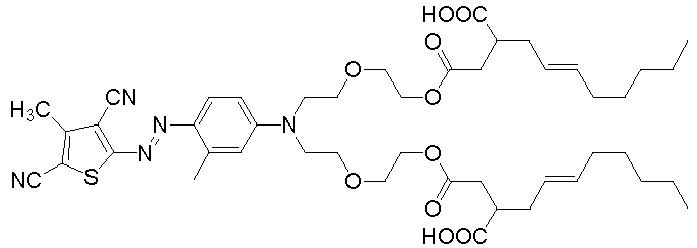

pKa (pH 4 to 10) 7.5 and 9.9 None k(Methyl) M-1s-1 9×10² 1×10⁴ hydrolysis observed not observed - The value k(Methyl) is the solution addition rate constants for a methyl radical to the double bond, calculated according to Fischer H., and Radom, L. Angew. Chem. Int. Ed 2001, 40. 1340-1371.[(CH2=CH(OCH2CH3) comparison to E-(CH3)HC=CH(CH3)].
- The inventive compound is resistant to hydrolysis in the region of pH 4 to 10 and is more reactive to radical addition than the reference compound.
Claims (13)
- A laundry detergent composition comprising:(i) from 2 to 70 wt. % of a surfactant; and(ii) from 0.00001 to 0.1 wt. % of shading dye which is covalently bound to at least one alkoxy-CH=CH2 or -CH=CH2 capped polyalkoxy group.
- A laundry detergent composition according to claim 1, wherein the shading dye provides a blue or violet shade to white fabric.
- A laundry detergent composition according to claim 1 or claim 2, wherein the shading dye is covalently bound to one or two alkoxy-CH=CH2 or -CH=CH2 capped polyalkoxy groups and more preferably is covalently bound to one alkoxy-CH=CH2 or -CH=CH2 capped polyalkoxy group.
- A laundry detergent composition according to any preceding claim, wherein the at least one group is according to the following formula:
-([CH2]mO)nCH=CH2,
wherein n is from 1 to 20 and wherein m is from 2 to 4, and wherein m preferably is from 2 to 3 and more preferably wherein m is 2. - A laundry detergent composition according to claim 4, wherein n is from 1 to 10 and preferably is from 2 to 5.
- A laundry detergent composition according to any preceding claim, wherein the shading dye is bound to the group via a heteroatom, preferably wherein the heteroatom is O or N and more preferably wherein the heteroatom is N.
- A laundry detergent composition according to any preceding claim, wherein the shading dye is a non-leuco blue or non-leuco violet shading dye.
- A laundry detergent composition according to any preceding claim, wherein the shading dye chromophore is a mono-azo or bis-azo and preferably is a mono-azo.
- A laundry detergent composition according to claim 8, wherein the bis-azo dye is a non-leuco shading dye of the following structure (IV):
 R1 and R2 are independently H, alkyl, alkoxy, alkyleneoxy, alkyl capped alkyleneoxy, polyalkyleneoxy, alkyl capped polyalkyleneoxy, urea, amido or acetamido;Z is an oxygen, nitrogen or sulfonamido group further substituted with an alkoxy-CH=CH2 or -CH=CH2 capped polyalkoxy group;Y is a substituted or unsubsituted amino group.
 - A laundry detergent composition according to claim 8, wherein the non-leuco mono-azo dye is of the following structure (I):

- A domestic method of treating a textile, the method comprising the steps of:a. treating a textile with an aqueous solution of 0.5 to 20 g/L, more preferably 1 to 10 g/L of the laundry detergent composition according to any of the preceding claims;b. optionally rinsing and drying the textile.
- A blue or violet non-leuco shading dye shading of the following structure (II):

- A blue or violet non-leuco shading dye shading according to claim 12, wherein the shading dye is of the following structure (III):

Applications Claiming Priority (2)
| Application Number | Priority Date | Filing Date | Title |
|---|---|---|---|
| EP19153077 | 2019-01-22 | ||
| PCT/EP2020/050469 WO2020151959A1 (en) | 2019-01-22 | 2020-01-09 | Laundry detergent |
Publications (2)
| Publication Number | Publication Date |
|---|---|
| EP3752589A1 EP3752589A1 (en) | 2020-12-23 |
| EP3752589B1 true EP3752589B1 (en) | 2023-08-30 |
Family
ID=65200647
Family Applications (1)
| Application Number | Title | Priority Date | Filing Date |
|---|---|---|---|
| EP20700371.6A Active EP3752589B1 (en) | 2019-01-22 | 2020-01-09 | Laundry detergent |
Country Status (4)
| Country | Link |
|---|---|
| US (1) | US20220098525A1 (en) |
| EP (1) | EP3752589B1 (en) |
| CN (1) | CN113330103B (en) |
| WO (1) | WO2020151959A1 (en) |
Families Citing this family (1)
| Publication number | Priority date | Publication date | Assignee | Title |
|---|---|---|---|---|
| JP7209562B2 (en) | 2019-03-19 | 2023-01-20 | ジヤトコ株式会社 | Vehicle drive system |
Family Cites Families (87)
| Publication number | Priority date | Publication date | Assignee | Title |
|---|---|---|---|---|
| GB1296839A (en) | 1969-05-29 | 1972-11-22 | ||
| GB1372034A (en) | 1970-12-31 | 1974-10-30 | Unilever Ltd | Detergent compositions |
| JPS56143245A (en) * | 1980-04-10 | 1981-11-07 | Nippon Kayaku Co Ltd | Water-insoluble azo compound, production thereof and dyeing method employing the same |
| DK187280A (en) | 1980-04-30 | 1981-10-31 | Novo Industri As | RUIT REDUCING AGENT FOR A COMPLETE LAUNDRY |
| AU556758B2 (en) | 1981-07-13 | 1986-11-20 | Procter & Gamble Company, The | Foaming compositions based on alkylpolysaccharide |
| US4507407A (en) * | 1984-06-25 | 1985-03-26 | Milliken Research Corporation | Process for in situ coloration of thermosetting resins |
| CA1243669A (en) | 1984-06-25 | 1988-10-25 | Edward W. Kluger | Reactive colorants |
| US4601725A (en) * | 1984-08-27 | 1986-07-22 | Milliken Research Corporation | Thiophene based fugitive colorants |
| JPH0697997B2 (en) | 1985-08-09 | 1994-12-07 | ギスト ブロカデス ナ−ムロ−ゼ フエンノ−トチヤツプ | New enzymatic detergent additive |
| US4732570A (en) * | 1985-09-13 | 1988-03-22 | Milliken Research Corporation | Colored thermoplastic resin |
| ES2058119T3 (en) | 1986-08-29 | 1994-11-01 | Novo Nordisk As | ENZYMATIC DETERGENT ADDITIVE. |
| NZ221627A (en) | 1986-09-09 | 1993-04-28 | Genencor Inc | Preparation of enzymes, modifications, catalytic triads to alter ratios or transesterification/hydrolysis ratios |
| DE3854249T2 (en) | 1987-08-28 | 1996-02-29 | Novonordisk As | Recombinant Humicola Lipase and Process for the Production of Recombinant Humicola Lipases. |
| GB8803036D0 (en) | 1988-02-10 | 1988-03-09 | Unilever Plc | Liquid detergents |
| JP3079276B2 (en) | 1988-02-28 | 2000-08-21 | 天野製薬株式会社 | Recombinant DNA, Pseudomonas sp. Containing the same, and method for producing lipase using the same |
| US5776757A (en) | 1988-03-24 | 1998-07-07 | Novo Nordisk A/S | Fungal cellulase composition containing alkaline CMC-endoglucanase and essentially no cellobiohydrolase and method of making thereof |
| EP0406314B1 (en) | 1988-03-24 | 1993-12-01 | Novo Nordisk A/S | A cellulase preparation |
| GB8813978D0 (en) | 1988-06-13 | 1988-07-20 | Unilever Plc | Liquid detergents |
| CA2001927C (en) | 1988-11-03 | 1999-12-21 | Graham Thomas Brown | Aluminosilicates and detergent compositions |
| GB8915658D0 (en) | 1989-07-07 | 1989-08-23 | Unilever Plc | Enzymes,their production and use |
| KR100236540B1 (en) | 1990-04-14 | 2000-01-15 | 레클로우크스 라우에르 | Alkaline bacillus lipases, coding dna sequences thereof and bacilli which produce these lipases |
| DK0548228T3 (en) | 1990-09-13 | 1999-05-10 | Novo Nordisk As | lipase variants |
| EP0511456A1 (en) | 1991-04-30 | 1992-11-04 | The Procter & Gamble Company | Liquid detergents with aromatic borate ester to inhibit proteolytic enzyme |
| ES2085024T3 (en) | 1991-04-30 | 1996-05-16 | Procter & Gamble | LIQUID DETERGENTS REINFORCED WITH BORICO-POLYOL ACID COMPLEX TO INHIBIT THE PROTEOLYTIC ENZYME. |
| DK72992D0 (en) | 1992-06-01 | 1992-06-01 | Novo Nordisk As | ENZYME |
| DK88892D0 (en) | 1992-07-06 | 1992-07-06 | Novo Nordisk As | CONNECTION |
| AU673078B2 (en) | 1993-04-27 | 1996-10-24 | Genencor International, Inc. | New lipase variants for use in detergent applications |
| JP2859520B2 (en) | 1993-08-30 | 1999-02-17 | ノボ ノルディスク アクティーゼルスカブ | Lipase, microorganism producing the same, method for producing lipase, and detergent composition containing lipase |
| US5817495A (en) | 1993-10-13 | 1998-10-06 | Novo Nordisk A/S | H2 O2 -stable peroxidase variants |
| JPH07143883A (en) | 1993-11-24 | 1995-06-06 | Showa Denko Kk | Lipase gene and mutant lipase |
| ATE222604T1 (en) | 1994-02-22 | 2002-09-15 | Novozymes As | METHOD FOR PRODUCING A VARIANT OF A LIPOLYTIC ENZYME |
| DE69534464T2 (en) | 1994-03-29 | 2006-09-28 | Novozymes A/S | ALKALIC AMYLASE FROM BACELLUS |
| WO1995030744A2 (en) | 1994-05-04 | 1995-11-16 | Genencor International Inc. | Lipases with improved surfactant resistance |
| WO1995035381A1 (en) | 1994-06-20 | 1995-12-28 | Unilever N.V. | Modified pseudomonas lipases and their use |
| WO1996000292A1 (en) | 1994-06-23 | 1996-01-04 | Unilever N.V. | Modified pseudomonas lipases and their use |
| BE1008998A3 (en) | 1994-10-14 | 1996-10-01 | Solvay | Lipase, microorganism producing the preparation process for the lipase and uses thereof. |
| AU3697995A (en) | 1994-10-26 | 1996-05-23 | Novo Nordisk A/S | An enzyme with lipolytic activity |
| JPH08228778A (en) | 1995-02-27 | 1996-09-10 | Showa Denko Kk | Novel lipase gene and method for producing lipase using the same |
| CN1182451A (en) | 1995-03-17 | 1998-05-20 | 诺沃挪第克公司 | Novel endoglucanases |
| WO1997004078A1 (en) | 1995-07-14 | 1997-02-06 | Novo Nordisk A/S | A modified enzyme with lipolytic activity |
| WO1997007202A1 (en) | 1995-08-11 | 1997-02-27 | Novo Nordisk A/S | Novel lipolytic enzymes |
| DE69735767T2 (en) | 1996-09-17 | 2007-04-05 | Novozymes A/S | cellulase |
| WO1998015257A1 (en) | 1996-10-08 | 1998-04-16 | Novo Nordisk A/S | Diaminobenzoic acid derivatives as dye precursors |
| ES2532606T3 (en) | 1999-03-31 | 2015-03-30 | Novozymes A/S | Polypeptides with alkaline alpha-amylase activity and nucleic acids encoding them |
| KR20010108379A (en) | 1999-03-31 | 2001-12-07 | 피아 스타르 | Lipase variant |
| US20030136701A1 (en) * | 2001-12-14 | 2003-07-24 | Unilever Home And Personal Care Usa, | Laundry pouch |
| US6875811B2 (en) * | 2002-05-07 | 2005-04-05 | Milliken & Company | Single compound toners for use in polyesters |
| US20040044623A1 (en) * | 2002-08-28 | 2004-03-04 | Wake Susan L. | Billing system for wireless device activity |
| AR049538A1 (en) * | 2004-06-29 | 2006-08-09 | Procter & Gamble | DETERGENT COMPOSITIONS FOR LAUNDRY WITH EFFICIENT DYING COLOR |
| US7208459B2 (en) * | 2004-06-29 | 2007-04-24 | The Procter & Gamble Company | Laundry detergent compositions with efficient hueing dye |
| CN101068914A (en) | 2004-11-22 | 2007-11-07 | 荷兰联合利华有限公司 | laundry treatment composition |
| JP5345399B2 (en) * | 2006-01-23 | 2013-11-20 | ザ プロクター アンド ギャンブル カンパニー | Laundry care composition with thiazolium dye |
| US7642282B2 (en) * | 2007-01-19 | 2010-01-05 | Milliken & Company | Whitening agents for cellulosic substrates |
| CA2673239C (en) | 2007-01-19 | 2012-07-24 | The Procter & Gamble Company | Laundry care composition comprising a whitening agent having an azo-thiophene or triphenylmethane colorant moiety and a polyoxyalkylene moiety |
| US20080177089A1 (en) * | 2007-01-19 | 2008-07-24 | Eugene Steven Sadlowski | Novel whitening agents for cellulosic substrates |
| EP2242830B2 (en) | 2008-01-04 | 2020-03-11 | The Procter & Gamble Company | Enzyme and fabric hueing agent containing compositions |
| EP2085070A1 (en) | 2008-01-11 | 2009-08-05 | Procter & Gamble International Operations SA. | Cleaning and/or treatment compositions |
| AR070497A1 (en) | 2008-02-29 | 2010-04-07 | Procter & Gamble | DETERGENT COMPOSITION THAT LIPASA INCLUDES |
| MX2010009457A (en) | 2008-02-29 | 2010-09-24 | Procter & Gamble | Detergent composition comprising lipase. |
| EP2300588B1 (en) | 2008-06-06 | 2019-02-06 | The Procter and Gamble Company | Detergent composition comprising a variant of a family 44 xyloglucanase |
| ES2436446T3 (en) * | 2009-06-15 | 2014-01-02 | Unilever Nv | Detergent composition comprising anionic dye polymer |
| EP2354214B2 (en) * | 2010-01-06 | 2022-06-08 | Unilever IP Holdings B.V. | Surfactant ratio in dye formulations |
| EP2534237B1 (en) * | 2010-02-12 | 2014-11-12 | Unilever PLC | Laundry treatment composition comprising bis-azo shading dyes |
| WO2012054058A1 (en) | 2010-10-22 | 2012-04-26 | The Procter & Gamble Company | Bis-azo colorants for use as bluing agents |
| WO2011017719A2 (en) * | 2010-11-12 | 2011-02-10 | Milliken & Company | Thiophene azo dyes and laundry care compositions containing the same |
| JP5883127B2 (en) * | 2011-06-03 | 2016-03-09 | ザ プロクター アンド ギャンブルカンパニー | Laundry care compositions containing dyes |
| US9163146B2 (en) | 2011-06-03 | 2015-10-20 | Milliken & Company | Thiophene azo carboxylate dyes and laundry care compositions containing the same |
| EP2864464B1 (en) * | 2012-06-21 | 2017-03-01 | Unilever PLC | Liquid laundry detergent |
| CN104471049B (en) * | 2012-07-17 | 2017-07-21 | 荷兰联合利华有限公司 | Bright detergent composition |
| EP2813564A1 (en) | 2013-06-14 | 2014-12-17 | Unilever PLC | Laundry formulation comprising a dye |
| MX2016003538A (en) * | 2013-09-18 | 2016-06-28 | Procter & Gamble | Laundry care compositions containing thiophene azo carboxylate dyes. |
| EP3535364B1 (en) | 2016-11-01 | 2020-12-23 | The Procter & Gamble Company | Leuco polymers as bluing agents in laundry care compositions |
| EP3535362A1 (en) | 2016-11-01 | 2019-09-11 | The Procter and Gamble Company | Leuco colorants as bluing agents in laundry care compositions, packaging, kits and methods thereof |
| JP6907309B2 (en) | 2016-11-01 | 2021-07-21 | ザ プロクター アンド ギャンブル カンパニーThe Procter & Gamble Company | How to use leuco colorant as a bluish agent in laundry care compositions |
| EP3535374B1 (en) | 2016-11-01 | 2020-09-30 | The Procter and Gamble Company | Leuco polymers as bluing agents in laundry care compositions |
| JP6932775B2 (en) | 2016-11-01 | 2021-09-08 | ザ プロクター アンド ギャンブル カンパニーThe Procter & Gamble Company | Method of using leuco colorant as a bluish agent in laundry care composition |
| WO2018085303A1 (en) | 2016-11-01 | 2018-05-11 | The Procter & Gamble Company | Leuco polymers as bluing agents in laundry care compositions |
| WO2018085304A1 (en) | 2016-11-01 | 2018-05-11 | The Procter & Gamble Company | Leuco polymers as bluing agents in laundry care compositions |
| US20180119058A1 (en) | 2016-11-01 | 2018-05-03 | The Procter & Gamble Company | Leuco triphenylmethane colorants as bluing agents in laundry care compositions |
| WO2018085305A1 (en) | 2016-11-01 | 2018-05-11 | The Procter & Gamble Company | Leuco polymers as bluing agents in laundry care compositions |
| EP3535368A1 (en) | 2016-11-01 | 2019-09-11 | The Procter & Gamble Company | Leuco colorants as bluing agents in laundry care compositions |
| EP3535371B1 (en) | 2016-11-01 | 2020-09-09 | The Procter & Gamble Company | Leuco polymers as bluing agents in laundry care compositions |
| CA3038855A1 (en) | 2016-11-01 | 2018-05-11 | The Procter & Gamble Company | Leuco colorants as bluing agents in laundry care compositions |
| US20180119069A1 (en) | 2016-11-01 | 2018-05-03 | The Procter & Gamble Company | Reactive leuco compounds and compositions comprising the same |
| WO2018085306A1 (en) | 2016-11-01 | 2018-05-11 | The Procter & Gamble Company | Leuco polymers as bluing agents in laundry care compositions |
| US10577570B2 (en) | 2016-11-01 | 2020-03-03 | The Procter & Gamble Company | Leuco polymers as bluing agents in laundry care compositions |
| US20220098520A1 (en) * | 2019-01-22 | 2022-03-31 | Conopco, Inc., D/B/A Unilever | Laundry detergent |
-
2020
- 2020-01-09 EP EP20700371.6A patent/EP3752589B1/en active Active
- 2020-01-09 CN CN202080010557.7A patent/CN113330103B/en active Active
- 2020-01-09 US US17/424,151 patent/US20220098525A1/en not_active Abandoned
- 2020-01-09 WO PCT/EP2020/050469 patent/WO2020151959A1/en not_active Ceased
Also Published As
| Publication number | Publication date |
|---|---|
| BR112021014332A2 (en) | 2021-09-28 |
| EP3752589A1 (en) | 2020-12-23 |
| WO2020151959A1 (en) | 2020-07-30 |
| CN113330103A (en) | 2021-08-31 |
| CN113330103B (en) | 2023-05-16 |
| US20220098525A1 (en) | 2022-03-31 |
Similar Documents
| Publication | Publication Date | Title |
|---|---|---|
| EP2534206B1 (en) | Dye polymers | |
| WO2012126665A1 (en) | Dye polymer | |
| EP2488622B1 (en) | Dye polymers | |
| WO2012130492A1 (en) | Dye polymer | |
| EP3046973B1 (en) | Dye polymer | |
| EP3097152B1 (en) | Dye polymer | |
| EP3119865B1 (en) | Domestic method of treating a textile with an azo-dye | |
| WO2012098046A1 (en) | Dye polymer for laundry treatment | |
| EP3752589B1 (en) | Laundry detergent | |
| EP3914682B1 (en) | Laundry detergent | |
| EP2563893B1 (en) | Bis-heterocyclic azo dyes | |
| EP3046972B1 (en) | Dye polymer | |
| EP3242927B1 (en) | Laundry treatment composition comprising a dye | |
| EP3256557B1 (en) | Laundry liquid composition | |
| EP2427540B1 (en) | Shading composition | |
| EP3402868B1 (en) | Laundry treatment composition | |
| EP3256558B1 (en) | Laundry liquid composition | |
| WO2020020703A1 (en) | Laundry detergent | |
| BR112021014332B1 (en) | LAUNDRY DETERGENT COMPOSITION, HOUSEHOLD METHOD FOR TREATING A FABRIC AND NON-LEUCO BLUE OR VIOLET TONING DYE |
Legal Events
| Date | Code | Title | Description |
|---|---|---|---|
| STAA | Information on the status of an ep patent application or granted ep patent |
Free format text: STATUS: UNKNOWN |
|
| STAA | Information on the status of an ep patent application or granted ep patent |
Free format text: STATUS: THE INTERNATIONAL PUBLICATION HAS BEEN MADE |
|
| PUAI | Public reference made under article 153(3) epc to a published international application that has entered the european phase |
Free format text: ORIGINAL CODE: 0009012 |
|
| STAA | Information on the status of an ep patent application or granted ep patent |
Free format text: STATUS: REQUEST FOR EXAMINATION WAS MADE |
|
| 17P | Request for examination filed |
Effective date: 20200917 |
|
| AK | Designated contracting states |
Kind code of ref document: A1 Designated state(s): AL AT BE BG CH CY CZ DE DK EE ES FI FR GB GR HR HU IE IS IT LI LT LU LV MC MK MT NL NO PL PT RO RS SE SI SK SM TR |
|
| AX | Request for extension of the european patent |
Extension state: BA ME |
|
| RAP1 | Party data changed (applicant data changed or rights of an application transferred) |
Owner name: UNILEVER GLOBAL IP LIMITED |
|
| STAA | Information on the status of an ep patent application or granted ep patent |
Free format text: STATUS: EXAMINATION IS IN PROGRESS |
|
| 17Q | First examination report despatched |
Effective date: 20210914 |
|
| RAP1 | Party data changed (applicant data changed or rights of an application transferred) |
Owner name: UNILEVER IP HOLDINGS B.V. Owner name: UNILEVER GLOBAL IP LIMITED |
|
| TPAC | Observations filed by third parties |
Free format text: ORIGINAL CODE: EPIDOSNTIPA |
|
| RAP3 | Party data changed (applicant data changed or rights of an application transferred) |
Owner name: UNILEVER IP HOLDINGS B.V. Owner name: UNILEVER GLOBAL IP LIMITED |
|
| DAV | Request for validation of the european patent (deleted) | ||
| DAX | Request for extension of the european patent (deleted) | ||
| GRAP | Despatch of communication of intention to grant a patent |
Free format text: ORIGINAL CODE: EPIDOSNIGR1 |
|
| STAA | Information on the status of an ep patent application or granted ep patent |
Free format text: STATUS: GRANT OF PATENT IS INTENDED |
|
| TPAC | Observations filed by third parties |
Free format text: ORIGINAL CODE: EPIDOSNTIPA |
|
| TPAC | Observations filed by third parties |
Free format text: ORIGINAL CODE: EPIDOSNTIPA |
|
| INTG | Intention to grant announced |
Effective date: 20230317 |
|
| TPAC | Observations filed by third parties |
Free format text: ORIGINAL CODE: EPIDOSNTIPA |
|
| GRAS | Grant fee paid |
Free format text: ORIGINAL CODE: EPIDOSNIGR3 |
|
| GRAA | (expected) grant |
Free format text: ORIGINAL CODE: 0009210 |
|
| STAA | Information on the status of an ep patent application or granted ep patent |
Free format text: STATUS: THE PATENT HAS BEEN GRANTED |
|
| P01 | Opt-out of the competence of the unified patent court (upc) registered |
Effective date: 20230711 |
|
| AK | Designated contracting states |
Kind code of ref document: B1 Designated state(s): AL AT BE BG CH CY CZ DE DK EE ES FI FR GB GR HR HU IE IS IT LI LT LU LV MC MK MT NL NO PL PT RO RS SE SI SK SM TR |
|
| REG | Reference to a national code |
Ref country code: GB Ref legal event code: FG4D |
|
| REG | Reference to a national code |
Ref country code: CH Ref legal event code: EP |
|
| REG | Reference to a national code |
Ref country code: DE Ref legal event code: R096 Ref document number: 602020016665 Country of ref document: DE |
|
| REG | Reference to a national code |
Ref country code: IE Ref legal event code: FG4D |
|
| REG | Reference to a national code |
Ref country code: LT Ref legal event code: MG9D |
|
| REG | Reference to a national code |
Ref country code: NL Ref legal event code: MP Effective date: 20230830 |
|
| REG | Reference to a national code |
Ref country code: AT Ref legal event code: MK05 Ref document number: 1605477 Country of ref document: AT Kind code of ref document: T Effective date: 20230830 |
|
| PG25 | Lapsed in a contracting state [announced via postgrant information from national office to epo] |
Ref country code: GR Free format text: LAPSE BECAUSE OF FAILURE TO SUBMIT A TRANSLATION OF THE DESCRIPTION OR TO PAY THE FEE WITHIN THE PRESCRIBED TIME-LIMIT Effective date: 20231201 |
|
| PG25 | Lapsed in a contracting state [announced via postgrant information from national office to epo] |
Ref country code: IS Free format text: LAPSE BECAUSE OF FAILURE TO SUBMIT A TRANSLATION OF THE DESCRIPTION OR TO PAY THE FEE WITHIN THE PRESCRIBED TIME-LIMIT Effective date: 20231230 |
|
| PG25 | Lapsed in a contracting state [announced via postgrant information from national office to epo] |
Ref country code: SE Free format text: LAPSE BECAUSE OF FAILURE TO SUBMIT A TRANSLATION OF THE DESCRIPTION OR TO PAY THE FEE WITHIN THE PRESCRIBED TIME-LIMIT Effective date: 20230830 Ref country code: RS Free format text: LAPSE BECAUSE OF FAILURE TO SUBMIT A TRANSLATION OF THE DESCRIPTION OR TO PAY THE FEE WITHIN THE PRESCRIBED TIME-LIMIT Effective date: 20230830 Ref country code: NO Free format text: LAPSE BECAUSE OF FAILURE TO SUBMIT A TRANSLATION OF THE DESCRIPTION OR TO PAY THE FEE WITHIN THE PRESCRIBED TIME-LIMIT Effective date: 20231130 Ref country code: LV Free format text: LAPSE BECAUSE OF FAILURE TO SUBMIT A TRANSLATION OF THE DESCRIPTION OR TO PAY THE FEE WITHIN THE PRESCRIBED TIME-LIMIT Effective date: 20230830 Ref country code: LT Free format text: LAPSE BECAUSE OF FAILURE TO SUBMIT A TRANSLATION OF THE DESCRIPTION OR TO PAY THE FEE WITHIN THE PRESCRIBED TIME-LIMIT Effective date: 20230830 Ref country code: IS Free format text: LAPSE BECAUSE OF FAILURE TO SUBMIT A TRANSLATION OF THE DESCRIPTION OR TO PAY THE FEE WITHIN THE PRESCRIBED TIME-LIMIT Effective date: 20231230 Ref country code: HR Free format text: LAPSE BECAUSE OF FAILURE TO SUBMIT A TRANSLATION OF THE DESCRIPTION OR TO PAY THE FEE WITHIN THE PRESCRIBED TIME-LIMIT Effective date: 20230830 Ref country code: GR Free format text: LAPSE BECAUSE OF FAILURE TO SUBMIT A TRANSLATION OF THE DESCRIPTION OR TO PAY THE FEE WITHIN THE PRESCRIBED TIME-LIMIT Effective date: 20231201 Ref country code: FI Free format text: LAPSE BECAUSE OF FAILURE TO SUBMIT A TRANSLATION OF THE DESCRIPTION OR TO PAY THE FEE WITHIN THE PRESCRIBED TIME-LIMIT Effective date: 20230830 Ref country code: AT Free format text: LAPSE BECAUSE OF FAILURE TO SUBMIT A TRANSLATION OF THE DESCRIPTION OR TO PAY THE FEE WITHIN THE PRESCRIBED TIME-LIMIT Effective date: 20230830 |
|
| PG25 | Lapsed in a contracting state [announced via postgrant information from national office to epo] |
Ref country code: PL Free format text: LAPSE BECAUSE OF FAILURE TO SUBMIT A TRANSLATION OF THE DESCRIPTION OR TO PAY THE FEE WITHIN THE PRESCRIBED TIME-LIMIT Effective date: 20230830 Ref country code: NL Free format text: LAPSE BECAUSE OF FAILURE TO SUBMIT A TRANSLATION OF THE DESCRIPTION OR TO PAY THE FEE WITHIN THE PRESCRIBED TIME-LIMIT Effective date: 20230830 |
|
| PG25 | Lapsed in a contracting state [announced via postgrant information from national office to epo] |
Ref country code: ES Free format text: LAPSE BECAUSE OF FAILURE TO SUBMIT A TRANSLATION OF THE DESCRIPTION OR TO PAY THE FEE WITHIN THE PRESCRIBED TIME-LIMIT Effective date: 20230830 |
|
| PG25 | Lapsed in a contracting state [announced via postgrant information from national office to epo] |
Ref country code: SM Free format text: LAPSE BECAUSE OF FAILURE TO SUBMIT A TRANSLATION OF THE DESCRIPTION OR TO PAY THE FEE WITHIN THE PRESCRIBED TIME-LIMIT Effective date: 20230830 Ref country code: RO Free format text: LAPSE BECAUSE OF FAILURE TO SUBMIT A TRANSLATION OF THE DESCRIPTION OR TO PAY THE FEE WITHIN THE PRESCRIBED TIME-LIMIT Effective date: 20230830 Ref country code: ES Free format text: LAPSE BECAUSE OF FAILURE TO SUBMIT A TRANSLATION OF THE DESCRIPTION OR TO PAY THE FEE WITHIN THE PRESCRIBED TIME-LIMIT Effective date: 20230830 Ref country code: EE Free format text: LAPSE BECAUSE OF FAILURE TO SUBMIT A TRANSLATION OF THE DESCRIPTION OR TO PAY THE FEE WITHIN THE PRESCRIBED TIME-LIMIT Effective date: 20230830 Ref country code: DK Free format text: LAPSE BECAUSE OF FAILURE TO SUBMIT A TRANSLATION OF THE DESCRIPTION OR TO PAY THE FEE WITHIN THE PRESCRIBED TIME-LIMIT Effective date: 20230830 Ref country code: CZ Free format text: LAPSE BECAUSE OF FAILURE TO SUBMIT A TRANSLATION OF THE DESCRIPTION OR TO PAY THE FEE WITHIN THE PRESCRIBED TIME-LIMIT Effective date: 20230830 Ref country code: PT Free format text: LAPSE BECAUSE OF FAILURE TO SUBMIT A TRANSLATION OF THE DESCRIPTION OR TO PAY THE FEE WITHIN THE PRESCRIBED TIME-LIMIT Effective date: 20240102 Ref country code: SK Free format text: LAPSE BECAUSE OF FAILURE TO SUBMIT A TRANSLATION OF THE DESCRIPTION OR TO PAY THE FEE WITHIN THE PRESCRIBED TIME-LIMIT Effective date: 20230830 |
|
| PG25 | Lapsed in a contracting state [announced via postgrant information from national office to epo] |
Ref country code: IT Free format text: LAPSE BECAUSE OF FAILURE TO SUBMIT A TRANSLATION OF THE DESCRIPTION OR TO PAY THE FEE WITHIN THE PRESCRIBED TIME-LIMIT Effective date: 20230830 |
|
| REG | Reference to a national code |
Ref country code: DE Ref legal event code: R097 Ref document number: 602020016665 Country of ref document: DE |
|
| PLBE | No opposition filed within time limit |
Free format text: ORIGINAL CODE: 0009261 |
|
| STAA | Information on the status of an ep patent application or granted ep patent |
Free format text: STATUS: NO OPPOSITION FILED WITHIN TIME LIMIT |
|
| PG25 | Lapsed in a contracting state [announced via postgrant information from national office to epo] |
Ref country code: SI Free format text: LAPSE BECAUSE OF FAILURE TO SUBMIT A TRANSLATION OF THE DESCRIPTION OR TO PAY THE FEE WITHIN THE PRESCRIBED TIME-LIMIT Effective date: 20230830 |
|
| 26N | No opposition filed |
Effective date: 20240603 |
|
| PG25 | Lapsed in a contracting state [announced via postgrant information from national office to epo] |
Ref country code: MC Free format text: LAPSE BECAUSE OF FAILURE TO SUBMIT A TRANSLATION OF THE DESCRIPTION OR TO PAY THE FEE WITHIN THE PRESCRIBED TIME-LIMIT Effective date: 20230830 |
|
| PG25 | Lapsed in a contracting state [announced via postgrant information from national office to epo] |
Ref country code: MC Free format text: LAPSE BECAUSE OF FAILURE TO SUBMIT A TRANSLATION OF THE DESCRIPTION OR TO PAY THE FEE WITHIN THE PRESCRIBED TIME-LIMIT Effective date: 20230830 |
|
| REG | Reference to a national code |
Ref country code: CH Ref legal event code: PL |
|
| PG25 | Lapsed in a contracting state [announced via postgrant information from national office to epo] |
Ref country code: LU Free format text: LAPSE BECAUSE OF NON-PAYMENT OF DUE FEES Effective date: 20240109 |
|
| PG25 | Lapsed in a contracting state [announced via postgrant information from national office to epo] |
Ref country code: LU Free format text: LAPSE BECAUSE OF NON-PAYMENT OF DUE FEES Effective date: 20240109 |
|
| PG25 | Lapsed in a contracting state [announced via postgrant information from national office to epo] |
Ref country code: BE Free format text: LAPSE BECAUSE OF NON-PAYMENT OF DUE FEES Effective date: 20240131 |
|
| PG25 | Lapsed in a contracting state [announced via postgrant information from national office to epo] |
Ref country code: CH Free format text: LAPSE BECAUSE OF NON-PAYMENT OF DUE FEES Effective date: 20240131 |
|
| PG25 | Lapsed in a contracting state [announced via postgrant information from national office to epo] |
Ref country code: CH Free format text: LAPSE BECAUSE OF NON-PAYMENT OF DUE FEES Effective date: 20240131 Ref country code: BE Free format text: LAPSE BECAUSE OF NON-PAYMENT OF DUE FEES Effective date: 20240131 |
|
| REG | Reference to a national code |
Ref country code: BE Ref legal event code: MM Effective date: 20240131 |
|
| PG25 | Lapsed in a contracting state [announced via postgrant information from national office to epo] |
Ref country code: BG Free format text: LAPSE BECAUSE OF FAILURE TO SUBMIT A TRANSLATION OF THE DESCRIPTION OR TO PAY THE FEE WITHIN THE PRESCRIBED TIME-LIMIT Effective date: 20230830 |
|
| PG25 | Lapsed in a contracting state [announced via postgrant information from national office to epo] |
Ref country code: BG Free format text: LAPSE BECAUSE OF FAILURE TO SUBMIT A TRANSLATION OF THE DESCRIPTION OR TO PAY THE FEE WITHIN THE PRESCRIBED TIME-LIMIT Effective date: 20230830 |
|
| PG25 | Lapsed in a contracting state [announced via postgrant information from national office to epo] |
Ref country code: IE Free format text: LAPSE BECAUSE OF NON-PAYMENT OF DUE FEES Effective date: 20240109 |
|
| PG25 | Lapsed in a contracting state [announced via postgrant information from national office to epo] |
Ref country code: IE Free format text: LAPSE BECAUSE OF NON-PAYMENT OF DUE FEES Effective date: 20240109 |
|
| PGFP | Annual fee paid to national office [announced via postgrant information from national office to epo] |
Ref country code: DE Payment date: 20250121 Year of fee payment: 6 |
|
| PGFP | Annual fee paid to national office [announced via postgrant information from national office to epo] |
Ref country code: FR Payment date: 20250127 Year of fee payment: 6 |
|
| PGFP | Annual fee paid to national office [announced via postgrant information from national office to epo] |
Ref country code: GB Payment date: 20250128 Year of fee payment: 6 |
|
| PG25 | Lapsed in a contracting state [announced via postgrant information from national office to epo] |
Ref country code: CY Free format text: LAPSE BECAUSE OF FAILURE TO SUBMIT A TRANSLATION OF THE DESCRIPTION OR TO PAY THE FEE WITHIN THE PRESCRIBED TIME-LIMIT; INVALID AB INITIO Effective date: 20200109 |
|
| PG25 | Lapsed in a contracting state [announced via postgrant information from national office to epo] |
Ref country code: HU Free format text: LAPSE BECAUSE OF FAILURE TO SUBMIT A TRANSLATION OF THE DESCRIPTION OR TO PAY THE FEE WITHIN THE PRESCRIBED TIME-LIMIT; INVALID AB INITIO Effective date: 20200109 |
|
| PG25 | Lapsed in a contracting state [announced via postgrant information from national office to epo] |
Ref country code: TR Free format text: LAPSE BECAUSE OF FAILURE TO SUBMIT A TRANSLATION OF THE DESCRIPTION OR TO PAY THE FEE WITHIN THE PRESCRIBED TIME-LIMIT Effective date: 20230830 |