EP3658110B1 - Oral care compositions - Google Patents
Oral care compositions Download PDFInfo
- Publication number
- EP3658110B1 EP3658110B1 EP18830226.9A EP18830226A EP3658110B1 EP 3658110 B1 EP3658110 B1 EP 3658110B1 EP 18830226 A EP18830226 A EP 18830226A EP 3658110 B1 EP3658110 B1 EP 3658110B1
- Authority
- EP
- European Patent Office
- Prior art keywords
- oral care
- poly
- care composition
- oxyethylene
- aspects
- Prior art date
- Legal status (The legal status is an assumption and is not a legal conclusion. Google has not performed a legal analysis and makes no representation as to the accuracy of the status listed.)
- Active
Links
Classifications
-
- A—HUMAN NECESSITIES
- A61—MEDICAL OR VETERINARY SCIENCE; HYGIENE
- A61K—PREPARATIONS FOR MEDICAL, DENTAL OR TOILETRY PURPOSES
- A61K8/00—Cosmetics or similar toiletry preparations
- A61K8/18—Cosmetics or similar toiletry preparations characterised by the composition
- A61K8/30—Cosmetics or similar toiletry preparations characterised by the composition containing organic compounds
- A61K8/33—Cosmetics or similar toiletry preparations characterised by the composition containing organic compounds containing oxygen
- A61K8/37—Esters of carboxylic acids
-
- A—HUMAN NECESSITIES
- A61—MEDICAL OR VETERINARY SCIENCE; HYGIENE
- A61Q—SPECIFIC USE OF COSMETICS OR SIMILAR TOILETRY PREPARATIONS
- A61Q11/00—Preparations for care of the teeth, of the oral cavity or of dentures; Dentifrices, e.g. toothpastes; Mouth rinses
-
- A—HUMAN NECESSITIES
- A61—MEDICAL OR VETERINARY SCIENCE; HYGIENE
- A61K—PREPARATIONS FOR MEDICAL, DENTAL OR TOILETRY PURPOSES
- A61K8/00—Cosmetics or similar toiletry preparations
- A61K8/18—Cosmetics or similar toiletry preparations characterised by the composition
- A61K8/30—Cosmetics or similar toiletry preparations characterised by the composition containing organic compounds
- A61K8/33—Cosmetics or similar toiletry preparations characterised by the composition containing organic compounds containing oxygen
- A61K8/34—Alcohols
-
- A—HUMAN NECESSITIES
- A61—MEDICAL OR VETERINARY SCIENCE; HYGIENE
- A61K—PREPARATIONS FOR MEDICAL, DENTAL OR TOILETRY PURPOSES
- A61K8/00—Cosmetics or similar toiletry preparations
- A61K8/18—Cosmetics or similar toiletry preparations characterised by the composition
- A61K8/30—Cosmetics or similar toiletry preparations characterised by the composition containing organic compounds
- A61K8/33—Cosmetics or similar toiletry preparations characterised by the composition containing organic compounds containing oxygen
- A61K8/34—Alcohols
- A61K8/345—Alcohols containing more than one hydroxy group
-
- A—HUMAN NECESSITIES
- A61—MEDICAL OR VETERINARY SCIENCE; HYGIENE
- A61K—PREPARATIONS FOR MEDICAL, DENTAL OR TOILETRY PURPOSES
- A61K8/00—Cosmetics or similar toiletry preparations
- A61K8/18—Cosmetics or similar toiletry preparations characterised by the composition
- A61K8/30—Cosmetics or similar toiletry preparations characterised by the composition containing organic compounds
- A61K8/33—Cosmetics or similar toiletry preparations characterised by the composition containing organic compounds containing oxygen
- A61K8/39—Derivatives containing from 2 to 10 oxyalkylene groups
-
- A—HUMAN NECESSITIES
- A61—MEDICAL OR VETERINARY SCIENCE; HYGIENE
- A61K—PREPARATIONS FOR MEDICAL, DENTAL OR TOILETRY PURPOSES
- A61K8/00—Cosmetics or similar toiletry preparations
- A61K8/18—Cosmetics or similar toiletry preparations characterised by the composition
- A61K8/30—Cosmetics or similar toiletry preparations characterised by the composition containing organic compounds
- A61K8/60—Sugars; Derivatives thereof
-
- A—HUMAN NECESSITIES
- A61—MEDICAL OR VETERINARY SCIENCE; HYGIENE
- A61K—PREPARATIONS FOR MEDICAL, DENTAL OR TOILETRY PURPOSES
- A61K8/00—Cosmetics or similar toiletry preparations
- A61K8/18—Cosmetics or similar toiletry preparations characterised by the composition
- A61K8/30—Cosmetics or similar toiletry preparations characterised by the composition containing organic compounds
- A61K8/60—Sugars; Derivatives thereof
- A61K8/604—Alkylpolyglycosides; Derivatives thereof, e.g. esters
-
- A—HUMAN NECESSITIES
- A61—MEDICAL OR VETERINARY SCIENCE; HYGIENE
- A61K—PREPARATIONS FOR MEDICAL, DENTAL OR TOILETRY PURPOSES
- A61K8/00—Cosmetics or similar toiletry preparations
- A61K8/18—Cosmetics or similar toiletry preparations characterised by the composition
- A61K8/72—Cosmetics or similar toiletry preparations characterised by the composition containing organic macromolecular compounds
- A61K8/84—Cosmetics or similar toiletry preparations characterised by the composition containing organic macromolecular compounds obtained by reactions otherwise than those involving only carbon-carbon unsaturated bonds
- A61K8/86—Polyethers
-
- A—HUMAN NECESSITIES
- A61—MEDICAL OR VETERINARY SCIENCE; HYGIENE
- A61K—PREPARATIONS FOR MEDICAL, DENTAL OR TOILETRY PURPOSES
- A61K8/00—Cosmetics or similar toiletry preparations
- A61K8/18—Cosmetics or similar toiletry preparations characterised by the composition
- A61K8/72—Cosmetics or similar toiletry preparations characterised by the composition containing organic macromolecular compounds
- A61K8/90—Block copolymers
-
- A—HUMAN NECESSITIES
- A61—MEDICAL OR VETERINARY SCIENCE; HYGIENE
- A61K—PREPARATIONS FOR MEDICAL, DENTAL OR TOILETRY PURPOSES
- A61K8/00—Cosmetics or similar toiletry preparations
- A61K8/18—Cosmetics or similar toiletry preparations characterised by the composition
- A61K8/92—Oils, fats or waxes; Derivatives thereof, e.g. hydrogenation products thereof
- A61K8/922—Oils, fats or waxes; Derivatives thereof, e.g. hydrogenation products thereof of vegetable origin
Definitions
- Oral care preparations such as, for example, mouthwashes or mouth rinses are developed to clean and refresh the oral cavity or oral surface by inhibiting or killing the microorganisms that cause malodor, dental caries, tooth decay, gum diseases, gingivitis, and periodontal disorders.
- the effectiveness of an oral care composition may be based on its ability to deliver the active ingredient(s) contained therein, to kill the targeted microorganisms.
- Conventional oral care compositions typically contain relatively high levels of C 2 -C 4 monohydric alcohol content, ranging from, for example, 10% to about 30% v/v of ethyl alcohol.
- the C 2 -C 4 monohydric alcohol may be employed as a disinfectant or solvent for the added excipients such as astringents, fluorides, colors, flavors, and the like. Further, the higher quantity of C 2 -C 4 monohydric alcohol is usually employed to provide a disinfection role since lower amounts are adequate to dissolve the various ingredients of the oral care composition into solution.
- the C 2 -C 4 monohydric alcohol may also offer a preservative function for the oral care composition during storage, and may enhance the organoleptic or aesthetic properties of an essential oil within the oral care composition.
- US 2016/145203 A1 describes amino acid derivatives and a method of inhibiting plaque in the oral cavity with these amino acid derivatives.
- C 2 -C 4 monohydric alcohols may be problematic from an overall health perspective in part, due to several reasons, including, but not limited to: (i) the contraindication of C 2 -C 4 monohydric alcohol for health and safety related reasons; (ii) abuse of alcohol-containing oral care compositions; (iii) irritation of the protective layers of the mouth and throat; or (iv) dry mouth.
- an oral care composition comprising:
- the oral care composition further comprises a flavor oil.
- the amount of the C 2 -C 4 monohydric alcohol is from 0 to 10 wt% of the oral care composition.
- the amount of the C 2 -C 4 monohydric alcohol is from 0 to 5 wt% of the oral care composition.
- the oral care composition does not comprise the C 2 -C 4 monohydric alcohol.
- the poly(oxyethylene)-poly(oxypropylene)-poly(oxyethylene) block copolymer is the hydrophilic non-ionic surfactant sold under the tradename Poloxamer 407, comprising a triblock copolymer consisting of a central hydrophobic block of polypropylene glycol flanked by two hydrophilic blocks of polyethylene glycol (PEG).
- Poloxamer 407 comprising a triblock copolymer consisting of a central hydrophobic block of polypropylene glycol flanked by two hydrophilic blocks of polyethylene glycol (PEG).
- the poly(oxyethylene)-modified fatty acid monoester of sorbitan is Tween 80.
- the poly(oxyethylene)-modified fatty acid monoester of sorbitan is Tween 20.
- the sugar ester is selected from the group consisting of: sucrose laurate, sucrose monolaurate, sucrose palmitate, sucrose monopalmitate, and combinations thereof.
- the sugar ester is a sucrose ester. In an alternate aspect, the sugar ester is a fructose ester.
- the polyol ester is a glycerol ester.
- the polyol ester is monolauric acid decaglycerin ester.
- the ratio of the surfactant selected from the group consisting of: poly(oxyethylene)-poly(oxypropylene)-poly(oxyethylene) block copolymers, poly(oxyethylene)-modified hydrogenated castor oils, and poly(oxyethylene)-modified fatty acid monoesters of sorbitan to the surfactant selected from the group consisting of polyol esters and sugar esters is from 1:5 to 5:1.
- the ratio of the surfactant selected from the group consisting of: poly(oxyethylene)-poly(oxypropylene)-poly(oxyethylene) block copolymers, poly(oxyethylene)-modified hydrogenated castor oils, and poly(oxyethylene)-modified fatty acid monoesters of sorbitan to the surfactant selected from the group consisting of polyol esters and sugar esters is from 1:3 to 3:1.
- the orally acceptable solvent is selected from the group consisting of: water, polyol, sugar alcohols, a C 1-6 linear or branched alkyl lactate, triacetine, triethylcitrate, benzylic alcohol, and combinations thereof.
- the polyol is selected from the group consisting of: polyhydric alcohols,, polyalkylene glycols, polyhydric alcohol esters, polyhydric alcohol ethers, and combinations thereof.
- the polyhydric alcohol is selected from the group consisting of: glycerol, butylene glycol, hexylene glycol, 1,3-propanediol, propylene glycol, and combinations thereof.
- the polyhydric alcohol is propylene glycol.
- polyhydric alcohol ester and polyhydric alcohol ether are selected from the group consisting of: dipropylene glycol, ethoxydiglycol, and combinations thereof.
- the polyalkylene glycol is selected from the group consisting of: polyethylene glycol, polypropylene glycol, and combinations thereof.
- the sugar alcohol is selected from the group consisting of: xylitol, sorbitol, mannitol, maltitol, inositol, allitol, altritol, dulcitol, galactitol, glucitol, hexitol, iditol, pentitol, ribitol, erythritol and mixtures thereof.
- the sugar alcohol is selected from the group consisting of sorbitol and xylitol or mixtures thereof.
- the C 1-6 linear or branched alkyl lactate is ethyl lactate.
- a method for treating plaque, gingivitis or gum disease in a subject in need thereof comprising the step of applying to the tissues of the oral cavity of the subject, an amount of the composition according to the aspects presented herein effective to reduce symptoms associated with plaque, gingivitis or gum disease.
- the solubility of essential oils in alcohol-free oral care compositions is limited, due to the low solubility of the essential oils in water.
- the low solubility of the essential oils may lead to an undesirable cloudy oral care composition.
- One solution to this problem is to form micro-emulsions of the essential oils, resulting in transparent or translucent oral care compositions.
- High amounts of surfactants are usually required to form micro-emulsions of essential oils in typical alcohol-free oral care compositions.
- the use of high amounts of surfactants is undesirable, as it reduces the antimicrobial efficacy of the oral care composition, and may cause unpleasant taste or off-notes.
- the present disclosure provides personal care products intended for use on the oral cavity.
- the present disclosure provides transparent or translucent alcohol-free or slightly alcoholic oral care compositions which contain low amounts of surfactants and have high antimicrobial efficacy, having acceptable off-taste and organoleptic properties.
- the oral care compositions presented comprise combinations of non-ionic surfactant or mixtures thereof that contain a polyoxyethylene (POE) group and have a hydrophilic-lipophilic balance (HLB) greater than or equal to 12, alternatively greater than or equal to 15, and another non-ionic surfactant or mixtures thereof chosen from the group of polyol esters and sugar esters.
- PEO polyoxyethylene
- HLB hydrophilic-lipophilic balance
- solubility of oils can be enhanced by combining surfactants with different hydrophobicity.
- the surfactant's hydrophilic-lipophilic balance (HLB) is traditionally is considered.
- the HLB scale is based on the relative percentage of hydrophilic to lipophilic groups in the surfactant molecule. For example, an Oil-in-Water (O/W) emulsion would require a high HLB value (e.g., 10-18) to solubilize the molecules in water.
- the HLB scale by itself, however, fails to indicate whether a specific surfactant will be effective as a solubilization agent for active ingredients in a colloidal system, where other compounds, e.g., alcohol, salt and temperature usually affect the balance of the system.
- other compounds e.g., alcohol, salt and temperature usually affect the balance of the system.
- the colloidal dispersion system includes active ingredients, the balance of the system should be considered to reach high oil solubility.
- the characteristic curvature of surfactants should match the hydrophobicity of oils in a specific system.
- the present disclosure provides an oral care composition containing a non-ionic surfactant component comprising (i) a surfactant selected from the group consisting of: poly(oxyethylene)-poly(oxypropylene)-poly(oxyethylene) block copolymers, poly(oxyethylene)-modified hydrogenated castor oils, and poly(oxyethylene)-modified fatty acid monoesters of sorbitan, and (ii) a surfactant selected from the group consisting of polyol esters and sugar esters, having a high antimicrobial efficacy, having acceptable off-taste and organoleptic properties.
- a non-ionic surfactant component comprising (i) a surfactant selected from the group consisting of: poly(oxyethylene)-poly(oxypropylene)-poly(oxyethylene) block copolymers, poly(oxyethylene)-modified hydrogenated castor oils, and poly(oxyethylene)-modified fatty acid monoesters of sorbitan, and (ii) a surfactant selected
- an oral care composition comprising:
- oral care composition refers to a product, which in the ordinary course of usage, is not intentionally swallowed for purposes of systemic administration of particular therapeutic agents, but is rather retained in the oral cavity for a time sufficient to contact substantially all of the dental surfaces and/or oral tissues for purposes of oral activity.
- the oral care composition may be in various forms including toothpaste, dentifrice, tooth gel, subgingival gel, mouth rinse, solutions, mousse, foam, denture care product, mouth spray, lozenge or chewable tablet.
- the oral care composition may also be incorporated onto floss, strips or films for direct application or attachment to oral surfaces or integrated into a device or applicator such as a toothbrush or roll-ons. Such applicators may be for single or multiple use.
- the term "dentifrice” includes paste, gel, or liquid formulations unless otherwise specified.
- the dentifrice composition may be a single phase composition or may be a combination of two or more separate dentifrice compositions.
- the dentifrice composition may be in any desired form, such as deep striped, surface striped, multilayered, having a gel surrounding a paste, or any combination thereof.
- Each dentifrice composition in a dentifrice comprising two or more separate dentifrice compositions may be contained in a physically separated compartment of a dispenser and dispensed side-by-side.
- dispenser refers to any pump, tube, or container suitable for dispensing compositions such as dentifrices.
- the phrase "reduced level" of alcohol means an amount of a C 2 -C 4 monohydric alcohol up to 10% v/v (or about 10% v/v), optionally, up to 5% v/v (or about 5% v/v), optionally, up to 1.0% v/v (or about 1.0% v/v), optionally up to 0.1% v/v (or about 0.1% v/v) by volume of the total oral care composition.
- the oral care compositions of the present disclosure are free of C 2 -C 4 monohydric alcohols.
- microemulsions according to the present disclosure are transparent at room temperature (RT).
- RT room temperature
- the term transparent means that the microemulsions in the absence of coloring or fluorescent agents have nephelometric turbidity units (NTU) below 20 NTU, alternatively below 10 NTU, alternatively below 8 NTU.
- NTU nephelometric turbidity units
- the oral care composition comprises a bioactive component.
- the amount of the bioactive component in the oral care composition is from 0.01 to 10 wt% of the oral care composition.
- the amount of the bioactive component in the oral care composition is from 0.01 to 9 wt% of the oral care composition.
- the amount of the bioactive component in the oral care composition is from 0.01 to 8 wt% of the oral care composition.
- the amount of the bioactive component in the oral care composition is from 0.01 to 7 wt% of the oral care composition.
- the amount of the bioactive component in the oral care composition is from 0.01 to 6 wt% of the oral care composition.
- the amount of the bioactive component in the oral care composition is from 0.01 to 5 wt% of the oral care composition. Alternatively, in some aspects, the amount of the bioactive component in the oral care composition is from 0.01 to 4 wt% of the oral care composition. Alternatively, in some aspects, the amount of the bioactive component in the oral care composition is from 0.01 to 3 wt% of the oral care composition. Alternatively, in some aspects, the amount of the bioactive component in the oral care composition is from 0.01 to 2 wt% of the oral care composition. Alternatively, in some aspects, the amount of the bioactive component in the oral care composition is from 0.01 to 1 wt% of the oral care composition.
- the amount of the bioactive component in the oral care composition is from 0.01 to 0.9 wt% of the oral care composition. Alternatively, in some aspects, the amount of the bioactive component in the oral care composition is from 0.01 to 0.8 wt% of the oral care composition. Alternatively, in some aspects, the amount of the bioactive component in the oral care composition is from 0.01 to 0.7 wt% of the oral care composition. Alternatively, in some aspects, the amount of the bioactive component in the oral care composition is from 0.01 to 0.6 wt% of the oral care composition. Alternatively, in some aspects, the amount of the bioactive component in the oral care composition is from 0.01 to 0.5 wt% of the oral care composition.
- the amount of the bioactive component in the oral care composition is from 0.01 to 0.4 wt% of the oral care composition. Alternatively, in some aspects, the amount of the bioactive component in the oral care composition is from 0.01 to 0.3 wt% of the oral care composition. Alternatively, in some aspects, the amount of the bioactive component in the oral care composition is from 0.01 to 0.2 wt% of the oral care composition. Alternatively, in some aspects, the amount of the bioactive component in the oral care composition is from 0.01 to 0.1 wt% of the oral care composition. Alternatively, in some aspects, the amount of the bioactive component in the oral care composition is from 0.01 to 0.09 wt% of the oral care composition.
- the amount of the bioactive component in the oral care composition is from 0.01 to 0.08 wt% of the oral care composition. Alternatively, in some aspects, the amount of the bioactive component in the oral care composition is from 0.01 to 0.07 wt% of the oral care composition. Alternatively, in some aspects, the amount of the bioactive component in the oral care composition is from 0.01 to 0.06 wt% of the oral care composition. Alternatively, in some aspects, the amount of the bioactive component in the oral care composition is from 0.01 to 0.05 wt% of the oral care composition. Alternatively, in some aspects, the amount of the bioactive component in the oral care composition is from 0.01 to 0.04 wt% of the oral care composition.
- the amount of the bioactive component in the oral care composition is from 0.01 to 0.03 wt% of the oral care composition. Alternatively, in some aspects, the amount of the bioactive component in the oral care composition is from 0.01 to 0.02 wt% of the oral care composition.
- the amount of the bioactive component in the oral care composition is from 0.02 to 10 wt% of the oral care composition. Alternatively, in some aspects, the amount of the bioactive component in the oral care composition is from 0.03 to 10 wt% of the oral care composition. Alternatively, in some aspects, the amount of the bioactive component in the oral care composition is from 0.04 to 10 wt% of the oral care composition. Alternatively, in some aspects, the amount of the bioactive component in the oral care composition is from 0.05 to 10 wt% of the oral care composition. Alternatively, in some aspects, the amount of the bioactive component in the oral care composition is from 0.06 to 10 wt% of the oral care composition.
- the amount of the bioactive component in the oral care composition is from 0.07 to 10 wt% of the oral care composition. Alternatively, in some aspects, the amount of the bioactive component in the oral care composition is from 0.08 to 10 wt% of the oral care composition. Alternatively, in some aspects, the amount of the bioactive component in the oral care composition is from 0.09 to 10 wt% of the oral care composition. Alternatively, in some aspects, the amount of the bioactive component in the oral care composition is from 0.1 to 10 wt% of the oral care composition. Alternatively, in some aspects, the amount of the bioactive component in the oral care composition is from 0.2 to 10 wt% of the oral care composition.
- the amount of the bioactive component in the oral care composition is from 0.3 to 10 wt% of the oral care composition. Alternatively, in some aspects, the amount of the bioactive component in the oral care composition is from 0.4 to 10 wt% of the oral care composition. Alternatively, in some aspects, the amount of the bioactive component in the oral care composition is from 0.5 to 10 wt% of the oral care composition. Alternatively, in some aspects, the amount of the bioactive component in the oral care composition is from 0.6 to 10 wt% of the oral care composition. Alternatively, in some aspects, the amount of the bioactive component in the oral care composition is from 0.7 to 10 wt% of the oral care composition.
- the amount of the bioactive component in the oral care composition is from 0.8 to 10 wt% of the oral care composition. Alternatively, in some aspects, the amount of the bioactive component in the oral care composition is from 0.9 to 10 wt% of the oral care composition. Alternatively, in some aspects, the amount of the bioactive component in the oral care composition is from 1 to 10 wt% of the oral care composition. Alternatively, in some aspects, the amount of the bioactive component in the oral care composition is from 2 to 10 wt% of the oral care composition. Alternatively, in some aspects, the amount of the bioactive component in the oral care composition is from 3 to 10 wt% of the oral care composition.
- the amount of the bioactive component in the oral care composition is from 4 to 10 wt% of the oral care composition. Alternatively, in some aspects, the amount of the bioactive component in the oral care composition is from 5 to 10 wt% of the oral care composition. Alternatively, in some aspects, the amount of the bioactive component in the oral care composition is from 6 to 10 wt% of the oral care composition. Alternatively, in some aspects, the amount of the bioactive component in the oral care composition is from 7 to 10 wt% of the oral care composition. Alternatively, in some aspects, the amount of the bioactive component in the oral care composition is from 8 to 10 wt% of the oral care composition. Alternatively, in some aspects, the amount of the bioactive component in the oral care composition is from 9 to 10 wt% of the oral care composition.
- the amount of the bioactive component in the oral care composition is 0.01, or 0.02, or 0.03, or 0.04, or 0.05, or 0.06, or 0.07, or 0.08, or 0.09, or 0.1, or 0.2, or 0.3, or 0.4, or 0.5, or 0.6, or 0.7, or 0.8, or 0.9, or 1, or 2, or 3, or 4, or 5, or 6, or 7, or 8, or 9, or 10 wt% of the oral care composition.
- bioactive component refers to at least one water-insoluble agent that imparts at least one activity selected from the group consisting of: an anticaries activity, an antiplaque activity, an antigingivitis activity or a gum disease treatment, an antimicrobial activity, and a flavor.
- the bioactive component is an essential oil.
- essential oils include: Thymol, [(CH 3 ) 2 CHC 6 H 3 (CH 3 )OH, also known as isopropyl-m-cresol], Methyl salicylate, [C 6 H 4 OHCOOCH 3 , also known as wintergreen oil], Eucalyptol (C 10 H 18 O, also known as cineol), and Menthol (CH 3 C 6 H 9 (C 3 H 7 )OH), also known as hexahydrothymol).
- the bioactive component comprises menthol, methyl salicylate, thymol and eucalyptol.
- the bioactive component comprises at least one bioactive agent disclosed in U.S. Patent Application Publication No. 2016/01425203 .
- the bioactive component comprises at least one bioactive agent disclosed in U.S. Patent Application Publication No. 2015/0306007 .
- the bioactive component comprises at least one bioactive agent disclosed in U.S. Patent Application Publication No. 2007/0190080 .
- the bioactive component comprises at least one bioactive agent disclosed in U.S. Patent Application Publication No. 2014/0242003 .
- the bioactive component comprises at least one bioactive agent disclosed in U.S. Patent Application Publication No. 2014/0286880 .
- the bioactive component comprises at least one bioactive agent disclosed in U.S. Patent Application Publication No. 2013/0280180 .
- the bioactive component comprises at least one bioactive agent disclosed in U.S. Patent 6,348,187 .
- the bioactive component comprises at least one bioactive agent disclosed in U.S. Patent 5,817,295 .
- the bioactive component comprises at least one bioactive agent disclosed in U.S. Patent 5,292,527 .
- the oral care composition comprises a non-ionic surfactant component, comprising (i) a surfactant selected from the group consisting of: poly(oxyethylene)-poly(oxypropylene)-poly(oxyethylene) block copolymers, poly(oxyethylene)-modified hydrogenated castor oils, and poly(oxyethylene)-modified fatty acid monoesters of sorbitan, and (ii) a surfactant selected from the group consisting of polyol esters and sugar esters, characterized in that the non-ionic surfactant comprises a poly(oxyethylene)-poly(oxypropylene)-poly(oxyethylene) block copolymer.
- a surfactant selected from the group consisting of: poly(oxyethylene)-poly(oxypropylene)-poly(oxyethylene) block copolymers, poly(oxyethylene)-modified hydrogenated castor oils, and poly(oxyethylene)-modified fatty acid monoesters of sorbitan
- the ratio of the non-ionic surfactant to the bioactive component is from 0.5 to 3. Alternatively, in some aspects, the ratio of the non-ionic surfactant to the bioactive component is from 0.6 to 3. Alternatively, in some aspects, the ratio of the non-ionic surfactant to the bioactive component is from 0.6 to 3. Alternatively, in some aspects, the ratio of the non-ionic surfactant to the bioactive component is from 0.8 to 3. Alternatively, in some aspects, the ratio of the non-ionic surfactant to the bioactive component is from 0.9 to 3. Alternatively, in some aspects, the ratio of the non-ionic surfactant to the bioactive component is from 1 to 3.
- the ratio of the non-ionic surfactant to the bioactive component is from 1.1 to 3. Alternatively, in some aspects, the ratio of the non-ionic surfactant to the bioactive component is from 1.2 to 3. Alternatively, in some aspects, the ratio of the non-ionic surfactant to the bioactive component is from 1.3 to 3. Alternatively, in some aspects, the ratio of the non-ionic surfactant to the bioactive component is from 1.4 to 3. Alternatively, in some aspects, the ratio of the non-ionic surfactant to the bioactive component is from 1.5 to 3. Alternatively, in some aspects, the ratio of the non-ionic surfactant to the bioactive component is from 1.6 to 3.
- the ratio of the non-ionic surfactant to the bioactive component is from 1.7 to 3. Alternatively, in some aspects, the ratio of the non-ionic surfactant to the bioactive component is from 1.8 to 3. Alternatively, in some aspects, the ratio of the non-ionic surfactant to the bioactive component is from 1.9 to 3. Alternatively, in some aspects, the ratio of the non-ionic surfactant to the bioactive component is from 2 to 3. Alternatively, in some aspects, the ratio of the non-ionic surfactant to the bioactive component is from 2.1 to 3. Alternatively, in some aspects, the ratio of the non-ionic surfactant to the bioactive component is from 2.2 to 3.
- the ratio of the non-ionic surfactant to the bioactive component is from 2.3 to 3. Alternatively, in some aspects, the ratio of the non-ionic surfactant to the bioactive component is from 2.4 to 3. Alternatively, in some aspects, the ratio of the non-ionic surfactant to the bioactive component is from 2.5 to 3. Alternatively, in some aspects, the ratio of the non-ionic surfactant to the bioactive component is from 2.6 to 3. Alternatively, in some aspects, the ratio of the non-ionic surfactant to the bioactive component is from 2.7 to 3. Alternatively, in some aspects, the ratio of the non-ionic surfactant to the bioactive component is from 2.8 to 3. Alternatively, in some aspects, the ratio of the non-ionic surfactant to the bioactive component is from 2.9 to 3.
- the ratio of the non-ionic surfactant to the bioactive component is from 0.5 to 2.9. Alternatively, in some aspects, the ratio of the non-ionic surfactant to the bioactive component is from 0.5 to 2.8. Alternatively, in some aspects, the ratio of the non-ionic surfactant to the bioactive component is from 0.5 to 2.7. Alternatively, in some aspects, the ratio of the non-ionic surfactant to the bioactive component is from 0.5 to 2.6. Alternatively, in some aspects, the ratio of the non-ionic surfactant to the bioactive component is from 0.5 to 2.5. Alternatively, in some aspects, the ratio of the non-ionic surfactant to the bioactive component is from 0.5 to 2.4.
- the ratio of the non-ionic surfactant to the bioactive component is from 0.5 to 2.3. Alternatively, in some aspects, the ratio of the non-ionic surfactant to the bioactive component is from 0.5 to 2.2. Alternatively, in some aspects, the ratio of the non-ionic surfactant to the bioactive component is from 0.5 to 2.1. Alternatively, in some aspects, the ratio of the non-ionic surfactant to the bioactive component is from 0.5 to 2. Alternatively, in some aspects, the ratio of the non-ionic surfactant to the bioactive component is from 0.5 to 1.9. Alternatively, in some aspects, the ratio of the non-ionic surfactant to the bioactive component is from 0.5 to 1.8.
- the ratio of the non-ionic surfactant to the bioactive component is from 0.5 to 1.7. Alternatively, in some aspects, the ratio of the non-ionic surfactant to the bioactive component is from 0.5 to 1.6. Alternatively, in some aspects, the ratio of the non-ionic surfactant to the bioactive component is from 0.5 to 1.5. Alternatively, in some aspects, the ratio of the non-ionic surfactant to the bioactive component is from 0.5 to 1.4. Alternatively, in some aspects, the ratio of the non-ionic surfactant to the bioactive component is from 0.5 to 1.3. Alternatively, in some aspects, the ratio of the non-ionic surfactant to the bioactive component is from 0.5 to 1.2.
- the ratio of the non-ionic surfactant to the bioactive component is from 0.5 to 1.1. Alternatively, in some aspects, the ratio of the non-ionic surfactant to the bioactive component is from 0.5 to 1. Alternatively, in some aspects, the ratio of the non-ionic surfactant to the bioactive component is from 0.5 to 0.9. Alternatively, in some aspects, the ratio of the non-ionic surfactant to the bioactive component is from 0.5 to 0.8. Alternatively, in some aspects, the ratio of the non-ionic surfactant to the bioactive component is from 0.5 to 0.7. Alternatively, in some aspects, the ratio of the non-ionic surfactant to the bioactive component is from 0.5 to 0.6.
- the ratio of the non-ionic surfactant to the bioactive component is 0.5, 0.6, or 0.7, or 0.8, or 0.9, or 1, or 1.1, or 1.2, or 1.3, or 1.4, or 1.5, or 1.6, or 1.7, or 1.8, or 1.9, or 2, or 2.1, or 2.2, or 2.3, or 2.4, or 2.5, or 2.6, or 2.7, or 2.8, or 2.9, or 3.
- the poly(oxyethylene)-poly(oxypropylene)-poly(oxyethylene) block copolymer is the hydrophilic non-ionic surfactant sold under the tradename Poloxamer 407, comprising a triblock copolymer consisting of a central hydrophobic block of polypropylene glycol flanked by two hydrophilic blocks of polyethylene glycol (PEG).
- Poloxamer 407 comprising a triblock copolymer consisting of a central hydrophobic block of polypropylene glycol flanked by two hydrophilic blocks of polyethylene glycol (PEG).
- the poly(oxyethylene)-poly(oxypropylene)-poly(oxyethylene) block copolymer is the hydrophilic non-ionic surfactant sold under the tradename Kolliphor 40, comprising poly(oxyethylene)-modified hydrogenated castor oil.
- the poly(oxyethylene)-poly(oxypropylene)-poly(oxyethylene) block copolymer comprises at least one poly(oxyethylene)-poly(oxypropylene)-poly(oxyethylene) block copolymer disclosed in U.S. Patent Application Publication No. 2016/01425203 .
- the poly(oxyethylene)-poly(oxypropylene)-poly(oxyethylene) block copolymer comprises at least one poly(oxyethylene)-poly(oxypropylene)-poly(oxyethylene) block copolymer disclosed in U.S. Patent Application Publication No. 2015/0306007 .
- the poly(oxyethylene)-poly(oxypropylene)-poly(oxyethylene) block copolymer comprises at least one poly(oxyethylene)-poly(oxypropylene)-poly(oxyethylene) block copolymer disclosed in U.S. Patent Application Publication No. 2014/0242003 .
- the poly(oxyethylene)-poly(oxypropylene)-poly(oxyethylene) block copolymer comprises at least one poly(oxyethylene)-poly(oxypropylene)-poly(oxyethylene) block copolymer disclosed in U.S. Patent Application Publication No. 2014/0286880 .
- the poly(oxyethylene)-poly(oxypropylene)-poly(oxyethylene) block copolymer comprises at least one poly(oxyethylene)-poly(oxypropylene)-poly(oxyethylene) block copolymer disclosed in U.S. Patent 5,817,295 .
- the poly(oxyethylene)-poly(oxypropylene)-poly(oxyethylene) block copolymer comprises at least one poly(oxyethylene)-poly(oxypropylene)-poly(oxyethylene) block copolymer disclosed in U.S. Patent 5,292,527 .
- poly(oxyethylene )-modified fatty acid monoester of sorbitan can be Tween 80.
- poly(oxyethylene )-modified fatty acid monoester of sorbitan can be Tween 20.
- the sugar ester is selected from the group consisting of: sucrose laurate, sucrose monolaurate, sucrose palmitate, sucrose monopalmitate, and combinations thereof.
- the sugar ester is a sucrose ester. In an alternate aspect, the sugar ester is a fructose ester.
- the polyol ester is a glycerol ester.
- the polyol ester is monolauric acid decaglycerin ester.
- the ratio of the surfactant selected from the group consisting of: poly(oxyethylene)-poly(oxypropylene)-poly(oxyethylene) block copolymers, poly(oxyethylene)-modified hydrogenated castor oils, and poly(oxyethylene)-modified fatty acid monoesters of sorbitan to the surfactant selected from the group consisting of polyol esters and sugar esters is from 1:5 to 5:1.
- the ratio of the surfactant selected from the group consisting of: poly(oxyethylene)-poly(oxypropylene)-poly(oxyethylene) block copolymers, poly(oxyethylene)-modified hydrogenated castor oils, and poly(oxyethylene)-modified fatty acid monoesters of sorbitan to the surfactant selected from the group consisting of polyol esters and sugar esters is from 1:3 to 3:1.
- the composition further comprises a flavor system.
- the flavor system may mask any unpleasant taste and sensations due to certain components of the composition such as antimicrobial actives or peroxide. Without intending to be limited to any particular theory, pleasant tasting compositions improve user compliance to prescribed or recommended use of oral care products.
- the present flavor system may also comprise traditional flavor components, in particular those that are relatively stable in the presence of usual oral care product carrier materials or excipients. The combination of the selected flavoring system with the compositions presented herein may provide a high-impact refreshing sensation with a well-rounded flavor profile.
- the flavor system may comprise additional flavor ingredients including but not limited to peppermint oil, corn mint oil, spearmint oil, oil of wintergreen, clove bud oil, cassia, sage, parsley oil, marjoram, lemon, lime, orange, cis-jasmone, 2,5-dimethyl-4-hydroxy-3(2H)-furanone, 5-ethyl-3-hydroxy-4-methyl-2(5H)-furanone, vanillin, ethyl vanillin, anisaldehyde, 3,4-methylenedioxybenzaldehyde, 3,4-dimethoxybenzaldehyde, 4-hydroxybenzaldehyde, 2-methoxybenzaldehyde, benzaldehyde; cinnamaldehyde, hexyl cinnamaldehyde, alpha-methyl cinnamaldehyde, ortho-methoxy cinnamaldehyde, alpha-amyl cinnamal
- suitable flavoring ingredients are those containing structural features and functional groups that are less prone to redox reactions. These include derivatives of flavor chemicals that are saturated or contain stable aromatic rings or ester groups. Also suitable are flavor chemicals that may undergo some oxidation or degradation without resulting in a significant change in the flavor character or profile.
- the flavor ingredients may be supplied in the composition as single or purified chemicals or by addition of natural oils or extracts that have preferably undergone a refining treatment to remove components that are relatively unstable and may degrade and alter the desired flavor profile, resulting in a less acceptable product from an organoleptic standpoint. Flavoring agents may generally be used in the compositions at levels of from about 0.001% to about 5%, by weight of the composition.
- the flavor system may further include a sweetening agent.
- suitable sweeteners include those well known in the art, including both natural and artificial sweeteners.
- Some suitable water-soluble sweeteners include monosaccharides, disaccharides and polysaccharides such as xylose, ribose, glucose (dextrose), mannose, galactose, fructose (levulose), sucrose (sugar), maltose, invert sugar (a mixture of fructose and glucose derived from sucrose), partially hydrolyzed starch, corn syrup solids, dihydrochalcones, monellin, steviosides, and glycyrrhizin.
- Suitable water-soluble artificial sweeteners include soluble saccharin salts, i.e., sodium or calcium saccharin salts, cyclamate salts, the sodium, ammonium or calcium salt of 3,4-dihydro-6-methyl-1,2,3-oxathiazine-4-one-2,2-dioxide, the potassium salt of 3,4-dihydro-6-methyl-1,2,3-oxathiazine-4-one-2,2-dioxide (acesulfame-K), the free acid form of saccharin, and the like.
- soluble saccharin salts i.e., sodium or calcium saccharin salts, cyclamate salts, the sodium, ammonium or calcium salt of 3,4-dihydro-6-methyl-1,2,3-oxathiazine-4-one-2,2-dioxide, the potassium salt of 3,4-dihydro-6-methyl-1,2,3-oxathiazine-4-one-2,2-dioxide (a
- suitable sweeteners include dipeptide based sweeteners, such as L-aspartic acid derived sweeteners, such as L-aspartyl-L-phenylalanine methyl ester (aspartame) and materials described in U.S. Pat. No.
- Water-soluble sweeteners derived from naturally occurring water-soluble sweeteners such as a chlorinated derivative of ordinary sugar (sucrose), known, for example, under the product description of sucralose as well as protein based sweeteners such as thaumatoccous danielli (Thaumatin I and II) can be used.
- the composition may contains from about 0.1% to about 10% of sweetener, alternatively from about 0.1% to about 1%, by weight of the composition.
- the flavor system may further include salivating agents, warming agents, and numbing agents. These agents may be present in the compositions at a level of from about 0.001% to about 10%, alternatively from about 0.1% to about 1%, by weight of the composition.
- Suitable salivating agents include Jambu ® manufactured by Takasago.
- Suitable numbing agents include benzocaine, lidocaine, clove bud oil, and ethanol.
- warming agents include ethanol, capsicum and nicotinate esters, such as benzyl nicotinate.
- compositions may comprise additional optional components and/or orally acceptable carrier materials.
- the amount of the orally acceptable solvent in the oral care composition is from 1 to 95 wt% of the oral care composition.
- the amount of the orally acceptable solvent in the oral care composition is from 1 to 90 wt% of the oral care composition.
- the amount of the orally acceptable solvent in the oral care composition is from 1 to 85 wt% of the oral care composition.
- the amount of the orally acceptable solvent in the oral care composition is from 1 to 80 wt% of the oral care composition.
- the amount of the orally acceptable solvent in the oral care composition is from 1 to 75 wt% of the oral care composition.
- the amount of the orally acceptable solvent in the oral care composition is from 1 to 70 wt% of the oral care composition.
- the amount of the orally acceptable solvent in the oral care composition is from 1 to 65 wt% of the oral care composition.
- the amount of the orally acceptable solvent in the oral care composition is from 1 to 60 wt% of the oral care composition.
- the amount of the orally acceptable solvent in the oral care composition is from 1 to 55 wt% of the oral care composition.
- the amount of the orally acceptable solvent in the oral care composition is from 1 to 50 wt% of the oral care composition.
- the amount of the orally acceptable solvent in the oral care composition is from 1 to 45 wt% of the oral care composition.
- the amount of the orally acceptable solvent in the oral care composition is from 1 to 40 wt% of the oral care composition.
- the amount of the orally acceptable solvent in the oral care composition is from 1 to 35 wt% of the oral care composition.
- the amount of the orally acceptable solvent in the oral care composition is from 1 to 95 wt% of the oral care composition.
- the amount of the orally acceptable solvent in the oral care composition is from 1 to 25 wt% of the oral care composition.
- the amount of the orally acceptable solvent in the oral care composition is from 1 to 20 wt% of the oral care composition.
- the amount of the orally acceptable solvent in the oral care composition is from 1 to 15 wt% of the oral care composition.
- the amount of the orally acceptable solvent in the oral care composition is from 1 to 10 wt% of the oral care composition.
- the amount of the orally acceptable solvent in the oral care composition is from 1 to 9 wt% of the oral care composition.
- the amount of the orally acceptable solvent in the oral care composition is from 1 to 8 wt% of the oral care composition.
- the amount of the orally acceptable solvent in the oral care composition is from 1 to 7 wt% of the oral care composition.
- the amount of the orally acceptable solvent in the oral care composition is from 1 to 6 wt% of the oral care composition.
- the amount of the orally acceptable solvent in the oral care composition is from 1 to 5 wt% of the oral care composition.
- the amount of the orally acceptable solvent in the oral care composition is from 1 to 4 wt% of the oral care composition.
- the amount of the orally acceptable solvent in the oral care composition is from 1 to 3 wt% of the oral care composition.
- the amount of the orally acceptable solvent in the oral care composition is from 1 to 2 wt% of the oral care composition.
- the amount of the orally acceptable solvent in the oral care composition is from 2 to 95 wt% of the oral care composition.
- the amount of the orally acceptable solvent in the oral care composition is from 3 to 95 wt% of the oral care composition.
- the amount of the orally acceptable solvent in the oral care composition is from 4 to 95 wt% of the oral care composition.
- the amount of the orally acceptable solvent in the oral care composition is from 5 to 95 wt% of the oral care composition.
- the amount of the orally acceptable solvent in the oral care composition is from 6 to 95 wt% of the oral care composition.
- the amount of the orally acceptable solvent in the oral care composition is from 7 to 95 wt% of the oral care composition.
- the amount of the orally acceptable solvent in the oral care composition is from 8 to 95 wt% of the oral care composition.
- the amount of the orally acceptable solvent in the oral care composition is from 9 to 95 wt% of the oral care composition.
- the amount of the orally acceptable solvent in the oral care composition is from 10 to 95 wt% of the oral care composition.
- the amount of the orally acceptable solvent in the oral care composition is from 15 to 95 wt% of the oral care composition.
- the amount of the orally acceptable solvent in the oral care composition is from 20 to 95 wt% of the oral care composition.
- the amount of the orally acceptable solvent in the oral care composition is from 25 to 95 wt% of the oral care composition.
- the amount of the orally acceptable solvent in the oral care composition is from 30 to 95 wt% of the oral care composition.
- the amount of the orally acceptable solvent in the oral care composition is from 35 to 95 wt% of the oral care composition.
- the amount of the orally acceptable solvent in the oral care composition is from 40 to 95 wt% of the oral care composition.
- the amount of the orally acceptable solvent in the oral care composition is from 45 to 95 wt% of the oral care composition.
- the amount of the orally acceptable solvent in the oral care composition is from 50 to 95 wt% of the oral care composition.
- the amount of the orally acceptable solvent in the oral care composition is from 55 to 95 wt% of the oral care composition.
- the amount of the orally acceptable solvent in the oral care composition is from 60 to 95 wt% of the oral care composition.
- the amount of the orally acceptable solvent in the oral care composition is from 65 to 95 wt% of the oral care composition.
- the amount of the orally acceptable solvent in the oral care composition is from 70 to 95 wt% of the oral care composition.
- the amount of the orally acceptable solvent in the oral care composition is from 75 to 95 wt% of the oral care composition.
- the amount of the orally acceptable solvent in the oral care composition is from 80 to 95 wt% of the oral care composition.
- the amount of the orally acceptable solvent in the oral care composition is from 85 to 95 wt% of the oral care composition.
- the amount of the orally acceptable solvent in the oral care composition is from 90 to 95 wt% of the oral care composition.
- the amount of the orally acceptable solvent in the oral care composition is 1, or 2, or 3, or 4, or 5, or 6, or 7, or 8, or 9, or 10, or 15, or 20, or 25, or 30, or 40, or 45, or 50, or 55, or 60, or 65, or 70, or 75, or 80, or 85, or 90, or 95 wt% of the oral care composition.
- the orally acceptable solvent is selected from the group consisting of: water, polyol, sugar alcohols, a C 1-6 linear or branched alkyl lactate, triacetine, triethylcitrate, benzylic alcohol, and combinations thereof.
- the polyol is selected from the group consisting of: polyhydric alcohols,, polyalkylene glycols, polyhydric alcohol esters, polyhydric alcohol ethers, and combinations thereof.
- the polyhydric alcohol is selected from the group consisting of: glycerol, butylene glycol, hexylene glycol, 1,3-propanediol, propylene glycol, and combinations thereof.
- the polyhydric alcohol is propylene glycol.
- polyhydric alcohol ester and polyhydric alcohol ether are selected from the group consisting of: dipropylene glycol, ethoxydiglycol, and combinations thereof.
- the polyalkylene glycol is selected from the group consisting of: polyethylene glycol, polypropylene glycol, and combinations thereof.
- the sugar alcohol is selected from the group consisting of: xylitol, sorbitol, mannitol, maltitol, inositol, allitol, altritol, dulcitol, galactitol, glucitol, hexitol, iditol, pentitol, ribitol, erythritol and mixtures thereof.
- the sugar alcohol is selected from the group consisting of sorbitol and xylitol or mixtures thereof.
- the C 1-6 linear or branched alkyl lactate is ethyl lactate.
- the oral care compositions of the present disclosure may also include one or more optional ingredients nonexclusively including a thickening agent, colorants, additional humectants, chelating agents, cooling agents, whitening agents, and additives such as preservatives, pH adjusting agents, and the like.
- the pH of the oral care compositions of the present disclosure is maintained at range of below 5 (or about 5), alternatively, below 4.5 (or about 4.5) or, alternatively, in the range of from 4.4 (or about 4.4) to 3 (or about 3), or alternatively in the range of from 3.5 (or about 3.5) to 4.4 (or about 4.4).
- the pH of the oral care composition may be adjusted by the addition of an amount of benzoic acid to adjust the pH of the oral care composition to the desired pH.
- the effective amount of the sodium benzoate is from 0 to 0.2 wt% of the oral care composition. In some aspects, the effective amount of the sodium benzoate is from 0.05 to 0.1 wt% of the oral care composition.
- thickening agents which are capable of imparting the appropriate viscosity to the compositions, are suitable for use in the oral care compositions presented herein.
- suitable thickening agents nonexclusively include: mono or diesters of 1) polyethylene glycol of formula: HO-(CH 2 CH 2 O) z H, wherein z is an integer from about 3 to about 200; and 2) fatty acids containing from about 16 to about 22 carbon atoms; fatty acid esters of ethoxylated polyols; ethoxylated derivatives of mono and diesters of fatty acids and glycerine; hydroxyalkyl cellulose; alkyl cellulose; hydroxyalkyl alkyl cellulose; and mixtures thereof.
- Preferred thickeners include polyethylene glycol ester, and more preferably PEG-150 distearate which is available from the Stepan Company of Northfield, Illinois or from Comiel, S.p.A. of Bologna, Italy under the trade name, "PEG 6000 DS”.
- chelating agents include those which are capable of protecting and preserving the oral care compositions according to the aspects presented herein.
- the chelating agent is ethylenediamine tetracetic acid ("EDTA”), alternatively tetrasodium EDTA, available commercially from Dow Chemical Company of Midland, Mich. under the trade name, "Versene 100XL” and is present in an amount, based upon the total weight of the composition, from about 0 to about 0.5 wt%, alternatively from about 0.05 wt%to about 0.25 wt%.
- EDTA ethylenediamine tetracetic acid
- Versene 100XL ethylenediamine tetracetic acid
- Suitable preservatives include, but are not limited to, sodium benzoate, and polysorbate and are present in the composition in an amount, based upon the total weight of the composition, from about 0 to about 0.2 wt%, alternatively from about 0.05 wt% to about 0.10 wt%.
- the oral care composition comprises at least one cooling compound.
- Cooling compounds or compounds that have a physiological cooling effect on oral surfaces are common ingredients in a wide variety of products including edible compositions and personal care products and in flavor or perfume compositions for use in such products.
- edible compositions include confectionery, candies, chocolate, chewing gum, beverages and oral medicines.
- a class of topically applied compositions to which the present disclosure relates is for oral and throat care, which include products in powder, paste or liquid forms and which on being used are retained for a time sufficient to contact the surface and the internal mucous membrane of the oral cavities or the pharynx.
- Such products include for example, mouthwashes, dental and throat lozenges, gargles, chewing gum, dentifrice or toothpastes, toothpicks, dental tablets and powders and topical solutions for application in dental treatment, as well as cough-syrups, chewable antacids and digestion promoting preparations.
- cooling compounds contributes to the appeal and acceptability of the products.
- oral care products such as dentifrices and mouthwashes are formulated with coolants because they provide breath freshening effects and a clean, cool, fresh feeling in the mouth.
- sensations such as cool or cold can be attributed to activation of receptors at peripheral nerve fibers by a stimulus such as low temperature or a chemical coolant, which produces electrochemical signals that travel to the brain, which then interprets, organizes and integrates the incoming signal(s) into a perception or sensation.
- a stimulus such as low temperature or a chemical coolant
- electrochemical signals that travel to the brain, which then interprets, organizes and integrates the incoming signal(s) into a perception or sensation.
- Different classes of receptors have been implicated in sensing cold temperatures or chemical coolant stimuli at mammalian sensory nerve fibers.
- CMR1 cold- and menthol-sensitive receptor
- TRPM8 nomenclature for the receptor comes from its characterization as a non-selective cation channel of the transient receptor potential (TRP) family that is activated by stimuli including low temperatures, menthol and other chemical coolants.
- TRP transient receptor potential
- TRPM8 receptor is activated by menthol and other coolants
- menthol is widely used as a cooling agent, but menthol can also produce other sensations including tingling, burning, prickling and stinging as well as a minty smell and bitter taste.
- menthol, and other cooling agents may act on many different receptors, including cold, warm, pain and taste receptors.
- cooling compounds suitable for inclusion into the oral care compositions according to certain aspects presented herein are disclosed in International Patent Application Publication No. WO2014090293 .
- cooling compounds suitable for inclusion into the oral care compositions according to certain aspects presented herein are disclosed in International Patent Application Publication No. WO2012061698 .
- cooling compounds suitable for inclusion into the oral care compositions according to certain aspects presented herein are disclosed in U.S. Patent Application Publication No. 2010007608 .
- cooling compounds suitable for inclusion into the oral care compositions according to certain aspects presented herein are disclosed in U.S. Patent Application Publication No. 20080319055 .
- cooling compounds suitable for inclusion into the oral care compositions according to certain aspects presented herein are disclosed in U.S. Patent Application Publication No. 20080311232 .
- cooling compounds suitable for inclusion into the oral care compositions according to certain aspects presented herein are disclosed in U.S. Patent Application Publication No. 20090054520 .
- cooling compounds suitable for inclusion into the oral care compositions according to certain aspects presented herein are disclosed in U.S. Patent Application Publication No. 20080177800 .
- cooling compounds suitable for inclusion into the oral care compositions according to certain aspects presented herein are disclosed in U.S. Patent Application Publication No. 20080096969 .
- cooling compounds suitable for inclusion into the oral care compositions according to certain aspects presented herein are disclosed in International Patent Application Publication No. WO2010128026 .
- cooling compounds suitable for inclusion into the oral care compositions according to certain aspects presented herein are disclosed in International Patent Application Publication No. WO2011061330 .
- cooling compounds suitable for inclusion into the oral care compositions according to certain aspects presented herein are disclosed in International Patent Application Publication No. WO2011138696 .
- cooling compounds suitable for inclusion into the oral care compositions according to certain aspects presented herein are disclosed in U.S. Patent No. 8,377,422 .
- cooling compounds suitable for inclusion into the oral care compositions according to certain aspects presented herein are disclosed in International Patent Application Publication No. WO2013033501 .
- cooling compounds suitable for inclusion into the oral care compositions according to certain aspects presented herein are disclosed in U.S. Patent Application Publication No. 20130216486 .
- cooling compounds suitable for inclusion into the oral care compositions according to certain aspects presented herein are disclosed in U.S. Patent No. 7,935,848 .
- cooling compounds suitable for inclusion into the oral care compositions according to certain aspects presented herein are disclosed in U.S. Patent Application Publication No. 20130345300 .
- cooling compounds suitable for inclusion into the oral care compositions according to certain aspects presented herein are disclosed in International Patent Application Publication No. WO2013080830 .
- cooling compounds suitable for inclusion into the oral care compositions according to certain aspects presented herein are disclosed in International Patent Application Publication No. WO2014010657 .
- cooling compounds suitable for inclusion into the oral care compositions according to certain aspects presented herein are disclosed in U.S. Patent Application Publication No. 20140219930 .
- cooling compounds suitable for inclusion into the oral care compositions according to certain aspects presented herein are disclosed in U.S. Patent Application Publication No. 20150139918 .
- the at least one cooling compound is selected from the group consisting of: 2-(4-ethylphenoxy)-N-(1H-pyrazol-5-yl)-N-(2-thienylmethyl)acetamide, WS-23 (2-Isopropyl-N,2,3-trimethylbutyramide), FEMA 3804; WS-3 (N-Ethyl-p-menthane-3-carboxamide), FEMA 3455; WS-5 [Ethyl 3-(p-menthane-3-carboxamido)acetate], FEMA 4309; WS-12 (1R,2S,SR)-N-(4-Methoxyphenyl)-p-menthanecarboxamide, FEMA 4681; WS-27 (N-Ethyl-2,2-diisopropylbutanamide), FEMA 4557; N-Cyclopropyl-5-methyl-2-isopropylcyclohexanecarboxamide, FEMA 4693, WS-116 (
- the orally acceptable carrier may comprise one or more compatible solid or liquid excipients or diluents which are suitable for topical oral administration.
- compatible is meant that the components of the composition are capable of being commingled without interaction in a manner which would substantially reduce stability and/or efficacy.
- the carriers or excipients of the present disclosure can include the usual and conventional components of dentifrices, non-abrasive gels, subgingival gels, mouthwashes or rinses, mouth sprays, chewing gums, lozenges and breath mints.
- Carrier materials for toothpaste, tooth gel or the like include abrasive materials, sudsing agents, binders, humectants, flavoring and sweetening agents, etc. as disclosed in e.g., U.S. Pat. No. 3,988,433 , to Benedict.
- Carrier materials for biphasic dentifrice formulations are disclosed in U.S. Pat. Nos. 5,213,790 ; 5,145,666 and 5,281,410 all to Lukacovic et al. , and in U. S. Patents 4,849,213 and 4,528,180 to Schaeffer .
- Mouthwash, rinse or mouth spray carrier materials typically include water, flavoring and sweetening agents, etc., as disclosed in, e.g., U.S. Pat. No. 3,988,433 to Benedict.
- Lozenge carrier materials typically include a candy base; chewing gum carrier materials include a gum base, flavoring and sweetening agents, as in, e.g., U.S. Pat. No. 4,083,955, to Grabenstetter et al. .
- Sachet carrier materials typically include a sachet bag, flavoring and sweetening agents.
- a "subgingival gel carrier” is chosen as disclosed in, e.g. U.S. Pat. Nos. 5,198,220 and 5,242,910 both to Damani .
- Carriers suitable for the preparation of compositions of the present disclosure are well known in the art. Their selection will depend on secondary considerations like taste, cost, and shelf stability, and the like.
- compositions described in Table 1 may be prepared by mixing the non-ionic surfactant, aqueous phase (including orally acceptable solvents and water-soluble components), and water-insoluble compounds, using any conventional mixing technology.
- one method may comprise (i) preparing a flavor concentrate comprising surfactants, oil (including menthol, methyl salicylate, thymol, eucalyptol, or other flavor compounds) and a solvent; and (ii) diluting the flavor concentrate into an aqueous phase.
- surfactants including menthol, methyl salicylate, thymol, eucalyptol, or other flavor compounds
- solvent including menthol, methyl salicylate, thymol, eucalyptol, or other flavor compounds
- the method may comprise (i) preparing a flavor concentrate comprising a a non-ionic surfactant comprising (i) a surfactant selected from the group consisting of polyol esters and sugar esters; a flavor component, such as, for example, oil (including menthol, methyl salicylate, thymol, eucalyptol, or other flavor compounds); and a solvent, and (ii) diluting the flavor concentrate into an aqueous phase comprising a surfactant selected from the group consisting of: poly(oxyethylene)-poly(oxypropylene)-poly(oxyethylene) block copolymers, poly(oxyethylene)-modified hydrogenated castor oils, and poly(oxyethylene)-modified fatty acid monoesters of sorbitan.
- a non-ionic surfactant comprising (i) a surfactant selected from the group consisting of polyol esters and sugar esters; a flavor component, such as, for example, oil (including menthol, methyl sal
- methods of use comprise contacting a subject's dental enamel surfaces and mucosa with the oral compositions described herein.
- the method of treatment may be by brushing with a dentifrice or rinsing with a dentifrice slurry or mouthwash.
- Other methods herein disclosed include contacting the topical oral gel, denture product, mouthspray, or other form with the subject's teeth and oral mucosa.
- the subject may be any person or animal whose oral cavity is contacted with the oral compositions. By animal is meant to include household pets or other domestic animals, or animals kept in captivity.
- a method for treating plaque, gingivitis or gum disease in a subject in need thereof comprising the step of applying to the tissues of the oral cavity of the subject, an amount of the composition according to the aspects presented herein effective to reduce symptoms associated with plaque, gingivitis or gum disease.
- Table 1 below describes mouthwash compositions according to the aspects described herein.
- Example 1 Solubility of the Bioactive Component of Compositions According to Some Aspects Presented Herein
- the turbidity of the compositions described in Table 1 was measured using a portable turbidity meter (Hanna instruments, Woonsocket, RI, HI93703).
- Table 1 reports the turbidity measured in Nephelometric Turbidity Units (NTU).
- the ratio of the poly(oxyethylene)-poly(oxypropylene)-poly(oxyethylene) block copolymer to the surfactant comprising a polyol ester or sugar ester appeared to affect the observed turbidity of the oral care formulations.
- a ratio of the poly(oxyethylene)-poly(oxypropylene)-poly(oxyethylene) block copolymer to the surfactant comprising a polyol ester or sugar ester of 1:3 appeared optimal.
- Example 2 Antimicrobial Efficacy of Compositions According to Some Aspects Presented Herein
- Example E, H, K, L, W were less effective in inhibiting S.mutans compared to the positive control, which contain higher portions of Poloxamer 407 or Cremophor RH40, indicating the negative effect of Poloxamer 407 or Cremophor RH40 on the antimicrobial efficacy of bioactive oils.
- compositions described in Table 1 may be prepared by mixing the non-ionic surfactant, aqueous phase (including orally acceptable solvents and water-soluble components), and water-insoluble compounds, using any conventional mixing technology.
- one method may comprise (i) preparing a flavor concentrate comprising surfactants, oil (including menthol, methyl salicylate, thymol, eucalyptol, or other flavor compounds) and a solvent; and (ii) diluting the flavor concentrate into an aqueous phase.
- surfactants including menthol, methyl salicylate, thymol, eucalyptol, or other flavor compounds
- solvent including menthol, methyl salicylate, thymol, eucalyptol, or other flavor compounds
- the method may comprise (i) preparing a flavor concentrate comprising a a non-ionic surfactant comprising (i) a surfactant selected from the group consisting of polyol esters and sugar esters; a flavor component, such as, for example, oil (including menthol, methyl salicylate, thymol, eucalyptol, or other flavor compounds); and at least one orally acceptable solvent, and (ii) diluting the flavor concentrate into an aqueous phase comprising a surfactant selected from the group consisting of: poly(oxyethylene)-poly(oxypropylene)-poly(oxyethylene) block copolymers, poly(oxyethylene)-modified hydrogenated castor oils, and poly(oxyethylene)-modified fatty acid monoesters of sorbitan.
- a non-ionic surfactant comprising (i) a surfactant selected from the group consisting of polyol esters and sugar esters; a flavor component, such as, for example, oil (including menthol
Landscapes
- Health & Medical Sciences (AREA)
- Life Sciences & Earth Sciences (AREA)
- Animal Behavior & Ethology (AREA)
- General Health & Medical Sciences (AREA)
- Public Health (AREA)
- Veterinary Medicine (AREA)
- Birds (AREA)
- Epidemiology (AREA)
- Emergency Medicine (AREA)
- Oral & Maxillofacial Surgery (AREA)
- Chemical & Material Sciences (AREA)
- Oil, Petroleum & Natural Gas (AREA)
- Cosmetics (AREA)
- Medicinal Preparation (AREA)
- Pharmaceuticals Containing Other Organic And Inorganic Compounds (AREA)
- Acyclic And Carbocyclic Compounds In Medicinal Compositions (AREA)
Description
- The present application claims priority to International Patent Application Serial No.
PCT/CN2017/117398, filed on December 20, 2017 - The various aspects presented herein relate to non-alcoholic or slightly-alcoholic oral care compositions, and their use thereof.
- Oral care preparations, such as, for example, mouthwashes or mouth rinses are developed to clean and refresh the oral cavity or oral surface by inhibiting or killing the microorganisms that cause malodor, dental caries, tooth decay, gum diseases, gingivitis, and periodontal disorders. The effectiveness of an oral care composition may be based on its ability to deliver the active ingredient(s) contained therein, to kill the targeted microorganisms.
- Conventional oral care compositions typically contain relatively high levels of C2-C4 monohydric alcohol content, ranging from, for example, 10% to about 30% v/v of ethyl alcohol. The C2-C4 monohydric alcohol may be employed as a disinfectant or solvent for the added excipients such as astringents, fluorides, colors, flavors, and the like. Further, the higher quantity of C2-C4 monohydric alcohol is usually employed to provide a disinfection role since lower amounts are adequate to dissolve the various ingredients of the oral care composition into solution. The C2-C4 monohydric alcohol may also offer a preservative function for the oral care composition during storage, and may enhance the organoleptic or aesthetic properties of an essential oil within the oral care composition.
-
US 2016/145203 A1 describes amino acid derivatives and a method of inhibiting plaque in the oral cavity with these amino acid derivatives. - The use of C2-C4 monohydric alcohols may be problematic from an overall health perspective in part, due to several reasons, including, but not limited to: (i) the contraindication of C2-C4 monohydric alcohol for health and safety related reasons; (ii) abuse of alcohol-containing oral care compositions; (iii) irritation of the protective layers of the mouth and throat; or (iv) dry mouth.
- However, reducing the amount of C2-C4 monohydric alcohol in oral care compositions is problematic. Lowering the C2-C4 monohydric alcohol content results in decreased solubility of active ingredients and thereby lesser antimicrobial efficacy of the oral care composition with regard to bad breath, plaque gum disease and the like. Moreover, the use of surfactants to solubilize active ingredients in alcohol-free oral care compositions may also reduce the antimicrobial efficacy of the composition and may cause unpleasant tastes or off-notes in the oral care compositions.
- Consequently, there is a substantial need for the development of a non-alcoholic oral care composition with acceptable off-taste, and which has effective antimicrobial efficacy with respect to prevention or reduction of bad breath, the killing of oral bacteria or elimination or reduction of plaque.
- One aspect presented herein, provides an oral care composition, comprising:
- a) a bioactive component in an amount from 0.01 to 10 wt% of the oral care composition, wherein the bioactive component comprises menthol, methyl salicylate, thymol and eucalyptol;
- b) a non-ionic surfactant comprising (i) a surfactant selected from the group consisting of: poly(oxyethylene)-poly(oxypropylene)-poly(oxyethylene) block copolymers, poly(oxyethylene)-modified hydrogenated castor oils, and poly(oxyethylene)-modified fatty acid monoesters of sorbitan, and (ii) a surfactant selected from the group consisting of polyol esters and sugar esters;
- c) at least one orally acceptable solvent; and optionally,
- d) a C2-C4 monohydric alcohol,
wherein the ratio of the surfactant selected from the group consisting of:- poly(oxyethylene)-poly(oxypropylene)-poly(oxyethylene) block copolymers, poly(oxyethylene)-modified hydrogenated castor oils, and poly(oxyethylene)-modified fatty acid monoesters of sorbitan to the surfactant selected from the group consisting of polyol esters and sugar esters is from 1:10 to 10: 1; and
- wherein the ratio of the non-ionic surfactant to the bioactive component is from 0.5 to 3,
- In one aspect, the oral care composition further comprises a flavor oil.
- In one aspect, the amount of the C2-C4 monohydric alcohol is from 0 to 10 wt% of the oral care composition.
- In one aspect, the amount of the C2-C4 monohydric alcohol is from 0 to 5 wt% of the oral care composition.
- In one aspect, the oral care composition does not comprise the C2-C4 monohydric alcohol.
- In one aspect, the poly(oxyethylene)-poly(oxypropylene)-poly(oxyethylene) block copolymer is the hydrophilic non-ionic surfactant sold under the tradename Poloxamer 407, comprising a triblock copolymer consisting of a central hydrophobic block of polypropylene glycol flanked by two hydrophilic blocks of polyethylene glycol (PEG).
- In one aspect, the poly(oxyethylene)-modified fatty acid monoester of sorbitan is Tween 80.
- In one aspect, the poly(oxyethylene)-modified fatty acid monoester of sorbitan is Tween 20.
- In one aspect, the sugar ester is selected from the group consisting of: sucrose laurate, sucrose monolaurate, sucrose palmitate, sucrose monopalmitate, and combinations thereof.
- In one aspect, the sugar ester is a sucrose ester. In an alternate aspect, the sugar ester is a fructose ester.
- In one aspect, the polyol ester is a glycerol ester.
- In one aspect, the polyol ester is monolauric acid decaglycerin ester.
- In one aspect, the ratio of the surfactant selected from the group consisting of: poly(oxyethylene)-poly(oxypropylene)-poly(oxyethylene) block copolymers, poly(oxyethylene)-modified hydrogenated castor oils, and poly(oxyethylene)-modified fatty acid monoesters of sorbitan to the surfactant selected from the group consisting of polyol esters and sugar esters is from 1:5 to 5:1.
- In one aspect, the ratio of the surfactant selected from the group consisting of: poly(oxyethylene)-poly(oxypropylene)-poly(oxyethylene) block copolymers, poly(oxyethylene)-modified hydrogenated castor oils, and poly(oxyethylene)-modified fatty acid monoesters of sorbitan to the surfactant selected from the group consisting of polyol esters and sugar esters is from 1:3 to 3:1.
- In one aspect, the orally acceptable solvent is selected from the group consisting of: water, polyol, sugar alcohols, a C1-6 linear or branched alkyl lactate, triacetine, triethylcitrate, benzylic alcohol, and combinations thereof.
- In one aspect, the polyol is selected from the group consisting of: polyhydric alcohols,, polyalkylene glycols, polyhydric alcohol esters, polyhydric alcohol ethers, and combinations thereof.
- In one aspect, the polyhydric alcohol is selected from the group consisting of: glycerol, butylene glycol, hexylene glycol, 1,3-propanediol, propylene glycol, and combinations thereof.
- In one aspect, the polyhydric alcohol is propylene glycol.
- In one aspect, the polyhydric alcohol ester and polyhydric alcohol ether are selected from the group consisting of: dipropylene glycol, ethoxydiglycol, and combinations thereof.
- In one aspect, the polyalkylene glycol is selected from the group consisting of: polyethylene glycol, polypropylene glycol, and combinations thereof.
- In one aspect, the sugar alcohol is selected from the group consisting of: xylitol, sorbitol, mannitol, maltitol, inositol, allitol, altritol, dulcitol, galactitol, glucitol, hexitol, iditol, pentitol, ribitol, erythritol and mixtures thereof.
- In one aspect, the sugar alcohol is selected from the group consisting of sorbitol and xylitol or mixtures thereof.
- In one aspect, the C1-6 linear or branched alkyl lactate is ethyl lactate.
- Herein described is a method for treating plaque, gingivitis or gum disease in a subject in need thereof, comprising the step of applying to the tissues of the oral cavity of the subject, an amount of the composition according to the aspects presented herein effective to reduce symptoms associated with plaque, gingivitis or gum disease.
- In the following description, reference is made to specific embodiments which may be practiced, which is shown by way of illustration. These embodiments are described in detail to enable those skilled in the art to practice the invention described herein, and it is to be understood that other embodiments may be utilized and that logical changes may be made without departing from the scope of the aspects presented herein. The following description of example embodiments is, therefore, not to be taken in a limited sense, and the scope of the various aspects presented herein is defined by the appended claims.
- The Abstract is provided to allow the reader to quickly ascertain the nature and gist of the technical disclosure. The Abstract is submitted with the understanding that it will not be used to interpret or limit the scope or meaning of the claims.
- Without intending to be limited to any particular theory, the solubility of essential oils in alcohol-free oral care compositions is limited, due to the low solubility of the essential oils in water. The low solubility of the essential oils may lead to an undesirable cloudy oral care composition. One solution to this problem is to form micro-emulsions of the essential oils, resulting in transparent or translucent oral care compositions. High amounts of surfactants are usually required to form micro-emulsions of essential oils in typical alcohol-free oral care compositions. However, the use of high amounts of surfactants is undesirable, as it reduces the antimicrobial efficacy of the oral care composition, and may cause unpleasant taste or off-notes.
- The present disclosure provides personal care products intended for use on the oral cavity. In some aspects, the present disclosure provides transparent or translucent alcohol-free or slightly alcoholic oral care compositions which contain low amounts of surfactants and have high antimicrobial efficacy, having acceptable off-taste and organoleptic properties.
- In some aspects, the oral care compositions presented comprise combinations of non-ionic surfactant or mixtures thereof that contain a polyoxyethylene (POE) group and have a hydrophilic-lipophilic balance (HLB) greater than or equal to 12, alternatively greater than or equal to 15, and another non-ionic surfactant or mixtures thereof chosen from the group of polyol esters and sugar esters.
- Without intending to be limited to any particular theory, the solubility of oils can be enhanced by combining surfactants with different hydrophobicity. In selecting the surfactant for such systems, the surfactant's hydrophilic-lipophilic balance (HLB) is traditionally is considered. The HLB scale is based on the relative percentage of hydrophilic to lipophilic groups in the surfactant molecule. For example, an Oil-in-Water (O/W) emulsion would require a high HLB value (e.g., 10-18) to solubilize the molecules in water. The HLB scale by itself, however, fails to indicate whether a specific surfactant will be effective as a solubilization agent for active ingredients in a colloidal system, where other compounds, e.g., alcohol, salt and temperature usually affect the balance of the system. In such situations, where the colloidal dispersion system includes active ingredients, the balance of the system should be considered to reach high oil solubility. Specifically, the characteristic curvature of surfactants should match the hydrophobicity of oils in a specific system.
- The present disclosure provides an oral care composition containing a non-ionic surfactant component comprising (i) a surfactant selected from the group consisting of: poly(oxyethylene)-poly(oxypropylene)-poly(oxyethylene) block copolymers, poly(oxyethylene)-modified hydrogenated castor oils, and poly(oxyethylene)-modified fatty acid monoesters of sorbitan, and (ii) a surfactant selected from the group consisting of polyol esters and sugar esters, having a high antimicrobial efficacy, having acceptable off-taste and organoleptic properties. Without intending to be limited to any particular theory, the combination of the surfactant and the polyol ester or sugar ester give high solublization capacity for the active ingredients.
- Accordingly, one aspect presented herein, provides an oral care composition, comprising:
- a) a bioactive component in an amount from 0.01 to 10 wt% of the oral care composition, wherein the bioactive component comprises menthol, methyl salicylate, thymol and eucalyptol;
- b) a non-ionic surfactant comprising (i) a surfactant selected from the group consisting of: poly(oxyethylene)-poly(oxypropylene)-poly(oxyethylene) block copolymers, poly(oxyethylene)-modified hydrogenated castor oils, and poly(oxyethylene)-modified fatty acid monoesters of sorbitan, and (ii) a surfactant selected from the group consisting of polyol esters and sugar esters;
- c) at least one orally acceptable solvent; and optionally,
- d) a C2-C4 monohydric alcohol,
wherein the ratio of the surfactant selected from the group consisting of:- poly(oxyethylene)-poly(oxypropylene)-poly(oxyethylene) block copolymers, poly(oxyethylene)-modified hydrogenated castor oils, and poly(oxyethylene)-modified fatty acid monoesters of sorbitan to the surfactant selected from the group consisting of polyol esters and sugar esters is from 1:10 to 10: 1; and
- wherein the ratio of the non-ionic surfactant to the bioactive component is from 0.5 to 3,
- As used herein, the term "oral care composition" refers to a product, which in the ordinary course of usage, is not intentionally swallowed for purposes of systemic administration of particular therapeutic agents, but is rather retained in the oral cavity for a time sufficient to contact substantially all of the dental surfaces and/or oral tissues for purposes of oral activity. The oral care composition may be in various forms including toothpaste, dentifrice, tooth gel, subgingival gel, mouth rinse, solutions, mousse, foam, denture care product, mouth spray, lozenge or chewable tablet. The oral care composition may also be incorporated onto floss, strips or films for direct application or attachment to oral surfaces or integrated into a device or applicator such as a toothbrush or roll-ons. Such applicators may be for single or multiple use.
- As used herein, the term "dentifrice" includes paste, gel, or liquid formulations unless otherwise specified. The dentifrice composition may be a single phase composition or may be a combination of two or more separate dentifrice compositions. The dentifrice composition may be in any desired form, such as deep striped, surface striped, multilayered, having a gel surrounding a paste, or any combination thereof. Each dentifrice composition in a dentifrice comprising two or more separate dentifrice compositions may be contained in a physically separated compartment of a dispenser and dispensed side-by-side.
- As used herein, the term "dispenser" refers to any pump, tube, or container suitable for dispensing compositions such as dentifrices.
- The phrase "reduced level" of alcohol means an amount of a C2-C4 monohydric alcohol up to 10% v/v (or about 10% v/v), optionally, up to 5% v/v (or about 5% v/v), optionally, up to 1.0% v/v (or about 1.0% v/v), optionally up to 0.1% v/v (or about 0.1% v/v) by volume of the total oral care composition. In some aspects, the oral care compositions of the present disclosure are free of C2-C4 monohydric alcohols.
- It has been shown that microemulsions according to the present disclosure are transparent at room temperature (RT). The term transparent means that the microemulsions in the absence of coloring or fluorescent agents have nephelometric turbidity units (NTU) below 20 NTU, alternatively below 10 NTU, alternatively below 8 NTU.
- In some aspects, the oral care composition comprises a bioactive component. In some aspects, the amount of the bioactive component in the oral care composition is from 0.01 to 10 wt% of the oral care composition. Alternatively, in some aspects, the amount of the bioactive component in the oral care composition is from 0.01 to 9 wt% of the oral care composition. Alternatively, in some aspects, the amount of the bioactive component in the oral care composition is from 0.01 to 8 wt% of the oral care composition. Alternatively, in some aspects, the amount of the bioactive component in the oral care composition is from 0.01 to 7 wt% of the oral care composition. Alternatively, in some aspects, the amount of the bioactive component in the oral care composition is from 0.01 to 6 wt% of the oral care composition. Alternatively, in some aspects, the amount of the bioactive component in the oral care composition is from 0.01 to 5 wt% of the oral care composition. Alternatively, in some aspects, the amount of the bioactive component in the oral care composition is from 0.01 to 4 wt% of the oral care composition. Alternatively, in some aspects, the amount of the bioactive component in the oral care composition is from 0.01 to 3 wt% of the oral care composition. Alternatively, in some aspects, the amount of the bioactive component in the oral care composition is from 0.01 to 2 wt% of the oral care composition. Alternatively, in some aspects, the amount of the bioactive component in the oral care composition is from 0.01 to 1 wt% of the oral care composition. Alternatively, in some aspects, the amount of the bioactive component in the oral care composition is from 0.01 to 0.9 wt% of the oral care composition. Alternatively, in some aspects, the amount of the bioactive component in the oral care composition is from 0.01 to 0.8 wt% of the oral care composition. Alternatively, in some aspects, the amount of the bioactive component in the oral care composition is from 0.01 to 0.7 wt% of the oral care composition. Alternatively, in some aspects, the amount of the bioactive component in the oral care composition is from 0.01 to 0.6 wt% of the oral care composition. Alternatively, in some aspects, the amount of the bioactive component in the oral care composition is from 0.01 to 0.5 wt% of the oral care composition. Alternatively, in some aspects, the amount of the bioactive component in the oral care composition is from 0.01 to 0.4 wt% of the oral care composition. Alternatively, in some aspects, the amount of the bioactive component in the oral care composition is from 0.01 to 0.3 wt% of the oral care composition. Alternatively, in some aspects, the amount of the bioactive component in the oral care composition is from 0.01 to 0.2 wt% of the oral care composition. Alternatively, in some aspects, the amount of the bioactive component in the oral care composition is from 0.01 to 0.1 wt% of the oral care composition. Alternatively, in some aspects, the amount of the bioactive component in the oral care composition is from 0.01 to 0.09 wt% of the oral care composition. Alternatively, in some aspects, the amount of the bioactive component in the oral care composition is from 0.01 to 0.08 wt% of the oral care composition. Alternatively, in some aspects, the amount of the bioactive component in the oral care composition is from 0.01 to 0.07 wt% of the oral care composition. Alternatively, in some aspects, the amount of the bioactive component in the oral care composition is from 0.01 to 0.06 wt% of the oral care composition. Alternatively, in some aspects, the amount of the bioactive component in the oral care composition is from 0.01 to 0.05 wt% of the oral care composition. Alternatively, in some aspects, the amount of the bioactive component in the oral care composition is from 0.01 to 0.04 wt% of the oral care composition. Alternatively, in some aspects, the amount of the bioactive component in the oral care composition is from 0.01 to 0.03 wt% of the oral care composition. Alternatively, in some aspects, the amount of the bioactive component in the oral care composition is from 0.01 to 0.02 wt% of the oral care composition.
- In some aspects, the amount of the bioactive component in the oral care composition is from 0.02 to 10 wt% of the oral care composition. Alternatively, in some aspects, the amount of the bioactive component in the oral care composition is from 0.03 to 10 wt% of the oral care composition. Alternatively, in some aspects, the amount of the bioactive component in the oral care composition is from 0.04 to 10 wt% of the oral care composition. Alternatively, in some aspects, the amount of the bioactive component in the oral care composition is from 0.05 to 10 wt% of the oral care composition. Alternatively, in some aspects, the amount of the bioactive component in the oral care composition is from 0.06 to 10 wt% of the oral care composition. Alternatively, in some aspects, the amount of the bioactive component in the oral care composition is from 0.07 to 10 wt% of the oral care composition. Alternatively, in some aspects, the amount of the bioactive component in the oral care composition is from 0.08 to 10 wt% of the oral care composition. Alternatively, in some aspects, the amount of the bioactive component in the oral care composition is from 0.09 to 10 wt% of the oral care composition. Alternatively, in some aspects, the amount of the bioactive component in the oral care composition is from 0.1 to 10 wt% of the oral care composition. Alternatively, in some aspects, the amount of the bioactive component in the oral care composition is from 0.2 to 10 wt% of the oral care composition. Alternatively, in some aspects, the amount of the bioactive component in the oral care composition is from 0.3 to 10 wt% of the oral care composition. Alternatively, in some aspects, the amount of the bioactive component in the oral care composition is from 0.4 to 10 wt% of the oral care composition. Alternatively, in some aspects, the amount of the bioactive component in the oral care composition is from 0.5 to 10 wt% of the oral care composition. Alternatively, in some aspects, the amount of the bioactive component in the oral care composition is from 0.6 to 10 wt% of the oral care composition. Alternatively, in some aspects, the amount of the bioactive component in the oral care composition is from 0.7 to 10 wt% of the oral care composition. Alternatively, in some aspects, the amount of the bioactive component in the oral care composition is from 0.8 to 10 wt% of the oral care composition. Alternatively, in some aspects, the amount of the bioactive component in the oral care composition is from 0.9 to 10 wt% of the oral care composition. Alternatively, in some aspects, the amount of the bioactive component in the oral care composition is from 1 to 10 wt% of the oral care composition. Alternatively, in some aspects, the amount of the bioactive component in the oral care composition is from 2 to 10 wt% of the oral care composition. Alternatively, in some aspects, the amount of the bioactive component in the oral care composition is from 3 to 10 wt% of the oral care composition. Alternatively, in some aspects, the amount of the bioactive component in the oral care composition is from 4 to 10 wt% of the oral care composition. Alternatively, in some aspects, the amount of the bioactive component in the oral care composition is from 5 to 10 wt% of the oral care composition. Alternatively, in some aspects, the amount of the bioactive component in the oral care composition is from 6 to 10 wt% of the oral care composition. Alternatively, in some aspects, the amount of the bioactive component in the oral care composition is from 7 to 10 wt% of the oral care composition. Alternatively, in some aspects, the amount of the bioactive component in the oral care composition is from 8 to 10 wt% of the oral care composition. Alternatively, in some aspects, the amount of the bioactive component in the oral care composition is from 9 to 10 wt% of the oral care composition.
- In some aspects, the amount of the bioactive component in the oral care composition is 0.01, or 0.02, or 0.03, or 0.04, or 0.05, or 0.06, or 0.07, or 0.08, or 0.09, or 0.1, or 0.2, or 0.3, or 0.4, or 0.5, or 0.6, or 0.7, or 0.8, or 0.9, or 1, or 2, or 3, or 4, or 5, or 6, or 7, or 8, or 9, or 10 wt% of the oral care composition.
- As used herein, the term "bioactive component" refers to at least one water-insoluble agent that imparts at least one activity selected from the group consisting of: an anticaries activity, an antiplaque activity, an antigingivitis activity or a gum disease treatment, an antimicrobial activity, and a flavor.
- In some embodiments, the bioactive component is an essential oil. Non-limiting examples of essential oils include: Thymol, [(CH3)2CHC6H3(CH3)OH, also known as isopropyl-m-cresol], Methyl salicylate, [C6H4OHCOOCH3, also known as wintergreen oil], Eucalyptol (C10H18O, also known as cineol), and Menthol (CH3C6H9(C3H7)OH), also known as hexahydrothymol).
- According to the invention, the bioactive component comprises menthol, methyl salicylate, thymol and eucalyptol.
- In some aspects, the bioactive component comprises at least one bioactive agent disclosed in
U.S. Patent Application Publication No. 2016/01425203 - In some aspects, the bioactive component comprises at least one bioactive agent disclosed in
U.S. Patent Application Publication No. 2015/0306007 . - In some aspects, the bioactive component comprises at least one bioactive agent disclosed in
U.S. Patent Application Publication No. 2007/0190080 . - In some aspects, the bioactive component comprises at least one bioactive agent disclosed in
U.S. Patent Application Publication No. 2014/0242003 . - In some aspects, the bioactive component comprises at least one bioactive agent disclosed in
U.S. Patent Application Publication No. 2014/0286880 . - In some aspects, the bioactive component comprises at least one bioactive agent disclosed in
U.S. Patent Application Publication No. 2013/0280180 . - In some aspects, the bioactive component comprises at least one bioactive agent disclosed in
U.S. Patent 6,348,187 . - In some aspects, the bioactive component comprises at least one bioactive agent disclosed in
U.S. Patent 5,817,295 . - In some aspects, the bioactive component comprises at least one bioactive agent disclosed in
U.S. Patent 5,292,527 . - In some aspects, the oral care composition comprises a non-ionic surfactant component, comprising (i) a surfactant selected from the group consisting of: poly(oxyethylene)-poly(oxypropylene)-poly(oxyethylene) block copolymers, poly(oxyethylene)-modified hydrogenated castor oils, and poly(oxyethylene)-modified fatty acid monoesters of sorbitan, and (ii) a surfactant selected from the group consisting of polyol esters and sugar esters, characterized in that the non-ionic surfactant comprises a poly(oxyethylene)-poly(oxypropylene)-poly(oxyethylene) block copolymer.
- In some aspects, the ratio of the non-ionic surfactant to the bioactive component is from 0.5 to 3. Alternatively, in some aspects, the ratio of the non-ionic surfactant to the bioactive component is from 0.6 to 3. Alternatively, in some aspects, the ratio of the non-ionic surfactant to the bioactive component is from 0.6 to 3. Alternatively, in some aspects, the ratio of the non-ionic surfactant to the bioactive component is from 0.8 to 3. Alternatively, in some aspects, the ratio of the non-ionic surfactant to the bioactive component is from 0.9 to 3. Alternatively, in some aspects, the ratio of the non-ionic surfactant to the bioactive component is from 1 to 3. Alternatively, in some aspects, the ratio of the non-ionic surfactant to the bioactive component is from 1.1 to 3. Alternatively, in some aspects, the ratio of the non-ionic surfactant to the bioactive component is from 1.2 to 3. Alternatively, in some aspects, the ratio of the non-ionic surfactant to the bioactive component is from 1.3 to 3. Alternatively, in some aspects, the ratio of the non-ionic surfactant to the bioactive component is from 1.4 to 3. Alternatively, in some aspects, the ratio of the non-ionic surfactant to the bioactive component is from 1.5 to 3. Alternatively, in some aspects, the ratio of the non-ionic surfactant to the bioactive component is from 1.6 to 3. Alternatively, in some aspects, the ratio of the non-ionic surfactant to the bioactive component is from 1.7 to 3. Alternatively, in some aspects, the ratio of the non-ionic surfactant to the bioactive component is from 1.8 to 3. Alternatively, in some aspects, the ratio of the non-ionic surfactant to the bioactive component is from 1.9 to 3. Alternatively, in some aspects, the ratio of the non-ionic surfactant to the bioactive component is from 2 to 3. Alternatively, in some aspects, the ratio of the non-ionic surfactant to the bioactive component is from 2.1 to 3. Alternatively, in some aspects, the ratio of the non-ionic surfactant to the bioactive component is from 2.2 to 3. Alternatively, in some aspects, the ratio of the non-ionic surfactant to the bioactive component is from 2.3 to 3. Alternatively, in some aspects, the ratio of the non-ionic surfactant to the bioactive component is from 2.4 to 3. Alternatively, in some aspects, the ratio of the non-ionic surfactant to the bioactive component is from 2.5 to 3. Alternatively, in some aspects, the ratio of the non-ionic surfactant to the bioactive component is from 2.6 to 3. Alternatively, in some aspects, the ratio of the non-ionic surfactant to the bioactive component is from 2.7 to 3. Alternatively, in some aspects, the ratio of the non-ionic surfactant to the bioactive component is from 2.8 to 3. Alternatively, in some aspects, the ratio of the non-ionic surfactant to the bioactive component is from 2.9 to 3.
- In some aspects, the ratio of the non-ionic surfactant to the bioactive component is from 0.5 to 2.9. Alternatively, in some aspects, the ratio of the non-ionic surfactant to the bioactive component is from 0.5 to 2.8. Alternatively, in some aspects, the ratio of the non-ionic surfactant to the bioactive component is from 0.5 to 2.7. Alternatively, in some aspects, the ratio of the non-ionic surfactant to the bioactive component is from 0.5 to 2.6. Alternatively, in some aspects, the ratio of the non-ionic surfactant to the bioactive component is from 0.5 to 2.5. Alternatively, in some aspects, the ratio of the non-ionic surfactant to the bioactive component is from 0.5 to 2.4. Alternatively, in some aspects, the ratio of the non-ionic surfactant to the bioactive component is from 0.5 to 2.3. Alternatively, in some aspects, the ratio of the non-ionic surfactant to the bioactive component is from 0.5 to 2.2. Alternatively, in some aspects, the ratio of the non-ionic surfactant to the bioactive component is from 0.5 to 2.1. Alternatively, in some aspects, the ratio of the non-ionic surfactant to the bioactive component is from 0.5 to 2. Alternatively, in some aspects, the ratio of the non-ionic surfactant to the bioactive component is from 0.5 to 1.9. Alternatively, in some aspects, the ratio of the non-ionic surfactant to the bioactive component is from 0.5 to 1.8. Alternatively, in some aspects, the ratio of the non-ionic surfactant to the bioactive component is from 0.5 to 1.7. Alternatively, in some aspects, the ratio of the non-ionic surfactant to the bioactive component is from 0.5 to 1.6. Alternatively, in some aspects, the ratio of the non-ionic surfactant to the bioactive component is from 0.5 to 1.5. Alternatively, in some aspects, the ratio of the non-ionic surfactant to the bioactive component is from 0.5 to 1.4. Alternatively, in some aspects, the ratio of the non-ionic surfactant to the bioactive component is from 0.5 to 1.3. Alternatively, in some aspects, the ratio of the non-ionic surfactant to the bioactive component is from 0.5 to 1.2. Alternatively, in some aspects, the ratio of the non-ionic surfactant to the bioactive component is from 0.5 to 1.1. Alternatively, in some aspects, the ratio of the non-ionic surfactant to the bioactive component is from 0.5 to 1. Alternatively, in some aspects, the ratio of the non-ionic surfactant to the bioactive component is from 0.5 to 0.9. Alternatively, in some aspects, the ratio of the non-ionic surfactant to the bioactive component is from 0.5 to 0.8. Alternatively, in some aspects, the ratio of the non-ionic surfactant to the bioactive component is from 0.5 to 0.7. Alternatively, in some aspects, the ratio of the non-ionic surfactant to the bioactive component is from 0.5 to 0.6.
- In some aspects, the ratio of the non-ionic surfactant to the bioactive component is 0.5, 0.6, or 0.7, or 0.8, or 0.9, or 1, or 1.1, or 1.2, or 1.3, or 1.4, or 1.5, or 1.6, or 1.7, or 1.8, or 1.9, or 2, or 2.1, or 2.2, or 2.3, or 2.4, or 2.5, or 2.6, or 2.7, or 2.8, or 2.9, or 3.
- In some aspects, the poly(oxyethylene)-poly(oxypropylene)-poly(oxyethylene) block copolymer is the hydrophilic non-ionic surfactant sold under the tradename Poloxamer 407, comprising a triblock copolymer consisting of a central hydrophobic block of polypropylene glycol flanked by two hydrophilic blocks of polyethylene glycol (PEG).
- In some aspects, the poly(oxyethylene)-poly(oxypropylene)-poly(oxyethylene) block copolymer is the hydrophilic non-ionic surfactant sold under the tradename Kolliphor 40, comprising poly(oxyethylene)-modified hydrogenated castor oil.
- In some aspects, the poly(oxyethylene)-poly(oxypropylene)-poly(oxyethylene) block copolymer comprises at least one poly(oxyethylene)-poly(oxypropylene)-poly(oxyethylene) block copolymer disclosed in
U.S. Patent Application Publication No. 2016/01425203 - In some aspects, the poly(oxyethylene)-poly(oxypropylene)-poly(oxyethylene) block copolymer comprises at least one poly(oxyethylene)-poly(oxypropylene)-poly(oxyethylene) block copolymer disclosed in
U.S. Patent Application Publication No. 2015/0306007 . - In some aspects, the poly(oxyethylene)-poly(oxypropylene)-poly(oxyethylene) block copolymer comprises at least one poly(oxyethylene)-poly(oxypropylene)-poly(oxyethylene) block copolymer disclosed in
U.S. Patent Application Publication No. 2014/0242003 . - In some aspects, the poly(oxyethylene)-poly(oxypropylene)-poly(oxyethylene) block copolymer comprises at least one poly(oxyethylene)-poly(oxypropylene)-poly(oxyethylene) block copolymer disclosed in
U.S. Patent Application Publication No. 2014/0286880 . - In some aspects, the poly(oxyethylene)-poly(oxypropylene)-poly(oxyethylene) block copolymer comprises at least one poly(oxyethylene)-poly(oxypropylene)-poly(oxyethylene) block copolymer disclosed in
U.S. Patent 5,817,295 . - In some aspects, the poly(oxyethylene)-poly(oxypropylene)-poly(oxyethylene) block copolymer comprises at least one poly(oxyethylene)-poly(oxypropylene)-poly(oxyethylene) block copolymer disclosed in
U.S. Patent 5,292,527 . - It is herein disclosed that the poly(oxyethylene )-modified fatty acid monoester of sorbitan can be Tween 80.
- It is herein disclosed that the poly(oxyethylene )-modified fatty acid monoester of sorbitan can be Tween 20.
- In some aspects, the sugar ester is selected from the group consisting of: sucrose laurate, sucrose monolaurate, sucrose palmitate, sucrose monopalmitate, and combinations thereof.
- In some aspects, the sugar ester is a sucrose ester. In an alternate aspect, the sugar ester is a fructose ester.
- In some aspects, the polyol ester is a glycerol ester.
- In some aspects, the polyol ester is monolauric acid decaglycerin ester.
- In some aspects, the ratio of the surfactant selected from the group consisting of: poly(oxyethylene)-poly(oxypropylene)-poly(oxyethylene) block copolymers, poly(oxyethylene)-modified hydrogenated castor oils, and poly(oxyethylene)-modified fatty acid monoesters of sorbitan to the surfactant selected from the group consisting of polyol esters and sugar esters is from 1:5 to 5:1.
- In some aspects, the ratio of the surfactant selected from the group consisting of: poly(oxyethylene)-poly(oxypropylene)-poly(oxyethylene) block copolymers, poly(oxyethylene)-modified hydrogenated castor oils, and poly(oxyethylene)-modified fatty acid monoesters of sorbitan to the surfactant selected from the group consisting of polyol esters and sugar esters is from 1:3 to 3:1.
- In some aspects, the composition further comprises a flavor system. The flavor system may mask any unpleasant taste and sensations due to certain components of the composition such as antimicrobial actives or peroxide. Without intending to be limited to any particular theory, pleasant tasting compositions improve user compliance to prescribed or recommended use of oral care products. The present flavor system may also comprise traditional flavor components, in particular those that are relatively stable in the presence of usual oral care product carrier materials or excipients. The combination of the selected flavoring system with the compositions presented herein may provide a high-impact refreshing sensation with a well-rounded flavor profile.
- In some aspects, the flavor system may comprise additional flavor ingredients including but not limited to peppermint oil, corn mint oil, spearmint oil, oil of wintergreen, clove bud oil, cassia, sage, parsley oil, marjoram, lemon, lime, orange, cis-jasmone, 2,5-dimethyl-4-hydroxy-3(2H)-furanone, 5-ethyl-3-hydroxy-4-methyl-2(5H)-furanone, vanillin, ethyl vanillin, anisaldehyde, 3,4-methylenedioxybenzaldehyde, 3,4-dimethoxybenzaldehyde, 4-hydroxybenzaldehyde, 2-methoxybenzaldehyde, benzaldehyde; cinnamaldehyde, hexyl cinnamaldehyde, alpha-methyl cinnamaldehyde, ortho-methoxy cinnamaldehyde, alpha-amyl cinnamaldehydepropenyl guaethol, heliotropine, 4-cis-heptenal, diacetyl, methyl-ρ-tert-butyl phenyl acetate, menthol, methyl salicylate, ethyl salicylate, 1-menthyl acetate, oxanone, alpha-irisone, methyl cinnamate, ethyl cinnamate, butyl cinnamate, ethyl butyrate, ethyl acetate, methyl anthranilate, iso-amyl acetate, iso-amyl butyrate, allyl caproate, eugenol, eucalyptol, thymol, cinnamic alcohol, octanol, octanal, decanol, decanal, phenylethyl alcohol, benzyl alcohol, alpha-terpineol, linalool, limonene, citral, maltol, ethyl maltol, anethole, dihydroanethole, carvone, menthone, β-damascenone, ionone, gamma decalactone, gamma nonalactone, gamma undecalactone and mixtures thereof.
- Generally suitable flavoring ingredients are those containing structural features and functional groups that are less prone to redox reactions. These include derivatives of flavor chemicals that are saturated or contain stable aromatic rings or ester groups. Also suitable are flavor chemicals that may undergo some oxidation or degradation without resulting in a significant change in the flavor character or profile. The flavor ingredients may be supplied in the composition as single or purified chemicals or by addition of natural oils or extracts that have preferably undergone a refining treatment to remove components that are relatively unstable and may degrade and alter the desired flavor profile, resulting in a less acceptable product from an organoleptic standpoint. Flavoring agents may generally be used in the compositions at levels of from about 0.001% to about 5%, by weight of the composition.
- In some aspects, the flavor system may further include a sweetening agent. Suitable sweeteners include those well known in the art, including both natural and artificial sweeteners. Some suitable water-soluble sweeteners include monosaccharides, disaccharides and polysaccharides such as xylose, ribose, glucose (dextrose), mannose, galactose, fructose (levulose), sucrose (sugar), maltose, invert sugar (a mixture of fructose and glucose derived from sucrose), partially hydrolyzed starch, corn syrup solids, dihydrochalcones, monellin, steviosides, and glycyrrhizin. Suitable water-soluble artificial sweeteners include soluble saccharin salts, i.e., sodium or calcium saccharin salts, cyclamate salts, the sodium, ammonium or calcium salt of 3,4-dihydro-6-methyl-1,2,3-oxathiazine-4-one-2,2-dioxide, the potassium salt of 3,4-dihydro-6-methyl-1,2,3-oxathiazine-4-one-2,2-dioxide (acesulfame-K), the free acid form of saccharin, and the like. Other suitable sweeteners include dipeptide based sweeteners, such as L-aspartic acid derived sweeteners, such as L-aspartyl-L-phenylalanine methyl ester (aspartame) and materials described in
U.S. Pat. No. 3,492,131 , L-alpha-aspartyl-N-(2,2,4,4-tetramethyl-3-thietanyl)-D-alaninamide hydrate, methyl esters of L-aspartyl-L-phenylglycerin and L-aspartyl-L-2,5,dihydrophenyl-glycine, L-aspartyl-2,5-dihydro-L-phenylalanine, L-aspartyl-L-(1-cyclohexylen)-alanine, and the like. Water-soluble sweeteners derived from naturally occurring water-soluble sweeteners, such as a chlorinated derivative of ordinary sugar (sucrose), known, for example, under the product description of sucralose as well as protein based sweeteners such as thaumatoccous danielli (Thaumatin I and II) can be used. - In some aspects, the composition may contains from about 0.1% to about 10% of sweetener, alternatively from about 0.1% to about 1%, by weight of the composition.
- In some aspects, the flavor system may further include salivating agents, warming agents, and numbing agents. These agents may be present in the compositions at a level of from about 0.001% to about 10%, alternatively from about 0.1% to about 1%, by weight of the composition.
- Suitable salivating agents include Jambu® manufactured by Takasago. Suitable numbing agents include benzocaine, lidocaine, clove bud oil, and ethanol. Examples of warming agents include ethanol, capsicum and nicotinate esters, such as benzyl nicotinate.
- In addition to the components described above, the present compositions may comprise additional optional components and/or orally acceptable carrier materials.
- In some aspects, the amount of the orally acceptable solvent in the oral care composition is from 1 to 95 wt% of the oral care composition. Alternatively, the amount of the orally acceptable solvent in the oral care composition is from 1 to 90 wt% of the oral care composition. Alternatively, the amount of the orally acceptable solvent in the oral care composition is from 1 to 85 wt% of the oral care composition. Alternatively, the amount of the orally acceptable solvent in the oral care composition is from 1 to 80 wt% of the oral care composition. Alternatively, the amount of the orally acceptable solvent in the oral care composition is from 1 to 75 wt% of the oral care composition. Alternatively, the amount of the orally acceptable solvent in the oral care composition is from 1 to 70 wt% of the oral care composition. Alternatively, the amount of the orally acceptable solvent in the oral care composition is from 1 to 65 wt% of the oral care composition. Alternatively, the amount of the orally acceptable solvent in the oral care composition is from 1 to 60 wt% of the oral care composition. Alternatively, the amount of the orally acceptable solvent in the oral care composition is from 1 to 55 wt% of the oral care composition. Alternatively, the amount of the orally acceptable solvent in the oral care composition is from 1 to 50 wt% of the oral care composition. Alternatively, the amount of the orally acceptable solvent in the oral care composition is from 1 to 45 wt% of the oral care composition. Alternatively, the amount of the orally acceptable solvent in the oral care composition is from 1 to 40 wt% of the oral care composition. Alternatively, the amount of the orally acceptable solvent in the oral care composition is from 1 to 35 wt% of the oral care composition. Alternatively, the amount of the orally acceptable solvent in the oral care composition is from 1 to 95 wt% of the oral care composition. Alternatively, the amount of the orally acceptable solvent in the oral care composition is from 1 to 25 wt% of the oral care composition. Alternatively, the amount of the orally acceptable solvent in the oral care composition is from 1 to 20 wt% of the oral care composition. Alternatively, the amount of the orally acceptable solvent in the oral care composition is from 1 to 15 wt% of the oral care composition. Alternatively, the amount of the orally acceptable solvent in the oral care composition is from 1 to 10 wt% of the oral care composition. Alternatively, the amount of the orally acceptable solvent in the oral care composition is from 1 to 9 wt% of the oral care composition. Alternatively, the amount of the orally acceptable solvent in the oral care composition is from 1 to 8 wt% of the oral care composition. Alternatively, the amount of the orally acceptable solvent in the oral care composition is from 1 to 7 wt% of the oral care composition. Alternatively, the amount of the orally acceptable solvent in the oral care composition is from 1 to 6 wt% of the oral care composition. Alternatively, the amount of the orally acceptable solvent in the oral care composition is from 1 to 5 wt% of the oral care composition. Alternatively, the amount of the orally acceptable solvent in the oral care composition is from 1 to 4 wt% of the oral care composition. Alternatively, the amount of the orally acceptable solvent in the oral care composition is from 1 to 3 wt% of the oral care composition. Alternatively, the amount of the orally acceptable solvent in the oral care composition is from 1 to 2 wt% of the oral care composition.
- In some aspects, the amount of the orally acceptable solvent in the oral care composition is from 2 to 95 wt% of the oral care composition. Alternatively, the amount of the orally acceptable solvent in the oral care composition is from 3 to 95 wt% of the oral care composition. Alternatively, the amount of the orally acceptable solvent in the oral care composition is from 4 to 95 wt% of the oral care composition. Alternatively, the amount of the orally acceptable solvent in the oral care composition is from 5 to 95 wt% of the oral care composition. Alternatively, the amount of the orally acceptable solvent in the oral care composition is from 6 to 95 wt% of the oral care composition. Alternatively, the amount of the orally acceptable solvent in the oral care composition is from 7 to 95 wt% of the oral care composition. Alternatively, the amount of the orally acceptable solvent in the oral care composition is from 8 to 95 wt% of the oral care composition. Alternatively, the amount of the orally acceptable solvent in the oral care composition is from 9 to 95 wt% of the oral care composition. Alternatively, the amount of the orally acceptable solvent in the oral care composition is from 10 to 95 wt% of the oral care composition. Alternatively, the amount of the orally acceptable solvent in the oral care composition is from 15 to 95 wt% of the oral care composition. Alternatively, the amount of the orally acceptable solvent in the oral care composition is from 20 to 95 wt% of the oral care composition. Alternatively, the amount of the orally acceptable solvent in the oral care composition is from 25 to 95 wt% of the oral care composition. Alternatively, the amount of the orally acceptable solvent in the oral care composition is from 30 to 95 wt% of the oral care composition. Alternatively, the amount of the orally acceptable solvent in the oral care composition is from 35 to 95 wt% of the oral care composition. Alternatively, the amount of the orally acceptable solvent in the oral care composition is from 40 to 95 wt% of the oral care composition. Alternatively, the amount of the orally acceptable solvent in the oral care composition is from 45 to 95 wt% of the oral care composition. Alternatively, the amount of the orally acceptable solvent in the oral care composition is from 50 to 95 wt% of the oral care composition. Alternatively, the amount of the orally acceptable solvent in the oral care composition is from 55 to 95 wt% of the oral care composition. Alternatively, the amount of the orally acceptable solvent in the oral care composition is from 60 to 95 wt% of the oral care composition. Alternatively, the amount of the orally acceptable solvent in the oral care composition is from 65 to 95 wt% of the oral care composition. Alternatively, the amount of the orally acceptable solvent in the oral care composition is from 70 to 95 wt% of the oral care composition. Alternatively, the amount of the orally acceptable solvent in the oral care composition is from 75 to 95 wt% of the oral care composition. Alternatively, the amount of the orally acceptable solvent in the oral care composition is from 80 to 95 wt% of the oral care composition. Alternatively, the amount of the orally acceptable solvent in the oral care composition is from 85 to 95 wt% of the oral care composition. Alternatively, the amount of the orally acceptable solvent in the oral care composition is from 90 to 95 wt% of the oral care composition.
- In some aspects, the amount of the orally acceptable solvent in the oral care composition is 1, or 2, or 3, or 4, or 5, or 6, or 7, or 8, or 9, or 10, or 15, or 20, or 25, or 30, or 40, or 45, or 50, or 55, or 60, or 65, or 70, or 75, or 80, or 85, or 90, or 95 wt% of the oral care composition.
- In some aspects, the orally acceptable solvent is selected from the group consisting of: water, polyol, sugar alcohols, a C1-6 linear or branched alkyl lactate, triacetine, triethylcitrate, benzylic alcohol, and combinations thereof.
- In some aspects, the polyol is selected from the group consisting of: polyhydric alcohols,, polyalkylene glycols, polyhydric alcohol esters, polyhydric alcohol ethers, and combinations thereof.
- In some aspects, the polyhydric alcohol is selected from the group consisting of: glycerol, butylene glycol, hexylene glycol, 1,3-propanediol, propylene glycol, and combinations thereof.
- In some aspects, the polyhydric alcohol is propylene glycol.
- In some aspects, the polyhydric alcohol ester and polyhydric alcohol ether are selected from the group consisting of: dipropylene glycol, ethoxydiglycol, and combinations thereof.
- In some aspects, the polyalkylene glycol is selected from the group consisting of: polyethylene glycol, polypropylene glycol, and combinations thereof.
- In some aspects, the sugar alcohol is selected from the group consisting of: xylitol, sorbitol, mannitol, maltitol, inositol, allitol, altritol, dulcitol, galactitol, glucitol, hexitol, iditol, pentitol, ribitol, erythritol and mixtures thereof.
- In some aspects, the sugar alcohol is selected from the group consisting of sorbitol and xylitol or mixtures thereof.
- In some aspects, the C1-6 linear or branched alkyl lactate is ethyl lactate.
- The oral care compositions of the present disclosure may also include one or more optional ingredients nonexclusively including a thickening agent, colorants, additional humectants, chelating agents, cooling agents, whitening agents, and additives such as preservatives, pH adjusting agents, and the like.
- In some aspects, the pH of the oral care compositions of the present disclosure is maintained at range of below 5 (or about 5), alternatively, below 4.5 (or about 4.5) or, alternatively, in the range of from 4.4 (or about 4.4) to 3 (or about 3), or alternatively in the range of from 3.5 (or about 3.5) to 4.4 (or about 4.4).
- In some aspects, the pH of the oral care composition may be adjusted by the addition of an amount of benzoic acid to adjust the pH of the oral care composition to the desired pH.
- In some aspects, the effective amount of the sodium benzoate is from 0 to 0.2 wt% of the oral care composition. In some aspects, the effective amount of the sodium benzoate is from 0.05 to 0.1 wt% of the oral care composition.
- Commercially available thickening agents, which are capable of imparting the appropriate viscosity to the compositions, are suitable for use in the oral care compositions presented herein. Examples of suitable thickening agents nonexclusively include: mono or diesters of 1) polyethylene glycol of formula: HO-(CH2CH2O)zH, wherein z is an integer from about 3 to about 200; and 2) fatty acids containing from about 16 to about 22 carbon atoms; fatty acid esters of ethoxylated polyols; ethoxylated derivatives of mono and diesters of fatty acids and glycerine; hydroxyalkyl cellulose; alkyl cellulose; hydroxyalkyl alkyl cellulose; and mixtures thereof. Preferred thickeners include polyethylene glycol ester, and more preferably PEG-150 distearate which is available from the Stepan Company of Northfield, Illinois or from Comiel, S.p.A. of Bologna, Italy under the trade name, "PEG 6000 DS".
- Examples of suitable chelating agents include those which are capable of protecting and preserving the oral care compositions according to the aspects presented herein. In some aspects, the chelating agent is ethylenediamine tetracetic acid ("EDTA"), alternatively tetrasodium EDTA, available commercially from Dow Chemical Company of Midland, Mich. under the trade name, "Versene 100XL" and is present in an amount, based upon the total weight of the composition, from about 0 to about 0.5 wt%, alternatively from about 0.05 wt%to about 0.25 wt%.
- Suitable preservatives include, but are not limited to, sodium benzoate, and polysorbate and are present in the composition in an amount, based upon the total weight of the composition, from about 0 to about 0.2 wt%, alternatively from about 0.05 wt% to about 0.10 wt%.
- In some aspects, the oral care composition comprises at least one cooling compound. Cooling compounds or compounds that have a physiological cooling effect on oral surfaces are common ingredients in a wide variety of products including edible compositions and personal care products and in flavor or perfume compositions for use in such products. Examples of edible compositions include confectionery, candies, chocolate, chewing gum, beverages and oral medicines. A class of topically applied compositions to which the present disclosure relates is for oral and throat care, which include products in powder, paste or liquid forms and which on being used are retained for a time sufficient to contact the surface and the internal mucous membrane of the oral cavities or the pharynx. Such products include for example, mouthwashes, dental and throat lozenges, gargles, chewing gum, dentifrice or toothpastes, toothpicks, dental tablets and powders and topical solutions for application in dental treatment, as well as cough-syrups, chewable antacids and digestion promoting preparations.
- The pleasant cooling sensation provided by cooling compounds contributes to the appeal and acceptability of the products. In particular, oral care products such as dentifrices and mouthwashes are formulated with coolants because they provide breath freshening effects and a clean, cool, fresh feeling in the mouth.
- Without intending to be limited to any particular theory, sensations such as cool or cold can be attributed to activation of receptors at peripheral nerve fibers by a stimulus such as low temperature or a chemical coolant, which produces electrochemical signals that travel to the brain, which then interprets, organizes and integrates the incoming signal(s) into a perception or sensation. Different classes of receptors have been implicated in sensing cold temperatures or chemical coolant stimuli at mammalian sensory nerve fibers. Among these receptors, one candidate involved in sensing cold has been identified and designated as cold- and menthol-sensitive receptor (CMR1) or TRPM8.
- The TRPM8 nomenclature for the receptor comes from its characterization as a non-selective cation channel of the transient receptor potential (TRP) family that is activated by stimuli including low temperatures, menthol and other chemical coolants. However, the precise mechanisms underlying the perception of a pleasant cooling sensation on skin or oral surfaces are presently not clearly understood.
- Without intending to be limited to any particular theory, while it has been demonstrated that the TRPM8 receptor is activated by menthol and other coolants, it is not fully understood what other receptors may be involved and to what extent these receptors need to be stimulated or perhaps suppressed in order that the overall perceived sensation would be pleasant, cooling and refreshing. For example, menthol is widely used as a cooling agent, but menthol can also produce other sensations including tingling, burning, prickling and stinging as well as a minty smell and bitter taste. Thus, it can be inferred that menthol, and other cooling agents may act on many different receptors, including cold, warm, pain and taste receptors.
- However, it is not readily discernible how to isolate which receptor activities would result in a specific sensation such as pleasant cooling without the undesirable sensations such as bitterness or irritation. Neither is it apparent how to control the activity of coolants or other sensory agents such that only the desired sensation is elicited from use of a particular sensory agent. The present disclosure is thus based on the discovery of agents that can be used to enhance and/or modulate the activity of cooling and flavoring compounds.
- Examples of cooling compounds suitable for inclusion into the oral care compositions according to certain aspects presented herein are disclosed in International Patent Application Publication No.
WO2014090293 . - Examples of cooling compounds suitable for inclusion into the oral care compositions according to certain aspects presented herein are disclosed in International Patent Application Publication No.
WO2012061698 . - Examples of cooling compounds suitable for inclusion into the oral care compositions according to certain aspects presented herein are disclosed in
U.S. Patent Application Publication No. 2010007608 . - Examples of cooling compounds suitable for inclusion into the oral care compositions according to certain aspects presented herein are disclosed in
U.S. Patent Application Publication No. 20080319055 . - Examples of cooling compounds suitable for inclusion into the oral care compositions according to certain aspects presented herein are disclosed in
U.S. Patent Application Publication No. 20080311232 . - Examples of cooling compounds suitable for inclusion into the oral care compositions according to certain aspects presented herein are disclosed in
U.S. Patent Application Publication No. 20090054520 . - Examples of cooling compounds suitable for inclusion into the oral care compositions according to certain aspects presented herein are disclosed in
U.S. Patent Application Publication No. 20080177800 . - Examples of cooling compounds suitable for inclusion into the oral care compositions according to certain aspects presented herein are disclosed in
U.S. Patent Application Publication No. 20080096969 . - Examples of cooling compounds suitable for inclusion into the oral care compositions according to certain aspects presented herein are disclosed in International Patent Application Publication No.
WO2010128026 . - Examples of cooling compounds suitable for inclusion into the oral care compositions according to certain aspects presented herein are disclosed in International Patent Application Publication No.
WO2011061330 . - Examples of cooling compounds suitable for inclusion into the oral care compositions according to certain aspects presented herein are disclosed in International Patent Application Publication No.
WO2011138696 . - Examples of cooling compounds suitable for inclusion into the oral care compositions according to certain aspects presented herein are disclosed in
U.S. Patent No. 8,377,422 . - Examples of cooling compounds suitable for inclusion into the oral care compositions according to certain aspects presented herein are disclosed in International Patent Application Publication No.
WO2013033501 . - Examples of cooling compounds suitable for inclusion into the oral care compositions according to certain aspects presented herein are disclosed in
U.S. Patent Application Publication No. 20130216486 . - Examples of cooling compounds suitable for inclusion into the oral care compositions according to certain aspects presented herein are disclosed in
U.S. Patent No. 7,935,848 . - Examples of cooling compounds suitable for inclusion into the oral care compositions according to certain aspects presented herein are disclosed in
U.S. Patent Application Publication No. 20130345300 . - Examples of cooling compounds suitable for inclusion into the oral care compositions according to certain aspects presented herein are disclosed in International Patent Application Publication No.
WO2013080830 . - Examples of cooling compounds suitable for inclusion into the oral care compositions according to certain aspects presented herein are disclosed in International Patent Application Publication No.
WO2014010657 . - Examples of cooling compounds suitable for inclusion into the oral care compositions according to certain aspects presented herein are disclosed in
U.S. Patent Application Publication No. 20140219930 . - Examples of cooling compounds suitable for inclusion into the oral care compositions according to certain aspects presented herein are disclosed in
U.S. Patent Application Publication No. 20150139918 . - In some aspects, the at least one cooling compound is selected from the group consisting of: 2-(4-ethylphenoxy)-N-(1H-pyrazol-5-yl)-N-(2-thienylmethyl)acetamide, WS-23 (2-Isopropyl-N,2,3-trimethylbutyramide), FEMA 3804; WS-3 (N-Ethyl-p-menthane-3-carboxamide), FEMA 3455; WS-5 [Ethyl 3-(p-menthane-3-carboxamido)acetate], FEMA 4309; WS-12 (1R,2S,SR)-N-(4-Methoxyphenyl)-p-menthanecarboxamide, FEMA 4681; WS-27 (N-Ethyl-2,2-diisopropylbutanamide), FEMA 4557; N-Cyclopropyl-5-methyl-2-isopropylcyclohexanecarboxamide, FEMA 4693, WS-116 (N-(1,1-Dimethyl-2-hydroxyethyl)-2,2-diethylbutanamide), N-(1,1-Dimethyl-2-hydroxyethyl)2,2-diethylbutanamide, FEMA 4603, Menthoxyethanol, FEMA 4154, N-(4-cyanomethylphenyl)-p-menthanecarboxamide, FEMA 4496; N-(2-(Pyridin-2-yl)ethyl)-3-p-menthanecarboxamide, FEMA 4549; N-(2-Hydroxyethyl)-2-isopropyl-2,3-dimethylbutanamide, FEMA 4602 and (also N-(4-(carbamoylmethyl)phenyl)-menthylcarboxamide, FEMA 4684; (1R,2S,5R)-N-(4-Methoxyphenyl)-p-menthanecarboxamide (WS-12), FEMA 4681; (2S,5R)-N-[4-(2-Amino-2-oxoethyl)phenyl]-p-menthanecarboxamide, FEMA 4684; and N-Cyclopropyl-5-methyl-2-isopropylcyclohexanecarbonecarboxamide, FEMA 4693; 2-[(2-p-Menthoxy)ethoxy]ethanol, FEMA 4718; (2,6-Diethyl-5-isopropyl-2-methyltetrahydropyran, FEMA 4680);trans-4-tert-Butylcyclohexanol, FEMA 4724; 2-(p-tolyloxy)-N-(1H-pyrazol-5-yl)-N-((thiophen-2-yl)methyl)acetamide, FEMA 4809; Menthone glycerol ketal, FEMA 3807; Menthone glycerol ketal, FEMA 3748; (-)-Menthoxypropane-1,2-diol; 3-(1-Menthoxy)-2-methylpropane-1,2-diol, FEMA 3849; Isopulegol; (+)-cis & (-)-trans p-Menthane-3,8-diol, Ratio ~ 62:38, FEMA 4053; 2,3-dihydroxy-p-menthane; 3,3,5-trimethylcyclohexanone glycerol ketal; menthyl pyrrolidone carboxylate; (1R,3R,4S)-3-menthyl-3,6-dioxaheptanoate; (1R,2S,SR)-3-menthyl methoxyacetate; (1R,2S,5R)-3-menthyl 3,6,9-trioxadecanoate; (1R,2S,SR)-3-menthyl 3.6,9-trioxadecanoate; (1R,2S,SR)-3-menthyl (2-hydroxyethoxy)acetate; (1R,2S,SR)-menthyl 11-hydroxy-3,6,9-trioxaundecanoate; Cubebol, FEMA 4497; N-(4-cyanomethylphenyl) p-menthanecarboxamide, FEMA 4496; 2-isopropyl-5-methylcyclohexyl 4-(dimethylamino)-4-oxobutanoate, FEMA 4230; N-(4-cyanomethylphenyl) p-menthanecarboxamide, FEMA 4496; N-(2-pyridin-2-ylethyl) p-;menthanecarboxamide, FEMA 4549, Menthyl lactate, FEMA 3748; 6-isopropyl-3,9-dimethyl-1,4-dioxaspiro[4.5]decan-2-one, FEMA 4285; N-benzo[1,3] dioxol-5-yl-3-p-menthanecarboxamide; N-(1-isopropyl-1,2-dimethylpropyl)-1,3-benzodioxole-5-carboxamide; N-( R)-2-oxotetrahydrofuran-3-yl-(1R,2S,5R)-p-menthane-3-carboxamide; mixture of 2,2,5,6,6-pentamethyl-2,3,6,6a-tetrahydropentalen-3a(1H)-ol and 5-(2-hydroxy-2-methylpropyl)-3,4,4-trimethylcyclopent-2-en-1-one; (1R,2S,5R)- 2-isopropyl-5-methyl-N-(2-(pyridin-2-yl)ethyl)cyclohexanecarboxamide, FEMA 4549; (2S,5R)- 2-isopropyl-5-methyl-N-(2-(pyridin-4-yl)ethyl)cyclohexanecarboxamide; N-(4-cyanomethylphenyl) p-menthanecarboxamide, FEMA 4496; (1S,2S,5R)-N-(4-(cyanomethyl)phenyl)-2-isopropyl-5-methylcyclohexanecarboxamide; 1/7-isopropyl-4/5-methyl-bicyclo[2.2.2]oct-5-ene derivatives; 4-methoxy-N-phenyl-N-[2-(pyridin-2-yl)ethyl]benzamide; 4-methoxy-N-phenyl-N-[2- (pyridin-2-yl)ethyl]benzenesulfonamide; 4-chloro-N-phenyl-N-[2-(pyridin-2-yl)ethyl]benzenesulfonamide; 4-cyano-N-phenyl-N-[2-(pyridin-2-yl)ethyl]benzenesulfonamid; 4-((benzhydrylamino)methyl)-2-methoxyphenol; 4-((bis(4-methoxyphenyl)-methylamino)-methyl)-2-methoxyphenol; 4-((1,2-diphenylethylamino)methyl)-2-methoxyphenol; 4- ((benzhydryloxy)methyl)-2-methoxyphenol, 4-((9H-fluoren-9-ylamino)methyl)-2- methoxyphenol; 4-((benzhydrylamino)methyl)-2-ethoxyphenol; 1-(4-methoxyphenyl)-2-(1-methyl-1H-benzo[d]imidazol-2-yl)vinyl4-methoxybenzoate; 2-(1-isopropyl-6-methyl-1H-benzo[d]imidazol-2-yl)-1-(4-methoxyphenyl)vinyl4-methoxybenzoate; (Z)-2-(1-isoprop yl-5-methyl-1H-benzo[d]imidazol-2-yl)-1-(4-methoxy-phenyl)vinyl-4-methoxybenzoate; 3-alkyl-p-methan-3-ol derivatives; derivatives of fenchyl, D-bornyl, L-bornyl, exo-norbornyl, 2-methylisobornyl, 2-ethylfenchyl, 2-methylbornyl, cis-pinan-2-yl, verbanyl and isobornyl; menthyl oxamate derivatives; menthyl 3-oxocarboxylic acid esters; N alpha-(Menthanecarbonyl)amino acid amides; p-menthane carboxamide and WS-23 analogs; (-)-(1R,2R,4S)-dihydroumbellulol; p-menthane alkyloxy amides; cyclohexane derivatives; butone derivatives; a mixture of 3-menthoxy-1-propanol and 1-menthoxy-2-propanol; 1-[2-hydroxyphenyl]-4-[2-nitrophenyl- ]-1,2,3,6-tetrahydropyrimidine-2-one; 4-methyl-3-(1-pyrrolidinyl)-2[5H]-furanone; and combinations thereof.
- In some aspects, the orally acceptable carrier may comprise one or more compatible solid or liquid excipients or diluents which are suitable for topical oral administration. By "compatible," as used herein, is meant that the components of the composition are capable of being commingled without interaction in a manner which would substantially reduce stability and/or efficacy.
- The carriers or excipients of the present disclosure can include the usual and conventional components of dentifrices, non-abrasive gels, subgingival gels, mouthwashes or rinses, mouth sprays, chewing gums, lozenges and breath mints.
- The choice of a carrier to be used is basically determined by the way the composition is to be introduced into the oral cavity. Carrier materials for toothpaste, tooth gel or the like include abrasive materials, sudsing agents, binders, humectants, flavoring and sweetening agents, etc. as disclosed in e.g.,
U.S. Pat. No. 3,988,433 , to Benedict. Carrier materials for biphasic dentifrice formulations are disclosed inU.S. Pat. Nos. 5,213,790 ;5,145,666 and5,281,410 all to Lukacovic et al. , and inU. S. Patents 4,849,213 and4,528,180 to Schaeffer . Mouthwash, rinse or mouth spray carrier materials typically include water, flavoring and sweetening agents, etc., as disclosed in, e.g.,U.S. Pat. No. 3,988,433 to Benedict. Lozenge carrier materials typically include a candy base; chewing gum carrier materials include a gum base, flavoring and sweetening agents, as in, e.g.,U.S. Pat. No. 4,083,955, to Grabenstetter et al. . Sachet carrier materials typically include a sachet bag, flavoring and sweetening agents. For subgingival gels used for delivery of actives into the periodontal pockets or around the periodontal pockets, a "subgingival gel carrier" is chosen as disclosed in, e.g.U.S. Pat. Nos. 5,198,220 and5,242,910 both to Damani . Carriers suitable for the preparation of compositions of the present disclosure are well known in the art. Their selection will depend on secondary considerations like taste, cost, and shelf stability, and the like. - Without intending to be limited to any particular theory, the compositions described in Table 1 may be prepared by mixing the non-ionic surfactant, aqueous phase (including orally acceptable solvents and water-soluble components), and water-insoluble compounds, using any conventional mixing technology.
- For example, one method may comprise (i) preparing a flavor concentrate comprising surfactants, oil (including menthol, methyl salicylate, thymol, eucalyptol, or other flavor compounds) and a solvent; and (ii) diluting the flavor concentrate into an aqueous phase.
- In another example, referring to Example 3, the method may comprise (i) preparing a flavor concentrate comprising a a non-ionic surfactant comprising (i) a surfactant selected from the group consisting of polyol esters and sugar esters; a flavor component, such as, for example, oil (including menthol, methyl salicylate, thymol, eucalyptol, or other flavor compounds); and a solvent, and (ii) diluting the flavor concentrate into an aqueous phase comprising a surfactant selected from the group consisting of: poly(oxyethylene)-poly(oxypropylene)-poly(oxyethylene) block copolymers, poly(oxyethylene)-modified hydrogenated castor oils, and poly(oxyethylene)-modified fatty acid monoesters of sorbitan.
- Examples of flavor concentrates suitable for use according to embodiments described herein are disclosed in Table 3.
- Herein disclosed are methods of use comprise contacting a subject's dental enamel surfaces and mucosa with the oral compositions described herein. The method of treatment may be by brushing with a dentifrice or rinsing with a dentifrice slurry or mouthwash. Other methods herein disclosed include contacting the topical oral gel, denture product, mouthspray, or other form with the subject's teeth and oral mucosa. The subject may be any person or animal whose oral cavity is contacted with the oral compositions. By animal is meant to include household pets or other domestic animals, or animals kept in captivity.
- Herein disclosed is a method for treating plaque, gingivitis or gum disease in a subject in need thereof, comprising the step of applying to the tissues of the oral cavity of the subject, an amount of the composition according to the aspects presented herein effective to reduce symptoms associated with plaque, gingivitis or gum disease.
- Table 1 below describes mouthwash compositions according to the aspects described herein.


- The present invention is best illustrated but is not limited to the following examples.
- The turbidity of the compositions described in Table 1 was measured using a portable turbidity meter (Hanna instruments, Woonsocket, RI, HI93703). Table 1 reports the turbidity measured in Nephelometric Turbidity Units (NTU).
- Referring to Table 1, the use of poly(oxyethylene)-poly(oxypropylene)-poly(oxyethylene) block copolymers alone resulted in non-transparent formulations (i.e., a NTU ranging from 20 to 100). In contrast, the use of a combination of a poly(oxyethylene)-poly(oxypropylene)-poly(oxyethylene) block copolymer, and a polyol ester resulted in transparent compositions (i.e., a NTU of less than 20, alternatively less than 10). These data suggest that the solubilization capacity for the bioactive component was greatly enhanced by combining the poly(oxyethylene)-poly(oxypropylene)-poly(oxyethylene) block copolymer with the surfactant comprising a polyol ester or sugar ester.
- The ratio of the poly(oxyethylene)-poly(oxypropylene)-poly(oxyethylene) block copolymer to the surfactant comprising a polyol ester or sugar ester appeared to affect the observed turbidity of the oral care formulations. Referring to Example V, a ratio of the poly(oxyethylene)-poly(oxypropylene)-poly(oxyethylene) block copolymer to the surfactant comprising a polyol ester or sugar ester of 1:3 appeared optimal.
- The antimicrobial efficacy of selected compositions described in Table 1 was evaluated. Populations of Streptococcus mutans were contacted with each formulation for 30 seconds. A commercially available alcohol-free mouthwash product (Listerine zero®) was included as a positive control. Viable microorganisms were counted and data reported as a log reduction compared to negative control (deionized water) in Table 2.
Table 2: Samples Log reduction Samples Log reduction Samples Log reduction Example A > 4.81 Example I > 4.81 Example U 4.36 Example B > 4.81 Example K 2.07 Example V > 4.81 Example C > 4.81 Example L 4.66 Example W 3.99 Example D > 4.81 Example N > 4.81 Example X > 4.81 Example E 4.12 Example Q > 4.81 Example Y > 4.81 Example F > 4.81 Example R > 4.81 Example Z > 4.81 Example G > 4.81 Example S > 4.81 Positive control > 4.81 Example H 4.39 Example T > 4.81 Negative control 0 - Referring to Table 2, the antimicrobial efficacy of most compositions were comparable the positive control. Example E, H, K, L, W were less effective in inhibiting S.mutans compared to the positive control, which contain higher portions of Poloxamer 407 or Cremophor RH40, indicating the negative effect of Poloxamer 407 or Cremophor RH40 on the antimicrobial efficacy of bioactive oils. These data suggest that most of the oral care compositions presented herein have an antimicrobial efficacy similar to commericial alcohol-free mouthwashes.
- Without intending to be limited to any particular theory, the compositions described in Table 1 may be prepared by mixing the non-ionic surfactant, aqueous phase (including orally acceptable solvents and water-soluble components), and water-insoluble compounds, using any conventional mixing technology.
- For example, one method may comprise (i) preparing a flavor concentrate comprising surfactants, oil (including menthol, methyl salicylate, thymol, eucalyptol, or other flavor compounds) and a solvent; and (ii) diluting the flavor concentrate into an aqueous phase.
- In another example, the method may comprise (i) preparing a flavor concentrate comprising a a non-ionic surfactant comprising (i) a surfactant selected from the group consisting of polyol esters and sugar esters; a flavor component, such as, for example, oil (including menthol, methyl salicylate, thymol, eucalyptol, or other flavor compounds); and at least one orally acceptable solvent, and (ii) diluting the flavor concentrate into an aqueous phase comprising a surfactant selected from the group consisting of: poly(oxyethylene)-poly(oxypropylene)-poly(oxyethylene) block copolymers, poly(oxyethylene)-modified hydrogenated castor oils, and poly(oxyethylene)-modified fatty acid monoesters of sorbitan.
- Examples of flavor concentrates suitable for use according to embodiments described herein are disclosed in Table 3.

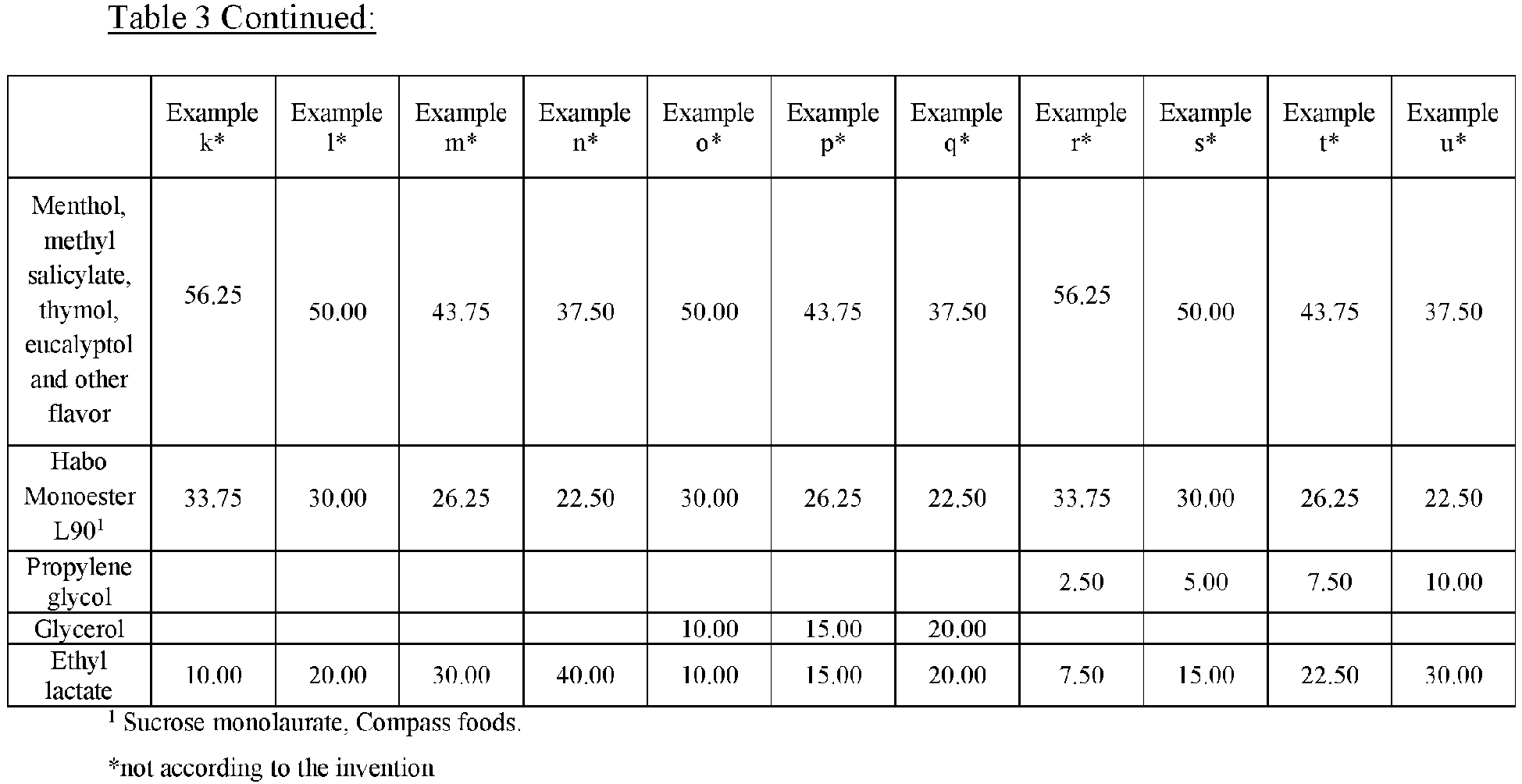


- Although the various aspects of the invention have been illustrated above by reference to examples and preferred embodiments, it will be appreciated that the scope of the invention is defined not by the foregoing description but by the following claims properly construed under principles of patent law.
Claims (13)
- An oral care composition comprising:a) a bioactive component in an amount from 0.01 to 10 wt% of the oral care composition, wherein the bioactive component comprises menthol, methyl salicylate, thymol and eucalyptol;b) a non-ionic surfactant comprising (i) a surfactant selected from the group consisting of: poly(oxyethylene)-poly(oxypropylene)-poly(oxyethylene) block copolymers, poly(oxyethylene)-modified hydrogenated castor oils, and poly(oxyethylene)-modified fatty acid monoesters of sorbitan, and (ii) a surfactant selected from the group consisting of polyol esters and sugar esters;c) at least one orally acceptable solvent; and optionally,d) a C2-C4 monohydric alcohol,characterized in that the non-ionic surfactant (i) comprises a poly(oxyethylene)-poly(oxypropylene)-poly(oxyethylene) block copolymer.wherein the ratio of the surfactant selected from the group consisting of: poly(oxyethylene)-poly(oxypropylene)-poly(oxyethylene) block copolymers, poly(oxyethylene)-modified hydrogenated castor oils, and poly(oxyethylene)-modified fatty acid monoesters of sorbitan to the surfactant selected from the group consisting of polyol esters and sugar esters is from 1:10 to 10: 1; andwherein the ratio of the non-ionic surfactant to the bioactive component is from 0.5 to 3,
- The oral care composition of claim 1, further comprising a flavor oil.
- The oral care composition of claim 1, wherein the amount of the C2-C4 monohydric alcohol is from 0 to 10 wt% of the oral care composition.
- The oral care composition of claim 1, wherein the amount of the C2-C4 monohydric alcohol is from 0 to 5 wt% of the oral care composition.
- The oral care composition of claim 1, wherein the oral care composition does not comprise the C2-C4 monohydric alcohol.
- The oral care composition of claim 1, wherein the poly(oxyethylene)-poly(oxypropylene)-poly(oxyethylene) block copolymer is the hydrophilic non-ionic surfactant sold under the tradename Poloxamer 407, comprising a triblock copolymer consisting of a central hydrophobic block of polypropylene glycol flanked by two hydrophilic blocks of polyethylene glycol (PEG).
- The oral care composition of claim 1, wherein the sugar ester is selected from the group consisting of: sucrose laurate, sucrose monolaurate, sucrose palmitate, sucrose monopalmitate, and combinations thereof.
- The oral care composition of claim 1, wherein the sugar ester is a sucrose ester.
- The oral care composition of claim 1, wherein the sugar ester is a fructose ester.
- The oral care composition of claim 1, wherein the polyol ester is a glycerol ester.
- The oral care composition of claim 1, wherein the polyol ester is monolauric acid decaglycerin ester.
- The oral care composition of claim 1, wherein the ratio of the surfactant selected from the group consisting of: poly(oxyethylene)-poly(oxypropylene)-poly(oxyethylene) block copolymers, poly(oxyethylene)-modified hydrogenated castor oils, and poly(oxyethylene)-modified fatty acid monoesters of sorbitan to the surfactant selected from the group consisting of polyol esters and sugar esters is from 1:5 to 5:1.
- The oral care composition of claim 1, wherein the ratio of the surfactant selected from the group consisting of: poly(oxyethylene)-poly(oxypropylene)-poly(oxyethylene) block copolymers, poly(oxyethylene)-modified hydrogenated castor oils, and poly(oxyethylene)-modified fatty acid monoesters of sorbitan to the surfactant selected from the group consisting of polyol esters and sugar esters is from 1:3 to 3:1.
Applications Claiming Priority (2)
| Application Number | Priority Date | Filing Date | Title |
|---|---|---|---|
| CN2017117398 | 2017-12-20 | ||
| PCT/EP2018/085463 WO2019121660A1 (en) | 2017-12-20 | 2018-12-18 | Oral care compositions |
Publications (2)
| Publication Number | Publication Date |
|---|---|
| EP3658110A1 EP3658110A1 (en) | 2020-06-03 |
| EP3658110B1 true EP3658110B1 (en) | 2023-04-05 |
Family
ID=64959316
Family Applications (1)
| Application Number | Title | Priority Date | Filing Date |
|---|---|---|---|
| EP18830226.9A Active EP3658110B1 (en) | 2017-12-20 | 2018-12-18 | Oral care compositions |
Country Status (7)
| Country | Link |
|---|---|
| US (2) | US11389383B2 (en) |
| EP (1) | EP3658110B1 (en) |
| JP (1) | JP7268012B2 (en) |
| CN (1) | CN111032004B (en) |
| BR (1) | BR112020003233B1 (en) |
| ES (1) | ES2944116T3 (en) |
| WO (1) | WO2019121660A1 (en) |
Families Citing this family (1)
| Publication number | Priority date | Publication date | Assignee | Title |
|---|---|---|---|---|
| CN120417784A (en) * | 2022-12-22 | 2025-08-01 | 弗门尼舍有限公司 | Natural sweetener composition containing alkyl lactate and use thereof |
Citations (1)
| Publication number | Priority date | Publication date | Assignee | Title |
|---|---|---|---|---|
| US20160145203A1 (en) * | 2014-11-11 | 2016-05-26 | Johnson & Johnson Consumer Inc. | Amino Acid Derivatives and Their Uses |
Family Cites Families (59)
| Publication number | Priority date | Publication date | Assignee | Title |
|---|---|---|---|---|
| US3492131A (en) | 1966-04-18 | 1970-01-27 | Searle & Co | Peptide sweetening agents |
| BE795751A (en) * | 1972-02-28 | 1973-08-21 | Unilever Nv | FLAVORED COMPOSITIONS CONTAINING COMPOUNDS WHICH GIVE A SENSE OF COLD |
| US3988433A (en) | 1973-08-10 | 1976-10-26 | The Procter & Gamble Company | Oral compositions for preventing or removing stains from teeth |
| US4083955A (en) | 1975-04-02 | 1978-04-11 | The Procter & Gamble Company | Processes and compositions for remineralization of dental enamel |
| US4200626A (en) * | 1978-09-15 | 1980-04-29 | Toyo Seiyaku Kasei Co., Ltd. | Haloplatinate dental composition for preventing and inhibiting dental caries |
| US4849213A (en) | 1983-03-01 | 1989-07-18 | Schaeffer Hans A | Dental preparation, article and method for storage and delivery therof |
| US4528180A (en) | 1983-03-01 | 1985-07-09 | Schaeffer Hans A | Dental preparation, article and method for storage and delivery thereof |
| US4547361A (en) * | 1984-02-10 | 1985-10-15 | Colgate-Palmolive Company | Stabilizing of cinnamic aldehyde-containing flavors with propylene glycol and dipropylene glycol |
| US4976954A (en) | 1986-12-02 | 1990-12-11 | Purdue Research Foundation | Anticariogenic compositions |
| US5198220A (en) | 1989-11-17 | 1993-03-30 | The Procter & Gamble Company | Sustained release compositions for treating periodontal disease |
| US5145666A (en) | 1991-10-23 | 1992-09-08 | The Proctor & Gamble Co. | Methods of reducing plaque and gingivitis with reduced staining |
| US5213790A (en) | 1991-10-23 | 1993-05-25 | The Procter & Gamble Co. | Methods of reducing plaque and gingivitis with reduced staining |
| US5281410A (en) | 1991-10-23 | 1994-01-25 | The Proctor & Gamble Company | Methods of reducing plaque and gingivitis with reduced staining |
| US5292527A (en) | 1992-07-02 | 1994-03-08 | Bausch & Lomb Incorporated | Non-alcoholic aqueous mouthwash |
| US5242910A (en) | 1992-10-13 | 1993-09-07 | The Procter & Gamble Company | Sustained release compositions for treating periodontal disease |
| CA2143037C (en) | 1994-05-02 | 2002-04-30 | Atma Chaudhari | Alcohol free mouthwash |
| US6348187B1 (en) | 1996-01-24 | 2002-02-19 | Warner-Lambert Company | Peroxide/essential oils containing mouthwash compositions and two-part mouthwash systems |
| HUP9903442A3 (en) * | 1996-02-08 | 2001-11-28 | Warner Lambert Co | Anticalculus dentifrice containing highly soluble pyrophosphate |
| DE19646392A1 (en) * | 1996-11-11 | 1998-05-14 | Lohmann Therapie Syst Lts | Preparation for use in the oral cavity with a layer containing pressure-sensitive adhesive, pharmaceuticals or cosmetics for dosed delivery |
| EP1216029A1 (en) | 1999-09-27 | 2002-06-26 | American Cyanamid Company | Pharmaceutical carrier formulation |
| JP4117119B2 (en) | 2000-07-05 | 2008-07-16 | エーザイ・アール・アンド・ディー・マネジメント株式会社 | Fat-soluble substance solubilizing solution |
| CA2545626C (en) * | 2003-11-19 | 2012-05-01 | Meiji Seika Kaisha, Ltd. | Sialogogue, oral composition and food product containing the same |
| IL159729A0 (en) | 2004-01-06 | 2004-06-20 | Doron I Friedman | Non-aqueous composition for oral delivery of insoluble bioactive agents |
| US20060051430A1 (en) * | 2004-09-07 | 2006-03-09 | Arata Andrew B | Silver dihydrogen citrate compositions |
| JP4934309B2 (en) | 2004-10-20 | 2012-05-16 | 花王株式会社 | Liquid oral composition |
| CA2597961A1 (en) | 2005-03-24 | 2006-09-28 | Givaudan Sa | Cooling compounds |
| US20070286822A1 (en) * | 2006-06-12 | 2007-12-13 | Anacor Pharmaceuticals Inc. | Compounds for the Treatment of Periodontal Disease |
| US8451229B2 (en) | 2006-07-25 | 2013-05-28 | Nikon Corporation | Monocular video display device |
| EP1913976A1 (en) | 2006-10-18 | 2008-04-23 | Symrise GmbH & Co. KG | N-alpha-(menthane carbonyl) amino acid amides and their use as physiological coolants |
| US7707191B2 (en) | 2007-01-18 | 2010-04-27 | Microsoft Corporation | Synchronizing undo/redo operations between different document views |
| CN101677930A (en) | 2007-05-23 | 2010-03-24 | 吉万奥丹股份有限公司 | Organic compounds |
| WO2008151460A2 (en) | 2007-06-13 | 2008-12-18 | Givaudan Sa | Cooling compounds |
| ES2395682T3 (en) | 2007-08-20 | 2013-02-14 | Symrise Ag | Oxalic acid derivatives and their use as physiological refreshing active ingredients |
| WO2009070910A2 (en) | 2007-12-07 | 2009-06-11 | Givaudan Sa | Carboxamide derivatieves having cooling properties |
| CN102123982B (en) | 2008-08-15 | 2014-08-06 | 宝洁公司 | Synthesis of cyclohexane derivatives useful as sensates in consumer products |
| WO2010128026A2 (en) | 2009-05-05 | 2010-11-11 | Givaudan Sa | Organic compounds |
| DE102010002558A1 (en) | 2009-11-20 | 2011-06-01 | Symrise Ag | Use of physiological cooling agents and agents containing such agents |
| WO2011138696A2 (en) | 2010-05-05 | 2011-11-10 | Firmenich Sa | Compound having a cooling effect |
| EP2621462B1 (en) * | 2010-10-01 | 2020-02-12 | The Procter and Gamble Company | Oral care compositions with improved flavor |
| CN103201279A (en) | 2010-11-05 | 2013-07-10 | 赛诺米克斯公司 | Compounds useful as modulators of TRPM8 |
| JP5729252B2 (en) | 2010-11-30 | 2015-06-03 | ライオン株式会社 | Oral composition |
| US20130280180A1 (en) | 2010-12-07 | 2013-10-24 | Deeleep Kumar Rout | Antimicrobial microemulsion mouthwash composition |
| EP2497458A1 (en) | 2011-03-08 | 2012-09-12 | B.R.A.I.N. Biotechnology Research And Information Network AG | Small molecule modulators of the cold and menthol receptor TRPM8 |
| ES2717178T3 (en) | 2011-03-21 | 2019-06-19 | Broda Tech Co Ltd | Hydrogel compositions reversely thermoreversible |
| BR112014004523A2 (en) | 2011-09-01 | 2017-03-28 | Takasago Int Corp (U S A ) | flavoring compound and composition |
| FR2980121B1 (en) * | 2011-09-20 | 2016-01-15 | Oreal | EMULSION OIL IN WATER COMPRISING A HIGH RATE OF VEGETABLE OIL |
| WO2013070198A1 (en) | 2011-11-09 | 2013-05-16 | Colgate-Palmolive Company | Alcohol-free mouthwash |
| EP2787051B1 (en) | 2011-11-28 | 2017-09-13 | Kao Corporation | Cooling agent and trpm8 activator |
| BR102012033020A2 (en) | 2011-12-22 | 2015-10-20 | Int Flavors & Fragrances Inc | compositions for increased sensation of freshness |
| KR20140143136A (en) | 2012-03-07 | 2014-12-15 | 라이온 가부시키가이샤 | Oral composition |
| EP2849718B1 (en) | 2012-05-16 | 2017-02-01 | Symrise AG | Mixtures having improved cooling effect |
| CN104508070B (en) | 2012-07-12 | 2016-08-24 | 花王株式会社 | Semen Myristicae processed thing and manufacture method thereof |
| US10130576B2 (en) | 2012-11-13 | 2018-11-20 | Johnson & Johnson Consumer Inc. | Oral care compositions |
| EP2931225B1 (en) | 2012-12-12 | 2021-03-31 | Symrise AG | Cooling preparations |
| JP6125818B2 (en) | 2012-12-14 | 2017-05-10 | 花王株式会社 | Liquid oral composition |
| EP2931218B1 (en) | 2012-12-14 | 2017-02-15 | Colgate-Palmolive Company | Flowable peroxide containing oral care compositions |
| US9125841B2 (en) | 2013-02-26 | 2015-09-08 | Johnson & Johnson Consumer Inc. | Oral care compositions |
| EP3116320A4 (en) * | 2014-03-10 | 2017-08-16 | The Trustees of Columbia University in the City of New York | Botanical antimicrobial compositions |
| WO2019226921A1 (en) * | 2018-05-23 | 2019-11-28 | The Trustees Of Columbia University In The City Of New York | Alcohol-free botanical oral care products |
-
2018
- 2018-12-18 EP EP18830226.9A patent/EP3658110B1/en active Active
- 2018-12-18 JP JP2020518658A patent/JP7268012B2/en active Active
- 2018-12-18 US US16/639,190 patent/US11389383B2/en active Active
- 2018-12-18 ES ES18830226T patent/ES2944116T3/en active Active
- 2018-12-18 WO PCT/EP2018/085463 patent/WO2019121660A1/en not_active Ceased
- 2018-12-18 BR BR112020003233-6A patent/BR112020003233B1/en active IP Right Grant
- 2018-12-18 CN CN201880054533.4A patent/CN111032004B/en active Active
-
2022
- 2022-07-06 US US17/811,035 patent/US11938209B2/en active Active
Patent Citations (1)
| Publication number | Priority date | Publication date | Assignee | Title |
|---|---|---|---|---|
| US20160145203A1 (en) * | 2014-11-11 | 2016-05-26 | Johnson & Johnson Consumer Inc. | Amino Acid Derivatives and Their Uses |
Also Published As
| Publication number | Publication date |
|---|---|
| BR112020003233A2 (en) | 2020-08-18 |
| JP2021506741A (en) | 2021-02-22 |
| US11938209B2 (en) | 2024-03-26 |
| CN111032004A (en) | 2020-04-17 |
| JP7268012B2 (en) | 2023-05-02 |
| CN111032004B (en) | 2023-10-20 |
| US11389383B2 (en) | 2022-07-19 |
| BR112020003233B1 (en) | 2023-11-07 |
| US20220331214A1 (en) | 2022-10-20 |
| ES2944116T3 (en) | 2023-06-19 |
| US20210161782A1 (en) | 2021-06-03 |
| WO2019121660A1 (en) | 2019-06-27 |
| EP3658110A1 (en) | 2020-06-03 |
Similar Documents
| Publication | Publication Date | Title |
|---|---|---|
| JP2007332143A (en) | Compound having antibacterial activity for inhibiting bad breath | |
| EP3435965B1 (en) | Oral care compositions with an effective flavor display | |
| US11801209B2 (en) | Cooling and flavor boosting compositions | |
| EP3180091B1 (en) | Oral care compositions with an enhanced sensory experience | |
| US20210085440A1 (en) | Oral Care Compositions And Regimens | |
| EP2892620B1 (en) | Mouth rinses and tooth sensitivity treatment compositions | |
| AU2017240032B2 (en) | Oral care compositions containing gel networks and potassium nitrate | |
| US11938209B2 (en) | Oral care compositions | |
| JP5825093B2 (en) | Mouthwash composition | |
| AU2015301624B2 (en) | Dentifrice with incremental chemistries | |
| JP2023183797A (en) | Oral composition |
Legal Events
| Date | Code | Title | Description |
|---|---|---|---|
| STAA | Information on the status of an ep patent application or granted ep patent |
Free format text: STATUS: UNKNOWN |
|
| STAA | Information on the status of an ep patent application or granted ep patent |
Free format text: STATUS: THE INTERNATIONAL PUBLICATION HAS BEEN MADE |
|
| PUAI | Public reference made under article 153(3) epc to a published international application that has entered the european phase |
Free format text: ORIGINAL CODE: 0009012 |
|
| STAA | Information on the status of an ep patent application or granted ep patent |
Free format text: STATUS: REQUEST FOR EXAMINATION WAS MADE |
|
| 17P | Request for examination filed |
Effective date: 20200226 |
|
| AK | Designated contracting states |
Kind code of ref document: A1 Designated state(s): AL AT BE BG CH CY CZ DE DK EE ES FI FR GB GR HR HU IE IS IT LI LT LU LV MC MK MT NL NO PL PT RO RS SE SI SK SM TR |
|
| AX | Request for extension of the european patent |
Extension state: BA ME |
|
| DAV | Request for validation of the european patent (deleted) | ||
| DAX | Request for extension of the european patent (deleted) | ||
| STAA | Information on the status of an ep patent application or granted ep patent |
Free format text: STATUS: EXAMINATION IS IN PROGRESS |
|
| 17Q | First examination report despatched |
Effective date: 20210520 |
|
| GRAP | Despatch of communication of intention to grant a patent |
Free format text: ORIGINAL CODE: EPIDOSNIGR1 |
|
| STAA | Information on the status of an ep patent application or granted ep patent |
Free format text: STATUS: GRANT OF PATENT IS INTENDED |
|
| INTG | Intention to grant announced |
Effective date: 20221011 |
|
| RIN1 | Information on inventor provided before grant (corrected) |
Inventor name: FIEBER, WOLFGANG Inventor name: MA, QIU-MIN |
|
| GRAS | Grant fee paid |
Free format text: ORIGINAL CODE: EPIDOSNIGR3 |
|
| GRAA | (expected) grant |
Free format text: ORIGINAL CODE: 0009210 |
|
| STAA | Information on the status of an ep patent application or granted ep patent |
Free format text: STATUS: THE PATENT HAS BEEN GRANTED |
|
| RAP3 | Party data changed (applicant data changed or rights of an application transferred) |
Owner name: FIRMENICH SA |
|
| AK | Designated contracting states |
Kind code of ref document: B1 Designated state(s): AL AT BE BG CH CY CZ DE DK EE ES FI FR GB GR HR HU IE IS IT LI LT LU LV MC MK MT NL NO PL PT RO RS SE SI SK SM TR |
|
| REG | Reference to a national code |
Ref country code: GB Ref legal event code: FG4D |
|
| REG | Reference to a national code |
Ref country code: DE Ref legal event code: R096 Ref document number: 602018048152 Country of ref document: DE |
|
| REG | Reference to a national code |
Ref country code: CH Ref legal event code: EP |
|
| REG | Reference to a national code |
Ref country code: AT Ref legal event code: REF Ref document number: 1557722 Country of ref document: AT Kind code of ref document: T Effective date: 20230415 |
|
| REG | Reference to a national code |
Ref country code: IE Ref legal event code: FG4D |
|
| REG | Reference to a national code |
Ref country code: ES Ref legal event code: FG2A Ref document number: 2944116 Country of ref document: ES Kind code of ref document: T3 Effective date: 20230619 |
|
| P01 | Opt-out of the competence of the unified patent court (upc) registered |
Effective date: 20230518 |
|
| REG | Reference to a national code |
Ref country code: LT Ref legal event code: MG9D |
|
| REG | Reference to a national code |
Ref country code: NL Ref legal event code: MP Effective date: 20230405 |
|
| REG | Reference to a national code |
Ref country code: AT Ref legal event code: MK05 Ref document number: 1557722 Country of ref document: AT Kind code of ref document: T Effective date: 20230405 |
|
| PG25 | Lapsed in a contracting state [announced via postgrant information from national office to epo] |
Ref country code: NL Free format text: LAPSE BECAUSE OF FAILURE TO SUBMIT A TRANSLATION OF THE DESCRIPTION OR TO PAY THE FEE WITHIN THE PRESCRIBED TIME-LIMIT Effective date: 20230405 |
|
| PG25 | Lapsed in a contracting state [announced via postgrant information from national office to epo] |
Ref country code: SE Free format text: LAPSE BECAUSE OF FAILURE TO SUBMIT A TRANSLATION OF THE DESCRIPTION OR TO PAY THE FEE WITHIN THE PRESCRIBED TIME-LIMIT Effective date: 20230405 Ref country code: PT Free format text: LAPSE BECAUSE OF FAILURE TO SUBMIT A TRANSLATION OF THE DESCRIPTION OR TO PAY THE FEE WITHIN THE PRESCRIBED TIME-LIMIT Effective date: 20230807 Ref country code: NO Free format text: LAPSE BECAUSE OF FAILURE TO SUBMIT A TRANSLATION OF THE DESCRIPTION OR TO PAY THE FEE WITHIN THE PRESCRIBED TIME-LIMIT Effective date: 20230705 Ref country code: AT Free format text: LAPSE BECAUSE OF FAILURE TO SUBMIT A TRANSLATION OF THE DESCRIPTION OR TO PAY THE FEE WITHIN THE PRESCRIBED TIME-LIMIT Effective date: 20230405 |
|
| PG25 | Lapsed in a contracting state [announced via postgrant information from national office to epo] |
Ref country code: RS Free format text: LAPSE BECAUSE OF FAILURE TO SUBMIT A TRANSLATION OF THE DESCRIPTION OR TO PAY THE FEE WITHIN THE PRESCRIBED TIME-LIMIT Effective date: 20230405 Ref country code: PL Free format text: LAPSE BECAUSE OF FAILURE TO SUBMIT A TRANSLATION OF THE DESCRIPTION OR TO PAY THE FEE WITHIN THE PRESCRIBED TIME-LIMIT Effective date: 20230405 Ref country code: LV Free format text: LAPSE BECAUSE OF FAILURE TO SUBMIT A TRANSLATION OF THE DESCRIPTION OR TO PAY THE FEE WITHIN THE PRESCRIBED TIME-LIMIT Effective date: 20230405 Ref country code: LT Free format text: LAPSE BECAUSE OF FAILURE TO SUBMIT A TRANSLATION OF THE DESCRIPTION OR TO PAY THE FEE WITHIN THE PRESCRIBED TIME-LIMIT Effective date: 20230405 Ref country code: IS Free format text: LAPSE BECAUSE OF FAILURE TO SUBMIT A TRANSLATION OF THE DESCRIPTION OR TO PAY THE FEE WITHIN THE PRESCRIBED TIME-LIMIT Effective date: 20230805 Ref country code: HR Free format text: LAPSE BECAUSE OF FAILURE TO SUBMIT A TRANSLATION OF THE DESCRIPTION OR TO PAY THE FEE WITHIN THE PRESCRIBED TIME-LIMIT Effective date: 20230405 Ref country code: GR Free format text: LAPSE BECAUSE OF FAILURE TO SUBMIT A TRANSLATION OF THE DESCRIPTION OR TO PAY THE FEE WITHIN THE PRESCRIBED TIME-LIMIT Effective date: 20230706 Ref country code: AL Free format text: LAPSE BECAUSE OF FAILURE TO SUBMIT A TRANSLATION OF THE DESCRIPTION OR TO PAY THE FEE WITHIN THE PRESCRIBED TIME-LIMIT Effective date: 20230405 |
|
| PG25 | Lapsed in a contracting state [announced via postgrant information from national office to epo] |
Ref country code: FI Free format text: LAPSE BECAUSE OF FAILURE TO SUBMIT A TRANSLATION OF THE DESCRIPTION OR TO PAY THE FEE WITHIN THE PRESCRIBED TIME-LIMIT Effective date: 20230405 |
|
| REG | Reference to a national code |
Ref country code: DE Ref legal event code: R097 Ref document number: 602018048152 Country of ref document: DE |
|
| PG25 | Lapsed in a contracting state [announced via postgrant information from national office to epo] |
Ref country code: SK Free format text: LAPSE BECAUSE OF FAILURE TO SUBMIT A TRANSLATION OF THE DESCRIPTION OR TO PAY THE FEE WITHIN THE PRESCRIBED TIME-LIMIT Effective date: 20230405 |
|
| PG25 | Lapsed in a contracting state [announced via postgrant information from national office to epo] |
Ref country code: SM Free format text: LAPSE BECAUSE OF FAILURE TO SUBMIT A TRANSLATION OF THE DESCRIPTION OR TO PAY THE FEE WITHIN THE PRESCRIBED TIME-LIMIT Effective date: 20230405 Ref country code: SK Free format text: LAPSE BECAUSE OF FAILURE TO SUBMIT A TRANSLATION OF THE DESCRIPTION OR TO PAY THE FEE WITHIN THE PRESCRIBED TIME-LIMIT Effective date: 20230405 Ref country code: RO Free format text: LAPSE BECAUSE OF FAILURE TO SUBMIT A TRANSLATION OF THE DESCRIPTION OR TO PAY THE FEE WITHIN THE PRESCRIBED TIME-LIMIT Effective date: 20230405 Ref country code: EE Free format text: LAPSE BECAUSE OF FAILURE TO SUBMIT A TRANSLATION OF THE DESCRIPTION OR TO PAY THE FEE WITHIN THE PRESCRIBED TIME-LIMIT Effective date: 20230405 Ref country code: DK Free format text: LAPSE BECAUSE OF FAILURE TO SUBMIT A TRANSLATION OF THE DESCRIPTION OR TO PAY THE FEE WITHIN THE PRESCRIBED TIME-LIMIT Effective date: 20230405 Ref country code: CZ Free format text: LAPSE BECAUSE OF FAILURE TO SUBMIT A TRANSLATION OF THE DESCRIPTION OR TO PAY THE FEE WITHIN THE PRESCRIBED TIME-LIMIT Effective date: 20230405 |
|
| PLBE | No opposition filed within time limit |
Free format text: ORIGINAL CODE: 0009261 |
|
| STAA | Information on the status of an ep patent application or granted ep patent |
Free format text: STATUS: NO OPPOSITION FILED WITHIN TIME LIMIT |
|
| 26N | No opposition filed |
Effective date: 20240108 |
|
| PG25 | Lapsed in a contracting state [announced via postgrant information from national office to epo] |
Ref country code: SI Free format text: LAPSE BECAUSE OF FAILURE TO SUBMIT A TRANSLATION OF THE DESCRIPTION OR TO PAY THE FEE WITHIN THE PRESCRIBED TIME-LIMIT Effective date: 20230405 |
|
| PG25 | Lapsed in a contracting state [announced via postgrant information from national office to epo] |
Ref country code: SI Free format text: LAPSE BECAUSE OF FAILURE TO SUBMIT A TRANSLATION OF THE DESCRIPTION OR TO PAY THE FEE WITHIN THE PRESCRIBED TIME-LIMIT Effective date: 20230405 |
|
| PG25 | Lapsed in a contracting state [announced via postgrant information from national office to epo] |
Ref country code: LU Free format text: LAPSE BECAUSE OF NON-PAYMENT OF DUE FEES Effective date: 20231218 |
|
| PG25 | Lapsed in a contracting state [announced via postgrant information from national office to epo] |
Ref country code: MC Free format text: LAPSE BECAUSE OF FAILURE TO SUBMIT A TRANSLATION OF THE DESCRIPTION OR TO PAY THE FEE WITHIN THE PRESCRIBED TIME-LIMIT Effective date: 20230405 |
|
| REG | Reference to a national code |
Ref country code: BE Ref legal event code: MM Effective date: 20231231 |
|
| PG25 | Lapsed in a contracting state [announced via postgrant information from national office to epo] |
Ref country code: MC Free format text: LAPSE BECAUSE OF FAILURE TO SUBMIT A TRANSLATION OF THE DESCRIPTION OR TO PAY THE FEE WITHIN THE PRESCRIBED TIME-LIMIT Effective date: 20230405 Ref country code: LU Free format text: LAPSE BECAUSE OF NON-PAYMENT OF DUE FEES Effective date: 20231218 |
|
| REG | Reference to a national code |
Ref country code: IE Ref legal event code: MM4A |
|
| PG25 | Lapsed in a contracting state [announced via postgrant information from national office to epo] |
Ref country code: IE Free format text: LAPSE BECAUSE OF NON-PAYMENT OF DUE FEES Effective date: 20231218 |
|
| PG25 | Lapsed in a contracting state [announced via postgrant information from national office to epo] |
Ref country code: BE Free format text: LAPSE BECAUSE OF NON-PAYMENT OF DUE FEES Effective date: 20231231 |
|
| PG25 | Lapsed in a contracting state [announced via postgrant information from national office to epo] |
Ref country code: IE Free format text: LAPSE BECAUSE OF NON-PAYMENT OF DUE FEES Effective date: 20231218 Ref country code: BE Free format text: LAPSE BECAUSE OF NON-PAYMENT OF DUE FEES Effective date: 20231231 |
|
| PG25 | Lapsed in a contracting state [announced via postgrant information from national office to epo] |
Ref country code: BG Free format text: LAPSE BECAUSE OF FAILURE TO SUBMIT A TRANSLATION OF THE DESCRIPTION OR TO PAY THE FEE WITHIN THE PRESCRIBED TIME-LIMIT Effective date: 20230405 |
|
| PG25 | Lapsed in a contracting state [announced via postgrant information from national office to epo] |
Ref country code: BG Free format text: LAPSE BECAUSE OF FAILURE TO SUBMIT A TRANSLATION OF THE DESCRIPTION OR TO PAY THE FEE WITHIN THE PRESCRIBED TIME-LIMIT Effective date: 20230405 |
|
| PGFP | Annual fee paid to national office [announced via postgrant information from national office to epo] |
Ref country code: ES Payment date: 20250117 Year of fee payment: 7 |
|
| PGFP | Annual fee paid to national office [announced via postgrant information from national office to epo] |
Ref country code: CH Payment date: 20250101 Year of fee payment: 7 |
|
| PG25 | Lapsed in a contracting state [announced via postgrant information from national office to epo] |
Ref country code: CY Free format text: LAPSE BECAUSE OF FAILURE TO SUBMIT A TRANSLATION OF THE DESCRIPTION OR TO PAY THE FEE WITHIN THE PRESCRIBED TIME-LIMIT; INVALID AB INITIO Effective date: 20181218 |
|
| PG25 | Lapsed in a contracting state [announced via postgrant information from national office to epo] |
Ref country code: HU Free format text: LAPSE BECAUSE OF FAILURE TO SUBMIT A TRANSLATION OF THE DESCRIPTION OR TO PAY THE FEE WITHIN THE PRESCRIBED TIME-LIMIT; INVALID AB INITIO Effective date: 20181218 |
|
| PG25 | Lapsed in a contracting state [announced via postgrant information from national office to epo] |
Ref country code: TR Free format text: LAPSE BECAUSE OF FAILURE TO SUBMIT A TRANSLATION OF THE DESCRIPTION OR TO PAY THE FEE WITHIN THE PRESCRIBED TIME-LIMIT Effective date: 20230405 |
|
| REG | Reference to a national code |
Ref country code: CH Ref legal event code: U11 Free format text: ST27 STATUS EVENT CODE: U-0-0-U10-U11 (AS PROVIDED BY THE NATIONAL OFFICE) Effective date: 20260101 |
|
| PGFP | Annual fee paid to national office [announced via postgrant information from national office to epo] |
Ref country code: DE Payment date: 20251104 Year of fee payment: 8 |
|
| PGFP | Annual fee paid to national office [announced via postgrant information from national office to epo] |
Ref country code: GB Payment date: 20251114 Year of fee payment: 8 |
|
| PGFP | Annual fee paid to national office [announced via postgrant information from national office to epo] |
Ref country code: IT Payment date: 20251121 Year of fee payment: 8 |
|
| PGFP | Annual fee paid to national office [announced via postgrant information from national office to epo] |
Ref country code: FR Payment date: 20251110 Year of fee payment: 8 |