EP3626764B1 - Composite with thermoplastic matrix - Google Patents
Composite with thermoplastic matrix Download PDFInfo
- Publication number
- EP3626764B1 EP3626764B1 EP18195870.3A EP18195870A EP3626764B1 EP 3626764 B1 EP3626764 B1 EP 3626764B1 EP 18195870 A EP18195870 A EP 18195870A EP 3626764 B1 EP3626764 B1 EP 3626764B1
- Authority
- EP
- European Patent Office
- Prior art keywords
- pvdf
- weight
- composite
- moulding compound
- layer
- Prior art date
- Legal status (The legal status is an assumption and is not a legal conclusion. Google has not performed a legal analysis and makes no representation as to the accuracy of the status listed.)
- Active
Links
Classifications
-
- C—CHEMISTRY; METALLURGY
- C08—ORGANIC MACROMOLECULAR COMPOUNDS; THEIR PREPARATION OR CHEMICAL WORKING-UP; COMPOSITIONS BASED THEREON
- C08L—COMPOSITIONS OF MACROMOLECULAR COMPOUNDS
- C08L27/00—Compositions of homopolymers or copolymers of compounds having one or more unsaturated aliphatic radicals, each having only one carbon-to-carbon double bond, and at least one being terminated by a halogen; Compositions of derivatives of such polymers
- C08L27/02—Compositions of homopolymers or copolymers of compounds having one or more unsaturated aliphatic radicals, each having only one carbon-to-carbon double bond, and at least one being terminated by a halogen; Compositions of derivatives of such polymers not modified by chemical after-treatment
- C08L27/12—Compositions of homopolymers or copolymers of compounds having one or more unsaturated aliphatic radicals, each having only one carbon-to-carbon double bond, and at least one being terminated by a halogen; Compositions of derivatives of such polymers not modified by chemical after-treatment containing fluorine atoms
- C08L27/16—Homopolymers or copolymers or vinylidene fluoride
-
- B—PERFORMING OPERATIONS; TRANSPORTING
- B32—LAYERED PRODUCTS
- B32B—LAYERED PRODUCTS, i.e. PRODUCTS BUILT-UP OF STRATA OF FLAT OR NON-FLAT, e.g. CELLULAR OR HONEYCOMB, FORM
- B32B1/00—Layered products having a non-planar shape
- B32B1/08—Tubular products
-
- B—PERFORMING OPERATIONS; TRANSPORTING
- B32—LAYERED PRODUCTS
- B32B—LAYERED PRODUCTS, i.e. PRODUCTS BUILT-UP OF STRATA OF FLAT OR NON-FLAT, e.g. CELLULAR OR HONEYCOMB, FORM
- B32B27/00—Layered products comprising a layer of synthetic resin
- B32B27/06—Layered products comprising a layer of synthetic resin as the main or only constituent of a layer, which is next to another layer of the same or of a different material
- B32B27/08—Layered products comprising a layer of synthetic resin as the main or only constituent of a layer, which is next to another layer of the same or of a different material of synthetic resin
-
- B—PERFORMING OPERATIONS; TRANSPORTING
- B32—LAYERED PRODUCTS
- B32B—LAYERED PRODUCTS, i.e. PRODUCTS BUILT-UP OF STRATA OF FLAT OR NON-FLAT, e.g. CELLULAR OR HONEYCOMB, FORM
- B32B27/00—Layered products comprising a layer of synthetic resin
- B32B27/18—Layered products comprising a layer of synthetic resin characterised by the use of special additives
- B32B27/20—Layered products comprising a layer of synthetic resin characterised by the use of special additives using fillers, pigments, thixotroping agents
-
- B—PERFORMING OPERATIONS; TRANSPORTING
- B32—LAYERED PRODUCTS
- B32B—LAYERED PRODUCTS, i.e. PRODUCTS BUILT-UP OF STRATA OF FLAT OR NON-FLAT, e.g. CELLULAR OR HONEYCOMB, FORM
- B32B27/00—Layered products comprising a layer of synthetic resin
- B32B27/30—Layered products comprising a layer of synthetic resin comprising vinyl (co)polymers; comprising acrylic (co)polymers
- B32B27/304—Layered products comprising a layer of synthetic resin comprising vinyl (co)polymers; comprising acrylic (co)polymers comprising vinyl halide (co)polymers, e.g. PVC, PVDC, PVF, PVDF
-
- B—PERFORMING OPERATIONS; TRANSPORTING
- B32—LAYERED PRODUCTS
- B32B—LAYERED PRODUCTS, i.e. PRODUCTS BUILT-UP OF STRATA OF FLAT OR NON-FLAT, e.g. CELLULAR OR HONEYCOMB, FORM
- B32B27/00—Layered products comprising a layer of synthetic resin
- B32B27/30—Layered products comprising a layer of synthetic resin comprising vinyl (co)polymers; comprising acrylic (co)polymers
- B32B27/308—Layered products comprising a layer of synthetic resin comprising vinyl (co)polymers; comprising acrylic (co)polymers comprising acrylic (co)polymers
-
- B—PERFORMING OPERATIONS; TRANSPORTING
- B32—LAYERED PRODUCTS
- B32B—LAYERED PRODUCTS, i.e. PRODUCTS BUILT-UP OF STRATA OF FLAT OR NON-FLAT, e.g. CELLULAR OR HONEYCOMB, FORM
- B32B27/00—Layered products comprising a layer of synthetic resin
- B32B27/34—Layered products comprising a layer of synthetic resin comprising polyamides
-
- C—CHEMISTRY; METALLURGY
- C08—ORGANIC MACROMOLECULAR COMPOUNDS; THEIR PREPARATION OR CHEMICAL WORKING-UP; COMPOSITIONS BASED THEREON
- C08J—WORKING-UP; GENERAL PROCESSES OF COMPOUNDING; AFTER-TREATMENT NOT COVERED BY SUBCLASSES C08B, C08C, C08F, C08G or C08H
- C08J5/00—Manufacture of articles or shaped materials containing macromolecular substances
- C08J5/04—Reinforcing macromolecular compounds with loose or coherent fibrous material
- C08J5/0405—Reinforcing macromolecular compounds with loose or coherent fibrous material with inorganic fibres
- C08J5/042—Reinforcing macromolecular compounds with loose or coherent fibrous material with inorganic fibres with carbon fibres
-
- C—CHEMISTRY; METALLURGY
- C08—ORGANIC MACROMOLECULAR COMPOUNDS; THEIR PREPARATION OR CHEMICAL WORKING-UP; COMPOSITIONS BASED THEREON
- C08K—Use of inorganic or non-macromolecular organic substances as compounding ingredients
- C08K7/00—Use of ingredients characterised by shape
- C08K7/02—Fibres or whiskers
-
- C—CHEMISTRY; METALLURGY
- C08—ORGANIC MACROMOLECULAR COMPOUNDS; THEIR PREPARATION OR CHEMICAL WORKING-UP; COMPOSITIONS BASED THEREON
- C08K—Use of inorganic or non-macromolecular organic substances as compounding ingredients
- C08K7/00—Use of ingredients characterised by shape
- C08K7/02—Fibres or whiskers
- C08K7/04—Fibres or whiskers inorganic
- C08K7/06—Elements
-
- C—CHEMISTRY; METALLURGY
- C08—ORGANIC MACROMOLECULAR COMPOUNDS; THEIR PREPARATION OR CHEMICAL WORKING-UP; COMPOSITIONS BASED THEREON
- C08L—COMPOSITIONS OF MACROMOLECULAR COMPOUNDS
- C08L33/00—Compositions of homopolymers or copolymers of compounds having one or more unsaturated aliphatic radicals, each having only one carbon-to-carbon double bond, and only one being terminated by only one carboxyl radical, or of salts, anhydrides, esters, amides, imides or nitriles thereof; Compositions of derivatives of such polymers
- C08L33/04—Homopolymers or copolymers of esters
- C08L33/06—Homopolymers or copolymers of esters of esters containing only carbon, hydrogen and oxygen, which oxygen atoms are present only as part of the carboxyl radical
-
- C—CHEMISTRY; METALLURGY
- C08—ORGANIC MACROMOLECULAR COMPOUNDS; THEIR PREPARATION OR CHEMICAL WORKING-UP; COMPOSITIONS BASED THEREON
- C08L—COMPOSITIONS OF MACROMOLECULAR COMPOUNDS
- C08L35/00—Compositions of homopolymers or copolymers of compounds having one or more unsaturated aliphatic radicals, each having only one carbon-to-carbon double bond, and at least one being terminated by a carboxyl radical, and containing at least one other carboxyl radical in the molecule, or of salts, anhydrides, esters, amides, imides or nitriles thereof; Compositions of derivatives of such polymers
-
- C—CHEMISTRY; METALLURGY
- C08—ORGANIC MACROMOLECULAR COMPOUNDS; THEIR PREPARATION OR CHEMICAL WORKING-UP; COMPOSITIONS BASED THEREON
- C08L—COMPOSITIONS OF MACROMOLECULAR COMPOUNDS
- C08L35/00—Compositions of homopolymers or copolymers of compounds having one or more unsaturated aliphatic radicals, each having only one carbon-to-carbon double bond, and at least one being terminated by a carboxyl radical, and containing at least one other carboxyl radical in the molecule, or of salts, anhydrides, esters, amides, imides or nitriles thereof; Compositions of derivatives of such polymers
- C08L35/04—Homopolymers or copolymers of nitriles
-
- C—CHEMISTRY; METALLURGY
- C09—DYES; PAINTS; POLISHES; NATURAL RESINS; ADHESIVES; COMPOSITIONS NOT OTHERWISE PROVIDED FOR; APPLICATIONS OF MATERIALS NOT OTHERWISE PROVIDED FOR
- C09J—ADHESIVES; NON-MECHANICAL ASPECTS OF ADHESIVE PROCESSES IN GENERAL; ADHESIVE PROCESSES NOT PROVIDED FOR ELSEWHERE; USE OF MATERIALS AS ADHESIVES
- C09J127/00—Adhesives based on homopolymers or copolymers of compounds having one or more unsaturated aliphatic radicals, each having only one carbon-to-carbon double bond, and at least one being terminated by a halogen; Adhesives based on derivatives of such polymers
- C09J127/02—Adhesives based on homopolymers or copolymers of compounds having one or more unsaturated aliphatic radicals, each having only one carbon-to-carbon double bond, and at least one being terminated by a halogen; Adhesives based on derivatives of such polymers not modified by chemical after-treatment
- C09J127/12—Adhesives based on homopolymers or copolymers of compounds having one or more unsaturated aliphatic radicals, each having only one carbon-to-carbon double bond, and at least one being terminated by a halogen; Adhesives based on derivatives of such polymers not modified by chemical after-treatment containing fluorine atoms
- C09J127/16—Homopolymers or copolymers of vinylidene fluoride
-
- C—CHEMISTRY; METALLURGY
- C09—DYES; PAINTS; POLISHES; NATURAL RESINS; ADHESIVES; COMPOSITIONS NOT OTHERWISE PROVIDED FOR; APPLICATIONS OF MATERIALS NOT OTHERWISE PROVIDED FOR
- C09J—ADHESIVES; NON-MECHANICAL ASPECTS OF ADHESIVE PROCESSES IN GENERAL; ADHESIVE PROCESSES NOT PROVIDED FOR ELSEWHERE; USE OF MATERIALS AS ADHESIVES
- C09J7/00—Adhesives in the form of films or foils
- C09J7/30—Adhesives in the form of films or foils characterised by the adhesive composition
-
- E—FIXED CONSTRUCTIONS
- E21—EARTH OR ROCK DRILLING; MINING
- E21B—EARTH OR ROCK DRILLING; OBTAINING OIL, GAS, WATER, SOLUBLE OR MELTABLE MATERIALS OR A SLURRY OF MINERALS FROM WELLS
- E21B17/00—Drilling rods or pipes; Flexible drill strings; Kellies; Drill collars; Sucker rods; Cables; Casings; Tubings
-
- F—MECHANICAL ENGINEERING; LIGHTING; HEATING; WEAPONS; BLASTING
- F16—ENGINEERING ELEMENTS AND UNITS; GENERAL MEASURES FOR PRODUCING AND MAINTAINING EFFECTIVE FUNCTIONING OF MACHINES OR INSTALLATIONS; THERMAL INSULATION IN GENERAL
- F16L—PIPES; JOINTS OR FITTINGS FOR PIPES; SUPPORTS FOR PIPES, CABLES OR PROTECTIVE TUBING; MEANS FOR THERMAL INSULATION IN GENERAL
- F16L9/00—Rigid pipes
- F16L9/12—Rigid pipes of plastics with or without reinforcement
-
- F—MECHANICAL ENGINEERING; LIGHTING; HEATING; WEAPONS; BLASTING
- F16—ENGINEERING ELEMENTS AND UNITS; GENERAL MEASURES FOR PRODUCING AND MAINTAINING EFFECTIVE FUNCTIONING OF MACHINES OR INSTALLATIONS; THERMAL INSULATION IN GENERAL
- F16L—PIPES; JOINTS OR FITTINGS FOR PIPES; SUPPORTS FOR PIPES, CABLES OR PROTECTIVE TUBING; MEANS FOR THERMAL INSULATION IN GENERAL
- F16L9/00—Rigid pipes
- F16L9/12—Rigid pipes of plastics with or without reinforcement
- F16L9/121—Rigid pipes of plastics with or without reinforcement with three layers
-
- F—MECHANICAL ENGINEERING; LIGHTING; HEATING; WEAPONS; BLASTING
- F16—ENGINEERING ELEMENTS AND UNITS; GENERAL MEASURES FOR PRODUCING AND MAINTAINING EFFECTIVE FUNCTIONING OF MACHINES OR INSTALLATIONS; THERMAL INSULATION IN GENERAL
- F16L—PIPES; JOINTS OR FITTINGS FOR PIPES; SUPPORTS FOR PIPES, CABLES OR PROTECTIVE TUBING; MEANS FOR THERMAL INSULATION IN GENERAL
- F16L9/00—Rigid pipes
- F16L9/12—Rigid pipes of plastics with or without reinforcement
- F16L9/123—Rigid pipes of plastics with or without reinforcement with four layers
-
- B—PERFORMING OPERATIONS; TRANSPORTING
- B32—LAYERED PRODUCTS
- B32B—LAYERED PRODUCTS, i.e. PRODUCTS BUILT-UP OF STRATA OF FLAT OR NON-FLAT, e.g. CELLULAR OR HONEYCOMB, FORM
- B32B2250/00—Layers arrangement
- B32B2250/03—3 layers
-
- B—PERFORMING OPERATIONS; TRANSPORTING
- B32—LAYERED PRODUCTS
- B32B—LAYERED PRODUCTS, i.e. PRODUCTS BUILT-UP OF STRATA OF FLAT OR NON-FLAT, e.g. CELLULAR OR HONEYCOMB, FORM
- B32B2262/00—Composition or structural features of fibres which form a fibrous or filamentary layer or are present as additives
- B32B2262/02—Synthetic macromolecular fibres
- B32B2262/0246—Acrylic resin fibres
-
- B—PERFORMING OPERATIONS; TRANSPORTING
- B32—LAYERED PRODUCTS
- B32B—LAYERED PRODUCTS, i.e. PRODUCTS BUILT-UP OF STRATA OF FLAT OR NON-FLAT, e.g. CELLULAR OR HONEYCOMB, FORM
- B32B2262/00—Composition or structural features of fibres which form a fibrous or filamentary layer or are present as additives
- B32B2262/02—Synthetic macromolecular fibres
- B32B2262/0261—Polyamide fibres
- B32B2262/0269—Aromatic polyamide fibres
-
- B—PERFORMING OPERATIONS; TRANSPORTING
- B32—LAYERED PRODUCTS
- B32B—LAYERED PRODUCTS, i.e. PRODUCTS BUILT-UP OF STRATA OF FLAT OR NON-FLAT, e.g. CELLULAR OR HONEYCOMB, FORM
- B32B2262/00—Composition or structural features of fibres which form a fibrous or filamentary layer or are present as additives
- B32B2262/02—Synthetic macromolecular fibres
- B32B2262/0276—Polyester fibres
-
- B—PERFORMING OPERATIONS; TRANSPORTING
- B32—LAYERED PRODUCTS
- B32B—LAYERED PRODUCTS, i.e. PRODUCTS BUILT-UP OF STRATA OF FLAT OR NON-FLAT, e.g. CELLULAR OR HONEYCOMB, FORM
- B32B2262/00—Composition or structural features of fibres which form a fibrous or filamentary layer or are present as additives
- B32B2262/10—Inorganic fibres
- B32B2262/101—Glass fibres
-
- B—PERFORMING OPERATIONS; TRANSPORTING
- B32—LAYERED PRODUCTS
- B32B—LAYERED PRODUCTS, i.e. PRODUCTS BUILT-UP OF STRATA OF FLAT OR NON-FLAT, e.g. CELLULAR OR HONEYCOMB, FORM
- B32B2262/00—Composition or structural features of fibres which form a fibrous or filamentary layer or are present as additives
- B32B2262/10—Inorganic fibres
- B32B2262/103—Metal fibres
-
- B—PERFORMING OPERATIONS; TRANSPORTING
- B32—LAYERED PRODUCTS
- B32B—LAYERED PRODUCTS, i.e. PRODUCTS BUILT-UP OF STRATA OF FLAT OR NON-FLAT, e.g. CELLULAR OR HONEYCOMB, FORM
- B32B2262/00—Composition or structural features of fibres which form a fibrous or filamentary layer or are present as additives
- B32B2262/10—Inorganic fibres
- B32B2262/105—Ceramic fibres
-
- B—PERFORMING OPERATIONS; TRANSPORTING
- B32—LAYERED PRODUCTS
- B32B—LAYERED PRODUCTS, i.e. PRODUCTS BUILT-UP OF STRATA OF FLAT OR NON-FLAT, e.g. CELLULAR OR HONEYCOMB, FORM
- B32B2262/00—Composition or structural features of fibres which form a fibrous or filamentary layer or are present as additives
- B32B2262/10—Inorganic fibres
- B32B2262/106—Carbon fibres, e.g. graphite fibres
-
- B—PERFORMING OPERATIONS; TRANSPORTING
- B32—LAYERED PRODUCTS
- B32B—LAYERED PRODUCTS, i.e. PRODUCTS BUILT-UP OF STRATA OF FLAT OR NON-FLAT, e.g. CELLULAR OR HONEYCOMB, FORM
- B32B2307/00—Properties of the layers or laminate
- B32B2307/50—Properties of the layers or laminate having particular mechanical properties
- B32B2307/542—Shear strength
-
- B—PERFORMING OPERATIONS; TRANSPORTING
- B32—LAYERED PRODUCTS
- B32B—LAYERED PRODUCTS, i.e. PRODUCTS BUILT-UP OF STRATA OF FLAT OR NON-FLAT, e.g. CELLULAR OR HONEYCOMB, FORM
- B32B2597/00—Tubular articles, e.g. hoses, pipes
-
- C—CHEMISTRY; METALLURGY
- C08—ORGANIC MACROMOLECULAR COMPOUNDS; THEIR PREPARATION OR CHEMICAL WORKING-UP; COMPOSITIONS BASED THEREON
- C08J—WORKING-UP; GENERAL PROCESSES OF COMPOUNDING; AFTER-TREATMENT NOT COVERED BY SUBCLASSES C08B, C08C, C08F, C08G or C08H
- C08J2327/00—Characterised by the use of homopolymers or copolymers of compounds having one or more unsaturated aliphatic radicals, each having only one carbon-to-carbon double bond, and at least one being terminated by a halogen; Derivatives of such polymers
- C08J2327/02—Characterised by the use of homopolymers or copolymers of compounds having one or more unsaturated aliphatic radicals, each having only one carbon-to-carbon double bond, and at least one being terminated by a halogen; Derivatives of such polymers not modified by chemical after-treatment
- C08J2327/12—Characterised by the use of homopolymers or copolymers of compounds having one or more unsaturated aliphatic radicals, each having only one carbon-to-carbon double bond, and at least one being terminated by a halogen; Derivatives of such polymers not modified by chemical after-treatment containing fluorine atoms
- C08J2327/16—Homopolymers or copolymers of vinylidene fluoride
-
- C—CHEMISTRY; METALLURGY
- C08—ORGANIC MACROMOLECULAR COMPOUNDS; THEIR PREPARATION OR CHEMICAL WORKING-UP; COMPOSITIONS BASED THEREON
- C08J—WORKING-UP; GENERAL PROCESSES OF COMPOUNDING; AFTER-TREATMENT NOT COVERED BY SUBCLASSES C08B, C08C, C08F, C08G or C08H
- C08J2433/00—Characterised by the use of homopolymers or copolymers of compounds having one or more unsaturated aliphatic radicals, each having only one carbon-to-carbon double bond, and only one being terminated by only one carboxyl radical, or of salts, anhydrides, esters, amides, imides, or nitriles thereof; Derivatives of such polymers
- C08J2433/04—Characterised by the use of homopolymers or copolymers of compounds having one or more unsaturated aliphatic radicals, each having only one carbon-to-carbon double bond, and only one being terminated by only one carboxyl radical, or of salts, anhydrides, esters, amides, imides, or nitriles thereof; Derivatives of such polymers esters
- C08J2433/06—Characterised by the use of homopolymers or copolymers of compounds having one or more unsaturated aliphatic radicals, each having only one carbon-to-carbon double bond, and only one being terminated by only one carboxyl radical, or of salts, anhydrides, esters, amides, imides, or nitriles thereof; Derivatives of such polymers esters of esters containing only carbon, hydrogen, and oxygen, the oxygen atom being present only as part of the carboxyl radical
-
- C—CHEMISTRY; METALLURGY
- C08—ORGANIC MACROMOLECULAR COMPOUNDS; THEIR PREPARATION OR CHEMICAL WORKING-UP; COMPOSITIONS BASED THEREON
- C08J—WORKING-UP; GENERAL PROCESSES OF COMPOUNDING; AFTER-TREATMENT NOT COVERED BY SUBCLASSES C08B, C08C, C08F, C08G or C08H
- C08J2433/00—Characterised by the use of homopolymers or copolymers of compounds having one or more unsaturated aliphatic radicals, each having only one carbon-to-carbon double bond, and only one being terminated by only one carboxyl radical, or of salts, anhydrides, esters, amides, imides, or nitriles thereof; Derivatives of such polymers
- C08J2433/04—Characterised by the use of homopolymers or copolymers of compounds having one or more unsaturated aliphatic radicals, each having only one carbon-to-carbon double bond, and only one being terminated by only one carboxyl radical, or of salts, anhydrides, esters, amides, imides, or nitriles thereof; Derivatives of such polymers esters
- C08J2433/14—Characterised by the use of homopolymers or copolymers of compounds having one or more unsaturated aliphatic radicals, each having only one carbon-to-carbon double bond, and only one being terminated by only one carboxyl radical, or of salts, anhydrides, esters, amides, imides, or nitriles thereof; Derivatives of such polymers esters of esters containing halogen, nitrogen, sulfur, or oxygen atoms in addition to the carboxy oxygen
-
- C—CHEMISTRY; METALLURGY
- C09—DYES; PAINTS; POLISHES; NATURAL RESINS; ADHESIVES; COMPOSITIONS NOT OTHERWISE PROVIDED FOR; APPLICATIONS OF MATERIALS NOT OTHERWISE PROVIDED FOR
- C09J—ADHESIVES; NON-MECHANICAL ASPECTS OF ADHESIVE PROCESSES IN GENERAL; ADHESIVE PROCESSES NOT PROVIDED FOR ELSEWHERE; USE OF MATERIALS AS ADHESIVES
- C09J2427/00—Presence of halogenated polymer
-
- C—CHEMISTRY; METALLURGY
- C09—DYES; PAINTS; POLISHES; NATURAL RESINS; ADHESIVES; COMPOSITIONS NOT OTHERWISE PROVIDED FOR; APPLICATIONS OF MATERIALS NOT OTHERWISE PROVIDED FOR
- C09J—ADHESIVES; NON-MECHANICAL ASPECTS OF ADHESIVE PROCESSES IN GENERAL; ADHESIVE PROCESSES NOT PROVIDED FOR ELSEWHERE; USE OF MATERIALS AS ADHESIVES
- C09J2433/00—Presence of (meth)acrylic polymer
Definitions
- the present invention is directed to continuous fiber reinforced composites having a matrix of modified PVDF.
- the composite can be a semi-finished product or a product or finished part made from it.
- a product according to the invention is long fiber granulate, while a finished part according to the invention is in particular a thermoplastic composite pipe.
- One aspect of the underlying task is therefore to provide composites with a PVDF matrix and good fiber-matrix adhesion that are easier to produce.
- such composites are of great interest, for example, for aircraft or vehicle construction. They are particularly interesting for use as a reinforcement layer in thermoplastic composite pipes (TCP), as they absorb less hydrocarbons, water or methanol from the environment or the pumped medium than composites with a polyamide matrix and, above all, can be exposed to higher temperatures in the presence of such substances . The same applies to the comparison with composites with a polyolefin matrix.
- Flexible thermoplastic composite pipes consist of at least one inner liner made of a thermoplastic polymer, a multilayered winding layer made of continuous fiber tapes impregnated with a thermoplastic matrix and an outer protective layer made of a thermoplastic material. If these layers are firmly bonded to one another, one speaks of a bonded composite flexible pipe.
- Such pipes are mostly used for offshore oil production. In particular for use at greater water depths, but also for the secure connection of such pipes with the respective connection elements such as end fittings, as well as for assembly and laying work, a material connection of all the layers mentioned is of great advantage.
- TCPs are in the WO 1995/007428 and the WO 1999/067561 described. Their manufacture is also in the WO 2002/095281 , of the WO 2006/107196 , of the WO 2012/118378 , of the WO 2012/118379 and the WO 2013/188644 disclosed.
- the material of the inner liner pipe or, in the case of multilayer liners, the material of the outer layer of the liner), the matrix material of the tape and the material of the outer protective layer (“jacket" or "cover sheet" made of the same polymer, in order to be able to achieve a very good fusion and adhesion of the wrapping layers with one another and with the liner and the protective layer.
- TCPs based on polyethylene, polypropylene or PA12 or PA11.
- polyolefins are generally used, and above that PA11 or PA12.
- PVDF homopolymers or PVDF copolymers are generally used as liners at temperatures of up to around 135 ° C. If the limitation for the use of a polymeric inner layer is not due to the operating temperature, but to the chemical resistance of the polymer, usually only a thin inner protective layer that is resistant to the fluid is sufficient as a liner, which is also made of PVDF homo- or - copolymers can exist.
- thermoplastic composite pipes with a minimum of layer interfaces with one or more reinforcement layers made of an easy-to-produce composite with a PVDF matrix and good fiber-matrix adhesion.
- thermoplastic composite pipes TCP
- TCP thermoplastic composite pipes
- compositions relate to the total composition, unless stated otherwise. If mean values are given below, they are mass mean (weight mean) unless otherwise stated. If measured values are given below, these measured values were determined at a pressure of 101325 Pa and a temperature of 25 ° C, unless otherwise stated.
- EP 0673762A2 US 5554426A .
- PVDF and acrylate copolymer are compatible and homogeneously miscible with one another and, as a blend, adhere well to a polyamide layer.
- this molding compound can be made electrically conductive, in particular by adding carbon black, carbon fibers and the like.
- the conductivity additives are not used for reinforcement; only carbon black is used in the examples.
- a fiber-matrix adhesion is not disclosed.
- For the relevant layer of EP 0673762A2 it is therefore not a composite in the sense of this invention.
- the composite according to the invention is a fiber composite material, which can be present as a semi-finished product, or a finished part made from it.
- a semi-finished product is available as a strand immediately after production, which can have any desired geometry. It can be, for example, a film, a tape, a plate, a round profile, a rectangular profile or a complex profile.
- Continuous fibers are those that have a length of more than 50 mm. Usually they are much longer. In the context of the invention, they are used as rovings or fabrics. In principle, all fibers of sufficient length are suitable, the softening temperature and thermal resistance of which are above the processing temperature of the matrix molding compound of about 250 ° C .; inorganic fibers, polymer fibers and natural fibers as well as combinations with one another can be used. Examples of suitable fibers are metal fibers, glass fibers, preferably glass fibers made of S1 glass, S2 glass, carbon fibers, metallized carbon fibers, boron fibers, ceramic fibers (e.g.
- Fibers made of Al 2 O 3 or SiO 2 basalt fibers, silicon carbide fibers, potassium titanate fibers , Aramid fibers, fibers made of liquid crystalline polyester, polyacrylonitrile fibers and fibers made of polymers such as polyimide, polyetherimide, polyphenylene sulfide, poly-p-phenylene benzobisoxazole (PBO), polyether ketone, polyether ether ketone and the like.
- Glass fibers should preferably not contain any boron oxide or titanium dioxide, as these may lead to autocatalytic degradation of the PVDF. Glass fibers that contain substances with similar properties are also preferably excluded.
- the cross section of the fibers can be circular, rectangular, oval, elliptical or cocoon-shaped, for example.
- Fibers whose cross-section deviates from the circular shape for example flat glass fibers
- fibers usually contain a size on their surface that provides functional groups for binding to a polymer matrix.
- a size can be helpful for the purpose of the invention, but in principle it is not necessary.
- Fibers which have a size are preferably used; the size is more preferably reactive towards the polymer matrix.
- Carbon fibers are preferred; carbon fibers which have a size are more preferred.
- Particularly preferred are carbon fibers which have a size, the size containing epoxy groups.
- the composite more preferably has 20 to 60% by volume, particularly preferably 30 to 55% by volume and particularly preferably 40 to 50% by volume, based on the composite, of carbon fibers.
- the composite has 30 to 55% by volume of carbon fibers with an epoxy size, based on the composite.
- PVDF is known to those skilled in the art as polyvinylidene fluoride and is commercially available in a large number of types. PVDF can be a homopolymer or a copolymer. According to the invention, copolymers based on vinylidene fluoride can be used as polyvinylidene fluoride, which have up to 40% by weight of other units which are derived from the monomers trifluoroethylene, chlorotrifluoroethylene, ethylene, propene and hexafluoropropene.
- the polyvinylidene fluoride is preferably a homopolymer of vinylidene fluoride.
- the PVDF is preferably a low-viscosity PVDF, the low-viscosity PVDF preferably has a melt flow index (MFI) of 18 to 50 grams / 10 min, preferably 20 to 45 grams / 10 min when using 2.16 kg (230 ° C.) , the MFI being determined according to ASTM D1238.
- MFI melt flow index
- PVDF with a lower MFI lead to poorer impregnation of the fiber material and to an increase in the porosity of the polymer matrix. Furthermore, only smaller proportions of fiber material can be realized in a composite. Overall, the lower MFI leads to a deterioration in the mechanical properties of the composite. These properties can be determined e.g. using ASTM 2344D.
- the acrylate copolymer b) can additionally contain other units, for example those derived from maleic acid diesters, fumaric acid diesters, itaconic acid esters, vinyl acetate, vinylpyrrolidone, vinyl chloride, acrylonitrile, acrylamide, styrene or ethene, as long as the compatibility with the PVDF and the desired adhesion-promoting effect are not thereby derived is significantly impaired.
- other units for example those derived from maleic acid diesters, fumaric acid diesters, itaconic acid esters, vinyl acetate, vinylpyrrolidone, vinyl chloride, acrylonitrile, acrylamide, styrene or ethene, as long as the compatibility with the PVDF and the desired adhesion-promoting effect are not thereby derived is significantly impaired.
- ester units according to I are derived, for example, from methyl acrylate, ethyl acrylate, n-butyl acrylate, methyl methacrylate, n-propyl methacrylate or i-butyl methacrylate, methyl methacrylate being preferred.
- the acid units according to III are derived from acrylic acid or methacrylic acid.
- anhydride units can be derived from itaconic anhydride and aconitic acid.
- the acrylate copolymer b) more preferably exclusively has the units according to I, II, III and IV.
- the radicals R 1 , R 2 , R 4 and R 5 of the acrylate copolymer are preferably all the same, more preferably all methyl.
- Such copolymers are referred to as polyacrylimides or polymethacrylimides or sometimes also as polyglutarimides.
- These are products based on polyalkyl acrylates or polyalkyl methacrylates in which two adjacent carboxylate groups have been converted to a cyclic acid imide.
- the imide formation is preferably carried out with ammonia or primary amines, such as. B. methylamine, carried out in the presence of water, the units according to III. and IV. by hydrolysis with.
- the acrylate copolymer preferably has 40 to 60% by weight of units I, 30 to 40% by weight of units II, 2 to 5% by weight of units III and 5 to 15% by weight of units IV.
- the polymer matrix preferably contains low-viscosity PVDF and 2 to 30 wt.% Parts, particularly preferably 2.5 to 20 wt.% And particularly preferably 3 to 10 wt.% Of an acrylate copolymer, based on the polymer matrix, the acrylate copolymer 40 to 60% by weight of units I, 30 to 40% by weight of units II, 2 to 5% by weight of units III and 5 to 15% by weight of units IV, in total units I, II, III and IV are the same 100.
- the composites according to the invention preferably have 30 to 55% by volume, based on the composite, of carbon fibers with an epoxy resin size in a polymer matrix made from a low-viscosity homo-PVDF and 5 to 10% by weight of an acrylate copolymer, based on the polymer matrix, the acrylate copolymer 40 to 60% by weight of units I, 30 to 40% by weight Units II, 2 to 5% by weight of units III and 5 to 15% by weight of units IV, in total units I, II, III and IV equal 100.
- the various units of the acrylate copolymer are randomly distributed.
- Statistical distributions are built up in blocks with any number of blocks and any sequence or they are subject to a randomized distribution, they can also be built up alternately or also form a gradient over the polymer chain, in particular they can also form all mixed forms in which groups of different groups may be Distributions can follow one another. Special executions can result in the statistical distributions being restricted by execution. The statistical distribution does not change for all areas that are not affected by the restriction.
- the polymer matrix can contain conventional auxiliaries and additives such as.
- the amount of the agents mentioned is to be dosed in such a way that the desired properties, in particular with regard to the binding of the fiber materials to the matrix, are not significantly impaired.
- the polymer matrix is produced according to the customary and known processes by melt mixing the components in a well-kneading mixing unit, such as. B. a twin-screw kneader, at temperatures which depend on the melting points of the components, generally at temperatures between 200 and 300.degree.
- a well-kneading mixing unit such as. B. a twin-screw kneader
- the composite according to the invention can be produced by methods of the prior art.
- the production of unidirectional continuous fiber-reinforced tapes is for example in the EP 0056703A1 , of the US 5002712A , of the US 4883625A , of the US 2014 / 0191437A1 , of the
- the composite obtained in this way can, with a suitable shape, already be the end product.
- it is a semi-finished product that can be processed into a finished part with the help of suitable shaping processes.
- Exemplary finished parts are structural parts for aircraft, rockets or motor vehicles or thermoplastic composite pipes that contain such a composite as a reinforcement layer.
- a composite obtained as a strand can be cut into long fiber-reinforced rod granules with a length of 4 to 60 mm, preferably 5 to 50 mm, particularly preferably 6 to 40 mm, particularly preferably 5 to 30 mm and very particularly preferably 6 to 25 mm.
- These long fiber-reinforced pellets are the Reinforcing fibers arranged in the axial direction and extend from the first cut surface to the second cut surface.
- Moldings can then be produced from this granulate by means of injection molding, extrusion, pressing or other customary shaping processes, with particularly good properties of the molding being achieved with gentle processing methods.
- gentle means above all that excessive fiber breakage and the associated strong reduction in fiber length are largely avoided.
- molded parts are obtained which on average have a longer fiber length than comparable molded parts made from short-fiber-reinforced molding compounds. This results in a significant improvement in the properties, in particular in terms of the tensile modulus of elasticity, tear strength and notched impact strength.
- Preferred semi-finished products are tapes, these are preferably unidirectionally reinforced with continuous fibers.
- the tape preferably has a width of 5 to 600 mm and preferably a width of 8 to 300 mm, while the thickness is usually in the range from 0.05 to 2 mm, preferably in the range from 0.1 to 1 mm, more preferably in the range from 0.125 to 0.5 and particularly preferably in the range from 0.15 to 0.35 mm.
- Preferred composites consist of continuous fiber-reinforced tape layers, with a number of individual layers from 1 to 100, more preferably from 5 to 90 individual layers, the composite being formed by applying pressure and elevated temperature, more preferably by consolidation, as shown in the examples. and wherein the individual layers can show any fiber orientations.
- the tubular liner generally has an inside diameter in the range from 10 to 500 mm, preferably in the range from 12 to 425 mm and particularly preferably in the range from 15 to 300 mm. Its wall thickness is generally in the range from 2 to 40 mm, preferably in the range from 2.5 to 30 mm and particularly preferably in the range from 3 to 20 mm.
- the liner can be single-layer or multilayer.
- the composite according to the invention is applied in the form of a tape to the outer surface of the liner using contact pressure.
- the necessary contact pressure can be achieved through the winding tension or by means of a pressure body.
- both contact surfaces are melted, for example by means of infrared radiation, hot air, hot gas, laser radiation, microwave radiation or directly by contact heating.
- the melted contact surfaces are then pressed together.
- the contact pressure should be maintained until the melted areas solidify.
- the tape is wound up and then melted from the outside either indirectly or directly by means of a heatable pressure body.
- the heating output must be dosed in such a way that the outer surface of the liner also melts.
- the entire composite layer that is the sum of all tape layers, is in the range from 1 to 100 mm, preferably in the range from 5 to 90 mm and particularly preferably in the range from 10 to 80 mm.
- Different tape geometries and winding angles can be used for different tape layers.
- the tapes used can have any suitable cross section.
- an external cover layer made of a polymeric compound can optionally be applied at the end.
- This is either a thermoplastic molding compound or a thermoplastic or crosslinkable or crosslinked elastomer.
- the cover layer preferably adheres firmly to the outer tape layer.
- the cover layer can be applied, for example, by means of a cross-injection extrusion head and thus connected to the tape layer in a materially bonded manner.
- the adhesion can also be produced by crosslinking a crosslinkable elastomer.
- the acrylate copolymer in designs e and f here has the same composition as the acrylate copolymer b) of the composite according to the invention.
- Suitable polyamides are, for example, PA6, PA66, PA610, PA88, PA8, PA612, PA810, PA108, PA9, PA613, PA614, PA812, PA128, PA1010, PA10, PA814, PA148, PA1012, PA11, PA1014, PA1212 and PA12 or a one of these polyamides based polyether amide or polyether ester amide or a polyphthalamide such as PA66 / 6T, PA6 / 6T, PA6T / MPMDT (MPMD stands for 2-methylpentamethylenediamine), PA9T, PA10T, PA11T, PA12T, PA14T, PA6T / 6I, PA6T / 10T, PA6T / 12, PA10T / 11, PA10T / 12 or PA612 / 6T.
- MPMD 2-methylpentamethylenediamine
- the advantage of the TCP according to the invention with the reinforcement made from the composite according to the invention is that the polymer matrix softens less than a matrix made of polyolefin or polyamide by absorbing hydrocarbons, water or methanol.
- the TCP according to the invention therefore has a higher external compressive strength than comparable pipes made of polyolefin or polyamide.
- the good fiber-matrix adhesion which contributes significantly to the high reinforcement and long service life, is also particularly advantageous.
- the three-point bending test according to ASTM D2344, as described in the examples, can be regarded as a measure of the fiber-matrix adhesion.
- TCP according to the invention Another advantage of the TCP according to the invention is that no additional bonding agent is necessary between the PVDF composite layer according to the invention and any polyamide layer that may be present.
- the TCP according to the invention is particularly suitable for offshore applications in oil or gas production, for example for transporting the products to platforms, for connection to steel lines, as a transport line and in particular as an umbilical, as a riser, as a jumper line, as a flowline, as an intervention line, Downline, as an injection line or as a pressure line.
- It can be used for the transport of hydrocarbons that may be under pressure or their mixtures such as crude oil, raw gas, triphase (i.e. oil-gas-water mixture), processed oil (already partially processed on the seabed), processed gas, gasoline or diesel, of injection media such as water (e.g. to maintain the pressure in the cavern), oil field chemicals, methanol or CO 2 as well as to guide hydraulic oils (e.g.
- the TCP according to the invention is also suitable as a pressure line in the onshore area or in other industrial applications, especially in those in which higher independent hydrogen or methyl forces have to be transmitted non-positively between the pipe and the connection element in the axial direction of the pipe.
- Tape consisting of 45% by volume carbon fibers (Grafil 34-700 D) in a polymer matrix, which consists of 95% by weight of a low-viscosity homo-PVDF (Solef 1006) mixed with 5% by weight of an acrylate copolymer, which contains 10, 1% by weight of acid anhydrides (IV), 2.9% by weight of acid groups (III), 35 % By weight of imide groups (II) and 52% by weight of methacrylate groups (I) was produced without further additives.
- a low-viscosity homo-PVDF Solef 1006
- an acrylate copolymer which contains 10, 1% by weight of acid anhydrides (IV), 2.9% by weight of acid groups (III), 35 %
- imide groups (II) and 52% by weight of methacrylate groups (I) was produced without further additives.
- a semifinished product was constructed analogously to the exemplary embodiment, but without using an acrylate copolymer.
- the interlaminar shear strength was determined to be 17 MPa in accordance with ASTM D2344.
Landscapes
- Chemical & Material Sciences (AREA)
- Engineering & Computer Science (AREA)
- Organic Chemistry (AREA)
- Health & Medical Sciences (AREA)
- Chemical Kinetics & Catalysis (AREA)
- Medicinal Chemistry (AREA)
- Polymers & Plastics (AREA)
- General Engineering & Computer Science (AREA)
- Mechanical Engineering (AREA)
- Inorganic Chemistry (AREA)
- Manufacturing & Machinery (AREA)
- Materials Engineering (AREA)
- Life Sciences & Earth Sciences (AREA)
- Geology (AREA)
- Mining & Mineral Resources (AREA)
- Environmental & Geological Engineering (AREA)
- Fluid Mechanics (AREA)
- General Life Sciences & Earth Sciences (AREA)
- Geochemistry & Mineralogy (AREA)
- Physics & Mathematics (AREA)
- Reinforced Plastic Materials (AREA)
- Laminated Bodies (AREA)
- Compositions Of Macromolecular Compounds (AREA)
- Rigid Pipes And Flexible Pipes (AREA)
Description
Die vorliegende Erfindung ist auf endlosfaserverstärkte Composites mit einer Matrix aus modifiziertem PVDF gerichtet. Das Composite kann ein Halbzeug oder ein daraus hergestelltes Produkt oder Fertigteil sein. Ein erfindungsgemäßes Produkt ist Langfasergranulat, während ein erfindungsgemäßes Fertigteil insbesondere ein thermoplastisches Compositrohr ist.The present invention is directed to continuous fiber reinforced composites having a matrix of modified PVDF. The composite can be a semi-finished product or a product or finished part made from it. A product according to the invention is long fiber granulate, while a finished part according to the invention is in particular a thermoplastic composite pipe.
Composites mit PVDF-Matrix sind bekannt; entsprechende Typen mit Glasfaser- beziehungsweise Carbonfaserverstärkung sind kommerziell erhältlich. Allerdings ist die Haftung zwischen Faser und PVDF-Matrix unzureichend, was zu ungenügenden mechanischen Eigenschaften führt. Ein weiterer Nachteil ist, dass keine direkte Haftung zwischen dem Composite und damit im Verbund stehenden Bauteilen erzielt werden kann. In
Ein Aspekt der zugrundeliegenden Aufgabe besteht daher darin, einfacher herzustellende Composites mit PVDF-Matrix und guter Faser-Matrix-Haftung bereitzustellen.One aspect of the underlying task is therefore to provide composites with a PVDF matrix and good fiber-matrix adhesion that are easier to produce.
Derartige Composites sind wegen der flammhemmenden Wirkung des PVDF von hohem Interesse beispielsweise für den Flugzeug- oder Fahrzeugbau. Sie sind insbesondere auch für den Einsatz als Verstärkungslage in Thermoplastic Composite Pipes (TCP) interessant, da sie aus der Umgebung beziehungsweise dem geförderten Medium weniger Kohlenwasserstoffe, Wasser oder Methanol aufnehmen als Composites mit Polyamidmatrix und vor allem auch in Gegenwart derartiger Stoffe höher temperaturbelastet werden können. Ähnliches gilt für den Vergleich mit Composites mit Polyolefinmatrix.Because of the flame-retardant effect of PVDF, such composites are of great interest, for example, for aircraft or vehicle construction. They are particularly interesting for use as a reinforcement layer in thermoplastic composite pipes (TCP), as they absorb less hydrocarbons, water or methanol from the environment or the pumped medium than composites with a polyamide matrix and, above all, can be exposed to higher temperatures in the presence of such substances . The same applies to the comparison with composites with a polyolefin matrix.
Flexible Thermoplastic Composite Pipes bestehen zumindest aus einem innenliegenden Linerrohr aus einem thermoplastischen Polymeren, einer darauf aufgebrachten mehrschichtigen Wickellage aus Endlosfaser-Tapes, die mit einer thermoplastischen Matrix getränkt sind, sowie einer äußeren Schutzschicht aus einem thermoplastischen Material. Sind diese Schichten stoffschlüssig miteinander verbunden, spricht man auch von einem Bonded Composite Flexible Pipe. Derartige Rohre werden meist für die Offshore-Ölförderung eingesetzt. Insbesondere für die Verwendung bei größeren Wassertiefen, aber auch zur sicheren Verbindung derartiger Rohre mit den jeweiligen Anbindungselementen wie etwa Endfittings sowie für Montage- und Verlegearbeiten ist eine stoffschlüssige Verbindung aller genannten Schichten miteinander von großem Vorteil.Flexible thermoplastic composite pipes consist of at least one inner liner made of a thermoplastic polymer, a multilayered winding layer made of continuous fiber tapes impregnated with a thermoplastic matrix and an outer protective layer made of a thermoplastic material. If these layers are firmly bonded to one another, one speaks of a bonded composite flexible pipe. Such pipes are mostly used for offshore oil production. In particular for use at greater water depths, but also for the secure connection of such pipes with the respective connection elements such as end fittings, as well as for assembly and laying work, a material connection of all the layers mentioned is of great advantage.
TCPs werden in der
Bei den derzeit in Entwicklung befindlichen TCPs kommen vorzugsweise einschichtige Liner aus PA12 oder PEEK und in Kombination mit diesen Glas- oder Kohlenstofffasertapes mit einer Matrix aus dem gleichen Polymer zum Einsatz. Wegen seiner speziellen Eigenschaften und wegen der hohen Materialkosten wird PEEK jedoch nur dort eingesetzt, wo extreme Anforderungen an Temperatur- und Chemikalienbeständigkeit gestellt werden. Im mittleren Temperaturbereich kommen Liner aus PVDF oder PA12 und Tapes mit PA12-Matrix zum Einsatz. Allerdings haftet ein PA12-Tape nicht ohne Weiteres mit der erforderlichen Haftkraft auf einem PVDF-Liner. Dieses Problem kann gelöst werden, indem beispielsweise ein mehrschichtiger Liner mit einer inneren Schicht aus PVDF, einer Haftvermittlerschicht und einer PA12-Außenschicht hergestellt wird. Bei einem derartigen Aufbau werden jedoch drei Schichtgrenzflächen erzeugt (PVDF/Haftvermittler, Haftvermittler/PA12, PA12/Tape), die unter extremen Betriebsbedingungen zu Schwachstellen werden können (siehe unter Anderem DNV-GL Recommended Practice RP F119 "Thermoplastic Composite Pipes"). Es muss also Ziel sein, die Anzahl an kritischen Schichtgrenzflächen in einem derartigen TCP auf ein Minimum zu reduzieren.In the case of the TCPs currently in development, single-layer liners made of PA12 or PEEK and, in combination with these, glass or carbon fiber tapes with a matrix made of the same polymer are used. Because of its special properties and because of the high material costs, PEEK is only used where extreme demands are made on temperature and chemical resistance. In the medium temperature range, liners made of PVDF or PA12 and tapes with a PA12 matrix are used. However, a PA12 tape does not simply adhere to a PVDF liner with the required adhesive force. This problem can be solved, for example, by producing a multilayer liner with an inner layer made of PVDF, an adhesion promoter layer and a PA12 outer layer. With such a structure, however, three layer interfaces are generated (PVDF / adhesion promoter, adhesion promoter / PA12, PA12 / tape), which can become weak points under extreme operating conditions (see, among others, DNV-GL Recommended Practice RP F119 "Thermoplastic Composite Pipes"). The aim must therefore be to reduce the number of critical layer interfaces in such a TCP to a minimum.
Ein weiterer Aspekt der zugrundeliegenden Aufgabe besteht daher darin, Thermoplastic Composite Pipes mit einem Minimum an Schichtgrenzflächen mit einer oder mehreren Verstärkungslagen aus einem einfach herzustellenden Composite mit PVDF-Matrix und guter Faser-Matrix-Haftung bereitzustellen.Another aspect of the underlying task is therefore to provide thermoplastic composite pipes with a minimum of layer interfaces with one or more reinforcement layers made of an easy-to-produce composite with a PVDF matrix and good fiber-matrix adhesion.
Die erfindungsgemäßen Composites, die erfindungsgemäßen Formkörper wie z.B. die Thermoplastic Composite Pipes (TCP) enthaltend die erfindungsgemäßen Composites sowie die erfindungsgemäße Verwendung werden nachfolgend beispielhaft beschrieben, ohne dass die Erfindung auf diese beispielhaften Ausführungsformen beschränkt sein soll. Sind nachfolgend Bereiche, allgemeine Formeln oder Verbindungsklassen angegeben, so sollen diese nicht nur die entsprechenden Bereiche oder Gruppen von Verbindungen umfassen, die explizit aufgeführt sind, sondern auch alle Teilbereiche und Teilgruppen von Verbindungen, die durch Herausnahmen von einzelnen Werten (Bereichen) oder Verbindungen erhalten werden können. Werden im Rahmen der vorliegenden Beschreibung Dokumente zitiert, so soll deren Inhalt vollständig zum Offenbarungsgehalt der vorliegenden Erfindung gehören. Werden nachfolgend %-Angaben gemacht, so handelt es sich, wenn nicht anders angegeben, um Angaben in Gewichts-%. Bei Zusammensetzungen beziehen sich die %-Angaben, wenn nicht anders angegeben auf die Gesamtzusammensetzung. Werden nachfolgend Mittelwerte angegeben, so handelt es sich, wenn nicht anders angegeben, um Massenmittel (Gewichtsmittel). Werden nachfolgend Messwerte angegeben, so wurden diese Messwerte, wenn nicht anders angegeben, bei einem Druck von 101325 Pa und einer Temperatur von 25 °C ermittelt.The composites according to the invention, the moldings according to the invention such as, for example, the thermoplastic composite pipes (TCP) containing the composites according to the invention and the use according to the invention are described below by way of example, without the invention being restricted to these exemplary embodiments. If areas, general formulas or compound classes are specified below, these should not only include the corresponding areas or groups of compounds that are explicitly listed, but also all sub-areas and sub-groups of compounds obtained by removing individual values (areas) or compounds can be. If documents are cited in the context of the present description, their content should be completely Disclosure of the present invention. If percentages are given below, then, unless otherwise stated, information is given in% by weight. In the case of compositions, the percentages relate to the total composition, unless stated otherwise. If mean values are given below, they are mass mean (weight mean) unless otherwise stated. If measured values are given below, these measured values were determined at a pressure of 101325 Pa and a temperature of 25 ° C, unless otherwise stated.
Der erste Aspekt der zugrundeliegenden Aufgabe wird gelöst durch den Gegenstand der vorliegenden Anmeldung, der ein Composite aus einer Polymermatrix und darin eingebetteten Endlosfasern ist,
wobei die Polymermatrix zu mindestens 80 Gew-%, bevorzugt zu mindestens 85 Gew-%, besonders bevorzugt zu mindestens 90 Gew-% und insbesondere bevorzugt zu mindestens 95 Gew-% aus einer Mischung besteht, die folgende Komponenten enthält:
- a) als Hauptkomponente, das heißt zu mindestens 50 Gew.-Teilen niedrigviskoses PVDF sowie
- b) 1 bis 50 Gew.-Teile, bevorzugt 1,5 bis 40 Gew.-Teile, mehr bevorzugt 2 bis 30 Gew.-Teile, besonders bevorzugt 2,5 bis 20 Gew.-Teile und insbesondere bevorzugt 3 bis 10 Gew.-Teile eines Acrylatcopolymers, wobei das Acrylatcopolymer 1 bis 30 Gew.-%, bevorzugt 2 bis 25 Gew.-%, besonders bevorzugt 4 bis 20 Gew.-% und insbesondere bevorzugt 5 bis 15 Gew.-% Einheiten mit Carbonsäureanhydridgruppen enthält,
wobei die Summe der Gew.-Teile von a) und b) 100 ergibt, und
wobei die Prozentangaben der Matrix und der Endlosfasern sich jeweils auf die Gesamtmasse bzw. Gesamtvolumen der Verstärkungslage beziehen.The first aspect of the underlying object is achieved by the subject matter of the present application, which is a composite made of a polymer matrix and continuous fibers embedded therein,
wherein the polymer matrix consists of at least 80% by weight, preferably at least 85% by weight, particularly preferably at least 90% by weight and particularly preferably at least 95% by weight of a mixture which contains the following components:
- a) as the main component, that is to say at least 50 parts by weight of low-viscosity PVDF and
- b) 1 to 50 parts by weight, preferably 1.5 to 40 parts by weight, more preferably 2 to 30 parts by weight, particularly preferably 2.5 to 20 parts by weight and particularly preferably 3 to 10 parts by weight. Parts of an acrylate copolymer, the acrylate copolymer containing 1 to 30% by weight, preferably 2 to 25% by weight, particularly preferably 4 to 20% by weight and particularly preferably 5 to 15% by weight of units with carboxylic acid anhydride groups,
where the sum of the parts by weight of a) and b) gives 100, and
the percentages of the matrix and the continuous fibers each refer to the total mass or total volume of the reinforcement layer.
In
Das erfindungsgemäße Composite ist ein Faserverbundwerkstoff, der als Halbzeug vorliegen kann, oder ein daraus hergestelltes Fertigteil. Ein Halbzeug liegt direkt nach der Herstellung als Strang vor, der jede gewünschte Geometrie besitzen kann. Er kann beispielsweise eine Folie, ein Tape, eine Platte, ein Rundprofil, ein Rechteckprofil oder ein komplexes Profil sein.The composite according to the invention is a fiber composite material, which can be present as a semi-finished product, or a finished part made from it. A semi-finished product is available as a strand immediately after production, which can have any desired geometry. It can be, for example, a film, a tape, a plate, a round profile, a rectangular profile or a complex profile.
Endlosfasern sind solche, die eine Länge von mehr als 50 mm besitzen. In der Regel sind sie noch wesentlich länger. Im Rahmen der Erfindung werden sie als Roving oder als Gewebe eingesetzt. Grundsätzlich sind alle Fasern von ausreichender Länge geeignet, deren Erweichungstemperatur und thermische Beständigkeit oberhalb der Verarbeitungstemperatur der Matrixformmasse von etwa 250 °C liegt; es können anorganische Fasern, Polymerfasern sowie Naturfasern sowie Kombinationen untereinander eingesetzt werden. Beispiele geeigneter Fasern sind Metallfasern, Glasfasern, bevorzugt Glasfasern aus S1-Glas, S2-Glas, Kohlenstofffasern, metallisierte Kohlenstofffasern, Borfasern, keramische Fasern (z. B. aus Al2O3 oder SiO2), Basaltfasern, Siliciumcarbidfasern, Kaliumtitanat-Fasern, Aramidfasern, Fasern aus flüssigkristallinem Polyester, Polyacrylnitrilfasern sowie Fasern aus Polymeren wie Polyimid, Polyetherimid, Polyphenylensulfid, Poly-p- Phenylen Benzobisoxazol (PBO), Polyetherketon, Polyetheretherketon und dergleichen. Glasfasern sollten vorzugsweise kein Boroxid oder Titandioxid enthalten, da diese ggf. zu autokatalytischem Abbau des PVDF führen. Glasfasern, die Stoffe mit ähnlichen Eigenschaften enthalten sind bevorzugt ebenfalls ausgeschlossen. Der Querschnitt der Fasern kann beispielsweise kreisförmig, rechteckig, oval, elliptisch oder kokonförmig sein. Mit Fasern, deren Querschnitt von der Kreisform abweicht (beispielsweise Flachglasfasern), kann ein höherer Faserfüllgrad im Fertigteil und damit eine höhere Festigkeit erzielt werden. Kommerziell erhältliche Fasern enthalten meist an ihrer Oberfläche eine Schlichte, die funktionelle Gruppen zur Anbindung an eine Polymermatrix zur Verfügung stellt. Für den Zweck der Erfindung kann eine Schlichte hilfreich sein, sie ist aber grundsätzlich nicht erforderlich. Bevorzugt werden Fasern verwendet, die eine Schlichte aufweisen, mehr bevorzugt ist die Schlichte reaktiv gegenüber der Polymermatrix. Bevorzugt sind Kohlenstofffasern, mehr bevorzugt sind Kohlenstofffasern, die eine Schlichte aufweisen. Insbesondere bevorzugt sind Kohlenstofffasern, die eine Schlichte aufweisen, wobei die Schlichte Epoxygruppen enthält.Continuous fibers are those that have a length of more than 50 mm. Usually they are much longer. In the context of the invention, they are used as rovings or fabrics. In principle, all fibers of sufficient length are suitable, the softening temperature and thermal resistance of which are above the processing temperature of the matrix molding compound of about 250 ° C .; inorganic fibers, polymer fibers and natural fibers as well as combinations with one another can be used. Examples of suitable fibers are metal fibers, glass fibers, preferably glass fibers made of S1 glass, S2 glass, carbon fibers, metallized carbon fibers, boron fibers, ceramic fibers (e.g. made of Al 2 O 3 or SiO 2 ), basalt fibers, silicon carbide fibers, potassium titanate fibers , Aramid fibers, fibers made of liquid crystalline polyester, polyacrylonitrile fibers and fibers made of polymers such as polyimide, polyetherimide, polyphenylene sulfide, poly-p-phenylene benzobisoxazole (PBO), polyether ketone, polyether ether ketone and the like. Glass fibers should preferably not contain any boron oxide or titanium dioxide, as these may lead to autocatalytic degradation of the PVDF. Glass fibers that contain substances with similar properties are also preferably excluded. The cross section of the fibers can be circular, rectangular, oval, elliptical or cocoon-shaped, for example. With fibers whose cross-section deviates from the circular shape (for example flat glass fibers), a higher degree of fiber filling in the finished part and thus higher strength can be achieved. Commercially available fibers usually contain a size on their surface that provides functional groups for binding to a polymer matrix. A size can be helpful for the purpose of the invention, but in principle it is not necessary. Fibers which have a size are preferably used; the size is more preferably reactive towards the polymer matrix. Carbon fibers are preferred; carbon fibers which have a size are more preferred. Particularly preferred are carbon fibers which have a size, the size containing epoxy groups.
Mehr bevorzugt weist das Composite 20 bis 60 Vol.-%, besonders bevorzugt 30 bis 55 Vol.-% und insbesondere bevorzugt 40 bis 50 Vol.-% bezogen auf das Composite an Kohlenstofffasern auf.The composite more preferably has 20 to 60% by volume, particularly preferably 30 to 55% by volume and particularly preferably 40 to 50% by volume, based on the composite, of carbon fibers.
Weiter mehr bevorzugt weist das Composite 30 bis 55 Vol.-% Kohlenstofffasern mit einer Epoxyschlichte auf, bezogen auf das Composite auf.More preferably, the composite has 30 to 55% by volume of carbon fibers with an epoxy size, based on the composite.
PVDF ist dem Fachmann als Polyvinylidenfluorid bekannt und in einer Vielzahl von Typen handelsüblich. PVDF kann ein Homopolymer oder ein Copolymer sein. Erfindungsgemäß können als Polyvinylidenfluorid Copolymere auf Basis von Vinylidenfluorid eingesetzt werden, die bis zu 40 Gew.-% andere Einheiten aufweisen, welche sich aus den Monomere Trifluorethylen, Chlortrifluorethylen, Ethylen, Propen und Hexafluorpropen ableiten. Bevorzugt ist das Polyvinylidenfluorid ein Homopolymer des Vinylidenfluorids.PVDF is known to those skilled in the art as polyvinylidene fluoride and is commercially available in a large number of types. PVDF can be a homopolymer or a copolymer. According to the invention, copolymers based on vinylidene fluoride can be used as polyvinylidene fluoride, which have up to 40% by weight of other units which are derived from the monomers trifluoroethylene, chlorotrifluoroethylene, ethylene, propene and hexafluoropropene. The polyvinylidene fluoride is preferably a homopolymer of vinylidene fluoride.
Bevorzugt ist das PVDF ein niedrigviskoses PVDF, bevorzugt weist das niedrigviskose PVDF einen melt flow index (MFI) von 18 bis 50 Gramm/10 min, bevorzugt 20 bis 45 Gramm/10 min bei Verwendung von 2,16 kg (230 °C) auf, wobei der MFI nach ASTM D1238 bestimmt wird.The PVDF is preferably a low-viscosity PVDF, the low-viscosity PVDF preferably has a melt flow index (MFI) of 18 to 50 grams / 10 min, preferably 20 to 45 grams / 10 min when using 2.16 kg (230 ° C.) , the MFI being determined according to ASTM D1238.
PVDF mit niedrigerem MFI führen zu einer schlechteren Imprägnierung des Fasermaterials und zu einer Erhöhung der Porosität der Polymermatrix. Weiterhin sind nur geringere Anteile an Fasermaterial in einem Composite realisierbar. In Summe führt der niedrigere MFI also zu einer Verschlechterung der mechanischen Eigenschaften des Composites. Diese Eigenschaften lassen sich z.B. mittels ASTM 2344D bestimmen.PVDF with a lower MFI lead to poorer impregnation of the fiber material and to an increase in the porosity of the polymer matrix. Furthermore, only smaller proportions of fiber material can be realized in a composite. Overall, the lower MFI leads to a deterioration in the mechanical properties of the composite. These properties can be determined e.g. using ASTM 2344D.
Das Acrylatcopolymer b) enthält bevorzugt folgende Einheiten:
- I. 14 bis 80 Gew.-%, bevorzugt 20 bis 70, mehr bevorzugt 30 bis 65, insbesondere bevorzugt 40 bis 60 Gew.-% Estereinheiten der Formel

- II. 10 bis 75 Gew.-%, bevorzugt 20 bis 65, mehr bevorzugt 25 bis 50 und insbesondere bevorzugt 30 bis 40 Gew.-% Imideinheiten der Formel

- mit R4 unabhängig voneinander aliphatische oder alicyclische Reste mit 1 bis 8 C-Atomen, bevorzugt mit 1 bis 4 C-Atomen, mehr bevorzugt Wasserstoff oder Methyl, und R3 unabhängig voneinander Methyl, Ethyl, Propyl, Butyl oder Phenyl;
- bevorzugt sind sowohl R3 als auch R4 gleich Methyl;
- m ist gleich 0 oder 1;
- III. 1 bis 20 Gew.-%, mehr bevorzugt 1,5 bis 15 und insbesondere bevorzugt 2 bis 5 Gew.-% Säureeinheiten der Formel
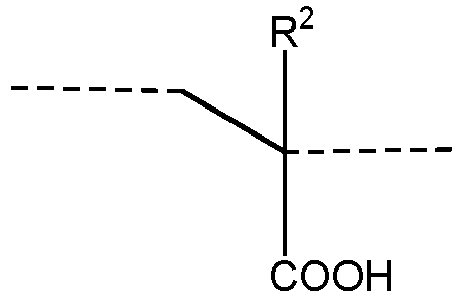
- IV. 1 bis 30 Gew.-%, bevorzugt 2 bis 25, mehr bevorzugt 4 bis 20, insbesondere bevorzugt 5 bis 15 Gew.-% Säureanhydrideinheiten der Formel

- mit R5 unabhängig voneinander aliphatische oder alicyclische Reste mit 1 bis 8 C-Atomen, bevorzugt mit 1 bis 4 C-Atomen, mehr bevorzugt Wasserstoff oder Methyl;
- n ist gleich 0 oder 1;
- wobei die Einheiten nach I, II, III und IV in der Summe 100 Gew.-% ergeben.
- I. 14 to 80% by weight, preferably 20 to 70, more preferably 30 to 65, particularly preferably 40 to 60% by weight of ester units of the formula
- II. 10 to 75% by weight, preferably 20 to 65, more preferably 25 to 50 and particularly preferably 30 to 40% by weight of imide units of the formula
- with R 4 independently of one another aliphatic or alicyclic radicals with 1 to 8 carbon atoms, preferably with 1 to 4 carbon atoms, more preferably hydrogen or methyl, and R 3 independently of one another methyl, ethyl, propyl, butyl or phenyl;
- preferably both R 3 and R 4 are methyl;
- m is 0 or 1;
- III. 1 to 20% by weight, more preferably 1.5 to 15 and particularly preferably 2 to 5% by weight of acid units of the formula
- IV. 1 to 30% by weight, preferably 2 to 25, more preferably 4 to 20, particularly preferably 5 to 15% by weight of acid anhydride units of the formula
- with R 5, independently of one another, aliphatic or alicyclic radicals with 1 to 8 carbon atoms, preferably with 1 to 4 carbon atoms, more preferably hydrogen or methyl;
- n is 0 or 1;
- the units according to I, II, III and IV totaling 100% by weight.
Das Acrylatcopolymer b) kann zusätzlich weitere Einheiten enthalten, beispielsweise solche, die sich von Maleinsäurediestern, Fumarsäurediestern, Itaconsäureestern, Vinylacetat, Vinylpyrrolidon, Vinylchlorid, Acrylnitril, Acrylamid, Styrol oder Ethen herleiten, solange die Verträglichkeit mit dem PVDF sowie die gewünschte haftvermittelnde Wirkung dadurch nicht wesentlich beeinträchtigt wird.The acrylate copolymer b) can additionally contain other units, for example those derived from maleic acid diesters, fumaric acid diesters, itaconic acid esters, vinyl acetate, vinylpyrrolidone, vinyl chloride, acrylonitrile, acrylamide, styrene or ethene, as long as the compatibility with the PVDF and the desired adhesion-promoting effect are not thereby derived is significantly impaired.
Die Limitierung der Kettenlänge für die Substituenten R1, R2, R4 und R5 ist darin begründet, dass längere Alkylreste zu einer erniedrigten Glasübergangstemperatur und damit zu einer verringerten Wärmeformbeständigkeit führen. Dies mag im Einzelfall in Kauf genommen werden; derartige Ausführungsformen liegen zumindest im Äquivalenzbereich der Erfindung.The limitation of the chain length for the substituents R 1 , R 2 , R 4 and R 5 is due to the fact that longer alkyl radicals lead to a lower glass transition temperature and thus to a reduced heat resistance. This may be accepted in individual cases; such embodiments are at least in the range of equivalents of the invention.
Die Estereinheiten gemäß I leiten sich beispielsweise von Methylacrylat, Ethylacrylat, n-Butylacrylat, Methylmethacrylat, n-Propylmethacrylat oder i-Butylmethacrylat her, wobei Methylmethacrylat bevorzugt ist.The ester units according to I are derived, for example, from methyl acrylate, ethyl acrylate, n-butyl acrylate, methyl methacrylate, n-propyl methacrylate or i-butyl methacrylate, methyl methacrylate being preferred.
Die Imideinheiten gemäß II leiten sich im Falle m = 0 von gegebenenfalls substituierten Maleinimiden her wie Maleinimid, N-Methylmaleinimid, N-Ethylmaleinimid, N-Phenylmaleinimid oder N-Methylcitraconsäureimid. Im Falle m = 1 leiten sie sich durch Umsetzung zweier in einem Polymeren benachbarter Einheiten der Formel gemäß I oder III mit Ammoniak oder einem primären Amin unter Imidbildung her.If m = 0, the imide units according to II are derived from optionally substituted maleimides such as maleimide, N-methylmaleimide, N-ethylmaleimide, N-phenylmaleimide or N-methylcitraconic acidimide. If m = 1, they are derived from the reaction of two adjacent units of the formula I or III in a polymer with ammonia or a primary amine to form an imide.
Die Säureeinheiten gemäß III leiten sich von Acrylsäure oder Methacrylsäure her.The acid units according to III are derived from acrylic acid or methacrylic acid.
Bevorzugt leiten sich die Anhydrideinheiten nach IV (für n = 0) von ungesättigten Dicarbonsäureanhydriden wie Maleinsäureanhydrid, Methacrylsäureanhydrid und Acrylsäureanhydrid ab, besonders bevorzugt von Methacrylsäureanhydrid. Im Falle n = 1 leiten sie sich durch Wasserabspaltung aus zwei in einem Polymeren benachbarten Einheiten gemäß III unter Ringschluss her.The anhydride units according to IV (for n = 0) are preferably derived from unsaturated dicarboxylic anhydrides such as maleic anhydride, methacrylic anhydride and acrylic anhydride, particularly preferably from methacrylic anhydride. If n = 1, they are derived by splitting off water from two adjacent units in a polymer according to III with ring closure.
Weitere Anhydrideinheiten können sich von Itaconsäureanhydrid und Aconitsäure ableiten.Further anhydride units can be derived from itaconic anhydride and aconitic acid.
Mehr bevorzugt weist das Acrylatcopolymer b) ausschließlich die Einheiten nach I, II, III und IV auf.The acrylate copolymer b) more preferably exclusively has the units according to I, II, III and IV.
Bevorzugt sind die Reste R1, R2, R4 und R5 des Acrylatcopolymers alle gleich, mehr bevorzugt alle Methyl.The radicals R 1 , R 2 , R 4 and R 5 of the acrylate copolymer are preferably all the same, more preferably all methyl.
Wegen der Anwesenheit von Einheiten gemäß II. werden derartige Copolymere als Polyacrylimide bzw. Polymethacrylimide oder manchmal auch als Polyglutarimide bezeichnet. Es handelt sich hierbei um Produkte ausgehend von Polyalkylacrylaten bzw. Polyalkylmethacrylaten, bei denen zwei benachbarte Carboxylatgruppen zu einem cyclischen Säureimid umgesetzt worden sind. Die Imidbildung wird vorzugsweise mit Ammoniak bzw. primären Aminen, wie z. B. Methylamin, in Gegenwart von Wasser durchgeführt, wobei die Einheiten gemäß III. und IV. durch Hydrolyse mit entstehen.Because of the presence of units according to II., Such copolymers are referred to as polyacrylimides or polymethacrylimides or sometimes also as polyglutarimides. These are products based on polyalkyl acrylates or polyalkyl methacrylates in which two adjacent carboxylate groups have been converted to a cyclic acid imide. The imide formation is preferably carried out with ammonia or primary amines, such as. B. methylamine, carried out in the presence of water, the units according to III. and IV. by hydrolysis with.
Die Produkte sowie ihre Herstellung sind bekannt (Hans R. Kricheldorf, Handbook of Polymer Synthesis, Part A, Verlag Marcel Dekker Inc. New York-Basel-Hongkong, S. 223 f; H. G. Elias, Makromoleküle, Hüthig und Wepf Verlag Basel-Heidelberg-New York ;
Bevorzugt weist das Acrylatcopolymer 40 bis 60 Gew.-% Einheiten I, 30 bis 40 Gew.-% Einheiten II, 2 bis 5 Gew.-% Einheiten III und 5 bis 15 Gew.-% Einheiten IV auf.The acrylate copolymer preferably has 40 to 60% by weight of units I, 30 to 40% by weight of units II, 2 to 5% by weight of units III and 5 to 15% by weight of units IV.
Bevorzugt enthält die Polymermatrix niedrigviskoses PVDF und 2 bis 30 Gew.-%Teile, besonders bevorzugt 2,5 bis 20 Gew.-% und insbesondere bevorzugt 3 bis 10 Gew.-% eines Acrylatcopolymers, bezogen auf die Polymermatrix, wobei das Acrylatcopolymer 40 bis 60 Gew.-% Einheiten I, 30 bis 40 Gew.-% Einheiten II, 2 bis 5 Gew.-% Einheiten III und 5 bis 15 Gew.-% Einheiten IV aufweist, in Summe Einheiten I, II, III und IV gleich 100.The polymer matrix preferably contains low-viscosity PVDF and 2 to 30 wt.% Parts, particularly preferably 2.5 to 20 wt.% And particularly preferably 3 to 10 wt.% Of an acrylate copolymer, based on the polymer matrix, the acrylate copolymer 40 to 60% by weight of units I, 30 to 40% by weight of units II, 2 to 5% by weight of units III and 5 to 15% by weight of units IV, in total units I, II, III and IV are the same 100.
Bevorzugt weisen die erfindungsgemäßen Composites 30 bis 55 Vol.-%, bezogen auf das Composite, Kohlenstofffasern mit einer Epoxidharzschlichte in einer Polymermatrix aus einem niedrigviskosen Homo-PVDF und 5 bis 10 Gew.-% eines Acrylatcopolymers, bezogen auf die Polymermatrix, wobei das Acrylatcopolymer 40 bis 60 Gew.-% Einheiten I, 30 bis 40 Gew.-% Einheiten II, 2 bis 5 Gew.-% Einheiten III und 5 bis 15 Gew.-% Einheiten IV aufweist, in Summe Einheiten I, II, III und IV gleich 100.The composites according to the invention preferably have 30 to 55% by volume, based on the composite, of carbon fibers with an epoxy resin size in a polymer matrix made from a low-viscosity homo-PVDF and 5 to 10% by weight of an acrylate copolymer, based on the polymer matrix, the acrylate copolymer 40 to 60% by weight of units I, 30 to 40% by weight Units II, 2 to 5% by weight of units III and 5 to 15% by weight of units IV, in total units I, II, III and IV equal 100.
Die verschiedenen Einheiten des Acrylatcopolymers, insbesondere die Einheiten I, II, III und IV sind statistisch verteilt. Statistische Verteilungen sind blockweise aufgebaut mit einer beliebigen Anzahl an Blöcken und einer beliebigen Sequenz oder sie unterliegen einer randomisierten Verteilung, sie können auch alternierend aufgebaut sein oder auch über die Polymerkette einen Gradienten bilden, insbesondere können sie auch alle Mischformen bilden, bei denen gegebenenfalls Gruppen unterschiedlicher Verteilungen aufeinander folgen können. Spezielle Ausführungen können dazu führen, dass die statistischen Verteilungen durch die Ausführung Beschränkungen erfahren. Für alle Bereiche, die nicht von der Beschränkung betroffen sind, ändert sich die statistische Verteilung nicht.The various units of the acrylate copolymer, in particular the units I, II, III and IV, are randomly distributed. Statistical distributions are built up in blocks with any number of blocks and any sequence or they are subject to a randomized distribution, they can also be built up alternately or also form a gradient over the polymer chain, in particular they can also form all mixed forms in which groups of different groups may be Distributions can follow one another. Special executions can result in the statistical distributions being restricted by execution. The statistical distribution does not change for all areas that are not affected by the restriction.
Die Polymermatrix kann neben dem niedrigviskosen PVDF und dem Acrylatcopolymer übliche Hilfs- und Zusatzstoffe wie z. B. Schlagzähmodifikatoren (etwa Acrylatkautschuk), Flammschutzmittel, Stabilisatoren, Weichmacher, Verarbeitungshilfsmittel, Farbstoffe, Pigmente oder ähnliches enthalten. Die Menge der genannten Mittel ist so zu dosieren, dass die gewünschten Eigenschaften, insbesondere in Bezug auf die Bindung der Fasermaterialien zur Matrix, nicht wesentlich beeinträchtigt werden.In addition to the low-viscosity PVDF and the acrylate copolymer, the polymer matrix can contain conventional auxiliaries and additives such as. B. impact modifiers (such as acrylate rubber), flame retardants, stabilizers, plasticizers, processing aids, dyes, pigments or the like. The amount of the agents mentioned is to be dosed in such a way that the desired properties, in particular with regard to the binding of the fiber materials to the matrix, are not significantly impaired.
Die Herstellung der Polymermatrix erfolgt nach den üblichen und bekannten Verfahren durch Schmelzemischen der Komponenten in einem gut knetenden Mischaggregat, wie z. B. einem Doppelschneckenkneter, bei Temperaturen, die sich nach den Schmelzpunkten der Komponenten richten, im allgemeinen bei Temperaturen zwischen 200 und 300 °C.The polymer matrix is produced according to the customary and known processes by melt mixing the components in a well-kneading mixing unit, such as. B. a twin-screw kneader, at temperatures which depend on the melting points of the components, generally at temperatures between 200 and 300.degree.
Das erfindungsgemäße Composite kann nach Verfahren des Standes der Technik hergestellt werden. Die Herstellung unidirektional endlosfaserverstärkter Tapes wird beispielsweise in der
Das auf diese Weise erhaltene Composite kann bei geeigneter Form bereits das Endprodukt sein. In den anderen Fällen ist es ein Halbzeug, das mit Hilfe geeigneter Formgebungsverfahren zum Fertigteil weiterverarbeitet werden kann. Beispielhafte Fertigteile sind Konstruktionsteile für Flugzeuge, Raketen oder Kraftfahrzeuge oder Thermoplastic Composite Pipes, die ein solches Composite als Verstärkungslage enthalten.The composite obtained in this way can, with a suitable shape, already be the end product. In the other cases it is a semi-finished product that can be processed into a finished part with the help of suitable shaping processes. Exemplary finished parts are structural parts for aircraft, rockets or motor vehicles or thermoplastic composite pipes that contain such a composite as a reinforcement layer.
Darüber hinaus kann ein als Strang erhaltenes Composite zu langfaserverstärktem Stäbchengranulat mit einer Länge von 4 bis 60 mm, vorzugsweise 5 bis 50 mm, besonders bevorzugt 6 bis 40 mm, insbesondere bevorzugt 5 bis 30 mm und ganz besonders bevorzugt 6 bis 25 mm geschnitten werden. Bei diesem langfaserverstärkten Stäbchengranulat sind die Verstärkungsfasern in Axialrichtung angeordnet und erstrecken sich von der ersten Schnittfläche zur zweiten Schnittfläche.In addition, a composite obtained as a strand can be cut into long fiber-reinforced rod granules with a length of 4 to 60 mm, preferably 5 to 50 mm, particularly preferably 6 to 40 mm, particularly preferably 5 to 30 mm and very particularly preferably 6 to 25 mm. These long fiber-reinforced pellets are the Reinforcing fibers arranged in the axial direction and extend from the first cut surface to the second cut surface.
Aus diesem Granulat können dann Formteile mittels Spritzgießen, Extrusion, Pressen oder anderer gebräuchlicher Formgebungsverfahren hergestellt werden, wobei besonders gute Eigenschaften des Formteils mit schonenden Verarbeitungsverfahren erreicht werden. In diesem Zusammenhang bedeutet schonend vor allem, dass ein übermäßiger Faserbruch und die damit einhergehende starke Reduktion der Faserlänge weitgehend vermieden werden. Beim Spritzguss bedeutet dies, dass bevorzugt Schnecken mit großem Durchmesser und tiefem Kompressionsverhältnis sowie großzügig dimensionierte Düsen- und Angusskanäle zum Einsatz kommen. Ergänzend sollte dafür gesorgt werden, dass die Stäbchengranulate mit Hilfe von hohen Zylindertemperaturen rasch aufschmelzen (Kontakterwärmung) und die Fasern nicht durch übermäßige Scherbeanspruchung zu stark zerkleinert werden. Unter Berücksichtigung dieser Maßnahmen werden Formteile erhalten, die im Mittel eine höhere Faserlänge aufweisen als vergleichbare Formteile hergestellt aus kurzfaserverstärkten Formmassen. Hierdurch wird eine deutliche Verbesserung der Eigenschaften, insbesondere beim Zug-E-Modul, der Reißfestigkeit und der Kerbschlagzähigkeit erreicht.Moldings can then be produced from this granulate by means of injection molding, extrusion, pressing or other customary shaping processes, with particularly good properties of the molding being achieved with gentle processing methods. In this context, gentle means above all that excessive fiber breakage and the associated strong reduction in fiber length are largely avoided. In the case of injection molding, this means that screws with a large diameter and low compression ratio as well as generously dimensioned nozzle and sprue channels are preferred. In addition, it should be ensured that the stick granules melt quickly with the help of high cylinder temperatures (contact heating) and that the fibers are not too strongly comminuted by excessive shear stress. Taking these measures into account, molded parts are obtained which on average have a longer fiber length than comparable molded parts made from short-fiber-reinforced molding compounds. This results in a significant improvement in the properties, in particular in terms of the tensile modulus of elasticity, tear strength and notched impact strength.
Bevorzugte Halbzeuge sind Tapes, diese sind bevorzugt unidirektional endlosfaserverstärkt. Bevorzugt hat das Tape eine Breite von 5 bis 600 mm und vorzugsweise eine Breite von 8 bis 300 mm, während die Dicke üblicherweise im Bereich von 0,05 bis 2 mm, vorzugsweise im Bereich von 0,1 bis 1 mm, mehr bevorzugt im Bereich von 0,125 bis 0,5 und besonders bevorzugt im Bereich von 0,15 bis 0,35 mm liegt.Preferred semi-finished products are tapes, these are preferably unidirectionally reinforced with continuous fibers. The tape preferably has a width of 5 to 600 mm and preferably a width of 8 to 300 mm, while the thickness is usually in the range from 0.05 to 2 mm, preferably in the range from 0.1 to 1 mm, more preferably in the range from 0.125 to 0.5 and particularly preferably in the range from 0.15 to 0.35 mm.
Bevorzugte Composites bestehen aus endlosfaserverstärkten Tape Schichten, mit einer Anzahl an Einzelschichten von 1 bis 100, mehr bevorzugt von 5 bis 90 Einzelschichten, wobei das Composite durch Anwendung von Druck und erhöhter Temperatur gebildet wird, mehr bevorzugt durch Konsolidierung, wie in den Beispielen gezeigt, und wobei die Einzelschichten beliebige Faserorientierungen aufzeigen können.Preferred composites consist of continuous fiber-reinforced tape layers, with a number of individual layers from 1 to 100, more preferably from 5 to 90 individual layers, the composite being formed by applying pressure and elevated temperature, more preferably by consolidation, as shown in the examples. and wherein the individual layers can show any fiber orientations.
Der zweite Aspekt der zugrundeliegenden Aufgabe wird gelöst durch einen weiteren Gegenstand der vorliegenden Erfindung, ein Thermoplastic Composite Pipe (TCP), das von innen nach außen folgende Komponenten enthält:
- I. Einen rohrförmigen Liner, der ein- oder mehrschichtig ist und dessen äußere Oberfläche aus einer Polyamid- oder PVDF-Formmasse besteht;
- II. eine Verstärkungslage aus einem Composite aus einer Polymermatrix und darin eingebetteten Endlosfasern, wobei die Polymermatrix zu mindestens 80 Gew-%, bevorzugt zu mindestens 85 Gew-%, besonders bevorzugt zu mindestens 90 Gew-% und insbesondere bevorzugt zu mindestens 95 Gew-% aus einer Mischung besteht, die folgende Komponenten enthält:
- a) als Hauptkomponente, das heißt zu mindestens 50 Gew.-Teilen niedrigviskoses PVDF sowie
- b) 1 bis 50 Gew.-Teile, bevorzugt 1,5 bis 40 Gew.-Teile, mehr bevorzugt 2 bis 30 Gew.-Teile, besonders bevorzugt 2,5 bis 20 Gew.-Teile und insbesondere bevorzugt 3 bis 10 Gew.-Teile eines Acrylatcopolymers, wobei das Acrylatcopolymer 1 bis 30 Gew.-%, bevorzugt 2 bis 25 Gew.-%, besonders bevorzugt 4 bis 20 Gew.-% und insbesondere bevorzugt 5 bis 15 Gew.-% Einheiten mit Carbonsäureanhydridgruppen enthält,
wobei die Summe der Gew.-Teile von a) und b) 100 ergibt,
wobei die Prozentangaben der Matrix und der Endlosfasern sich jeweils auf die Gesamtmasse bzw. Gesamtvolumen der Verstärkungslage beziehen; - III. gegebenenfalls eine weitere Verstärkungslage aus einem Composite aus einer Polyamidmatrix und darin eingebetteten Endlosfasern,
wobei die Polyamidmatrix zu mindestens 80 Gew-%, bevorzugt zu mindestens 85 Gew-%, besonders bevorzugt zu mindestens 90 Gew-% und insbesondere bevorzugt zu mindestens 95 Gew-% aus Polyamid besteht,
und wobei weiterhin der Volumenanteil der Endlosfasern im Composite 10 bis 80 %, vorzugsweise 15 bis 75 %, mehr bevorzugt 20 bis 70 %, weiter mehr bevorzugt 25 bis 65 %, besonders bevorzugt 30 bis 60 %, und insbesondere bevorzugt 35 bis 55 % beträgt, - IV. gegebenenfalls eine außenliegende Decklage aus einer polymeren Masse.
wobei die Prozentangaben der Matrix und der Endlosfasern sich jeweils auf die Gesamtmasse bzw. Gesamtvolumen der Verstärkungslage beziehen;
Bevorzugt ist die Schicht II eine Verstärkungslage aus dem erfindungsgemäßen Composite wie vorher beschrieben.
- I. A tubular liner that has one or more layers and the outer surface of which consists of a polyamide or PVDF molding compound;
- II. A reinforcement layer made of a composite of a polymer matrix and continuous fibers embedded therein, the polymer matrix being at least 80% by weight, preferably at least 85% by weight, particularly preferably at least 90% by weight and particularly preferably at least 95% by weight consists of a mixture that contains the following components:
- a) as the main component, that is to say at least 50 parts by weight of low-viscosity PVDF and
- b) 1 to 50 parts by weight, preferably 1.5 to 40 parts by weight, more preferably 2 to 30 parts by weight, particularly preferably 2.5 to 20 parts by weight and particularly preferably 3 to 10 parts by weight. Parts of an acrylate copolymer, the acrylate copolymer from 1 to 30% by weight, preferably from 2 to 25% by weight Contains wt .-%, particularly preferably 4 to 20 wt .-% and particularly preferably 5 to 15 wt .-% units with carboxylic acid anhydride groups,
where the sum of the parts by weight of a) and b) is 100,
the percentages of the matrix and the continuous fibers each refer to the total mass or total volume of the reinforcement layer; - III. if necessary, a further reinforcement layer made of a composite made of a polyamide matrix and continuous fibers embedded therein,
wherein the polyamide matrix consists of at least 80% by weight, preferably at least 85% by weight, particularly preferably at least 90% by weight and particularly preferably at least 95% by weight of polyamide,
and furthermore the volume fraction of the continuous fibers in the composite is 10 to 80%, preferably 15 to 75%, more preferably 20 to 70%, more preferably 25 to 65%, particularly preferably 30 to 60%, and particularly preferably 35 to 55% , - IV. Optionally an outer cover layer made of a polymeric compound.
the percentages of the matrix and the continuous fibers each refer to the total mass or total volume of the reinforcement layer;
Layer II is preferably a reinforcement layer made of the composite according to the invention as described above.
Der rohrförmige Liner besitzt in der Regel einen Innendurchmesser im Bereich von 10 bis 500 mm, vorzugsweise im Bereich von 12 bis 425 mm und besonders bevorzugt im Bereich von 15 bis 300 mm. Seine Wandstärke liegt in der Regel im Bereich von 2 bis 40 mm, vorzugsweise im Bereich von 2,5 bis 30 mm und besonders bevorzugt im Bereich von 3 bis 20 mm. Der Liner kann einschichtig oder mehrschichtig sein.The tubular liner generally has an inside diameter in the range from 10 to 500 mm, preferably in the range from 12 to 425 mm and particularly preferably in the range from 15 to 300 mm. Its wall thickness is generally in the range from 2 to 40 mm, preferably in the range from 2.5 to 30 mm and particularly preferably in the range from 3 to 20 mm. The liner can be single-layer or multilayer.
Bei der Herstellung des TCPs wird auf die äußere Oberfläche des Liners unter Anwendung eines Anpressdrucks das erfindungsgemäße Composite in Form eines Tapes aufgebracht. Der nötige Anpressdruck kann durch die Wickelspannung oder mittels eines Andruckkörpers erzielt werden. Hier werden in einer Ausführungsform beide Kontaktflächen angeschmolzen, beispielsweise mittels Infrarotstrahlung, Heißluft, Heißgas, Laserstrahlung, Mikrowellenstrahlung oder direkt durch Kontaktheizung. Die angeschmolzenen Kontaktflächen werden dann aneinander gepresst. Bis zum Erstarren der aufgeschmolzenen Bereiche sollte der Anpressdruck erhalten bleiben. In einer weiteren Ausführungsform wird das Tape aufgewickelt und dann von außen entweder indirekt oder aber direkt mittels eines beheizbaren Andruckkörpers aufgeschmolzen. Die Heizleistung muss so dosiert werden, dass hierbei auch die äußere Oberfläche des Liners anschmilzt. Danach wird der Anpressdruck bis zum Erstarren der angeschmolzenen Bereiche aufrechterhalten. Das Wickeln des Tapes sowie das Aufwickeln gegebenenfalls weiterer Tapelagen ist Stand der Technik. Auf die so erhaltene Struktur können gegebenenfalls auf die gleiche Weise eine oder mehrere Tapelagen mit einer Polyamidmatrix aufgebracht werden. Dies ist unter Umständen sinnvoll, weil der äußere Bereich des TCPs dem zu fördernden Medium und dessen Temperatur gegenüber weniger exponiert ist und man auf diese Weise die Materialkosten niedriger halten kann und das gesamte Rohr leichter ist. Polyamide sind dem Fachmann als sehr schlagzähe Polymere bekannt und bieten deshalb einen besseren und zusätzlichen Schutz gegenüber Umwelteinflüssen, weiterhin weist Polyamid eine niedrigere Dichte als PVDF auf.During the production of the TCP, the composite according to the invention is applied in the form of a tape to the outer surface of the liner using contact pressure. The necessary contact pressure can be achieved through the winding tension or by means of a pressure body. Here, in one embodiment, both contact surfaces are melted, for example by means of infrared radiation, hot air, hot gas, laser radiation, microwave radiation or directly by contact heating. The melted contact surfaces are then pressed together. The contact pressure should be maintained until the melted areas solidify. In a further embodiment, the tape is wound up and then melted from the outside either indirectly or directly by means of a heatable pressure body. The heating output must be dosed in such a way that the outer surface of the liner also melts. Then the Maintain contact pressure until the melted areas solidify. Winding the tape and winding up additional layers of tape, if necessary, is state of the art. One or more layers of tape with a polyamide matrix can optionally be applied in the same way to the structure obtained in this way. This may make sense because the outer area of the TCP is less exposed to the medium to be conveyed and its temperature, and in this way the material costs can be kept lower and the entire pipe is lighter. Polyamides are known to the person skilled in the art as very impact-resistant polymers and therefore offer better and additional protection against environmental influences, and polyamide also has a lower density than PVDF.
Die gesamte Compositlage, also die Summe aller Tapelagen, liegt hierbei im Bereich von 1 bis 100 mm, vorzugsweise im Bereich von 5 bis 90 mm und besonders bevorzugt im Bereich von 10 bis 80 mm. Für unterschiedliche Tapelagen können unterschiedliche Tapegeometrien und Wickelwinkel eingesetzt werden. Die verwendeten Tapes können jeden geeigneten Querschnitt besitzen.The entire composite layer, that is the sum of all tape layers, is in the range from 1 to 100 mm, preferably in the range from 5 to 90 mm and particularly preferably in the range from 10 to 80 mm. Different tape geometries and winding angles can be used for different tape layers. The tapes used can have any suitable cross section.
Um die äußere Tapelage zu schützen, kann gegebenenfalls zum Abschluss eine außenliegende Decklage aus einer polymeren Masse aufgebracht werden. Hierbei handelt es sich entweder um eine thermoplastische Formmasse oder um ein thermoplastisches oder vernetzbares oder vernetztes Elastomer. Vorzugsweise haftet die Decklage fest auf der äußeren Tapelage. In diesem Fall kann die Decklage beispielsweise mittels eines Querspritz-Extrusionskopfes aufgebracht und so stoffschlüssig mit der Tapelage verbunden werden. Die Haftung kann auch durch Vernetzen eines vernetzbaren Elastomers erzeugt werden.In order to protect the outer tape layer, an external cover layer made of a polymeric compound can optionally be applied at the end. This is either a thermoplastic molding compound or a thermoplastic or crosslinkable or crosslinked elastomer. The cover layer preferably adheres firmly to the outer tape layer. In this case, the cover layer can be applied, for example, by means of a cross-injection extrusion head and thus connected to the tape layer in a materially bonded manner. The adhesion can also be produced by crosslinking a crosslinkable elastomer.
Spezielle Designs des erfindungsgemäßen TCPs sind beispielsweise:
- a) Liner aus einer Polyamidformmasse / erfindungsgemäße PVDF-Compositlage / Decklage aus einer Polyamidformmasse;
- b) Liner aus einer PVDF-Formmasse / erfindungsgemäße PVDF-Compositlage / Decklage aus einer PVDF-Formmasse;
- c) Liner aus einer PVDF-Formmasse / erfindungsgemäße PVDF-Compositlage / Decklage aus einer Polyamidformmasse;
- d) Liner aus einer Polyamidformmasse / erfindungsgemäße PVDF-Compositlage / Decklage aus einer PVDF-Formmasse;
- e) Zweischichtiger Liner mit einer Innenschicht aus einer Polyamidformmasse und einer Außenschicht aus einem PVDF-Acrylatcopolymer-Blend / erfindungsgemäße PVDF-Compositlage / Schicht aus einem PVDF-Acrylatcopolymer-Blend / Decklage aus einer Polyam idformmasse;
- f) Zweischichtiger Liner mit einer Innenschicht aus einer Polyamidformmasse und einer Außenschicht aus einem PVDF-Acrylatcopolymer-Blend / erfindungsgemäße PVDF-Compositlage / Decklage aus einer PVDF-Formmasse;
- g) Liner aus einer PVDF- oder einer Polyamidformmasse / erfindungsgemäße PVDF-Compositlage / Compositlage mit Polyamidmatrix / Decklage aus einer PVDF- oder einer Polyamidformmasse.
- a) liner made from a polyamide molding compound / PVDF composite layer according to the invention / cover layer made from a polyamide molding compound;
- b) liner made from a PVDF molding compound / PVDF composite layer according to the invention / cover layer made from a PVDF molding compound;
- c) liner made from a PVDF molding compound / PVDF composite layer according to the invention / cover layer made from a polyamide molding compound;
- d) liner made from a polyamide molding compound / PVDF composite layer according to the invention / cover layer made from a PVDF molding compound;
- e) Two-layer liner with an inner layer made of a polyamide molding compound and an outer layer made of a PVDF-acrylate copolymer blend / PVDF composite layer according to the invention / layer made of a PVDF-acrylate copolymer blend / top layer made of a polyamide molding compound;
- f) Two-layer liner with an inner layer made of a polyamide molding compound and an outer layer made of a PVDF-acrylate copolymer blend / PVDF composite layer according to the invention / top layer made of a PVDF molding compound;
- g) Liner made from a PVDF or a polyamide molding compound / PVDF composite layer according to the invention / composite layer with a polyamide matrix / cover layer made from a PVDF or a polyamide molding compound.
Das Acrylatcopolymer in den Designs e und f hat hierbei die gleiche Zusammensetzung, wie das Acrylatcopolymer b) des erfindungsgemäßen Composites.The acrylate copolymer in designs e and f here has the same composition as the acrylate copolymer b) of the composite according to the invention.
Geeignete Polyamide sind beispielsweise PA6, PA66, PA610, PA88, PA8, PA612, PA810, PA108, PA9, PA613, PA614, PA812, PA128, PA1010, PA10, PA814, PA148, PA1012, PA11, PA1014, PA1212 und PA12 oder ein auf einem dieser Polyamide basierendes Polyetheramid oder Polyetheresteramid oder ein Polyphthalamid wie beispielsweise PA66/6T, PA6/6T, PA6T/MPMDT (MPMD steht für 2-Methylpentamethylendiamin), PA9T, PA10T, PA11T, PA12T, PA14T, PA6T/6I, PA6T/10T, PA6T/12, PA10T/11, PA10T/12 oder PA612/6T.Suitable polyamides are, for example, PA6, PA66, PA610, PA88, PA8, PA612, PA810, PA108, PA9, PA613, PA614, PA812, PA128, PA1010, PA10, PA814, PA148, PA1012, PA11, PA1014, PA1212 and PA12 or a one of these polyamides based polyether amide or polyether ester amide or a polyphthalamide such as PA66 / 6T, PA6 / 6T, PA6T / MPMDT (MPMD stands for 2-methylpentamethylenediamine), PA9T, PA10T, PA11T, PA12T, PA14T, PA6T / 6I, PA6T / 10T, PA6T / 12, PA10T / 11, PA10T / 12 or PA612 / 6T.
Vorteilhaft am erfindungsgemäßen TCP mit der Verstärkung aus dem erfindungsgemäßen Composite ist, dass die Polymermatrix durch Aufnahme von Kohlenwasserstoffen, Wasser oder Methanol weniger erweicht gegenüber einer Matrix aus Polyolefin oder Polyamid. Damit weist das erfindungsgemäße TCP gegenüber vergleichbaren Rohren aus Polyolefin oder Polyamid eine höhere Außendruckfestigkeit auf. Von besonderem Vorteil ist darüber hinaus die gute Faser-Matrix-Haftung, die wesentlich zur hohen Verstärkung und zur hohen Lebensdauer beiträgt. Als Maß für die Faser-Matrix-Haftung kann der Dreipunktbiegeversuch nach ASTM D2344 angesehen werden, wie in den Beispielen beschrieben.The advantage of the TCP according to the invention with the reinforcement made from the composite according to the invention is that the polymer matrix softens less than a matrix made of polyolefin or polyamide by absorbing hydrocarbons, water or methanol. The TCP according to the invention therefore has a higher external compressive strength than comparable pipes made of polyolefin or polyamide. The good fiber-matrix adhesion, which contributes significantly to the high reinforcement and long service life, is also particularly advantageous. The three-point bending test according to ASTM D2344, as described in the examples, can be regarded as a measure of the fiber-matrix adhesion.
Ein weiterer Vorteil der erfindungsgemäßen TCP ist, dass zwischen der erfindungsgemäßen PVDF-Compositlage und einer eventuell vorhandenen Polyamidlage keine zusätzliche Haftvermittlung notwendig ist.Another advantage of the TCP according to the invention is that no additional bonding agent is necessary between the PVDF composite layer according to the invention and any polyamide layer that may be present.
Das erfindungsgemäße TCP eignet sich insbesondere für Offshoreanwendungen in der Öl- oder Gasförderung, etwa zum Transport der Produkte zu Plattformen, zum Anschluss an Stahlleitungen, als Transportleitung und insbesondere als Umbilical, als Riser, als Jumper Line, als Flowline, als Intervention Line, als Downline, als Injektionsleitung oder als Druckleitung. Es kann verwendet werden für den Transport von gegebenenfalls unter Druck stehenden Kohlenwasserstoffen oder deren Gemischen wie Rohöl, Rohgas, Triphase (also Öl-Gas-Wassergemisch), Processed Oil (schon teilweise am Meeresgrund aufgearbeitet), Processed Gas, Benzin oder Diesel, von Injektionsmedien wie Wasser (etwa zur Erhaltung des Drucks in der Kaverne), Ölfeldchemikalien, Methanol oder CO2 sowie zur Führung von Hydraulikölen (beispielsweise für Aktoren am Meeresgrund). Darüber hinaus ist das erfindungsgemäße TCP auch als druckführende Leitung im Onshore-Bereich oder in anderen industriellen Anwendungen geeignet, insbesondere in solchen, in denen höhere unabhängig voneinander Wasserstoff oder Methyl Kräfte in Axialrichtung des Rohres kraftschlüssig zwischen Rohr und Anbindungselement übertragen werden müssen.The TCP according to the invention is particularly suitable for offshore applications in oil or gas production, for example for transporting the products to platforms, for connection to steel lines, as a transport line and in particular as an umbilical, as a riser, as a jumper line, as a flowline, as an intervention line, Downline, as an injection line or as a pressure line. It can be used for the transport of hydrocarbons that may be under pressure or their mixtures such as crude oil, raw gas, triphase (i.e. oil-gas-water mixture), processed oil (already partially processed on the seabed), processed gas, gasoline or diesel, of injection media such as water (e.g. to maintain the pressure in the cavern), oil field chemicals, methanol or CO 2 as well as to guide hydraulic oils (e.g. for actuators on the seabed). In addition, the TCP according to the invention is also suitable as a pressure line in the onshore area or in other industrial applications, especially in those in which higher independent hydrogen or methyl forces have to be transmitted non-positively between the pipe and the connection element in the axial direction of the pipe.
Tape bestehend aus 45 Vol.-% Kohlefasern (Grafil 34-700 D) in einer Polymermatrix, welche aus 95 Gew.-% eines niedrigviskosen Homo-PVDF (Solef 1006) gemischt mit 5 Gew.-% eines Acrylat Copolymeren, welches 10,1 Gew.-% Säureanhydride (IV), 2,9 Gew.-% Säuregruppen (III), 35 Gew.-% Imidgruppen (II) und 52 Gew.-% Methacrylatgruppen (I) aufweist ohne weitere Zusätze hergestellt wurde.Tape consisting of 45% by volume carbon fibers (Grafil 34-700 D) in a polymer matrix, which consists of 95% by weight of a low-viscosity homo-PVDF (Solef 1006) mixed with 5% by weight of an acrylate copolymer, which contains 10, 1% by weight of acid anhydrides (IV), 2.9% by weight of acid groups (III), 35 % By weight of imide groups (II) and 52% by weight of methacrylate groups (I) was produced without further additives.
Nach Konsolidierung acht unidirektionaler Lagen des obigen Tapes zum Halbzeuges (10 bar, 240 °C, 5 Minuten Haltezeit) wurde gemäß ASTM D2344 an planaren Prüfkörpern die interlaminare Scherfestigkeit mit 59 MPa bestimmt.After eight unidirectional layers of the above tape had been consolidated into the semi-finished product (10 bar, 240 ° C., 5 minutes holding time), the interlaminar shear strength was determined on planar test specimens at 59 MPa in accordance with ASTM D2344.
An den Prüfkörpern wurde bis zum angegebenen Wert keine Ablösung der Matrix von den Kohlefasern beobachtet, damit gibt dieser Test eine Aussage zur Haftung von Matrix und Endlosfasern.No detachment of the matrix from the carbon fibers was observed on the test specimens up to the stated value, so this test provides information on the adhesion of matrix and continuous fibers.
Zum Vergleich wurde ein Halbzeug analog zum Ausführungsbeispiel aufgebaut, jedoch ohne Verwendung eines Acrylatcopolymers. Nach vergleichbarer Konsolidierung des Halbzeuges wurde gemäß ASTM D2344 die interlaminare Scherfestigkeit mit 17 MPa bestimmt.For comparison, a semifinished product was constructed analogously to the exemplary embodiment, but without using an acrylate copolymer. After a comparable consolidation of the semi-finished product, the interlaminar shear strength was determined to be 17 MPa in accordance with ASTM D2344.
Claims (9)
- Composite composed of a polymer matrix and continuous fibres embedded therein, where the polymer matrix consists to an extent of at least 80% by weight of a mixture comprising the following components:a) low-viscosity PVDF as the main component, i.e. to an extent of at least 50 parts by weight, andb) 1 to 50 parts by weight of an acrylate copolymer, where the acrylate copolymer contains 1% to 30% by weight of units having carboxylic anhydride groups, where the sum total of the parts by weight of a) and b) is 100, andwhere the proportion by volume of the continuous fibres in the composite is also 10% to 80% by weight,
where the percentages of the matrix and of the continuous fibres are each based on the total mass or total volume of the reinforcing ply. - Composite according to Claim 1, characterized in that the PVDF is a homopolymer or a copolymer.
- Composite according to either of the preceding claims, characterized in that the acrylate copolymer comprises the following units:I. 14% to 80% by weight of ester units of the formula
 II. 10% to 75% by weight of imide units of the formula
 III. 1% to 20% by weight of acid units of the formula
 IV. 1% to 30% by weight of acid anhydride units of the formulawhere the units I, II, III and IV add up to a total of 100% by weight.
 with R5 = independently aliphatic or alicyclic radicals having 1 to 8 carbon atoms;n = 0 or 1;
 - Composite according to any of the preceding claims, characterized in that it is a unidirectionally continuous fibre-reinforced tape.
- Elongate long-fibre-reinforced pellets having a length of 4 to 60 mm, produced by cutting a composite in strand form according to any of the preceding claims.
- Thermoplastic composite pipe (TCP) comprising the following components from the inside outward:I. a tubular liner having one or more layers, the outer surface of which consists of a polyamide moulding compound or PVDF moulding compound;II. a reinforcing ply composed of a composite consisting of a polymer matrix and continuous fibres embedded therein, where the polymer matrix consists to an extent of at least 80% by weight of a mixture comprising the following components:a) 50 to 99 parts by weight of PVDF andb) 1 to 50 parts by weight of an acrylate copolymer containing 1% to 30% by weight of units having carboxylic anhydride groups,where the proportion by volume of the continuous fibres in the composite is 10% to 80% by weight where the percentages of the matrix and of the continuous fibres are each based on the total mass or total volume of the reinforcing ply;
where the sum total of the parts by weight of a) and b) is 100 andIII. optionally a further reinforcing ply of a composite composed of a polyamide matrix and continuous fibres embedded therein, where the polyamide matrix consists to an extent of at least 80% by weight of polyamide and where the proportion by volume of the continuous fibres in the composite is additionally 10% to 80%;IV. optionally an outer cover ply composed of a polymeric material,where the percentages of the matrix and of the continuous fibres are each based on the total mass or total volume of the reinforcing ply. - Thermoplastic composite pipe according to Claim 6, characterized in that the design of the TCP is selected from the following group:a) liner of a polyamide moulding compound / inventive PVDF composite layer / cover ply of a polyamide moulding compound;b) liner of a PVDF moulding compound / inventive PVDF composite layer / cover ply of a PVDF moulding compound;c) liner of a PVDF moulding compound / inventive PVDF composite layer / cover ply of a polyamide moulding compound;d) liner of a polyamide moulding compound / inventive PVDF composite layer / cover ply of a PVDF moulding compound;e) two-layer liner with an inner layer of a polyamide moulding compound and an outer layer of a PVDF/acrylate copolymer blend / inventive PVDF composite layer / layer of a PVDF/acrylate copolymer blend / cover ply of a polyamide moulding compound;f) two-layer liner with an inner layer of a polyamide moulding compound and an outer layer of a PVDF/acrylate copolymer blend / inventive PVDF composite layer / cover ply of a PVDF moulding compound;g) liner of a PVDF or polyamide moulding compound / inventive PVDF composite layer / composite layer with polyamide matrix / cover ply of a PVDF or polyamide moulding compound.
- Thermoplastic composite pipe according to either of Claims 6 and 7, characterized in that the TCP is an umbilical, a riser, a jumper line, a flowline, an intervention line, a downline, an injection line or a pressure line.
- Use of the thermoplastic composite pipe according to any of Claims 6 to 8 for the transport of crude oil, crude gas, triphase, processed oil, processed gas, gasoline or diesel, injection media, or for conduction of hydraulic oils.
Priority Applications (10)
| Application Number | Priority Date | Filing Date | Title |
|---|---|---|---|
| EP18195870.3A EP3626764B1 (en) | 2018-09-21 | 2018-09-21 | Composite with thermoplastic matrix |
| TW108133604A TWI826528B (en) | 2018-09-21 | 2019-09-18 | Composite with thermoplastic matrix |
| CA3112965A CA3112965C (en) | 2018-09-21 | 2019-09-19 | Composites having a thermoplastic matrix |
| KR1020217011367A KR102827444B1 (en) | 2018-09-21 | 2019-09-19 | Composites with thermoplastic matrix |
| PCT/EP2019/075171 WO2020058403A1 (en) | 2018-09-21 | 2019-09-19 | Composites having a thermoplastic matrix |
| US17/275,274 US12252606B2 (en) | 2018-09-21 | 2019-09-19 | Composites having a thermoplastic matrix |
| CN201980061459.3A CN112739751A (en) | 2018-09-21 | 2019-09-19 | Composite material with thermoplastic substrate |
| BR112021004961-4A BR112021004961B1 (en) | 2018-09-21 | 2019-09-19 | COMPOSITE COMPOSED OF A POLYMER MATRIX AND CONTINUOUS FIBERS EMBEDDED IN IT, Elongated LONG FIBER REINFORCED PELLETS, THERMOPLASTIC COMPOSITE PIPE AND THEIR USE |
| MX2021003211A MX386436B (en) | 2018-09-21 | 2019-09-19 | Composites having a thermoplastic matrix |
| JP2021514403A JP7395573B2 (en) | 2018-09-21 | 2019-09-19 | Composite material with thermoplastic matrix |
Applications Claiming Priority (1)
| Application Number | Priority Date | Filing Date | Title |
|---|---|---|---|
| EP18195870.3A EP3626764B1 (en) | 2018-09-21 | 2018-09-21 | Composite with thermoplastic matrix |
Publications (2)
| Publication Number | Publication Date |
|---|---|
| EP3626764A1 EP3626764A1 (en) | 2020-03-25 |
| EP3626764B1 true EP3626764B1 (en) | 2021-02-24 |
Family
ID=63798776
Family Applications (1)
| Application Number | Title | Priority Date | Filing Date |
|---|---|---|---|
| EP18195870.3A Active EP3626764B1 (en) | 2018-09-21 | 2018-09-21 | Composite with thermoplastic matrix |
Country Status (10)
| Country | Link |
|---|---|
| US (1) | US12252606B2 (en) |
| EP (1) | EP3626764B1 (en) |
| JP (1) | JP7395573B2 (en) |
| KR (1) | KR102827444B1 (en) |
| CN (1) | CN112739751A (en) |
| BR (1) | BR112021004961B1 (en) |
| CA (1) | CA3112965C (en) |
| MX (1) | MX386436B (en) |
| TW (1) | TWI826528B (en) |
| WO (1) | WO2020058403A1 (en) |
Families Citing this family (3)
| Publication number | Priority date | Publication date | Assignee | Title |
|---|---|---|---|---|
| EP3477176A1 (en) | 2017-10-25 | 2019-05-01 | Evonik Degussa GmbH | Method for manufacturing a tube clad with an inner liner |
| US20240068603A1 (en) * | 2020-12-15 | 2024-02-29 | Cytec Industries Inc. | Composite tubing |
| CN116670420A (en) * | 2020-12-15 | 2023-08-29 | 塞特工业公司 | Composite pipe |
Family Cites Families (44)
| Publication number | Priority date | Publication date | Assignee | Title |
|---|---|---|---|---|
| US2146209A (en) | 1936-07-31 | 1939-02-07 | Du Pont | Preparation of resinous imides of substituted acrylic acids |
| US4246374A (en) | 1979-04-23 | 1981-01-20 | Rohm And Haas Company | Imidized acrylic polymers |
| ATE179358T1 (en) | 1981-01-21 | 1999-05-15 | Kawasaki Chem Holding | GRANULES MADE OF FIBER REINFORCED COMPOSITES AND THEIR PRODUCTION PROCESS |
| US4328151A (en) * | 1981-04-03 | 1982-05-04 | Pennwalt Corporation | Coated carbon fiber reinforced poly(vinylidene fluoride) |
| FR2613661B1 (en) | 1987-04-09 | 1989-10-06 | Atochem | PROCESS FOR PRODUCING CONTINUOUS FIBER REINFORCED THERMOPLASTIC RESIN PROFILES, APPARATUS FOR OBTAINING SAME |
| DE3835575A1 (en) | 1988-10-19 | 1990-04-26 | Bayer Ag | COMPOSITES |
| DE4326130A1 (en) * | 1993-08-04 | 1995-02-09 | Huels Chemische Werke Ag | Thermoplastic multilayer composites |
| FI933877A7 (en) | 1993-09-06 | 1995-03-07 | Plastilon Oy | High-strength thermoplastic-based composite pipe |
| DE4410148A1 (en) | 1994-03-24 | 1995-09-28 | Huels Chemische Werke Ag | Multi-layer plastic tube |
| NO314958B1 (en) | 1998-06-24 | 2003-06-16 | Wellstream Int Ltd | Flexible, polymeric, composite rudder such as a flexible riser |
| DK200100832A (en) | 2001-05-23 | 2001-05-23 | Nkt Flexibles Is | Method of manufacturing a reinforcing element for a flexible pipeline |
| DE102004048776A1 (en) * | 2004-10-07 | 2006-04-13 | Degussa Ag | Multi-layer composite with EVOH layer and protective layer |
| DE102004048777A1 (en) | 2004-10-07 | 2006-04-13 | Degussa Ag | Multi-layer composite with polyester layer and protective layer |
| FR2876626B1 (en) * | 2004-10-19 | 2007-01-05 | Arkema Sa | USE OF A FLUORINATED POLYMER FOR PROTECTING THE SURFACE OF AN INORGANIC MATERIAL AGAINST CORROSION |
| NL1028697C2 (en) | 2005-04-05 | 2006-10-09 | Airborne Dev B V | Device and method for manufacturing fiber-reinforced tube. |
| DE102005049718A1 (en) | 2005-10-14 | 2007-04-19 | Degussa Gmbh | By welding in electromagnetic alternating field available plastic composite molding |
| FR2918082B1 (en) | 2007-06-27 | 2011-07-01 | Arkema France | PROCESS FOR IMPREGNATING FIBERS CONTINUOUS BY A COMPOSITE POLYMERIC MATRIX COMPRISING A FLUORINATED GRAFT POLYMER |
| FR2945549B1 (en) * | 2009-05-12 | 2012-07-27 | Arkema France | FIBROUS SUBSTRATE, METHOD FOR MANUFACTURING AND USE OF SUCH A FIBROUS SUBSTRATE |
| DE102010003920A1 (en) | 2010-04-13 | 2011-10-13 | Evonik Degussa Gmbh | Flexible tube with higher temperature resistance |
| DE102010003916A1 (en) | 2010-04-13 | 2011-10-13 | Evonik Degussa Gmbh | Flexible tube and method for its production |
| DE102010003909A1 (en) | 2010-04-13 | 2011-10-13 | Evonik Degussa Gmbh | Flexible tube with multilayer construction |
| DE102010003917A1 (en) | 2010-04-13 | 2011-10-13 | Evonik Degussa Gmbh | Flexible tube with diffusion barrier |
| NL2006335C2 (en) | 2011-03-03 | 2012-09-04 | Airborne Composites Tubulars B V | Method for manufacturing continuous composite tube, apparatus for manufacturing continuous composite tube. |
| EP2701887A1 (en) | 2011-04-29 | 2014-03-05 | Ticona LLC | Impregnation section with tension adjustment device and method for impregnating fiber rovings |
| DE102011017811A1 (en) | 2011-04-29 | 2012-10-31 | Evonik Degussa Gmbh | Temperable pipeline for offshore applications |
| DE102011075383A1 (en) | 2011-05-06 | 2012-11-08 | Evonik Degussa Gmbh | Temperable pipeline for offshore applications |
| DE102012207173A1 (en) | 2012-04-30 | 2013-10-31 | Evonik Degussa Gmbh | Coated metal object |
| WO2013188644A1 (en) | 2012-06-15 | 2013-12-19 | Ticona Llc | Subsea pipe section with reinforcement layer |
| FR3003195B1 (en) | 2013-03-15 | 2015-07-31 | Faurecia Automotive Composites | METHOD AND DEVICE FOR MAKING A PROFILE OF FIBER-REINFORCED THERMOPLASTIC MATERIAL COMPRISING A FIBER TENSIONING STEP DURING THEIR IMPREGNATION |
| DE102013205616A1 (en) | 2013-03-28 | 2014-10-02 | Evonik Industries Ag | Multilayer pipe with polyamide layer |
| DE102013205614A1 (en) | 2013-03-28 | 2014-10-02 | Evonik Industries Ag | Method for producing a pipe lined with an inliner |
| KR102348355B1 (en) * | 2013-06-04 | 2022-01-10 | 솔베이 스페셜티 폴리머스 이태리 에스.피.에이. | Process for manufacturing fluoropolymer composites |
| MX374200B (en) | 2014-12-29 | 2025-03-05 | Evonik Operations Gmbh | PROCESS AND DEVICE FOR THE PRODUCTION OF A FIBER COMPOSITE MATERIAL. |
| FR3033573B1 (en) * | 2015-03-10 | 2018-03-23 | Arkema France | THERMOPLASTIC COMPOSITION AND PRE-IMPREGNE, COMPOSITE MATERIAL BASED ON SAID PRE-IMPREGN AND USES OF SAID COMPOSITE MATERIAL |
| EP3069875B1 (en) | 2015-03-17 | 2017-07-05 | Evonik Degussa GmbH | Multilayer compound with one fluoropolymer layer |
| CN107405798B (en) * | 2015-04-02 | 2022-05-13 | 赢创运营有限公司 | Method and apparatus for producing a fibre composite material |
| EP3288739B1 (en) | 2015-04-30 | 2020-02-19 | Evonik Operations GmbH | Method and device for producing a fibrous composite component |
| CN109071839A (en) * | 2016-05-02 | 2018-12-21 | 大金工业株式会社 | Fibre reinforced composites, laminate, pipe, standpipe and flow line |
| ES2734306T3 (en) | 2017-01-10 | 2019-12-05 | Thermoplastic composite tube with multi-layer intermediate layer | |
| EP3345750B1 (en) | 2017-01-10 | 2019-05-22 | Evonik Degussa GmbH | Thermoplastic composite pipe with multilayered intermediate layer |
| DK3594274T3 (en) | 2017-05-10 | 2023-12-11 | Daikin Ind Ltd | SHEET, LAMINATE, PIPE, RISE PIPE AND FLOW PIPE |
| EP3477176A1 (en) | 2017-10-25 | 2019-05-01 | Evonik Degussa GmbH | Method for manufacturing a tube clad with an inner liner |
| CN108214980B (en) * | 2017-12-12 | 2021-08-03 | 华东理工大学 | A kind of equipment and method for preparing continuous fiber reinforced thermoplastic prepreg tape |
| CN112912245B (en) * | 2018-10-18 | 2023-04-11 | 电化株式会社 | Laminate, method for producing laminate, structure provided with laminate, and method for protecting or repairing structure |
-
2018
- 2018-09-21 EP EP18195870.3A patent/EP3626764B1/en active Active
-
2019
- 2019-09-18 TW TW108133604A patent/TWI826528B/en active
- 2019-09-19 WO PCT/EP2019/075171 patent/WO2020058403A1/en not_active Ceased
- 2019-09-19 JP JP2021514403A patent/JP7395573B2/en active Active
- 2019-09-19 CN CN201980061459.3A patent/CN112739751A/en active Pending
- 2019-09-19 CA CA3112965A patent/CA3112965C/en active Active
- 2019-09-19 MX MX2021003211A patent/MX386436B/en unknown
- 2019-09-19 KR KR1020217011367A patent/KR102827444B1/en active Active
- 2019-09-19 BR BR112021004961-4A patent/BR112021004961B1/en active IP Right Grant
- 2019-09-19 US US17/275,274 patent/US12252606B2/en active Active
Non-Patent Citations (1)
| Title |
|---|
| None * |
Also Published As
| Publication number | Publication date |
|---|---|
| MX2021003211A (en) | 2021-09-23 |
| BR112021004961B1 (en) | 2024-01-02 |
| US20220041849A1 (en) | 2022-02-10 |
| BR112021004961A2 (en) | 2021-06-08 |
| KR20210065129A (en) | 2021-06-03 |
| WO2020058403A1 (en) | 2020-03-26 |
| JP7395573B2 (en) | 2023-12-11 |
| MX386436B (en) | 2025-03-18 |
| JP2022500538A (en) | 2022-01-04 |
| CA3112965A1 (en) | 2020-03-26 |
| US12252606B2 (en) | 2025-03-18 |
| TW202030236A (en) | 2020-08-16 |
| CN112739751A (en) | 2021-04-30 |
| KR102827444B1 (en) | 2025-07-02 |
| CA3112965C (en) | 2023-09-05 |
| TWI826528B (en) | 2023-12-21 |
| EP3626764A1 (en) | 2020-03-25 |
Similar Documents
| Publication | Publication Date | Title |
|---|---|---|
| EP3626764B1 (en) | Composite with thermoplastic matrix | |
| EP2852493B1 (en) | Pul-core method with a pmi foam core | |
| EP3345749B1 (en) | Thermoplastic composite pipe with multilayered intermediate layer | |
| KR102206337B1 (en) | Hollow structure body and component for vehicle | |
| EP3345750B1 (en) | Thermoplastic composite pipe with multilayered intermediate layer | |
| DE102012200059A1 (en) | Composites | |
| EP3286258B1 (en) | Method for producing a fibre-composite made from amorphous, chemically modified polymers with reinforcement fibres | |
| Rithika et al. | Additive manufacturing of fiber‐reinforced composites—a comprehensive overview | |
| DE102014110929A1 (en) | Lining hose for refurbishment of fluid-carrying piping systems | |
| EP3233489A1 (en) | Lining tube for the renovation of fluid-conducting systems | |
| EP3642021B1 (en) | Multi-material composite and method for producing same | |
| EP0766619B1 (en) | Process for manufacturing products made of a fibre-reinforced composite material | |
| EP3405341B1 (en) | Layered composite composed of a first layer of a first material and a second layer of a polymer reinforced with continuous fibres | |
| EP3036274A1 (en) | Method for producing a component from a polymer material | |
| DE102011015160A1 (en) | Manufacture of fiber-reinforced plastic component for motor vehicles, involves forming composite plastic pultrusion profile using continuous reinforcing fibers and polymeric matrix material, and applying continuous metal fiber material | |
| DE102007054004A1 (en) | Composite component and method for producing a composite component | |
| DE102014110930A1 (en) | Lining hose for refurbishment of fluid-carrying piping systems | |
| EP2774745B1 (en) | Method for joining fibre-reinforced thermoplastic parts | |
| WO2019038356A1 (en) | ALTERNATIVE ASSEMBLY METHOD | |
| DE102016124729A1 (en) | Curable lining hoses for refurbishing fluid-carrying systems | |
| WO2021069724A1 (en) | Synthetic fibre composite components | |
| DE102014112493B4 (en) | Process for producing a fiber-reinforced plastic composite component and fiber-reinforced plastic composite component | |
| Arar | Production of epoxy/e-glass composites using “clean pultrusion” | |
| DE29906035U1 (en) | pipe |
Legal Events
| Date | Code | Title | Description |
|---|---|---|---|
| PUAI | Public reference made under article 153(3) epc to a published international application that has entered the european phase |
Free format text: ORIGINAL CODE: 0009012 |
|
| STAA | Information on the status of an ep patent application or granted ep patent |
Free format text: STATUS: THE APPLICATION HAS BEEN PUBLISHED |
|
| AK | Designated contracting states |
Kind code of ref document: A1 Designated state(s): AL AT BE BG CH CY CZ DE DK EE ES FI FR GB GR HR HU IE IS IT LI LT LU LV MC MK MT NL NO PL PT RO RS SE SI SK SM TR |
|
| AX | Request for extension of the european patent |
Extension state: BA ME |
|
| STAA | Information on the status of an ep patent application or granted ep patent |
Free format text: STATUS: REQUEST FOR EXAMINATION WAS MADE |
|
| 17P | Request for examination filed |
Effective date: 20200824 |
|
| RBV | Designated contracting states (corrected) |
Designated state(s): AL AT BE BG CH CY CZ DE DK EE ES FI FR GB GR HR HU IE IS IT LI LT LU LV MC MK MT NL NO PL PT RO RS SE SI SK SM TR |
|
| GRAP | Despatch of communication of intention to grant a patent |
Free format text: ORIGINAL CODE: EPIDOSNIGR1 |
|
| STAA | Information on the status of an ep patent application or granted ep patent |
Free format text: STATUS: GRANT OF PATENT IS INTENDED |
|
| INTG | Intention to grant announced |
Effective date: 20201016 |
|
| GRAS | Grant fee paid |
Free format text: ORIGINAL CODE: EPIDOSNIGR3 |
|
| GRAA | (expected) grant |
Free format text: ORIGINAL CODE: 0009210 |
|
| STAA | Information on the status of an ep patent application or granted ep patent |
Free format text: STATUS: THE PATENT HAS BEEN GRANTED |
|
| AK | Designated contracting states |
Kind code of ref document: B1 Designated state(s): AL AT BE BG CH CY CZ DE DK EE ES FI FR GB GR HR HU IE IS IT LI LT LU LV MC MK MT NL NO PL PT RO RS SE SI SK SM TR |
|
| REG | Reference to a national code |
Ref country code: CH Ref legal event code: EP |
|
| REG | Reference to a national code |
Ref country code: AT Ref legal event code: REF Ref document number: 1364374 Country of ref document: AT Kind code of ref document: T Effective date: 20210315 |
|
| REG | Reference to a national code |
Ref country code: IE Ref legal event code: FG4D Free format text: LANGUAGE OF EP DOCUMENT: GERMAN |
|
| REG | Reference to a national code |
Ref country code: DE Ref legal event code: R096 Ref document number: 502018003988 Country of ref document: DE |
|
| REG | Reference to a national code |
Ref country code: NL Ref legal event code: FP |
|
| REG | Reference to a national code |
Ref country code: NO Ref legal event code: T2 Effective date: 20210224 Ref country code: LT Ref legal event code: MG9D |
|
| PG25 | Lapsed in a contracting state [announced via postgrant information from national office to epo] |
Ref country code: PT Free format text: LAPSE BECAUSE OF FAILURE TO SUBMIT A TRANSLATION OF THE DESCRIPTION OR TO PAY THE FEE WITHIN THE PRESCRIBED TIME-LIMIT Effective date: 20210624 Ref country code: LT Free format text: LAPSE BECAUSE OF FAILURE TO SUBMIT A TRANSLATION OF THE DESCRIPTION OR TO PAY THE FEE WITHIN THE PRESCRIBED TIME-LIMIT Effective date: 20210224 Ref country code: BG Free format text: LAPSE BECAUSE OF FAILURE TO SUBMIT A TRANSLATION OF THE DESCRIPTION OR TO PAY THE FEE WITHIN THE PRESCRIBED TIME-LIMIT Effective date: 20210524 Ref country code: GR Free format text: LAPSE BECAUSE OF FAILURE TO SUBMIT A TRANSLATION OF THE DESCRIPTION OR TO PAY THE FEE WITHIN THE PRESCRIBED TIME-LIMIT Effective date: 20210525 Ref country code: FI Free format text: LAPSE BECAUSE OF FAILURE TO SUBMIT A TRANSLATION OF THE DESCRIPTION OR TO PAY THE FEE WITHIN THE PRESCRIBED TIME-LIMIT Effective date: 20210224 Ref country code: HR Free format text: LAPSE BECAUSE OF FAILURE TO SUBMIT A TRANSLATION OF THE DESCRIPTION OR TO PAY THE FEE WITHIN THE PRESCRIBED TIME-LIMIT Effective date: 20210224 |
|
| PG25 | Lapsed in a contracting state [announced via postgrant information from national office to epo] |
Ref country code: SE Free format text: LAPSE BECAUSE OF FAILURE TO SUBMIT A TRANSLATION OF THE DESCRIPTION OR TO PAY THE FEE WITHIN THE PRESCRIBED TIME-LIMIT Effective date: 20210224 Ref country code: PL Free format text: LAPSE BECAUSE OF FAILURE TO SUBMIT A TRANSLATION OF THE DESCRIPTION OR TO PAY THE FEE WITHIN THE PRESCRIBED TIME-LIMIT Effective date: 20210224 Ref country code: LV Free format text: LAPSE BECAUSE OF FAILURE TO SUBMIT A TRANSLATION OF THE DESCRIPTION OR TO PAY THE FEE WITHIN THE PRESCRIBED TIME-LIMIT Effective date: 20210224 Ref country code: RS Free format text: LAPSE BECAUSE OF FAILURE TO SUBMIT A TRANSLATION OF THE DESCRIPTION OR TO PAY THE FEE WITHIN THE PRESCRIBED TIME-LIMIT Effective date: 20210224 |
|
| PG25 | Lapsed in a contracting state [announced via postgrant information from national office to epo] |
Ref country code: IS Free format text: LAPSE BECAUSE OF FAILURE TO SUBMIT A TRANSLATION OF THE DESCRIPTION OR TO PAY THE FEE WITHIN THE PRESCRIBED TIME-LIMIT Effective date: 20210624 |
|
| PG25 | Lapsed in a contracting state [announced via postgrant information from national office to epo] |
Ref country code: CZ Free format text: LAPSE BECAUSE OF FAILURE TO SUBMIT A TRANSLATION OF THE DESCRIPTION OR TO PAY THE FEE WITHIN THE PRESCRIBED TIME-LIMIT Effective date: 20210224 Ref country code: EE Free format text: LAPSE BECAUSE OF FAILURE TO SUBMIT A TRANSLATION OF THE DESCRIPTION OR TO PAY THE FEE WITHIN THE PRESCRIBED TIME-LIMIT Effective date: 20210224 Ref country code: SM Free format text: LAPSE BECAUSE OF FAILURE TO SUBMIT A TRANSLATION OF THE DESCRIPTION OR TO PAY THE FEE WITHIN THE PRESCRIBED TIME-LIMIT Effective date: 20210224 |
|
| REG | Reference to a national code |
Ref country code: DE Ref legal event code: R097 Ref document number: 502018003988 Country of ref document: DE |
|
| PG25 | Lapsed in a contracting state [announced via postgrant information from national office to epo] |
Ref country code: SK Free format text: LAPSE BECAUSE OF FAILURE TO SUBMIT A TRANSLATION OF THE DESCRIPTION OR TO PAY THE FEE WITHIN THE PRESCRIBED TIME-LIMIT Effective date: 20210224 Ref country code: DK Free format text: LAPSE BECAUSE OF FAILURE TO SUBMIT A TRANSLATION OF THE DESCRIPTION OR TO PAY THE FEE WITHIN THE PRESCRIBED TIME-LIMIT Effective date: 20210224 Ref country code: RO Free format text: LAPSE BECAUSE OF FAILURE TO SUBMIT A TRANSLATION OF THE DESCRIPTION OR TO PAY THE FEE WITHIN THE PRESCRIBED TIME-LIMIT Effective date: 20210224 |
|
| PLBE | No opposition filed within time limit |
Free format text: ORIGINAL CODE: 0009261 |
|
| STAA | Information on the status of an ep patent application or granted ep patent |
Free format text: STATUS: NO OPPOSITION FILED WITHIN TIME LIMIT |
|
| PG25 | Lapsed in a contracting state [announced via postgrant information from national office to epo] |
Ref country code: AL Free format text: LAPSE BECAUSE OF FAILURE TO SUBMIT A TRANSLATION OF THE DESCRIPTION OR TO PAY THE FEE WITHIN THE PRESCRIBED TIME-LIMIT Effective date: 20210224 Ref country code: ES Free format text: LAPSE BECAUSE OF FAILURE TO SUBMIT A TRANSLATION OF THE DESCRIPTION OR TO PAY THE FEE WITHIN THE PRESCRIBED TIME-LIMIT Effective date: 20210224 |
|
| 26N | No opposition filed |
Effective date: 20211125 |
|
| PG25 | Lapsed in a contracting state [announced via postgrant information from national office to epo] |
Ref country code: SI Free format text: LAPSE BECAUSE OF FAILURE TO SUBMIT A TRANSLATION OF THE DESCRIPTION OR TO PAY THE FEE WITHIN THE PRESCRIBED TIME-LIMIT Effective date: 20210224 |
|
| PG25 | Lapsed in a contracting state [announced via postgrant information from national office to epo] |
Ref country code: IS Free format text: LAPSE BECAUSE OF FAILURE TO SUBMIT A TRANSLATION OF THE DESCRIPTION OR TO PAY THE FEE WITHIN THE PRESCRIBED TIME-LIMIT Effective date: 20210624 Ref country code: MC Free format text: LAPSE BECAUSE OF FAILURE TO SUBMIT A TRANSLATION OF THE DESCRIPTION OR TO PAY THE FEE WITHIN THE PRESCRIBED TIME-LIMIT Effective date: 20210224 |
|
| PG25 | Lapsed in a contracting state [announced via postgrant information from national office to epo] |
Ref country code: LU Free format text: LAPSE BECAUSE OF NON-PAYMENT OF DUE FEES Effective date: 20210921 Ref country code: IE Free format text: LAPSE BECAUSE OF NON-PAYMENT OF DUE FEES Effective date: 20210921 |
|
| P01 | Opt-out of the competence of the unified patent court (upc) registered |
Effective date: 20230524 |
|
| PG25 | Lapsed in a contracting state [announced via postgrant information from national office to epo] |
Ref country code: CY Free format text: LAPSE BECAUSE OF FAILURE TO SUBMIT A TRANSLATION OF THE DESCRIPTION OR TO PAY THE FEE WITHIN THE PRESCRIBED TIME-LIMIT Effective date: 20210224 |
|
| PG25 | Lapsed in a contracting state [announced via postgrant information from national office to epo] |
Ref country code: HU Free format text: LAPSE BECAUSE OF FAILURE TO SUBMIT A TRANSLATION OF THE DESCRIPTION OR TO PAY THE FEE WITHIN THE PRESCRIBED TIME-LIMIT; INVALID AB INITIO Effective date: 20180921 |
|
| PG25 | Lapsed in a contracting state [announced via postgrant information from national office to epo] |
Ref country code: MK Free format text: LAPSE BECAUSE OF FAILURE TO SUBMIT A TRANSLATION OF THE DESCRIPTION OR TO PAY THE FEE WITHIN THE PRESCRIBED TIME-LIMIT Effective date: 20210224 |
|
| PG25 | Lapsed in a contracting state [announced via postgrant information from national office to epo] |
Ref country code: MT Free format text: LAPSE BECAUSE OF FAILURE TO SUBMIT A TRANSLATION OF THE DESCRIPTION OR TO PAY THE FEE WITHIN THE PRESCRIBED TIME-LIMIT Effective date: 20210224 |
|
| REG | Reference to a national code |
Ref country code: CH Ref legal event code: U11 Free format text: ST27 STATUS EVENT CODE: U-0-0-U10-U11 (AS PROVIDED BY THE NATIONAL OFFICE) Effective date: 20251001 |
|
| PGFP | Annual fee paid to national office [announced via postgrant information from national office to epo] |
Ref country code: DE Payment date: 20250919 Year of fee payment: 8 |
|
| PGFP | Annual fee paid to national office [announced via postgrant information from national office to epo] |
Ref country code: NO Payment date: 20250923 Year of fee payment: 8 |
|
| PGFP | Annual fee paid to national office [announced via postgrant information from national office to epo] |
Ref country code: NL Payment date: 20250918 Year of fee payment: 8 Ref country code: IT Payment date: 20250923 Year of fee payment: 8 |
|
| PGFP | Annual fee paid to national office [announced via postgrant information from national office to epo] |
Ref country code: BE Payment date: 20250918 Year of fee payment: 8 Ref country code: GB Payment date: 20250919 Year of fee payment: 8 |
|
| PGFP | Annual fee paid to national office [announced via postgrant information from national office to epo] |
Ref country code: AT Payment date: 20250919 Year of fee payment: 8 Ref country code: FR Payment date: 20250922 Year of fee payment: 8 |
|
| PG25 | Lapsed in a contracting state [announced via postgrant information from national office to epo] |
Ref country code: TR Free format text: LAPSE BECAUSE OF FAILURE TO SUBMIT A TRANSLATION OF THE DESCRIPTION OR TO PAY THE FEE WITHIN THE PRESCRIBED TIME-LIMIT Effective date: 20210224 |
|
| PGFP | Annual fee paid to national office [announced via postgrant information from national office to epo] |
Ref country code: CH Payment date: 20251001 Year of fee payment: 8 |