EP3608326A1 - Tricyclic inhibitors of hepatitis b virus - Google Patents
Tricyclic inhibitors of hepatitis b virus Download PDFInfo
- Publication number
- EP3608326A1 EP3608326A1 EP18188409.9A EP18188409A EP3608326A1 EP 3608326 A1 EP3608326 A1 EP 3608326A1 EP 18188409 A EP18188409 A EP 18188409A EP 3608326 A1 EP3608326 A1 EP 3608326A1
- Authority
- EP
- European Patent Office
- Prior art keywords
- alkyl
- hbv
- methyl
- dioxide
- inhibitor
- Prior art date
- Legal status (The legal status is an assumption and is not a legal conclusion. Google has not performed a legal analysis and makes no representation as to the accuracy of the status listed.)
- Withdrawn
Links
- 239000003112 inhibitor Substances 0.000 title claims abstract description 75
- 241000700721 Hepatitis B virus Species 0.000 title abstract description 110
- 150000001875 compounds Chemical class 0.000 claims abstract description 204
- 208000015181 infectious disease Diseases 0.000 claims abstract description 48
- 239000003795 chemical substances by application Substances 0.000 claims abstract description 33
- 239000008194 pharmaceutical composition Substances 0.000 claims abstract description 19
- -1 C3-scycloalkyl Chemical group 0.000 claims description 82
- 125000004169 (C1-C6) alkyl group Chemical group 0.000 claims description 69
- 229920006395 saturated elastomer Polymers 0.000 claims description 51
- 125000003118 aryl group Chemical group 0.000 claims description 50
- 229910052736 halogen Inorganic materials 0.000 claims description 50
- 150000002367 halogens Chemical class 0.000 claims description 50
- 125000001072 heteroaryl group Chemical group 0.000 claims description 50
- 125000001424 substituent group Chemical group 0.000 claims description 48
- 150000003839 salts Chemical class 0.000 claims description 46
- 102000014150 Interferons Human genes 0.000 claims description 45
- 108010050904 Interferons Proteins 0.000 claims description 45
- 229940079322 interferon Drugs 0.000 claims description 42
- 229910052760 oxygen Inorganic materials 0.000 claims description 38
- 125000004191 (C1-C6) alkoxy group Chemical group 0.000 claims description 29
- 239000003814 drug Substances 0.000 claims description 27
- 108010047761 Interferon-alpha Proteins 0.000 claims description 26
- 102000006992 Interferon-alpha Human genes 0.000 claims description 26
- 102000004169 proteins and genes Human genes 0.000 claims description 25
- 108090000623 proteins and genes Proteins 0.000 claims description 25
- 125000005083 alkoxyalkoxy group Chemical group 0.000 claims description 24
- 125000005842 heteroatom Chemical group 0.000 claims description 23
- JTEGQNOMFQHVDC-NKWVEPMBSA-N lamivudine Chemical compound O=C1N=C(N)C=CN1[C@H]1O[C@@H](CO)SC1 JTEGQNOMFQHVDC-NKWVEPMBSA-N 0.000 claims description 23
- VCMJCVGFSROFHV-WZGZYPNHSA-N tenofovir disoproxil fumarate Chemical compound OC(=O)\C=C\C(O)=O.N1=CN=C2N(C[C@@H](C)OCP(=O)(OCOC(=O)OC(C)C)OCOC(=O)OC(C)C)C=NC2=C1N VCMJCVGFSROFHV-WZGZYPNHSA-N 0.000 claims description 23
- 239000001257 hydrogen Substances 0.000 claims description 22
- 229910052739 hydrogen Inorganic materials 0.000 claims description 22
- 229910052717 sulfur Inorganic materials 0.000 claims description 22
- 210000000234 capsid Anatomy 0.000 claims description 20
- 125000000623 heterocyclic group Chemical group 0.000 claims description 19
- 125000002496 methyl group Chemical group [H]C([H])([H])* 0.000 claims description 19
- 239000000556 agonist Substances 0.000 claims description 18
- 230000001225 therapeutic effect Effects 0.000 claims description 18
- 229910052757 nitrogen Inorganic materials 0.000 claims description 17
- 125000001997 phenyl group Chemical group [H]C1=C([H])C([H])=C(*)C([H])=C1[H] 0.000 claims description 16
- 125000006552 (C3-C8) cycloalkyl group Chemical group 0.000 claims description 15
- 230000000840 anti-viral effect Effects 0.000 claims description 15
- 230000015572 biosynthetic process Effects 0.000 claims description 15
- JWZMITXTCSKGFG-UHFFFAOYSA-N oxathiazocine-8-carboxamide Chemical compound O1SN=CC=CC=C1C(=O)N JWZMITXTCSKGFG-UHFFFAOYSA-N 0.000 claims description 15
- IQFYYKKMVGJFEH-CSMHCCOUSA-N telbivudine Chemical compound O=C1NC(=O)C(C)=CN1[C@H]1O[C@@H](CO)[C@H](O)C1 IQFYYKKMVGJFEH-CSMHCCOUSA-N 0.000 claims description 15
- 229960004556 tenofovir Drugs 0.000 claims description 15
- 101710132601 Capsid protein Proteins 0.000 claims description 14
- 102100040018 Interferon alpha-2 Human genes 0.000 claims description 14
- 108010079944 Interferon-alpha2b Proteins 0.000 claims description 14
- 125000004122 cyclic group Chemical group 0.000 claims description 14
- 229940124597 therapeutic agent Drugs 0.000 claims description 14
- 230000008685 targeting Effects 0.000 claims description 13
- 125000000999 tert-butyl group Chemical group [H]C([H])([H])C(*)(C([H])([H])[H])C([H])([H])[H] 0.000 claims description 13
- 229940021747 therapeutic vaccine Drugs 0.000 claims description 13
- 125000002619 bicyclic group Chemical group 0.000 claims description 12
- 150000002431 hydrogen Chemical class 0.000 claims description 12
- 229960003301 nivolumab Drugs 0.000 claims description 12
- WOZSCQDILHKSGG-UHFFFAOYSA-N adefovir depivoxil Chemical compound N1=CN=C2N(CCOCP(=O)(OCOC(=O)C(C)(C)C)OCOC(=O)C(C)(C)C)C=NC2=C1N WOZSCQDILHKSGG-UHFFFAOYSA-N 0.000 claims description 11
- QDGZDCVAUDNJFG-FXQIFTODSA-N entecavir (anhydrous) Chemical compound C1=2NC(N)=NC(=O)C=2N=CN1[C@H]1C[C@H](O)[C@@H](CO)C1=C QDGZDCVAUDNJFG-FXQIFTODSA-N 0.000 claims description 11
- 229960001627 lamivudine Drugs 0.000 claims description 11
- 229960005311 telbivudine Drugs 0.000 claims description 11
- YYCDGEZXHXHLGW-UHFFFAOYSA-N 6-amino-9-benzyl-2-(2-methoxyethoxy)-7h-purin-8-one Chemical compound C12=NC(OCCOC)=NC(N)=C2NC(=O)N1CC1=CC=CC=C1 YYCDGEZXHXHLGW-UHFFFAOYSA-N 0.000 claims description 10
- 108700024845 Hepatitis B virus P Proteins 0.000 claims description 10
- 238000012228 RNA interference-mediated gene silencing Methods 0.000 claims description 10
- 125000004429 atom Chemical group 0.000 claims description 10
- 230000014509 gene expression Effects 0.000 claims description 10
- 230000009368 gene silencing by RNA Effects 0.000 claims description 10
- OQIUTYABZMBBME-FMQUCBEESA-N n-[(e)-1-bromo-1-(2-methoxyphenyl)-3-oxo-3-piperidin-1-ylprop-1-en-2-yl]-4-nitrobenzamide Chemical compound COC1=CC=CC=C1\C(Br)=C(C(=O)N1CCCCC1)/NC(=O)C1=CC=C([N+]([O-])=O)C=C1 OQIUTYABZMBBME-FMQUCBEESA-N 0.000 claims description 10
- FGCZYICKZZNEEU-VHEBQXMUSA-N n-[(e)-1-chloro-3-oxo-1-phenyl-3-piperidin-1-ylprop-1-en-2-yl]benzamide Chemical compound C=1C=CC=CC=1C(/Cl)=C(C(=O)N1CCCCC1)\NC(=O)C1=CC=CC=C1 FGCZYICKZZNEEU-VHEBQXMUSA-N 0.000 claims description 10
- 239000000546 pharmaceutical excipient Substances 0.000 claims description 10
- 230000003612 virological effect Effects 0.000 claims description 10
- 239000002955 immunomodulating agent Substances 0.000 claims description 9
- 229940121354 immunomodulator Drugs 0.000 claims description 9
- 238000012423 maintenance Methods 0.000 claims description 9
- 102100037435 Antiviral innate immune response receptor RIG-I Human genes 0.000 claims description 8
- 101710127675 Antiviral innate immune response receptor RIG-I Proteins 0.000 claims description 8
- 101150082208 DIABLO gene Proteins 0.000 claims description 8
- 102100033189 Diablo IAP-binding mitochondrial protein Human genes 0.000 claims description 8
- 229940122800 HBV entry inhibitor Drugs 0.000 claims description 8
- 108010078049 Interferon alpha-2 Proteins 0.000 claims description 8
- 108010074328 Interferon-gamma Proteins 0.000 claims description 8
- 229940123066 Polymerase inhibitor Drugs 0.000 claims description 8
- 102100039390 Toll-like receptor 7 Human genes 0.000 claims description 8
- 101710086987 X protein Proteins 0.000 claims description 8
- 239000000134 cyclophilin inhibitor Substances 0.000 claims description 8
- 230000001973 epigenetic effect Effects 0.000 claims description 8
- 230000007246 mechanism Effects 0.000 claims description 8
- 239000003607 modifier Substances 0.000 claims description 8
- 125000001436 propyl group Chemical group [H]C([*])([H])C([H])([H])C([H])([H])[H] 0.000 claims description 8
- 230000018883 protein targeting Effects 0.000 claims description 8
- 150000003384 small molecules Chemical class 0.000 claims description 8
- SVUJNSGGPUCLQZ-FQQAACOVSA-N tenofovir alafenamide fumarate Chemical compound OC(=O)\C=C\C(O)=O.O([P@@](=O)(CO[C@H](C)CN1C2=NC=NC(N)=C2N=C1)N[C@@H](C)C(=O)OC(C)C)C1=CC=CC=C1.O([P@@](=O)(CO[C@H](C)CN1C2=NC=NC(N)=C2N=C1)N[C@@H](C)C(=O)OC(C)C)C1=CC=CC=C1 SVUJNSGGPUCLQZ-FQQAACOVSA-N 0.000 claims description 8
- 229960003560 tenofovir alafenamide fumarate Drugs 0.000 claims description 8
- 229940076838 Immune checkpoint inhibitor Drugs 0.000 claims description 7
- 102000002689 Toll-like receptor Human genes 0.000 claims description 7
- 108020000411 Toll-like receptor Proteins 0.000 claims description 7
- 102100033110 Toll-like receptor 8 Human genes 0.000 claims description 7
- 229960001997 adefovir Drugs 0.000 claims description 7
- IQFYYKKMVGJFEH-UHFFFAOYSA-N beta-L-thymidine Natural products O=C1NC(=O)C(C)=CN1C1OC(CO)C(O)C1 IQFYYKKMVGJFEH-UHFFFAOYSA-N 0.000 claims description 7
- 229960000980 entecavir Drugs 0.000 claims description 7
- 230000002265 prevention Effects 0.000 claims description 7
- 229940122806 Cyclophilin inhibitor Drugs 0.000 claims description 6
- 101000669402 Homo sapiens Toll-like receptor 7 Proteins 0.000 claims description 6
- 229940123309 Immune checkpoint modulator Drugs 0.000 claims description 6
- 230000002584 immunomodulator Effects 0.000 claims description 6
- OHDXDNUPVVYWOV-UHFFFAOYSA-N n-methyl-1-(2-naphthalen-1-ylsulfanylphenyl)methanamine Chemical compound CNCC1=CC=CC=C1SC1=CC=CC2=CC=CC=C12 OHDXDNUPVVYWOV-UHFFFAOYSA-N 0.000 claims description 6
- KKMFSVNFPUPGCA-UHFFFAOYSA-N 4-fluoro-3-(4-hydroxypiperidin-1-yl)sulfonyl-n-(3,4,5-trifluorophenyl)benzamide Chemical compound C1CC(O)CCN1S(=O)(=O)C1=CC(C(=O)NC=2C=C(F)C(F)=C(F)C=2)=CC=C1F KKMFSVNFPUPGCA-UHFFFAOYSA-N 0.000 claims description 5
- 101000800483 Homo sapiens Toll-like receptor 8 Proteins 0.000 claims description 5
- SBVBIDUKSBJYEF-VIFPVBQESA-N N-(3-cyano-4-fluorophenyl)-1-methyl-4-[[(2S)-1,1,1-trifluoropropan-2-yl]sulfamoyl]pyrrole-2-carboxamide Chemical compound C(#N)C=1C=C(C=CC=1F)NC(=O)C=1N(C=C(C=1)S(N[C@H](C(F)(F)F)C)(=O)=O)C SBVBIDUKSBJYEF-VIFPVBQESA-N 0.000 claims description 5
- 229940124614 TLR 8 agonist Drugs 0.000 claims description 5
- 239000000074 antisense oligonucleotide Substances 0.000 claims description 5
- 238000012230 antisense oligonucleotides Methods 0.000 claims description 5
- 229960005338 clevudine Drugs 0.000 claims description 5
- GBBJCSTXCAQSSJ-XQXXSGGOSA-N clevudine Chemical compound O=C1NC(=O)C(C)=CN1[C@@H]1[C@H](F)[C@@H](O)[C@H](CO)O1 GBBJCSTXCAQSSJ-XQXXSGGOSA-N 0.000 claims description 5
- 230000002401 inhibitory effect Effects 0.000 claims description 5
- FVNJBPMQWSIGJK-HNNXBMFYSA-N methyl (4r)-4-(2-chloro-4-fluorophenyl)-2-(3,5-difluoropyridin-2-yl)-6-methyl-1,4-dihydropyrimidine-5-carboxylate Chemical compound C1([C@@H]2N=C(NC(C)=C2C(=O)OC)C=2C(=CC(F)=CN=2)F)=CC=C(F)C=C1Cl FVNJBPMQWSIGJK-HNNXBMFYSA-N 0.000 claims description 5
- FEFIBEHSXLKJGI-UHFFFAOYSA-N methyl 2-[3-[[3-(6-amino-2-butoxy-8-oxo-7h-purin-9-yl)propyl-(3-morpholin-4-ylpropyl)amino]methyl]phenyl]acetate Chemical compound C12=NC(OCCCC)=NC(N)=C2NC(=O)N1CCCN(CC=1C=C(CC(=O)OC)C=CC=1)CCCN1CCOCC1 FEFIBEHSXLKJGI-UHFFFAOYSA-N 0.000 claims description 5
- 125000003729 nucleotide group Chemical group 0.000 claims description 5
- 108010092853 peginterferon alfa-2a Proteins 0.000 claims description 5
- 229960002621 pembrolizumab Drugs 0.000 claims description 5
- 229940021993 prophylactic vaccine Drugs 0.000 claims description 5
- 239000003419 rna directed dna polymerase inhibitor Substances 0.000 claims description 5
- 229940044616 toll-like receptor 7 agonist Drugs 0.000 claims description 5
- 229940044655 toll-like receptor 9 agonist Drugs 0.000 claims description 5
- CCIDLBRRXVNEDK-KJTVYDLOSA-N (2S)-2-aminobutanedioic acid [[(2R)-1-(6-aminopurin-9-yl)propan-2-yl]oxymethyl-(propan-2-yloxycarbonyloxymethoxy)phosphoryl]oxymethyl propan-2-yl carbonate Chemical compound OC(=O)[C@@H](N)CC(O)=O.N1=CN=C2N(C[C@@H](C)OCP(=O)(OCOC(=O)OC(C)C)OCOC(=O)OC(C)C)C=NC2=C1N CCIDLBRRXVNEDK-KJTVYDLOSA-N 0.000 claims description 4
- AQHMBDAHQGYLIU-XNFHFXFQSA-N (3s,6s,9s,12r,15s,18s,21s,24s,27r,30s,33s)-27-[2-(dimethylamino)ethylsulfanyl]-30-ethyl-33-[(e,1r,2r)-1-hydroxy-2-methylhex-4-enyl]-24-(2-hydroxy-2-methylpropyl)-1,4,7,10,12,15,19,25,28-nonamethyl-6,9,18-tris(2-methylpropyl)-3,21-di(propan-2-yl)-1,4,7,10, Chemical compound CC[C@@H]1NC(=O)[C@H]([C@H](O)[C@H](C)C\C=C\C)N(C)C(=O)[C@H](C(C)C)N(C)C(=O)[C@H](CC(C)C)N(C)C(=O)[C@H](CC(C)C)N(C)C(=O)[C@@H](C)NC(=O)[C@H](C)NC(=O)[C@H](CC(C)C)N(C)C(=O)[C@H](C(C)C)NC(=O)[C@H](CC(C)(C)O)N(C)C(=O)[C@@H](SCCN(C)C)N(C)C1=O AQHMBDAHQGYLIU-XNFHFXFQSA-N 0.000 claims description 4
- VFOKSTCIRGDTBR-UHFFFAOYSA-N 4-amino-2-butoxy-8-[[3-(pyrrolidin-1-ylmethyl)phenyl]methyl]-5,7-dihydropteridin-6-one Chemical compound C12=NC(OCCCC)=NC(N)=C2NC(=O)CN1CC(C=1)=CC=CC=1CN1CCCC1 VFOKSTCIRGDTBR-UHFFFAOYSA-N 0.000 claims description 4
- QTBSBXVTEAMEQO-UHFFFAOYSA-M Acetate Chemical compound CC([O-])=O QTBSBXVTEAMEQO-UHFFFAOYSA-M 0.000 claims description 4
- 102100027211 Albumin Human genes 0.000 claims description 4
- 108010088751 Albumins Proteins 0.000 claims description 4
- PKWRMUKBEYJEIX-DXXQBUJASA-N Birinapant Chemical group CN[C@@H](C)C(=O)N[C@@H](CC)C(=O)N1C[C@@H](O)C[C@H]1CC1=C(C2=C(C3=CC=C(F)C=C3N2)C[C@H]2N(C[C@@H](O)C2)C(=O)[C@H](CC)NC(=O)[C@H](C)NC)NC2=CC(F)=CC=C12 PKWRMUKBEYJEIX-DXXQBUJASA-N 0.000 claims description 4
- YLJBFYZGSKMBEZ-MBSDFSHPSA-N C(C)OC(=O)C=1[C@@H](N=C(NC1CN1C[C@@H]2N(CC1)C(N(C2)CC(C(=O)O)(C)C)=O)C=2SC=CN2)C2=C(C(=CC=C2)F)C Chemical compound C(C)OC(=O)C=1[C@@H](N=C(NC1CN1C[C@@H]2N(CC1)C(N(C2)CC(C(=O)O)(C)C)=O)C=2SC=CN2)C2=C(C(=CC=C2)F)C YLJBFYZGSKMBEZ-MBSDFSHPSA-N 0.000 claims description 4
- 102100037850 Interferon gamma Human genes 0.000 claims description 4
- 102000003996 Interferon-beta Human genes 0.000 claims description 4
- 108090000467 Interferon-beta Proteins 0.000 claims description 4
- 102000008070 Interferon-gamma Human genes 0.000 claims description 4
- 102000013462 Interleukin-12 Human genes 0.000 claims description 4
- 108010065805 Interleukin-12 Proteins 0.000 claims description 4
- 102000015696 Interleukins Human genes 0.000 claims description 4
- 108010063738 Interleukins Proteins 0.000 claims description 4
- CKLJMWTZIZZHCS-REOHCLBHSA-N L-aspartic acid Chemical compound OC(=O)[C@@H](N)CC(O)=O CKLJMWTZIZZHCS-REOHCLBHSA-N 0.000 claims description 4
- KBARHGHBFILILC-NGIJKBHDSA-N N-[(7R,8R)-8-[(2S,5S,8R,11S,14S,17S,20S,23R,26S,29S,32S)-5-ethyl-1,7,8,10,16,20,23,25,28,31-decamethyl-11,17,26,29-tetrakis(2-methylpropyl)-3,6,9,12,15,18,21,24,27,30,33-undecaoxo-14,32-di(propan-2-yl)-1,4,7,10,13,16,19,22,25,28,31-undecazacyclotritriacont-2-yl]-8-hydroxy-7-methyloctyl]acetamide Chemical compound CC[C@@H]1NC(=O)[C@H]([C@H](O)[C@H](C)CCCCCCNC(C)=O)N(C)C(=O)[C@H](C(C)C)N(C)C(=O)[C@H](CC(C)C)N(C)C(=O)[C@H](CC(C)C)N(C)C(=O)[C@@H](C)NC(=O)[C@H](C)NC(=O)[C@H](CC(C)C)N(C)C(=O)[C@@H](NC(=O)[C@H](CC(C)C)N(C)C(=O)[C@@H](C)N(C)C1=O)C(C)C KBARHGHBFILILC-NGIJKBHDSA-N 0.000 claims description 4
- 108091034117 Oligonucleotide Proteins 0.000 claims description 4
- 108010068999 PEG-IFN-SA Proteins 0.000 claims description 4
- 108010090287 SCY-635 Proteins 0.000 claims description 4
- 229940044665 STING agonist Drugs 0.000 claims description 4
- SCTJKHUUZLXJIP-RUZDIDTESA-N [(2r)-1-(6-aminopurin-9-yl)propan-2-yl]oxymethyl-(3-hexadecoxypropoxy)phosphinic acid Chemical compound N1=CN=C2N(C[C@@H](C)OCP(O)(=O)OCCCOCCCCCCCCCCCCCCCC)C=NC2=C1N SCTJKHUUZLXJIP-RUZDIDTESA-N 0.000 claims description 4
- HOOMGTNENMZAFP-NYNCVSEMSA-N [(2r,3r,5s)-2-(5-amino-2-oxo-[1,3]thiazolo[4,5-d]pyrimidin-3-yl)-5-(hydroxymethyl)oxolan-3-yl] acetate Chemical compound CC(=O)O[C@@H]1C[C@@H](CO)O[C@H]1N1C(=O)SC2=CN=C(N)N=C21 HOOMGTNENMZAFP-NYNCVSEMSA-N 0.000 claims description 4
- KDNSSKPZBDNJDF-UHFFFAOYSA-N [1-[(2-aminopurin-9-yl)methyl]cyclopropyl]oxymethylphosphonic acid Chemical compound C12=NC(N)=NC=C2N=CN1CC1(OCP(O)(O)=O)CC1 KDNSSKPZBDNJDF-UHFFFAOYSA-N 0.000 claims description 4
- ZPQSANIZYBRYBQ-PFEQFJNWSA-N [[(2R)-1-(6-aminopurin-9-yl)propan-2-yl]oxymethyl-(propan-2-yloxycarbonyloxymethoxy)phosphoryl]oxymethyl propan-2-yl carbonate 2,4-dioxo-1H-pyrimidine-6-carboxylic acid Chemical compound OC(=O)C1=CC(=O)NC(=O)N1.N1=CN=C2N(C[C@@H](C)OCP(=O)(OCOC(=O)OC(C)C)OCOC(=O)OC(C)C)C=NC2=C1N ZPQSANIZYBRYBQ-PFEQFJNWSA-N 0.000 claims description 4
- CJCYTUJOSMYXLE-JDLSZIHUSA-N [[(2r,3s,5r)-5-(6-aminopurin-9-yl)-3-hydroxyoxolan-2-yl]methoxy-[(2r,3r,4r,5r)-5-(2,4-dioxopyrimidin-1-yl)-2-(hydroxymethyl)-4-methoxyoxolan-3-yl]oxyphosphoryl]sulfanylmethyl propan-2-yl carbonate Chemical group N1([C@@H]2O[C@H](CO)[C@@H](OP(=O)(OC[C@@H]3[C@H](C[C@@H](O3)N3C4=NC=NC(N)=C4N=C3)O)SCOC(=O)OC(C)C)[C@H]2OC)C=CC(=O)NC1=O CJCYTUJOSMYXLE-JDLSZIHUSA-N 0.000 claims description 4
- 229940009098 aspartate Drugs 0.000 claims description 4
- 229940002637 baraclude Drugs 0.000 claims description 4
- 229950002782 besifovir Drugs 0.000 claims description 4
- 108010063132 birinapant Proteins 0.000 claims description 4
- 229950004237 birinapant Drugs 0.000 claims description 4
- 125000004093 cyano group Chemical group *C#N 0.000 claims description 4
- 229940072253 epivir Drugs 0.000 claims description 4
- 229940074057 epivir hbv Drugs 0.000 claims description 4
- SQGRDKSRFFUBBU-UHFFFAOYSA-N ethyl 4-(2-bromo-4-fluorophenyl)-6-(morpholin-4-ylmethyl)-2-(1,3-thiazol-2-yl)-1,4-dihydropyrimidine-5-carboxylate Chemical compound N1C(C=2SC=CN=2)=NC(C=2C(=CC(F)=CC=2)Br)C(C(=O)OCC)=C1CN1CCOCC1 SQGRDKSRFFUBBU-UHFFFAOYSA-N 0.000 claims description 4
- 108020001507 fusion proteins Proteins 0.000 claims description 4
- 102000037865 fusion proteins Human genes 0.000 claims description 4
- 231100000753 hepatic injury Toxicity 0.000 claims description 4
- 229940097709 hepsera Drugs 0.000 claims description 4
- 230000001939 inductive effect Effects 0.000 claims description 4
- 229940090438 infergen Drugs 0.000 claims description 4
- 108010010648 interferon alfacon-1 Proteins 0.000 claims description 4
- 229960003358 interferon alfacon-1 Drugs 0.000 claims description 4
- 229960003130 interferon gamma Drugs 0.000 claims description 4
- 108010045648 interferon omega 1 Proteins 0.000 claims description 4
- 108700027921 interferon tau Proteins 0.000 claims description 4
- 229960001388 interferon-beta Drugs 0.000 claims description 4
- 229940065638 intron a Drugs 0.000 claims description 4
- 229940127073 nucleoside analogue Drugs 0.000 claims description 4
- 229940002988 pegasys Drugs 0.000 claims description 4
- 125000002924 primary amino group Chemical group [H]N([H])* 0.000 claims description 4
- 229960001355 tenofovir disoproxil Drugs 0.000 claims description 4
- 229960004693 tenofovir disoproxil fumarate Drugs 0.000 claims description 4
- 238000013518 transcription Methods 0.000 claims description 4
- 230000035897 transcription Effects 0.000 claims description 4
- 229940063032 tyzeka Drugs 0.000 claims description 4
- 229950003036 vesatolimod Drugs 0.000 claims description 4
- 230000029302 virus maturation Effects 0.000 claims description 4
- 101710154541 Modulator protein Proteins 0.000 claims description 3
- 108091036055 CccDNA Proteins 0.000 claims 18
- 238000000034 method Methods 0.000 description 113
- WEVYAHXRMPXWCK-UHFFFAOYSA-N Acetonitrile Chemical compound CC#N WEVYAHXRMPXWCK-UHFFFAOYSA-N 0.000 description 88
- YMWUJEATGCHHMB-UHFFFAOYSA-N Dichloromethane Chemical compound ClCCl YMWUJEATGCHHMB-UHFFFAOYSA-N 0.000 description 79
- WYURNTSHIVDZCO-UHFFFAOYSA-N Tetrahydrofuran Chemical compound C1CCOC1 WYURNTSHIVDZCO-UHFFFAOYSA-N 0.000 description 78
- 239000000203 mixture Substances 0.000 description 72
- XEKOWRVHYACXOJ-UHFFFAOYSA-N Ethyl acetate Chemical compound CCOC(C)=O XEKOWRVHYACXOJ-UHFFFAOYSA-N 0.000 description 64
- KRKNYBCHXYNGOX-UHFFFAOYSA-N citric acid Chemical compound OC(=O)CC(O)(C(O)=O)CC(O)=O KRKNYBCHXYNGOX-UHFFFAOYSA-N 0.000 description 57
- XLYOFNOQVPJJNP-UHFFFAOYSA-N water Substances O XLYOFNOQVPJJNP-UHFFFAOYSA-N 0.000 description 57
- 239000000243 solution Substances 0.000 description 56
- 229910001868 water Inorganic materials 0.000 description 55
- DTQVDTLACAAQTR-UHFFFAOYSA-N trifluoroacetic acid Substances OC(=O)C(F)(F)F DTQVDTLACAAQTR-UHFFFAOYSA-N 0.000 description 52
- JGFZNNIVVJXRND-UHFFFAOYSA-N N,N-Diisopropylethylamine (DIPEA) Chemical compound CCN(C(C)C)C(C)C JGFZNNIVVJXRND-UHFFFAOYSA-N 0.000 description 50
- 238000006243 chemical reaction Methods 0.000 description 44
- 230000002829 reductive effect Effects 0.000 description 40
- 238000005160 1H NMR spectroscopy Methods 0.000 description 35
- PMZURENOXWZQFD-UHFFFAOYSA-L Sodium Sulfate Chemical compound [Na+].[Na+].[O-]S([O-])(=O)=O PMZURENOXWZQFD-UHFFFAOYSA-L 0.000 description 35
- 229910052938 sodium sulfate Inorganic materials 0.000 description 35
- 239000011541 reaction mixture Substances 0.000 description 34
- IAZDPXIOMUYVGZ-WFGJKAKNSA-N Dimethyl sulfoxide Chemical compound [2H]C([2H])([2H])S(=O)C([2H])([2H])[2H] IAZDPXIOMUYVGZ-WFGJKAKNSA-N 0.000 description 32
- ZMXDDKWLCZADIW-UHFFFAOYSA-N N,N-Dimethylformamide Chemical compound CN(C)C=O ZMXDDKWLCZADIW-UHFFFAOYSA-N 0.000 description 31
- 239000007832 Na2SO4 Substances 0.000 description 30
- 239000012044 organic layer Substances 0.000 description 29
- 239000000843 powder Substances 0.000 description 29
- 239000007787 solid Substances 0.000 description 28
- 239000002904 solvent Substances 0.000 description 27
- 235000019439 ethyl acetate Nutrition 0.000 description 25
- OKKJLVBELUTLKV-UHFFFAOYSA-N Methanol Chemical compound OC OKKJLVBELUTLKV-UHFFFAOYSA-N 0.000 description 24
- RWRDLPDLKQPQOW-UHFFFAOYSA-N Pyrrolidine Chemical group C1CCNC1 RWRDLPDLKQPQOW-UHFFFAOYSA-N 0.000 description 24
- RTZKZFJDLAIYFH-UHFFFAOYSA-N Diethyl ether Chemical compound CCOCC RTZKZFJDLAIYFH-UHFFFAOYSA-N 0.000 description 22
- 238000000589 high-performance liquid chromatography-mass spectrometry Methods 0.000 description 22
- 239000000725 suspension Substances 0.000 description 20
- YNESATAKKCNGOF-UHFFFAOYSA-N lithium bis(trimethylsilyl)amide Chemical compound [Li+].C[Si](C)(C)[N-][Si](C)(C)C YNESATAKKCNGOF-UHFFFAOYSA-N 0.000 description 19
- FJDQFPXHSGXQBY-UHFFFAOYSA-L caesium carbonate Chemical compound [Cs+].[Cs+].[O-]C([O-])=O FJDQFPXHSGXQBY-UHFFFAOYSA-L 0.000 description 17
- 125000001570 methylene group Chemical group [H]C([H])([*:1])[*:2] 0.000 description 17
- NLXLAEXVIDQMFP-UHFFFAOYSA-N Ammonia chloride Chemical compound [NH4+].[Cl-] NLXLAEXVIDQMFP-UHFFFAOYSA-N 0.000 description 15
- 238000000746 purification Methods 0.000 description 15
- IAZDPXIOMUYVGZ-UHFFFAOYSA-N Dimethylsulphoxide Chemical compound CS(C)=O IAZDPXIOMUYVGZ-UHFFFAOYSA-N 0.000 description 14
- ZMANZCXQSJIPKH-UHFFFAOYSA-N Triethylamine Chemical compound CCN(CC)CC ZMANZCXQSJIPKH-UHFFFAOYSA-N 0.000 description 14
- 229910000024 caesium carbonate Inorganic materials 0.000 description 14
- WDEBCXCPTCJPTN-UHFFFAOYSA-N ethyl 4-chlorosulfonyl-3-fluoro-1-methylpyrrole-2-carboxylate Chemical compound CCOC(=O)c1c(F)c(cn1C)S(Cl)(=O)=O WDEBCXCPTCJPTN-UHFFFAOYSA-N 0.000 description 14
- 238000002360 preparation method Methods 0.000 description 14
- AXNUZKSSQHTNPZ-UHFFFAOYSA-N 3,4-difluoroaniline Chemical compound NC1=CC=C(F)C(F)=C1 AXNUZKSSQHTNPZ-UHFFFAOYSA-N 0.000 description 13
- 238000003818 flash chromatography Methods 0.000 description 13
- 108091032973 (ribonucleotides)n+m Proteins 0.000 description 12
- HEMHJVSKTPXQMS-UHFFFAOYSA-M Sodium hydroxide Chemical compound [OH-].[Na+] HEMHJVSKTPXQMS-UHFFFAOYSA-M 0.000 description 12
- 210000004027 cell Anatomy 0.000 description 12
- 238000011067 equilibration Methods 0.000 description 12
- 239000003921 oil Substances 0.000 description 11
- 235000019198 oils Nutrition 0.000 description 11
- HPALAKNZSZLMCH-UHFFFAOYSA-M sodium;chloride;hydrate Chemical compound O.[Na+].[Cl-] HPALAKNZSZLMCH-UHFFFAOYSA-M 0.000 description 11
- SZRDJHHKIJHJHQ-UHFFFAOYSA-N 3,4,5-trifluoroaniline Chemical compound NC1=CC(F)=C(F)C(F)=C1 SZRDJHHKIJHJHQ-UHFFFAOYSA-N 0.000 description 10
- PXGOKWXKJXAPGV-UHFFFAOYSA-N Fluorine Chemical compound FF PXGOKWXKJXAPGV-UHFFFAOYSA-N 0.000 description 10
- 239000011737 fluorine Substances 0.000 description 10
- 229910052731 fluorine Inorganic materials 0.000 description 10
- 239000012071 phase Substances 0.000 description 10
- 239000000047 product Substances 0.000 description 10
- 108020004414 DNA Proteins 0.000 description 9
- 208000037262 Hepatitis delta Diseases 0.000 description 9
- 241000724709 Hepatitis delta virus Species 0.000 description 9
- VYPSYNLAJGMNEJ-UHFFFAOYSA-N Silicium dioxide Chemical compound O=[Si]=O VYPSYNLAJGMNEJ-UHFFFAOYSA-N 0.000 description 9
- 229910052799 carbon Inorganic materials 0.000 description 9
- 208000029570 hepatitis D virus infection Diseases 0.000 description 9
- 239000003208 petroleum Substances 0.000 description 9
- 239000004480 active ingredient Substances 0.000 description 8
- 239000012267 brine Substances 0.000 description 8
- 125000004432 carbon atom Chemical group C* 0.000 description 8
- 229940079593 drug Drugs 0.000 description 8
- 230000005764 inhibitory process Effects 0.000 description 8
- 238000002953 preparative HPLC Methods 0.000 description 8
- 229940002612 prodrug Drugs 0.000 description 8
- 239000000651 prodrug Substances 0.000 description 8
- 238000003786 synthesis reaction Methods 0.000 description 8
- AQRLNPVMDITEJU-UHFFFAOYSA-N triethylsilane Chemical compound CC[SiH](CC)CC AQRLNPVMDITEJU-UHFFFAOYSA-N 0.000 description 8
- DPXWCMCUWJRCKZ-IINYFYTJSA-N (1R,11R)-N-(3,4-difluorophenyl)-6-methyl-3,3-dioxo-9-oxa-3lambda6-thia-2,6-diazatricyclo[9.3.0.04,8]tetradeca-4,7-diene-7-carboxamide Chemical compound FC=1C=C(C=CC=1F)NC(=O)C=1N(C=C2C=1OC[C@H]1[C@H](NS2(=O)=O)CCC1)C DPXWCMCUWJRCKZ-IINYFYTJSA-N 0.000 description 7
- LFQSCWFLJHTTHZ-UHFFFAOYSA-N Ethanol Chemical compound CCO LFQSCWFLJHTTHZ-UHFFFAOYSA-N 0.000 description 7
- UFHFLCQGNIYNRP-UHFFFAOYSA-N Hydrogen Chemical compound [H][H] UFHFLCQGNIYNRP-UHFFFAOYSA-N 0.000 description 7
- FXXKHRNZGLICIX-UHFFFAOYSA-N N-(3,4-difluorophenyl)-6,11-dimethyl-3,3-dioxo-9-oxa-3lambda6-thia-2,6-diazatricyclo[9.3.0.04,8]tetradeca-4,7-diene-7-carboxamide Chemical compound FC=1C=C(C=CC=1F)NC(=O)C=1N(C=C2C=1OCC1(C(NS2(=O)=O)CCC1)C)C FXXKHRNZGLICIX-UHFFFAOYSA-N 0.000 description 7
- 238000003556 assay Methods 0.000 description 7
- 239000002585 base Substances 0.000 description 7
- 239000012043 crude product Substances 0.000 description 7
- 235000014113 dietary fatty acids Nutrition 0.000 description 7
- 239000000194 fatty acid Substances 0.000 description 7
- 229930195729 fatty acid Natural products 0.000 description 7
- 239000012074 organic phase Substances 0.000 description 7
- 239000003039 volatile agent Substances 0.000 description 7
- QDWIUEIYSJQSKL-CHWSQXEVSA-N (1R,11S)-N-(3,4-difluorophenyl)-6-methyl-3,3-dioxo-9-oxa-3lambda6-thia-2,6,12-triazatricyclo[9.3.0.04,8]tetradeca-4,7-diene-7-carboxamide Chemical compound FC=1C=C(C=CC=1F)NC(=O)C=1N(C=C2C=1OC[C@@H]1[C@H](NS2(=O)=O)CCN1)C QDWIUEIYSJQSKL-CHWSQXEVSA-N 0.000 description 6
- QTBSBXVTEAMEQO-UHFFFAOYSA-N Acetic acid Chemical compound CC(O)=O QTBSBXVTEAMEQO-UHFFFAOYSA-N 0.000 description 6
- CSCPPACGZOOCGX-UHFFFAOYSA-N Acetone Chemical compound CC(C)=O CSCPPACGZOOCGX-UHFFFAOYSA-N 0.000 description 6
- WSFSSNUMVMOOMR-UHFFFAOYSA-N Formaldehyde Chemical compound O=C WSFSSNUMVMOOMR-UHFFFAOYSA-N 0.000 description 6
- PEDCQBHIVMGVHV-UHFFFAOYSA-N Glycerine Chemical compound OCC(O)CO PEDCQBHIVMGVHV-UHFFFAOYSA-N 0.000 description 6
- VEXZGXHMUGYJMC-UHFFFAOYSA-N Hydrochloric acid Chemical compound Cl VEXZGXHMUGYJMC-UHFFFAOYSA-N 0.000 description 6
- UIIMBOGNXHQVGW-UHFFFAOYSA-M Sodium bicarbonate Chemical compound [Na+].OC([O-])=O UIIMBOGNXHQVGW-UHFFFAOYSA-M 0.000 description 6
- YXFVVABEGXRONW-UHFFFAOYSA-N Toluene Chemical compound CC1=CC=CC=C1 YXFVVABEGXRONW-UHFFFAOYSA-N 0.000 description 6
- 241000700605 Viruses Species 0.000 description 6
- JFLVVCGMJYMWML-NTSWFWBYSA-N [(1r,2r)-2-aminocyclopentyl]methanol Chemical compound N[C@@H]1CCC[C@H]1CO JFLVVCGMJYMWML-NTSWFWBYSA-N 0.000 description 6
- 239000000460 chlorine Substances 0.000 description 6
- 125000001511 cyclopentyl group Chemical group [H]C1([H])C([H])([H])C([H])([H])C([H])(*)C1([H])[H] 0.000 description 6
- 125000001495 ethyl group Chemical group [H]C([H])([H])C([H])([H])* 0.000 description 6
- 239000000796 flavoring agent Substances 0.000 description 6
- IXCSERBJSXMMFS-UHFFFAOYSA-N hydrogen chloride Substances Cl.Cl IXCSERBJSXMMFS-UHFFFAOYSA-N 0.000 description 6
- 229910000041 hydrogen chloride Inorganic materials 0.000 description 6
- 239000000543 intermediate Substances 0.000 description 6
- 238000004519 manufacturing process Methods 0.000 description 6
- 239000002609 medium Substances 0.000 description 6
- 239000012299 nitrogen atmosphere Substances 0.000 description 6
- 231100000252 nontoxic Toxicity 0.000 description 6
- 230000003000 nontoxic effect Effects 0.000 description 6
- 238000000926 separation method Methods 0.000 description 6
- 239000000741 silica gel Substances 0.000 description 6
- 229910002027 silica gel Inorganic materials 0.000 description 6
- 239000007858 starting material Substances 0.000 description 6
- WHKTUZWBJIESMU-UHFFFAOYSA-N tert-butyl n-(2-oxoethyl)-n-prop-2-enylcarbamate Chemical compound CC(C)(C)OC(=O)N(CC=C)CC=O WHKTUZWBJIESMU-UHFFFAOYSA-N 0.000 description 6
- DPXWCMCUWJRCKZ-YGRLFVJLSA-N (1S,11S)-N-(3,4-difluorophenyl)-6-methyl-3,3-dioxo-9-oxa-3lambda6-thia-2,6-diazatricyclo[9.3.0.04,8]tetradeca-4,7-diene-7-carboxamide Chemical compound FC=1C=C(C=CC=1F)NC(=O)C=1N(C=C2C=1OC[C@@H]1[C@@H](NS2(=O)=O)CCC1)C DPXWCMCUWJRCKZ-YGRLFVJLSA-N 0.000 description 5
- ZAMOUSCENKQFHK-UHFFFAOYSA-N Chlorine atom Chemical compound [Cl] ZAMOUSCENKQFHK-UHFFFAOYSA-N 0.000 description 5
- JNCMHMUGTWEVOZ-UHFFFAOYSA-N F[CH]F Chemical compound F[CH]F JNCMHMUGTWEVOZ-UHFFFAOYSA-N 0.000 description 5
- SSKLLICSZDJMBB-IINYFYTJSA-N N-(3,4-difluorophenyl)-3-fluoro-4-[[(1R,2R)-2-(hydroxymethyl)cyclopentyl]sulfamoyl]-1-methylpyrrole-2-carboxamide Chemical compound FC=1C=C(C=CC=1F)NC(=O)C=1N(C=C(C=1F)S(N[C@H]1[C@@H](CCC1)CO)(=O)=O)C SSKLLICSZDJMBB-IINYFYTJSA-N 0.000 description 5
- VQJQUQLMBZHSQY-UHFFFAOYSA-N N-(3,4-difluorophenyl)-5-methyl-2,2-dioxo-8-oxa-2lambda6-thia-1,5-diazatricyclo[8.4.0.03,7]tetradeca-3,6-diene-6-carboxamide Chemical compound FC=1C=C(C=CC=1F)NC(=O)C=1N(C=C2C=1OCC1N(S2(=O)=O)CCCC1)C VQJQUQLMBZHSQY-UHFFFAOYSA-N 0.000 description 5
- JFLVVCGMJYMWML-WDSKDSINSA-N [(1r,2s)-2-aminocyclopentyl]methanol Chemical compound N[C@H]1CCC[C@H]1CO JFLVVCGMJYMWML-WDSKDSINSA-N 0.000 description 5
- 230000002378 acidificating effect Effects 0.000 description 5
- 125000003545 alkoxy group Chemical group 0.000 description 5
- 229910052801 chlorine Inorganic materials 0.000 description 5
- 239000007859 condensation product Substances 0.000 description 5
- 125000000753 cycloalkyl group Chemical group 0.000 description 5
- 230000000694 effects Effects 0.000 description 5
- 150000002148 esters Chemical class 0.000 description 5
- NOUHZNKLJOEJSZ-HUUCEWRRSA-N ethyl (1R,11S)-7-[(3,4-difluorophenyl)carbamoyl]-6-methyl-3,3-dioxo-9-oxa-3lambda6-thia-2,6,12-triazatricyclo[9.3.0.04,8]tetradeca-4,7-diene-12-carboxylate Chemical compound FC=1C=C(C=CC=1F)NC(=O)C=1N(C=C2C=1OC[C@@H]1[C@H](NS2(=O)=O)CCN1C(=O)OCC)C NOUHZNKLJOEJSZ-HUUCEWRRSA-N 0.000 description 5
- IEDQWRLQNCTPPO-UHFFFAOYSA-N ethyl 2-[(2-methylpropan-2-yl)oxycarbonyl-prop-2-enylamino]acetate Chemical compound CCOC(=O)CN(CC=C)C(=O)OC(C)(C)C IEDQWRLQNCTPPO-UHFFFAOYSA-N 0.000 description 5
- 150000004665 fatty acids Chemical class 0.000 description 5
- 208000002672 hepatitis B Diseases 0.000 description 5
- 125000001449 isopropyl group Chemical group [H]C([H])([H])C([H])(*)C([H])([H])[H] 0.000 description 5
- 229920001223 polyethylene glycol Polymers 0.000 description 5
- 239000003755 preservative agent Substances 0.000 description 5
- 125000004076 pyridyl group Chemical group 0.000 description 5
- 235000011152 sodium sulphate Nutrition 0.000 description 5
- 238000003756 stirring Methods 0.000 description 5
- 239000003765 sweetening agent Substances 0.000 description 5
- JHCUAQXGKDRBOU-DTWKUNHWSA-N tert-butyl n-[(1r,2r)-2-(hydroxymethyl)cyclopentyl]carbamate Chemical compound CC(C)(C)OC(=O)N[C@@H]1CCC[C@H]1CO JHCUAQXGKDRBOU-DTWKUNHWSA-N 0.000 description 5
- 238000004704 ultra performance liquid chromatography Methods 0.000 description 5
- HMXYMGMVBULZLF-ZIAGYGMSSA-N (1R,11S)-7-N-(3,4-difluorophenyl)-12-N,6-dimethyl-3,3-dioxo-9-oxa-3lambda6-thia-2,6,12-triazatricyclo[9.3.0.04,8]tetradeca-4,7-diene-7,12-dicarboxamide Chemical compound FC=1C=C(C=CC=1F)NC(=O)C=1N(C=C2C=1OC[C@@H]1[C@H](NS2(=O)=O)CCN1C(=O)NC)C HMXYMGMVBULZLF-ZIAGYGMSSA-N 0.000 description 4
- UICXKHSDODSBJQ-NOZJJQNGSA-N (1S,11S)-13-N,6-dimethyl-3,3-dioxo-7-N-(3,4,5-trifluorophenyl)-9-oxa-3lambda6-thia-2,6,13-triazatricyclo[9.3.0.04,8]tetradeca-4,7-diene-7,13-dicarboxamide Chemical compound CNC(=O)N1C[C@H]2NS(C=3C(OC[C@H]2C1)=C(N(C=3)C)C(=O)NC1=CC(=C(C(=C1)F)F)F)(=O)=O UICXKHSDODSBJQ-NOZJJQNGSA-N 0.000 description 4
- UINKENMRGWOOHN-VXGBXAGGSA-N (3S,7R)-N-(3,4-difluorophenyl)-12-methyl-9,9-dioxo-2,5-dioxa-9lambda6-thia-8,12-diazatricyclo[8.3.0.03,7]trideca-1(13),10-diene-13-carboxamide Chemical compound FC=1C=C(C=CC=1F)NC(=O)C=1N(C=C2C=1O[C@H]1[C@H](NS2(=O)=O)COC1)C UINKENMRGWOOHN-VXGBXAGGSA-N 0.000 description 4
- RYHBNJHYFVUHQT-UHFFFAOYSA-N 1,4-Dioxane Chemical compound C1COCCO1 RYHBNJHYFVUHQT-UHFFFAOYSA-N 0.000 description 4
- DPQJBMBDHYZUEB-GHMZBOCLSA-N 3-fluoro-4-[[(3R,4S)-4-hydroxyoxolan-3-yl]sulfamoyl]-1-methyl-N-(3,4,5-trifluorophenyl)pyrrole-2-carboxamide Chemical compound FC1=C(N(C=C1S(N[C@@H]1COC[C@H]1O)(=O)=O)C)C(=O)NC1=CC(=C(C(=C1)F)F)F DPQJBMBDHYZUEB-GHMZBOCLSA-N 0.000 description 4
- FHOXNQBWDLNRHP-UHFFFAOYSA-N 4-[2-(aminomethyl)piperidin-1-yl]sulfonyl-N-(3,4-difluorophenyl)-3-fluoro-1-methylpyrrole-2-carboxamide Chemical compound NCC1N(CCCC1)S(=O)(=O)C=1C(=C(N(C=1)C)C(=O)NC1=CC(=C(C=C1)F)F)F FHOXNQBWDLNRHP-UHFFFAOYSA-N 0.000 description 4
- APXRKZYGCPIDTI-UHFFFAOYSA-N 6-methyl-3,3-dioxo-7-[(3,4,5-trifluorophenyl)carbamoyl]-9-oxa-3lambda6-thia-2,6,13-triazatricyclo[9.3.0.04,8]tetradeca-4,7-diene-13-carboxylic acid Chemical compound CN1C=C2C(=C1C(=O)NC3=CC(=C(C(=C3)F)F)F)OCC4CN(CC4NS2(=O)=O)C(=O)O APXRKZYGCPIDTI-UHFFFAOYSA-N 0.000 description 4
- IJGRMHOSHXDMSA-UHFFFAOYSA-N Atomic nitrogen Chemical compound N#N IJGRMHOSHXDMSA-UHFFFAOYSA-N 0.000 description 4
- VTYYLEPIZMXCLO-UHFFFAOYSA-L Calcium carbonate Chemical compound [Ca+2].[O-]C([O-])=O VTYYLEPIZMXCLO-UHFFFAOYSA-L 0.000 description 4
- OKTJSMMVPCPJKN-UHFFFAOYSA-N Carbon Chemical compound [C] OKTJSMMVPCPJKN-UHFFFAOYSA-N 0.000 description 4
- 208000003322 Coinfection Diseases 0.000 description 4
- IAYPIBMASNFSPL-UHFFFAOYSA-N Ethylene oxide Chemical compound C1CO1 IAYPIBMASNFSPL-UHFFFAOYSA-N 0.000 description 4
- 241001465754 Metazoa Species 0.000 description 4
- WMSVQNBSLRHRNO-UHFFFAOYSA-N N-(3,4-difluorophenyl)-11-methyl-2,2-dioxo-8-oxa-2lambda6-thia-3,11-diazatricyclo[7.3.0.03,6]dodeca-1(12),9-diene-10-carboxamide Chemical compound FC=1C=C(C=CC=1F)NC(=O)C=1N(C=C2C=1OCC1N(S2(=O)=O)CC1)C WMSVQNBSLRHRNO-UHFFFAOYSA-N 0.000 description 4
- JYTSZLAAMFFWSA-UHFFFAOYSA-N N-(3,4-difluorophenyl)-3-fluoro-4-[2-(hydroxymethyl)azetidin-1-yl]sulfonyl-1-methylpyrrole-2-carboxamide Chemical compound FC=1C=C(C=CC=1F)NC(=O)C=1N(C=C(C=1F)S(=O)(=O)N1C(CC1)CO)C JYTSZLAAMFFWSA-UHFFFAOYSA-N 0.000 description 4
- CSWLVDDGMOPVSD-UHFFFAOYSA-N N-(3,4-difluorophenyl)-3-fluoro-4-[2-(hydroxymethyl)piperidin-1-yl]sulfonyl-1-methylpyrrole-2-carboxamide Chemical compound FC=1C=C(C=CC=1F)NC(=O)C=1N(C=C(C=1F)S(=O)(=O)N1C(CCCC1)CO)C CSWLVDDGMOPVSD-UHFFFAOYSA-N 0.000 description 4
- QKNRNVFVSWBSFN-UHFFFAOYSA-N N-(3,4-difluorophenyl)-5-methyl-2,2-dioxo-2lambda6-thia-1,5,8-triazatricyclo[8.4.0.03,7]tetradeca-3,6-diene-6-carboxamide Chemical compound FC=1C=C(C=CC=1F)NC(=O)C=1N(C=C2C=1NCC1N(S2(=O)=O)CCCC1)C QKNRNVFVSWBSFN-UHFFFAOYSA-N 0.000 description 4
- 239000004698 Polyethylene Substances 0.000 description 4
- KWSNMGKQNLEKSQ-UHFFFAOYSA-N [1-(5-ethoxycarbonyl-4-fluoro-1-methylpyrrol-3-yl)sulfonylpiperidin-2-yl]methylazanium chloride Chemical compound [Cl-].C(C)OC(=O)C1=C(C(=CN1C)S(=O)(=O)N1C(CCCC1)C[NH3+])F KWSNMGKQNLEKSQ-UHFFFAOYSA-N 0.000 description 4
- 125000000217 alkyl group Chemical group 0.000 description 4
- 239000003963 antioxidant agent Substances 0.000 description 4
- 235000006708 antioxidants Nutrition 0.000 description 4
- 239000007900 aqueous suspension Substances 0.000 description 4
- 230000037396 body weight Effects 0.000 description 4
- 150000001721 carbon Chemical group 0.000 description 4
- 239000003086 colorant Substances 0.000 description 4
- 239000003085 diluting agent Substances 0.000 description 4
- 239000002270 dispersing agent Substances 0.000 description 4
- KTTVCKAUAQQDHX-VXGBXAGGSA-N ethyl 3-fluoro-4-[[(2S,3R)-2-(hydroxymethyl)-1-[(2-methylpropan-2-yl)oxycarbonyl]pyrrolidin-3-yl]sulfamoyl]-1-methylpyrrole-2-carboxylate Chemical compound C(C)(C)(C)OC(=O)N1[C@@H]([C@@H](CC1)NS(=O)(=O)C=1C(=C(N(C=1)C)C(=O)OCC)F)CO KTTVCKAUAQQDHX-VXGBXAGGSA-N 0.000 description 4
- XOXDIRHICYUTKS-RKDXNWHRSA-N ethyl 3-fluoro-4-[[(3S,4R)-4-(hydroxymethyl)oxolan-3-yl]sulfamoyl]-1-methylpyrrole-2-carboxylate Chemical compound FC1=C(N(C=C1S(N[C@@H]1COC[C@H]1CO)(=O)=O)C)C(=O)OCC XOXDIRHICYUTKS-RKDXNWHRSA-N 0.000 description 4
- BKGBCUJFJGCRFF-UHFFFAOYSA-N ethyl 3-fluoro-4-[[2-(hydroxymethyl)-2-methylcyclopentyl]sulfamoyl]-1-methylpyrrole-2-carboxylate Chemical compound FC1=C(N(C=C1S(NC1C(CCC1)(C)CO)(=O)=O)C)C(=O)OCC BKGBCUJFJGCRFF-UHFFFAOYSA-N 0.000 description 4
- AMXZDBWEXCDCBD-UHFFFAOYSA-N ethyl 6-methyl-3,3-dioxo-7-[(3,4,5-trifluorophenyl)carbamoyl]-9-oxa-3lambda6-thia-2,6,13-triazatricyclo[9.3.0.04,8]tetradeca-4,7-diene-13-carboxylate Chemical compound CN1C(=C2OCC3C(NS(C2=C1)(=O)=O)CN(C3)C(=O)OCC)C(NC1=CC(=C(C(=C1)F)F)F)=O AMXZDBWEXCDCBD-UHFFFAOYSA-N 0.000 description 4
- 235000013355 food flavoring agent Nutrition 0.000 description 4
- 235000003599 food sweetener Nutrition 0.000 description 4
- 125000004435 hydrogen atom Chemical group [H]* 0.000 description 4
- 230000000155 isotopic effect Effects 0.000 description 4
- 239000000463 material Substances 0.000 description 4
- 150000007522 mineralic acids Chemical class 0.000 description 4
- 125000004433 nitrogen atom Chemical group N* 0.000 description 4
- 150000007524 organic acids Chemical class 0.000 description 4
- 230000036961 partial effect Effects 0.000 description 4
- 230000008569 process Effects 0.000 description 4
- 125000006239 protecting group Chemical group 0.000 description 4
- 125000000168 pyrrolyl group Chemical group 0.000 description 4
- 239000000126 substance Substances 0.000 description 4
- 239000000375 suspending agent Substances 0.000 description 4
- 239000003826 tablet Substances 0.000 description 4
- HJEFGTDUSRZTME-HTQZYQBOSA-N tert-butyl (2S,3R)-3-amino-2-(hydroxymethyl)pyrrolidine-1-carboxylate Chemical compound N[C@H]1[C@H](N(CC1)C(=O)OC(C)(C)C)CO HJEFGTDUSRZTME-HTQZYQBOSA-N 0.000 description 4
- MZRAMVNRRWXUIC-UHFFFAOYSA-N tert-butyl 6-methyl-3,3-dioxo-7-[(3,4,5-trifluorophenyl)carbamoyl]-9-oxa-3lambda6-thia-2,6,13-triazatricyclo[9.3.0.04,8]tetradeca-4,7-diene-13-carboxylate Chemical compound CN1C(=C2OCC3C(NS(C2=C1)(=O)=O)CN(C3)C(=O)OC(C)(C)C)C(NC1=CC(=C(C(=C1)F)F)F)=O MZRAMVNRRWXUIC-UHFFFAOYSA-N 0.000 description 4
- 125000003718 tetrahydrofuranyl group Chemical group 0.000 description 4
- 230000000699 topical effect Effects 0.000 description 4
- 239000000080 wetting agent Substances 0.000 description 4
- 125000004178 (C1-C4) alkyl group Chemical group 0.000 description 3
- 102000053602 DNA Human genes 0.000 description 3
- ZLDANGJEUNBPRU-HTQZYQBOSA-N FC1=C(N(C=C1S(N[C@@H]1COC[C@H]1O)(=O)=O)C)C(=O)OCC Chemical compound FC1=C(N(C=C1S(N[C@@H]1COC[C@H]1O)(=O)=O)C)C(=O)OCC ZLDANGJEUNBPRU-HTQZYQBOSA-N 0.000 description 3
- ATTIFQKGJIIYDL-VXGBXAGGSA-N FC=1C=C(C=CC=1F)NC(=O)C=1N(C=C(C=1F)S(N[C@@H]1COC[C@H]1O)(=O)=O)C Chemical compound FC=1C=C(C=CC=1F)NC(=O)C=1N(C=C(C=1F)S(N[C@@H]1COC[C@H]1O)(=O)=O)C ATTIFQKGJIIYDL-VXGBXAGGSA-N 0.000 description 3
- 108010010803 Gelatin Proteins 0.000 description 3
- 241000124008 Mammalia Species 0.000 description 3
- SSKLLICSZDJMBB-YGRLFVJLSA-N N-(3,4-difluorophenyl)-3-fluoro-4-[[(1S,2S)-2-(hydroxymethyl)cyclopentyl]sulfamoyl]-1-methylpyrrole-2-carboxamide Chemical compound FC=1C=C(C=CC=1F)NC(=O)C=1N(C=C(C=1F)S(N[C@@H]1[C@H](CCC1)CO)(=O)=O)C SSKLLICSZDJMBB-YGRLFVJLSA-N 0.000 description 3
- UWNZFLWXNNUJQS-UHFFFAOYSA-N N-(3,4-difluorophenyl)-3-fluoro-4-[[2-(hydroxymethyl)-2-methylcyclopentyl]sulfamoyl]-1-methylpyrrole-2-carboxamide Chemical compound FC=1C=C(C=CC=1F)NC(=O)C=1N(C=C(C=1F)S(NC1C(CCC1)(C)CO)(=O)=O)C UWNZFLWXNNUJQS-UHFFFAOYSA-N 0.000 description 3
- 239000002202 Polyethylene glycol Substances 0.000 description 3
- DNIAPMSPPWPWGF-UHFFFAOYSA-N Propylene glycol Chemical compound CC(O)CO DNIAPMSPPWPWGF-UHFFFAOYSA-N 0.000 description 3
- 108091027967 Small hairpin RNA Proteins 0.000 description 3
- 108020004459 Small interfering RNA Proteins 0.000 description 3
- 239000004098 Tetracycline Substances 0.000 description 3
- 150000001412 amines Chemical class 0.000 description 3
- 238000004458 analytical method Methods 0.000 description 3
- 230000003078 antioxidant effect Effects 0.000 description 3
- 239000007864 aqueous solution Substances 0.000 description 3
- 230000008901 benefit Effects 0.000 description 3
- MCQRPQCQMGVWIQ-UHFFFAOYSA-N boron;methylsulfanylmethane Chemical compound [B].CSC MCQRPQCQMGVWIQ-UHFFFAOYSA-N 0.000 description 3
- 230000001684 chronic effect Effects 0.000 description 3
- 125000001559 cyclopropyl group Chemical group [H]C1([H])C([H])([H])C1([H])* 0.000 description 3
- 231100000135 cytotoxicity Toxicity 0.000 description 3
- 230000003013 cytotoxicity Effects 0.000 description 3
- 239000000839 emulsion Substances 0.000 description 3
- 210000002472 endoplasmic reticulum Anatomy 0.000 description 3
- LFYKEXISRTUZDM-UHFFFAOYSA-N ethyl 3-fluoro-4-[2-(hydroxymethyl)azetidin-1-yl]sulfonyl-1-methylpyrrole-2-carboxylate Chemical compound FC1=C(N(C=C1S(=O)(=O)N1C(CC1)CO)C)C(=O)OCC LFYKEXISRTUZDM-UHFFFAOYSA-N 0.000 description 3
- GIEGGKDWHMLAFF-UHFFFAOYSA-N ethyl 3-fluoro-4-[2-(hydroxymethyl)piperidin-1-yl]sulfonyl-1-methylpyrrole-2-carboxylate Chemical compound FC1=C(N(C=C1S(=O)(=O)N1C(CCCC1)CO)C)C(=O)OCC GIEGGKDWHMLAFF-UHFFFAOYSA-N 0.000 description 3
- GRVSBXLACZWQAU-VHSXEESVSA-N ethyl 3-fluoro-4-[[(1R,2R)-2-(hydroxymethyl)cyclopentyl]sulfamoyl]-1-methylpyrrole-2-carboxylate Chemical compound FC1=C(N(C=C1S(N[C@H]1[C@@H](CCC1)CO)(=O)=O)C)C(=O)OCC GRVSBXLACZWQAU-VHSXEESVSA-N 0.000 description 3
- 239000012458 free base Substances 0.000 description 3
- 239000008273 gelatin Substances 0.000 description 3
- 229920000159 gelatin Polymers 0.000 description 3
- 235000019322 gelatine Nutrition 0.000 description 3
- 235000011852 gelatine desserts Nutrition 0.000 description 3
- 238000004128 high performance liquid chromatography Methods 0.000 description 3
- RAXXELZNTBOGNW-UHFFFAOYSA-N imidazole Chemical class C1=CNC=N1 RAXXELZNTBOGNW-UHFFFAOYSA-N 0.000 description 3
- 230000002519 immonomodulatory effect Effects 0.000 description 3
- 150000007529 inorganic bases Chemical class 0.000 description 3
- 229940047124 interferons Drugs 0.000 description 3
- 238000001990 intravenous administration Methods 0.000 description 3
- 229940057995 liquid paraffin Drugs 0.000 description 3
- 230000002503 metabolic effect Effects 0.000 description 3
- 239000004530 micro-emulsion Substances 0.000 description 3
- 125000004123 n-propyl group Chemical group [H]C([H])([H])C([H])([H])C([H])([H])* 0.000 description 3
- 230000000269 nucleophilic effect Effects 0.000 description 3
- 239000004006 olive oil Substances 0.000 description 3
- 235000008390 olive oil Nutrition 0.000 description 3
- 239000001301 oxygen Substances 0.000 description 3
- 125000003386 piperidinyl group Chemical group 0.000 description 3
- 125000003367 polycyclic group Chemical group 0.000 description 3
- 125000000719 pyrrolidinyl group Chemical group 0.000 description 3
- 230000002441 reversible effect Effects 0.000 description 3
- 239000004055 small Interfering RNA Substances 0.000 description 3
- 229910000030 sodium bicarbonate Inorganic materials 0.000 description 3
- 229940124530 sulfonamide Drugs 0.000 description 3
- JHCUAQXGKDRBOU-BDAKNGLRSA-N tert-butyl n-[(1s,2s)-2-(hydroxymethyl)cyclopentyl]carbamate Chemical compound CC(C)(C)OC(=O)N[C@H]1CCC[C@@H]1CO JHCUAQXGKDRBOU-BDAKNGLRSA-N 0.000 description 3
- 229960002180 tetracycline Drugs 0.000 description 3
- 229930101283 tetracycline Natural products 0.000 description 3
- 235000019364 tetracycline Nutrition 0.000 description 3
- 150000003522 tetracyclines Chemical class 0.000 description 3
- 238000002560 therapeutic procedure Methods 0.000 description 3
- 210000001519 tissue Anatomy 0.000 description 3
- 210000002845 virion Anatomy 0.000 description 3
- PUPZLCDOIYMWBV-UHFFFAOYSA-N (+/-)-1,3-Butanediol Chemical compound CC(O)CCO PUPZLCDOIYMWBV-UHFFFAOYSA-N 0.000 description 2
- CRFFLMNYPNQACW-GHMZBOCLSA-N (3S,7R)-12-methyl-9,9-dioxo-N-(3,4,5-trifluorophenyl)-2,5-dioxa-9lambda6-thia-8,12-diazatricyclo[8.3.0.03,7]trideca-1(13),10-diene-13-carboxamide Chemical compound CN1C(=C2O[C@H]3[C@H](NS(C2=C1)(=O)=O)COC3)C(=O)NC1=CC(=C(C(=C1)F)F)F CRFFLMNYPNQACW-GHMZBOCLSA-N 0.000 description 2
- 125000006273 (C1-C3) alkyl group Chemical group 0.000 description 2
- ZORQXIQZAOLNGE-UHFFFAOYSA-N 1,1-difluorocyclohexane Chemical compound FC1(F)CCCCC1 ZORQXIQZAOLNGE-UHFFFAOYSA-N 0.000 description 2
- GLBZBCPNLASKJM-UHFFFAOYSA-N 1,4,5-oxathiazocine-8-carboxamide Chemical compound O1C=CSN=CC=C1C(=O)N GLBZBCPNLASKJM-UHFFFAOYSA-N 0.000 description 2
- IIZPXYDJLKNOIY-JXPKJXOSSA-N 1-palmitoyl-2-arachidonoyl-sn-glycero-3-phosphocholine Chemical compound CCCCCCCCCCCCCCCC(=O)OC[C@H](COP([O-])(=O)OCC[N+](C)(C)C)OC(=O)CCC\C=C/C\C=C/C\C=C/C\C=C/CCCCC IIZPXYDJLKNOIY-JXPKJXOSSA-N 0.000 description 2
- UICXKHSDODSBJQ-UHFFFAOYSA-N 13-N,6-dimethyl-3,3-dioxo-7-N-(3,4,5-trifluorophenyl)-9-oxa-3lambda6-thia-2,6,13-triazatricyclo[9.3.0.04,8]tetradeca-4,7-diene-7,13-dicarboxamide Chemical compound CNC(=O)N1CC2NS(C=3C(OCC2C1)=C(N(C=3)C)C(=O)NC1=CC(=C(C(=C1)F)F)F)(=O)=O UICXKHSDODSBJQ-UHFFFAOYSA-N 0.000 description 2
- IHKOXYNAMXNNDK-UHFFFAOYSA-N 2,3,3a,4,5,6a-hexahydrofuro[2,3-b]furan Chemical compound C1COC2OCCC21 IHKOXYNAMXNNDK-UHFFFAOYSA-N 0.000 description 2
- HZAXFHJVJLSVMW-UHFFFAOYSA-N 2-Aminoethan-1-ol Chemical compound NCCO HZAXFHJVJLSVMW-UHFFFAOYSA-N 0.000 description 2
- IXLVUUFUDRJUSL-RPBOFIJWSA-N 5-[[4-(3-acetamidophenyl)phenyl]methyl]-n-[(1s,2r)-2-phenylcyclopropyl]-1,3-oxazole-4-carboxamide Chemical compound CC(=O)NC1=CC=CC(C=2C=CC(CC3=C(N=CO3)C(=O)N[C@@H]3[C@H](C3)C=3C=CC=CC=3)=CC=2)=C1 IXLVUUFUDRJUSL-RPBOFIJWSA-N 0.000 description 2
- PUUVMINSQCGTPY-UHFFFAOYSA-N 6-methyl-3,3-dioxo-N-(3,4,5-trifluorophenyl)-9-oxa-3lambda6-thia-2,6,13-triazatricyclo[9.3.0.04,8]tetradeca-4,7-diene-7-carboxamide Chemical compound CN1C(=C2OCC3C(NS(C2=C1)(=O)=O)CNC3)C(=O)NC1=CC(=C(C(=C1)F)F)F PUUVMINSQCGTPY-UHFFFAOYSA-N 0.000 description 2
- HBAQYPYDRFILMT-UHFFFAOYSA-N 8-[3-(1-cyclopropylpyrazol-4-yl)-1H-pyrazolo[4,3-d]pyrimidin-5-yl]-3-methyl-3,8-diazabicyclo[3.2.1]octan-2-one Chemical class C1(CC1)N1N=CC(=C1)C1=NNC2=C1N=C(N=C2)N1C2C(N(CC1CC2)C)=O HBAQYPYDRFILMT-UHFFFAOYSA-N 0.000 description 2
- VVJKKWFAADXIJK-UHFFFAOYSA-N Allylamine Chemical compound NCC=C VVJKKWFAADXIJK-UHFFFAOYSA-N 0.000 description 2
- QGZKDVFQNNGYKY-UHFFFAOYSA-N Ammonia Chemical compound N QGZKDVFQNNGYKY-UHFFFAOYSA-N 0.000 description 2
- QGZKDVFQNNGYKY-UHFFFAOYSA-O Ammonium Chemical compound [NH4+] QGZKDVFQNNGYKY-UHFFFAOYSA-O 0.000 description 2
- 108020000948 Antisense Oligonucleotides Proteins 0.000 description 2
- 235000003911 Arachis Nutrition 0.000 description 2
- 244000105624 Arachis hypogaea Species 0.000 description 2
- CIWBSHSKHKDKBQ-JLAZNSOCSA-N Ascorbic acid Chemical compound OC[C@H](O)[C@H]1OC(=O)C(O)=C1O CIWBSHSKHKDKBQ-JLAZNSOCSA-N 0.000 description 2
- WKBOTKDWSSQWDR-UHFFFAOYSA-N Bromine atom Chemical compound [Br] WKBOTKDWSSQWDR-UHFFFAOYSA-N 0.000 description 2
- OYPRJOBELJOOCE-UHFFFAOYSA-N Calcium Chemical compound [Ca] OYPRJOBELJOOCE-UHFFFAOYSA-N 0.000 description 2
- KXDHJXZQYSOELW-UHFFFAOYSA-M Carbamate Chemical compound NC([O-])=O KXDHJXZQYSOELW-UHFFFAOYSA-M 0.000 description 2
- CURLTUGMZLYLDI-UHFFFAOYSA-N Carbon dioxide Chemical compound O=C=O CURLTUGMZLYLDI-UHFFFAOYSA-N 0.000 description 2
- 208000000419 Chronic Hepatitis B Diseases 0.000 description 2
- 108020004638 Circular DNA Proteins 0.000 description 2
- 241000400611 Eucalyptus deanei Species 0.000 description 2
- 206010016654 Fibrosis Diseases 0.000 description 2
- BDAGIHXWWSANSR-UHFFFAOYSA-N Formic acid Chemical compound OC=O BDAGIHXWWSANSR-UHFFFAOYSA-N 0.000 description 2
- DGAQECJNVWCQMB-PUAWFVPOSA-M Ilexoside XXIX Chemical compound C[C@@H]1CC[C@@]2(CC[C@@]3(C(=CC[C@H]4[C@]3(CC[C@@H]5[C@@]4(CC[C@@H](C5(C)C)OS(=O)(=O)[O-])C)C)[C@@H]2[C@]1(C)O)C)C(=O)O[C@H]6[C@@H]([C@H]([C@@H]([C@H](O6)CO)O)O)O.[Na+] DGAQECJNVWCQMB-PUAWFVPOSA-M 0.000 description 2
- WHXSMMKQMYFTQS-UHFFFAOYSA-N Lithium Chemical compound [Li] WHXSMMKQMYFTQS-UHFFFAOYSA-N 0.000 description 2
- FYYHWMGAXLPEAU-UHFFFAOYSA-N Magnesium Chemical compound [Mg] FYYHWMGAXLPEAU-UHFFFAOYSA-N 0.000 description 2
- CSNNHWWHGAXBCP-UHFFFAOYSA-L Magnesium sulfate Chemical compound [Mg+2].[O-][S+2]([O-])([O-])[O-] CSNNHWWHGAXBCP-UHFFFAOYSA-L 0.000 description 2
- 239000012359 Methanesulfonyl chloride Substances 0.000 description 2
- YNAVUWVOSKDBBP-UHFFFAOYSA-N Morpholine Chemical compound C1COCCN1 YNAVUWVOSKDBBP-UHFFFAOYSA-N 0.000 description 2
- HSHXDCVZWHOWCS-UHFFFAOYSA-N N'-hexadecylthiophene-2-carbohydrazide Chemical compound CCCCCCCCCCCCCCCCNNC(=O)c1cccs1 HSHXDCVZWHOWCS-UHFFFAOYSA-N 0.000 description 2
- DPXWCMCUWJRCKZ-UHFFFAOYSA-N N-(3,4-difluorophenyl)-6-methyl-3,3-dioxo-9-oxa-3lambda6-thia-2,6-diazatricyclo[9.3.0.04,8]tetradeca-4,7-diene-7-carboxamide Chemical compound FC=1C=C(C=CC=1F)NC(=O)C=1N(C=C2C=1OCC1C(NS2(=O)=O)CCC1)C DPXWCMCUWJRCKZ-UHFFFAOYSA-N 0.000 description 2
- 238000005481 NMR spectroscopy Methods 0.000 description 2
- JFLVVCGMJYMWML-RITPCOANSA-N N[C@H]1CCC[C@@H]1CO Chemical compound N[C@H]1CCC[C@@H]1CO JFLVVCGMJYMWML-RITPCOANSA-N 0.000 description 2
- GLUUGHFHXGJENI-UHFFFAOYSA-N Piperazine Chemical compound C1CNCCN1 GLUUGHFHXGJENI-UHFFFAOYSA-N 0.000 description 2
- NQRYJNQNLNOLGT-UHFFFAOYSA-N Piperidine Chemical compound C1CCNCC1 NQRYJNQNLNOLGT-UHFFFAOYSA-N 0.000 description 2
- ZLMJMSJWJFRBEC-UHFFFAOYSA-N Potassium Chemical compound [K] ZLMJMSJWJFRBEC-UHFFFAOYSA-N 0.000 description 2
- KYQCOXFCLRTKLS-UHFFFAOYSA-N Pyrazine Chemical class C1=CN=CC=N1 KYQCOXFCLRTKLS-UHFFFAOYSA-N 0.000 description 2
- JUJWROOIHBZHMG-UHFFFAOYSA-N Pyridine Chemical class C1=CC=NC=C1 JUJWROOIHBZHMG-UHFFFAOYSA-N 0.000 description 2
- CDBYLPFSWZWCQE-UHFFFAOYSA-L Sodium Carbonate Chemical compound [Na+].[Na+].[O-]C([O-])=O CDBYLPFSWZWCQE-UHFFFAOYSA-L 0.000 description 2
- CZMRCDWAGMRECN-UGDNZRGBSA-N Sucrose Chemical compound O[C@H]1[C@H](O)[C@@H](CO)O[C@@]1(CO)O[C@@H]1[C@H](O)[C@@H](O)[C@H](O)[C@@H](CO)O1 CZMRCDWAGMRECN-UGDNZRGBSA-N 0.000 description 2
- 229930006000 Sucrose Natural products 0.000 description 2
- 108010060825 Toll-Like Receptor 7 Proteins 0.000 description 2
- 108010060752 Toll-Like Receptor 8 Proteins 0.000 description 2
- HEDRZPFGACZZDS-MICDWDOJSA-N Trichloro(2H)methane Chemical compound [2H]C(Cl)(Cl)Cl HEDRZPFGACZZDS-MICDWDOJSA-N 0.000 description 2
- DTQVDTLACAAQTR-UHFFFAOYSA-M Trifluoroacetate Chemical compound [O-]C(=O)C(F)(F)F DTQVDTLACAAQTR-UHFFFAOYSA-M 0.000 description 2
- XSQUKJJJFZCRTK-UHFFFAOYSA-N Urea Chemical compound NC(N)=O XSQUKJJJFZCRTK-UHFFFAOYSA-N 0.000 description 2
- 108020005202 Viral DNA Proteins 0.000 description 2
- 108010003533 Viral Envelope Proteins Proteins 0.000 description 2
- 239000002253 acid Substances 0.000 description 2
- 235000019270 ammonium chloride Nutrition 0.000 description 2
- 230000003321 amplification Effects 0.000 description 2
- 239000003443 antiviral agent Substances 0.000 description 2
- 229940121357 antivirals Drugs 0.000 description 2
- QVGXLLKOCUKJST-UHFFFAOYSA-N atomic oxygen Chemical compound [O] QVGXLLKOCUKJST-UHFFFAOYSA-N 0.000 description 2
- 125000003725 azepanyl group Chemical group 0.000 description 2
- FTWWNKCHSPDIQW-UHFFFAOYSA-N azetidin-2-ylmethanol Chemical compound OCC1CCN1 FTWWNKCHSPDIQW-UHFFFAOYSA-N 0.000 description 2
- 125000002393 azetidinyl group Chemical group 0.000 description 2
- 210000004369 blood Anatomy 0.000 description 2
- 239000008280 blood Substances 0.000 description 2
- GDTBXPJZTBHREO-UHFFFAOYSA-N bromine Substances BrBr GDTBXPJZTBHREO-UHFFFAOYSA-N 0.000 description 2
- 229910052794 bromium Inorganic materials 0.000 description 2
- RYYVLZVUVIJVGH-UHFFFAOYSA-N caffeine Chemical compound CN1C(=O)N(C)C(=O)C2=C1N=CN2C RYYVLZVUVIJVGH-UHFFFAOYSA-N 0.000 description 2
- 239000011575 calcium Substances 0.000 description 2
- 229910052791 calcium Inorganic materials 0.000 description 2
- 229910000019 calcium carbonate Inorganic materials 0.000 description 2
- 235000010216 calcium carbonate Nutrition 0.000 description 2
- 239000001506 calcium phosphate Substances 0.000 description 2
- 229910000389 calcium phosphate Inorganic materials 0.000 description 2
- 235000011010 calcium phosphates Nutrition 0.000 description 2
- 235000011089 carbon dioxide Nutrition 0.000 description 2
- 239000003153 chemical reaction reagent Substances 0.000 description 2
- 238000004587 chromatography analysis Methods 0.000 description 2
- 230000007882 cirrhosis Effects 0.000 description 2
- 208000019425 cirrhosis of liver Diseases 0.000 description 2
- 229940110456 cocoa butter Drugs 0.000 description 2
- 235000019868 cocoa butter Nutrition 0.000 description 2
- 125000001995 cyclobutyl group Chemical group [H]C1([H])C([H])([H])C([H])(*)C1([H])[H] 0.000 description 2
- 125000000582 cycloheptyl group Chemical group [H]C1([H])C([H])([H])C([H])([H])C([H])([H])C([H])(*)C([H])([H])C1([H])[H] 0.000 description 2
- 125000000113 cyclohexyl group Chemical group [H]C1([H])C([H])([H])C([H])([H])C([H])(*)C([H])([H])C1([H])[H] 0.000 description 2
- 210000000805 cytoplasm Anatomy 0.000 description 2
- WHBIGIKBNXZKFE-UHFFFAOYSA-N delavirdine Chemical compound CC(C)NC1=CC=CN=C1N1CCN(C(=O)C=2NC3=CC=C(NS(C)(=O)=O)C=C3C=2)CC1 WHBIGIKBNXZKFE-UHFFFAOYSA-N 0.000 description 2
- 238000010511 deprotection reaction Methods 0.000 description 2
- 125000005959 diazepanyl group Chemical group 0.000 description 2
- 125000004786 difluoromethoxy group Chemical group [H]C(F)(F)O* 0.000 description 2
- 238000009826 distribution Methods 0.000 description 2
- 231100000673 dose–response relationship Toxicity 0.000 description 2
- 239000003937 drug carrier Substances 0.000 description 2
- 239000003480 eluent Substances 0.000 description 2
- NEPOIJMYWJWNLC-UHFFFAOYSA-N ethyl 3-fluoro-1-methyl-4-[2-[[(2-methylpropan-2-yl)oxycarbonylamino]methyl]piperidin-1-yl]sulfonylpyrrole-2-carboxylate Chemical compound C(C)(C)(C)OC(=O)NCC1N(CCCC1)S(=O)(=O)C=1C(=C(N(C=1)C)C(=O)OCC)F NEPOIJMYWJWNLC-UHFFFAOYSA-N 0.000 description 2
- GRVSBXLACZWQAU-ZJUUUORDSA-N ethyl 3-fluoro-4-[[(1S,2S)-2-(hydroxymethyl)cyclopentyl]sulfamoyl]-1-methylpyrrole-2-carboxylate Chemical compound FC1=C(N(C=C1S(N[C@@H]1[C@H](CCC1)CO)(=O)=O)C)C(=O)OCC GRVSBXLACZWQAU-ZJUUUORDSA-N 0.000 description 2
- 238000002474 experimental method Methods 0.000 description 2
- 239000000706 filtrate Substances 0.000 description 2
- 235000019253 formic acid Nutrition 0.000 description 2
- 238000009472 formulation Methods 0.000 description 2
- 239000007903 gelatin capsule Substances 0.000 description 2
- KWIUHFFTVRNATP-UHFFFAOYSA-N glycine betaine Chemical compound C[N+](C)(C)CC([O-])=O KWIUHFFTVRNATP-UHFFFAOYSA-N 0.000 description 2
- 239000008187 granular material Substances 0.000 description 2
- 230000036541 health Effects 0.000 description 2
- 210000003494 hepatocyte Anatomy 0.000 description 2
- BXWNKGSJHAJOGX-UHFFFAOYSA-N hexadecan-1-ol Chemical compound CCCCCCCCCCCCCCCCO BXWNKGSJHAJOGX-UHFFFAOYSA-N 0.000 description 2
- 239000008172 hydrogenated vegetable oil Substances 0.000 description 2
- 125000002887 hydroxy group Chemical group [H]O* 0.000 description 2
- 235000010979 hydroxypropyl methyl cellulose Nutrition 0.000 description 2
- 239000001866 hydroxypropyl methyl cellulose Substances 0.000 description 2
- 229920003088 hydroxypropyl methyl cellulose Polymers 0.000 description 2
- 238000000338 in vitro Methods 0.000 description 2
- 238000001727 in vivo Methods 0.000 description 2
- 125000003453 indazolyl group Chemical group N1N=C(C2=C1C=CC=C2)* 0.000 description 2
- 239000004615 ingredient Substances 0.000 description 2
- 238000007918 intramuscular administration Methods 0.000 description 2
- 125000000959 isobutyl group Chemical group [H]C([H])([H])C([H])(C([H])([H])[H])C([H])([H])* 0.000 description 2
- JJWLVOIRVHMVIS-UHFFFAOYSA-N isopropylamine Chemical compound CC(C)N JJWLVOIRVHMVIS-UHFFFAOYSA-N 0.000 description 2
- 235000010445 lecithin Nutrition 0.000 description 2
- 239000000787 lecithin Substances 0.000 description 2
- 229940067606 lecithin Drugs 0.000 description 2
- 230000000670 limiting effect Effects 0.000 description 2
- 238000004895 liquid chromatography mass spectrometry Methods 0.000 description 2
- 229910052744 lithium Inorganic materials 0.000 description 2
- 239000012280 lithium aluminium hydride Substances 0.000 description 2
- 210000004185 liver Anatomy 0.000 description 2
- 239000011777 magnesium Substances 0.000 description 2
- 229910052749 magnesium Inorganic materials 0.000 description 2
- HQKMJHAJHXVSDF-UHFFFAOYSA-L magnesium stearate Chemical compound [Mg+2].CCCCCCCCCCCCCCCCCC([O-])=O.CCCCCCCCCCCCCCCCCC([O-])=O HQKMJHAJHXVSDF-UHFFFAOYSA-L 0.000 description 2
- 239000012528 membrane Substances 0.000 description 2
- 108020004999 messenger RNA Proteins 0.000 description 2
- QARBMVPHQWIHKH-UHFFFAOYSA-N methanesulfonyl chloride Chemical compound CS(Cl)(=O)=O QARBMVPHQWIHKH-UHFFFAOYSA-N 0.000 description 2
- 239000002480 mineral oil Substances 0.000 description 2
- 235000010446 mineral oil Nutrition 0.000 description 2
- 239000000178 monomer Substances 0.000 description 2
- 125000002757 morpholinyl group Chemical group 0.000 description 2
- 125000004108 n-butyl group Chemical group [H]C([H])([H])C([H])([H])C([H])([H])C([H])([H])* 0.000 description 2
- GRRYSIXDUIAUGY-UHFFFAOYSA-N n-methylcarbamoyl chloride Chemical compound CNC(Cl)=O GRRYSIXDUIAUGY-UHFFFAOYSA-N 0.000 description 2
- AGRDPCWQGGNEQL-UHFFFAOYSA-N n-propan-2-ylsulfamoyl chloride Chemical compound CC(C)NS(Cl)(=O)=O AGRDPCWQGGNEQL-UHFFFAOYSA-N 0.000 description 2
- NQDJXKOVJZTUJA-UHFFFAOYSA-N nevirapine Chemical compound C12=NC=CC=C2C(=O)NC=2C(C)=CC=NC=2N1C1CC1 NQDJXKOVJZTUJA-UHFFFAOYSA-N 0.000 description 2
- 239000000346 nonvolatile oil Substances 0.000 description 2
- 238000003199 nucleic acid amplification method Methods 0.000 description 2
- 108020004707 nucleic acids Proteins 0.000 description 2
- 102000039446 nucleic acids Human genes 0.000 description 2
- 150000007523 nucleic acids Chemical class 0.000 description 2
- 210000004940 nucleus Anatomy 0.000 description 2
- 150000007530 organic bases Chemical class 0.000 description 2
- 125000005961 oxazepanyl group Chemical group 0.000 description 2
- 125000003566 oxetanyl group Chemical group 0.000 description 2
- 125000004193 piperazinyl group Chemical group 0.000 description 2
- 239000001267 polyvinylpyrrolidone Substances 0.000 description 2
- 235000013855 polyvinylpyrrolidone Nutrition 0.000 description 2
- 239000011591 potassium Substances 0.000 description 2
- 229910052700 potassium Inorganic materials 0.000 description 2
- BWHMMNNQKKPAPP-UHFFFAOYSA-L potassium carbonate Chemical compound [K+].[K+].[O-]C([O-])=O BWHMMNNQKKPAPP-UHFFFAOYSA-L 0.000 description 2
- VZOPRCCTKLAGPN-ZFJVMAEJSA-L potassium;sodium;(2r,3r)-2,3-dihydroxybutanedioate;tetrahydrate Chemical compound O.O.O.O.[Na+].[K+].[O-]C(=O)[C@H](O)[C@@H](O)C([O-])=O VZOPRCCTKLAGPN-ZFJVMAEJSA-L 0.000 description 2
- 230000003389 potentiating effect Effects 0.000 description 2
- 150000003141 primary amines Chemical class 0.000 description 2
- QELSKZZBTMNZEB-UHFFFAOYSA-N propylparaben Chemical compound CCCOC(=O)C1=CC=C(O)C=C1 QELSKZZBTMNZEB-UHFFFAOYSA-N 0.000 description 2
- 235000021251 pulses Nutrition 0.000 description 2
- 238000011002 quantification Methods 0.000 description 2
- 150000003254 radicals Chemical class 0.000 description 2
- 230000004044 response Effects 0.000 description 2
- 238000012216 screening Methods 0.000 description 2
- 239000011734 sodium Substances 0.000 description 2
- 229910052708 sodium Inorganic materials 0.000 description 2
- 235000015424 sodium Nutrition 0.000 description 2
- 235000011006 sodium potassium tartrate Nutrition 0.000 description 2
- 235000011069 sorbitan monooleate Nutrition 0.000 description 2
- 239000001593 sorbitan monooleate Substances 0.000 description 2
- 229940035049 sorbitan monooleate Drugs 0.000 description 2
- 239000011550 stock solution Substances 0.000 description 2
- UCSJYZPVAKXKNQ-HZYVHMACSA-N streptomycin Chemical compound CN[C@H]1[C@H](O)[C@@H](O)[C@H](CO)O[C@H]1O[C@@H]1[C@](C=O)(O)[C@H](C)O[C@H]1O[C@@H]1[C@@H](NC(N)=N)[C@H](O)[C@@H](NC(N)=N)[C@H](O)[C@H]1O UCSJYZPVAKXKNQ-HZYVHMACSA-N 0.000 description 2
- 238000007920 subcutaneous administration Methods 0.000 description 2
- 238000006467 substitution reaction Methods 0.000 description 2
- 239000005720 sucrose Substances 0.000 description 2
- FDDDEECHVMSUSB-UHFFFAOYSA-N sulfanilamide Chemical compound NC1=CC=C(S(N)(=O)=O)C=C1 FDDDEECHVMSUSB-UHFFFAOYSA-N 0.000 description 2
- 150000003456 sulfonamides Chemical class 0.000 description 2
- 239000006228 supernatant Substances 0.000 description 2
- 239000000829 suppository Substances 0.000 description 2
- 239000006188 syrup Substances 0.000 description 2
- 235000020357 syrup Nutrition 0.000 description 2
- DYHSDKLCOJIUFX-UHFFFAOYSA-N tert-butoxycarbonyl anhydride Chemical compound CC(C)(C)OC(=O)OC(=O)OC(C)(C)C DYHSDKLCOJIUFX-UHFFFAOYSA-N 0.000 description 2
- 125000001981 tert-butyldimethylsilyl group Chemical group [H]C([H])([H])[Si]([H])(C([H])([H])[H])[*]C(C([H])([H])[H])(C([H])([H])[H])C([H])([H])[H] 0.000 description 2
- YAPQBXQYLJRXSA-UHFFFAOYSA-N theobromine Chemical compound CN1C(=O)NC(=O)C2=C1N=CN2C YAPQBXQYLJRXSA-UHFFFAOYSA-N 0.000 description 2
- 125000001984 thiazolidinyl group Chemical group 0.000 description 2
- 125000004568 thiomorpholinyl group Chemical group 0.000 description 2
- QORWJWZARLRLPR-UHFFFAOYSA-H tricalcium bis(phosphate) Chemical compound [Ca+2].[Ca+2].[Ca+2].[O-]P([O-])([O-])=O.[O-]P([O-])([O-])=O QORWJWZARLRLPR-UHFFFAOYSA-H 0.000 description 2
- 125000000876 trifluoromethoxy group Chemical group FC(F)(F)O* 0.000 description 2
- CSRZQMIRAZTJOY-UHFFFAOYSA-N trimethylsilyl iodide Chemical compound C[Si](C)(C)I CSRZQMIRAZTJOY-UHFFFAOYSA-N 0.000 description 2
- 238000001946 ultra-performance liquid chromatography-mass spectrometry Methods 0.000 description 2
- 235000015112 vegetable and seed oil Nutrition 0.000 description 2
- 239000008158 vegetable oil Substances 0.000 description 2
- 239000003981 vehicle Substances 0.000 description 2
- PUUVMINSQCGTPY-UFBFGSQYSA-N (1R,11R)-6-methyl-3,3-dioxo-N-(3,4,5-trifluorophenyl)-9-oxa-3lambda6-thia-2,6,13-triazatricyclo[9.3.0.04,8]tetradeca-4,7-diene-7-carboxamide Chemical compound CN1C(=C2OC[C@H]3[C@@H](NS(C2=C1)(=O)=O)CNC3)C(=O)NC1=CC(=C(C(=C1)F)F)F PUUVMINSQCGTPY-UFBFGSQYSA-N 0.000 description 1
- DPXWCMCUWJRCKZ-QMTHXVAHSA-N (1R,11S)-N-(3,4-difluorophenyl)-6-methyl-3,3-dioxo-9-oxa-3lambda6-thia-2,6-diazatricyclo[9.3.0.04,8]tetradeca-4,7-diene-7-carboxamide Chemical compound FC=1C=C(C=CC=1F)NC(=O)C=1N(C=C2C=1OC[C@@H]1[C@H](NS2(=O)=O)CCC1)C DPXWCMCUWJRCKZ-QMTHXVAHSA-N 0.000 description 1
- DPXWCMCUWJRCKZ-HZMBPMFUSA-N (1S,11R)-N-(3,4-difluorophenyl)-6-methyl-3,3-dioxo-9-oxa-3lambda6-thia-2,6-diazatricyclo[9.3.0.04,8]tetradeca-4,7-diene-7-carboxamide Chemical compound FC=1C=C(C=CC=1F)NC(=O)C=1N(C=C2C=1OC[C@H]1[C@@H](NS2(=O)=O)CCC1)C DPXWCMCUWJRCKZ-HZMBPMFUSA-N 0.000 description 1
- PUUVMINSQCGTPY-PRHODGIISA-N (1S,11S)-6-methyl-3,3-dioxo-N-(3,4,5-trifluorophenyl)-9-oxa-3lambda6-thia-2,6,13-triazatricyclo[9.3.0.04,8]tetradeca-4,7-diene-7-carboxamide Chemical compound CN1C(=C2OC[C@@H]3[C@H](NS(C2=C1)(=O)=O)CNC3)C(=O)NC1=CC(=C(C(=C1)F)F)F PUUVMINSQCGTPY-PRHODGIISA-N 0.000 description 1
- BUEPEVBYNBQNED-HTQZYQBOSA-N (1r,2r)-2-[(2-methylpropan-2-yl)oxycarbonylamino]cyclopentane-1-carboxylic acid Chemical compound CC(C)(C)OC(=O)N[C@@H]1CCC[C@H]1C(O)=O BUEPEVBYNBQNED-HTQZYQBOSA-N 0.000 description 1
- BUEPEVBYNBQNED-SFYZADRCSA-N (1r,2s)-2-[(2-methylpropan-2-yl)oxycarbonylamino]cyclopentane-1-carboxylic acid Chemical compound CC(C)(C)OC(=O)N[C@H]1CCC[C@H]1C(O)=O BUEPEVBYNBQNED-SFYZADRCSA-N 0.000 description 1
- BUEPEVBYNBQNED-YUMQZZPRSA-N (1s,2s)-2-[(2-methylpropan-2-yl)oxycarbonylamino]cyclopentane-1-carboxylic acid Chemical compound CC(C)(C)OC(=O)N[C@H]1CCC[C@@H]1C(O)=O BUEPEVBYNBQNED-YUMQZZPRSA-N 0.000 description 1
- VGJDOVOKSWFTCD-UHFFFAOYSA-N (2-amino-1-methylcyclopentyl)methanol Chemical compound OCC1(C)CCCC1N VGJDOVOKSWFTCD-UHFFFAOYSA-N 0.000 description 1
- LNAZSHAWQACDHT-XIYTZBAFSA-N (2r,3r,4s,5r,6s)-4,5-dimethoxy-2-(methoxymethyl)-3-[(2s,3r,4s,5r,6r)-3,4,5-trimethoxy-6-(methoxymethyl)oxan-2-yl]oxy-6-[(2r,3r,4s,5r,6r)-4,5,6-trimethoxy-2-(methoxymethyl)oxan-3-yl]oxyoxane Chemical compound CO[C@@H]1[C@@H](OC)[C@H](OC)[C@@H](COC)O[C@H]1O[C@H]1[C@H](OC)[C@@H](OC)[C@H](O[C@H]2[C@@H]([C@@H](OC)[C@H](OC)O[C@@H]2COC)OC)O[C@@H]1COC LNAZSHAWQACDHT-XIYTZBAFSA-N 0.000 description 1
- HQVKXDYSIGDGSY-IMJSIDKUSA-N (3r,4s)-4-aminooxolan-3-ol Chemical compound N[C@H]1COC[C@@H]1O HQVKXDYSIGDGSY-IMJSIDKUSA-N 0.000 description 1
- SGKRLCUYIXIAHR-AKNGSSGZSA-N (4s,4ar,5s,5ar,6r,12ar)-4-(dimethylamino)-1,5,10,11,12a-pentahydroxy-6-methyl-3,12-dioxo-4a,5,5a,6-tetrahydro-4h-tetracene-2-carboxamide Chemical compound C1=CC=C2[C@H](C)[C@@H]([C@H](O)[C@@H]3[C@](C(O)=C(C(N)=O)C(=O)[C@H]3N(C)C)(O)C3=O)C3=C(O)C2=C1O SGKRLCUYIXIAHR-AKNGSSGZSA-N 0.000 description 1
- 125000006274 (C1-C3)alkoxy group Chemical group 0.000 description 1
- 125000000229 (C1-C4)alkoxy group Chemical group 0.000 description 1
- WRIDQFICGBMAFQ-UHFFFAOYSA-N (E)-8-Octadecenoic acid Natural products CCCCCCCCCC=CCCCCCCC(O)=O WRIDQFICGBMAFQ-UHFFFAOYSA-N 0.000 description 1
- GVJHHUAWPYXKBD-IEOSBIPESA-N (R)-alpha-Tocopherol Natural products OC1=C(C)C(C)=C2O[C@@](CCC[C@H](C)CCC[C@H](C)CCCC(C)C)(C)CCC2=C1C GVJHHUAWPYXKBD-IEOSBIPESA-N 0.000 description 1
- 102000040650 (ribonucleotides)n+m Human genes 0.000 description 1
- DCVYNKDPLQEJHJ-WLYNEOFISA-N 1-O-tert-butyl 2-O-methyl (2S,3R)-3-aminopyrrolidine-1,2-dicarboxylate hydrochloride Chemical compound Cl.COC(=O)[C@@H]1[C@H](N)CCN1C(=O)OC(C)(C)C DCVYNKDPLQEJHJ-WLYNEOFISA-N 0.000 description 1
- JLPULHDHAOZNQI-ZTIMHPMXSA-N 1-hexadecanoyl-2-(9Z,12Z-octadecadienoyl)-sn-glycero-3-phosphocholine Chemical compound CCCCCCCCCCCCCCCC(=O)OC[C@H](COP([O-])(=O)OCC[N+](C)(C)C)OC(=O)CCCCCCC\C=C/C\C=C/CCCCC JLPULHDHAOZNQI-ZTIMHPMXSA-N 0.000 description 1
- IXPNQXFRVYWDDI-UHFFFAOYSA-N 1-methyl-2,4-dioxo-1,3-diazinane-5-carboximidamide Chemical compound CN1CC(C(N)=N)C(=O)NC1=O IXPNQXFRVYWDDI-UHFFFAOYSA-N 0.000 description 1
- 125000004793 2,2,2-trifluoroethoxy group Chemical group FC(CO*)(F)F 0.000 description 1
- 125000004206 2,2,2-trifluoroethyl group Chemical group [H]C([H])(*)C(F)(F)F 0.000 description 1
- 125000005273 2-acetoxybenzoic acid group Chemical group 0.000 description 1
- GEXDXKKJSGWIPS-UHFFFAOYSA-N 2-amino-1-hydroxycyclopentane-1-carboxylic acid hydrochloride Chemical compound Cl.NC1C(CCC1)(C(=O)O)O GEXDXKKJSGWIPS-UHFFFAOYSA-N 0.000 description 1
- MSWZFWKMSRAUBD-IVMDWMLBSA-N 2-amino-2-deoxy-D-glucopyranose Chemical compound N[C@H]1C(O)O[C@H](CO)[C@@H](O)[C@@H]1O MSWZFWKMSRAUBD-IVMDWMLBSA-N 0.000 description 1
- BFSVOASYOCHEOV-UHFFFAOYSA-N 2-diethylaminoethanol Chemical compound CCN(CC)CCO BFSVOASYOCHEOV-UHFFFAOYSA-N 0.000 description 1
- 229940013085 2-diethylaminoethanol Drugs 0.000 description 1
- 125000000954 2-hydroxyethyl group Chemical group [H]C([*])([H])C([H])([H])O[H] 0.000 description 1
- 125000004105 2-pyridyl group Chemical group N1=C([*])C([H])=C([H])C([H])=C1[H] 0.000 description 1
- MXBLZLWZAHUKLU-UHFFFAOYSA-N 2-sulfamoylbenzamide Chemical class NC(=O)C1=CC=CC=C1S(N)(=O)=O MXBLZLWZAHUKLU-UHFFFAOYSA-N 0.000 description 1
- LQJBNNIYVWPHFW-UHFFFAOYSA-N 20:1omega9c fatty acid Natural products CCCCCCCCCCC=CCCCCCCCC(O)=O LQJBNNIYVWPHFW-UHFFFAOYSA-N 0.000 description 1
- IFWSBTBYKXRINT-UHFFFAOYSA-N 3-(difluoromethyl)-4-fluoroaniline Chemical compound NC1=CC=C(F)C(C(F)F)=C1 IFWSBTBYKXRINT-UHFFFAOYSA-N 0.000 description 1
- OFHNLUNDNLABJQ-UHFFFAOYSA-N 3-bromo-2,3-dihydrothiophene 1,1-dioxide Chemical compound BrC1CS(=O)(=O)C=C1 OFHNLUNDNLABJQ-UHFFFAOYSA-N 0.000 description 1
- YSEMCVGMNUUNRK-UHFFFAOYSA-N 3-chloro-4-fluoroaniline Chemical compound NC1=CC=C(F)C(Cl)=C1 YSEMCVGMNUUNRK-UHFFFAOYSA-N 0.000 description 1
- 125000003349 3-pyridyl group Chemical group N1=C([H])C([*])=C([H])C([H])=C1[H] 0.000 description 1
- HQVKXDYSIGDGSY-UHFFFAOYSA-N 4-aminooxolan-3-ol Chemical compound NC1COCC1O HQVKXDYSIGDGSY-UHFFFAOYSA-N 0.000 description 1
- HVCNXQOWACZAFN-UHFFFAOYSA-N 4-ethylmorpholine Chemical compound CCN1CCOCC1 HVCNXQOWACZAFN-UHFFFAOYSA-N 0.000 description 1
- NYMDPDNETOLVBS-UHFFFAOYSA-N 4-fluoro-3-methylaniline Chemical compound CC1=CC(N)=CC=C1F NYMDPDNETOLVBS-UHFFFAOYSA-N 0.000 description 1
- FJXJAAFKONAPKR-UHFFFAOYSA-N 4-methoxy-2-nitrobenzo[e][1]benzofuran Chemical compound COC1=CC2=CC=CC=C2C2=C1OC([N+]([O-])=O)=C2 FJXJAAFKONAPKR-UHFFFAOYSA-N 0.000 description 1
- 125000000339 4-pyridyl group Chemical group N1=C([H])C([H])=C([*])C([H])=C1[H] 0.000 description 1
- QDDQSSZZYNCVHC-UHFFFAOYSA-N 5-[(4-tert-butylphenoxy)carbonylamino]-2-hydroxybenzoic acid Chemical compound C1=CC(C(C)(C)C)=CC=C1OC(=O)NC1=CC=C(O)C(C(O)=O)=C1 QDDQSSZZYNCVHC-UHFFFAOYSA-N 0.000 description 1
- HHTRAISBAAXRKZ-UHFFFAOYSA-N 5-amino-2-fluorobenzonitrile Chemical compound NC1=CC=C(F)C(C#N)=C1 HHTRAISBAAXRKZ-UHFFFAOYSA-N 0.000 description 1
- YBGOLOJQJWLUQP-UHFFFAOYSA-O 7-(dimethylamino)-4-hydroxy-3-oxophenoxazin-10-ium-1-carboxylic acid Chemical compound OC(=O)C1=CC(=O)C(O)=C2OC3=CC(N(C)C)=CC=C3[NH+]=C21 YBGOLOJQJWLUQP-UHFFFAOYSA-O 0.000 description 1
- QSBYPNXLFMSGKH-UHFFFAOYSA-N 9-Heptadecensaeure Natural products CCCCCCCC=CCCCCCCCC(O)=O QSBYPNXLFMSGKH-UHFFFAOYSA-N 0.000 description 1
- 244000215068 Acacia senegal Species 0.000 description 1
- 235000006491 Acacia senegal Nutrition 0.000 description 1
- GUBGYTABKSRVRQ-XLOQQCSPSA-N Alpha-Lactose Chemical compound O[C@@H]1[C@@H](O)[C@@H](O)[C@@H](CO)O[C@H]1O[C@@H]1[C@@H](CO)O[C@H](O)[C@H](O)[C@H]1O GUBGYTABKSRVRQ-XLOQQCSPSA-N 0.000 description 1
- 239000005995 Aluminium silicate Substances 0.000 description 1
- DHMQDGOQFOQNFH-UHFFFAOYSA-M Aminoacetate Chemical compound NCC([O-])=O DHMQDGOQFOQNFH-UHFFFAOYSA-M 0.000 description 1
- 239000004475 Arginine Substances 0.000 description 1
- 108010011485 Aspartame Proteins 0.000 description 1
- 241000416162 Astragalus gummifer Species 0.000 description 1
- 108091003079 Bovine Serum Albumin Proteins 0.000 description 1
- COVZYZSDYWQREU-UHFFFAOYSA-N Busulfan Chemical compound CS(=O)(=O)OCCCCOS(C)(=O)=O COVZYZSDYWQREU-UHFFFAOYSA-N 0.000 description 1
- QMLZWFFVGXTOSE-UHFFFAOYSA-N CCOC(N(CC1CO)CC1NS(c1c[n](C)c(C(Nc(cc2F)cc(F)c2F)=O)c1F)(=O)=O)=O Chemical compound CCOC(N(CC1CO)CC1NS(c1c[n](C)c(C(Nc(cc2F)cc(F)c2F)=O)c1F)(=O)=O)=O QMLZWFFVGXTOSE-UHFFFAOYSA-N 0.000 description 1
- QRPSNOPXKSJPSD-UROOLUKMSA-N CCOC(c([n](C)cc1S(/N=C\C2[C@@H](CO)CCC2)(=O)=O)c1F)=O Chemical compound CCOC(c([n](C)cc1S(/N=C\C2[C@@H](CO)CCC2)(=O)=O)c1F)=O QRPSNOPXKSJPSD-UROOLUKMSA-N 0.000 description 1
- 0 C[C@@](CNC(c1c(**C(*)(*(C)*(C)**2)C2=*)c(S(C=C)(=O)=O)c[n]1*)=O)[C@@](CC(ICC(*)C[C@@](CI)*#C)=C*)O* Chemical compound C[C@@](CNC(c1c(**C(*)(*(C)*(C)**2)C2=*)c(S(C=C)(=O)=O)c[n]1*)=O)[C@@](CC(ICC(*)C[C@@](CI)*#C)=C*)O* 0.000 description 1
- SNTMIPDHTOMULL-UHFFFAOYSA-N C[n](cc12)c(C(Nc(cc3F)cc(F)c3F)=O)c1OCC(CCC1)C1NS2(=O)=O Chemical compound C[n](cc12)c(C(Nc(cc3F)cc(F)c3F)=O)c1OCC(CCC1)C1NS2(=O)=O SNTMIPDHTOMULL-UHFFFAOYSA-N 0.000 description 1
- VEXZGXHMUGYJMC-UHFFFAOYSA-M Chloride anion Chemical compound [Cl-] VEXZGXHMUGYJMC-UHFFFAOYSA-M 0.000 description 1
- VWFCHDSQECPREK-LURJTMIESA-N Cidofovir Chemical compound NC=1C=CN(C[C@@H](CO)OCP(O)(O)=O)C(=O)N=1 VWFCHDSQECPREK-LURJTMIESA-N 0.000 description 1
- RYGMFSIKBFXOCR-UHFFFAOYSA-N Copper Chemical compound [Cu] RYGMFSIKBFXOCR-UHFFFAOYSA-N 0.000 description 1
- 229920002261 Corn starch Polymers 0.000 description 1
- FBPFZTCFMRRESA-FSIIMWSLSA-N D-Glucitol Natural products OC[C@H](O)[C@H](O)[C@@H](O)[C@H](O)CO FBPFZTCFMRRESA-FSIIMWSLSA-N 0.000 description 1
- FBPFZTCFMRRESA-JGWLITMVSA-N D-glucitol Chemical compound OC[C@H](O)[C@@H](O)[C@H](O)[C@H](O)CO FBPFZTCFMRRESA-JGWLITMVSA-N 0.000 description 1
- 238000010442 DNA editing Methods 0.000 description 1
- YZCKVEUIGOORGS-OUBTZVSYSA-N Deuterium Chemical compound [2H] YZCKVEUIGOORGS-OUBTZVSYSA-N 0.000 description 1
- BXZVVICBKDXVGW-NKWVEPMBSA-N Didanosine Chemical compound O1[C@H](CO)CC[C@@H]1N1C(NC=NC2=O)=C2N=C1 BXZVVICBKDXVGW-NKWVEPMBSA-N 0.000 description 1
- QMMFVYPAHWMCMS-UHFFFAOYSA-N Dimethyl sulfide Chemical compound CSC QMMFVYPAHWMCMS-UHFFFAOYSA-N 0.000 description 1
- YTPLMLYBLZKORZ-UHFFFAOYSA-N Divinylene sulfide Natural products C=1C=CSC=1 YTPLMLYBLZKORZ-UHFFFAOYSA-N 0.000 description 1
- 239000006144 Dulbecco’s modified Eagle's medium Substances 0.000 description 1
- 231100000491 EC50 Toxicity 0.000 description 1
- XPOQHMRABVBWPR-UHFFFAOYSA-N Efavirenz Natural products O1C(=O)NC2=CC=C(Cl)C=C2C1(C(F)(F)F)C#CC1CC1 XPOQHMRABVBWPR-UHFFFAOYSA-N 0.000 description 1
- XQSPYNMVSIKCOC-NTSWFWBYSA-N Emtricitabine Chemical compound C1=C(F)C(N)=NC(=O)N1[C@H]1O[C@@H](CO)SC1 XQSPYNMVSIKCOC-NTSWFWBYSA-N 0.000 description 1
- OTMSDBZUPAUEDD-UHFFFAOYSA-N Ethane Chemical compound CC OTMSDBZUPAUEDD-UHFFFAOYSA-N 0.000 description 1
- 239000001856 Ethyl cellulose Substances 0.000 description 1
- ZZSNKZQZMQGXPY-UHFFFAOYSA-N Ethyl cellulose Chemical compound CCOCC1OC(OC)C(OCC)C(OCC)C1OC1C(O)C(O)C(OC)C(CO)O1 ZZSNKZQZMQGXPY-UHFFFAOYSA-N 0.000 description 1
- PIICEJLVQHRZGT-UHFFFAOYSA-N Ethylenediamine Chemical compound NCCN PIICEJLVQHRZGT-UHFFFAOYSA-N 0.000 description 1
- CWYNVVGOOAEACU-UHFFFAOYSA-N Fe2+ Chemical compound [Fe+2] CWYNVVGOOAEACU-UHFFFAOYSA-N 0.000 description 1
- 241000282326 Felis catus Species 0.000 description 1
- 230000005526 G1 to G0 transition Effects 0.000 description 1
- 229920000084 Gum arabic Polymers 0.000 description 1
- 208000031886 HIV Infections Diseases 0.000 description 1
- 241000700739 Hepadnaviridae Species 0.000 description 1
- 208000005176 Hepatitis C Diseases 0.000 description 1
- 241000282412 Homo Species 0.000 description 1
- 229920002153 Hydroxypropyl cellulose Polymers 0.000 description 1
- 102000037982 Immune checkpoint proteins Human genes 0.000 description 1
- 108091008036 Immune checkpoint proteins Proteins 0.000 description 1
- 102000037984 Inhibitory immune checkpoint proteins Human genes 0.000 description 1
- 108091008026 Inhibitory immune checkpoint proteins Proteins 0.000 description 1
- 208000000816 Intravenous Substance Abuse Diseases 0.000 description 1
- LPHGQDQBBGAPDZ-UHFFFAOYSA-N Isocaffeine Natural products CN1C(=O)N(C)C(=O)C2=C1N(C)C=N2 LPHGQDQBBGAPDZ-UHFFFAOYSA-N 0.000 description 1
- ODKSFYDXXFIFQN-BYPYZUCNSA-P L-argininium(2+) Chemical compound NC(=[NH2+])NCCC[C@H]([NH3+])C(O)=O ODKSFYDXXFIFQN-BYPYZUCNSA-P 0.000 description 1
- HNDVDQJCIGZPNO-YFKPBYRVSA-N L-histidine Chemical compound OC(=O)[C@@H](N)CC1=CN=CN1 HNDVDQJCIGZPNO-YFKPBYRVSA-N 0.000 description 1
- KDXKERNSBIXSRK-YFKPBYRVSA-N L-lysine Chemical compound NCCCC[C@H](N)C(O)=O KDXKERNSBIXSRK-YFKPBYRVSA-N 0.000 description 1
- FEWJPZIEWOKRBE-JCYAYHJZSA-L L-tartrate(2-) Chemical compound [O-]C(=O)[C@H](O)[C@@H](O)C([O-])=O FEWJPZIEWOKRBE-JCYAYHJZSA-L 0.000 description 1
- GUBGYTABKSRVRQ-QKKXKWKRSA-N Lactose Natural products OC[C@H]1O[C@@H](O[C@H]2[C@H](O)[C@@H](O)C(O)O[C@@H]2CO)[C@H](O)[C@@H](O)[C@H]1O GUBGYTABKSRVRQ-QKKXKWKRSA-N 0.000 description 1
- 101710084021 Large envelope protein Proteins 0.000 description 1
- 240000007472 Leucaena leucocephala Species 0.000 description 1
- 235000010643 Leucaena leucocephala Nutrition 0.000 description 1
- KDXKERNSBIXSRK-UHFFFAOYSA-N Lysine Natural products NCCCCC(N)C(O)=O KDXKERNSBIXSRK-UHFFFAOYSA-N 0.000 description 1
- 239000004472 Lysine Substances 0.000 description 1
- 229920000168 Microcrystalline cellulose Polymers 0.000 description 1
- UEEJHVSXFDXPFK-UHFFFAOYSA-N N-dimethylaminoethanol Chemical compound CN(C)CCO UEEJHVSXFDXPFK-UHFFFAOYSA-N 0.000 description 1
- HTLZVHNRZJPSMI-UHFFFAOYSA-N N-ethylpiperidine Chemical compound CCN1CCCCC1 HTLZVHNRZJPSMI-UHFFFAOYSA-N 0.000 description 1
- MBBZMMPHUWSWHV-BDVNFPICSA-N N-methylglucamine Chemical compound CNC[C@H](O)[C@@H](O)[C@H](O)[C@H](O)CO MBBZMMPHUWSWHV-BDVNFPICSA-N 0.000 description 1
- 108090001074 Nucleocapsid Proteins Proteins 0.000 description 1
- 239000005642 Oleic acid Substances 0.000 description 1
- ZQPPMHVWECSIRJ-UHFFFAOYSA-N Oleic acid Natural products CCCCCCCCC=CCCCCCCCC(O)=O ZQPPMHVWECSIRJ-UHFFFAOYSA-N 0.000 description 1
- 235000019502 Orange oil Nutrition 0.000 description 1
- ZCQWOFVYLHDMMC-UHFFFAOYSA-N Oxazole Chemical class C1=COC=N1 ZCQWOFVYLHDMMC-UHFFFAOYSA-N 0.000 description 1
- KDLHZDBZIXYQEI-UHFFFAOYSA-N Palladium on carbon Substances [Pd] KDLHZDBZIXYQEI-UHFFFAOYSA-N 0.000 description 1
- 235000019483 Peanut oil Nutrition 0.000 description 1
- 229930182555 Penicillin Natural products 0.000 description 1
- JGSARLDLIJGVTE-MBNYWOFBSA-N Penicillin G Chemical compound N([C@H]1[C@H]2SC([C@@H](N2C1=O)C(O)=O)(C)C)C(=O)CC1=CC=CC=C1 JGSARLDLIJGVTE-MBNYWOFBSA-N 0.000 description 1
- 208000037581 Persistent Infection Diseases 0.000 description 1
- PCNDJXKNXGMECE-UHFFFAOYSA-N Phenazine Chemical class C1=CC=CC2=NC3=CC=CC=C3N=C21 PCNDJXKNXGMECE-UHFFFAOYSA-N 0.000 description 1
- 229920003171 Poly (ethylene oxide) Polymers 0.000 description 1
- XBDQKXXYIPTUBI-UHFFFAOYSA-N Propionic acid Chemical compound CCC(O)=O XBDQKXXYIPTUBI-UHFFFAOYSA-N 0.000 description 1
- WTKZEGDFNFYCGP-UHFFFAOYSA-N Pyrazole Chemical class C=1C=NNC=1 WTKZEGDFNFYCGP-UHFFFAOYSA-N 0.000 description 1
- CZPWVGJYEJSRLH-UHFFFAOYSA-N Pyrimidine Chemical class C1=CN=CN=C1 CZPWVGJYEJSRLH-UHFFFAOYSA-N 0.000 description 1
- 238000010357 RNA editing Methods 0.000 description 1
- 230000026279 RNA modification Effects 0.000 description 1
- 238000011529 RT qPCR Methods 0.000 description 1
- IWUCXVSUMQZMFG-AFCXAGJDSA-N Ribavirin Chemical compound N1=C(C(=O)N)N=CN1[C@H]1[C@H](O)[C@H](O)[C@@H](CO)O1 IWUCXVSUMQZMFG-AFCXAGJDSA-N 0.000 description 1
- 208000019802 Sexually transmitted disease Diseases 0.000 description 1
- FAPWRFPIFSIZLT-UHFFFAOYSA-M Sodium chloride Chemical compound [Na+].[Cl-] FAPWRFPIFSIZLT-UHFFFAOYSA-M 0.000 description 1
- DBMJMQXJHONAFJ-UHFFFAOYSA-M Sodium laurylsulphate Chemical compound [Na+].CCCCCCCCCCCCOS([O-])(=O)=O DBMJMQXJHONAFJ-UHFFFAOYSA-M 0.000 description 1
- 229920002472 Starch Polymers 0.000 description 1
- XNKLLVCARDGLGL-JGVFFNPUSA-N Stavudine Chemical compound O=C1NC(=O)C(C)=CN1[C@H]1C=C[C@@H](CO)O1 XNKLLVCARDGLGL-JGVFFNPUSA-N 0.000 description 1
- 235000021355 Stearic acid Nutrition 0.000 description 1
- NINIDFKCEFEMDL-UHFFFAOYSA-N Sulfur Chemical compound [S] NINIDFKCEFEMDL-UHFFFAOYSA-N 0.000 description 1
- 239000012317 TBTU Substances 0.000 description 1
- FZWLAAWBMGSTSO-UHFFFAOYSA-N Thiazole Chemical class C1=CSC=N1 FZWLAAWBMGSTSO-UHFFFAOYSA-N 0.000 description 1
- 229920001615 Tragacanth Polymers 0.000 description 1
- HDOVUKNUBWVHOX-QMMMGPOBSA-N Valacyclovir Chemical compound N1C(N)=NC(=O)C2=C1N(COCCOC(=O)[C@@H](N)C(C)C)C=N2 HDOVUKNUBWVHOX-QMMMGPOBSA-N 0.000 description 1
- WPVFJKSGQUFQAP-GKAPJAKFSA-N Valcyte Chemical compound N1C(N)=NC(=O)C2=C1N(COC(CO)COC(=O)[C@@H](N)C(C)C)C=N2 WPVFJKSGQUFQAP-GKAPJAKFSA-N 0.000 description 1
- 229940118555 Viral entry inhibitor Drugs 0.000 description 1
- WREGKURFCTUGRC-POYBYMJQSA-N Zalcitabine Chemical compound O=C1N=C(N)C=CN1[C@@H]1O[C@H](CO)CC1 WREGKURFCTUGRC-POYBYMJQSA-N 0.000 description 1
- HCHKCACWOHOZIP-UHFFFAOYSA-N Zinc Chemical compound [Zn] HCHKCACWOHOZIP-UHFFFAOYSA-N 0.000 description 1
- WERKSKAQRVDLDW-ANOHMWSOSA-N [(2s,3r,4r,5r)-2,3,4,5,6-pentahydroxyhexyl] (z)-octadec-9-enoate Chemical compound CCCCCCCC\C=C/CCCCCCCC(=O)OC[C@H](O)[C@@H](O)[C@H](O)[C@H](O)CO WERKSKAQRVDLDW-ANOHMWSOSA-N 0.000 description 1
- VCFNCYVHQSHFRH-MHYGZLNHSA-N [(3as,4r,6ar)-2,3,3a,4,5,6a-hexahydrofuro[2,3-b]furan-4-yl] (2,5-dioxopyrrolidin-1-yl) carbonate Chemical compound O([C@@H]1[C@@H]2CCO[C@@H]2OC1)C(=O)ON1C(=O)CCC1=O VCFNCYVHQSHFRH-MHYGZLNHSA-N 0.000 description 1
- JLCPHMBAVCMARE-UHFFFAOYSA-N [3-[[3-[[3-[[3-[[3-[[3-[[3-[[3-[[3-[[3-[[3-[[5-(2-amino-6-oxo-1H-purin-9-yl)-3-[[3-[[3-[[3-[[3-[[3-[[5-(2-amino-6-oxo-1H-purin-9-yl)-3-[[5-(2-amino-6-oxo-1H-purin-9-yl)-3-hydroxyoxolan-2-yl]methoxy-hydroxyphosphoryl]oxyoxolan-2-yl]methoxy-hydroxyphosphoryl]oxy-5-(5-methyl-2,4-dioxopyrimidin-1-yl)oxolan-2-yl]methoxy-hydroxyphosphoryl]oxy-5-(6-aminopurin-9-yl)oxolan-2-yl]methoxy-hydroxyphosphoryl]oxy-5-(6-aminopurin-9-yl)oxolan-2-yl]methoxy-hydroxyphosphoryl]oxy-5-(6-aminopurin-9-yl)oxolan-2-yl]methoxy-hydroxyphosphoryl]oxy-5-(6-aminopurin-9-yl)oxolan-2-yl]methoxy-hydroxyphosphoryl]oxyoxolan-2-yl]methoxy-hydroxyphosphoryl]oxy-5-(5-methyl-2,4-dioxopyrimidin-1-yl)oxolan-2-yl]methoxy-hydroxyphosphoryl]oxy-5-(4-amino-2-oxopyrimidin-1-yl)oxolan-2-yl]methoxy-hydroxyphosphoryl]oxy-5-(5-methyl-2,4-dioxopyrimidin-1-yl)oxolan-2-yl]methoxy-hydroxyphosphoryl]oxy-5-(5-methyl-2,4-dioxopyrimidin-1-yl)oxolan-2-yl]methoxy-hydroxyphosphoryl]oxy-5-(6-aminopurin-9-yl)oxolan-2-yl]methoxy-hydroxyphosphoryl]oxy-5-(6-aminopurin-9-yl)oxolan-2-yl]methoxy-hydroxyphosphoryl]oxy-5-(4-amino-2-oxopyrimidin-1-yl)oxolan-2-yl]methoxy-hydroxyphosphoryl]oxy-5-(4-amino-2-oxopyrimidin-1-yl)oxolan-2-yl]methoxy-hydroxyphosphoryl]oxy-5-(4-amino-2-oxopyrimidin-1-yl)oxolan-2-yl]methoxy-hydroxyphosphoryl]oxy-5-(6-aminopurin-9-yl)oxolan-2-yl]methoxy-hydroxyphosphoryl]oxy-5-(4-amino-2-oxopyrimidin-1-yl)oxolan-2-yl]methyl [5-(6-aminopurin-9-yl)-2-(hydroxymethyl)oxolan-3-yl] hydrogen phosphate Polymers Cc1cn(C2CC(OP(O)(=O)OCC3OC(CC3OP(O)(=O)OCC3OC(CC3O)n3cnc4c3nc(N)[nH]c4=O)n3cnc4c3nc(N)[nH]c4=O)C(COP(O)(=O)OC3CC(OC3COP(O)(=O)OC3CC(OC3COP(O)(=O)OC3CC(OC3COP(O)(=O)OC3CC(OC3COP(O)(=O)OC3CC(OC3COP(O)(=O)OC3CC(OC3COP(O)(=O)OC3CC(OC3COP(O)(=O)OC3CC(OC3COP(O)(=O)OC3CC(OC3COP(O)(=O)OC3CC(OC3COP(O)(=O)OC3CC(OC3COP(O)(=O)OC3CC(OC3COP(O)(=O)OC3CC(OC3COP(O)(=O)OC3CC(OC3COP(O)(=O)OC3CC(OC3COP(O)(=O)OC3CC(OC3COP(O)(=O)OC3CC(OC3CO)n3cnc4c(N)ncnc34)n3ccc(N)nc3=O)n3cnc4c(N)ncnc34)n3ccc(N)nc3=O)n3ccc(N)nc3=O)n3ccc(N)nc3=O)n3cnc4c(N)ncnc34)n3cnc4c(N)ncnc34)n3cc(C)c(=O)[nH]c3=O)n3cc(C)c(=O)[nH]c3=O)n3ccc(N)nc3=O)n3cc(C)c(=O)[nH]c3=O)n3cnc4c3nc(N)[nH]c4=O)n3cnc4c(N)ncnc34)n3cnc4c(N)ncnc34)n3cnc4c(N)ncnc34)n3cnc4c(N)ncnc34)O2)c(=O)[nH]c1=O JLCPHMBAVCMARE-UHFFFAOYSA-N 0.000 description 1
- CLZISMQKJZCZDN-UHFFFAOYSA-N [benzotriazol-1-yloxy(dimethylamino)methylidene]-dimethylazanium Chemical compound C1=CC=C2N(OC(N(C)C)=[N+](C)C)N=NC2=C1 CLZISMQKJZCZDN-UHFFFAOYSA-N 0.000 description 1
- 229960004748 abacavir Drugs 0.000 description 1
- MCGSCOLBFJQGHM-SCZZXKLOSA-N abacavir Chemical compound C=12N=CN([C@H]3C=C[C@@H](CO)C3)C2=NC(N)=NC=1NC1CC1 MCGSCOLBFJQGHM-SCZZXKLOSA-N 0.000 description 1
- 238000010521 absorption reaction Methods 0.000 description 1
- 235000010489 acacia gum Nutrition 0.000 description 1
- DPXJVFZANSGRMM-UHFFFAOYSA-N acetic acid;2,3,4,5,6-pentahydroxyhexanal;sodium Chemical compound [Na].CC(O)=O.OCC(O)C(O)C(O)C(O)C=O DPXJVFZANSGRMM-UHFFFAOYSA-N 0.000 description 1
- 229960004150 aciclovir Drugs 0.000 description 1
- 150000007513 acids Chemical class 0.000 description 1
- 239000011149 active material Substances 0.000 description 1
- 239000013543 active substance Substances 0.000 description 1
- 230000001154 acute effect Effects 0.000 description 1
- 230000002411 adverse Effects 0.000 description 1
- 235000010443 alginic acid Nutrition 0.000 description 1
- 239000000783 alginic acid Substances 0.000 description 1
- 229920000615 alginic acid Polymers 0.000 description 1
- 229960001126 alginic acid Drugs 0.000 description 1
- 150000004781 alginic acids Chemical class 0.000 description 1
- 125000001931 aliphatic group Chemical group 0.000 description 1
- 125000002947 alkylene group Chemical group 0.000 description 1
- 229940087168 alpha tocopherol Drugs 0.000 description 1
- 229910052782 aluminium Inorganic materials 0.000 description 1
- XAGFODPZIPBFFR-UHFFFAOYSA-N aluminium Chemical compound [Al] XAGFODPZIPBFFR-UHFFFAOYSA-N 0.000 description 1
- 235000012211 aluminium silicate Nutrition 0.000 description 1
- 150000001408 amides Chemical class 0.000 description 1
- 125000004397 aminosulfonyl group Chemical group NS(=O)(=O)* 0.000 description 1
- 229910021529 ammonia Inorganic materials 0.000 description 1
- VZTDIZULWFCMLS-UHFFFAOYSA-N ammonium formate Chemical compound [NH4+].[O-]C=O VZTDIZULWFCMLS-UHFFFAOYSA-N 0.000 description 1
- 125000000129 anionic group Chemical group 0.000 description 1
- 239000002259 anti human immunodeficiency virus agent Substances 0.000 description 1
- 229940124411 anti-hiv antiviral agent Drugs 0.000 description 1
- 239000000427 antigen Substances 0.000 description 1
- 102000036639 antigens Human genes 0.000 description 1
- 108091007433 antigens Proteins 0.000 description 1
- RYMCFYKJDVMSIR-RNFRBKRXSA-N apricitabine Chemical compound O=C1N=C(N)C=CN1[C@@H]1S[C@H](CO)OC1 RYMCFYKJDVMSIR-RNFRBKRXSA-N 0.000 description 1
- 229950007936 apricitabine Drugs 0.000 description 1
- ODKSFYDXXFIFQN-UHFFFAOYSA-N arginine Natural products OC(=O)C(N)CCCNC(N)=N ODKSFYDXXFIFQN-UHFFFAOYSA-N 0.000 description 1
- 150000004982 aromatic amines Chemical class 0.000 description 1
- 235000010323 ascorbic acid Nutrition 0.000 description 1
- 229960005070 ascorbic acid Drugs 0.000 description 1
- 239000011668 ascorbic acid Substances 0.000 description 1
- 239000000605 aspartame Substances 0.000 description 1
- IAOZJIPTCAWIRG-QWRGUYRKSA-N aspartame Chemical compound OC(=O)C[C@H](N)C(=O)N[C@H](C(=O)OC)CC1=CC=CC=C1 IAOZJIPTCAWIRG-QWRGUYRKSA-N 0.000 description 1
- 235000010357 aspartame Nutrition 0.000 description 1
- 229960003438 aspartame Drugs 0.000 description 1
- 150000007514 bases Chemical class 0.000 description 1
- 235000013871 bee wax Nutrition 0.000 description 1
- 239000012166 beeswax Substances 0.000 description 1
- 125000003785 benzimidazolyl group Chemical group N1=C(NC2=C1C=CC=C2)* 0.000 description 1
- 125000002047 benzodioxolyl group Chemical group O1OC(C2=C1C=CC=C2)* 0.000 description 1
- 125000000499 benzofuranyl group Chemical group O1C(=CC2=C1C=CC=C2)* 0.000 description 1
- 125000004601 benzofurazanyl group Chemical group N1=C2C(=NO1)C(=CC=C2)* 0.000 description 1
- WPYMKLBDIGXBTP-UHFFFAOYSA-N benzoic acid group Chemical group C(C1=CC=CC=C1)(=O)O WPYMKLBDIGXBTP-UHFFFAOYSA-N 0.000 description 1
- 125000005874 benzothiadiazolyl group Chemical group 0.000 description 1
- 125000001164 benzothiazolyl group Chemical group S1C(=NC2=C1C=CC=C2)* 0.000 description 1
- 125000004196 benzothienyl group Chemical group S1C(=CC2=C1C=CC=C2)* 0.000 description 1
- 125000003354 benzotriazolyl group Chemical group N1N=NC2=C1C=CC=C2* 0.000 description 1
- 125000004541 benzoxazolyl group Chemical group O1C(=NC2=C1C=CC=C2)* 0.000 description 1
- MSWZFWKMSRAUBD-UHFFFAOYSA-N beta-D-galactosamine Natural products NC1C(O)OC(CO)C(O)C1O MSWZFWKMSRAUBD-UHFFFAOYSA-N 0.000 description 1
- 229960003237 betaine Drugs 0.000 description 1
- 239000011230 binding agent Substances 0.000 description 1
- 230000033228 biological regulation Effects 0.000 description 1
- 210000001124 body fluid Anatomy 0.000 description 1
- 239000010839 body fluid Substances 0.000 description 1
- 229910000085 borane Inorganic materials 0.000 description 1
- 229960001948 caffeine Drugs 0.000 description 1
- VJEONQKOZGKCAK-UHFFFAOYSA-N caffeine Natural products CN1C(=O)N(C)C(=O)C2=C1C=CN2C VJEONQKOZGKCAK-UHFFFAOYSA-N 0.000 description 1
- 238000004364 calculation method Methods 0.000 description 1
- 229940124765 capsid inhibitor Drugs 0.000 description 1
- 239000004202 carbamide Substances 0.000 description 1
- 150000001722 carbon compounds Chemical class 0.000 description 1
- 125000003178 carboxy group Chemical group [H]OC(*)=O 0.000 description 1
- 239000001768 carboxy methyl cellulose Substances 0.000 description 1
- 239000000969 carrier Substances 0.000 description 1
- 125000002091 cationic group Chemical group 0.000 description 1
- 230000003833 cell viability Effects 0.000 description 1
- 238000003570 cell viability assay Methods 0.000 description 1
- 230000001413 cellular effect Effects 0.000 description 1
- 229920006217 cellulose acetate butyrate Polymers 0.000 description 1
- 229960000541 cetyl alcohol Drugs 0.000 description 1
- 238000007385 chemical modification Methods 0.000 description 1
- 238000004296 chiral HPLC Methods 0.000 description 1
- 150000003841 chloride salts Chemical class 0.000 description 1
- 125000001309 chloro group Chemical group Cl* 0.000 description 1
- OEYIOHPDSNJKLS-UHFFFAOYSA-N choline Chemical compound C[N+](C)(C)CCO OEYIOHPDSNJKLS-UHFFFAOYSA-N 0.000 description 1
- 229960001231 choline Drugs 0.000 description 1
- 229960000724 cidofovir Drugs 0.000 description 1
- 238000005352 clarification Methods 0.000 description 1
- 239000003240 coconut oil Substances 0.000 description 1
- 235000019864 coconut oil Nutrition 0.000 description 1
- 239000012230 colorless oil Substances 0.000 description 1
- 238000002648 combination therapy Methods 0.000 description 1
- 238000003271 compound fluorescence assay Methods 0.000 description 1
- 239000000470 constituent Substances 0.000 description 1
- 229910052802 copper Inorganic materials 0.000 description 1
- 239000010949 copper Substances 0.000 description 1
- 239000008120 corn starch Substances 0.000 description 1
- 230000008878 coupling Effects 0.000 description 1
- 238000010168 coupling process Methods 0.000 description 1
- 238000005859 coupling reaction Methods 0.000 description 1
- 239000006071 cream Substances 0.000 description 1
- 150000001923 cyclic compounds Chemical class 0.000 description 1
- 125000000640 cyclooctyl group Chemical group [H]C1([H])C([H])([H])C([H])([H])C([H])([H])C([H])(*)C([H])([H])C([H])([H])C1([H])[H] 0.000 description 1
- PFWWSGFPICCWGU-UHFFFAOYSA-N cyclopropanesulfonyl chloride Chemical compound ClS(=O)(=O)C1CC1 PFWWSGFPICCWGU-UHFFFAOYSA-N 0.000 description 1
- 229940127089 cytotoxic agent Drugs 0.000 description 1
- 239000002254 cytotoxic agent Substances 0.000 description 1
- 231100000599 cytotoxic agent Toxicity 0.000 description 1
- 230000003247 decreasing effect Effects 0.000 description 1
- 229960005319 delavirdine Drugs 0.000 description 1
- 239000007933 dermal patch Substances 0.000 description 1
- 238000013461 design Methods 0.000 description 1
- 238000001514 detection method Methods 0.000 description 1
- 229910052805 deuterium Inorganic materials 0.000 description 1
- 238000011161 development Methods 0.000 description 1
- 229960002656 didanosine Drugs 0.000 description 1
- 229960004132 diethyl ether Drugs 0.000 description 1
- HPNMFZURTQLUMO-UHFFFAOYSA-N diethylamine Chemical compound CCNCC HPNMFZURTQLUMO-UHFFFAOYSA-N 0.000 description 1
- 238000010790 dilution Methods 0.000 description 1
- 239000012895 dilution Substances 0.000 description 1
- 208000037265 diseases, disorders, signs and symptoms Diseases 0.000 description 1
- VHJLVAABSRFDPM-QWWZWVQMSA-N dithiothreitol Chemical compound SC[C@@H](O)[C@H](O)CS VHJLVAABSRFDPM-QWWZWVQMSA-N 0.000 description 1
- 229960003722 doxycycline Drugs 0.000 description 1
- 229940000406 drug candidate Drugs 0.000 description 1
- XPOQHMRABVBWPR-ZDUSSCGKSA-N efavirenz Chemical compound C([C@]1(C2=CC(Cl)=CC=C2NC(=O)O1)C(F)(F)F)#CC1CC1 XPOQHMRABVBWPR-ZDUSSCGKSA-N 0.000 description 1
- 229960003804 efavirenz Drugs 0.000 description 1
- 239000003974 emollient agent Substances 0.000 description 1
- 229960000366 emtricitabine Drugs 0.000 description 1
- 239000003995 emulsifying agent Substances 0.000 description 1
- AMXZDBWEXCDCBD-HZMBPMFUSA-N ethyl (1R,11R)-6-methyl-3,3-dioxo-7-[(3,4,5-trifluorophenyl)carbamoyl]-9-oxa-3lambda6-thia-2,6,13-triazatricyclo[9.3.0.04,8]tetradeca-4,7-diene-13-carboxylate Chemical compound CN1C(=C2OC[C@H]3[C@@H](NS(C2=C1)(=O)=O)CN(C3)C(=O)OCC)C(NC1=CC(=C(C(=C1)F)F)F)=O AMXZDBWEXCDCBD-HZMBPMFUSA-N 0.000 description 1
- AMXZDBWEXCDCBD-QMTHXVAHSA-N ethyl (1S,11S)-6-methyl-3,3-dioxo-7-[(3,4,5-trifluorophenyl)carbamoyl]-9-oxa-3lambda6-thia-2,6,13-triazatricyclo[9.3.0.04,8]tetradeca-4,7-diene-13-carboxylate Chemical compound CN1C(=C2OC[C@@H]3[C@H](NS(C2=C1)(=O)=O)CN(C3)C(=O)OCC)C(NC1=CC(=C(C(=C1)F)F)F)=O AMXZDBWEXCDCBD-QMTHXVAHSA-N 0.000 description 1
- ZWKLUSFPRRYDGL-UHFFFAOYSA-N ethyl 3-amino-4-(hydroxymethyl)pyrrolidine-1-carboxylate Chemical compound CCOC(=O)N1CC(N)C(CO)C1 ZWKLUSFPRRYDGL-UHFFFAOYSA-N 0.000 description 1
- PQJJJMRNHATNKG-UHFFFAOYSA-N ethyl bromoacetate Chemical compound CCOC(=O)CBr PQJJJMRNHATNKG-UHFFFAOYSA-N 0.000 description 1
- 235000019325 ethyl cellulose Nutrition 0.000 description 1
- 229920001249 ethyl cellulose Polymers 0.000 description 1
- RIFGWPKJUGCATF-UHFFFAOYSA-N ethyl chloroformate Chemical compound CCOC(Cl)=O RIFGWPKJUGCATF-UHFFFAOYSA-N 0.000 description 1
- PYGWGZALEOIKDF-UHFFFAOYSA-N etravirine Chemical compound CC1=CC(C#N)=CC(C)=C1OC1=NC(NC=2C=CC(=CC=2)C#N)=NC(N)=C1Br PYGWGZALEOIKDF-UHFFFAOYSA-N 0.000 description 1
- 229960002049 etravirine Drugs 0.000 description 1
- 239000000284 extract Substances 0.000 description 1
- 229960004396 famciclovir Drugs 0.000 description 1
- GGXKWVWZWMLJEH-UHFFFAOYSA-N famcyclovir Chemical compound N1=C(N)N=C2N(CCC(COC(=O)C)COC(C)=O)C=NC2=C1 GGXKWVWZWMLJEH-UHFFFAOYSA-N 0.000 description 1
- 239000012091 fetal bovine serum Substances 0.000 description 1
- UHCBBWUQDAVSMS-UHFFFAOYSA-N fluoroethane Chemical compound CCF UHCBBWUQDAVSMS-UHFFFAOYSA-N 0.000 description 1
- VUWZPRWSIVNGKG-UHFFFAOYSA-N fluoromethane Chemical compound F[CH2] VUWZPRWSIVNGKG-UHFFFAOYSA-N 0.000 description 1
- 125000004785 fluoromethoxy group Chemical group [H]C([H])(F)O* 0.000 description 1
- 238000005187 foaming Methods 0.000 description 1
- 238000007306 functionalization reaction Methods 0.000 description 1
- 125000002541 furyl group Chemical group 0.000 description 1
- 229960002963 ganciclovir Drugs 0.000 description 1
- 229940083124 ganglion-blocking antiadrenergic secondary and tertiary amines Drugs 0.000 description 1
- 239000007789 gas Substances 0.000 description 1
- 210000001035 gastrointestinal tract Anatomy 0.000 description 1
- 229960002442 glucosamine Drugs 0.000 description 1
- ZDXPYRJPNDTMRX-UHFFFAOYSA-N glutamine Natural products OC(=O)C(N)CCC(N)=O ZDXPYRJPNDTMRX-UHFFFAOYSA-N 0.000 description 1
- LHGVFZTZFXWLCP-UHFFFAOYSA-N guaiacol Chemical class COC1=CC=CC=C1O LHGVFZTZFXWLCP-UHFFFAOYSA-N 0.000 description 1
- 229940093915 gynecological organic acid Drugs 0.000 description 1
- 125000005843 halogen group Chemical group 0.000 description 1
- 239000007902 hard capsule Substances 0.000 description 1
- 238000010438 heat treatment Methods 0.000 description 1
- 230000002440 hepatic effect Effects 0.000 description 1
- 208000006359 hepatoblastoma Diseases 0.000 description 1
- 206010073071 hepatocellular carcinoma Diseases 0.000 description 1
- 231100000844 hepatocellular carcinoma Toxicity 0.000 description 1
- 150000002391 heterocyclic compounds Chemical class 0.000 description 1
- FBPFZTCFMRRESA-UHFFFAOYSA-N hexane-1,2,3,4,5,6-hexol Chemical compound OCC(O)C(O)C(O)C(O)CO FBPFZTCFMRRESA-UHFFFAOYSA-N 0.000 description 1
- 125000004051 hexyl group Chemical group [H]C([H])([H])C([H])([H])C([H])([H])C([H])([H])C([H])([H])C([H])([H])* 0.000 description 1
- HNDVDQJCIGZPNO-UHFFFAOYSA-N histidine Natural products OC(=O)C(N)CC1=CN=CN1 HNDVDQJCIGZPNO-UHFFFAOYSA-N 0.000 description 1
- 238000011577 humanized mouse model Methods 0.000 description 1
- XGIHQYAWBCFNPY-AZOCGYLKSA-N hydrabamine Chemical compound C([C@@H]12)CC3=CC(C(C)C)=CC=C3[C@@]2(C)CCC[C@@]1(C)CNCCNC[C@@]1(C)[C@@H]2CCC3=CC(C(C)C)=CC=C3[C@@]2(C)CCC1 XGIHQYAWBCFNPY-AZOCGYLKSA-N 0.000 description 1
- 150000004677 hydrates Chemical class 0.000 description 1
- 150000003840 hydrochlorides Chemical class 0.000 description 1
- UWYVPFMHMJIBHE-OWOJBTEDSA-N hydroxymaleic acid group Chemical group O/C(/C(=O)O)=C/C(=O)O UWYVPFMHMJIBHE-OWOJBTEDSA-N 0.000 description 1
- CBOIHMRHGLHBPB-UHFFFAOYSA-N hydroxymethyl Chemical compound O[CH2] CBOIHMRHGLHBPB-UHFFFAOYSA-N 0.000 description 1
- 235000010977 hydroxypropyl cellulose Nutrition 0.000 description 1
- 239000001863 hydroxypropyl cellulose Substances 0.000 description 1
- 125000002883 imidazolyl group Chemical group 0.000 description 1
- 239000012274 immune-checkpoint protein inhibitor Substances 0.000 description 1
- 125000003406 indolizinyl group Chemical group C=1(C=CN2C=CC=CC12)* 0.000 description 1
- 125000001041 indolyl group Chemical group 0.000 description 1
- 239000003701 inert diluent Substances 0.000 description 1
- 230000002458 infectious effect Effects 0.000 description 1
- 230000004941 influx Effects 0.000 description 1
- 238000001802 infusion Methods 0.000 description 1
- 230000000854 inhibitional effect Effects 0.000 description 1
- 229940102223 injectable solution Drugs 0.000 description 1
- 229940102213 injectable suspension Drugs 0.000 description 1
- 238000002347 injection Methods 0.000 description 1
- 239000007924 injection Substances 0.000 description 1
- 210000005007 innate immune system Anatomy 0.000 description 1
- 230000003993 interaction Effects 0.000 description 1
- 238000007912 intraperitoneal administration Methods 0.000 description 1
- PNDPGZBMCMUPRI-UHFFFAOYSA-N iodine Chemical compound II PNDPGZBMCMUPRI-UHFFFAOYSA-N 0.000 description 1
- 238000004255 ion exchange chromatography Methods 0.000 description 1
- 239000003456 ion exchange resin Substances 0.000 description 1
- 229920003303 ion-exchange polymer Polymers 0.000 description 1
- 125000001977 isobenzofuranyl group Chemical group C=1(OC=C2C=CC=CC12)* 0.000 description 1
- 125000004594 isoindolinyl group Chemical group C1(NCC2=CC=CC=C12)* 0.000 description 1
- 125000000904 isoindolyl group Chemical group C=1(NC=C2C=CC=CC12)* 0.000 description 1
- QXJSBBXBKPUZAA-UHFFFAOYSA-N isooleic acid Natural products CCCCCCCC=CCCCCCCCCC(O)=O QXJSBBXBKPUZAA-UHFFFAOYSA-N 0.000 description 1
- 125000005956 isoquinolyl group Chemical group 0.000 description 1
- 125000000842 isoxazolyl group Chemical group 0.000 description 1
- 235000015110 jellies Nutrition 0.000 description 1
- NLYAJNPCOHFWQQ-UHFFFAOYSA-N kaolin Chemical compound O.O.O=[Al]O[Si](=O)O[Si](=O)O[Al]=O NLYAJNPCOHFWQQ-UHFFFAOYSA-N 0.000 description 1
- 239000008101 lactose Substances 0.000 description 1
- 239000007788 liquid Substances 0.000 description 1
- 238000004811 liquid chromatography Methods 0.000 description 1
- 208000019423 liver disease Diseases 0.000 description 1
- 239000007937 lozenge Substances 0.000 description 1
- 239000000314 lubricant Substances 0.000 description 1
- 239000012139 lysis buffer Substances 0.000 description 1
- 235000019359 magnesium stearate Nutrition 0.000 description 1
- 229910052943 magnesium sulfate Inorganic materials 0.000 description 1
- 230000014759 maintenance of location Effects 0.000 description 1
- 230000000873 masking effect Effects 0.000 description 1
- 230000001404 mediated effect Effects 0.000 description 1
- 210000004779 membrane envelope Anatomy 0.000 description 1
- 229920000609 methyl cellulose Polymers 0.000 description 1
- 235000010981 methylcellulose Nutrition 0.000 description 1
- 239000001923 methylcellulose Substances 0.000 description 1
- 125000004170 methylsulfonyl group Chemical group [H]C([H])([H])S(*)(=O)=O 0.000 description 1
- 108091070501 miRNA Proteins 0.000 description 1
- 239000002679 microRNA Substances 0.000 description 1
- 229940016286 microcrystalline cellulose Drugs 0.000 description 1
- 235000019813 microcrystalline cellulose Nutrition 0.000 description 1
- 239000008108 microcrystalline cellulose Substances 0.000 description 1
- 238000002156 mixing Methods 0.000 description 1
- 125000002950 monocyclic group Chemical group 0.000 description 1
- 239000002324 mouth wash Substances 0.000 description 1
- 231100000299 mutagenicity Toxicity 0.000 description 1
- 230000007886 mutagenicity Effects 0.000 description 1
- BGTBRDJUHRMBQB-UHFFFAOYSA-N n,n-dimethylmethanamine;n,n-dipropylpropan-1-amine Chemical compound CN(C)C.CCCN(CCC)CCC BGTBRDJUHRMBQB-UHFFFAOYSA-N 0.000 description 1
- LVCDXCQFSONNDO-UHFFFAOYSA-N n-benzylhydroxylamine Chemical compound ONCC1=CC=CC=C1 LVCDXCQFSONNDO-UHFFFAOYSA-N 0.000 description 1
- 125000001624 naphthyl group Chemical group 0.000 description 1
- 125000004593 naphthyridinyl group Chemical group N1=C(C=CC2=CC=CN=C12)* 0.000 description 1
- 230000003041 necroinflammatory effect Effects 0.000 description 1
- 230000003472 neutralizing effect Effects 0.000 description 1
- 229960000689 nevirapine Drugs 0.000 description 1
- 150000002829 nitrogen Chemical class 0.000 description 1
- 231100000344 non-irritating Toxicity 0.000 description 1
- 210000000633 nuclear envelope Anatomy 0.000 description 1
- 239000002777 nucleoside Substances 0.000 description 1
- 125000003835 nucleoside group Chemical group 0.000 description 1
- 239000002773 nucleotide Substances 0.000 description 1
- GYCKQBWUSACYIF-UHFFFAOYSA-N o-hydroxybenzoic acid ethyl ester Natural products CCOC(=O)C1=CC=CC=C1O GYCKQBWUSACYIF-UHFFFAOYSA-N 0.000 description 1
- QIQXTHQIDYTFRH-UHFFFAOYSA-N octadecanoic acid Chemical compound CCCCCCCCCCCCCCCCCC(O)=O QIQXTHQIDYTFRH-UHFFFAOYSA-N 0.000 description 1
- OQCDKBAXFALNLD-UHFFFAOYSA-N octadecanoic acid Natural products CCCCCCCC(C)CCCCCCCCC(O)=O OQCDKBAXFALNLD-UHFFFAOYSA-N 0.000 description 1
- 230000009437 off-target effect Effects 0.000 description 1
- 239000002674 ointment Substances 0.000 description 1
- ZQPPMHVWECSIRJ-KTKRTIGZSA-N oleic acid Chemical compound CCCCCCCC\C=C/CCCCCCCC(O)=O ZQPPMHVWECSIRJ-KTKRTIGZSA-N 0.000 description 1
- 230000003287 optical effect Effects 0.000 description 1
- 239000010502 orange oil Substances 0.000 description 1
- 235000005985 organic acids Nutrition 0.000 description 1
- 230000008520 organization Effects 0.000 description 1
- 125000001715 oxadiazolyl group Chemical group 0.000 description 1
- 150000003891 oxalate salts Chemical class 0.000 description 1
- 125000002971 oxazolyl group Chemical group 0.000 description 1
- 238000004806 packaging method and process Methods 0.000 description 1
- 239000012188 paraffin wax Substances 0.000 description 1
- 239000002245 particle Substances 0.000 description 1
- 230000037361 pathway Effects 0.000 description 1
- 239000000312 peanut oil Substances 0.000 description 1
- 229960003930 peginterferon alfa-2a Drugs 0.000 description 1
- 229940049954 penicillin Drugs 0.000 description 1
- 125000001147 pentyl group Chemical group C(CCCC)* 0.000 description 1
- 239000008177 pharmaceutical agent Substances 0.000 description 1
- WLJVXDMOQOGPHL-UHFFFAOYSA-N phenylacetic acid Chemical compound OC(=O)CC1=CC=CC=C1 WLJVXDMOQOGPHL-UHFFFAOYSA-N 0.000 description 1
- 125000004592 phthalazinyl group Chemical group C1(=NN=CC2=CC=CC=C12)* 0.000 description 1
- 230000000704 physical effect Effects 0.000 description 1
- 230000004962 physiological condition Effects 0.000 description 1
- PRAYXGYYVXRDDW-UHFFFAOYSA-N piperidin-2-ylmethanol Chemical compound OCC1CCCCN1 PRAYXGYYVXRDDW-UHFFFAOYSA-N 0.000 description 1
- 239000002798 polar solvent Substances 0.000 description 1
- 229920000768 polyamine Polymers 0.000 description 1
- 229920000573 polyethylene Polymers 0.000 description 1
- 108091033319 polynucleotide Proteins 0.000 description 1
- 102000040430 polynucleotide Human genes 0.000 description 1
- 239000002157 polynucleotide Substances 0.000 description 1
- 235000010482 polyoxyethylene sorbitan monooleate Nutrition 0.000 description 1
- 239000000244 polyoxyethylene sorbitan monooleate Substances 0.000 description 1
- 229920000053 polysorbate 80 Polymers 0.000 description 1
- 229910000027 potassium carbonate Inorganic materials 0.000 description 1
- LJCNRYVRMXRIQR-OLXYHTOASA-L potassium sodium L-tartrate Chemical compound [Na+].[K+].[O-]C(=O)[C@H](O)[C@@H](O)C([O-])=O LJCNRYVRMXRIQR-OLXYHTOASA-L 0.000 description 1
- 239000002244 precipitate Substances 0.000 description 1
- 230000002335 preservative effect Effects 0.000 description 1
- MFDFERRIHVXMIY-UHFFFAOYSA-N procaine Chemical compound CCN(CC)CCOC(=O)C1=CC=C(N)C=C1 MFDFERRIHVXMIY-UHFFFAOYSA-N 0.000 description 1
- 229960004919 procaine Drugs 0.000 description 1
- VVWRJUBEIPHGQF-MDZDMXLPSA-N propan-2-yl (ne)-n-propan-2-yloxycarbonyliminocarbamate Chemical compound CC(C)OC(=O)\N=N\C(=O)OC(C)C VVWRJUBEIPHGQF-MDZDMXLPSA-N 0.000 description 1
- VVWRJUBEIPHGQF-UHFFFAOYSA-N propan-2-yl n-propan-2-yloxycarbonyliminocarbamate Chemical compound CC(C)OC(=O)N=NC(=O)OC(C)C VVWRJUBEIPHGQF-UHFFFAOYSA-N 0.000 description 1
- DRINJBFRTLBHNF-UHFFFAOYSA-N propane-2-sulfonyl chloride Chemical compound CC(C)S(Cl)(=O)=O DRINJBFRTLBHNF-UHFFFAOYSA-N 0.000 description 1
- 238000000425 proton nuclear magnetic resonance spectrum Methods 0.000 description 1
- 150000003212 purines Chemical class 0.000 description 1
- 125000003373 pyrazinyl group Chemical group 0.000 description 1
- 125000003226 pyrazolyl group Chemical group 0.000 description 1
- 125000002098 pyridazinyl group Chemical group 0.000 description 1
- UMJSCPRVCHMLSP-UHFFFAOYSA-N pyridine Chemical class COC1=CC=CN=C1 UMJSCPRVCHMLSP-UHFFFAOYSA-N 0.000 description 1
- 125000000714 pyrimidinyl group Chemical group 0.000 description 1
- 238000010791 quenching Methods 0.000 description 1
- 230000000171 quenching effect Effects 0.000 description 1
- 125000002294 quinazolinyl group Chemical group N1=C(N=CC2=CC=CC=C12)* 0.000 description 1
- 125000005493 quinolyl group Chemical group 0.000 description 1
- 125000001567 quinoxalinyl group Chemical group N1=C(C=NC2=CC=CC=C12)* 0.000 description 1
- 230000002285 radioactive effect Effects 0.000 description 1
- 238000003753 real-time PCR Methods 0.000 description 1
- 102000005962 receptors Human genes 0.000 description 1
- 108020003175 receptors Proteins 0.000 description 1
- 210000000664 rectum Anatomy 0.000 description 1
- 230000009467 reduction Effects 0.000 description 1
- 238000006722 reduction reaction Methods 0.000 description 1
- 238000006268 reductive amination reaction Methods 0.000 description 1
- 239000013074 reference sample Substances 0.000 description 1
- 230000010076 replication Effects 0.000 description 1
- 239000011347 resin Substances 0.000 description 1
- 229920005989 resin Polymers 0.000 description 1
- 229960000329 ribavirin Drugs 0.000 description 1
- HZCAHMRRMINHDJ-DBRKOABJSA-N ribavirin Natural products O[C@@H]1[C@H](O)[C@@H](CO)O[C@H]1N1N=CN=C1 HZCAHMRRMINHDJ-DBRKOABJSA-N 0.000 description 1
- 238000007363 ring formation reaction Methods 0.000 description 1
- 125000006413 ring segment Chemical group 0.000 description 1
- CVHZOJJKTDOEJC-UHFFFAOYSA-N saccharin Chemical compound C1=CC=C2C(=O)NS(=O)(=O)C2=C1 CVHZOJJKTDOEJC-UHFFFAOYSA-N 0.000 description 1
- 235000019204 saccharin Nutrition 0.000 description 1
- 229940081974 saccharin Drugs 0.000 description 1
- 239000000901 saccharin and its Na,K and Ca salt Substances 0.000 description 1
- 239000012266 salt solution Substances 0.000 description 1
- 239000000523 sample Substances 0.000 description 1
- 229930195734 saturated hydrocarbon Natural products 0.000 description 1
- 239000012047 saturated solution Substances 0.000 description 1
- 238000010956 selective crystallization Methods 0.000 description 1
- 238000013207 serial dilution Methods 0.000 description 1
- 210000002966 serum Anatomy 0.000 description 1
- 239000008159 sesame oil Substances 0.000 description 1
- 235000011803 sesame oil Nutrition 0.000 description 1
- 239000002924 silencing RNA Substances 0.000 description 1
- 239000000377 silicon dioxide Substances 0.000 description 1
- 229940126586 small molecule drug Drugs 0.000 description 1
- 235000010413 sodium alginate Nutrition 0.000 description 1
- 239000000661 sodium alginate Substances 0.000 description 1
- 229940005550 sodium alginate Drugs 0.000 description 1
- 235000017557 sodium bicarbonate Nutrition 0.000 description 1
- 229910001467 sodium calcium phosphate Inorganic materials 0.000 description 1
- 229910000029 sodium carbonate Inorganic materials 0.000 description 1
- 235000019812 sodium carboxymethyl cellulose Nutrition 0.000 description 1
- 229920001027 sodium carboxymethylcellulose Polymers 0.000 description 1
- 235000019333 sodium laurylsulphate Nutrition 0.000 description 1
- 239000001488 sodium phosphate Substances 0.000 description 1
- 159000000000 sodium salts Chemical class 0.000 description 1
- JJICLMJFIKGAAU-UHFFFAOYSA-M sodium;2-amino-9-(1,3-dihydroxypropan-2-yloxymethyl)purin-6-olate Chemical compound [Na+].NC1=NC([O-])=C2N=CN(COC(CO)CO)C2=N1 JJICLMJFIKGAAU-UHFFFAOYSA-M 0.000 description 1
- RMLUKZWYIKEASN-UHFFFAOYSA-M sodium;2-amino-9-(2-hydroxyethoxymethyl)purin-6-olate Chemical compound [Na+].O=C1[N-]C(N)=NC2=C1N=CN2COCCO RMLUKZWYIKEASN-UHFFFAOYSA-M 0.000 description 1
- 239000007901 soft capsule Substances 0.000 description 1
- 239000012453 solvate Substances 0.000 description 1
- 239000000600 sorbitol Substances 0.000 description 1
- 229940083466 soybean lecithin Drugs 0.000 description 1
- 239000003549 soybean oil Substances 0.000 description 1
- 235000012424 soybean oil Nutrition 0.000 description 1
- 241000894007 species Species 0.000 description 1
- 238000001228 spectrum Methods 0.000 description 1
- 125000003003 spiro group Chemical group 0.000 description 1
- 239000008107 starch Substances 0.000 description 1
- 235000019698 starch Nutrition 0.000 description 1
- 229960001203 stavudine Drugs 0.000 description 1
- 239000008117 stearic acid Substances 0.000 description 1
- 239000000021 stimulant Substances 0.000 description 1
- 229960005322 streptomycin Drugs 0.000 description 1
- 239000000758 substrate Substances 0.000 description 1
- 229960004793 sucrose Drugs 0.000 description 1
- HXJUTPCZVOIRIF-UHFFFAOYSA-N sulfolane Chemical compound O=S1(=O)CCCC1 HXJUTPCZVOIRIF-UHFFFAOYSA-N 0.000 description 1
- YROXIXLRRCOBKF-UHFFFAOYSA-N sulfonylurea Chemical class OC(=N)N=S(=O)=O YROXIXLRRCOBKF-UHFFFAOYSA-N 0.000 description 1
- 239000011593 sulfur Substances 0.000 description 1
- 230000002459 sustained effect Effects 0.000 description 1
- 208000024891 symptom Diseases 0.000 description 1
- 239000000454 talc Substances 0.000 description 1
- 235000012222 talc Nutrition 0.000 description 1
- 229910052623 talc Inorganic materials 0.000 description 1
- 229940095064 tartrate Drugs 0.000 description 1
- 125000004213 tert-butoxy group Chemical group [H]C([H])([H])C(O*)(C([H])([H])[H])C([H])([H])[H] 0.000 description 1
- MZRAMVNRRWXUIC-NHYWBVRUSA-N tert-butyl (1R,11R)-6-methyl-3,3-dioxo-7-[(3,4,5-trifluorophenyl)carbamoyl]-9-oxa-3lambda6-thia-2,6,13-triazatricyclo[9.3.0.04,8]tetradeca-4,7-diene-13-carboxylate Chemical compound CN1C(=C2OC[C@H]3[C@@H](NS(C2=C1)(=O)=O)CN(C3)C(=O)OC(C)(C)C)C(NC1=CC(=C(C(=C1)F)F)F)=O MZRAMVNRRWXUIC-NHYWBVRUSA-N 0.000 description 1
- MZRAMVNRRWXUIC-IAQYHMDHSA-N tert-butyl (1S,11S)-6-methyl-3,3-dioxo-7-[(3,4,5-trifluorophenyl)carbamoyl]-9-oxa-3lambda6-thia-2,6,13-triazatricyclo[9.3.0.04,8]tetradeca-4,7-diene-13-carboxylate Chemical compound CN1C(=C2OC[C@@H]3[C@H](NS(C2=C1)(=O)=O)CN(C3)C(=O)OC(C)(C)C)C(NC1=CC(=C(C(=C1)F)F)F)=O MZRAMVNRRWXUIC-IAQYHMDHSA-N 0.000 description 1
- DIRUVVRMWMDZAE-UHFFFAOYSA-N tert-butyl n-(piperidin-2-ylmethyl)carbamate Chemical compound CC(C)(C)OC(=O)NCC1CCCCN1 DIRUVVRMWMDZAE-UHFFFAOYSA-N 0.000 description 1
- PCPNTJQMXAHNOA-UHFFFAOYSA-N tert-butyl n-[3-(hydroxymethyl)cyclobutyl]carbamate Chemical compound CC(C)(C)OC(=O)NC1CC(CO)C1 PCPNTJQMXAHNOA-UHFFFAOYSA-N 0.000 description 1
- 125000005931 tert-butyloxycarbonyl group Chemical group [H]C([H])([H])C(OC(*)=O)(C([H])([H])[H])C([H])([H])[H] 0.000 description 1
- YLQBMQCUIZJEEH-UHFFFAOYSA-N tetrahydrofuran Natural products C=1C=COC=1 YLQBMQCUIZJEEH-UHFFFAOYSA-N 0.000 description 1
- 125000003831 tetrazolyl group Chemical group 0.000 description 1
- 229960004559 theobromine Drugs 0.000 description 1
- VLLMWSRANPNYQX-UHFFFAOYSA-N thiadiazole Chemical class C1=CSN=N1.C1=CSN=N1 VLLMWSRANPNYQX-UHFFFAOYSA-N 0.000 description 1
- 125000001113 thiadiazolyl group Chemical group 0.000 description 1
- 125000000335 thiazolyl group Chemical group 0.000 description 1
- 239000002562 thickening agent Substances 0.000 description 1
- 125000001544 thienyl group Chemical group 0.000 description 1
- 229930192474 thiophene Natural products 0.000 description 1
- 150000003577 thiophenes Chemical class 0.000 description 1
- AOBORMOPSGHCAX-DGHZZKTQSA-N tocofersolan Chemical compound OCCOC(=O)CCC(=O)OC1=C(C)C(C)=C2O[C@](CCC[C@H](C)CCC[C@H](C)CCCC(C)C)(C)CCC2=C1C AOBORMOPSGHCAX-DGHZZKTQSA-N 0.000 description 1
- 229960000984 tocofersolan Drugs 0.000 description 1
- JOXIMZWYDAKGHI-UHFFFAOYSA-N toluene-4-sulfonic acid Chemical compound CC1=CC=C(S(O)(=O)=O)C=C1 JOXIMZWYDAKGHI-UHFFFAOYSA-N 0.000 description 1
- 231100000419 toxicity Toxicity 0.000 description 1
- 230000001988 toxicity Effects 0.000 description 1
- 230000002103 transcriptional effect Effects 0.000 description 1
- 230000037317 transdermal delivery Effects 0.000 description 1
- 230000032258 transport Effects 0.000 description 1
- 125000001425 triazolyl group Chemical group 0.000 description 1
- 125000002023 trifluoromethyl group Chemical group FC(F)(F)* 0.000 description 1
- LENZDBCJOHFCAS-UHFFFAOYSA-N tris Chemical compound OCC(N)(CO)CO LENZDBCJOHFCAS-UHFFFAOYSA-N 0.000 description 1
- RYFMWSXOAZQYPI-UHFFFAOYSA-K trisodium phosphate Chemical compound [Na+].[Na+].[Na+].[O-]P([O-])([O-])=O RYFMWSXOAZQYPI-UHFFFAOYSA-K 0.000 description 1
- 229960000281 trometamol Drugs 0.000 description 1
- 238000001195 ultra high performance liquid chromatography Methods 0.000 description 1
- 238000000825 ultraviolet detection Methods 0.000 description 1
- 229960005486 vaccine Drugs 0.000 description 1
- 229940093257 valacyclovir Drugs 0.000 description 1
- 229960002149 valganciclovir Drugs 0.000 description 1
- 239000013598 vector Substances 0.000 description 1
- 238000005406 washing Methods 0.000 description 1
- 239000003643 water by type Substances 0.000 description 1
- 229960000523 zalcitabine Drugs 0.000 description 1
- 229960002555 zidovudine Drugs 0.000 description 1
- HBOMLICNUCNMMY-XLPZGREQSA-N zidovudine Chemical compound O=C1NC(=O)C(C)=CN1[C@@H]1O[C@H](CO)[C@@H](N=[N+]=[N-])C1 HBOMLICNUCNMMY-XLPZGREQSA-N 0.000 description 1
- 239000011701 zinc Substances 0.000 description 1
- 229910052725 zinc Inorganic materials 0.000 description 1
- 239000002076 α-tocopherol Substances 0.000 description 1
- 235000004835 α-tocopherol Nutrition 0.000 description 1
Classifications
-
- A—HUMAN NECESSITIES
- A61—MEDICAL OR VETERINARY SCIENCE; HYGIENE
- A61K—PREPARATIONS FOR MEDICAL, DENTAL OR TOILETRY PURPOSES
- A61K31/00—Medicinal preparations containing organic active ingredients
- A61K31/33—Heterocyclic compounds
- A61K31/395—Heterocyclic compounds having nitrogen as a ring hetero atom, e.g. guanethidine or rifamycins
- A61K31/55—Heterocyclic compounds having nitrogen as a ring hetero atom, e.g. guanethidine or rifamycins having seven-membered rings, e.g. azelastine, pentylenetetrazole
- A61K31/554—Heterocyclic compounds having nitrogen as a ring hetero atom, e.g. guanethidine or rifamycins having seven-membered rings, e.g. azelastine, pentylenetetrazole having at least one nitrogen and one sulfur as ring hetero atoms, e.g. clothiapine, diltiazem
-
- C—CHEMISTRY; METALLURGY
- C07—ORGANIC CHEMISTRY
- C07D—HETEROCYCLIC COMPOUNDS
- C07D515/00—Heterocyclic compounds containing in the condensed system at least one hetero ring having nitrogen, oxygen, and sulfur atoms as the only ring hetero atoms, not provided for in groups C07D463/00, C07D477/00 or C07D499/00 - C07D507/00
- C07D515/12—Heterocyclic compounds containing in the condensed system at least one hetero ring having nitrogen, oxygen, and sulfur atoms as the only ring hetero atoms, not provided for in groups C07D463/00, C07D477/00 or C07D499/00 - C07D507/00 in which the condensed system contains three hetero rings
- C07D515/14—Ortho-condensed systems
-
- A—HUMAN NECESSITIES
- A61—MEDICAL OR VETERINARY SCIENCE; HYGIENE
- A61K—PREPARATIONS FOR MEDICAL, DENTAL OR TOILETRY PURPOSES
- A61K31/00—Medicinal preparations containing organic active ingredients
- A61K31/33—Heterocyclic compounds
- A61K31/395—Heterocyclic compounds having nitrogen as a ring hetero atom, e.g. guanethidine or rifamycins
- A61K31/40—Heterocyclic compounds having nitrogen as a ring hetero atom, e.g. guanethidine or rifamycins having five-membered rings with one nitrogen as the only ring hetero atom, e.g. sulpiride, succinimide, tolmetin, buflomedil
- A61K31/407—Heterocyclic compounds having nitrogen as a ring hetero atom, e.g. guanethidine or rifamycins having five-membered rings with one nitrogen as the only ring hetero atom, e.g. sulpiride, succinimide, tolmetin, buflomedil condensed with other heterocyclic ring systems, e.g. ketorolac, physostigmine
-
- A—HUMAN NECESSITIES
- A61—MEDICAL OR VETERINARY SCIENCE; HYGIENE
- A61P—SPECIFIC THERAPEUTIC ACTIVITY OF CHEMICAL COMPOUNDS OR MEDICINAL PREPARATIONS
- A61P31/00—Antiinfectives, i.e. antibiotics, antiseptics, chemotherapeutics
- A61P31/12—Antivirals
- A61P31/20—Antivirals for DNA viruses
-
- C—CHEMISTRY; METALLURGY
- C07—ORGANIC CHEMISTRY
- C07D—HETEROCYCLIC COMPOUNDS
- C07D513/00—Heterocyclic compounds containing in the condensed system at least one hetero ring having nitrogen and sulfur atoms as the only ring hetero atoms, not provided for in groups C07D463/00, C07D477/00 or C07D499/00 - C07D507/00
- C07D513/12—Heterocyclic compounds containing in the condensed system at least one hetero ring having nitrogen and sulfur atoms as the only ring hetero atoms, not provided for in groups C07D463/00, C07D477/00 or C07D499/00 - C07D507/00 in which the condensed system contains three hetero rings
- C07D513/14—Ortho-condensed systems
-
- C—CHEMISTRY; METALLURGY
- C07—ORGANIC CHEMISTRY
- C07D—HETEROCYCLIC COMPOUNDS
- C07D515/00—Heterocyclic compounds containing in the condensed system at least one hetero ring having nitrogen, oxygen, and sulfur atoms as the only ring hetero atoms, not provided for in groups C07D463/00, C07D477/00 or C07D499/00 - C07D507/00
- C07D515/02—Heterocyclic compounds containing in the condensed system at least one hetero ring having nitrogen, oxygen, and sulfur atoms as the only ring hetero atoms, not provided for in groups C07D463/00, C07D477/00 or C07D499/00 - C07D507/00 in which the condensed system contains two hetero rings
- C07D515/04—Ortho-condensed systems
-
- C—CHEMISTRY; METALLURGY
- C07—ORGANIC CHEMISTRY
- C07D—HETEROCYCLIC COMPOUNDS
- C07D515/00—Heterocyclic compounds containing in the condensed system at least one hetero ring having nitrogen, oxygen, and sulfur atoms as the only ring hetero atoms, not provided for in groups C07D463/00, C07D477/00 or C07D499/00 - C07D507/00
- C07D515/02—Heterocyclic compounds containing in the condensed system at least one hetero ring having nitrogen, oxygen, and sulfur atoms as the only ring hetero atoms, not provided for in groups C07D463/00, C07D477/00 or C07D499/00 - C07D507/00 in which the condensed system contains two hetero rings
- C07D515/08—Bridged systems
-
- C—CHEMISTRY; METALLURGY
- C07—ORGANIC CHEMISTRY
- C07D—HETEROCYCLIC COMPOUNDS
- C07D515/00—Heterocyclic compounds containing in the condensed system at least one hetero ring having nitrogen, oxygen, and sulfur atoms as the only ring hetero atoms, not provided for in groups C07D463/00, C07D477/00 or C07D499/00 - C07D507/00
- C07D515/12—Heterocyclic compounds containing in the condensed system at least one hetero ring having nitrogen, oxygen, and sulfur atoms as the only ring hetero atoms, not provided for in groups C07D463/00, C07D477/00 or C07D499/00 - C07D507/00 in which the condensed system contains three hetero rings
- C07D515/18—Bridged systems
-
- C—CHEMISTRY; METALLURGY
- C07—ORGANIC CHEMISTRY
- C07D—HETEROCYCLIC COMPOUNDS
- C07D519/00—Heterocyclic compounds containing more than one system of two or more relevant hetero rings condensed among themselves or condensed with a common carbocyclic ring system not provided for in groups C07D453/00 or C07D455/00
Definitions
- the present invention relates to compounds that are inhibitors of hepatitis B virus (HBV).
- HBV hepatitis B virus
- Compounds of this invention are useful alone or in combination with other agents for treating, ameliorating, preventing or curing HBV infection and related conditions.
- the present invention also relates to pharmaceutical compositions containing said compounds.
- the Hepatitis B virus is an enveloped, partially double-stranded DNA (dsDNA) virus of the hepadnaviridae family that is spread by contact with infected blood and body fluids and causes acute and chronic necroinflammatory liver diseases of varying severity ( Guidotti LG, Chisari FV. Annu Rev Pathol. 2006; 1:23-61 ).
- the HBV lipid envelope contains 3 in-frame viral envelope proteins (large, middle and small), each of which possesses the hepatitis B virus surface antigen (HBsAg) determinant ( Seeger C, Mason WS.Virology. 2015 May; 479-480:672-86 ).
- This envelope encloses a protein shell, or capsid, that is composed of 240 monomers of the core protein and each monomer possesses the hepatitis B virus core antigen (HBcAg or Cp) determinant.
- the capsid in turn encloses a partially double-stranded, relaxed circular DNA (rcDNA) form of the viral genome as well as a molecule of the viral polymerase.
- susceptible cells i.e. the hepatocytes
- the capsid Upon entry onto susceptible cells (i.e. the hepatocytes) via the interaction of the large envelope protein with specific receptors on the hepatocellular membrane, the capsid is released into the cytoplasm and transported at the nuclear membrane.
- cccDNA covalently closed circular DNA
- the minus strand of the viral DNA encodes 3.5, 2.4, 2.1 and 0.7 kb mRNA species that are translated into structural (envelope and core) and nonstructural (polymerase, precure and X) proteins of the virus.
- cccDNA covalently closed circular DNA
- the minus strand of the viral DNA encodes 3.5, 2.4, 2.1 and 0.7 kb mRNA species that are translated into structural (envelope and core) and nonstructural (polymerase, precure and X) proteins of the virus.
- pregenomic RNA is selectively packaged into a nascent capsid by interacting with the core and polymerase proteins that have been translated from their respective mRNAs.
- the viral polymerase reverse transcribes the pregenomic RNA into a single minus strand DNA molecule that serves as template for the viral polymerase-mediated DNA plus strand synthesis and the cohesive structure of the linear DNA intermediates converts them into a relaxed circular double stranded molecule.
- a fraction of these HBV DNA-containing "mature" capsids are transported back to the nucleus where second strand synthesis is completed and the ends of both strands are ligated, leading to amplification of the pool of cccDNA.
- Another fraction of the capsids binds to viral envelope proteins that have been independently translated and translocated to membranes of endoplasmic reticulum (ER)-like structures. Following binding, the enveloped capsids bud into the lumen of the ER and exit the cell as infectious virions to initiate new cycles of infection.
- ER endoplasmic reticulum
- the HBV core protein and the related capsids are essential components and regulators of the HBV life cycle.
- the full-length core protein Cp183, or its N-terminal domain Cp149, predominantly assembles into a T 4 icosahedral capsids. Due to its critical roles in capsid assembly, pregenomic RNA packaging, and cccDNA maintenance, it is not surprising that the HBV core protein and the related capsids have been widely recognized as attractive antiviral targets ( Durantel D, Zoulim F; J Hepatol. 2016 Apr;64(1 Suppl):S117-S131 ).
- HBV infection is one of the major medical scourges of our time.
- HBV hepatitis delta virus
- DAA direct acting antiviral
- PEG-IFN- ⁇ pegylated interferon- ⁇
- HBV capsid assembly modulators
- CAMs capsid assembly modulators
- HAPs heteroaryldihydropyrimidines
- SBAs sulfamoylbenzamides
- Novira Therapeutics recently utilized a humanized mouse model of HBV infection to show that a combination of CAM and PEG-IFN- ⁇ has higher antiviral activity than that previously observed with DAAs.
- NVR3-778 the first member of this class of CAM, in Phase 1b proof-of-concept clinical studies showed both significant reduction in HBV DNA and serum HBV RNA. This compound was recently discontinued.
- JNJ-56136379 (or JNJ-379), developed by Janssen, has recently demonstrated potent antiviral activity and is now entering into Phase 2 clinical trial.
- WO2013/006394 published on January 10, 2013 , relates to a subclass of sulfamoyl-arylamides having general formula A, useful for the treatment of Hepatitis B virus (HBV) infection:
- WO2013/096744 published on June 26, 2013 relates to sulfamoyl-arylamides of formula B active against HBV:
- WO2014/106019 published on July 3, 2014 , relates to compounds of formula C, useful as nucleocapsid assembly inhibitors for the treatment of viruses, especially but not exclusively, including pregenomic RNA encapsidation inhibitors of HBV for the treatment of Hepatitis B virus (HBV) infection and related conditions:
- WO2015/120178 published on August 13, 2015 , relates to sulfamoyl-arylamides compounds used in combinantion therapy with peginterferon alfa-2a, or another interferon analog for the treatment of HBV infection.
- WO2016/089990 published on June 9, 2016 , relates to sulfide alkyl and pyridyl reverse sulphonamide compounds for HBV treatment.
- US2016151375 published on June 2, 2016 relates to sulfide alkyl compounds for HBV treatment.
- WO2017/001655A1 published on January 5, 2017 , relates to cyclized sulfamoylarylamide derivatives having structure:
- HBV direct antivirals may encounter are toxicity, mutagenicity, lack of selectivity, poor efficacy, poor bioavailability, low solubility and/or off-target activity, and until now there are no compounds in any of the structural classes identified above approved as drugs for the treatment of HBV patients.
- HBV inhibitors that may overcome at least one of these disadvantages or that have additional advantages such as increased potency, increased bioavailability or an increased safety window.
- the present invention provides small molecule drugs obtained through chemical modification of the known sulfamoyl arylamides derivatives.
- the compound of the invention are characterized by a fused tricyclic core structure comprising a pyrrole ring.
- the chemotype discovered in the present invention results in potent HBV inhibitors with improved pharmacokinetic properties, good kinetic solubility, stability in mouse and human hepatocytes, low in vivo clearance and positive liver-to-plasma concentration.
- designing HBV inhibitors with hepatoselective distribution profiles is an important strategy in developing safe drug candidates ( Tu M. et al., Current Topics in Medicinal Chemistry, 2013, 13, 857-866 ).
- the compounds of this invention are inhibitors of hepatitis B virus (HBV).
- Cy is aryl. Still preferably, Cy is phenyl.
- X is O or NH. Still preferably, X is O.
- Y, Y' and Y" are each idependently a single bond or an unsubstituted C 1-4 alkanediyl. More preferably, Y, Y' and Y" are each idependently methanediyl.
- Y'" is a single bond.
- Y and Y" are the same and are both a single bond or an unsubstituted C 1-4 alkanediyl. More preferably, Y and Y" are the same and are both methanediyl.
- Z is CH or N. Still preferably, Z is CH.
- W is a single bond or NH. More preferably, W is NH.
- A is NR 6 or unsubstituted C 1-4 alkanediyl. More preferably, A is NR 6 or methanediyl. Also preferably, A is NR 6 or methanediyl and Y' and Y" are the same and are both methanediyl.
- R 1 is C 1-6 alkyl. More preferably, R 1 is methyl.
- R 2 is H, OH or methyl. More preferably, R 2 is H.
- R 3 is H.
- R 4 is H.
- R 5 is H.
- R 6 is selected from: hydrogen, C(O)OR 7 , C(O)NHR 7 , SO 2 R 7 , SO 2 NH(R 7 ) and unsubstitued C 1 - 6 alkyl. Still preferably, R 6 is selected from: hydrogen, C(O)OEt, C(O)OtBu, C(O)NHMe, SO 2 iPr, SO 2 Me, SO 2 cyclopropyl, SO 2 NHiPr and methyl.
- R 7 is C 1-6 alkyl or a 3-8 membered saturated heterocyclic ring. More preferably, R 7 selected from: ethyl, i -propyl, methyl, cyclopropyl, t -butyl and hexahydrofuro[2,3-b]furan system.
- Ra, Rb, Rc and Rd are each idependently selected from the group consisting of: hydrogen, halogen, CN, C 1 - 6 alkyl and haloC 1 - 6 alkyl. More preferably, Ra, Rb, Rc and Rd are each idependently selected from the group consisting of: hydrogen, fluorine, chlorine, methyl, CN and CHF 2 .
- Ra, Rb, Rc and Rd is halogen, more preferably fluorine, and the other(s) is/are hydrogen.
- Ra, Rb, Rc and Rd are each idependently selected from the group consisting of: hydrogen, halogen, CN, C 1 - 6 alkyl and haloC 1 - 6 alkyl. More preferably, at least two of Ra, Rb, Rc and Rd are each idependently selected from the group consisting of: hydrogen, fluorine, chlorine, methyl, CN and CHF 2 .
- Ra, Rb, Rc and Rd are each idependently selected from the group consisting of: hydrogen, halogen, CN, C 1 - 6 alkyl and haloC 1 - 6 alkyl. More preferably, at least three of Ra, Rb, Rc and Rd are each idependently selected from the group consisting of: hydrogen, fluorine, chlorine, methyl, CN and CHF 2 .
- Ra, Rb, Rc and Rd are halogen, more preferably fluorine.
- Ra, Rb, Rc and Rd are halogen, more preferably fluorine.
- the invention provides a compound having general formula (Ia) as defined above, wherein Cy is phenyl, and/or X is O or NH, and/or A is CH 2 , and/or R 1 is CH 3 , and/or R 2 is hydrogen and/or R 3 is hydrogen and pharmaceutically acceptable salts, tautomers, isomers, stereoisomers thereof.
- Cy is phenyl, X is O or NH, A is CH 2 , R 1 is CH 3 , R 2 and R 3 are hydrogen.
- the invention provides a compound having general formula (Ib) as defined above, wherein Cy is phenyl, and/or X is O, and/or Y is CH 2 , and/or Y' is CH 2 , and/or Y" is CH 2 , and/or A is CH 2 , O or NR 6 and pharmaceutically acceptable salts, tautomers, isomers, stereoisomers thereof.
- Cy is phenyl, X is O, Y is CH 2 , Y' is CH 2 , Y" is CH 2 , and A is CH 2 , O or NR 6 .
- Cy is phenyl; and/or X is O; and/or Y is a single bond or methanediyl; and/or R 1 is methyl; and/or R 2 is H.
- Preferred compounds exhibit an HBV inhibition and/or an EC 50 , as defined hereinbelow, greater than 50%.
- the compounds as defined above are for medical use. Still preferably, the compounds as defined above are for use in the treatment and/or prevention of a HBV infection.
- the compounds of the invention are used in treating, eradicating, reducing, slowing or inhibiting an HBV infection in an individual in need thereof, and/or in reducing the viral load associated with an HBV infection in an individual in need thereof, and/or reducing reoccurrence of an HBV infection in an individual in need thereof, and/or inducing remission of hepatic injury from an HBV infection in an individual in need thereof, and/or prophylactically treating an HBV infection in an individual afflicted with a latent HBV infection.
- the compound as defined above is for use in combination with at least one further therapeutic agent.
- said use in combination comprises the administration of at least one therapeutic agent.
- composition comprising the compound as defined above, alone or in combination with at least one further therapeutic agent, and at least one pharmaceutically acceptable excipient.
- the at least one further therapeutic agent is selected from the group consisting of: a therapeutic vaccine; an RNA interference therapeutic/antisense oligonucleotide; an immunomodulator; a STING agonist; a RIG-I modulator; a NKT modulator; an IL agonist; an interleukin or another immune acting protein; a therapeutic and prophylactic vaccine; an immune checkpoint modulator/inhibitor; an HBV entry inhibitor; a cccDNA modulator; an inhibitor of HBV protein espression; an agent targeting HBV RNA; a capsid assembly inhibitor/modulator; a core or X protein targeting agent; a nucleotide analogue; a nucleoside analogue; an interferon or a modified interferon; an HBV antiviral of distinct or unknown mechanism; a cyclophilin inhibitor; a sAg release inhibitor; a HBV polymerase inhibitor; a dinucleotide; a SMAC inhibitor; a HDV
- the therapeutic vaccine is selected from: HBsAG-HBIG, HB-Vac, ABX203, NASVAC, GS-4774, GX- 110 (HB-110E), CVI-HBV-002, RG7944 (INO-1800), TG-1050, FP-02 (Hepsyn-B), AIC649, VGX-6200, KW-2, TomegaVax-HBV, ISA-204, NU-500, INX-102-00557, HBV MVA and PepTcell.
- the RNA interference therapeutic is a siRNA, a ddRNA or a shRNA.
- the RNA interference therapeutic is selected from: TKM-HBV (ARB-1467), ARB-1740, ARC-520, ARC-521, BB-HB-331, REP-2139, ALN-HBV, ALN-PDL, LUNAR-HBV, GS3228836 and GS3389404.
- the immunomodulator is a TLR agonist.
- the TLR agonist is a TLR7, TLR8 or TLR9 agonist.
- the TLR7, TLR8 or TLR9 agonist is selected from: RG7795 ( RO-6864018 ), GS-9620, SM360320 (9-benzyl-8-hydroxy-2-(2-methoxy-ethoxy)adenine), AZD 8848 (methyl [3-( ⁇ [3-(6-amino-2-butoxy-8-oxo-7,8-dihydro-9H-pyrin-9-yl)propyl][3-(4-morpholinyl)propyl]amino ⁇ methyl)phenyl]acetate) and ARB-1598.
- the RIG-I modulator is SB-9200.
- the IL agonist or other immune acting protein is INO-9112 or recombinant IL12.
- the immune checkpoint modulator/inhibitor is BMS-936558 (Opdivo (nivolumab)) or pembrolizumab.
- the HBV entry inhibitor is Myrcludex B, IVIG-Tonrol or GC-1102.
- the cccDNA modulator is selected from: a direct cccDNA inhibitor, an inhibitor of cccDNA formation or maintenance, a cccDNA epigenetic modifier and an inhibitor of cccDNA transcription.
- the capsid assembly inhibitor/modulator, core or X protein targeting agent, direct cccDNA inhibitor, inhibitor of cccDNA formation or maintenance, or cccDNA epigenetic modifier is selected from: BAY 41-4109, NVR 3-778, GLS-4, NZ-4 (W28F), Y101, ARB-423, ARB-199, ARB-596, AB-506, JNJ-56136379, ASMB-101 (AB-V102), ASMB-103, CHR-101, CC-31326, AT-130 and RO7049389 .
- the interferon or modified interferon is selected from: interferon alpha (IFN- ⁇ ), pegylated interferon alpha (PEG-IFN- ⁇ ), interferon alpha-2a, recombinant interferon alpha-2a, peginterferon alpha-2a (Pegasys), interferon alpha-2b (Intron A), recombinant interferon alpha-2b, interferon alpha-2b XL, peginterferon alpha-2b, glycosylated interferon alpha-2b, interferon alpha-2c, recombinant interferon alpha-2c, interferon beta, interferon beta-la, peginterferon beta-la, interferon delta, interferon lambda (IFN- ⁇ ), peginterferon lambda-1, interferon omega, interferon tau, interferon gamma (IFN- ⁇ ), interferon alfacon-1, interferon alpha-nl, interferon alpha
- peginterferon alpha-2a peginterferon alpha-2b
- glycosylated interferon alpha-2b peginterferon beta-la
- peginterferon lambda-1 More particularly preferred is peginterferon alpha-2a.
- the HBV antiviral of distinct or unknown mechanism is selected from: AT-61 ((E)-N-(1-chloro-3-oxo-1-phenyl-3-(piperidin-1-yl)prop-1-en-2-yl)benzamide), AT130 ((E)-N-(1-bromo-1-(2-methoxyphenyl)-3-oxo-3-(piperidin-1-yl)prop-1-en-2-yl)-4-nitrobenzamide), analogues thereof, REP-9AC (REP-2055), REP-9AC' (REP-2139), REP-2165 and HBV-0259.
- the cyclophilin inhibitor is selected from: OCB-030 (NVP-018), SCY-635, SCY-575 and CPI-431-32.
- said HBV polymerase inhibitor is selected from: entecavir (Baraclude, Entavir), lamivudine (3TC, Zeffix, Heptovir, Epivir, and Epivir-HBV), telbivudine (Tyzeka, Sebivo), clevudine, besifovir, adefovir (hepsera), tenofovir.
- entecavir Baraclude, Entavir
- lamivudine (3TC, Zeffix, Heptovir, Epivir, and Epivir-HBV)
- telbivudine Tyzeka, Sebivo
- clevudine besifovir
- adefovir hepsera
- tenofovir is in a salt form.
- tenofovir is in a salt form selected from: tenofovir disoproxil fumarate (Viread), tenofovir alafenamide fumarate (TAF), tenofovir disoproxil orotate (DA-2802), tenofovir disopropxil aspartate (CKD-390), AGX-1009, and CMX157.
- Viread tenofovir disoproxil fumarate
- TAF tenofovir alafenamide fumarate
- DA-2802 tenofovir disoproxil orotate
- CKD-390 tenofovir disopropxil aspartate
- AGX-1009 tenofovir disopropxil aspartate
- the dinucleotide is SB9200.
- the SMAC inhibitor is Birinapant.
- the HDV targeting agent is Lonafamib.
- the HBV RNA destabilizer or other small-molecule inhibitor of HBV protein expression is RG7834 or AB-452.
- the at least one further therapeutic agent is an agent useful in the treatment and prevetion of hepatitis B.
- the at least one further therapeutic agent is an anti-HDV agent, an anti-HCV agent and/or an anti-HIV agent.
- the at least one further therapeutic agent is selected from the group consisting of: HBV polymerase inhibitor, interferon, viral entry inhibitor, BAY 41-4109, reverse transcriptase inhibitor, a TLR-agonist, AT-61 ((E)-N-(1-chloro-3-oxo-1-phenyl-3-(piperidin-1-yl)prop-1-en-2-yl)benzamide), AT-130 ((E)-N-(1-bromo-1-(2-methoxyphenyl)-3-oxo-3-(piperidin-1-yl)prop-1-en-2-yl)-4-nitrobenzamide), and a combination thereof, wherein the HBV polymerase inhibitor is preferably at least one of Lamivudine, Entecavir, Tenofovir, Adefovir, Telbivudine, Clevudine; and wherein the TLR agonist is preferably selected from the group consisting of SM360320 (9-benzyl-8-hydroxy-2-(2-
- the compound of the invention is for use in combination with one, two or more further therapeutic agent(s) as defined above.
- the pharmaceutical composition of the invention comprises one, two or more further therapeutic agent(s) as defined above.
- said pharmaceutical composition is for use in the treatment and/or prevention of a HBV infection.
- said pharmaceutical composition is for use in treating, eradicating, reducing, slowing or inhibiting an HBV infection in an individual in need thereof, and/or in reducing the viral load associated with an HBV infection in an individual in need thereof, and/or reducing reoccurrence of an HBV infection in an individual in need thereof, and/or inducing remission of hepatic injury from an HBV infection in an individual in need thereof, and/or prophylactically treating an HBV infection in an individual afflicted with a latent HBV infection.
- the invention provides a kit comprising at least one pharmaceutically acceptable vial or container containing one or more doses of a compound of the invention or of a pharmaceutical composition of the invention and optionally a) instructions for use thereof in mammals and/or b) an infusion bag or container containing a pharmaceutically acceptable diluent. It is a further object of the invention a process for the synthesis of a compound of general formula (I), (Ia) or (Ib) according to the synthetic Schemes included in the description of the invention.
- composition comprising an effective amount of one or more compounds as defined above or a pharmaceutically acceptable prodrug thereof, alone or in combination with other active compounds, and at least one pharmaceutically acceptable excipient.
- the invention relates to compounds of formula (I) wherein Cy is phenyl. Still preferably, the invention relates to compounds of formula (I) wherein X is O.
- the compound of the invention has formula (Ia) wherein Cy is phenyl, X is O or NH, A is CH 2 , R 1 is CH 3 , R 2 and R 3 are hydrogen.
- the compound of the invention has formula (Ib) wherein Cy is phenyl, X is O, Y is a single bond, Y' is CH 2 , Y" is CH 2 or a single bond and A is CH 2 , O or N-R 6 .
- the present invention includes within its scope prodrugs of the compounds of formula (I), (Ia) or (Ib) above.
- prodrugs will be functional derivatives of the compounds of formula (I), (Ia), (Ib) which are readily convertible in vivo into the required compound of formula (I), (Ia), (Ib).
- Conventional procedures for the selection and preparation of suitable prodrug derivatives are described, for example, in " Design of Prodrugs", ed. H. Bundgaard, Elsevier, 1985 .
- a prodrug may be a pharmacologically inactive derivative of a biologically active substance (the "parent drug” or “parent molecule”) that requires transformation within the body in order to release the active drug, and that has improved delivery properties over the parent drug molecule.
- the transformation in vivo may be, for example, as the result of some metabolic process, such as chemical or enzymatic hydrolysis of a carboxylic, phosphoric or sulphate ester, or reduction or oxidation of a susceptible functionality.
- the disclosure also includes all suitable isotopic variations of a compound of the disclosure.
- isotopes that can be incorporated into compounds of the disclosure include isotopes such as 2 H, 3 H, 13 C, 14 C, 15 N, 17 O, 18 O, 31 P, 32 P, 35 S, 18 F and 36 Cl, respectively.
- Certain isotopic variations of the disclosure for example, those in which a radioactive isotope such as 3 H or 14 C is incorporated, are useful in drug and/or substrate tissue distribution studies. Further, substitution with isotopes such as deuterium 2 H, may afford certain therapeutic advantages resulting from greater metabolic stability.
- Isotopic variations of the compounds of the disclosure can generally be prepared by conventional procedures such as by the illustrative methods or by the preparations described in the examples hereafter using appropriate isotopic variations of suitable reagents.
- the present invention includes within its scope solvates of the compounds of (I), (Ia) or (Ib) and salts thereof, for example, hydrates.
- the compounds of the present invention may have asymmetric centers, chiral axes, and chiral planes (as described in: E.L. Eliel and S.H. Wilen, Stereochemistry of Carbon Compounds, John Wiley & Sons, New York, 1994, pages 1119-1190 ), and occur as racemates, racemic mixtures, and as individual diastereomers, with all possible isomers and mixtures thereof, including optical isomers, all such stereoisomers being included in the present invention.
- the compounds disclosed herein may exist as tautomers and both tautomeric forms are intended to be encompassed by the scope of the invention, even though only one tautomeric structure is depicted.
- the compounds may exist in different isomeric forms, all of which are encompassed by the present invention.
- Pure stereoisomeric forms of the compounds and intermediates of this invention may be obtained by the application of art-known procedures. For instance, enantiomers may be separated from each other by the selective crystallization of their diastereomeric salts or by chromatographic techniques using chiral stationary phases. Pure stereochemically isomeric forms may also be derived from the corresponding pure stereochemically isomeric forms of the appropriate starting materials, provided that the reaction occurs stereospecifically.
- any variable e.g. R 1 and R 2 , etc.
- its definition on each occurrence is independent at every other occurrence.
- combinations of substituents and variables are permissible only if such combinations result in stable compounds.
- Lines drawn into the ring systems from substituents represent that the indicated bond may be attached to any of the substitutable ring atoms. If the ring system is polycyclic, it is intended that the bond be attached to any of the suitable carbon atoms on the proximal ring only.
- substituents and substitution patterns on the compounds of the instant invention can be selected by one of ordinary skill in the art to provide compounds that are chemically stable and that can be readily synthesized by techniques known in the art, as well as those methods set forth below, from readily available starting materials. If a substituent is itself substituted with more than one group, it is understood that these multiple groups may be on the same carbon or on different carbons, so long as a stable structure results.
- the phrase "optionally substituted” should be taken to be equivalent to the phrase "unsubstituted or substituted with one or more substituents” and in such cases the preferred embodiment will have from zero to three substituents. More particularly, there are zero to two substituents.
- Y is a single bond indicates that, in the general formula (I), X is directly linked via a single bond to the carbon atom bearing R 2 ;
- Y' is a single bond indicates that, in the general formula (I), A is directly linked via a single bond to Z;
- Y is a single bond indicates that, in the general formula (I), A is directly linked via a single bond to the carbon atom bearing R 2 ;
- Y ' is a single bond” indicates that Z, in the general formula (I), is directly linked via a single bond to the carbon atom bearing R 2 .
- alkyl is intended to include both branched and straight-chain saturated aliphatic hydrocarbon groups having the specified number of carbon atoms.
- C 1-6 alkyl is defined to include groups having 1, 2, 3, 4, 5 or 6 carbons in a linear or branched arrangement.
- C 1-6 alkyl specifically includes methyl, ethyl, n -propyl, i -propyl, n -butyl, t -butyl, i -butyl, pentyl, hexyl, and so on.
- C 1 - 4 alkyl is defined to include groups having 1, 2, 3 or 4 carbons in a linear or branched arrangement.
- C 1 - 4 alkyl specifically includes methyl, ethyl, n -propyl, i -propyl, n -butyl, t -butyl, i -butyl, and so on.
- C 1-3 alkyl is defined to include groups having 1, 2, or 3 carbons in a linear or branched arrangement.
- C 1 - 3 alkyl specifically includes methyl, ethyl, n -propyl, i -propyl, and so on.
- Preferred alkyl groups are methyl, ethyl, i -propyl or t -butyl.
- alkoxy represents an alkyl group of indicated number of carbon atoms attached through an oxygen bridge. "Alkoxy” therefore encompasses the definitions of alkyl above.
- C 1 - 6 alkoxy group is preferably a linear or branched C 1 - 4 alkoxy group, more preferably a C 1 - 3 alkoxy group, still more preferably a C 1 - 2 alkoxy group.
- suitable alkoxy groups include, but are not limited to methoxy, ethoxy, n -propoxy, i -propoxy, n -butoxy, s -butoxy or t -butoxy.
- preferred alkoxy groups include methoxy, ethoxy and t -butoxy.
- haloC 1-6 alkyl and “haloC 1-6 alkoxy” mean a C 1-6 alkyl or C 1-6 alkoxy group in which one or more (in particular, 1 to 3) hydrogen atoms have been replaced by halogen atoms, especially fluorine or chlorine atoms.
- HaloC 1 - 6 alkoxy group is preferably a linear or branched haloC 1 - 4 alkoxy group, more preferably a haloC 1 - 3 alkoxy group, still more preferably a haloC 1 - 2 alkoxy group, for example OCF 3 , OCHF 2 , OCH 2 F, OCH 2 CH 2 F, OCH 2 CHF 2 or OCH 2 CF 3 , and most especially OCF 3 or OCHF 2 .
- HaloC 1 - 6 alkyl group is preferably a linear or branched haloC 1 - 3 alkyl group, more preferably a haloC 1 - 2 alkyl group for example, CF 3 , CHF 2 , CH 2 F, CH 2 CH 2 F, CH 2 CHF 2 , CH 2 CF 3 or CH(CH 3 )CF 3 , and most especially CF 3 , CHF 2 or CH(CH 3 )CF 3 ,.
- hydroxyC 1-6 alkyl means a C 1-6 alkyl group in which one or more (in particular, 1 to 3) hydrogen atoms have been replaced by hydroxy groups.
- hydroxyC 1-4 alkyl means a C 1-4 alkyl group in which one or more (in particular, 1 to 2) hydrogen atoms have been replaced by hydroxy groups.
- Illustrative examples include, but are not limited to CH 2 OH, CH 2 CH 2 OH, CH(CH) 3 OH and CHOHCH 2 OH.
- aryl means a monocyclic or polycyclic aromatic ring comprising carbon atoms and hydrogen atoms. If indicated, such aromatic ring may include one or more heteroatoms, then also referred to as “heteroaryl", preferably, 1 to 3 heteroatoms, independently selected from nitrogen, oxygen, and sulfur, preferably nitrogen. As is well known to those skilled in the art, heteroaryl rings have less aromatic character than their all-carbon counter parts. Thus, for the purposes of the present invention, a heteroaryl group need only have some degree of aromatic character. Illustrative examples of aryl groups are optionally substituted phenyl.
- heteroaryl groups according to the invention include optionally substituted thiophene, oxazole, thiazole, thiadiazole, imidazole, pyrazole, pyrimidine, pyrazine and pyridine.
- examples of monocyclic aryl optionally containing one or more heteroatoms, for example one or two heteroatoms are a 5- or 6-membered aryl or heteroaryl group such as, but not limited to, phenyl, pyridyl, pyrimidinyl, pyrazinyl, pyridazinyl, pyrrolyl, thienyl, thiazolyl, thiadiazolyl, pyrazolyl, imidazolyl, triazolyl, tetrazolyl, furyl, isoxazolyl, oxadiazolyl and oxazolyl.
- polycyclic aromatic ring optionally containing one or more heteroatoms, for example one or two heteroatoms, are a 8-10 membered aryl or heteroaryl group such as, but not limited to, benzimidazolyl, benzofurandionyl, benzofuranyl, benzofurazanyl, benzopyrazolyl, benzotriazolyl, benzothienyl, benzoxazolyl, benzoxazolonyl, benzothiazolyl, benzothiadiazolyl, benzodioxolyl, benzoxadiazolyl, benzoisoxazolyl, benzoisothiazolyl, indolyl, indolizinyl, isoindolinyl, indazolyl, isobenzofuranyl, isoindolyl, isoquinolyl, quinazolinyl, quinolyl, quinoxalinyl, quinolizinyl, naphtyl, nap
- Heterocycle, heterocyclic compound or ring structure is a cyclic compound that has atoms of at least two different elements as members of its ring(s).
- heterocyclic ring is a saturated or partially saturated non aromatic monocyclic or bicyclic ring system, of 4 to 10 members which contains one or more heteroatoms selected from N, O or S.
- heteroatoms selected from N, O or S. Examples include, but are not limited to azetidinyl, piperazinyl, piperidinyl, morpholinyl, thiomorpholinyl, thiazolidinyl, pyrrolidinyl, azepanyl, diazepanyl, oxazepanyl, thiazepanyl, azocanyl, oxazocanyl and the hexahydrofuro[2,3-b]furan system.
- a substituent on a saturated, partially saturated or unsaturated heterocycle can be attached at any substitutable position.
- C 1-6 alkanediyl as group or part of a group defines bivalent straight or branched chained saturated hydrocarbon radicals having from 1 to 4 carbon atoms.
- C 1-6 alkanediyl group is preferably a C 1-4 alkanediyl group, a C 1-3 alkanediyl or more preferably a C 1-2 alkanediyl. Examples include, but are not limited to methanediyl, ethanediyl, propanediyl, butanenediyl, pentanediyl and hexanediyl. Preferred are methanediyl, ethanediyl and propanediyl.
- 3-7 membered saturated ring means saturated cyclic hydrocarbon (cycloalkyl) with 3 or 4, 5, 6 or 7 carbon atoms and is generic to cyclopropyl, cyclobutyl, cyclopentyl, cyclohexyl or cycloheptyl.
- Said saturated ring optionally contains one or more heteroatoms (also referred to as heterocyclyl or heterocyclic ring), such that at least one carbon atom is replaced by a heteroatom selected from N, O and S, in particular from N and O.
- Examples include, but are not limited to oxetanyl, azetidinyl, tetrahydro-2H-pyranyl, piperazinyl, piperidinyl, tetrahydrofuranyl, morpholinyl, thiomorpholinyl, thiazolidinyl, thiolane 1,1-dioxide, pyrrolidinyl, azepanyl, diazepanyl, oxazepanyl, thiazepanyl, azocanyl or oxazocanyl.
- Preferred are saturated cyclic hydrocarbons with 3 or 4 carbon atoms and 1 oxygen or 1 nitrogen atom.
- pyrrolyl may be 1H-pyrrolyl or 2H-pyrrolyl.
- pyridyl includes 2-pyridyl, 3-pyridyl, 4-pyridyl.
- halogen refers to fluorine, chlorine, bromine and iodine, of which fluorine, chlorine and bromine are preferred.
- heteroatom refers to an atom other than carbon or hydrogen in a ring structure or a saturated backbone as defined herein. Typical heteroatoms include N(H), O, S.
- C 3-8 cycloalkyl means saturated cyclic hydrocarbon (cycloalkyl) with 3 or 4, 5, 6, 7 or 8 carbon atoms and is generic to cyclopropyl, cyclobutyl, cyclopentyl, cyclohexyl, cycloheptyl or cyclooctyl.
- C 1-6 alkylaryl indicates one or more aryl groups appended to a C 1-6 alkyl radical.
- C 1-6 alkylheteroaryl indicates one or more heteroaryl groups appended to a C 1-6 alkyl radical.
- C 1-6 alkyl-C 3-8 cycloalkyl indicates one or more C 3-8 cycloalkyl groups appended to a C 1-6 alkyl radical.
- spiro-C 3-8 cycloalkyl or "spiro-C 3-8 heterocycloalkyl” indicate respectively a C 3- scycloalkyl or a C 3-8 heterocycloalkyl forming a bicyclic organic compound with rings connected through just one atom.
- the rings can be different in nature or identical.
- the connecting atom is also called the spiroatom, most often a quaternary carbon (“spiro carbon").
- the encompassed pharmaceutically acceptable salts not only include the salts exemplified for the specific compounds described herein, but also all the typical pharmaceutically acceptable salts of the free form of compounds of formula (I), (Ia) or (Ib).
- the free form of the specific salt compounds described may be isolated using techniques known in the art. For example, the free form may be regenerated by treating the salt with a suitable dilute aqueous base solution such as dilute aqueous NaOH, potassium carbonate, ammonia and sodium bicarbonate.
- the free forms may differ from their respective salt forms somewhat in certain physical properties, such as solubility in polar solvents, but the acid and base salts are otherwise pharmaceutically equivalent to their respective free forms for purposes of the invention.
- the pharmaceutically acceptable salts of the instant compounds can be synthesized from the compounds of this invention which contain a basic or acidic moiety by conventional chemical methods.
- the salts of the basic compounds are prepared either by ion exchange chromatography or by reacting the free base with stoichiometric amounts or with an excess of the desired salt-forming inorganic or organic acid in a suitable solvent or various combinations of solvents.
- the salts of the acidic compounds are formed by reactions with the appropriate inorganic or organic base.
- pharmaceutically acceptable salts of the compounds of this invention include the conventional non-toxic salts of the compounds of this invention as formed by reacting a basic instant compound with an inorganic or organic acid.
- conventional non-toxic salts include those derived from inorganic acids such as hydrochloric, hydrobromic, sulfuric, sulfamic, phosphoric, nitric and the like, as well as salts prepared from organic acids such as acetic, propionic, succinic, glycolic, stearic, lactic, malic, tartaric, citric, ascorbic, pamoic, maleic, hydroxymaleic, phenylacetic, glutamic, benzoic, salicylic, sulfanilic, 2-acetoxy-benzoic, fumaric, toluenesulfonic, methanesulfonic, ethane disulfonic, oxalic, isethionic, trifluoroacetic and the like.
- a pharmaceutically acceptable salt of this invention contains one equivalent of a compound of formula (I), (Ia) or (Ib) and 1, 2 or 3 equivalent of an inorganic or organic acid. More particularly, pharmaceutically acceptable salts of this invention are the tartrate, trifluoroacetate or the chloride salts.
- suitable “pharmaceutically acceptable salts” refers to salts prepared form pharmaceutically acceptable non-toxic bases including inorganic bases and organic bases.
- Salts derived from inorganic bases include aluminum, ammonium, calcium, copper, ferric, ferrous, lithium, magnesium, manganic salts, manganous, potassium, sodium, zinc and the like. Particularly preferred are the ammonium, calcium, magnesium, potassium and sodium salts.
- Salts derived from pharmaceutically acceptable organic non-toxic bases include salts of primary, secondary and tertiary amines, substituted amines including naturally occurring substituted amines, cyclic amines and basic ion exchange resins, such as arginine, betaine caffeine, choline, N,N 1 -dibenzylethylenediamine, diethylamin, 2-diethylaminoethanol, 2-dimethylaminoethanol, ethanolamine, ethylenediamine, N-ethylmorpholine, N-ethylpiperidine, glucamine, glucosamine, histidine, hydrabamine, isopropylamine, lysine, methylglucamine, morpholine, piperazine, piperidine, polyamine resins, procaine, purines, theobromine, triethylamine, trimethylamine tripropylamine, tromethamine and the like.
- basic ion exchange resins such as arginine,
- the compounds of the present invention are potentially internal salts or zwitterions, since under physiological conditions a deprotonated acidic moiety in the compound, such as a carboxyl group, may be anionic, and this electronic charge might then be balanced off internally against the cationic charge of a protonated or alkylated basic moiety, such as a quaternary nitrogen atom.
- the compounds of the present invention find use in a variety of applications for human and animal health.
- the compounds of the present invention are inhibitors of hepatitis B virus (HBV).
- the compounds of the present invention are inhibitors of hepatitis B virus (HBV) useful for the treatment and/or prevention of HBV infection.
- the compounds of the present invention are inhibitors of hepatitis B virus (HBV) core (HBc) protein useful for the treatment and/or prevention of a HBV infection.
- the compounds, compositions and methods provided herein are particularly deemed useful for treating, ameliorating or preventing HBV infection and related conditions, including chronic hepatitis B, HBV/HDV co-infection, HBV/HCV co-infection, HBV/HIV co-infection.
- HBV infection comprises any and all conditions deriving from infection with HBV, including but not limited to hepatitis B, preferably chronic hepatitis B, HBV/HDV co-infection, HBV/HCV coinfection, HBV/HIV coinfection.
- the compounds of this invention may be administered to mammals, preferably humans, either alone or in combination with pharmaceutically acceptable carriers, excipients or diluents, in a pharmaceutical composition, according to standard pharmaceutical practice.
- the compounds of this invention may be administered to animals.
- the compounds can be administered orally or parenterally, including the intravenous, intramuscular, intraperitoneal, subcutaneous, rectal and topical routes of administration.
- compositions comprising one or more compounds of this invention and a pharmaceutically acceptable carrier.
- the pharmaceutical compositions containing the active ingredient may be in a form suitable for oral use, for example, as tablets, troches, lozenges, aqueous or oily suspensions, dispersible powders or granules, emulsions, hard or soft capsules, or syrups or elixirs.
- Compositions intended for oral use may be prepared according to any method known to the art for the manufacture of pharmaceutical compositions and such compositions may contain one or more agents selected from the group consisting of sweetening agents, flavoring agents, coloring agents and preserving agents in order to provide pharmaceutically elegant and palatable preparations.
- Tablets contain the active ingredient in admixture with non-toxic pharmaceutically acceptable excipients which are suitable for the manufacture of tablets.
- excipients may be for example, inert diluents, such as calcium carbonate, sodium carbonate, lactose, calcium phosphate or sodium phosphate; granulating and disintegrating agents, for example, microcrystalline cellulose, sodium crosscarmellose, corn starch, or alginic acid; binding agents, for example starch, gelatin, polyvinyl-pyrrolidone or acacia, and lubricating agents, for example, magnesium stearate, stearic acid or talc.
- inert diluents such as calcium carbonate, sodium carbonate, lactose, calcium phosphate or sodium phosphate
- granulating and disintegrating agents for example, microcrystalline cellulose, sodium crosscarmellose, corn starch, or alginic acid
- binding agents for example starch, gelatin, polyvinyl-pyrrolidon
- the tablets may be uncoated or they may be coated by known techniques to mask the unpleasant taste of the drug or delay disintegration and absorption in the gastrointestinal tract and thereby provide a sustained action over a longer period.
- a water soluble taste masking material such as hydroxypropyl-methylcellulose or hydroxypropylcellulose, or a time delay material such as ethyl cellulose, cellulose acetate butyrate may be employed.
- Formulations for oral use may also be presented as hard gelatin capsules wherein the active ingredient is mixed with an inert solid diluent, for example, calcium carbonate, calcium phosphate or kaolin, or as soft gelatin capsules wherein the active ingredient is mixed with water soluble carrier such as polyethyleneglycol or an oil medium, for example peanut oil, liquid paraffin, or olive oil.
- an inert solid diluent for example, calcium carbonate, calcium phosphate or kaolin
- water soluble carrier such as polyethyleneglycol or an oil medium, for example peanut oil, liquid paraffin, or olive oil.
- Aqueous suspensions contain the active material in admixture with excipients suitable for the manufacture of aqueous suspensions.
- excipients are suspending agents, for example sodium carboxymethylcellulose, methylcellulose, hydroxypropylmethyl-cellulose, sodium alginate, polyvinyl-pyrrolidone, gum tragacanth and gum acacia; dispersing or wetting agents may be a naturally-occurring phosphatide, for example lecithin, or condensation products of an alkylene oxide with fatty acids, for example polyoxyethylene stearate, or condensation products of ethylene oxide with long chain aliphatic alcohols, for example heptadecaethyleneoxycetanol, or condensation products of ethylene oxide with partial esters derived from fatty acids and a hexitol such as polyoxyethylene sorbitol monooleate, or condensation products of ethylene oxide with partial esters derived from fatty acids and hexitol anhydrides, for example polyethylene sorbitan monoo
- the aqueous suspensions may also contain one or more preservatives, for example ethyl, or n-propyl p-hydroxybenzoate, one or more coloring agents, one or more flavoring agents, and one or more sweetening agents, such as sucrose, saccharin or aspartame.
- preservatives for example ethyl, or n-propyl p-hydroxybenzoate
- coloring agents for example ethyl, or n-propyl p-hydroxybenzoate
- flavoring agents such as sucrose, saccharin or aspartame.
- sweetening agents such as sucrose, saccharin or aspartame.
- Oily suspensions may be formulated by suspending the active ingredient in a vegetable oil, for example arachis oil, olive oil, sesame oil or coconut oil, or in mineral oil such as liquid paraffin.
- the oily suspensions may contain a thickening agent, for example beeswax, hard paraffin or cetyl alcohol.
- Sweetening agents such as those set forth above, and flavoring agents may be added to provide a palatable oral preparation.
- These compositions may be preserved by the addition of an anti-oxidant such as butylated hydroxyanisol or alpha-tocopherol.
- Dispersible powders and granules suitable for preparation of an aqueous suspension by the addition of water provide the active ingredient in admixture with a dispersing or wetting agent, suspending agent and one or more preservatives.
- Suitable dispersing or wetting agents and suspending agents are exemplified by those already mentioned above. Additional excipients, for example sweetening, flavoring and coloring agents, may also be present. These compositions may be preserved by the addition of an anti-oxidant such as ascorbic acid.
- the pharmaceutical compositions of the invention may also be in the form of an oil-in-water emulsions.
- the oily phase may be a vegetable oil, for example olive oil or arachis oil, or a mineral oil, for example liquid paraffin or mixtures of these.
- Suitable emulsifying agents may be naturally occurring phosphatides, for example soy bean lecithin, and esters or partial esters derived from fatty acids and hexitol anhydrides, for example sorbitan monooleate, and condensation products of the said partial esters with ethylene oxide, for example polyoxyethylene sorbitan monooleate.
- the emulsions may also contain sweetening, flavoring agents, preservatives and antioxidants.
- Syrups and elixirs may be formulated with sweetening agents, for example glycerol, propylene glycol, sorbitol or sucrose. Such formulations may also contain a demulcent, a preservative, flavoring and coloring agents and antioxidant.
- sweetening agents for example glycerol, propylene glycol, sorbitol or sucrose.
- Such formulations may also contain a demulcent, a preservative, flavoring and coloring agents and antioxidant.
- compositions may be in the form of a sterile injectable aqueous solutions.
- acceptable vehicles and solvents that may be employed are water, Ringer's solution and isotonic sodium chloride solution.
- the sterile injectable preparation may also be a sterile injectable oil-in-water microemulsion where the active ingredient is dissolved in the oily phase.
- the active ingredient may be first dissolved in a mixture of soybean oil and lecithin. The oil solution then introduced into a water and glycerol mixture and processed to form a microemulstion.
- the injectable solutions or microemulsions may be introduced into a patient's blood stream by local bolus injection. Alternatively, it may be advantageous to administer the solution or microemulsion in such a way as to maintain a constant circulating concentration of the instant compound.
- a continuous intravenous delivery device may be utilized.
- An example of such a device is the Deltec CADD-PLUSTM model 5400 intravenous pump.
- the pharmaceutical compositions may be in the form of a sterile injectable aqueous or oleagenous suspension for intramuscular and subcutaneous administration.
- This suspension may be formulated according to the known art using those suitable dispersing or wetting agents and suspending agents which have been mentioned above.
- the sterile injectable preparation may also be a sterile injectable solution or suspension in a non-toxic parenterally acceptable diluent or solvent, for example as a solution in 1,3-butanediol.
- sterile, fixed oils are conventionally employed as a solvent or suspending medium.
- any bland fixed oil may be employed including synthetic mono- or diglycerides.
- fatty acids such as oleic acid find use in the preparation of injectables.
- compositions may also be administered in the form of suppositories for rectal administration of the drug.
- These compositions can be prepared by mixing the drug with a suitable non-irritating excipient which is solid at ordinary temperatures but liquid at the rectal temperature and will therefore melt in the rectum to release the drug.
- suitable non-irritating excipient include cocoa butter, glycerinated gelatin, hydrogenated vegetable oils, mixtures of polyethylene glycols of various molecular weights and fatty acid esters of polyethylene glycol.
- creams, ointments, jellies, solutions or suspensions, etc. containing the compound of formula (I), (Ia) or (Ib) are employed.
- topical application shall include mouth washes and gargles.
- the compounds for the present invention can be administered in intranasal form via topical use of suitable intranasal vehicles and delivery devices, or via transdermal routes, using those forms of transdermal skin patches well known to those of ordinary skill in the art.
- the dosage administration will, of course, be continuous rather than intermittent throughout the dosage regimen.
- Compounds of the present invention may also be delivered as a suppository employing bases such as cocoa butter, glycerinated gelatin, hydrogenated vegetable oils, mixtures of polyethylene glycols of various molecular weights and fatty acid esters of polyethylene glycol.
- the daily dosage will normally be determined by the prescribing physician with the dosage generally varying according to the age, weight, sex and response of the individual patient, as well as the severity of the patient's symptoms.
- a suitable amount of compound is administered to a mammal undergoing anti HBV treatment.
- Administration generally occurs in an amount between about: 0.01 mg/kg of body weight to about 60 mg/kg of body weight per day, preferably of between 0,5 mg/kg of body weight to about 40 mg/kg of body weight per day.
- the instant compounds are also useful in combination with known therapeutic agents for simultaneous, separate or sequential administration.
- the compounds of the present invention may be used in combination with at least one or more additional therapeutic agents, in particular anti-HBV agents.
- the indication that compounds of the invention are for use in the treatment and/or prevention of a HBV infection indicates that the compounds are efficacious for treating, eradicating, reducing, slowing or inhibiting an HBV infection.
- anti-HBV agent or more simply "HBV antiviral(s)” also includes compounds that are therapeutic nucleic acids, antibodies or proteins either in their natural form or chemically modified and/or stabilized.
- therapeutic nucleic acid includes but is not limited to nucleotides and nucleosides, oligonucleotides, polynucleotides, of which non limiting examples are antisense oligonucleotides, miRNA, siRNA, shRNA, therapeutic vectors and DNA/RNA editing components.
- anti-HBV agent also includes compounds capable of treating HBV infection via immunomodulation, i.e. immunomodulators or immunomodulating compounds.
- immunomodulators are interferon- ⁇ (IFN- ⁇ ), pegylated interferon- ⁇ or stimulants of the innate immune system such as Toll-like receptor 7 and/or 8 agonists and therapeutic or prophylactic vaccines.
- IFN- ⁇ interferon- ⁇
- pegylated interferon- ⁇ or stimulants of the innate immune system
- Toll-like receptor 7 and/or 8 agonists and therapeutic or prophylactic vaccines.
- One embodiment of the present invention relates to combinations of a compound of formula (I) or (Ia) or any subgroup thereof, as specified herein, with an immunomodulating compound, more specifically a Toll-like receptor 7 and/or 8 agonist.
- the additional HBV antiviral(s) can be selected for example, from therapeutic vaccines; RNA interference therapeutic/antisense oligonucleotides (e.g. siRNA, ddRNA, shRNA); immunomodulators (such as TLR agonists (e.g.
- TLR7, TLR8 or TLR9 agonists STING agonists; RIG-I modulators; NKT modulators; IL agonists; Interleukin or other immune active proteins, therapeutic and prophylactic vaccines and immune checkpoint modulators; HBV entry inhibitors; cccDNA modulators (such as for example direct cccDNA inhibitors, inhibtors of cccDNA formation or maintenance, cccDNA epigenetic modifiers, inhibitors of cccDNA transcription); inhibitors of HBV protein espression; agents targeting HBV RNA; capsid assembly inhibitors/modulators; core or X protein targeting agents; nucleotide analogues; nucleoside analogues; interferons or modified interferons; HBV antivirals of distinct or unknown mechanism; cyclophilin inhibitors; sAg release inhibitors; HBV polymerase inhibitors; dinucleotides; SMAC inhibitors; HDV targeting agents; viral maturation inhibitors; reverse transcriptase inhibitor
- anti-HBV agents such as interferon- ⁇ (IFN- ⁇ ), pegylated interferon- ⁇ , 3TC, tenofovir, lamivudine, entecavir, telbivudine, and adefovir or a combination thereof, and a compound of formula (I) or (Ia) or any subgroup thereof can be used as a medicine in a combination therapy.
- IFN- ⁇ interferon- ⁇
- pegylated interferon- ⁇ 3TC
- tenofovir tenofovir
- lamivudine lamivudine
- entecavir entecavir
- telbivudine telbivudine
- adefovir a compound of formula (I) or (Ia) or any subgroup thereof
- Additional examples of further therapeutic agents include: Zidovudine, Didanosine, Zalcitabine, Stavudine, Abacavir, ddA Emtricitabine, Apricitabine, Atevirapine, ribavirin, acyclovir, valacyclovir, famciclovir, ganciclovir, valganciclovir, cidofovir, Efavirenz, Nevirapine, Delavirdine and Etravirine.
- HBV antiviral(s) include, but are not limited to:
- administration means introducing the compound or a prodrug of the compound into the system of the animal in need of treatment.
- a compound of the invention or prodrug thereof is provided in combination with one or more other active agents (e.g., a cytotoxic agent, etc.)
- administration and its variants are each understood to include concurrent and sequential introduction of the compound or prodrug thereof and other agents.
- pulsed administration is more effective than continuous treatment because total pulsed doses are often lower than would be expected from continuous administration of the same composition.
- Each pulse dose can be reduced and the total amount of drug administered over the course of treatment is minimized.
- Individual pulses can be delivered to the patient continuously over a period of several hours, such as about 2, 4, 6, 8, 10, 12, 14 or 16 hours, or several days, such as 2, 3, 4, 5, 6 or 7 days.
- composition is intended to encompass a product comprising the specified ingredients in the specified amounts, as well as any product which results, directly or indirectly, from combination of the specified ingredients in the specified amounts.
- terapéuticaally effective amount means that amount of active compound or pharmaceutical agent that elicits the biological or medicinal response in a tissue, system, animal or human that is being sought by a researcher, veterinarian, medical doctor or other clinician.
- the present invention will be described by means of the following non-limiting examples and biological data are presented.
- the 1 H-NMR spectra were acquired with an Avance II 300 MHz Bruker spectrometer. The chemical shifts are expressed in parts per million (ppm, ⁇ units). The coupling constants are expressed in Hertz (Hz) and the splitting patterns are described as s (singlet), bs (broad signal), d (doublet), t (triplet), q (quartet), quint (quintet), m (multiplet).
- Phase A was composed by water (HiPerSolv Chromanorm Water VWR for HPLC-MS) + 0,05% Trifluoroacetic Acid; Phase B by CH 3 CN (HiPerSolv Chromanorm Acetonitrile SuperGradient VWR, suitable for UPLC/UHPLC instruments) + 0,05% Trifluoroacetic Acid; flow rate: 0,5 mL/min; UV detection (DIODE array) 200 nm; ESI+ and ESI- detection in the 100-1000 m/z range.
- A when A is a nitrogen derivative it can be protected as the N-Boc derivative.
- the Boc can be removed by acidic treatment and the resulting NH can be further converted for example into a carbamate, urea, sulphonamide, sulphonyl urea derivative or can be alkylated through, for example, reductive amination chemistry.
- Certain amine derivatives (2) of Scheme 1 and (2a) of Scheme 2 were prepared according to the synthetic strategies outlined in Schemes 3, 4 and 5. The procedures in the schemes can be used for the synthesis of the compounds indicated below and can be used as well for the synthesis of the compounds as single diastereoisomers and/or enantiomers by choosing the appropriate starting materials.
- Scheme 3 refers to the synthesis of D2 and applies also to the syntheses of D4 and D6.
- starting materials and/or intermediates were obtained from commercial sources or can be obtained through synthetic procedures known in the chemistry literature.
- the indication of the commercial source of certain compounds in the description of the experimental procedure, when provided, is only for easy reference to skilled chemist and should not be interpreted as the indication to use only that particular commercial compound.
- the Descriptions 1 to 46 illustrate the preparation of intermediates used to make compounds of formula (I), (Ia) or (Ib) and salts thereof.
- the Examples illustrates the preparation of the compounds of the invention and salts thereof. Where the compounds have more than one chiral center, it is understood that they might exist as mixtures of diastereoisomers or as single isomers. Both racemic and chiral compounds are within the scope of the present invention.
- the indicated procedures are provided merely for assistance to the skilled chemist.
- the starting material may not necessarily have been prepared from the batch of the Description or the Example referred to.
- the compound was prepared according to US2006148722 .
- a solution of prop-2-en-1-amine (2.92mL, 38.92mmol) in diethylether (17mL) was cooled at 0°C in a dry ice/acetone bath in a sealed 20mL vial.
- Ethyl 2-bromoacetate (3.74mL, 19.46mmol) was added in 200-300uL portions over 10min. A white precipitate was formed. After one night at room temperature, the mixture was filtered and the filtrate was evaporated at reduced pressure (200mmbar). The residue (6g) was dissolved in DCM (200mL), treated with triethylamine (2.7mL, 19.46mmol) and cooled to 0°C with ice bath.
- the compound was prepared according to procedure described in WO2010/016005 .
- a solution of D7 ethyl N-allyl-N-(tert-butoxycarbonyl)glycinate (1g, 4.11mmol) in DCM (11mL) was cooled to -78°C with acetone/ dry ice bath under nitrogen atmosphere.
- 1M DIBAL-H in DCM (8.22mL, 8.22mmol) was added over 1hr with a syringe pump.
- the reaction mixture was stirred at -78°C for 30min.
- the reaction was stopped by addition of NH 4 Cl sat. solution (1.2mL) and 2N HCl (4mL) in a single portion, then the reaction was magnetically stirred giving a white mixture.
- reaction mixture was partitioned between water and DCM, treated with potassium sodium tartrate tetrahydrate (Rochelle's salt) until saturation, magnetically stirred for 15min then further extracted with DCM.
- the combined organic extracts were dried over MgSO 4 (anh.), filtered and finally evaporated giving D8 tert-butyl allyl(2-oxoethyl)carbamate (0.8g, 4.015mmol) as a white sticky oil.
- Boc protecting group was removed by dissolving the intermediate ethyl 4-((2-(((tert-butoxycarbonyl)amino)methyl)piperidin-1-yl)sulfonyl)-3-fluoro-1-methyl-1H-pyrrole-2-carboxylate in dioxane (1.7mL) and treating with hydrogen chloride 4N in dioxane (2.81mL,11.25mmol) at RT for 1h. Volatiles were evaporated under reduced pressure to afford D13 as HCl salt, in about quantitative yield (66.75mg).
- Example 7 trans -7-methyl-N-(3,4,S-trifluorophenyl)-1,3a,4,9a-tetrahydro-3H,7H-furo[3,4-f]pyrrolo[3,4-b][1,4,5]oxathiazepine-8-carboxamide 5,5-dioxide (E7)
- Example 10 cis -Ethyl 7-methyl-8-((3,4,5-trifluorophenyl)carbamoyl)-3a,4,10,10a-tetrahydro-1H,7H-dipyrrolo[3,4-b:3',4'-f][1,4,5]oxathiazocine-2(3H)-carboxylate 5,5-dioxide (E10)
- the compound is the cis racemate at the pyrrolidine ring (mixture of 3aR,10aR and 3aS,10aS).
- Example 12 cis -2,7-dimethyl-N-(3,4,5-trifluorophenyl)-2,3,3a,4,10,10a-hexahydro-1H,7H-dipyrrolo[3,4-b:3',4'-f][1,4,5]oxathiazocine-8-carboxamide 5,5-dioxide (E12)
- E11 (7.2 mg, 0.017 mmol) was dissolved in 1 mL of a solution composed by MeOH (10 mL), formaldehyde 37% aq. (0.170 mL, 2.285 mmol) and acetic acid (0.030 mL, 0.506 mmol) at room temperature. After 10 minutes, sodium triacetyloxyborohydride (7.5 mg, 0.035 mmol) was added and the reaction mixture was stirred at room temperature. Further aliquots of formaldehyde and acetic acid were added until UPLC-MS analysis showed complete conversion. Crude was purified with preparative HPLC-MS (H2O/CH3CN+0.1% TFA) to afford E12 as a white powder (3.87 mg).
- the compound is the cis racemate at the pyrrolidine ring (mixture of 3aR,10aR and 3aS,10aS).
- Example 13 cis -Ethyl 8-((3,4-difluorophenyl)carbamoyl)-7-methyl-3a,4,10,10a-tetrahydro-1H,7H-dipyrrolo[3,4-b:3',4'-f][1,4,5]oxathiazocine-2(3H)-carboxylate 5,5-dioxide (E13)
- Example 14 cis -Ethyl 8-((4-fluoro-3-methylphenyl)carbamoyl)-7-methyl-3a,4,10,10a-tetrahydro-1H,7H-dipyrrolo[3,4-b:3',4'-f][1,4,5]oxathiazocine-2(3H)-carboxylate 5,5-dioxide (E14)
- Example 15 cis -Ethyl 8-((3-chloro-4-fluorophenyl)carbamoyl)-7-methyl-3a,4,10,10a-tetrahydro-1H,7H-dipyrrolo[3,4-b:3',4'-f][1,4,5]oxathiazocine-2(3H)-carboxylate 5,5-dioxide (E15)
- Example 16 cis -Ethyl 8-((3-(difluoromethyl)-4-fluorophenyl)carbamoyl)-7-methyl-3a,4,10,10a-tetrahydro-1H,7H-dipyrrolo[3,4-b:3',4'-f][1,4,5]oxathiazocine-2(3H)-carboxylate 5,5-dioxide (E16)
- Example 17 cis -Ethyl 8-((3-cyano-4-fluorophenyl)carbamoyl)-7-methyl-3a,4,10,10a-tetrahydro-1H,7H-dipyrrolo[3,4-b:3',4'-f][1,4,5]oxathiazocine-2(3H)-carboxylate 5,5-dioxide (E17)
- Example 18 cis -2-(isopropylsulfonyl)-7-methyl-N-(3,4,5-trifluorophenyl)-2,3,3a,4,10,10a-hexahydro-1H,7H-dipyrrolo[3,4-b:3',4'-f][1,4,5]oxathiazocine-8-carboxamide 5,5-dioxide (E18)
- Example 19 cis -7-methyl-2-(methylsulfonyl)-N-(3,4,5-trifluorophenyl)-2,3,3a,4,10,10a-hexahydro- 1H,7H-dipyrrolo[3,4-b:3',4'-f][1,4,5]oxathiazocine-8-carboxamide 5,5-dioxide (E19)
- the compound is the cis racemate at the pyrrolidine ring (racemate of 3aR,10aR and 3aS, 10aS).
- Example 20 cis -2-(cyclopropylsulfonyl)-7-methyl-N-(3,4,5-trifluorophenyl)-2,3,3a,4,10,10a-hexahydro-1H,7H-dipyrrolo[3,4-b:3',4'-f][1,4,5]oxathiazocine-8-carboxamide 5,5-dioxide (E20)
- the compound is the cis racemate at the pyrrolidine ring (racemate of 3aR,10aR and 3aS,10aS).
- Example 21 cis -2-(N-isopropylsulfamoyl)-7-methyl-N-(3,4,5-trifluorophenyl)-2,3,3a,4,10,10a-hexahydro-1H,7H-dipyrrolo[3,4-b:3',4'-f][1,4,5]oxathiazocine-8-carboxamide 5,5-dioxide (E21)
- Example 22 cis-(3R,3aS,6aR)-hexahydrofuro[2,3-b]furan-3-yl 7-methyl-8-((3,4,5-trifluorophenyl)carbamoyl)-3a,4,10,10a-tetrahydro-1H,7H-dipyrrolo[3,4-b:3',4'-f][1,4,5]oxathiazocine-2(3H)-carboxylate 5,5-dioxide (E22)
- Residue was purified with preparative HPLC-MS (H 2 O/CH 3 CN +0.1% TFA) to give E22 as a white powder (14.78 mg).
- the compound is the cis racemate at the pyrrolidine ring (racemate of 3aR,10aR and 3aS,10aS).
- Example 23 (3aR,10aR) and (3aS,10aS) - N 2 ,7-dimethyl-N 8 -(3,4,5-trifluorophenyl)-3a,4,10,10a-tetrahydro- 1H , 7H -dipyrrolo[3,4-b:3',4'- f ][1,4,5]oxathiazocine-2,8( 3H )-dicarboxamide 5,5-dioxide (E23)
- Example 24 tert-butyl (3aS,10aS and 3aR,10aR) 7-methyl-8-((3,4,5-trifluorophenyl)carbamoyl)-3a,4,10,10a-tetrahydro-1H,7H-dipyrrolo[3,4-b:3',4'-f][1,4,5]oxathiazocine-2(3H)-carboxylate 5,5-dioxide (E24)
- Example 28 cis (5aR,8aS and 5aS,8aR)-2-methyl-N-(3,4,5-trifluorophenyl)-5a,6,7,8,8a,9-hexahydro-2H,5H-cyclopenta[f]pyrrolo[3,4-b][1,4,5]oxathiazocine-1-carboxamide 4,4-dioxide (E28)
- the compounds shown in Table 1 were obtained from Examples of the invention through the indicated preparative methods.
- compounds E31-E36 were obtained through Chiral HPLC Separation from the corresponding racemic mixtures, by Analytical Daicel Chiralpack IG Column, 0.46 cm I.D.x 25 cm L, Isocratic run at 50% Phase B (Phase A: H20 + 0.05% TFA and Phase B: Acetonitrile +0.05% TFA).
- Phase B Phase B
- the absolute stereochemistry is unknown, compounds are indicated as first eluted or second eluted enantiomer.
- Compound E36 was obtained through deprotection by standard chemistry of compound E33.
- HepAD38 cell line ( Ladner et al., Antimicrob Agents Chemother, 1997, 41, 1715-20 ) was used for HBV inhibition assays.
- HepAD38 is a subclone, derived from Hepatoblastoma cell line HepG2 (ATCC® Number: HB-8065TM), that expresses HBV genome under the control of a tetracycline-responsive promoter in a TET-OFF system: addition of tetracycline suppresses HBV replication, while its removal switches on the process allowing HBV viral particles release in the cell supernatant.
- HepAD38 cell line is maintained in DMEM/F12, supplemented with 10% of fetal bovine serum, 1% of glutamine, 1% of penicillin/streptomycin, 0.4 mg/ml G418 and 0,3 ug/ml tetracycline.
- doxycycline-free medium is used in order to allow virion production.
- HBV inhibition activity in vitro was performed in 96 multiwell plates.
- initial (primary) screening compounds were first tested in triplicates at concentrations of 0.1 ⁇ M, 0.5 ⁇ M amd 1 ⁇ M.
- an 8-point dose-response curve can be obtained using 1:2 serial dilutions (starting from 2.5 ⁇ M, 1.25 ⁇ M or 0.4 ⁇ M, depending on the degree of inhibition observed during the primary screening). From the dose-response curves, half maximal effective concentration (EC 50 ) can be calculated (see also below).
- compounds - typically dissolved in DMSO stock solutions - are diluted to 2x the final desired concentration in 100 ⁇ l of the above medium (without doxycycline) and plated in three replicates in the 96-well plates.
- HepAD38 cells - extensively pre-washed in tetracycline-free medium in order to induce HBV production - are suspended at 2*10 4 cells in 100 ⁇ l of tetracycline-free medium and added to each well of the plate, to yield a final assay volume of 200 ⁇ l DMSO - used for stock solutions and compounds dilutions - which is always present in the assays at a final concentration of 0.5%.
- Plates are then incubated 96 hours at 37°C and then subjected to cell viability assay in order to define compounds cytotoxicity and to extracellular HBV quantification in order to evaluate antiviral activity of compounds. Cytotoxicity is assessed by a commercial fluorescence assay that measures the metabolic activity of cells, directly related to cell viability (Cell Titer Blue, Promega). Anti-HBV activity was evaluated by quantification of extracellular HBV DNA with direct qPCR. In particular, supernatant was collected and centrifuged for cell debris clarification, viral DNA was extracted from virions by addition of lysis buffer (1 mM 1,4-dithiothreitol, 0.2% sodium dodecyl sulphate) and incubated at 95°C for 10 min.
- lysis buffer (1 mM 1,4-dithiothreitol, 0.2% sodium dodecyl sulphate
- All HBV inhibition or antiviral activity data are typically reported in percent (%) relative to a non-treated reference sample.
- Excel and Graphpad Prism programs are typically used for data elaboration and EC 50 calculation.
Landscapes
- Chemical & Material Sciences (AREA)
- Organic Chemistry (AREA)
- Health & Medical Sciences (AREA)
- Life Sciences & Earth Sciences (AREA)
- Veterinary Medicine (AREA)
- Medicinal Chemistry (AREA)
- Public Health (AREA)
- General Health & Medical Sciences (AREA)
- Animal Behavior & Ethology (AREA)
- Pharmacology & Pharmacy (AREA)
- Epidemiology (AREA)
- Virology (AREA)
- Oncology (AREA)
- Nuclear Medicine, Radiotherapy & Molecular Imaging (AREA)
- General Chemical & Material Sciences (AREA)
- Chemical Kinetics & Catalysis (AREA)
- Biotechnology (AREA)
- Communicable Diseases (AREA)
- Engineering & Computer Science (AREA)
- Molecular Biology (AREA)
- Pharmaceuticals Containing Other Organic And Inorganic Compounds (AREA)
- Nitrogen And Oxygen Or Sulfur-Condensed Heterocyclic Ring Systems (AREA)
- Nitrogen Condensed Heterocyclic Rings (AREA)
- Medicines That Contain Protein Lipid Enzymes And Other Medicines (AREA)
Abstract
The present invention relates to compounds that are inhibitors of hepatitis B virus (HBV). Compounds of this invention are useful alone or in combination with other agents for treating, ameliorating, preventing or curing HBV infection and related conditions. The present invention also relates to pharmaceutical compositions containing said compounds.
Description
- The present invention relates to compounds that are inhibitors of hepatitis B virus (HBV). Compounds of this invention are useful alone or in combination with other agents for treating, ameliorating, preventing or curing HBV infection and related conditions. The present invention also relates to pharmaceutical compositions containing said compounds.
- The Hepatitis B virus (HBV) is an enveloped, partially double-stranded DNA (dsDNA) virus of the hepadnaviridae family that is spread by contact with infected blood and body fluids and causes acute and chronic necroinflammatory liver diseases of varying severity (Guidotti LG, Chisari FV. Annu Rev Pathol. 2006; 1:23-61). The HBV lipid envelope contains 3 in-frame viral envelope proteins (large, middle and small), each of which possesses the hepatitis B virus surface antigen (HBsAg) determinant (Seeger C, Mason WS.Virology. 2015 May; 479-480:672-86). This envelope encloses a protein shell, or capsid, that is composed of 240 monomers of the core protein and each monomer possesses the hepatitis B virus core antigen (HBcAg or Cp) determinant. The capsid in turn encloses a partially double-stranded, relaxed circular DNA (rcDNA) form of the viral genome as well as a molecule of the viral polymerase. Upon entry onto susceptible cells (i.e. the hepatocytes) via the interaction of the large envelope protein with specific receptors on the hepatocellular membrane, the capsid is released into the cytoplasm and transported at the nuclear membrane. The rcDNA is then released into the nucleus and repaired by cellular polymerases into an episomal "minichromosome", termed covalently closed circular DNA (cccDNA), which represents the viral transcriptional template. The minus strand of the viral DNA encodes 3.5, 2.4, 2.1 and 0.7 kb mRNA species that are translated into structural (envelope and core) and nonstructural (polymerase, precure and X) proteins of the virus. Following transport into the cytoplasm, one of the 3.5 kb RNAs (termed pregenomic RNA) is selectively packaged into a nascent capsid by interacting with the core and polymerase proteins that have been translated from their respective mRNAs. Within these capsids, the viral polymerase reverse transcribes the pregenomic RNA into a single minus strand DNA molecule that serves as template for the viral polymerase-mediated DNA plus strand synthesis and the cohesive structure of the linear DNA intermediates converts them into a relaxed circular double stranded molecule. A fraction of these HBV DNA-containing "mature" capsids are transported back to the nucleus where second strand synthesis is completed and the ends of both strands are ligated, leading to amplification of the pool of cccDNA. Another fraction of the capsids binds to viral envelope proteins that have been independently translated and translocated to membranes of endoplasmic reticulum (ER)-like structures. Following binding, the enveloped capsids bud into the lumen of the ER and exit the cell as infectious virions to initiate new cycles of infection.
- Thus, the HBV core protein and the related capsids are essential components and regulators of the HBV life cycle. The full-length core protein Cp183, or its N-terminal domain Cp149, predominantly assembles into a T = 4 icosahedral capsids. Due to its critical roles in capsid assembly, pregenomic RNA packaging, and cccDNA maintenance, it is not surprising that the HBV core protein and the related capsids have been widely recognized as attractive antiviral targets (Durantel D, Zoulim F; J Hepatol. 2016 Apr;64(1 Suppl):S117-S131).
- According to World Health Organization (WHO) statistics, HBV infection is one of the major medical scourges of our time. As a sexually transmitted disease that is also transferred by intravenous drug abuse and from mother to infant at birth, over one third of the world's population has been infected by HBV at some point in their lives (Burns GS, Thompson AJ; Cold Spring Harb Perspect Med. 2014 Oct 30;4(12)). While most of these people have successfully cleared the virus, more than 240 million people remain persistently infected and almost 800,000 of these individuals die annually from the complications of chronic infection (i.e. cirrhosis and/or hepatocellular carcinoma). HBV infection is highly endemic in sub-Saharan Africa, the Pacific, and particularly Asia. Regions with high rates of chronic HBV infection also include the Middle East, the Indian subcontinent, areas of South and Central America, and the southern parts of Eastern and Central Europe. In recent years the number of chronic carriers has increased steadily in the western world as well, mostly because of the influx of immigrants from endemic areas. Additionally, HBV acts as a helper virus to hepatitis delta virus (HDV) and it should be noted that the more than 15 million people co-infected with HBV and HDV have an increased risk of rapid progression to cirrhosis and hepatic decompensation (Hughes, S.A. et al. Lancet 2011, 378, 73-85).
- Well-tolerated vaccines that elicit neutralizing antibodies to HBsAg efficiently prevent de novo HBV infection, but have no therapeutic potential for the millions of people that are already persistently infected (Zoulim, Durantel D; Cold Spring Harb Perspect Med. 2015 Apr 1;5(4)). Therapy for these individuals mainly relies on direct acting antiviral (DAA) drugs (e.g. tenofovir, lamivudine, adefovir, entecavir or telbivudine) that suppress virus production but do not eradicate HBV from the liver, requiring lifelong treatment. Cohorts of patients still receive a therapy based on pegylated interferon-α (PEG-IFN-α), which has the advantages of limited treatment duration and higher rates of HBsAg seroconversion but the relevant disadvantage of greater adverse effects. As such, the number of patients receiving PEG-IFN-α is progressively decreasing.
- Different chemical classes of inhibitors targeting the encapsidation process of HBV (also termed capsid assembly modulators or CAMs) are under development, and they include heteroaryldihydropyrimidines (HAPs) and sulfamoylbenzamides (SBAs). For instance, Novira Therapeutics recently utilized a humanized mouse model of HBV infection to show that a combination of CAM and PEG-IFN-α has higher antiviral activity than that previously observed with DAAs. NVR3-778, the first member of this class of CAM, in Phase 1b proof-of-concept clinical studies showed both significant reduction in HBV DNA and serum HBV RNA. This compound was recently discontinued. The compound JNJ-56136379 (or JNJ-379), developed by Janssen, has recently demonstrated potent antiviral activity and is now entering into Phase 2 clinical trial.
-
WO2013/006394, published on January 10, 2013 , relates to a subclass of sulfamoyl-arylamides having general formula A, useful for the treatment of Hepatitis B virus (HBV) infection:
-
WO2013/096744, published on June 26, 2013 relates to sulfamoyl-arylamides of formula B active against HBV: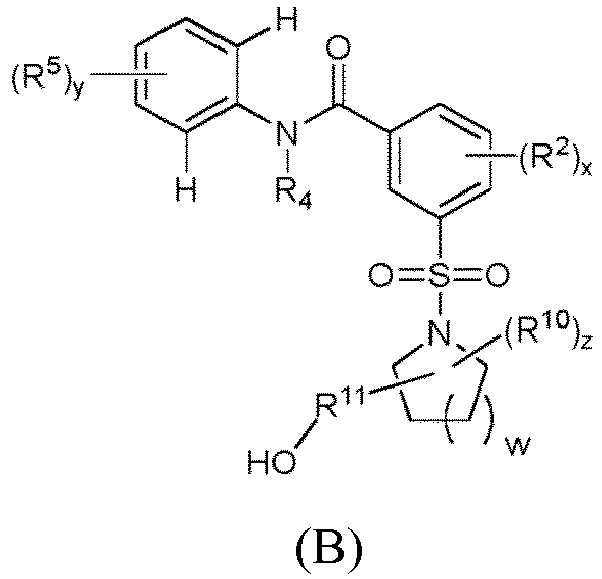
-
WO2014/106019, published on July 3, 2014 , relates to compounds of formula C, useful as nucleocapsid assembly inhibitors for the treatment of viruses, especially but not exclusively, including pregenomic RNA encapsidation inhibitors of HBV for the treatment of Hepatitis B virus (HBV) infection and related conditions:
-
WO2014/165128, published on October 9, 2014 ,WO2015/109130 published on July 23, 2015 ,US2015274652, published on October 1, 2015 , all relate to sulfamoyl-arylamides compounds active against HBV. -
WO2015/120178, published on August 13, 2015 , relates to sulfamoyl-arylamides compounds used in combinantion therapy with peginterferon alfa-2a, or another interferon analog for the treatment of HBV infection. -
WO2016/089990, published on June 9, 2016 , relates to sulfide alkyl and pyridyl reverse sulphonamide compounds for HBV treatment. -
US2016185748, published on June 30, 2016 , relates to pyridyl reverse sulfonamides for HBV treatment. -
US2016151375, published on June 2, 2016 relates to sulfide alkyl compounds for HBV treatment.WO2017/001655A1, published on January 5, 2017 , relates to cyclized sulfamoylarylamide derivatives having structure:
- Amongst the problems which HBV direct antivirals may encounter are toxicity, mutagenicity, lack of selectivity, poor efficacy, poor bioavailability, low solubility and/or off-target activity, and until now there are no compounds in any of the structural classes identified above approved as drugs for the treatment of HBV patients.
- There is a need for additional HBV inhibitors that may overcome at least one of these disadvantages or that have additional advantages such as increased potency, increased bioavailability or an increased safety window.
- The present invention provides small molecule drugs obtained through chemical modification of the known sulfamoyl arylamides derivatives. In particular the compound of the invention are characterized by a fused tricyclic core structure comprising a pyrrole ring. The chemotype discovered in the present invention results in potent HBV inhibitors with improved pharmacokinetic properties, good kinetic solubility, stability in mouse and human hepatocytes, low in vivo clearance and positive liver-to-plasma concentration. Given the liver's key role in metabolic regulation and the fact that it is the principal tissue affected by hepatitis B disease, designing HBV inhibitors with hepatoselective distribution profiles is an important strategy in developing safe drug candidates (Tu M. et al., Current Topics in Medicinal Chemistry, 2013, 13, 857-866).
- The compounds of this invention are inhibitors of hepatitis B virus (HBV).
- It is therefore an object of the present invention a compound of general formula (I):

- Cy is aryl or heteroaryl;
- X is O, NH or N-C1-6alkyl;
- Y, Y', Y" and Y'" are each independently a single bond or C1-6alkanediyl optionally substituted with one or more R3;
- Z is CR4 or N;
- W is a single bond or NR5, wherein if W is a single bond, Z is N, and if W is NR5, Z is CR4;
- A is NR6, O, S or C1-6alkanediyl optionally substituted with one or more R3;
- R1 is H or C1-6alkyl;
- R2 is selected from H, OH and C1-6alkyl;
- R3 is selected from H, OH, C1-6alkyl, C3-8cycloalkyl and halogen or two geminal R3 form together with the atom to which they are attached a spiro-C3-8cycloalkyl or a spiro-C3-8heterocycloalkyl; R4 is H or C1-6alkyl;
- or when W is NR5 and Z is CR4, R2 and R4 may optionally form a C1-6alkanediyl bridge;
- R5 is selected from H, C1-6alkyl, C1-6alkylaryl, C1-6alkylheteroaryl and C1-6alkyl-C3-8cycloalkyl wherein each of said C1-6alkyl, C1-6alkylaryl, C1-6alkylheteroaryl or C1-6alkyl-C3-8cycloalkyl is optionally substituted with one or more substituents each independently selected from: OH, halogen, haloC1-6alkyl, cyano and NH2;
- R6 is selected from:
- hydrogen;
- OH;
- C(O)R7;
- C(O)OR7;
- C(O)NHR7;
- C(O)N(R7)2;
- SO2R7;
- SO2NH(R7);
- SO2N(R7)2;
- C1-6alkyl optionally substituted with one or more substituents each independently selected from the group consisting of: OH, halogen, CN, NH2, NH(R7), N(R7)2, aryl, heteroaryl, 3-7 membered saturated ring and 5-7 membered unsaturated ring, each of said saturated or unsaturated ring optionally containing one or more heteroatoms selected from the group consisting of O, N and S and each of said aryl, heteroaryl, 3-7 membered saturated or 5-7 membered unsaturated ring being optionally substituted with one or more substituents each independently selected from OH, halogen, haloC1-6alky 1, CN, haloC1-6alkoxy and C1-6alkoxy;
- aryl or heteroaryl ring, each of said aryl or heteroaryl ring being optionally substituted with one or more substituents each independently selected from: OH, halogen, haloC1-6alkyl, CN, haloC1-6alkoxy and C1-6alkoxy; and
- a 3-8 membered saturated or partially unsaturated cyclic or bicyclic ring optionally containing one or more heteroatoms each independently selected from the group consisting of: O, S and N, the 3-8 membered saturated or partially unsaturated cyclic or bicyclic ring being optionally substituted with one, two or more substituents each independently selected from the group consisting of: OH, halogen, CN, C1-6alkyl, hydroxyC1-6alkyl, C(O)OR7, C(O)R7, haloC1-6alkyl, haloC1-6alkoxy and C1-6alkoxy;
- R7 is selected from the group consisting of: C1-6alkyl, C3-8cycloalkyl, aryl, heteroaryl and 3-8 membered saturated or partially saturated heterocyclic ring, wherein each of said C1-6alkyl, C3-8cycloalkyl, aryl, heteroaryl or 3-8 membered saturated or partially saturated heterocyclic ring is optionally substituted with one or more substituents each independently selected from the group consisting of: OH, halogen, CN, C1-6alkyl, hydroxyC1-6alkyl, haloC1-6alkyl, haloC1-6alkoxy and C1-6alkoxy;
- Ra, Rb, Rc and Rd are each idependently selected from the group consisting of: hydrogen, halogen, CN, C1-6alkyl, C1-6alkoxy, haloC1-6alkyl and haloC1-6alkoxy;
- and pharmaceutically acceptable salts, tautomers, isomers, stereoisomers thereof.
- Preferably, Cy is aryl. Still preferably, Cy is phenyl.
- Preferably, X is O or NH. Still preferably, X is O.
- Preferably, Y, Y' and Y" are each idependently a single bond or an unsubstituted C1-4alkanediyl. More preferably, Y, Y' and Y" are each idependently methanediyl. Preferably, Y'" is a single bond. Preferably, Y and Y" are the same and are both a single bond or an unsubstituted C1-4alkanediyl. More preferably, Y and Y" are the same and are both methanediyl.
- Preferably, Z is CH or N. Still preferably, Z is CH.
- Preferably, W is a single bond or NH. More preferably, W is NH.
- Preferably, A is NR6 or unsubstituted C1-4alkanediyl. More preferably, A is NR6 or methanediyl. Also preferably, A is NR6 or methanediyl and Y' and Y" are the same and are both methanediyl. Preferably, R1 is C1-6alkyl. More preferably, R1 is methyl.
- Preferably, R2 is H, OH or methyl. More preferably, R2 is H.
- Preferably, R3 is H. Preferably, R4 is H. Preferably, R5 is H.
- Preferably, R6 is selected from: hydrogen, C(O)OR7, C(O)NHR7, SO2R7, SO2NH(R7) and unsubstitued C1-6alkyl. Still preferably, R6 is selected from: hydrogen, C(O)OEt, C(O)OtBu, C(O)NHMe, SO2iPr, SO2Me, SO2cyclopropyl, SO2NHiPr and methyl.
- Preferably, R7 is C1-6alkyl or a 3-8 membered saturated heterocyclic ring. More preferably, R7 selected from: ethyl, i-propyl, methyl, cyclopropyl, t-butyl and hexahydrofuro[2,3-b]furan system. Preferably, Ra, Rb, Rc and Rd are each idependently selected from the group consisting of: hydrogen, halogen, CN, C1 - 6alkyl and haloC1 - 6alkyl. More preferably, Ra, Rb, Rc and Rd are each idependently selected from the group consisting of: hydrogen, fluorine, chlorine, methyl, CN and CHF2.
- Preferably at least one of Ra, Rb, Rc and Rd is halogen, more preferably fluorine, and the other(s) is/are hydrogen.
- Preferably, at least two of Ra, Rb, Rc and Rd are each idependently selected from the group consisting of: hydrogen, halogen, CN, C1-6alkyl and haloC1-6alkyl. More preferably, at least two of Ra, Rb, Rc and Rd are each idependently selected from the group consisting of: hydrogen, fluorine, chlorine, methyl, CN and CHF2.
- Preferably, at least three of Ra, Rb, Rc and Rd are each idependently selected from the group consisting of: hydrogen, halogen, CN, C1-6alkyl and haloC1-6alkyl. More preferably, at least three of Ra, Rb, Rc and Rd are each idependently selected from the group consisting of: hydrogen, fluorine, chlorine, methyl, CN and CHF2.
- Preferably, two of Ra, Rb, Rc and Rd are halogen, more preferably fluorine.
- Preferably, three of Ra, Rb, Rc and Rd are halogen, more preferably fluorine.
- It is a further object of the invention a compound having general formula (Ia):

- Cy is aryl or heteroaryl;
- X is O, NH or N-C1-6alkyl;
- Y, Y' and Y" are each independently a single bond or C1-6alkanediyl optionally substituted with one or more R3;
- A is NR6, O, S or C1-6alkanediyl optionally substituted with one or more R3;
- R1 is H or C1-6alkyl;
- R2 is selected from H, OH and C1-6alkyl;
- R3 is selected from H, OH, C1-6alkyl, C3-8cycloalkyl and halogen or two geminal R3 form together with the atom to which they are attached a spiro-C3-8cycloalkyl or a spiro-C3-8heterocycloalkyl; R6 is selected from:
- hydrogen;
- OH;
- C(O)R7;
- C(O)OR7;
- C(O)NHR7;
- C(O)N(R7)2;
- SO2R7;
- SO2NH(R7);
- SO2N(R7)2;
- C1-6alkyl optionally substituted with one or more substituents each independently selected from the group consisting of: OH, halogen, CN, NH2, NH(R7), N(R7)2, aryl, heteroaryl, 3-7 membered saturated ring and 5-7 membered unsaturated ring, each of said saturated or unsaturated ring optionally containing one or more heteroatoms selected from the group consisting of O, N and S and each of said aryl, heteroaryl, 3-7 membered saturated or 5-7 membered unsaturated ring being optionally substituted with one or more substituents each independently selected from OH, halogen, haloC1-6alky 1, CN, haloC1-6alkoxy and C1-6alkoxy;
- aryl or heteroaryl ring, each of said aryl or heteroaryl ring being optionally substituted with one or more substituents each independently selected from: OH, halogen, haloC1-6alkyl, CN, haloC1-6alkoxy and C1-6alkoxy; and
- a 3-8 membered saturated or partially unsaturated cyclic or bicyclic ring optionally containing one or more heteroatoms each independently selected from the group consisting of: O, S and N, the 3-8 membered saturated or partially unsaturated cyclic or bicyclic ring being optionally substituted with one, two or more substituents each independently selected from the group consisting of: OH, halogen, CN, C1-6alkyl, hydroxyC1-6alkyl, C(O)OR7, C(O)R7, haloC1-6alkyl, haloC1-6alkoxy and C1-6alkoxy;
- R7 is selected from the group consisting of: C1-6alkyl, C3-8cycloalkyl, aryl, heteroaryl and 3-8 membered saturated or partially saturated heterocyclic ring, wherein each of said C1-6alkyl, C3-scycloalkyl, aryl, heteroaryl or 3-8 membered saturated or partially saturated heterocyclic ring is optionally substituted with one or more substituents each independently selected from the group consisting of: OH, halogen, CN, C1-6alkyl, hydroxyC1-6alkyl, haloC1-6alkyl, haloC1-6alkoxy and C1-6alkoxy;
- Ra, Rb, Rc and Rd are each idependently selected from the group consisting of: hydrogen, halogen, CN, C1-6alkyl, C1-6alkoxy, haloC1-6alkyl and haloC1-6alkoxy;
- and pharmaceutically acceptable salts, tautomers, isomers, stereoisomers thereof.
- In a preferred embodiment, the invention provides a compound having general formula (Ia) as defined above, wherein Cy is phenyl, and/or X is O or NH, and/or A is CH2, and/or R1 is CH3, and/or R2 is hydrogen and/or R3 is hydrogen and pharmaceutically acceptable salts, tautomers, isomers, stereoisomers thereof. Preferably, Cy is phenyl, X is O or NH, A is CH2, R1 is CH3, R2 and R3 are hydrogen.
- It is a further object of the invention a compound having general formula (Ib):

- Cy is aryl or heteroaryl;
- X is O, NH or N-C1-6alkyl;
- Y, Y' and Y" are each independently a single bond or C1-6alkanediyl optionally substituted with one or more R3;
- A is NR6, O, S or C1-6alkanediyl optionally substituted with one or more R3;
- R1 is H or C1-6alkyl;
- R2 is selected from H, OH and C1-6alkyl;
- R3 is selected from H, OH, C1-6alkyl, C3-8cycloalkyl and halogen or two geminal R3 form together with the atom to which they are attached a spiro-C3-8cycloalkyl or a spiro-C3-8heterocycloalkyl;
- R4 is H or C1-6alkyl;
- or R2 and R4 may optionally form a C1-6alkanediyl bridge;
- R5 is selected from H, C1-6alkyl, C1-6alkylaryl, C1-6alkylheteroaryl and C1-6alkyl-C3-8cycloalkyl wherein each of said C1-6alkyl, C1-6alkylaryl, C1-6alkylheteroaryl or C1-6alkyl-C3-8cycloalkyl is optionally substituted with one or more substituents each independently selected from: OH, halogen, haloC1-6alkyl, cyano and NH2;
- R6 is selected from:
- hydrogen;
- OH;
- C(O)R7;
- C(O)OR7;
- C(O)NHR7;
- C(O)N(R7)2;
- SO2R7;
- SO2NH(R7);
- SO2N(R7)2;
- C1-6alkyl optionally substituted with one or more substituents each independently selected from the group consisting of: OH, halogen, CN, NH2, NH(R7), N(R7)2, aryl, heteroaryl, 3-7 membered saturated ring and 5-7 membered unsaturated ring, each of said saturated or unsaturated ring optionally containing one or more heteroatoms selected from the group consisting of O, N and S and each of said aryl, heteroaryl, 3-7 membered saturated or 5-7 membered unsaturated ring being optionally substituted with one or more substituents each independently selected from OH, halogen, haloC1-6alky 1, CN, haloC1-6alkoxy and C1-6alkoxy;
- aryl or heteroaryl ring, each of said aryl or heteroaryl ring being optionally substituted with one or more substituents each independently selected from: OH, halogen, halo C1-6alkyl, CN, haloC1-6alkoxy and C1-6alkoxy; and
- a 3-8 membered saturated or partially unsaturated cyclic or bicyclic ring optionally containing one or more heteroatoms each independently selected from the group consisting of: O, S and N, the 3-8 membered saturated or partially unsaturated cyclic or bicyclic ring being optionally substituted with one, two or more substituents each independently selected from the group consisting of: OH, halogen, CN, C1-6alkyl, hydroxyC1-6alkyl, C(O)OR7, C(O)R7, haloC1-6alkyl, haloC1-6alkoxy and C1-6alkoxy;
- R7 is selected from the group consisting of: C1-6alkyl, C3-8cycloalkyl, aryl, heteroaryl and 3-8 membered saturated or partially saturated heterocyclic ring, wherein each of said C1-6alkyl, C3-scycloalkyl, aryl, heteroaryl or 3-8 membered saturated or partially saturated heterocyclic ring is optionally substituted with one or more substituents each independently selected from the group consisting of: OH, halogen, CN, C1-6alkyl, hydroxyC1-6alkyl, haloC1-6alkyl, haloC1-6alkoxy and C1-6alkoxy;
- Ra, Rb, Rc and Rd are each idependently selected from the group consisting of: hydrogen, halogen, CN, C1-6alkyl, C1-6alkoxy, haloC1-6alkyl and haloC1-6alkoxy;
- and pharmaceutically acceptable salts, tautomers, isomers, stereoisomers thereof.
- In a preferred embodiment, the invention provides a compound having general formula (Ib) as defined above, wherein Cy is phenyl, and/or X is O, and/or Y is CH2, and/or Y' is CH2, and/or Y" is CH2, and/or A is CH2, O or NR6 and pharmaceutically acceptable salts, tautomers, isomers, stereoisomers thereof. Preferably, Cy is phenyl, X is O, Y is CH2, Y' is CH2, Y" is CH2, and A is CH2, O or NR6.
- Preferably, Cy is phenyl; and/or X is O; and/or Y is a single bond or methanediyl; and/or R1 is methyl; and/or R2 is H.
- In a preferred embodiment compounds of the invention are selected from the following list:
- N-(3,4-difluorophenyl)-2-methyl-6,7,8,9,9a,10-hexahydro-2H-pyrido[1,2-e]pyrrolo[3,4-b][1,4,5]oxathiazepine-1-carboxamide 4,4-dioxide;
- N-(3,4-difluorophenyl)-2-methyl-2,6,7,8,9,9a,10,11-octahydropyrido[1,2-b]pyrrolo[3,4-f][1,2,5]thiadiazepine-1-carboxamide 4,4-dioxide;
- N-(3,4-difluorophenyl)-2-methyl-6,7,7a,8-tetrahydro-2H-azeto[1,2-e]pyrrolo[3,4-b][1,4,5]oxathiazepine-1-carboxamide 4,4-dioxide;
- trans-N-(3,4-difluorophenyl)-7-methyl-1,3a,4,9a-tetrahydro-3H,7H-furo[3,4-f]pyrrolo[3,4-b][l,4,5]oxathiazepine-8-carboxamide 5,5-dioxide;
- cis-N-(3,4-difluorophenyl)-9-methyl-3,4,5,6-tetrahydro-2H,9H-3,5-methanopyrrolo[3,4-b][1,4,5]oxathiazonine-8-carboxamide 1,1-dioxide;
- cis-N-(3,4-difluorophenyl)-2-methyl-5a,6,7,8,8a,9-hexahydro-2H,5H-cyclopenta[f]pyrrolo[3,4-b][1,4,5]oxathiazocine-1-carboxamide 4,4-dioxide;
- trans-7-methyl-N-(3,4,5-trifluorophenyl)-1,3a,4,9a-tetrahydro-3H,7H-furo[3,4-f]pyrrolo[3,4-b][1,4,5]oxathiazepine-8-carboxamide 5,5-dioxide;
- (5aR,8aR)-N-(3,4-difluorophenyl)-2-methyl-5a,6,7,8,8a,9-hexahydro-2H,5H-cyclopenta[f]pyrrolo[3,4-b][1,4,5]oxathiazocine-1-carboxamide 4,4-dioxide;
- (5aS,8aS)-N-(3,4-difluorophenyl)-2-methyl-5a,6,7,8,8a,9-hexahydro-2H,5H-cyclopenta[f]pyrrolo[3,4-b][1,4,5]oxathiazocine-1-carboxamide 4,4-dioxide;
- cis-Ethyl 7-methyl-8-((3,4,5-trifluorophenyl)carbamoyl)-3a,4,10,10a-tetrahydro-1H,7H-dipyrrolo[3,4-b:3',4'-f][1,4,5]oxathiazocine-2(3H)-carboxylate 5,5-dioxide;
- cis- 7-methyl-N-(3,4,5-trifluorophenyl)-2,3,3a,4,10,10a-hexahydro-1H,7H-dipyrrolo[3,4-b:3',4'-f][l,4,5]oxathiazocine-8-carboxamide 5,5-dioxide;
- cis-2,7-dimethyl-N-(3,4,5-trifluorophenyl)-2,3,3a,4,10,10a-hexahydro-1H,7H-dipyrrolo[3,4-b:3',4'-f][1,4,5]oxathiazocine-8-carboxamide 5,5-dioxide;
- cis-Ethyl 8-((3,4-difluorophenyl)carbamoyl)-7-methyl-3a,4,10,10a-tetrahydro-1H,7H-dipyrrolo[3,4-b:3',4'-f][1,4,5]oxathiazocine-2(3H)-carboxylate 5,5-dioxide;
- cis-Ethyl 8-((4-fluoro-3-methylphenyl)carbamoyl)-7-methyl-3a,4,10,10a-tetrahydro-1H,7H-dipyrrolo[3,4-b:3',4'-f][1,4,5]oxathiazocine-2(3H)-carboxylate 5,5-dioxide;
- cis-Ethyl 8-((3-chloro-4-fluorophenyl)carbamoyl)-7-methyl-3a,4,10, 10a-tetrahydro-1H,7H-dipyrrolo[3,4-b:3',4'-f][1,4,5]oxathiazocine-2(3H)-carboxylate 5,5-dioxide;
- cis-Ethyl 8-((3-(difluoromethyl)-4-fluorophenyl)carbamoyl)-7-methyl-3a,4,10,10a-tetrahydro-1H,7H-dipyrrolo[3,4-b:3',4'-f][1,4,5]oxathiazocme-2(3H)-carboxylate 5,5-dioxide;
- cis-Ethyl 8-((3-cyano-4-fluorophenyl)carbamoyl)-7-methyl-3a,4,10,10a-tetrahydro-1H,7H-dipyrrolo[3,4-b:3',4'-f][1,4,5]oxathiazocine-2(3H)-carboxylate 5,5-dioxide;
- cis-2-(isopropylsulfonyl)-7-methyl-N-(3,4,5-trifluorophenyl)-2,3,3a,4,10,10a-hexahydro-1H,7H-dipyrrolo[3,4-b:3',4'-f][1,4,5]oxathiazocine-8-carboxamide 5,5-dioxide;
- cis-7-methyl-2-(methylsulfonyl)-N-(3,4,5-trifluorophenyl)-2,3,3a,4,10,10a-hexahydro-1H,7H-dipyrrolo[3,4-b:3',4'-f][1,4,5]oxathiazocme-8-carboxamide 5,5-dioxide;
- cis-2-(cyclopropylsulfonyl)-7-methyl-N-(3,4,5-trifluorophenyl)-2,3,3a,4,10,10a-hexahydro-1H,7H-dipyrrolo[3,4-b:3',4'-f][1,4,5]oxathiazocme-8-carboxamide 5,5-dioxide;
- cis-2-(N-isopropylsulfamoyl)-7-methyl-N-(3,4,5-trifluorophenyl)-2,3,3a,4,10,10a-hexahydro-1H,7H-dipyrrolo[3,4-b:3',4'-f][1,4,5]oxathiazocme-8-carboxamide 5,5-dioxide;
- cis-(3R,3aS,6aR)-hexahydrofuro[2,3-b]furan-3-yl 7-methyl-8-((3,4,5-trifluorophenyl)carbamoyl)-3a,4,10,10a-tetrahydro-1H,7H-dipyrrolo[3,4-b:3',4'-f][1,4,5]oxathiazocine-2(3H)-carboxylate 5,5-dioxide;
- N2,7-dimethyl-N8-(3,4,5-trifluorophenyl)-3a,4,10,10a-tetrahydro-1H,7H-dipyrrolo[3,4-b:3',4'-f][1,4,5]oxathiazocine-2,8(3H)-dicarboxamide 5,5-dioxide;
- tert-butyl 7-methyl-8-((3,4,5-trifluorophenyl)carbamoyl)-3a,4,10,10a-tetrahydro-1H,7H-dipyrrolo[3,4-b:3',4'-f][1,4,5]oxathiazocine-2(3H)-carboxylate 5,5-dioxide;
- (3aR,10aS)-N-(3,4-difluorophenyl)-7-methyl-2,3,3a,4,10,10a-hexahydro-1H,7H-dipyrrolo[3,4-b:3',2'-f][1,4,5]oxathiazocme-8-carboxamide 5,5-dioxide;
- (3aR,10aS)-N8-(3,4-difluorophenyl)-N1,7-dimethyl-2,3,3a,4,10,10a-hexahydro-1H,7H-dipyrrolo[3,4-b:3',2'-f][1,4,5]oxathiazocme-1,8-dicarboxamide 5,5-dioxide;
- ethyl (3aR,10aS)-8-((3,4-difluorophenyl)carbamoyl)-7-methyl-2,3,3a,4,10,10a-hexahydro-1H,7H-dipyrrolo[3,4-b:3',2'-f][1,4,5]oxathiazocine-1-carboxylate 5,5-dioxide;
- cis-2-methyl-N-(3,4,5-trifluorophenyl)-5a,6,7,8,8a,9-hexahydro-2H,5H-cyclopenta[f]pyrrolo[3,4-b][1,4,5]oxathiazocine-1-carboxamide 4,4-dioxide;
- N-(3,4-difluorophenyl)-2,8a-dimethyl-5a,6,7,8,8a,9-hexahydro-2H,5H-cyclopenta[f]pyrrolo[3,4-b][1,4,5]oxathiazocine-1-carboxamide 4,4-dioxide;
- cis-N-(3,4-difluorophenyl)-8a-hydroxy-2-methyl-5a,6,7,8,8a,9-hexahydro-2H,5H-cyclopenta[f]pyrrolo[3,4-b][1,4,5]oxathiazocine-1-carboxamide 4,4-dioxide;
- (3aS,10aS)-7-methyl-N-(3,4,5-trifluorophenyl)-2,3,3a,4,10,10a-hexahydro-1H,7H-dipyrrolo[3,4-b:3',4'-f][1,4,5]oxathiazocine-8-carboxamide 5,5-dioxide;
- (3aR,10aR)-7-methyl-N-(3,4,5-trifluorophenyl)-2,3,3a,4,10,10a-hexahydro-1H,7H-dipyrrolo[3,4-b:3',4'-f][1,4,5]oxathiazocine-8-carboxamide 5,5-dioxide;
- ethyl (3aR,10aR)-7-methyl-8-((3,4,5-trifluorophenyl)carbamoyl)-3a,4,10,10a-tetrahydro-1H,7H-dipyrrolo[3,4-b:3',4'-f][1,4,5]oxathiazocine-2(3H)-carboxylate 5,5-dioxide;
- ethyl (3aS,10aS)-7-methyl-8-((3,4,5-trifluorophenyl)carbamoyl)-3a,4,10,10a-tetrahydro-1H,7H-dipyrrolo[3,4-b:3',4'-f][1,4,5]oxathiazocine-2(3H)-carboxylate 5,5-dioxide;
- tert-butyl (3aS,10aS)-7-methyl-8-((3,4,5-trifluorophenyl)carbamoyl)-3a,4,10,10a-tetrahydro-1H,7H-dipyrrolo[3,4-b:3',4'-f][1,4,5]oxathiazocine-2(3H)-carboxylate 5,5-dioxide;
- tert-butyl (3aR,10aR)-7-methyl-8-((3,4,5-trifluorophenyl)carbamoyl)-3a,4,10,10a-tetrahydro-1H,7H-dipyrrolo[3,4-b:3',4'-f][1,4,5]oxathiazocine-2(3H)-carboxylate 5,5-dioxide;
- (5aS,8aR) N-(3,4-difluorophenyl)-2-methyl-5a,6,7,8,8a,9-hexahydro-2H,5H-cyclopenta[f]pyrrolo[3,4-b][1,4,5]oxathiazocine-1-carboxamide 4,4-dioxide;
- (5aR,8aS) N-(3,4-difluorophenyl)-2-methyl-5a,6,7,8,8a,9-hexahydro-2H,5H-cyclopenta[f]pyrrolo[3,4-b][1,4,5]oxathiazocine-1-carboxamide 4,4-dioxide;
- Preferred compounds exhibit an HBV inhibition and/or an EC50, as defined hereinbelow, greater than 50%.
- Preferably, the compounds as defined above are for medical use. Still preferably, the compounds as defined above are for use in the treatment and/or prevention of a HBV infection.
- Even more preferably, the compounds of the invention are used in treating, eradicating, reducing, slowing or inhibiting an HBV infection in an individual in need thereof, and/or in reducing the viral load associated with an HBV infection in an individual in need thereof, and/or reducing reoccurrence of an HBV infection in an individual in need thereof, and/or inducing remission of hepatic injury from an HBV infection in an individual in need thereof, and/or prophylactically treating an HBV infection in an individual afflicted with a latent HBV infection.
- Preferably, the compound as defined above is for use in combination with at least one further therapeutic agent. Preferably, said use in combination comprises the administration of at least one therapeutic agent.
- It is an object of the invention a pharmaceutical composition comprising the compound as defined above, alone or in combination with at least one further therapeutic agent, and at least one pharmaceutically acceptable excipient.
- Preferably, the at least one further therapeutic agent is selected from the group consisting of: a therapeutic vaccine; an RNA interference therapeutic/antisense oligonucleotide; an immunomodulator; a STING agonist; a RIG-I modulator; a NKT modulator; an IL agonist; an interleukin or another immune acting protein; a therapeutic and prophylactic vaccine; an immune checkpoint modulator/inhibitor; an HBV entry inhibitor; a cccDNA modulator; an inhibitor of HBV protein espression; an agent targeting HBV RNA; a capsid assembly inhibitor/modulator; a core or X protein targeting agent; a nucleotide analogue; a nucleoside analogue; an interferon or a modified interferon; an HBV antiviral of distinct or unknown mechanism; a cyclophilin inhibitor; a sAg release inhibitor; a HBV polymerase inhibitor; a dinucleotide; a SMAC inhibitor; a HDV targeting agent; a viral maturation inhibitor; a reverse transcriptase inhibitor and an HBV RNA destabilizer or another small-molecule inhibitor of HBV protein expression; or a combination thereof.
- Preferably, the therapeutic vaccine is selected from: HBsAG-HBIG, HB-Vac, ABX203, NASVAC, GS-4774, GX- 110 (HB-110E), CVI-HBV-002, RG7944 (INO-1800), TG-1050, FP-02 (Hepsyn-B), AIC649, VGX-6200, KW-2, TomegaVax-HBV, ISA-204, NU-500, INX-102-00557, HBV MVA and PepTcell.
- Preferably, the RNA interference therapeutic is a siRNA, a ddRNA or a shRNA. Preferably, the RNA interference therapeutic is selected from: TKM-HBV (ARB-1467), ARB-1740, ARC-520, ARC-521, BB-HB-331, REP-2139, ALN-HBV, ALN-PDL, LUNAR-HBV, GS3228836 and GS3389404.
- Preferably, the immunomodulator is a TLR agonist. Preferably the TLR agonist is a TLR7, TLR8 or TLR9 agonist. Preferably, the TLR7, TLR8 or TLR9 agonist is selected from: RG7795 (
RO-6864018 - Preferably, the RIG-I modulator is SB-9200. Preferably, the IL agonist or other immune acting protein is INO-9112 or recombinant IL12. Preferably, the immune checkpoint modulator/inhibitor is BMS-936558 (Opdivo (nivolumab)) or pembrolizumab. Preferably, the HBV entry inhibitor is Myrcludex B, IVIG-Tonrol or GC-1102.
- Preferably, the cccDNA modulator is selected from: a direct cccDNA inhibitor, an inhibitor of cccDNA formation or maintenance, a cccDNA epigenetic modifier and an inhibitor of cccDNA transcription.
- Preferably, the capsid assembly inhibitor/modulator, core or X protein targeting agent, direct cccDNA inhibitor, inhibitor of cccDNA formation or maintenance, or cccDNA epigenetic modifier is selected from: BAY 41-4109, NVR 3-778, GLS-4, NZ-4 (W28F), Y101, ARB-423, ARB-199, ARB-596, AB-506, JNJ-56136379, ASMB-101 (AB-V102), ASMB-103, CHR-101, CC-31326, AT-130 and
RO7049389 - Preferably, the interferon or modified interferon is selected from: interferon alpha (IFN-α), pegylated interferon alpha (PEG-IFN-α), interferon alpha-2a, recombinant interferon alpha-2a, peginterferon alpha-2a (Pegasys), interferon alpha-2b (Intron A), recombinant interferon alpha-2b, interferon alpha-2b XL, peginterferon alpha-2b, glycosylated interferon alpha-2b, interferon alpha-2c, recombinant interferon alpha-2c, interferon beta, interferon beta-la, peginterferon beta-la, interferon delta, interferon lambda (IFN-λ), peginterferon lambda-1, interferon omega, interferon tau, interferon gamma (IFN-γ), interferon alfacon-1, interferon alpha-nl, interferon alpha-n3, albinterferon alpha-2b, BLX-883, DA-3021, PI 101 (also known as AOP2014), PEG-infergen, Belerofon, INTEFEN-IFN, albumin/interferon alpha 2a fusion protein, rHSA-IFN alpha 2a, rHSA-IFN alpha 2b, PEG-IFN-SA and interferon alpha biobetter. Particularly preferred are: peginterferon alpha-2a, peginterferon alpha-2b, glycosylated interferon alpha-2b, peginterferon beta-la, and peginterferon lambda-1. More particularly preferred is peginterferon alpha-2a. Preferably, the HBV antiviral of distinct or unknown mechanism is selected from: AT-61 ((E)-N-(1-chloro-3-oxo-1-phenyl-3-(piperidin-1-yl)prop-1-en-2-yl)benzamide), AT130 ((E)-N-(1-bromo-1-(2-methoxyphenyl)-3-oxo-3-(piperidin-1-yl)prop-1-en-2-yl)-4-nitrobenzamide), analogues thereof, REP-9AC (REP-2055), REP-9AC' (REP-2139), REP-2165 and HBV-0259. Preferably, the cyclophilin inhibitor is selected from: OCB-030 (NVP-018), SCY-635, SCY-575 and CPI-431-32.
- Preferably, said HBV polymerase inhibitor is selected from: entecavir (Baraclude, Entavir), lamivudine (3TC, Zeffix, Heptovir, Epivir, and Epivir-HBV), telbivudine (Tyzeka, Sebivo), clevudine, besifovir, adefovir (hepsera), tenofovir. Preferably, tenofovir is in a salt form. Preferably, tenofovir is in a salt form selected from: tenofovir disoproxil fumarate (Viread), tenofovir alafenamide fumarate (TAF), tenofovir disoproxil orotate (DA-2802), tenofovir disopropxil aspartate (CKD-390), AGX-1009, and CMX157.
- Preferably, the dinucleotide is SB9200. Preferably, the SMAC inhibitor is Birinapant. Preferably, the HDV targeting agent is Lonafamib.
- Preferably, the HBV RNA destabilizer or other small-molecule inhibitor of HBV protein expression is RG7834 or AB-452.
- Preferably, the at least one further therapeutic agent is an agent useful in the treatment and prevetion of hepatitis B. Preferably, the at least one further therapeutic agent is an anti-HDV agent, an anti-HCV agent and/or an anti-HIV agent.
- Preferably, the at least one further therapeutic agent is selected from the group consisting of: HBV polymerase inhibitor, interferon, viral entry inhibitor, BAY 41-4109, reverse transcriptase inhibitor, a TLR-agonist, AT-61 ((E)-N-(1-chloro-3-oxo-1-phenyl-3-(piperidin-1-yl)prop-1-en-2-yl)benzamide), AT-130 ((E)-N-(1-bromo-1-(2-methoxyphenyl)-3-oxo-3-(piperidin-1-yl)prop-1-en-2-yl)-4-nitrobenzamide), and a combination thereof, wherein the HBV polymerase inhibitor is preferably at least one of Lamivudine, Entecavir, Tenofovir, Adefovir, Telbivudine, Clevudine; and wherein the TLR agonist is preferably selected from the group consisting of SM360320 (9-benzyl-8-hydroxy-2-(2-methoxy-ethoxy)adenine), AZD 8848 (methyl [3-({[3-(6-amino-2-butoxy-8-oxo-7,8-dihydro-9H-purin-9-yl)propyl][3-(4-morpholinyl)propyl] amino }methyl)phenyl] acetate) and a combination thereof.
- Preferably, the compound of the invention is for use in combination with one, two or more further therapeutic agent(s) as defined above.
- Preferably, the pharmaceutical composition of the invention comprises one, two or more further therapeutic agent(s) as defined above.
- Preferably, said pharmaceutical composition is for use in the treatment and/or prevention of a HBV infection. Even more preferably, said pharmaceutical composition is for use in treating, eradicating, reducing, slowing or inhibiting an HBV infection in an individual in need thereof, and/or in reducing the viral load associated with an HBV infection in an individual in need thereof, and/or reducing reoccurrence of an HBV infection in an individual in need thereof, and/or inducing remission of hepatic injury from an HBV infection in an individual in need thereof, and/or prophylactically treating an HBV infection in an individual afflicted with a latent HBV infection. In an embodiment, the invention provides a kit comprising at least one pharmaceutically acceptable vial or container containing one or more doses of a compound of the invention or of a pharmaceutical composition of the invention and optionally a) instructions for use thereof in mammals and/or b) an infusion bag or container containing a pharmaceutically acceptable diluent. It is a further object of the invention a process for the synthesis of a compound of general formula (I), (Ia) or (Ib) according to the synthetic Schemes included in the description of the invention.
- It is a further object of the invention a pharmaceutical composition comprising an effective amount of one or more compounds as defined above or a pharmaceutically acceptable prodrug thereof, alone or in combination with other active compounds, and at least one pharmaceutically acceptable excipient.
- In a preferred embodiment, the invention relates to compounds of formula (I) wherein Cy is phenyl. Still preferably, the invention relates to compounds of formula (I) wherein X is O.
- In a preferred embodiment, the compound of the invention has formula (Ia) wherein Cy is phenyl, X is O or NH, A is CH2, R1 is CH3, R2 and R3 are hydrogen.
- In a further preferred embodiment, the compound of the invention has formula (Ib) wherein Cy is phenyl, X is O, Y is a single bond, Y' is CH2, Y" is CH2 or a single bond and A is CH2, O or N-R6.
- The present invention includes within its scope prodrugs of the compounds of formula (I), (Ia) or (Ib) above. In general, such prodrugs will be functional derivatives of the compounds of formula (I), (Ia), (Ib) which are readily convertible in vivo into the required compound of formula (I), (Ia), (Ib). Conventional procedures for the selection and preparation of suitable prodrug derivatives are described, for example, in "Design of Prodrugs", ed. H. Bundgaard, Elsevier, 1985.
- A prodrug may be a pharmacologically inactive derivative of a biologically active substance (the "parent drug" or "parent molecule") that requires transformation within the body in order to release the active drug, and that has improved delivery properties over the parent drug molecule. The transformation in vivo may be, for example, as the result of some metabolic process, such as chemical or enzymatic hydrolysis of a carboxylic, phosphoric or sulphate ester, or reduction or oxidation of a susceptible functionality.
- The disclosure also includes all suitable isotopic variations of a compound of the disclosure. Examples of isotopes that can be incorporated into compounds of the disclosure include isotopes such as 2H, 3H, 13C, 14C, 15N, 17O, 18O, 31P, 32P, 35S, 18F and 36Cl, respectively. Certain isotopic variations of the disclosure, for example, those in which a radioactive isotope such as 3H or 14C is incorporated, are useful in drug and/or substrate tissue distribution studies. Further, substitution with isotopes such as deuterium 2H, may afford certain therapeutic advantages resulting from greater metabolic stability. Isotopic variations of the compounds of the disclosure can generally be prepared by conventional procedures such as by the illustrative methods or by the preparations described in the examples hereafter using appropriate isotopic variations of suitable reagents. The present invention includes within its scope solvates of the compounds of (I), (Ia) or (Ib) and salts thereof, for example, hydrates.
- The compounds of the present invention may have asymmetric centers, chiral axes, and chiral planes (as described in: E.L. Eliel and S.H. Wilen, Stereochemistry of Carbon Compounds, John Wiley & Sons, New York, 1994, pages 1119-1190), and occur as racemates, racemic mixtures, and as individual diastereomers, with all possible isomers and mixtures thereof, including optical isomers, all such stereoisomers being included in the present invention. In addition, the compounds disclosed herein may exist as tautomers and both tautomeric forms are intended to be encompassed by the scope of the invention, even though only one tautomeric structure is depicted. The compounds may exist in different isomeric forms, all of which are encompassed by the present invention.
- Pure stereoisomeric forms of the compounds and intermediates of this invention may be obtained by the application of art-known procedures. For instance, enantiomers may be separated from each other by the selective crystallization of their diastereomeric salts or by chromatographic techniques using chiral stationary phases. Pure stereochemically isomeric forms may also be derived from the corresponding pure stereochemically isomeric forms of the appropriate starting materials, provided that the reaction occurs stereospecifically.
- When any variable (e.g. R1 and R2, etc.) occurs more than one time in any constituent, its definition on each occurrence is independent at every other occurrence. Also, combinations of substituents and variables are permissible only if such combinations result in stable compounds. Lines drawn into the ring systems from substituents represent that the indicated bond may be attached to any of the substitutable ring atoms. If the ring system is polycyclic, it is intended that the bond be attached to any of the suitable carbon atoms on the proximal ring only.
- It is understood that substituents and substitution patterns on the compounds of the instant invention can be selected by one of ordinary skill in the art to provide compounds that are chemically stable and that can be readily synthesized by techniques known in the art, as well as those methods set forth below, from readily available starting materials. If a substituent is itself substituted with more than one group, it is understood that these multiple groups may be on the same carbon or on different carbons, so long as a stable structure results. The phrase "optionally substituted" should be taken to be equivalent to the phrase "unsubstituted or substituted with one or more substituents" and in such cases the preferred embodiment will have from zero to three substituents. More particularly, there are zero to two substituents.
- The expressions "one or more substituents" and "one, two or more substituents" refer to in particular to 1, 2, 3, 4 or more substituents, in particular to 1, 2, 3 or 4 substituents, more in particular 1, 2 or 3 substituents.
- As used herein "Y is a single bond" indicates that, in the general formula (I), X is directly linked via a single bond to the carbon atom bearing R2; "Y' is a single bond" indicates that, in the general formula (I), A is directly linked via a single bond to Z; "Y" is a single bond" indicates that, in the general formula (I), A is directly linked via a single bond to the carbon atom bearing R2; "Y"' is a single bond" indicates that Z, in the general formula (I), is directly linked via a single bond to the carbon atom bearing R2.
- As used herein, "alkyl" is intended to include both branched and straight-chain saturated aliphatic hydrocarbon groups having the specified number of carbon atoms. For example, "C1-6alkyl" is defined to include groups having 1, 2, 3, 4, 5 or 6 carbons in a linear or branched arrangement. For example, "C1-6 alkyl" specifically includes methyl, ethyl, n-propyl, i-propyl, n-butyl, t-butyl, i-butyl, pentyl, hexyl, and so on. "C1-4alkyl" is defined to include groups having 1, 2, 3 or 4 carbons in a linear or branched arrangement. For example, "C1-4 alkyl" specifically includes methyl, ethyl, n-propyl, i-propyl, n-butyl, t-butyl, i-butyl, and so on. "C1-3alkyl" is defined to include groups having 1, 2, or 3 carbons in a linear or branched arrangement. For example, "C1-3 alkyl" specifically includes methyl, ethyl, n-propyl, i-propyl, and so on. Preferred alkyl groups are methyl, ethyl, i-propyl or t-butyl.
- As used herein, "alkoxy" represents an alkyl group of indicated number of carbon atoms attached through an oxygen bridge. "Alkoxy" therefore encompasses the definitions of alkyl above. C1-6 alkoxy group is preferably a linear or branched C1-4 alkoxy group, more preferably a C1-3alkoxy group, still more preferably a C1-2 alkoxy group. Examples of suitable alkoxy groups include, but are not limited to methoxy, ethoxy, n-propoxy, i-propoxy, n-butoxy, s-butoxy or t-butoxy. preferred alkoxy groups include methoxy, ethoxy and t-butoxy.
- As used herein, the terms "haloC1-6alkyl" and "haloC1-6alkoxy" mean a C1-6alkyl or C1-6alkoxy group in which one or more (in particular, 1 to 3) hydrogen atoms have been replaced by halogen atoms, especially fluorine or chlorine atoms. HaloC1-6alkoxy group is preferably a linear or branched haloC1-4alkoxy group, more preferably a haloC1-3alkoxy group, still more preferably a haloC1-2alkoxy group, for example OCF3, OCHF2, OCH2F, OCH2CH2F, OCH2CHF2 or OCH2CF3, and most especially OCF3 or OCHF2. HaloC1-6alkyl group is preferably a linear or branched haloC1-3alkyl group, more preferably a haloC1-2alkyl group for example, CF3, CHF2, CH2F, CH2CH2F, CH2CHF2, CH2CF3 or CH(CH3)CF3, and most especially CF3, CHF2 or CH(CH3)CF3,.
- As used herein, the term "hydroxyC1-6alkyl" means a C1-6alkyl group in which one or more (in particular, 1 to 3) hydrogen atoms have been replaced by hydroxy groups. Similarly, the term "hydroxyC1-4alkyl" means a C1-4alkyl group in which one or more (in particular, 1 to 2) hydrogen atoms have been replaced by hydroxy groups. Illustrative examples include, but are not limited to CH2OH, CH2CH2OH, CH(CH)3OH and CHOHCH2OH.
- As used herein, the term "aryl" means a monocyclic or polycyclic aromatic ring comprising carbon atoms and hydrogen atoms. If indicated, such aromatic ring may include one or more heteroatoms, then also referred to as "heteroaryl", preferably, 1 to 3 heteroatoms, independently selected from nitrogen, oxygen, and sulfur, preferably nitrogen. As is well known to those skilled in the art, heteroaryl rings have less aromatic character than their all-carbon counter parts. Thus, for the purposes of the present invention, a heteroaryl group need only have some degree of aromatic character. Illustrative examples of aryl groups are optionally substituted phenyl. Illustrative examples of heteroaryl groups according to the invention include optionally substituted thiophene, oxazole, thiazole, thiadiazole, imidazole, pyrazole, pyrimidine, pyrazine and pyridine. Thus, examples of monocyclic aryl optionally containing one or more heteroatoms, for example one or two heteroatoms, are a 5- or 6-membered aryl or heteroaryl group such as, but not limited to, phenyl, pyridyl, pyrimidinyl, pyrazinyl, pyridazinyl, pyrrolyl, thienyl, thiazolyl, thiadiazolyl, pyrazolyl, imidazolyl, triazolyl, tetrazolyl, furyl, isoxazolyl, oxadiazolyl and oxazolyl. Examples of polycyclic aromatic ring, optionally containing one or more heteroatoms, for example one or two heteroatoms, are a 8-10 membered aryl or heteroaryl group such as, but not limited to, benzimidazolyl, benzofurandionyl, benzofuranyl, benzofurazanyl, benzopyrazolyl, benzotriazolyl, benzothienyl, benzoxazolyl, benzoxazolonyl, benzothiazolyl, benzothiadiazolyl, benzodioxolyl, benzoxadiazolyl, benzoisoxazolyl, benzoisothiazolyl, indolyl, indolizinyl, isoindolinyl, indazolyl, isobenzofuranyl, isoindolyl, isoquinolyl, quinazolinyl, quinolyl, quinoxalinyl, quinolizinyl, naphtyl, naphthyridinyl and phthalazinyl. A preferred aromatic ring according to the present invention is phenyl. A preferred heteroaryl according to the present invention is pyridyl.
- Heterocycle, heterocyclic compound or ring structure is a cyclic compound that has atoms of at least two different elements as members of its ring(s).
- As used herein, the term "heterocyclic ring" is a saturated or partially saturated non aromatic monocyclic or bicyclic ring system, of 4 to 10 members which contains one or more heteroatoms selected from N, O or S. Examples include, but are not limited to azetidinyl, piperazinyl, piperidinyl, morpholinyl, thiomorpholinyl, thiazolidinyl, pyrrolidinyl, azepanyl, diazepanyl, oxazepanyl, thiazepanyl, azocanyl, oxazocanyl and the hexahydrofuro[2,3-b]furan system.
- A substituent on a saturated, partially saturated or unsaturated heterocycle can be attached at any substitutable position.
- As used herein, the term "C1-6 alkanediyl" as group or part of a group defines bivalent straight or branched chained saturated hydrocarbon radicals having from 1 to 4 carbon atoms. C1-6 alkanediyl group, is preferably a C1-4 alkanediyl group, a C1-3 alkanediyl or more preferably a C1-2 alkanediyl. Examples include, but are not limited to methanediyl, ethanediyl, propanediyl, butanenediyl, pentanediyl and hexanediyl. Preferred are methanediyl, ethanediyl and propanediyl.
- As used herein, the term "3-7 membered saturated ring" means saturated cyclic hydrocarbon (cycloalkyl) with 3 or 4, 5, 6 or 7 carbon atoms and is generic to cyclopropyl, cyclobutyl, cyclopentyl, cyclohexyl or cycloheptyl. Said saturated ring optionally contains one or more heteroatoms (also referred to as heterocyclyl or heterocyclic ring), such that at least one carbon atom is replaced by a heteroatom selected from N, O and S, in particular from N and O. Examples include, but are not limited to oxetanyl, azetidinyl, tetrahydro-2H-pyranyl, piperazinyl, piperidinyl, tetrahydrofuranyl, morpholinyl, thiomorpholinyl, thiazolidinyl, thiolane 1,1-dioxide, pyrrolidinyl, azepanyl, diazepanyl, oxazepanyl, thiazepanyl, azocanyl or oxazocanyl. Preferred are saturated cyclic hydrocarbons with 3 or 4 carbon atoms and 1 oxygen or 1 nitrogen atom. Examples include oxetanyl, tetrahydrofuranyl, tetrahydro-2H-pyranyl, piperidinyl or pyrrolidinyl. It should be noted that different isomers of the various heterocycles may exist within the definitions as used throughout the specification. For example, pyrrolyl may be 1H-pyrrolyl or 2H-pyrrolyl.
- It should also be noted that the radical positions on any molecular moiety used in the definitions may be anywhere on such moiety as long as it is chemically stable. For example, pyridyl includes 2-pyridyl, 3-pyridyl, 4-pyridyl.
- As used herein, the term "halogen" refers to fluorine, chlorine, bromine and iodine, of which fluorine, chlorine and bromine are preferred.
- The term "heteroatom" refers to an atom other than carbon or hydrogen in a ring structure or a saturated backbone as defined herein. Typical heteroatoms include N(H), O, S.
- As used herein, the term "C3-8 cycloalkyl" means saturated cyclic hydrocarbon (cycloalkyl) with 3 or 4, 5, 6, 7 or 8 carbon atoms and is generic to cyclopropyl, cyclobutyl, cyclopentyl, cyclohexyl, cycloheptyl or cyclooctyl.
- The term "C1-6alkylaryl" as used herein indicates one or more aryl groups appended to a C1-6alkyl radical. As used herein, the term "C1-6alkylheteroaryl" indicates one or more heteroaryl groups appended to a C1-6alkyl radical. As used herein, the term "C1-6alkyl-C3-8cycloalkyl" indicates one or more C3-8cycloalkyl groups appended to a C1-6alkyl radical.
- The terms "spiro-C3-8cycloalkyl" or "spiro-C3-8heterocycloalkyl" indicate respectively a C3-scycloalkyl or a C3-8heterocycloalkyl forming a bicyclic organic compound with rings connected through just one atom. The rings can be different in nature or identical. The connecting atom is also called the spiroatom, most often a quaternary carbon ("spiro carbon").
- Included in the instant invention is the free base of compounds of formula (I), (Ia) or (Ib) as well as the pharmaceutically acceptable salts and stereoisomers thereof. Some of the specific compounds exemplified herein are the protonated salts of amine compounds. Compounds of formula (I), (Ia) or (Ib) containing one or more N atoms may be protonated on any one, some or all of the N atoms. The term "free base" refers to the amine compounds in non-salt form. The encompassed pharmaceutically acceptable salts not only include the salts exemplified for the specific compounds described herein, but also all the typical pharmaceutically acceptable salts of the free form of compounds of formula (I), (Ia) or (Ib).The free form of the specific salt compounds described may be isolated using techniques known in the art. For example, the free form may be regenerated by treating the salt with a suitable dilute aqueous base solution such as dilute aqueous NaOH, potassium carbonate, ammonia and sodium bicarbonate. The free forms may differ from their respective salt forms somewhat in certain physical properties, such as solubility in polar solvents, but the acid and base salts are otherwise pharmaceutically equivalent to their respective free forms for purposes of the invention.
- The pharmaceutically acceptable salts of the instant compounds can be synthesized from the compounds of this invention which contain a basic or acidic moiety by conventional chemical methods. Generally, the salts of the basic compounds are prepared either by ion exchange chromatography or by reacting the free base with stoichiometric amounts or with an excess of the desired salt-forming inorganic or organic acid in a suitable solvent or various combinations of solvents. Similarly, the salts of the acidic compounds are formed by reactions with the appropriate inorganic or organic base.
- Thus, pharmaceutically acceptable salts of the compounds of this invention include the conventional non-toxic salts of the compounds of this invention as formed by reacting a basic instant compound with an inorganic or organic acid. For example, conventional non-toxic salts include those derived from inorganic acids such as hydrochloric, hydrobromic, sulfuric, sulfamic, phosphoric, nitric and the like, as well as salts prepared from organic acids such as acetic, propionic, succinic, glycolic, stearic, lactic, malic, tartaric, citric, ascorbic, pamoic, maleic, hydroxymaleic, phenylacetic, glutamic, benzoic, salicylic, sulfanilic, 2-acetoxy-benzoic, fumaric, toluenesulfonic, methanesulfonic, ethane disulfonic, oxalic, isethionic, trifluoroacetic and the like. Preferably, a pharmaceutically acceptable salt of this invention contains one equivalent of a compound of formula (I), (Ia) or (Ib) and 1, 2 or 3 equivalent of an inorganic or organic acid. More particularly, pharmaceutically acceptable salts of this invention are the tartrate, trifluoroacetate or the chloride salts.
- When the compound of the present invention is acidic, suitable "pharmaceutically acceptable salts" refers to salts prepared form pharmaceutically acceptable non-toxic bases including inorganic bases and organic bases. Salts derived from inorganic bases include aluminum, ammonium, calcium, copper, ferric, ferrous, lithium, magnesium, manganic salts, manganous, potassium, sodium, zinc and the like. Particularly preferred are the ammonium, calcium, magnesium, potassium and sodium salts. Salts derived from pharmaceutically acceptable organic non-toxic bases include salts of primary, secondary and tertiary amines, substituted amines including naturally occurring substituted amines, cyclic amines and basic ion exchange resins, such as arginine, betaine caffeine, choline, N,N1-dibenzylethylenediamine, diethylamin, 2-diethylaminoethanol, 2-dimethylaminoethanol, ethanolamine, ethylenediamine, N-ethylmorpholine, N-ethylpiperidine, glucamine, glucosamine, histidine, hydrabamine, isopropylamine, lysine, methylglucamine, morpholine, piperazine, piperidine, polyamine resins, procaine, purines, theobromine, triethylamine, trimethylamine tripropylamine, tromethamine and the like.
- The preparation of the pharmaceutically acceptable salts described above and other typical pharmaceutically acceptable salts is more fully described by Berg et al., "Pharmaceutical Salts," J. Pharm. Sci., 1977:66:1-19.
- It will also be noted that the compounds of the present invention are potentially internal salts or zwitterions, since under physiological conditions a deprotonated acidic moiety in the compound, such as a carboxyl group, may be anionic, and this electronic charge might then be balanced off internally against the cationic charge of a protonated or alkylated basic moiety, such as a quaternary nitrogen atom.
- The compounds of the present invention find use in a variety of applications for human and animal health. The compounds of the present invention are inhibitors of hepatitis B virus (HBV). The compounds of the present invention are inhibitors of hepatitis B virus (HBV) useful for the treatment and/or prevention of HBV infection. In particular the compounds of the present invention are inhibitors of hepatitis B virus (HBV) core (HBc) protein useful for the treatment and/or prevention of a HBV infection.
- The compounds, compositions and methods provided herein are particularly deemed useful for treating, ameliorating or preventing HBV infection and related conditions, including chronic hepatitis B, HBV/HDV co-infection, HBV/HCV co-infection, HBV/HIV co-infection.
- In the present invention, the expression "HBV infection" comprises any and all conditions deriving from infection with HBV, including but not limited to hepatitis B, preferably chronic hepatitis B, HBV/HDV co-infection, HBV/HCV coinfection, HBV/HIV coinfection.
- The compounds of this invention may be administered to mammals, preferably humans, either alone or in combination with pharmaceutically acceptable carriers, excipients or diluents, in a pharmaceutical composition, according to standard pharmaceutical practice. In one embodiment, the compounds of this invention may be administered to animals. The compounds can be administered orally or parenterally, including the intravenous, intramuscular, intraperitoneal, subcutaneous, rectal and topical routes of administration.
- The invention also provides pharmaceutical compositions comprising one or more compounds of this invention and a pharmaceutically acceptable carrier. The pharmaceutical compositions containing the active ingredient may be in a form suitable for oral use, for example, as tablets, troches, lozenges, aqueous or oily suspensions, dispersible powders or granules, emulsions, hard or soft capsules, or syrups or elixirs. Compositions intended for oral use may be prepared according to any method known to the art for the manufacture of pharmaceutical compositions and such compositions may contain one or more agents selected from the group consisting of sweetening agents, flavoring agents, coloring agents and preserving agents in order to provide pharmaceutically elegant and palatable preparations. Tablets contain the active ingredient in admixture with non-toxic pharmaceutically acceptable excipients which are suitable for the manufacture of tablets. These excipients may be for example, inert diluents, such as calcium carbonate, sodium carbonate, lactose, calcium phosphate or sodium phosphate; granulating and disintegrating agents, for example, microcrystalline cellulose, sodium crosscarmellose, corn starch, or alginic acid; binding agents, for example starch, gelatin, polyvinyl-pyrrolidone or acacia, and lubricating agents, for example, magnesium stearate, stearic acid or talc. The tablets may be uncoated or they may be coated by known techniques to mask the unpleasant taste of the drug or delay disintegration and absorption in the gastrointestinal tract and thereby provide a sustained action over a longer period. For example, a water soluble taste masking material such as hydroxypropyl-methylcellulose or hydroxypropylcellulose, or a time delay material such as ethyl cellulose, cellulose acetate butyrate may be employed.
- Formulations for oral use may also be presented as hard gelatin capsules wherein the active ingredient is mixed with an inert solid diluent, for example, calcium carbonate, calcium phosphate or kaolin, or as soft gelatin capsules wherein the active ingredient is mixed with water soluble carrier such as polyethyleneglycol or an oil medium, for example peanut oil, liquid paraffin, or olive oil.
- Aqueous suspensions contain the active material in admixture with excipients suitable for the manufacture of aqueous suspensions. Such excipients are suspending agents, for example sodium carboxymethylcellulose, methylcellulose, hydroxypropylmethyl-cellulose, sodium alginate, polyvinyl-pyrrolidone, gum tragacanth and gum acacia; dispersing or wetting agents may be a naturally-occurring phosphatide, for example lecithin, or condensation products of an alkylene oxide with fatty acids, for example polyoxyethylene stearate, or condensation products of ethylene oxide with long chain aliphatic alcohols, for example heptadecaethyleneoxycetanol, or condensation products of ethylene oxide with partial esters derived from fatty acids and a hexitol such as polyoxyethylene sorbitol monooleate, or condensation products of ethylene oxide with partial esters derived from fatty acids and hexitol anhydrides, for example polyethylene sorbitan monooleate. The aqueous suspensions may also contain one or more preservatives, for example ethyl, or n-propyl p-hydroxybenzoate, one or more coloring agents, one or more flavoring agents, and one or more sweetening agents, such as sucrose, saccharin or aspartame.
- Oily suspensions may be formulated by suspending the active ingredient in a vegetable oil, for example arachis oil, olive oil, sesame oil or coconut oil, or in mineral oil such as liquid paraffin. The oily suspensions may contain a thickening agent, for example beeswax, hard paraffin or cetyl alcohol. Sweetening agents such as those set forth above, and flavoring agents may be added to provide a palatable oral preparation. These compositions may be preserved by the addition of an anti-oxidant such as butylated hydroxyanisol or alpha-tocopherol.
- Dispersible powders and granules suitable for preparation of an aqueous suspension by the addition of water provide the active ingredient in admixture with a dispersing or wetting agent, suspending agent and one or more preservatives. Suitable dispersing or wetting agents and suspending agents are exemplified by those already mentioned above. Additional excipients, for example sweetening, flavoring and coloring agents, may also be present. These compositions may be preserved by the addition of an anti-oxidant such as ascorbic acid.
- The pharmaceutical compositions of the invention may also be in the form of an oil-in-water emulsions. The oily phase may be a vegetable oil, for example olive oil or arachis oil, or a mineral oil, for example liquid paraffin or mixtures of these. Suitable emulsifying agents may be naturally occurring phosphatides, for example soy bean lecithin, and esters or partial esters derived from fatty acids and hexitol anhydrides, for example sorbitan monooleate, and condensation products of the said partial esters with ethylene oxide, for example polyoxyethylene sorbitan monooleate. The emulsions may also contain sweetening, flavoring agents, preservatives and antioxidants. Syrups and elixirs may be formulated with sweetening agents, for example glycerol, propylene glycol, sorbitol or sucrose. Such formulations may also contain a demulcent, a preservative, flavoring and coloring agents and antioxidant.
- The pharmaceutical compositions may be in the form of a sterile injectable aqueous solutions. Among the acceptable vehicles and solvents that may be employed are water, Ringer's solution and isotonic sodium chloride solution.
- The sterile injectable preparation may also be a sterile injectable oil-in-water microemulsion where the active ingredient is dissolved in the oily phase. For example, the active ingredient may be first dissolved in a mixture of soybean oil and lecithin. The oil solution then introduced into a water and glycerol mixture and processed to form a microemulstion.
- The injectable solutions or microemulsions may be introduced into a patient's blood stream by local bolus injection. Alternatively, it may be advantageous to administer the solution or microemulsion in such a way as to maintain a constant circulating concentration of the instant compound. In order to maintain such a constant concentration, a continuous intravenous delivery device may be utilized. An example of such a device is the Deltec CADD-PLUS™ model 5400 intravenous pump.
- The pharmaceutical compositions may be in the form of a sterile injectable aqueous or oleagenous suspension for intramuscular and subcutaneous administration. This suspension may be formulated according to the known art using those suitable dispersing or wetting agents and suspending agents which have been mentioned above. The sterile injectable preparation may also be a sterile injectable solution or suspension in a non-toxic parenterally acceptable diluent or solvent, for example as a solution in 1,3-butanediol. In addition, sterile, fixed oils are conventionally employed as a solvent or suspending medium. For this purpose any bland fixed oil may be employed including synthetic mono- or diglycerides. In addition, fatty acids such as oleic acid find use in the preparation of injectables.
- Compounds of formula (I), (Ia) or (Ib) may also be administered in the form of suppositories for rectal administration of the drug. These compositions can be prepared by mixing the drug with a suitable non-irritating excipient which is solid at ordinary temperatures but liquid at the rectal temperature and will therefore melt in the rectum to release the drug. Such materials include cocoa butter, glycerinated gelatin, hydrogenated vegetable oils, mixtures of polyethylene glycols of various molecular weights and fatty acid esters of polyethylene glycol.
- For topical use, creams, ointments, jellies, solutions or suspensions, etc., containing the compound of formula (I), (Ia) or (Ib) are employed. (For purposes of this application, topical application shall include mouth washes and gargles.)
- The compounds for the present invention can be administered in intranasal form via topical use of suitable intranasal vehicles and delivery devices, or via transdermal routes, using those forms of transdermal skin patches well known to those of ordinary skill in the art. To be administered in the form of a transdermal delivery system, the dosage administration will, of course, be continuous rather than intermittent throughout the dosage regimen. Compounds of the present invention may also be delivered as a suppository employing bases such as cocoa butter, glycerinated gelatin, hydrogenated vegetable oils, mixtures of polyethylene glycols of various molecular weights and fatty acid esters of polyethylene glycol.
- When a compound according to this invention is administered into a human subject, the daily dosage will normally be determined by the prescribing physician with the dosage generally varying according to the age, weight, sex and response of the individual patient, as well as the severity of the patient's symptoms.
- In one exemplary application, a suitable amount of compound is administered to a mammal undergoing anti HBV treatment. Administration generally occurs in an amount between about: 0.01 mg/kg of body weight to about 60 mg/kg of body weight per day, preferably of between 0,5 mg/kg of body weight to about 40 mg/kg of body weight per day.
- The instant compounds are also useful in combination with known therapeutic agents for simultaneous, separate or sequential administration.
- In an embodiment, the compounds of the present invention may be used in combination with at least one or more additional therapeutic agents, in particular anti-HBV agents.
- The indication that compounds of the invention are for use in the treatment and/or prevention of a HBV infection indicates that the compounds are efficacious for treating, eradicating, reducing, slowing or inhibiting an HBV infection.
- The term "anti-HBV agent", or more simply "HBV antiviral(s)" also includes compounds that are therapeutic nucleic acids, antibodies or proteins either in their natural form or chemically modified and/or stabilized. The term therapeutic nucleic acid includes but is not limited to nucleotides and nucleosides, oligonucleotides, polynucleotides, of which non limiting examples are antisense oligonucleotides, miRNA, siRNA, shRNA, therapeutic vectors and DNA/RNA editing components.
- The term anti-HBV agent also includes compounds capable of treating HBV infection via immunomodulation, i.e. immunomodulators or immunomodulating compounds. Examples of immunomodulators are interferon-α (IFN-α), pegylated interferon-α or stimulants of the innate immune system such as Toll-like receptor 7 and/or 8 agonists and therapeutic or prophylactic vaccines. One embodiment of the present invention relates to combinations of a compound of formula (I) or (Ia) or any subgroup thereof, as specified herein, with an immunomodulating compound, more specifically a Toll-like receptor 7 and/or 8 agonist.
- The additional HBV antiviral(s) can be selected for example, from therapeutic vaccines; RNA interference therapeutic/antisense oligonucleotides (e.g. siRNA, ddRNA, shRNA); immunomodulators (such as TLR agonists (e.g. TLR7, TLR8 or TLR9 agonists); STING agonists; RIG-I modulators; NKT modulators; IL agonists; Interleukin or other immune active proteins, therapeutic and prophylactic vaccines and immune checkpoint modulators; HBV entry inhibitors; cccDNA modulators (such as for example direct cccDNA inhibitors, inhibtors of cccDNA formation or maintenance, cccDNA epigenetic modifiers, inhibitors of cccDNA transcription); inhibitors of HBV protein espression; agents targeting HBV RNA; capsid assembly inhibitors/modulators; core or X protein targeting agents; nucleotide analogues; nucleoside analogues; interferons or modified interferons; HBV antivirals of distinct or unknown mechanism; cyclophilin inhibitors; sAg release inhibitors; HBV polymerase inhibitors; dinucleotides; SMAC inhibitors; HDV targeting agents; viral maturation inhibitors; reverse transcriptase inhibitors and HBV RNA destabilizers and other small-molecule inhibitors of HBV protein expression.
- In particular, the combination of previously known anti-HBV agents, such as interferon-α (IFN-α), pegylated interferon-α, 3TC, tenofovir, lamivudine, entecavir, telbivudine, and adefovir or a combination thereof, and a compound of formula (I) or (Ia) or any subgroup thereof can be used as a medicine in a combination therapy. Additional examples of further therapeutic agents that may be combined with the compounds of the present invention include: Zidovudine, Didanosine, Zalcitabine, Stavudine, Abacavir, ddA Emtricitabine, Apricitabine, Atevirapine, ribavirin, acyclovir, valacyclovir, famciclovir, ganciclovir, valganciclovir, cidofovir, Efavirenz, Nevirapine, Delavirdine and Etravirine.
- Particular examples of such HBV antiviral(s) include, but are not limited to:
- RNA interference (RNAi) therapeutics: TKM-HBV (also known as ARB-1467), ARB-1740, ARC-520, ARC-521, BB-HB-331, REP-2139, ALN-HBV, ALN-PDL, LUNAR-HBV, GS3228836, and GS3389404;
- HBV entry inhibitors: Myrcludex B, IVIG-Tonrol, GC-1102;
- HBV capsid inhibitor/modulators, core or X protein targeting agents, direct cccDNA inhibitors, inhibitors of cccDNA formation or maintenance, or cccDNA epigenetic modifiers: BAY 41-4109, NVR 3-778, GLS-4, NZ-4 (also known as W28F), Y101, ARB-423, ARB-199, ARB-596, AB-506, JNJ-56136379, ASMB-101 (also known as AB-V102), ASMB-103, CHR-101, CC-31326, AT-130,
RO7049389 - HBV polymerase inhibitors: entecavir (Baraclude, Entavir), lamivudine (3TC, Zeffix, Heptovir, Epivir, and Epivir-HBV), telbivudine (Tyzeka, Sebivo), clevudine, besifovir, adefovir (hepsera), tenofovir (in particular tenofovir disoproxil fumarate (Viread), tenofovir alafenamide fumarate (TAF)), tenofovir disoproxil orotate (also known as DA-2802), tenofovir disopropxil aspartate (also known as CKD-390), AGX-1009, and CMX157);
- HBV RNA destabilizers and other small-molecule inhibitors of HBV protein expression: RG7834, AB-452;
- cyclophilin inhibitors: OCB-030 (also known as NVP-018), SCY-635, SCY-575, and CPI-431-32;
- dinucleotides: SB9200;
- compounds of distinct or unknown mechanism, such as but not limited to AT-61 ((E)-N-(1-chloro-3-oxo-1-phenyl-3-(piperidin-1-yl)prop-1-en-2-yl)benzamide), AT130 ((E)-N-(1-bromo-1-(2-methoxyphenyl)-3-oxo-3-(piperidin-1-yl)prop-1-en-2-yl)-4-nitrobenzamide), and similar analogs; REP-9AC (also known as REP-2055), REP-9AC' (also known as REP-2139), REP-2165 and HBV-0259;
- TLR agonists (TLR7, 8 and/or 9): RG7795 (also known as
RO-6864018 - RIG-I modulators: SB-9200;
- SMAC inhibitor: Birinapant
- Immune Check Point inhibitors: BMS-936558 (Opdivo (nivolumab)), KEYTRUDA® (pembrolizumab);
- therapeutic vaccines: HBsAG-HBIG, HB-Vac, ABX203, NASVAC, GS-4774, GX- 110 (also known as HB-110E), CVI-HBV-002, RG7944 (also known as INO-1800), TG-1050, FP-02 (Hepsyn-B), AIC649, VGX-6200, KW-2, TomegaVax-HBV, ISA-204, NU-500, INX-102-00557 HBV MVA, PepTcell;
- IL agonists and immune acting proteins: INO-9112; recombinant IL12;
- interferons: interferon alpha (IFN-α), interferon alpha-2a, recombinant interferon alpha-2a, peginterferon alpha-2a (Pegasys), interferon alpha-2b (Intron A), recombinant interferon alpha-2b, interferon alpha-2b XL, peginterferon alpha-2b, glycosylated interferon alpha-2b, interferon alpha-2c, recombinant interferon alpha-2c, interferon beta, interferon beta- la, peginterferon beta-la, interferon delta, interferon lambda (IFN-λ), peginterferon lambda-1, interferon omega, interferon tau, interferon gamma (IFN-γ), interferon alfacon-1, interferon alpha-nl, interferon alpha-n3, albinterferon alpha-2b, BLX-883, DA-3021, PI 101 (also known as AOP2014), PEG-infergen, Belerofon, INTEFEN-IFN, albumin/interferon alpha 2a fusion protein, rHSA-IFN alpha 2a, rHSA-IFN alpha 2b, PEG-IFN-SA, interferon alpha biobetter; in particular, peginterferon alpha-2a, peginterferon alpha-2b, glycosylated interferon alpha-2b, peginterferon beta-la, and peginterferon lambda-1; more in particular, peginterferon alpha-2a;
- HDV targeting agent: Lonafamib.
- The term "administration" and variants thereof (e.g., "administering" a compound) in reference to a compound of the invention means introducing the compound or a prodrug of the compound into the system of the animal in need of treatment. When a compound of the invention or prodrug thereof is provided in combination with one or more other active agents (e.g., a cytotoxic agent, etc.), "administration" and its variants are each understood to include concurrent and sequential introduction of the compound or prodrug thereof and other agents.
- In some embodiments, pulsed administration is more effective than continuous treatment because total pulsed doses are often lower than would be expected from continuous administration of the same composition. Each pulse dose can be reduced and the total amount of drug administered over the course of treatment is minimized. Individual pulses can be delivered to the patient continuously over a period of several hours, such as about 2, 4, 6, 8, 10, 12, 14 or 16 hours, or several days, such as 2, 3, 4, 5, 6 or 7 days.
- As used herein, the term "composition" is intended to encompass a product comprising the specified ingredients in the specified amounts, as well as any product which results, directly or indirectly, from combination of the specified ingredients in the specified amounts.
- The term "therapeutically effective amount" as used herein means that amount of active compound or pharmaceutical agent that elicits the biological or medicinal response in a tissue, system, animal or human that is being sought by a researcher, veterinarian, medical doctor or other clinician. The present invention will be described by means of the following non-limiting examples and biological data are presented.
- Unless otherwise indicated, commercially available reagents and solvents (HPLC grade) were used without further purification.
- Specifically, the following abbreviations may have been used in the descriptions of the experimental methods:
- NMR: Nuclear Magnetic Resonance; 1H: proton; MHz: Megahertz; Hz: Hertz; HPLC: High Performance Liquid Chromatography; LC-MS: Liquid Chromatography Mass Chromatography Spectrum; s: second(s); min: minute(s); h: hour(s); mg: milligram(s); g: gram(s); M1: microliter(s);
- mL: millilitre(s); mmol: millimole(s); nm: nanometer(s) µM: micromolar; M: molarity or molar concentration; Rt: retention time in minutes; MW: microwave; Boc: tert-butyloxycarbonyl protecting group; DMF: dimethylformamide; DMSO: dimethylsulfoxide; MeOH: methanol;
- EtOH: ethanol; EtOAc: ethyl acetate; DCM: dichloromethane; MeCN: Acetonitrile; PE: Petroleum Ether; TFA: trifluoroacetic acid; (g): gas; eq.: equivalent(s);; RT: room temperature;
- DIPEA: N,N-diisopropylethylamine; DIAD: Diisopropyl azodicarboxylate; sat.aq.: saturated aqueous solution; TEA: triethylamine; THF: tetrahydrofuran; IPA: isopropylamine.; pTSA: para toluene sulfonic acid; TBDMS: tert-butyldimethylsilyl; LiHMDS: Lithium bis(trimehtylsilyl)amide; TBTU: 2-(1H-Benzotriazole-1-yl)-1,1,3,3-tetramethylaminium tetrafluoroborate;
- Except where indicated otherwise, all temperatures are expressed in °C (degrees centigrade) or K (Kelvin).
- The 1H-NMR spectra were acquired with an Avance II 300 MHz Bruker spectrometer. The chemical shifts are expressed in parts per million (ppm, δ units). The coupling constants are expressed in Hertz (Hz) and the splitting patterns are described as s (singlet), bs (broad signal), d (doublet), t (triplet), q (quartet), quint (quintet), m (multiplet).
- The LC-MS analyses were performed by means of an UPLC Acquity Waters System equipped with the SQD spectrometer, single quadrupole mass detector, and a TUV detector, using column 1: ACQUITY UPLC BEH SHIELD, RP18 (2.1x50mm, id=1.7 µm); column2: ACQUITY UPLC HSS T3, RP18 (2.1x50mm, id=1.8 µm) and column3: ACQUITY UPLC BEH SHIELD, RP18 (2.1x100mm, id=1.7 µm). Column temperature 40°C. Sample temperature 25°C. Phase A was composed by water (HiPerSolv Chromanorm Water VWR for HPLC-MS) + 0,05% Trifluoroacetic Acid; Phase B by CH3CN (HiPerSolv Chromanorm Acetonitrile SuperGradient VWR, suitable for UPLC/UHPLC instruments) + 0,05% Trifluoroacetic Acid; flow rate: 0,5 mL/min; UV detection (DIODE array) 200 nm; ESI+ and ESI- detection in the 100-1000 m/z range.
- Method 1: column 1, run time: 3 minutes, run gradient: 5%B to 100%B in 2.80 min + 100%B for 0.2 min, equilibration time: 0,8 min, ionization mode: ESI+.
- Method 2: column 2, run time: 4 minutes, run gradient: 0%B to 45%B in 3.5 min + 45%B to 100%B in 0.05 min +100%B for 0.45 min, equilibration time: 0,8 min, ionization mode: ESI+.
- Method 3: column 3, run time: 6 minutes, run gradient: 5%B to 100%B in 5 min + 100%B for 1 min, equilibration time: 2 min.
- Method 4: column 3, run time: 6 minutes, run gradient: 5%B to 50%B in 5 min + 50%B to 100%B in 0.2 min 100%B for 0.8 min, equilibration time: 2 min, ionization mode: ESI+.
- Method 5: column 1, run time: 3 minutes, run gradient: 5%B to 100%B in 2.80 min + 100%B for 0.2 min, equilibration time: 0,8 min, ionization mode: ESI+.
- Method 6: column 2, run time: 4 minutes. run gradient: 0%B to 45%B in 3.5 min + 45%B to 100%B in 0.05 min +100%B for 0.45 min. Equilibration time: 0,8 min, ionization mode: ESI+.
- Method 7: column 3, run time: 6 minutes, run gradient: 5%B to 100%B in 5 min + 100%B for 1 min, equilibration time: 2 min, ionization mode: ESI+.
- Method 8: column 3, run time: 6 minutes, run gradient: 5%B to 50%B in 5 min + 50%B to 100%B in 0.2 min 100%B for 0.8 min, Equilibration time: 2 min, ionization mode: ESI+.
- Method 9: column 1. run time: 4 minutes, column 1, run time: 4 minutes, run gradient:5%B to 100%B in 3.00 min + 100%B for 1 min, equilibration time: 0,8 min, ionization mode: ESI+.
- Method 10: column 1. run time: 4 minutes, run gradient: 5%B to 100%B in 3.00 min + 100%B for 1 min, equilibration time: 0,8 min, Ionization Mode: ESI-.
- Method 11: column 1, run time: 3 minutes, run gradient: 40%B to 100%B in 2.80 min + 100%B for 0.2 min, equilibration time: 0,8 min. Ionization Mode: ESI+.
- Method 12: column 3, run time: 6 minutes, run gradient: 25%B to 70%B in 5 min + 100%B for 1 min, equilibration time: 2 min, Flow: 0,5 mL/min, ionization mode: ESI+.
- According to a further aspect of the invention there is provided a process for the preparation of compounds of formula (I), (Ia) or (Ib) or salts thereof. The following schemes are examples of synthetic schemes that may be used to synthesise the compounds of the invention. In the following schemes reactive groups can be protected with protecting groups and deprotected according to well established techniques. In the following schemes unless otherwise indicated R1, R2, R4, A, X, Y, Y', Y", Y"', Cy, Ra, Rb, Rc, Rd are as defined herein above in formula (I), (Ia) or (Ib).
- It will be understood by those skilled in the art that certain compounds of the invention can be converted into other compounds of the invention according to standard chemical methods. Compounds of the invention may be prepared according to the general routes indicated in the following Scheme 1 and Scheme 2:
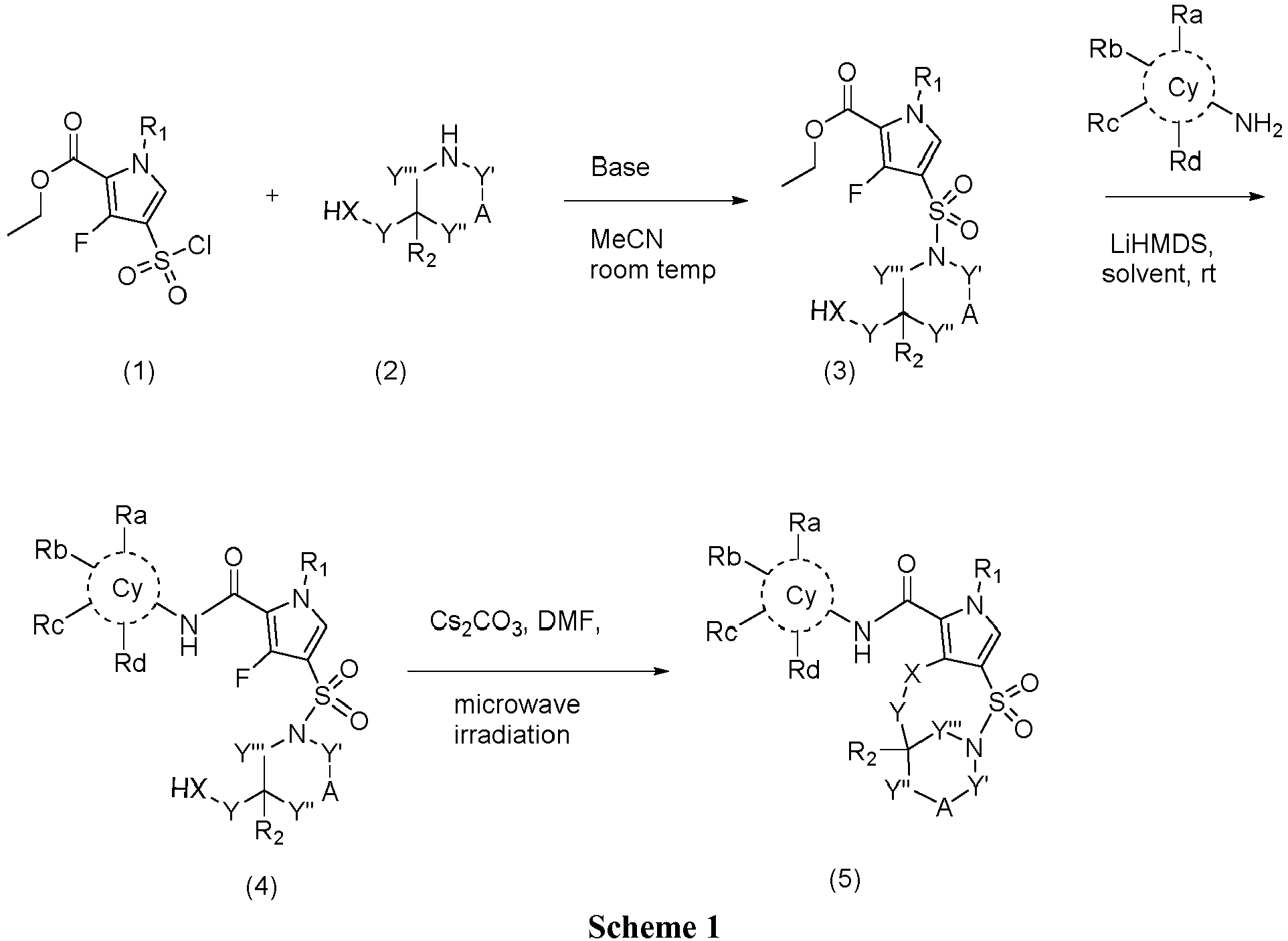
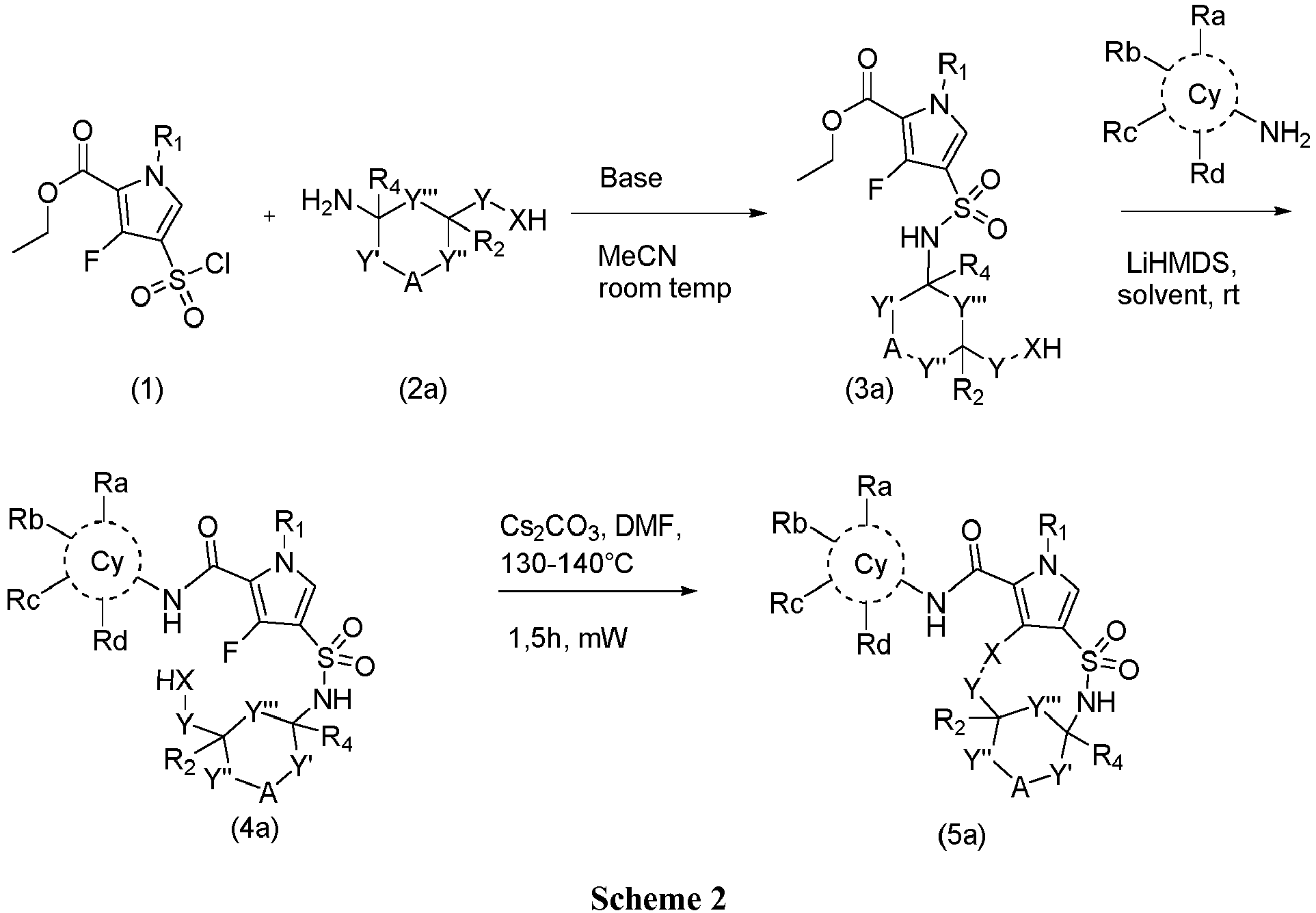
- Ethyl 4-(chlorosulfonyl)-3-fluoro-1-methyl-1H-pyrrole-2-carboxylate, indicated as compound (1) in Scheme 1 and Scheme 2, was prepared according to the procedure described in
WO2017/001655 . According to Scheme 1, a cyclic amine derivative bearing a nucleophilic -XH substituent is reacted with the compound (1) in the presence of the appropriate base to give the corresponding sulphonamide product (3). Reaction of (3) with an arylamine in the presence of a strong non-nucleophilic base such as lithium bis(trimethylsilyl)amide LiHMDS in a solvent like tethrahydrofuran, converts the ethyl carboxylate into an arylamide derivative (4). A subsequent cyclization step through intramolecular nucleophilic attack of the XH on the fluorine gives the tricyclic core of compound (5). The synthetic pathway outlined in Scheme 2 is very similar to the one in Scheme (1), but uses a primary amine of structure (2a). Depending on the specific nature of A in compounds (5) or (5a), the product can be further elaborated through protection, deprotection or further functionalization steps. In particular, when A is a nitrogen derivative it can be protected as the N-Boc derivative. The Boc can be removed by acidic treatment and the resulting NH can be further converted for example into a carbamate, urea, sulphonamide, sulphonyl urea derivative or can be alkylated through, for example, reductive amination chemistry. Certain amine derivatives (2) of Scheme 1 and (2a) of Scheme 2 were prepared according to the synthetic strategies outlined in Schemes 3, 4 and 5. The procedures in the schemes can be used for the synthesis of the compounds indicated below and can be used as well for the synthesis of the compounds as single diastereoisomers and/or enantiomers by choosing the appropriate starting materials. In particular, Scheme 3 refers to the synthesis of D2 and applies also to the syntheses of D4 and D6.
- Where not otherwise indicated, starting materials and/or intermediates were obtained from commercial sources or can be obtained through synthetic procedures known in the chemistry literature. The indication of the commercial source of certain compounds in the description of the experimental procedure, when provided, is only for easy reference to skilled chemist and should not be interpreted as the indication to use only that particular commercial compound.
- In the following paragraphs, the Descriptions 1 to 46 illustrate the preparation of intermediates used to make compounds of formula (I), (Ia) or (Ib) and salts thereof. The Examples illustrates the preparation of the compounds of the invention and salts thereof. Where the compounds have more than one chiral center, it is understood that they might exist as mixtures of diastereoisomers or as single isomers. Both racemic and chiral compounds are within the scope of the present invention. The indicated procedures are provided merely for assistance to the skilled chemist. The starting material may not necessarily have been prepared from the batch of the Description or the Example referred to.
-

- To a solution of cis-2-Boc-amino-cyclopentanecarboxylic acid (200 mg, 0,87 mmol) in dry THF (4 mL), borane dimethylsulfide complex (0.4 mL, 4.33 mmol) was added at 0°C. After 10 min mixture was allowed to warm at room temperature. After 1h a further aliquot of borane dimethylsulfide (0.4 mL, 4.33 mmol) was added and after 2.5h conversion was completed. Mixture was quenched by slow addition of methanol at 0°C, and then solvent was removed under reduced pressure to afford D1 as a white solid (195 mg, y>100%) that was used without purification. Method 1: Rt=1.54 min, m/z=216 (M+H)+.
-

- To a stirred solution of D1 (195 mg, 0.9mmol) in DCM (5 mL), trifluoroacetic acid (0.350 mL, 4.6 mmol) and triethylsilane (0.160 ml,) were added at 0°C. After 5 min, the reaction mixture was allowed to warm at room temperature. After 2h additional aliquots of trifluoroacetic acid (0.150 mL, 1.96 mmol) and triethylsilane (0.080 mL) were added. Reaction went to completion after 2.5h and mixture evaporated under reduced pressure to afford D2 trifluoracetate as a white solid (429 mg, y>100%) that was used in next step without purification, m/z = 116 (M+H)+.
-

- To a stirred solution of (1R,2R)-2-((tert-Butoxycarbonyl)amino)cyclopentanecarboxylic acid (113 mg, 0.49 mmol) in THF (2 mL), borane dimethylsulfide complex 2M in THF (1.2 mL, 2.4 mmol) was added at 0°C. After 5 min mixture was allowed to warm at rt. After 1 h mixture was quenched with slow addition of MeOH at 0°C, diluted with DCM and washed with HCl 1N and water. Organic layer was dried over Na2SO4, filtered and solvent removed under reduced pressure to afford D3 as a white solid (101 mg). Method 1: Rt=1.50 min, m/z=216 (M+H)+.
-
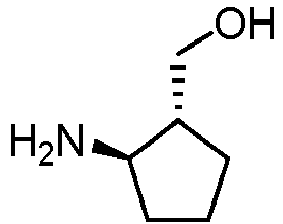
- To a stirred solution of D3 (101 mg, 0.469 mmol) in DCM (3 mL), trifluoroacetic acid (0.180 mL, 2.3457 mmol) and triethylsilane (0.085 mL, 0.532 mmol) were added at 0°C. After 5 min the reaction mixture was allowed to warm up to room temperature. After 3.5h the reaction mixture was quenched with NaOH 5M (1.5 mL) and stirred for 5 minutes. Mixture was evaporated under reduced pressure, then suspended in acetonitrile and filtered over Na2SO4 pad to remove part of salts and water to afford D4 as a white sticky solid (746 mg) that was used in the next step without purification. Method 1: Rt=0.36 min, m/z=116 (M+H)+.
-
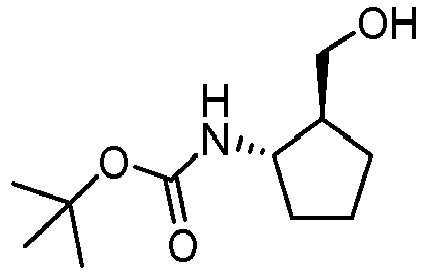
- Prepared similarly as described for compound D3 starting from (1S,2S)-2-((tert-butoxycarbonyl)amino)cyclopentanecarboxylic to give D5. Method 1: Rt=1.50 min, m/z=216 (M+H)+.
-

- Prepared from D5, following same procedure as described for compound D4. Method 1: Rt=0.36 min, m/z=116 (M+H)+.
-

- The compound was prepared according to
US2006148722 . A solution of prop-2-en-1-amine (2.92mL, 38.92mmol) in diethylether (17mL) was cooled at 0°C in a dry ice/acetone bath in a sealed 20mL vial. Ethyl 2-bromoacetate (3.74mL, 19.46mmol) was added in 200-300uL portions over 10min. A white precipitate was formed. After one night at room temperature, the mixture was filtered and the filtrate was evaporated at reduced pressure (200mmbar). The residue (6g) was dissolved in DCM (200mL), treated with triethylamine (2.7mL, 19.46mmol) and cooled to 0°C with ice bath. The resulting solution was treated with di-tert-butyl dicarbonate (4.25g, 19.46mmol) and stirred for 2 days at room temperature. Solvent was removed under reduced pressure and partitioned between water and EtOAc. The organic layer was washed with brine (X2) and 5% citric acid acq. solution, dried over Na2SO4 (anh.), filtered and evaporated. The residue (yellowish mobile oil) was purified by flash chromatography (direct phase, eluent 95/5 PE/DCM), giving about 5g of N-allyl-N-(tert-butoxycarbonyl)glycinate (D7) as colourless oil. 1H NMR (300 MHz, CDCl3) δ ppm 1.04 - 1.29 (m, 3 H) 1.29 - 1.50 (m, 9 H) 3.54 - 3.99 (m, 4 H) 4.12 (q, J=7.09 Hz, 2 H) 4.92 - 5.19 (m, 2 H) 5.45 - 6.01 (m, 1H); Method 1, Rt= 2.06min. m/z=143.07 (M+H)+. -

- The compound was prepared according to procedure described in
WO2010/016005 . A solution of D7 ethyl N-allyl-N-(tert-butoxycarbonyl)glycinate (1g, 4.11mmol) in DCM (11mL) was cooled to -78°C with acetone/ dry ice bath under nitrogen atmosphere. 1M DIBAL-H in DCM (8.22mL, 8.22mmol) was added over 1hr with a syringe pump. The reaction mixture was stirred at -78°C for 30min. The reaction was stopped by addition of NH4Cl sat. solution (1.2mL) and 2N HCl (4mL) in a single portion, then the reaction was magnetically stirred giving a white mixture. The reaction mixture was partitioned between water and DCM, treated with potassium sodium tartrate tetrahydrate (Rochelle's salt) until saturation, magnetically stirred for 15min then further extracted with DCM. The combined organic extracts were dried over MgSO4 (anh.), filtered and finally evaporated giving D8 tert-butyl allyl(2-oxoethyl)carbamate (0.8g, 4.015mmol) as a white sticky oil. Method 1, Rt= 1.58min. m/z=200 (M+H)+. -

-
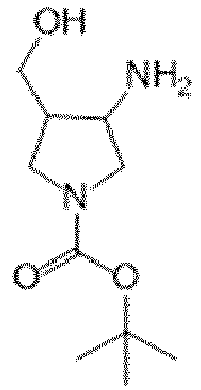
- A solution of D9 cis-tert-butyl 1-benzyltetrahydro-1H-pyrrolo[3,4-c]isoxazole-5(3H)-carboxylate (0.55g, 1.81mmol) in methanol (30mL) was treated with a single portion of ammonium formate (0.57mg, 9.03mmol) and 10% Pd/C (50mg). The mixture was refluxed for 30min, then cooled to room temperature and filtered on celite, washing with methanol. Solvent was removed in vacuo, affording D10 tert-butyl cis-3-amino-4-(hydroxymethyl)pyrrolidine-1-carboxylate (0.4g,1.85mmol) as colourless oil. Method 1, Rt= 0.86min. m/z=217.26 (M+H)+. 1H NMR (300 MHz, DMSO-d6+TFA) δ ppm 1.51 (s, 9 H) 2.65 - 2.73 (m, 1 H) 3.19 - 3.39 (m, 1 H) 3.43 - 3.79 (m, 5 H) 3.82 - 4.01 (m, 1 H) 8.03 (br s, 3 H).
-

- 2-Methyl 1-(2-methyl-2-propanyl) (2S,3R)-3-amino-1,2-pyrrolidinedicarboxylate hydrochloride (Fluorochem, cat n° 515165) (1:1) (200mg, 0.712mmol, leq) was suspended in dry THF (5.5mL), the mixture was cooled to 0°C, 1M solution of lithium aluminium hydride in THF (3mL, 3mmol, 4.2eq) was added in 10min and then reaction mixture was stirred at the same temperature. Reaction was quenched after 1h. Satured Rochelle salt solution (1.5mL) was added to reaction mixture at 0°C, it was allowed to warm up to rt, it was filtered to remove salts. Then, DCM was added, organic layer was washed once with brine, dried over sodium sulfate, filtered and solvent was removed under reduced pressure affording D11 a colourless oil (134mg). Method 4: Rt=1.14 min, MH+ = 217 m/z (M+H)+. Stereochemistry cis, single enantiomer.
-

- DIPEA (0.1mL, 0.56 mmol) and piperidin-2-ylmethanol (32.03mg, 0.28mmol) were added to a stirred solution of ethyl 4-(chlorosulfonyl)-3-fluoro-1-methyl-1H-pyrrole-2-carboxylate (50mg,0.190mmol) in MeCN (1.8mL,0.035mol) and stirring was continued for 1h at room temperature. Volatiles were evaporated and the residue was partitioned between sat. NH4Cl solution and EtOAc. The organic layer was separated, dried over Na2SO4, evaporated under reduced pressure and purified by flash chromatography on silica gel (Petroleum ether/ EtOAc) to obtain the title compound D12 (41.62mg). m/z=349 (M+H)+.
-

- DIPEA (0.1mL, 0.560mmol) and tert-butyl (piperidin-2-ylmethyl)carbamate (59.6mg, 0.28mmol) were added to to a stirred solution of ethyl 4-(chlorosulfonyl)-3-fluoro-1-methyl-1H-pyrrole-2-carboxylate (50mg, 0.190mmol) in MeCN (1.84mL, 0.035mol) and stirring was continued overnight at room temperature. Volatiles were evaporated and the residue was partitioned between sat. NH4Cl solution and EtOAc. The organic layer was separated, dried over Na2SO4, evaporated under reduced pressure and purified by flash cromatography on silica gel (Petroleum ether/EtOAc) to give ethyl 4-((2-(((tert-butoxycarbonyl)amino)methyl)piperidin-1-yl)sulfonyl)-3-fluoro-1-methyl-1H-pyrrole-2-carboxylate (77.82mg, y= 93.8%). Method 1: Rt=2.15min. m/z=348.18 (M-100)+ Exact mass=447.18. The Boc protecting group was removed by dissolving the intermediate ethyl 4-((2-(((tert-butoxycarbonyl)amino)methyl)piperidin-1-yl)sulfonyl)-3-fluoro-1-methyl-1H-pyrrole-2-carboxylate in dioxane (1.7mL) and treating with hydrogen chloride 4N in dioxane (2.81mL,11.25mmol) at RT for 1h. Volatiles were evaporated under reduced pressure to afford D13 as HCl salt, in about quantitative yield (66.75mg). Method 1: Rt= 1.18min. m/z=348.13 (M+H)+ Exact mass=347.18.
-

- Methyl 2-azetidinecarboxylate hydrochloride (89.44mg, 0.590mmol) in THF (11.9mL, 0.147mol) was added to lithium aluminium hydride (1.48mL,1.48mmol) 1M cooled to 0°C. The reaction mixture was stirred at 0°C for 2 h. After quenching with water (5.0 equiv) the mixture was concentrated in vacuo to obtain azetidin-2-ylmethanol. DIPEA (0.16mL,0.930mmol) and azetidin-2-ylmethanol (24.2mg,0.280mmol) were added to a stirred solution of ethyl 4-(chlorosulfonyl)-3-fluoro-1-methyl-1H-pyrrole-2-carboxylate (50mg,0.190mmol) in MeCN (1.8mL,0.035mol) and stirring was continued for 2h. Volatiles were evaporated and the residue was partitioned between saturated NH4Cl solution and EtOAc. The organic layer was separated, dried over Na2SO4, evaporated under reduced pressure and purified by flash cromatography on silica gel (Petroleum ether/ EtOAc) to obtain approximately 11 mg of the title compound D14. Method 1: Rt= 1.44min. m/z=320,97 (M+H)+.
-

- DIPEA (0.23mL, 1.330mmol) and trans-4-aminotetrahydrofuran-3-ol (68.8mg,0.670mmol) were added to a stirred solution of ethyl 4-(chlorosulfonyl)-3-fluoro-1-methyl-1H-pyrrole-2-carboxylate (120mg, 0.440mmol) in MeCN (4.4mL) and stirring was continued for 1h at room temperature. Volatiles were evaporated and the residue was partitioned between saturated NH4Cl solution and EtOAc. The organic layer was separated, dried over Na2SO4, evaporated under reduced pressure and purified by flash cromatography on silica gel (Petroleum ether/EtOAc) to obtain the title compound D15 as a trans 3S,4R and 3R,4S racemate (133mg, y= 88.9%). Method 1: Rt= 1.25min. m/z=337 (M+H)+.
-
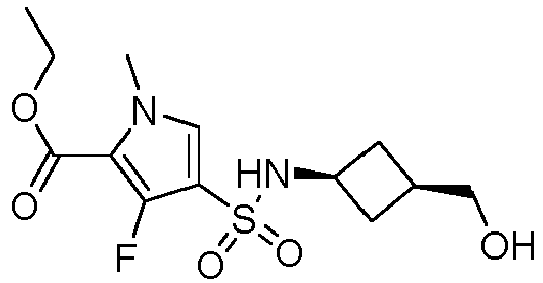
- To a solution of tert-butyl (cis-3-(hydroxymethyl)cyclobutyl)carbamate (0.154 g, 0.765 mmol) in DCM (2 mL), HCl 4N in dioxane (0.4 mL, 1.6 mmol) was added at rt. After 5h30 min a further aliquot of HCl 4N in dioxane (0.8 mL, 3.2 mmol) was added and mixture was left at rt until complete conversion. Mixture was evaporated under reduced pressure to obtain cis-3-(hydroxymethyl)cyclobutan-1-aminium chloride as a white solid (128 mg). Method 1: Rt=0.83 min, m/z=102 (M+H)+. The crude compound (38.5 mg, 0.280 mmol) was taken in dry acetonitrile (1.7 mL) and dry DIPEA (0.1 mL, 0.574 mmol) and ethyl 4-(chlorosulfonyl)-3-fluoro-1-methyl-1H-pyrrole-2-carboxylate (50 mg, 0.185 mmol) were added at room temperature. Reaction mixture was stirred overnight and then evaporated under reduced pressure to afford a light brown solid. Crude was purified with flash chromatography (Petroleum ether/AcOEt) to afford D16 as a white solid (45 mg). m/z = 335 (M+H)+.
-

- To a solution of D2 (176 mg, 0.371 theoretical mmol) and ethyl 4-(chlorosulfonyl)-3-fluoro-1-methyl-1H-pyrrole-2-carboxylate (50 mg, 0.185 mmol) in dry acetonitrile (1.7 mL), dry DIPEA (0.130 mL, 0.746 mmol) was added at room temperature. After 3h a further aliquot of D2 (102 mg, 0.214 theoretical mmol) was added. Reaction was stopped after 6h, crude was purified with preparative HPLC-MS (H2O/CH3CN+0.1% TFA) to give D17 as a white powder (18 mg, y= 28%). The compound is the cis racemate at the cyclopentyl ring (SR and RS). Method 1: Rt=1.62 min, m/z=349 (M+H)+.
-

- To a solution of 4-aminotetrahydrofuran-3-ol (74.5 mg, 0.722 mmol) and ethyl 4-(chlorosulfonyl)-3-fluoro-1-methyl-1H-pyrrole-2-carboxylate (150 mg, 0.556 mmol) in dry acetonitrile (4 mL), dry DIPEA (0.3 mL, 1.7223 mmol) was added at rt. After 1h mixture was evaporated under reduced pressure to afford a yellow solid (325 mg). Crude was purified by flash chromatography (Petroleum ether/AcOEt) to afford D18 as a light yellow solid (178 mg, y= 95%). Method 1: Rt=1.28 min, m/z=337 (M+H)+. The compound is the trans racemic mixture at the tetrahydrofuranyl ring.
-

- To a solution of D4 (373 mg, 0.234 theoretical mmol) in dry acetonitrile (1.5 mL), ethyl 4-(chlorosulfonyl)-3-fluoro-1-methyl-1H-pyrrole-2-carboxylate (50 mg, 0.185 mmol) and dry DIPEA (0.1 mL, 0.574 mmol) were added at rt. After 1.5h more D4 (124.3 mg, 0.191 mmol) in dry acetonitrile (0.5 mL) was added. Conversion was completed; mixture was diluted with DCM and washed with water (x2). Organic layer was dried over Na2SO4, filtered and then evaporated under reduced pressure. Crude was purified with flash chromatography (ETP/AcOEt to afford D19 as a yellow solid (59 mg). Method 1: Rt=1.60 min, m/z=349 (M+H)+.
-

- The compound was prepared from D6, following the same procedure indicated for compound D19. Method 1: Rt=1.60 min, m/z=349 (M+H)+.
-

- To a suspension of ethyl 4-(chlorosulfonyl)-3-fluoro-1-methyl-1H-pyrrole-2-carboxylate (70mg, 0.260 mmol) and ethyl 3-amino-4-(hydroxymethyl)-1-pyrrolidinecarboxylate (56.2 mg, 0.299 mmol) in dry acetonitrile (2 mL), dry DIPEA (0.1 mL, 0.574 mmol) was added at room temperature. After 1.5h mixture was diluted with DCM and washed with 5% citric acid solution. Organic layer was dried over Na2SO4, filtered and solvent removed under reduced pressure to afford D21 as a light yellow solid (162 mg). The compound is the cis racemate at the pyrrolidine ring (racemate of 3S,4S and 3R,4R). Crude was purified by flash chromatography (Petroleum ether/AcOEt) to afford a white solid (101 mg). Method 1: Rt=1.52 min, m/z=422 (M+H)+.
-
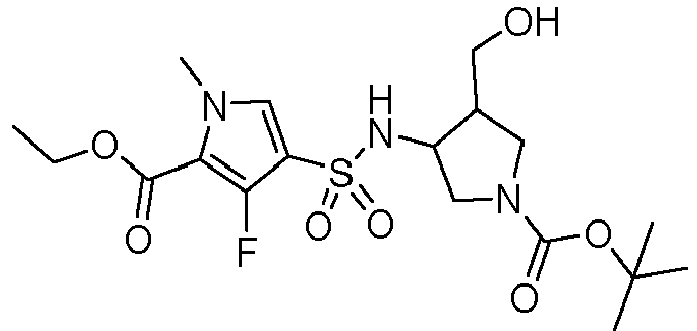
- To a suspension of ethyl 4-(chlorosulfonyl)-3-fluoro-1-methyl-1H-pyrrole-2-carboxylate (449mg, 1.66mmol) and D10 (360mg, 1.66mmol) in dry MeCN (9 mL), DIPEA (0.72mL, 4.16mmol) was added dropwise at RT. Reaction mixture was stirred at RT for 2h (a off-white solid precipitated). Solid was filtered and washed with a small amount of cold acetonitrile, to obtain D22 as off-white powder (570mg). The compound is the cis racemate at the pyrrolidine ring (racemate of 3S,4S and 3R,4R). 1H NMR (300 MHz, DMSO-d6+TFA) δ ppm 1.28 (t, J=6.97 Hz, 3 H) 1.37 (d, J=8.99 Hz, 9 H) 2.26 - 2.36 (m, 1 H) 3.04 - 3.14 (m, 1 H) 3.16 - 3.42 (m, 4 H) 3.46 - 3.57 (m, 1 H) 3.75 - 3.89 (m, 4 H) 4.27 (q, J=6.79 Hz, 2 H) 7.56 (d, J=4.77 Hz, 1 H) 7.82 - 8.06 (m, 1 H). Method 1: Rt=1.74min. m/z=450.40 (M+H)+.
-

- Crude D11, 100mg, 0.462mmol, leq) and ethyl 4-(chlorosulfonyl)-3-fluoro-1-methyl-1H-pyrrole-2-carboxylate (125mg, 0.464mmol, leq) were dissolved in dry acetonitrile (4mL), N,N-diisopropylethylamine (165uL, 0.925mmol, 2eq) was added dropwise and reaction mixture was stirred at rt. Complete conversion after 15min. Reaction mixture was diluted with ethyl acetate, organic layer was washed once with satured ammonium chloride aqueous solution and once with brine. Organic layer was dried over sodium sulfate, filtered and solvent was removed under reduced pressure affording an orange solid (256mg). Crude product was purified by flash chromatography (DCM/EtOAc 70/30) to afford D23 as a white solid (181mg). Method 1: Rt=1.85 min, MH+ = 450 m/z. Stereochemistry cis, single enantiomer.
-

- (2-amino-1-methylcyclopentyl)methanol (58 mg, 0.449 mmol, 1.1 eq) was suspended in dry MeCN (2.5 mL) under a nitrogen atmosphere, ethyl 4-(chlorosulfonyl)-3-fluoro-1-methyl-1H-pyrrole-2-carboxylate (110 mg, 0.408 mmol) was added, followed by dry DIPEA (156 uL, 0.897 mmol, 2.2 eq) and the reaction was stirred at rt for 1h: complete conversion. The reaction was diluted with DCM and washed with 5% citric acid (2x); the organic phase was washed with brine, dried over Na2SO4 and evaporated, yielding 128mg of D24 as a pale yellow powder, used without further purification. Method 1: Rt=1.70 min; m/z 363 (M+H)+.
-

- (1R2R and 1S2S) cis-methyl-2-amino-1-hydroxycyclopentane-1-carboxylate, oxalate salt (72mg, 0.29mmol) was suspended in EtOH (2.8mL); 2N NaOH (0.433mL, 0.867mmol, 3eq) was added and the mixture was stirred at rt for 24h. The mixture was brought to acidic pH with 2N HCl (0.5mL) and the volatiles were evaporated, obtaining 128 mg of crude cis 2-amino-1-hydroxycyclopentane-1-carboxylic acid hydrochloride, used as such. Method 2: Rt = 0.59 min, MH+ = 146. The crude (racemate of 1R2R and 1S2S) cis-2-amino-1-hydroxycyclopentane-1-carboxylic acid hydrochloride (0.289 mmol, leq) was suspended in dry MeCN (2.5 mL) under a nitrogen atmosphere; ethyl 4-(chlorosulfonyl)-3-fluoro-1-methyl-1H-pyrrole-2-carboxylate (85.7 mg, 0.318 mmol, 1.1eq) was added, followed by dry DIPEA (262 uL, 1.5 mmol, 5.2 eq) and the reaction was stirred at rt for 2h. The reaction was diluted with DCM and washed with 5% citric acid; the organic phase was dried over Na2SO4 and evaporated, yielding 95 mg of crude product. 35mg of D25 were obtained after purification by preparative HPLC (H2O, CH3CN 0.1% HCOOH). Method 1: Rt=1.42 min; m/z 379 (M+H)+.
-

- D25 (35mg, 0.093mmol) was dissolved in dry THF (1.5mL) under a nitrogen atmosphere. The solution was cooled in an ice bath and more aliquots of 2M (CH3)2S.BH3 in THF (0.1mL, 0.2mmol, 2.16eq) were added dropwise. The reaction was stirred at rt for 16h and stopped when approximately 10% of the starting acid was still unreacted. The reaction was cooled in ice and MeOH (0.4mL) was added up to end of foaming. The reaction was stored at -20°C for 16h, then it was diluted with DCM and washed with a saturated solution of NaHCO3. The organic phase was dried over Na2SO4 and evaporated, yielding 21mg of crude D26 as a colourless thick oil, used without further purification. Method 1: Rt=1.38 min; m/z 365 (M+H)+.
-

- To a suspension of D12 (41.3mg, 0.12mmol) and 3,4-difluoroaniline (0.014mL, 0.14mmol) in dry THF (0.75mL), lithium bis(trimethylsilyl)amide 1M in THF (0.66mL, 0.66mmol) was added dropwise. Reaction mixture was stirred at RT overnight, then was added NH4Cl and diluted with DCM. Organic layer was dried over Na2SO4, filtered and solvent removed under reduced pressure. The crude was purified by preparative HPLC (H2O/CH3CN+0.1% TFA) to afford the title compound D27 (45,8mg). Method 1: Rt=1.93min; m/z=432.4 (M+H)+.
-

- To a suspension of D13 (66.75mg, 0.17mmol) and 3,4-difluoroaniline (0.02mL, 0.21mmol) in dry THF (1.1mL), lithium bis(trimethylsilyl)amide 1M in THF (1.22mL, 1.22mmol) was added dropwise. Reaction mixture was stirred at RT overnight, then was added saturated NH4Cl and diluted with DCM. Organic layer was dried over Na2SO4, filtered and solvent removed under reduced pressure to afford the title product D28 in approximately 78% yield. Method 1: Rt= 1.43min. m/z=431.15 (M+H)+
-
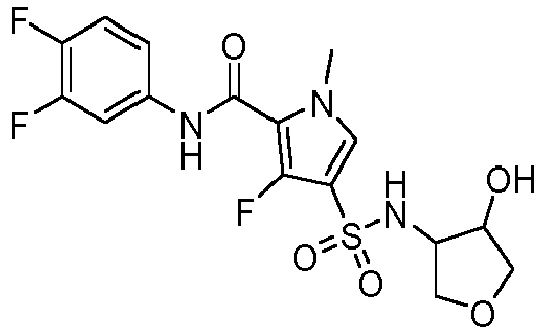
- To a suspension of D15 (133mg, 0.0395mmol) and 3,4-difluoroaniline (0.05mL, 0.04mmol) in dry THF (0.7mL), lithium bis(trimethylsilyl)amide 1M in THF (2.27mL, 2.27mmol) was added dropwise. Reaction mixture was stirred at RT overnight. Volatiles were evaporated and the residue was crystallized from hot Petroleum ether and EtOAc affording the title compound D29, as a trans 3S4R and 3R4S racemate (139.5mg, y= 81%). Method 3: Rt= 2.74min. m/z=420.34 (M+H)+
-

- To a suspension of D14 (10.8mg, 0.03mmol) and 3,4-difluoroaniline (0.004mL, 0.04mmol) in dry THF (0.7mL), lithium bis(trimethylsilyl)amide 1M in THF (0.19mL, 0.19mmol) was added dropwise. Reaction mixture was stirred at RT for 30min, then was added saturated NH4Cl and diluted with DCM. Organic layer was dried over Na2SO4, filtered and solvent removed under reduced pressure to afford the title compound D30 in approximately quantitative yield (14mg). Method 1: Rt= 1.77min. m/z=404.26 (M+H)+
-

- To a solution of D16 (45 mg, 0.135 mmol) and 3,4-difluoroaniline (0.016 mL, 0.161 mmol) in dry THF (0.8 mL), lithium bis(trimethylsilyl)amide 1M in THF (0.750 mL, 0.750 mmol) was added at room temperature. After 1.5 h lithium bis(trimethylsilyl)amide 1M in THF (0.300 mL, 0.300 mmol) and 3,4-difluoroaniline (0.005 mL, 0.050 mmol) were added to have complete conversion. Mixture was diluted with DCM and washed with 5% citric acid solution (x2). Organic layer was dried over Na2SO4, filtered and solvent removed under reduced pressure to afford a brown solid (83 mg). Crude was purified with preparative HPLC-MS (H2O/CH3CN +0.1% TFA) to give D31 as pink powder (39.5 mg). 1H NMR (300 MHz, DMSO-d6) δ ppm 1.53 - 1.65 (m, 2 H) 1.89 - 2.03 (m, 1 H) 2.03 - 2.15 (m, 2 H) 3.23 - 3.29 (m, 3 H) 3.42 - 3.68 (m, 2 H) 3.80 (s, 3 H) 7.37 - 7.48 (m, 3 H) 7.78 - 7.89 (m, 2 H) 10.22 (s, 1 H). Method 3: Rt=2.94 min, m/z=418 (M+H)+.
-

- To a solution of D17 (18 mg, 0.052 mmol) and 3,4-difluoroaniline (0.006 mL, 0.062 mmol) in dry THF (1 mL), lithium bis(trimethylsilyl)amide 1M in THF (0.360 mL, 0.360 mmol) was added at rt. After 30 minutes mixture was diluted with DCM and washed with 5% citric acid solution. Organic layer was dried over Na2SO4, filtered and solvent removed under reduced pressure to afford a brown solid. Crude was purified with preparative HPLC-MS (H2O/CH3CN +0.1% TFA) to give D32 as a white powder (12.5 mg, y=56%). The compound is the cis racemic mixture of 1S,2R and 1R,2S at the cyclopentyl ring. Method 1: Rt=1.89 min, m/z=432 (M+H)+.
-
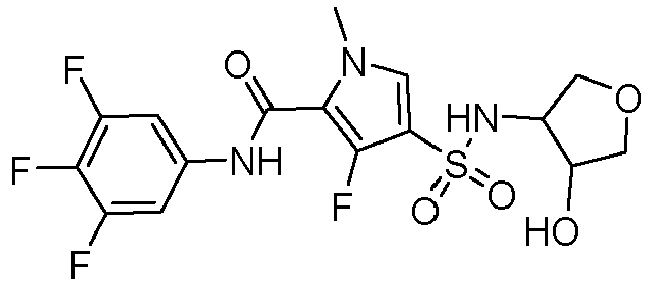
- To a solution of D18 (70 mg, 0.208 mmol) and 3,4,5-trifluoroaniline (0.025 mL, 0.221 mmol) in dry THF (1.5 mL), lithium bis(trimethylsilyl)amide 1M in THF (1.2 mL, 1.2 mmol) was added at room temperature. After 45 min, the mixture was evaporated under reduced pressure to afford a light violet solid (204 mg). Crude was purified with preparative HPLC-MS (H2O/CH3CN +0.1% TFA) to give D33 as a white powder (42.3 mg, y= 46%). The compound is the trans racemic mixture of 3S,4R and 3R,4S at the tetrahydrofuranyl ring. 1H NMR (300 MHz, DMSO-d6 +TFA) δ ppm 3.43 - 3.60 (m, 1 H) 3.45 - 3.49 (m, 1 H) 3.52 - 3.58 (m, 1 H) 3.77 - 3.86 (m, 5 H) 4.07 - 4.12 (m, 1 H) 7.49 - 7.66 (m, 3 H) 7.95 (br d, J=4.77 Hz, 1 H) 10.34 (s, 1 H). Method 3: Rt=2.98 min, m/z=438 (M+H)+.
-

- To a solution of D19 (59 mg, 0.169 mmol) and 3,4-difluoroaniline (0.020 mL, 0.203 mmol) in dry THF (1.5 mL), lithium bis(trimethylsilyl)amide 1M in THF (0.850 mL, 0.850 mmol) was added at room temperature. After 40 min UPLC-MS analysis showed conversion was not completed so (3,4-Difluoroaniline (0.010 mL, 0.101 mmol) and lithium bis(trimethylsilyl)amide 1M in THF (0.400 ml, 0.400 mmol) were added. 30 minutes after the addition mixture was diluted with DCM and washed with 5% citric acid solution. Organic layer was dried over Na2SO4, filtered, solvent removed under reduced pressure to afford a brown solid (118 mg). Crude was purified with preparative HPLC-MS (H2O/CH3CN +0.1% TFA) to give D34 as a white powder (44.7 mg). Method 1: Rt=1.90 min, m/z= 432 (M+H)+.
-
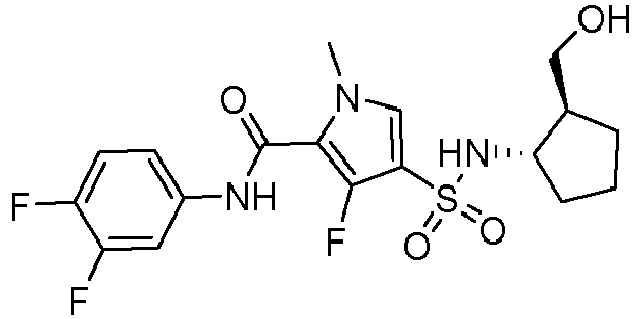
- Prepared similarly as described for compound D34 starting from D20. Method 1: Rt=1.90 min, m/z= 432 (M+H)+.
-
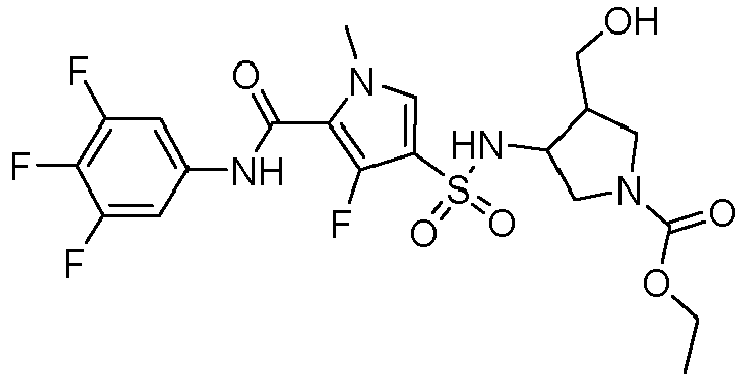
- To a solution of D21 (101mg, 0.240 mmol) and 3,4,5-Trifluoroaniline (38.8 mg, 0.264 mmol) in dry THF (2 mL), lithium bis(trimethylsilyl)amide 1M in THF (1.2 mL, 1.2 mmol) was added at room temperature. After 1h 3,4,5-trifluoroaniline (20 mg, 0.136 mmol) and lithium bis(trimethylsilyl)amide 1M in THF (0.5 mL, 0.5 mmol) were added. Reaction was stopped after 2.5 h, mixture diluted with DCM and washed with 5% citric acid solution and water. Organic layer was dried over Na2SO4, filtered and solvent removed under reduced pressure. Crude was purified with flash chromatography (ETP/AcOEt) to afford D36 as a brown solid (106 mg). The compound is the cis racemate at the pyrrolidine ring (racemate of 3S,4S and 3R,4R). Method 1: Rt=1.94 min, m/z= 523 (M+H)+.
-

- Prepared similarly as described for compound D36 using 3,4-difluoroaniline instead of 3,4,5-trifluoroaniline to give D37. The compound is the cis racemate at the pyrrolidine ring (racemate of 3S,4S and 3R,4R). Method 1: Rt=1.82 min, m/z=505 (M+H)+.
-

- Prepared similarly as described for compound D36 using 4-fluoro-3-methylaniline instead of 3,4,5-trifluoroaniline to give D38. The compound is the cis racemate at the pyrrolidine ring (racemate of 3S,4S and 3R,4R). Method 1: Rt=1.83 min, m/z=501 (M+H)+.
-

- Prepared similarly as described for compound D36 using 3-chloro-4-fluoroaniline, instead of 3,4,5-trifluoroaniline to give D39. The compound is the cis racemate at the pyrrolidine ring (racemate of 3S,4S and 3R,4R). Method 1: Rt=1.91min, m/z=521 (M+H)+.
- Description 40: cis-Ethyl 3-((5-((3-(difluoromethyl)-4-fluorophenyl)carbamoyl)-4-fluoro-1-methyl-lH-pyrrole)-3-sulfonamido)-4-(hydroxymethyl)pyrrolidine-1-carboxylate (D40)

- Prepared similarly as described for compound D36 using 3-(difluoromethyl)-4-fluoroaniline, instead of 3,4,5-trifluoroaniline to give D40. The compound is the cis racemate at the pyrrolidine ring (racemate of 3S,4S and 3R,4R). Method 1: Rt=1.84 min, m/z=537 (M+H)+.
-

- Prepared similarly as described for compound D36 using 5-amino-2-fluorobenzonitrile instead of 3,4,5-trifluoroaniline to give D41. The compound is the cis racemate at the pyrrolidine ring (racemate of 3S,4S and 3R,4R). Method 1: Rt=1.75 min, m/z=512 (M+H)+.
-

- To a suspension of D22 (50mg, 0.11mmol) and 3,4,5-Trifluoroaniline (32.7mg, 0.22mmol) in dry THF (1mL), lithium bis(trimethylsilyl)amide 1M in THF (0.67mL, 0.67mmol) was added dropwise. Reaction mixture was stirred at RT for 1h, then was diluted with DCM and washed with 5% citric acid solution and water. Organic layer was dried over Na2SO4, filtered and solvent removed under reduced pressure to afford crude D42 compound as orange oil (85mg, y>100%), that was used without further purification. The compound is the cis racemate at the pyrrolidine ring.
-

- Prepared similarly as described for compound D32 starting from D17 (52mg, 0.149mmol, 1eq) and 3,4,5-trifluoroaniline (27mg, 0.184mmol, 1.23eq) to give crude D43 (66.9mg). Product was used without any purification. Method 1: Rt=2.06 min, m/z=450 (M+H)+. The compound is the cis racemate at the cyclopentyl ring.
-

- D23 (117.51mg, 0.261mmol, 1eq) was dissolved in THF (1.5mL, 0.174M), 3,4-difluoroaniline (34uL, 0.343mmol, 1.31eq) was added and 1M solution of lithium bis(trimethylsilyl)amide in THF (1.5mL, 1.5mmol, 5.74eq) was added dropwise. Reaction mixture was stirred at rt and complete conversion was observed after 35min. Reaction mixture was diluted with DCM, organic layer was washed with 5% aqueous citric acid solution, dried over sodium sulfate, filtered and solvent was removed under reduced pressure to afford (D44) as a crude product (141mg). Method 1: Rt=2.09 min; m/z=523 (M+H)+.
-
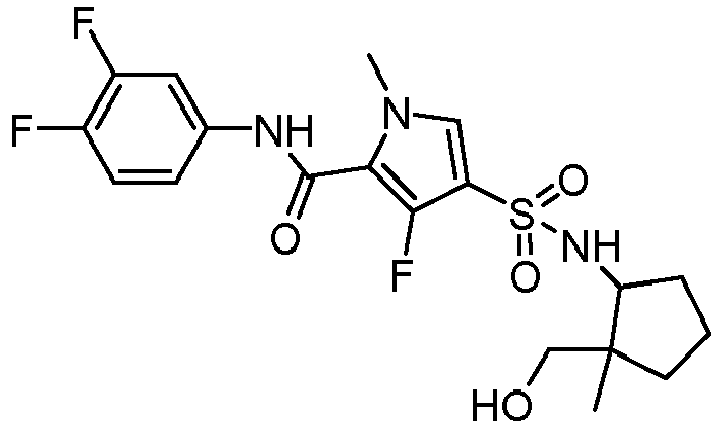
- D24 (70 mg, 0.193 mmol) was suspended in dry THF (2 mL) under a nitrogen atmosphere and 3,4-difluoroaniline (21 uL, 0.212 mmol, 1.1 eq) was added. LiHMDS 1M in THF (0.966 mL; 0.966 mmol, 5 eq) was added dropwise to the resulting pale yellow solution. The reaction turned dark red and was stirred at rt for 1h, until complete conversion. The reaction was diluted with DCM and washed with 5% citric acid (2x); the organic phase was dried over Na2SO4 and evaporated, yielding 114 mg of crude D45 as a brown gum, used without further purification.
- Method 1: Rt=1.70 min, m/z=363 (M+H)+
-

- Crude D26 (21 mg, 0.058 mmol) was suspended in dry THF (1 mL) under a nitrogen atmosphere; 3,4-difluoroaniline (7 uL, 0.066 mmol, 1.15 eq) was added and to the resulting solution LiHMDS 1M in THF (0.288 mL; 0.288 mmol, 5 eq) was added. The reaction turned dark red and was stirred at rt for 2h: almost complete conversion. The reaction was diluted with DCM and washed with 5% citric acid; the organic phase was dried over Na2SO4 and evaporated, yielding 38mg (greater than the theorethical amount) of crude D46 as a dark brown gum, used without further purification. Method 1: Rt=1.71 min, m/z=448 (M+H)+.
-

- D27 (35.77mg,0.080mmol) and cesium carbonate (54.36mg,0.170mmol) in DMF (0.543mL,0.007mol) were heated at 130°C for 45 min under microwave irradiation. A saturated aqueous ammonium chloride solution was added to the reaction mixture, and the mixture was extracted twice with ethyl acetate. The organic layer was washed with NH4Cl, dried over Na2SO4, and concentrated in vacuo. The resulting crude was purified by preparative HPLC (H2O/CH3CN +0.1% TFA) to afford the title compound E1,1H NMR (300 MHz, DMSO-d6, 25°C): δ = 9.51 (s, 1H), 7.76-7.95 (m, 1H), 7.33-7.56 (m, 3H), 4.44-4.65 (m, 1H), 4.27-4.44 (m, 2H), 3.83 (s, 3H), 3.36-3.43 (m, 1H), 2.68-2.90 (m, 1H), 1.64-1.89 (m, 3H), 1.41-1.62 (m, 2H), 1.24 ppm (s, 1H).
- Method 3: Rt=3.80min. m/z=412.17 (M+H)+
-

- D28 (47.96mg,0.090mmol) and cesium carbonate (115.51mg,0.350mmol) in DMSO (1.3mL,0.018mol) were heated at 160°C for 7h under microwave irradiation. The reaction mixture was filtered, and the filtrate was purified by preparative HPLC (H2O/CH3CN +0.1% TFA) to afford the title compound E2. 1H NMR (300 MHz, DMSO-d6, 25°C): δ = 10.77-10.95 (m, 1H), 7.80 (ddd, J = 13.0, 7.5, 2.2 Hz, 1H), 7.19-7.58 (m, 3H), 5.15 (br t, J= 4.9 Hz, 1H), 4.08 (br d, J = 9.1 Hz, 1H), 3.70-3.87 (m, 3H), 3.36-3.48 (m, 1H), 3.09 (br dd, J= 14.8, 2.8 Hz, 1H), 2.67-2.80 (m, 1H), 1.61-1.80 (m, 3H), 1.27-1.59 ppm (m, 3H). Method 3: Rt=3.80min. m/z=411.29 (M+H)+
-
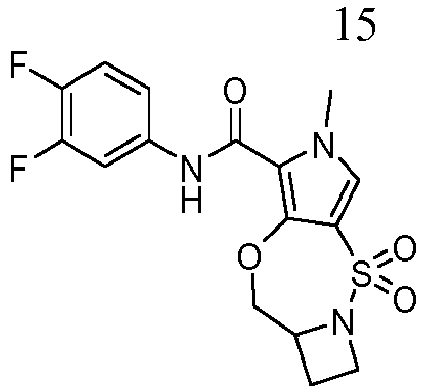
- D30 (13.71mg,0.030mmol) and cesium carbonate (22.29mg,0.07mmol) in DMF (0.7 mL,0.009mol) were heated at 130°C for 1h under microwave irradiation. A saturated NH4Cl solution was added to the reaction mixture, and the mixture was extracted twice with ethyl acetate. The organic layer was washed with saturated brine, dried over Na2SO4, and concentrated in vacuo. The resulting crude was purified by preparative HPLC (H2O/CH3CN+0.1% TFA) to afford the title compound E3. 1H NMR (300 MHz, DMSO-d6, 25°C): δ = 9.37-9.53 (m, 1H), 7.88 (ddd, J = 13.3, 7.5, 1.7 Hz, 1H), 7.54 (s, 1H), 7.37-7.51 (m, 2H), 4.87 (dd, J= 14.0, 0.9 Hz, 1H), 4.55 (dd, J = 14.1, 1.7 Hz, 1H), 4.48 (br dd, J = 8.8, 4.4 Hz, 1H), 3.85 (s, 3H), 3.69-3.83 ppm (m, 2H). Method 3: Rt= 3.46min. m/z=383.93 (M+H)+
-

- Compound D29 (114.5mg,0.27mmol) and cesium carbonate (179mg,0.55mmol) in DMF (1.8 mL,0.024mol) were heated at 150°C for 2h under microwave irradiation. A saturated NH4Cl solution was added to the reaction mixture, and the mixture was extracted twice with ethyl acetate. The organic layer was washed with saturated brine, dried over Na2SO4, and concentrated in vacuo. The resulting crude was purified by preparative HPLC (H2O/CH3CN +0.1% TFA) to afford the title compound E4. The compound is the trans racemate (3aS,9aR and 3aR,9aS). 1H NMR (300 MHz, DMSO-d6, 25°C): δ = 9.51 (s, 1H), 7.95 (d, J= 10.5 Hz, 1H), 7.84 (ddd, J= 13.2, 7.5, 2.1 Hz, 1H), 7.58 (s, 1H), 7.29-7.49 (m, 2H), 4.56 (q, J = 8.0 Hz, 1H), 4.06-4.36 (m, 3H), 3.89 (t, J = 8.6 Hz, 1H), 3.79-3.85 (m, 3H), 3.58-3.62 ppm (m, 1H). Method 3: Rt= 3.22min. m/z=400.01 (M+H)+
-

- In a microwave vial D31 (30.5 mg, 0.073 mmol) was dissolved in dry DMF (1.5 mL); cesium carbonate (60 mg, 0.184 mmol) was added, the vial was sealed and mixture heated under microwave irradiations for 8h at 150°C. Crude was purified with preparative HPLC-MS (H2O/CH3CN +0.1% TFA) to give E5 a pale pink powder (5.38 mg). 1H NMR (300 MHz, DMSO-d 6) δ ppm 2.31 - 2.45 (m, 3 H) 2.55 - 2.68 (m, 2 H) 3.80 (s, 5 H) 3.99 (s, 2 H) 7.34 (d, J=2.48 Hz, 1 H) 7.37 - 7.46 (m, 2 H) 7.46 - 7.53 (m, 1 H) 7.86 (br dd, J=7.57, 2.52 Hz, 1 H) 7.90 (br dd, J=7.57, 2.43 Hz, 1 H) 9.99 (s, 1 H). Method 3: Rt=3.22 min, m/z=398 (M+H)+.
-

- In a microwave vial D32 (10 mg, 0.023 mmol) was dissolved in dry DMF (1 mL); cesium carbonate (19.5 mg, 0.060 mmol) was added, the vial sealed and mixture heated at 130° for 40 min. Crude was purified with preparative HPLC-MS (H2O/CH3CN+0.1% TFA) to give E6 a white powder (5.37 mg). The compound is the cis racemate (5aS,8aR and 5aR,8aS). 1H NMR (300 MHz, DMSO-d6) δ ppm 1.11 - 1.30 (m, 1 H) 1.39 - 1.78 (m, 4 H) 2.01 - 2.17 (m, 1 H) 3.76 - 3.95 (m, 4 H) 4.20 - 4.34 (m, 1 H) 4.49 (dd, J=11.28, 4.49 Hz, 1 H) 7.32 - 7.53 (m, 3 H) 7.81 - 7.95 (m, 2 H) 9.55 (s, 1 H). Method 3: Rt= 3.68 min, m/z=412 (M+H)+.
-

- In a microwave vial D33 (40 mg, 0.091 mmol) was dissolved in dry DMF (2 mL); cesium carbonate (74.5 mg, 0.229 mmol) was added, the vial was sealed and mixture heated 3h at 130°C under microwave heating. Mixture was purified with preparative HPLC-MS (H2O/CH3CN +0.1% TFA) to give E7 a white powder (11.26 mg). The compound is the trans racemate (3aS,9aR and 3aR,9aS). 1H NMR (300 MHz, DMSO-d 6) δ ppm 3.50 - 3.63 (m, 1 H) 3.82 (s, 3 H) 3.91 (t, J=8.67 Hz, 1 H) 4.06 - 4.33 (m, 3 H) 4.55 (q, J=7.89 Hz, 1 H) 7.55 - 7.65 (m, 3 H) 7.96 (d, J=10.36 Hz, 1 H) 9.60 (s, 1 H). Method 3: Rt=3.44 min, m/z=418 (M+H)+.
-

- In a microwave vial D34 (40 mg, 0.093 mmol) was dissolved in dry DMF (2 mL); cesium carbonate (75.5 mg, 0.232 mmol) was added, the vial was sealed and mixture heated at 130°C under MW for 40 min. Mixture was purified with preparative HPLC-MS (H2O/CH3CN +0.1% TFA) to afford E8 a white powder (26.47 mg). 1H NMR (300 MHz, DMSO-d 6) δ ppm 1.07 (br d, J=7.70 Hz, 1 H) 1.37 - 1.69 (m, 4 H) 2.00 - 2.23 (m, 2 H) 3.77 - 3.98 (m, 6 H) 7.27 (d, J=10.45 Hz, 1 H) 7.36 - 7.50 (m, 3 H) 7.87 (ddd, J=13.20, 7.47, 2.25 Hz, 1 H) 9.83 (s, 1 H). Method 3: Rt=3.55 min, m/z=412 (M+H)+.
-

- Prepared similarly as described for compound E8 starting from D35 to give E9. 1H NMR (300 MHz, DMSO-d 6) δ ppm 1.02 - 1.16 (m, 1 H) 1.32 - 1.72 (m, 1 H) 2.00 - 2.27 (m, 2 H) 3.76 - 4.00 (m, 6 H) 7.27 (d, J=10.55 Hz, 1 H) 7.35 - 7.51 (m, 3 H) 7.87 (ddd, J=13.20, 7.47, 2.15 Hz, 1 H) 9.83 (s, 1 H). Method 3: Rt=3.55 min, m/z=412 (M+H)+.
-

- In a microwave vial D36 (106 mg, 0.203 mmol) was dissolved in dry DMF (5 mL); cesium carbonate (166 mg, 0.509 mmol) was added, the vial was sealed and mixture heated at 130°C under MW for 70 min. Mixture was filtered and solvent removed under reduced pressure to afford a beige solid (152 mg). Crude was purified with preparative HPLC-MS (H2O/CH3CN+0.1% TFA) to afford E10 a white powder (79.4mg). The compound is the cis racemate at the pyrrolidine ring (racemate of 3aR,10aR and 3aS,10aS). 1H NMR (300 MHz, DMSO-d6+TFA) δ ppm 1.12 - 1.22 (m, 3 H) 2.91 - 3.14 (m, 2 H) 3.33 - 3.46 (m, 2 H) 3.62 - 3.76 (m, 1 H) 3.79 (s, 3 H) 3.83 - 3.96 (m, 1 H) 4.02 (q, J=7.06 Hz, 2 H) 4.38 - 4.48 (m, 1 H) 4.48 - 4.62 (m, 1 H) 7.49 (s, 1 H) 7.62 - 7.73 (m, 2 H) 8.41 (br d, J=9.72 Hz, 1 H) 9.64 (s, 1 H). Method 3: Rt=3.57 min, m/z=503 (M+H)+.
-

- In a sealed microwave vial, E10 (185.5 mg, 0.369 mmol) was dissolved in dry DCM (2 mL). Trimethylsilyl iodide (1.1 mL, 7.6965 mmol) was added and mixture was heated at 50°C. After 4.5h even if conversion was not completed, crude was evaporeted under reduced pressure to afford a brown solid (350 mg). Then it was triturated with Et2O and filtered. Brown solid was dried at vacuum pump (232 mg) and it was used without any further purification. Part of crude was purified with preparative HPLC-MS (H2O/CH3CN +0.1% TFA) to afford E11 a white powder (15.65 mg). The compound is the cis racemate at the pyrrolidine ring (mixture of 3aR,10aR and 3aS,10aS). 1H NMR (300 MHz, DMSO-d 6) δ ppm 2.82 - 3.02 (m, 2 H) 3.08 - 3.22 (m, 1 H) 3.81 (s, 4 H) 3.88 - 4.05 (m, 1 H) 4.54 - 4.66 (m, 2 H) 7.55 (s, 1 H) 7.64 - 7.74 (m, 2 H) 8.38 (d, J=9.90 Hz, 1 H) 8.97 (br s, 2 H) 9.68 (s, 1 H). Method 3: Rt=2.50 min, m/z=431 (M+H)+.
-

- E11 (7.2 mg, 0.017 mmol) was dissolved in 1 mL of a solution composed by MeOH (10 mL), formaldehyde 37% aq. (0.170 mL, 2.285 mmol) and acetic acid (0.030 mL, 0.506 mmol) at room temperature. After 10 minutes, sodium triacetyloxyborohydride (7.5 mg, 0.035 mmol) was added and the reaction mixture was stirred at room temperature. Further aliquots of formaldehyde and acetic acid were added until UPLC-MS analysis showed complete conversion. Crude was purified with preparative HPLC-MS (H2O/CH3CN+0.1% TFA) to afford E12 as a white powder (3.87 mg). The compound is the cis racemate at the pyrrolidine ring (mixture of 3aR,10aR and 3aS,10aS). 1H NMR (300 MHz, DMSO-d 6) δ ppm 2.79 - 3.07 (m, 5 H) 3.15 - 3.39 (m, 1 H) 3.49 - 3.74 (m, 1 H) 3.80 (s, 3 H) 3.93 - 4.11 (m, 1 H) 4.15 - 4.31 (m, 1 H) 4.51 - 4.76 (m, 2 H) 7.50 (s, 1 H) 7.67 (br dd, J=10.04, 6.56 Hz, 2 H) 8.17 - 8.32 (m, 1 H) 0.00 (d, J=9.20 Hz, 1 H) 9.56 - 9.77 (m, 1 H) 10.20 (br s, 1 H). Method 3: Rt=2.57 min, m/z=445 (M+H)+.
-
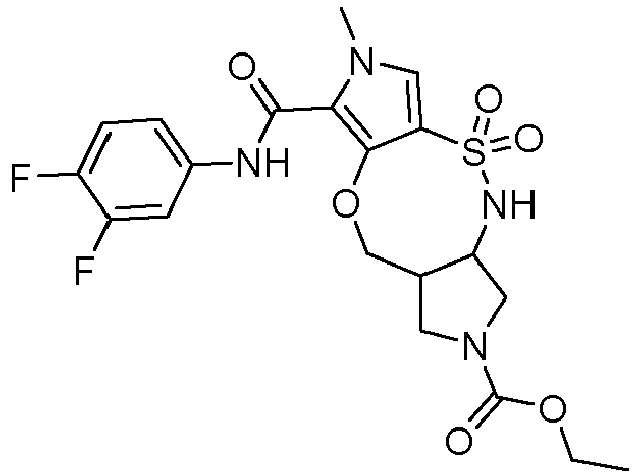
- Prepared similarly as described for compound E10 starting from D37 to give E13. The compound is the cis racemate at the pyrrolidine ring (racemate of 3aR,10aR and 3aS,10aS). 1H NMR (300 MHz, DMSO-d6+TFA) δ ppm 1.12 - 1.22 (m, 3 H) 2.91 - 3.15 (m, 2 H) 3.31 - 3.49 (m, 2 H) 3.66 - 3.86 (m, 4 H) 3.91 (br t, J=11.05 Hz, 1 H) 4.02 (q, J=6.97 Hz, 2 H) 4.38 - 4.51 (m, 1 H) 4.51 - 4.65 (m, 1 H) 7.29 - 7.51 (m, 3 H) 7.85 (ddd, J=13.14, 7.50, 2.29 Hz, 1 H) 8.41 (br d, J=9.72 Hz, 1 H) 9.55 (s, 1 H). Method 3: Rt=3.38 min, m/z=485 (M+H)+.
-

- Prepared similarly as described for compound E10 starting from D38 to give E14. The compound is the cis racemate at the pyrrolidine ring (racemate of 3aR,10aR and 3aS,10aS). 1H NMR (300 MHz, DMSO-d 6) δ ppm 1.14 - 1.24 (m, 3 H) 2.24 (d, J=1.56 Hz, 3 H) 2.91 - 3.14 (m, 2 H) 3.33 - 3.42 (m, 2 H) 3.67 - 3.85 (m, 4 H) 3.91 (br t, J=10.87 Hz, 1 H) 4.03 (q, J=7.12 Hz, 2 H) 4.44 (br s, 1 H) 4.57 (br s, 1 H) 7.11 (t, J=9.22 Hz, 1 H) 7.45 - 7.53 (m, 2 H) 7.59 (dd, J=7.02, 2.43 Hz, 1 H) 8.40 (br d, J=9.54 Hz, 1 H) 9.34 (s, 1 H). Method 3: Rt=3.40 min, m/z=481 (M+H)+.
-

- Prepared similarly as described for compound E10 starting from D39 to give E15. The compound is the cis racemate at the pyrrolidine ring (mixture of 3aR,10aR and 3aS,10aS). 1H NMR (300 MHz, DMSO-d6) δ ppm 1.14 - 1.24 (m, 3 H) 2.92 - 3.12 (m, 2 H) 3.32 - 3.42 (m, 2 H) 3.66 - 3.77 (m, 1 H) 3.81 (s, 3 H) 3.90 (br t, J=10.87 Hz, 1 H) 4.03 (q, J=7.03 Hz, 2 H) 4.39 - 4.49 (m, 1 H) 4.51 - 4.64 (m, 1 H) 7.41 (t, J=9.08 Hz, 1 H) 7.48 (s, 1 H) 7.61 - 7.67 (m, 1 H) 7.99 (dd, J=6.88, 2.57 Hz, 1 H) 8.41 (br d, J=9.81 Hz, 1 H) 9.57 (s, 1 H). Method 3: Rt= 3.54 min, m/z=501 (M+H)+.
-

- Prepared similarly as described for compound E10 starting from D40 to give E16. The compound is the cis racemate at the pyrrolidine ring (racemate of 3aR,10aR and 3aS,10aS). 1H NMR (300 MHz, DMSO-d 6) δ ppm 1.13 - 1.23 (m, 3 H) 2.91 - 3.14 (m, 2 H) 3.32 - 3.43 (m, 2 H) 3.71 (br dd, J=11.14, 5.82 Hz, 1 H) 3.81 (s, 3 H) 3.90 (br t, J=10.77 Hz, 1 H) 4.03 (q, J=7.03 Hz, 2 H) 4.39 - 4.49 (m, 1 H) 4.51 - 4.64 (m, 1 H) 7.03 - 7.43 (m, 2 H) 7.48 (s, 1 H) 7.76 - 7.83 (m, 1 H) 8.06 (dd, J=6.24, 2.38 Hz, 1 H) 8.41 (br d, J=10.00 Hz, 1 H) 9.63 (s, 1 H). Method 3: Rt= 3.38 min, m/z=517 (M+H)+.
-

- Prepared similarly as described for compound E10 starting from D41 to give E17. The compound is the cis racemate at the pyrrolidine ring (mixture of 3aR,10aR and 3aS,10aS). 1H NMR (300 MHz, DMSO-d 6) δ ppm 1.14 - 1.24 (m, 3 H) 2.92 - 3.14 (m, 2 H) 3.31 - 3.43 (m, 2 H) 3.72 (br dd, J=11.19, 5.87 Hz, 1 H) 3.81 (s, 3 H) 3.91 (br t, J=11.00 Hz, 1 H) 4.04 (q, J=6.97 Hz, 2 H) 4.38 - 4.50 (m, 1 H) 4.52 - 4.67 (m, 1 H) 7.49 - 7.57 (m, 2 H) 8.01 - 8.08 (m, 1 H) 8.19 (dd, J=5.73, 2.61 Hz, 1 H) 8.43 (br d, J=9.90 Hz, 1 H) 9.68 (s, 1 H). Method 3: Rt= 3.24 min, m/z=492 (M+H)+.
-
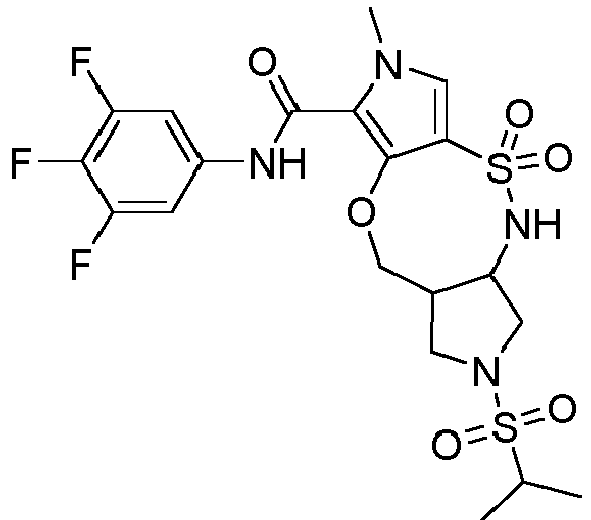
- To a suspension of E11 (25 mg, 0.058 mmol) in dry DCM (0.5 mL) propane-2-sulfonyl chloride (0.007 mL, 0.062 mmol) and dry DIPEA (0.020 mL, 0.115 mmol) were added at room temperature. After 50 min, water (0.050 mL) was added and mixture was evaporated under reduced pressure. Crude was purified with preparative HPLC-MS (H2O/CH3CN +0.1% TFA) to give E18 as a yellow powder (8.12 mg). The compound is the cis racemate at the pyrrolidine ring (racemate of 3aR,10aR and 3aS,10aS). 1H NMR (300 MHz, DMSO-d 6+TFA) δ ppm 1.25 (d, J=6.79 Hz, 6 H) 2.98 - 3.13 (m, 2 H) 3.25 - 3.52 (m, 3 H) 3.76 - 3.99 (m, 5 H) 4.48 - 4.63 (m, 2 H) 7.51 (s, 1 H) 7.60 - 7.74 (m, 2 H) 8.48 (d, J=10.00 Hz, 1 H) 9.65 (s, 1 H). Method 3: Rt= 3.60 min, m/z=537 (M+H)+.
-

- To a suspension of E11 (25 mg, 0.058 theoretical mmol) in dry acetonitrile (0.5 mL), methanesulfonyl chloride (5 ul, 0.065 mmol) and dry DIPEA (0.020 mL, 0.116 mmol) were added at room temperature. After 2h methanesulfonyl chloride (5 ul, 0.065 mmol) and dry DIPEA (0.020 mL, 0.116 mmol) were added. After 1h stirring, water (0.050 mL) was added and mixture evaporated under reduced pressure. Crude was purified by preparative HPLC-MS (H2O/CH3CN +0.1% TFA) to give E19 as a pale orange powder (9.17 mg). The compound is the cis racemate at the pyrrolidine ring (racemate of 3aR,10aR and 3aS, 10aS).1H NMR (300 MHz, DMSO-d 6) δ ppm 2.92 (s, 3 H) 2.96 - 3.11 (m, 2 H) 3.19 - 3.31 (m, 1 H) 3.31 - 3.44 (m, 1 H) 3.72 - 3.85 (m, 4 H) 3.91 (t, J=11.00 Hz, 1 H) 4.48 - 4.60 (m, 2 H) 7.45 (s, 1 H) 7.60 - 7.72 (m, 2 H) 8.44 (d, J=9.90 Hz, 1 H) 9.72 (s, 1 H). Method 3: Rt= 3.34 min, m/z=509 (M+H)+.
-

- To a suspension of E11 (25 mg, 0.058 theoretical mmol) in dry acetonitrile (0.5 mL), cyclopropanesulfonyl chloride(7 ul, 0.069 mmol) and dry DIPEA (0.020 mL, 0.116 mmol) were added at room temperature and mixture stirred for 1.5h. First purification with preparative HPLC-MS (H2O/CH3CN +0.1% TFA) was not enough to obtained a purity >95%, so a second purification was performed by flash chromatography (DCM/AcOEt) and a white powder was afford E20 (4.13 mg). The compound is the cis racemate at the pyrrolidine ring (racemate of 3aR,10aR and 3aS,10aS). 1H NMR (300 MHz, DMSO-d 6) δ ppm 0.91 - 1.04 (m, 4 H) 2.63 - 2.75 (m, 1 H) 2.98 - 3.13 (m, 2 H) 3.28 (dd, J=10.68, 1.79 Hz, 1 H) 3.39 - 3.52 (m, 1 H) 3.78 - 3.89 (m, 4 H) 3.94 (br t, J=10.96 Hz, 1 H) 4.50 - 4.61 (m, 2 H) 7.50 (s, 1 H) 7.60 - 7.75 (m, 2 H) 8.44 (d, J=10.00 Hz, 1 H) 9.66 (s, 1 H). Method 3: Rt= 3.53 min, m/z=535 (M+H)+.
-

- To a suspension of E11 (25 mg, 0.058 mmol) in dry acetonitrile (0.5 mL), isopropylsulfamyl chloride (7.5 ul, 0.063 mmol) and dry DIPEA (0.025 mL, 0.144 mmol) were added at room temperature. After 1h conversion was not completed so, dry DIPEA (0.025 mL, 0.144 mmol) and isopropylsulfamyl chloride (7.5 ul, 0.063 mmol) were added. After a total of 4h water (0.050 mL) was added and mixture evaporated under reduced pressure. Crude was purified with preparative HPLC-MS (H2O/CH3CN +0.1% TFA) to give E21 as a yellow powder (9.67 mg). The compound is the cis racemate at the pyrrolidine ring (mixture of 3aR,10aR and 3aS,10aS). 1H NMR (300 MHz, DMSO-d6) δ ppm 1.11 (dd, J=6.51, 2.11 Hz, 6 H) 2.78 - 2.90 (m, 1 H) 2.93 - 3.07 (m, 1 H) 3.07 - 3.18 (m, 1 H) 3.24 - 3.35 (m, 1 H) 3.41 (dt, J=12.95, 6.41 Hz, 1 H) 3.55 - 3.66 (m, 1 H) 3.80 (s, 3 H) 3.95 (t, J=11.28 Hz, 1 H) 4.46 - 4.60 (m, 2 H) 7.10 (br s, 1 H) 7.49 (s, 1 H) 7.62 - 7.72 (m, 2 H) 8.35 (d, J=10.00 Hz, 1 H) 9.63 (s, 1 H). Method 3: Rt= 3.62 min, m/z=552 (M+H)+.
-
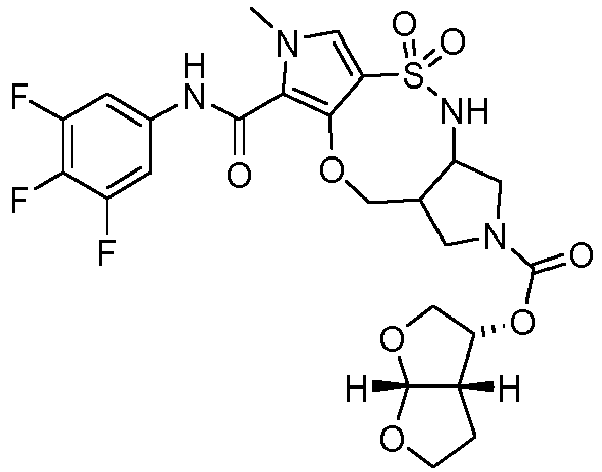
- To a suspension of E11 (25 mg, 0.058 theoretical mmol) in dry DCM (0.5 mL), 2,5-dioxopyrrolidin-1-yl ((3R,3aS,6aR)-hexahydrofuro[2,3-b]furan-3-yl) carbonate (15.8 mg, 0.058 mmol) and dry DIPEA (0.020mL, 0.115 mmol) were added at room temperature. After 1h conversion was completed. Crude was diluted with DCM and washed with 5% citric acid solution. Organic layer was dried over Na2SO4, filtered and evaporated. Residue was purified with preparative HPLC-MS (H2O/CH3CN +0.1% TFA) to give E22 as a white powder (14.78 mg). The compound is the cis racemate at the pyrrolidine ring (racemate of 3aR,10aR and 3aS,10aS). 1H NMR (300 MHz, DMSO-d 6+TFA) δ ppm 1.73 - 1.89 (m, 1 H) 1.89 - 2.06 (m, 1 H) 2.94 - 3.15 (m, 3 H) 3.37 - 3.49 (m, 2 H) 3.58 - 3.97 (m, 9 H) 4.40 - 4.51 (m, 1 H) 4.51 - 4.63 (m, 1 H) 5.00 - 5.08 (m, 1 H) 5.60 (t, J=4.31 Hz, 1 H) 7.50 (s, 1 H) 7.62 - 7.73 (m, 2 H) 8.41 - 8.49 (m, 1 H) 9.64 (s, 1 H). Method 3: Rt= 3.37 min, m/z=587 (M+H)+.
-
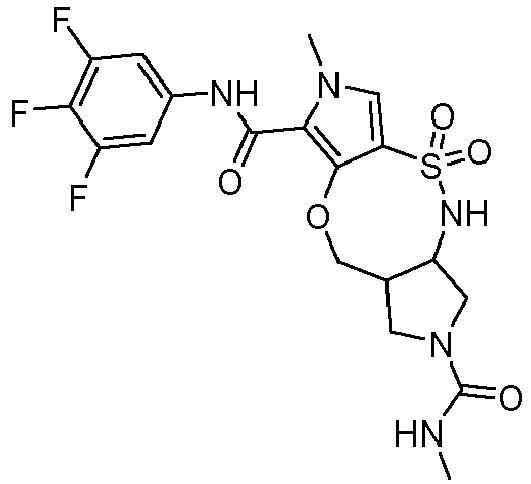
- To a suspension of E11 (25 mg, 0.058 theoretical mmol), in dry acetonitrile (0.5 mL), N-methylcarbamoyl chloride (6.5 mg, 0.070 mmol) and dry DIPEA (0.025 mL, 0.058 mmol) were added at room temperature. Reaction was stopped after 2.5h when conversion was completed. Water (0.050 mL) was added and mixture evaporated under reduced pressure. Crude was purified with preparative HPLC-MS (H2O/CH3CN +0.1% TFA) to give E23 as a pale yellow powder (13.26 mg). 1H NMR (300 MHz, DMSO-d6+TFA) δ ppm 2.58 (s, 3 H) 2.90 - 3.07 (m, 2 H) 3.28 - 3.46 (m, 2 H) 3.59 - 3.70 (m, 1 H) 3.80 (s, 3 H) 3.91 (br t, J=10.73 Hz, 1 H) 4.40 - 4.50 (m, 1 H) 4.53 - 4.64 (m, 1 H) 7.48 (s, 1 H) 7.61 - 7.74 (m, 2 H) 8.40 (d, J=10.00 Hz, 1 H) 9.63 (s, 1 H). Method 3: Rt= 3.04 min, m/z=488 (M+H)+. The compound is the cis racemate at the pyrrolidine ring.
-

- Crude D42 (61mg, 0.11mmol) was dissolved in DMF (2.8ml), cesium carbonate (90.4mg, 0.28mmol) was added and the reaction mixture was heated at 130°C under MW irradiation for 45min. Reaction mixture was diluted with EtOAc and washed with 5% citric acid solution and water. Organic layer was dried over Na2SO4, filtered and concentrated under vacuo. The resulting crude was purified by flash chromatography on silica (DCM/EtOAc) to obtain the title compound E24 as a light brown powder (40mg, y=67%). 1H NMR (300 MHz, DMSO-d 6) δ ppm 1.41 (s, 9 H) 2.82 - 3.11 (m, 2 H) 3.33 - 3.44 (m, 2 H) 3.62 - 3.76 (m, 1 H) 3.80 (s, 3 H) 3.84 - 3.97 (m, 1 H) 4.31 - 4.48 (m, 1 H) 4.49 - 4.71 (m, 1 H) 7.50 (s, 1 H) 7.61 - 7.81 (m, 2 H) 8.46 (br s, 1 H) 9.68 (s, 1 H) Method 3: Rt=3.87min. m/z=531.39 (M+H)+. The compound is the cis racemate at the pyrrolidine ring.
-

- In a 25mL microwave vial, crude D44 (theoretical 0.261mmol, 139mg, 1eq) was dissolved in dry DMF (8.6mL, 0.030M), caesium carbonate (255mg, 0.783mmol, 3eq) was added, the vial was sealed and reaction mixture was heated at microwave at 130°C for a total of 4h10min in 5 runs. Reaction mixture was quenched in 5% aqueous citric acid solution, product was extracted with ethyl acetate, organic layer was washed once with 5% aqueous citric acid solution and once with brine, dried over sodium sulfate, filtered and solvent was removed under reduced pressure affording 114mg of brownish powder. Crude was purified with flash chromatography (DCM/AcOEt 7/3) to afford the Boc protected intermediate as a beige solid (71.2mg, y= 53%). Method 1: Rt=2.21 min, MH+ = 513 m/z. The compound from previous step (67mg, 0.131mmol, 1eq) was dissolved in DCM (2mL, 0.065M), triethylsilane (23uL, 0.144mol, 1.1eq) was added and trifluoroacetic acid (200uL, 2.612mmol, 20eq) was added and reaction mixture was stirred at rt. Complete conversion after 6h. Reaction mixture was diluted with DCM, brine was added, organic layer was removed, NaOH 20% was added to brine until pH=10 and product was extracted twice with ethyl acetate. Organic layers were combined, dried over sodium sulfate, filtered and solvent was removed under reduced pressure affording 54mg of crude product. 32mg were used without any purification, 19mg were purified with preparative HPLC-MS (H2O,CH3CN 0.1% TFA) to afford E25 as a white powder (9.56mg). Method 3: Rt=2.21 min, MH+ = 413 m/z. Stereochemistry cis, single enantiomer. 1H NMR (300 MHz, DMSO-d 6) δ ppm 1.97 - 2.10 (m, 1 H) 2.32 - 2.45 (m, 1 H) 3.27 - 3.46 (m, 2 H) 3.81 (s, 3 H) 3.92 - 4.05 (m, 1 H) 4.40 - 4.53 (m, 1 H) 4.53 - 4.68 (m, 2 H) 7.32 - 7.56 (m, 3 H) 7.83 (ddd, J=13.02, 7.34, 2.02 Hz, 1 H) 8.22 (d, J=7.50 Hz, 1 H) 8.61 - 8.83 (m, 1 H) 9.17 - 9.37 (m, 1 H) 9.58 (s, 1 H).
-

- Crude E25 (16mg, 0.039mmol, 1eq) was dissolved in dry MeCN (1.6mL, 0.024M), N-methylcarbamoyl chloride (6.1mg, 0.065mmol, 1.68eq) was added, N,N-diisopropylethylamine (40uL, 0.230mmol, 5.9eq) was added and reaction mixture was stirred at rt. Complete conversion after 45min. Reaction mixture was concentrated under reduced pressure and crude product was purified with preparative HPLC-MS (H2O,CH3CN 0.1% TFA) to afford E26 as a white yellow powder (6.98mg). Method 3: Rt=2.85 min, MH+ = 470 m/z. Stereochemistry cis, single enantiomer. 1H NMR (300 MHz, DMSO-d 6) δ ppm 1.66 - 1.99 (m, 1 H) 2.01 - 2.26 (m, 1 H) 2.53 - 2.57 (m, 3 H) 3.16 - 3.40 (m, 2 H) 3.80 (s, 3 H) 4.04 - 4.35 (m, 3 H) 4.49 (br d, J=8.44 Hz, 1 H) 7.33 - 7.52 (m, 3 H) 7.87 (ddd, J=13.02, 7.52, 2.02 Hz, 1 H) 8.18 (br d, J=8.44 Hz, 1 H) 9.58 (s, 1 H).
-

- Crude E25 (16mg, 0.039mmol, 1eq) was dissolved in dry MeCN (1.6mL, 0.024M), ethyl chloroformate (5uL, 0.052mmol, 1.35eq) was added, N,N-diisopropylethylamine (40uL, 0.230mmol, 5.9eq) was added and reaction mixture was stirred at rt. Complete conversion after 50min. Reaction mixture was concentrated under reduced pressure and crude product was purified with preparative HPLC-MS (H2O,CH3CN 0.1% TFA) to afford E27 as a light yellow powder (9.38mg). Method 3: Rt=3.42 min, MH+ = 485 m/z. 1H NMR (300 MHz, DMSO-d 6) δ ppm 1.13 (br s, 3 H) 1.78 - 1.94 (m, 1 H) 2.05 - 2.25 (m, 1 H) 3.20 - 3.52 (m, 2 H) 3.81 (s, 3 H) 3.92 - 4.08 (m, 2 H) 4.08 - 4.62 (m, 4 H) 7.28 - 7.46 (m, 2 H) 7.50 (br s, 1 H) 7.71 - 7.97 (m, 1 H) 8.08 - 8.38 (m, 1 H) 9.62 (br s, 1 H).
-
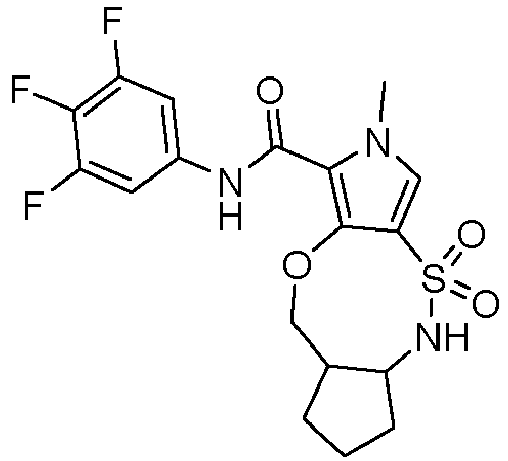
- In a microwave D43 (66.9mg, 0.149mmol, 1eq) was dissolved in dry DMF (6mL), cesium carbonate (121.26mg, 0.327mmol, 2.5eq) was added, the vial sealed and mixture heated at microwave at 130°C for 30 min. The mixture was diluted with toluene, organic layer was washed with water, dried over Na2SO4, filtered and solvent was removed under reduced pressure. Crude product was purified on silica gel with flash chromatography affording 20mg of pure E28. 1H NMR (300 MHz, DMSO-d 6) δ ppm 1.10 - 1.30 (m, 1 H) 1.42 - 1.76 (m, 4 H) 2.03 - 2.16 (m, 1 H) 2.53 - 2.62 (m, 1 H) 3.81 (s, 3 H) 3.86 (t, J=11.60 Hz, 1 H) 4.21 - 4.34 (m, 1 H) 4.50 (br dd, J=11.10, 4.31 Hz, 1 H) 7.47 (s, 1 H) 7.70 (dd, J=10.27, 6.42 Hz, 2 H) 7.89 (br d, J=9.90 Hz, 1 H) 9.63 (s, 1 H). Method 3: Rt= 3.84 min, m/z=430 (M+H)+.
-

- Crude D45 (114mg, 0.193 theoretical mmol) was dissolved in dry DMF (4.8mL); Cs2CO3 (158mg, 0.482mmol, 2.5eq) was added and the mixture was heated to 130°C under MW irradiation for 1h: complete conversion. The reaction was diluted with EtOAc and washed with water and 5% citric acid (2x); the organic phase was dried over Na2SO4 and evaporated, yielding 100 mg of crude as an orange solid which was purified by preparative HPLC (H2O,CH3CN 0.1% TFA). Fractions containing product were freeze-dried, yielding 30.44 mg (y = 37%) of E29 as a white powder. Method 3: Rt=3.72 min, MH+ = 426 m/z. 1H NMR (300 MHz, DMSO-d6) δ ppm 0.83 (s, 3 H) 1.24 - 1.28 (m, 1 H) 1.42 - 1.60 (m. 4 H) 1.88 - 1.96 (m, 1 H) 3.75 - 3.78 (m, 1 H) 3.81 (s, 3 H) 3.89 - 3.92 (d, J=11.76 Hz, 1 H) 4.01 - 4.12 (d, J=11.76 Hz, 1 H) 7.37 - 7.49 (m, 3 H) 7.59 - 7.62 (d, J=9.81 Hz, 1 H) 7.84 - 7.91 (m, 1 H) 9.67 (s, 1H).
-

- Crude D46 (38mg, 0.058 mmol) was dissolved in dry DMF (1.5mL); Cs2CO3 (47.2mg, 0.145mmol, 2.5eq) was added and the mixture was heated to 130°C under MW irradiation for 1h: complete conversion. The reaction was diluted with EtOAc and washed with water and 5% citric acid; the organic phase was dried over Na2SO4 and evaporated, yielding 47 mg of crude compound as a brown dense oil which was purified by preparative HPLC (H2O,CH3CN 0.1% HCOOH). Fractions containing product were freeze-dried, yielding 3.92 mg (y = 15%) of E30 as a pale pink powder. Method 3: Rt=3.33 min, MH+ = 428 m/z. Stereochemistry cis, racemic. 1H NMR (300 MHz, DMSO-d6) δ ppm 1.42 - 1.72 (m, 2 H) 1.72 - 1.92 (m, 2 H) 1.97 - 2.17 (m. 1 H) 2.30 - 2.43 (m, 1 H) 3.45 (br d, J = 12.5 Hz, 1 H) 3.71 (br d, J = 12.0 Hz, 1 H) 3.81 (s, 3H) 3.95 - 4.13 (m, 1 H) 6.11 (br s, 1 H) 7.14 - 7.33 (m, 1 H) 7.34 - 7.58 (m ,2 H) 7.79 (dddd, J = 24.7, 13.1, 7.4, 2.5 Hz, 1 H) 7.96 - 8.14 (m, 1H) 10.05 - 10.27 (m, 1H).
- The compounds shown in Table 1 were obtained from Examples of the invention through the indicated preparative methods. In particular compounds E31-E36 were obtained through Chiral HPLC Separation from the corresponding racemic mixtures, by Analytical Daicel Chiralpack IG Column, 0.46 cm I.D.x 25 cm L, Isocratic run at 50% Phase B (Phase A: H20 + 0.05% TFA and Phase B: Acetonitrile +0.05% TFA). The absolute stereochemistry is unknown, compounds are indicated as first eluted or second eluted enantiomer. Compound E36 was obtained through deprotection by standard chemistry of compound E33.
Table 1: Example Compound Name Preparative Method Starting Material E31 ethyl 7-methyl-8-((3,4,5-trifluorophenyl)carbamoyl)-3a,4,10,10a-tetrahydro-1H,7H-dipyrrolo[3,4-b:3',4'-f][1,4,5]oxathiazocine-2(3H)-carboxylate 5,5-dioxide (Chiral 3aR,10aR or 3aS,10aS - Stereochemistry unknown) Chiral Separation First eluted isomer E10 E32 ethyl 7-methyl-8-((3,4,5-trifluorophenyl)carbamoyl)-3a,4,10,10a-tetrahydro-1H,7H-dipyrrolo[3,4-b:3',4'-f][1,4,5]oxathiazocine-2(3H)-carboxylate 5,5-dioxide (Chiral 3aR,10aR or 3aS,10aS - Stereochemistry unknown) Chiral Separation Second eluted isomer E10 E33 tert-butyl 7-methyl-8-((3,4,5-trifluorophenyl)carbamoyl)-3a,4,10,10a-tetrahydro-1H,7H-dipyrrolo[3,4-b:3',4'-f][1,4,5]oxathiazocine-2(3H)-carboxylate 5,5-dioxide (Chiral 3aS,10aS or 3aR,10aR - Stereochemistry unknown) Chiral Separation First eluted isomer E24 E34 N-(3,4-difluorophenyl)-2-methyl-5a,6,7,8,8a,9-hexahydro-2H,5H-cyclopenta[f]pyrrolo[3,4-b][1,4,5]oxathiazocine-1-carboxamide 4,4-dioxide (Chiral 5aS,8aR or 5aR,8aS - Stereochemistry unknown) Chiral Separation First eluted isomer E6 E35 N-(3,4-difluorophenyl)-2-methyl-5a,6,7,8,8a,9-hexahydro-2H,5H-cyclopenta[f]pyrrolo[3,4-b][1,4,5]oxathiazocine-1-carboxamide 4,4-dioxide (Chiral 5aS,8aR or 5aR,8aS - Stereochemistry unknown) Chiral Separation Second eluted isomer E6 E36 7-methyl-N-(3,4,5-trifluorophenyl)-2,3,3a,4,10,10a-hexahydro-1H,7H-dipyrrolo[3,4-b:3',4'-f][1,4,5]oxathiazocine-8-carboxamide 5,5-dioxide (Chiral 3aS,10aS or 3aR,10aR - Stereochemistry unknown) Removal of the Boc protecting group E33 - HepAD38 cell line (Ladner et al., Antimicrob Agents Chemother, 1997, 41, 1715-20) was used for HBV inhibition assays. HepAD38 is a subclone, derived from Hepatoblastoma cell line HepG2 (ATCC® Number: HB-8065™), that expresses HBV genome under the control of a tetracycline-responsive promoter in a TET-OFF system: addition of tetracycline suppresses HBV replication, while its removal switches on the process allowing HBV viral particles release in the cell supernatant. HepAD38 cell line is maintained in DMEM/F12, supplemented with 10% of fetal bovine serum, 1% of glutamine, 1% of penicillin/streptomycin, 0.4 mg/ml G418 and 0,3 ug/ml tetracycline. For the HBV inhibition assay, doxycycline-free medium is used in order to allow virion production.
- HBV inhibition activity in vitro was performed in 96 multiwell plates. During the initial (primary) screening compounds were first tested in triplicates at concentrations of 0.1µM, 0.5µM amd 1µM. For selected compounds, an 8-point dose-response curve can be obtained using 1:2 serial dilutions (starting from 2.5 µM, 1.25µM or 0.4 µM, depending on the degree of inhibition observed during the primary screening). From the dose-response curves, half maximal effective concentration (EC50) can be calculated (see also below).
- In more detail, compounds - typically dissolved in DMSO stock solutions - are diluted to 2x the final desired concentration in 100 µl of the above medium (without doxycycline) and plated in three replicates in the 96-well plates.
- Simultaneously, HepAD38 cells - extensively pre-washed in tetracycline-free medium in order to induce HBV production - are suspended at 2*104 cells in 100 µl of tetracycline-free medium and added to each well of the plate, to yield a final assay volume of 200 µl DMSO - used for stock solutions and compounds dilutions - which is always present in the assays at a final concentration of 0.5%.
- Plates are then incubated 96 hours at 37°C and then subjected to cell viability assay in order to define compounds cytotoxicity and to extracellular HBV quantification in order to evaluate antiviral activity of compounds. Cytotoxicity is assessed by a commercial fluorescence assay that measures the metabolic activity of cells, directly related to cell viability (Cell Titer Blue, Promega). Anti-HBV activity was evaluated by quantification of extracellular HBV DNA with direct qPCR. In particular, supernatant was collected and centrifuged for cell debris clarification, viral DNA was extracted from virions by addition of lysis buffer (1 mM 1,4-dithiothreitol, 0.2% sodium dodecyl sulphate) and incubated at 95°C for 10 min. Samples were then diluted 1:40 and real time PCR amplification was performed with SYBR green assay (Power SYBR™ Green PCR Master Mix-Thermo Fisher Scientific) and specific HBV primer (HBV-DF:5'-ATTTGTTCAGTGGTTCGTAGGG-3' (SEQ ID No. 1), HBV-DR:5'-CGGTAAAAAGGGACTCAAGATG-3' (SEQ ID No. 2)).
- All HBV inhibition or antiviral activity data are typically reported in percent (%) relative to a non-treated reference sample. Excel and Graphpad Prism programs are typically used for data elaboration and EC50 calculation.
- The exemplified compounds described herein were tested in the assays described above. All the compounds displayed no measurable cytotoxicity at the tested compound concentration.
- Results for HBV inhibition are reported in the following Table 2.
- Legend: A indicates HBV inhibition greater than 50% at the concentration indicated in the table or EC50 less than 1µM; B indicates HBV inhibition less than 50% at the concentration indicated in the table or EC50 greater than 1µM.
Table 2 Example Compound Name Anti HBV Activity (conc µM) HBV inh EC50 (µM) E1 N-(3,4-difluorophenyl)-2-methyl-6,7,8,9,9a,10-hexahydro-2H-pyrido[1,2-e]pyrrolo[3,4-b][1,4,5]oxathiazepine-1-carboxamide 4,4-dioxide B(1) B E2 N-(3,4-difluorophenyl)-2-methyl-2,6,7,8,9,9a,10,11-octahydropyrido[1,2-b]pyrrolo[3,4-f][1,2,5]thiadiazepine-1-carboxamide 4,4-dioxide B(1) - E3 N-(3,4-difluorophenyl)-2-methyl-6,7,7a,8-tetrahydro-2H-azeto[1,2-e]pyrrolo[3,4-b][1,4,5]oxathiazepine-1-carboxamide 4,4-dioxide A(1) A E4 trans-N-(3,4-difluorophenyl)-7-methyl-1,3a,4,9a-tetrahydro-3H,7H-furo[3,4-f]pyrrolo[3,4-b][1,4,5]oxathiazepine-8-carboxamide 5,5-dioxide A(1) A E5 cis-N-(3,4-difluorophenyl)-9-methyl-3,4,5,6-tetrahydro-2H,9H-3,5-methanopyrrolo[3,4-b][1,4,5]oxathiazonine-8-carboxamide 1,1-dioxide B(1) - E6 cis-N-(3,4-difluorophenyl)-2-methyl-5a,6,7,8,8a,9-hexahydro-2H,5H-cyclopenta[f]pyrrolo[3,4-b][1,4,5]oxathiazocine-1-carboxamide 4,4-dioxide A (0,5) A E7 trans-7-methyl-N-(3,4,5-trifluorophenyl)-1,3a,4,9a-tetrahydro-3H,7H-furo[3,4-f]pyrrolo[3,4-b][1,4,5]oxathiazepine-8-carboxamide 5,5-dioxide - A E8 (5aR,8aR)-N-(3,4-difluorophenyl)-2-methyl-5a,6,7,8,8a,9-hexahydro-2H,5H-cyclopenta[f]pyrrolo[3,4-b][1,4,5]oxathiazocine-1-carboxamide 4,4-dioxide - A E9 (5aS,8aS)-N-(3,4-difluorophenyl)-2-methyl-5a,6,7,8,8a,9-hexahydro-2H,5H-cyclopenta[f]pyrrolo[3,4-b][1,4,5]oxathiazocine-1-carboxamide 4,4-dioxide - A E10 cis-Ethyl 7-methyl-8-((3,4,5-trifluorophenyl)carbamoyl)-3a,4,10,10a-tetrahydro-1H,7H-dipyrrolo[3,4-b:3',4'-f][1,4,5]oxathiazocine-2(3H)-carboxylate 5,5-dioxide A (0,5) A E11 cis-7 -methyl- N-(3,4,5-trifluorophenyl)-2,3,3a,4, 1 0, 1 0a-hexahydro-1H,7H-dipyrrolo[3,4-b:3',4'-f][1,4,5]oxathiazocine-8-carboxamide 5,5-dioxide A (0,1) A E12 cis-2,7-dimethyl-N-(3,4,5-trifluorophenyl)-2,3,3a,4,10,10a-hexahydro-1H,7H-dipyrrolo[3,4-b:3',4'-f][1,4,5]oxathiazocine-8-carboxamide 5,5-dioxide A (0,1) A E13 cis-Ethyl 8-((3,4-difluorophenyl)carbamoyl)-7-methyl-3a,4,10,10a-tetrahydro-1H,7H-dipyrrolo[3,4-b:3',4'-f][1,4,5]oxathiazocine-2(3H)-carboxylate 5,5-dioxide A (0,1) A E14 cis-Ethyl 8-((4-fluoro-3-methylphenyl)carbamoyl)-7-methyl-3a,4,10,10a-tetrahydro-1H,7H-dipyrrolo[3,4-b:3',4'-f][1,4,5]oxathiazocine-2(3H)-carboxylate 5,5-dioxide A (0,1) A E15 cis-Ethyl 8-((3-chloro-4-fluorophenyl)carbamoyl)-7-methyl-3a,4,10,10a-tetrahydro-1H,7H-dipyrrolo[3,4-b:3',4'-f][1,4,5]oxathiazocine-2(3H)-carboxylate 5,5-dioxide A (0,1) A E16 cis-Ethyl 8-((3-(difluoromethyl)-4-fluorophenyl)carbamoyl)-7-methyl-3a,4,10,10a-tetrahydro-1H,7H-dipyrrolo[3,4-b:3',4'-f][1,4,5]oxathiazocine-2(3H)-carboxylate 5,5-dioxide A (0,1) A E17 cis-Ethyl 8-((3-cyano-4-fluorophenyl)carbamoyl)-7-methyl-3a,4,10,10a-tetrahydro-1H,7H-dipyrrolo[3,4-b:3',4'-f][1,4,5]oxathiazocine-2(3H)-carboxylate 5,5-dioxide A (0,1) A E18 cis-2-(isopropylsulfonyl)-7-methyl-N-(3,4,5-trifluorophenyl)-2,3,3a,4,10,10a-hexahydro-1 H,7H-dipyrrolo[3,4-b:3',4'-f] [1,4,5]oxathiazocine-8-carboxamide 5,5-dioxide A (0,1) A E19 cis-7-methyl-2-(methylsulfonyl)-N-(3,4,5-trifluorophenyl)-2,3,3a,4,10,10a-hexahydro-1H,7H-dipyrrolo[3,4-b:3',4'-f][1,4,5]oxathiazocine-8-carboxamide 5,5-dioxide A(0,1) A E20 cis-2-(cyclopropylsulfonyl)-7-methyl-N-(3,4,5-trifluorophenyl)-2,3,3a,4,10,10a-hexahydro-1 H,7H-dipyrrolo[3,4-b:3',4'-f] [1,4,5]oxathiazocine-8-carboxamide 5,5-dioxide A (0,1) A E21 cis-2-(N-isopropylsulfamoyl)-7-methyl-N-(3,4,5-trifluorophenyl)-2,3,3a,4,10,10a-hexahydro-1H,7H-dipyrrolo[3,4-b:3',4'-f][1,4,5]oxathiazocine-8-carboxamide 5,5-dioxide A (0,1) A E22 cis-(3R,3aS,6aR)-hexahydrofuro[2,3-b]furan-3-yl 7-methyl-8-((3,4,5-trifluorophenyl)carbamoyl)-3a,4,10,10a-tetrahydro-1H,7H-dipyrrolo[3,4-b:3',4'-f][1,4,5]oxathiazocine-2(3H)-carboxylate 5,5-dioxide A (0,1) A E23 N2,7-dimethyl-N8-(3,4,5-trifluorophenyl)-3a,4,10,10a-tetrahydro-1H,7H-dipyrrolo[3,4-b:3',4'-f][1,4,5]oxathiazocine-2,8(3H)-dicarboxamide 5,5-dioxide (racemate of 3aR,10aR and 3aS,10aS) A (0,1) A E24 tert-butyl 7-methyl-8-((3,4,5-trifluorophenyl)carbamoyl)-3a,4,10,10a-tetrahydro-1H,7H-dipyrrolo[3,4-b:3',4'-f][1,4,5]oxathiazocine-2(3H)-carboxylate 5,5-dioxide (racemate of 3aS, 10aS and 3aR, 10aR) A (0,1) - E25 (3aR, 10aS)-N-(3,4-difluorophenyl)-7-methyl-2,3,3a,4,10,10a-hexahydro-1H,7H-dipyrrolo[3,4-b:3',2'-f][1,4,5]oxathiazocine-8-carboxamide 5,5-dioxide B (0,1) - E26 (3aR,10aS)-N8-(3,4-difluorophenyl)-N1,7-dimethyl-2,3,3a,4,10,10a-hexahydro-1H,7H-dipyrrolo[3,4-b:3',2'-f][1,4,5]oxathiazocine-1,8-dicarboxamide 5,5-dioxide B (0,1) - E27 ethyl (3aR,10aS)-8-((3,4-difluorophenyl)carbamoyl)-7-methyl-2,3,3a,4,10,10a-hexahydro-1H,7H-dipyrrolo[3,4-b:3',2'-f][1,4,5]oxathiazocine-1-carboxylate 5,5-dioxide B (0,1) - E28 cis-2-methyl-N-(3,4,5-trifluorophenyl)-5a,6,7,8,8a,9-hexahydro-2H,5H-cyclopenta[f]pyrrolo[3,4-b][1,4,5]oxathiazocine-1-carboxamide 4,4-dioxide A (0,1) A E29 N-(3,4-difluorophenyl)-2,8a-dimethyl-5a,6,7,8,8a,9-hexahydro-2H,5H-cyclopenta[f]pyrrolo[3,4-b][1,4,5]oxathiazocine-1-carboxamide 4,4-dioxide B (0,1) - E30 cis-N-(3,4-difluorophenyl)-8a-hydroxy-2-methyl-5a,6,7,8,8a,9-hexahydro-2H,5H-cyclopenta[f]pyrrolo[3,4-b][1,4,5]oxathiazocine-1-carboxamide 4,4-dioxide B (0,5) - E31 ethyl 7-methyl-8-((3,4,5-trifluorophenyl)carbamoyl)-3a,4,10,10a-tetrahydro-1H,7H-dipyrrolo[3,4-b:3',4'-f][1,4,5]oxathiazocine-2(3H)-carboxylate 5,5-dioxide (Chiral 3aR,10aR or 3aS,10aS - Stereochemistry unknown) B (0,1) - E32 ethyl 7-methyl-8-((3,4,5-trifluorophenyl)carbamoyl)-3a,4,10,10a-tetrahydro-1H,7H-dipyrrolo[3,4-b:3',4'-f][1,4,5]oxathiazocine-2(3H)-carboxylate 5,5-dioxide (Chiral 3aR,10aR or 3aS,10aS - Stereochemistry unknown) A (0,1) A E33 tert-butyl 7-methyl-8-((3,4,5-trifluorophenyl)carbamoyl)-3a,4,10,10a-tetrahydro-1H,7H-dipyrrolo[3,4-b:3',4'-f][1,4,5]oxathiazocine-2(3H)-carboxylate 5,5-dioxide (Chiral 3aS,10aS or 3aR,10aR - Stereochemistry unknown) B (0,1) - E34 N-(3,4-difluorophenyl)-2-methyl-5a,6,7,8,8a,9-hexahydro-2H,5H-cyclopenta[f]pyrrolo[3,4-b][1,4,5] oxathiazocine-1 - carboxamide 4,4-dioxide (Chiral 5aS,8aR or 5aR,8aS - Stereochemistry unknown) B (0,1) - E35 N-(3,4-difluorophenyl)-2-methyl-5a,6,7,8,8a,9-hexahydro-2H,5H-cyclopenta[f]pyrrolo[3,4-b][1,4,5] oxathiazocine-1 - carboxamide 4,4-dioxide (Chiral 5aS,8aR or 5aR,8aS - Stereochemistry unknown) A (0,1) A E36 7-methyl-N-(3,4,5-trifluorophenyl)-2,3,3a,4,10,10a-hexahydro-1H,7H-dipyrrolo[3,4-b:3',4'-f][1,4,5]oxathiazocine-8-carboxamide 5,5-dioxide (Chiral 3aS,10aS or 3aR,10aR - Stereochemistry unknown) B (0,1) 
Claims (15)
- A compound of general formula (I):
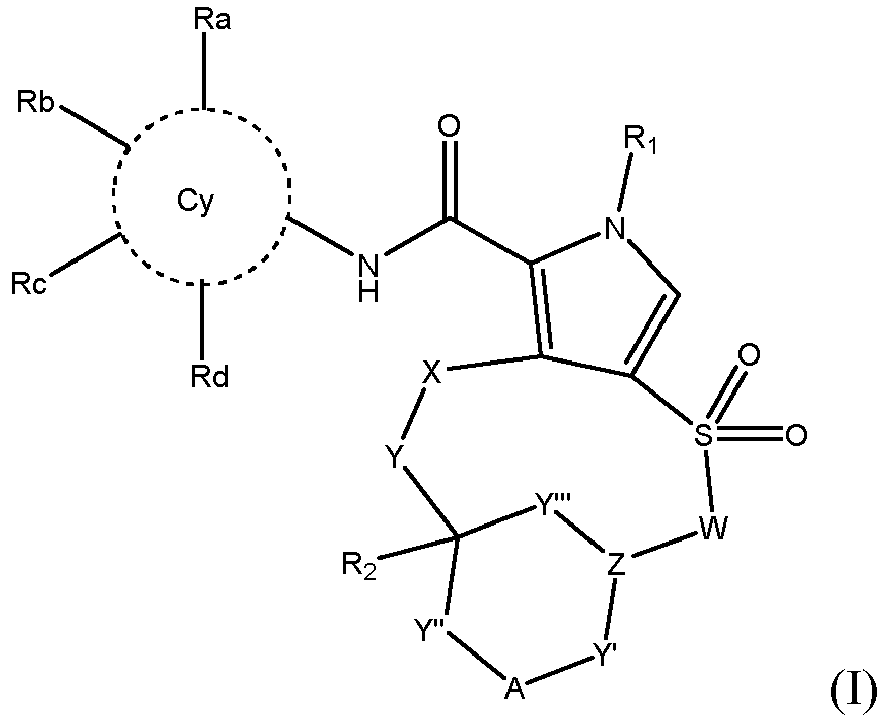 Cy is aryl or heteroaryl;X is O, NH or N-C1-6alkyl;Y, Y', Y" and Y'" are each independently a single bond or C1-6alkanediyl optionally substituted with one or more R3;Z is CR4 or N;W is a single bond or NR5, wherein if W is a single bond, Z is N, and if W is NR5, Z is CR4;A is NR6, O, S or C1-6alkanediyl optionally substituted with one or more R3;R1 is H or C1-6alkyl;R2 is selected from H, OH and C1-6alkyl;R3 is selected from H, OH, C1-6alkyl, C3-8cycloalkyl and halogen or two geminal R3 form together with the atom to which they are attached a spiro-C3-8cycloalkyl or a spiro-C3-8heterocycloalkyl;R4 is H or C1-6alkyl;or when W is NR5 and Z is CR4, R2 and R4 may optionally form a C1-6alkanediyl bridge;R5 is selected from H, C1-6alkyl, C1-6alkylaryl, C1-6alkylheteroaryl and C1-6alkyl-C3-8cycloalkyl wherein each of said C1-6alkyl, C1-6alkylaryl, C1-6alkylheteroaryl or C1-6alkyl-C3-8cycloalkyl is optionally substituted with one or more substituents each independently selected from: OH, halogen, haloC1-6alkyl, cyano and NH2;R6 is selected from:- hydrogen;- OH;- C(O)R7;- C(O)OR7;- C(O)NHR7;- C(O)N(R7)2;- SO2R7;- SO2NH(R7);- SO2N(R7)2;- C1-6alkyl optionally substituted with one or more substituents each independently selected from the group consisting of: OH, halogen, CN, NH2, NH(R7), N(R7)2, aryl, heteroaryl, 3-7 membered saturated ring and 5-7 membered unsaturated ring, each of said saturated or unsaturated ring optionally containing one or more heteroatoms selected from the group consisting of O, N and S and each of said aryl, heteroaryl, 3-7 membered saturated or 5-7 membered unsaturated ring being optionally substituted with one or more substituents each independently selected from OH, halogen, haloC1-6alkyl, CN, haloC1-6alkoxy and C1-6alkoxy;- aryl or heteroaryl ring, each of said aryl or heteroaryl ring being optionally substituted with one or more substituents each independently selected from: OH, halogen, haloC1-6alkyl, CN, haloC1-6alkoxy and C1-6alkoxy; and- a 3-8 membered saturated or partially unsaturated cyclic or bicyclic ring optionally containing one or more heteroatoms each independently selected from the group consisting of: O, S and N, the 3-8 membered saturated or partially unsaturated cyclic or bicyclic ring being optionally substituted with one, two or more substituents each independently selected from the group consisting of: OH, halogen, CN, C1-6alkyl, hydroxyC1-6alkyl, C(O)OR7, C(O)R7, haloC1-6alkyl, haloC1-6alkoxy and C1-6alkoxy;R7 is selected from the group consisting of: C1-6alkyl, C3-8cycloalkyl, aryl, heteroaryl and 3-8 membered saturated or partially saturated heterocyclic ring, wherein each of said C1-6alkyl, C3-scycloalkyl, aryl, heteroaryl or 3-8 membered saturated or partially saturated heterocyclic ring is optionally substituted with one or more substituents each independently selected from the group consisting of: OH, halogen, CN, C1-6alkyl, hydroxyC1-6alkyl, haloC1-6alkyl, haloC1-6alkoxy andC1-6alkoxy;Ra, Rb, Rc and Rd are each idependently selected from the group consisting of: hydrogen, halogen, CN, C1-6alkyl, C1-6alkoxy, haloC1-6alkyl and haloC1-6alkoxy;and pharmaceutically acceptable salts, tautomers, isomers, stereoisomers thereof.
 - The compound according to claim 1 having general formula (Ia):
 Cy is aryl or heteroaryl;X is O, NH or N-C1-6alkyl;Y, Y' and Y" are each independently a single bond or C1-6alkanediyl optionally substituted with one or more R3;A is NR6, O, S or C1-6alkanediyl optionally substituted with one or more R3;R1 is H or C1-6alkyl;R2 is selected from H, OH and C1-6alkyl;R3 is selected from H, OH, C1-6alkyl, C3-8cycloalkyl and halogen or two geminal R3 form together with the atom to which they are attached a spiro-C3-8cycloalkyl or a spiro-C3-8heterocycloalkyl;R5 is selected from:- hydrogen;- OH;- C(O)R7;- C(O)OR7;- C(O)NHR7;- C(O)N(R7)2;- SO2R7;- SO2NH(R7);- SO2N(R7)2;- C1-6alkyl optionally substituted with one or more substituents each independently selected from the group consisting of: OH, halogen, CN, NH2, NH(R7), N(R7)2, aryl, heteroaryl, 3-7 membered saturated ring and 5-7 membered unsaturated ring, each of said saturated or unsaturated ring optionally containing one or more heteroatoms selected from the group consisting of O, N and S and each of said aryl, heteroaryl, 3-7 membered saturated or 5-7 membered unsaturated ring being optionally substituted with one or more substituents each independently selected from OH, halogen, haloC1-6alkyl, CN, haloC1-6alkoxy and C1-6alkoxy;- aryl or heteroaryl ring, each of said aryl or heteroaryl ring being optionally substituted with one or more substituents each independently selected from: OH, halogen, haloC1-6alkyl, CN, haloC1-6alkoxy and C1-6alkoxy; and- a 3-8 membered saturated or partially unsaturated cyclic or bicyclic ring optionally containing one or more heteroatoms each independently selected from the group consisting of: O, S and N, the 3-8 membered saturated or partially unsaturated cyclic or bicyclic ring being optionally substituted with one, two or more substituents each independently selected from the group consisting of: OH, halogen, CN, C1-6alkyl, hydroxyC1-6alkyl, C(O)OR7, C(O)R7, haloC1-6alkyl, haloC1-6alkoxy and C1-6alkoxy;R7 is selected from the group consisting of: C1-6alkyl, C3-8cycloalkyl, aryl, heteroaryl and 3-8 membered saturated or partially saturated heterocyclic ring, wherein each of said C1-6alkyl, C3-scycloalkyl, aryl, heteroaryl or 3-8 membered saturated or partially saturated heterocyclic ring is optionally substituted with one or more substituents each independently selected from the group consisting of: OH, halogen, CN, C1-6alkyl, hydroxyC1-6alkyl, haloC1-6alkyl, haloC1-6alkoxy andC1-6alkoxy;Ra, Rb, Rc and Rd are each idependently selected from the group consisting of: hydrogen, halogen, CN, C1-6alkyl, C1-6alkoxy, haloC1-6alkyl and haloC1-6alkoxy;and pharmaceutically acceptable salts, tautomers, isomers, stereoisomers thereof.
 - The compound according to claim 2, wherein: Cy is phenyl, X is O or NH, A is CH2, R1 is CH3, R2 and R3 are hydrogen, and pharmaceutically acceptable salts, tautomers, isomers, stereoisomers thereof.
- The compound according to claim 1 having the general formula (Ib):
 Cy is aryl or heteroaryl;X is O, NH or N-C1-6alkyl;Y, Y' and Y" are each independently a single bond or C1-6alkanediyl optionally substituted with one or more R3;A is NR6, O, S or C1-6alkanediyl optionally substituted with one or more R3;R1 is H or C1-6alkyl;R2 is selected from H, OH and C1-6alkyl;R3 is selected from H, OH, C1-6alkyl, C3-8cycloalkyl and halogen or two geminal R3 form together with the atom to which they are attached a spiro-C3-8cycloalkyl or a spiro-C3-8heterocycloalkyl;R4 is H or C1-6alkyl;or R2 and R4 may optionally form a C1-6alkanediyl bridge;R5 is selected from H, C1-6alkyl, C1-6alkylaryl, C1-6alkylheteroaryl and C1-6alkyl-C3-8cycloalkyl wherein each of said C1-6alkyl, C1-6alkylaryl, C1-6alkylheteroaryl or C1-6alkyl-C3-8cycloalkyl is optionally substituted with one or more substituents each independently selected from: OH, halogen, haloC1-6alkyl, cyano and NH2;R6 is selected from:- hydrogen;- OH;- C(O)R7;- C(O)OR7;- C(O)NHR7;- C(O)N(R7)2;- SO2R7;- SO2NH(R7);- SO2N(R7)2;- C1-6alkyl optionally substituted with one or more substituents each independently selected from the group consisting of: OH, halogen, CN, NH2, NH(R7), N(R7)2, aryl, heteroaryl, 3-7 membered saturated ring and 5-7 membered unsaturated ring, each of said saturated or unsaturated ring optionally containing one or more heteroatoms selected from the group consisting of O, N and S and each of said aryl, heteroaryl, 3-7 membered saturated or 5-7 membered unsaturated ring being optionally substituted with one or more substituents each independently selected from OH, halogen, haloC1-6alkyl, CN, haloC1-6alkoxy and C1-6alkoxy;- aryl or heteroaryl ring, each of said aryl or heteroaryl ring being optionally substituted with one or more substituents each independently selected from: OH, halogen, haloC1-6alkyl, CN, haloC1-6alkoxy and C1-6alkoxy; and- a 3-8 membered saturated or partially unsaturated cyclic or bicyclic ring optionally containing one or more heteroatoms each independently selected from the group consisting of: O, S and N, the 3-8 membered saturated or partially unsaturated cyclic or bicyclic ring being optionally substituted with one, two or more substituents each independently selected from the group consisting of: OH, halogen, CN, C1-6alkyl, hydroxyC1-6alkyl, C(O)OR7, C(O)R7, haloC1-6alkyl, haloC1-6alkoxy and C1-6alkoxy;R7 is selected from the group consisting of: C1-6alkyl, C3-8cycloalkyl, aryl, heteroaryl and 3-8 membered saturated or partially saturated heterocyclic ring, wherein each of said C1-6alkyl, C3-scycloalkyl, aryl, heteroaryl or 3-8 membered saturated or partially saturated heterocyclic ring is optionally substituted with one or more substituents each independently selected from the group consisting of: OH, halogen, CN, C1-6alkyl, hydroxyC1-6alkyl, haloC1-6alkyl, haloC1-6alkoxy andC1-6alkoxy;Ra, Rb, Rc and Rd are each idependently selected from the group consisting of: hydrogen, halogen, CN, C1-6alkyl, C1-6alkoxy, haloC1-6alkyl and haloC1-6alkoxy;and pharmaceutically acceptable salts, tautomers, isomers, stereoisomers thereof.
 - The compound according to claim 4 wherein: Cy is phenyl, X is O, Y is CH2, Y' is CH2, Y" is CH2 and A is CH2, O or NR6, and pharmaceutically acceptable salts, tautomers, isomers, stereoisomers thereof
- The compound of general formula (I) according to claim 1 being selected from the following list:- N-(3,4-difluorophenyl)-2-methyl-6,7,8,9,9a,10-hexahydro-2H-pyrido[1,2-e]pyrrolo[3,4-b][1,4,5]oxathiazepine-1-carboxamide 4,4-dioxide;- N-(3,4-difluorophenyl)-2-methyl-2,6,7,8,9,9a,10,11-octahydropyrido[1,2-b]pyrrolo[3,4-f]1,2,5]thiadiazepine-1-carboxamide 4,4-dioxide;- N-(3,4-difluorophenyl)-2-methyl-6,7,7a,8-tetrahydro-2H-azeto[1,2-e]pyrrolo[3,4-b][1,4,5]oxathiazepine-1-carboxamide 4,4-dioxide;- trans-N-(3,4-difluorophenyl)-7-methyl-1,3a,4,9a-tetrahydro-3H,7H-furo[3,4-f]pyrrolo[3,4-b][1,4,5]oxathiazepine-8-carboxamide 5,5-dioxide;- cis-N-(3,4-difluorophenyl)-9-methyl-3,4,5,6-tetrahydro-2H,9H-3,5-methanopyrrolo[3,4-b][1,4,5]oxathiazonine-8-carboxamide 1,1-dioxide;- cis-N-(3,4-difluorophenyl)-2-methyl-5a,6,7,8,8a,9-hexahydro-2H,5H-cyclopenta[f]pyrrolo[3,4-b][1,4,5]oxathiazocine-1-carboxamide 4,4-dioxide;- trans-7-methyl-N-(3,4,5-trifluorophenyl)-1,3a,4,9a-tetrahydro-3H,7H-furo[3,4-f]pyrrolo[3,4-b][1,4,5]oxathiazepine-8-carboxamide 5,5-dioxide;- (5aR,8aR)-N-(3,4-difluorophenyl)-2-methyl-5a,6,7,8,8a,9-hexahydro-2H,5H-cyclopenta[f]pyrrolo[3,4-b][1,4,5]oxathiazocine-1-carboxamide 4,4-dioxide;- (5aS,8aS)-N-(3,4-difluorophenyl)-2-methyl-5a,6,7,8,8a,9-hexahydro-2H,5H-cyclopenta[f]pyrrolo[3,4-b][1,4,5]oxathiazocine-1-carboxamide 4,4-dioxide;- cis-Ethyl 7-methyl-8-((3,4,5-trifluorophenyl)carbamoyl)-3a,4,10,10a-tetrahydro-1H,7H-dipyrrolo[3,4-b:3',4'-f][1,4,5]oxathiazocine-2(3H)-carboxylate 5,5-dioxide;- cis-7-methyl-N-(3,4,5-trifluorophenyl)-2,3,3a,4,10,10a-hexahydro-1H,7H-dipyrrolo[3,4-b:3',4'-f][1,4,5]oxathiazocine-8-carboxamide 5,5-dioxide;- cis-2,7-dimethyl-N-(3,4,5-trifluorophenyl)-2,3,3a,4,10,10a-hexahydro-1H,7H-dipyrrolo[3,4-b:3',4'-f][1,4,5]oxathiazocine-8-carboxamide 5,5-dioxide;- cis-Ethyl 8-((3,4-difluorophenyl)carbamoyl)-7-methyl-3a,4,10,10a-tetrahydro-1H,7H-dipyrrolo[3,4-b:3',4'-f][1,4,5]oxathiazocine-2(3H)-carboxylate 5,5-dioxide;- cis-Ethyl 8-((4-fluoro-3-methylphenyl)carbamoyl)-7-methyl-3a,4,10,10a-tetrahydro-1H,7H-dipyrrolo[3,4-b:3',4'-f][1,4,5]oxathiazocine-2(3H)-carboxylate 5,5-dioxide;- cis-Ethyl 8-((3-chloro-4-fluorophenyl)carbamoyl)-7-methyl-3a,4,10,10a-tetrahydro-1H,7H-dipyrrolo[3,4-b:3',4'-f][1,4,5]oxathiazocine-2(3H)-carboxylate 5,5-dioxide;- cis-Ethyl 8-((3-(difluoromethyl)-4-fluorophenyl)carbamoyl)-7-methyl-3a,4,10,10a-tetrahydro-1H,7H-dipyrrolo[3,4-b:3',4'-f][1,4,5]oxathiazocine-2(3H)-carboxylate 5,5-dioxide;- cis-Ethyl 8-((3-cyano-4-fluorophenyl)carbamoyl)-7-methyl-3a,4,10,10a-tetrahydro-1H,7H-dipyrrolo[3,4-b:3',4'-f][1,4,5]oxathiazocine-2(3H)-carboxylate 5,5-dioxide;- cis-2-(isopropylsulfonyl)-7-methyl-N-(3,4,5-trifluorophenyl)-2,3,3a,4,10,10a-hexahydro-1H,7H-dipyrrolo[3,4-b:3',4'-f][1,4,5]oxathiazocine-8-carboxamide 5,5-dioxide;- cis-7-methyl-2-(methylsulfonyl)-N-(3,4,5-trifluorophenyl)-2,3,3a,4,10,10a-hexahydro-1H,7H-dipyrrolo[3,4-b:3',4'-f][1,4,5]oxathiazocine-8-carboxamide 5,5-dioxide;- cis-2-(cyclopropylsulfonyl)-7-methyl-N-(3,4,5-trifluorophenyl)-2,3,3a,4,10,10a-hexahydro-1H,7H-dipyrrolo[3,4-b:3',4'-f][1,4,5]oxathiazocine-8-carboxamide 5,5-dioxide;- cis-2-(N-isopropylsulfamoyl)-7-methyl-N-(3,4,5-trifluorophenyl)-2,3,3a,4,10,10a-hexahydro-1H,7H-dipyrrolo[3,4-b:3',4'-f][1,4,5]oxathiazocine-8-carboxamide 5,5-dioxide;- cis-(3R,3aS,6aR)-hexahydrofuro[2,3-b]furan-3-yl 7-methyl-8-((3,4,5-trifluorophenyl)carbamoyl)-3a,4,10,10a-tetrahydro-1H,7H-dipyrrolo[3,4-b:3',4'-f][1,4,5]oxathiazocine-2(3H)-carboxylate 5,5-dioxide;- N2,7-dimethyl-N8-(3,4,5-trifluorophenyl)-3a,4,10,10a-tetrahydro-1H,7H-dipyrrolo[3,4-b:3',4'-f][1,4,5]oxathiazocine-2,8(3H)-dicarboxamide 5,5-dioxide;- tert-butyl 7-methyl-8-((3,4,5-trifluorophenyl)carbamoyl)-3a,4,10,10a-tetrahydro-1H,7H-dipyrrolo[3,4-b:3',4'-f][1,4,5]oxathiazocine-2(3H)-carboxylate 5,5-dioxide;- (3aR,10aS)-N-(3,4-difluorophenyl)-7-methyl-2,3,3a,4,10,10a-hexahydro-1H,7H-dipyrrolo[3,4-b:3',2'-f][1,4,5]oxathiazocine-8-carboxamide 5,5-dioxide;- (3aR,10aS)-N8-(3,4-difluorophenyl)-N1,7-dimethyl-2,3,3a,4,10,10a-hexahydro-1H,7H-dipyrrolo[3,4-b:3',2'-f][1,4,5]oxathiazocine-1,8-dicarboxamide 5,5-dioxide;- ethyl (3aR,10aS)-8-((3,4-difluorophenyl)carbamoyl)-7-methyl-2,3,3a,4,10,10a-hexahydro-1H,7H-dipyrrolo[3,4-b:3',2'-f][1,4,5]oxathiazocine-1-carboxylate 5,5-dioxide;- cis-2-methyl-N-(3,4,5-trifluorophenyl)-5a,6,7,8,8a,9-hexahydro-2H,5H-cyclopenta[f]pyrrolo[3,4-b][1,4,5]oxathiazocine-1-carboxamide 4,4-dioxide;- N-(3,4-difluorophenyl)-2,8a-dimethyl-5a,6,7,8,8a,9-hexahydro-2H,5H-cyclopenta[f]pyrrolo[3,4-b][1,4,5]oxathiazocine-1-carboxamide 4,4-dioxide;- cis-N-(3,4-difluorophenyl)-8a-hydroxy-2-methyl-5a,6,7,8,8a,9-hexahydro-2H,5H-cyclopenta[f]pyrrolo[3,4-b][1,4,5]oxathiazocine-1-carboxamide 4,4-dioxide;- (3aS,10aS)-7-methyl-N-(3,4,5-trifluorophenyl)-2,3,3a,4,10,10a-hexahydro-1H,7H-dipyrrolo[3,4-b:3',4'-f][1,4,5]oxathiazocine-8-carboxamide 5,5-dioxide;- (3aR,10aR)-7-methyl-N-(3,4,5-trifluorophenyl)-2,3,3a,4,10,10a-hexahydro-1H,7H-dipyrrolo[3,4-b:3',4'-f][1,4,5]oxathiazocine-8-carboxamide 5,5-dioxide;- ethyl (3aR,10aR)-7-methyl-8-((3,4,5-trifluorophenyl)carbamoyl)-3a,4,10,10a-tetrahydro-1H,7H-dipyrrolo[3,4-b:3',4'-f][1,4,5]oxathiazocine-2(3H)-carboxylate 5,5-dioxide;- ethyl (3aS,10aS)-7-methyl-8-((3,4,5-trifluorophenyl)carbamoyl)-3a,4,10,10a-tetrahydro-1H,7H-dipyrrolo[3,4-b:3',4'-f][1,4,5]oxathiazocine-2(3H)-carboxylate 5,5-dioxide;- tert-butyl (3aS,10aS)-7-methyl-8-((3,4,5-trifluorophenyl)carbamoyl)-3a,4,10,10a-tetrahydro-1H,7H-dipyrrolo[3,4-b:3',4'-f][1,4,5]oxathiazocine-2(3H)-carboxylate 5,5-dioxide;- tert-butyl (3aR,10aR)-7-methyl-8-((3,4,5-trifluorophenyl)carbamoyl)-3a,4,10,10a-tetrahydro-1H,7H-dipyrrolo[3,4-b:3',4'-f][1,4,5]oxathiazocine-2(3H)-carboxylate 5,5-dioxide;- (5aS,8aR) N-(3,4-difluorophenyl)-2-methyl-5a,6,7,8,8a,9-hexahydro-2H,5H-cyclopenta[f]pyrrolo[3,4-b][1,4,5]oxathiazocine-1-carboxamide 4,4-dioxide;- (5aR,8aS) N-(3,4-difluorophenyl)-2-methyl-5a,6,7,8,8a,9-hexahydro-2H,5H-cyclopenta[f]pyrrolo[3,4-b][1,4,5]oxathiazocine-1-carboxamide 4,4-dioxide;and pharmaceutically acceptable salts, tautomers, isomers, stereoisomers thereof.
- A compound as defined in any one of previous claims for medical use.
- The compound as defined in claim 7 for use in the treatment and/or prevention of a HBV infection.
- The compound according to claim 8 for use in treating, eradicating, reducing, slowing or inhibiting an HBV infection in an individual in need thereof, and/or in reducing the viral load associated with an HBV infection in an individual in need thereof, and/or reducing reoccurrence of an HBV infection in an individual in need thereof, and/or inducing remission of hepatic injury from an HBV infection in an individual in need thereof, and/or prophylactically treating an HBV infection in an individual afflicted with a latent HBV infection.
- The compound for use according to any one of claims 7-9, for use in combination with at least one further therapeutic agent.
- The compound for use according to claim 10, wherein the at least one further therapeutic agent is selected from the group consisting of: a therapeutic vaccine; an RNA interference therapeutic/antisense oligonucleotide; an immunomodulator; a STING agonist; a RIG-I modulator; a NKT modulator; an IL agonist; an interleukin or another immune acting protein; a therapeutic and prophylactic vaccine; an immune checkpoint modulator/inhibitor; an HBV entry inhibitor; a cccDNA modulator; an inhibitor of HBV protein espression; an agent targeting HBV RNA; a capsid assembly inhibitor/modulator; a core or X protein targeting agent; a nucleotide analogue; a nucleoside analogue; an interferon or a modified interferon; an HBV antiviral of distinct or unknown mechanism; a cyclophilin inhibitor; a sAg release inhibitor; a HBV polymerase inhibitor; a dinucleotide; a SMAC inhibitor; a HDV targeting agent; a viral maturation inhibitor; a reverse transcriptase inhibitor and an HBV RNA destabilizer or another small-molecule inhibitor of HBV protein expression; or a combination thereof; wherein said therapeutic vaccine is preferably selected from: HBsAG-HBIG, HB-Vac, ABX203, NASVAC, GS-4774, GX-110 (HB-110E), CVI-HBV-002, RG7944 (INO-1800), TG-1050, FP-02 (Hepsyn-B), AIC649, VGX-6200, KW-2, TomegaVax-HBV, ISA-204, NU-500, INX-102-00557, HBV MVA and PepTcell; wherein said RNA interference therapeutic is preferably selected from: TKM-HBV (ARB-1467), ARB-1740, ARC-520, ARC-521, BB-HB-331, REP-2139, ALN-HBV, ALN-PDL, LUNAR-HBV, GS3228836 and GS3389404; wherein said immunomodulator is preferably a TLR agonist, preferably a TLR7, TLR8 or TLR9 agonist, preferably being selected from: RG7795 (RO-6864018), GS-9620, SM360320 (9-benzyl-8-hydroxy-2-(2-methoxy-ethoxy)adenine), AZD 8848 (methyl [3-({[3-(6-amino-2-butoxy-8-oxo-7,8-dihydro-9H-pyrin-9-yl)propyl][3-(4-morpholinyl)propyl]amino}methyl)phenyl]acetate) and ARB-1598; wherein said RIG-I modulator is preferably SB-9200; wherein said IL agonist or other immune acting protein is preferably INO-9112 or recombinant IL12; wherein said immune checkpoint modulator/inhibitor is preferably BMS-936558 (Opdivo (nivolumab)) or pembrolizumab; wherein said HBV entry inhibitor is preferably Myrcludex B, IVIG-Tonrol or GC-1102; wherein said cccDNA modulator is preferably selected from: a direct cccDNA inhibitor, an inhibitor of cccDNA formation or maintenance, a cccDNA epigenetic modifier and an inhibitor of cccDNA transcription; wherein said capsid assembly inhibitor/modulator, core or X protein targeting agent, direct cccDNA inhibitor, inhibitor of cccDNA formation or maintenance, or cccDNA epigenetic modifier is preferably selected from: BAY 41-4109, NVR 3-778, GLS-4, NZ-4 (W28F), Y101, ARB-423, ARB-199, ARB-596, AB-506, JNJ-56136379, ASMB-101 (AB-V102), ASMB-103, CHR-101, CC-31326, AT-130 and RO7049389; wherein said interferon or modified interferon is preferably selected from: interferon alpha (IFN-α), pegylated interferon alpha (PEG-IFN-α), interferon alpha-2a, recombinant interferon alpha-2a, peginterferon alpha-2a (Pegasys), interferon alpha-2b (Intron A), recombinant interferon alpha-2b, interferon alpha-2b XL, peginterferon alpha-2b, glycosylated interferon alpha-2b, interferon alpha-2c, recombinant interferon alpha-2c, interferon beta, interferon beta-la, peginterferon beta-la, interferon delta, interferon lambda (IFN-λ), peginterferon lambda-1, interferon omega, interferon tau, interferon gamma (IFN-γ), interferon alfacon-1, interferon alpha-nl, interferon alpha-n3, albinterferon alpha-2b, BLX-883, DA-3021, PI 101 (also known as AOP2014), PEG-infergen, Belerofon, INTEFEN-IFN, albumin/interferon alpha 2a fusion protein, rHSA-IFN alpha 2a, rHSA-IFN alpha 2b, PEG-IFN-SA and interferon alpha biobetter; wherein said HBV antiviral of distinct or unknown mechanism is selected from: AT-61 ((E)-N-(1-chloro-3-oxo-1-phenyl-3-(piperidin-1-yl)prop-1-en-2-yl)benzamide), AT130 ((E)-N-(1-bromo-1-(2-methoxyphenyl)-3-oxo-3-(piperidin-1-yl)prop-1-en-2-yl)-4-nitrobenzamide), analogues thereof, REP-9AC (REP-2055), REP-9AC' (REP-2139), REP-2165 and HBV-0259; wherein said cyclophilin inhibitor is preferably selected from: OCB-030 (NVP-018), SCY-635, SCY-575 and CPI-431-32; wherein said HBV polymerase inhibitor is preferably selected from: entecavir (Baraclude, Entavir), lamivudine (3TC, Zeffix, Heptovir, Epivir, and Epivir-HBV), telbivudine (Tyzeka, Sebivo), clevudine, besifovir, adefovir (hepsera), tenofovir, preferably said tenofovir is in a salt form selected from: tenofovir disoproxil fumarate (Viread), tenofovir alafenamide fumarate (TAF), tenofovir disoproxil orotate (DA-2802), tenofovir disopropxil aspartate (CKD-390), AGX-1009, and CMX157; wherein said dinucleotide is preferably SB9200; wherein said SMAC inhibitor is preferably Birinapant; wherein said HDV targeting agent is preferably Lonafamib; wherein said HBV RNA destabilizer or other small-molecule inhibitor of HBV protein expression is preferably RG7834 or AB-452.
- A pharmaceutical composition comprising a compound as defined in anyone of claims 1-6, alone or in combination with at least one further therapeutic agent, and at least one pharmaceutically acceptable excipient.
- The pharmaceutical composition according to claim 12, wherein the at least one further therapeutic agent is selected from the group consisting of: a therapeutic vaccine; an RNA interference therapeutic/antisense oligonucleotide; an immunomodulator; a STING agonist; a RIG-I modulator; a NKT modulator; an IL agonist; an interleukin or another immune acting protein; a therapeutic and prophylactic vaccine; an immune checkpoint modulator/inhibitor; an HBV entry inhibitor; a cccDNA modulator; an inhibitor of HBV protein espression; an agent targeting HBV RNA; a capsid assembly inhibitor/modulator; a core or X protein targeting agent; a nucleotide analogue; a nucleoside analogue; an interferon or a modified interferon; an HBV antiviral of distinct or unknown mechanism; a cyclophilin inhibitor; a sAg release inhibitor; a HBV polymerase inhibitor; a dinucleotide; a SMAC inhibitor; a HDV targeting agent; a viral maturation inhibitor; a reverse transcriptase inhibitor and an HBV RNA destabilizer or another small-molecule inhibitor of HBV protein expression; or a combination thereof; wherein said therapeutic vaccine is preferably selected from: HBsAG-HBIG, HB-Vac, ABX203, NASVAC, GS-4774, GX- 110 (HB-110E), CVI-HBV-002, RG7944 (INO-1800), TG-1050, FP-02 (Hepsyn-B), AIC649, VGX-6200, KW-2, TomegaVax-HBV, ISA-204, NU-500, INX-102-00557, HBV MVA and PepTcell; wherein said RNA interference therapeutic is preferably selected from: TKM-HBV (ARB-1467), ARB-1740, ARC-520, ARC-521, BB-HB-331, REP-2139, ALN-HBV, ALN-PDL, LUNAR-HBV, GS3228836 and GS3389404; wherein said immunomodulator is preferably a TLR agonist, preferably a TLR7, TLR8 or TLR9 agonist, preferably being selected from: RG7795 (RO-6864018), GS-9620, SM360320 (9-benzyl-8-hydroxy-2-(2-methoxy-ethoxy)adenine), AZD 8848 (methyl [3-({[3-(6-amino-2-butoxy-8-oxo-7,8-dihydro-9H-pyrin-9-yl)propyl][3-(4-morpholinyl)propyl]amino}methyl)phenyl]acetate) and ARB-1598; wherein said RIG-I modulator is preferably SB-9200; wherein said IL agonist or other immune acting protein is preferably INO-9112 or recombinant IL12; wherein said immune checkpoint modulator/inhibitor is preferably BMS-936558 (Opdivo (nivolumab)) or pembrolizumab; wherein said HBV entry inhibitor is preferably Myrcludex B, IVIG-Tonrol or GC-1102; wherein said cccDNA modulator is preferably selected from: a direct cccDNA inhibitor, an inhibitor of cccDNA formation or maintenance, a cccDNA epigenetic modifier and an inhibitor of cccDNA transcription; wherein said capsid assembly inhibitor/modulator, core or X protein targeting agent, direct cccDNA inhibitor, inhibitor of cccDNA formation or maintenance, or cccDNA epigenetic modifier is preferably selected from: BAY 41-4109, NVR 3-778, GLS-4, NZ-4 (W28F), Y101, ARB-423, ARB-199, ARB-596, AB-506, JNJ-56136379, ASMB-101 (AB-V102), ASMB-103, CHR-101, CC-31326, AT-130 and RO7049389; wherein said interferon or modified interferon is preferably selected from: interferon alpha (IFN-α), pegylated interferon alpha (PEG-IFN-α), interferon alpha-2a, recombinant interferon alpha-2a, peginterferon alpha-2a (Pegasys), interferon alpha-2b (Intron A), recombinant interferon alpha-2b, interferon alpha-2b XL, peginterferon alpha-2b, glycosylated interferon alpha-2b, interferon alpha-2c, recombinant interferon alpha-2c, interferon beta, interferon beta-la, peginterferon beta-la, interferon delta, interferon lambda (IFN-λ), peginterferon lambda-1, interferon omega, interferon tau, interferon gamma (IFN-γ), interferon alfacon-1, interferon alpha-nl, interferon alpha-n3, albinterferon alpha-2b, BLX-883, DA-3021, PI 101 (also known as AOP2014), PEG-infergen, Belerofon, INTEFEN-IFN, albumin/interferon alpha 2a fusion protein, rHSA-IFN alpha 2a, rHSA-IFN alpha 2b, PEG-IFN-SA and interferon alpha biobetter; wherein said HBV antiviral of distinct or unknown mechanism is selected from: AT-61 ((E)-N-(1-chloro-3-oxo-1-phenyl-3-(piperidin-1-yl)prop-1-en-2-yl)benzamide), AT130 ((E)-N-(1-bromo-1-(2-methoxyphenyl)-3-oxo-3-(piperidin-1-yl)prop-1-en-2-yl)-4-nitrobenzamide), analogues thereof, REP-9AC (REP-2055), REP-9AC' (REP-2139), REP-2165 and HBV-0259; wherein said cyclophilin inhibitor is preferably selected from: OCB-030 (NVP-018), SCY-635, SCY-575 and CPI-431-32; wherein said HBV polymerase inhibitor is preferably selected from: entecavir (Baraclude, Entavir), lamivudine (3TC, Zeffix, Heptovir, Epivir, and Epivir-HBV), telbivudine (Tyzeka, Sebivo), clevudine, besifovir, adefovir (hepsera), tenofovir, preferably said tenofovir is in a salt form selected from: tenofovir disoproxil fumarate (Viread), tenofovir alafenamide fumarate (TAF), tenofovir disoproxil orotate (DA-2802), tenofovir disopropxil aspartate (CKD-390), AGX-1009, and CMX157; wherein said dinucleotide is preferably SB9200; wherein said SMAC inhibitor is preferably Birinapant; wherein said HDV targeting agent is preferably Lonafamib; wherein said HBV RNA destabilizer or other small-molecule inhibitor of HBV protein expression is preferably RG7834 or AB-452.
- The pharmaceutical composition according to claim 13 for use in the treatment and/or prevention of a HBV infection.
- The pharmaceutical composition according to claim 14 for use in treating, eradicating, reducing, slowing or inhibiting an HBV infection in an individual in need thereof, and/or in reducing the viral load associated with an HBV infection in an individual in need thereof, and/or reducing reoccurrence of an HBV infection in an individual in need thereof, and/or inducing remission of hepatic injury from an HBV infection in an individual in need thereof, and/or prophylactically treating an HBV infection in an individual afflicted with a latent HBV infection.
Priority Applications (10)
| Application Number | Priority Date | Filing Date | Title |
|---|---|---|---|
| EP18188409.9A EP3608326A1 (en) | 2018-08-10 | 2018-08-10 | Tricyclic inhibitors of hepatitis b virus |
| PCT/EP2019/071408 WO2020030781A1 (en) | 2018-08-10 | 2019-08-09 | Tricyclic inhibitors of hepatitis b virus |
| CA3110098A CA3110098A1 (en) | 2018-08-10 | 2019-08-09 | Tricyclic inhibitors of hepatitis b virus |
| CN201980067267.3A CN113272309B (en) | 2018-08-10 | 2019-08-09 | Tricyclic inhibitors of hepatitis b virus |
| US17/267,693 US11504382B2 (en) | 2018-08-10 | 2019-08-09 | Tricyclic inhibitors of Hepatitis B virus |
| EP19749375.2A EP3833672B1 (en) | 2018-08-10 | 2019-08-09 | Tricyclic inhibitors of hepatitis b virus |
| BR112021002565A BR112021002565A8 (en) | 2018-08-10 | 2019-08-09 | COMPOUND, PHARMACEUTICALLY ACCEPTABLE SALT, TAUTOMER OR STEREOISOMER THEREOF, PHARMACEUTICAL COMPOSITION, PROCESS FOR SYNTHESIS AND USE OF SAID COMPOUND |
| ES19749375T ES2996923T3 (en) | 2018-08-10 | 2019-08-09 | Tricyclic inhibitors of hepatitis b virus |
| JP2021506990A JP7436454B2 (en) | 2018-08-10 | 2019-08-09 | Tricyclic inhibitor of hepatitis B virus |
| US17/937,841 US20230076319A1 (en) | 2018-08-10 | 2022-10-04 | Inhibitors of hepatitis b virus |
Applications Claiming Priority (1)
| Application Number | Priority Date | Filing Date | Title |
|---|---|---|---|
| EP18188409.9A EP3608326A1 (en) | 2018-08-10 | 2018-08-10 | Tricyclic inhibitors of hepatitis b virus |
Publications (1)
| Publication Number | Publication Date |
|---|---|
| EP3608326A1 true EP3608326A1 (en) | 2020-02-12 |
Family
ID=63209240
Family Applications (2)
| Application Number | Title | Priority Date | Filing Date |
|---|---|---|---|
| EP18188409.9A Withdrawn EP3608326A1 (en) | 2018-08-10 | 2018-08-10 | Tricyclic inhibitors of hepatitis b virus |
| EP19749375.2A Active EP3833672B1 (en) | 2018-08-10 | 2019-08-09 | Tricyclic inhibitors of hepatitis b virus |
Family Applications After (1)
| Application Number | Title | Priority Date | Filing Date |
|---|---|---|---|
| EP19749375.2A Active EP3833672B1 (en) | 2018-08-10 | 2019-08-09 | Tricyclic inhibitors of hepatitis b virus |
Country Status (8)
| Country | Link |
|---|---|
| US (2) | US11504382B2 (en) |
| EP (2) | EP3608326A1 (en) |
| JP (1) | JP7436454B2 (en) |
| CN (1) | CN113272309B (en) |
| BR (1) | BR112021002565A8 (en) |
| CA (1) | CA3110098A1 (en) |
| ES (1) | ES2996923T3 (en) |
| WO (1) | WO2020030781A1 (en) |
Families Citing this family (4)
| Publication number | Priority date | Publication date | Assignee | Title |
|---|---|---|---|---|
| EP3597637A1 (en) * | 2018-07-19 | 2020-01-22 | Irbm S.P.A. | Inhibitors of hepatitis b virus |
| UY38705A (en) | 2019-05-23 | 2020-12-31 | Irbm S P A | TRICYCLIC INHIBITORS SUBSTITUTED WITH HEPATITIS B VIRUS OXALAMIDE |
| ES3054072T3 (en) * | 2020-08-07 | 2026-01-29 | Gilead Sciences Inc | Prodrugs of phosphonamide nucleotide analogues and their pharmaceutical use |
| WO2022206879A1 (en) * | 2021-03-31 | 2022-10-06 | 苏州晶云药物科技股份有限公司 | Crystal forms of sulfamoyl pyrrole amide compounds and preparation methods therefor |
Citations (13)
| Publication number | Priority date | Publication date | Assignee | Title |
|---|---|---|---|---|
| US20060148722A1 (en) | 2004-02-11 | 2006-07-06 | Vicuron Pharmaceuticals Inc. | Novel lincomycin derivatives possessing antibacterial activity |
| WO2010016005A1 (en) | 2008-08-06 | 2010-02-11 | Pfizer Inc. | 6 substituted 2-heterocyclylamino pyrazine compounds as chk-1 inhibitors |
| WO2013006394A1 (en) | 2011-07-01 | 2013-01-10 | Institute For Hepatitis And Virus Research | Sulfamoylbenzamide derivatives as antiviral agents against hbv infection |
| WO2013096744A1 (en) | 2011-12-21 | 2013-06-27 | Novira Therapeutics, Inc. | Hepatitis b antiviral agents |
| WO2014106019A2 (en) | 2012-12-27 | 2014-07-03 | Philadelphia Health & Education Corporation, D/B/A Drexel | Novel antiviral agents against hbv infection |
| WO2014165128A2 (en) | 2013-03-12 | 2014-10-09 | Novira Therapeutics, Inc. | Hepatitis b antiviral agents |
| WO2015109130A1 (en) | 2014-01-16 | 2015-07-23 | Novira Therapeutics, Inc. | Azepane derivatives and methods of treating hepatitis b infections |
| WO2015120178A1 (en) | 2014-02-05 | 2015-08-13 | Novira Therapeutics, Inc. | Combination therapy for treatment of hbv infections |
| US20150274652A1 (en) | 2014-03-27 | 2015-10-01 | Novira Therapeutics, Inc. | Piperidine derivatives and methods of treating hepatitis b infections |
| US20160151375A1 (en) | 2014-12-02 | 2016-06-02 | Novira Therapeutics, Inc. | Sulfide alkyl compounds for hbv treatment |
| WO2016089990A1 (en) | 2014-12-02 | 2016-06-09 | Novira Therapeutics, Inc. | Sulfide alkyl and pyridyl reverse sulfonamide compounds for hbv treatment |
| US20160185748A1 (en) | 2014-12-30 | 2016-06-30 | Novira Therapeutics, Inc. | Pyridyl reverse sulfonamides for hbv treatment |
| WO2017001655A1 (en) | 2015-07-02 | 2017-01-05 | Janssen Sciences Ireland Uc | Cyclized sulfamoylarylamide derivatives and the use thereof as medicaments for the treatment of hepatitis b |
Family Cites Families (7)
| Publication number | Priority date | Publication date | Assignee | Title |
|---|---|---|---|---|
| CA2511646A1 (en) * | 2002-12-27 | 2004-07-22 | Chiron Corporation | Thiosemicarbazones as anti-virals and immunopotentiators |
| ES2607952T3 (en) * | 2009-11-13 | 2017-04-04 | Merck Serono S.A. | Tricyclic derivatives of Pirazol Amina |
| JP2014534206A (en) * | 2011-10-17 | 2014-12-18 | エナンタ ファーマシューティカルズ インコーポレイテッド | Hepatitis C virus inhibitor |
| DK3331886T3 (en) | 2015-08-05 | 2020-08-24 | Indivior Uk Ltd | DOPAMIN-D3 RECEPTOR ANTAGONISTS WITH A BICYCLO PART |
| CA3037151A1 (en) * | 2016-09-15 | 2018-03-22 | Assembly Biosciences, Inc. | Hepatitis b core protein modulators |
| SG11201902944TA (en) * | 2016-11-07 | 2019-05-30 | Arbutus Biopharma Corp | Substituted pyridinone-containing tricyclic compounds, and methods using same |
| CN108264520B (en) * | 2017-01-03 | 2021-12-07 | 上海长森药业有限公司 | Compound for treating hepatitis B and application thereof |
-
2018
- 2018-08-10 EP EP18188409.9A patent/EP3608326A1/en not_active Withdrawn
-
2019
- 2019-08-09 WO PCT/EP2019/071408 patent/WO2020030781A1/en not_active Ceased
- 2019-08-09 BR BR112021002565A patent/BR112021002565A8/en unknown
- 2019-08-09 CN CN201980067267.3A patent/CN113272309B/en active Active
- 2019-08-09 JP JP2021506990A patent/JP7436454B2/en active Active
- 2019-08-09 CA CA3110098A patent/CA3110098A1/en active Pending
- 2019-08-09 US US17/267,693 patent/US11504382B2/en active Active
- 2019-08-09 EP EP19749375.2A patent/EP3833672B1/en active Active
- 2019-08-09 ES ES19749375T patent/ES2996923T3/en active Active
-
2022
- 2022-10-04 US US17/937,841 patent/US20230076319A1/en not_active Abandoned
Patent Citations (13)
| Publication number | Priority date | Publication date | Assignee | Title |
|---|---|---|---|---|
| US20060148722A1 (en) | 2004-02-11 | 2006-07-06 | Vicuron Pharmaceuticals Inc. | Novel lincomycin derivatives possessing antibacterial activity |
| WO2010016005A1 (en) | 2008-08-06 | 2010-02-11 | Pfizer Inc. | 6 substituted 2-heterocyclylamino pyrazine compounds as chk-1 inhibitors |
| WO2013006394A1 (en) | 2011-07-01 | 2013-01-10 | Institute For Hepatitis And Virus Research | Sulfamoylbenzamide derivatives as antiviral agents against hbv infection |
| WO2013096744A1 (en) | 2011-12-21 | 2013-06-27 | Novira Therapeutics, Inc. | Hepatitis b antiviral agents |
| WO2014106019A2 (en) | 2012-12-27 | 2014-07-03 | Philadelphia Health & Education Corporation, D/B/A Drexel | Novel antiviral agents against hbv infection |
| WO2014165128A2 (en) | 2013-03-12 | 2014-10-09 | Novira Therapeutics, Inc. | Hepatitis b antiviral agents |
| WO2015109130A1 (en) | 2014-01-16 | 2015-07-23 | Novira Therapeutics, Inc. | Azepane derivatives and methods of treating hepatitis b infections |
| WO2015120178A1 (en) | 2014-02-05 | 2015-08-13 | Novira Therapeutics, Inc. | Combination therapy for treatment of hbv infections |
| US20150274652A1 (en) | 2014-03-27 | 2015-10-01 | Novira Therapeutics, Inc. | Piperidine derivatives and methods of treating hepatitis b infections |
| US20160151375A1 (en) | 2014-12-02 | 2016-06-02 | Novira Therapeutics, Inc. | Sulfide alkyl compounds for hbv treatment |
| WO2016089990A1 (en) | 2014-12-02 | 2016-06-09 | Novira Therapeutics, Inc. | Sulfide alkyl and pyridyl reverse sulfonamide compounds for hbv treatment |
| US20160185748A1 (en) | 2014-12-30 | 2016-06-30 | Novira Therapeutics, Inc. | Pyridyl reverse sulfonamides for hbv treatment |
| WO2017001655A1 (en) | 2015-07-02 | 2017-01-05 | Janssen Sciences Ireland Uc | Cyclized sulfamoylarylamide derivatives and the use thereof as medicaments for the treatment of hepatitis b |
Non-Patent Citations (11)
| Title |
|---|
| "Design of Prodrugs", 1985, ELSEVIER |
| BERG ET AL.: "Pharmaceutical Salts", J. PHARM. SCI., vol. 66, 1977, pages 1 - 19 |
| BURNS GS; THOMPSON AJ, COLD SPRING HARB PERSPECT MED., vol. 4, no. 12, 30 October 2014 (2014-10-30) |
| DURANTEL D; ZOULIM F, J HEPATOL., vol. 64, no. 1, April 2016 (2016-04-01), pages S117 - S131 |
| E.L. ELIEL; S.H. WILEN: "Stereochemistry of Carbon Compounds", 1994, JOHN WILEY & SONS, pages: 1119 - 1190 |
| GUIDOTTI LG; CHISARI FV, ANNU REV PATHOL., vol. 1, 2006, pages 23 - 61 |
| HUGHES, S.A. ET AL., LANCET, vol. 378, 2011, pages 73 - 85 |
| LADNER ET AL., ANTIMICROB AGENTS CHEMOTHER, vol. 41, 1997, pages 1715 - 1720 |
| SEEGER C; MASON WS, VIROLOGY, vol. 479-480, May 2015 (2015-05-01), pages 672 - 686 |
| TU M. ET AL., CURRENT TOPICS IN MEDICINAL CHEMISTRY, vol. 13, 2013, pages 857 - 866 |
| ZOULIM, DURANTEL D, COLD SPRING HARB PERSPECT MED., vol. 5, no. 4, 1 April 2015 (2015-04-01) |
Also Published As
| Publication number | Publication date |
|---|---|
| US20230076319A1 (en) | 2023-03-09 |
| CN113272309A (en) | 2021-08-17 |
| EP3833672B1 (en) | 2024-09-18 |
| CN113272309B (en) | 2024-02-23 |
| BR112021002565A2 (en) | 2021-05-11 |
| ES2996923T3 (en) | 2025-02-13 |
| JP7436454B2 (en) | 2024-02-21 |
| US11504382B2 (en) | 2022-11-22 |
| WO2020030781A1 (en) | 2020-02-13 |
| JP2021534132A (en) | 2021-12-09 |
| CA3110098A1 (en) | 2020-02-13 |
| EP3833672C0 (en) | 2024-09-18 |
| EP3833672A1 (en) | 2021-06-16 |
| BR112021002565A8 (en) | 2022-10-18 |
| US20220110943A1 (en) | 2022-04-14 |
Similar Documents
| Publication | Publication Date | Title |
|---|---|---|
| US20230076319A1 (en) | Inhibitors of hepatitis b virus | |
| WO2020016434A1 (en) | Cyclic inhibitors of hepatitis b virus | |
| EP3823957A1 (en) | Inhibitors of hepatitis b virus | |
| JP7717704B2 (en) | Spirocyclic inhibitors of hepatitis B virus | |
| EP3865489A1 (en) | Spirocyclic inhibitors of hepatitis b virus | |
| US12465590B2 (en) | Oxalamido-substituted tricyclic inhibitors of hepatitis b virus | |
| AU2020278909B2 (en) | Oxalamido-substituted tricyclic inhibitors of hepatitis B virus | |
| EP3741762A1 (en) | Oxalamido-substituted tricyclic inhibitors of hepatitis b virus | |
| EP3825318A1 (en) | Oxalamido-substituted tricyclic inhibitors of hepatitis b virus | |
| EP3985010A1 (en) | Spirocyclic inhibitors of hepatitis b virus | |
| EA048951B1 (en) | OXALAMIDE-SUBSTITUTED TRICYCLIC HEPATITIS B VIRUS INHIBITORS |
Legal Events
| Date | Code | Title | Description |
|---|---|---|---|
| PUAI | Public reference made under article 153(3) epc to a published international application that has entered the european phase |
Free format text: ORIGINAL CODE: 0009012 |
|
| AK | Designated contracting states |
Kind code of ref document: A1 Designated state(s): AL AT BE BG CH CY CZ DE DK EE ES FI FR GB GR HR HU IE IS IT LI LT LU LV MC MK MT NL NO PL PT RO RS SE SI SK SM TR |
|
| AX | Request for extension of the european patent |
Extension state: BA ME |
|
| STAA | Information on the status of an ep patent application or granted ep patent |
Free format text: STATUS: THE APPLICATION IS DEEMED TO BE WITHDRAWN |
|
| 18D | Application deemed to be withdrawn |
Effective date: 20200813 |