EP3530754A1 - Method for amplification of nucleic acid with improved specificity - Google Patents
Method for amplification of nucleic acid with improved specificity Download PDFInfo
- Publication number
- EP3530754A1 EP3530754A1 EP18195312.6A EP18195312A EP3530754A1 EP 3530754 A1 EP3530754 A1 EP 3530754A1 EP 18195312 A EP18195312 A EP 18195312A EP 3530754 A1 EP3530754 A1 EP 3530754A1
- Authority
- EP
- European Patent Office
- Prior art keywords
- sequence
- amplification
- primer
- pcr
- polymerase
- Prior art date
- Legal status (The legal status is an assumption and is not a legal conclusion. Google has not performed a legal analysis and makes no representation as to the accuracy of the status listed.)
- Ceased
Links
- 238000003199 nucleic acid amplification method Methods 0.000 title claims abstract description 325
- 230000003321 amplification Effects 0.000 title claims abstract description 324
- 150000007523 nucleic acids Chemical class 0.000 title claims abstract description 87
- 238000000034 method Methods 0.000 title claims abstract description 56
- 108020004707 nucleic acids Proteins 0.000 title claims abstract description 42
- 102000039446 nucleic acids Human genes 0.000 title claims abstract description 42
- 108091034117 Oligonucleotide Proteins 0.000 claims abstract description 157
- 125000003729 nucleotide group Chemical group 0.000 claims abstract description 31
- 239000002773 nucleotide Substances 0.000 claims abstract description 22
- 238000006243 chemical reaction Methods 0.000 claims description 104
- 230000000295 complement effect Effects 0.000 claims description 40
- 230000001419 dependent effect Effects 0.000 claims description 34
- 230000015572 biosynthetic process Effects 0.000 claims description 32
- 101150067766 mpl2 gene Proteins 0.000 claims description 29
- 230000027455 binding Effects 0.000 claims description 15
- 239000000758 substrate Substances 0.000 claims description 15
- 238000002844 melting Methods 0.000 claims description 14
- 230000008018 melting Effects 0.000 claims description 14
- 239000001226 triphosphate Substances 0.000 claims description 14
- 239000011541 reaction mixture Substances 0.000 claims description 12
- 235000011178 triphosphate Nutrition 0.000 claims description 12
- 108091028043 Nucleic acid sequence Proteins 0.000 claims description 11
- 230000000694 effects Effects 0.000 claims description 11
- 108010014303 DNA-directed DNA polymerase Proteins 0.000 claims description 10
- 102000016928 DNA-directed DNA polymerase Human genes 0.000 claims description 10
- 230000000977 initiatory effect Effects 0.000 claims description 8
- 238000000926 separation method Methods 0.000 claims description 8
- 239000005549 deoxyribonucleoside Substances 0.000 claims description 6
- 239000011159 matrix material Substances 0.000 claims description 6
- 239000002342 ribonucleoside Substances 0.000 claims description 6
- -1 ribonucleoside triphosphates Chemical class 0.000 claims description 6
- 125000002264 triphosphate group Chemical class [H]OP(=O)(O[H])OP(=O)(O[H])OP(=O)(O[H])O* 0.000 claims description 6
- 241000282414 Homo sapiens Species 0.000 claims description 4
- 230000002441 reversible effect Effects 0.000 claims description 4
- 101100519158 Arabidopsis thaliana PCR2 gene Proteins 0.000 claims description 2
- 101000967087 Homo sapiens Metal-response element-binding transcription factor 2 Proteins 0.000 claims description 2
- 241000124008 Mammalia Species 0.000 claims description 2
- 102100040632 Metal-response element-binding transcription factor 2 Human genes 0.000 claims description 2
- 244000052616 bacterial pathogen Species 0.000 claims description 2
- 229920000642 polymer Polymers 0.000 claims description 2
- 230000009870 specific binding Effects 0.000 claims description 2
- 108060002716 Exonuclease Proteins 0.000 claims 1
- 102000013165 exonuclease Human genes 0.000 claims 1
- JLCPHMBAVCMARE-UHFFFAOYSA-N [3-[[3-[[3-[[3-[[3-[[3-[[3-[[3-[[3-[[3-[[3-[[5-(2-amino-6-oxo-1H-purin-9-yl)-3-[[3-[[3-[[3-[[3-[[3-[[5-(2-amino-6-oxo-1H-purin-9-yl)-3-[[5-(2-amino-6-oxo-1H-purin-9-yl)-3-hydroxyoxolan-2-yl]methoxy-hydroxyphosphoryl]oxyoxolan-2-yl]methoxy-hydroxyphosphoryl]oxy-5-(5-methyl-2,4-dioxopyrimidin-1-yl)oxolan-2-yl]methoxy-hydroxyphosphoryl]oxy-5-(6-aminopurin-9-yl)oxolan-2-yl]methoxy-hydroxyphosphoryl]oxy-5-(6-aminopurin-9-yl)oxolan-2-yl]methoxy-hydroxyphosphoryl]oxy-5-(6-aminopurin-9-yl)oxolan-2-yl]methoxy-hydroxyphosphoryl]oxy-5-(6-aminopurin-9-yl)oxolan-2-yl]methoxy-hydroxyphosphoryl]oxyoxolan-2-yl]methoxy-hydroxyphosphoryl]oxy-5-(5-methyl-2,4-dioxopyrimidin-1-yl)oxolan-2-yl]methoxy-hydroxyphosphoryl]oxy-5-(4-amino-2-oxopyrimidin-1-yl)oxolan-2-yl]methoxy-hydroxyphosphoryl]oxy-5-(5-methyl-2,4-dioxopyrimidin-1-yl)oxolan-2-yl]methoxy-hydroxyphosphoryl]oxy-5-(5-methyl-2,4-dioxopyrimidin-1-yl)oxolan-2-yl]methoxy-hydroxyphosphoryl]oxy-5-(6-aminopurin-9-yl)oxolan-2-yl]methoxy-hydroxyphosphoryl]oxy-5-(6-aminopurin-9-yl)oxolan-2-yl]methoxy-hydroxyphosphoryl]oxy-5-(4-amino-2-oxopyrimidin-1-yl)oxolan-2-yl]methoxy-hydroxyphosphoryl]oxy-5-(4-amino-2-oxopyrimidin-1-yl)oxolan-2-yl]methoxy-hydroxyphosphoryl]oxy-5-(4-amino-2-oxopyrimidin-1-yl)oxolan-2-yl]methoxy-hydroxyphosphoryl]oxy-5-(6-aminopurin-9-yl)oxolan-2-yl]methoxy-hydroxyphosphoryl]oxy-5-(4-amino-2-oxopyrimidin-1-yl)oxolan-2-yl]methyl [5-(6-aminopurin-9-yl)-2-(hydroxymethyl)oxolan-3-yl] hydrogen phosphate Polymers Cc1cn(C2CC(OP(O)(=O)OCC3OC(CC3OP(O)(=O)OCC3OC(CC3O)n3cnc4c3nc(N)[nH]c4=O)n3cnc4c3nc(N)[nH]c4=O)C(COP(O)(=O)OC3CC(OC3COP(O)(=O)OC3CC(OC3COP(O)(=O)OC3CC(OC3COP(O)(=O)OC3CC(OC3COP(O)(=O)OC3CC(OC3COP(O)(=O)OC3CC(OC3COP(O)(=O)OC3CC(OC3COP(O)(=O)OC3CC(OC3COP(O)(=O)OC3CC(OC3COP(O)(=O)OC3CC(OC3COP(O)(=O)OC3CC(OC3COP(O)(=O)OC3CC(OC3COP(O)(=O)OC3CC(OC3COP(O)(=O)OC3CC(OC3COP(O)(=O)OC3CC(OC3COP(O)(=O)OC3CC(OC3COP(O)(=O)OC3CC(OC3CO)n3cnc4c(N)ncnc34)n3ccc(N)nc3=O)n3cnc4c(N)ncnc34)n3ccc(N)nc3=O)n3ccc(N)nc3=O)n3ccc(N)nc3=O)n3cnc4c(N)ncnc34)n3cnc4c(N)ncnc34)n3cc(C)c(=O)[nH]c3=O)n3cc(C)c(=O)[nH]c3=O)n3ccc(N)nc3=O)n3cc(C)c(=O)[nH]c3=O)n3cnc4c3nc(N)[nH]c4=O)n3cnc4c(N)ncnc34)n3cnc4c(N)ncnc34)n3cnc4c(N)ncnc34)n3cnc4c(N)ncnc34)O2)c(=O)[nH]c1=O JLCPHMBAVCMARE-UHFFFAOYSA-N 0.000 abstract description 8
- 239000013641 positive control Substances 0.000 description 140
- 239000000047 product Substances 0.000 description 110
- 238000013459 approach Methods 0.000 description 57
- 238000001514 detection method Methods 0.000 description 52
- 238000010790 dilution Methods 0.000 description 29
- 239000012895 dilution Substances 0.000 description 29
- 238000003786 synthesis reaction Methods 0.000 description 26
- 108010006785 Taq Polymerase Proteins 0.000 description 20
- 239000000975 dye Substances 0.000 description 20
- 239000012634 fragment Substances 0.000 description 15
- 239000000872 buffer Substances 0.000 description 13
- 238000011880 melting curve analysis Methods 0.000 description 13
- SUYVUBYJARFZHO-RRKCRQDMSA-N dATP Chemical compound C1=NC=2C(N)=NC=NC=2N1[C@H]1C[C@H](O)[C@@H](COP(O)(=O)OP(O)(=O)OP(O)(O)=O)O1 SUYVUBYJARFZHO-RRKCRQDMSA-N 0.000 description 11
- SUYVUBYJARFZHO-UHFFFAOYSA-N dATP Natural products C1=NC=2C(N)=NC=NC=2N1C1CC(O)C(COP(O)(=O)OP(O)(=O)OP(O)(O)=O)O1 SUYVUBYJARFZHO-UHFFFAOYSA-N 0.000 description 11
- RGWHQCVHVJXOKC-SHYZEUOFSA-J dCTP(4-) Chemical compound O=C1N=C(N)C=CN1[C@@H]1O[C@H](COP([O-])(=O)OP([O-])(=O)OP([O-])([O-])=O)[C@@H](O)C1 RGWHQCVHVJXOKC-SHYZEUOFSA-J 0.000 description 11
- HAAZLUGHYHWQIW-KVQBGUIXSA-N dGTP Chemical compound C1=NC=2C(=O)NC(N)=NC=2N1[C@H]1C[C@H](O)[C@@H](COP(O)(=O)OP(O)(=O)OP(O)(O)=O)O1 HAAZLUGHYHWQIW-KVQBGUIXSA-N 0.000 description 11
- 108020004414 DNA Proteins 0.000 description 10
- NHVNXKFIZYSCEB-XLPZGREQSA-N dTTP Chemical compound O=C1NC(=O)C(C)=CN1[C@@H]1O[C@H](COP(O)(=O)OP(O)(=O)OP(O)(O)=O)[C@@H](O)C1 NHVNXKFIZYSCEB-XLPZGREQSA-N 0.000 description 10
- 239000013642 negative control Substances 0.000 description 10
- 230000035484 reaction time Effects 0.000 description 10
- 108090000623 proteins and genes Proteins 0.000 description 8
- 239000006227 byproduct Substances 0.000 description 7
- 238000002474 experimental method Methods 0.000 description 7
- 239000000523 sample Substances 0.000 description 7
- 238000012163 sequencing technique Methods 0.000 description 7
- 239000000243 solution Substances 0.000 description 6
- 238000012408 PCR amplification Methods 0.000 description 5
- 238000004458 analytical method Methods 0.000 description 5
- 238000002820 assay format Methods 0.000 description 5
- 238000006073 displacement reaction Methods 0.000 description 5
- 239000000203 mixture Substances 0.000 description 5
- 230000008569 process Effects 0.000 description 5
- 238000007086 side reaction Methods 0.000 description 5
- 238000009830 intercalation Methods 0.000 description 4
- JCLFHZLOKITRCE-UHFFFAOYSA-N 4-pentoxyphenol Chemical compound CCCCCOC1=CC=C(O)C=C1 JCLFHZLOKITRCE-UHFFFAOYSA-N 0.000 description 3
- 238000003556 assay Methods 0.000 description 3
- 238000005516 engineering process Methods 0.000 description 3
- 238000010438 heat treatment Methods 0.000 description 3
- 238000002360 preparation method Methods 0.000 description 3
- 101100119767 Caenorhabditis elegans fat-4 gene Proteins 0.000 description 2
- 101100468762 Caenorhabditis elegans ric-3 gene Proteins 0.000 description 2
- 230000008859 change Effects 0.000 description 2
- 125000004122 cyclic group Chemical group 0.000 description 2
- 108010091897 factor V Leiden Proteins 0.000 description 2
- 239000001046 green dye Substances 0.000 description 2
- 230000035772 mutation Effects 0.000 description 2
- 238000012123 point-of-care testing Methods 0.000 description 2
- 238000006116 polymerization reaction Methods 0.000 description 2
- 238000007480 sanger sequencing Methods 0.000 description 2
- FWMNVWWHGCHHJJ-SKKKGAJSSA-N 4-amino-1-[(2r)-6-amino-2-[[(2r)-2-[[(2r)-2-[[(2r)-2-amino-3-phenylpropanoyl]amino]-3-phenylpropanoyl]amino]-4-methylpentanoyl]amino]hexanoyl]piperidine-4-carboxylic acid Chemical compound C([C@H](C(=O)N[C@H](CC(C)C)C(=O)N[C@H](CCCCN)C(=O)N1CCC(N)(CC1)C(O)=O)NC(=O)[C@H](N)CC=1C=CC=CC=1)C1=CC=CC=C1 FWMNVWWHGCHHJJ-SKKKGAJSSA-N 0.000 description 1
- 241000251468 Actinopterygii Species 0.000 description 1
- 241000972773 Aulopiformes Species 0.000 description 1
- AHCYMLUZIRLXAA-SHYZEUOFSA-N Deoxyuridine 5'-triphosphate Chemical compound O1[C@H](COP(O)(=O)OP(O)(=O)OP(O)(O)=O)[C@@H](O)C[C@@H]1N1C(=O)NC(=O)C=C1 AHCYMLUZIRLXAA-SHYZEUOFSA-N 0.000 description 1
- KCXVZYZYPLLWCC-UHFFFAOYSA-N EDTA Chemical compound OC(=O)CN(CC(O)=O)CCN(CC(O)=O)CC(O)=O KCXVZYZYPLLWCC-UHFFFAOYSA-N 0.000 description 1
- 108010014172 Factor V Proteins 0.000 description 1
- 206010058279 Factor V Leiden mutation Diseases 0.000 description 1
- 101001027836 Homo sapiens Coagulation factor V Proteins 0.000 description 1
- 229920004890 Triton X-100 Polymers 0.000 description 1
- 239000013504 Triton X-100 Substances 0.000 description 1
- 238000009825 accumulation Methods 0.000 description 1
- 230000004888 barrier function Effects 0.000 description 1
- 230000005540 biological transmission Effects 0.000 description 1
- 238000010367 cloning Methods 0.000 description 1
- 230000003247 decreasing effect Effects 0.000 description 1
- 230000003111 delayed effect Effects 0.000 description 1
- 238000004925 denaturation Methods 0.000 description 1
- 230000036425 denaturation Effects 0.000 description 1
- 238000011161 development Methods 0.000 description 1
- 238000002405 diagnostic procedure Methods 0.000 description 1
- WDRWZVWLVBXVOI-QTNFYWBSSA-L dipotassium;(2s)-2-aminopentanedioate Chemical compound [K+].[K+].[O-]C(=O)[C@@H](N)CCC([O-])=O WDRWZVWLVBXVOI-QTNFYWBSSA-L 0.000 description 1
- 239000003814 drug Substances 0.000 description 1
- 238000001962 electrophoresis Methods 0.000 description 1
- 235000019688 fish Nutrition 0.000 description 1
- 235000013305 food Nutrition 0.000 description 1
- 238000009396 hybridization Methods 0.000 description 1
- 230000006872 improvement Effects 0.000 description 1
- 230000003993 interaction Effects 0.000 description 1
- 238000011901 isothermal amplification Methods 0.000 description 1
- UEGPKNKPLBYCNK-UHFFFAOYSA-L magnesium acetate Chemical compound [Mg+2].CC([O-])=O.CC([O-])=O UEGPKNKPLBYCNK-UHFFFAOYSA-L 0.000 description 1
- 229940069446 magnesium acetate Drugs 0.000 description 1
- 235000011285 magnesium acetate Nutrition 0.000 description 1
- 239000011654 magnesium acetate Substances 0.000 description 1
- 239000000463 material Substances 0.000 description 1
- 108020004999 messenger RNA Proteins 0.000 description 1
- 238000012775 microarray technology Methods 0.000 description 1
- 238000012544 monitoring process Methods 0.000 description 1
- 235000013919 monopotassium glutamate Nutrition 0.000 description 1
- 238000005457 optimization Methods 0.000 description 1
- 238000003752 polymerase chain reaction Methods 0.000 description 1
- 238000000746 purification Methods 0.000 description 1
- 238000011002 quantification Methods 0.000 description 1
- 238000003753 real-time PCR Methods 0.000 description 1
- 238000011897 real-time detection Methods 0.000 description 1
- 230000009467 reduction Effects 0.000 description 1
- 238000011160 research Methods 0.000 description 1
- 235000019515 salmon Nutrition 0.000 description 1
- 230000035945 sensitivity Effects 0.000 description 1
- 210000002023 somite Anatomy 0.000 description 1
- 230000002269 spontaneous effect Effects 0.000 description 1
- 230000001629 suppression Effects 0.000 description 1
- 238000012360 testing method Methods 0.000 description 1
- FBEVECUEMUUFKM-UHFFFAOYSA-M tetrapropylazanium;chloride Chemical compound [Cl-].CCC[N+](CCC)(CCC)CCC FBEVECUEMUUFKM-UHFFFAOYSA-M 0.000 description 1
- 238000012876 topography Methods 0.000 description 1
- XLYOFNOQVPJJNP-UHFFFAOYSA-N water Substances O XLYOFNOQVPJJNP-UHFFFAOYSA-N 0.000 description 1
Images


Classifications
-
- C—CHEMISTRY; METALLURGY
- C12—BIOCHEMISTRY; BEER; SPIRITS; WINE; VINEGAR; MICROBIOLOGY; ENZYMOLOGY; MUTATION OR GENETIC ENGINEERING
- C12Q—MEASURING OR TESTING PROCESSES INVOLVING ENZYMES, NUCLEIC ACIDS OR MICROORGANISMS; COMPOSITIONS OR TEST PAPERS THEREFOR; PROCESSES OF PREPARING SUCH COMPOSITIONS; CONDITION-RESPONSIVE CONTROL IN MICROBIOLOGICAL OR ENZYMOLOGICAL PROCESSES
- C12Q1/00—Measuring or testing processes involving enzymes, nucleic acids or microorganisms; Compositions therefor; Processes of preparing such compositions
- C12Q1/68—Measuring or testing processes involving enzymes, nucleic acids or microorganisms; Compositions therefor; Processes of preparing such compositions involving nucleic acids
- C12Q1/6844—Nucleic acid amplification reactions
- C12Q1/6848—Nucleic acid amplification reactions characterised by the means for preventing contamination or increasing the specificity or sensitivity of an amplification reaction
Definitions
- the present invention relates to a method for the amplification of nucleic acids with improved specificity.
- PCR nucleic acid chain synthesis
- Other amplification techniques such as isothermal amplification techniques (LAMP, HDA, RPA, TMA, SDA, etc.) have also been developed. Their use was especially intended for POCT ( point-of-care testing ).
- primer binding is the focus of optimizations of PCR amplification reactions.
- the by-products can be generated, for example, as a result of a nonspecific primer extension event in a synthesis cycle.
- the nonspecifically extended primer is read off as a template, which generally leads to the formation of a complete primer binding site.
- Such side reactions may possibly lead to the initial formation and exponential multiplication of fragments which disturb the main reaction (amplification of a target sequence) or lead to interferences in subsequent steps of the analysis.
- Such by-products typically include primer sequences whose amplification can occur in parallel with the main reaction. However, instead of the desired target sequence, such by-products include a different nucleic acid sequence.
- the specificity of the PCR amplification is achieved by optimizing the primer binding to target sequences.
- additional oligonucleotides can be used, which can partially bind to the primer and thus competitively participate in primer binding to other nucleic acid chains.
- the effect of such oligonucleotides is limited to interaction with primer sequences.
- improving the specificity of the synthesis of a amplification process with reduced generation and co-amplification of by-products other than target sequence may contribute, for example, to an improvement in diagnostic procedures.
- a third primer extension product PL2 ' is obtained which has a synthesized region which is identical to the region MPR2 and a fourth primer extension product PR2' is obtained which has a synthesized region which is complementary to the area MPL2.
- the PL1 'and PR1' obtained in the first amplification step are used as templates for exponential amplification using the primers PL2 and PR2 and the first template-dependent nucleic acid polymerase from step b) or another matzizine-dependent nucleic acid polymerase in the second amplification step.
- the primer extension products PL2 'and PR2' are formed.
- the reaction conditions of the second amplification step are selected in such a way [preferably the second amplification step proceeds as a polymerase chain reaction] that exponential amplification of the primer extension products PL2 'and PR2 'can be carried out using PL2 and PR2 as primers, as well as a suitable template-dependent nucleic acid polymerase and corresponding cofactors, wherein PL2 can bind at least with its 3' segment to the PR1 'formed in the first amplification step and can be elongated by polymerase in the second amplification step in which an extension product PL2 'is obtained, and PR2 can complement at least with its 3' segment to the PL1 'formed in the first amplification step and can be elongated by polymerase in the second amplification step to obtain an extension product PR2', wherein furthermore PR2 can be complementary to PL2 'and can be ligated by polymerase in the second amplification step to give an extension product PR2', where furthermore PR2 can
- the second amplification reaction is carried out as PCR.
- PL2 and / or PR2 [directly] have a sequence section PCL2 or PCR2 in FIG. 5 'from the sequence section identical or complementary to MPR2 or complementary to MPR2.
- substantially complementary in the sense of the invention means in particular that the mutually complementary regions of nucleic acids have not more than 5, 4, 3, 2, or 1 mismatches.
- a second template-dependent nucleic acid polymerase in particular a DNA polymerase, and optionally substrates of the template-dependent nucleic acid polymerase (in particular ribonucleoside triphosphates or deoxyribonucleoside triphosphates) and suitable cofactors, in the second amplification step with the Sample is brought into contact.
- substrates of the template-dependent nucleic acid polymerase in particular ribonucleoside triphosphates or deoxyribonucleoside triphosphates
- the modified nucleotide building blocks comprise 2'-O-alkylribonucleoside building blocks, in particular 2'-O-methylribonucleoside building blocks.
- the steps of the first amplification are repeated until the first amplification fragment comprising the first primer extension product and the second primer extension product is present in a copy number in the range of 10 to 100,000,000,0000, in particular of 100 up to 1,000,000,000, in particular from 1,000 to 100,000,000.
- the second polymerase is a thermostable polymerase, in particular a thermostable DNA polymerase.
- the first polymerase is thermally inactivatable, in particular that the first template-dependent nucleic acid polymerase is a mesophilic polymerase.
- the first amplification and the second amplification are carried out in the same reaction mixture.
- the second polymerase, the third primer oligonucleotide and / or the fourth primer oligonucleotide are activatable, and in particular activated or become active before or during the second amplification step, and / or the controller Oligonucleotide is deactivated, and in particular is deactivated before or during the second amplification step.
- the first polymerase is inactivated before carrying out the second amplification. This can be achieved, for example, by thermal denaturation, when the first polymerase is a non-thermostable polymerase.
- the first amplification is carried out essentially isothermally.
- MS has a length of 20 nucleotides to 200 nucleotides.
- PR1 has a length in the range from 15 nucleotides to 100 nucleotides.
- PC has a length in the range of 5 nucleotides to 85 nucleotides, in particular that PCR between 50% and 300% of the length of the Sequence section PMR has.
- C has a length in the range from 20 nucleotides to 100 nucleotides.
- the components of the second amplification step are brought into contact with the sample after the first amplification step has been carried out.
- CR in CSR and / or CPR comprises a sequence region which can bind (complementary) sequence-specifically to the second right oligonucleotide primer PR2, wherein the sequence region comprises in particular modified nucleotide analogs which use a CR as a Prevent matrix.
- the kit further comprises at least one polymerase.
- the kit comprises a first polymerase designed to extend the first right and left primer oligonucleotide and a second polymerase designed to extend the second right and left primer oligonucleotide.
- Amplification reaction Solution 1 potassium glutamate, 50 mmol / l, pH 8.0; Magnesium acetate, 10 mmol / l; dNTP (dATP, dCTP, dTTP, dGTP), 200 ⁇ mol / l each; Polymerase (Bst 2.0 WarmStart, 120,000 U / ml NEB), 12 units / 10 ⁇ l; Triton X-100, 0.1% (v / v); EDTA, 0.1 mmol / l; TPAC (tetrapropylammonium chloride), 50 mmol / l, pH 8.0; EvaGreen dye (dye was used according to manufacturer's instructions in 1:50 dilution).
- Amplification reaction Solution 2 1x isothermal buffer (New England Biolabs); dNTP (dATP, dCTP, dUTP, dGTP), 200 ⁇ mol / l each; EvaGreen dye (dye was used according to manufacturer's instructions in dilution 1:50)
- Amplification reaction Solution 4 1x isothermal buffer (New England Biolabs); dNTP (dATP, dCTP, dTTP, dGTP), 200 ⁇ mol / l each.
- hgDNA human genomic DNA
- SEQ ID NO 1 The target sequence was a sequence segment of the Factor V Leiden gene (Homo sapiens coagulation factor V (F5), mRNA, referred to herein as the FVL gene).
- F5 Homo sapiens coagulation factor V
- FVL gene mRNA
- the first primer (P1F5-200-AE2053, SEQ ID NO 2)
- the second primer (P2G3-5270-7063, SEQ ID NO 3)
- controller oligonucleotide AD-F5-1001-503, SEQ ID NO 4
- the first primer comprises in its first region a sequence which can specifically bind to the sequence of the Factor V Leiden gene within the genomic DNA such that synthesis by a polymerase can be started.
- the second region of the first primer comprises a sequence which does not specifically hybridize to the sequence of the FVL gene.
- the first primer comprises a further sequence segment which connects to the 5 'end of the second region. This segment does not participate in the specific amplification of the factor 5 Leiden segment. The function of this segment is mainly seen in the delay of side reactions.
- the second primer comprises a segment in its 3 'segment which can specifically bind to the genomic DNA so that synthesis by a polymerase can be started.
- the 5 'segment of the second primer comprises a sequence which does not specifically hybridize to the sequence of the FVL gene. During reverse synthesis, this sequence segment can be copied.
- the second primer comprises a further sequence segment which can specifically hybridize neither with the controller oligonucleotide, nor with the first primer, nor with the second primer. This segment was located at the 5 'end of the second primer and is separated from the 5' end of the primer by a HEG linker.
- This segment does not participate in the specific amplification.
- the function of this segment is mainly seen in the delay of side reactions.
- the controller oligonucleotide was designed so that a perfect match situation results in the sequence of the Factor V Leiden mutation of the FVL gene.
- the controller oligonucleotide comprises first, second and third regions.
- the genomic DNA used was the WHO standard for FVL mutation. Prior to use in the reaction, the DNA was denatured by heating (5 min at 95 ° C) and thus converted from the double-stranded state to the single-stranded state. Attachment of this single-stranded hgDNA, a start-up nucleic acid chain was first created by a primer extension. Subsequently, an exponential amplification was carried out starting from this starting nucleic acid chain. The specificity of the amplification was demonstrated by melting curve analysis and Sanger sequencing with a sequencing primer.
- the starting nucleic acid chain was constructed as follows: Approximately 50,000 haploid genome equivalents (HGE), 150 ng hgDNA, were in contact with the second primer (0.5 ⁇ mol / L) and Bst-2.0 Warm Start Polymerase (approximately 1 unit), and dNTPs (about 250 .mu.mol / l) under hybridization conditions (amplification solution 1, temperature of about 60 ° C) in 50 .mu.l reaction volume and incubated for about 10 min. During this phase, the second primer is extended, using the genomic DNA as a template. The result is a primer extension product which can serve as a starting nucleic acid. After completion of this reaction, the reaction mixture was heated to 95 ° C for about 10 minutes to separate this starting nucleic acid chain from the template. This reaction mixture was frozen and used as a source of starting nucleic acid chain as needed.
- HGE haploid genome equivalents
- Bst-2.0 Warm Start Polymerase approximately 1 unit
- dNTPs about 250
- the specific amplification of the target sequence of the FVL gene was carried out using 5 .mu.l of the reaction mixture with the starting nucleic acid chain (corresponds to about 5000 HGE).
- the other reaction components first primer, second primer, controller oligonucleotide, Eva-Green dye, Polymerase Bst.2.0 Warm Start, dNTPs
- first primer 5 ⁇ mol / l
- second primer 2 ⁇ mol / l
- controller oligonucleotide 1 ⁇ mol / l
- Eva-Green dye (1:50)
- dNTPs approx. 250 ⁇ mol / l.
- no hgDNA was added.
- the reaction was carried out in a Step-One Plus instrument (Thermofisher Scientific).
- the reaction temperature was initially changed by cyclic changes (30 cycles) between 65 ° C (5 min, including detection step) and 55 ° C (1 min) and then held constant for 1 hr at 65 ° C (detection step every 2 min).
- the course of the reaction was monitored by signal detection of the EvaGreen dye.
- the reaction mixture was first brought to 95 ° C for 10 min and then a melting curve of the formed products was measured.
- the reaction mixture (after measuring the melting curve) was diluted with water (from about 1:10 to about 1: 100) and the aliquots obtained in each case mixed with a sequencing primer (added in concentration of 2 .mu.mol / l).
- This mixture was shipped by a commercial sequencing provider (GATC-Biotec) and sequenced by Sanger sequencing as order sequencing.
- the resulting electropherograms were checked for agreement with the FVL sequence gene.
- the sequence of the FVL gene was identified.
- Primer 1 was used at 5 ⁇ mol / l, the controller oligonucleotide at 2 ⁇ mol / l and primer 2 at 1 ⁇ mol / l. The reactions were carried out in Amplification Solution 2.
- Fig. 5 shows a typical course of the EvaGreen signal. On the Y-axis is the increase of the fluorescence signal (Delta Rn) and on the X-axis the reaction time (as cycle number) is plotted. Arrows mark individual reaction approaches. The selected positions belong to the following approaches: Arrow 1: 300 fmol / l perfect match template (about 2x10 ⁇ 6 copies / batch) Arrow 2: 300 amol / l perfect match die (about 2x10 ⁇ 3 copies / batch) Arrow 3: no die Arrow 4: 300 pmol / l mismatch template (about 2x 10 ⁇ 9 copies per batch).
- Using a Perfect-Match template results in the synthesis of a complementary strand of a primer extension product.
- This extension product is complementary to both the Perfect Match template and the controller oligonucleotide used.
- the synthesis of the first primer extension product results in the generation of a complementary strand of the extension product which, while having complete complementarity to the mismatch template, is thereby complemented by the third region of the controller -Oligonucleotide differs.
- This deviation occurs in the 5 'segment of the extension product, which should react with the controller oligonucleotide to allow the strand displacement process to proceed.
- the mismatch interferes with strand displacement by the controller oligonucleotide.
- first amplification amplification products of the first amplification
- second amplification classical PCR
- a first amplification was performed using a single-stranded nucleic acid chain (starting nucleic acid chain 1.1) comprising a target sequence and a first amplification system.
- the reaction conditions used temperature of 55 ° C and 65 ° C) do not permit spontaneous separation of the double strand formed during the reaction, comprising the first primer extension product and the second primer extension product, in the absence of a controller oligonucleotide.
- the first primer is in relative excess to the controller oligonucleotide.
- the melting temperature of the complex comprising the first primer oligonucleotide and the controller oligonucleotide was about 63 ° C (Tm), measured in the same reaction solution.
- the individual synthesis processes and strand separation processes essentially comprise the following processes:
- the first primer oligonucleotide can thereby bind specifically to the 3 'segment of the nucleic acid chain provided (starting nucleic acid chain 1.1) and be extended by the polymerase (this reaction proceeds predominantly at 55 ° C.).
- the synthesis proceeds to the end of the template strand (5 'region of the starting nucleic acid chain). This resulted in a first Priemr extension product.
- the controller oligonucleotide can bind to this first primer extension product by displacing the template strand (here initially the starting nucleic acid chain) by complementary base pairing (this reaction proceeds predominantly at 65 ° C).
- the separation of the 3 'segment of the first primer extension product (which was not bound by the controller) from the complex with the template strand was predominantly temperature-related. (the Tm of this 3 'segment was below 65 ° C).
- the 3 'segment of the first primer extension product thereby became single-stranded.
- the first primer extension product was thus in complex with the controller oligonucleotides.
- the second primer oligonucleotide was now able to complementarily bind to this 3 'segment of the synthesized first primer extension product and to initiate the synthesis of the second primer extension product by the polymerase (this step can be performed at 55 ° C as well) also at 65 ° C).
- the synthesis was performed while displacing the controller oligonucleotide from binding to the first primer extension product.
- the polymerase used in the first primer extension reaction (Bst 2.0 Warm Start) had a strand displacing property.
- the synthesis of the second primer extension product was carried out up to and including the first region of the first primer which was hereby copied from the polymerase.
- the synthesis of the second primer extension product was terminated by a C3 linker in the first primer extension product so that the second portion of the first primer extension product was not copied from the polymrease.
- Repeated heating of the reaction mixture to 65 ° C re-bound the controller oligonucleotide to the first primer extension product so that now the second primer extension product was released from its binding to the first primer extension product.
- the second primer extension product comprises in its 3 'segment a sequence which is complementary to the first region of the first primer and thus capable of forming a new primer To bind oligonucleotide and start the synthesis by means of polymerase.
- the second primer extension product comprises in its 3 'segment a sequence which is complementary to the first region of the first primer and thus capable of forming a new primer To bind oligonucleotide and start the synthesis by means of polymerase.
- the first amplification product could be synthesized starting from the starting nucleic acid chain (1.1) using primers provided with the aid of the provided controller oligonucleotide until the desired amount of copies had been reached (here the concentration of the first amplification product 1.1 was towards the end 0.8-1 ⁇ mol / l in the first amplification, which corresponds to approximately 1000,000,000,000 copies in 10 ⁇ l of reaction mixture). The number of copies was estimated by way of illustration based on the concentration.
- the reaction was stopped by heating to 95 ° C for 10 min, denaturing the first polymerase. Melting-fast analysis was then performed to confirm the specific amplification. The reaction mixture was frozen and used as needed in the second amplification.
- the first amplification fragment (1.1) synthesized during the first amplification served as the second starting nucleic acid chain (2.1) for the second amplification.
- the PCR reaction conditions used (three temperature ranges of 55 ° C (1 min) and 72 ° C (3 min) and 95 ° C (20 sec)) allowed standard PCR (second amplification) to be performed.
- PCR primer in final concentrations of 0.5 ⁇ mol / l
- Taq polymerase in concentration (1,100 dilution, equivalent to about 1 unit / reaction
- dNTPs A, G, C, T
- the second amplification was carried out using this first amplification fragment as starting nucleic acid chain (2.1) and using a second amplification system.
- the progress of the synthesis was detected by means of EvaGreen at 72 ° C.
- the control reaction used was NTC and starting nucleic acid chain 1.1, which can also be used as a template in the second amplification system.
- the number of cycles required in the second amplification, up to the rise of the specific signal, was measured and compared to reference values. From the comparison of the number of cycles required for the detectable amplification, the successful use of the first amplification fragment (1.1) in the PCR was concluded.
- the first amplification product of a controller oligonucleotide-based first amplification reaction was diluted and amplified as a template (input) under typical PCR conditions.
- the detection in the context of the downstream PCR is carried out in this example with the intercalating dye EvaGreen.
- EvaGreen the intercalating dye
- the starting nucleic acid sequence M2SF5-M001-200 (SEQ ID NO 6) (1.1) with perfect match to the controller was used at a concentration of about 1 pM.
- an amplification fragment is expected to give the second primer extension product with the following sequence: (SEQ ID NO 10).
- the PCR was performed with 3 different primer pairs. The primer pairs capture different sequence regions of the amplification product.
- the Taq polymerase (NEB, catalog # M0273S) was used in the PCR. Polymerase dilutions of 1: 100 were used per reaction.
- the amplification product from a controller oligonucleotide-based amplification reaction (first amplification) was used in the PCR in dilutions of 1: 5,000 to 1: 500,000,000.
- defined amounts of the template M2SF5-M001-200 were offered for amplification in the PCR (positive control). This control demonstrated the performance of the PCR primer pairs (under ideal conditions).
- a sample after a first amplification could also be quantified by comparing the Ct values obtained with a standard positive control dilution series. Concretely, the template M2SF5-M001-200 was tested in concentrations of 1 nmol / l to 1 fmol / l.
- the third and the fourth primer oligonucleotide were used in concentrations of 0.5 .mu.mol / l.
- the further reaction conditions were 1x isothermal buffer (New England Biolabs, catalog # B0537S (the EvaGreen dye was used according to the instructions of the manufacturer in dilution 1:50).
- the successful amplification could be detected by an increase in the EvaGreen fluorescence signal over time.
- Fig. 6A shows a typical time course of the EvaGreen fluorescence signal obtained in the amplification of dilute controller oligonucleotide amplification approaches, by primer pair 1. On the Y-axis is the fluorescence signal of the EvaGreen dye and on the X-axis the reaction time (as cycle number) is plotted.
- Arrow 6 marks a negative control approach that does not contain a template and therefore does not generate an amplification signal during the course of the experiment.
- time-shifted amplification signals are observed.
- dilutions of 1: 5,000 to 1: 50,000,000 can be well resolved under the conditions chosen.
- a dilution of 1: 50,000,000 produces an amplification signal that is marginally different from the negative control (see arrow 5).
- Fig. 6B shows the melting curves of the amplification products of primer pair 1.
- the derivative of the fluorescence signal is against the temperature and on the X-axis the temperature is plotted.
- a uniform peak was found, marked with arrow 1.
- the peak at position 1 with a melting point near 82.7 ° C belongs to the amplification product of primer pair 1.
- the melting curve analysis indicates a specific amplification.
- Fig. 7A shows a typical time course of the EvaGreen fluorescence signal obtained in the amplification of dilute controller oligonucleotide amplification approaches, by PCR primer pair 2.
- On the Y-axis is the fluorescence signal of the EvaGreen dye and on the X-axis the reaction time (as cycle number) is plotted.
- Arrows mark different amplification approaches.
- Arrow 5 marks a negative control approach that does not contain a template and therefore does not generate an amplification signal during the course of the experiment.
- time-shifted amplification signals are observed.
- dilutions of 1: 5,000 to 1: 5,000,000 can be well resolved under the conditions chosen.
- a dilution of 1: 5,000,000 produces an amplification signal that is just emerging from the negative control (arrow 4).
- Fig. 7B shows the associated melting curve analysis for the reactions 1 to 4 and makes it clear that specific amplification products have arisen.
- Fig. 7B shows the melting curves of the amplification products of PCR primer pair 2 Fig. 7A , On the Y-axis the derivative of the fluorescence signal is against the temperature and on the X-axis the temperature is plotted. A uniform peak was found, marked with arrow 1. The peak at position 1 with a melting point near 81.9 ° C belongs to the amplification product of the PCR primer pair 2. The melting curve analysis indicates a specific amplification.
- Fig. 8A shows a typical time course of the EvaGreen fluorescence signal obtained in the amplification of dilute controller oligonucleotide amplification approaches, by PCR primer pair 3.
- On the Y-axis is the fluorescence signal of the EvaGreen dye and on the X-axis the reaction time (as cycle number) is plotted.
- Arrows mark different amplification approaches.
- Arrow 7 marks a negative control approach that does not contain a template and therefore does not generate an amplification signal during the course of the experiment.
- time-shifted amplification signals are observed.
- primer pair 3 dilutions of 1: 5,000 to 1: 500,000,000 can be well resolved under the conditions chosen.
- a dilution of 1: 500,000,000 produces an amplification signal that is just emerging from the negative control (see arrows 6 and 7).
- Fig. 8B shows the associated melting curve analysis for the reactions 1 to 6 and makes it clear that specific amplification products have arisen.
- Fig. 8B shows the melting curves of the amplification products of PCR primer pair 3 Fig. 8A , On the Y-axis the derivative of the fluorescence signal is against the temperature and on the X-axis the temperature is plotted. A single peak was found, marked with arrow 1. The peak at position 1, with a melting point near 81.2 ° C, belongs to the amplification product of PCR primer pair 3. The melting curve analysis indicates specific amplification.
- the PCR primer pairs 1 to 3 were each capable of dilute amplification products, which had emerged from the first amplification reaction to use as a template. Depending on the dilution chosen, time-delayed amplification signals are produced which are typical for a dilution series.
- the primer pair 3 has the highest sensitivity and can even detect amplification products at 500,000,000-fold dilution.
- Fig. 9 shows control experiments with template (M2SF5-M001-200), which was used in 1 nmol / l (arrow 1) and 10 pmol / l (arrow 2), and NTC controls (arrow 3)
- Fig. 9A represents results for PCR primer pair 1
- Fig. 9B represents results for PCR primer pair 2
- Fig. 9C represents results for PCR primer pair 3).
- Fig. 10 shows the course of the first amplification (before PCR).
- controller oligonucleotide-based amplification reaction can be combined with a downstream, classical PCR in a homogeneous assay format.
- embodiment X heterogeneous assay format
- the combination in this embodiment takes place in a homogeneous assay format. All assay components are already available at the start of the reaction, switching between controller-oligonucleotide-based amplification and classical PCR is achieved by a change in the temperature regime during the course of the reaction.
- the first amplification product 1.1 was amplified from a single-stranded starting nucleic acid chain (1.1) by controller oligonucleotide-based amplification reaction for 15 to 30 cycles, followed by 30 classical PCR cycles to further amplify and detect the pre-amplified product ,
- the intercalating dye EvaGreen in this example.
- the second primer oligonucleotide was used for both amplifications.
- the fourth primer oligonucleotide is thus identical to the second primer oligonucleotide.
- the third primer oligonucleotide was varied. In this example, we present 4 different primers, each individually used per approach as "the third primer oligonucleotide".
- each reaction approach comprises three primers: a first primer oligonucleotide and a second primer oligonucleotide (as components of the first amplification system) and the third primer oligonucleotide used as a specific primer of the second amplification system.
- the role of the fourth primer was taken over by the second primer of the first amplification system, which was also suitable for the downstream PCR reaction.
- Primer 1 was used at 5 ⁇ mol / l
- the controller oligonucleotide at 2 ⁇ mol / l
- primer 2 at 1 ⁇ mol / l
- primer 3 at 0.5 ⁇ mol / l.
- the further reaction conditions were 1x Isothermal buffer (New England Biolabs, catalog # B0537S), using the EvaGreen dye according to the instructions of the manufacturer in dilution 1:50.
- the successful amplification could be detected by an increase in the EvaGreen fluorescence signal over time.
- the first partial amplification results in an enrichment of the nucleic acid chains (the first amplification fragment 1.1) which can be used as templates in the downstream PCR.
- the PCR requires fewer cycles to generate detectable levels of PCR product.
- the cycle number of the second amplification PCR
- the cycle number of the second amplification could be reduced until a detectable signal was generated (Ct). This reduction in the number of cycles of PCR occurred only when the first amplification (controller-oligonucleotide-based Amplification reaction) was successful.
- the second amplification then proceeded from first amplification products to detection.
- the downstream, classical PCR can also be called a detection PCR.
- a combination of the first and the second amplification system in one approach is possible, so that a homogeneous assay format could be performed.
- Fig. 11A shows a typical course of the EvaGreen fluorescence signal during the combined amplification of template M2SF5-M001-200 with primer P3F5D-600-201.
- On the Y-axis is the fluorescence signal of the EvaGreen dye and on the X-axis the reaction time (as cycle number) is plotted.
- Cycles 1-15 utilize the controller oligonucleotide-based amplification reaction. From cycle 15 to cycle 45, the classic PCR (detection PCR) is used. The switching time (end of cycle 15) is marked with arrow 1.
- Arrow 2 marks an amplification approach in which the template M2SF5-M001-200 is amplified starting from 1 pmol / l starting concentration by BST and Taq polymerase.
- Arrow 3 marks a control batch containing only BST polymerase. An amplification is omitted because the heat-sensitive BST polymerase is denatured from cycle 16 by the temperature profile in the detection PCR. Already formed amplification products from the controller oligonucleotide-based amplification reaction remain hidden below the detection threshold of EC. Arrow 4 marks another control approach which dispenses with the addition of primer P3F5D-600-201. An amplification signal is no longer observed, since without the third primer no exponential amplification in the detection PCR is possible. Already formed amplification products from the controller oligonucleotide-based amplification reaction remain hidden below the detection threshold of EC.
- Fig. 11B shows a typical course of the EvaGreen fluorescence signal during the combined amplification of template M2SF5-M001-200 with primer P3F5D-600-202.
- On the Y-axis is the fluorescence signal of the EvaGreen dye and on the X-axis the reaction time (as cycle number) is plotted.
- Cycles 1-15 utilize the controller oligonucleotide-based amplification reaction. From cycle 15 to cycle 45, the classic PCR (detection PCR) is used. The switching time (end of cycle 15) is marked with arrow 1.
- Arrow 2 marks an amplification approach in which the template M2SF5-M001-200 is amplified starting from 1 pmol / l starting concentration by BST and Taq polymerase.
- Arrow 3 marks a control batch containing only BST polymerase. An amplification is omitted because the heat-sensitive BST polymerase is denatured from cycle 16 by the temperature profile in the detection PCR. Already formed amplification products from the controller oligonucleotide-based amplification reaction remain hidden below the detection threshold of EC. Arrow 4 marks another control approach in which the addition of the primer P3F5D-600-202 was omitted. An amplification signal is no longer observed, since without the third primer no exponential amplification in the detection PCR is possible. Already formed amplification products from the controller oligonucleotide-based amplification reaction remain hidden below the detection threshold of EC.
- Fig. 12A shows a typical course of the EvaGreen fluorescence signal during the combined amplification of template M2SF5-M001-200 with primer P3F5D-600-203.
- On the Y-axis is the fluorescence signal of the EvaGreen dye and on the X-axis the reaction time (as cycle number) is plotted.
- Cycles 1-15 utilize the controller oligonucleotide-based amplification reaction. From cycle 15 to cycle 45, the classic PCR (detection PCR) is used. The switching time (end of cycle 15) is marked with arrow 1.
- Arrow 2 marks an amplification approach in which the template M2SF5-M001-200 is amplified starting from 1 pmol / l starting concentration by BST and Taq polymerase.
- Arrow 3 marks a control batch containing only BST polymerase. An amplification is omitted because the heat-sensitive BST polymerase is denatured from cycle 16 by the temperature profile in the detection PCR. Already formed amplification products from the controller oligonucleotide-based amplification reaction remain hidden below the detection threshold of EC. Arrow 4 marks another control approach which dispenses with the addition of primer P3F5D-600-203. An amplification signal is no longer observed, since without the third primer no exponential amplification in the detection PCR is possible. Already formed amplification products from the controller oligonucleotide-based amplification reaction remain hidden below the detection threshold of EC.
- Fig. 12B shows a typical course of the EvaGreen fluorescence signal during the combined amplification of template M2SF5-M001-200 with primer P3F5D-600-204.
- On the Y-axis is the fluorescence signal of the EvaGreen dye and on the X-axis the reaction time (as cycle number) is plotted.
- Cycles 1-15 utilize the controller oligonucleotide-based amplification reaction. From cycle 15 to cycle 45, the classic PCR (detection PCR) is used. The switching time (end of cycle 15) is marked with arrow 1.
- Arrow 2 marks an amplification approach in which the template M2SF5-M001-200 is amplified starting from 1 pmol / l starting concentration by BST and Taq polymerase.
- Arrow 3 marks a control batch containing only BST polymerase. An amplification is omitted because the heat-sensitive BST polymerase is denatured from cycle 16 by the temperature profile in the detection PCR. Already formed amplification products from the controller oligonucleotide-based amplification reaction remain hidden below the detection threshold of EC. Arrow 4 marks another control approach in which the addition of primer P3F5D-600-204 was waived. An amplification signal is no longer observed, since without the third primer no exponential amplification in the detection PCR is possible. Already formed amplification products from the controller oligonucleotide-based amplification reaction remain hidden below the detection threshold of EC.
- Fig. 13A shows a typical course of the EvaGreen fluorescence signal during the combined amplification of template M2SF5-M001-200 with primer P3F5D-600-201.
- the reaction time (as cycle number) is plotted.
- the controller oligonucleotide-based amplification reaction is used.
- the classic PCR detection PCR
- the switching time (end of cycle 30) is marked with arrow 1.
- Arrow 2 marks an amplification approach in which the template M2SF5-M001-200 is amplified starting from 1 pmol / l starting concentration by BST and Taq polymerase.
- Arrow 3 marks a control batch containing only BST polymerase. An amplification is omitted because the heat-sensitive BST polymerase is denatured from cycle 16 by the temperature profile in the detection PCR.
- Already formed amplification products from the controller oligonucleotide-based amplification reaction remain hidden below the detection threshold of EC.
- Arrow 4 marks another control approach which dispenses with the addition of primer P3F5D-600-201. An amplification signal is no longer observed, since without the third primer no exponential amplification in the detection PCR is possible.
- Already formed amplification products from the controller oligonucleotide-based amplification reaction remain hidden below the detection threshold of EC.
- Fig. 13B shows a typical course of the EvaGreen fluorescence signal during the combined amplification of template M2SF5-M001-200 with primer P3F5D-600-203.
- the reaction time (as cycle number) is plotted.
- the controller oligonucleotide-based amplification reaction is used.
- the classic PCR detection PCR
- the switching time (end of cycle 30) is marked with arrow 1.
- Arrow 2 marks an amplification approach in which the template M2SF5-M001-200 is amplified starting from 1 pmol / l starting concentration by BST and Taq polymerase.
- Arrow 3 marks a control batch containing only BST polymerase. An amplification is omitted because the heat-sensitive BST polymerase is denatured from cycle 16 by the temperature profile in the detection PCR.
- Already formed amplification products from the controller oligonucleotide-based amplification reaction remain hidden below the detection threshold of EC.
- Arrow 4 marks another control approach which dispenses with the addition of primer P3F5D-600-203. An amplification signal is no longer observed, since without the third primer no exponential amplification in the detection PCR is possible.
- Already formed amplification products from the controller oligonucleotide-based amplification reaction remain hidden below the detection threshold of EC.
- Fig. 14 shows a comparison of time intervals between a combined amplification (comprising the first and the second amplification) vs. PCR alone (only the second amplification).
- the first amplification was performed as shown above.
- In the second reaction was used as the third primer oligonucleotide (P3F5D-600-203).
- the batches were pipetted as described above and the reactions were carried out.
- a controller-dependent amplification was first performed (in this case 15 cycles) and then switched to PCR (arrow 1). Time intervals 1 and 2 were compared. Arrow 2 shows the course of the combined amplification (Bst and Taq polymerase were both used).
- Fig. 14 shows a comparison of time intervals between a combined amplification (comprising the first and the second amplification) vs. PCR alone (only the second amplification).
- the first amplification was performed as shown above.
- In the second reaction was used as the third primer oligonucleotide (P3F5D-600-203).
- the batches were pipetted and reactions performed as described above.
- a controller-dependent amplification was first performed (in this case 30 cycles) and then switched to PCR (arrow 1). Time intervals 3 and 4 were compared.
- Arrow 2 shows the course of the combined amplification (Bst and Taq polymerase were both used).
Landscapes
- Chemical & Material Sciences (AREA)
- Organic Chemistry (AREA)
- Life Sciences & Earth Sciences (AREA)
- Chemical Kinetics & Catalysis (AREA)
- Zoology (AREA)
- Wood Science & Technology (AREA)
- Proteomics, Peptides & Aminoacids (AREA)
- Health & Medical Sciences (AREA)
- Engineering & Computer Science (AREA)
- Biophysics (AREA)
- Immunology (AREA)
- Microbiology (AREA)
- Molecular Biology (AREA)
- Biotechnology (AREA)
- Analytical Chemistry (AREA)
- Physics & Mathematics (AREA)
- Biochemistry (AREA)
- Bioinformatics & Cheminformatics (AREA)
- General Engineering & Computer Science (AREA)
- General Health & Medical Sciences (AREA)
- Genetics & Genomics (AREA)
- Measuring Or Testing Involving Enzymes Or Micro-Organisms (AREA)
Abstract
Die vorliegende Erfindung betrifft ein Verfahren zur Amplifikation einer Nukleinsäure mit verbesserter Spezifität unter Verwendung besonderer Primer-Oligonukleotide und Controller-Nukleotide, wobei in einer ersten Amplifikation die Controller-Oligonukleotide in sequenzspezifischer Weise eine Strangöffnung im Amplifikat ermöglichen. Die Erfindung betrifft weiterhin ein entsprechendes Kit zur Durchführung des erfindungsgemäßen Verfahrens.The present invention relates to a method for amplifying a nucleic acid with improved specificity using special primer oligonucleotides and controller nucleotides, wherein in a first amplification the controller oligonucleotides enable strand opening in the amplificate in a sequence-specific manner. The invention also relates to a corresponding kit for carrying out the method according to the invention.
Description
Die vorliegende Erfindung betrifft ein Verfahren zur Amplifikation von Nukleinsäuren mit verbesserter Spezifität.The present invention relates to a method for the amplification of nucleic acids with improved specificity.
Die Synthese von Nukleinsäureketten nimmt heute eine zentrale Rolle in der Biotechnologie ein. Verfahren wie PCR haben sowohl die Forschungslandschaft als auch industrielle Applikationsfelder, wie Diagnostik in der Medizin und Lebensmittelindustrie, signifikant weiterentwickelt. Die Verbindung der PCR mit anderen Technologien, wie Sequenzierung, Real-Time-Nachweis, Microarray-Technologie, Mikrofluidic-Managment etc. hat zur technologischen Entwicklung der Basistechnologie beigetragen und einige Barrieren der Grundtechnologie der PCR teilweise überwinden können. Es wurden auch weitere Amplifikations-Verfahren, wie isothermale Amplifikationstechniken (LAMP, HDA, RPA, TMA, SDA etc.) entwickelt. Deren Einsatz wurde besonders für Bereich von POCT (point-of-care-testing) vorgesehen.The synthesis of nucleic acid chains plays a central role in biotechnology today. Methods such as PCR have significantly advanced both the research landscape and industrial application fields, such as diagnostics in medicine and the food industry. The combination of PCR with other technologies, such as sequencing, real - time detection, microarray technology, microfluidic management, etc. has contributed to the technological development of the basic technology and has partially overcome some of the barriers to basic PCR technology. Other amplification techniques, such as isothermal amplification techniques (LAMP, HDA, RPA, TMA, SDA, etc.) have also been developed. Their use was especially intended for POCT ( point-of-care testing ).
Eine der Eigenschaften von verbreiteten Amplifikationsverfahren, wie der PCR, besteht darin, dass während des Amplifikationsvorgangs der Nukleinsäure keine Kontrolle der amplifizierten Sequenzabschnitte zwischen beiden Primern stattfindet. Im Wesentlichen steht die Primer-Bindung im Fokus von Optimierungen von PCR-Amplifikationsreaktionen. Zu Beginn der PCR-Amplifikation und in ihrem Verlauf kommt es kontinuierlich zu einer mehr oder weniger spezifischen Primer-Bindung und Initiierung der Synthese von Hauptprodukten und Nebenprodukten. Die Nebenprodukte können beispielsweise als Folge eines unspezifischen Primer-Verlängerungsereignisses in einem Synthesezyklus generiert werden. Bei ggf. erfolgenden Rücksynthesereaktionen wird der unspezifisch verlängerte Primer als Matrize abgelesen, was in der Regel zu Ausbildung einer vollständigen PrimerBindungsstelle führt. Somit erfolgt eine Übertragung einer fehlerhaften Sequenzinformation von einem Synthese-Zyklus auf den nächsten Synthese-Zyklus, was in Summe von Synthese-Zyklen nicht nur zur initialen Entstehung, sondern vor allem zur exponentiellen Vermehrung von Nebenprodukten führt.One of the characteristics of widespread amplification methods, such as PCR, is that during the amplification process of the nucleic acid there is no control over the amplified sequence segments between both primers. Essentially, primer binding is the focus of optimizations of PCR amplification reactions. At the beginning of the PCR amplification and in its course, a more or less specific primer binding and initiation of the synthesis of main products and by-products occurs continuously. The by-products can be generated, for example, as a result of a nonspecific primer extension event in a synthesis cycle. In case of possible reverse synthesis reactions, the nonspecifically extended primer is read off as a template, which generally leads to the formation of a complete primer binding site. Thus, a transmission of erroneous sequence information from one synthesis cycle to the next synthesis cycle, resulting in the sum of synthesis cycles not only for the initial formation, but especially for the exponential multiplication of by-products.
Solche Nebenreaktionen können unter Umständen zur initialen Entstehung und exponentiellen Vermehrung von Fragmenten führen, welche die Hauptreaktion (Amplifikation einer Zielsequenz) stören bzw. zu Interferenzen in nachfolgenden Schritten der Analyse führen. Solche Nebenprodukte umfassen typischerweise Primersequenzen, deren Amplifikation parallel zu der Hauptreaktion stattfinden kann. Anstatt der gewünschten Zielsequenz umfassen solche Nebenprodukte allerdings eine andere Nukleinsäuresequenz.Such side reactions may possibly lead to the initial formation and exponential multiplication of fragments which disturb the main reaction (amplification of a target sequence) or lead to interferences in subsequent steps of the analysis. Such by-products typically include primer sequences whose amplification can occur in parallel with the main reaction. However, instead of the desired target sequence, such by-products include a different nucleic acid sequence.
Vorrangig wird die Spezifität der PCR Amplifikation durch Optimierung der Primer-Bindung an Zielsequenzen erreicht. Dabei können beispielsweise zusätzliche Oligonukleotide verwendet werden, welche an den Primer teilweise binden können und somit bei Primer-Bindung an andere Nukleinsäureketten kompetitiv mitwirken. Die Wirkung solcher Oligonukleotide ist auf die Interaktion mit Primer-Sequenzen beschränkt.Primarily, the specificity of the PCR amplification is achieved by optimizing the primer binding to target sequences. In this case, for example, additional oligonucleotides can be used, which can partially bind to the primer and thus competitively participate in primer binding to other nucleic acid chains. The effect of such oligonucleotides is limited to interaction with primer sequences.
Die Nebenreaktionen bei einer PCR nehmen mit der Anzahl von durchgeführten Synthese-Zyklen zu. Dabei müssen bei manchen Anwendungen bis zu 30 - 40 PCR-Zyklen durchgeführt werden, damit eine hinreichende Menge an PCR-Produkten akkumuliert wird. Nach der PCR-Amplifikation können andere Verfahren angeschlossen werden, z.B. Detektion, library-Herstellung, Klonierung, Sequenzierung, etc. Diese Verfahren können nur bis zu einem gewissen Maß die während einer PCR-Amplifikation entstandenen Nebenprodukte bzw. Sequenzabweichungen tolerieren. Im Allgemeinen wird die Spezifität solcher Verfahren ebenfalls von der Problematik der Nebenreaktionen während einer PCR beeinflusst.Side reactions in a PCR increase with the number of synthetic cycles performed. In some applications, up to 30-40 PCR cycles must be performed to accumulate a sufficient amount of PCR products. After PCR amplification, other methods may be used, eg detection, library preparation, cloning, sequencing, etc. These methods can only tolerate to a certain extent the byproducts or sequence deviations produced during a PCR amplification. In general, the specificity of such methods is also influenced by the problem of side reactions during a PCR.
Im Allgemeinen kann eine Verbesserung der Spezifität der Synthese eines Amplifikationsverfahrens mit reduzierter Entstehung und Co-Amplifikation von Nebenprodukten, welche sich von Zielsequenz unterscheiden, beispielsweise zu einer Verbesserung von diagnostischen Verfahren beitragen.In general, improving the specificity of the synthesis of a amplification process with reduced generation and co-amplification of by-products other than target sequence may contribute, for example, to an improvement in diagnostic procedures.
Es ist daher eine Aufgabe der vorliegenden Erfindung, ein Verfahren mit verbesserter Spezifität der Synthese von Zielnukleinsäureketten in einer exponentiellen Amplifikation bereitzustellen.It is therefore an object of the present invention to provide a method with improved specificity of the synthesis of target nucleic acid chains in an exponential amplification.
Diese Aufgaben werden durch ein Verfahren mit den Merkmalen des Anspruchs 1 und ein Kit mit den Merkmalen des Anspruchs 14 gelöst. Weitere vorteilhafte Ausgestaltungen der Erfindung sind in den abhängigen Ansprüchen und der folgenden Beschreibung aufgeführt.These objects are achieved by a method having the features of
Gemäß der vorliegenden Erfindung wird ein Verfahren zur Amplifikation von Nukleinsäuresequenzen zur Verfügung gestellt, wobei
- a) eine Probe, die ein erstes Nukleinsäurepolymer umfassend eine erste Zielsequenz M [und die zu M (revers) komplementäre Sequenz M'], wobei M in 5'-3'-Orientierung in unmittelbarer Folge die Sequenzabschnitte MPL, MS und MPR umfasst, in einem ersten Amplifikationsschritt mit folgenden Komponenten in Kontakt gebracht wird;
- b) eine erste matrizenabhängige Nukleinsäurepolymerase, insbesondere eine DNA-Polymerase, sowie Substrate der matrizenabhängigen Nukleinsäurepolymerase (insbesondere Ribonukleosid-triphosphate oder Desoxyribonukleosid-triphosphate) und geeignete Kofaktoren;
- c) ein erster linker Oligonukleotidprimer PL1, welcher (im Wesentlichen) identisch mit MPL ist;
- d) ein erster rechter Oligonukleotidprimer PR1, der in 5'-3'-Orientierung in unmittelbarer Folge die Sequenzabschnitte PCR und PMR umfasst, wobei PMR die zu MPR komplementäre [hybridisierende] Sequenz aufweist [im Wesentlichen sequenzspezifisch binden kann] und der Sequenzabschnitt PCR nicht an M [oder eine in Bezug auf die Sequenz M in 3' unmittelbar an MPR anschließende Sequenz] binden kann, und
wobei PR1 (insbesondere im Abschnitt PCR) modifizierte Nukleotidbausteine umfasst, so dass PCR nicht als Matrize für die Aktivität der ersten matrizenabhängigen Nukleinsäurepolymerase dienen kann; und - e) ein Controller-Oligonukleotid CR, das in 5'-3'-Orientierung die Sequenzabschnitte CSR, CPR und CCR in unmittelbarer Folge umfasst, wobei CSR identisch zu einem Abschnitt von MS ist, welcher in 5' von MPR liegt [und bei Initiation der Polymerase von PR zuerst abgelesen wird, CSR also mindenstens an einen Teil des Polymerisationsprodukts bzw. Verlängerungsprodukts des Primers PR1 binden kann], CPR komplementär zu PMR (und identisch zu MPR) ist und CCR komplementär zu PCR ist bzw. CCR eine zu PCT komplementäre Sequenz aufweist und an PCR binden kann,
und wobei CR in CSR und/oder CPR modifizierte Nukleotidbausteine umfasst, so dass CSR nicht als Matrize für die Aktivität der matrizenabhängigen Nukleinsäurepolymerase dienen kann; und
wobei die Probe in einem zweiten Amplifikationsschritt mit folgenden Komponenten in Kontakt gebracht wird:- a) ein zweiter linker Oligonukleotidprimer PL2, welcher zu einem ersten Sekundärprimerbindungsbereich MPL2 identisch ist, und
- b) ein zweiter rechter Oligonukleotidprimer PR2, welcher zu einem Bereich MPR2 komplementär ist,
wobei MPL2 und MPR2 von M umfasst werden und das 3'-Ende von MPL2 [mindestens 5, 10 oder 20 Positionen] in 5'(-Richtung) des 5'-Endes von MPR2 angeordnet ist, (insbesondere MPL2 mit MPL und /oder MPR2 mit MPR identisch ist)
- a) a sample comprising a first nucleic acid polymer comprising a first target sequence M [and the M (reverse) complementary sequence M '], wherein M in the 5'-3' orientation comprises in direct sequence the sequence sections MPL, MS and MPR, in a first amplification step is contacted with the following components;
- b) a first template-dependent nucleic acid polymerase, in particular a DNA polymerase, and substrates of the template-dependent nucleic acid polymerase (in particular ribonucleoside triphosphates or deoxyribonucleoside triphosphates) and suitable cofactors;
- c) a first left oligonucleotide primer PL1 which is (substantially) identical to MPL;
- d) a first right oligonucleotide primer PR1 comprising in sequence 5'-3 'directly the sequence sections PCR and PMR, wherein PMR has the [hybridizing] sequence complementary to MPR [essentially sequence-specific binding] and the sequence section PCR not can bind to M [or a sequence immediately adjacent to MPR with respect to the sequence M in 3 '], and
wherein PR1 (in particular in the section PCR) comprises modified nucleotide units, so that PCR can not serve as template for the activity of the first template-dependent nucleic acid polymerase; and - e) a controller oligonucleotide CR comprising in sequence 5 'to 3' the sequences CSR, CPR and CCR in direct sequence, where CSR is identical to a portion of MS which is 5 'of MPR [and at initiation the polymerase of PR is read first, CSR can thus bind at least a portion of the polymerization product or extension product of primer PR1], CPR is complementary to PMR (and identical to MPR) and CCR is complementary to PCR or CCR is a PCT complementary Has sequence and can bind to PCR,
and wherein CR comprises nucleotide building blocks modified in CSR and / or CPR such that CSR can not serve as a template for the activity of the template-dependent nucleic acid polymerase; and
wherein the sample is contacted in a second amplification step with the following components:- a) a second left oligonucleotide primer PL2, which is identical to a first secondary primer binding region MPL2, and
- b) a second right oligonucleotide primer PR2 which is complementary to a region MPR2,
wherein MPL2 and MPR2 are included in M and the 3 'end of MPL2 [at least 5, 10 or 20 positions] is located in 5' (- direction) of the 5 'end of MPR2 (in particular MPL2 with MPL and / or MPR2 is identical to MPR)
Insbesondere ist eine Nukleinsäuresequenz am 3'Ende von CSR mit einer Länge von mindestens 10 Nukleotiden, insbesondere die gesamte Nukleoinsäuresequenz von CSR, identisch zu einem Abschnitt von MS, insbesondere einem Abschnitt am 3'Ende von MS, ist, welcher in 5' von MPR liegt [und bei Initiation der Polymerase von PR zuerst abgelesen wird. In einigen Ausführungsformen des erfindungsgemäßen Verfahrens ist vorgesehen, dass ein erstes Primer-Verlängerungsprodukt PR1' (als Ergebnis einer polymerasenabhängigen Synthese unter Verwendung von PR1 als Primer spezifisch gebunden and die entsprechenden Matrizen (M oder PL1')), erhalten wird, welches in 5'-3'-Orientierung neben den Sequenzbereichen PCR und PMR einen synthetisierten Bereich PSR umfasst, der im Wesentlichen komplementär zur Zielsequenz M in dem in 5' an MPR angrenzenden Bereich ist, und insbesondere eine zu MPL komplementäre Sequenz umfasst, und ein zweites Primer-Verängerungsprodukt PL1' (als Ergebnis einer polymerasenabhängigen Synthese unter Verwendung von PL1 als Primer spezifisch gebunden an die entsprechende Matrizen (M' oder PR1')), erhalten wird, welches neben dem Sequenzbereich MPL einen synthetisierten Bereich PSL umfasst, der im Wesentlichen identisch zur Zielsequenz M im an MPL in 3' angrenzenden Bereich ist und eine zu MPR im Wesentlichen identische Sequenz umfasst bzw. die Zielsequenz M im an MPL in 3'angrenzenden Bereich umfasst und Sequenzabschnitt MPR umfasst, und
- entweder die Reaktionsbedingungen des ersten Amplifikationsschrittes so gewählt sind, und/oder
- die Längen und Schmelztemperaturen von PCR und ggf. MS so gewählt sind,
- either the reaction conditions of the first amplification step are selected, and / or
- the lengths and melting temperatures of PCR and optionally MS are selected
In einigen Ausführungsformen des erfindungsgemäßen Verfahrens ist vorgesehen, dass insbesondere ein drittes Primer-Verlängerungsprodukt PL2'erhalten wird, welches einen synthetisierten Bereich aufweist, der zum Bereich MPR2 identisch ist, und ein viertes Primer-Verlängerungsprodukt PR2'erhalten wird, der einen synthetisierten Bereich aufweist, der zum Bereich MPL2 komplementär ist.In some embodiments of the method according to the invention, it is provided in particular that a third primer extension product PL2 'is obtained which has a synthesized region which is identical to the region MPR2 and a fourth primer extension product PR2' is obtained which has a synthesized region which is complementary to the area MPL2.
Insbesondere werden die im ersten Amplifikationsschritt erhaltenen PL1' und PR1' als Matrizen für exponentielle Amplifikation unter Verwendung der Primer PL2 und PR2 und der ersten matrizenabhängigen Nukleinsäurepolymerase aus Schritt b) oder einer anderen matzizenabhängigen Nukleinsäurepolymerase im zweiten Amplifikationsschritt verwendet. Hierbei entstehen insbesondere die Primerverlängerungsprodukte PL2' und PR2'.In particular, the PL1 'and PR1' obtained in the first amplification step are used as templates for exponential amplification using the primers PL2 and PR2 and the first template-dependent nucleic acid polymerase from step b) or another matzizine-dependent nucleic acid polymerase in the second amplification step. In particular, the primer extension products PL2 'and PR2' are formed.
Insbesondere sind die Reaktionsbedinungen des zweiten Amplifikationsschrittes derart gewählt [bevorzugt verläuft der zweite Amplifikationsschritt als Polymerasen-Ketten-Reaktion], dass eine exponentielle Amplifikation der Primerverlängerungsprodukte PL2' und PR2' unter Verwendung von PL2 und PR2 als Primer, sowie einer geeigneten matrizenabhängigen Nukleinsäurepolymerase und entsprechenden Kofaktoren erfolgen kann, wobeiPL2 mindestens mit seinem 3'-Segment an das im ersten Amplifikationsschritt gebildete PR1' komplementär binden kann und von Polymerase im zweiten Amplifikationsschritt verlägert werden kann, wobei ein Verlängerungsprodukt PL2' erhalten wird, und PR2 mindestens mit seinem 3'-Segment an das im ersten Amplifikationsschritt gebildete PL1' komplementär binden kann und von Polymerase im zweiten Amplifikationsschritt verlägert werden kann, wobei ein Verlängerungsprodukt PR2' erhalten wird, wobei weiterhin PR2 an PL2' komplementär binden kann und von Polymerase im zweiten Amplifikationsschritt verlägert werden kann, wobei ein Verlängerungsprodukt PR2' erhalten wird, wobei weiterhin PL2 an PR2' komplementär binden kann und von Polymerase im zweiten Amplifikationsschritt verlägert werden kann, wobei ein Verlängerungsprodukt PL2' erhalten wird.In particular, the reaction conditions of the second amplification step are selected in such a way [preferably the second amplification step proceeds as a polymerase chain reaction] that exponential amplification of the primer extension products PL2 'and PR2 'can be carried out using PL2 and PR2 as primers, as well as a suitable template-dependent nucleic acid polymerase and corresponding cofactors, wherein PL2 can bind at least with its 3' segment to the PR1 'formed in the first amplification step and can be elongated by polymerase in the second amplification step in which an extension product PL2 'is obtained, and PR2 can complement at least with its 3' segment to the PL1 'formed in the first amplification step and can be elongated by polymerase in the second amplification step to obtain an extension product PR2', wherein furthermore PR2 can be complementary to PL2 'and can be ligated by polymerase in the second amplification step to give an extension product PR2', where furthermore PL2 can bind to PR2 'complementally and can be ligated by polymerase in the second amplification step, with an extension pro product PL2 'is obtained.
Vorzugweise wird die zweite Amplifikationsreaktion als PCR durchgeführt.Preferably, the second amplification reaction is carried out as PCR.
In einigen Ausführungsformen der Erfindung ist vorgesehen, dass
- entweder die Reaktionsbedingungen des ersten Amplifikationsschrittes so gewählt sind, und/oder
- die Längen und Schmelztemperaturen von PCR und ggf. MS und/oder die Positionen von MPL und MPR so gewählt sind,
- either the reaction conditions of the first amplification step are selected, and / or
- the lengths and melting temperatures of PCR and optionally MS and / or the positions of MPL and MPR are selected
In einigen Ausführungsformen des erfindungsgemäßen Verfahrens ist vorgesehen, dass PL2 und/oder PR2 [unmittelbar] in 5' von dem zu MPL2 identischen bzw. dem zu MPR2 komplementären Sequenzabschnitt einen Sequenzabschnitt PCL2 bzw. PCR2 aufweisen.In some embodiments of the method according to the invention, it is provided that PL2 and / or PR2 [directly] have a sequence section PCL2 or PCR2 in FIG. 5 'from the sequence section identical or complementary to MPR2 or complementary to MPR2.
Der Begriff "im Wesentlichen indentisch" bedeutet im Sinne der Erfindung insbesondere, dass zwei Nukleinsäuren nicht mehr als 5, 4, 3, 2, oder 1 Mismatches zueinander aufweisen.The term "essentially identical" in the sense of the invention means in particular that two nucleic acids have not more than 5, 4, 3, 2, or 1 mismatches to one another.
Der Begriff "im Wesentlichen komplementär" bedeutet im Sinne der Erfindung insbesondere, dass die zueinander komplementären Bereiche von Nukleinsäuren nicht mehr als 5, 4, 3, 2, oder 1 Mismatches aufweisen.The term "substantially complementary" in the sense of the invention means in particular that the mutually complementary regions of nucleic acids have not more than 5, 4, 3, 2, or 1 mismatches.
In einer weiteren Ausführungsform des erfindungsgemäßen Verfahrens ist vorgesehen, dass eine zweite matrizenabhängige Nukleinsäurepolymerase, insbesondere eine DNA-Polymerase, sowie ggf. Substrate der matrizenabhängigen Nukleinsäurepolymerase (insbesondere Ribonukleosid-triphosphate oder Desoxyribonukleosid-triphosphate) und geeignete Kofaktoren), in dem zweiten Amplifikationsschritt mit der Probe in Kontakt gebracht wird.In a further embodiment of the method according to the invention, it is provided that a second template-dependent nucleic acid polymerase, in particular a DNA polymerase, and optionally substrates of the template-dependent nucleic acid polymerase (in particular ribonucleoside triphosphates or deoxyribonucleoside triphosphates) and suitable cofactors, in the second amplification step with the Sample is brought into contact.
In einigen Ausführungsformen des erfindungsgemäßen Verfahrens ist vorgesehen, dass die modifizierten Nukleotidbausteine 2'-O-Alkylribonukleosidbausteine, insbesondere 2'-O-Methylribonukleosidbausteine, umfassen.In some embodiments of the method according to the invention, it is provided that the modified nucleotide building blocks comprise 2'-O-alkylribonucleoside building blocks, in particular 2'-O-methylribonucleoside building blocks.
In einer Ausführungsform des erfindungsgemäßen Verfahrens ist vorgesehen, dass die Schritte der ersten Amplifikation so oft wiederholt werden, bis das erste Amplifikations-Fragment umfassend das erste Primerverlängerungsprodukt und das zweite Primerverlängerungsprodukt in einer Kopienanzahl im Bereich von 10 bis 100.000.000.0000 vorliegt, insbesondere von 100 bis 1000.000.000, insbesondere von 1000 bis 100.000.000.In one embodiment of the method according to the invention, it is provided that the steps of the first amplification are repeated until the first amplification fragment comprising the first primer extension product and the second primer extension product is present in a copy number in the range of 10 to 100,000,000,0000, in particular of 100 up to 1,000,000,000, in particular from 1,000 to 100,000,000.
In einer weiteren Ausführungsform des erfindungsgemäßen Verfahrens ist vorgesehen, dass die zweite Polymerase eine thermostabile Polymerase ist, insbesondere eine thermostabile DNA-Polymerase.In a further embodiment of the method according to the invention, it is provided that the second polymerase is a thermostable polymerase, in particular a thermostable DNA polymerase.
In einer weiteren Ausführungsform des erfindungsgemäßen Verfahrens ist vorgesehen, dass erste Polymerase thermisch inaktivierbar ist, insbesondere dass die erste matrizenabhängige Nukleinsäurepolymerase eine mesophile Polymerase ist.In a further embodiment of the method according to the invention, it is provided that the first polymerase is thermally inactivatable, in particular that the first template-dependent nucleic acid polymerase is a mesophilic polymerase.
In einer weiteren Ausführungsform des erfindungsgemäßen Verfahrens ist vorgesehen, dass die erste Amplifikation und die zweite Amplifikation im selben Reaktionsansatz durchgeführt werden.In a further embodiment of the method according to the invention, it is provided that the first amplification and the second amplification are carried out in the same reaction mixture.
In einer weiteren Ausführungsform des erfindungsgemäßen Verfahrens ist vorgesehen, dass die zweite Polymerase, das dritte Primer-Oligonukleotid und/oder das vierte Primer-Oligonukleotid aktivierbar sind, und nsbesondere vor oder während des zweiten Amplifikationsschritt aktiviert wird oder werden, und/oder das Controller-Oligonukleotid deaktivierbar ist, und insbesondere vor oder während des zweiten Amplifikationsschritt deaktiviert wird.In a further embodiment of the method according to the invention, it is provided that the second polymerase, the third primer oligonucleotide and / or the fourth primer oligonucleotide are activatable, and in particular activated or become active before or during the second amplification step, and / or the controller Oligonucleotide is deactivated, and in particular is deactivated before or during the second amplification step.
In einer Ausführungsform des erfindungsgemäßen Verfahrens ist vorgesehen, dass die erste Polymerase vor Durchführung der zweiten Amplifikation inaktiviert wird. Dies kann beispielsweise durch thermale Denaturierung erreicht werden, wenn es sich bei der ersten Polymerase um eine nicht thermostabile Polymerase handelt.In one embodiment of the method according to the invention, it is provided that the first polymerase is inactivated before carrying out the second amplification. This can be achieved, for example, by thermal denaturation, when the first polymerase is a non-thermostable polymerase.
In einer weiteren Ausführungsform des erfindungsgemäßen Verfahrens ist vorgesehen, dass die erste Amplifikation im Wesentlichen isothermal durchgeführt wird.In a further embodiment of the method according to the invention, it is provided that the first amplification is carried out essentially isothermally.
In einer weiteren Ausführungsform des erfindungsgemäßen Verfahrens ist vorgesehen, dass MS eine Länge von 20 Nukleotiden bis 200 Nukleotiden hat. In einigen Ausführungsformen des erfindungsgemäßen Verfahrens ist vorgesehen, dass PR1 eine Länge im Bereich von 15 Nukleotiden bis 100 Nukleotiden hat. In einigen Ausführungsformen des erfindungsgemäßen Verfahrens ist vorgesehen, dass PC eine Länge im Bereich von 5 Nukleotiden bis 85 Nukleotiden hat, insbesondere dass PCR zwischen 50% und 300% der Länge des Sequenzabschnitts PMR hat. In einigen Ausführungsformen des erfindungsgemäßen Verfahrens ist vorgesehen, dass C eine Länge im Bereich von 20 Nukleotiden bis 100 Nukleotiden hat.In a further embodiment of the method according to the invention, it is provided that MS has a length of 20 nucleotides to 200 nucleotides. In some embodiments of the method according to the invention, it is provided that PR1 has a length in the range from 15 nucleotides to 100 nucleotides. In some embodiments of the inventive method it is provided that PC has a length in the range of 5 nucleotides to 85 nucleotides, in particular that PCR between 50% and 300% of the length of the Sequence section PMR has. In some embodiments of the method according to the invention it is provided that C has a length in the range from 20 nucleotides to 100 nucleotides.
In einer weiteren Ausführungsform des erfindungsgemäßen Verfahrens ist vorgesehen, dass die Komponenten des zweiten Amplifikationsschrittes nach Durchführung des ersten Amplifikationschritts mit der Probe in Kontakt gebracht werden.In a further embodiment of the method according to the invention, it is provided that the components of the second amplification step are brought into contact with the sample after the first amplification step has been carried out.
In einer weiteren Ausführungsform des erfindungsgemäßen Verfahrens ist vorgesehen, dass CR in CSR und/oder CPR einen Sequenzbereich umfasst, der sequenzspezifisch an den zweiten rechten Oligonukleotidprimer PR2 (komplementär) binden kann, wobei der Sequenzbereich insbesondere modifizierte Nukleotidanaloga umfasst, welche eine Verwendung von CR als Matrize verhindern.In a further embodiment of the method according to the invention, it is provided that CR in CSR and / or CPR comprises a sequence region which can bind (complementary) sequence-specifically to the second right oligonucleotide primer PR2, wherein the sequence region comprises in particular modified nucleotide analogs which use a CR as a Prevent matrix.
Gemäß einem weiteren Aspekt der Erfindung wird ein Kit zur Durchführung des erfindungsgemäßen gemäß dem ersten Aspekt oder einem der dazugehörigen Ausführungsformen oder Alternativen zur Verfügung gestellt. Das erfindungsgemäße Kit umfasst:
- ein erster rechter Oligonukleotidprimer PR1, der in 5'-3'-Orientierung in unmittelbarer Folge die Sequenzabschnitte PCR und PMR umfasst, wobei PMR an eine Primerbindungsstelle MPR einer genomischen Sequenz M eines eukaryoten Organismus oder eines pathogenen Bakteriums, insbesondere eines Säugetiers, ganz inbesondere an eine menschliche Zielsequenz, binden kann, wobei M in 5'-3'-Orientierung in unmittelbarer Folge die Sequenzabschnitte MPL, MS und MPR umfasst, und der Sequenzabschnitt PCR nicht an eine direkt in 3' von MPR liegende Sequenz binden kann, und wobei
PR1 (insbesondere im Abschnitt PCR) modifizierte Nukleotidbausteine umfasst, so dass PCR nicht als Matrize für die Aktivität der ersten matrizenabhängigen Nukleinsäurepolymerase dienen kann; und - ein erster linker Oligonukleotidprimer PL1, welcher (im Wesentlichen) identisch mit MPL ist;
- ein Controller-Oligonukleotid CR, das in 5'-3'-Orientierung die Sequenzabschnitte CSR, CPR und CCR in unmittelbarer Folge umfasst, wobei CSR identisch zu einem Abschnitt von MS ist, welcher in 5' von MPR liegt [und bei Initiation der Polymerase von PR zuerst abgelesen wird, CSR also an das Polymerisationsprodukt des Primers PR1 binden kann], CPR komplementär zu PMR (und identisch zu MPR) ist und CCR komplementär zu PCR ist bzw. CCR eine zu PCR komplementäre Sequenz umfasst, und
- wobei CR in CSR modifizierte Nukleotidbausteine umfasst, so dass CSR nicht als Matrize für die Aktivität der matrizenabhängigen Nukleinsäurepolymerase dienen kann;
- ein zweiter linker Oligonukleotidprimer PL2, welcher zu einem ersten Sekundärprimerbindungsbereich MPL2 identisch ist, wobei insbesondere zumindest das 3'-Segment von MPL2 innerhalb von MPL oder MS liegt, und
- ein zweiter rechter Oligonukleotidprimer PR2, welcher zu einem Bereich MPR2 komplementär ist, wobei insbesondere zumindest das 3'-Segment von MPR2 innerhalb von MS oder MPR liegt,
- wobei MPL2 und MPR2 von M umfasst werden und das 3'-Ende von MPL2 [
mindestens 20 Positionen] in 5' des 5'-Endes von MPR2 angeordnet ist, (insbesondere MPL2 mit MPL und /oder MPR2 mit MPR identisch ist).
- a first right oligonucleotide primer PR1 comprising in sequence 5'-3 'immediately following sequence sections PCR and PMR, PMR to a primer binding site MPR of a genomic sequence M of a eukaryotic organism or of a pathogenic bacterium, in particular of a mammal, in particular a human target sequence, where M in the 5'-3 'orientation directly comprises the sequence segments MPL, MS and MPR, and the sequence segment PCR can not bind to a sequence located directly in 3' of MPR, and wherein
PR1 (in particular in the section PCR) modified nucleotide units, so that PCR can not serve as a template for the activity of the first template-dependent nucleic acid polymerase; and - a first left oligonucleotide primer PL1 which is (substantially) identical to MPL;
- a controller oligonucleotide CR comprising, in the 5'-3 'orientation, the sequence sequences CSR, CPR and CCR in immediate succession, CSR being identical to a portion of MS which is 5' of MPR [and upon initiation of the polymerase read from PR first, CSR can thus bind to the polymerization product of primer PR1], CPR is complementary to PMR (and identical to MPR), and CCR is complementary to PCR or CCR comprises a PCR complementary sequence, and
- wherein CR comprises modified nucleotide building blocks in CSR so that CSR can not serve as template for the activity of the template-dependent nucleic acid polymerase;
- a second left oligonucleotide primer PL2 which is identical to a first secondary primer binding region MPL2, wherein in particular at least the 3 'segment of MPL2 is within MPL or MS, and
- a second right oligonucleotide primer PR2 which is complementary to a region MPR2, wherein in particular at least the 3 'segment of MPR2 lies within MS or MPR,
- wherein MPL2 and MPR2 are included in M and the 3 'end of MPL2 [at least 20 positions] is located 5' of the 5 'end of MPR2 (in particular MPL2 is identical to MPL and / or MPR2 is to MPR).
In einer Ausführungsform des erfindungsgemäßen Kits umfasst das Kit weiterhin mindestens eine Polymerase.In one embodiment of the kit according to the invention, the kit further comprises at least one polymerase.
In einer Ausführungsform des erfindungsgemäßen Kits umfasst das Kit eine erste Polymerase, die zur Verlängerung des ersten rechten und linken Primer-Oligonukleotids vorgesehen ist, und eine zweite Polymerase, die zur Verlängerung des zweiten rechten und linken Primer-Oligonukleotids vorgesehen ist.In one embodiment of the kit of the invention, the kit comprises a first polymerase designed to extend the first right and left primer oligonucleotide and a second polymerase designed to extend the second right and left primer oligonucleotide.
Weitere Einzelheiten und Vorteile der Erfindung sollen in nicht beschränkender Weise durch die nachfolgende Figuren und einer detaillierte Beschreibung ausgewählter Ausführungsformen erläutert werden.Further details and advantages of the invention will be explained in a non-restrictive manner by the following figures and a detailed description of selected embodiments.
- Fig. 1Fig. 1
- zeigt schematisch die Topographie von Matrizenstrang, Primer und Controller;schematically shows the topography of template strand, primer and controller;
- Fig. 2Fig. 2
- zeigt ein Temperaturprofil einer Ausführungsform des erfindungsgemäßen Verfahrens;shows a temperature profile of an embodiment of the method according to the invention;
- Fig. 3Fig. 3
- zeigt schematisch die Synthese des partiellen dritten Primer-Verlängerungsprodukts;schematically shows the synthesis of the partial third primer extension product;
- Fig. 4 bis 144 to 14
- zeigen die Ergebnisse von Beispielversuchen.show the results of example experiments.
Amplifikationsreaktion Lösung 1: Kalium Glutamat, 50 mmol/l, pH 8,0; Magnesium Acetat, 10 mmol/l; dNTP (dATP, dCTP, dTTP, dGTP), je 200 µmol/l; Polymerase (Bst 2.0 WarmStart, 120.000 U/ml NEB), 12 Units / 10 µl; Triton X-100, 0,1% (v/v); EDTA, 0,1 mmol/l; TPAC (Tetrapropylammonium Chloride), 50 mmol/l, pH 8,0; EvaGreen Farbstoff (Farbstoff wurde entsprechend Anleitung des Herstellers in Verdünnung 1:50 eingesetzt).Amplification reaction Solution 1: potassium glutamate, 50 mmol / l, pH 8.0; Magnesium acetate, 10 mmol / l; dNTP (dATP, dCTP, dTTP, dGTP), 200 μmol / l each; Polymerase (Bst 2.0 WarmStart, 120,000 U / ml NEB), 12 units / 10 μl; Triton X-100, 0.1% (v / v); EDTA, 0.1 mmol / l; TPAC (tetrapropylammonium chloride), 50 mmol / l, pH 8.0; EvaGreen dye (dye was used according to manufacturer's instructions in 1:50 dilution).
Amplifikationsreaktion Lösung 2: 1x Isothermal Puffer (New England Biolabs); dNTP (dATP, dCTP, dUTP, dGTP), je 200 µmol/l; EvaGreen Farbstoff (Farbstoff wurde entsprechend Anleitung des Herstellers in Verdünnung 1:50 eingesetzt)Amplification reaction Solution 2: 1x isothermal buffer (New England Biolabs); dNTP (dATP, dCTP, dUTP, dGTP), 200 μmol / l each; EvaGreen dye (dye was used according to manufacturer's instructions in dilution 1:50)
Amplifikationsreaktion Lösung 4: 1x Isothermal Puffer (New England Biolabs); dNTP (dATP, dCTP, dTTP, dGTP), je 200 µmol/l.Amplification reaction Solution 4: 1x isothermal buffer (New England Biolabs); dNTP (dATP, dCTP, dTTP, dGTP), 200 μmol / l each.
In diesem Beispiel wird die Verwendung humaner genomischer DNA (hgDNA) als Quelle einer Zielsequenz (SEQ ID NO 1) gezeigt. Als Zielsequenz wurde ein Sequenzsegment des Faktor-V-Leiden Genes (Homo sapiens coagulation factor V (F5), mRNA, hier als FVL-Gen bezeichnet) gewählt.In this example, the use of human genomic DNA (hgDNA) as the source of a target sequence (SEQ ID NO 1) is shown. The target sequence was a sequence segment of the Factor V Leiden gene (Homo sapiens coagulation factor V (F5), mRNA, referred to herein as the FVL gene).
Der erste Primer (P1F5-200-AE2053, SEQ ID NO 2) der zweite Primer (P2G3-5270-7063, SEQ ID NO 3) sowie Controller-Oligonukletid (AD-F5-1001-503, SEQ ID NO 4) wurden für FVL-Mutation Variante des Genes designet und synthetisiert.The first primer (P1F5-200-AE2053, SEQ ID NO 2), the second primer (P2G3-5270-7063, SEQ ID NO 3) and controller oligonucleotide (AD-F5-1001-503, SEQ ID NO 4) were used for FVL mutation variant of the gene designed and synthesized.
Der erste Primer umfasst in seinem ersten Bereich eine Sequenz, welche spezifisch an die Sequenz des Faktor-V-Leiden Genes innerhalb der genomischen DNA binden kann, so dass eine Synthese durch eine Polymerase gestartet werden kann. Der zweite Bereich des ersten Primers umfasst eine Sequenz, welche nicht an die Sequenz des FVL-Genes spezifisch hybridisiert. Weiterhin umfasst der erste Primer ein weiteres Sequenzsegment, welches an das 5'-Ende des zweiten Bereichs anknüpft. Dieses Segment nimmt an der spezifischen Amplifikation des Faktor-5-Leiden Segments nicht teil. Die Funktion dieses Segments wird vor allem in der Verzögerung von Nebenreaktionen gesehen.The first primer comprises in its first region a sequence which can specifically bind to the sequence of the Factor V Leiden gene within the genomic DNA such that synthesis by a polymerase can be started. The second region of the first primer comprises a sequence which does not specifically hybridize to the sequence of the FVL gene. Furthermore, the first primer comprises a further sequence segment which connects to the 5 'end of the second region. This segment does not participate in the specific amplification of the
Der zweite Primer umfasst ein Segment in seinem 3'-Segment, welches spezifisch an die genomiche DNA binden kann, so dass eine Synthese durch eine Polymerase gestartet werden kann. Das 5'-Segment des zweiten Primers umfasst eine Sequenz, welche nicht an die Sequenz des FVL-Genes spezifisch hybridisiert. Während der Rücksynthese kann dieses Sequenzsegment kopiert werden. Der zweite Primer umfasst ein weiteres Sequenzsegment, welches weder mit dem Controller-Oligonukleotid, noch mit dem ersten Primer, noch mit dem zweiten Primer spezifisch hybridisieren kann. Dieses Segment wurde an das 5'-Ende des zweiten Primer lokalisiert und ist vom 5'-Ende des Primers durch eine HEG-Linker getrennt.The second primer comprises a segment in its 3 'segment which can specifically bind to the genomic DNA so that synthesis by a polymerase can be started. The 5 'segment of the second primer comprises a sequence which does not specifically hybridize to the sequence of the FVL gene. During reverse synthesis, this sequence segment can be copied. The second primer comprises a further sequence segment which can specifically hybridize neither with the controller oligonucleotide, nor with the first primer, nor with the second primer. This segment was located at the 5 'end of the second primer and is separated from the 5' end of the primer by a HEG linker.
Dieses Segment nimmt nicht an der spezifischen Amplifikation teil. Die Funktion dieses Segments wird vor allem in der Verzögerung von Nebenreaktionen gesehen.This segment does not participate in the specific amplification. The function of this segment is mainly seen in the delay of side reactions.
Das Controller-Oligonukleotid wurde dermaßen konstruiert, dass eine Perfekt-Match-Situation zur Sequenz der Faktor-V-Leiden Mutation des FVL-Gens resultiert. Das Controller-Oligonukleotid umfasst einen ersten, zweiten und dritten Bereich.The controller oligonucleotide was designed so that a perfect match situation results in the sequence of the Factor V Leiden mutation of the FVL gene. The controller oligonucleotide comprises first, second and third regions.
Als genomische DNA wurde der WHO-Standard für FVL-Mutation verwendet. Vor der Verwendung in der Reaktion wurde die DNA durch Erhitzung denaturiert (5 min bei 95°C) und damit aus dem doppelsträngigen Zustand in den einzelsträngigen Zustand überführt. Anhang dieser einzelsträngiger hgDNA wurde zunächst eine Start-Nukleinsäurekette durch eine Primer-Verlängerng erstellt. Anschließend erfolgte eine exponentielle Amplifikation ausgehend von dieser Start-Nukleinsäurekette. Der Nachweis der Spezifität der Amplifikation erfolgte mittels Schmelzkurven-Analyse und Sanger-Sequenzierung mit einem Sequenzierungprimer.The genomic DNA used was the WHO standard for FVL mutation. Prior to use in the reaction, the DNA was denatured by heating (5 min at 95 ° C) and thus converted from the double-stranded state to the single-stranded state. Attachment of this single-stranded hgDNA, a start-up nucleic acid chain was first created by a primer extension. Subsequently, an exponential amplification was carried out starting from this starting nucleic acid chain. The specificity of the amplification was demonstrated by melting curve analysis and Sanger sequencing with a sequencing primer.
Die Start-Nukleinsäurekette wurde wie folgt erstellt: Etwa 50000 haploider genom Äquivalente (HGE), 150 ng hgDNA, wurden in Kontakt mit dem zweiten Primer (0,5 µmol/l) und Bst-2.0 Warm Start Polymerase (etwa 1 unit), sowie dNTPs (ca. 250 µmol/l) unter Hybridierungsbedingungen (Amplifikationslösung 1, Temperatur von etwa 60°C) in 50 µl Reaktionsvolumen gebracht und ca. 10 min inkubiert. Während dieser Phase erfolgt eine Verlängerung des zweiten Primers, wobei die genomische DNA als Matrize dient. Es resultiert ein Primer-Verlängerungsprodukt, welches als Start-Nukleinsäure dienen kann. Nach Abschluss dieser Reaktion wurde das Reaktionsgemisch erhitzt auf 95°C für ca. 10 min, um diese Start-Nukleinsäurekette von der Matrize zu trennen. Dieses Reaktionsgemisch wurde eingefroren und als Quelle der Start-Nukleinsäurekette nach Bedarf verwendet.The starting nucleic acid chain was constructed as follows: Approximately 50,000 haploid genome equivalents (HGE), 150 ng hgDNA, were in contact with the second primer (0.5 μmol / L) and Bst-2.0 Warm Start Polymerase (approximately 1 unit), and dNTPs (about 250 .mu.mol / l) under hybridization conditions (
Die spezifische Amplifikation der Zielsequenz des FVL-Gens erfolgte unter Verwendung von 5 µl des Reaktionsgemisches mit der Start-Nukleinsäurekette (entspricht ca. 5000 HGE). Die anderen Reaktionskomponenten (erster Primer, zweiter Primer, Controller-Oligonukleotid, Eva-Green Farbstoff, Polymerase Bst.2.0 Warm Start, dNTPs) wurden dazugegeben, so dass ein Reaktionsendvolumen von ca. 10 µl resultierte. Die Endkonzentrationen der Komponenten betrugen: erster Primer: 5µmol/l, zweiter Primer: 2 µmol/l, Controller-Oligonukleotid: 1 µmol/l, Eva-Green Farbstoff (1:50), Polymerase Bst.2.0 Warm Start (ca. 8 Units), dNTPs: ca. 250 µmol/l. Im Kontroll-Ansatz wurde keine hgDNA zugegeben.The specific amplification of the target sequence of the FVL gene was carried out using 5 .mu.l of the reaction mixture with the starting nucleic acid chain (corresponds to about 5000 HGE). The other reaction components (first primer, second primer, controller oligonucleotide, Eva-Green dye, Polymerase Bst.2.0 Warm Start, dNTPs) were added to give a final reaction volume of about 10 μl. The final concentrations of the components were: first primer: 5 μmol / l, second primer: 2 μmol / l, controller oligonucleotide: 1 μmol / l, Eva-Green dye (1:50), polymerase Bst.2.0 Warm Start (approx Units), dNTPs: approx. 250 μmol / l. In the control approach no hgDNA was added.
Die Reaktion wurde in einem Step-One Plus Gerät (Thermofisher Scientific) durchgeführt. Die Reaktionstemperatur wurde initial durch zyklische Änderungen (30 Zyklen) geändert zwischen 65°C (5 min, einschließlich Detektionsschritt) und 55°C (1 min) und anschließend für 1 hr bei 65°C konstant gehalten (Detektionsschritt alle 2 min). Der Verlauf der Reaktion wurde durch Signal-Erfassung des EvaGreen Farbstoffs verfolgt. Nach Abschluss der Reaktion wurde das Reaktionsgemisch zunächst auf 95°C für 10 min gebracht und anschließend wurde eine Schmelzkurve der gebildeten Produkte gemessen.The reaction was carried out in a Step-One Plus instrument (Thermofisher Scientific). The reaction temperature was initially changed by cyclic changes (30 cycles) between 65 ° C (5 min, including detection step) and 55 ° C (1 min) and then held constant for 1 hr at 65 ° C (detection step every 2 min). The course of the reaction was monitored by signal detection of the EvaGreen dye. After completion of the Reaction, the reaction mixture was first brought to 95 ° C for 10 min and then a melting curve of the formed products was measured.
Nach Erstellung der Start-Nukleinsäurekette erfolgte eine exponentielle Amplifikation unter Verlängerung des ersten Primers und des zweiten Primers und des Controller-Oligonukleotids.After preparation of the starting nucleic acid chain, an exponential amplification was performed with extension of the first primer and the second primer and the controller oligonucleotide.
Als Ergebnis der Amplifikation kommt es zu Akkumulierung von Amplifikationsfragmenten. Das Ergebnis der Detektion der Amplifikation ist in
Zur Sequenzüberprüfung wurde das Reaktionsgemisch (nach Messung der Schmelzkurve) mit Wasser verdünnt (von ca. 1:10 bis ca. 1:100) und die jeweils erhaltenen Aliquoten mit einem Sequenzierungsprimer (zugegeben in Konzentration von 2 µmol/l) gemischt. Dieses Gemisch wurde durch einen kommerziellen Sequenzierungs-Anbieter versendet (GATC-Biotec) und mittels Sanger-Sequenzierung als Auftrags-Sequenzierung sequenziert. Die erhaltenen Elektropherogramme wurden auf Übereinstimmung mit der FVL-Sequenz Gens geprüft. Als Ergebnis der Reaktion wurde die Sequenz des FVL-Gens identifiziert.For sequence testing, the reaction mixture (after measuring the melting curve) was diluted with water (from about 1:10 to about 1: 100) and the aliquots obtained in each case mixed with a sequencing primer (added in concentration of 2 .mu.mol / l). This mixture was shipped by a commercial sequencing provider (GATC-Biotec) and sequenced by Sanger sequencing as order sequencing. The resulting electropherograms were checked for agreement with the FVL sequence gene. As a result of the reaction, the sequence of the FVL gene was identified.
Selektive Amplifikations-Reaktion von Sequenz-Varianten einer Zielsequenz.Selective amplification reaction of sequence variants of a target sequence.
In diesem Beispiel wurde der Einfluss einer Sequenzänderung in der Matrize auf die Amplifikation untersucht. Bei Verlängerung des ersten Primer-Oligonukleotides wird ein komplementärer Strang gebildet, welcher eine komplementäre Sequenz zur Matrize aufweist und somit diese Abweichungen in der Sequenz umfasst. Auf diese Weise sollte überprüft werden, welche Auswirkung ein solcher Mismatch zwischen einem dabei entstehenden ersten Primer-Verlängerungsprodukt und einem Controller-Oligonukleotid auf die Amplifikation hat. Die Position des Mismatches liegt in 3'-Richtung vom ersten Primer und wird somit nicht vom Primer, sondern durch das Controller-Oligonukleotid überprüft. Die Diskriminierung zwischen einzelnen Sequenz-Varianten der Zielsequenz erfolgt somit mittels Controller-Oligonukleotides unter Verwendung eines einheitlichen ersten und zweiten Primers.In this example, the influence of a sequence change in the template on the amplification was examined. Upon extension of the first primer oligonucleotide, a complementary strand is formed which has a complementary sequence to the template and thus comprises these deviations in the sequence. In this way, it should be examined what effect such a mismatch between a resulting first primer extension product and a controller oligonucleotide has on the amplification. The position of the mismatch lies in the 3 'direction of the first primer and is thus checked not by the primer but by the controller oligonucleotide. The discrimination between individual sequence variants of the target sequence thus takes place by means of controller oligonucleotides using a uniform first and second primer.
Folgende Kompenenten wurden verwendet:
- Matrize M2SF5-M001-200 (SEQ ID NO 6) mit Sequenzzusammensetzung, welche zu einem ersten Primer-Verlängerungsprodukt mit einer Perfekt-Match Übereinstimmung mit Controller-Oligonukleotid führt:
- Matrize M2SF5-WT01-200 (SEQ ID NO 7) mit Sequenzzusammensetzung, welche zu einem ersten Primer-Verlängerungsprodukt führt, das an einer einzelnen Basenposition ein Mismatch mit dem Controller-Oligonukleotid bildet.
- erstes Primer-Oligonukleotid P1F5-200-AE2053 (SEQ ID NO:2);
- zweites Primer-Oligonukleotid P2G3-5270-7063 (SEQ ID NO:8);
- Controller-Oligonukleotid AD-F5-1001-503 (SEQ ID NO:4) wurde verwendet.
- Template M2SF5-M001-200 (SEQ ID NO 6) with sequence composition resulting in a first primer extension product with a perfect match with controller oligonucleotide:
- Template M2SF5-WT01-200 (SEQ ID NO 7) having sequence composition resulting in a first primer extension product that mismatches with the controller oligonucleotide at a single base position.
- first primer oligonucleotide P1F5-200-AE2053 (SEQ ID NO: 2);
- second primer oligonucleotide P2G3-5270-7063 (SEQ ID NO: 8);
- Controller oligonucleotide AD-F5-1001-503 (SEQ ID NO: 4) was used.
Es wurden vier Ansätze vorbereitet:
Ansatz 1 enthält als Start-Nukleinsäurekette die Matrize M2SF5-M001-200 (Perfect Match Situation) in Konzentration von 300 fmol/l (entspricht ca. 2x10^6 Kopien/ Ansatz).Ansatz 2 enthält als Start-Nukleinsäurekette die Matrize M2SF5-M001-200 (Perfect Match Situation) in Konzentration von 300 amol/l (entspricht ca. 2x10^3 Kopien/ Ansatz).Ansatz 3 enthält keine Matrize und bildet somit eine Kontrolle.Ansatz 4 enthält als Start-Nukleinsäurekette die Matrize M2SF5-WT01-200 (single Mismatch Situation) in 300 pmol/l Konzentration (ca.2x 10^9 Kopien pro Ansatz).
- As a starting nucleic acid sequence,
batch 1 contains the template M2SF5-M001-200 (Perfect Match Situation) in a concentration of 300 fmol / l (corresponds to approx. 2x10 ^ 6 copies / batch). -
Approach 2 contains as template nucleic acid sequence the template M2SF5-M001-200 (Perfect Match Situation) in a concentration of 300 amol / l (corresponds to approx. 2x10 ^ 3 copies / batch). -
Approach 3 does not contain a template and thus forms a control. -
Approach 4 contains the starting template nucleic acid sequence M2SF5-WT01-200 (single mismatch situation) in 300 pmol / l concentration (about2x 10 ^ 9 copies per batch).
Primer 1 wurde mit 5 µmol/l, das Controller-Oligonukleotid mit 2 µmol/l und Primer 2 mit 1 µmol/l eingesetzt. Die Reaktionen wurden in Amplifikations-Lösung 2 durchgeführt.
Um die Anwesenheit von genomischer DNA im Assay nachzustellen wurden pro Reaktion 100 ng frisch denaturierte Fisch-DNA (Lachs-DNA) zugegeben. Die thermischen Reaktionsbedingungen waren zyklisch, alternierende Temperaturänderungen, wobei jeweils auf ein 2 min Zeitintervall bei 55 °C ein 5 min Zeitintervall bei 65 °C folgte. Die Amplifikation wurde über 100 Zyklen verfolgt. Detektion erfolgte bei 65°C für EvaGreen-Fluoreszenzsignal. Die erfolgreiche Amplifikation konnte durch einen Anstieg des EvaGreen-Fluoreszenzsignals im Laufe der Zeit festgestellt werden. Die Temperatur-Änderungen und Real-Time Monitoring wurde mit StepPne Plus Real-Time PCR Gerät von Thermofisher durchgeführt.To readjust the presence of genomic DNA in the assay, 100 ng of freshly denatured fish DNA (salmon DNA) was added per reaction. The thermal reaction conditions were cyclic, alternating temperature changes, each followed by a 5 minute time interval at 65 ° C for a 2 minute time interval at 55 ° C. The amplification was followed for 100 cycles. Detection was carried out at 65 ° C for EvaGreen fluorescence signal. The successful amplification could be detected by an increase in the EvaGreen fluorescence signal over time. Temperature changes and real-time monitoring were performed with the StepPne Plus Real-Time PCR device from Thermofisher.
Ein Anstieg des Fluoreszenz-Signals kann sowohl bei perfekt-Match als auch bei Mismatch-Variante der Matrize beobachtet werden, wobei das Signal der Mismatch-Variante (4) trotz 100fachen Überschußes später erscheint. Es ist erkennbar, dass die Mismatch-Amplifikationssignale gegenüber dem Perfekt-Match Amplifikationssignal deutlich verzögert sind. Beim Single Mismatch wird eine Verzögerung von ca. 15 Zyklen beobachtet. Die zeitliche Verzögerung (=Zyklusanzahl) ist ein unmittelbares Maß für die Diskriminierung in der Amplifikation. Eine weitere Quantifizierung der Diskriminierung in der Amplifikation kann über den Vergleich mit einer Matrizen-Konzentrationsreihe unter Perfekt-Match Amplifikation erzielt werden.An increase in the fluorescence signal can be observed both in the perfect match and in the mismatch variant of the template, the signal of the mismatch variant (4) appearing later despite a 100-fold excess. It can be seen that the mismatch amplification signals are significantly delayed from the perfect match amplification signal. With the single mismatch, a delay of about 15 cycles is observed. The time delay (= number of cycles) is a direct measure of the discrimination in the amplification. Further quantification of discrimination in amplification can be achieved by comparison with a template concentration series under perfect match amplification.
Bei Verwendung einer Perfect-Match Matrize kommt es zur Synthese eines komplementären Stranges eines Primer-Verlängerungsproduktes. Dieses Verlängerungsprodukt ist sowohl zur Perfect-Match-Matrize komplementär als auch zum verwendeten Controller-Oligonukleotid.Using a Perfect-Match template results in the synthesis of a complementary strand of a primer extension product. This extension product is complementary to both the Perfect Match template and the controller oligonucleotide used.
Im Gegensatz dazu, unter Verwendung einer Mismatch-Sequenz kommt es bei der Synthese des ersten Primer-Verlängerungsproduktes zur Generierung eines komplementären Stranges des Verlängerungsproduktes, welches zwar eine vollständige Komplementarität zur Mismatch-Matrize aufweist, aber dadurch von der Komplementarität mit dem dritten Bereich des Controller-Oligonukleotid abweicht. Diese Abweichung findet im 5'-ständigen Segment des Verlängerungsproduktes statt, welches mit dem Controller-Oligonukleotid reagieren sollte, damit der Strangverdrängungsvorgang voranschreiten kann. Wie im vorliegenden Beispiel gezeigt wird, stört das Mismatch eine Strangverdrängung durch das Controller-Oligonukleotid.In contrast, using a mismatch sequence, the synthesis of the first primer extension product results in the generation of a complementary strand of the extension product which, while having complete complementarity to the mismatch template, is thereby complemented by the third region of the controller -Oligonucleotide differs. This deviation occurs in the 5 'segment of the extension product, which should react with the controller oligonucleotide to allow the strand displacement process to proceed. As shown in the present example, the mismatch interferes with strand displacement by the controller oligonucleotide.
Die Kontrollreaktionen mit einer Perfect Match Matrize (Pfeile 1 und 2) zeigten eine Konzentrationsabhängigkeit der Amplifikation. Mit sinkender Konzentration brauchte die Reaktion längere Zeit, um eine ausreichende Menge der zu amplifizierenden Nukleinsäure zu synthetisieren, damit das Signal über das Niveau der Baseline ansteigt.The control reactions with a Perfect Match template (
Dieses Ergebnis veranschaulicht die Bedeutung der Basenzusammensetzung im Controller-Oligonukleotid: Abweichungen von der Komplementarität zwischen Controller-Oligonukleotid und dem Primer-Verlängerungsprodukt können zu Verlangsamung oder sogar zu Unterbrechung der Amplifikation führen.This result illustrates the importance of the base composition in the controller oligonucleotide: deviations from the complementarity between the controller oligonucleotide and the primer extension product can lead to slowing or even disruption of the amplification.
In diesem Beispiel wurde gezeigt, dass obwohl Sequenz-Enden von Perfect-Match-Matrize und Mismatch-Matrize komplett übereinstimmten und somit das Potenzial zur Bindung von beiden Primer-Oligonukleotide gleich war, sind beide Reaktionen vollkommen unterschiedlich gelaufen: bei einer vollständigen Komplementarität zwischen dem Controller-Oligonukleotid und dem 5'-Segment des Verlängerungsproduktes des ersten Primer-Oligonukleotides verlief die Amplifikation planmäßig. Eine Unterbrechung der Strangverdrängung durch eine Sequenzabweichung (in diesem Fall durch ein Mismatch) führte zur Unterdrückung der Amplifikation.In this example, it was shown that although the sequence ends of the perfect match template and the mismatch template were completely identical and thus the potential for binding both primer oligonucleotides was the same, both reactions proceeded completely differently: with a complete complementarity between the controller oligonucleotide and the 5 'segment of the extension product of the first primer oligonucleotide, amplification proceeded according to schedule. An interruption of strand displacement by a sequence deviation (in this case by a mismatch) led to the suppression of the amplification.
In diesem Ausführungsbeispiel wird demonstriert, dass Amplifikations-Produkte der ersten Amplifikation (erste Amplifikation) durch eine nachgeschaltete, klassische PCR (zweite Amplifikation) als Start-Nukleinsäureketten verwendet werden können. Somit wurden insgesamt zwei getrennte Amplifikations-Reaktionen durchgeführt: zunächst eine erste Amplifikation, danach eine zweite Amplifikation.In this embodiment it is demonstrated that amplification products of the first amplification (first amplification) can be used by a downstream, classical PCR (second amplification) as starting nucleic acid chains. Thus, a total of two separate amplification reactions were carried out: first a first amplification, then a second amplification.
Zunächst wurde eine erste Amplifikation durchgeführt unter Verwendung einer einzelsträngigen Nukleinsäurekette (Start-Nukleinsäurekette 1.1), welche eine Zielsequenz umfasste, und eines ersten Amplifikations-Systems. Die verwendeten Reaktionsbedingungen (Temperatur von 55°C und 65°C) lassen keine spontane Trennung des während der Reaktion gebildeten Doppelstranges, umfassend das erste Primer-Verlängerungs-Produkt und das zweite Primer-Verlängerungsprodukt, in Abwesenheit eines Controller-Oligonukleotides zu.First, a first amplification was performed using a single-stranded nucleic acid chain (starting nucleic acid chain 1.1) comprising a target sequence and a first amplification system. The reaction conditions used (temperature of 55 ° C and 65 ° C) do not permit spontaneous separation of the double strand formed during the reaction, comprising the first primer extension product and the second primer extension product, in the absence of a controller oligonucleotide.
Das erste Amplifikations-System umfasste folgende Komponenten:
- Ein erstes Primer-Oligonukleotid (P1F5-200-AE205, SEQ ID NO 9),
- ein zweites Primer-Oligonukleotid (P2G3-5270-7063, SEQ ID NO 8),
- ein Controller-Oligonukleotid (AD-F5-1001-503, SEQ ID NO:4),
- eine Polymerase, (Bst 2.0 Warm Start Polymerase), welche Strangverdrängungseigenschaften hat
- sowie notwendige Substrate für Polymerase (dNTP's: dATP, dCTP, dGTP, dTTP) und geeignete Puffer-Systeme (Die Reaktion wurde im Isothermal-Puffer 1x (NEB) durchgeführt).
- A first primer oligonucleotide (P1F5-200-AE205, SEQ ID NO 9),
- a second primer oligonucleotide (P2G3-5270-7063, SEQ ID NO 8),
- a controller oligonucleotide (AD-F5-1001-503, SEQ ID NO: 4),
- a polymerase, (Bst 2.0 Warm Start Polymerase), which has strand displacement properties
- and necessary substrates for polymerase (dNTP's: dATP, dCTP, dGTP, dTTP) and suitable buffer systems (The reaction was carried out in the isothermal buffer 1x (NEB)).
Der Fortschritt der Reaktion wurde mittels EvaGreen detektiert bei 65°C.The progress of the reaction was detected by means of EvaGreen at 65 ° C.
Bei den eingesetzten Konzentrationsverhältnissen des ersten Primer-Oligonukleotides (5µmol/l) und des Controller-Oligonukleotides (2µmol/l) liegt der erste Primer im relativen Überschuß zum Controller-Oligonukleotid. Die Schmelztemperatur des Komplexes umfassend das erste Primer-Oligonukleotid und das Controller-Oligonukleotid betrug ca. 63°C (Tm), gemessen in der gleichen Reaktions-Lösung.At the concentration ratios of the first primer oligonucleotide (5 μmol / l) and the controller oligonucleotide (2 μmol / l), the first primer is in relative excess to the controller oligonucleotide. The melting temperature of the complex comprising the first primer oligonucleotide and the controller oligonucleotide was about 63 ° C (Tm), measured in the same reaction solution.
Bei der ersten Amplifikations-Reaktion wurden zwei Temperatur-Bereiche verwendet: 55°C (2 min) und 65°C (2 min). Beim Temperatur-Schritt 55°C lag das Controller-Oligonukleotid vollständig im Komplex mit dem ersten Primer-Oligonukleotid vor. Dadurch konnte das Controller-Oligonukleotid nicht an das erste Primer-Verlängerungsprodukt binden. Beim zweiten Temperatur-Schritt (65°C) konnte dieser Komplex zumindest teilweise aus dem Komplex dissoziieren, so dass in Ansatz freie, einzelsträngige Controller-Oligonukleotide verfügbar wurden. Ein solches freies Controller-Oligonukleotid kann entweder einen Komplex mit einem neuen ersten Primer-Oligonukleotid ausbilden oder sich an das erste Primer-Verlängerungsprodukt anlagern. Der Kontakt mit dem ersten Primer-Verlängerungsprodukt beginnt durch komplementäre Bindung der Sequenzsegmente des ersten Bereich des Controller-Oligonukleotides an die korrespondierende Sequenzsegmente des zweiten Primer-Bereichs, welches von der Polymerase nicht kopiert wird.Two temperature ranges were used in the first amplification reaction: 55 ° C (2 min) and 65 ° C (2 min). At temperature step 55 ° C, the controller oligonucleotide was fully complexed with the first primer oligonucleotide. This did not allow the controller oligonucleotide to bind to the first primer extension product. At the second temperature step (65 ° C), this complex was able to dissociate at least partially from the complex, so that free, single-stranded controller oligonucleotides were available in preparation. Such a free controller oligonucleotide may either form a complex with a new first primer oligonucleotide or anneal to the first primer extension product. Contact with the first primer extension product begins by complementary binding of the sequence segments of the first region of the controller oligonucleotide to the corresponding sequence segments of the second primer region, which is not copied by the polymerase.
Die einzelnen Synthese-Vorgänge und Strang-Trennungs-Vorgänge umfassen im Wesentlichen folgende Prozesse:
Das erste Primer-Oligonukleotid kann dabei an das 3'-Segment der bereitgestellten Nukleinsäurekette (Start-Nukleinsäurekette 1.1) vorwiegend spezifisch binden und von der Polymerase verlängert werden (diese Reaktion verläuft vorwiegend bei 55°C). Die Synthese verläuft dabei bis zum Ende des Matrizenstranges (5'-Bereich der Start-Nukleinsäurekette). Es resultierte ein erstes Priemr-Verlängerungsprodukt. Das Controller-Oligonukleotid kann an dieses erste Primer-Verlängerungsprodukt unter Verdrängung des Matrizenstranges (hier zunächst die Start-Nukleinsäurekette) durch komplementäre Basenpaarung binden (diese Reaktion verläuft vorwiegend bei 65°C). Dabei erfolgte bei 65°C die Trennung des 3'-Segmentes des ersten Primer-Verlängerungsproduktes (welches nicht vom Controller gebunden wurde) aus dem Komplex mit dem Matrizenstrang vorwiegend Temperaturbedingt.
(die Tm dieses 3'-Segmentes lag unter 65°C). Das 3'-Segment des ersten Primer-Verlängerungsproduktes wurde dadurch einzelsträngig. Das erste Primer-Verlängerungsprodukt lag somit im Komplex mit dem Controller-Oligonukleotide vor.The individual synthesis processes and strand separation processes essentially comprise the following processes:
The first primer oligonucleotide can thereby bind specifically to the 3 'segment of the nucleic acid chain provided (starting nucleic acid chain 1.1) and be extended by the polymerase (this reaction proceeds predominantly at 55 ° C.). The synthesis proceeds to the end of the template strand (5 'region of the starting nucleic acid chain). This resulted in a first Priemr extension product. The controller oligonucleotide can bind to this first primer extension product by displacing the template strand (here initially the starting nucleic acid chain) by complementary base pairing (this reaction proceeds predominantly at 65 ° C). At 65 ° C., the separation of the 3 'segment of the first primer extension product (which was not bound by the controller) from the complex with the template strand was predominantly temperature-related.
(the Tm of this 3 'segment was below 65 ° C). The 3 'segment of the first primer extension product thereby became single-stranded. The first primer extension product was thus in complex with the controller oligonucleotides.
Das zweite Primer-Oligonukleotid war nun in der Lage, an dieses 3'-Segment des synthetisierten ersten Primer-Verlängerungsprodukts komplementär zu binden und die Synthese des zweiten Primer-Verlängerungsproduktes durch die Polymerase zu initiieren (dieser Schritt kann dabei sowohl bei 55°C als auch bei 65°C erfolgen). Die Synthese erfolgte unter gleichzeitiger Verdrängung des Controller-Oligonukleotides aus der Bindung an das erste Primer-Verlängerungsprodukt. Die in der ersten Primer-Verlängerungsreaktion verwendete Polymerase (Bst 2.0 Warm Start) hatte eine strangverdrängende Eigenschaft. Die Synthese des zweiten Primer-Verlängerungsproduktes erfolgte bis einschließlich den ersten Bereichs des ersten Primers, welcher hierbei von der Polymerase kopiert wurde. Die Synthese des zweiten Primer-Verlängerungsproduktes wurde durch einen C3-Linker im ersten Primer-Verlängerungsproduktes terminiert, so dass der zweite Bereich des ersten Primer-Verlängerungsproduktes nicht von der Polymrease kopiert wurde. Es resultierte das zweite Primer-Verlängerungsprodukt, welches mit dem ersten Primer-Verlängerungsprodukt einen Doppelstrang bildete (Tm dieses Doppelstranges = erstes Amplifikations-Produkt betrug ca. 79°C). Beim wiederholten Erhitzen des Reaktionsgemisches auf 65°C erfolgte eine erneute Bindung des Controller-Oligonukleotides an das erste Primer-Verlängerungsprodukt, so dass nun das zweite Primer-Verlängerungsprodukt aus seiner Bindung an das erste Primer-Verlängerungsprodukt freigesetzt wurde.The second primer oligonucleotide was now able to complementarily bind to this 3 'segment of the synthesized first primer extension product and to initiate the synthesis of the second primer extension product by the polymerase (this step can be performed at 55 ° C as well) also at 65 ° C). The synthesis was performed while displacing the controller oligonucleotide from binding to the first primer extension product. The polymerase used in the first primer extension reaction (Bst 2.0 Warm Start) had a strand displacing property. The synthesis of the second primer extension product was carried out up to and including the first region of the first primer which was hereby copied from the polymerase. The synthesis of the second primer extension product was terminated by a C3 linker in the first primer extension product so that the second portion of the first primer extension product was not copied from the polymrease. The result was the second primer extension product, which formed a double strand with the first primer extension product (Tm of this double strand = first amplification product was about 79 ° C). Repeated heating of the reaction mixture to 65 ° C re-bound the controller oligonucleotide to the first primer extension product so that now the second primer extension product was released from its binding to the first primer extension product.
Infolge der Freisetzung des zweiten Primer-Verlängerungsproduktes konnte nun dieses Produkt als Matrize dienen: das zweite Primer-Verlängerungsprodukt umfasst in seinem 3'-Segment eine Sequenz, welche komplementär zum ersten Bereich des ersten Primer ist und somit in der Lage ist, ein neues Primer-Oligonukleotid zu binden und die Synthese mittels Polymerase zu starten. Im Ergebnis erfolgten wiederholte Synthese- und Strang-Trennungsvorgänge, wobei beide synthetisierten Primer-Verlängerungsprodukte in nachfolgenden Zyklen als Matrizen auftreten konnten.As a result of the release of the second primer extension product, this product could now serve as a template: the second primer extension product comprises in its 3 'segment a sequence which is complementary to the first region of the first primer and thus capable of forming a new primer To bind oligonucleotide and start the synthesis by means of polymerase. As a result, repeated synthesis and strand separation events occurred, with both synthesized primer extension products occurring as templates in subsequent cycles.
Das erste Amplifikationsprodukt konnte dabei ausgehend von der Start-Nukleinsäurekette (1.1) unter Verwendung von bereitgestellten Primern unter Mitwirkung des bereitgestellten Controller-Oligonukleotides synthetisiert werden, bis die gewünschte Menge von Kopien erreicht wurde (hier die Konzentration des ersten Amplifikations-Produktes 1.1 war gegen Ende der ersten Amplifikation ca. 0,8 - 1 µmol/l. was ca. 1000.000.000.000 Kopien in 10 µl Reaktionsansatz entspricht). Die Angabe von Kopienanzahl wurde zur Veranschaulichung ausgehend von der Konzentration abgeschätzt.The first amplification product could be synthesized starting from the starting nucleic acid chain (1.1) using primers provided with the aid of the provided controller oligonucleotide until the desired amount of copies had been reached (here the concentration of the first amplification product 1.1 was towards the end 0.8-1 μmol / l in the first amplification, which corresponds to approximately 1000,000,000,000 copies in 10 μl of reaction mixture). The number of copies was estimated by way of illustration based on the concentration.
Die Reaktion wurde durch Erhitzen auf 95°C für 10 min gestoppt, wobei die erste Polymerase denaturiert wurde. Es wurde anschließend eine Schmelzkurzven-Analyse zur Bestätigung der spezifischen Amplifikation durchgeführt. Der Reaktions-Ansatz wurde eingefroren und bei Bedarf in der zweiten Amplifikation verwendet.The reaction was stopped by heating to 95 ° C for 10 min, denaturing the first polymerase. Melting-fast analysis was then performed to confirm the specific amplification. The reaction mixture was frozen and used as needed in the second amplification.
Nach Abschluss ersten Amplifikation wurde ein Anteil des ersten Reaktionsansatzes in die zweite Amplifikation gegeben. Dabei diente das während der ersten Amplifikation synthetisierte erste Amplifikations-Fragment (1.1) als zweite Start-Nukleinsäurekette (2.1) für die zweite Amplifikation.After completion of the first amplification, a portion of the first reaction mixture was added to the second amplification. The first amplification fragment (1.1) synthesized during the first amplification served as the second starting nucleic acid chain (2.1) for the second amplification.
Es wurden mehrere Verdünnungs-Stufen des ersten abgeschlossenen Amplifiktions-Ansatzes in die zweite Amplifikations-Reaktion gegeben, welche in einer Verdünnngs-Reihe resultierten.Several dilution steps of the first completed amplification run were added to the second amplification reaction, resulting in a dilution series.
Es ist anzumerken, dass keine Aufreinigung von gebildeten ersten Amplifikations-Fragmenten (1.1) erfolgte, sondern lediglich eine Verdünnung, so dass alle nicht verbrauchten Komponenten des ersten Amplifikations-Systems - wenn auch in verdünnter Form - auch im zweiten Amplifikations-Schritt vorlagen.It should be noted that no purification of formed first amplification fragments (1.1) occurred, but only a dilution, so that all unused components of the first amplification system - albeit in diluted form - were also present in the second amplification step.
Die verwendeten PCR-Reaktionsbedingungen (es wurden drei Temperaturbereiche verwendet von 55°C (1 min) und 72°C (3 min) und 95°C (20 sec)) ermöglichten die Durchführung einer Standard-PCR (zweite Amplifikation).The PCR reaction conditions used (three temperature ranges of 55 ° C (1 min) and 72 ° C (3 min) and 95 ° C (20 sec)) allowed standard PCR (second amplification) to be performed.
Das zweite Amplifikations-System umfasste jeweils folgende Komponenten:
- Ein drittes Primer-Oligonukleotid,
- ein viertes Primer-Oligonukleotid,
- eine Polymerase, (Taq Polymerase), welche eine thermostabile Polymerase ist,
- sowie notwendige Substrate für die Polymerase (dNTP's: dATP, dCTP, dGTP, dTTP) und geeignete Puffer-Systeme.
- A third primer oligonucleotide,
- a fourth primer oligonucleotide,
- a polymerase, (Taq polymerase), which is a thermostable polymerase,
- and necessary substrates for the polymerase (dNTP's: dATP, dCTP, dGTP, dTTP) and suitable buffer systems.
Dabei wurden für eine PCR typische Konzentrationen von einzelnen Komponenten verwendet: PCR-Primer in Endkonzentrationen von je 0,5 µmol/l, und die Taq-Polymerase in Konzentation (1.100 Verdünnung, entsprach ca. 1 Unit / Reaktion) und dNTPs (A, G,C,T) in Konzentration von ca. 200µmol/l. Die Reaktion wurde im Isothermal-Puffer 1x (NEB) durchgeführt.Concentrations of individual components typical for a PCR were used: PCR primer in final concentrations of 0.5 μmol / l, and the Taq polymerase in concentration (1,100 dilution, equivalent to about 1 unit / reaction) and dNTPs (A, G, C, T) in concentration of about 200μmol / l. The reaction was carried out in the isothermal buffer 1x (NEB).
Die zweite Amplifikation erfolgte unter Verwendung dieses ersten Amplifikations-Fragmentes als Start-Nukleinsäurekette (2.1) und unter Verwendung eines zweiten Amplifikations-Systems. Der Fortschritt der Synthese wurde mittels EvaGreen detektiert bei 72°C. Als Kontroll-Reaktion wurden NTC sowie Start-Nukleinsäurekette 1.1 verwendet, welche ebenfalls als Matrize im zweiten Amplifikations-System verwendet werden kann. Die bei der zweiten Amplifikation erforderliche Anzahl von Zyklen, bis zum Anstieg des spezifischen Signals, wurde gemessen und mit Referenz-Werten verglichen. Aus dem Vergleich der für die detektierbare Amplifikation erforderlichen Anzahl von Zyklen wurde auf die erfolgreiche Verwendung des ersten Amplifikations-Fragmentes (1.1) bei der PCR geschlossen. Das erste Amplifikationsprodukt einer Controller-Oligonukleotid-basierten ersten Amplifikationsreaktion wurde verdünnt und als Matrize (Input) unter typischen PCR-Bedingungen amplifiziert. Die Detektion im Rahmen der nachgeschalteten PCR erfolgt in diesem Beispiel mit dem interkalierenden Farbstoff EvaGreen. Durch den Vergleich mit einer Reihe von verschiedenen Kontrollansätzen zeigen wir, dass nur dann in der nachgeschalteten PCR ein Signal entsteht, wenn die Controller-Oligonukleotid-basierte Amplifikationsreaktion erfolgreich war. Aus diesem Grund kann die nachgeschaltete, klassische PCR auch als Detektions-PCR bezeichnet werden. Das Amplifikationsprodukt der Controller-Oligonukleotid-basierten Amplifikationsreaktion wurde im Wesentlichen hergestellt wie in Ausführungsbeispiel 2 beschrieben. Die Start-Nukleinsäurekette M2SF5-M001-200 (SEQ ID NO 6) (1.1) mit perfekt-match Übereinstimmung zum Controller wurde in einer Konzentration von etwa 1 pM eingesetzt. Im Ergebnis ist ein Amplifikations-Fragment zu erwarten, welches das zweite Primer-Verlängerungsprodukt mit folgender Sequenz ergibt: (SEQ ID NO 10). Die PCR wurde mit 3 unterschiedlichen Primer-Paaren ausgeführt. Die Primer-Paare erfassen unterschiedliche Sequenzbereiche des Amplifikationsproduktes.The second amplification was carried out using this first amplification fragment as starting nucleic acid chain (2.1) and using a second amplification system. The progress of the synthesis was detected by means of EvaGreen at 72 ° C. The control reaction used was NTC and starting nucleic acid chain 1.1, which can also be used as a template in the second amplification system. The number of cycles required in the second amplification, up to the rise of the specific signal, was measured and compared to reference values. From the comparison of the number of cycles required for the detectable amplification, the successful use of the first amplification fragment (1.1) in the PCR was concluded. The first amplification product of a controller oligonucleotide-based first amplification reaction was diluted and amplified as a template (input) under typical PCR conditions. The detection in the context of the downstream PCR is carried out in this example with the intercalating dye EvaGreen. By comparison with a number of different control approaches, we show that a signal only arises in the downstream PCR if the controller oligonucleotide-based amplification reaction was successful. For this reason, the downstream, classical PCR can also be called a detection PCR. The amplification product of the controller oligonucleotide-based amplification reaction was essentially prepared as described in
Für die PCR wurden verwendet:
- PCR-
Primer Paar 1 bestehend aus dem dritten Primer-Oligonukleotid SeqP1F5 300-35x (SEQ ID NO 11) und dem vierten Primer-Oligonukleotid P2-4401-601 TMR (SEQ ID NO 12) Im Kontroll-Ansatz können Primer dieses Primer-Paares auch an der Start-Nukleinsäurekette 1.1 M2SF5-M001-200 (SEQ ID NO 6) binden. - PCR-
Primer Paar 2 bestehend aus dem dritten Primer-Oligonukleotid P3F5D-600-203 (SEQ ID NO 14) und dem vierten Primer-Oligonukleotid P2-4401-601 TMR (SEQ ID NO 15). Diese beiden Primer binden auf folgende Weise am Matrizenstrang (SEQ ID NO 13). Im Kontroll-Ansatz können Primer dieses Primer-Paares auch an der Start-Nukleinsäurekette 1.1 (M2SF5-M001-200, SEQ ID NO 6) binden. - PCR-
Primer Paar 3 bestehend aus dem dritten Primer-Oligonukleotid SeqP1F5-35-X02 (SEQ ID NO 16) und dem vierten Primer-Oligonukleotid P2-4401-601 TMR (SEQ ID NO 17). Im Kontroll-Ansatz können Primer dieses Primer-Paares auch an der Start-Nukleinsäurekette 1.1 M2SF5-M001-200 (SEQ ID NO 6) binden.
-
PCR primer pair 1 consisting of the third primer oligonucleotide SeqP1F5 300-35x (SEQ ID NO 11) and the fourth primer oligonucleotide P2-4401-601 TMR (SEQ ID NO 12) In the control approach, primers of this primer pair also bind to the starting nucleic acid chain 1.1 M2SF5-M001-200 (SEQ ID NO 6). -
PCR primer pair 2 consisting of the third primer oligonucleotide P3F5D-600-203 (SEQ ID NO 14) and the fourth primer oligonucleotide P2-4401-601 TMR (SEQ ID NO 15). These two primers bind to the template strand in the following manner (SEQ ID NO 13). In the control approach, primers of this primer pair can also bind to the starting nucleic acid chain 1.1 (M2SF5-M001-200, SEQ ID NO 6). -
PCR primer pair 3 consisting of the third primer oligonucleotide SeqP1F5-35-X02 (SEQ ID NO 16) and the fourth primer oligonucleotide P2-4401-601 TMR (SEQ ID NO 17). In the control approach, primers of this primer pair can also bind to the starting nucleic acid sequence 1.1 M2SF5-M001-200 (SEQ ID NO 6).
In der PCR wurde die Taq-Polymerase (NEB, Katalog# M0273S) eingesetzt. Dabei wurden pro Reaktion Polymerase-Verdünnungen von 1:100 eingesetzt. Das Amplifikationsprodukt aus einer Controller-Oligonukleotid-basierten Amplifikationsreaktion (erste Amplifikation) wurde in die PCR in Verdünnungen von 1:5.000 bis 1:500.000.000 eingesetzt. Zur Kontrolle wurden auch Reaktionsansätze untersucht, die keine Matrize zur Amplifikation enthielten (NTC = no template control = Negativkontrolle). Darüber hinaus wurde in weiteren Kontrollansätzen überprüft, ob das Controller-Oligonukleotid als Matrize für PCR-Primer dienen kann. Dazu wurde das Controller-Oligonukleotid (SEQ ID NO 4 = hier als "Controller 503" bezeichnet), das zuvor während der Controller-Oligonukleotid-basierten Amplifikation zum Einsatz kam, in Konzentrationen von 1 µmol/l bis 1 pmol/l zur Amplifikation in der PCR angeboten. In einer weiteren Kontrolle wurden definierte Mengen der Matrize M2SF5-M001-200 zur Amplifikation in der PCR angeboten (Positivkontrolle). Diese Kontrolle demonstrierte die Funktionstüchtigkeit der PCR-Primer-Paare (unter idealen Bedingungen). Zusätzlich konnte eine Probe nach einer ersten Amplifikation durch Vergleich der erhaltenen Ct-Werte mit einer Standard-Verdünnungs-Reihe der Positivkontrolle auch quantifiziert werden. Konkret wurde die Matrize M2SF5-M001-200 in Konzentrationen von 1 nmol/l bis 1 fmol/l ausgetestet.The Taq polymerase (NEB, catalog # M0273S) was used in the PCR. Polymerase dilutions of 1: 100 were used per reaction. The amplification product from a controller oligonucleotide-based amplification reaction (first amplification) was used in the PCR in dilutions of 1: 5,000 to 1: 500,000,000. As a control, also reaction mixtures were investigated which contained no template for amplification (NTC = no template control = negative control). In addition, it was tested in further control approaches, whether the controller oligonucleotide can serve as a template for PCR primer. For this purpose, the controller oligonucleotide (
Das dritte und das vierte Primer-Oligonukleotid wurde in Konzentationen von je 0,5 µmol/l eingesetzt. Die weiteren Reaktionsbedingungen waren 1x Isothermal Puffer (New England Biolabs, catalog # B0537S (der EvaGreen Farbstoff wurde entsprechend der Anleitung des Herstellers in Verdünnung 1:50 eingesetzt).The third and the fourth primer oligonucleotide were used in concentrations of 0.5 .mu.mol / l. The further reaction conditions were 1x isothermal buffer (New England Biolabs, catalog # B0537S (the EvaGreen dye was used according to the instructions of the manufacturer in dilution 1:50).
Die thermischen Reaktionsbedingungen wurden folgendermaßen gewählt:
- 20 Sekunden 95 °C zur Aktivierung des Systems
- 30 Zyklen mit jeweils folgendem Temperatur-Zeit-Profil
- ∘ 1 min 55 °C
- ∘ 3 min 72 °C
- ∘ 20 Sekunden 95 °C
- 10 min 72 °C zur Vereinheitlichung der Amplifikationsprodukte
- Schmelzkurvenanalyse
- 20 seconds 95 ° C to activate the system
- 30 cycles, each with the following temperature-time profile
- ∘ 1 min 55 ° C
- ∘ 3 min 72 ° C
- ∘ 20 seconds 95 ° C
- 10 min 72 ° C to standardize the amplification products
- Melting curve analysis
Die Amplifikation wurde typischerweise über 30 Zyklen, d.h. 30 x (1 min 55°C + 3 min 72°C + 20 s 95°C) = ca. 30 x 260 s = 130 min verfolgt. Die erfolgreiche Amplifikation konnte durch einen Anstieg des EvaGreen-Fluoreszenzsignals im Laufe der Zeit festgestellt werden.The amplification was typically over 30 cycles, i. 30 x (1 min 55 ° C + 3 min 72 ° C + 20 s 95 ° C) = approx. 30 x 260 s = 130 min followed. The successful amplification could be detected by an increase in the EvaGreen fluorescence signal over time.
Zur Analyse der Detektions-PCR und zur Bewertung der entstandenen Amplifikationsprodukte wurden folgende Techniken genutzt:
- Fluoreszenzsignal eines interkalierenden Farbstoffes (EvaGreen)
- Schmelzkurvenanalyse von den entstandenen Amplifikationsprodukten
- Fluorescence signal of an intercalating dye (EvaGreen)
- Melting curve analysis of the resulting amplification products
Bei der Analyse der PCR diskutieren wir ausschließlich Daten, die mit einer 1:100 Verdünnung an Taq-Polymerase erhalten wurden.In the analysis of PCR, we only discuss data obtained with a 1: 100 dilution of Taq polymerase.
In den Kontroll-Experimenten mit Matrize (M2SF5-M001-200) konnte überprüft werden, dass alle drei gewählten PCR-Primer-Paare ein spezifisches PCR-Produkt unter verwendeten PCR-Bedinungen generieren konnten. Ebenfalls konnte überprüft werden, dass alle drei Primer-Paare nicht in der Lage waren, ausgehend vom Controller-Oligonukleotid ein Produkt zu bilden. Das war ein zu erwartendes Ergebnis, da alle verwendeten "dritte" Primer im modifizierten Anteil des Controller-Oligonukleotides binden.In the control experiments with template (M2SF5-M001-200), it was possible to verify that all three PCR primer pairs selected could generate a specific PCR product under PCR conditions used. It was also possible to verify that all three primer pairs were unable to form a product starting from the controller oligonucleotide. This was an expected result since all used "third" primers bind in the modified portion of the controller oligonucleotide.
Pfeile markieren unterschiedliche Amplifikationsansätze. Zu den Pfeilen gehören folgende Ansätze:
Pfeil 6 markiert einen Negativkontrolle-Ansatz, der keine Matrize enthält und daher im Laufe des Experiments auch kein Amplifikationssignal generiert.
In Abhängigkeit von der gewählten Verdünnung des Controller-Oligonukleotid Amplifikationsansatzes werden zeitlich verschobene Amplifikationssignale beobachtet. Für PCR-Primer-Paar 1 können unter den gewählten Bedingungen Verdünnungen von 1:5.000 bis 1:50.000.000 gut aufgelöst werden. Eine Verdünnung von 1:50.000.000 erzeugt ein Amplifikationssignal, das sich marginal von der Negativkontrolle abhebt (vgl. Pfeil 5).Depending on the chosen dilution of the controller oligonucleotide amplification approach, time-shifted amplification signals are observed. For
Pfeil 5 markiert einen Negativkontrolle-Ansatz, der keine Matrize enthält und daher im Laufe des Experiments auch kein Amplifikationssignal generiert.
In Abhängigkeit von der gewählten Verdünnung des Controller-Oligonukleotid Amplifikationsansatzes werden zeitlich verschobene Amplifikationssignale beobachtet. Für PCR-Primer-Paar 2 können unter den gewählten Bedingungen Verdünnungen von 1:5.000 bis 1:5.000.000 gut aufgelöst werden. Eine Verdünnung von 1:5.000.000 erzeugt ein Amplifikationssignal, das sich gerade von der Negativkontrolle abhebt (Pfeil 4).Depending on the chosen dilution of the controller oligonucleotide amplification approach, time-shifted amplification signals are observed. For
Pfeil 7 markiert einen Negativkontrolle-Ansatz, der keine Matrize enthält und daher im Laufe des Experiments auch kein Amplifikationssignal generiert. In Abhängigkeit von der gewählten Verdünnung des Controller-Oligonukleotid Amplifikationsansatzes werden zeitlich verschobene Amplifikationssignale beobachtet. Für Primer-Paar 3 können unter den gewählten Bedingungen Verdünnungen von 1:5.000 bis 1:500.000.000 gut aufgelöst werden. Eine Verdünnung von 1:500.000.000 erzeugt ein Amplifikationssignal, das sich gerade von der Negativkontrolle abhebt (vgl. Pfeil 6 und 7).
Durch Analyse der Fluoreszenzsignale im zeitlichen Verlauf der Amplifikation (Amplification Plots) und durch die Schmelzkurvenanalyse am Ende der Amplifikation wurde nachgewiesen, dass die PCR-Primer-Paare 1 bis 3 jeweils in der Lage waren, verdünnte Amplifikationsprodukte, die aus der ersten Amplifikationsreaktion hervorgegangen waren, als Matrize zu nutzen. In Abhängigkeit von der gewählten Verdünnung entstehen zeitlich verzögerte Amplifikationssignale, welche für eine Verdünnngsreihe typisch sind. Durch die hier gewählten PCR Bedingungen können 5.000.000-fach verdünnte Amplifikationsprodukte nachgewiesen werden. Das Primer Paar 3 weist die höchste Empfindlichkeit auf und kann sogar noch Amplifikationsprodukte bei 500.000.000-facher Verdünnung detektieren.By analyzing the fluorescence signals in the course of the amplification (amplification plots) and the melting curve analysis at the end of the amplification, it was demonstrated that the PCR primer pairs 1 to 3 were each capable of dilute amplification products, which had emerged from the first amplification reaction to use as a template. Depending on the dilution chosen, time-delayed amplification signals are produced which are typical for a dilution series. By the PCR conditions selected here 5,000,000-fold diluted amplification products can be detected. The
Aus dem Vergleich der Zeit des Anstieges des Fluoreszenzsignals zwischen Kontroll-Experimenten (Matrize) und der durchgeführten zweiten Amplifikation ausgehend von ersten Amplifikations-Fragmenten ist ersichtlich, dass die erste Amplifiaktion eine Vermehrung von Amplifikations-Fragmenten bewirkte, welche in der zweiten Amplifikation als Matrize verwendet werden konnten.From the comparison of the time of increase of the fluorescence signal between control experiments (template) and the performed second amplification from first amplification fragments, it can be seen that the first amplification stimulates an increase of Amplification fragments which could be used as template in the second amplification.
Man erkennt einen Signal-Anstiegt, welcher als Anreicherung der Kopie-Anzahl in der ersten Amplifikation gedeutet wurde. Pfeil 1 entsprach einem Ansatz mit einer Start-Nukleinsäurekette 1.1. Pfeil 2 = NTC Kontrolle.One recognizes a signal rise, which was interpreted as an enrichment of the copy number in the first amplification.
In diesem Ausführungsbeispiel demonstrieren wir wie die Controller-Oligonukleotid-basierte Amplifikationsreaktion mit einer nachgeschalteten, klassischen PCR in einem homogenen Assay-Format kombiniert werden kann. Hierbei nutzen wir die hochselektive Controller-Oligonukleotid-basierte Amplifikationsreaktion in der frühen Amplifikationsphase und schalten danach zur Amplifikation und Detektion der Amplifikationsprodukte auf eine klassische PCR um. Im Gegensatz zu Ausführungsbeispiel X (= heterogenes Assay-Format) erfolgt die Kombination in diesem Ausführungsbeispiel in einem homogenen Assay-Format. Alle Assay-Komponenten liegen bereits beim Reaktionsstart vor, das Umschalten zwischen Controller-Oligonukleotid-basierter Amplifikation und klassischer PCR erfolgt durch eine Änderung der Temperaturführung im Laufe der Reaktion.In this embodiment, we demonstrate how the controller oligonucleotide-based amplification reaction can be combined with a downstream, classical PCR in a homogeneous assay format. Here, we use the highly selective controller oligonucleotide-based amplification reaction in the early amplification phase and then switch to a classical PCR for amplification and detection of the amplification products. In contrast to embodiment X (= heterogeneous assay format), the combination in this embodiment takes place in a homogeneous assay format. All assay components are already available at the start of the reaction, switching between controller-oligonucleotide-based amplification and classical PCR is achieved by a change in the temperature regime during the course of the reaction.
Zuerst wurde das erste Amplifikations-Produkt 1.1 ausgehend von einer einzelsträngigen Start-Nukleinsäurkette (1.1) mittels Controller-Oligonukleotid-basierter Amplifikationsreaktion für 15 bis 30 Zyklen amplifiziert, danach erfolgten 30 klassische PCR-Zyklen, um das voramplifizierte Produkt weiter zu amplifizieren und zu detektieren. Zur Detektion verwenden wir in diesem Beispiel den interkalierenden Farbstoff EvaGreen.First, the first amplification product 1.1 was amplified from a single-stranded starting nucleic acid chain (1.1) by controller oligonucleotide-based amplification reaction for 15 to 30 cycles, followed by 30 classical PCR cycles to further amplify and detect the pre-amplified product , For the detection we use the intercalating dye EvaGreen in this example.
Das erste Amplifikations-System umfasste folgende Komponenten:
- Ein erstes Primer-Oligonukleotid (P1F5-200-AE205, SEQ ID NO 19),
- ein zweites Primer-Oligonukleotid (P2G3-5270-7063, SEQ ID NO 8),
- ein Controller-Oligonukleotid (AD-F5-1001-503, SEQ ID NO 4);
- eine Polymerase, (Bst 2.0 Warm Start Polymerase), welche Strangverdrängungseigenschaften hat;
- sowie notwendige Substrate für die Polymerase (dNTP's: dATP, dCTP, dGTP, dTTP) und geeignete Puffer-Systeme (Die Reaktion wurde im Isothermal-Puffer 1x (NEB) durchgeführt).
- A first primer oligonucleotide (P1F5-200-AE205, SEQ ID NO 19),
- a second primer oligonucleotide (P2G3-5270-7063, SEQ ID NO 8),
- a controller oligonucleotide (AD-F5-1001-503, SEQ ID NO 4);
- a polymerase, (Bst 2.0 Warm Start Polymerase), which has strand displacement properties;
- and necessary substrates for the polymerase (dNTP's: dATP, dCTP, dGTP, dTTP) and suitable buffer systems (The reaction was carried out in the isothermal buffer 1x (NEB)).
Das zweite Amplifikations-System umfasste jeweils folgende Komponenten:
- Ein drittes Primer-Oligonukleotid (P3F5D-600-201 [SEQ ID NO 20]; P3F5D-600-202 [SEQ ID NO 21]; P3F5D-600-203 [SEQ ID NO 22]; oder P3F5D-600-204 [SEQ ID NO 23]),
- ein viertes Primer-Oligonukleotid
- eine Polymerase, (Taq Polymerase), welche eine thermostabile Polymerase ist
- sowie notwendige Substrate für die Polymerase (dNTP's: dATP, dCTP, dGTP, dTTP) und geeignete Puffer-Systeme.
- A third primer oligonucleotide (P3F5D-600-201 [SEQ ID NO 20]; P3F5D-600-202 [SEQ ID NO 21]; P3F5D-600-203 [SEQ ID NO 22]; or P3F5D-600-204 [SEQ ID NO 23]),
- a fourth primer oligonucleotide
- a polymerase, (Taq polymerase), which is a thermostable polymerase
- and necessary substrates for the polymerase (dNTP's: dATP, dCTP, dGTP, dTTP) and suitable buffer systems.
Beide Amplifikations-Systeme lagen vor Beginn der ersten Amplifikation zusammen vor.Both amplification systems were present together before the start of the first amplification.
In diesem Beispiel wurde das zweite Primer-Oligonukleotid für beide Amplifikationen verwendet. Das vierte Primer-Oligonukleotid ist somit identisch mit dem zweiten Primer-Oligonukleotid. Das dritte Primer-Oligonukleotid wurde variiert. In diesem Beispiel präsentieren wir 4 unterschiedliche Primer, welche jeweils einzeln pro Ansatz als "das dritte Primer-Oligonukleotid" verwendet wurden.In this example, the second primer oligonucleotide was used for both amplifications. The fourth primer oligonucleotide is thus identical to the second primer oligonucleotide. The third primer oligonucleotide was varied. In this example, we present 4 different primers, each individually used per approach as "the third primer oligonucleotide".
Das jeweilige dritte Primer-Oligonukleotid unterscheidet sich vom ersten Primer-Oligonukleotid. Somit umfasst jeder Reaktions-Ansatz drei Primer: ein erstes Primer-Oligonukleotid und ein zweites Primer-Oligonukleotid (als Komponenten des ersten Amplifikations-Systems) und das dritte-Primer-Oligonukleotid, welches als spezifischer Primer des zweiten Amplifikations-Systems verwendet wurde. Die Rolle des vierten Primers übernahm der zweite Primer des ersten Amplifikations-Systems, welches für die nachgeschaltete PCR-Reaktion ebenfalls geeignet war.The respective third primer oligonucleotide differs from the first primer oligonucleotide. Thus, each reaction approach comprises three primers: a first primer oligonucleotide and a second primer oligonucleotide (as components of the first amplification system) and the third primer oligonucleotide used as a specific primer of the second amplification system. The role of the fourth primer was taken over by the second primer of the first amplification system, which was also suitable for the downstream PCR reaction.
Folgende Start-Nukleinsäurekette Matrize (1.1) M2SF5-M001-200 (SEQ ID NO 18) wurde als einzelsträngige Matrize verwendet mit einer Sequenzzusammensetzung, welche zu einem ersten Primer-Verlängerungsprodukt mit einer Perfekt-Match-Übereinstimmung mit dem Controller-Oligonukleotid führt. Die Start-Nukleinsäurekette 1.1 (Matrize) wurde in Konzentrationen von 1 pmol/l eingesetzt. Primer 1 wurde mit 5 µmol/l, das Controller-Oligonukleotid mit 2 µmol/l, Primer 2 mit 1 µmol/l und Primer 3 mit 0,5 µmol/l eingesetzt. Zur Amplifikation befanden sich 2 Polymerasen im Ansatz Taq-Polymerase (NEB, Katalog# M0273S?) in einer Verdünnung 1-zu-100 und Bst 2.0 Warm Start Polymerase (NEB, Katalog# M0538S?) in einer Verdünnung 1-zu-200. In einer Kontroll-Reaktion wurde kein P3-Primer eingesetzt. In weiteren Kontroll-Reaktionen wurde nur BST-Polymerase, aber keine Taq-Polymerase eingesetzt.The following starting nucleic acid sequence template (1.1) M2SF5-M001-200 (SEQ ID NO 18) was used as a single stranded template with a sequence composition resulting in a first primer extension product with a perfect match match with the controller oligonucleotide. The starting nucleic acid chain 1.1 (template) was used in concentrations of 1 pmol / l.
Die weiteren Reaktionsbedingungen waren 1x Isothermal Puffer (New England Biolabs, catalog # B0537S), wobei der EvaGreen Farbstoff entsprechend der Anleitung des Herstellers in Verdünnung 1:50 eingesetzt wurde.The further reaction conditions were 1x Isothermal buffer (New England Biolabs, catalog # B0537S), using the EvaGreen dye according to the instructions of the manufacturer in dilution 1:50.
Die thermischen Reaktionsbedingungen wurden nach folgendem Profil gewählt:
- 2 min 65 °C zur Aktivierung des Systems
- 15 bzw. 30 Zyklen mit folgendem Temperatur-Zeit-Profil (Controller-Oligonukleotid-basierte Amplifikationsreaktion)
- ∘ 2 min 55 °C
- ∘ 2 min 65 °C
- 20 Sekunden 95 °C zur Aktivierung des Systems
- 30 Zyklen mit folgendem Temperatur-Zeit-Profil (Detektions-PCR)
- ∘ 1 min 55 °C
- ∘ 3 min 72 °C
- ∘ 20 Sekunden 95 °C
- 10 min 72 °C zur Vereinheitlichung der Amplifikationsprodukte
- Schmelzkurvenanalyse
- 2 min 65 ° C to activate the system
- 15 or 30 cycles with the following temperature-time profile (controller oligonucleotide-based amplification reaction)
- ∘ 2 min 55 ° C
- ∘ 2 min 65 ° C
- 20 seconds 95 ° C to activate the system
- 30 cycles with the following temperature-time profile (detection PCR)
- ∘ 1 min 55 ° C
- ∘ 3 min 72 ° C
- ∘ 20 seconds 95 ° C
- 10 min 72 ° C to standardize the amplification products
- Melting curve analysis
Die Gesamt-Amplifikation wurde typischerweise über 45-60 Zyklen, d.h.:
Erste Amplifikation: (15 bzw. 30) x (2 min 55°C + 2 min 65°C) = (15 bis 30) x 4 min = 60 bis 120 min, zuzüglich zweite Amplifikation (PCR): 30 x (1 min 55°C + 3 min 72°C + 20 s 95°C) = 30 x 260 s = 130 min verfolgt. Dies entspricht einer Gesamtzeit von 190 bis 250 min.The total amplification was typically over 45-60 cycles, ie:
First amplification: (15 or 30) x (2 min 55 ° C + 2 min 65 ° C) = (15 to 30) x 4 min = 60 to 120 min, plus second amplification (PCR): 30 x (1 min 55 ° C + 3 min 72 ° C + 20 s 95 ° C) = 30 x 260 s = 130 min followed. This corresponds to a total time of 190 to 250 min.
Die erfolgreiche Amplifikation konnte durch einen Anstieg des EvaGreen-Fluoreszenzsignals im Laufe der Zeit festgestellt werden.The successful amplification could be detected by an increase in the EvaGreen fluorescence signal over time.
Zur Analyse und zur Bewertung der entstandenen Amplifikationsprodukte wurden folgende Techniken genutzt:
- Fluoreszenzsignal eines interkalierenden Farbstoffes (EvaGreen)
- Schmelzkurvenanalyse von den entstandenen Amplifikationsprodukten
- Fluorescence signal of an intercalating dye (EvaGreen)
- Melting curve analysis of the resulting amplification products
Die erste Teil-Amplifikation (mit 15 Zyklen oder mit 30 Zyklen) führt zu einer Anreicherung der Nukleinsäureketten (das erste Amplifikations-Fragment 1.1), welche als Matrizen in der nachgeschalteten PCR verwendet werden können. Dadurch braucht die PCR weniger Zyklen, um detektierbare Mengen an PCR-Produkt zu generieren. Durch die Wahl der Anzahl an Zyklen in den beiden Amplifikationsphasen kann der Verstärkungsanteil an der Gesamtverstärkung für die beiden Amplifikationsreaktionen eingestellt werden. Durch den Vergleich mit einer Reihe von verschiedenen Kontrollansätzen zeigen wir, dass durch die Verwendung einer ersten Amplifikation, die Zyklus-Zahl der zweiten Amplifikation (PCR) reduziert werden konnte, bis ein detektierbares Signal entstand (Ct). Diese Minderung der Zyklus-Anzahl der PCR erfolgte nur dann, wenn die erste Amplifikation (Controller-Oligonukleotid-basierte Amplifikationsreaktion) erfolgreich war. Die zweite Amplifikation erfolgte dann ausgehend von ersten Amplifikationsprodukten bis zu Detektion. Aus diesem Grund kann die nachgeschaltete, klassische PCR auch als Detektions-PCR bezeichnet werden. Weiterhin zeigen wir, dass eine Kombination des ersten und des zweiten Amplifikations-Systems in einem Ansatz möglich ist, so dass ein homogenes Assay Format durchgeführt werden konnte.The first partial amplification (15 cycles or 30 cycles) results in an enrichment of the nucleic acid chains (the first amplification fragment 1.1) which can be used as templates in the downstream PCR. As a result, the PCR requires fewer cycles to generate detectable levels of PCR product. By choosing the number of cycles in the two amplification phases, the amplification fraction can be adjusted to the total amplification for the two amplification reactions. By comparison with a number of different control approaches, we show that by using a first amplification, the cycle number of the second amplification (PCR) could be reduced until a detectable signal was generated (Ct). This reduction in the number of cycles of PCR occurred only when the first amplification (controller-oligonucleotide-based Amplification reaction) was successful. The second amplification then proceeded from first amplification products to detection. For this reason, the downstream, classical PCR can also be called a detection PCR. Furthermore, we show that a combination of the first and the second amplification system in one approach is possible, so that a homogeneous assay format could be performed.
Es zeigt sich, dass eine Kombination von Controller-Oligonukleotid-basierter Amplifikationsreaktion und (klassischer) Detektions-PCR mit jeder der 4 Primer-3-Varianten (P3F5D-600-201 bis P3F5D-600-204) im homogenen Assay-Format gelingt. Dabei ist der kombinierte Einsatz von BST- und Taq-Polymerase wichtig. Ebenso wichtig ist der dritte Primer, ohne den keine Amplifikationssignale zu detektieren waren. Die Primer-3-Varianten verhalten sich durchaus individuell, was an den unterschiedlichen Zeitpunkten zu erkennen ist, zu denen sich das Amplifikationssignal von der Basislinie abzuheben beginnt. Je früher ein Amplifikationssignal in der Detektions-PCR zu erkennen ist, um so effizienter ist die jeweilige Primer-3-Variante in der Detektion von zuvor entstandenen Controller-Oligonukleotid-basierten Amplifikationsprodukten.It turns out that a combination of controller oligonucleotide-based amplification reaction and (classical) detection PCR with each of the 4 primer-3 variants (P3F5D-600-201 to P3F5D-600-204) in homogeneous assay format succeeds. The combined use of BST and Taq polymerase is important here. Equally important is the third primer, without which no amplification signals were detected. The primer-3 variants behave quite individually, which can be recognized at the different points in time at which the amplification signal begins to stand out from the baseline. The earlier an amplification signal can be detected in the detection PCR, the more efficient is the respective primer-3 variant in the detection of previously formed controller oligonucleotide-based amplification products.
Nachfolgend wurde gezeigt, dass eine Verdopplung der Zyklusanzahl der Controller-Oligonukleotid-basierten Amplifikationsreaktion in der frühen Amplifikationsphase zu qualitativ sehr ähnlichen Ergebnissen führt.It has subsequently been shown that doubling the cycle number of the controller oligonucleotide-based amplification reaction in the early amplification phase results in qualitatively very similar results.
Insgesamt sieht man, dass durch die Vermehrung von Amplifikations-Fragmenten 1.1 während der ersten Amplifikation, welche anschließend in der PCR als Start-Nukleinsäurekette 2.1 (Matrize) dienen können, erfolgt die Erzeugung von PCR-Fragmenten die Reaktion im Ansatz 2 insgesamt schneller: die PCR braucht weniger Zyklen, bis eine detektierbare Menge des zweiten Amplifikationsproduktes (2.1) hergestellt wurde. ZeitInterval 1 ist kürzer als Zeitinterval 2.Overall, it can be seen that the multiplication of amplification fragments 1.1 during the first amplification, which can subsequently serve as start nucleic acid chain 2.1 (template) in the PCR, results in the generation of PCR fragments in the
Insgesamt sieht man, dass durch die Vermehrung von Amplifikations-Fragmenten 1.1 während der ersten Amplifikation, welche anschließend in der PCR als Start-Nukleinsäurekette 2.1 (Matrize) dienen können, erfolgt die Erzeugung von PCR-Fragmenten die Reaktion im Ansatz 2 insgesamt schneller: die PCR braucht weniger Zyklen, bis eine detektierbare Menge des zweiten Amplifikationsproduktes (2.1) hergestellt wurde. ZeitInterval 3 ist kürzer als Zeitinterval 4.

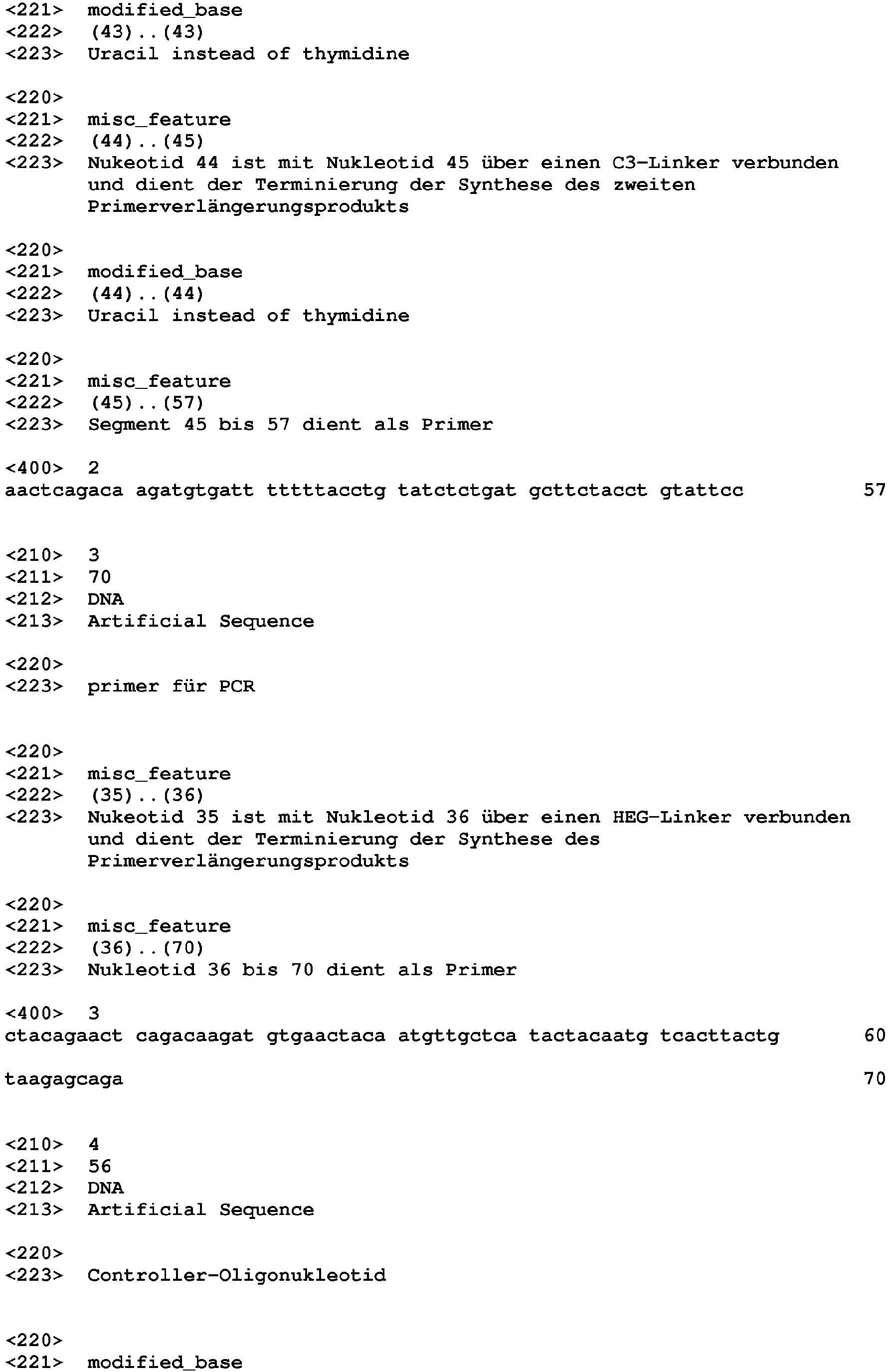

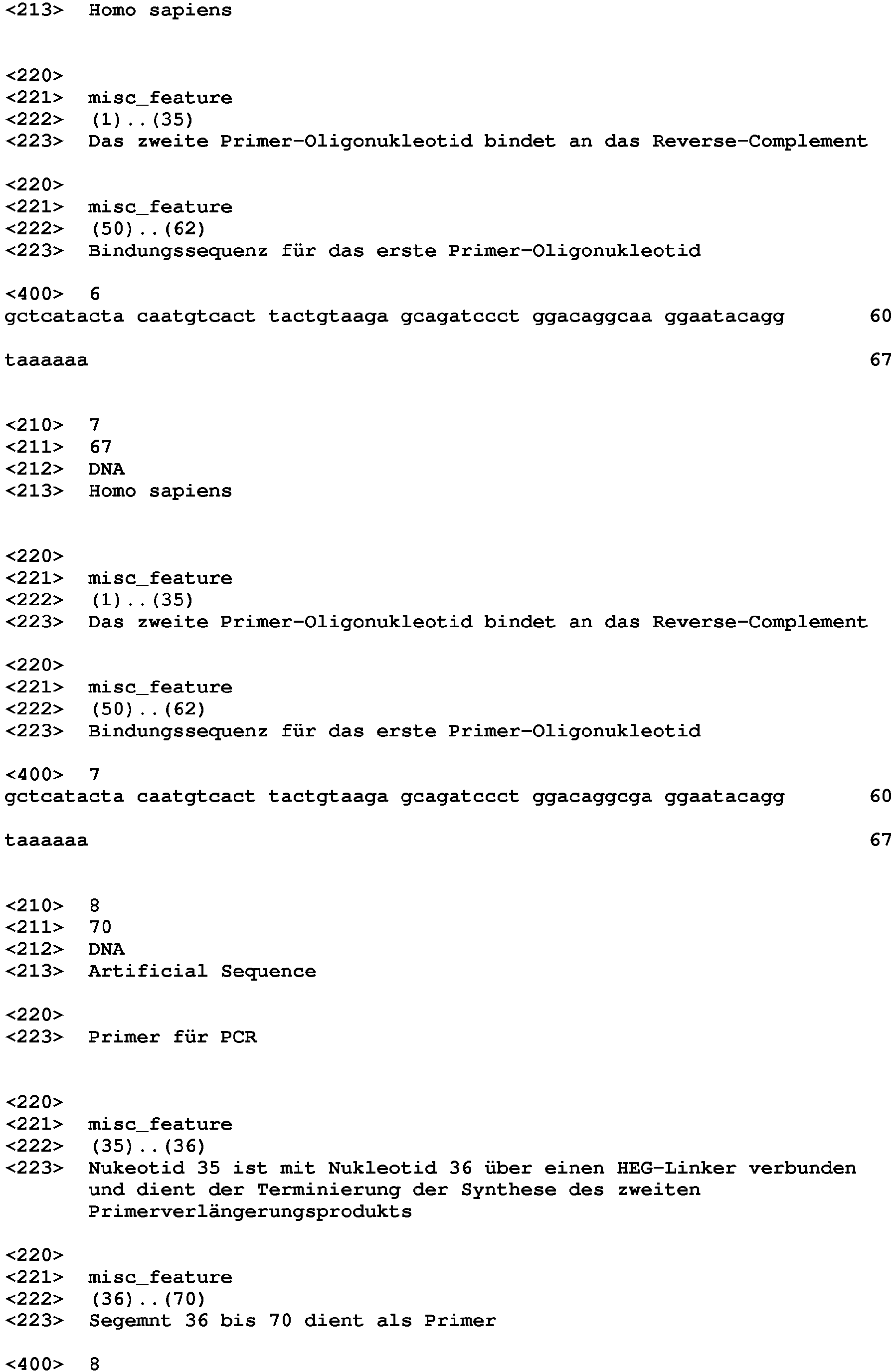


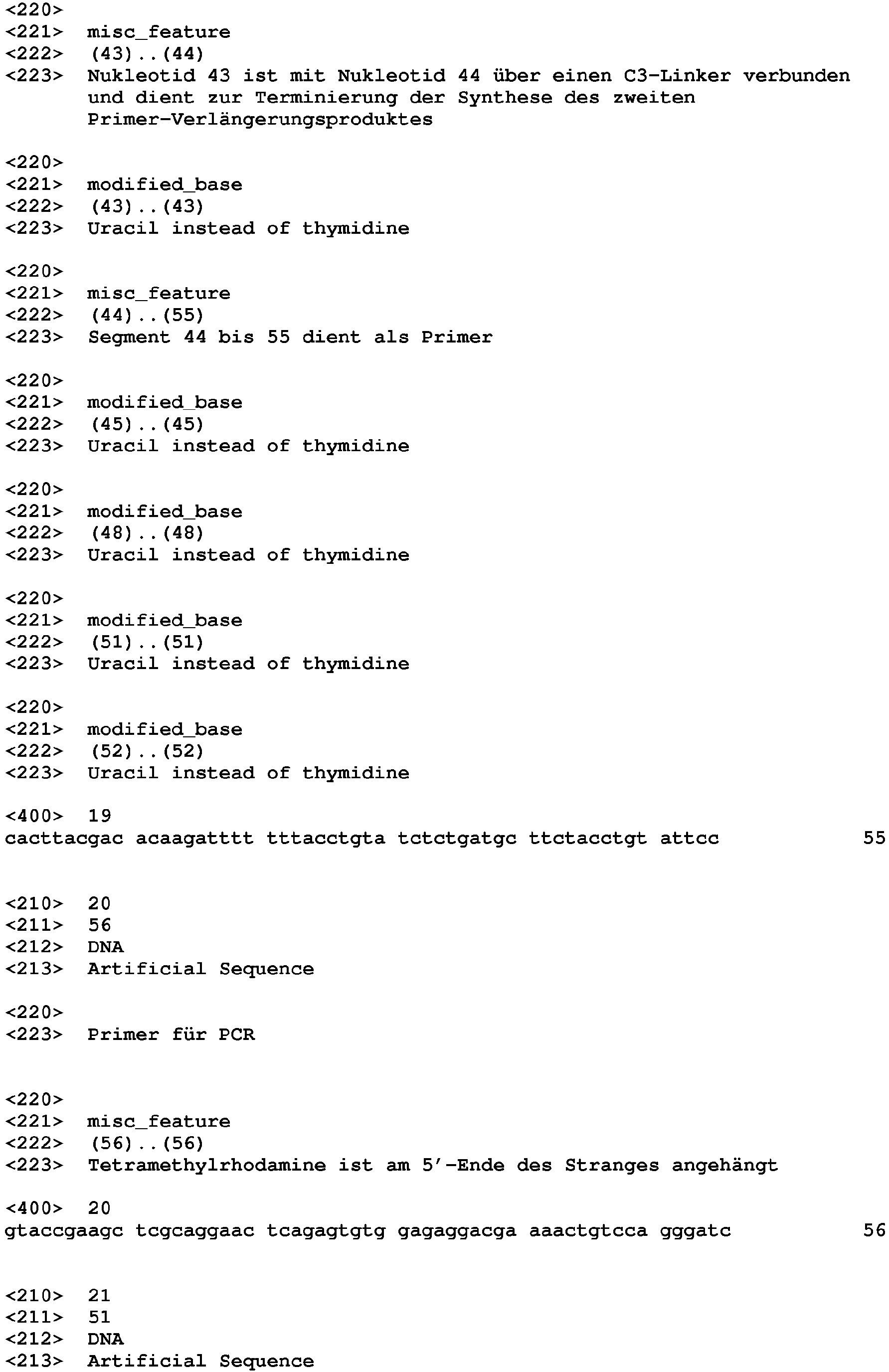

Claims (15)
wobei PR1 (insbesondere im Abschnitt PCR) modifizierte Nukleotidbausteine umfasst, so dass PCR nicht als Matrize für die Aktivität der ersten matrizenabhängigen Nukleinsäurepolymerase dienen kann; und
und wobei CR in CSR und / oder CPR modifizierte Nukleotidbausteine umfasst, so dass CSR nicht als Matrize für die Aktivität der matrizenabhängigen Nukleinsäurepolymerase dienen kann; und
wobei die Probe in einem zweiten Amplifikationsschritt mit folgenden Komponenten in Kontakt gebracht wird:
wobei MPL2 und MPR2 von M umfasst werden und das 3'-Ende von MPL2 [mindestens 5, 10 oder 20 Positionen] in 5'-Richtung des 5'-Endes von MPR2 angeordnet ist, (insbesondere MPL2 mit MPL und /oder MPR2 mit MPR identisch ist).
wherein PR1 (in particular in the section PCR) comprises modified nucleotide units, so that PCR can not serve as template for the activity of the first template-dependent nucleic acid polymerase; and
and wherein CR comprises nucleotide building blocks modified in CSR and / or CPR such that CSR can not serve as a template for the activity of the template-dependent nucleic acid polymerase; and
wherein the sample is contacted in a second amplification step with the following components:
wherein MPL2 and MPR2 of M are included and the 3 'end of MPL2 [at least 5, 10 or 20 positions] is located in the 5' direction of the 5 'end of MPR2 (in particular MPL2 with MPL and / or MPR2 with MPR is identical).
und wobei
and where
PR1 (insbesondere im Abschnitt PCR) modifizierte Nukleotidbausteine umfasst, so dass PCR nicht als Matrize für die Aktivität der ersten matrizenabhängigen Nukleinsäurepolymerase dienen kann; und
wobei CR in CSR und / oder CPR modifizierte Nukleotidbausteine umfasst, so dass CSR nicht als Matrize für die Aktivität der matrizenabhängigen Nukleinsäurepolymerase dienen kann;
PR1 (in particular in the section PCR) modified nucleotide units, so that PCR can not serve as a template for the activity of the first template-dependent nucleic acid polymerase; and
wherein CR comprises nucleotide building blocks modified in CSR and / or CPR such that CSR can not serve as template for the activity of the template-dependent nucleic acid polymerase;
Priority Applications (4)
| Application Number | Priority Date | Filing Date | Title |
|---|---|---|---|
| PCT/EP2019/054767 WO2019162530A1 (en) | 2018-02-26 | 2019-02-26 | Agmethod for amplification of a nucleic acid having improved specificity |
| CN201980028245.6A CN112074612A (en) | 2018-02-26 | 2019-02-26 | Nucleic acid amplification method with higher specificity |
| JP2020544843A JP2021514637A (en) | 2018-02-26 | 2019-02-26 | How to Amplify Nucleic Acids with Improved Specificity |
| EP19712690.7A EP3759248A1 (en) | 2018-02-26 | 2019-02-26 | Agmethod for amplification of a nucleic acid having improved specificity |
Applications Claiming Priority (1)
| Application Number | Priority Date | Filing Date | Title |
|---|---|---|---|
| EP18158722 | 2018-02-26 |
Publications (1)
| Publication Number | Publication Date |
|---|---|
| EP3530754A1 true EP3530754A1 (en) | 2019-08-28 |
Family
ID=61283120
Family Applications (1)
| Application Number | Title | Priority Date | Filing Date |
|---|---|---|---|
| EP18195312.6A Ceased EP3530754A1 (en) | 2018-02-26 | 2018-09-18 | Method for amplification of nucleic acid with improved specificity |
Country Status (1)
| Country | Link |
|---|---|
| EP (1) | EP3530754A1 (en) |
Cited By (1)
| Publication number | Priority date | Publication date | Assignee | Title |
|---|---|---|---|---|
| CN112980927A (en) * | 2021-03-23 | 2021-06-18 | 海南微氪生物科技股份有限公司 | Nucleic acid amplification method based on polymerase helix reaction |
Citations (5)
| Publication number | Priority date | Publication date | Assignee | Title |
|---|---|---|---|---|
| WO1996041000A1 (en) * | 1995-06-07 | 1996-12-19 | Behringwerke Aktiengesellschaft | Internal positive controls for nucleic acid amplification |
| WO2002018616A1 (en) * | 2000-09-01 | 2002-03-07 | Hitachi Chemical Co., Ltd. | Adjusting the efficiency of nucleic acid template amplification by attenuated pcr with template-mimic oligonucleotides |
| US20040091923A1 (en) * | 1993-07-23 | 2004-05-13 | Bio-Rad Laboratories, Inc. | Linked linear amplification of nucleic acids |
| WO2009043112A1 (en) * | 2007-10-04 | 2009-04-09 | Commonwealth Scientific And Industrial Research Organisation | Nucleic acid amplification |
| WO2012058488A1 (en) * | 2010-10-27 | 2012-05-03 | President And Fellows Of Harvard College | Compositions of toehold primer duplexes and methods of use |
-
2018
- 2018-09-18 EP EP18195312.6A patent/EP3530754A1/en not_active Ceased
Patent Citations (5)
| Publication number | Priority date | Publication date | Assignee | Title |
|---|---|---|---|---|
| US20040091923A1 (en) * | 1993-07-23 | 2004-05-13 | Bio-Rad Laboratories, Inc. | Linked linear amplification of nucleic acids |
| WO1996041000A1 (en) * | 1995-06-07 | 1996-12-19 | Behringwerke Aktiengesellschaft | Internal positive controls for nucleic acid amplification |
| WO2002018616A1 (en) * | 2000-09-01 | 2002-03-07 | Hitachi Chemical Co., Ltd. | Adjusting the efficiency of nucleic acid template amplification by attenuated pcr with template-mimic oligonucleotides |
| WO2009043112A1 (en) * | 2007-10-04 | 2009-04-09 | Commonwealth Scientific And Industrial Research Organisation | Nucleic acid amplification |
| WO2012058488A1 (en) * | 2010-10-27 | 2012-05-03 | President And Fellows Of Harvard College | Compositions of toehold primer duplexes and methods of use |
Cited By (1)
| Publication number | Priority date | Publication date | Assignee | Title |
|---|---|---|---|---|
| CN112980927A (en) * | 2021-03-23 | 2021-06-18 | 海南微氪生物科技股份有限公司 | Nucleic acid amplification method based on polymerase helix reaction |
Similar Documents
| Publication | Publication Date | Title |
|---|---|---|
| DE68915202T2 (en) | Methods for the propagation and detection of nucleic acid sequences. | |
| DE69412540T2 (en) | Simultaneous amplification of multiple targets | |
| DE69829328T2 (en) | Strand Displacement Amplification of RNA | |
| DE69022291T2 (en) | Process for controlling contamination of nucleic acid amplification. | |
| DE60025840T2 (en) | METHOD FOR DETECTING VARIATIONS OR POLYMORPHISMS | |
| DE69233719T2 (en) | Primers, sets and restriction fragments and their use in selective restriction fragment amplification | |
| DE69527171T2 (en) | Strand displacement amplification using thermophilic enzymes | |
| EP3504338B1 (en) | Method for amplification of nucleic acids and use of a kit for same | |
| DE69219627T2 (en) | Method for determining a nucleic acid sequence | |
| AT502823B1 (en) | POLYNUCLEOTIDE AMPLIFICATION | |
| EP2467498A1 (en) | Method for detecting target nucleic acids | |
| DE69222897T2 (en) | Methods of Controlling Contamination of Nucleic Acid Amplification Reactions | |
| EP3530754A1 (en) | Method for amplification of nucleic acid with improved specificity | |
| DE4132133A1 (en) | METHOD FOR THE SPECIFIC PRODUCTION OF RIBONUCLEIC ACIDS | |
| DE3938853A1 (en) | METHOD FOR DETECTING DIFFERENT NUCLEOTIDE SEQUENCES, HYBRIDIZING PROBE FOR THIS METHOD, AND KIT CONTAINING SUCH PROBE | |
| EP3759252A1 (en) | Method for the selective amplification of nucleic acids and kit for carrying out same | |
| EP3759247A1 (en) | Method for primer extension reaction with improved specificity | |
| EP2315854A1 (en) | Process for the quantitative determination of the copier number of a predetermined sequence in a sample | |
| EP3530755B1 (en) | Method for displaying the progress in the amplification of nucleic acids and kit for same | |
| EP3530753A1 (en) | Method for primer extension reaction with improved specificity | |
| EP3759248A1 (en) | Agmethod for amplification of a nucleic acid having improved specificity | |
| DE102022211087A1 (en) | Method and device for pre-amplification of a nucleic acid mixture | |
| EP1461459B1 (en) | Methods for detecting nucleic acids while using solid phase bound primers and cleaving the products of a cyclic amplification reaction (trap release primer amplification (tramp)) | |
| DE69634605T2 (en) | Procedure for overlapping genome sequencing | |
| EP0713913B1 (en) | Improved transcription assay |
Legal Events
| Date | Code | Title | Description |
|---|---|---|---|
| PUAI | Public reference made under article 153(3) epc to a published international application that has entered the european phase |
Free format text: ORIGINAL CODE: 0009012 |
|
| AK | Designated contracting states |
Kind code of ref document: A1 Designated state(s): AL AT BE BG CH CY CZ DE DK EE ES FI FR GB GR HR HU IE IS IT LI LT LU LV MC MK MT NL NO PL PT RO RS SE SI SK SM TR |
|
| AX | Request for extension of the european patent |
Extension state: BA ME |
|
| STAA | Information on the status of an ep patent application or granted ep patent |
Free format text: STATUS: THE APPLICATION HAS BEEN REFUSED |
|
| 18R | Application refused |
Effective date: 20190913 |