EP3458562B1 - Liquid laundry detergent compositions - Google Patents
Liquid laundry detergent compositions Download PDFInfo
- Publication number
- EP3458562B1 EP3458562B1 EP17722072.0A EP17722072A EP3458562B1 EP 3458562 B1 EP3458562 B1 EP 3458562B1 EP 17722072 A EP17722072 A EP 17722072A EP 3458562 B1 EP3458562 B1 EP 3458562B1
- Authority
- EP
- European Patent Office
- Prior art keywords
- composition
- surfactant
- guerbet alcohol
- liquid laundry
- ethoxylation
- Prior art date
- Legal status (The legal status is an assumption and is not a legal conclusion. Google has not performed a legal analysis and makes no representation as to the accuracy of the status listed.)
- Active
Links
Classifications
-
- C—CHEMISTRY; METALLURGY
- C11—ANIMAL OR VEGETABLE OILS, FATS, FATTY SUBSTANCES OR WAXES; FATTY ACIDS THEREFROM; DETERGENTS; CANDLES
- C11D—DETERGENT COMPOSITIONS; USE OF SINGLE SUBSTANCES AS DETERGENTS; SOAP OR SOAP-MAKING; RESIN SOAPS; RECOVERY OF GLYCEROL
- C11D1/00—Detergent compositions based essentially on surface-active compounds; Use of these compounds as a detergent
- C11D1/66—Non-ionic compounds
- C11D1/83—Mixtures of non-ionic with anionic compounds
-
- C—CHEMISTRY; METALLURGY
- C11—ANIMAL OR VEGETABLE OILS, FATS, FATTY SUBSTANCES OR WAXES; FATTY ACIDS THEREFROM; DETERGENTS; CANDLES
- C11D—DETERGENT COMPOSITIONS; USE OF SINGLE SUBSTANCES AS DETERGENTS; SOAP OR SOAP-MAKING; RESIN SOAPS; RECOVERY OF GLYCEROL
- C11D3/00—Other compounding ingredients of detergent compositions covered in group C11D1/00
- C11D3/0005—Other compounding ingredients characterised by their effect
- C11D3/0036—Soil deposition preventing compositions; Antiredeposition agents
-
- C—CHEMISTRY; METALLURGY
- C11—ANIMAL OR VEGETABLE OILS, FATS, FATTY SUBSTANCES OR WAXES; FATTY ACIDS THEREFROM; DETERGENTS; CANDLES
- C11D—DETERGENT COMPOSITIONS; USE OF SINGLE SUBSTANCES AS DETERGENTS; SOAP OR SOAP-MAKING; RESIN SOAPS; RECOVERY OF GLYCEROL
- C11D3/00—Other compounding ingredients of detergent compositions covered in group C11D1/00
- C11D3/0005—Other compounding ingredients characterised by their effect
- C11D3/0094—High foaming compositions
-
- C—CHEMISTRY; METALLURGY
- C11—ANIMAL OR VEGETABLE OILS, FATS, FATTY SUBSTANCES OR WAXES; FATTY ACIDS THEREFROM; DETERGENTS; CANDLES
- C11D—DETERGENT COMPOSITIONS; USE OF SINGLE SUBSTANCES AS DETERGENTS; SOAP OR SOAP-MAKING; RESIN SOAPS; RECOVERY OF GLYCEROL
- C11D3/00—Other compounding ingredients of detergent compositions covered in group C11D1/00
- C11D3/16—Organic compounds
- C11D3/37—Polymers
- C11D3/3703—Macromolecular compounds obtained otherwise than by reactions only involving carbon-to-carbon unsaturated bonds
- C11D3/3715—Polyesters or polycarbonates
-
- C—CHEMISTRY; METALLURGY
- C11—ANIMAL OR VEGETABLE OILS, FATS, FATTY SUBSTANCES OR WAXES; FATTY ACIDS THEREFROM; DETERGENTS; CANDLES
- C11D—DETERGENT COMPOSITIONS; USE OF SINGLE SUBSTANCES AS DETERGENTS; SOAP OR SOAP-MAKING; RESIN SOAPS; RECOVERY OF GLYCEROL
- C11D3/00—Other compounding ingredients of detergent compositions covered in group C11D1/00
- C11D3/16—Organic compounds
- C11D3/37—Polymers
- C11D3/3703—Macromolecular compounds obtained otherwise than by reactions only involving carbon-to-carbon unsaturated bonds
- C11D3/3723—Polyamines or polyalkyleneimines
-
- C—CHEMISTRY; METALLURGY
- C11—ANIMAL OR VEGETABLE OILS, FATS, FATTY SUBSTANCES OR WAXES; FATTY ACIDS THEREFROM; DETERGENTS; CANDLES
- C11D—DETERGENT COMPOSITIONS; USE OF SINGLE SUBSTANCES AS DETERGENTS; SOAP OR SOAP-MAKING; RESIN SOAPS; RECOVERY OF GLYCEROL
- C11D3/00—Other compounding ingredients of detergent compositions covered in group C11D1/00
- C11D3/16—Organic compounds
- C11D3/38—Products with no well-defined composition, e.g. natural products
- C11D3/386—Preparations containing enzymes, e.g. protease or amylase
- C11D3/38663—Stabilised liquid enzyme compositions
-
- C—CHEMISTRY; METALLURGY
- C11—ANIMAL OR VEGETABLE OILS, FATS, FATTY SUBSTANCES OR WAXES; FATTY ACIDS THEREFROM; DETERGENTS; CANDLES
- C11D—DETERGENT COMPOSITIONS; USE OF SINGLE SUBSTANCES AS DETERGENTS; SOAP OR SOAP-MAKING; RESIN SOAPS; RECOVERY OF GLYCEROL
- C11D3/00—Other compounding ingredients of detergent compositions covered in group C11D1/00
- C11D3/395—Bleaching agents
-
- C—CHEMISTRY; METALLURGY
- C11—ANIMAL OR VEGETABLE OILS, FATS, FATTY SUBSTANCES OR WAXES; FATTY ACIDS THEREFROM; DETERGENTS; CANDLES
- C11D—DETERGENT COMPOSITIONS; USE OF SINGLE SUBSTANCES AS DETERGENTS; SOAP OR SOAP-MAKING; RESIN SOAPS; RECOVERY OF GLYCEROL
- C11D3/00—Other compounding ingredients of detergent compositions covered in group C11D1/00
- C11D3/40—Dyes ; Pigments
-
- C—CHEMISTRY; METALLURGY
- C11—ANIMAL OR VEGETABLE OILS, FATS, FATTY SUBSTANCES OR WAXES; FATTY ACIDS THEREFROM; DETERGENTS; CANDLES
- C11D—DETERGENT COMPOSITIONS; USE OF SINGLE SUBSTANCES AS DETERGENTS; SOAP OR SOAP-MAKING; RESIN SOAPS; RECOVERY OF GLYCEROL
- C11D3/00—Other compounding ingredients of detergent compositions covered in group C11D1/00
- C11D3/50—Perfumes
-
- C—CHEMISTRY; METALLURGY
- C11—ANIMAL OR VEGETABLE OILS, FATS, FATTY SUBSTANCES OR WAXES; FATTY ACIDS THEREFROM; DETERGENTS; CANDLES
- C11D—DETERGENT COMPOSITIONS; USE OF SINGLE SUBSTANCES AS DETERGENTS; SOAP OR SOAP-MAKING; RESIN SOAPS; RECOVERY OF GLYCEROL
- C11D1/00—Detergent compositions based essentially on surface-active compounds; Use of these compounds as a detergent
- C11D1/02—Anionic compounds
- C11D1/12—Sulfonic acids or sulfuric acid esters; Salts thereof
- C11D1/22—Sulfonic acids or sulfuric acid esters; Salts thereof derived from aromatic compounds
-
- C—CHEMISTRY; METALLURGY
- C11—ANIMAL OR VEGETABLE OILS, FATS, FATTY SUBSTANCES OR WAXES; FATTY ACIDS THEREFROM; DETERGENTS; CANDLES
- C11D—DETERGENT COMPOSITIONS; USE OF SINGLE SUBSTANCES AS DETERGENTS; SOAP OR SOAP-MAKING; RESIN SOAPS; RECOVERY OF GLYCEROL
- C11D1/00—Detergent compositions based essentially on surface-active compounds; Use of these compounds as a detergent
- C11D1/02—Anionic compounds
- C11D1/12—Sulfonic acids or sulfuric acid esters; Salts thereof
- C11D1/29—Sulfates of polyoxyalkylene ethers
-
- C—CHEMISTRY; METALLURGY
- C11—ANIMAL OR VEGETABLE OILS, FATS, FATTY SUBSTANCES OR WAXES; FATTY ACIDS THEREFROM; DETERGENTS; CANDLES
- C11D—DETERGENT COMPOSITIONS; USE OF SINGLE SUBSTANCES AS DETERGENTS; SOAP OR SOAP-MAKING; RESIN SOAPS; RECOVERY OF GLYCEROL
- C11D1/00—Detergent compositions based essentially on surface-active compounds; Use of these compounds as a detergent
- C11D1/66—Non-ionic compounds
- C11D1/72—Ethers of polyoxyalkylene glycols
-
- C—CHEMISTRY; METALLURGY
- C11—ANIMAL OR VEGETABLE OILS, FATS, FATTY SUBSTANCES OR WAXES; FATTY ACIDS THEREFROM; DETERGENTS; CANDLES
- C11D—DETERGENT COMPOSITIONS; USE OF SINGLE SUBSTANCES AS DETERGENTS; SOAP OR SOAP-MAKING; RESIN SOAPS; RECOVERY OF GLYCEROL
- C11D2111/00—Cleaning compositions characterised by the objects to be cleaned; Cleaning compositions characterised by non-standard cleaning or washing processes
- C11D2111/10—Objects to be cleaned
- C11D2111/12—Soft surfaces, e.g. textile
Definitions
- the present invention relates to improved laundry liquid detergent compositions.
- Laundry detergent compositions are typically added to the wash water and are required to foam in relatively dilute water conditions.
- the foaming ability of a composition depends on the mixture of components in the composition, and surfactants play an important role in the ability of a laundry composition to foam when in use.
- an increase in the amount of anionic surfactant in a composition will lead to an increase in foaming.
- an increase in anionic surfactant levels can lead to an increase in cost of the laundry detergent composition.
- US 2009/023820 A1 discloses a surfactant mixture comprising non-ionic ethoxylated C10-Guerbet alcohol for foam regulation.
- US 2005/215452A1 describes the use of C10 type alkanol alkoxylate mixtures, to C10-alkanol alkoxylate mixtures of this type .
- the alkoxylate mixtures are described to exhibit excellent emulsifier properties and can be used as nonfoaming or low-foaming wetting agents for hard surfaces.
- liquid laundry composition provides improved foaming ability when compared with liquid laundry detergent compositions with the same or similar surfactant levels, in particular when compared with liquid laundry detergent compositions with the same or similar anionic surfactant levels.
- Suitable anionic surfactants which may be used are usually water soluble alkali metal salts of organic carboxylates, sulphates and sulphonates having alkyl radicals containing from about 8 to about 22 carbon atoms, the term alkyl being used to include the alkyl portion of higher acyl radicals.
- Non-limiting examples of anionic surfactants useful herein include: C 9 -C 18 alkyl benzene sulphonates (LAS); C 10 -C 20 primary, branched-chain and random alkyl sulphates (AS); C 10 -C 18 secondary (2,3) alkyl sulphates; C 10 -C 18 alkyl alkoxy sulphates (AE x S) wherein preferably x is from 1-30; C 10 -C 18 alkyl alkoxy carboxylates preferably comprising 1-5 ethoxy units; mid-chain branched alkyl sulphates as discussed in US 6,020,303 and US 6,060,443 ; mid-chain branched alkyl alkoxy sulphates as discussed in US 6,008, 181 and US 6,020,303 ; modified alkylbenzene sulphonate (MLAS) as discussed in WO 99/05243 , WO 99/05242 , and WO 99/05244 ; methyl
- the composition includes a C 8 to C 18 alcohol ether sulphate as an anionic surfactant.
- the C 8 -C 18 alcohol ether sulphate may be derived from a fatty alcohol, wherein at least 80 wt%, preferably at least 82 wt%, more preferably at least 85 wt%, most preferably at least 90 wt% of said fatty alcohol is linear.
- linear what is meant is that the fatty alcohol comprises a single backbone of carbon atoms, with no branches.
- the composition comprises one or more polymers that are included in the composition, such as cleaning polymers, viscosity control polymers, structuring polymers and polymers for colour and garment care.
- Preferred polymers include ethoxylated polyethylene imine (available as Sokalan HP20 ex. BASF) and/or polyester soil release polymers.
- the detergent liquid further comprises at least 0.5 wt% ethoxylated polyethylene imine polymer. Most preferably it further comprises at least 0.2 wt% of polyester soil release polymers. More preferably the composition comprises at least 1 wt% of ethoxylated polyethylene imine.
- Dyes are described in Color Chemistry Synthesis, Properties and Applications of Organic Dyes and Pigments, (H Zollinger, Wiley VCH, Switzerland, 2003 ) and, Industrial Dyes Chemistry, Properties Applications. (K Hunger (ed), Wiley-VCH Weinheim 2003 ).
- Alkoxylated bis-azo dyes are discussed in WO2012/054058 and WO/2010/151906 .
- suitable organic builders include the higher molecular weight polymers and copolymers known to have builder properties.
- such materials include appropriate polyacrylic acid, polymaleic acid, and polyacrylic/polymaleic acid copolymers and their salts, for example those sold by BASF under the name SOKALAN TM .
- compositions may comprise visual cues of solid material that is not dissolved in the composition.
- Preferred visual cues are lamellar cues formed from polymer film and possibly comprising functional ingredients that may not be as stable if exposed to the alkaline liquid. Enzymes and bleach catalysts are examples of such ingredients. Also perfume, particularly microencapsulated perfume.
- a liquid laundry detergent including around 20 wt% of an anionic surfactant and around 1 wt% of a non-ionic ethoxylated C 10 Guerbert alcohol surfactant with a degree of ethoxylation of 4 was compared in foaming tests against a control liquid laundry detergent including around 20 wt% anionic surfactant (with no non-ionic ethoxylated C 10 Guerbet alcohol surfactant).
- the liquid laundry detergent including the non-ionic ethoxylated C 10 Guerbert alcohol surfactant had around 10% greater foaming volume than the control detergent composition.
Landscapes
- Chemical & Material Sciences (AREA)
- Life Sciences & Earth Sciences (AREA)
- Engineering & Computer Science (AREA)
- Chemical Kinetics & Catalysis (AREA)
- Oil, Petroleum & Natural Gas (AREA)
- Wood Science & Technology (AREA)
- Organic Chemistry (AREA)
- Detergent Compositions (AREA)
Description
- The present invention relates to improved laundry liquid detergent compositions.
- This invention relates to liquid laundry detergent compositions comprising one or more anionic surfactants and a non-ionic ethoxylated C10 Guerbet alcohol surfactant, and use of such compositions as a foam-enhanced laundry detergent.
- Foaming is an important aspect of the user's perception of cleaning ability in laundry detergents. There is a general consumer perception that foam volume indicates the cleaning ability of a laundry composition. Therefore, it is important to provide a sufficient foam from a laundry composition during use. In general, an increase in volume of foam provides a good perception with the consumer.
- Laundry detergent compositions are typically added to the wash water and are required to foam in relatively dilute water conditions. The foaming ability of a composition depends on the mixture of components in the composition, and surfactants play an important role in the ability of a laundry composition to foam when in use. Typically, an increase in the amount of anionic surfactant in a composition will lead to an increase in foaming. However, an increase in anionic surfactant levels can lead to an increase in cost of the laundry detergent composition.
-
WO 2014/131584 A2 discloses an aqueous liquid detergent composition comprising 2.5 wt.% C10-Guerbet alcohol surfactant with a degree of ethoxylation of 8 and 17.5 or 18.5 wt.% of ethoxylated sulphate surfactant. -
US 2009/023820 A1 discloses a surfactant mixture comprising non-ionic ethoxylated C10-Guerbet alcohol for foam regulation. -
EP 0709450 A1 describes liquid detergent compositions containing a nonionic surfactant system, said surfactant system comprising one or more surfactants selected from the group of Guerbet nonionic surfactants. -
WO 94/11330 A1 -
US 2005/215452A1 describes the use of C10 type alkanol alkoxylate mixtures, to C10-alkanol alkoxylate mixtures of this type . The alkoxylate mixtures are described to exhibit excellent emulsifier properties and can be used as nonfoaming or low-foaming wetting agents for hard surfaces. -
EP2420557 A1 discloses a detergent composition comprising 25.3 wt% anionic surfactants and 1.7 wt% of 3-propylheptanol EOS. - It is an aim of the present invention to provide excellent foaming from a laundry composition during laundry cleaning.
- In a first aspect, the present invention provides a liquid laundry composition according to claim 1.
- The present inventors have surprisingly found that such a liquid laundry composition provides improved foaming ability when compared with liquid laundry detergent compositions with the same or similar surfactant levels, in particular when compared with liquid laundry detergent compositions with the same or similar anionic surfactant levels.
- In a second aspect, the present invention provides use of a liquid laundry detergent composition according to the first aspect to launder textiles.
- As used herein, the term "degree of ethoxylation" refers to the number of moles of ethylene oxide reacted with one mole of the C10 Guerbet alcohol to produce the ethoxylated C10 Guerbet alcohol surfactant. It should be recognised that a distribution of ethoxylated reaction products is normally obtained during ethoxylation of, for example, alcohols. Typically, the degree of ethoxylation may therefore be designated as the "average degree of ethoxylation", namely the average number of moles of ethylene oxide unit per mole of ethoxylated product.
- Amounts of components in the liquid laundry detergent are given as a percentage of weight based on the total weight of the composition, unless otherwise stated.
- The composition of the present invention includes one or more anionic surfactants in an amount in the range of 19 to 25 wt% weight. Anionic surfactants suitable for use in liquid laundry detergents are known. In general, the anionic surfactant(s) may be chosen from the surfactants described "Surface Active Agents" Vol. 1, by 5 Schwartz & Perry, Interscience 1949, Vol. 2 by Schwartz, Perry & Berch, Interscience 1958, in the current edition of "McCutcheon's Emulsifiers and Detergents" published by Manufacturing Confectioners Company or in "Tenside-Taschenbuch", H. Stache, 2nd Edn., Carl Hauser Verlag, 1981.
- Suitable anionic surfactants which may be used are usually water soluble alkali metal salts of organic carboxylates, sulphates and sulphonates having alkyl radicals containing from about 8 to about 22 carbon atoms, the term alkyl being used to include the alkyl portion of higher acyl radicals. Non-limiting examples of anionic surfactants useful herein include: C9-C18 alkyl benzene sulphonates (LAS); C10-C20 primary, branched-chain and random alkyl sulphates (AS); C10-C18 secondary (2,3) alkyl sulphates; C10-C18 alkyl alkoxy sulphates (AExS) wherein preferably x is from 1-30; C10-C18 alkyl alkoxy carboxylates preferably comprising 1-5 ethoxy units; mid-chain branched alkyl sulphates as discussed in
US 6,020,303 andUS 6,060,443 ; mid-chain branched alkyl alkoxy sulphates as discussed inUS 6,008, 181 andUS 6,020,303 ; modified alkylbenzene sulphonate (MLAS) as discussed inWO 99/05243 WO 99/05242 WO 99/05244 - The preferred anionic surfactants are sodium C11 to C15 alkyl benzene sulphonates, sodium C8 to C18 alcohol ether sulphates and sodium C12 to C18 alkyl sulphates. Also applicable are surfactants such as those described in
EP-A-328 177 (Unilever EP A 070 074 - In some embodiments, the composition includes a C8 to C18 alcohol ether sulphate as an anionic surfactant. The C8-C18 alcohol ether sulphate may be derived from a fatty alcohol, wherein at least 80 wt%, preferably at least 82 wt%, more preferably at least 85 wt%, most preferably at least 90 wt% of said fatty alcohol is linear. By linear, what is meant is that the fatty alcohol comprises a single backbone of carbon atoms, with no branches.
- In some embodiments, C8 to C18 alcohol ether sulphates are the sole anionic surfactants in the composition. In other embodiments, C9 to C18 alkyl benzene sulphonates are the sole anionic surfactants in the composition
- When the composition includes a C8-C18 alcohol ether sulphate, the degree of ethoxylation of the C8-C18 alcohol ether sulphate is typically an integer in the range of 1 to 5. In preferred embodiments, the degree of ethoxylation of the C8-C18 alcohol ether sulphate is 1, 2 or 3
- In preferred embodiments, the composition includes sodium lauryl ether sulphate (also known as sodium dodecyl ether sulphate or SLES) as an anionic surfactant. In some embodiments, the degree of ethoxylation of SLES is 1, 2 or 3. In some embodiments, the degree of ethoxylation of SLES is 3. In other embodiments, the degree of ethoxylation of SLES is 2. In further embodiments, the degree of ethoxylation of SLES is 1.
- In some embodiments, the composition includes two or more anionic surfactants. The composition may include a C8-C18 alcohol ether sulphate and one or more further anionic surfactant. The composition may include a C9-C18 alkyl benzene sulphonate and one or more further anionic surfactant. In some embodiments, the composition includes a C8-C18 alcohol ether sulphate and a C9-C18 alkyl benzene sulphonate.
- In some embodiments, the composition includes a C8-C18 alcohol ether sulphate or a C9-C18 alkyl benzene sulphonate in a ratio of about 1:4 to 4:1 to other anionic surfactants (when present) in the composition. In preferred embodiments the composition includes a C8-C18 alcohol ether sulphate or a C9-C18 alkyl benzene sulphonate in a ratio of about 2:3 to 7:2 to other anionic surfactants (when present) in the composition. In some embodiments the composition includes a C8-C18 alcohol ether sulphate or a C9-C18 alkyl benzene sulphonate in a ratio of about 2:3 to 3:2 to other anionic surfactants (when present) in the composition. In other embodiments, the composition includes a C8-C18 alcohol ether sulphate or a C9-C18 alkyl benzene sulphonate in a ratio of about 5:2 to 7:2 to other anionic surfactants (when present) in the composition.
- In preferred embodiments, the composition includes sodium lauryl ether sulphate (SLES) and one or more further anionic surfactants. In further embodiments, the composition includes sodium lauryl ether sulphate (SLES) and sodium dodecyl benzene sulphonate (NaLAS).
- The anionic surfactant or surfactants are present in the composition in an amount in the range of 19 to 25 wt%. In some embodiments, the anionic surfactant or surfactants are present in the composition in an amount in the range of 19 to 24 wt%, preferably 19 to 22 wt%.
- In some embodiments, the composition comprises 19 to 24 wt% of anionic surfactants, including 8 to 20 wt% of C8-C18 alcohol ether sulphate (preferably SLES) and 4 to 12 wt% of a C9-C18 alkyl benzene sulphonates (preferably sodium dodecyl benzene sulphonate).
- The anionic surfactants of the present application are typically salts, for example alkali metal salts. The salts also may be organic, for example salts of triethanol amine (TEA) or monoethanol amine (MEA). However, any of the anionic surfactants of the present application may be included in the composition of the present invention in the acid form. For example, the composition may include a linear alkyl sulfonic acid as an anionic surfactant.
- The compositions of the present invention include one or more a non-ionic ethoxylated C10 Guerbet alcohol surfactants with a degree of ethoxylation of 3, 4 or 5 as a minor surfactant component. The non-ionic ethoxylated C10 Guerbet surfactant or surfactants act as a foam boosting component. The total amount of a non-ionic ethoxylated C10 Guerbet alcohol surfactant with a degree of ethoxylation of 3, 4 or 5 in the composition is in a weight ratio in the range of 1:12 to 1:100 with respect to the total amount of anionic surfactant in the composition.
- Guerbet alcohols are known and well defined β-alkylated dimer alcohols. Typically, the non-ionic ethoxylated C10 Guerbet alcohol surfactant with a degree of ethoxylation in the range of 1 to 10 is represented by formula (I):

- In some embodiments, the total amount of a non-ionic ethoxylated C10 Guerbet alcohol surfactant with a degree of ethoxylation of 3, 4 or 5 included in the composition is in an amount in the range of 0.5 to 2.0 wt% based on the total weight of the composition.
- Examples of C10 Guerbet alcohol surfactant with a degree of ethoxylation of 3, 4 or 5 include Lutensol® XP-30, Lutensol® XP-40 and Lutensol® XP-50 from BASF Corporation. In some embodiments, the non-ionic ethoxylated C10Guerbet alcohol surfactant has a degree of ethoxylation of 4 or 5. In some embodiments, the C10 Guerbet alcohol surfactant is a C10 Guerbet alcohol surfactant with a degree of ethoxylation of 4.
- The composition of the present invention may include two or more the non-ionic ethoxylated C10 Guerbet alcohol surfactants with a degree of ethoxylation of 3, 4 or 5. In other words, the composition may include two or more non-ionic ethoxylated C10 Guerbet alcohol surfactants, each surfactant having a different degree of ethoxylation of 3, 4 or 5.
- When a mixture of non-ionic ethoxylated C10 Guerbet alcohol surfactants with a degree of ethoxylation of 3, 4 or 5 is included in the composition, the total amount of the non-ionic ethoxylated C10 Guerbet alcohol surfactant with a degree of ethoxylation of 3, 4 or 5 is within the specified ranges of the present invention, namely the total amount of the non-ionic ethoxylated C10 Guerbet alcohol surfactant with a degree of ethoxylation of 3, 4 or 5 in the composition is in a weight ratio in the range of 1:12 to 1:100 with respect to the total amount of anionic surfactant in the composition.
- The weight ratio of total anionic surfactant to non-ionic ethoxylated C10 Guerbet alcohol surfactant with a degree of ethoxylation of 3, 4 or 5 in the composition is in the range of 12:1 to 100:1. In other words, the non-ionic ethoxylated C10 Guerbet alcohol surfactant with a degree of ethoxylation of 3, 4 or 5 is the minor surfactant component.
- In some embodiments, the weight ratio of total anionic surfactant to non-ionic ethoxylated C10 Guerbet alcohol surfactant with a degree of ethoxylation of 3, 4 or 5 in the composition is in the range 12:1 to 60:1. In other embodiments, the weight ratio of total anionic surfactant to non-ionic ethoxylated C10 Guerbet alcohol surfactant in the composition is in the range of 12:1 to 50:1.
- The composition may include other surfactants. These include additional non-ionic surfactants (other than non-ionic ethoxylated C10 Guerbet alcohol surfactants with a degree of ethoxylation of 3, 4 or 5), cationic surfactants, amphoteric surfactants and/or zwitter-ionic surfactants.
- In some embodiments, the composition is substantially free of or includes up to 5 wt% of one or more zwitter-ionic surfactants. Preferred examples of zwitter-ionic surfactants are C12-C14 dimethyl amine oxide and cocamidopropyl betaine (CAPB). In preferred embodiments the composition is substantially free of zwitter-ionic surfactant. In other embodiments, the composition optionally includes up to 3 wt%, preferably up to 1 wt% zwitter-ionic surfactant(s).
- In some embodiments, the composition includes SLES with a degree of ethoxylation of 3 and up to 3 wt% of CAPB. In some embodiments, the composition also includes a salt, such as sodium chloride, when the composition includes CAPB.
- Advantageously the composition comprises one or more polymers that are included in the composition, such as cleaning polymers, viscosity control polymers, structuring polymers and polymers for colour and garment care. Preferred polymers include ethoxylated polyethylene imine (available as Sokalan HP20 ex. BASF) and/or polyester soil release polymers. Preferably the detergent liquid further comprises at least 0.5 wt% ethoxylated polyethylene imine polymer. Most preferably it further comprises at least 0.2 wt% of polyester soil release polymers. More preferably the composition comprises at least 1 wt% of ethoxylated polyethylene imine.
- The detergent composition may comprise an effective amount of at least one enzyme selected from the group comprising, pectate lyase, protease, amylase, cellulase, lipase, mannanase.
- Any enzyme present in the composition may be stabilized using conventional stabilizing agents, e.g., a polyol for example propylene glycol or glycerol, a sugar or sugar alcohol, lactic acid, boric acid, or a boric acid derivative, e.g., an aromatic borate ester, or a phenyl boronic acid derivative for example 4-formylphenyl boronic acid, and the composition may be formulated as described in e.g.
WO 92/19709 WO 92/19708 - It may be advantageous to include fluorescer in the compositions. Usually, these fluorescent agents are supplied and used in the form of their alkali metal salts, for example, the sodium salts. The total amount of the fluorescent agent or agents used in the composition is generally from 0.005 to 2 wt %, more preferably 0.01 to 0.5 wt %.
- Preferred classes of fluorescer are: Di-styryl biphenyl compounds, e.g. Tinopal (Trade Mark) CBS-X, Di-amine stilbene di-sulphonic acid compounds, e.g. Tinopal DMS pure Xtra, Tinopal 5BMGX, and Blankophor (Trade Mark) HRH, and Pyrazoline compounds, e.g. Blankophor SN.
- Preferred fluorescers are: sodium 2 (4-styryl-3-sulfophenyl)-2H-napthol[1,2-d]triazole, disodium 4,4'-bis{[(4-anilino-6-(N methyl-N-2 hydroxyethyl) amino 1,3,5-triazin-2-yl)]amino}stilbene-2-2' disulfonate, disodium 4,4'-bis{[(4-anilino-6-morpholino-1,3,5-triazin-2-yl)]amino} stilbene-2-2' disulfonate, and disodium 4,4'-bis(2-sulfoslyryl)biphenyl.
- Compositions may comprise a weight efficient bleach system. Such systems typically do not utilise the conventional percarbonate and bleach activator approach. An air bleach catalyst system is preferred. Suitable complexes and organic molecule (ligand) precursors for forming complexes are available to the skilled worker, for example, from:
WO 98/39098 WO 98/39406 WO 97/48787 WO 00/29537 WO 00/52124 WO00/60045 WO02/48301 - Photobleaches may also be employed. A "photobleach" is any chemical species that forms a reactive bleaching species on exposure to sunlight, and preferably is not permanently consumed in the reaction. Preferred photo-bleaches include singlet oxygen photo-bleaches and radical photo-bleaches. Suitable singlet oxygen photo-bleaches may be selected from, water soluble phthalocyanine compounds, particularly metallated phthalocyanine compounds where the metal is Zn or AI-Z1 where Z1 is a halide, sulphate, nitrate, carboxylate, alkanolate or hydroxyl ion. Preferably the phthalocyanin has 1-4 SO3X groups covalently bonded to it where X is an alkali metal or ammonium ion. Such compounds are described in
WO2005/014769 (Ciba ). - When present, the bleach catalyst is typically incorporated at a level of about 0.0001 to about 10 wt%, preferably about 0.001 to about 5 wt%.
- Compositions may further comprise a perfume. The inclusion of perfumes into laundry detergent compositions is known per se.
- When the composition is used at very low levels of product dosage, it is advantageous to ensure that perfume is employed efficiently.
- A particularly preferred way of ensuring that perfume is employed efficiently is to use an encapsulated perfume. Use of a perfume that is encapsulated reduces the amount of perfume vapour that is produced by the composition before it is diluted. This is important when the perfume concentration is increased to allow the amount of perfume per wash to be kept at a reasonably high level.
- It is even more preferable that the perfume is not only encapsulated but also that the encapsulated perfume is provided with a deposition aid to increase the efficiency of perfume deposition and retention on fabrics. The deposition aid is preferably attached to the encapsulate by means of a covalent bond, entanglement or strong adsorption, preferably by a covalent bond or entanglement.
- Where perfume encapsulates are included, it is advantageous to include a structuring system in the liquid detergent to enable stable suspension of the perfume encapsulates throughout the liquid detergent
- The compositions may contain one or more other ingredients. Such ingredients include preservatives (e.g. bactericides), pH buffering agents, polyelectrolytes, anti-shrinking agents, anti-wrinkle agents, anti-oxidants, sunscreens, anti-corrosion agents, drape imparting agents, anti-static agents and ironing aids. The compositions may further comprise colorants, pearlisers and/or opacifiers, and shading dye.
- Dyes are described in Color Chemistry Synthesis, Properties and Applications of Organic Dyes and Pigments, (H Zollinger, Wiley VCH, Zürich, 2003) and, Industrial Dyes Chemistry, Properties Applications. (K Hunger (ed), Wiley-VCH Weinheim 2003).
- Dyes are soluble in the medium of application, in this case a laundry detergent liquid.
- Dyes for use in liquid laundry detergents preferably have an extinction coefficient at the maximum absorption in the visible range (400 to 700nm) of greater than 5000 L mol-1 cm-1, preferably greater than 10000 L mol-1 cm-1. Preferably the dyes are blue or violet in colour.
- Preferred dye chromophores are azo, azine, anthraquinone, phthalocyanine and triphenylmethane.
- Azo, anthraquinone, phthalocyanine and triphenylmethane dyes preferably carry a net anionic charged or are uncharged. Azine dyes preferably carry a net anionic or cationic charge.
- Preferred non-shading dyes are selected are selected from blue dyes, most preferably anthraquinone dyes bearing sulphonate groups and triphenylmethane dye bearing sulphonate groups. Preferred compounds are acid blue 80, acid blue 1, acid blue 3; acid blue 5, acid blue 7, acid blue 9, acid blue 11, acid blue 13, acid blue 15, acid blue 17, acid blue 24, acid blue 34, acid blue 38, acid blue 75, acid blue 83, acid blue 91, acid blue 97, acid blue 93, acid blue 93:1, acid blue 97, acid blue 100, acid blue 103, acid blue 104, acid blue 108, acid blue 109, acid blue 110, and acid blue 213.
- Blue or violet Shading dyes are most preferred. Shading dyes deposit to fabric during the wash or rinse step of the washing process providing a visible hue to the fabric. In this regard the dye gives a blue or violet colour to a white cloth with a hue angle of 240 to 345, more preferably 260 to 320, most preferably 270 to 300. The white cloth used in this test is bleached non-mercerised woven cotton sheeting.
- The shading dye's fabric substantivity makes the neat contact staining worse.
- Shading dyes are discussed in
WO2005/003274 ,WO2006/032327(Unilever ),WO2006/032397(Unilever ),WO2006/045275(Unilever ),WO 2006/027086(Unilever ),WO2008/017570(Unilever ),WO 2008/141880(Unilever ),WO2009/132870(Unilever ),WO 2009/141173 (Unilever ),WO 2010/099997(Unilever ),WO 2010/102861(Unilever ),WO 2010/148624(Unilever ),WO2008/087497 (P&G ),WO2011/011799 (P&G ),WO2012/054820 (P&G ),WO2013/142495 (P&G ) andWO2013/151970 (P&G) . - A mixture of shading dyes may be used.
- The shading dye chromophore is most preferably selected from mono-azo, bis-azo and azine.
- Mono-azo dyes preferably contain a heterocyclic ring and are most preferably thiophene dyes. The mono-azo dyes are preferably alkoxylated and are preferably uncharged or anionically charged at pH=7. Alkoxylated thiophene dyes are discussed in
WO2013/142495 andWO2008/087497 . Preferred examples of thiophene dyes are shown below:
- Bis-azo dyes are preferably sulphonated bis-azo dyes. Preferred examples of sulphonated bis-azo compounds are direct violet 7, direct violet 9, direct violet 11, direct violet 26, direct violet 31, direct violet 35, direct violet 40, direct violet 41, direct violet 51, direct violet 66, direct violet 99 and alkoxylated versions thereof.
- Alkoxylated bis-azo dyes are discussed in
WO2012/054058 andWO/2010/151906 . - An example of an alkoxylated bis-azo dye is :
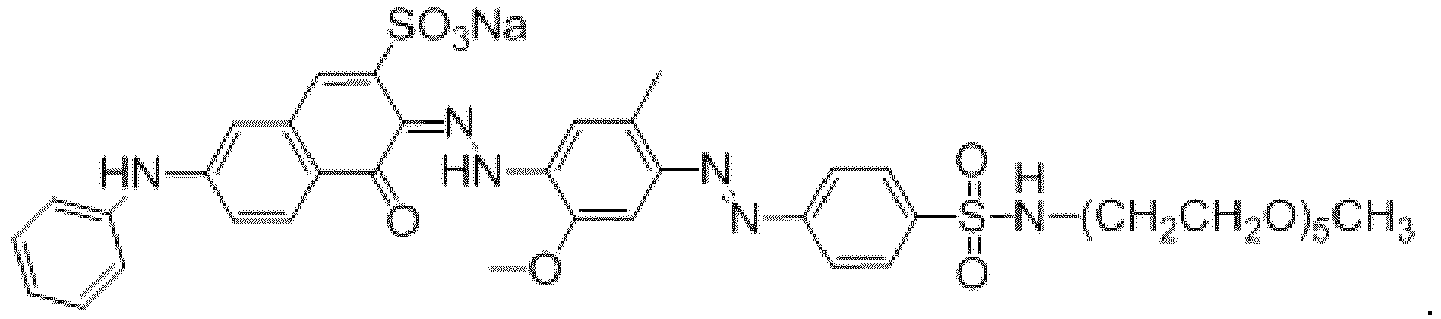
- Azine dyes are preferably selected from sulphonated phenazine dyes and cationic phenazine dyes. Preferred examples are acid blue 98, acid violet 50, dye with CAS-No 72749-80-5, acid blue 59, and the phenazine dye selected from:
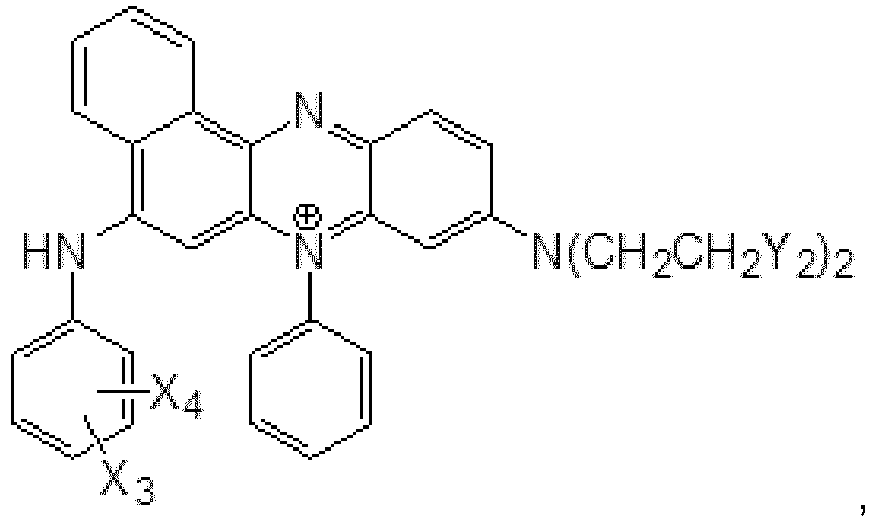
- X3 is selected from: -H; -F; -CH3; -C2H5; -OCH3; and, -OC2H5;
- X4 is selected from: -H; -CH3; -C2H5; -OCH3; and, -OC2H5;
- Y2 is selected from: -OH; -OCH2CH2OH; -CH(OH)CH2OH; -OC(O)CH3; and, C(O)OCH3.
- The shading dye is present is present in the liquid composition in range from 0.0001 to 0.1wt %. Depending upon the nature of the shading dye there are preferred ranges depending upon the efficacy of the shading dye which is dependent on class and particular efficacy within any particular class. As stated above the shading dye is a blue or violet shading dye.
- The detergent compositions may also optionally contain organic detergent builder or sequestrant material. Examples include the alkali metal, citrates, succinates, malonates, carboxymethyl succinates, carboxylates, polycarboxylates and polyacetyl carboxylates. Specific examples include sodium, potassium and lithium salts of oxydisuccinic acid, mellitic acid, benzene polycarboxylic acids, and citric acid. Other examples are DEQUEST™, organic phosphonate type sequestering agents sold by Italmatch Chemicals and alkanehydroxy phosphonates.
- Other suitable organic builders include the higher molecular weight polymers and copolymers known to have builder properties. For example, such materials include appropriate polyacrylic acid, polymaleic acid, and polyacrylic/polymaleic acid copolymers and their salts, for example those sold by BASF under the name SOKALAN™.
- If utilized, the organic builder materials may comprise from about 0.5% to 20 wt%, preferably from 1 wt% to 10 wt%, of the composition. The preferred builder level is less than 10 wt% and preferably less than 5 wt% of the composition. A preferred sequestrant is HEDP (1-Hydroxyethylidene -1,1,-diphosphonic acid), for example sold as Dequest 2010. Also suitable but less preferred as it gives inferior cleaning results is Dequest® 2066 (Diethylenetriamine penta(methylene phosphonic acid or Heptasodium DTPMP).
- The presence of some buffer is preferred for pH control; preferred buffers are MEA, and TEA. If present they are preferably used in the composition at levels of from 1 to 15 wt%.
- The compositions may have their rheology modified by use of a material or materials that form a structuring network within the composition. Suitable structurants include hydrogenated castor oil, structuring polymers, microfibrous cellulose and natural based structurants for example citrus pulp fibre. Citrus pulp fibre is particularly preferred especially if lipase enzyme is included in the composition.
- The compositions may comprise visual cues of solid material that is not dissolved in the composition. Preferred visual cues are lamellar cues formed from polymer film and possibly comprising functional ingredients that may not be as stable if exposed to the alkaline liquid. Enzymes and bleach catalysts are examples of such ingredients. Also perfume, particularly microencapsulated perfume.
- Preferably the liquids are supplied in multidose plastics packs with a top or bottom closure. A dosing measure may be supplied with the pack either as a part of the cap or as an integrated system.
- The invention will now be further described with reference to the following non-limiting example.
- A liquid laundry detergent including around 20 wt% of an anionic surfactant and around 1 wt% of a non-ionic ethoxylated C10 Guerbert alcohol surfactant with a degree of ethoxylation of 4 was compared in foaming tests against a control liquid laundry detergent including around 20 wt% anionic surfactant (with no non-ionic ethoxylated C10 Guerbet alcohol surfactant). The liquid laundry detergent including the non-ionic ethoxylated C10 Guerbert alcohol surfactant had around 10% greater foaming volume than the control detergent composition.
- Foaming tests were performed by adding a fixed amount of laundry detergent composition in a fixed volume of water and inverting the mixtures in a graduated vessel. The tests were performed three times and an average foam volume taken.
Claims (8)
- A liquid laundry composition comprising:(i) one or more anionic surfactants; and(ii) a non-ionic ethoxylated C10 Guerbet alcohol surfactant selected from the group consisting of non-ionic ethoxylated C10 Guerbet alcohol surfactants with a degree of ethoxylation of 3, 4 or 5;wherein the total amount of anionic surfactant in the composition is in the range of 19 to 25 wt% of the total composition, the total amount of non-ionic ethoxylated C10 Guerbet alcohol surfactant is in an amount in the range of 0.5 to 2.0 wt% of the total composition, and the weight ratio of the total amount of anionic surfactant to the non-ionic ethoxylated C10 Guerbet alcohol surfactant is in the range of 12:1 to 100:1.
- A liquid laundry composition according to claim 1 wherein the non-ionic ethoxylated C10 Guerbet alcohol surfactant is a mixture of different ethoxylated C10 Guerbet alcohol surfactants selected from the group consisting of C10 Guerbet alcohol surfactants with a degree of ethoxylation of 3, 4 and 5.
- A liquid laundry composition according to any preceding claim wherein the non-ionic ethoxylated C10 Guerbet alcohol surfactant has a degree of ethoxylation of 4 or 5.
- A liquid laundry composition according to any preceding claim wherein the composition includes 16 to 24 wt% of an alkyl benzene sulphonate and/or alcohol ether sulphate based on the total weight of the composition.
- A liquid laundry composition according to claim 4 wherein the compositions includes 18 to 24 wt% of sodium lauryl ether sulphate (SLES) and/or sodium dodecyl benzene sulphonate (NaLAS).
- A liquid laundry composition according to any preceding claim wherein the composition further includes one or more additional components selected from the group consisting of: ethoxylated polyethylene imine polymer; polyester soil release polymer; one or more enzymes; enzyme stabiliser; fluorescent agent; bleach catalyst; and perfume.
- Use of a liquid laundry detergent composition according to any one of claims 1 to 6 for laundering textiles.
- Use according to claim 7 wherein increased foam is provided during a main wash step when compared to a composition having a comparable level of anionic surfactant and substantially no non-ionic ethoxylated C10 Guerbet alcohol surfactant with a degree of ethoxylation in the range of 1 to 10.
Applications Claiming Priority (2)
| Application Number | Priority Date | Filing Date | Title |
|---|---|---|---|
| EP16169849 | 2016-05-17 | ||
| PCT/EP2017/061506 WO2017198574A1 (en) | 2016-05-17 | 2017-05-12 | Liquid laundry detergent compositions |
Publications (3)
| Publication Number | Publication Date |
|---|---|
| EP3458562A1 EP3458562A1 (en) | 2019-03-27 |
| EP3458562B1 true EP3458562B1 (en) | 2024-07-03 |
| EP3458562C0 EP3458562C0 (en) | 2024-07-03 |
Family
ID=56008517
Family Applications (1)
| Application Number | Title | Priority Date | Filing Date |
|---|---|---|---|
| EP17722072.0A Active EP3458562B1 (en) | 2016-05-17 | 2017-05-12 | Liquid laundry detergent compositions |
Country Status (8)
| Country | Link |
|---|---|
| US (1) | US20190144782A1 (en) |
| EP (1) | EP3458562B1 (en) |
| CN (1) | CN109153941A (en) |
| AU (1) | AU2017267127B2 (en) |
| BR (1) | BR112018073598B1 (en) |
| ES (1) | ES2985315T3 (en) |
| WO (1) | WO2017198574A1 (en) |
| ZA (1) | ZA201807213B (en) |
Families Citing this family (1)
| Publication number | Priority date | Publication date | Assignee | Title |
|---|---|---|---|---|
| US20230159855A1 (en) * | 2020-04-09 | 2023-05-25 | Conopco, Inc., D/B/A Unilever | Laundry detergent composition |
Citations (3)
| Publication number | Priority date | Publication date | Assignee | Title |
|---|---|---|---|---|
| EP0709450A1 (en) | 1994-10-24 | 1996-05-01 | The Procter & Gamble Company | Low sudsing liquid detergent compositions |
| EP2420557A1 (en) * | 2010-08-17 | 2012-02-22 | The Procter & Gamble Company | A method for hand washing dishes having long lasting suds |
| WO2015183611A1 (en) | 2014-05-29 | 2015-12-03 | The Procter & Gamble Company | Optimized surfactant ratio for improved rinse feel |
Family Cites Families (44)
| Publication number | Priority date | Publication date | Assignee | Title |
|---|---|---|---|---|
| AU556758B2 (en) | 1981-07-13 | 1986-11-20 | Procter & Gamble Company, The | Foaming compositions based on alkylpolysaccharide |
| GB8803036D0 (en) | 1988-02-10 | 1988-03-09 | Unilever Plc | Liquid detergents |
| EP0511456A1 (en) | 1991-04-30 | 1992-11-04 | The Procter & Gamble Company | Liquid detergents with aromatic borate ester to inhibit proteolytic enzyme |
| ES2085024T3 (en) | 1991-04-30 | 1996-05-16 | Procter & Gamble | LIQUID DETERGENTS REINFORCED WITH BORICO-POLYOL ACID COMPLEX TO INHIBIT THE PROTEOLYTIC ENZYME. |
| SE501132C2 (en) * | 1992-11-19 | 1994-11-21 | Berol Nobel Ab | Use of alkoxylate of 2-propylheptanol in cleaning compositions |
| EG22088A (en) | 1996-04-16 | 2002-07-31 | Procter & Gamble | Alkoxylated sulfates |
| PH11997056158B1 (en) | 1996-04-16 | 2001-10-15 | Procter & Gamble | Mid-chain branched primary alkyl sulphates as surfactants |
| EG21623A (en) | 1996-04-16 | 2001-12-31 | Procter & Gamble | Mid-chain branced surfactants |
| WO1997048787A1 (en) | 1996-06-19 | 1997-12-24 | Unilever N.V. | Bleach activation |
| CA2283163C (en) | 1997-03-07 | 2006-10-31 | The Procter & Gamble Company | Bleach compositions comprising a transition metal bleach catalyst incorporating a cross-bridged macropolycyclic ligand and an oxygen bleach |
| ZA981883B (en) | 1997-03-07 | 1998-09-01 | Univ Kansas | Catalysts and methods for catalytic oxidation |
| PH11998001775B1 (en) | 1997-07-21 | 2004-02-11 | Procter & Gamble | Improved alkyl aryl sulfonate surfactants |
| JP2001511472A (en) | 1997-07-21 | 2001-08-14 | ザ、プロクター、エンド、ギャンブル、カンパニー | Improved alkylbenzene sulfonate surfactant |
| CA2297161C (en) | 1997-07-21 | 2003-12-23 | The Procter & Gamble Company | Detergent compositions containing mixtures of crystallinity-disrupted surfactants |
| AU1522300A (en) | 1998-11-13 | 2000-06-05 | Procter & Gamble Company, The | Bleach compositions |
| BR0008715A (en) | 1999-03-02 | 2002-01-02 | Procter & Gamble | Bleach stabilized compositions |
| AU4061900A (en) | 1999-04-01 | 2000-10-23 | Procter & Gamble Company, The | Transition metal bleaching agents |
| GB0030673D0 (en) | 2000-12-15 | 2001-01-31 | Unilever Plc | Ligand and complex for catalytically bleaching a substrate |
| AU2003232206A1 (en) * | 2002-04-26 | 2003-11-10 | Basf Aktiengesellschaft | C10-alkanolalkoxylate mixtures and the use thereof |
| GB0314210D0 (en) | 2003-06-18 | 2003-07-23 | Unilever Plc | Laundry treatment compositions |
| EP1651745B1 (en) | 2003-08-06 | 2007-02-21 | Ciba SC Holding AG | Shading composition |
| GB0420203D0 (en) | 2004-09-11 | 2004-10-13 | Unilever Plc | Laundry treatment compositions |
| GB0421145D0 (en) | 2004-09-23 | 2004-10-27 | Unilever Plc | Laundry treatment compositions |
| PL1794275T3 (en) | 2004-09-23 | 2009-12-31 | Unilever Nv | Laundry treatment compositions |
| DE102004052007B4 (en) | 2004-10-25 | 2007-12-06 | Müller Weingarten AG | Drive system of a forming press |
| ES2336379T3 (en) * | 2006-02-22 | 2010-04-12 | Basf Se | TENSIOACTIVE MIXTURE CONTAINING SHORT CHAIN AND LONG CHAIN COMPONENTS. |
| DE602007002544D1 (en) | 2006-08-10 | 2009-11-05 | Unilever Plc | NUANCIERUNGSMITTEL |
| CA2673239C (en) | 2007-01-19 | 2012-07-24 | The Procter & Gamble Company | Laundry care composition comprising a whitening agent having an azo-thiophene or triphenylmethane colorant moiety and a polyoxyalkylene moiety |
| MX2009012393A (en) | 2007-05-18 | 2009-12-01 | Unilever Nv | Triphenodioxazine dyes. |
| ES2400204T5 (en) | 2008-05-02 | 2015-11-26 | Unilever N.V. | Granules with reduced staining |
| MX2010012769A (en) | 2008-05-20 | 2011-03-02 | Unilever Nv | Shading composition. |
| CN102341489B (en) | 2009-03-05 | 2014-05-14 | 荷兰联合利华有限公司 | Dye radical initiators |
| MY154041A (en) | 2009-03-12 | 2015-04-30 | Unilever Plc | Dye-polymers formulations |
| WO2010148624A1 (en) | 2009-06-26 | 2010-12-29 | Unilever Plc | Dye polymers |
| US20110150817A1 (en) * | 2009-12-17 | 2011-06-23 | Ricky Ah-Man Woo | Freshening compositions comprising malodor binding polymers and malodor control components |
| WO2012054058A1 (en) | 2010-10-22 | 2012-04-26 | The Procter & Gamble Company | Bis-azo colorants for use as bluing agents |
| EP2630197B1 (en) | 2010-10-22 | 2019-03-06 | Milliken & Company | Bis-azo colorants for use as bluing agents |
| US20120101018A1 (en) | 2010-10-22 | 2012-04-26 | Gregory Scot Miracle | Bis-azo colorants for use as bluing agents |
| CN103210073B (en) | 2010-11-12 | 2016-06-08 | 宝洁公司 | Thiophene azo dyes and laundry care compositions containing them |
| BR112014023153B1 (en) | 2012-03-19 | 2021-02-23 | Milliken & Company | carboxylate dyes |
| WO2013151970A1 (en) | 2012-04-03 | 2013-10-10 | The Procter & Gamble Company | Laundry detergent composition comprising water-soluble phthalocyanine compound |
| DE102012212728A1 (en) * | 2012-07-19 | 2014-01-23 | Henkel Ag & Co. Kgaa | Stable, liquid detergent with graying-inhibiting power II |
| RU2653364C2 (en) * | 2013-02-28 | 2018-05-08 | Басф Се | Aqueous formulations, their manufacture and their use in hard surface cleaning |
| CN105874046B (en) * | 2014-01-08 | 2019-09-24 | 宝洁公司 | Liquid laundry detergent with improved sudsing profile |
-
2017
- 2017-05-12 EP EP17722072.0A patent/EP3458562B1/en active Active
- 2017-05-12 BR BR112018073598-1A patent/BR112018073598B1/en active IP Right Grant
- 2017-05-12 WO PCT/EP2017/061506 patent/WO2017198574A1/en not_active Ceased
- 2017-05-12 US US16/300,174 patent/US20190144782A1/en not_active Abandoned
- 2017-05-12 CN CN201780030682.2A patent/CN109153941A/en active Pending
- 2017-05-12 ES ES17722072T patent/ES2985315T3/en active Active
- 2017-05-12 AU AU2017267127A patent/AU2017267127B2/en active Active
-
2018
- 2018-10-29 ZA ZA2018/07213A patent/ZA201807213B/en unknown
Patent Citations (3)
| Publication number | Priority date | Publication date | Assignee | Title |
|---|---|---|---|---|
| EP0709450A1 (en) | 1994-10-24 | 1996-05-01 | The Procter & Gamble Company | Low sudsing liquid detergent compositions |
| EP2420557A1 (en) * | 2010-08-17 | 2012-02-22 | The Procter & Gamble Company | A method for hand washing dishes having long lasting suds |
| WO2015183611A1 (en) | 2014-05-29 | 2015-12-03 | The Procter & Gamble Company | Optimized surfactant ratio for improved rinse feel |
Non-Patent Citations (1)
| Title |
|---|
| "Lutensol XP Surfactants", BASF - THE CHEMICAL COMPANY, 1 September 2005 (2005-09-01), XP093268580 |
Also Published As
| Publication number | Publication date |
|---|---|
| US20190144782A1 (en) | 2019-05-16 |
| AU2017267127B2 (en) | 2020-04-02 |
| ZA201807213B (en) | 2020-01-29 |
| WO2017198574A1 (en) | 2017-11-23 |
| AU2017267127A1 (en) | 2018-11-15 |
| EP3458562A1 (en) | 2019-03-27 |
| BR112018073598B1 (en) | 2022-09-27 |
| BR112018073598A2 (en) | 2019-02-26 |
| ES2985315T3 (en) | 2024-11-05 |
| EP3458562C0 (en) | 2024-07-03 |
| CN109153941A (en) | 2019-01-04 |
Similar Documents
| Publication | Publication Date | Title |
|---|---|---|
| US11572529B2 (en) | Liquid laundry detergent compositions | |
| EP2118256B1 (en) | Shading composition | |
| US8062382B2 (en) | Shading composition | |
| EP4133043B1 (en) | Laundry detergent composition | |
| CA3199900A1 (en) | Colour care detergent compositions | |
| EP3458562B1 (en) | Liquid laundry detergent compositions | |
| EP3097170B1 (en) | Process to manufacture a liquid detergent formulation | |
| WO2017202922A1 (en) | Laundry composition | |
| WO2017202923A1 (en) | Laundry composition | |
| EP3752589A1 (en) | Laundry detergent | |
| EP4108748A1 (en) | Colour care detergent compositions | |
| WO2022271897A1 (en) | Colour care detergent composition | |
| BR112018073433B1 (en) | LIQUID COMPOSITION FOR CLOTHES WASHING AND USE OF THE COMPOSITION |
Legal Events
| Date | Code | Title | Description |
|---|---|---|---|
| STAA | Information on the status of an ep patent application or granted ep patent |
Free format text: STATUS: UNKNOWN |
|
| STAA | Information on the status of an ep patent application or granted ep patent |
Free format text: STATUS: THE INTERNATIONAL PUBLICATION HAS BEEN MADE |
|
| PUAI | Public reference made under article 153(3) epc to a published international application that has entered the european phase |
Free format text: ORIGINAL CODE: 0009012 |
|
| STAA | Information on the status of an ep patent application or granted ep patent |
Free format text: STATUS: REQUEST FOR EXAMINATION WAS MADE |
|
| 17P | Request for examination filed |
Effective date: 20181114 |
|
| AK | Designated contracting states |
Kind code of ref document: A1 Designated state(s): AL AT BE BG CH CY CZ DE DK EE ES FI FR GB GR HR HU IE IS IT LI LT LU LV MC MK MT NL NO PL PT RO RS SE SI SK SM TR |
|
| AX | Request for extension of the european patent |
Extension state: BA ME |
|
| DAV | Request for validation of the european patent (deleted) | ||
| DAX | Request for extension of the european patent (deleted) | ||
| STAA | Information on the status of an ep patent application or granted ep patent |
Free format text: STATUS: EXAMINATION IS IN PROGRESS |
|
| 17Q | First examination report despatched |
Effective date: 20200519 |
|
| RAP1 | Party data changed (applicant data changed or rights of an application transferred) |
Owner name: UNILEVER GLOBAL IP LIMITED Owner name: UNILEVER IP HOLDINGS B.V. |
|
| RAP3 | Party data changed (applicant data changed or rights of an application transferred) |
Owner name: UNILEVER GLOBAL IP LIMITED Owner name: UNILEVER IP HOLDINGS B.V. |
|
| GRAP | Despatch of communication of intention to grant a patent |
Free format text: ORIGINAL CODE: EPIDOSNIGR1 |
|
| STAA | Information on the status of an ep patent application or granted ep patent |
Free format text: STATUS: GRANT OF PATENT IS INTENDED |
|
| INTG | Intention to grant announced |
Effective date: 20240227 |
|
| GRAS | Grant fee paid |
Free format text: ORIGINAL CODE: EPIDOSNIGR3 |
|
| GRAA | (expected) grant |
Free format text: ORIGINAL CODE: 0009210 |
|
| STAA | Information on the status of an ep patent application or granted ep patent |
Free format text: STATUS: THE PATENT HAS BEEN GRANTED |
|
| AK | Designated contracting states |
Kind code of ref document: B1 Designated state(s): AL AT BE BG CH CY CZ DE DK EE ES FI FR GB GR HR HU IE IS IT LI LT LU LV MC MK MT NL NO PL PT RO RS SE SI SK SM TR |
|
| REG | Reference to a national code |
Ref country code: CH Ref legal event code: EP |
|
| REG | Reference to a national code |
Ref country code: DE Ref legal event code: R096 Ref document number: 602017082964 Country of ref document: DE |
|
| U01 | Request for unitary effect filed |
Effective date: 20240703 |
|
| U07 | Unitary effect registered |
Designated state(s): AT BE BG DE DK EE FI FR IT LT LU LV MT NL PT SE SI Effective date: 20240711 |
|
| REG | Reference to a national code |
Ref country code: ES Ref legal event code: FG2A Ref document number: 2985315 Country of ref document: ES Kind code of ref document: T3 Effective date: 20241105 |
|
| PG25 | Lapsed in a contracting state [announced via postgrant information from national office to epo] |
Ref country code: NO Free format text: LAPSE BECAUSE OF FAILURE TO SUBMIT A TRANSLATION OF THE DESCRIPTION OR TO PAY THE FEE WITHIN THE PRESCRIBED TIME-LIMIT Effective date: 20241003 |
|
| PG25 | Lapsed in a contracting state [announced via postgrant information from national office to epo] |
Ref country code: GR Free format text: LAPSE BECAUSE OF FAILURE TO SUBMIT A TRANSLATION OF THE DESCRIPTION OR TO PAY THE FEE WITHIN THE PRESCRIBED TIME-LIMIT Effective date: 20241004 Ref country code: PL Free format text: LAPSE BECAUSE OF FAILURE TO SUBMIT A TRANSLATION OF THE DESCRIPTION OR TO PAY THE FEE WITHIN THE PRESCRIBED TIME-LIMIT Effective date: 20240703 |
|
| PG25 | Lapsed in a contracting state [announced via postgrant information from national office to epo] |
Ref country code: IS Free format text: LAPSE BECAUSE OF FAILURE TO SUBMIT A TRANSLATION OF THE DESCRIPTION OR TO PAY THE FEE WITHIN THE PRESCRIBED TIME-LIMIT Effective date: 20241103 |
|
| PG25 | Lapsed in a contracting state [announced via postgrant information from national office to epo] |
Ref country code: HR Free format text: LAPSE BECAUSE OF FAILURE TO SUBMIT A TRANSLATION OF THE DESCRIPTION OR TO PAY THE FEE WITHIN THE PRESCRIBED TIME-LIMIT Effective date: 20240703 Ref country code: CZ Free format text: LAPSE BECAUSE OF FAILURE TO SUBMIT A TRANSLATION OF THE DESCRIPTION OR TO PAY THE FEE WITHIN THE PRESCRIBED TIME-LIMIT Effective date: 20240703 |
|
| PG25 | Lapsed in a contracting state [announced via postgrant information from national office to epo] |
Ref country code: RS Free format text: LAPSE BECAUSE OF FAILURE TO SUBMIT A TRANSLATION OF THE DESCRIPTION OR TO PAY THE FEE WITHIN THE PRESCRIBED TIME-LIMIT Effective date: 20241003 |
|
| PG25 | Lapsed in a contracting state [announced via postgrant information from national office to epo] |
Ref country code: RS Free format text: LAPSE BECAUSE OF FAILURE TO SUBMIT A TRANSLATION OF THE DESCRIPTION OR TO PAY THE FEE WITHIN THE PRESCRIBED TIME-LIMIT Effective date: 20241003 Ref country code: PL Free format text: LAPSE BECAUSE OF FAILURE TO SUBMIT A TRANSLATION OF THE DESCRIPTION OR TO PAY THE FEE WITHIN THE PRESCRIBED TIME-LIMIT Effective date: 20240703 Ref country code: NO Free format text: LAPSE BECAUSE OF FAILURE TO SUBMIT A TRANSLATION OF THE DESCRIPTION OR TO PAY THE FEE WITHIN THE PRESCRIBED TIME-LIMIT Effective date: 20241003 Ref country code: IS Free format text: LAPSE BECAUSE OF FAILURE TO SUBMIT A TRANSLATION OF THE DESCRIPTION OR TO PAY THE FEE WITHIN THE PRESCRIBED TIME-LIMIT Effective date: 20241103 Ref country code: HR Free format text: LAPSE BECAUSE OF FAILURE TO SUBMIT A TRANSLATION OF THE DESCRIPTION OR TO PAY THE FEE WITHIN THE PRESCRIBED TIME-LIMIT Effective date: 20240703 Ref country code: GR Free format text: LAPSE BECAUSE OF FAILURE TO SUBMIT A TRANSLATION OF THE DESCRIPTION OR TO PAY THE FEE WITHIN THE PRESCRIBED TIME-LIMIT Effective date: 20241004 Ref country code: CZ Free format text: LAPSE BECAUSE OF FAILURE TO SUBMIT A TRANSLATION OF THE DESCRIPTION OR TO PAY THE FEE WITHIN THE PRESCRIBED TIME-LIMIT Effective date: 20240703 |
|
| PLBI | Opposition filed |
Free format text: ORIGINAL CODE: 0009260 |
|
| PLAX | Notice of opposition and request to file observation + time limit sent |
Free format text: ORIGINAL CODE: EPIDOSNOBS2 |
|
| PG25 | Lapsed in a contracting state [announced via postgrant information from national office to epo] |
Ref country code: SM Free format text: LAPSE BECAUSE OF FAILURE TO SUBMIT A TRANSLATION OF THE DESCRIPTION OR TO PAY THE FEE WITHIN THE PRESCRIBED TIME-LIMIT Effective date: 20240703 |
|
| PG25 | Lapsed in a contracting state [announced via postgrant information from national office to epo] |
Ref country code: SK Free format text: LAPSE BECAUSE OF FAILURE TO SUBMIT A TRANSLATION OF THE DESCRIPTION OR TO PAY THE FEE WITHIN THE PRESCRIBED TIME-LIMIT Effective date: 20240703 |
|
| 26 | Opposition filed |
Opponent name: HENKEL AG & CO. KGAA Effective date: 20250328 |
|
| U20 | Renewal fee for the european patent with unitary effect paid |
Year of fee payment: 9 Effective date: 20250528 |
|
| PGFP | Annual fee paid to national office [announced via postgrant information from national office to epo] |
Ref country code: GB Payment date: 20250527 Year of fee payment: 9 |
|
| PGFP | Annual fee paid to national office [announced via postgrant information from national office to epo] |
Ref country code: TR Payment date: 20250506 Year of fee payment: 9 |
|
| PLBB | Reply of patent proprietor to notice(s) of opposition received |
Free format text: ORIGINAL CODE: EPIDOSNOBS3 |
|
| RAP4 | Party data changed (patent owner data changed or rights of a patent transferred) |
Owner name: UNILEVER IP HOLDINGS B.V. Owner name: UNILEVER GLOBAL IP LIMITED |
|
| U1H | Name or address of the proprietor changed after the registration of the unitary effect |
Owner name: UNILEVER GLOBAL IP LIMITED; GB Owner name: UNILEVER IP HOLDINGS B.V.; NL |
|
| PGFP | Annual fee paid to national office [announced via postgrant information from national office to epo] |
Ref country code: ES Payment date: 20250630 Year of fee payment: 9 |
|
| REG | Reference to a national code |
Ref country code: CH Ref legal event code: H13 Free format text: ST27 STATUS EVENT CODE: U-0-0-H10-H13 (AS PROVIDED BY THE NATIONAL OFFICE) Effective date: 20251223 |
|
| PG25 | Lapsed in a contracting state [announced via postgrant information from national office to epo] |
Ref country code: CH Free format text: LAPSE BECAUSE OF NON-PAYMENT OF DUE FEES Effective date: 20250531 |
|
| PG25 | Lapsed in a contracting state [announced via postgrant information from national office to epo] |
Ref country code: MC Free format text: LAPSE BECAUSE OF FAILURE TO SUBMIT A TRANSLATION OF THE DESCRIPTION OR TO PAY THE FEE WITHIN THE PRESCRIBED TIME-LIMIT Effective date: 20240703 |