EP3450465A1 - Rubber composition and pneumatic tire - Google Patents
Rubber composition and pneumatic tire Download PDFInfo
- Publication number
- EP3450465A1 EP3450465A1 EP18188638.3A EP18188638A EP3450465A1 EP 3450465 A1 EP3450465 A1 EP 3450465A1 EP 18188638 A EP18188638 A EP 18188638A EP 3450465 A1 EP3450465 A1 EP 3450465A1
- Authority
- EP
- European Patent Office
- Prior art keywords
- phr
- group
- rubber composition
- rubber
- integer
- Prior art date
- Legal status (The legal status is an assumption and is not a legal conclusion. Google has not performed a legal analysis and makes no representation as to the accuracy of the status listed.)
- Withdrawn
Links
Classifications
-
- C—CHEMISTRY; METALLURGY
- C08—ORGANIC MACROMOLECULAR COMPOUNDS; THEIR PREPARATION OR CHEMICAL WORKING-UP; COMPOSITIONS BASED THEREON
- C08L—COMPOSITIONS OF MACROMOLECULAR COMPOUNDS
- C08L7/00—Compositions of natural rubber
-
- B—PERFORMING OPERATIONS; TRANSPORTING
- B60—VEHICLES IN GENERAL
- B60C—VEHICLE TYRES; TYRE INFLATION; TYRE CHANGING; CONNECTING VALVES TO INFLATABLE ELASTIC BODIES IN GENERAL; DEVICES OR ARRANGEMENTS RELATED TO TYRES
- B60C1/00—Tyres characterised by the chemical composition or the physical arrangement or mixture of the composition
-
- B—PERFORMING OPERATIONS; TRANSPORTING
- B60—VEHICLES IN GENERAL
- B60C—VEHICLE TYRES; TYRE INFLATION; TYRE CHANGING; CONNECTING VALVES TO INFLATABLE ELASTIC BODIES IN GENERAL; DEVICES OR ARRANGEMENTS RELATED TO TYRES
- B60C1/00—Tyres characterised by the chemical composition or the physical arrangement or mixture of the composition
- B60C1/0016—Compositions of the tread
-
- C—CHEMISTRY; METALLURGY
- C08—ORGANIC MACROMOLECULAR COMPOUNDS; THEIR PREPARATION OR CHEMICAL WORKING-UP; COMPOSITIONS BASED THEREON
- C08C—TREATMENT OR CHEMICAL MODIFICATION OF RUBBERS
- C08C19/00—Chemical modification of rubber
- C08C19/20—Incorporating sulfur atoms into the molecule
-
- C—CHEMISTRY; METALLURGY
- C08—ORGANIC MACROMOLECULAR COMPOUNDS; THEIR PREPARATION OR CHEMICAL WORKING-UP; COMPOSITIONS BASED THEREON
- C08C—TREATMENT OR CHEMICAL MODIFICATION OF RUBBERS
- C08C19/00—Chemical modification of rubber
- C08C19/22—Incorporating nitrogen atoms into the molecule
-
- C—CHEMISTRY; METALLURGY
- C08—ORGANIC MACROMOLECULAR COMPOUNDS; THEIR PREPARATION OR CHEMICAL WORKING-UP; COMPOSITIONS BASED THEREON
- C08C—TREATMENT OR CHEMICAL MODIFICATION OF RUBBERS
- C08C19/00—Chemical modification of rubber
- C08C19/25—Incorporating silicon atoms into the molecule
-
- C—CHEMISTRY; METALLURGY
- C08—ORGANIC MACROMOLECULAR COMPOUNDS; THEIR PREPARATION OR CHEMICAL WORKING-UP; COMPOSITIONS BASED THEREON
- C08K—Use of inorganic or non-macromolecular organic substances as compounding ingredients
- C08K3/00—Use of inorganic substances as compounding ingredients
- C08K3/34—Silicon-containing compounds
- C08K3/36—Silica
-
- C—CHEMISTRY; METALLURGY
- C08—ORGANIC MACROMOLECULAR COMPOUNDS; THEIR PREPARATION OR CHEMICAL WORKING-UP; COMPOSITIONS BASED THEREON
- C08K—Use of inorganic or non-macromolecular organic substances as compounding ingredients
- C08K5/00—Use of organic ingredients
- C08K5/01—Hydrocarbons
-
- C—CHEMISTRY; METALLURGY
- C08—ORGANIC MACROMOLECULAR COMPOUNDS; THEIR PREPARATION OR CHEMICAL WORKING-UP; COMPOSITIONS BASED THEREON
- C08L—COMPOSITIONS OF MACROMOLECULAR COMPOUNDS
- C08L9/00—Compositions of homopolymers or copolymers of conjugated diene hydrocarbons
- C08L9/06—Copolymers with styrene
-
- C—CHEMISTRY; METALLURGY
- C08—ORGANIC MACROMOLECULAR COMPOUNDS; THEIR PREPARATION OR CHEMICAL WORKING-UP; COMPOSITIONS BASED THEREON
- C08L—COMPOSITIONS OF MACROMOLECULAR COMPOUNDS
- C08L2205/00—Polymer mixtures characterised by other features
- C08L2205/03—Polymer mixtures characterised by other features containing three or more polymers in a blend
-
- C—CHEMISTRY; METALLURGY
- C08—ORGANIC MACROMOLECULAR COMPOUNDS; THEIR PREPARATION OR CHEMICAL WORKING-UP; COMPOSITIONS BASED THEREON
- C08L—COMPOSITIONS OF MACROMOLECULAR COMPOUNDS
- C08L2205/00—Polymer mixtures characterised by other features
- C08L2205/03—Polymer mixtures characterised by other features containing three or more polymers in a blend
- C08L2205/035—Polymer mixtures characterised by other features containing three or more polymers in a blend containing four or more polymers in a blend
Definitions
- Tires are sometimes desired with treads for promoting traction on snowy surfaces.
- Various rubber compositions may be proposed for tire treads.
- the challenge is to reduce the cured stiffness of such tread rubber compositions, as indicated by having a lower storage modulus G' at -20°C, when the tread is intended to be used for low temperature winter conditions, particularly for vehicular snow driving.
- the invention relates to a rubber composition in accordance with claim 1, to a pneumatic tire in accordance with claim 8 and to a method in accordance with claim 9.
- a preferred embodiment of the present invention is directed to a pneumatic tire having a tread comprising a vulcanizable rubber composition comprising, based on 100 parts by weight of elastomer (phr),
- a pneumatic tire having a tread comprising a vulcanizable rubber composition comprising, based on 100 parts by weight of elastomer (phr),
- the rubber composition includes from 40 to 60 phr of a styrene-butadiene rubber having a glass transition temperature (Tg) ranging from -85 °C to -50 °C.
- Tg glass transition temperature
- the styrene-butadiene rubber may be functionalized with various functional groups, or the styrene-butadiene rubber may be non-functionalized.
- the styrene-butadiene rubber is functionalized with an alkoxysilane group and at least one of a primary amine group and thiol group.
- the styrene-butadiene rubber is obtained by copolymerizing styrene and butadiene, and characterized in that the styrene-butadiene rubber has a primary amino group and/or thiol group and an alkoxysilyl group which are bonded to the polymer chain.
- the alkoxysilyl group is an ethoxysilyl group.
- the styrene-butadiene rubber is not functionalized.
- the primary amino group and/or thiol group may be bonded to any of a polymerization initiating terminal, a polymerization terminating terminal, a main chain of the styrene-butadiene rubber and a side chain, as long as it is bonded to the styrene-butadiene rubber chain.
- the primary amino group and/or thiol group is preferably introduced to the polymerization initiating terminal or the polymerization terminating terminal, in that the disappearance of energy at a polymer terminal is inhibited to improve hysteresis loss characteristics.
- the content of the alkoxysilyl group bonded to the polymer chain of the (co)polymer rubber is preferably from 0.5 to 200 mmol/kg of styrene-butadiene rubber.
- the content is more preferably from 1 to 100 mmol/kg of styrene-butadiene rubber, and particularly preferably from 2 to 50 mmol/kg of styrene-butadiene rubber.
- the alkoxysilyl group may be bonded to any of the polymerization initiating terminal, the polymerization terminating terminal, the main chain of the (co)polymer and the side chain, as long as it is bonded to the (co)polymer chain.
- the alkoxysilyl group is preferably introduced to the polymerization initiating terminal or the polymerization terminating terminal, in that the disappearance of energy is inhibited from the (co)polymer terminal to be able to improve hysteresis loss characteristics.
- the styrene-butadiene rubber can be produced by polymerizing styrene and butadiene in a hydrocarbon solvent by anionic polymerization using an organic alkali metal and/or an organic alkali earth metal as an initiator, adding a terminating agent compound having a primary amino group protected with a protective group and/or a thiol group protected with a protecting group and an alkoxysilyl group to react it with a living polymer chain terminal at the time when the polymerization has substantially completed, and then conducting deblocking, for example, by hydrolysis or other appropriate procedure.
- the styrene-butadiene rubber can be produced as disclosed in US-B-7,342,070 .
- the styrene-butadiene rubber can be produced as disclosed in WO-A-2007/047943 .
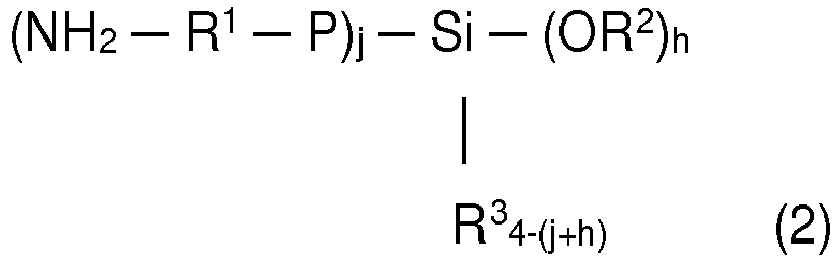
- the styrene-butadiene rubber is of the formula (I) or (II) wherein P is a (co)polymer chain of a conjugated diolefin or a conjugated diolefin and an aromatic vinyl compound, R 1 is an alkylene group having 1 to 12 carbon atoms, R 2 and R 3 are each independently an alkyl group having 1 to 20 carbon atoms, an allyl group or an aryl group, n is an integer of 1 or 2, m is an integer of 1 or 2, and k is an integer of 1 or 2, with the proviso that n+m+k is an integer of 3 or 4, wherein P, R 1 , R 2 and R 3 have the same definitions as give for the above-mentioned formula l, j is an integer of 1 to 3, and h is an integer of 1 to 3, with the provision that j+h is an integer of 2 to 4.
- the terminating agent compound having a protected primary amino group and an alkoxysilyl group may be any of various compounds as are known in the art.
- the compound having a protected primary amino group and an alkoxysilyl group may include, for example, N,N-bis(trimethylsilyl)aminopropylmethyldimethoxysilane, 1-trimethylsilyl-2,2-dimethoxy-1-aza-2-silacyclopentane, N,N-bis(trimethylsilyl)aminopropyltrimethoxysilane, N,N-bis(trimethylsilyl)aminopropyltriethoxysilane, N,N-bis(trimethylsilyl)aminopropylmethyldiethoxysilane, N,N-bis(trimethylsilyl)aminoethyltrimethoxysilane, N,N-bis(trimethylsilyl)-aminoethyltriethoxysilne, N,N-bis(
- the compound having a protected primary amino group and an alkoxysilyl group may be any compound of formula III RN-(CH 2 ) X Si(OR') 3 , III wherein R in combination with the nitrogen (N) atom is a protected amine group which upon appropriate post-treatment yields a primary amine, R' represents a group having 1 to 18 carbon atoms selected from an alkyl, a cycloalkyl, an allyl, or an aryl; and X is an integer from 1 to 20. In one embodiment, at least one R' group is an ethyl radical.
- a primary amine By appropriate post-treatment to yield a primary amine, it is meant that subsequent to reaction of the living polymer with the compound having a protected primary amino group and an alkoxysilyl group, the protecting groups are removed.
- the protecting groups are removed.
- hydrolysis is used to remove the trialkylsilyl groups and leave the primary amine.
- the rubber composition includes from 40 to 60 phr of styrene-butadiene rubber functionalized with an alkoxysilane group and a primary amine group or thiol group.
- Suitable styrene-butadiene rubbers functionalized with an alkoxysilane group and a primary amine group are available commercially, such as HPR 340 from Japan Synthetic Rubber (JSR).
- a silane-sulfide modifier represented by the formula VII (R 4 O) x R 4 y Si-R 5 -S-SiR 4 3 VII wherein Si is silicon; S is sulfur;
- R 5 is a (C 1 -C 16 ) alkyl.
- each R 4 group is the same or different, and each is independently a C 1 -C 5 alkyl, and R 5 is C 1 -C 5 alkyl.
- the solution polymerized styrene-butadiene rubber has a glass transition temperature in a range from -85 °C to -50 °C.
- a reference to glass transition temperature, or Tg, of an elastomer or elastomer composition represents the glass transition temperature(s) of the respective elastomer or elastomer composition in its uncured state or possibly a cured state in a case of an elastomer composition.
- the Tg is determined as a peak midpoint by a differential scanning calorimeter (DSC) at a temperature rate of increase of 10oC per minute, according to ASTM D7426 or equivalent.
- DSC differential scanning calorimeter
- Suitable styrene-butadiene rubbers functionalized with an alkoxysilane group and a thiol group are available commercially, such as Sprintan SLR 3402 from Trinseo.
- Another component of the rubber composition is from 40 to 60 phr of natural rubber.
- the rubber composition preferably includes 10 to 40 phr of a processing oil.
- Processing oil may be included in the rubber composition as extending oil typically used to extend elastomers. Processing oil may also be included in the rubber composition by addition of the oil directly during rubber compounding. The processing oil used may include both extending oil present in the elastomers, and process oil added during compounding.
- Suitable process oils include various oils as are known in the art, including aromatic, paraffinic, naphthenic, and low PCA oils, such as MES, TDAE, and heavy naphthenic oils, vegetable oils such as sunflower, soybean, and safflower oils, and monoesters of fatty acids selected from the group consisting of alkyl oleates, alkyl stearates, alkyl linoleates, and alkyl palmitates.
- the rubber composition includes a low PCA oil.
- Suitable low PCA oils include but are not limited to mild extraction solvates (MES), treated distillate aromatic extracts (TDAE), and heavy naphthenic oils as are known in the art; see for example US-A-5,504,135 ; US-A-6,103,808 ; US-B-6,399,697 ; US-B-6,410,816 ; US-B-6,248,929 ; US-B-6,146,520 ; US-A-2001/00023307 ; US-A-2002/0000280 ; US-A-2002/0045697 ; US-A-2001/0007049 ; EP-A-0 839 891 ; JP-A-2002-097369 ; ES-A-2122917 .
- MES mild extraction solvates
- TDAE treated distillate aromatic extracts
- suitable low PCA oils include those having a glass transition temperature Tg in a range of from -40oC to -80oC.
- MES oils generally have a Tg in a range of from -57oC to -63oC.
- TDAE oils generally have a Tg in a range of from -44oC to -50oC.
- Heavy naphthenic oils generally have a Tg in a range of from -42oC to -48oC.
- a suitable measurement for Tg of TDAE oils is DSC according to ASTM E1356, or equivalent.
- Suitable low PCA oils include those having a polycyclic aromatic content of less than 3 percent by weight as determined by the IP346 method. Procedures for the IP346 method may be found in Standard Methods for Analysis & Testing of Petroleum and Related Products and British Standard 2000 Parts, 2003, 62nd edition, published by the Institute of Petroleum, United Kingdom .
- Suitable TDAE oils are available as Tudalen SX500 from Klaus Dahleke KG, VivaTec 400 and VivaTec 500 from H&R Group, and Enerthene 1849 from BP, and Extensoil 1996 from Repsol.
- the oils may be available as the oil alone or along with an elastomer in the form of an extended elastomer.
- Suitable vegetable oils include, for example, soybean oil, sunflower oil and canola oil which are in the form of esters containing a certain degree of unsaturation.
- the rubber composition optionally includes from 5 to 15 phr of a hydrocarbon resin as traction resin having a glass transition temperature between -40 °C and 100 °C.
- Tg for resins is DSC according to ASTM D6604 or equivalent.
- the hydrocarbon resin preferably has a softening point between 0 °C and 160 °C as determined by ASTM E28 which might sometimes be referred to as a ring and ball softening point.
- the resin is preferably selected from the group consisting of coumarone-indene resins, petroleum resins, terpene polymers, styrene-alphamethylstyrene resins, terpene phenol resins, rosin derived resins and copolymers and/or mixtures thereof.
- the resin is a coumarone-indene resin containing coumarone and indene as the monomer components making up the resin skeleton (main chain).
- Monomer ingredients other than coumarone and indene which may be incorporated into the skeleton are, for example, methyl coumarone, styrene, alphamethylstyrene, methylindene, vinyltoluene, dicyclopentadiene, cycopentadiene, and diolefins such as isoprene and piperlyene.
- Suitable coumarone-indene resin is available commercially as Novares C30 from Rutgers Novares GmbH.
- Suitable petroleum resins include both aromatic and nonaromatic types. Several types of petroleum resins are available. Some resins have a low degree of unsaturation and high aromatic content, whereas some are highly unsaturated and yet some contain no aromatic structure at all. Differences in the resins are largely due to the olefins in the feedstock from which the resins are derived. Conventional derivatives in such resins include any C5 species such as cyclopentadiene, dicyclopentadiene, diolefins such as isoprene and piperylene, and any C9 species such as vinyltoluene and alphamethylstyrene. Such resins are made by any mixture formed from C5 and C9 species mentioned above.
- said resin may be a terpene resin comprised of polymers of at least one of limonene, alpha pinene and beta pinene.
- the styrene/alphamethylstyrene resin is considered herein to be a relatively short chain copolymer of styrene and alphamethylstyrene with a styrene/alphamethylstyrene molar ratio in a range of from 0.05 to 1.50.
- a resin can be suitably prepared, for example, by cationic copolymerization of styrene and alphamethylstyrene in a hydrocarbon solvent.
- the contemplated styrene/alphamethylstyrene resin can be characterized, for example, by its chemical structure, namely, its styrene and alphamethylstyrene contents and by its glass transition temperature, molecular weight and molecular weight distribution.
- Terpene-phenol resins may be used.
- Terpene-phenol resins may be derived by copolymerization of phenolic monomers with terpenes such as limonenes and pinenes.
- Resins derived from rosin and derivatives may be used in the present invention. Gum and wood rosin have much the same composition, although the amount of the various isomers may vary. They typically contain about 10 percent by weight neutral materials, 53 percent by weight resin acids containing two double bonds, 13 percent by weight of resin acids containing one double bond, 16 percent by weight of completely saturated resin acids and 2 percent of dehydroabietic acid which contains an aromatic ring but no unsaturation. There are also present about 6 percent of oxidized acids. Representative of the diunsaturated acids include abietic acid, levopimaric acid and neoabietic acid. Representative of the monounsaturated acids include dextroplmaris acid and dihydroabietic acid. A representative saturated rosin acid is tetrahydroabietic acid. Such resins may be in the form of esters of rosin acids and polyols such as pentaerythritol or glycol.
- said resin may be partially or fully hydrogenated.
- rubber or elastomer containing olefinic unsaturation is intended to include both natural rubber and its various raw and reclaim forms as well as various synthetic rubbers.
- the terms “rubber” and “elastomer” may be used interchangeably, unless otherwise prescribed.
- the terms “rubber composition,” “compounded rubber” and “rubber compound” are used interchangeably to refer to rubber which has been blended or mixed with various ingredients and materials.
- the vulcanizable rubber composition includes from 60 to 90 phr of silica.
- the weight ratio of silica to the sum of the amounts of oil and traction resin is greater than 2.2.
- the weight ratio of silica to the sum the amounts of oil and traction resin is greater than 3.
- the commonly employed siliceous pigments which may be used in the rubber compound include conventional pyrogenic and precipitated siliceous pigments (silica), although precipitated silicas are preferred.
- the conventional siliceous pigments preferably employed in this invention are precipitated silicas such as, for example, those obtained by the acidification of a soluble silicate, e.g., sodium silicate.
- Such conventional silicas might be characterized, for example, by having a BET surface area, as measured using nitrogen gas, preferably in the range of from 40 to 600, and more usually in a range of from 50 to 300 square meters per gram.
- the BET method of measuring surface area is described in the Journal of the American Chemical Society, Volume 60, Page 304 (1930 ).
- the conventional silica may also be typically characterized by having a dibutylphthalate (DBP) absorption value in a range of from 100 to 400, and more usually 150 to 300.
- DBP dibutylphthalate
- silicas such as, only for example herein, and without limitation, silicas commercially available from PPG Industries under the Hi-Sil trademark with designations 210, 243 and 315; silicas available from Rhodia, with, for example, designations of Z1165MP and Z165GR; and silicas available from Degussa AG with, for example, designations VN2 and VN3.
- Pre-hydrophobated precipitated silica may be used.
- pre-hydrophobated it is meant that the silica is pretreated, i.e., the pre-hydrophobated precipitated silica is hydrophobated prior to its addition to the rubber composition by treatment with at least one silane.
- Suitable silanes include but are not limited to alkylsilanes, alkoxysilanes, organoalkoxysilyl polysulfides and organomercaptoalkoxysilanes.
- the precipitated silica may be pre-treated with a silica coupling agent comprised of, for example, an alkoxyorganomercaptosilane or combination of alkoxysilane and alkoxyorganomercaptosilane prior to blending the pre-treated silica with the rubber instead of reacting the precipitated silica with the silica coupling agent in situ within the rubber.
- a silica coupling agent comprised of, for example, an alkoxyorganomercaptosilane or combination of alkoxysilane and alkoxyorganomercaptosilane prior to blending the pre-treated silica with the rubber instead of reacting the precipitated silica with the silica coupling agent in situ within the rubber.
- a silica coupling agent comprised of, for example, an alkoxyorganomercaptosilane or combination of alkoxysilane and alkoxyorganomercaptosilane prior to blending the pre-treated silica with the rubber instead of reacting
- the vulcanizable rubber composition may include from 5 to 50 phr of carbon black.
- carbon blacks can be used as a conventional filler.
- Representative examples of such carbon blacks include N110, N121, N134, N220, N231, N234, N242, N293, N299, S315, N326, N330, M332, N339, N343, N347, N351, N358, N375, N539, N550, N582, N630, N642, N650, N683, N754, N762, N765, N774, N787, N907, N908, N990 and N991.
- These carbon blacks have iodine absorptions ranging from 9 to 145 g/kg and DBP number ranging from 34 to 150 cm 3 /100 g.
- fillers may be used in the rubber composition including, but not limited to, particulate fillers including ultra high molecular weight polyethylene (UHMWPE), particulate polymer gels such as those disclosed in US-A-6,242,534 ; US-A-6,207,757 ; US-A-6,133,364 ; US-B-6,372,857 ; US-A-5,395,891 ; or US-A-6,127,488 , and plasticized starch composite filler such as that disclosed in US-A-5,672,639 .
- UHMWPE ultra high molecular weight polyethylene
- particulate polymer gels such as those disclosed in US-A-6,242,534 ; US-A-6,207,757 ; US-A-6,133,364 ; US-B-6,372,857 ; US-A-5,395,891 ; or US-A-6,127,488
- plasticized starch composite filler such as that disclosed in US-A-5,672,6
- the rubber composition for use in the tire component may additionally contain a conventional sulfur containing organosilicon compound.
- suitable sulfur containing organosilicon compounds are of the formula: Z-Alk-S n -Alk-Z VIII in which Z is selected from the group consisting of where R 6 is an alkyl group of 1 to 4 carbon atoms, cyclohexyl or phenyl; R 7 is alkoxy of 1 to 8 carbon atoms, or cycloalkoxy of 5 to 8 carbon atoms; Alk is a divalent hydrocarbon of 1 to 18 carbon atoms and n is an integer of 2 to 8.
- the preferred sulfur containing organosilicon compounds are the 3,3'-bis(trimethoxy or triethoxy silylpropyl) sulfides.
- the most preferred compounds are 3,3'-bis(triethoxysilylpropyl) disulfide and 3,3'-bis(triethoxysilylpropyl) tetrasulfide. Therefore, as to formula VIII, preferably Z is where R 7 is an alkoxy of 2 to 4 carbon atoms, with 2 carbon atoms being particularly preferred; alk is a divalent hydrocarbon of 2 to 4 carbon atoms with 3 carbon atoms being particularly preferred; and n is an integer of from 2 to 5 with 2 and 4 being particularly preferred.
- suitable sulfur containing organosilicon compounds include compounds disclosed in US-B-6,608,125 .
- suitable sulfur containing organosilicon compounds include compounds disclosed in US-A-2006/0041063 .
- the sulfur containing organosilicon compounds include the reaction product of hydrocarbon based diol (e.g., 2-methyl-1,3-propanediol) with S-[3-(triethoxysilyl)propyl] thiooctanoate.
- the sulfur containing organosilicon compound is NXT-ZTM from Momentive Performance Materials.
- suitable sulfur containing organosilicon compounds include those disclosed in US-A-2003/0130535 .
- the sulfur containing organosilicon compound is Si-363 from Degussa.
- the amount of the sulfur containing organosilicon compound of formula I in a rubber composition will vary depending on the level of other additives that are used. Generally speaking, the amount of the compound of formula I will range from 0.5 to 20 phr. Preferably, the amount will range from 1 to 10 phr.
- the rubber composition would be compounded by methods generally known in the rubber compounding art, such as mixing the various sulfur-vulcanizable constituent rubbers with various commonly used additive materials such as, for example, sulfur donors, curing aids, such as activators and retarders and processing additives, fillers, pigments, fatty acid, zinc oxide, waxes, antioxidants and antiozonants and peptizing agents.
- additives such as, for example, sulfur donors, curing aids, such as activators and retarders and processing additives, fillers, pigments, fatty acid, zinc oxide, waxes, antioxidants and antiozonants and peptizing agents.
- the additives mentioned above are selected and commonly used in conventional amounts.
- sulfur donors include elemental sulfur (free sulfur), an amine disulfide, polymeric polysulfide and sulfur olefin adducts.
- the sulfur-vulcanizing agent is elemental sulfur.
- the sulfur-vulcanizing agent may be used in an amount ranging from 0.5 to 8 phr, with a range of from 1 to 6 phr being preferred.
- Typical amounts of antioxidants comprise 1 to 5 phr.
- Representative antioxidants may be, for example, diphenyl-p-phenylenediamine and others, such as, for example, those disclosed in The Vanderbilt Rubber Handbook (1978), pages 344 through 346 .
- Typical amounts of antiozonants comprise 1 to 5 phr.
- Typical amounts of fatty acids, if used, which can include stearic acid comprise 0.5 to 5 phr.
- Typical amounts of zinc oxide comprise 2 to 5 phr.
- Typical amounts of waxes comprise 1 to 5 phr. Often microcrystalline waxes are used.
- Typical amounts of peptizers comprise 0.1 to 1 phr.
- Typical peptizers may be, for example, pentachlorothiophenol and dibenzamidodiphenyl disulfide.
- Accelerators are used to control the time and/or temperature required for vulcanization and to improve the properties of the vulcanizate.
- a single accelerator system may be used, i.e., primary accelerator.
- the primary accelerator(s) may be used in total amounts ranging from 0.5 to 4.
- combinations of a primary and a secondary accelerator might be used with the secondary accelerator being used in smaller amounts, such as from 0.05 to 3 phr, in order to activate and to improve the properties of the vulcanizate.
- delayed action accelerators may be used which are not affected by normal processing temperatures but produce a satisfactory cure at ordinary vulcanization temperatures.
- Vulcanization retarders might also be used.
- Suitable types of accelerators that may be used in the present invention are amines, disulfides, guanidines, thioureas, thiazoles, thiurams, sulfenamides, dithiocarbamates and xanthates.
- the primary accelerator is a sulfenamide.
- the secondary accelerator is preferably a guanidine, dithiocarbamate or thiuram compound.
- the rubber composition may be used in a tire, which may be made by mixing (A) from 60 to 40 phr of a solution polymerized styrene-butadiene rubber having a glass transition temperature (Tg) ranging from -85 °C to -50 °C; (B) from 40 to 60 phr of natural rubber; (C)from 10 to 40 phr of a process oil; and (D) optionally, from 5 to 15 phr of a traction resin, and (E) from 60 to 90 phr of silica; wherein the weight ratio of silica to the sums of the amounts of oil and traction resin is greater than 2.2.
- Tg glass transition temperature
- the mixing of the rubber composition can be accomplished by methods known to those having skill in the rubber mixing art.
- the ingredients are typically mixed in at least two stages, namely, at least one non-productive stage followed by a productive mix stage.
- the final curatives including sulfur-vulcanizing agents are typically mixed in the final stage which is conventionally called the "productive" mix stage in which the mixing typically occurs at a temperature, or ultimate temperature, lower than the mix temperature(s) than the preceding non-productive mix stage(s).
- the rubber composition may be subjected to a thermomechanical mixing step.
- the thermomechanical mixing step generally comprises a mechanical working in a mixer or extruder for a period of time suitable in order to produce a rubber temperature between 140°C and 190°C.
- the appropriate duration of the thermomechanical working varies as a function of the operating conditions, and the volume and nature of the components.
- the thermomechanical working may be from 1 to 20 minutes.
- the rubber composition is preferably incorporated in a tread of a tire.
- the pneumatic tire of the present invention may be a race tire, passenger tire, aircraft tire, agricultural, earthmover, off-the-road, or truck tire.
- the tire is a passenger or truck tire.
- the tire may also be a radial or bias, with a radial being preferred.
- Vulcanization of the pneumatic tire of the present invention is generally carried out at conventional temperatures ranging from 100°C to 200°C.
- the vulcanization is conducted at temperatures ranging from 110°C to 180°C.
- Any of the usual vulcanization processes may be used such as heating in a press or mold, heating with superheated steam or hot air.
- This example illustrates the advantage of a rubber composition according to the invention.
- Rubber compounds were mixed according to the formulations shown in Table 1, with amounts given in phr. The compounds were cured and tested for physical properties as shown in Table 2.
- Sample C1 is made of a blend of NR and cis-BR, with a silica to oil ratio lower than 2.2, showing a good balance of wet, winter and RR related properties.
- cis-BR in Sample C1 was exchanged with a functionalized low Tg s-SBR in Samples E2 to E4, along with reduced ratio of silica to the sum of oil and resin to lower than 2.2, leading to significant RR, Snow and Wet related properties over Sample C1.
Landscapes
- Chemical & Material Sciences (AREA)
- Health & Medical Sciences (AREA)
- Chemical Kinetics & Catalysis (AREA)
- Medicinal Chemistry (AREA)
- Polymers & Plastics (AREA)
- Organic Chemistry (AREA)
- General Chemical & Material Sciences (AREA)
- Engineering & Computer Science (AREA)
- Mechanical Engineering (AREA)
- Compositions Of Macromolecular Compounds (AREA)
- Tires In General (AREA)
Abstract
(B) from 40 to 60 phr of a natural rubber; and
(C) from 5 to 40 phr of a process oil;
(D) optionally, from 5 to 15 phr of a hydrocarbon resin; and
(E) from 60 to 90 phr of silica;
wherein the weight ratio of silica to the sum of the amounts of oil and the hydrocarbon resin, if present, is greater than 2.2.
Description
- It is highly desirable for tires to have good wet skid resistance, low rolling resistance, and good wear characteristics. It has traditionally been very difficult to improve a tire's wear characteristics without sacrificing its wet skid resistance and traction characteristics. These properties depend, to a great extent, on the dynamic viscoelastic properties of the rubbers utilized in making the tire.
- In order to reduce the rolling resistance and to improve the treadwear characteristics of tires, rubbers having a high rebound have traditionally been utilized in making tire tread rubber compounds. On the other hand, in order to increase the wet skid resistance of a tire, rubbers which undergo a large energy loss have generally been utilized in the tire's tread. In order to balance these two viscoelastically inconsistent properties, mixtures of various types of synthetic and natural rubber are normally utilized in tire treads.
- Tires are sometimes desired with treads for promoting traction on snowy surfaces. Various rubber compositions may be proposed for tire treads. Here, the challenge is to reduce the cured stiffness of such tread rubber compositions, as indicated by having a lower storage modulus G' at -20°C, when the tread is intended to be used for low temperature winter conditions, particularly for vehicular snow driving.
- It is considered that significant challenges are presented for providing such tire tread rubber compositions for maintaining both their wet traction while promoting low temperature (e. g. winter) performance.
- The invention relates to a rubber composition in accordance with claim 1, to a pneumatic tire in accordance with claim 8 and to a method in accordance with claim 9.
- Dependent claims refer to preferred embodiments of the invention.
- A preferred embodiment of the present invention is directed to a pneumatic tire having a tread comprising a vulcanizable rubber composition comprising, based on 100 parts by weight of elastomer (phr),
- (A) from 60 to 40 phr of a solution polymerized styrene-butadiene rubber having a glass transition temperature (Tg) ranging from -85 °C to -50 °C;
- (B) from 40 to 60 phr of natural rubber;
- (C) from 5 to 40 phr of a process oil;
- (D) optionally, from 5 to 15 phr of a hydrocarbon resin (i.e. a hydrocarbon traction resin); and
- (E) from 60 to 90 phr of silica;
- There is disclosed a pneumatic tire having a tread comprising a vulcanizable rubber composition comprising, based on 100 parts by weight of elastomer (phr),
- (A) from 60 to 40 phr of a solution polymerized styrene-butadiene rubber having a glass transition temperature (Tg) ranging from -85 °C to -50 °C;
- (B) from 40 to 60 phr of natural rubber;
- (C) from 5 to 40 phr of a process oil;
- (D) optionally, from 5 to 15 phr of a hydrocarbon traction resin; and
- (E) from 60 to 90 phr of silica;
- The rubber composition includes from 40 to 60 phr of a styrene-butadiene rubber having a glass transition temperature (Tg) ranging from -85 °C to -50 °C. The styrene-butadiene rubber may be functionalized with various functional groups, or the styrene-butadiene rubber may be non-functionalized. In on embodiment the styrene-butadiene rubber is functionalized with an alkoxysilane group and at least one of a primary amine group and thiol group. In one embodiment, the styrene-butadiene rubber is obtained by copolymerizing styrene and butadiene, and characterized in that the styrene-butadiene rubber has a primary amino group and/or thiol group and an alkoxysilyl group which are bonded to the polymer chain. In one embodiment, the alkoxysilyl group is an ethoxysilyl group. In one embodiment, the styrene-butadiene rubber is not functionalized.
- The primary amino group and/or thiol group may be bonded to any of a polymerization initiating terminal, a polymerization terminating terminal, a main chain of the styrene-butadiene rubber and a side chain, as long as it is bonded to the styrene-butadiene rubber chain. However, the primary amino group and/or thiol group is preferably introduced to the polymerization initiating terminal or the polymerization terminating terminal, in that the disappearance of energy at a polymer terminal is inhibited to improve hysteresis loss characteristics.
- Further, the content of the alkoxysilyl group bonded to the polymer chain of the (co)polymer rubber is preferably from 0.5 to 200 mmol/kg of styrene-butadiene rubber. The content is more preferably from 1 to 100 mmol/kg of styrene-butadiene rubber, and particularly preferably from 2 to 50 mmol/kg of styrene-butadiene rubber.
- The alkoxysilyl group may be bonded to any of the polymerization initiating terminal, the polymerization terminating terminal, the main chain of the (co)polymer and the side chain, as long as it is bonded to the (co)polymer chain. However, the alkoxysilyl group is preferably introduced to the polymerization initiating terminal or the polymerization terminating terminal, in that the disappearance of energy is inhibited from the (co)polymer terminal to be able to improve hysteresis loss characteristics.
- The styrene-butadiene rubber can be produced by polymerizing styrene and butadiene in a hydrocarbon solvent by anionic polymerization using an organic alkali metal and/or an organic alkali earth metal as an initiator, adding a terminating agent compound having a primary amino group protected with a protective group and/or a thiol group protected with a protecting group and an alkoxysilyl group to react it with a living polymer chain terminal at the time when the polymerization has substantially completed, and then conducting deblocking, for example, by hydrolysis or other appropriate procedure. In one embodiment, the styrene-butadiene rubber can be produced as disclosed in
US-B-7,342,070 . In another embodiment, the styrene-butadiene rubber can be produced as disclosed inWO-A-2007/047943 . - In one embodiment, and as taught in
US-B-7,342,070 , the styrene-butadiene rubber is of the formula (I) or (II)

- The terminating agent compound having a protected primary amino group and an alkoxysilyl group may be any of various compounds as are known in the art. In one embodiment, the compound having a protected primary amino group and an alkoxysilyl group may include, for example, N,N-bis(trimethylsilyl)aminopropylmethyldimethoxysilane, 1-trimethylsilyl-2,2-dimethoxy-1-aza-2-silacyclopentane, N,N-bis(trimethylsilyl)aminopropyltrimethoxysilane, N,N-bis(trimethylsilyl)aminopropyltriethoxysilane, N,N-bis(trimethylsilyl)aminopropylmethyldiethoxysilane, N,N-bis(trimethylsilyl)aminoethyltrimethoxysilane, N,N-bis(trimethylsilyl)-aminoethyltriethoxysilne, N,N-bis(trimethylsilyl)aminoethylmethyldimethoxysilane, N,N-bis(trimethylsilyl)aminoethylmethyldiethoxysilane, etc., and preferred are 1-trimethylsilyl-2,2-dimethoxy-1-aza-2-silacyclopentane, N,N-bis(trimethylsilyl) aminopropylmethyldimethoxysilane and N,N-bis(trimethylsilyl)aminopropylmethyldiethoxysilane. In one embodiment, the compound having a protected primary amino group and an alkoxysilyl group is N,N-bis(trimethylsilyl)aminopropyltriethoxysilane.
- In one embodiment, the compound having a protected primary amino group and an alkoxysilyl group may be any compound of formula III
RN-(CH2)XSi(OR')3, III
wherein R in combination with the nitrogen (N) atom is a protected amine group which upon appropriate post-treatment yields a primary amine, R' represents a group having 1 to 18 carbon atoms selected from an alkyl, a cycloalkyl, an allyl, or an aryl; and X is an integer from 1 to 20. In one embodiment, at least one R' group is an ethyl radical. By appropriate post-treatment to yield a primary amine, it is meant that subsequent to reaction of the living polymer with the compound having a protected primary amino group and an alkoxysilyl group, the protecting groups are removed. For example, in the case of bis(trialkylsilyl) protecting group as in N,N-bis(trimethylsilyl)aminopropyltriethoxysilane, hydrolysis is used to remove the trialkylsilyl groups and leave the primary amine. - In one embodiment, the rubber composition includes from 40 to 60 phr of styrene-butadiene rubber functionalized with an alkoxysilane group and a primary amine group or thiol group.
- Suitable styrene-butadiene rubbers functionalized with an alkoxysilane group and a primary amine group are available commercially, such as HPR 340 from Japan Synthetic Rubber (JSR).
- In one embodiment, the solution polymerized styrene-butadiene rubber is as disclosed in
WO-A-2007/047943 and is functionalized with an alkoxysilane group and a thiol, and comprises the reaction product of a living anionic polymer and a silane-sulfide modifier represented by the formula VII
(R4O)xR4 ySi-R5-S-SiR4 3 VII
wherein Si is silicon; S is sulfur; O is oxygen; x is an integer selected from 1, 2 and 3; y is an integer selected from 0, 1, and 2; x+y=3;R4 is the same or different and is (C1-C16) alkyl; and R' is aryl, and alkyl aryl, or (C1-C16) alkyl. In one embodiment, R5 is a (C1-C16) alkyl. In one embodiment, each R4 group is the same or different, and each is independently a C1-C5 alkyl, and R5 is C1-C5 alkyl. - The solution polymerized styrene-butadiene rubber has a glass transition temperature in a range from -85 °C to -50 °C. A reference to glass transition temperature, or Tg, of an elastomer or elastomer composition, where referred to herein, represents the glass transition temperature(s) of the respective elastomer or elastomer composition in its uncured state or possibly a cured state in a case of an elastomer composition.
- The Tg is determined as a peak midpoint by a differential scanning calorimeter (DSC) at a temperature rate of increase of 10ºC per minute, according to ASTM D7426 or equivalent.
- Suitable styrene-butadiene rubbers functionalized with an alkoxysilane group and a thiol group are available commercially, such as Sprintan SLR 3402 from Trinseo.
- Another component of the rubber composition is from 40 to 60 phr of natural rubber.
- The rubber composition preferably includes 10 to 40 phr of a processing oil. Processing oil may be included in the rubber composition as extending oil typically used to extend elastomers. Processing oil may also be included in the rubber composition by addition of the oil directly during rubber compounding. The processing oil used may include both extending oil present in the elastomers, and process oil added during compounding. Suitable process oils include various oils as are known in the art, including aromatic, paraffinic, naphthenic, and low PCA oils, such as MES, TDAE, and heavy naphthenic oils, vegetable oils such as sunflower, soybean, and safflower oils, and monoesters of fatty acids selected from the group consisting of alkyl oleates, alkyl stearates, alkyl linoleates, and alkyl palmitates.
- In one embodiment, the rubber composition includes a low PCA oil. Suitable low PCA oils include but are not limited to mild extraction solvates (MES), treated distillate aromatic extracts (TDAE), and heavy naphthenic oils as are known in the art; see for example
US-A-5,504,135 ;US-A-6,103,808 ;US-B-6,399,697 ;US-B-6,410,816 ;US-B-6,248,929 ;US-B-6,146,520 ;US-A-2001/00023307 US-A-2002/0000280 ;US-A-2002/0045697 ;US-A-2001/0007049 ;EP-A-0 839 891 ;JP-A-2002-097369 ES-A-2122917 - Suitable low PCA oils include those having a polycyclic aromatic content of less than 3 percent by weight as determined by the IP346 method. Procedures for the IP346 method may be found in Standard Methods for Analysis & Testing of Petroleum and Related Products and British Standard 2000 Parts, 2003, 62nd edition, published by the Institute of Petroleum, United Kingdom.
- Suitable TDAE oils are available as Tudalen SX500 from Klaus Dahleke KG, VivaTec 400 and VivaTec 500 from H&R Group, and Enerthene 1849 from BP, and Extensoil 1996 from Repsol. The oils may be available as the oil alone or along with an elastomer in the form of an extended elastomer.
- Suitable vegetable oils include, for example, soybean oil, sunflower oil and canola oil which are in the form of esters containing a certain degree of unsaturation.
- The rubber composition optionally includes from 5 to 15 phr of a hydrocarbon resin as traction resin having a glass transition temperature between -40 °C and 100 °C.
- The measurement of Tg for resins is DSC according to ASTM D6604 or equivalent.
- The hydrocarbon resin preferably has a softening point between 0 °C and 160 °C as determined by ASTM E28 which might sometimes be referred to as a ring and ball softening point.
- The resin is preferably selected from the group consisting of coumarone-indene resins, petroleum resins, terpene polymers, styrene-alphamethylstyrene resins, terpene phenol resins, rosin derived resins and copolymers and/or mixtures thereof.
- In one embodiment, the resin is a coumarone-indene resin containing coumarone and indene as the monomer components making up the resin skeleton (main chain). Monomer ingredients other than coumarone and indene which may be incorporated into the skeleton are, for example, methyl coumarone, styrene, alphamethylstyrene, methylindene, vinyltoluene, dicyclopentadiene, cycopentadiene, and diolefins such as isoprene and piperlyene. Suitable coumarone-indene resin is available commercially as Novares C30 from Rutgers Novares GmbH.
- Suitable petroleum resins include both aromatic and nonaromatic types. Several types of petroleum resins are available. Some resins have a low degree of unsaturation and high aromatic content, whereas some are highly unsaturated and yet some contain no aromatic structure at all. Differences in the resins are largely due to the olefins in the feedstock from which the resins are derived. Conventional derivatives in such resins include any C5 species such as cyclopentadiene, dicyclopentadiene, diolefins such as isoprene and piperylene, and any C9 species such as vinyltoluene and alphamethylstyrene. Such resins are made by any mixture formed from C5 and C9 species mentioned above.
- In one embodiment, said resin may be a terpene resin comprised of polymers of at least one of limonene, alpha pinene and beta pinene.
- The styrene/alphamethylstyrene resin is considered herein to be a relatively short chain copolymer of styrene and alphamethylstyrene with a styrene/alphamethylstyrene molar ratio in a range of from 0.05 to 1.50. In one aspect, such a resin can be suitably prepared, for example, by cationic copolymerization of styrene and alphamethylstyrene in a hydrocarbon solvent. Thus, the contemplated styrene/alphamethylstyrene resin can be characterized, for example, by its chemical structure, namely, its styrene and alphamethylstyrene contents and by its glass transition temperature, molecular weight and molecular weight distribution.
- Terpene-phenol resins may be used. Terpene-phenol resins may be derived by copolymerization of phenolic monomers with terpenes such as limonenes and pinenes.
- Resins derived from rosin and derivatives may be used in the present invention. Gum and wood rosin have much the same composition, although the amount of the various isomers may vary. They typically contain about 10 percent by weight neutral materials, 53 percent by weight resin acids containing two double bonds, 13 percent by weight of resin acids containing one double bond, 16 percent by weight of completely saturated resin acids and 2 percent of dehydroabietic acid which contains an aromatic ring but no unsaturation. There are also present about 6 percent of oxidized acids. Representative of the diunsaturated acids include abietic acid, levopimaric acid and neoabietic acid. Representative of the monounsaturated acids include dextroplmaris acid and dihydroabietic acid. A representative saturated rosin acid is tetrahydroabietic acid. Such resins may be in the form of esters of rosin acids and polyols such as pentaerythritol or glycol.
- In one embodiment, said resin may be partially or fully hydrogenated.
- The phrase "rubber or elastomer containing olefinic unsaturation" is intended to include both natural rubber and its various raw and reclaim forms as well as various synthetic rubbers. In the description of this invention, the terms "rubber" and "elastomer" may be used interchangeably, unless otherwise prescribed. The terms "rubber composition," "compounded rubber" and "rubber compound" are used interchangeably to refer to rubber which has been blended or mixed with various ingredients and materials.
- The vulcanizable rubber composition includes from 60 to 90 phr of silica.
- In one embodiment, the weight ratio of silica to the sum of the amounts of oil and traction resin is greater than 2.2.
- In one embodiment, the weight ratio of silica to the sum the amounts of oil and traction resin is greater than 3.
- The commonly employed siliceous pigments which may be used in the rubber compound include conventional pyrogenic and precipitated siliceous pigments (silica), although precipitated silicas are preferred. The conventional siliceous pigments preferably employed in this invention are precipitated silicas such as, for example, those obtained by the acidification of a soluble silicate, e.g., sodium silicate.
- Such conventional silicas might be characterized, for example, by having a BET surface area, as measured using nitrogen gas, preferably in the range of from 40 to 600, and more usually in a range of from 50 to 300 square meters per gram. The BET method of measuring surface area is described in the Journal of the American Chemical Society, Volume 60, Page 304 (1930).
- The conventional silica may also be typically characterized by having a dibutylphthalate (DBP) absorption value in a range of from 100 to 400, and more usually 150 to 300.
- Various commercially available silicas may be used, such as, only for example herein, and without limitation, silicas commercially available from PPG Industries under the Hi-Sil trademark with designations 210, 243 and 315; silicas available from Rhodia, with, for example, designations of Z1165MP and Z165GR; and silicas available from Degussa AG with, for example, designations VN2 and VN3.
- Pre-hydrophobated precipitated silica may be used. By pre-hydrophobated, it is meant that the silica is pretreated, i.e., the pre-hydrophobated precipitated silica is hydrophobated prior to its addition to the rubber composition by treatment with at least one silane. Suitable silanes include but are not limited to alkylsilanes, alkoxysilanes, organoalkoxysilyl polysulfides and organomercaptoalkoxysilanes. Alternatively, the precipitated silica may be pre-treated with a silica coupling agent comprised of, for example, an alkoxyorganomercaptosilane or combination of alkoxysilane and alkoxyorganomercaptosilane prior to blending the pre-treated silica with the rubber instead of reacting the precipitated silica with the silica coupling agent in situ within the rubber. For example, see
US-B-7,214,731 . For various pre-treated precipitated silicas see, for example,US-A-4,704,414 ,US-A-6,123,762 andUS-A-6,573,324 . Suitable pre-treated or pre-hydrophobated silica is available commercially for example as Agilon 400 from PPG. - The vulcanizable rubber composition may include from 5 to 50 phr of carbon black.
- Commonly employed carbon blacks can be used as a conventional filler. Representative examples of such carbon blacks include N110, N121, N134, N220, N231, N234, N242, N293, N299, S315, N326, N330, M332, N339, N343, N347, N351, N358, N375, N539, N550, N582, N630, N642, N650, N683, N754, N762, N765, N774, N787, N907, N908, N990 and N991. These carbon blacks have iodine absorptions ranging from 9 to 145 g/kg and DBP number ranging from 34 to 150 cm3/100 g.
- Other fillers may be used in the rubber composition including, but not limited to, particulate fillers including ultra high molecular weight polyethylene (UHMWPE), particulate polymer gels such as those disclosed in
US-A-6,242,534 ;US-A-6,207,757 ;US-A-6,133,364 ;US-B-6,372,857 ;US-A-5,395,891 ; orUS-A-6,127,488 , and plasticized starch composite filler such as that disclosed inUS-A-5,672,639 . - It may be preferred to have the rubber composition for use in the tire component to additionally contain a conventional sulfur containing organosilicon compound. Examples of suitable sulfur containing organosilicon compounds are of the formula:
Z-Alk-Sn-Alk-Z VIII
in which Z is selected from the group consisting of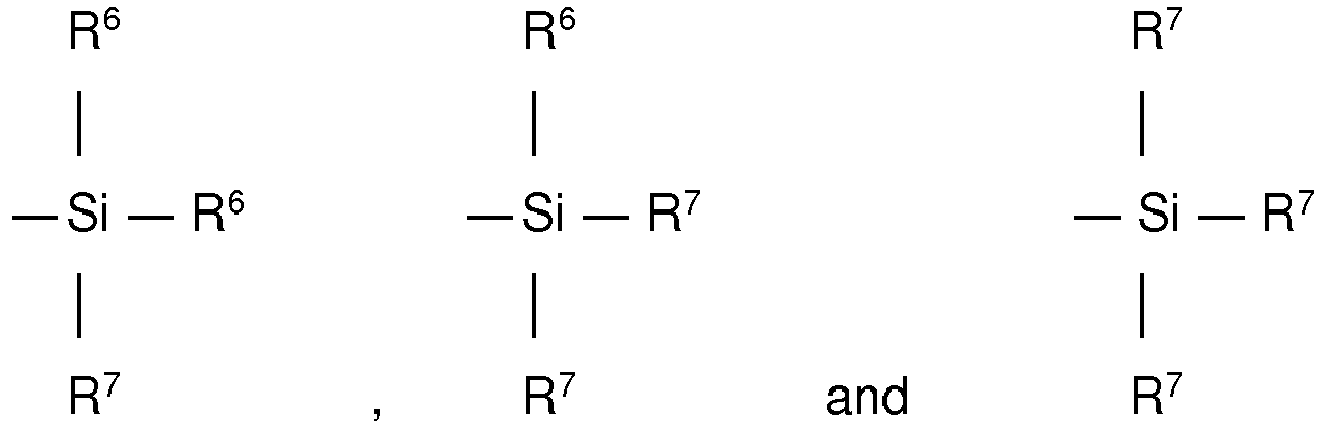
- The preferred sulfur containing organosilicon compounds are the 3,3'-bis(trimethoxy or triethoxy silylpropyl) sulfides. The most preferred compounds are 3,3'-bis(triethoxysilylpropyl) disulfide and 3,3'-bis(triethoxysilylpropyl) tetrasulfide. Therefore, as to formula VIII, preferably Z is
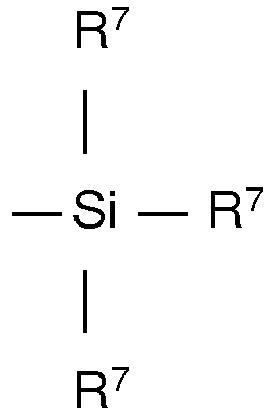
- In another embodiment, suitable sulfur containing organosilicon compounds include compounds disclosed in
US-B-6,608,125 . In one embodiment, the sulfur containing organosilicon compounds includes 3-(octanoylthio)-1-propyltriethoxysilane, CH3(CH2)6C(=O) -S-CH2CH2CH2Si(OCH2CH3)3, which is available commercially as NXT™ from Momentive Performance Materials. - In another embodiment, suitable sulfur containing organosilicon compounds include compounds disclosed in
US-A-2006/0041063 . In one embodiment, the sulfur containing organosilicon compounds include the reaction product of hydrocarbon based diol (e.g., 2-methyl-1,3-propanediol) with S-[3-(triethoxysilyl)propyl] thiooctanoate. In one embodiment, the sulfur containing organosilicon compound is NXT-Z™ from Momentive Performance Materials. - In another embodiment, suitable sulfur containing organosilicon compounds include those disclosed in
US-A-2003/0130535 . In one embodiment, the sulfur containing organosilicon compound is Si-363 from Degussa. - The amount of the sulfur containing organosilicon compound of formula I in a rubber composition will vary depending on the level of other additives that are used. Generally speaking, the amount of the compound of formula I will range from 0.5 to 20 phr. Preferably, the amount will range from 1 to 10 phr.
- It is readily understood by those having skill in the art that the rubber composition would be compounded by methods generally known in the rubber compounding art, such as mixing the various sulfur-vulcanizable constituent rubbers with various commonly used additive materials such as, for example, sulfur donors, curing aids, such as activators and retarders and processing additives, fillers, pigments, fatty acid, zinc oxide, waxes, antioxidants and antiozonants and peptizing agents. As known to those skilled in the art, depending on the intended use of the sulfur vulcanizable and sulfur-vulcanized material (rubbers), the additives mentioned above are selected and commonly used in conventional amounts. Representative examples of sulfur donors include elemental sulfur (free sulfur), an amine disulfide, polymeric polysulfide and sulfur olefin adducts. Preferably, the sulfur-vulcanizing agent is elemental sulfur. The sulfur-vulcanizing agent may be used in an amount ranging from 0.5 to 8 phr, with a range of from 1 to 6 phr being preferred. Typical amounts of antioxidants comprise 1 to 5 phr. Representative antioxidants may be, for example, diphenyl-p-phenylenediamine and others, such as, for example, those disclosed in The Vanderbilt Rubber Handbook (1978), pages 344 through 346. Typical amounts of antiozonants comprise 1 to 5 phr. Typical amounts of fatty acids, if used, which can include stearic acid comprise 0.5 to 5 phr. Typical amounts of zinc oxide comprise 2 to 5 phr. Typical amounts of waxes comprise 1 to 5 phr. Often microcrystalline waxes are used. Typical amounts of peptizers comprise 0.1 to 1 phr. Typical peptizers may be, for example, pentachlorothiophenol and dibenzamidodiphenyl disulfide.
- Accelerators are used to control the time and/or temperature required for vulcanization and to improve the properties of the vulcanizate. In one embodiment, a single accelerator system may be used, i.e., primary accelerator. The primary accelerator(s) may be used in total amounts ranging from 0.5 to 4. In another embodiment, combinations of a primary and a secondary accelerator might be used with the secondary accelerator being used in smaller amounts, such as from 0.05 to 3 phr, in order to activate and to improve the properties of the vulcanizate. In addition, delayed action accelerators may be used which are not affected by normal processing temperatures but produce a satisfactory cure at ordinary vulcanization temperatures. Vulcanization retarders might also be used. Suitable types of accelerators that may be used in the present invention are amines, disulfides, guanidines, thioureas, thiazoles, thiurams, sulfenamides, dithiocarbamates and xanthates. Preferably, the primary accelerator is a sulfenamide. If a second accelerator is used, the secondary accelerator is preferably a guanidine, dithiocarbamate or thiuram compound.
- The rubber composition may be used in a tire, which may be made by mixing (A) from 60 to 40 phr of a solution polymerized styrene-butadiene rubber having a glass transition temperature (Tg) ranging from -85 °C to -50 °C; (B) from 40 to 60 phr of natural rubber; (C)from 10 to 40 phr of a process oil; and (D) optionally, from 5 to 15 phr of a traction resin, and (E) from 60 to 90 phr of silica; wherein the weight ratio of silica to the sums of the amounts of oil and traction resin is greater than 2.2.
- The mixing of the rubber composition can be accomplished by methods known to those having skill in the rubber mixing art. For example, the ingredients are typically mixed in at least two stages, namely, at least one non-productive stage followed by a productive mix stage. The final curatives including sulfur-vulcanizing agents are typically mixed in the final stage which is conventionally called the "productive" mix stage in which the mixing typically occurs at a temperature, or ultimate temperature, lower than the mix temperature(s) than the preceding non-productive mix stage(s). The rubber composition may be subjected to a thermomechanical mixing step. The thermomechanical mixing step generally comprises a mechanical working in a mixer or extruder for a period of time suitable in order to produce a rubber temperature between 140°C and 190°C. The appropriate duration of the thermomechanical working varies as a function of the operating conditions, and the volume and nature of the components. For example, the thermomechanical working may be from 1 to 20 minutes.
- The rubber composition is preferably incorporated in a tread of a tire.
- The pneumatic tire of the present invention may be a race tire, passenger tire, aircraft tire, agricultural, earthmover, off-the-road, or truck tire.. Preferably, the tire is a passenger or truck tire. The tire may also be a radial or bias, with a radial being preferred.
- Vulcanization of the pneumatic tire of the present invention is generally carried out at conventional temperatures ranging from 100°C to 200°C. Preferably, the vulcanization is conducted at temperatures ranging from 110°C to 180°C. Any of the usual vulcanization processes may be used such as heating in a press or mold, heating with superheated steam or hot air.
- The following examples are presented for the purposes of illustrating the present invention. All parts are parts by weight unless specifically identified otherwise.
- This example illustrates the advantage of a rubber composition according to the invention. Rubber compounds were mixed according to the formulations shown in Table 1, with amounts given in phr. The compounds were cured and tested for physical properties as shown in Table 2.
- Sample C1 is made of a blend of NR and cis-BR, with a silica to oil ratio lower than 2.2, showing a good balance of wet, winter and RR related properties. In order to further improve properties, cis-BR in Sample C1 was exchanged with a functionalized low Tg s-SBR in Samples E2 to E4, along with reduced ratio of silica to the sum of oil and resin to lower than 2.2, leading to significant RR, Snow and Wet related properties over Sample C1.
Table 1 Composition C1 E2 E3 E4 Styrene-butadiene 1 30 30 30 Natural rubber 70 70 70 70 Cis-polybutadiene 2 30 Naphthenic oil 3 42 19 10 32 Traction resin 4 9 Antioxidant(s) 4 4 4 4 Stearic acid 3 3 3 3 Silane 5 5.6 4.7 4.7 6.0 Silica 6 90 75 75 Silica 7 75 Carbon Black 2 2 2 2 ZnO 2.5 2.5 2.5 2.5 Sulfur 1.6 1.2 1.2 1.2 Accelerator 3.0 3.5 3.5 3.9 1 Solution polymerized SBR with styrene content of 15% and 1,2-vinyl content of 30%, Tg = -60 °C obtained from Styron as SLR3402.
2 High-cis polybutadiene obtained as BUD1207 from Goodyear Chemical.
3 Naphthenic oil of Tg = -76°C
4 Polyterpene traction resin with a softening point 115°C obtained as Sylvarez TR7115
5 TESPD type silane coupling agent
6 Hi-Sil 315G-D precipitated silica from PPG with a CTAB surface area of 125 m2/g
7 1165MP precipitated silica from Solvay with a CTAB surface area of 160 m2/g.Table 2 Composition C1 E2 E3 E4 Dynamic properties (100°C) 1 G' at 1% strain (MPa) 1.7 1.7 1.7 1.5 Tensile properties 2 Modulus at 300% strain (MPa) 6.9 9.5 10.2 9.1 Tensile strength (MPa) 14.8 22.0 22.7 23.0 Elongation at break (%) 604 585 571 617 Low temperature property 3 G' at 1.5% strain, -20°C (MPa) 6.9 5.0 6.4 5.1 Wet grip property 4 Rebound at 0°C (%) 33.2 33.2 25.8 36.9 RR property 4 Rebound at 100°C (%) 62.3 67.3 65.2 67.8 1 Data according to Rubber Process Analyzer as RPA 2000 instrument by Alpha Technologies, formerly the Flexsys Company and formerly the Monsanto Company. References to an RPA-2000 instrument may be found in the following publications: H. A. Palowski, et al, Rubber World, June 1992 and January 1997, as well as Rubber & Plastics News, April 26 and May 10, 1993.
2 Data according to Automated Testing System instrument by the Instron Corporation. Such instrument may determine ultimate tensile, ultimate elongation, modulii, etc.
3 The G' modulus at low temperatures can be readily be determined by a Metravib TM instrument at 1.5 percent strain and 7.8 Hertz. The test method is understood to be similar to ISO 4664 and DIN 53513.
4 Rebound is a measure of hysteresis of the compound when subject to loading, as measured by ASTM D1054. Generally, the lower the measured rebound at 0 °C, the better the wet grip property. Generally, the higher the measured rebound at 100 °C, the lower the rolling resistance.
Claims (9)
- A vulcanizable rubber composition comprising, based on 100 parts by weight of elastomer (phr),(A) from 60 to 40 phr of a solution polymerized styrene-butadiene rubber having a glass transition temperature (Tg) ranging from -85 °C to -50 °C;(B) from 40 to 60 phr of a natural rubber;(C) from 5 to 40 phr of a process oil;(D) optionally, from 5 to 15 phr of a hydrocarbon resin; and(E) from 60 to 90 phr of silica;wherein the weight ratio of silica to the sum of the amounts of oil and the hydrocarbon resin, if present, is greater than 2.2.
- The rubber composition of claim 1, wherein the solution polymerized styrene-butadiene rubber is functionalized with an alkoxysilane group and at least one functional group selected from the group consisting of primary amines and thiols.
- The rubber composition of claim 1 or 2, wherein the oil is selected from the group consisting of aromatic, paraffinic, naphthenic, MES, TDAE, heavy naphthenic oils, and vegetable oils.
- The rubber composition of at least one of the previous claims, wherein the solution polymerized styrene-butadiene rubber functionalized with an alkoxysilane group and a primary amine group, and is represented by the formula (1) or (2)

- The rubber composition of at least one of the previous claims, wherein the solution polymerized styrene-butadiene rubber is functionalized with an alkoxysilane group and a primary amine group comprises the reaction product of a living polymer chain and a terminating agent of the formula
RN-(CH2)X-Si-(OR')3, I
wherein R in combination with the nitrogen (N) atom is a protected amine group which upon appropriate post-treatment yields a primary amine, R' represents a group having 1 to 18 carbon atoms selected from an alkyl, a cycloalkyl, an allyl, or an aryl; and X is an integer from 1 to 20. - The rubber composition of at least one of the previous claims, wherein the solution polymerized styrene-butadiene rubber is functionalized with an alkoxysilane group and a thiol, and comprises the reaction product of a living anionic polymer and a silane-sulfide modifier represented by the formula
(R4O)xR4 ySi-R5-S-SiR4 3
wherein Si is silicon; S is sulfur; O is oxygen; x is an integer selected from 1, 2 and 3; y is an integer selected from 0, 1, and 2; x+y=3; R4 is the same or different and is (C1-C16) alkyl; and R5 is aryl, and alkyl aryl, or (C1-C16) alkyl. - The rubber composition of at least one of the previous claims wherein the weight ratio of silica to the sum of the amounts of oil and the hydrocarbon resin, if present, is greater than 3.
- A pneumatic tire having a tread comprising the rubber composition in accordance with at least one of the previous claims as a vulcanized rubber composition.
- A method of making a rubber composition comprising the step of:mixing a vulcanizable rubber composition comprising, based on 100 parts by weight of elastomer (phr),(A) from 60 to 40 phr of a solution polymerized styrene-butadiene rubber having a glass transition temperature (Tg) ranging from -85 °C to -50 °C;(B) from 40 to 60 phr of natural rubber;(C) from 5 to 40 phr of a process oil;(D) optionally, from about 5 to 15 phr of a hydrocarbon resin; and(E) from 60 to 90 phr of silica;wherein the weight ratio of silica to the sum of the amounts of oil and traction resin, if present, is greater than 2.2.
Applications Claiming Priority (1)
| Application Number | Priority Date | Filing Date | Title |
|---|---|---|---|
| US15/692,335 US10544288B2 (en) | 2017-08-31 | 2017-08-31 | Pneumatic tire |
Publications (1)
| Publication Number | Publication Date |
|---|---|
| EP3450465A1 true EP3450465A1 (en) | 2019-03-06 |
Family
ID=63259434
Family Applications (1)
| Application Number | Title | Priority Date | Filing Date |
|---|---|---|---|
| EP18188638.3A Withdrawn EP3450465A1 (en) | 2017-08-31 | 2018-08-13 | Rubber composition and pneumatic tire |
Country Status (3)
| Country | Link |
|---|---|
| US (1) | US10544288B2 (en) |
| EP (1) | EP3450465A1 (en) |
| CN (1) | CN109422930B (en) |
Cited By (3)
| Publication number | Priority date | Publication date | Assignee | Title |
|---|---|---|---|---|
| EP3760671A1 (en) * | 2019-07-04 | 2021-01-06 | Continental Reifen Deutschland GmbH | Rubber composition and tyres |
| EP3910018A1 (en) * | 2020-05-14 | 2021-11-17 | The Goodyear Tire & Rubber Company | Rubber composition and pneumatic tire |
| EP4311691A1 (en) * | 2022-07-28 | 2024-01-31 | The Goodyear Tire & Rubber Company | Rubber composition and truck tire |
Families Citing this family (15)
| Publication number | Priority date | Publication date | Assignee | Title |
|---|---|---|---|---|
| TWI659061B (en) * | 2016-09-21 | 2019-05-11 | 美商科騰化學有限責任公司 | Tread enhancement additives |
| EP3321099B1 (en) * | 2016-11-09 | 2019-04-03 | Sumitomo Rubber Industries, Ltd. | Pneumatic tire |
| US10544288B2 (en) * | 2017-08-31 | 2020-01-28 | The Goodyear Tire & Rubber Company | Pneumatic tire |
| US10947368B2 (en) | 2019-03-04 | 2021-03-16 | The Goodyear Tire & Rubber Company | Pneumatic tire |
| EP3769973A1 (en) * | 2019-07-25 | 2021-01-27 | The Goodyear Tire & Rubber Company | A rubber composition and a tire comprising a tread |
| US11214667B2 (en) | 2019-07-29 | 2022-01-04 | The Goodyear Tire & Rubber Company | Pneumatic tire |
| US11441021B2 (en) | 2019-07-29 | 2022-09-13 | The Goodyear Tire & Rubber Company | Pneumatic tire |
| US11851549B2 (en) * | 2019-11-11 | 2023-12-26 | The Goodyear Tire & Rubber Company | Tire |
| US11440350B2 (en) | 2020-05-13 | 2022-09-13 | The Goodyear Tire & Rubber Company | Pneumatic tire |
| US12319092B2 (en) | 2021-05-19 | 2025-06-03 | The Goodyear Tire & Rubber Company | Plasticizer system and rubber composition for pneumatic tire |
| IT202100023213A1 (en) | 2021-09-08 | 2023-03-08 | Pirelli | Tire for vehicle wheels |
| EP4257369B1 (en) * | 2022-04-04 | 2025-01-22 | Bridgestone Europe NV/SA | Tyre tread |
| IT202200010532A1 (en) | 2022-05-20 | 2023-11-20 | Pirelli | TIRE FOR VEHICLE WHEELS |
| EP4461563A3 (en) * | 2023-05-08 | 2024-11-20 | Nokian Renkaat Oyj | A pneumatic tyre with a thermally adaptive underlayer |
| EP4461768A1 (en) * | 2023-05-08 | 2024-11-13 | Nokian Renkaat Oyj | A pneumatic tyre with a thermally adaptive underlayer |
Citations (34)
| Publication number | Priority date | Publication date | Assignee | Title |
|---|---|---|---|---|
| US4704414A (en) | 1984-10-12 | 1987-11-03 | Degussa Aktiengesellschaft | Surface modified synthetic, silicatic filler, a process for its production and its use |
| US5395891A (en) | 1992-06-24 | 1995-03-07 | Bayer Aktiengesellschaft | Rubber mixtures containing polybutadiene gel |
| US5504135A (en) | 1991-02-21 | 1996-04-02 | Exxon Research And Engineering Company | Rubber processing oil and rubber products containing it |
| US5672639A (en) | 1996-03-12 | 1997-09-30 | The Goodyear Tire & Rubber Company | Starch composite reinforced rubber composition and tire with at least one component thereof |
| EP0839891A2 (en) | 1996-10-31 | 1998-05-06 | Repsol Petroleo S.A. | Process for obtaining aromatic oils having a polycyclic aromatics content of less than 3% which are useful as process oils |
| ES2122917A1 (en) | 1996-10-31 | 1998-12-16 | Repsol Petroleo Sa | Process for obtaining aromatic oils having a polycyclic aromatic compounds content of less than 3% which are useful as rubber extenders |
| US6103808A (en) | 1997-06-27 | 2000-08-15 | Bridgestone Corporation | High aromatic oil and rubber composition and oil extended synthetic rubber using the same |
| US6123762A (en) | 1996-03-12 | 2000-09-26 | Degussa-Huls Ag | Low-dust, well dispersible granulates based on silicate fillers modified with organosilicon compounds |
| US6127488A (en) | 1997-01-17 | 2000-10-03 | Bayer Ag | Rubber mixtures which contain SBR rubber gels |
| US6133364A (en) | 1998-08-01 | 2000-10-17 | Continental Aktiengesellschaft | Rubber composition, method of formulating the composition and vehicle tire made from the composition |
| US6146520A (en) | 1997-04-02 | 2000-11-14 | Mobil Oil Corporation | Selective re-extraction of lube extracts to reduce mutagenicity index |
| US6207757B1 (en) | 1998-08-01 | 2001-03-27 | Continental Aktiengesellschaft | Rubber composition, method of adding and blending the composition and vehicle tire made from the composition |
| US6242534B1 (en) | 1998-08-01 | 2001-06-05 | Continental Aktiengesellschaft | Rubber composition, method of formulating and blending the same and article and tires made therefrom |
| US6248929B1 (en) | 1998-01-22 | 2001-06-19 | Japan Energy Corporation | Rubber process oil and production process thereof |
| US20010007049A1 (en) | 1998-04-17 | 2001-07-05 | Idemitsu Kosan Co., Ltd. | Processing oil and method for producing the same |
| US20020000280A1 (en) | 2000-05-24 | 2002-01-03 | Thomas Scholl | Rubber mixtures for producing highly reinforced vulcanisates with low damping behaviour |
| JP2002097369A (en) | 2000-09-25 | 2002-04-02 | Sankyo Yuka Kogyo Kk | Predominance of asphalt/oil mixture (under application of registration as a/o mix.) as rubber plasticizer |
| US6372857B1 (en) | 1999-09-07 | 2002-04-16 | Bayer Aktiengesellschaft | Microgel-containing rubber mixtures with masked bi-functional mercaptans and vulcanization products produced therefrom |
| US20020045697A1 (en) | 2000-07-24 | 2002-04-18 | Continental Aktiengesellschaft | Rubber composition |
| WO2002036676A1 (en) * | 2000-10-30 | 2002-05-10 | Pirelli Pneumatici S.P.A. | Method for improving the grip of a tyre on a snowy and/or icy road, and a winter tyre |
| US6399697B1 (en) | 1999-02-26 | 2002-06-04 | Idemitsu Kosan Co., Ltd. | Process oil, process for producing the same and rubber composition |
| US6573324B1 (en) | 2000-04-04 | 2003-06-03 | The Goodyear Tire & Rubber Company | Tire with component comprised of rubber composition containing pre-hydrophobated silica aggregates |
| US20030130535A1 (en) | 2001-08-06 | 2003-07-10 | Degussa Ag, | Organosilicon compounds |
| US6608125B2 (en) | 1997-08-21 | 2003-08-19 | Crompton Corporation | Blocked mercaptosilane coupling agents for filled rubbers |
| US20060041063A1 (en) | 2004-08-20 | 2006-02-23 | Cruse Richard W | Cyclic diol-derived blocked mercaptofunctional silane compositions |
| WO2007047943A2 (en) | 2005-10-19 | 2007-04-26 | Dow Global Technologies Inc. | Silane-sulfide chain end modified elastomeric polymers |
| US7214731B2 (en) | 2003-03-17 | 2007-05-08 | The Goodyear Tire & Rubber Company | Tire with low hydrocarbon emission rubber combination of tread and sidewall components with compositional limitations |
| US7342070B2 (en) | 2001-09-27 | 2008-03-11 | Jsr Corporation | Conjugated diolefin (co)polymer rubber, process for producing (co)polymer rubber, rubber composition, composite, and tire |
| EP3031620A1 (en) * | 2014-12-09 | 2016-06-15 | The Goodyear Tire & Rubber Company | Pneumatic tire |
| EP3109065A1 (en) * | 2015-06-24 | 2016-12-28 | The Goodyear Tire & Rubber Company | Tire with tread for low temperature performance and wet traction |
| US20170107360A1 (en) * | 2015-10-16 | 2017-04-20 | Toyo Tire & Rubber Co., Ltd. | Rubber composition and pneumatic tire |
| EP3181373A1 (en) * | 2015-12-15 | 2017-06-21 | The Goodyear Tire & Rubber Company | Rubber composition and pneumatic tire |
| EP3205514A1 (en) * | 2016-02-15 | 2017-08-16 | The Goodyear Tire & Rubber Company | Rubber composition and tire with tread for low temperature performance and wet traction |
| EP3251872A1 (en) * | 2016-06-01 | 2017-12-06 | The Goodyear Tire & Rubber Company | Rubber composition and pneumatic tire |
Family Cites Families (8)
| Publication number | Priority date | Publication date | Assignee | Title |
|---|---|---|---|---|
| GB2101143B (en) * | 1981-07-01 | 1985-01-23 | Denki Kagaku Kogyo Kk | Thermoplastic resin compositions and their preparation |
| US6177729B1 (en) | 1999-04-03 | 2001-01-23 | International Business Machines Corporation | Rolling ball connector |
| US7743543B2 (en) * | 2005-10-06 | 2010-06-29 | Theodore Karagias | Trigger mechanism and a firearm containing the same |
| BRPI1004233A2 (en) * | 2009-11-20 | 2013-02-19 | Goodyear Tire & Rubber | pneumatic |
| US11118036B2 (en) * | 2015-11-20 | 2021-09-14 | The Goodyear Tire & Rubber Company | Pneumatic tire |
| CN106279797B (en) * | 2016-07-18 | 2019-01-29 | 郑兴荣 | A kind of Low-rolling-resistantire tire tread rubber composition and its tire of manufacture |
| US10654995B2 (en) * | 2017-08-30 | 2020-05-19 | The Goodyear Tire & Rubber Company | Pneumatic tire |
| US10544288B2 (en) * | 2017-08-31 | 2020-01-28 | The Goodyear Tire & Rubber Company | Pneumatic tire |
-
2017
- 2017-08-31 US US15/692,335 patent/US10544288B2/en active Active
-
2018
- 2018-08-13 EP EP18188638.3A patent/EP3450465A1/en not_active Withdrawn
- 2018-08-31 CN CN201811012841.9A patent/CN109422930B/en not_active Expired - Fee Related
Patent Citations (36)
| Publication number | Priority date | Publication date | Assignee | Title |
|---|---|---|---|---|
| US4704414A (en) | 1984-10-12 | 1987-11-03 | Degussa Aktiengesellschaft | Surface modified synthetic, silicatic filler, a process for its production and its use |
| US5504135A (en) | 1991-02-21 | 1996-04-02 | Exxon Research And Engineering Company | Rubber processing oil and rubber products containing it |
| US5395891A (en) | 1992-06-24 | 1995-03-07 | Bayer Aktiengesellschaft | Rubber mixtures containing polybutadiene gel |
| US6123762A (en) | 1996-03-12 | 2000-09-26 | Degussa-Huls Ag | Low-dust, well dispersible granulates based on silicate fillers modified with organosilicon compounds |
| US5672639A (en) | 1996-03-12 | 1997-09-30 | The Goodyear Tire & Rubber Company | Starch composite reinforced rubber composition and tire with at least one component thereof |
| EP0839891A2 (en) | 1996-10-31 | 1998-05-06 | Repsol Petroleo S.A. | Process for obtaining aromatic oils having a polycyclic aromatics content of less than 3% which are useful as process oils |
| ES2122917A1 (en) | 1996-10-31 | 1998-12-16 | Repsol Petroleo Sa | Process for obtaining aromatic oils having a polycyclic aromatic compounds content of less than 3% which are useful as rubber extenders |
| US6127488A (en) | 1997-01-17 | 2000-10-03 | Bayer Ag | Rubber mixtures which contain SBR rubber gels |
| US6146520A (en) | 1997-04-02 | 2000-11-14 | Mobil Oil Corporation | Selective re-extraction of lube extracts to reduce mutagenicity index |
| US6103808A (en) | 1997-06-27 | 2000-08-15 | Bridgestone Corporation | High aromatic oil and rubber composition and oil extended synthetic rubber using the same |
| US6608125B2 (en) | 1997-08-21 | 2003-08-19 | Crompton Corporation | Blocked mercaptosilane coupling agents for filled rubbers |
| US6248929B1 (en) | 1998-01-22 | 2001-06-19 | Japan Energy Corporation | Rubber process oil and production process thereof |
| US20010023307A1 (en) | 1998-01-22 | 2001-09-20 | Japan Energy Corporation | Rubber process oil and production process thereof |
| US20010007049A1 (en) | 1998-04-17 | 2001-07-05 | Idemitsu Kosan Co., Ltd. | Processing oil and method for producing the same |
| US6410816B2 (en) | 1998-04-17 | 2002-06-25 | Idemitsu Kosan Co., Ltd. | Processing oil and method for producing the same |
| US6133364A (en) | 1998-08-01 | 2000-10-17 | Continental Aktiengesellschaft | Rubber composition, method of formulating the composition and vehicle tire made from the composition |
| US6207757B1 (en) | 1998-08-01 | 2001-03-27 | Continental Aktiengesellschaft | Rubber composition, method of adding and blending the composition and vehicle tire made from the composition |
| US6242534B1 (en) | 1998-08-01 | 2001-06-05 | Continental Aktiengesellschaft | Rubber composition, method of formulating and blending the same and article and tires made therefrom |
| US6399697B1 (en) | 1999-02-26 | 2002-06-04 | Idemitsu Kosan Co., Ltd. | Process oil, process for producing the same and rubber composition |
| US6372857B1 (en) | 1999-09-07 | 2002-04-16 | Bayer Aktiengesellschaft | Microgel-containing rubber mixtures with masked bi-functional mercaptans and vulcanization products produced therefrom |
| US6573324B1 (en) | 2000-04-04 | 2003-06-03 | The Goodyear Tire & Rubber Company | Tire with component comprised of rubber composition containing pre-hydrophobated silica aggregates |
| US20020000280A1 (en) | 2000-05-24 | 2002-01-03 | Thomas Scholl | Rubber mixtures for producing highly reinforced vulcanisates with low damping behaviour |
| US20020045697A1 (en) | 2000-07-24 | 2002-04-18 | Continental Aktiengesellschaft | Rubber composition |
| JP2002097369A (en) | 2000-09-25 | 2002-04-02 | Sankyo Yuka Kogyo Kk | Predominance of asphalt/oil mixture (under application of registration as a/o mix.) as rubber plasticizer |
| WO2002036676A1 (en) * | 2000-10-30 | 2002-05-10 | Pirelli Pneumatici S.P.A. | Method for improving the grip of a tyre on a snowy and/or icy road, and a winter tyre |
| US20030130535A1 (en) | 2001-08-06 | 2003-07-10 | Degussa Ag, | Organosilicon compounds |
| US7342070B2 (en) | 2001-09-27 | 2008-03-11 | Jsr Corporation | Conjugated diolefin (co)polymer rubber, process for producing (co)polymer rubber, rubber composition, composite, and tire |
| US7214731B2 (en) | 2003-03-17 | 2007-05-08 | The Goodyear Tire & Rubber Company | Tire with low hydrocarbon emission rubber combination of tread and sidewall components with compositional limitations |
| US20060041063A1 (en) | 2004-08-20 | 2006-02-23 | Cruse Richard W | Cyclic diol-derived blocked mercaptofunctional silane compositions |
| WO2007047943A2 (en) | 2005-10-19 | 2007-04-26 | Dow Global Technologies Inc. | Silane-sulfide chain end modified elastomeric polymers |
| EP3031620A1 (en) * | 2014-12-09 | 2016-06-15 | The Goodyear Tire & Rubber Company | Pneumatic tire |
| EP3109065A1 (en) * | 2015-06-24 | 2016-12-28 | The Goodyear Tire & Rubber Company | Tire with tread for low temperature performance and wet traction |
| US20170107360A1 (en) * | 2015-10-16 | 2017-04-20 | Toyo Tire & Rubber Co., Ltd. | Rubber composition and pneumatic tire |
| EP3181373A1 (en) * | 2015-12-15 | 2017-06-21 | The Goodyear Tire & Rubber Company | Rubber composition and pneumatic tire |
| EP3205514A1 (en) * | 2016-02-15 | 2017-08-16 | The Goodyear Tire & Rubber Company | Rubber composition and tire with tread for low temperature performance and wet traction |
| EP3251872A1 (en) * | 2016-06-01 | 2017-12-06 | The Goodyear Tire & Rubber Company | Rubber composition and pneumatic tire |
Non-Patent Citations (2)
| Title |
|---|
| "Standard Methods for Analysis & Testing of Petroleum and Related Products and British Standard 2000 Parts", 2003, INSTITUTE OF PETROLEUM |
| JOURNAL OF THE AMERICAN CHEMICAL SOCIETY, vol. 60, 1930, pages 304 |
Cited By (3)
| Publication number | Priority date | Publication date | Assignee | Title |
|---|---|---|---|---|
| EP3760671A1 (en) * | 2019-07-04 | 2021-01-06 | Continental Reifen Deutschland GmbH | Rubber composition and tyres |
| EP3910018A1 (en) * | 2020-05-14 | 2021-11-17 | The Goodyear Tire & Rubber Company | Rubber composition and pneumatic tire |
| EP4311691A1 (en) * | 2022-07-28 | 2024-01-31 | The Goodyear Tire & Rubber Company | Rubber composition and truck tire |
Also Published As
| Publication number | Publication date |
|---|---|
| CN109422930B (en) | 2021-03-12 |
| CN109422930A (en) | 2019-03-05 |
| US10544288B2 (en) | 2020-01-28 |
| US20190062529A1 (en) | 2019-02-28 |
Similar Documents
| Publication | Publication Date | Title |
|---|---|---|
| EP3620307B1 (en) | Rubber composition and pneumatic tire | |
| EP3159181B1 (en) | Rubber composition and pneumatic tire | |
| EP3170680B1 (en) | Pneumatic tire | |
| EP3335904B1 (en) | Pneumatic tire | |
| EP3450494B1 (en) | Pneumatic tire | |
| CN109422930B (en) | Pneumatic tires | |
| EP3031621B1 (en) | Pneumatic tire | |
| EP3783060B1 (en) | Rubber composition and pneumatic tire | |
| EP3127712B1 (en) | Pneumatic tire | |
| EP3181373B1 (en) | Rubber composition and pneumatic tire | |
| EP3450206B1 (en) | Rubber composition and pneumatic tire having tread with hydroxy-terminated polybutadiene | |
| EP3705311B1 (en) | Rubber composition and pneumatic tire | |
| EP3913018B1 (en) | Rubber composition and pneumatic tire | |
| EP3031620A1 (en) | Pneumatic tire | |
| EP3560992B1 (en) | Rubber composition and pneumatic tire | |
| EP3450490B1 (en) | Rubber composition and pneumatic tire | |
| EP3450203A1 (en) | Pneumatic tire having a tread with an hydroxy-terminated polybutadiene | |
| EP3910018B1 (en) | Rubber composition and pneumatic tire | |
| EP4101657A1 (en) | Rubber composition and tire | |
| EP3800067B1 (en) | Rubber composition and pneumatic tire |
Legal Events
| Date | Code | Title | Description |
|---|---|---|---|
| PUAI | Public reference made under article 153(3) epc to a published international application that has entered the european phase |
Free format text: ORIGINAL CODE: 0009012 |
|
| STAA | Information on the status of an ep patent application or granted ep patent |
Free format text: STATUS: THE APPLICATION HAS BEEN PUBLISHED |
|
| AK | Designated contracting states |
Kind code of ref document: A1 Designated state(s): AL AT BE BG CH CY CZ DE DK EE ES FI FR GB GR HR HU IE IS IT LI LT LU LV MC MK MT NL NO PL PT RO RS SE SI SK SM TR |
|
| AX | Request for extension of the european patent |
Extension state: BA ME |
|
| STAA | Information on the status of an ep patent application or granted ep patent |
Free format text: STATUS: REQUEST FOR EXAMINATION WAS MADE |
|
| 17P | Request for examination filed |
Effective date: 20190906 |
|
| RBV | Designated contracting states (corrected) |
Designated state(s): AL AT BE BG CH CY CZ DE DK EE ES FI FR GB GR HR HU IE IS IT LI LT LU LV MC MK MT NL NO PL PT RO RS SE SI SK SM TR |
|
| STAA | Information on the status of an ep patent application or granted ep patent |
Free format text: STATUS: EXAMINATION IS IN PROGRESS |
|
| 17Q | First examination report despatched |
Effective date: 20220322 |
|
| STAA | Information on the status of an ep patent application or granted ep patent |
Free format text: STATUS: THE APPLICATION IS DEEMED TO BE WITHDRAWN |
|
| 18D | Application deemed to be withdrawn |
Effective date: 20250301 |