EP3419966B1 - Uv-absorbing vinylic monomers and uses thereof - Google Patents
Uv-absorbing vinylic monomers and uses thereof Download PDFInfo
- Publication number
- EP3419966B1 EP3419966B1 EP17709807.6A EP17709807A EP3419966B1 EP 3419966 B1 EP3419966 B1 EP 3419966B1 EP 17709807 A EP17709807 A EP 17709807A EP 3419966 B1 EP3419966 B1 EP 3419966B1
- Authority
- EP
- European Patent Office
- Prior art keywords
- less
- vinylic monomer
- contact lens
- hydrogen
- weight
- Prior art date
- Legal status (The legal status is an assumption and is not a legal conclusion. Google has not performed a legal analysis and makes no representation as to the accuracy of the status listed.)
- Active
Links
- NYAHTFRWODMUIP-UHFFFAOYSA-N CC1=CCC(C(N)O)C=C1 Chemical compound CC1=CCC(C(N)O)C=C1 NYAHTFRWODMUIP-UHFFFAOYSA-N 0.000 description 1
Images


Classifications
-
- C—CHEMISTRY; METALLURGY
- C08—ORGANIC MACROMOLECULAR COMPOUNDS; THEIR PREPARATION OR CHEMICAL WORKING-UP; COMPOSITIONS BASED THEREON
- C08F—MACROMOLECULAR COMPOUNDS OBTAINED BY REACTIONS ONLY INVOLVING CARBON-TO-CARBON UNSATURATED BONDS
- C08F220/00—Copolymers of compounds having one or more unsaturated aliphatic radicals, each having only one carbon-to-carbon double bond, and only one being terminated by only one carboxyl radical or a salt, anhydride ester, amide, imide or nitrile thereof
- C08F220/02—Monocarboxylic acids having less than ten carbon atoms; Derivatives thereof
- C08F220/52—Amides or imides
- C08F220/54—Amides, e.g. N,N-dimethylacrylamide or N-isopropylacrylamide
- C08F220/60—Amides, e.g. N,N-dimethylacrylamide or N-isopropylacrylamide containing nitrogen in addition to the carbonamido nitrogen
- C08F220/603—Amides, e.g. N,N-dimethylacrylamide or N-isopropylacrylamide containing nitrogen in addition to the carbonamido nitrogen and containing oxygen in addition to the carbonamido oxygen and nitrogen
-
- B—PERFORMING OPERATIONS; TRANSPORTING
- B29—WORKING OF PLASTICS; WORKING OF SUBSTANCES IN A PLASTIC STATE IN GENERAL
- B29D—PRODUCING PARTICULAR ARTICLES FROM PLASTICS OR FROM SUBSTANCES IN A PLASTIC STATE
- B29D11/00—Producing optical elements, e.g. lenses or prisms
- B29D11/00009—Production of simple or compound lenses
- B29D11/00038—Production of contact lenses
- B29D11/00125—Auxiliary operations, e.g. removing oxygen from the mould, conveying moulds from a storage to the production line in an inert atmosphere
- B29D11/00134—Curing of the contact lens material
-
- C—CHEMISTRY; METALLURGY
- C07—ORGANIC CHEMISTRY
- C07C—ACYCLIC OR CARBOCYCLIC COMPOUNDS
- C07C233/00—Carboxylic acid amides
- C07C233/01—Carboxylic acid amides having carbon atoms of carboxamide groups bound to hydrogen atoms or to acyclic carbon atoms
- C07C233/34—Carboxylic acid amides having carbon atoms of carboxamide groups bound to hydrogen atoms or to acyclic carbon atoms having the nitrogen atom of at least one of the carboxamide groups bound to a carbon atom of a hydrocarbon radical substituted by amino groups
- C07C233/35—Carboxylic acid amides having carbon atoms of carboxamide groups bound to hydrogen atoms or to acyclic carbon atoms having the nitrogen atom of at least one of the carboxamide groups bound to a carbon atom of a hydrocarbon radical substituted by amino groups with the substituted hydrocarbon radical bound to the nitrogen atom of the carboxamide group by an acyclic carbon atom
- C07C233/38—Carboxylic acid amides having carbon atoms of carboxamide groups bound to hydrogen atoms or to acyclic carbon atoms having the nitrogen atom of at least one of the carboxamide groups bound to a carbon atom of a hydrocarbon radical substituted by amino groups with the substituted hydrocarbon radical bound to the nitrogen atom of the carboxamide group by an acyclic carbon atom having the carbon atom of the carboxamide group bound to a carbon atom of an acyclic unsaturated carbon skeleton
-
- C—CHEMISTRY; METALLURGY
- C07—ORGANIC CHEMISTRY
- C07D—HETEROCYCLIC COMPOUNDS
- C07D249/00—Heterocyclic compounds containing five-membered rings having three nitrogen atoms as the only ring hetero atoms
- C07D249/16—Heterocyclic compounds containing five-membered rings having three nitrogen atoms as the only ring hetero atoms condensed with carbocyclic rings or ring systems
- C07D249/18—Benzotriazoles
- C07D249/20—Benzotriazoles with aryl radicals directly attached in position 2
-
- C—CHEMISTRY; METALLURGY
- C08—ORGANIC MACROMOLECULAR COMPOUNDS; THEIR PREPARATION OR CHEMICAL WORKING-UP; COMPOSITIONS BASED THEREON
- C08F—MACROMOLECULAR COMPOUNDS OBTAINED BY REACTIONS ONLY INVOLVING CARBON-TO-CARBON UNSATURATED BONDS
- C08F20/00—Homopolymers and copolymers of compounds having one or more unsaturated aliphatic radicals, each having only one carbon-to-carbon double bond, and only one being terminated by only one carboxyl radical or a salt, anhydride, ester, amide, imide or nitrile thereof
- C08F20/02—Monocarboxylic acids having less than ten carbon atoms, Derivatives thereof
- C08F20/10—Esters
- C08F20/34—Esters containing nitrogen, e.g. N,N-dimethylaminoethyl (meth)acrylate
- C08F20/36—Esters containing nitrogen, e.g. N,N-dimethylaminoethyl (meth)acrylate containing oxygen in addition to the carboxy oxygen, e.g. 2-N-morpholinoethyl (meth)acrylate or 2-isocyanatoethyl (meth)acrylate
-
- C—CHEMISTRY; METALLURGY
- C08—ORGANIC MACROMOLECULAR COMPOUNDS; THEIR PREPARATION OR CHEMICAL WORKING-UP; COMPOSITIONS BASED THEREON
- C08F—MACROMOLECULAR COMPOUNDS OBTAINED BY REACTIONS ONLY INVOLVING CARBON-TO-CARBON UNSATURATED BONDS
- C08F220/00—Copolymers of compounds having one or more unsaturated aliphatic radicals, each having only one carbon-to-carbon double bond, and only one being terminated by only one carboxyl radical or a salt, anhydride ester, amide, imide or nitrile thereof
- C08F220/62—Monocarboxylic acids having ten or more carbon atoms; Derivatives thereof
- C08F220/70—Nitriles; Amides; Imides
-
- G—PHYSICS
- G02—OPTICS
- G02B—OPTICAL ELEMENTS, SYSTEMS OR APPARATUS
- G02B1/00—Optical elements characterised by the material of which they are made; Optical coatings for optical elements
- G02B1/04—Optical elements characterised by the material of which they are made; Optical coatings for optical elements made of organic materials, e.g. plastics
- G02B1/041—Lenses
- G02B1/043—Contact lenses
-
- G—PHYSICS
- G02—OPTICS
- G02B—OPTICAL ELEMENTS, SYSTEMS OR APPARATUS
- G02B5/00—Optical elements other than lenses
- G02B5/20—Filters
- G02B5/208—Filters for use with infrared or ultraviolet radiation, e.g. for separating visible light from infrared and/or ultraviolet radiation
-
- G—PHYSICS
- G02—OPTICS
- G02B—OPTICAL ELEMENTS, SYSTEMS OR APPARATUS
- G02B5/00—Optical elements other than lenses
- G02B5/20—Filters
- G02B5/22—Absorbing filters
- G02B5/223—Absorbing filters containing organic substances, e.g. dyes, inks or pigments
-
- G—PHYSICS
- G02—OPTICS
- G02C—SPECTACLES; SUNGLASSES OR GOGGLES INSOFAR AS THEY HAVE THE SAME FEATURES AS SPECTACLES; CONTACT LENSES
- G02C7/00—Optical parts
- G02C7/02—Lenses; Lens systems ; Methods of designing lenses
- G02C7/04—Contact lenses for the eyes
- G02C7/049—Contact lenses having special fitting or structural features achieved by special materials or material structures
-
- G—PHYSICS
- G02—OPTICS
- G02C—SPECTACLES; SUNGLASSES OR GOGGLES INSOFAR AS THEY HAVE THE SAME FEATURES AS SPECTACLES; CONTACT LENSES
- G02C7/00—Optical parts
- G02C7/10—Filters, e.g. for facilitating adaptation of the eyes to the dark; Sunglasses
- G02C7/108—Colouring materials
-
- B—PERFORMING OPERATIONS; TRANSPORTING
- B29—WORKING OF PLASTICS; WORKING OF SUBSTANCES IN A PLASTIC STATE IN GENERAL
- B29K—INDEXING SCHEME ASSOCIATED WITH SUBCLASSES B29B, B29C OR B29D, RELATING TO MOULDING MATERIALS OR TO MATERIALS FOR MOULDS, REINFORCEMENTS, FILLERS OR PREFORMED PARTS, e.g. INSERTS
- B29K2105/00—Condition, form or state of moulded material or of the material to be shaped
- B29K2105/0002—Condition, form or state of moulded material or of the material to be shaped monomers or prepolymers
Definitions
- This invention is related to water-soluble vinylic monomers capable of absorbing ultra-violet (UV) radiation and optionally high-energy-violet (HEVL) radiation and their uses for producing hydrogel contact lenses capable of blocking ultra-violet ("UV”) radiation and optionally (but preferably) violet radiation with wavelengths from 380 nm to 440 nm from a water-based hydrogel lens formulation.
- UV ultra-violet
- HUVL high-energy-violet
- hydrogel contact lenses are produced according to a conventional cast molding technique involving use of disposable plastic molds and a mixture of vinylic monomers and crosslinking agents.
- a traditional cast-molding manufacturing process often includes lens extraction in which unpolymerized monomers must be removed from the lenses by using an organic solvent.
- Use of organic solvents can be costly and is not environmentally friendly.
- disposable plastic molds inherently have unavoidable dimensional variations, because, during injection-molding of plastic molds, fluctuations in the dimensions of molds can occur as a result of fluctuations in the production process (temperatures, pressures, material properties), and also because the resultant molds may undergo non-uniformly shrinking after the injection molding. These dimensional changes in the mold may lead to fluctuations in the parameters of contact lenses to be produced (peak refractive index, diameter, basic curve, central thickness etc.) and to a low fidelity in duplicating complex lens design.
- Lenses produced according to the Lightstream TechnologyTM can have high consistency and high fidelity to the original lens design, because of use of reusable, high precision molds.
- contact lenses with high quality can be produced at relatively lower cost due to the short curing time, a high production yield, and free of lens extraction and in an environmentally friendly manner because of use of water as solvent for preparing lens formulations.
- the Lightstream TechnologyTM has not been applied to make contact lenses capable of absorbing ultra-violet (UV) lights (between 280 nm and 380 nm) and optionally high-energy violet lights (HEVL) (between 380 nm and 440 nm), largely because commercially-available polymerizable UV-absorbing vinylic monomers and those disclosed in US patent Nos.
- 4,612,358 , 4,528,311 , 4,716,234 , 7,803,359 , 8,153,703 , 8,232,326 , and 8,585,938 are not water-soluble and cannot be used in the production of contact lenses from a water-based lens formulation.
- Exemplary disclosed compounds are 2-hydroxy-2'-carboxy-benzophenone; 2-hydroxy-3-methyl-, 2-hydroxy-4-methyl- and 2-hydroxy-5-methyl-2'-carboxy-benzophenone; 2-hydroxy-3-methyl-2'-carboxy-benzophenone, 2-hydroxy-3-methyl-4-chloro-2'-carboxybenzophenone; and 2-hydroxy-3-methyl- and 2-hydroxy-4-methyl-2'-carboxy-3',4',5',6'-tetrachloro-benzophenone.
- JACS 47, pp. 283ff. (1925 ) discloses that when hemipinic anhydride condenses with phenols or phenol ethers the carbonyl group adjacent to the methoxyl group forms the ketone group in the benzoyl benzoic acid. Reaction of o-cresol methyl ether with hemipinic anhydride gave 3-methyl-4-methoxy-2'-carboxy-5',6'-dimethoxy-benzophenone (VII), but reaction of o-cresol with hemipinic anhydride gave 2-hydroxy-3-methyl-2'-carboxy-5',6'-dimethoxy-benzophenone (XII).
- DE282493C discloses that 4-halogenophenol can be added to phthalic anhydride using aluminium chloride to form a mixture of halogeno-hydroxy-anthraquinone ("Halogenoxyanthrachinon”) and halogeno-hydroxy-benzoylbenzoic acid (“Halogenoxybenzoylbenzoeklare”) from which the latter can be separated using dilute ammonia or soda solution.
- Halogenoxyanthrachinon halogeno-hydroxy-anthraquinone
- Halogenoxybenzoylbenzoeklare halogeno-hydroxy-benzoylbenzoic acid
- DE292066C discloses that 4-alkylphenols can be added in the same way to phthalic anhydride to form 2-hydroxy-5-alkyl-2'-carboxybenzophenones ("5-Alkyl-2-oxy-benzoylbenzoeklaren").
- 2-hydroxy-5-methyl-2'-carboxy-benzophenone (“5-Methyl-2-oxy-benzoyl-o-benzoeklare")
- 2-hydroxy-3,5-dimethyl-2'-carboxy-benzophenone ("3,5-Dimethyl-2-oxybenzoylbenzoeklare”
- EP 0 005 380 A2 describes the synthesis of benzophenone compounds wherein R e and R f each independently is hydrogen, unsubstituted or substituted aliphatic of one to 12 carbon atoms which may be interrupted by oxygen or nitrogen, and which is bound directly via carbon, cycloaliphatic groups, aromatic groups, mixed aliphatic-aromatic groups, or R e and R f , together with the nitrogen atom form a heterocyclic group of 3 to 12 ring members, optionally containing, in addition to nitrogen, one or more of sulfur and oxygen as hetero ring members; (R g ) m represents one to 3, independently, of hydrogen, lower aliphatic bound directly via carbon or oxygen, or is halogen, acetamido or optionally substituted amino; and R' is hydrogen or lower alkyl, preferably hydrogen.
- Carbohydrate Research 196(1), pp. 29-40 (1990 ) discloses that by use of p-cresol in the Friedel-Crafts reaction with phthalic anhydride only the ortho-position can be substituted and 18 (2-hydroxy-5-methyl-2'carboxy-benzophenone) is the major component formed.
- JP H06-088066 A discloses compounds of chemical formulae [I]-[IV] with a 2,2'-dihydroxybenzophenone backbone and having a polymerizable double bond linked through a urethane linkage to the benzophenone backbone.
- the invention provides an UV-absorbing vinylic monomer comprising a moiety of benzophenone as defined in claim 1.
- the invention provides a method for producing UV-absorbing contact lenses as defined in claim 6.
- the invention provides in a further aspect hydrogel contact lenses as defined in claim 2.
- a “contact Lens” refers to a structure that can be placed on or within a wearer's eye.
- a contact lens can correct, improve, or alter a user's eyesight, but that need not be the case.
- hydrogel or “hydrogel material” refers to a crosslinked polymeric material which is insoluble in water, but can hold at least 10 percent by weight of water in its three-dimensional polymer networks (i.e., polymer matrix) when it is fully hydrated.
- a "vinylic monomer” refers to a compound that has one sole ethylenically-unsaturated group and is soluble in a solvent.
- soluble in reference to a compound or material in a solvent, means that the compound or material can be dissolved in the solvent to give a solution with a concentration of at least about 0.1% by weight at room temperature (i.e., from about 20°C to about 30°C).
- insoluble in reference to a compound or material in a solvent, means that the compound or material can be dissolved in the solvent to give a solution with a concentration of less than 0.005% by weight at room temperature (as defined above).
- (meth)acryloylamido group refers to a radical of and/or in which R is hydrogen or a C 1 -C 6 alkyl.
- (meth)acrylamide refers to methacrylamide and/or acrylamide.
- (meth)acrylate refers to methacrylate and/or acrylate.
- hydrophilic vinylic monomer refers to a vinylic monomer which can be polymerized to form a homopolymer that is water-soluble or can absorb at least 10 percent by weight of water.
- hydrophobic vinylic monomer refers to a vinylic monomer which can be polymerized to form a homopolymer that is insoluble in water and can absorb less than 10 percent by weight of water.
- UVA refers to radiation occurring at wavelengths between 315 and 380 nanometers
- UVB refers to radiation occurring between 280 and 315 nanometers
- Violet refers to radiation occurring at wavelengths between 380 and 440 nanometers.
- the term "macromer” or “prepolymer” refers to a medium and high molecular weight compound or polymer that contains two or more ethylenically unsaturated groups.
- Medium and high molecular weight typically means average molecular weights greater than 700 Daltons.
- vinyl crosslinker refers to a compound having at least two ethylenically unsaturated groups.
- a “vinylic crosslinking agent” refers to a vinylic crosslinker having a molecular weight of about 700 Daltons or less.
- polymer means a material formed by polymerizing/crosslinking one or more monomers or macromers or prepolymers.
- molecular weight of a polymeric material refers to the weight-average molecular weight unless otherwise specifically noted or unless testing conditions indicate otherwise.
- alkyl refers to a monovalent radical obtained by removing a hydrogen atom from a linear or branched alkane compound.
- An alkyl group (radical) forms one bond with one other group in an organic compound.
- alkylene divalent group or “alkylene diradical” or “alkyl diradical” interchangeably refers to a divalent radical obtained by removing one hydrogen atom from an alkyl. An alkylene divalent group forms two bonds with other groups in an organic compound.
- alkyl triradical refers to a trivalent radical obtained by removing two hydrogen atoms from an alkyl. A alkyl triradical forms three bonds with other groups in an organic compound.
- alkoxy or "alkoxyl” refers to a monovalent radical obtained by removing the hydrogen atom from the hydroxyl group of a linear or branched alkyl alcohol. An alkoxy group (radical) forms one bond with one other group in an organic compound.
- substituted in reference to an alkyl diradical or an alkyl radical means that the alkyl diradical or the alkyl radical comprises at least one substituent which replaces one hydrogen atom of the alkyl diradical or the alkyl radical and is selected from the group consisting of hydroxy (-OH), carboxy (-COOH), -NH 2 , sulfhydryl (-SH), C 1 -C 4 alkyl, C 1 -C 4 alkoxy, C 1 -C 4 alkylthio (alkyl sulfide), C 1 -C 4 acylamino, C 1 -C 4 alkylamino, di-C 1 -C 4 alkylamino, halogen atom (Br or CI), and combinations thereof.
- a “photoinitiator” refers to a chemical that initiates free radical crosslinking/polymerizing reaction by the use of light.
- a "UV-absorbing vinylic monomer” refers to a vinylic monomer comprising an ethylenically-unsaturated group and an UV-absorbing moiety (benzophenone or benzotriazole moiety) which can absorb or screen out UV radiation in the range from 200 nm to 400 nm as understood by a person skilled in the art.
- a "spatial limitation of actinic radiation” refers to an act or process in which energy radiation in the form of rays is directed by, for example, a mask or screen or combinations thereof, to impinge, in a spatially restricted manner, onto an area having a well-defined peripheral boundary.
- a spatial limitation of UV/visible radiation is obtained by using a mask or screen having a radiation (e.g., UV and/or visible light) permeable region, a radiation (e.g., UV and/or visible light) impermeable region surrounding the radiation-permeable region, and a projection contour which is the boundary between the radiation-impermeable and radiation-permeable regions, as schematically illustrated in the drawings of U.S. Patent Nos. 6,800,225 ( Figs.
- the mask or screen allows to spatially projects a beam of radiation (e.g., UV radiation and/or visible radiation) having a cross-sectional profile defined by the projection contour of the mask or screen.
- a beam of radiation e.g., UV radiation and/or visible radiation
- the projected beam of radiation limits radiation impinging on a lens formulation located in the path of the projected beam from the first molding surface to the second molding surface of a mold.
- the resultant contact lens comprises an anterior surface defined by the first molding surface, an opposite posterior surface defined by the second molding surface, and a lens edge defined by the sectional profile of the projected UV and/or visible beam (i.e., a spatial limitation of radiation).
- the radiation used for the crosslinking is radiation energy, especially UV radiation (and/or visible radiation), gamma radiation, electron radiation or thermal radiation, the radiation energy preferably being in the form of a substantially parallel beam in order on the one hand to achieve good restriction and on the other hand efficient use of the energy.
- modulus or "elastic modulus” in reference to a contact lens or a material means the tensile modulus or Young's modulus which is a measure of the stiffness of a contact lens or a material.
- the modulus can be measured using a method in accordance with ANSI Z80.20 standard.
- ANSI Z80.20 standard A person skilled in the art knows well how to determine the elastic modulus of a silicone hydrogel material or a contact lens. For example, all commercial contact lenses have reported values of elastic modulus.
- the invention is directed to a class of UV-absorbing vinylic monomers which are soluble in water due to the presence of one or more hydrophilic moieties, and can be used, in a water-based hydrogel lens formulation for making UV-absorbing hydrogel contact lenses, in particularly, according to the Lightstream TechnologyTM. Any unreacted UV-absorbing vinylic monomer can be efficiently removed by water or an aqueous solution as extraction solvent, if necessary.
- the present invention provides a UV-absorbing vinylic monomer of formula (I) in which:
- Preferred examples of a UV-absorbing vinylic monomer of formula (I) include: in which: Q 1 is (meth)acryloylamido or (meth)acryloyloxy group as defined in claim 1; Y 1 is an ethylene or propylene divalent radical; R 1 and R 2 independent of each other are H, CH 3 , Cl, Br, OH, OCH 3 , or NR'R" in which R' and R" independent of each other are H, methyl or ethyl.
- a UV-absorbing vinylic monomer of formula (I) defined above can be prepared according to procedures illustrated in Scheme 1:
- a vinylic monomer of H 2 N-Y 1 -Q 1 (as defined above) can be substituted with another vinylic monomer of HNF°-Y 1 -Q 1 (as defined above) in which R° is CH 3 or C 2 H 5 for making other UV-absorbing vinylic monomers of formula (I).
- Exemplary vinylic monomers of HNR°-Y 1 -Q 1 include 2-(methylamino)ethyl (meth)acrylate, 2-(methylamino)ethyl (meth)acrylamide, N-Methyl-N-[2-(methylamino)ethyl] (meth)acrylamide, ethylaminoethyl (meth)acrylate, ethylaminoethyl (meth)acrylamide, methylaminopropyl (meth)acrylate, methylaminopropyl (meth)acrylamide, ethylaminopropyl (meth)acrylate, and ethylaminopropyl (meth)acrylamide.
- Any 2-hydroxy-2'-carboxy benzophenones with substituents on either or both benzene rings can be used in the preparation of a UV-absorbing vinylic monomer of formula (I).
- any 3- and 4-substituted phthalic anhydride can be used to react with any mono- or di-substituted phenol to obtain a UV-absorbing vinylic monomer of formula (I).
- Various 3- and 4-substituted phthalic anhydrides are commercially available or can be prepared according to the procedures described in J. Chem. Soc., Perkin Trans. (1977), 1: 2030-2036 .
- a water-soluble UV-absorbing vinylic monomer of the invention described above can find particular uses in making UV-absorbing medical devices, preferably ophthalmic devices, more preferably intraocular lenses, even more preferably contact lenses.
- the invention provides a method for producing UV-absorbing contact lenses, comprising the steps of: (1) obtaining a lens formulation comprising (a) (from about 0.1% to about 4% by weight of, preferably from about 0.2% to about 3.0% by weight of, more preferably from about 0.4% to about 2% by weight of, even more preferably from about 0.6% to about 1.5% by weight of) a UV-absorbing vinylic monomer of formula (I) (as defined above), (b) (from about 0.1% to about 2.0% by weight of, preferably from about 0.25% to about 1.75% by weight of, more preferably from about 0.5% to about 1.5% by weight of, even more preferably from about 0.75% to about 1.25% by weight of) at least free-radical initiator, and (c) at least one polymerizable components selected from the group consisting of a hydrophilic vinylic monomer, a water-soluble silicone-free prepolymer, a silicone-containing prepolymer, a non-silicone hydrophobic vinylic monomer,
- a free-radical initiator can be a free-radical thermal initiator or a free-radical photoinitiator.
- thermal free-radical initiators can be used in the invention.
- suitable thermal initiators include, but are not limited to, 2,2'-azobis (2,4-dimethylpentanenitrile), 2,2'-azobis (2-methylpropanenitrile), 2,2'-azobis (2-methylbutanenitrile), peroxides such as benzoyl peroxide, and the like.
- the thermal initiator is 2,2'-azobis(isobutyronitrile) (AIBN).
- Any free-radical photoinitiators which can absorb radiation in the range from 380 nm to 500 nm, can be used in the invention.
- Suitable photoinitiators are benzoin methyl ether, diethoxyacetophenone, a benzoylphosphine oxide, 1-hydroxycyclohexyl phenyl ketone and Darocur and Irgacur types, preferably Darocur 1173® and Darocur 2959®, Germanium-based Norrish Type I photoinitiators.
- benzoylphosphine initiators include phenyl(2,4,6-trimethylbenzoyl)phosphinic acid and its salts, bis(2,4,6-trimethylbenzoyl)phosphinic acid and its salts, 2,4,6-trimethylbenzoyldiphenylophosphine oxide; bis-(2,6-dichlorobenzoyl)-4-N-propylphenylphosphine oxide; and bis-(2,6-dichlorobenzoyl)-4-N-butylphenylphosphine oxide.
- Reactive photoinitiators which can be incorporated, for example, into a macromer or can be used as a special monomer are also suitable.
- Examples of reactive photoinitiators are those disclosed in EP 632 329 .
- water-soluble Germanium-based Norrish Type I photoinitiators which are disclosed in copending U.S. patent application No. 62/169,722 filed June 2, 2015 , are used in the invention.
- the polymerization can then be triggered off by actinic radiation, for example, UV and/or visible light of a suitable wavelength.
- actinic radiation for example, UV and/or visible light of a suitable wavelength.
- the spectral requirements can be controlled accordingly, if appropriate, by addition of suitable photosensitizers.
- hydrophilic vinylic monomer can be used in the invention.
- Suitable hydrophilic vinylic monomers are, without this being an exhaustive list, N,N-dimethylacrylamide (DMA), N,N-dimethylmethacrylamide (DMMA), 2-acrylamidoglycolic acid, N-hydroxypropylacrylamide, N-hydroxyethyl acrylamide, N- [tris(hydroxymethyl)methyl]-acrylamide, N-vinylpyrrolidone (NVP), N-vinyl formamide, N-vinyl acetamide, N-vinyl isopropylamide, N-vinyl-N-methyl acetamide (VMA), N-methyl-3-methylene-2-pyrrolidone, 1-methyl-5-methylene-2-pyrrolidone, 5-methyl-3-methylene-2-pyrrolidone, 2-hydroxyethylmethacrylate (HEMA), 2-hydroxyethyl acrylate (HEA), hydroxypropyl acrylate, hydroxypropyl methacryl
- water-soluble prepolymers free of silicone examples include: a water-soluble crosslinkable poly(vinyl alcohol) prepolymer described in U.S. Pat. Nos. 5583163 and 6303687 ; a water-soluble vinyl group-terminated polyurethane prepolymer described in U.S. Pat. No. 6995192 ; derivatives of a polyvinyl alcohol, polyethyleneimine or polyvinylamine, which are disclosed in U.S. Pat. No. 5849841 ; a water-soluble crosslinkable polyurea prepolymer described in U.S. Patent No.
- crosslinkable polyacrylamide crosslinkable statistical copolymers of vinyl lactam, MMA and a comonomer, which are disclosed in U.S. Pat. No. 5712356 ; crosslinkable copolymers of vinyl lactam, vinyl acetate and vinyl alcohol, which are disclosed in U.S. Pat. No. 5665840 ; polyether-polyester copolymers with crosslinkable side chains which are disclosed in U.S. Pat. No. 6492478 ; branched polyalkylene glycol-urethane prepolymers disclosed in U.S. Pat. No. 6165408 ; polyalkylene glycol-tetra(meth)acrylate prepolymers disclosed in U.S. Pat. No. 6221303 ; crosslinkable polyallylamine gluconolactone prepolymers disclosed in U.S. Pat. No. 6472489 .
- silicone-containing prepolymers with hydrophilic segments and hydrophobic segments can be used in the invention.
- silicone-containing prepolymers include those described in commonly-owned US Patent Nos. 6,039,913 , 7,091,283 , 7,268,189 and 7,238,750 , 7,521,519 ; commonly-owned US patent application publication Nos. US 2008-0015315 A1 , US 2008-0143958 A1 , US 2008-0143003 A1 , US 2008-0234457 A1 , US 2008-0231798 A1 , US 2010-0296049 A1 , and US 2010-0298446 A1 .
- a lens formulation of the invention can also comprise a non-silicone hydrophobic monomer (i.e., free of silicone).
- a non-silicone hydrophobic vinylic monomer i.e., free of silicone
- the mechanical properties (e.g., modulus of elasticity) of the resultant polymer may be improved.
- any non-silicone hydrophobic vinylic monomer can be used in the actinically polymerizable composition for preparing the intermediary copolymer with pendant or terminal functional groups.
- non-silicone hydrophobic vinylic monomers examples include methylacrylate, ethylacrylate, propylacrylate, isopropylacrylate, cyclohexylacrylate, 2-ethylhexylacrylate, methylmethacrylate, ethylmethacrylate, propylmethacrylate, vinyl acetate, vinyl propionate, vinyl butyrate, vinyl valerate, styrene, chloroprene, vinyl chloride, vinylidene chloride, acrylonitrile, 1-butene, butadiene, methacrylonitrile, vinyl toluene, vinyl ethyl ether, perfluorohexylethyl-thio-carbonyl-aminoethyl-methacrylate, isobornyl methacrylate, trifluoroethyl methacrylate, hexafluoro-isopropyl methacrylate, hexafluorobuty
- siloxane-containing vinylic monomers can be used in the invention.
- preferred siloxane-containing vinylic monomers include N-[tris(trimethylsiloxy)silylpropyl]-(meth)acrylamide, N-[tris(dimethylpropylsiloxy)-silylpropyl]-(meth)acrylamide, N-[tris(dimethylphenylsiloxy)silylpropyl] (meth)acrylamide, N-[tris(dimethylethylsiloxy)silylpropyl] (meth)acrylamide, N-(2-hydroxy-3-(3-(bis(trimethylsilyloxy)-methylsilyl)propyloxy)propyl)-2-methyl acrylamide; N-(2-hydroxy-3-(3-(bis(trimethylsilyloxy)-methylsilyl)propyloxy)acrylamide; N,N-bis[2-hydroxy-3-(3-(bis(trimethylsilyloxy)-methylsily
- siloxane-containing vinylic macromers i.e., crosslinkers
- preferred siloxane-containing vinylic macromers are dimethacrylated or diacrylated polydimethylsiloxanes of various molecular weight; di-vinyl carbonate-terminated polydimethylsiloxanes; di-vinyl carbamate-terminated polydimethylsiloxane; di-methacrylamide-terminated polydimethylsiloxanes; diacrylamide-terminated polydimethylsiloxanes; bis-3-methacryloxy-2-hydroxypropyloxypropyl polydimethylsiloxane; N,N,N',N'-tetrakis(3-methacryloxy-2-hydroxypropyl)-alpha,omega-bis-3-aminopropyl-polydimethylsiloxane; polysiloxanylalkyl (meth)acrylic monomers; siloxan
- Examples of preferred vinylic cross-linking agents include tetraethyleneglycol diacrylate, triethyleneglycol diacrylate, diethyleneglycol diacrylate, ethyleneglycol diacrylate, tetraethyleneglycol dimethacrylate, triethyleneglycol dimethacrylate, diethyleneglycol dimethacrylate, ethyleneglycol dimethacrylate, tetraethyleneglycol divinyl ether, triethyleneglycol divinyl ether, diethyleneglycol divinyl ether, ethyleneglycol divinyl ether, trimethylopropane trimethacrylate, pentaerythritol tetramethacrylate, bisphenol A dimethacrylate, vinyl methacrylate, ethylenediamine dimethyacrylamide, ethylenediamine diacrylamide, glycerol dimethacrylate, triallyl isocyanurate, triallyl cyanurate, allylmethacrylate, allylacrylate, N-
- a preferred cross-linking agent is tetra(ethyleneglycol) diacrylate, tri(ethyleneglycol) diacrylate, ethyleneglycol diacrylate, di(ethyleneglycol) diacrylate, methylenebisacrylamide, triallyl isocyanurate, or triallyl cyanurate.
- the amount of a cross-linking agent used is expressed in the weight content with respect to the total polymer and is preferably in the range from about 0.05% to about 3% (more preferably from about 0.1% to about 2%).
- a lens formulation described herein, but not forming part of the invention can further comprise visibility tinting agents (e.g., D&C Blue No. 6, D&C Green No. 6, D&C Violet No. 2, carbazole violet, certain copper complexes, certain chromium oxides, various iron oxides, phthalocyanine green, phthalocyanine blue, titanium dioxides, or mixtures thereof), antimicrobial agents (e.g., silver nanoparticles), a bioactive agent (e.g., a drug, an amino acid, a polypeptide, a protein, a nucleic acid, 2-pyrrolidone-5-carboxylic acid (PCA), an alpha hydroxyl acid, linoleic and gamma linoleic acids, vitamins, or any combination thereof), leachable lubricants (e.g., a non-crosslinkable hydrophilic polymer having an average molecular weight from 5,000 to 500,000, preferably from 10,000 to 300,000, more preferably from 20,000 to
- the lens formulation is a water-based lens formulation which comprises one or more water-soluble actinically-crosslinkable poly(vinyl alcohol) prepolymer.
- a water-soluble, actinically-crosslinkable polyvinyl alcohol prepolymer comprises repeating units of vinyl alcohol (i.e., ) and repeating units of formula (VIII) in which:
- a lens formulation comprises a water-soluble silicone-containing prepolymer.
- water-soluble silicone-containing prepolymers include those disclosed in US 9,187,601 .
- a “water-based lens formulation” refers to a polymerizable composition which comprises water as solvent or a solvent mixture comprising at least about 60% (preferably at least about 80%, more preferably at least about 90%, even more preferably at least about 95%, most preferably at least about 98%) by weight of water relative to the total amount of the solvent mixture and polymerizable/crosslinkable components, and which can be cured (i.e., polymerized and/or crosslinked) thermally or actinically to obtain a crosslinked/polymerized polymeric material.
- the amount of the UV-absorbing vinylic monomer present in the lens formulation is sufficient to render a resultant contact lens, which is obtained from the curing of the lens formulation, ability of blocking or absorbing (i.e., the inverse of transmittance) at least 90% (preferably at least about 95%, more preferably at least about 97.5%, even more preferably at least about 99%) of UVB (between 280 and 315 nanometers), at least 70% (preferably at least about 80%, more preferably at least about 90%, even more preferably at least about 95%) of UVA transmittance (between 315 and 380 nanometers), and optionally (but preferably) at least 30% (preferably at least about 40%, more preferably at least about 50%, even more preferably at least about 60%) of violet light between 380 nm and 440 nm, which impinge on the lens.
- a lens formulation can be a water-based lens formulation, an organic solvent-based lens formulation, or a solventless formulation.
- a lens formulation can be prepared by dissolving all of the desirable components in water, a mixture of water and an organic solvent, an organic solvent, or a mixture of two or more organic solvent, or by blending all polymerizable components without any solvent, as known to a person skilled in the art.
- the lens formulation comprises an UV-absorbing vinylic monomer of formula (I) in which Q1 is a (meth)acryloylamido group (preferably an acryloylamido group).
- Q1 is a (meth)acryloylamido group (preferably an acryloylamido group).
- a relatively-short curing time e.g., less than 100 seconds, preferably less than 75 seconds, more preferably less than 50 second, even more preferably about 30 seconds or less
- a relatively-short curing time e.g., less than 100 seconds, preferably less than 75 seconds, more preferably less than 50 second, even more preferably about 30 seconds or less
- Lens molds for making contact lenses are well known to a person skilled in the art. Methods of manufacturing mold sections for cast-molding a contact lens are generally well known to those of ordinary skill in the art.
- the process of the present invention is not limited to any particular method of forming a mold. In fact, any method of forming a mold can be used in the present invention.
- the first and second mold halves can be formed through various techniques, such as injection molding or lathing. Examples of suitable processes for forming the mold halves are disclosed in U.S. Patent Nos. 4,444,711 to Schad ; 4,460,534 to Boehm et al. ; 5,843,346 to Morrill ; and 5,894,002 to Boneberaer et al. ,.
- Virtually all materials known in the art for making molds can be used to make molds for making contact lenses.
- polymeric materials such as polyethylene, polypropylene, polystyrene, PMMA, Topas® COC grade 8007-S10 (clear amorphous copolymer of ethylene and norbornene, from Ticona GmbH of Frankfurt, Germany and Summit, New Jersey), or the like can be used.
- Other materials that allow UV light transmission could be used, such as quartz glass and sapphire.
- the projected beam of radiation e.g., radiation from the light source including the light in the region of 360 nm to 550 nm
- radiation e.g., UV radiation
- the resultant contact lens comprises an anterior surface defined by the first molding surface, an opposite posterior surface defined by the second molding surface, and a lens edge (with sharp edge and high quality) defined by the sectional profile of the projected radiation beam (i.e., a spatial limitation of radiation).
- reusable molds suitable for spatial limitation of radiation include without limitation those disclosed in U.S. Patent Nos. 6,627,124 , 6,800,225 , 7,384,590 , and 7,387,759 .
- a preferred reusable mold comprises a first mold half having a first molding surface and a second mold half having a second molding surface.
- the two mold halves of the preferred reusable mold are not touching each other, but there is a thin gap of annular design arranged between the two mold halves.
- the gap is connected to the mold cavity formed between the first and second molding surfaces, so that excess mixture can flow into the gap. It is understood that gaps with any design can be used in the invention.
- At least one of the first and second molding surfaces is permeable to a crosslinking radiation. More preferably, one of the first and second molding surfaces is permeable to a crosslinking radiation while the other molding surface is poorly permeable to the crosslinking radiation.
- the reusable mold preferably comprises a mask which is fixed, constructed or arranged in, at or on the mold half having the radiation-permeable molding surface.
- the mask is impermeable or at least of poor permeability compared with the permeability of the radiation-permeable molding surface.
- the mask extends inwardly right up to the mold cavity and surrounds the mold cavity so as to screen all areas behind the mask with the exception of the mold cavity.
- the mask may preferably be a thin chromium layer, which can be produced according to processes as known, for example, in photo and UV lithography. Other metals or metal oxides may also be suitable mask materials.
- the mask can also be coated with a protective layer, for example of silicon dioxide if the material used for the mold or mold half is quartz.
- the mask can be a masking collar made of a material comprising a UV/visible light-absorber and substantially blocks curing energy therethrough as described in U.S. Patent No. 7,387,759 .
- the mold half with the mask comprises a generally circular disc-shaped transmissive portion and a masking collar having an inner diameter adapted to fit in close engagement with the transmissive portion, wherein said transmissive portion is made from an optically clear material and allows passage of curing energy therethrough, and wherein the masking collar is made from a material comprising a light-blocker and substantially blocks passage of curing energy therethrough, wherein the masking collar generally resembles a washer or a doughnut, with a center hole for receiving the transmissive portion, wherein the transmissive portion is pressed into the center opening of the masking collar and the masking collar is mounted within a bushing sleeve.
- Reusable molds can be made of quartz, glass, sapphire, CaF 2 , a cyclic olefin copolymer (such as for example, Topas® COC grade 8007-S10 (clear amorphous copolymer of ethylene and norbornene) from Ticona GmbH of Frankfurt, Germany and Summit, New Jersey, Zeonex® and Zeonor® from Zeon Chemicals LP, Louisville, KY), polymethylmethacrylate (PMMA), polyoxymethylene from DuPont (Delrin), UItem® (polyetherimide) from G.E. Plastics, PrimoSpire®, etc..
- a cyclic olefin copolymer such as for example, Topas® COC grade 8007-S10 (clear amorphous copolymer of ethylene and norbornene) from Ticona GmbH of Frankfurt, Germany and Summit, New Jersey, Zeonex® and Zeonor® from Zeon Chemicals LP, Louisville, KY
- the lens formulation can be introduced (dispensed) into a cavity formed by a mold according to any known methods.
- the lens formulation is dispensed into the mold, it is polymerized to produce a contact lens.
- Crosslinking may be initiated thermally or upon exposure to a light source including a light in a region between 380 nm to 500 nm, preferably under a spatial limitation of actinic radiation, to crosslink the polymerizable components in the mixture.
- light source can be any ones emitting light in the 380-500 nm range sufficient to activate Germane-based Norrish Type I photoinitiators.
- Blue-light sources are commercially available and include: the Palatray CU blue-light unit (available from Heraeus Kulzer, Inc., Irvine, Calif.), the Fusion F450 blue light system (available from TEAMCO, Richardson, Tex.), Dymax Blue Wave 200, LED light sources from Opsytec (385 nm, 395 nm, 405 nm, 435 nm, 445 nm, 460 nm), LED light sources from Hamamatsu (385 nm), and the GE 24" blue fluorescent lamp (available from General Electric Company, U.S.).
- a preferred blue-light source is the UV LED from Opsytec (those described above).
- the intensity of the light source is preferably from about 2 to about 40 mW/cm 2 ., preferably from about 4 to about 20 mW/cm 2 in the 400 nm to 550 nm region is more preferred. These intensity values are determined by weighting the lamp output using the photoinitiator master spectrum.
- the photocrosslinking may be effected in a very short time, e.g. in ⁇ about 120 seconds, preferably in ⁇ about 80 seconds, more preferably in ⁇ 50 about seconds, even more preferably in ⁇ about 30 seconds, and most preferably in 4 to 30 seconds.
- Opening of the mold so that the molded lens can be removed from the mold may take place in a manner known per se.
- the molded contact lens can be subject to lens extraction to remove unpolymerized vinylic monomers and macromers.
- the extraction solvent is preferably water or an aqueous solution.
- lenses can be hydrated in water or an aqueous solution of a wetting agent (e.g., a hydrophilic polymer); packaged in lens packages with a packaging solution which can contain about 0.005% to about 5% by weight of a wetting agent (e.g., a hydrophilic polymer), a viscosity-enhancing agent (e.g., methyl cellulose (MC), ethyl cellulose, hydroxymethylcellulose, hydroxyethyl cellulose (HEC), hydroxypropylcellulose (HPC), hydroxypropylmethyl cellulose (HPMC), or a mixture thereof); sterilization such as autoclave at from 118 to 124°C for at least about 30 minutes; and the like.
- a wetting agent e.g., a hydrophilic polymer
- a viscosity-enhancing agent
- the invention provides a hydrogel contact lens comprising a crosslinked polymeric material which comprises repeating units of an UV-absorbing vinylic monomer of formula (I).
- a contact lens of the invention preferably is characterized by having an UVB transmittance of about 10% or less (preferably about 5% or less, more preferably about 2.5% or less, even more preferably about 1% or less) between 280 and 315 nanometers and a UVA transmittance of about 30% or less (preferably about 20% or less, more preferably about 10% or less, even more preferably about 5% or less) between 315 and 380 nanometers and optionally (but preferably) a Violet transmittance of about 60% or less, preferably about 50% or less, more preferably about 40% or less, even more preferably about 30% or less) between 380 nm and 440 nm.
- a contact lens of the invention further has a water content of preferably from about 15% to about 80%, more preferably from about 30% to about 70% by weight (at room temperature, about 22°C to 28°C) when fully hydrated.
- UVA ⁇ % ⁇ T Average % T between 380 ⁇ 316 nm Luminescence % ⁇ T ⁇ 100
- UVB ⁇ % ⁇ T Average % T between 280 ⁇ 315 nm Luminescence % ⁇ T ⁇ 100
- Violet ⁇ % ⁇ T Average % T between 440 ⁇ 380 nm Luminescence % ⁇ T ⁇ 100 in which Luminescence %T is the average % transmission between 380 and 780.
- the photo-rheology experiment measures the elastic (G') and viscous modulus (G") as a function of time during curing.
- the experiment is conducted by using an appropriate light source, optionally cutoff filters to select wavelengths of interest, and a rheometer.
- the light source is a LED of appropriate wavelength (i.e. 385, 405, 435, 445, or 460 nm), or Mercury bulb in a Hamamatsu light source.
- the intensity of light source is set by adjusting either the light source output or the shutter opening to get an appropriate intensity measured by a radiometer.
- the sample is placed between a quartz plate that allows UV light to pass through and the rheometer.
- the cure time is determined when the elastic modulus (G') reaches a plateau.
- This example illustrates how to prepare a UV-absorbing vinylic monomer according the procedures shown in the following scheme.
- the solution was stirred at RT for 5 mins.
- the product was precipitated by slow addition of a 150 g mixture of 1:1 ice: water (5x by weight [wt] of reaction solution) with stirring.
- the flask was place in ice water bath and stirred for 3 hours.
- the pH of the solution phase was measured as 3.86 (pH meter) and the mixture was filtered through a Whatman#4 (25 ⁇ m) filter paper under vacuum of 940mbar.
- the precipitate was washed with about 1500g of ice cold water until the washings were clear colorless and the conductivity of the filtrate was ⁇ 10 ⁇ S/cm and pH neutral.
- the precipitate was collected and was suspended in 100mL cold DI Water and swirled for 15mins.
- Acetonitrile, N-Bromosuccinimide (NBS) and AIBN were purchased from Sigma Aldrich and acetate protected benzophenone derivative (II) was used as obtained from the previous step.
- NBS N-Bromosuccinimide
- AIBN acetate protected benzophenone derivative
- a 500mL 3-neck flask fitted with condenser, a N 2 purge set up, a thermocouple, an oil-bubbler air trap and a stir bar was added 8.85g (0.031 mol/1.0 eq) of AcO-MeO-Me-Bzp (II) obtained in Step1 and was stirred under N 2 for 30mins.
- the condenser was set to 9°C and 220mL of anhydrous acetonitrile was added to the reaction flask. The mixture was stirred at RT.
- reaction flask was gently purged with dry N 2 for 30 mins and the condenser was set to 4°C. After condenser had reached 4°C or 30mins of N 2 purge (whichever is later), the reaction mixture was quickly raised to reflux at 400rpm stirring and with a mildly positive N 2 flow. The reaction solution came to reflux at ⁇ 80-82°C.
- N-Bromosuccinimide from Sigma-Aldrich
- Aza-bisisobutyronitrile from Sigma-Aldrich
- the mixture was stirred in an ice bath for 3 hours. After three hours the precipitate was filtered through a Whatman #4 (25um) filter paper under 950mbar pressure. The precipitate was washed 5x with 200mL cold DI Water, ( ⁇ 5x volume of ice-water used for pptn) until the conductivity of the filtrate was less than 10uS/cm and neutral pH. The solid sample was mixed with 100mL cold DI Water and the mixture was then frozen in dryice/IPA bath and then lyophilized.
- a powdery off white solid was obtained (Net: 10.986g; Th Y: 11.307g; %Y; 97.17%) and confirmed by NMR to be product III, 2-acetyloxy-4-methoxy-4'-bromomethyl-benzophenone (AcO-MeO-BrCH 2 -Bzp).
- the %purity of product III was estimated from NMR to be 85mol% with about 7% likely to be unreacted starting material and about 8% other unidentified impurities.
- Step 4 Synthesis of 2-hydroxy-4-methoxy-4'-(acrylamido-N,N-dimethypropylaminomethyl)-benzophenone
- Solid Potassium Carbonate (K 2 CO 3 ) was added to the 1000mg/L solution to have a K 2 CO 3 concentration of 1 w/v%.
- the solution was mixed to dissolve the K 2 CO 3 and the solution was allowed to stand overnight at RT to obtain the desired product (UV-absorbing vinylic monomer, i.e., compound V in the scheme).
- the resultant solution was diluted to have a concentration of 20mg/L for the UV-absorbing vinylic monomer with pH7 buffer (12.5 mM phosphate in DI Water: n-propanol).
- the UV-Vis spectrum of this solution of the UV-absorbing vinylic monomer was collected and is shown in Figure 1 (curve 2).
- the UV-absorbing vinylic monomer prepared in Comparative Example 2 was directly added to an aqueous lens formulation, which is described in Example 8-8d of WO2002071106 , at a concentration of 0,0.7 and 1.5 wt% and each having 1.0 wt% Lithium salt of 2,4,6-trimethylbenzoyl-diphenylphosphine oxide (Li-TPO) (from TCl-America, ) as the photoinitiator.
- Li-TPO 2,4,6-trimethylbenzoyl-diphenylphosphine oxide
- Those three formulations are determined by photo rheology studies (405nm LED source at 30mW/cm 2 ) to have a curing time of about 21 seconds, about 23 seconds, or about 21 seconds respectively.
- Lenses were fabricated from those aqueous formulations according to an automated lens manufacturing process described in Example 8 of WO2002071106 except that a lens formulation in a mold is irradiated with 405nm LED at an intensity of 30mW/cm 2 for about 25 seconds.
- the resultant lenses were packaged in blister packages containing Saline 61, sealed and autoclaved at 121°C for 45mins.
- the % T (percentage transmittance) of the autoclaved lenses was determined. Where the concentration of the UV-absorbing vinylic monomer is 0 (i.e., control lenses), the control lenses have a %T-UVA ⁇ 96.30% and a %T-UVB ⁇ 84.61%.
- the resultant lenses have a %T-UVA ⁇ 23.6% and a %T-UVB ⁇ 3.79%. Where the concentration of the UV-absorbing vinylic monomer is 1.50% by weight, the resultant lenses have a %T-UVA ⁇ 8.80% and a %T-UVB ⁇ 0.13%.
- Figures 2 and 3 show the %T of the lenses having 0.7 wt% and 1.5 wt% of the UV-absorbing vinylic monomer after autoclave along with control lenses (0 wt% of the UV-absorbing vinylic monomer) after autoclave.
- This example illustrates how to prepare a UV-absorbing vinylic monomer according to the following scheme.
- the reaction solution is concentrated under reduced pressure, to remove ⁇ 65-70% of the volatiles or until precipitation is observed, whichever is earlier. If precipitation is seen, just enough THF is added to just dissolve the precipitate.
- the solution is stirred at RT for 30mins.
- the product is precipitated by addition of a mixture of 250g ice and 250g DI Water with stirring. The obtained mixture had a pH of 4.75.
- the flask is place in an ice bath and stirred for 3 hours.
- the mixture is filtered through a Whatman #4 (25um) filter paper under vacuum of 950mbar.
- the precipitate is washed five times with 1Kg of ice-water until the washings are clear colorless and the conductivity of the filtrate is ⁇ 1 0uS/cm.
- the precipitate is collected and mixed with 500mL cold DI water. The mixture is frozen and then lyophilized to give a white powder (47.22 g) whose structure is confirmed by NMR to be AcO-Me-Bzt. Net: 47.22g; Th Yield: 47.29g; Yield: 99.85%; Purity: >90%.
- Step 4 Synthesis of Compound V (UV-absorbing vinylic monomer having a benzotriazole moiety)
- Solid potassium carbonate (K 2 CO 3 ) was added to the 1000mg/L solution to have a K 2 CO 3 concentration of 1 w/v%.
- the solution was mixed to dissolve the K 2 CO 3 and the solution was allowed to stand overnight at RT to obtain the desired product - UV-absorbing vinylic monomer (i.e., compound V in the scheme).
- the resultant solution was diluted to 20mg/L of the UV-absorbing vinylic monomer with pH7 buffer (12.5mM phosphate in DI Water: n-propanol).
- the UV-Vis spectrum of this solution of the UV-absorbing vinylic monomer was collected and is shown in Fig 4 (Curve 2).
- the UV-absorbing vinylic monomer prepared in Comparative Example 4 was directly added to an aqueous lens formulation, which is described in Example 8-8d of WO2002071106 , at a concentration of 0, 0.91wt% and 1.4 wt% and each having 1.0wt% Li-TPO as the photoinitiator.
- Those three formulations are determined by photo rheology studies (405nm LED source at 30mW/cm 2 ) to have a curing time of about 25 seconds, about 60 seconds, or about 82 seconds respectively.
- Lenses were fabricated from those aqueous formulations according to an automated lens manufacturing process described in Example 8 of WO2002071106 except that a lens formulation in a mold is irradiated with 405nm LED at an intensity of 30mW/cm 2 for about 25 seconds.
- the resultant lenses were packaged in blister packages containing Saline 61, sealed and autoclaved at 121°C for 45mins.
- the % T of the autoclaved lenses was determined. Where the concentration of the UV-absorbing vinylic monomer is 0 (i.e., control lenses), the control lenses have a %T-UVA ⁇ 95.57% and a %T-UVB ⁇ 81.64%.
- the resultant lenses have a %T-UVA ⁇ 7.39% and a %T-UVB ⁇ 2.74%.
- the concentration of the UV-absorbing vinylic monomer is 1.40% by weight, the resultant lenses have a %T-UVA ⁇ 3.45% and a %T-UVB ⁇ 0.59%.
- Figures 5 and 6 show the %T of the lenses having 0.91wt% and 1.4wt% of the UV-absorbing vinylic monomer after autoclave along with control lenses (free of the UV-absorbing vinylic monomer) after autoclave.
Landscapes
- Chemical & Material Sciences (AREA)
- Organic Chemistry (AREA)
- Physics & Mathematics (AREA)
- Health & Medical Sciences (AREA)
- General Physics & Mathematics (AREA)
- Optics & Photonics (AREA)
- Ophthalmology & Optometry (AREA)
- Chemical Kinetics & Catalysis (AREA)
- Medicinal Chemistry (AREA)
- Polymers & Plastics (AREA)
- Engineering & Computer Science (AREA)
- General Health & Medical Sciences (AREA)
- Toxicology (AREA)
- Manufacturing & Machinery (AREA)
- Mechanical Engineering (AREA)
- Addition Polymer Or Copolymer, Post-Treatments, Or Chemical Modifications (AREA)
- Eyeglasses (AREA)
- Optical Filters (AREA)
Description
- This invention is related to water-soluble vinylic monomers capable of absorbing ultra-violet (UV) radiation and optionally high-energy-violet (HEVL) radiation and their uses for producing hydrogel contact lenses capable of blocking ultra-violet ("UV") radiation and optionally (but preferably) violet radiation with wavelengths from 380 nm to 440 nm from a water-based hydrogel lens formulation.
- Most commercially-available hydrogel contact lenses are produced according to a conventional cast molding technique involving use of disposable plastic molds and a mixture of vinylic monomers and crosslinking agents. There are several disadvantages with the conventional cast-molding technique. For example, a traditional cast-molding manufacturing process often includes lens extraction in which unpolymerized monomers must be removed from the lenses by using an organic solvent. Use of organic solvents can be costly and is not environmentally friendly. In addition, disposable plastic molds inherently have unavoidable dimensional variations, because, during injection-molding of plastic molds, fluctuations in the dimensions of molds can occur as a result of fluctuations in the production process (temperatures, pressures, material properties), and also because the resultant molds may undergo non-uniformly shrinking after the injection molding. These dimensional changes in the mold may lead to fluctuations in the parameters of contact lenses to be produced (peak refractive index, diameter, basic curve, central thickness etc.) and to a low fidelity in duplicating complex lens design.
- The above described disadvantages encountered in a conventional cast-molding technique can be overcome by using the so-called Lightstream Technology™ (CIBA Vision), which involves (1) a lens-forming composition being substantially free of monomers and comprising a substantially-purified, water-soluble prepolymer with ethylenically-unsaturated groups, (2) reusable molds produced in high precision, and (3) curing under a spatial limitation of actinic radiation (e.g., UV), as described in
U.S. Patent Nos. 5,508,317 ,5,583,163 ,5,789,464 ,5,849,810 ,6,800,225 , and8,088,313 . Lenses produced according to the Lightstream Technology™ can have high consistency and high fidelity to the original lens design, because of use of reusable, high precision molds. In addition, contact lenses with high quality can be produced at relatively lower cost due to the short curing time, a high production yield, and free of lens extraction and in an environmentally friendly manner because of use of water as solvent for preparing lens formulations. However, the Lightstream Technology™ has not been applied to make contact lenses capable of absorbing ultra-violet (UV) lights (between 280 nm and 380 nm) and optionally high-energy violet lights (HEVL) (between 380 nm and 440 nm), largely because commercially-available polymerizable UV-absorbing vinylic monomers and those disclosed inUS patent Nos. 4,612,358 ,4,528,311 ,4,716,234 ,7,803,359 ,8,153,703 ,8,232,326 , and8,585,938 are not water-soluble and cannot be used in the production of contact lenses from a water-based lens formulation. - Chemische Berichte 52(10), pp. 2098ff (1919) finds that phenols and phthalic anhydride can be reacted in tetrachloroethane ("Acetylentetrachlorid") using aluminium chloride to [hydroxybenzoyl]benzoic acid derivatives ("[Oxy-benzoyl]benzoesäure-Derivate"]. Exemplary disclosed compounds are 2-hydroxy-2'-carboxy-benzophenone; 2-hydroxy-3-methyl-, 2-hydroxy-4-methyl- and 2-hydroxy-5-methyl-2'-carboxy-benzophenone; 2-hydroxy-3-methyl-2'-carboxy-benzophenone, 2-hydroxy-3-methyl-4-chloro-2'-carboxybenzophenone; and 2-hydroxy-3-methyl- and 2-hydroxy-4-methyl-2'-carboxy-3',4',5',6'-tetrachloro-benzophenone.
- JACS 47, pp. 283ff. (1925) discloses that when hemipinic anhydride condenses with phenols or phenol ethers the carbonyl group adjacent to the methoxyl group forms the ketone group in the benzoyl benzoic acid. Reaction of o-cresol methyl ether with hemipinic anhydride gave 3-methyl-4-methoxy-2'-carboxy-5',6'-dimethoxy-benzophenone (VII), but reaction of o-cresol with hemipinic anhydride gave 2-hydroxy-3-methyl-2'-carboxy-5',6'-dimethoxy-benzophenone (XII).
-
DE282493C discloses that 4-halogenophenol can be added to phthalic anhydride using aluminium chloride to form a mixture of halogeno-hydroxy-anthraquinone ("Halogenoxyanthrachinon") and halogeno-hydroxy-benzoylbenzoic acid ("Halogenoxybenzoylbenzoesäure") from which the latter can be separated using dilute ammonia or soda solution. Exemplified is the production of 2-hydroxy-5-chloro-2'-carboxybenzophenone ("5-Clor-2-oxy-benzoyl-o-benzoesäure"), 2-hydroxy-5-bromo-2'-carboxybenzophenone ("5-Brom-2-oxy-benzoylbenzoesäure"), 2-hydroxy-3,5-dichloro-2'-carboxybenzophenone ("3,5-Dichlor-2-oxy-benzoylbenzoesäure") and 2-hydroxy-4-methyl-5-chloro-2'-carboxy-benzophenone ("5-Chlor-4-methyl-2-oxy-benzoylbenzoesäure"). -
DE292066C (patent of addition toDE282493C ) discloses that 4-alkylphenols can be added in the same way to phthalic anhydride to form 2-hydroxy-5-alkyl-2'-carboxybenzophenones ("5-Alkyl-2-oxy-benzoylbenzoesäuren"). Exemplified is the production of 2-hydroxy-5-methyl-2'-carboxy-benzophenone ("5-Methyl-2-oxy-benzoyl-o-benzoesäure") and 2-hydroxy-3,5-dimethyl-2'-carboxy-benzophenone ("3,5-Dimethyl-2-oxybenzoylbenzoesäure"). -
EP 0 005 380 A2 describes the synthesis of benzophenone compounds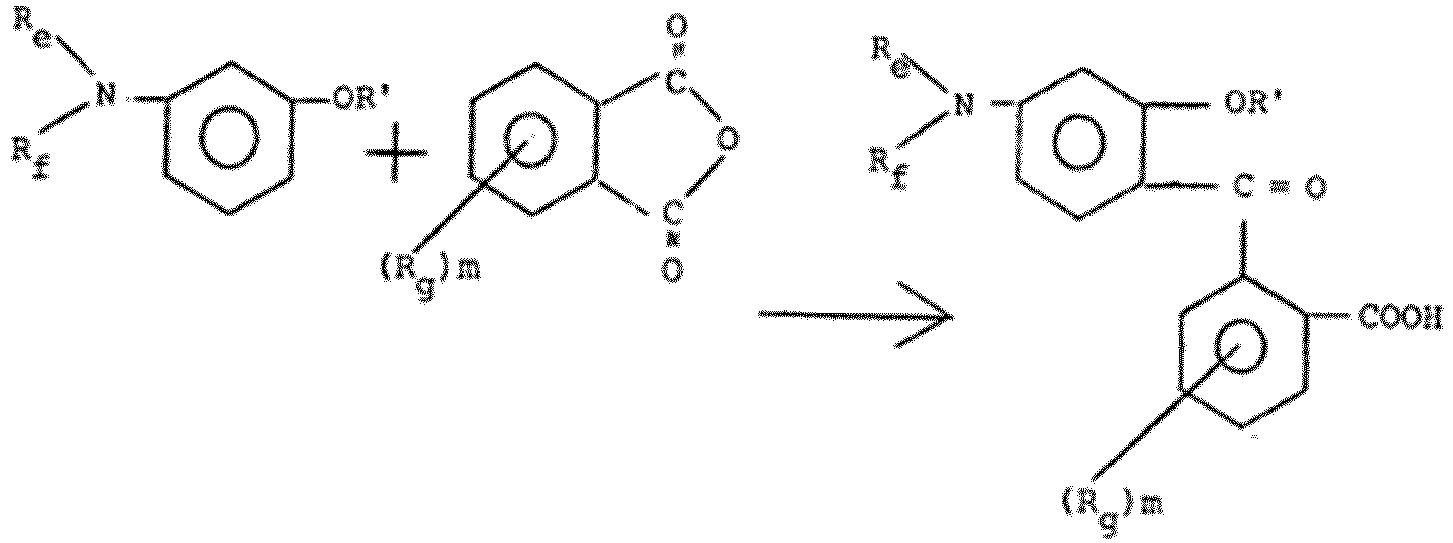
- Carbohydrate Research 196(1), pp. 29-40 (1990) discloses that by use of p-cresol in the Friedel-Crafts reaction with phthalic anhydride only the ortho-position can be substituted and 18 (2-hydroxy-5-methyl-2'carboxy-benzophenone) is the major component formed.
-
JP H06-088066 A - Therefore, there are still needs for a new water-soluble UV-absorbing vinylic monomer or a new water-soluble UV/HEVL-absorbing vinylic monomer for making UV-absorbing or UV/HEVL-absorbing contact lenses from a water-based lens formulation.
- In one aspect, the invention provides an UV-absorbing vinylic monomer comprising a moiety of benzophenone as defined in
claim 1. - In another aspect, the invention provides a method for producing UV-absorbing contact lenses as defined in claim 6.
- The invention provides in a further aspect hydrogel contact lenses as defined in
claim 2. -
-
Figure 1 shows the UV-visible absorption spectra of a preferred water-soluble UV-absorbing vinylic monomer of the invention in a protected form (curve 1) and an unprotected form (curve 2). -
Figure 2 shows the UV-visible transmission spectra of contact lenses: 0 wt% - control contact lens prepared from a lens formulation having 0 wt% of any UV-absorbing vinylic monomer; and 0.7 wt% - contact lens prepared from a lens formulation comprising about 0.7 wt% of a UV-absorbing vinylic monomer of the invention according to a preferred embodiment. -
Figure 3 shows the UV-visible transmission spectra of contact lenses: 0 wt% - control contact lens prepared from a lens formulation having 0 wt% of any UV-absorbing vinylic monomer; and 1.5 wt% - contact lens prepared from a lens formulation comprising about 1.5 wt% of a UV-absorbing vinylic monomer of the invention according to a preferred embodiment. -
Figure 4 shows the UV-visible absorption spectra of a preferred water-soluble UV-absorbing vinylic monomer of the invention in a protected form (curve 1) and an unprotected form (curve 2). -
Figure 5 shows the UV-visible transmission spectra of contact lenses: 0 wt% - control contact lens prepared from a lens formulation having 0 wt% of any UV-absorbing vinylic monomer; and 0.9 wt% - contact lens prepared from a lens formulation comprising about 0.9 wt% of a UV-absorbing vinylic monomer of the invention according to a preferred embodiment. -
Figure 6 shows the UV-visible transmission spectra of contact lenses: 0 wt% - control contact lens prepared from a lens formulation having 0 wt% of any UV-absorbing vinylic monomer; and 1.4 wt% - contact lens prepared from a lens formulation comprising about 1.4 wt% of a UV-absorbing vinylic monomer of the invention according to a preferred embodiment. - Unless defined otherwise, all technical and scientific terms used herein have the same meaning as commonly understood by one of ordinary skill in the art to which this invention belongs. Generally, the nomenclature used herein and the laboratory procedures are well known and commonly employed in the art. Conventional methods are used for these procedures, such as those provided in the art and various general references. Where a term is provided in the singular, the inventors also contemplate the plural of that term. The nomenclature used herein and the laboratory procedures described below are those well-known and commonly employed in the art.
- "About" as used herein means that a number referred to as "about" comprises the recited number plus or minus 1-10% of that recited number.
- "Optional" or "optionally" means that the subsequently described event or circumstance can or cannot occur, and that the description includes instances where the event or circumstance occurs and instances where it does not.
- A "contact Lens" refers to a structure that can be placed on or within a wearer's eye. A contact lens can correct, improve, or alter a user's eyesight, but that need not be the case.
- As used in this application, the term "hydrogel" or "hydrogel material" refers to a crosslinked polymeric material which is insoluble in water, but can hold at least 10 percent by weight of water in its three-dimensional polymer networks (i.e., polymer matrix) when it is fully hydrated.
- A "vinylic monomer" refers to a compound that has one sole ethylenically-unsaturated group and is soluble in a solvent.
- The term "soluble", in reference to a compound or material in a solvent, means that the compound or material can be dissolved in the solvent to give a solution with a concentration of at least about 0.1% by weight at room temperature (i.e., from about 20°C to about 30°C).
- The term "insoluble", in reference to a compound or material in a solvent, means that the compound or material can be dissolved in the solvent to give a solution with a concentration of less than 0.005% by weight at room temperature (as defined above).
- The term "ethylenically unsaturated group" is employed herein in a broad sense and is intended to encompass any groups containing at least one >C=C< group. Exemplary ethylenically unsaturated groups include (meth)acryloyl


- The term "(meth)acryloylamido group" refers to a radical of


- The term "(meth)acrylamide" refers to methacrylamide and/or acrylamide.
- The term "(meth)acrylate" refers to methacrylate and/or acrylate.
- A "hydrophilic vinylic monomer", as used herein, refers to a vinylic monomer which can be polymerized to form a homopolymer that is water-soluble or can absorb at least 10 percent by weight of water.
- A "hydrophobic vinylic monomer" refers to a vinylic monomer which can be polymerized to form a homopolymer that is insoluble in water and can absorb less than 10 percent by weight of water.
- "UVA" refers to radiation occurring at wavelengths between 315 and 380 nanometers; "UVB" refers to radiation occurring between 280 and 315 nanometers; "Violet" refers to radiation occurring at wavelengths between 380 and 440 nanometers.
- "UVA transmittance" (or "UVA %T"), "UVB transmittance" or "UVB %T", and "violet-transmittance" or "Violet %T" are calculated by the following formula


- As used in this application, the term "macromer" or "prepolymer" refers to a medium and high molecular weight compound or polymer that contains two or more ethylenically unsaturated groups. Medium and high molecular weight typically means average molecular weights greater than 700 Daltons.
- As used in this application, the term "vinylic crosslinker" refers to a compound having at least two ethylenically unsaturated groups. A "vinylic crosslinking agent" refers to a vinylic crosslinker having a molecular weight of about 700 Daltons or less.
- As used in this application, the term "polymer" means a material formed by polymerizing/crosslinking one or more monomers or macromers or prepolymers.
- As used in this application, the term "molecular weight" of a polymeric material (including monomeric or macromeric materials) refers to the weight-average molecular weight unless otherwise specifically noted or unless testing conditions indicate otherwise.
- The term "alkyl" refers to a monovalent radical obtained by removing a hydrogen atom from a linear or branched alkane compound. An alkyl group (radical) forms one bond with one other group in an organic compound.
- The term "alkylene divalent group" or "alkylene diradical" or "alkyl diradical" interchangeably refers to a divalent radical obtained by removing one hydrogen atom from an alkyl. An alkylene divalent group forms two bonds with other groups in an organic compound.
- The term "alkyl triradical" refers to a trivalent radical obtained by removing two hydrogen atoms from an alkyl. A alkyl triradical forms three bonds with other groups in an organic compound.
- The term "alkoxy" or "alkoxyl" refers to a monovalent radical obtained by removing the hydrogen atom from the hydroxyl group of a linear or branched alkyl alcohol. An alkoxy group (radical) forms one bond with one other group in an organic compound.
- In this application, the term "substituted" in reference to an alkyl diradical or an alkyl radical means that the alkyl diradical or the alkyl radical comprises at least one substituent which replaces one hydrogen atom of the alkyl diradical or the alkyl radical and is selected from the group consisting of hydroxy (-OH), carboxy (-COOH), -NH2, sulfhydryl (-SH), C1-C4 alkyl, C1-C4 alkoxy, C1-C4 alkylthio (alkyl sulfide), C1-C4 acylamino, C1-C4 alkylamino, di-C1-C4 alkylamino, halogen atom (Br or CI), and combinations thereof.
- A "photoinitiator" refers to a chemical that initiates free radical crosslinking/polymerizing reaction by the use of light.
- In this application, a "UV-absorbing vinylic monomer" refers to a vinylic monomer comprising an ethylenically-unsaturated group and an UV-absorbing moiety (benzophenone or benzotriazole moiety) which can absorb or screen out UV radiation in the range from 200 nm to 400 nm as understood by a person skilled in the art.
- A "spatial limitation of actinic radiation" refers to an act or process in which energy radiation in the form of rays is directed by, for example, a mask or screen or combinations thereof, to impinge, in a spatially restricted manner, onto an area having a well-defined peripheral boundary. A spatial limitation of UV/visible radiation is obtained by using a mask or screen having a radiation (e.g., UV and/or visible light) permeable region, a radiation (e.g., UV and/or visible light) impermeable region surrounding the radiation-permeable region, and a projection contour which is the boundary between the radiation-impermeable and radiation-permeable regions, as schematically illustrated in the drawings of
U.S. Patent Nos. 6,800,225 (Figs. 1-11 ), and6,627,124 (Figs. 1-9 ),7,384,590 (Figs. 1-6 ), and7,387,759 (Figs. 1-6 ). The mask or screen allows to spatially projects a beam of radiation (e.g., UV radiation and/or visible radiation) having a cross-sectional profile defined by the projection contour of the mask or screen. The projected beam of radiation (e.g., UV radiation and/or visible radiation) limits radiation impinging on a lens formulation located in the path of the projected beam from the first molding surface to the second molding surface of a mold. The resultant contact lens comprises an anterior surface defined by the first molding surface, an opposite posterior surface defined by the second molding surface, and a lens edge defined by the sectional profile of the projected UV and/or visible beam (i.e., a spatial limitation of radiation). The radiation used for the crosslinking is radiation energy, especially UV radiation (and/or visible radiation), gamma radiation, electron radiation or thermal radiation, the radiation energy preferably being in the form of a substantially parallel beam in order on the one hand to achieve good restriction and on the other hand efficient use of the energy. - The term "modulus" or "elastic modulus" in reference to a contact lens or a material means the tensile modulus or Young's modulus which is a measure of the stiffness of a contact lens or a material. The modulus can be measured using a method in accordance with ANSI Z80.20 standard. A person skilled in the art knows well how to determine the elastic modulus of a silicone hydrogel material or a contact lens. For example, all commercial contact lenses have reported values of elastic modulus.
- In general, the invention is directed to a class of UV-absorbing vinylic monomers which are soluble in water due to the presence of one or more hydrophilic moieties, and can be used, in a water-based hydrogel lens formulation for making UV-absorbing hydrogel contact lenses, in particularly, according to the Lightstream Technology™. Any unreacted UV-absorbing vinylic monomer can be efficiently removed by water or an aqueous solution as extraction solvent, if necessary.
- The present invention provides a UV-absorbing vinylic monomer of formula (I)

- R° is H, CH3 or C2H5;
- R1 and R2 independent of one other are H, CH3, halogen, OH, OCH3, or amine;
- Y1 is a C2-C4 alkylene divalent radical; and
- Q1 is a (meth)acryloylamido or (meth)acryloyloxy group as defined in
claim 1. - Preferred examples of a UV-absorbing vinylic monomer of formula (I) include:


claim 1; Y1 is an ethylene or propylene divalent radical; R1 and R2 independent of each other are H, CH3, Cl, Br, OH, OCH3, or NR'R" in which R' and R" independent of each other are H, methyl or ethyl. - A UV-absorbing vinylic monomer of formula (I) defined above can be prepared according to procedures illustrated in Scheme 1:
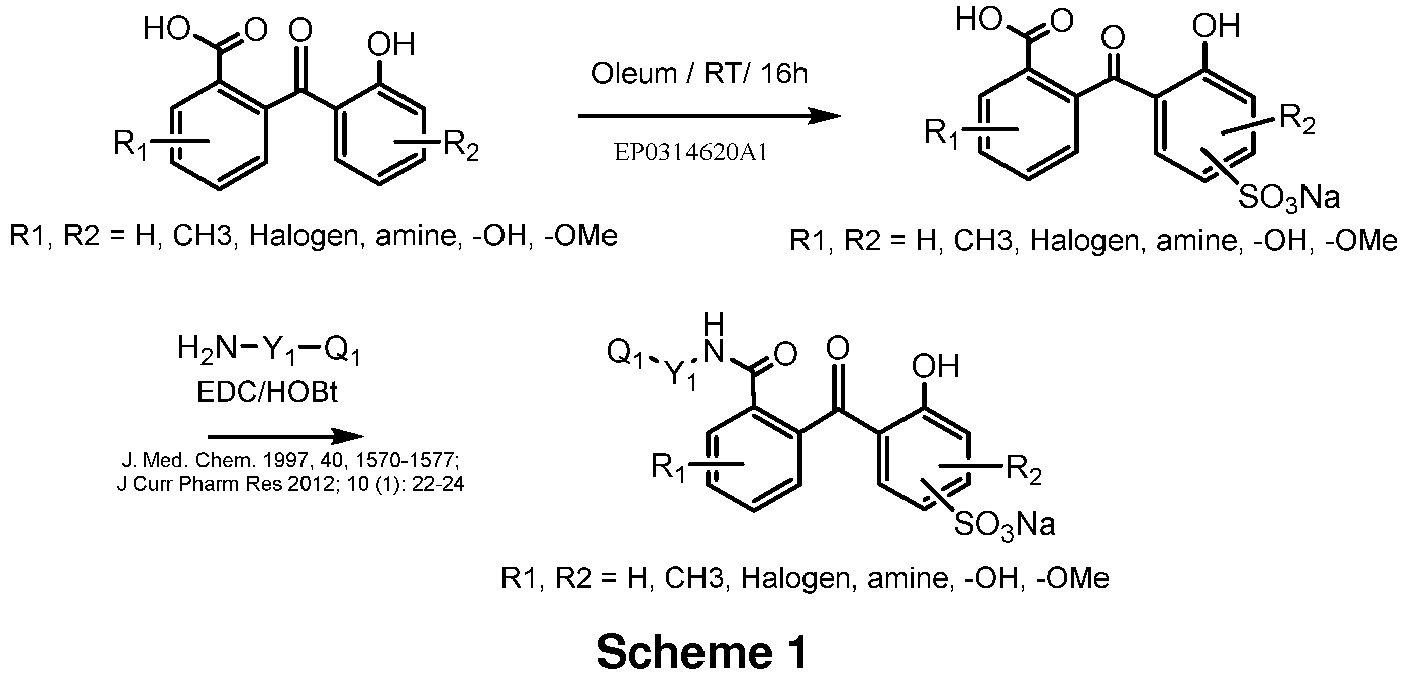
- It is understood that in the 2nd step of
Scheme 1 above, a vinylic monomer of H2N-Y1-Q1 (as defined above) can be substituted with another vinylic monomer of HNF°-Y1-Q1 (as defined above) in which R° is CH3 or C2H5 for making other UV-absorbing vinylic monomers of formula (I). Exemplary vinylic monomers of HNR°-Y1-Q1 (as defined above) include 2-(methylamino)ethyl (meth)acrylate, 2-(methylamino)ethyl (meth)acrylamide, N-Methyl-N-[2-(methylamino)ethyl] (meth)acrylamide, ethylaminoethyl (meth)acrylate, ethylaminoethyl (meth)acrylamide, methylaminopropyl (meth)acrylate, methylaminopropyl (meth)acrylamide, ethylaminopropyl (meth)acrylate, and ethylaminopropyl (meth)acrylamide. - Any 2-hydroxy-2'-carboxy benzophenones with substituents on either or both benzene rings can be used in the preparation of a UV-absorbing vinylic monomer of formula (I). A person knows how to prepare a 2-hydroxy-2'-carboxy benzophenones with substituents from a substituted or unsubstituted phthalic anhydride and a substituted or unsubstituted phenol (see, e.g.,
US5925787 ). - It is understood that in the 2nd step of
Scheme 2 any 3- and 4-substituted phthalic anhydride can be used to react with any mono- or di-substituted phenol to obtain a UV-absorbing vinylic monomer of formula (I). Various 3- and 4-substituted phthalic anhydrides are commercially available or can be prepared according to the procedures described in J. Chem. Soc., Perkin Trans. (1977), 1: 2030-2036. - A water-soluble UV-absorbing vinylic monomer of the invention described above can find particular uses in making UV-absorbing medical devices, preferably ophthalmic devices, more preferably intraocular lenses, even more preferably contact lenses.
- In another aspect, the invention provides a method for producing UV-absorbing contact lenses, comprising the steps of: (1) obtaining a lens formulation comprising (a) (from about 0.1% to about 4% by weight of, preferably from about 0.2% to about 3.0% by weight of, more preferably from about 0.4% to about 2% by weight of, even more preferably from about 0.6% to about 1.5% by weight of) a UV-absorbing vinylic monomer of formula (I) (as defined above), (b) (from about 0.1% to about 2.0% by weight of, preferably from about 0.25% to about 1.75% by weight of, more preferably from about 0.5% to about 1.5% by weight of, even more preferably from about 0.75% to about 1.25% by weight of) at least free-radical initiator, and (c) at least one polymerizable components selected from the group consisting of a hydrophilic vinylic monomer, a water-soluble silicone-free prepolymer, a silicone-containing prepolymer, a non-silicone hydrophobic vinylic monomer, a siloxane-containing vinylic monomer, a siloxane-containing vinylic macromer, a vinylic crosslinking agent, and combinations thereof; (2) introducing the lens formulation into a mold for making a soft contact lens, wherein the mold has a first mold half with a first molding surface defining the anterior surface of a contact lens and a second mold half with a second molding surface defining the posterior surface of the contact lens, wherein said first and second mold halves are configured to receive each other such that a cavity is formed between said first and second molding surfaces; and (3) curing thermally or actinically the lens formulation in the mold to form the UV-absorbing contact lens, wherein the formed UV-absorbing contact lens is characterized by having the UVB transmittance of about 10% or less (preferably about 5% or less, more preferably about 2.5% or less, even more preferably about 1% or less) between 280 and 315 nanometers and a UVA transmittance of about 30% or less (preferably about 20% or less, more preferably about 10% or less, even more preferably about 5% or less) between 315 and 380 nanometers and and optionally (but preferably) a Violet transmittance of about 60% or less, preferably about 50% or less, more preferably about 40% or less, even more preferably about 30% or less) between 380 nm and 440 nm.
- In accordance with the invention, a free-radical initiator can be a free-radical thermal initiator or a free-radical photoinitiator.
- Any thermal free-radical initiators can be used in the invention. Examples of suitable thermal initiators include, but are not limited to, 2,2'-azobis (2,4-dimethylpentanenitrile), 2,2'-azobis (2-methylpropanenitrile), 2,2'-azobis (2-methylbutanenitrile), peroxides such as benzoyl peroxide, and the like. Preferably, the thermal initiator is 2,2'-azobis(isobutyronitrile) (AIBN).
- Any free-radical photoinitiators, which can absorb radiation in the range from 380 nm to 500 nm, can be used in the invention. Suitable photoinitiators are benzoin methyl ether, diethoxyacetophenone, a benzoylphosphine oxide, 1-hydroxycyclohexyl phenyl ketone and Darocur and Irgacur types, preferably Darocur 1173® and Darocur 2959®, Germanium-based Norrish Type I photoinitiators. Examples of benzoylphosphine initiators include phenyl(2,4,6-trimethylbenzoyl)phosphinic acid and its salts, bis(2,4,6-trimethylbenzoyl)phosphinic acid and its salts, 2,4,6-trimethylbenzoyldiphenylophosphine oxide; bis-(2,6-dichlorobenzoyl)-4-N-propylphenylphosphine oxide; and bis-(2,6-dichlorobenzoyl)-4-N-butylphenylphosphine oxide. Reactive photoinitiators which can be incorporated, for example, into a macromer or can be used as a special monomer are also suitable. Examples of reactive photoinitiators are those disclosed in
EP 632 329 U.S. patent application No. 62/169,722 filed June 2, 2015 - Nearly any hydrophilic vinylic monomer can be used in the invention. Suitable hydrophilic vinylic monomers are, without this being an exhaustive list, N,N-dimethylacrylamide (DMA), N,N-dimethylmethacrylamide (DMMA), 2-acrylamidoglycolic acid, N-hydroxypropylacrylamide, N-hydroxyethyl acrylamide, N-[tris(hydroxymethyl)methyl]-acrylamide, N-vinylpyrrolidone (NVP), N-vinyl formamide, N-vinyl acetamide, N-vinyl isopropylamide, N-vinyl-N-methyl acetamide (VMA), N-methyl-3-methylene-2-pyrrolidone, 1-methyl-5-methylene-2-pyrrolidone, 5-methyl-3-methylene-2-pyrrolidone, 2-hydroxyethylmethacrylate (HEMA), 2-hydroxyethyl acrylate (HEA), hydroxypropyl acrylate, hydroxypropyl methacrylate, methoxyethylmethacrylate (i.e., ethylene glycol methyl ether methacrylate, EGMA), trimethylammonium 2-hydroxy propylmethacrylate hydrochloride, aminopropyl methacrylate hydrochloride, dimethylaminoethyl methacrylate (DMAEMA), glycerol methacrylate (GMA), a C1-C4-alkoxy polyethylene glycol (meth)acrylate having a weight average molecular weight of up to 1500, polyethylene glycol (meth)acrylate having a weight average molecular weight of up to 1500, methacrylic acid, acrylic acid, and mixtures thereof.
- Examples of water-soluble prepolymers free of silicone include: a water-soluble crosslinkable poly(vinyl alcohol) prepolymer described in
U.S. Pat. Nos. 5583163 and6303687 ; a water-soluble vinyl group-terminated polyurethane prepolymer described inU.S. Pat. No. 6995192 ; derivatives of a polyvinyl alcohol, polyethyleneimine or polyvinylamine, which are disclosed inU.S. Pat. No. 5849841 ; a water-soluble crosslinkable polyurea prepolymer described inU.S. Patent No. 6479587 and7977430 ; crosslinkable polyacrylamide; crosslinkable statistical copolymers of vinyl lactam, MMA and a comonomer, which are disclosed inU.S. Pat. No. 5712356 ; crosslinkable copolymers of vinyl lactam, vinyl acetate and vinyl alcohol, which are disclosed inU.S. Pat. No. 5665840 ; polyether-polyester copolymers with crosslinkable side chains which are disclosed inU.S. Pat. No. 6492478 ; branched polyalkylene glycol-urethane prepolymers disclosed inU.S. Pat. No. 6165408 ; polyalkylene glycol-tetra(meth)acrylate prepolymers disclosed inU.S. Pat. No. 6221303 ; crosslinkable polyallylamine gluconolactone prepolymers disclosed inU.S. Pat. No. 6472489 . - Any suitable of silicone-containing prepolymers with hydrophilic segments and hydrophobic segments can be used in the invention. Examples of such silicone-containing prepolymers include those described in commonly-owned
US Patent Nos. 6,039,913 ,7,091,283 ,7,268,189 and7,238,750 ,7,521,519 ; commonly-owned US patent application publication Nos.US 2008-0015315 A1 ,US 2008-0143958 A1 ,US 2008-0143003 A1 ,US 2008-0234457 A1 ,US 2008-0231798 A1 ,US 2010-0296049 A1 , andUS 2010-0298446 A1 . - A lens formulation of the invention can also comprise a non-silicone hydrophobic monomer (i.e., free of silicone). By incorporating a certain amount of non-silicone hydrophobic vinylic monomer in a lens formulation, the mechanical properties (e.g., modulus of elasticity) of the resultant polymer may be improved. Nearly any non-silicone hydrophobic vinylic monomer can be used in the actinically polymerizable composition for preparing the intermediary copolymer with pendant or terminal functional groups. Examples of preferred non-silicone hydrophobic vinylic monomers include methylacrylate, ethylacrylate, propylacrylate, isopropylacrylate, cyclohexylacrylate, 2-ethylhexylacrylate, methylmethacrylate, ethylmethacrylate, propylmethacrylate, vinyl acetate, vinyl propionate, vinyl butyrate, vinyl valerate, styrene, chloroprene, vinyl chloride, vinylidene chloride, acrylonitrile, 1-butene, butadiene, methacrylonitrile, vinyl toluene, vinyl ethyl ether, perfluorohexylethyl-thio-carbonyl-aminoethyl-methacrylate, isobornyl methacrylate, trifluoroethyl methacrylate, hexafluoro-isopropyl methacrylate, hexafluorobutyl methacrylate.
- Any suitable siloxane-containing vinylic monomers can be used in the invention. Examples of preferred siloxane-containing vinylic monomers include N-[tris(trimethylsiloxy)silylpropyl]-(meth)acrylamide, N-[tris(dimethylpropylsiloxy)-silylpropyl]-(meth)acrylamide, N-[tris(dimethylphenylsiloxy)silylpropyl] (meth)acrylamide, N-[tris(dimethylethylsiloxy)silylpropyl] (meth)acrylamide, N-(2-hydroxy-3-(3-(bis(trimethylsilyloxy)-methylsilyl)propyloxy)propyl)-2-methyl acrylamide; N-(2-hydroxy-3-(3-(bis(trimethylsilyloxy)-methylsilyl)propyloxy)propyl)acrylamide; N,N-bis[2-hydroxy-3-(3-(bis(trimethylsilyloxy)-methylsilyl)propyloxy)propyl]-2-methyl acrylamide; N,N-bis[2-hydroxy-3-(3-(bis(trimethylsilyloxy)-methylsilyl)propyloxy)propyl]acrylamide; N-(2-hydroxy-3-(3-(tris(trimethylsilyloxy)silyl)-propyloxy)propyl)-2-methyl acrylamide; N-(2-hydroxy-3-(3-(tris(trimethylsilyloxy)silyl)propyloxy)-propyl)acrylamide; N,N-bis[2-hydroxy-3-(3-(tris(trimethylsilyloxy)silyl)propyloxy)propyl]-2-methyl acrylamide; N,N-bis[2-hydroxy-3-(3-(tris(trimethylsilyloxy)silyl)propyloxy)propyl]acrylamide; N-[2-hydroxy-3-(3-(t-butyldimethylsilyl)propyloxy)propyl]-2-methyl acrylamide; N-[2-hydroxy-3-(3-(t-butyldimethylsilyl)propyloxy)propyl]acrylamide; N,N-bis[2-hydroxy-3-(3-(t-butyldimethylsilyl)-propyloxy)propyl]-2-methyl acrylamide; N,N-bis[2-hydroxy-3-(3-(t-butyldimethylsilyl)propyloxy)-propyl]acrylamide; 3-methacryloxy propylpentamethyldisiloxane, tris(trimethylsilyloxy)silylpropyl methacrylate (TRIS), (3-methacryloxy-2-hydroxypropyloxy)propylbis(trimethylsiloxy)-methylsilane), (3-methacryloxy-2-hydroxypropyloxy)propyltris(trimethylsiloxy)silane, 3-methacryloxy-2-(2-hydroxyethoxy)-propyloxy)propylbis(trimethylsiloxy)methylsilane, N-2-methacryloxyethyl-O-(methyl-bis-trimethylsiloxy-3-propyl)silyl carbamate, 3-(trimethylsilyl)-propylvinyl carbonate, 3-(vinyloxycarbonylthio)propyl-tris(trimethyl-siloxy)silane, 3-[tris(trimethylsiloxy)silyl]propylvinyl carbamate, 3-[tris(trimethylsiloxy)silyl] propyl allyl carbamate, 3-[tris(trimethylsiloxy)silyl]propyl vinyl carbonate, t-butyldimethyl-siloxyethyl vinyl carbonate; trimethylsilylethyl vinyl carbonate, and trimethylsilylmethyl vinyl carbonate); monomethacrylated or monoacrylated polydimethylsiloxanes of various molecular weight (e.g., mono-3-methacryloxypropyl terminated, mono-butyl terminated polydimethylsiloxane or mono-(3-methacryloxy-2-hydroxypropyloxy)propyl terminated, mono-butyl terminated polydimethylsiloxane); mono-vinyl carbonate-terminated polydimethylsiloxanes; mono-vinyl carbamate-terminated polydimethylsiloxane; mono-methacrylamide-terminated polydimethylsiloxanes; mono-acrylamide-terminated polydimethylsiloxanes; carbosiloxane vinylic monomers disclosed in
US Patent Nos. 7915323 and8420711 , inUS Patent Applicaton Publication Nos. 2012/244088 and2012/245249 ; combinations thereof. - Any suitable siloxane-containing vinylic macromers (i.e., crosslinkers) can be used in the invention. Examples of preferred siloxane-containing vinylic macromers (crosslinkers) are dimethacrylated or diacrylated polydimethylsiloxanes of various molecular weight; di-vinyl carbonate-terminated polydimethylsiloxanes; di-vinyl carbamate-terminated polydimethylsiloxane; di-methacrylamide-terminated polydimethylsiloxanes; diacrylamide-terminated polydimethylsiloxanes; bis-3-methacryloxy-2-hydroxypropyloxypropyl polydimethylsiloxane; N,N,N',N'-tetrakis(3-methacryloxy-2-hydroxypropyl)-alpha,omega-bis-3-aminopropyl-polydimethylsiloxane; polysiloxanylalkyl (meth)acrylic monomers; siloxane-containing macromer selected from the group consisting of Macromer A, Macromer B, Macromer C, and Macromer D described in
US 5,760,100 ; chain-extended polysiloxabe vinylic crosslinkers disclosed inUS201008843A1 andUS20120088844A1 ; the reaction products of glycidyl methacrylate with amino-functional polydimethylsiloxanes; hydroxyl-functionalized siloxane-containing vinylic monomers or macromers; polysiloxane-containing macromers disclosed inU.S. Patent Nos. 4,136,250 ,4,153,641 ,4,182,822 ,4,189,546 ,4,343,927 ,4,254,248 ,4,355,147 ,4,276,402 ,4,327,203 ,4,341,889 ,4,486,577 ,4,543,398 ,4,605,712 ,4,661,575 ,4,684,538 ,4,703,097 ,4,833,218 ,4,837,289 ,4,954,586 ,4,954,587 ,5,010,141 ,5,034,461 ,5,070,170 ,5,079,319 ,5039,761 ,5,346,946 ,5,358,995 ,5,387,632 ,5,416,132 ,5,451,617 ,5,486,579 ,5,962,548 ,5,981,675 ,6,039,913 , and6,762,264 ; polysiloxane-containing macromers disclosed inU.S. Patent Nos. 4,259,467 ,4,260,725 , and4,261,875 . - Examples of preferred vinylic cross-linking agents include tetraethyleneglycol diacrylate, triethyleneglycol diacrylate, diethyleneglycol diacrylate, ethyleneglycol diacrylate, tetraethyleneglycol dimethacrylate, triethyleneglycol dimethacrylate, diethyleneglycol dimethacrylate, ethyleneglycol dimethacrylate, tetraethyleneglycol divinyl ether, triethyleneglycol divinyl ether, diethyleneglycol divinyl ether, ethyleneglycol divinyl ether, trimethylopropane trimethacrylate, pentaerythritol tetramethacrylate, bisphenol A dimethacrylate, vinyl methacrylate, ethylenediamine dimethyacrylamide, ethylenediamine diacrylamide, glycerol dimethacrylate, triallyl isocyanurate, triallyl cyanurate, allylmethacrylate, allylacrylate, N-allyl-methacrylamide, N-allyl-acrylamide, 1,3-bis(methacrylamidopropyl)-1,1,3,3-tetrakis(trimethyl-siloxy)disiloxane, N,N'-methylenebisacrylamide, N,N'-methylenebismethacrylamide, N,N'-ethylenebisacrylamide, N,N'-ethylenebismethacrylamide,1,3-bis(N-methacrylamidopropyl)-1,1,3,3-tetrakis-(trimethylsiloxy)disiloxane, 1,3-bis(methacrylamidobutyl)-1,1,3,3-tetrakis(trimethylsiloxy)disiloxane, 1,3-bis(acrylamidopropyl)-1,1,3,3-tetrakis(trimethylsiloxy)-disiloxane, 1,3-bis(methacryloxyethylureidopropyl)-1,1,3,3-tetrakis(trimethylsiloxy)disiloxane, and combinations thereof. A preferred cross-linking agent is tetra(ethyleneglycol) diacrylate, tri(ethyleneglycol) diacrylate, ethyleneglycol diacrylate, di(ethyleneglycol) diacrylate, methylenebisacrylamide, triallyl isocyanurate, or triallyl cyanurate. The amount of a cross-linking agent used is expressed in the weight content with respect to the total polymer and is preferably in the range from about 0.05% to about 3% (more preferably from about 0.1% to about 2%).
- A lens formulation described herein, but not forming part of the invention, can further comprise visibility tinting agents (e.g., D&C Blue No. 6, D&C Green No. 6, D&C Violet No. 2, carbazole violet, certain copper complexes, certain chromium oxides, various iron oxides, phthalocyanine green, phthalocyanine blue, titanium dioxides, or mixtures thereof), antimicrobial agents (e.g., silver nanoparticles), a bioactive agent (e.g., a drug, an amino acid, a polypeptide, a protein, a nucleic acid, 2-pyrrolidone-5-carboxylic acid (PCA), an alpha hydroxyl acid, linoleic and gamma linoleic acids, vitamins, or any combination thereof), leachable lubricants (e.g., a non-crosslinkable hydrophilic polymer having an average molecular weight from 5,000 to 500,000, preferably from 10,000 to 300,000, more preferably from 20,000 to 100,000 Daltons), leachable tear-stabilizing agents (e.g., a phospholipid, a monoglyceride, a diglyceride, a triglyceride, a glycolipid, a glyceroglycolipid, a sphingolipid, a sphingo-glycolipid, a fatty acid having 8 to 36 carbon atoms, a fatty alcohol having 8 to 36 carbon atoms, or a mixture thereof), and the like, as known to a person skilled in the art.
- In a preferred embodiment, the lens formulation is a water-based lens formulation which comprises one or more water-soluble actinically-crosslinkable poly(vinyl alcohol) prepolymer. Preferably, a water-soluble, actinically-crosslinkable polyvinyl alcohol prepolymer comprises repeating units of vinyl alcohol (i.e.,

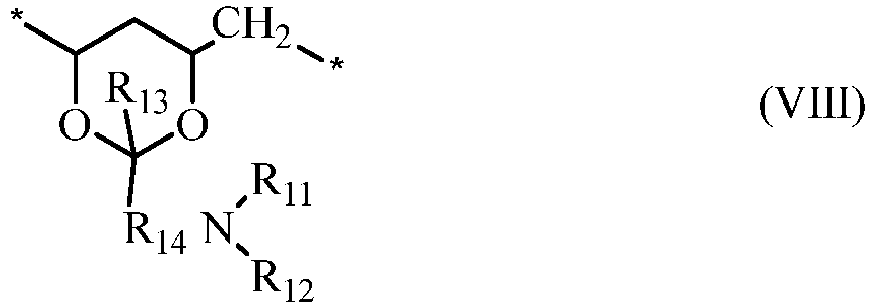
- R11 is hydrogen or C1-C6 alkyl (preferably hydrogen or C1-C4 alkyl, more preferably hydrogen or methyl or ethyl, even more preferably hydrogen or methyl);
- R12 is an ethylenically unsaturated group of


- R13 can be hydrogen or a C1-C6 alkyl group (preferably hydrogen); and
- R14 is a C1-C6 alkylene divalent radical(preferably a C1-C4 alkylene divalent radical, more preferably methylene or butylene divalent radical, even more preferably methylene divalent radical).
- In another preferred embodiment, a lens formulation comprises a water-soluble silicone-containing prepolymer. Examples of water-soluble silicone-containing prepolymers include those disclosed in
US 9,187,601 - A "water-based lens formulation" refers to a polymerizable composition which comprises water as solvent or a solvent mixture comprising at least about 60% (preferably at least about 80%, more preferably at least about 90%, even more preferably at least about 95%, most preferably at least about 98%) by weight of water relative to the total amount of the solvent mixture and polymerizable/crosslinkable components, and which can be cured (i.e., polymerized and/or crosslinked) thermally or actinically to obtain a crosslinked/polymerized polymeric material.
- It is understood that the amount of the UV-absorbing vinylic monomer present in the lens formulation is sufficient to render a resultant contact lens, which is obtained from the curing of the lens formulation, ability of blocking or absorbing (i.e., the inverse of transmittance) at least 90% (preferably at least about 95%, more preferably at least about 97.5%, even more preferably at least about 99%) of UVB (between 280 and 315 nanometers), at least 70% (preferably at least about 80%, more preferably at least about 90%, even more preferably at least about 95%) of UVA transmittance (between 315 and 380 nanometers), and optionally (but preferably) at least 30% (preferably at least about 40%, more preferably at least about 50%, even more preferably at least about 60%) of violet light between 380 nm and 440 nm, which impinge on the lens.
- In accordance with the invention, a lens formulation can be a water-based lens formulation, an organic solvent-based lens formulation, or a solventless formulation.
- A lens formulation can be prepared by dissolving all of the desirable components in water, a mixture of water and an organic solvent, an organic solvent, or a mixture of two or more organic solvent, or by blending all polymerizable components without any solvent, as known to a person skilled in the art.
- In another preferred embodiment, the lens formulation comprises an UV-absorbing vinylic monomer of formula (I) in which Q1 is a (meth)acryloylamido group (preferably an acryloylamido group). By having a (meth)acryloylamido group (preferably an acryloylamido group), a relatively-short curing time (e.g., less than 100 seconds, preferably less than 75 seconds, more preferably less than 50 second, even more preferably about 30 seconds or less) can be achieved.
- Lens molds for making contact lenses are well known to a person skilled in the art. Methods of manufacturing mold sections for cast-molding a contact lens are generally well known to those of ordinary skill in the art. The process of the present invention is not limited to any particular method of forming a mold. In fact, any method of forming a mold can be used in the present invention. The first and second mold halves can be formed through various techniques, such as injection molding or lathing. Examples of suitable processes for forming the mold halves are disclosed in
U.S. Patent Nos. 4,444,711 to Schad ;4,460,534 to Boehm et al. ;5,843,346 to Morrill ; and5,894,002 to Boneberaer et al. ,. Virtually all materials known in the art for making molds can be used to make molds for making contact lenses. For example, polymeric materials, such as polyethylene, polypropylene, polystyrene, PMMA, Topas® COC grade 8007-S10 (clear amorphous copolymer of ethylene and norbornene, from Ticona GmbH of Frankfurt, Germany and Summit, New Jersey), or the like can be used. Other materials that allow UV light transmission could be used, such as quartz glass and sapphire. - Preferably, a reusable mold suitable for spatial limitation of radiation is used in the invention, the projected beam of radiation (e.g., radiation from the light source including the light in the region of 360 nm to 550 nm) limits radiation (e.g., UV radiation) impinging on the mixture of the lens-forming materials located in the path of the projected beam from the first molding surface to the second molding surface of the reusable mold. The resultant contact lens comprises an anterior surface defined by the first molding surface, an opposite posterior surface defined by the second molding surface, and a lens edge (with sharp edge and high quality) defined by the sectional profile of the projected radiation beam (i.e., a spatial limitation of radiation). Examples of reusable molds suitable for spatial limitation of radiation include without limitation those disclosed in
U.S. Patent Nos. 6,627,124 ,6,800,225 ,7,384,590 , and7,387,759 . - For example, a preferred reusable mold comprises a first mold half having a first molding surface and a second mold half having a second molding surface. The two mold halves of the preferred reusable mold are not touching each other, but there is a thin gap of annular design arranged between the two mold halves. The gap is connected to the mold cavity formed between the first and second molding surfaces, so that excess mixture can flow into the gap. It is understood that gaps with any design can be used in the invention.
- In a preferred embodiment, at least one of the first and second molding surfaces is permeable to a crosslinking radiation. More preferably, one of the first and second molding surfaces is permeable to a crosslinking radiation while the other molding surface is poorly permeable to the crosslinking radiation.
- The reusable mold preferably comprises a mask which is fixed, constructed or arranged in, at or on the mold half having the radiation-permeable molding surface. The mask is impermeable or at least of poor permeability compared with the permeability of the radiation-permeable molding surface. The mask extends inwardly right up to the mold cavity and surrounds the mold cavity so as to screen all areas behind the mask with the exception of the mold cavity.
- The mask may preferably be a thin chromium layer, which can be produced according to processes as known, for example, in photo and UV lithography. Other metals or metal oxides may also be suitable mask materials. The mask can also be coated with a protective layer, for example of silicon dioxide if the material used for the mold or mold half is quartz.
- Alternatively, the mask can be a masking collar made of a material comprising a UV/visible light-absorber and substantially blocks curing energy therethrough as described in
U.S. Patent No. 7,387,759 . In this preferred embodiment, the mold half with the mask comprises a generally circular disc-shaped transmissive portion and a masking collar having an inner diameter adapted to fit in close engagement with the transmissive portion, wherein said transmissive portion is made from an optically clear material and allows passage of curing energy therethrough, and wherein the masking collar is made from a material comprising a light-blocker and substantially blocks passage of curing energy therethrough, wherein the masking collar generally resembles a washer or a doughnut, with a center hole for receiving the transmissive portion, wherein the transmissive portion is pressed into the center opening of the masking collar and the masking collar is mounted within a bushing sleeve. - Reusable molds can be made of quartz, glass, sapphire, CaF2, a cyclic olefin copolymer (such as for example, Topas® COC grade 8007-S10 (clear amorphous copolymer of ethylene and norbornene) from Ticona GmbH of Frankfurt, Germany and Summit, New Jersey, Zeonex® and Zeonor® from Zeon Chemicals LP, Louisville, KY), polymethylmethacrylate (PMMA), polyoxymethylene from DuPont (Delrin), UItem® (polyetherimide) from G.E. Plastics, PrimoSpire®, etc.. Because of the reusability of the mold halves, a relatively high outlay can be expended at the time of their production in order to obtain molds of extremely high precision and reproducibility. Since the mold halves do not touch each other in the region of the lens to be produced, i.e. the cavity or actual molding surfaces, damage as a result of contact is ruled out. This ensures a high service life of the molds, which, in particular, also ensures high reproducibility of the contact lenses to be produced and high fidelity to the lens design.
- In accordance with the invention, the lens formulation can be introduced (dispensed) into a cavity formed by a mold according to any known methods.
- After the lens formulation is dispensed into the mold, it is polymerized to produce a contact lens. Crosslinking may be initiated thermally or upon exposure to a light source including a light in a region between 380 nm to 500 nm, preferably under a spatial limitation of actinic radiation, to crosslink the polymerizable components in the mixture.
- In accordance with the invention, light source can be any ones emitting light in the 380-500 nm range sufficient to activate Germane-based Norrish Type I photoinitiators. Blue-light sources are commercially available and include: the Palatray CU blue-light unit (available from Heraeus Kulzer, Inc., Irvine, Calif.), the Fusion F450 blue light system (available from TEAMCO, Richardson, Tex.), Dymax Blue Wave 200, LED light sources from Opsytec (385 nm, 395 nm, 405 nm, 435 nm, 445 nm, 460 nm), LED light sources from Hamamatsu (385 nm), and the GE 24" blue fluorescent lamp (available from General Electric Company, U.S.). A preferred blue-light source is the UV LED from Opsytec (those described above).
- The intensity of the light source is preferably from about 2 to about 40 mW/cm2., preferably from about 4 to about 20 mW/cm2 in the 400 nm to 550 nm region is more preferred. These intensity values are determined by weighting the lamp output using the photoinitiator master spectrum.
- The photocrosslinking may be effected in a very short time, e.g. in ≤ about 120 seconds, preferably in ≤ about 80 seconds, more preferably in ≤ 50 about seconds, even more preferably in ≤ about 30 seconds, and most preferably in 4 to 30 seconds.
- Opening of the mold so that the molded lens can be removed from the mold may take place in a manner known per se.
- The molded contact lens can be subject to lens extraction to remove unpolymerized vinylic monomers and macromers. The extraction solvent is preferably water or an aqueous solution. After extraction, lenses can be hydrated in water or an aqueous solution of a wetting agent (e.g., a hydrophilic polymer); packaged in lens packages with a packaging solution which can contain about 0.005% to about 5% by weight of a wetting agent (e.g., a hydrophilic polymer), a viscosity-enhancing agent (e.g., methyl cellulose (MC), ethyl cellulose, hydroxymethylcellulose, hydroxyethyl cellulose (HEC), hydroxypropylcellulose (HPC), hydroxypropylmethyl cellulose (HPMC), or a mixture thereof); sterilization such as autoclave at from 118 to 124°C for at least about 30 minutes; and the like.
- In a further aspect, the invention provides a hydrogel contact lens comprising a crosslinked polymeric material which comprises repeating units of an UV-absorbing vinylic monomer of formula (I).
- A contact lens of the invention preferably is characterized by having an UVB transmittance of about 10% or less (preferably about 5% or less, more preferably about 2.5% or less, even more preferably about 1% or less) between 280 and 315 nanometers and a UVA transmittance of about 30% or less (preferably about 20% or less, more preferably about 10% or less, even more preferably about 5% or less) between 315 and 380 nanometers and optionally (but preferably) a Violet transmittance of about 60% or less, preferably about 50% or less, more preferably about 40% or less, even more preferably about 30% or less) between 380 nm and 440 nm.
- A contact lens of the invention further has a water content of preferably from about 15% to about 80%, more preferably from about 30% to about 70% by weight (at room temperature, about 22°C to 28°C) when fully hydrated.
- Although various embodiments of the invention have been described using specific terms, devices, and methods, such description is for illustrative purposes only. The words used are words of description rather than of limitation. The previous disclosure will enable one having ordinary skill in the art to practice the invention. Various modifications, variations, and combinations can be made to the various embodiment described herein. In order to better enable the reader to understand specific embodiments and the advantages thereof, reference to the following examples is suggested. It is intended that the specification and examples be considered as exemplary.
- Transmittance. Contact lenses are manually placed into a specially fabricated sample holder or the like which can maintain the shape of the lens as it would be when placing onto eye. This holder is then submerged into a 1 cm path-length quartz cell containing phosphate buffered saline (PBS, pH ∼ 7.0 - 7.4) as the reference. A UV/visible spectrophotometer, such as, Varian Cary 3E UV-Visible Spectrophotometer with a LabSphere DRA-CA-302 beam splitter or the like, can be used in this measurement. Percent transmission spectra are collected at a wavelength range of 250-800 nm with %T values collected at 0.5 nm intervals. This data is transposed onto an Excel spreadsheet and used to determine if the lenses conform to
Class 1 UV absorbance. Transmittance is calculated using the following equations:


- This example illustrates how to prepare a UV-absorbing vinylic monomer according the procedures shown in the following scheme.
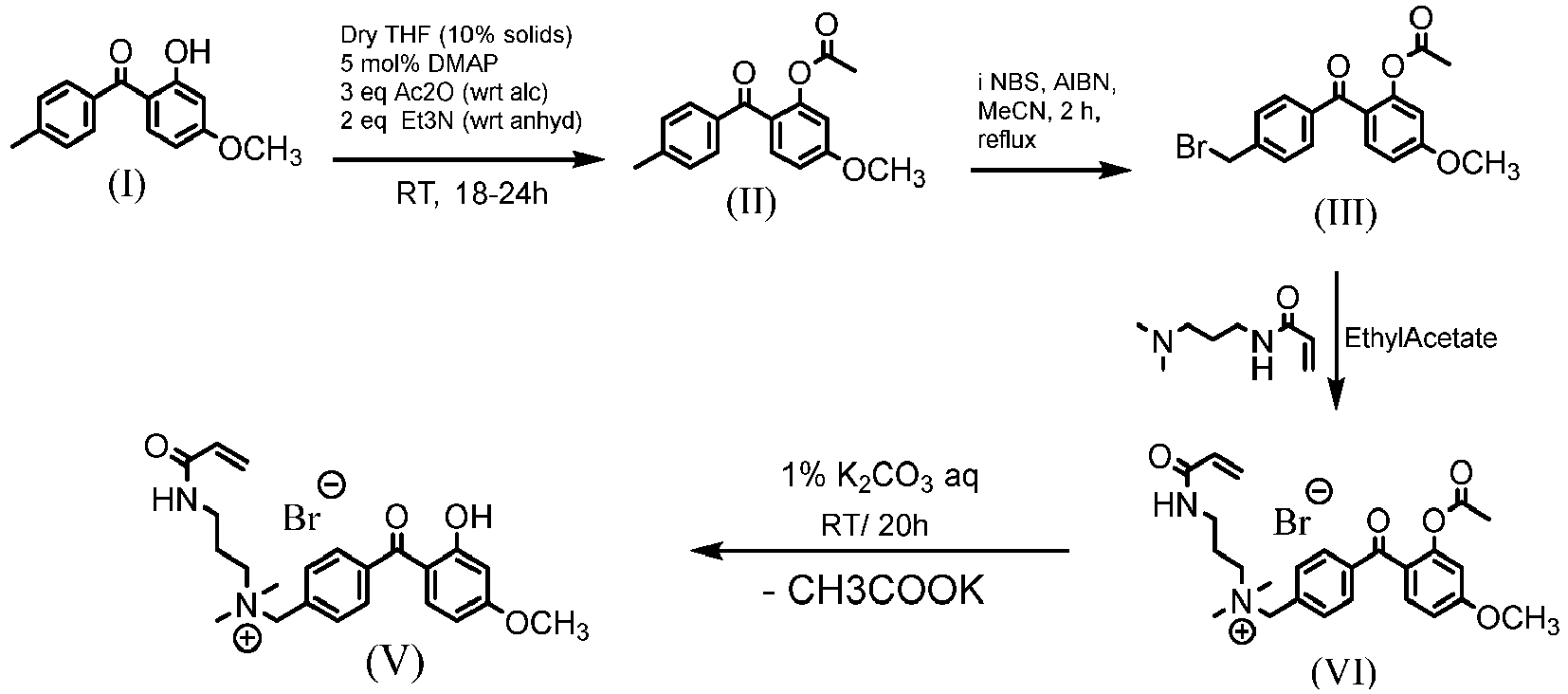
- In a round bottom (rb) flask fitted with a stir bar and purged with dry nitrogen (dN2) was taken 80g anhydrous tetrahydrofuran (THF, from Aldrich), 10g (41.29mmol/1.0eq) of 2-hydroxy-4-methoxy-4'-methylbenzophenone (HO-MeO-Me-Bzp) (from Alfa Aesar) (compound I) and 0.25g of N,N-dimethyamino pyridine (DMAP) (5mol% with respect to [wrt] to compound I from Alfa Aesar). About 5mL dry THF was used to rinse the DMAP vial and then this was added to the reaction flask. The mixture was stirred at room temperature (RT) to dissolve over 15mins. Then, 26g (6 eq) of triethylamine (TEA, from Aldrich) was added via a syringe. The solution was stirred at RT for 15 minutes. Then, 13.17g (3.1 eq) Acetic anhydride (Ac2O) was added slowly to the reaction mixture over 5 minutes. 15 mL of anhydrous THF was added to the flask. The reaction solution was stirred under nitrogen (N2) at RT, overnight and then was concentrated under reduced pressure to remove about 80% of the volatiles. THF was added to make a total solution mass having a concentration of about 30 wt% wrt starting benzophenone. The solution was stirred at RT for 5 mins. The product was precipitated by slow addition of a 150 g mixture of 1:1 ice: water (5x by weight [wt] of reaction solution) with stirring. The flask was place in ice water bath and stirred for 3 hours. After 3 hours, the pH of the solution phase was measured as 3.86 (pH meter) and the mixture was filtered through a Whatman#4 (25 µm) filter paper under vacuum of 940mbar. The precipitate was washed with about 1500g of ice cold water until the washings were clear colorless and the conductivity of the filtrate was <10 µS/cm and pH neutral. The precipitate was collected and was suspended in 100mL cold DI Water and swirled for 15mins. The obtained product was then frozen in IPA-dry ice and then lyophilized. A white powder was obtained that was weighed (Net: 11.45g; Th Yield: 11.77g; Yield: 97.36%) and was confirmed by 1H-NMR in THF-d8 to be 2-acetyloxy-4-methoxy-4'-methylbenzophenone (AcO-MeO-Me-Bzp) (compound II).
- Acetonitrile, N-Bromosuccinimide (NBS) and AIBN were purchased from Sigma Aldrich and acetate protected benzophenone derivative (II) was used as obtained from the previous step. In a 500mL 3-neck flask fitted with condenser, a N2 purge set up, a thermocouple, an oil-bubbler air trap and a stir bar was added 8.85g (0.031 mol/1.0 eq) of AcO-MeO-Me-Bzp (II) obtained in Step1 and was stirred under N2 for 30mins. The condenser was set to 9°C and 220mL of anhydrous acetonitrile was added to the reaction flask. The mixture was stirred at RT. Once the condenser had reached around 9°C, the reaction flask was gently purged with dry N2 for 30 mins and the condenser was set to 4°C. After condenser had reached 4°C or 30mins of N2 purge (whichever is later), the reaction mixture was quickly raised to reflux at 400rpm stirring and with a mildly positive N2 flow. The reaction solution came to reflux at ∼80-82°C. Then 6.11 g (1.1 eq.) of N-Bromosuccinimide (NBS) (from Sigma-Aldrich) and 0.52 g (0.1 eq.) of Aza-bisisobutyronitrile (from Sigma-Aldrich) were weighed out and added to the reaction flask under positive N2 flow. The reaction was continued, at reflux for 2h with mildly positive nitrogen flow. After two hours the reaction was stopped by being allowed to cool to RT under very mild flow of dry N2. The cooled reaction solution was filtered through a cotton plug. The solution was then concentrated to about 50wt% under reduced pressure. The product was precipitated form the reaction solution by addition of about 200g of 1:1 ice-water mixture (about 3x the reaction solution wt.).
- The mixture was stirred in an ice bath for 3 hours. After three hours the precipitate was filtered through a Whatman #4 (25um) filter paper under 950mbar pressure. The precipitate was washed 5x with 200mL cold DI Water, (∼5x volume of ice-water used for pptn) until the conductivity of the filtrate was less than 10uS/cm and neutral pH. The solid sample was mixed with 100mL cold DI Water and the mixture was then frozen in dryice/IPA bath and then lyophilized. A powdery off white solid was obtained (Net: 10.986g; Th Y: 11.307g; %Y; 97.17%) and confirmed by NMR to be product III, 2-acetyloxy-4-methoxy-4'-bromomethyl-benzophenone (AcO-MeO-BrCH2-Bzp). The %purity of product III was estimated from NMR to be 85mol% with about 7% likely to be unreacted starting material and about 8% other unidentified impurities.
- In a weighed 20mL amber glass vial with stir bar was taken 1.5g (0.004mol/1 eq) of product (III) from
Step 2, AcO-MeO-BrCH2-Bzp. To this was added 8mL ethyl acetate with stirring for 10mins at room temperature (RT). To the obtained solution was added 1.94g (0.0123mol/ 3.eq) of N,N-dimethylaminopropyl acrylamide (NN-DMAPrAAm) at RT with stirring. A precipitate slowly formed and the reaction was stirred at RT overnight. To the reaction mixture was added 1mL of hexane and the reaction mixture stirred for an hour at RT. The clear supernatant was discarded. The residue was dissolved in 0.50mL acetonitrile and stirred for 30mins to dissolve. The product in the solution was precipitated using excess 1:1 Ethyl acetate:hexane mixture. The process is repeated 4 times. To the solid residue obtained was added 5mL DI Water and the mixture allowed to dissolve. MEHQ was added to make a concentration of ∼150 mg/Kg (ppm) based on estimated final product weight. The residual organics from the cloudy solution were removed under reduced pressure to give a clear solution having neutral pH. The solution was frozen and lyophilized overnight. Net: 1.4829g; Th.Y: 2.05g; %Y; 72.19%. The bulk sample was deliquescent and was flushed with dry air and stored in a dessicator in the amber flask. The product IV was obtained and estimated from NMR to have a purity of >90%. - A 5.0mL solution of acetate protected UV-blocker (IV) in DI Water at 1000mg/L was prepared. This solution was diluted to 20mg/L with pH7 buffer (12.5mM phosphate in DI Water: n-propanol). The UV-Vis spectrum of this solution was collected (
Figure 1 , Curve 1). - Solid Potassium Carbonate (K2CO3) was added to the 1000mg/L solution to have a K2CO3 concentration of 1 w/v%. The solution was mixed to dissolve the K2CO3 and the solution was allowed to stand overnight at RT to obtain the desired product (UV-absorbing vinylic monomer, i.e., compound V in the scheme). The resultant solution was diluted to have a concentration of 20mg/L for the UV-absorbing vinylic monomer with pH7 buffer (12.5 mM phosphate in DI Water: n-propanol). The UV-Vis spectrum of this solution of the UV-absorbing vinylic monomer was collected and is shown in
Figure 1 (curve 2). - The UV-absorbing vinylic monomer prepared in Comparative Example 2 was directly added to an aqueous lens formulation, which is described in Example 8-8d of
WO2002071106 , at a concentration of 0,0.7 and 1.5 wt% and each having 1.0 wt% Lithium salt of 2,4,6-trimethylbenzoyl-diphenylphosphine oxide (Li-TPO) (from TCl-America,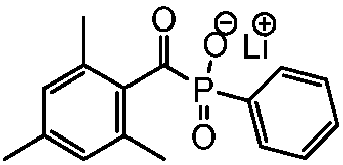
- Lenses were fabricated from those aqueous formulations according to an automated lens manufacturing process described in Example 8 of
WO2002071106 except that a lens formulation in a mold is irradiated with 405nm LED at an intensity of 30mW/cm2 for about 25 seconds. The resultant lenses were packaged in blister packages containing Saline 61, sealed and autoclaved at 121°C for 45mins. The % T (percentage transmittance) of the autoclaved lenses was determined. Where the concentration of the UV-absorbing vinylic monomer is 0 (i.e., control lenses), the control lenses have a %T-UVA ∼ 96.30% and a %T-UVB ∼ 84.61%. Where the concentration of the UV-absorbing vinylic monomer is 0.70% by weight, the resultant lenses have a %T-UVA ∼ 23.6% and a %T-UVB ∼ 3.79%. Where the concentration of the UV-absorbing vinylic monomer is 1.50% by weight, the resultant lenses have a %T-UVA ∼ 8.80% and a %T-UVB ∼ 0.13%. -
Figures 2 and3 show the %T of the lenses having 0.7 wt% and 1.5 wt% of the UV-absorbing vinylic monomer after autoclave along with control lenses (0 wt% of the UV-absorbing vinylic monomer) after autoclave. - This example illustrates how to prepare a UV-absorbing vinylic monomer according to the following scheme.
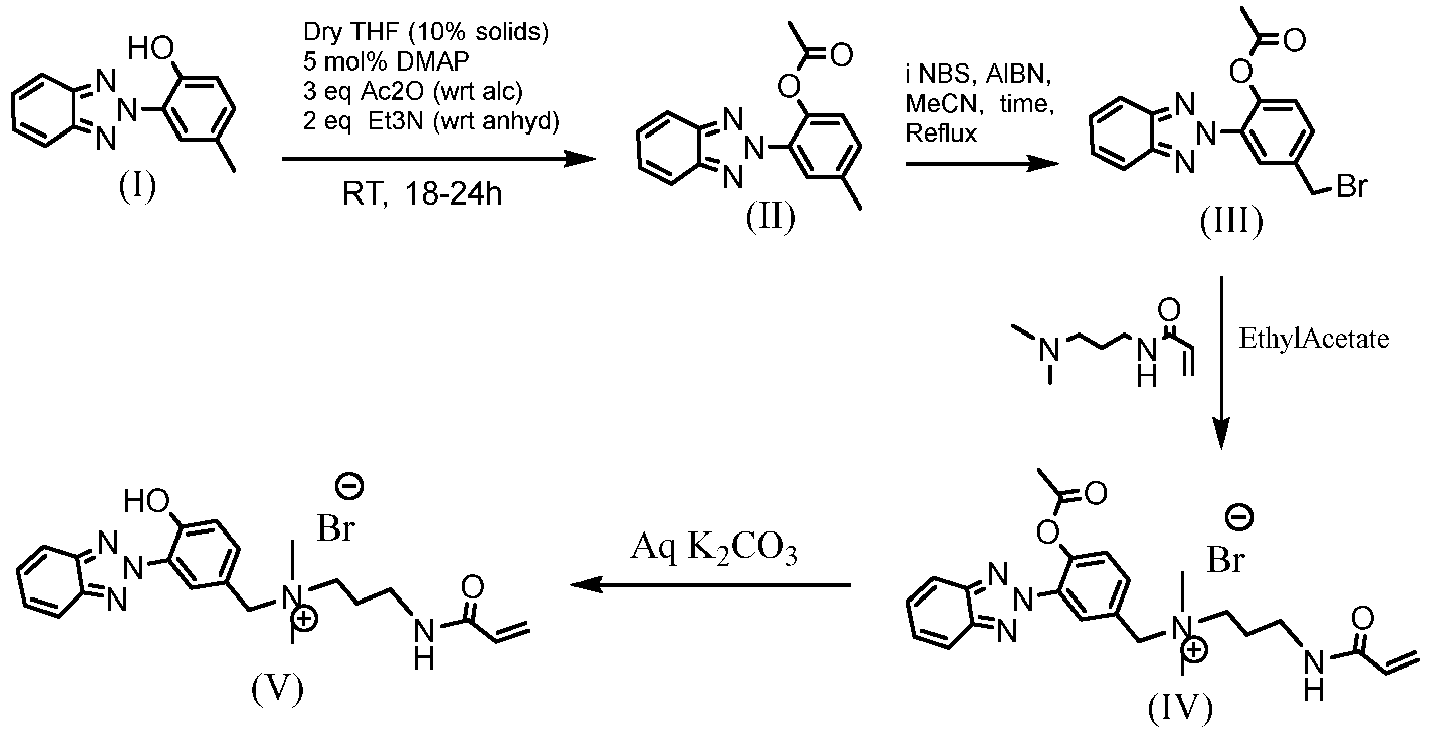
- In a weighed 2L rb flask fitted with a magnetic stir bar and purged with N2 is added 340g anhydrous THF. The flask is purged with N2 for a minute while stirring and then capped. 40 g (177.4 mmol,1.0 eq) of 2-(2-Hydroxy-5-methylphenyl)benzotriazole (Me-Bzt-OH, from TCI-America) is weighed and added to the flask. The reaction flask is quickly purged with N2 and then capped and stirred to allow the solid to dissolve. To this solution is added 1.09 g (8.87mmol) of 4-dimethylaminopyridine (4-DMAP) (5mol% wrt benotriazole). The flask is quickly purged with N2, capped and the reaction mixture is allowed to stir to allow the solid to dissolve. 108.96g (6 eq) of Triethyl amine (Et3N) is weighed out and slowly added to the reaction flask with stirring. 54.58g (3 eq) of Ac2O is weighed out and then slowly added to the reaction solution. 20g of THF is added to the reaction. The flask is purged with N2, capped tightly and the reaction solution is allowed stir under N2 overnight.
- The reaction solution is concentrated under reduced pressure, to remove ∼65-70% of the volatiles or until precipitation is observed, whichever is earlier. If precipitation is seen, just enough THF is added to just dissolve the precipitate. The solution is stirred at RT for 30mins. The product is precipitated by addition of a mixture of 250g ice and 250g DI Water with stirring. The obtained mixture had a pH of 4.75. The flask is place in an ice bath and stirred for 3 hours. The mixture is filtered through a Whatman #4 (25um) filter paper under vacuum of 950mbar. The precipitate is washed five times with 1Kg of ice-water until the washings are clear colorless and the conductivity of the filtrate is <1 0uS/cm. The precipitate is collected and mixed with 500mL cold DI water. The mixture is frozen and then lyophilized to give a white powder (47.22 g) whose structure is confirmed by NMR to be AcO-Me-Bzt. Net: 47.22g; Th Yield: 47.29g; Yield: 99.85%; Purity: >90%.
- In a 1L 3-neck flask fitted with condenser, a N2 purge set up, a thermocouple and an oil-bubbler air trap was added 20g (0.074mmol/1.0eq) of AcO-Me-Bzt (II) from
Step 2. This solid was stirred under N2 for at least 45 mins. To this was added 480 mL of anhydrous acetonitrile and the mixture was stirred at RT under N2 to effect a solution. The condenser was set to 9°C and the reaction solution was gently bubbled with dry N2 for 30 mins. After condenser had reached 4°C or 30 mins of N2 purge (whichever is later), the reaction mixture was quickly raised to reflux, stirred at 400 rpm with a slightly positive N2 flow. The reaction solution came to reflux at ∼81-82°C. 14.71 g (1.1 eq) of NBS and 1.25 g (0.1 eq) of AIBN were added to the reaction flask under positive N2 flow and the reaction were allowed to continue at reflux under a slightly positive N2 flow. After 2h 15m the reaction was stopped by being allowed to cool to RT under N2. The reaction solution was filtered through a cotton plug into a 1L rb flask. The solution was then concentrated under reduced pressure to yield a solid material. To the sample was added 75mL of 6.67% ACN in THF to dissolve the solid. About 250g of 1:1 ice-water by weight was prepared (∼2.5x the total solution volume). The product was precipitated by slow addition of the ice-water mixture with stirring. The flask was then placed in an ice bath and stirred for 3 hours. The precipitate was filtered through a Whatman #4 (25um) filter paper under mild vacuum. The precipitate was washed 5x with 500mL cold DI Water. (∼10x volume of ice-water used for precipitation) until the conductivity of the filtrate was <10uS/cm and neutral pH. The solid sample obtained was transferred to a 1L rb flask and mixed 100mL cold DI Water. The mixture was then frozen and then lyophilized to give a solid product (Net: 26.08g; Th. yield: 25.83g; %Yield: >100%; purity: 75% with 10% likely to be unreacted starting material and 15% unidentified material). - In weighed amber 1L flask with stir bar was taken 22g (0.058mol/ 1eq) of product (III) (AcO-BrCH2-Bzt), assuming 92% purity based on NMR. To this was added 350 mL ethyl acetate (EtAc) to dissolve. The solution was stirred at RT for an hour. During this time 27.592g/0.176mol/3 eq of NN-DMAPrAAm was measured out in a 50mL dropping funnel. The NN-DMAPrAAm was slowly added to the reaction solution dropwise over 15minutes at RT with stirring. A precipitate slowly began to form and the reaction was stirred at RT overnight, covered in foil. The stirring was stopped and the precipitate was allowed to settle. The supernatant was decanted from the reaction solution to give 70.4g of a solid. To this was added 70mL acetonitrile and the mixture swirled for an hour in a foil covered flask at RT, to dissolve. The resulting solution was concentrated under reduced pressure to remove 80% of the volatiles. To the solution was slowly added 120mL of 16.7% hexane in EtAc with stirring, to give a 2-phase mixture. The clear supernatant was decanted to give about 30g of a viscous semi-solid. To the viscous residue was added 60mL of acetonitrile and swirled for 15mins to dissolve the residue and then concentrated under reduced pressure to remove 90-95% of the volatiles. A clear viscous liquid was obtained. To this was added 120mL of 16.67% hexane in Ethyl acetate solution using a dropping funnel with stirring. Two phases were observed a lower viscous paste-like solid and upper hazy supernatant phase. The mixture was stirred gently at RT for 15 mins and then allowed to stand for 45mins. The clear colorless supernatant was decanted to yield about 32g of a viscous semi-solid. This process was repeated twice more to yield a viscous semi-solid reside. The volatiles from the crude residue were removed under reduced pressure to give about 25g of solid material. MEHQ, 3.7mg, was dissolved in Acetonitrile and added to the residue (∼150mg/Kg (ppm) MEHQ based on estimated product weight). About 50 mL of acetonitrile was added to the residue and the mixture swirled to dissolve over 15minutes. The solution was concentrated in an amber flask under reduced pressure to remove as much of the volatiles as possible to give 21.21g of a solid mass. To the residue was added 200g DI Water and the mixture were stirred for 10minutes. The sample was gravity filtered, in the dark, through a Whatman#5 (2.5um) filter paper, to give a clear solution having neutral pH. This clear solution was frozen and lyophilized to give an off-white solid. Total Yield 18g %Yield: 77%.
- A 5.0mL solution of product IV in DI Water at a concentration of 1000mg/L was prepared. This aqueous solution was diluted to 20mg/L with pH7 buffer (12.5mM phosphate in DI Water: n-propanol). The UV-Vis spectrum of this solution was collected (
Figure 4 , Curve 1). - Solid potassium carbonate (K2CO3) was added to the 1000mg/L solution to have a K2CO3 concentration of 1 w/v%. The solution was mixed to dissolve the K2CO3 and the solution was allowed to stand overnight at RT to obtain the desired product - UV-absorbing vinylic monomer (i.e., compound V in the scheme). The resultant solution was diluted to 20mg/L of the UV-absorbing vinylic monomer with pH7 buffer (12.5mM phosphate in DI Water: n-propanol). The UV-Vis spectrum of this solution of the UV-absorbing vinylic monomer was collected and is shown in
Fig 4 (Curve 2). - The UV-absorbing vinylic monomer prepared in Comparative Example 4 was directly added to an aqueous lens formulation, which is described in Example 8-8d of
WO2002071106 , at a concentration of 0, 0.91wt% and 1.4 wt% and each having 1.0wt% Li-TPO as the photoinitiator. Those three formulations are determined by photo rheology studies (405nm LED source at 30mW/cm2) to have a curing time of about 25 seconds, about 60 seconds, or about 82 seconds respectively. - Lenses were fabricated from those aqueous formulations according to an automated lens manufacturing process described in Example 8 of
WO2002071106 except that a lens formulation in a mold is irradiated with 405nm LED at an intensity of 30mW/cm2 for about 25 seconds. The resultant lenses were packaged in blister packages containing Saline 61, sealed and autoclaved at 121°C for 45mins. The % T of the autoclaved lenses was determined. Where the concentration of the UV-absorbing vinylic monomer is 0 (i.e., control lenses), the control lenses have a %T-UVA ∼ 95.57% and a %T-UVB ∼ 81.64%. Where the concentration of the UV-absorbing vinylic monomer is 0.91% by weight, the resultant lenses have a %T-UVA ∼ 7.39% and a %T-UVB ∼ 2.74%. Where the concentration of the UV-absorbing vinylic monomer is 1.40% by weight, the resultant lenses have a %T-UVA ∼ 3.45% and a %T-UVB ∼ 0.59%. -
Figures 5 and 6 show the %T of the lenses having 0.91wt% and 1.4wt% of the UV-absorbing vinylic monomer after autoclave along with control lenses (free of the UV-absorbing vinylic monomer) after autoclave.
Claims (10)
- A UV-absorbing vinylic monomer of formula (I)
 R° is H, CH3 or CH2CH3;R1 and R2 independent of one other are H, CH3, halogen, OH, OCH3, or amine;Y1 is a C2-C4 alkylene divalent radical; andQ1 is a (meth)acryloylamido or (meth)acryloyloxy group;wherein "(meth)acryloylamido" refers to a radical of

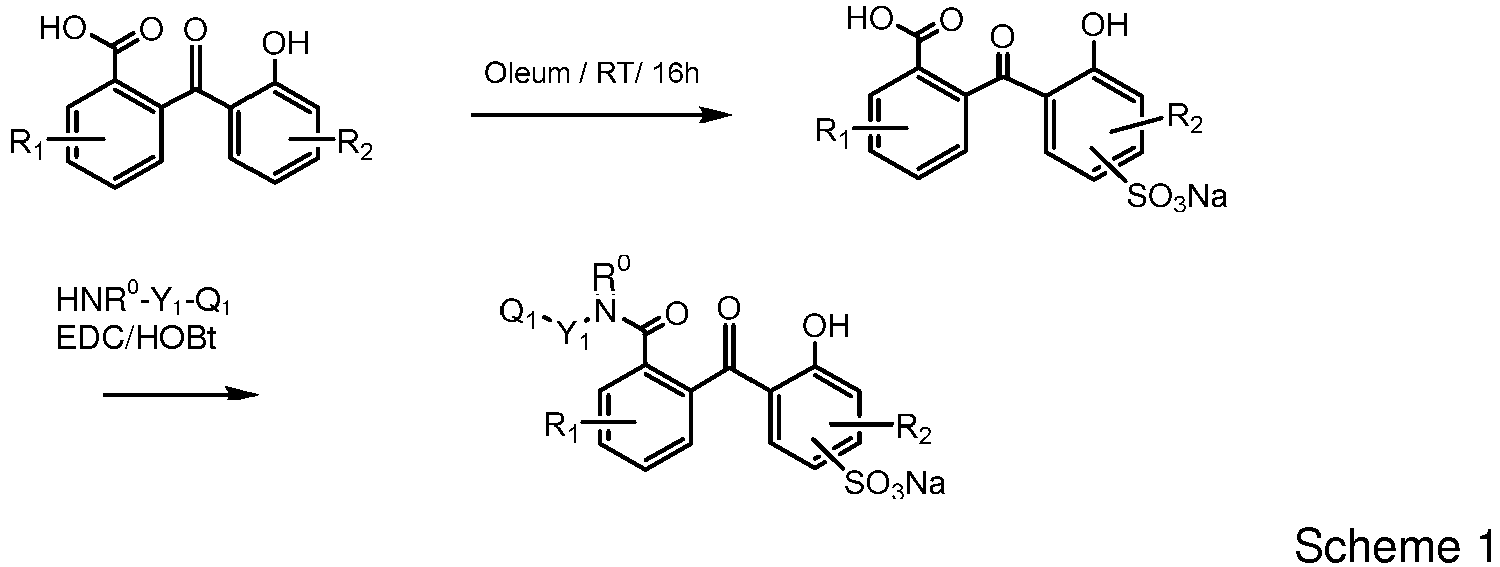
R0, R1, R2, Y1 and Q1 are as defined for formula (I), EDC is 1-[3-(dimethylamino)propyl]-3-ethylcarbodiimide hydrochloride and HOBt is 1-hydroxybenzotriazole hydrate. - A hydrogel contact lens, comprising a crosslinked polymeric material which comprises repeating units of a UV-absorbing vinylic monomer of claim 1, wherein the hydrogel contact lens has: an UVB transmittance (designated as UVB %T) of 10% or less, preferably 5% or less, more preferably 2.5% or less, even more preferably 1% or less, between 280 and 315 nanometers; an UVA transmittance (designated as UVA %T) of 30% or less, preferably 20% or less, more preferably 10% or less, even more preferably 5% or less, between 315 and 380 nanometers; optionally but preferably a Violet transmittance (designated as Violet %T) of 60% or less, preferably 50% or less, more preferably 40% or less, even more preferably 30% or less, between 380 nm and 440 nm; and a water content of from 15% to 80% by weight, preferably from 30% to 75% by weight at room temperature, 22°C to 28°C, when being fully hydrated.
- The hydrogel contact lens of claim 2, wherein the hydrogel contact lens is a silicone hydrogel contact lens, wherein the crosslinked polymeric material which comprises repeating units of at least one hydrophilic vinylic monomer and repeating units of at least one siloxane-containing vinylic monomer and/or macromer.
- The hydrogel contact lens of claim 2, wherein the crosslinked polymeric material which comprises repeating units of an actinically-crosslinkable polyvinyl alcohol prepolymer.
- The hydrogel contact lens of claim 4, wherein the actinically-crosslinkable polyvinyl alcohol prepolymer comprises repeating units of vinyl alcohol (i.e.,
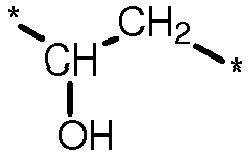
 R11 is hydrogen or C1-C6 alkyl (preferably hydrogen or C1-C4 alkyl, more preferably hydrogen or methyl or ethyl, even more preferably hydrogen or methyl);R12 is an ethylenically unsaturated group of
 R17 independently of each another are a C2-C8 alkylene divalent radical, R18 is C2-C8 alkenyl;R13 be hydrogen or a C1-C6 alkyl group preferably hydrogen; andR14 is a C1-C6 alkylene divalent radical preferably a C1-C4 alkylene divalent radical, more preferably methylene or butylene divalent radical, even more preferably methylene divalent radical.
 - A method for producing UV-absorbing contact lenses, comprising the steps of:(1) obtaining a lens formulation comprising(a) from 0.1% to 4% by weight of, preferably from 0.2% to 3.0% by weight of, more preferably from 0.4% to 2% by weight of, even more preferably from 0.6% to 1.5% by weight of a UV-absorbing vinylic monomer of claim 1,(b) from 0.1% to 2.0% by weight of, preferably from 0.25% to 1.75% by weight of, more preferably from 0.5% to 1.5% by weight of, even more preferably from 0.75% to 1.25% by weight of at least one free-radical initiator, and(c) at least one polymerizable components selected from the group consisting of a hydrophilic vinylic monomer, a water-soluble silicone-free prepolymer, a silicone-containing prepolymer, a non-silicone hydrophobic vinylic monomer, a siloxane-containing vinylic monomer, a siloxane-containing vinylic macromer, a vinylic crosslinking agent, and combinations thereof;(2) introducing the lens formulation into a mold for making a soft contact lens, wherein the mold has a first mold half with a first molding surface defining the anterior surface of a contact lens and a second mold half with a second molding surface defining the posterior surface of the contact lens, wherein said first and second mold halves are configured to receive each other such that a cavity is formed between said first and second molding surfaces; and(3) curing thermally or actinically the lens formulation in the mold to form the UV-absorbing contact lens, wherein the formed UV-absorbing contact lens is characterized by having a UVB %T of 10% or less, preferably 5% or less, more preferably 2.5% or less, even more preferably 1% or less, between 280 and 315 nanometers and a UVA %T of 30% or less, preferably 20% or less, more preferably 10% or less, even more preferably 5% or less, between 315 and 380 nanometers and and optionally but preferably a Violet %T of 60% or less, preferably 50% or less, more preferably 40% or less, even more preferably 30% or less, between 380 nm and 440 nm.
- The method of claim 6, wherein the free-radical initiator is a thermal initiator, wherein the step of curing is carried out thermally.
- The method of claim 6, wherein the free-radical initiator is a photoinitiator, wherein the step of curing is carried out by irradiation with a light having a wavelength within the range from 380 nm to 500 nm.
- The method of any one of claims 6 to 8, wherein the lens formulation comprises at least one hydrophilic vinylic monomer, at least one siloxane-containing vinylic monomer, at least one siloxane-containing vinylic macromer.
- The method of any one of claims 6 to 8, wherein the lens formulation is a water-based lens formulation comprising at least one actinically-crosslinkable polyvinyl alcohol prepolymer, wherein the actinically-crosslinkable polyvinyl alcohol prepolymer comprises repeating units of vinyl alcohol (i.e.,
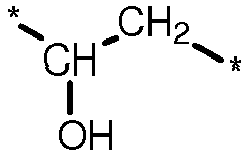
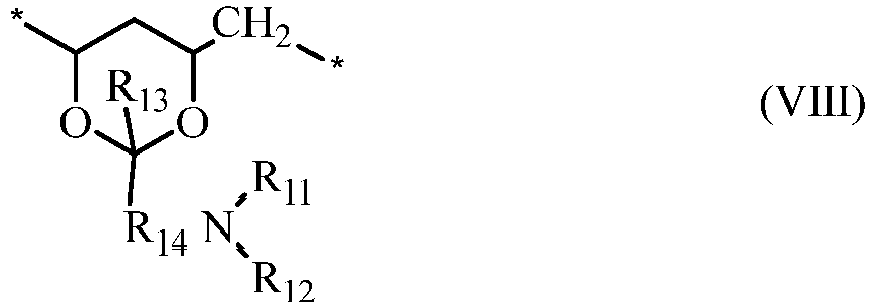 R11 is hydrogen or C1-C6 alkyl (preferably hydrogen or C1-C4 alkyl, more preferably hydrogen or methyl or ethyl, even more preferably hydrogen or methyl);R12 is an ethylenically unsaturated group of
 R17 independently of each another are a C2-C8 alkylene divalent radical, R18 is C2-C8 alkenyl;R13 is hydrogen or a C1-C6 alkyl group preferably hydrogen; andR14 is a C1-C6 alkylene divalent radical preferably a C1-C4 alkylene divalent radical, more preferably methylene or butylene divalent radical, even more preferably methylene divalent radical.
Applications Claiming Priority (2)
| Application Number | Priority Date | Filing Date | Title |
|---|---|---|---|
| US201662298137P | 2016-02-22 | 2016-02-22 | |
| PCT/IB2017/050875 WO2017145024A1 (en) | 2016-02-22 | 2017-02-16 | Uv-absorbing vinylic monomers and uses thereof |
Publications (2)
| Publication Number | Publication Date |
|---|---|
| EP3419966A1 EP3419966A1 (en) | 2019-01-02 |
| EP3419966B1 true EP3419966B1 (en) | 2020-03-25 |
Family
ID=58264574
Family Applications (1)
| Application Number | Title | Priority Date | Filing Date |
|---|---|---|---|
| EP17709807.6A Active EP3419966B1 (en) | 2016-02-22 | 2017-02-16 | Uv-absorbing vinylic monomers and uses thereof |
Country Status (6)
| Country | Link |
|---|---|
| US (2) | US10254567B2 (en) |
| EP (1) | EP3419966B1 (en) |
| JP (1) | JP6546352B2 (en) |
| CA (2) | CA3116257C (en) |
| TW (1) | TWI718257B (en) |
| WO (1) | WO2017145024A1 (en) |
Families Citing this family (21)
| Publication number | Priority date | Publication date | Assignee | Title |
|---|---|---|---|---|
| WO2019043577A1 (en) | 2017-08-29 | 2019-03-07 | Novartis Ag | Cast-molding process for producing contact lenses |
| EP3743270B1 (en) | 2018-01-22 | 2022-06-08 | Alcon Inc. | Cast-molding process for producing uv-absorbing contact lenses |
| US12534623B2 (en) | 2018-03-02 | 2026-01-27 | Johnson & Johnson Vision Care, Inc. | Contact lens with improved tear film optical quality |
| US10935695B2 (en) | 2018-03-02 | 2021-03-02 | Johnson & Johnson Vision Care, Inc. | Polymerizable absorbers of UV and high energy visible light |
| US12486403B2 (en) | 2018-03-02 | 2025-12-02 | Johnson & Johnson Vision Care, Inc. | Polymerizable absorbers of UV and high energy visible light |
| US12486348B2 (en) | 2019-08-30 | 2025-12-02 | Johnson & Johnson Vision Care, Inc. | Contact lens displaying improved vision attributes |
| US11543683B2 (en) | 2019-08-30 | 2023-01-03 | Johnson & Johnson Vision Care, Inc. | Multifocal contact lens displaying improved vision attributes |
| US11993037B1 (en) | 2018-03-02 | 2024-05-28 | Johnson & Johnson Vision Care, Inc. | Contact lens displaying improved vision attributes |
| JP6804692B2 (en) * | 2018-06-26 | 2020-12-23 | 株式会社シード | Anionic drug-containing eye device |
| AU2019399661A1 (en) * | 2018-12-10 | 2021-05-20 | Seed Co., Ltd. | UV absorbing ocular lens |
| US11958824B2 (en) | 2019-06-28 | 2024-04-16 | Johnson & Johnson Vision Care, Inc. | Photostable mimics of macular pigment |
| US12509428B2 (en) | 2019-06-28 | 2025-12-30 | Johnson & Johnson Vision Care, Inc. | Polymerizable fused tricyclic compounds as absorbers of UV and visible light |
| KR20230131494A (en) | 2021-03-08 | 2023-09-13 | 알콘 인코포레이티드 | Method for manufacturing photofunctional contact lenses |
| EP4305490A1 (en) * | 2021-03-11 | 2024-01-17 | Alcon Inc. | Ophthalmic lenses with cosmetic film therein |
| US20230364832A1 (en) | 2022-04-28 | 2023-11-16 | Alcon Inc. | Method for making uv and hevl-absorbing ophthalmic lenses |
| TW202411352A (en) | 2022-05-23 | 2024-03-16 | 瑞士商愛爾康公司 | Uv/hevl-filtering contact lenses |
| CN115232510B (en) * | 2022-08-04 | 2023-07-04 | 广东诚展科技股份有限公司 | Liquid photosensitive LDI inner layer ink and preparation method thereof |
| CN119731560A (en) | 2022-08-17 | 2025-03-28 | 爱尔康公司 | Contact lens having hydrogel coating thereon |
| DE102022128813A1 (en) * | 2022-10-31 | 2024-05-02 | Universität Siegen, Körperschaft des öffentlichen Rechts | Anti-adhesive polymer coatings for short-term implants |
| CN121039534A (en) | 2023-05-18 | 2025-11-28 | 爱尔康公司 | UV/HEVL Filtering Silicone Hydrogel Contact Lenses |
| CN121443681A (en) | 2023-08-07 | 2026-01-30 | 爱尔康公司 | UV/HEVL filterable silicone hydrogel contact lenses |
Citations (3)
| Publication number | Priority date | Publication date | Assignee | Title |
|---|---|---|---|---|
| DE292066C (en) * | ||||
| DE282493C (en) * | ||||
| EP0005380A2 (en) * | 1978-05-09 | 1979-11-14 | Dynachem Corporation | Phototropic photosensitive compositions containing a fluoran colorformer |
Family Cites Families (182)
| Publication number | Priority date | Publication date | Assignee | Title |
|---|---|---|---|---|
| US4182822A (en) | 1976-11-08 | 1980-01-08 | Chang Sing Hsiung | Hydrophilic, soft and oxygen permeable copolymer composition |
| US4343927A (en) | 1976-11-08 | 1982-08-10 | Chang Sing Hsiung | Hydrophilic, soft and oxygen permeable copolymer compositions |
| US4390676A (en) | 1976-11-15 | 1983-06-28 | Schering Corporation | Ultraviolet absorbing lenses |
| US4136250A (en) | 1977-07-20 | 1979-01-23 | Ciba-Geigy Corporation | Polysiloxane hydrogels |
| US4153641A (en) | 1977-07-25 | 1979-05-08 | Bausch & Lomb Incorporated | Polysiloxane composition and contact lens |
| US4189546A (en) | 1977-07-25 | 1980-02-19 | Bausch & Lomb Incorporated | Polysiloxane shaped article for use in biomedical applications |
| US4261875A (en) | 1979-01-31 | 1981-04-14 | American Optical Corporation | Contact lenses containing hydrophilic silicone polymers |
| US4254248A (en) | 1979-09-13 | 1981-03-03 | Bausch & Lomb Incorporated | Contact lens made from polymers of polysiloxane and polycyclic esters of acrylic acid or methacrylic acid |
| US4276402A (en) | 1979-09-13 | 1981-06-30 | Bausch & Lomb Incorporated | Polysiloxane/acrylic acid/polcyclic esters of methacrylic acid polymer contact lens |
| US4260725A (en) | 1979-12-10 | 1981-04-07 | Bausch & Lomb Incorporated | Hydrophilic contact lens made from polysiloxanes which are thermally bonded to polymerizable groups and which contain hydrophilic sidechains |
| US4259467A (en) | 1979-12-10 | 1981-03-31 | Bausch & Lomb Incorporated | Hydrophilic contact lens made from polysiloxanes containing hydrophilic sidechains |
| US4341889A (en) | 1981-02-26 | 1982-07-27 | Bausch & Lomb Incorporated | Polysiloxane composition and biomedical devices |
| US4355147A (en) | 1981-02-26 | 1982-10-19 | Bausch & Lomb Incorporated | Polysiloxane with polycyclic modifier composition and biomedical devices |
| US4327203A (en) | 1981-02-26 | 1982-04-27 | Bausch & Lomb Incorporated | Polysiloxane with cycloalkyl modifier composition and biomedical devices |
| US4444711A (en) | 1981-12-21 | 1984-04-24 | Husky Injection Molding Systems Ltd. | Method of operating a two-shot injection-molding machine |
| US4661575A (en) | 1982-01-25 | 1987-04-28 | Hercules Incorporated | Dicyclopentadiene polymer product |
| US4460534A (en) | 1982-09-07 | 1984-07-17 | International Business Machines Corporation | Two-shot injection molding |
| US4486577A (en) | 1982-10-12 | 1984-12-04 | Ciba-Geigy Corporation | Strong, silicone containing polymers with high oxygen permeability |
| US4543398A (en) | 1983-04-28 | 1985-09-24 | Minnesota Mining And Manufacturing Company | Ophthalmic devices fabricated from urethane acrylates of polysiloxane alcohols |
| NZ208751A (en) * | 1983-07-11 | 1987-04-30 | Iolab Corp | 2-hydroxy-5-acrylyloxyalkylphenyl-2h-benzotriazole derivatives and polymers and copolymers thereof and use as uv absorbing additives in polymer compositions |
| US4528311A (en) | 1983-07-11 | 1985-07-09 | Iolab Corporation | Ultraviolet absorbing polymers comprising 2-hydroxy-5-acrylyloxyphenyl-2H-benzotriazoles |
| US4605712A (en) | 1984-09-24 | 1986-08-12 | Ciba-Geigy Corporation | Unsaturated polysiloxanes and polymers thereof |
| DE3439483A1 (en) | 1984-10-27 | 1986-05-07 | Röhm GmbH, 6100 Darmstadt | RADICALLY POLYMERIZABLE UV ABSORBER, METHOD FOR PRODUCING IT AND ITS POLYMERS |
| US4833218A (en) | 1984-12-18 | 1989-05-23 | Dow Corning Corporation | Hydrophilic silicone-organic copolymer elastomers containing bioactine agent |
| CA1318529C (en) | 1985-05-08 | 1993-06-01 | Harry I. Zeltzer | Contact lens for correction of color blindness |
| US4719248A (en) * | 1985-08-08 | 1988-01-12 | Bausch & Lomb Incorporated | Ultraviolet blocking agents for contact lenses |
| US4684538A (en) | 1986-02-21 | 1987-08-04 | Loctite Corporation | Polysiloxane urethane compounds and adhesive compositions, and method of making and using the same |
| JPS62230759A (en) | 1986-04-01 | 1987-10-09 | Nippon Shokubai Kagaku Kogyo Co Ltd | Novel acryl or methacrylamide derivative |
| DE3708308A1 (en) | 1986-04-10 | 1987-10-22 | Bayer Ag | CONTACT OPTICAL ITEMS |
| US5190565A (en) | 1986-07-28 | 1993-03-02 | Allied-Signal Inc. | Sulfonated 2-(2'-hydroxyaryl)-2H-benzotriazoles and/or sulfonated aromatic formaldehyde condensates and their use to improve stain resistance and dye lightfasteness |
| AU612117B2 (en) | 1986-07-28 | 1991-07-04 | Allied Corporation | Sulfonate benzotriazoles and their use in polyamide |
| US4716234A (en) | 1986-12-01 | 1987-12-29 | Iolab Corporation | Ultraviolet absorbing polymers comprising 2-(2'-hydroxy-5'-acryloyloxyalkoxyphenyl)-2H-benzotriazole |
| US4803254A (en) | 1987-03-11 | 1989-02-07 | Iolab Corporation | Vinylsilylalkoxy arylbenzotriazole compounds and UV absorbing compositions made therefrom |
| US4837289A (en) | 1987-04-30 | 1989-06-06 | Ciba-Geigy Corporation | UV- and heat curable terminal polyvinyl functional macromers and polymers thereof |
| US4937349A (en) * | 1987-10-29 | 1990-06-26 | Ciba-Geigy Corporation | Process for the preparation of 3-[2'H-benzotriazol-(2')-yl]-4-hydroxy-benzenesulfonic acids and the salts thereof |
| JPH0824694B2 (en) | 1988-02-09 | 1996-03-13 | ホーヤ株式会社 | Contact lenses for correcting blue eyes |
| US5070170A (en) | 1988-02-26 | 1991-12-03 | Ciba-Geigy Corporation | Wettable, rigid gas permeable, substantially non-swellable contact lens containing block copolymer polysiloxane-polyoxyalkylene backbone units, and use thereof |
| US4954587A (en) | 1988-07-05 | 1990-09-04 | Ciba-Geigy Corporation | Dimethylacrylamide-copolymer hydrogels with high oxygen permeability |
| JPH0651795B2 (en) | 1988-09-16 | 1994-07-06 | 信越化学工業株式会社 | Methacryl functional dimethyl polysiloxane |
| DE3837884A1 (en) | 1988-11-08 | 1990-05-10 | Mutzhas Maximilian F | LIGHT FILTER FOR IMPROVING VISION |
| US4954586A (en) | 1989-01-17 | 1990-09-04 | Menicon Co., Ltd | Soft ocular lens material |
| US5034461A (en) | 1989-06-07 | 1991-07-23 | Bausch & Lomb Incorporated | Novel prepolymers useful in biomedical devices |
| EP0415880B1 (en) | 1989-08-25 | 1995-04-05 | Ciba-Geigy Ag | Light stabilised inks |
| US5010141A (en) | 1989-10-25 | 1991-04-23 | Ciba-Geigy Corporation | Reactive silicone and/or fluorine containing hydrophilic prepolymers and polymers thereof |
| US5079319A (en) | 1989-10-25 | 1992-01-07 | Ciba-Geigy Corporation | Reactive silicone and/or fluorine containing hydrophilic prepolymers and polymers thereof |
| WO1993005085A1 (en) | 1991-09-12 | 1993-03-18 | Bausch & Lomb Incorporated | Wettable silicone hydrogel compositions and methods |
| JP3354571B2 (en) | 1991-11-05 | 2002-12-09 | ボシュ・アンド・ロム・インコーポレイテッド | Wettable silicone hydrogel composition and method for producing the same |
| US5358995A (en) | 1992-05-15 | 1994-10-25 | Bausch & Lomb Incorporated | Surface wettable silicone hydrogels |
| JPH05317692A (en) * | 1992-05-25 | 1993-12-03 | Dai Ichi Kogyo Seiyaku Co Ltd | Coating film material of microcapsule, microcapsule using the same and its production |
| JP3195662B2 (en) | 1992-08-24 | 2001-08-06 | 株式会社メニコン | Ophthalmic lens materials |
| JP2774233B2 (en) | 1992-08-26 | 1998-07-09 | 株式会社メニコン | Ophthalmic lens materials |
| JPH0688066A (en) * | 1992-09-09 | 1994-03-29 | Toray Ind Inc | Ultraviolet absorber and ultraviolet-absorbing composition containing the same |
| US5487885A (en) | 1992-12-21 | 1996-01-30 | Biophysica, Inc. | Sunblocking polymers and their formulation |
| JP3251676B2 (en) * | 1992-12-28 | 2002-01-28 | 興和株式会社 | Hydrophilic UV absorber |
| ATE160343T1 (en) | 1993-04-22 | 1997-12-15 | Jessen Wesley Corp | UV-ABSORBING BENZOTRIAZOLES CONTAINING A STYRENE GROUP |
| TW328535B (en) | 1993-07-02 | 1998-03-21 | Novartis Ag | Functional photoinitiators and their manufacture |
| US6800225B1 (en) | 1994-07-14 | 2004-10-05 | Novartis Ag | Process and device for the manufacture of mouldings and mouldings manufactured in accordance with that process |
| TW272976B (en) | 1993-08-06 | 1996-03-21 | Ciba Geigy Ag | |
| US5470932A (en) | 1993-10-18 | 1995-11-28 | Alcon Laboratories, Inc. | Polymerizable yellow dyes and their use in opthalmic lenses |
| US5712356A (en) | 1993-11-26 | 1998-01-27 | Ciba Vision Corporation | Cross-linkable copolymers and hydrogels |
| JPH0757857B2 (en) | 1993-11-29 | 1995-06-21 | 株式会社日本触媒 | Urethane resin coating composition |
| US5894002A (en) | 1993-12-13 | 1999-04-13 | Ciba Vision Corporation | Process and apparatus for the manufacture of a contact lens |
| US5625427A (en) | 1993-12-15 | 1997-04-29 | Corning Incorporated | Ophthalmic lens |
| US5843346A (en) | 1994-06-30 | 1998-12-01 | Polymer Technology Corporation | Method of cast molding contact lenses |
| US5592245A (en) | 1994-08-10 | 1997-01-07 | Moore; J. Paul | Apparatus for enhancing visual perception of selected objects in recreational and sporting activities |
| US5760100B1 (en) | 1994-09-06 | 2000-11-14 | Ciba Vision Corp | Extended wear ophthalmic lens |
| US5617154A (en) | 1994-10-28 | 1997-04-01 | Flexlens | Light filtering contact lens |
| US5665840A (en) | 1994-11-18 | 1997-09-09 | Novartis Corporation | Polymeric networks from water-soluble prepolymers |
| EP0807270B1 (en) | 1995-02-03 | 1999-03-31 | Novartis AG | Crosslinked polymers containing ester or amide groups |
| TW349967B (en) | 1995-02-03 | 1999-01-11 | Novartis Ag | Process for producing contact lenses and a cross-linkable polyvinylalcohol used therefor |
| US5838419A (en) | 1996-02-22 | 1998-11-17 | Holland; Stephen | Method and apparatus for treating refractive eye abnormalities |
| CN1234044A (en) | 1996-10-21 | 1999-11-03 | 诺瓦提斯公司 | Crosslinkable polymers |
| GB9700376D0 (en) | 1997-01-09 | 1997-02-26 | Ciba Geigy Ag | Production of keto acids |
| TW425403B (en) | 1997-02-04 | 2001-03-11 | Novartis Ag | Branched polyurethane (meth)acrylate prepolymers, opthal-mic mouldings derived therefrom and processes for their manufacture |
| AU6821898A (en) | 1997-02-21 | 1998-09-09 | Novartis Ag | Ophthalmic mouldings |
| US5975695A (en) | 1997-09-10 | 1999-11-02 | Intercast Europe S.P.A. | Optical element for use in eye-protecting devices |
| WO1999014253A1 (en) | 1997-09-16 | 1999-03-25 | Novartis Ag | Crosslinkable polyurea polymers |
| TW429327B (en) | 1997-10-21 | 2001-04-11 | Novartis Ag | Single mould alignment |
| US5962548A (en) | 1998-03-02 | 1999-10-05 | Johnson & Johnson Vision Products, Inc. | Silicone hydrogel polymers |
| US6039913A (en) | 1998-08-27 | 2000-03-21 | Novartis Ag | Process for the manufacture of an ophthalmic molding |
| US6132044A (en) | 1998-11-20 | 2000-10-17 | Luxottica Leasing S.P.A | Filter for a special purpose lens and method of making filter |
| EP1002807A1 (en) | 1998-11-20 | 2000-05-24 | Novartis AG | Functionalized resin derived from polyallylamine |
| US5981675A (en) | 1998-12-07 | 1999-11-09 | Bausch & Lomb Incorporated | Silicone-containing macromonomers and low water materials |
| FR2789673B1 (en) | 1999-02-12 | 2001-05-04 | Corning Sa | COLORLESS MINERAL GLASSES WITH A STEEP OPTICAL ABSORPTION FRONT BETWEEN 370 AND 425 NM; PRODUCTS IN THE SAID GLASSES |
| WO2001007523A1 (en) | 1999-07-27 | 2001-02-01 | Bausch & Lomb Incorporated | Contact lens material |
| US6432137B1 (en) | 1999-09-08 | 2002-08-13 | Medennium, Inc. | High refractive index silicone for use in intraocular lenses |
| JP2001139640A (en) * | 1999-11-12 | 2001-05-22 | Mitsubishi Chemicals Corp | UV absorbing copolymer |
| US6305801B1 (en) | 1999-12-02 | 2001-10-23 | Peakvision, Llc | Contact lens with filtering for outdoor sporting and recreational activities |
| US7521519B1 (en) | 2000-03-14 | 2009-04-21 | Novartis Ag | Organic compounds |
| BR0109416A (en) | 2000-03-24 | 2002-12-10 | Novartis Ag | Polymers |
| US8403478B2 (en) | 2001-11-02 | 2013-03-26 | High Performance Optics, Inc. | Ophthalmic lens to preserve macular integrity |
| US8500274B2 (en) | 2000-11-03 | 2013-08-06 | High Performance Optics, Inc. | Dual-filter ophthalmic lens to reduce risk of macular degeneration |
| JP2002226521A (en) * | 2001-02-02 | 2002-08-14 | Otsuka Chem Co Ltd | Ultraviolet absorbing copolymer |
| AR032951A1 (en) | 2001-03-07 | 2003-12-03 | Novartis Ag | PROCESS FOR THE MANUFACTURE OF MOLDED ITEMS |
| US6641261B2 (en) | 2001-10-06 | 2003-11-04 | Stryker Corporation | Lens for vision enhancement |
| US6955430B2 (en) | 2001-12-11 | 2005-10-18 | Pratt Steven G | Blue blocking lens |
| US7255435B2 (en) | 2001-12-11 | 2007-08-14 | Pratt Steven G | Blue blocking tens |
| US6811727B2 (en) | 2002-01-09 | 2004-11-02 | Corning Incorporated | Ophthalmic filter materials |
| EP1534767B1 (en) | 2002-08-14 | 2007-11-28 | Novartis AG | Radiation-curable prepolymers |
| US7748845B2 (en) | 2002-08-28 | 2010-07-06 | Robert Casper | Method and device for preventing alterations in circadian rhythm |
| CA2497261C (en) | 2002-08-28 | 2012-07-31 | Robert Casper | A device for the prevention of melatonin suppression by light at night |
| WO2004052837A2 (en) | 2002-12-12 | 2004-06-24 | Ciba Specialty Chemicals Holding Inc. | Amino substituted hydroxyphenyl benzophenone derivatives |
| US7387759B2 (en) | 2002-12-17 | 2008-06-17 | Novartis Ag | System and method for curing polymeric moldings having a masking collar |
| US7384590B2 (en) | 2002-12-17 | 2008-06-10 | Novartis Ag | System and method for curing polymeric moldings |
| US7276544B2 (en) | 2003-09-08 | 2007-10-02 | Bausch & Lomb Incorporated | Process for manufacturing intraocular lenses with blue light absorption characteristics |
| US7977430B2 (en) | 2003-11-25 | 2011-07-12 | Novartis Ag | Crosslinkable polyurea prepolymers |
| US7278737B2 (en) | 2004-04-30 | 2007-10-09 | Advanced Medical Optics, Inc. | Ophthalmic devices having a highly selective violet light transmissive filter and related methods |
| JP4401875B2 (en) * | 2004-06-24 | 2010-01-20 | 株式会社資生堂 | Oil-in-water emulsion composition |
| US8030369B2 (en) * | 2004-10-13 | 2011-10-04 | Novartis Ag | Contact lenses with improved wearing comfort |
| WO2007055707A2 (en) | 2004-12-01 | 2007-05-18 | William Marsh Rice University | Multi-step purification of single-wall carbon nanotubes |
| US20060197067A1 (en) * | 2005-03-04 | 2006-09-07 | Erning Xia | Radiation-absorbing materials, ophthalmic compositions containing same, and method of treating ophthalmic devices |
| ES2247946B2 (en) | 2005-04-19 | 2006-10-01 | Universidad Complutense De Madrid | THERAPEUTIC CONTACT LENS FOR PSEUDO-AFAQUIC EYES AND / OR IN NEURODEGENERATION PROCESS. |
| US20060252850A1 (en) | 2005-05-04 | 2006-11-09 | Bausch & Lomb Incorporated | Radiation-absorbing polymeric materials and ophthalmic devices comprising same |
| US7771470B2 (en) | 2005-05-05 | 2010-08-10 | Key Medical Technologies, Inc. | Ophthalmic apparatuses and methods |
| US7857848B2 (en) | 2005-05-05 | 2010-12-28 | Key Medical Technologies, Inc. | Infinite refractive index gradient (IRIG) polymers for ocular implant and contact lens applications |
| US7842367B2 (en) | 2005-05-05 | 2010-11-30 | Key Medical Technologies, Inc. | Ultra violet, violet, and blue light filtering polymers for ophthalmic applications |
| US20070092831A1 (en) | 2005-10-24 | 2007-04-26 | Bausch & Lomb Incorporated | Radiation-absorbing polymeric materials and ophthalmic devices comprising same |
| US20070092830A1 (en) | 2005-10-24 | 2007-04-26 | Bausch & Lomb Incorporated | Polymeric radiation-absorbing materials and ophthalmic devices comprising same |
| US7703917B2 (en) | 2006-01-10 | 2010-04-27 | Universidad Complutense De Madrid | Therapeutic prophylactic ophthalmologic lens for pseudoaphakic eyes and/or eyes suffering neurodegeneration |
| US7520608B2 (en) | 2006-03-20 | 2009-04-21 | High Performance Optics, Inc. | Color balanced ophthalmic system with selective light inhibition |
| US20120075577A1 (en) | 2006-03-20 | 2012-03-29 | Ishak Andrew W | High performance selective light wavelength filtering providing improved contrast sensitivity |
| US8360574B2 (en) | 2006-03-20 | 2013-01-29 | High Performance Optics, Inc. | High performance selective light wavelength filtering providing improved contrast sensitivity |
| US9377569B2 (en) | 2006-03-20 | 2016-06-28 | High Performance Optics, Inc. | Photochromic ophthalmic systems that selectively filter specific blue light wavelengths |
| US8113651B2 (en) | 2006-03-20 | 2012-02-14 | High Performance Optics, Inc. | High performance corneal inlay |
| US20070216861A1 (en) | 2006-03-20 | 2007-09-20 | Andrew Ishak | Ophthalmic system combining ophthalmic components with blue light wavelength blocking and color-balancing functionalities |
| US8882267B2 (en) | 2006-03-20 | 2014-11-11 | High Performance Optics, Inc. | High energy visible light filter systems with yellowness index values |
| US7364291B2 (en) | 2006-06-29 | 2008-04-29 | Johnson & Johnson Vision Care, Inc. | Contact lenses with light blocking rings |
| ES2346812T3 (en) | 2006-07-12 | 2010-10-20 | Novartis Ag | CURRENTLY CRUSHABLE COPOLYMERS FOR THE MANUFACTURE OF CONTACT LENSES. |
| WO2008024414A2 (en) | 2006-08-23 | 2008-02-28 | High Performance Optics, Inc. | System and method for selective light inhibition |
| US8106108B2 (en) | 2006-09-06 | 2012-01-31 | Carl Zeiss Vision Australia Holdings Limited | Ultraviolet light absorbing optical elements and compositions and methods for manufacture |
| EP1905415B1 (en) | 2006-09-27 | 2009-07-01 | Ivoclar Vivadent AG | Polymerisable compositions comprising acyl-germanium as initiators |
| FR2908897B1 (en) | 2006-11-17 | 2009-03-06 | Essilor Int | COLORFUL COLOR OPHTHALMIC LENSES. |
| FR2908899B1 (en) | 2006-11-17 | 2009-02-06 | Essilor Int | MULTI-SHAPED OPHTHALMIC LENSES FOR NIGHT VISION |
| AR064286A1 (en) | 2006-12-13 | 2009-03-25 | Quiceno Gomez Alexandra Lorena | PRODUCTION OF OPHTHALMIC DEVICES BASED ON POLYMERIZATION BY PHOTOINDUCIDED SCALE GROWTH |
| EP2091979A2 (en) | 2006-12-13 | 2009-08-26 | Novartis AG | Actinically curable silicone hydrogel copolymers and uses thereof |
| US8071703B2 (en) | 2007-03-22 | 2011-12-06 | Novartis Ag | Silicone-containing prepolymers with dangling hydrophilic polymer chains |
| CN101641206B (en) | 2007-03-22 | 2013-03-20 | 诺瓦提斯公司 | Prepolymers with polymer chains containing pendant polysiloxanes |
| US7825257B1 (en) | 2007-10-23 | 2010-11-02 | Bausch & Lomb Incorporated | Synthesis of benzotriazole monomer |
| TWI381829B (en) * | 2008-02-04 | 2013-01-11 | Everlight Chem Ind Corp | Polymerizable water-soluble or alcohol-soluble uv-light absorbent |
| US7884228B1 (en) | 2008-05-06 | 2011-02-08 | Alcon, Inc. | UV-absorbers for ophthalmic lens materials |
| US7803359B1 (en) | 2008-05-06 | 2010-09-28 | Alcon, Inc. | UV-absorbers for ophthalmic lens materials |
| TWI453199B (en) | 2008-11-04 | 2014-09-21 | Alcon Inc | Uv/visible light absorbers for ophthalmic lens materials |
| HUE027398T2 (en) | 2009-05-22 | 2016-10-28 | Novartis Ag | Actinically-crosslinkable siloxane-containing copolymers |
| EP2432821B1 (en) | 2009-05-22 | 2017-08-30 | Novartis AG | Actinically-crosslinkable siloxane-containing copolymers |
| TWI464151B (en) | 2009-07-06 | 2014-12-11 | Alcon Inc | Uv/visible light absorbers for ophthalmic lens materials |
| TWI487690B (en) | 2009-07-06 | 2015-06-11 | Alcon Inc | Visible light absorbers for ophthalmic lens materials |
| US7915323B2 (en) | 2009-07-09 | 2011-03-29 | Bausch & Lamb Incorporated | Mono ethylenically unsaturated polycarbosiloxane monomers |
| ES2537828T3 (en) | 2009-07-09 | 2015-06-12 | Bausch & Lomb Incorporated | Monoethylenically unsaturated polymerizable group containing polycarbosiloxane monomers |
| CA2771138C (en) * | 2009-09-15 | 2016-01-19 | Novartis Ag | Prepolymers suitable for making ultra-violet absorbing contact lenses |
| CN102791698B (en) | 2010-01-15 | 2014-11-12 | 帝斯曼知识产权资产管理有限公司 | 2-Phenyl-1,2,3-benzotriazoles for UV radiation absorption |
| TWI473629B (en) | 2010-01-18 | 2015-02-21 | Alcon Inc | Visible light absorber for ophthalmic crystal materials |
| US9690115B2 (en) | 2010-04-13 | 2017-06-27 | Johnson & Johnson Vision Care, Inc. | Contact lenses displaying reduced indoor glare |
| US8877103B2 (en) | 2010-04-13 | 2014-11-04 | Johnson & Johnson Vision Care, Inc. | Process for manufacture of a thermochromic contact lens material |
| KR101869746B1 (en) | 2010-04-29 | 2018-06-21 | 노파르티스 아게 | Intraocular lenses with combinations of uv absorbers and blue light chromophores |
| MX344720B (en) * | 2010-07-30 | 2017-01-03 | Novartis Ag * | Method for making uv-absorbing ophthalmic lenses. |
| US20120023896A1 (en) * | 2010-07-30 | 2012-02-02 | Hamilton Sundstrand Corporation | Auxiliary power unit fire enclosure drain |
| WO2012047969A1 (en) | 2010-10-06 | 2012-04-12 | Novartis Ag | Water-processable silicone-containing prepolymers and uses thereof |
| EP2625217B1 (en) | 2010-10-06 | 2018-07-04 | Novartis AG | Chain-extended polysiloxane crosslinkers with dangling hydrophilic polymer chains |
| CA2813469C (en) | 2010-10-06 | 2016-01-12 | Novartis Ag | Polymerizable chain-extended polysiloxanes with pendant hydrophilic groups |
| AU2012223124B2 (en) | 2011-03-03 | 2015-11-05 | Enchroma, Inc. | Multi-band color vision filters and method by LP-optimization |
| US8772367B2 (en) | 2011-03-21 | 2014-07-08 | Momentive Performance Materials Inc. | Siloxane monomers containing hydrolysis resistance carbosiloxane linkage, process for their preparation and thin films containing the same for contact lens application |
| US10391179B2 (en) | 2011-03-21 | 2019-08-27 | Momentive Performance Materials Inc. | Organomodified carbosiloxane monomers containing compositions and uses thereof |
| TWI434826B (en) * | 2011-04-28 | 2014-04-21 | Largan Medical Co Ltd | Composition of contact lens for uv resistant |
| TW201311621A (en) | 2011-08-15 | 2013-03-16 | Novartis Ag | UV-absorbers for ophthalmic lens materials |
| EP2602654B1 (en) | 2011-12-08 | 2023-04-19 | Essilor International | Ophthalmic filter |
| US8585938B1 (en) | 2012-03-30 | 2013-11-19 | Novartis Ag | UV-absorbers for ophthalmic lens materials |
| JP6267192B2 (en) | 2012-05-16 | 2018-01-24 | エシロル アンテルナショナル(コンパーニュ ジェネラル ドプテーク) | Ophthalmic lens |
| KR101687470B1 (en) * | 2012-05-25 | 2016-12-19 | 보오슈 앤드 롬 인코포레이팃드 | Fully polymerized UV blocking silicone hydrogel lens |
| WO2013188825A1 (en) | 2012-06-15 | 2013-12-19 | The Regents Of The University Of California | Optical filters and methods for reducing glare from glare-producing light |
| CA2877345C (en) | 2012-06-28 | 2020-09-22 | Johnson & Johnson Consumer Companies, Inc. | Sunscreen compositions comprising a chromophore-functionalized polyether and an anionic emulsifier |
| US9255180B2 (en) | 2012-06-28 | 2016-02-09 | Johnson & Johnson Consumer Inc. | Ultraviolet radiation absorbing polyethers |
| WO2014011581A2 (en) | 2012-07-10 | 2014-01-16 | Photokinetics, Inc. | Optimization of light filters and illuminants and products derived therefrom |
| JP6152538B2 (en) | 2012-07-23 | 2017-06-28 | ボシュ・アンド・ロム・インコーポレイテッドBausch & Lomb Incorporated | Light absorbing compounds for optical polymers |
| US20150218393A1 (en) * | 2012-08-16 | 2015-08-06 | Basf Se | Stable uv absorber composition |
| WO2014093751A2 (en) * | 2012-12-14 | 2014-06-19 | Novartis Ag | Amphiphilic siloxane-containing vinylic monomers and uses thereof |
| CN104969092A (en) | 2013-02-27 | 2015-10-07 | 三井化学株式会社 | Optical material and use thereof |
| JP5620033B1 (en) | 2013-02-27 | 2014-11-05 | 三井化学株式会社 | Optical material, composition for optical material and use thereof |
| EP3081966A4 (en) | 2013-12-13 | 2017-08-02 | Mitsui Chemicals, Inc. | Polymerizable composition for optical materials, optical material and method for producing same |
| WO2015088015A1 (en) | 2013-12-13 | 2015-06-18 | 三井化学株式会社 | Polymerizable composition for optical materials |
| JP6329005B2 (en) * | 2014-06-05 | 2018-05-23 | 株式会社メニコン | Ophthalmic lens |
| CA2982707C (en) * | 2015-06-02 | 2019-11-12 | Novartis Ag | Visible-light photoinitiators and uses thereof |
| EP3419961B1 (en) * | 2016-02-22 | 2020-09-02 | Alcon Inc. | Uv/visible-absorbing vinylic monomers and uses thereof |
-
2017
- 2017-02-16 EP EP17709807.6A patent/EP3419966B1/en active Active
- 2017-02-16 JP JP2018538759A patent/JP6546352B2/en active Active
- 2017-02-16 CA CA3116257A patent/CA3116257C/en active Active
- 2017-02-16 WO PCT/IB2017/050875 patent/WO2017145024A1/en not_active Ceased
- 2017-02-16 US US15/434,105 patent/US10254567B2/en active Active
- 2017-02-16 CA CA3010331A patent/CA3010331C/en active Active
- 2017-02-21 TW TW106105690A patent/TWI718257B/en active
-
2019
- 2019-02-20 US US16/280,084 patent/US10823983B2/en active Active
Patent Citations (3)
| Publication number | Priority date | Publication date | Assignee | Title |
|---|---|---|---|---|
| DE292066C (en) * | ||||
| DE282493C (en) * | ||||
| EP0005380A2 (en) * | 1978-05-09 | 1979-11-14 | Dynachem Corporation | Phototropic photosensitive compositions containing a fluoran colorformer |
Non-Patent Citations (5)
| Title |
|---|
| "1-Ethyl-3-(3-dimethylaminopropyl)carbodiimid", 25 July 2019 (2019-07-25), Retrieved from the Internet <URL:https://en.wikipedia.org/wiki/1-Ethyl-3-(3-dimethylaminopropyl)carbodiimide> * |
| F. F. BLICKE ET AL: "A NEW METHOD FOR THE PREPARATION OF DIARYLPHTHALIDES 1", JOURNAL OF THE AMERICAN CHEMICAL SOCIETY, vol. 54, no. 4, 1 April 1932 (1932-04-01), US, pages 1446 - 1453, XP055634415, ISSN: 0002-7863, DOI: 10.1021/ja01343a025 * |
| FRITZ ULLMANN ET AL: "Über die Kondensation von Phthalsäure-anhydrid mit Phenolen durch Aluminiumchlorid", BERICHTE DER DEUTSCHEN CHEMISCHEN GESELLSCHAFT ABTEILUNG B:ABHANDLUNGEN, vol. 52, no. 10, 8 November 1919 (1919-11-08), DE, pages 2098 - 2118, XP055634394, ISSN: 0365-9488, DOI: 10.1002/cber.19190521020 * |
| JORG ROTHERMEL: "PHASE-TRANSFER-CATALYZED SYNTHESIS OF ARYL (u-KETOSIDES OF N-ACETYLNEURAMINIC ACID.", CARBOHYDRATE RESEARCH, 1 January 1990 (1990-01-01), pages 29 - 40, XP055634416, Retrieved from the Internet <URL:https://www.sciencedirect.com/science/article/pii/0008621590841043/pdf?md5=55eda8c631deb29b9bb8debfbb416498&pid=1-s2.0-0008621590841043-main.pdf> [retrieved on 20191022] * |
| R. A. JACOBSON ET AL: "TRIHYDROXY-METHYLANTHRAQUINONES. V. SYNTHESIS OF MORINDONE 1", JOURNAL OF THE AMERICAN CHEMICAL SOCIETY, vol. 47, no. 1, 1 January 1925 (1925-01-01), US, pages 283 - 290, XP055634396, ISSN: 0002-7863, DOI: 10.1021/ja01678a042 * |
Also Published As
| Publication number | Publication date |
|---|---|
| TW201736332A (en) | 2017-10-16 |
| WO2017145024A1 (en) | 2017-08-31 |
| US20170242275A1 (en) | 2017-08-24 |
| US20190179170A1 (en) | 2019-06-13 |
| US10254567B2 (en) | 2019-04-09 |
| JP6546352B2 (en) | 2019-07-17 |
| EP3419966A1 (en) | 2019-01-02 |
| CA3116257A1 (en) | 2017-08-31 |
| CA3010331A1 (en) | 2017-08-31 |
| CA3010331C (en) | 2021-06-22 |
| CA3116257C (en) | 2024-01-16 |
| TWI718257B (en) | 2021-02-11 |
| JP2019504169A (en) | 2019-02-14 |
| US10823983B2 (en) | 2020-11-03 |
Similar Documents
| Publication | Publication Date | Title |
|---|---|---|
| EP3419966B1 (en) | Uv-absorbing vinylic monomers and uses thereof | |
| JP6629981B2 (en) | UV / visible absorbing vinyl monomers and uses thereof | |
| EP3303415B1 (en) | Visible-light photoinitiators and uses thereof | |
| KR102784840B1 (en) | Polymerizable absorbers of UV and high energy visible light | |
| KR102902649B1 (en) | Multifocal contact lenses that exhibit improved visual properties | |
| KR102866829B1 (en) | Polymerizable absorbers of UV and high-energy visible light | |
| EP3383854B1 (en) | Water-soluble uv-absorbing compounds and uses thereof | |
| CN105579480A (en) | Process for the preparation of UV-absorbing ophthalmic lenses | |
| CA3004158C (en) | Amphiphilic branched polydiorganosiloxane macromers | |
| US20230176251A1 (en) | Ophthalmic lenses and their manufacture by in-mold modification | |
| US10906258B2 (en) | Cast-molding process for producing contact lenses |
Legal Events
| Date | Code | Title | Description |
|---|---|---|---|
| STAA | Information on the status of an ep patent application or granted ep patent |
Free format text: STATUS: UNKNOWN |
|
| STAA | Information on the status of an ep patent application or granted ep patent |
Free format text: STATUS: THE INTERNATIONAL PUBLICATION HAS BEEN MADE |
|
| PUAI | Public reference made under article 153(3) epc to a published international application that has entered the european phase |
Free format text: ORIGINAL CODE: 0009012 |
|
| STAA | Information on the status of an ep patent application or granted ep patent |
Free format text: STATUS: REQUEST FOR EXAMINATION WAS MADE |
|
| 17P | Request for examination filed |
Effective date: 20180906 |
|
| AK | Designated contracting states |
Kind code of ref document: A1 Designated state(s): AL AT BE BG CH CY CZ DE DK EE ES FI FR GB GR HR HU IE IS IT LI LT LU LV MC MK MT NL NO PL PT RO RS SE SI SK SM TR |
|
| AX | Request for extension of the european patent |
Extension state: BA ME |
|
| DAV | Request for validation of the european patent (deleted) | ||
| DAX | Request for extension of the european patent (deleted) | ||
| STAA | Information on the status of an ep patent application or granted ep patent |
Free format text: STATUS: EXAMINATION IS IN PROGRESS |
|
| 17Q | First examination report despatched |
Effective date: 20190704 |
|
| RIC1 | Information provided on ipc code assigned before grant |
Ipc: G02B 5/22 20060101ALI20191022BHEP Ipc: G02B 5/20 20060101ALI20191022BHEP Ipc: C08F 20/36 20060101ALI20191022BHEP Ipc: C07D 249/20 20060101AFI20191022BHEP Ipc: C08F 220/60 20060101ALI20191022BHEP Ipc: C07C 233/38 20060101ALI20191022BHEP |
|
| GRAP | Despatch of communication of intention to grant a patent |
Free format text: ORIGINAL CODE: EPIDOSNIGR1 |
|
| STAA | Information on the status of an ep patent application or granted ep patent |
Free format text: STATUS: GRANT OF PATENT IS INTENDED |
|
| INTG | Intention to grant announced |
Effective date: 20191128 |
|
| GRAS | Grant fee paid |
Free format text: ORIGINAL CODE: EPIDOSNIGR3 |
|
| GRAA | (expected) grant |
Free format text: ORIGINAL CODE: 0009210 |
|
| STAA | Information on the status of an ep patent application or granted ep patent |
Free format text: STATUS: THE PATENT HAS BEEN GRANTED |
|
| RAP1 | Party data changed (applicant data changed or rights of an application transferred) |
Owner name: ALCON INC. |
|
| AK | Designated contracting states |
Kind code of ref document: B1 Designated state(s): AL AT BE BG CH CY CZ DE DK EE ES FI FR GB GR HR HU IE IS IT LI LT LU LV MC MK MT NL NO PL PT RO RS SE SI SK SM TR |
|
| REG | Reference to a national code |
Ref country code: GB Ref legal event code: FG4D |
|
| REG | Reference to a national code |
Ref country code: AT Ref legal event code: REF Ref document number: 1248402 Country of ref document: AT Kind code of ref document: T Effective date: 20200415 Ref country code: IE Ref legal event code: FG4D |
|
| REG | Reference to a national code |
Ref country code: DE Ref legal event code: R096 Ref document number: 602017013625 Country of ref document: DE |
|
| PG25 | Lapsed in a contracting state [announced via postgrant information from national office to epo] |
Ref country code: FI Free format text: LAPSE BECAUSE OF FAILURE TO SUBMIT A TRANSLATION OF THE DESCRIPTION OR TO PAY THE FEE WITHIN THE PRESCRIBED TIME-LIMIT Effective date: 20200325 Ref country code: RS Free format text: LAPSE BECAUSE OF FAILURE TO SUBMIT A TRANSLATION OF THE DESCRIPTION OR TO PAY THE FEE WITHIN THE PRESCRIBED TIME-LIMIT Effective date: 20200325 Ref country code: NO Free format text: LAPSE BECAUSE OF FAILURE TO SUBMIT A TRANSLATION OF THE DESCRIPTION OR TO PAY THE FEE WITHIN THE PRESCRIBED TIME-LIMIT Effective date: 20200625 |
|
| PG25 | Lapsed in a contracting state [announced via postgrant information from national office to epo] |
Ref country code: BG Free format text: LAPSE BECAUSE OF FAILURE TO SUBMIT A TRANSLATION OF THE DESCRIPTION OR TO PAY THE FEE WITHIN THE PRESCRIBED TIME-LIMIT Effective date: 20200625 Ref country code: GR Free format text: LAPSE BECAUSE OF FAILURE TO SUBMIT A TRANSLATION OF THE DESCRIPTION OR TO PAY THE FEE WITHIN THE PRESCRIBED TIME-LIMIT Effective date: 20200626 Ref country code: HR Free format text: LAPSE BECAUSE OF FAILURE TO SUBMIT A TRANSLATION OF THE DESCRIPTION OR TO PAY THE FEE WITHIN THE PRESCRIBED TIME-LIMIT Effective date: 20200325 Ref country code: LV Free format text: LAPSE BECAUSE OF FAILURE TO SUBMIT A TRANSLATION OF THE DESCRIPTION OR TO PAY THE FEE WITHIN THE PRESCRIBED TIME-LIMIT Effective date: 20200325 Ref country code: SE Free format text: LAPSE BECAUSE OF FAILURE TO SUBMIT A TRANSLATION OF THE DESCRIPTION OR TO PAY THE FEE WITHIN THE PRESCRIBED TIME-LIMIT Effective date: 20200325 |
|
| REG | Reference to a national code |
Ref country code: NL Ref legal event code: MP Effective date: 20200325 |
|
| REG | Reference to a national code |
Ref country code: LT Ref legal event code: MG4D |
|
| PG25 | Lapsed in a contracting state [announced via postgrant information from national office to epo] |
Ref country code: NL Free format text: LAPSE BECAUSE OF FAILURE TO SUBMIT A TRANSLATION OF THE DESCRIPTION OR TO PAY THE FEE WITHIN THE PRESCRIBED TIME-LIMIT Effective date: 20200325 |
|
| PG25 | Lapsed in a contracting state [announced via postgrant information from national office to epo] |
Ref country code: SK Free format text: LAPSE BECAUSE OF FAILURE TO SUBMIT A TRANSLATION OF THE DESCRIPTION OR TO PAY THE FEE WITHIN THE PRESCRIBED TIME-LIMIT Effective date: 20200325 Ref country code: SM Free format text: LAPSE BECAUSE OF FAILURE TO SUBMIT A TRANSLATION OF THE DESCRIPTION OR TO PAY THE FEE WITHIN THE PRESCRIBED TIME-LIMIT Effective date: 20200325 Ref country code: EE Free format text: LAPSE BECAUSE OF FAILURE TO SUBMIT A TRANSLATION OF THE DESCRIPTION OR TO PAY THE FEE WITHIN THE PRESCRIBED TIME-LIMIT Effective date: 20200325 Ref country code: LT Free format text: LAPSE BECAUSE OF FAILURE TO SUBMIT A TRANSLATION OF THE DESCRIPTION OR TO PAY THE FEE WITHIN THE PRESCRIBED TIME-LIMIT Effective date: 20200325 Ref country code: PT Free format text: LAPSE BECAUSE OF FAILURE TO SUBMIT A TRANSLATION OF THE DESCRIPTION OR TO PAY THE FEE WITHIN THE PRESCRIBED TIME-LIMIT Effective date: 20200818 Ref country code: IS Free format text: LAPSE BECAUSE OF FAILURE TO SUBMIT A TRANSLATION OF THE DESCRIPTION OR TO PAY THE FEE WITHIN THE PRESCRIBED TIME-LIMIT Effective date: 20200725 Ref country code: RO Free format text: LAPSE BECAUSE OF FAILURE TO SUBMIT A TRANSLATION OF THE DESCRIPTION OR TO PAY THE FEE WITHIN THE PRESCRIBED TIME-LIMIT Effective date: 20200325 Ref country code: CZ Free format text: LAPSE BECAUSE OF FAILURE TO SUBMIT A TRANSLATION OF THE DESCRIPTION OR TO PAY THE FEE WITHIN THE PRESCRIBED TIME-LIMIT Effective date: 20200325 |
|
| REG | Reference to a national code |
Ref country code: AT Ref legal event code: MK05 Ref document number: 1248402 Country of ref document: AT Kind code of ref document: T Effective date: 20200325 |
|
| REG | Reference to a national code |
Ref country code: DE Ref legal event code: R097 Ref document number: 602017013625 Country of ref document: DE |
|
| PG25 | Lapsed in a contracting state [announced via postgrant information from national office to epo] |
Ref country code: DK Free format text: LAPSE BECAUSE OF FAILURE TO SUBMIT A TRANSLATION OF THE DESCRIPTION OR TO PAY THE FEE WITHIN THE PRESCRIBED TIME-LIMIT Effective date: 20200325 Ref country code: ES Free format text: LAPSE BECAUSE OF FAILURE TO SUBMIT A TRANSLATION OF THE DESCRIPTION OR TO PAY THE FEE WITHIN THE PRESCRIBED TIME-LIMIT Effective date: 20200325 Ref country code: AT Free format text: LAPSE BECAUSE OF FAILURE TO SUBMIT A TRANSLATION OF THE DESCRIPTION OR TO PAY THE FEE WITHIN THE PRESCRIBED TIME-LIMIT Effective date: 20200325 |
|
| PLBE | No opposition filed within time limit |
Free format text: ORIGINAL CODE: 0009261 |
|
| STAA | Information on the status of an ep patent application or granted ep patent |
Free format text: STATUS: NO OPPOSITION FILED WITHIN TIME LIMIT |
|
| PG25 | Lapsed in a contracting state [announced via postgrant information from national office to epo] |
Ref country code: PL Free format text: LAPSE BECAUSE OF FAILURE TO SUBMIT A TRANSLATION OF THE DESCRIPTION OR TO PAY THE FEE WITHIN THE PRESCRIBED TIME-LIMIT Effective date: 20200325 |
|
| 26N | No opposition filed |
Effective date: 20210112 |
|
| PG25 | Lapsed in a contracting state [announced via postgrant information from national office to epo] |
Ref country code: SI Free format text: LAPSE BECAUSE OF FAILURE TO SUBMIT A TRANSLATION OF THE DESCRIPTION OR TO PAY THE FEE WITHIN THE PRESCRIBED TIME-LIMIT Effective date: 20200325 |
|
| PG25 | Lapsed in a contracting state [announced via postgrant information from national office to epo] |
Ref country code: MC Free format text: LAPSE BECAUSE OF FAILURE TO SUBMIT A TRANSLATION OF THE DESCRIPTION OR TO PAY THE FEE WITHIN THE PRESCRIBED TIME-LIMIT Effective date: 20200325 |
|
| REG | Reference to a national code |
Ref country code: BE Ref legal event code: MM Effective date: 20210228 |
|
| PG25 | Lapsed in a contracting state [announced via postgrant information from national office to epo] |
Ref country code: LI Free format text: LAPSE BECAUSE OF NON-PAYMENT OF DUE FEES Effective date: 20210228 Ref country code: LU Free format text: LAPSE BECAUSE OF NON-PAYMENT OF DUE FEES Effective date: 20210216 Ref country code: CH Free format text: LAPSE BECAUSE OF NON-PAYMENT OF DUE FEES Effective date: 20210228 |
|
| PG25 | Lapsed in a contracting state [announced via postgrant information from national office to epo] |
Ref country code: IE Free format text: LAPSE BECAUSE OF NON-PAYMENT OF DUE FEES Effective date: 20210216 |
|
| PG25 | Lapsed in a contracting state [announced via postgrant information from national office to epo] |
Ref country code: BE Free format text: LAPSE BECAUSE OF NON-PAYMENT OF DUE FEES Effective date: 20210228 |
|
| P01 | Opt-out of the competence of the unified patent court (upc) registered |
Effective date: 20230505 |
|
| PG25 | Lapsed in a contracting state [announced via postgrant information from national office to epo] |
Ref country code: CY Free format text: LAPSE BECAUSE OF FAILURE TO SUBMIT A TRANSLATION OF THE DESCRIPTION OR TO PAY THE FEE WITHIN THE PRESCRIBED TIME-LIMIT Effective date: 20200325 |
|
| PG25 | Lapsed in a contracting state [announced via postgrant information from national office to epo] |
Ref country code: HU Free format text: LAPSE BECAUSE OF FAILURE TO SUBMIT A TRANSLATION OF THE DESCRIPTION OR TO PAY THE FEE WITHIN THE PRESCRIBED TIME-LIMIT; INVALID AB INITIO Effective date: 20170216 |
|
| PG25 | Lapsed in a contracting state [announced via postgrant information from national office to epo] |
Ref country code: MK Free format text: LAPSE BECAUSE OF FAILURE TO SUBMIT A TRANSLATION OF THE DESCRIPTION OR TO PAY THE FEE WITHIN THE PRESCRIBED TIME-LIMIT Effective date: 20200325 |
|
| PG25 | Lapsed in a contracting state [announced via postgrant information from national office to epo] |
Ref country code: TR Free format text: LAPSE BECAUSE OF FAILURE TO SUBMIT A TRANSLATION OF THE DESCRIPTION OR TO PAY THE FEE WITHIN THE PRESCRIBED TIME-LIMIT Effective date: 20200325 |
|
| PG25 | Lapsed in a contracting state [announced via postgrant information from national office to epo] |
Ref country code: MT Free format text: LAPSE BECAUSE OF FAILURE TO SUBMIT A TRANSLATION OF THE DESCRIPTION OR TO PAY THE FEE WITHIN THE PRESCRIBED TIME-LIMIT Effective date: 20200325 |
|
| PGFP | Annual fee paid to national office [announced via postgrant information from national office to epo] |
Ref country code: DE Payment date: 20250121 Year of fee payment: 9 |
|
| PGFP | Annual fee paid to national office [announced via postgrant information from national office to epo] |
Ref country code: FR Payment date: 20250121 Year of fee payment: 9 |
|
| PGFP | Annual fee paid to national office [announced via postgrant information from national office to epo] |
Ref country code: GB Payment date: 20250116 Year of fee payment: 9 Ref country code: IT Payment date: 20250129 Year of fee payment: 9 |