EP3339292A1 - Cocrystals of apremilast - Google Patents
Cocrystals of apremilast Download PDFInfo
- Publication number
- EP3339292A1 EP3339292A1 EP16460095.9A EP16460095A EP3339292A1 EP 3339292 A1 EP3339292 A1 EP 3339292A1 EP 16460095 A EP16460095 A EP 16460095A EP 3339292 A1 EP3339292 A1 EP 3339292A1
- Authority
- EP
- European Patent Office
- Prior art keywords
- cocrystal
- degrees 2theta
- apremilast
- cocrystals
- disease
- Prior art date
- Legal status (The legal status is an assumption and is not a legal conclusion. Google has not performed a legal analysis and makes no representation as to the accuracy of the status listed.)
- Withdrawn
Links
- IMOZEMNVLZVGJZ-QGZVFWFLSA-N apremilast Chemical compound C1=C(OC)C(OCC)=CC([C@@H](CS(C)(=O)=O)N2C(C3=C(NC(C)=O)C=CC=C3C2=O)=O)=C1 IMOZEMNVLZVGJZ-QGZVFWFLSA-N 0.000 title claims abstract description 129
- 229960001164 apremilast Drugs 0.000 title abstract description 94
- FJKROLUGYXJWQN-UHFFFAOYSA-N 4-hydroxybenzoic acid Chemical compound OC(=O)C1=CC=C(O)C=C1 FJKROLUGYXJWQN-UHFFFAOYSA-N 0.000 claims abstract description 117
- RYYVLZVUVIJVGH-UHFFFAOYSA-N caffeine Chemical compound CN1C(=O)N(C)C(=O)C2=C1N=CN2C RYYVLZVUVIJVGH-UHFFFAOYSA-N 0.000 claims abstract description 116
- 229940090248 4-hydroxybenzoic acid Drugs 0.000 claims abstract description 58
- 239000002552 dosage form Substances 0.000 claims abstract description 27
- 239000008194 pharmaceutical composition Substances 0.000 claims abstract description 21
- 238000000034 method Methods 0.000 claims abstract description 20
- 208000037265 diseases, disorders, signs and symptoms Diseases 0.000 claims abstract description 18
- 201000010099 disease Diseases 0.000 claims abstract description 11
- 208000035475 disorder Diseases 0.000 claims abstract description 7
- 238000002360 preparation method Methods 0.000 claims abstract description 7
- 238000000634 powder X-ray diffraction Methods 0.000 claims description 43
- 239000007787 solid Substances 0.000 claims description 24
- 239000000203 mixture Substances 0.000 claims description 22
- 238000002411 thermogravimetry Methods 0.000 claims description 11
- 239000000546 pharmaceutical excipient Substances 0.000 claims description 10
- 230000005855 radiation Effects 0.000 claims description 10
- 201000004681 Psoriasis Diseases 0.000 claims description 8
- 201000001263 Psoriatic Arthritis Diseases 0.000 claims description 7
- 208000036824 Psoriatic arthropathy Diseases 0.000 claims description 7
- 230000006378 damage Effects 0.000 claims description 6
- 238000010438 heat treatment Methods 0.000 claims description 6
- 208000006454 hepatitis Diseases 0.000 claims description 6
- 231100000283 hepatitis Toxicity 0.000 claims description 6
- 201000008482 osteoarthritis Diseases 0.000 claims description 6
- 201000004624 Dermatitis Diseases 0.000 claims description 4
- 208000005615 Interstitial Cystitis Diseases 0.000 claims description 4
- 206010040070 Septic Shock Diseases 0.000 claims description 4
- 208000027418 Wounds and injury Diseases 0.000 claims description 4
- 230000001684 chronic effect Effects 0.000 claims description 4
- 208000014674 injury Diseases 0.000 claims description 4
- 206010025135 lupus erythematosus Diseases 0.000 claims description 4
- 206010039073 rheumatoid arthritis Diseases 0.000 claims description 4
- 206010001052 Acute respiratory distress syndrome Diseases 0.000 claims description 2
- 206010002556 Ankylosing Spondylitis Diseases 0.000 claims description 2
- 208000023275 Autoimmune disease Diseases 0.000 claims description 2
- 208000009137 Behcet syndrome Diseases 0.000 claims description 2
- 206010006895 Cachexia Diseases 0.000 claims description 2
- 208000006545 Chronic Obstructive Pulmonary Disease Diseases 0.000 claims description 2
- 206010009900 Colitis ulcerative Diseases 0.000 claims description 2
- 208000011231 Crohn disease Diseases 0.000 claims description 2
- 201000003883 Cystic fibrosis Diseases 0.000 claims description 2
- 206010012438 Dermatitis atopic Diseases 0.000 claims description 2
- 201000009273 Endometriosis Diseases 0.000 claims description 2
- 206010014824 Endotoxic shock Diseases 0.000 claims description 2
- 208000007465 Giant cell arteritis Diseases 0.000 claims description 2
- 208000009329 Graft vs Host Disease Diseases 0.000 claims description 2
- 208000022559 Inflammatory bowel disease Diseases 0.000 claims description 2
- 208000031671 Large B-Cell Diffuse Lymphoma Diseases 0.000 claims description 2
- 206010024229 Leprosy Diseases 0.000 claims description 2
- 201000009906 Meningitis Diseases 0.000 claims description 2
- 201000009053 Neurodermatitis Diseases 0.000 claims description 2
- 208000001132 Osteoporosis Diseases 0.000 claims description 2
- 208000018737 Parkinson disease Diseases 0.000 claims description 2
- 206010037779 Radiculopathy Diseases 0.000 claims description 2
- 208000013616 Respiratory Distress Syndrome Diseases 0.000 claims description 2
- 206010040047 Sepsis Diseases 0.000 claims description 2
- 206010053879 Sepsis syndrome Diseases 0.000 claims description 2
- 208000021386 Sjogren Syndrome Diseases 0.000 claims description 2
- 206010051379 Systemic Inflammatory Response Syndrome Diseases 0.000 claims description 2
- 206010052779 Transplant rejections Diseases 0.000 claims description 2
- 206010070517 Type 2 lepra reaction Diseases 0.000 claims description 2
- 201000006704 Ulcerative Colitis Diseases 0.000 claims description 2
- 206010046851 Uveitis Diseases 0.000 claims description 2
- 208000003728 Vulvodynia Diseases 0.000 claims description 2
- 206010069055 Vulvovaginal pain Diseases 0.000 claims description 2
- 208000011341 adult acute respiratory distress syndrome Diseases 0.000 claims description 2
- 201000000028 adult respiratory distress syndrome Diseases 0.000 claims description 2
- 230000002917 arthritic effect Effects 0.000 claims description 2
- 208000006673 asthma Diseases 0.000 claims description 2
- 201000008937 atopic dermatitis Diseases 0.000 claims description 2
- 208000019664 bone resorption disease Diseases 0.000 claims description 2
- 201000001981 dermatomyositis Diseases 0.000 claims description 2
- 206010012818 diffuse large B-cell lymphoma Diseases 0.000 claims description 2
- 230000003176 fibrotic effect Effects 0.000 claims description 2
- 208000024908 graft versus host disease Diseases 0.000 claims description 2
- 230000000004 hemodynamic effect Effects 0.000 claims description 2
- 230000000222 hyperoxic effect Effects 0.000 claims description 2
- 201000008319 inclusion body myositis Diseases 0.000 claims description 2
- 208000027866 inflammatory disease Diseases 0.000 claims description 2
- 230000000302 ischemic effect Effects 0.000 claims description 2
- 201000011486 lichen planus Diseases 0.000 claims description 2
- 201000006417 multiple sclerosis Diseases 0.000 claims description 2
- 239000006186 oral dosage form Substances 0.000 claims description 2
- 230000010412 perfusion Effects 0.000 claims description 2
- 201000007094 prostatitis Diseases 0.000 claims description 2
- 208000017940 prurigo nodularis Diseases 0.000 claims description 2
- 230000002685 pulmonary effect Effects 0.000 claims description 2
- 208000009954 pyoderma gangrenosum Diseases 0.000 claims description 2
- 230000036303 septic shock Effects 0.000 claims description 2
- 230000035939 shock Effects 0.000 claims description 2
- 201000003646 skin sarcoidosis Diseases 0.000 claims description 2
- 230000009885 systemic effect Effects 0.000 claims description 2
- 206010043207 temporal arteritis Diseases 0.000 claims description 2
- 229960001948 caffeine Drugs 0.000 abstract description 51
- LPHGQDQBBGAPDZ-UHFFFAOYSA-N Isocaffeine Natural products CN1C(=O)N(C)C(=O)C2=C1N(C)C=N2 LPHGQDQBBGAPDZ-UHFFFAOYSA-N 0.000 abstract description 50
- VJEONQKOZGKCAK-UHFFFAOYSA-N caffeine Natural products CN1C(=O)N(C)C(=O)C2=C1C=CN2C VJEONQKOZGKCAK-UHFFFAOYSA-N 0.000 abstract description 50
- OKKJLVBELUTLKV-UHFFFAOYSA-N Methanol Chemical compound OC OKKJLVBELUTLKV-UHFFFAOYSA-N 0.000 description 36
- CSCPPACGZOOCGX-UHFFFAOYSA-N Acetone Chemical compound CC(C)=O CSCPPACGZOOCGX-UHFFFAOYSA-N 0.000 description 33
- 230000015572 biosynthetic process Effects 0.000 description 24
- 238000004090 dissolution Methods 0.000 description 19
- HQKMJHAJHXVSDF-UHFFFAOYSA-L magnesium stearate Chemical compound [Mg+2].CCCCCCCCCCCCCCCCCC([O-])=O.CCCCCCCCCCCCCCCCCC([O-])=O HQKMJHAJHXVSDF-UHFFFAOYSA-L 0.000 description 16
- XEKOWRVHYACXOJ-UHFFFAOYSA-N Ethyl acetate Chemical compound CCOC(C)=O XEKOWRVHYACXOJ-UHFFFAOYSA-N 0.000 description 12
- 238000005259 measurement Methods 0.000 description 11
- 238000002474 experimental method Methods 0.000 description 10
- 229920002785 Croscarmellose sodium Polymers 0.000 description 9
- 229920000168 Microcrystalline cellulose Polymers 0.000 description 9
- DPXJVFZANSGRMM-UHFFFAOYSA-N acetic acid;2,3,4,5,6-pentahydroxyhexanal;sodium Chemical compound [Na].CC(O)=O.OCC(O)C(O)C(O)C(O)C=O DPXJVFZANSGRMM-UHFFFAOYSA-N 0.000 description 9
- 229960001681 croscarmellose sodium Drugs 0.000 description 9
- 235000010947 crosslinked sodium carboxy methyl cellulose Nutrition 0.000 description 9
- 238000004128 high performance liquid chromatography Methods 0.000 description 9
- 238000002329 infrared spectrum Methods 0.000 description 9
- 235000019813 microcrystalline cellulose Nutrition 0.000 description 9
- 239000008108 microcrystalline cellulose Substances 0.000 description 9
- 229940016286 microcrystalline cellulose Drugs 0.000 description 9
- 238000004458 analytical method Methods 0.000 description 8
- 235000019359 magnesium stearate Nutrition 0.000 description 8
- 238000001179 sorption measurement Methods 0.000 description 8
- WSVLPVUVIUVCRA-KPKNDVKVSA-N Alpha-lactose monohydrate Chemical compound O.O[C@@H]1[C@@H](O)[C@@H](O)[C@@H](CO)O[C@H]1O[C@@H]1[C@@H](CO)O[C@H](O)[C@H](O)[C@H]1O WSVLPVUVIUVCRA-KPKNDVKVSA-N 0.000 description 7
- 239000013078 crystal Substances 0.000 description 7
- 229960001021 lactose monohydrate Drugs 0.000 description 7
- 229920000642 polymer Polymers 0.000 description 7
- XLYOFNOQVPJJNP-UHFFFAOYSA-N water Substances O XLYOFNOQVPJJNP-UHFFFAOYSA-N 0.000 description 7
- WEVYAHXRMPXWCK-UHFFFAOYSA-N Acetonitrile Chemical compound CC#N WEVYAHXRMPXWCK-UHFFFAOYSA-N 0.000 description 6
- IJGRMHOSHXDMSA-UHFFFAOYSA-N Atomic nitrogen Chemical compound N#N IJGRMHOSHXDMSA-UHFFFAOYSA-N 0.000 description 6
- VZCYOOQTPOCHFL-OWOJBTEDSA-N Fumaric acid Chemical compound OC(=O)\C=C\C(O)=O VZCYOOQTPOCHFL-OWOJBTEDSA-N 0.000 description 6
- KRKNYBCHXYNGOX-UHFFFAOYSA-N citric acid Chemical compound OC(=O)CC(O)(C(O)=O)CC(O)=O KRKNYBCHXYNGOX-UHFFFAOYSA-N 0.000 description 6
- 238000002288 cocrystallisation Methods 0.000 description 6
- 150000001875 compounds Chemical class 0.000 description 6
- 238000001938 differential scanning calorimetry curve Methods 0.000 description 6
- 239000004615 ingredient Substances 0.000 description 6
- 230000008569 process Effects 0.000 description 6
- 235000019333 sodium laurylsulphate Nutrition 0.000 description 6
- 238000001757 thermogravimetry curve Methods 0.000 description 6
- -1 Forms A Chemical compound 0.000 description 5
- 239000002253 acid Substances 0.000 description 5
- 238000003556 assay Methods 0.000 description 5
- 239000000872 buffer Substances 0.000 description 5
- 229920002678 cellulose Chemical class 0.000 description 5
- 235000010980 cellulose Nutrition 0.000 description 5
- 239000003814 drug Substances 0.000 description 5
- 230000002829 reductive effect Effects 0.000 description 5
- 238000004482 13C cross polarization magic angle spinning Methods 0.000 description 4
- CIWBSHSKHKDKBQ-JLAZNSOCSA-N Ascorbic acid Chemical compound OC[C@H](O)[C@H]1OC(=O)C(O)=C1O CIWBSHSKHKDKBQ-JLAZNSOCSA-N 0.000 description 4
- 238000007906 compression Methods 0.000 description 4
- 230000006835 compression Effects 0.000 description 4
- 229940079593 drug Drugs 0.000 description 4
- 239000002904 solvent Substances 0.000 description 4
- 238000013112 stability test Methods 0.000 description 4
- 238000002076 thermal analysis method Methods 0.000 description 4
- 238000001644 13C nuclear magnetic resonance spectroscopy Methods 0.000 description 3
- MSYGAHOHLUJIKV-UHFFFAOYSA-N 3,5-dimethyl-1-(3-nitrophenyl)-1h-pyrazole-4-carboxylic acid ethyl ester Chemical compound CC1=C(C(=O)OCC)C(C)=NN1C1=CC=CC([N+]([O-])=O)=C1 MSYGAHOHLUJIKV-UHFFFAOYSA-N 0.000 description 3
- FBPFZTCFMRRESA-KVTDHHQDSA-N D-Mannitol Chemical compound OC[C@@H](O)[C@@H](O)[C@H](O)[C@H](O)CO FBPFZTCFMRRESA-KVTDHHQDSA-N 0.000 description 3
- 239000005715 Fructose Substances 0.000 description 3
- 229930091371 Fructose Natural products 0.000 description 3
- RFSUNEUAIZKAJO-ARQDHWQXSA-N Fructose Chemical compound OC[C@H]1O[C@](O)(CO)[C@@H](O)[C@@H]1O RFSUNEUAIZKAJO-ARQDHWQXSA-N 0.000 description 3
- DHMQDGOQFOQNFH-UHFFFAOYSA-N Glycine Chemical compound NCC(O)=O DHMQDGOQFOQNFH-UHFFFAOYSA-N 0.000 description 3
- 206010061218 Inflammation Diseases 0.000 description 3
- 229930195725 Mannitol Natural products 0.000 description 3
- WHNWPMSKXPGLAX-UHFFFAOYSA-N N-Vinyl-2-pyrrolidone Chemical compound C=CN1CCCC1=O WHNWPMSKXPGLAX-UHFFFAOYSA-N 0.000 description 3
- NBIIXXVUZAFLBC-UHFFFAOYSA-N Phosphoric acid Chemical compound OP(O)(O)=O NBIIXXVUZAFLBC-UHFFFAOYSA-N 0.000 description 3
- 102000011017 Type 4 Cyclic Nucleotide Phosphodiesterases Human genes 0.000 description 3
- 108010037584 Type 4 Cyclic Nucleotide Phosphodiesterases Proteins 0.000 description 3
- 238000010521 absorption reaction Methods 0.000 description 3
- 230000008901 benefit Effects 0.000 description 3
- 239000001913 cellulose Chemical class 0.000 description 3
- 230000008859 change Effects 0.000 description 3
- 238000012512 characterization method Methods 0.000 description 3
- 238000006243 chemical reaction Methods 0.000 description 3
- 229960002598 fumaric acid Drugs 0.000 description 3
- 239000001530 fumaric acid Substances 0.000 description 3
- 235000011087 fumaric acid Nutrition 0.000 description 3
- 239000007789 gas Substances 0.000 description 3
- 235000010979 hydroxypropyl methyl cellulose Nutrition 0.000 description 3
- 239000001866 hydroxypropyl methyl cellulose Substances 0.000 description 3
- 229920003088 hydroxypropyl methyl cellulose Polymers 0.000 description 3
- UFVKGYZPFZQRLF-UHFFFAOYSA-N hydroxypropyl methyl cellulose Chemical compound OC1C(O)C(OC)OC(CO)C1OC1C(O)C(O)C(OC2C(C(O)C(OC3C(C(O)C(O)C(CO)O3)O)C(CO)O2)O)C(CO)O1 UFVKGYZPFZQRLF-UHFFFAOYSA-N 0.000 description 3
- 230000004054 inflammatory process Effects 0.000 description 3
- 239000000594 mannitol Substances 0.000 description 3
- 235000010355 mannitol Nutrition 0.000 description 3
- 229910052757 nitrogen Inorganic materials 0.000 description 3
- 229940011530 otezla Drugs 0.000 description 3
- 239000000243 solution Substances 0.000 description 3
- 239000000126 substance Substances 0.000 description 3
- VZCYOOQTPOCHFL-UHFFFAOYSA-N trans-butenedioic acid Natural products OC(=O)C=CC(O)=O VZCYOOQTPOCHFL-UHFFFAOYSA-N 0.000 description 3
- GVJHHUAWPYXKBD-UHFFFAOYSA-N (±)-α-Tocopherol Chemical compound OC1=C(C)C(C)=C2OC(CCCC(C)CCCC(C)CCCC(C)C)(C)CCC2=C1C GVJHHUAWPYXKBD-UHFFFAOYSA-N 0.000 description 2
- MYRTYDVEIRVNKP-UHFFFAOYSA-N 1,2-Divinylbenzene Chemical compound C=CC1=CC=CC=C1C=C MYRTYDVEIRVNKP-UHFFFAOYSA-N 0.000 description 2
- BSYNRYMUTXBXSQ-UHFFFAOYSA-N Aspirin Chemical compound CC(=O)OC1=CC=CC=C1C(O)=O BSYNRYMUTXBXSQ-UHFFFAOYSA-N 0.000 description 2
- 102000004127 Cytokines Human genes 0.000 description 2
- 108090000695 Cytokines Proteins 0.000 description 2
- 102000004190 Enzymes Human genes 0.000 description 2
- 108090000790 Enzymes Proteins 0.000 description 2
- 229920002153 Hydroxypropyl cellulose Polymers 0.000 description 2
- FXHOOIRPVKKKFG-UHFFFAOYSA-N N,N-Dimethylacetamide Chemical compound CN(C)C(C)=O FXHOOIRPVKKKFG-UHFFFAOYSA-N 0.000 description 2
- UIIMBOGNXHQVGW-UHFFFAOYSA-M Sodium bicarbonate Chemical compound [Na+].OC([O-])=O UIIMBOGNXHQVGW-UHFFFAOYSA-M 0.000 description 2
- MCMNRKCIXSYSNV-UHFFFAOYSA-N Zirconium dioxide Chemical compound O=[Zr]=O MCMNRKCIXSYSNV-UHFFFAOYSA-N 0.000 description 2
- 229960001138 acetylsalicylic acid Drugs 0.000 description 2
- ORILYTVJVMAKLC-UHFFFAOYSA-N adamantane Chemical compound C1C(C2)CC3CC1CC2C3 ORILYTVJVMAKLC-UHFFFAOYSA-N 0.000 description 2
- XAGFODPZIPBFFR-UHFFFAOYSA-N aluminium Chemical compound [Al] XAGFODPZIPBFFR-UHFFFAOYSA-N 0.000 description 2
- 229910052782 aluminium Inorganic materials 0.000 description 2
- 235000010323 ascorbic acid Nutrition 0.000 description 2
- 229960005070 ascorbic acid Drugs 0.000 description 2
- 239000011668 ascorbic acid Substances 0.000 description 2
- 239000011230 binding agent Substances 0.000 description 2
- 125000002843 carboxylic acid group Chemical group 0.000 description 2
- 229960000913 crospovidone Drugs 0.000 description 2
- 238000005384 cross polarization magic-angle spinning Methods 0.000 description 2
- 238000003795 desorption Methods 0.000 description 2
- 239000007884 disintegrant Substances 0.000 description 2
- 238000005516 engineering process Methods 0.000 description 2
- 239000000945 filler Substances 0.000 description 2
- 238000005469 granulation Methods 0.000 description 2
- 230000003179 granulation Effects 0.000 description 2
- 229910052739 hydrogen Inorganic materials 0.000 description 2
- 239000001257 hydrogen Substances 0.000 description 2
- 235000010977 hydroxypropyl cellulose Nutrition 0.000 description 2
- 239000001863 hydroxypropyl cellulose Substances 0.000 description 2
- 230000006872 improvement Effects 0.000 description 2
- 230000003993 interaction Effects 0.000 description 2
- 239000000314 lubricant Substances 0.000 description 2
- 230000014759 maintenance of location Effects 0.000 description 2
- 238000002844 melting Methods 0.000 description 2
- 230000008018 melting Effects 0.000 description 2
- 238000003801 milling Methods 0.000 description 2
- 239000003960 organic solvent Substances 0.000 description 2
- 235000013809 polyvinylpolypyrrolidone Nutrition 0.000 description 2
- 229920000523 polyvinylpolypyrrolidone Polymers 0.000 description 2
- 229920000036 polyvinylpyrrolidone Polymers 0.000 description 2
- 235000013855 polyvinylpyrrolidone Nutrition 0.000 description 2
- OVARTBFNCCXQKS-UHFFFAOYSA-N propan-2-one;hydrate Chemical compound O.CC(C)=O OVARTBFNCCXQKS-UHFFFAOYSA-N 0.000 description 2
- CVHZOJJKTDOEJC-UHFFFAOYSA-N saccharin Chemical compound C1=CC=C2C(=O)NS(=O)(=O)C2=C1 CVHZOJJKTDOEJC-UHFFFAOYSA-N 0.000 description 2
- 229940081974 saccharin Drugs 0.000 description 2
- 235000019204 saccharin Nutrition 0.000 description 2
- 239000000901 saccharin and its Na,K and Ca salt Substances 0.000 description 2
- 150000003839 salts Chemical class 0.000 description 2
- 238000001228 spectrum Methods 0.000 description 2
- 239000007858 starting material Substances 0.000 description 2
- 238000012360 testing method Methods 0.000 description 2
- 238000004704 ultra performance liquid chromatography Methods 0.000 description 2
- 239000003643 water by type Substances 0.000 description 2
- DFUSDJMZWQVQSF-XLGIIRLISA-N (2r)-2-methyl-2-[(4r,8r)-4,8,12-trimethyltridecyl]-3,4-dihydrochromen-6-ol Chemical compound OC1=CC=C2O[C@@](CCC[C@H](C)CCC[C@H](C)CCCC(C)C)(C)CCC2=C1 DFUSDJMZWQVQSF-XLGIIRLISA-N 0.000 description 1
- QCOZYUGXYJSINC-UHFFFAOYSA-N 1,3,7-trimethylpurine-2,6-dione Chemical compound CN1C(=O)N(C)C(=O)C2=C1N=CN2C.CN1C(=O)N(C)C(=O)C2=C1N=CN2C QCOZYUGXYJSINC-UHFFFAOYSA-N 0.000 description 1
- IXPNQXFRVYWDDI-UHFFFAOYSA-N 1-methyl-2,4-dioxo-1,3-diazinane-5-carboximidamide Chemical compound CN1CC(C(N)=N)C(=O)NC1=O IXPNQXFRVYWDDI-UHFFFAOYSA-N 0.000 description 1
- CDOUZKKFHVEKRI-UHFFFAOYSA-N 3-bromo-n-[(prop-2-enoylamino)methyl]propanamide Chemical compound BrCCC(=O)NCNC(=O)C=C CDOUZKKFHVEKRI-UHFFFAOYSA-N 0.000 description 1
- FHVDTGUDJYJELY-UHFFFAOYSA-N 6-{[2-carboxy-4,5-dihydroxy-6-(phosphanyloxy)oxan-3-yl]oxy}-4,5-dihydroxy-3-phosphanyloxane-2-carboxylic acid Chemical class O1C(C(O)=O)C(P)C(O)C(O)C1OC1C(C(O)=O)OC(OP)C(O)C1O FHVDTGUDJYJELY-UHFFFAOYSA-N 0.000 description 1
- QTBSBXVTEAMEQO-UHFFFAOYSA-M Acetate Chemical compound CC([O-])=O QTBSBXVTEAMEQO-UHFFFAOYSA-M 0.000 description 1
- 241000416162 Astragalus gummifer Species 0.000 description 1
- 101100223811 Caenorhabditis elegans dsc-1 gene Proteins 0.000 description 1
- 229920002134 Carboxymethyl cellulose Polymers 0.000 description 1
- 101150015280 Cel gene Proteins 0.000 description 1
- 229920000623 Cellulose acetate phthalate Polymers 0.000 description 1
- 229920002261 Corn starch Polymers 0.000 description 1
- 229920000858 Cyclodextrin Polymers 0.000 description 1
- FBPFZTCFMRRESA-FSIIMWSLSA-N D-Glucitol Natural products OC[C@H](O)[C@H](O)[C@@H](O)[C@H](O)CO FBPFZTCFMRRESA-FSIIMWSLSA-N 0.000 description 1
- FBPFZTCFMRRESA-JGWLITMVSA-N D-glucitol Chemical compound OC[C@H](O)[C@@H](O)[C@H](O)[C@H](O)CO FBPFZTCFMRRESA-JGWLITMVSA-N 0.000 description 1
- KCXVZYZYPLLWCC-UHFFFAOYSA-N EDTA Chemical compound OC(=O)CN(CC(O)=O)CCN(CC(O)=O)CC(O)=O KCXVZYZYPLLWCC-UHFFFAOYSA-N 0.000 description 1
- 229920003137 Eudragit® S polymer Polymers 0.000 description 1
- 238000005033 Fourier transform infrared spectroscopy Methods 0.000 description 1
- 230000005526 G1 to G0 transition Effects 0.000 description 1
- 108010010803 Gelatin Proteins 0.000 description 1
- WQZGKKKJIJFFOK-GASJEMHNSA-N Glucose Natural products OC[C@H]1OC(O)[C@H](O)[C@@H](O)[C@@H]1O WQZGKKKJIJFFOK-GASJEMHNSA-N 0.000 description 1
- 239000004471 Glycine Substances 0.000 description 1
- 229920000084 Gum arabic Chemical class 0.000 description 1
- 101000759555 Homo sapiens Zinc finger and BTB domain-containing protein 7C Proteins 0.000 description 1
- 238000004566 IR spectroscopy Methods 0.000 description 1
- DGAQECJNVWCQMB-PUAWFVPOSA-M Ilexoside XXIX Chemical compound C[C@@H]1CC[C@@]2(CC[C@@]3(C(=CC[C@H]4[C@]3(CC[C@@H]5[C@@]4(CC[C@@H](C5(C)C)OS(=O)(=O)[O-])C)C)[C@@H]2[C@]1(C)O)C)C(=O)O[C@H]6[C@@H]([C@H]([C@@H]([C@H](O6)CO)O)O)O.[Na+] DGAQECJNVWCQMB-PUAWFVPOSA-M 0.000 description 1
- 239000007836 KH2PO4 Substances 0.000 description 1
- 235000019759 Maize starch Nutrition 0.000 description 1
- 229920002774 Maltodextrin Polymers 0.000 description 1
- 239000005913 Maltodextrin Substances 0.000 description 1
- CERQOIWHTDAKMF-UHFFFAOYSA-N Methacrylic acid Chemical compound CC(=C)C(O)=O CERQOIWHTDAKMF-UHFFFAOYSA-N 0.000 description 1
- 229920000881 Modified starch Polymers 0.000 description 1
- 238000012565 NMR experiment Methods 0.000 description 1
- 229910019142 PO4 Inorganic materials 0.000 description 1
- 229940123932 Phosphodiesterase 4 inhibitor Drugs 0.000 description 1
- 229920003171 Poly (ethylene oxide) Polymers 0.000 description 1
- 229920002319 Poly(methyl acrylate) Polymers 0.000 description 1
- 239000004349 Polyvinylpyrrolidone-vinyl acetate copolymer Substances 0.000 description 1
- DBMJMQXJHONAFJ-UHFFFAOYSA-M Sodium laurylsulphate Chemical compound [Na+].CCCCCCCCCCCCOS([O-])(=O)=O DBMJMQXJHONAFJ-UHFFFAOYSA-M 0.000 description 1
- 229920002472 Starch Polymers 0.000 description 1
- 229930006000 Sucrose Natural products 0.000 description 1
- CZMRCDWAGMRECN-UGDNZRGBSA-N Sucrose Chemical class O[C@H]1[C@H](O)[C@@H](CO)O[C@@]1(CO)O[C@@H]1[C@H](O)[C@@H](O)[C@H](O)[C@@H](CO)O1 CZMRCDWAGMRECN-UGDNZRGBSA-N 0.000 description 1
- 241000656145 Thyrsites atun Species 0.000 description 1
- 229920001615 Tragacanth Polymers 0.000 description 1
- 229930003427 Vitamin E Natural products 0.000 description 1
- 238000002441 X-ray diffraction Methods 0.000 description 1
- 102100023250 Zinc finger and BTB domain-containing protein 7C Human genes 0.000 description 1
- 239000000205 acacia gum Chemical class 0.000 description 1
- 235000010489 acacia gum Nutrition 0.000 description 1
- KXKVLQRXCPHEJC-UHFFFAOYSA-N acetic acid trimethyl ester Natural products COC(C)=O KXKVLQRXCPHEJC-UHFFFAOYSA-N 0.000 description 1
- GAMPNQJDUFQVQO-UHFFFAOYSA-N acetic acid;phthalic acid Chemical compound CC(O)=O.OC(=O)C1=CC=CC=C1C(O)=O GAMPNQJDUFQVQO-UHFFFAOYSA-N 0.000 description 1
- 150000001252 acrylic acid derivatives Chemical class 0.000 description 1
- 230000009471 action Effects 0.000 description 1
- 239000004480 active ingredient Substances 0.000 description 1
- 239000013543 active substance Substances 0.000 description 1
- 150000001450 anions Chemical class 0.000 description 1
- 238000013459 approach Methods 0.000 description 1
- WQZGKKKJIJFFOK-VFUOTHLCSA-N beta-D-glucose Chemical compound OC[C@H]1O[C@@H](O)[C@H](O)[C@@H](O)[C@@H]1O WQZGKKKJIJFFOK-VFUOTHLCSA-N 0.000 description 1
- 230000000903 blocking effect Effects 0.000 description 1
- 159000000007 calcium salts Chemical class 0.000 description 1
- 125000002915 carbonyl group Chemical group [*:2]C([*:1])=O 0.000 description 1
- 235000010948 carboxy methyl cellulose Nutrition 0.000 description 1
- 239000001768 carboxy methyl cellulose Substances 0.000 description 1
- 239000008112 carboxymethyl-cellulose Substances 0.000 description 1
- 239000012159 carrier gas Substances 0.000 description 1
- 210000004027 cell Anatomy 0.000 description 1
- 229920002301 cellulose acetate Polymers 0.000 description 1
- 229940081734 cellulose acetate phthalate Drugs 0.000 description 1
- 229940060799 clarus Drugs 0.000 description 1
- 239000011248 coating agent Substances 0.000 description 1
- 238000000576 coating method Methods 0.000 description 1
- 238000010205 computational analysis Methods 0.000 description 1
- 229920001577 copolymer Polymers 0.000 description 1
- 229940097362 cyclodextrins Drugs 0.000 description 1
- 230000003247 decreasing effect Effects 0.000 description 1
- 230000001419 dependent effect Effects 0.000 description 1
- 235000013681 dietary sucrose Nutrition 0.000 description 1
- 238000000113 differential scanning calorimetry Methods 0.000 description 1
- 235000019329 dioctyl sodium sulphosuccinate Nutrition 0.000 description 1
- 238000007907 direct compression Methods 0.000 description 1
- 150000002016 disaccharides Chemical class 0.000 description 1
- 238000011067 equilibration Methods 0.000 description 1
- 150000002148 esters Chemical class 0.000 description 1
- MVPICKVDHDWCJQ-UHFFFAOYSA-N ethyl 3-pyrrolidin-1-ylpropanoate Chemical compound CCOC(=O)CCN1CCCC1 MVPICKVDHDWCJQ-UHFFFAOYSA-N 0.000 description 1
- 230000001747 exhibiting effect Effects 0.000 description 1
- WIGCFUFOHFEKBI-UHFFFAOYSA-N gamma-tocopherol Natural products CC(C)CCCC(C)CCCC(C)CCCC1CCC2C(C)C(O)C(C)C(C)C2O1 WIGCFUFOHFEKBI-UHFFFAOYSA-N 0.000 description 1
- 229920000159 gelatin Polymers 0.000 description 1
- 239000008273 gelatin Substances 0.000 description 1
- 235000019322 gelatine Nutrition 0.000 description 1
- 235000011852 gelatine desserts Nutrition 0.000 description 1
- 239000008103 glucose Substances 0.000 description 1
- 150000004676 glycans Chemical class 0.000 description 1
- 239000008187 granular material Substances 0.000 description 1
- 125000004435 hydrogen atom Chemical group [H]* 0.000 description 1
- 229920003132 hydroxypropyl methylcellulose phthalate Polymers 0.000 description 1
- 210000000987 immune system Anatomy 0.000 description 1
- 239000011261 inert gas Substances 0.000 description 1
- 238000002347 injection Methods 0.000 description 1
- 239000007924 injection Substances 0.000 description 1
- 229910001867 inorganic solvent Inorganic materials 0.000 description 1
- 239000003049 inorganic solvent Substances 0.000 description 1
- 230000000670 limiting effect Effects 0.000 description 1
- 239000007788 liquid Substances 0.000 description 1
- 229940031703 low substituted hydroxypropyl cellulose Drugs 0.000 description 1
- 229940057948 magnesium stearate Drugs 0.000 description 1
- QUIOHQITLKCGNW-TYYBGVCCSA-L magnesium;(e)-but-2-enedioate Chemical compound [Mg+2].[O-]C(=O)\C=C\C([O-])=O QUIOHQITLKCGNW-TYYBGVCCSA-L 0.000 description 1
- 229940035034 maltodextrin Drugs 0.000 description 1
- 238000004519 manufacturing process Methods 0.000 description 1
- 229920000609 methyl cellulose Polymers 0.000 description 1
- 235000010981 methylcellulose Nutrition 0.000 description 1
- 239000001923 methylcellulose Substances 0.000 description 1
- 229910000402 monopotassium phosphate Inorganic materials 0.000 description 1
- 125000004433 nitrogen atom Chemical group N* 0.000 description 1
- 238000011170 pharmaceutical development Methods 0.000 description 1
- 239000010452 phosphate Substances 0.000 description 1
- 239000002587 phosphodiesterase IV inhibitor Substances 0.000 description 1
- 235000011007 phosphoric acid Nutrition 0.000 description 1
- 229920001223 polyethylene glycol Polymers 0.000 description 1
- 229940068917 polyethylene glycols Drugs 0.000 description 1
- 229920000193 polymethacrylate Polymers 0.000 description 1
- 229920005862 polyol Polymers 0.000 description 1
- 150000003077 polyols Chemical class 0.000 description 1
- 229920001282 polysaccharide Chemical class 0.000 description 1
- 239000005017 polysaccharide Chemical class 0.000 description 1
- 229920002451 polyvinyl alcohol Polymers 0.000 description 1
- 235000019422 polyvinyl alcohol Nutrition 0.000 description 1
- 239000001267 polyvinylpyrrolidone Substances 0.000 description 1
- 235000019448 polyvinylpyrrolidone-vinyl acetate copolymer Nutrition 0.000 description 1
- XAEFZNCEHLXOMS-UHFFFAOYSA-M potassium benzoate Chemical compound [K+].[O-]C(=O)C1=CC=CC=C1 XAEFZNCEHLXOMS-UHFFFAOYSA-M 0.000 description 1
- GNSKLFRGEWLPPA-UHFFFAOYSA-M potassium dihydrogen phosphate Chemical compound [K+].OP(O)([O-])=O GNSKLFRGEWLPPA-UHFFFAOYSA-M 0.000 description 1
- 239000011541 reaction mixture Substances 0.000 description 1
- 239000013557 residual solvent Substances 0.000 description 1
- 238000000926 separation method Methods 0.000 description 1
- 238000007873 sieving Methods 0.000 description 1
- 239000011734 sodium Substances 0.000 description 1
- 229910052708 sodium Inorganic materials 0.000 description 1
- 235000010413 sodium alginate Nutrition 0.000 description 1
- 239000000661 sodium alginate Substances 0.000 description 1
- 229940005550 sodium alginate Drugs 0.000 description 1
- 229910000030 sodium bicarbonate Inorganic materials 0.000 description 1
- RYYKJJJTJZKILX-UHFFFAOYSA-M sodium octadecanoate Chemical compound [Na+].CCCCCCCCCCCCCCCCCC([O-])=O RYYKJJJTJZKILX-UHFFFAOYSA-M 0.000 description 1
- 159000000000 sodium salts Chemical class 0.000 description 1
- 229920003109 sodium starch glycolate Polymers 0.000 description 1
- 239000008109 sodium starch glycolate Substances 0.000 description 1
- 229940079832 sodium starch glycolate Drugs 0.000 description 1
- 229940045902 sodium stearyl fumarate Drugs 0.000 description 1
- 239000000600 sorbitol Substances 0.000 description 1
- 241000894007 species Species 0.000 description 1
- 238000005507 spraying Methods 0.000 description 1
- 230000006641 stabilisation Effects 0.000 description 1
- 238000011105 stabilization Methods 0.000 description 1
- 229940032147 starch Drugs 0.000 description 1
- 239000008107 starch Substances 0.000 description 1
- 235000019698 starch Nutrition 0.000 description 1
- 229960004793 sucrose Drugs 0.000 description 1
- 235000000346 sugar Nutrition 0.000 description 1
- 150000008163 sugars Chemical class 0.000 description 1
- 238000004441 surface measurement Methods 0.000 description 1
- 239000004094 surface-active agent Substances 0.000 description 1
- 239000000725 suspension Substances 0.000 description 1
- 208000024891 symptom Diseases 0.000 description 1
- 238000003786 synthesis reaction Methods 0.000 description 1
- 229920001059 synthetic polymer Polymers 0.000 description 1
- 239000000454 talc Substances 0.000 description 1
- 229910052623 talc Inorganic materials 0.000 description 1
- 229940033134 talc Drugs 0.000 description 1
- CZDYPVPMEAXLPK-UHFFFAOYSA-N tetramethylsilane Chemical compound C[Si](C)(C)C CZDYPVPMEAXLPK-UHFFFAOYSA-N 0.000 description 1
- 235000010487 tragacanth Nutrition 0.000 description 1
- 239000000196 tragacanth Substances 0.000 description 1
- 229940116362 tragacanth Drugs 0.000 description 1
- 125000005591 trimellitate group Chemical group 0.000 description 1
- 229940117958 vinyl acetate Drugs 0.000 description 1
- 235000019165 vitamin E Nutrition 0.000 description 1
- 229940046009 vitamin E Drugs 0.000 description 1
- 239000011709 vitamin E Substances 0.000 description 1
- 238000010792 warming Methods 0.000 description 1
Images


Classifications
-
- C—CHEMISTRY; METALLURGY
- C07—ORGANIC CHEMISTRY
- C07D—HETEROCYCLIC COMPOUNDS
- C07D209/00—Heterocyclic compounds containing five-membered rings, condensed with other rings, with one nitrogen atom as the only ring hetero atom
- C07D209/02—Heterocyclic compounds containing five-membered rings, condensed with other rings, with one nitrogen atom as the only ring hetero atom condensed with one carbocyclic ring
- C07D209/44—Iso-indoles; Hydrogenated iso-indoles
- C07D209/48—Iso-indoles; Hydrogenated iso-indoles with oxygen atoms in positions 1 and 3, e.g. phthalimide
-
- A—HUMAN NECESSITIES
- A61—MEDICAL OR VETERINARY SCIENCE; HYGIENE
- A61P—SPECIFIC THERAPEUTIC ACTIVITY OF CHEMICAL COMPOUNDS OR MEDICINAL PREPARATIONS
- A61P29/00—Non-central analgesic, antipyretic or antiinflammatory agents, e.g. antirheumatic agents; Non-steroidal antiinflammatory drugs [NSAID]
Definitions
- the invention relates to cocrystals of Apremilast and pharmaceutical compositions/dosage forms containing same. It also refers to the use of said cocrystals for the preparation of a pharmaceutical composition or dosage form. The invention also concerns said pharmaceutical compositions or dosage forms for use in a method of treating a disease or disorder as defined in the claims.
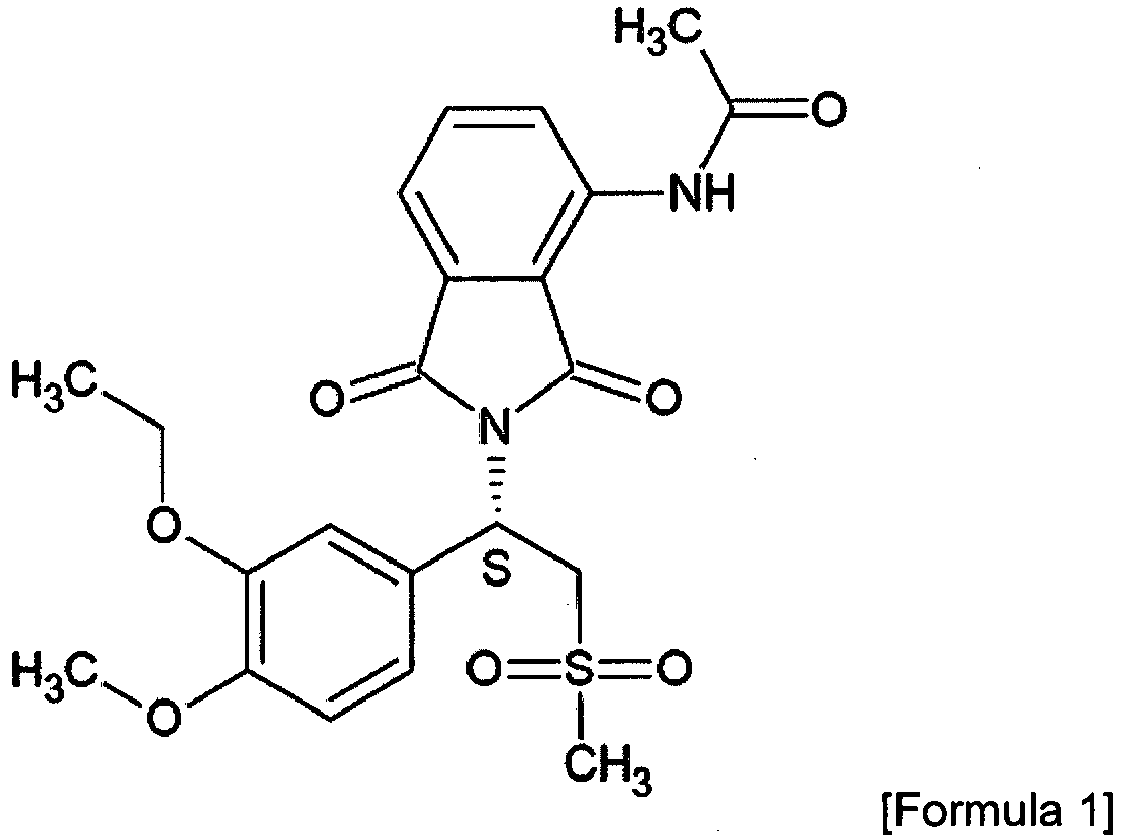
- N-[2-[(1S)-1-(3-ethoxy-4-methoxyphenyl)-2- (methylsulfonyl)ethyl]-1,3-dioxo-2,3-dihydro-1H-isoindol-4-yl]acetamide also referred to herein as "APM”
- APM has the following chemical formula (Formula 1), wherein "S”, if not connected via a chemical bond in the formula, denotes the S-form of the chiral center.
- Apremilast is a phosphodiesterase 4 inhibitor and blocks the action of an enzyme inside cells called phosphodiesterase 4 (PDE4).
- PDE4 phosphodiesterase 4
- This enzyme plays a role in triggering the production of messenger molecules in the immune system called cytokines, which are involved in inflammation and other processes that cause psoriasis and psoriatic arthritis.
- cytokines messenger molecules in the immune system
- By blocking PDE4 Apremilast reduces the level of these cytokines in the body, and so reduces the inflammation and other symptoms of psoriasis and psoriatic arthritis.
- Apremilast is the active ingredient of the medicament Otezla®, distributed by Celgene, Ltd, for the treatment of adults with psoriatic arthritis (inflammation of the joints associated with psoriasis) and moderate to severe plaque psoriasis (a disease causing red, scaly patches on the skin).
- EP2276483 B1 discloses various polymorphic forms of Apremilast, i.e. Forms A, B, C, D, E, F and G. Regarding the characterization of these Forms A, B, C, D, E, F and G, in particular their XRPD peak locations and intensity, reference is made to EP2276483 B1 .
- the stability, interconversion and equilibration studies in EP2276483 B1 show that most of these crystalline forms have a high tendency of interconversion, i.e. one polymorphic form converts into another polymorphic form in the presence of solvents.
- Form B is the commercially available form of Apremilast (Otezla®) and has quite good properties, there is a constant need for improvement of existing dosage forms.
- one objective underlying the present invention was to improve the existing dosage forms and existing forms of Apremilast.
- the invention relates to cocrystals of N-[2-[(1S)-1-(3-ethoxy-4-methoxyphenyl)-2-(methylsulfonyl)ethyl]-1,3-dioxo-2,3-dihydro-1H-isoindol-4-yl]acetamide with caffeine (APM-CAF) and 4-hydroxybenzoic acid (APM-4HB). It also refers to pharmaceutical compositions and dosage forms comprising said cocrystals. The invention also concerns said pharmaceutical compositions or dosage forms for use in a method of treating a disease or disorder defined in the claims. Finally, the invention pertains to the use of said cocrystals for the preparation of pharmaceutical compositions and dosage forms.
- cocrystals described herein may have various benefits over the known forms of Apremilast, in particular other known crystalline forms.
- the cocrystals of Apremilast with caffeine are stable, substantially non-solvated and slightly hygroscopic. They also have good flow characteristics.
- the cocrystals of Apremilast with caffeine have a superior dissolution profile, in particular a higher dissolution rate, in buffer pH 6.8 + 0.3% SLS, particularly compared to prior art Form B of Apremilast.
- the cocrystals of Apremilast with 4-hydroxybenzoic acid are stable, substantially non-solvated and have good flow characteristics.
- the cocrystals of Apremilast with 4-hydroxybenzoic acid have a superior dissolution profile, in buffer pH 6.8 + 0.3% SLS, particularly compared to prior art Form B of Apremilast.
- Form B is the commercially available form of Apremilast (Otezla®)
- benefits shown by the present cocrystals versus Form B demonstrate the unexpected improvements provided by the present application.
- a comparison with Form B is of great interest, since the marketed drug form generally represents the "gold standard" for any further pharmaceutical development.
- the present invention thus refers to cocrystals of N-[2-[(1S)-1-(3-ethoxy-4-methoxyphenyl)-2-(methylsulfonyl) ethyl]-1,3-dioxo-2,3-dihydro-1H-isoindol-4-yl]acetamide (Apremilast).
- it relates to cocrystals of Apremilast and caffeine (1,3,7-trimethylpurine-2,6-dione) or 4-hydroxybenzoic acid.
- solvent refers to any solvent such as water and organic or inorganic solvents.
- room temperature as used herein is understood to mean temperatures of about 15 °C to about 25 °C.
- the X-ray powder diffraction peaks of the cocrystals are described by their 2theta angles with a tolerance of " ⁇ 0.2". In the context of the present invention, it is also possible to use a smaller tolerance of " ⁇ 0.1” or even " ⁇ 0.0".
- crystal denotes one or more crystals of the same type, i.e. one or more crystals which are characterized by the same components, e.g., APM and caffeine, and the same crystal structure. In other words, the term “cocrystal” is not meant to be limited to one single piece of crystal.
- cocrystal refers to a crystalline form of a substance which comprises the drug component and at least one further component which is not a solvent, e.g., APM and caffeine. That is, the term “cocrystal” does not refer to cosolvates.
- cocrystals does not refer to a mixture of crystals of APM and crystals of the further compound (e.g., caffeine).
- Apremilast as the starting material for crystallizing the cocrystals of the present invention can be prepared by using any method.
- the invention refers to Apremilast-caffeine cocrystals (APM-CAF): C1. Cocrystal of N-[2-[(1 S)-1-(3-ethoxy-4-methoxyphenyl)-2-(methylsulfonyl) ethyl]-1,3-dioxo-2,3-dihydro-1H-isoindol-4-yl]acetamide and 1,3,7-trimethylpurine-2,6-dione (caffeine). C2.
- the ratio of of N-[2-[(1S)-1-(3-ethoxy-4-methoxyphenyl)-2-(methylsulfonyl) ethyl]-1,3-dioxo-2,3-dihydro-1H-isoindol-4-yl]acetamide to 1,3,7-trimethylpurine-2,6-dione can, e.g., be from 0.8:2 to 1.2:2.
- the ratio can be determined by using gaschromatographic analysis, quantitative 13C NMR measurement, or high performance liquid chromatography (HPLC) (see Figures 16 and 17 ).
- the cocrystal of item C1 or C2 having an X-ray powder diffraction pattern with peaks at 2-theta angles of 7.5 ⁇ 0.2 degrees 2theta, 11.3 ⁇ 0.2 degrees 2theta, 16.3 ⁇ 0.2 degrees 2theta, 17.7 ⁇ 0.2 degrees 2theta, 19.3 ⁇ 0.2 degrees 2theta, 21.4 ⁇ 0.2 degrees 2theta, 22.4 ⁇ 0.2 degrees 2theta, 24.7 ⁇ 0.2 degrees 2theta, 26.3 ⁇ 0.2 degrees 2theta, and 27.5 ⁇ 0.2 degrees 2theta when using Cu-K ⁇ radiation. Details regarding the X-ray powder diffraction measurement are provided herein below. C4. The cocrystal of any preceding items,
- the invention refers to 4-hydroxybenzoic acid cocrystals: H1.
- the cocrystal of item H1 or H2 having an X-ray powder diffraction pattern with peaks at 2-theta angles of 7.2 ⁇ 0.2 degrees 2theta, 9.3 ⁇ 0.2 degrees 2theta, 11.3 ⁇ 0.2 degrees 2theta, 12.3 ⁇ 0.2 degrees 2theta, 15.9 ⁇ 0.2 degrees 2theta, 17.3 ⁇ 0.2 degrees 2theta, 18.0 ⁇ 0.2 degrees 2theta, 20.6 ⁇ 0.2 degrees 2theta, 21.3 ⁇ 0.2 degrees 2theta, 21.7 ⁇ 0.2 degrees 2theta, 24.2 ⁇ 0.2 degrees 2theta, 25.5 ⁇ 0.2 degrees 2theta, 26.8 ⁇ 0.2 degrees 2theta, and 28.4 ⁇ 0.2 degrees 2theta when using Cu-K ⁇ radiation. Details regarding the X-ray powder diffraction measurement are provided herein below. H4.
- the cocrystal of any of items H1-H3 has an X-ray powder diffraction pattern with peaks at 2-theta angles of 7.2 ⁇ 0.2 degrees 2theta, 9.
- the invention further relates to pharmaceutical compositions or dosage forms as well as the use of the cocrystals:
- the step of formulating the cocrystals into a dosage form may be carried out by applying techniques known in the art, in particular as described herein.
- the cocrystals can be formulated into tablets by using direct compression, granulation processes, and spraying processes as described above. Examples are also given in the experimental part herein.
- Binding agents are excipients which increase the adhesion of the active agents and excipients during granulation.
- binding agents are: sugars, such as sorbitol, glucose, fructose, disaccharides as saccharose, polysaccharides; acacia gum; cellulose derivatives, such as soluble celluloses like microcrystalline cellulose, methylcellulose, hydroxypropylmethylcellulose and hydroxypropylcellulose; tragacanth; polyvinylpyrrolidone, such as polyvinylpyrrolidone-vinyl acetate copolymer, or N-vinylpyrrolidone; sodium alginate and alginate derivatives and gelatin.
- Disintegrants are excipients which can take up water and swell and thus improve disintegration of a tablet or granules.
- examples of disintegrants are: crospovidone, croscarmellose sodium; starch (paste and pre-gelatinized), such as sodium starch glycolate, methacrylic acid polymer with divinylbenzene, potassium salt, Maltodextrin; croscarmellose sodium and low substituted hydroxypropylcellulose and crospovidone.
- Lubricants are excipients which reduce the friction between excipients and compression tooling surfaces.
- examples of lubricants are magnesium stearate, magnesium fumarate, fumaric-acid, talc, steraric acid and sodium stearylfumarate.
- Fillers are excipients which increase the volume of e.g. tablets.
- examples of fillers are mannitol, celluloses such as microcrystalline cellulose, synthetic polymers, Ca-phosphate, inorganic calcium salts, maize starch, polyols and pregelatinized starch.
- a polymer, or a plurality of polymers may be used for coating tablets, including for example cellulose derivatives, e.g. hydroxypropylmethylcellulose, polyvinylpyrrolidones, polyethyleneglycols, polyvinylalcohols, acrylates, such as polymethacrylate, cyclodextrins and copolymers and derivatives thereof, including for example polyvinylpyrolidine-vinylacetate.
- the polymer or the plurality of polymers are pH dependent enteric polymers.
- Such polymers include cellulose derivatives, e.g.
- cellulose acetate phthalate hydroxypropyl methyl cellulose phthalates, hydroxypropyl methyl acetate succinate, hydroxypropyl methyl cellulose acetate, carboxymethylcellulose or a salt thereof, e.g., the sodium salt, cellulose acetate trimellitate, hydroxypropylcellulose acetate phthalate, or polymethylacrylates, e.g., Eudragit®S.
- Surfactants include but are not limited to, sorbitan fatty esters, polyoxyethylene sorbit esters, sodium laurylsulfate, sodium docedylbenzenesulfate, dioctyl sodium sulfosuccinate, sodium stearate, EDTA or vitamin E or tocol derivates.
- compositions/dosage forms Most preferred for preparing pharmaceutical compositions/dosage forms is the use of one or more, preferably all, of lactose monohydrate, microcrystalline cellulose, magnesium stearate and croscarmellose sodium.
- Purity and assay analysis can be carried out using Ultra Performance Liquid Chromatograph Waters Acquity I-Class equipped with PDA detector.
- the analysis can be conducted using Waters Acquity UPLC BEH C18 1.7 ⁇ m, 2.1x100 mm column, at a temperature of 60°C.
- the mobile phases were acetonitrile and 0.1 %(v/v) ortho-phosphoric acid in water used in gradient.
- Determination of residual solvents can be carried out using Perkin Elmer Clarus 680 Gas Chromatograph with flame-ionization detector (FID) with carrier gas split, equipped with TurboMatrix 110 Trap a headspace autosampler.
- FID flame-ionization detector
- the analysis of the crystals by X-Ray diffraction was performed using X-ray Diffractometer Rigaku MiniFlex 600 in Bragg-Brentano geometry Cu K ⁇ radiation, D/teX Ultra Detector in a range of 3-36° of 2 ⁇ angle.
- the patterns were recorded at a tube voltage of 40 kV, tube current of 15 mA, applying a step size of 0.013° 2° with 80s per step.
- DSC analysis were carried out using DSC 1 Mettler Toledo Stare thermal analysis system at the temperature range of 25-250°C with the gradient of 5°C/min. Melting, aluminum crucible with the capacity of 40 ⁇ l were used. Nitrogen was used as carried gas with the flow of 50ml/min.
- TGA analysis were carried out using TGA/SDTA85 Mettler Toledo Stare thermal analysis system at the temperature range of 25-220°C with the gradient of 7°C/min. Melting, aluminum crucible with the capacity of 100 ⁇ l were used. Nitrogen was used as carried gas with the flow of 50ml/min.
- the DVS apparatus consists of an ultra-microbalance housed inside a temperature-controlled cabinet.
- the sample was placed into a DVS sample pan under a stream of nitrogen (200 sccm) at 25°C.
- the humidity was increased ramping in 10% RH (relative humidity) steps from close to 0% RH to 90% RH (sorption phase).
- RH relative humidity
- sorption phase the humidity was decreased in a similar fashion for the desorption phase.
- the sample was held at each RH step for mass stabilization (dm/dt 0.02 %/min) but not less than 10 minutes. Two cycles of sorption and desorption were investigated.
- Dissolution studies were performed using a Hanson SR8PLUS dissolution apparatus, according to European Pharmacopoeia apparatus, paddle method. The samples were tested in 900mL pH 6.8 with 0.3% SLS at 37.0°C +/- 0.5°C and the paddle rotation speed was set at 75 rpm. Dissolution study was conducted for 60min and samples were analyzed using HPLC method.
- IR analysis were performed on FT-IR Thermo Nicolet Avatar 370 Spectrometer in ATR method and PIKE TECHNOLOGIES Smart MIRacleTM Single Reflection HATR module.
- a test for stability against humidity can be performed as follows: The sample is exposed to a relative humidity of 75% (+/- 5%) at 50°C (+/- 2°C) for 2 weeks.
- the expression "polymorphically stable" means that no conversion to another crystalline form occurs, as determined by XRPD.
- the equilibrium relative humidity of a sample is measured by determining the relative humidity in % in the air above a test sample, after establishment of a humidity equilibrium in a closed/open system at a constant temperature.
- APM-1 (see Figure 1 ) (9.65g) was dissolved in dimethylacetamide (100ml) at ambient temperature. Then APM-2 (see Figure 1 ) (20g) was suspended and dimethylacetamide (100 ml) was added. After warming up of the suspension to a temperature of 110-120°C under flow of inert gas, the reaction mixture was stirred between 2-4 hours.
- Crystalline Apremilast and caffeine cocrystals can be characterized by a X-ray powder diffraction pattern having peaks at 7.5, 11.3, 16.3, 17.7, 19.3, 21.4, 22.4, 24.7, 26.3 and 27.5 degrees two theta, in particular an X-ray powder diffraction pattern as shown in Figure 3 .
- IR can be used to identify the nature of the cocrystal formation.
- the IR spectrum of Apremilast cocrystal with caffeine is shown in Figure 4 .
- Crystalline Apremilast and caffeine cocrystals may be also characterized by thermal analysis.
- a representative DSC plot for Apremilast and caffeine cocrystals is shown in Figure 5 .
- the DSC plot comprises an endothermic event with an onset temperature of [148.52 ⁇ 6 °C].
- a representative TGA plot for Apremilast and caffeine cocrystals is shown in Figure 6 .
- the TGA plot comprises a mass loss of less than about 0.5%, e.g., less than 0.3%, of the total mass of the sample upon heating from about 25°C to about 160°C.
- Apremilast and caffeine cocrystals may be characterized by moisture sorption analysis.
- a representative moisture sorption isotherm plot is shown in Figure 7 .
- RH moisture sorption analysis
- a mass change of less than about 0.5%, e.g., about 0.45%, of the starting at about 0% RH occurs.
- Apremilast and caffeine cocrystal is slightly hygroscopic.
- Figure 3 shows a representative XRPD pattern of Apremilast and caffeine cocrystal, wherein the data are summarized in Table 3: Table 3.
- No. 2-theta(deg) Rel. int. I(a.u.) 1 7.469(3) 64.87 2 9.074(6) 10.22 3 9.664(6) 7.87 4 11.253(3) 45.03 5 11.932(5) 15.16 6 13.162(7) 5.51 7 13.9752(15) 22.44 8 15.259(9) 26.60 9 16.340(4) 49.07 10 17.701(4) 75.35 11 19.291(13) 33.56 12 20.186(15) 15.77 13 20.70(2) 11.69 14 21.353(10) 32.94 15 22.39(2) 34.22 16 23.39(3) 21.45 17 24.697(14) 34.53 18 25.418(18) 20.11 19 26.290(8) 100.00 20 27.456(14) 36.86 21 28.945(12) 31.25 22 29.724(14) 9.38 23 30.44
- Figure 4 shows a representative IR spectrum of Apremilast and caffeine cocrystal, wherein the data are summarized in the following: Wavenumber [cm -1 ]: 3369, 2981, 2939, 2360, 2342, 1760, 1722, 1696, 1611, 1524, 1479, 1446, 1426, 1394, 1365, 1336, 1295, 1268, 1256, 1212, 1191, 1172, 1155, 1136, 1099, 1028, 962, 872, 838, 823, 775, 753, and 654.
- Example 6 Dissolution properties of cocrystals of Apremilast with caffeine
- Table 4 shows the dissolution profile of Apremilast cocrystal with caffeine and Form B in buffer pH 6.8 + 0.3% SLS (see also Figure 8 ).
- Example 001 Ingredient mg/tabl %/tabl Apremilast (Form B) 30.00 10.00 Lactose monohydrate 171.00 57.00 Microcrystalline cellulose 85.50 28.50 Croscarmellose sodium 11.25 3.75 Magnesium stearate 2.25 0.75 total: 300.00 100.00
- Example 8 Stability tests with tablets containing Apremilast cocrystal with caffeine
- Sample 009 comprising Apremilast cocrystal with caffeine was prepared as follows:
- Crystalline Apremilast and 4-hydroxybenzoic acid cocrystal can be characterized by X-ray powder diffraction pattern having peaks at 7.2, 9.3, 11.3, 12.3, 17.3, 18.0, 20.6, 21.3, 21.7, 24.2, 25.5, 26.8, and 28.4 degrees two theta, an X-ray powder diffraction pattern as depicted in Figure 10 .
- the XRPD data are summarized in Table 9: Table 9. No. 2-theta(deg) Rel. int.
- IR can be used to identify the nature of the cocrystal formation.
- the energy of the antisymmetric stretching mode of the carbonyl group could be used to identify the nature of the species formed.
- Crystalline Apremilast and 4-hydroxybenzoic acid cocrystal may be also characterized by thermal analysis.
- a representative DSC plot for Apremilast and 4-hydroxybenzoic acid cocrystal is shown in Figure 12 .
- DSC plot of Apremilast and 4-hydroxybenzoic acid cocrystal comprising an endothermic event with an onset temperature of about 148°C ⁇ 2°C.
- TGA plot for Apremilast and 4-hydroxybenzoic acid cocrystal is shown in Figure 13 .
- TGA plot comprising a mass loss of less than about 1.0%, e.g., less than 0.7%, of the total mass of the sample upon heating from about 25°C to about 160°C.
- Apremilast and 4-hydroxybenzoic acid cocrystal may be characterized by moisture sorption analysis.
- a representative moisture sorption isotherm plot is shown in Figure 14 , when the RH is increased from about 0% to about 95% RH exhibiting a mass change of less than about 1%, e.g., about 0.7%, of the starting about 0% RH.
- Apremilast and 4-hydroxybenzoic acid cocrystal is slightly hygroscopic.
- Example 13 Dissolution properties of cocrystals of Apremilast with 4-hydroxybenzoic acid
- Figure 15 shows a dissolution profile of cocrystals of Apremilast with 4-hydroxybenzoic acid of the present invention compared with that of prior art Form B (see Example 7), wherein the new cocrystal of Apremilast with 4-hydroxybenzoic acid exhibited a higher dissolution rate.
- Example 14 Stability tests with tablets containing Apremilast cocrystal with 4-hydroxybenzoic acid
- Sample 008 comprising Apremilast cocrystal with 4-hydroxybenzoic acid was prepared as follows: Apremilast cocrystal with 4-hydroxybenzoic acid, lactose monohydrate, microcrystalline cellulose, croscarmellose sodium were passed through a 0.425 mm sieve. The ingredients from the previous step were mixed in a blender for 15 min at 25 RPM. Magnesium stearate was added and the resulting mixture was mixed for 5 min at 12 RPM. The resulting blend was compressed using a single punch machine equipped with oval punch (14x8mm) at a compression force of 7 kN, see Table 11. Table 11.
- CPMAS NMR experiments were performed on a Bruker Avance III 400 spectrometer, at a frequency of 100.61 MHz for 13C, which was equipped with a MAS probehead using 4-mm ZrO2 rotors.
- a sample of glycine (Gly) was used to set the Hartmann-Hahn condition for 13C nuclei.
- Spectra use adamantane as a secondary chemical-shift reference at 38.48 and 29.46 ppm from external tetramethylsilane (TMS). Samples were spun ad 8kHz. For pure apremilast sample repetition rate was equal to 10s, for obtained adequate signal-to-noisy ratio we collected 512 scans.
Landscapes
- Chemical & Material Sciences (AREA)
- Organic Chemistry (AREA)
- Health & Medical Sciences (AREA)
- Pain & Pain Management (AREA)
- Rheumatology (AREA)
- Chemical Kinetics & Catalysis (AREA)
- General Chemical & Material Sciences (AREA)
- Medicinal Chemistry (AREA)
- Nuclear Medicine, Radiotherapy & Molecular Imaging (AREA)
- Pharmacology & Pharmacy (AREA)
- Life Sciences & Earth Sciences (AREA)
- Animal Behavior & Ethology (AREA)
- General Health & Medical Sciences (AREA)
- Public Health (AREA)
- Veterinary Medicine (AREA)
- Pharmaceuticals Containing Other Organic And Inorganic Compounds (AREA)
- Indole Compounds (AREA)
Abstract
The invention relates to cocrystals of N-[2-[(1S)-1-(3-ethoxy-4-methoxyphenyl)-2-(methylsulfonyl)ethyl]-1,3-dioxo-2,3-dihydro-1H-isoindol-4-yl]acetamide (Apremilast) with caffeine (APM-CAF) and 4-hydroxybenzoic acid (APM-4HB). It also refers to pharmaceutical compositions and dosage forms comprising said cocrystals. The invention also concerns said pharmaceutical compositions or dosage forms for use in a method of treating a disease or disorder defined in the claims. Finally, the invention pertains to the use of said cocrystals for the preparation of pharmaceutical compositions and dosage forms.
Description
- The invention relates to cocrystals of Apremilast and pharmaceutical compositions/dosage forms containing same. It also refers to the use of said cocrystals for the preparation of a pharmaceutical composition or dosage form. The invention also concerns said pharmaceutical compositions or dosage forms for use in a method of treating a disease or disorder as defined in the claims.
- Apremilast, i.e. N-[2-[(1S)-1-(3-ethoxy-4-methoxyphenyl)-2- (methylsulfonyl)ethyl]-1,3-dioxo-2,3-dihydro-1H-isoindol-4-yl]acetamide, also referred to herein as "APM", has the following chemical formula (Formula 1), wherein "S", if not connected via a chemical bond in the formula, denotes the S-form of the chiral center.
- Apremilast is a
phosphodiesterase 4 inhibitor and blocks the action of an enzyme inside cells called phosphodiesterase 4 (PDE4). This enzyme plays a role in triggering the production of messenger molecules in the immune system called cytokines, which are involved in inflammation and other processes that cause psoriasis and psoriatic arthritis. By blocking PDE4, Apremilast reduces the level of these cytokines in the body, and so reduces the inflammation and other symptoms of psoriasis and psoriatic arthritis. Apremilast is the active ingredient of the medicament Otezla®, distributed by Celgene, Ltd, for the treatment of adults with psoriatic arthritis (inflammation of the joints associated with psoriasis) and moderate to severe plaque psoriasis (a disease causing red, scaly patches on the skin). -
EP2276483 B1 discloses various polymorphic forms of Apremilast, i.e. Forms A, B, C, D, E, F and G. Regarding the characterization of these Forms A, B, C, D, E, F and G, in particular their XRPD peak locations and intensity, reference is made toEP2276483 B1 . The stability, interconversion and equilibration studies inEP2276483 B1 show that most of these crystalline forms have a high tendency of interconversion, i.e. one polymorphic form converts into another polymorphic form in the presence of solvents. Although Form B is the commercially available form of Apremilast (Otezla®) and has quite good properties, there is a constant need for improvement of existing dosage forms. - Accordingly, one objective underlying the present invention was to improve the existing dosage forms and existing forms of Apremilast.
- The invention relates to cocrystals of N-[2-[(1S)-1-(3-ethoxy-4-methoxyphenyl)-2-(methylsulfonyl)ethyl]-1,3-dioxo-2,3-dihydro-1H-isoindol-4-yl]acetamide with caffeine (APM-CAF) and 4-hydroxybenzoic acid (APM-4HB). It also refers to pharmaceutical compositions and dosage forms comprising said cocrystals. The invention also concerns said pharmaceutical compositions or dosage forms for use in a method of treating a disease or disorder defined in the claims. Finally, the invention pertains to the use of said cocrystals for the preparation of pharmaceutical compositions and dosage forms.
-
- Figure 1:
- shows the preparation of N-[2-[(1S)-1-(3-ethoxy-4-methoxyphenyl)-2-(methylsulfonyl)ethyl]-1,3-dioxo-2,3-dihydro-1H-isoindol-4-yl]acetamide (APM).
- Figure 2:
- shows the cocrystallization of N-[2-[(1S)-1-(3-ethoxy-4-methoxyphenyl)-2-(methylsulfonyl)ethyl]-1,3-dioxo-2,3-dihydro-1H-isoindol-4-yl]acetamide (APM) with caffeine.
- Figure 3:
- shows a representative XRPD pattern of Apremilast and caffeine cocrystal.
- Figure 4:
- shows a representative IR spectrum of Apremilast and caffeine cocrystal.
- Figure 5:
- shows a representative DSC plot of Apremilast and caffeine cocrystal.
- Figure 6:
- shows a representative TGA plot of Apremilast and caffeine cocrystal.
- Figure 7:
- shows a representative DVS plot of Apremilast and caffeine cocrystal.
- Figure 8:
- shows the dissolution profile of a cocrystal of Apremilast with caffeine compared with that of prior art Form B of Apremilast.
- Figure 9:
- shows the cocrystallization of N-[2-[(1S)-1-(3-ethoxy-4-methoxyphenyl)-2-(methylsulfonyl)ethyl]-1,3-dioxo-2,3-dihydro-1H-isoindol-4-yl]acetamide (APM) with 4-hydroxybenzoic acid.
- Figure 10:
- shows a representative XRPD pattern of Apremilast and 4-hydroxybenzoic acid cocrystal.
- Figure 11:
- shows a representative IR spectrum of Apremilast and 4-hydroxybenzoic acid cocrystal.
- Figure 12:
- shows a representative DSC plot of Apremilast and 4-hydroxybenzoic acid cocrystal.
- Figure 13:
- shows a representative TGA plot of Apremilast and 4-hydroxybenzoic acid cocrystal.
- Figure 14:
- shows a representative DVS plot of Apremilast and 4-hydroxybenzoic acid cocrystal.
- Figure 15:
- shows the dissolution profile of cocrystal of Apremilast with 4-hydroxybenzoic acid compared with that of prior art Form B of Apremilast.
- Figure 16:
- shows the results of 13C CP/MAS NMR experiments with Apremilast, 4-hydroxybenzoic acid and cocrystals of APM and 4-hydroxybenzoic acid (
Figure 16a : pure ApremilastFigure 16b : 4-hydroxybenzoic acid,Figure 16c : cocrystals of Apremilast and 4-hydroxybenzoic acid). - Figure 17:
- shows the results of 13C CP/MAS NMR experiments with Apremilast, caffeine and cocrystals of APM and caffeine (
Figure 17a : pure apremilastFigure 17b : caffeine,Figure 17c : cocrystals of Apremilast and caffeine). - It has unexpectedly been found that it is possible to provide cocrystals of Apremilast with caffeine and 4-hydroxybenzoic acid. In general, the successful formation of cocrystals is neither predictable nor otherwise guaranteed (see
Experiment 15, summarizing some cocrystallization experiments). Furthermore, computational analysis cannot predict the structure or properties of cosolvates. Of particular importance is the fact that cocrystal formation is a new field where there is generally not yet much experience and knowledge available in the art. As such, general trends are not yet evident. It is also expected that the change in properties when comparing a drug polymorph with cocrystals will be far more drastic as compared with the variance in properties amongst polymorphs. This means that the chances of success for providing cocrystals having properties comparable to existing polymorphs, or even improved cocrystals, in the present case were generally low. - It can also be expected that processes for producing cocrystals, in particular in large scale applications, will require different approaches as have been developed in the field of polymorphs. At present the number of drug cocrystals in pharmaceutics on the market, if any, is low.
- The cocrystals described herein may have various benefits over the known forms of Apremilast, in particular other known crystalline forms.
- The cocrystals of Apremilast with caffeine (1,3,7-Trimethylxanthine or 1,3,7-Trimethylpurine-2,6-dione) are stable, substantially non-solvated and slightly hygroscopic. They also have good flow characteristics. In particular, the cocrystals of Apremilast with caffeine have a superior dissolution profile, in particular a higher dissolution rate, in buffer pH 6.8 + 0.3% SLS, particularly compared to prior art Form B of Apremilast.
- The cocrystals of Apremilast with 4-hydroxybenzoic acid are stable, substantially non-solvated and have good flow characteristics. In particular, the cocrystals of Apremilast with 4-hydroxybenzoic acid have a superior dissolution profile, in buffer pH 6.8 + 0.3% SLS, particularly compared to prior art Form B of Apremilast.
- Since Form B is the commercially available form of Apremilast (Otezla®), benefits shown by the present cocrystals versus Form B demonstrate the unexpected improvements provided by the present application. In particular, a comparison with Form B is of great interest, since the marketed drug form generally represents the "gold standard" for any further pharmaceutical development.
- Accordingly, the objective underlying the present invention has been solved.
- The present invention thus refers to cocrystals of N-[2-[(1S)-1-(3-ethoxy-4-methoxyphenyl)-2-(methylsulfonyl) ethyl]-1,3-dioxo-2,3-dihydro-1H-isoindol-4-yl]acetamide (Apremilast). In particular, it relates to cocrystals of Apremilast and caffeine (1,3,7-trimethylpurine-2,6-dione) or 4-hydroxybenzoic acid.
- Within the meaning of the present invention, the term "solvent" refers to any solvent such as water and organic or inorganic solvents.
- The term "room temperature" as used herein is understood to mean temperatures of about 15 °C to about 25 °C.
- Herein, the X-ray powder diffraction peaks of the cocrystals are described by their 2theta angles with a tolerance of "±0.2". In the context of the present invention, it is also possible to use a smaller tolerance of "±0.1" or even "±0.0".
- The term "cocrystal" denotes one or more crystals of the same type, i.e. one or more crystals which are characterized by the same components, e.g., APM and caffeine, and the same crystal structure. In other words, the term "cocrystal" is not meant to be limited to one single piece of crystal. The term "cocrystal" refers to a crystalline form of a substance which comprises the drug component and at least one further component which is not a solvent, e.g., APM and caffeine. That is, the term "cocrystal" does not refer to cosolvates. The term "cocrystals" does not refer to a mixture of crystals of APM and crystals of the further compound (e.g., caffeine).
- Regarding the synthesis of Apremilast, reference is made to Example 1 herein, as well as to
EP2276483 B1 andUS 6,962,940 . Apremilast as the starting material for crystallizing the cocrystals of the present invention can be prepared by using any method. - The invention is further described with respect to the following items:
- In one aspect, the invention refers to Apremilast-caffeine cocrystals (APM-CAF):
C1. Cocrystal of N-[2-[(1 S)-1-(3-ethoxy-4-methoxyphenyl)-2-(methylsulfonyl) ethyl]-1,3-dioxo-2,3-dihydro-1H-isoindol-4-yl]acetamide and 1,3,7-trimethylpurine-2,6-dione (caffeine).
C2. The cocrystal of item C1, wherein the molar ratio of N-[2-[(1S)-1-(3-ethoxy-4-methoxyphenyl)-2-(methylsulfonyl) ethyl]-1,3-dioxo-2,3-dihydro-1H-isoindol-4-yl]acetamide to 1,3,7-trimethylpurine-2,6-dione is about 1:2. That is, the ratio of of N-[2-[(1S)-1-(3-ethoxy-4-methoxyphenyl)-2-(methylsulfonyl) ethyl]-1,3-dioxo-2,3-dihydro-1H-isoindol-4-yl]acetamide to 1,3,7-trimethylpurine-2,6-dione can, e.g., be from 0.8:2 to 1.2:2. The ratio can be determined by using gaschromatographic analysis, quantitative 13C NMR measurement, or high performance liquid chromatography (HPLC) (seeFigures 16 and17 ).
C3. The cocrystal of item C1 or C2, having an X-ray powder diffraction pattern with peaks at 2-theta angles of 7.5±0.2 degrees 2theta, 11.3±0.2 degrees 2theta, 16.3±0.2 degrees 2theta, 17.7±0.2 degrees 2theta, 19.3±0.2 degrees 2theta, 21.4±0.2 degrees 2theta, 22.4±0.2 degrees 2theta, 24.7±0.2 degrees 2theta, 26.3 ±0.2 degrees 2theta, and 27.5 ±0.2 degrees 2theta when using Cu-Kα radiation. Details regarding the X-ray powder diffraction measurement are provided herein below.
C4. The cocrystal of any preceding items, - (i) having a single endothermic event in a differential scanning calorimeter plot, preferably with a peak value at 148.52±6 °C, further preferred at 148.52±4 °C, even more preferred at 148.52±2 °C; and/or
- (ii) wherein the X-ray powder diffraction pattern has further peaks at 2-theta angles of 9.1±0.2 degrees 2theta, 11.9±0.2 degrees 2theta, 14.0±0.2 degrees 2theta, 15.3±0.2 degrees 2theta, 20.2±0.2 degrees 2theta, 20.7±0.2 degrees 2theta, 23.4±0.2 degrees 2theta, 25.4±0.2 degrees 2theta, and 28.9±0.2 degrees 2theta, when using Cu-Kα radiation; and/or
- (iii) which is substantially polymorphically pure, and preferably contains less than 5 wt.-% of other crystalline, non-crystalline or amorphous forms of N-[2-[(1S)-1-(3-ethoxy-4-methoxyphenyl)-2- (methylsulfonyl)ethyl]-1,3-dioxo-2,3-dihydro-1H-isoindol-4-yl]acetamide, 1,3,7-trimethylpurine-2,6-dione, and cocrystals thereof.
- In a further aspect, the invention refers to 4-hydroxybenzoic acid cocrystals:
H1. Cocrystal of N-[2-[(1S)-1-(3-ethoxy-4-methoxyphenyl)-2-(methylsulfonyl)ethyl]-1,3-dioxo-2,3-dihydro-1H-isoindol-4-yl]acetamide and 4-hydroxybenzoic acid.
H2. The cocrystal of item H1, wherein the molar ratio of N-[2-[(1S)-1-(3-ethoxy-4-methoxyphenyl)-2-(methylsulfonyl) ethyl]-1,3-dioxo-2,3-dihydro-1H-isoindol-4-yl]acetamide to 4-hydroxybenzoic acid is about 1:2.
H3. The cocrystal of item H1 or H2, having an X-ray powder diffraction pattern with peaks at 2-theta angles of 7.2±0.2 degrees 2theta, 9.3±0.2 degrees 2theta, 11.3±0.2 degrees 2theta, 12.3±0.2 degrees 2theta, 15.9±0.2 degrees 2theta, 17.3±0.2 degrees 2theta, 18.0±0.2 degrees 2theta, 20.6±0.2 degrees 2theta, 21.3±0.2 degrees 2theta, 21.7±0.2 degrees 2theta, 24.2±0.2 degrees 2theta, 25.5±0.2 degrees 2theta, 26.8±0.2 degrees 2theta, and 28.4±0.2 degrees 2theta when using Cu-Kα radiation. Details regarding the X-ray powder diffraction measurement are provided herein below.
H4. The cocrystal of any of items H1-H3, - (i) having a single endothermic event in a differential scanning calorimeter plot, preferably with a peak value at 153.40±6 °C, further preferred at 153.40±4 °C, even more preferred at 153.40±6 °C; and/or
- (ii) wherein the X-ray powder diffraction pattern has further peaks at 2-theta angles of 13.1±0.2 degrees 2theta, 13.5±0.2 degrees 2theta, 19.9±0.2 degrees 2theta, and 27.9±0.2 degrees 2theta, when using Cu-Kα radiation; and/or
- (iii) which is substantially polymorphically pure, and preferably contains less than 5 wt.-% of other crystalline, non-crystalline or amorphous forms of N-[2-[(1S)-1-(3-ethoxy-4-methoxyphenyl)-2- (methylsulfonyl)ethyl]-1,3-dioxo-2,3-dihydro-1H-isoindol-4-yl]acetamide, 4-hydroxybenzoic acid, and cocrystals thereof.
- The invention further relates to pharmaceutical compositions or dosage forms as well as the use of the cocrystals:
- 1. Pharmaceutical composition or dosage form comprising the cocrystal of any of the preceding items, or the mixture of cocrystals of any of the preceding items.
- 2. The pharmaceutical dosage form of
item 1, which is a solid oral dosage form. - 3. The pharmaceutical composition or dosage form of
item - 4. Pharmaceutical composition or dosage form of any of items 1-3 for use in a method of treating a disease or disorder selected from the group consisting of: psoriasis; psoriatic arthritis; rheumatoid arthritis; chronic cutaneous sarcoid; giant cell arteritis; Parkinson's Disease; prurigo nodularis; lichen planus; complex apthosis; Behcet's Disease; lupus; hepatitis; uveitis; Sjogren's Disease; depression; interstitial cystitis; vulvodynia; prostatitis; osteoarthritis; diffuse large B cell lymphoma; polymysoitis; dermatomyositis; inclusion body myositis; erosive osteoarthritis; interstitial cystitis; hepatitis; endometriosis; radiculopathy; and pyoderma gangrenosum.
- 5. Pharmaceutical composition or dosage form of any of items 1-3 for use in a method of treating or preventing a disease or disorder selected from the group consisting of: HIV; hepatitis; adult respiratory distress syndrome; bone resorption diseases; chronic obstructive pulmonary diseases; chronic pulmonary inflammatory diseases; dermatitis; inflammatory skin disease, atopic dermatitis, cystic fibrosis; septic shock; sepsis; endotoxic shock; hemodynamic shock; sepsis syndrome; post ischemic re perfusion injury; meningitis; psoriasis; psoriatic arthritis; fibrotic disease; cachexia; graft rejection including graft versus host disease; auto immune disease; rheumatoid spondylitis; arthritic conditions, such as rheumatoid arthritis and osteoarthritis; osteoporosis; Crohn's disease; ulcerative colitis; inflammatory bowel disease; multiple sclerosis; systemic lupus erythrematosus; erythema nodosum leprosum in leprosy; radiation damage; asthma; and hyperoxic alveolar injury.
- 6. Use of a cocrystal of any of the preceding items, or a mixture of cocrystals of any of the preceding items, for the preparation of a pharmaceutical composition or dosage form.
- 7. Use of a cocrystal of any of the preceding items, as a starting material for preparing an oral solid pharmaceutical dosage form comprising said cocrystal.
- 8. Method of treating a patient by administering a cocrystal of any of the preceding items, or a mixture of cocrystals of any of the preceding items to a patient in need thereof, in particular a patient having a disease as recited in
items 4 and/or 5. - The step of formulating the cocrystals into a dosage form may be carried out by applying techniques known in the art, in particular as described herein. For example, the cocrystals can be formulated into tablets by using direct compression, granulation processes, and spraying processes as described above. Examples are also given in the experimental part herein.
- Exemplary pharmaceutically acceptable excipients which can be contemplated for use in the present invention are described in the following:
- Binding agents are excipients which increase the adhesion of the active agents and excipients during granulation. Examples of binding agents are: sugars, such as sorbitol, glucose, fructose, disaccharides as saccharose, polysaccharides; acacia gum; cellulose derivatives, such as soluble celluloses like microcrystalline cellulose, methylcellulose, hydroxypropylmethylcellulose and hydroxypropylcellulose; tragacanth; polyvinylpyrrolidone, such as polyvinylpyrrolidone-vinyl acetate copolymer, or N-vinylpyrrolidone; sodium alginate and alginate derivatives and gelatin.
- Disintegrants are excipients which can take up water and swell and thus improve disintegration of a tablet or granules. Examples of disintegrants are: crospovidone, croscarmellose sodium; starch (paste and pre-gelatinized), such as sodium starch glycolate, methacrylic acid polymer with divinylbenzene, potassium salt, Maltodextrin; croscarmellose sodium and low substituted hydroxypropylcellulose and crospovidone.
- Lubricants are excipients which reduce the friction between excipients and compression tooling surfaces. Examples of lubricants are magnesium stearate, magnesium fumarate, fumaric-acid, talc, steraric acid and sodium stearylfumarate.
- Fillers are excipients which increase the volume of e.g. tablets. Examples of fillers are mannitol, celluloses such as microcrystalline cellulose, synthetic polymers, Ca-phosphate, inorganic calcium salts, maize starch, polyols and pregelatinized starch.
- A polymer, or a plurality of polymers may be used for coating tablets, including for example cellulose derivatives, e.g. hydroxypropylmethylcellulose, polyvinylpyrrolidones, polyethyleneglycols, polyvinylalcohols, acrylates, such as polymethacrylate, cyclodextrins and copolymers and derivatives thereof, including for example polyvinylpyrolidine-vinylacetate. In some preferred embodiments the polymer or the plurality of polymers are pH dependent enteric polymers. Such polymers include cellulose derivatives, e.g. cellulose acetate phthalate, hydroxypropyl methyl cellulose phthalates, hydroxypropyl methyl acetate succinate, hydroxypropyl methyl cellulose acetate, carboxymethylcellulose or a salt thereof, e.g., the sodium salt, cellulose acetate trimellitate, hydroxypropylcellulose acetate phthalate, or polymethylacrylates, e.g., Eudragit®S.
- Surfactants include but are not limited to, sorbitan fatty esters, polyoxyethylene sorbit esters, sodium laurylsulfate, sodium docedylbenzenesulfate, dioctyl sodium sulfosuccinate, sodium stearate, EDTA or vitamin E or tocol derivates.
- Most preferred for preparing pharmaceutical compositions/dosage forms is the use of one or more, preferably all, of lactose monohydrate, microcrystalline cellulose, magnesium stearate and croscarmellose sodium.
- Other excipients are known in the art and can be chosen by a skilled person depending on their function.
- Purity and assay analysis can be carried out using Ultra Performance Liquid Chromatograph Waters Acquity I-Class equipped with PDA detector. The analysis can be conducted using Waters Acquity UPLC BEH C18 1.7µm, 2.1x100 mm column, at a temperature of 60°C. The mobile phases were acetonitrile and 0.1 %(v/v) ortho-phosphoric acid in water used in gradient.
- Determination of residual solvents can be carried out using Perkin Elmer Clarus 680 Gas Chromatograph with flame-ionization detector (FID) with carrier gas split, equipped with
TurboMatrix 110 Trap a headspace autosampler. Thecapillary column 60 m x 0.32mm ID x 1.8µm and stationary phase (6%)-cyanopropyl-phenyl-(94%)-dimethylsiloxane DB-624 Agilent Technologies at the temperature gradient can be used. - The analysis of the crystals by X-Ray diffraction was performed using X-ray Diffractometer Rigaku MiniFlex 600 in Bragg-Brentano geometry Cu Kα radiation, D/teX Ultra Detector in a range of 3-36° of 2θ angle. The wavelength of the Cu-Kα radiation used herein is λ=1.5406 Angstrom. The patterns were recorded at a tube voltage of 40 kV, tube current of 15 mA, applying a step size of 0.013° 2° with 80s per step.
- DSC analysis were carried out using
DSC 1 Mettler Toledo Stare thermal analysis system at the temperature range of 25-250°C with the gradient of 5°C/min. Melting, aluminum crucible with the capacity of 40µl were used. Nitrogen was used as carried gas with the flow of 50ml/min. - TGA analysis were carried out using TGA/SDTA85 Mettler Toledo Stare thermal analysis system at the temperature range of 25-220°C with the gradient of 7°C/min. Melting, aluminum crucible with the capacity of 100µl were used. Nitrogen was used as carried gas with the flow of 50ml/min.
- Water Vapour Sorption isotherms were obtained using a Dynamic Vapour Sorption apparatus (model: DVS - Advantage, supplier: Surface Measurement Systems Limited). The DVS apparatus consists of an ultra-microbalance housed inside a temperature-controlled cabinet. The sample was placed into a DVS sample pan under a stream of nitrogen (200 sccm) at 25°C. The humidity was increased ramping in 10% RH (relative humidity) steps from close to 0% RH to 90% RH (sorption phase). Next the humidity was decreased in a similar fashion for the desorption phase. The sample was held at each RH step for mass stabilization (dm/dt 0.02 %/min) but not less than 10 minutes. Two cycles of sorption and desorption were investigated.
- Dissolution studies were performed using a Hanson SR8PLUS dissolution apparatus, according to European Pharmacopoeia apparatus, paddle method. The samples were tested in 900mL pH 6.8 with 0.3% SLS at 37.0°C +/- 0.5°C and the paddle rotation speed was set at 75 rpm. Dissolution study was conducted for 60min and samples were analyzed using HPLC method.
- IR analysis were performed on FT-IR Thermo Nicolet Avatar 370 Spectrometer in ATR method and PIKE TECHNOLOGIES Smart MIRacleTM Single Reflection HATR module.
- A test for stability against humidity can be performed as follows: The sample is exposed to a relative humidity of 75% (+/- 5%) at 50°C (+/- 2°C) for 2 weeks. The expression "polymorphically stable" means that no conversion to another crystalline form occurs, as determined by XRPD.
- The equilibrium relative humidity of a sample is measured by determining the relative humidity in % in the air above a test sample, after establishment of a humidity equilibrium in a closed/open system at a constant temperature.
-
- Injection Volume: 0.5, 0.2 µl;
- Run Time: 15.0 minutes;
- Column: Symmetry C18; 250x4,6mm; 5µm, Vial: 1:A,1, 1:c,7, 1:c,8;
- Mobile phase: gradient: acetonitrile : buffer (1 vol. TEA and 150 vol. 2,7g/l KH2PO4, pH2,0 adjust with H3PO4);
- Column temp: 25°C; and
- Flow: 1 ml/min.
- The following examples describe the present invention in detail, but are not to be construed to be in any way limiting for the present invention.
- APM-1 (see
Figure 1 ) (9.65g) was dissolved in dimethylacetamide (100ml) at ambient temperature. Then APM-2 (seeFigure 1 ) (20g) was suspended and dimethylacetamide (100 ml) was added. After warming up of the suspension to a temperature of 110-120°C under flow of inert gas, the reaction mixture was stirred between 2-4 hours. - When the reaction was finished (after 2-4h at 110-120°C) the solution was cooled down to a temperature of 20-25°C. To the solution, ethyl acetate (180ml) and water (180ml) were added and the reaction mass was stirred for 10 min at 20-30°C. After separation, the ethyl acetate phase was left and the water phase was extracted with ethyl acetate (2x50ml). The combined ethyl acetate phases was washed with 8% solution NaHCO3 (2x50ml), 1N HCl (2x50ml), and water (1x50ml). The organic solvent was evaporated under reduced pressure (200-30mbar) at 35°C giving compound APM=Apremilast.
- To the reactor charged with APM 4.75g of caffeine in 125ml of MeOH was added. The mixture was stirred for 16h at room temperature. Obtained solid was filtered under reduced pressure and dried at 50°C and gave product APM-CAF (as confirmed by XRPD and DSC) with a purity of above 99.90% (70-80% yield).
- 4.75g of caffeine was suspended in 125ml of MeOH, then 10g of APM was added and stirred for 16h at room temperature. Obtained solid was filtered under reduced pressure and dried at 50 °C and gave product APM-CAF (as confirmed by XRPD and DSC) with a purity of above 99.90% (80-90% yield).
- 4.75g of caffeine and 10g of APM was charged into ball mill and stirred for 3h in a presence of few drops of methanol. After 3h of milling obtained product was dried at 50°C gave product APM-CAF (as confirmed by XRPD and DSC) with a purity of above 99.90% (95-99% yield).
- Crystalline Apremilast and caffeine cocrystals can be characterized by a X-ray powder diffraction pattern having peaks at 7.5, 11.3, 16.3, 17.7, 19.3, 21.4, 22.4, 24.7, 26.3 and 27.5 degrees two theta, in particular an X-ray powder diffraction pattern as shown in
Figure 3 . - IR can be used to identify the nature of the cocrystal formation. In the IR spectrum of cocrystal shifts in the frequencies of -C=N- stretch and in =C-H out-of-plane bands which appeared at 1668 and 969 and 873 cm-1 respectively. These shifts suggested that both the N atom of -C=N- and H atom of = C-H group of caffeine were involved in some kind of hydrogen bond interactions. The IR spectrum of Apremilast cocrystal with caffeine is shown in
Figure 4 . - Crystalline Apremilast and caffeine cocrystals may be also characterized by thermal analysis. A representative DSC plot for Apremilast and caffeine cocrystals is shown in
Figure 5 . The DSC plot comprises an endothermic event with an onset temperature of [148.52±6 °C]. - A representative TGA plot for Apremilast and caffeine cocrystals is shown in
Figure 6 . The TGA plot comprises a mass loss of less than about 0.5%, e.g., less than 0.3%, of the total mass of the sample upon heating from about 25°C to about 160°C. - Apremilast and caffeine cocrystals may be characterized by moisture sorption analysis. A representative moisture sorption isotherm plot is shown in
Figure 7 . When the RH is increased from about 0% to about 95% RH, a mass change of less than about 0.5%, e.g., about 0.45%, of the starting at about 0% RH occurs. Apremilast and caffeine cocrystal is slightly hygroscopic. -
Figure 3 shows a representative XRPD pattern of Apremilast and caffeine cocrystal, wherein the data are summarized in Table 3:Table 3. No. 2-theta(deg) Rel. int. I(a.u.) 1 7.469(3) 64.87 2 9.074(6) 10.22 3 9.664(6) 7.87 4 11.253(3) 45.03 5 11.932(5) 15.16 6 13.162(7) 5.51 7 13.9752(15) 22.44 8 15.259(9) 26.60 9 16.340(4) 49.07 10 17.701(4) 75.35 11 19.291(13) 33.56 12 20.186(15) 15.77 13 20.70(2) 11.69 14 21.353(10) 32.94 15 22.39(2) 34.22 16 23.39(3) 21.45 17 24.697(14) 34.53 18 25.418(18) 20.11 19 26.290(8) 100.00 20 27.456(14) 36.86 21 28.945(12) 31.25 22 29.724(14) 9.38 23 30.44(5) 5.94 24 33.63(3) 5.75 -
Figure 4 shows a representative IR spectrum of Apremilast and caffeine cocrystal, wherein the data are summarized in the following: Wavenumber [cm-1]: 3369, 2981, 2939, 2360, 2342, 1760, 1722, 1696, 1611, 1524, 1479, 1446, 1426, 1394, 1365, 1336, 1295, 1268, 1256, 1212, 1191, 1172, 1155, 1136, 1099, 1028, 962, 872, 838, 823, 775, 753, and 654. - Table 4 shows the dissolution profile of Apremilast cocrystal with caffeine and Form B in buffer pH 6.8 + 0.3% SLS (see also
Figure 8 ).Table 4. APREMILAST Tablets s. 001 (Form B) s. 009 (caffeine cocrystal) Assay: 95.1% Assay: 93.7% n=3 Mean RSD Mean RSD Time [min] 5 38.6 4.3 42.7 1.1 10 47.8 4.5 65.5 2.2 15 52.5 4.0 75.4 1.6 20 55.4 5.0 81.4 2.0 30 60.3 4.8 89.8 2.3 45 65.4 6.3 94.2 2.2 60 68.9 6.4 96.4 2.0 - Tablets comprising Form B were prepared as follows:
- Apremilast, lactose monohydrate, microcrystalline cellulose, croscarmellose sodium were passed through a 0.425 mm sieve. The ingredients from the sieving step are mixed in a blender for 15 min at 25 RPM (rotations per minute). Magnesium stearate is added and the mixture is mixed for 5 min at 12 RPM. The resulting blend is compressed using a single punch machine equipped with an oval punch (14x8mm) at a compression force of 7 kN. The composition of the tablets is shown in Table 5.
Table 5. (Sample 001) Ingredient mg/tabl %/tabl Apremilast (Form B) 30.00 10.00 Lactose monohydrate 171.00 57.00 Microcrystalline cellulose 85.50 28.50 Croscarmellose sodium 11.25 3.75 Magnesium stearate 2.25 0.75 total: 300.00 100.00 - Stability results after 2 weeks (conditions either closed or open):
Table 6. Sample 001initial Form B 50°C/75%RH close not changed 50°C/75%RH open not changed RT/70-75%RH open not changed - Sample 009 comprising Apremilast cocrystal with caffeine was prepared as follows:
- Apremilast cocrystal with caffeine, lactose monohydrate, microcrystalline cellulose, croscarmellose sodium were passed through a 0.425 mm sieve. The ingredients from the previous step were mixed in a blender for 15 min at 25 RPM. Magnesium stearate was added and the resulting mixture was mixed for 5 min at 12 RPM. The resulting blend was compressed using a single punch machine equipped with oval punch (14x8mm) at a compression force of 7 kN
Table 7. Ingredient mg/tabl %/tabl Apremilast (Apremilast cocrystal with caffeine) 34,50 11,50 Lactose monohydrate 168,00 56,00 Microcrystalline cellulose 84,00 28,00 Croscarmellose sodium 11,25 3,75 Magnesium stearate 2,25 0,75 total: 300,00 100,00 - Stability results after 2 weeks:
Table 8. Sample 009 initial Apremilast cocrystal with caffeine 50°C/75%RH close not changed 50°C/75%RH open not changed RT/70-75%RH open not changed - To the reactor charged with APM 4.5g of 4-hydroxybenzoic acid in 125ml of acetone-water was added. The mixture was stirred for 16h at room temperature. Obtained solid was filtered under reduced pressure and dried at 50°C gave product APM-4HB (as confirmed by XRPD and DSC) with a purity of above 99.90% (70-80% yield).
- 4.5g of 4-hydroxybenzoic acid was suspended in 125ml of acetone-water, then 10g of APM was added and stirred for 16h at room temperature. Obtained solid was filtered under reduced pressure and dried at 50°C gave product APM-4HB (as confirmed by XRPD and DSC) with a purity of above 99.90% (80-90% yield).
- 2.25g of 4-hydroxybenzoic acid and 10g of APM was charged into ball mill and stirred for 3h in a presence of few drops of acetone. After 3h of milling, the obtained product was dried at 50°C and gave product APM-4HB (as confirmed by XRPD and DSC) with a purity of above 99.90% (95-99% yield).
- Crystalline Apremilast and 4-hydroxybenzoic acid cocrystal can be characterized by X-ray powder diffraction pattern having peaks at 7.2, 9.3, 11.3, 12.3, 17.3, 18.0, 20.6, 21.3, 21.7, 24.2, 25.5, 26.8, and 28.4 degrees two theta, an X-ray powder diffraction pattern as depicted in
Figure 10 . The XRPD data are summarized in Table 9:Table 9. No. 2-theta(deg) Rel. int. I(a.u.) 1 7.243(3) 38.43 2 9.267(4) 42.94 4 11.294(4) 47.93 5 12.252(11) 22.50 6 13.053(6) 13.18 7 13.454(5) 19.56 8 14.659(8) 9.67 9 15.893(4) 55.81 10 17.318(7) 30.97 11 17.967(7) 28.40 12 18.562(16) 5.97 13 19.11(4) 5.86 14 19.54(5) 6.48 15 19.92(3) 11.04 16 20.621(7) 29.29 17 21.26(3) 23.30 18 21.66(3) 20.97 19 23.50(7) 6.38 20 24.17(4) 32.14 21 24.54(11) 7.76 22 25.481(7) 100.00 23 25.916(8) 9.42 24 26.29(3) 5.88 25 26.773(16) 37.04 26 27.93(3) 11.20 27 28.353(10) 40.08 28 29.496(13) 15.95 29 30.194(5) 8.34 - IR can be used to identify the nature of the cocrystal formation. In the IR spectrum of cocrystal systems involving carboxylic acid groups, the energy of the antisymmetric stretching mode of the carbonyl group could be used to identify the nature of the species formed. When the free acid absorption band (at a range of 1680-1690 cm-1) disappeared entirely and became replaced by the corresponding anion band (at a range of 1550-1600 cm-1), a salt has been formed. When the free acid absorption band undergoes a small shift towards higher energy (at range of 1700-1730 cm-1), one has observed the formation of a cocrystal. In IR spectrum of Apremilast cocrystal showed in
Figure 11 carboxylic acid group absorption band is shifted from the 1671 to 1696 cm-1 confirming hydrogen bond interactions. The IR data are summarized as follows: Wavenumber [cm-1]: 3368, 2999, 2362, 1760, 1693, 1668, 1609, 1519, 1479, 1426, 1393, 1365, 1335, 1300, 1269, 1234, 1188, 1169, 1136, 1098, 1047, 1027, 969, 873, 837, 824, 775, 752, 744, and 655. - Crystalline Apremilast and 4-hydroxybenzoic acid cocrystal may be also characterized by thermal analysis. A representative DSC plot for Apremilast and 4-hydroxybenzoic acid cocrystal is shown in
Figure 12 . DSC plot of Apremilast and 4-hydroxybenzoic acid cocrystal comprising an endothermic event with an onset temperature of about 148°C±2°C. - A representative TGA plot for Apremilast and 4-hydroxybenzoic acid cocrystal is shown in
Figure 13 . TGA plot comprising a mass loss of less than about 1.0%, e.g., less than 0.7%, of the total mass of the sample upon heating from about 25°C to about 160°C. - Apremilast and 4-hydroxybenzoic acid cocrystal may be characterized by moisture sorption analysis. A representative moisture sorption isotherm plot is shown in
Figure 14 , when the RH is increased from about 0% to about 95% RH exhibiting a mass change of less than about 1%, e.g., about 0.7%, of the starting about 0% RH. Apremilast and 4-hydroxybenzoic acid cocrystal is slightly hygroscopic. -
Figure 15 shows a dissolution profile of cocrystals of Apremilast with 4-hydroxybenzoic acid of the present invention compared with that of prior art Form B (see Example 7), wherein the new cocrystal of Apremilast with 4-hydroxybenzoic acid exhibited a higher dissolution rate. - The dissolution profile of Apremilast cocrystal with 4-hydroxybenzoic acid and Form B in buffer pH 6.8 + 0.3% SLS is also shown in Table 10:
Table 10. APREMILAST Tablets s. 001 (Form B) s. 008 (4-hydroxybenzoic acid cocrystal) Assay: 95.1% Assay: 93.7% n=3 Mean RSD Mean RSD Time [min] 5 38.6 4.3 46.8 1.1 10 47.8 4.5 64.5 2.7 15 52.5 4.0 69.6 4.1 20 55.4 5.0 71.7 4.3 30 60.3 4.8 75.1 4.6 45 65.4 6.3 76.3 5.1 60 68.9 6.4 76.7 5.2 - Sample 008 comprising Apremilast cocrystal with 4-hydroxybenzoic acid was prepared as follows: Apremilast cocrystal with 4-hydroxybenzoic acid, lactose monohydrate, microcrystalline cellulose, croscarmellose sodium were passed through a 0.425 mm sieve. The ingredients from the previous step were mixed in a blender for 15 min at 25 RPM. Magnesium stearate was added and the resulting mixture was mixed for 5 min at 12 RPM. The resulting blend was compressed using a single punch machine equipped with oval punch (14x8mm) at a compression force of 7 kN, see Table 11.
Table 11. Ingredient mg/tabl %/tabl Apremilast (Apremilast cocrystal with 4-hydroxybenzoic acid) 30,00 10,00 Lactose monohydrate 171,00 57,00 Microcrystalline cellulose 85,50 28,50 Croscarmellose sodium 11,25 3,75 Magnesium stearate 2,25 0,75 total: 300,00 100,00 - Stability results after 2 weeks:
Table 12. Sample 008 initial Apremilast cocrystal with 4- hydroxybenzoic acid 50*C/75%RH close not changed 50°C/75%RH open not changed RT/70-75%RH open not changed -
No Main changes Result 1 0.18g of saccharin was suspended in 5ml of MeOH, then 0.4g of APM was added and stirred for 16h. Solid was filtered and dried at 50°C Form B No cocrystal formation 2 0.19g of caffeine was suspended in 5ml of MeOH, then 0.4g of APM was added and stirred for 16h. Solid was filtered and dried at 50°C Different XRPD Cocrystal formation 3 0.13g of citric acid was suspended in 5ml of MeOH, then 0.4g of APM was added and stirred for 16h. Solid was filtered and dried at 50°C Form B No cocrystal formation 4 0.14g of acetylsalicylic acid was suspended in 5ml of MeOH, then 0.4g of APM was added and stirred for 16h. Solid was filtered and dried at 50°C Form B No cocrystal formation 5 0.18g of fructose acid was suspended in 5ml of MeOH, then 0.4g of APM was added and stirred for 16h. Solid was filtered and dried at 50°C Form B No cocrystal formation 6 0.12g of fumaric acid was suspended in 5ml of MeOH, then 0.4g of APM was added and stirred for 16h. Solid was filtered and dried at 50°C Form B No cocrystal formation 7 0.18g of ascorbic acid was suspended in 5ml of MeOH, then 0.4g of APM was added and stirred for 16h. Solid was filtered and dried at 50°C Form B No cocrystal formation 8 0.18g of mannitol was suspended in 5ml of MeOH, then 0.4g of APM was added and stirred for 16h. Solid was filtered and dried at 50°C Form B No cocrystal formation 9 0.4g of APM was dissolved in 5ml of acetone and then 0.18g of saccharin was added and stirred for 16h. Solid was filtered and dried at 50°C Form B No cocrystal formation 10 0.4g of APM was dissolved in 5ml of acetone and then 0.19g of caffeine was added and stirred for 16h. Solid was filtered and dried at 50°C Mixture of cocrystal and form B 11 0.4g of APM was dissolved in 5ml of acetone and then 0.13g of citric acid was added and stirred for 16h. Solid was filtered and dried at 50°C Form B No cocrystal formation 12 0.4g of APM was dissolved in 5ml of acetone and then 0.14g of acetylsalicylic acid was added and stirred for 16h. Solid was filtered and dried at 50°C Form B No cocrystal formation 13 0.4g of APM was dissolved in 5ml of acetone and 0.18g of 4-hydroxybenzoic acid was added and stirred for 16h. Solid was filtered and dried at 50°C Different XRPD Cocrystal formation 14 0.4g of APM was dissolved in 5ml of acetone and 0.18g of fructose acid was added and stirred for 16h. Solid was filtered and dried at 50°C Form B No cocrystal formation 15 0.4g of APM was dissolved in 5ml of acetone and 0.12g of fumaric acid was added and stirred for 16h. Solid was filtered and dried at 50°C Form B No cocrystal formation 16 0.4g of APM was dissolved in 5ml of acetone and 0.18g of ascorbic acid was added and stirred for 16h. Solid was filtered and dried at 50°C Form B No cocrystal formation 17 0.4g of APM was dissolved in 5ml of acetone and 0.18g of mannitol was added and stirred for 16h. Solid was filtered and dried at 50°C Form B No cocrystal formation 18 Cocrystal with 4-hydroxybenzoic acid 10g scale Cocrystal formation confirmed by XRPD and DSC Stoichiometry: 2:1 (APM : 4-HBA) Stoichiometry and purity confirmed by HPLC Tablets were prepared and dissolution profiles checked and compared to form B Solubility: 42.5µg/ml (RT) 19 Cocrystal with caffeine Cocrystal formation confirmed by XRPD and DSC 10g scale Stoichiometry and purity confirmed by HPLC Stoichiometry: 2:1 (APM : CAFF) Tablets were prepared and dissolution profiles checked and compared to form B Solubility: 20.6µg/ml (RT) - 13C CP/MAS NMR experiments with (i) Apremilast, 4-hydroxybenzoic acid and 4-hydroxybenzoic acid cocrystal (
Figure 16 ) and (ii) Apremilast, caffeine and caffeine cocrystal (Figure 17 ) were performed using the conditions set forth below. - The solid-state cross-polarization magic angle spinning (CPMAS) NMR experiments were performed on a Bruker Avance III 400 spectrometer, at a frequency of 100.61 MHz for 13C, which was equipped with a MAS probehead using 4-mm ZrO2 rotors. A sample of glycine (Gly) was used to set the Hartmann-Hahn condition for 13C nuclei. Spectra use adamantane as a secondary chemical-shift reference at 38.48 and 29.46 ppm from external tetramethylsilane (TMS). Samples were spun ad 8kHz. For pure apremilast sample repetition rate was equal to 10s, for obtained adequate signal-to-noisy ratio we collected 512 scans. Due to long T1 (1 H) relaxation time of caffeine and 4-hydroxybenzoic acid repetition rate was 120s, in those
cases 24 scans were enough to obtained adequate signal-to-noisy ratio. For both cocrystals, 2 experiments were performed with a repetition rate equal to 10s and 120s and 512 scans. The spectra were exactly the same for both repetition rates. - The HPLC experiments were performed by applying the conditions described in the Section "Measuring instruments, conditions and protocols" above.
Cocrystal of Apremilast and 4-hydroxybenzoic acid. Compound Retention time Area% 4-hydroxybenzoic acid 2.85 3.73 Apremilast 7.22 96.27 Cocrystal of Apremilast and 1,3,7-trimethylpurine-2,6-dione: Compound Retention time Area% Caffeine 3.16 11.20 Apremilast, 7.22 88.80 -
C5. The cocrystal of any preceding items, having an X-ray powder diffraction pattern, wherein the peaks recited in item C3 represent the peaks with highest intensity, and/or the peak at 26.3±0.2 degrees 2theta has the highest intensity (set to 100).
C6. The crystalline form of item C4(ii), wherein the X-ray powder diffraction pattern is free of further peaks having an intensity which is higher than the intensity of the peak at 9.1±0.2 degrees 2theta.
C7. The cocrystal of any preceding item, wherein said X-ray powder diffraction pattern is free of further peaks which have an intensity which is in the range of intensities of the peaks defined in items C3 and C4, in particular the X-ray powder diffraction pattern is free of further peaks having an intensity which is higher than the intensity of the peak at 11.9±0.2 degrees 2theta.
C8. The cocrystal of any preceding item, which is substantially pure, i.e. contains less than 1 area-%, or less than 0.5 area-%, preferably less than 0.1 area-%, of compounds other than N-[2-[(1S)-1-(3-ethoxy-4-methoxyphenyl)-2- (methylsulfonyl)ethyl]-1,3-dioxo-2,3-dihydro-1H-isoindol-4-yl]acetamide and 1,3,7-trimethylpurine-2,6-dione as determined by quantitative 13C NMR measurement or high performance liquid chromatography (HPLC).
C9. The cocrystal of any preceding item, having a mass loss of less than 0.5% of the total mass of the sample in a thermogravimetric analysis (TGA) upon heating from 25°C to 160°C with the gradient of 7°C/min. Details regarding the TGA measurement are provided herein below.
C10. The cocrystal of any preceding item, having an X-ray powder diffraction pattern with peaks and/or intensities as shown in Table 1 (below) or
C11. The cocrystal of any preceding item, having peaks at 2-theta angles ±0.2 degrees 2theta as shown in the following: 7.5, 9.1, 9.7, 11.3, 11.9, 13.2, 14.0, 15.3, 16.3, 17.7, 19.3, 20.2, 20.7, 21.4, 22.4, 23.4, 24.7, 25.4, 26.3, 27.5, 28.9, 29.7, 30.4, and 33.6.
C12. The cocrystal of any preceding item, wherein the peaks recited in item C3 and/or item C4 have intensities or preferred intensities as shown in the following Table 1, preferably wherein the X-ray powder diffraction pattern shows all peaks (±0.2 degrees 2theta) and all intensities or preferred intensities as shown in the following Table 1:
| 2-theta(deg) | Rel. int. I(a.u.) | Preferred intensities Rel. int. I(a.u.) |
| 7.5 | 50-80 | about 65 |
| 9.1 | 7-14 | about 10 |
| 9.7 | 3-13 | about 8 |
| 11.3 | 30-60 | about 45 |
| 11.9 | 10-20 | about 15 |
| 13.2 | 2-9 | about 6 |
| 14.0 | 15-35 | about 22 |
| 15.3 | 18-38 | about 27 |
| 16.3 | 35-65 | about 49 |
| 17.7 | 60-90 | about 75 |
| 19.3 | 23-44 | about 34 |
| 20.2 | 10-21 | about 16 |
| 20.7 | 7-18 | about 12 |
| 21.4 | 20-43 | about 33 |
| 22.4 | 22-46 | about 34 |
| 23.4 | 15-30 | about 21 |
| 24.7 | 23-45 | about 35 |
| 25.4 | 13-33 | about 20 |
| 26.3 | 100 | 100.00 |
| 27.5 | 28-48 | about 37 |
| 28.9 | 15-44 | about 31 |
| 29.7 | 5-14 | about 9 |
| 30.4 | 2-9 | about 6 |
| 33.6 | 2-9 | about 6 |
C14. The cocrystal of any preceding item, which is obtainable or obtained by a process comprising a step of cocrystallizing N-[2-[(1S)-1-(3-ethoxy-4-methoxyphenyl)-2-(methylsulfonyl) ethyl]-1,3-dioxo-2,3-dihydro-1H-isoindol-4-yl]acetamide and 1,3,7-trimethylpurine-2,6-dione in the presence of methanol.
C15. The cocrystal of any preceding item, which is characterized by having a dissolution profile as shown in
C16. A mixture of cocrystals of N-[2-[(1S)-1-(3-ethoxy-4-methoxyphenyl)-2-(methylsulfonyl)ethyl]-1,3-dioxo-2,3-dihydro-1H-isoindol-4-yl]acetamide and 1,3,7-trimethylpurine-2,6-dione, comprising at least 50 wt.-%, based on the total weight of the mixture, of the cocrystal of any of items 1-15.
H5. The cocrystal of any of items H1-H4, having an X-ray powder diffraction pattern, wherein the peak at 25.5±0.2 degrees 2theta has the highest intensity (set to 100).
H6. The crystalline form of item H4(ii), wherein the X-ray powder diffraction pattern is free of further peaks having an intensity which is higher than the intensity of the peak at 19.9±0.2 degrees 2theta.
H7. The cocrystal of any of items H1-H6, wherein said X-ray powder diffraction pattern is free of further peaks which have an intensity which is in the range of intensities of the peaks defined in items H3 and H4, in particular the X-ray powder diffraction pattern is free of further peaks having an intensity which is higher than the intensity of the peak at 13.1±0.2 degrees 2theta.
H8. The cocrystal of any of items H1-H7, which is substantially pure, i.e. contains less than 1 area-%, or less than 0.5 area-%, preferably less than 0.1 area-%, of compounds other than N-[2-[(1S)-1-(3-ethoxy-4-methoxyphenyl)-2- (methylsulfonyl)ethyl]-1,3-dioxo-2,3-dihydro-1H-isoindol-4-yl]acetamide and 4-hydroxybenzoic acid as determined by quantitative 13C NMR measurement or high performance liquid chromatography (HPLC).
H9. The cocrystal of any of items H1-H8, having a mass loss of less than 1.0% of the total mass of the sample in a thermogravimetric analysis (TGA) upon heating from 25°C to 160°C with the gradient of 7°C/min. Details regarding the TGA measurement are provided herein below.
H10. The cocrystal of any of items H1-H9, having an X-ray powder diffraction pattern with peaks and/or intensities as shown in Table 2 (below) or
H11. The cocrystal of any of items H1-H10, having peaks at 2-theta angles ±0.2 degrees 2theta as shown in the following: 7.2, 9.3, 11.3, 12.3, 13.1, 13.5, 14.7, 15.9, 17.3, 18.0, 18.6, 19.1, 19.5, 19.9, 20.6, 21.3, 21.7, 23.5, 24.2, 24.5, 25.5, 25.9, 26.3, 26.8, 27.9, 28.4, 29.5, and 30.2.
H12. The cocrystal of any of items H1-H12, wherein the peaks recited in item H3 and/or item H4 have intensities or preferred intensities as shown in the following Table 2, preferably wherein the X-ray powder diffraction pattern shows all peaks (±0.2 degrees 2theta) and all intensities or preferred intensities as shown in the following Table 2:
| 2-theta(deg) | Rel. int. I(a.u.) | Preferred intensities Rel. int. I(a.u.) |
| 7.2 | 3-12 | 38 |
| 9.3 | 30-54 | 43 |
| 11.3 | 33-58 | 48 |
| 12.3 | 15-32 | 23 |
| 13.1 | 7-20 | 13 |
| 13.5 | 13-28 | 20 |
| 14.7 | 4-15 | 10 |
| 15.9 | 40-70 | 56 |
| 17.3 | 18-44 | 31 |
| 18.0 | 18-40 | 28 |
| 18.6 | 2-10 | 6 |
| 19.1 | 2-10 | 6 |
| 19.5 | 2-10 | 6 |
| 19.9 | 4-18 | 11 |
| 20.6 | 20-40 | 29 |
| 21.3 | 15-30 | 23 |
| 21.7 | 14-29 | 21 |
| 23.5 | 2-10 | 6 |
| 24.2 | 15-40 | 32 |
| 24.5 | 3-11 | 8 |
| 25.5 | 100 | 100 |
| 25.9 | 4-15 | 9 |
| 26.3 | 2-10 | 6 |
| 26.8 | 27-47 | 37 |
| 27.9 | 5-18 | 11 |
| 28.4 | 30-50 | 40 |
| 29.5 | 8-24 | 16 |
| 30.2 | 3-11 | 8 |
H14. The cocrystal of any of items H1-H13, which is obtainable or obtained by a process comprising a step of cocrystallizing N-[2-[(1S)-1-(3-ethoxy-4-methoxyphenyl)-2-(methylsulfonyl) ethyl]-1,3-dioxo-2,3-dihydro-1H-isoindol-4-yl]acetamide and 4-hydroxybenzoic acid in the presence of acetone.
H15. The cocrystal of any of items H1-H14, which is characterized by having a dissolution profile as shown in
H16. A mixture of cocrystals of N-[2-[(1S)-1-(3-ethoxy-4-methoxyphenyl)-2-(methylsulfonyl)ethyl]-1,3-dioxo-2,3-dihydro-1H-isoindol-4-yl]acetamide and 4-hydroxybenzoic acid, comprising at least 50 wt.-%, based on the total weight of the mixture, of the cocrystal of any of items H1-15.
Claims (13)
- Cocrystal of N-[2-((1S)-1-(3-ethoxy-4-methoxyphenyl)-2-(methylsulfonyl) ethyl]-1,3-dioxo-2,3-dihydro-1H-isoindol-4-yl]acetamide and 1,3,7-trimethylpurine-2,6-dione or 4-hydroxybenzoic acid.
- The cocrystal of claim 1, which is a cocrystal of N-[2-[(1S)-1-(3-ethoxy-4-methoxyphenyl)-2-(methylsulfonyl) ethyl]-1,3-dioxo-2,3-dihydro-1H-isoindol-4-yl]acetamide and 1,3,7-trimethylpurine-2,6-dione, wherein(i) the molar ratio of N-[2-[(1S)-1-(3-ethoxy-4-methoxyphenyl)-2-(methylsulfonyl) ethyl]-1,3-dioxo-2,3-dihydro-1H-isoindol-4-yl]acetamide to 1,3,7-trimethylpurine-2,6-dione is about 1:2, and/or(ii) the cocrystal has an X-ray powder diffraction pattern with peaks at 2-theta angles of 7.5±0.2 degrees 2theta, 11.3±0.2 degrees 2theta, 16.3±0.2 degrees 2theta, 17.7±0.2 degrees 2theta, 19.3±0.2 degrees 2theta, 21.4±0.2 degrees 2theta, 22.4±0.2 degrees 2theta, 24.7±0.2 degrees 2theta, 26.3 ±0.2 degrees 2theta, and 27.5 ±0.2 degrees 2theta when using Cu-Kα radiation; and/or(iii) the cocrystal has a single endothermic event in a differential scanning calorimeter plot, preferably with a peak value at 148.52±6 °C, further preferred at 148.52±4 °C, even more preferred at 148.52±2 °C.
- The cocrystal of claim 1 or 2 which is substantially polymorphically pure, and preferably contains less than 5 wt.-% of other crystalline, non-crystalline or amorphous forms of N-[2-[(1S)-1-(3-ethoxy-4-methoxyphenyl)-2- (methylsulfonyl)ethyl]-1,3-dioxo-2,3-dihydro-1H-isoindol-4-yl]acetamide, 1,3,7-trimethylpurine-2,6-dione, and cocrystals thereof.
- The cocrystal of any preceding claim, having a mass loss of less than 0.5% of the total mass of the sample in a thermogravimetric analysis upon heating from 25°C to 160°C with the gradient of 7°C/min.
- The cocrystal of claim 1, which is a cocrystal of N-[2-[(1S)-1-(3-ethoxy-4-methoxyphenyl)-2-(methylsulfonyl) ethyl]-1,3-dioxo-2,3-dihydro-1H-isoindol-4-yl]acetamide and 4-hydroxybenzoic acid, wherein(i) the molar ratio of N-[2-[(1S)-1-(3-ethoxy-4-methoxyphenyl)-2-(methylsulfonyl) ethyl]-1,3-dioxo-2,3-dihydro-1H-isoindol-4-yl]acetamide to 4-hydroxybenzoic acid is about 1:2; and/or(ii) the cocrystal has an X-ray powder diffraction pattern with peaks at 2-theta angles of 7.2±0.2 degrees 2theta, 9.3±0.2 degrees 2theta, 11.3±0.2 degrees 2theta, 12.3±0.2 degrees 2theta, 17.3±0.2 degrees 2theta, 18.0±0.2 degrees 2theta, 20.6±0.2 degrees 2theta, 21.3±0.2 degrees 2theta, 21.7±0.2 degrees 2theta, 24.2±0.2 degrees 2theta, 25.5±0.2 degrees 2theta, 26.8±0.2 degrees 2theta, and 28.4±0.2 degrees 2theta when using Cu-Kα radiation; and/or(iii) the cocrystal has a single endothermic event in a differential scanning calorimeter plot, preferably with a peak value at 153.40±6 °C; and/or(iv) which is substantially polymorphically pure, and preferably contains less than 5 wt.-% of other crystalline, non-crystalline or amorphous forms of N-[2-[(1S)-1-(3-ethoxy-4-methoxyphenyl)-2- (methylsulfonyl)ethyl]-1,3-dioxo-2,3-dihydro-1H-isoindol-4-yl]acetamide, 4-hydroxybenzoic acid, and cocrystals thereof.
- The cocrystal of claim 5, having a mass loss of less than 1.0% of the total mass of the sample in a thermogravimetric analysis upon heating from 25°C to 160°C with the gradient of 7°C/min.
- A mixture of cocrystals of N-[2-[(1S)-1-(3-ethoxy-4-methoxyphenyl)-2-(methylsulfonyl)ethyl]-1,3-dioxo-2,3-dihydro-1H-isoindol-4-yl]acetamide and 1,3,7-trimethylpurine-2,6-dione or 4-hydroxybenzoic acid, comprising at least 50 wt.-%, based on the total weight of the mixture, of the cocrystal of any of claims 1-6.
- Pharmaceutical composition or dosage form comprising the cocrystal of any of claims 1-6, or the mixture of cocrystals of claim 7.
- The pharmaceutical dosage form of claim 8, which is a solid oral dosage form.
- The pharmaceutical composition or dosage form of claim 8 or 9, which comprises at least one pharmaceutically acceptable excipient.
- Pharmaceutical composition or dosage form of any of claims 8-10 for use in a method of treating a disease or disorder selected from the group consisting of: psoriasis; psoriatic arthritis; rheumatoid arthritis; chronic cutaneous sarcoid; giant cell arteritis; Parkinson's Disease; prurigo nodularis; lichen planus; complex apthosis; Behcet's Disease; lupus; hepatitis; uveitis; Sjogren's Disease; depression; interstitial cystitis; vulvodynia; prostatitis; osteoarthritis; diffuse large B cell lymphoma; polymysoitis; dermatomyositis; inclusion body myositis; erosive osteoarthritis; interstitial cystitis; hepatitis; endometriosis; radiculopathy; and pyoderma gangrenosum.
- Pharmaceutical composition or dosage form of any of claims 8-10 for use in a method of treating or preventing a disease or disorder selected from the group consisting of: HIV; hepatitis; adult respiratory distress syndrome; bone resorption diseases; chronic obstructive pulmonary diseases; chronic pulmonary inflammatory diseases; dermatitis; inflammatory skin disease, atopic dermatitis, cystic fibrosis; septic shock; sepsis; endotoxic shock; hemodynamic shock; sepsis syndrome; post ischemic re perfusion injury; meningitis; psoriasis; psoriatic arthritis; fibrotic disease; cachexia; graft rejection including graft versus host disease; auto immune disease; rheumatoid spondylitis; arthritic conditions, such as rheumatoid arthritis and osteoarthritis; osteoporosis; Crohn's disease; ulcerative colitis; inflammatory bowel disease; multiple sclerosis; systemic lupus erythrematosus; erythema nodosum leprosum in leprosy; radiation damage; asthma; and hyperoxic alveolar injury.
- Use of a cocrystal of any of claims 1-6, or a mixture of cocrystals of claim 7, for the preparation of a pharmaceutical composition or dosage form.
Priority Applications (1)
| Application Number | Priority Date | Filing Date | Title |
|---|---|---|---|
| EP16460095.9A EP3339292A1 (en) | 2016-12-23 | 2016-12-23 | Cocrystals of apremilast |
Applications Claiming Priority (1)
| Application Number | Priority Date | Filing Date | Title |
|---|---|---|---|
| EP16460095.9A EP3339292A1 (en) | 2016-12-23 | 2016-12-23 | Cocrystals of apremilast |
Publications (1)
| Publication Number | Publication Date |
|---|---|
| EP3339292A1 true EP3339292A1 (en) | 2018-06-27 |
Family
ID=57777490
Family Applications (1)
| Application Number | Title | Priority Date | Filing Date |
|---|---|---|---|
| EP16460095.9A Withdrawn EP3339292A1 (en) | 2016-12-23 | 2016-12-23 | Cocrystals of apremilast |
Country Status (1)
| Country | Link |
|---|---|
| EP (1) | EP3339292A1 (en) |
Cited By (1)
| Publication number | Priority date | Publication date | Assignee | Title |
|---|---|---|---|---|
| PL424599A1 (en) * | 2018-02-14 | 2019-08-26 | Centrum Badań Molekularnych i Makromolekularnych Polskiej Akademii Nauk | Method for creation of apremilast co-crystals with substituted aromatic compounds |
Citations (2)
| Publication number | Priority date | Publication date | Assignee | Title |
|---|---|---|---|---|
| US6962940B2 (en) | 2002-03-20 | 2005-11-08 | Celgene Corporation | (+)-2-[1-(3-Ethoxy-4-methoxyphenyl)-2-methylsulfonylethyl]-4-acetylaminoisoindoline-1,3-dione: methods of using and compositions thereof |
| EP2276483B1 (en) | 2008-03-27 | 2014-05-07 | Celgene Corporation | Solid forms comprising (+)-2-[1-(3-ethoxy-4-methoxyphenyl)-2-methylsulfonylethyl]-4-acetylaminoisoindoline-1,3-dione, compositions thereof, and uses thereof |
-
2016
- 2016-12-23 EP EP16460095.9A patent/EP3339292A1/en not_active Withdrawn
Patent Citations (2)
| Publication number | Priority date | Publication date | Assignee | Title |
|---|---|---|---|---|
| US6962940B2 (en) | 2002-03-20 | 2005-11-08 | Celgene Corporation | (+)-2-[1-(3-Ethoxy-4-methoxyphenyl)-2-methylsulfonylethyl]-4-acetylaminoisoindoline-1,3-dione: methods of using and compositions thereof |
| EP2276483B1 (en) | 2008-03-27 | 2014-05-07 | Celgene Corporation | Solid forms comprising (+)-2-[1-(3-ethoxy-4-methoxyphenyl)-2-methylsulfonylethyl]-4-acetylaminoisoindoline-1,3-dione, compositions thereof, and uses thereof |
Cited By (1)
| Publication number | Priority date | Publication date | Assignee | Title |
|---|---|---|---|---|
| PL424599A1 (en) * | 2018-02-14 | 2019-08-26 | Centrum Badań Molekularnych i Makromolekularnych Polskiej Akademii Nauk | Method for creation of apremilast co-crystals with substituted aromatic compounds |
Similar Documents
| Publication | Publication Date | Title |
|---|---|---|
| EP3317281B1 (en) | Solid forms and formulations of (s)-4-(8-amino-3-(1-(but-2-ynoyl)pyrrolidin-2-yl)imidazo[1,5-a]pyrazin-1-yl)-n-(pyridin-2-yl)benzamide | |
| EP2459555B1 (en) | Processes for crystallization of rivaroxaban | |
| JP2020143069A (en) | Anti-cancer composition | |
| JP6211072B2 (en) | Multi-component crystals comprising dasatinib and a selected co-crystal former | |
| JP2021512117A (en) | Pharmaceutical composition for treating cystic fibrosis | |
| JP6387011B2 (en) | Crystalline form of thidamide, its preparation and use | |
| EP3578546A1 (en) | Solid forms of {[5-(3-chlorophenyl)-3-hydroxypyridine-2-carbonyl]amino}acetic acid, compositions, and uses thereof | |
| JP2007302658A (en) | POLYMORPHIC FORM AND NEW CRYSTAL FORM AND AMORPHOUS FORM OF IMATINIB MESYLATE, AND METHOD FOR PREPARING FORMalpha | |
| TWI834634B (en) | Pharmaceutical compound, salts thereof, formulations thereof, and methods of making and using same | |
| US10774042B2 (en) | Crystalline forms of apremilast | |
| US20210130330A1 (en) | Solid forms of cerdulatinib | |
| RU2761825C1 (en) | Deuterated defactinib compounds and their application | |
| EP3339292A1 (en) | Cocrystals of apremilast | |
| EP2740458B1 (en) | Packaging comprising forms of sodium salt of 4-tert-butyl-N-[4-chloro-2-(1-oxy-pyridine-4-carbonyl)-phenyl]-benzenesulfonamide | |
| EP3674287A1 (en) | Cocrystals of (r)-baclofen | |
| KR20140022851A (en) | Benzoic acid salt of otamixaban | |
| CN111484489B (en) | Amorphous B-RAF Kinase Dimer Inhibitor | |
| RU2766288C2 (en) | Amorphous form of 4-{4-[({[4-chloro-3-(trifluoromethyl)phenyl]amino}carbonyl)-amino]phenoxy}-n-methylpyridine-2-carboxamide tosylate (versions), method for production and use thereof for treatment of oncological diseases | |
| JP2023531078A (en) | crystalline form of the compound | |
| US20250333381A1 (en) | Solid state forms | |
| CN111484488A (en) | Stable crystal form A of B-RAF kinase dimer inhibitor | |
| CN107474057A (en) | Crystal formation of (5 (2 itrile group benzyl) 4,5,6,7 thiophanes simultaneously the base of [3,2 c] pyridine 2) acetic ester hydrochloride and its production and use | |
| KR102044223B1 (en) | Solid dispersions comprising Telmisartan and the preparation method thereof | |
| HK40070770A (en) | Solid forms and formulations of (s)-4-(8-amino-3-(1-(but-2-ynoyl)pyrrolidin-2-yl)imidazo[1,5-a]pyrazin-1-yl)-n-(pyridin-2-yl)benzamide | |
| HK40099362A (en) | Solid forms and formulations of (s)-4-(8-amino-3-(1-(but-2-ynoyl)pyrrolidin-2-yl)imidazo[1,5-a]pyrazin-1-yl)-n-(pyridin-2-yl)benzamide |
Legal Events
| Date | Code | Title | Description |
|---|---|---|---|
| PUAI | Public reference made under article 153(3) epc to a published international application that has entered the european phase |
Free format text: ORIGINAL CODE: 0009012 |
|
| AK | Designated contracting states |
Kind code of ref document: A1 Designated state(s): AL AT BE BG CH CY CZ DE DK EE ES FI FR GB GR HR HU IE IS IT LI LT LU LV MC MK MT NL NO PL PT RO RS SE SI SK SM TR |
|
| AX | Request for extension of the european patent |
Extension state: BA ME |
|
| STAA | Information on the status of an ep patent application or granted ep patent |
Free format text: STATUS: THE APPLICATION IS DEEMED TO BE WITHDRAWN |
|
| 18D | Application deemed to be withdrawn |
Effective date: 20190103 |