EP3337324B1 - Residual disinfectant composition - Google Patents
Residual disinfectant composition Download PDFInfo
- Publication number
- EP3337324B1 EP3337324B1 EP15899806.2A EP15899806A EP3337324B1 EP 3337324 B1 EP3337324 B1 EP 3337324B1 EP 15899806 A EP15899806 A EP 15899806A EP 3337324 B1 EP3337324 B1 EP 3337324B1
- Authority
- EP
- European Patent Office
- Prior art keywords
- acid
- composition
- disinfectant composition
- alkyl
- film
- Prior art date
- Legal status (The legal status is an assumption and is not a legal conclusion. Google has not performed a legal analysis and makes no representation as to the accuracy of the status listed.)
- Active
Links
Classifications
-
- A—HUMAN NECESSITIES
- A01—AGRICULTURE; FORESTRY; ANIMAL HUSBANDRY; HUNTING; TRAPPING; FISHING
- A01N—PRESERVATION OF BODIES OF HUMANS OR ANIMALS OR PLANTS OR PARTS THEREOF; BIOCIDES, e.g. AS DISINFECTANTS, AS PESTICIDES OR AS HERBICIDES; PEST REPELLANTS OR ATTRACTANTS; PLANT GROWTH REGULATORS
- A01N25/00—Biocides, pest repellants or attractants, or plant growth regulators, characterised by their forms, or by their non-active ingredients or by their methods of application, e.g. seed treatment or sequential application; Substances for reducing the noxious effect of the active ingredients to organisms other than pests
- A01N25/08—Biocides, pest repellants or attractants, or plant growth regulators, characterised by their forms, or by their non-active ingredients or by their methods of application, e.g. seed treatment or sequential application; Substances for reducing the noxious effect of the active ingredients to organisms other than pests containing solids as carriers or diluents
- A01N25/10—Macromolecular compounds
-
- A—HUMAN NECESSITIES
- A01—AGRICULTURE; FORESTRY; ANIMAL HUSBANDRY; HUNTING; TRAPPING; FISHING
- A01N—PRESERVATION OF BODIES OF HUMANS OR ANIMALS OR PLANTS OR PARTS THEREOF; BIOCIDES, e.g. AS DISINFECTANTS, AS PESTICIDES OR AS HERBICIDES; PEST REPELLANTS OR ATTRACTANTS; PLANT GROWTH REGULATORS
- A01N43/00—Biocides, pest repellants or attractants, or plant growth regulators containing heterocyclic compounds
- A01N43/34—Biocides, pest repellants or attractants, or plant growth regulators containing heterocyclic compounds having rings with one nitrogen atom as the only ring hetero atom
- A01N43/36—Biocides, pest repellants or attractants, or plant growth regulators containing heterocyclic compounds having rings with one nitrogen atom as the only ring hetero atom five-membered rings
-
- A—HUMAN NECESSITIES
- A01—AGRICULTURE; FORESTRY; ANIMAL HUSBANDRY; HUNTING; TRAPPING; FISHING
- A01N—PRESERVATION OF BODIES OF HUMANS OR ANIMALS OR PLANTS OR PARTS THEREOF; BIOCIDES, e.g. AS DISINFECTANTS, AS PESTICIDES OR AS HERBICIDES; PEST REPELLANTS OR ATTRACTANTS; PLANT GROWTH REGULATORS
- A01N25/00—Biocides, pest repellants or attractants, or plant growth regulators, characterised by their forms, or by their non-active ingredients or by their methods of application, e.g. seed treatment or sequential application; Substances for reducing the noxious effect of the active ingredients to organisms other than pests
- A01N25/02—Biocides, pest repellants or attractants, or plant growth regulators, characterised by their forms, or by their non-active ingredients or by their methods of application, e.g. seed treatment or sequential application; Substances for reducing the noxious effect of the active ingredients to organisms other than pests containing liquids as carriers, diluents or solvents
- A01N25/04—Dispersions, emulsions, suspoemulsions, suspension concentrates or gels
-
- A—HUMAN NECESSITIES
- A01—AGRICULTURE; FORESTRY; ANIMAL HUSBANDRY; HUNTING; TRAPPING; FISHING
- A01N—PRESERVATION OF BODIES OF HUMANS OR ANIMALS OR PLANTS OR PARTS THEREOF; BIOCIDES, e.g. AS DISINFECTANTS, AS PESTICIDES OR AS HERBICIDES; PEST REPELLANTS OR ATTRACTANTS; PLANT GROWTH REGULATORS
- A01N25/00—Biocides, pest repellants or attractants, or plant growth regulators, characterised by their forms, or by their non-active ingredients or by their methods of application, e.g. seed treatment or sequential application; Substances for reducing the noxious effect of the active ingredients to organisms other than pests
- A01N25/30—Biocides, pest repellants or attractants, or plant growth regulators, characterised by their forms, or by their non-active ingredients or by their methods of application, e.g. seed treatment or sequential application; Substances for reducing the noxious effect of the active ingredients to organisms other than pests characterised by the surfactants
-
- A—HUMAN NECESSITIES
- A01—AGRICULTURE; FORESTRY; ANIMAL HUSBANDRY; HUNTING; TRAPPING; FISHING
- A01N—PRESERVATION OF BODIES OF HUMANS OR ANIMALS OR PLANTS OR PARTS THEREOF; BIOCIDES, e.g. AS DISINFECTANTS, AS PESTICIDES OR AS HERBICIDES; PEST REPELLANTS OR ATTRACTANTS; PLANT GROWTH REGULATORS
- A01N25/00—Biocides, pest repellants or attractants, or plant growth regulators, characterised by their forms, or by their non-active ingredients or by their methods of application, e.g. seed treatment or sequential application; Substances for reducing the noxious effect of the active ingredients to organisms other than pests
- A01N25/34—Shaped forms, e.g. sheets, not provided for in any other sub-group of this main group
-
- A—HUMAN NECESSITIES
- A01—AGRICULTURE; FORESTRY; ANIMAL HUSBANDRY; HUNTING; TRAPPING; FISHING
- A01N—PRESERVATION OF BODIES OF HUMANS OR ANIMALS OR PLANTS OR PARTS THEREOF; BIOCIDES, e.g. AS DISINFECTANTS, AS PESTICIDES OR AS HERBICIDES; PEST REPELLANTS OR ATTRACTANTS; PLANT GROWTH REGULATORS
- A01N33/00—Biocides, pest repellants or attractants, or plant growth regulators containing organic nitrogen compounds
- A01N33/02—Amines; Quaternary ammonium compounds
- A01N33/12—Quaternary ammonium compounds
-
- A—HUMAN NECESSITIES
- A01—AGRICULTURE; FORESTRY; ANIMAL HUSBANDRY; HUNTING; TRAPPING; FISHING
- A01N—PRESERVATION OF BODIES OF HUMANS OR ANIMALS OR PLANTS OR PARTS THEREOF; BIOCIDES, e.g. AS DISINFECTANTS, AS PESTICIDES OR AS HERBICIDES; PEST REPELLANTS OR ATTRACTANTS; PLANT GROWTH REGULATORS
- A01N37/00—Biocides, pest repellants or attractants, or plant growth regulators containing organic compounds containing a carbon atom having three bonds to hetero atoms with at the most two bonds to halogen, e.g. carboxylic acids
- A01N37/36—Biocides, pest repellants or attractants, or plant growth regulators containing organic compounds containing a carbon atom having three bonds to hetero atoms with at the most two bonds to halogen, e.g. carboxylic acids containing at least one carboxylic group or a thio analogue, or a derivative thereof, and a singly bound oxygen or sulfur atom attached to the same carbon skeleton, this oxygen or sulfur atom not being a member of a carboxylic group or of a thio analogue, or of a derivative thereof, e.g. hydroxy-carboxylic acids
-
- A—HUMAN NECESSITIES
- A01—AGRICULTURE; FORESTRY; ANIMAL HUSBANDRY; HUNTING; TRAPPING; FISHING
- A01N—PRESERVATION OF BODIES OF HUMANS OR ANIMALS OR PLANTS OR PARTS THEREOF; BIOCIDES, e.g. AS DISINFECTANTS, AS PESTICIDES OR AS HERBICIDES; PEST REPELLANTS OR ATTRACTANTS; PLANT GROWTH REGULATORS
- A01N59/00—Biocides, pest repellants or attractants, or plant growth regulators containing elements or inorganic compounds
- A01N59/26—Phosphorus; Compounds thereof
-
- A—HUMAN NECESSITIES
- A61—MEDICAL OR VETERINARY SCIENCE; HYGIENE
- A61L—METHODS OR APPARATUS FOR STERILISING MATERIALS OR OBJECTS IN GENERAL; DISINFECTION, STERILISATION OR DEODORISATION OF AIR; CHEMICAL ASPECTS OF BANDAGES, DRESSINGS, ABSORBENT PADS OR SURGICAL ARTICLES; MATERIALS FOR BANDAGES, DRESSINGS, ABSORBENT PADS OR SURGICAL ARTICLES
- A61L2/00—Methods or apparatus for disinfecting or sterilising materials or objects other than foodstuffs or contact lenses; Accessories therefor
- A61L2/16—Methods or apparatus for disinfecting or sterilising materials or objects other than foodstuffs or contact lenses; Accessories therefor using chemical substances
- A61L2/18—Liquid substances or solutions comprising solids or dissolved gases
-
- C—CHEMISTRY; METALLURGY
- C09—DYES; PAINTS; POLISHES; NATURAL RESINS; ADHESIVES; COMPOSITIONS NOT OTHERWISE PROVIDED FOR; APPLICATIONS OF MATERIALS NOT OTHERWISE PROVIDED FOR
- C09D—COATING COMPOSITIONS, e.g. PAINTS, VARNISHES OR LACQUERS; FILLING PASTES; CHEMICAL PAINT OR INK REMOVERS; INKS; CORRECTING FLUIDS; WOODSTAINS; PASTES OR SOLIDS FOR COLOURING OR PRINTING; USE OF MATERIALS THEREFOR
- C09D139/00—Coating compositions based on homopolymers or copolymers of compounds having one or more unsaturated aliphatic radicals, each having only one carbon-to-carbon double bond, and at least one being terminated by a single or double bond to nitrogen or by a heterocyclic ring containing nitrogen; Coating compositions based on derivatives of such polymers
- C09D139/04—Homopolymers or copolymers of monomers containing heterocyclic rings having nitrogen as ring member
- C09D139/06—Homopolymers or copolymers of N-vinyl-pyrrolidones
-
- C—CHEMISTRY; METALLURGY
- C09—DYES; PAINTS; POLISHES; NATURAL RESINS; ADHESIVES; COMPOSITIONS NOT OTHERWISE PROVIDED FOR; APPLICATIONS OF MATERIALS NOT OTHERWISE PROVIDED FOR
- C09D—COATING COMPOSITIONS, e.g. PAINTS, VARNISHES OR LACQUERS; FILLING PASTES; CHEMICAL PAINT OR INK REMOVERS; INKS; CORRECTING FLUIDS; WOODSTAINS; PASTES OR SOLIDS FOR COLOURING OR PRINTING; USE OF MATERIALS THEREFOR
- C09D5/00—Coating compositions, e.g. paints, varnishes or lacquers, characterised by their physical nature or the effects produced; Filling pastes
- C09D5/14—Paints containing biocides, e.g. fungicides, insecticides or pesticides
-
- C—CHEMISTRY; METALLURGY
- C09—DYES; PAINTS; POLISHES; NATURAL RESINS; ADHESIVES; COMPOSITIONS NOT OTHERWISE PROVIDED FOR; APPLICATIONS OF MATERIALS NOT OTHERWISE PROVIDED FOR
- C09D—COATING COMPOSITIONS, e.g. PAINTS, VARNISHES OR LACQUERS; FILLING PASTES; CHEMICAL PAINT OR INK REMOVERS; INKS; CORRECTING FLUIDS; WOODSTAINS; PASTES OR SOLIDS FOR COLOURING OR PRINTING; USE OF MATERIALS THEREFOR
- C09D7/00—Features of coating compositions, not provided for in group C09D5/00; Processes for incorporating ingredients in coating compositions
- C09D7/40—Additives
- C09D7/60—Additives non-macromolecular
- C09D7/61—Additives non-macromolecular inorganic
-
- C—CHEMISTRY; METALLURGY
- C09—DYES; PAINTS; POLISHES; NATURAL RESINS; ADHESIVES; COMPOSITIONS NOT OTHERWISE PROVIDED FOR; APPLICATIONS OF MATERIALS NOT OTHERWISE PROVIDED FOR
- C09D—COATING COMPOSITIONS, e.g. PAINTS, VARNISHES OR LACQUERS; FILLING PASTES; CHEMICAL PAINT OR INK REMOVERS; INKS; CORRECTING FLUIDS; WOODSTAINS; PASTES OR SOLIDS FOR COLOURING OR PRINTING; USE OF MATERIALS THEREFOR
- C09D7/00—Features of coating compositions, not provided for in group C09D5/00; Processes for incorporating ingredients in coating compositions
- C09D7/40—Additives
- C09D7/60—Additives non-macromolecular
- C09D7/63—Additives non-macromolecular organic
-
- Y—GENERAL TAGGING OF NEW TECHNOLOGICAL DEVELOPMENTS; GENERAL TAGGING OF CROSS-SECTIONAL TECHNOLOGIES SPANNING OVER SEVERAL SECTIONS OF THE IPC; TECHNICAL SUBJECTS COVERED BY FORMER USPC CROSS-REFERENCE ART COLLECTIONS [XRACs] AND DIGESTS
- Y02—TECHNOLOGIES OR APPLICATIONS FOR MITIGATION OR ADAPTATION AGAINST CLIMATE CHANGE
- Y02A—TECHNOLOGIES FOR ADAPTATION TO CLIMATE CHANGE
- Y02A50/00—TECHNOLOGIES FOR ADAPTATION TO CLIMATE CHANGE in human health protection, e.g. against extreme weather
- Y02A50/30—Against vector-borne diseases, e.g. mosquito-borne, fly-borne, tick-borne or waterborne diseases whose impact is exacerbated by climate change
Definitions
- Pathogenic viruses are generally classified into two general types: enveloped and non-enveloped viruses.
- Some well-known enveloped viruses include herpes virus, influenza virus; paramyxovirus, respiratory syncytial virus, coronavirus, HIV, hepatitis B virus, hepatitis C virus, SARS-CoV, and togavirus.
- Non-enveloped viruses sometimes referred to as "naked" viruses, include the families Picornaviridae, Reoviridae, Caliciviridae, Adenoviridae, Papovaviridae, and Parvoviridae.
- enveloped viruses are relatively sensitive and, thus, can be inactivated by commonly used disinfectants.
- non-enveloped viruses are substantially more resistant to conventional disinfectants and are more environmentally stable than enveloped viruses. Thus, most disinfectants have insufficient efficacy against these types of non-enveloped viruses.
- Another problem with many conventional disinfectants is that they can kill microorganisms on surfaces when applied and allowed to remain in contact for a specific time, such as 10 minutes. However, the disinfectant does not typically persist on the surface.
- a need currently exists for a disinfectant composition that is capable of exhibiting antiviral efficacy immediately upon contact with a virus and after an extended period of time on a surface.
- US 2014/0140936 discloses disinfectant compositions comprising at least one organic acid; at least one polymer capable of forming a complex with at least one of the organic acids; and water.
- US 2009/0018213 discloses a method of inactivating human noroviruses and other acid stable viruses, the method comprising contacting the virus with a virucidally-enhanced alcoholic composition that includes an alcohol, an enhancer selected from cationic oligomers and polymers, chaotropic agents, and mixtures thereof.
- compositions having durable antimicrobial activity which include a carbonate/bicarbonate salt of a quaternary ammonium cation, and organic acid, hydrogen peroxide and a polymer.
- WO 2015/072125 discloses an anti-parvovirus composition.
- a disinfectant composition that comprises:
- the composition has a pH of 4.5 or less.
- the vinylpyrrolidone copolymer is present in an amount from 50 to 90 parts per 100 parts of acids employed in the composition, and the polyquaternary ammonium polymer is present in an amount from 30 to 70 parts per 100 parts of acids employed in the composition.
- a film is disclosed that is capable of exhibiting residual antiviral activity.
- the film comprises an acid, a vinylpyrrolidone copolymer, and a polyquaternary ammonium polymer, such as described above.
- the vinylpyrrolidone copolymer is present in an amount from 50 to 90 parts per 100 parts of acids employed in the composition, and the polyquaternary ammonium polymer is present in an amount from 30 to 70 parts per 100 parts of acids employed in the composition.
- the present invention is directed to a disinfectant composition that is capable of inactivating non-enveloped viruses as well as other microorganisms, such as gram negative and gram positive bacteria, fungi, parasites, enveloped viruses, etc.
- the composition is effective against non-enveloped viruses, including members of the families Picornaviridae, Reoviridae, Caliciviridae, Adenoviridae, Papovaviridae, and Parvoviridae, which includes non-enveloped viruses such as rhinovirus, poliovirus, enterovirus, coxsackievirus, adenovirus, norovirus, papillomavirus, feline calicivirus, hepatitis A virus, parvovirus, and rotavirus.
- the disinfectant composition contains at least one acid and has a pH of 4.5 or less, in some embodiments 4.0 or less, and in some embodiments, from 1.0 to 3.5.
- the composition can achieve rapid antiviral efficacy, particularly against non-enveloped viruses.
- the disinfectant composition after being exposed to a virus for 10 minutes, can exhibit a log 10 reduction of 1.5 or more, in some embodiments 2.0 or more, in some embodiments 2.5 or more, and in some embodiments, from 3.0 to 5.0, such as determined in accordance with ASTM E1052-11.
- the disinfectant composition may exhibit a log 10 reduction after 10 minutes within the ranges noted above against a feline calicivirus.
- the disinfectant composition may exhibit a log 10 reduction after 10 minutes within the ranges noted above against Phi X174 (ATCC 13706-B1), a non-enveloped bacteriophage employed as a surrogate for non-enveloped viruses (e.g., norovirus).
- Phi X174 ATCC 13706-B1
- a non-enveloped bacteriophage employed as a surrogate for non-enveloped viruses (e.g., norovirus).
- the disinfectant composition forms a film that remains capable of providing residual antiviral activity.
- the film after being exposed to a virus for 10 minutes, the film itself can exhibit a log 10 reduction of 0.5 or more, in some embodiments 0.8 or more, in some embodiments 1.0 or more, and in some embodiments, from 1.2 to 3.0.
- the present inventors have discovered that the use of a vinylpyrrolidone copolymer in combination with a polyquaternary ammonium polymer and cationic surfactant can have a synergistic effect on the stability of the film such that it can also achieve long-term, residual antiviral activity.
- the film can exhibit antiviral activity after a substantial period of time on the surface, such as after 24 hours, and in some cases, even after 48 hours.
- the film may exhibit a log 10 reduction after 24 or 48 hours within the ranges noted above against a feline calicivirus.
- the film may exhibit a log 10 reduction after 24 hours or 48 hours within the ranges noted above against Phi-X 174 (ATCC 13706-B1).
- Acids are typically employed in the disinfectant composition in an amount of from 0.1 wt.% to 10 wt.%, in some embodiments from 0.5 to 8 wt.%, and in some embodiments, from 0.8 wt.% to 1.5 wt.% of the composition.
- any of a variety of acids may generally be employed, such as inorganic acids (e.g., phosphoric acid, boric acid, hydrobromic acid, molybdic acid, etc.), organic acids, and so forth.
- Particularly suitable organic acids are carboxylic acids having the following general formula, R-COOH, wherein, "R” is an optionally substituted alkyl, optionally substituted alkenyl, optionally substituted aryl (e.g., phenyl), and so forth.
- R may be an optionally substituted lower alkyl having only from 1 to 6 carbon atoms.
- substituted indicates that one or more atoms are substituted by functional groups, such as halogen atoms (F, Cl, Br, I), hydroxyl groups, amino groups, thiol groups, nitro groups, cyano groups, etc.
- suitable organic carboxylic acids may include, for instance, citric acid, malic acid, maleic acid, mandelic acid, succinic acid, sulfosuccinic acid, tannic acid, lactic acid, glyoxylic acid, gallic acid, fumaric acid, tartaric acid, formic acid, benzoic acid, 4-aminobenzoic acid, 4-bromo-DL-mandelic acid, etc.
- acids having a relatively low first acid dissociation constant have been found to be particularly suitable for use in the present invention.
- the acid may have a pk a1 value of from about 5.0 or less, in some embodiments about 4.0 or less, and in some embodiments, from about 1.0 to about 3.5, as determined at a temperature of 25°C.
- Specific examples of such acids include, for instance, maleic acid (pk a1 of 1.9), phosphoric acid (pk a1 of 2.18), glyoxylic acid (pk a of 3.18), and so forth.
- the vinylpyrrolidone copolymer employed in the disinfectant composition of the present invention has the following formula: wherein,
- the monomer unit [ ] m is, for example, a di-lower alkylamine alkyl (meth)acrylate or a vinyl ether derivative.
- these monomers include, for instance, dimethylaminomethyl acrylate, dimethylaminomethyl methacrylate, diethylaminomethyl acrylate, diethylaminomethyl methacrylate, dimethylaminoethyl acrylate, dimethylaminoethyl methacrylate, dimethylaminobutyl acrylate, dimethylaminobutyl methacrylate, dimethylaminoamyl methacrylate, diethylaminoamyl methacrylate, dimethylaminohexyl acrylate, diethylaminohexyl methacrylate, dimethylaminooctyl acrylate, dimethylaminooctyl methacrylate, diethylaminooctyl acrylate, diethylaminooc
- the monomer unit "M" may include any conventional vinyl monomer copolymerizable with N-vinyl pyrrolidone.
- suitable conventional vinyl monomers include alkyl vinyl ethers (e.g., methyl vinyl ether, ethyl vinyl ether, octyl vinyl ether, etc.); acrylic and methacrylic acid and esters thereof (e.g., methacrylate, methyl methacrylate, etc.); vinyl aromatic monomers (e.g., styrene, ⁇ -methyl styrene, etc.); vinyl acetate; vinyl alcohol; vinylidene chloride; acrylonitrile and substituted derivatives thereof; methacrylonitrile and substituted derivatives thereof; acrylamide and methacrylamide and N-substituted derivatives thereof; vinyl chloride, crotonic acid and esters thereof; etc.
- R 1 and/or R 3 may be methyl.
- y may be 1 and/or R 2 may be (CH 2 ) 2 or (CH 2 ) 3 .
- One particular example of such a polymer is a vinylpyrrolidone/dimethylaminoethylmethacrylate copolymer, which has the following general structure: wherein x, y and z are at least 1 and have values selected such that the weight average molecular weight of the vinylpyrrolidone/dimethylamino ethylmethacrylate copolymer is from about 10,000 to about 5,000,000.
- the vinylpyrrolidone copolymer may have the following general structure: wherein x, y and z are at least 1 and have values selected such that the weight average molecular weight of the copolymer is from about 10,000 to about 5,000,000. Techniques for synthesizing such polymers are well known in the art and described in more detail U.S. Patent No. 4,445,521 ; 4,223,009 ; and 3,954,960 , as well as GB 1331819 .
- a polyquaternary ammonium polymer is also employed in the disinfectant composition that contains two or more quaternary ammonium centers within the compound structure.
- the polyquaternary ammonium polymer has the following general structure: (N + R 13 R 14 -(CH 2 ) a -NH-C(Y)-NH-(CH 2 ) b -N + R 13 R 14 -R 15 ) n -2nX - wherein,
- R 13 and/or R 14 may be methyl.
- “a” may be 3 and/or “b” may be 3.
- R 15 may likewise be ⁇ (CH 2 ) e O(CH 2 ) f ⁇ g and "e” may be 2, "f” may be 2, and/or "g” may be 1.
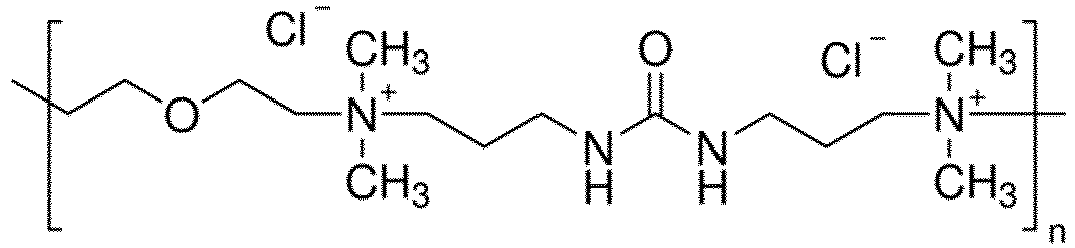
- the polyquaternary ammonium polymer may be poly[bis(2-chloroethyl)ether-alt-1,3-bis[3-(dimethylamino)propyl]urea] quaternized (also known as "Polyquaternium-2" using INCI nomenclature), which has the following general structure: wherein n is as defined above.
- vinylpyrrolidone copolymers are present in an amount of from 50 to 90 parts, in some embodiments from 60 to 90 parts, and in some embodiments, from 65 to 85 parts per 100 parts of acids employed in the composition.
- such copolymers may constitute from 0.2 wt.% to 5 wt.%, in some embodiments from 0.5 to 3 wt.%, and in some embodiments, from 0.6 to 2 wt.% of the composition.
- polyquaternary ammonium copolymers are present in an amount of from 30 to 70 parts, in some embodiments from 35 to 65 parts, and in some embodiments, from 40 to 60 parts per 100 parts of acids employed in the composition.
- such polymers may constitute from 0.1 wt.% to 3 wt.%, in some embodiments from 0.2 to 2 wt.%, and in some embodiments, from 0.3 to 1.5 wt.% of the composition.
- Vinylpyrrolidone copolymers are also typically employed in an amount greater than the polyquaternary ammonium polymers, and the weight ratio of vinylpyrrolidone copolymers to polyquaternary ammonium polymers may be from 1.0 to 8.0, in some embodiments from 1.1 to 5.0, and in some embodiments, from 1.2 to 3.0.
- a solvent system containing one or more solvents is also typically employed in the disinfectant composition.
- the solvent system may, for instance, constitute from 70 wt.% to 99.9 wt.%, in some embodiments from 80 wt.% to 99.6 wt.%, and in some embodiments, from 90 wt.% to 99.5 wt.% of the composition.
- Suitable solvents may include, for instance, water, glycols (e.g., ethylene glycol, propylene glycol, butylene glycol, triethylene glycol, hexylene glycol, polyethylene glycols, ethoxydiglycol, dipropyleneglycol, etc.); glycol ethers (e.g., methyl glycol ether, ethyl glycol ether, isopropyl glycol ether, etc.); alcohols (e.g., methanol, ethanol, n-propanol, iso-propanol, and butanol); ketones (e.g., acetone, methyl ethyl ketone, and methyl isobutyl ketone); esters (e.g., ethyl acetate, butyl acetate, diethylene glycol ether acetate, methoxypropyl acetate, ethylene carbonate, propylene carbonate, etc.); amides (e.g
- one beneficial aspect of the present invention is that can exhibit good antiviral efficacy without the need for alcohol-based solvents (e.g., ethanol) often employed in conventional disinfectant compositions.
- the disinfectant composition of the present invention may be generally free of such alcohol-based solvents (e.g., ethanol).
- alcohol-based solvents typically constitute no more than 5 wt.%, in some embodiments no more than 3 wt.%, and in some embodiments, from 0 wt.% to 1 wt.% of the disinfectant composition.
- water is typically the primary solvent such that the composition is considered “aqueous.”
- water constitutes at least 50 wt.%, in some embodiments at least 75 wt.%, and in some embodiments, from 90 wt.% to 100 wt.% of the solvent system.
- the disinfectant composition also contains one or more cationic surfactants to further enhance the residual antimicrobial activity.
- cationic surfactants may constitute from 0.1 wt.% to 15 wt.%, in some embodiments from 0.2 to 10 wt.%, and in some embodiments, from 0.5 to 5 wt.% of the composition.
- suitable cationic surfactants may include, for instance, biguanides and bisbiguanides (e.g., chlorhexidine, polyhexamethylenebiguanide, etc.), quaternary ammonium salts (e.g., benzalkonium chloride and alkyl substituted derivatives, cetylpyridinium halides, benzethonium chloride, etc.
- Quaternary ammonium salts may be particularly useful in the disinfectant composition of the present invention.
- Such salts typically contain one quaternary ammonium group attached to at least one C 6 -C 18 linear or branched alkyl or arylalkyl chain.
- Particularly suitable compounds of this class may be represented by the following formula: R 21 R 22 N + R 23 R 24 X - wherein,
- Examples of such compounds include, benzalkonium halides having an alkyl chain length of C 12 -C 16 , benzalkonium halides substituted with alkyl groups on the phenyl ring, dimethyldialkylammonium halides in which the alkyl groups have chain lengths of C 8 -C 18 , benzethonium halides and alkyl substituted benzethonium halides, and so forth.
- a variety of other components may also be incorporated into the disinfectant composition of the present invention, such as chelators, nonionic surfactants, anionic surfactants, zwitterionic surfactants, propellants, pH adjustors (e.g., sodium hydroxide), fragrances, colorants, preservatives, chaotropic agents, antioxidants, light stabilizers, etc.
- one or more nonionic surfactants may be employed, such as in an amount from about 0.1 wt.% to about 15 wt.%, in some embodiments from about 0.2 to about 10 wt.%, and in some embodiments, from about 0.5 to about 5 wt.% of the composition.
- Nonionic surfactants typically have a hydrophobic base (e.g., long chain alkyl group or an alkylated aryl group) and a hydrophilic chain (e.g., chain containing ethoxy and/or propoxy moieties).
- a hydrophobic base e.g., long chain alkyl group or an alkylated aryl group
- a hydrophilic chain e.g., chain containing ethoxy and/or propoxy moieties
- nonionic surfactants include, but are not limited to, ethoxylated alkylphenols, ethoxylated and propoxylated fatty alcohols, polyethylene glycol ethers of methyl glucose, polyethylene glycol ethers of sorbitol, ethylene oxide-propylene oxide block copolymers, ethoxylated esters of fatty (C 8 -C 18 ) acids, condensation products of ethylene oxide with long chain amines or amides, condensation products of ethylene oxide with alcohols, fatty acid esters, monoglyceride or diglycerides of long chain alcohols, and mixtures thereof.
- Particularly suitable nonionic emulsifiers may include ethylene oxide condensates of fatty alcohols (e.g., sold under the trade name Lubrol), polyoxyethylene ethers of fatty acids (particularly C 12 -C 20 fatty acids), polyoxyethylene sorbitan fatty acid esters (e.g., sold under the trade name TWEEN®), and sorbitan fatty acid esters (e.g., sold under the trade name SPANTM or ARLACEL®), etc.
- Lubrol ethylene oxide condensates of fatty alcohols
- polyoxyethylene ethers of fatty acids particularly C 12 -C 20 fatty acids
- polyoxyethylene sorbitan fatty acid esters e.g., sold under the trade name TWEEN®
- sorbitan fatty acid esters e.g., sold under the trade name SPANTM or ARLACEL®
- the fatty components used to form such emulsifiers may be saturated or unsaturated, substituted or unsubstituted, and may contain from 6 to 22 carbon atoms, in some embodiments from 8 to 18 carbon atoms, and in some embodiments, from 12 to 14 carbon atoms.
- the disinfectant composition of the present invention is generally free of ionic surfactants that are not cationic in nature (i.e., anionic or zwitterionic surfactants). Nevertheless, such surfactants can be employed in certain embodiments, although typically in an amount of no more than about 2 wt.%, in some embodiments no more than about 1 wt.%, and in some embodiments, from 0 wt.% to about 0.5 wt.% of the disinfectant composition.
- the composition may also contain a preservative or preservative system to inhibit the growth of microorganisms.
- Suitable preservatives may include, for instance, alkanols, disodium EDTA (ethylenediamine tetraacetate), EDTA salts, EDTA fatty acid conjugates, isothiazolinone, benzoic esters (parabens) (e.g., methylparaben, propylparaben, butylparaben, ethylparaben, isopropylparaben, isobutylparaben, benzylparaben, sodium methylparaben, and sodium propylparaben), benzoic acid, propylene glycols, sorbates, urea derivatives (e.g., diazolindinyl urea), and so forth.
- parabens e.g., methylparaben, propylparaben, butylparaben, ethylpara
- Suitable preservatives include those sold by Ashland, Inc., such as "Germall 115" (amidazolidinyl urea), “Germall II” (diazolidinyl urea), and “Germall Plus” (diazolidinyl urea and iodopropynyl butylcarbonate).
- Another suitable preservative is Kathon CG®, which is a mixture of methylchloroisothiazolinone and methylisothiazolinone available from Dow Chemical; Mackstat H 66 (available from Solvay).
- Still another suitable preservative system is a combination of 56% propylene glycol, 30% diazolidinyl urea, 11% methylparaben, and 3% propylparaben available under the name GERMABEN® II from Ashland, Inc.
- the pH of the disinfectant composition is controlled so that it is 4.5 or less, in some embodiments 4.0 or less, and in some embodiments, from 1.0 to 3.5.
- various pH modifiers may be optionally employed.
- Some examples of pH modifiers that may be used in the present invention include, but are not limited to, ammonia; mono-, di-, and trialkyl amines; mono-, di-, and tri-alkanolamines; alkali metal and alkaline earth metal hydroxides; alkali metal and alkaline earth metal silicates; and mixtures thereof.
- pH modifiers are ammonia; sodium, potassium, and lithium hydroxide; sodium, potassium, and lithium meta silicates; monoethanolamine; triethylamine; isopropanolamine; diethanolamine; and triethanolamine.
- the pH modifier may be present in any effective amount needed to achieve the desired pH level.
- the disinfectant composition may generally be used to reduce microbial or viral populations on a wide variety of surfaces (excluding a surface of a user/patient), such as a hard surface.
- exemplary hard surfaces include, for instance, lavatory fixtures, lavatory appliances (toilets, bidets, shower stalls, bathtubs, sinks, and bathing appliances), walls, flooring surfaces, surfaces associated with food preparation (e.g., tables, counters, restaurant, kitchens, sinks, etc.), surfaces associated with hospital environments, medical laboratories and medical treatment environments.
- the manner in which the disinfectant composition is applied to a surface can vary as desired. For example, in certain embodiments, the composition may be applied directly to the surface.
- a user generally applies the composition (e.g., with a pump) and then removes the composition from the treated area after a certain period of time using a wipe.
- the composition may be first applied to a wipe prior to use.
- the wipe may provide an increased surface area to facilitate contact of the composition with microorganisms.
- the wipe may also serve other purposes, such as providing water absorption, barrier properties, etc.
- the wipe may also eliminate microorganisms through frictional forces imparted to the surface.
- the wipe may be formed from any of a variety of materials as is well known in the art. Typically, however, the wipe includes a fibrous web that contains absorbent fibers.
- the wipe may be a paper product containing one or more paper webs, such as facial tissue, bath tissue, paper towels, napkins, and so forth.
- the paper product may be single-ply in which the web forming the product includes a single layer or is stratified (i.e., has multiple layers), or multi-ply, in which the webs forming the product may themselves be either single or multi-layered.
- the basis weight of such a paper product is less than about 120 grams per square meter ("gsm"), in some embodiments less than about 80 gsm, in some embodiments less than about 60 grams per square meter, and in some embodiments, from about 10 to about 60 gsm.
- the material used to make the paper product may include absorbent fibers formed by a variety of pulping processes, such as kraft pulp, sulfite pulp, thermomechanical pulp, etc.
- the pulp fibers may include softwood fibers having an average fiber length of greater than 1 mm and particularly from about 2 to 5 mm based on a length-weighted average.
- Such softwood fibers can include, but are not limited to, northern softwood, southern softwood, redwood, red cedar, hemlock, pine (e.g., southern pines), spruce (e.g., black spruce), combinations thereof, and so forth.
- Hardwood fibers such as eucalyptus, maple, birch, aspen, and so forth, can also be used.
- eucalyptus fibers may be particularly desired to increase the softness of the web.
- Eucalyptus fibers can also enhance the brightness, increase the opacity, and change the pore structure of the web to increase its wicking ability.
- secondary fibers obtained from recycled materials may be used, such as fiber pulp from sources such as, for example, newsprint, reclaimed paperboard, and office waste.
- other natural fibers can also be used in the present invention, such as abaca, sabai grass, milkweed floss, pineapple leaf, bamboo, algae, and so forth.
- synthetic fibers can also be utilized.
- the absorbent fibers may be integrated with synthetic fibers to form a composite.
- Synthetic thermoplastic fibers may also be employed in the nonwoven web, such as those formed from polyolefins, e.g., polyethylene, polypropylene, polybutylene, etc.; polytetrafluoroethylene; polyesters, e.g., polyethylene terephthalate and so forth; polyvinyl acetate; polyvinyl chloride acetate; polyvinyl butyral; acrylic resins, e.g., polyacrylate, polymethylacrylate, polymethylmethacrylate, and so forth; polyamides, e.g., nylon; polyvinyl chloride; polyvinylidene chloride; polystyrene; polyvinyl alcohol; polyurethanes; polylactic acid; polyhydroxyalkanoate; copolymers thereof; and so forth.
- such fibers may optionally be rendered more hydrophilic (i.e., wettable) by treatment with a surfactant solution before, during, and/or after web formation.
- a surfactant solution i.e., water
- Other known methods for increasing wettability may also be employed, such as described in U.S. Patent No. 5,057,361 to Sayovitz, et al. The relative percentages of such fibers may vary over a wide range depending on the desired characteristics of the composite.
- the composite may contain from about 1 wt.% to about 60 wt.%, in some embodiments from 5 wt.% to about 50 wt.%, and in some embodiments, from about 10 wt.% to about 40 wt.% synthetic polymeric fibers.
- the composite may likewise contain from about 40 wt.% to about 99 wt.%, in some embodiments from 50 wt.% to about 95 wt.%, and in some embodiments, from about 60 wt.% to about 90 wt.% absorbent fibers.
- a nonwoven composite may be formed that is a "coform material" that contains a mixture or stabilized matrix of thermoplastic fibers and a second non-thermoplastic material.
- coform materials may be made by a process in which at least one meltblown die head is arranged near a chute through which other materials are added to the web while it is forming.
- Such other materials may include, but are not limited to, fibrous organic materials such as woody or non-woody pulp such as cotton, rayon, recycled paper, pulp fluff and also superabsorbent particles, inorganic and/or organic absorbent materials, treated polymeric staple fibers and so forth.
- the nonwoven composite may be formed be formed by hydraulically entangling staple length fibers and/or filaments with high-pressure jet streams of water.
- Various techniques for hydraulically entangling fibers are generally are disclosed, for example, in U.S. Patent Nos. 3,494,821 to Evans and 4,144,370 to Bouolton .
- Hydraulically entangled nonwoven composites of continuous filaments (e.g., spunbond web) and natural fibers (e.g., pulp) are disclosed, for example, in U.S. Patent Nos.
- the basis weight of the wipe is typically from about 20 to about 200 grams per square meter ("gsm"), and in some embodiments, between about 35 to about 100 gsm.
- gsm grams per square meter
- Lower basis weight products may be particularly well suited for use as light duty wipes, while higher basis weight products may be better adapted for use as industrial wipes.
- the wipe may assume a variety of shapes, including but not limited to, generally circular, oval, square, rectangular, or irregularly shaped. Each individual wipe may be arranged in a folded configuration and stacked one on top of the other to provide a stack of wet wipes. Such folded configurations are well known to those skilled in the art and include c-folded, z-folded, quarter-folded configurations and so forth.
- the wipe may have an unfolded length of from about 2.0 to about 80.0 centimeters, and in some embodiments, from about 10.0 to about 25.0 centimeters.
- the wipes may likewise have an unfolded width of from about 2.0 to about 80.0 centimeters, and in some embodiments, from about 10.0 to about 25.0 centimeters.
- the stack of folded wipes may be placed in the interior of a container, such as a plastic tub, to provide a package of wipes for eventual sale to the consumer.
- the wipes may include a continuous strip of material which has perforations between each wipe and which may be arranged in a stack or wound into a roll for dispensing.
- a container such as a plastic tub
- the wipes may include a continuous strip of material which has perforations between each wipe and which may be arranged in a stack or wound into a roll for dispensing.
- the composition may be incorporated into the wipe during its formation or simply coated onto all or a portion of a surface of the wipe using known techniques, such as printing, dipping, spraying, melt extruding, coating (e.g., solvent coating, powder coating, brush coating, etc.), foaming, and so forth.
- coating e.g., solvent coating, powder coating, brush coating, etc.
- foaming and so forth.
- the composition is applied to the wipe by dipping, spraying, or printing.
- the composition may be applied in a pattern that covers from about 5% to about 95%, in some embodiments from about 10% to about 90%, and in some embodiments, from about 20% to about 75% of a surface of the wipe.
- Such patterned application may have various benefits, including enhanced aesthetic appeal, improved absorbency, etc.
- the particular type or style of the pattern is not a limiting factor of the invention, and may include, for example, any arrangement of stripes, bands, dots, or other geometric shape.
- the pattern may include indicia (e.g., trademarks, text, and logos), floral designs, abstract designs, any configuration of artwork, etc. It should be appreciated that the "pattern" may take on virtually any desired appearance.
- the disinfectant composition may be present on the wipe in the form of a liquid such that the wipe is considered a "wet wipe.”
- the total amount of the disinfectant composition employed in such "wet wipes" depends in part upon the type of wipe material utilized, the type of container used to store the wipes, the nature of the composition, and the desired end use of the wipes.
- each wet wipe contains from about 150 wt.% to about 600 wt.%, and desirably from about 300 wt.% to about 500 wt.% of the disinfectant composition on the dry weight of the wipe.
- solvents can evaporate from the disinfectant composition so that a film is formed.
- the solvent content (e.g., water content) of the resulting film may be, for instance, less than about 5 wt.%, in some embodiments less than about 2 wt.%, and in some embodiments, less about 1 wt.%.
- the film typically contains acids in an amount of from about 10 wt.% to about 50 wt.%, in some embodiments from about 15 wt.% to about 45 wt.%, and in some embodiments, from about 20 wt.% to about 40 wt.%.
- the film may also contain vinylpyrrolidone copolymers in an amount of from about 10 wt.% to about 40 wt.%, in some embodiments from about 15 wt.% to about 35 wt.%, and in some embodiments, from about 20 wt.% to about 30 wt.%, as well as polyquaternary ammonium polymers in an amount of from about 1 wt.% to about 30 wt.%, in some embodiments from about 5 wt.% to about 25 wt.%, and in some embodiments, from about 10 wt.% to about 20 wt.%.
- the film may also optionally contain cationic surfactants in an amount of from about 10 wt.% to about 50 wt.%, in some embodiments from about 15 wt.% to about 45 wt.%, and in some embodiments, from about 20 wt.% to about 40 wt.%. Regardless of its exact constituents, the present inventors have discovered that the resulting film is capable of exhibiting a residual degree of antiviral efficacy. The film is also physically stable so that it can still remain active after being abraded multiple times.
- a disinfectant composition was formed that contained 94.6 wt.% water, 1.25 wt.% of benzethonium chloride, 1.25 wt.% citric acid, 1.9 wt.% of Copolymer 958, 1.0 wt.% of MirapolTM A 15.
- Copolymer 958 includes 50% vinylpyrrolidone / dimethylaminoethylacrylate in ethanol.
- MirapolTM A 15 includes 60-70% Polyquaternium-2 in water. The final pH level was 2.76.
- a disinfectant composition was formed that contained 94.35 wt.% water, 1.25 wt.% of benzethonium chloride, 1.5 wt.% maleic acid, 1.9 wt.% of Copolymer 958, 1.0 wt.% of MirapolTM A 15. The final pH level was 1.42.
- a disinfectant composition was formed as described in Example 2 except that the final pH was adjusted with sodium hydroxide to a level of 2.00.
- a disinfectant composition was formed as described in Example 2 except that the final pH was adjusted with sodium hydroxide to a level of 2.52.
- a disinfectant composition was formed as described in Example 2 except that the final pH was adjusted with sodium hydroxide to a level of 3.03.
- a disinfectant composition was formed that contained 94.35 wt.% water, 1.25 wt.% of benzethonium chloride, 1.5 wt.% malic acid, 1.9 wt.% of Copolymer 958, 1.0 wt.% of MirapolTM A 15. The final pH level was 2.37.
- a disinfectant composition was formed as described in Example 6, except that the final pH was adjusted with sodium hydroxide to a level of 2.49.
- a disinfectant composition was formed as described in Example 6, except that the final pH was adjusted with sodium hydroxide to a level of 2.99.
- a disinfectant composition was formed that contained 93.7 wt.% water, 1.25 wt.% of benzethonium chloride, 2.15 wt.% sulfosuccinic acid, 1.9 wt.% of Copolymer 958, 1.0 wt.% of MirapolTM A 15. The final pH level was 1.18.
- a disinfectant composition was formed as described in Example 9, except that the final pH was adjusted with sodium hydroxide to a level of 2.00.
- a disinfectant composition was formed as described in Example 9, except that the final pH was adjusted with sodium hydroxide to a level of 2.48.
- a disinfectant composition was formed as described in Example 9, except that the final pH was adjusted with sodium hydroxide to a level of 3.01.
- a disinfectant composition was formed that contained 94.35 wt.% water, 1.25 wt.% of benzethonium chloride, 1.50 wt.% phosphoric acid, 1.9 wt.% of Copolymer 958, 1.0 wt.% of MirapolTM A 15. The final pH level was 1.51.
- a disinfectant composition was formed as described in Example 13, except that the final pH was adjusted with sodium hydroxide to a level of 1.99.
- a disinfectant composition was formed as described in Example 13, except that the final pH was adjusted with sodium hydroxide to a level of 2.48.
- a disinfectant composition was formed as described in Example 13, except that the final pH was adjusted with sodium hydroxide to a level of 3.00.
- a disinfectant composition was formed that contained 92.85 wt.% water, 1.25 wt.% of benzethonium chloride, 3.00 wt.% glyoxylic acid, 1.9 wt.% of Copolymer 958, 1.0 wt.% of MirapolTM A 15.
- the final pH level was 2.02.
- a disinfectant composition was formed as described in Example 17, except that the final pH was adjusted with sodium hydroxide to a level of 2.49.
- a disinfectant composition was formed as described in Example 17, except that the final pH was adjusted with sodium hydroxide to a level of 2.99.
- a disinfectant composition was formed that contained 91.85 wt.% water, 1.25 wt.% of benzethonium chloride, 4.00 wt.% malic acid, 1.9 wt.% of Copolymer 958, 1.0 wt.% of MirapolTM A 15.
- the final pH level was 2.12.
- a disinfectant composition was formed that contained 92.44 wt.% water, 1.25 wt.% of benzethonium chloride, 3.41 wt.% maleic acid, 1.9 wt.% of Copolymer 958, 1.0 wt.% of MirapolTM A 15. The final pH was adjusted with sodium hydroxide to a level of 2.1.
- Example Acid pH Level LOG 10 Reduction 1 Citric 2.76 3.96 2 Maleic 1.42 ⁇ 4.00 3 2.00 ⁇ 4.00 4 2.52 ⁇ 4.00 5 3.03 3.25 6 Malic 2.37 0.75 7 2.49 1.58 8 2.99 1.91 9 Sulfosuccinic 1.18 ⁇ 3.83 10 2.00 2.25 11 2.48 ⁇ 2.75 12 3.01 1.91 13 Phosphoric 1.51 ⁇ 3.83 14 1.99 2.83 15 2.48 3.08 16 3.00 2.91 17 Glyoxylic 2.02 3.58 18 2.49 ⁇ 3.75 19 2.99 2.92
Landscapes
- Life Sciences & Earth Sciences (AREA)
- Health & Medical Sciences (AREA)
- General Health & Medical Sciences (AREA)
- Engineering & Computer Science (AREA)
- Wood Science & Technology (AREA)
- Plant Pathology (AREA)
- Agronomy & Crop Science (AREA)
- Pest Control & Pesticides (AREA)
- Dentistry (AREA)
- Zoology (AREA)
- Environmental Sciences (AREA)
- Chemical & Material Sciences (AREA)
- Toxicology (AREA)
- Materials Engineering (AREA)
- Organic Chemistry (AREA)
- Inorganic Chemistry (AREA)
- Chemical Kinetics & Catalysis (AREA)
- General Chemical & Material Sciences (AREA)
- Epidemiology (AREA)
- Animal Behavior & Ethology (AREA)
- Public Health (AREA)
- Veterinary Medicine (AREA)
- Dispersion Chemistry (AREA)
- Agricultural Chemicals And Associated Chemicals (AREA)
- Medicinal Preparation (AREA)
Description
- Pathogenic viruses are generally classified into two general types: enveloped and non-enveloped viruses. Some well-known enveloped viruses include herpes virus, influenza virus; paramyxovirus, respiratory syncytial virus, coronavirus, HIV, hepatitis B virus, hepatitis C virus, SARS-CoV, and togavirus. Non-enveloped viruses, sometimes referred to as "naked" viruses, include the families Picornaviridae, Reoviridae, Caliciviridae, Adenoviridae, Papovaviridae, and Parvoviridae. Members of these families include rhinovirus, poliovirus, adenovirus, hepatitis A virus, norovirus, papillomavirus, enterovirus, coxsackievirus, and rotavirus. "Enveloped" viruses are relatively sensitive and, thus, can be inactivated by commonly used disinfectants. In contrast, "non-enveloped" viruses are substantially more resistant to conventional disinfectants and are more environmentally stable than enveloped viruses. Thus, most disinfectants have insufficient efficacy against these types of non-enveloped viruses. Another problem with many conventional disinfectants is that they can kill microorganisms on surfaces when applied and allowed to remain in contact for a specific time, such as 10 minutes. However, the disinfectant does not typically persist on the surface. Normal stresses to the surface, like rinsing, repeated touching or wiping with a cloth, tend to physically remove any residual disinfectant ingredients from the surface. Thus, if the surface becomes re-contaminated again, the disinfectant must be re-applied to kill the newly deposited organisms.
- As such, a need currently exists for a disinfectant composition that is capable of exhibiting antiviral efficacy immediately upon contact with a virus and after an extended period of time on a surface.
-
US 2014/0140936 discloses disinfectant compositions comprising at least one organic acid; at least one polymer capable of forming a complex with at least one of the organic acids; and water. -
US 2009/0018213 discloses a method of inactivating human noroviruses and other acid stable viruses, the method comprising contacting the virus with a virucidally-enhanced alcoholic composition that includes an alcohol, an enhancer selected from cationic oligomers and polymers, chaotropic agents, and mixtures thereof. -
US 2012/0171155 discloses compositions having durable antimicrobial activity which includea carbonate/bicarbonate salt of a quaternary ammonium cation, and organic acid, hydrogen peroxide and a polymer. -
WO 2015/072125 discloses an anti-parvovirus composition. -
US 2004/0241130 discloses multi-purpose polymers. - In accordance with one embodiment of the present invention, a disinfectant composition is disclosed that comprises:
- i) an acid;
- ii) a vinylpyrrolidone copolymer having the following general formula:

- n is from 20 to 99;
- m is from 1 to 80;
- p is from 0 to 50, and wherein the total of n + m + p is 100;
- R1 is H or a C1 to C4 alkyl;
- Z is O, S, or NH;
- R2 is (CH2)x;
- x is from 1 to 18;
- y is 0 or 1;
- R3 is independently hydrogen or a C1 to C4 alkyl; and
- M is a vinyl or vinylidene monomer copolymerizable with vinyl pyrrolidone;
- iii) a polyquaternary ammonium polymer having the following general structure:
(N+R13R14-(CH2)a-NH-C(Y)-NH-(CH2)b-N+R13R14-R15)n-2nX-
wherein,- R13 and R14 are independently alkyl, hydroxyalkyl, or -CH2CH2(OCH2CH2)cOH;
- R15 is a linking group and may be (CH2)d or {(CH2)eO(CH2)f}g;
- Y is O, S or NH;
- a, b, c, d, e and f are each independently from 1 to 6;
- g is from 1 to 4;
- n is at least 2; and
- X- is an anion; and
- iv) a cationic surfactant.
- The composition has a pH of 4.5 or less. The vinylpyrrolidone copolymer is present in an amount from 50 to 90 parts per 100 parts of acids employed in the composition, and the polyquaternary ammonium polymer is present in an amount from 30 to 70 parts per 100 parts of acids employed in the composition.
- In accordance with another embodiment of the present invention, a film is disclosed that is capable of exhibiting residual antiviral activity. The film comprises an acid, a vinylpyrrolidone copolymer, and a polyquaternary ammonium polymer, such as described above. The vinylpyrrolidone copolymer is present in an amount from 50 to 90 parts per 100 parts of acids employed in the composition, and the polyquaternary ammonium polymer is present in an amount from 30 to 70 parts per 100 parts of acids employed in the composition.
- Other features and aspects of the present invention are discussed in greater detail below.
- Reference now will be made in detail to various embodiments of the invention, one or more examples of which are set forth below. Each example is provided by way of explanation of the invention, not limitation of the invention.
- Generally speaking, the present invention is directed to a disinfectant composition that is capable of inactivating non-enveloped viruses as well as other microorganisms, such as gram negative and gram positive bacteria, fungi, parasites, enveloped viruses, etc. In one embodiment, the composition is effective against non-enveloped viruses, including members of the families Picornaviridae, Reoviridae, Caliciviridae, Adenoviridae, Papovaviridae, and Parvoviridae, which includes non-enveloped viruses such as rhinovirus, poliovirus, enterovirus, coxsackievirus, adenovirus, norovirus, papillomavirus, feline calicivirus, hepatitis A virus, parvovirus, and rotavirus. The disinfectant composition contains at least one acid and has a pH of 4.5 or less, in some embodiments 4.0 or less, and in some embodiments, from 1.0 to 3.5. Through selective control over the nature of the acid(s) employed and the overall pH level, the present inventors have discovered that the composition can achieve rapid antiviral efficacy, particularly against non-enveloped viruses. For example, after being exposed to a virus for 10 minutes, the disinfectant composition can exhibit a log10 reduction of 1.5 or more, in some embodiments 2.0 or more, in some embodiments 2.5 or more, and in some embodiments, from 3.0 to 5.0, such as determined in accordance with ASTM E1052-11. In one embodiment, for instance, the disinfectant composition may exhibit a log10 reduction after 10 minutes within the ranges noted above against a feline calicivirus. In another embodiment, the disinfectant composition may exhibit a log10 reduction after 10 minutes within the ranges noted above against Phi X174 (ATCC 13706-B1), a non-enveloped bacteriophage employed as a surrogate for non-enveloped viruses (e.g., norovirus).
- Once applied to a surface (e.g., hard surface), the disinfectant composition forms a film that remains capable of providing residual antiviral activity. For example, after being exposed to a virus for 10 minutes, the film itself can exhibit a log10 reduction of 0.5 or more, in some embodiments 0.8 or more, in some embodiments 1.0 or more, and in some embodiments, from 1.2 to 3.0. Notably, the present inventors have discovered that the use of a vinylpyrrolidone copolymer in combination with a polyquaternary ammonium polymer and cationic surfactant can have a synergistic effect on the stability of the film such that it can also achieve long-term, residual antiviral activity. For example, the film can exhibit antiviral activity after a substantial period of time on the surface, such as after 24 hours, and in some cases, even after 48 hours. In one embodiment, for instance, the film may exhibit a log10 reduction after 24 or 48 hours within the ranges noted above against a feline calicivirus. In another embodiment, the film may exhibit a log10 reduction after 24 hours or 48 hours within the ranges noted above against Phi-X 174 (ATCC 13706-B1).
- Various embodiments of the present invention will now be described in more detail below.
- Acids are typically employed in the disinfectant composition in an amount of from 0.1 wt.% to 10 wt.%, in some embodiments from 0.5 to 8 wt.%, and in some embodiments, from 0.8 wt.% to 1.5 wt.% of the composition.
- Any of a variety of acids may generally be employed, such as inorganic acids (e.g., phosphoric acid, boric acid, hydrobromic acid, molybdic acid, etc.), organic acids, and so forth. Particularly suitable organic acids are carboxylic acids having the following general formula, R-COOH, wherein, "R" is an optionally substituted alkyl, optionally substituted alkenyl, optionally substituted aryl (e.g., phenyl), and so forth. In certain cases, "R" may be an optionally substituted lower alkyl having only from 1 to 6 carbon atoms. The term "substituted" indicates that one or more atoms are substituted by functional groups, such as halogen atoms (F, Cl, Br, I), hydroxyl groups, amino groups, thiol groups, nitro groups, cyano groups, etc. Some examples of suitable organic carboxylic acids for use in the composition of the present invention may include, for instance, citric acid, malic acid, maleic acid, mandelic acid, succinic acid, sulfosuccinic acid, tannic acid, lactic acid, glyoxylic acid, gallic acid, fumaric acid, tartaric acid, formic acid, benzoic acid, 4-aminobenzoic acid, 4-bromo-DL-mandelic acid, etc. Regardless of whether inorganic or organic acids are employed, acids having a relatively low first acid dissociation constant (pKa1) have been found to be particularly suitable for use in the present invention. For example, the acid may have a pka1 value of from about 5.0 or less, in some embodiments about 4.0 or less, and in some embodiments, from about 1.0 to about 3.5, as determined at a temperature of 25°C. Specific examples of such acids include, for instance, maleic acid (pka1 of 1.9), phosphoric acid (pka1 of 2.18), glyoxylic acid (pka of 3.18), and so forth.
- The vinylpyrrolidone copolymer employed in the disinfectant composition of the present invention has the following formula:
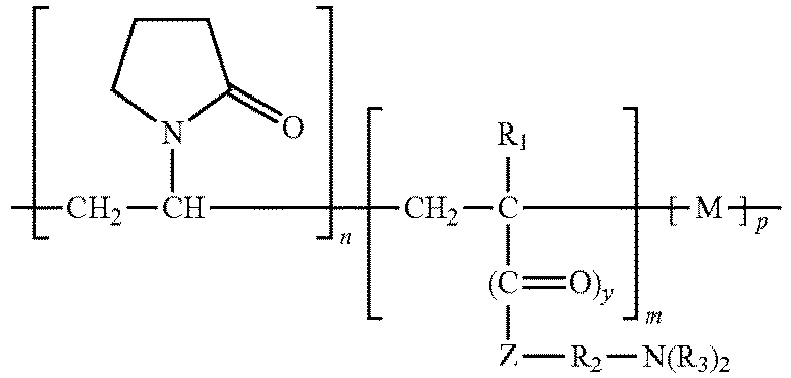
- n is from 20 to 99, and in some embodiments, from 40 to 90,
- m is from 1 to 80, and in some embodiments, from 5 to 40;
- p is from 0 to 50, and in some embodiments, from 5 to 20, and wherein the total of n + m + p is 100;
- R1 is H or a C1 to C4 alkyl (e.g., CH3);
- Z is O, S, or NH, and in some embodiments, O;
- R2 is (CH2)x;
- x is from 1 to 18, and in some embodiments, from 2 to 10;
- y is 0 or 1;
- R3 is independently hydrogen or a C1 to C4 alkyl (e.g., CH3); and
- M is a vinyl or vinylidene monomer copolymerizable with vinyl pyrrolidone.
- The monomer unit [ ]m is, for example, a di-lower alkylamine alkyl (meth)acrylate or a vinyl ether derivative. Examples of these monomers include, for instance, dimethylaminomethyl acrylate, dimethylaminomethyl methacrylate, diethylaminomethyl acrylate, diethylaminomethyl methacrylate, dimethylaminoethyl acrylate, dimethylaminoethyl methacrylate, dimethylaminobutyl acrylate, dimethylaminobutyl methacrylate, dimethylaminoamyl methacrylate, diethylaminoamyl methacrylate, dimethylaminohexyl acrylate, diethylaminohexyl methacrylate, dimethylaminooctyl acrylate, dimethylaminooctyl methacrylate, diethylaminooctyl acrylate, diethylaminooctyl methacrylate, dimethylaminodecyl methacrylate, dimethylaminododecyl methacrylate, diethylaminolauryl acrylate, diethylaminolauryl methacrylate, dimethylaminostearyl acrylate, dimethylaminostearyl methacrylate, diethylaminostearyl acrylate, diethylaminostearyl methacrylate, di-t-butylaminoethyl methacrylate, di-t-butylaminoethyl acrylate, dimethylamino vinyl ether, etc., as well as combinations thereof.
- The monomer unit "M", which is optional, may include any conventional vinyl monomer copolymerizable with N-vinyl pyrrolidone. Thus, for example, suitable conventional vinyl monomers include alkyl vinyl ethers (e.g., methyl vinyl ether, ethyl vinyl ether, octyl vinyl ether, etc.); acrylic and methacrylic acid and esters thereof (e.g., methacrylate, methyl methacrylate, etc.); vinyl aromatic monomers (e.g., styrene, α-methyl styrene, etc.); vinyl acetate; vinyl alcohol; vinylidene chloride; acrylonitrile and substituted derivatives thereof; methacrylonitrile and substituted derivatives thereof; acrylamide and methacrylamide and N-substituted derivatives thereof; vinyl chloride, crotonic acid and esters thereof; etc.
- In certain embodiments, R1 and/or R3 may be methyl. Likewise, y may be 1 and/or R2 may be (CH2)2 or (CH2)3. One particular example of such a polymer is a vinylpyrrolidone/dimethylaminoethylmethacrylate copolymer, which has the following general structure:


U.S. Patent No. 4,445,521 ;4,223,009 ; and3,954,960 , as well asGB 1331819 - As indicated above, a polyquaternary ammonium polymer is also employed in the disinfectant composition that contains two or more quaternary ammonium centers within the compound structure. The polyquaternary ammonium polymer has the following general structure:
(N+R13R14-(CH2)a-NH-C(Y)-NH-(CH2)b-N+R13R14-R15)n-2nX-
wherein, - R13 and R14 are independently alkyl (e.g., methyl, ethyl, isopropyl, etc.), hydroxyalkyl (e.g., hydroxymethyl, hydroxyethyl, etc.), or -CH2CH2(OCH2CH2)cOH;
- R15 is a linking group and may be (CH2)d or {(CH2)eO(CH2)f}g;
- Y is O, S or NH, and in some embodiments, O;
- a, b, c, d, e and f are each independently from 1 to 6, in some embodiments from 1 to 4, and in some embodiments, from 2 to 3;
- g is from 1 to 4, and in some embodiments, from 1 to 2;
- n is at least 2, in some embodiments from 2 to 200, and in some embodiments, from 3 to 100; and
- X- is an anion, such as a halide (e.g., fluoride, chloride, bromide, iodide, and most desirably, chloride), carboxylate, carbonate, bicarbonate, sulfate (e.g., methosulfate, ethosulfate, etc.), and so forth.
- In certain embodiments, R13 and/or R14 may be methyl. Likewise, "a" may be 3 and/or "b" may be 3. R15 may likewise be {(CH2)eO(CH2)f}g and "e" may be 2, "f" may be 2, and/or "g" may be 1. In one particular embodiment, for instance, the polyquaternary ammonium polymer may be poly[bis(2-chloroethyl)ether-alt-1,3-bis[3-(dimethylamino)propyl]urea] quaternized (also known as "Polyquaternium-2" using INCI nomenclature), which has the following general structure:
- The present inventors have discovered that selective control over the relative amount of the vinylpyrrolidone copolymer and polyquaternary ammonium polymer in relation to acids within the composition can have a significant impact on residual efficacy. For example, vinylpyrrolidone copolymers are present in an amount of from 50 to 90 parts, in some embodiments from 60 to 90 parts, and in some embodiments, from 65 to 85 parts per 100 parts of acids employed in the composition. In certain embodiments, for instance, such copolymers may constitute from 0.2 wt.% to 5 wt.%, in some embodiments from 0.5 to 3 wt.%, and in some embodiments, from 0.6 to 2 wt.% of the composition. Likewise, polyquaternary ammonium copolymers are present in an amount of from 30 to 70 parts, in some embodiments from 35 to 65 parts, and in some embodiments, from 40 to 60 parts per 100 parts of acids employed in the composition. In certain embodiments, for instance, such polymers may constitute from 0.1 wt.% to 3 wt.%, in some embodiments from 0.2 to 2 wt.%, and in some embodiments, from 0.3 to 1.5 wt.% of the composition. Vinylpyrrolidone copolymers are also typically employed in an amount greater than the polyquaternary ammonium polymers, and the weight ratio of vinylpyrrolidone copolymers to polyquaternary ammonium polymers may be from 1.0 to 8.0, in some embodiments from 1.1 to 5.0, and in some embodiments, from 1.2 to 3.0.
- A solvent system containing one or more solvents is also typically employed in the disinfectant composition. The solvent system may, for instance, constitute from 70 wt.% to 99.9 wt.%, in some embodiments from 80 wt.% to 99.6 wt.%, and in some embodiments, from 90 wt.% to 99.5 wt.% of the composition. Suitable solvents may include, for instance, water, glycols (e.g., ethylene glycol, propylene glycol, butylene glycol, triethylene glycol, hexylene glycol, polyethylene glycols, ethoxydiglycol, dipropyleneglycol, etc.); glycol ethers (e.g., methyl glycol ether, ethyl glycol ether, isopropyl glycol ether, etc.); alcohols (e.g., methanol, ethanol, n-propanol, iso-propanol, and butanol); ketones (e.g., acetone, methyl ethyl ketone, and methyl isobutyl ketone); esters (e.g., ethyl acetate, butyl acetate, diethylene glycol ether acetate, methoxypropyl acetate, ethylene carbonate, propylene carbonate, etc.); amides (e.g., dimethylformamide, dimethylacetamide, dimethylcaprylic/capric fatty acid amide and N-alkylpyrrolidones); sulfoxides or sulfones (e.g., dimethyl sulfoxide (DMSO) and sulfolane); and so forth.
- While a wide variety of solvents may be employed, one beneficial aspect of the present invention is that can exhibit good antiviral efficacy without the need for alcohol-based solvents (e.g., ethanol) often employed in conventional disinfectant compositions. In fact, the disinfectant composition of the present invention may be generally free of such alcohol-based solvents (e.g., ethanol). When employed, for instance, alcohol-based solvents typically constitute no more than 5 wt.%, in some embodiments no more than 3 wt.%, and in some embodiments, from 0 wt.% to 1 wt.% of the disinfectant composition. Furthermore, water is typically the primary solvent such that the composition is considered "aqueous." In most embodiments, for example, water constitutes at least 50 wt.%, in some embodiments at least 75 wt.%, and in some embodiments, from 90 wt.% to 100 wt.% of the solvent system.
- The disinfectant composition also contains one or more cationic surfactants to further enhance the residual antimicrobial activity. Such cationic surfactants may constitute from 0.1 wt.% to 15 wt.%, in some embodiments from 0.2 to 10 wt.%, and in some embodiments, from 0.5 to 5 wt.% of the composition. Examples of suitable cationic surfactants may include, for instance, biguanides and bisbiguanides (e.g., chlorhexidine, polyhexamethylenebiguanide, etc.), quaternary ammonium salts (e.g., benzalkonium chloride and alkyl substituted derivatives, cetylpyridinium halides, benzethonium chloride, etc. Quaternary ammonium salts, for instance, may be particularly useful in the disinfectant composition of the present invention. Such salts typically contain one quaternary ammonium group attached to at least one C6-C18 linear or branched alkyl or arylalkyl chain. Particularly suitable compounds of this class may be represented by the following formula:
R21R22N+R23R24X-
wherein, - R21 and R22 are C1-C18 linear or branched alkyl, alkenyl, or arylalkyl chains that may be substituted in available positions by N, O, or S, provided at least one R21 or R22 is a C8-C18 linear or branched alkyl, alkenyl, or arylalkyl chains that may be substituted in available positions by N, O, or S;
- R23 and R24 are C1-C6 alkyl, phenyl, benzyl, or C8-C12 arylalkyl groups, or R23 and R24 may also form a ring (e.g., pyridine ring) with the nitrogen of the quaternary ammonium group; and
- X- is an anion, such as a halide (e.g., fluoride, chloride, bromide, iodide, and most desirably, chloride), carboxylate, carbonate, bicarbonate, sulfate (e.g., methosulfate, ethosulfate, etc.), and so forth.
- Examples of such compounds include, benzalkonium halides having an alkyl chain length of C12-C16, benzalkonium halides substituted with alkyl groups on the phenyl ring, dimethyldialkylammonium halides in which the alkyl groups have chain lengths of C8-C18, benzethonium halides and alkyl substituted benzethonium halides, and so forth.
- In addition to those noted above, a variety of other components may also be incorporated into the disinfectant composition of the present invention, such as chelators, nonionic surfactants, anionic surfactants, zwitterionic surfactants, propellants, pH adjustors (e.g., sodium hydroxide), fragrances, colorants, preservatives, chaotropic agents, antioxidants, light stabilizers, etc. In one embodiment, for instance, one or more nonionic surfactants may be employed, such as in an amount from about 0.1 wt.% to about 15 wt.%, in some embodiments from about 0.2 to about 10 wt.%, and in some embodiments, from about 0.5 to about 5 wt.% of the composition. Nonionic surfactants typically have a hydrophobic base (e.g., long chain alkyl group or an alkylated aryl group) and a hydrophilic chain (e.g., chain containing ethoxy and/or propoxy moieties). Some suitable nonionic surfactants that may be used include, but are not limited to, ethoxylated alkylphenols, ethoxylated and propoxylated fatty alcohols, polyethylene glycol ethers of methyl glucose, polyethylene glycol ethers of sorbitol, ethylene oxide-propylene oxide block copolymers, ethoxylated esters of fatty (C8-C18) acids, condensation products of ethylene oxide with long chain amines or amides, condensation products of ethylene oxide with alcohols, fatty acid esters, monoglyceride or diglycerides of long chain alcohols, and mixtures thereof. Particularly suitable nonionic emulsifiers may include ethylene oxide condensates of fatty alcohols (e.g., sold under the trade name Lubrol), polyoxyethylene ethers of fatty acids (particularly C12-C20 fatty acids), polyoxyethylene sorbitan fatty acid esters (e.g., sold under the trade name TWEEN®), and sorbitan fatty acid esters (e.g., sold under the trade name SPAN™ or ARLACEL®), etc. The fatty components used to form such emulsifiers may be saturated or unsaturated, substituted or unsubstituted, and may contain from 6 to 22 carbon atoms, in some embodiments from 8 to 18 carbon atoms, and in some embodiments, from 12 to 14 carbon atoms.
- To help maintain the desired charge, the disinfectant composition of the present invention is generally free of ionic surfactants that are not cationic in nature (i.e., anionic or zwitterionic surfactants). Nevertheless, such surfactants can be employed in certain embodiments, although typically in an amount of no more than about 2 wt.%, in some embodiments no more than about 1 wt.%, and in some embodiments, from 0 wt.% to about 0.5 wt.% of the disinfectant composition.
- The composition may also contain a preservative or preservative system to inhibit the growth of microorganisms. Suitable preservatives may include, for instance, alkanols, disodium EDTA (ethylenediamine tetraacetate), EDTA salts, EDTA fatty acid conjugates, isothiazolinone, benzoic esters (parabens) (e.g., methylparaben, propylparaben, butylparaben, ethylparaben, isopropylparaben, isobutylparaben, benzylparaben, sodium methylparaben, and sodium propylparaben), benzoic acid, propylene glycols, sorbates, urea derivatives (e.g., diazolindinyl urea), and so forth. Other suitable preservatives include those sold by Ashland, Inc., such as "Germall 115" (amidazolidinyl urea), "Germall II" (diazolidinyl urea), and "Germall Plus" (diazolidinyl urea and iodopropynyl butylcarbonate). Another suitable preservative is Kathon CG®, which is a mixture of methylchloroisothiazolinone and methylisothiazolinone available from Dow Chemical; Mackstat H 66 (available from Solvay). Still another suitable preservative system is a combination of 56% propylene glycol, 30% diazolidinyl urea, 11% methylparaben, and 3% propylparaben available under the name GERMABEN® II from Ashland, Inc.
- As noted above, the pH of the disinfectant composition is controlled so that it is 4.5 or less, in some embodiments 4.0 or less, and in some embodiments, from 1.0 to 3.5. To help achieve the desired pH level, various pH modifiers may be optionally employed. Some examples of pH modifiers that may be used in the present invention include, but are not limited to, ammonia; mono-, di-, and trialkyl amines; mono-, di-, and tri-alkanolamines; alkali metal and alkaline earth metal hydroxides; alkali metal and alkaline earth metal silicates; and mixtures thereof. Specific examples of basic pH modifiers are ammonia; sodium, potassium, and lithium hydroxide; sodium, potassium, and lithium meta silicates; monoethanolamine; triethylamine; isopropanolamine; diethanolamine; and triethanolamine. When utilized, the pH modifier may be present in any effective amount needed to achieve the desired pH level.
- The disinfectant composition may generally be used to reduce microbial or viral populations on a wide variety of surfaces (excluding a surface of a user/patient), such as a hard surface. Exemplary hard surfaces include, for instance, lavatory fixtures, lavatory appliances (toilets, bidets, shower stalls, bathtubs, sinks, and bathing appliances), walls, flooring surfaces, surfaces associated with food preparation (e.g., tables, counters, restaurant, kitchens, sinks, etc.), surfaces associated with hospital environments, medical laboratories and medical treatment environments. The manner in which the disinfectant composition is applied to a surface can vary as desired. For example, in certain embodiments, the composition may be applied directly to the surface. In such an application, a user generally applies the composition (e.g., with a pump) and then removes the composition from the treated area after a certain period of time using a wipe. In other embodiments, however, it may be desired that the composition is first applied to a wipe prior to use. The wipe may provide an increased surface area to facilitate contact of the composition with microorganisms. In addition, the wipe may also serve other purposes, such as providing water absorption, barrier properties, etc. The wipe may also eliminate microorganisms through frictional forces imparted to the surface.
- The wipe may be formed from any of a variety of materials as is well known in the art. Typically, however, the wipe includes a fibrous web that contains absorbent fibers. For example, the wipe may be a paper product containing one or more paper webs, such as facial tissue, bath tissue, paper towels, napkins, and so forth. The paper product may be single-ply in which the web forming the product includes a single layer or is stratified (i.e., has multiple layers), or multi-ply, in which the webs forming the product may themselves be either single or multi-layered. Normally, the basis weight of such a paper product is less than about 120 grams per square meter ("gsm"), in some embodiments less than about 80 gsm, in some embodiments less than about 60 grams per square meter, and in some embodiments, from about 10 to about 60 gsm.
- Any of a variety of materials can also be used to form the paper web(s) of the product. For example, the material used to make the paper product may include absorbent fibers formed by a variety of pulping processes, such as kraft pulp, sulfite pulp, thermomechanical pulp, etc. The pulp fibers may include softwood fibers having an average fiber length of greater than 1 mm and particularly from about 2 to 5 mm based on a length-weighted average. Such softwood fibers can include, but are not limited to, northern softwood, southern softwood, redwood, red cedar, hemlock, pine (e.g., southern pines), spruce (e.g., black spruce), combinations thereof, and so forth. Hardwood fibers, such as eucalyptus, maple, birch, aspen, and so forth, can also be used. In certain instances, eucalyptus fibers may be particularly desired to increase the softness of the web. Eucalyptus fibers can also enhance the brightness, increase the opacity, and change the pore structure of the web to increase its wicking ability. Moreover, if desired, secondary fibers obtained from recycled materials may be used, such as fiber pulp from sources such as, for example, newsprint, reclaimed paperboard, and office waste. Further, other natural fibers can also be used in the present invention, such as abaca, sabai grass, milkweed floss, pineapple leaf, bamboo, algae, and so forth. In addition, in some instances, synthetic fibers can also be utilized.
- If desired, the absorbent fibers (e.g., pulp fibers) may be integrated with synthetic fibers to form a composite. Synthetic thermoplastic fibers may also be employed in the nonwoven web, such as those formed from polyolefins, e.g., polyethylene, polypropylene, polybutylene, etc.; polytetrafluoroethylene; polyesters, e.g., polyethylene terephthalate and so forth; polyvinyl acetate; polyvinyl chloride acetate; polyvinyl butyral; acrylic resins, e.g., polyacrylate, polymethylacrylate, polymethylmethacrylate, and so forth; polyamides, e.g., nylon; polyvinyl chloride; polyvinylidene chloride; polystyrene; polyvinyl alcohol; polyurethanes; polylactic acid; polyhydroxyalkanoate; copolymers thereof; and so forth. Because many synthetic thermoplastic fibers are inherently hydrophobic (i.e., non-wettable), such fibers may optionally be rendered more hydrophilic (i.e., wettable) by treatment with a surfactant solution before, during, and/or after web formation. Other known methods for increasing wettability may also be employed, such as described in
U.S. Patent No. 5,057,361 to Sayovitz, et al. The relative percentages of such fibers may vary over a wide range depending on the desired characteristics of the composite. For example, the composite may contain from about 1 wt.% to about 60 wt.%, in some embodiments from 5 wt.% to about 50 wt.%, and in some embodiments, from about 10 wt.% to about 40 wt.% synthetic polymeric fibers. The composite may likewise contain from about 40 wt.% to about 99 wt.%, in some embodiments from 50 wt.% to about 95 wt.%, and in some embodiments, from about 60 wt.% to about 90 wt.% absorbent fibers. - Composites, such as described above, may be formed using a variety of known techniques. For example, a nonwoven composite may be formed that is a "coform material" that contains a mixture or stabilized matrix of thermoplastic fibers and a second non-thermoplastic material. As an example, coform materials may be made by a process in which at least one meltblown die head is arranged near a chute through which other materials are added to the web while it is forming. Such other materials may include, but are not limited to, fibrous organic materials such as woody or non-woody pulp such as cotton, rayon, recycled paper, pulp fluff and also superabsorbent particles, inorganic and/or organic absorbent materials, treated polymeric staple fibers and so forth. Some examples of such coform materials are disclosed in
U.S. Patent Nos. 4,100,324 to Anderson, et al. ;5,284,703 to Everhart, et al. ; and5,350,624 to Georqer, et al. Alternatively, the nonwoven composite may be formed be formed by hydraulically entangling staple length fibers and/or filaments with high-pressure jet streams of water. Various techniques for hydraulically entangling fibers are generally are disclosed, for example, inU.S. Patent Nos. 3,494,821 to Evans and4,144,370 to Bouolton . Hydraulically entangled nonwoven composites of continuous filaments (e.g., spunbond web) and natural fibers (e.g., pulp) are disclosed, for example, inU.S. Patent Nos. 5,284,703 to Everhart, et al. and6,315,864 to Anderson, et al. Hydraulically entangled nonwoven composites of staple fiber blends (e.g., polyester and rayon) and natural fibers (e.g., pulp), also known as "spunlaced" fabrics, are described, for example, inU.S. Patent No. 5,240,764 to Haid, et al. - Regardless of the materials or processes utilized to form the wipe, the basis weight of the wipe is typically from about 20 to about 200 grams per square meter ("gsm"), and in some embodiments, between about 35 to about 100 gsm. Lower basis weight products may be particularly well suited for use as light duty wipes, while higher basis weight products may be better adapted for use as industrial wipes.
- The wipe may assume a variety of shapes, including but not limited to, generally circular, oval, square, rectangular, or irregularly shaped. Each individual wipe may be arranged in a folded configuration and stacked one on top of the other to provide a stack of wet wipes. Such folded configurations are well known to those skilled in the art and include c-folded, z-folded, quarter-folded configurations and so forth. For example, the wipe may have an unfolded length of from about 2.0 to about 80.0 centimeters, and in some embodiments, from about 10.0 to about 25.0 centimeters. The wipes may likewise have an unfolded width of from about 2.0 to about 80.0 centimeters, and in some embodiments, from about 10.0 to about 25.0 centimeters. The stack of folded wipes may be placed in the interior of a container, such as a plastic tub, to provide a package of wipes for eventual sale to the consumer. Alternatively, the wipes may include a continuous strip of material which has perforations between each wipe and which may be arranged in a stack or wound into a roll for dispensing. Various suitable dispensers, containers, and systems for delivering wipes are described in
U.S. Patent Nos. 5,785,179 to Buczwinski, et al. ;5,964,351 to Zander ;6,030,331 to Zander ;6,158,614 to Haynes, et al. ;6,269,969 to Huang, et al. ;6,269,970 to Huang, et al. ; and6,273,359 to Newman, et al. - The composition may be incorporated into the wipe during its formation or simply coated onto all or a portion of a surface of the wipe using known techniques, such as printing, dipping, spraying, melt extruding, coating (e.g., solvent coating, powder coating, brush coating, etc.), foaming, and so forth. In one embodiment, for example, the composition is applied to the wipe by dipping, spraying, or printing. If desired, the composition may be applied in a pattern that covers from about 5% to about 95%, in some embodiments from about 10% to about 90%, and in some embodiments, from about 20% to about 75% of a surface of the wipe. Such patterned application may have various benefits, including enhanced aesthetic appeal, improved absorbency, etc. The particular type or style of the pattern is not a limiting factor of the invention, and may include, for example, any arrangement of stripes, bands, dots, or other geometric shape. The pattern may include indicia (e.g., trademarks, text, and logos), floral designs, abstract designs, any configuration of artwork, etc. It should be appreciated that the "pattern" may take on virtually any desired appearance.
- If desired, the disinfectant composition may be present on the wipe in the form of a liquid such that the wipe is considered a "wet wipe." The total amount of the disinfectant composition employed in such "wet wipes" (including any solvents) depends in part upon the type of wipe material utilized, the type of container used to store the wipes, the nature of the composition, and the desired end use of the wipes. Generally, however, each wet wipe contains from about 150 wt.% to about 600 wt.%, and desirably from about 300 wt.% to about 500 wt.% of the disinfectant composition on the dry weight of the wipe.
- Once applied to a surface (e.g., hard surface), solvents can evaporate from the disinfectant composition so that a film is formed. The solvent content (e.g., water content) of the resulting film may be, for instance, less than about 5 wt.%, in some embodiments less than about 2 wt.%, and in some embodiments, less about 1 wt.%. In such embodiments, the film typically contains acids in an amount of from about 10 wt.% to about 50 wt.%, in some embodiments from about 15 wt.% to about 45 wt.%, and in some embodiments, from about 20 wt.% to about 40 wt.%. The film may also contain vinylpyrrolidone copolymers in an amount of from about 10 wt.% to about 40 wt.%, in some embodiments from about 15 wt.% to about 35 wt.%, and in some embodiments, from about 20 wt.% to about 30 wt.%, as well as polyquaternary ammonium polymers in an amount of from about 1 wt.% to about 30 wt.%, in some embodiments from about 5 wt.% to about 25 wt.%, and in some embodiments, from about 10 wt.% to about 20 wt.%. The film may also optionally contain cationic surfactants in an amount of from about 10 wt.% to about 50 wt.%, in some embodiments from about 15 wt.% to about 45 wt.%, and in some embodiments, from about 20 wt.% to about 40 wt.%. Regardless of its exact constituents, the present inventors have discovered that the resulting film is capable of exhibiting a residual degree of antiviral efficacy. The film is also physically stable so that it can still remain active after being abraded multiple times.
- The present invention may be better understood with reference to the following examples.
- Initial virucidal activity was determined according to the ASTM E1052 Standard Test Method for Efficacy of Antimicrobial Agents Against Viruses in Suspension. Initial virucidal activity was determined against Feline calicivirus, ATCC VR-782 with a 10 minute exposure time. Results are reported as the mean LOG10 reduction of Feline calicivirus (n=3).
-
- 1. Tryptic soy broth (TSB) containing 0.7% w/v agar (this mixture is called top agar) was prepared. Autoclave and store at 49°C in a water bath or dry bead/sand bath.
- 2. Aliquot 4 ml of top agar into sterile 14 ml test tubes.
- 3. Inoculate 10 top agar tubes w/ the concentrated phage stock from ATCC. Also add 100 µl of a 24h E. coli ATCC 13706 host culture that has been washed 1X in Butterfields Phosphate Buffer. (For frozen ATCC phage stock, add 500 µl TSB warmed to 49°C.)
- 4. Dump individual top agar tubes onto individual TSA plates warmed to room temperature. Ensure top agar is spread across the entire plate surface. Allow top agar to solidify, invert plates, and incubate for 24 hours @ 37°C.
- 5. Plates should show complete clearing (with the exception of possible pinpoint colonies throughout).
- 6. Add 2 mL of warm SM buffer (Teknova) to each plate and scrape the top agar with a sterile white Teflon policeman.
- 7. Using a serological pipette, transfer the scrapped top agar, liquid to a 15 ml conical centrifuge tube (1 tube per plate).
- 8. Vortex each tube for about 10-15 secs.
- 9. Centrifuge the tubes at 1000xg for 25 minutes. Make sure the tubes are distributed equally on each side of the centrifuge rotor.
- 10. After centrifuging, combine the resulting supernatant into a new sterile 50-mL centrifuge tube.
- 11. Wet the filter unit with sterile beef extract and replace the 50-mL centrifuge tube for collection of bacteriophage so it remains undiluted by the beef extract.
- 12. Pass all the collected bacteriophage supernatant through a 50-ml 0.2 um filtration unit.
- 13. Dilute and plate the filtrate to determine the PFU/ml. Store the filtrate in a refrigerator.
-
I. Basic Reagents, Media, and Supplies - 1 x 1 inch (2.5 cm) non-frosted glass slides (carriers) free of visible damage and sterile.
- Sterile 100 x 15mm petri dishes.
- Sterile, approximately 2" (5.1 cm) diameter 100% cotton swatches used to line sterile petri dishes.
- Bunsen burner, microbiological incinerator, or micro-torch as appropriate.
- Micropipettes and appropriately sized sterile micropipette tips.
- Automatic pipettor (PipetAid or similar) and various sizes of sterile serological pipettes.
- Sterile 50 ml centrifuge tubes.
- Foam liners (FoamWiper, VWR Cat. #TW-TX 704) and sterile, approximately 2-inch-wide (5.1 cm), strips of cotton cloth (TexWipe Clean Cotton Wipers, VWR Cat. #TW-TX 309).
- Gardco Washability and Wear Tester (Model D10V, Cat. #WA-2153, Paul N. Gardner Co., Inc., Pompano Beach, FL).
- Pure stock preparation of each test system (bacteriophage).
- Pure stock of host bacteria for each test system.
- Sufficient quantity of 0.7% soft top agar tubes (TSA), tempered to 49 ±1°C.
- Sufficient quantity of vials containing the appropriate type and volume of neutralizer [e.g. 2X D/E broth].
- Sterile Butterfield's Phosphate Buffer
- Carriers (1" x 1" (2.5 x 2.5 cm) glass) are cut from 1" x 3" (2.5 x 7.6 cm) glass slides.
- Carriers are decontaminated by autoclave sterilization and then aseptically transferred to sterile Petri dishes lined with 1 piece of appropriately sized 100% cotton swatches.
- A refrigerator stock of Phi X174 is diluted in sterile Butterfield's Phosphate Buffer to achieve a challenge inoculum of 108 PFU/mL.
- A freezer stock of E. coli ATCC 13706 is propagated in Tryptic Soy Broth (TSB) for 24 hours at 37 °C.
- Dilute refrigerator stock of Phi X174 in Butterfield's Phosphate Buffer to 1.0 x 10⁸ PFU/mL to achieve 1.0 x 10⁶ PFU per carrier
- 0.010 mL of initial inoculation culture is spread gently to within 1/8 inch (0.32 cm) of the surface edge of each test and control carrier.
- All carriers are inoculated at room temp followed by immediate application of test product.
- Control carriers are to remain untreated.
- Control carriers are placed in the biological safety cabinet overnight along with the test carriers.
- Three test carriers (per test code) are treated by pipet application of 200 µl of the test substance.
- Carriers are placed in a biological safety cabinet and dried overnight.
- After the 10 minute contact time has elapsed, carriers are aseptically transferred to 50-mL centrifuge tubes containing 25 mL of neutralizer (2X D/E broth).
- Samples are vortexed for about 30 seconds.
- Control and test samples are serially diluted (1:10) in Butterfield's Phosphate Buffer through the 10-2 dilution.
- Dilutions are plated in duplicate after adding 100µL of the bacteriophage dilution with 100 µL of a washed overnight E. coli ATCC 13706 into 3mL of TSA soft top agar. The top agar is vortexed and plated onto TSA plates. Plated dilutions should be 10-1, 10-2, and 10-3.
- The TSA plates are incubated aerobically at 35 ± 2 °C overnight.
- Following incubation, the number of PFU (plaque forming units) is recorded.
- Residual virucidal activity is determined by subtracting the mean LOG10 PFU/mL recovered from test code from the mean LOG10 PFU/mL recovered from the control code (n=3 for each code).
- The titers of the bacteriophage inoculation and re-inoculation cultures are determined by performing 1:10 dilutions in Butterfield's Buffer.
- Dilutions are plated in duplicate after adding 100µL of the bacteriophage dilution with 100µL of a washed overnight E. coli ATCC 13706 into 3mL of TSA soft top agar. The top agar is vortexed and plated onto TSA plates. Plated dilutions should be 10-6, 10-7, and 10-8.
- The TSA plates are incubated aerobically at 35 ± 2 °C overnight.
- Following incubation, the number of PFU (plaque forming units) is recorded.
- Perform a streak for isolation on TSA of the E. coli ATCC 13706 used for plating.
- Spread one tube of top agar onto a TSA plate to determine top agar sterility.
- A disinfectant composition was formed that contained 94.6 wt.% water, 1.25 wt.% of benzethonium chloride, 1.25 wt.% citric acid, 1.9 wt.% of Copolymer 958, 1.0 wt.% of Mirapol™ A 15. Copolymer 958 includes 50% vinylpyrrolidone / dimethylaminoethylacrylate in ethanol. Mirapol™ A 15 includes 60-70% Polyquaternium-2 in water. The final pH level was 2.76.
- A disinfectant composition was formed that contained 94.35 wt.% water, 1.25 wt.% of benzethonium chloride, 1.5 wt.% maleic acid, 1.9 wt.% of Copolymer 958, 1.0 wt.% of Mirapol™ A 15. The final pH level was 1.42.
- A disinfectant composition was formed as described in Example 2 except that the final pH was adjusted with sodium hydroxide to a level of 2.00.
- A disinfectant composition was formed as described in Example 2 except that the final pH was adjusted with sodium hydroxide to a level of 2.52.
- A disinfectant composition was formed as described in Example 2 except that the final pH was adjusted with sodium hydroxide to a level of 3.03.
- A disinfectant composition was formed that contained 94.35 wt.% water, 1.25 wt.% of benzethonium chloride, 1.5 wt.% malic acid, 1.9 wt.% of Copolymer 958, 1.0 wt.% of Mirapol™ A 15. The final pH level was 2.37.
- A disinfectant composition was formed as described in Example 6, except that the final pH was adjusted with sodium hydroxide to a level of 2.49.
- A disinfectant composition was formed as described in Example 6, except that the final pH was adjusted with sodium hydroxide to a level of 2.99.
- A disinfectant composition was formed that contained 93.7 wt.% water, 1.25 wt.% of benzethonium chloride, 2.15 wt.% sulfosuccinic acid, 1.9 wt.% of Copolymer 958, 1.0 wt.% of Mirapol™ A 15. The final pH level was 1.18.
- A disinfectant composition was formed as described in Example 9, except that the final pH was adjusted with sodium hydroxide to a level of 2.00.
- A disinfectant composition was formed as described in Example 9, except that the final pH was adjusted with sodium hydroxide to a level of 2.48.
- A disinfectant composition was formed as described in Example 9, except that the final pH was adjusted with sodium hydroxide to a level of 3.01.
- A disinfectant composition was formed that contained 94.35 wt.% water, 1.25 wt.% of benzethonium chloride, 1.50 wt.% phosphoric acid, 1.9 wt.% of Copolymer 958, 1.0 wt.% of Mirapol™ A 15. The final pH level was 1.51.
- A disinfectant composition was formed as described in Example 13, except that the final pH was adjusted with sodium hydroxide to a level of 1.99.
- A disinfectant composition was formed as described in Example 13, except that the final pH was adjusted with sodium hydroxide to a level of 2.48.
- A disinfectant composition was formed as described in Example 13, except that the final pH was adjusted with sodium hydroxide to a level of 3.00.
- A disinfectant composition was formed that contained 92.85 wt.% water, 1.25 wt.% of benzethonium chloride, 3.00 wt.% glyoxylic acid, 1.9 wt.% of Copolymer 958, 1.0 wt.% of Mirapol™ A 15. The final pH level was 2.02.
- A disinfectant composition was formed as described in Example 17, except that the final pH was adjusted with sodium hydroxide to a level of 2.49.
- A disinfectant composition was formed as described in Example 17, except that the final pH was adjusted with sodium hydroxide to a level of 2.99.
- A disinfectant composition was formed that contained 91.85 wt.% water, 1.25 wt.% of benzethonium chloride, 4.00 wt.% malic acid, 1.9 wt.% of Copolymer 958, 1.0 wt.% of Mirapol™ A 15. The final pH level was 2.12.
- A disinfectant composition was formed that contained 92.44 wt.% water, 1.25 wt.% of benzethonium chloride, 3.41 wt.% maleic acid, 1.9 wt.% of Copolymer 958, 1.0 wt.% of Mirapol™ A 15. The final pH was adjusted with sodium hydroxide to a level of 2.1.
- Once formed, the initial virucidal activity of Examples 1-19 was tested according to the method described above. The results are set forth in the table below.
Example Acid pH Level LOG10 Reduction 1 Citric 2.76 3.96 2 Maleic 1.42 ≥4.00 3 2.00 ≥4.00 4 2.52 ≥4.00 5 3.03 3.25 6 Malic 2.37 0.75 7 2.49 1.58 8 2.99 1.91 9 Sulfosuccinic 1.18 ≥3.83 10 2.00 2.25 11 2.48 ≥2.75 12 3.01 1.91 13 Phosphoric 1.51 ≥3.83 14 1.99 2.83 15 2.48 3.08 16 3.00 2.91 17 Glyoxylic 2.02 3.58 18 2.49 ≥3.75 19 2.99 2.92 - Residual virucidal activity tests were also performed for Examples 1, 2, 6, 9, 13, 20 and 21. The results are set forth in the table below.
Example Acid pH Level LOG10 Reduction 1 Citric 2.76 0.6 2 Maleic 1.42 3.4 6 Malic 2.37 0.9 9 Sulfosuccinic 1.18 ≥3.5 13 Phosphoric 1.51 ≥3.5 20 Malic 2.12 1.8 21 Maleic 2.1 ≥3.5
II. Reagents, Media, and Supplies for Microorganisms (Viruses)
III. Procedure
A. Preparation of Carriers
B. Preparation of Cultures Used in the Study
C. Initial Carrier Inoculation
D. Exposure of Control Carriers to Control Substance
E. Exposure of Test Carriers to Test Substance
F. Abrasion and Re-Inoculation, and Final Carrier Inoculation
• All carriers undergo one abrasion cycle after overnight drying of the initial inoculation and test product application. The abrasions are performed using the Gardco Washability and Wear Tester (Model D10V, Cat.#WA-2153, Paul N. Gardner Co., Inc., Pompano Beach, FL). The weight of the fully assembled abrasion boat with the foam liner, cotton cloth, and clamps equaled 1084 ± 3.0 g. The abrasion tester is set to a speed of 2.25 to 2.5. The abrasion cycle in this test equals 2 passes of the abrasion boat (e.g. left to right and then right to left). The foam liner and cotton cloths are replaced on the abrasion boat after each abrasion cycle, and the Gardner apparatus is decontaminated with 70% isopropanol and allowed to dry completely between set of abrasions to prevent carryover contamination. After the abrasion cycle, the carriers are re-inoculated with the final carrier inoculation. The final carrier inoculation must take place ≥ 24 hours after the initial inoculation. A refrigerator stock of Phi X174 is diluted in Butterfield's Phosphate Buffer to achieve a challenge inoculum of 1.0 x 10⁸ PFU/mL. 0.010 mL of final inoculation culture is spread gently to within 1/8 inch (0.32 cm) of the surface edge of each test and control carrier for a contact time of 10 minutes.
| Days | Abrasion/Inoculation Procedure |
| Day 1 | Initial inoculation |
| Immediate application of test product/dry | |
| Day 2 | One abrasion cycle is performed for each carrier |
| Final re-inoculation of test and control carriers (≥24 hours after the initial inoculation) |
G. Efficacy Determination
H. Inoculum Concentration Determinations
I. Sterility Controls
Claims (15)
- A disinfectant composition comprising:i) an acid;ii) a vinylpyrrolidone copolymer having the following general formula:
 n is from 20 to 99;m is from 1 to 80;p is from 0 to 50, and wherein the total of n + m + p is 100;R1 is H or a C1 to C4 alkyl;Z is O, S, or NH;R2 is (CH2)x;x is from 1 to 18;y is 0 or 1;R3 is independently hydrogen or a C1 to C4 alkyl; andM is a vinyl or vinylidene monomer copolymerizable with vinyl pyrrolidone;iii) a polyquaternary ammonium polymer having the following general structure:
(N+R13R14-(CH2)a-NH-C(Y)-NH-(CH2)b-N+R13R14-R15)n-2nX-
wherein,R13 and R14 are independently alkyl, hydroxyalkyl, or - CH2CH2(OCH2CH2)cOH;R15 is a linking group and may be (CH2)d or {(CH2)eO(CH2)f}g;Y is O, S or NH;a, b, c, d, e and f are each independently from 1 to 6;g is from 1 to 4;n is at least 2; andX- is an anion; andiv) a cationic surfactant;
wherein the composition has a pH of 4.5 or less, and further wherein the vinylpyrrolidone copolymer is present in an amount from 50 to 90 parts per 100 parts of acids employed in the composition, and wherein the polyquaternary ammonium polymer is present in an amount from 30 to 70 parts per 100 parts of acids employed in the composition. - The disinfectant composition of claim 1, wherein acids constitute from 0.1 wt.% to 10 wt.% of the composition.
- The disinfectant composition of claim 1, wherein the vinylpyrrolidone copolymer constitutes from 0.2 wt.% to 5 wt.% of the composition.
- The disinfectant composition of claim 1, wherein the polyquaternary ammonium polymer constitutes from 0.1 wt.% to 3 wt.% of the composition.
- The disinfectant composition of claim 1, wherein the acid is an inorganic acid.
- The disinfectant composition of claim 1, wherein the acid is an organic carboxylic acid, optionally wherein the organic carboxylic acid is citric acid, malic acid, maleic acid, mandelic acid, succinic acid, sulfosuccinic acid, tannic acid, lactic acid, glyoxylic acid, gallic acid, fumaric acid, tartaric acid, formic acid, benzoic acid, 4-aminobenzoic acid, 4-bromo-DL-mandelic acid, or a combination thereof.
- The disinfectant composition of claim 1, wherein the composition contains a solvent system that includes one or more solvents, wherein the solvent system constitutes from 70 wt.% to 99.9 wt.% of the composition, optionally wherein water constitutes at least 50 wt.% of the solvent system.
- The disinfectant composition of claim 1, wherein the cationic surfactant is a benzalkonium halide having an alkyl chain length of C12-C16, a benzalkonium halide substituted with alkyl groups on the phenyl ring, a dimethyldialkylammonium halide in which the alkyl groups have chain lengths of C8-C18, a benzethonium halide, an alkyl substituted benzethonium halide, or a combination thereof.
- A non-therapeutic use of the disinfectant composition of any of claims 1 to 8 against a non-enveloped virus selected from the families Picornaviridae, Reoviridae, Caliciviridae, Papovaviridae, Adenoviridae, Parvoviridae, and combinations thereof.
- A non-therapeutic method for disinfecting a surface, the method comprising contacting the surface with the disinfectant composition of any of claims 1 to 8, optionally wherein the disinfectant composition is disposed on a wipe prior to being applied to the surface, or wherein the composition forms a film on the surface after being applied thereto.
- The non-therapeutic method of claim 10, wherein the surface is a hard surface.
- A film that is capable of exhibiting residual antiviral activity, the film comprising:i) an acid;ii) a vinylpyrrolidone copolymer having the following general formula:
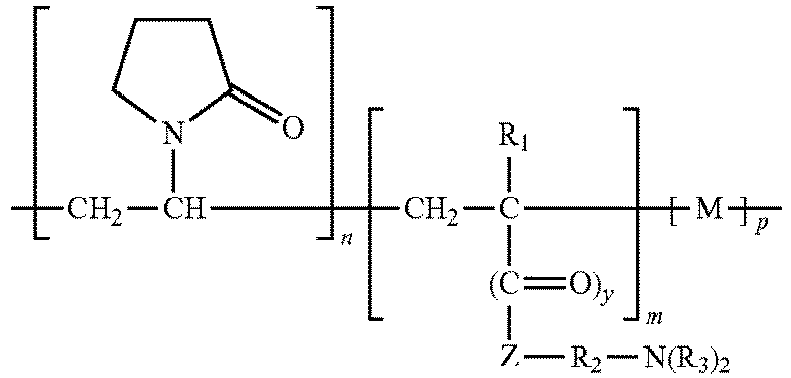 n is from 20 to 99;m is from 1 to 80;p is from 0 to 50, and wherein the total of n + m + p is 100;R1 is H or a C1 to C4 alkyl;Z is O, S, or NH;R2 is (CH2)x;x is from 1 to 18;y is 0 or 1;R3 is independently hydrogen or a C1 to C4 alkyl; andM is a vinyl or vinylidene monomer copolymerizable with vinyl pyrrolidone;iii) a polyquaternary ammonium polymer having the following general structure:
(N+R13R14-(CH2)a-NH-C(Y)-NH-(CH2)b-N+R13R14-R15)n-2nX-
wherein,R13 and R14 are independently alkyl, hydroxyalkyl, or - CH2CH2(OCH2CH2)cOH;R15 is a linking group and may be (CH2)d or {(CH2)eO(CH2)f}g;Y is O, S or NH;a, b, c, d, e and f are each independently from 1 to 6;g is from 1 to 4;n is at least 1; andX- is an anion; andiv) a cationic surfactant;wherein the vinylpyrrolidone copolymer is present in an amount from 50 to 90 parts per 100 parts of acids employed in the composition, and wherein the polyquaternary ammonium polymer is present in an amount from 30 to 70 parts per 100 parts of acids employed in the composition. - The film of claim 12, wherein the acid constitutes from 10 wt.% to 50 wt.% of the film, the vinylpyrrolidone copolymer constitute from 10 wt.% to 40 wt.% of the film, and the polyquaternary ammonium polymer constitutes from 1 wt.% to 30 wt.% of the film.
- The disinfectant composition of claim 1 or the film of claim 12, wherein the weight ratio of the vinylpyrrolidone copolymer to the polyquaternary ammonium polymer is from 1.0 to 8.0, and/or wherein the acid has a first acid dissociation constant of from 1.0 to 5.0.
- The disinfectant composition of claim 1 or the film of claim 12, wherein the vinylpyrrolidone copolymer has the following general structure:
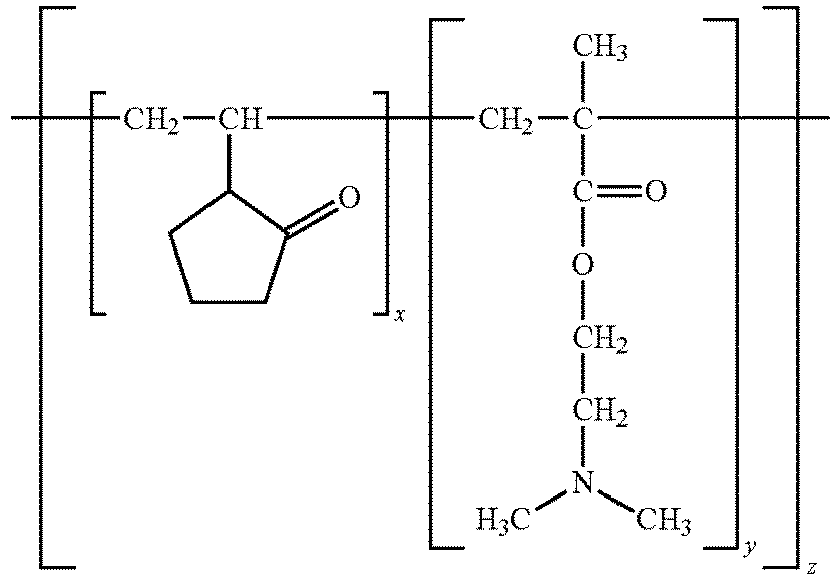
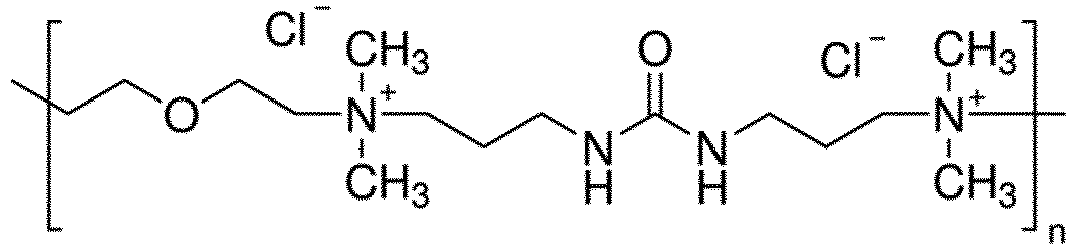
Priority Applications (1)
| Application Number | Priority Date | Filing Date | Title |
|---|---|---|---|
| EP20176595.5A EP3725153B1 (en) | 2015-07-27 | 2015-07-27 | Residual disinfectant composition |
Applications Claiming Priority (1)
| Application Number | Priority Date | Filing Date | Title |
|---|---|---|---|
| PCT/US2015/042209 WO2017019009A1 (en) | 2015-07-27 | 2015-07-27 | Residual disinfectant composition |
Related Child Applications (1)
| Application Number | Title | Priority Date | Filing Date |
|---|---|---|---|
| EP20176595.5A Division EP3725153B1 (en) | 2015-07-27 | 2015-07-27 | Residual disinfectant composition |
Publications (3)
| Publication Number | Publication Date |
|---|---|
| EP3337324A1 EP3337324A1 (en) | 2018-06-27 |
| EP3337324A4 EP3337324A4 (en) | 2019-01-23 |
| EP3337324B1 true EP3337324B1 (en) | 2020-06-03 |
Family
ID=57884991
Family Applications (2)
| Application Number | Title | Priority Date | Filing Date |
|---|---|---|---|
| EP15899806.2A Active EP3337324B1 (en) | 2015-07-27 | 2015-07-27 | Residual disinfectant composition |
| EP20176595.5A Active EP3725153B1 (en) | 2015-07-27 | 2015-07-27 | Residual disinfectant composition |
Family Applications After (1)
| Application Number | Title | Priority Date | Filing Date |
|---|---|---|---|
| EP20176595.5A Active EP3725153B1 (en) | 2015-07-27 | 2015-07-27 | Residual disinfectant composition |
Country Status (4)
| Country | Link |
|---|---|
| US (2) | US10874100B2 (en) |
| EP (2) | EP3337324B1 (en) |
| KR (1) | KR102470466B1 (en) |
| WO (1) | WO2017019009A1 (en) |
Families Citing this family (5)
| Publication number | Priority date | Publication date | Assignee | Title |
|---|---|---|---|---|
| US20210195892A1 (en) * | 2019-12-30 | 2021-07-01 | Microban Products Company | Composition and method for microbial control on material surfaces |
| DE102020122959A1 (en) * | 2020-09-02 | 2022-03-03 | Jointinventions Gmbh | Surface-active disinfectant |
| CN117177664A (en) * | 2021-04-21 | 2023-12-05 | 联合利华知识产权控股有限公司 | Use of cationic polymers to prevent reinfection |
| MX2023012372A (en) * | 2021-04-21 | 2023-11-01 | Unilever Ip Holdings B V | Use of a cationic polymer for reinfection prevention. |
| EP4356733A1 (en) * | 2022-10-19 | 2024-04-24 | Bode Chemie GmbH | Low alcohol disinfectant |
Family Cites Families (67)
| Publication number | Priority date | Publication date | Assignee | Title |
|---|---|---|---|---|
| US3494821A (en) | 1967-01-06 | 1970-02-10 | Du Pont | Patterned nonwoven fabric of hydraulically entangled textile fibers and reinforcing fibers |
| SE375780B (en) | 1970-01-30 | 1975-04-28 | Gaf Corp | |
| CH557174A (en) | 1970-01-30 | 1974-12-31 | Gaf Corp | COSMETIC PREPARATION. |
| US4100324A (en) | 1974-03-26 | 1978-07-11 | Kimberly-Clark Corporation | Nonwoven fabric and method of producing same |
| GB1550955A (en) | 1975-12-29 | 1979-08-22 | Johnson & Johnson | Textile fabric and method of manufacturing the same |
| LU76955A1 (en) | 1977-03-15 | 1978-10-18 | ||
| US4223009A (en) | 1977-06-10 | 1980-09-16 | Gaf Corporation | Hair preparation containing vinyl pyrrolidone copolymer |
| US4719235A (en) | 1984-10-16 | 1988-01-12 | Gerald N. Kern | Methods and compositions for treating viral infection |
| US5057361A (en) | 1989-11-17 | 1991-10-15 | Kimberly-Clark Corporation | Wettable polymeric fabrics |
| CA2048905C (en) | 1990-12-21 | 1998-08-11 | Cherie H. Everhart | High pulp content nonwoven composite fabric |
| US5240764A (en) | 1992-05-13 | 1993-08-31 | E. I. Du Pont De Nemours And Company | Process for making spunlaced nonwoven fabrics |
| US5350624A (en) | 1992-10-05 | 1994-09-27 | Kimberly-Clark Corporation | Abrasion resistant fibrous nonwoven composite structure |
| US5964351A (en) | 1996-03-15 | 1999-10-12 | Kimberly-Clark Worldwide, Inc. | Stack of folded wet wipes having improved dispensability and a method of making the same |
| TW427912B (en) | 1996-12-20 | 2001-04-01 | Kao Corp | Detergent composition |
| US5785179A (en) | 1997-06-04 | 1998-07-28 | Kimberly-Clark Worldwide, Inc. | Container for wet wipes having an improved closure mechanism |
| US6403113B1 (en) | 1997-07-17 | 2002-06-11 | The Procter & Gamble Company | Anti-microbic agent |
| US6158614A (en) | 1997-07-30 | 2000-12-12 | Kimberly-Clark Worldwide, Inc. | Wet wipe dispenser with refill cartridge |
| US6315864B2 (en) | 1997-10-30 | 2001-11-13 | Kimberly-Clark Worldwide, Inc. | Cloth-like base sheet and method for making the same |
| AU1816200A (en) | 1998-11-09 | 2000-05-29 | Procter & Gamble Company, The | Cleaning composition, pad, wipe, implement, and system and method of use thereof |
| US6273359B1 (en) | 1999-04-30 | 2001-08-14 | Kimberly-Clark Worldwide, Inc. | Dispensing system and method for premoistened wipes |
| WO2001028337A2 (en) | 1999-10-19 | 2001-04-26 | The Procter & Gamble Company | Antiviral compositions for tissue paper |
| PE20010859A1 (en) | 1999-10-19 | 2001-09-02 | Procter & Gamble | TISSUE PAPER PRODUCTS CONTAINING ANTIVIRAL AGENTS THAT ARE GENTLE TO THE SKIN |
| US6269969B1 (en) | 2000-05-05 | 2001-08-07 | Kimberly-Clark Worldwide, Inc. | Wet wipes container with improved closure |
| US6269970B1 (en) | 2000-05-05 | 2001-08-07 | Kimberly-Clark Worldwide, Inc. | Wet wipes container having a tear resistant lid |
| US20020183233A1 (en) | 2000-12-14 | 2002-12-05 | The Clorox Company, Delaware Corporation | Bactericidal cleaning wipe |
| GB2381531A (en) | 2001-11-02 | 2003-05-07 | Reckitt Benckiser Inc | Hard surface cleaning and disinfecting compositions |
| US6838078B2 (en) | 2002-01-16 | 2005-01-04 | 3M Innovative Properties Company | Film-forming compositions and methods |
| EP1480517A4 (en) * | 2002-02-07 | 2007-08-22 | Univ Columbia | ZINC SALT COMPOSITIONS AGAINST MUCOSAL IRRITATION FROM SPERMICIDES AND MICROBICIDES |
| DE10221449A1 (en) * | 2002-05-15 | 2003-11-27 | Wella Ag | Aerosol foam or pump foam product for hair treatment |
| GB2391810A (en) | 2002-08-14 | 2004-02-18 | Reckitt Benckiser Inc | Disinfectant with residual antimicrobial activity |
| US20040241130A1 (en) | 2002-09-13 | 2004-12-02 | Krishnan Tamareselvy | Multi-purpose polymers, methods and compositions |
| US8198326B2 (en) | 2004-09-07 | 2012-06-12 | 3M Innovative Properties Company | Phenolic antiseptic compositions and methods of use |
| US9028852B2 (en) | 2004-09-07 | 2015-05-12 | 3M Innovative Properties Company | Cationic antiseptic compositions and methods of use |
| MX2007006860A (en) | 2004-12-09 | 2008-02-15 | Dial Corp | Compositions having a high antiviral and antibacterial efficacy. |
| US20090104281A1 (en) | 2004-12-09 | 2009-04-23 | The Dial Corporation | Compositions Having a High Antiviral and Antibacterial Efficacy |
| WO2006062846A2 (en) | 2004-12-09 | 2006-06-15 | The Dial Corporation | Compositions having a high antiviral and antibacterial efficacy |
| AU2006223136A1 (en) | 2005-03-10 | 2006-09-21 | 3M Innovative Properties Company | Antimicrobial compositions comprising esters of hydroxycarboxylic acids |
| US8343523B2 (en) | 2005-08-22 | 2013-01-01 | Quick-Med Technologies, Inc. | Disinfectant with durable activity based on alcohol-soluble quaternary ammonium polymers and copolymers |
| US20070166344A1 (en) | 2006-01-18 | 2007-07-19 | Xin Qu | Non-leaching surface-active film compositions for microbial adhesion prevention |
| US8450378B2 (en) * | 2006-02-09 | 2013-05-28 | Gojo Industries, Inc. | Antiviral method |
| US9629361B2 (en) * | 2006-02-09 | 2017-04-25 | Gojo Industries, Inc. | Composition and method for pre-surgical skin disinfection |
| US8119115B2 (en) | 2006-02-09 | 2012-02-21 | Gojo Industries, Inc. | Antiviral method |
| US20070185216A1 (en) * | 2006-02-09 | 2007-08-09 | Marcia Snyder | Antiviral method |
| EP1832993B1 (en) | 2006-03-06 | 2009-02-25 | General Electric Company | Automatic calibration of the sensitivity of a subject to a drug |
| US8034844B2 (en) | 2006-05-30 | 2011-10-11 | The Dial Corporation | Compositions having a high antiviral efficacy |
| EP2034826A2 (en) | 2006-06-02 | 2009-03-18 | The Dial Corporation | Method of inhibiting the transmission of influenza virus |
| WO2007145886A2 (en) | 2006-06-05 | 2007-12-21 | The Dial Corporation | Methods and articles having a high antiviral and antibacterial efficacy |
| WO2008021441A2 (en) | 2006-08-15 | 2008-02-21 | Fitchmun Mark I | Surface sanitizer |
| DE102006058390A1 (en) * | 2006-12-08 | 2008-06-12 | Henkel Kgaa | Styling agent for keratin fibers |
| BRPI0811778A2 (en) * | 2007-05-21 | 2014-09-30 | Aquea Scient Corp | HIGHLY LOADED MICROCapsules |
| GB0718440D0 (en) | 2007-09-21 | 2007-10-31 | Reckitt Benckiser Uk Ltd | Hard surface treatment compositions with improved mold fungi remediation properties |
| US7972388B2 (en) * | 2007-10-30 | 2011-07-05 | L'oreal S.A. | Methods and kits for maintaining the condition of colored hair |
| DE102008013171A1 (en) * | 2008-03-07 | 2009-09-10 | Beiersdorf Ag | Volumizing hair fixative with ampholytic copolymer |
| FR2968942B1 (en) | 2010-12-21 | 2016-02-12 | Oreal | COSMETIC COMPOSITION COMPRISING ZINC SALT AND 1,2-OCTANEDIOL |
| US9949477B2 (en) | 2010-12-30 | 2018-04-24 | Kimberly-Clark Worldwide, Inc. | Durable antimicrobial composition |
| US20120171301A1 (en) | 2010-12-30 | 2012-07-05 | David William Koenig | Durable Antimicrobial Composition Including a Surfactant |
| US20120171267A1 (en) | 2010-12-30 | 2012-07-05 | Cunningham Corey T | Durable Antimicrobial Composition |
| US20120171300A1 (en) * | 2010-12-30 | 2012-07-05 | David William Koenig | Durable Antimicrobial Composition Including a Surfactant |
| US9232790B2 (en) | 2011-08-02 | 2016-01-12 | Kimberly-Clark Worldwide, Inc. | Antimicrobial cleansing compositions |
| EP3769624B1 (en) | 2012-02-20 | 2024-10-30 | Basf Se | Enhancing the antimicrobial activity of biocides with polymers |
| ES2686046T3 (en) | 2013-03-08 | 2018-10-16 | Symrise Ag | Antimicrobial compositions |
| US9393252B2 (en) | 2013-03-12 | 2016-07-19 | Ecolab Usa Inc. | Aromatic carboxylic acids in combination with aromatic hydroxyamides for inactivating non-enveloped viruses |
| EP2807925A1 (en) | 2013-05-26 | 2014-12-03 | Symrise AG | Antimicrobial compositions |
| US9321803B2 (en) | 2013-07-12 | 2016-04-26 | Children's Hospital Medical Center | Compositions and methods for inhibiting norovirus infection |
| JP6125660B2 (en) | 2013-11-14 | 2017-05-10 | 日本曹達株式会社 | Anti-parvovirus composition |
| US20180154328A1 (en) * | 2015-05-01 | 2018-06-07 | Conopco, Inc., D/B/A Unilever | Polymer shell microcapsules with deposition polymer |
| EP3328373B1 (en) | 2015-07-27 | 2023-06-07 | Kimberly-Clark Worldwide, Inc. | Disinfectant composition with rapid antiviral efficacy |
-
2015
- 2015-07-27 EP EP15899806.2A patent/EP3337324B1/en active Active
- 2015-07-27 EP EP20176595.5A patent/EP3725153B1/en active Active
- 2015-07-27 US US15/744,091 patent/US10874100B2/en active Active
- 2015-07-27 WO PCT/US2015/042209 patent/WO2017019009A1/en not_active Ceased
- 2015-07-27 KR KR1020187003319A patent/KR102470466B1/en active Active
-
2020
- 2020-12-04 US US17/111,597 patent/US12096767B2/en active Active
Non-Patent Citations (1)
| Title |
|---|
| None * |
Also Published As
| Publication number | Publication date |
|---|---|
| US20180199567A1 (en) | 2018-07-19 |
| EP3725153B1 (en) | 2024-09-04 |
| EP3337324A1 (en) | 2018-06-27 |
| US12096767B2 (en) | 2024-09-24 |
| EP3337324A4 (en) | 2019-01-23 |
| KR20180030072A (en) | 2018-03-21 |
| WO2017019009A1 (en) | 2017-02-02 |
| KR102470466B1 (en) | 2022-11-25 |
| US10874100B2 (en) | 2020-12-29 |
| US20210092949A1 (en) | 2021-04-01 |
| EP3725153A1 (en) | 2020-10-21 |
Similar Documents
| Publication | Publication Date | Title |
|---|---|---|
| US12096767B2 (en) | Residual disinfectant composition | |
| EP3328373B1 (en) | Disinfectant composition with rapid antiviral efficacy | |
| CN109169653B (en) | Cation composite disinfectant and application thereof | |
| US8211454B2 (en) | Paper product with disinfecting properties | |
| JP2010505964A (en) | How to inactivate viruses | |
| CN101952407B (en) | Antibacterial cleaner composition for toilet seat, antibacterial cleaning material comprising the same, and application thereof | |
| CN106413761A (en) | Disinfecting composition and wipes with reduced contact time | |
| JP5539661B2 (en) | Wet wiper containing disinfectant | |
| JP2019097756A (en) | Wet wiper | |
| CN109561694A (en) | Antimicrobial compositions | |
| CN113874482A (en) | Detergent formulations with enhanced germ removal efficacy | |
| EP4121220A1 (en) | Plasma coating treatment method for inhibiting biological pathogen transfer | |
| JP7421903B2 (en) | Virus inactivator composition | |
| CN108728261B (en) | Environment-friendly physical bacteriostatic lotion and application thereof | |
| WO2024218378A1 (en) | Compositions containing synergistic combination of quaternary ammonium compounds and select polymers | |
| CN115103592A (en) | Universal formulation | |
| JP2008202195A (en) | Wet wiper | |
| HK40081099A (en) | Universal formulation | |
| JP5107881B2 (en) | Wet sheet | |
| JPH1099250A (en) | Wet wiper | |
| JP2019151945A (en) | Treatment agent composition for fiber product | |
| HK1137667A (en) | Methods of inactivating viruses | |
| MXPA98003231A (en) | Antimicrobial compositions and wet cleaners containing the mis |
Legal Events
| Date | Code | Title | Description |
|---|---|---|---|
| STAA | Information on the status of an ep patent application or granted ep patent |
Free format text: STATUS: THE INTERNATIONAL PUBLICATION HAS BEEN MADE |
|
| PUAI | Public reference made under article 153(3) epc to a published international application that has entered the european phase |
Free format text: ORIGINAL CODE: 0009012 |
|
| STAA | Information on the status of an ep patent application or granted ep patent |
Free format text: STATUS: REQUEST FOR EXAMINATION WAS MADE |
|
| 17P | Request for examination filed |
Effective date: 20180213 |
|
| AK | Designated contracting states |
Kind code of ref document: A1 Designated state(s): AL AT BE BG CH CY CZ DE DK EE ES FI FR GB GR HR HU IE IS IT LI LT LU LV MC MK MT NL NO PL PT RO RS SE SI SK SM TR |
|
| AX | Request for extension of the european patent |
Extension state: BA ME |
|
| DAV | Request for validation of the european patent (deleted) | ||
| DAX | Request for extension of the european patent (deleted) | ||
| A4 | Supplementary search report drawn up and despatched |
Effective date: 20190102 |
|
| RIC1 | Information provided on ipc code assigned before grant |
Ipc: C09D 7/61 20180101ALI20181218BHEP Ipc: A01N 43/36 20060101ALI20181218BHEP Ipc: A01N 37/02 20060101ALI20181218BHEP Ipc: A01N 33/12 20060101AFI20181218BHEP Ipc: C09D 5/14 20060101ALI20181218BHEP Ipc: A01N 41/04 20060101ALI20181218BHEP Ipc: A01N 47/28 20060101ALI20181218BHEP Ipc: A61L 2/18 20060101ALI20181218BHEP Ipc: C09D 7/63 20180101ALI20181218BHEP Ipc: A01N 37/06 20060101ALI20181218BHEP Ipc: A01N 37/36 20060101ALI20181218BHEP Ipc: A01N 25/34 20060101ALI20181218BHEP Ipc: A01P 1/00 20060101ALI20181218BHEP Ipc: A61L 2/23 20060101ALI20181218BHEP Ipc: C09D 139/06 20060101ALI20181218BHEP Ipc: A01N 25/10 20060101ALI20181218BHEP Ipc: A01N 59/26 20060101ALI20181218BHEP |
|
| REG | Reference to a national code |
Ref country code: DE Ref legal event code: R079 Ref document number: 602015053955 Country of ref document: DE Free format text: PREVIOUS MAIN CLASS: A01N0059000000 Ipc: A01N0033120000 |
|
| GRAP | Despatch of communication of intention to grant a patent |
Free format text: ORIGINAL CODE: EPIDOSNIGR1 |
|
| STAA | Information on the status of an ep patent application or granted ep patent |
Free format text: STATUS: GRANT OF PATENT IS INTENDED |
|
| RIC1 | Information provided on ipc code assigned before grant |
Ipc: A61L 2/18 20060101ALI20200116BHEP Ipc: A01N 25/10 20060101ALI20200116BHEP Ipc: A01N 33/12 20060101AFI20200116BHEP Ipc: A01N 37/02 20060101ALI20200116BHEP Ipc: A01N 37/36 20060101ALI20200116BHEP Ipc: C09D 139/06 20060101ALI20200116BHEP Ipc: A01N 47/28 20060101ALI20200116BHEP Ipc: A01N 41/04 20060101ALI20200116BHEP Ipc: A01N 37/06 20060101ALI20200116BHEP Ipc: C09D 5/14 20060101ALI20200116BHEP Ipc: A01N 43/36 20060101ALI20200116BHEP Ipc: C09D 7/61 20180101ALI20200116BHEP Ipc: A01N 59/26 20060101ALI20200116BHEP Ipc: C09D 7/63 20180101ALI20200116BHEP Ipc: A01P 1/00 20060101ALI20200116BHEP Ipc: A01N 25/34 20060101ALI20200116BHEP Ipc: A61L 2/23 20060101ALI20200116BHEP |
|
| INTG | Intention to grant announced |
Effective date: 20200211 |
|
| GRAS | Grant fee paid |
Free format text: ORIGINAL CODE: EPIDOSNIGR3 |
|
| GRAA | (expected) grant |
Free format text: ORIGINAL CODE: 0009210 |
|
| STAA | Information on the status of an ep patent application or granted ep patent |
Free format text: STATUS: THE PATENT HAS BEEN GRANTED |
|
| AK | Designated contracting states |
Kind code of ref document: B1 Designated state(s): AL AT BE BG CH CY CZ DE DK EE ES FI FR GB GR HR HU IE IS IT LI LT LU LV MC MK MT NL NO PL PT RO RS SE SI SK SM TR |
|
| REG | Reference to a national code |
Ref country code: GB Ref legal event code: FG4D |
|
| REG | Reference to a national code |
Ref country code: CH Ref legal event code: EP Ref country code: AT Ref legal event code: REF Ref document number: 1276029 Country of ref document: AT Kind code of ref document: T Effective date: 20200615 |
|
| REG | Reference to a national code |
Ref country code: DE Ref legal event code: R096 Ref document number: 602015053955 Country of ref document: DE |
|
| REG | Reference to a national code |
Ref country code: LT Ref legal event code: MG4D |
|
| PG25 | Lapsed in a contracting state [announced via postgrant information from national office to epo] |
Ref country code: SE Free format text: LAPSE BECAUSE OF FAILURE TO SUBMIT A TRANSLATION OF THE DESCRIPTION OR TO PAY THE FEE WITHIN THE PRESCRIBED TIME-LIMIT Effective date: 20200603 Ref country code: FI Free format text: LAPSE BECAUSE OF FAILURE TO SUBMIT A TRANSLATION OF THE DESCRIPTION OR TO PAY THE FEE WITHIN THE PRESCRIBED TIME-LIMIT Effective date: 20200603 Ref country code: NO Free format text: LAPSE BECAUSE OF FAILURE TO SUBMIT A TRANSLATION OF THE DESCRIPTION OR TO PAY THE FEE WITHIN THE PRESCRIBED TIME-LIMIT Effective date: 20200903 Ref country code: GR Free format text: LAPSE BECAUSE OF FAILURE TO SUBMIT A TRANSLATION OF THE DESCRIPTION OR TO PAY THE FEE WITHIN THE PRESCRIBED TIME-LIMIT Effective date: 20200904 Ref country code: LT Free format text: LAPSE BECAUSE OF FAILURE TO SUBMIT A TRANSLATION OF THE DESCRIPTION OR TO PAY THE FEE WITHIN THE PRESCRIBED TIME-LIMIT Effective date: 20200603 |
|
| REG | Reference to a national code |
Ref country code: NL Ref legal event code: MP Effective date: 20200603 |
|
| PG25 | Lapsed in a contracting state [announced via postgrant information from national office to epo] |
Ref country code: LV Free format text: LAPSE BECAUSE OF FAILURE TO SUBMIT A TRANSLATION OF THE DESCRIPTION OR TO PAY THE FEE WITHIN THE PRESCRIBED TIME-LIMIT Effective date: 20200603 Ref country code: BG Free format text: LAPSE BECAUSE OF FAILURE TO SUBMIT A TRANSLATION OF THE DESCRIPTION OR TO PAY THE FEE WITHIN THE PRESCRIBED TIME-LIMIT Effective date: 20200903 Ref country code: RS Free format text: LAPSE BECAUSE OF FAILURE TO SUBMIT A TRANSLATION OF THE DESCRIPTION OR TO PAY THE FEE WITHIN THE PRESCRIBED TIME-LIMIT Effective date: 20200603 Ref country code: HR Free format text: LAPSE BECAUSE OF FAILURE TO SUBMIT A TRANSLATION OF THE DESCRIPTION OR TO PAY THE FEE WITHIN THE PRESCRIBED TIME-LIMIT Effective date: 20200603 |
|
| REG | Reference to a national code |
Ref country code: AT Ref legal event code: MK05 Ref document number: 1276029 Country of ref document: AT Kind code of ref document: T Effective date: 20200603 |
|
| PG25 | Lapsed in a contracting state [announced via postgrant information from national office to epo] |
Ref country code: NL Free format text: LAPSE BECAUSE OF FAILURE TO SUBMIT A TRANSLATION OF THE DESCRIPTION OR TO PAY THE FEE WITHIN THE PRESCRIBED TIME-LIMIT Effective date: 20200603 Ref country code: AL Free format text: LAPSE BECAUSE OF FAILURE TO SUBMIT A TRANSLATION OF THE DESCRIPTION OR TO PAY THE FEE WITHIN THE PRESCRIBED TIME-LIMIT Effective date: 20200603 |
|
| PG25 | Lapsed in a contracting state [announced via postgrant information from national office to epo] |
Ref country code: SM Free format text: LAPSE BECAUSE OF FAILURE TO SUBMIT A TRANSLATION OF THE DESCRIPTION OR TO PAY THE FEE WITHIN THE PRESCRIBED TIME-LIMIT Effective date: 20200603 Ref country code: EE Free format text: LAPSE BECAUSE OF FAILURE TO SUBMIT A TRANSLATION OF THE DESCRIPTION OR TO PAY THE FEE WITHIN THE PRESCRIBED TIME-LIMIT Effective date: 20200603 Ref country code: AT Free format text: LAPSE BECAUSE OF FAILURE TO SUBMIT A TRANSLATION OF THE DESCRIPTION OR TO PAY THE FEE WITHIN THE PRESCRIBED TIME-LIMIT Effective date: 20200603 Ref country code: PT Free format text: LAPSE BECAUSE OF FAILURE TO SUBMIT A TRANSLATION OF THE DESCRIPTION OR TO PAY THE FEE WITHIN THE PRESCRIBED TIME-LIMIT Effective date: 20201006 Ref country code: CZ Free format text: LAPSE BECAUSE OF FAILURE TO SUBMIT A TRANSLATION OF THE DESCRIPTION OR TO PAY THE FEE WITHIN THE PRESCRIBED TIME-LIMIT Effective date: 20200603 Ref country code: RO Free format text: LAPSE BECAUSE OF FAILURE TO SUBMIT A TRANSLATION OF THE DESCRIPTION OR TO PAY THE FEE WITHIN THE PRESCRIBED TIME-LIMIT Effective date: 20200603 Ref country code: ES Free format text: LAPSE BECAUSE OF FAILURE TO SUBMIT A TRANSLATION OF THE DESCRIPTION OR TO PAY THE FEE WITHIN THE PRESCRIBED TIME-LIMIT Effective date: 20200603 |
|
| PG25 | Lapsed in a contracting state [announced via postgrant information from national office to epo] |
Ref country code: PL Free format text: LAPSE BECAUSE OF FAILURE TO SUBMIT A TRANSLATION OF THE DESCRIPTION OR TO PAY THE FEE WITHIN THE PRESCRIBED TIME-LIMIT Effective date: 20200603 Ref country code: SK Free format text: LAPSE BECAUSE OF FAILURE TO SUBMIT A TRANSLATION OF THE DESCRIPTION OR TO PAY THE FEE WITHIN THE PRESCRIBED TIME-LIMIT Effective date: 20200603 Ref country code: IS Free format text: LAPSE BECAUSE OF FAILURE TO SUBMIT A TRANSLATION OF THE DESCRIPTION OR TO PAY THE FEE WITHIN THE PRESCRIBED TIME-LIMIT Effective date: 20201003 |
|
| REG | Reference to a national code |
Ref country code: CH Ref legal event code: PL |
|
| REG | Reference to a national code |
Ref country code: DE Ref legal event code: R097 Ref document number: 602015053955 Country of ref document: DE |
|
| PG25 | Lapsed in a contracting state [announced via postgrant information from national office to epo] |
Ref country code: MC Free format text: LAPSE BECAUSE OF FAILURE TO SUBMIT A TRANSLATION OF THE DESCRIPTION OR TO PAY THE FEE WITHIN THE PRESCRIBED TIME-LIMIT Effective date: 20200603 |
|
| PLBE | No opposition filed within time limit |
Free format text: ORIGINAL CODE: 0009261 |
|
| STAA | Information on the status of an ep patent application or granted ep patent |
Free format text: STATUS: NO OPPOSITION FILED WITHIN TIME LIMIT |
|
| REG | Reference to a national code |
Ref country code: BE Ref legal event code: MM Effective date: 20200731 |
|
| PG25 | Lapsed in a contracting state [announced via postgrant information from national office to epo] |
Ref country code: DK Free format text: LAPSE BECAUSE OF FAILURE TO SUBMIT A TRANSLATION OF THE DESCRIPTION OR TO PAY THE FEE WITHIN THE PRESCRIBED TIME-LIMIT Effective date: 20200603 Ref country code: CH Free format text: LAPSE BECAUSE OF NON-PAYMENT OF DUE FEES Effective date: 20200731 Ref country code: LI Free format text: LAPSE BECAUSE OF NON-PAYMENT OF DUE FEES Effective date: 20200731 Ref country code: LU Free format text: LAPSE BECAUSE OF NON-PAYMENT OF DUE FEES Effective date: 20200727 |
|
| 26N | No opposition filed |
Effective date: 20210304 |
|
| PG25 | Lapsed in a contracting state [announced via postgrant information from national office to epo] |
Ref country code: BE Free format text: LAPSE BECAUSE OF NON-PAYMENT OF DUE FEES Effective date: 20200731 Ref country code: SI Free format text: LAPSE BECAUSE OF FAILURE TO SUBMIT A TRANSLATION OF THE DESCRIPTION OR TO PAY THE FEE WITHIN THE PRESCRIBED TIME-LIMIT Effective date: 20200603 |
|
| PG25 | Lapsed in a contracting state [announced via postgrant information from national office to epo] |
Ref country code: IE Free format text: LAPSE BECAUSE OF NON-PAYMENT OF DUE FEES Effective date: 20200727 |
|
| PG25 | Lapsed in a contracting state [announced via postgrant information from national office to epo] |
Ref country code: TR Free format text: LAPSE BECAUSE OF FAILURE TO SUBMIT A TRANSLATION OF THE DESCRIPTION OR TO PAY THE FEE WITHIN THE PRESCRIBED TIME-LIMIT Effective date: 20200603 Ref country code: MT Free format text: LAPSE BECAUSE OF FAILURE TO SUBMIT A TRANSLATION OF THE DESCRIPTION OR TO PAY THE FEE WITHIN THE PRESCRIBED TIME-LIMIT Effective date: 20200603 Ref country code: CY Free format text: LAPSE BECAUSE OF FAILURE TO SUBMIT A TRANSLATION OF THE DESCRIPTION OR TO PAY THE FEE WITHIN THE PRESCRIBED TIME-LIMIT Effective date: 20200603 |
|
| PG25 | Lapsed in a contracting state [announced via postgrant information from national office to epo] |
Ref country code: MK Free format text: LAPSE BECAUSE OF FAILURE TO SUBMIT A TRANSLATION OF THE DESCRIPTION OR TO PAY THE FEE WITHIN THE PRESCRIBED TIME-LIMIT Effective date: 20200603 |
|
| P01 | Opt-out of the competence of the unified patent court (upc) registered |
Effective date: 20230511 |
|
| PGFP | Annual fee paid to national office [announced via postgrant information from national office to epo] |
Ref country code: DE Payment date: 20250729 Year of fee payment: 11 |
|
| PGFP | Annual fee paid to national office [announced via postgrant information from national office to epo] |
Ref country code: IT Payment date: 20250721 Year of fee payment: 11 |
|
| PGFP | Annual fee paid to national office [announced via postgrant information from national office to epo] |
Ref country code: GB Payment date: 20250728 Year of fee payment: 11 |
|
| PGFP | Annual fee paid to national office [announced via postgrant information from national office to epo] |
Ref country code: FR Payment date: 20250728 Year of fee payment: 11 |