EP3315124A1 - Bilayer tablet formulations - Google Patents
Bilayer tablet formulations Download PDFInfo
- Publication number
- EP3315124A1 EP3315124A1 EP17206106.1A EP17206106A EP3315124A1 EP 3315124 A1 EP3315124 A1 EP 3315124A1 EP 17206106 A EP17206106 A EP 17206106A EP 3315124 A1 EP3315124 A1 EP 3315124A1
- Authority
- EP
- European Patent Office
- Prior art keywords
- dapagliflozin
- silicon dioxide
- magnesium stearate
- microcrystalline cellulose
- layer
- Prior art date
- Legal status (The legal status is an assumption and is not a legal conclusion. Google has not performed a legal analysis and makes no representation as to the accuracy of the status listed.)
- Granted
Links
- OQXBZRHLDMAMHK-JBWXQBIKSA-N N[C@@H](C(CC(C1)C2)(CC1C1)CC21O)C(N1C2(CC2)CC[C@H]1C#N)=O Chemical compound N[C@@H](C(CC(C1)C2)(CC1C1)CC21O)C(N1C2(CC2)CC[C@H]1C#N)=O OQXBZRHLDMAMHK-JBWXQBIKSA-N 0.000 description 1
Classifications
-
- A—HUMAN NECESSITIES
- A61—MEDICAL OR VETERINARY SCIENCE; HYGIENE
- A61K—PREPARATIONS FOR MEDICAL, DENTAL OR TOILETRY PURPOSES
- A61K9/00—Medicinal preparations characterised by special physical form
- A61K9/20—Pills, tablets, discs, rods
- A61K9/2072—Pills, tablets, discs, rods characterised by shape, structure or size; Tablets with holes, special break lines or identification marks; Partially coated tablets; Disintegrating flat shaped forms
- A61K9/2086—Layered tablets, e.g. bilayer tablets; Tablets of the type inert core-active coat
- A61K9/209—Layered tablets, e.g. bilayer tablets; Tablets of the type inert core-active coat containing drug in at least two layers or in the core and in at least one outer layer
-
- A—HUMAN NECESSITIES
- A61—MEDICAL OR VETERINARY SCIENCE; HYGIENE
- A61K—PREPARATIONS FOR MEDICAL, DENTAL OR TOILETRY PURPOSES
- A61K31/00—Medicinal preparations containing organic active ingredients
- A61K31/13—Amines
- A61K31/132—Amines having two or more amino groups, e.g. spermidine, putrescine
-
- A—HUMAN NECESSITIES
- A61—MEDICAL OR VETERINARY SCIENCE; HYGIENE
- A61K—PREPARATIONS FOR MEDICAL, DENTAL OR TOILETRY PURPOSES
- A61K31/00—Medicinal preparations containing organic active ingredients
- A61K31/13—Amines
- A61K31/155—Amidines (), e.g. guanidine (H2N—C(=NH)—NH2), isourea (N=C(OH)—NH2), isothiourea (—N=C(SH)—NH2)
-
- A—HUMAN NECESSITIES
- A61—MEDICAL OR VETERINARY SCIENCE; HYGIENE
- A61K—PREPARATIONS FOR MEDICAL, DENTAL OR TOILETRY PURPOSES
- A61K31/00—Medicinal preparations containing organic active ingredients
- A61K31/33—Heterocyclic compounds
- A61K31/395—Heterocyclic compounds having nitrogen as a ring hetero atom, e.g. guanethidine or rifamycins
- A61K31/40—Heterocyclic compounds having nitrogen as a ring hetero atom, e.g. guanethidine or rifamycins having five-membered rings with one nitrogen as the only ring hetero atom, e.g. sulpiride, succinimide, tolmetin, buflomedil
- A61K31/403—Heterocyclic compounds having nitrogen as a ring hetero atom, e.g. guanethidine or rifamycins having five-membered rings with one nitrogen as the only ring hetero atom, e.g. sulpiride, succinimide, tolmetin, buflomedil condensed with carbocyclic rings, e.g. carbazole
-
- A—HUMAN NECESSITIES
- A61—MEDICAL OR VETERINARY SCIENCE; HYGIENE
- A61K—PREPARATIONS FOR MEDICAL, DENTAL OR TOILETRY PURPOSES
- A61K31/00—Medicinal preparations containing organic active ingredients
- A61K31/70—Carbohydrates; Sugars; Derivatives thereof
-
- A—HUMAN NECESSITIES
- A61—MEDICAL OR VETERINARY SCIENCE; HYGIENE
- A61K—PREPARATIONS FOR MEDICAL, DENTAL OR TOILETRY PURPOSES
- A61K31/00—Medicinal preparations containing organic active ingredients
- A61K31/70—Carbohydrates; Sugars; Derivatives thereof
- A61K31/7004—Monosaccharides having only carbon, hydrogen and oxygen atoms
-
- A—HUMAN NECESSITIES
- A61—MEDICAL OR VETERINARY SCIENCE; HYGIENE
- A61K—PREPARATIONS FOR MEDICAL, DENTAL OR TOILETRY PURPOSES
- A61K31/00—Medicinal preparations containing organic active ingredients
- A61K31/70—Carbohydrates; Sugars; Derivatives thereof
- A61K31/7028—Compounds having saccharide radicals attached to non-saccharide compounds by glycosidic linkages
-
- A—HUMAN NECESSITIES
- A61—MEDICAL OR VETERINARY SCIENCE; HYGIENE
- A61K—PREPARATIONS FOR MEDICAL, DENTAL OR TOILETRY PURPOSES
- A61K31/00—Medicinal preparations containing organic active ingredients
- A61K31/70—Carbohydrates; Sugars; Derivatives thereof
- A61K31/7028—Compounds having saccharide radicals attached to non-saccharide compounds by glycosidic linkages
- A61K31/7034—Compounds having saccharide radicals attached to non-saccharide compounds by glycosidic linkages attached to a carbocyclic compound, e.g. phloridzin
-
- A—HUMAN NECESSITIES
- A61—MEDICAL OR VETERINARY SCIENCE; HYGIENE
- A61K—PREPARATIONS FOR MEDICAL, DENTAL OR TOILETRY PURPOSES
- A61K31/00—Medicinal preparations containing organic active ingredients
- A61K31/70—Carbohydrates; Sugars; Derivatives thereof
- A61K31/7042—Compounds having saccharide radicals and heterocyclic rings
-
- A—HUMAN NECESSITIES
- A61—MEDICAL OR VETERINARY SCIENCE; HYGIENE
- A61K—PREPARATIONS FOR MEDICAL, DENTAL OR TOILETRY PURPOSES
- A61K45/00—Medicinal preparations containing active ingredients not provided for in groups A61K31/00 - A61K41/00
- A61K45/06—Mixtures of active ingredients without chemical characterisation, e.g. antiphlogistics and cardiaca
-
- A—HUMAN NECESSITIES
- A61—MEDICAL OR VETERINARY SCIENCE; HYGIENE
- A61K—PREPARATIONS FOR MEDICAL, DENTAL OR TOILETRY PURPOSES
- A61K9/00—Medicinal preparations characterised by special physical form
- A61K9/20—Pills, tablets, discs, rods
- A61K9/28—Dragees; Coated pills or tablets, e.g. with film or compression coating
- A61K9/2806—Coating materials
- A61K9/282—Organic compounds, e.g. fats
-
- A—HUMAN NECESSITIES
- A61—MEDICAL OR VETERINARY SCIENCE; HYGIENE
- A61P—SPECIFIC THERAPEUTIC ACTIVITY OF CHEMICAL COMPOUNDS OR MEDICINAL PREPARATIONS
- A61P13/00—Drugs for disorders of the urinary system
- A61P13/12—Drugs for disorders of the urinary system of the kidneys
-
- A—HUMAN NECESSITIES
- A61—MEDICAL OR VETERINARY SCIENCE; HYGIENE
- A61P—SPECIFIC THERAPEUTIC ACTIVITY OF CHEMICAL COMPOUNDS OR MEDICINAL PREPARATIONS
- A61P17/00—Drugs for dermatological disorders
- A61P17/02—Drugs for dermatological disorders for treating wounds, ulcers, burns, scars, keloids, or the like
-
- A—HUMAN NECESSITIES
- A61—MEDICAL OR VETERINARY SCIENCE; HYGIENE
- A61P—SPECIFIC THERAPEUTIC ACTIVITY OF CHEMICAL COMPOUNDS OR MEDICINAL PREPARATIONS
- A61P25/00—Drugs for disorders of the nervous system
-
- A—HUMAN NECESSITIES
- A61—MEDICAL OR VETERINARY SCIENCE; HYGIENE
- A61P—SPECIFIC THERAPEUTIC ACTIVITY OF CHEMICAL COMPOUNDS OR MEDICINAL PREPARATIONS
- A61P27/00—Drugs for disorders of the senses
- A61P27/02—Ophthalmic agents
-
- A—HUMAN NECESSITIES
- A61—MEDICAL OR VETERINARY SCIENCE; HYGIENE
- A61P—SPECIFIC THERAPEUTIC ACTIVITY OF CHEMICAL COMPOUNDS OR MEDICINAL PREPARATIONS
- A61P27/00—Drugs for disorders of the senses
- A61P27/02—Ophthalmic agents
- A61P27/12—Ophthalmic agents for cataracts
-
- A—HUMAN NECESSITIES
- A61—MEDICAL OR VETERINARY SCIENCE; HYGIENE
- A61P—SPECIFIC THERAPEUTIC ACTIVITY OF CHEMICAL COMPOUNDS OR MEDICINAL PREPARATIONS
- A61P3/00—Drugs for disorders of the metabolism
-
- A—HUMAN NECESSITIES
- A61—MEDICAL OR VETERINARY SCIENCE; HYGIENE
- A61P—SPECIFIC THERAPEUTIC ACTIVITY OF CHEMICAL COMPOUNDS OR MEDICINAL PREPARATIONS
- A61P3/00—Drugs for disorders of the metabolism
- A61P3/04—Anorexiants; Antiobesity agents
-
- A—HUMAN NECESSITIES
- A61—MEDICAL OR VETERINARY SCIENCE; HYGIENE
- A61P—SPECIFIC THERAPEUTIC ACTIVITY OF CHEMICAL COMPOUNDS OR MEDICINAL PREPARATIONS
- A61P3/00—Drugs for disorders of the metabolism
- A61P3/06—Antihyperlipidemics
-
- A—HUMAN NECESSITIES
- A61—MEDICAL OR VETERINARY SCIENCE; HYGIENE
- A61P—SPECIFIC THERAPEUTIC ACTIVITY OF CHEMICAL COMPOUNDS OR MEDICINAL PREPARATIONS
- A61P3/00—Drugs for disorders of the metabolism
- A61P3/08—Drugs for disorders of the metabolism for glucose homeostasis
- A61P3/10—Drugs for disorders of the metabolism for glucose homeostasis for hyperglycaemia, e.g. antidiabetics
-
- A—HUMAN NECESSITIES
- A61—MEDICAL OR VETERINARY SCIENCE; HYGIENE
- A61P—SPECIFIC THERAPEUTIC ACTIVITY OF CHEMICAL COMPOUNDS OR MEDICINAL PREPARATIONS
- A61P43/00—Drugs for specific purposes, not provided for in groups A61P1/00-A61P41/00
-
- A—HUMAN NECESSITIES
- A61—MEDICAL OR VETERINARY SCIENCE; HYGIENE
- A61P—SPECIFIC THERAPEUTIC ACTIVITY OF CHEMICAL COMPOUNDS OR MEDICINAL PREPARATIONS
- A61P5/00—Drugs for disorders of the endocrine system
- A61P5/48—Drugs for disorders of the endocrine system of the pancreatic hormones
- A61P5/50—Drugs for disorders of the endocrine system of the pancreatic hormones for increasing or potentiating the activity of insulin
-
- A—HUMAN NECESSITIES
- A61—MEDICAL OR VETERINARY SCIENCE; HYGIENE
- A61P—SPECIFIC THERAPEUTIC ACTIVITY OF CHEMICAL COMPOUNDS OR MEDICINAL PREPARATIONS
- A61P9/00—Drugs for disorders of the cardiovascular system
- A61P9/10—Drugs for disorders of the cardiovascular system for treating ischaemic or atherosclerotic diseases, e.g. antianginal drugs, coronary vasodilators, drugs for myocardial infarction, retinopathy, cerebrovascula insufficiency, renal arteriosclerosis
-
- A—HUMAN NECESSITIES
- A61—MEDICAL OR VETERINARY SCIENCE; HYGIENE
- A61P—SPECIFIC THERAPEUTIC ACTIVITY OF CHEMICAL COMPOUNDS OR MEDICINAL PREPARATIONS
- A61P9/00—Drugs for disorders of the cardiovascular system
- A61P9/12—Antihypertensives
-
- A—HUMAN NECESSITIES
- A61—MEDICAL OR VETERINARY SCIENCE; HYGIENE
- A61K—PREPARATIONS FOR MEDICAL, DENTAL OR TOILETRY PURPOSES
- A61K9/00—Medicinal preparations characterised by special physical form
- A61K9/20—Pills, tablets, discs, rods
- A61K9/2004—Excipients; Inactive ingredients
- A61K9/2022—Organic macromolecular compounds
- A61K9/205—Polysaccharides, e.g. alginate, gums; Cyclodextrin
- A61K9/2054—Cellulose; Cellulose derivatives, e.g. hydroxypropyl methylcellulose
Definitions
- the present invention relates to bilayer tablet formulations comprising metformin extended release (XR) formulations or reduced mass metformin XR formulations as the first layer, sodium dependent glucose transporter inhibitor (SGLT2) formulations as the second layer, and optionally a film coating.
- XR metformin extended release
- SGLT2 sodium dependent glucose transporter inhibitor
- the present invention provides methods of preparing the bilayer tablet formulations and methods of treating diseases or disorders associated with SGLT2 activity employing the bilayer tablet formulations.
- Type II diabetes is the most common form of diabetes accounting for 90% of diabetes cases. Over 100 million people worldwide have type-2 diabetes (nearly 17 million in the U.S.) and the prevalence is increasing dramatically in both the developed and developing worlds.
- Type-II diabetes is a lifelong illness, which generally starts in middle age or later part of life, but can start at any age. Patients with type-2 diabetes do not respond properly to insulin, the hormone that normally allows the body to convert blood glucose into energy or store it in cells to be used later.
- the problem in type-2 diabetes is a condition called insulin resistance where the body produces insulin, in normal or even high amounts, but certain mechanisms prevent insulin from moving glucose into cells. Because the body does not use insulin properly, glucose rises to unsafe levels in the blood, the condition known as hyperglycemia.
- sustained hyperglycemia leads to glucotoxicity, which worsens insulin resistance and contributes to dysfunction in the beta cells of the pancreas.
- the degree of sustained hyperglycemia is directly related to diabetic microvascular complications and may also contribute to macrovascular complications. In this way, hyperglycemia perpetuates a cycle of deleterious effects that exacerbate type 2 diabetes control and complications.
- glycemic control makes a difference in type II diabetes patients.
- the goal of diabetes therapy today is to achieve and maintain as near normal glycemia as possible to prevent the long-term microvascular and macrovascular complications associated with elevated glucose in the blood.
- Oral therapeutic options for the treatment of type II diabetes mellitus include compounds known as: sulfonylureas, biguanides (metformin), thiazolidinediones, and alpha-glucosidase inhibitors.
- the active agents from each class are generally administered to patients alone.
- combination therapy is an attactive and rational course of action for treating hyperglycemia despite the known side effect of weight gain associated with sulfonylurea and thiazolidinone therapies.
- SGLT2 inhibitors prevent the reabsorption of glucose into blood by the kidney.
- the kidney continuously filters glucose through the glomerulus into the bladder, however, nearly all of this glucose is reabsorbed.
- SGLT2 is the protein responsible for the majority of glucose reabsorption and helps the body retain glucose for its energy requirements. For patients with diabetes, retention of excess glucose by this pathway contributes to persistent hyperglycemia. Suppressing the activity of SGLT2 inhibits renal-glucose reabsorption in the body, thereby leading to the excretion of glucose in the urine.
- the present invention provides bilayer tablet formulations that consist of metformin and an SGLT2 inhibitor for oral administration in the treatment of diseases or disorders associated with SGLT2 activity without weight gain associated with other therapies.
- the first layer of the bilayer tablet is metformin extended release (XR) or metformin XR in a reduced mass formulation.
- the second layer is an SGLT2 inhibitor formulation.
- the metformin/SGLT2 bilayer tablet of the present invention provides an antidiabetic therapy to patients that is both convenient and effective for controlling blood glucose levels.
- the present invention provides bilayer tablets comprising (1) a metformin XR formulation or a reduced mass metformin XR formulation as the first layer, (2) an SGLT2 inhibitor formulation as the second layer, and (3) optionally a film coating that covers both layers.
- Metformin may be in the form of a pharmaceutically acceptable salt where metformin hydrochloride (HCl) is preferred.
- a preferred SGLT2 inhibitor is dapagliflozin or a pharmaceutically acceptable salt thereof, dapagliflozin (S) propylene glycol hydrate (1:1:1), or dapagliflozin (R) propylene glycol hydrate (1:1:1).
- the most preferred SGLT2 inhibitor is dapagliflozin or dapagliflozin (S) propylene glycol hydrate (1:1:1).
- the SGLT2 inhibitor formulation is an immediate release or an extended release formulation, where an immediate release formulation is preferred.
- the metformin XR layer (1000 mg) comprises metformin, a binder, a release modifier, a lubricant, and optionally a glidant.
- a preferred binder is sodium carboxymethyl cellulose.
- Hydroxypropyl methylcellulose 2208 is a preferred release modifier.
- Magnesium stearate is a preferred lubricant and silicon dioxide or colloidal silicon dioxide are preferred glidants.
- the SGLT2 inhibitor layer comprises an SGLT2 inhibitor, two or three fillers, a disintegrant, a glidant, and a lubricant.
- the preferred fillers are lactose anhydrous, microcrystalline cellulose 302, pregelatinized starch, and mannitol.
- a preferred disintegrant is crospovidone.
- Silicon dioxide is the preferred glidant and magnesium stearate is the preferred lubricant.
- Hydroxypropyl cellulose EXF is the preferred binder.
- the metformin XR layer (500 mg) comprises metformin, a binder, at least one release modifier, a filler, a lubricant, and optionally a glidant.
- a preferred binder is sodium carboxymethyl cellulose.
- the preferred release modifiers are hydroxypropyl methylcellulose 2208 in combination with hydroxypropyl methylcellulose 2910.
- Microcrystalline cellulose is a preferred filler.
- Magnesium stearate is a preferred lubricant and silicon dioxide or colloidal silicon dioxide are preferred glidants.
- the SGLT2 inhibitor layer comprises an SGLT2 inhibitor, two or three fillers, a disintegrant, a glidant, and a lubricant.
- the preferred fillers are lactose anhydrous, microcrystalline cellulose 302, pregelatinized starch, and mannitol.
- a preferred disintegrant is crospovidone.
- Silicon dioxide is the preferred glidant and magnesium stearate is the preferred lubricant.
- Hydroxypropyl cellulose EXF is the preferred binder.
- the present invention provides methods of treating diseases or disorders associated with SGLT2 activity comprising administering to a mammal in need of such treatment a therapeutically effective amount of a bilayer tablet comprised of metformin XR or reduced mass metformin XR, an SGLT2 inhibitor, and optionally a film coating.
- the bilayer tablet formulations of the present invention can be administered to mammals, preferably humans, for the treatment of a variety of conditions and disorders associated with SGLT2 activity including, but not limited to, treating or delaying the progression or onset of diabetes (including Type I and Type II diabetes), impaired glucose tolerance, insulin resistance, and diabetic complications, such as nephropathy, retinopathy, neuropathy and cataracts, hyperglycemia, hyperinsulinemia, hypercholesterolemia, dyslipidemia, elevated blood levels of free fatty acids or glycerol, hyperlipidemia, hypertriglyceridemia, obesity, wound healing, tissue ischemia, atherosclerosis and hypertension.
- the formulations of the present invention can also be utilized to increase the blood levels of high density lipoprotein (HDL).
- HDL high density lipoprotein
- the present invention provides methods for preparing a bilayer tablet comprising metformin XR or reduced mass metformin XR, an SGLT2 inhibitor, and optionally a film coating.
- Preparing bilayer tablets with significantly different weight ratios between the two layers can lead to cracking at the layer interface, separation of the layers, or even cross-contamination of the two layers.
- the large difference in weight ratio between the metformin and the SGLT2 inhibitor layers of Examples 4-15 provides challenges with regard to maintaining potency and content uniformity of the lower weight layer, the SGLT2 inhibitor layer.
- a number of trial formulations showed cracking in the SGLT2 layers at the tablet surface in an area adjacent to but separate from the interface between the layers and parallel to that interface.
- pregelatinized starch hydroxypropyl cellulose EXF, or mannitol
- a total weight of about 300 mgs to about 400 mgs for the second layer contributed to reducing or eliminating cracking, separation, and cross-contamination of the two layers.
- the preferred weight of the second layer is 300 mgs. Accordingly, the present invention provides bilayer tablet formulations that reduce or eliminate cracking, separation, and cross-contamination of the metformin and SGLT2 layers and maintains or improves the SGLT2 layer potency and uniformity.
- the present invention provides a bilayer tablet comprising metformin XR (1000 mg) formulations, SGLT2 inhibitor (2.5, 5.0, or 10.0 mgs) formulations, and optionally a film coating.
- the metformin XR formulation comprises metformin hydrochloride (HCl), sodium carboxymethyl cellulose, hydroxypropyl methylcellulose, and magnesium stearate.
- the SGLT2 inhibitor formulation comprises an SGLT2 inhibitor, lactose anhydrous, microcrystalline cellulose, crospovidone, silicon dioxide, and magnesium stearate.
- pregelatinized starch, hydroxypropyl cellulose EXF, or mannitol pearlitol SD 200
- pearlitol SD 200 can be used to substitute a portion of the microcrystalline cellulose.
- the second layer has a total weight of about 300 mgs to about 400 mgs.
- the preferred weight of the second layer is 300 mgs.
- the optional film coating can be Opadry® II.
- the SGLT2 inhibitor is dapagliflozin, dapagliflozin (S) PGS, or dapagliflozin (R) PGS.
- the present invention provides a bilayer tablet wherein the metformin XR (1000 mg) formulation comprises about 50-87% metformin hydrochloride (HCl), about 1-10% sodium carboxymethyl cellulose, about 10-40% hydroxypropyl methylcellulose, about 0.1-75% magnesium stearate, and about 0-2% silicon dioxide or about 0-1.5% colloidal silicon dioxide.
- metformin XR (1000 mg) formulation comprises about 50-87% metformin hydrochloride (HCl), about 1-10% sodium carboxymethyl cellulose, about 10-40% hydroxypropyl methylcellulose, about 0.1-75% magnesium stearate, and about 0-2% silicon dioxide or about 0-1.5% colloidal silicon dioxide.
- the SGLT2 inhibitor formulation comprises about 0.1-10% SGLT2 inhibitor, about 5-30% lactose anhydrous, about 40-90% microcrystalline cellulose, about 0-25% pregelatinized starch, about 0-20% hydroxypropyl cellulose, about 0-25% mannitol, about 1-10% crospovidone, about 0.1-5% silicon dioxide, and about 0.1-5% magnesium stearate.
- the optional film coating can be Opadry® II.
- the SGLT2 inhibitor is dapagliflozin or dapagliflozin (S) PGS.
- the present invention provides a bilayer tablet wherein the metformin XR (1000 mg) formulation comprises about 64-82% metformin hydrochloride (HCl), about 3-5% sodium carboxymethyl cellulose, about 15-30% hydroxypropyl methylcellulose, about 0.1-75% magnesium stearate, and about 0-2% silicon dioxide or about 0-1.5% colloidal silicon dioxide.
- metformin XR (1000 mg) formulation comprises about 64-82% metformin hydrochloride (HCl), about 3-5% sodium carboxymethyl cellulose, about 15-30% hydroxypropyl methylcellulose, about 0.1-75% magnesium stearate, and about 0-2% silicon dioxide or about 0-1.5% colloidal silicon dioxide.
- the SGLT2 inhibitor formulation comprises about 0.5-4% SGLT2 inhibitor, about 14-18% lactose anhydrous, about 50-80% microcrystalline cellulose, about 0-20% pregelatinized starch, about 0-15% hydroxypropyl cellulose, about 0-20% mannitol, about 2-6% crospovidone, about 0.5-2.5% silicon dioxide, and about 0.49-2% magnesium stearate.
- the optional film coating can be Opadry® II.
- the SGLT2 inhibitor is dapagliflozin or dapagliflozin (S) PGS.
- the present invention provides a bilayer tablet wherein the metformin XR (1000 mg) formulation comprises about 67-71% metformin hydrochloride (HCl), about 3-5% sodium carboxymethyl cellulose, about 25-29% hydroxypropyl methylcellulose 2208, and about 0.1-0.75% magnesium stearate.
- the SGLT2 inhibitor formulation comprises about 0.5-4% dapagliflozin or dapagliflozin (S) PGS, about 14-18% lactose anhydrous, about 72-80% microcrystalline cellulose 302, about 2-6% crospovidone, about 0.5-2.5% silicon dioxide, and about 0.5-1.5% magnesium stearate.
- the total weight of the SGLT2 inhibitor layer is about 300 mgs to about 400 mgs where the preferred weight is about 300 mgs.
- the film coating can be Opadry® II.
- the present invention provides a bilayer tablet wherein the metformin XR (1000 mg) formulation comprises about 67-71% metformin hydrochloride (HCl), about 3-5% sodium carboxymethyl cellulose, about 25-29% hydroxypropyl methylcellulose 2208, and about 0.1-0.75% magnesium stearate.
- the SGLT2 inhibitor formulation comprises about 0.5-4% dapagliflozin or dapagliflozin (S) propylene glycol hydrate; about 14-18% lactose anhydrous; about 50-70% microcrystalline cellulose 302; about 10-22% pregelatinized starch; about 2-6% crospovidone; about 0.5-2.5% silicon dioxide; and about 0.5-1.5% magnesium stearate.
- the total weight of the SGLT2 inhibitor layer is about 300 mgs to about 400 mgs where the preferred weight is about 300 mgs.
- the present invention provides a bilayer tablet wherein the metformin XR (1000 mg) formulation comprises about 67-71% metformin hydrochloride (HCl), about 3-5% sodium carboxymethyl cellulose, about 25-29% hydroxypropyl methylcellulose 2208, and about 0.1-0.75% magnesium stearate.
- the SGLT2 inhibitor formulation comprises about 0.5-4% dapagliflozin or dapagliflozin (S) propylene glycol hydrate; about 14-18% lactose anhydrous; about 60-70% microcrystalline cellulose 302; about 5-15% hydroxypropyl cellulose EXF; about 2-6% crospovidone; about 0.5-2.5% silicon dioxide; and about 0.5-1.5% magnesium stearate.
- the total weight of the SGLT2 inhibitor layer is about 300 mgs to about 400 mgs where the preferred weight is about 300 mgs.
- the present invention provides a bilayer tablet wherein the metformin XR (1000 mg) formulation comprises about 67-71% metformin hydrochloride (HCl), about 3-5% sodium carboxymethyl cellulose, about 25-29% hydroxypropyl methylcellulose 2208, and about 0.1-0.75% magnesium stearate.
- the SGLT2 inhibitor formulation comprises about 0.5-4% dapagliflozin or dapagliflozin (S) propylene glycol hydrate; about 14-18% lactose anhydrous; about 55-65% microcrystalline cellulose 302; about 10-20% mannitol; about 2-6% crospovidone; about 0.5-2.5% silicon dioxide; and about 0.5-1.5% magnesium stearate.
- the total weight of the SGLT2 inhibitor layer is about 300 mgs to about 400 mgs where the preferred weight is about 300 mgs.
- the present invention provides a bilayer tablet wherein the metformin XR (1000 mg) formulation comprises about 69% metformin hydrochloride (HCl), about 3.5% sodium carboxymethyl cellulose, about 27% hydroxypropyl methylcellulose 2208, and about 0.49% magnesium stearate.
- the SGLT2 inhibitor formulation comprises about 0.5-4% dapagliflozin (S) PGS, about 16% lactose anhydrous, about 57-77% microcrystalline cellulose 302, about 0-19% pegelatinized starch, 0-10% hydroxpropyl cellulose EXF, about 0-15% mannitol, about 4% crospovidone, about 1.5% silicon dioxide, and about 1% magnesium stearate.
- the total weight of the SGLT2 inhibitor layer is about 300 mgs to about 400 mgs where the preferred weight is about 300 mgs.
- the film coating can be Opadry® II.
- the present invention provides a bilayer tablet wherein the metformin XR (1000 mg) formulation comprises about 69% metformin hydrochloride (HCl), about 3.5% sodium carboxymethyl cellulose, about 27% hydroxypropyl methylcellulose 2208, and about 0.49% magnesium stearate.
- the SGLT2 inhibitor formulation comprises about 0.8% dapagliflozin or dapagliflozin (S) propylene glycol hydrate; about 16% lactose anhydrous; about 77% microcrystalline cellulose 302; about 4% crospovidone; about 1.5% silicon dioxide; and about 1% magnesium stearate.
- the total weight of the SGLT2 inhibitor layer is about 300 mgs to about 400 mgs where the preferred weight is about 300 mgs.
- the film coating can be Opadry® II.
- the present invention provides a bilayer tablet wherein the metformin XR (1000 mg) formulation comprises about 69% metformin hydrochloride (HCl), about 3.5% sodium carboxymethyl cellulose, about 27% hydroxypropyl methylcellulose 2208, and about 0.49% magnesium stearate.
- the SGLT2 inhibitor formulation comprises about 1.7% dapagliflozin or dapagliflozin (S) propylene glycol hydrate; about 16% lactose anhydrous; about 76% microcrystalline cellulose 302; about 4% crospovidone; about 1.5% silicon dioxide; and about 1% magnesium stearate.
- the total weight of the SGLT2 inhibitor layer is about 300 mgs to about 400 mgs where the preferred weight is about 300 mgs.
- the film coating can be Opadry® II.
- the present invention provides a bilayer tablet wherein the metformin XR (1000 mg) formulation comprises about 69% metformin hydrochloride (HCl), about 3.5% sodium carboxymethyl cellulose, about 27% hydroxypropyl methylcellulose 2208, and about 0.49% magnesium stearate.
- the SGLT2 inhibitor formulation comprises about 3.4% dapagliflozin or dapagliflozin (S) propylene glycol hydrate; about 16% lactose anhydrous; about 74% microcrystalline cellulose 302; about 4% crospovidone; about 1.5% silicon dioxide; and about 1% magnesium stearate.
- the total weight of the SGLT2 inhibitor layer is about 300 mgs to about 400 mgs where the preferred weight is about 300 mgs.
- the film coating can be Opadry® II.
- the present invention provides a bilayer tablet wherein the metformin XR (1000 mg) formulation comprises about 69% metformin hydrochloride (HCl), about 3.5% sodium carboxymethyl cellulose, about 27% hydroxypropyl methylcellulose 2208, and about 0.49% magnesium stearate.
- the SGLT2 inhibitor formulation comprises about 1.7% dapagliflozin or dapagliflozin (S) propylene glycol hydrate; about 16% lactose anhydrous; about 64% microcrystalline cellulose 302; about 13% pregelatinized starch; about 4% crospovidone; about 1.5% silicon dioxide; and about 1% magnesium stearate.
- the total weight of the SGLT2 inhibitor layer is about 300 mgs to about 400 mgs where the preferred weight is about 300 mgs.
- the film coating can be Opadry® II.
- the present invention provides a bilayer tablet wherein the metformin XR (1000 mg) formulation comprises about 69% metformin hydrochloride (HCl), about 3.5% sodium carboxymethyl cellulose, about 27% hydroxypropyl methylcellulose 2208, and about 0.49% magnesium stearate.
- the SGLT2 inhibitor formulation comprises about 1.7% dapagliflozin or dapagliflozin (S) propylene glycol hydrate; about 16% lactose anhydrous; about 57% microcrystalline cellulose 302; about 19% pregelatinized starch; about 4% crospovidone; about 1.5% silicon dioxide; and about 1% magnesium stearate.
- the total weight of the SGLT2 inhibitor layer is about 300 mgs to about 400 mgs where the preferred weight is about 300 mgs.
- the film coating can be Opadry® II.
- the present invention provides a bilayer tablet wherein the metformin XR (1000 mg) formulation comprises about 69% metformin hydrochloride (HCl), about 3.5% sodium carboxymethyl cellulose, about 27% hydroxypropyl methylcellulose 2208, and about 0.49% magnesium stearate.
- the SGLT2 inhibitor formulation comprises about 1.7% dapagliflozin or dapagliflozin (S) propylene glycol hydrate; about 16% lactose anhydrous; about 66% microcrystalline cellulose 302; about 10% hydroxypropyl cellulose EXF; about 4% crospovidone; about 1.5% silicon dioxide; and about 1% magnesium stearate.
- the total weight of the SGLT2 inhibitor layer is about 300 mgs to about 400 mgs where the preferred weight is about 300 mgs.
- the film coating can be Opadry® II.
- the present invention provides a bilayer tablet wherein the metformin XR (1000 mg) formulation comprises about 69% metformin hydrochloride (HCl), about 3.5% sodium carboxymethyl cellulose, about 27% hydroxypropyl methylcellulose 2208, and about 0.49% magnesium stearate.
- the SGLT2 inhibitor formulation comprises about 1.7% dapagliflozin or dapagliflozin (S) propylene glycol hydrate; about 16% lactose anhydrous; about 61% microcrystalline cellulose 302; about 15% mannitol; about 4% crospovidone; about 1.5% silicon dioxide; and about 1% magnesium stearate.
- the total weight of the SGLT2 inhibitor layer is about 300 mgs to about 400 mgs where the preferred weight is about 300 mgs.
- the film coating can be Opadry® II.
- the present invention provides a bilayer tablet formulation wherein the metformin XR (1000 mg) formulation comprises about 67-73% metformin hydrochloride (HCl), about 3-5% sodium carboxymethyl cellulose, about 25-30% hydroxypropyl methylcellulose 2208, and about 0.08-0.2% magnesium stearate.
- the SGLT2 inhibitor formulation comprises about 0.5-4% dapagliflozin (S) PGS, about 14-18% lactose anhydrous, about 55-70% microcrystalline cellulose 302, about 10-25% pregelatinized starch, about 3-5% crospovidone, about 0.5-2.5% silicon dioxide, and about 0.5-2% magnesium stearate.
- the total weight of the SGLT2 inhibitor layer is about 300 mgs to about 400 mgs where the preferred weight is about 300 mgs.
- the film coating can be Opadry® II.
- the present invention provides a bilayer tablet wherein the metformin XR (1000 mg) formulation comprises about 69% metformin hydrochloride (HCl), about 3.5% sodium carboxymethyl cellulose, about 27% hydroxypropyl methylcellulose 2208, and about 0.49% magnesium stearate.
- the SGLT2 inhibitor formulation comprises about 1.7% dapagliflozin (S) PGS, about 16% lactose anhydrous, about 56-64% microcrystalline cellulose 302, about 13-19% pregelatinized starch, about 4% crospovidone, about 1.5% silicon dioxide, and about 1% magnesium stearate.
- the total weight of the SGLT2 inhibitor layer is about 300 mgs to about 400 mgs where the preferred weight is about 300 mgs.
- the film coating can be Opadry® II.
- the present invention provides a bilayer tablet formulation wherein the metformin XR (1000 mg) formulation comprises about 67-73% metformin hydrochloride (HCl), about 3-5% sodium carboxymethyl cellulose, about 25-30% hydroxypropyl methylcellulose 2208, and about 0.08-0.2% magnesium stearate.
- the SGLT2 inhibitor formulation comprises about 0.5-4% dapagliflozin (S) PGS, about 14-18% lactose anhydrous, about 55-70% microcrystalline cellulose 302, about 5-20% hydroxypropyl Cellulose EXF, about 3-5% crospovidone, about 0.5-2.5% silicon dioxide, and about 0.5-2% magnesium stearate.
- the total weight of the SGLT2 inhibitor layer is about 300 mgs to about 400 mgs where the preferred weight is about 300 mgs.
- the film coating can be Opadry® II.
- the present invention provides a bilayer tablet wherein the metformin XR (1000 mg) formulation comprises about 69% metformin hydrochloride (HCl), about 3.5% sodium carboxymethyl cellulose, about 27% hydroxypropyl methylcellulose 2208, and about 0.49% magnesium stearate.
- the SGLT2 inhibitor formulation comprises about 1.7% dapagliflozin (S) PGS, about 16% lactose anhydrous, about 66% microcrystalline cellulose 302, about 10% hydroxypropyl cellulose EXF, about 4% crospovidone, about 1.5% silicon dioxide, and about 1% magnesium stearate.
- the total weight of the SGLT2 inhibitor layer is about 300 mgs to about 400 mgs where the preferred weight is about 300 mgs.
- the film coating can be Opadry® II.
- the present invention provides a bilayer tablet wherein the metformin XR (1000 mg) formulation comprises about 67-73% metformin hydrochloride (HCl), about 3-5% sodium carboxymethyl cellulose, about 25-30% hydroxypropyl methylcellulose 2208, and about 0.08-0.2% magnesium stearate.
- the SGLT2 inhibitor formulation comprises about 0.5-4% dapagliflozin (S) PGS, about 14-18% lactose anhydrous, about 55-70% microcrystalline cellulose 302, about 5-25% mannitol, about 3-5% crospovidone, about 0.5-2.5% silicon dioxide, and about 0.5-2% magnesium stearate.
- the total weight of the SGLT2 inhibitor layer is about 300 mgs to about 400 mgs where the preferred weight is about 300 mgs.
- the film coating can be Opadry® II.
- the present invention provides a bilayer tablet wherein the metformin XR (1000 mg) formulation comprises about 69% metformin hydrochloride (HCl), about 3.5% sodium carboxymethyl cellulose, about 27% hydroxypropyl methylcellulose 2208, and about 0.49% magnesium stearate.
- the SGLT2 inhibitor formulation comprises about 1.7% dapagliflozin (S) PGS, about 16% lactose anhydrous, about 61% microcrystalline cellulose 302, about 15% mannitol, about 4% crospovidone, about 1.5% silicon dioxide, and about 1% magnesium stearate.
- the total weight of the SGLT2 inhibitor layer is about 300 mgs to about 400 mgs where the preferred weight is about 300 mgs.
- the film coating can be Opadry® II.
- the present invention also provides a bilayer tablet comprising metformin XR (500 mg) formulations, SGLT2 inhibitor (2.5, 5.0, or 10.0 mgs) formulations, and optionally a film coating.
- the metformin XR formulation comprises metformin hydrochloride (HCl), sodium carboxymethyl cellulose, hydroxypropyl methylcellulose, microcrystalline cellulose, and magnesium stearate.
- the SGLT2 inhibitor formulation comprises an SGLT2 inhibitor, lactose anhydrous, microcrystalline cellulose, crospovidone, silicon dioxide, and magnesium stearate.
- pregelatinized starch hydroxypropyl cellulose EXF, or mannitol (pearlitol SD 200) can be used to substitute a portion of the microcrystalline cellulose.
- the second layer has a total weight of about 300 mgs to about 400 mgs.
- the preferred weight of the second layer is 300 mgs.
- the optional film coating can be Opadry® II.
- the SGLT2 inhibitor is dapagliflozin, dapagliflozin (S) PGS, or dapagliflozin (R) PGS.
- the present invention provides a bilayer tablet wherein the metformin XR (500 mg) formulation comprises about 40-60% metformin hydrochloride (HCl), about 1-10% sodium carboxymethyl cellulose, about 20-45% hydroxypropyl methylcellulose, about 5-15% microcrystalline cellulose, about 0.1-0.75% magnesium stearate, and about 0-2% silicon dioxide or about 0-1.5% colloidal silicon dioxide.
- metformin XR (500 mg) formulation comprises about 40-60% metformin hydrochloride (HCl), about 1-10% sodium carboxymethyl cellulose, about 20-45% hydroxypropyl methylcellulose, about 5-15% microcrystalline cellulose, about 0.1-0.75% magnesium stearate, and about 0-2% silicon dioxide or about 0-1.5% colloidal silicon dioxide.
- the SGLT2 inhibitor formulation comprises about 0.1-10% SGLT2 inhibitor, about 5-30% lactose anhydrous, about 40-90% microcrystalline cellulose, about 0-25% pregelatinized starch, about 0-20% hydroxypropyl cellulose, about 0-25% mannitol, about 1-10% crospovidone, about 0.1-5% silicon dioxide, and about 0.1-5% magnesium stearate.
- the optional film coating can be Opadry® II.
- the SGLT2 inhibitor is dapagliflozin or dapagliflozin (S) PGS.
- the present invention provides a bilayer tablet wherein the metformin XR (500 mg) formulation comprises about 42-55% metformin hydrochloride (HCl), about 4-6% sodium carboxymethyl cellulose, about 30-40% hydroxypropyl methylcellulose, about 5-15% microcrystalline cellulose, about 0.1-0.75% magnesium stearate, and about 0-2% silicon dioxide or about 0-1.5% colloidal silicon dioxide.
- metformin XR (500 mg) formulation comprises about 42-55% metformin hydrochloride (HCl), about 4-6% sodium carboxymethyl cellulose, about 30-40% hydroxypropyl methylcellulose, about 5-15% microcrystalline cellulose, about 0.1-0.75% magnesium stearate, and about 0-2% silicon dioxide or about 0-1.5% colloidal silicon dioxide.
- the SGLT2 inhibitor formulation comprises about 0.5-4% SGLT2 inhibitor, about 14-18% lactose anhydrous, about 65-80% microcrystalline cellulose, about 0-20% pregelatinized starch, about 0-15% hydroxypropyl cellulose, about 0-20% mannitol, about 2-6% crospovidone, about 0.5-2.5% silicon dioxide, and about 0.49-2% magnesium stearate.
- the optional film coating can be Opadry® II.
- the SGLT2 inhibitor is dapagliflozin or dapagliflozin (S) PGS.
- the present invention provides a bilayer tablet wherein the metformin XR (500 mg) formulation comprises about 46-50% metformin hydrochloride (HCl), about 4-6% sodium carboxymethyl cellulose, about 30-40% hydroxypropyl methylcellulose 2208, about 0.1-1.5% hydroxypropyl methylcellulose 2910, 5-15% microcrystalline cellulose, and about 0.1-0.75% magnesium stearate.
- the SGLT2 inhibitor formulation comprises about 0.5-4% dapagliflozin or dapagliflozin (S) PGS, about 14-18% lactose anhydrous, about 72-80% microcrystalline cellulose 302, about 2-6% crospovidone, about 0.5-2.5% silicon dioxide, and about 0.5-1.5% magnesium stearate.
- the total weight of the SGLT2 inhibitor layer is about 300 mgs to about 400 mgs where the preferred weight is about 300 mgs.
- the film coating can be Opadry® II.
- the present invention provides a bilayer tablet wherein the metformin XR (500 mg) formulation comprises about 46-50% metformin hydrochloride (HCl), about 4-6% sodium carboxymethyl cellulose, about 30-40% hydroxypropyl methylcellulose 2208, 0.1-1.5% hydroxypropyl methylcellulose 2910, 5-15% microcrystalline cellulose, and about 0.1-0.75% magnesium stearate.
- metformin XR 500 mg
- the metformin XR (500 mg) formulation comprises about 46-50% metformin hydrochloride (HCl), about 4-6% sodium carboxymethyl cellulose, about 30-40% hydroxypropyl methylcellulose 2208, 0.1-1.5% hydroxypropyl methylcellulose 2910, 5-15% microcrystalline cellulose, and about 0.1-0.75% magnesium stearate.
- the SGLT2 inhibitor formulation comprises about 0.5-4% dapagliflozin or dapagliflozin (S) propylene glycol hydrate; about 14-18% lactose anhydrous; about 50-70% microcrystalline cellulose 302; about 10-22% pregelatinized starch; about 2-6% crospovidone; about 0.5-2.5% silicon dioxide; and about 0.5-1.5% magnesium stearate.
- the total weight of the SGLT2 inhibitor layer is about 300 mgs to about 400 mgs where the preferred weight is about 300 mgs.
- the present invention provides a bilayer tablet wherein the metformin XR (500 mg) formulation comprises about 46-50% metformin hydrochloride (HCl), about 4-6% sodium carboxymethyl cellulose, about 30-40% hydroxypropyl methylcellulose 2208, 0.1-1.5% hydroxypropyl methylcellulose 2910, 5-15% microcrystalline cellulose, and about 0.1-0.75% magnesium stearate.
- metformin XR 500 mg
- the metformin XR (500 mg) formulation comprises about 46-50% metformin hydrochloride (HCl), about 4-6% sodium carboxymethyl cellulose, about 30-40% hydroxypropyl methylcellulose 2208, 0.1-1.5% hydroxypropyl methylcellulose 2910, 5-15% microcrystalline cellulose, and about 0.1-0.75% magnesium stearate.
- the SGLT2 inhibitor formulation comprises about 0.5-4% dapagliflozin or dapagliflozin (S) propylene glycol hydrate; about 14-18% lactose anhydrous; about 60-70% microcrystalline cellulose 302; about 5-15% hydroxypropyl cellulose EXF; about 2-6% crospovidone; about 0.5-2.5% silicon dioxide; and about 0.5-1.5% magnesium stearate.
- the total weight of the SGLT2 inhibitor layer is about 300 mgs to about 400 mgs where the preferred weight is about 300 mgs.
- the present invention provides a bilayer tablet wherein the metformin XR (500 mg) formulation comprises about 46-50% metformin hydrochloride (HCl), about 4-6% sodium carboxymethyl cellulose, about 30-40% hydroxypropyl methylcellulose 2208, 0.1-1.5% hydroxypropyl methylcellulose 2910, 5-15% microcrystalline cellulose, and about 0.1-0.75% magnesium stearate.
- metformin XR 500 mg
- the metformin XR (500 mg) formulation comprises about 46-50% metformin hydrochloride (HCl), about 4-6% sodium carboxymethyl cellulose, about 30-40% hydroxypropyl methylcellulose 2208, 0.1-1.5% hydroxypropyl methylcellulose 2910, 5-15% microcrystalline cellulose, and about 0.1-0.75% magnesium stearate.
- the SGLT2 inhibitor formulation comprises about 0.5-4% dapagliflozin or dapagliflozin (S) propylene glycol hydrate; about 14-18% lactose anhydrous; about 55-65% microcrystalline cellulose 302; about 10-20% mannitol; about 2-6% crospovidone; about 0.5-2.5% silicon dioxide; and about 0.5-1.5% magnesium stearate.
- the total weight of the SGLT2 inhibitor layer is about 300 mgs to about 400 mgs where the preferred weight is about 300 mgs.
- the present invention provides a bilayer tablet wherein the metformin XR (500 mg) formulation comprises about 48-49% metformin hydrochloride (HCl), about 4.5-5% sodium carboxymethyl cellulose, about 34.5-35% hydroxypropyl methylcellulose 2208, 0.8-1.2% hydroxypropyl methylcellulose 2910, about 9.75-10.25% microcrystalline cellulose, and about 0.34% magnesium stearate.
- metformin XR (500 mg) formulation comprises about 48-49% metformin hydrochloride (HCl), about 4.5-5% sodium carboxymethyl cellulose, about 34.5-35% hydroxypropyl methylcellulose 2208, 0.8-1.2% hydroxypropyl methylcellulose 2910, about 9.75-10.25% microcrystalline cellulose, and about 0.34% magnesium stearate.
- the SGLT2 inhibitor formulation comprises about 0.5-4% dapagliflozin (S) PGS, about 16% lactose anhydrous, about 72-77% microcrystalline cellulose 302, about 0-19% pegelatinized starch, 0-10% hydroxpropyl cellulose EXF, about 0-15% mannitol, about 4% crospovidone, about 0.5-1.5% silicon dioxide, and about 1% magnesium stearate.
- the total weight of the SGLT2 inhibitor layer is about 300 mgs to about 400 mgs where the preferred weight is about 300 mgs.
- the film coating can be Opadry® II.
- the present invention provides a bilayer tablet wherein the metformin XR (500 mg) formulation comprises about 48-49% metformin hydrochloride (HCl), about 4.5-5% sodium carboxymethyl cellulose, about 34.5-35% hydroxypropyl methylcellulose 2208, 0.8-1.2% hydroxypropyl methylcellulose 2910, about 9.75-10.25% microcrystalline cellulose, and about 0.34% magnesium stearate.
- the SGLT2 inhibitor formulation comprises about 0.5-4% dapagliflozin (S) PGS, about 16% lactose anhydrous, about 72-77% microcrystalline cellulose 302, about 4% crospovidone, about 0.5-1.5% silicon dioxide, and about 1% magnesium stearate.
- the total weight of the SGLT2 inhibitor layer is about 300 mgs to about 400 mgs where the preferred weight is about 300 mgs.
- the film coating can be Opadry® II.
- Formulations that reduce the mass of the metformin XR layer, as compared with known or currently available formulations of metformin XR, without affecting the amount of active ingredient are desirable because these formulations provide lower weight differentials between the two layers thereby reducing or eliminating problems associated with the manufacture of a bilayer tablet (cracking, separation, cross-contamination).
- the bilayer tablets are rendered smaller and more suitable for oral administration to patients.
- the present invention provides reduced mass metformin XR formulations that comprise silicon dioxide or colloidal silicon dioxide with reduced amounts of hydroxypropyl methylcellulose. Hydroxypropyl methylcellulose is reduced from about 27% to about 18%. These formulations improve compactability and reduce layer weight ratios from about 4.8:1 to about 4.4:1 while maintaining similar metformin release rates.
- the present invention provides bilayer tablets comprising reduced mass metformin XR (1000 mgs) formulations, SGLT2 inhibitor (2.5, 5.0, 10.0 mgs) formulations, and optionally a film coating.
- the reduced mass metformin XR formulations comprise metformin HCl, sodium carboxymethyl cellulose, hydroxypropyl methylcellulose, silicon dioxide or colloidal silicon dioxide, and magnesium stearate.
- the SGLT2 inhibitor formulation comprises the SGLT2 inhibitor, lactose anhydrous, microcrystalline cellulose, crospovidone, silicon dioxide, and magnesium stearate.
- pregelatinized starch, hydroxypropyl cellulose, or mannitol can be used to substitute a portion of the microcrystalline cellulose.
- the total weight of the SGLT2 inhibitor layer is about 300 mgs to about 400 mgs where the preferred weight is about 300 mgs.
- the optional film coating can be Opadry® II.
- the SGLT2 inhibitor is dapagliflozin, dapagliflozin (S) PGS, or dapagliflozin (R) PGS.
- the present invention provides a bilayer tablet wherein the reduced mass metformin XR (1000 mgs) formulation comprises about 70-85% metformin hydrochloride (HCl), about 2-6% sodium carboxymethyl cellulose, about 15-27% hydroxypropyl methylcellulose 2208, about 0.75-1.25% silicon dioxide or about 0.25%-0.75% colloidal silicon dioxide, and about 0.05-5% magnesium stearate.
- the reduced mass metformin XR (1000 mgs) formulation comprises about 70-85% metformin hydrochloride (HCl), about 2-6% sodium carboxymethyl cellulose, about 15-27% hydroxypropyl methylcellulose 2208, about 0.75-1.25% silicon dioxide or about 0.25%-0.75% colloidal silicon dioxide, and about 0.05-5% magnesium stearate.
- the SGLT2 inhibitor formulation comprises about 0.1-10% SGLT2 inhibitor, about 5-30% lactose anhydrous, about 40-90% microcrystalline cellulose 302, about 0-25% pregelatinized starch, about 0-20% hydroxypropyl cellulose EXF, about 0-25% mannitol (pearlitol SD 200), about 1-10% crospovidone, about 0.1-5% silicon dioxide, and about 0.1-5% magnesium stearate.
- the total weight of the SGLT2 inhibitor layer is about 300 mgs to about 400 mgs where the preferred weight is about 300 mgs.
- the optional film coating can be Opadry® II.
- the SGLT2 inhibitor is dapagliflozin or dapagliflozin (S) PGS.
- the present invention provides a bilayer tablet wherein the reduced mass metformin XR (1000 mgs) formulation comprises about 72-82% metformin hydrochloride (HCl); about 3-5% sodium carboxymethyl cellulose; about 15-22% hydroxypropyl methylcellulose 2208; about 0.75-1.25% silicon dioxide or about 0.25-0.75% colloidal silicon dioxide; and about 0.1-0.6% magnesium stearate.
- the reduced mass metformin XR (1000 mgs) formulation comprises about 72-82% metformin hydrochloride (HCl); about 3-5% sodium carboxymethyl cellulose; about 15-22% hydroxypropyl methylcellulose 2208; about 0.75-1.25% silicon dioxide or about 0.25-0.75% colloidal silicon dioxide; and about 0.1-0.6% magnesium stearate.
- the SGLT2 inhibitor formulation comprises about 0.1-10% SGLT2 inhibitor, about 5-30% lactose anhydrous, about 40-90% microcrystalline cellulose 302, about 0-25% pregelatinized starch, about 0-20% hydroxypropyl cellulose EXF, about 0-25% mannitol (pearlitol SD 200), about 1-10% crospovidone, about 0.1-5% silicon dioxide, and about 0.1-5% magnesium stearate.
- the total weight of the SGLT2 inhibitor layer is about 300 mgs to about 400 mgs where the preferred weight is about 300 mgs.
- the optional film coating can be Opadry® II.
- the SGLT2 inhibitor is dapagliflozin or dapagliflozin (S) PGS.
- the present invention provides a bilayer tablet wherein the reduced mass metformin XR (1000 mgs) formulation comprises about 72-82% metformin hydrochloride (HCl); about 3-5% sodium carboxymethyl cellulose; about 15-22% hydroxypropyl methylcellulose 2208; about 0.75-1.25% silicon dioxide or about 0.25-0.75% colloidal silicon dioxide; and about 0.1-0.6% magnesium stearate.
- the reduced mass metformin XR (1000 mgs) formulation comprises about 72-82% metformin hydrochloride (HCl); about 3-5% sodium carboxymethyl cellulose; about 15-22% hydroxypropyl methylcellulose 2208; about 0.75-1.25% silicon dioxide or about 0.25-0.75% colloidal silicon dioxide; and about 0.1-0.6% magnesium stearate.
- the SGLT2 inhibitor formulation comprises about 0.5-4% dapagliflozin or dapagliflozin (S) propylene glycol hydrate; about 14-18% lactose anhydrous; about 72-80% microcrystalline cellulose 302; about 2-6% crospovidone; about 0.5-2.5% silicon dioxide; and about 0.5-1.5% magnesium stearate.
- the total weight of the SGLT2 inhibitor layer is about 300 mgs to about 400 mgs where the preferred weight is about 300 mgs.
- the film coating can be Opadry® II.
- the present invention provides a bilayer tablet wherein the reduced mass metformin XR (1000 mgs) formulation comprises about 72-82% metformin hydrochloride (HCl); about 3-5% sodium carboxymethyl cellulose; about 15-22% hydroxypropyl methylcellulose 2208; about 0.75-1.25% silicon dioxide or about 0.25-0.75% colloidal silicon dioxide; and about 0.1-0.6% magnesium stearate.
- the reduced mass metformin XR (1000 mgs) formulation comprises about 72-82% metformin hydrochloride (HCl); about 3-5% sodium carboxymethyl cellulose; about 15-22% hydroxypropyl methylcellulose 2208; about 0.75-1.25% silicon dioxide or about 0.25-0.75% colloidal silicon dioxide; and about 0.1-0.6% magnesium stearate.
- the SGLT2 inhibitor formulation comprises about 0.5-4% dapagliflozin or dapagliflozin (S) propylene glycol hydrate; about 14-18% lactose anhydrous; about 50-70% microcrystalline cellulose 302; about 10-22% pregelatinized starch; about 2-6% crospovidone; about 0.5-2.5% silicon dioxide; and about 0.5-1.5% magnesium stearate.
- the total weight of the SGLT2 inhibitor layer is about 300 mgs to about 400 mgs where the preferred weight is about 300 mgs.
- the film coating can be Opadry® II.
- the present invention provides a bilayer tablet wherein the reduced mass metformin XR (1000 mgs) formulation comprises about 72-82% metformin hydrochloride (HCl); about 3-5% sodium carboxymethyl cellulose; about 15-22% hydroxypropyl methylcellulose 2208; about 0.75-1.25% silicon dioxide or about 0.25-0.75% colloidal silicon dioxide; and about 0.1-0.6% magnesium stearate.
- the reduced mass metformin XR (1000 mgs) formulation comprises about 72-82% metformin hydrochloride (HCl); about 3-5% sodium carboxymethyl cellulose; about 15-22% hydroxypropyl methylcellulose 2208; about 0.75-1.25% silicon dioxide or about 0.25-0.75% colloidal silicon dioxide; and about 0.1-0.6% magnesium stearate.
- the SGLT2 inhibitor formulation comprises about 0.5-4% dapagliflozin or dapagliflozin (S) propylene glycol hydrate; about 14-18% lactose anhydrous; about 60-70% microcrystalline cellulose 302; about 5-15% hydroxypropyl cellulose EXF; about 2-6% crospovidone; about 0.5-2.5% silicon dioxide; and about 0.5-1.5% magnesium stearate.
- the total weight of the SGLT2 inhibitor layer is about 300 mgs to about 400 mgs where the preferred weight is about 300 mgs.
- the film coating can be Opadry® II.
- the present invention provides a bilayer tablet wherein the reduced mass metformin XR (1000 mgs) formulation comprises about 72-82% metformin hydrochloride (HCl); about 3-5% sodium carboxymethyl cellulose; about 15-22% hydroxypropyl methylcellulose 2208; about 0.75-1.25% silicon dioxide or about 0.25-0.75% colloidal silicon dioxide; and about 0.1-0.6% magnesium stearate.
- the reduced mass metformin XR (1000 mgs) formulation comprises about 72-82% metformin hydrochloride (HCl); about 3-5% sodium carboxymethyl cellulose; about 15-22% hydroxypropyl methylcellulose 2208; about 0.75-1.25% silicon dioxide or about 0.25-0.75% colloidal silicon dioxide; and about 0.1-0.6% magnesium stearate.
- the SGLT2 inhibitor formulation comprises about 0.5-4% dapagliflozin or dapagliflozin (S) propylene glycol hydrate; about 14-18% lactose anhydrous; about 55-65% microcrystalline cellulose 302; about 10-20% mannitol; about 2-6% crospovidone; about 0.5-2.5% silicon dioxide; and about 0.5-1.5% magnesium stearate.
- the total weight of the SGLT2 inhibitor layer is about 300 mgs to about 400 mgs where the preferred weight is about 300 mgs.
- the film coating can be Opadry® II.
- the present invention provides a bilayer tablet wherein the reduced mass metformin XR (1000 mgs) formulation comprises about 72-82% metformin hydrochloride (HCl); about 3-5% sodium carboxymethyl cellulose; about 15-22% hydroxypropyl methylcellulose 2208; about 0.75-1.25% silicon dioxide or about 0.25-0.75% colloidal silicon dioxide; and about 0.1-0.6% magnesium stearate.
- the SGLT2 inhibitor formulation comprises about 1.7% dapagliflozin (S) PGS, about 16% lactose anhydrous, about 56-64% microcrystalline cellulose 302, about 13-19% pregelatinized starch, about 4% crospovidone, about 1.5% silicon dioxide, and about 1% magnesium stearate.
- the total weight of the SGLT2 inhibitor layer is about 300 mgs to about 400 mgs where the preferred weight is about 300 mgs.
- the film coating can be Opadry® II.
- the present invention provides a bilayer tablet wherein the reduced mass metformin XR (1000 mgs) formulation comprises about 72-82% metformin hydrochloride (HCl); about 3-5% sodium carboxymethyl cellulose; about 15-22% hydroxypropyl methylcellulose 2208; about 0.75-1.25% silicon dioxide or about 0.25-0.75% colloidal silicon dioxide; and about 0.1-0.6% magnesium stearate.
- the SGLT2 inhibitor formulation comprises about 1.7% dapagliflozin (S) PGS, about 16% lactose anhydrous, about 66% microcrystalline cellulose 302, about 10% hydroxypropyl cellulose, about 4% crospovidone, about 1.5% silicon dioxide, and about 1% magnesium stearate.
- the total weight of the SGLT2 inhibitor layer is about 300 mgs to about 400 mgs where the preferred weight is about 300 mgs.
- the film coating can be Opadry® II.
- the present invention provides a bilayer tablet wherein the reduced mass metformin XR (1000 mgs) formulation comprises about 72-82% metformin hydrochloride (HCl); about 3-5% sodium carboxymethyl cellulose; about 15-22% hydroxypropyl methylcellulose 2208; about 0.75-1.25% silicon dioxide or about 0.25-0.75% colloidal silicon dioxide; and about 0.1-0.6% magnesium stearate.
- the SGLT2 inhibitor formulation comprises about 1.7% dapagliflozin (S) PGS, about 16% lactose anhydrous, about 61% microcrystalline cellulose 302, about 15% mannitol, about 4% crospovidone, about 1.5% silicon dioxide, and about 1% magnesium stearate.
- the total weight of the SGLT2 inhibitor layer is about 300 mgs to about 400 mgs where the preferred weight is about 300 mgs.
- the film coating can be Opadry® II.
- the present invention provides a bilayer tablet wherein the reduced mass metformin XR (1000 mgs) formulation comprises about 76.6% metformin hydrochloride (HCl); about 3.84% sodium carboxymethyl cellulose; about 18% hydroxypropyl methylcellulose 2208; about 0.75-1.25% silicon dioxide or about 0.25-0.75% colloidal silicon dioxide; and about 0.53% magnesium stearate.
- the SGLT2 inhibitor formulation comprises about 0.8% dapagliflozin or dapagliflozin (S) propylene glycol hydrate; about 16% lactose anhydrous; about 77% microcrystalline cellulose 302; about 4% crospovidone; about 1.5% silicon dioxide; and about 1% magnesium stearate.
- the total weight of the SGLT2 inhibitor layer is about 300 mgs to about 400 mgs where the preferred weight is about 300 mgs.
- the film coating can be Opadry® II.
- the present invention provides a bilayer tablet wherein the reduced mass metformin XR (1000 mgs) formulation comprises about 76.6% metformin hydrochloride (HCl); about 3.84% sodium carboxymethyl cellulose; about 18% hydroxypropyl methylcellulose 2208; about 0.75-1.25% silicon dioxide or about 0.25-0.75% colloidal silicon dioxide; and about 0.53% magnesium stearate.
- the SGLT2 inhibitor formulation comprises about 1.7% dapagliflozin or dapagliflozin (S) propylene glycol hydrate; about 16% lactose anhydrous; about 76% microcrystalline cellulose 302; about 4% crospovidone; about 1.5% silicon dioxide; and about 1% magnesium stearate.
- the total weight of the SGLT2 inhibitor layer is about 300 mgs to about 400 mgs where the preferred weight is about 300 mgs.
- the film coating can be Opadry® II.
- the present invention provides a bilayer tablet wherein the reduced mass metformin XR (1000 mgs) formulation comprises about 76.6% metformin hydrochloride (HCl); about 3.84% sodium carboxymethyl cellulose; about 18% hydroxypropyl methylcellulose 2208; about 0.75-1.25% silicon dioxide or about 0.25-0.75% colloidal silicon dioxide; and about 0.53% magnesium stearate.
- the SGLT2 inhibitor formulation comprises about 3.4% dapagliflozin or dapagliflozin (S) propylene glycol hydrate, about 16% lactose anhydrous; about 74% microcrystalline cellulose 302; about 4% crospovidone; about 1.5% silicon dioxide; and about 1% magnesium stearate.
- the total weight of the SGLT2 inhibitor layer is about 300 mgs to about 400 mgs where the preferred weight is about 300 mgs.
- the film coating can be Opadry® II.
- the present invention provides a bilayer tablet wherein the reduced mass metformin XR (1000 mgs) formulation comprises about 76.6% metformin hydrochloride (HCl); about 3.84% sodium carboxymethyl cellulose; about 18% hydroxypropyl methylcellulose 2208; about 0.75-1.25% silicon dioxide or about 0.25-0.75% colloidal silicon dioxide; and about 0.53% magnesium stearate.
- metformin hydrochloride HCl
- sodium carboxymethyl cellulose about 18% hydroxypropyl methylcellulose 2208
- about 0.75-1.25% silicon dioxide or about 0.25-0.75% colloidal silicon dioxide and about 0.53% magnesium stearate.
- the SGLT2 inhibitor formulation comprises about 1.7% dapagliflozin or dapagliflozin (S) propylene glycol hydrate; about 16% lactose anhydrous; about 64% microcrystalline cellulose 302; about 13% pregelatinized starch; about 4% crospovidone; about 1.5% silicon dioxide; and about 1% magnesium stearate.
- the total weight of the SGLT2 inhibitor layer is about 300 mgs to about 400 mgs where the preferred weight is about 300 mgs.
- the film coating can be Opadry® II.
- the present invention provides a bilayer tablet wherein the reduced mass metformin XR (1000 mgs) formulation comprises about 76.6% metformin hydrochloride (HCl); about 3.84% sodium carboxymethyl cellulose; about 18% hydroxypropyl methylcellulose 2208; about 0.75-1.25% silicon dioxide or about 0.25-0.75% colloidal silicon dioxide; and about 0.53% magnesium stearate.
- metformin hydrochloride HCl
- sodium carboxymethyl cellulose about 18% hydroxypropyl methylcellulose 2208
- about 0.75-1.25% silicon dioxide or about 0.25-0.75% colloidal silicon dioxide and about 0.53% magnesium stearate.
- the SGLT2 inhibitor formulation comprises about 1.7% dapagliflozin or dapagliflozin (S) propylene glycol hydrate; about 16% lactose anhydrous; about 57% microcrystalline cellulose 302; about 19% pregelatinized starch; about 4% crospovidone; about 1.5% silicon dioxide; and about 1% magnesium stearate.
- the total weight of the SGLT2 inhibitor layer is about 300 mgs to about 400 mgs where the preferred weight is about 300 mgs.
- the film coating can be Opadry® II.
- the present invention provides a bilayer tablet wherein the reduced mass metformin XR (1000 mgs) formulation comprises about 76.6% metformin hydrochloride (HCl); about 3.84% sodium carboxymethyl cellulose; about 18% hydroxypropyl methylcellulose 2208; about 0.75-1.25% silicon dioxide or about 0.25-0.75% colloidal silicon dioxide; and about 0.53% magnesium stearate.
- metformin hydrochloride HCl
- sodium carboxymethyl cellulose about 18% hydroxypropyl methylcellulose 2208
- about 0.75-1.25% silicon dioxide or about 0.25-0.75% colloidal silicon dioxide and about 0.53% magnesium stearate.
- the SGLT2 inhibitor formulation comprises about 1.7% dapagliflozin or dapagliflozin (S) propylene glycol hydrate; about 16% lactose anhydrous; about 66% microcrystalline cellulose 302; about 10% hydroxypropyl cellulose EXF; about 4% crospovidone; about 1.5% silicon dioxide; and about 1% magnesium stearate.
- the total weight of the SGLT2 inhibitor layer is about 300 mgs to about 400 mgs where the preferred weight is about 300 mgs.
- the film coating can be Opadry® II.
- the present invention provides a bilayer tablet wherein the reduced mass metformin XR (1000 mgs) formulation comprises about 76.6% metformin hydrochloride (HCl); about 3.84% sodium carboxymethyl cellulose; about 18% hydroxypropyl methylcellulose 2208; about 0.75-1.25% silicon dioxide or about 0.25-0.75% colloidal silicon dioxide; and about 0.53% magnesium stearate.
- metformin hydrochloride HCl
- sodium carboxymethyl cellulose about 18% hydroxypropyl methylcellulose 2208
- about 0.75-1.25% silicon dioxide or about 0.25-0.75% colloidal silicon dioxide and about 0.53% magnesium stearate.
- the SGLT2 inhibitor formulation comprises about 1.7% dapagliflozin or dapagliflozin (S) propylene glycol hydrate; about 16% lactose anhydrous; about 61% microcrystalline cellulose 302; about 15% mannitol; about 4% crospovidone; about 1.5% silicon dioxide; and about 1% magnesium stearate.
- the total weight of the SGLT2 inhibitor layer is about 300 mgs to about 400 mgs where the preferred weight is about 300 mgs.
- the film coating can be Opadry® II.
- the present invention also provides bilayer tablets comprising metformin XR (500 mgs) formulations, SGLT2 inhibitor (2.5, 5.0, 10.0 mgs) formulations, and optionally a film coating.
- metformin XR 500 mg formulations comprise metformin HCl, sodium carboxymethyl cellulose, hydroxypropyl methylcellulose, microcrystalline cellulose, magnesium stearate, and optionally silicon dioxide or colloidal silicon dioxide.
- the SGLT2 inhibitor formulation comprises the SGLT2 inhibitor, lactose anhydrous, microcrystalline cellulose, crospovidone, silicon dioxide, and magnesium stearate.
- pregelatinized starch, hydroxypropyl cellulose, or mannitol can be used to substitute a portion of the microcrystalline cellulose.
- the total weight of the SGLT2 inhibitor layer is about 300 mgs to about 400 mgs where the preferred weight is about 300 mgs.
- the optional film coating can be Opadry® II.
- the SGLT2 inhibitor is dapagliflozin, dapagliflozin (S) PGS, or dapagliflozin (R) PGS.
- the present invention provides a bilayer tablet wherein the metformin XR (500 mgs) formulation comprises about 40-60% metformin hydrochloride (HCl), about 4-6% sodium carboxymethyl cellulose, about 30-40% hydroxypropyl methylcellulose 2208, about 0.1-1.5% hydroxypropyl methylcellulose 2910, about 5-15% microcrystalline cellulose, about 0.75-1.25% silicon dioxide or about 0.25%-0.75% colloidal silicon dioxide, and about 0.05-5% magnesium stearate.
- the metformin XR (500 mgs) formulation comprises about 40-60% metformin hydrochloride (HCl), about 4-6% sodium carboxymethyl cellulose, about 30-40% hydroxypropyl methylcellulose 2208, about 0.1-1.5% hydroxypropyl methylcellulose 2910, about 5-15% microcrystalline cellulose, about 0.75-1.25% silicon dioxide or about 0.25%-0.75% colloidal silicon dioxide, and about 0.05-5% magnesium stearate.
- the SGLT2 inhibitor formulation comprises about 0.1-10% SGLT2 inhibitor, about 5-30% lactose anhydrous, about 40-90% microcrystalline cellulose 302, about 0-25% pregelatinized starch, about 0-20% hydroxypropyl cellulose EXF, about 0-25% mannitol (pearlitol SD 200), about 1-10% crospovidone, about 0.1-5% silicon dioxide, and about 0.1-5% magnesium stearate.
- the total weight of the SGLT2 inhibitor layer is about 300 mgs to about 400 mgs where the preferred weight is about 300 mgs.
- the optional film coating can be Opadry® II.
- the SGLT2 inhibitor is dapagliflozin or dapagliflozin (S) PGS.
- the present invention provides a bilayer tablet wherein the metformin XR (500 mgs) formulation comprises about 45-50% metformin hydrochloride (HCl), about 4-6% sodium carboxymethyl cellulose, about 30-40% hydroxypropyl methylcellulose 2208, about 0.1-1.5% hydroxypropyl methylcellulose 2910, about 5-15% microcrystalline cellulose, about 0.75-1.25% silicon dioxide or about 0.25%-0.75% colloidal silicon dioxide, and about 0.05-5% magnesium stearate.
- metformin XR (500 mgs) formulation comprises about 45-50% metformin hydrochloride (HCl), about 4-6% sodium carboxymethyl cellulose, about 30-40% hydroxypropyl methylcellulose 2208, about 0.1-1.5% hydroxypropyl methylcellulose 2910, about 5-15% microcrystalline cellulose, about 0.75-1.25% silicon dioxide or about 0.25%-0.75% colloidal silicon dioxide, and about 0.05-5% magnesium stearate.
- the SGLT2 inhibitor formulation comprises about 0.1-10% SGLT2 inhibitor, about 5-30% lactose anhydrous, about 40-90% microcrystalline cellulose 302, about 0-25% pregelatinized starch, about 0-20% hydroxypropyl cellulose EXF, about 0-25% mannitol (pearlitol SD 200), about 1-10% crospovidone, about 0.1-5% silicon dioxide, and about 0.1-5% magnesium stearate.
- the total weight of the SGLT2 inhibitor layer is about 300 mgs to about 400 mgs where the preferred weight is about 300 mgs.
- the optional film coating can be Opadry® II.
- the SGLT2 inhibitor is dapagliflozin or dapagliflozin (S) PGS.
- the present invention provides a bilayer tablet wherein the metformin XR (500 mgs) formulation comprises about 45-50% metformin hydrochloride (HCl), about 4-6% sodium carboxymethyl cellulose, about 30-40% hydroxypropyl methylcellulose 2208, about 0.1-1.5% hydroxypropyl methylcellulose 2910, about 5-15% microcrystalline cellulose, about 0.75-1.25% silicon dioxide or about 0.25%-0.75% colloidal silicon dioxide, and about 0.05-5% magnesium stearate.
- metformin XR (500 mgs) formulation comprises about 45-50% metformin hydrochloride (HCl), about 4-6% sodium carboxymethyl cellulose, about 30-40% hydroxypropyl methylcellulose 2208, about 0.1-1.5% hydroxypropyl methylcellulose 2910, about 5-15% microcrystalline cellulose, about 0.75-1.25% silicon dioxide or about 0.25%-0.75% colloidal silicon dioxide, and about 0.05-5% magnesium stearate.
- the SGLT2 inhibitor formulation comprises about 0.5-4% dapagliflozin or dapagliflozin (S) propylene glycol hydrate; about 14-18% lactose anhydrous; about 72-80% microcrystalline cellulose 302; about 2-6% crospovidone; about 0.5-2.5% silicon dioxide; and about 0.5-1.5% magnesium stearate.
- the total weight of the SGLT2 inhibitor layer is about 300 mgs to about 400 mgs where the preferred weight is about 300 mgs.
- the film coating can be Opadry® II.
- the present invention provides a bilayer tablet wherein the metformin XR (500 mgs) formulation comprises about 45-50% metformin hydrochloride (HCl), about 4-6% sodium carboxymethyl cellulose, about 30-40% hydroxypropyl methylcellulose 2208, about 0.1-1.5% hydroxypropyl methylcellulose 2910, about 5-15% microcrystalline cellulose, about 0.75-1.25% silicon dioxide or about 0.25%-0.75% colloidal silicon dioxide, and about 0.05-5% magnesium stearate.
- metformin XR (500 mgs) formulation comprises about 45-50% metformin hydrochloride (HCl), about 4-6% sodium carboxymethyl cellulose, about 30-40% hydroxypropyl methylcellulose 2208, about 0.1-1.5% hydroxypropyl methylcellulose 2910, about 5-15% microcrystalline cellulose, about 0.75-1.25% silicon dioxide or about 0.25%-0.75% colloidal silicon dioxide, and about 0.05-5% magnesium stearate.
- the SGLT2 inhibitor formulation comprises about 0.5-4% dapagliflozin or dapagliflozin (S) propylene glycol hydrate; about 14-18% lactose anhydrous; about 50-70% microcrystalline cellulose 302; about 10-22% pregelatinized starch; about 2-6% crospovidone; about 0.5-2.5% silicon dioxide; and about 0.5-1.5% magnesium stearate.
- the total weight of the SGLT2 inhibitor layer is about 300 mgs to about 400 mgs where the preferred weight is about 300 mgs.
- the film coating can be Opadry® II.
- the present invention provides a bilayer tablet wherein the metformin XR (500 mgs) formulation comprises about 45-50% metformin hydrochloride (HCl), about 4-6% sodium carboxymethyl cellulose, about 30-40% hydroxypropyl methylcellulose 2208, about 0.1-1.5% hydroxypropyl methylcellulose 2910, about 5-15% microcrystalline cellulose, about 0.75-1.25% silicon dioxide or about 0.25%-0.75% colloidal silicon dioxide, and about 0.05-5% magnesium stearate.
- metformin XR (500 mgs) formulation comprises about 45-50% metformin hydrochloride (HCl), about 4-6% sodium carboxymethyl cellulose, about 30-40% hydroxypropyl methylcellulose 2208, about 0.1-1.5% hydroxypropyl methylcellulose 2910, about 5-15% microcrystalline cellulose, about 0.75-1.25% silicon dioxide or about 0.25%-0.75% colloidal silicon dioxide, and about 0.05-5% magnesium stearate.
- the SGLT2 inhibitor formulation comprises about 0.5-4% dapagliflozin or dapagliflozin (S) propylene glycol hydrate; about 14-18% lactose anhydrous; about 60-70% microcrystalline cellulose 302; about 5-15% hydroxypropyl cellulose EXF; about 2-6% crospovidone; about 0.5-2.5% silicon dioxide; and about 0.5-1.5% magnesium stearate.
- the total weight of the SGLT2 inhibitor layer is about 300 mgs to about 400 mgs where the preferred weight is about 300 mgs.
- the film coating can be Opadry® II.
- the present invention provides a bilayer tablet wherein the metformin XR (500 mgs) formulation comprises about 45-50% metformin hydrochloride (HCl), about 4-6% sodium carboxymethyl cellulose, about 30-40% hydroxypropyl methylcellulose 2208, about 0.1-1.5% hydroxypropyl methylcellulose 2910, about 5-15% microcrystalline cellulose, about 0.75-1.25% silicon dioxide or about 0.25%-0.75% colloidal silicon dioxide, and about 0.05-5% magnesium stearate.
- metformin XR (500 mgs) formulation comprises about 45-50% metformin hydrochloride (HCl), about 4-6% sodium carboxymethyl cellulose, about 30-40% hydroxypropyl methylcellulose 2208, about 0.1-1.5% hydroxypropyl methylcellulose 2910, about 5-15% microcrystalline cellulose, about 0.75-1.25% silicon dioxide or about 0.25%-0.75% colloidal silicon dioxide, and about 0.05-5% magnesium stearate.
- the SGLT2 inhibitor formulation comprises about 0.5-4% dapagliflozin or dapagliflozin (S) propylene glycol hydrate; about 14-18% lactose anhydrous; about 55-65% microcrystalline cellulose 302; about 10-20% mannitol; about 2-6% crospovidone; about 0.5-2.5% silicon dioxide; and about 0.5-1.5% magnesium stearate.
- the total weight of the SGLT2 inhibitor layer is about 300 mgs to about 400 mgs where the preferred weight is about 300 mgs.
- the film coating can be Opadry® II.
- the present invention provides a bilayer tablet wherein the metformin XR (500 mgs) formulation comprises about 45-50% metformin hydrochloride (HCl), about 4-6% sodium carboxymethyl cellulose, about 30-40% hydroxypropyl methylcellulose 2208, about 0.1-1.5% hydroxypropyl methylcellulose 2910, about 5-15% microcrystalline cellulose, about 0.75-1.25% silicon dioxide or about 0.25%-0.75% colloidal silicon dioxide, and about 0.05-5% magnesium stearate.
- metformin XR (500 mgs) formulation comprises about 45-50% metformin hydrochloride (HCl), about 4-6% sodium carboxymethyl cellulose, about 30-40% hydroxypropyl methylcellulose 2208, about 0.1-1.5% hydroxypropyl methylcellulose 2910, about 5-15% microcrystalline cellulose, about 0.75-1.25% silicon dioxide or about 0.25%-0.75% colloidal silicon dioxide, and about 0.05-5% magnesium stearate.
- the SGLT2 inhibitor formulation comprises about 0.5-4% dapagliflozin (S) PGS, about 16% lactose anhydrous, about 74-77% microcrystalline cellulose 302, about 4% crospovidone, about 1.5% silicon dioxide, and about 1% magnesium stearate.
- the total weight of the SGLT2 inhibitor layer is about 300 mgs to about 400 mgs where the preferred weight is about 300 mgs.
- the film coating can be Opadry® II.
- the SGLT2 percentages listed above correspond to the active ingredient.
- the preferred active ingredient is dapagliflozin or dapagliflozin (S) propylene glycol hydrate. It is to be understood that the above percentages (amount) will be higher for dapagliflozin as the propylene glycol hydrate than as the non-solvate/hydrate.
- antidiabetic agent metformin are suitable for use in the formulations of the present invention's bilayer tablets including pharmaceutically acceptable salts thereof such as the hydrochloride, hydrobromide, fumarate, succinate, p-chlorophenoxy acetate or embonate.
- the fumarate and succinate salts are preferably metformin (2:1) fumarate, and metformin (2:1) succinate.
- Metformin hydrochloride is preferred.
- the present invention also contemplates coated bilayer tablets wherein the coating comprises saxagliptin or a pharmaceutically acceptable salt thereof Saxagliptin as the free base, as the monohydrate, or as the hydrochloride is preferred.
- the coated tablet comprises a tablet core, a first coating, a second coating, and optionally a third coating.
- the tablet core comprises metformin, preferrably metformin hydrochloride.
- the first and second coating optionally comprises saxagliptin wherein at least one of the first and second coatings comprises saxagliptin.
- the third coating is an optional outer protective coating. Saxagliptin, shown below, can be prepared as described in U.S.
- the first and second coatings are prepared in a similar manner to the preparation of the inner seal coating layer or the middle (drug) coating layer described in WO 2005/117841 , herein incorporated by reference in its entirety for any purpose.
- the third coating is prepared in a similar manner to the preparation of the outer protective coating layer described in WO 2005/117841 .
- the first coating includes up to 95% of polymer based on the weight of the first coating layer.
- the formulation will contain at least one coating layer polymer and a coating solvent, preferrably the solvent is water used for processing and removed by drying.
- the first coating layer polymer may be hydroxypropyl methylcellulose, polyvinyl alcohol (PVA), ethyl cellulose, methacrylic polymers or hydroxypropyl cellulose, preferably PVA.
- the first coating optionally includes saxagliptin within the range from about 0.5 to about 70%, preferably from about 30 to about 50% by weight based on the weight of the second coating layer.
- the first coating may include: optionally a plasticizer such as triacetin, diethyl phthalate, tributyl sebacate or polyethylene glycol (PEG), preferably PEG; an anti-adherent or glidant such as talc, fumed silica or magnesium stearate; and an opacifying agent such as titanium dioxide.
- PEG polyethylene glycol
- the coating layer may also include iron oxide based colorants.
- the coating material is commercially available under the trade name Opadry® HP or Opadry® II white.
- the second coating is similar in composition to the first coating and preferrably includes saxagliptin.
- the third coating is similar in composition to the first coating, only without saxagliptin.
- the present invention provides a coated bilayer tablet that comprises: (1) a bilayer tablet core comprising two layers wherein the first layer comprises metformin; and the second layer comprises an SGLT2 inhibitor; wherein the second layer is about 300 to about 400 mgs; (2) a first coating that coats the bilayer tablet core and optionally comprises saxagliptin; (3) a second coating that coats the first coating and optionally comprises saxagliptin; and (4) optionally a third coating that coats the second coating; wherein at least one of the first coating and the second coating comprises saxagliptin.
- the present invention provides a coated bilayer tablet that comprises: (1) a bilayer tablet core wherein the first layer comprises about 64-82% metformin hydrochloride, about 3-5% sodium carboxymethyl cellulose; about 15-30% hydroxypropyl methylcellulose; about 0.1-0.75% magnesium stearate; and about 0-2% silicon dioxide or 0-1.5% colloidal silicon dioxide; and the second layer comprises about 0.5-4% dapagliflozin or dapagliflozin (S) propylene glycol hydrate; about 14-18% lactose anhydrous; about 50-80% microcrystalline cellulose; about 0-20% pregelatinized starch; about 0-20% mannitol; about 0-15%hydroxypropyl cellulose; about 2-6% crospovidone; about 0.5-2.5% silicon dioxide; and about 0.5-2% magnesium stearate; wherein the second layer is about 300 to about 400 mgs; (2) the first coating comprises a polyvinyl alcohol based polymer; (3) the second coating comprises sax
- the present invention provides a coated bilayer tablet that comprises: (1) a bilayer tablet core wherein the first layer comprises about 67-71% metformin hydrochloride, about 3-5% sodium carboxymethyl cellulose, about 25-29% hydroxypropyl methylcellulose 2208, and about 0.1-0.75% magnesium stearate; and the second layer comprises:
- the present invention provides a coated bilayer tablet that comprises:
- the present invention provides a coated bilayer tablet that comprises:
- the present invention provides a coated bilayer tablet that comprises:
- the present invention provides a coated tablet that comprises a tablet core coated with a first coating optionally containing saxagliptin, a second coating optionally containing saxagliptin, and an optional third coating.
- the tablet core comprises metformin where metformin hydrochloride is preferred.
- At least one of the first and second coatings contains saxagliptin.
- the first and second coatings are prepared in a similar manner to the preparation of the inner seal coating layer or the middle (drug) coating layer described in WO 2005/117841 .
- the third coating is prepared in a similar manner to the preparation of the outer protective coating layer described in WO 2005/117841 .
- the present invention provides a coated tablet comprising: (1) a tablet core that comprises metformin; (2) a first coating that coats the tablet core and optionally comprises saxagliptin; (3) a second coating that coats the first coating and optionally comprises saxagliptin; and (4) optionally a third coating that coats the second coating; where at least one of the first coating and the second coating comprises saxagliptin.
- the present invention provides a coated tablet comprising: (1) a tablet core that comprises about 72-82% metformin hydrochloride; about 3-5% sodium carboxymethyl cellulose; about 15-22% hydroxypropyl methylcellulose 2208; about 0.75-1.25% silicon dioxide or about 0.25-0.75% colloidal silicon dioxide; and about 0.1-0.6% magnesium stearate; (2) a first coating that comprises a polyvinyl alcohol based polymer; (3) a second coating that comprises saxagliptin and a polyvinyl alcohol based polymer; and (4) a third coating that comprises a polyvinyl alcohol based polymer.
- the present invention provides a coated tablet comprising: (1) a tablet core that comprises about 76.6% metformin hydrochloride; about 3.84% sodium carboxymethyl cellulose; about 18% hydroxypropyl methylcellulose 2208; about 0.75-1.25% silicon dioxide or about 0.25-0.75% colloidal silicon dioxide; and about 0.53% magnesium stearate; (2) a first coating that comprises Opadry® HP; (3) a second coating that comprises saxagliptin and Opadry® HP; and (4) a third coating that comprises Opadry® HP.
- the present invention provides a coated tablet comprising: (1) a tablet core that comprises about 76.6% metformin hydrochloride; about 3.84% sodium carboxymethyl cellulose; about 18% hydroxypropyl methylcellulose 2208; about 1% silicon dioxide; and about 0.53% magnesium stearate; (2) a first coating that comprises Opadry® HP; (3) a second coating that comprises saxagliptin and Opadry® HP; and (4) a third coating that comprises Opadry® HP.
- the present invention provides a coated tablet comprising: (1) a tablet core that comprises about 76.6% metformin hydrochloride; about 3.84% sodium carboxymethyl cellulose; about 18% hydroxypropyl methylcellulose 2208; about 1% silicon dioxide; and about 0.53% magnesium stearate; (2) a first coating that comprises about 2% Opadry® HP; (3) a second coating that comprises about 1.25% saxagliptin and about 10% Opadry® HP; and (4) a third coating that comprises about 2% Opadry® HP.
- the present invention provides combination therapies that comprise the bilayer tablet of the present invention in combination with one or more: anti-diabetics; anti-hyperglycemic agents; hypolipidemic/lipid lowering agents; anti-obesity agents; anti-hypertensive agents appetite suppressants; insulin secretagogues, insulin sensitizers, glucokinase activators, glucocorticoid antagonist, fructose 1,6-bis phosphatase inhibitors, AMP kinase activators, modulators of the incretin pathway such as incretin secretagogues such as GPR119 or GPR40 agonists, incretin mimics such as Byetta, and incretin potentiators, bile acid sequestrants or bile acid receptor agonists such as TGR5 agonists, dopamine receptor agonists such as Cycloset, aldose reductase inhibitors PPAR ⁇ agonists, PPAR ⁇ agonists, PPAR ⁇ antagonists or agonist
- weight loss agents acting to decreasing food intake such as sibutrimine, CB1 antagonists, 5HT2C agonists, MCHR1 antagonists, and agents which decrease nutrient absorption (such as lipase inhibitors (Orlistat)), and agents which increase energy expenditure such as thyromimetics, or slow GI motility such as amylin mimetics or ghrelin antagonists.
- Suitable anti-diabetic agents for use in combination with the formulations of the present invention include, but are not limited to, alpha glucosidase inhibitors (acarbose or miglitol), insulins (including insulin secretagogues or insulin sensitizers), meglitinides (repaglinide), sulfonylureas (glimepiride, glyburide, gliclazide, chlorpropamide and glipizide), biguanide/glyburide combinations (Glucovance®), thiazolidinediones (e.g., troglitazone, rosiglitazone andpioglitazone), PPAR-alpha agonists, PPAR-gamma agonists, PPAR alpha/gamma dual agonists, glycogen phosphorylase inhibitors, inhibitors of fatty acid binding protein (aP2), GPR-119 modulators, GPR 40 modulators, glucokinase inhibitors, glu
- thiazolidinediones include, but are not limited to, MCC-555 (disclosed in U.S. Patent No. 5,594,016 , Mitsubishi), faraglitazar (GI-262570, Glaxo-Wellcome), englitazone (CP-68722, Pfizer) or darglitazone (CP-86325, Pfizer; isaglitazone, MIT/Johnson& Johnson), reglitazar (JTT-501, (JPNT/Pharmacia & Upjohn), rivoglitazone (R-119702, Sankyo/WL), liraglutide (NN-2344, Dr. Reddy/NN), and (Z)-1,4-bis-4-[(3,5-dioxo-1,2,4-oxadiazolidin-2-yl-methyl)]phenoxybut-2-ene (YM-440, Yamanouchi).
- Examples of PPAR-alpha agonists, PPAR-gamma agonists and PPAR alpha/gamma dual agonists include, but are not limited to, muraglitazar, peliglitazar, tesaglitazar AR-HO39242 (Astra/Zeneca), GW-501516 (Glaxo-Wellcome), KRP297 (Kyorin Merck), as well as those disclosed by Murakami et al, "A Novel Insulin Sensitizer Acts As a Coligand for Peroxisome Proliferation - Activated Receptor Alpha (PPAR alpha) and PPAR gamma.
- Suitable aP2 inhibitors include, but are not limited to, those disclosed in U.S. application Serial No. 09/391,053, filed September 7, 1999 , and in U.S. Patent No. 6,548,529 , the disclosures of which are incorporated herein by reference in their entireties, employing dosages as set out therein.
- Suitable DPP4 inhibitors include, but are not limited to, sitagliptin and vildagliptin, as well as those disclosed in WO99/38501 , WO99/46272 , WO99/67279 (PROBIODRUG), WO99/67278 (PROBIODRUG), WO99/61431 (PROBIODRUG), NVP-DPP728A (1-[[[2-[(5-cyanopyridin-2-yl)amino]ethyl]amino]acetyl]-2-cyano-(S)-pyrrolidine) (Novartis) as disclosed by Hughes et al, Biochemistry, 38(36), 11597-11603, 1999 , TSL-225 (tryptophyl-1,2,3,4-tetrahydroisoquinoline-3-carboxylic acid (disclosed by Yamada et al, Bioorg.
- Suitable SGLT2 inhibitors contemplated by the present invention's bilayer coated tablet and combination therapy with the present invention's bilayer tablet include sergliflozin, remogliflozin, remogliflozin etabonate, canagliflozin, BI-10773 and BI-44847, ASP-1941, R-7201, LX-4211, YM-543, AVE 2268, TS-033 or SGL-0100, and the compounds disclosed in US 7,589,193 , WO2007007628 , EP2009010 , WO200903596 , US2009030198 , US 7,288,528 and US 2007/0197623 , herein incorporated by reference in their entirety for any purpose.
- the following SGLT2 inhibitors are preferred
- Suitable meglitinides include nateglinide (Novartis) or KAD1229 (PF/Kissei).
- glucagon-like peptide-1 such as GLP-1(1-36) amide, GLP-1(7-36) amide, GLP-1(7-37) (as disclosed in U.S. Patent No.
- hypolipidemic/lipid lowering agents for use in combination with the formulations of the present invention include one or more MTP inhibitors, HMG CoA reductase inhibitors, squalene synthetase inhibitors, fibric acid derivatives, ACAT inhibitors, lipoxygenase inhibitors, cholesterol absorption inhibitors, ileal Na + /bile acid co-transporter inhibitors, up-regulators of LDL receptor activity, bile acid sequestrants, cholesterol ester transfer protein (e.g., CETP inhibitors, such as torcetrapib (CP-529414, Pfizer) and JTT-705 (Akros Pharma)), PPAR agonists (as described above) and/or nicotinic acid and derivatives thereof.
- MTP inhibitors e.g., HMG CoA reductase inhibitors, squalene synthetase inhibitors, fibric acid derivatives, ACAT inhibitors, lipoxygenase inhibitors, cholesterol absorption
- the hypolipidemic agent can be an up-regulator of LD2 receptor activity, such as 1(3H)-isobenzofuranone,3-(13-hydroxy-10-oxotetradecyl)-5,7-dimethoxy- (MD-700, Taisho Pharmaceutical Co. Ltd) and cholestan-3-ol,4-(2-propenyl)-(3a,4a,5a)- (LY295427, Eli Lilly).
- Preferred hypolipidemic agents include pravastatin, lovastatin, simvastatin, atorvastatin, fluvastatin, cerivastatin, atavastatin and rosuvastatin (ZD-4522), for example.
- MTP inhibitors examples include, but are not limited to, those disclosed in U.S. Patent No. 5,595,872 , U.S. Patent No. 5,739,135 , U.S. Patent No. 5,712,279 , U.S. Patent No. 5,760,246 , U.S. Patent No. 5,827,875 , U.S. Patent No. 5,885,983 and U.S. Patent No. 5,962,440 , all of which are incorporated herein by reference in their entireties.
- HMG CoA reductase inhibitors examples include, but are not limited to, mevastatin and related compounds, as disclosed in U.S. Patent No. 3,983,140 , lovastatin (mevinolin) and related compounds, as disclosed in U.S. Patent No. 4,231,938 , pravastatin and related compounds, such as disclosed in U.S. Patent No. 4,346,227 , simvastatin and related compounds, as disclosed in U.S. Patent Nos. 4,448,784 and 4,450,171 .
- Other suitable HMG CoA reductase inhibitors that can be employed herein include, but are not limited to, fluvastatin, disclosed in U.S. Patent No.
- squalene synthetase inhibitors suitable for use herein include, but are not limited to, ⁇ -phosphono-sulfonates disclosed in U.S. Patent No. 5,712,396 , those disclosed by Biller et al., J. Med. Chem., 1988, Vol. 31, No. 10, pp. 1869-1871 , including isoprenoid (phosphinyl-methyl)phosphonates, as well as other known squalene synthetase inhibitors, for example, as disclosed in U.S. Patent No.
- squalene synthetase inhibitors suitable for use herein include the terpenoid pyrophosphates disclosed by P. Ortiz de Montellano et al, J. Med. Chem., 1977, 20, 243-249 ; the farnesyl diphosphate analog A and presqualene pyrophosphate (PSQ-PP) analogs as disclosed by Corey and Volante, J. Am. Chem.
- fibric acid derivatives that can be employed in combination the formulations of the invention include, but are not limited to, fenofibrate, gemfibrozil, clofibrate, bezafibrate, ciprofibrate, clinofibrate and the like, probucol, and related compounds, as disclosed in U.S. Patent No.
- bile acid sequestrants such as cholestyramine, colestipol and DEAE-Sephadex (Secholex®, policexide®), as well as lipostabil (Rhone-Poulenc), Eisai E-5050 (an N-substituted ethanolamine derivative), imanixil (HOE-402), tetrahydrolipstatin (THL), istigmastanylphos-phorylcholine (SPC, Roche), aminocyclodextrin (Tanabe Seiyoku), Ajinomoto AJ-814 (azulene derivative), melinamide (Sumitomo), Sandoz 58-035, American Cyanamid CL-277,082 and CL-283,546 (disubstituted urea derivatives), nicotinic acid, acipimox, acifran, neomycin, p-aminosalicylic acid, aspirin, poly(diallylmethylamine
- Patent No. 4,759,923 quaternary amine poly(diallyldimethylammonium chloride) and ionenes, such as disclosed in U.S. Patent No. 4,027,009 , and other known serum cholesterol lowering agents.
- the fibric acid derivative is probucol or gemfibrozil. All of the cited references are incorporated herein by reference in their entireties.
- ACAT inhibitors that can be employed in combination with the formulations of the invention include, but are not limited to, those disclosed in Drugs of the Future 24, 9-15 (1999 ), (Avasimibe); " The ACAT inhibitor, Cl-1011 is effective in the prevention and regression of aortic fatty streak area in hamsters", Nicolosi et al, Atherosclerosis (Shannon, Irel). (1998), 137(1), 77-85 ; "The pharmacological profile of FCE 27677: a novel ACAT inhibitor with potent hypolipidemic activity mediated by selective suppression of the hepatic secretion of ApoB100-containing lipoprotein", Ghiselli, Giancarlo, Cardiovasc. Drug Rev.
- ACAT inhibitors physiologic mechanisms for hypolipidemic and anti-atherosclerotic activities in experimental animals, Krause et al, Editor(s): Ruffolo, Robert R., Jr.; Hollinger, Mannfred A., Inflammation: Mediators Pathways (1995), 173-98, Publisher: CRC, Boca Raton, F la.; " ACAT inhibitors: potential anti-atherosclerotic agents", Sliskovic et al, Curr. Med. Chem. (1994), 1(3), 204-25 ; " Inhibitors of acyl-CoA:cholesterol O-acyl transferase (ACAT) as hypocholesterolemic agents.
- ACAT Inhibitors of acyl-CoA:cholesterol O-acyl transferase
- ACAT acyl-CoA:cholesterol acyltransferase
- Suitable cholesterol absorption inhibitors for use in combination with the formulations of the invention include, but are not limited to, SCH48461 (Schering-Plough), as well as those disclosed in Atherosclerosis 115, 45-63 (1995 ) and J. Med. Chem. 41, 973 (1998 ), incorporated herein by reference in its entirety.
- ileal Na + /bile acid co-transporter inhibitors for use in combination with the formulations of the invention include, but are not limited to, compounds as disclosed in Drugs of the Future, 24, 425-430 (1999 ), incorporated herein by reference in its entirety.
- lipoxygenase inhibitors that can be employed in combination with the formulations of the invention include, but are not limited to, 15-lipoxygenase (15-LO) inhibitors, such as benzimidazole derivatives, as disclosed in WO 97/12615 , 15-LO inhibitors, as disclosed in WO 97/12613 , isothiazolones, as disclosed in WO 96/38144 , and 15-LO inhibitors, as disclosed by Sendobry et al "Attenuation of diet-induced atherosclerosis in rabbits with a highly selective 15-lipoxygenase inhibitor lacking significant antioxidant properties", Brit. J.
- Suitable anti-hypertensive agents include, but are not limited to, beta adrenergic blockers, calcium channel blockers (L-type and T-type; e.g. diltiazem, verapamil, nifedipine, amlodipine and mybefradil), diuretics (e.g., chlorothiazide, hydrochlorothiazide, flumethiazide, hydroflumethiazide, bendroflumethiazide, methylchlorothiazide, trichloromethiazide, polythiazide, benzthiazide, ethacrynic acid tricrynafen, chlorthalidone, furosemide, musolimine, bumetanide, triamtrenene, amiloride, spironolactone), renin inhibitors, ACE inhibitors (e.g., captopril, zofen
- Dual ET/AII antagonist e.g., compounds disclosed in WO 00/01389
- neutral endopeptidase (NEP) inhibitors neutral endopeptidase (NEP) inhibitors
- vasopepsidase inhibitors dual NEP-ACE inhibitors
- omapatrilat and gemopatrilat e.g., omapatrilat and gemopatrilat
- Suitable anti-obesity agents include, but are not limited to, beta 3 adrenergic agonists, lipase inhibitors, serotonin (and dopamine) reuptake inhibitors, thyroid receptor beta drugs, 5HT2C agonists, (such as Arena APD-356); MCHR1 antagonists, such as Synaptic SNAP-7941 and Takeda T-226926, melanocortin receptor (MC4R) agonists, melanin-concentrating hormone receptor (MCHR) antagonists (such as Synaptic SNAP-7941 and Takeda T-226926), galanin receptor modulators, orexin antagonists, CCK agonists, NPY1 or NPY5 antagonist, NPY2 and NPY4 modulators, corticotropin releasing factor agonists, histamine receptor-3 (H3) modulators, 11-beta-HSD-1 inhibitors, adinopectin receptor modulators, monoamine
- Beta 3 adrenergic agonists that can be optionally employed in combination with formulations of the present invention include, but are not limited to, AJ9677 (Takeda/Dainippon), L750355 (Merck), CP331648 (Pfizer,) or other known beta 3 agonists, as disclosed in U.S. Patent Nos. 5,541,204 , 5,770,615 , 5,491,134 , 5,776,983 and 5,488,064 , all of which are incorporated herein by reference in their entireties.
- lipase inhibitors that can be employed in combination with formulations of the present invention include, but are not limited to, orlistat and ATL-962 (Alizyme).
- Serotonin (and dopamine) reuptake inhibitors include, but are not limited to, BVT-933 (Biovitrum), sibutramine, topiramate (Johnson & Johnson) and axokine (Regeneron).
- thyroid receptor beta compounds examples include, but are not limited to, thyroid receptor ligands, such as those disclosed in WO 97/21993 (U . Cal SF), WO 99/00353 (KaroBio) and WO 00/039077 (KaroBio), incorporated herein by reference it their entireties.
- Examples of monoamine reuptake inhibitors that can be employed in combination with the formulations of the present invention include, but are not limited to, fenfluramine, dexfenffuramine, fluvoxamine, fluoxetine, paroxetine, sertraline, chlorphentermine, cloforex, clortermine, picilorex, sibutramine, dexamphetamine, phentermine, phenylpropanolamine and mazindol.
- Anorectic agents that can be employed in combination with the formulations of the present invention include, but are not limited to, topiramate (Johnson & Johnson), dexamphetamine, phentermine, phenylpropanolamine and mazindol.
- the other therapeutic agent(s) can be used, for example, in the amounts indicated in the Physician's Desk Reference, as in the cited patents and patent applications set out above, or as otherwise known and used by one of ordinary skill in the art.
- the present invention contemplates a bilayer tablet that comprises (1) a reduced mass metformin formulation; (2) a formulation with canagliflozin; and (3) optionally a coating.
- the present invention provides a bilayer tablet wherein (1) the first layer comprises about 72-82% metformin hydrochloride; about 3-5% sodium carboxymethyl cellulose; about 15-22% hydroxypropyl methylcellulose 2208; about 0.75-1.25% silicon dioxide or about 0.25-0.75% colloidal silicon dioxide; and about 0.1-0.6% magnesium stearate; (2) the second layer comprises canagliflozin; and (3) the optional coating comprises Opadry® II.
- the present invention provides a bilayer tablet wherein (1) the first layer comprises about 76.6% metformin hydrochloride; about 3.84% sodium carboxymethyl cellulose; about 18% hydroxypropyl methylcellulose 2208; about 0.75-1.25% silicon dioxide or about 0.25-0.75% colloidal silicon dioxide; and about 0.53% magnesium stearate; (2) the second layer comprises canagliflozin; and (3) the optional coating comprises Opadry® II.
- the present invention provides a bilayer tablet wherein (1) the first layer comprises about 76.6% metformin hydrochloride; about 3.84% sodium carboxymethyl cellulose; about 18% hydroxypropyl methylcellulose 2208; about 0.75-1.25% silicon dioxide or about 0.25-0.75% colloidal silicon dioxide; and about 0.53% magnesium stearate; (2) the second layer comprises canagliflozin; and (3) the optional coating comprises Opadry® II.
- bulking agents or fillers suitable for use herein include, but are not limited to, cellulose derivatives, such as microcrystalline cellulose or wood cellulose (including microcrystalline cellulose 302), lactose, lactose anhydrous, sucrose, starch, pregelatinized starch, dextrose, mannitol (including mannitol Pearlitol SD 200), fructose, xylitol, sorbitol, corn starch, modified corn starch, inorganic salts such as calcium carbonate, calcium phosphate, dicalcium phosphate, calcium sulfate, dextrin/dextrates, maltodextrin, compressible sugars, and other known bulking agents or fillers, and/or mixtures of two or more thereof.
- cellulose derivatives such as microcrystalline cellulose or wood cellulose (including microcrystalline cellulose 302)
- lactose lactose anhydrous
- sucrose starch
- pregelatinized starch dextrose
- mannitol
- microcrystalline cellulose selected from the group consisting of Avicel® types: PH101, PH102, PH103, PH105, PH 112, PH113, PH200, PH301, and other types of microcrystalline cellulose, such as silicified microcrystalline cellulose.
- lactose are suitable for use in the formulations described herein, for example, lactose selected from the group consisting of anhydrous lactose, lactose monohydrate, lactose fast flo, directly compressible anhydrous lactose, and modified lactose monohydrate.
- binders suitable for use herein include, but are not limited to, carboxymethyl cellulose (including sodium carboxymethyl cellulose), hydroxypropyl cellulose (including hydroxypropyl cellulose EXF), corn starch, pregelatinized starch, modified corn starch, polyvinyl pyrrolidone (PVP), hydroxypropyl methylcellulose (HPMC) (including hydroxypropyl methylcellulose 2208), lactose, gum acacia, ethyl cellulose, cellulose acetate, as well as a wax binder such as carnauba wax, paraffin, spermaceti, polyethylenes or microcrystalline wax, as well as other conventional binding agents and/or mixtures of two or more thereof.
- carboxymethyl cellulose including sodium carboxymethyl cellulose
- hydroxypropyl cellulose including hydroxypropyl cellulose EXF
- HPMC hydroxypropyl methylcellulose
- lactose gum acacia
- ethyl cellulose cellulose acetate
- disintegrants suitable for use herein include, but are not limited to, croscarmellose sodium, crospovidone, starch, potato starch, pregelatinized starch, corn starch, sodium starch glycolate, microcrystalline cellulose, low substituted hydroxypropyl cellulose and other known disintegrants.
- disintegrant Several specific types of disintegrant are suitable for use in the formulations described herein.
- any grade of crospovidone can be used, including for example crospovidone XL-10, and includes members selected from the group consisting of Kollidon CL®, Polyplasdone XL®, Kollidon CL-M®, Polyplasdone XL-10®, and Polyplasdone INF-10®.
- the disintegrant, if present, of the stock granulation is sodium starch glycolate, croscarmellose sodium and/or crospovidone.
- lubricants suitable for use herein include, but are not limited to, magnesium stearate, zinc stearate, calcium stearate, talc, carnauba wax, stearic acid, palmitic acid, sodium stearyl fumarate sodium laurel sulfate, glyceryl palmitostearate, palmitic acid, myristic acid and hydrogenated vegetable oils and fats, as well as other known lubricants, and/or mixtures of two or more thereof.
- glidants and/or anti-adherents suitable for use herein include but are not limited to, silicon dioxide, colloidal silicon dioxide, magnesium silicate, magnesium trisilicate, talc, and other forms of silicon dioxide, such as aggregated silicates and hydrated silica.
- suitable release modifiers include, but are not limited to, hydroxypropyl methylcellulose, polyvinyl alcohol (PVA), ethyl cellulose, methacrylic polymers, hydroxypropyl cellulose, starches, gums, cellulose ethers, protein derived materials, nylon, acrylic resins, polylactic acid, polyvinylchloride, polyvinylpyrrolidones, and cellulose acetate phthalate.
- PVA polyvinyl alcohol
- ethyl cellulose methacrylic polymers
- hydroxypropyl cellulose starches, gums, cellulose ethers, protein derived materials, nylon, acrylic resins, polylactic acid, polyvinylchloride, polyvinylpyrrolidones, and cellulose acetate phthalate.
- the present invention provides methods of treating diseases or disorders associated with SGLT2 activity comprising administering to a mammal, preferably a human, in need of such treatment a therapeutically effective amount of a bilayer tablet comprising a metformin XR formulation or a reduced mass metformin XR formulation, an SGLT2 inhibitor formulation, and optionally a film coating.
- the bilayer tablets of the present invention can be administered to mammals, preferably humans, for treating diabetes (including type I and type II diabetes), impaired glucose tolerance, insulin resistance, and diabetic complications, such as nephropathy, retinopathy, neuropathy and cataracts, hyperglycemia, hyperinsulinemia, hypercholesterolemia, dyslipidemia, elevated blood levels of free fatty acids or glycerol, hyperlipidemia, hypertriglyceridemia, obesity, wound healing, tissue ischemia, atherosclerosis and hypertension.
- the bilayer tablet formulations of the present invention are administered to humans for treating type II diabetes.
- the present invention provides a use of a bilayer tablet comprising a metformin XR formulation or a reduced mass metformin XR formulation, an SGLT2 inhibitor formulation, and optionally a film coating for preparing, or for the manufacture of, a medicament for treating diabetes (including type I and type II diabetes), impaired glucose tolerance, insulin resistance, and diabetic complications, such as nephropathy, retinopathy, neuropathy and cataracts, hyperglycemia, hyperinsulinemia, hypercholesterolemia, dyslipidemia, elevated blood levels of free fatty acids or glycerol, hyperlipidemia, hypertriglyceridemia, obesity, wound healing, tissue ischemia, atherosclerosis and hypertension.
- diabetes including type I and type II diabetes
- impaired glucose tolerance insulin resistance
- diabetic complications such as nephropathy, retinopathy, neuropathy and cataracts
- hyperglycemia hyperinsulinemia, hypercholesterolemia, dyslipidemia, elevated blood levels of free fatty acids or glycerol
- dapagliflozin as used herein means the compound of Example 1 and includes pharmaceutically acceptable salts thereof.
- dapagliflozin (S) PGS as used herein means the compound of Example 2 dapagliflozin (S) propylene glycol hydrate (1:1:1).
- dapagliflozin (R) PGS as used herein means the compound of Example 3 dapagliflozin (R) propylene glycol hydrate (1:1:1).
- metalformin extended release refers to an amount of metformin HCl that is present in a dosage form that allows for oral controlled release delivery that functions by releasing the payload of drug (metformin HCl) over an extended period of time following administration, while maintaining the desired plasma levels of drug.
- Opadry® II as used here means a film coating for a tablet, including a bilayer tablet, that comprises polyvinyl alcohol, titanium dioxide, polyethylene glycol (PEG), and talc.
- Opadry® II white 85F18422 is comprised of polyvinyl alcohol, titanium dioxide, polyethylene glycol, and talc.
- Opadry® II Yellow 85F92582 is comprised of polyvinyl alcohol, titanium dioxide, polyethylene glycol, talc, and yellow iron dioxide.
- Opadry® HP as used here means a film coating for a tablet that comprises 40% polyvinyl alcohol, 20% polyethylene glycol, 15% talc, and 25% titanium dioxide.
- HbAlc change from baseline for each dapagliflozin treatment arm compared to placebo after 24 weeks.
- Secondary endpoints included change from baseline in FPG and body weight at week 24 as compared to placebo, and adjusted percentage of individuals treated with dapagliflozin who achieved HbAlc of less than 7 percent at 24 weeks.
- Exploratory endpoints included body weight decrease of greater than or equal to 5 percent or greater than or equal to 10 percent as well as body weight percent change from baseline.
- the study also evaluated the potential impact of dapagliflozin on weight loss.
- These findings included data measuring changes in total body weight over the 24-week study period. At 24 weeks, the change in total body weight in kg, a secondary endpoint, was -2.21 kg for dapagliflozin 2.5 mg, -3.04 kg for dapagliflozin 5 mg and -2.86 kg for dapagliflozin 10 mg, compared to -0.89 kg for placebo. Overall, more patients taking dapagliflozin achieved weight losses greater than or equal to 5 percent compared to placebo, an exploratory endpoint.
- Dapagliflozin can be prepared using similar procedures as described in U.S. Patent No. 6,515,117 or international published applications no. WO 03/099836 and WO 2008/116179 , the disclosures of which are herein incorporated by reference in their entirety for any purpose.
- SGLT2 EC 50 1.1 nM.
- Dapagliflozin (S) propylene glycol hydrate (1:1:1) can be prepared using similar procedures as described in published applications WO 08/002824 and WO 2008/116179 , the disclosures of which are herein incorporated by reference in their entirety for any purpose.
- SGLT2 EC 50 1.1 nM.
- Dapagliflozin (R) propylene glycol hydrate (1:1:1) can be prepared using similar procedures as described in WO 08/002824 and WO 2008/116179 , the disclosures of which are herein incorporated by reference in their entirety for any purpose.
- SGLT2 EC 50 1.1 nM.
- Bilayer tablets containing metformin (1000 mgs) extended release formulation and dapagliflozin (S) PGS (5.00 mgs) immediate release formulation were prepared as described below.
- First Layer % w/w amount (mg) Metformin HCl 68.97 1000 Sodium Carboxymethyl Cellulose 3.45 50.01 Purified water or water for injection - q.s.
- Metformin HCl, 0.5% magnesium stearate, and sodium carboxymethyl cellulose were combined and mixed into a high shear granulator for one minute. Purified water, using a nozzle, was added with stirring for one minute. The wet granulated material was passed through a mill and then dried until the moisture content was 1.0% or less. The dried material containing metformin HCl, 0.5% magnesium stearate, and sodium carboxymethyl cellulose was passed through a mill and discharge into polyethylene-lined drums to provide milled metformin 1g bulk granulation.
- Hydroxypropyl methylcellulose 2208 USP 100,000 centipoise (methocel K100M Premium) was added to a bin blender and mixed for 60 revolutions. The material was passed through a mill and discharge to provide milled hydroxypropyl methylcellulose 2208 USP.
- Metformin milled 1g bulk granulation
- hydroxypropyl methylcellulose 2208 USP milled
- hydroxypropyl methylcellulose 2208 USP unmilled
- magnesium stearate magnesium stearate
- Dapagliflozin Granulation (2.5, 5.0, 10.0 mgs)
- Dapagliflozin (S) PGS was blended with microcrystalline cellulose, anhydrous lactose, a portion of crospovidone, and a portion of silicon dioxide in a suitable tumble mixer and passed through a suitable conical mill.
- a portion of magnesium stearate (screened) was blended into the mixture and then compacted using an appropriate roller compactor.
- the compacted mixture was reduced to form granules.
- the granules were blended with the remaining amount of crospovidone and silicon dioxide in a suitable tumble mixer.
- the granules were then blended with the remaining amount of magnesium stearate in a suitable tumble mixer.
- a bilayer tablet press was with either the metformin XR formulation or the reduced mass metformin XR formulation in the first hopper and the SGLT2 inhibitor formulation that is dapagliflozin (S) PGS granulation (2.5 mg, 5 mg or 10 mg strength) in the second hopper.
- the tablet press was set to obtain the target weight for the first layer (metformin XR or reduced mass metformin XR).
- the second hopper was opened and the tablet press was adjusted to obtain the target tablet weight of dapagliflozin and metformin XR or dapagliflozin and reduced mass metformin XR bilayer tablets. Once the target weight was obtained the press was adjusted to obtain the target hardness. Once the hardness was obtained, the manufactured tablets were periodically monitored regarding the weight of the first layer, and the weight, hardness, gauge and friability of the whole tablet.
- the collect bilayer tablets were film coated with Opadry® II PVA (polyvinyl alcohol).
- Bilayer tablets containing metformin (1000 mgs) extended release formulation and dapagliflozin (S) PGS (2.5 mgs) immediate release formulation were prepared in a similar manner as described in Example 4.
- Bilayer tablets containing metformin (1000 mgs) extended release formulation and dapagliflozin (S) PGS (10.00 mgs) immediate release formulation were prepared in a similar manner as described in Example 4.
- Bilayer tablets containing reduced mass metformin (1000 mgs) extended release formulation and dapagliflozin (S) PGS (5.00 mgs) immediate release formulation were prepared as described below.
- Metformin HCl, 0.5% magnesium stearate, and sodium carboxymethyl cellulose were combined and mixed into a high shear granulator for one minute. Purified water, using a nozzle, was added with stirring for one minute. The wet granulated material was passed through a mill and then dried until the moisture content was 1.0% or less. The dried material containing metformin HCl, 0.5% magnesium stearate, and sodium carboxymethyl cellulose was passed through a mill and discharge into polyethylene-lined drums to provide milled metformin 1g bulk granulation.
- Metformin milled 1g bulk granulation
- hydroxypropyl methylcellulose 2208 USP 100,000 centipoise
- silicon dioxde silicon dioxde
- Bilayer tablets containing a reduced mass metformin (1000 mgs) extended release formulation and dapagliflozin (S) PGS (2.5 mgs) immediate release formulation were prepared in a similar manner as described in Example 7.
- Bilayer tablets containing a reduced mass metformin (1000 mgs) extended release formulation and dapagliflozin (S) PGS (10.00 mgs) immediate release formulation were prepared in a similar manner as described in Example 7.
- SGLT2 inhibitor IR formulations described in Table 2
- Table 2 formulations are compatible with the metformin XR formulations or reduced mass metformin XR formulations described herein.
- the bilayer tablets prepared from the SGLT2 inhibitor IR formulations of Table 2 reduced or eliminated cracking, separation, and/or cross-contamination with the metformin XR layer and with the reduced mass metformin XR layer.
- Bilayer tablets containing metformin (500 mgs) extended release formulation and dapagliflozin (S) PGS (5.00 mgs) immediate release formulation were prepared in a similar manner as described in Example 13 except that silicon dioxide was not added to the metformin layer.
- Bilayer tablets containing metformin (500 mgs) extended release formulation and dapagliflozin (S) PGS (10.0 mgs) immediate release formulation were prepared in a similar manner as described in Example 13 except that silicon dioxide was not added to the metformin layer.
- Bilayer tablets containing metformin (500 mgs) extended release formulation and dapagliflozin (S) PGS (2.50 mgs) immediate release formulation were prepared in a similar manner as described in Example 13 except that silicon dioxide was not added to the metformin layer.
- Bilayer tablets containing metformin (500 mgs) extended release formulation and dapagliflozin (S) PGS (5.0 mgs) immediate release formulation were prepared as described below.
- Metformin HCl, 0.5% magnesium stearate, and sodium carboxymethyl cellulose were combined and mixed in a high shear granulator for one minute. Purified water, using a nozzle, was added with stirring for one minute. The wet granulated material was passed through a mill and then dried until the moisture content was 1.0% or less. The dried material containing metformin HCl, 0.5% magnesium stearate, and sodium carboxymethyl cellulose was passed through a mill and discharge into polyethylene lined drums to provide milled metformin 500 mg bulk granulation.
- Milled metformin 500 mg bulk granulation, hydroxypropyl methyl cellulose 2208, hydroxypropyl methyl cellulose 2910, microcrystalline cellulose and silicon dioxide were added to a bin blender and mixed for 240 revolutions. Magnesium stearate was added, and after 60 revolutions, the material was discharge into polyethylene lined drums to provide metformin extended release 500 mg bulk granulation.
- Bilayer tablets containing metformin (500 mgs) extended release formulation and dapagliflozin (S) PGS (10.0 mgs) immediate release formulation were prepared in a similar manner as described in Example 13.
- Bilayer tablets containing metformin (500 mgs) extended release formulation and dapagliflozin (S) PGS (2.50 mgs) immediate release formulation were prepared in a similar manner as described in Example 13.
- the invention relates to the following embodiments E1 to E44:
Landscapes
- Health & Medical Sciences (AREA)
- Life Sciences & Earth Sciences (AREA)
- Pharmacology & Pharmacy (AREA)
- Veterinary Medicine (AREA)
- Public Health (AREA)
- General Health & Medical Sciences (AREA)
- Chemical & Material Sciences (AREA)
- Animal Behavior & Ethology (AREA)
- Medicinal Chemistry (AREA)
- Epidemiology (AREA)
- Engineering & Computer Science (AREA)
- Bioinformatics & Cheminformatics (AREA)
- General Chemical & Material Sciences (AREA)
- Nuclear Medicine, Radiotherapy & Molecular Imaging (AREA)
- Chemical Kinetics & Catalysis (AREA)
- Organic Chemistry (AREA)
- Molecular Biology (AREA)
- Diabetes (AREA)
- Hematology (AREA)
- Obesity (AREA)
- Ophthalmology & Optometry (AREA)
- Heart & Thoracic Surgery (AREA)
- Cardiology (AREA)
- Urology & Nephrology (AREA)
- Endocrinology (AREA)
- Vascular Medicine (AREA)
- Neurology (AREA)
- Neurosurgery (AREA)
- Child & Adolescent Psychology (AREA)
- Dermatology (AREA)
- Biomedical Technology (AREA)
- Emergency Medicine (AREA)
- Acyclic And Carbocyclic Compounds In Medicinal Compositions (AREA)
- Medicinal Preparation (AREA)
- Pharmaceuticals Containing Other Organic And Inorganic Compounds (AREA)
- Medicines That Contain Protein Lipid Enzymes And Other Medicines (AREA)
Abstract
Description
- The present invention relates to bilayer tablet formulations comprising metformin extended release (XR) formulations or reduced mass metformin XR formulations as the first layer, sodium dependent glucose transporter inhibitor (SGLT2) formulations as the second layer, and optionally a film coating. The present invention provides methods of preparing the bilayer tablet formulations and methods of treating diseases or disorders associated with SGLT2 activity employing the bilayer tablet formulations.
- Type II diabetes is the most common form of diabetes accounting for 90% of diabetes cases. Over 100 million people worldwide have type-2 diabetes (nearly 17 million in the U.S.) and the prevalence is increasing dramatically in both the developed and developing worlds. Type-II diabetes is a lifelong illness, which generally starts in middle age or later part of life, but can start at any age. Patients with type-2 diabetes do not respond properly to insulin, the hormone that normally allows the body to convert blood glucose into energy or store it in cells to be used later. The problem in type-2 diabetes is a condition called insulin resistance where the body produces insulin, in normal or even high amounts, but certain mechanisms prevent insulin from moving glucose into cells. Because the body does not use insulin properly, glucose rises to unsafe levels in the blood, the condition known as hyperglycemia.
- Over time, sustained hyperglycemia leads to glucotoxicity, which worsens insulin resistance and contributes to dysfunction in the beta cells of the pancreas. The degree of sustained hyperglycemia is directly related to diabetic microvascular complications and may also contribute to macrovascular complications. In this way, hyperglycemia perpetuates a cycle of deleterious effects that exacerbate type 2 diabetes control and complications.
- It is now widely accepted that glycemic control makes a difference in type II diabetes patients. The goal of diabetes therapy today is to achieve and maintain as near normal glycemia as possible to prevent the long-term microvascular and macrovascular complications associated with elevated glucose in the blood. Oral therapeutic options for the treatment of type II diabetes mellitus include compounds known as: sulfonylureas, biguanides (metformin), thiazolidinediones, and alpha-glucosidase inhibitors. The active agents from each class are generally administered to patients alone. However, once monotherapy becomes inadequate, combination therapy is an attactive and rational course of action for treating hyperglycemia despite the known side effect of weight gain associated with sulfonylurea and thiazolidinone therapies.
- Recently, a new class of anti-diabetics was discovered known as sodium-glucose transporter-2 inhibitors (SGLT2). SGLT2 inhibitors prevent the reabsorption of glucose into blood by the kidney. The kidney continuously filters glucose through the glomerulus into the bladder, however, nearly all of this glucose is reabsorbed. SGLT2 is the protein responsible for the majority of glucose reabsorption and helps the body retain glucose for its energy requirements. For patients with diabetes, retention of excess glucose by this pathway contributes to persistent hyperglycemia. Suppressing the activity of SGLT2 inhibits renal-glucose reabsorption in the body, thereby leading to the excretion of glucose in the urine.
- Accordingly, the present invention provides bilayer tablet formulations that consist of metformin and an SGLT2 inhibitor for oral administration in the treatment of diseases or disorders associated with SGLT2 activity without weight gain associated with other therapies. The first layer of the bilayer tablet is metformin extended release (XR) or metformin XR in a reduced mass formulation. The second layer is an SGLT2 inhibitor formulation. The metformin/SGLT2 bilayer tablet of the present invention provides an antidiabetic therapy to patients that is both convenient and effective for controlling blood glucose levels.
- The present invention provides bilayer tablets comprising (1) a metformin XR formulation or a reduced mass metformin XR formulation as the first layer, (2) an SGLT2 inhibitor formulation as the second layer, and (3) optionally a film coating that covers both layers. Metformin may be in the form of a pharmaceutically acceptable salt where metformin hydrochloride (HCl) is preferred. A preferred SGLT2 inhibitor is dapagliflozin or a pharmaceutically acceptable salt thereof, dapagliflozin (S) propylene glycol hydrate (1:1:1), or dapagliflozin (R) propylene glycol hydrate (1:1:1). The most preferred SGLT2 inhibitor is dapagliflozin or dapagliflozin (S) propylene glycol hydrate (1:1:1). The SGLT2 inhibitor formulation is an immediate release or an extended release formulation, where an immediate release formulation is preferred.
- The metformin XR layer (1000 mg) comprises metformin, a binder, a release modifier, a lubricant, and optionally a glidant. A preferred binder is sodium carboxymethyl cellulose. Hydroxypropyl methylcellulose 2208 is a preferred release modifier. Magnesium stearate is a preferred lubricant and silicon dioxide or colloidal silicon dioxide are preferred glidants. The SGLT2 inhibitor layer comprises an SGLT2 inhibitor, two or three fillers, a disintegrant, a glidant, and a lubricant. The preferred fillers are lactose anhydrous, microcrystalline cellulose 302, pregelatinized starch, and mannitol. A preferred disintegrant is crospovidone. Silicon dioxide is the preferred glidant and magnesium stearate is the preferred lubricant. Hydroxypropyl cellulose EXF is the preferred binder.
- The metformin XR layer (500 mg) comprises metformin, a binder, at least one release modifier, a filler, a lubricant, and optionally a glidant. A preferred binder is sodium carboxymethyl cellulose. The preferred release modifiers are hydroxypropyl methylcellulose 2208 in combination with hydroxypropyl methylcellulose 2910. Microcrystalline cellulose is a preferred filler. Magnesium stearate is a preferred lubricant and silicon dioxide or colloidal silicon dioxide are preferred glidants. The SGLT2 inhibitor layer comprises an SGLT2 inhibitor, two or three fillers, a disintegrant, a glidant, and a lubricant. The preferred fillers are lactose anhydrous, microcrystalline cellulose 302, pregelatinized starch, and mannitol. A preferred disintegrant is crospovidone. Silicon dioxide is the preferred glidant and magnesium stearate is the preferred lubricant. Hydroxypropyl cellulose EXF is the preferred binder.
- In another aspect, the present invention provides methods of treating diseases or disorders associated with SGLT2 activity comprising administering to a mammal in need of such treatment a therapeutically effective amount of a bilayer tablet comprised of metformin XR or reduced mass metformin XR, an SGLT2 inhibitor, and optionally a film coating. The bilayer tablet formulations of the present invention can be administered to mammals, preferably humans, for the treatment of a variety of conditions and disorders associated with SGLT2 activity including, but not limited to, treating or delaying the progression or onset of diabetes (including Type I and Type II diabetes), impaired glucose tolerance, insulin resistance, and diabetic complications, such as nephropathy, retinopathy, neuropathy and cataracts, hyperglycemia, hyperinsulinemia, hypercholesterolemia, dyslipidemia, elevated blood levels of free fatty acids or glycerol, hyperlipidemia, hypertriglyceridemia, obesity, wound healing, tissue ischemia, atherosclerosis and hypertension. The formulations of the present invention can also be utilized to increase the blood levels of high density lipoprotein (HDL). In addition, the conditions, diseases, and maladies collectively referenced to as "Syndrome X" or Metabolic Syndrome as detailed in Johannsson, J. Clin. Endocrihol. Metab., 82, 727-34 (1997), can be treated employing the formulations of the present invention.
- In another aspect, the present invention provides methods for preparing a bilayer tablet comprising metformin XR or reduced mass metformin XR, an SGLT2 inhibitor, and optionally a film coating.
- Preparing bilayer tablets with significantly different weight ratios between the two layers can lead to cracking at the layer interface, separation of the layers, or even cross-contamination of the two layers. The large difference in weight ratio between the metformin and the SGLT2 inhibitor layers of Examples 4-15 provides challenges with regard to maintaining potency and content uniformity of the lower weight layer, the SGLT2 inhibitor layer. Furthermore it was found that a number of trial formulations showed cracking in the SGLT2 layers at the tablet surface in an area adjacent to but separate from the interface between the layers and parallel to that interface. Formulations of the SGLT2 layer with increased microcrystalline cellulose levels, for example, reduced or eliminated cracking, separation, and cross-contamination of the two layers while maintaining potency and uniformity of the second layer. Further, pregelatinized starch, hydroxypropyl cellulose EXF, or mannitol, can be used as a substitute for a portion of the microcrystalline cellulose. Finally, a total weight of about 300 mgs to about 400 mgs for the second layer contributed to reducing or eliminating cracking, separation, and cross-contamination of the two layers. The preferred weight of the second layer is 300 mgs. Accordingly, the present invention provides bilayer tablet formulations that reduce or eliminate cracking, separation, and cross-contamination of the metformin and SGLT2 layers and maintains or improves the SGLT2 layer potency and uniformity.
- The present invention provides a bilayer tablet comprising metformin XR (1000 mg) formulations, SGLT2 inhibitor (2.5, 5.0, or 10.0 mgs) formulations, and optionally a film coating. The metformin XR formulation comprises metformin hydrochloride (HCl), sodium carboxymethyl cellulose, hydroxypropyl methylcellulose, and magnesium stearate. The SGLT2 inhibitor formulation comprises an SGLT2 inhibitor, lactose anhydrous, microcrystalline cellulose, crospovidone, silicon dioxide, and magnesium stearate. For the second layer, pregelatinized starch, hydroxypropyl cellulose EXF, or mannitol (pearlitol SD 200) can be used to substitute a portion of the microcrystalline cellulose. In addition, the second layer has a total weight of about 300 mgs to about 400 mgs. The preferred weight of the second layer is 300 mgs. The optional film coating can be Opadry® II. In a preferred embodiment, the SGLT2 inhibitor is dapagliflozin, dapagliflozin (S) PGS, or dapagliflozin (R) PGS.
- In another aspect, the present invention provides a bilayer tablet wherein the metformin XR (1000 mg) formulation comprises about 50-87% metformin hydrochloride (HCl), about 1-10% sodium carboxymethyl cellulose, about 10-40% hydroxypropyl methylcellulose, about 0.1-75% magnesium stearate, and about 0-2% silicon dioxide or about 0-1.5% colloidal silicon dioxide. The SGLT2 inhibitor formulation comprises about 0.1-10% SGLT2 inhibitor, about 5-30% lactose anhydrous, about 40-90% microcrystalline cellulose, about 0-25% pregelatinized starch, about 0-20% hydroxypropyl cellulose, about 0-25% mannitol, about 1-10% crospovidone, about 0.1-5% silicon dioxide, and about 0.1-5% magnesium stearate. The optional film coating can be Opadry® II. In a preferred embodiment, the SGLT2 inhibitor is dapagliflozin or dapagliflozin (S) PGS.
- In another aspect, the present invention provides a bilayer tablet wherein the metformin XR (1000 mg) formulation comprises about 64-82% metformin hydrochloride (HCl), about 3-5% sodium carboxymethyl cellulose, about 15-30% hydroxypropyl methylcellulose, about 0.1-75% magnesium stearate, and about 0-2% silicon dioxide or about 0-1.5% colloidal silicon dioxide. The SGLT2 inhibitor formulation comprises about 0.5-4% SGLT2 inhibitor, about 14-18% lactose anhydrous, about 50-80% microcrystalline cellulose, about 0-20% pregelatinized starch, about 0-15% hydroxypropyl cellulose, about 0-20% mannitol, about 2-6% crospovidone, about 0.5-2.5% silicon dioxide, and about 0.49-2% magnesium stearate. The optional film coating can be Opadry® II. In a preferred embodiment, the SGLT2 inhibitor is dapagliflozin or dapagliflozin (S) PGS.
- In another aspect, the present invention provides a bilayer tablet wherein the metformin XR (1000 mg) formulation comprises about 67-71% metformin hydrochloride (HCl), about 3-5% sodium carboxymethyl cellulose, about 25-29% hydroxypropyl methylcellulose 2208, and about 0.1-0.75% magnesium stearate. The SGLT2 inhibitor formulation comprises about 0.5-4% dapagliflozin or dapagliflozin (S) PGS, about 14-18% lactose anhydrous, about 72-80% microcrystalline cellulose 302, about 2-6% crospovidone, about 0.5-2.5% silicon dioxide, and about 0.5-1.5% magnesium stearate. The total weight of the SGLT2 inhibitor layer is about 300 mgs to about 400 mgs where the preferred weight is about 300 mgs. The film coating can be Opadry® II.
- In another aspect, the present invention provides a bilayer tablet wherein the metformin XR (1000 mg) formulation comprises about 67-71% metformin hydrochloride (HCl), about 3-5% sodium carboxymethyl cellulose, about 25-29% hydroxypropyl methylcellulose 2208, and about 0.1-0.75% magnesium stearate. The SGLT2 inhibitor formulation comprises about 0.5-4% dapagliflozin or dapagliflozin (S) propylene glycol hydrate; about 14-18% lactose anhydrous; about 50-70% microcrystalline cellulose 302; about 10-22% pregelatinized starch; about 2-6% crospovidone; about 0.5-2.5% silicon dioxide; and about 0.5-1.5% magnesium stearate. The total weight of the SGLT2 inhibitor layer is about 300 mgs to about 400 mgs where the preferred weight is about 300 mgs.
- In another aspect, the present invention provides a bilayer tablet wherein the metformin XR (1000 mg) formulation comprises about 67-71% metformin hydrochloride (HCl), about 3-5% sodium carboxymethyl cellulose, about 25-29% hydroxypropyl methylcellulose 2208, and about 0.1-0.75% magnesium stearate. The SGLT2 inhibitor formulation comprises about 0.5-4% dapagliflozin or dapagliflozin (S) propylene glycol hydrate; about 14-18% lactose anhydrous; about 60-70% microcrystalline cellulose 302; about 5-15% hydroxypropyl cellulose EXF; about 2-6% crospovidone; about 0.5-2.5% silicon dioxide; and about 0.5-1.5% magnesium stearate. The total weight of the SGLT2 inhibitor layer is about 300 mgs to about 400 mgs where the preferred weight is about 300 mgs.
- In another aspect, the present invention provides a bilayer tablet wherein the metformin XR (1000 mg) formulation comprises about 67-71% metformin hydrochloride (HCl), about 3-5% sodium carboxymethyl cellulose, about 25-29% hydroxypropyl methylcellulose 2208, and about 0.1-0.75% magnesium stearate. The SGLT2 inhibitor formulation comprises about 0.5-4% dapagliflozin or dapagliflozin (S) propylene glycol hydrate; about 14-18% lactose anhydrous; about 55-65% microcrystalline cellulose 302; about 10-20% mannitol; about 2-6% crospovidone; about 0.5-2.5% silicon dioxide; and about 0.5-1.5% magnesium stearate. The total weight of the SGLT2 inhibitor layer is about 300 mgs to about 400 mgs where the preferred weight is about 300 mgs.
- In another aspect, the present invention provides a bilayer tablet wherein the metformin XR (1000 mg) formulation comprises about 69% metformin hydrochloride (HCl), about 3.5% sodium carboxymethyl cellulose, about 27% hydroxypropyl methylcellulose 2208, and about 0.49% magnesium stearate. The SGLT2 inhibitor formulation comprises about 0.5-4% dapagliflozin (S) PGS, about 16% lactose anhydrous, about 57-77% microcrystalline cellulose 302, about 0-19% pegelatinized starch, 0-10% hydroxpropyl cellulose EXF, about 0-15% mannitol, about 4% crospovidone, about 1.5% silicon dioxide, and about 1% magnesium stearate. The total weight of the SGLT2 inhibitor layer is about 300 mgs to about 400 mgs where the preferred weight is about 300 mgs. The film coating can be Opadry® II.
- In another aspect, the present invention provides a bilayer tablet wherein the metformin XR (1000 mg) formulation comprises about 69% metformin hydrochloride (HCl), about 3.5% sodium carboxymethyl cellulose, about 27% hydroxypropyl methylcellulose 2208, and about 0.49% magnesium stearate. The SGLT2 inhibitor formulation comprises about 0.8% dapagliflozin or dapagliflozin (S) propylene glycol hydrate; about 16% lactose anhydrous; about 77% microcrystalline cellulose 302; about 4% crospovidone; about 1.5% silicon dioxide; and about 1% magnesium stearate. The total weight of the SGLT2 inhibitor layer is about 300 mgs to about 400 mgs where the preferred weight is about 300 mgs. The film coating can be Opadry® II.
- In another aspect, the present invention provides a bilayer tablet wherein the metformin XR (1000 mg) formulation comprises about 69% metformin hydrochloride (HCl), about 3.5% sodium carboxymethyl cellulose, about 27% hydroxypropyl methylcellulose 2208, and about 0.49% magnesium stearate. The SGLT2 inhibitor formulation comprises about 1.7% dapagliflozin or dapagliflozin (S) propylene glycol hydrate; about 16% lactose anhydrous; about 76% microcrystalline cellulose 302; about 4% crospovidone; about 1.5% silicon dioxide; and about 1% magnesium stearate. The total weight of the SGLT2 inhibitor layer is about 300 mgs to about 400 mgs where the preferred weight is about 300 mgs. The film coating can be Opadry® II.
- In another aspect, the present invention provides a bilayer tablet wherein the metformin XR (1000 mg) formulation comprises about 69% metformin hydrochloride (HCl), about 3.5% sodium carboxymethyl cellulose, about 27% hydroxypropyl methylcellulose 2208, and about 0.49% magnesium stearate. The SGLT2 inhibitor formulation comprises about 3.4% dapagliflozin or dapagliflozin (S) propylene glycol hydrate; about 16% lactose anhydrous; about 74% microcrystalline cellulose 302; about 4% crospovidone; about 1.5% silicon dioxide; and about 1% magnesium stearate. The total weight of the SGLT2 inhibitor layer is about 300 mgs to about 400 mgs where the preferred weight is about 300 mgs. The film coating can be Opadry® II.
- In another aspect, the present invention provides a bilayer tablet wherein the metformin XR (1000 mg) formulation comprises about 69% metformin hydrochloride (HCl), about 3.5% sodium carboxymethyl cellulose, about 27% hydroxypropyl methylcellulose 2208, and about 0.49% magnesium stearate. The SGLT2 inhibitor formulation comprises about 1.7% dapagliflozin or dapagliflozin (S) propylene glycol hydrate; about 16% lactose anhydrous; about 64% microcrystalline cellulose 302; about 13% pregelatinized starch; about 4% crospovidone; about 1.5% silicon dioxide; and about 1% magnesium stearate. The total weight of the SGLT2 inhibitor layer is about 300 mgs to about 400 mgs where the preferred weight is about 300 mgs. The film coating can be Opadry® II.
- In another aspect, the present invention provides a bilayer tablet wherein the metformin XR (1000 mg) formulation comprises about 69% metformin hydrochloride (HCl), about 3.5% sodium carboxymethyl cellulose, about 27% hydroxypropyl methylcellulose 2208, and about 0.49% magnesium stearate. The SGLT2 inhibitor formulation comprises about 1.7% dapagliflozin or dapagliflozin (S) propylene glycol hydrate; about 16% lactose anhydrous; about 57% microcrystalline cellulose 302; about 19% pregelatinized starch; about 4% crospovidone; about 1.5% silicon dioxide; and about 1% magnesium stearate. The total weight of the SGLT2 inhibitor layer is about 300 mgs to about 400 mgs where the preferred weight is about 300 mgs. The film coating can be Opadry® II.
- In another aspect, the present invention provides a bilayer tablet wherein the metformin XR (1000 mg) formulation comprises about 69% metformin hydrochloride (HCl), about 3.5% sodium carboxymethyl cellulose, about 27% hydroxypropyl methylcellulose 2208, and about 0.49% magnesium stearate. The SGLT2 inhibitor formulation comprises about 1.7% dapagliflozin or dapagliflozin (S) propylene glycol hydrate; about 16% lactose anhydrous; about 66% microcrystalline cellulose 302; about 10% hydroxypropyl cellulose EXF; about 4% crospovidone; about 1.5% silicon dioxide; and about 1% magnesium stearate. The total weight of the SGLT2 inhibitor layer is about 300 mgs to about 400 mgs where the preferred weight is about 300 mgs. The film coating can be Opadry® II.
- In another aspect, the present invention provides a bilayer tablet wherein the metformin XR (1000 mg) formulation comprises about 69% metformin hydrochloride (HCl), about 3.5% sodium carboxymethyl cellulose, about 27% hydroxypropyl methylcellulose 2208, and about 0.49% magnesium stearate. The SGLT2 inhibitor formulation comprises about 1.7% dapagliflozin or dapagliflozin (S) propylene glycol hydrate; about 16% lactose anhydrous; about 61% microcrystalline cellulose 302; about 15% mannitol; about 4% crospovidone; about 1.5% silicon dioxide; and about 1% magnesium stearate. The total weight of the SGLT2 inhibitor layer is about 300 mgs to about 400 mgs where the preferred weight is about 300 mgs. The film coating can be Opadry® II.
- In another aspect, the present invention provides a bilayer tablet formulation wherein the metformin XR (1000 mg) formulation comprises about 67-73% metformin hydrochloride (HCl), about 3-5% sodium carboxymethyl cellulose, about 25-30% hydroxypropyl methylcellulose 2208, and about 0.08-0.2% magnesium stearate. The SGLT2 inhibitor formulation comprises about 0.5-4% dapagliflozin (S) PGS, about 14-18% lactose anhydrous, about 55-70% microcrystalline cellulose 302, about 10-25% pregelatinized starch, about 3-5% crospovidone, about 0.5-2.5% silicon dioxide, and about 0.5-2% magnesium stearate. The total weight of the SGLT2 inhibitor layer is about 300 mgs to about 400 mgs where the preferred weight is about 300 mgs. The film coating can be Opadry® II.
- In another aspect, the present invention provides a bilayer tablet wherein the metformin XR (1000 mg) formulation comprises about 69% metformin hydrochloride (HCl), about 3.5% sodium carboxymethyl cellulose, about 27% hydroxypropyl methylcellulose 2208, and about 0.49% magnesium stearate. The SGLT2 inhibitor formulation comprises about 1.7% dapagliflozin (S) PGS, about 16% lactose anhydrous, about 56-64% microcrystalline cellulose 302, about 13-19% pregelatinized starch, about 4% crospovidone, about 1.5% silicon dioxide, and about 1% magnesium stearate. The total weight of the SGLT2 inhibitor layer is about 300 mgs to about 400 mgs where the preferred weight is about 300 mgs. The film coating can be Opadry® II.
- In another aspect, the present invention provides a bilayer tablet formulation wherein the metformin XR (1000 mg) formulation comprises about 67-73% metformin hydrochloride (HCl), about 3-5% sodium carboxymethyl cellulose, about 25-30% hydroxypropyl methylcellulose 2208, and about 0.08-0.2% magnesium stearate. The SGLT2 inhibitor formulation comprises about 0.5-4% dapagliflozin (S) PGS, about 14-18% lactose anhydrous, about 55-70% microcrystalline cellulose 302, about 5-20% hydroxypropyl Cellulose EXF, about 3-5% crospovidone, about 0.5-2.5% silicon dioxide, and about 0.5-2% magnesium stearate. The total weight of the SGLT2 inhibitor layer is about 300 mgs to about 400 mgs where the preferred weight is about 300 mgs. The film coating can be Opadry® II.
- In another aspect, the present invention provides a bilayer tablet wherein the metformin XR (1000 mg) formulation comprises about 69% metformin hydrochloride (HCl), about 3.5% sodium carboxymethyl cellulose, about 27% hydroxypropyl methylcellulose 2208, and about 0.49% magnesium stearate. The SGLT2 inhibitor formulation comprises about 1.7% dapagliflozin (S) PGS, about 16% lactose anhydrous, about 66% microcrystalline cellulose 302, about 10% hydroxypropyl cellulose EXF, about 4% crospovidone, about 1.5% silicon dioxide, and about 1% magnesium stearate. The total weight of the SGLT2 inhibitor layer is about 300 mgs to about 400 mgs where the preferred weight is about 300 mgs. The film coating can be Opadry® II.
- In another aspect, the present invention provides a bilayer tablet wherein the metformin XR (1000 mg) formulation comprises about 67-73% metformin hydrochloride (HCl), about 3-5% sodium carboxymethyl cellulose, about 25-30% hydroxypropyl methylcellulose 2208, and about 0.08-0.2% magnesium stearate. The SGLT2 inhibitor formulation comprises about 0.5-4% dapagliflozin (S) PGS, about 14-18% lactose anhydrous, about 55-70% microcrystalline cellulose 302, about 5-25% mannitol, about 3-5% crospovidone, about 0.5-2.5% silicon dioxide, and about 0.5-2% magnesium stearate. The total weight of the SGLT2 inhibitor layer is about 300 mgs to about 400 mgs where the preferred weight is about 300 mgs. The film coating can be Opadry® II.
- In another aspect, the present invention provides a bilayer tablet wherein the metformin XR (1000 mg) formulation comprises about 69% metformin hydrochloride (HCl), about 3.5% sodium carboxymethyl cellulose, about 27% hydroxypropyl methylcellulose 2208, and about 0.49% magnesium stearate. The SGLT2 inhibitor formulation comprises about 1.7% dapagliflozin (S) PGS, about 16% lactose anhydrous, about 61% microcrystalline cellulose 302, about 15% mannitol, about 4% crospovidone, about 1.5% silicon dioxide, and about 1% magnesium stearate. The total weight of the SGLT2 inhibitor layer is about 300 mgs to about 400 mgs where the preferred weight is about 300 mgs. The film coating can be Opadry® II.
- The present invention also provides a bilayer tablet comprising metformin XR (500 mg) formulations, SGLT2 inhibitor (2.5, 5.0, or 10.0 mgs) formulations, and optionally a film coating. The metformin XR formulation comprises metformin hydrochloride (HCl), sodium carboxymethyl cellulose, hydroxypropyl methylcellulose, microcrystalline cellulose, and magnesium stearate. The SGLT2 inhibitor formulation comprises an SGLT2 inhibitor, lactose anhydrous, microcrystalline cellulose, crospovidone, silicon dioxide, and magnesium stearate. For the second layer, pregelatinized starch, hydroxypropyl cellulose EXF, or mannitol (pearlitol SD 200) can be used to substitute a portion of the microcrystalline cellulose. In addition, the second layer has a total weight of about 300 mgs to about 400 mgs. The preferred weight of the second layer is 300 mgs. The optional film coating can be Opadry® II. In a preferred embodiment, the SGLT2 inhibitor is dapagliflozin, dapagliflozin (S) PGS, or dapagliflozin (R) PGS.
- In another aspect, the present invention provides a bilayer tablet wherein the metformin XR (500 mg) formulation comprises about 40-60% metformin hydrochloride (HCl), about 1-10% sodium carboxymethyl cellulose, about 20-45% hydroxypropyl methylcellulose, about 5-15% microcrystalline cellulose, about 0.1-0.75% magnesium stearate, and about 0-2% silicon dioxide or about 0-1.5% colloidal silicon dioxide. The SGLT2 inhibitor formulation comprises about 0.1-10% SGLT2 inhibitor, about 5-30% lactose anhydrous, about 40-90% microcrystalline cellulose, about 0-25% pregelatinized starch, about 0-20% hydroxypropyl cellulose, about 0-25% mannitol, about 1-10% crospovidone, about 0.1-5% silicon dioxide, and about 0.1-5% magnesium stearate. The optional film coating can be Opadry® II. In a preferred embodiment, the SGLT2 inhibitor is dapagliflozin or dapagliflozin (S) PGS.
- In another aspect, the present invention provides a bilayer tablet wherein the metformin XR (500 mg) formulation comprises about 42-55% metformin hydrochloride (HCl), about 4-6% sodium carboxymethyl cellulose, about 30-40% hydroxypropyl methylcellulose, about 5-15% microcrystalline cellulose, about 0.1-0.75% magnesium stearate, and about 0-2% silicon dioxide or about 0-1.5% colloidal silicon dioxide. The SGLT2 inhibitor formulation comprises about 0.5-4% SGLT2 inhibitor, about 14-18% lactose anhydrous, about 65-80% microcrystalline cellulose, about 0-20% pregelatinized starch, about 0-15% hydroxypropyl cellulose, about 0-20% mannitol, about 2-6% crospovidone, about 0.5-2.5% silicon dioxide, and about 0.49-2% magnesium stearate. The optional film coating can be Opadry® II. In a preferred embodiment, the SGLT2 inhibitor is dapagliflozin or dapagliflozin (S) PGS.
- In another aspect, the present invention provides a bilayer tablet wherein the metformin XR (500 mg) formulation comprises about 46-50% metformin hydrochloride (HCl), about 4-6% sodium carboxymethyl cellulose, about 30-40% hydroxypropyl methylcellulose 2208, about 0.1-1.5% hydroxypropyl methylcellulose 2910, 5-15% microcrystalline cellulose, and about 0.1-0.75% magnesium stearate. The SGLT2 inhibitor formulation comprises about 0.5-4% dapagliflozin or dapagliflozin (S) PGS, about 14-18% lactose anhydrous, about 72-80% microcrystalline cellulose 302, about 2-6% crospovidone, about 0.5-2.5% silicon dioxide, and about 0.5-1.5% magnesium stearate. The total weight of the SGLT2 inhibitor layer is about 300 mgs to about 400 mgs where the preferred weight is about 300 mgs. The film coating can be Opadry® II.
- In another aspect, the present invention provides a bilayer tablet wherein the metformin XR (500 mg) formulation comprises about 46-50% metformin hydrochloride (HCl), about 4-6% sodium carboxymethyl cellulose, about 30-40% hydroxypropyl methylcellulose 2208, 0.1-1.5% hydroxypropyl methylcellulose 2910, 5-15% microcrystalline cellulose, and about 0.1-0.75% magnesium stearate. The SGLT2 inhibitor formulation comprises about 0.5-4% dapagliflozin or dapagliflozin (S) propylene glycol hydrate; about 14-18% lactose anhydrous; about 50-70% microcrystalline cellulose 302; about 10-22% pregelatinized starch; about 2-6% crospovidone; about 0.5-2.5% silicon dioxide; and about 0.5-1.5% magnesium stearate. The total weight of the SGLT2 inhibitor layer is about 300 mgs to about 400 mgs where the preferred weight is about 300 mgs.
- In another aspect, the present invention provides a bilayer tablet wherein the metformin XR (500 mg) formulation comprises about 46-50% metformin hydrochloride (HCl), about 4-6% sodium carboxymethyl cellulose, about 30-40% hydroxypropyl methylcellulose 2208, 0.1-1.5% hydroxypropyl methylcellulose 2910, 5-15% microcrystalline cellulose, and about 0.1-0.75% magnesium stearate. The SGLT2 inhibitor formulation comprises about 0.5-4% dapagliflozin or dapagliflozin (S) propylene glycol hydrate; about 14-18% lactose anhydrous; about 60-70% microcrystalline cellulose 302; about 5-15% hydroxypropyl cellulose EXF; about 2-6% crospovidone; about 0.5-2.5% silicon dioxide; and about 0.5-1.5% magnesium stearate. The total weight of the SGLT2 inhibitor layer is about 300 mgs to about 400 mgs where the preferred weight is about 300 mgs.
- In another aspect, the present invention provides a bilayer tablet wherein the metformin XR (500 mg) formulation comprises about 46-50% metformin hydrochloride (HCl), about 4-6% sodium carboxymethyl cellulose, about 30-40% hydroxypropyl methylcellulose 2208, 0.1-1.5% hydroxypropyl methylcellulose 2910, 5-15% microcrystalline cellulose, and about 0.1-0.75% magnesium stearate. The SGLT2 inhibitor formulation comprises about 0.5-4% dapagliflozin or dapagliflozin (S) propylene glycol hydrate; about 14-18% lactose anhydrous; about 55-65% microcrystalline cellulose 302; about 10-20% mannitol; about 2-6% crospovidone; about 0.5-2.5% silicon dioxide; and about 0.5-1.5% magnesium stearate. The total weight of the SGLT2 inhibitor layer is about 300 mgs to about 400 mgs where the preferred weight is about 300 mgs.
- In another aspect, the present invention provides a bilayer tablet wherein the metformin XR (500 mg) formulation comprises about 48-49% metformin hydrochloride (HCl), about 4.5-5% sodium carboxymethyl cellulose, about 34.5-35% hydroxypropyl methylcellulose 2208, 0.8-1.2% hydroxypropyl methylcellulose 2910, about 9.75-10.25% microcrystalline cellulose, and about 0.34% magnesium stearate. The SGLT2 inhibitor formulation comprises about 0.5-4% dapagliflozin (S) PGS, about 16% lactose anhydrous, about 72-77% microcrystalline cellulose 302, about 0-19% pegelatinized starch, 0-10% hydroxpropyl cellulose EXF, about 0-15% mannitol, about 4% crospovidone, about 0.5-1.5% silicon dioxide, and about 1% magnesium stearate. The total weight of the SGLT2 inhibitor layer is about 300 mgs to about 400 mgs where the preferred weight is about 300 mgs. The film coating can be Opadry® II.
- In another aspect, the present invention provides a bilayer tablet wherein the metformin XR (500 mg) formulation comprises about 48-49% metformin hydrochloride (HCl), about 4.5-5% sodium carboxymethyl cellulose, about 34.5-35% hydroxypropyl methylcellulose 2208, 0.8-1.2% hydroxypropyl methylcellulose 2910, about 9.75-10.25% microcrystalline cellulose, and about 0.34% magnesium stearate. The SGLT2 inhibitor formulation comprises about 0.5-4% dapagliflozin (S) PGS, about 16% lactose anhydrous, about 72-77% microcrystalline cellulose 302, about 4% crospovidone, about 0.5-1.5% silicon dioxide, and about 1% magnesium stearate. The total weight of the SGLT2 inhibitor layer is about 300 mgs to about 400 mgs where the preferred weight is about 300 mgs. The film coating can be Opadry® II.
- Formulations that reduce the mass of the metformin XR layer, as compared with known or currently available formulations of metformin XR, without affecting the amount of active ingredient are desirable because these formulations provide lower weight differentials between the two layers thereby reducing or eliminating problems associated with the manufacture of a bilayer tablet (cracking, separation, cross-contamination). In addition, the bilayer tablets are rendered smaller and more suitable for oral administration to patients. The present invention provides reduced mass metformin XR formulations that comprise silicon dioxide or colloidal silicon dioxide with reduced amounts of hydroxypropyl methylcellulose. Hydroxypropyl methylcellulose is reduced from about 27% to about 18%. These formulations improve compactability and reduce layer weight ratios from about 4.8:1 to about 4.4:1 while maintaining similar metformin release rates.
- Accordingly, the present invention provides bilayer tablets comprising reduced mass metformin XR (1000 mgs) formulations, SGLT2 inhibitor (2.5, 5.0, 10.0 mgs) formulations, and optionally a film coating. The reduced mass metformin XR formulations comprise metformin HCl, sodium carboxymethyl cellulose, hydroxypropyl methylcellulose, silicon dioxide or colloidal silicon dioxide, and magnesium stearate. The SGLT2 inhibitor formulation comprises the SGLT2 inhibitor, lactose anhydrous, microcrystalline cellulose, crospovidone, silicon dioxide, and magnesium stearate. For the second layer, pregelatinized starch, hydroxypropyl cellulose, or mannitol can be used to substitute a portion of the microcrystalline cellulose. The total weight of the SGLT2 inhibitor layer is about 300 mgs to about 400 mgs where the preferred weight is about 300 mgs. The optional film coating can be Opadry® II. In a preferred embodiment, the SGLT2 inhibitor is dapagliflozin, dapagliflozin (S) PGS, or dapagliflozin (R) PGS.
- In another aspect, the present invention provides a bilayer tablet wherein the reduced mass metformin XR (1000 mgs) formulation comprises about 70-85% metformin hydrochloride (HCl), about 2-6% sodium carboxymethyl cellulose, about 15-27% hydroxypropyl methylcellulose 2208, about 0.75-1.25% silicon dioxide or about 0.25%-0.75% colloidal silicon dioxide, and about 0.05-5% magnesium stearate. The SGLT2 inhibitor formulation comprises about 0.1-10% SGLT2 inhibitor, about 5-30% lactose anhydrous, about 40-90% microcrystalline cellulose 302, about 0-25% pregelatinized starch, about 0-20% hydroxypropyl cellulose EXF, about 0-25% mannitol (pearlitol SD 200), about 1-10% crospovidone, about 0.1-5% silicon dioxide, and about 0.1-5% magnesium stearate. The total weight of the SGLT2 inhibitor layer is about 300 mgs to about 400 mgs where the preferred weight is about 300 mgs. The optional film coating can be Opadry® II. In a preferred embodiment, the SGLT2 inhibitor is dapagliflozin or dapagliflozin (S) PGS.
- In another aspect, the present invention provides a bilayer tablet wherein the reduced mass metformin XR (1000 mgs) formulation comprises about 72-82% metformin hydrochloride (HCl); about 3-5% sodium carboxymethyl cellulose; about 15-22% hydroxypropyl methylcellulose 2208; about 0.75-1.25% silicon dioxide or about 0.25-0.75% colloidal silicon dioxide; and about 0.1-0.6% magnesium stearate. The SGLT2 inhibitor formulation comprises about 0.1-10% SGLT2 inhibitor, about 5-30% lactose anhydrous, about 40-90% microcrystalline cellulose 302, about 0-25% pregelatinized starch, about 0-20% hydroxypropyl cellulose EXF, about 0-25% mannitol (pearlitol SD 200), about 1-10% crospovidone, about 0.1-5% silicon dioxide, and about 0.1-5% magnesium stearate. The total weight of the SGLT2 inhibitor layer is about 300 mgs to about 400 mgs where the preferred weight is about 300 mgs. The optional film coating can be Opadry® II. In a preferred embodiment, the SGLT2 inhibitor is dapagliflozin or dapagliflozin (S) PGS.
- In another aspect, the present invention provides a bilayer tablet wherein the reduced mass metformin XR (1000 mgs) formulation comprises about 72-82% metformin hydrochloride (HCl); about 3-5% sodium carboxymethyl cellulose; about 15-22% hydroxypropyl methylcellulose 2208; about 0.75-1.25% silicon dioxide or about 0.25-0.75% colloidal silicon dioxide; and about 0.1-0.6% magnesium stearate. The SGLT2 inhibitor formulation comprises about 0.5-4% dapagliflozin or dapagliflozin (S) propylene glycol hydrate; about 14-18% lactose anhydrous; about 72-80% microcrystalline cellulose 302; about 2-6% crospovidone; about 0.5-2.5% silicon dioxide; and about 0.5-1.5% magnesium stearate. The total weight of the SGLT2 inhibitor layer is about 300 mgs to about 400 mgs where the preferred weight is about 300 mgs. The film coating can be Opadry® II.
- In another aspect, the present invention provides a bilayer tablet wherein the reduced mass metformin XR (1000 mgs) formulation comprises about 72-82% metformin hydrochloride (HCl); about 3-5% sodium carboxymethyl cellulose; about 15-22% hydroxypropyl methylcellulose 2208; about 0.75-1.25% silicon dioxide or about 0.25-0.75% colloidal silicon dioxide; and about 0.1-0.6% magnesium stearate. The SGLT2 inhibitor formulation comprises about 0.5-4% dapagliflozin or dapagliflozin (S) propylene glycol hydrate; about 14-18% lactose anhydrous; about 50-70% microcrystalline cellulose 302; about 10-22% pregelatinized starch; about 2-6% crospovidone; about 0.5-2.5% silicon dioxide; and about 0.5-1.5% magnesium stearate. The total weight of the SGLT2 inhibitor layer is about 300 mgs to about 400 mgs where the preferred weight is about 300 mgs. The film coating can be Opadry® II.
- In another aspect, the present invention provides a bilayer tablet wherein the reduced mass metformin XR (1000 mgs) formulation comprises about 72-82% metformin hydrochloride (HCl); about 3-5% sodium carboxymethyl cellulose; about 15-22% hydroxypropyl methylcellulose 2208; about 0.75-1.25% silicon dioxide or about 0.25-0.75% colloidal silicon dioxide; and about 0.1-0.6% magnesium stearate. The SGLT2 inhibitor formulation comprises about 0.5-4% dapagliflozin or dapagliflozin (S) propylene glycol hydrate; about 14-18% lactose anhydrous; about 60-70% microcrystalline cellulose 302; about 5-15% hydroxypropyl cellulose EXF; about 2-6% crospovidone; about 0.5-2.5% silicon dioxide; and about 0.5-1.5% magnesium stearate. The total weight of the SGLT2 inhibitor layer is about 300 mgs to about 400 mgs where the preferred weight is about 300 mgs. The film coating can be Opadry® II.
- In another aspect, the present invention provides a bilayer tablet wherein the reduced mass metformin XR (1000 mgs) formulation comprises about 72-82% metformin hydrochloride (HCl); about 3-5% sodium carboxymethyl cellulose; about 15-22% hydroxypropyl methylcellulose 2208; about 0.75-1.25% silicon dioxide or about 0.25-0.75% colloidal silicon dioxide; and about 0.1-0.6% magnesium stearate. The SGLT2 inhibitor formulation comprises about 0.5-4% dapagliflozin or dapagliflozin (S) propylene glycol hydrate; about 14-18% lactose anhydrous; about 55-65% microcrystalline cellulose 302; about 10-20% mannitol; about 2-6% crospovidone; about 0.5-2.5% silicon dioxide; and about 0.5-1.5% magnesium stearate. The total weight of the SGLT2 inhibitor layer is about 300 mgs to about 400 mgs where the preferred weight is about 300 mgs. The film coating can be Opadry® II.
- In another aspect, the present invention provides a bilayer tablet wherein the reduced mass metformin XR (1000 mgs) formulation comprises about 72-82% metformin hydrochloride (HCl); about 3-5% sodium carboxymethyl cellulose; about 15-22% hydroxypropyl methylcellulose 2208; about 0.75-1.25% silicon dioxide or about 0.25-0.75% colloidal silicon dioxide; and about 0.1-0.6% magnesium stearate. The SGLT2 inhibitor formulation comprises about 1.7% dapagliflozin (S) PGS, about 16% lactose anhydrous, about 56-64% microcrystalline cellulose 302, about 13-19% pregelatinized starch, about 4% crospovidone, about 1.5% silicon dioxide, and about 1% magnesium stearate. The total weight of the SGLT2 inhibitor layer is about 300 mgs to about 400 mgs where the preferred weight is about 300 mgs. The film coating can be Opadry® II.
- In another aspect, the present invention provides a bilayer tablet wherein the reduced mass metformin XR (1000 mgs) formulation comprises about 72-82% metformin hydrochloride (HCl); about 3-5% sodium carboxymethyl cellulose; about 15-22% hydroxypropyl methylcellulose 2208; about 0.75-1.25% silicon dioxide or about 0.25-0.75% colloidal silicon dioxide; and about 0.1-0.6% magnesium stearate. The SGLT2 inhibitor formulation comprises about 1.7% dapagliflozin (S) PGS, about 16% lactose anhydrous, about 66% microcrystalline cellulose 302, about 10% hydroxypropyl cellulose, about 4% crospovidone, about 1.5% silicon dioxide, and about 1% magnesium stearate. The total weight of the SGLT2 inhibitor layer is about 300 mgs to about 400 mgs where the preferred weight is about 300 mgs. The film coating can be Opadry® II.
- In another aspect, the present invention provides a bilayer tablet wherein the reduced mass metformin XR (1000 mgs) formulation comprises about 72-82% metformin hydrochloride (HCl); about 3-5% sodium carboxymethyl cellulose; about 15-22% hydroxypropyl methylcellulose 2208; about 0.75-1.25% silicon dioxide or about 0.25-0.75% colloidal silicon dioxide; and about 0.1-0.6% magnesium stearate. The SGLT2 inhibitor formulation comprises about 1.7% dapagliflozin (S) PGS, about 16% lactose anhydrous, about 61% microcrystalline cellulose 302, about 15% mannitol, about 4% crospovidone, about 1.5% silicon dioxide, and about 1% magnesium stearate. The total weight of the SGLT2 inhibitor layer is about 300 mgs to about 400 mgs where the preferred weight is about 300 mgs. The film coating can be Opadry® II.
- In another aspect, the present invention provides a bilayer tablet wherein the reduced mass metformin XR (1000 mgs) formulation comprises about 76.6% metformin hydrochloride (HCl); about 3.84% sodium carboxymethyl cellulose; about 18% hydroxypropyl methylcellulose 2208; about 0.75-1.25% silicon dioxide or about 0.25-0.75% colloidal silicon dioxide; and about 0.53% magnesium stearate. The SGLT2 inhibitor formulation comprises about 0.8% dapagliflozin or dapagliflozin (S) propylene glycol hydrate; about 16% lactose anhydrous; about 77% microcrystalline cellulose 302; about 4% crospovidone; about 1.5% silicon dioxide; and about 1% magnesium stearate. The total weight of the SGLT2 inhibitor layer is about 300 mgs to about 400 mgs where the preferred weight is about 300 mgs. The film coating can be Opadry® II.
- In another aspect, the present invention provides a bilayer tablet wherein the reduced mass metformin XR (1000 mgs) formulation comprises about 76.6% metformin hydrochloride (HCl); about 3.84% sodium carboxymethyl cellulose; about 18% hydroxypropyl methylcellulose 2208; about 0.75-1.25% silicon dioxide or about 0.25-0.75% colloidal silicon dioxide; and about 0.53% magnesium stearate. The SGLT2 inhibitor formulation comprises about 1.7% dapagliflozin or dapagliflozin (S) propylene glycol hydrate; about 16% lactose anhydrous; about 76% microcrystalline cellulose 302; about 4% crospovidone; about 1.5% silicon dioxide; and about 1% magnesium stearate. The total weight of the SGLT2 inhibitor layer is about 300 mgs to about 400 mgs where the preferred weight is about 300 mgs. The film coating can be Opadry® II.
- In another aspect, the present invention provides a bilayer tablet wherein the reduced mass metformin XR (1000 mgs) formulation comprises about 76.6% metformin hydrochloride (HCl); about 3.84% sodium carboxymethyl cellulose; about 18% hydroxypropyl methylcellulose 2208; about 0.75-1.25% silicon dioxide or about 0.25-0.75% colloidal silicon dioxide; and about 0.53% magnesium stearate. The SGLT2 inhibitor formulation comprises about 3.4% dapagliflozin or dapagliflozin (S) propylene glycol hydrate, about 16% lactose anhydrous; about 74% microcrystalline cellulose 302; about 4% crospovidone; about 1.5% silicon dioxide; and about 1% magnesium stearate. The total weight of the SGLT2 inhibitor layer is about 300 mgs to about 400 mgs where the preferred weight is about 300 mgs. The film coating can be Opadry® II.
- In another aspect, the present invention provides a bilayer tablet wherein the reduced mass metformin XR (1000 mgs) formulation comprises about 76.6% metformin hydrochloride (HCl); about 3.84% sodium carboxymethyl cellulose; about 18% hydroxypropyl methylcellulose 2208; about 0.75-1.25% silicon dioxide or about 0.25-0.75% colloidal silicon dioxide; and about 0.53% magnesium stearate. The SGLT2 inhibitor formulation comprises about 1.7% dapagliflozin or dapagliflozin (S) propylene glycol hydrate; about 16% lactose anhydrous; about 64% microcrystalline cellulose 302; about 13% pregelatinized starch; about 4% crospovidone; about 1.5% silicon dioxide; and about 1% magnesium stearate. The total weight of the SGLT2 inhibitor layer is about 300 mgs to about 400 mgs where the preferred weight is about 300 mgs. The film coating can be Opadry® II.
- In another aspect, the present invention provides a bilayer tablet wherein the reduced mass metformin XR (1000 mgs) formulation comprises about 76.6% metformin hydrochloride (HCl); about 3.84% sodium carboxymethyl cellulose; about 18% hydroxypropyl methylcellulose 2208; about 0.75-1.25% silicon dioxide or about 0.25-0.75% colloidal silicon dioxide; and about 0.53% magnesium stearate. The SGLT2 inhibitor formulation comprises about 1.7% dapagliflozin or dapagliflozin (S) propylene glycol hydrate; about 16% lactose anhydrous; about 57% microcrystalline cellulose 302; about 19% pregelatinized starch; about 4% crospovidone; about 1.5% silicon dioxide; and about 1% magnesium stearate. The total weight of the SGLT2 inhibitor layer is about 300 mgs to about 400 mgs where the preferred weight is about 300 mgs. The film coating can be Opadry® II.
- In another aspect, the present invention provides a bilayer tablet wherein the reduced mass metformin XR (1000 mgs) formulation comprises about 76.6% metformin hydrochloride (HCl); about 3.84% sodium carboxymethyl cellulose; about 18% hydroxypropyl methylcellulose 2208; about 0.75-1.25% silicon dioxide or about 0.25-0.75% colloidal silicon dioxide; and about 0.53% magnesium stearate. The SGLT2 inhibitor formulation comprises about 1.7% dapagliflozin or dapagliflozin (S) propylene glycol hydrate; about 16% lactose anhydrous; about 66% microcrystalline cellulose 302; about 10% hydroxypropyl cellulose EXF; about 4% crospovidone; about 1.5% silicon dioxide; and about 1% magnesium stearate. The total weight of the SGLT2 inhibitor layer is about 300 mgs to about 400 mgs where the preferred weight is about 300 mgs. The film coating can be Opadry® II.
- In another aspect, the present invention provides a bilayer tablet wherein the reduced mass metformin XR (1000 mgs) formulation comprises about 76.6% metformin hydrochloride (HCl); about 3.84% sodium carboxymethyl cellulose; about 18% hydroxypropyl methylcellulose 2208; about 0.75-1.25% silicon dioxide or about 0.25-0.75% colloidal silicon dioxide; and about 0.53% magnesium stearate. The SGLT2 inhibitor formulation comprises about 1.7% dapagliflozin or dapagliflozin (S) propylene glycol hydrate; about 16% lactose anhydrous; about 61% microcrystalline cellulose 302; about 15% mannitol; about 4% crospovidone; about 1.5% silicon dioxide; and about 1% magnesium stearate. The total weight of the SGLT2 inhibitor layer is about 300 mgs to about 400 mgs where the preferred weight is about 300 mgs. The film coating can be Opadry® II.
- The present invention also provides bilayer tablets comprising metformin XR (500 mgs) formulations, SGLT2 inhibitor (2.5, 5.0, 10.0 mgs) formulations, and optionally a film coating. The metformin XR 500 mg formulations comprise metformin HCl, sodium carboxymethyl cellulose, hydroxypropyl methylcellulose, microcrystalline cellulose, magnesium stearate, and optionally silicon dioxide or colloidal silicon dioxide. The SGLT2 inhibitor formulation comprises the SGLT2 inhibitor, lactose anhydrous, microcrystalline cellulose, crospovidone, silicon dioxide, and magnesium stearate. For the second layer, pregelatinized starch, hydroxypropyl cellulose, or mannitol can be used to substitute a portion of the microcrystalline cellulose. The total weight of the SGLT2 inhibitor layer is about 300 mgs to about 400 mgs where the preferred weight is about 300 mgs. The optional film coating can be Opadry® II. In a preferred embodiment, the SGLT2 inhibitor is dapagliflozin, dapagliflozin (S) PGS, or dapagliflozin (R) PGS.
- In another aspect, the present invention provides a bilayer tablet wherein the metformin XR (500 mgs) formulation comprises about 40-60% metformin hydrochloride (HCl), about 4-6% sodium carboxymethyl cellulose, about 30-40% hydroxypropyl methylcellulose 2208, about 0.1-1.5% hydroxypropyl methylcellulose 2910, about 5-15% microcrystalline cellulose, about 0.75-1.25% silicon dioxide or about 0.25%-0.75% colloidal silicon dioxide, and about 0.05-5% magnesium stearate. The SGLT2 inhibitor formulation comprises about 0.1-10% SGLT2 inhibitor, about 5-30% lactose anhydrous, about 40-90% microcrystalline cellulose 302, about 0-25% pregelatinized starch, about 0-20% hydroxypropyl cellulose EXF, about 0-25% mannitol (pearlitol SD 200), about 1-10% crospovidone, about 0.1-5% silicon dioxide, and about 0.1-5% magnesium stearate. The total weight of the SGLT2 inhibitor layer is about 300 mgs to about 400 mgs where the preferred weight is about 300 mgs. The optional film coating can be Opadry® II. In a preferred embodiment, the SGLT2 inhibitor is dapagliflozin or dapagliflozin (S) PGS.
- In another aspect, the present invention provides a bilayer tablet wherein the metformin XR (500 mgs) formulation comprises about 45-50% metformin hydrochloride (HCl), about 4-6% sodium carboxymethyl cellulose, about 30-40% hydroxypropyl methylcellulose 2208, about 0.1-1.5% hydroxypropyl methylcellulose 2910, about 5-15% microcrystalline cellulose, about 0.75-1.25% silicon dioxide or about 0.25%-0.75% colloidal silicon dioxide, and about 0.05-5% magnesium stearate. The SGLT2 inhibitor formulation comprises about 0.1-10% SGLT2 inhibitor, about 5-30% lactose anhydrous, about 40-90% microcrystalline cellulose 302, about 0-25% pregelatinized starch, about 0-20% hydroxypropyl cellulose EXF, about 0-25% mannitol (pearlitol SD 200), about 1-10% crospovidone, about 0.1-5% silicon dioxide, and about 0.1-5% magnesium stearate. The total weight of the SGLT2 inhibitor layer is about 300 mgs to about 400 mgs where the preferred weight is about 300 mgs. The optional film coating can be Opadry® II. In a preferred embodiment, the SGLT2 inhibitor is dapagliflozin or dapagliflozin (S) PGS.
- In another aspect, the present invention provides a bilayer tablet wherein the metformin XR (500 mgs) formulation comprises about 45-50% metformin hydrochloride (HCl), about 4-6% sodium carboxymethyl cellulose, about 30-40% hydroxypropyl methylcellulose 2208, about 0.1-1.5% hydroxypropyl methylcellulose 2910, about 5-15% microcrystalline cellulose, about 0.75-1.25% silicon dioxide or about 0.25%-0.75% colloidal silicon dioxide, and about 0.05-5% magnesium stearate. The SGLT2 inhibitor formulation comprises about 0.5-4% dapagliflozin or dapagliflozin (S) propylene glycol hydrate; about 14-18% lactose anhydrous; about 72-80% microcrystalline cellulose 302; about 2-6% crospovidone; about 0.5-2.5% silicon dioxide; and about 0.5-1.5% magnesium stearate. The total weight of the SGLT2 inhibitor layer is about 300 mgs to about 400 mgs where the preferred weight is about 300 mgs. The film coating can be Opadry® II.
- In another aspect, the present invention provides a bilayer tablet wherein the metformin XR (500 mgs) formulation comprises about 45-50% metformin hydrochloride (HCl), about 4-6% sodium carboxymethyl cellulose, about 30-40% hydroxypropyl methylcellulose 2208, about 0.1-1.5% hydroxypropyl methylcellulose 2910, about 5-15% microcrystalline cellulose, about 0.75-1.25% silicon dioxide or about 0.25%-0.75% colloidal silicon dioxide, and about 0.05-5% magnesium stearate. The SGLT2 inhibitor formulation comprises about 0.5-4% dapagliflozin or dapagliflozin (S) propylene glycol hydrate; about 14-18% lactose anhydrous; about 50-70% microcrystalline cellulose 302; about 10-22% pregelatinized starch; about 2-6% crospovidone; about 0.5-2.5% silicon dioxide; and about 0.5-1.5% magnesium stearate. The total weight of the SGLT2 inhibitor layer is about 300 mgs to about 400 mgs where the preferred weight is about 300 mgs. The film coating can be Opadry® II.
- In another aspect, the present invention provides a bilayer tablet wherein the metformin XR (500 mgs) formulation comprises about 45-50% metformin hydrochloride (HCl), about 4-6% sodium carboxymethyl cellulose, about 30-40% hydroxypropyl methylcellulose 2208, about 0.1-1.5% hydroxypropyl methylcellulose 2910, about 5-15% microcrystalline cellulose, about 0.75-1.25% silicon dioxide or about 0.25%-0.75% colloidal silicon dioxide, and about 0.05-5% magnesium stearate. The SGLT2 inhibitor formulation comprises about 0.5-4% dapagliflozin or dapagliflozin (S) propylene glycol hydrate; about 14-18% lactose anhydrous; about 60-70% microcrystalline cellulose 302; about 5-15% hydroxypropyl cellulose EXF; about 2-6% crospovidone; about 0.5-2.5% silicon dioxide; and about 0.5-1.5% magnesium stearate. The total weight of the SGLT2 inhibitor layer is about 300 mgs to about 400 mgs where the preferred weight is about 300 mgs. The film coating can be Opadry® II.
- In another aspect, the present invention provides a bilayer tablet wherein the metformin XR (500 mgs) formulation comprises about 45-50% metformin hydrochloride (HCl), about 4-6% sodium carboxymethyl cellulose, about 30-40% hydroxypropyl methylcellulose 2208, about 0.1-1.5% hydroxypropyl methylcellulose 2910, about 5-15% microcrystalline cellulose, about 0.75-1.25% silicon dioxide or about 0.25%-0.75% colloidal silicon dioxide, and about 0.05-5% magnesium stearate. The SGLT2 inhibitor formulation comprises about 0.5-4% dapagliflozin or dapagliflozin (S) propylene glycol hydrate; about 14-18% lactose anhydrous; about 55-65% microcrystalline cellulose 302; about 10-20% mannitol; about 2-6% crospovidone; about 0.5-2.5% silicon dioxide; and about 0.5-1.5% magnesium stearate. The total weight of the SGLT2 inhibitor layer is about 300 mgs to about 400 mgs where the preferred weight is about 300 mgs. The film coating can be Opadry® II.
- In another aspect, the present invention provides a bilayer tablet wherein the metformin XR (500 mgs) formulation comprises about 45-50% metformin hydrochloride (HCl), about 4-6% sodium carboxymethyl cellulose, about 30-40% hydroxypropyl methylcellulose 2208, about 0.1-1.5% hydroxypropyl methylcellulose 2910, about 5-15% microcrystalline cellulose, about 0.75-1.25% silicon dioxide or about 0.25%-0.75% colloidal silicon dioxide, and about 0.05-5% magnesium stearate. The SGLT2 inhibitor formulation comprises about 0.5-4% dapagliflozin (S) PGS, about 16% lactose anhydrous, about 74-77% microcrystalline cellulose 302, about 4% crospovidone, about 1.5% silicon dioxide, and about 1% magnesium stearate. The total weight of the SGLT2 inhibitor layer is about 300 mgs to about 400 mgs where the preferred weight is about 300 mgs. The film coating can be Opadry® II.
- The SGLT2 percentages listed above correspond to the active ingredient. The preferred active ingredient is dapagliflozin or dapagliflozin (S) propylene glycol hydrate. It is to be understood that the above percentages (amount) will be higher for dapagliflozin as the propylene glycol hydrate than as the non-solvate/hydrate.
- Different forms of the antidiabetic agent metformin are suitable for use in the formulations of the present invention's bilayer tablets including pharmaceutically acceptable salts thereof such as the hydrochloride, hydrobromide, fumarate, succinate, p-chlorophenoxy acetate or embonate. The fumarate and succinate salts are preferably metformin (2:1) fumarate, and metformin (2:1) succinate. Metformin hydrochloride is preferred.
- The present invention also contemplates coated bilayer tablets wherein the coating comprises saxagliptin or a pharmaceutically acceptable salt thereof Saxagliptin as the free base, as the monohydrate, or as the hydrochloride is preferred. The coated tablet comprises a tablet core, a first coating, a second coating, and optionally a third coating. The tablet core comprises metformin, preferrably metformin hydrochloride. The first and second coating optionally comprises saxagliptin wherein at least one of the first and second coatings comprises saxagliptin. The third coating is an optional outer protective coating. Saxagliptin, shown below, can be prepared as described in
U.S. 6395767 , herein incorporated by reference in its entirety for any purpose. The first and second coatings are prepared in a similar manner to the preparation of the inner seal coating layer or the middle (drug) coating layer described inWO 2005/117841 , herein incorporated by reference in its entirety for any purpose. The third coating is prepared in a similar manner to the preparation of the outer protective coating layer described inWO 2005/117841 .
- The first coating includes up to 95% of polymer based on the weight of the first coating layer. The formulation will contain at least one coating layer polymer and a coating solvent, preferrably the solvent is water used for processing and removed by drying. The first coating layer polymer may be hydroxypropyl methylcellulose, polyvinyl alcohol (PVA), ethyl cellulose, methacrylic polymers or hydroxypropyl cellulose, preferably PVA. The first coating optionally includes saxagliptin within the range from about 0.5 to about 70%, preferably from about 30 to about 50% by weight based on the weight of the second coating layer. The first coating may include: optionally a plasticizer such as triacetin, diethyl phthalate, tributyl sebacate or polyethylene glycol (PEG), preferably PEG; an anti-adherent or glidant such as talc, fumed silica or magnesium stearate; and an opacifying agent such as titanium dioxide. The coating layer may also include iron oxide based colorants. The coating material is commercially available under the trade name Opadry® HP or Opadry® II white.
- The second coating is similar in composition to the first coating and preferrably includes saxagliptin.
- The third coating is similar in composition to the first coating, only without saxagliptin.
- Accordingly, in one aspect, the present invention provides a coated bilayer tablet that comprises: (1) a bilayer tablet core comprising two layers wherein the first layer comprises metformin; and the second layer comprises an SGLT2 inhibitor; wherein the second layer is about 300 to about 400 mgs; (2) a first coating that coats the bilayer tablet core and optionally comprises saxagliptin; (3) a second coating that coats the first coating and optionally comprises saxagliptin; and (4) optionally a third coating that coats the second coating; wherein at least one of the first coating and the second coating comprises saxagliptin.
- In one aspect, the present invention provides a coated bilayer tablet that comprises: (1) a bilayer tablet core wherein the first layer comprises about 64-82% metformin hydrochloride, about 3-5% sodium carboxymethyl cellulose; about 15-30% hydroxypropyl methylcellulose; about 0.1-0.75% magnesium stearate; and about 0-2% silicon dioxide or 0-1.5% colloidal silicon dioxide; and the second layer comprises about 0.5-4% dapagliflozin or dapagliflozin (S) propylene glycol hydrate; about 14-18% lactose anhydrous; about 50-80% microcrystalline cellulose; about 0-20% pregelatinized starch; about 0-20% mannitol; about 0-15%hydroxypropyl cellulose; about 2-6% crospovidone; about 0.5-2.5% silicon dioxide; and about 0.5-2% magnesium stearate; wherein the second layer is about 300 to about 400 mgs; (2) the first coating comprises a polyvinyl alcohol based polymer; (3) the second coating comprises saxagliptin and a polyvinyl alcohol based polymer; and (4) the third coating comprises a polyvinyl alcohol based polymer.
- In one aspect, the present invention provides a coated bilayer tablet that comprises: (1) a bilayer tablet core wherein the first layer comprises about 67-71% metformin hydrochloride, about 3-5% sodium carboxymethyl cellulose, about 25-29% hydroxypropyl methylcellulose 2208, and about 0.1-0.75% magnesium stearate; and the second layer comprises:
- (A) about 0.5-4% dapagliflozin or dapagliflozin (S) propylene glycol hydrate: about 14-18% lactose anhydrous; about 72-80% microcrystalline cellulose 302; about 2-6% crospovidone; about 0.5-2.5% silicon dioxide; and about 0.5-1.5% magnesium stearate;
- (B) about 0.5-4% dapagliflozin or dapagliflozin (S) propylene glycol hydrate; about 14-18% lactose anhydrous; about 50-70% microcrystalline cellulose 302; about 10-22% pregelatinized starch; about 2-6% crospovidone; about 0.5-2.5% silicon dioxide; and about 0.5-1.5% magnesium stearate;
- (C) about 0.5-4% dapagliflozin or dapagliflozin (S) propylene glycol hydrate; about 14-18% lactose anhydrous; about 60-70% microcrystalline cellulose 302; about 5-15% hydroxypropyl cellulose EXF; about 2-6% crospovidone; about 0.5-2.5% silicon dioxide; and about 0.5-1.5% magnesium stearate; or
- (D) about 0.5-4% dapagliflozin or dapagliflozin (S) propylene glycol hydrate; about 14-18% lactose anhydrous; about 55-65% microcrystalline cellulose 302; about 10-20% mannitol; about 2-6% crospovidone; about 0.5-2.5% silicon dioxide; and about 0.5-1.5% magnesium stearate; wherein the second layer is about 300 to about 400 mgs; (2) the first coating comprises Opadry® HP; (3) the second coating comprises saxagliptin and Opadry® HP; and (4) the third coating comprises Opadry® HP.
- In one aspect, the present invention provides a coated bilayer tablet that comprises:
- (1) a bilayer tablet core wherein the first layer comprises about 69% metformin hydrochloride, about 3.5% sodium carboxymethyl cellulose, about 27% hydroxypropyl methylcellulose 2208, and about 0.48% magnesium stearate and the second layer comprises:
- (A) about 0.8% dapagliflozin or dapagliflozin (S) propylene glycol hydrate; about 16% lactose anhydrous; about 77% microcrystalline cellulose 302; about 4% crospovidone; about 1.5% silicon dioxide; and about 1% magnesium stearate;
- (B) about 1.7% dapagliflozin or dapagliflozin (S) propylene glycol hydrate; about 16% lactose anhydrous; about 76% microcrystalline cellulose 302; about 4% crospovidone; about 1.5% silicon dioxide; and about 1% magnesium stearate;
- (C) about 3.4% dapagliflozin or dapagliflozin (S) propylene glycol hydrate; about 16% lactose anhydrous; about 74% microcrystalline cellulose 302; about 4% crospovidone; about 1.5% silicon dioxide; and about 1% magnesium stearate;
- (D) about 1.7% dapagliflozin or dapagliflozin (S) propylene glycol hydrate; about 16% lactose anhydrous; about 64% microcrystalline cellulose 302; about 13% pregelatinized starch; about 4% crospovidone; about 1.5% silicon dioxide; and about 1% magnesium stearate;
- (E) about 1.7% dapagliflozin or dapagliflozin (S) propylene glycol hydrate; about 16% lactose anhydrous; about 57% microcrystalline cellulose 302; about 19% pregelatinized starch; about 4% crospovidone; about 1.5% silicon dioxide; and about 1% magnesium stearate;
- (F) about 1.7% dapagliflozin or dapagliflozin (S) propylene glycol hydrate; about 16% lactose anhydrous; about 66% microcrystalline cellulose 302; about 10% hydroxypropyl cellulose EXF; about 4% crospovidone; about 1.5% silicon dioxide; and about 1 % magnesium stearate; or
- (G) about 1.7% dapagliflozin or dapagliflozin (S) propylene glycol hydrate; about 16% lactose anhydrous; about 61% microcrystalline cellulose 302; about 15% mannitol; about 4% crospovidone; about 1.5% silicon dioxide; and about 1% magnesium stearate; wherein the second layer is about 300 to about 400 mgs;
- (2) the first coating comprises Opadry® HP; (3) the second coating comprises saxagliptin and Opadry® HP; and (4) the third coating comprises Opadry® HP.
- In one aspect, the present invention provides a coated bilayer tablet that comprises:
- (1) a bilayer tablet core wherein the first layer comprises about 72-82% metformin hydrochloride; about 3-5% sodium carboxymethyl cellulose; about 15-22% hydroxypropyl methylcellulose 2208; about 0.75-1.25% silicon dioxide or about 0.25-0.75% colloidal silicon dioxide; and about 0.1-0.6% magnesium stearate; the second layer comprises:
- (A) about 0.5-4% dapagliflozin or dapagliflozin (S) propylene glycol hydrate; about 14-18% lactose anhydrous; about 72-80% microcrystalline cellulose 302; about 2-6% crospovidone; about 0.5-2.5% silicon dioxide; and about 0.5-1.5% magnesium stearate;
- (B) about 0.5-4% dapagliflozin or dapagliflozin (S) propylene glycol hydrate; about 14-18% lactose anhydrous; about 50-70% microcrystalline cellulose 302; about 10-22% pregelatinized starch; about 2-6.00% crospovidone; about 0.5-2.5% silicon dioxide; and about 0.5-1.5% magnesium stearate;
- (C) about 0.5-4% dapagliflozin or dapagliflozin (S) propylene glycol hydrate; about 14-18% lactose anhydrous; about 60-70% microcrystalline cellulose 302; about 5-15% hydroxypropyl cellulose EXF; about 2-6% crospovidone; about 0.5-2.5% silicon dioxide; and about 0.5-1.5% magnesium stearate; or
- (D) about 0.5-4% dapagliflozin or dapagliflozin (S) propylene glycol hydrate; about 14-18% lactose anhydrous; about 55-65% microcrystalline cellulose 302; about 10-20% mannitol; about 2-6% crospovidone; about 0.5-2.5% silicon dioxide; and about 0.5-1.5% magnesium stearate; wherein the second layer is about 300 to about 400 mgs;
- (2) the first coating comprises Opadry® HP; (3) the second coating comprises saxagliptin and Opadry® HP; and (4) the third coating comprises Opadry® HP.
- In one aspect, the present invention provides a coated bilayer tablet that comprises:
- (1) a bilayer tablet core wherein the first layer comprises about 76.6% metformin hydrochloride; about 3.84% sodium carboxymethyl cellulose; about 18% hydroxypropyl methylcellulose 2208; about 0.75-1.25% silicon dioxide or about 0.25-0.75% colloidal silicon dioxide; and about 0.53% magnesium stearate; the second layer comprises:
- (A) about 0.8% dapagliflozin or dapagliflozin (S) propylene glycol hydrate; about 16% lactose anhydrous; about 77% microcrystalline cellulose 302; about 4% crospovidone; about 1.5% silicon dioxide; and about 1% magnesium stearate;
- (B) about 1.7% dapagliflozin or dapagliflozin (S) propylene glycol hydrate; about 16% lactose anhydrous; about 76% microcrystalline cellulose 302; about 4% crospovidone; about 1.5% silicon dioxide; and about 1% magnesium stearate;
- (C) about 3.4% dapagliflozin or dapagliflozin (S) propylene glycol hydrate, about 16% lactose anhydrous; about 74% microcrystalline cellulose 302; about 4% crospovidone; about 1.5% silicon dioxide; and about 1% magnesium stearate;
- (D) about 1.7% dapagliflozin or dapagliflozin (S) propylene glycol hydrate; about 16% lactose anhydrous; about 64% microcrystalline cellulose 302; about 13% pregelatinized starch; about 4% crospovidone; about 1.5% silicon dioxide; and about 1% magnesium stearate;
- (E) about 1.7% dapagliflozin or dapagliflozin (S) propylene glycol hydrate; about 16% lactose anhydrous; about 57% microcrystalline cellulose 302; about 19% pregelatinized starch; about 4% crospovidone; about 1.5% silicon dioxide; and about 1% magnesium stearate;
- (F) about 1.7% dapagliflozin or dapagliflozin (S) propylene glycol hydrate; about 16% lactose anhydrous; about 66% microcrystalline cellulose 302; about 10% hydroxypropyl cellulose EXF; about 4% crospovidone; about 1.5% silicon dioxide; and about 1 % magnesium stearate; or
- (G) about 1.7% dapagliflozin or dapagliflozin (S) propylene glycol hydrate; about 16% lactose anhydrous; about 61% microcrystalline cellulose 302; about 15% mannitol; about 4% crospovidone; about 1.5% silicon dioxide; and about 1% magnesium stearate; wherein the second layer is about 300 to about 400 mgs;
- (2) the first coating comprises Opadry® HP; (3) the second coating comprises saxagliptin and Opadry® HP; and (4) the third coating comprises Opadry® HP.
- In one aspect, the present invention provides a coated tablet that comprises a tablet core coated with a first coating optionally containing saxagliptin, a second coating optionally containing saxagliptin, and an optional third coating. The tablet core comprises metformin where metformin hydrochloride is preferred. At least one of the first and second coatings contains saxagliptin. The first and second coatings are prepared in a similar manner to the preparation of the inner seal coating layer or the middle (drug) coating layer described in
WO 2005/117841 . The third coating is prepared in a similar manner to the preparation of the outer protective coating layer described inWO 2005/117841 . - In another aspect, the present invention provides a coated tablet comprising: (1) a tablet core that comprises metformin; (2) a first coating that coats the tablet core and optionally comprises saxagliptin; (3) a second coating that coats the first coating and optionally comprises saxagliptin; and (4) optionally a third coating that coats the second coating; where at least one of the first coating and the second coating comprises saxagliptin.
- In another aspect, the present invention provides a coated tablet comprising: (1) a tablet core that comprises about 72-82% metformin hydrochloride; about 3-5% sodium carboxymethyl cellulose; about 15-22% hydroxypropyl methylcellulose 2208; about 0.75-1.25% silicon dioxide or about 0.25-0.75% colloidal silicon dioxide; and about 0.1-0.6% magnesium stearate; (2) a first coating that comprises a polyvinyl alcohol based polymer; (3) a second coating that comprises saxagliptin and a polyvinyl alcohol based polymer; and (4) a third coating that comprises a polyvinyl alcohol based polymer.
- In another aspect, the present invention provides a coated tablet comprising: (1) a tablet core that comprises about 76.6% metformin hydrochloride; about 3.84% sodium carboxymethyl cellulose; about 18% hydroxypropyl methylcellulose 2208; about 0.75-1.25% silicon dioxide or about 0.25-0.75% colloidal silicon dioxide; and about 0.53% magnesium stearate; (2) a first coating that comprises Opadry® HP; (3) a second coating that comprises saxagliptin and Opadry® HP; and (4) a third coating that comprises Opadry® HP.
- In another aspect, the present invention provides a coated tablet comprising: (1) a tablet core that comprises about 76.6% metformin hydrochloride; about 3.84% sodium carboxymethyl cellulose; about 18% hydroxypropyl methylcellulose 2208; about 1% silicon dioxide; and about 0.53% magnesium stearate; (2) a first coating that comprises Opadry® HP; (3) a second coating that comprises saxagliptin and Opadry® HP; and (4) a third coating that comprises Opadry® HP.
- In another aspect, the present invention provides a coated tablet comprising: (1) a tablet core that comprises about 76.6% metformin hydrochloride; about 3.84% sodium carboxymethyl cellulose; about 18% hydroxypropyl methylcellulose 2208; about 1% silicon dioxide; and about 0.53% magnesium stearate; (2) a first coating that comprises about 2% Opadry® HP; (3) a second coating that comprises about 1.25% saxagliptin and about 10% Opadry® HP; and (4) a third coating that comprises about 2% Opadry® HP.
- In another aspect, the present invention provides combination therapies that comprise the bilayer tablet of the present invention in combination with one or more: anti-diabetics; anti-hyperglycemic agents; hypolipidemic/lipid lowering agents; anti-obesity agents; anti-hypertensive agents appetite suppressants; insulin secretagogues, insulin sensitizers, glucokinase activators, glucocorticoid antagonist, fructose 1,6-bis phosphatase inhibitors, AMP kinase activators, modulators of the incretin pathway such as incretin secretagogues such as GPR119 or GPR40 agonists, incretin mimics such as Byetta, and incretin potentiators, bile acid sequestrants or bile acid receptor agonists such as TGR5 agonists, dopamine receptor agonists such as Cycloset, aldose reductase inhibitors PPARγ agonists, PPARα agonists, PPARδ antagonists or agonists, PPARα/γ dual agonists, 11-β-HSD-1 inhibitors, dipeptidyl peptidase IV (DPP4) inhibitors other than saxagliptin, SGLT2 inhibitors other than dapagliflozin, glucagon-like peptide-1 (GLP-1), GLP-1 agonists, and PTP-1B inhibitors. Also weight loss agents acting to decreasing food intake such as sibutrimine, CB1 antagonists, 5HT2C agonists, MCHR1 antagonists, and agents which decrease nutrient absorption (such as lipase inhibitors (Orlistat)), and agents which increase energy expenditure such as thyromimetics, or slow GI motility such as amylin mimetics or ghrelin antagonists.
- Examples of suitable anti-diabetic agents for use in combination with the formulations of the present invention include, but are not limited to, alpha glucosidase inhibitors (acarbose or miglitol), insulins (including insulin secretagogues or insulin sensitizers), meglitinides (repaglinide), sulfonylureas (glimepiride, glyburide, gliclazide, chlorpropamide and glipizide), biguanide/glyburide combinations (Glucovance®), thiazolidinediones (e.g., troglitazone, rosiglitazone andpioglitazone), PPAR-alpha agonists, PPAR-gamma agonists, PPAR alpha/gamma dual agonists, glycogen phosphorylase inhibitors, inhibitors of fatty acid binding protein (aP2), GPR-119 modulators, GPR 40 modulators, glucokinase inhibitors, glucagon-like peptide-1 (GLP-1) and other agonists of the GLP-1 receptor, SGLT2 inhibitors other than dapagliflozin, and dipeptidyl peptidase IV (DPP4) inhibitors other than saxagliptin.
- Other suitable thiazolidinediones include, but are not limited to, MCC-555 (disclosed in
U.S. Patent No. 5,594,016 , Mitsubishi), faraglitazar (GI-262570, Glaxo-Wellcome), englitazone (CP-68722, Pfizer) or darglitazone (CP-86325, Pfizer; isaglitazone, MIT/Johnson& Johnson), reglitazar (JTT-501, (JPNT/Pharmacia & Upjohn), rivoglitazone (R-119702, Sankyo/WL), liraglutide (NN-2344, Dr. Reddy/NN), and (Z)-1,4-bis-4-[(3,5-dioxo-1,2,4-oxadiazolidin-2-yl-methyl)]phenoxybut-2-ene (YM-440, Yamanouchi). - Examples of PPAR-alpha agonists, PPAR-gamma agonists and PPAR alpha/gamma dual agonists include, but are not limited to, muraglitazar, peliglitazar, tesaglitazar AR-HO39242 (Astra/Zeneca), GW-501516 (Glaxo-Wellcome), KRP297 (Kyorin Merck), as well as those disclosed by Murakami et al, "A Novel Insulin Sensitizer Acts As a Coligand for Peroxisome Proliferation - Activated Receptor Alpha (PPAR alpha) and PPAR gamma. Effect on PPAR alpha Activation on Abnormal Lipid Metabolism in Liver of Zucker Fatty Rats", Diabetes 47, 1841-1847 (1998);
WO 01/21602 U.S. Patent No. 6,414,002 andU.S Patent No. 6,653,314 , the disclosures of which are incorporated herein by reference in their entireties, employing dosages as set out therein. In one embodiment, the compounds designated as preferred in the cited references are preferred for use herein. - Suitable aP2 inhibitors include, but are not limited to, those disclosed in
U.S. application Serial No. 09/391,053, filed September 7, 1999 U.S. Patent No. 6,548,529 , the disclosures of which are incorporated herein by reference in their entireties, employing dosages as set out therein. - Suitable DPP4 inhibitors include, but are not limited to, sitagliptin and vildagliptin, as well as those disclosed in
WO99/38501 WO99/46272 WO99/67279 WO99/67278 WO99/61431 U.S. application Serial No. 10/899,641 , all of which are incorporated herein by reference in their entireties, employing dosages as set out in the above references. - Suitable SGLT2 inhibitors contemplated by the present invention's bilayer coated tablet and combination therapy with the present invention's bilayer tablet include sergliflozin, remogliflozin, remogliflozin etabonate, canagliflozin, BI-10773 and BI-44847, ASP-1941, R-7201, LX-4211, YM-543, AVE 2268, TS-033 or SGL-0100, and the compounds disclosed in
US 7,589,193 ,WO2007007628 ,EP2009010 ,WO200903596 US2009030198 ,US 7,288,528 andUS 2007/0197623 , herein incorporated by reference in their entirety for any purpose. The following SGLT2 inhibitors are preferred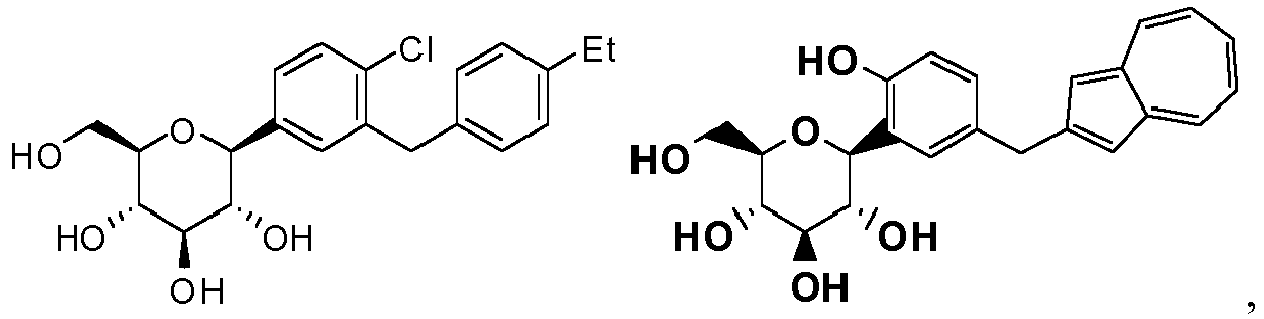
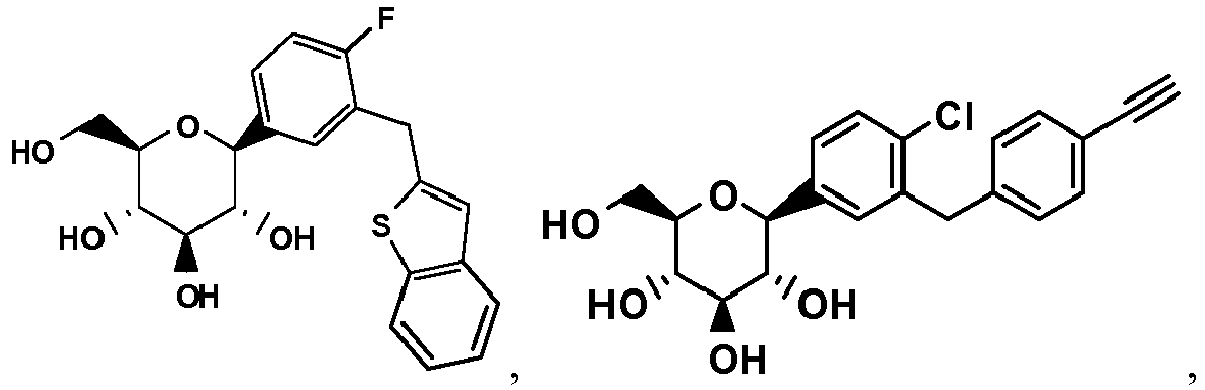

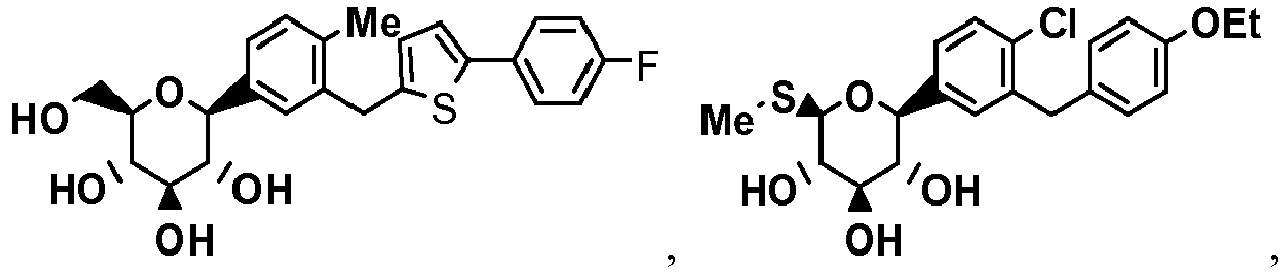
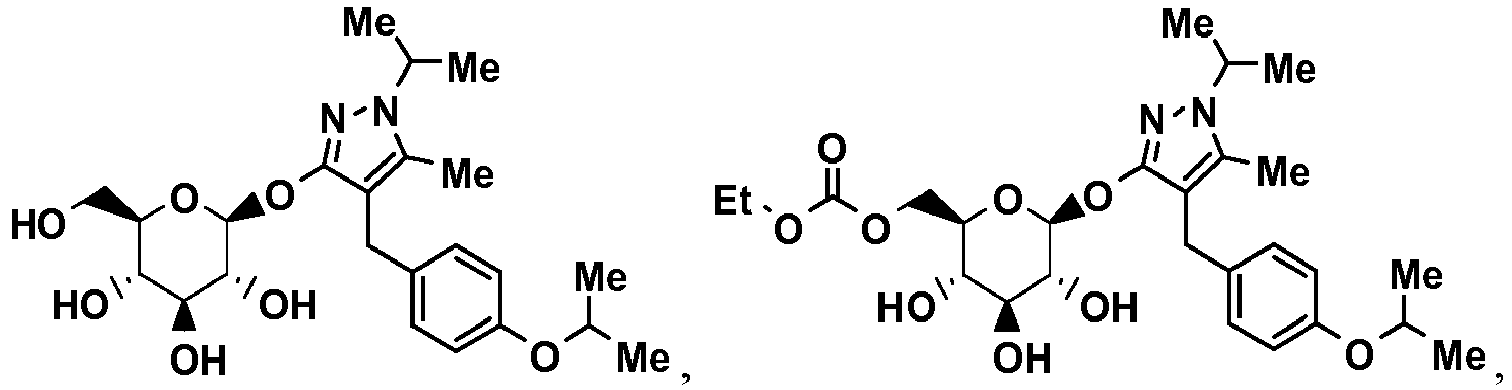

- Suitable meglitinides include nateglinide (Novartis) or KAD1229 (PF/Kissei).
- Examples of suitable anti-hyperglycemic agents for use in combination with the formulations of the present invention include, but are not limited to, glucagon-like peptide-1 (GLP-1) such as GLP-1(1-36) amide, GLP-1(7-36) amide, GLP-1(7-37) (as disclosed in
U.S. Patent No. 5,614,492 , incorporated herein by reference in its entirety), as well as exenatide (Amylin/Lilly), LY-315902 (Lilly), MK-0431 (Merck), liraglutide (NovoNordisk), ZP-10 (Zealand Pharmaceuticals A/S), CJC-1131 (Conjuchem Inc), and the compounds disclosed inWO 03/033671 - Examples of suitable hypolipidemic/lipid lowering agents for use in combination with the formulations of the present invention include one or more MTP inhibitors, HMG CoA reductase inhibitors, squalene synthetase inhibitors, fibric acid derivatives, ACAT inhibitors, lipoxygenase inhibitors, cholesterol absorption inhibitors, ileal Na+/bile acid co-transporter inhibitors, up-regulators of LDL receptor activity, bile acid sequestrants, cholesterol ester transfer protein (e.g., CETP inhibitors, such as torcetrapib (CP-529414, Pfizer) and JTT-705 (Akros Pharma)), PPAR agonists (as described above) and/or nicotinic acid and derivatives thereof. The hypolipidemic agent can be an up-regulator of LD2 receptor activity, such as 1(3H)-isobenzofuranone,3-(13-hydroxy-10-oxotetradecyl)-5,7-dimethoxy- (MD-700, Taisho Pharmaceutical Co. Ltd) and cholestan-3-ol,4-(2-propenyl)-(3a,4a,5a)- (LY295427, Eli Lilly). Preferred hypolipidemic agents include pravastatin, lovastatin, simvastatin, atorvastatin, fluvastatin, cerivastatin, atavastatin and rosuvastatin (ZD-4522), for example.
- Examples of MTP inhibitors that can be employed as described above include, but are not limited to, those disclosed in
U.S. Patent No. 5,595,872 ,U.S. Patent No. 5,739,135 ,U.S. Patent No. 5,712,279 ,U.S. Patent No. 5,760,246 ,U.S. Patent No. 5,827,875 ,U.S. Patent No. 5,885,983 andU.S. Patent No. 5,962,440 , all of which are incorporated herein by reference in their entireties. - Examples of HMG CoA reductase inhibitors that can be employed in combination with the formulations of the invention include, but are not limited to, mevastatin and related compounds, as disclosed in
U.S. Patent No. 3,983,140 , lovastatin (mevinolin) and related compounds, as disclosed inU.S. Patent No. 4,231,938 , pravastatin and related compounds, such as disclosed inU.S. Patent No. 4,346,227 , simvastatin and related compounds, as disclosed inU.S. Patent Nos. 4,448,784 and4,450,171 . Other suitable HMG CoA reductase inhibitors that can be employed herein include, but are not limited to, fluvastatin, disclosed inU.S. Patent No. 5,354,772 , cerivastatin, as disclosed inU.S. Patent Nos. 5,006,530 and5,177,080 , atorvastatin, as disclosed inU.S. Patent Nos. 4,681,893 ,5,273,995 ,5,385,929 and5,686,104 , atavastatin (Nissan/Sankyo's nisvastatin (NK-104)), as disclosed inU.S. Patent No. 5,011,930 , rosuvastatin (Shionogi-Astra/Zeneca (ZD-4522)), as disclosed inU.S. Patent No. 5,260,440 , and related statin compounds disclosed inU.S. Patent No. 5,753,675 , pyrazole analogs of mevalonolactone derivatives, as disclosed inU.S. Patent No. 4,613,610 , indene analogs of mevalonolactone derivatives, as disclosed inPCT application WO 86/03488 U.S. Patent No. 4,647,576 , Searle's SC-45355 (a 3-substituted pentanedioic acid derivative) dichloroacetate, imidazole analogs of mevalonolactone, as disclosed in PCT applicationWO 86/07054 2,596,393 0221025 , naphthyl analogs of mevalonolactone, as disclosed inU.S. Patent No. 4,686,237 , octahydronaphthalenes, such as disclosed inU.S. Patent No. 4,499,289 , keto analogs of mevinolin (lovastatin), as disclosed in European Patent Application No.0142146 A2 , and quinoline and pyridine derivatives, as disclosed inU.S. Patent No. 5,506,219 and5,691,322 . All of the cited references are incorporated herein by reference in their entireties. In addition, phosphinic acid compounds useful in inhibiting HMG CoA reductase, such as those disclosed inGB 2205837 - Examples of squalene synthetase inhibitors suitable for use herein include, but are not limited to, α-phosphono-sulfonates disclosed in
U.S. Patent No. 5,712,396 , those disclosed by Biller et al., J. Med. Chem., 1988, Vol. 31, No. 10, pp. 1869-1871, including isoprenoid (phosphinyl-methyl)phosphonates, as well as other known squalene synthetase inhibitors, for example, as disclosed inU.S. Patent No. 4,871,721 and4,924,024 and in Biller, S.A., Neuenschwander, K., Ponpipom, M.M., and Poulter, C.D., Current Pharmaceutical Design, 2, 1-40 (1996). Other squalene synthetase inhibitors suitable for use herein include the terpenoid pyrophosphates disclosed by P. Ortiz de Montellano et al, J. Med. Chem., 1977, 20, 243-249; the farnesyl diphosphate analog A and presqualene pyrophosphate (PSQ-PP) analogs as disclosed by Corey and Volante, J. Am. Chem. Soc., 1976, 98, 1291-1293; phosphinylphosphonates reported by McClard, R.W. et al, J.A.C.S., 1987, 109, 5544; and cyclopropanes reported by Capson, T.L., PhD dissertation, June, 1987, Dept. Med. Chem. U of Utah, Abstract, Table of Contents, pp 16, 17, 40-43, 48-51, Summary. All of the cited references are incorporated herein by reference in their entireties. - Examples of fibric acid derivatives that can be employed in combination the formulations of the invention include, but are not limited to, fenofibrate, gemfibrozil, clofibrate, bezafibrate, ciprofibrate, clinofibrate and the like, probucol, and related compounds, as disclosed in
U.S. Patent No. 3,674,836 , bile acid sequestrants, such as cholestyramine, colestipol and DEAE-Sephadex (Secholex®, Policexide®), as well as lipostabil (Rhone-Poulenc), Eisai E-5050 (an N-substituted ethanolamine derivative), imanixil (HOE-402), tetrahydrolipstatin (THL), istigmastanylphos-phorylcholine (SPC, Roche), aminocyclodextrin (Tanabe Seiyoku), Ajinomoto AJ-814 (azulene derivative), melinamide (Sumitomo), Sandoz 58-035, American Cyanamid CL-277,082 and CL-283,546 (disubstituted urea derivatives), nicotinic acid, acipimox, acifran, neomycin, p-aminosalicylic acid, aspirin, poly(diallylmethylamine) derivatives, such as disclosed inU.S. Patent No. 4,759,923 , quaternary amine poly(diallyldimethylammonium chloride) and ionenes, such as disclosed inU.S. Patent No. 4,027,009 , and other known serum cholesterol lowering agents. In one embodiment, the fibric acid derivative is probucol or gemfibrozil. All of the cited references are incorporated herein by reference in their entireties. - Examples of ACAT inhibitors that can be employed in combination with the formulations of the invention include, but are not limited to, those disclosed in Drugs of the Future 24, 9-15 (1999), (Avasimibe); "The ACAT inhibitor, Cl-1011 is effective in the prevention and regression of aortic fatty streak area in hamsters", Nicolosi et al, Atherosclerosis (Shannon, Irel). (1998), 137(1), 77-85; "The pharmacological profile of FCE 27677: a novel ACAT inhibitor with potent hypolipidemic activity mediated by selective suppression of the hepatic secretion of ApoB100-containing lipoprotein", Ghiselli, Giancarlo, Cardiovasc. Drug Rev. (1998), 16(1), 16-30; "RP 73163: a bioavailable alkylsulfinyl-diphenylimidazole ACAT inhibitor", Smith, C., et al, Bioorg. Med. Chem. Lett. (1996), 6(1), 47-50; "ACAT inhibitors: physiologic mechanisms for hypolipidemic and anti-atherosclerotic activities in experimental animals", Krause et al, Editor(s): Ruffolo, Robert R., Jr.; Hollinger, Mannfred A., Inflammation: Mediators Pathways (1995), 173-98, Publisher: CRC, Boca Raton, Fla.; "ACAT inhibitors: potential anti-atherosclerotic agents", Sliskovic et al, Curr. Med. Chem. (1994), 1(3), 204-25; "Inhibitors of acyl-CoA:cholesterol O-acyl transferase (ACAT) as hypocholesterolemic agents. The first water-soluble ACAT inhibitor with lipid-regulating activity. Inhibitors of acyl-CoA:cholesterol acyltransferase (ACAT). Development of a series of substituted N-phenyl-N'-[(1-phenylcyclopentyl)methyl]ureas with enhanced hypocholesterolemic activity", Stout et al, Chemtracts: Org. Chem. (1995), 8(6), 359-62, or TS-962 (Taisho Pharmaceutical Co. Ltd). All of the cited references are incorporated herein by reference in their entireties.
- Examples of suitable cholesterol absorption inhibitors for use in combination with the formulations of the invention include, but are not limited to, SCH48461 (Schering-Plough), as well as those disclosed in Atherosclerosis 115, 45-63 (1995) and J. Med. Chem. 41, 973 (1998), incorporated herein by reference in its entirety.
- Examples of suitable ileal Na+/bile acid co-transporter inhibitors for use in combination with the formulations of the invention include, but are not limited to, compounds as disclosed in Drugs of the Future, 24, 425-430 (1999), incorporated herein by reference in its entirety.
- Examples of lipoxygenase inhibitors that can be employed in combination with the formulations of the invention include, but are not limited to, 15-lipoxygenase (15-LO) inhibitors, such as benzimidazole derivatives, as disclosed in
WO 97/12615 WO 97/12613 WO 96/38144 - Examples of suitable anti-hypertensive agents for use in combination with the formulations of the present invention include, but are not limited to, beta adrenergic blockers, calcium channel blockers (L-type and T-type; e.g. diltiazem, verapamil, nifedipine, amlodipine and mybefradil), diuretics (e.g., chlorothiazide, hydrochlorothiazide, flumethiazide, hydroflumethiazide, bendroflumethiazide, methylchlorothiazide, trichloromethiazide, polythiazide, benzthiazide, ethacrynic acid tricrynafen, chlorthalidone, furosemide, musolimine, bumetanide, triamtrenene, amiloride, spironolactone), renin inhibitors, ACE inhibitors (e.g., captopril, zofenopril, fosinopril, enalapril, ceranopril, cilazopril, delapril, pentopril, quinapril, ramipril, lisinopril), AT-1 receptor antagonists (e.g., losartan, irbesartan, valsartan), ET receptor antagonists (e.g., sitaxsentan, atrsentan and compounds disclosed in
U.S. Patent Nos. 5,612,359 and6,043,265 ), Dual ET/AII antagonist (e.g., compounds disclosed inWO 00/01389 - Examples of suitable anti-obesity agents for use in combination with the formulations of the present invention include, but are not limited to, beta 3 adrenergic agonists, lipase inhibitors, serotonin (and dopamine) reuptake inhibitors, thyroid receptor beta drugs, 5HT2C agonists, (such as Arena APD-356); MCHR1 antagonists, such as Synaptic SNAP-7941 and Takeda T-226926, melanocortin receptor (MC4R) agonists, melanin-concentrating hormone receptor (MCHR) antagonists (such as Synaptic SNAP-7941 and Takeda T-226926), galanin receptor modulators, orexin antagonists, CCK agonists, NPY1 or NPY5 antagonist, NPY2 and NPY4 modulators, corticotropin releasing factor agonists, histamine receptor-3 (H3) modulators, 11-beta-HSD-1 inhibitors, adinopectin receptor modulators, monoamine reuptake inhibitors or releasing agents, ciliary neurotrophic factors (CNTF, such as AXOKINE® by Regeneron), BDNF (brain-derived neurotrophic factor), leptin and leptin receptor modulators, cannabinoid-1 receptor antagonists (such as SR-141716 (Sanofi) or SLV-319 (Solvay)), and anorectic agents.
- Beta 3 adrenergic agonists that can be optionally employed in combination with formulations of the present invention include, but are not limited to, AJ9677 (Takeda/Dainippon), L750355 (Merck), CP331648 (Pfizer,) or other known beta 3 agonists, as disclosed in
U.S. Patent Nos. 5,541,204 ,5,770,615 ,5,491,134 ,5,776,983 and5,488,064 , all of which are incorporated herein by reference in their entireties. - Examples of lipase inhibitors that can be employed in combination with formulations of the present invention include, but are not limited to, orlistat and ATL-962 (Alizyme).
- Serotonin (and dopamine) reuptake inhibitors (or serotonin receptor agonists) that can be employed in combination with the formulations of the present invention include, but are not limited to, BVT-933 (Biovitrum), sibutramine, topiramate (Johnson & Johnson) and axokine (Regeneron).
- Examples of thyroid receptor beta compounds that can be employed in combination with formulations of the present invention include, but are not limited to, thyroid receptor ligands, such as those disclosed in
WO 97/21993 (U WO 99/00353 WO 00/039077 - Examples of monoamine reuptake inhibitors that can be employed in combination with the formulations of the present invention include, but are not limited to, fenfluramine, dexfenffuramine, fluvoxamine, fluoxetine, paroxetine, sertraline, chlorphentermine, cloforex, clortermine, picilorex, sibutramine, dexamphetamine, phentermine, phenylpropanolamine and mazindol.
- Anorectic agents that can be employed in combination with the formulations of the present invention include, but are not limited to, topiramate (Johnson & Johnson), dexamphetamine, phentermine, phenylpropanolamine and mazindol.
- The aforementioned patents and patent applications are incorporated herein by reference.
- Where any of the formulations of the invention are used in combination with other therapeutic agent(s), the other therapeutic agent(s) can be used, for example, in the amounts indicated in the Physician's Desk Reference, as in the cited patents and patent applications set out above, or as otherwise known and used by one of ordinary skill in the art.
- The present invention contemplates a bilayer tablet that comprises (1) a reduced mass metformin formulation; (2) a formulation with canagliflozin; and (3) optionally a coating. Accordingly, in one aspect, the present invention provides a bilayer tablet wherein (1) the first layer comprises about 72-82% metformin hydrochloride; about 3-5% sodium carboxymethyl cellulose; about 15-22% hydroxypropyl methylcellulose 2208; about 0.75-1.25% silicon dioxide or about 0.25-0.75% colloidal silicon dioxide; and about 0.1-0.6% magnesium stearate; (2) the second layer comprises canagliflozin; and (3) the optional coating comprises Opadry® II.
- In another aspect, the present invention provides a bilayer tablet wherein (1) the first layer comprises about 76.6% metformin hydrochloride; about 3.84% sodium carboxymethyl cellulose; about 18% hydroxypropyl methylcellulose 2208; about 0.75-1.25% silicon dioxide or about 0.25-0.75% colloidal silicon dioxide; and about 0.53% magnesium stearate; (2) the second layer comprises canagliflozin; and (3) the optional coating comprises Opadry® II.
- In another aspect, the present invention provides a bilayer tablet wherein (1) the first layer comprises about 76.6% metformin hydrochloride; about 3.84% sodium carboxymethyl cellulose; about 18% hydroxypropyl methylcellulose 2208; about 0.75-1.25% silicon dioxide or about 0.25-0.75% colloidal silicon dioxide; and about 0.53% magnesium stearate; (2) the second layer comprises canagliflozin; and (3) the optional coating comprises Opadry® II.
- Examples of bulking agents or fillers suitable for use herein include, but are not limited to, cellulose derivatives, such as microcrystalline cellulose or wood cellulose (including microcrystalline cellulose 302), lactose, lactose anhydrous, sucrose, starch, pregelatinized starch, dextrose, mannitol (including mannitol Pearlitol SD 200), fructose, xylitol, sorbitol, corn starch, modified corn starch, inorganic salts such as calcium carbonate, calcium phosphate, dicalcium phosphate, calcium sulfate, dextrin/dextrates, maltodextrin, compressible sugars, and other known bulking agents or fillers, and/or mixtures of two or more thereof. Several types of microcrystalline cellulose are suitable for use in the formulations described herein, for example, microcrystalline cellulose selected from the group consisting of Avicel® types: PH101, PH102, PH103, PH105, PH 112, PH113, PH200, PH301, and other types of microcrystalline cellulose, such as silicified microcrystalline cellulose. Several types of lactose are suitable for use in the formulations described herein, for example, lactose selected from the group consisting of anhydrous lactose, lactose monohydrate, lactose fast flo, directly compressible anhydrous lactose, and modified lactose monohydrate.
- Examples of binders suitable for use herein include, but are not limited to, carboxymethyl cellulose (including sodium carboxymethyl cellulose), hydroxypropyl cellulose (including hydroxypropyl cellulose EXF), corn starch, pregelatinized starch, modified corn starch, polyvinyl pyrrolidone (PVP), hydroxypropyl methylcellulose (HPMC) (including hydroxypropyl methylcellulose 2208), lactose, gum acacia, ethyl cellulose, cellulose acetate, as well as a wax binder such as carnauba wax, paraffin, spermaceti, polyethylenes or microcrystalline wax, as well as other conventional binding agents and/or mixtures of two or more thereof.
- Examples of disintegrants suitable for use herein include, but are not limited to, croscarmellose sodium, crospovidone, starch, potato starch, pregelatinized starch, corn starch, sodium starch glycolate, microcrystalline cellulose, low substituted hydroxypropyl cellulose and other known disintegrants. Several specific types of disintegrant are suitable for use in the formulations described herein. For example, any grade of crospovidone can be used, including for example crospovidone XL-10, and includes members selected from the group consisting of Kollidon CL®, Polyplasdone XL®, Kollidon CL-M®, Polyplasdone XL-10®, and Polyplasdone INF-10®. In one embodiment, the disintegrant, if present, of the stock granulation is sodium starch glycolate, croscarmellose sodium and/or crospovidone.
- Examples of lubricants suitable for use herein include, but are not limited to, magnesium stearate, zinc stearate, calcium stearate, talc, carnauba wax, stearic acid, palmitic acid, sodium stearyl fumarate sodium laurel sulfate, glyceryl palmitostearate, palmitic acid, myristic acid and hydrogenated vegetable oils and fats, as well as other known lubricants, and/or mixtures of two or more thereof.
- Examples of glidants and/or anti-adherents suitable for use herein include but are not limited to, silicon dioxide, colloidal silicon dioxide, magnesium silicate, magnesium trisilicate, talc, and other forms of silicon dioxide, such as aggregated silicates and hydrated silica.
- Examples of suitable release modifiers include, but are not limited to, hydroxypropyl methylcellulose, polyvinyl alcohol (PVA), ethyl cellulose, methacrylic polymers, hydroxypropyl cellulose, starches, gums, cellulose ethers, protein derived materials, nylon, acrylic resins, polylactic acid, polyvinylchloride, polyvinylpyrrolidones, and cellulose acetate phthalate.
- In one aspect, the present invention provides methods of treating diseases or disorders associated with SGLT2 activity comprising administering to a mammal, preferably a human, in need of such treatment a therapeutically effective amount of a bilayer tablet comprising a metformin XR formulation or a reduced mass metformin XR formulation, an SGLT2 inhibitor formulation, and optionally a film coating. The bilayer tablets of the present invention, as described herein, can be administered to mammals, preferably humans, for treating diabetes (including type I and type II diabetes), impaired glucose tolerance, insulin resistance, and diabetic complications, such as nephropathy, retinopathy, neuropathy and cataracts, hyperglycemia, hyperinsulinemia, hypercholesterolemia, dyslipidemia, elevated blood levels of free fatty acids or glycerol, hyperlipidemia, hypertriglyceridemia, obesity, wound healing, tissue ischemia, atherosclerosis and hypertension. In a preferred embodiment, the bilayer tablet formulations of the present invention are administered to humans for treating type II diabetes.
- In another aspect, the present invention provides a use of a bilayer tablet comprising a metformin XR formulation or a reduced mass metformin XR formulation, an SGLT2 inhibitor formulation, and optionally a film coating for preparing, or for the manufacture of, a medicament for treating diabetes (including type I and type II diabetes), impaired glucose tolerance, insulin resistance, and diabetic complications, such as nephropathy, retinopathy, neuropathy and cataracts, hyperglycemia, hyperinsulinemia, hypercholesterolemia, dyslipidemia, elevated blood levels of free fatty acids or glycerol, hyperlipidemia, hypertriglyceridemia, obesity, wound healing, tissue ischemia, atherosclerosis and hypertension.
- The term "about" as used herein means a deviation within 10%, more preferably within 5%, and even more preferably, within 2% of the numbers reported.
- The term "dapagliflozin" as used herein means the compound of Example 1 and includes pharmaceutically acceptable salts thereof.
- The term "dapagliflozin (S) PGS" as used herein means the compound of Example 2 dapagliflozin (S) propylene glycol hydrate (1:1:1).
- The term "dapagliflozin (R) PGS" as used herein means the compound of Example 3 dapagliflozin (R) propylene glycol hydrate (1:1:1).
- The term "metformin extended release" or "metformin XR" as used herein, refers to an amount of metformin HCl that is present in a dosage form that allows for oral controlled release delivery that functions by releasing the payload of drug (metformin HCl) over an extended period of time following administration, while maintaining the desired plasma levels of drug.
- The term "Opadry® II" as used here means a film coating for a tablet, including a bilayer tablet, that comprises polyvinyl alcohol, titanium dioxide, polyethylene glycol (PEG), and talc. Opadry® II white 85F18422 is comprised of polyvinyl alcohol, titanium dioxide, polyethylene glycol, and talc. Opadry® II Yellow 85F92582 is comprised of polyvinyl alcohol, titanium dioxide, polyethylene glycol, talc, and yellow iron dioxide.
- The term "Opadry® HP " as used here means a film coating for a tablet that comprises 40% polyvinyl alcohol, 20% polyethylene glycol, 15% talc, and 25% titanium dioxide.
- In a 24-week phase 3 clinical study, the combination of metformin and dapagliflozin, an SGLT2 inhibitor, reduced glycosylated hemoglobin levels (HbA1c) and fasting plasma glucose (FPG) levels in type II diabetic patients. Glycosylated hemoglobin and fasting plasma glucose levels were inadequately controlled with metformin alone, as compared to placebo plus metformin. The study also showed that individuals receiving dapagliflozin had statistically greater mean reductions in body weight compared to individuals taking placebo.
- The study was designed to assess the efficacy and safety of dapagliflozin as an add-on to metformin over 24 weeks in patients with inadequately controlled type 2 diabetes. The data represent findings from a randomized, double-blind, placebo-controlled study of 546 individuals with type 2 diabetes whose HbA1c was greater than or equal to 7.0 percent and less than or equal to 10 percent at baseline. After a two-week lead-in phase, individuals were randomized to one of four separate treatment arms: dapagliflozin 2.5 mg (n= 137), dapagliflozin 5 mg (n= 137), dapagliflozin 10 mg (n= 135), or placebo (n= 137). Patients in all arms also received metformin (greater than or equal to 1500 mg/d). The primary endpoint of the study compared mean HbAlc change from baseline for each dapagliflozin treatment arm compared to placebo after 24 weeks. Secondary endpoints included change from baseline in FPG and body weight at week 24 as compared to placebo, and adjusted percentage of individuals treated with dapagliflozin who achieved HbAlc of less than 7 percent at 24 weeks. Exploratory endpoints included body weight decrease of greater than or equal to 5 percent or greater than or equal to 10 percent as well as body weight percent change from baseline.
- After 24 weeks, individuals receiving dapagliflozin 2.5 mg, 5 mg and 10 mg plus metformin demonstrated a statistically significant adjusted mean change in HbAlc from baseline of -0.67 percent, -0.70 percent and -0.84 percent, respectively, compared to -0.30 percent for placebo. Individuals treated with dapagliflozin demonstrated a statistically significant adjusted mean change in FPG, a secondary endpoint, from baseline at Week 24: -17.8 mg/dL for dapagliflozin 2.5 mg -21.5 mg/dL for dapagliflozin 5 mg and -23.5 mg/dL /dl for dapagliflozin 10 mg, compared to -6.0 mg/dL for placebo.
- The study also evaluated the potential impact of dapagliflozin on weight loss. These findings included data measuring changes in total body weight over the 24-week study period. At 24 weeks, the change in total body weight in kg, a secondary endpoint, was -2.21 kg for dapagliflozin 2.5 mg, -3.04 kg for dapagliflozin 5 mg and -2.86 kg for dapagliflozin 10 mg, compared to -0.89 kg for placebo. Overall, more patients taking dapagliflozin achieved weight losses greater than or equal to 5 percent compared to placebo, an exploratory endpoint.
- These results indicate that the combination of an SGLT2 inhibitor, in particular dapagliflozin or dapagliflozin (S) propylene glycol hydrate, with metformin effectively treats hyperglycemia in type II diabetic patients without inducing weight gain.
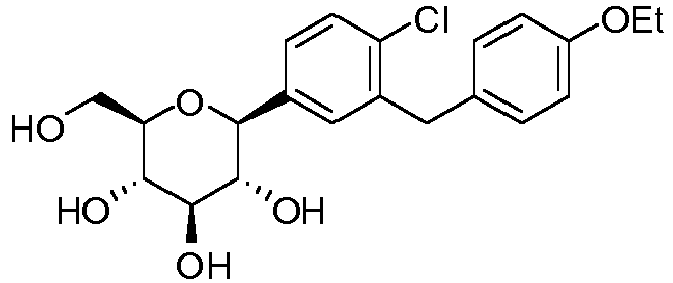
- Dapagliflozin can be prepared using similar procedures as described in
U.S. Patent No. 6,515,117 or international published applications no.WO 03/099836 WO 2008/116179 , the disclosures of which are herein incorporated by reference in their entirety for any purpose. SGLT2 EC50 = 1.1 nM.
- Dapagliflozin (S) propylene glycol hydrate (1:1:1) can be prepared using similar procedures as described in published applications
WO 08/002824 WO 2008/116179 , the disclosures of which are herein incorporated by reference in their entirety for any purpose. SGLT2 EC50 = 1.1 nM.
- Dapagliflozin (R) propylene glycol hydrate (1:1:1) can be prepared using similar procedures as described in
WO 08/002824 WO 2008/116179 , the disclosures of which are herein incorporated by reference in their entirety for any purpose. SGLT2 EC50 = 1.1 nM. - Bilayer tablets containing metformin (1000 mgs) extended release formulation and dapagliflozin (S) PGS (5.00 mgs) immediate release formulation were prepared as described below.
First Layer % w/w amount (mg) Metformin HCl 68.97 1000 Sodium Carboxymethyl Cellulose 3.45 50.01 Purified water or water for injection - q.s.(a) Hydroxypropyl Methylcellulose 2208 27.10 393 Magnesium Stearate 0.48 7.00 Total Metformin XR 100 1450 Second Layer Dapagliflozin 1.67 5.00 Lactose Anhydrous 16.00 48.00 Microcrystalline Cellulose 302 75.83 227.5 Crospovidone 4.00 12.00 Silicon Dioxide 1.50 4.50 Magnesium Stearate 1.00 3.00 Total Dapagliflozin IR 100 300 Total Core Bilayer 1750 Film Coat Opadry® II (2.5% weight gain) 43.75 Total Film Coated Tablet 1793.75 - Metformin HCl, 0.5% magnesium stearate, and sodium carboxymethyl cellulose were combined and mixed into a high shear granulator for one minute. Purified water, using a nozzle, was added with stirring for one minute. The wet granulated material was passed through a mill and then dried until the moisture content was 1.0% or less. The dried material containing metformin HCl, 0.5% magnesium stearate, and sodium carboxymethyl cellulose was passed through a mill and discharge into polyethylene-lined drums to provide milled metformin 1g bulk granulation.
- Hydroxypropyl methylcellulose 2208 USP (
100,000 centipoise) (methocel K100M Premium) was added to a bin blender and mixed for 60 revolutions. The material was passed through a mill and discharge to provide milled hydroxypropyl methylcellulose 2208 USP. - Metformin (milled 1g bulk granulation), hydroxypropyl methylcellulose 2208 USP (milled), hydroxypropyl methylcellulose 2208 USP (unmilled), and magnesium stearate were added to a bin blender and mixed for 60 revolutions. The mixed material was discharge into polyethylene-lined drums to provide metformin extended release 1g bulk granulation.
- Dapagliflozin (S) PGS was blended with microcrystalline cellulose, anhydrous lactose, a portion of crospovidone, and a portion of silicon dioxide in a suitable tumble mixer and passed through a suitable conical mill. A portion of magnesium stearate (screened) was blended into the mixture and then compacted using an appropriate roller compactor. The compacted mixture was reduced to form granules. The granules were blended with the remaining amount of crospovidone and silicon dioxide in a suitable tumble mixer. The granules were then blended with the remaining amount of magnesium stearate in a suitable tumble mixer.
- A bilayer tablet press was with either the metformin XR formulation or the reduced mass metformin XR formulation in the first hopper and the SGLT2 inhibitor formulation that is dapagliflozin (S) PGS granulation (2.5 mg, 5 mg or 10 mg strength) in the second hopper. The tablet press was set to obtain the target weight for the first layer (metformin XR or reduced mass metformin XR). The second hopper was opened and the tablet press was adjusted to obtain the target tablet weight of dapagliflozin and metformin XR or dapagliflozin and reduced mass metformin XR bilayer tablets. Once the target weight was obtained the press was adjusted to obtain the target hardness. Once the hardness was obtained, the manufactured tablets were periodically monitored regarding the weight of the first layer, and the weight, hardness, gauge and friability of the whole tablet. The collect bilayer tablets were film coated with Opadry® II PVA (polyvinyl alcohol).
- Bilayer tablets containing metformin (1000 mgs) extended release formulation and dapagliflozin (S) PGS (2.5 mgs) immediate release formulation were prepared in a similar manner as described in Example 4.
First Layer % w/w amount (mg) Metformin HCl 68.97 1000 Sodium Carboxymethyl Cellulose 3.45 5001 Purified water or water for injection - q.s.(a) Hydroxypropyl Methylcellulose 2208 27.10 393 Magnesium Stearate 0.48 7 Total Metformin XR 100 1450 Second Layer Dapagliflozin 0.83 2.50 Lactose Anhydrous 16.00 48.00 Microcrystalline Cellulose 302 76.67 230.00 Crospovidone 4.00 12.00 Silicon Dioxide 1.50 4.50 Magnesium Stearate 1.00 3.00 Total Dapagliflozin IR 100 300 Total Core Bilayer 1750 - Bilayer tablets containing metformin (1000 mgs) extended release formulation and dapagliflozin (S) PGS (10.00 mgs) immediate release formulation were prepared in a similar manner as described in Example 4.
First Layer % w/w amount (mg) Metformin HCl 68.97 1000 Sodium Carboxymethyl Cellulose 3.45 50.01 Purified water or water for injection - q.s.(a) Hydroxypropyl Methylcellulose 2208 27.10 393 Magnesium Stearate 0.48 7 Total Metformin XR 100 1450 Second Layer Dapagliflozin 3.33 10.00 Lactose Anhydrous 16.00 48.00 Microcrystalline Cellulose 302 74.17 222.50 Crospovidone 4.00 12.00 Silicon Dioxide 1.50 4.50 Magnesium Stearate 1.00 3.00 Total Dapagliflozin IR 100 300 Total Core Bilayer 1750 - Bilayer tablets containing reduced mass metformin (1000 mgs) extended release formulation and dapagliflozin (S) PGS (5.00 mgs) immediate release formulation were prepared as described below.
First Layer % w/w amount (mg) Metformin HCl 76.62 1000 Sodium Carboxymethyl Cellulose 3.84 50.01 Purified water or water for injection - q.s.(a) Hydroxypropyl Methylcellulose 2208 18.01(b) 235 Silicon Dioxide 1.00(c) 13 Magnesium Stearate 0.53 7 Total Metformin XR 100 1305 Second Layer Dapagliflozin 1.67 5 Lactose Anhydrous 16 48 Microcrystalline Cellulose 302 75.83 227.5 Crospovidone 4 12 Silicon Dioxide 1.5 4.5 Magnesium Stearate 1 3 Total Dapagliflozin IR 100 300 Total Core Bilayer 1605 Film Coat Opadry® II (2.5% weight gain) 40.13 Total Film Coated Tablet 1645.13 (a) refers to the quantity sufficient to make the granulation composition 100% w/w
(b) The range is 15% - 27%
(c) The range is 0.75% - 1.25% - Metformin HCl, 0.5% magnesium stearate, and sodium carboxymethyl cellulose were combined and mixed into a high shear granulator for one minute. Purified water, using a nozzle, was added with stirring for one minute. The wet granulated material was passed through a mill and then dried until the moisture content was 1.0% or less. The dried material containing metformin HCl, 0.5% magnesium stearate, and sodium carboxymethyl cellulose was passed through a mill and discharge into polyethylene-lined drums to provide milled metformin 1g bulk granulation.
- Metformin (milled 1g bulk granulation), hydroxypropyl methylcellulose 2208 USP (
100,000 centipoise) (methocel K100M Premium), and silicon dioxde were added to a bin blender and mixed for 120 revolutions. Magnesium stearate was added, and after 60 revolutions, the material was discharge into polyethylene-lined drums to provide reduced mass metformin extended release 1g bulk granulation. - The dapagliflozin (S) PGS granulation and the bilayer compression procedures were conducted as described in Example 4.
- Bilayer tablets containing a reduced mass metformin (1000 mgs) extended release formulation and dapagliflozin (S) PGS (2.5 mgs) immediate release formulation were prepared in a similar manner as described in Example 7.
First Layer % w/w amount (mg) Metformin HCl 76.62 1000 Sodium Carboxymethyl Cellulose 3.84 50.01 Purified water or water for injection - q.s.(a) Hydroxypropyl Methylcellulose 2208 18.01(b) 235 Silicon Dioxide 1.00(c) 13 Magnesium Stearate 0.53 7 Total Metformin XR 100 1305 Second Layer Dapagliflozin 0.83 2.50 Lactose Anhydrous 16.00 48.00 Microcrystalline Cellulose 302 76.67 230.00 Crospovidone 4.00 12.00 Silicon Dioxide 1.50 4.50 Magnesium Stearate 1.00 3.00 Total Dapagliflozin IR 100 300 Total Core Bilayer 1605 - Bilayer tablets containing a reduced mass metformin (1000 mgs) extended release formulation and dapagliflozin (S) PGS (10.00 mgs) immediate release formulation were prepared in a similar manner as described in Example 7.
First Layer % w/w amount (mg) Metformin HCl 76.62 1000 Sodium Carboxymethyl Cellulose 3.84 50.01 Purified water or water for injection - q.s.(a) Hydroxypropyl Methylcellulose 2208 18.01(b) 235 Silicon Dioxide 1.00(c) 13 Magnesium Stearate 0.53 7 Total Metformin XR 100 1305 Second Layer Dapagliflozin 0.83 2.50 Lactose Anhydrous 16.00 48.00 Microcrystalline Cellulose 302 76.67 230.00 Crospovidone 4.00 12.00 Silicon Dioxide 1.50 4.50 Magnesium Stearate 1.00 3.00 Total Dapagliflozin IR 100 300 Total Core Bilayer 1605 - Other SGLT2 inhibitor IR formulations, described in Table 2, can be used to prepare bilayer tablets of the present invention. The Table 2 formulations are compatible with the metformin XR formulations or reduced mass metformin XR formulations described herein. The bilayer tablets prepared from the SGLT2 inhibitor IR formulations of Table 2 reduced or eliminated cracking, separation, and/or cross-contamination with the metformin XR layer and with the reduced mass metformin XR layer.
Table 2 % w/w % w/w % w/w % w/w % w/w Dapagliflozin (S) PGS 1.66 1.66 1.66 1.66 1.66 Microcrystalline Cellulose 302 59.83 63.83 56.83 65.83 60.83 Lactose Anhydrous 16.00 16.00 16.00 16.00 16.00 Pregelatinized Starch 16.00 13.00 19.00 - - Hydroxypropyl Cellulose EXF - - - 10.00 - Mannitol - - - - 15.00 Crospovidone 4.00 4.00 4.00 4.00 4.00 Silicon Dioxide 1.50 1.50 1.50 1.50 1.50 Magnesium stearate 1.00 1.00 1.00 1.00 1.00 - Bilayer tablets containing metformin (500 mgs) extended release formulation and dapagliflozin (S) PGS (5.00 mgs) immediate release formulation were prepared in a similar manner as described in Example 13 except that silicon dioxide was not added to the metformin layer.
Component Function % w/w per layer Amount per layer (mg) Metformin HCl XR Layer (1st Layer) Metformin hydrochloride Active 48.85 500.00 Sodium carboxymethyl cellulose Binder 4.89 50.03 Purified water or water for injection Granulating fluid - q.s.(1) Hydroxypropyl methylcellulose 2208 Release modifier 34.98 357.98 Hydroxypropyl methylcellulose 2910 Release modifier 0.97 9.92 Microcrystalline cellulose Filler 9.97 102.03 Magnesium stearate Lubricant 0.34 3.53 Total metformin HCl XR Layer 100.00 1023.49 Dapagliflozin Layer (2nd Layer) Dapagliflozin Active 1.67 5.00 Lactose anhydrous Filler 16.00 48.00 Microcrystalline cellulose 302 Filler 75.83 227.50 Crospovidone Disintegrant 4.00 12.00 Silicon dioxide Glidant 1.502 4.50 Magnesium stearate Lubricant 1.00 3.00 Total dapagliflozin Layer - 100.00 300.00 Total core bilayer - - 1323.49 Film coat component Opadry® II (2.5% weight gain) Coating material - 33.09 Total film coated tablet - - 1356.58 1Purified water is used only for processing and is removed during drying
2The range is 0.5% - 1.5% - Bilayer tablets containing metformin (500 mgs) extended release formulation and dapagliflozin (S) PGS (10.0 mgs) immediate release formulation were prepared in a similar manner as described in Example 13 except that silicon dioxide was not added to the metformin layer.
Component Function % w/w per layer Amount per layer (mg) Metformin XR Layer (1st Layer) Metformin hydrochloride Active 48.85 500.00 Sodium carboxymethyl cellulose Binder 4.89 50.03 Purified water or water for injection Granulating fluid - q.s.(1) Hydroxypropyl methylcellulose 2208 Release modifier 34.98 357.98 Hydroxypropyl methylcellulose 2910 Release modifier 0.97 9.92 Microcrystalline cellulose Filler 9.97 102.03 Magnesium stearate Lubricant 0.34 3.53 Total metformin XR Layer 100.00 1023.49 Dapagliflozin Layer (2nd Layer) Dapagliflozin Active 3.33 10.00 Lactose anhydrous Filler 16.00 48.00 Microcrystalline cellulose 302 Filler 74.17 222.50 Crospovidone Disintegrant 4.00 12.00 Silicon dioxide Glidant 1.50(2) 4.50 Magnesium stearate Lubricant 1.00 3.00 Total dapagliflozin Layer - 100.00 300.00 Total core bilayer - - 1323.49 Film coat component Opadry® II (2.5% weight gain) Coating material - 33.09 Total film coated tablet - - 1356.58 1Purified water is used only for processing and is removed during drying
2The range is 0.5% - 1.5% - Bilayer tablets containing metformin (500 mgs) extended release formulation and dapagliflozin (S) PGS (2.50 mgs) immediate release formulation were prepared in a similar manner as described in Example 13 except that silicon dioxide was not added to the metformin layer.
Component Function % w/w per layer Amount per layer (mg) Metformin XR Layer (1st Layer) Metformin hydrochloride Active 48.85 500.00 Sodium carboxymethyl cellulose Binder 4.89 50.03 Purified water or water for injection Granulating fluid - q.s.(1) Hydroxypropyl methylcellulose 2208 Release modifier 34.98 357.98 Hydroxypropyl methylcellulose 2910 Release modifier 0.97 9.92 Microcrystalline cellulose Filler 9.97 102.03 Magnesium stearate Lubricant 0.34 3.53 Total metformin XR Layer 100.00 1023.49 Dapagliflozin Layer (2nd Layer) Dapagliflozin Active 0.83 2.50 Lactose anhydrous Filler 16.00 48.00 Microcrystalline cellulose 302 Filler 76.67 230.00 Crospovidone Disintegrant 4.00 12.00 Silicon dioxide Glidant 1.50(2) 4.50 Magnesium stearate Lubricant 1.00 3.00 Total dapagliflozin Layer - 100.00 300.00 Total core bilayer - - 1323.49 Film coat component Opadry® II (2.5% weight gain) Coating material - 33.09 Total film coated tablet - - 1356.58 1Purified water is used only for processing and is removed during drying
2The range is 0.5% - 1.5% - Bilayer tablets containing metformin (500 mgs) extended release formulation and dapagliflozin (S) PGS (5.0 mgs) immediate release formulation were prepared as described below.
Component Function % w/w per layer Amount per layer (mg) Metformin XR Layer (1st Layer) Metformin hydrochloride Active 48.37 500.00 Sodium carboxymethyl cellulose Binder 4.84 50.03 Purified water or water for injection Granulating fluid - q.s.(1) Hydroxypropyl methylcellulose 2208 Release modifier 34.63 357.98 Hydroxypropyl methylcellulose 2910 Release modifier 0.96 9.92 Microcrystalline cellulose Filler 9.87 102.03 Silicon dioxide Compression aid 0.99 10.24 Magnesium stearate Lubricant 0.34 3.53 Total metformin XR Layer 100.00 1033.73 Dapagliflozin Layer (2nd Layer) Dapagliflozin Active 1.67 5.00 Lactose anhydrous Filler 16.00 48.00 Microcrystalline cellulose 302 Filler 75.83 227.50 Crospovidone Disintegrant 4.00 12.00 Silicon dioxide Glidant 1.502 4.50 Magnesium stearate Lubricant 1.00 3.00 Total dapagliflozin Layer - 100.00 300.00 Total core bilayer - - 1333.73 Film coat component Opadry® II (2.5% weight gain) Coating material - 33.34 Total film coated tablet - - 1367.07 1Purified water is used only for processing and is removed during drying
2The range is 0.5% - 1.5% - Metformin HCl, 0.5% magnesium stearate, and sodium carboxymethyl cellulose were combined and mixed in a high shear granulator for one minute. Purified water, using a nozzle, was added with stirring for one minute. The wet granulated material was passed through a mill and then dried until the moisture content was 1.0% or less. The dried material containing metformin HCl, 0.5% magnesium stearate, and sodium carboxymethyl cellulose was passed through a mill and discharge into polyethylene lined drums to provide milled metformin 500 mg bulk granulation.
- Milled metformin 500 mg bulk granulation, hydroxypropyl methyl cellulose 2208, hydroxypropyl methyl cellulose 2910, microcrystalline cellulose and silicon dioxide were added to a bin blender and mixed for 240 revolutions. Magnesium stearate was added, and after 60 revolutions, the material was discharge into polyethylene lined drums to provide metformin extended release 500 mg bulk granulation.
- The dapagliflozin (S) PGS granulation and the bilayer compression procedures were conducted in a similar manner as described in Example 4.
- Bilayer tablets containing metformin (500 mgs) extended release formulation and dapagliflozin (S) PGS (10.0 mgs) immediate release formulation were prepared in a similar manner as described in Example 13.
Component Function % w/w per layer Amount per layer (mg) Metformin XR Layer (1st Layer) Metformin hydrochloride Active 48.37 500.00 Sodium carboxymethyl cellulose Binder 4.84 50.03 Purified water or water for injection Granulating fluid - q.s.(1) Hydroxypropyl methylcellulose 2208 Release modifier 34.63 357.98 Hydroxypropyl methylcellulose 2910 Release modifier 0.96 9.92 Microcrystalline cellulose Filler 9.87 102.03 Silicon dioxide Compression aid 0.99 10.24 Magnesium stearate Lubricant 0.34 3.53 Total metformin XR Layer 100.00 1033.73 Dapagliflozin Layer (2nd Layer) Dapagliflozin Active 3.33 10.00 Lactose anhydrous Filler 16.00 48.00 Microcrystalline cellulose 302 Filler 74.17 222.50 Crospovidone Disintegrant 4.00 12.00 Silicon dioxide Glidant 1.50(2) 4.50 Magnesium stearate Lubricant 1.00 3.00 Total dapagliflozin Layer - 100.00 300.00 Total core bilayer - - 1333.73 Film coat component Opadry® II (2.5% weight gain) Coating material - 33.34 Total film coated tablet - - 1367.07 1Purified water is used only for processing and is removed during drying
2The range is 0.5% - 1.5% - Bilayer tablets containing metformin (500 mgs) extended release formulation and dapagliflozin (S) PGS (2.50 mgs) immediate release formulation were prepared in a similar manner as described in Example 13.
Component Function % w/w per layer Amount per layer (mg) Metformin XR Layer (1st Layer) Metformin hydrochloride Active 48.37 500.00 Sodium carboxymethyl cellulose Binder 4.84 50.03 Purified water or water for injection Granulating fluid - q.s.(1) Hydroxypropyl methylcellulose 2208 Release modifier 34.63 357.98 Hydroxypropyl methylcellulose 2910 Release modifier 0.96 9.92 Microcrystalline cellulose Filler 9.87 102.03 Silicon dioxide Compression aid 0.99 10.24 Magnesium stearate Lubricant 0.34 3.53 Total metformin XR Layer 100.00 1033.73 Dapagliflozin Layer (2nd Layer) Dapagliflozin Active 0.83 2.50 Lactose anhydrous Filler 16.00 48.00 Microcrystalline cellulose 302 Filler 76.67 230.00 Crospovidone Disintegrant 4.00 12.00 Silicon dioxide Glidant 1.50(2) 4.50 Magnesium stearate Lubricant 1.00 3.00 Total dapagliflozin Layer - 100.00 300.00 Total core bilayer - - 1333.73 Film coat component Opadry® II (2.5% weight gain) Coating material - 33.34 Total film coated tablet - - 1367.07 1Purified water is used only for processing and is removed during drying
2The range is 0.5% - 1.5% - In particular, the invention relates to the following embodiments E1 to E44:
- E1. A bilayer tablet comprising: (1) a first layer wherein the first layer is a metformin extended release formulation; (2) a second layer wherein the second layer is an SGLT2 inhibitor formulation; and (3) optionally a film coating that covers the first layer and the second layer.
- E2. The bilayer tablet according to E1 wherein the SGLT2 inhibitor is canagliflozin, dapagliflozin, dapagliflozin (S) propylene glycol hydrate, or dapagliflozin (R) propylene glycol hydrate.
- E3. The bilayer tablet according to E1 wherein the total weight of the second layer is about 300 mgs to about 400 mgs.
- E4. The bilayer tablet according to E1 wherein the (1) first layer comprises metformin, a binder, a release modifier, a lubricant, and optionally a glidant; and (2) the second layer comprises dapagliflozin or dapagliflozin (S) propylene glycol hydrate, two or three fillers, a disintegrant, a glidant, and a lubricant.
- E5. The bilayer tablet according to E4 wherein (1) the metformin is metformin hydrochloride, the binder is sodium carboxymethyl cellulose; the release modifier is hydroxypropyl methylcellulose; the lubricant is magnesium stearate; and optionally the glidant is silicon dioxide or colloidal silicon dioxide; (2) the SGLT2 inhibitor is dapagliflozin or dapagliflozin (S) propylene glycol hydrate; the two or three fillers are selected from lactose anhydrous, microcrystalline cellulose, pregelatinized starch, mannitol, and hydroxypropyl cellulose; the disintegrant is crospovidone; the glidant is silicon dioxide; and the lubricant is magnesium stearate; (3) the optional film coating is Opadry® II.
- E6. The bilayer tablet according to E5 wherein (1) the first layer comprises about 64-82% metformin hydrochloride, about 3-5% sodium carboxymethyl cellulose; about 15-30% hydroxypropyl methylcellulose; about 0.1-0.75% magnesium stearate; and about 0-2% silicon dioxide or 0-1.5% colloidal silicon dioxide; (2) the second layer comprises about 0.5-4% dapagliflozin or dapagliflozin (S) propylene glycol hydrate; about 14-18% lactose anhydrous; about 50-80% microcrystalline cellulose; about 0-20% pregelatinized starch; about 0-20% mannitol; about 0-15%hydroxypropyl cellulose; about 2-6% crospovidone; about 0.5-2.5% silicon dioxide; and about 0.5-2% magnesium stearate; (3) the optional film coating is Opadry® II.
- E7. The bilayer tablet according to E5 wherein (1) the first layer comprises about 67-71% metformin hydrochloride, about 3-5% sodium carboxymethyl cellulose, about 25-29% hydroxypropyl methylcellulose 2208, and about 0.1-0.75% magnesium stearate; and (2) the second layer is about 300 mgs to about 400 mgs.
- E8. The bilayer tablet according to E7 wherein the second layer comprises:
- (A) about 0.5-4% dapagliflozin or dapagliflozin (S) propylene glycol hydrate: about 14-18% lactose anhydrous; about 72-80% microcrystalline cellulose 302; about 2-6% crospovidone; about 0.5-2.5% silicon dioxide; and about 0.5-1.5% magnesium stearate;
- (B) about 0.5-4% dapagliflozin or dapagliflozin (S) propylene glycol hydrate; about 14-18% lactose anhydrous; about 50-70% microcrystalline cellulose 302; about 10-22% pregelatinized starch; about 2-6% crospovidone; about 0.5-2.5% silicon dioxide; and about 0.5-1.5% magnesium stearate;
- (C) about 0.5-4% dapagliflozin or dapagliflozin (S) propylene glycol hydrate; about 14-18% lactose anhydrous; about 60-70% microcrystalline cellulose 302; about 5-15% hydroxypropyl cellulose EXF; about 2-6% crospovidone; about 0.5-2.5% silicon dioxide; and about 0.5-1.5% magnesium stearate; or
- (D) about 0.5-4% dapagliflozin or dapagliflozin (S) propylene glycol hydrate; about 14-18% lactose anhydrous; about 55-65% microcrystalline cellulose 302; about 10-20% mannitol; about 2-6% crospovidone; about 0.5-2.5% silicon dioxide; and about 0.5-1.5% magnesium stearate.
- E9. The bilayer tablet according to E8 wherein there is a film coating and the film coating is Opadry® II.
- E10. The bilayer tablet according to E5 wherein the (1) first layer comprises about 69% metformin hydrochloride, about 3.5% sodium carboxymethyl cellulose, about 27% hydroxypropyl methylcellulose 2208, and about 0.48% magnesium stearate; and (2) the second layer is about 300 mgs to about 400 mgs.
- E11. The bilayer tablet according to E10 wherein the second layer comprises:
- (A) about 0.8% dapagliflozin or dapagliflozin (S) propylene glycol hydrate; about 16% lactose anhydrous; about 77% microcrystalline cellulose 302; about 4% crospovidone; about 1.5% silicon dioxide; and about 1% magnesium stearate;
- (B) about 1.7% dapagliflozin or dapagliflozin (S) propylene glycol hydrate; about 16% lactose anhydrous; about 76% microcrystalline cellulose 302; about 4% crospovidone; about 1.5% silicon dioxide; and about 1% magnesium stearate;
- (C) about 3.4% dapagliflozin or dapagliflozin (S) propylene glycol hydrate; about 16% lactose anhydrous; about 74% microcrystalline cellulose 302; about 4% crospovidone; about 1.5% silicon dioxide; and about 1% magnesium stearate;
- (D) about 1.7% dapagliflozin or dapagliflozin (S) propylene glycol hydrate; about 16% lactose anhydrous; about 64% microcrystalline cellulose 302; about 13% pregelatinized starch; about 4% crospovidone; about 1.5% silicon dioxide; and about 1% magnesium stearate;
- (E) about 1.7% dapagliflozin or dapagliflozin (S) propylene glycol hydrate; about 16% lactose anhydrous; about 57% microcrystalline cellulose 302; about 19% pregelatinized starch; about 4% crospovidone; about 1.5% silicon dioxide; and about 1% magnesium stearate;
- (F) about 1.7% dapagliflozin or dapagliflozin (S) propylene glycol hydrate; about 16% lactose anhydrous; about 66% microcrystalline cellulose 302; about 10% hydroxypropyl cellulose EXF; about 4% crospovidone; about 1.5% silicon dioxide; and about 1% magnesium stearate; or
- (G) about 1.7% dapagliflozin or dapagliflozin (S) propylene glycol hydrate; about 16% lactose anhydrous; about 61% microcrystalline cellulose 302; about 15% mannitol; about 4% crospovidone; about 1.5% silicon dioxide; and about 1 % magnesium stearate.
- E12. The bilayer tablet according to E11 wherein there is a film coating and the film coating is Opadry® II.
- E13. The bilayer tablet according to E5 wherein (1) the first layer comprises about 72-82% metformin hydrochloride; about 3-5% sodium carboxymethyl cellulose; about 15-22% hydroxypropyl methylcellulose 2208; about 0.75-1.25% silicon dioxide or about 0.25-0.75% colloidal silicon dioxide; and about 0.1-0.6% magnesium stearate; and (2) the second layer is about 300 mgs to about 400 mgs.
- E14. The bilayer tablet according to E13 wherein the second layer comprises:
- (A) about 0.5-4% dapagliflozin or dapagliflozin (S) propylene glycol hydrate; about 14-18% lactose anhydrous; about 72-80% microcrystalline cellulose 302; about 2-6% crospovidone; about 0.5-2.5% silicon dioxide; and about 0.5-1.5% magnesium stearate;
- (B) about 0.5-4% dapagliflozin or dapagliflozin (S) propylene glycol hydrate; about 14-18% lactose anhydrous; about 50-70% microcrystalline cellulose 302; about 10-22% pregelatinized starch; about 2-6.00% crospovidone; about 0.5-2.5% silicon dioxide; and about 0.5-1.5% magnesium stearate;
- (C) about 0.5-4% dapagliflozin or dapagliflozin (S) propylene glycol hydrate; about 14-18% lactose anhydrous; about 60-70% microcrystalline cellulose 302; about 5-15% hydroxypropyl cellulose EXF; about 2-6% crospovidone; about 0.5-2.5% silicon dioxide; and about 0.5-1.5% magnesium stearate; or
- (D) about 0.5-4% dapagliflozin or dapagliflozin (S) propylene glycol hydrate; about 14-18% lactose anhydrous; about 55-65% microcrystalline cellulose 302; about 10-20% mannitol; about 2-6% crospovidone; about 0.5-2.5% silicon dioxide; and about 0.5-1.5% magnesium stearate.
- E15. The bilayer tablet according to E14 wherein there is a film coating and the film coating is Opadry® II.
- E16. The bilayer tablet according to E15 wherein the weight ratio between the first layer and the second layer is about 4.4:1.
- E17. The bilayer tablet according to E5 wherein (1) the first layer comprises about 76.6% metformin hydrochloride; about 3.84% sodium carboxymethyl cellulose; about 18% hydroxypropyl methylcellulose 2208; about 0.75-1.25% silicon dioxide or about 0.25-0.75% colloidal silicon dioxide; and about 0.53% magnesium stearate; and (2) the second layer is about 300 mgs to about 400 mgs.
- E18. The bilayer tablet according to E17 wherein the second layer comprises:
- (A) about 0.8% dapagliflozin or dapagliflozin (S) propylene glycol hydrate; about 16% lactose anhydrous; about 77% microcrystalline cellulose 302; about 4% crospovidone; about 1.5% silicon dioxide; and about 1% magnesium stearate;
- (B) about 1.7% dapagliflozin or dapagliflozin (S) propylene glycol hydrate; about 16% lactose anhydrous; about 76% microcrystalline cellulose 302; about 4% crospovidone; about 1.5% silicon dioxide; and about 1% magnesium stearate;
- (C) about 3.4% dapagliflozin or dapagliflozin (S) propylene glycol hydrate, about 16% lactose anhydrous; about 74% microcrystalline cellulose 302; about 4% crospovidone; about 1.5% silicon dioxide; and about 1% magnesium stearate;
- (D) about 1.7% dapagliflozin or dapagliflozin (S) propylene glycol hydrate; about 16% lactose anhydrous; about 64% microcrystalline cellulose 302; about 13% pregelatinized starch; about 4% crospovidone; about 1.5% silicon dioxide; and about 1% magnesium stearate;
- (E) about 1.7% dapagliflozin or dapagliflozin (S) propylene glycol hydrate; about 16% lactose anhydrous; about 57% microcrystalline cellulose 302; about 19% pregelatinized starch; about 4% crospovidone; about 1.5% silicon dioxide; and about 1% magnesium stearate;
- (F) about 1.7% dapagliflozin or dapagliflozin (S) propylene glycol hydrate; about 16% lactose anhydrous; about 66% microcrystalline cellulose 302; about 10% hydroxypropyl cellulose EXF; about 4% crospovidone; about 1.5% silicon dioxide; and about 1% magnesium stearate; or
- (G) about 1.7% dapagliflozin or dapagliflozin (S) propylene glycol hydrate; about 16% lactose anhydrous; about 61% microcrystalline cellulose 302; about 15% mannitol; about 4% crospovidone; about 1.5% silicon dioxide; and about 1 % magnesium stearate.
- E19. The bilayer tablet according to E18 wherein there is a film coating and the film coating is Opadry® II.
- E20. The bilayer tablet according to E19 wherein the weight ratio between the first layer and the second layer is about 4.4:1.
- E21. A method of treating a disorder or disease selected from diabetes (including type I and type II diabetes), impaired glucose tolerance, insulin resistance, nephropathy, retinopathy, neuropathy and cataracts, hyperglycemia, hyperinsulinemia, hypercholesterolemia, dyslipidemia, elevated blood levels of free fatty acids or glycerol, hyperlipidemia, hypertriglyceridemia, obesity, wound healing, tissue ischemia, atherosclerosis and hypertension in a mammal comprising administering to the mammal in need of such treatment a bilayer tablet comprising (1) a first layer wherein the first layer is a metformin extended release formulation; (2) a second layer wherein the second layer is an SGLT2 inhibitor formulation; and (3) optionally a film coating that covers the first layer and the second layer.
- E22. The method according to E21 wherein the disorder is type II diabetes and the mammal is a human.
- E23. The method according to E22 wherein the (1) first layer comprises metformin, a binder, a release modifier, a lubricant, and optionally a glidant; and (2) the second layer comprises dapagliflozin or dapagliflozin (S) propylene glycol hydrate, two or three fillers, a disintegrant, a glidant, and a lubricant.
- E24. The method according to E23 wherein (1) the metformin is metformin hydrochloride, the binder is sodium carboxymethyl cellulose; the release modifier is hydroxypropyl methylcellulose; the lubricant is magnesium stearate; and optionally the glidant is silicon dioxide or colloidal silicon dioxide; (2) the SGLT2 inhibitor is dapagliflozin or dapagliflozin (S) propylene glycol hydrate; the two or three fillers are selected from lactose anhydrous, microcrystalline cellulose, pregelatinized starch, mannitol, and hydroxypropyl cellulose; the disintegrant is crospovidone; the glidant is silicon dioxide; and the lubricant is magnesium stearate; (3) the optional film coating is Opadry® II.
- E25. The method according to E24 wherein the (1) first layer comprises about 69% metformin hydrochloride; about 3.5% sodium carboxymethyl cellulose; about 27% hydroxypropyl methylcellulose 2208; and about 0.49% magnesium stearate; (2) the second layer is about 300 to about 400 mgs and comprises
- (A) about 0.8% dapagliflozin or dapagliflozin (S) propylene glycol hydrate; about 16% lactose anhydrous; about 77% microcrystalline cellulose 302; about 4% crospovidone; about 1.5% silicon dioxide; and about 1% magnesium stearate;
- (B) about 1.7% dapagliflozin or dapagliflozin (S) propylene glycol hydrate; about 16% lactose anhydrous; about 76% microcrystalline cellulose 302; about 4% crospovidone; about 1.5% silicon dioxide; and about 1% magnesium stearate;
- (C) about 3.4% dapagliflozin or dapagliflozin (S) propylene glycol hydrate; about 16% lactose anhydrous; about 74% microcrystalline cellulose 302; about 4% crospovidone; about 1.5% silicon dioxide; and about 1% magnesium stearate;
- (D) about 1.7% dapagliflozin or dapagliflozin (S) propylene glycol hydrate; about 16% lactose anhydrous; about 64% microcrystalline cellulose 302; about 13% pregelatinized starch; about 4% crospovidone; about 1.5% silicon dioxide; and about 1% magnesium stearate;
- (E) about 1.7% dapagliflozin or dapagliflozin (S) propylene glycol hydrate; about 16% lactose anhydrous; about 57% microcrystalline cellulose 302; about 19% pregelatinized starch; about 4% crospovidone; about 1.5% silicon dioxide; and about 1% magnesium stearate;
- (F) about 1.7% dapagliflozin or dapagliflozin (S) propylene glycol hydrate; about 16% lactose anhydrous; about 66% microcrystalline cellulose 302; about 10% hydroxypropyl cellulose EXF; about 4% crospovidone; about 1.5% silicon dioxide; and about 1% magnesium stearate; or
- (G) about 1.7% dapagliflozin or dapagliflozin (S) propylene glycol hydrate; about 16% lactose anhydrous; about 61% microcrystalline cellulose 302; about 15% mannitol; about 4% crospovidone; about 1.5% silicon dioxide; and about 1% magnesium stearate; and (3) the there is a coating and the coating is Opadry® II.
- E26. The method according to E24 wherein the (1) first layer comprises about 76.6% metformin hydrochloride, about 3.84% sodium carboxymethyl cellulose, about 18% hydroxypropyl methylcellulose 2208, about 0.75-1.25% silicon dioxide or about 0.25-0.75% colloidal silicon dioxide, and about 0.53% magnesium stearate; (2) the second layer is about 300 mgs to about 400 mgs and comprises
- (A) about 0.8% dapagliflozin or dapagliflozin (S) propylene glycol hydrate; about 16% lactose anhydrous; about 76.6% microcrystalline cellulose 302; about 4% crospovidone; about 1.5% silicon dioxide; and about 1% magnesium stearate;
- (B) about 1.7% dapagliflozin or dapagliflozin (S) propylene glycol hydrate; about 16% lactose anhydrous; about 76% microcrystalline cellulose 302; about 4% crospovidone; about 1.5% silicon dioxide; and about 1% magnesium stearate;
- (C) about 3.4% dapagliflozin or dapagliflozin (S) propylene glycol hydrate; about 16% lactose anhydrous; about 74% microcrystalline cellulose 302; about 4% crospovidone; about 1.5% silicon dioxide; and about 1% magnesium stearate;
- (D) about 1.7% dapagliflozin or dapagliflozin (S) propylene glycol hydrate; about 16% lactose anhydrous; about 64% microcrystalline cellulose 302; about 13% pregelatinized starch; about 4% crospovidone; about 1.5% silicon dioxide; and about 1% magnesium stearate;
- (E) about 1.7% dapagliflozin or dapagliflozin (S) propylene glycol hydrate; about 16% lactose anhydrous; about 57% microcrystalline cellulose 302; about 19% pregelatinized starch; about 4% crospovidone; about 1.5% silicon dioxide; and about 1% magnesium stearate;
- (F) about 1.7% dapagliflozin or dapagliflozin (S) propylene glycol hydrate; about 16% lactose anhydrous; about 66% microcrystalline cellulose 302; about 10% hydroxypropyl cellulose EXF; about 4% crospovidone; about 1.5% silicon dioxide; and about 1% magnesium stearate; or
- (G) about 1.7% dapagliflozin or dapagliflozin (S) propylene glycol hydrate; about 16% lactose anhydrous; about 61% microcrystalline cellulose 302; about 15% mannitol; about 4% crospovidone; about 1.5% silicon dioxide; and about 1 % magnesium stearate; and (3) the there is a coating and the coating is Opadry® II.
- E27. A coated bilayer tablet that comprises: (1) a bilayer tablet core comprising two layers wherein the first layer comprises metformin; and the second layer comprises an SGLT2 inhibitor; wherein the second layer is about 300 to about 400 mgs; (2) a first coating that coats the bilayer tablet core and optionally comprises saxagliptin; (3) a second coating that coats the first coating and optionally comprises saxagliptin; and (4) optionally a third coating that coats the second coating; wherein at least one of the first coating and the second coating comprises saxagliptin.
- E28. The coated bilayer tablet according to E27 wherein (1) the first layer comprises about 64-82% metformin hydrochloride, about 3-5% sodium carboxymethyl cellulose; about 15-30% hydroxypropyl methylcellulose; about 0.1-0.75% magnesium stearate; and about 0-2% silicon dioxide or 0-1.5% colloidal silicon dioxide; and the second layer comprises about 0.5-4% dapagliflozin or dapagliflozin (S) propylene glycol hydrate; about 14-18% lactose anhydrous; about 50-80% microcrystalline cellulose; about 0-20% pregelatinized starch; about 0-20% mannitol; about 0-15%hydroxypropyl cellulose; about 2-6% crospovidone; about 0.5-2.5% silicon dioxide; and about 0.5-2% magnesium stearate; (2) the first coating comprises a polyvinyl alcohol based polymer; (3) the second coating comprises saxagliptin and a polyvinyl alcohol based polymer; and (4) the third coating comprises a polyvinyl alcohol based polymer.
- E29. The coated bilayer tablet according to E27 wherein (1) the first layer comprises about 67-71% metformin hydrochloride, about 3-5% sodium carboxymethyl cellulose, about 25-29% hydroxypropyl methylcellulose 2208, and about 0.1-0.75% magnesium stearate; and the second layer comprises:
- (A) about 0.5-4% dapagliflozin or dapagliflozin (S) propylene glycol hydrate: about 14-18% lactose anhydrous; about 72-80% microcrystalline cellulose 302; about 2-6% crospovidone; about 0.5-2.5% silicon dioxide; and about 0.5-1.5% magnesium stearate;
- (B) about 0.5-4% dapagliflozin or dapagliflozin (S) propylene glycol hydrate; about 14-18% lactose anhydrous; about 50-70% microcrystalline cellulose 302; about 10-22% pregelatinized starch; about 2-6% crospovidone; about 0.5-2.5% silicon dioxide; and about 0.5-1.5% magnesium stearate;
- (C) about 0.5-4% dapagliflozin or dapagliflozin (S) propylene glycol hydrate; about 14-18% lactose anhydrous; about 60-70% microcrystalline cellulose 302; about 5-15% hydroxypropyl cellulose EXF; about 2-6% crospovidone; about 0.5-2.5% silicon dioxide; and about 0.5-1.5% magnesium stearate; or
- (D) about 0.5-4% dapagliflozin or dapagliflozin (S) propylene glycol hydrate; about 14-18% lactose anhydrous; about 55-65% microcrystalline cellulose 302; about 10-20% mannitol; about 2-6% crospovidone; about 0.5-2.5% silicon dioxide; and about 0.5-1.5% magnesium stearate;
(2) the first coating comprises Opadry® HP; (3) the second coating comprises saxagliptin and Opadry® HP; and (4) the third coating comprises Opadry® HP.
- E30. The coated bilayer tablet according to E27 wherein (1) first layer comprises about 69% metformin hydrochloride, about 3.5% sodium carboxymethyl cellulose, about 27% hydroxypropyl methylcellulose 2208, and about 0.48% magnesium stearate and the second layer comprises:
- (A) about 0.8% dapagliflozin or dapagliflozin (S) propylene glycol hydrate; about 16% lactose anhydrous; about 77% microcrystalline cellulose 302; about 4% crospovidone; about 1.5% silicon dioxide; and about 1% magnesium stearate;
- (B) about 1.7% dapagliflozin or dapagliflozin (S) propylene glycol hydrate; about 16% lactose anhydrous; about 76% microcrystalline cellulose 302; about 4% crospovidone; about 1.5% silicon dioxide; and about 1% magnesium stearate;
- (C) about 3.4% dapagliflozin or dapagliflozin (S) propylene glycol hydrate; about 16% lactose anhydrous; about 74% microcrystalline cellulose 302; about 4% crospovidone; about 1.5% silicon dioxide; and about 1% magnesium stearate;
- (D) about 1.7% dapagliflozin or dapagliflozin (S) propylene glycol hydrate; about 16% lactose anhydrous; about 64% microcrystalline cellulose 302; about 13% pregelatinized starch; about 4% crospovidone; about 1.5% silicon dioxide; and about 1% magnesium stearate;
- (E) about 1.7% dapagliflozin or dapagliflozin (S) propylene glycol hydrate; about 16% lactose anhydrous; about 57% microcrystalline cellulose 302; about 19% pregelatinized starch; about 4% crospovidone; about 1.5% silicon dioxide; and about 1% magnesium stearate;
- (F) about 1.7% dapagliflozin or dapagliflozin (S) propylene glycol hydrate; about 16% lactose anhydrous; about 66% microcrystalline cellulose 302; about 10% hydroxypropyl cellulose EXF; about 4% crospovidone; about 1.5% silicon dioxide; and about 1% magnesium stearate; or
- (G) about 1.7% dapagliflozin or dapagliflozin (S) propylene glycol hydrate; about 16% lactose anhydrous; about 61% microcrystalline cellulose 302; about 15% mannitol; about 4% crospovidone; about 1.5% silicon dioxide; and about 1% magnesium stearate;
(2) the first coating comprises Opadry® HP; (3) the second coating comprises saxagliptin and Opadry® HP; and (4) the third coating comprises Opadry® HP.
- E31. The coated bilayer tablet according to E27 wherein (1) the first layer comprises about 72-82% metformin hydrochloride; about 3-5% sodium carboxymethyl cellulose; about 15-22% hydroxypropyl methylcellulose 2208; about 0.75-1.25% silicon dioxide or about 0.25-0.75% colloidal silicon dioxide; and about 0.1-0.6% magnesium stearate; the second layer comprises:
- (A) about 0.5-4% dapagliflozin or dapagliflozin (S) propylene glycol hydrate; about 14-18% lactose anhydrous; about 72-80% microcrystalline cellulose 302; about 2-6% crospovidone; about 0.5-2.5% silicon dioxide; and about 0.5-1.5% magnesium stearate;
- (B) about 0.5-4% dapagliflozin or dapagliflozin (S) propylene glycol hydrate; about 14-18% lactose anhydrous; about 50-70% microcrystalline cellulose 302; about 10-22% pregelatinized starch; about 2-6.00% crospovidone; about 0.5-2.5% silicon dioxide; and about 0.5-1.5% magnesium stearate;
- (C) about 0.5-4% dapagliflozin or dapagliflozin (S) propylene glycol hydrate; about 14-18% lactose anhydrous; about 60-70% microcrystalline cellulose 302; about 5-15% hydroxypropyl cellulose EXF; about 2-6% crospovidone; about 0.5-2.5% silicon dioxide; and about 0.5-1.5% magnesium stearate; or
- (D) about 0.5-4% dapagliflozin or dapagliflozin (S) propylene glycol hydrate; about 14-18% lactose anhydrous; about 55-65% microcrystalline cellulose 302; about 10-20% mannitol; about 2-6% crospovidone; about 0.5-2.5% silicon dioxide; and about 0.5-1.5% magnesium stearate;
(2) the first coating comprises Opadry® HP; (3) the second coating comprises saxagliptin and Opadry® HP; and (4) the third coating comprises Opadry® HP.
- E32. The coated bilayer tablet according to E27 wherein (1) the first layer comprises about 76.6% metformin hydrochloride; about 3.84% sodium carboxymethyl cellulose; about 18% hydroxypropyl methylcellulose 2208; about 0.75-1.25% silicon dioxide or about 0.25-0.75% colloidal silicon dioxide; and about 0.53% magnesium stearate; the second layer comprises:
- (A) about 0.8% dapagliflozin or dapagliflozin (S) propylene glycol hydrate; about 16% lactose anhydrous; about 77% microcrystalline cellulose 302; about 4% crospovidone; about 1.5% silicon dioxide; and about 1% magnesium stearate;
- (B) about 1.7% dapagliflozin or dapagliflozin (S) propylene glycol hydrate; about 16% lactose anhydrous; about 76% microcrystalline cellulose 302; about 4% crospovidone; about 1.5% silicon dioxide; and about 1% magnesium stearate;
- (C) about 3.4% dapagliflozin or dapagliflozin (S) propylene glycol hydrate, about 16% lactose anhydrous; about 74% microcrystalline cellulose 302; about 4% crospovidone; about 1.5% silicon dioxide; and about 1% magnesium stearate;
- (D) about 1.7% dapagliflozin or dapagliflozin (S) propylene glycol hydrate; about 16% lactose anhydrous; about 64% microcrystalline cellulose 302; about 13% pregelatinized starch; about 4% crospovidone; about 1.5% silicon dioxide; and about 1% magnesium stearate;
- (E) about 1.7% dapagliflozin or dapagliflozin (S) propylene glycol hydrate; about 16% lactose anhydrous; about 57% microcrystalline cellulose 302; about 19% pregelatinized starch; about 4% crospovidone; about 1.5% silicon dioxide; and about 1% magnesium stearate;
- (F) about 1.7% dapagliflozin or dapagliflozin (S) propylene glycol hydrate; about 16% lactose anhydrous; about 66% microcrystalline cellulose 302; about 10% hydroxypropyl cellulose EXF; about 4% crospovidone; about 1.5% silicon dioxide; and about 1% magnesium stearate; or
- (G) about 1.7% dapagliflozin or dapagliflozin (S) propylene glycol hydrate; about 16% lactose anhydrous; about 61% microcrystalline cellulose 302; about 15% mannitol; about 4% crospovidone; about 1.5% silicon dioxide; and about 1 % magnesium stearate;
(2) the first coating comprises Opadry® HP; (3) the second coating comprises saxagliptin and Opadry® HP; and (4) the third coating comprises Opadry® HP.
- E33. A coated tablet that comprises: (1) a tablet core comprising metformin; (2) a first coating that coats the tablet core and optionally comprises saxagliptin; (3) a second coating that coats the first coating and optionally comprises saxagliptin; and (4) optionally a third coating that coats the second coating; wherein at least one of the first coating and the second coating comprises saxagliptin.
- E34. The coated tablet according to E33 wherein (1) the tablet core comprises about 72-82% metformin hydrochloride; about 3-5% sodium carboxymethyl cellulose; about 15-22% hydroxypropyl methylcellulose 2208; about 0.75-1.25% silicon dioxide or about 0.25-0.75% colloidal silicon dioxide; and about 0.1-0.6% magnesium stearate; (2) the first coating comprises a polyvinyl alcohol based polymer; (3) the second coating comprises saxagliptin and a polyvinyl alcohol based polymer; and (4) the third coating comprises a polyvinyl alcohol based polymer.
- E35. The coated tablet according to E33 wherein (1) the tablet core comprises about 76.6% metformin hydrochloride; about 3.84% sodium carboxymethyl cellulose; about 18% hydroxypropyl methylcellulose 2208; about 0.75-1.25% silicon dioxide or about 0.25-0.75% colloidal silicon dioxide; and about 0.53% magnesium stearate; (2) the first coating comprises Opadry® HP; (3) the second coating comprises saxagliptin and Opadry® HP; and (4) the third coating comprises Opadry® HP.
- E36. The coated tablet according to E33 wherein (1) the tablet core comprises about 76.6% metformin hydrochloride; about 3.84% sodium carboxymethyl cellulose; about 18% hydroxypropyl methylcellulose 2208; about 1% silicon dioxide; and about 0.53% magnesium stearate; (2) the first coating comprises Opadry® HP; (3) the second coating comprises saxagliptin and Opadry® HP; and (4) the third coating comprises Opadry® HP.
- E37. A pharmaceutical combination that comprises a bilayer tablet according to E5 and an anti-diabetic, wherein the anti-diabetic is a sulfonylurea, thiazolidinedione, alpha glucosidase inhibitor, meglitinide, glucagon-like peptide (GLP) agonist, insulin, amylin agonist, fructose 1,6-bis phosphatase inhibitor, insulin secretagogue, insulin sensitizer, glucokinase activator, glucocorticoid antagonist, AMP kinase activator, modulators of the incretin pathway such as incretin secretagogue, incretin mimic, incretin potentiator, bile acid sequestrant or bile acid receptor agonist such as TGR5 agonist, dopamine receptor agonist, aldose reductase inhibitor, PPARg agonist, PPARa agonist, PPARδ antagonist or agonist, PPARa/g dual agonist, 11-β-HSD-1 inhibitor, dipeptidyl peptidase IV (DPP4) inhibitor other than saxagliptin, SGLT2 inhibitor other than dapagliflozin, glucagon-like peptide-1 (GLP-1), GLP-1 agonist, or PTP-1 B inhibitor.
- E38. A pharmaceutical combination that comprises a bilayer tablet according to E5 and a weight loss agent, wherein the weight loss agent is sibutrimine, a CB1 antagonist, a 5HT2C agonist, a MCHR1 antagonist, Orlistat, a thyromimetic, an amylin mimetic, or a ghrelin antagonist.
- E39. The bilayer tablet according to E1 wherein (1) the first layer comprises about 72-82% metformin hydrochloride; about 3-5% sodium carboxymethyl cellulose; about 15-22% hydroxypropyl methylcellulose 2208; about 0.75-1.25% silicon dioxide or about 0.25-0.75% colloidal silicon dioxide; and about 0.1-0.6% magnesium stearate; and (2) the second layer comprises canagliflozin.
- E40. The bilayer tablet according to E39 wherein there is a film coating and the film coating is Opadry® II.
- E41. The bilayer tablet according to E1 wherein (1) the first layer comprises about 76.6% metformin hydrochloride; about 3.84% sodium carboxymethyl cellulose; about 18% hydroxypropyl methylcellulose 2208; about 0.75-1.25% silicon dioxide or about 0.25-0.75% colloidal silicon dioxide; and about 0.53% magnesium stearate; and (2) the second layer comprises canagliflozin.
- E42. The bilayer tablet according to E41 wherein there is a film coating and the film coating is Opadry® II.
- E43. The bilayer tablet according to E5 wherein (1) the first layer comprises about 76.6% metformin hydrochloride; about 3.84% sodium carboxymethyl cellulose; about 18% hydroxypropyl methylcellulose 2208; about 0.75-1.25% silicon dioxide or about 0.25-0.75% colloidal silicon dioxide; and about 0.53% magnesium stearate; and (2) the second layer comprises canagliflozin.
- E44. The bilayer tablet according to E41 wherein there is a film coating and the film coating is Opadry® II.
Claims (15)
- A bilayer tablet comprising(1) a first layer wherein the first layer is a metformin formulation comprising metformin hydrochloride, sodium carboxymethyl cellulose, hydroxypropyl methylcellulose, magnesium stearate, and optionally silicon dioxide or colloidal silican dioxide;(2) a second layer wherein the second layer is an SGLT2 inhibitor 2.5 mg, 5.0 mg or 10.0 mg formulation comprising an SGLT2 inhibitor selected from dapagliflozin and dapagliflozin (S) propylene glycol hydrate, lactose anhydrous, microcrystalline cellulose, crospovidone, silicon dioxide, magnesium stearate, and optionally at least one of pregelatinized starch, hydroxypropyl cellulose and mannitol; and(3) optionally a film coating that covers the first layer and the second layer.
- A bilayer tablet comprising(1) a first layer wherein the first layer is a metformin extended release formulation comprising 50-87% metformin hydrochloride, 1-10% sodium carboxymethyl cellulose, 10-40% hydroxypropyl methylcellulose, 0.1-75% magnesium stearate, and 0-2% silicon dioxide or 0-1.5% colloidal silicon dioxide;(2) a second layer wherein the second layer is an SGLT2 inhibitor formulation comprising 0.1-10% SGLT2 inhibitor selected from dapagliflozin and dapagliflozin (S) propylene glycol hydrate, 5-30% lactose anhydrous, 40-90% microcrystalline cellulose, 0-25% pregelatinized starch, 0-20% hydroxypropyl cellulose, 0-25% mannitol, 1-10% crospovidone, 0.1-5% silicon dioxide, and 0.1-5% magnesium stearate; and(3) optionally a film coating.
- A bilayer tablet comprising(1) a first layer wherein the first layer is a metformin extended release formulation comprising 40-60% metformin hydrochloride, 1-10% sodium carboxymethyl cellulose, 20-45% hydroxypropyl methylcellulose, 5-15% microcrystalline cellulose , 0.1-0.75% magnesium stearate, and 0-2% silicon dioxide or 0-1.5% colloidal silicon dioxide;(2) a second layer wherein the second layer is an SGLT2 inhibitor formulation comprising 0.1-10% SGLT2 inhibitor selected from dapagliflozin and dapagliflozin (S) propylene glycol hydrate, 5-30% lactose anhydrous, 40-90% microcrystalline cellulose, 0-25% pregelatinized starch, 0-20% hydroxypropyl cellulose, 0-25% mannitol, 1-10% crospovidone, 0.1-5% silicon dioxide, and 0.1-5% magnesium stearate; and(3) optionally a film coating.
- The bilayer tablet according to claim 3 wherein(1) the metformin extended release formulation comprises 42-55% metformin hydrochloride, 4-6% sodium carboxymethyl cellulose, 30-40% hydroxypropyl methylcellulose, 5-15% microcrystalline cellulose, 0.1-0.75% magnesium stearate, and 0-2% silicon dioxide or 0-1.5% colloidal silicon dioxide; and(2) the SGLT2 inhibitor formulation comprises 0.5-4% SGLT2 inhibitor selected from dapagliflozin and dapagliflozin (S) propylene glycol hydrate, 14-18% lactose anhydrous, 65-80% microcrystalline cellulose, 0-20% pregelatinized starch, 0-15% hydroxypropyl cellulose, 0-20% mannitol, 2-6% crospovidone, 0.5-2.5% silicon dioxide, and 0.49-2% magnesium stearate.
- The bilayer tablet according to claim 3 wherein(1) the metformin extended release formulation comprises 46-50% metformin hydrochloride, 4-6% sodium carboxymethyl cellulose, 30-40% hydroxypropyl methylcellulose 2208, 0.1-1.5% hydroxypropyl methylcellulose 2910, 5-15% microcrystalline cellulose, and 0.1-0.75% magnesium stearate; and(2) the SGLT2 inhibitor formulation comprises 0.5-4% SGLT2 inhibitor selected from dapagliflozin and dapagliflozin (S) propylene glycol hydrate, 14-18% lactose anhydrous, 72-80% microcrystalline cellulose 302, 2-6% crospovidone, 0.5-2.5% silicon dioxide, and 0.5-1.5% magnesium stearate.
- The bilayer tablet according to claim 3 wherein(1) the metformin extended release formulation comprises 46-50% metformin hydrochloride, 4-6% sodium carboxymethyl cellulose, 30-40% hydroxypropyl methylcellulose 2208, 0.1-1.5% hydroxypropyl methylcellulose 2910, 5-15% microcrystalline cellulose, and 0.1-0.75% magnesium stearate; and(2) the SGLT2 inhibitor formulation comprises:- 0.5-4% SGLT2 inhibitor selected from dapagliflozin and dapagliflozin (S) propylene glycol hydrate, 14-18% lactose anhydrous, 50-70% microcrystalline cellulose 302, 10-22% pregelatinized starch, 2-6% crospovidone, 0.5-2.5% silicon dioxide, and 0.5-1.5% magnesium stearate, or- 0.5-4% SGLT2 inhibitor selected from dapagliflozin and dapagliflozin (S) propylene glycol hydrate, 14-18% lactose anhydrous, 60-70% microcrystalline cellulose 302, 5-15% hydroxypropyl cellulose EXF, 2-6% crospovidone, 0.5-2.5% silicon dioxide, and 0.5-1.5% magnesium stearate, or- 0.5-4% SGLT2 inhibitor selected from dapagliflozin and dapagliflozin (S) propylene glycol hydrate, 14-18% lactose anhydrous, 55-65% microcrystalline cellulose 302, 10-20% mannitol, 2-6% crospovidone, 0.5-2.5% silicon dioxide, and 0.5-1.5% magnesium stearate.
- The bilayer tablet according to claim 3 wherein(1) the metformin extended release formulation comprises 48-49% metformin hydrochloride, 4.5-5% sodium carboxymethyl cellulose, 34.5-35% hydroxypropyl methylcellulose 2208, 0.8-1.2% hydroxypropyl methylcellulose 2910, 9.75-10.25% microcrystalline cellulose, and 0.34% magnesium stearate; and(2) the SGLT2 inhibitor formulation comprises 0.5-4% SGLT2 inhibitor selected from dapagliflozin and dapagliflozin (S) propylene glycol hydrate, 16% lactose anhydrous, 72-77% microcrystalline cellulose 302, 4% crospovidone, 0.5-1.5% silicon dioxide, 1% magnesium stearate, and optionally 0-19% pegelatinized starch, 0-10% hydroxpropyl cellulose EXF and 0-15% mannitol.
- A bilayer tablet comprising(1) a first layer wherein the first layer is a metformin extended release formulation comprising 40-60% metformin hydrochloride, 4-6% sodium carboxymethyl cellulose, 30-40% hydroxypropyl methylcellulose 2208, 0.1-1.5% hydroxypropyl methylcellulose 2910, 5-15% microcrystalline cellulose, 0.05-5% magnesium stearate, and 0.75-1.25% silicon dioxide or 0.25%-0.75% colloidal silicon dioxide; and(2) a second layer wherein the second layer is an SGLT2 inhibitor formulation comprising 0.1-10% SGLT2 inhibitor selected from dapagliflozin and dapagliflozin (S) propylene glycol hydrate, 5-30% lactose anhydrous, 40-90% microcrystalline cellulose 302, 0-25% pregelatinized starch, 0-20% hydroxypropyl cellulose EXF, 0-25% mannitol, 1-10% crospovidone, 0.1-5% silicon dioxide, and 0.1-5% magnesium stearate.
- The bilayer tablet according to claim 8 wherein(1) the metformin extended release formulation comprises 45-50% metformin hydrochloride, 4-6% sodium carboxymethyl cellulose, 30-40% hydroxypropyl methylcellulose 2208, 0.1-1.5% hydroxypropyl methylcellulose 2910, 5-15% microcrystalline cellulose, 0.05-5% magnesium stearate, and 0.75-1.25% silicon dioxide or 0.25%-0.75% colloidal silicon dioxide; and(2) the SGLT2 inhibitor formulation comprises- 0.1-10% SGLT2 inhibitor selected from dapagliflozin and dapagliflozin (S) propylene glycol hydrate, 5-30% lactose anhydrous, 40-90% microcrystalline cellulose 302, 0-25% pregelatinized starch, 0-20% hydroxypropyl cellulose EXF, 0-25% mannitol, 1-10% crospovidone, 0.1-5% silicon dioxide, and 0.1-5% magnesium stearate, or- 0.5-4% SGLT2 inhibitor selected from dapagliflozin and dapagliflozin (S) propylene glycol hydrate, 14-18% lactose anhydrous, 72-80% microcrystalline cellulose 302, 2-6% crospovidone, 0.5-2.5% silicon dioxide, and 0.5-1.5% magnesium stearate.
- The bilayer tablet according to claim 9 wherein the SGLT2 inhibitor formulation comprises- 0.5-4% SGLT2 inhibitor selected from dapagliflozin and dapagliflozin (S) propylene glycol hydrate, 14-18% lactose anhydrous, 50-70% microcrystalline cellulose 302, 10-22% pregelatinized starch, 2-6% crospovidone, 0.5-2.5% silicon dioxide, and 0.5-1.5% magnesium stearate, or- 0.5-4% SGLT2 inhibitor selected from dapagliflozin and dapagliflozin (S) propylene glycol hydrate, 14-18% lactose anhydrous, 60-70% microcrystalline cellulose 302, 5-15% hydroxypropyl cellulose EXF, 2-6% crospovidone, 0.5-2.5% silicon dioxide, and 0.5-1.5% magnesium stearate, or- 0.5-4% SGLT2 inhibitor selected from dapagliflozin and dapagliflozin (S) propylene glycol hydrate, 14-18% lactose anhydrous, 55-65% microcrystalline cellulose 302, 10-20% mannitol, 2-6% crospovidone, 0.5-2.5% silicon dioxide, and 0.5-1.5% magnesium stearate, or- 0.5-4% SGLT2 inhibitor selected from dapagliflozin and dapagliflozin (S) propylene glycol hydrate, 16% lactose anhydrous, 74-77% microcrystalline cellulose 302, 4% crospovidone, 1.5% silicon dioxide, and 1% magnesium stearate.
- The bilayer tablet according to any one of claims 1-10 wherein the total weight of the second layer is about 300 mg to about 400 mg.
- The bilayer tablet according to any one of claims 1-11 wherein the film coating comprises polyvinyl alcohol, titanium dioxide, polyethylene glycol, and talc.
- The bilayer tablet according to claim 1
wherein (A):(1) the metformin extended release formulation consists of 500.00 mg metformin hydrochloride, 50.03 mg sodium carboxymethyl cellulose, 357.98 mg hydroxypropyl methylcellulose 2208, 9.92 mg hydroxypropyl methylcellulose 2910, 102.03 mg microcrystalline cellulose, and 3.53 mg magnesium stearate; and(2) the SGLT2 inhibitor formulation comprises- 2.50 mg dapagliflozin, 48.00 mg lactose anhydrous, 230.00 mg microcrystalline cellulose 302, 12.00 mg crospovidone, 4.50 mg silicon dioxide, and 3.00 mg magnesium stearate; or- 5.00 mg dapagliflozin, 48.00 mg lactose anhydrous, 227.50 mg microcrystalline cellulose 302, 12.00 mg crospovidone, 4.50 mg silicon dioxide, and 3.00 mg magnesium stearate; or- 10.00 mg dapagliflozin, 48.00 mg lactose anhydrous, 222.50 mg microcrystalline cellulose 302, 12.00 mg crospovidone, 4.50 mg silicon dioxide, and 3.00 mg magnesium stearate; and(3) the first layer and the second layer are coated with 33.09 mg film coating comprising polyvinyl alcohol, titanium dioxide, polyethylene glycol, and talc;or wherein (B):(1) the metformin extended release formulation consists of 500.00 mg metformin hydrochloride, 50.03 mg sodium carboxymethyl cellulose, 357.98 mg hydroxypropyl methylcellulose 2208, 9.92 mg hydroxypropyl methylcellulose 2910, 102.03 mg microcrystalline cellulose, 10.24 mg silicon dioxide, and 3.53 mg magnesium stearate; and(2) the SGLT2 inhibitor formulation comprises- 2.50 mg dapagliflozin, 48.00 mg lactose anhydrous, 230.00 mg microcrystalline cellulose 302, 12.00 mg crospovidone, 4.50 mg silicon dioxide, and 3.00 mg magnesium stearate; or- 5.00 mg dapagliflozin, 48.00 mg lactose anhydrous, 227.50 mg microcrystalline cellulose 302, 12.00 mg crospovidone, 4.50 mg silicon dioxide, and 3.00 mg magnesium stearate; or- 10.00 mg dapagliflozin, 48.00 mg lactose anhydrous, 222.50 mg microcrystalline cellulose 302, 12.00 mg crospovidone, 4.50 mg silicon dioxide, and 3.00 mg magnesium stearate; and(3) the first layer and the second layer are coated with 33.34 mg film coating comprising polyvinyl alcohol, titanium dioxide, polyethylene glycol, and talc. - A pharmaceutical combination comprising a bilayer tablet according to any of claims 1-13 and- an anti-diabetic selected from an alpha glucosidase inhibitor, insulin, a meglitinide, a sulfonylurea, a thiazolidinedione, a PPARα agonist, a PPARγ agonist, a PPARα/γ dual agonist, glucagon-like peptide-1 (GLP-1), a GLP-1 receptor agonist, a SGLT2 inhibitor other than dapagliflozin, a dipeptidyl peptidase IV (DPP4) inhibitor other than saxagliptin, a modulator of the incretin pathway such as an incretin secretagogue, an insulin sensitizer, a glucokinase activator, a glucocorticoid antagonist, a fructose 1,6-bis phosphatase inhibitor, an AMP kinase activator, an incretin mimic, an incretin potentiator, a bile acid sequestrant, a bile acid receptor agonist such as a TGR5 agonist, a dopamine receptor agonist, an aldose reductase inhibitor, a PPARδ antagonist or agonist, a 11-β-HSD-1 inhibitor, or a PTP-1B inhibitor; or- a weight loss agent selected from sibutrimine, a CB1 antagonist, a 5HT2C agonist, a MCHR1 antagonist, Orlistat, a thyromimetic, an amylin mimetic, or a ghrelin antagonist.
- A bilayer tablet according to any of claims 1-13 for use in treating diabetes (including type I and type II diabetes), impaired glucose tolerance, insulin resistance, nephropathy, retinopathy, neuropathy, cataracts, hyperglycemia, hyperinsulinemia, hypercholesterolemia, dyslipidemia, elevated blood levels of free fatty acids or glycerol, hyperlipidemia, hypertriglyceridemia, obesity, wound healing, tissue ischemia, atherosclerosis and hypertension.
Applications Claiming Priority (3)
| Application Number | Priority Date | Filing Date | Title |
|---|---|---|---|
| US26108709P | 2009-11-13 | 2009-11-13 | |
| PCT/US2010/056529 WO2011060256A2 (en) | 2009-11-13 | 2010-11-12 | Bilayer tablet formulations |
| EP10782113.4A EP2498758B1 (en) | 2009-11-13 | 2010-11-12 | Bilayer tablet formulations |
Related Parent Applications (2)
| Application Number | Title | Priority Date | Filing Date |
|---|---|---|---|
| EP10782113.4A Division EP2498758B1 (en) | 2009-11-13 | 2010-11-12 | Bilayer tablet formulations |
| EP10782113.4A Division-Into EP2498758B1 (en) | 2009-11-13 | 2010-11-12 | Bilayer tablet formulations |
Publications (2)
| Publication Number | Publication Date |
|---|---|
| EP3315124A1 true EP3315124A1 (en) | 2018-05-02 |
| EP3315124B1 EP3315124B1 (en) | 2021-01-06 |
Family
ID=43413352
Family Applications (2)
| Application Number | Title | Priority Date | Filing Date |
|---|---|---|---|
| EP10782113.4A Active EP2498758B1 (en) | 2009-11-13 | 2010-11-12 | Bilayer tablet formulations |
| EP17206106.1A Active EP3315124B1 (en) | 2009-11-13 | 2010-11-12 | Bilayer tablet formulations |
Family Applications Before (1)
| Application Number | Title | Priority Date | Filing Date |
|---|---|---|---|
| EP10782113.4A Active EP2498758B1 (en) | 2009-11-13 | 2010-11-12 | Bilayer tablet formulations |
Country Status (21)
| Country | Link |
|---|---|
| US (4) | US8535715B2 (en) |
| EP (2) | EP2498758B1 (en) |
| JP (4) | JP5775522B2 (en) |
| CN (2) | CN105193761B (en) |
| BR (1) | BR112012011726A2 (en) |
| CA (2) | CA2780939C (en) |
| CY (2) | CY1122575T1 (en) |
| DK (1) | DK2498758T3 (en) |
| ES (2) | ES2856888T3 (en) |
| HR (1) | HRP20181347T1 (en) |
| HU (2) | HUE040486T2 (en) |
| LT (2) | LT2498758T (en) |
| MX (1) | MX345777B (en) |
| NO (1) | NO2020009I1 (en) |
| PL (1) | PL2498758T3 (en) |
| PT (1) | PT2498758T (en) |
| RS (1) | RS57756B1 (en) |
| RU (2) | RU2583920C2 (en) |
| SI (1) | SI2498758T1 (en) |
| SM (1) | SMT201800495T1 (en) |
| WO (1) | WO2011060256A2 (en) |
Families Citing this family (63)
| Publication number | Priority date | Publication date | Assignee | Title |
|---|---|---|---|---|
| PT2395983T (en) | 2009-02-13 | 2020-07-03 | Boehringer Ingelheim Int | Pharmaceutical composition comprising a sglt2 inhibitor, a dpp-iv inhibitor and optionally a further antidiabetic agent and uses thereof |
| CN102740839B (en) * | 2009-11-13 | 2015-05-06 | 阿斯利康(瑞典)有限公司 | immediate release tablet |
| CA2780939C (en) * | 2009-11-13 | 2018-06-12 | Bristol-Myers Squibb Company | Bilayer tablet formulations |
| TWI631963B (en) * | 2011-01-05 | 2018-08-11 | 雷西肯製藥股份有限公司 | Composition and application method comprising inhibitors of sodium-glucose co-transporters 1 and 2 |
| UY33937A (en) * | 2011-03-07 | 2012-09-28 | Boehringer Ingelheim Int | PHARMACEUTICAL COMPOSITIONS CONTAINING DPP-4 AND / OR SGLT-2 AND METFORMIN INHIBITORS |
| US20140248345A1 (en) * | 2011-10-24 | 2014-09-04 | Merck Sharp & Dohme Corp. | Pharmaceutical compositions of combinations of dipeptidyl peptidase-4 inhibitors with atorvastatin |
| WO2013106526A1 (en) * | 2012-01-10 | 2013-07-18 | Teva Pharmaceutical Industries Ltd. | Saxagliptin parmaceutical formulations |
| US10973768B2 (en) * | 2012-03-01 | 2021-04-13 | Bristol-Myers Squibb Company | Extended release pharmaceutical formulations of water-soluble active pharmaceutical ingredients and methods for making the same |
| US9555001B2 (en) * | 2012-03-07 | 2017-01-31 | Boehringer Ingelheim International Gmbh | Pharmaceutical composition and uses thereof |
| TR201202948A2 (en) | 2012-03-15 | 2012-07-23 | Ali̇ Rai̇f İlaç Sanayi̇ A.Ş. | Tablet formulation comprising dapaglyphlosin and prolonged release metaphormin. |
| HUE056810T2 (en) | 2012-11-02 | 2022-03-28 | Murray & Poole Entpr Ltd | Treatment or prevention of cardiovascular events via the administration of colchicine |
| US9675587B2 (en) | 2013-03-14 | 2017-06-13 | Allergan Holdings Unlimited Company | Opioid receptor modulator dosage formulations |
| US20140294950A1 (en) * | 2013-03-15 | 2014-10-02 | Vivus, Inc. | Methods of treating obesity in responder and non-responder populations |
| EP2783680A1 (en) * | 2013-03-25 | 2014-10-01 | Sanovel Ilac Sanayi ve Ticaret A.S. | Controlled-release formulations comprising metformin and gliclazide |
| EP2986280B1 (en) | 2013-04-16 | 2021-03-17 | Murray & Poole Enterprises, Ltd. | Sustained-release formulations of colchicine and methods of using same |
| ES2870718T3 (en) * | 2013-04-16 | 2021-10-27 | Murray & Poole Entpr Ltd | Colchicine sustained-release formulation and methods for establishing the same |
| CA2911261A1 (en) * | 2013-05-08 | 2014-11-13 | Lek Pharmaceuticals D.D. | Novel crystalline hydrates of 1-(.beta.-d-glucopyranosyl)-4-methyl-3-[5-(4-fluorophenyl)-2-thienylmethyl]benzene |
| WO2015071887A1 (en) * | 2013-11-18 | 2015-05-21 | Ranbaxy Laboratories Limited | Oral pharmaceutical compositions of saxagliptin |
| CN103976997B (en) * | 2014-05-13 | 2016-08-17 | 中国药科大学 | A kind of blood sugar lowering compound sustained release capsules and preparation method thereof |
| CN103933031B (en) * | 2014-05-13 | 2017-01-18 | 中国药科大学 | Compound preparation including DPP-4 inhibitor and metformin hydrochloride and preparation method thereof |
| EA023747B1 (en) * | 2014-11-13 | 2016-07-29 | Промомед Холдингс Лимитед | Pharmaceutical composition for preventing and treating overweight or obesity related disorders (variants), kits (variants), use thereof and method of preventing and treating overweight or obesity related disorders |
| WO2016092560A2 (en) * | 2014-12-09 | 2016-06-16 | Eris Lifesciences Pvt Ltd. | Dual release bilayer tablets comprising metformin |
| BR112017028185A2 (en) * | 2015-06-26 | 2018-09-04 | Abbvie Inc | solid pharmaceutical compositions for treating hcv |
| SG10202002900YA (en) * | 2015-07-17 | 2020-05-28 | Abbvie Inc | Solid pharmaceutical compositions for treating hcv |
| CN106924208A (en) * | 2015-12-30 | 2017-07-07 | 深圳翰宇药业股份有限公司 | A kind of compound Dapagliflozin Metformin Extended-release Tablets and preparation method thereof |
| BR112018069782A2 (en) * | 2016-03-31 | 2019-01-29 | Lupin Ltd | dapagliflozin pharmaceutical composition |
| CN106176718A (en) * | 2016-08-03 | 2016-12-07 | 上海延安药业有限公司 | Compound recipe canagliflozin diformin tablet |
| WO2018124497A1 (en) * | 2016-12-30 | 2018-07-05 | 한미약품 주식회사 | Pharmaceutical composite preparation containing dapagliflozin l-proline and antidiabetic agent |
| WO2018167589A1 (en) | 2017-03-16 | 2018-09-20 | Inventia Healthcare Private Limited | Pharmaceutical composition comprising dapagliflozin |
| BR112019026029A2 (en) * | 2017-06-08 | 2020-06-23 | Glenmark Pharmaceuticals Limited | ORAL PHARMACEUTICAL FORMULATIONS OF REMOGLIFLOZINE |
| KR102369679B1 (en) * | 2017-09-29 | 2022-03-04 | 한미약품 주식회사 | Pharmaceutical combination comprising DAPAGLIFLOZIN L-PROLINE and METFORMIN |
| MX2020002312A (en) * | 2017-09-29 | 2020-09-17 | Hanmi Pharm Ind Co Ltd | Combined pharmaceutical formulation comprising dapagliflozin l-proline and metformin. |
| KR101992400B1 (en) * | 2018-04-30 | 2019-06-24 | 보령제약 주식회사 | Pharmaceutical formulation |
| KR102070104B1 (en) * | 2018-06-05 | 2020-01-29 | 주식회사 종근당 | Controlled release pharmaceutical formulation comprising Lobeglitazone and Metformin |
| US11554112B2 (en) | 2018-06-07 | 2023-01-17 | Herum Therapeutics International Limited | Combinations of β-lactam compounds and probenecid and uses thereof |
| KR102687535B1 (en) * | 2018-07-06 | 2024-07-24 | 한미약품 주식회사 | Pharmaceutical formulation including amorphous dapagliflozin l-proline and preparation method thereof |
| CN109432030A (en) * | 2018-12-03 | 2019-03-08 | 瀚晖制药有限公司 | A kind of saxagliptin melbine double-layer tablets and preparation method thereof |
| WO2020164788A1 (en) * | 2019-02-13 | 2020-08-20 | Iterum Therapeutics International Limited | Combinations of beta-lactam compounds and probenecid and uses thereof |
| TR201914043A1 (en) | 2019-09-16 | 2021-04-21 | Sanovel Ilac Sanayi Ve Ticaret Anonim Sirketi | EFERVESAN TABLET FORMULATIONS CONTAINING DAPAGLYFLOZIN AND METFORMIN |
| TR201916829A2 (en) * | 2019-10-31 | 2021-05-21 | Sanovel Ilac Sanayi Ve Ticaret Anonim Sirketi | DUAL-LAYER TABLET FORMULATIONS CONTAINING DAPAGLYFLOZIN AND METFORMIN |
| WO2021165316A1 (en) * | 2020-02-21 | 2021-08-26 | Zakłady Farmaceutyczne POLPHARMA S.A. | Pharmaceutical composition comprising dapagliflozin |
| WO2021176096A1 (en) | 2020-03-05 | 2021-09-10 | Krka, D.D., Novo Mesto | Pharmaceutical composition comprising sglt2 inhibitor |
| KR102856843B1 (en) * | 2020-03-30 | 2025-09-08 | 한미약품 주식회사 | A composite tablet containing sitagliptin, dapagliflozin, metformin |
| CN115867538A (en) | 2020-06-05 | 2023-03-28 | 新梅斯托克公司 | Preparation of highly pure amorphous dapagliflozin |
| GB2599950A (en) * | 2020-10-16 | 2022-04-20 | Zentiva Ks | Pharmaceutical compositions with low amounts of nitrosamine impurities and methods for producing the same |
| WO2022115053A1 (en) * | 2020-11-27 | 2022-06-02 | Santa Farma Ilac Sanayii A.S. | Multi-layered tablet formulation with extended release layer of metformin hydrochloride |
| WO2022119543A1 (en) | 2020-12-03 | 2022-06-09 | Sanovel Ilac Sanayi Ve Ticaret Anonim Sirketi | A process for tablet formulations comprising amorphous dapagliflozin and metformin hydrochloride |
| TR202019590A2 (en) | 2020-12-03 | 2022-06-21 | Sanovel Ilac Sanayi Ve Ticaret Anonim Sirketi | A PROCESS FOR FORMULATIONS OF DAPAGLYFLOZIN AND METFORMIN HYDROCHLORIDE |
| CN112546013B (en) * | 2020-12-29 | 2022-06-10 | 平光制药股份有限公司 | Saxagliptin metformin double-layer tablet and preparation process thereof |
| GB202100470D0 (en) * | 2021-01-14 | 2021-03-03 | Summit Oxford Ltd | Solid tablet dosage for of ridinilazole |
| CN112933057A (en) * | 2021-02-03 | 2021-06-11 | 浙江诺得药业有限公司 | Canagliflozin compound controlled release tablet and preparation method thereof |
| EP4079296A1 (en) | 2021-04-21 | 2022-10-26 | Sanovel Ilac Sanayi Ve Ticaret A.S. | A bilayer tablet formulation comprising amorphous dapagliflozin and metformin |
| KR102853692B1 (en) * | 2021-07-08 | 2025-09-02 | 한미약품 주식회사 | A composite tablet containing sitagliptin, dapagliflozin and metformin |
| EP4212150A1 (en) * | 2022-01-13 | 2023-07-19 | Sanovel Ilac Sanayi Ve Ticaret A.S. | A bilayer tablet composition comprising amorphous dapagliflozin and metformin |
| TR2022000397A2 (en) * | 2022-01-13 | 2023-07-21 | Sanovel Ilac Sanayi Ve Ticaret Anonim Sirketi | A TWO-LAYER TABLET COMPOSITION CONTAINING AMORPHOUS DAPAGLIFLOZIN AND METFORMIN |
| CN115414347B (en) * | 2022-08-22 | 2023-09-15 | 北京诺和德美医药技术有限公司 | Sustained release tablet and preparation method and application thereof |
| CN117982443A (en) * | 2022-10-31 | 2024-05-07 | 北京伟林恒昌医药科技有限公司 | A dapagliflozin metformin sustained-release tablet |
| EP4385502A1 (en) * | 2022-12-15 | 2024-06-19 | Sanovel Ilac Sanayi Ve Ticaret A.S. | A pharmaceutical formulation comprising metformin, pioglitazone and a sglt-2 inhibitor |
| WO2024128997A1 (en) * | 2022-12-16 | 2024-06-20 | Santa Farma Ilac Sanayii A.S. | Bilayer tablet composition with biphasic delivery system |
| EP4403168A1 (en) | 2023-01-18 | 2024-07-24 | Adamed Pharma S.A. | Fixed-dose combination composition of metformin and empagliflozin |
| CZ37315U1 (en) * | 2023-08-08 | 2023-09-18 | Zentiva, K.S | Medicinal product containing dapagliflozin and metformin |
| EP4556001A1 (en) | 2023-11-14 | 2025-05-21 | Sanovel Ilac Sanayi ve Ticaret A.S. | A bilayer tablet composition comprising dapagliflozin and metformin |
| WO2025132901A1 (en) | 2023-12-22 | 2025-06-26 | Krka, D.D., Novo Mesto | Bilayer tablet formulation comprising dapagliflozin and metformin |
Citations (75)
| Publication number | Priority date | Publication date | Assignee | Title |
|---|---|---|---|---|
| US3674836A (en) | 1968-05-21 | 1972-07-04 | Parke Davis & Co | 2,2-dimethyl-{11 -aryloxy-alkanoic acids and salts and esters thereof |
| US3983140A (en) | 1974-06-07 | 1976-09-28 | Sankyo Company Limited | Physiologically active substances |
| US4027009A (en) | 1973-06-11 | 1977-05-31 | Merck & Co., Inc. | Compositions and methods for depressing blood serum cholesterol |
| US4231938A (en) | 1979-06-15 | 1980-11-04 | Merck & Co., Inc. | Hypocholesteremic fermentation products and process of preparation |
| US4346227A (en) | 1980-06-06 | 1982-08-24 | Sankyo Company, Limited | ML-236B Derivatives and their preparation |
| US4448784A (en) | 1982-04-12 | 1984-05-15 | Hoechst-Roussel Pharmaceuticals, Inc. | 1-(Aminoalkylphenyl and aminoalkylbenzyl)-indoles and indolines and analgesic method of use thereof |
| US4450171A (en) | 1980-08-05 | 1984-05-22 | Merck & Co., Inc. | Antihypercholesterolemic compounds |
| US4499289A (en) | 1982-12-03 | 1985-02-12 | G. D. Searle & Co. | Octahydronapthalenes |
| EP0142146A2 (en) | 1983-11-14 | 1985-05-22 | Merck & Co. Inc. | Oxo-analogs of mevinolin-like antihypercholesterolemic agents |
| WO1986003488A1 (en) | 1984-12-04 | 1986-06-19 | Sandoz Ag | Indene analogs of mevalonolactone and derivatives thereof |
| US4613610A (en) | 1984-06-22 | 1986-09-23 | Sandoz Pharmaceuticals Corp. | Cholesterol biosynthesis inhibiting pyrazole analogs of mevalonolactone and its derivatives |
| WO1986007054A1 (en) | 1985-05-22 | 1986-12-04 | Sandoz Ag | Imidazole analogs of mevalonolactone and derivatives thereof |
| US4647576A (en) | 1984-09-24 | 1987-03-03 | Warner-Lambert Company | Trans-6-[2-(substitutedpyrrol-1-yl)alkyl]-pyran-2-one inhibitors of cholesterol synthesis |
| EP0221025A1 (en) | 1985-10-25 | 1987-05-06 | Sandoz Ag | Heterocyclic analogs of mevalonolactone and derivatives thereof, processes for their production and their use as pharmaceuticals |
| US4681893A (en) | 1986-05-30 | 1987-07-21 | Warner-Lambert Company | Trans-6-[2-(3- or 4-carboxamido-substituted pyrrol-1-yl)alkyl]-4-hydroxypyran-2-one inhibitors of cholesterol synthesis |
| US4686237A (en) | 1984-07-24 | 1987-08-11 | Sandoz Pharmaceuticals Corp. | Erythro-(E)-7-[3'-C1-3 alkyl-1'-(3",5"-dimethylphenyl)naphth-2'-yl]-3,5-dihydroxyhept-6-enoic acids and derivatives thereof |
| FR2596393A1 (en) | 1986-04-01 | 1987-10-02 | Sanofi Sa | Derivatives of 3-hydroxy-4-(dihydroxooxophosphorio)butanoic acid, process for their preparation, their application as medicament and the compositions which contain them |
| US4759923A (en) | 1987-06-25 | 1988-07-26 | Hercules Incorporated | Process for lowering serum cholesterol using poly(diallylmethylamine) derivatives |
| GB2205837A (en) | 1987-05-22 | 1988-12-21 | Squibb & Sons Inc | Phosphorus-containing HMG-CoA reductase inhibitors |
| US4871721A (en) | 1988-01-11 | 1989-10-03 | E. R. Squibb & Sons, Inc. | Phosphorus-containing squalene synthetase inhibitors |
| US4924024A (en) | 1988-01-11 | 1990-05-08 | E. R. Squibb & Sons, Inc. | Phosphorus-containing squalene synthetase inhibitors, new intermediates and method |
| US5006530A (en) | 1988-01-20 | 1991-04-09 | Bayer Aktiengesellschaft | Certain 7-[2,6-diisopropyl-4-phenyl-5-lower alkoxymethyl-pyrid-3-yl]-3,5-dihydroxy-6-enoates and derivatives useful for treating circulatory diseases |
| US5011930A (en) | 1987-08-20 | 1991-04-30 | Nissan Chemical Industries Ltd. | Quinoline type mevalonolactones |
| US5177080A (en) | 1990-12-14 | 1993-01-05 | Bayer Aktiengesellschaft | Substituted pyridyl-dihydroxy-heptenoic acid and its salts |
| US5260440A (en) | 1991-07-01 | 1993-11-09 | Shionogi Seiyaku Kabushiki Kaisha | Pyrimidine derivatives |
| US5273995A (en) | 1989-07-21 | 1993-12-28 | Warner-Lambert Company | [R-(R*R*)]-2-(4-fluorophenyl)-β,δ-dihydroxy-5-(1-methylethyl-3-phenyl-4-[(phenylamino) carbonyl]- 1H-pyrrole-1-heptanoic acid, its lactone form and salts thereof |
| US5354772A (en) | 1982-11-22 | 1994-10-11 | Sandoz Pharm. Corp. | Indole analogs of mevalonolactone and derivatives thereof |
| US5385929A (en) | 1994-05-04 | 1995-01-31 | Warner-Lambert Company | [(Hydroxyphenylamino) carbonyl] pyrroles |
| US5488064A (en) | 1994-05-02 | 1996-01-30 | Bristol-Myers Squibb Company | Benzo 1,3 dioxole derivatives |
| US5491134A (en) | 1994-09-16 | 1996-02-13 | Bristol-Myers Squibb Company | Sulfonic, phosphonic or phosphiniic acid β3 agonist derivatives |
| US5506219A (en) | 1988-08-29 | 1996-04-09 | E. R. Squibb & Sons, Inc. | Pyridine anchors for HMG-CoA reductase inhibitors |
| US5541204A (en) | 1994-12-02 | 1996-07-30 | Bristol-Myers Squibb Company | Aryloxypropanolamine β 3 adrenergic agonists |
| WO1996038144A1 (en) | 1995-05-31 | 1996-12-05 | Warner-Lambert Company | Isothiazolones |
| US5594016A (en) | 1992-12-28 | 1997-01-14 | Mitsubishi Chemical Corporation | Naphthalene derivatives |
| US5595872A (en) | 1992-03-06 | 1997-01-21 | Bristol-Myers Squibb Company | Nucleic acids encoding microsomal trigyceride transfer protein |
| US5612359A (en) | 1994-08-26 | 1997-03-18 | Bristol-Myers Squibb Company | Substituted biphenyl isoxazole sulfonamides |
| US5614492A (en) | 1986-05-05 | 1997-03-25 | The General Hospital Corporation | Insulinotropic hormone GLP-1 (7-36) and uses thereof |
| WO1997012613A1 (en) | 1995-10-05 | 1997-04-10 | Warner-Lambert Company | Method for treating and preventing inflammation and atherosclerosis |
| WO1997021993A2 (en) | 1995-12-13 | 1997-06-19 | The Regents Of The University Of California | Nuclear receptor ligands and ligand binding domains |
| US5686104A (en) | 1993-01-19 | 1997-11-11 | Warner-Lambert Company | Stable oral CI-981 formulation and process of preparing same |
| US5712396A (en) | 1992-10-28 | 1998-01-27 | Magnin; David R. | α-phosphonosulfonate squalene synthetase inhibitors |
| US5712279A (en) | 1995-02-21 | 1998-01-27 | Bristol-Myers Squibb Company | Inhibitors of microsomal triglyceride transfer protein and method |
| US5753675A (en) | 1989-03-03 | 1998-05-19 | Novartis Pharmaceuticals Corporation | Quinoline analogs of mevalonolactone and derivatives thereof |
| US5760246A (en) | 1996-12-17 | 1998-06-02 | Biller; Scott A. | Conformationally restricted aromatic inhibitors of microsomal triglyceride transfer protein and method |
| US5770615A (en) | 1996-04-04 | 1998-06-23 | Bristol-Myers Squibb Company | Catecholamine surrogates useful as β3 agonists |
| US5776983A (en) | 1993-12-21 | 1998-07-07 | Bristol-Myers Squibb Company | Catecholamine surrogates useful as β3 agonists |
| US5827875A (en) | 1996-05-10 | 1998-10-27 | Bristol-Myers Squibb Company | Inhibitors of microsomal triglyceride transfer protein and method |
| WO1999000353A1 (en) | 1997-06-27 | 1999-01-07 | Karo Bio Ab | Novel thyroid receptor ligands and method |
| US5885983A (en) | 1996-05-10 | 1999-03-23 | Bristol-Myers Squibb Company | Inhibitors of microsomal triglyceride transfer protein and method |
| WO1999038501A2 (en) | 1998-02-02 | 1999-08-05 | Trustees Of Tufts College | Method of regulating glucose metabolism, and reagents related thereto |
| WO1999046272A1 (en) | 1998-03-09 | 1999-09-16 | Fondatech Benelux N.V. | Serine peptidase modulators |
| US5962440A (en) | 1996-05-09 | 1999-10-05 | Bristol-Myers Squibb Company | Cyclic phosphonate ester inhibitors of microsomal triglyceride transfer protein and method |
| WO1999061431A1 (en) | 1998-05-28 | 1999-12-02 | Probiodrug Gesellschaft für Arzneimittelforschung mbH | New dipeptidyl peptidase iv effectors |
| WO1999067279A1 (en) | 1998-06-24 | 1999-12-29 | Probiodrug Gesellschaft für Arzneimittelforschung mbH | Compounds of unstable dipeptidyl peptidase iv inhibitors |
| WO1999067278A1 (en) | 1998-06-24 | 1999-12-29 | Probiodrug Gesellschaft für Arzneimittelforschung mbH | Prodrugs of dipeptidyl peptidase iv inhibitors |
| WO2000001389A1 (en) | 1998-07-06 | 2000-01-13 | Bristol-Myers Squibb Co. | Biphenyl sulfonamides as dual angiotensin endothelin receptor antagonists |
| US6043265A (en) | 1997-01-30 | 2000-03-28 | Bristol-Myers Squibb Co. | Isoxazolyl endothelin antagonists |
| WO2000039077A2 (en) | 1998-12-24 | 2000-07-06 | Karo Bio Ab | Thyroid receptor ligands |
| WO2001021602A1 (en) | 1999-09-22 | 2001-03-29 | Bristol-Myers Squibb Company | Oxa- and thiazole derivatives useful as antidiabetic and antiobesity agents |
| US6395767B2 (en) | 2000-03-10 | 2002-05-28 | Bristol-Myers Squibb Company | Cyclopropyl-fused pyrrolidine-based inhibitors of dipeptidyl peptidase IV and method |
| US6414002B1 (en) | 1999-09-22 | 2002-07-02 | Bristol-Myers Squibb Company | Substituted acid derivatives useful as antidiabetic and antiobesity agents and method |
| US6515117B2 (en) | 1999-10-12 | 2003-02-04 | Bristol-Myers Squibb Company | C-aryl glucoside SGLT2 inhibitors and method |
| US6548529B1 (en) | 1999-04-05 | 2003-04-15 | Bristol-Myers Squibb Company | Heterocyclic containing biphenyl aP2 inhibitors and method |
| WO2003033671A2 (en) | 2001-10-18 | 2003-04-24 | Bristol-Myers Squibb Company | Human glucagon-like-peptide-1 mimics and their use in the treatment of diabetes and related conditions |
| AR039242A1 (en) | 2002-04-04 | 2005-02-16 | Pfizer Prod Inc | MASTICABLE COMPRESSED WITH NICE FLAVOR |
| WO2005117841A1 (en) | 2004-05-28 | 2005-12-15 | Bristol-Myers Squibb Company | Coated tablet formulation and method |
| WO2007007628A1 (en) | 2005-07-07 | 2007-01-18 | Astellas Pharma Inc. | Choline salt crystal of azulene compound |
| US20070197623A1 (en) | 2004-06-11 | 2007-08-23 | Sanofi-Aventis Deutschland Gmbh | Novel fluoroglycoside derivatives of pyrazoles, medicaments containing these compounds, and the use thereof |
| US7288528B2 (en) | 2002-12-12 | 2007-10-30 | Sanofi-Aventis Deutschland Gmbh | Aromatic fluoroglycoside derivatives, medicaments containing these compounds, and the use thereof |
| WO2008002824A1 (en) | 2006-06-28 | 2008-01-03 | Bristol-Myers Squibb Company | Crystalline solvates and complexes of (is) -1, 5-anhydro-l-c- (3- ( (phenyl) methyl) phenyl) -d-glucitol derivatives with amino acids as sglt2 inhibitors for the treatment of diabetes |
| WO2008116179A1 (en) | 2007-03-22 | 2008-09-25 | Bristol-Myers Squibb | Pharmaceutical formulations containing dapagliflozin propylene glycol hydrate |
| EP2009010A1 (en) | 2006-04-05 | 2008-12-31 | Astellas Pharma Inc. | Cocrystal of c-glycoside derivative and l-proline |
| WO2009003596A1 (en) | 2007-07-03 | 2009-01-08 | Bayer Materialscience Ag | Medical adhesives for surgery |
| US20090030198A1 (en) | 2007-07-26 | 2009-01-29 | Nicole Cathleen Goodwin | Methods and compounds useful for the preparation of sodium glucose co-transporter 2 inhibitors |
| US7589193B2 (en) | 2004-09-23 | 2009-09-15 | Bristol-Myers Squibb Company | C-aryl glucoside SGLT2 inhibitors and method |
Family Cites Families (29)
| Publication number | Priority date | Publication date | Assignee | Title |
|---|---|---|---|---|
| US100000A (en) | 1870-02-22 | Improved sun-bonnet for horses | ||
| DE4432757A1 (en) * | 1994-09-14 | 1996-03-21 | Boehringer Mannheim Gmbh | Pharmaceutical preparation containing metformin and process for its preparation |
| EA003101B1 (en) * | 1998-03-19 | 2002-12-26 | Бристол-Майерз Сквибб Компани | Biphasic controlled release delivery system for high solubility pharmaceuticals and method |
| US6117451A (en) | 1998-08-25 | 2000-09-12 | Pharmalogix, Inc. | Direct compression metformin hydrochloride tablets |
| AR030920A1 (en) * | 1999-11-16 | 2003-09-03 | Smithkline Beecham Plc | PHARMACEUTICAL COMPOSITIONS FOR THE TREATMENT OF MELLITUS DIABETES AND CONDITIONS ASSOCIATED WITH MELLITUS DIABETES, AND PROCEDURES FOR PREPARING SUCH COMPOSITIONS |
| US20020177626A1 (en) * | 2001-01-19 | 2002-11-28 | Cook Graham D. | Treatment of sleep disturbances |
| JP2003144528A (en) * | 2001-11-15 | 2003-05-20 | Fancl Corp | Multilayer tablet and method for producing the same |
| EP1515701B1 (en) * | 2002-06-17 | 2014-09-17 | Inventia Healthcare Private Limited | Process for the manufacture of multilayer tablet compositions comprising thiazolidinedione and biguanide |
| US7214387B2 (en) | 2002-08-02 | 2007-05-08 | Penwest Pharmaceuticals Company | Sustained release formulations of metformin |
| CN1805738A (en) * | 2003-06-16 | 2006-07-19 | 兰贝克赛实验室有限公司 | Extended-release tablets of metformin |
| US20090253752A1 (en) | 2004-10-25 | 2009-10-08 | Bryan Burkey | Combination of dpp-iv inhibitor, ppar antidiabetic and metmorfin |
| TWI375560B (en) * | 2005-06-13 | 2012-11-01 | Gilead Sciences Inc | Composition comprising dry granulated emtricitabine and tenofovir df and method for making the same |
| EP1962827A4 (en) | 2005-12-16 | 2011-02-16 | Merck Sharp & Dohme | PHARMACEUTICAL COMPOSITIONS CONTAINING COMBINATIONS OF DIPEPTIDYLPEPTIDASE 4 INHIBITORS WITH METFORMIN |
| ES2300188B1 (en) * | 2006-05-24 | 2009-05-01 | Ferrer Internacional, S.A. | BICAPA COMPRESSED FOR THE PREVENTION OF CARDIOVASCULAR ACCIDENTS. |
| WO2008113000A1 (en) | 2007-03-15 | 2008-09-18 | Nectid, Inc. | Anti-diabetic combinations comprising a slow release biguanide composition and an immediate release dipeptidyl peptidase iv inhibitor composition |
| CN101801351B (en) | 2007-07-19 | 2012-12-12 | 武田药品工业株式会社 | Solid preparation comprising alogliptin and metformin hydrochloride |
| AU2009210641A1 (en) | 2008-02-05 | 2009-08-13 | Merck Sharp & Dohme Corp. | Pharmaceutical compositions of a combination of metformin and a dipeptidyl peptidase-IV inhibitor |
| EP2259676A4 (en) | 2008-03-04 | 2011-03-16 | Merck Sharp & Dohme | PHARMACEUTICAL COMPOSITIONS OF A COMBINATION OF METFORMIN AND A DIPEPTIDYL PEPTIDASE-IV INHIBITOR |
| PE20140960A1 (en) | 2008-04-03 | 2014-08-15 | Boehringer Ingelheim Int | FORMULATIONS INVOLVING A DPP4 INHIBITOR |
| KR101512386B1 (en) * | 2008-04-08 | 2015-04-17 | 제이더블유중외제약 주식회사 | METHYLGENIDID AND METHORPHIN COMPOSITION AND PROCESS FOR PRODUCING THE SAME |
| WO2009143021A1 (en) | 2008-05-22 | 2009-11-26 | Bristol-Myers Squibb Company | Method for treating and preventing kidney stones employing an sglt2 inhibitor and composition containing same |
| WO2010045656A2 (en) | 2008-10-17 | 2010-04-22 | Nectid, Inc. | Novel sglt2 inhibitor dosage forms |
| PT2395983T (en) | 2009-02-13 | 2020-07-03 | Boehringer Ingelheim Int | Pharmaceutical composition comprising a sglt2 inhibitor, a dpp-iv inhibitor and optionally a further antidiabetic agent and uses thereof |
| AU2010212823B2 (en) | 2009-02-13 | 2016-01-28 | Boehringer Ingelheim International Gmbh | Antidiabetic medications comprising a DPP-4 inhibitor (linagliptin) optionally in combination with other antidiabetics |
| JP2012528170A (en) | 2009-05-27 | 2012-11-12 | ブリストル−マイヤーズ スクイブ カンパニー | Method for treating type 2 diabetic patients resistant to prior treatment with another anti-diabetic drug using SGLT2 inhibitors and compositions thereof |
| UY32919A (en) | 2009-10-02 | 2011-04-29 | Boehringer Ingelheim Int | Pharmaceutical composition, pharmaceutical dosage form, procedure for its preparation, methods for its treatment and its uses |
| WO2011060255A1 (en) * | 2009-11-13 | 2011-05-19 | Bristol-Myers Squibb Company | Reduced mass metformin formulations |
| CN102740839B (en) * | 2009-11-13 | 2015-05-06 | 阿斯利康(瑞典)有限公司 | immediate release tablet |
| CA2780939C (en) * | 2009-11-13 | 2018-06-12 | Bristol-Myers Squibb Company | Bilayer tablet formulations |
-
2010
- 2010-11-12 CA CA2780939A patent/CA2780939C/en active Active
- 2010-11-12 ES ES17206106T patent/ES2856888T3/en active Active
- 2010-11-12 ES ES10782113.4T patent/ES2689107T3/en active Active
- 2010-11-12 RU RU2012123947/15A patent/RU2583920C2/en active
- 2010-11-12 PL PL10782113T patent/PL2498758T3/en unknown
- 2010-11-12 SI SI201031743T patent/SI2498758T1/en unknown
- 2010-11-12 CN CN201510724956.0A patent/CN105193761B/en active Active
- 2010-11-12 RS RS20181067A patent/RS57756B1/en unknown
- 2010-11-12 WO PCT/US2010/056529 patent/WO2011060256A2/en not_active Ceased
- 2010-11-12 CA CA2987757A patent/CA2987757C/en active Active
- 2010-11-12 HU HUE10782113A patent/HUE040486T2/en unknown
- 2010-11-12 MX MX2012005416A patent/MX345777B/en active IP Right Grant
- 2010-11-12 HR HRP20181347TT patent/HRP20181347T1/en unknown
- 2010-11-12 US US13/509,210 patent/US8535715B2/en active Active
- 2010-11-12 SM SM20180495T patent/SMT201800495T1/en unknown
- 2010-11-12 BR BR112012011726A patent/BR112012011726A2/en not_active Application Discontinuation
- 2010-11-12 JP JP2012539017A patent/JP5775522B2/en active Active
- 2010-11-12 PT PT10782113T patent/PT2498758T/en unknown
- 2010-11-12 CN CN201080061414.5A patent/CN102711739B/en active Active
- 2010-11-12 DK DK10782113.4T patent/DK2498758T3/en active
- 2010-11-12 RU RU2016112599A patent/RU2712757C3/en active Protection Beyond IP Right Term
- 2010-11-12 EP EP10782113.4A patent/EP2498758B1/en active Active
- 2010-11-12 LT LTEP10782113.4T patent/LT2498758T/en unknown
- 2010-11-12 EP EP17206106.1A patent/EP3315124B1/en active Active
-
2013
- 2013-08-13 US US13/965,879 patent/US9050258B2/en active Active
-
2015
- 2015-02-03 JP JP2015019633A patent/JP2015110630A/en active Pending
- 2015-05-07 US US14/706,077 patent/US9616028B2/en active Active
-
2016
- 2016-12-07 JP JP2016237490A patent/JP6367299B2/en active Active
-
2017
- 2017-03-06 US US15/450,918 patent/US20170333353A1/en not_active Abandoned
-
2018
- 2018-07-04 JP JP2018127638A patent/JP6622862B2/en active Active
- 2018-09-26 CY CY20181100994T patent/CY1122575T1/en unknown
-
2020
- 2020-04-24 LT LTPA2020003C patent/LTC2498758I2/en unknown
- 2020-04-28 CY CY2020008C patent/CY2020008I1/en unknown
- 2020-04-30 HU HUS2000009C patent/HUS2000009I1/en unknown
- 2020-05-04 NO NO2020009C patent/NO2020009I1/en unknown
Patent Citations (80)
| Publication number | Priority date | Publication date | Assignee | Title |
|---|---|---|---|---|
| US3674836A (en) | 1968-05-21 | 1972-07-04 | Parke Davis & Co | 2,2-dimethyl-{11 -aryloxy-alkanoic acids and salts and esters thereof |
| US4027009A (en) | 1973-06-11 | 1977-05-31 | Merck & Co., Inc. | Compositions and methods for depressing blood serum cholesterol |
| US3983140A (en) | 1974-06-07 | 1976-09-28 | Sankyo Company Limited | Physiologically active substances |
| US4231938A (en) | 1979-06-15 | 1980-11-04 | Merck & Co., Inc. | Hypocholesteremic fermentation products and process of preparation |
| US4346227A (en) | 1980-06-06 | 1982-08-24 | Sankyo Company, Limited | ML-236B Derivatives and their preparation |
| US4450171A (en) | 1980-08-05 | 1984-05-22 | Merck & Co., Inc. | Antihypercholesterolemic compounds |
| US4448784A (en) | 1982-04-12 | 1984-05-15 | Hoechst-Roussel Pharmaceuticals, Inc. | 1-(Aminoalkylphenyl and aminoalkylbenzyl)-indoles and indolines and analgesic method of use thereof |
| US5354772A (en) | 1982-11-22 | 1994-10-11 | Sandoz Pharm. Corp. | Indole analogs of mevalonolactone and derivatives thereof |
| US4499289A (en) | 1982-12-03 | 1985-02-12 | G. D. Searle & Co. | Octahydronapthalenes |
| EP0142146A2 (en) | 1983-11-14 | 1985-05-22 | Merck & Co. Inc. | Oxo-analogs of mevinolin-like antihypercholesterolemic agents |
| US4613610A (en) | 1984-06-22 | 1986-09-23 | Sandoz Pharmaceuticals Corp. | Cholesterol biosynthesis inhibiting pyrazole analogs of mevalonolactone and its derivatives |
| US4686237A (en) | 1984-07-24 | 1987-08-11 | Sandoz Pharmaceuticals Corp. | Erythro-(E)-7-[3'-C1-3 alkyl-1'-(3",5"-dimethylphenyl)naphth-2'-yl]-3,5-dihydroxyhept-6-enoic acids and derivatives thereof |
| US4647576A (en) | 1984-09-24 | 1987-03-03 | Warner-Lambert Company | Trans-6-[2-(substitutedpyrrol-1-yl)alkyl]-pyran-2-one inhibitors of cholesterol synthesis |
| WO1986003488A1 (en) | 1984-12-04 | 1986-06-19 | Sandoz Ag | Indene analogs of mevalonolactone and derivatives thereof |
| WO1986007054A1 (en) | 1985-05-22 | 1986-12-04 | Sandoz Ag | Imidazole analogs of mevalonolactone and derivatives thereof |
| EP0221025A1 (en) | 1985-10-25 | 1987-05-06 | Sandoz Ag | Heterocyclic analogs of mevalonolactone and derivatives thereof, processes for their production and their use as pharmaceuticals |
| FR2596393A1 (en) | 1986-04-01 | 1987-10-02 | Sanofi Sa | Derivatives of 3-hydroxy-4-(dihydroxooxophosphorio)butanoic acid, process for their preparation, their application as medicament and the compositions which contain them |
| US5614492A (en) | 1986-05-05 | 1997-03-25 | The General Hospital Corporation | Insulinotropic hormone GLP-1 (7-36) and uses thereof |
| US4681893A (en) | 1986-05-30 | 1987-07-21 | Warner-Lambert Company | Trans-6-[2-(3- or 4-carboxamido-substituted pyrrol-1-yl)alkyl]-4-hydroxypyran-2-one inhibitors of cholesterol synthesis |
| GB2205837A (en) | 1987-05-22 | 1988-12-21 | Squibb & Sons Inc | Phosphorus-containing HMG-CoA reductase inhibitors |
| US4759923A (en) | 1987-06-25 | 1988-07-26 | Hercules Incorporated | Process for lowering serum cholesterol using poly(diallylmethylamine) derivatives |
| US5011930A (en) | 1987-08-20 | 1991-04-30 | Nissan Chemical Industries Ltd. | Quinoline type mevalonolactones |
| US4871721A (en) | 1988-01-11 | 1989-10-03 | E. R. Squibb & Sons, Inc. | Phosphorus-containing squalene synthetase inhibitors |
| US4924024A (en) | 1988-01-11 | 1990-05-08 | E. R. Squibb & Sons, Inc. | Phosphorus-containing squalene synthetase inhibitors, new intermediates and method |
| US5006530A (en) | 1988-01-20 | 1991-04-09 | Bayer Aktiengesellschaft | Certain 7-[2,6-diisopropyl-4-phenyl-5-lower alkoxymethyl-pyrid-3-yl]-3,5-dihydroxy-6-enoates and derivatives useful for treating circulatory diseases |
| US5691322A (en) | 1988-08-29 | 1997-11-25 | E.R. Squibb & Sons, Inc. | Quinoline and pyridine anchors for HMG-CoA reductase inhibitors |
| US5506219A (en) | 1988-08-29 | 1996-04-09 | E. R. Squibb & Sons, Inc. | Pyridine anchors for HMG-CoA reductase inhibitors |
| US5753675A (en) | 1989-03-03 | 1998-05-19 | Novartis Pharmaceuticals Corporation | Quinoline analogs of mevalonolactone and derivatives thereof |
| US5273995A (en) | 1989-07-21 | 1993-12-28 | Warner-Lambert Company | [R-(R*R*)]-2-(4-fluorophenyl)-β,δ-dihydroxy-5-(1-methylethyl-3-phenyl-4-[(phenylamino) carbonyl]- 1H-pyrrole-1-heptanoic acid, its lactone form and salts thereof |
| US5177080A (en) | 1990-12-14 | 1993-01-05 | Bayer Aktiengesellschaft | Substituted pyridyl-dihydroxy-heptenoic acid and its salts |
| US5260440A (en) | 1991-07-01 | 1993-11-09 | Shionogi Seiyaku Kabushiki Kaisha | Pyrimidine derivatives |
| US5595872A (en) | 1992-03-06 | 1997-01-21 | Bristol-Myers Squibb Company | Nucleic acids encoding microsomal trigyceride transfer protein |
| US5712396A (en) | 1992-10-28 | 1998-01-27 | Magnin; David R. | α-phosphonosulfonate squalene synthetase inhibitors |
| US5594016A (en) | 1992-12-28 | 1997-01-14 | Mitsubishi Chemical Corporation | Naphthalene derivatives |
| US5686104A (en) | 1993-01-19 | 1997-11-11 | Warner-Lambert Company | Stable oral CI-981 formulation and process of preparing same |
| US5739135A (en) | 1993-09-03 | 1998-04-14 | Bristol-Myers Squibb Company | Inhibitors of microsomal triglyceride transfer protein and method |
| US5776983A (en) | 1993-12-21 | 1998-07-07 | Bristol-Myers Squibb Company | Catecholamine surrogates useful as β3 agonists |
| US5488064A (en) | 1994-05-02 | 1996-01-30 | Bristol-Myers Squibb Company | Benzo 1,3 dioxole derivatives |
| US5385929A (en) | 1994-05-04 | 1995-01-31 | Warner-Lambert Company | [(Hydroxyphenylamino) carbonyl] pyrroles |
| US5612359A (en) | 1994-08-26 | 1997-03-18 | Bristol-Myers Squibb Company | Substituted biphenyl isoxazole sulfonamides |
| US5491134A (en) | 1994-09-16 | 1996-02-13 | Bristol-Myers Squibb Company | Sulfonic, phosphonic or phosphiniic acid β3 agonist derivatives |
| US5541204A (en) | 1994-12-02 | 1996-07-30 | Bristol-Myers Squibb Company | Aryloxypropanolamine β 3 adrenergic agonists |
| US5712279A (en) | 1995-02-21 | 1998-01-27 | Bristol-Myers Squibb Company | Inhibitors of microsomal triglyceride transfer protein and method |
| WO1996038144A1 (en) | 1995-05-31 | 1996-12-05 | Warner-Lambert Company | Isothiazolones |
| WO1997012613A1 (en) | 1995-10-05 | 1997-04-10 | Warner-Lambert Company | Method for treating and preventing inflammation and atherosclerosis |
| WO1997012615A1 (en) | 1995-10-05 | 1997-04-10 | Warner-Lambert Company | Benzimidazole derivatives as 15-lo inhibitors |
| WO1997021993A2 (en) | 1995-12-13 | 1997-06-19 | The Regents Of The University Of California | Nuclear receptor ligands and ligand binding domains |
| US5770615A (en) | 1996-04-04 | 1998-06-23 | Bristol-Myers Squibb Company | Catecholamine surrogates useful as β3 agonists |
| US5962440A (en) | 1996-05-09 | 1999-10-05 | Bristol-Myers Squibb Company | Cyclic phosphonate ester inhibitors of microsomal triglyceride transfer protein and method |
| US5827875A (en) | 1996-05-10 | 1998-10-27 | Bristol-Myers Squibb Company | Inhibitors of microsomal triglyceride transfer protein and method |
| US5885983A (en) | 1996-05-10 | 1999-03-23 | Bristol-Myers Squibb Company | Inhibitors of microsomal triglyceride transfer protein and method |
| US5760246A (en) | 1996-12-17 | 1998-06-02 | Biller; Scott A. | Conformationally restricted aromatic inhibitors of microsomal triglyceride transfer protein and method |
| US6043265A (en) | 1997-01-30 | 2000-03-28 | Bristol-Myers Squibb Co. | Isoxazolyl endothelin antagonists |
| WO1999000353A1 (en) | 1997-06-27 | 1999-01-07 | Karo Bio Ab | Novel thyroid receptor ligands and method |
| WO1999038501A2 (en) | 1998-02-02 | 1999-08-05 | Trustees Of Tufts College | Method of regulating glucose metabolism, and reagents related thereto |
| WO1999046272A1 (en) | 1998-03-09 | 1999-09-16 | Fondatech Benelux N.V. | Serine peptidase modulators |
| WO1999061431A1 (en) | 1998-05-28 | 1999-12-02 | Probiodrug Gesellschaft für Arzneimittelforschung mbH | New dipeptidyl peptidase iv effectors |
| WO1999067278A1 (en) | 1998-06-24 | 1999-12-29 | Probiodrug Gesellschaft für Arzneimittelforschung mbH | Prodrugs of dipeptidyl peptidase iv inhibitors |
| WO1999067279A1 (en) | 1998-06-24 | 1999-12-29 | Probiodrug Gesellschaft für Arzneimittelforschung mbH | Compounds of unstable dipeptidyl peptidase iv inhibitors |
| WO2000001389A1 (en) | 1998-07-06 | 2000-01-13 | Bristol-Myers Squibb Co. | Biphenyl sulfonamides as dual angiotensin endothelin receptor antagonists |
| WO2000039077A2 (en) | 1998-12-24 | 2000-07-06 | Karo Bio Ab | Thyroid receptor ligands |
| US6548529B1 (en) | 1999-04-05 | 2003-04-15 | Bristol-Myers Squibb Company | Heterocyclic containing biphenyl aP2 inhibitors and method |
| WO2001021602A1 (en) | 1999-09-22 | 2001-03-29 | Bristol-Myers Squibb Company | Oxa- and thiazole derivatives useful as antidiabetic and antiobesity agents |
| US6414002B1 (en) | 1999-09-22 | 2002-07-02 | Bristol-Myers Squibb Company | Substituted acid derivatives useful as antidiabetic and antiobesity agents and method |
| US6653314B2 (en) | 1999-09-22 | 2003-11-25 | Bristol-Myers Squibb Company | Substituted acid derivatives useful as antidiabetic and antiobesity agents and method |
| US6515117B2 (en) | 1999-10-12 | 2003-02-04 | Bristol-Myers Squibb Company | C-aryl glucoside SGLT2 inhibitors and method |
| US6395767B2 (en) | 2000-03-10 | 2002-05-28 | Bristol-Myers Squibb Company | Cyclopropyl-fused pyrrolidine-based inhibitors of dipeptidyl peptidase IV and method |
| WO2003033671A2 (en) | 2001-10-18 | 2003-04-24 | Bristol-Myers Squibb Company | Human glucagon-like-peptide-1 mimics and their use in the treatment of diabetes and related conditions |
| AR039242A1 (en) | 2002-04-04 | 2005-02-16 | Pfizer Prod Inc | MASTICABLE COMPRESSED WITH NICE FLAVOR |
| WO2003099836A1 (en) | 2002-05-20 | 2003-12-04 | Bristol-Myers Squibb Company | C-aryl glucoside sglt2 inhibitors and method |
| US7288528B2 (en) | 2002-12-12 | 2007-10-30 | Sanofi-Aventis Deutschland Gmbh | Aromatic fluoroglycoside derivatives, medicaments containing these compounds, and the use thereof |
| WO2005117841A1 (en) | 2004-05-28 | 2005-12-15 | Bristol-Myers Squibb Company | Coated tablet formulation and method |
| US20070197623A1 (en) | 2004-06-11 | 2007-08-23 | Sanofi-Aventis Deutschland Gmbh | Novel fluoroglycoside derivatives of pyrazoles, medicaments containing these compounds, and the use thereof |
| US7589193B2 (en) | 2004-09-23 | 2009-09-15 | Bristol-Myers Squibb Company | C-aryl glucoside SGLT2 inhibitors and method |
| WO2007007628A1 (en) | 2005-07-07 | 2007-01-18 | Astellas Pharma Inc. | Choline salt crystal of azulene compound |
| EP2009010A1 (en) | 2006-04-05 | 2008-12-31 | Astellas Pharma Inc. | Cocrystal of c-glycoside derivative and l-proline |
| WO2008002824A1 (en) | 2006-06-28 | 2008-01-03 | Bristol-Myers Squibb Company | Crystalline solvates and complexes of (is) -1, 5-anhydro-l-c- (3- ( (phenyl) methyl) phenyl) -d-glucitol derivatives with amino acids as sglt2 inhibitors for the treatment of diabetes |
| WO2008116179A1 (en) | 2007-03-22 | 2008-09-25 | Bristol-Myers Squibb | Pharmaceutical formulations containing dapagliflozin propylene glycol hydrate |
| WO2009003596A1 (en) | 2007-07-03 | 2009-01-08 | Bayer Materialscience Ag | Medical adhesives for surgery |
| US20090030198A1 (en) | 2007-07-26 | 2009-01-29 | Nicole Cathleen Goodwin | Methods and compounds useful for the preparation of sodium glucose co-transporter 2 inhibitors |
Non-Patent Citations (24)
| Title |
|---|
| ANONYMOUS: "View of NCT01002807 on 2009_10_26", -, 26 October 2009 (2009-10-26), pages 1 - 3, XP002663638, Retrieved from the Internet <URL:http://clinicaltrials.gov/archive/NCT01002807/2009_10_26> [retrieved on 20111115] * |
| ASHWORTH ET AL., BIOORG. & MED. CHEM. LETT., vol. 6, no. 22, 1996, pages 1163 - 1166,2745-2748 |
| ATHEROSCLEROSIS, vol. 115, 1995, pages 45 - 63 |
| BILLER ET AL., J. MED. CHEM., vol. 31, no. 10, 1988, pages 1869 - 1871 |
| BILLER, S.A.; NEUENSCHWANDER, K.; PONPIPOM, M.M.; POULTER, C.D., CURRENT PHARMACEUTICAL DESIGN, vol. 2, 1996, pages 1 - 40 |
| CAPSON, T.L.: "PhD dissertation", DEPT. MED. CHEM. U OF UTAH, ABSTRACT, TABLE OF CONTENTS, vol. 16, no. 17, 1987, pages 40 - 43,48-51 |
| COREY; VOLANTE, J. AM. CHEM. SOC., vol. 98, 1976, pages 1291 - 1293 |
| CORNICELLI ET AL.: "15-Lipoxygenase and its Inhibition: A Novel Therapeutic Target for Vascular Disease", CURRENT PHARMACEUTICAL DESIGN, vol. 5, 1999, pages 11 - 20 |
| DRUGS OF THE FUTURE, vol. 24, 1999, pages 425 - 430 |
| DRUGS OF THE FUTURE, vol. 24, 1999, pages 9 - 15 |
| GHISELLI, GIANCARLO: "The pharmacological profile of FCE 27677: a novel ACAT inhibitor with potent hypolipidemic activity mediated by selective suppression of the hepatic secretion of ApoB 100-containing lipoprotein", CARDIOVASC. DRUG REV., vol. 16, no. 1, 1998, pages 16 - 30 |
| HUGHES ET AL., BIOCHEMISTRY, vol. 38, no. 36, 1999, pages 11597 - 11603 |
| J. MED. CHEM., vol. 41, 1998, pages 973 |
| JOHANNSSON, J. CLIN. ENDOCRINOL. METAB., vol. 82, 1997, pages 727 - 34 |
| KRAUSE ET AL.: "Inflammation: Mediators Pathways", 1995, PUBLISHER: CRC, article "ACAT inhibitors: physiologic mechanisms for hypolipidemic and anti-atherosclerotic activities in experimental animals", pages: 173 - 98 |
| MCCLARD, R.W. ET AL., J.A.C.S., vol. 109, 1987, pages 5544 |
| MURAKAMI ET AL.: "A Novel Insulin Sensitizer Acts As a Coligand for Peroxisome Proliferation - Activated Receptor Alpha (PPAR alpha) and PPAR gamma. Effect on PPAR alpha Activation on Abnormal Lipid Metabolism in Liver of Zucker Fatty Rats", DIABETES, vol. 47, 1998, pages 1841 - 1847 |
| NICOLOSI ET AL.: "The ACAT inhibitor, Cl-1011 is effective in the prevention and regression of aortic fatty streak area in hamsters", ATHEROSCLEROSIS (SHANNON, IREL, vol. 137, no. 1, 1998, pages 77 - 85, XP000997273, DOI: doi:10.1016/S0021-9150(97)00279-7 |
| P. ORTIZ DE MONTELLANO ET AL., J. MED. CHEM., vol. 20, 1977, pages 243 - 249 |
| SENDOBRY ET AL.: "Attenuation of diet-induced atherosclerosis in rabbits with a highly selective 15-lipoxygenase inhibitor lacking significant antioxidant properties", BRIT. J. PHARMACOLOGY, vol. 120, 1997, pages 1199 - 1206, XP002372703, DOI: doi:10.1038/sj.bjp.0701007 |
| SLISKOVIC ET AL.: "ACAT inhibitors: potential anti-atherosclerotic agents", CURR. MED. CHEM., vol. 1, no. 3, 1994, pages 204 - 25 |
| SMITH, C. ET AL.: "RP 73163: a bioavailable alkylsulfinyl-diphenylimidazole ACAT inhibitor", BIOORG. MED. CHEM. LETT., vol. 6, no. 1, 1996, pages 47 - 50, XP004135121, DOI: doi:10.1016/0960-894X(95)00555-8 |
| STOUT ET AL., CHEMTRACTS: ORG. CHEM., vol. 8, no. 6, 1995, pages 359 - 62 |
| YAMADA ET AL., BIOORG. & MED. CHEM. LETT., vol. 8, 1998, pages 1537 - 1540 |
Also Published As
Similar Documents
| Publication | Publication Date | Title |
|---|---|---|
| EP3315124B1 (en) | Bilayer tablet formulations | |
| US8871264B2 (en) | Immediate release tablet formulations | |
| US20140335170A1 (en) | Reduced Mass Metformin Formulations | |
| RU2824129C2 (en) | Two-layer tablet composition | |
| AU2017268541B2 (en) | Bilayer tablet formulations | |
| AU2014218385B2 (en) | Bilayer tablet formulations | |
| AU2010319343B8 (en) | Bilayer tablet formulations | |
| HK1250946A1 (en) | Bilayer tablet formulations | |
| HK1250946B (en) | Bilayer tablet formulations |
Legal Events
| Date | Code | Title | Description |
|---|---|---|---|
| PUAI | Public reference made under article 153(3) epc to a published international application that has entered the european phase |
Free format text: ORIGINAL CODE: 0009012 |
|
| STAA | Information on the status of an ep patent application or granted ep patent |
Free format text: STATUS: THE APPLICATION HAS BEEN PUBLISHED |
|
| AC | Divisional application: reference to earlier application |
Ref document number: 2498758 Country of ref document: EP Kind code of ref document: P |
|
| AK | Designated contracting states |
Kind code of ref document: A1 Designated state(s): AL AT BE BG CH CY CZ DE DK EE ES FI FR GB GR HR HU IE IS IT LI LT LU LV MC MK MT NL NO PL PT RO RS SE SI SK SM TR |
|
| STAA | Information on the status of an ep patent application or granted ep patent |
Free format text: STATUS: REQUEST FOR EXAMINATION WAS MADE |
|
| 17P | Request for examination filed |
Effective date: 20181102 |
|
| RBV | Designated contracting states (corrected) |
Designated state(s): AL AT BE BG CH CY CZ DE DK EE ES FI FR GB GR HR HU IE IS IT LI LT LU LV MC MK MT NL NO PL PT RO RS SE SI SK SM TR |
|
| REG | Reference to a national code |
Ref country code: HK Ref legal event code: DE Ref document number: 1250946 Country of ref document: HK |
|
| REG | Reference to a national code |
Ref country code: DE Ref legal event code: R079 Ref document number: 602010066330 Country of ref document: DE Free format text: PREVIOUS MAIN CLASS: A61K0009200000 Ipc: A61K0009240000 |
|
| GRAP | Despatch of communication of intention to grant a patent |
Free format text: ORIGINAL CODE: EPIDOSNIGR1 |
|
| STAA | Information on the status of an ep patent application or granted ep patent |
Free format text: STATUS: GRANT OF PATENT IS INTENDED |
|
| RIC1 | Information provided on ipc code assigned before grant |
Ipc: A61P 3/00 20060101ALI20200713BHEP Ipc: A61K 31/403 20060101ALI20200713BHEP Ipc: A61P 5/50 20060101ALI20200713BHEP Ipc: A61K 31/155 20060101ALI20200713BHEP Ipc: A61K 45/06 20060101ALI20200713BHEP Ipc: A61K 31/7034 20060101ALI20200713BHEP Ipc: A61P 27/12 20060101ALI20200713BHEP Ipc: A61K 31/7042 20060101ALI20200713BHEP Ipc: A61P 27/02 20060101ALI20200713BHEP Ipc: A61P 3/10 20060101ALI20200713BHEP Ipc: A61P 43/00 20060101ALI20200713BHEP Ipc: A61K 31/70 20060101ALI20200713BHEP Ipc: A61K 31/7004 20060101ALI20200713BHEP Ipc: A61P 13/12 20060101ALI20200713BHEP Ipc: A61P 9/12 20060101ALI20200713BHEP Ipc: A61P 9/10 20060101ALI20200713BHEP Ipc: A61P 17/02 20060101ALI20200713BHEP Ipc: A61P 3/04 20060101ALI20200713BHEP Ipc: A61K 9/20 20060101ALN20200713BHEP Ipc: A61P 25/00 20060101ALI20200713BHEP Ipc: A61K 9/24 20060101AFI20200713BHEP Ipc: A61P 3/06 20060101ALI20200713BHEP |
|
| INTG | Intention to grant announced |
Effective date: 20200805 |
|
| RIN1 | Information on inventor provided before grant (corrected) |
Inventor name: TIMMINS, PETER Inventor name: DESAI, DIVYAKANT Inventor name: MARTIN, KYLE Inventor name: PATEL, JATIN M. Inventor name: ABEBE, ADMASSU |
|
| GRAS | Grant fee paid |
Free format text: ORIGINAL CODE: EPIDOSNIGR3 |
|
| GRAA | (expected) grant |
Free format text: ORIGINAL CODE: 0009210 |
|
| STAA | Information on the status of an ep patent application or granted ep patent |
Free format text: STATUS: THE PATENT HAS BEEN GRANTED |
|
| AC | Divisional application: reference to earlier application |
Ref document number: 2498758 Country of ref document: EP Kind code of ref document: P |
|
| AK | Designated contracting states |
Kind code of ref document: B1 Designated state(s): AL AT BE BG CH CY CZ DE DK EE ES FI FR GB GR HR HU IE IS IT LI LT LU LV MC MK MT NL NO PL PT RO RS SE SI SK SM TR |
|
| REG | Reference to a national code |
Ref country code: GB Ref legal event code: FG4D |
|
| REG | Reference to a national code |
Ref country code: AT Ref legal event code: REF Ref document number: 1351577 Country of ref document: AT Kind code of ref document: T Effective date: 20210115 Ref country code: CH Ref legal event code: EP |
|
| REG | Reference to a national code |
Ref country code: DE Ref legal event code: R096 Ref document number: 602010066330 Country of ref document: DE |
|
| REG | Reference to a national code |
Ref country code: IE Ref legal event code: FG4D |
|
| REG | Reference to a national code |
Ref country code: SE Ref legal event code: TRGR |
|
| REG | Reference to a national code |
Ref country code: NL Ref legal event code: FP |
|
| REG | Reference to a national code |
Ref country code: AT Ref legal event code: MK05 Ref document number: 1351577 Country of ref document: AT Kind code of ref document: T Effective date: 20210106 |
|
| REG | Reference to a national code |
Ref country code: LT Ref legal event code: MG9D |
|
| PG25 | Lapsed in a contracting state [announced via postgrant information from national office to epo] |
Ref country code: LT Free format text: LAPSE BECAUSE OF FAILURE TO SUBMIT A TRANSLATION OF THE DESCRIPTION OR TO PAY THE FEE WITHIN THE PRESCRIBED TIME-LIMIT Effective date: 20210106 Ref country code: BG Free format text: LAPSE BECAUSE OF FAILURE TO SUBMIT A TRANSLATION OF THE DESCRIPTION OR TO PAY THE FEE WITHIN THE PRESCRIBED TIME-LIMIT Effective date: 20210406 Ref country code: FI Free format text: LAPSE BECAUSE OF FAILURE TO SUBMIT A TRANSLATION OF THE DESCRIPTION OR TO PAY THE FEE WITHIN THE PRESCRIBED TIME-LIMIT Effective date: 20210106 Ref country code: HR Free format text: LAPSE BECAUSE OF FAILURE TO SUBMIT A TRANSLATION OF THE DESCRIPTION OR TO PAY THE FEE WITHIN THE PRESCRIBED TIME-LIMIT Effective date: 20210106 Ref country code: GR Free format text: LAPSE BECAUSE OF FAILURE TO SUBMIT A TRANSLATION OF THE DESCRIPTION OR TO PAY THE FEE WITHIN THE PRESCRIBED TIME-LIMIT Effective date: 20210407 Ref country code: NO Free format text: LAPSE BECAUSE OF FAILURE TO SUBMIT A TRANSLATION OF THE DESCRIPTION OR TO PAY THE FEE WITHIN THE PRESCRIBED TIME-LIMIT Effective date: 20210406 Ref country code: PT Free format text: LAPSE BECAUSE OF FAILURE TO SUBMIT A TRANSLATION OF THE DESCRIPTION OR TO PAY THE FEE WITHIN THE PRESCRIBED TIME-LIMIT Effective date: 20210506 |
|
| PG25 | Lapsed in a contracting state [announced via postgrant information from national office to epo] |
Ref country code: AT Free format text: LAPSE BECAUSE OF FAILURE TO SUBMIT A TRANSLATION OF THE DESCRIPTION OR TO PAY THE FEE WITHIN THE PRESCRIBED TIME-LIMIT Effective date: 20210106 Ref country code: LV Free format text: LAPSE BECAUSE OF FAILURE TO SUBMIT A TRANSLATION OF THE DESCRIPTION OR TO PAY THE FEE WITHIN THE PRESCRIBED TIME-LIMIT Effective date: 20210106 Ref country code: PL Free format text: LAPSE BECAUSE OF FAILURE TO SUBMIT A TRANSLATION OF THE DESCRIPTION OR TO PAY THE FEE WITHIN THE PRESCRIBED TIME-LIMIT Effective date: 20210106 Ref country code: RS Free format text: LAPSE BECAUSE OF FAILURE TO SUBMIT A TRANSLATION OF THE DESCRIPTION OR TO PAY THE FEE WITHIN THE PRESCRIBED TIME-LIMIT Effective date: 20210106 |
|
| REG | Reference to a national code |
Ref country code: ES Ref legal event code: FG2A Ref document number: 2856888 Country of ref document: ES Kind code of ref document: T3 Effective date: 20210928 |
|
| PG25 | Lapsed in a contracting state [announced via postgrant information from national office to epo] |
Ref country code: IS Free format text: LAPSE BECAUSE OF FAILURE TO SUBMIT A TRANSLATION OF THE DESCRIPTION OR TO PAY THE FEE WITHIN THE PRESCRIBED TIME-LIMIT Effective date: 20210506 |
|
| REG | Reference to a national code |
Ref country code: DE Ref legal event code: R097 Ref document number: 602010066330 Country of ref document: DE |
|
| PG25 | Lapsed in a contracting state [announced via postgrant information from national office to epo] |
Ref country code: SM Free format text: LAPSE BECAUSE OF FAILURE TO SUBMIT A TRANSLATION OF THE DESCRIPTION OR TO PAY THE FEE WITHIN THE PRESCRIBED TIME-LIMIT Effective date: 20210106 Ref country code: CZ Free format text: LAPSE BECAUSE OF FAILURE TO SUBMIT A TRANSLATION OF THE DESCRIPTION OR TO PAY THE FEE WITHIN THE PRESCRIBED TIME-LIMIT Effective date: 20210106 Ref country code: EE Free format text: LAPSE BECAUSE OF FAILURE TO SUBMIT A TRANSLATION OF THE DESCRIPTION OR TO PAY THE FEE WITHIN THE PRESCRIBED TIME-LIMIT Effective date: 20210106 |
|
| PLBE | No opposition filed within time limit |
Free format text: ORIGINAL CODE: 0009261 |
|
| STAA | Information on the status of an ep patent application or granted ep patent |
Free format text: STATUS: NO OPPOSITION FILED WITHIN TIME LIMIT |
|
| PG25 | Lapsed in a contracting state [announced via postgrant information from national office to epo] |
Ref country code: DK Free format text: LAPSE BECAUSE OF FAILURE TO SUBMIT A TRANSLATION OF THE DESCRIPTION OR TO PAY THE FEE WITHIN THE PRESCRIBED TIME-LIMIT Effective date: 20210106 Ref country code: SK Free format text: LAPSE BECAUSE OF FAILURE TO SUBMIT A TRANSLATION OF THE DESCRIPTION OR TO PAY THE FEE WITHIN THE PRESCRIBED TIME-LIMIT Effective date: 20210106 Ref country code: RO Free format text: LAPSE BECAUSE OF FAILURE TO SUBMIT A TRANSLATION OF THE DESCRIPTION OR TO PAY THE FEE WITHIN THE PRESCRIBED TIME-LIMIT Effective date: 20210106 |
|
| 26N | No opposition filed |
Effective date: 20211007 |
|
| PG25 | Lapsed in a contracting state [announced via postgrant information from national office to epo] |
Ref country code: AL Free format text: LAPSE BECAUSE OF FAILURE TO SUBMIT A TRANSLATION OF THE DESCRIPTION OR TO PAY THE FEE WITHIN THE PRESCRIBED TIME-LIMIT Effective date: 20210106 |
|
| PG25 | Lapsed in a contracting state [announced via postgrant information from national office to epo] |
Ref country code: SI Free format text: LAPSE BECAUSE OF FAILURE TO SUBMIT A TRANSLATION OF THE DESCRIPTION OR TO PAY THE FEE WITHIN THE PRESCRIBED TIME-LIMIT Effective date: 20210106 |
|
| PG25 | Lapsed in a contracting state [announced via postgrant information from national office to epo] |
Ref country code: IS Free format text: LAPSE BECAUSE OF FAILURE TO SUBMIT A TRANSLATION OF THE DESCRIPTION OR TO PAY THE FEE WITHIN THE PRESCRIBED TIME-LIMIT Effective date: 20210506 |
|
| PG25 | Lapsed in a contracting state [announced via postgrant information from national office to epo] |
Ref country code: MC Free format text: LAPSE BECAUSE OF FAILURE TO SUBMIT A TRANSLATION OF THE DESCRIPTION OR TO PAY THE FEE WITHIN THE PRESCRIBED TIME-LIMIT Effective date: 20210106 |
|
| PG25 | Lapsed in a contracting state [announced via postgrant information from national office to epo] |
Ref country code: LU Free format text: LAPSE BECAUSE OF NON-PAYMENT OF DUE FEES Effective date: 20211112 Ref country code: BE Free format text: LAPSE BECAUSE OF NON-PAYMENT OF DUE FEES Effective date: 20211130 |
|
| REG | Reference to a national code |
Ref country code: BE Ref legal event code: MM Effective date: 20211130 |
|
| PG25 | Lapsed in a contracting state [announced via postgrant information from national office to epo] |
Ref country code: IE Free format text: LAPSE BECAUSE OF NON-PAYMENT OF DUE FEES Effective date: 20211112 |
|
| PG25 | Lapsed in a contracting state [announced via postgrant information from national office to epo] |
Ref country code: HU Free format text: LAPSE BECAUSE OF FAILURE TO SUBMIT A TRANSLATION OF THE DESCRIPTION OR TO PAY THE FEE WITHIN THE PRESCRIBED TIME-LIMIT; INVALID AB INITIO Effective date: 20101112 Ref country code: CY Free format text: LAPSE BECAUSE OF FAILURE TO SUBMIT A TRANSLATION OF THE DESCRIPTION OR TO PAY THE FEE WITHIN THE PRESCRIBED TIME-LIMIT Effective date: 20210106 |
|
| P01 | Opt-out of the competence of the unified patent court (upc) registered |
Effective date: 20230329 |
|
| PG25 | Lapsed in a contracting state [announced via postgrant information from national office to epo] |
Ref country code: MK Free format text: LAPSE BECAUSE OF FAILURE TO SUBMIT A TRANSLATION OF THE DESCRIPTION OR TO PAY THE FEE WITHIN THE PRESCRIBED TIME-LIMIT Effective date: 20210106 |
|
| PG25 | Lapsed in a contracting state [announced via postgrant information from national office to epo] |
Ref country code: MT Free format text: LAPSE BECAUSE OF FAILURE TO SUBMIT A TRANSLATION OF THE DESCRIPTION OR TO PAY THE FEE WITHIN THE PRESCRIBED TIME-LIMIT Effective date: 20210106 |
|
| PGFP | Annual fee paid to national office [announced via postgrant information from national office to epo] |
Ref country code: NL Payment date: 20251022 Year of fee payment: 16 |
|
| REG | Reference to a national code |
Ref country code: CH Ref legal event code: U11 Free format text: ST27 STATUS EVENT CODE: U-0-0-U10-U11 (AS PROVIDED BY THE NATIONAL OFFICE) Effective date: 20251201 |
|
| PG25 | Lapsed in a contracting state [announced via postgrant information from national office to epo] |
Ref country code: TR Free format text: LAPSE BECAUSE OF FAILURE TO SUBMIT A TRANSLATION OF THE DESCRIPTION OR TO PAY THE FEE WITHIN THE PRESCRIBED TIME-LIMIT Effective date: 20210106 |
|
| PGFP | Annual fee paid to national office [announced via postgrant information from national office to epo] |
Ref country code: DE Payment date: 20251022 Year of fee payment: 16 |
|
| PGFP | Annual fee paid to national office [announced via postgrant information from national office to epo] |
Ref country code: GB Payment date: 20251022 Year of fee payment: 16 |
|
| PGFP | Annual fee paid to national office [announced via postgrant information from national office to epo] |
Ref country code: IT Payment date: 20251022 Year of fee payment: 16 |
|
| PGFP | Annual fee paid to national office [announced via postgrant information from national office to epo] |
Ref country code: FR Payment date: 20251022 Year of fee payment: 16 |
|
| PGFP | Annual fee paid to national office [announced via postgrant information from national office to epo] |
Ref country code: SE Payment date: 20251022 Year of fee payment: 16 Ref country code: CH Payment date: 20251201 Year of fee payment: 16 |
|
| PGFP | Annual fee paid to national office [announced via postgrant information from national office to epo] |
Ref country code: ES Payment date: 20251201 Year of fee payment: 16 |