EP3251673A1 - Combination therapy comprising a cdk4/6 inhibitor and a pi3k inhibitor for use in the treatment of cancer - Google Patents
Combination therapy comprising a cdk4/6 inhibitor and a pi3k inhibitor for use in the treatment of cancer Download PDFInfo
- Publication number
- EP3251673A1 EP3251673A1 EP17179222.9A EP17179222A EP3251673A1 EP 3251673 A1 EP3251673 A1 EP 3251673A1 EP 17179222 A EP17179222 A EP 17179222A EP 3251673 A1 EP3251673 A1 EP 3251673A1
- Authority
- EP
- European Patent Office
- Prior art keywords
- drug2a
- drug3b
- drug3a
- administration unit
- unit according
- Prior art date
- Legal status (The legal status is an assumption and is not a legal conclusion. Google has not performed a legal analysis and makes no representation as to the accuracy of the status listed.)
- Withdrawn
Links
- 206010028980 Neoplasm Diseases 0.000 title claims abstract description 37
- 201000011510 cancer Diseases 0.000 title claims abstract description 15
- 238000011282 treatment Methods 0.000 title claims description 41
- 229940124297 CDK 4/6 inhibitor Drugs 0.000 title 1
- 239000012828 PI3K inhibitor Substances 0.000 title 1
- 238000002648 combination therapy Methods 0.000 title 1
- 229940043441 phosphoinositide 3-kinase inhibitor Drugs 0.000 title 1
- 150000003839 salts Chemical class 0.000 claims abstract description 75
- 108091007960 PI3Ks Proteins 0.000 claims abstract description 23
- 239000011148 porous material Substances 0.000 claims description 89
- 238000009826 distribution Methods 0.000 claims description 66
- XLYOFNOQVPJJNP-UHFFFAOYSA-N water Substances O XLYOFNOQVPJJNP-UHFFFAOYSA-N 0.000 claims description 58
- 238000004806 packaging method and process Methods 0.000 claims description 48
- 208000037265 diseases, disorders, signs and symptoms Diseases 0.000 claims description 46
- 239000007787 solid Substances 0.000 claims description 38
- 201000010099 disease Diseases 0.000 claims description 29
- 206010006187 Breast cancer Diseases 0.000 claims description 20
- 208000026310 Breast neoplasm Diseases 0.000 claims description 18
- 208000035475 disorder Diseases 0.000 claims description 16
- 239000000546 pharmaceutical excipient Substances 0.000 claims description 16
- 238000003860 storage Methods 0.000 claims description 16
- 241000124008 Mammalia Species 0.000 claims description 15
- 239000007788 liquid Substances 0.000 claims description 10
- 239000000463 material Substances 0.000 claims description 9
- 201000001441 melanoma Diseases 0.000 claims description 8
- 210000000481 breast Anatomy 0.000 claims description 6
- 208000029742 colonic neoplasm Diseases 0.000 claims description 6
- 239000011888 foil Substances 0.000 claims description 6
- 206010014759 Endometrial neoplasm Diseases 0.000 claims description 5
- 206010033128 Ovarian cancer Diseases 0.000 claims description 5
- 206010061535 Ovarian neoplasm Diseases 0.000 claims description 5
- 206010060862 Prostate cancer Diseases 0.000 claims description 5
- 208000000236 Prostatic Neoplasms Diseases 0.000 claims description 5
- 229910052751 metal Inorganic materials 0.000 claims description 5
- 239000002184 metal Substances 0.000 claims description 5
- 206010008342 Cervix carcinoma Diseases 0.000 claims description 4
- 206010009944 Colon cancer Diseases 0.000 claims description 4
- 206010014733 Endometrial cancer Diseases 0.000 claims description 4
- 208000005718 Stomach Neoplasms Diseases 0.000 claims description 4
- 208000006105 Uterine Cervical Neoplasms Diseases 0.000 claims description 4
- 201000010881 cervical cancer Diseases 0.000 claims description 4
- 206010017758 gastric cancer Diseases 0.000 claims description 4
- 210000003734 kidney Anatomy 0.000 claims description 4
- 201000011549 stomach cancer Diseases 0.000 claims description 4
- 210000001685 thyroid gland Anatomy 0.000 claims description 4
- 230000002485 urinary effect Effects 0.000 claims description 4
- 208000009956 adenocarcinoma Diseases 0.000 claims description 3
- 239000011111 cardboard Substances 0.000 claims description 3
- 210000001331 nose Anatomy 0.000 claims description 3
- 239000000123 paper Substances 0.000 claims description 3
- 239000011087 paperboard Substances 0.000 claims description 3
- 238000007911 parenteral administration Methods 0.000 claims description 3
- 229920003023 plastic Polymers 0.000 claims description 3
- 239000004033 plastic Substances 0.000 claims description 3
- 208000017891 HER2 positive breast carcinoma Diseases 0.000 claims description 2
- 210000003679 cervix uteri Anatomy 0.000 claims description 2
- 210000001072 colon Anatomy 0.000 claims description 2
- 210000002615 epidermis Anatomy 0.000 claims description 2
- 210000000232 gallbladder Anatomy 0.000 claims description 2
- 210000003128 head Anatomy 0.000 claims description 2
- 210000004185 liver Anatomy 0.000 claims description 2
- 210000003739 neck Anatomy 0.000 claims description 2
- 210000001672 ovary Anatomy 0.000 claims description 2
- 210000000496 pancreas Anatomy 0.000 claims description 2
- 210000002307 prostate Anatomy 0.000 claims description 2
- 210000003491 skin Anatomy 0.000 claims description 2
- 210000002784 stomach Anatomy 0.000 claims description 2
- 208000010570 urinary bladder carcinoma Diseases 0.000 claims description 2
- 102000010400 1-phosphatidylinositol-3-kinase activity proteins Human genes 0.000 claims 1
- 239000003112 inhibitor Substances 0.000 abstract description 31
- 101000715943 Caenorhabditis elegans Cyclin-dependent kinase 4 homolog Proteins 0.000 abstract description 20
- 102000013701 Cyclin-Dependent Kinase 4 Human genes 0.000 abstract description 17
- 108010025464 Cyclin-Dependent Kinase 4 Proteins 0.000 abstract description 17
- 108010025468 Cyclin-Dependent Kinase 6 Proteins 0.000 abstract description 17
- 102000013698 Cyclin-Dependent Kinase 6 Human genes 0.000 abstract description 16
- 102000003993 Phosphatidylinositol 3-kinases Human genes 0.000 abstract description 16
- 108090000430 Phosphatidylinositol 3-kinases Proteins 0.000 abstract description 16
- CWHUFRVAEUJCEF-UHFFFAOYSA-N BKM120 Chemical compound C1=NC(N)=CC(C(F)(F)F)=C1C1=CC(N2CCOCC2)=NC(N2CCOCC2)=N1 CWHUFRVAEUJCEF-UHFFFAOYSA-N 0.000 abstract description 12
- OAWXZFGKDDFTGS-BYPYZUCNSA-N (2s)-pyrrolidine-1,2-dicarboxylic acid Chemical compound OC(=O)[C@@H]1CCCN1C(O)=O OAWXZFGKDDFTGS-BYPYZUCNSA-N 0.000 abstract description 5
- RHXHGRAEPCAFML-UHFFFAOYSA-N 7-cyclopentyl-n,n-dimethyl-2-[(5-piperazin-1-ylpyridin-2-yl)amino]pyrrolo[2,3-d]pyrimidine-6-carboxamide Chemical group N1=C2N(C3CCCC3)C(C(=O)N(C)C)=CC2=CN=C1NC(N=C1)=CC=C1N1CCNCC1 RHXHGRAEPCAFML-UHFFFAOYSA-N 0.000 abstract description 3
- 230000037396 body weight Effects 0.000 description 156
- NPDLTEZXGWRMLQ-IBGZPJMESA-N (3r)-3-[6-(4-methylphenyl)pyridin-3-yl]oxy-1-azabicyclo[2.2.2]octane Chemical compound C1=CC(C)=CC=C1C(N=C1)=CC=C1O[C@@H]1C(CC2)CCN2C1 NPDLTEZXGWRMLQ-IBGZPJMESA-N 0.000 description 111
- 235000002639 sodium chloride Nutrition 0.000 description 84
- 239000002245 particle Substances 0.000 description 71
- LFQSCWFLJHTTHZ-UHFFFAOYSA-N Ethanol Chemical compound CCO LFQSCWFLJHTTHZ-UHFFFAOYSA-N 0.000 description 62
- 239000000203 mixture Substances 0.000 description 59
- 238000000034 method Methods 0.000 description 56
- 238000000634 powder X-ray diffraction Methods 0.000 description 53
- 150000001875 compounds Chemical class 0.000 description 50
- 230000005764 inhibitory process Effects 0.000 description 40
- 239000003826 tablet Substances 0.000 description 37
- 239000013078 crystal Substances 0.000 description 35
- 239000000243 solution Substances 0.000 description 35
- -1 {drug1a} Chemical compound 0.000 description 35
- KFZMGEQAYNKOFK-UHFFFAOYSA-N Isopropanol Chemical compound CC(C)O KFZMGEQAYNKOFK-UHFFFAOYSA-N 0.000 description 30
- 239000003814 drug Substances 0.000 description 28
- 238000002360 preparation method Methods 0.000 description 25
- WEVYAHXRMPXWCK-UHFFFAOYSA-N Acetonitrile Chemical compound CC#N WEVYAHXRMPXWCK-UHFFFAOYSA-N 0.000 description 24
- VZCYOOQTPOCHFL-OWOJBTEDSA-N Fumaric acid Chemical class OC(=O)\C=C\C(O)=O VZCYOOQTPOCHFL-OWOJBTEDSA-N 0.000 description 24
- WYURNTSHIVDZCO-UHFFFAOYSA-N Tetrahydrofuran Chemical compound C1CCOC1 WYURNTSHIVDZCO-UHFFFAOYSA-N 0.000 description 22
- 239000000523 sample Substances 0.000 description 21
- 229940079593 drug Drugs 0.000 description 20
- 230000009036 growth inhibition Effects 0.000 description 20
- 239000002904 solvent Substances 0.000 description 20
- VZCYOOQTPOCHFL-UHFFFAOYSA-N trans-butenedioic acid Natural products OC(=O)C=CC(O)=O VZCYOOQTPOCHFL-UHFFFAOYSA-N 0.000 description 20
- 210000004027 cell Anatomy 0.000 description 19
- KDYFGRWQOYBRFD-UHFFFAOYSA-L succinate(2-) Chemical compound [O-]C(=O)CCC([O-])=O KDYFGRWQOYBRFD-UHFFFAOYSA-L 0.000 description 19
- IJGRMHOSHXDMSA-UHFFFAOYSA-N Atomic nitrogen Chemical compound N#N IJGRMHOSHXDMSA-UHFFFAOYSA-N 0.000 description 18
- VYPSYNLAJGMNEJ-UHFFFAOYSA-N Silicium dioxide Chemical compound O=[Si]=O VYPSYNLAJGMNEJ-UHFFFAOYSA-N 0.000 description 18
- YXFVVABEGXRONW-UHFFFAOYSA-N Toluene Chemical compound CC1=CC=CC=C1 YXFVVABEGXRONW-UHFFFAOYSA-N 0.000 description 18
- 238000001914 filtration Methods 0.000 description 17
- 238000012360 testing method Methods 0.000 description 17
- 238000002425 crystallisation Methods 0.000 description 16
- 239000012458 free base Substances 0.000 description 16
- 230000002195 synergetic effect Effects 0.000 description 16
- 241000700159 Rattus Species 0.000 description 15
- 238000004458 analytical method Methods 0.000 description 15
- 239000002775 capsule Substances 0.000 description 15
- 230000008025 crystallization Effects 0.000 description 15
- 239000011230 binding agent Substances 0.000 description 14
- 230000015572 biosynthetic process Effects 0.000 description 14
- HQKMJHAJHXVSDF-UHFFFAOYSA-L magnesium stearate Chemical compound [Mg+2].CCCCCCCCCCCCCCCCCC([O-])=O.CCCCCCCCCCCCCCCCCC([O-])=O HQKMJHAJHXVSDF-UHFFFAOYSA-L 0.000 description 14
- 239000011159 matrix material Substances 0.000 description 14
- 238000005259 measurement Methods 0.000 description 14
- IAZDPXIOMUYVGZ-UHFFFAOYSA-N Dimethylsulphoxide Chemical compound CS(C)=O IAZDPXIOMUYVGZ-UHFFFAOYSA-N 0.000 description 13
- 239000002253 acid Substances 0.000 description 13
- 229920000168 Microcrystalline cellulose Polymers 0.000 description 12
- 241000699666 Mus <mouse, genus> Species 0.000 description 12
- 241000282320 Panthera leo Species 0.000 description 12
- 230000001186 cumulative effect Effects 0.000 description 12
- 235000019813 microcrystalline cellulose Nutrition 0.000 description 12
- 239000008108 microcrystalline cellulose Substances 0.000 description 12
- 229940016286 microcrystalline cellulose Drugs 0.000 description 12
- 239000011248 coating agent Substances 0.000 description 11
- 238000000576 coating method Methods 0.000 description 11
- 239000008187 granular material Substances 0.000 description 11
- 238000010438 heat treatment Methods 0.000 description 11
- 150000003013 phosphoric acid derivatives Chemical class 0.000 description 11
- 230000002265 prevention Effects 0.000 description 11
- VEXZGXHMUGYJMC-UHFFFAOYSA-N Hydrochloric acid Chemical compound Cl VEXZGXHMUGYJMC-UHFFFAOYSA-N 0.000 description 10
- BZLVMXJERCGZMT-UHFFFAOYSA-N Methyl tert-butyl ether Chemical group COC(C)(C)C BZLVMXJERCGZMT-UHFFFAOYSA-N 0.000 description 10
- FAPWRFPIFSIZLT-UHFFFAOYSA-M Sodium chloride Chemical compound [Na+].[Cl-] FAPWRFPIFSIZLT-UHFFFAOYSA-M 0.000 description 10
- 229920002472 Starch Polymers 0.000 description 10
- 238000012512 characterization method Methods 0.000 description 10
- 239000003795 chemical substances by application Substances 0.000 description 10
- 230000000694 effects Effects 0.000 description 10
- 239000010410 layer Substances 0.000 description 10
- 239000000843 powder Substances 0.000 description 10
- 230000002829 reductive effect Effects 0.000 description 10
- 235000019698 starch Nutrition 0.000 description 10
- GUBGYTABKSRVRQ-XLOQQCSPSA-N Alpha-Lactose Chemical compound O[C@@H]1[C@@H](O)[C@@H](O)[C@@H](CO)O[C@H]1O[C@@H]1[C@@H](CO)O[C@H](O)[C@H](O)[C@H]1O GUBGYTABKSRVRQ-XLOQQCSPSA-N 0.000 description 9
- GUBGYTABKSRVRQ-QKKXKWKRSA-N Lactose Natural products OC[C@H]1O[C@@H](O[C@H]2[C@H](O)[C@@H](O)C(O)O[C@@H]2CO)[C@H](O)[C@@H](O)[C@H]1O GUBGYTABKSRVRQ-QKKXKWKRSA-N 0.000 description 9
- OKKJLVBELUTLKV-UHFFFAOYSA-N Methanol Chemical compound OC OKKJLVBELUTLKV-UHFFFAOYSA-N 0.000 description 9
- 239000007888 film coating Substances 0.000 description 9
- 238000009501 film coating Methods 0.000 description 9
- 229960001375 lactose Drugs 0.000 description 9
- 239000008101 lactose Substances 0.000 description 9
- 150000002690 malonic acid derivatives Chemical class 0.000 description 9
- 238000004519 manufacturing process Methods 0.000 description 9
- 208000015122 neurodegenerative disease Diseases 0.000 description 9
- 229910052757 nitrogen Inorganic materials 0.000 description 9
- 238000000425 proton nuclear magnetic resonance spectrum Methods 0.000 description 9
- 208000020016 psychiatric disease Diseases 0.000 description 9
- WQZGKKKJIJFFOK-GASJEMHNSA-N Glucose Natural products OC[C@H]1OC(O)[C@H](O)[C@@H](O)[C@@H]1O WQZGKKKJIJFFOK-GASJEMHNSA-N 0.000 description 8
- 229920000881 Modified starch Polymers 0.000 description 8
- 229910019142 PO4 Inorganic materials 0.000 description 8
- NBIIXXVUZAFLBC-UHFFFAOYSA-N Phosphoric acid Chemical compound OP(O)(O)=O NBIIXXVUZAFLBC-UHFFFAOYSA-N 0.000 description 8
- DPXJVFZANSGRMM-UHFFFAOYSA-N acetic acid;2,3,4,5,6-pentahydroxyhexanal;sodium Chemical compound [Na].CC(O)=O.OCC(O)C(O)C(O)C(O)C=O DPXJVFZANSGRMM-UHFFFAOYSA-N 0.000 description 8
- WQZGKKKJIJFFOK-VFUOTHLCSA-N beta-D-glucose Chemical compound OC[C@H]1O[C@@H](O)[C@H](O)[C@@H](O)[C@@H]1O WQZGKKKJIJFFOK-VFUOTHLCSA-N 0.000 description 8
- 235000010947 crosslinked sodium carboxy methyl cellulose Nutrition 0.000 description 8
- 238000000354 decomposition reaction Methods 0.000 description 8
- 229960001031 glucose Drugs 0.000 description 8
- VZCYOOQTPOCHFL-UPHRSURJSA-N maleic acid Chemical compound OC(=O)\C=C/C(O)=O VZCYOOQTPOCHFL-UPHRSURJSA-N 0.000 description 8
- 235000021317 phosphate Nutrition 0.000 description 8
- 239000010452 phosphate Substances 0.000 description 8
- 230000009467 reduction Effects 0.000 description 8
- 229940032147 starch Drugs 0.000 description 8
- 239000008107 starch Substances 0.000 description 8
- 239000000725 suspension Substances 0.000 description 8
- 239000000454 talc Substances 0.000 description 8
- 229910052623 talc Inorganic materials 0.000 description 8
- RTZKZFJDLAIYFH-UHFFFAOYSA-N Diethyl ether Chemical compound CCOCC RTZKZFJDLAIYFH-UHFFFAOYSA-N 0.000 description 7
- 102000038030 PI3Ks Human genes 0.000 description 7
- 230000004913 activation Effects 0.000 description 7
- 239000012736 aqueous medium Substances 0.000 description 7
- 238000003556 assay Methods 0.000 description 7
- 235000019359 magnesium stearate Nutrition 0.000 description 7
- 238000002844 melting Methods 0.000 description 7
- 230000008018 melting Effects 0.000 description 7
- 239000011541 reaction mixture Substances 0.000 description 7
- 230000004044 response Effects 0.000 description 7
- 230000001225 therapeutic effect Effects 0.000 description 7
- VBICKXHEKHSIBG-UHFFFAOYSA-N 1-monostearoylglycerol Chemical compound CCCCCCCCCCCCCCCCCC(=O)OCC(O)CO VBICKXHEKHSIBG-UHFFFAOYSA-N 0.000 description 6
- 229910016523 CuKa Inorganic materials 0.000 description 6
- YMWUJEATGCHHMB-UHFFFAOYSA-N Dichloromethane Chemical compound ClCCl YMWUJEATGCHHMB-UHFFFAOYSA-N 0.000 description 6
- OFOBLEOULBTSOW-UHFFFAOYSA-N Propanedioic acid Natural products OC(=O)CC(O)=O OFOBLEOULBTSOW-UHFFFAOYSA-N 0.000 description 6
- 230000003213 activating effect Effects 0.000 description 6
- 239000012296 anti-solvent Substances 0.000 description 6
- 210000004556 brain Anatomy 0.000 description 6
- CJZGTCYPCWQAJB-UHFFFAOYSA-L calcium stearate Chemical class [Ca+2].CCCCCCCCCCCCCCCCCC([O-])=O.CCCCCCCCCCCCCCCCCC([O-])=O CJZGTCYPCWQAJB-UHFFFAOYSA-L 0.000 description 6
- 238000004364 calculation method Methods 0.000 description 6
- 239000001768 carboxy methyl cellulose Substances 0.000 description 6
- KRKNYBCHXYNGOX-UHFFFAOYSA-N citric acid Chemical compound OC(=O)CC(O)(C(O)=O)CC(O)=O KRKNYBCHXYNGOX-UHFFFAOYSA-N 0.000 description 6
- 238000013270 controlled release Methods 0.000 description 6
- 238000001035 drying Methods 0.000 description 6
- 239000007941 film coated tablet Substances 0.000 description 6
- 239000008103 glucose Substances 0.000 description 6
- 235000010979 hydroxypropyl methyl cellulose Nutrition 0.000 description 6
- 239000001866 hydroxypropyl methyl cellulose Substances 0.000 description 6
- 229920003088 hydroxypropyl methyl cellulose Polymers 0.000 description 6
- 238000000338 in vitro Methods 0.000 description 6
- 239000000314 lubricant Substances 0.000 description 6
- 230000036407 pain Effects 0.000 description 6
- 230000037361 pathway Effects 0.000 description 6
- 239000012071 phase Substances 0.000 description 6
- NBIIXXVUZAFLBC-UHFFFAOYSA-K phosphate Chemical compound [O-]P([O-])([O-])=O NBIIXXVUZAFLBC-UHFFFAOYSA-K 0.000 description 6
- 239000003755 preservative agent Substances 0.000 description 6
- 201000000980 schizophrenia Diseases 0.000 description 6
- 239000012453 solvate Substances 0.000 description 6
- 239000011877 solvent mixture Substances 0.000 description 6
- 239000000126 substance Substances 0.000 description 6
- 229920001059 synthetic polymer Polymers 0.000 description 6
- IXPNQXFRVYWDDI-UHFFFAOYSA-N 1-methyl-2,4-dioxo-1,3-diazinane-5-carboximidamide Chemical compound CN1CC(C(N)=N)C(=O)NC1=O IXPNQXFRVYWDDI-UHFFFAOYSA-N 0.000 description 5
- WJKQDBJZUXOSBB-UHFFFAOYSA-N 5-chloro-2-(4-methylphenyl)pyridine Chemical compound C1=CC(C)=CC=C1C1=CC=C(Cl)C=N1 WJKQDBJZUXOSBB-UHFFFAOYSA-N 0.000 description 5
- 208000024827 Alzheimer disease Diseases 0.000 description 5
- VEXZGXHMUGYJMC-UHFFFAOYSA-M Chloride anion Chemical compound [Cl-] VEXZGXHMUGYJMC-UHFFFAOYSA-M 0.000 description 5
- FBPFZTCFMRRESA-KVTDHHQDSA-N D-Mannitol Chemical compound OC[C@@H](O)[C@@H](O)[C@H](O)[C@H](O)CO FBPFZTCFMRRESA-KVTDHHQDSA-N 0.000 description 5
- 229930195725 Mannitol Natural products 0.000 description 5
- 241000699670 Mus sp. Species 0.000 description 5
- 208000002193 Pain Diseases 0.000 description 5
- DBMJMQXJHONAFJ-UHFFFAOYSA-M Sodium laurylsulphate Chemical compound [Na+].CCCCCCCCCCCCOS([O-])(=O)=O DBMJMQXJHONAFJ-UHFFFAOYSA-M 0.000 description 5
- 235000021355 Stearic acid Nutrition 0.000 description 5
- 239000008186 active pharmaceutical agent Substances 0.000 description 5
- 230000001154 acute effect Effects 0.000 description 5
- 239000002585 base Substances 0.000 description 5
- 210000004369 blood Anatomy 0.000 description 5
- 239000008280 blood Substances 0.000 description 5
- 210000003169 central nervous system Anatomy 0.000 description 5
- 238000007906 compression Methods 0.000 description 5
- 230000006835 compression Effects 0.000 description 5
- MVPICKVDHDWCJQ-UHFFFAOYSA-N ethyl 3-pyrrolidin-1-ylpropanoate Chemical compound CCOC(=O)CCN1CCCC1 MVPICKVDHDWCJQ-UHFFFAOYSA-N 0.000 description 5
- 210000004051 gastric juice Anatomy 0.000 description 5
- 238000005469 granulation Methods 0.000 description 5
- 230000003179 granulation Effects 0.000 description 5
- 239000000594 mannitol Substances 0.000 description 5
- 235000010355 mannitol Nutrition 0.000 description 5
- 238000002156 mixing Methods 0.000 description 5
- 230000035772 mutation Effects 0.000 description 5
- VLKZOEOYAKHREP-UHFFFAOYSA-N n-Hexane Chemical compound CCCCCC VLKZOEOYAKHREP-UHFFFAOYSA-N 0.000 description 5
- QIQXTHQIDYTFRH-UHFFFAOYSA-N octadecanoic acid Chemical compound CCCCCCCCCCCCCCCCCC(O)=O QIQXTHQIDYTFRH-UHFFFAOYSA-N 0.000 description 5
- OQCDKBAXFALNLD-UHFFFAOYSA-N octadecanoic acid Natural products CCCCCCCC(C)CCCCCCCCC(O)=O OQCDKBAXFALNLD-UHFFFAOYSA-N 0.000 description 5
- 239000002244 precipitate Substances 0.000 description 5
- 230000008569 process Effects 0.000 description 5
- 235000010413 sodium alginate Nutrition 0.000 description 5
- 239000000661 sodium alginate Substances 0.000 description 5
- 229940005550 sodium alginate Drugs 0.000 description 5
- 239000011780 sodium chloride Substances 0.000 description 5
- 235000019333 sodium laurylsulphate Nutrition 0.000 description 5
- 229940045902 sodium stearyl fumarate Drugs 0.000 description 5
- 239000008117 stearic acid Substances 0.000 description 5
- 150000003890 succinate salts Chemical class 0.000 description 5
- 208000024891 symptom Diseases 0.000 description 5
- GVJHHUAWPYXKBD-UHFFFAOYSA-N (±)-α-Tocopherol Chemical compound OC1=C(C)C(C)=C2OC(CCCC(C)CCCC(C)CCCC(C)C)(C)CCC2=C1C GVJHHUAWPYXKBD-UHFFFAOYSA-N 0.000 description 4
- 229910002012 Aerosil® Inorganic materials 0.000 description 4
- CIWBSHSKHKDKBQ-JLAZNSOCSA-N Ascorbic acid Chemical compound OC[C@H](O)[C@H]1OC(=O)C(O)=C1O CIWBSHSKHKDKBQ-JLAZNSOCSA-N 0.000 description 4
- OYPRJOBELJOOCE-UHFFFAOYSA-N Calcium Chemical compound [Ca] OYPRJOBELJOOCE-UHFFFAOYSA-N 0.000 description 4
- VTYYLEPIZMXCLO-UHFFFAOYSA-L Calcium carbonate Chemical compound [Ca+2].[O-]C([O-])=O VTYYLEPIZMXCLO-UHFFFAOYSA-L 0.000 description 4
- PTHCMJGKKRQCBF-UHFFFAOYSA-N Cellulose, microcrystalline Chemical compound OC1C(O)C(OC)OC(CO)C1OC1C(O)C(O)C(OC)C(CO)O1 PTHCMJGKKRQCBF-UHFFFAOYSA-N 0.000 description 4
- 229920002785 Croscarmellose sodium Polymers 0.000 description 4
- FBPFZTCFMRRESA-FSIIMWSLSA-N D-Glucitol Natural products OC[C@H](O)[C@H](O)[C@@H](O)[C@H](O)CO FBPFZTCFMRRESA-FSIIMWSLSA-N 0.000 description 4
- FBPFZTCFMRRESA-JGWLITMVSA-N D-glucitol Chemical compound OC[C@H](O)[C@@H](O)[C@H](O)[C@H](O)CO FBPFZTCFMRRESA-JGWLITMVSA-N 0.000 description 4
- ROHFNLRQFUQHCH-UHFFFAOYSA-N Leucine Chemical compound CC(C)CC(N)C(O)=O ROHFNLRQFUQHCH-UHFFFAOYSA-N 0.000 description 4
- 241001465754 Metazoa Species 0.000 description 4
- 239000004368 Modified starch Substances 0.000 description 4
- 239000002202 Polyethylene glycol Substances 0.000 description 4
- 239000004372 Polyvinyl alcohol Substances 0.000 description 4
- ZTHYODDOHIVTJV-UHFFFAOYSA-N Propyl gallate Chemical compound CCCOC(=O)C1=CC(O)=C(O)C(O)=C1 ZTHYODDOHIVTJV-UHFFFAOYSA-N 0.000 description 4
- VYGQUTWHTHXGQB-FFHKNEKCSA-N Retinol Palmitate Chemical compound CCCCCCCCCCCCCCCC(=O)OC\C=C(/C)\C=C\C=C(/C)\C=C\C1=C(C)CCCC1(C)C VYGQUTWHTHXGQB-FFHKNEKCSA-N 0.000 description 4
- 244000061456 Solanum tuberosum Species 0.000 description 4
- 235000002595 Solanum tuberosum Nutrition 0.000 description 4
- 240000006394 Sorghum bicolor Species 0.000 description 4
- CZMRCDWAGMRECN-UGDNZRGBSA-N Sucrose Chemical compound O[C@H]1[C@H](O)[C@@H](CO)O[C@@]1(CO)O[C@@H]1[C@H](O)[C@@H](O)[C@H](O)[C@@H](CO)O1 CZMRCDWAGMRECN-UGDNZRGBSA-N 0.000 description 4
- 229930006000 Sucrose Natural products 0.000 description 4
- 229920001615 Tragacanth Polymers 0.000 description 4
- 102000015296 acetylcholine-gated cation-selective channel activity proteins Human genes 0.000 description 4
- 108040006409 acetylcholine-gated cation-selective channel activity proteins Proteins 0.000 description 4
- 239000000654 additive Substances 0.000 description 4
- 230000000996 additive effect Effects 0.000 description 4
- 235000010443 alginic acid Nutrition 0.000 description 4
- 229920000615 alginic acid Polymers 0.000 description 4
- 229910000147 aluminium phosphate Inorganic materials 0.000 description 4
- SNAAJJQQZSMGQD-UHFFFAOYSA-N aluminum magnesium Chemical compound [Mg].[Al] SNAAJJQQZSMGQD-UHFFFAOYSA-N 0.000 description 4
- 230000003321 amplification Effects 0.000 description 4
- 230000003042 antagnostic effect Effects 0.000 description 4
- 230000000181 anti-adherent effect Effects 0.000 description 4
- 239000003911 antiadherent Substances 0.000 description 4
- 239000000305 astragalus gummifer gum Substances 0.000 description 4
- 230000008901 benefit Effects 0.000 description 4
- 229960005069 calcium Drugs 0.000 description 4
- 239000011575 calcium Substances 0.000 description 4
- 229910052791 calcium Inorganic materials 0.000 description 4
- 150000001720 carbohydrates Chemical group 0.000 description 4
- 229920003086 cellulose ether Polymers 0.000 description 4
- QKIUAMUSENSFQQ-UHFFFAOYSA-N dimethylazanide Chemical compound C[N-]C QKIUAMUSENSFQQ-UHFFFAOYSA-N 0.000 description 4
- 239000007884 disintegrant Substances 0.000 description 4
- 239000000890 drug combination Substances 0.000 description 4
- 239000000945 filler Substances 0.000 description 4
- 239000012530 fluid Substances 0.000 description 4
- 239000001530 fumaric acid Substances 0.000 description 4
- 229920000159 gelatin Polymers 0.000 description 4
- 235000019322 gelatine Nutrition 0.000 description 4
- 238000004128 high performance liquid chromatography Methods 0.000 description 4
- UFVKGYZPFZQRLF-UHFFFAOYSA-N hydroxypropyl methyl cellulose Chemical compound OC1C(O)C(OC)OC(CO)C1OC1C(O)C(O)C(OC2C(C(O)C(OC3C(C(O)C(O)C(CO)O3)O)C(CO)O2)O)C(CO)O1 UFVKGYZPFZQRLF-UHFFFAOYSA-N 0.000 description 4
- 230000003993 interaction Effects 0.000 description 4
- 229940037627 magnesium lauryl sulfate Drugs 0.000 description 4
- HBNDBUATLJAUQM-UHFFFAOYSA-L magnesium;dodecyl sulfate Chemical compound [Mg+2].CCCCCCCCCCCCOS([O-])(=O)=O.CCCCCCCCCCCCOS([O-])(=O)=O HBNDBUATLJAUQM-UHFFFAOYSA-L 0.000 description 4
- 150000002688 maleic acid derivatives Chemical class 0.000 description 4
- QSHDDOUJBYECFT-UHFFFAOYSA-N mercury Chemical compound [Hg] QSHDDOUJBYECFT-UHFFFAOYSA-N 0.000 description 4
- 229910052753 mercury Inorganic materials 0.000 description 4
- LXCFILQKKLGQFO-UHFFFAOYSA-N methylparaben Chemical compound COC(=O)C1=CC=C(O)C=C1 LXCFILQKKLGQFO-UHFFFAOYSA-N 0.000 description 4
- 235000019426 modified starch Nutrition 0.000 description 4
- 238000003199 nucleic acid amplification method Methods 0.000 description 4
- KDLHZDBZIXYQEI-UHFFFAOYSA-N palladium Substances [Pd] KDLHZDBZIXYQEI-UHFFFAOYSA-N 0.000 description 4
- 230000036470 plasma concentration Effects 0.000 description 4
- 229920001223 polyethylene glycol Polymers 0.000 description 4
- 229920001282 polysaccharide Polymers 0.000 description 4
- 239000005017 polysaccharide Substances 0.000 description 4
- 229920002451 polyvinyl alcohol Polymers 0.000 description 4
- 235000019422 polyvinyl alcohol Nutrition 0.000 description 4
- 229920000036 polyvinylpyrrolidone Polymers 0.000 description 4
- 239000001267 polyvinylpyrrolidone Substances 0.000 description 4
- 235000013855 polyvinylpyrrolidone Nutrition 0.000 description 4
- 238000002459 porosimetry Methods 0.000 description 4
- 239000000047 product Substances 0.000 description 4
- QELSKZZBTMNZEB-UHFFFAOYSA-N propylparaben Chemical compound CCCOC(=O)C1=CC=C(O)C=C1 QELSKZZBTMNZEB-UHFFFAOYSA-N 0.000 description 4
- 235000018102 proteins Nutrition 0.000 description 4
- 108090000623 proteins and genes Proteins 0.000 description 4
- 102000004169 proteins and genes Human genes 0.000 description 4
- 238000010992 reflux Methods 0.000 description 4
- 150000003333 secondary alcohols Chemical class 0.000 description 4
- 238000007873 sieving Methods 0.000 description 4
- 239000000377 silicon dioxide Substances 0.000 description 4
- 239000002002 slurry Substances 0.000 description 4
- WXMKPNITSTVMEF-UHFFFAOYSA-M sodium benzoate Chemical compound [Na+].[O-]C(=O)C1=CC=CC=C1 WXMKPNITSTVMEF-UHFFFAOYSA-M 0.000 description 4
- 235000010234 sodium benzoate Nutrition 0.000 description 4
- 239000004299 sodium benzoate Substances 0.000 description 4
- 235000019812 sodium carboxymethyl cellulose Nutrition 0.000 description 4
- 229920001027 sodium carboxymethylcellulose Polymers 0.000 description 4
- 235000010356 sorbitol Nutrition 0.000 description 4
- 239000000600 sorbitol Substances 0.000 description 4
- 229960002920 sorbitol Drugs 0.000 description 4
- 238000001179 sorption measurement Methods 0.000 description 4
- KDYFGRWQOYBRFD-UHFFFAOYSA-N succinic acid Chemical compound OC(=O)CCC(O)=O KDYFGRWQOYBRFD-UHFFFAOYSA-N 0.000 description 4
- 239000005720 sucrose Substances 0.000 description 4
- 229960004793 sucrose Drugs 0.000 description 4
- 150000005846 sugar alcohols Chemical class 0.000 description 4
- 230000009044 synergistic interaction Effects 0.000 description 4
- LWIHDJKSTIGBAC-UHFFFAOYSA-K tripotassium phosphate Chemical compound [K+].[K+].[K+].[O-]P([O-])([O-])=O LWIHDJKSTIGBAC-UHFFFAOYSA-K 0.000 description 4
- 241000282472 Canis lupus familiaris Species 0.000 description 3
- 229940126062 Compound A Drugs 0.000 description 3
- 229920002261 Corn starch Polymers 0.000 description 3
- NLPRAJRHRHZCQQ-UHFFFAOYSA-N Epibatidine Natural products C1=NC(Cl)=CC=C1C1C(N2)CCC2C1 NLPRAJRHRHZCQQ-UHFFFAOYSA-N 0.000 description 3
- NLDMNSXOCDLTTB-UHFFFAOYSA-N Heterophylliin A Natural products O1C2COC(=O)C3=CC(O)=C(O)C(O)=C3C3=C(O)C(O)=C(O)C=C3C(=O)OC2C(OC(=O)C=2C=C(O)C(O)=C(O)C=2)C(O)C1OC(=O)C1=CC(O)=C(O)C(O)=C1 NLDMNSXOCDLTTB-UHFFFAOYSA-N 0.000 description 3
- 206010061218 Inflammation Diseases 0.000 description 3
- 108091054455 MAP kinase family Proteins 0.000 description 3
- 102000043136 MAP kinase family Human genes 0.000 description 3
- 238000005481 NMR spectroscopy Methods 0.000 description 3
- 208000018737 Parkinson disease Diseases 0.000 description 3
- 241000700157 Rattus norvegicus Species 0.000 description 3
- 206010064930 age-related macular degeneration Diseases 0.000 description 3
- 239000000556 agonist Substances 0.000 description 3
- 150000001298 alcohols Chemical class 0.000 description 3
- 239000000872 buffer Substances 0.000 description 3
- 238000006243 chemical reaction Methods 0.000 description 3
- 208000010877 cognitive disease Diseases 0.000 description 3
- 229940075614 colloidal silicon dioxide Drugs 0.000 description 3
- 238000001816 cooling Methods 0.000 description 3
- XUJNEKJLAYXESH-UHFFFAOYSA-N cysteine Natural products SCC(N)C(O)=O XUJNEKJLAYXESH-UHFFFAOYSA-N 0.000 description 3
- 235000018417 cysteine Nutrition 0.000 description 3
- 238000007908 dry granulation Methods 0.000 description 3
- 239000007938 effervescent tablet Substances 0.000 description 3
- NLPRAJRHRHZCQQ-IVZWLZJFSA-N epibatidine Chemical compound C1=NC(Cl)=CC=C1[C@@H]1[C@H](N2)CC[C@H]2C1 NLPRAJRHRHZCQQ-IVZWLZJFSA-N 0.000 description 3
- 238000002474 experimental method Methods 0.000 description 3
- 238000009472 formulation Methods 0.000 description 3
- 239000011521 glass Substances 0.000 description 3
- 230000004054 inflammatory process Effects 0.000 description 3
- 208000002780 macular degeneration Diseases 0.000 description 3
- 238000003801 milling Methods 0.000 description 3
- 208000002154 non-small cell lung carcinoma Diseases 0.000 description 3
- TVMXDCGIABBOFY-UHFFFAOYSA-N octane Chemical compound CCCCCCCC TVMXDCGIABBOFY-UHFFFAOYSA-N 0.000 description 3
- 239000012044 organic layer Substances 0.000 description 3
- 230000002018 overexpression Effects 0.000 description 3
- 229940124531 pharmaceutical excipient Drugs 0.000 description 3
- LPNYRYFBWFDTMA-UHFFFAOYSA-N potassium tert-butoxide Chemical compound [K+].CC(C)(C)[O-] LPNYRYFBWFDTMA-UHFFFAOYSA-N 0.000 description 3
- 150000003138 primary alcohols Chemical class 0.000 description 3
- 238000001953 recrystallisation Methods 0.000 description 3
- 239000004094 surface-active agent Substances 0.000 description 3
- 238000002076 thermal analysis method Methods 0.000 description 3
- LNAZSHAWQACDHT-XIYTZBAFSA-N (2r,3r,4s,5r,6s)-4,5-dimethoxy-2-(methoxymethyl)-3-[(2s,3r,4s,5r,6r)-3,4,5-trimethoxy-6-(methoxymethyl)oxan-2-yl]oxy-6-[(2r,3r,4s,5r,6r)-4,5,6-trimethoxy-2-(methoxymethyl)oxan-3-yl]oxyoxane Chemical compound CO[C@@H]1[C@@H](OC)[C@H](OC)[C@@H](COC)O[C@H]1O[C@H]1[C@H](OC)[C@@H](OC)[C@H](O[C@H]2[C@@H]([C@@H](OC)[C@H](OC)O[C@@H]2COC)OC)O[C@@H]1COC LNAZSHAWQACDHT-XIYTZBAFSA-N 0.000 description 2
- OKMWKBLSFKFYGZ-UHFFFAOYSA-N 1-behenoylglycerol Chemical compound CCCCCCCCCCCCCCCCCCCCCC(=O)OCC(O)CO OKMWKBLSFKFYGZ-UHFFFAOYSA-N 0.000 description 2
- FPIPGXGPPPQFEQ-UHFFFAOYSA-N 13-cis retinol Natural products OCC=C(C)C=CC=C(C)C=CC1=C(C)CCCC1(C)C FPIPGXGPPPQFEQ-UHFFFAOYSA-N 0.000 description 2
- IUVCFHHAEHNCFT-INIZCTEOSA-N 2-[(1s)-1-[4-amino-3-(3-fluoro-4-propan-2-yloxyphenyl)pyrazolo[3,4-d]pyrimidin-1-yl]ethyl]-6-fluoro-3-(3-fluorophenyl)chromen-4-one Chemical compound C1=C(F)C(OC(C)C)=CC=C1C(C1=C(N)N=CN=C11)=NN1[C@@H](C)C1=C(C=2C=C(F)C=CC=2)C(=O)C2=CC(F)=CC=C2O1 IUVCFHHAEHNCFT-INIZCTEOSA-N 0.000 description 2
- JKMHFZQWWAIEOD-UHFFFAOYSA-N 2-[4-(2-hydroxyethyl)piperazin-1-yl]ethanesulfonic acid Chemical compound OCC[NH+]1CCN(CCS([O-])(=O)=O)CC1 JKMHFZQWWAIEOD-UHFFFAOYSA-N 0.000 description 2
- FLZJMDDNGUIYDW-UHFFFAOYSA-N 5-(2,6-dimorpholin-4-ylpyrimidin-4-yl)-4-(trifluoromethyl)pyrimidin-2-amine Chemical compound FC(F)(F)C1=NC(N)=NC=C1C1=CC(N2CCOCC2)=NC(N2CCOCC2)=N1 FLZJMDDNGUIYDW-UHFFFAOYSA-N 0.000 description 2
- 208000030507 AIDS Diseases 0.000 description 2
- 244000215068 Acacia senegal Species 0.000 description 2
- 208000031261 Acute myeloid leukaemia Diseases 0.000 description 2
- 229920001817 Agar Polymers 0.000 description 2
- WSVLPVUVIUVCRA-KPKNDVKVSA-N Alpha-lactose monohydrate Chemical compound O.O[C@@H]1[C@@H](O)[C@@H](O)[C@@H](CO)O[C@H]1O[C@@H]1[C@@H](CO)O[C@H](O)[C@H](O)[C@H]1O WSVLPVUVIUVCRA-KPKNDVKVSA-N 0.000 description 2
- 208000019901 Anxiety disease Diseases 0.000 description 2
- BSYNRYMUTXBXSQ-UHFFFAOYSA-N Aspirin Chemical compound CC(=O)OC1=CC=CC=C1C(O)=O BSYNRYMUTXBXSQ-UHFFFAOYSA-N 0.000 description 2
- 201000001320 Atherosclerosis Diseases 0.000 description 2
- 208000020925 Bipolar disease Diseases 0.000 description 2
- 238000010599 BrdU assay Methods 0.000 description 2
- 239000004255 Butylated hydroxyanisole Substances 0.000 description 2
- 239000004322 Butylated hydroxytoluene Substances 0.000 description 2
- NLZUEZXRPGMBCV-UHFFFAOYSA-N Butylhydroxytoluene Chemical compound CC1=CC(C(C)(C)C)=C(O)C(C(C)(C)C)=C1 NLZUEZXRPGMBCV-UHFFFAOYSA-N 0.000 description 2
- 229920002134 Carboxymethyl cellulose Polymers 0.000 description 2
- 240000008886 Ceratonia siliqua Species 0.000 description 2
- 235000013912 Ceratonia siliqua Nutrition 0.000 description 2
- 244000303965 Cyamopsis psoralioides Species 0.000 description 2
- 206010058202 Cystoid macular oedema Diseases 0.000 description 2
- ZZZCUOFIHGPKAK-UHFFFAOYSA-N D-erythro-ascorbic acid Natural products OCC1OC(=O)C(O)=C1O ZZZCUOFIHGPKAK-UHFFFAOYSA-N 0.000 description 2
- 208000020401 Depressive disease Diseases 0.000 description 2
- 239000001856 Ethyl cellulose Substances 0.000 description 2
- ZZSNKZQZMQGXPY-UHFFFAOYSA-N Ethyl cellulose Chemical compound CCOCC1OC(OC)C(OCC)C(OCC)C1OC1C(O)C(O)C(OC)C(CO)O1 ZZSNKZQZMQGXPY-UHFFFAOYSA-N 0.000 description 2
- OUVXYXNWSVIOSJ-UHFFFAOYSA-N Fluo-4 Chemical compound CC1=CC=C(N(CC(O)=O)CC(O)=O)C(OCCOC=2C(=CC=C(C=2)C2=C3C=C(F)C(=O)C=C3OC3=CC(O)=C(F)C=C32)N(CC(O)=O)CC(O)=O)=C1 OUVXYXNWSVIOSJ-UHFFFAOYSA-N 0.000 description 2
- 229930091371 Fructose Natural products 0.000 description 2
- RFSUNEUAIZKAJO-ARQDHWQXSA-N Fructose Chemical compound OC[C@H]1O[C@](O)(CO)[C@@H](O)[C@@H]1O RFSUNEUAIZKAJO-ARQDHWQXSA-N 0.000 description 2
- 239000005715 Fructose Substances 0.000 description 2
- 108010010803 Gelatin Proteins 0.000 description 2
- 239000001828 Gelatine Substances 0.000 description 2
- 206010018364 Glomerulonephritis Diseases 0.000 description 2
- DCXXMTOCNZCJGO-UHFFFAOYSA-N Glycerol trioctadecanoate Natural products CCCCCCCCCCCCCCCCCC(=O)OCC(OC(=O)CCCCCCCCCCCCCCCCC)COC(=O)CCCCCCCCCCCCCCCCC DCXXMTOCNZCJGO-UHFFFAOYSA-N 0.000 description 2
- 102000009465 Growth Factor Receptors Human genes 0.000 description 2
- 108010009202 Growth Factor Receptors Proteins 0.000 description 2
- 229920002907 Guar gum Polymers 0.000 description 2
- 229920000084 Gum arabic Polymers 0.000 description 2
- 208000002250 Hematologic Neoplasms Diseases 0.000 description 2
- SQUHHTBVTRBESD-UHFFFAOYSA-N Hexa-Ac-myo-Inositol Natural products CC(=O)OC1C(OC(C)=O)C(OC(C)=O)C(OC(C)=O)C(OC(C)=O)C1OC(C)=O SQUHHTBVTRBESD-UHFFFAOYSA-N 0.000 description 2
- 241000282412 Homo Species 0.000 description 2
- 101000748159 Homo sapiens Ubiquitin carboxyl-terminal hydrolase 35 Proteins 0.000 description 2
- 239000004354 Hydroxyethyl cellulose Substances 0.000 description 2
- 229920000663 Hydroxyethyl cellulose Polymers 0.000 description 2
- 229920002153 Hydroxypropyl cellulose Polymers 0.000 description 2
- DGAQECJNVWCQMB-PUAWFVPOSA-M Ilexoside XXIX Chemical compound C[C@@H]1CC[C@@]2(CC[C@@]3(C(=CC[C@H]4[C@]3(CC[C@@H]5[C@@]4(CC[C@@H](C5(C)C)OS(=O)(=O)[O-])C)C)[C@@H]2[C@]1(C)O)C)C(=O)O[C@H]6[C@@H]([C@H]([C@@H]([C@H](O6)CO)O)O)O.[Na+] DGAQECJNVWCQMB-PUAWFVPOSA-M 0.000 description 2
- 208000022559 Inflammatory bowel disease Diseases 0.000 description 2
- XUJNEKJLAYXESH-REOHCLBHSA-N L-Cysteine Chemical compound SC[C@H](N)C(O)=O XUJNEKJLAYXESH-REOHCLBHSA-N 0.000 description 2
- QAQJMLQRFWZOBN-LAUBAEHRSA-N L-ascorbyl-6-palmitate Chemical compound CCCCCCCCCCCCCCCC(=O)OC[C@H](O)[C@H]1OC(=O)C(O)=C1O QAQJMLQRFWZOBN-LAUBAEHRSA-N 0.000 description 2
- 239000011786 L-ascorbyl-6-palmitate Substances 0.000 description 2
- FFEARJCKVFRZRR-BYPYZUCNSA-N L-methionine Chemical compound CSCC[C@H](N)C(O)=O FFEARJCKVFRZRR-BYPYZUCNSA-N 0.000 description 2
- 206010067125 Liver injury Diseases 0.000 description 2
- 206010025323 Lymphomas Diseases 0.000 description 2
- 208000001344 Macular Edema Diseases 0.000 description 2
- FYYHWMGAXLPEAU-UHFFFAOYSA-N Magnesium Chemical compound [Mg] FYYHWMGAXLPEAU-UHFFFAOYSA-N 0.000 description 2
- 229920002774 Maltodextrin Polymers 0.000 description 2
- 208000025205 Mantle-Cell Lymphoma Diseases 0.000 description 2
- 208000034578 Multiple myelomas Diseases 0.000 description 2
- 201000003793 Myelodysplastic syndrome Diseases 0.000 description 2
- 208000033776 Myeloid Acute Leukemia Diseases 0.000 description 2
- WHNWPMSKXPGLAX-UHFFFAOYSA-N N-Vinyl-2-pyrrolidone Chemical compound C=CN1CCCC1=O WHNWPMSKXPGLAX-UHFFFAOYSA-N 0.000 description 2
- 208000022873 Ocular disease Diseases 0.000 description 2
- BPQQTUXANYXVAA-UHFFFAOYSA-N Orthosilicate Chemical group [O-][Si]([O-])([O-])[O-] BPQQTUXANYXVAA-UHFFFAOYSA-N 0.000 description 2
- 206010061902 Pancreatic neoplasm Diseases 0.000 description 2
- 208000004983 Phantom Limb Diseases 0.000 description 2
- 206010056238 Phantom pain Diseases 0.000 description 2
- 206010035226 Plasma cell myeloma Diseases 0.000 description 2
- 239000004349 Polyvinylpyrrolidone-vinyl acetate copolymer Substances 0.000 description 2
- JUJWROOIHBZHMG-UHFFFAOYSA-N Pyridine Chemical compound C1=CC=NC=C1 JUJWROOIHBZHMG-UHFFFAOYSA-N 0.000 description 2
- 208000007014 Retinitis pigmentosa Diseases 0.000 description 2
- BUGBHKTXTAQXES-UHFFFAOYSA-N Selenium Chemical compound [Se] BUGBHKTXTAQXES-UHFFFAOYSA-N 0.000 description 2
- VMHLLURERBWHNL-UHFFFAOYSA-M Sodium acetate Chemical compound [Na+].CC([O-])=O VMHLLURERBWHNL-UHFFFAOYSA-M 0.000 description 2
- DWAQJAXMDSEUJJ-UHFFFAOYSA-M Sodium bisulfite Chemical compound [Na+].OS([O-])=O DWAQJAXMDSEUJJ-UHFFFAOYSA-M 0.000 description 2
- BCKXLBQYZLBQEK-KVVVOXFISA-M Sodium oleate Chemical compound [Na+].CCCCCCCC\C=C/CCCCCCCC([O-])=O BCKXLBQYZLBQEK-KVVVOXFISA-M 0.000 description 2
- 235000015125 Sterculia urens Nutrition 0.000 description 2
- 240000001058 Sterculia urens Species 0.000 description 2
- 208000007271 Substance Withdrawal Syndrome Diseases 0.000 description 2
- 206010042971 T-cell lymphoma Diseases 0.000 description 2
- 208000027585 T-cell non-Hodgkin lymphoma Diseases 0.000 description 2
- 235000021307 Triticum Nutrition 0.000 description 2
- 244000098338 Triticum aestivum Species 0.000 description 2
- 102100040048 Ubiquitin carboxyl-terminal hydrolase 35 Human genes 0.000 description 2
- FPIPGXGPPPQFEQ-BOOMUCAASA-N Vitamin A Natural products OC/C=C(/C)\C=C\C=C(\C)/C=C/C1=C(C)CCCC1(C)C FPIPGXGPPPQFEQ-BOOMUCAASA-N 0.000 description 2
- 229930003268 Vitamin C Natural products 0.000 description 2
- 229930003427 Vitamin E Natural products 0.000 description 2
- 238000002441 X-ray diffraction Methods 0.000 description 2
- TVXBFESIOXBWNM-UHFFFAOYSA-N Xylitol Natural products OCCC(O)C(O)C(O)CCO TVXBFESIOXBWNM-UHFFFAOYSA-N 0.000 description 2
- 240000008042 Zea mays Species 0.000 description 2
- 235000016383 Zea mays subsp huehuetenangensis Nutrition 0.000 description 2
- 235000002017 Zea mays subsp mays Nutrition 0.000 description 2
- 235000010489 acacia gum Nutrition 0.000 description 2
- 239000000205 acacia gum Substances 0.000 description 2
- 229960001138 acetylsalicylic acid Drugs 0.000 description 2
- 239000008272 agar Substances 0.000 description 2
- 239000000783 alginic acid Substances 0.000 description 2
- 229960001126 alginic acid Drugs 0.000 description 2
- 150000004781 alginic acids Chemical class 0.000 description 2
- FPIPGXGPPPQFEQ-OVSJKPMPSA-N all-trans-retinol Chemical compound OC\C=C(/C)\C=C\C=C(/C)\C=C\C1=C(C)CCCC1(C)C FPIPGXGPPPQFEQ-OVSJKPMPSA-N 0.000 description 2
- 230000000172 allergic effect Effects 0.000 description 2
- 230000004075 alteration Effects 0.000 description 2
- 235000001014 amino acid Nutrition 0.000 description 2
- 150000001413 amino acids Chemical class 0.000 description 2
- 239000005557 antagonist Substances 0.000 description 2
- 229940053200 antiepileptics fatty acid derivative Drugs 0.000 description 2
- 239000003963 antioxidant agent Substances 0.000 description 2
- 235000006708 antioxidants Nutrition 0.000 description 2
- 239000000164 antipsychotic agent Substances 0.000 description 2
- 229940005529 antipsychotics Drugs 0.000 description 2
- 206010003119 arrhythmia Diseases 0.000 description 2
- 230000006793 arrhythmia Effects 0.000 description 2
- 235000010385 ascorbyl palmitate Nutrition 0.000 description 2
- 239000012298 atmosphere Substances 0.000 description 2
- 208000010668 atopic eczema Diseases 0.000 description 2
- 239000003693 atypical antipsychotic agent Substances 0.000 description 2
- 229940127236 atypical antipsychotics Drugs 0.000 description 2
- 230000006399 behavior Effects 0.000 description 2
- 239000000440 bentonite Substances 0.000 description 2
- 229910000278 bentonite Inorganic materials 0.000 description 2
- SVPXDRXYRYOSEX-UHFFFAOYSA-N bentoquatam Chemical compound O.O=[Si]=O.O=[Al]O[Al]=O SVPXDRXYRYOSEX-UHFFFAOYSA-N 0.000 description 2
- KGBXLFKZBHKPEV-UHFFFAOYSA-N boric acid Chemical compound OB(O)O KGBXLFKZBHKPEV-UHFFFAOYSA-N 0.000 description 2
- 239000004327 boric acid Substances 0.000 description 2
- 239000007853 buffer solution Substances 0.000 description 2
- 235000019282 butylated hydroxyanisole Nutrition 0.000 description 2
- 229940043253 butylated hydroxyanisole Drugs 0.000 description 2
- CZBZUDVBLSSABA-UHFFFAOYSA-N butylated hydroxyanisole Chemical compound COC1=CC=C(O)C(C(C)(C)C)=C1.COC1=CC=C(O)C=C1C(C)(C)C CZBZUDVBLSSABA-UHFFFAOYSA-N 0.000 description 2
- 235000010354 butylated hydroxytoluene Nutrition 0.000 description 2
- 229940095259 butylated hydroxytoluene Drugs 0.000 description 2
- 229910000019 calcium carbonate Inorganic materials 0.000 description 2
- XAAHAAMILDNBPS-UHFFFAOYSA-L calcium hydrogenphosphate dihydrate Chemical compound O.O.[Ca+2].OP([O-])([O-])=O XAAHAAMILDNBPS-UHFFFAOYSA-L 0.000 description 2
- 239000001506 calcium phosphate Substances 0.000 description 2
- 235000013539 calcium stearate Nutrition 0.000 description 2
- 239000008116 calcium stearate Substances 0.000 description 2
- PASHVRUKOFIRIK-UHFFFAOYSA-L calcium sulfate dihydrate Chemical compound O.O.[Ca+2].[O-]S([O-])(=O)=O PASHVRUKOFIRIK-UHFFFAOYSA-L 0.000 description 2
- UBWYRXFZPXBISJ-UHFFFAOYSA-L calcium;2-hydroxypropanoate;trihydrate Chemical compound O.O.O.[Ca+2].CC(O)C([O-])=O.CC(O)C([O-])=O UBWYRXFZPXBISJ-UHFFFAOYSA-L 0.000 description 2
- 235000010948 carboxy methyl cellulose Nutrition 0.000 description 2
- 229920003123 carboxymethyl cellulose sodium Polymers 0.000 description 2
- 125000002057 carboxymethyl group Chemical group [H]OC(=O)C([H])([H])[*] 0.000 description 2
- 239000008112 carboxymethyl-cellulose Substances 0.000 description 2
- 229940105329 carboxymethylcellulose Drugs 0.000 description 2
- 229940063834 carboxymethylcellulose sodium Drugs 0.000 description 2
- 238000005119 centrifugation Methods 0.000 description 2
- 230000008859 change Effects 0.000 description 2
- UHZZMRAGKVHANO-UHFFFAOYSA-M chlormequat chloride Chemical compound [Cl-].C[N+](C)(C)CCCl UHZZMRAGKVHANO-UHFFFAOYSA-M 0.000 description 2
- ZPUCINDJVBIVPJ-LJISPDSOSA-N cocaine Chemical compound O([C@H]1C[C@@H]2CC[C@@H](N2C)[C@H]1C(=O)OC)C(=O)C1=CC=CC=C1 ZPUCINDJVBIVPJ-LJISPDSOSA-N 0.000 description 2
- 239000003086 colorant Substances 0.000 description 2
- 238000005056 compaction Methods 0.000 description 2
- 238000012669 compression test Methods 0.000 description 2
- 239000008120 corn starch Substances 0.000 description 2
- 229940099112 cornstarch Drugs 0.000 description 2
- 230000002596 correlated effect Effects 0.000 description 2
- 230000000875 corresponding effect Effects 0.000 description 2
- 229960001681 croscarmellose sodium Drugs 0.000 description 2
- 229960000913 crospovidone Drugs 0.000 description 2
- 229920006037 cross link polymer Polymers 0.000 description 2
- 239000001767 crosslinked sodium carboxy methyl cellulose Substances 0.000 description 2
- 201000010206 cystoid macular edema Diseases 0.000 description 2
- 230000006378 damage Effects 0.000 description 2
- 238000013461 design Methods 0.000 description 2
- 238000001514 detection method Methods 0.000 description 2
- 239000008121 dextrose Substances 0.000 description 2
- 235000019700 dicalcium phosphate Nutrition 0.000 description 2
- 229940095079 dicalcium phosphate anhydrous Drugs 0.000 description 2
- 235000014113 dietary fatty acids Nutrition 0.000 description 2
- 238000000113 differential scanning calorimetry Methods 0.000 description 2
- 239000003085 diluting agent Substances 0.000 description 2
- 238000007907 direct compression Methods 0.000 description 2
- 150000002016 disaccharides Chemical class 0.000 description 2
- 208000037765 diseases and disorders Diseases 0.000 description 2
- 239000006185 dispersion Substances 0.000 description 2
- 238000004821 distillation Methods 0.000 description 2
- 239000008298 dragée Substances 0.000 description 2
- 239000006196 drop Substances 0.000 description 2
- 238000001493 electron microscopy Methods 0.000 description 2
- 235000019325 ethyl cellulose Nutrition 0.000 description 2
- 229920001249 ethyl cellulose Polymers 0.000 description 2
- 239000000194 fatty acid Substances 0.000 description 2
- 229930195729 fatty acid Natural products 0.000 description 2
- 150000004665 fatty acids Chemical class 0.000 description 2
- 239000000706 filtrate Substances 0.000 description 2
- 239000010419 fine particle Substances 0.000 description 2
- 239000000796 flavoring agent Substances 0.000 description 2
- 235000019634 flavors Nutrition 0.000 description 2
- 230000003325 follicular Effects 0.000 description 2
- 235000003599 food sweetener Nutrition 0.000 description 2
- 235000011389 fruit/vegetable juice Nutrition 0.000 description 2
- VZCYOOQTPOCHFL-OWOJBTEDSA-M fumarate(1-) Chemical compound OC(=O)\C=C\C([O-])=O VZCYOOQTPOCHFL-OWOJBTEDSA-M 0.000 description 2
- 229910021485 fumed silica Inorganic materials 0.000 description 2
- 238000002825 functional assay Methods 0.000 description 2
- WIGCFUFOHFEKBI-UHFFFAOYSA-N gamma-tocopherol Natural products CC(C)CCCC(C)CCCC(C)CCCC1CCC2C(C)C(O)C(C)C(C)C2O1 WIGCFUFOHFEKBI-UHFFFAOYSA-N 0.000 description 2
- 239000007789 gas Substances 0.000 description 2
- 239000008273 gelatin Substances 0.000 description 2
- 235000011852 gelatine desserts Nutrition 0.000 description 2
- 230000004077 genetic alteration Effects 0.000 description 2
- 229940049654 glyceryl behenate Drugs 0.000 description 2
- 229940075507 glyceryl monostearate Drugs 0.000 description 2
- FETSQPAGYOVAQU-UHFFFAOYSA-N glyceryl palmitostearate Chemical compound OCC(O)CO.CCCCCCCCCCCCCCCC(O)=O.CCCCCCCCCCCCCCCCCC(O)=O FETSQPAGYOVAQU-UHFFFAOYSA-N 0.000 description 2
- 229940046813 glyceryl palmitostearate Drugs 0.000 description 2
- 235000010417 guar gum Nutrition 0.000 description 2
- 239000000665 guar gum Substances 0.000 description 2
- 229960002154 guar gum Drugs 0.000 description 2
- 230000003394 haemopoietic effect Effects 0.000 description 2
- LNEPOXFFQSENCJ-UHFFFAOYSA-N haloperidol Chemical compound C1CC(O)(C=2C=CC(Cl)=CC=2)CCN1CCCC(=O)C1=CC=C(F)C=C1 LNEPOXFFQSENCJ-UHFFFAOYSA-N 0.000 description 2
- IXCSERBJSXMMFS-UHFFFAOYSA-N hcl hcl Chemical compound Cl.Cl IXCSERBJSXMMFS-UHFFFAOYSA-N 0.000 description 2
- 231100000234 hepatic damage Toxicity 0.000 description 2
- 239000008172 hydrogenated vegetable oil Substances 0.000 description 2
- 230000002209 hydrophobic effect Effects 0.000 description 2
- 235000019447 hydroxyethyl cellulose Nutrition 0.000 description 2
- 235000010977 hydroxypropyl cellulose Nutrition 0.000 description 2
- 239000001863 hydroxypropyl cellulose Substances 0.000 description 2
- 229960003943 hypromellose Drugs 0.000 description 2
- 239000012729 immediate-release (IR) formulation Substances 0.000 description 2
- 238000001727 in vivo Methods 0.000 description 2
- 230000002779 inactivation Effects 0.000 description 2
- 230000002757 inflammatory effect Effects 0.000 description 2
- 229910052806 inorganic carbonate Inorganic materials 0.000 description 2
- 229910052816 inorganic phosphate Inorganic materials 0.000 description 2
- 229910052920 inorganic sulfate Inorganic materials 0.000 description 2
- CDAISMWEOUEBRE-GPIVLXJGSA-N inositol Chemical compound O[C@H]1[C@H](O)[C@@H](O)[C@H](O)[C@H](O)[C@@H]1O CDAISMWEOUEBRE-GPIVLXJGSA-N 0.000 description 2
- 229960000367 inositol Drugs 0.000 description 2
- 230000000968 intestinal effect Effects 0.000 description 2
- 229960001021 lactose monohydrate Drugs 0.000 description 2
- 238000007561 laser diffraction method Methods 0.000 description 2
- 235000015122 lemonade Nutrition 0.000 description 2
- 229940059904 light mineral oil Drugs 0.000 description 2
- 230000008818 liver damage Effects 0.000 description 2
- 239000011777 magnesium Substances 0.000 description 2
- 229910052749 magnesium Inorganic materials 0.000 description 2
- ZLNQQNXFFQJAID-UHFFFAOYSA-L magnesium carbonate Chemical compound [Mg+2].[O-]C([O-])=O ZLNQQNXFFQJAID-UHFFFAOYSA-L 0.000 description 2
- 239000001095 magnesium carbonate Substances 0.000 description 2
- 229910000021 magnesium carbonate Inorganic materials 0.000 description 2
- 235000009973 maize Nutrition 0.000 description 2
- 239000011976 maleic acid Substances 0.000 description 2
- 235000010449 maltitol Nutrition 0.000 description 2
- 239000000845 maltitol Substances 0.000 description 2
- VQHSOMBJVWLPSR-WUJBLJFYSA-N maltitol Chemical compound OC[C@H](O)[C@@H](O)[C@@H]([C@H](O)CO)O[C@H]1O[C@H](CO)[C@@H](O)[C@H](O)[C@H]1O VQHSOMBJVWLPSR-WUJBLJFYSA-N 0.000 description 2
- 229940035436 maltitol Drugs 0.000 description 2
- 229960001855 mannitol Drugs 0.000 description 2
- 230000001404 mediated effect Effects 0.000 description 2
- HEBKCHPVOIAQTA-UHFFFAOYSA-N meso ribitol Natural products OCC(O)C(O)C(O)CO HEBKCHPVOIAQTA-UHFFFAOYSA-N 0.000 description 2
- 229920003145 methacrylic acid copolymer Polymers 0.000 description 2
- BDAGIHXWWSANSR-UHFFFAOYSA-N methanoic acid Natural products OC=O BDAGIHXWWSANSR-UHFFFAOYSA-N 0.000 description 2
- 229930182817 methionine Natural products 0.000 description 2
- 229920000609 methyl cellulose Polymers 0.000 description 2
- 235000010270 methyl p-hydroxybenzoate Nutrition 0.000 description 2
- 239000004292 methyl p-hydroxybenzoate Substances 0.000 description 2
- 235000010981 methylcellulose Nutrition 0.000 description 2
- 239000001923 methylcellulose Substances 0.000 description 2
- 229960002216 methylparaben Drugs 0.000 description 2
- 238000000386 microscopy Methods 0.000 description 2
- 235000013336 milk Nutrition 0.000 description 2
- 239000008267 milk Substances 0.000 description 2
- 210000004080 milk Anatomy 0.000 description 2
- 239000001788 mono and diglycerides of fatty acids Substances 0.000 description 2
- PJUIMOJAAPLTRJ-UHFFFAOYSA-N monothioglycerol Chemical compound OCC(O)CS PJUIMOJAAPLTRJ-UHFFFAOYSA-N 0.000 description 2
- 208000004296 neuralgia Diseases 0.000 description 2
- 230000003287 optical effect Effects 0.000 description 2
- 238000012856 packing Methods 0.000 description 2
- 229910052763 palladium Inorganic materials 0.000 description 2
- 235000010987 pectin Nutrition 0.000 description 2
- 239000001814 pectin Substances 0.000 description 2
- 229920001277 pectin Polymers 0.000 description 2
- 208000027232 peripheral nervous system disease Diseases 0.000 description 2
- 230000000144 pharmacologic effect Effects 0.000 description 2
- ACVYVLVWPXVTIT-UHFFFAOYSA-N phosphinic acid Chemical compound O[PH2]=O ACVYVLVWPXVTIT-UHFFFAOYSA-N 0.000 description 2
- 229940068196 placebo Drugs 0.000 description 2
- 239000000902 placebo Substances 0.000 description 2
- 239000008104 plant cellulose Substances 0.000 description 2
- 239000002798 polar solvent Substances 0.000 description 2
- 229920001515 polyalkylene glycol Polymers 0.000 description 2
- 229920000642 polymer Polymers 0.000 description 2
- 229920000193 polymethacrylate Polymers 0.000 description 2
- 150000004804 polysaccharides Chemical class 0.000 description 2
- 229940100467 polyvinyl acetate phthalate Drugs 0.000 description 2
- 235000013809 polyvinylpolypyrrolidone Nutrition 0.000 description 2
- 229920000523 polyvinylpolypyrrolidone Polymers 0.000 description 2
- 235000019448 polyvinylpyrrolidone-vinyl acetate copolymer Nutrition 0.000 description 2
- 238000001144 powder X-ray diffraction data Methods 0.000 description 2
- 230000002335 preservative effect Effects 0.000 description 2
- 239000000473 propyl gallate Substances 0.000 description 2
- 235000010388 propyl gallate Nutrition 0.000 description 2
- 229940075579 propyl gallate Drugs 0.000 description 2
- 235000010232 propyl p-hydroxybenzoate Nutrition 0.000 description 2
- 239000004405 propyl p-hydroxybenzoate Substances 0.000 description 2
- 229960003415 propylparaben Drugs 0.000 description 2
- 239000008213 purified water Substances 0.000 description 2
- 238000013102 re-test Methods 0.000 description 2
- 235000019172 retinyl palmitate Nutrition 0.000 description 2
- 239000011769 retinyl palmitate Substances 0.000 description 2
- 229940108325 retinyl palmitate Drugs 0.000 description 2
- 206010039073 rheumatoid arthritis Diseases 0.000 description 2
- 229940100486 rice starch Drugs 0.000 description 2
- XWGJFPHUCFXLBL-UHFFFAOYSA-M rongalite Chemical compound [Na+].OCS([O-])=O XWGJFPHUCFXLBL-UHFFFAOYSA-M 0.000 description 2
- 238000005070 sampling Methods 0.000 description 2
- 238000004626 scanning electron microscopy Methods 0.000 description 2
- CDAISMWEOUEBRE-UHFFFAOYSA-N scyllo-inosotol Natural products OC1C(O)C(O)C(O)C(O)C1O CDAISMWEOUEBRE-UHFFFAOYSA-N 0.000 description 2
- 235000011649 selenium Nutrition 0.000 description 2
- 239000011669 selenium Substances 0.000 description 2
- 229910052711 selenium Inorganic materials 0.000 description 2
- 229940091258 selenium supplement Drugs 0.000 description 2
- 150000004760 silicates Chemical class 0.000 description 2
- 235000012239 silicon dioxide Nutrition 0.000 description 2
- 238000001374 small-angle light scattering Methods 0.000 description 2
- 239000011734 sodium Substances 0.000 description 2
- 235000015424 sodium Nutrition 0.000 description 2
- 229910052708 sodium Inorganic materials 0.000 description 2
- 239000001632 sodium acetate Substances 0.000 description 2
- 235000017281 sodium acetate Nutrition 0.000 description 2
- 235000010378 sodium ascorbate Nutrition 0.000 description 2
- PPASLZSBLFJQEF-RKJRWTFHSA-M sodium ascorbate Substances [Na+].OC[C@@H](O)[C@H]1OC(=O)C(O)=C1[O-] PPASLZSBLFJQEF-RKJRWTFHSA-M 0.000 description 2
- 229960005055 sodium ascorbate Drugs 0.000 description 2
- 229960003885 sodium benzoate Drugs 0.000 description 2
- 229960002668 sodium chloride Drugs 0.000 description 2
- 239000001509 sodium citrate Substances 0.000 description 2
- NLJMYIDDQXHKNR-UHFFFAOYSA-K sodium citrate Chemical compound O.O.[Na+].[Na+].[Na+].[O-]C(=O)CC(O)(CC([O-])=O)C([O-])=O NLJMYIDDQXHKNR-UHFFFAOYSA-K 0.000 description 2
- HRZFUMHJMZEROT-UHFFFAOYSA-L sodium disulfite Chemical compound [Na+].[Na+].[O-]S(=O)S([O-])(=O)=O HRZFUMHJMZEROT-UHFFFAOYSA-L 0.000 description 2
- 235000010267 sodium hydrogen sulphite Nutrition 0.000 description 2
- 229940001584 sodium metabisulfite Drugs 0.000 description 2
- 235000010262 sodium metabisulphite Nutrition 0.000 description 2
- 229920003109 sodium starch glycolate Polymers 0.000 description 2
- 239000008109 sodium starch glycolate Substances 0.000 description 2
- 229940079832 sodium starch glycolate Drugs 0.000 description 2
- PPASLZSBLFJQEF-RXSVEWSESA-M sodium-L-ascorbate Chemical compound [Na+].OC[C@H](O)[C@H]1OC(=O)C(O)=C1[O-] PPASLZSBLFJQEF-RXSVEWSESA-M 0.000 description 2
- 238000000371 solid-state nuclear magnetic resonance spectroscopy Methods 0.000 description 2
- 239000002594 sorbent Substances 0.000 description 2
- 238000013112 stability test Methods 0.000 description 2
- 239000001384 succinic acid Substances 0.000 description 2
- 235000000346 sugar Nutrition 0.000 description 2
- 150000008163 sugars Chemical class 0.000 description 2
- 239000003765 sweetening agent Substances 0.000 description 2
- 238000003786 synthesis reaction Methods 0.000 description 2
- 238000007910 systemic administration Methods 0.000 description 2
- 230000009885 systemic effect Effects 0.000 description 2
- YLQBMQCUIZJEEH-UHFFFAOYSA-N tetrahydrofuran Natural products C=1C=COC=1 YLQBMQCUIZJEEH-UHFFFAOYSA-N 0.000 description 2
- 238000011200 topical administration Methods 0.000 description 2
- QORWJWZARLRLPR-UHFFFAOYSA-H tricalcium bis(phosphate) Chemical compound [Ca+2].[Ca+2].[Ca+2].[O-]P([O-])([O-])=O.[O-]P([O-])([O-])=O QORWJWZARLRLPR-UHFFFAOYSA-H 0.000 description 2
- 229940078499 tricalcium phosphate Drugs 0.000 description 2
- 235000019731 tricalcium phosphate Nutrition 0.000 description 2
- 229910000391 tricalcium phosphate Inorganic materials 0.000 description 2
- 229910000404 tripotassium phosphate Inorganic materials 0.000 description 2
- 235000019798 tripotassium phosphate Nutrition 0.000 description 2
- 208000029729 tumor suppressor gene on chromosome 11 Diseases 0.000 description 2
- 235000019155 vitamin A Nutrition 0.000 description 2
- 239000011719 vitamin A Substances 0.000 description 2
- 235000019154 vitamin C Nutrition 0.000 description 2
- 239000011718 vitamin C Substances 0.000 description 2
- 235000019165 vitamin E Nutrition 0.000 description 2
- 239000011709 vitamin E Substances 0.000 description 2
- 229940046009 vitamin E Drugs 0.000 description 2
- 229940045997 vitamin a Drugs 0.000 description 2
- 239000001993 wax Substances 0.000 description 2
- 230000004580 weight loss Effects 0.000 description 2
- 238000005550 wet granulation Methods 0.000 description 2
- 239000000811 xylitol Substances 0.000 description 2
- 235000010447 xylitol Nutrition 0.000 description 2
- HEBKCHPVOIAQTA-SCDXWVJYSA-N xylitol Chemical compound OC[C@H](O)[C@@H](O)[C@H](O)CO HEBKCHPVOIAQTA-SCDXWVJYSA-N 0.000 description 2
- 229960002675 xylitol Drugs 0.000 description 2
- XOOUIPVCVHRTMJ-UHFFFAOYSA-L zinc stearate Chemical compound [Zn+2].CCCCCCCCCCCCCCCCCC([O-])=O.CCCCCCCCCCCCCCCCCC([O-])=O XOOUIPVCVHRTMJ-UHFFFAOYSA-L 0.000 description 2
- WWYNJERNGUHSAO-XUDSTZEESA-N (+)-Norgestrel Chemical compound O=C1CC[C@@H]2[C@H]3CC[C@](CC)([C@](CC4)(O)C#C)[C@@H]4[C@@H]3CCC2=C1 WWYNJERNGUHSAO-XUDSTZEESA-N 0.000 description 1
- SNICXCGAKADSCV-JTQLQIEISA-N (-)-Nicotine Chemical compound CN1CCC[C@H]1C1=CC=CN=C1 SNICXCGAKADSCV-JTQLQIEISA-N 0.000 description 1
- IVLICPVPXWEGCA-ZETCQYMHSA-N (3r)-1-azabicyclo[2.2.2]octan-3-ol Chemical compound C1CC2[C@@H](O)CN1CC2 IVLICPVPXWEGCA-ZETCQYMHSA-N 0.000 description 1
- BIWQNIMLAISTBV-UHFFFAOYSA-N (4-methylphenyl)boronic acid Chemical compound CC1=CC=C(B(O)O)C=C1 BIWQNIMLAISTBV-UHFFFAOYSA-N 0.000 description 1
- AKMWMFINHABZNA-ZVOBBGBPSA-N (z)-but-2-enedioic acid;(3s)-3-(4-chlorophenyl)-n,n-dimethyl-3-pyridin-2-ylpropan-1-amine;(8s,9r,10s,11s,13s,14s,16s,17r)-9-fluoro-11,17-dihydroxy-17-(2-hydroxyacetyl)-10,13,16-trimethyl-6,7,8,11,12,14,15,16-octahydrocyclopenta[a]phenanthren-3-one Chemical compound OC(=O)\C=C/C(O)=O.C1([C@H](CCN(C)C)C=2N=CC=CC=2)=CC=C(Cl)C=C1.C1CC2=CC(=O)C=C[C@]2(C)[C@]2(F)[C@@H]1[C@@H]1C[C@H](C)[C@@](C(=O)CO)(O)[C@@]1(C)C[C@@H]2O AKMWMFINHABZNA-ZVOBBGBPSA-N 0.000 description 1
- OSWFIVFLDKOXQC-UHFFFAOYSA-N 4-(3-methoxyphenyl)aniline Chemical compound COC1=CC=CC(C=2C=CC(N)=CC=2)=C1 OSWFIVFLDKOXQC-UHFFFAOYSA-N 0.000 description 1
- QCQCHGYLTSGIGX-GHXANHINSA-N 4-[[(3ar,5ar,5br,7ar,9s,11ar,11br,13as)-5a,5b,8,8,11a-pentamethyl-3a-[(5-methylpyridine-3-carbonyl)amino]-2-oxo-1-propan-2-yl-4,5,6,7,7a,9,10,11,11b,12,13,13a-dodecahydro-3h-cyclopenta[a]chrysen-9-yl]oxy]-2,2-dimethyl-4-oxobutanoic acid Chemical compound N([C@@]12CC[C@@]3(C)[C@]4(C)CC[C@H]5C(C)(C)[C@@H](OC(=O)CC(C)(C)C(O)=O)CC[C@]5(C)[C@H]4CC[C@@H]3C1=C(C(C2)=O)C(C)C)C(=O)C1=CN=CC(C)=C1 QCQCHGYLTSGIGX-GHXANHINSA-N 0.000 description 1
- WZRJTRPJURQBRM-UHFFFAOYSA-N 4-amino-n-(5-methyl-1,2-oxazol-3-yl)benzenesulfonamide;5-[(3,4,5-trimethoxyphenyl)methyl]pyrimidine-2,4-diamine Chemical compound O1C(C)=CC(NS(=O)(=O)C=2C=CC(N)=CC=2)=N1.COC1=C(OC)C(OC)=CC(CC=2C(=NC(N)=NC=2)N)=C1 WZRJTRPJURQBRM-UHFFFAOYSA-N 0.000 description 1
- 206010065040 AIDS dementia complex Diseases 0.000 description 1
- 208000024893 Acute lymphoblastic leukemia Diseases 0.000 description 1
- 208000014697 Acute lymphocytic leukaemia Diseases 0.000 description 1
- 208000036762 Acute promyelocytic leukaemia Diseases 0.000 description 1
- 206010001488 Aggression Diseases 0.000 description 1
- USFZMSVCRYTOJT-UHFFFAOYSA-N Ammonium acetate Chemical compound N.CC(O)=O USFZMSVCRYTOJT-UHFFFAOYSA-N 0.000 description 1
- 239000005695 Ammonium acetate Substances 0.000 description 1
- 206010002091 Anaesthesia Diseases 0.000 description 1
- 206010002383 Angina Pectoris Diseases 0.000 description 1
- 206010002660 Anoxia Diseases 0.000 description 1
- 241000976983 Anoxia Species 0.000 description 1
- 208000032467 Aplastic anaemia Diseases 0.000 description 1
- CEUORZQYGODEFX-UHFFFAOYSA-N Aripirazole Chemical compound ClC1=CC=CC(N2CCN(CCCCOC=3C=C4NC(=O)CCC4=CC=3)CC2)=C1Cl CEUORZQYGODEFX-UHFFFAOYSA-N 0.000 description 1
- 206010003571 Astrocytoma Diseases 0.000 description 1
- 206010003805 Autism Diseases 0.000 description 1
- 208000020706 Autistic disease Diseases 0.000 description 1
- 208000003950 B-cell lymphoma Diseases 0.000 description 1
- 208000032791 BCR-ABL1 positive chronic myelogenous leukemia Diseases 0.000 description 1
- 108091007914 CDKs Proteins 0.000 description 1
- 206010058019 Cancer Pain Diseases 0.000 description 1
- CURLTUGMZLYLDI-UHFFFAOYSA-N Carbon dioxide Chemical compound O=C=O CURLTUGMZLYLDI-UHFFFAOYSA-N 0.000 description 1
- 201000009030 Carcinoma Diseases 0.000 description 1
- 206010007572 Cardiac hypertrophy Diseases 0.000 description 1
- 208000006029 Cardiomegaly Diseases 0.000 description 1
- 208000024172 Cardiovascular disease Diseases 0.000 description 1
- 208000019888 Circadian rhythm sleep disease Diseases 0.000 description 1
- 206010009900 Colitis ulcerative Diseases 0.000 description 1
- 206010048832 Colon adenoma Diseases 0.000 description 1
- 208000001333 Colorectal Neoplasms Diseases 0.000 description 1
- 206010010904 Convulsion Diseases 0.000 description 1
- 208000010859 Creutzfeldt-Jakob disease Diseases 0.000 description 1
- 208000011231 Crohn disease Diseases 0.000 description 1
- 102000016736 Cyclin Human genes 0.000 description 1
- 108050006400 Cyclin Proteins 0.000 description 1
- 102000003903 Cyclin-dependent kinases Human genes 0.000 description 1
- 108090000266 Cyclin-dependent kinases Proteins 0.000 description 1
- 201000003883 Cystic fibrosis Diseases 0.000 description 1
- 206010012289 Dementia Diseases 0.000 description 1
- 208000032131 Diabetic Neuropathies Diseases 0.000 description 1
- 206010012689 Diabetic retinopathy Diseases 0.000 description 1
- 206010012735 Diarrhoea Diseases 0.000 description 1
- 208000012661 Dyskinesia Diseases 0.000 description 1
- KCXVZYZYPLLWCC-UHFFFAOYSA-N EDTA Chemical compound OC(=O)CN(CC(O)=O)CCN(CC(O)=O)CC(O)=O KCXVZYZYPLLWCC-UHFFFAOYSA-N 0.000 description 1
- 101150029707 ERBB2 gene Proteins 0.000 description 1
- 208000030814 Eating disease Diseases 0.000 description 1
- 208000017701 Endocrine disease Diseases 0.000 description 1
- 208000000461 Esophageal Neoplasms Diseases 0.000 description 1
- 240000002989 Euphorbia neriifolia Species 0.000 description 1
- 208000026097 Factitious disease Diseases 0.000 description 1
- 208000019454 Feeding and Eating disease Diseases 0.000 description 1
- 208000001640 Fibromyalgia Diseases 0.000 description 1
- 201000008808 Fibrosarcoma Diseases 0.000 description 1
- PLDUPXSUYLZYBN-UHFFFAOYSA-N Fluphenazine Chemical compound C1CN(CCO)CCN1CCCN1C2=CC(C(F)(F)F)=CC=C2SC2=CC=CC=C21 PLDUPXSUYLZYBN-UHFFFAOYSA-N 0.000 description 1
- QZJIMDIBFFHQDW-LMLSDSMGSA-N Fosfomycin tromethamine Chemical compound C[C@@H]1O[C@@H]1P(O)([O-])=O.OCC([NH3+])(CO)CO QZJIMDIBFFHQDW-LMLSDSMGSA-N 0.000 description 1
- 101710113436 GTPase KRas Proteins 0.000 description 1
- 208000032612 Glial tumor Diseases 0.000 description 1
- 201000010915 Glioblastoma multiforme Diseases 0.000 description 1
- 206010018338 Glioma Diseases 0.000 description 1
- 208000023661 Haematological disease Diseases 0.000 description 1
- 239000012981 Hank's balanced salt solution Substances 0.000 description 1
- 206010019233 Headaches Diseases 0.000 description 1
- 208000032087 Hereditary Leber Optic Atrophy Diseases 0.000 description 1
- GVGLGOZIDCSQPN-PVHGPHFFSA-N Heroin Chemical compound O([C@H]1[C@H](C=C[C@H]23)OC(C)=O)C4=C5[C@@]12CCN(C)[C@@H]3CC5=CC=C4OC(C)=O GVGLGOZIDCSQPN-PVHGPHFFSA-N 0.000 description 1
- 208000017604 Hodgkin disease Diseases 0.000 description 1
- 208000021519 Hodgkin lymphoma Diseases 0.000 description 1
- 208000010747 Hodgkins lymphoma Diseases 0.000 description 1
- 101000932478 Homo sapiens Receptor-type tyrosine-protein kinase FLT3 Proteins 0.000 description 1
- 101000610640 Homo sapiens U4/U6 small nuclear ribonucleoprotein Prp3 Proteins 0.000 description 1
- 241000701024 Human betaherpesvirus 5 Species 0.000 description 1
- 241000701044 Human gammaherpesvirus 4 Species 0.000 description 1
- 208000023105 Huntington disease Diseases 0.000 description 1
- 206010020651 Hyperkinesia Diseases 0.000 description 1
- 208000000269 Hyperkinesis Diseases 0.000 description 1
- 206010020772 Hypertension Diseases 0.000 description 1
- 206010020850 Hyperthyroidism Diseases 0.000 description 1
- 206010021143 Hypoxia Diseases 0.000 description 1
- 206010021567 Impulsive behaviour Diseases 0.000 description 1
- 206010065390 Inflammatory pain Diseases 0.000 description 1
- 208000010038 Ischemic Optic Neuropathy Diseases 0.000 description 1
- PIWKPBJCKXDKJR-UHFFFAOYSA-N Isoflurane Chemical compound FC(F)OC(Cl)C(F)(F)F PIWKPBJCKXDKJR-UHFFFAOYSA-N 0.000 description 1
- 208000001456 Jet Lag Syndrome Diseases 0.000 description 1
- 208000007766 Kaposi sarcoma Diseases 0.000 description 1
- WTDRDQBEARUVNC-LURJTMIESA-N L-DOPA Chemical compound OC(=O)[C@@H](N)CC1=CC=C(O)C(O)=C1 WTDRDQBEARUVNC-LURJTMIESA-N 0.000 description 1
- WTDRDQBEARUVNC-UHFFFAOYSA-N L-Dopa Natural products OC(=O)C(N)CC1=CC=C(O)C(O)=C1 WTDRDQBEARUVNC-UHFFFAOYSA-N 0.000 description 1
- 208000031671 Large B-Cell Diffuse Lymphoma Diseases 0.000 description 1
- 201000003533 Leber congenital amaurosis Diseases 0.000 description 1
- 201000000639 Leber hereditary optic neuropathy Diseases 0.000 description 1
- 235000019759 Maize starch Nutrition 0.000 description 1
- OFOBLEOULBTSOW-UHFFFAOYSA-L Malonate Chemical compound [O-]C(=O)CC([O-])=O OFOBLEOULBTSOW-UHFFFAOYSA-L 0.000 description 1
- 206010026749 Mania Diseases 0.000 description 1
- 208000026139 Memory disease Diseases 0.000 description 1
- 208000019695 Migraine disease Diseases 0.000 description 1
- 208000016285 Movement disease Diseases 0.000 description 1
- 208000033761 Myelogenous Chronic BCR-ABL Positive Leukemia Diseases 0.000 description 1
- 208000009668 Neurobehavioral Manifestations Diseases 0.000 description 1
- 206010029260 Neuroblastoma Diseases 0.000 description 1
- 244000061176 Nicotiana tabacum Species 0.000 description 1
- 235000002637 Nicotiana tabacum Nutrition 0.000 description 1
- 208000015914 Non-Hodgkin lymphomas Diseases 0.000 description 1
- 208000021384 Obsessive-Compulsive disease Diseases 0.000 description 1
- 206010030155 Oesophageal carcinoma Diseases 0.000 description 1
- 208000003435 Optic Neuritis Diseases 0.000 description 1
- 206010030924 Optic ischaemic neuropathy Diseases 0.000 description 1
- 208000001132 Osteoporosis Diseases 0.000 description 1
- 206010033645 Pancreatitis Diseases 0.000 description 1
- 206010073286 Pathologic myopia Diseases 0.000 description 1
- 208000010886 Peripheral nerve injury Diseases 0.000 description 1
- 108091000080 Phosphotransferase Proteins 0.000 description 1
- 239000004698 Polyethylene Substances 0.000 description 1
- 239000004743 Polypropylene Substances 0.000 description 1
- 208000004550 Postoperative Pain Diseases 0.000 description 1
- 206010054048 Postoperative ileus Diseases 0.000 description 1
- 208000006664 Precursor Cell Lymphoblastic Leukemia-Lymphoma Diseases 0.000 description 1
- 206010036618 Premenstrual syndrome Diseases 0.000 description 1
- 206010052276 Pseudodementia Diseases 0.000 description 1
- 201000004681 Psoriasis Diseases 0.000 description 1
- 208000028017 Psychotic disease Diseases 0.000 description 1
- 102100020718 Receptor-type tyrosine-protein kinase FLT3 Human genes 0.000 description 1
- 206010063837 Reperfusion injury Diseases 0.000 description 1
- 201000007737 Retinal degeneration Diseases 0.000 description 1
- 206010038848 Retinal detachment Diseases 0.000 description 1
- 201000000582 Retinoblastoma Diseases 0.000 description 1
- 108050002653 Retinoblastoma protein Proteins 0.000 description 1
- 206010038923 Retinopathy Diseases 0.000 description 1
- 206010038933 Retinopathy of prematurity Diseases 0.000 description 1
- 101001110823 Saccharomyces cerevisiae (strain ATCC 204508 / S288c) 60S ribosomal protein L6-A Proteins 0.000 description 1
- 101000712176 Saccharomyces cerevisiae (strain ATCC 204508 / S288c) 60S ribosomal protein L6-B Proteins 0.000 description 1
- 206010039491 Sarcoma Diseases 0.000 description 1
- 201000010208 Seminoma Diseases 0.000 description 1
- 206010039966 Senile dementia Diseases 0.000 description 1
- 206010040047 Sepsis Diseases 0.000 description 1
- 241000580858 Simian-Human immunodeficiency virus Species 0.000 description 1
- 241000710960 Sindbis virus Species 0.000 description 1
- 206010041067 Small cell lung cancer Diseases 0.000 description 1
- 208000027073 Stargardt disease Diseases 0.000 description 1
- 208000006011 Stroke Diseases 0.000 description 1
- 210000001744 T-lymphocyte Anatomy 0.000 description 1
- 206010043118 Tardive Dyskinesia Diseases 0.000 description 1
- 208000000323 Tourette Syndrome Diseases 0.000 description 1
- 206010067584 Type 1 diabetes mellitus Diseases 0.000 description 1
- 102100040374 U4/U6 small nuclear ribonucleoprotein Prp3 Human genes 0.000 description 1
- 201000006704 Ulcerative Colitis Diseases 0.000 description 1
- 206010046851 Uveitis Diseases 0.000 description 1
- 208000036142 Viral infection Diseases 0.000 description 1
- 241000700605 Viruses Species 0.000 description 1
- 208000000208 Wet Macular Degeneration Diseases 0.000 description 1
- 102000013814 Wnt Human genes 0.000 description 1
- 108050003627 Wnt Proteins 0.000 description 1
- 201000006083 Xeroderma Pigmentosum Diseases 0.000 description 1
- UOBNCUMLAONDOY-UHFFFAOYSA-N [N].ClC1=CC=C(Cl)N=C1 Chemical compound [N].ClC1=CC=C(Cl)N=C1 UOBNCUMLAONDOY-UHFFFAOYSA-N 0.000 description 1
- 238000002835 absorbance Methods 0.000 description 1
- IYKJEILNJZQJPU-UHFFFAOYSA-N acetic acid;butanedioic acid Chemical compound CC(O)=O.OC(=O)CCC(O)=O IYKJEILNJZQJPU-UHFFFAOYSA-N 0.000 description 1
- ZUAAPNNKRHMPKG-UHFFFAOYSA-N acetic acid;butanedioic acid;methanol;propane-1,2-diol Chemical compound OC.CC(O)=O.CC(O)CO.OC(=O)CCC(O)=O ZUAAPNNKRHMPKG-UHFFFAOYSA-N 0.000 description 1
- PMZXXNPJQYDFJX-UHFFFAOYSA-N acetonitrile;2,2,2-trifluoroacetic acid Chemical compound CC#N.OC(=O)C(F)(F)F PMZXXNPJQYDFJX-UHFFFAOYSA-N 0.000 description 1
- 239000004480 active ingredient Substances 0.000 description 1
- 229940008474 alka-seltzer Drugs 0.000 description 1
- 239000005030 aluminium foil Substances 0.000 description 1
- 235000019257 ammonium acetate Nutrition 0.000 description 1
- 229940043376 ammonium acetate Drugs 0.000 description 1
- 229940048479 ampicillin 250 mg Drugs 0.000 description 1
- 239000003708 ampul Substances 0.000 description 1
- 206010002026 amyotrophic lateral sclerosis Diseases 0.000 description 1
- 230000037005 anaesthesia Effects 0.000 description 1
- 208000007502 anemia Diseases 0.000 description 1
- 238000010171 animal model Methods 0.000 description 1
- 230000007953 anoxia Effects 0.000 description 1
- 201000007058 anterior ischemic optic neuropathy Diseases 0.000 description 1
- 230000003466 anti-cipated effect Effects 0.000 description 1
- 230000000561 anti-psychotic effect Effects 0.000 description 1
- 230000006907 apoptotic process Effects 0.000 description 1
- 238000013459 approach Methods 0.000 description 1
- 206010003246 arthritis Diseases 0.000 description 1
- 230000001363 autoimmune Effects 0.000 description 1
- 230000003542 behavioural effect Effects 0.000 description 1
- 229940049706 benzodiazepine Drugs 0.000 description 1
- 150000001557 benzodiazepines Chemical class 0.000 description 1
- 230000002051 biphasic effect Effects 0.000 description 1
- 208000028683 bipolar I disease Diseases 0.000 description 1
- 229920001400 block copolymer Polymers 0.000 description 1
- 230000036765 blood level Effects 0.000 description 1
- 238000010241 blood sampling Methods 0.000 description 1
- 235000011089 carbon dioxide Nutrition 0.000 description 1
- 230000024245 cell differentiation Effects 0.000 description 1
- 230000004663 cell proliferation Effects 0.000 description 1
- 229920002301 cellulose acetate Polymers 0.000 description 1
- 208000025434 cerebellar degeneration Diseases 0.000 description 1
- 238000003889 chemical engineering Methods 0.000 description 1
- 238000000701 chemical imaging Methods 0.000 description 1
- 150000003841 chloride salts Chemical class 0.000 description 1
- 208000037976 chronic inflammation Diseases 0.000 description 1
- 208000037893 chronic inflammatory disorder Diseases 0.000 description 1
- 208000032852 chronic lymphocytic leukemia Diseases 0.000 description 1
- NJMYODHXAKYRHW-DVZOWYKESA-N cis-flupenthixol Chemical compound C1CN(CCO)CCN1CC\C=C\1C2=CC(C(F)(F)F)=CC=C2SC2=CC=CC=C2/1 NJMYODHXAKYRHW-DVZOWYKESA-N 0.000 description 1
- VNFPBHJOKIVQEB-UHFFFAOYSA-N clotrimazole Chemical compound ClC1=CC=CC=C1C(N1C=NC=C1)(C=1C=CC=CC=1)C1=CC=CC=C1 VNFPBHJOKIVQEB-UHFFFAOYSA-N 0.000 description 1
- QZUDBNBUXVUHMW-UHFFFAOYSA-N clozapine Chemical compound C1CN(C)CCN1C1=NC2=CC(Cl)=CC=C2NC2=CC=CC=C12 QZUDBNBUXVUHMW-UHFFFAOYSA-N 0.000 description 1
- 229940068796 clozaril Drugs 0.000 description 1
- 229940047766 co-trimoxazole Drugs 0.000 description 1
- 229960003920 cocaine Drugs 0.000 description 1
- 230000019771 cognition Effects 0.000 description 1
- 230000007278 cognition impairment Effects 0.000 description 1
- 201000010897 colon adenocarcinoma Diseases 0.000 description 1
- 230000000295 complement effect Effects 0.000 description 1
- 239000000470 constituent Substances 0.000 description 1
- 208000035250 cutaneous malignant susceptibility to 1 melanoma Diseases 0.000 description 1
- 230000003247 decreasing effect Effects 0.000 description 1
- 230000007547 defect Effects 0.000 description 1
- 230000006735 deficit Effects 0.000 description 1
- 230000007850 degeneration Effects 0.000 description 1
- 230000003412 degenerative effect Effects 0.000 description 1
- 230000001419 dependent effect Effects 0.000 description 1
- 239000002274 desiccant Substances 0.000 description 1
- 238000011161 development Methods 0.000 description 1
- 230000018109 developmental process Effects 0.000 description 1
- 229960002069 diamorphine Drugs 0.000 description 1
- QCTRXDHNIUYLLS-GJTOSKALSA-J dicalcium;(1r,3z)-3-[(2e)-2-[(1r,3as,7ar)-1-[(e,2r,5r)-5,6-dimethylhept-3-en-2-yl]-7a-methyl-2,3,3a,5,6,7-hexahydro-1h-inden-4-ylidene]ethylidene]-4-methylidenecyclohexan-1-ol;(2r)-2-[(1s)-1,2-dihydroxyethyl]-3,4-dihydroxy-2h-furan-5-one;2-hydroxypropanoa Chemical compound [Ca+2].[Ca+2].OP(O)(O)=O.CC(O)C([O-])=O.CC(O)C([O-])=O.OC[C@H](O)[C@H]1OC(=O)C(O)=C1O.OC[C@@H](O)[C@@H](O)[C@H](O)[C@@H](O)C([O-])=O.OC[C@@H](O)[C@@H](O)[C@H](O)[C@@H](O)C([O-])=O.C1(/[C@@H]2CC[C@@H]([C@]2(CCC1)C)[C@H](C)/C=C/[C@H](C)C(C)C)=C\C=C1\C[C@H](O)CCC1=C QCTRXDHNIUYLLS-GJTOSKALSA-J 0.000 description 1
- 238000002050 diffraction method Methods 0.000 description 1
- 206010012818 diffuse large B-cell lymphoma Diseases 0.000 description 1
- 235000014632 disordered eating Nutrition 0.000 description 1
- 238000004090 dissolution Methods 0.000 description 1
- 239000002552 dosage form Substances 0.000 description 1
- 208000011325 dry age related macular degeneration Diseases 0.000 description 1
- 230000004064 dysfunction Effects 0.000 description 1
- 206010013932 dyslexia Diseases 0.000 description 1
- 238000000132 electrospray ionisation Methods 0.000 description 1
- 238000000921 elemental analysis Methods 0.000 description 1
- 238000005516 engineering process Methods 0.000 description 1
- 238000009505 enteric coating Methods 0.000 description 1
- 239000002702 enteric coating Substances 0.000 description 1
- 102000052116 epidermal growth factor receptor activity proteins Human genes 0.000 description 1
- 108700015053 epidermal growth factor receptor activity proteins Proteins 0.000 description 1
- 206010015037 epilepsy Diseases 0.000 description 1
- 210000002919 epithelial cell Anatomy 0.000 description 1
- 230000001856 erectile effect Effects 0.000 description 1
- 201000004101 esophageal cancer Diseases 0.000 description 1
- 238000001704 evaporation Methods 0.000 description 1
- 230000008020 evaporation Effects 0.000 description 1
- 230000005284 excitation Effects 0.000 description 1
- 208000021045 exocrine pancreatic carcinoma Diseases 0.000 description 1
- 239000000284 extract Substances 0.000 description 1
- 238000000605 extraction Methods 0.000 description 1
- 201000000497 familial melanoma Diseases 0.000 description 1
- RFHAOTPXVQNOHP-UHFFFAOYSA-N fluconazole Chemical compound C1=NC=NN1CC(C=1C(=CC(F)=CC=1)F)(O)CN1C=NC=N1 RFHAOTPXVQNOHP-UHFFFAOYSA-N 0.000 description 1
- 229960002419 flupentixol Drugs 0.000 description 1
- 229960002690 fluphenazine Drugs 0.000 description 1
- 235000019253 formic acid Nutrition 0.000 description 1
- 238000004108 freeze drying Methods 0.000 description 1
- 238000003304 gavage Methods 0.000 description 1
- 239000007903 gelatin capsule Substances 0.000 description 1
- 208000005017 glioblastoma Diseases 0.000 description 1
- 238000000227 grinding Methods 0.000 description 1
- 230000003370 grooming effect Effects 0.000 description 1
- 239000001963 growth medium Substances 0.000 description 1
- 229960003878 haloperidol Drugs 0.000 description 1
- 239000007902 hard capsule Substances 0.000 description 1
- 230000036541 health Effects 0.000 description 1
- 239000008241 heterogeneous mixture Substances 0.000 description 1
- 229920001903 high density polyethylene Polymers 0.000 description 1
- 239000004700 high-density polyethylene Substances 0.000 description 1
- 229920003132 hydroxypropyl methylcellulose phthalate Polymers 0.000 description 1
- 229940031704 hydroxypropyl methylcellulose phthalate Drugs 0.000 description 1
- 229920000639 hydroxypropylmethylcellulose acetate succinate Polymers 0.000 description 1
- 208000013403 hyperactivity Diseases 0.000 description 1
- 230000003463 hyperproliferative effect Effects 0.000 description 1
- 238000003384 imaging method Methods 0.000 description 1
- 238000011534 incubation Methods 0.000 description 1
- 208000027866 inflammatory disease Diseases 0.000 description 1
- 239000004615 ingredient Substances 0.000 description 1
- 208000017532 inherited retinal dystrophy Diseases 0.000 description 1
- 230000002401 inhibitory effect Effects 0.000 description 1
- 238000002347 injection Methods 0.000 description 1
- 239000007924 injection Substances 0.000 description 1
- 239000000543 intermediate Substances 0.000 description 1
- 208000037906 ischaemic injury Diseases 0.000 description 1
- 230000000302 ischemic effect Effects 0.000 description 1
- 229960002725 isoflurane Drugs 0.000 description 1
- 208000033915 jet lag type circadian rhythm sleep disease Diseases 0.000 description 1
- 230000000366 juvenile effect Effects 0.000 description 1
- 150000002576 ketones Chemical class 0.000 description 1
- 208000017169 kidney disease Diseases 0.000 description 1
- 206010023497 kuru Diseases 0.000 description 1
- 201000010901 lateral sclerosis Diseases 0.000 description 1
- 208000032839 leukemia Diseases 0.000 description 1
- 206010024627 liposarcoma Diseases 0.000 description 1
- 238000000323 liquid chromatography-refractive index detection Methods 0.000 description 1
- 238000001294 liquid chromatography-tandem mass spectrometry Methods 0.000 description 1
- 208000019423 liver disease Diseases 0.000 description 1
- 210000004072 lung Anatomy 0.000 description 1
- 230000029849 luteinization Effects 0.000 description 1
- 229910052943 magnesium sulfate Inorganic materials 0.000 description 1
- 208000015486 malignant pancreatic neoplasm Diseases 0.000 description 1
- 230000007246 mechanism Effects 0.000 description 1
- 239000002609 medium Substances 0.000 description 1
- 239000000155 melt Substances 0.000 description 1
- 230000006883 memory enhancing effect Effects 0.000 description 1
- 206010027175 memory impairment Diseases 0.000 description 1
- 239000002207 metabolite Substances 0.000 description 1
- 238000010327 methods by industry Methods 0.000 description 1
- IWVKTOUOPHGZRX-UHFFFAOYSA-N methyl 2-methylprop-2-enoate;2-methylprop-2-enoic acid Chemical compound CC(=C)C(O)=O.COC(=O)C(C)=C IWVKTOUOPHGZRX-UHFFFAOYSA-N 0.000 description 1
- IQSHMXAZFHORGY-UHFFFAOYSA-N methyl prop-2-enoate;2-methylprop-2-enoic acid Chemical compound COC(=O)C=C.CC(=C)C(O)=O IQSHMXAZFHORGY-UHFFFAOYSA-N 0.000 description 1
- 206010027599 migraine Diseases 0.000 description 1
- 208000027061 mild cognitive impairment Diseases 0.000 description 1
- 239000003068 molecular probe Substances 0.000 description 1
- 239000002808 molecular sieve Substances 0.000 description 1
- 150000004682 monohydrates Chemical class 0.000 description 1
- 230000036651 mood Effects 0.000 description 1
- 208000005264 motor neuron disease Diseases 0.000 description 1
- 201000006417 multiple sclerosis Diseases 0.000 description 1
- 230000003387 muscular Effects 0.000 description 1
- 210000002346 musculoskeletal system Anatomy 0.000 description 1
- 208000010125 myocardial infarction Diseases 0.000 description 1
- YOHYSYJDKVYCJI-UHFFFAOYSA-N n-[3-[[6-[3-(trifluoromethyl)anilino]pyrimidin-4-yl]amino]phenyl]cyclopropanecarboxamide Chemical compound FC(F)(F)C1=CC=CC(NC=2N=CN=C(NC=3C=C(NC(=O)C4CC4)C=CC=3)C=2)=C1 YOHYSYJDKVYCJI-UHFFFAOYSA-N 0.000 description 1
- 230000001537 neural effect Effects 0.000 description 1
- 208000007538 neurilemmoma Diseases 0.000 description 1
- 201000002120 neuroendocrine carcinoma Diseases 0.000 description 1
- 208000021722 neuropathic pain Diseases 0.000 description 1
- 229960002715 nicotine Drugs 0.000 description 1
- SNICXCGAKADSCV-UHFFFAOYSA-N nicotine Natural products CN1CCCC1C1=CC=CN=C1 SNICXCGAKADSCV-UHFFFAOYSA-N 0.000 description 1
- 239000012454 non-polar solvent Substances 0.000 description 1
- 238000010899 nucleation Methods 0.000 description 1
- 229960005017 olanzapine Drugs 0.000 description 1
- KVWDHTXUZHCGIO-UHFFFAOYSA-N olanzapine Chemical compound C1CN(C)CCN1C1=NC2=CC=CC=C2NC2=C1C=C(C)S2 KVWDHTXUZHCGIO-UHFFFAOYSA-N 0.000 description 1
- 229920005787 opaque polymer Polymers 0.000 description 1
- 229940005483 opioid analgesics Drugs 0.000 description 1
- 239000012074 organic phase Substances 0.000 description 1
- 201000008968 osteosarcoma Diseases 0.000 description 1
- IHLAQQPQKRMGSS-UHFFFAOYSA-N oxiracetam Chemical compound NC(=O)CN1CC(O)CC1=O IHLAQQPQKRMGSS-UHFFFAOYSA-N 0.000 description 1
- 229960001227 oxiracetam Drugs 0.000 description 1
- 239000005022 packaging material Substances 0.000 description 1
- 201000002528 pancreatic cancer Diseases 0.000 description 1
- 208000008443 pancreatic carcinoma Diseases 0.000 description 1
- 208000019906 panic disease Diseases 0.000 description 1
- 239000004031 partial agonist Substances 0.000 description 1
- 230000007170 pathology Effects 0.000 description 1
- 230000035515 penetration Effects 0.000 description 1
- 210000001428 peripheral nervous system Anatomy 0.000 description 1
- 238000011170 pharmaceutical development Methods 0.000 description 1
- 208000028591 pheochromocytoma Diseases 0.000 description 1
- 102000020233 phosphotransferase Human genes 0.000 description 1
- 238000001782 photodegradation Methods 0.000 description 1
- 229920001983 poloxamer Polymers 0.000 description 1
- 229920000573 polyethylene Polymers 0.000 description 1
- 229920001155 polypropylene Polymers 0.000 description 1
- 229920001451 polypropylene glycol Polymers 0.000 description 1
- 229920002744 polyvinyl acetate phthalate Polymers 0.000 description 1
- 208000028173 post-traumatic stress disease Diseases 0.000 description 1
- 206010036596 premature ejaculation Diseases 0.000 description 1
- 239000012602 primary packaging material Substances 0.000 description 1
- DBABZHXKTCFAPX-UHFFFAOYSA-N probenecid Chemical compound CCCN(CCC)S(=O)(=O)C1=CC=C(C(O)=O)C=C1 DBABZHXKTCFAPX-UHFFFAOYSA-N 0.000 description 1
- 229960003081 probenecid Drugs 0.000 description 1
- 238000012545 processing Methods 0.000 description 1
- 238000011321 prophylaxis Methods 0.000 description 1
- 239000003586 protic polar solvent Substances 0.000 description 1
- 238000010926 purge Methods 0.000 description 1
- UMJSCPRVCHMLSP-UHFFFAOYSA-N pyridine Natural products COC1=CC=CN=C1 UMJSCPRVCHMLSP-UHFFFAOYSA-N 0.000 description 1
- 229960004431 quetiapine Drugs 0.000 description 1
- URKOMYMAXPYINW-UHFFFAOYSA-N quetiapine Chemical compound C1CN(CCOCCO)CCN1C1=NC2=CC=CC=C2SC2=CC=CC=C12 URKOMYMAXPYINW-UHFFFAOYSA-N 0.000 description 1
- 230000005855 radiation Effects 0.000 description 1
- 239000012429 reaction media Substances 0.000 description 1
- 238000011084 recovery Methods 0.000 description 1
- 208000037803 restenosis Diseases 0.000 description 1
- 230000000717 retained effect Effects 0.000 description 1
- 230000004258 retinal degeneration Effects 0.000 description 1
- 230000004264 retinal detachment Effects 0.000 description 1
- 230000002207 retinal effect Effects 0.000 description 1
- 238000012552 review Methods 0.000 description 1
- 201000006402 rhabdoid cancer Diseases 0.000 description 1
- 229960001534 risperidone Drugs 0.000 description 1
- RAPZEAPATHNIPO-UHFFFAOYSA-N risperidone Chemical compound FC1=CC=C2C(C3CCN(CC3)CCC=3C(=O)N4CCCCC4=NC=3C)=NOC2=C1 RAPZEAPATHNIPO-UHFFFAOYSA-N 0.000 description 1
- 238000009490 roller compaction Methods 0.000 description 1
- 239000012266 salt solution Substances 0.000 description 1
- 239000012047 saturated solution Substances 0.000 description 1
- 230000000698 schizophrenic effect Effects 0.000 description 1
- 206010039667 schwannoma Diseases 0.000 description 1
- 238000007391 self-medication Methods 0.000 description 1
- 230000020341 sensory perception of pain Effects 0.000 description 1
- 239000000741 silica gel Substances 0.000 description 1
- 229910002027 silica gel Inorganic materials 0.000 description 1
- 238000004467 single crystal X-ray diffraction Methods 0.000 description 1
- 238000009097 single-agent therapy Methods 0.000 description 1
- 201000009890 sinusitis Diseases 0.000 description 1
- 208000017520 skin disease Diseases 0.000 description 1
- 208000000587 small cell lung carcinoma Diseases 0.000 description 1
- 230000003997 social interaction Effects 0.000 description 1
- URGAHOPLAPQHLN-UHFFFAOYSA-N sodium aluminosilicate Chemical compound [Na+].[Al+3].[O-][Si]([O-])=O.[O-][Si]([O-])=O URGAHOPLAPQHLN-UHFFFAOYSA-N 0.000 description 1
- 229910000162 sodium phosphate Inorganic materials 0.000 description 1
- PERKCQYZRBLRLO-UHFFFAOYSA-M sodium;2-acetyloxybenzoic acid;hydrogen carbonate;2-hydroxypropane-1,2,3-tricarboxylic acid Chemical compound [Na+].OC([O-])=O.CC(=O)OC1=CC=CC=C1C(O)=O.OC(=O)CC(O)(C(O)=O)CC(O)=O PERKCQYZRBLRLO-UHFFFAOYSA-M 0.000 description 1
- 238000012306 spectroscopic technique Methods 0.000 description 1
- 238000005507 spraying Methods 0.000 description 1
- 206010041823 squamous cell carcinoma Diseases 0.000 description 1
- 229940071138 stearyl fumarate Drugs 0.000 description 1
- 238000000859 sublimation Methods 0.000 description 1
- 230000008022 sublimation Effects 0.000 description 1
- 208000011580 syndromic disease Diseases 0.000 description 1
- 201000000596 systemic lupus erythematosus Diseases 0.000 description 1
- 208000001608 teratocarcinoma Diseases 0.000 description 1
- IWVCMVBTMGNXQD-UHFFFAOYSA-N terramycin dehydrate Natural products C1=CC=C2C(O)(C)C3C(O)C4C(N(C)C)C(O)=C(C(N)=O)C(=O)C4(O)C(O)=C3C(=O)C2=C1O IWVCMVBTMGNXQD-UHFFFAOYSA-N 0.000 description 1
- 238000001931 thermography Methods 0.000 description 1
- 208000005057 thyrotoxicosis Diseases 0.000 description 1
- 150000003613 toluenes Chemical class 0.000 description 1
- 239000003053 toxin Substances 0.000 description 1
- 231100000765 toxin Toxicity 0.000 description 1
- 108700012359 toxins Proteins 0.000 description 1
- 230000009466 transformation Effects 0.000 description 1
- 230000001052 transient effect Effects 0.000 description 1
- 230000005945 translocation Effects 0.000 description 1
- OOLLAFOLCSJHRE-ZHAKMVSLSA-N ulipristal acetate Chemical compound C1=CC(N(C)C)=CC=C1[C@@H]1C2=C3CCC(=O)C=C3CC[C@H]2[C@H](CC[C@]2(OC(C)=O)C(C)=O)[C@]2(C)C1 OOLLAFOLCSJHRE-ZHAKMVSLSA-N 0.000 description 1
- 241000701161 unidentified adenovirus Species 0.000 description 1
- 241001529453 unidentified herpesvirus Species 0.000 description 1
- 238000011144 upstream manufacturing Methods 0.000 description 1
- 208000000143 urethritis Diseases 0.000 description 1
- 210000003462 vein Anatomy 0.000 description 1
- 230000009385 viral infection Effects 0.000 description 1
- 239000003643 water by type Substances 0.000 description 1
- 229960000607 ziprasidone Drugs 0.000 description 1
- MVWVFYHBGMAFLY-UHFFFAOYSA-N ziprasidone Chemical compound C1=CC=C2C(N3CCN(CC3)CCC3=CC=4CC(=O)NC=4C=C3Cl)=NSC2=C1 MVWVFYHBGMAFLY-UHFFFAOYSA-N 0.000 description 1
Classifications
-
- A—HUMAN NECESSITIES
- A61—MEDICAL OR VETERINARY SCIENCE; HYGIENE
- A61K—PREPARATIONS FOR MEDICAL, DENTAL OR TOILETRY PURPOSES
- A61K9/00—Medicinal preparations characterised by special physical form
- A61K9/20—Pills, tablets, discs, rods
- A61K9/2004—Excipients; Inactive ingredients
- A61K9/2022—Organic macromolecular compounds
- A61K9/205—Polysaccharides, e.g. alginate, gums; Cyclodextrin
- A61K9/2054—Cellulose; Cellulose derivatives, e.g. hydroxypropyl methylcellulose
-
- A—HUMAN NECESSITIES
- A61—MEDICAL OR VETERINARY SCIENCE; HYGIENE
- A61K—PREPARATIONS FOR MEDICAL, DENTAL OR TOILETRY PURPOSES
- A61K31/00—Medicinal preparations containing organic active ingredients
- A61K31/33—Heterocyclic compounds
- A61K31/395—Heterocyclic compounds having nitrogen as a ring hetero atom, e.g. guanethidine or rifamycins
- A61K31/435—Heterocyclic compounds having nitrogen as a ring hetero atom, e.g. guanethidine or rifamycins having six-membered rings with one nitrogen as the only ring hetero atom
- A61K31/44—Non condensed pyridines; Hydrogenated derivatives thereof
- A61K31/4427—Non condensed pyridines; Hydrogenated derivatives thereof containing further heterocyclic ring systems
- A61K31/4439—Non condensed pyridines; Hydrogenated derivatives thereof containing further heterocyclic ring systems containing a five-membered ring with nitrogen as a ring hetero atom, e.g. omeprazole
-
- A—HUMAN NECESSITIES
- A61—MEDICAL OR VETERINARY SCIENCE; HYGIENE
- A61K—PREPARATIONS FOR MEDICAL, DENTAL OR TOILETRY PURPOSES
- A61K31/00—Medicinal preparations containing organic active ingredients
- A61K31/33—Heterocyclic compounds
- A61K31/395—Heterocyclic compounds having nitrogen as a ring hetero atom, e.g. guanethidine or rifamycins
- A61K31/495—Heterocyclic compounds having nitrogen as a ring hetero atom, e.g. guanethidine or rifamycins having six-membered rings with two or more nitrogen atoms as the only ring heteroatoms, e.g. piperazine or tetrazines
- A61K31/505—Pyrimidines; Hydrogenated pyrimidines, e.g. trimethoprim
- A61K31/519—Pyrimidines; Hydrogenated pyrimidines, e.g. trimethoprim ortho- or peri-condensed with heterocyclic rings
-
- A—HUMAN NECESSITIES
- A61—MEDICAL OR VETERINARY SCIENCE; HYGIENE
- A61K—PREPARATIONS FOR MEDICAL, DENTAL OR TOILETRY PURPOSES
- A61K31/00—Medicinal preparations containing organic active ingredients
- A61K31/33—Heterocyclic compounds
- A61K31/395—Heterocyclic compounds having nitrogen as a ring hetero atom, e.g. guanethidine or rifamycins
- A61K31/535—Heterocyclic compounds having nitrogen as a ring hetero atom, e.g. guanethidine or rifamycins having six-membered rings with at least one nitrogen and one oxygen as the ring hetero atoms, e.g. 1,2-oxazines
- A61K31/5375—1,4-Oxazines, e.g. morpholine
- A61K31/5377—1,4-Oxazines, e.g. morpholine not condensed and containing further heterocyclic rings, e.g. timolol
-
- A—HUMAN NECESSITIES
- A61—MEDICAL OR VETERINARY SCIENCE; HYGIENE
- A61K—PREPARATIONS FOR MEDICAL, DENTAL OR TOILETRY PURPOSES
- A61K45/00—Medicinal preparations containing active ingredients not provided for in groups A61K31/00 - A61K41/00
- A61K45/06—Mixtures of active ingredients without chemical characterisation, e.g. antiphlogistics and cardiaca
-
- A—HUMAN NECESSITIES
- A61—MEDICAL OR VETERINARY SCIENCE; HYGIENE
- A61P—SPECIFIC THERAPEUTIC ACTIVITY OF CHEMICAL COMPOUNDS OR MEDICINAL PREPARATIONS
- A61P25/00—Drugs for disorders of the nervous system
- A61P25/14—Drugs for disorders of the nervous system for treating abnormal movements, e.g. chorea, dyskinesia
- A61P25/16—Anti-Parkinson drugs
-
- A—HUMAN NECESSITIES
- A61—MEDICAL OR VETERINARY SCIENCE; HYGIENE
- A61P—SPECIFIC THERAPEUTIC ACTIVITY OF CHEMICAL COMPOUNDS OR MEDICINAL PREPARATIONS
- A61P25/00—Drugs for disorders of the nervous system
- A61P25/18—Antipsychotics, i.e. neuroleptics; Drugs for mania or schizophrenia
-
- A—HUMAN NECESSITIES
- A61—MEDICAL OR VETERINARY SCIENCE; HYGIENE
- A61P—SPECIFIC THERAPEUTIC ACTIVITY OF CHEMICAL COMPOUNDS OR MEDICINAL PREPARATIONS
- A61P25/00—Drugs for disorders of the nervous system
- A61P25/22—Anxiolytics
-
- A—HUMAN NECESSITIES
- A61—MEDICAL OR VETERINARY SCIENCE; HYGIENE
- A61P—SPECIFIC THERAPEUTIC ACTIVITY OF CHEMICAL COMPOUNDS OR MEDICINAL PREPARATIONS
- A61P25/00—Drugs for disorders of the nervous system
- A61P25/24—Antidepressants
-
- A—HUMAN NECESSITIES
- A61—MEDICAL OR VETERINARY SCIENCE; HYGIENE
- A61P—SPECIFIC THERAPEUTIC ACTIVITY OF CHEMICAL COMPOUNDS OR MEDICINAL PREPARATIONS
- A61P25/00—Drugs for disorders of the nervous system
- A61P25/28—Drugs for disorders of the nervous system for treating neurodegenerative disorders of the central nervous system, e.g. nootropic agents, cognition enhancers, drugs for treating Alzheimer's disease or other forms of dementia
-
- A—HUMAN NECESSITIES
- A61—MEDICAL OR VETERINARY SCIENCE; HYGIENE
- A61P—SPECIFIC THERAPEUTIC ACTIVITY OF CHEMICAL COMPOUNDS OR MEDICINAL PREPARATIONS
- A61P35/00—Antineoplastic agents
Definitions
- the present invention relates to different drugs (active pharmaceutical ingredients) and certain forms of said drugs, such as stereoisomers, salts and/or polymorphs thereof.
- the present invention covers various aspects that are numbered (i) and (ii). Aspects (i) and (ii) are separate from one another.
- the present invention relates to
- aspects (i) of the invention concerns forms of ⁇ drug1 ⁇ , especially salts of ⁇ drug1 ⁇ , and relates to administration units comprising fumarate, maleate, chloride, phosphate, succinate or malonate salt of (R)-3-(6-(4-methylphenyl)-pyridin-3-yloxy)-1-aza-bicyclo[2.2.2]octane, i.e. ⁇ drug1a ⁇ , ⁇ drug1b ⁇ , ⁇ drug1c ⁇ , ⁇ drug1d ⁇ , ⁇ drug1e ⁇ , and ⁇ drug1f ⁇ , respectively.
- the invention relates to a solid form of (R)-3-(6-(4-methylphenyl)-pyridin-3-yloxy)-1-aza-bicyclo[2.2.2]octane, namely to fumarate, maleate, chloride, phosphate, succinate or malonate salt of (R)-3-(6-(4-methylphenyl)-pyridin-3-yloxy)-1-aza-bicyclo[2.2.2]octane, which is useful for treating prevention, treatment of a disease, in which nAChR ct7 activation plays a role, revention, treatment of of psychiatric or neurodegenerative disorders, CNS, PNS diseases, and inflammation.
- WO2013010916 contains the following information concerning the fumarate, maleate, chloride, phosphate, succinate and malonate salt of (R)-3-(6-(4-methylphenyl)-pyridin-3-yloxy)-1-aza-bicyclo[2.2.2]octane:
- the molecular formula is C 23 H 26 N 2 O 5 . It shows good solubility in aqueous media (>30mg/ml in water, 0.1 N Hcl, and pH 6.8 buffer). It is slightly hygroscopic: Loss on drying (LOD) of a sample was ⁇ 0.03% and moisture gain was 0.5% at 85% relative humidity (RH). Its melting point was determined by heating at 2°C/minute to be 164-168.5°C (onset) with subsequent decomposition. It shows good stability in many buffer solutions and at various pH values. Also the solid-state stability is good.
- the mono-fumarate salt of (R)-3-(6-(4-methylphenyl)-pyridin-3-yloxy)-1-aza-bicyclo[2.2.2]octane in crystalline form is characterized by an XRPD pattern with at least four, more preferably five, most preferably all of the following peaks at an angle of refraction 2 theta (20) of 3.8, 13.7, 15.2, 17.4, 19.8 and 20.1, ⁇ 0.2, respectively.
- the mono-fumarate salt of (R)-3-(6-(4-methylphenyl)-pyridin-3-yloxy)-1-aza-bicyclo[2.2.2]octane in crystalline form is characterized by an XRPD pattern substantially the same as the XRPD pattern shown in Figure 1 of WO2013010916 .
- the term "substantially the same" with reference to X-ray diffraction peak positions means that typical peak position and intensity variability are taken into account. For example, one skilled in the art will appreciate that the peak positions (20) will show some inter-apparatus variability, typically as much as 0.2°. Further, one skilled in the art will appreciate that peak intensities will show inter-apparatus variability as well as variability due to degree of crystallinity, preferred orientation, prepared sample surface, and other factors known to those skilled in the art, and should be taken as qualitative measure only.
- the mono-maleate salt of (R)-3-(6-(4-methylphenyl)-pyridin-3-yloxy)-1-aza-bicyclo[2.2.2]octane in crystalline form is characterized by an XRPD pattern with at least four, more preferably five, most preferably all of the following peaks at an angle of refraction 2 theta (20) of 12.9, 16.0, 18.0, 19.1 , 19.9 and 23.5, ⁇ 0.2, respectively.
- the mono-maleate salt of (R)-3-(6-(4-methylphenyl)-pyridin-3-yloxy)-1-aza-bicyclo[2.2.2]octane in crystalline form is characterized by an XRPD pattern substantially the same as the XRPD pattern shown in Figure 2 of WO2013010916 .
- the mono-hydrochloride salt of (R)-3-(6-(4-methylphenyl)-pyridin-3-yloxy)-1-aza-bicyclo[2.2.2]octane in crystalline form is characterized by an XRPD pattern with at least four, more preferably five, most preferably all of the following peaks at an angle of refraction 2 theta (20) of 7.3, 11.6, 17.2, 18.4, 20.8 and 31.1, ⁇ 0.2, respectively.
- the mono-hydrochloride salt of (R)-3-(6-(4-methylphenyl)-pyridin-3-yloxy)-1-aza-bicyclo[2.2.2]octane in crystalline form is characterized by an XRPD pattern substantially the same as the XRPD pattern shown in Figure 3 of WO2013010916 .
- a mono-phosphate salt of (R)-3-(6-(4-methylphenyl)-pyridin-3-yloxy)-1-aza-bicyclo[2.2.2]octane in crystalline form may be produced from ethanol when one equivalent phosphoric acid is used.
- cSummary of XRPD pattern No. 2 theta (deg°) Intensity No.
- the mono-phosphate salt of (R)-3-(6-(4-methylphenyl)-pyridin-3-yloxy)- 1-aza-bicyclo[2.2.2]octane in crystalline form is characterized by an XRPD pattern with at least four, more preferably five, most preferably all of the following peaks at an angle of refraction 2 theta (20) of 4.7, 14.3, 16.5, 17.7, 18.2 and 19.7, ⁇ 0.2, respectively.
- the mono-phosphate salt of (R)-3-(6-(4-methylphenyl)-pyridin-3-yloxy)-1-aza-bicyclo[2.2.2]octane in crystalline form is characterized by an XRPD pattern substantially the same as the XRPD pattern shown in Figure 4A of WO2013010916 .
- Form A of the mono-phosphate salt shows good solubility in aqueous media (>30mg/ml). It is slightly hygroscopic: when tested, LOD of a sample was about 0.5% and moisture gain was 0.2% at 85% RH. Its melting/decomposition point was determined by heating at 2°C/minute to be about 222°C.
- the salt of the invention is the succinate salt of (R)-3-(6-(4-methylphenyl)-pyridin-3-yloxy)-1-aza-bicyclo[2.2.2]octane, e.g. the mono-succinate salt of (R)-3-(6-(4-methylphenyl)-pyridin-3-yloxy)-1-aza-bicyclo[2.2.2]octane in crystalline form. It was discovered, that said mono-succinate salt exists in more than one solid form.
- a mono-succinate salt of (R)-3-(6-(4-methylphenyl)-pyridin-3-yloxy)-1-aza-bicyclo[2.2.2]octane in crystalline form may be produced from ethanol when one equivalent succinic acid is used.
- the mono-succinate salt of (R)-3-(6-(4-methylphenyl)-pyridin-3-yloxy)-1-aza-bicyclo[2.2.2]octane in crystalline form is characterized by an XRPD pattern with at least four, more preferably five, most preferably all of the following peaks at an angle of refraction 2 theta (20) of 10.7, 15.2, 15.8, 17.4, 19.4 and 23.7, ⁇ 0.2, respectively.
- the mono-succinate salt of (R)-3-(6-(4-methylphenyl)-pyridin-3-yloxy)-1-aza-bicyclo[2.2.2]octane in crystalline form is characterized by an XRPD pattern substantially the same as the XRPD pattern shown in Figure 5A of WO2013010916 .
- Form A of the the mono-succinate salt shows good solubility in aqueous media (2-15mg/ml). It is considered to be a mono-hydrate: when tested, LOD of a sample was about 4.5%. Theoretically, an amout of 4.1 % water correlates to 1 water molecule per salt molecule. Moisture gain was 0.3% at 85% RH. Its melting point was determined by heating at 2°C/minute to be 113°C (onset) with subsequent decomposition.
- the salt of the invention is the malonate salt of (R)-3-(6-(4-methylphenyl)-pyridin-3-yloxy)-1-aza-bicyclo[2.2.2]octane, e.g. the mono-malonate salt of (R)-3-(6-(4-methylphenyl)-pyridin-3-yloxy)-1-aza-bicyclo[2.2.2]octane in crystalline form.
- the mono-malonate salt of (R)-3-(6-(4-methylphenyl)-pyridin-3-yloxy)-1-aza-bicyclo[2.2.2]octane in crystalline form may be produced from acetonitrile when one equivalent malonic acid is used.
- the mono-malonate salt of (R)-3-(6-(4-methylphenyl)-pyridin-3-yloxy)-1-aza-bicyclo[2.2.2]octane in crystalline form is characterized by an XRPD pattern with at least four, more preferably five, most preferably all of the following peaks at an angle of refraction 2 theta (20) of 5.0, 13.0, 16.8, 18.1 , 19.8 and 24.3, ⁇ 0.2, respectively.
- the mono-malonate salt of (R)-3-(6-(4-methylphenyl)-pyridin-3-yloxy)-1-aza-bicyclo[2.2.2]octane in crystalline form is characterized by an XRPD pattern substantially the same as the XRPD pattern shown in Figure 6 of WO2013010916 .
- Crystalline forms may be prepared by a variety of methods, including for example, crystallization or recrystallization from a suitable solvent, sublimation, growth from a melt, solid state transformation from another phase, crystallization from a supercritical fluid, and jet spraying.
- Techniques for crystallization or recrystallization of crystalline forms from a solvent mixture include, for example, evaporation of the solvent, decreasing the temperature of the solvent mixture, crystal seeding a supersaturated solvent mixture of the molecule and/or salt, freeze drying the solvent mixture, and addition of antisolvents (countersolvents) to the solvent mixture.
- High throughput crystallization techniques may be employed to prepare crystalline forms including polymorphs.
- Crystals of drugs including polymorphs, methods of preparation, and characterization of drug crystals are discussed in Solid-State Chemistry of Drugs, S.R. Byrn, R.R. Pfeiffer, and J.G. Stowell, 2nd Edition, SSCI, West Lafayette, Indiana (1999 ).
- solvent for crystallization techniques that employ solvent, the choice of solvent or solvents is typically dependent upon one or more factors, such as solubility of the compound, crystallization technique, and vapor pressure of the solvent.
- Combinations of solvents may be employed, for example, the compound may be solubilized into a first solvent to afford a solution, followed by the addition of an antisolvent to decrease the solubility of the compound in the solution and to afford the formation of crystals.
- An antisolvent is a solvent in which the compound has low solubility.
- a compound is suspended and/or stirred in a suitable solvent to afford a slurry, which may be heated to promote dissolution.
- slurry means a saturated solution of the compound, which may also contain an additional amount of the compound to afford a heterogeneous mixture of the compound and a solvent at a given temperature.
- Seed crystals may be added to any crystallization mixture to promote crystallization (see " Programmed Cooling of Batch Crystallizers," J.W. Mullin and J. Nyvlt, Chemical Engineering Science, 1971, 26, 369-377 ). In general, seed crystals of small size are used.
- Seed crystals of small size may be generated by sieving, milling, or micronizing of large crystals, or by micro-crystallization of solutions. Care should be taken that milling or micronizing of crystals does not result in any change in crystallinity form the desired crystal form (i.e., change to amorphous or to another polymorph).
- a cooled crystallization mixture may be filtered under vacuum, and the isolated solids may be washed with a suitable solvent, such as cold recrystallization solvent, and dried under a nitrogen purge to afford the desired crystalline form.
- the isolated solids may be analyzed by a suitable spectroscopic or analytical technique, such as solid state nuclear magnetic resonance, differential scanning calorimetry, x-ray powder diffraction, or the like, to assure formation of the preferred crystalline form of the product.
- the resulting crystalline form is typically produced in an amount of greater than about 70 weight % isolated yield, preferably greater than 90 weight % isolated yield, based on the weight of the compound originally employed in the crystallization procedure.
- the product may be delumped by sieving or forced sieving, if necessary.
- Crystalline forms may be prepared directly from the reaction medium of the final process for preparing (R)-3-(6-(4-methylphenyl)-pyridin-3-yloxy)-1-aza-bicyclo[2.2.2]octane or a salt of the invention. This may be achieved, for example, by employing in the final process step a solvent or a mixture of solvents from which the salt of the invention may be crystallized. Alternatively, crystalline forms may be obtained by distillation or solvent addition techniques. Suitable solvents for this purpose include, for example, nonpolar solvents and polar solvents, including protic polar solvents such as alcohols, and aprotic polar solvents such as ketones.
- the presence of more than one polymorph in a sample may be determined by techniques such as powder x-ray diffraction (PXRD) or solid state nuclear magnetic resonance spectroscopy.
- PXRD powder x-ray diffraction
- the simulated PXRD may be calculated from single crystal x-ray data; see Smith, D.K., UA FORTRAN Program for Calculating X-Ray Powder Diffraction Patterns," Lawrence Radiation Laboratory, Livermore, California, UCRL-7196 (April 1963 ).
- mean particle size (X5o) refers to a crystal size distribution wherein 50% of crystals related to the total volume of particles have a smaller diameter of an equivalent sphere than the value given.
- X90 refers to a crystal size distribution wherein 90% of crystals related to the total volume of particles have a smaller diameter of an equivalent sphere than the value given.
- X10 refers to a crystal size distribution wherein 10% of crystals related to the total volume of particles have a smaller diameter of an equivalent sphere than the value given.
- one embodiment of the invention is a method of preparing a mono-fumarate salt of (R)-3-(6-(4-methylphenyl)-pyridin-3-yloxy)-1-aza-bicyclo[2.2.2]octane in crystalline form comprising the steps of
- the mean particle size of the seed crystals is from 1 ⁇ ⁇ to 10 ⁇
- the seed crystals are added in an amount of from 0.08% to 2% of the amount of the salt in step (a).
- One embodiment of the invention is a method of preparing a mono-fumarate salt of (R)-3-(6-(4-methylphenyl)-pyridin-3-yloxy)-1-aza-bicyclo[2.2.2]octane in crystalline form comprising the steps of
- One further embodiment of the invention is mono-fumarate salt of (R)-3-(6-(4-methylphenyl)-pyridin-3-yloxy)-1-aza-bicyclo[2.2.2]octane in crystalline form, wherein the mean particle size of the crystals is at least 15 ⁇ ⁇ .
- One further embodiment of the invention is mono-fumarate salt of (R)-3-(6-(4-methylphenyl)-pyridin-3-yloxy)-1-aza-bicyclo[2.2.2]octane in crystalline form, wherein the mean particle size of the crystals is at least 20 pm.
- One further embodiment of the invention is mono-fumarate salt of (R)-3-(6-(4-methylphenyl)-pyridin-3-yloxy)-1-aza-bicyclo[2.2.2]octane in crystalline form, wherein the mean particle size of the crystals is at least 25 pm.
- One further embodiment of the invention is mono-fumarate salt of (R)-3-(6-(4-methylphenyl)-pyridin-3-yloxy)-1-aza-bicyclo[2.2.2]octane in crystalline form, wherein the mean particle size of the crystals is from 20 pm to 35 pm.
- One further embodiment of the invention is mono-fumarate salt of (R)-3-(6-(4-methylphenyl)-pyridin-3-yloxy)-1-aza-bicyclo[2.2.2]octane in crystalline form, wherein the mean particle size of the crystals is from 20 pm to 35 pm; the X10 is from 3 pm to 10 pm; and the X90 is from 70 pm to 90 pm.
- One further embodiment of the invention is mono-fumarate salt of (R)-3-(6-(4-methylphenyl)-pyridin-3-yloxy)-1-aza-bicyclo[2.2.2]octane in crystalline form, wherein the mean particle size of the crystals is from 25 pm to 30 pm.
- the solid form of a salt of the invention may be characterized using various techniques, the operation of which are well known to those of ordinary skill in the art.
- the forms may be characterized and distinguished using single crystal x-ray diffraction, which is based on unit cell measurements of a single crystal of the form at a fixed analytical temperature.
- a detailed description of unit cells is provided in Stout & Jensen, X-Ray Structure Determination: A Practical Guide, Macmillan Co., New York (1968), Chapter 3 .
- the unique arrangement of atoms in spatial relation within the crystalline lattice may be characterized according to the observed fractional atomic coordinates.
- Another means of characterizing the crystalline structure is by powder x-ray diffraction analysis in which the diffraction profile is compared to a simulated profile representing pure powder material, both run at the same analytical temperature, and measurements for the subject form characterized as a series of 20 values (usually four or more).
- Other means of characterizing the form may be used, such as solid state nuclear magnetic resonance (NMR), differential scanning calorimetry, thermography and gross examination of the crystalline or amorphous morphology. These parameters may also be used in combination to characterize the subject form.
- NMR solid state nuclear magnetic resonance
- thermography thermography
- Gross examination of the crystalline or amorphous morphology thermography
- Mean particle sizes, X90 and X10 are typically measured by Fraunhofer light diffraction.
- Reference Example A1 Preparation/Characterization of free base of (R)-3-(6-(4-methylphenyl)-pyridin-3-yloxy)-1-aza-bicyclo[2.2.2]octane in crystalline form
- Form A About 8mg of (R)-3-(6-(4-methylphenyl)-pyridin-3-yloxy)-1-aza-bicyclo[2.2.2]octane in free base form dissolved in 0.2ml methanol was dried in vacuum at 40°C for >5hours.
- Form A shows low solubility in aqueous media (0.05mg/ml). It is hygroscopic: when tested, Loss on drying (LOD) of a sample was 0.1% and moisture gain was 2% at 93% relative humidity (RH). Its melting point was determined by heating at 2°C/minute to be 106°C (onset) with subsequent decomposition.
- LOD Loss on drying
- Reference Example A2 Preparation/Characterization of free base of (R)-3-(6-(4-methylphenyl)-pyridin-3-yloxy)-1-aza-bicyclo[2.2.21octane in crystalline form
- Form B About 8mg of (R)-3-(6-(4-methylphenyl)-pyridin-3-yloxy)-1-aza-bicyclo[2.2.2]octane in free base form dissolved in 0.2ml methanol was dried in vacuum at 40°C for >5hours. After drying, ethanol was added to the solid residue and the mixture was heated to 40°C and vortexed for about 2hours.
- Example 1 Preparation of mono-fumarate salt of (R)-3-(6-(4-methylphenyl)-pyridin-3-yloxy)- 1-aza-bicvclof2.2.21octane in crystalline form: 500 mg of (R)-3-(6-(4-methylphenyl)-pyridin-3-yloxy)-1-aza-bicyclo[2.2.2]octane in free base form were suspended in 20 ml isopropyl alcohol. A stochtometric amount of fumaric acid was added. The resulting solution was stirred at ambient tempertature for 14 hours. The precipitate was collected by filtration and analyzed by proton-N R and XRPD (see Figure 1 of WO2013010916 ).
- Example 1.1 Preparation of mono-fumarate salt of (R)-3-(6-(4-methylphenyl)-pyridin-3-yloxy)-1-aza-bicyclo[2.2.21octane in crystalline form by seeded crystallization:
- Emax maximal effect in % compared to the epibatidine response
- EC50 concentration producing half the maximal effect in [mu][Mu]
- Compound A Administration Time (hour) Plasma (pmoles/ml ⁇ SD) Brain (pmoles/g ⁇ SD) Ratio Brain/plasma 30 ⁇ mol/kg p.o. 0.25 573 ⁇ 234 4631 ⁇ 1717 8 30 ⁇ mol/kg p.o. 0.5 559 ⁇ 143 11430 ⁇ 3441 20 30 ⁇ mol/kg p.o. 1 322 ⁇ 135 14948 ⁇ 4716 46 30 ⁇ mol/kg p.o. 4 20 ⁇ 16 1272 ⁇ 715 62 30 ⁇ mol/kg p.o. 8 3.4 ⁇ 0.8 58 ⁇ 27 17 30 ⁇ mol/kg p.o.
- oxiracetam facilitate learning to the extent that the previously met (familiar) partner is still remembered after 24 h, whereas in vehicle treated control animals the memory usually fades after less than 1 hour (Thor and Holloway, 1982) or after 2-3 hours.
- Baseline-test Pairs consisting of one adult and one young mouse were assigned at random to the experimental and control groups. In each pair only the adult mouse was orally treated 1 hour before the trial with either vehicle or the test compound.
- the duration of active contacts of the adult mouse with the young mouse was manually recorded over a period of 3 min, including the following behavioural, approach-related items: sniffing, nosing, grooming, licking, pawing and playing, anogenital exploration and orientation toward the young mouse; orientation, thereby, was defined as tip of nose of the adult mouse less than approximately 1 cm distant from the young mouse's body.
- Re-test Twenty-four hours after the baseline-test, the adults in each treatment group were confronted again with the previously encountered (familiar) partner, whereas the half of the adult animals were put together with the previously encountered (familiar) partner and the other half with another (unfamiliar) young mouse. Again the duration of active approach- behaviours was recorded during a 3-min period.
- the procedure involved the addition of 5 pg of the compound as internal standard (200 [mu][Iota]_ of solution containing 25 g/mL of the compound) to 1 mL of blood. After further addition of 1 mL of water, 0.1 mL of buffer pH 9 and 4 mL of tert-butylmethylether, the samples were shaken for 30 min and centrifuged (4000 g for 10 min at 22°C). The organic phase was transferred into a tube and evaporated in a Speedvac. The residue was reconstituted in 250 pL of mobile phase - water (80:20 v/v) followed by 75 [mu][iota] of n-hexane and transferred into an autosampler vial.
- the peak corresponding to the unchanged compound was collected in a polyethylene vial by a fraction collector (SuperFrac, Pharmacia L B) and analyzed for radioactivity.
- the concentration of the compound in each sample was calculated from the ratio of the amount of radioactivity in the eiuate fraction to the area of the ultraviolet absorbance of the non-radiolabeled the compound, that was used as the internal standard.
- K3-EDTA blood (-0.2 ml) was collected by puncture of a sublingual vein under light isoflurane anesthesia at the following time points: 0.25, 0.5, 1 , 2, 3, 4, 6, 8, 24 h post dose.
- blood samples were put on ice and were processed to plasma by centrifugation at 4 ⁇ D>C within 15 min after sampling (1000g, 10 min, 4°C) to obtain -100 [mu][Iota] plasma/sample. All plasma samples were stored at -80°C until analysis. Since the PK study was performed in a cross-over design, a recovery period of approximately 2 weeks took place before the next treatment/blood sampling was performed.
- the salts of the invention are useful in the treatment of the above diseases/conditions.
- the invention also relates to a salt of the invention (e.g. the mono-fumarate salt of (R)-3-(6-(4-methylphenyl)-pyridin-3-yloxy)-1-aza-bicyclo[2.2.2]octane in crystalline form) for use as a medicament.
- a salt of the invention e.g. the mono-fumarate salt of (R)-3-(6-(4-methylphenyl)-pyridin-3-yloxy)-1-aza-bicyclo[2.2.2]octane in crystalline form
- the invention also relates to a salt of the invention (e.g.
- the invention also relates to the use of a salt of the invention (e.g.
- the invention also relates to the use of a salt of the invention (e.g.
- the invention also relates to a method for the prevention, treatment and / or delay of progression of a disease or condition, in which 7-nAChR activation plays a role or is implicated, in a subject in need of such treatment, which comprises administering to such subject a therapeutically effective amount of a salt of the invention (e.g.
- the invention relates to a method for the prevention, treatment and / or delay of progression of a psychiatric or neurodegenerative disorder in a subject in need of such treatment, which comprises administering to such subject a therapeutically effective amount of a salt of the invention (e.g. the mono-fumarate salt of (R)-3-(6-(4-methylphenyl)-pyridin-3-yloxy)-1-aza-bicyclo[2.2.2]octane in crystalline form).
- a salt of the invention e.g. the mono-fumarate salt of (R)-3-(6-(4-methylphenyl)-pyridin-3-yloxy)-1-aza-bicyclo[2.2.2]octane in crystalline form.
- the invention relates to a method for the prevention, treatment and / or delay of progression of a disease or condition, in which a7-nAChR activation plays a role or is implicated, in a subject in need thereof, which comprises (i) diagnosing said disease or condition in said subject and (ii) administering to said subject a therapeutically effective amount of a salt of the invention (e.g. the mono-fumarate salt of (R)-3-(6-(4-methylphenyl)-pyridin-3-yloxy)-1-aza-bicyclo[2.2.2]octane in crystalline form).
- a salt of the invention e.g. the mono-fumarate salt of (R)-3-(6-(4-methylphenyl)-pyridin-3-yloxy)-1-aza-bicyclo[2.2.2]octane in crystalline form.
- the invention in another embodiment, relates to a method for the prevention, treatment and / or delay of progression of a psychiatric or neurodegenerative disorder, in a subject in need thereof, which comprises (i) diagnosing said disorder in said subject and (ii) administering to said subject a therapeutically effective amount of a salt of the invention (e.g. the mono-fumarate salt of (R)-3-(6-(4-methylphenyl)-pyridin-3-yloxy)-1-aza-bicyclo[2.2.2]octane in crystalline form).
- Treatment may comprise a reduction in the characteristics associated with the disease, condition or disorder, including, although not limited to, e.g.
- the salt of the invention may be used to delay or prevent the onset of the Instant Movement Disorder.
- subject refers preferably to a human being, especially to a patient being diagnosed with the the disease, condition or disorder.
- therapeutically effective amount typically refers to a drug amount which, when administered to a subject, is sufficient to provide a therapeutic benefit, e.g. is sufficient for treating, preventing or delaying the progression of the disease, condition or disorder (e.g. the amount provides an amelioration of symptoms, e.g.
- the appropriate dosage will vary depending upon, for example, the host, the mode of administration and the nature and severity of the condition being treated. However, in general, satisfactory results in animals are indicated to be obtained at a daily dosage of from about 0.01 to about 100 mg/kg body weight, preferably from about 0.1 to about 10 mg/kg body weight, e.g. 1 mg/kg.
- an indicated daily dosage is in the range from about 0.1 to about 1000 mg, preferably from about 1 to about 400 mg, most preferably from about 3 to about 100 mg of a salt of the invention conveniently administered, for example, in divided doses up to four times a day.
- Amorphous forms/crystalline forms of salts of the invention are useful as intermediates for preparing crystalline forms/other crystalline forms of salts of the invention that are useful in the treatment of the above diseases/conditions.
- the invention relates to an administration unit comprising fumarate, maleate, chloride, phosphate, succinate or malonate salt of (R)-3-(6-(4-methylphenyl)-pyridin-3-yloxy)-1-aza-bicyclo[2.2.2]octane.
- the administration unit according to the invention is useful for treating various diseases and disorders which include but are not limited to prevention, treatment of a disease, in which nAChR ct7 activation plays a role, revention, treatment of of psychiatric or neurodegenerative disorders, CNS. PNS diseases, and inflammation.
- aspects (ii) of the invention concerns formulations of ⁇ drug2+drug3 ⁇ , especially formulations of ⁇ drug2a+drug3a ⁇ or ⁇ drug2a+drug3b ⁇ , and relates to administration units comprising pharmaceutical form of a combination of a cyclin dependent kinase 4/6 (CDK4/6) inhibitor and a Phosphatidylinositol 3-Kinase (PBKinase) inhibitor.
- Cyclin dependent kinase 4/6 (CDK4/6) inhibitors are described in, for example, WO2007140222 and WO2010020675 , which are hereby incorporated by reference in entirety.
- Phosphatidylinositol 3-Kinase (PBKinase) inhibitors are described in, for example, WO2004048365 , WO2007084786 , WO2004096797 , WO2010029082 , WO2006122806 which is hereby incorporated by reference in entirety.
- the invention relates to a form of a combination of a cyclin dependent kinase 4/6 (CDK4/6) inhibitor and a Phosphatidylinositol 3-Kinase (PBKinase) inhibitor, namely to pharmaceutical form of a combination of a cyclin dependent kinase 4/6 (CDK4/6) inhibitor and a Phosphatidylinositol 3-Kinase (PBKinase) inhibitor, which is useful for treating solid tumors and hematological malignancies, breast cancer, endometrium cancer, urinary track cancer, melanoma, colon cancer, stomach cancer, cervical cancer, prostate cancer and ovarian cancer.
- CDK4/6 cyclin dependent kinase 4/6
- PBKinase Phosphatidylinositol 3-Kinase
- CDK4/6 cyclin dependent kinase 4/6
- PBKinase Phosphatidylinositol 3-Kinase
- a combination of a cyclin dependent kinase 4/6 (CDK4/6) inhibitor and a Phosphatidylinositol 3-Kinase (PBKinase) inhibitor is a combination with (as described in WO2013006532 and cited here) in one embodiment, the first agent that inhibits the CDK4/6 pathway is ⁇ drug2a ⁇ which is 7-Cyclopentyl-2-(5-piperazin-1-yl-pyridin-2-ylamino)-7H-pyrrolo[2,3-d]pyrimidine-6-carboxylic acid dimethylamide or pharmaceutically acceptable salt(s) thereof.
- ⁇ drug2a ⁇ is described by Formula A: or pharmaceutically acceptable salt(s) thereof.
- the second agent that inhibits PB Kinase is ⁇ drug3a ⁇ described by Formula B1 : or pharmaceutically acceptable salt(s) thereof.
- ⁇ drug3a ⁇ has been described with several names, such as 4-(trifluoromethyl)-5-(2,6-dimorpholinopyrimidin-4-yl)pyridin-2-amine; 5-(2,6-di-morpholin-4-yl-pyrimidin-4-yl)-4-trifluoromethyl-pyridin2-ylamine; 5-(2,6-Di-4-morpholinyl-4-pyrimidinyl)-4-trifluoromethylpyridin-2-amine; or CAS name 5-(2,6-di-4-morpholinyl-4-pyrimidinyl) -4- (trifluoromethyl)-2-pyrimidinamine.
- the second agent that inhibits PI3 Kinase is ⁇ drug3b ⁇ described by Formula B2: or pharmaceutically acceptable salt(s) thereof.
- ⁇ drug3b ⁇ is known as (S)-Pyrrolidine-1,2-dicarboxylic acid 2-amide 1-( ⁇ 4-methyl-5-[2-(2,2,2-trifluoro-1,1-dimethyl-ethyl)-pyridin-4-yl]-thiazol-2-yl ⁇ -amide).
- the present disclosure includes a method of treating a hyperproliferative disease, preferably cancer.
- a hyperproliferative disease preferably cancer.
- the compounds of the present disclosure inhibitors of CDK4/6 and PI3K, and therefore may be capable of treating diseases wherein the underlying pathology is (at least in part) mediated by activated CDK4/6 and/or PI3K pathway.
- diseases include cancer and other diseases in which there is a disorder of cell proliferation, apoptosis, or differentiation.
- the combination of the present disclosure may be useful in the treatment of RB+ve (retinoblastoma protein positive) tumours, including tumours harbouring activating mutations in Ras, Raf, Growth Factor Receptors, PI3K,or over-expression of Growth Factor Receptors, or inactivation of pi 6.
- the compounds of the present disclosure may also be useful in the treatment of tumours with amplifications of CDK4 and CDK6 genes as well as, tumours over-expressing cyclin partners of the cyclin dependent kinases.
- the compounds of the present disclosure may also be useful in the treatment of RB-ve tumours.
- the combination of the present disclosure may also be useful in the treatment tumours with genetic aberrations that activate the CDK4/6 kinase activity.
- cancers with D-cyclin translocations such as mantle cell lymphoma and multiple myeloma
- D-cyclin amplifications such as breast cancer and squamous cell esophageal cancer
- CDK4 amplifications such as liposarcoma
- CDK6 amplifications or overexpressions such as T-cell lymphoma and pi 6 inactivation such as melanoma, non-small cell lung cancer and pancreatic cancer.
- the combination of the present disclosure may be useful in the treatment of cancers that have genetic aberrations in the upstream regulators of D-cyclins, where the defect results in an increase of D-cyclins abundance, can also be considered for treatment.
- cancers which may be treated with a compound of the present disclosure include but are not limited to, carcinoma, for example a carcinoma of the bladder, breast, colon (e.g. colorectal carcinomas such as colon adenocarcinoma and colon adenoma), kidney, epidermis, liver, lung (e.g. adenocarcinoma, small cell lung cancer and non-small cell lung carcinomas), oesophagus, gall bladder, ovary, pancreas (e.g.
- exocrine pancreatic carcinoma stomach, cervix, thyroid, nose, head and neck, prostate, and skin (e.g. squamous cell carcinoma).
- Other examples of cancers that may be treated with a compound of the present disclosure include hematopoietic tumours of lymphoid lineage (e.g.
- leukemia acute lymphocytic leukemia, mantle cell lymphoma, chronic lymphocytic leukaemia, B-cell lymphoma(such as diffuse large B cell lymphoma), T-cell lymphoma, multiple myeloma, Hodgkin's lymphoma, non-Hodgkin's lymphoma, hairy cell lymphoma, and Burkett's lymphoma; hematopoietic tumours of myeloid lineage, for example acute and chronic myelogenous leukemias, myelodysplastic syndrome, and promyelocytic leukemia.
- cancers include thyroid follicular cancer; a tumour of mesenchymal origin, for example fibrosarcoma or habdomyosarcoma; a tumour of the central or peripheral nervous system, for example astrocytoma, neuroblastoma, glioma or schwannoma; neuroendocrine cancer; melanoma; prostate cancer; ovarian cancer; rhabdoid cancer; seminoma; teratocarcinoma; osteosarcoma; xeroderma pigmentosum; retinoblastoma; keratoctanthoma; thyroid follicular cancer; and Kaposi's sarcoma.
- One group of cancers includes human breast cancers (e.g.
- ER positive breast cancer Her2 positive breast cancer, PI3K mutated breast cancer, primary breast tumours, node-negative breast cancer, invasive duct adenocarcinomas of the breast, non-endometrioid breast cancers); and endometrial cancers.
- Another sub-set of cancers wherein compounds having CDK4/6 and/or PI3K inhibitory activity may be of particular therapeutic benefit comprises glioblastoma multiforme, T cell ALL, sarcomas, familial melanoma and melanoma.
- the combination of the present disclosure could also be useful in the treatment of viral infections, for example herpes virus, pox virus, Epstein-Barr virus, Sindbis virus, adenovirus, HIV, HPV, HCV and HCMV; prevention of AIDS development in HIV-infected individuals; chronic inflammatory diseases, for example systemic lupus erythematosus, autoimmune mediated glomerulonephritis, rheumatoid arthritis, psoriasis, inflammatory bowel disease, and autoimmune diabetes mellitus; cardiovascular diseases for example cardiac hypertrophy, restenosis, atherosclerosis; neurodegenerative disorders, for example Alzheimer's disease, AIDS-related dementia, Parkinson's disease, amyotropic lateral sclerosis, retinitis pigmentosa, spinal muscular atropy and cerebellar degeneration; glomerulonephritis; myelodysplastic syndromes, ischemic injury associated myocardial infarctions, stroke and reperfusion injury, arrhythmia,
- WO2013006532 discloses the following examples:
- the invention relates to an administration unit comprising pharmaceutical form of a combination of a cyclin dependent kinase 4/6 (CDK4/6) inhibitor and a Phosphatidylinositol 3-Kinase (PBKinase) inhibitor.
- CDK4/6 cyclin dependent kinase 4/6
- PBKinase Phosphatidylinositol 3-Kinase
- the administration unit according to the invention is useful for treating various diseases and disorders which include but are not limited to solid tumors and hematological malignancies, breast cancer, endometrium cancer, urinary track cancer, melanoma, colon cancer, stomach cancer, cervical cancer, prostate cancer and ovarian cancer.
- the administration unit according to the invention comprises a therapeutically effective amount of (i) ⁇ drug1 ⁇ , or (ii) ⁇ drug2+drug3 ⁇ , respectively, wherein at least 10 % by weight of said therapeutically effective amount of (i) ⁇ drug1 ⁇ , or (ii) ⁇ drug2+drug3 ⁇ , respectively, are present as (i) ⁇ drug1a ⁇ , ⁇ drug1b ⁇ , ⁇ drug1c ⁇ , ⁇ drug1d ⁇ , ⁇ drug1e ⁇ , or ⁇ drug1f ⁇ ; or (ii) ⁇ drug2a+drug3a ⁇ or ⁇ drug2a+drug3b ⁇ .
- At least 20 % by weight, or at least 30 % by weight, or at least 40 % by weight, or at least 50 % by weight, or at least 60 % by weight, or at least 70 % by weight, or at least 80 % by weight, or at least 90 % by weight of said therapeutically effective amount of (i) ⁇ drug1 ⁇ , or (ii) ⁇ drug2+drug3 ⁇ , respectively, are present as (i) ⁇ drug1a ⁇ , ⁇ drug1b ⁇ , ⁇ drug1c ⁇ , ⁇ drug1d ⁇ , ⁇ drug1e ⁇ , or ⁇ drug1f ⁇ ; or (ii) ⁇ drug2a+drug3a ⁇ or ⁇ drug2a+drug3b ⁇ .
- At least 95 % by weight, or at least 96 % by weight, or at least 97 % by weight, or at least 98 % by weight, or at least 99 % by weight, or at least 99.5 % by weight, or at least 99.8 % by weight, or at least 99.9 % by weight of said therapeutically effective amount of (i) ⁇ drug1 ⁇ , or (ii) ⁇ drug2+drug3 ⁇ , respectively, are present as (i) ⁇ drug1a ⁇ , ⁇ drug1b ⁇ , ⁇ drug1c ⁇ , ⁇ drug1d ⁇ , ⁇ drug1e ⁇ , or ⁇ drug1f ⁇ ; or (ii) ⁇ drug2a+drug3a ⁇ or ⁇ drug2a+drug3b ⁇ .
- not more than 90 % by weight of said therapeutically effective amount of (i) ⁇ drug1 ⁇ , or (ii) ⁇ drug2+drug3 ⁇ , respectively, are amorphous.
- not more than 80 % by weight, or not more than 70 % by weight, or not more than 60 % by weight, or not more than 50 % by weight, or not more than 40 % by weight, or not more than 30 % by weight, or not more than 20 % by weight, or not more than 10 % by weight of said therapeutically effective amount of (i) ⁇ drug1 ⁇ , or (ii) ⁇ drug2+drug3 ⁇ , respectively, are amorphous.
- not more than 90 % by weight of said therapeutically effective amount of (i) ⁇ drug1 ⁇ , or (ii) ⁇ drug2+drug3 ⁇ , respectively are forms or polymorphs of (i) ⁇ drug1 ⁇ , or (ii) ⁇ drug2+drug3 ⁇ , respectively, other than (i) ⁇ drug1a ⁇ , ⁇ drug1b ⁇ , ⁇ drug1c ⁇ , ⁇ drug1d ⁇ , ⁇ drug1e ⁇ , or ⁇ drug1f ⁇ ; or (ii) ⁇ drug2a+drug3a ⁇ or ⁇ drug2a+drug3b ⁇ .
- not more than 80 % by weight, or not more than 70 % by weight, or not more than 60 % by weight, or not more than 50 % by weight, or not more than 40 % by weight, or not more than 30 % by weight, or not more than 20 % by weight, or not more than 10 % by weight of said therapeutically effective amount of (i) ⁇ drug1 ⁇ , or (ii) ⁇ drug2+drug3 ⁇ , respectively, are forms or polymorphs of (i) ⁇ drug1 ⁇ , or (ii) ⁇ drug2+drug3 ⁇ , respectively, other than (i) ⁇ drug1a ⁇ , ⁇ drug1b ⁇ , ⁇ drug1c ⁇ , ⁇ drug1d ⁇ , ⁇ drug1e ⁇ , or ⁇ drug1f ⁇ ; or (ii) ⁇ drug2a+drug3a ⁇ or ⁇ drug2a+drug3b ⁇ .
- not more than 5 % by weight, or not more than 4 % by weight, or not more than 3 % by weight, or not more than 2 % by weight, or not more than 1 % by weight, or not more than 0.5 % by weight, or not more than 0.2 % by weight, or not more than 0.1 % by weight of said therapeutically effective amount of (i) ⁇ drug1 ⁇ , or (ii) ⁇ drug2+drug3 ⁇ , respectively, are forms or polymorphs of (i) ⁇ drug1 ⁇ , or (ii) ⁇ drug2+drug3 ⁇ , respectively, other than (i) ⁇ drug1a ⁇ , ⁇ drug1b ⁇ , ⁇ drug1c ⁇ , ⁇ drug1d ⁇ , ⁇ drug1e ⁇ , or ⁇ drug1f ⁇ ; or (ii) ⁇ drug2a+drug3a ⁇ or ⁇ drug2a+drug3b ⁇ .
- the therapeutically effective amount of (i) ⁇ drug1 ⁇ , or (ii) ⁇ drug2+drug3 ⁇ , respectively is 0.1 ⁇ g to 2 g of (i) ⁇ drug1 ⁇ , or (ii) ⁇ drug2+drug3 ⁇ , respectively.
- the therapeutically effective amount of (i) ⁇ drug1 ⁇ , or (ii) ⁇ drug2+drug3 ⁇ , respectively is 1 ⁇ g to 2.5 ⁇ g of (i) ⁇ drug1 ⁇ , or (ii) ⁇ drug2+drug3 ⁇ , respectively, or 2.5 ⁇ g to 5 ⁇ g of (i) ⁇ drug1 ⁇ , or (ii) ⁇ drug2+drug3 ⁇ , respectively, or 5 ⁇ g to 10 ⁇ g of (i) ⁇ drug1 ⁇ , or (ii) ⁇ drug2+drug3 ⁇ , respectively, or 10 ⁇ g to 25 ⁇ g of (i) ⁇ drug1 ⁇ , or (ii) ⁇ drug2+drug3 ⁇ , respectively, or 25 ⁇ g to 50 ⁇ g of (i) ⁇ drug1 ⁇ , or (ii) ⁇ drug2+drug3 ⁇ , respectively, or 50 ⁇ g to 100 ⁇ g of (i) ⁇ drug1 ⁇ , or
- the administration unit according to the invention comprises 0.1 ⁇ g to 2 g of (i) ⁇ drug1a ⁇ , ⁇ drug1b ⁇ , ⁇ drug1c ⁇ , ⁇ drug1d ⁇ , ⁇ drug1e ⁇ , or ⁇ drug1f ⁇ ; or (ii) ⁇ drug2a+drug3a ⁇ or ⁇ drug2a+drug3b ⁇ .
- it comprises 1 ⁇ g to 2.5 ⁇ g of (i) ⁇ drug1a ⁇ , ⁇ drug1b ⁇ , ⁇ drug1c ⁇ , ⁇ drug1d ⁇ , ⁇ drug1e ⁇ , or ⁇ drug1f ⁇ ; or (ii) ⁇ drug2a+drug3a ⁇ or ⁇ drug2a+drug3b ⁇ ; or 2.5 ⁇ g to 5 ⁇ g of (i) ⁇ drug1a ⁇ , ⁇ drug1b ⁇ , ⁇ drug1c ⁇ , ⁇ drug1d ⁇ , ⁇ drug1e ⁇ , or ⁇ drug1f ⁇ ; or (ii) ⁇ drug2a+drug3a ⁇ or ⁇ drug2a+drug3b ⁇ ; or 5 ⁇ g to 10 ⁇ g of (i) ⁇ drug1a ⁇ , ⁇ drug1b ⁇ , ⁇ drug1c ⁇ , ⁇ drug1d ⁇ , ⁇ drug1e ⁇ , or ⁇ drug1f ⁇ ; or (
- the administration unit according to the invention contains (i) ⁇ drug1a ⁇ , ⁇ drug1b ⁇ , ⁇ drug1c ⁇ , ⁇ drug1d ⁇ , ⁇ drug1e ⁇ , or ⁇ drug1f ⁇ ; or (ii) ⁇ drug2a+drug3a ⁇ or ⁇ drug2a+drug3b ⁇ ; as substantially the only form of (i) ⁇ drug1 ⁇ , or (ii) ⁇ drug2+drug3 ⁇ , respectively, i.e.
- ⁇ drug1 ⁇ preferably contains neither non-crystalline forms of (i) ⁇ drug1 ⁇ , or (ii) ⁇ drug2+drug3 ⁇ , respectively, nor crystalline forms other than (i) ⁇ drug1a ⁇ , ⁇ drug1b ⁇ , ⁇ drug1c ⁇ , ⁇ drug1d ⁇ , ⁇ drug1e ⁇ , or ⁇ drug1f ⁇ ; or (ii) ⁇ drug2a+drug3a ⁇ or ⁇ drug2a+drug3b ⁇ .
- the administration unit according to the invention and its constituents i.e. (i) ⁇ drug1 ⁇ , or (ii) ⁇ drug2+drug3 ⁇ , respectively, and (i) ⁇ drug1a ⁇ , ⁇ drug1b ⁇ , ⁇ drug1c ⁇ , ⁇ drug1d ⁇ , ⁇ drug1e ⁇ , or ⁇ drug1f ⁇ ; or (ii) ⁇ drug2a+drug3a ⁇ or ⁇ drug2a+drug3b ⁇ ; respectively, as well as pharmaceutical excipients, can be characterized by analytic methods that are known to the skilled artisan and described in Ph. Eur. and USP (see e.g. H.G. Brittain, S.J.
- the administration unit according to the invention contains (i) ⁇ drug1a ⁇ , ⁇ drug1b ⁇ , ⁇ drug1c ⁇ , ⁇ drug1d ⁇ , ⁇ drug1e ⁇ , or ⁇ drug1f ⁇ ; or (ii) ⁇ drug2a+drug3a ⁇ or ⁇ drug2a+drug3b ⁇ ; in form of particles, wherein the particle size distribution of X90 is about 500 ⁇ m or less, i.e.
- a particle size distribution (preferably by volume) such that at least 90 % of (i) ⁇ drug1a ⁇ , ⁇ drug1b ⁇ , ⁇ drug1c ⁇ , ⁇ drug1d ⁇ , ⁇ drug1e ⁇ , or ⁇ drug1f ⁇ ; or (ii) ⁇ drug2a+drug3a ⁇ or ⁇ drug2a+drug3b ⁇ ; has a particle size smaller than 500 ⁇ m.
- the particle size distribution of X90 is about 480 ⁇ m or less, or about 460 ⁇ m or less, or about 440 ⁇ m or less, or about 420 ⁇ m or less, or about 400 ⁇ m or less, or about 380 ⁇ m or less, or about 360 ⁇ m or less, or about 340 ⁇ m or less, or about 320 ⁇ m or less, or about 300 ⁇ m or less, or about 280 ⁇ m or less, or about 260 ⁇ m or less, or about 240 ⁇ m or less, or about 220 ⁇ m or less, or about 200 ⁇ m or less, or about 180 ⁇ m or less, or about 160 ⁇ m or less, or about 160 ⁇ m or less, or about 160 ⁇ m or less, or about 160 ⁇ m or less, or about 160 ⁇ m or less, or about 160 ⁇ m or less, or about 160 ⁇ m or less, or about 160 ⁇ m or less, or about 160 ⁇ m or less, or about 160 ⁇ m or less, or
- the administration unit according to the invention contains (i) ⁇ drug1a ⁇ , ⁇ drug1b ⁇ , ⁇ drug1c ⁇ , ⁇ drug1d ⁇ , ⁇ drug1e ⁇ , or ⁇ drug1f ⁇ ; or (ii) ⁇ drug2a+drug3a ⁇ or ⁇ drug2a+drug3b ⁇ ; in form of particles, wherein the particle size distribution of X50 is about 400 ⁇ m or less, i.e.
- a particle size distribution (preferably by volume) such that at least 50 % of (i) ⁇ drug1a ⁇ , ⁇ drug1b ⁇ , ⁇ drug1c ⁇ , ⁇ drug1d ⁇ , ⁇ drug1e ⁇ , or ⁇ drug1f ⁇ ; or (ii) ⁇ drug2a+drug3a ⁇ or ⁇ drug2a+drug3b ⁇ ; has a particle size smaller than 400 ⁇ m.
- the particle size distribution of X50 is about 380 ⁇ m or less, or about 360 ⁇ m or less, or about 340 ⁇ m or less, or about 320 ⁇ m or less, or about 300 ⁇ m or less, or about 280 ⁇ m or less, or about 260 ⁇ m or less, or about 240 ⁇ m or less, or about 220 ⁇ m or less, or about 200 ⁇ m or less, or about 180 ⁇ m or less, or about 160 ⁇ m or less, or about 140 ⁇ m or less, or about 120 ⁇ m or less, or about 100 ⁇ m or less, or about 80 ⁇ m or less, or about 70 ⁇ m or less
- the particle size distribution of X50 is about 45 ⁇ m or less, or about 40 ⁇ m or less, or about 35 ⁇ m or less, or about 30 ⁇ m or less, or about 25 ⁇ m or less, or about 20 ⁇ m or less, or about 15 ⁇ m or less, or about 10 ⁇ m or less.
- the administration unit according to the invention contains (i) ⁇ drug1a ⁇ , ⁇ drug1b ⁇ , ⁇ drug1c ⁇ , ⁇ drug1d ⁇ , ⁇ drug1e ⁇ , or ⁇ drug1f ⁇ ; or (ii) ⁇ drug2a+drug3a ⁇ or ⁇ drug2a+drug3b ⁇ ; in form of particles having a cumulative distribution by volume basis Q3(X) (X in ⁇ m) of Q3(355) ⁇ 0.50; or Q3(180) ⁇ 0.50 and Q3(355) ⁇ 0.50; or Q3(125) ⁇ 0.50 and Q3(180) ⁇ 0.50; or Q3(125) ⁇ 0.50.
- the administration unit according to the invention contains (i) ⁇ drug1a ⁇ , ⁇ drug1b ⁇ , ⁇ drug1c ⁇ , ⁇ drug1d ⁇ , ⁇ drug1e ⁇ , or ⁇ drug1f ⁇ ; or (ii) ⁇ drug2a+drug3a ⁇ or ⁇ drug2a+drug3b ⁇ ; in form of particles having a cumulative distribution by volume basis Q3(X) (X in ⁇ m) of Q3(268) ⁇ 0.50 and Q3(355) ⁇ 0.50; or Q3(180) ⁇ 0.50 and Q3(268) ⁇ 0.50; or Q3(153) ⁇ 0.50 and Q3(180) ⁇ 0.50; or Q3(125) ⁇ 0.50 and Q3(153) ⁇ 0.50; or Q3(111) ⁇ 0.50 and Q3(125) ⁇ 0.50; or Q3(98) ⁇ 0.50 and Q3(111) ⁇ 0.50; or Q3(98) ⁇ 0.50 and Q3
- the administration unit according to the invention contains (i) ⁇ drug1a ⁇ , ⁇ drug1b ⁇ , ⁇ drug1c ⁇ , ⁇ drug1d ⁇ , ⁇ drug1e ⁇ , or ⁇ drug1f ⁇ ; or (ii) ⁇ drug2a+drug3a ⁇ or ⁇ drug2a+drug3b ⁇ ; in form of particles having a cumulative distribution by volume basis Q3(X) (X in ⁇ m) of Q3(312) ⁇ 0.50 and Q3(355) ⁇ 0.50; or Q3(268) ⁇ 0.50 and Q3(312) ⁇ 0.50; or Q3(224) ⁇ 0.50 and Q3(268) ⁇ 0.50; or Q3(180) ⁇ 0.50 and Q3(224) ⁇ 0.50; or Q3(167) ⁇ 0.50 and Q3(180) ⁇ 0.50; or Q3(153) ⁇ 0.50 and Q3(167) ⁇ 0.50; or Q3(139) ⁇ 0.5
- the indicated particle size properties are determined by laser-diffraction method, in particular low angle laser light scattering, i.e. Fraunhofer diffraction.
- the particle size properties can be also determined by microscopy (e.g. electron microscopy or scanning electron microscopy).
- the powder fineness is preferably determined in accordance with USP35 ⁇ 811>. The results of the particle size distribution determined by different techniques can be correlated with one another.
- the administration unit according to the invention is solid, semisolid or liquid.
- the administration unit according to the invention is for administration once daily, or twice daily, or thrice daily, or four times daily, or five times daily, or six times daily.
- the administration unit according to the invention is monolithic or multiparticulate.
- ⁇ drug1a ⁇ , ⁇ drug1b ⁇ , ⁇ drug1c ⁇ , ⁇ drug1d ⁇ , ⁇ drug1e ⁇ , or ⁇ drug1f ⁇ ; or (ii) ⁇ drug2a+drug3a ⁇ or ⁇ drug2a+drug3b ⁇ ; is homogeneously distributed over the administration unit.
- Excipient composition and homogeneity can be determined by standard analysis known to the skilled artisan. Suitable methods include but are not limited to near-infrared chemical imaging.
- ⁇ drug1a ⁇ , ⁇ drug1b ⁇ , ⁇ drug1c ⁇ , ⁇ drug1d ⁇ , ⁇ drug1e ⁇ , or ⁇ drug1f ⁇ ; or (ii) ⁇ drug2a+drug3a ⁇ or ⁇ drug2a+drug3b ⁇ ; is not homogeneously distributed over the administration unit.
- the administration unit according to the invention provides controlled release of (i) ⁇ drug1 ⁇ , or (ii) ⁇ drug2+drug3 ⁇ , respectively.
- the administration unit according to the invention comprises a controlled release matrix or a controlled release coating.
- the administration unit according to the invention has released after 1 hour not more than 90 % of (i) ⁇ drug1 ⁇ , or (ii) ⁇ drug2+drug3 ⁇ , respectively.
- the administration unit according to the invention has released after 1 hour not more than 80 % of (i) ⁇ drug1 ⁇ , or (ii) ⁇ drug2+drug3 ⁇ , respectively, or not more than 70 % of (i) ⁇ drug1 ⁇ , or (ii) ⁇ drug2+drug3 ⁇ , respectively, or not more than 60 % of (i) ⁇ drug1 ⁇ , or (ii) ⁇ drug2+drug3 ⁇ , respectively, or not more than 50 % of (i) ⁇ drug1 ⁇ , or (ii) ⁇ drug2+drug3 ⁇ , respectively, or not more than 40 % of (i) ⁇ drug1 ⁇ , or (ii) ⁇ drug2+drug3 ⁇ , respectively, or not more than 30 % of (i) ⁇ drug1 ⁇ , or (ii) ⁇ drug2+drug3 ⁇ , respectively, or not more than 20 % of (i) ⁇ drug1 ⁇ , or (ii)
- the administration unit according to the invention has released after 2 hours not more than 90 % of (i) ⁇ drug1 ⁇ , or (ii) ⁇ drug2+drug3 ⁇ , respectively.
- the administration unit according to the invention has released after 2 hours not more than 80 % of (i) ⁇ drug1 ⁇ , or (ii) ⁇ drug2+drug3 ⁇ , respectively, or not more than 70 % of (i) ⁇ drug1 ⁇ , or (ii) ⁇ drug2+drug3 ⁇ , respectively, or not more than 60 % of (i) ⁇ drug1 ⁇ , or (ii) ⁇ drug2+drug3 ⁇ , respectively, or not more than 50 % of (i) ⁇ drug1 ⁇ , or (ii) ⁇ drug2+drug3 ⁇ , respectively, or not more than 40 % of (i) ⁇ drug1 ⁇ , or (ii) ⁇ drug2+drug3 ⁇ , respectively, or not more than 30 % of (i) ⁇ drug1 ⁇ , or (ii) ⁇ drug2+drug3 ⁇ , respectively, or not more than 20 % of (i) ⁇ drug1 ⁇ , or (ii)
- the administration unit according to the invention has released after 4 hours not more than 90 % of (i) ⁇ drug1 ⁇ , or (ii) ⁇ drug2+drug3 ⁇ , respectively.
- the administration unit according to the invention has released after 4 hours not more than 80 % of (i) ⁇ drug1 ⁇ , or (ii) ⁇ drug2+drug3 ⁇ , respectively, or not more than 70 % of (i) ⁇ drug1 ⁇ , or (ii) ⁇ drug2+drug3 ⁇ , respectively, or not more than 60 % of (i) ⁇ drug1 ⁇ , or (ii) ⁇ drug2+drug3 ⁇ , respectively, or not more than 50 % of (i) ⁇ drug1 ⁇ , or (ii) ⁇ drug2+drug3 ⁇ , respectively, or not more than 40 % of (i) ⁇ drug1 ⁇ , or (ii) ⁇ drug2+drug3 ⁇ , respectively, or not more than 30 % of (i) ⁇ drug1 ⁇ , or (ii) ⁇ drug2+drug3 ⁇ , respectively, or not more than 20 % of (i) ⁇ drug1 ⁇ , or (ii)
- the administration unit according to the invention has released after 8 hours not more than 90 % of (i) ⁇ drug1 ⁇ , or (ii) ⁇ drug2+drug3 ⁇ , respectively.
- the administration unit according to the invention has released after 8 hours not more than 80 % of (i) ⁇ drug1 ⁇ , or (ii) ⁇ drug2+drug3 ⁇ , respectively, or not more than 70 % of (i) ⁇ drug1 ⁇ , or (ii) ⁇ drug2+drug3 ⁇ , respectively, or not more than 60 % of (i) ⁇ drug1 ⁇ , or (ii) ⁇ drug2+drug3 ⁇ , respectively, or not more than 50 % of (i) ⁇ drug1 ⁇ , or (ii) ⁇ drug2+drug3 ⁇ , respectively, or not more than 40 % of (i) ⁇ drug1 ⁇ , or (ii) ⁇ drug2+drug3 ⁇ , respectively, or not more than 30 % of (i) ⁇ drug1 ⁇ , or (ii) ⁇ drug2+drug3 ⁇ , respectively, or not more than 20 % of (i) ⁇ drug1 ⁇ , or (ii)
- the administration unit according to the invention provides immediate release of (i) ⁇ drug1 ⁇ , or (ii) ⁇ drug2+drug3 ⁇ , respectively.
- the administration unit according to the invention has released after 0.5 hours at least 10 % of (i) ⁇ drug1 ⁇ , or (ii) ⁇ drug2+drug3 ⁇ , respectively.
- the administration unit according to the invention has released after 0.5 hours at least 20 % of (i) ⁇ drug1 ⁇ , or (ii) ⁇ drug2+drug3 ⁇ , respectively, or at least 30 % of (i) ⁇ drug1 ⁇ , or (ii) ⁇ drug2+drug3 ⁇ , respectively, or at least 40 % of (i) ⁇ drug1 ⁇ , or (ii) ⁇ drug2+drug3 ⁇ , respectively, or at least 50 % of (i) ⁇ drug1 ⁇ , or (ii) ⁇ drug2+drug3 ⁇ , respectively, or at least 60 % of (i) ⁇ drug1 ⁇ , or (ii) ⁇ drug2+drug3 ⁇ , respectively, or at least 70 % of (i) ⁇ drug1 ⁇ , or (ii) ⁇ drug2+drug3 ⁇ , respectively, or at least 80 % of (i) ⁇ drug1 ⁇ , or (ii) ⁇ drug2+drug3 ⁇
- the administration unit according to the invention has a total weight of 10 mg to 3 g.
- the administration unit according to the invention has a total weight of 10 to 25 mg, or 25 mg to 50 mg, or 50 mg to 100 mg, or 100 mg to 250 mg, or 250 mg to 500 mg, or 500 mg to 1000 mg, or 1000 mg to 2500 mg.
- the administration unit according to the invention is for systemic or topical administration.
- the administration unit according to the invention is for parenteral administration.
- the administration unit according to the invention is for oral, buccal, opthalmic, nasal, rectal, transmucosal, or intestinal administration. Preferably, it is for oral administration.
- the administration unit according to the invention is selected from the group consisting of tablets, capsules, effervescent tablets, orodispersible tablets, dragees, sachets, drops, suspensions, and powders.
- it is a tablet.
- the administration unit according to the invention is round or oblong; and/or is planar or biconvex.
- the administration unit according to the invention has a round cross-section with a diameter of 1 mm to 20 mm.
- the diameter of the round cross-section is 1 mm to 3 mm, or 3 mm to 5 mm, or 5 mm to 8 mm, or 8 mm to 10 mm, or 10 mm to 13 mm, or 13 mm to 15 mm, or 15 mm to 18 mm, or 18 mm to 20 mm.
- the administration unit according to the invention is oblong and has an aspect ratio of at least 1.1:1.
- the aspect ratio is at least 4:3, or at least 21/2:1, or at least 3:2, or at least 16:10, or at least Psi:1, or at least 5:3, or at least 16:9.
- the administration unit according to the invention has been manufactured by direct compression.
- the administration unit according to the invention has been manufactured by granulation and subsequent compression of granules.
- granulation is wet granulation or dry granulation.
- the administration unit according to the invention has been compacted at a pressure of 10 MPa to 10,000 MPa.
- the administration unit according to the invention has been compacted at a pressure of 10 MPa to 25 MPa, or 25 MPa to 50 MPa, or 50 MPa to 100 MPa, or 100 MPa to 250 MPa, or 250 MPa to 500 MPa, or 500 MPa to 1000 MPa, or 1000 MPa to 2500 MPa, or 2500 MPa to 5000 MPa, or 5000 MPa to 10,000 MPa.
- the administration unit according to the invention comprises a film coating.
- the film coating is enteric.
- Suitable enteric coating materials are known to the skilled artisan and include but are not limited to methyl acrylate-methacrylic acid copolymers, cellulose acetate succinate, hydroxy propyl methyl cellulose phthalate, hydroxy propyl methyl cellulose acetate succinate (hypromellose acetate succinate), polyvinyl acetate phthalate (PVAP), methyl methacrylate-methacrylic acid copolymers, sodium alginate and stearic acid.
- the film coating comprises a cellulose ether (e.g. hydroxypropylmethyl cellulose) or a synthetic polymer (e.g. polyvinyl alcohol).
- a cellulose ether e.g. hydroxypropylmethyl cellulose
- a synthetic polymer e.g. polyvinyl alcohol
- the film coating has an average thickness of 0.01 ⁇ m to 0.03 ⁇ m, or 0.03 to 0.05 ⁇ m, or 0.05 to 0.1 ⁇ m, or 0.1 to 0.25 ⁇ m, or 0.25 to 0.5 ⁇ m, or 0.5 to 1.0 ⁇ m, or 1.0 ⁇ m to 2.5 ⁇ m, or 2.5 ⁇ m to 5.0 ⁇ m, or 5.0 ⁇ m to 10 ⁇ m, or 10 ⁇ m to 25 ⁇ m, or 25 ⁇ m to 50 ⁇ m, or 50 ⁇ m to 100 ⁇ m, or 100 ⁇ m to 250 ⁇ m, or 250 ⁇ m to 500 ⁇ m, or 500 ⁇ m to 1000 ⁇ m.
- the administration unit according to the invention has a tablet porosity of not more than 90 %.
- it has a tablet porosity of not more than 80 %, or not more than 70 %, or not more than 60 %, or not more than 50 %, or not more than 40 %, or not more than 30 %, or not more than 20 %, or not more than 10 %.
- it has a tablet porosity of not more than 5 %, or not more than 4 %, or not more than 3 %, or not more than 2 %, or not more than 1 %, or not more than 0.5 %, or not more than 0.2 %, or not more than 0.1 %.
- the most common strength test in pharmaceutical applications is the diametral compression test, which is used to calculate the radial tensile strength of a tablet ( Fell, J.T., Newton, J.M., 1970. Determination of tablet strength by diametral compression test. J. Pharm. Sci. 59, 688-691 ).
- the stress conditions have to be such that the tablet fails in tension.
- the fracture occurs through a predetermined diametral cross section of the tablet. Therefore, the radial tensile strength is likely to reflect the average strength of tablet rather than the strength of the weakest plane in the tablet.
- the administration unit according to the invention has a radial tensile strength of 0.1 to 100 MPa.
- it has a radial tensile strength of 0.1 MPa to 0.3 MPa, or 0.3 MPa to 0.5 MPa, or 0.5 MPa to 1.0 MPa, or 1.0 MPa to 2.5 MPa, or 2.5 MPa to 5.0 MPa, or 5.0 MPa to 10 MPa, or 10 MPa to 25 MPa, or 25 MPa to 50 MPa, or 50 MPa to 100 MPa.
- Another method for determining mechanical strength is to measure the axial tensile strength.
- the force necessary to break the tablet is obtained by pulling the tablet parallel to the applied force during the formation of the tablet and this force is then used to calculate the axial tensile strength ( Nyström, C., Malmqvist, K., Mazur, J., Alex, W., Hölzer, A.W., 1978. Measurement of axial and radial tensile strength of tablets and their relation to capping. Acta Pharm. Suec. 15, 226-232 ).
- the fracture will occur through the weakest plane in the tablet. Consequently, this method allows detection of capping tendencies in a tablet.
- the administration unit according to the invention has an axial tensile strength of 0.1 to 100 MPa.
- it has an axial tensile strength of 0.1 MPa to 0.3 MPa, or 0.3 MPa to 0.5 MPa, or 0.5 MPa to 1.0 MPa, or 1.0 MPa to 2.5 MPa, or 2.5 MPa to 5.0 MPa, or 5.0 MPa to 10 MPa, or 10 MPa to 25 MPa, or 25 MPa to 50 MPa, or 50 MPa to 100 MPa.
- the administration unit according to the invention has an average pore size of 0.001 ⁇ m to 1000 ⁇ m.
- it has an average pore size of 0.001 ⁇ m to 0.003 ⁇ m, or 0,003 ⁇ m to 0.005 ⁇ m, or 0.005 ⁇ m to 0.01 ⁇ m, or 0.01 ⁇ m to 0.025 ⁇ m, or 0.025 ⁇ m to 0.05 ⁇ m, or 0.05 ⁇ m to 0.1 ⁇ m, or 0.1 ⁇ m to 0.25 ⁇ m, or 0.25 ⁇ m to 0.5 ⁇ m, or 0.5 ⁇ m to 1 ⁇ m, or 1 ⁇ m to 2.5 ⁇ m, or 2.5 ⁇ m to 5 ⁇ m, or 5 ⁇ m to 10 ⁇ m, or 10 ⁇ m to 25 ⁇ m, or 25 ⁇ m to 50 ⁇ m, or 50 ⁇ m to 100 ⁇ m, or 100 ⁇ m to 250 ⁇ m, or 250 ⁇ m to 500 ⁇ m, or
- the pore size distribution of a tablet may be assessed by methods that are known to the skilled artisan and include but are not limited to gas adsorption (e.g. Stanley-Wood, N.G., Johansson, M.E., 1980. Variation of intra- and inter-particle porosity with degree of compaction. Analyst 105, 1104-1112 ; Westermarck, S., Juppo, A.M., Kervinen, L., Yliruusi, J., 1998. Pore structure and surface area of mannitol powder, granules and tablets determined with mercury porosimetry and nitrogen adsorption. Eur. J. Pharm. Biopharm.
- mercury porosimetry e.g. Stanley-Wood, N.G., Johansson, M.E., 1980. Variation of intra- and inter-particle porosity with degree of compaction. Analyst 105, 1104-1112 ; Juppo, A.M., 1996. Relationship between breaking force and pore structure of lactose, glucose and mannitol tablets. Int. J. Pharm.127, 95-102 ; Westermarck, S., Juppo, A.M., Kervinen, L., Yliruusi, J., 1998.
- Pore structure and surface area of mannitol powder, granules and tablets determined with mercury porosimetry and nitrogen adsorption. Eur. J. Pharm. Biopharm. 46, 61-86 ). These techniques are complementary, in that mercury porosimetry can be used to measure larger pores (the lower size limit is about 0.003 ⁇ m in diameter) while gas adsorption allows measurement of smaller pores. For further details it is also referred to S. Lowell et al., Characterization of Porous Solids and Powders: Surface Area, Pore Size and Density (Particle Technology Series), Springer, 2010 .
- the administration unit according to the invention has a pore size distribution such that at least 10 % of the pores have a pore size of not more than 0.1 ⁇ m.
- the pore size distribution is such that at least 20 %, or at least 30 %, or at least 40 %, or at least 50 %, or at least 60 %, or at least 70 %, or at least 80 %, or at least 90 % of the pores have a pore size of not more than 0.1 ⁇ m.
- the administration unit according to the invention has a pore size distribution such that at least 10 % of the pores have a pore size of not less than 0.1 ⁇ m.
- the pore size distribution is such that at least 20 %, or at least 30 %, or at least 40 %, or at least 50 %, or at least 60 %, or at least 70 %, or at least 80 %, or at least 90 % of the pores have a pore size of not less than 0.1 ⁇ m.
- the administration unit according to the invention has a pore size distribution such that at least 10 % of the pores have a pore size of not more than 1 ⁇ m.
- the pore size distribution is such that at least 20 %, or at least 30 %, or at least 40 %, or at least 50 %, or at least 60 %, or at least 70 %, or at least 80 %, or at least 90 % of the pores have a pore size of not more than 1 ⁇ m.
- the administration unit according to the invention has a pore size distribution such that at least 10 % of the pores have a pore size of not less than 1 ⁇ m.
- the pore size distribution is such that at least 20 %, or at least 30 %, or at least 40 %, or at least 50 %, or at least 60 %, or at least 70 %, or at least 80 %, or at least 90 % of the pores have a pore size of not less than 1 ⁇ m.
- the administration unit according to the invention has a pore size distribution such that at least 10 % of the pores have a pore size of not more than 10 ⁇ m.
- the pore size distribution is such that at least 20 %, or at least 30 %, or at least 40 %, or at least 50 %, or at least 60 %, or at least 70 %, or at least 80 %, or at least 90 % of the pores have a pore size of not more than 10 ⁇ m.
- the administration unit according to the invention has a pore size distribution such that at least 10 % of the pores have a pore size of not less than 10 ⁇ m.
- the pore size distribution is such that at least 20 %, or at least 30 %, or at least 40 %, or at least 50 %, or at least 60 %, or at least 70 %, or at least 80 %, or at least 90 % of the pores have a pore size of not less than 10 ⁇ m.
- the administration unit according to the invention has a water content of not more than 5 % by weight, relative to the total weight of the tablet.
- it has a water content of not more than 4 % by weight, or not more than 3 % by weight, or not more than 2 % by weight, or not more than 1 % by weight, or not more than 0.5 % by weight, or not more than 0.1 % by weight, relative to the total weight of the tablet.
- the administration unit according to the invention has a true density of 0.60 to 1.40 g cm-3.
- it has a true density of 0.60 to 0.65 g cm-3, or 0.65 to 0.70 g cm-3, or 0.70 to 0.75 g cm-3, or 0.75 to 0.80 g cm-3, or 0.80 to 0.85 g cm-3, or 0.85 to 0.90 g cm-3, or 0.90 to 0.95 g cm-3, or 0.95 to 1.00 g cm-3, or 1.00 to 1.05 g cm-3, or 1.05 to 1.10 g cm-3, or 1.10 to 1.15 g cm-3, or 1.15 to 1.20 g cm-3, or 1.20 to 1.25 g cm-3, or 1.25 to 1.30 g cm-3, or 1.30 to 1.35 g cm-3, or 1.35 to 1.40 g cm-3.
- the administration unit according to the invention has an apparent density of 0.60 to 1.40 g cm-3.
- it has an apparent density of 0.60 to 0.65 g cm-3, or 0.65 to 0.70 g cm-3, or 0.70 to 0.75 g cm-3, or 0.75 to 0.80 g cm-3, or 0.80 to 0.85 g cm-3, or 0.85 to 0.90 g cm-3, or 0.90 to 0.95 g cm-3, or 0.95 to 1.00 g cm-3, or 1.00 to 1.05 g cm-3, or 1.05 to 1.10 g cm-3, or 1.10 to 1.15 g cm-3, or 1.15 to 1.20 g cm-3, or 1.20 to 1.25 g cm-3, or 1.25 to 1.30 g cm-3, or 1.30 to 1.35 g cm-3, or 1.35 to 1.40 g cm-3.
- the administration unit disintegrates within 6000 seconds. Preferably, it disintegrates within 5500 seconds, or within 5000 seconds, or within 4500 seconds, or within 4000 seconds, or within 3500 seconds, or within 3000 seconds, or within 2500 seconds, or within 2000 seconds, or within 1500 seconds, or within 1000 seconds, or within 750 seconds, or within 500 seconds, or within 250 seconds.
- the administration unit according to the invention is a capsule.
- it comprises a multitude of particulates comprising (i) ⁇ drug1a ⁇ , ⁇ drug1b ⁇ , ⁇ drug1c ⁇ , ⁇ drug1d ⁇ , ⁇ drug1e ⁇ , or ⁇ drug1f ⁇ ; or (ii) ⁇ drug2a+drug3a ⁇ or ⁇ drug2a+drug3b ⁇ .
- it comprises at least 2 particulates, or at least 3 particulates, or at least 4 particulates, or at least 5 particulates, or at least 6 particulates, or at least 7 particulates, or at least 8 particulates, or at least 9 particulates, or at least 10 particulates.
- the capsule material comprises hard gelatine.
- the administration unit according to the invention comprises at least 2 different types of particulates that differ from each other in at least one property selected from the group consisting of nature of excipients, content of excipients, content of (i) ⁇ drug1a ⁇ , ⁇ drug1b ⁇ , ⁇ drug1c ⁇ , ⁇ drug1d ⁇ , ⁇ drug1e ⁇ , or ⁇ drug1f ⁇ ; or (ii) ⁇ drug2a+drug3a ⁇ or ⁇ drug2a+drug3b ⁇ ; content of (i) ⁇ drug1 ⁇ , or (ii) ⁇ drug2+drug3 ⁇ , respectively, water content, total weight, size, and shape.
- the administration unit according to the invention passes the storage stability test according to Ph. Eur. under accelerated storage conditions at 40°C and 75 % rel. humidity.
- it has a storage stability for at least 3 months, or at least 4 months, or at least 5 months, or at least 6 months, or at least 7 months, or at least 8 months, or at least 9 months, or at least 10 months, or at least 11 months, or at least 12 months according to Ph. Eur. under accelerated storage conditions at 40°C and 75 % rel. humidity.
- the administration unit provides the peak plasma level within 0.1 hour to 36 hours after administration.
- it provides the peak plasma level within 0.1 hour to 1 hour, or 1 hour to 2 hours, or 2 hours to 3 hours, or 3 hours to 4 hours, or 4 hours to 5 hours, or 5 hours to 6 hours, or 6 hours to 7 hours, or 7 hours to 8 hours, or 8 hours to 9 hours, or 9 hours to 10 hours, or 10 hours to 11 hours, or 11 hours to 12 hours, or 12 hours to 13 hours, or 13 hours to 14 hours, or 14 hours to 15 hours, or 15 hours to 16 hours, or 16 hours to 17 hours, or 17 hours to 18 hours, or 18 hours to 19 hours, or 19 hours to 20 hours, or 20 hours to 21 hours, or 21 hours to 22 hours, or 22 hours to 23 hours, or 23 hours to 24 hours, after administration.
- the administration unit according to the invention comprises one or more excipients independently selected from the group consisting of antiadherents, binders, disintegrants, fillers, diluents, flavors, colors, lubricants, glidants, sorbents, surfactants, preservatives and sweeteners.
- excipients independently selected from the group consisting of antiadherents, binders, disintegrants, fillers, diluents, flavors, colors, lubricants, glidants, sorbents, surfactants, preservatives and sweeteners.
- the antiadherent is selected from the group consisting of silicon dioxide, talc, talc waxes, stearates (e.g. magnesium, calcium and sodium), stearic acid, stearowet, boric acid, sodium chloride, DL-leucine, sodium oleate, sodium benzoate, sodium acetate, sodium lauryl sulfate, and magnesium lauryl sulfate.
- stearates e.g. magnesium, calcium and sodium
- stearic acid stearowet
- boric acid sodium chloride
- DL-leucine sodium oleate
- sodium benzoate sodium acetate
- sodium lauryl sulfate sodium lauryl sulfate
- magnesium lauryl sulfate magnesium lauryl sulfate.
- Magnesium stearate is particularly preferred.
- the binder is selected from the group consisting of saccharides and their derivatives; proteins; gums; silicates; and synthetic polymers.
- the binder is a saccharide or a derivative thereof selected from the group consisting of disaccharides (e.g. sucrose, glucose or lactose); polysaccharides and their derivatives (e.g. starch, pregelatinized starch, cellulose, microcrystalline cellulose, polysaccharide acids, cellulose ethers [e.g.
- alginic acid and salts thereof e.g. sodium alginate
- sugar alcohols e.g. xylitol, sorbitol or maltitol
- the binder is a protein selected from gelatin; or wherein the binder is a gum (e.g. acacia gum, guar gum, or tragacanth gum); or wherein the binder is a silicate (e.g.
- binder is a synthetic polymer selected from the group consisting of polyvinylpyrrolidone, polyvinylpyrrolidonevinylacetate copolymer, polymethacrylate polymer, polyvinylalcohol, and polyethylene glycol.
- the disintegrant is selected from the group consisting of cross-linked polymers (e.g. cross-linked polyvinylpyrrolidone [crospovidone] or cross-linked sodium carboxymethyl cellulose [croscarmellose sodium]), starches (e.g. corn or potato), pregelatinized starch, modified starch (e.g. sodium starch glycolate), algenic acid, alginates (e.g. sodium alginate), carboxymethylcellulose, microcrystalline cellulose, clays (e.g. magnesium aluminum silicate), and gums (e.g. agar, guar, locust bean, karaya, pectin, or tragacanth gum).
- cross-linked polymers e.g. cross-linked polyvinylpyrrolidone [crospovidone] or cross-linked sodium carboxymethyl cellulose [croscarmellose sodium]
- starches e.g. corn or potato
- pregelatinized starch e.g. sodium starch glycolate
- algenic acid e
- the filler is selected from the group consisting of plant cellulose, microcrystalline cellulose, inorganic phosphates (e.g. dibasic calcium phosphate or tricalcium phosphate), inorganic carbonates such as calcium carbonate, inorganic sulfates such as calcium sulfate dihydrate, sugars and sugar alcohols (e.g. lactose, glucose, inositol, mannitol, sorbitol, sucrose, dextrose, maltodextrins, and fructose), magnesium stearate, calcium lactate trihydrate, starch (e.g. corn, wheat, maize, potato or rice starch), and modified starch (e.g. carboxymethyl starch).
- inorganic phosphates e.g. dibasic calcium phosphate or tricalcium phosphate
- inorganic carbonates such as calcium carbonate
- inorganic sulfates such as calcium sulfate dihydrate
- sugars and sugar alcohols e.
- the lubricant is hydrophilic or hydrophobic.
- the lubricant is selected from the group consisting of talc, silica, stearin, fatty acids (e.g. stearic acid) or fatty acid derivatives, metal stearates (e.g. magnesium stearate, calcium stearate, or zinc stearate), glyceryl monostearate, glyceryl palmitostearate, glyceryl behenate, sodium lauryl sulfate, magnesium lauryl sulfate, sodium stearyl fumarate, hydrogenated vegetable oil, polyalkylene glycols (e.g. polyethylene glycol), starch, light mineral oil, sodium benzoate, and sodium chloride.
- fatty acids e.g. stearic acid
- metal stearates e.g. magnesium stearate, calcium stearate, or zinc stearate
- glyceryl monostearate e.g. magnesium
- the glidant is selected from the group consisting of fumed silica, cornstarch, talc, and magnesium carbonate.
- the surfactant is selected from the group consisting of sodium lauryl sulfate, polyethylene-polypropylene glycol co-polymers, poly(oxyethylene)-poly(oxypropylene)-block-copolymers (e.g. poloxamers).
- the preservative is selected from the group consisting of antioxidants (e.g. vitamin A, vitamin C, vitamin E, retinyl palmitate, selenium, ascorbyl palmitate, sodium ascorbate), amino acids (e.g. cysteine or methionine), citric acid and its salts (e.g. sodium citrate), synthetic preservatives (e.g.
- parabens such as methyl paraben or propyl paraben; butylated hydroxyanisole, butylated hydroxytoluene, monothioglycerol, propyl gallate), hypophosphorous acid, sodium bisulfite, sodium formaldehyde sulfoxylate, and sodium metabisulfite.
- the administration unit according to the invention passes the friability test according to Ph. Eur.
- the weight loss in the friability test according to Ph. Eur. is not more than 2.0 % by weight, or not more than 1.5 % by weight, or not more than 1.0 % by weight, or not more than 0.5 % by weight, or not more than 0.4 % by weight, or not more than 0.3 % by weight, or not more than 0.2 % by weight, or not more than 0.1 % by weight.
- the administration unit according to the invention passes the test uniformity of content of single-dose preparations according to Ph. Eur.
- the administration unit according to the invention does not comprise any active pharmaceutical ingredient other than (i) ⁇ drug1 ⁇ , or (ii) ⁇ drug2+drug3 ⁇ , respectively.
- the administration unit according to the invention is for storage not above 50 °C.
- it is for storage not above 25 °C.
- the administration unit according to the invention is not identical with any of the administration units that are individualized in the experimental section of (i) WO2013010916 , (ii) WO2013006532 , (iii) WO2013001445 , (iv) WO2013001445 , (v) WO2012174082 , (vi) WO2012168491 , and (vii) WO2012168884 , respectively, which are incorporated by reference.
- the invention also relates to the administration unit according to the invention for use in the treatment of a disorder or a disease in a mammal.
- the mammal is a human.
- the mammal is an adult.
- the mammal does not suffer from liver damage and/or kidney damage.
- the mammal is not pregnant.
- the mammal is not allergic against (i) ⁇ drug1 ⁇ , or (ii) ⁇ drug2+drug3 ⁇ , respectively.
- the administration unit according to the invention is administered orally with a liquid.
- the liquid is water, milk, juice or lemonade.
- the administered daily dose of (i) ⁇ drug1 ⁇ , or (ii) ⁇ drug2+drug3 ⁇ , respectively is 0.0001 mg/kg body weight to 100 mg/kg body weight.
- the administered daily dose of (i) ⁇ drug1 ⁇ , or (ii) ⁇ drug2+drug3 ⁇ , respectively is 0.0001 mg/kg body weight to 0.0003 mg/kg body weight, or 0.0003 mg/kg body weight to 0.0005 mg/kg body weight, or 0.0005 mg/kg body weight to 0.001 mg/kg body weight, or 0.001 mg/kg body weight to 0.0025 mg/kg body weight, or 0.0025 mg/kg body weight to 0.005 mg/kg body weight, or 0.005 mg/kg body weight to 0.01 mg/kg body weight, or 0.01 mg/kg body weight to 0.025 mg/kg body weight, or 0.025 mg/kg body weight to 0.05 mg/kg body weight, or 0.05 mg/kg body weight to 0.1 mg/kg body weight, or 0.1 mg/kg body weight to 0.25 mg/kg body weight, or 0.25 mg/kg body weight to 0.5 mg/kg body weight, or 0.5 mg/kg body weight to 1 mg/kg body weight, or 1
- the administered daily dose of (i) ⁇ drug1 ⁇ , or (ii) ⁇ drug2+drug3 ⁇ , respectively is 0.001 mg to 5000 mg.
- the administered daily dose of (i) ⁇ drug1 ⁇ , or (ii) ⁇ drug2+drug3 ⁇ , respectively is 0.001 mg to 0.003 mg, or 0.003 mg to 0.005 mg, or 0.005 mg to 0.01 mg, or 0.01 mg to 0.025 mg, or 0.025 mg to 0.05 mg, or 0.05 mg to 0.1 mg, or 0.1 mg to 0.25 mg, or 0.25 mg to 0.5 mg, or 0.5 mg to 1 mg, or 1 mg to 2.5 mg, or 2.5 mg to 5 mg, or 5 mg to 10 mg, or 10 mg to 25 mg, or 25 mg to 50 mg, or 50 mg to 100 mg, or 100 mg to 250 mg, or 250 mg to 500 mg, or 500 mg to 1000 mg, or 1000 mg to 1250 mg, or 1250
- the invention also relates to a packaging comprising one or more administration units according to the invention.
- the packaging according to the invention comprises a material selected from the group consisting of paper, cardboard, paperboard, metal foil and plastic foil.
- the packaging according to the invention is a blister packaging.
- a preferred blister packaging includes but is not limited to PVC-blister, PVDC-blister, PVC/PVDC-blister, moisture-proof packaging material such as aluminium foil blister pack, alu/alu blister, transparent or opaque polymer blister with pouch.
- An alternative packaging according to the invention is a polypropylene tube, glass bottle and HDPE bottle optionally containing a child-resistant feature.
- the primary packaging material may comprise a desiccant such as molecular sieve or silica gel to improve chemical stability of (i) ⁇ drug1 ⁇ , or (ii) ⁇ drug2+drug3 ⁇ , respectively.
- Opaque packaging such as colored blister materials, tubes, brown glass bottles or the like can be used to prolong shelflife of (i) ⁇ drug1 ⁇ , or (ii) ⁇ drug2+drug3 ⁇ , respectively, by reduction of photodegradation.
- the packaging according to the invention comprises a multitude of at least 2, or at least 3, or at least 4, or at least 5, or at least 6, or at least 7, or at least 8, or at least 9, or at least 10 administration units according to the invention.
- the administration units do not substantially differ in at least one property selected from the group consisting of nature of excipients, content of excipients, content of (i) ⁇ drug1a ⁇ , ⁇ drug1b ⁇ , ⁇ drug1c ⁇ , ⁇ drug1d ⁇ , ⁇ drug1e ⁇ , or ⁇ drug1f ⁇ ; or (ii) ⁇ drug2a+drug3a ⁇ or ⁇ drug2a+drug3b ⁇ ; content of (i) ⁇ drug1 ⁇ , or (ii) ⁇ drug2+drug3 ⁇ , respectively, water content, total weight, release profile, disintegration time, size, shape, porosity, apparent density, true density, average pore size, pore size distribution, axial tensile strength, radial tensile strength, friability, and storage stability.
- the administration units differ in said at least one property by not more than 5 %, or not more than 4 %, or not more than 3 %, or not more than 2 %, or not more than 1 %, or not more than 0.5 %, or not more than 0.1 %.
- all administration units are substantially identical.
- the invention also relates to the packaging according to the invention for use in the treatment of a disorder or a disease, wherein one or more administration units of said multitude are administered on a first day, and one or more administration units of said multitude are administered on a second day following said first day.
- one or more administration units of said multitude are administered on one or more subsequent days following said second day.
- the time interval between the administration of an administration unit and the administration of a subsequent administration unit is not more than 48 hours.
- the time interval is not more than 36 hours, or not more than 24 hours, or not more than 12 hours, or not more than 8 hours, or not more than 6 hours, or not more than 4 hours.
- the administration units are administered on not more than 30 subsequent days.
- the administration units are administered on not more than 25 subsequent days, or on not more than 20 subsequent days, or on not more than 14 subsequent days, or on not more than 10 subsequent days, or on not more than 7 subsequent days, or on not more than 3 subsequent days.
- the administered daily dose of (i) ⁇ drug1 ⁇ , or (ii) ⁇ drug2+drug3 ⁇ , respectively is 0.0001 mg/kg body weight to 100 mg/kg body weight.
- the administered daily dose of (i) ⁇ drug1 ⁇ , or (ii) ⁇ drug2+drug3 ⁇ , respectively is 0.0001 mg/kg body weight to 0.0003 mg/kg body weight, or 0.0003 mg/kg body weight to 0.0005 mg/kg body weight, or 0.0005 mg/kg body weight to 0.001 mg/kg body weight, or 0.001 mg/kg body weight to 0.0025 mg/kg body weight, or 0.0025 mg/kg body weight to 0.005 mg/kg body weight, or 0.005 mg/kg body weight to 0.01 mg/kg body weight, or 0.01 mg/kg body weight to 0.025 mg/kg body weight, or 0.025 mg/kg body weight to 0.05 mg/kg body weight, or 0.05 mg/kg
- the administered daily dose of (i) ⁇ drug1 ⁇ , or (ii) ⁇ drug2+drug3 ⁇ , respectively is 0.001 mg to 5000 mg.
- the administered daily dose of (i) ⁇ drug1 ⁇ , or (ii) ⁇ drug2+drug3 ⁇ , respectively is 0.001 mg to 0.003 mg, or 0.003 mg to 0.005 mg, or 0.005 mg to 0.01 mg, or 0.01 mg to 0.025 mg, or 0.025 mg to 0.05 mg, or 0.05 mg to 0.1 mg, or 0.1 mg to 0.25 mg, or 0.25 mg to 0.5 mg, or 0.5 mg to 1 mg, or 1 mg to 2.5 mg, or 2.5 mg to 5 mg, or 5 mg to 10 mg, or 10 mg to 25 mg, or 25 mg to 50 mg, or 50 mg to 100 mg, or 100 mg to 250 mg, or 250 mg to 500 mg, or 500 mg to 1000 mg, or 1000 mg to 1250 mg, or 1250 mg
- the packaging according to the invention does not comprise any administration unit comprising an active pharmaceutical ingredient other than (i) ⁇ drug1 ⁇ , or (ii) ⁇ drug2+drug3 ⁇ , respectively.
- the invention also relates to a method for manufacturing an administration unit according to the invention or a packaging according to the invention, comprising the steps:
- step (a) in step (a) the quantity of (i) ⁇ drug1a ⁇ , ⁇ drug1b ⁇ , ⁇ drug1c ⁇ , ⁇ drug1d ⁇ , ⁇ drug1e ⁇ , or ⁇ drug1f ⁇ ; or (ii) ⁇ drug2a+drug3a ⁇ or ⁇ drug2a+drug3b ⁇ ; exceeds the dose of (i) ⁇ drug1a ⁇ , ⁇ drug1b ⁇ , ⁇ drug1c ⁇ , ⁇ drug1d ⁇ , ⁇ drug1e ⁇ , or ⁇ drug1f ⁇ ; or (ii) ⁇ drug2a+drug3a ⁇ or ⁇ drug2a+drug3b ⁇ ; to be contained in a single administration unit by a factor of at least 25, or at least 50, or at least 100, or at least 250, or at least 500, or at least 1000, or at least 2500, or at least 5000, or at least 10,000.
- the invention also relates to particles of (i) ⁇ drug1a ⁇ , ⁇ drug1b ⁇ , ⁇ drug1c ⁇ , ⁇ drug1d ⁇ , ⁇ drug1e ⁇ , or ⁇ drug1f ⁇ ; or (ii) ⁇ drug2a+drug3a ⁇ or ⁇ drug2a+drug3b ⁇ ; having a particle size distribution X90 of about 500 ⁇ m or less, i.e.
- a particle size distribution (preferably by volume) such that at least 90 % of (i) ⁇ drug1a ⁇ , ⁇ drug1b ⁇ , ⁇ drug1c ⁇ , ⁇ drug1d ⁇ , ⁇ drug1e ⁇ , or ⁇ drug1f ⁇ ; or (ii) ⁇ drug2a+drug3a ⁇ or ⁇ drug2a+drug3b ⁇ ; has a particle size smaller than 500 ⁇ m.
- the particle size distribution of X90 is about 480 ⁇ m or less, or about 460 ⁇ m or less, or about 440 ⁇ m or less, or about 420 ⁇ m or less, or about 400 ⁇ m or less, or about 380 ⁇ m or less, or about 360 ⁇ m or less, or about 340 ⁇ m or less, or about 320 ⁇ m or less, or about 300 ⁇ m or less, or about 280 ⁇ m or less, or about 260 ⁇ m or less, or about 240 ⁇ m or less, or about 220 ⁇ m or less, or about 200 ⁇ m or less, or about 180 ⁇ m or less, or about 160 ⁇ m or less, or about 160 ⁇ m or less, or about 160 ⁇ m or less, or about 160 ⁇ m or less, or about 160 ⁇ m or less, or about 160 ⁇ m or less, or about 160 ⁇ m or less, or about 160 ⁇ m or less, or about 160 ⁇ m or less, or about 160 ⁇ m or less, or
- the particles of (i) ⁇ drug1a ⁇ , ⁇ drug1b ⁇ , ⁇ drug1c ⁇ , ⁇ drug1d ⁇ , ⁇ drug1e ⁇ , or ⁇ drug1f ⁇ ; or (ii) ⁇ drug2a+drug3a ⁇ or ⁇ drug2a+drug3b ⁇ ; according to the invention have a particle size distribution X50 of about 400 ⁇ m or less, i.e.
- a particle size distribution (preferably by volume) such that at least 50 % of (i) ⁇ drug1a ⁇ , ⁇ drug1b ⁇ , ⁇ drug1c ⁇ , ⁇ drug1d ⁇ , ⁇ drug1e ⁇ , or ⁇ drug1f ⁇ ; or (ii) ⁇ drug2a+drug3a ⁇ or ⁇ drug2a+drug3b ⁇ ; has a particle size smaller than 400 ⁇ m.
- the particle size distribution of X50 is about 380 ⁇ m or less, or about 360 ⁇ m or less, or about 340 ⁇ m or less, or about 320 ⁇ m or less, or about 300 ⁇ m or less, or about 280 ⁇ m or less, or about 260 ⁇ m or less, or about 240 ⁇ m or less, or about 220 ⁇ m or less, or about 200 ⁇ m or less, or about 180 ⁇ m or less, or about 160 ⁇ m or less, or about 140 ⁇ m or less, or about 120 ⁇ m or less, or about 100 ⁇ m or less, or about 80 ⁇ m or less, or about 70 ⁇ m or less
- the particle size distribution of X50 is about 45 ⁇ m or less, or about 40 ⁇ m or less, or about 35 ⁇ m or less, or about 30 ⁇ m or less, or about 25 ⁇ m or less, or about 20 ⁇ m or less, or about 15 ⁇ m or less, or about 10 ⁇ m or less.
- the particles of (i) ⁇ drug1a ⁇ , ⁇ drug1b ⁇ , ⁇ drug1c ⁇ , ⁇ drug1d ⁇ , ⁇ drug1e ⁇ , or ⁇ drug1f ⁇ ; or (ii) ⁇ drug2a+drug3a ⁇ or ⁇ drug2a+drug3b ⁇ ; have a cumulative distribution by volume basis Q3(X) (X in ⁇ m) of Q3(355) ⁇ 0.50; or Q3(180) ⁇ 0.50 and Q3(355) ⁇ 0.50; or Q3(125) ⁇ 0.50 and Q3(180) ⁇ 0.50; or Q3(125) ⁇ 0.50.
- the particles of (i) ⁇ drug1a ⁇ , ⁇ drug1b ⁇ , ⁇ drug1c ⁇ , ⁇ drug1d ⁇ , ⁇ drug1e ⁇ , or ⁇ drug1f ⁇ ; or (ii) ⁇ drug2a+drug3a ⁇ or ⁇ drug2a+drug3b ⁇ ; have a cumulative distribution by volume basis Q3(X) (X in ⁇ m) of Q3(268) ⁇ 0.50 and Q3(355) ⁇ 0.50; or Q3(180) ⁇ 0.50 and Q3(268) ⁇ 0.50; or Q3(153) ⁇ 0.50 and Q3(180) ⁇ 0.50; or Q3(125) ⁇ 0.50 and Q3(153) ⁇ 0.50; or Q3(111) ⁇ 0.50 and Q3(125) ⁇ 0.50; or Q3(98) ⁇ 0.50 and Q3(111) ⁇ 0.50; or Q3(98) ⁇ 0.50.
- the particles of (i) ⁇ drug1a ⁇ , ⁇ drug1b ⁇ , ⁇ drug1c ⁇ , ⁇ drug1d ⁇ , ⁇ drug1e ⁇ , or ⁇ drug1f ⁇ ; or (ii) ⁇ drug2a+drug3a ⁇ or ⁇ drug2a+drug3b ⁇ ; have a cumulative distribution by volume basis Q3(X) (X in ⁇ m) of Q3(312) ⁇ 0.50 and Q3(355) ⁇ 0.50; or Q3(268) ⁇ 0.50 and Q3(312) ⁇ 0.50; or Q3(224) ⁇ 0.50 and Q3(268) ⁇ 0.50; or Q3(180) ⁇ 0.50 and Q3(224) ⁇ 0.50; or Q3(167) ⁇ 0.50 and Q3(180) ⁇ 0.50; or Q3(153) ⁇ 0.50 and Q3(167) ⁇ 0.50; or Q3(139) ⁇ 0.50 and Q3(153) ⁇
- the indicated particle size properties are determined by laser-diffraction method, in particular low angle laser light scattering, i.e. Fraunhofer diffraction.
- the particle size properties can be also determined by microscopy (e.g. electron microscopy or scanning electron microscopy).
- the powder fineness is preferably determined in accordance with USP35 ⁇ 811>. The results of the particle size distribution determined by different techniques can be correlated with one another.
- Suitable milling and grinding techniques that are suitable for obtaining a specific particle size distribution are known to the skilled artisan (see e.g. N. Rasenack, B.W. Müller, Micron-size drug particles: common and novel micronization techniques, Pharm Dev Technol., 2004, 9(1):1-13 ; A. Martin, M.J. Cocero, Micronization processes with supercritical fluids: fundamentals and mechanisms, Adv Drug Deliv Rev. 2008, 60(3):339-50 ; S.C. Gad, Pharmaceutical Manufacturing Handbook: Production and Processes (Pharmaceutical Development Series), Wiley Interscience, 1st ed. 2008 ; A.J. Hickey, Pharmaceutical Process Engineering (Drugs and the Pharmaceutical Sciences), Informa Healthcare, 2nd ed.
Landscapes
- Health & Medical Sciences (AREA)
- Public Health (AREA)
- Chemical & Material Sciences (AREA)
- Medicinal Chemistry (AREA)
- Veterinary Medicine (AREA)
- Pharmacology & Pharmacy (AREA)
- Life Sciences & Earth Sciences (AREA)
- Animal Behavior & Ethology (AREA)
- General Health & Medical Sciences (AREA)
- Bioinformatics & Cheminformatics (AREA)
- Engineering & Computer Science (AREA)
- Neurosurgery (AREA)
- Biomedical Technology (AREA)
- Neurology (AREA)
- Organic Chemistry (AREA)
- Nuclear Medicine, Radiotherapy & Molecular Imaging (AREA)
- General Chemical & Material Sciences (AREA)
- Chemical Kinetics & Catalysis (AREA)
- Epidemiology (AREA)
- Psychiatry (AREA)
- Hospice & Palliative Care (AREA)
- Pain & Pain Management (AREA)
- Psychology (AREA)
- Pharmaceuticals Containing Other Organic And Inorganic Compounds (AREA)
Abstract
The invention relates to a combination of a cyclin dependent kinase 4/6 (CDK4/6) inhibitor and a phosphatidylinositol 3-kinase (PBKinase) inhibitor. The cyclin dependent kinase 4/6 (CDK4/6) inhibitor is preferably 7-cyclopentyl-2-(5-piperazin-1-yl-pyridin-2-ylamino)-7H-pyrrolo[2,3-d]pyrimidine-6-carboxylic acid dimethylamide or pharmaceutically acceptable salt(s) thereof. The phosphatidylinositol 3-kinase (PBKinase) inhibitor is preferably either 4-(trifluoromethyl)-5-(2,6-dimorpholinopyrimidin-4-yl)pyridin-2-amine or (S)-pyrrolidine-1,2-dicarboxylic acid 2-amide 1-({4-methyl-5-[2-(2,2,2-trifluoro-1,1-dimethyl-ethyl)-pyridin-4-yl]-thiazol-2-yl}-amide). The inventive combination is useful for treating cancer.
Description
- The present application claims priorities of European patent application no.
EP12197096, filed on December 13, 2012 EP12197100, filed on December 13, 2012 EP12198771, filed on December 20, 2012 EP13150179, filed on January 3, 2013 EP13150891, filed on January 10, 2013 EP13152607, filed on January 24, 2013 - Many pharmaceuticals are marketed without any packaging. In various countries, small drug shops are a common source of medicine where stocking of prescription-only medicines and unpackaged tablets is the norm (Goodman C et al., Health Policy Plan. 2007 Nov;22(6):393-403). Furthermore, self-medication is common practice in various countries. For example, the most frequently proposed drugs to treat male urethritis are: ampicillin 250-mg capsules (44%); oxytetracyline 250-mg capsules (24%); and cotrimoxazole 450-mg tablets (12%), and these drugs are frequently sold unpackaged (Sow PSet al., Int J Infect Dis. 2002 Jun;6(2):108-12).
- In Germany and other European countries, numerous pharmaceuticals are marketed in packaging wherein every single administration unit is individually packaged in a single packaging. Examples include but are not limited to Frubiase® Calcium (Boehringer Ingelheim) marketed as a liquid administration unit that is individually packaged in a glass ampoule; Orthomol Immun® Direktgranulat (Orthomol) marketed as administration unit in granulate form that is individually packaged in a bag; Orthomol Vital m® (Orthomol) marketed as a liquid administration unit that is individually packaged in a bottle having a lid containing an individually packaged tablet; Vitasprint® (Pfizer) and Celestamine® (MSD Sharp & Dohme) each marketed as a liquid administration unit that is individually packaged in a bottle; Alka-Seltzer® (Bayer) marketed as effervescent tablet that is individually packaged in a bag; Aspirin® Complex (Bayer), Aspirin® Effect (Bayer), Helmex® (Infectopharm), Monuril® Granulat (Pierre Fabre Pharma) each marketed as administration unit in granulate form that individually packaged in a bag; ellaOne® (HRA Pharma), Levonelle® (Bayer Schering Pharma); Pidana® (HRA Pharma), Fungata® (Pfizer), and Canesten® Gyn once (Bayer) each marketed as a single tablet that is individually packaged in a blister. Furthermore, numerous single-to-use syringes are marketed individually packaged.
- It is an object of the invention to provide administration units containing drugs that have advantages compared to conventional administration units and conventional drugs, respectively. It is also an object of the invention to provide packaging containing administration units containing drugs that have advantages compared to conventional packaging.
- These objects have been achieved by the present invention.
- The present invention relates to different drugs (active pharmaceutical ingredients) and certain forms of said drugs, such as stereoisomers, salts and/or polymorphs thereof. The present invention covers various aspects that are numbered (i) and (ii). Aspects (i) and (ii) are separate from one another.
- The present invention relates to
- ⊙ an administration unit comprising (i) {drug1a}, {drug1b}, {drug1c}, {drug1d}, {drug1e}, or {drug1f}; or (ii) {drug2a+drug3a} or {drug2a+drug3b}; ;
- ⊙ a packaging comprising one or more of such administration units;
- ⊙ a method for manufacturing such an administration unit;
- ⊙ a method for manufacturing such a packaging; and
- ⊙ particles of (i) {drug1a}, {drug1b}, {drug1c}, {drug1d}, {drug1e}, or {drug1f}; or (ii) {drug2a+drug3a} or {drug2a+drug3b}.
- To avoid unnecessary repetitions, the description refers to the following abbreviations the meaning of which is defined hereinafter:
- Aspect (i) of the present invention relates to (R)-3-(6-(4-methylphenyl)-pyridin-3-yloxy)-1-aza-bicyclo[2.2.2]octane, abbreviated as '{drug1}'. In particular, the present invention relates to the fumarate salt of (R)-3-(6-(4-methylphenyl)-pyridin-3-yloxy)-1-aza-bicyclo[2.2.2]octane, abbreviated as '{drug1a}'; the maleate salt of (R)-3-(6-(4-methylphenyl)-pyridin-3-yloxy)-1-aza-bicyclo[2.2.2]octane, abbreviated as '{drug1b}'; the chloride salt (hydrochloride) of (R)-3-(6-(4-methylphenyl)-pyridin-3-yloxy)-1-aza-bicyclo[2.2.2]octane, abbreviated as '{drug1c}'; the phosphate salt of (R)-3-(6-(4-methylphenyl)-pyridin-3-yloxy)-1-aza-bicyclo[2.2.2]octane, abbreviated as '{drug1d}', which is preferably selected from Form A, Form B and Form C (see below); the succinate salt of (R)-3-(6-(4-methylphenyl)-pyridin-3-yloxy)-1-aza-bicyclo[2.2.2]octane, abbreviated as '{drug1e}' , which is preferably selected from Form A and Form B (see below); and the malonate salt of (R)-3-(6-(4-methylphenyl)-pyridin-3-yloxy)-1-aza-bicyclo[2.2.2]octane, abbreviated as '{drug1f}'. {drug1a}, {drug1b}, {drug1c}, {drug1d}, {drug1e}, and {drug1f} are specific forms falling within the definition of {drug1}. Aspect (i) of the invention is separate from aspect (ii) of the invention. Thus, all embodiments of {drug1a}, {drug1b}, {drug1c}, {drug1d}, {drug1e}, and {drug1f}, respectively, are only related to {drug1}, but not to {drug2+drug3}.
- Aspect (ii) of the present invention relates to a pharmaceutical form of a combination of a cyclin dependent kinase 4/6 (CDK4/6) inhibitor and a phosphatidylinositol 3-kinase (PBKinase) inhibitor, abbreviated as '{drug2+drug3}', wherein the cyclin dependent kinase 4/6 (CDK4/6) inhibitor is abbreviated as '{drug2}' and preferably refers to 7-cyclopentyl-2-(5-piperazin-1-yl-pyridin-2-ylamino)-7H-pyrrolo[2,3-d]pyrimidine-6-carboxyfic acid dimethylamide or pharmaceutically acceptable salt(s) thereof, abbreviated as '{drug2a}', and wherein the phosphatidylinositol 3-kinase (PBKinase) inhibitor is abbreviated as '{drug3}' and preferably refers to either 4-(trifluoromethyl)-5-(2,6-dimorpholinopyrimidin-4-yl)pyridin-2-amine (i.e. 5-(2,6-di-morpholin-4-yl-pyrimidin-4-yl)-4-trifluoromethyl-pyridin2-ylamine; or 5-(2,6-Di-4-morpholinyl-4-pyrimidinyl)-4-trifluoromethylpyridin-2-amine; or CAS name 5-(2,6-di-4-morpholinyl-4-pyrimidinyl)-4-(trifluoromethyl)-2-pyrimidinamine), abbreviated as '{drug3a}', or to (S)-pyrrolidine-1,2-dicarboxylic acid 2-amide 1-({4-methyl-5-[2-(2,2,2-trifluoro-1,1-dimethyl-ethyl)-pyridin-4-yl]-thiazol-2-yl{-amide), abbreviated as '{drug3b}'. Thus, the combination of 7-cyclopentyl-2-(5-piperazin-1-yl-pyridin-2-ylamino)-7H-pyrrolo[2,3-d]pyrimidine-6-carboxylic acid dimethylamide or pharmaceutically acceptable salt(s) thereof, which is abbreviated as '{drug2a}', and 4-(trifluoromethyl)-5-(2,6-dimorpholinopyrimidin-4-yl)pyridin-2-amine (i.e. 5-(2,6-di-morpholin-4-yl-pyrimidin-4-yl)-4-trifluoromethyl-pyridin2-ylamine, which is abbreviated as '{drug3a}', is abbreviated as '{drug2a+drug3a}'. Analogously, the combination of 7-cyclopentyl-2-(5-piperazin-1-yl-pyridin-2-ylamino)-7H-pyrrolo[2,3-d]pyrimidine-6-carboxyfic acid dimethylamide or pharmaceutically acceptable salt(s) thereof, which is abbreviated as '{drug2a}', and (S)-pyrrolidine-1,2-dicarboxylic acid 2-amide 1-({4-methyl-5-[2-(2,2,2-trifluoro-1,1-dimethyl-ethyl)-pyridin-4-yl]-thiazol-2-yl}-amide), which is abbreviated as '{drug3b}', is abbreviated as '{drug2a+drug3b}'. {drug2a+drug3a} and {drug2a+drug3b} are specific forms falling within the definition of {drug2+drug3}. Aspect (ii) of the invention is separate from aspect (i) of the invention. Thus, all embodiments of {drug2a+drug3a} and {drug2a+drug3b}, respectively, are only related to {drug2+drug3}, but not to {drug1}.
-
- {drug1}
- = (R)-3-(6-(4-methylphenyl)-pyridin-3-yloxy)-1-aza-bicyclo[2.2.2]octane;
- {drug1a}
- = fumarate salt of (R)-3-(6-(4-methylphenyl)-pyridin-3-yloxy)-1-aza-bicyclo[2.2.2]octane;
- {drug1b}
- = maleate salt of (R)-3-(6-(4-methylphenyl)-pyridin-3-yloxy)-1-aza-bicyclo[2.2.2]octane;
- {drug1c}
- = chloride salt (hydrochloride) of (R)-3-(6-(4-methylphenyl)-pyridin-3-yloxy)-1-aza-bicyclo[2.2.2]octane;
- {drug1d}
- = phosphate salt of (R)-3-(6-(4-methylphenyl)-pyridin-3-yloxy)-1-aza-bicyclo[2.2.2]octane, which is preferably selected from Form A, Form B and Form C (see below);
- {drug1e}
- = succinate salt of (R)-3-(6-(4-methylphenyl)-pyridin-3-yloxy)-1-aza-bicyclo[2.2.2]octane, which is preferably selected from Form A and Form B (see below);
- {drug1f}
- = malonate salt of (R)-3-(6-(4-methylphenyl)-pyridin-3-yloxy)-1-aza-bicyclo[2.2.2]octane.
-
- {drug2+drug3}
- = combination of a cyclin dependent kinase 4/6 (CDK4/6) inhibitor and a phosphatidylinositol 3-kinase (PBKinase) inhibitor, wherein 'drug2' refers to the cyclin dependent kinase 4/6 (CDK4/6) inhibitor and 'drug3' refers to the phosphatidylinositol 3-kinase (PBKinase) inhibitor;
- {drug2a+drug3a}
- = combination of the cyclin dependent kinase 4/6 (CDK4/6) inhibitor drug2a and the phosphatidylinositol 3-kinase (PBKinase) inhibitor drug 3a, wherein 'drug2a' refers to 7-cyclopentyl-2-(5-piperazin-1-yl-pyridin-2-ylamino)-7H-pyrrolo[2,3-d]pyrimidine-6-carboxyfic acid dimethylamide or pharmaceutically acceptable salt(s) thereof and 'drug3a' refers to 4-(trifluoromethyl)-5-(2,6-dimorpholinopyrimidin-4-yl)pyridin-2-amine; 5-(2,6-di-morpholin-4-yl-pyrimidin-4-yl)-4-trifluoromethyl-pyridin2-ylamine [synonymous with 5-(2,6-di-4-morpholinyl-4-pyrimidinyl)-4-trifluoromethylpyridin-2-amine; or CAS name 5-(2,6-di-4-morpholinyl-4-pyrimidinyl)-4-(trifluoromethyl)-2-pyrimidinamine] or pharmaceutically acceptable salt(s) thereof;
- {drug2a+drug3b}
- = combination of the cyclin dependent kinase 4/6 (CDK4/6) inhibitor drug2a and the phosphatidylinositol 3-kinase (PBKinase) inhibitor drug 3b, wherein 'drug2a' refers to 7-cyclopentyl-2-(5-piperazin-1-yl-pyridin-2-ylamino)-7H-pyrrolo[2,3-d]pyrimidine-6-carboxyfic acid dimethylamide or pharmaceutically acceptable salt(s) thereof and 'drug3b' refers to (S)-pyrrolidine-1,2-dicarboxylic acid 2-amide 1-({4-methyl-5-[2-(2,2,2-trifluoro-1,1-dimethyl-ethyl)-pyridin-4-yl]-thiazol-2-yl}-amide) or pharmaceutically acceptable salt(s) thereof.
- Aspect (i) of the invention concerns forms of {drug1}, especially salts of {drug1}, and relates to administration units comprising fumarate, maleate, chloride, phosphate, succinate or malonate salt of (R)-3-(6-(4-methylphenyl)-pyridin-3-yloxy)-1-aza-bicyclo[2.2.2]octane, i.e. {drug1a}, {drug1b}, {drug1c}, {drug1d}, {drug1e}, and {drug1f}, respectively.
- The invention relates to a solid form of (R)-3-(6-(4-methylphenyl)-pyridin-3-yloxy)-1-aza-bicyclo[2.2.2]octane, namely to fumarate, maleate, chloride, phosphate, succinate or malonate salt of (R)-3-(6-(4-methylphenyl)-pyridin-3-yloxy)-1-aza-bicyclo[2.2.2]octane, which is useful for treating prevention, treatment of a disease, in which nAChR ct7 activation plays a role, revention, treatment of of psychiatric or neurodegenerative disorders, CNS, PNS diseases, and inflammation.
- The fumarate, maleate, chloride, phosphate, succinate or malonate salt of (R)-3-(6-(4-methylphenyl)-pyridin-3-yloxy)-1-aza-bicyclo[2.2.2]octane is described in
WO2013010916 , which is identical toWO2013010679 , which are both incorporated by reference.WO2013010916 contains the following information concerning the fumarate, maleate, chloride, phosphate, succinate and malonate salt of (R)-3-(6-(4-methylphenyl)-pyridin-3-yloxy)-1-aza-bicyclo[2.2.2]octane: - 1. Fumarate salt ({drug1a}): In embodiment 1, the salt of the invention is the fumarate salt of (R)-3-(6-(4-methylphenyl)-pyridin-3-yloxy)-1-aza-bicyclo[2.2.2]octane, e.g. the mono-fumarate salt of (R)-3-(6-(4-methylphenyl)-pyridin-3-yloxy)-1-aza-bicyclo[2.2.2]octane in crystalline form. The mono-fumarate salt of (R)-3-(6-(4-methylphenyl)-pyridin-3-yloxy)-1-aza-bicyclo[2.2.2]octane in crystalline form may be produced from isopropyl alcohol when one equivalent fumaric acid is used.
- The molecular formula is C23H26N2O5. It shows good solubility in aqueous media (>30mg/ml in water, 0.1 N Hcl, and pH 6.8 buffer). It is slightly hygroscopic: Loss on drying (LOD) of a sample was <0.03% and moisture gain was 0.5% at 85% relative humidity (RH). Its melting point was determined by heating at 2°C/minute to be 164-168.5°C (onset) with subsequent decomposition. It shows good stability in many buffer solutions and at various pH values. Also the solid-state stability is good. The X-ray powder diffraction (XRPD) pattern of a sample prepared according to this method (see also Example 1 of
WO2013010916 ) is shown in Figure 1 ofWO2013010916 . Measurements were performed at a temperature of about 22°C and an x-ray wavelength, λ, of 1.5418A (CuKa λ=1.5418A). Summary of XRPD pattern:No. 2 theta (deg°) Intensity No. 2 theta (deg°) Intensity 1 17.4 75.2 13 29.3 18.5 2 15.2 49.8 14 20.9 16.7 3 3.8 46.3 15 26.5 15.8 4 20.1 45.2 16 21.8 15.7 5 19.8 35.7 17 30.8 9.1 6 13.7 33.8 18 27.5 8.4 7 22.8 31.2 19 7.6 8.3 8 19.2 25.9 20 25.1 8 9 26.7 24 21 23.2 7.6 10 18.5 22.5 22 36.4 7.6 11 25.9 22.2 23 23.9 7.4 12 11.3 21.5 24 38.9 6.5 - In one embodiment, the mono-fumarate salt of (R)-3-(6-(4-methylphenyl)-pyridin-3-yloxy)-1-aza-bicyclo[2.2.2]octane in crystalline form is characterized by an XRPD pattern with at least four, more preferably five, most preferably all of the following peaks at an angle of refraction 2 theta (20) of 3.8, 13.7, 15.2, 17.4, 19.8 and 20.1, ±0.2, respectively. In one embodiment, the mono-fumarate salt of (R)-3-(6-(4-methylphenyl)-pyridin-3-yloxy)-1-aza-bicyclo[2.2.2]octane in crystalline form is characterized by an XRPD pattern substantially the same as the XRPD pattern shown in Figure 1 of
WO2013010916 . The term "substantially the same" with reference to X-ray diffraction peak positions means that typical peak position and intensity variability are taken into account. For example, one skilled in the art will appreciate that the peak positions (20) will show some inter-apparatus variability, typically as much as 0.2°. Further, one skilled in the art will appreciate that peak intensities will show inter-apparatus variability as well as variability due to degree of crystallinity, preferred orientation, prepared sample surface, and other factors known to those skilled in the art, and should be taken as qualitative measure only. - 2. Maleate salt ({drug1b}): In embodiment 2, the salt of the invention is the maleate salt of (R)-3-(6-(4-methylphenyl)-pyridin-3-yloxy)-1-aza-bicyclo[2.2.2]octane, e.g. the mono-maleate salt of (R)-3-(6-(4-methylphenyl)-pyridin-3-yloxy)-1-aza-bicyclo[2.2.2]octane in crystalline form. The mono-maleate salt of (R)-3-(6-(4-methylphenyl)-pyridin-3-yloxy)-1-aza-bicyclo[2.2.2]octane in crystalline form may be produced from acetonitrile when one equivalent maleic acid is used.
- It shows good solubility in aqueous media (>30mg/ml in water, 0.1N HCl, and pH 6.8 buffer). It is slightly hygroscopic: LOD of a sample was <0.03% and moisture gain was 0.3% at 85% RH. Its melting point was determined by heating at 2°C/minute to be 152-154°C (onset) with subsequent decomposition. It shows good stability in many buffer solutions and at various pH values. Also the solid-state stability is good. The XRPD pattern of a sample prepared according to this method (see also Example 2) is shown in Figure 2 of
WO2013010916 . Measurements were performed at a temperature of about 22°C and an x-ray wavelength, λ, of 1.5418A (CuKa λ= 1.5 18A). Summary of XRPD pattern:No. 2 theta (deg°) Intensity No. 2 theta (deg°) Intensity 1 19.1 199.1 14 25.5 23.3 2 23.5 95.4 15 27.9 21.7 3 18 80.1 16 24.6 21.6 4 16 54.2 17 18.6 17.8 5 12.9 46.3 18 35 17.6 6 19.9 45.4 19 21.9 15.9 7 12.6 45 20 26 15.9 8 16.5 34.1 21 26.4 15.6 9 30.5 32.1 22 15.6 15.2 10 28.7 26 23 29.8 14.4 11 24.9 25.6 24 35.8 12 12 31.3 25.4 25 33.2 11.7 13 9.5 25.1 26 29.6 11.5 - In one embodiment, the mono-maleate salt of (R)-3-(6-(4-methylphenyl)-pyridin-3-yloxy)-1-aza-bicyclo[2.2.2]octane in crystalline form is characterized by an XRPD pattern with at least four, more preferably five, most preferably all of the following peaks at an angle of refraction 2 theta (20) of 12.9, 16.0, 18.0, 19.1 , 19.9 and 23.5, ±0.2, respectively. In one embodiment, the mono-maleate salt of (R)-3-(6-(4-methylphenyl)-pyridin-3-yloxy)-1-aza-bicyclo[2.2.2]octane in crystalline form is characterized by an XRPD pattern substantially the same as the XRPD pattern shown in Figure 2 of
WO2013010916 . - 3. Chloride salt ({drug1c}): In embodiment 3, the salt of the invention is the hydrochloride salt of (R)-3-(6-(4-methylphenyl)-pyridin-3-yloxy)-1-aza-bicyclo[2.2.2]octane, e.g. the mono-hydrochloride salt of (R)-3-(6-(4-methylphenyl)-pyridin-3-yloxy)-1-aza-bicyclo[2.2.2]octane in crystalline form. The mono-hydrochloride salt of (R)-3-(6-(4-methylphenyl)-pyridin-3-yloxy)-1-aza-bicyclo[2.2.2]octane in crystalline form may be produced directly from a synthesis mixture by adding hydrochloric acid. It shows good solubility in aqueous media (>30mg/ml). It is hygroscopic and may form mono- and/or di-hydrates depending on humidity level; when tested, LOD of a sample was about 5% and this amount of water was retained under normal conditions (i.e. at about 40-50% RH). Theoretically, an amout of 5.2% water correlates to 1 water molecule per salt molecule. Moisture gain was about 5% at 85% RH - which would correlate with 2 water molecules per salt molecule.
- Its melting point was determined by heating at 2°C/minute to be 240°C (onset) with subsequent decomposition. The XRPD pattern of a sample prepared directly from a synthesis mixture (e.g. see Example 3.1.) is shown in Figure 3 of
WO2013010916 . Measurements were performed at a temperature of about 22°C and an x-ray wavelength, λ, of 1.5418A (CuKa λ=1.5418A). Summary of XRPD pattern:No. 2 theta (deg°) Intensity No. 2 theta (deg°) Intensity 1 20.8 125.1 9 14.6 20.7 2 7.3 81.4 10 23.5 19.9 3 17.2 50.9 11 16.3 16.6 4 11.6 46.6 12 28.8 12 5 18.4 46.3 13 27.2 11.4 6 31.1 34.8 14 25 10.9 7 26.7 34.3 15 22.9 10.9 8 19.7 22.7 16 13.5 8.9 - In one embodiment, the mono-hydrochloride salt of (R)-3-(6-(4-methylphenyl)-pyridin-3-yloxy)-1-aza-bicyclo[2.2.2]octane in crystalline form is characterized by an XRPD pattern with at least four, more preferably five, most preferably all of the following peaks at an angle of refraction 2 theta (20) of 7.3, 11.6, 17.2, 18.4, 20.8 and 31.1, ±0.2, respectively. In one embodiment, the mono-hydrochloride salt of (R)-3-(6-(4-methylphenyl)-pyridin-3-yloxy)-1-aza-bicyclo[2.2.2]octane in crystalline form is characterized by an XRPD pattern substantially the same as the XRPD pattern shown in Figure 3 of
WO2013010916 . - 4. Phosphate salt ({drug1d}): In embodiment 4, the salt of the invention is the phosphate salt of (R)-3-(6-(4-methylphenyl)-pyridin-3-yloxy)-1-aza-bicyclo[2.2.2]octane, e.g. the mono-phosphate salt of (R)-3-(6-(4-methylphenyl)-pyridin-3-yloxy)-1-aza-bicyclo[2.2.2]octane in crystalline form. It was discovered, that said phosphate salt exists in more than one solid form.
- A mono-phosphate salt of (R)-3-(6-(4-methylphenyl)-pyridin-3-yloxy)-1-aza-bicyclo[2.2.2]octane in crystalline form may be produced from ethanol when one equivalent phosphoric acid is used. The XRPD pattern of a sample prepared according to this method (see also Example 4.1 of
WO2013010916 ) is shown in Figure 4A ofWO2013010916 . Measurements were performed at a temperature of about 22°C and an x-ray wavelength, λ, of 1.5418A (CuKa λ=1.5418A).cSummary of XRPD pattern:No. 2 theta (deg°) Intensity No. 2 theta (deg°) Intensity 1 17.7 76.3 10 18.8 20.7 2 14.3 76 11 12.2 16.3 3 18.2 75.1 12 30.4 13.8 4 19.7 64.9 13 25.7 13.2 5 16.5 56.3 14 22.8 12.8 6 4.7 46.6 15 22.5 12.6 7 20 40.2 16 29.4 12.5 8 21.8 29.7 17 35 10.6 9 26 24.4 - In one embodiment, the mono-phosphate salt of (R)-3-(6-(4-methylphenyl)-pyridin-3-yloxy)- 1-aza-bicyclo[2.2.2]octane in crystalline form is characterized by an XRPD pattern with at least four, more preferably five, most preferably all of the following peaks at an angle of refraction 2 theta (20) of 4.7, 14.3, 16.5, 17.7, 18.2 and 19.7, ±0.2, respectively. In one embodiment, the mono-phosphate salt of (R)-3-(6-(4-methylphenyl)-pyridin-3-yloxy)-1-aza-bicyclo[2.2.2]octane in crystalline form is characterized by an XRPD pattern substantially the same as the XRPD pattern shown in Figure 4A of
WO2013010916 . Form A of the mono-phosphate salt shows good solubility in aqueous media (>30mg/ml). It is slightly hygroscopic: when tested, LOD of a sample was about 0.5% and moisture gain was 0.2% at 85% RH. Its melting/decomposition point was determined by heating at 2°C/minute to be about 222°C. - Another form of the phosphate salt of (R)-3-(6-(4-methylphenyl)-pyridin-3-yloxy)-1-aza-bicyclo[2.2.2]octane in crystalline form (Form B of the phosphate salt) was found as described in the Examples section (see Example 4.2 of
WO2013010916 ). The associated XRPD pattern is shown in Figure 4B ofWO2013010916 .Summary of XRPD pattern: No. 2 theta (deg°) Intensity No. 2 theta (deg°) Intensity 1 14.5 131.9 21 207 13.6 2 14 106.9 22 24.7 12.9 3 14.2 101.1 23 21 12.7 4 15.6 62.4 24 23.5 12.5 5 19.7 51.5 25 25.8 11.2 6 19.3 42.3 26 9 11.1 7 13.1 36 27 9.6 10.8 8 16.8 34.2 28 30.5 9.6 9 20 32.6 29 25.2 9.4 10 18 30.4 30 33.8 9.3 11 12.4 29.2 31 27.1 9.1 12 22.6 24.4 32 33.3 8.8 13 16.4 20.7 33 30.1 8 14 4.2 19.3 34 7.8 8 15 10.4 18 35 31.5 7.5 16 23 17.8 36 8.3 7.2 17 11.5 17.4 37 29.6 7.2 18 15.1 15.6 38 26.7 6.8 19 32.6 14.2 39 29.1 6.4 20 12 13.7 40 7.1 6.2 - Another form of the phosphate salt of (R)-3-(6-(4-methylphenyl)-pyridin-3-yloxy)-1-aza-bicyclo[2.2.2]octane in crystalline form (Form C of the phosphate salt) was found as described in the Examples section (see Example 4.3 of
WO2013010916 ). The associated XRPD pattern is shown in Figure 4C ofWO2013010916 . Summary of XRPD pattern:No. 2 theta (deg°) Intensity No. 2 theta (deg°) Intensity 1 4.6 155.5 9 20.2 36.2 2 14.9 68.8 10 25.8 32.8 3 16.9 54.8 11 18 22.9 4 17.7 50.4 12 30.1 17.4 5 19.9 47.6 13 22.7 16.2 6 18.6 44.6 14 29.4 16 7 13.9 44.5 15 12.1 11.1 8 21.6 37.5 16 7.2 9.7 - In embodiment 5, the salt of the invention is the succinate salt of (R)-3-(6-(4-methylphenyl)-pyridin-3-yloxy)-1-aza-bicyclo[2.2.2]octane, e.g. the mono-succinate salt of (R)-3-(6-(4-methylphenyl)-pyridin-3-yloxy)-1-aza-bicyclo[2.2.2]octane in crystalline form. It was discovered, that said mono-succinate salt exists in more than one solid form.
- A mono-succinate salt of (R)-3-(6-(4-methylphenyl)-pyridin-3-yloxy)-1-aza-bicyclo[2.2.2]octane in crystalline form may be produced from ethanol when one equivalent succinic acid is used. The XRPD pattern of a sample prepared according to this method (see also Example 5 of
WO2013010916 ) is shown in Figure 5A ofWO2013010916 . Measurements were performed at a temperature of about 22°C and an x-ray wavelength, λ, of 1.5418A (CuKa A=1.5418A). Summary of XRPD pattern:No. 2 theta (deg°) Intensity No. 2 theta (deg°) Intensity 1 17.4 178.5 11 14.8 17.1 2 19.4 161.1 12 9.2 15.2 3 10.7 45.4 13 29.1 15 4 15.2 38.7 14 23 14.6 5 15.8 31.5 15 6.5 14.6 6 23.7 28.2 16 25.3 13.1 7 13.3 28.1 17 30 12.5 8 21.8 24.8 18 24.6 11.4 9 18.4 23.7 19 32.9 11 10 12.9 19.5 - In one embodiment, the mono-succinate salt of (R)-3-(6-(4-methylphenyl)-pyridin-3-yloxy)-1-aza-bicyclo[2.2.2]octane in crystalline form is characterized by an XRPD pattern with at least four, more preferably five, most preferably all of the following peaks at an angle of refraction 2 theta (20) of 10.7, 15.2, 15.8, 17.4, 19.4 and 23.7, ±0.2, respectively. In one embodiment, the mono-succinate salt of (R)-3-(6-(4-methylphenyl)-pyridin-3-yloxy)-1-aza-bicyclo[2.2.2]octane in crystalline form is characterized by an XRPD pattern substantially the same as the XRPD pattern shown in Figure 5A of
WO2013010916 . Form A of the the mono-succinate salt shows good solubility in aqueous media (2-15mg/ml). It is considered to be a mono-hydrate: when tested, LOD of a sample was about 4.5%. Theoretically, an amout of 4.1 % water correlates to 1 water molecule per salt molecule. Moisture gain was 0.3% at 85% RH. Its melting point was determined by heating at 2°C/minute to be 113°C (onset) with subsequent decomposition. - Another form of the succinate salt of (R)-3-(6-(4-methylphenyl)-pyridin-3-yloxy)-1-aza-bicyclo[2.2.2]octane in crystalline form (Form B of the mono-succinate salt) was found as described in the Examples section (see Example 5.2 of
WO2013010916 ). The associated XRPD pattern is shown in Figure 5B ofWO2013010916 . Summary of XRPD pattern:No. 2 theta (deg°) Intensity No. 2 theta (deg°) Intensity 1 7.7 2279 11 16.9 462 2 18.1 1417 12 25.5 423 3 3.8 909 13 18.8 418 4 20.8 901 14 21.9 367 5 17 816 15 22.7 306 6 22.3 765 16 27.4 301 7 15.5 639 17 24.5 292 8 23.9 578 18 13.8 273 9 24 564 19 11.6 226 10 19.4 463 - In embodiment 6, the salt of the invention is the malonate salt of (R)-3-(6-(4-methylphenyl)-pyridin-3-yloxy)-1-aza-bicyclo[2.2.2]octane, e.g. the mono-malonate salt of (R)-3-(6-(4-methylphenyl)-pyridin-3-yloxy)-1-aza-bicyclo[2.2.2]octane in crystalline form. The mono-malonate salt of (R)-3-(6-(4-methylphenyl)-pyridin-3-yloxy)-1-aza-bicyclo[2.2.2]octane in crystalline form may be produced from acetonitrile when one equivalent malonic acid is used. It shows good solubility in aqueous media (>30mg/ml). It is slightly hygroscopic: when tested, LOD of a sample was 0% and moisture gain was 1.3% at 85% RH. Its melting point was determined by heating at 2°C/minute to be 140°C (onset) with subsequent decomposition. The XRPD pattern of a sample prepared according to this method (see also Example 6 of
WO2013010916 ) is shown in Figure 6 ofWO2013010916 . Measurements were performed at a temperature of about 22°C and an x-ray wavelength, λ, of 1.5418A (CuKa λ=1.5418A). Summary of XRPD pattern:No. 2 theta (deg°) Intensity No. 2 theta (deg°) Intensity 1 5 78.1 16 27 20.1 2 24.3 75 17 20.9 18 3 16.8 63.2 18 30.1 17.9 4 18.1 55.8 19 32.2 14.3 5 13 53.2 20 31 13.4 6 19.8 53 21 14.3 13.3 7 17.1 52.3 22 10.2 11.8 8 15.6 51.9 23 21.4 11.3 9 20.2 50.7 24 34 10.6 10 18.7 33 25 33.5 10.5 11 15.1 31.3 26 25.9 9.4 12 29.1 28.5 27 25.2 9.1 13 12.2 23.6 28 34.5 8.7 14 28.8 23.5 29 35.8 8.3 15 27.5 21.4 30 35.2 7.2 - In one embodiment, the mono-malonate salt of (R)-3-(6-(4-methylphenyl)-pyridin-3-yloxy)-1-aza-bicyclo[2.2.2]octane in crystalline form is characterized by an XRPD pattern with at least four, more preferably five, most preferably all of the following peaks at an angle of refraction 2 theta (20) of 5.0, 13.0, 16.8, 18.1 , 19.8 and 24.3, ±0.2, respectively. In one embodiment, the mono-malonate salt of (R)-3-(6-(4-methylphenyl)-pyridin-3-yloxy)-1-aza-bicyclo[2.2.2]octane in crystalline form is characterized by an XRPD pattern substantially the same as the XRPD pattern shown in Figure 6 of
WO2013010916 . - Preparation methods for crystalline forms: Crystalline forms may be prepared by a variety of methods, including for example, crystallization or recrystallization from a suitable solvent, sublimation, growth from a melt, solid state transformation from another phase, crystallization from a supercritical fluid, and jet spraying. Techniques for crystallization or recrystallization of crystalline forms from a solvent mixture include, for example, evaporation of the solvent, decreasing the temperature of the solvent mixture, crystal seeding a supersaturated solvent mixture of the molecule and/or salt, freeze drying the solvent mixture, and addition of antisolvents (countersolvents) to the solvent mixture. High throughput crystallization techniques may be employed to prepare crystalline forms including polymorphs. Crystals of drugs, including polymorphs, methods of preparation, and characterization of drug crystals are discussed in Solid-State Chemistry of Drugs, S.R. Byrn, R.R. Pfeiffer, and J.G. Stowell, 2nd Edition, SSCI, West Lafayette, Indiana (1999). For crystallization techniques that employ solvent, the choice of solvent or solvents is typically dependent upon one or more factors, such as solubility of the compound, crystallization technique, and vapor pressure of the solvent. Combinations of solvents may be employed, for example, the compound may be solubilized into a first solvent to afford a solution, followed by the addition of an antisolvent to decrease the solubility of the compound in the solution and to afford the formation of crystals. An antisolvent is a solvent in which the compound has low solubility. In one method to prepare crystals, a compound is suspended and/or stirred in a suitable solvent to afford a slurry, which may be heated to promote dissolution. The term "slurry", as used herein, means a saturated solution of the compound, which may also contain an additional amount of the compound to afford a heterogeneous mixture of the compound and a solvent at a given temperature. Seed crystals may be added to any crystallization mixture to promote crystallization (see "Programmed Cooling of Batch Crystallizers," J.W. Mullin and J. Nyvlt, Chemical Engineering Science, 1971, 26, 369-377). In general, seed crystals of small size are used. Seed crystals of small size may be generated by sieving, milling, or micronizing of large crystals, or by micro-crystallization of solutions. Care should be taken that milling or micronizing of crystals does not result in any change in crystallinity form the desired crystal form (i.e., change to amorphous or to another polymorph). A cooled crystallization mixture may be filtered under vacuum, and the isolated solids may be washed with a suitable solvent, such as cold recrystallization solvent, and dried under a nitrogen purge to afford the desired crystalline form. The isolated solids may be analyzed by a suitable spectroscopic or analytical technique, such as solid state nuclear magnetic resonance, differential scanning calorimetry, x-ray powder diffraction, or the like, to assure formation of the preferred crystalline form of the product. The resulting crystalline form is typically produced in an amount of greater than about 70 weight % isolated yield, preferably greater than 90 weight % isolated yield, based on the weight of the compound originally employed in the crystallization procedure. The product may be delumped by sieving or forced sieving, if necessary.
- Crystalline forms may be prepared directly from the reaction medium of the final process for preparing (R)-3-(6-(4-methylphenyl)-pyridin-3-yloxy)-1-aza-bicyclo[2.2.2]octane or a salt of the invention. This may be achieved, for example, by employing in the final process step a solvent or a mixture of solvents from which the salt of the invention may be crystallized. Alternatively, crystalline forms may be obtained by distillation or solvent addition techniques. Suitable solvents for this purpose include, for example, nonpolar solvents and polar solvents, including protic polar solvents such as alcohols, and aprotic polar solvents such as ketones. The presence of more than one polymorph in a sample may be determined by techniques such as powder x-ray diffraction (PXRD) or solid state nuclear magnetic resonance spectroscopy. For example, the presence of extra peaks in the comparison of an experimentally measured PXRD pattern with a simulated PXRD pattern may indicate more than one polymorph in the sample. The simulated PXRD may be calculated from single crystal x-ray data; see Smith, D.K., UA FORTRAN Program for Calculating X-Ray Powder Diffraction Patterns," Lawrence Radiation Laboratory, Livermore, California, UCRL-7196 (April 1963). In many cooled and/or seeded crystallizations of the mono-fumarate salt of (R)-3-(6-(4-methylphenyl)-pyridin-3-yloxy)-1-aza-bicyclo[2.2.2]octane fine particles are obtained. Fine particles typically have the drawback of bad filtration properties and poor flowability, which is especially disadvantageous for the widely used dry-granulation using roller compaction. It was found that, depending on crystallization techniques, a mean particle size of the crystals of above 15 µητcan be obtained. As laid out above, such mean particle sizes are especially suitable for formulation work. The term "mean particle size" (X5o) refers to a crystal size distribution wherein 50% of crystals related to the total volume of particles have a smaller diameter of an equivalent sphere than the value given. The term "X90" refers to a crystal size distribution wherein 90% of crystals related to the total volume of particles have a smaller diameter of an equivalent sphere than the value given. The term "X10" refers to a crystal size distribution wherein 10% of crystals related to the total volume of particles have a smaller diameter of an equivalent sphere than the value given.

- Consequently, one embodiment of the invention is a method of preparing a mono-fumarate salt of (R)-3-(6-(4-methylphenyl)-pyridin-3-yloxy)-1-aza-bicyclo[2.2.2]octane in crystalline form comprising the steps of
- (a) preparing a solution of a mono-fumarate salt of (R)-3-(6-(4-methylphenyl)-pyridin-3-yloxy)-1-aza-bicyclo[2.2.2]octane in a solvent mixture of a primary alcohol, a secondary alcohol and water, wherein the primary alcohol: secondary alcohol volume ratio is from 9 : 1 to 1 : 1 , and wherein the alcohols : water volume ratio is from 9 : 1 to 19 : 1;
- (b) heating the solution of step (a) to elevated temperature;
- (c) adding the solution of step (b) gradually to an ether antisolvent at a temperature ranging from ambient temperature to 55DC until a solution from step (b) : ether antisolvent volume ratio from 1 : 1 to 1 : 5 is reached; wherein after an amount of the solution of step (b) from 10% to 40% of the total amount is added, the resulting solution is seeded with seed crystals of a mono-fumarate salt of (R)-3-(6-(4-methylphenyl)-pyridin-3-yloxy)-1-aza-bicyclo[2.2.2]octane in crystalline form, wherein the seed crystals are suspended in a secondary alcohol;
- (d) cooling the seeded solution of step (c) gradually to a temperature below ambient; and
- (e) isolate the solids by filtration to obtain the mono-fumarate salt of (R)-3-(6-(4-methylphenyl)-pyridin-3-yloxy)-1-aza-bicyclo[2.2.2]octane in crystalline form.
- Examples of primary alcohols are methanol or ethanol. An example of a secondary alcohol is isopropanol. An example of an ether antisolvent is tertiary-butylmethylether. Typically, the mean particle size of the seed crystals is from 1 µτ
 to 10 µητ Typically, the seed crystals are added in an amount of from 0.08% to 2% of the amount of the salt in step (a).
- One embodiment of the invention is a method of preparing a mono-fumarate salt of (R)-3-(6-(4-methylphenyl)-pyridin-3-yloxy)-1-aza-bicyclo[2.2.2]octane in crystalline form comprising the steps of
- (a) preparing a solution of a mono-fumarate salt of (R)-3-(6-(4-methylphenyl)-pyridin-3-yloxy)-1-aza-bicyclo[2.2.2]octane in a mixture of ethanol, isopropanol and water, wherein the ethanol: isopropanol volume ratio is about 75 : 15, and wherein the alcohols : water volume ratio is about 90 : 10;
- (b) heating the solution of step (a) to a temperature of about 50°C;
- (c) adding the solution of step (b) gradually to tertiary-butylmethylether at a temperature of about 50°C until a a solution from step (b) : tertiary-butylmethylether volume ratio of about 75 : 25 is reached; wherein after an amount of the solution of step (b) of about 25% of the total amount is added, the resulting solution is seeded with seed crystals of a mono-fumarate salt of (R)-3-(6-(4-methylphenyl)-pyridin-3-yloxy)-1-aza-bicyclo[2.2.2]octane in crystalline form, wherein the mean particle size of the seed crystals is about 10 µτ
 , wherein the seed crystals are added in an amount of about 0.08% of the amount of the salt in step (a), and wherein the seed crystals are suspended in isopropanol;
- (d) cooling the seeded solution of step (c) gradually to a temperature ranging of about 0°C; and
- (e) isolate the solids by filtration to obtain the mono-fumarate salt of (R)-3-(6-(4-methylphenyl)-pyridin-3-yloxy)-1-aza-bicyclo[2.2.2]octane in crystalline form.
- One further embodiment of the invention is mono-fumarate salt of (R)-3-(6-(4-methylphenyl)-pyridin-3-yloxy)-1-aza-bicyclo[2.2.2]octane in crystalline form, wherein the mean particle size of the crystals is at least 15 µτ
 . One further embodiment of the invention is mono-fumarate salt of (R)-3-(6-(4-methylphenyl)-pyridin-3-yloxy)-1-aza-bicyclo[2.2.2]octane in crystalline form, wherein the mean particle size of the crystals is at least 20 pm. One further embodiment of the invention is mono-fumarate salt of (R)-3-(6-(4-methylphenyl)-pyridin-3-yloxy)-1-aza-bicyclo[2.2.2]octane in crystalline form, wherein the mean particle size of the crystals is at least 25 pm. One further embodiment of the invention is mono-fumarate salt of (R)-3-(6-(4-methylphenyl)-pyridin-3-yloxy)-1-aza-bicyclo[2.2.2]octane in crystalline form, wherein the mean particle size of the crystals is from 20 pm to 35 pm. One further embodiment of the invention is mono-fumarate salt of (R)-3-(6-(4-methylphenyl)-pyridin-3-yloxy)-1-aza-bicyclo[2.2.2]octane in crystalline form, wherein the mean particle size of the crystals is from 20 pm to 35 pm; the X10 is from 3 pm to 10 pm; and the X90 is from 70 pm to 90 pm. One further embodiment of the invention is mono-fumarate salt of (R)-3-(6-(4-methylphenyl)-pyridin-3-yloxy)-1-aza-bicyclo[2.2.2]octane in crystalline form, wherein the mean particle size of the crystals is from 25 pm to 30 pm.
- Analysis of solid forms: The solid form of a salt of the invention may be characterized using various techniques, the operation of which are well known to those of ordinary skill in the art. The forms may be characterized and distinguished using single crystal x-ray diffraction, which is based on unit cell measurements of a single crystal of the form at a fixed analytical temperature. A detailed description of unit cells is provided in Stout & Jensen, X-Ray Structure Determination: A Practical Guide, Macmillan Co., New York (1968), Chapter 3. Alternatively, the unique arrangement of atoms in spatial relation within the crystalline lattice may be characterized according to the observed fractional atomic coordinates. Another means of characterizing the crystalline structure is by powder x-ray diffraction analysis in which the diffraction profile is compared to a simulated profile representing pure powder material, both run at the same analytical temperature, and measurements for the subject form characterized as a series of 20 values (usually four or more). Other means of characterizing the form may be used, such as solid state nuclear magnetic resonance (NMR), differential scanning calorimetry, thermography and gross examination of the crystalline or amorphous morphology. These parameters may also be used in combination to characterize the subject form. Mean particle sizes, X90 and X10 are typically measured by Fraunhofer light diffraction.
- The experimental section of
WO2013010916 is summarized below:
Reference Example A1: Preparation/Characterization of free base of (R)-3-(6-(4-methylphenyl)-pyridin-3-yloxy)-1-aza-bicyclo[2.2.2]octane in crystalline form (Form A): About 8mg of (R)-3-(6-(4-methylphenyl)-pyridin-3-yloxy)-1-aza-bicyclo[2.2.2]octane in free base form dissolved in 0.2ml methanol was dried in vacuum at 40°C for >5hours. After drying, acetonitrile was added to the solid residue and the mixture was heated to 40°C and vortexed for about 2hours. The mixture was dried and the remaining solid was analyzed by XPRD. Following this method, a pattern as shown in Figure 7A ofWO2013010916 (Form A) can be obtained. Form A of the free base shows low solubility in aqueous media (0.05mg/ml). It is hygroscopic: when tested, Loss on drying (LOD) of a sample was 0.1% and moisture gain was 2% at 93% relative humidity (RH). Its melting point was determined by heating at 2°C/minute to be 106°C (onset) with subsequent decomposition.
Reference Example A2: Preparation/Characterization of free base of (R)-3-(6-(4-methylphenyl)-pyridin-3-yloxy)-1-aza-bicyclo[2.2.21octane in crystalline form (Form B): About 8mg of (R)-3-(6-(4-methylphenyl)-pyridin-3-yloxy)-1-aza-bicyclo[2.2.2]octane in free base form dissolved in 0.2ml methanol was dried in vacuum at 40°C for >5hours. After drying, ethanol was added to the solid residue and the mixture was heated to 40°C and vortexed for about 2hours. The mixture was dried and the remaining solid was analyzed by XPRD (see Figure 7B ofWO2013010916 , Form B). The same experiment was performed using ethanol or isopropanol as solvent. Basically the same XPRD pattern was obtained. As all three solid forms gained an XPRD pattern as described under Reference Example A1 upon further drying, it was concluded that this new form is an alcohol solvate with low association temperature. Example 1: Preparation of mono-fumarate salt of (R)-3-(6-(4-methylphenyl)-pyridin-3-yloxy)- 1-aza-bicvclof2.2.21octane in crystalline form: 500 mg of (R)-3-(6-(4-methylphenyl)-pyridin-3-yloxy)-1-aza-bicyclo[2.2.2]octane in free base form were suspended in 20 ml isopropyl alcohol. A stochtometric amount of fumaric acid was added. The resulting solution was stirred at ambient tempertature for 14 hours. The precipitate was collected by filtration and analyzed by proton-N R and XRPD (see Figure 1 ofWO2013010916 ). Yield was 85%. Analysis of proton-NMR confirmed salt formation, a base/acid ratio of about 1:1 and the fact that the salt was not a solvate.
Example 1.1: Preparation of mono-fumarate salt of (R)-3-(6-(4-methylphenyl)-pyridin-3-yloxy)-1-aza-bicyclo[2.2.21octane in crystalline form by seeded crystallization: - a) Preparation: 7.3 g mono-fumarate of (R)-3-(6-(4-methylphenyl)-pyridin-3-yloxy)-1-aza-bicyclo[2.2.2]octane (purity >98%; prepared as described e.g. in Example 13.2) was dissolved in ethanol (42.9g)/isopropanol (8.5g)/water (7.2g) at about 50°C, clarified by filtration and added at this temperature gradually over a period of about 8 hours to filtered tertiary-butylmethylether (118.4g) at a temperature of about 50°C. After about 25% of the filtrate was added, an ultrasonificated suspension of seed crystals of the mono-fumarate of (R)-3-(6-(4-methylphenyl)-pyridin-3-yloxy)-1-aza-bicyclo[2.2.2]octane (6mg, prepared e.g. as described in Example 13.2) in isopropanol (0.1 ml) was added to induce crystallization. The product suspension was maintained for another 1 hour at 50<e>C and cooled to 0°C within 8 hours. After another 1 hour at this temperature the solids were isolated by filtration, washed with isopropanol/tertiary-butylmethylether (40ml, 1:1 mixture) and dried at about 50°C under reduced pressure to yield the mono-fumarate of (R)-3-(6-(4-methylphenyl)-pyridtn-3-yloxy)-1- aza-bicyclo[2.2.2]octane (5.85 g; 81% of theory; purity >99.5%).
- b) Characterization: Particle size measurements by Fraunhofer light diffraction
- Result: Mono-fumarate salt of (R)-3-(6-(4-methylphenyl)-pyridin-3-yloxy)-1-aza-bicyclo[2.2.2]octane in crystalline form prepared as described according to Example 1.1 was tested. The following values were obtained: x10 = 5.6+-0.5[mu][eta][iota]; x50 = 26.8+-1.3[mu][iota][eta] and xgo = 77.3+-3.3[mu][iota][eta] (N=8).
- Procedure: To about 0.5 g of test substance add some drops of the dispersing aid (1% Octastat 5000 (Octel Corp.) in white spirit (Sangajol, Schweizerhall Chemie)). Mix intensively on a vortex mixer, in order to wet the substance thoroughly and to form a smooth and homogeneous paste. Dilute the paste with white spirit to a final volume of 3 - 6 ml and mix the dispersion again. Determine the cumulative volume distribution using a laser diffraction instrument, e.g. determine the particle sizes at the undersize values of 10%, 50% and 90% ([Chi][iota]0, [Chi]50, X90). Measuring device: Sympatec HELOS (Sympatec GmbH; focal length: 500mm, optical concentration>= 5%, duration of measurement: 40 sec). Dispersion device: Suspension cell (QUIXEL, Sympatec GmbH).
- The usefulness of (R)-3-(6-(4-methylphenyl)-pyridin-3-yloxy)-1-aza-bicyclo[2.2.2]octane in its various forms, e.g. in free base form (Compound A) or in mono-fumarate salt form (Compound B) in the treatment of the above-mentioned disorders can be confirmed in a range of standard tests including those indicated below.
10.1. In-vitro Tests: Selectivity of (R)-3-(6-(4-methylphenyl)-pyridin-3-yloxy[3/4]-1-aza- bicvclof2.2.21octane against a4B2-nAChR: Based on the activity/selectivity data shown below it is concluded that said compound is a selective agonist at the a7-nAChR.Compound α7-nAChR activity α4β2-nAChR activity Potency EC50 (nM) Efficacy compared to epibatidine (100%) IC50 (nM) EC50 (nM) fold selectivity A 35 75 5598 >100'000 164
10.2.1. Oral bioavailability and brain penetration of (R[3/4]-3-(6-(4-methylphenyl[3/4]-pyridin-3-yloxy)-1-aza-bicyclo[2.2.21octane in mice: Based on the pharmacokinetic data shown below it is concluded that the brain concentration of said compound in mice is beyond (or at least equal) to the compound's EC50 at the a7- nAChR for at least 4 hours following an acute oral dose of 30 pmol/kg of the compound in free base form.Compound A: Administration Time (hour) Plasma (pmoles/ml±SD) Brain (pmoles/g±SD) Ratio Brain/plasma 30 µmol/kg p.o. 0.25 573 ± 234 4631 ± 1717 8 30 µmol/kg p.o. 0.5 559 ± 143 11430 ± 3441 20 30 µmol/kg p.o. 1 322 ± 135 14948 ± 4716 46 30 µmol/kg p.o. 4 20 ± 16 1272 ± 715 62 30 µmol/kg p.o. 8 3.4 ± 0.8 58 ± 27 17 30 µmol/kg p.o. 24 - - -
10.2.2. Functional read-out of (R)-3-(6-f4-methylphenyl)-pyridin-3-yloxy)-1-aza-bicyclo[2.2.2]octane in Mice (Social Recognition Test): Based on the functional in-vivo data shown below it is concluded that oral dosing of said compound at relevant concentrations leads to a specific effect associated with a7-nAChR (i.e. cognition enhancement in the Social Recognition Test in mouse).Compound Reduction in time scrutinizing in % ± SEM at 24 h Dose In mg/kg A 36 ± 6 0.3
10.2.3. Oral bioavailability of (R[3/4]-3-f6-(4-methylphenyl)-pyridin-3-yloxy)-1-aza- bicvcloi2.2.21octane in Dogs: Based on the pharmacokinetic data shown below it is concluded that the compound reaches significant blood levels in dogs following an acute oral dose of 1.4 pmol/kg of the compound in fumarate salt form.Compound B: Administration Time (hour) Plasma (pmoles/ml±SD) 1.4 µmol/kg p.o. 0.25 14.7 ± 1.1 1.4 µmol/kg p.o. 0.5 49.4 ± 21.9 1.4 µmol/kg p.o. 1 67.6 ± 22.6 1.4 µmol/kg p.o. 2 75.2 ± 36.8 1.4 µmol/kg p.o. 4 27.5 ± 13.3 1.4 µmol/kg p.o. 8 8.1 ± 3.0 1.4 µmol/kg p.o. 24 0.8 ± 0.7
10.2.4: Pharmacokinetics of (RV3-(6-(4-methylphenvn-pyridin-3-yloxy)-1-aza-bicyclo[2.2.210ctane in rats: Dosing information in this Example 10.2.4 is given relative to the free form, (R)-3-{6-(4-methylphenyl)-pyridin-3-yloxy)-1-aza-bicyclo[2.2.2]octane, and is independent from the salt forming agent. If a salt forming agent is used (e.g. fumarate), a corresponding higher amount of the salt will be used to achieve the intended dosing. Based on the pharmacokinetic data shown below: After acute oral dosing of 10 mg/kg (R)-3-(6-(4-methylphenyl)-pyridin-3-yloxy)-1-aza-bicyclo[2.2.2]octane in mono-fumarate salt form, a Cmax of the free form in plasma of 161+-53 ng/ml was reached at 0.25-0.5h. The AUCIast amounted to 249+-42 h ng/ml. After acute oral dosing of 10 mg/kg (R)-3-(6-(4-methylphenyl)-pyridin-3-yloxy)-1-aza-bicyclo[2.2.2]octane in free form, a Cmax of the free form in plasma of 1 12+-40 ng/ml was reached at 0.25-0.5h. The AUCIast amounted to 200+-62 h ng/ml. Pharmacokinetics of (R)-3-(6-(4-methylphenyl)-pyridin-3-yloxy)-1-aza-bicyclo[2,2,2]octane in Wistar rats after oral administration of 10 mg/kg of the compound in mono-fumarate salt form (Compound B) and in free base form (Compound A) were assessed. Both compounds were dissolved in Klucel(TM) (0.5% in water) and were orally administered by gavage (5 ml/kg) to conscious rats (n=8, cross-over design). K3-EDTA blood (-0.2 ml) was collected by puncture of a sublingual vein under light isoflurane anesthesia at the following time points: 0.25, 0.5, 1 , 2, 3, 4, 6, 8, 24 h post dose. Immediately after sampling, blood samples were put on ice and were processed to plasma by centrifugation at 4<D>C within 15 min after sampling (1000g, 10 min, 4°C) to obtain -100 [mu][Iota] plasma/sample. All plasma samples were stored at -80°C until analysis. Since the PK study was performed in a cross-over design, a recovery period of approximately 2 weeks took place before the next treatment/blood sampling was performed. The determination of compounds in plasma was done by LC-MS/MS using electrospray ionization.a. Concentrations (ng/ml) and derived pharmacokinetic parameters of (R)-3-(6-(4-methylphenyl)-pyridin-3-yloxy)-1-aza-bicyclo[2.2.2]octane in plasma of male Wistar rats following oral administration of 10 mg/kg free base Phase 1 1 1 1 2 2 2 2 Time (h) Rat 01 Rat Rat Rat 04 Rat Rat 06 Rat Rat 08 Mean All SD All CV (%) 46.3 0.25 58.8 89.6 83.0 79.4 105 188 49.0 145 100 46.2 0.5 34.8 51.2 64.5 94.8 119 122 117 65.0 83.5 34.0 40.7 1 20.1 31.4 63.9 36.0 65.8 83.6 87.0 33.8 52.7 25.6 48.5 2 6.79 12.6 51.7 16.2 43.2 46.9 42.2 29.9 31.2 17.3 55.5 3 5.31 8.38 26.3 7.84 23.0 34.4 18.4 6.20 16.2 10.9 67.3 4 3.94 3.99 18.2 4.54 8.63 21.1 13.8 8.55 10.3 6.66 64.4 6 4.87 1.81 6.62 1.27 5.32 4.38 4.59 6.06 4.37 1.90 43.5 8 6.62 0.812 2.46 1.32 3.67 1.54 2.25 9.67 3.54 3.08 86.9 24 1.40 2.44 0.547 1.02 0* 0.632 0.248 0.287 0.822 0.792 96.4 Body weight (kg)b 0.297 0.277 0.288 0.271 0.309 0.309 0.318 0.315 0.350 --- --- --- Dose (mg/kg) 10.1 10.2 9.76 10.1 9.88 9.96 10.0 9.65 10.0 0.184 1.85 Tmax (h) 0.25 0.25 0.25 0.50 0.50 0.25 0.50 0.25 0.25 [0.25-0.50]a Tlast (h) 24.0 24.0 24.0 24.0 8.0 24.0 24.0 24.0 24.0 [8.0-24.0]a Cmax (ng/mL) 58.8 89.6 83.0 94.8 119 188 117 145 112 40.4 36.1 Cmax/Dose (ng/mL)/(mg/kg) 5.81 8.79 8.50 9.40 12.0 18.9 11.7 15.0 11.3 4.14 36.7 AUClast (h·ng/mL) 141 123 238 136 214 296 234 236 200 61.9 30.6 AUClast/Dose (h·ng/mL)/(mg/kg) 14.0 12.0 24.4 13.5 21.6 29.7 23.4 24.5 20.4 6.43 31.5 T1/2 (h) 8.67 nd 5.71 nd 3.24 nd 4.54 3.67 5.17 2.17 42.1 T1/2 range (h) [6-24] nd [6-24] nd [4-8] nd [6-24] [6-24] a: Median [range]
b: At time of treatment
nd: Not determined due to r2 <0.75 or AUC%extrapolated>30%.
* Values BLOQ (0.150 ng/mL) were set to 0 for Phoenix PK calculations.b. Concentrations (na/ml) and derived pharmacokinetic parameters of (R)-3-(6-(4-methylphenyl)-pyridin-3-yloxy)-1-aza-bicyclo[2.2.2]octane in plasma of male Wistar rats following oral administration of 10 mg/kg mono-fumarate. Phase 2 2 2 2 1 1 1 1 Time (h) Rat 01 Rat 02 Rat 03 Rat 04 Rat 05 Rat 06 Rat 07 Rat 08 Mean All SD All CV (%) 0.25 167 162 77.8 89.0 242 204 93.3 153 149 58.5 39.4 0.5 104 130 78.4 99.7 143 179 184 138 132 37.4 28.3 1 67.1 88.8 41.3 62.8 83.2 80.8 101 94.2 77.4 19.4 25.1 2 27.4 39.2 37.8 24.6 47.1 37.6 54.8 42.6 38.9 9.81 25.2 3 12.4 17.7 25.3 11.7 19.6 20.6 25.1 23.2 19.5 5.27 27.1 4 9.06 10.6 13.3 5.90 9.71 11.8 13.0 11.1 10.6 2.39 22.6 6 7.49 3.47 7.63 5.79 4.29 4.24 4.05 3.87 5.10 1.66 32.5 8 2.91 2.35 3.62 2.62 2.46 1.94 2.38 2.07 2.54 0.529 20.8 24 0* 0.276 0.210 0.169 0* 1.40 0.162 0.344 0.320 0.453 141 Body weight (kg)b 0.341 0.315 0.330 0.300 0.268 0.266 0.276 0.290 --- --- --- Dose (mg/kg) 9.73 9.86 9.95 9.82 9.61 9.69 10.1 9.77 9.81 0.146 1.49 Tmax (h) 0.25 0.25 0.50 0.50 0.25 0.25 0.50 0.25 0.25 [0.25-0.50]a Tlast (h) 8.0 24.0 24.0 24.0 8.0 24.0 24.0 24.0 24.0 [8.0-24.0]a Cmax (ng/mL) 167 162 78.4 99.7 242 204 184 153 161 52.9 32.8 Cmax/D (ng/mL)/(mg/kg) 17.2 16.4 T.88 10.2 25.2 21.1 18.3 15.7 16.5 5.54 33.6 AUClast (h·ng/mL) 202 259 212 188 269 292 298 272 249 42.2 16.9 AUClast/D (h·ng/mL)/(mg/kg) 20.8 26.3 21.4 19.2 28.0 30.1 29.6 27.9 25.4 4.30 16.9 T1/2 (h) 2.44 5.02 3.62 3.71 2.02 nd 3.97 5.51 3.76 1.26 40.3 T1/2 range (h) [4-8] [6-24] [6-24] [6-24] [4-8] nd [6-24] [6-24] a: Median [range]
b: At time of treatment
nd: Not determined due to r2 <0.75.
* Values BLOQ (0.150 ng/mL) were set to 0 for Phoenix PK calculations. - Example 11: Preparation of 5-chloro-2-(4-methylphenyl)pyridine (Process according to Section A): Under nitrogen 2,5-dichloro-pyridine (40g, 270 mmol), 4-methylphenylboronic acid (39 g, 289 mmol) and bistriphenylphosphin-palladium(ll) dichloride (1.14g; 1.6mmol) were suspended in water (258g) / THF (117g) for approx. 30 min at 35-55°C. A solution of tripotassium phosphate (143.4g , 676 mmol) in water (143g) was added at 35-55X during approx. 60- 120 min and 55°C was maintained for another approx. 30- 45 min. More tripotassium phosphate (22.9g, 108mmol) in water (22.9g) was added over a period of approx. 30 min and the temperature was raised to 55-60°C to complete the reaction within another approx. 2h. For extractive palladium removal a solution of cysteine (ca.16g) in water (115 g) was added to the reaction mixture at 60-55°C. After approx. 1 h at 55°C the biphasic reaction mixture was clarified by filtration over a pad of cellflock filter aid (2-5g) and a THF/water mixture (110 g/75g) was used for rinsing. The layers of the combined filtrates were separated at 25°C and the salt containing water layer was extracted with THF (1x57g). The combined THF layers were diluted with ethanol 94% (195g) and concentrated by distillation under reduced pressure (300-200mbar) at a jacket temperature of 45°C in order to remove the bulk of THF (175-250g). To the remaining product solution further ethanol (97g) was added and at 45- 55°C water (565g) was gradually added over a period of approx. 60min to induce and maintain crystallization. After 30 min the temperature was lowered to approx. 20°C in approx. 90 -120 min and after another hour at that temperature the solids were collected by filtration, washed with ethanol/water 1:2 and dried under reduced pressure to yield 5-chloro-2-(4-methylphenyl)pyridine (52.5g; 95% of theory; purity>95%; Pd <25ppm).
- Example 12: Preparation of (R)-3-(6-(4-methylphenyl)-pyridin-3-yloxy[3/4]-1-aza-bicvclo[2.2.21octane in free form and fumarate salt form (Process according to Section B)
- Example 12.1: Formation of free form: Under nitrogen, to 3R-quinuclidinol (43.8g, 0.34mo!) in DMSO (792g) an approx. 20% THF solution of potassium tert-butoxide (21 Og, 0.375mol) was added and at approx. 40-45°C under reduced pressure the THF solvent was distilled off. The temperature of the reaction mixture was raised to 90°C and the solid 5-chloro-2-(4-methylphenyl)pyridine (61.2g, 0.30mol) was gradually added in at least 4 portions. The temperature was raised further to approx. 100-105°C and after at least another 3 hours at this temperature the reaction to (R)-3-(6-(4-methylphenyl)-pyridin-3-yloxy)-1-aza-bicyclo[2.2.2]octane was complete. Water (150 g) was added to the reaction mixture at 60-25°C and the temperature was gradually lowered to approx. 20°C in approx. 60 min and additional water (21 Og) was added. After at least another 2 further hours at this temperature the fine solids were collected by filtration, washed successively with DMSO /water (approx. 322g; 2: 1 mixture), water (500g) and water/ethanol (approx. 500g; 9:1 mixture) and dried at 60°C under reduced pressure to yield (R)-3-(6-(4-methylphenyl)-pyridin-3-yloxy)-1-aza-bicyclo[2.2.2]octane (56.3 g, 63% of theory).
- Example 12.2: Formation of fumarate salt form: To a clear solution of (R)-3-(6-(4-methylphenyl)-pyridin-3-yloxy)-1-aza-bicyclo[2.2.2]octane (39.6g; 0.135 mol) and fumaric acid (16.4g, 0.141 mol) in ethanol (330g) / water (21g) at 65°C tert.-butylmethylether (142.5g) was addded and the reaction mixture was cooled to 23°C in approx. 60min. Further tert.-butylmethylether (170.6g) was added. After at least another 2 hours the solids were collected by filtration, washed with ethanol/tert.butylmethylether (153 g; 1.1 mixture) and dried at 55-60°C under reduced pressure to yield (R)-3-(6-(4-methylphenyl)-pyridin-3-y!oxy)-1-aza-bicyclo[2.2.2]octane hydrogenfumarate (43.8g, 79% of theory).
- Example 13: Preparation of {R)-3-(6-(4-methylphenyl)-pyridin-3-yloxy)-1-aza-bicyclo[2.2.21octane in free form and fumarate salt form
- Example 13.1: Formation of free form: Under nitrogen to 3R-quinuclidinol (41 4g, 0.325mol) in DMSO (320g) a solution of 5-chloro- 2-(4-methylphenyl)pyridine (51 g, 0.250mol) in toluene (201 g) was added. The temperature was raised gradually to approx. 100-105°C while residual water, if any, was removed by refluxing under reduced pressure at a water trap for ca. 45 min. Over a period of approx. 90 min an approx. 20% THF solution of potassium tert-butoxide (158.8g, 0.283mol) was continuously added while gradually the THF solvent distilled off. After another 2-5 hours at approx. 100-105°C the reaction to (R)-3-(6-(4-methylphenyl)-pyridin-3-yloxy)-1-aza-bicyclo[2.2.2]octane was complete. Water (293g) was added to the reaction mixture at 60-25°C. The layers were separated and the toluene layer was washed with water (2x42g). The toluene solution was dried at ca. 60°C by refluxing under reduced pressure at a water trap for ca. 45-60 min.
- Example 13.2: Formation of fumarate salt form: To the toluene solution of Example 13.1 , at ca. 50-55°C, a slurry of fumaric acid (26.1g, 0.9eq) in EtOH 94% (22g) and toluene (97g) was gradually added. Further toluene (97g) was added for rinsing and after another ca, 30-60 min at 55°C the temperature was gradually lowered to approx. 20°C in approx. 120-180 min. After at least another 1 hour the solids were collected by filtration, washed with water saturated toluene (2x10⁴g) and dried at 60°C under reduced pressure to yield (R)-3-(6-(4-methylphenyl)-pyridin-3-yloxy)-1-aza-bicyclo[2.2.2]octane hydrogenfumarate (84,8g; 82% of theory, based on amount of 5-chloro- 2-(4-methyiphenyl)pyridine used in Example 13.1).
Utility: The salts of the invention exhibit valuable pharmacological properties administered to animals/humans, and are therefore useful as pharmaceuticals. Salts of the invention are selective 7-nAChR partial agonists. Due to their pharmacological profiles, salts of the invention are anticipated to be useful for the treatment of diseases or conditions as diverse as CNS related diseases, PNS related diseases, diseases related to inflammation, pain and withdrawal symptoms caused by an abuse of chemical substances. Diseases or disorders related to the CNS include general anxiety disorders, cognitive disorders, learning and memory deficits and dysfunctions, Alzheimer's disease (AD), prodromal AD, mild cognitive impairment in the elderly (MCI), amnestic MCI, age associated memory impairment, attention deficit and hyperactivity disorder (ADHD), Parkinson's disease, L-dopa induced dyskinesias associated with Parkinson's disease, Huntington's disease, ALS, prionic neurodegenerative disorders such as Creutzf eld- Jacob disease and kuru disease, Gilles de la Tourette's syndrome, psychosis, depression and depressive disorders, mania, manic depression, schizophrenia, the cognitive deficits in schizophrenia, obsessive compulsive disorders, panic disorders, eating disorders, nociception, AIDS-dementia, senile dementia, mild cognitive dysfunctions related to age, autism, dyslexia, tardive dyskinesia, epilepsy, and convulsive disorders, post-traumatic stress disorders, transient anoxia, pseudodementia, pre-menstrual syndrome, late luteal phase syndrome and jet lag. Furthermore, salts of the invention may be useful for the treatment of endocrine disorders, such as thyrotoxicosis, pheochromocytoma, hypertension and arrhythmias as well as angina pectoris, hyperkinesia, premature ejaculation and erectile difficulty. Still further, salts of the invention may be useful in the treatment of inflammatory disorders (Wang et al., Nature 2003, 421, 384; de Jonge et al., Nature Immunology 2005, 6, 844; Saeed et al., JEM 2005, 7, 11 13), disorders or conditions including inflammatory skin disorders, rheumatoid arthritis, post-operative ileus, Crohn's diesease, inflammatory bowel disease, ulcerative colitis, sepsis, fibromyalgia, pancreatitis and diarrhoea. Salts of the invention may further be useful for the treatment of withdrawal symptoms caused by termination of the use of addictive substances, like heroin, cocaine, tobacco, nicotine, opioids, benzodiazepines and alcohol. Furthermore, salts of the invention may be useful for the treatment of pain, e.g. caused by migraine, postoperative pain, phantom limb pain or pain associated with cancer. The pain may comprise inflammatory or neuropathic pain, central pain, chronic headache, pain related to diabetic neuropathy, to post therapeutic neuralgia or to peripheral nerve injury. Furthermore, degenerative ocular disorders which may be treated include ocular diseases which may directly or indirectly involve the degeneration of retinal cells, including ischemic retinopathies in general, anterior ischemic optic neuropathy, all forms of optic neuritis, age-related macular degeneration (AMD), in its dry forms (dry AMD) and wet forms (wet AMD), diabetic retinopathy, cystoid macular edema (CME), retinal detachment, retinitis pigmentosa, Stargardt's disease, Best's viteiiiform retinal degeneration, Leber's congenital amaurosis and other hereditary retinal degenerations, pathologic myopia, retinopathy of prematurity,and Leber's hereditary optic neuropathy. The salts of the invention can be combined with at least one compound selected from the group consisting of (a) conventional antipsychotics and (b) atypical antipsychotics, in which the antipsychotic is present in free form or in the form of a pharmaceutically acceptable salt; for simultaneous, separate or sequential use to treat psychiatric disorders. The term "psychiatric disorders" as used herein includes, but is not limited to schizophrenia, anxiety disorders, depression and bipolar disorders. Preferably, the psychiatric disorder is schizophrenia, more preferably schizophrenia which is refractory to monotherapy employing one of the combination partners alone. The term "conventional antipsychotics" as used herein includes, but is not limited to haloperidol, fluphenazine, thiotixene and flupentixol. The term "atypical antipsychotics" as used herein includes, but is not limited to clozaril, risperidone, olanzapine, quetiapine, ziprasidone and aripiprazol. - The salts of the invention are useful in the treatment of the above diseases/conditions.
- Consequently, the invention also relates to a salt of the invention (e.g. the mono-fumarate salt of (R)-3-(6-(4-methylphenyl)-pyridin-3-yloxy)-1-aza-bicyclo[2.2.2]octane in crystalline form) for use as a medicament. In another embodiment, the invention also relates to a salt of the invention (e.g. the mono-fumarate salt of (R)-3-(6-(4-methylphenyl)-pyridin-3-yloxy)-1-aza-bicyclo[2.2.2]octane in crystalline form) for use in the prevention, treatment and / or delay of progression of a disease or condition, in which oc7-nAChR activation plays a role or is implicated. In another embodiment, the invention also relates to a salt of the invention (e.g. the mono-fumarate salt of (R)-3-(6-(4-methylphenyl)-pyridin-3-yloxy)-1-aza-bicyclo[2.2.2]octane in crystalline form) for use in the prevention, treatment and / or delay of progression of a psychiatric or neurodegenerative disorder. In another embodiment, the invention also relates to the use of a salt of the invention (e.g. the mono-fumarate salt of (R)-3-(6-(4-methylphenyl)-pyridin-3-yloxy)-1-aza-bicyclo[2.2.2]octane in crystalline form) for the manufacture of a medicament for the prevention, treatment and / or delay of progression of a disease or condition, in which ot7-nAChR activation plays a role or is implicated. In another embodiment, the invention also relates to the use of a salt of the invention (e.g. the mono-fumarate salt of (R)-3-(6-(4-methylphenyl)-pyridin-3-yloxy)-1-aza-bicyclo[2.2.2]octane in crystalline form) for the manufacture of a medicament for the prevention, treatment and / or delay of progression of a psychiatric or neurodegenerative disorder. In another embodiment, the invention also relates to a method for the prevention, treatment and / or delay of progression of a disease or condition, in which 7-nAChR activation plays a role or is implicated, in a subject in need of such treatment, which comprises administering to such subject a therapeutically effective amount of a salt of the invention (e.g. the mono-fumarate salt of (R)-3-(6-(4-methylphenyl)-pyridin-3-yloxy)-1-aza-bicyclo[2.2.2]octane in crystalline form). In another embodiment, the invention relates to a method for the prevention, treatment and / or delay of progression of a psychiatric or neurodegenerative disorder in a subject in need of such treatment, which comprises administering to such subject a therapeutically effective amount of a salt of the invention (e.g. the mono-fumarate salt of (R)-3-(6-(4-methylphenyl)-pyridin-3-yloxy)-1-aza-bicyclo[2.2.2]octane in crystalline form). In another embodiment, the invention relates to a method for the prevention, treatment and / or delay of progression of a disease or condition, in which a7-nAChR activation plays a role or is implicated, in a subject in need thereof, which comprises (i) diagnosing said disease or condition in said subject and (ii) administering to said subject a therapeutically effective amount of a salt of the invention (e.g. the mono-fumarate salt of (R)-3-(6-(4-methylphenyl)-pyridin-3-yloxy)-1-aza-bicyclo[2.2.2]octane in crystalline form). In another embodiment, the invention relates to a method for the prevention, treatment and / or delay of progression of a psychiatric or neurodegenerative disorder, in a subject in need thereof, which comprises (i) diagnosing said disorder in said subject and (ii) administering to said subject a therapeutically effective amount of a salt of the invention (e.g. the mono-fumarate salt of (R)-3-(6-(4-methylphenyl)-pyridin-3-yloxy)-1-aza-bicyclo[2.2.2]octane in crystalline form). Treatment may comprise a reduction in the characteristics associated with the disease, condition or disorder, including, although not limited to, e.g. for schizophrenia: reduction in positive symptoms, negative symptoms, mood symptoms and/or cognitive symptoms and/or reduction in impulsive or violent behaviour. In the case of prophylactic treatment, the salt of the invention may be used to delay or prevent the onset of the Instant Movement Disorder. The term "subject" as used herein refers preferably to a human being, especially to a patient being diagnosed with the the disease, condition or disorder. The term "therapeutically effective amount" as used herein typically refers to a drug amount which, when administered to a subject, is sufficient to provide a therapeutic benefit, e.g. is sufficient for treating, preventing or delaying the progression of the disease, condition or disorder (e.g. the amount provides an amelioration of symptoms, e.g. it leads to a reduction of positive symptoms in schizophrenic patients). For the above-mentioned indications (the diseases, conditions and/or disorders) the appropriate dosage will vary depending upon, for example, the host, the mode of administration and the nature and severity of the condition being treated. However, in general, satisfactory results in animals are indicated to be obtained at a daily dosage of from about 0.01 to about 100 mg/kg body weight, preferably from about 0.1 to about 10 mg/kg body weight, e.g. 1 mg/kg. In larger mammals, for example humans, an indicated daily dosage is in the range from about 0.1 to about 1000 mg, preferably from about 1 to about 400 mg, most preferably from about 3 to about 100 mg of a salt of the invention conveniently administered, for example, in divided doses up to four times a day. Amorphous forms/crystalline forms of salts of the invention are useful as intermediates for preparing crystalline forms/other crystalline forms of salts of the invention that are useful in the treatment of the above diseases/conditions. The invention relates to an administration unit comprising fumarate, maleate, chloride, phosphate, succinate or malonate salt of (R)-3-(6-(4-methylphenyl)-pyridin-3-yloxy)-1-aza-bicyclo[2.2.2]octane. The administration unit according to the invention is useful for treating various diseases and disorders which include but are not limited to prevention, treatment of a disease, in which nAChR ct7 activation plays a role, revention, treatment of of psychiatric or neurodegenerative disorders, CNS. PNS diseases, and inflammation.
- Aspect (ii) of the invention concerns formulations of {drug2+drug3}, especially formulations of {drug2a+drug3a} or {drug2a+drug3b}, and relates to administration units comprising pharmaceutical form of a combination of a cyclin dependent kinase 4/6 (CDK4/6) inhibitor and a Phosphatidylinositol 3-Kinase (PBKinase) inhibitor. Cyclin dependent kinase 4/6 (CDK4/6) inhibitors are described in, for example,
WO2007140222 andWO2010020675 , which are hereby incorporated by reference in entirety. Phosphatidylinositol 3-Kinase (PBKinase) inhibitors are described in, for example,WO2004048365 ,WO2007084786 ,WO2004096797 ,WO2010029082 ,WO2006122806 which is hereby incorporated by reference in entirety. The invention relates to a form of a combination of a cyclin dependent kinase 4/6 (CDK4/6) inhibitor and a Phosphatidylinositol 3-Kinase (PBKinase) inhibitor, namely to pharmaceutical form of a combination of a cyclin dependent kinase 4/6 (CDK4/6) inhibitor and a Phosphatidylinositol 3-Kinase (PBKinase) inhibitor, which is useful for treating solid tumors and hematological malignancies, breast cancer, endometrium cancer, urinary track cancer, melanoma, colon cancer, stomach cancer, cervical cancer, prostate cancer and ovarian cancer. The pharmaceutical form of a combination of a cyclin dependent kinase 4/6 (CDK4/6) inhibitor and a Phosphatidylinositol 3-Kinase (PBKinase) inhibitor is described inWO2013006532 , which is incorporated by reference. Preferred as a combination of a cyclin dependent kinase 4/6 (CDK4/6) inhibitor and a Phosphatidylinositol 3-Kinase (PBKinase) inhibitor is a combination with (as described inWO2013006532 and cited here) in one embodiment, the first agent that inhibits the CDK4/6 pathway is {drug2a} which is 7-Cyclopentyl-2-(5-piperazin-1-yl-pyridin-2-ylamino)-7H-pyrrolo[2,3-d]pyrimidine-6-carboxylic acid dimethylamide or pharmaceutically acceptable salt(s) thereof. {drug2a} is described by Formula A:
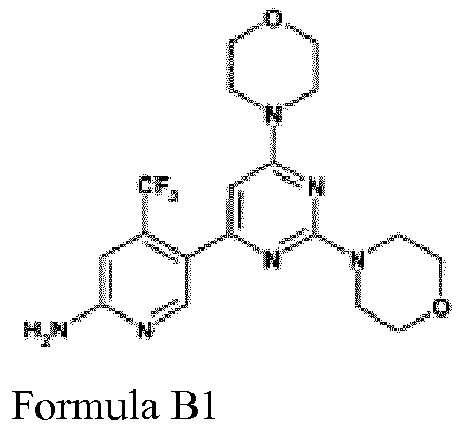
- In another embodiment, the second agent that inhibits PI3 Kinase is {drug3b} described by Formula B2:

- Furthermore,
WO2013006532 describes and which is incorporated by reference and also preferred here as cited: - In another embodiment, the present disclosure includes a method of treating a hyperproliferative disease, preferably cancer. The compounds of the present disclosure inhibitors of CDK4/6 and PI3K, and therefore may be capable of treating diseases wherein the underlying pathology is (at least in part) mediated by activated CDK4/6 and/or PI3K pathway. Such diseases include cancer and other diseases in which there is a disorder of cell proliferation, apoptosis, or differentiation. Thus the combination of the present disclosure may be useful in the treatment of RB+ve (retinoblastoma protein positive) tumours, including tumours harbouring activating mutations in Ras, Raf, Growth Factor Receptors, PI3K,or over-expression of Growth Factor Receptors, or inactivation of pi 6. The compounds of the present disclosure may also be useful in the treatment of tumours with amplifications of CDK4 and CDK6 genes as well as, tumours over-expressing cyclin partners of the cyclin dependent kinases. The compounds of the present disclosure may also be useful in the treatment of RB-ve tumours. The combination of the present disclosure may also be useful in the treatment tumours with genetic aberrations that activate the CDK4/6 kinase activity. These include, but are not limited to, cancers with D-cyclin translocations such as mantle cell lymphoma and multiple myeloma, D-cyclin amplifications such as breast cancer and squamous cell esophageal cancer, CDK4 amplifications such as liposarcoma, CDK6 amplifications or overexpressions such as T-cell lymphoma and pi 6 inactivation such as melanoma, non-small cell lung cancer and pancreatic cancer. The combination of the present disclosure may be useful in the treatment of cancers that have genetic aberrations in the upstream regulators of D-cyclins, where the defect results in an increase of D-cyclins abundance, can also be considered for treatment. These include, but are not limited to, acute myeloid leukemia with FLT3 activation, breast cancers with Her2/neu overexpression, ER dependency or triple negative phenotype, colon cancers with activating mutations of the MAPK, PI3K or WNT pathway, melanomas with activating mutations of MAPK pathway, non small cell lung cancers with activating aberrations of EGFR pathway and pancreatic cancers with activating aberrations of MAPK pathway including K-Ras mutations. The combination of the present disclosure may be useful in the treatment of cancers that have activating mutations of PI3K. These include, but not limited to, breast cancer, endometrium cancer, urinary track cancer, melanoma, colon cancer, stomach cancer, cervical cancer, prostate cancer and ovarian cancer. Examples of cancers which may be treated with a compound of the present disclosure include but are not limited to, carcinoma, for example a carcinoma of the bladder, breast, colon (e.g. colorectal carcinomas such as colon adenocarcinoma and colon adenoma), kidney, epidermis, liver, lung (e.g. adenocarcinoma, small cell lung cancer and non-small cell lung carcinomas), oesophagus, gall bladder, ovary, pancreas (e.g. exocrine pancreatic carcinoma), stomach, cervix, thyroid, nose, head and neck, prostate, and skin (e.g. squamous cell carcinoma). Other examples of cancers that may be treated with a compound of the present disclosure include hematopoietic tumours of lymphoid lineage (e.g. leukemia, acute lymphocytic leukemia, mantle cell lymphoma, chronic lymphocytic leukaemia, B-cell lymphoma(such as diffuse large B cell lymphoma), T-cell lymphoma, multiple myeloma, Hodgkin's lymphoma, non-Hodgkin's lymphoma, hairy cell lymphoma, and Burkett's lymphoma; hematopoietic tumours of myeloid lineage, for example acute and chronic myelogenous leukemias, myelodysplastic syndrome, and promyelocytic leukemia. Other cancers include thyroid follicular cancer; a tumour of mesenchymal origin, for example fibrosarcoma or habdomyosarcoma; a tumour of the central or peripheral nervous system, for example astrocytoma, neuroblastoma, glioma or schwannoma; neuroendocrine cancer; melanoma; prostate cancer; ovarian cancer; rhabdoid cancer; seminoma; teratocarcinoma; osteosarcoma; xeroderma pigmentosum; retinoblastoma; keratoctanthoma; thyroid follicular cancer; and Kaposi's sarcoma. One group of cancers includes human breast cancers (e.g. ER positive breast cancer, Her2 positive breast cancer, PI3K mutated breast cancer, primary breast tumours, node-negative breast cancer, invasive duct adenocarcinomas of the breast, non-endometrioid breast cancers); and endometrial cancers. Another sub-set of cancers wherein compounds having CDK4/6 and/or PI3K inhibitory activity may be of particular therapeutic benefit comprises glioblastoma multiforme, T cell ALL, sarcomas, familial melanoma and melanoma. The combination of the present disclosure could also be useful in the treatment of viral infections, for example herpes virus, pox virus, Epstein-Barr virus, Sindbis virus, adenovirus, HIV, HPV, HCV and HCMV; prevention of AIDS development in HIV-infected individuals; chronic inflammatory diseases, for example systemic lupus erythematosus, autoimmune mediated glomerulonephritis, rheumatoid arthritis, psoriasis, inflammatory bowel disease, and autoimmune diabetes mellitus; cardiovascular diseases for example cardiac hypertrophy, restenosis, atherosclerosis; neurodegenerative disorders, for example Alzheimer's disease, AIDS-related dementia, Parkinson's disease, amyotropic lateral sclerosis, retinitis pigmentosa, spinal muscular atropy and cerebellar degeneration; glomerulonephritis; myelodysplastic syndromes, ischemic injury associated myocardial infarctions, stroke and reperfusion injury, arrhythmia, atherosclerosis, toxin-induced or alcohol related liver diseases, haematological diseases, for example, chronic anemia and aplastic anemia; degenerative diseases of the musculoskeletal system, for example, osteoporosis and arthritis, aspirin-senstive rhinosinusitis, cystic fibrosis, multiple sclerosis, kidney diseases, ophthalmic diseases including age related macular degeneration, uveitis, and cancer pain.
-
WO2013006532 discloses the following examples: - Example 1: Potential synergistic interactions between {drug2a} and {drug3a} or {drug3b} combinations were assessed relative to the Loewe additivity model using CHALICE software, via a synergy score calculated from the differences between the observed and Loewe model values across the response matrix. Briefly, 9 titrating concentration ranging from 20 µM diluted serially three folds for {drug2a} and 10 µM diluted serially 3 folds for {drug3a} or {drug3b}, including 0 µM, were used. In a 96 well plate, the 9 concentration points for each agent were mixed in a matrix format, generating 81 combinations. This plate was used to treat MDA-MB-453 cells, and the resulting inhibition values were used by CHALICE software to generate Inhibition and ADD Excess Inhibition matrices, as well as the isobolograms. A more detailed explanation of the technique and calculation can be found in Lehar et al. "Synergistic drug combinations improve therapeutic selectivity", Nat. Biotechnol. 2009, July; 27(7), 659-666, which is hereby incorporated by reference. As illustrated by Figure 1 of
WO2013006532 , inhibition matrix shows the actual inhibition observed by the CTG assay at the respective concentrations of the compounds. ADD Excess inhibition shows the excess inhibition observed over the inhibition predicted by the Loewe additivity model. In addition to the matrices, one can use isobolograms to observe synergy. The inhibition level for each isobologram was chosen manually so as to observe the best synergistic effects. Isobologram was generated with {drug2a} concentrations shown on the x-axis and {drug3a} or {drug3b} concentrations shown on the y-axis. A straight line connecting the {drug2a} and the {drug3a} or {drug3b} concentrations which produce the chosen level of inhibition represented growth inhibitions that were strictly additive for the combinations. Plots placed below the line of additivity (more growth inhibition) represented synergistic growth inhibitions, while plots above the line of additivity (less growth inhibition) represented antagonistic growth inhibitions. Synergic interaction is observed for the combination of {drug2a} and {drug3a} or {drug3b} in the MDA-MB-453 cells. - Example 2: Potential synergistic interactions between {drug2a} and {drug3a} or {drug3b} combinations were assessed relative to the Loewe additivity model using CHALICE software, via a synergy score calculated from the differences between the observed and Loewe model values across the response matrix. Briefly, 9 titrating concentration ranging from 20 µM diluted serially three folds for {drug2a} and 20 µM diluted serially 3 folds for {drug3a} or {drug3b}, including 0 µM, were used. In a 96 well plate, the 9 concentration points for each agent were mixed in a matrix format, generating 81 combinations. This plate was used to treat breast cancer HCT-116 cells, and the resulting inhibition values were used by CHALICE software to generate Inhibition and ADD Excess Inhibition matrices, as well as the isobolograms. A more detailed explanation of the technique and calculation can be found in Lehar et al. "Synergistic drug combinations improve therapeutic selectivity", Nat. Biotechnol. 2009, July; 27(7), 659-666, which is hereby incorporated by reference. As illustrated by Figure 2 of
WO2013006532 , inhibition matrix shows the actual inhibition observed by the CTG assay at the respective concentrations of the compounds. ADD Excess inhibition shows the excess inhibition observed over the inhibition predicted by the Loewe additivity model. In addition to the matrices, one can use isobolograms to observe synergy. The inhibition level for each isobologram was chosen manually so as to observe the best synergistic effects. Isobologram was generated with {drug2a} concentrations shown on the x-axis and {drug3a} or {drug3b} concentrations shown on the y-axis. A straight line connecting the {drug2a} and the {drug3a} or {drug3b} concentrations which produce the chosen level of inhibition represented growth inhibitions that were strictly additive for the combinations. Plots placed below the line of additivity (more growth inhibition) represented synergistic growth inhibitions, while plots above the line of additivity (less growth inhibition) represented antagonistic growth inhibitions. Synergic interaction is observed for the combination of {drug2a} and {drug3a} or {drug3b} in the HCT-116 cells. - Example 3: Potential synergistic interactions between {drug2a} and {drug3a} or {drug3b} combinations were assessed relative to the Loewe additivity model using CHALICE software, via a synergy score calculated from the differences between the observed and Loewe model values across the response matrix. Briefly, 9 titrating concentration ranging from 20 µM diluted serially three folds for {drug2a} and 20 µM diluted serially 3 folds for {drug3a} or {drug3b}, including 0 µM, were used. In a 96 well plate, the 9 concentration points for each agent were mixed in a matrix format, generating 81 combinations. This plate was used to treat ER positive breast cancer MCF-7 cells, and the resulting inhibition values were used by CHALICE software to generate Inhibition and ADD Excess Inhibition matrices, as well as the isobolograms. A more detailed explanation of the technique and calculation can be found in Lehar et al. "Synergistic drug combinations improve therapeutic selectivity", Nat. Biotechnol. 2009, July; 27(7), 659-666, which is hereby incorporated by reference. As illustrated by Figure 3 of
WO2013006532 , inhibition matrix shows the actual inhibition observed by the BrdU assay at the respective concentrations of the compounds. ADD Excess inhibition shows the excess inhibition observed over the inhibition predicted by the Loewe additivity model. In addition to the matrices, one can use isobolograms to observe synergy. The inhibition level for each isobologram was chosen manually so as to observe the best synergistic effects. Isobologram was generated with {drug2a} concentrations shown on the x-axis and {drug3a} or {drug3b} concentrations shown on the y-axis. A straight line connecting the {drug2a} and the {drug3a} or {drug3b} concentrations which produce the chosen level of inhibition represented growth inhibitions that were strictly additive for the combinations. Plots placed below the line of additivity (more growth inhibition) represented synergistic growth inhibitions, while plots above the line of additivity (less growth inhibition) represented antagonistic growth inhibitions. Synergic interaction is observed for the combination of {drug2a} and {drug3a} or {drug3b} in the MCF-7 cells. - Example 4: Potential synergistic interactions between {drug2a} and {drug3b} combinations were assessed relative to the Loewe additivity model using CHALICE software, via a synergy score calculated from the differences between the observed and Loewe model values across the response matrix. Briefly, 9 titrating concentration ranging from 20 µM diluted serially three folds for {drug2a} and 20 µM diluted serially 3 folds for {drug3b}, including 0 µM, were used. In a 96 well plate, the 9 concentration points for each agent were mixed in a matrix format, generating 81 combinations. This plate was used to treat ER positive breast cancer T47-D cells, and the resulting inhibition values were used by CHALICE software to generate Inhibition and ADD Excess Inhibition matrices, as well as the isobolograms. A more detailed explanation of the technique and calculation can be found in Lehar et al. "Synergistic drug combinations improve therapeutic selectivity", Nat. Biotechnol. 2009, July; 27(7), 659-666, which is hereby incorporated by reference. As illustrated by Figure 4 of
WO2013006532 , inhibition matrix shows the actual inhibition observed by the BrdU assay at the respective concentrations of the compounds. ADD Excess inhibition shows the excess inhibition observed over the inhibition predicted by the Loewe additivity model. In addition to the matrices, one can use isobolograms to observe synergy. The inhibition level for each isobologram was chosen manually so as to observe the best synergistic effects. Isobologram was generated with {drug2a} concentrations shown on the x-axis and {drug3b} concentrations shown on the y-axis. A straight line connecting the {drug2a} and the {drug3b} concentrations which produce the chosen level of inhibition represented growth inhibitions that were strictly additive for the combinations. Plots placed below the line of additivity (more growth inhibition) represented synergistic growth inhibitions, while plots above the line of additivity (less growth inhibition) represented antagonistic growth inhibitions. Synergic interaction is observed for the combination of {drug2a} and {drug3b} in the T47-D cells. - The invention relates to an administration unit comprising pharmaceutical form of a combination of a cyclin dependent kinase 4/6 (CDK4/6) inhibitor and a Phosphatidylinositol 3-Kinase (PBKinase) inhibitor. The administration unit according to the invention is useful for treating various diseases and disorders which include but are not limited to solid tumors and hematological malignancies, breast cancer, endometrium cancer, urinary track cancer, melanoma, colon cancer, stomach cancer, cervical cancer, prostate cancer and ovarian cancer.
- Preferably, the administration unit according to the invention comprises a therapeutically effective amount of (i) {drug1}, or (ii) {drug2+drug3}, respectively, wherein at least 10 % by weight of said therapeutically effective amount of (i) {drug1}, or (ii) {drug2+drug3}, respectively, are present as (i) {drug1a}, {drug1b}, {drug1c}, {drug1d}, {drug1e}, or {drug1f}; or (ii) {drug2a+drug3a} or {drug2a+drug3b}. Preferably, at least 20 % by weight, or at least 30 % by weight, or at least 40 % by weight, or at least 50 % by weight, or at least 60 % by weight, or at least 70 % by weight, or at least 80 % by weight, or at least 90 % by weight of said therapeutically effective amount of (i) {drug1}, or (ii) {drug2+drug3}, respectively, are present as (i) {drug1a}, {drug1b}, {drug1c}, {drug1d}, {drug1e}, or {drug1f}; or (ii) {drug2a+drug3a} or {drug2a+drug3b}. Preferably, at least 95 % by weight, or at least 96 % by weight, or at least 97 % by weight, or at least 98 % by weight, or at least 99 % by weight, or at least 99.5 % by weight, or at least 99.8 % by weight, or at least 99.9 % by weight of said therapeutically effective amount of (i) {drug1}, or (ii) {drug2+drug3}, respectively, are present as (i) {drug1a}, {drug1b}, {drug1c}, {drug1d}, {drug1e}, or {drug1f}; or (ii) {drug2a+drug3a} or {drug2a+drug3b}.
- The total content of (i) {drug1}, or (ii) {drug2+drug3}, respectively, as well as the relative content of (i) {drug1a}, {drug1b}, {drug1c}, {drug1d}, {drug1e}, or {drug1f}; or (ii) {drug2a+drug3a} or {drug2a+drug3b}; can be determined by standard analysis known to the skilled artisan. Suitable methods include but are not limited to thermal analysis, HPLC and XRPD.
- In a preferred embodiment of the administration unit according to the invention, not more than 90 % by weight of said therapeutically effective amount of (i) {drug1}, or (ii) {drug2+drug3}, respectively, are amorphous. Preferably, not more than 80 % by weight, or not more than 70 % by weight, or not more than 60 % by weight, or not more than 50 % by weight, or not more than 40 % by weight, or not more than 30 % by weight, or not more than 20 % by weight, or not more than 10 % by weight of said therapeutically effective amount of (i) {drug1}, or (ii) {drug2+drug3}, respectively, are amorphous. Preferably, not more than 5 % by weight, or not more than 4 % by weight, or not more than 3 % by weight, or not more than 2 % by weight, or not more than 1 % by weight, or not more than 0.5 % by weight, or not more than 0.2 % by weight, or not more than 0.1 % by weight of said therapeutically effective amount of (i) {drug1}, or (ii) {drug2+drug3}, respectively, are amorphous.
- The total content of (i) {drug1}, or (ii) {drug2+drug3}, respectively, as well as the relative content of amorphous (i) {drug1a}, {drug1b}, {drug1c}, {drug1d}, {drug1e}, or {drug1f}; or (ii) {drug2a+drug3a} or {drug2a+drug3b}; can be determined by standard analysis known to the skilled artisan. Suitable methods include but are not limited to thermal analysis, HPLC and XRPD (see e.g. K.D. Harris, Powder diffraction crystallography of molecular solids, Top Curr Chem., 2012, 315:133-77).
- In a preferred embodiment of the administration unit according to the invention, not more than 90 % by weight of said therapeutically effective amount of (i) {drug1}, or (ii) {drug2+drug3}, respectively, are forms or polymorphs of (i) {drug1}, or (ii) {drug2+drug3}, respectively, other than (i) {drug1a}, {drug1b}, {drug1c}, {drug1d}, {drug1e}, or {drug1f}; or (ii) {drug2a+drug3a} or {drug2a+drug3b}. Preferably, not more than 80 % by weight, or not more than 70 % by weight, or not more than 60 % by weight, or not more than 50 % by weight, or not more than 40 % by weight, or not more than 30 % by weight, or not more than 20 % by weight, or not more than 10 % by weight of said therapeutically effective amount of (i) {drug1}, or (ii) {drug2+drug3}, respectively, are forms or polymorphs of (i) {drug1}, or (ii) {drug2+drug3}, respectively, other than (i) {drug1a}, {drug1b}, {drug1c}, {drug1d}, {drug1e}, or {drug1f}; or (ii) {drug2a+drug3a} or {drug2a+drug3b}. Preferably, not more than 5 % by weight, or not more than 4 % by weight, or not more than 3 % by weight, or not more than 2 % by weight, or not more than 1 % by weight, or not more than 0.5 % by weight, or not more than 0.2 % by weight, or not more than 0.1 % by weight of said therapeutically effective amount of (i) {drug1}, or (ii) {drug2+drug3}, respectively, are forms or polymorphs of (i) {drug1}, or (ii) {drug2+drug3}, respectively, other than (i) {drug1a}, {drug1b}, {drug1c}, {drug1d}, {drug1e}, or {drug1f}; or (ii) {drug2a+drug3a} or {drug2a+drug3b}.
- The total content of (i) {drug1}, or (ii) {drug2+drug3}, respectively, as well as the relative content of forms or polymorphs other than (i) {drug1a}, {drug1b}, {drug1c}, {drug1d}, {drug1e}, or {drug1f}; or (ii) {drug2a+drug3a} or {drug2a+drug3b}; can be determined by standard analysis known to the skilled artisan. Suitable methods include but are not limited to thermal analysis, HPLC and XRPD (see e.g. N. Chieng, T. Rades, J.Aaltonen, An overview of recent studies on the analysis of pharmaceutical polymorphs, J Pharm Biomed Anal. 2011, 25:55(4):618-44; R. Hilfiker, Polymorphism, Wiley-VCH, 1st ed. 2006; H.G. Brittain, Polymorphism in Pharmaceutical Solids (Drugs and the Pharmaceutical Sciences), Informa Healthcare, 2nd ed. 2009).
- In a preferred embodiment of the administration unit according to the invention, the therapeutically effective amount of (i) {drug1}, or (ii) {drug2+drug3}, respectively, is 0.1 µg to 2 g of (i) {drug1}, or (ii) {drug2+drug3}, respectively. Preferably, the therapeutically effective amount of (i) {drug1}, or (ii) {drug2+drug3}, respectively, is 1 µg to 2.5 µg of (i) {drug1}, or (ii) {drug2+drug3}, respectively, or 2.5 µg to 5 µg of (i) {drug1}, or (ii) {drug2+drug3}, respectively, or 5 µg to 10 µg of (i) {drug1}, or (ii) {drug2+drug3}, respectively, or 10 µg to 25 µg of (i) {drug1}, or (ii) {drug2+drug3}, respectively, or 25 µg to 50 µg of (i) {drug1}, or (ii) {drug2+drug3}, respectively, or 50 µg to 100 µg of (i) {drug1}, or (ii) {drug2+drug3}, respectively, or 100 µg to 250 µg of (i) {drug1}, or (ii) {drug2+drug3}, respectively, or 250 µg to 500 µg of (i) {drug1}, or (ii) {drug2+drug3}, respectively, or 500 µg to 1 mg of (i) {drug1}, or (ii) {drug2+drug3}, respectively, or 1 mg to 2.5 mg of (i) {drug1}, or (ii) {drug2+drug3}, respectively, or 2.5 mg to 5 mg of (i) {drug1}, or (ii) {drug2+drug3}, respectively, or 5 mg to 10 mg of (i) {drug1}, or (ii) {drug2+drug3}, respectively, or 10 mg to 25 mg of (i) {drug1}, or (ii) {drug2+drug3}, respectively, or 25 mg to 50 mg of (i) {drug1}, or (ii) {drug2+drug3}, respectively, or 50 mg to 100 mg of (i) {drug1}, or (ii) {drug2+drug3}, respectively, or 100 mg to 250 mg of (i) {drug1}, or (ii) {drug2+drug3}, respectively, or 250 mg to 500 mg of (i) {drug1}, or (ii) {drug2+drug3}, respectively, or 500 mg to 1 g of (i) {drug1}, or (ii) {drug2+drug3}, respectively, or 1 g to 1.25 g of (i) {drug1}, or (ii) {drug2+drug3}, respectively, or 1.25 g to 1.5 g of (i) {drug1}, or (ii) {drug2+drug3}, respectively, or 1.5 g to 1.75 g of (i) {drug1}, or (ii) {drug2+drug3}, respectively, or 1.75 g to 2 g of (i) {drug1}, or (ii) {drug2+drug3}, respectively.
- Preferably, the administration unit according to the invention comprises 0.1 µg to 2 g of (i) {drug1a}, {drug1b}, {drug1c}, {drug1d}, {drug1e}, or {drug1f}; or (ii) {drug2a+drug3a} or {drug2a+drug3b}. Preferably, it comprises 1 µg to 2.5 µg of (i) {drug1a}, {drug1b}, {drug1c}, {drug1d}, {drug1e}, or {drug1f}; or (ii) {drug2a+drug3a} or {drug2a+drug3b}; or 2.5 µg to 5 µg of (i) {drug1a}, {drug1b}, {drug1c}, {drug1d}, {drug1e}, or {drug1f}; or (ii) {drug2a+drug3a} or {drug2a+drug3b}; or 5 µg to 10 µg of (i) {drug1a}, {drug1b}, {drug1c}, {drug1d}, {drug1e}, or {drug1f}; or (ii) {drug2a+drug3a} or {drug2a+drug3b}; or 10 µg to 25 µg of (i) {drug1a}, {drug1b}, {drug1c}, {drug1d}, {drug1e}, or {drug1f}; or (ii) {drug2a+drug3a} or {drug2a+drug3b}; or 25 µg to 50 µg of (i) {drug1a}, {drug1b}, {drug1c}, {drug1d}, {drug1e}, or {drug1f}; or (ii) {drug2a+drug3a} or {drug2a+drug3b}; or 50 µg to 100 µg of (i) {drug1a}, {drug1b}, {drug1c}, {drug1d}, {drug1e}, or {drug1f}; or (ii) {drug2a+drug3a} or {drug2a+drug3b}; or 100 µg to 250 µg of (i) {drug1a}, {drug1b}, {drug1c}, {drug1d}, {drug1e}, or {drug1f}; or (ii) {drug2a+drug3a} or {drug2a+drug3b}; or 250 µg to 500 µg of (i) {drug1a}, {drug1b}, {drug1c}, {drug1d}, {drug1e}, or {drug1f}; or (ii) {drug2a+drug3a} or {drug2a+drug3b}; or 500 µg to 1 mg of (i) {drug1a}, {drug1b}, {drug1c}, {drug1d}, {drug1e}, or {drug1f}; or (ii) {drug2a+drug3a} or {drug2a+drug3b}; or 1 mg to 2.5 mg of (i) {drug1a}, {drug1b}, {drug1c}, {drug1d}, {drug1e}, or {drug1f}; or (ii) {drug2a+drug3a} or {drug2a+drug3b}; or 2.5 mg to 5 mg of (i) {drug1a}, {drug1b}, {drug1c}, {drug1d}, {drug1e}, or {drug1f}; or (ii) {drug2a+drug3a} or {drug2a+drug3b}; or 5 mg to 10 mg of (i) {drug1a}, {drug1b}, {drug1c}, {drug1d}, {drug1e}, or {drug1f}; or (ii) {drug2a+drug3a} or {drug2a+drug3b}; or 10 mg to 25 mg of (i) {drug1a}, {drug1b}, {drug1c}, {drug1d}, {drug1e}, or {drug1f}; or (ii) {drug2a+drug3a} or {drug2a+drug3b}; or 25 mg to 50 mg of (i) {drug1a}, {drug1b}, {drug1c}, {drug1d}, {drug1e}, or {drug1f}; or (ii) {drug2a+drug3a} or {drug2a+drug3b}; or 50 mg to 100 mg of (i) {drug1a}, {drug1b}, {drug1c}, {drug1d}, {drug1e}, or {drug1f}; or (ii) {drug2a+drug3a} or {drug2a+drug3b}; or 100 mg to 250 mg of (i) {drug1a}, {drug1b}, {drug1c}, {drug1d}, {drug1e}, or {drug1f}; or (ii) {drug2a+drug3a} or {drug2a+drug3b}; or 250 mg to 500 mg of (i) {drug1a}, {drug1b}, {drug1c}, {drug1d}, {drug1e}, or {drug1f}; or (ii) {drug2a+drug3a} or {drug2a+drug3b}; or 500 mg to 1 g of (i) {drug1a}, {drug1b}, {drug1c}, {drug1d}, {drug1e}, or {drug1f}; or (ii) {drug2a+drug3a} or {drug2a+drug3b}; or 1 g to 1.25 g of (i) {drug1a}, {drug1b}, {drug1c}, {drug1d}, {drug1e}, or {drug1f}; or (ii) {drug2a+drug3a} or {drug2a+drug3b}; or 1.25 g to 1.5 g of (i) {drug1a}, {drug1b}, {drug1c}, {drug1d}, {drug1e}, or {drug1f}; or (ii) {drug2a+drug3a} or {drug2a+drug3b}; or 1.5 g to 1.75 g of (i) {drug1a}, {drug1b}, {drug1c}, {drug1d}, {drug1e}, or {drug1f}; or (ii) {drug2a+drug3a} or {drug2a+drug3b}; or 1.75 g to 2 g of (i) {drug1a}, {drug1b}, {drug1c}, {drug1d}, {drug1e}, or {drug1f}; or (ii) {drug2a+drug3a} or {drug2a+drug3b}.
- Preferably, the administration unit according to the invention contains (i) {drug1a}, {drug1b}, {drug1c}, {drug1d}, {drug1e}, or {drug1f}; or (ii) {drug2a+drug3a} or {drug2a+drug3b}; as substantially the only form of (i) {drug1}, or (ii) {drug2+drug3}, respectively, i.e. preferably contains neither non-crystalline forms of (i) {drug1}, or (ii) {drug2+drug3}, respectively, nor crystalline forms other than (i) {drug1a}, {drug1b}, {drug1c}, {drug1d}, {drug1e}, or {drug1f}; or (ii) {drug2a+drug3a} or {drug2a+drug3b}.
- The administration unit according to the invention and its constituents, i.e. (i) {drug1}, or (ii) {drug2+drug3}, respectively, and (i) {drug1a}, {drug1b}, {drug1c}, {drug1d}, {drug1e}, or {drug1f}; or (ii) {drug2a+drug3a} or {drug2a+drug3b}; respectively, as well as pharmaceutical excipients, can be characterized by analytic methods that are known to the skilled artisan and described in Ph. Eur. and USP (see e.g. H.G. Brittain, S.J. Bodanowich, D.E. Bugay, J. DeVoncentis, G. Lewen, A.W. Newman, Physical characterization of pharmaceutical solids, Pharm Res. 1991, 8(8):963-73; D.E. Bugay, Characterization of the solid-state: spoectroscopic techniques, Adv Drug Deliv Rev., 2001, 48(1):43-65; P.A. Tishmack, D.E. Bugay, S.R. Byrn, Solid-state nuclear magnetic resonance spectroscopy - pharmaceutical application, J Pharm Sci, 2003, 92(3):441-74; C.J. Lee, C.J. Strachan, P.J. Manson, T. Rades, Characterization of the bulk properties of pharmaceutical solids using nonlinear optics - a review, J Pharm Pharmacol., 2007, 59(2):241-50); R.A. Storey, Solid State Characterization of Pharmaceuticals, Wiley-Blackwell, 2011).
- In a preferred embodiment, the administration unit according to the invention contains (i) {drug1a}, {drug1b}, {drug1c}, {drug1d}, {drug1e}, or {drug1f}; or (ii) {drug2a+drug3a} or {drug2a+drug3b}; in form of particles, wherein the particle size distribution of X90 is about 500 µm or less, i.e. a particle size distribution (preferably by volume) such that at least 90 % of (i) {drug1a}, {drug1b}, {drug1c}, {drug1d}, {drug1e}, or {drug1f}; or (ii) {drug2a+drug3a} or {drug2a+drug3b}; has a particle size smaller than 500 µm. Preferably, for (i) {drug1a}, {drug1b}, {drug1c}, {drug1d}, {drug1e}, or {drug1f}; or (ii) {drug2a+drug3a} or {drug2a+drug3b}; the particle size distribution of X90 is about 480 µm or less, or about 460 µm or less, or about 440 µm or less, or about 420 µm or less, or about 400 µm or less, or about 380 µm or less, or about 360 µm or less, or about 340 µm or less, or about 320 µm or less, or about 300 µm or less, or about 280 µm or less, or about 260 µm or less, or about 240 µm or less, or about 220 µm or less, or about 200 µm or less, or about 180 µm or less, or about 160 µm or less, or about 140 µm or less, or about 120 µm or less, or about 100 µm or less, or about 80 µm or less, or about 60 µm or less, or about 40 µm or less, or about 20 µm or less.
- In a preferred embodiment, the administration unit according to the invention contains (i) {drug1a}, {drug1b}, {drug1c}, {drug1d}, {drug1e}, or {drug1f}; or (ii) {drug2a+drug3a} or {drug2a+drug3b}; in form of particles, wherein the particle size distribution of X50 is about 400 µm or less, i.e. a particle size distribution (preferably by volume) such that at least 50 % of (i) {drug1a}, {drug1b}, {drug1c}, {drug1d}, {drug1e}, or {drug1f}; or (ii) {drug2a+drug3a} or {drug2a+drug3b}; has a particle size smaller than 400 µm. Preferably, for (i) {drug1a}, {drug1b}, {drug1c}, {drug1d}, {drug1e}, or {drug1f}; or (ii) {drug2a+drug3a} or {drug2a+drug3b}; the particle size distribution of X50 is about 380 µm or less, or about 360 µm or less, or about 340 µm or less, or about 320 µm or less, or about 300 µm or less, or about 280 µm or less, or about 260 µm or less, or about 240 µm or less, or about 220 µm or less, or about 200 µm or less, or about 180 µm or less, or about 160 µm or less, or about 140 µm or less, or about 120 µm or less, or about 100 µm or less, or about 80 µm or less, or about 70 µm or less, or about 60 µm or less, or about 50 µm or less. Preferably, for (i) {drug1a}, {drug1b}, {drug1c}, {drug1d}, {drug1e}, or {drug1f}; or (ii) {drug2a+drug3a} or {drug2a+drug3b}; the particle size distribution of X50 is about 45 µm or less, or about 40 µm or less, or about 35 µm or less, or about 30 µm or less, or about 25 µm or less, or about 20 µm or less, or about 15 µm or less, or about 10 µm or less.
- According to USP, the following parameters may be defined based on the cumulative distribution. QR(X) = cumulative distribution of particles with a dimension less than or equal to X [µm] where the subscript R reflects the distribution type: 0 Number, 1 Length, 2 Area, 3 Volume. Therefore, by definition: QR(X) = 0.90 when X = X90; QR(X) = 0.50 when X = X50; and QR(X) = 0.10 when X = X10.
- In preferred embodiments, the administration unit according to the invention contains (i) {drug1a}, {drug1b}, {drug1c}, {drug1d}, {drug1e}, or {drug1f}; or (ii) {drug2a+drug3a} or {drug2a+drug3b}; in form of particles having a cumulative distribution by volume basis Q3(X) (X in µm) of Q3(355) <0.50; or Q3(180) <0.50 and Q3(355) ≥0.50; or Q3(125) <0.50 and Q3(180) ≥0.50; or Q3(125) ≥0.50.
- In preferred embodiments, the administration unit according to the invention contains (i) {drug1a}, {drug1b}, {drug1c}, {drug1d}, {drug1e}, or {drug1f}; or (ii) {drug2a+drug3a} or {drug2a+drug3b}; in form of particles having a cumulative distribution by volume basis Q3(X) (X in µm) of Q3(268) <0.50 and Q3(355) ≥0.50; or Q3(180) <0.50 and Q3(268) ≥0.50; or Q3(153) <0.50 and Q3(180) ≥0.50; or Q3(125) <0.50 and Q3(153) ≥0.50; or Q3(111) <0.50 and Q3(125) ≥0.50; or Q3(98) <0.50 and Q3(111) ≥0.50; or Q3(98) ≥0.50.
- In preferred embodiments, the administration unit according to the invention contains (i) {drug1a}, {drug1b}, {drug1c}, {drug1d}, {drug1e}, or {drug1f}; or (ii) {drug2a+drug3a} or {drug2a+drug3b}; in form of particles having a cumulative distribution by volume basis Q3(X) (X in µm) of Q3(312) <0.50 and Q3(355) ≥0.50; or Q3(268) <0.50 and Q3(312) ≥0.50; or Q3(224) <0.50 and Q3(268) ≥0.50; or Q3(180) <0.50 and Q3(224) ≥0.50; or Q3(167) <0.50 and Q3(180) ≥0.50; or Q3(153) <0.50 and Q3(167) ≥0.50; or Q3(139) <0.50 and Q3(153) ≥0.50; or Q3(125) <0.50 and Q3(139) ≥0.50; or Q3(111) <0.50 and Q3(125) ≥0.50; or Q3(98) <0.50 and Q3(111) ≥0.50; or Q3(84) <0.50 and Q3(98) ≥0.50; or Q3(84) ≥0.50.
- The indicated particle size properties are determined by laser-diffraction method, in particular low angle laser light scattering, i.e. Fraunhofer diffraction. Alternatively, the particle size properties can be also determined by microscopy (e.g. electron microscopy or scanning electron microscopy). The powder fineness is preferably determined in accordance with USP35 <811>. The results of the particle size distribution determined by different techniques can be correlated with one another.
- Preferably, the administration unit according to the invention is solid, semisolid or liquid.
- Preferably, the administration unit according to the invention is for administration once daily, or twice daily, or thrice daily, or four times daily, or five times daily, or six times daily.
- Preferably, the administration unit according to the invention is monolithic or multiparticulate.
- In a preferred embodiment of the administration unit according to the invention, (i) {drug1a}, {drug1b}, {drug1c}, {drug1d}, {drug1e}, or {drug1f}; or (ii) {drug2a+drug3a} or {drug2a+drug3b}; is homogeneously distributed over the administration unit.
- Excipient composition and homogeneity can be determined by standard analysis known to the skilled artisan. Suitable methods include but are not limited to near-infrared chemical imaging.
- In another preferred embodiment of the administration unit according to the invention, (i) {drug1a}, {drug1b}, {drug1c}, {drug1d}, {drug1e}, or {drug1f}; or (ii) {drug2a+drug3a} or {drug2a+drug3b}; is not homogeneously distributed over the administration unit.
- In a preferred embodiment, the administration unit according to the invention provides controlled release of (i) {drug1}, or (ii) {drug2+drug3}, respectively. Preferably, the administration unit according to the invention comprises a controlled release matrix or a controlled release coating.
- In a preferred embodiment, under in vitro conditions (paddle apparatus, 75 rpm, 900 mL artificial gastric juice, pH 1.2) the administration unit according to the invention has released after 1 hour not more than 90 % of (i) {drug1}, or (ii) {drug2+drug3}, respectively. Preferably, the administration unit according to the invention has released after 1 hour not more than 80 % of (i) {drug1}, or (ii) {drug2+drug3}, respectively, or not more than 70 % of (i) {drug1}, or (ii) {drug2+drug3}, respectively, or not more than 60 % of (i) {drug1}, or (ii) {drug2+drug3}, respectively, or not more than 50 % of (i) {drug1}, or (ii) {drug2+drug3}, respectively, or not more than 40 % of (i) {drug1}, or (ii) {drug2+drug3}, respectively, or not more than 30 % of (i) {drug1}, or (ii) {drug2+drug3}, respectively, or not more than 20 % of (i) {drug1}, or (ii) {drug2+drug3}, respectively, or not more than 10 % of (i) {drug1}, or (ii) {drug2+drug3}, respectively.
- In a preferred embodiment, under in vitro conditions (paddle apparatus, 75 rpm, 900 mL artificial gastric juice, pH 1.2) the administration unit according to the invention has released after 2 hours not more than 90 % of (i) {drug1}, or (ii) {drug2+drug3}, respectively. Preferably, the administration unit according to the invention has released after 2 hours not more than 80 % of (i) {drug1}, or (ii) {drug2+drug3}, respectively, or not more than 70 % of (i) {drug1}, or (ii) {drug2+drug3}, respectively, or not more than 60 % of (i) {drug1}, or (ii) {drug2+drug3}, respectively, or not more than 50 % of (i) {drug1}, or (ii) {drug2+drug3}, respectively, or not more than 40 % of (i) {drug1}, or (ii) {drug2+drug3}, respectively, or not more than 30 % of (i) {drug1}, or (ii) {drug2+drug3}, respectively, or not more than 20 % of (i) {drug1}, or (ii) {drug2+drug3}, respectively, or not more than 10 % of (i) {drug1}, or (ii) {drug2+drug3}, respectively.
- In a preferred embodiment, under in vitro conditions (paddle apparatus, 75 rpm, 900 mL artificial gastric juice, pH 1.2) the administration unit according to the invention has released after 4 hours not more than 90 % of (i) {drug1}, or (ii) {drug2+drug3}, respectively. Preferably, the administration unit according to the invention has released after 4 hours not more than 80 % of (i) {drug1}, or (ii) {drug2+drug3}, respectively, or not more than 70 % of (i) {drug1}, or (ii) {drug2+drug3}, respectively, or not more than 60 % of (i) {drug1}, or (ii) {drug2+drug3}, respectively, or not more than 50 % of (i) {drug1}, or (ii) {drug2+drug3}, respectively, or not more than 40 % of (i) {drug1}, or (ii) {drug2+drug3}, respectively, or not more than 30 % of (i) {drug1}, or (ii) {drug2+drug3}, respectively, or not more than 20 % of (i) {drug1}, or (ii) {drug2+drug3}, respectively, or not more than 10 % of (i) {drug1}, or (ii) {drug2+drug3}, respectively.
- In a preferred embodiment, under in vitro conditions (paddle apparatus, 75 rpm, 900 mL artificial gastric juice, pH 1.2) the administration unit according to the invention has released after 8 hours not more than 90 % of (i) {drug1}, or (ii) {drug2+drug3}, respectively. Preferably, the administration unit according to the invention has released after 8 hours not more than 80 % of (i) {drug1}, or (ii) {drug2+drug3}, respectively, or not more than 70 % of (i) {drug1}, or (ii) {drug2+drug3}, respectively, or not more than 60 % of (i) {drug1}, or (ii) {drug2+drug3}, respectively, or not more than 50 % of (i) {drug1}, or (ii) {drug2+drug3}, respectively, or not more than 40 % of (i) {drug1}, or (ii) {drug2+drug3}, respectively, or not more than 30 % of (i) {drug1}, or (ii) {drug2+drug3}, respectively, or not more than 20 % of (i) {drug1}, or (ii) {drug2+drug3}, respectively, or not more than 10 % of (i) {drug1}, or (ii) {drug2+drug3}, respectively.
- In another preferred embodiment, the administration unit according to the invention provides immediate release of (i) {drug1}, or (ii) {drug2+drug3}, respectively.
- In a preferred embodiment, under in vitro conditions (paddle apparatus, 75 rpm, 900 mL artificial gastric juice, pH 1.2) the administration unit according to the invention has released after 0.5 hours at least 10 % of (i) {drug1}, or (ii) {drug2+drug3}, respectively. Preferably, the administration unit according to the invention has released after 0.5 hours at least 20 % of (i) {drug1}, or (ii) {drug2+drug3}, respectively, or at least 30 % of (i) {drug1}, or (ii) {drug2+drug3}, respectively, or at least 40 % of (i) {drug1}, or (ii) {drug2+drug3}, respectively, or at least 50 % of (i) {drug1}, or (ii) {drug2+drug3}, respectively, or at least 60 % of (i) {drug1}, or (ii) {drug2+drug3}, respectively, or at least 70 % of (i) {drug1}, or (ii) {drug2+drug3}, respectively, or at least 80 % of (i) {drug1}, or (ii) {drug2+drug3}, respectively, or at least 90 % of (i) {drug1}, or (ii) {drug2+drug3}, respectively.
- Preferably, the administration unit according to the invention has a total weight of 10 mg to 3 g. Preferably, the administration unit according to the invention has a total weight of 10 to 25 mg, or 25 mg to 50 mg, or 50 mg to 100 mg, or 100 mg to 250 mg, or 250 mg to 500 mg, or 500 mg to 1000 mg, or 1000 mg to 2500 mg.
- In a preferred embodiment, the administration unit according to the invention is for systemic or topical administration.
- In another preferred embodiment, the administration unit according to the invention is for parenteral administration.
- Preferably, the administration unit according to the invention is for oral, buccal, opthalmic, nasal, rectal, transmucosal, or intestinal administration. Preferably, it is for oral administration.
- Preferably, the administration unit according to the invention is selected from the group consisting of tablets, capsules, effervescent tablets, orodispersible tablets, dragees, sachets, drops, suspensions, and powders. Preferably, it is a tablet.
- Preferably, the administration unit according to the invention is round or oblong; and/or is planar or biconvex.
- In a preferred embodiment, the administration unit according to the invention has a round cross-section with a diameter of 1 mm to 20 mm. Preferably, the diameter of the round cross-section is 1 mm to 3 mm, or 3 mm to 5 mm, or 5 mm to 8 mm, or 8 mm to 10 mm, or 10 mm to 13 mm, or 13 mm to 15 mm, or 15 mm to 18 mm, or 18 mm to 20 mm.
- In a preferred embodiment, the administration unit according to the invention is oblong and has an aspect ratio of at least 1.1:1. Preferably, the aspect ratio is at least 4:3, or at least 21/2:1, or at least 3:2, or at least 16:10, or at least Psi:1, or at least 5:3, or at least 16:9.
- In a preferred embodiment, the administration unit according to the invention has been manufactured by direct compression.
- In another preferred embodiment, the administration unit according to the invention has been manufactured by granulation and subsequent compression of granules. Preferably, granulation is wet granulation or dry granulation.
- Preferably, the administration unit according to the invention has been compacted at a pressure of 10 MPa to 10,000 MPa. Preferably, the administration unit according to the invention has been compacted at a pressure of 10 MPa to 25 MPa, or 25 MPa to 50 MPa, or 50 MPa to 100 MPa, or 100 MPa to 250 MPa, or 250 MPa to 500 MPa, or 500 MPa to 1000 MPa, or 1000 MPa to 2500 MPa, or 2500 MPa to 5000 MPa, or 5000 MPa to 10,000 MPa.
- In a preferred embodiment, the administration unit according to the invention comprises a film coating. Preferably, the film coating is enteric. Suitable enteric coating materials are known to the skilled artisan and include but are not limited to methyl acrylate-methacrylic acid copolymers, cellulose acetate succinate, hydroxy propyl methyl cellulose phthalate, hydroxy propyl methyl cellulose acetate succinate (hypromellose acetate succinate), polyvinyl acetate phthalate (PVAP), methyl methacrylate-methacrylic acid copolymers, sodium alginate and stearic acid.
- In a preferred embodiment of the administration unit according to the invention, the film coating comprises a cellulose ether (e.g. hydroxypropylmethyl cellulose) or a synthetic polymer (e.g. polyvinyl alcohol).
- In a preferred embodiment of the administration unit according to the invention, the film coating has an average thickness of 0.01 µm to 0.03 µm, or 0.03 to 0.05 µm, or 0.05 to 0.1 µm, or 0.1 to 0.25 µm, or 0.25 to 0.5 µm, or 0.5 to 1.0 µm, or 1.0 µm to 2.5 µm, or 2.5 µm to 5.0 µm, or 5.0 µm to 10 µm, or 10 µm to 25 µm, or 25 µm to 50 µm, or 50 µm to 100 µm, or 100 µm to 250 µm, or 250 µm to 500 µm, or 500 µm to 1000 µm.
- In a preferred embodiment, the administration unit according to the invention has a tablet porosity of not more than 90 %. Preferably, it has a tablet porosity of not more than 80 %, or not more than 70 %, or not more than 60 %, or not more than 50 %, or not more than 40 %, or not more than 30 %, or not more than 20 %, or not more than 10 %. Preferably, it has a tablet porosity of not more than 5 %, or not more than 4 %, or not more than 3 %, or not more than 2 %, or not more than 1 %, or not more than 0.5 %, or not more than 0.2 %, or not more than 0.1 %.
- The most common strength test in pharmaceutical applications is the diametral compression test, which is used to calculate the radial tensile strength of a tablet (Fell, J.T., Newton, J.M., 1970. Determination of tablet strength by diametral compression test. J. Pharm. Sci. 59, 688-691). In order to calculate the radial tensile strength, the stress conditions have to be such that the tablet fails in tension. During radial tensile strength measurements, the fracture occurs through a predetermined diametral cross section of the tablet. Therefore, the radial tensile strength is likely to reflect the average strength of tablet rather than the strength of the weakest plane in the tablet.
- In a preferred embodiment, the administration unit according to the invention has a radial tensile strength of 0.1 to 100 MPa. Preferably, it has a radial tensile strength of 0.1 MPa to 0.3 MPa, or 0.3 MPa to 0.5 MPa, or 0.5 MPa to 1.0 MPa, or 1.0 MPa to 2.5 MPa, or 2.5 MPa to 5.0 MPa, or 5.0 MPa to 10 MPa, or 10 MPa to 25 MPa, or 25 MPa to 50 MPa, or 50 MPa to 100 MPa.
- Another method for determining mechanical strength is to measure the axial tensile strength. The force necessary to break the tablet is obtained by pulling the tablet parallel to the applied force during the formation of the tablet and this force is then used to calculate the axial tensile strength (Nyström, C., Malmqvist, K., Mazur, J., Alex, W., Hölzer, A.W., 1978. Measurement of axial and radial tensile strength of tablets and their relation to capping. Acta Pharm. Suec. 15, 226-232). During axial tensile strength measurements, the fracture will occur through the weakest plane in the tablet. Consequently, this method allows detection of capping tendencies in a tablet.
- In a preferred embodiment, the administration unit according to the invention has an axial tensile strength of 0.1 to 100 MPa. Preferably, it has an axial tensile strength of 0.1 MPa to 0.3 MPa, or 0.3 MPa to 0.5 MPa, or 0.5 MPa to 1.0 MPa, or 1.0 MPa to 2.5 MPa, or 2.5 MPa to 5.0 MPa, or 5.0 MPa to 10 MPa, or 10 MPa to 25 MPa, or 25 MPa to 50 MPa, or 50 MPa to 100 MPa.
- In a preferred embodiment, the administration unit according to the invention has an average pore size of 0.001 µm to 1000 µm. Preferably, it has an average pore size of 0.001 µm to 0.003 µm, or 0,003 µm to 0.005 µm, or 0.005 µm to 0.01 µm, or 0.01 µm to 0.025 µm, or 0.025 µm to 0.05 µm, or 0.05 µm to 0.1 µm, or 0.1 µm to 0.25 µm, or 0.25 µm to 0.5 µm, or 0.5 µm to 1 µm, or 1 µm to 2.5 µm, or 2.5 µm to 5 µm, or 5 µm to 10 µm, or 10 µm to 25 µm, or 25 µm to 50 µm, or 50 µm to 100 µm, or 100 µm to 250 µm, or 250 µm to 500 µm, or 500 µm to 1000 µm.
- The pore size distribution of a tablet may be assessed by methods that are known to the skilled artisan and include but are not limited to gas adsorption (e.g. Stanley-Wood, N.G., Johansson, M.E., 1980. Variation of intra- and inter-particle porosity with degree of compaction. Analyst 105, 1104-1112; Westermarck, S., Juppo, A.M., Kervinen, L., Yliruusi, J., 1998. Pore structure and surface area of mannitol powder, granules and tablets determined with mercury porosimetry and nitrogen adsorption. Eur. J. Pharm. Biopharm. 46, 61-86) or mercury porosimetry (e.g. Stanley-Wood, N.G., Johansson, M.E., 1980. Variation of intra- and inter-particle porosity with degree of compaction. Analyst 105, 1104-1112; Juppo, A.M., 1996. Relationship between breaking force and pore structure of lactose, glucose and mannitol tablets. Int. J. Pharm.127, 95-102; Westermarck, S., Juppo, A.M., Kervinen, L., Yliruusi, J., 1998. Pore structure and surface area of mannitol powder, granules and tablets determined with mercury porosimetry and nitrogen adsorption. Eur. J. Pharm. Biopharm. 46, 61-86). These techniques are complementary, in that mercury porosimetry can be used to measure larger pores (the lower size limit is about 0.003 µm in diameter) while gas adsorption allows measurement of smaller pores. For further details it is also referred to S. Lowell et al., Characterization of Porous Solids and Powders: Surface Area, Pore Size and Density (Particle Technology Series), Springer, 2010.
- In a preferred embodiment, the administration unit according to the invention has a pore size distribution such that at least 10 % of the pores have a pore size of not more than 0.1 µm. Preferably, the pore size distribution is such that at least 20 %, or at least 30 %, or at least 40 %, or at least 50 %, or at least 60 %, or at least 70 %, or at least 80 %, or at least 90 % of the pores have a pore size of not more than 0.1 µm.
- In another preferred embodiment, the administration unit according to the invention has a pore size distribution such that at least 10 % of the pores have a pore size of not less than 0.1 µm. Preferably, the pore size distribution is such that at least 20 %, or at least 30 %, or at least 40 %, or at least 50 %, or at least 60 %, or at least 70 %, or at least 80 %, or at least 90 % of the pores have a pore size of not less than 0.1 µm.
- In preferred embodiment, the administration unit according to the invention has a pore size distribution such that at least 10 % of the pores have a pore size of not more than 1 µm. Preferably, the pore size distribution is such that at least 20 %, or at least 30 %, or at least 40 %, or at least 50 %, or at least 60 %, or at least 70 %, or at least 80 %, or at least 90 % of the pores have a pore size of not more than 1 µm.
- In another preferred embodiment, the administration unit according to the invention has a pore size distribution such that at least 10 % of the pores have a pore size of not less than 1 µm. Preferably, the pore size distribution is such that at least 20 %, or at least 30 %, or at least 40 %, or at least 50 %, or at least 60 %, or at least 70 %, or at least 80 %, or at least 90 % of the pores have a pore size of not less than 1 µm.
- In a preferred embodiment, the administration unit according to the invention has a pore size distribution such that at least 10 % of the pores have a pore size of not more than 10 µm. Preferably, the pore size distribution is such that at least 20 %, or at least 30 %, or at least 40 %, or at least 50 %, or at least 60 %, or at least 70 %, or at least 80 %, or at least 90 % of the pores have a pore size of not more than 10 µm.
- In another preferred embodiment, the administration unit according to the invention has a pore size distribution such that at least 10 % of the pores have a pore size of not less than 10 µm. Preferably, the pore size distribution is such that at least 20 %, or at least 30 %, or at least 40 %, or at least 50 %, or at least 60 %, or at least 70 %, or at least 80 %, or at least 90 % of the pores have a pore size of not less than 10 µm.
- In a preferred embodiment, the administration unit according to the invention has a water content of not more than 5 % by weight, relative to the total weight of the tablet. Preferably, it has a water content of not more than 4 % by weight, or not more than 3 % by weight, or not more than 2 % by weight, or not more than 1 % by weight, or not more than 0.5 % by weight, or not more than 0.1 % by weight, relative to the total weight of the tablet.
- In a preferred embodiment, the administration unit according to the invention has a true density of 0.60 to 1.40 g cm-3. Preferably, it has a true density of 0.60 to 0.65 g cm-3, or 0.65 to 0.70 g cm-3, or 0.70 to 0.75 g cm-3, or 0.75 to 0.80 g cm-3, or 0.80 to 0.85 g cm-3, or 0.85 to 0.90 g cm-3, or 0.90 to 0.95 g cm-3, or 0.95 to 1.00 g cm-3, or 1.00 to 1.05 g cm-3, or 1.05 to 1.10 g cm-3, or 1.10 to 1.15 g cm-3, or 1.15 to 1.20 g cm-3, or 1.20 to 1.25 g cm-3, or 1.25 to 1.30 g cm-3, or 1.30 to 1.35 g cm-3, or 1.35 to 1.40 g cm-3.
- In a preferred embodiment, the administration unit according to the invention has an apparent density of 0.60 to 1.40 g cm-3. Preferably, it has an apparent density of 0.60 to 0.65 g cm-3, or 0.65 to 0.70 g cm-3, or 0.70 to 0.75 g cm-3, or 0.75 to 0.80 g cm-3, or 0.80 to 0.85 g cm-3, or 0.85 to 0.90 g cm-3, or 0.90 to 0.95 g cm-3, or 0.95 to 1.00 g cm-3, or 1.00 to 1.05 g cm-3, or 1.05 to 1.10 g cm-3, or 1.10 to 1.15 g cm-3, or 1.15 to 1.20 g cm-3, or 1.20 to 1.25 g cm-3, or 1.25 to 1.30 g cm-3, or 1.30 to 1.35 g cm-3, or 1.35 to 1.40 g cm-3.
- In a preferred embodiment, the administration unit according to the invention disintegrates within 6000 seconds. Preferably, it disintegrates within 5500 seconds, or within 5000 seconds, or within 4500 seconds, or within 4000 seconds, or within 3500 seconds, or within 3000 seconds, or within 2500 seconds, or within 2000 seconds, or within 1500 seconds, or within 1000 seconds, or within 750 seconds, or within 500 seconds, or within 250 seconds.
- In a preferred embodiment, the administration unit according to the invention is a capsule. Preferably, it comprises a multitude of particulates comprising (i) {drug1a}, {drug1b}, {drug1c}, {drug1d}, {drug1e}, or {drug1f}; or (ii) {drug2a+drug3a} or {drug2a+drug3b}. Preferably, it comprises at least 2 particulates, or at least 3 particulates, or at least 4 particulates, or at least 5 particulates, or at least 6 particulates, or at least 7 particulates, or at least 8 particulates, or at least 9 particulates, or at least 10 particulates.
- In a preferred embodiment of the administration unit according to the invention, the capsule material comprises hard gelatine.
- In a preferred embodiment, the administration unit according to the invention comprises at least 2 different types of particulates that differ from each other in at least one property selected from the group consisting of nature of excipients, content of excipients, content of (i) {drug1a}, {drug1b}, {drug1c}, {drug1d}, {drug1e}, or {drug1f}; or (ii) {drug2a+drug3a} or {drug2a+drug3b}; content of (i) {drug1}, or (ii) {drug2+drug3}, respectively, water content, total weight, size, and shape.
- In a preferred embodiment, the administration unit according to the invention passes the storage stability test according to Ph. Eur. under accelerated storage conditions at 40°C and 75 % rel. humidity. Preferably, it has a storage stability for at least 3 months, or at least 4 months, or at least 5 months, or at least 6 months, or at least 7 months, or at least 8 months, or at least 9 months, or at least 10 months, or at least 11 months, or at least 12 months according to Ph. Eur. under accelerated storage conditions at 40°C and 75 % rel. humidity.
- In a preferred embodiment, the administration unit according to the invention provides the peak plasma level within 0.1 hour to 36 hours after administration. Preferably, it provides the peak plasma level within 0.1 hour to 1 hour, or 1 hour to 2 hours, or 2 hours to 3 hours, or 3 hours to 4 hours, or 4 hours to 5 hours, or 5 hours to 6 hours, or 6 hours to 7 hours, or 7 hours to 8 hours, or 8 hours to 9 hours, or 9 hours to 10 hours, or 10 hours to 11 hours, or 11 hours to 12 hours, or 12 hours to 13 hours, or 13 hours to 14 hours, or 14 hours to 15 hours, or 15 hours to 16 hours, or 16 hours to 17 hours, or 17 hours to 18 hours, or 18 hours to 19 hours, or 19 hours to 20 hours, or 20 hours to 21 hours, or 21 hours to 22 hours, or 22 hours to 23 hours, or 23 hours to 24 hours, after administration.
- Preferably, the administration unit according to the invention comprises one or more excipients independently selected from the group consisting of antiadherents, binders, disintegrants, fillers, diluents, flavors, colors, lubricants, glidants, sorbents, surfactants, preservatives and sweeteners.
- In a preferred embodiment of the administration unit according to the invention, the antiadherent is selected from the group consisting of silicon dioxide, talc, talc waxes, stearates (e.g. magnesium, calcium and sodium), stearic acid, stearowet, boric acid, sodium chloride, DL-leucine, sodium oleate, sodium benzoate, sodium acetate, sodium lauryl sulfate, and magnesium lauryl sulfate. Magnesium stearate is particularly preferred.
- In a preferred embodiment of the administration unit according to the invention, the binder is selected from the group consisting of saccharides and their derivatives; proteins; gums; silicates; and synthetic polymers. Preferably, the binder is a saccharide or a derivative thereof selected from the group consisting of disaccharides (e.g. sucrose, glucose or lactose); polysaccharides and their derivatives (e.g. starch, pregelatinized starch, cellulose, microcrystalline cellulose, polysaccharide acids, cellulose ethers [e.g. methyl cellulose, ethyl cellulose, hydroxyethyl cellulose, hydroxypropyl cellulose, hydroxypropylmethyl cellulose or carboxymethylcellulose sodium]); alginic acid and salts thereof (e.g. sodium alginate); and sugar alcohols (e.g. xylitol, sorbitol or maltitol); or wherein the binder is a protein selected from gelatin; or wherein the binder is a gum (e.g. acacia gum, guar gum, or tragacanth gum); or wherein the binder is a silicate (e.g. magnesium aluminum silicate or bentonite); or wherein the binder is a synthetic polymer selected from the group consisting of polyvinylpyrrolidone, polyvinylpyrrolidonevinylacetate copolymer, polymethacrylate polymer, polyvinylalcohol, and polyethylene glycol.
- In a preferred embodiment of the administration unit according to the invention, the disintegrant is selected from the group consisting of cross-linked polymers (e.g. cross-linked polyvinylpyrrolidone [crospovidone] or cross-linked sodium carboxymethyl cellulose [croscarmellose sodium]), starches (e.g. corn or potato), pregelatinized starch, modified starch (e.g. sodium starch glycolate), algenic acid, alginates (e.g. sodium alginate), carboxymethylcellulose, microcrystalline cellulose, clays (e.g. magnesium aluminum silicate), and gums (e.g. agar, guar, locust bean, karaya, pectin, or tragacanth gum).
- In a preferred embodiment of the administration unit according to the invention, the filler (or diluent) is selected from the group consisting of plant cellulose, microcrystalline cellulose, inorganic phosphates (e.g. dibasic calcium phosphate or tricalcium phosphate), inorganic carbonates such as calcium carbonate, inorganic sulfates such as calcium sulfate dihydrate, sugars and sugar alcohols (e.g. lactose, glucose, inositol, mannitol, sorbitol, sucrose, dextrose, maltodextrins, and fructose), magnesium stearate, calcium lactate trihydrate, starch (e.g. corn, wheat, maize, potato or rice starch), and modified starch (e.g. carboxymethyl starch).
- In a preferred embodiment of the administration unit according to the invention, the lubricant is hydrophilic or hydrophobic. Preferably, the lubricant is selected from the group consisting of talc, silica, stearin, fatty acids (e.g. stearic acid) or fatty acid derivatives, metal stearates (e.g. magnesium stearate, calcium stearate, or zinc stearate), glyceryl monostearate, glyceryl palmitostearate, glyceryl behenate, sodium lauryl sulfate, magnesium lauryl sulfate, sodium stearyl fumarate, hydrogenated vegetable oil, polyalkylene glycols (e.g. polyethylene glycol), starch, light mineral oil, sodium benzoate, and sodium chloride.
- In a preferred embodiment of the administration unit according to the invention, the glidant is selected from the group consisting of fumed silica, cornstarch, talc, and magnesium carbonate.
- In a preferred embodiment of the administration unit according to the invention, the surfactant is selected from the group consisting of sodium lauryl sulfate, polyethylene-polypropylene glycol co-polymers, poly(oxyethylene)-poly(oxypropylene)-block-copolymers (e.g. poloxamers).
- In a preferred embodiment of the administration unit according to the invention, the preservative is selected from the group consisting of antioxidants (e.g. vitamin A, vitamin C, vitamin E, retinyl palmitate, selenium, ascorbyl palmitate, sodium ascorbate), amino acids (e.g. cysteine or methionine), citric acid and its salts (e.g. sodium citrate), synthetic preservatives (e.g. parabens such as methyl paraben or propyl paraben; butylated hydroxyanisole, butylated hydroxytoluene, monothioglycerol, propyl gallate), hypophosphorous acid, sodium bisulfite, sodium formaldehyde sulfoxylate, and sodium metabisulfite.
- In a preferred embodiment, the administration unit according to the invention passes the friability test according to Ph. Eur. Preferably, the weight loss in the friability test according to Ph. Eur. is not more than 2.0 % by weight, or not more than 1.5 % by weight, or not more than 1.0 % by weight, or not more than 0.5 % by weight, or not more than 0.4 % by weight, or not more than 0.3 % by weight, or not more than 0.2 % by weight, or not more than 0.1 % by weight.
- In a preferred embodiment, the administration unit according to the invention passes the test uniformity of content of single-dose preparations according to Ph. Eur.
- In a preferred embodiment, the administration unit according to the invention does not comprise any active pharmaceutical ingredient other than (i) {drug1}, or (ii) {drug2+drug3}, respectively.
- In a preferred embodiment, the administration unit according to the invention is for storage not above 50 °C.
- Preferably, it is for storage not above 25 °C.
- In a preferred embodiment, the administration unit according to the invention is not identical with any of the administration units that are individualized in the experimental section of (i)
WO2013010916 , (ii)WO2013006532 , (iii)WO2013001445 , (iv)WO2013001445 , (v)WO2012174082 , (vi)WO2012168491 , and (vii)WO2012168884 , respectively, which are incorporated by reference. - The invention also relates to the administration unit according to the invention for use in the treatment of a disorder or a disease in a mammal. Preferably, the mammal is a human. Preferably, the mammal is an adult.
- Preferably, the mammal does not suffer from liver damage and/or kidney damage.
- Preferably, the mammal is not pregnant.
- Preferably, the mammal is not allergic against (i) {drug1}, or (ii) {drug2+drug3}, respectively.
- In a preferred embodiment, the administration unit according to the invention is administered orally with a liquid.
- Preferably, the liquid is water, milk, juice or lemonade.
- In a preferred embodiment of the administration unit according to the invention, the administered daily dose of (i) {drug1}, or (ii) {drug2+drug3}, respectively, is 0.0001 mg/kg body weight to 100 mg/kg body weight. Preferably, the administered daily dose of (i) {drug1}, or (ii) {drug2+drug3}, respectively, is 0.0001 mg/kg body weight to 0.0003 mg/kg body weight, or 0.0003 mg/kg body weight to 0.0005 mg/kg body weight, or 0.0005 mg/kg body weight to 0.001 mg/kg body weight, or 0.001 mg/kg body weight to 0.0025 mg/kg body weight, or 0.0025 mg/kg body weight to 0.005 mg/kg body weight, or 0.005 mg/kg body weight to 0.01 mg/kg body weight, or 0.01 mg/kg body weight to 0.025 mg/kg body weight, or 0.025 mg/kg body weight to 0.05 mg/kg body weight, or 0.05 mg/kg body weight to 0.1 mg/kg body weight, or 0.1 mg/kg body weight to 0.25 mg/kg body weight, or 0.25 mg/kg body weight to 0.5 mg/kg body weight, or 0.5 mg/kg body weight to 1 mg/kg body weight, or 1 mg/kg body weight to 2.5 mg/kg body weight, or 2.5 mg/kg body weight to 5 mg/kg body weight, or 5 mg/kg body weight to 10 mg/kg body weight, or 10 mg/kg body weight to 25 mg/kg body weight, or 25 mg/kg body weight to 50 mg/kg body weight, or 50 mg/kg body weight to 100 mg/kg body weight.
- In a preferred embodiment of the administration unit according to the invention, the administered daily dose of (i) {drug1}, or (ii) {drug2+drug3}, respectively, is 0.001 mg to 5000 mg. Preferably, the administered daily dose of (i) {drug1}, or (ii) {drug2+drug3}, respectively, is 0.001 mg to 0.003 mg, or 0.003 mg to 0.005 mg, or 0.005 mg to 0.01 mg, or 0.01 mg to 0.025 mg, or 0.025 mg to 0.05 mg, or 0.05 mg to 0.1 mg, or 0.1 mg to 0.25 mg, or 0.25 mg to 0.5 mg, or 0.5 mg to 1 mg, or 1 mg to 2.5 mg, or 2.5 mg to 5 mg, or 5 mg to 10 mg, or 10 mg to 25 mg, or 25 mg to 50 mg, or 50 mg to 100 mg, or 100 mg to 250 mg, or 250 mg to 500 mg, or 500 mg to 1000 mg, or 1000 mg to 1250 mg, or 1250 mg to 1500 mg, or 1500 mg to 1750 mg, or 1750 mg to 2000 mg.
- The invention also relates to a packaging comprising one or more administration units according to the invention.
- In a preferred embodiment, the packaging according to the invention comprises a material selected from the group consisting of paper, cardboard, paperboard, metal foil and plastic foil.
- In a preferred embodiment, the packaging according to the invention is a blister packaging.
- A preferred blister packaging includes but is not limited to PVC-blister, PVDC-blister, PVC/PVDC-blister, moisture-proof packaging material such as aluminium foil blister pack, alu/alu blister, transparent or opaque polymer blister with pouch.
- An alternative packaging according to the invention is a polypropylene tube, glass bottle and HDPE bottle optionally containing a child-resistant feature. The primary packaging material may comprise a desiccant such as molecular sieve or silica gel to improve chemical stability of (i) {drug1}, or (ii) {drug2+drug3}, respectively. Opaque packaging such as colored blister materials, tubes, brown glass bottles or the like can be used to prolong shelflife of (i) {drug1}, or (ii) {drug2+drug3}, respectively, by reduction of photodegradation.
- In a preferred embodiment, the packaging according to the invention comprises a multitude of at least 2, or at least 3, or at least 4, or at least 5, or at least 6, or at least 7, or at least 8, or at least 9, or at least 10 administration units according to the invention.
- In a preferred embodiment of the packaging according to the invention, the administration units do not substantially differ in at least one property selected from the group consisting of nature of excipients, content of excipients, content of (i) {drug1a}, {drug1b}, {drug1c}, {drug1d}, {drug1e}, or {drug1f}; or (ii) {drug2a+drug3a} or {drug2a+drug3b}; content of (i) {drug1}, or (ii) {drug2+drug3}, respectively, water content, total weight, release profile, disintegration time, size, shape, porosity, apparent density, true density, average pore size, pore size distribution, axial tensile strength, radial tensile strength, friability, and storage stability. Preferably, the administration units differ in said at least one property by not more than 5 %, or not more than 4 %, or not more than 3 %, or not more than 2 %, or not more than 1 %, or not more than 0.5 %, or not more than 0.1 %. Preferably, all administration units are substantially identical.
- The invention also relates to the packaging according to the invention for use in the treatment of a disorder or a disease, wherein one or more administration units of said multitude are administered on a first day, and one or more administration units of said multitude are administered on a second day following said first day.
- In a preferred embodiment of the packaging according to the invention, one or more administration units of said multitude are administered on one or more subsequent days following said second day. Preferably, the time interval between the administration of an administration unit and the administration of a subsequent administration unit is not more than 48 hours. Preferably, the time interval is not more than 36 hours, or not more than 24 hours, or not more than 12 hours, or not more than 8 hours, or not more than 6 hours, or not more than 4 hours.
- In a preferred embodiment of the packaging according to the invention, the administration units are administered on not more than 30 subsequent days. Preferably, the administration units are administered on not more than 25 subsequent days, or on not more than 20 subsequent days, or on not more than 14 subsequent days, or on not more than 10 subsequent days, or on not more than 7 subsequent days, or on not more than 3 subsequent days.
- In a preferred embodiment of the packaging according to the invention, the administered daily dose of (i) {drug1}, or (ii) {drug2+drug3}, respectively, is 0.0001 mg/kg body weight to 100 mg/kg body weight. Preferably, the administered daily dose of (i) {drug1}, or (ii) {drug2+drug3}, respectively, is 0.0001 mg/kg body weight to 0.0003 mg/kg body weight, or 0.0003 mg/kg body weight to 0.0005 mg/kg body weight, or 0.0005 mg/kg body weight to 0.001 mg/kg body weight, or 0.001 mg/kg body weight to 0.0025 mg/kg body weight, or 0.0025 mg/kg body weight to 0.005 mg/kg body weight, or 0.005 mg/kg body weight to 0.01 mg/kg body weight, or 0.01 mg/kg body weight to 0.025 mg/kg body weight, or 0.025 mg/kg body weight to 0.05 mg/kg body weight, or 0.05 mg/kg body weight to 0.1 mg/kg body weight, or 0.1 mg/kg body weight to 0.25 mg/kg body weight, or 0.25 mg/kg body weight to 0.5 mg/kg body weight, or 0.5 mg/kg body weight to 1 mg/kg body weight, or 1 mg/kg body weight to 2.5 mg/kg body weight, or 2.5 mg/kg body weight to 5 mg/kg body weight, or 5 mg/kg body weight to 10 mg/kg body weight, or 10 mg/kg body weight to 25 mg/kg body weight, or 25 mg/kg body weight to 50 mg/kg body weight, or 50 mg/kg body weight to 100 mg/kg body weight.
- In a preferred embodiment of the packaging according to the invention, the administered daily dose of (i) {drug1}, or (ii) {drug2+drug3}, respectively, is 0.001 mg to 5000 mg. Preferably, the administered daily dose of (i) {drug1}, or (ii) {drug2+drug3}, respectively, is 0.001 mg to 0.003 mg, or 0.003 mg to 0.005 mg, or 0.005 mg to 0.01 mg, or 0.01 mg to 0.025 mg, or 0.025 mg to 0.05 mg, or 0.05 mg to 0.1 mg, or 0.1 mg to 0.25 mg, or 0.25 mg to 0.5 mg, or 0.5 mg to 1 mg, or 1 mg to 2.5 mg, or 2.5 mg to 5 mg, or 5 mg to 10 mg, or 10 mg to 25 mg, or 25 mg to 50 mg, or 50 mg to 100 mg, or 100 mg to 250 mg, or 250 mg to 500 mg, or 500 mg to 1000 mg, or 1000 mg to 1250 mg, or 1250 mg to 1500 mg, or 1500 mg to 1750 mg, or 1750 mg to 2000 mg.
- In a preferred embodiment, the packaging according to the invention does not comprise any administration unit comprising an active pharmaceutical ingredient other than (i) {drug1}, or (ii) {drug2+drug3}, respectively.
- The invention also relates to a method for manufacturing an administration unit according to the invention or a packaging according to the invention, comprising the steps:
- (a) providing a quantity of (i) {drug1a}, {drug1b}, {drug1c}, {drug1d}, {drug1e}, or {drug1f}; or (ii) {drug2a+drug3a} or {drug2a+drug3b}; that exceeds the dose of (i) {drug1a}, {drug1b}, {drug1c}, {drug1d}, {drug1e}, or {drug1f}; or (ii) {drug2a+drug3a} or {drug2a+drug3b}; to be contained in a single administration unit by a factor of at least 10;
- (b) mixing the quantity of (i) {drug1a}, {drug1b}, {drug1c}, {drug1d}, {drug1e}, or {drug1f}; or (ii) {drug2a+drug3a} or {drug2a+drug3b}; with one or more pharmaceutical excipients;
- (c) dividing the mixture obtained in step (b) in fractions each containing the dose of (i) {drug1a}, {drug1b}, {drug1c}, {drug1d}, {drug1e}, or {drug1f}; or (ii) {drug2a+drug3a} or {drug2a+drug3b}; to be contained in a single administration unit;
- (d) optionally, forming the fractions obtained in step (c) to administration units; and
- (e) optionally, packing the fractions obtained in step (c) and the administration units obtained in step (d), respectively.
- In a preferred embodiment of the method according to the invention, in step (a) the quantity of (i) {drug1a}, {drug1b}, {drug1c}, {drug1d}, {drug1e}, or {drug1f}; or (ii) {drug2a+drug3a} or {drug2a+drug3b}; exceeds the dose of (i) {drug1a}, {drug1b}, {drug1c}, {drug1d}, {drug1e}, or {drug1f}; or (ii) {drug2a+drug3a} or {drug2a+drug3b}; to be contained in a single administration unit by a factor of at least 25, or at least 50, or at least 100, or at least 250, or at least 500, or at least 1000, or at least 2500, or at least 5000, or at least 10,000.
- The invention also relates to particles of (i) {drug1a}, {drug1b}, {drug1c}, {drug1d}, {drug1e}, or {drug1f}; or (ii) {drug2a+drug3a} or {drug2a+drug3b}; having a particle size distribution X90 of about 500 µm or less, i.e. a particle size distribution (preferably by volume) such that at least 90 % of (i) {drug1a}, {drug1b}, {drug1c}, {drug1d}, {drug1e}, or {drug1f}; or (ii) {drug2a+drug3a} or {drug2a+drug3b}; has a particle size smaller than 500 µm. Preferably, for (i) {drug1a}, {drug1b}, {drug1c}, {drug1d}, {drug1e}, or {drug1f}; or (ii) {drug2a+drug3a} or {drug2a+drug3b}; the particle size distribution of X90 is about 480 µm or less, or about 460 µm or less, or about 440 µm or less, or about 420 µm or less, or about 400 µm or less, or about 380 µm or less, or about 360 µm or less, or about 340 µm or less, or about 320 µm or less, or about 300 µm or less, or about 280 µm or less, or about 260 µm or less, or about 240 µm or less, or about 220 µm or less, or about 200 µm or less, or about 180 µm or less, or about 160 µm or less, or about 140 µm or less, or about 120 µm or less, or about 100 µm or less, or about 80 µm or less, or about 60 µm or less, or about 40 µm or less, or about 20 µm or less.
- In a preferred embodiment, the particles of (i) {drug1a}, {drug1b}, {drug1c}, {drug1d}, {drug1e}, or {drug1f}; or (ii) {drug2a+drug3a} or {drug2a+drug3b}; according to the invention have a particle size distribution X50 of about 400 µm or less, i.e. a particle size distribution (preferably by volume) such that at least 50 % of (i) {drug1a}, {drug1b}, {drug1c}, {drug1d}, {drug1e}, or {drug1f}; or (ii) {drug2a+drug3a} or {drug2a+drug3b}; has a particle size smaller than 400 µm. Preferably, for (i) {drug1a}, {drug1b}, {drug1c}, {drug1d}, {drug1e}, or {drug1f}; or (ii) {drug2a+drug3a} or {drug2a+drug3b}; the particle size distribution of X50 is about 380 µm or less, or about 360 µm or less, or about 340 µm or less, or about 320 µm or less, or about 300 µm or less, or about 280 µm or less, or about 260 µm or less, or about 240 µm or less, or about 220 µm or less, or about 200 µm or less, or about 180 µm or less, or about 160 µm or less, or about 140 µm or less, or about 120 µm or less, or about 100 µm or less, or about 80 µm or less, or about 70 µm or less, or about 60 µm or less, or about 50 µm or less. Preferably, for (i) {drug1a}, {drug1b}, {drug1c}, {drug1d}, {drug1e}, or {drug1f}; or (ii) {drug2a+drug3a} or {drug2a+drug3b}; the particle size distribution of X50 is about 45 µm or less, or about 40 µm or less, or about 35 µm or less, or about 30 µm or less, or about 25 µm or less, or about 20 µm or less, or about 15 µm or less, or about 10 µm or less.
- In preferred embodiments, the particles of (i) {drug1a}, {drug1b}, {drug1c}, {drug1d}, {drug1e}, or {drug1f}; or (ii) {drug2a+drug3a} or {drug2a+drug3b}; have a cumulative distribution by volume basis Q3(X) (X in µm) of Q3(355) <0.50; or Q3(180) <0.50 and Q3(355) ≥0.50; or Q3(125) <0.50 and Q3(180) ≥0.50; or Q3(125) ≥0.50.
- In preferred embodiments, the particles of (i) {drug1a}, {drug1b}, {drug1c}, {drug1d}, {drug1e}, or {drug1f}; or (ii) {drug2a+drug3a} or {drug2a+drug3b}; have a cumulative distribution by volume basis Q3(X) (X in µm) of Q3(268) <0.50 and Q3(355) ≥0.50; or Q3(180) <0.50 and Q3(268) ≥0.50; or Q3(153) <0.50 and Q3(180) ≥0.50; or Q3(125) <0.50 and Q3(153) ≥0.50; or Q3(111) <0.50 and Q3(125) ≥0.50; or Q3(98) <0.50 and Q3(111) ≥0.50; or Q3(98) ≥0.50.
- In preferred embodiments, the particles of (i) {drug1a}, {drug1b}, {drug1c}, {drug1d}, {drug1e}, or {drug1f}; or (ii) {drug2a+drug3a} or {drug2a+drug3b}; have a cumulative distribution by volume basis Q3(X) (X in µm) of Q3(312) <0.50 and Q3(355) ≥0.50; or Q3(268) <0.50 and Q3(312) ≥0.50; or Q3(224) <0.50 and Q3(268) ≥0.50; or Q3(180) <0.50 and Q3(224) ≥0.50; or Q3(167) <0.50 and Q3(180) ≥0.50; or Q3(153) <0.50 and Q3(167) ≥0.50; or Q3(139) <0.50 and Q3(153) ≥0.50; or Q3(125) <0.50 and Q3(139) ≥0.50; or Q3(111) <0.50 and Q3(125) ≥0.50; or Q3(98) <0.50 and Q3(111) ≥0.50; or Q3(84) <0.50 and Q3(98) ≥0.50; or Q3(84) ≥0.50.
- The indicated particle size properties are determined by laser-diffraction method, in particular low angle laser light scattering, i.e. Fraunhofer diffraction. Alternatively, the particle size properties can be also determined by microscopy (e.g. electron microscopy or scanning electron microscopy). The powder fineness is preferably determined in accordance with USP35 <811>. The results of the particle size distribution determined by different techniques can be correlated with one another.
- Suitable milling and grinding techniques that are suitable for obtaining a specific particle size distribution are known to the skilled artisan (see e.g. N. Rasenack, B.W. Müller, Micron-size drug particles: common and novel micronization techniques, Pharm Dev Technol., 2004, 9(1):1-13; A. Martin, M.J. Cocero, Micronization processes with supercritical fluids: fundamentals and mechanisms, Adv Drug Deliv Rev. 2008, 60(3):339-50; S.C. Gad, Pharmaceutical Manufacturing Handbook: Production and Processes (Pharmaceutical Development Series), Wiley Interscience, 1st ed. 2008; A.J. Hickey, Pharmaceutical Process Engineering (Drugs and the Pharmaceutical Sciences), Informa Healthcare, 2nd ed. 2009; B. Nickerson, Sample Preparation of Pharmaceutical Dosage Forms: Challenges and Strategies for Sample Preparation and Extraction, Springer, 1st ed. 2011; D. Dragoman, Optical Characteriaztion of Solids, Springer, 1st ed. 2010; and D. Schulze; Powders and Bulk Solids: Behavior, Characterization, Storage and Flow, Springer, 2008).
-
- 1. An administration unit comprising (i) {drug1a}, {drug1b}, {drug1c}, {drug1d}, {drug1e}, or {drug1f}; or (ii) {drug2a+drug3a} or {drug2a+drug3b}.
- 2. The administration unit according to item 1, comprising a therapeutically effective amount of (i) {drug1}, or (ii) {drug2+drug3}, respectively, wherein at least 10 % by weight of said therapeutically effective amount of (i) {drug1}, or (ii) {drug2+drug3}, respectively, are present as (i) {drug1a}, {drug1b}, {drug1c}, {drug1d}, {drug1e}, or {drug1f}; or (ii) {drug2a+drug3a} or {drug2a+drug3b}.
- 3. The administration unit according to item 2, wherein at least 20 % by weight, or at least 30 % by weight, or at least 40 % by weight, or at least 50 % by weight, or at least 60 % by weight, or at least 70 % by weight, or at least 80 % by weight, or at least 90 % by weight of said therapeutically effective amount of (i) {drug1}, or (ii) {drug2+drug3}, respectively, are present as (i) {drug1a}, {drug1b}, {drug1c}, {drug1d}, {drug1e}, or {drug1f}; or (ii) {drug2a+drug3a} or {drug2a+drug3b}.
- 4. The administration unit according to any of items 2 to 3, wherein at least 95 % by weight, or at least 96 % by weight, or at least 97 % by weight, or at least 98 % by weight, or at least 99 % by weight, or at least 99.5 % by weight, or at least 99.8 % by weight, or at least 99.9 % by weight of said therapeutically effective amount of (i) {drug1}, or (ii) {drug2+drug3}, respectively, are present as (i) {drug1a}, {drug1b}, {drug1c}, {drug1d}, {drug1e}, or {drug1f}; or (ii) {drug2a+drug3a} or {drug2a+drug3b}.
- 5. The administration unit according to any of items 2 to 4, wherein not more than 90 % by weight of said therapeutically effective amount of (i) {drug1}, or (ii) {drug2+drug3}, respectively, are amorphous.
- 6. The administration unit according to item 5, wherein not more than 80 % by weight, or not more than 70 % by weight, or not more than 60 % by weight, or not more than 50 % by weight, or not more than 40 % by weight, or not more than 30 % by weight, or not more than 20 % by weight, or not more than 10 % by weight of said therapeutically effective amount of (i) {drug1}, or (ii) {drug2+drug3}, respectively, are amorphous.
- 7. The administration unit according to item 5 or 6, wherein not more than 5 % by weight, or not more than 4 % by weight, or not more than 3 % by weight, or not more than 2 % by weight, or not more than 1 % by weight, or not more than 0.5 % by weight, or not more than 0.2 % by weight, or not more than 0.1 % by weight of said therapeutically effective amount of (i) {drug1}, or (ii) {drug2+drug3}, respectively, are amorphous.
- 8. The administration unit according to any of items 2 to 7, wherein not more than 90 % by weight of said therapeutically effective amount of (i) {drug1}, or (ii) {drug2+drug3}, respectively, are forms or polymorphs of (i) {drug1}, or (ii) {drug2+drug3}, respectively, other than (i) {drug1a}, {drug1b}, {drug1c}, {drug1d}, {drug1e}, or {drug1f}; or (ii) {drug2a+drug3a} or {drug2a+drug3b}.
- 9. The administration unit according to item 8, wherein not more than 80 % by weight, or not more than 70 % by weight, or not more than 60 % by weight, or not more than 50 % by weight, or not more than 40 % by weight, or not more than 30 % by weight, or not more than 20 % by weight, or not more than 10 % by weight of said therapeutically effective amount of (i) {drug1}, or (ii) {drug2+drug3}, respectively, are forms or polymorphs of (i) {drug1}, or (ii) {drug2+drug3}, respectively, other than (i) {drug1a}, {drug1b}, {drug1c}, {drug1d}, {drug1e}, or {drug1f}; or (ii) {drug2a+drug3a} or {drug2a+drug3b}.
- 10. The administration unit according to item 8 or 9, wherein not more than 5 % by weight, or not more than 4 % by weight, or not more than 3 % by weight, or not more than 2 % by weight, or not more than 1 % by weight, or not more than 0.5 % by weight, or not more than 0.2 % by weight, or not more than 0.1 % by weight of said therapeutically effective amount of (i) {drug1}, or (ii) {drug2+drug3}, respectively, are forms or polymorphs of (i) {drug1}, or (ii) {drug2+drug3}, respectively, other than (i) {drug1a}, {drug1b}, {drug1c}, {drug1d}, {drug1e}, or {drug1f}; or (ii) {drug2a+drug3a} or {drug2a+drug3b}.
- 11. The administration unit according to any of items 2 to 10, wherein the therapeutically effective amount of (i) {drug1}, or (ii) {drug2+drug3}, respectively, is 0.1 µg to 2 g of (i) {drug1}, or (ii) {drug2+drug3}, respectively.
- 12. The administration unit according to item 11, wherein the therapeutically effective amount of (i) {drug1}, or (ii) {drug2+drug3}, respectively, is 1 µg to 2.5 µg of (i) {drug1}, or (ii) {drug2+drug3}, respectively, or 2.5 µg to 5 µg of (i) {drug1}, or (ii) {drug2+drug3}, respectively, or 5 µg to 10 µg of (i) {drug1}, or (ii) {drug2+drug3}, respectively, or 10 µg to 25 µg of (i) {drug1}, or (ii) {drug2+drug3}, respectively, or 25 µg to 50 µg of (i) {drug1}, or (ii) {drug2+drug3}, respectively, or 50 µg to 100 µg of (i) {drug1}, or (ii) {drug2+drug3}, respectively, or 100 µg to 250 µg of (i) {drug1}, or (ii) {drug2+drug3}, respectively, or 250 µg to 500 µg of (i) {drug1}, or (ii) {drug2+drug3}, respectively, or 500 µg to 1 mg of (i) {drug1}, or (ii) {drug2+drug3}, respectively, or 1 mg to 2.5 mg of (i) {drug1}, or (ii) {drug2+drug3}, respectively, or 2.5 mg to 5 mg of (i) {drug1}, or (ii) {drug2+drug3}, respectively, or 5 mg to 10 mg of (i) {drug1}, or (ii) {drug2+drug3}, respectively, or 10 mg to 25 mg of (i) {drug1}, or (ii) {drug2+drug3}, respectively, or 25 mg to 50 mg of (i) {drug1}, or (ii) {drug2+drug3}, respectively, or 50 mg to 100 mg of (i) {drug1}, or (ii) {drug2+drug3}, respectively, or 100 mg to 250 mg of (i) {drug1}, or (ii) {drug2+drug3}, respectively, or 250 mg to 500 mg of (i) {drug1}, or (ii) {drug2+drug3}, respectively, or 500 mg to 1 g of (i) {drug1}, or (ii) {drug2+drug3}, respectively, or 1 g to 1.25 g of (i) {drug1}, or (ii) {drug2+drug3}, respectively, or 1.25 g to 1.5 g of (i) {drug1}, or (ii) {drug2+drug3}, respectively, or 1.5 g to 1.75 g of (i) {drug1}, or (ii) {drug2+drug3}, respectively, or 1.75 g to 2 g of (i) {drug1}, or (ii) {drug2+drug3}, respectively.
- 13. The administration unit according to any of items 1 to 12, comprising 0.1 µg to 2 g of (i) {drug1a}, {drug1b}, {drug1c}, {drug1d}, {drug1e}, or {drug1f}; or (ii) {drug2a+drug3a} or {drug2a+drug3b}.
- 14. The administration unit according to item 13, comprising 1 µg to 2.5 µg of (i) {drug1a}, {drug1b}, {drug1c}, {drug1d}, {drug1e}, or {drug1f}; or (ii) {drug2a+drug3a} or {drug2a+drug3b}; or 2.5 µg to 5 µg of (i) {drug1a}, {drug1b}, {drug1c}, {drug1d}, {drug1e}, or {drug1f}; or (ii) {drug2a+drug3a} or {drug2a+drug3b}; or 5 µg to 10 µg of (i) {drug1a}, {drug1b}, {drug1c}, {drug1d}, {drug1e}, or {drug1f}; or (ii) {drug2a+drug3a} or {drug2a+drug3b}; or 10 µg to 25 µg of (i) {drug1a}, {drug1b}, {drug1c}, {drug1d}, {drug1e}, or {drug1f}; or (ii) {drug2a+drug3a} or {drug2a+drug3b}; or 25 µg to 50 µg of (i) {drug1a}, {drug1b}, {drug1c}, {drug1d}, {drug1e}, or {drug1f}; or (ii) {drug2a+drug3a} or {drug2a+drug3b}; or 50 µg to 100 µg of (i) {drug1a}, {drug1b}, {drug1c}, {drug1d}, {drug1e}, or {drug1f}; or (ii) {drug2a+drug3a} or {drug2a+drug3b}; or 100 µg to 250 µg of (i) {drug1a}, {drug1b}, {drug1c}, {drug1d}, {drug1e}, or {drug1f}; or (ii) {drug2a+drug3a} or {drug2a+drug3b}; or 250 µg to 500 µg of (i) {drug1a}, {drug1b}, {drug1c}, {drug1d}, {drug1e}, or {drug1f}; or (ii) {drug2a+drug3a} or {drug2a+drug3b}; or 500 µg to 1 mg of (i) {drug1a}, {drug1b}, {drug1c}, {drug1d}, {drug1e}, or {drug1f}; or (ii) {drug2a+drug3a} or {drug2a+drug3b}; or 1 mg to 2.5 mg of (i) {drug1a}, {drug1b}, {drug1c}, {drug1d}, {drug1e}, or {drug1f}; or (ii) {drug2a+drug3a} or {drug2a+drug3b}; or 2.5 mg to 5 mg of (i) {drug1a}, {drug1b}, {drug1c}, {drug1d}, {drug1e}, or {drug1f}; or (ii) {drug2a+drug3a} or {drug2a+drug3b}; or 5 mg to 10 mg of (i) {drug1a}, {drug1b}, {drug1c}, {drug1d}, {drug1e}, or {drug1f}; or (ii) {drug2a+drug3a} or {drug2a+drug3b}; or 10 mg to 25 mg of (i) {drug1a}, {drug1b}, {drug1c}, {drug1d}, {drug1e}, or {drug1f}; or (ii) {drug2a+drug3a} or {drug2a+drug3b}; or 25 mg to 50 mg of (i) {drug1a}, {drug1b}, {drug1c}, {drug1d}, {drug1e}, or {drug1f}; or (ii) {drug2a+drug3a} or {drug2a+drug3b}; or 50 mg to 100 mg of (i) {drug1a}, {drug1b}, {drug1c}, {drug1d}, {drug1e}, or {drug1f}; or (ii) {drug2a+drug3a} or {drug2a+drug3b}; or 100 mg to 250 mg of (i) {drug1a}, {drug1b}, {drug1c}, {drug1d}, {drug1e}, or {drug1f}; or (ii) {drug2a+drug3a} or {drug2a+drug3b}; or 250 mg to 500 mg of (i) {drug1a}, {drug1b}, {drug1c}, {drug1d}, {drug1e}, or {drug1f}; or (ii) {drug2a+drug3a} or {drug2a+drug3b}; or 500 mg to 1 g of (i) {drug1a}, {drug1b}, {drug1c}, {drug1d}, {drug1e}, or {drug1f}; or (ii) {drug2a+drug3a} or {drug2a+drug3b}; or 1 g to 1.25 g of (i) {drug1a}, {drug1b}, {drug1c}, {drug1d}, {drug1e}, or {drug1f}; or (ii) {drug2a+drug3a} or {drug2a+drug3b}; or 1.25 g to 1.5 g of (i) {drug1a}, {drug1b}, {drug1c}, {drug1d}, {drug1e}, or {drug1f}; or (ii) {drug2a+drug3a} or {drug2a+drug3b}; or 1.5 g to 1.75 g of (i) {drug1a}, {drug1b}, {drug1c}, {drug1d}, {drug1e}, or {drug1f}; or (ii) {drug2a+drug3a} or {drug2a+drug3b}; or 1.75 g to 2 g of (i) {drug1a}, {drug1b}, {drug1c}, {drug1d}, {drug1e}, or {drug1f}; or (ii) {drug2a+drug3a} or {drug2a+drug3b}.
- 15. The administration unit according to any of items 1 to 14, which is solid, semisolid or liquid.
- 16. The administration unit according to any of items 1 to 15, which is for administration once daily, or twice daily, or thrice daily, or four times daily, or five times daily, or six times daily.
- 17. The administration unit according to any of items 1 to 16, which is monolithic or multiparticulate.
- 18. The administration unit according to any of items 1 to 17, wherein (i) {drug1a}, {drug1b}, {drug1c}, {drug1d}, {drug1e}, or {drug1f}; or (ii) {drug2a+drug3a} or {drug2a+drug3b}; is homogeneously distributed over the administration unit.
- 19. The administration unit according to any of items 1 to 17, wherein (i) {drug1a}, {drug1b}, {drug1c}, {drug1d}, {drug1e}, or {drug1f}; or (ii) {drug2a+drug3a} or {drug2a+drug3b}; is not homogeneously distributed over the administration unit.
- 20. The administration unit according to any of items 1 to 19, providing controlled release of (i) {drug1}, or (ii) {drug2+drug3}, respectively.
- 21. The administration unit according to item 20, comprising a controlled release matrix or a controlled release coating.
- 22. The administration unit according to any of items 1 to 19, providing immediate release of (i) {drug1}, or (ii) {drug2+drug3}, respectively.
- 23. The administration unit according to any of items 1 to 22, having a total weight of 10 mg to 3 g.
- 24. The administration unit according to item 23, having a total weight of 10 to 25 mg, or 25 mg to 50 mg, or 50 mg to 100 mg, or 100 mg to 250 mg, or 250 mg to 500 mg, or 500 mg to 1000 mg, or 1000 mg to 2500 mg.
- 25. The administration unit according to any of items 1 to 24, which is for systemic or topical administration.
- 26. The administration unit according to any of items 1 to 25, which is for parenteral administration.
- 27. The administration unit according to any of items 1 to 26, which is for oral, buccal, opthalmic, nasal, rectal, transmucosal, or intestinal administration.
- 28. The administration unit according to any of items 1 to 27, which is for oral administration.
- 29. The administration unit according to item 28, which is selected from the group consisting of tablets, capsules, effervescent tablets, orodispersible tablets, dragees, sachets, drops, suspensions, and powders.
- 30. The administration unit according to any of items 1 to 29, which is a tablet.
- 31. The administration unit according to item 30, which is round or oblong; and/or which is planar or biconvex.
- 32. The administration unit according to any of items 30 to 31, having been manufactured by direct compression.
- 33. The administration unit according to any of items 30 to 31, having been manufactured by granulation and subsequent compression of granules.
- 34. The administration unit according to item 33, wherein granulation is wet granulation or dry granulation.
- 35. The administration unit according to any of items 30 to 34, having been compacted at a pressure of 10 MPa to 10,000 MPa.
- 36. The administration unit according to item 35, having been compacted at a pressure of 10 MPa to 25 MPa, or 25 MPa to 50 MPa, or 50 MPa to 100 MPa, or 100 MPa to 250 MPa, or 250 MPa to 500 MPa, or 500 MPa to 1000 MPa, or 1000 MPa to 2500 MPa, or 2500 MPa to 5000 MPa, or 5000 MPa to 10,000 MPa.
- 37. The administration unit according to any of items 30 to 36, comprising a film coating.
- 38. The administration unit according to item 37, wherein the film coating is enteric.
- 39. The administration unit according to any of items 37 to 38, wherein the film coating comprises a cellulose ether (e.g. hydroxypropylmethyl cellulose) or a synthetic polymer (e.g. polyvinyl alcohol).
- 40. The administration unit according to any of items 37 to 39, wherein the film coating has an average thickness of 0.01 to 1000 µm.
- 41. The administration unit according to item 40, wherein the film coating has an average thickness of 0.01 µm to 0.03 µm, or 0.03 to 0.05 µm, or 0.05 to 0.1 µm, or 0.1 to 0.25 µm, or 0.25 to 0.5 µm, or 0.5 to 1.0 µm, or 1.0 µm to 2.5 µm, or 2.5 µm to 5.0 µm, or 5.0 µm to 10 µm, or 10 µm to 25 µm, or 25 µm to 50 µm, or 50 µm to 100 µm, or 100 µm to 250 µm, or 250 µm to 500 µm, or 500 µm to 1000 µm.
- 42. The administration unit according to any of items 30 to 41, having a tablet porosity of not more than 90 %.
- 43. The administration unit according to item 42, having a tablet porosity of not more than 80 %, or not more than 70 %, or not more than 60 %, or not more than 50 %, or not more than 40 %, or not more than 30 %, or not more than 20 %, or not more than 10 %.
- 44. The administration unit according to item 42 to 43, having a tablet porosity of not more than 5 %, or not more than 4 %, or not more than 3 %, or not more than 2 %, or not more than 1 %, or not more than 0.5 %, or not more than 0.2 %, or not more than 0.1 %.
- 45. The administration unit according to any of items 30 to 44, having a radial tensile strength of 0.1 to 100 MPa.
- 46. The administration unit according to item 45, having a radial tensile strength of 0.1 MPa to 0.3 MPa, or 0.3 MPa to 0.5 MPa, or 0.5 MPa to 1.0 MPa, or 1.0 MPa to 2.5 MPa, or 2.5 MPa to 5.0 MPa, or 5.0 MPa to 10 MPa, or 10 MPa to 25 MPa, or 25 MPa to 50 MPa, or 50 MPa to 100 MPa.
- 47. The administration unit according to any of items 30 to 46, having an axial tensile strength of 0.1 to 100 MPa.
- 48. The administration unit according to item 47, having an axial tensile strength of 0.1 MPa to 0.3 MPa, or 0.3 MPa to 0.5 MPa, or 0.5 MPa to 1.0 MPa, or 1.0 MPa to 2.5 MPa, or 2.5 MPa to 5.0 MPa, or 5.0 MPa to 10 MPa, or 10 MPa to 25 MPa, or 25 MPa to 50 MPa, or 50 MPa to 100 MPa.
- 49. The administration unit according to any of items 30 to 48, having an average pore size of 0.001 µm to 1000 µm.
- 50. The administration unit according to item 49, having an average pore size of 0.001 µm to 0.003 µm, or 0,003 µm to 0.005 µm, or 0.005 µm to 0.01 µm, or 0.01 µm to 0.025 µm, or 0.025 µm to 0.05 µm, or 0.05 µm to 0.1 µm, or 0.1 µm to 0.25 µm, or 0.25 µm to 0.5 µm, or 0.5 µm to 1 µm, or 1 µm to 2.5 µm, or 2.5 µm to 5 µm, or 5 µm to 10 µm, or 10 µm to 25 µm, or 25 µm to 50 µm, or 50 µm to 100 µm, or 100 µm to 250 µm, or 250 µm to 500 µm, or 500 µm to 1000 µm.
- 51. The administration unit according to any of items 30 to 50, having a pore size distribution such that at least 10 % of the pores have a pore size of not more than 0.1 µm.
- 52. The administration unit according to item 51, having a pore size distribution such that at least 20 %, or at least 30 %, or at least 40 %, or at least 50 %, or at least 60 %, or at least 70 %, or at least 80 %, or at least 90 % of the pores have a pore size of not more than 0.1 µm.
- 53. The administration unit according to any of items 30 to 52, having a pore size distribution such that at least 10 % of the pores have a pore size of not less than 0.1 µm.
- 54. The administration unit according to item 53, having a pore size distribution such that at least 20 %, or at least 30 %, or at least 40 %, or at least 50 %, or at least 60 %, or at least 70 %, or at least 80 %, or at least 90 % of the pores have a pore size of not less than 0.1 µm.
- 55. The administration unit according to any of items 30 to 54, having a pore size distribution such that at least 10 % of the pores have a pore size of not more than 1 µm.
- 56. The administration unit according to item 55, having a pore size distribution such that at least 20 %, or at least 30 %, or at least 40 %, or at least 50 %, or at least 60 %, or at least 70 %, or at least 80 %, or at least 90 % of the pores have a pore size of not more than 1 µm.
- 57. The administration unit according to any of items 30 to 56, having a pore size distribution such that at least 10 % of the pores have a pore size of not less than 1 µm.
- 58. The administration unit according to item 57, having a pore size distribution such that at least 20 %, or at least 30 %, or at least 40 %, or at least 50 %, or at least 60 %, or at least 70 %, or at least 80 %, or at least 90 % of the pores have a pore size of not less than 1 µm.
- 59. The administration unit according to any of items 30 to 58, having a pore size distribution such that at least 10 % of the pores have a pore size of not more than 10 µm.
- 60. The administration unit according to item 59, having a pore size distribution such that at least 20 %, or at least 30 %, or at least 40 %, or at least 50 %, or at least 60 %, or at least 70 %, or at least 80 %, or at least 90 % of the pores have a pore size of not more than 10 µm.
- 61. The administration unit according to any of items 30 to 60, having a pore size distribution such that at least 10 % of the pores have a pore size of not less than 10 µm.
- 62. The administration unit according to item 61, having a pore size distribution such that at least 20 %, or at least 30 %, or at least 40 %, or at least 50 %, or at least 60 %, or at least 70 %, or at least 80 %, or at least 90 % of the pores have a pore size of not less than 10 µm.
- 63. The administration unit according to any of items 30 to 62, having a water content of not more than 5 % by weight, relative to the total weight of the tablet.
- 64. The administration unit according to item 63, having a water content of not more than 4 % by weight, or not more than 3 % by weight, or not more than 2 % by weight, or not more than 1 % by weight, or not more than 0.5 % by weight, or not more than 0.1 % by weight, relative to the total weight of the tablet.
- 65. The administration unit according to any of items 30 to 64, having a true density of 0.60 to 1.40 g cm-3.
- 66. The administration unit according to item 65, having a true density of 0.60 to 0.65 g cm-3, or 0.65 to 0.70 g cm-3, or 0.70 to 0.75 g cm-3, or 0.75 to 0.80 g cm-3, or 0.80 to 0.85 g cm-3, or 0.85 to 0.90 g cm-3, or 0.90 to 0.95 g cm-3, or 0.95 to 1.00 g cm-3, or 1.00 to 1.05 g cm-3, or 1.05 to 1.10 g cm-3, or 1.10 to 1.15 g cm-3, or 1.15 to 1.20 g cm-3, or 1.20 to 1.25 g cm-3, or 1.25 to 1.30 g cm-3, or 1.30 to 1.35 g cm-3, or 1.35 to 1.40 g cm-3.
- 67. The administration unit according to any of items 30 to 66, having an apparent density of 0.60 to 1.40 g cm-3.
- 68. The administration unit according to item 67, having an apparent density of 0.60 to 0.65 g cm-3, or 0.65 to 0.70 g cm-3, or 0.70 to 0.75 g cm-3, or 0.75 to 0.80 g cm-3, or 0.80 to 0.85 g cm-3, or 0.85 to 0.90 g cm-3, or 0.90 to 0.95 g cm-3, or 0.95 to 1.00 g cm-3, or 1.00 to 1.05 g cm-3, or 1.05 to 1.10 g cm-3, or 1.10 to 1.15 g cm-3, or 1.15 to 1.20 g cm-3, or 1.20 to 1.25 g cm-3, or 1.25 to 1.30 g cm-3, or 1.30 to 1.35 g cm-3, or 1.35 to 1.40 g cm-3.
- 69. The administration unit according to any of items 30 to 68, disintegrating within 6000 seconds.
- 70. The administration unit according to item 69, disintegrating within 5500 seconds, or within 5000 seconds, or within 4500 seconds, or within 4000 seconds, or within 3500 seconds, or within 3000 seconds, or within 2500 seconds, or within 2000 seconds, or within 1500 seconds, or within 1000 seconds, or within 750 seconds, or within 500 seconds, or within 250 seconds.
- 71. The administration unit according to any of items 1 to 29, which is a capsule.
- 72. The administration unit according to item 71, comprising a multitude of particulates comprising (i) {drug1a}, {drug1b}, {drug1c}, {drug1d}, {drug1e}, or {drug1f}; or (ii) {drug2a+drug3a} or {drug2a+drug3b}.
- 73. The administration unit according to any of items 71 to 72, comprising at least 2 particulates, or at least 3 particulates, or at least 4 particulates, or at least 5 particulates, or at least 6 particulates, or at least 7 particulates, or at least 8 particulates, or at least 9 particulates, or at least 10 particulates.
- 74. The administration unit according to any of items 71 to 73, wherein the capsule material comprises hard gelatine.
- 75. The administration unit according to any of items 71 to 74, comprising at least 2 different types of particulates that differ from each other in at least one property selected from the group consisting of nature of excipients, content of excipients, content of (i) {drug1a}, {drug1b}, {drug1c}, {drug1d}, {drug1e}, or {drug1f}; or (ii) {drug2a+drug3a} or {drug2a+drug3b}; content of (i) {drug1}, or (ii) {drug2+drug3}, respectively, water content, total weight, size, and shape.
- 76. The administration unit according to any of items 1 to 75, passing the storage stability test according to Ph. Eur. under accelerated storage conditions at 40°C and 75 % rel. humidity.
- 77. The administration unit according to item 76, having a storage stability for at least 3 months, or at least 4 months, or at least 5 months, or at least 6 months, or at least 7 months, or at least 8 months, or at least 9 months, or at least 10 months, or at least 11 months, or at least 12 months according to Ph. Eur. under accelerated storage conditions at 40°C and 75 % rel. humidity.
- 78. The administration unit according to any of items 1 to 77, providing the peak plasma level within 0.1 hour to 36 hours after administration.
- 79. The administration unit according to item 78, providing the peak plasma level within 0.1 hour to 1 hour, or 1 hour to 2 hours, or 2 hours to 3 hours, or 3 hours to 4 hours, or 4 hours to 5 hours, or 5 hours to 6 hours, or 6 hours to 7 hours, or 7 hours to 8 hours, or 8 hours to 9 hours, or 9 hours to 10 hours, or 10 hours to 11 hours, or 11 hours to 12 hours, or 12 hours to 13 hours, or 13 hours to 14 hours, or 14 hours to 15 hours, or 15 hours to 16 hours, or 16 hours to 17 hours, or 17 hours to 18 hours, or 18 hours to 19 hours, or 19 hours to 20 hours, or 20 hours to 21 hours, or 21 hours to 22 hours, or 22 hours to 23 hours, or 23 hours to 24 hours, after administration.
- 80. The administration unit according to any of items 1 to 79, comprising one or more excipients independently selected from the group consisting of antiadherents, binders, disintegrants, fillers, flavors, colors, lubricants, glidants, sorbents, surfactants, preservatives and sweeteners.
- 81. The administration unit according to item 80, wherein the antiadherent is selected from the group consisting of silicon dioxide, talc, talc waxes, stearates (e.g. magnesium, calcium or sodium), stearic acid, stearowet, boric acid, sodium chloride, DL-leucine, sodium oleate, sodium benzoate, sodium acetate, sodium lauryl sulfate, and magnesium lauryl sulfate.
- 82. The administration unit according to any of items 80 to 81, wherein the binder is selected from the group consisting of saccharides and their derivatives; proteins; gums; silicates; and synthetic polymers.
- 83. The administration unit according to item 82, wherein the binder is a saccharide or a derivative thereof selected from the group consisting of disaccharides (e.g. sucrose, glucose or lactose); polysaccharides and their derivatives (e.g. starch, pregelatinized starch, cellulose, microcrystalline cellulose, polysaccharide acids, cellulose ethers [e.g. methyl cellulose, ethyl cellulose, hydroxyethyl cellulose, hydroxypropyl cellulose, hydroxypropylmethyl cellulose or carboxymethylcellulose sodium]); alginic acid and salts thereof (e.g. sodium alginate); and sugar alcohols (e.g. xylitol, sorbitol or maltitol); or wherein the binder is a protein selected from gelatin; or wherein the binder is a gum (e.g. acacia gum, guar gum, or tragacanth gum); or wherein the binder is a silicate (e.g. magnesium aluminum silicate or bentonite); or wherein the binder is a synthetic polymer selected from the group consisting of polyvinylpyrrolidone, polyvinylpyrrolidone-vinylacetate copolymer, polymethacrylate polymer, polyvinylalcohol, and polyethylene glycol.
- 84. The administration unit according to any of items 80 to 83, wherein the disintegrant is selected from the group consisting of cross-linked polymers (e.g. cross-linked polyvinylpyrrolidone [crospovidone] or cross-linked sodium carboxymethyl cellulose [croscarmellose sodium]), starches (e.g. corn or potato), pregelatinized starch, modified starch (e.g. sodium starch glycolate), algenic acid, alginates (e.g. sodium alginate), carboxymethylcellulose, microcrystalline cellulose, clays (e.g. magnesium aluminum silicate), and gums (e.g. agar, guar, locust bean, karaya, pectin, or tragacanth gum).
- 85. The administration unit according to any of items 80 to 84, wherein the filler is selected from the group consisting of plant cellulose, microcrystalline cellulose, inorganic phosphates (e.g. dibasic calcium phosphate or tricalcium phosphate), inorganic carbonates such as calcium carbonate, inorganic sulfates such as calcium sulfate dihydrate, sugars and sugar alcohols (e.g. lactose, glucose, inositol, mannitol, sorbitol, sucrose, dextrose, maltodextrins, and fructose), magnesium stearate, calcium lactate trihydrate, starch (e.g. corn, wheat, maize, potato or rice starch), and modified starch (e.g. carboxymethyl starch).
- 86. The administration unit according to any of items 80 to 85, wherein the lubricant is hydrophilic or hydrophobic.
- 87. The administration unit according to item 86, wherein the lubricant is selected from the group consisting of talc, silica, stearin, fatty acids (e.g. stearic acid) or fatty acid derivatives, metal stearates (e.g. magnesium stearate, calcium stearate, or zinc stearate), glyceryl monostearate, glyceryl palmitostearate, glyceryl behenate, sodium lauryl sulfate, magnesium lauryl sulfate, sodium stearyl fumarate, hydrogenated vegetable oil, polyalkylene glycols (e.g. polyethylene glycol), starch, light mineral oil, sodium benzoate, and sodium chloride.
- 88. The administration unit according to any of items 80 to 87, wherein the glidant is selected from the group consisting of fumed silica, cornstarch, talc, and magnesium carbonate.
- 89. The administration unit according to any of items 80 to 88, wherein the preservative is selected from the group consisting of antioxidants (e.g. vitamin A, vitamin C, vitamin E, retinyl palmitate, selenium, ascorbyl palmitate, sodium ascorbate), amino acids (e.g. cysteine or methionine), citric acid and its salts (e.g. sodium citrate), synthetic preservatives (e.g. parabens such as methyl paraben or propyl paraben; butylated hydroxyanisole, butylated hydroxytoluene, monothioglycerol, propyl gallate), hypophosphorous acid, sodium bisulfite, sodium formaldehyde sulfoxylate, and sodium metabisulfite.
- 90. The administration unit according to any of items 1 to 89, passing the friability test according to Ph. Eur.
- 91. The administration unit according to item 90, wherein the weight loss in the friability test according to Ph. Eur. is not more than 2.0 % by weight, or not more than 1.5 % by weight, or not more than 1.0 % by weight, or not more than 0.5 % by weight, or not more than 0.4 % by weight, or not more than 0.3 % by weight, or not more than 0.2 % by weight, or not more than 0.1 % by weight.
- 92. The administration unit according to any of items 1 to 91, passing the test uniformity of content of single-dose preparations according to Ph. Eur.
- 93. The administration unit according to any of items 1 to 92, not comprising any active pharmaceutical ingredient other than (i) {drug1}, or (ii) {drug2+drug3}, respectively.
- 94. The administration unit according to any of items 1 to 93, which is for storage not above 50 °C.
- 95. The administration unit according to item 94, which is for storage not above 25 °C.
- 96. The administration unit according to any of items 1 to 95, with the proviso that the administration unit is not identical with any of the administration units that are individualized in the experimental section of (i)
WO2013010916 , (ii)WO2013006532 , (iii)WO2013001445 , (iv)WO2013001445 , (v)WO2012174082 , (vi)WO2012168491 , and (vii)WO2012168884 , respectively. - 97. The administration unit according to any of items 1 to 96 for use in the treatment of a disorder or a disease in a mammal.
- 98. The administration unit according to item 97, wherein the mammal is a human.
- 99. The administration unit according to any of items 97 to 98, wherein the mammal is an adult.
- 100. The administration unit according to any of items 97 to 99 wherein the mammal does not suffer from liver damage.
- 101. The administration unit according to any of items 97 to 100, wherein the mammal does not suffer from kidney damage.
- 102. The administration unit according to any of items 97 to 101, wherein the mammal is not pregnant.
- 103. The administration unit according to any of items 97 to 102, wherein the mammal is not allergic against (i) {drug1}, or (ii) {drug2+drug3}, respectively.
- 104. The administration unit according to any of items 97 to 103, which is administered orally with a liquid.
- 105. The administration unit according to item 104, wherein the liquid is water, milk, juice or lemonade.
- 106. The administration unit according to any of items 97 to 105, wherein the administered daily dose of (i) {drug1}, or (ii) {drug2+drug3}, respectively, is 0.0001 mg/kg body weight to 100 mg/kg body weight.
- 107. The administration unit according to item 106, wherein the administered daily dose of (i) {drug1}, or (ii) {drug2+drug3}, respectively, is 0.0001 mg/kg body weight to 0.0003 mg/kg body weight, or 0.0003 mg/kg body weight to 0.0005 mg/kg body weight, or 0.0005 mg/kg body weight to 0.001 mg/kg body weight, or 0.001 mg/kg body weight to 0.0025 mg/kg body weight, or 0.0025 mg/kg body weight to 0.005 mg/kg body weight, or 0.005 mg/kg body weight to 0.01 mg/kg body weight, or 0.01 mg/kg body weight to 0.025 mg/kg body weight, or 0.025 mg/kg body weight to 0.05 mg/kg body weight, or 0.05 mg/kg body weight to 0.1 mg/kg body weight, or 0.1 mg/kg body weight to 0.25 mg/kg body weight, or 0.25 mg/kg body weight to 0.5 mg/kg body weight, or 0.5 mg/kg body weight to 1 mg/kg body weight, or 1 mg/kg body weight to 2.5 mg/kg body weight, or 2.5 mg/kg body weight to 5 mg/kg body weight, or 5 mg/kg body weight to 10 mg/kg body weight, or 10 mg/kg body weight to 25 mg/kg body weight, or 25 mg/kg body weight to 50 mg/kg body weight, or 50 mg/kg body weight to 100 mg/kg body weight.
- 108. The administration unit according to any of items 97 to 107, wherein the administered daily dose of (i) {drug1}, or (ii) {drug2+drug3}, respectively, is 0.001 mg to 5000 mg.
- 109. The administration unit according to item 108, wherein the administered daily dose of (i) {drug1}, or (ii) {drug2+drug3}, respectively, is 0.001 mg to 0.003 mg, or 0.003 mg to 0.005 mg, or 0.005 mg to 0.01 mg, or 0.01 mg to 0.025 mg, or 0.025 mg to 0.05 mg, or 0.05 mg to 0.1 mg, or 0.1 mg to 0.25 mg, or 0.25 mg to 0.5 mg, or 0.5 mg to 1 mg, or 1 mg to 2.5 mg, or 2.5 mg to 5 mg, or 5 mg to 10 mg, or 10 mg to 25 mg, or 25 mg to 50 mg, or 50 mg to 100 mg, or 100 mg to 250 mg, or 250 mg to 500 mg, or 500 mg to 1000 mg, or 1000 mg to 1250 mg, or 1250 mg to 1500 mg, or 1500 mg to 1750 mg, or 1750 mg to 1999 mg.
- 110. A packaging comprising one or more administration units according to any of items 1 to 109.
- 111. The packaging according to item 110, comprising a material selected from the group consisting of paper, cardboard, paperboard, metal foil and plastic foil.
- 112. The packaging according to any of items 110 to 111, which is a blister packaging.
- 113. The packaging according to any of items 110 to 112, comprising a multitude of at least 2, or at least 3, or at least 4, or at least 5, or at least 6, or at least 7, or at least 8, or at least 9, or at least 10 administration units according to any of items 1 to 109.
- 114. The packaging according to item 113, wherein the administration units do not substantially differ in at least one property selected from the group consisting of nature of excipients, content of excipients, content of (i) {drug1a}, {drug1b}, {drug1c}, {drug1d}, {drug1e}, or {drug1f}; or (ii) {drug2a+drug3a} or {drug2a+drug3b}; content of (i) {drug1}, or (ii) {drug2+drug3}, respectively, water content, total weight, release profile, disintegration time, size, shape, porosity, apparent density, true density, average pore size, pore size distribution, axial tensile strength, radial tensile strength, friability, and storage stability.
- 115. The packaging according to item 114, wherein the administration units differ in said at least one property by not more than 5 %, or not more than 4 %, or not more than 3 %, or not more than 2 %, or not more than 1 %, or not more than 0.5 %, or not more than 0.1 %.
- 116. The packaging according to any of items 113 to 115, wherein all administration units are substantially identical.
- 117. The packaging according to any of items 113 to 116 for use in the treatment of a disorder or a disease, wherein one or more administration units of said multitude are administered on a first day, and one or more administration units of said multitude are administered on a second day following said first day.
- 118. The packaging according to item 117, wherein one or more administration units of said multitude are administered on one or more subsequent days following said second day.
- 119. The packaging according to any of items 117 to 118, wherein the time interval between the administration of an administration unit and the administration of a subsequent administration unit is not more than 48 hours.
- 120. The packaging according to item 119, wherein the time interval is not more than 36 hours, or not more than 24 hours, or not more than 12 hours, or not more than 8 hours, or not more than 6 hours, or not more than 4 hours.
- 121. The packaging according to any of items 117 to 120, wherein the administration units are administered on not more than 30 subsequent days.
- 122. The packaging according to item 121, wherein the administration units are administered on not more than 25 subsequent days, or on not more than 20 subsequent days, or on not more than 14 subsequent days, or on not more than 10 subsequent days, or on not more than 7 subsequent days, or on not more than 3 subsequent days.
- 123. The packaging according to any of items 117 to 122, wherein the administered daily dose of (i) {drug1}, or (ii) {drug2+drug3}, respectively, is 0.0001 mg/kg body weight to 100 mg/kg body weight.
- 124. The packaging according to item 123, wherein the administered daily dose of (i) {drug1}, or (ii) {drug2+drug3}, respectively, is 0.0001 mg/kg body weight to 0.0003 mg/kg body weight, or 0.0003 mg/kg body weight to 0.0005 mg/kg body weight, or 0.0005 mg/kg body weight to 0.001 mg/kg body weight, or 0.001 mg/kg body weight to 0.0025 mg/kg body weight, or 0.0025 mg/kg body weight to 0.005 mg/kg body weight, or 0.005 mg/kg body weight to 0.01 mg/kg body weight, or 0.01 mg/kg body weight to 0.025 mg/kg body weight, or 0.025 mg/kg body weight to 0.05 mg/kg body weight, or 0.05 mg/kg body weight to 0.1 mg/kg body weight, or 0.1 mg/kg body weight to 0.25 mg/kg body weight, or 0.25 mg/kg body weight to 0.5 mg/kg body weight, or 0.5 mg/kg body weight to 1 mg/kg body weight, or 1 mg/kg body weight to 2.5 mg/kg body weight, or 2.5 mg/kg body weight to 5 mg/kg body weight, or 5 mg/kg body weight to 10 mg/kg body weight, or 10 mg/kg body weight to 25 mg/kg body weight, or 25 mg/kg body weight to 50 mg/kg body weight, or 50 mg/kg body weight to 100 mg/kg body weight.
- 125. The packaging according to any of items 117 to 124, wherein the administered daily dose of (i) {drug1}, or (ii) {drug2+drug3}, respectively, is 0.001 mg to 5000 mg.
- 126. The packaging according to item 125, wherein the administered daily dose of (i) {drug1}, or (ii) {drug2+drug3}, respectively, is 0.001 mg to 0.003 mg, or 0.003 mg to 0.005 mg, or 0.005 mg to 0.01 mg, or 0.01 mg to 0.025 mg, or 0.025 mg to 0.05 mg, or 0.05 mg to 0.1 mg, or 0.1 mg to 0.25 mg, or 0.25 mg to 0.5 mg, or 0.5 mg to 1 mg, or 1 mg to 2.5 mg, or 2.5 mg to 5 mg, or 5 mg to 10 mg, or 10 mg to 25 mg, or 25 mg to 50 mg, or 50 mg to 100 mg, or 100 mg to 250 mg, or 250 mg to 500 mg, or 500 mg to 1000 mg, or 1000 mg to 1250 mg, or 1250 mg to 1500 mg, or 1500 mg to 1750 mg, or 1750 mg to 2000 mg.
- 127. The packaging according to any of items 117 to 126, not comprising any administration unit comprising an active pharmaceutical ingredient other than (i) {drug1}, or (ii) {drug2+drug3}, respectively.
- 128. A method for manufacturing an administration unit according to any of items 1 to 109 or a packaging according to any of items 110 to 127, comprising the steps: (a) providing a quantity of (i) {drug1a}, {drug1b}, {drug1c}, {drug1d}, {drug1e}, or {drug1f}; or (ii) {drug2a+drug3a} or {drug2a+drug3b}; that exceeds the dose of (i) {drug1a}, {drug1b}, {drug1c}, {drug1d}, {drug1e}, or {drug1f}; or (ii) {drug2a+drug3a} or {drug2a+drug3b}; to be contained in a single administration unit by a factor of at least 10; (b) mixing the quantity of (i) {drug1a}, {drug1b}, {drug1c}, {drug1d}, {drug1e}, or {drug1f}; or (ii) {drug2a+drug3a} or {drug2a+drug3b}; with one or more pharmaceutical excipients; (c) dividing the mixture obtained in step (b) in fractions each containing the dose of (i) {drug1a}, {drug1b}, {drug1c}, {drug1d}, {drug1e}, or {drug1f}; or (ii) {drug2a+drug3a} or {drug2a+drug3b}; to be contained in a single administration unit; (d) optionally, forming the fractions obtained in step (c) to administration units; and (e) optionally, packing the fractions obtained in step (c) and the administration units obtained in step (d), respectively.
- 129. The method according to item 133, wherein in step (a) the quantity of (i) {drug1a}, {drug1b}, {drug1c}, {drug1d}, {drug1e}, or {drug1f}; or (ii) {drug2a+drug3a} or {drug2a+drug3b}; exceeds the dose of (i) {drug1a}, {drug1b}, {drug1c}, {drug1d}, {drug1e}, or {drug1f}; or (ii) {drug2a+drug3a} or {drug2a+drug3b}; to be contained in a single administration unit by a factor of at least 25, or at least 50, or at least 100, or at least 250, or at least 500, or at least 1000, or at least 2500, or at least 5000, or at least 10,000.
- 130. Particles of (i) {drug1a}, {drug1b}, {drug1c}, {drug1d}, {drug1e}, or {drug1f}; or (ii) {drug2a+drug3a} or {drug2a+drug3b}; having a particle size distribution X90 of 500 µm or less.
- 131. The particles of (i) {drug1a}, {drug1b}, {drug1c}, {drug1d}, {drug1e}, or {drug1f}; or (ii) {drug2a+drug3a} or {drug2a+drug3b}; according to item 130, having a particle size distribution X90 of 480 µm or less, or 460 µm or less, or 440 µm or less, or 420 µm or less, or 400 µm or less, of 380 µm or less, or 360 µm or less, or 340 µm or less, or 320 µm or less, or 300 µm or less, of 280 µm or less, or 260 µm or less, or 240 µm or less, or 220 µm or less, or 200 µm or less, of 180 µm or less, or 160 µm or less, or 140 µm or less, or 120 µm or less, or 100 µm or less, or 80 µm or less, or 60 µm or less, or 40 µm or less, or 20 µm or less.
- 132. The particles of (i) {drug1a}, {drug1b}, {drug1c}, {drug1d}, {drug1e}, or {drug1f}; or (ii) {drug2a+drug3a} or {drug2a+drug3b}; according to any of items 130 to 131, having a particle size distribution X50 of 400 µm or less.
- 133. The particles of (i) {drug1a}, {drug1b}, {drug1c}, {drug1d}, {drug1e}, or {drug1f}; or (ii) {drug2a+drug3a} or {drug2a+drug3b}; according to item 132, having a particle size distribution X50 of 380 µm or less, or 360 µm or less, or 340 µm or less, or 320 µm or less, or 300 µm or less, of 280 µm or less, or 260 µm or less, or 240 µm or less, or 220 µm or less, or 200 µm or less, 180 µm or less, or 160 µm or less, or 140 µm or less, or 120 µm or less, or 100 µm or less, or 80 µm or less, or 70 µm or less, or 60 µm or less, or 50 µm or less.
- 134. The particles of (i) {drug1a}, {drug1b}, {drug1c}, {drug1d}, {drug1e}, or {drug1f}; or (ii) {drug2a+drug3a} or {drug2a+drug3b}; according to item 133, having a particle size distribution X50 of 45 µm or less, or 40 µm or less, or 35 µm or less, or 30 µm or less, or 25 µm or less, or 20 µm or less, or 15 µm or less, or 10 µm or less.
- 135. The particles of (i) {drug1a}, {drug1b}, {drug1c}, {drug1d}, {drug1e}, or {drug1f}; or (ii) {drug2a+drug3a} or {drug2a+drug3b}; according to any of items 130 to 134, having a cumulative distribution by volume basis Q3(X) (X in µm) of Q3(355) <0.50; or Q3(180) <0.50 and Q3(355) ≥0.50; or Q3(125) <0.50 and Q3(180) ≥0.50; or Q3(125) ≥0.50.
- 136. The particles of (i) {drug1a}, {drug1b}, {drug1c}, {drug1d}, {drug1e}, or {drug1f}; or (ii) {drug2a+drug3a} or {drug2a+drug3b}; according to any of items 130 to 135, having a cumulative distribution by volume basis Q3(X) (X in µm) of Q3(268) <0.50 and Q3(355) ≥0.50; or Q3(180) <0.50 and Q3(268) ≥0.50; or Q3(153) <0.50 and Q3(180) ≥0.50; or Q3(125) <0.50 and Q3(153) ≥0.50; or Q3(111) <0.50 and Q3(125) ≥0.50; or Q3(98) <0.50 and Q3(111) ≥0.50; or Q3(98) ≥0.50.
- 137. The particles of (i) {drug1a}, {drug1b}, {drug1c}, {drug1d}, {drug1e}, or {drug1f}; or (ii) {drug2a+drug3a} or {drug2a+drug3b}; according to any of items 130 to 136, having a cumulative distribution by volume basis Q3(X) (X in µm) of Q3(312) <0.50 and Q3(355) ≥0.50; or Q3(268) <0.50 and Q3(312) ≥0.50; or Q3(224) <0.50 and Q3(268) ≥0.50; or Q3(180) <0.50 and Q3(224) ≥0.50; or Q3(167) <0.50 and Q3(180) ≥0.50; or Q3(153) <0.50 and Q3(167) ≥0.50; or Q3(139) <0.50 and Q3(153) ≥0.50; or Q3(125) <0.50 and Q3(139) ≥0.50; or Q3(111) <0.50 and Q3(125) ≥0.50; or Q3(98) <0.50 and Q3(111) ≥0.50; or Q3(84) <0.50 and Q3(98) ≥0.50; or Q3(84) ≥0.50.
Example 3: Preparation of mono-hydrochloride salt of (R)-3-(6-(4-methylphenvD-pyridin-3-yloxy)-1-aza-bicyclo-[2.2.2]octane in crystalline form: AIL reactor, equipped with a mechanical stirrer, digital thermometer, nitrogen inlet-outlet, reflux condenser and heating mantle was charged with 14.4g (R)-3-quinuclidinol, 176g (160mL) dimethylsulfoxide and 69.5g (78mL) 20wt% potassium tert-butoxide in tetrahydrofuran. The mixture was stirred at 23°C for 15 minutes and then heated to 95- 110°C over a period of 1 hour to distill off about 40mL of tetrahydrofuran. Distilling was continued at 110°C for 30 minutes. The mixture was cooled to 90°C over a period of 20 minutes. Portionwise, 21 g 5-chloro-2-p-tolylpyridine was added. 1 1 g (20mL) dimethylsulfoxide was added. The reaction mixture was heated to 100°C over a period of 20 minutes and kept at said temperature for 3 hours. The mixture was cooled to 15°C over a period of 1 hour. 370g (500ml) tert-butyl methyl ether was added. 250g water was added over a period of 30 minutes, while maintaining the temperature below 25°C. The mixture was stirred for 30 minutes. The layers were separated and a solution of 102g 20%(v/v) aqueous sodium chloride was added to the organic layer. The mixture was stirred for 15 minutes and the layers were separated. The organic layer was filtered. A 1L reactor, equipped with a mechanical stirrer, digital thermometer, addition funnel, nitrogen inlet-outlet, reflux condenser and heating mantle was charged with the above organic layer. 109g (120mL) peroxide-free 2-propanol was added. A solution of 16.5g (17.8ml) 5.3 N HCI in 2-propanol was added over a period of 40 minutes. The mixture was heated to 53°C and stirred for 30 minutes. The mixture was cooled to 23°C over a period of 30 minutes and stirred for 1 hour. The solid was collected by filtration and washed with a solution of 2X 37g (50ml) of 1 %(v/v) peroxide-free 2-propanol / tert-butyl methyl ether. The solid was dried at 55°C under reduced pressure to afford 20.9g of the mono-hydrochloride salt of (R)-3-(6-(4-methylphenyl)-pyridin-3-yloxy)-1-aza-bicyclo[2.2.2]octane. The material was analyzed by XRPD (see Figure 3 of
Example 4.1: Preparation of mono-phosphate salt of (R)-3-(6-(4-methylphenyl)-pyridin-3-yloxy[3/4]-1-aza-bicyclo-[2.2.2]octane in crystalline form (Form A): 500 mg of (R)-3-(6-(4-methylphenyl)-pyridin-3-yloxy)-1-aza-bicyclo-[2.2.2]octane in free base form were suspended in 20 ml ethanol. A stochiometric amount of phosphoric acid was added. The resulting solution was stirred at ambient tempertature for 14 hours. The precipitate was collected by filtration and analyzed by proton-NMR and XRPD (see Figure 4A of
Example 4.2: Preparation of phosphate salt of (R)-3-(6-(4-methylphenyl)-pyridin-3-yloxy)-1- aza-bicyclo[2.2.21octane in crystalline form (Form B): About 2.3mg of (R)-3-(6-(4-methylphenyl)-pyridin-3-yloxy)-1-aza-bicyclo[2.2.2]octane in free base form was dissolved in 0.15ml ethanol. A stochiometric amount of phosphoric acid was added. The mixture was dried in vacuum at 40°C for >5hours. After drying, 0.1ml ethanol and 0.05ml water were added. The mixture was heated to 40°C and vortexed for about 2hours. The mixture was dried and the remaining solid was analyzed by XPRD (see Figure 4B of
Example 4.3: Preparation of phosphate salt of (R)-3-(6-(4-methylphenyl)-pyridin-3-yloxy)-1- aza-bicyclo[2.2.21octane in crystalline form (Form C): 200mg of (R)-3-(6-(4-methylphenyl)-pyridtn-3-yloxy)-1-aza-bicyclo[2.2.23octane in free base form was suspended in 2ml ethanol. One-third of the stochiometric amount of phosphoric acid was added. The slurry obtained was stirred at ambient temperature and held for 14 hours. Solids were separated by filtration and analyzed by XPRD (see Figure 4C of
Example 5.1: Preparation of mono-succinate salt of (R)-3-(6-(4-methylphenyl[3/4]-pyridin-3- yloxy)-1-aza-bicvclo-[2.2.2]octane in crystalline form (Form A): 500 mg of (R)-3-(6-(4-methylphenyl)-pyridin-3-yloxy)-1-aza-bicyclo-[2.2.2]octane in free base form were suspended in 5 ml ethanol. A stochiometric amount of of succinic acid was added. The resulting solution was stirred at ambient tempertature for 14 hours. The precipitate was collected by filtration and analyzed by proton-NMR and XRPD (see Figure 5 of
Example 5.2: Preparation of anhydrous mono-succinate salt of (R)-3-(6-(4-methylphenyl[3/4]-pyridin-3-yloxy)-1-aza-bicycio[2.2.21octane in crystalline form: When the Form A of the mono-succinate salt (see Example 5, 1) was subjected to heat (under nitrogen) from 25°C to 1 15°C, an anhydrous form of mono-succinate salt was observed and analyzed by XRPD (see Figure 5 of
Example 6: Preparation of mono-malonate salt of (R)-3-(6-(4-methylphenyl)-pyridin-3-yloxy[3/4]-1 -aza-bicvclo-[2.2.2]octane in crystalline form: 500 mg of (R)-3-(6-(4-methylphenyl)-pyridin-3-yloxy)-1-aza-bicycloE2.2.2]octane were suspended in 5 ml acetonitrile. A stochiometric amount of of malonic acid was added. The resulting solution was stirred at ambient tempertature for 14 hours. The precipitate was collected by filtration and analyzed by proton-NMR and XRPD (see Figure 6 of
Example 7: Comparison of physico-chemical parameters of salt forms
| Aqueous solubility [mg/ml] | Initial water content | Hygroscopy @ 85%RH | m.p. | Decomposition temperature | Known Multiple forms | |
| Free Base | 0.05 | 0.1 | ∼2 | 106 | 224 | Yes |
| Fumarate | >30 | <0.5 | 0.5 | 164 | 207 | No |
| Maleate | >30 | <0.1 | 0.3 | 154 | 207 | No |
| Hydrochloride, Form A | >30 | ∼5 | ∼5 | 240 | 262 | Yes |
| Phosphate, Form A | >30 | ∼0.5 | 0.2 | 222 | 222 | Yes |
| Succinate | 2-15 | ∼4.5 | 0.3 | 113 | 222 | Yes |
| Malonate | >30 | ∼0 | 1.3 | 140 | 148 | No |
Hard gelatin capsules, each comprising as active ingredient 0.5, 5 or 25 mg of the mono- fumarate of (R)-3-(6-(4-methylphenyl)-pyridin-3-yloxy)-1-aza-bicyclo[2.2.2]octane can be prepared as follows:
| Ingredient for capsule fill | % (w/w) for 0.5 mg capsules | % (w/w) for 5 mg capsules | % (w/w) for 25 mg capsules |
| Mono-fumarate of (R)-3-(6-(4-methylphenyl)-pyridin-3-yloxy)-1-aza-bicyclo[2.2.2]octane | 0.46 | 4.65 | 23.23 |
| Lactose monohydrate | 65.24 | 61.05 | 42.47 |
| Microcrystalline cellulose | 25.00 | 25.00 | 25.00 |
| Hypromellose | 2.50 | 2.50 | 2.50 |
| Sodium croscarmellose | 6.00 | 6.00 | 6.00 |
| Colloidal silicon dioxide | 0.30 | 0.30 | 0.30 |
| Magnesium stearate | 0.50 | 0.50 | 0.50 |
| Purified water* | q.s. | q.s. | q.s. |
| * removed during processing |
Example 9: Tablets
Example 9.1: Film-coated tablet: Film-coated tablets containing e.g. 0.5 mg of the mono-fumarate of (R)-3-(6-(4-methylphenyl)-pyridin-3-yloxy)-1-aza-bicyclo[2.2.2]octane may be prepared as follows: Preparation of pre-mix: Weigh-in mono-fumarate of (R)-3-(6-(4-methylphenyl)-pyridin-3-yloxy)-1-aza-bicyclo[2.2.2]octane (e.g. approx. 0.7%) and maize starch (e.g. approx. 13%), mix in a tumble blender (approx 100-300 rotations), pass through a sieve of approx. 0.25-1.0 mm mesh-size. Mix in a tumble blender (approx. 100-300 rotations). Preparation of final blend: To above pre-mix add microcrystalline cellulose (e.g. approx. 25%), sprayed lactose (e.g. approx. 68%), sodium-carboxymethylcellulose XL (e.g. approx. 2%) and Aerosil (e.g. approx. 0.5%) and mix in a tumble blender (approx. 100-300 rotations). Pass this mixture through a sieve of approx. 0.5-1.0 mm mesh-size and mix again (approx. 100-300 rotations). Add the sodium-stearyl-fumarate (e.g. approx. 1.5%) through a handsieve at approx. 0.5-1.0 mm mesh-size and mix in a tumble blender (approx. 30-150 rotations). Compression: On a rotary press compress the above final blend to cores of approx. 100mg, using the dosage specific tooling (e.g. approx. 6mm, round, curved). Coating: Prepare a suspension in water with basic coating premtxes black, red, yellow and/or white. Coat the above obtained cores in a perforated coating pan, and dry.
Example 9.2: Bilaver film-coated tablet: Bilayer film-coated tablets containing e.g. 2.5 mg of the mono-fumarate of (R)-3-(6-(4- methylphenyl)-pyridin-3-yloxy)-1-aza-bicyclo[2.2.2]octane may be prepared as follows: Final active blend: Weigh-in mono-fumarate of (R)-3-(6-(4-methylphenyl)-pyridin-3-yloxy)-1-aza-bicyclo[2.2.2]octane coarse (e.g. approx. 15.5%), microcrystalline cellulose (e.g. approx. 25%), sprayed lactose (e.g. approx. 53%), sodium-carboxymethylcellulose XL (e.g. approx. 3%) and Aerosil (e.g. approx. 0.5%) and mix in a tumble blender (approx 100-300 rotations). Pass this mixture through a sieve of approx. 0.5-1.0 mm mesh-size and mix again (approx 100-300 rotations). Add the Na-stearyl-fumarate (e.g. approx. 3%) through a handsieve at approx. 0.5-10mm and mix in a tumble blender (approx 30-150 rotations). Final placebo blend: Weigh-in microcrystalline cellulose (e.g. approx. 26%), sprayed lactose (e.g. approx. 69%), sodium-carboxymethylcellulose XL (e.g. approx. 1.9%) and Aerosil (e.g. approx. 0.5%) and mix in a tumble blender (approx 100-300 rotations). Pass this mixture through a sieve of approx. 0.5-1.0 mm mesh-size and mix again (approx 100-300 rotations). Add the sodium-stearyl-fumarate (e.g. approx. 3%) through a handsieve at approx. 0.5-1.0 mm and mix in a tumble blender (approx 30-150 rotations). Compression: On a rotary press compress the above final blends to a btlayer tablet-core of approx. 100mg with one placebo layer (approx. 77.5mg) and one active layer (approx. 22.5mg), using the dosage specific tooling (e.g. approx. 6mm, round, curved). Coating: Prepare a suspension in water with basic coating premixes black, red, yellow and/or white. Coat the above obtained cores in a perforated coating pan, and dry.
Example 9.3: Film-coated tablet: Film-coated tablets containing e.g. 50 mg of the mono-fumarate of (R)-3-(6-(4-methylphenyl)-pyridin-3-yloxy)-1-aza-bicyclo[2.2.2]octane may be prepared as follows: Final blend: Weigh-in mono-fumarate of (R)-3-(6-(4-methylphenyl)-pyridin-3-yloxy)-1-aza-bicyclo[2.2.2]octane coarse (e.g. approx. 15.5%), microcrystalline cellulose (e.g. approx. 25%), sprayed lactose (e.g. approx. 53%), sodium-carboxymethylcellulose XL (e.g. approx. 3%) and Aerosil (e.g. approx. 0.5%) and mix in a tumble blender (approx. 100-300 rotations). Pass this mixture through a sieve of approx. 0.5-1.0 mm mesh-size and mix again (approx. 100-300 rotations). Add the sodium-stearyl-fumarate (e.g. approx. 3%) through a handsieve at approx. 0.5-10mm and mix in a tumble blender (approx. 30-150 rotations). Compression: Compress the above final blend on a rotary press to cores, using the dosage specific tooling (e.g. approx. 15*5.9mm, round, curved). Coating: Prepare a suspension in water with basic coating premixes black, red, yellow and/or white. Coat the above obtained cores in a perforated coating pan, and dry.
Example 10: Biological Data
Claims (15)
- An administration unit comprising(i) a combination {drug2a+drug3a} of {drug2a} and {drug3a}; wherein {drug2a} is


wherein the administration unit comprises 0.1 µg to 2 g of {drug2a+drug3a} or(ii) a combination {drug2a+drug3b} of {drug2a} and {drug3b};
wherein
{drug2a} is
{drug3b} is
wherein the administration unit comprises 0.1 µg to 2 g of {drug2a+drug3b}. - The administration unit according to claim 1, comprising1 µg to 2.5 µg of {drug2a+drug3a} or {drug2a+drug3b}; or2.5 µg to 5 µg of {drug2a+drug3a} or {drug2a+drug3b}; or5 µg to 10 µg of {drug2a+drug3a} or {drug2a+drug3b}; or10 µg to 25 µg of {drug2a+drug3a} or {drug2a+drug3b}; or25 µg to 50 µg of {drug2a+drug3a} or {drug2a+drug3b}; or50 µg to 100 µg of {drug2a+drug3a} or {drug2a+drug3b}; or100 µg to 250 µg of {drug2a+drug3a} or {drug2a+drug3b}; or250 µg to 500 µg of {drug2a+drug3a} or {drug2a+drug3b}; or500 µg to 1 mg of {drug2a+drug3a} or {drug2a+drug3b}; or1 mg to 2.5 mg of {drug2a+drug3a} or {drug2a+drug3b}; or2.5 mg to 5 mg of {drug2a+drug3a} or {drug2a+drug3b}; or5 mg to 10 mg of {drug2a+drug3a} or {drug2a+drug3b}; or10 mg to 25 mg of {drug2a+drug3a} or {drug2a+drug3b}; or25 mg to 50 mg of {drug2a+drug3a} or {drug2a+drug3b}; or50 mg to 100 mg of {drug2a+drug3a} or {drug2a+drug3b}; or100 mg to 250 mg of {drug2a+drug3a} or {drug2a+drug3b}; or250 mg to 500 mg of {drug2a+drug3a} or {drug2a+drug3b}; or500 mg to 1 g of {drug2a+drug3a} or {drug2a+drug3b}; or1 g to 1.25 g of {drug2a+drug3a} or {drug2a+drug3b}; or1.25 g to 1.5 g of {drug2a+drug3a} or {drug2a+drug3b}; or1.5 g to 1.75 g of {drug2a+drug3a} or {drug2a+drug3b}; or1.75 g to 2 g of {drug2a+drug3a} or {drug2a+drug3b}.
- The administration unit according to any of claims 1 to 2, which is solid, semisolid or liquid.
- The administration unit according to any of claims 1 to 3, which is for parenteral administration.
- The administration unit according to any of claims 1 to 4 for use in the treatment of a disorder or a disease in a mammal.
- The administration unit for use according to claim 5, wherein the disorder or disease is cancer.
- The administration unit for use according to claim 6, wherein the cancer is selected from the group consisting of breast cancer, endometrium cancer, urinary track cancer, melanoma, colon cancer, stomach cancer, cervical cancer, prostate cancer and ovarian cancer.
- The administration unit for use according to claim 6, wherein the cancer is selected from the group consisting of a carcinoma of the bladder, breast, colon, kidney, epidermis, liver, oesophagus, gall bladder, ovary, pancreas, stomach, cervix, thyroid, nose, head and neck, prostate, and skin.
- The administration unit for use according to claim 6, wherein the cancer is human breast cancer.
- The administration unit for use according to claim 7, wherein the human breast cancer is selected from the group consisting of ER positive breast cancer, Her2 positive breast cancer, PI3K mutated breast cancer, primary breast tumours, node-negative breast cancer, invasive duct adenocarcinomas of the breast, and non-endometrioid breast cancers.
- A packaging comprising one or more administration units according to any of claims 1 to 10.
- The packaging according to claim 11, comprising a material selected from the group consisting of paper, cardboard, paperboard, metal foil and plastic foil.
- The packaging according to any of claims 11 to 12, comprising a multitude of at least 2, or at least 3, or at least 4, or at least 5, or at least 6, or at least 7, or at least 8, or at least 9, or at least 10 administration units according to any of items 1 to 109.
- The packaging according to claim 13, wherein the administration units do not substantially differ in at least one property selected from the group consisting of nature of excipients, content of excipients, content of {drug2a+drug3a} or {drug2a+drug3b}; water content, total weight, release profile, disintegration time, size, shape, porosity, apparent density, true density, average pore size, pore size distribution, axial tensile strength, radial tensile strength, friability, and storage stability.
- The packaging according to any of claims 11 to 14, wherein all administration units are substantially identical.
Applications Claiming Priority (7)
| Application Number | Priority Date | Filing Date | Title |
|---|---|---|---|
| EP12197100 | 2012-12-13 | ||
| EP12197096 | 2012-12-13 | ||
| EP12198771 | 2012-12-20 | ||
| EP13150179 | 2013-01-03 | ||
| EP13150891 | 2013-01-10 | ||
| EP13152607 | 2013-01-24 | ||
| EP13195316.8A EP2742940B1 (en) | 2012-12-13 | 2013-12-02 | Fumarate salt of (R)-3-(6-(4-methylphenyl)-pyridin-3-yloxy)-l-aza-bicyclo-[2.2.2]octane for adminstration once daily, twice daily or thrice daily |
Related Parent Applications (1)
| Application Number | Title | Priority Date | Filing Date |
|---|---|---|---|
| EP13195316.8A Division EP2742940B1 (en) | 2012-12-13 | 2013-12-02 | Fumarate salt of (R)-3-(6-(4-methylphenyl)-pyridin-3-yloxy)-l-aza-bicyclo-[2.2.2]octane for adminstration once daily, twice daily or thrice daily |
Publications (1)
| Publication Number | Publication Date |
|---|---|
| EP3251673A1 true EP3251673A1 (en) | 2017-12-06 |
Family
ID=49759022
Family Applications (2)
| Application Number | Title | Priority Date | Filing Date |
|---|---|---|---|
| EP17179222.9A Withdrawn EP3251673A1 (en) | 2012-12-13 | 2013-12-02 | Combination therapy comprising a cdk4/6 inhibitor and a pi3k inhibitor for use in the treatment of cancer |
| EP13195316.8A Not-in-force EP2742940B1 (en) | 2012-12-13 | 2013-12-02 | Fumarate salt of (R)-3-(6-(4-methylphenyl)-pyridin-3-yloxy)-l-aza-bicyclo-[2.2.2]octane for adminstration once daily, twice daily or thrice daily |
Family Applications After (1)
| Application Number | Title | Priority Date | Filing Date |
|---|---|---|---|
| EP13195316.8A Not-in-force EP2742940B1 (en) | 2012-12-13 | 2013-12-02 | Fumarate salt of (R)-3-(6-(4-methylphenyl)-pyridin-3-yloxy)-l-aza-bicyclo-[2.2.2]octane for adminstration once daily, twice daily or thrice daily |
Country Status (1)
| Country | Link |
|---|---|
| EP (2) | EP3251673A1 (en) |
Cited By (1)
| Publication number | Priority date | Publication date | Assignee | Title |
|---|---|---|---|---|
| WO2024115680A1 (en) | 2022-12-01 | 2024-06-06 | Krka, D.D., Novo Mesto | Ribociclib salts and formulations thereof |
Families Citing this family (7)
| Publication number | Priority date | Publication date | Assignee | Title |
|---|---|---|---|---|
| JP6723229B2 (en) * | 2014-10-03 | 2020-07-15 | ノバルティス アーゲー | Pharmaceutical composition containing alpericib |
| MX2017013350A (en) * | 2015-04-16 | 2018-01-25 | Novartis Ag | Ribociclib tablet. |
| EP3600308A1 (en) * | 2017-03-30 | 2020-02-05 | INSERM - Institut National de la Santé et de la Recherche Médicale | Methods for the treatment of mitochondrial genetic diseases |
| US10874671B2 (en) * | 2019-02-18 | 2020-12-29 | Slayback Pharma Llc | Pharmaceutical compositions of nilotinib |
| CN116761604A (en) * | 2020-11-25 | 2023-09-15 | 万达制药公司 | Treatment of public speaking anxiety with alpha-7 nicotinic acetylcholine receptor agonists |
| MX2023005895A (en) * | 2020-11-25 | 2023-06-06 | Vanda Pharmaceuticals Inc | Treatment of public speaking anxiety with an alpha-7 nicotinic acetylcholine receptor agonist. |
| CA3259322A1 (en) * | 2022-06-24 | 2023-12-28 | Mirati Therapeutics, Inc. | Salts of sos1 inhibitors |
Citations (13)
| Publication number | Priority date | Publication date | Assignee | Title |
|---|---|---|---|---|
| WO2004048365A1 (en) | 2002-11-21 | 2004-06-10 | Chiron Corporation | 2,4,6-trisubstituted pyrimidines as phosphotidylinositol (pi) 3-kinase inhibitors and their use in the treatment of cancer |
| WO2004096797A1 (en) | 2003-05-02 | 2004-11-11 | Novartis Ag | Inhibitors of phosphatidylinositol 3-kinase |
| WO2006122806A2 (en) | 2005-05-20 | 2006-11-23 | Novartis Ag | 1,3-dihydro-imidazo [4,5-c] quinolin-2-ones as lipid kinase inhibitors |
| WO2007084786A1 (en) | 2006-01-20 | 2007-07-26 | Novartis Ag | Pyrimidine derivatives used as pi-3 kinase inhibitors |
| WO2007140222A2 (en) | 2006-05-26 | 2007-12-06 | Novartis Ag | Pyrrolopyrimidine compounds and their uses |
| WO2010020675A1 (en) | 2008-08-22 | 2010-02-25 | Novartis Ag | Pyrrolopyrimidine compounds as cdk inhibitors |
| WO2010029082A1 (en) | 2008-09-10 | 2010-03-18 | Novartis Ag | Organic compounds |
| WO2012168884A1 (en) | 2011-06-09 | 2012-12-13 | Novartis Ag | Heterocyclic sulfonamide derivatives |
| WO2012168491A1 (en) | 2011-06-10 | 2012-12-13 | Novartis Ag | Pharmaceutical formulations of pcsk9 antagonists |
| WO2012174082A1 (en) | 2011-06-14 | 2012-12-20 | Novartis Ag | Modified release of 4-methyl-3-[[4-(3-pyridinyl)-2-pyrimidinyl]amino]-n-5-(4-methyl-1h-imidazol-1-yl)-3-(trifluoromethyl)phenyl] benzamide solubilized using organic acids |
| WO2013001445A1 (en) | 2011-06-27 | 2013-01-03 | Novartis Ag | Solid forms and salts of tetrahydro-pyrido-pyrimidine derivatives |
| WO2013006532A1 (en) | 2011-07-01 | 2013-01-10 | Novartis Ag | Combination therapy comprising a cdk4/6 inhibitor and a pi3k inhibitor for use in the treatment of cancer |
| WO2013010916A1 (en) | 2011-07-15 | 2013-01-24 | Novartis Ag | Salts of aza-bicyclic di-aryl ethers and methods to make them or their precursors |
Family Cites Families (2)
| Publication number | Priority date | Publication date | Assignee | Title |
|---|---|---|---|---|
| GB0220581D0 (en) * | 2002-09-04 | 2002-10-09 | Novartis Ag | Organic Compound |
| UA112517C2 (en) | 2010-07-06 | 2016-09-26 | Новартіс Аг | TETRAHYDROPYRIDOPYRIMIDINE DERIVATIVES |
-
2013
- 2013-12-02 EP EP17179222.9A patent/EP3251673A1/en not_active Withdrawn
- 2013-12-02 EP EP13195316.8A patent/EP2742940B1/en not_active Not-in-force
Patent Citations (14)
| Publication number | Priority date | Publication date | Assignee | Title |
|---|---|---|---|---|
| WO2004048365A1 (en) | 2002-11-21 | 2004-06-10 | Chiron Corporation | 2,4,6-trisubstituted pyrimidines as phosphotidylinositol (pi) 3-kinase inhibitors and their use in the treatment of cancer |
| WO2004096797A1 (en) | 2003-05-02 | 2004-11-11 | Novartis Ag | Inhibitors of phosphatidylinositol 3-kinase |
| WO2006122806A2 (en) | 2005-05-20 | 2006-11-23 | Novartis Ag | 1,3-dihydro-imidazo [4,5-c] quinolin-2-ones as lipid kinase inhibitors |
| WO2007084786A1 (en) | 2006-01-20 | 2007-07-26 | Novartis Ag | Pyrimidine derivatives used as pi-3 kinase inhibitors |
| WO2007140222A2 (en) | 2006-05-26 | 2007-12-06 | Novartis Ag | Pyrrolopyrimidine compounds and their uses |
| WO2010020675A1 (en) | 2008-08-22 | 2010-02-25 | Novartis Ag | Pyrrolopyrimidine compounds as cdk inhibitors |
| WO2010029082A1 (en) | 2008-09-10 | 2010-03-18 | Novartis Ag | Organic compounds |
| WO2012168884A1 (en) | 2011-06-09 | 2012-12-13 | Novartis Ag | Heterocyclic sulfonamide derivatives |
| WO2012168491A1 (en) | 2011-06-10 | 2012-12-13 | Novartis Ag | Pharmaceutical formulations of pcsk9 antagonists |
| WO2012174082A1 (en) | 2011-06-14 | 2012-12-20 | Novartis Ag | Modified release of 4-methyl-3-[[4-(3-pyridinyl)-2-pyrimidinyl]amino]-n-5-(4-methyl-1h-imidazol-1-yl)-3-(trifluoromethyl)phenyl] benzamide solubilized using organic acids |
| WO2013001445A1 (en) | 2011-06-27 | 2013-01-03 | Novartis Ag | Solid forms and salts of tetrahydro-pyrido-pyrimidine derivatives |
| WO2013006532A1 (en) | 2011-07-01 | 2013-01-10 | Novartis Ag | Combination therapy comprising a cdk4/6 inhibitor and a pi3k inhibitor for use in the treatment of cancer |
| WO2013010916A1 (en) | 2011-07-15 | 2013-01-24 | Novartis Ag | Salts of aza-bicyclic di-aryl ethers and methods to make them or their precursors |
| WO2013010679A1 (en) | 2011-07-15 | 2013-01-24 | Novartis Ag | Salts of aza-bicyclic di-aryl ethers and methods to make them or their precursors |
Non-Patent Citations (35)
| Title |
|---|
| A. MARTIN; M.J. COCERO: "Micronization processes with supercritical fluids: fundamentals and mechanisms", ADV DRUG DELIV REV., vol. 60, no. 3, 2008, pages 339 - 50, XP022476828 |
| A.J. HICKEY: "Pharmaceutical Process Engineering (Drugs and the Pharmaceutical Sciences), 2nd ed.", 2009, INFORMA HEALTHCARE |
| B. NICKERSON: "Sample Preparation of Pharmaceutical Dosage Forms: Challenges and Strategies for Sample Preparation and Extraction", 2011, SPRINGER |
| C.J. LEE; C.J. STRACHAN; P.J. MANSON; T. RADES: "Characterization of the bulk properties of pharmaceutical solids using nonlinear optics - a review", J PHARM PHARMACOL., vol. 59, no. 2, 2007, pages 241 - 50 |
| D FEUERBACH ET AL., NEUROPHARMACOLOGY, vol. 48, 2005, pages 215 - 227 |
| D. DRAGOMAN: "Optical Characteriaztion of Solids", 2010, SPRINGER |
| D.E. BUGAY: "Characterization of the solid-state: spoectroscopic techniques", ADV DRUG DELIV REV., vol. 48, no. 1, 2001, pages 43 - 65 |
| DE JONGE ET AL., NATURE IMMUNOLOGY, vol. 6, 2005, pages 844 |
| FELL, J.T.; NEWTON, J.M.: "Determination of tablet strength by diametral compression test", J. PHARM. SCI., vol. 59, 1970, pages 688 - 691, XP009148046 |
| GOODMAN C ET AL., HEALTH POLICY PLAN., vol. 22, no. 6, November 2007 (2007-11-01), pages 393 - 403 |
| H.G. BRITTAIN: "Polymorphism in Pharmaceutical Solids (Drugs and the Pharmaceutical Sciences), 2nd ed.", 2009, INFORMA HEALTHCARE |
| H.G. BRITTAIN; S.J. BODANOWICH; D.E. BUGAY; J. DEVONCENTIS; G. LEWEN; A.W. NEWMAN: "Physical characterization of pharmaceutical solids", PHARM RES., vol. 8, no. 8, 1991, pages 963 - 73 |
| J.W. MULLIN; J. NYVLT: "Programmed Cooling of Batch Crystallizers", CHEMICAL ENGINEERING SCIENCE, vol. 26, 1971, pages 369 - 377 |
| JUPPO, A.M.: "Relationship between breaking force and pore structure of lactose, glucose and mannitol tablets.", INT. J. PHARM., vol. 127, 1996, pages 95 - 102 |
| K.D. HARRIS: "Powder diffraction crystallography of molecular solids", TOP CURR CHEM., vol. 315, 2012, pages 133 - 77 |
| LEHAR ET AL.: "Synergistic drug combinations improve therapeutic selectivity", NAT. BIOTECHNOL., vol. 27, no. 7, July 2009 (2009-07-01), pages 659 - 666 |
| MICHELMORE, NAUNYN-SCHMIEDEBERG'S ARCH. PHARMACOL., vol. 366, 2002, pages 235 |
| N. CHIENG; T. RADES; J.AALTONEN: "An overview of recent studies on the analysis of pharmaceutical polymorphs", J PHARM BIOMED ANAL, vol. 55, no. 4, 25 December 2010 (2010-12-25), pages 618 - 44 |
| N. RASENACK; B.W. MULLER: "Micron-size drug particles: common and novel micronization techniques", PHARM DEV TECHNOL., vol. 9, no. 1, 2004, pages 1 - 13, XP009055393 |
| NYSTROM, C.; MALMQVIST, K.; MAZUR, J.; ALEX, W.; HOLZER, A.W.: "Measurement of axial and radial tensile strength of tablets and their relation to capping", ACTA PHARM. SUEC, vol. 15, 1978, pages 226 - 232 |
| P.A. TISHMACK; D.E. BUGAY; S.R. BYRN: "Solid-state nuclear magnetic resonance spectroscopy - pharmaceutical application", J PHARM SCI, vol. 92, no. 3, 2003, pages 441 - 74 |
| R. HILFIKER: "Polymorphism, 1st ed.", 2006, WILEY-VCH |
| R.A. STOREY: "Solid State Characterization of Pharmaceuticals", 2011, WILEY-BLACKWELL |
| S. LOWELL ET AL.: "Characterization of Porous Solids and Powders: Surface Area, Pore Size and Density (Particle Technology Series),", 2010, SPRINGER |
| S.C. GAD: "Pharmaceutical Manufacturing Handbook: Production and Processes (Pharmaceutical Development Series)", 2008, WILEY INTERSCIENCE |
| S.R. BYRN; R.R. PFEIFFER; J.G. STOWELL: "Solid-State Chemistry of Drugs, 2nd edition", 1999, SSCI |
| SAEED ET AL., JEM, vol. 7, 2005, pages 11 - 13 |
| SCHULZE: "Powders and Bulk Solids: Behavior, Characterization, Storage and Flow", 2008, SPRINGER |
| SMITH, D.K.: "UA FORTRAN Program for Calculating X-Ray Powder Diffraction Patterns", LAWRENCE RADIATION LABORATORY, LIVERMORE, CALIFORNIA, UCRL-7196, April 1963 (1963-04-01) |
| SOW PS ET AL., INT J INFECT DIS., vol. 6, no. 2, June 2002 (2002-06-01), pages 108 - 12 |
| STANLEY-WOOD, N.G.; JOHANSSON, M.E.: "Variation of intra- and inter-particle porosity with degree of compaction", ANALYST, vol. 105, 1980, pages 1104 - 1112 |
| STANLEY-WOOD, N.G.; JOHANSSON, M.E.: "Variation of intra- and inter-particle porosity with degree of compaction.", ANALYST, vol. 105, 1980, pages 1104 - 1112 |
| WANG ET AL., NATURE, vol. 421, 2003, pages 384 |
| WESTERMARCK, S.; JUPPO, A.M.; KERVINEN, L.; YLIRUUSI, J.: "Pore structure and surface area of mannitol powder, granules and tablets determined with mercury porosimetry and nitrogen adsorption", EUR. J. PHARM. BIOPHARM., vol. 46, 1998, pages 61 - 86 |
| WESTERMARCK, S.; JUPPO, A.M.; KERVINEN, L.; YLIRUUSI, J.: "Pore structure and surface area of mannitol powder, granules and tablets determined with mercury porosimetry and nitrogen adsorption.", EUR. J. PHARM. BIOPHARM, vol. 46, 1998, pages 61 - 86 |
Cited By (1)
| Publication number | Priority date | Publication date | Assignee | Title |
|---|---|---|---|---|
| WO2024115680A1 (en) | 2022-12-01 | 2024-06-06 | Krka, D.D., Novo Mesto | Ribociclib salts and formulations thereof |
Also Published As
| Publication number | Publication date |
|---|---|
| EP2742940B1 (en) | 2017-07-26 |
| EP2742940A1 (en) | 2014-06-18 |
Similar Documents
| Publication | Publication Date | Title |
|---|---|---|
| EP2742940B1 (en) | Fumarate salt of (R)-3-(6-(4-methylphenyl)-pyridin-3-yloxy)-l-aza-bicyclo-[2.2.2]octane for adminstration once daily, twice daily or thrice daily | |
| US11957791B2 (en) | Methods | |
| KR101913442B1 (en) | Modified-release dosage forms of 5-ht2c agonists useful for weight management | |
| CA3088272A1 (en) | Pharmaceutical compositions for treating cystic fibrosis | |
| US20080090892A1 (en) | Amorphous asenapine and processes for preparing same | |
| US11951100B2 (en) | Formulations of RBP4 inhibitors and methods of use | |
| WO2020242935A1 (en) | Methods of treatment for cystic fibrosis | |
| TW201444834A (en) | Solid form of selective CDK4/6 inhibitor | |
| EP2731946B1 (en) | Salts of aza-bicyclic di-aryl ethers and methods to make them or their precursors | |
| CN107949375A (en) | Oral solid formulation containing Irinotecan and preparation method thereof | |
| JP2018039807A (en) | (s)-4-amino-n-(1-(4-chlorophenyl)-3-hydroxypropyl)-1-(7h-pyrrolo[2,3-d]-pyrimidine-4-yl)piperidine-4-carboxamide in crystal form | |
| JP2024538686A (en) | Inupadenant hydrochloride, pharmaceutical compositions and methods of use thereof | |
| JP7178158B2 (en) | Cytisine salts, solvates or hydrates of cytisine salts, methods for producing cytisine salts, pharmaceutical compositions, and methods of treatment | |
| CN110882249B (en) | Composition containing levamlodipine besylate hydrate and preparation method thereof | |
| SG190326A1 (en) | Complex formulation comprising lercanidipine hydrochloride and valsartan and method for the preparation thereof | |
| US20210087175A1 (en) | Crystalline Form II of Darolutamide | |
| CN120091817A (en) | Combination therapy of orbicetrapib and ezetimibe and fixed-dose pharmaceutical compositions | |
| TWI912013B (en) | Crystals, pharmaceutical compositions, their preparation methods and applications | |
| JP5321454B2 (en) | Manufacturing method of pharmaceutical tablets | |
| HK40126875A (en) | Obicetrapib and ezetimibe combination treatment and fixed dose pharmaceutical compositions | |
| KR20250047225A (en) | Oral dosage form of elagglusib | |
| KR20250044972A (en) | Solid formulations for oral administration containing idelalisib and preparation method thereof | |
| IL292455A (en) | A pharmaceutical preparation comprising an amide derivative inhibiting the growth of cancer cell and a pharmaceutical product containing the same | |
| HK40083774A (en) | Acalabrutinib maleate dosage forms | |
| HK1229799A (en) | Process for the preparation of (r)-3-(6-(4-methylphenyl)-pyridin-3-yloxy)-1-aza-bicyclo[2.2.2]octane and process for the preparation of the intermediate 5-chloro-2-(4-methylphenyl)pyridine |
Legal Events
| Date | Code | Title | Description |
|---|---|---|---|
| PUAI | Public reference made under article 153(3) epc to a published international application that has entered the european phase |
Free format text: ORIGINAL CODE: 0009012 |
|
| AC | Divisional application: reference to earlier application |
Ref document number: 2742940 Country of ref document: EP Kind code of ref document: P |
|
| AK | Designated contracting states |
Kind code of ref document: A1 Designated state(s): AL AT BE BG CH CY CZ DE DK EE ES FI FR GB GR HR HU IE IS IT LI LT LU LV MC MK MT NL NO PL PT RO RS SE SI SK SM TR |
|
| STAA | Information on the status of an ep patent application or granted ep patent |
Free format text: STATUS: THE APPLICATION IS DEEMED TO BE WITHDRAWN |
|
| 18D | Application deemed to be withdrawn |
Effective date: 20180607 |