EP3201709B1 - Method and system for determining a path of an object for moving from a starting state to an end state set avoiding one or more obstacles - Google Patents
Method and system for determining a path of an object for moving from a starting state to an end state set avoiding one or more obstacles Download PDFInfo
- Publication number
- EP3201709B1 EP3201709B1 EP14790012.0A EP14790012A EP3201709B1 EP 3201709 B1 EP3201709 B1 EP 3201709B1 EP 14790012 A EP14790012 A EP 14790012A EP 3201709 B1 EP3201709 B1 EP 3201709B1
- Authority
- EP
- European Patent Office
- Prior art keywords
- node
- cno
- parent
- cost
- nodes
- Prior art date
- Legal status (The legal status is an assumption and is not a legal conclusion. Google has not performed a legal analysis and makes no representation as to the accuracy of the status listed.)
- Active
Links
Images



Classifications
-
- G—PHYSICS
- G01—MEASURING; TESTING
- G01C—MEASURING DISTANCES, LEVELS OR BEARINGS; SURVEYING; NAVIGATION; GYROSCOPIC INSTRUMENTS; PHOTOGRAMMETRY OR VIDEOGRAMMETRY
- G01C21/00—Navigation; Navigational instruments not provided for in groups G01C1/00 - G01C19/00
- G01C21/20—Instruments for performing navigational calculations
-
- G—PHYSICS
- G05—CONTROLLING; REGULATING
- G05D—SYSTEMS FOR CONTROLLING OR REGULATING NON-ELECTRIC VARIABLES
- G05D1/00—Control of position, course, altitude or attitude of land, water, air or space vehicles, e.g. using automatic pilots
- G05D1/02—Control of position or course in two dimensions
- G05D1/021—Control of position or course in two dimensions specially adapted to land vehicles
- G05D1/0212—Control of position or course in two dimensions specially adapted to land vehicles with means for defining a desired trajectory
-
- G—PHYSICS
- G05—CONTROLLING; REGULATING
- G05D—SYSTEMS FOR CONTROLLING OR REGULATING NON-ELECTRIC VARIABLES
- G05D1/00—Control of position, course, altitude or attitude of land, water, air or space vehicles, e.g. using automatic pilots
- G05D1/02—Control of position or course in two dimensions
- G05D1/021—Control of position or course in two dimensions specially adapted to land vehicles
- G05D1/0212—Control of position or course in two dimensions specially adapted to land vehicles with means for defining a desired trajectory
- G05D1/0217—Control of position or course in two dimensions specially adapted to land vehicles with means for defining a desired trajectory in accordance with energy consumption, time reduction or distance reduction criteria
Definitions
- the present invention relates to a method for determining a path of an object like a robot, etc. for moving from a starting state to an end state set comprising one or more end states via one or more nodes being each defined as an obstacle free state that has been explored, avoiding one or more obstacles.
- the present invention further relates to a system for determining a path of an object like a robot, etc. for moving from a starting state to an end state set comprising one or more end states via one or more nodes being each defined as an obstacle free state that has been explored avoiding one or more obstacles.
- Robots and Autonomous/Unmanned driving vehicles are two wide areas and systems affecting everyday life nowadays. Robots are used for industrial automation or for living assistance. Recently also drones have been introduced for military and civilian applications. Autonomous driving cars have shown high level of reliability and in the near future will be available for public use, while they are already used for non-public road use, as agriculture and mining application. Unmanned vehicles are also envisaged for crewless ships or spacecraft.
- Path Planning is the area of Robotics devoted to the generation of a path between a starting state to a target final state set.
- the path shall consider robot/vehicle constraints and state evolution dynamics and shall live in the obstacle free set of state of the robot/vehicle.
- a path planning system and method for an object such as a vehicle is disclosed.
- the system provides a randomized adaptive path planning handling real-time path planning for a vehicle operating under kinodynamic constraints in dynamically changing and uncertain environments with probabilistic knowledge of vehicle and obstacle movement.
- a tree built is performed by the following steps: Setting a root node to an initial vehicle state and checking if stopping conditions are satisfied. If not, perform a deterministic tree extension and a random tree extension. Based on the tree extensions a node is chosen that has not yet been chosen. Then it is checked whether the node has be extended or not. If not then the node is set to dead.
- node If the node has been extended then it is checked whether kill conditions are satisfied or not and if the kill conditions are not satisfied then it is checked whether all nodes have been chosen or not. If not all nodes have been chosen, the node that has not been yet chosen is chosen. Otherwise it is again checked whether the stopping conditions are satisfied or not.
- US 5,999,881 an automatic part planning system and method is disclosed.
- the system and method automatically finds collision-free part removal paths.
- the system sparsely samples the high-dimensional state space and maps the rest of the space using proximity assumptions.
- US 5,999,881 checks whether a path connecting the start and destination states being totally contained within overlapping regions defined by spheres around the start state and the destination state is tested to determine if it collides with an obstacle. If an obstacle is encountered then the collision point where the obstacle intersects the region is determined and the current region and neighbor regions are adapted in their size such that the distance between its center to a closest collision point is lower. Then an obstacle free region is chosen as parent region from which to spawn a child region.
- the candidate point with the parent region is chosen as a center point of a child region and if the candidate point hits an obstacle then the radii of the regions are appropriately adjusted and a further candidate point or parent region is chosen repeatedly. If the candidate point does not hit an obstacle then a child region is created with a candidate point as its center point having a radius being less than the closest collision location in a list of collision points.
- a point-to-point path planning method for determining a path for a vehicle, wherein a starting point and a termination point are defined and an obstacle detector detects one or more obstacles in a work area between the starting point and the termination point.
- a boundary zone is defined about each corresponding obstacle.
- candidate paths are identified between the starting point and the termination point. Each candidate path only intersects each boundary zone, one for each corresponding obstacle.
- An economic cost is estimated for traversing each candidate path or a portion thereof between the starting point and the termination point.
- a preferential path is selected from the identified candidate paths based on the preferential path being associated with the lowest estimated economic cost
- a method for determining a path of an object like a robot, etc. for moving from a starting state to an end state set comprising one or more end states via one or more nodes each being defined as an obstacle free state that has been explored avoiding one or more obstacles is defined.
- the method is characterized by the steps of
- a system for determining a path of an object like a robot, etc. for moving from a starting state to an end state set comprising one or more end states via one or mode nodes each being defined as an obstacle free state that has been explored avoiding one or more obstacles is defined.
- the system is characterized by one or more computing entities adapted to or adapted to cooperate with each other to
- the present invention preferably uses a local growing tree search with bounded approximated optimal cost and iteration solution.
- cost preferably in the claims, in particular in the description is to be understood in its broadest sense and may include but is not limited to distance, time, energy, pollution and/or economic cost, etc.
- the determined path respects a bounded error with respect to an optimal cost path computed in a bounded time.
- the present invention can be applied to many application areas, for example starting from the cooperative autonomous driving vehicle to robot or drone obstacle free movement to medical precision control.
- the present invention is flexible in terms of enabling extensions such as that an asymptotical optimal convergence may be enabled.
- a lower bound value for the real cost from the child node to the end state set is determined and used as said estimated or expected cost in step e).
- This enables to explore the obstacle free space only if the cost is not higher than a lower estimated cost at the exploration time.
- the cost of a path could be approximated by the actual cost up to an intermediate state plus a lower bound of the real cost to the end state. This enables to estimate a cost-effective path within a limited amount of time.
- An example of lower estimated cost is the cost associated with a solution, i.e. path, that does not consider obstacles and/or only include part of the real total cost, as for example only the distance.
- a parent covering space is selected and the child nodes are generated locally such that the child nodes cover the parent covering space with their individual covering space to a predetermined parent extent, wherein the individual covering spaces do not overlap with each other.
- the form of the individual covering space for child nodes and/or the parent covering space for parent nodes has spherical form having a predefined radius. This enhances even more the effectiveness for computation, since spheres are symmetrical and can be described with only two variables, i.e. location of the center and radius.
- a limited number of directions from the center of the parent covering space is generated and used for covering the parent covering space by generating child nodes in these directions. This enables for example to select or prefer certain directions. Thus, flexibility is enhanced. The selection of some directions allows also to perform a local search along these directions to optimal place a new sphere as an example of an individual covering space.
- step b) in case of a determined obstacle, the child nodes are generated within the parent covering space such that the part of the parent covering space being free of the obstacle is covered to a certain extent. This enhances the covering of the obstacle free space in case an object is present.
- the minimum obstacle distance is determined between two obstacles and the maximum extent in a direction of the minimum distance of the individual covering space is set below the minimum obstacle distance. Then for example a sphere having a radius half of the minimum obstacle distance may still pass through both obstacles. This enables to detect paths between close obstacles.
- the closest node to the current parent node is determined and if the closest node lies within an individual covering space of a child node centered at the current parent node the overall cost value including the cost for the partial path from the current parent node to said closest node for the closest node is determined and if the cost is lower than the overall cost of the current parent node then the closest node is selected as new parent node. This ensures that if a node is closer than for example a minimum radius when the individual covering space is a sphere without exploring further nodes a further optimization in the path can be provided.
- parameters defining the shape of the parent covering space and/or the individual covering space, preferably in form of spheres are determined randomly, preferably wherein the radius' of the spheres are determined randomly, according to one or more probability distributions. This enables to find a suitable path in shorter time by reducing the accuracy although sufficient accuracy can be kept.
- the effective radius is then the average between the minimum and the maximum value or in general is the mean of the distribution of the radius of the sphere for example.
- the minimum radius is the minimum radius of the distribution.
- the smallest distance between obstacles that will be passed using randomization is half the larger radius determined from the probability distribution.
- the corresponding radius is determined to be lower than half the minimum distance between said two or more obstacles. This allows selecting the minimum radius such that a sphere with such a radius can pass the smallest distance between obstacles.
- the obstacles and the nodes along the path are implemented with a further dimension in time.
- the state space between the starting point and the end point includes then also a time-dimension.
- obstacles in form of a rectangle in a two dimensional space have a form of a cuboid extending the rectangle in a third dimension. This allows in an easy way to implement time evolution of obstacles.
- the states of the nodes are assigned a time interval indicating the time being free of obstacles.
- the intervals may be numbered from 1.
- the next node can be visited only if the next interval is compatible with the starting state interval plus the state movement time and when the movement is free of obstacles.
- While exploring a node the cost is updated where the cost uses the earlier visiting time. To efficiently store the movement it can be bound in predefined time steps with a multi-dimensional rectangle of minimal volume comprising the moving object.
- the cost between two states of a parent node and a child node is computed by performing a local optimization task. This enables to calculate the cost between two states or nodes very efficiently.
- steps a)-g) are also performed in a reverse manner starting from the end node as initial parent node backwards to the starting node, wherein the termination condition is fulfilled when nodes of both paths one originating at the starting node and the other originating at the end node are within the certain distance to each other, wherein the end state set comprising only one end state.
- nodes and obstacles preferably moving obstacles
- time is subtracted to account reverse time direction.
- This allows an easy implementation of a time evolution of states, nodes and obstacles, preferably moving of obstacles and easy implementation of a time evolution for double propagating trees for determining a path between the starting node and the end node with time being subtracted to account reverse time direction.
- each new parent and/or child node the nodes are added along the direct path to the destination and determination condition is only applied when the end node set is reached by a partial path with steps a)-g) performed and the new parent node being a node representing an end state of the end state set with lower overall cost.
- the nodes along the direct path to the destination are simply added.
- the termination condition is preferably not fulfilled if the end state/end node is reached by a path comprising a direct connecting extension. The reason is that there may exist paths adding a lower overall cost.
- the termination condition is only fulfilled when a path does not comprise an extension node when arriving at the end state/end node or when a queue - as described below - is empty or the predetermined number of iterations is reached.
- the remaining time is used applying the RRT* procedure for checking alternative paths with lower cost.
- This enables to optimize the found path further when a bounded ideal or optimal path is already found and some time is left, i.e. without violating a time constraint.
- a further advantage is that asymptotical optimality is achieved after the bounded error path is found.
- the RRT*-procedure is the asymptotically optimal RRT-procedure version, developed by Karaman and Frazzoli as disclosed in the non-patent literature "Sampling-based algorithms for optimal motion planning" as shown above.
- steps a)-g) are performed for a first object and then the steps a)-g) are performed for one or more second objects considering the determined path for the first object fixed to be an obstacle and wherein a common overall cost for all paths is determined.
- steps a)-g) are performed for a first object and then the steps a)-g) are performed for one or more second objects considering the determined path for the first object fixed to be an obstacle and wherein a common overall cost for all paths is determined.
- Cost may also include a factor link to a priority value of vehicles so that vehicles approaching from right may have a smaller penalty cost with respect to vehicles arriving from the left.
- the determination criteria may then be some convergence criteria, for example when there are no significant changes in the found path anymore or when a predefined number of iterations is reached.
- the common overall cost includes an interaction cost between a first and second object, preferably wherein the interaction cost decreases with a greater distance between the first and second object. This takes into account that any approach of the two objects results in a higher cost and therefore a collision is avoided.
- the center of the individual covering space and/or the parent covering space is assigned to a grid structure.
- This allows for example to put the center of a sphere on a regular and/or fixed grid.
- One of the advantages is that conflicts do not have to be checked, i.e. all positions of the nodes are fixed with each other and therefore individual covering areas in form of spheres may be chosen such that they do not overlap in any way.
- some of the nodes on the grid may not be visited enabling at least some adaptability which nodes to be explored.
- any lattice or grid generation procedure may be used.
- the lattice may be generated by a basis of linear independent vectors in the number of the dimension of the space.
- a threshold is used to specify how many nodes need to be connected for each node to obtain a path from the starting state to the end state set. This enables to reduce respectively limit the number of nodes from the starting node to the end node.
- This critical threshold can be used to decide how many spheres and nodes need to be connected for each node and average to obtain connectivity, i.e. to find at least one path. For example for a regular tree graph where all nodes have the same connectivity, i.e. the number of connected nodes equal to k, the critical probability threshold is 1/k. When the number of connected nodes is reduced a path may not actually be found when performing steps a)-g) or the error of the found path is not guaranteed to be within the given bound. To alleviate these two facts a number of visited nodes per node could be stored and previously undiscovered nodes may be further used either when more iterations are possible or when the destination has not been reached and no further node can be visited.
- a queue is used to indicate the cost values for each node, such that the node with the lowest expected cost value is used as the next node and the other nodes with a higher cost are ordered according to their expected cost value in the queue.
- the overall cost value for the paths via each child node is subsequently determined and if an overall cost value via current child node is less than that of a prior child node then the current child node is selected as new parent node and the prior child node is reinserted into the queue. This enables in an easy and efficient way to determine a new parent node.
- the starting node is inserted into the queue. This initializes the iteration for determining the path in a very easy way.
- Fig. 1 shows schematically the underlying problem to determine a path.
- FIG. 1 An example problem is shown: A collision free path P between a start state N0 and an end state set ESS comprising an end node (NE) is to be found, wherein obstacles O - here in form of rectangles - are in general in between the starting state N0 and the end state set ESS.
- NE end node
- Fig. 2 shows a system according to a first embodiment of the present invention.
- Fig. 2 an example of a system architecture for local growing trees with bounded approximated optimal cost is shown.
- an obstacle function As input parameters an obstacle function, the start state, the end state set, a cost function and approximation future cost function, a dynamic description of the states as well as other method parameters like densities of spheres ICS or the like are used.
- the system for path planning outputs an approximated optimal path, the cost of the found path, the explored tree and the node costs.
- a method For computing a path, i.e. finding one or more paths between a starting state x s and a final state set X f a method according to an embodiment of the present invention is used enabling to avoid possibly time moving obstacles bounded by a so-called state evolution function.
- the path returned can be measured in terms of cost-function f(x) where f(x) is the cost to move from a starting state x s to the current state x.
- the cost of a path is approximated by the actual cost up to an intermediate state plus a lower bound of the real cost to the end state or end state set.
- the obstacle free space is explored only if the cost of a path is not higher than the lower estimated cost at the exploration time.
- ⁇ h x y h x y ⁇ f x y f x , y
- z f x z + f z y
- z) is the cost of going from x to y, passing by z
- h ( x,y ) is a lower bound of the real cost function f ( x , y ).
- the approximated lower cost is g ( x s , x e
- x ) f ( x s , x ) + h ( x , x e ).
- x s , x e are the start and end states and x is a state along the path.
- the proposed method comprises the use of a priority queue where nodes are inserted during exploration.
- the priority queue returns and removes the element with lower cost, where the cost is the expected cost g ( x s , x ).
- nodes CN1, CN2 On input of a radius R and a corresponding input node x all nodes CN1, CN2 are found within the sphere PCS centered at the current node CN0 and given radius.
- the returned nodes CN1, CN2 are preferably ordered by distance. Further only N n closest nodes CN0, CN1, CN2 can be checked with N n being a parameter to be chosen.
- Fig. 3 shows a parent covering space and individual covering spaces in form of spheres.
- a generation of new nodes CN0, CN1, CN2 with individual covering spheres ICS is shown.
- Fig. 4 shows the parent covering area partially blocked with an obstacle.
- Fig. 4 the sphere PCS with radius R max is covered with the child nodes CN0, CN1, CN2 of radius R min when an obstacle O is present.
- the nodes CN0, CN1, CN2 are generated considering the remaining space and attempting to cover the remaining space with the density given by the radius R min of the child nodes CN0, CN1, CN2.
- Fig. 5 shows a parent covering space partially blocked by two objects.
- Fig. 5 spheres covering a narrow passage are shown.
- Fig. 5 shows the covering of a parent node space PCS when two obstacles O1, O2 are present.
- the individual covering space ICS i.e. the sphere could successfully pass if the radius of the sphere ICS - R min - is approximately half the size of the smallest distance between the two obstacles O1, O2 - D min .
- Fig. 6 shows a result of a path determined by a method according to a second embodiment of the present invention.
- Fig.6 an example of a local growing tree or a path P starting from a starting node N0 to the end node NE with present obstacles O is shown.
- the circumference of all trees partially extrapolated in the areas with absent trees has the form of an ellipsoid.
- the path P avoids all obstacles en route from the starting node N0 to the end node NE.
- Fig. 7 shows schematically the maximum possible cost error when visiting the final node.
- Fig. 7 a maximum error possible in cost when visiting the final node is shown. This error is due to the placement of the spheres whose center may not be placed along the optimal path. This accounts for an error of maximum 1/sin(45°)*L which is approximately 2L where L is the length of the path along the nodes.
- the cost error depends on the actual cost function and its relationship with the length of the path. The actual error of the determined path is lower.
- Fig. 8 shows a use case for the method according to a third embodiment of the present invention.
- Fig. 8 the use case of a local growing tree for area covering is shown.
- the underlying area covering problem is an extension of the general path planning problem.
- the obstacle free space starting from an initial state should be approximately covered. Since here the cost between different paths is not relevant the cost can be set identical for each path, only the connectivity of their exploring paths is important.
- all neighbor nodes are preferably stored and new nodes are avoided to be added when they are neighbors at a distance closer than the minimum radius R min .
- a Hamiltonian cycle or Travel Salesman problem can be formulated and resolved from the starting point on the generated graph.
- the minimum Radius R min is preferably set half the distance between their covering paths.
- a queue can be used to explore the space with a spherical shape so that it could be stopped at a certain distance from the starting point. To speed up the area covering, the queue could be replaced by a first in first out FIFO or a last in first out LIFO data structure as a list.
- Fig. 9 shows a result of a conventional rapid-exploring random tree method
- Fig. 10 shows a conventional connected rapid-exploring random tree method.
- Fig. 9 a conventional rapid-exploring random tree RRT method and in Fig. 10 a connected rapid-exploring random tree C-RRT connect method for a scenario according to Fig. 1 is shown. Beginning from the starting node N0 and with obstacles in between a path P starting from the starting node N0 to the end node NE could not be found avoiding the obstacles O.
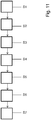
- Fig. 11 shows steps of a method according to a fourth embodiment of the present invention.
- Fig. 11 a method according to an embodiment of the present invention is shown.
- a plurality of child nodes to a parent node is determined, wherein the starting node representing the starting state is the parent node when step S1 is performed for the first time, and wherein the child nodes are within a certain distance to the parent node.
- a second step S2 it is checked whether the transitions from the parent node to each of the child nodes are free of obstacles, and if not the corresponding child node and this partial path from the parent node to this child node is excluded.
- a cost value for each of said partial paths is computed.
- step S4 said computed cost value is added to a cost value from the starting node to the parent node.
- a fifth step S5 an estimated or expected cost value for the partial paths from each of the child nodes to an end node representing an end state.
- a sixth step S6 the lowest overall cost value from the determined cost values according to steps d)-f) is determined and the child node as new parent node associated with the determined lowest cost is selected.
- a seventh step S7 the steps S1-S6 are performed repeatedly until at least one termination condition is fulfilled including the termination condition if a selected child node is within a pregiven distance to the end node.
- Fig. 12 shows steps of a method according to a fifth embodiment of the present invention.
- a first step T1 the start node in inserted into a priority queue.
- a second step T2 the node is extracted from the priority queue which expects the lowest cost.
- a fourth step T4 it is checked if the transition from the current parent node to one of the child nodes is free of obstacles.
- a fifth step T5 the cost is computed from the start node to the current parent node by adding the parent cost and the connecting cost from the current parent node to the child node. Further the expected cost is computed by adding the cost h(x, x f ) to the destination/end node and the cost of the current node.
- a sixth step T6 the closest node or nodes with regard to the current node are determined.
- a seventh step T7 it is checked whether the closest node is closer than R min to the current node and if yes the cost from the closest node and the cost from the current node are checked and if the cost from the current node is higher than that of the closest node the current node is reinserted into the priority queue and then the parent node is the determined closest node.
- step T8 if no neighbor node or nodes are found within the radius R min the cost of the current node is computed and added to the priority queue and the current node is added to the path and the path is updated.
- a tenth step T10 for each of the determined neighbor nodes their costs are checked against the determined cost of the new child node plus the cost for the connection from the new node to the neighbor node.
- an eleventh step T11 if the cost of the new node is lower than that of the parent node the parent node is reinserted into the priority queue and the overall cost of the path is updated and the path in the tree is visited in a breadth-first search way to update the cost of the connected nodes.
- steps T2 - T11 are iterated as long as until the priority queue is empty or the maximum number of iterations or the destination set/end node is reached.
- the present invention enables to discover with bounded error optimal cost obstacle free state space paths by maintaining the costs to the current visited node and selecting the most promising node using a lower bound cost function and performing a probabilistic local exploration.
- the present invention enables to explore the free space with spheres of radius according to a prescribed probability distribution.
- the present invention enables using an expected cost to compute a lower bound of the real cost to achieve the bounded optimal solution.
- the present invention enables exploring the free space using a priority queue or sorting data structure.
- the present invention enables a re-optimization of the exploring path tree by checking nearby nodes and by updating the cost in a forward way.
- the present invention enables to doubly progress start and end nodes in the discovery of the path in the obstacle free state space.
- the present invention enables to consider time, i.e. the time axis in the state space without adding a full continuous additional dimension to the state space by defining obstacle free time intervals and by checking while progressing in the feasibility of moving from one interval to the other collision free time interval in the new state.
- the present invention enables to provide the following:
- the present invention provides a method for computing a planning path for moving objects/vehicles/robots including a computation of a cooperative path and resolving the problem of area covering computation preferably comprising the steps of
- the present invention has inter alia the following advantages:
- the present invention enables a bounded error cost avoiding to explore non-interesting areas of the free space. Further the present invention guarantees with their priority queue a bounded optimality of the solution and enables a limited number of iterations to the bounded error optimal solution.
- the present invention guarantees that the path is found after a bounded number of steps and with a path that has a bounded error from the optimal solution if the radius of the exploration is 1 ⁇ 2 the smallest passage between obstacles.
- the present invention provides a fast and error bounded solution to the path planning problem and extensions.
- the present invention further can be applied to a large number of different applications ranging from medical, robot movement, drones, autonomous driving vehicles, cooperative vehicles, precise control, computer animation, navigation, computer simulation, game production, military and space, see and channel navigation, agricultural and mining unmanned vehicle application.
Landscapes
- Engineering & Computer Science (AREA)
- Radar, Positioning & Navigation (AREA)
- Remote Sensing (AREA)
- Automation & Control Theory (AREA)
- Physics & Mathematics (AREA)
- General Physics & Mathematics (AREA)
- Aviation & Aerospace Engineering (AREA)
- Control Of Position, Course, Altitude, Or Attitude Of Moving Bodies (AREA)
- Navigation (AREA)
Description
- The present invention relates to a method for determining a path of an object like a robot, etc. for moving from a starting state to an end state set comprising one or more end states via one or more nodes being each defined as an obstacle free state that has been explored, avoiding one or more obstacles.
- The present invention further relates to a system for determining a path of an object like a robot, etc. for moving from a starting state to an end state set comprising one or more end states via one or more nodes being each defined as an obstacle free state that has been explored avoiding one or more obstacles.
- Although applicable to any kind of object the present invention will be described with regard to robots.
- Robots and Autonomous/Unmanned driving vehicles are two wide areas and systems affecting everyday life nowadays. Robots are used for industrial automation or for living assistance. Recently also drones have been introduced for military and civilian applications. Autonomous driving cars have shown high level of reliability and in the near future will be available for public use, while they are already used for non-public road use, as agriculture and mining application. Unmanned vehicles are also envisaged for crewless ships or spacecraft.
- Other areas of applications include the medical sector when chirurgical instruments shall be moved among hard and soft tissues and vital organs. Other applications include military and space application where vehicles need to be moved avoiding obstacles.
- For the above reasons the path or movement of such an object has to be planned including avoiding of obstacles. Path Planning is the area of Robotics devoted to the generation of a path between a starting state to a target final state set. The path shall consider robot/vehicle constraints and state evolution dynamics and shall live in the obstacle free set of state of the robot/vehicle.
- In
US 7,447,593 B2 a path planning system and method for an object such as a vehicle is disclosed. The system provides a randomized adaptive path planning handling real-time path planning for a vehicle operating under kinodynamic constraints in dynamically changing and uncertain environments with probabilistic knowledge of vehicle and obstacle movement. In detail a tree built is performed by the following steps: Setting a root node to an initial vehicle state and checking if stopping conditions are satisfied. If not, perform a deterministic tree extension and a random tree extension. Based on the tree extensions a node is chosen that has not yet been chosen. Then it is checked whether the node has be extended or not. If not then the node is set to dead. If the node has been extended then it is checked whether kill conditions are satisfied or not and if the kill conditions are not satisfied then it is checked whether all nodes have been chosen or not. If not all nodes have been chosen, the node that has not been yet chosen is chosen. Otherwise it is again checked whether the stopping conditions are satisfied or not. - In
US 5,999,881 an automatic part planning system and method is disclosed. The system and method automatically finds collision-free part removal paths. The system sparsely samples the high-dimensional state space and maps the rest of the space using proximity assumptions. In more detailUS 5,999,881 checks whether a path connecting the start and destination states being totally contained within overlapping regions defined by spheres around the start state and the destination state is tested to determine if it collides with an obstacle. If an obstacle is encountered then the collision point where the obstacle intersects the region is determined and the current region and neighbor regions are adapted in their size such that the distance between its center to a closest collision point is lower. Then an obstacle free region is chosen as parent region from which to spawn a child region. The candidate point with the parent region is chosen as a center point of a child region and if the candidate point hits an obstacle then the radii of the regions are appropriately adjusted and a further candidate point or parent region is chosen repeatedly. If the candidate point does not hit an obstacle then a child region is created with a candidate point as its center point having a radius being less than the closest collision location in a list of collision points. - In
WO 2006/080996 A2 a point-to-point path planning method is disclosed for determining a path for a vehicle, wherein a starting point and a termination point are defined and an obstacle detector detects one or more obstacles in a work area between the starting point and the termination point. A boundary zone is defined about each corresponding obstacle. Then candidate paths are identified between the starting point and the termination point. Each candidate path only intersects each boundary zone, one for each corresponding obstacle. An economic cost is estimated for traversing each candidate path or a portion thereof between the starting point and the termination point. A preferential path is selected from the identified candidate paths based on the preferential path being associated with the lowest estimated economic cost - Another point-to-point path planning method is disclosed in document
DE 10 2013 201935 A1 . - Other path planning methods and algorithms are for example disclosed in the non-patent literature of S. Karaman, E. Frazzoli, "Sampling-based algorithms for optimal motion planning", Int. J. of Robotics Research 30(7):846-894, 2011 or in the non-patent literature of Webb, D. and van den Berg, J. (2013), "Kinodynamic RRT: Asymptotically optimal motion planning for robots with linear dynamics", pp. 5054--5061.
- However one of the drawbacks of conventional methods and systems is to find a path in a reasonable amount of time when the space of state grows and in particular in presence of unknown shaped obstacles. A further problem is that the path should be tractable when obstacles are moving in the area of interest, i.e. considering a time-component. Another problem is that conventional path planning systems focus on achieving asymptotic optimality or fast growing data structures, however neglecting a bounded optimal path.
- It is therefore an objective of the present invention to provide a method and system for determining a path of an object providing a fast and error bounded solution to the problem of determining a path of the object.
- It is a further objective of the present invention to provide a method and a system for determining a path of an object which can be used to a large number of different applications.
- It is an even further objective of the present invention to provide a method and a system for determining a path of an object being easy to implement and cost-effective.
- The aforementioned objectives are accomplished by a method of claim 1 and a system of claim 25.
- In claim 1 a method for determining a path of an object like a robot, etc. for moving from a starting state to an end state set comprising one or more end states via one or more nodes each being defined as an obstacle free state that has been explored avoiding one or more obstacles is defined.
- According to claim 1 the method is characterized by the steps of
- a) Determining a plurality of child nodes to a parent node, wherein the starting node representing the starting state is the parent node when step a) is performed for the first time, and wherein the child nodes are within a certain distance to the parent node,
- b) Checking whether the transitions from the parent node to each of the child nodes are free of obstacles, and if not the corresponding child node and this partial path from the parent node to this child node is excluded,
- c) Computing a cost value for each of said partial paths,
- d) Add said computed cost value to a cost value from the starting node to the parent node,
- e) Add an estimated or expected cost value for the partial paths from each of the child nodes to an end node representing an end state,
- f) Determining the lowest overall cost value from the determined cost values according to steps d)-f) and selecting the child node as new parent node associated with the determined lowest cost, and
- g) Repeated performing the steps a)-g) until at least one termination condition is fulfilled including the termination condition if a selected child node is within a pregiven distance to the end node.
- In claim 15 a system for determining a path of an object like a robot, etc. for moving from a starting state to an end state set comprising one or more end states via one or mode nodes each being defined as an obstacle free state that has been explored avoiding one or more obstacles is defined.
- According to claim 15 the system is characterized by one or more computing entities adapted to or adapted to cooperate with each other to
- a) determine a plurality of child nodes to a parent node, wherein the starting node representing the starting state is the parent node when step a) is performed for the first time, and wherein the child nodes are within a certain distance to the parent node,
- b) to check whether the transitions from the parent node to each of the child nodes are free of obstacles, and if not the corresponding child node and this partial path from the parent node to this child node is excluded,
- c) compute a cost value for each of said partial paths,
- d) add said computed cost value to a cost value from the starting node to the parent node,
- e) add an estimated or expected cost value for the partial paths from each of the child nodes to an end node representing an end state,
- f) determine the lowest overall cost value from the determined cost values according to steps d)-f) and selecting the child node as new parent node associated with the determined lowest cost, and to
- g) repeated performing the steps a)-g) until at least one termination condition is fulfilled including the termination condition if a selected child node is within a pregiven distance to the end node.
- In other words the present invention preferably uses a local growing tree search with bounded approximated optimal cost and iteration solution.
- The term "cost" preferably in the claims, in particular in the description is to be understood in its broadest sense and may include but is not limited to distance, time, energy, pollution and/or economic cost, etc.
- According to the invention it has been recognized that a path for objects like a robot, vehicle, etc. is provided avoiding obstacles wherein the shape of the obstacles may be not known in advance and possibly moving in time.
- According to the invention it has been further recognized that the determined path respects a bounded error with respect to an optimal cost path computed in a bounded time.
- According to the invention it has been even further recognized that the present invention can be applied to many application areas, for example starting from the cooperative autonomous driving vehicle to robot or drone obstacle free movement to medical precision control.
- According to the invention it has been even further recognized that the present invention is flexible in terms of enabling extensions such as that an asymptotical optimal convergence may be enabled.
- Further features, advantages and preferred embodiments are described in the following subclaims.
- According to a preferred embodiment a lower bound value for the real cost from the child node to the end state set is determined and used as said estimated or expected cost in step e). This enables to explore the obstacle free space only if the cost is not higher than a lower estimated cost at the exploration time. The cost of a path could be approximated by the actual cost up to an intermediate state plus a lower bound of the real cost to the end state. This enables to estimate a cost-effective path within a limited amount of time. An example of lower estimated cost is the cost associated with a solution, i.e. path, that does not consider obstacles and/or only include part of the real total cost, as for example only the distance.
- According to a further preferred embodiment for determining child nodes a parent covering space is selected and the child nodes are generated locally such that the child nodes cover the parent covering space with their individual covering space to a predetermined parent extent, wherein the individual covering spaces do not overlap with each other. This enables to explore the space around each explored node effectively. Obstacles can be determined in a fast way with sufficient precision.
- According to a further preferred embodiment the form of the individual covering space for child nodes and/or the parent covering space for parent nodes has spherical form having a predefined radius. This enhances even more the effectiveness for computation, since spheres are symmetrical and can be described with only two variables, i.e. location of the center and radius.
- According to a further preferred embodiment for generating the child nodes locally a limited number of directions from the center of the parent covering space is generated and used for covering the parent covering space by generating child nodes in these directions. This enables for example to select or prefer certain directions. Thus, flexibility is enhanced. The selection of some directions allows also to perform a local search along these directions to optimal place a new sphere as an example of an individual covering space.
- According to a further preferred embodiment for step b) in case of a determined obstacle, the child nodes are generated within the parent covering space such that the part of the parent covering space being free of the obstacle is covered to a certain extent. This enhances the covering of the obstacle free space in case an object is present.
- According to a further preferred embodiment for step b) in case of two or more determined obstacles, the minimum obstacle distance is determined between two obstacles and the maximum extent in a direction of the minimum distance of the individual covering space is set below the minimum obstacle distance. Then for example a sphere having a radius half of the minimum obstacle distance may still pass through both obstacles. This enables to detect paths between close obstacles.
- According to a further preferred embodiment the closest node to the current parent node is determined and if the closest node lies within an individual covering space of a child node centered at the current parent node the overall cost value including the cost for the partial path from the current parent node to said closest node for the closest node is determined and if the cost is lower than the overall cost of the current parent node then the closest node is selected as new parent node. This ensures that if a node is closer than for example a minimum radius when the individual covering space is a sphere without exploring further nodes a further optimization in the path can be provided.
- According to a further preferred embodiment parameters defining the shape of the parent covering space and/or the individual covering space, preferably in form of spheres, are determined randomly, preferably wherein the radius' of the spheres are determined randomly, according to one or more probability distributions. This enables to find a suitable path in shorter time by reducing the accuracy although sufficient accuracy can be kept. The effective radius is then the average between the minimum and the maximum value or in general is the mean of the distribution of the radius of the sphere for example. The minimum radius is the minimum radius of the distribution. The smallest distance between obstacles that will be passed using randomization is half the larger radius determined from the probability distribution.
- According to a further preferred embodiment in case of spheres as individual covering spaces and/or parent covering spaces the corresponding radius is determined to be lower than half the minimum distance between said two or more obstacles. This allows selecting the minimum radius such that a sphere with such a radius can pass the smallest distance between obstacles.
- According to a further preferred embodiment for implementing a time evolution of obstacles, preferably moving of obstacles, the obstacles and the nodes along the path are implemented with a further dimension in time. For example the state space between the starting point and the end point includes then also a time-dimension. For instance obstacles in form of a rectangle in a two dimensional space have a form of a cuboid extending the rectangle in a third dimension. This allows in an easy way to implement time evolution of obstacles.
- According to a further preferred embodiment for implementing a time evolution of obstacles, preferably moving of obstacles, the states of the nodes are assigned a time interval indicating the time being free of obstacles. For instance the intervals may be numbered from 1. While exploring a node the time interval at each visited node is stored. The next node can be visited only if the next interval is compatible with the starting state interval plus the state movement time and when the movement is free of obstacles. While exploring a node the cost is updated where the cost uses the earlier visiting time. To efficiently store the movement it can be bound in predefined time steps with a multi-dimensional rectangle of minimal volume comprising the moving object.
- According to a further preferred embodiment when the evolution from the starting state to the end state is kinodynamic-based the cost between two states of a parent node and a child node is computed by performing a local optimization task. This enables to calculate the cost between two states or nodes very efficiently.
- According to a further preferred embodiment steps a)-g) are also performed in a reverse manner starting from the end node as initial parent node backwards to the starting node, wherein the termination condition is fulfilled when nodes of both paths one originating at the starting node and the other originating at the end node are within the certain distance to each other, wherein the end state set comprising only one end state. This provides an alternative way to determine a path between the starting point and the end point enabling a faster determination of a path between the starting node and the end node.
- According to a further preferred embodiment for implementing a time evolution of states, nodes and obstacles, preferably moving obstacles, time is subtracted to account reverse time direction. This allows an easy implementation of a time evolution of states, nodes and obstacles, preferably moving of obstacles and easy implementation of a time evolution for double propagating trees for determining a path between the starting node and the end node with time being subtracted to account reverse time direction.
- According to a further preferred embodiment for each new parent and/or child node the nodes are added along the direct path to the destination and determination condition is only applied when the end node set is reached by a partial path with steps a)-g) performed and the new parent node being a node representing an end state of the end state set with lower overall cost. This enables to implement a tentative to reach directly the destination at each new parent node. The nodes along the direct path to the destination are simply added. The termination condition is preferably not fulfilled if the end state/end node is reached by a path comprising a direct connecting extension. The reason is that there may exist paths adding a lower overall cost. The termination condition is only fulfilled when a path does not comprise an extension node when arriving at the end state/end node or when a queue - as described below - is empty or the predetermined number of iterations is reached.
- According to a further preferred embodiment in case a path from the starting state to the end state set is found within a time boundary the remaining time is used applying the RRT* procedure for checking alternative paths with lower cost. This enables to optimize the found path further when a bounded ideal or optimal path is already found and some time is left, i.e. without violating a time constraint. A further advantage is that asymptotical optimality is achieved after the bounded error path is found. The RRT*-procedure is the asymptotically optimal RRT-procedure version, developed by Karaman and Frazzoli as disclosed in the non-patent literature "Sampling-based algorithms for optimal motion planning" as shown above.
- According to a further preferred embodiment in case of multiple objects steps a)-g) are performed for a first object and then the steps a)-g) are performed for one or more second objects considering the determined path for the first object fixed to be an obstacle and wherein a common overall cost for all paths is determined. This enables in an easy way to implement a plurality of objects having to find a path from their respective starting node to the corresponding end node. An example of this is when quatrotors need to move simultaneously in an environment with obstacle. Then a common cost function is defined and the method according to an embodiment of the present invention is iterated for each robot/vehicle separately by considering the others robot vehicle path fixed. Cost may also include a factor link to a priority value of vehicles so that vehicles approaching from right may have a smaller penalty cost with respect to vehicles arriving from the left. The determination criteria may then be some convergence criteria, for example when there are no significant changes in the found path anymore or when a predefined number of iterations is reached.
- According to a further preferred embodiment the common overall cost includes an interaction cost between a first and second object, preferably wherein the interaction cost decreases with a greater distance between the first and second object. This takes into account that any approach of the two objects results in a higher cost and therefore a collision is avoided.
- According to a further preferred embodiment the center of the individual covering space and/or the parent covering space is assigned to a grid structure. This allows for example to put the center of a sphere on a regular and/or fixed grid. One of the advantages is that conflicts do not have to be checked, i.e. all positions of the nodes are fixed with each other and therefore individual covering areas in form of spheres may be chosen such that they do not overlap in any way. To provide flexibility some of the nodes on the grid may not be visited enabling at least some adaptability which nodes to be explored. For generating the grid any lattice or grid generation procedure may be used. For instance the lattice may be generated by a basis of linear independent vectors in the number of the dimension of the space.
- According to a further preferred embodiment a threshold is used to specify how many nodes need to be connected for each node to obtain a path from the starting state to the end state set. This enables to reduce respectively limit the number of nodes from the starting node to the end node. This critical threshold can be used to decide how many spheres and nodes need to be connected for each node and average to obtain connectivity, i.e. to find at least one path. For example for a regular tree graph where all nodes have the same connectivity, i.e. the number of connected nodes equal to k, the critical probability threshold is 1/k. When the number of connected nodes is reduced a path may not actually be found when performing steps a)-g) or the error of the found path is not guaranteed to be within the given bound. To alleviate these two facts a number of visited nodes per node could be stored and previously undiscovered nodes may be further used either when more iterations are possible or when the destination has not been reached and no further node can be visited.
- According to a further preferred embodiment a queue is used to indicate the cost values for each node, such that the node with the lowest expected cost value is used as the next node and the other nodes with a higher cost are ordered according to their expected cost value in the queue. This enables to provide a priority queue where nodes are inserted during the exploration. This priority queue returns and removes an element with a lower cost which is then used as a parent node.
- According to a further preferred embodiment for performing steps b)-f) the overall cost value for the paths via each child node is subsequently determined and if an overall cost value via current child node is less than that of a prior child node then the current child node is selected as new parent node and the prior child node is reinserted into the queue. This enables in an easy and efficient way to determine a new parent node.
- According to a further preferred embodiment for performing step a) the starting node is inserted into the queue. This initializes the iteration for determining the path in a very easy way.
- There are several ways how to design and further develop the teaching of the present invention in an advantageous way. To this end it is to be referred to the patent claims subordinate to patent claim 1 on the one hand and to the following explanation of preferred embodiments of the invention by way of example, illustrated by the figure on the other hand. In connection with the explanation of the preferred embodiments of the invention by the aid of the figure, generally preferred embodiments and further developments of the teaching will be explained.
- In the drawings
- Fig. 1
- shows schematically the underlying problem to determine a path;
- Fig. 2
- shows a system according to a first embodiment of the present invention;
- Fig. 3
- shows a parent covering space and individual covering spaces in form of spheres;
- Fig. 4
- shows the parent covering area partially blocked with an obstacle;
- Fig. 5
- shows a parent covering space partially blocked by two objects;
- Fig. 6
- shows a result of a determined path as a result of a method according to a second embodiment of the present invention;
- Fig. 7
- shows schematically the maximum possible cost error when visiting the final node;
- Fig. 8
- shows a used case for the method according to a third embodiment of the present invention;
- Fig. 9
- shows a result of a conventional rapid-exploring random tree method;
- Fig. 10
- shows a conventional connected rapid-exploring random tree method;
- Fig. 11
- shows steps of a method according to a fourth embodiment of the present invention; and
- Fig. 12
- shows steps of a method according to a fifth embodiment of the present invention.
-
Fig. 1 shows schematically the underlying problem to determine a path. - In
Fig. 1 an example problem is shown: A collision free path P between a start state N0 and an end state set ESS comprising an end node (NE) is to be found, wherein obstacles O - here in form of rectangles - are in general in between the starting state N0 and the end state set ESS. -
Fig. 2 shows a system according to a first embodiment of the present invention. - In
Fig. 2 an example of a system architecture for local growing trees with bounded approximated optimal cost is shown. As input parameters an obstacle function, the start state, the end state set, a cost function and approximation future cost function, a dynamic description of the states as well as other method parameters like densities of spheres ICS or the like are used. Then the system for path planning outputs an approximated optimal path, the cost of the found path, the explored tree and the node costs. - For computing a path, i.e. finding one or more paths between a starting state xs and a final state set Xf a method according to an embodiment of the present invention is used enabling to avoid possibly time moving obstacles bounded by a so-called state evolution function. The path returned can be measured in terms of cost-function f(x) where f(x) is the cost to move from a starting state xs to the current state x. The cost of a path is approximated by the actual cost up to an intermediate state plus a lower bound of the real cost to the end state or end state set.
- According to the invention the obstacle free space is explored only if the cost of a path is not higher than the lower estimated cost at the exploration time.
- In more detail in the following it is assumed:


- The proposed method comprises the use of a priority queue where nodes are inserted during exploration. The priority queue returns and removes the element with lower cost, where the cost is the expected cost g(x s, x).
- Beginning from the starting state/starting node additional nodes are explored so that for each explored node - at the beginning it is only the starting node - new nodes CN0, CN1, CN2 approximately covering the nearby space with spheres ICS of radius Rmin are generated. The new nodes CN0, CN1, CN2 are generated locally until the sphere PCS of radius Rmax is covered with non-overlapping spheres ICS of radius Rmin. This is preferably obtained by generating a sufficient but limited number of directions and then checking about neighbor nodes CN0, CN1, CN2. Neighbor nodes CN1, CN2 may be found using a searching function. On input of a radius R and a corresponding input node x all nodes CN1, CN2 are found within the sphere PCS centered at the current node CN0 and given radius. The returned nodes CN1, CN2 are preferably ordered by distance. Further only Nn closest nodes CN0, CN1, CN2 can be checked with Nn being a parameter to be chosen.
-
Fig. 3 shows a parent covering space and individual covering spaces in form of spheres. - In
Fig. 3 a generation of new nodes CN0, CN1, CN2 with individual covering spheres ICS is shown. The maximum number of the sphere ICS is defined by

-
Fig. 4 shows the parent covering area partially blocked with an obstacle. - In
Fig. 4 the sphere PCS with radius Rmax is covered with the child nodes CN0, CN1, CN2 of radius Rmin when an obstacle O is present. When the exploration is executed close to an obstacle O, the nodes CN0, CN1, CN2 are generated considering the remaining space and attempting to cover the remaining space with the density given by the radius Rmin of the child nodes CN0, CN1, CN2. -
Fig. 5 shows a parent covering space partially blocked by two objects. - In
Fig. 5 spheres covering a narrow passage are shown. In more detailFig. 5 shows the covering of a parent node space PCS when two obstacles O1, O2 are present. When the obstacles O1, O2 are very close to each other, the individual covering space ICS, i.e. the sphere could successfully pass if the radius of the sphere ICS - Rmin - is approximately half the size of the smallest distance between the two obstacles O1, O2 - Dmin. -
Fig. 6 shows a result of a path determined by a method according to a second embodiment of the present invention. - In
Fig.6 an example of a local growing tree or a path P starting from a starting node N0 to the end node NE with present obstacles O is shown. As it can be seen fromFig. 6 the circumference of all trees partially extrapolated in the areas with absent trees has the form of an ellipsoid. As it can also be seen fromFig. 6 the path P avoids all obstacles en route from the starting node N0 to the end node NE. -
Fig. 7 shows schematically the maximum possible cost error when visiting the final node. - In
Fig. 7 a maximum error possible in cost when visiting the final node is shown. This error is due to the placement of the spheres whose center may not be placed along the optimal path. This accounts for an error of maximum 1/sin(45°)*L which is approximately 2L where L is the length of the path along the nodes. The cost error depends on the actual cost function and its relationship with the length of the path. The actual error of the determined path is lower. -
Fig. 8 shows a use case for the method according to a third embodiment of the present invention. - In
Fig. 8 the use case of a local growing tree for area covering is shown. The underlying area covering problem is an extension of the general path planning problem. Here the obstacle free space starting from an initial state should be approximately covered. Since here the cost between different paths is not relevant the cost can be set identical for each path, only the connectivity of their exploring paths is important. At each iteration all neighbor nodes are preferably stored and new nodes are avoided to be added when they are neighbors at a distance closer than the minimum radius Rmin. At the end of the exploration of the free space where no new node can be added anymore, a Hamiltonian cycle or Travel Salesman problem can be formulated and resolved from the starting point on the generated graph. The minimum Radius Rmin is preferably set half the distance between their covering paths. A queue can be used to explore the space with a spherical shape so that it could be stopped at a certain distance from the starting point. To speed up the area covering, the queue could be replaced by a first in first out FIFO or a last in first out LIFO data structure as a list. -
Fig. 9 shows a result of a conventional rapid-exploring random tree method andFig. 10 shows a conventional connected rapid-exploring random tree method. - In
Fig. 9 a conventional rapid-exploring random tree RRT method and inFig. 10 a connected rapid-exploring random tree C-RRT connect method for a scenario according toFig. 1 is shown. Beginning from the starting node N0 and with obstacles in between a path P starting from the starting node N0 to the end node NE could not be found avoiding the obstacles O. -
Fig. 11 shows steps of a method according to a fourth embodiment of the present invention. - In
Fig. 11 a method according to an embodiment of the present invention is shown. - In a first step S1 a plurality of child nodes to a parent node is determined, wherein the starting node representing the starting state is the parent node when step S1 is performed for the first time, and wherein the child nodes are within a certain distance to the parent node.
- In a second step S2 it is checked whether the transitions from the parent node to each of the child nodes are free of obstacles, and if not the corresponding child node and this partial path from the parent node to this child node is excluded.
- In a third step S3 a cost value for each of said partial paths is computed.
- In a forth step S4 said computed cost value is added to a cost value from the starting node to the parent node.
- In a fifth step S5 an estimated or expected cost value for the partial paths from each of the child nodes to an end node representing an end state.
- In a sixth step S6 the lowest overall cost value from the determined cost values according to steps d)-f) is determined and the child node as new parent node associated with the determined lowest cost is selected.
- In a seventh step S7 the steps S1-S6 are performed repeatedly until at least one termination condition is fulfilled including the termination condition if a selected child node is within a pregiven distance to the end node.
-
Fig. 12 shows steps of a method according to a fifth embodiment of the present invention. - In
Fig. 12 steps of a method according to a further embodiment of the present invention are shown. - In a first step T1 the start node in inserted into a priority queue.
- In a second step T2 the node is extracted from the priority queue which expects the lowest cost.
- In a third step T3 local sphere covering child nodes of radius Rmin are generated in the sphere of radius Rmax.
- In a fourth step T4 it is checked if the transition from the current parent node to one of the child nodes is free of obstacles.
- In a fifth step T5 the cost is computed from the start node to the current parent node by adding the parent cost and the connecting cost from the current parent node to the child node. Further the expected cost is computed by adding the cost h(x, xf) to the destination/end node and the cost of the current node.
- In a sixth step T6 the closest node or nodes with regard to the current node are determined.
- In a seventh step T7 it is checked whether the closest node is closer than Rmin to the current node and if yes the cost from the closest node and the cost from the current node are checked and if the cost from the current node is higher than that of the closest node the current node is reinserted into the priority queue and then the parent node is the determined closest node.
- In an eighth step T8 if no neighbor node or nodes are found within the radius Rmin the cost of the current node is computed and added to the priority queue and the current node is added to the path and the path is updated.
- In a ninth step T9 all neighbor nodes within the radius Rmax are determined.
- In a tenth step T10 for each of the determined neighbor nodes their costs are checked against the determined cost of the new child node plus the cost for the connection from the new node to the neighbor node.
- In an eleventh step T11 if the cost of the new node is lower than that of the parent node the parent node is reinserted into the priority queue and the overall cost of the path is updated and the path in the tree is visited in a breadth-first search way to update the cost of the connected nodes.
- In a twelfth step T12 steps T2 - T11 are iterated as long as until the priority queue is empty or the maximum number of iterations or the destination set/end node is reached.
- In summary the present invention enables to discover with bounded error optimal cost obstacle free state space paths by maintaining the costs to the current visited node and selecting the most promising node using a lower bound cost function and performing a probabilistic local exploration.
- Further the present invention enables to explore the free space with spheres of radius according to a prescribed probability distribution.
- Even further the present invention enables using an expected cost to compute a lower bound of the real cost to achieve the bounded optimal solution.
- Even further the present invention enables exploring the free space using a priority queue or sorting data structure.
- In particular the present invention enables a re-optimization of the exploring path tree by checking nearby nodes and by updating the cost in a forward way.
- Even further the present invention enables to doubly progress start and end nodes in the discovery of the path in the obstacle free state space.
- Even further the present invention enables to consider time, i.e. the time axis in the state space without adding a full continuous additional dimension to the state space by defining obstacle free time intervals and by checking while progressing in the feasibility of moving from one interval to the other collision free time interval in the new state.
- The present invention enables to provide the following:
- 1. A system to compute a bounded approximation optimal solution for a path planning problem that avoids obstacles by using a priority fast local growing tree structure.
- 2. A system that computes a cooperative path planning using a local growing tree structure.
- 3. A system that computes an area covering path by first exploring the free area with sphere of prescribed density radius and then computing a Hamiltonian cycle on the resulting graph.
- 4. A method that computes cooperative and distributed path planning by iteratively find a solution per each moving object like a vehicle while the others are fixed and by defining a common objective function that include the cost of interaction that is decreasing with the increase of the distance among mobbing objects, like a vehicle or robot.
- 5. A method that computes an area covering path for a moving object/vehicle/robot by first exploring with spheres of prescribed distribution radius and with a local priority data structure and then computing an Hamiltonian Cycle / Travel Salesman problem on the resulting graph
- To summarize the present invention provides a method for computing a planning path for moving objects/vehicles/robots including a computation of a cooperative path and resolving the problem of area covering computation preferably comprising the steps of
- 1. Local growing tree/graph with optimal cost computation and using spheres of equal radius according to a prescribed probability distribution.
- 2. A priority data structure that allows to explore the free space with bounded optimal cost for avoiding unpromising solution areas.
- 3. A lower bound cost function that allows to explore the free space only for solution that are not suboptimal.
- The present invention has inter alia the following advantages: The present invention enables a bounded error cost avoiding to explore non-interesting areas of the free space. Further the present invention guarantees with their priority queue a bounded optimality of the solution and enables a limited number of iterations to the bounded error optimal solution.
- The present invention guarantees that the path is found after a bounded number of steps and with a path that has a bounded error from the optimal solution if the radius of the exploration is ½ the smallest passage between obstacles. The present invention provides a fast and error bounded solution to the path planning problem and extensions.
- The present invention further can be applied to a large number of different applications ranging from medical, robot movement, drones, autonomous driving vehicles, cooperative vehicles, precise control, computer animation, navigation, computer simulation, game production, military and space, see and channel navigation, agricultural and mining unmanned vehicle application.
Claims (15)
- A method for determining a path (P) of an object like a robot, etc. for moving from a starting state (N0) to an end state set (ESS) comprising one or more end states (NE) via one or more nodes (PN, CN) each being defined as an obstacle free state that has been explored avoiding one or more obstacles (O),
characterized by the steps ofa) Determining (S1) a plurality of child nodes (CNO, CN1, CN2) to a parent node (PN), wherein the starting node (N0) representing the starting state is the parent node (PN) when step a) is performed for the first time, and wherein the child nodes (CNO, CN1, CN2) are within a certain distance to the parent node (PN),b) Checking (S2) whether the transitions from the parent node (PN) to each of the child nodes (CNO, CN1, CN2) are free of obstacles (O), and if not the corresponding child node (CNO, CN1, CN2) and this partial path from the parent node (PN) to this child node (CNO, CN1, CN2) is excluded,c) Computing (S3) a cost value for each of said partial paths,d) Add (S4) said computed cost value to a cost value from the starting node (N0) to the parent node (PN),e) Add (S5) an estimated or expected cost value for the partial paths from each of the child nodes (CNO, CN1, CN2) to an end node (NE) representing an end state (NE),f) Determining (S6) the lowest overall cost value from the determined cost values according to steps d)-f) and selecting the child node (CNO, CN1, CN2) as new parent node (PN) associated with the determined lowest cost,g) Repeated (S7) performing the steps a)-g) until at least one termination condition is fulfilled including the termination condition if a selected child node (CNO, CN1, CN2) is within a pregiven distance to the end node (NE) wherein a lower bound value for the real cost from a child node (CNO, CN1, CN2) to the end state set (ESS) may be determined and used as said estimated or expected cost in step e). - The method according to claim 1, characterized in that for determining child nodes (CNO, CN1, CN2) a parent covering space (PCS) is selected and the child nodes (CNO, CN1, CN2) are generated locally such that the child nodes (CNO, CN1, CN2) cover the parent covering space (PCS) with their individual covering space (ICS) to a predetermined parent extent, wherein the individual covering spaces (ICS) do not overlap with each other, preferably wherein the form of the individual covering space (ICS) for all child nodes (CNO, CN1, CN2) and/or the parent covering space (PCS) for all parent nodes (PN) has spherical form having a predefined radius (Rmax) and/or that parameters defining the shape of the parent covering space (PCS) and/or the individual covering space (ICS), preferably in form of spheres, are determined randomly, preferably wherein radius' of the spheres (Rmin) are determined randomly according to one or more probability distributions and/or that the center of the individual covering space (ICS) and/or the parent covering space (PCS) is assigned to a grid structure.
- The method according to claim 2, characterized in that for generating the child nodes (CNO, CN1, CN2) locally a limited number of directions from a center of the parent covering space (PCS) is generated and used for covering the parent covering space (PCS) by generating child nodes (CNO, CN1, CN2) in these directions.
- The method according to one of the claims 1-3, characterized in that for step b) in case of a determined obstacle (O), the child nodes (CNO, CN1, CN2) are generated within the parent covering space (PCS) such that the part of the parent covering space (PCS) being free of the obstacle (O) is covered to a certain extent and/or that for step b) in case of two or more determined obstacles (O), the minimum obstacle distance (Dmin) is determined between two obstacles (O) and the maximum extent in the direction of the minimum distance of the individual covering space (ICS) is set below the minimum obstacle distance (Dmin).
- The method according to one of the claims 1-4, characterized in that the closest node (CNO, CN1, CN2) to the current parent node (PN) is determined and if the closest node (CNO, CN1, CN2) lies within an individual covering space (ICS) of a child node (CNO, CN1, CN2) centered at the current parent node (PN) the overall cost value including the cost for the partial path from the current parent node (PN) to said closest node (CNO, CN1, CN2) for the closest node (CNO, CN1, CN2) is determined and if the cost is lower than the overall cost of the current parent node (PN), then the closest node (CNO, CN1, CN2) is selected as new parent node (PN).
- The method according to one of the claims 4-5, characterized in that in case of spheres as individual covering spaces (ICS) and/or parent covering spaces (PCS) the corresponding radius' is determined to be lower than half the minimum distance (Dmin) between said two or more obstacles (O).
- The method according to one of the claims 1-6, characterized in that for implementing a time evolution of obstacles (O), preferably moving of obstacles (O), the obstacles (O) and the nodes (CNO, CN1, CN2) along the path (P) are implemented with a further dimension in time or that for implementing a time evolution of obstacles (O), preferably moving of obstacles (O), the states of the nodes (CNO, CN1, CN2) are assigned a time interval indicating the time being free of obstacles (O).
- The method according to one of the claims 1-7, characterized in that when the evolution from the starting state (N0) to the end state set (ESS) is kinodynamic-based the cost between two states of a parent node (PN) and a child node (CNO, CN1, CN2) is computed by performing a local optimization task.
- The method according to one of the claims 1-8, characterized in that steps a)-g) are also performed in a reverse manner starting from the end node (NE) as initial parent node (PN) backwards to the starting node (N0), wherein the termination condition is fulfilled when nodes of both paths (P), one originating at the starting node (N0) and the other originating at the end node (NE) are within a certain distance to each other, wherein the end state set (ESS) comprises only one end state, preferably wherein for implementing a time evolution of states, nodes (CNO, CN1, CN2) and obstacles (O), preferably moving of obstacles (O), time is subtracted to account reverse time direction.
- The method according to one of the claims 1-9, characterized in that for each new parent and/or child node (PN, CN0, CN1, CN2) nodes are added along the direct path to the destination and the termination condition is only applied when the end node set (NE) is reached by a partial path with steps a)-g) performed and the new parent node being a node representing an end state of the end state set (ESS).
- The method according to one of the claims 1-10, characterized in that in case a path (P) from the starting state (N0) to the end state set (ESS) is found within a time boundary the remaining time is used applying the RRT*-procedure for checking alternative paths (P) with lower cost.
- The method according to one of the claims 1-11, characterized in that in case of multiple objects steps a)-g) are performed for a first object and then the steps a)-g) are performed for one or more second objects considering the determined path (P) for the first object fixed to be an obstacle (O) and wherein a common overall cost is determined, wherein the common overall cost may include an interaction cost between a first and second object, preferably wherein the interaction cost may decrease with a greater distance between the first and second object.
- The method according to one of the claims 1-12, characterized in that a threshold is used to specify how many nodes (PN, CN0, CN1, CN2) need to be connected for each node (PN, CN0, CN1, CN2) to obtain a path (P) from the starting state (N0) to the end state set (ESS).
- The method according to one of the claims 1-13, characterized in that a queue is used to indicate the expected cost values for each node (PN, CN0, CN1, CN2), such that the node (PN, CN0, CN1, CN2) with the lowest expected cost value is used as the next node (PN, CN0, CN1, CN2) and the other nodes (PN, CN0, CN1, CN2) with a higher cost are ordered according to their expected cost value in the queue, preferably wherein for performing step b)-f) the overall cost value for the paths (P) via each child node (CNO, CN1, CN2) is subsequently determined and if an overall cost value via a current child node (CNO, CN1, CN2) is less than that of a prior child node (CNO, CN1, CN2), then the current child node (CNO, CN1, CN2) is selected as new parent node (PN) and the prior child node (CNO, CN1, CN2) is reinserted into the queue, wherein for performing step a) the starting node (N0) may be inserted into the queue.
- A system for determining a path (P) of an object like a robot, etc. for moving from a starting state (N0) to an end state set (ESS) comprising one or more end states (NE) via one or more nodes being defined as an obstacle free state that has been explored avoiding one or more obstacles (O),
characterized by
one or more computing entities adapted to or adapted to cooperate with each other toa) determine a plurality of child nodes (CNO, CN1, CN2) to a parent node (PN), wherein the starting node (N0) representing the starting state is the parent node (PN) when step a) is performed for the first time, and wherein the child nodes (CNO, CN1, CN2) are within a certain distance to the parent node (PN),b) to check whether the transitions from the parent node (PN) to each of the child nodes (CNO, CN1, CN2) are free of obstacles (O), and if not the corresponding child node (CNO, CN1, CN2) and this partial path from the parent node (PN) to this child node (CNO, CN1, CN2) is excluded,c) compute a cost value for each of said partial paths,d) add said computed cost value to a cost value from the starting node (N0) to the parent node (PN),e) add an estimated or expected cost value for the paths (P) from each of the child nodes (CNO, CN1, CN2) to an end node (NE) representing an end state (NE),f) determine the lowest overall cost value from the determined cost values according to steps d)-f) and selecting the child node (CNO, CN1, CN2) as new parent node (PN) associated with the determined lowest cost, and tog) repeated performing the steps a)-g) until at least one termination condition is fulfilled including the termination condition if a selected child node (CNO, CN1, CN2) is within a pregiven distance to the end node (NE).
Applications Claiming Priority (1)
| Application Number | Priority Date | Filing Date | Title |
|---|---|---|---|
| PCT/EP2014/070878 WO2016050274A1 (en) | 2014-09-30 | 2014-09-30 | Method and system for determining a path of an object for moving from a starting state to an end state set avoiding one or more obstacles |
Publications (2)
| Publication Number | Publication Date |
|---|---|
| EP3201709A1 EP3201709A1 (en) | 2017-08-09 |
| EP3201709B1 true EP3201709B1 (en) | 2021-03-17 |
Family
ID=51830273
Family Applications (1)
| Application Number | Title | Priority Date | Filing Date |
|---|---|---|---|
| EP14790012.0A Active EP3201709B1 (en) | 2014-09-30 | 2014-09-30 | Method and system for determining a path of an object for moving from a starting state to an end state set avoiding one or more obstacles |
Country Status (4)
| Country | Link |
|---|---|
| US (1) | US10365110B2 (en) |
| EP (1) | EP3201709B1 (en) |
| JP (1) | JP2017529631A (en) |
| WO (1) | WO2016050274A1 (en) |
Families Citing this family (82)
| Publication number | Priority date | Publication date | Assignee | Title |
|---|---|---|---|---|
| US10019006B2 (en) * | 2015-04-08 | 2018-07-10 | University Of Maryland, College Park | Surface vehicle trajectory planning systems, devices, and methods |
| US11636348B1 (en) | 2016-05-30 | 2023-04-25 | Apple Inc. | Adaptive training of neural network models at model deployment destinations |
| US11468285B1 (en) * | 2016-05-30 | 2022-10-11 | Apple Inc. | Analysis of objects of interest in sensor data using deep neural networks |
| US20180108094A1 (en) * | 2016-10-14 | 2018-04-19 | Caterpillar Inc. | Operating methods and systems for underground mining |
| US10409230B2 (en) * | 2016-11-01 | 2019-09-10 | Mitsubishi Electric Research Laboratories, Inc | Multi-agent control system and method |
| US11042161B2 (en) | 2016-11-16 | 2021-06-22 | Symbol Technologies, Llc | Navigation control method and apparatus in a mobile automation system |
| US11367092B2 (en) | 2017-05-01 | 2022-06-21 | Symbol Technologies, Llc | Method and apparatus for extracting and processing price text from an image set |
| US11449059B2 (en) | 2017-05-01 | 2022-09-20 | Symbol Technologies, Llc | Obstacle detection for a mobile automation apparatus |
| US11093896B2 (en) | 2017-05-01 | 2021-08-17 | Symbol Technologies, Llc | Product status detection system |
| WO2018204308A1 (en) | 2017-05-01 | 2018-11-08 | Symbol Technologies, Llc | Method and apparatus for object status detection |
| US10726273B2 (en) | 2017-05-01 | 2020-07-28 | Symbol Technologies, Llc | Method and apparatus for shelf feature and object placement detection from shelf images |
| US10949798B2 (en) | 2017-05-01 | 2021-03-16 | Symbol Technologies, Llc | Multimodal localization and mapping for a mobile automation apparatus |
| US11600084B2 (en) | 2017-05-05 | 2023-03-07 | Symbol Technologies, Llc | Method and apparatus for detecting and interpreting price label text |
| CN107289938B (en) * | 2017-05-27 | 2021-11-02 | 中国北方车辆研究所 | Local path planning method for ground unmanned platform |
| US11360475B2 (en) * | 2017-12-05 | 2022-06-14 | Waymo Llc | Real-time lane change selection for autonomous vehicles |
| TWI822729B (en) | 2018-02-06 | 2023-11-21 | 美商即時機器人股份有限公司 | Method and apparatus for motion planning of a robot storing a discretized environment on one or more processors and improved operation of same |
| JP7320489B2 (en) * | 2018-03-19 | 2023-08-03 | 本田技研工業株式会社 | MOBILE MANAGEMENT SYSTEM AND CONTROL METHOD THEREOF AND MANAGEMENT SERVER |
| EP3769174B1 (en) | 2018-03-21 | 2022-07-06 | Realtime Robotics, Inc. | Motion planning of a robot for various environments and tasks and improved operation of same |
| US10809078B2 (en) * | 2018-04-05 | 2020-10-20 | Symbol Technologies, Llc | Method, system and apparatus for dynamic path generation |
| US10740911B2 (en) | 2018-04-05 | 2020-08-11 | Symbol Technologies, Llc | Method, system and apparatus for correcting translucency artifacts in data representing a support structure |
| US10832436B2 (en) | 2018-04-05 | 2020-11-10 | Symbol Technologies, Llc | Method, system and apparatus for recovering label positions |
| US11327504B2 (en) | 2018-04-05 | 2022-05-10 | Symbol Technologies, Llc | Method, system and apparatus for mobile automation apparatus localization |
| US10823572B2 (en) | 2018-04-05 | 2020-11-03 | Symbol Technologies, Llc | Method, system and apparatus for generating navigational data |
| US11231715B2 (en) * | 2018-05-22 | 2022-01-25 | King Fahd University Of Petroleum And Minerals | Method and system for controlling a vehicle |
| US10809732B2 (en) * | 2018-09-25 | 2020-10-20 | Mitsubishi Electric Research Laboratories, Inc. | Deterministic path planning for controlling vehicle movement |
| US11506483B2 (en) | 2018-10-05 | 2022-11-22 | Zebra Technologies Corporation | Method, system and apparatus for support structure depth determination |
| US11010920B2 (en) | 2018-10-05 | 2021-05-18 | Zebra Technologies Corporation | Method, system and apparatus for object detection in point clouds |
| GB2577915B (en) | 2018-10-10 | 2021-06-16 | Dyson Technology Ltd | Path planning |
| US10878706B2 (en) * | 2018-10-12 | 2020-12-29 | Aurora Flight Sciences Corporation | Trajectory planner for a vehicle |
| US12179737B2 (en) * | 2018-10-19 | 2024-12-31 | GEOSAT Aerospace & Technology | Unmanned ground vehicle and method for operating unmanned ground vehicle |
| US11090811B2 (en) | 2018-11-13 | 2021-08-17 | Zebra Technologies Corporation | Method and apparatus for labeling of support structures |
| US11003188B2 (en) | 2018-11-13 | 2021-05-11 | Zebra Technologies Corporation | Method, system and apparatus for obstacle handling in navigational path generation |
| CN113227927A (en) | 2018-12-04 | 2021-08-06 | 杜克大学 | Apparatus, method and object for facilitating motion planning in an environment with dynamic objects |
| US11416000B2 (en) | 2018-12-07 | 2022-08-16 | Zebra Technologies Corporation | Method and apparatus for navigational ray tracing |
| US11079240B2 (en) | 2018-12-07 | 2021-08-03 | Zebra Technologies Corporation | Method, system and apparatus for adaptive particle filter localization |
| US11100303B2 (en) | 2018-12-10 | 2021-08-24 | Zebra Technologies Corporation | Method, system and apparatus for auxiliary label detection and association |
| US11015938B2 (en) | 2018-12-12 | 2021-05-25 | Zebra Technologies Corporation | Method, system and apparatus for navigational assistance |
| US10731970B2 (en) | 2018-12-13 | 2020-08-04 | Zebra Technologies Corporation | Method, system and apparatus for support structure detection |
| JP7028151B2 (en) | 2018-12-14 | 2022-03-02 | トヨタ自動車株式会社 | Orbit generator |
| CN109445444B (en) * | 2018-12-25 | 2021-05-11 | 同济大学 | A Robot Path Generation Method in a Concentrated Obstacle Environment |
| CA3028708C (en) | 2018-12-28 | 2025-12-09 | Zebra Technologies Corporation | Method, system and apparatus for dynamic loop closure in mapping trajectories |
| CN109557928A (en) * | 2019-01-17 | 2019-04-02 | 湖北亿咖通科技有限公司 | Automatic driving vehicle paths planning method based on map vector and grating map |
| US11466996B2 (en) * | 2019-04-03 | 2022-10-11 | Verizon Patent And Licensing Inc. | Pathfinding through a road network with turn complexities |
| CN113905855B (en) | 2019-04-17 | 2023-08-25 | 实时机器人有限公司 | Motion planning graph generation user interface, system, method and rules |
| US11080566B2 (en) | 2019-06-03 | 2021-08-03 | Zebra Technologies Corporation | Method, system and apparatus for gap detection in support structures with peg regions |
| US11200677B2 (en) | 2019-06-03 | 2021-12-14 | Zebra Technologies Corporation | Method, system and apparatus for shelf edge detection |
| US11402846B2 (en) | 2019-06-03 | 2022-08-02 | Zebra Technologies Corporation | Method, system and apparatus for mitigating data capture light leakage |
| US11662739B2 (en) | 2019-06-03 | 2023-05-30 | Zebra Technologies Corporation | Method, system and apparatus for adaptive ceiling-based localization |
| EP3977226B1 (en) * | 2019-06-03 | 2025-08-06 | Realtime Robotics, Inc. | Apparatus and method to facilitate motion planning in environments having dynamic obstacles |
| US11960286B2 (en) | 2019-06-03 | 2024-04-16 | Zebra Technologies Corporation | Method, system and apparatus for dynamic task sequencing |
| US11151743B2 (en) | 2019-06-03 | 2021-10-19 | Zebra Technologies Corporation | Method, system and apparatus for end of aisle detection |
| US11341663B2 (en) | 2019-06-03 | 2022-05-24 | Zebra Technologies Corporation | Method, system and apparatus for detecting support structure obstructions |
| TWI873149B (en) | 2019-06-24 | 2025-02-21 | 美商即時機器人股份有限公司 | Motion planning system and method for multiple robots in shared workspace |
| US11507103B2 (en) | 2019-12-04 | 2022-11-22 | Zebra Technologies Corporation | Method, system and apparatus for localization-based historical obstacle handling |
| US11107238B2 (en) | 2019-12-13 | 2021-08-31 | Zebra Technologies Corporation | Method, system and apparatus for detecting item facings |
| CN113139669B (en) * | 2020-01-17 | 2024-01-16 | 北京京邦达贸易有限公司 | Method, device, electronic device and storage medium for multi-target route planning |
| WO2021188566A1 (en) | 2020-03-18 | 2021-09-23 | Realtime Robotics, Inc. | Digital representations of robot operational environment, useful in motion planning for robots |
| US11822333B2 (en) | 2020-03-30 | 2023-11-21 | Zebra Technologies Corporation | Method, system and apparatus for data capture illumination control |
| CN111678523B (en) * | 2020-06-30 | 2022-05-17 | 中南大学 | A Fast BI_RRT Obstacle Avoidance Trajectory Planning Method Based on STAR Algorithm Optimization |
| CN111824131B (en) * | 2020-07-10 | 2021-10-12 | 广州小鹏自动驾驶科技有限公司 | Automatic parking method and vehicle |
| US11450024B2 (en) | 2020-07-17 | 2022-09-20 | Zebra Technologies Corporation | Mixed depth object detection |
| CN111928853B (en) * | 2020-07-30 | 2023-06-02 | 西南电子技术研究所(中国电子科技集团公司第十研究所) | Rapid route planning method for space-based platform in complex environment |
| US11593915B2 (en) | 2020-10-21 | 2023-02-28 | Zebra Technologies Corporation | Parallax-tolerant panoramic image generation |
| US11392891B2 (en) | 2020-11-03 | 2022-07-19 | Zebra Technologies Corporation | Item placement detection and optimization in material handling systems |
| US11847832B2 (en) | 2020-11-11 | 2023-12-19 | Zebra Technologies Corporation | Object classification for autonomous navigation systems |
| US11720108B2 (en) * | 2020-12-22 | 2023-08-08 | Baidu Usa Llc | Natural language based indoor autonomous navigation |
| US20240077869A1 (en) * | 2021-01-15 | 2024-03-07 | Nippon Telegraph And Telephone Corporation | Control apparatus, hamiltonian cycle extension apparatus, these methods and programs |
| CN112987724B (en) * | 2021-02-04 | 2023-05-02 | 京东科技信息技术有限公司 | Path optimization method, path optimization device, robot and storage medium |
| JP2022178183A (en) * | 2021-05-19 | 2022-12-02 | オムロン株式会社 | Travel route setting device, autonomous mobile robot control system including the same, travel route setting method, and travel route setting program |
| CN113391642B (en) * | 2021-05-28 | 2022-06-03 | 西南交通大学 | Unmanned aerial vehicle autonomous obstacle avoidance method and system based on monocular vision |
| CN113359796B (en) * | 2021-06-08 | 2022-09-06 | 同济大学 | A UAV exploration method for underground multi-branch caves |
| US11954882B2 (en) | 2021-06-17 | 2024-04-09 | Zebra Technologies Corporation | Feature-based georegistration for mobile computing devices |
| CN113515123B (en) * | 2021-06-25 | 2024-04-12 | 北京精密机电控制设备研究所 | Robot real-time path planning method based on improved RRT algorithm |
| US11932282B2 (en) * | 2021-08-04 | 2024-03-19 | Zoox, Inc. | Vehicle trajectory control using a tree search |
| KR20230050958A (en) | 2021-10-08 | 2023-04-17 | 현대자동차주식회사 | Path planning apparatus of robot and method thereof |
| US12434736B2 (en) * | 2021-12-07 | 2025-10-07 | Electronics And Telecommunications Research Institute | High definition map abnormality inference and corresponding driving method, device and mobility apparatus |
| CN114590272B (en) * | 2022-02-23 | 2025-08-29 | 广州小鹏自动驾驶科技有限公司 | Automatic driving speed planning method and device, vehicle and storage medium |
| JP7775821B2 (en) * | 2022-02-25 | 2025-11-26 | トヨタ自動車株式会社 | Orbit search device |
| CN114625170B (en) * | 2022-03-24 | 2023-05-12 | 中国民用航空飞行学院 | Mountain fire helicopter rescue flight path dynamic planning method |
| US12372366B2 (en) * | 2022-06-27 | 2025-07-29 | Waymo Llc | Lane changes for autonomous vehicles involving traffic stacks at intersection |
| US12509062B2 (en) * | 2023-03-22 | 2025-12-30 | Aptiv Technologies AG | Parking path search using a modified parking path algorithm |
| CN116841264A (en) * | 2023-06-29 | 2023-10-03 | 义乌清越光电技术研究院有限公司 | Method and device for carrying based on unmanned aerial vehicle and transportation system |
Family Cites Families (15)
| Publication number | Priority date | Publication date | Assignee | Title |
|---|---|---|---|---|
| JPH05297944A (en) | 1992-04-24 | 1993-11-12 | Fujitsu Ltd | Mobile Robot Obstacle Avoidance Method |
| US5999881A (en) * | 1997-05-05 | 1999-12-07 | General Electric Company | Automated path planning |
| US6259988B1 (en) * | 1998-07-20 | 2001-07-10 | Lockheed Martin Corporation | Real-time mission adaptable route planner |
| US7079943B2 (en) | 2003-10-07 | 2006-07-18 | Deere & Company | Point-to-point path planning |
| US7447593B2 (en) | 2004-03-26 | 2008-11-04 | Raytheon Company | System and method for adaptive path planning |
| JP4467534B2 (en) * | 2006-03-16 | 2010-05-26 | 富士通株式会社 | A mobile robot that moves autonomously in an environment with obstacles and a method for controlling the mobile robot. |
| US7822064B2 (en) * | 2006-10-02 | 2010-10-26 | Cisco Technology, Inc. | Backhaul-level call admission control for a wireless mesh network |
| JP4661838B2 (en) | 2007-07-18 | 2011-03-30 | トヨタ自動車株式会社 | Route planning apparatus and method, cost evaluation apparatus, and moving body |
| JP5324286B2 (en) * | 2009-03-30 | 2013-10-23 | 株式会社国際電気通信基礎技術研究所 | Network robot system, robot control apparatus, robot control method, and robot control program |
| KR101667031B1 (en) * | 2009-11-02 | 2016-10-17 | 삼성전자 주식회사 | Path planning apparatus of robot and method thereof |
| US8768011B2 (en) | 2010-11-24 | 2014-07-01 | Denso Corporation | Road estimation device and method for estimating road |
| JP5223938B2 (en) | 2011-03-09 | 2013-06-26 | 株式会社デンソー | Road estimation device |
| KR101732902B1 (en) * | 2010-12-27 | 2017-05-24 | 삼성전자주식회사 | Path planning apparatus of robot and method thereof |
| JP5776440B2 (en) | 2011-08-24 | 2015-09-09 | 株式会社豊田中央研究所 | Autonomous mobile |
| DE102013201935A1 (en) * | 2013-02-06 | 2014-08-07 | Bayerische Motoren Werke Aktiengesellschaft | Method for determining collision-free paths of e.g. car, in predetermined environment, involves classifying first set of candidate nodes or second set of candidate nodes, and classifying path nodes or open nodes or closed nodes |
-
2014
- 2014-09-30 EP EP14790012.0A patent/EP3201709B1/en active Active
- 2014-09-30 US US15/514,858 patent/US10365110B2/en active Active
- 2014-09-30 JP JP2017516690A patent/JP2017529631A/en active Pending
- 2014-09-30 WO PCT/EP2014/070878 patent/WO2016050274A1/en not_active Ceased
Non-Patent Citations (1)
| Title |
|---|
| None * |
Also Published As
| Publication number | Publication date |
|---|---|
| US10365110B2 (en) | 2019-07-30 |
| WO2016050274A1 (en) | 2016-04-07 |
| EP3201709A1 (en) | 2017-08-09 |
| US20170219353A1 (en) | 2017-08-03 |
| JP2017529631A (en) | 2017-10-05 |
Similar Documents
| Publication | Publication Date | Title |
|---|---|---|
| EP3201709B1 (en) | Method and system for determining a path of an object for moving from a starting state to an end state set avoiding one or more obstacles | |
| JP6711949B2 (en) | Method and system for avoiding one or more obstacles and determining the path of an object moving from a starting state to a final state set | |
| Xue et al. | Multi-agent deep reinforcement learning for UAVs navigation in unknown complex environment | |
| Jun et al. | Path planning for unmanned aerial vehicles in uncertain and adversarial environments | |
| KR101105325B1 (en) | Multipath Planning Method of Real Robot | |
| EP1733287B1 (en) | System and method for adaptive path planning | |
| CN112229419B (en) | Dynamic path planning navigation method and system | |
| CN113885567B (en) | A Collaborative Path Planning Method for Multiple UAVs Based on Conflict Search | |
| Al-Mutib et al. | D* lite based real-time multi-agent path planning in dynamic environments | |
| KR101764653B1 (en) | An apparatus for planing a route of a mobile terminal and method therof | |
| Yin et al. | Deep reinforcement learning with multicritic td3 for decentralized multirobot path planning | |
| CN109341698B (en) | Path selection method and device for mobile robot | |
| Khanmirza et al. | A comparative study of deterministic and probabilistic mobile robot path planning algorithms | |
| Huynh et al. | Intermediary RRT∗-PSO: A Multi-Directional Hybrid Fast Convergence Sampling-Based Path Planning Algorithm. | |
| Woosley et al. | Integrated real-time task and motion planning for multiple robots under path and communication uncertainties | |
| Li et al. | A novel exploration mechanism of RRT guided by deep q-network | |
| Kiesel et al. | An effort bias for sampling-based motion planning | |
| CN116382309A (en) | A Robot Path Planning Algorithm Based on Cylindrical Heuristic Sampling | |
| CN118278670A (en) | A multi-robot scheduling method and system based on incremental search | |
| Trudeau et al. | Multi-robot path planning via genetic programming | |
| Hernández et al. | A path planning algorithm for an AUV guided with homotopy classes | |
| Guitton et al. | Cell-RRT: Decomposing the environment for better plan | |
| CN116679712B (en) | Efficient exploration decision-making method for indoor environment robot based on generalized voronoi diagram | |
| Sharma et al. | Efficient collision-free motion planning in distributed multi-robot systems | |
| CN115371685B (en) | Method and device for planning dominant path of unmanned equipment in industrial control scene and storage medium |
Legal Events
| Date | Code | Title | Description |
|---|---|---|---|
| STAA | Information on the status of an ep patent application or granted ep patent |
Free format text: STATUS: THE INTERNATIONAL PUBLICATION HAS BEEN MADE |
|
| PUAI | Public reference made under article 153(3) epc to a published international application that has entered the european phase |
Free format text: ORIGINAL CODE: 0009012 |
|
| STAA | Information on the status of an ep patent application or granted ep patent |
Free format text: STATUS: REQUEST FOR EXAMINATION WAS MADE |
|
| 17P | Request for examination filed |
Effective date: 20170426 |
|
| AK | Designated contracting states |
Kind code of ref document: A1 Designated state(s): AL AT BE BG CH CY CZ DE DK EE ES FI FR GB GR HR HU IE IS IT LI LT LU LV MC MK MT NL NO PL PT RO RS SE SI SK SM TR |
|
| AX | Request for extension of the european patent |
Extension state: BA ME |
|
| RIN1 | Information on inventor provided before grant (corrected) |
Inventor name: ALESIANI, FRANCESCO |
|
| DAX | Request for extension of the european patent (deleted) | ||
| RAP1 | Party data changed (applicant data changed or rights of an application transferred) |
Owner name: NEC LABORATORIES EUROPE GMBH |
|
| STAA | Information on the status of an ep patent application or granted ep patent |
Free format text: STATUS: EXAMINATION IS IN PROGRESS |
|
| 17Q | First examination report despatched |
Effective date: 20200121 |
|
| GRAP | Despatch of communication of intention to grant a patent |
Free format text: ORIGINAL CODE: EPIDOSNIGR1 |
|
| STAA | Information on the status of an ep patent application or granted ep patent |
Free format text: STATUS: GRANT OF PATENT IS INTENDED |
|
| INTG | Intention to grant announced |
Effective date: 20201014 |
|
| GRAS | Grant fee paid |
Free format text: ORIGINAL CODE: EPIDOSNIGR3 |
|
| GRAA | (expected) grant |
Free format text: ORIGINAL CODE: 0009210 |
|
| STAA | Information on the status of an ep patent application or granted ep patent |
Free format text: STATUS: THE PATENT HAS BEEN GRANTED |
|
| AK | Designated contracting states |
Kind code of ref document: B1 Designated state(s): AL AT BE BG CH CY CZ DE DK EE ES FI FR GB GR HR HU IE IS IT LI LT LU LV MC MK MT NL NO PL PT RO RS SE SI SK SM TR |
|
| RAP1 | Party data changed (applicant data changed or rights of an application transferred) |
Owner name: NEC CORPORATION |
|
| REG | Reference to a national code |
Ref country code: GB Ref legal event code: FG4D |
|
| REG | Reference to a national code |
Ref country code: CH Ref legal event code: EP |
|
| REG | Reference to a national code |
Ref country code: DE Ref legal event code: R096 Ref document number: 602014075782 Country of ref document: DE |
|
| REG | Reference to a national code |
Ref country code: IE Ref legal event code: FG4D |
|
| REG | Reference to a national code |
Ref country code: AT Ref legal event code: REF Ref document number: 1372827 Country of ref document: AT Kind code of ref document: T Effective date: 20210415 |
|
| REG | Reference to a national code |
Ref country code: LT Ref legal event code: MG9D |
|
| PG25 | Lapsed in a contracting state [announced via postgrant information from national office to epo] |
Ref country code: GR Free format text: LAPSE BECAUSE OF FAILURE TO SUBMIT A TRANSLATION OF THE DESCRIPTION OR TO PAY THE FEE WITHIN THE PRESCRIBED TIME-LIMIT Effective date: 20210618 Ref country code: HR Free format text: LAPSE BECAUSE OF FAILURE TO SUBMIT A TRANSLATION OF THE DESCRIPTION OR TO PAY THE FEE WITHIN THE PRESCRIBED TIME-LIMIT Effective date: 20210317 Ref country code: FI Free format text: LAPSE BECAUSE OF FAILURE TO SUBMIT A TRANSLATION OF THE DESCRIPTION OR TO PAY THE FEE WITHIN THE PRESCRIBED TIME-LIMIT Effective date: 20210317 Ref country code: BG Free format text: LAPSE BECAUSE OF FAILURE TO SUBMIT A TRANSLATION OF THE DESCRIPTION OR TO PAY THE FEE WITHIN THE PRESCRIBED TIME-LIMIT Effective date: 20210617 Ref country code: NO Free format text: LAPSE BECAUSE OF FAILURE TO SUBMIT A TRANSLATION OF THE DESCRIPTION OR TO PAY THE FEE WITHIN THE PRESCRIBED TIME-LIMIT Effective date: 20210617 |
|
| REG | Reference to a national code |
Ref country code: AT Ref legal event code: MK05 Ref document number: 1372827 Country of ref document: AT Kind code of ref document: T Effective date: 20210317 |
|
| REG | Reference to a national code |
Ref country code: NL Ref legal event code: MP Effective date: 20210317 |
|
| PG25 | Lapsed in a contracting state [announced via postgrant information from national office to epo] |
Ref country code: SE Free format text: LAPSE BECAUSE OF FAILURE TO SUBMIT A TRANSLATION OF THE DESCRIPTION OR TO PAY THE FEE WITHIN THE PRESCRIBED TIME-LIMIT Effective date: 20210317 Ref country code: RS Free format text: LAPSE BECAUSE OF FAILURE TO SUBMIT A TRANSLATION OF THE DESCRIPTION OR TO PAY THE FEE WITHIN THE PRESCRIBED TIME-LIMIT Effective date: 20210317 Ref country code: LV Free format text: LAPSE BECAUSE OF FAILURE TO SUBMIT A TRANSLATION OF THE DESCRIPTION OR TO PAY THE FEE WITHIN THE PRESCRIBED TIME-LIMIT Effective date: 20210317 |
|
| PG25 | Lapsed in a contracting state [announced via postgrant information from national office to epo] |
Ref country code: NL Free format text: LAPSE BECAUSE OF FAILURE TO SUBMIT A TRANSLATION OF THE DESCRIPTION OR TO PAY THE FEE WITHIN THE PRESCRIBED TIME-LIMIT Effective date: 20210317 |
|
| PG25 | Lapsed in a contracting state [announced via postgrant information from national office to epo] |
Ref country code: EE Free format text: LAPSE BECAUSE OF FAILURE TO SUBMIT A TRANSLATION OF THE DESCRIPTION OR TO PAY THE FEE WITHIN THE PRESCRIBED TIME-LIMIT Effective date: 20210317 Ref country code: CZ Free format text: LAPSE BECAUSE OF FAILURE TO SUBMIT A TRANSLATION OF THE DESCRIPTION OR TO PAY THE FEE WITHIN THE PRESCRIBED TIME-LIMIT Effective date: 20210317 Ref country code: LT Free format text: LAPSE BECAUSE OF FAILURE TO SUBMIT A TRANSLATION OF THE DESCRIPTION OR TO PAY THE FEE WITHIN THE PRESCRIBED TIME-LIMIT Effective date: 20210317 Ref country code: AT Free format text: LAPSE BECAUSE OF FAILURE TO SUBMIT A TRANSLATION OF THE DESCRIPTION OR TO PAY THE FEE WITHIN THE PRESCRIBED TIME-LIMIT Effective date: 20210317 Ref country code: SM Free format text: LAPSE BECAUSE OF FAILURE TO SUBMIT A TRANSLATION OF THE DESCRIPTION OR TO PAY THE FEE WITHIN THE PRESCRIBED TIME-LIMIT Effective date: 20210317 |
|
| PG25 | Lapsed in a contracting state [announced via postgrant information from national office to epo] |
Ref country code: PT Free format text: LAPSE BECAUSE OF FAILURE TO SUBMIT A TRANSLATION OF THE DESCRIPTION OR TO PAY THE FEE WITHIN THE PRESCRIBED TIME-LIMIT Effective date: 20210719 Ref country code: PL Free format text: LAPSE BECAUSE OF FAILURE TO SUBMIT A TRANSLATION OF THE DESCRIPTION OR TO PAY THE FEE WITHIN THE PRESCRIBED TIME-LIMIT Effective date: 20210317 Ref country code: RO Free format text: LAPSE BECAUSE OF FAILURE TO SUBMIT A TRANSLATION OF THE DESCRIPTION OR TO PAY THE FEE WITHIN THE PRESCRIBED TIME-LIMIT Effective date: 20210317 Ref country code: SK Free format text: LAPSE BECAUSE OF FAILURE TO SUBMIT A TRANSLATION OF THE DESCRIPTION OR TO PAY THE FEE WITHIN THE PRESCRIBED TIME-LIMIT Effective date: 20210317 Ref country code: IS Free format text: LAPSE BECAUSE OF FAILURE TO SUBMIT A TRANSLATION OF THE DESCRIPTION OR TO PAY THE FEE WITHIN THE PRESCRIBED TIME-LIMIT Effective date: 20210717 |
|
| REG | Reference to a national code |
Ref country code: DE Ref legal event code: R097 Ref document number: 602014075782 Country of ref document: DE |
|
| PLBE | No opposition filed within time limit |
Free format text: ORIGINAL CODE: 0009261 |
|
| STAA | Information on the status of an ep patent application or granted ep patent |
Free format text: STATUS: NO OPPOSITION FILED WITHIN TIME LIMIT |
|
| PG25 | Lapsed in a contracting state [announced via postgrant information from national office to epo] |
Ref country code: DK Free format text: LAPSE BECAUSE OF FAILURE TO SUBMIT A TRANSLATION OF THE DESCRIPTION OR TO PAY THE FEE WITHIN THE PRESCRIBED TIME-LIMIT Effective date: 20210317 Ref country code: ES Free format text: LAPSE BECAUSE OF FAILURE TO SUBMIT A TRANSLATION OF THE DESCRIPTION OR TO PAY THE FEE WITHIN THE PRESCRIBED TIME-LIMIT Effective date: 20210317 Ref country code: AL Free format text: LAPSE BECAUSE OF FAILURE TO SUBMIT A TRANSLATION OF THE DESCRIPTION OR TO PAY THE FEE WITHIN THE PRESCRIBED TIME-LIMIT Effective date: 20210317 |
|
| 26N | No opposition filed |
Effective date: 20211220 |
|
| PG25 | Lapsed in a contracting state [announced via postgrant information from national office to epo] |
Ref country code: SI Free format text: LAPSE BECAUSE OF FAILURE TO SUBMIT A TRANSLATION OF THE DESCRIPTION OR TO PAY THE FEE WITHIN THE PRESCRIBED TIME-LIMIT Effective date: 20210317 |
|
| PG25 | Lapsed in a contracting state [announced via postgrant information from national office to epo] |
Ref country code: IT Free format text: LAPSE BECAUSE OF FAILURE TO SUBMIT A TRANSLATION OF THE DESCRIPTION OR TO PAY THE FEE WITHIN THE PRESCRIBED TIME-LIMIT Effective date: 20210317 |
|
| REG | Reference to a national code |
Ref country code: CH Ref legal event code: PL |
|
| REG | Reference to a national code |
Ref country code: BE Ref legal event code: MM Effective date: 20210930 |
|
| GBPC | Gb: european patent ceased through non-payment of renewal fee |
Effective date: 20210930 |
|
| PG25 | Lapsed in a contracting state [announced via postgrant information from national office to epo] |
Ref country code: IS Free format text: LAPSE BECAUSE OF FAILURE TO SUBMIT A TRANSLATION OF THE DESCRIPTION OR TO PAY THE FEE WITHIN THE PRESCRIBED TIME-LIMIT Effective date: 20210717 Ref country code: MC Free format text: LAPSE BECAUSE OF FAILURE TO SUBMIT A TRANSLATION OF THE DESCRIPTION OR TO PAY THE FEE WITHIN THE PRESCRIBED TIME-LIMIT Effective date: 20210317 |
|
| PG25 | Lapsed in a contracting state [announced via postgrant information from national office to epo] |
Ref country code: LU Free format text: LAPSE BECAUSE OF NON-PAYMENT OF DUE FEES Effective date: 20210930 Ref country code: IE Free format text: LAPSE BECAUSE OF NON-PAYMENT OF DUE FEES Effective date: 20210930 Ref country code: FR Free format text: LAPSE BECAUSE OF NON-PAYMENT OF DUE FEES Effective date: 20210930 Ref country code: BE Free format text: LAPSE BECAUSE OF NON-PAYMENT OF DUE FEES Effective date: 20210930 Ref country code: GB Free format text: LAPSE BECAUSE OF NON-PAYMENT OF DUE FEES Effective date: 20210930 |
|
| PG25 | Lapsed in a contracting state [announced via postgrant information from national office to epo] |
Ref country code: LI Free format text: LAPSE BECAUSE OF NON-PAYMENT OF DUE FEES Effective date: 20210930 Ref country code: CH Free format text: LAPSE BECAUSE OF NON-PAYMENT OF DUE FEES Effective date: 20210930 |
|
| PG25 | Lapsed in a contracting state [announced via postgrant information from national office to epo] |
Ref country code: HU Free format text: LAPSE BECAUSE OF FAILURE TO SUBMIT A TRANSLATION OF THE DESCRIPTION OR TO PAY THE FEE WITHIN THE PRESCRIBED TIME-LIMIT; INVALID AB INITIO Effective date: 20140930 |
|
| PG25 | Lapsed in a contracting state [announced via postgrant information from national office to epo] |
Ref country code: CY Free format text: LAPSE BECAUSE OF FAILURE TO SUBMIT A TRANSLATION OF THE DESCRIPTION OR TO PAY THE FEE WITHIN THE PRESCRIBED TIME-LIMIT Effective date: 20210317 |
|
| REG | Reference to a national code |
Ref country code: DE Ref legal event code: R079 Ref document number: 602014075782 Country of ref document: DE Free format text: PREVIOUS MAIN CLASS: G05D0001020000 Ipc: G05D0001430000 |
|
| PG25 | Lapsed in a contracting state [announced via postgrant information from national office to epo] |
Ref country code: MK Free format text: LAPSE BECAUSE OF FAILURE TO SUBMIT A TRANSLATION OF THE DESCRIPTION OR TO PAY THE FEE WITHIN THE PRESCRIBED TIME-LIMIT Effective date: 20210317 |
|
| PG25 | Lapsed in a contracting state [announced via postgrant information from national office to epo] |
Ref country code: MT Free format text: LAPSE BECAUSE OF FAILURE TO SUBMIT A TRANSLATION OF THE DESCRIPTION OR TO PAY THE FEE WITHIN THE PRESCRIBED TIME-LIMIT Effective date: 20210317 |
|
| PGFP | Annual fee paid to national office [announced via postgrant information from national office to epo] |
Ref country code: DE Payment date: 20250919 Year of fee payment: 12 |
|
| PG25 | Lapsed in a contracting state [announced via postgrant information from national office to epo] |
Ref country code: TR Free format text: LAPSE BECAUSE OF FAILURE TO SUBMIT A TRANSLATION OF THE DESCRIPTION OR TO PAY THE FEE WITHIN THE PRESCRIBED TIME-LIMIT Effective date: 20210317 |