EP3130679B1 - Method and test system for the detection and/or quantification of a target nucleic acid in a sample - Google Patents
Method and test system for the detection and/or quantification of a target nucleic acid in a sample Download PDFInfo
- Publication number
- EP3130679B1 EP3130679B1 EP15180991.0A EP15180991A EP3130679B1 EP 3130679 B1 EP3130679 B1 EP 3130679B1 EP 15180991 A EP15180991 A EP 15180991A EP 3130679 B1 EP3130679 B1 EP 3130679B1
- Authority
- EP
- European Patent Office
- Prior art keywords
- nucleic acid
- pcr
- melting
- class
- neuron
- Prior art date
- Legal status (The legal status is an assumption and is not a legal conclusion. Google has not performed a legal analysis and makes no representation as to the accuracy of the status listed.)
- Not-in-force
Links
- 238000000034 method Methods 0.000 title claims description 66
- 150000007523 nucleic acids Chemical class 0.000 title claims description 57
- 108020004707 nucleic acids Proteins 0.000 title claims description 44
- 102000039446 nucleic acids Human genes 0.000 title claims description 44
- 238000012360 testing method Methods 0.000 title claims description 31
- 238000001514 detection method Methods 0.000 title description 16
- 238000011002 quantification Methods 0.000 title description 5
- 238000003752 polymerase chain reaction Methods 0.000 claims description 71
- 239000013598 vector Substances 0.000 claims description 69
- 238000002844 melting Methods 0.000 claims description 51
- 230000008018 melting Effects 0.000 claims description 51
- 210000002569 neuron Anatomy 0.000 claims description 46
- 238000006243 chemical reaction Methods 0.000 claims description 30
- 239000000523 sample Substances 0.000 claims description 29
- 238000012549 training Methods 0.000 claims description 28
- 230000006870 function Effects 0.000 claims description 19
- 238000011880 melting curve analysis Methods 0.000 claims description 18
- 230000003321 amplification Effects 0.000 claims description 17
- 238000003199 nucleic acid amplification method Methods 0.000 claims description 17
- 238000012706 support-vector machine Methods 0.000 claims description 16
- 238000004458 analytical method Methods 0.000 claims description 13
- 108091028043 Nucleic acid sequence Proteins 0.000 claims description 12
- 108020004414 DNA Proteins 0.000 claims description 11
- 238000004422 calculation algorithm Methods 0.000 claims description 10
- 238000003753 real-time PCR Methods 0.000 claims description 10
- 230000035772 mutation Effects 0.000 claims description 9
- 108091034117 Oligonucleotide Proteins 0.000 claims description 7
- 230000000295 complement effect Effects 0.000 claims description 7
- 238000010801 machine learning Methods 0.000 claims description 7
- 239000001226 triphosphate Substances 0.000 claims description 6
- 235000011178 triphosphate Nutrition 0.000 claims description 6
- 238000000605 extraction Methods 0.000 claims description 5
- 238000007403 mPCR Methods 0.000 claims description 5
- 238000007637 random forest analysis Methods 0.000 claims description 5
- 125000002264 triphosphate group Chemical class [H]OP(=O)(O[H])OP(=O)(O[H])OP(=O)(O[H])O* 0.000 claims description 5
- 102100034343 Integrase Human genes 0.000 claims description 4
- 108010092799 RNA-directed DNA polymerase Proteins 0.000 claims description 4
- 230000003595 spectral effect Effects 0.000 claims description 4
- 108020004711 Nucleic Acid Probes Proteins 0.000 claims description 3
- 230000002068 genetic effect Effects 0.000 claims description 3
- 239000002853 nucleic acid probe Substances 0.000 claims description 3
- 101100020619 Arabidopsis thaliana LATE gene Proteins 0.000 claims 1
- 239000013615 primer Substances 0.000 description 42
- 238000007846 asymmetric PCR Methods 0.000 description 12
- 239000000243 solution Substances 0.000 description 10
- 108010014303 DNA-directed DNA polymerase Proteins 0.000 description 5
- 102000016928 DNA-directed DNA polymerase Human genes 0.000 description 5
- 230000015572 biosynthetic process Effects 0.000 description 5
- 108090000623 proteins and genes Proteins 0.000 description 5
- 238000005457 optimization Methods 0.000 description 4
- 238000012545 processing Methods 0.000 description 4
- 238000003786 synthesis reaction Methods 0.000 description 4
- 108091032973 (ribonucleotides)n+m Proteins 0.000 description 3
- 230000003698 anagen phase Effects 0.000 description 3
- 238000000137 annealing Methods 0.000 description 3
- 239000007850 fluorescent dye Substances 0.000 description 3
- 238000009396 hybridization Methods 0.000 description 3
- 238000013139 quantization Methods 0.000 description 3
- 239000011541 reaction mixture Substances 0.000 description 3
- 230000035945 sensitivity Effects 0.000 description 3
- 230000009466 transformation Effects 0.000 description 3
- 108700028369 Alleles Proteins 0.000 description 2
- 102000053602 DNA Human genes 0.000 description 2
- 102100036243 HLA class II histocompatibility antigen, DQ alpha 1 chain Human genes 0.000 description 2
- 108010086786 HLA-DQA1 antigen Proteins 0.000 description 2
- 238000011529 RT qPCR Methods 0.000 description 2
- 108020004682 Single-Stranded DNA Proteins 0.000 description 2
- 230000006399 behavior Effects 0.000 description 2
- 238000003066 decision tree Methods 0.000 description 2
- 238000004925 denaturation Methods 0.000 description 2
- 230000036425 denaturation Effects 0.000 description 2
- 238000011156 evaluation Methods 0.000 description 2
- 238000003205 genotyping method Methods 0.000 description 2
- 239000003550 marker Substances 0.000 description 2
- 238000005259 measurement Methods 0.000 description 2
- 239000000203 mixture Substances 0.000 description 2
- 230000008569 process Effects 0.000 description 2
- 238000010223 real-time analysis Methods 0.000 description 2
- 230000002441 reversible effect Effects 0.000 description 2
- 238000012163 sequencing technique Methods 0.000 description 2
- 238000001228 spectrum Methods 0.000 description 2
- 239000000126 substance Substances 0.000 description 2
- 230000007704 transition Effects 0.000 description 2
- 239000003155 DNA primer Substances 0.000 description 1
- 238000001712 DNA sequencing Methods 0.000 description 1
- 230000006820 DNA synthesis Effects 0.000 description 1
- 102000004190 Enzymes Human genes 0.000 description 1
- 108090000790 Enzymes Proteins 0.000 description 1
- 235000000434 Melocanna baccifera Nutrition 0.000 description 1
- 241001497770 Melocanna baccifera Species 0.000 description 1
- 108020005187 Oligonucleotide Probes Proteins 0.000 description 1
- 108010006785 Taq Polymerase Proteins 0.000 description 1
- 108700005077 Viral Genes Proteins 0.000 description 1
- 108091035715 XIST (gene) Proteins 0.000 description 1
- 206010000210 abortion Diseases 0.000 description 1
- 238000009825 accumulation Methods 0.000 description 1
- 150000001450 anions Chemical class 0.000 description 1
- 238000013528 artificial neural network Methods 0.000 description 1
- 238000003556 assay Methods 0.000 description 1
- 230000001580 bacterial effect Effects 0.000 description 1
- 244000052616 bacterial pathogen Species 0.000 description 1
- 230000008901 benefit Effects 0.000 description 1
- 239000000872 buffer Substances 0.000 description 1
- 239000007853 buffer solution Substances 0.000 description 1
- 238000004364 calculation method Methods 0.000 description 1
- 150000001768 cations Chemical class 0.000 description 1
- 230000008859 change Effects 0.000 description 1
- 239000003795 chemical substances by application Substances 0.000 description 1
- 230000002860 competitive effect Effects 0.000 description 1
- 239000002299 complementary DNA Substances 0.000 description 1
- 239000000470 constituent Substances 0.000 description 1
- 238000007796 conventional method Methods 0.000 description 1
- 230000008878 coupling Effects 0.000 description 1
- 238000010168 coupling process Methods 0.000 description 1
- 238000005859 coupling reaction Methods 0.000 description 1
- 238000009795 derivation Methods 0.000 description 1
- 238000013461 design Methods 0.000 description 1
- 238000011161 development Methods 0.000 description 1
- 230000018109 developmental process Effects 0.000 description 1
- 238000006073 displacement reaction Methods 0.000 description 1
- 230000000694 effects Effects 0.000 description 1
- 210000002257 embryonic structure Anatomy 0.000 description 1
- 230000002255 enzymatic effect Effects 0.000 description 1
- GNBHRKFJIUUOQI-UHFFFAOYSA-N fluorescein Chemical compound O1C(=O)C2=CC=CC=C2C21C1=CC=C(O)C=C1OC1=CC(O)=CC=C21 GNBHRKFJIUUOQI-UHFFFAOYSA-N 0.000 description 1
- 238000009499 grossing Methods 0.000 description 1
- 238000000338 in vitro Methods 0.000 description 1
- 230000003993 interaction Effects 0.000 description 1
- 238000011835 investigation Methods 0.000 description 1
- 238000012804 iterative process Methods 0.000 description 1
- 238000012067 mathematical method Methods 0.000 description 1
- 230000001404 mediated effect Effects 0.000 description 1
- 244000005700 microbiome Species 0.000 description 1
- 239000012768 molten material Substances 0.000 description 1
- 239000002777 nucleoside Substances 0.000 description 1
- -1 nucleoside triphosphates Chemical class 0.000 description 1
- 239000002751 oligonucleotide probe Substances 0.000 description 1
- 230000001717 pathogenic effect Effects 0.000 description 1
- 125000003367 polycyclic group Chemical group 0.000 description 1
- 230000000750 progressive effect Effects 0.000 description 1
- 102000004169 proteins and genes Human genes 0.000 description 1
- 230000001105 regulatory effect Effects 0.000 description 1
- 238000012340 reverse transcriptase PCR Methods 0.000 description 1
- 238000003757 reverse transcription PCR Methods 0.000 description 1
- 238000011895 specific detection Methods 0.000 description 1
- 230000002123 temporal effect Effects 0.000 description 1
- 230000003612 virological effect Effects 0.000 description 1
Images


Classifications
-
- C—CHEMISTRY; METALLURGY
- C12—BIOCHEMISTRY; BEER; SPIRITS; WINE; VINEGAR; MICROBIOLOGY; ENZYMOLOGY; MUTATION OR GENETIC ENGINEERING
- C12Q—MEASURING OR TESTING PROCESSES INVOLVING ENZYMES, NUCLEIC ACIDS OR MICROORGANISMS; COMPOSITIONS OR TEST PAPERS THEREFOR; PROCESSES OF PREPARING SUCH COMPOSITIONS; CONDITION-RESPONSIVE CONTROL IN MICROBIOLOGICAL OR ENZYMOLOGICAL PROCESSES
- C12Q1/00—Measuring or testing processes involving enzymes, nucleic acids or microorganisms; Compositions therefor; Processes of preparing such compositions
- C12Q1/68—Measuring or testing processes involving enzymes, nucleic acids or microorganisms; Compositions therefor; Processes of preparing such compositions involving nucleic acids
- C12Q1/6813—Hybridisation assays
- C12Q1/6816—Hybridisation assays characterised by the detection means
-
- G—PHYSICS
- G16—INFORMATION AND COMMUNICATION TECHNOLOGY [ICT] SPECIALLY ADAPTED FOR SPECIFIC APPLICATION FIELDS
- G16B—BIOINFORMATICS, i.e. INFORMATION AND COMMUNICATION TECHNOLOGY [ICT] SPECIALLY ADAPTED FOR GENETIC OR PROTEIN-RELATED DATA PROCESSING IN COMPUTATIONAL MOLECULAR BIOLOGY
- G16B40/00—ICT specially adapted for biostatistics; ICT specially adapted for bioinformatics-related machine learning or data mining, e.g. knowledge discovery or pattern finding
- G16B40/10—Signal processing, e.g. from mass spectrometry [MS] or from PCR
-
- C—CHEMISTRY; METALLURGY
- C12—BIOCHEMISTRY; BEER; SPIRITS; WINE; VINEGAR; MICROBIOLOGY; ENZYMOLOGY; MUTATION OR GENETIC ENGINEERING
- C12Q—MEASURING OR TESTING PROCESSES INVOLVING ENZYMES, NUCLEIC ACIDS OR MICROORGANISMS; COMPOSITIONS OR TEST PAPERS THEREFOR; PROCESSES OF PREPARING SUCH COMPOSITIONS; CONDITION-RESPONSIVE CONTROL IN MICROBIOLOGICAL OR ENZYMOLOGICAL PROCESSES
- C12Q1/00—Measuring or testing processes involving enzymes, nucleic acids or microorganisms; Compositions therefor; Processes of preparing such compositions
- C12Q1/68—Measuring or testing processes involving enzymes, nucleic acids or microorganisms; Compositions therefor; Processes of preparing such compositions involving nucleic acids
- C12Q1/6844—Nucleic acid amplification reactions
- C12Q1/6851—Quantitative amplification
-
- G—PHYSICS
- G16—INFORMATION AND COMMUNICATION TECHNOLOGY [ICT] SPECIALLY ADAPTED FOR SPECIFIC APPLICATION FIELDS
- G16B—BIOINFORMATICS, i.e. INFORMATION AND COMMUNICATION TECHNOLOGY [ICT] SPECIALLY ADAPTED FOR GENETIC OR PROTEIN-RELATED DATA PROCESSING IN COMPUTATIONAL MOLECULAR BIOLOGY
- G16B40/00—ICT specially adapted for biostatistics; ICT specially adapted for bioinformatics-related machine learning or data mining, e.g. knowledge discovery or pattern finding
-
- G—PHYSICS
- G16—INFORMATION AND COMMUNICATION TECHNOLOGY [ICT] SPECIALLY ADAPTED FOR SPECIFIC APPLICATION FIELDS
- G16B—BIOINFORMATICS, i.e. INFORMATION AND COMMUNICATION TECHNOLOGY [ICT] SPECIALLY ADAPTED FOR GENETIC OR PROTEIN-RELATED DATA PROCESSING IN COMPUTATIONAL MOLECULAR BIOLOGY
- G16B40/00—ICT specially adapted for biostatistics; ICT specially adapted for bioinformatics-related machine learning or data mining, e.g. knowledge discovery or pattern finding
- G16B40/20—Supervised data analysis
Definitions
- the present invention relates to a method for detecting and / or quantifying a target nucleic acid in a polymerase chain reaction (PCR) sample and a test system developed therefor for carrying out a symmetric or asymmetric polymerase chain reaction (PCR).
- the method is suitable, for example, for the detection of mutations in a nucleic acid sequence, pathogenic agents or gene sequences.
- the polymerase chain reaction is a conventional method for the amplification and specific detection of nucleic acids, such as DNA or RNA ( Mulis K et al., Specific enzymatic amplification of DNA in vitro: the polymerase chain reaction. Cold Spring Harb Symp Quant Biol 1986, 51 Pr I: 263-273 ).
- the PCR even in its different variants, is a polycyclic reaction which requires at least two, in the original variant three steps. In the first step, the DNA is thermally hybridized (ie, denatured), which occurs at high temperatures.
- the annealing of oligonucleotide primers (eg, probes) to the target nucleic acid occurs at a lower temperature, which is also referred to as primer hybridization.
- primer hybridization the duplication or synthesis of a complementary strand by a thermostable polymerase (eg DNA polymerase) takes place in a further step.
- the primers used for the PCR reaction usually consist of short base pair segments with lengths between 15 and 40 base pairs, which are complementary to the target sequence. Accordingly, the PCR consists of a reaction sequence of denaturation, annealing and synthesis.
- a typical PCR reaction profile describes three phases, namely an early lag phase, an exponential growth phase and a plateau phase.
- the lag phase essentially reflects the sensitivity of the synthesizer and the noise signal of the probe system used to detect the PCR product. With progressive PCR cycles and sufficient product accumulation, the exponential begins Growth phase. In the exponential growth phase, most of the quantitative information for the detection of a target nucleic acid is also found.
- PCR multiplex PCR
- RT-PCR reverse transcriptase PCR
- qPCR quantitative multiplex real-time PCR
- the respective PCR method is suitable for the detection of marker genes or for the quantification of gene products, for example as part of the investigation of gene regulation.
- the forward and reverse primers are in an equimolar (equal) ratio such that the nucleic acid strands are doubled at each PCR cycle.
- forward and reverse primers bind to the single strands and are completed by the polymerase before being denatured again in the next cycle.
- the components necessary for the reaction are exponentially consumed cycle by cycle, so that the reaction finally ends in the plateau phase.
- the PCR reaction shows a sigmoidal reaction course, starting with the lag phase and a subsequent log-linear phase.
- asymmetric PCR In contrast to a symmetric PCR, non-equimolar ratios of the primers are present in an asymmetric PCR, ie in the reaction a limiting primer and an excess primer are used ( Gyllensten UB, Erlich HA: Generation of single-stranded DNA by the polymerase chain reaction and is often used to direct sequencing HLA-DQA locus. Proc Natl Acad Sci USA 1988, 85: 7652-7656 ).
- Asymmetric PCR shows a typical log-linear progression, with the linear progression occurring as soon as the limiting primer has been consumed in the reaction.
- one of the two strands is arithmetically amplified, with the result that asymmetric PCR methods usually have a low amplification efficiency compared to symmetrical PCR methods.
- asymmetric, quantitative PCR has a better analyzable melting curve behavior, which is advantageous, for example, in mutation detection or allele determination ( Szilvási A. et al., Asymmetric PCR increases efficiency of melting peak analysis on the LightCycler. Clin Biochem 2005, 38: 727-730 ).
- a further advantage of asymmetric PCR is that the nucleic acid single strands except for the primer hybridization site are freely accessible to probes in qPCR systems and that single strands are not defined by a melting point, which limits the conditions for primer selection and primer selection. Hybridization improved.
- the probes can be used up to the saturation concentration of the single strands ( Sanchez JA et al., Linear-after-exponential (LATE) PCR: an advanced method of asymmetric PCR and its uses in quantitative real-time analysis. Proc Natl Acad Sci USA 2004, 101: 1933-1938 ; Sanchez JA et al., Two-temperature LATE-PCR endpoint genotyping. BMC Biotechnol 2006, 6: 44 ).
- Competitor and target are usually distinguished by length or sequence, with the relative amounts of the competitor and the Targets are measured after the amplification reaction.
- the problem here is that the competitor must be added to the unknown sample in a similar concentration as that of the target.
- Quantitative real-time PCR methods allow a relatively accurate quantification of a target nucleic acid in a sample.
- a prominent example of such a quantitative PCR is the Lightcycler® system (Roche Diagnostics), in which a PCR product can be detected and evaluated via fluorescent dyes.
- the LATE (Linear After Exponential) PCR method was developed, which also uses different primer concentrations, but the limiting primer is modified so that its melting point is at a higher temperature than the melting temperature of the excess primer. This can decouple the duplication process from the probe-mediated measurement.
- the probe development can be simplified in particular by the fact that probes with a very low melting point can be used, so that the LATE-PCR has a much higher sensitivity than conventional symmetrical or asymmetric PCR methods. This is due to a short exponential and a subsequent linear amplification phase without formation of a plateau ( Sanchez JA et al., Linear-after-exponential (LATE) PCR: an advanced method of asymmetric PCR and its uses in quantitative real-time analysis. Proc Natl Acad Sci USA 2004, 101: 1933-1938 ).
- a typical LATE PCR runs so that the number of copies increases exponentially per cycle, similar to a symmetric reaction.
- the experimental phase only lasts until the limiting primer, which binds at a higher melting temperature than the excess primer, is still present in the PCR reaction. If the limiting primer is used up, only single strands are copied. Ideally, the limiting primer is designed to be depleted just when the lower detection limit is reached. Since the complementary strand is not copied in this phase, it is possible to work with probes with a low melting point, which ultimately leads to the reaction not going into the plateau phase. For further processing (eg DNA sequencing, SNP genotyping), the presence of single strands is more advantageous.
- melting curve analysis of the melting curves obtained in the PCR reaction can provide valuable quantitative information regarding a target nucleic acid.
- accurate melting curve analysis is indispensable for sensitive and accurate quantification of the target nucleic acids obtained in a sample. That's what the EP 1 375 674 B1 a method of detecting nucleic acids based on melting curve analysis, wherein it is possible to detect at least two nucleic acids or more with a single fluorescent dye marker).
- the target nucleic acids are detected on the basis of their melting temperatures (Tm) without having to prepare a large number of oligonucleotide probes with different fluorescent dyes.
- the method comprises simultaneously detecting RNA transcripts in a sample based on different TM values of the duplexes, wherein the nucleic acid probes are selected to alter their fluorescence intensities when forming duplexes with the resulting transcripts.
- the EP 1 942 196 B1 describes the LATE-PCR method, in which different melting temperatures of the primer used are used, wherein the melting point of the limiting primer is at least 7 to 15 ° C higher than that of the excess primer. Ideally, the melting temperature of the limiting primer should not be higher than 18 ° C compared to the excess primer. In contrast, multiplex PCRs based on multiple primer pairs are far more expensive both in the design of the reaction conditions and in the primer selection (cf., for example, US Pat DE 10 2007 041 864 B4 ).
- the DE 10 2007 031 137 A1 describes a real-time PCR method in which a melting curve was recorded and subjected to a melting curve analysis after amplification.
- the WO2014 / 022827 describes a method for detecting and quantifying target nucleic acids, which includes a melting curve analysis that analyzes individual "peaks", but the analysis is not based on feature vectors nor on a classification of features by weighted classifiers.
- PCR polymerase chain reaction
- the inventive method is based on an optimized melting curve analysis using mathematical methods that can run automatically via a control and regulating device.
- the technical implementation provides for an analysis and evaluation unit, in which the amplification reactions obtained in the context of the amplification reactions Raw data for generation of the melting curves are converted into optimized melting curve characteristics so as to be able to understand the reaction course and the reaction behavior of a PCR reaction and to control it if necessary.
- the starting point is a conventional PCR reaction mixture, the applicability of the method is not limited to a specific PCR method, but is suitable for all current symmetric, asymmetric and LATE-PCR methods and combinations of individual PCR methods.
- Common PCR methods provide for the use of a double-stranded nucleic acid (DNA, deoxynucleoside triphosphates (dNTPs)) as well as a DNA polymerase.
- Exemplary DNA polymerases useful in the invention are Taq DNA polymerase or other thermostable DNA polymerases.
- a target nucleic acid with a nucleic acid sequence to be amplified is necessary.
- NTTs nucleoside triphosphates
- dNTPs deoxynucleoside triphosphates
- a PCR reaction is performed in a buffer solution that provides appropriate reaction conditions and stable conditions for DNA synthesis by the PNA polymerase.
- the PCR mixture may then contain, for example, certain cations or anions which increase the activity and stability of the DNA polymerase.
- at least one oligonucleotide primer pair complementary to the amplifying nucleic acid target sequence is required, the primers of which hybridize under PCR conditions to the region of the nucleic acid target sequence to be amplified.
- the negative slopes are determined by numerical derivation on the basis of the melting point bases.
- the generated first numerical derivative of the curve can be smoothed with a filter.
- a median or Gauss filter are suitable.
- the melting curve is decomposed into its spectral components and taken over both real and imaginary part of the complex coefficients thereby obtained, which contain information about the amplitude and phase of the spectral components. Part of the coefficients are used to form the feature vector of the considered curve.
- the wavelet analysis refers to the transition of the time representation into the spectral or wavelet representation
- the wavelet synthesis refers to the inverse transformation of the wavelet transformed into the time representation.
- the signal to be examined is compared with a window function.
- the window is shifted and scaled.
- the scaling results in a frequency shift, as in the case of modulation, the duration of the window is reduced simultaneously with the frequency increase. This results in a much better temporal resolution at higher frequencies, while at low frequencies, the frequency resolution is improved, but the time resolution worse.
- All three types of feature vectors can be used independently of each other by the following classifiers: Support Vector Machine, Learner Vector Quantization, and Random Forest.
- Machine learning techniques develop a generalization capability that allows unknown feature vectors to be assigned to one of several classes. This then gives a total of nine classifiers.
- the creation of features should avoid the problem of overfitting. Overfitting is an over-fitting of the classifier to the training set and can be interpreted as "memorization" that occurs when the feature vectors have too many elements. In this case, the machine learning method can not form a generalization capability.
- the generalization ability can be determined with a test set (which is not a subset of the training set).
- classifiers machine learning algorithms
- a test set is used to evaluate a trained classifier.
- the use of different classifiers improves the overall result.
- Each classifier gives a vote to which class a feature vector belongs. The class with the most votes wins. The votes can also be weighted.
- the machine learning methods described below can be used as a classifier.
- the first classifier is a Support Vector Machine (SVM), which in its simplest form is a binary classifier that can classify an object into one of two possible classes.
- SVM Support Vector Machine
- hyperplanes which separate the different classes. These hyperplanes are determined during training of the SVM so that the edge, i. the distance between the plane and the individual "objects" (feature vectors of the training curves) of the classes is maximized.
- ⁇ w, x> is the scalar product between the normal vector w and the vector x
- sgn () is the sign function. If x is now on one side of the plane, a positive result comes out. If x is on the other side, you get a negative result, so you can tell the sign between the two classes. It can be seen here that not every vector zi is significant, but only those which are closest to the hyperplane (support vectors). So w and b are searched, so that for the vectors zi: min z i
- 1
- 1.
- this value may be larger, but for the given (training) data, it should never be less than 1 in magnitude.
- the parameters w and b are optimized so that the edge of the hyperplane (distance to the support vectors) becomes maximum.
- classes are not as easily linearly separable as in the example shown.
- a more complex distribution of the class objects when using the SVM is shown.
- a so-called kernel trick is used.
- the scalar products ⁇ w, x> are replaced by a kernel function K (w, x).
- Deformed hyperplanes are necessary if feature vectors of different classes are not linearly separable, ie not separable by a hyperplane. This is usually the case.
- the determination of the parameters of the kernel function is made on the basis of the test quantity, whereby the parameters are tried out. The parameters, for which best classifies the test set are used.
- the second machine learning method is the Learner Vector Quantization (LVQ).
- LVQ Learner Vector Quantization
- This is a form of an artificial neural network.
- so-called “neurons” are distributed in the feature space, where there are m neurons for each of the n classes.
- the distance of each neuron to each training object is determined one after the other. If the currently considered training object and the neuron belong to the same class, the neuron is shifted in the direction of the training object. Otherwise, the neuron is moved in the opposite direction.
- the size of these shifts depends on a parameter that can also be adjusted dynamically. For example, strong shifts at the beginning and in subsequent iterations smaller shifts can be provided. After a certain number of iterations you get a "learned network". Different termination conditions can be defined, for example, a maximum number of iterations or aborts if the changes during an iteration are below a defined threshold.
- the assignment of an unknown object to one of the classes takes place via the determination of the smallest distance of the object features to a neuron.
- the neuron closest to the object determines its class membership.
- the assignment of the one object to a neuron can be varied.
- ⁇ i 1 n d i x i - y i 2 be replaced.
- the index i indicates the individual components of the vectors. In the two-dimensional example case, these are the proportions in the X and Y directions of the coordinate system.
- the distance between the test object and the neuron can now be weighted separately for each direction. If di is 0 for a component (direction), the distance between the object and the neuron is in this Direction no influence on the classification more (this feature could then be completely eliminated). Due to the weighting, it is not only possible to completely ignore individual features, but also to fine-tune their importance for classification.
- the components of vector d are now determined to maximize classification performance. Since the feature vectors usually contain relatively many elements, and the number of components of d correlates directly with them, it is not efficiently possible to test all possible variants of d to determine the best possible vector. For this reason, optimization methods are used here.
- a "Genetic Algorithm” (GA) is used for this purpose.
- GA Genetic Algorithm
- “populations” of possible distance vectors are generated and their "fitness” (number of correctly classified objects of the test set) is determined. By “crossing,” “mutating,” and selecting, the GA identifies a new population that can be retested. If a good distance vector was found in this way, it will be used for the classifier.
- the quality of the classification of a feature vector with the LVQ can be determined as follows: first the quotient is calculated from the distance to the next neuron (which determines the class) and to the next neuron from another class. This value is always between 0 and 1, the lower the better. Now if the quotient is subtracted from the number 1, you get the quality, the higher the better.
- the Random Forest method is used for classification.
- many different short decision trees are created from the given features (feature vector).
- Each tree uses a random selection of features. Now, if a feature vector is classified, each decision tree gives a "vote", the class is determined by majority vote. The shorter the trees in the Random Forest, the lower the chances of overfitting.
- the melting curve analysis method according to the invention is suitable for any asymmetric or symmetrical PCR method or a combination thereof.
- the oligonucleotide primer pair comprises an excess primer and a limiting primer in the amplification.
- the concentration of the limiting primer is chosen so that it is exhausted as soon as the signal of the target emerges from the background noise.
- the melting temperature of the limiting primer should be higher than the melting temperature of the excess primer.
- the temperature of the limiting primer is up to 18 ° C higher than the melting temperature of the excess primer.
- the target nucleic acid is a cDNA from an organism, for example a microorganism (viral, bacterial).
- the method is also suitable for the analysis of gene regulation or for the detection of prokaryotic, eukaryotic and / or viral gene sequences. Furthermore, the method according to the invention is suitable for the detection of mutations in a nucleic acid sequence.
- a nucleic acid sequence according to the invention can be or contain, for example, DNA and / or RNA.
- modified nucleic acid sequences or nucleic acid derivatives are also encompassed by the invention.
- the invention further relates to a test system for carrying out a symmetric or asymmetric polymerase chain reaction (PCR) for the detection of a target nucleic acid in a sample comprising a target nucleic acid with a nucleic acid target sequence to be amplified, a thermostable (DNA) polymerase, Deoxynucleoside triphosphates (dNTPs), at least one oligonucleotide primer pair which is complementary to the nucleic acid target sequence to be amplified and whose primers hybridize under PCR conditions to the target nucleic acid sequence to be amplified, a data acquisition unit for detecting the melting curves obtained via the amplification reactions in the PCR, an analysis unit for melting curve analysis of the obtained melting curves by a method as described above.
- PCR polymerase chain reaction
- nucleic acid probes which comprise a reporter and / or quencher molecule.
- the test system can be used, for example, to perform a multiplex PCR or reverse transcriptase (RT) PCR or quantitative (multiplex) real-time PCR (qPCR) or (multiplex) late PCR.
- the method according to the invention is suitable for the detection of alleles or mutations, preferably individual solutions, in a nucleic acid sequence.
- the invention therefore also relates to a method for detecting mutations in such a nucleic acid sequence, in which a sample is heated in the presence of probes specific to a region of the nucleic acid sequence with an already amplified nucleic acid target sequence and then cooled stepwise, while a detection of the Melting curve course takes place, wherein in the presence of a mutation in the nucleic acid sequence, the melting temperature of a probe and thus the melting curve changed, the melting curve analysis is carried out as described above.
- a PCR reaction mixture consisting of DNA (200 U / 10 ⁇ l) Kien Taq enzyme (0.8 U / 10 ⁇ l), 0.2 mM dNTP, PCR buffer and 0.2 ⁇ M primer was used in 40 thermal PCR cycles ( denaturing sample at 94 ° C, annealing at 40 ° C) exposed and generated the melting curves to be analyzed from the fluorescence signals.
- fluorescence-labeled primer probes were used, which are labeled with fluorescein.
- the obtained melting curve data were first preprocessed and presented in such a way that the relevant features are represented ( Fig. 1A ). Furthermore, the curves were smoothed with a median filter using a filter with a window of five and ten per curve ( Fig. 1B ). Finally, the negative derivative of the smoothed curve was calculated from the thus preprocessed curve ( Fig. 1C ).
- Fig. 2A the amplitude spectrum is shown according to the Fourier coefficients. In this example you can see frequency components of the spectrum, 20 at the beginning and the end.
- a complex number is used, which during processing becomes a Feature vector of dimension 80 (40 complex-valued frequency components, 2 numbers each as real part and imaginary part).
- the peaks of the curves were analyzed, whereby three positive peaks (maxima) and three negative peaks (minima) were determined.
- the maxima are located at a deviation of five curve points at 19, 90 and 28.
- the minima are at 7.56 and 110, also with a deviation of 5.
- the maximum value of the intervals is determined for the maxima; Minima the corresponding minimum value.
- 20 harmonics of the Fourier analysis are recorded.
- the thus extracted features of a melting curve are analyzed by a machine learning method.
- the application of the learning vector quantization takes place in which the feature vectors are divided into a training set and a test set.
- Neurons prototypes
- Neurons are distributed in the feature space and adapted to the training data contained in the training set.
- the distance function for the training data and neurons for the application comes the distance function for the training data and neurons for the application.
- Several neurons are used per class, which are positioned for initialization on a randomly weighted centroid of the feature vectors.
- the LVQ chooses a feature vector of the training set and determines the nearest neuron. If the class of the feature vector matches the class of the nearest neuron, the nearest neuron is moved in the direction of the feature vector. If the class of the feature vector does not match the nearest neuron and not the nearest neuron, the nearest neuron is moved away from the feature vector. This process is repeated several times with different feature vectors. The resulting configuration of the neurons is temporarily stored.
- the quality of the training is checked with the test set and the training is repeated for different initializations.
- the configuration of the neurons for the best recognition of the training data is stored.
- FIGS. 2B and 2C This connection is in the FIGS. 2B and 2C shown.
- the distance of each neuron to each training object is determined iteratively. If the currently considered training object and neuron belong to the same class, then the neuron is shifted in the direction of the training object, otherwise it is moved in the opposite direction (FIG. Fig. 2C ). The size of the displacements can be set with a parameter.
- Fig. 2C the iterative neuron distribution is shown during the training. After a certain number of iterations, a learned network is obtained without a final distribution of the neurons ( Fig. 3A ).
- the assignment of an unknown object to a learned class is done by determining the smallest distance of the object features to a neuron. This is required for the classification.
- the neuron closest to the object determines its class membership ( Fig. 3B ).
- the distance function is adapted to the test quantity, whereby the recognition of the curves in the test quantity is improved.
- a solution candidate corresponds to a specific vector d, which contains the coefficients for the distance function.
- the quality of a solution candidate is calculated from the correctly classified number of feature vectors of the test set for the respective distance function. High quality solution candidates are preferably selected. These selected solution candidates are crossed or mutated. From this, a new population of solution candidates is generated. At the intersection, elements of the solution candidates are randomly adopted by one or the other solution candidates. In the mutation, elements of a solution candidate are randomly changed.
- the dissimilarity of a feature vector is determined.
- the dissimilarity is calculated from the quotient of the average distance of the feature vector to all neurons to an assigned classified class and the sum of the average distance to all prototypes of the other classes. The higher the quotient, the less similar the feature vector is to its class.
Landscapes
- Life Sciences & Earth Sciences (AREA)
- Engineering & Computer Science (AREA)
- Health & Medical Sciences (AREA)
- Physics & Mathematics (AREA)
- Medical Informatics (AREA)
- Chemical & Material Sciences (AREA)
- Bioinformatics & Cheminformatics (AREA)
- Spectroscopy & Molecular Physics (AREA)
- Biophysics (AREA)
- General Health & Medical Sciences (AREA)
- Data Mining & Analysis (AREA)
- Biotechnology (AREA)
- Organic Chemistry (AREA)
- Evolutionary Biology (AREA)
- Evolutionary Computation (AREA)
- Epidemiology (AREA)
- Public Health (AREA)
- Software Systems (AREA)
- Bioethics (AREA)
- Bioinformatics & Computational Biology (AREA)
- Databases & Information Systems (AREA)
- Artificial Intelligence (AREA)
- Computer Vision & Pattern Recognition (AREA)
- Theoretical Computer Science (AREA)
- Molecular Biology (AREA)
- Proteomics, Peptides & Aminoacids (AREA)
- Wood Science & Technology (AREA)
- Zoology (AREA)
- Analytical Chemistry (AREA)
- Immunology (AREA)
- Microbiology (AREA)
- Signal Processing (AREA)
- Biochemistry (AREA)
- General Engineering & Computer Science (AREA)
- Genetics & Genomics (AREA)
- Chemical Kinetics & Catalysis (AREA)
- Measuring Or Testing Involving Enzymes Or Micro-Organisms (AREA)
Description
Die vorliegende Erfindung betrifft ein Verfahren zum Nachweis und/oder Quantifizieren einer Ziel-Nukleinsäure in einer Polymerase-Kettenreaktion (PCR)-Probe und ein dafür entwickeltes Testsystem zur Durchführung einer symmetrischen oder asymmetrischen Polymerase-Kettenreaktion (PCR). Das Verfahren eignet sich beispielsweise zum Nachweis von Mutationen in einer Nukleinsäuresequenz, von pathogenen Erregern oder von Gensequenzen.The present invention relates to a method for detecting and / or quantifying a target nucleic acid in a polymerase chain reaction (PCR) sample and a test system developed therefor for carrying out a symmetric or asymmetric polymerase chain reaction (PCR). The method is suitable, for example, for the detection of mutations in a nucleic acid sequence, pathogenic agents or gene sequences.
Die Polymerase-Kettenreaktion (polymerase chain reaction, PCR) ist ein übliches Verfahren zur Vervielfältigung und zum spezifischen Nachweis von Nukleinsäuren, wie z.B. DNA oder RNA (
Ein typisches PCR-Reaktionsprofil umschreibt drei Phasen, nämlich eine frühe Lag-Phase, eine exponentielle Wachstumsphase und eine Plateau-Phase. Die Lag-Phase spiegelt im Wesentlichen die Empfindlichkeit der Synthesevorrichtung und das Rauschsignal des für den Nachweis des PCR-Produktes verwendeten Sondensystems wider. Mit fortschreitenden PCR-Zyklen und ausreichender Produkt-Akkumulation beginnt die exponentielle Wachstumsphase. In der exponentiellen Wachstumsphase findet sich auch die meiste quantitative Information zum Nachweis einer Ziel-Nukleinsäure.A typical PCR reaction profile describes three phases, namely an early lag phase, an exponential growth phase and a plateau phase. The lag phase essentially reflects the sensitivity of the synthesizer and the noise signal of the probe system used to detect the PCR product. With progressive PCR cycles and sufficient product accumulation, the exponential begins Growth phase. In the exponential growth phase, most of the quantitative information for the detection of a target nucleic acid is also found.
Aus diesem PCR-Standard haben sich davon abgeleitete Methoden entwickelt, wie beispielsweise die Multiplex-PCR (MPCR;
Je nach Anwendungsgebiet eignet sich die jeweilige PCR-Methode zum Nachweis von Markergenen oder zur Quantifizierung von Genprodukten, beispielsweise im Rahmen der Untersuchung der Genregulation.Depending on the field of application, the respective PCR method is suitable for the detection of marker genes or for the quantification of gene products, for example as part of the investigation of gene regulation.
In Abhängigkeit davon, in welchen Oligonukleotid-Verhältnissen die Primer vorliegen, unterscheidet man zwischen einer symmetrischen PCR und einer asymmetrischen PCR. Bei einer symmetrischen PCR liegen die Vorwärts- und Rückwärts-Primer in einem äquimolaren (gleichen) Verhältnis vor, so dass die Nukleinsäure-Stränge bei jedem PCR-Zyklus verdoppelt werden. Nach der Denaturierung binden Vorwärts- und Rückwärts-Primer an die Einzelstränge und werden durch die Polymerase vervollständigt, bevor sie im nächsten Zyklus wieder denaturiert werden. Die für die Reaktion notwendigen Bestandteile werden Zyklus für Zyklus exponentiell aufgebraucht, so dass die Reaktion schließlich in der Plateauphase endet. Die PCR-Reaktion zeigt einen sigmoiden Reaktionsverlauf, beginnend mit der Lag-Phase und einer sich anschließenden Log-linearen Phase. Sobald die für die PCR-Reaktion erforderlichen Bestandteile aufgebraucht sind, kommt es zu einem Abflachen der Amplifikationskurve und zum Übergang in die Plateauphase. Dieses Plateau korreliert allerdings nicht mit der Menge der Zielmoleküle in der Lösung (
Im Gegensatz zu einer symmetrischen PCR liegen bei einer asymmetrischen PCR nichtäquimolare Verhältnisse der Primer vor, d.h. in der Reaktion wird ein limitierender Primer und ein Überschuss-Primer verwendet (
Daneben existieren kompetitive quantitative PCR-Verfahren, die entwickelt wurden, um das Auffinden der exponentiellen Phase beim Kurvenverlauf zu vereinfachen und um eine größere Genauigkeit zu erzielen. Kompetitor und Target werden normalerweise durch die Länge oder Sequenz unterschieden, wobei die relativen Mengen des Kompetitors und des Targets nach der Amplifikationsreaktion gemessen werden. Problematisch ist hierbei, dass der Kompetitor zu der unbekannten Probe in einer ähnlichen Konzentration hinzugefügt werden muss wie die des Targets.In addition, there are competitive quantitative PCR methods that have been developed to simplify the finding of the exponential phase in the curve and to achieve greater accuracy. Competitor and target are usually distinguished by length or sequence, with the relative amounts of the competitor and the Targets are measured after the amplification reaction. The problem here is that the competitor must be added to the unknown sample in a similar concentration as that of the target.
Quantitative Echtzeit-PCR-Verfahren (real-time PCR) ermöglichen eine relativ genaue Quantifizierung einer Ziel-Nukleinsäure in einer Probe. Ein prominentes Beispiel einer solchen quantitativen PCR ist das Lightcycler® -System (Roche Diagnostics), bei dem ein PCR-Produkt über fluoreszierende Farbstoffe detektiert und ausgewertet werden können. Basierend auf der asymmetrischen PCR wurde das LATE (Linear After The Exponential)-PCR-Verfahren entwickelt, bei dem ebenfalls unterschiedliche Primer-Konzentrationen eingesetzt werden, wobei der limitierende Primer jedoch so modifiziert ist, dass sein Schmelzpunkt bei einer höheren Temperatur liegt als die Schmelztemperatur des überschüssigen Primers. Dadurch kann der Vorgang der Vervielfältigung von der durch Sonden vermittelten Messung entkoppelt werden. Die Sondenentwicklung kann insbesondere dadurch vereinfacht werden, dass Sonden mit sehr tiefem Schmelzpunkt eingesetzt werden können, so dass die LATE-PCR eine weit höhere Sensitivität aufweist als übliche symmetrische oder asymmetrische PCR-Methoden. Bedingt wird dies durch eine kurze exponentielle und eine sich anschließende lineare Amplifikationsphase ohne Ausbildung eines Plateaus (
Eine typische LATE-PCR läuft so ab, dass sich die Anzahl der Kopien exponentiell pro Zyklus erhöht, ähnlich wie bei einer symmetrischen Reaktion. Die experimentale Phase dauert nur so lange an, bis der begrenzende Primer, der bei einer höheren Schmelztemperatur bindet als der überschüssige Primer, in der PCR-Reaktion noch vorhanden ist. Ist der begrenzende Primer aufgebraucht, werden nur noch Einzelstränge kopiert. Idealerweise ist der begrenzende Primer so entwickelt, dass er gerade dann aufgebraucht ist, wenn die untere Detektionsgrenze erreicht ist. Da der Komplementärstrang in dieser Phase nicht mitkopiert wird, kann mit Sonden mit tiefem Schmelzpunkt gearbeitet werden, was letztendlich auch dazu führt, dass die Reaktion nicht in die Plateauphase läuft. Für eine Weiterverarbeitung (z.B. DNA-Sequenzierung, SNP- Genotypisierung) ist zudem das Vorliegen von Einzelsträngen vorteilhafter.A typical LATE PCR runs so that the number of copies increases exponentially per cycle, similar to a symmetric reaction. The experimental phase only lasts until the limiting primer, which binds at a higher melting temperature than the excess primer, is still present in the PCR reaction. If the limiting primer is used up, only single strands are copied. Ideally, the limiting primer is designed to be depleted just when the lower detection limit is reached. Since the complementary strand is not copied in this phase, it is possible to work with probes with a low melting point, which ultimately leads to the reaction not going into the plateau phase. For further processing (eg DNA sequencing, SNP genotyping), the presence of single strands is more advantageous.
Schon früh hat man erkannt, dass eine Schmelzkurvenanalyse der bei der PCR-Reaktion erhaltenen Schmelzkurven wertvolle quantitative Informationen bezüglich einer Ziel-Nukleinsäure liefern kann. Gerade in komplexen (Multiplex-)Systemen ist eine akkurate Schmelzkurvenanalyse für eine empfindliche und genaue Quantifizierung der in einer Probe erhaltenen Ziel-Nukleinsäuren unabdingbar. So beschreibt bereits die
In der
Die 
- Σ= Glättungsparameter
- mi = Massenfraktion von jedem Nukleinsäure-Target
- fr = die angenäherte Fluoreszenz der Schmelzkurve, wobei die Optimierung und der iterative Prozess wiederholt werden, bis eine Summe der Massenfraktion größer 1 minus ε ist, wobei ε ein Toleranzwert ist.
- Σ = smoothing parameter
- m i = mass fraction of each nucleic acid target
- f r = the approximate fluorescence of the melting curve, the optimization and the iterative process being repeated until a sum of the mass fraction is greater than 1 minus ε, where ε is a tolerance value.
Voraussetzung des ebenfalls darin beschriebenen Quantifizierungsverfahrens ist, dass die Effizienz der Amplifikation für das Target und den Kompetitor im Wesentlichen gleich ist, wobei logCo = logE (Δn) + logTo, wobei Co die initiale Kompetitormenge ist, E die durchschnittliche Effizienz ist, Δn die Zyklusverschiebung zwischen Target und Kompetitor ist und To die initiale Menge des Targets ist.The prerequisite of the quantification method also described therein is that the efficiency of the amplification for the target and the competitor is substantially the same, where logC o = logE (Δn) + logT o , where C o is the initial competition amount, E is the average efficiency, Δn is the cycle shift between target and competitor and T o is the initial amount of the target.
Durch das Auftragen der initialen Kompetitorkonzentration gegenüber der Zyklusverschiebung zwischen Kompetitor und Target ergibt sich ein Kurvenverlauf mit einer Steigung, die dem Log der Effizienz entspricht und ein Log, welcher der initialen Targetkonzentration entspricht. Dadurch die initiale Konzentration des Targets ermittelt werden.Applying the initial competitor concentration to the cycle shift between competitor and target results in a curve with a slope that corresponds to the log of efficiency and a log that corresponds to the initial target concentration. This determines the initial concentration of the target.
Obgleich die Reaktionsbedingungen zum Durchführen einer symmetrischen oder asymmetrischen PCR durch eine geschickte Auswahl der Primer unter Berücksichtigung der Schmelztemperaturen umfassend beschrieben sind, wurde bislang wenig Augenmerk auf eine Optimierung der Schmelzkurvenanalyse im Rahmen einer PCR-Reaktion gelegt. Dabei verbergen sich im Kurvenverlauf einzelner Schmelzkurven wertvolle Informationen, die es ermöglichen, Detektionseffizienzen bei der Bestimmung von Ziel-Nukleinsäuren zu erhöhen. Häufig kamen nur übliche Berechnungsmethoden zum Einsatz, um beispielsweise den Beginn einer Steigung im Kurvenverlauf einer Schmelzkurve zu bestimmen. Solche Verfahrensweisen sind insbesondere in bi-allelischen Systemen nicht ausreichend, da diese eine weit höhere Genauigkeit und Effizienz erfordern. Dabei kommen Algorithmen zum Einsatz, die auf einer thermodynamischen Modellierung basieren, d.h. Fourier-Transformationen mit Fourier-Modi mit geringer Amplitude beim Rauschen in einem Signalpunkt. Das thermodynamische Modelling basiert auf der frei werdenden Gibbs-Energie einer Mischung und nimmt an, dass es keine chemische Interaktion zwischen geschmolzenen Materialien gibt. Der zugrundeliegende Algorithmus beinhaltet zusätzlich die Eigenschaft, das Schmelzsignal einer chemischen Probe in Abwesenheit von Standards zu analysieren.Although the reaction conditions for carrying out a symmetric or asymmetric PCR by a skilful selection of the primer taking into account the melting temperatures are described comprehensively, little attention has been paid so far to an optimization of the melting curve analysis in the context of a PCR reaction. In the course of individual melting curves, valuable information is hidden, which makes it possible to increase detection efficiencies in the determination of target nucleic acids. Frequently, only common calculation methods were used to determine, for example, the beginning of a slope in the curve of a melting curve. Such techniques are not sufficient, especially in bi-allelic systems, as they require much higher accuracy and efficiency. Algorithms are used that are based on thermodynamic modeling, ie Fourier transforms with low-amplitude Fourier modes of noise in one Signal point. Thermodynamic modeling is based on the released Gibbs energy of a mixture and assumes that there is no chemical interaction between molten materials. The underlying algorithm also has the property of analyzing the melting signal of a chemical sample in the absence of standards.
Bisherige Analyseverfahren zielen auf die Verwendung einer Fourier-basierten D-Konvolution ab, wie beispielsweise in den
Das erfindungsgemäße Verfahren basiert auf einer optimierten Schmelzkurvenanalyse unter Anwendung mathematischer Methoden, die automatisiert über eine Steuerungs- und Regeleinrichtung ablaufen können. Die technische Umsetzung sieht eine Analyse- und Auswerteeinheit vor, bei der die im Rahmen der Amplifikationsreaktionen gewonnenen Rohdaten zur Generierung der Schmelzkurven in optimierte Schmelzkurvenmerkmale umgewandelt werden, um so den Reaktionsverlauf und das Reaktionsverhalten einer PCR-Reaktion nachzuvollziehen und gegebenenfalls zu kontrollieren.The inventive method is based on an optimized melting curve analysis using mathematical methods that can run automatically via a control and regulating device. The technical implementation provides for an analysis and evaluation unit, in which the amplification reactions obtained in the context of the amplification reactions Raw data for generation of the melting curves are converted into optimized melting curve characteristics so as to be able to understand the reaction course and the reaction behavior of a PCR reaction and to control it if necessary.
Ausgangsbasis ist ein übliches PCR-Reaktionsgemisch, wobei die Anwendbarkeit des Verfahrens sich nicht auf eine bestimmte PCR-Methode beschränkt, sondern für alle gängigen symmetrischen, asymmetrischen und LATE-PCR-Methoden sowie Kombinationen einzelner PCR-Methoden geeignet ist. Gängige PCR-Verfahren sehen den Einsatz einer doppelsträngigen Nukleinsäure (DNA, Desoxynukleosid-Triphosphate (dNTPs)) sowie einer DNA-Polymerase vor. Beispielhafte, in der Erfindung verwendbare DNA-Polymerasen, sind die Taq-DNA-Polymerase oder andere thermostabile DNA-Polymerasen. Ferner ist eine Ziel-Nukleinsäure mit einer zu amplifizierenden Nukleinsäure-Sequenz notwendig. Als SyntheseBausteine dienen üblicherweise Nukleosid-Triphosphate (NTTs), vorzugsweise Desoxynukleosid-Triphosphate (dNTPs wie dATT, dTTT, dGTT, gCTP). Üblicherweise wird eine PCR-Reaktion in einer Pufferlösung durchgeführt, die geeignete Reaktionsbedingungen und stabile Verhältnisse für eine DNA-Synthese durch die PNA-Polymerase bietet. Das PCR-Gemisch kann dann beispielsweise bestimmte Kationen oder Anionen enthalten, welche die Aktivität und Stabilität der DNA-Polymerase erhöhen. Ferner ist wenigstens ein zu der amplifizierenden Nukleinsäure- Zielsequenz komplementäres Oligonukleotid-Primerpaar erforderlich, dessen Primer unter PCR-Bedingungen an den zu amplifizierenden Bereich der Nukleinsäure-Zielsequenz hybridisieren. Für dieses Reaktionsgemisch werden mehrere Amplifikationszyklen (beispielsweise 20 bis 40 PCR-Zyklen) der Polymerase-Kettenreaktion mit einer PCR-Probe durchgeführt, um die für die weitere Analyse erforderlichen Schmelzkurven zu erhalten. Aus den erhaltenen Schmelzkurven werden Signale generiert und der nachgeschalteten erfindungsgemäßen Schmelzkurvenanalyse unterzogen.The starting point is a conventional PCR reaction mixture, the applicability of the method is not limited to a specific PCR method, but is suitable for all current symmetric, asymmetric and LATE-PCR methods and combinations of individual PCR methods. Common PCR methods provide for the use of a double-stranded nucleic acid (DNA, deoxynucleoside triphosphates (dNTPs)) as well as a DNA polymerase. Exemplary DNA polymerases useful in the invention are Taq DNA polymerase or other thermostable DNA polymerases. Furthermore, a target nucleic acid with a nucleic acid sequence to be amplified is necessary. Usually used as synthesis building blocks are nucleoside triphosphates (NTTs), preferably deoxynucleoside triphosphates (dNTPs such as dATT, dTTT, dGTT, gCTP). Usually, a PCR reaction is performed in a buffer solution that provides appropriate reaction conditions and stable conditions for DNA synthesis by the PNA polymerase. The PCR mixture may then contain, for example, certain cations or anions which increase the activity and stability of the DNA polymerase. Furthermore, at least one oligonucleotide primer pair complementary to the amplifying nucleic acid target sequence is required, the primers of which hybridize under PCR conditions to the region of the nucleic acid target sequence to be amplified. For this reaction mixture, several cycles of amplification (eg, 20 to 40 PCR cycles) of the polymerase chain reaction are performed on a PCR sample to obtain the melting curves required for further analysis. From the obtained melting curves signals are generated and subjected to the downstream melting curve analysis according to the invention.
Hierfür werden zunächst anhand der Stützpunkte der Schmelzkurve die negativen Steigungen durch numerische Ableitung bestimmt. Gegebenenfalls kann die erzeugte erste numerische Ableitung der Kurve mit einem Filter geglättet werden. Hierfür eignen sich beispielsweise ein Median- oder Gaussfilter.For this purpose, the negative slopes are determined by numerical derivation on the basis of the melting point bases. Optionally, the generated first numerical derivative of the curve can be smoothed with a filter. For this example, a median or Gauss filter are suitable.
Anschließend werden bestimmte Merkmale der Kurve ermittelt, die die sogenannten Merkmalsvektoren bilden. Eine Variante ist die Merkmalsgewinnung mittels Fouriertransformation. Hierbei wird die Schmelzkurve in ihre Spektralkomponenten zerlegt und sowohl Real- als auch Imaginär-Teil der dabei erhaltenen komplexen Koeffizienten übernommen, welche Informationen über Amplitude und Phase der Spektralkomponenten beinhalten. Ein Teil der Koeffizienten wird zur Bildung des Merkmalsvektors der betrachteten Kurve verwendet.Subsequently, certain features of the curve are determined, which are the so-called Form feature vectors. One variant is the feature extraction by means of Fourier transformation. In this case, the melting curve is decomposed into its spectral components and taken over both real and imaginary part of the complex coefficients thereby obtained, which contain information about the amplitude and phase of the spectral components. Part of the coefficients are used to form the feature vector of the considered curve.
Eine weitere Art der Merkmalsgewinnung ist die Wavelet-Analyse. Die Wavelet-Analyse bezeichnet den Übergang der Zeitdarstellung in die Spektral- bzw. Wavelet-Darstellung, während die Wavelet-Synthese die Rücktransformation der Wavelet-transformierten in die Zeitdarstellung bezeichnet. Dabei wird das zu untersuchende Signal mit einer Fensterfunktion verglichen. Anstatt allerdings das Fenster zu verschieben oder zu modulieren (d.h. durch Verschiebung im Frequenzbereich), wird das Fenster verschoben und skaliert. Durch die Skalierung ergibt sich zwar eine Frequenzverschiebung, wie bei der Modulation, jedoch wird gleichzeitig mit der Frequenzerhöhung die Zeitdauer des Fensters verringert. Dadurch ergibt sich bei höheren Frequenzen eine weitaus bessere zeitliche Auflösung, während bei niedrigen Frequenzen die Frequenzauflösung verbessert wird, dafür die Zeitauflösung schlechter.Another type of feature extraction is the wavelet analysis. The wavelet analysis refers to the transition of the time representation into the spectral or wavelet representation, while the wavelet synthesis refers to the inverse transformation of the wavelet transformed into the time representation. The signal to be examined is compared with a window function. However, instead of moving or modulating the window (i.e., shifting in the frequency domain), the window is shifted and scaled. Although the scaling results in a frequency shift, as in the case of modulation, the duration of the window is reduced simultaneously with the frequency increase. This results in a much better temporal resolution at higher frequencies, while at low frequencies, the frequency resolution is improved, but the time resolution worse.
Zudem werden sogenannte "einfache" Merkmale zur Erzeugung von Merkmalsvektoren verwendet. Dies sind z.B. die Position (x- und y-Wert) der lokalen Extremwerte der Kurve, ergänzt mit Fourierkoeffizenten aus der Fouriertransformation.In addition, so-called "simple" features are used to generate feature vectors. These are e.g. the position (x and y value) of the local extreme values of the curve, supplemented with Fourier coefficients from the Fourier transformation.
Alle drei Arten von Merkmalsvektoren (Fourier, Wavelet und "einfache") können unabhängig voneinander von folgenden Klassifikatoren verwendet werden: Support Vector Maschine, Lernende Vektor-Quantisierung und Random Forest. Maschinelle Lernverfahren entwickeln eine Generalisierungsfähigkeit, mit der unbekannte Merkmalsvektoren einer von mehreren Klassen zugeordnet werden können. Dies ergibt dann insgesamt neun Klassifikatoren. Die Erzeugung von Merkmalen soll das Problem des "Overfittings" vermeiden. "Overfitting" ist eine Überanpassung des Klassifikators auf die Trainingsmenge und kann als "Auswendiglernen" interpretiert werden, welches eintritt, wenn die Merkmalsvektoren eine zu hohe Anzahl von Elementen besitzen. In diesem Fall kann das maschinelle Lernverfahren keine Generalisierungsfähigkeit ausbilden. Die Generalisierungsfähigkeit kann mit einer Testmenge (die keine Teilmenge der Trainingsmenge ist) bestimmt werden.All three types of feature vectors (Fourier, wavelet, and "simple") can be used independently of each other by the following classifiers: Support Vector Machine, Learner Vector Quantization, and Random Forest. Machine learning techniques develop a generalization capability that allows unknown feature vectors to be assigned to one of several classes. This then gives a total of nine classifiers. The creation of features should avoid the problem of overfitting. Overfitting is an over-fitting of the classifier to the training set and can be interpreted as "memorization" that occurs when the feature vectors have too many elements. In this case, the machine learning method can not form a generalization capability. The generalization ability can be determined with a test set (which is not a subset of the training set).
Grundsätzlich werden Algorithmen für maschinelles Lernen (Klassifikatoren) mit einer Trainingsmenge von Merkmalsvektoren trainiert. Eine Testmenge dient der Bewertung eines trainierten Klassifikators. Hierbei ist es wichtig, für jede Klasse mehrere repräsentative Kurven zu finden, um später unbekannte Kurven sicher und korrekt zu klassifizieren. Die Verwendung verschiedener Klassifikatoren verbessert das Gesamtergebnis. Jeder Klassifikator gibt eine Stimme ab, zu welcher Klasse ein Merkmalsvektor gehört. Die Klasse mit den meisten Stimmen "gewinnt". Die Stimmen können auch gewichtet werden.Basically, machine learning algorithms (classifiers) are trained with a training set of feature vectors. A test set is used to evaluate a trained classifier. Here it is important to find several representative curves for each class in order to classify later unknown curves safely and correctly. The use of different classifiers improves the overall result. Each classifier gives a vote to which class a feature vector belongs. The class with the most votes wins. The votes can also be weighted.
Erfindungsgemäß können die im Folgenden beschriebenen maschinellen Lernverfahren als Klassifikator eingesetzt werden.According to the invention, the machine learning methods described below can be used as a classifier.
Als erster Klassifikator kommt eine Support Vector Machine (SVM) zum Einsatz, die in ihrer einfachsten Form ein binärer Klassifikator ist, der ein Objekt in eine von zwei möglichen Klassen einordnen kann. Um mehr als zwei Klassen unterscheiden zu können verwendet man z.B. die "one vs one" Methode. Es werden in allen möglichen Kombinationen immer zwei verschiedene Klassen gegeneinander getestet. Aus jedem dieser Tests wird für eine der Klassen eine Stimme vergeben. Die Klasse mit den meisten Stimmen wird als Klassifikationsergebnis gewertet.The first classifier is a Support Vector Machine (SVM), which in its simplest form is a binary classifier that can classify an object into one of two possible classes. In order to distinguish more than two classes one uses e.g. the "one vs one" method. There are always two different classes tested against each other in all possible combinations. From each of these tests one vote will be awarded for one of the classes. The class with the most votes is counted as the classification result.
Intern arbeiten Support Vector Machines mit sogenannten "Hyperebenen", welche die verschiedenen Klassen voneinander trennen. Diese Hyperebenen werden beim Training der SVM dermaßen bestimmt, dass der Rand, d.h. der Abstand zwischen der Ebene und den einzelnen "Objekten" (Merkmalsvektoren der Trainingskurven) der Klassen maximiert wird.Internally, support vector machines work with so-called "hyperplanes" which separate the different classes. These hyperplanes are determined during training of the SVM so that the edge, i. the distance between the plane and the individual "objects" (feature vectors of the training curves) of the classes is maximized.
Abstrakt formuliert wird versucht, eine Hyperebene derart durch einen mehrdimensionalen Raum (Anzahl der Dimensionen wird durch die Anzahl der Elemente der Merkmalsvektoren bestimmt) zu legen, dass die Merkmalsvektoren, die zu unterschiedlichen Klassen gehören, möglichst gut voneinander getrennt werden. Allgemein kann eine Ebene durch ihren Normalenvektor w (steht senkrecht auf der Ebene) und ein Offset b definiert. Damit kann man die Klassenzugehörigkeit y eines Vektors x über folgende Gleichung ermitteln:
- y = sgn (<w,x>+b), dabei entspricht Klasse A: y = +1, Klasse B: y = -1.
- y = sgn (<w, x> + b), where class A is: y = +1, class B: y = -1.
Dabei ist <w,x> das Skalarprodukt zwischen dem Normalenvektor w und dem Vektor x, und sgn() die Vorzeichenfunktion. Wenn x nun auf der einen Seite der Ebene ist, kommt ein positivies Ergebnis heraus. Wenn x auf der anderen Seite ist erhält man ein negatives Ergebnis, so dass über das Vorzeichen zwischen den zwei Klassen unterschieden werden kann. Hierbei ist ersichtlich, dass nicht jeder Vektor zi bedeutend ist, sondern lediglich diejenigen, die der Hyperebene am nächsten sind (Stützvektoren). Es wird also ein w und b gesucht, so dass für die Vektoren zi gilt: 
Für Punkte, die weiter von der Hyperebene entfernt sind, kann dieser Wert größer sein, aber er soll für die gegebenen (Trainings-)Daten betraglich nie kleiner als 1 sein.For points farther from the hyperplane, this value may be larger, but for the given (training) data, it should never be less than 1 in magnitude.
Beim Training der SVM werden die Parameter w und b so optimiert, dass der Rand der Hyperebene (Abstand zu den Support Vektoren) maximal wird.When training the SVM, the parameters w and b are optimized so that the edge of the hyperplane (distance to the support vectors) becomes maximum.
Im Allgemeinen sind Klassen nicht so leicht linear trennbar wie im gezeigten Beispiel. In den nachfolgenden Ausführungsbeispielen ist eine komplexere Verteilung der Klassenobjekte bei Anwendung der SVM dargestellt.In general, classes are not as easily linearly separable as in the example shown. In the following exemplary embodiments, a more complex distribution of the class objects when using the SVM is shown.
Um die Hyperebene zu deformieren, wird ein sogenannter Kernel-Trick angewendet. Hierbei werden die Skalarprodukte <w,x> durch eine Kernelfunktion K(w,x) ersetzt. Die Klassenzugehörigkeit y eines Merkmalsvektors x ist über eine Kernel-Funktion wie folgt ermittelbar: y = sgn(K(w,x)+b).To deform the hyperplane, a so-called kernel trick is used. Here the scalar products <w, x> are replaced by a kernel function K (w, x). The class membership y of a feature vector x can be determined via a kernel function as follows: y = sgn (K (w, x) + b).
Deformierte Hyperebenen sind notwendig, wenn Merkmalsvektoren verschiedener Klassen nicht linear trennbar sind, also nicht trennbar durch eine Hyperebene. Dies ist in der Regel der Fall. Die Bestimmung der Parameter der Kernelfunktion wird anhand der Testmenge vorgenommen, wobei die Parameter ausprobiert werden. Die Parameter, für die die Testmenge am besten klassifiziert wird, werden verwendet.Deformed hyperplanes are necessary if feature vectors of different classes are not linearly separable, ie not separable by a hyperplane. This is usually the case. The determination of the parameters of the kernel function is made on the basis of the test quantity, whereby the parameters are tried out. The parameters, for which best classifies the test set are used.
Das zweite maschinelle Lernverfahren ist die Lernende Vektor-Quantisierung (LVQ). Hierbei handelt es sich um eine Form eines künstlichen neuronalen Netzwerkes. Im Rahmen des Trainings werden sogenannte "Neuronen" in dem Merkmalsraum verteilt, wobei es für jede der n Klassen m Neuronen gibt.The second machine learning method is the Learner Vector Quantization (LVQ). This is a form of an artificial neural network. In the course of the training, so-called "neurons" are distributed in the feature space, where there are m neurons for each of the n classes.
In einem iterativen Verfahren wird nun nacheinander der Abstand jedes Neurons zu jedem Trainingsobjekt (Merkmalsvektor) bestimmt. Gehören das aktuell betrachtete Trainingsobjekt und das Neuron der gleichen Klasse an, so wird das Neuron in Richtung Trainingsobjekt verschoben. Anderenfalls wird das Neuron in die Gegenrichtung bewegt. Wie groß diese Verschiebungen sind, hängt von einem Parameter ab, der auch dynamisch angepasst werden kann. So können beispielsweise starke Verschiebungen zu Beginn und bei nachfolgenden Iterationen kleinere Verschiebungen vorgesehen werden. Nach einer gewissen Anzahl an Iterationen erhält man ein "angelerntes Netzwerk". Dabei können verschiedene Abbruchbedingungen definiert werden, beispielsweise eine maximale Anzahl an Iterationen oder Abbruch, wenn die Änderungen während einer Iteration unterhalb eines definierten Schwellwerts liegen.In an iterative method, the distance of each neuron to each training object (feature vector) is determined one after the other. If the currently considered training object and the neuron belong to the same class, the neuron is shifted in the direction of the training object. Otherwise, the neuron is moved in the opposite direction. The size of these shifts depends on a parameter that can also be adjusted dynamically. For example, strong shifts at the beginning and in subsequent iterations smaller shifts can be provided. After a certain number of iterations you get a "learned network". Different termination conditions can be defined, for example, a maximum number of iterations or aborts if the changes during an iteration are below a defined threshold.
Die Zuordnung eines unbekannten Objektes zu einer der Klassen erfolgt über die Ermittlung des kleinsten Abstandes der Objektmerkmale zu einem Neuron. Das Neuron, welches dem Objekt am nächsten ist, bestimmt dessen Klassenzugehörigkeit.The assignment of an unknown object to one of the classes takes place via the determination of the smallest distance of the object features to a neuron. The neuron closest to the object determines its class membership.
Da nicht jedes betrachtete Merkmal gleichbedeutend für eine korrekte Klassifizierung ist, kann die Zuordnung des einen Objektes zu einem Neuron variiert werden. Im normalen Fall wird der minimale euklidische Abstand 

Die Komponenten des Vektors d werden nun so bestimmt, dass die Klassifikationsperformance maximiert wird. Da die Merkmalsvektoren zumeist relativ viele Elemente beinhalten, und die Anzahl der Komponenten von d direkt damit korreliert, ist es nicht effizient möglich, alle möglichen Varianten von d zu testen, um den bestmöglichen Vektor zu ermitteln. Aus diesem Grund werden hier Optimierungsverfahren eingesetzt. Bei der vorliegenden Erfindung kommt hierfür ein "Genetischer Algorithmus" (GA) zum Einsatz. Hierbei werden "Populationen" von möglichen Distanzvektoren erzeugt und deren "Fitness" (Anzahl der korrekt klassifizierten Objekte der Testmenge) ermittelt. Durch "Kreuzung", "Mutation" und Selektion ermittelt der GA eine neue Population, die abermals getestet werden kann. Wenn auf diese Weise ein guter Distanzvektor gefunden wurde, wird dieser für den Klassifikator verwendet.The components of vector d are now determined to maximize classification performance. Since the feature vectors usually contain relatively many elements, and the number of components of d correlates directly with them, it is not efficiently possible to test all possible variants of d to determine the best possible vector. For this reason, optimization methods are used here. In the present invention, a "Genetic Algorithm" (GA) is used for this purpose. Here, "populations" of possible distance vectors are generated and their "fitness" (number of correctly classified objects of the test set) is determined. By "crossing," "mutating," and selecting, the GA identifies a new population that can be retested. If a good distance vector was found in this way, it will be used for the classifier.
Die Qualität der Klassifikation eines Merkmalsvektors mit der LVQ kann wie folgt bestimmt werden: zunächst wird der Quotient aus der Distanz zum nächsten Neuron (welches die Klasse bestimmt) und zum nächsten Neuron einer anderen Klasse berechnet. Dieser Wert ist immer zwischen 0 und 1, je niedriger desto besser. Wenn nun von der Zahl 1 dieser Quotient subtrahiert wird, erhält man die Qualität, je höher desto besser.The quality of the classification of a feature vector with the LVQ can be determined as follows: first the quotient is calculated from the distance to the next neuron (which determines the class) and to the next neuron from another class. This value is always between 0 and 1, the lower the better. Now if the quotient is subtracted from the number 1, you get the quality, the higher the better.
Neben der SVM- und der LVQ-Methode wird die Random Forest-Methode zur Klassifizierung eingesetzt. Hierbei werden aus den gegebenen Merkmalen (Merkmalsvektor) viele verschiedene kurze Entscheidungsbäume erstellt. Dabei wird in jedem Baum eine zufällige Auswahl an Merkmalen verwendet. Wird nun ein Merkmalsvektor klassifiziert, gibt jeder Entscheidungsbaum eine "Stimme" ab, die Klasse wird durch Mehrheitsentscheid bestimmt. Je kürzer die Bäume im Random Forest sind, desto niedriger ist die Wahrscheinlichkeiten eines "overfittings".In addition to the SVM and LVQ methods, the Random Forest method is used for classification. In this case, many different short decision trees are created from the given features (feature vector). Each tree uses a random selection of features. Now, if a feature vector is classified, each decision tree gives a "vote", the class is determined by majority vote. The shorter the trees in the Random Forest, the lower the chances of overfitting.
Das erfindungsgemäße Schmelzkurvenanalyseverfahren eignet sich für beliebige asymmetrische oder symmetrische PCR-Verfahren oder eine Kombination davon. In einer bevorzugten Ausführungsform umfasst das Oligonukleotid-Primerpaar einen Überschuss-Primer und einen limitierenden Primer bei der Amplifikation. Dabei ist die Konzentration des limitierenden Primers so gewählt, dass er, sobald das Signal des Targets aus dem Untergrundrauschen hervortritt, erschöpft ist. Dabei soll die Schmelztemperatur des limitierenden Primers höher sein als die Schmelztemperatur des Überschuss-Primers. Vorzugsweise ist die Temperatur des limitierenden Primers um bis zu 18° C höher als die Schmelztemperatur des Überschuss-Primers. In einer bevorzugten Variante handelt es sich bei der Ziel-Nukleinsäure um eine cDNA aus einem Organismus, beispielsweise einem Mikroorganismus (viral, bakteriell). Das Verfahren eignet sich auch für die Analyse der Genregulation oder zum Nachweis von prokaryotischen, eukaryotischen und oder viralen Gensequenzen. Ferner eignet sich das erfindungsgemäße Verfahren zum Nachweis von Mutationen in einer Nukleinsäuresequenz. Eine erfindungsgemäße Nukleinsäuresequenz kann beispielsweise DNA und/oder RNA sein oder enthalten. Daneben sind auch modifizierte Nukleinsäuresequenzen oder Nukleinsäurederivate von der Erfindung umfasst.The melting curve analysis method according to the invention is suitable for any asymmetric or symmetrical PCR method or a combination thereof. In a In a preferred embodiment, the oligonucleotide primer pair comprises an excess primer and a limiting primer in the amplification. The concentration of the limiting primer is chosen so that it is exhausted as soon as the signal of the target emerges from the background noise. The melting temperature of the limiting primer should be higher than the melting temperature of the excess primer. Preferably, the temperature of the limiting primer is up to 18 ° C higher than the melting temperature of the excess primer. In a preferred variant, the target nucleic acid is a cDNA from an organism, for example a microorganism (viral, bacterial). The method is also suitable for the analysis of gene regulation or for the detection of prokaryotic, eukaryotic and / or viral gene sequences. Furthermore, the method according to the invention is suitable for the detection of mutations in a nucleic acid sequence. A nucleic acid sequence according to the invention can be or contain, for example, DNA and / or RNA. In addition, modified nucleic acid sequences or nucleic acid derivatives are also encompassed by the invention.
Die Erfindung betrifft ferner ein Testsystem zur Durchführung einer symmetrischen oder asymmetrischen Polymerase-Kettenreaktion (PCR) für den Nachweis einer Ziel-Nukleinsäure in einer Probe, umfassend eine Ziel-Nukleinsäure mit einer zu amplifizierenden Nukleinsäure-Zielsequenz, eine thermostabile (DNA)-Polymerase, Desoxynucleosidtriphosphate (dNTPs), wenigstens ein zu der zu amplifizierenden Nukleinsäure-Zielsequenz komplementäres Oligonukleotid-Primerpaar, dessen Primer unter PCR-Bedingungen an den zu amplifizierenden Bereich der Nukleinsäure-Zielsequenz hybridisieren, eine Datenerfassungseinheit zur Erfassung der über die Amplifikationsreaktionen bei der PCR erhaltenen Schmelzkurven, eine Analyseeinheit zur Schmelzkurvenanalyse der erhaltenen Schmelzkurven durch ein wie oben beschriebenes Verfahren.The invention further relates to a test system for carrying out a symmetric or asymmetric polymerase chain reaction (PCR) for the detection of a target nucleic acid in a sample comprising a target nucleic acid with a nucleic acid target sequence to be amplified, a thermostable (DNA) polymerase, Deoxynucleoside triphosphates (dNTPs), at least one oligonucleotide primer pair which is complementary to the nucleic acid target sequence to be amplified and whose primers hybridize under PCR conditions to the target nucleic acid sequence to be amplified, a data acquisition unit for detecting the melting curves obtained via the amplification reactions in the PCR, an analysis unit for melting curve analysis of the obtained melting curves by a method as described above.
Vorzugsweise kommen bei der PCR-Reaktion Nukleinsäuresonden zum Einsatz, die ein Reporter- und/oder Quenchermolekül umfassen. Das Testsystem kann beispielsweise zur Durchführung einer Multiplex-PCR oder Reverse Transkriptase (RT)-PCR oder quantitativen-(Multiplex)-Echtzeit-PCR (qPCR) oder (Multiplex)-LATE-PCR verwendet werden.Preferably, in the PCR reaction nucleic acid probes are used which comprise a reporter and / or quencher molecule. The test system can be used, for example, to perform a multiplex PCR or reverse transcriptase (RT) PCR or quantitative (multiplex) real-time PCR (qPCR) or (multiplex) late PCR.
Aufgrund der Sensitivität und Detektionseffizienz eignet sich das erfindungsgemäße Verfahren zur Detektion von Alllelen oder Mutationen, vorzugsweise Einzelmlutationen, in einer Nukleinsäuresequenz. Die Erfindung betrifft daher auch ein Verfahren zum Nachweis von Mutationen in einer solchen Nukleinsäuresequenz, bei dem eine Probe in Anwesenheit von zu einem Bereich der Nukleinsäure-Sequenz spezifischen Sonden mit einer bereits amplifizierten Nukleinsäure-Zielsequenz erhitzt und anschließend schrittweise abgekühlt wird, während eine Erfassung des Schmelzkurvenverlaufs erfolgt, wobei beim Vorliegen einer Mutation in der Nukleinsäure-Sequenz sich die Schmelztemperatur einer Sonde und somit der Schmelzkurvenverlauf verändert, wobei die Schmelzkurvenanalyse wie oben beschrieben durchgeführt wird.Due to the sensitivity and detection efficiency, the method according to the invention is suitable for the detection of alleles or mutations, preferably individual solutions, in a nucleic acid sequence. The invention therefore also relates to a method for detecting mutations in such a nucleic acid sequence, in which a sample is heated in the presence of probes specific to a region of the nucleic acid sequence with an already amplified nucleic acid target sequence and then cooled stepwise, while a detection of the Melting curve course takes place, wherein in the presence of a mutation in the nucleic acid sequence, the melting temperature of a probe and thus the melting curve changed, the melting curve analysis is carried out as described above.
Die Erfindung wird in den nachfolgenden Ausführungsbeispielen näher erläutert.The invention will be explained in more detail in the following embodiments.
Eine PCR-Reaktionsmischung bestehend aus DNA (200 U/10 µl) Kien Taq-Enzym (0,8 U/10 µl), 0,2 mM dNTP, PCR-Puffer und 0,2 µM Primer wurden 40 thermischen PCR-Zyklen (denaturierende Probe bei 94° C, Annealing bei 40° C) ausgesetzt und die zu analysierenden Schmelzkurven aus den Fluoreszenzsignalen generiert. Hierfür wurden fluoreszenzmarkierte Primersonden eingesetzt, die mit Fluoreszein markiert sind.A PCR reaction mixture consisting of DNA (200 U / 10 μl) Kien Taq enzyme (0.8 U / 10 μl), 0.2 mM dNTP, PCR buffer and 0.2 μM primer was used in 40 thermal PCR cycles ( denaturing sample at 94 ° C, annealing at 40 ° C) exposed and generated the melting curves to be analyzed from the fluorescence signals. For this fluorescence-labeled primer probes were used, which are labeled with fluorescein.
Die erhaltenen Schmelzkurvendaten wurden zunächst vorverarbeitet und so dargestellt, dass die relevanten Merkmale repräsentiert sind (
Für die Merkmalsextraktion wurden verschiedene Merkmalsvektoren für die verwendeten Klassifikatoren herangezogen, welche die relevanten Merkmale des Objektes beschreiben.For the feature extraction, different feature vectors were used for the used classifiers, which describe the relevant features of the object.
Mittels Fourieranalyse wurden die im Signal erhaltenen Frequenzanteile ermittelt. In
Bei der Auswertung der einfachen Merkmale wurden die Peaks der Kurven analysiert, wobei drei positive Peaks (Maxima) und drei negative Peaks (Minima) bestimmt wurden. Die Maxima befinden sich mit einer Abweichung von fünf Kurvenpunkten bei 19, 90 und 28. Die Minima befinden sich bei 7,56 und 110, ebenfalls mit einer Abweichung von 5. Für die Merkmale wird bei den Maxima der Maximalwert der Intervalle bestimmt, bei den Minima der entsprechende Minimalwert. Zusätzlich werden 20 Harmonische der Fourieranalyse aufgenommen.In the evaluation of the simple features, the peaks of the curves were analyzed, whereby three positive peaks (maxima) and three negative peaks (minima) were determined. The maxima are located at a deviation of five curve points at 19, 90 and 28. The minima are at 7.56 and 110, also with a deviation of 5. For the characteristics, the maximum value of the intervals is determined for the maxima; Minima the corresponding minimum value. In addition, 20 harmonics of the Fourier analysis are recorded.
Die so extrahierten Merkmale einer Schmelzkurve werden mittels eines maschinellen Lernverfahrens analysiert. In dem hier gezeigten Beispiel erfolgt die Anwendung der lernenden Vektorquantisierung (LVQ), bei der die Merkmalsvektoren in eine Trainingsmenge und eine Testmenge aufgeteilt werden. Dabei werden Neuronen (Prototypen) im Merkmalsraum verteilt und an die Trainingsdaten, die in der Trainingsmenge enthalten sind, angepasst. Hier kommt die Distanzfunktion für die Trainingsdaten und Neuronen zur Anwendung. Pro Klasse werden mehrere Neuronen verwendet, wobei diese zur Initialisierung auf einen zufällig gewichteten Schwerpunkt der Merkmalsvektoren positioniert werden.The thus extracted features of a melting curve are analyzed by a machine learning method. In the example shown here, the application of the learning vector quantization (LVQ) takes place in which the feature vectors are divided into a training set and a test set. Neurons (prototypes) are distributed in the feature space and adapted to the training data contained in the training set. Here comes the distance function for the training data and neurons for the application. Several neurons are used per class, which are positioned for initialization on a randomly weighted centroid of the feature vectors.
Für das "Training" wählt die LVQ einen Merkmalsvektor der Trainingsmenge und ermittelt das am nächsten gelegene Neuron. Stimmt die Klasse des Merkmalsvektors mit der Klasse des nächstgelegenen Neurons überein, wird das nächstgelegene Neuron in Richtung des Merkmalsvektors bewegt. Stimmt die Klasse des Merkmalsvektors nicht mit dem nächstgelegenen und nicht mit dem übernächstgelegenen Neuron überein, wird das nächstgelegene Neuron vom Merkmalsvektor weg bewegt. Dieser Vorgang wird mit unterschiedlichen Merkmalsvektoren mehrfach wiederholt. Die daraus entstandene Konfiguration der Neuronen wird temporär gespeichert.For the "training" the LVQ chooses a feature vector of the training set and determines the nearest neuron. If the class of the feature vector matches the class of the nearest neuron, the nearest neuron is moved in the direction of the feature vector. If the class of the feature vector does not match the nearest neuron and not the nearest neuron, the nearest neuron is moved away from the feature vector. This process is repeated several times with different feature vectors. The resulting configuration of the neurons is temporarily stored.
Die Qualität des Trainings wird mit der Testmenge überprüft und das Training wird für verschiedene Initialisierungen wiederholt. Die Konfiguration der Neuronen für die beste Erkennung der Trainingsdaten wird gespeichert.The quality of the training is checked with the test set and the training is repeated for different initializations. The configuration of the neurons for the best recognition of the training data is stored.
Dieser Zusammenhang ist in den
Mittels einer nachgeschalteten Optimierung, beispielsweise über einen genetischen Algorithmus (GA), wird die Distanzfunktion an die Testmenge angepasst, wodurch die Erkennung der Kurven in der Testmenge verbessert wird. Dabei entspricht ein Lösungskandidat einem bestimmten Vektor d, welcher die Koeffizienten für die Distanzfunktion beinhaltet. Die Qualität eines Lösungskandidaten errechnet sich aus der richtig klassifizierten Anzahl der Merkmalsvektoren der Testmenge für die jeweilige Distanzfunktion. Lösungskandidaten mit hoher Qualität werden bevorzugt selektiert. Diese selektierten Lösungskandidaten werden gekreuzt oder mutiert. Daraus wird eine neue Population an Lösungskandidaten generiert. Bei der Kreuzung werden Elemente der Lösungskandidaten zufällig von dem einen oder anderen Lösungskandidaten übernommen. Bei der Mutation werden Elemente eines Lösungskandidaten zufällig verändert. Die Distanz berechnet sich für zwei Vektoren, einen Merkmalsvektor x und ein Neuron y für n Dimensionen mittels eines Faktors di (Werte zwischen 0 und 1) durch 
Diese Distanzfunktion wird ebenfalls abgespeichert und dient mit der Konfiguration der Neuronen zur Erkennung neuer Kurven. Ist der Wert für di für eine Komponente (Richtung) = 0, dann hat der Abstand von Objekt und Neuron in diese Richtung keinen Einfluss mehr.This distance function is also stored and used with the configuration of the neurons to detect new curves. If the value for d i for a component (direction) = 0, then the distance of object and neuron in this direction has no Influence more.
Um das Klassifikationsergebnis zu evaluieren, wird die Unähnlichkeit eines Merkmalsvektors bestimmt. Die Unähnlichkeit berechnet sich aus dem Quotienten der durchschnittlichen Entfernung des Merkmalsvektors zu allen Neuronen zu einer zugeordneten klassifizierten Klasse und der Summe der durchschnittlichen Entfernung zu allen Prototypen der anderen Klassen. Je höher der Quotient ist, desto unähnlicher ist der Merkmalsvektor zu seiner Klasse.In order to evaluate the classification result, the dissimilarity of a feature vector is determined. The dissimilarity is calculated from the quotient of the average distance of the feature vector to all neurons to an assigned classified class and the sum of the average distance to all prototypes of the other classes. The higher the quotient, the less similar the feature vector is to its class.
Claims (15)
- Method for detecting and/or quantifying a target nucleic acid in a polymerase chain reaction (PCR) sample, comprising:- a target nucleic acid having a nucleic acid target sequence to be amplified,- a thermostable (DNA) polymerase,- deoxynucleoside triphosphates (dNTPs)- at least one oligonucleotide primer pair that is complementary to the nucleic acid target sequence to be amplified, the primers of which primer pair, under PCR conditions, hybridise in the region to be amplified of the nucleic acid target sequence, initially a plurality of amplification cycles of a polymerase chain reaction being carried out using the PCR sample, as a result of which melting curves are obtained, from which signals are generated and undergo a melting curve analysis in which- the curve points of a melting curve are read and the negative gradient is calculated for each curve point,- the melting curves are broken down into their spectral components and the frequency components contained in the signal are ascertained by means of Fourier analysis for a feature extraction,- the extracted features of a melting curve are analysed by means of machine learning methods using classifiers and are divided into classes, characterised in that,- for the division into classes, a mathematical optimisation method is applied in which determined features of the curve are initially ascertained in order to form feature vectors, a plurality of feature vectors being used independently of one another by the utilised classifiers such as a support vector machine (SVM), learning vector quantisation (LVQ) and random forest, and in which the utilised classifiers are weighted differently, in order to generate a population of selectable solution candidates, by means of which identification of the curves in the test batch is improved, it being possible to ascertain the occurrence and/or the amount of target nucleic acid to be detected in the sample by means of the result of the melting curve analysis obtained thereby.
- Method according to claim 1, characterised in that the data are smoothed before the negative gradients of the curve points are calculated.
- Method according to either claim 1 or claim 2, characterised in that, during the feature extraction, coefficients for forming feature vectors are selected.
- Method according to any of claims 1 to 3, characterised in that Fourier coefficients, wavelet coefficients and "simple" features are used as feature vectors, and in that the extracted features of a melting curve are classified by means of a support vector machine (SVM) and/or learning vector quantisation (LVQ) and/or by using the random forest method.
- Method according to claim 4, characterised in that, when applying the support vector machine (SVM), the class association y of a feature vector x can be ascertained by a kernel function, by:y = sgn(K(w,x)+b), where K(w,x) = kernel function
- Method according to either claim 4 or claim 5, characterised in that the SVM for the melting curve analysis is learned by means of a quantity of test objects being provided, the class association of which is known and the objects of which are not contained in the training quantity, the features of the test objects being extracted and the learned SVM being transferred, as a result of which the assumed class association is obtained, the percentage of correctly identified test objects being an indication of classification performance.
- Method according to claim 4, characterised in that the learning vector quantisation (LVQ) for the melting curve analysis is learned by means of neurons being distributed in a feature space and the distance between each neuron and each training object being successively determined, the neuron and the training object being moved towards one another in the case of the same class association and being moved away from one another in the opposite direction if this is not the case, as a result of which an iterative distribution of neurons is obtained, an unknown object being allocated to a learned class by ascertaining the smallest distance between the object features and a neuron.
- Method according to claim 4, characterised in that, in the learning vector quantisation (LVQ), the feature vectors are split up by means of distance function into a training quantity and into a test quantity, it being possible for the distance function for two vectors, one feature vector x and one neuron y, to be determined for n dimensions by:
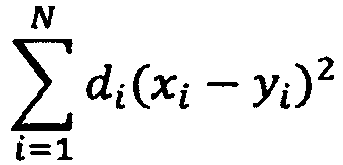
- Method according to any of claims 1 to 8, characterised in that, as a mathematical optimisation method, the distance function is adapted to the test quantity by means of a genetic algorithm for improving curve identification by means of the quality of the solution candidates being determined for the relevant distance function on the basis of the classified number of feature vectors of the test quantity, and the selected solution candidates being hybridised or mutated, as a result of which a new population of solution candidates is generated.
- Method according to any of claims 1 to 9, characterised in that, after applying the mathematical optimisation method, the classification result is ascertained by determining the dissimilarity between the feature vectors, which dissimilarity is found from the quotients of the average spacing between the feature vector and all the neutrons of its associated class, and the sum of the average spacing from all prototypes of the other class, a higher quotient indicating a higher level of dissimilarity between the feature vector and its class.
- Method according to any of claims 1 to 10, characterised in that the oligonucleotide primer pair comprises an excess primer and a limiting primer during amplification, the concentration of the limiting primer being selected such that, after the first amplification cycles, said limiting primer is exhausted in comparison to the excess primer, and the melting temperature of the limiting primer being higher than the melting temperature of the excess primer.
- Test system for carrying out a symmetric or asymmetric polymerase chain reaction (PCR) for detecting a target nucleic acid in a sample, said system comprising:- a target nucleic acid having a nucleic acid target sequence to be amplified,- a thermostable (DNA) polymerase,- deoxynucleoside triphosphates (dNTPs),- at least one oligonucleotide primer pair that is complementary to the nucleic acid target sequence to be amplified, the primers of which primer pair, under PCR conditions, hybridise in the region to be amplified of the nucleic acid target sequence,- a data recording unit for recording the melting curves obtained by the amplification reactions during the PCR,- an analysis unit for melting curve analysis of the obtained melting curves according to a method described in claims 1 to 11.
- Test system according to claim 12, characterised in that, during the PCR reaction, nucleic acid probes are used that comprise a reporter molecule and/or quencher molecule.
- Use of a test system according to either claim 12 or claim 13 for carrying out a multiplex PCR or reverse transcriptase (RT)-PCR or quantitative (multiplex) real-time PCR (qPCR) or (multiplex) LATE PCR.
- Method for detecting mutations in a nucleic acid sequence, in which method a sample is heated in the presence of probes which are specific to a region of the nucleic acid sequence and have an already amplified nucleic acid target sequence, and is subsequently cooled in stages, while the melting curve progression is recorded, wherein, if there is a mutation in the nucleic acid sequence, the melting temperature of a probe, and thus the melting curve progression, changes, wherein the melting curve analysis is carried out according to a method described in claims 1 to 11.
Priority Applications (3)
| Application Number | Priority Date | Filing Date | Title |
|---|---|---|---|
| EP15180991.0A EP3130679B1 (en) | 2015-08-13 | 2015-08-13 | Method and test system for the detection and/or quantification of a target nucleic acid in a sample |
| PCT/EP2016/069109 WO2017025589A1 (en) | 2015-08-13 | 2016-08-11 | Method and test system for detecting and/or quantifying a target nucleic acid in a sample |
| ZA2018/01680A ZA201801680B (en) | 2015-08-13 | 2018-03-12 | Method and test system for detecting and/or quantifying a target nucleic acid in a sample |
Applications Claiming Priority (1)
| Application Number | Priority Date | Filing Date | Title |
|---|---|---|---|
| EP15180991.0A EP3130679B1 (en) | 2015-08-13 | 2015-08-13 | Method and test system for the detection and/or quantification of a target nucleic acid in a sample |
Publications (2)
| Publication Number | Publication Date |
|---|---|
| EP3130679A1 EP3130679A1 (en) | 2017-02-15 |
| EP3130679B1 true EP3130679B1 (en) | 2018-02-28 |
Family
ID=53835362
Family Applications (1)
| Application Number | Title | Priority Date | Filing Date |
|---|---|---|---|
| EP15180991.0A Not-in-force EP3130679B1 (en) | 2015-08-13 | 2015-08-13 | Method and test system for the detection and/or quantification of a target nucleic acid in a sample |
Country Status (3)
| Country | Link |
|---|---|
| EP (1) | EP3130679B1 (en) |
| WO (1) | WO2017025589A1 (en) |
| ZA (1) | ZA201801680B (en) |
Cited By (1)
| Publication number | Priority date | Publication date | Assignee | Title |
|---|---|---|---|---|
| EP4421814A4 (en) * | 2021-10-21 | 2025-11-12 | Seegene Inc | DEVICE AND METHOD FOR READING POSITIVE/NEGATIVE INFORMATION ABOUT A TARGET TEST SUBSTANCE IN A SAMPLE |
Families Citing this family (16)
| Publication number | Priority date | Publication date | Assignee | Title |
|---|---|---|---|---|
| EP3559261A4 (en) * | 2016-12-23 | 2020-12-23 | The Regents of The University of California | METHOD AND DEVICE FOR DIGITAL HIGH-RESOLUTION MELTING CURVE ANALYSIS |
| CN108052755B (en) * | 2017-12-20 | 2019-09-17 | 中国地质大学(武汉) | Vector space based on completely random forest calculates intensity prediction method and system |
| WO2019145303A1 (en) | 2018-01-23 | 2019-08-01 | Biocartis Nv | Methods for the analysis of dissociation melt curve data |
| CN109800767A (en) * | 2018-12-12 | 2019-05-24 | 天津津航技术物理研究所 | Object detection method based on HOG feature and self-encoding encoder |
| WO2020170051A1 (en) * | 2019-02-22 | 2020-08-27 | 3M Innovative Properties Company | Machine learning quantification of target organisms using nucleic acid amplification assays |
| CN110070912B (en) * | 2019-04-15 | 2023-06-23 | 桂林电子科技大学 | Prediction method for CRISPR/Cas9 off-target effect |
| CN111060844A (en) * | 2019-12-09 | 2020-04-24 | 南京航空航天大学 | Interturn short-circuit fault diagnosis method and device for high-speed train traction transmission system |
| DE102020202360B4 (en) | 2020-02-25 | 2024-03-21 | Robert Bosch Gesellschaft mit beschränkter Haftung | Method and device for carrying out a qPCR method |
| DE102020202361A1 (en) | 2020-02-25 | 2021-08-26 | Robert Bosch Gesellschaft mit beschränkter Haftung | Method and device for evaluating a qPCR curve |
| DE102020202363A1 (en) | 2020-02-25 | 2021-08-26 | Robert Bosch Gesellschaft mit beschränkter Haftung | Method and device for carrying out a qPCR method |
| DE102020202358B4 (en) | 2020-02-25 | 2023-09-21 | Robert Bosch Gesellschaft mit beschränkter Haftung | Method and device for carrying out a qPCR method |
| CN112365025B (en) * | 2020-10-10 | 2022-03-25 | 广西大学 | Renewable energy market long-term heat storage method supporting vector machine width learning |
| NL2026919B1 (en) * | 2020-11-17 | 2022-07-01 | Univ Northwest | A system and method for providing test results |
| CN114621996A (en) * | 2020-12-08 | 2022-06-14 | 厦门致善生物科技股份有限公司 | Method for detecting activity of one or more polymerases |
| CN119043233B (en) * | 2024-11-01 | 2025-02-11 | 浙江雄鹰科菲帝科技股份有限公司 | CMM automatic coordinate measuring machine and method thereof |
| CN119644325B (en) * | 2024-11-27 | 2025-08-19 | 中国公路工程咨询集团有限公司 | Tunnel face monitoring system and method |
Family Cites Families (11)
| Publication number | Priority date | Publication date | Assignee | Title |
|---|---|---|---|---|
| US5224775C2 (en) | 1992-03-02 | 2002-04-23 | Ta Instr Inc | Method and apparatus for modulated differential analysis |
| US5273632A (en) | 1992-11-19 | 1993-12-28 | University Of Utah Research Foundation | Methods and apparatus for analysis of chromatographic migration patterns |
| US5748491A (en) | 1995-12-20 | 1998-05-05 | The Perkin-Elmer Corporation | Deconvolution method for the analysis of data resulting from analytical separation processes |
| ES2269614T3 (en) * | 2001-08-31 | 2007-04-01 | The University Of Utah Research Foundation | QUANTIFICATION OF GENES IN REAL TIME WITH INTERNAL STANDARDS. |
| EP1942196B1 (en) | 2001-12-19 | 2012-05-30 | Brandeis University | Late-PCR |
| JP2004024035A (en) | 2002-06-21 | 2004-01-29 | Tosoh Corp | Nucleic acid detection method |
| US20090037117A1 (en) * | 2007-01-30 | 2009-02-05 | Applera Corporation | Differential Dissociation and Melting Curve Peak Detection |
| DE102007031137A1 (en) | 2007-06-13 | 2008-12-18 | Attomol Gmbh Molekulare Diagnostika | Real-time detection of nucleic acid targets, comprises providing a primer containing a sequence-target binding sequence to amplify nucleic acid, introducing a fluorophore and providing a probe for detection, which carries a fluorophore |
| DE102007041864B4 (en) | 2007-09-04 | 2012-05-03 | Sirs-Lab Gmbh | Method for the detection of bacteria and fungi |
| EP2880184B1 (en) * | 2012-08-03 | 2021-03-31 | California Institute of Technology | Multiplexing and quantification in pcr with reduced hardware and requirements |
| US9864834B2 (en) * | 2013-03-15 | 2018-01-09 | Syracuse University | High-resolution melt curve classification using neural networks |
-
2015
- 2015-08-13 EP EP15180991.0A patent/EP3130679B1/en not_active Not-in-force
-
2016
- 2016-08-11 WO PCT/EP2016/069109 patent/WO2017025589A1/en not_active Ceased
-
2018
- 2018-03-12 ZA ZA2018/01680A patent/ZA201801680B/en unknown
Non-Patent Citations (1)
| Title |
|---|
| None * |
Cited By (1)
| Publication number | Priority date | Publication date | Assignee | Title |
|---|---|---|---|---|
| EP4421814A4 (en) * | 2021-10-21 | 2025-11-12 | Seegene Inc | DEVICE AND METHOD FOR READING POSITIVE/NEGATIVE INFORMATION ABOUT A TARGET TEST SUBSTANCE IN A SAMPLE |
Also Published As
| Publication number | Publication date |
|---|---|
| WO2017025589A1 (en) | 2017-02-16 |
| ZA201801680B (en) | 2019-01-30 |
| EP3130679A1 (en) | 2017-02-15 |
Similar Documents
| Publication | Publication Date | Title |
|---|---|---|
| EP3130679B1 (en) | Method and test system for the detection and/or quantification of a target nucleic acid in a sample | |
| DE60023056T2 (en) | Method for quantifying an analyte | |
| DE60213730T2 (en) | Real-time quantification with internal standards | |
| DE60318642T2 (en) | Multi-test analysis of real-time nucleic acid amplifications | |
| DE60035459T2 (en) | Automated real-time analysis of nucleic acid amplification | |
| DE69524425T2 (en) | NUCLEOTIDE SEQUENCING METHOD | |
| DE60116651T2 (en) | METHOD FOR THE AMPLIFICATION AND POSSIBLE CHARACTERIZATION OF NUCLEIC ACIDS | |
| DE69828908T2 (en) | FLUORIMETRIC SYSTEM FOR THE DETECTION OF NUCLEIC ACIDS | |
| DE60018616T2 (en) | Digital Amplification | |
| DE69225333T2 (en) | Methods for the detection of microorganisms using direct and arbitrary DNA amplification. | |
| DE69831913T2 (en) | Methods, apparatus and computer program products for detecting the amounts of nucleic acid sequences in samples | |
| DE69106366T2 (en) | COMPETITIVE PCR FOR QUANTIFYING DNA. | |
| EP3830292B1 (en) | Method for carrying out real-time pcr | |
| EP1770172B1 (en) | Determination of the cycle threshold (Ct) value in a PCR amplification curve by cluster analysis with variable cluster endpoint | |
| DE60204874T2 (en) | METHOD FOR DETECTING NUCLEIC ACIDS | |
| WO2011020588A1 (en) | Method for detecting target nucleic acids | |
| EP2419846B1 (en) | Methods for nucleic acid quantification | |
| DE102007013099A1 (en) | Method and test kit for the rapid detection of specific nucleic acid sequences, in particular for the detection of mutations or SNPs | |
| DE69804334T2 (en) | CONTROL OF NUCLEIC ACID AMPLIFICATION PROCESS, INCLUDING THE POLYMERASE CHAIN REACTION | |
| Torres et al. | A Quantifiler™ Trio-based HRM screening assay for the accurate prediction of single source versus mixed biological samples | |
| DE102005045560B4 (en) | A method of quantitatively determining the copy number of a predetermined sequence in a cell | |
| WO2009127408A1 (en) | Process for the quantitative determination of the copier number of a predetermined sequence in a sample | |
| Stone et al. | A multi-stage model for quantitative PCR | |
| EP1960537A1 (en) | Process for determining the genotype from a biological sample containing nucleic acids of different individuals | |
| DE3923895A1 (en) | METHOD FOR SEQUENCING DESOXYRIBONUCLEIC ACIDS |
Legal Events
| Date | Code | Title | Description |
|---|---|---|---|
| PUAI | Public reference made under article 153(3) epc to a published international application that has entered the european phase |
Free format text: ORIGINAL CODE: 0009012 |
|
| 17P | Request for examination filed |
Effective date: 20160812 |
|
| AK | Designated contracting states |
Kind code of ref document: A1 Designated state(s): AL AT BE BG CH CY CZ DE DK EE ES FI FR GB GR HR HU IE IS IT LI LT LU LV MC MK MT NL NO PL PT RO RS SE SI SK SM TR |
|
| AX | Request for extension of the european patent |
Extension state: BA ME |
|
| GRAP | Despatch of communication of intention to grant a patent |
Free format text: ORIGINAL CODE: EPIDOSNIGR1 |
|
| INTG | Intention to grant announced |
Effective date: 20170919 |
|
| GRAS | Grant fee paid |
Free format text: ORIGINAL CODE: EPIDOSNIGR3 |
|
| GRAA | (expected) grant |
Free format text: ORIGINAL CODE: 0009210 |
|
| AK | Designated contracting states |
Kind code of ref document: B1 Designated state(s): AL AT BE BG CH CY CZ DE DK EE ES FI FR GB GR HR HU IE IS IT LI LT LU LV MC MK MT NL NO PL PT RO RS SE SI SK SM TR |
|
| REG | Reference to a national code |
Ref country code: GB Ref legal event code: FG4D Free format text: NOT ENGLISH Ref country code: CH Ref legal event code: EP |
|
| REG | Reference to a national code |
Ref country code: AT Ref legal event code: REF Ref document number: 974190 Country of ref document: AT Kind code of ref document: T Effective date: 20180315 |
|
| REG | Reference to a national code |
Ref country code: IE Ref legal event code: FG4D Free format text: LANGUAGE OF EP DOCUMENT: GERMAN |
|
| REG | Reference to a national code |
Ref country code: DE Ref legal event code: R096 Ref document number: 502015003179 Country of ref document: DE |
|
| REG | Reference to a national code |
Ref country code: NL Ref legal event code: MP Effective date: 20180228 |
|
| REG | Reference to a national code |
Ref country code: LT Ref legal event code: MG4D |
|
| PG25 | Lapsed in a contracting state [announced via postgrant information from national office to epo] |
Ref country code: ES Free format text: LAPSE BECAUSE OF FAILURE TO SUBMIT A TRANSLATION OF THE DESCRIPTION OR TO PAY THE FEE WITHIN THE PRESCRIBED TIME-LIMIT Effective date: 20180228 Ref country code: LT Free format text: LAPSE BECAUSE OF FAILURE TO SUBMIT A TRANSLATION OF THE DESCRIPTION OR TO PAY THE FEE WITHIN THE PRESCRIBED TIME-LIMIT Effective date: 20180228 Ref country code: CY Free format text: LAPSE BECAUSE OF FAILURE TO SUBMIT A TRANSLATION OF THE DESCRIPTION OR TO PAY THE FEE WITHIN THE PRESCRIBED TIME-LIMIT Effective date: 20180228 Ref country code: NL Free format text: LAPSE BECAUSE OF FAILURE TO SUBMIT A TRANSLATION OF THE DESCRIPTION OR TO PAY THE FEE WITHIN THE PRESCRIBED TIME-LIMIT Effective date: 20180228 Ref country code: NO Free format text: LAPSE BECAUSE OF FAILURE TO SUBMIT A TRANSLATION OF THE DESCRIPTION OR TO PAY THE FEE WITHIN THE PRESCRIBED TIME-LIMIT Effective date: 20180528 Ref country code: FI Free format text: LAPSE BECAUSE OF FAILURE TO SUBMIT A TRANSLATION OF THE DESCRIPTION OR TO PAY THE FEE WITHIN THE PRESCRIBED TIME-LIMIT Effective date: 20180228 Ref country code: HR Free format text: LAPSE BECAUSE OF FAILURE TO SUBMIT A TRANSLATION OF THE DESCRIPTION OR TO PAY THE FEE WITHIN THE PRESCRIBED TIME-LIMIT Effective date: 20180228 |
|
| REG | Reference to a national code |
Ref country code: FR Ref legal event code: PLFP Year of fee payment: 4 |
|
| PG25 | Lapsed in a contracting state [announced via postgrant information from national office to epo] |
Ref country code: GR Free format text: LAPSE BECAUSE OF FAILURE TO SUBMIT A TRANSLATION OF THE DESCRIPTION OR TO PAY THE FEE WITHIN THE PRESCRIBED TIME-LIMIT Effective date: 20180529 Ref country code: BG Free format text: LAPSE BECAUSE OF FAILURE TO SUBMIT A TRANSLATION OF THE DESCRIPTION OR TO PAY THE FEE WITHIN THE PRESCRIBED TIME-LIMIT Effective date: 20180528 Ref country code: RS Free format text: LAPSE BECAUSE OF FAILURE TO SUBMIT A TRANSLATION OF THE DESCRIPTION OR TO PAY THE FEE WITHIN THE PRESCRIBED TIME-LIMIT Effective date: 20180228 Ref country code: LV Free format text: LAPSE BECAUSE OF FAILURE TO SUBMIT A TRANSLATION OF THE DESCRIPTION OR TO PAY THE FEE WITHIN THE PRESCRIBED TIME-LIMIT Effective date: 20180228 Ref country code: SE Free format text: LAPSE BECAUSE OF FAILURE TO SUBMIT A TRANSLATION OF THE DESCRIPTION OR TO PAY THE FEE WITHIN THE PRESCRIBED TIME-LIMIT Effective date: 20180228 |
|
| PG25 | Lapsed in a contracting state [announced via postgrant information from national office to epo] |
Ref country code: MT Free format text: LAPSE BECAUSE OF FAILURE TO SUBMIT A TRANSLATION OF THE DESCRIPTION OR TO PAY THE FEE WITHIN THE PRESCRIBED TIME-LIMIT Effective date: 20180228 |
|
| PG25 | Lapsed in a contracting state [announced via postgrant information from national office to epo] |
Ref country code: RO Free format text: LAPSE BECAUSE OF FAILURE TO SUBMIT A TRANSLATION OF THE DESCRIPTION OR TO PAY THE FEE WITHIN THE PRESCRIBED TIME-LIMIT Effective date: 20180228 Ref country code: PL Free format text: LAPSE BECAUSE OF FAILURE TO SUBMIT A TRANSLATION OF THE DESCRIPTION OR TO PAY THE FEE WITHIN THE PRESCRIBED TIME-LIMIT Effective date: 20180228 Ref country code: AL Free format text: LAPSE BECAUSE OF FAILURE TO SUBMIT A TRANSLATION OF THE DESCRIPTION OR TO PAY THE FEE WITHIN THE PRESCRIBED TIME-LIMIT Effective date: 20180228 Ref country code: EE Free format text: LAPSE BECAUSE OF FAILURE TO SUBMIT A TRANSLATION OF THE DESCRIPTION OR TO PAY THE FEE WITHIN THE PRESCRIBED TIME-LIMIT Effective date: 20180228 Ref country code: IT Free format text: LAPSE BECAUSE OF FAILURE TO SUBMIT A TRANSLATION OF THE DESCRIPTION OR TO PAY THE FEE WITHIN THE PRESCRIBED TIME-LIMIT Effective date: 20180228 |
|
| REG | Reference to a national code |
Ref country code: DE Ref legal event code: R097 Ref document number: 502015003179 Country of ref document: DE |
|
| PG25 | Lapsed in a contracting state [announced via postgrant information from national office to epo] |
Ref country code: DK Free format text: LAPSE BECAUSE OF FAILURE TO SUBMIT A TRANSLATION OF THE DESCRIPTION OR TO PAY THE FEE WITHIN THE PRESCRIBED TIME-LIMIT Effective date: 20180228 Ref country code: SM Free format text: LAPSE BECAUSE OF FAILURE TO SUBMIT A TRANSLATION OF THE DESCRIPTION OR TO PAY THE FEE WITHIN THE PRESCRIBED TIME-LIMIT Effective date: 20180228 Ref country code: CZ Free format text: LAPSE BECAUSE OF FAILURE TO SUBMIT A TRANSLATION OF THE DESCRIPTION OR TO PAY THE FEE WITHIN THE PRESCRIBED TIME-LIMIT Effective date: 20180228 Ref country code: SK Free format text: LAPSE BECAUSE OF FAILURE TO SUBMIT A TRANSLATION OF THE DESCRIPTION OR TO PAY THE FEE WITHIN THE PRESCRIBED TIME-LIMIT Effective date: 20180228 |
|
| PLBE | No opposition filed within time limit |
Free format text: ORIGINAL CODE: 0009261 |
|
| STAA | Information on the status of an ep patent application or granted ep patent |
Free format text: STATUS: NO OPPOSITION FILED WITHIN TIME LIMIT |
|
| 26N | No opposition filed |
Effective date: 20181129 |
|
| PG25 | Lapsed in a contracting state [announced via postgrant information from national office to epo] |
Ref country code: SI Free format text: LAPSE BECAUSE OF FAILURE TO SUBMIT A TRANSLATION OF THE DESCRIPTION OR TO PAY THE FEE WITHIN THE PRESCRIBED TIME-LIMIT Effective date: 20180228 |
|
| PG25 | Lapsed in a contracting state [announced via postgrant information from national office to epo] |
Ref country code: MC Free format text: LAPSE BECAUSE OF FAILURE TO SUBMIT A TRANSLATION OF THE DESCRIPTION OR TO PAY THE FEE WITHIN THE PRESCRIBED TIME-LIMIT Effective date: 20180228 |
|
| REG | Reference to a national code |
Ref country code: CH Ref legal event code: PL |
|
| PG25 | Lapsed in a contracting state [announced via postgrant information from national office to epo] |
Ref country code: LU Free format text: LAPSE BECAUSE OF NON-PAYMENT OF DUE FEES Effective date: 20180813 Ref country code: LI Free format text: LAPSE BECAUSE OF NON-PAYMENT OF DUE FEES Effective date: 20180831 Ref country code: CH Free format text: LAPSE BECAUSE OF NON-PAYMENT OF DUE FEES Effective date: 20180831 |
|
| REG | Reference to a national code |
Ref country code: BE Ref legal event code: MM Effective date: 20180831 |
|
| REG | Reference to a national code |
Ref country code: IE Ref legal event code: MM4A |
|
| PG25 | Lapsed in a contracting state [announced via postgrant information from national office to epo] |
Ref country code: IE Free format text: LAPSE BECAUSE OF NON-PAYMENT OF DUE FEES Effective date: 20180813 |
|
| PG25 | Lapsed in a contracting state [announced via postgrant information from national office to epo] |
Ref country code: BE Free format text: LAPSE BECAUSE OF NON-PAYMENT OF DUE FEES Effective date: 20180831 |
|
| PG25 | Lapsed in a contracting state [announced via postgrant information from national office to epo] |
Ref country code: TR Free format text: LAPSE BECAUSE OF FAILURE TO SUBMIT A TRANSLATION OF THE DESCRIPTION OR TO PAY THE FEE WITHIN THE PRESCRIBED TIME-LIMIT Effective date: 20180228 |
|
| PG25 | Lapsed in a contracting state [announced via postgrant information from national office to epo] |
Ref country code: PT Free format text: LAPSE BECAUSE OF FAILURE TO SUBMIT A TRANSLATION OF THE DESCRIPTION OR TO PAY THE FEE WITHIN THE PRESCRIBED TIME-LIMIT Effective date: 20180228 |
|
| PG25 | Lapsed in a contracting state [announced via postgrant information from national office to epo] |
Ref country code: HU Free format text: LAPSE BECAUSE OF FAILURE TO SUBMIT A TRANSLATION OF THE DESCRIPTION OR TO PAY THE FEE WITHIN THE PRESCRIBED TIME-LIMIT; INVALID AB INITIO Effective date: 20150813 Ref country code: MK Free format text: LAPSE BECAUSE OF NON-PAYMENT OF DUE FEES Effective date: 20180228 |
|
| PG25 | Lapsed in a contracting state [announced via postgrant information from national office to epo] |
Ref country code: IS Free format text: LAPSE BECAUSE OF FAILURE TO SUBMIT A TRANSLATION OF THE DESCRIPTION OR TO PAY THE FEE WITHIN THE PRESCRIBED TIME-LIMIT Effective date: 20180628 |
|
| REG | Reference to a national code |
Ref country code: AT Ref legal event code: MM01 Ref document number: 974190 Country of ref document: AT Kind code of ref document: T Effective date: 20200813 |
|
| PG25 | Lapsed in a contracting state [announced via postgrant information from national office to epo] |
Ref country code: AT Free format text: LAPSE BECAUSE OF NON-PAYMENT OF DUE FEES Effective date: 20200813 |
|
| PGFP | Annual fee paid to national office [announced via postgrant information from national office to epo] |
Ref country code: GB Payment date: 20220824 Year of fee payment: 8 Ref country code: DE Payment date: 20220624 Year of fee payment: 8 |
|
| PGFP | Annual fee paid to national office [announced via postgrant information from national office to epo] |
Ref country code: FR Payment date: 20220822 Year of fee payment: 8 |
|
| REG | Reference to a national code |
Ref country code: DE Ref legal event code: R119 Ref document number: 502015003179 Country of ref document: DE |
|
| GBPC | Gb: european patent ceased through non-payment of renewal fee |
Effective date: 20230813 |
|
| PG25 | Lapsed in a contracting state [announced via postgrant information from national office to epo] |
Ref country code: GB Free format text: LAPSE BECAUSE OF NON-PAYMENT OF DUE FEES Effective date: 20230813 |
|
| PG25 | Lapsed in a contracting state [announced via postgrant information from national office to epo] |
Ref country code: GB Free format text: LAPSE BECAUSE OF NON-PAYMENT OF DUE FEES Effective date: 20230813 Ref country code: FR Free format text: LAPSE BECAUSE OF NON-PAYMENT OF DUE FEES Effective date: 20230831 Ref country code: DE Free format text: LAPSE BECAUSE OF NON-PAYMENT OF DUE FEES Effective date: 20240301 |