EP3102198B1 - Antidiabetic compounds - Google Patents
Antidiabetic compounds Download PDFInfo
- Publication number
- EP3102198B1 EP3102198B1 EP15745823.3A EP15745823A EP3102198B1 EP 3102198 B1 EP3102198 B1 EP 3102198B1 EP 15745823 A EP15745823 A EP 15745823A EP 3102198 B1 EP3102198 B1 EP 3102198B1
- Authority
- EP
- European Patent Office
- Prior art keywords
- alkyl
- cycloalkyl
- substituted
- unsubstituted
- group
- Prior art date
- Legal status (The legal status is an assumption and is not a legal conclusion. Google has not performed a legal analysis and makes no representation as to the accuracy of the status listed.)
- Active
Links
- 0 CC(C(*)*I)C1=CC(*C(C=C(C=C2)C3=CC=CC=CC=CC=C3)=CC=CC2=C)=[U]C=C1 Chemical compound CC(C(*)*I)C1=CC(*C(C=C(C=C2)C3=CC=CC=CC=CC=C3)=CC=CC2=C)=[U]C=C1 0.000 description 14
- LZICSWPPCCHCBD-LJQANCHMSA-N C=C([C@H](c1cc(OCC(C2)CN2c2c(C(F)(F)F)ccc(C(F)(F)F)c2)ccc1)O)C(O)=O Chemical compound C=C([C@H](c1cc(OCC(C2)CN2c2c(C(F)(F)F)ccc(C(F)(F)F)c2)ccc1)O)C(O)=O LZICSWPPCCHCBD-LJQANCHMSA-N 0.000 description 1
- VAQABADJKGUJGJ-ISXOHVOVSA-N COC(C[C@H](c1cc(OC(C2)CC22CNCC2)ccc1)O)=O Chemical compound COC(C[C@H](c1cc(OC(C2)CC22CNCC2)ccc1)O)=O VAQABADJKGUJGJ-ISXOHVOVSA-N 0.000 description 1
- RLFLJASDYDOMRE-CRPOECCBSA-N COC(C[C@H](c1cc(OCC(C2)CC22CNCC2)ccc1)O)=O Chemical compound COC(C[C@H](c1cc(OCC(C2)CC22CNCC2)ccc1)O)=O RLFLJASDYDOMRE-CRPOECCBSA-N 0.000 description 1
- HOBDWHHOBYXQOL-UHFFFAOYSA-N COc(cc1)cc(C2CC2)c1N Chemical compound COc(cc1)cc(C2CC2)c1N HOBDWHHOBYXQOL-UHFFFAOYSA-N 0.000 description 1
- BOZLOGRLYANLKT-VQSBYGRUSA-N C[C@@H](Cc1cc(OCC(C2)CC2c2cc(OC)ccc2)ccc1)C(OC)=O Chemical compound C[C@@H](Cc1cc(OCC(C2)CC2c2cc(OC)ccc2)ccc1)C(OC)=O BOZLOGRLYANLKT-VQSBYGRUSA-N 0.000 description 1
- HSMHKMZYTMYSMH-QEORTHHSSA-N C[C@@H](Cc1cc(OC[C@@H](C2)[C@H]2c2cc(C(F)(F)F)ccc2Cl)ccc1)C(O)=O Chemical compound C[C@@H](Cc1cc(OC[C@@H](C2)[C@H]2c2cc(C(F)(F)F)ccc2Cl)ccc1)C(O)=O HSMHKMZYTMYSMH-QEORTHHSSA-N 0.000 description 1
- STXUOZCNLFNRNP-BBJJZZOQSA-N C[C@@H]([C@@H](C1CC1)c1cccc(OCC(C2)CN2C(C)c2cc(C(F)(F)F)c(C[C@@H]([C@@H](C3CC3)c3cc(OC[C@H]4CN(Cc5c(C(F)(F)F)ccc(C(F)(F)F)c5)CC4)ccc3)C(O)=O)cc2C(F)(F)F)c1)C(O)=O Chemical compound C[C@@H]([C@@H](C1CC1)c1cccc(OCC(C2)CN2C(C)c2cc(C(F)(F)F)c(C[C@@H]([C@@H](C3CC3)c3cc(OC[C@H]4CN(Cc5c(C(F)(F)F)ccc(C(F)(F)F)c5)CC4)ccc3)C(O)=O)cc2C(F)(F)F)c1)C(O)=O STXUOZCNLFNRNP-BBJJZZOQSA-N 0.000 description 1
- WQKWNYMOQPWXRZ-DAIUFSSHSA-N C[C@@H]([C@@H](C1CC1)c1cccc(OCC(CC2)CN2[C@@H](C)c2c(C(F)(F)F)ccc(C(F)(F)F)c2)c1)C(O)=O Chemical compound C[C@@H]([C@@H](C1CC1)c1cccc(OCC(CC2)CN2[C@@H](C)c2c(C(F)(F)F)ccc(C(F)(F)F)c2)c1)C(O)=O WQKWNYMOQPWXRZ-DAIUFSSHSA-N 0.000 description 1
- BDKGYYYUJDNWFD-RXBAOPJQSA-N C[C@@H]([C@@H](C1CC1)c1cccc(OCC2CC(c3cccc(OC)c3)=CC2)c1)C(OC)=O Chemical compound C[C@@H]([C@@H](C1CC1)c1cccc(OCC2CC(c3cccc(OC)c3)=CC2)c1)C(OC)=O BDKGYYYUJDNWFD-RXBAOPJQSA-N 0.000 description 1
- RBBVAHBNXWYAOA-AVHNCFJMSA-N C[C@@H]([C@H](c1cc(OCC(C2)CC2Oc(cccc2)c2F)ccc1)O)C(O)=O Chemical compound C[C@@H]([C@H](c1cc(OCC(C2)CC2Oc(cccc2)c2F)ccc1)O)C(O)=O RBBVAHBNXWYAOA-AVHNCFJMSA-N 0.000 description 1
- JVMKFQACWZXKBR-HFPGMDRVSA-N C[C@@H]([C@H](c1cc(OCC(C2)CC2Oc2cc(OC)ccc2F)ccc1)O)C(O)=O Chemical compound C[C@@H]([C@H](c1cc(OCC(C2)CC2Oc2cc(OC)ccc2F)ccc1)O)C(O)=O JVMKFQACWZXKBR-HFPGMDRVSA-N 0.000 description 1
- XJDHCDBLUGIXGV-IOWLUPKSSA-N C[C@@H]([C@H](c1cc(OCC(C2)CC2Oc2n[n](C)c(C(F)(F)F)c2C)ccc1)O)C(O)=O Chemical compound C[C@@H]([C@H](c1cc(OCC(C2)CC2Oc2n[n](C)c(C(F)(F)F)c2C)ccc1)O)C(O)=O XJDHCDBLUGIXGV-IOWLUPKSSA-N 0.000 description 1
- WQNYKLDBHIHUAC-IFXJQAMLSA-N C[C@@H]([C@H](c1cc(OCC(CC2)CCN2c2c(C(F)(F)F)cccn2)ccc1)O)C(O)=O Chemical compound C[C@@H]([C@H](c1cc(OCC(CC2)CCN2c2c(C(F)(F)F)cccn2)ccc1)O)C(O)=O WQNYKLDBHIHUAC-IFXJQAMLSA-N 0.000 description 1
- CHWREIGDROYGMU-ADBXRKJISA-N C[C@@H]([C@H](c1cc(OC[C@@H](C2)[C@H]2c(cccc2OC)c2F)ccc1)O)C(O)=O Chemical compound C[C@@H]([C@H](c1cc(OC[C@@H](C2)[C@H]2c(cccc2OC)c2F)ccc1)O)C(O)=O CHWREIGDROYGMU-ADBXRKJISA-N 0.000 description 1
- KYMWYTXENDMEAE-MJDMNNAHSA-N C[C@@H]([C@H](c1cccc(OCC(C2)CC2OCc2ccccc2)c1)O)C(O)=O Chemical compound C[C@@H]([C@H](c1cccc(OCC(C2)CC2OCc2ccccc2)c1)O)C(O)=O KYMWYTXENDMEAE-MJDMNNAHSA-N 0.000 description 1
- HNRLAFVMHBQEJJ-WHCXFUJUSA-N O[C@H](CC(O)=O)c1cc(OC2CN(Cc3c(C(F)(F)F)ccc(C(F)(F)F)c3)CC2)ccc1 Chemical compound O[C@H](CC(O)=O)c1cc(OC2CN(Cc3c(C(F)(F)F)ccc(C(F)(F)F)c3)CC2)ccc1 HNRLAFVMHBQEJJ-WHCXFUJUSA-N 0.000 description 1
- VHHZNTQGGSHPIE-GAGCMDECSA-N O[C@H](CC(O)=O)c1cc(OCC(CC2)CN2c2c(C(F)(F)F)ccc(C(F)(F)F)c2)ccc1 Chemical compound O[C@H](CC(O)=O)c1cc(OCC(CC2)CN2c2c(C(F)(F)F)ccc(C(F)(F)F)c2)ccc1 VHHZNTQGGSHPIE-GAGCMDECSA-N 0.000 description 1
- ILOAHQKLPLIJDL-YMBRHYMPSA-N O[C@H](CC(O)=O)c1cc(OCC2(CN(Cc3cc(C(F)(F)F)ccc3C(F)(F)F)CC2)F)ccc1 Chemical compound O[C@H](CC(O)=O)c1cc(OCC2(CN(Cc3cc(C(F)(F)F)ccc3C(F)(F)F)CC2)F)ccc1 ILOAHQKLPLIJDL-YMBRHYMPSA-N 0.000 description 1
- SSXGQENBKXWJFP-LJQANCHMSA-N O[C@H](CC(O)=O)c1cc(OCC2CN(Cc3cc(C(F)(F)F)ccc3C(F)(F)F)C2)ccc1 Chemical compound O[C@H](CC(O)=O)c1cc(OCC2CN(Cc3cc(C(F)(F)F)ccc3C(F)(F)F)C2)ccc1 SSXGQENBKXWJFP-LJQANCHMSA-N 0.000 description 1
- AJZIMNVJXAIEGD-LLVKDONJSA-N O[C@H]1CN(Cc2cc(C(F)(F)F)ccc2C(F)(F)F)CCC1 Chemical compound O[C@H]1CN(Cc2cc(C(F)(F)F)ccc2C(F)(F)F)CCC1 AJZIMNVJXAIEGD-LLVKDONJSA-N 0.000 description 1
Classifications
-
- C—CHEMISTRY; METALLURGY
- C07—ORGANIC CHEMISTRY
- C07D—HETEROCYCLIC COMPOUNDS
- C07D211/00—Heterocyclic compounds containing hydrogenated pyridine rings, not condensed with other rings
- C07D211/04—Heterocyclic compounds containing hydrogenated pyridine rings, not condensed with other rings with only hydrogen or carbon atoms directly attached to the ring nitrogen atom
- C07D211/06—Heterocyclic compounds containing hydrogenated pyridine rings, not condensed with other rings with only hydrogen or carbon atoms directly attached to the ring nitrogen atom having no double bonds between ring members or between ring members and non-ring members
- C07D211/36—Heterocyclic compounds containing hydrogenated pyridine rings, not condensed with other rings with only hydrogen or carbon atoms directly attached to the ring nitrogen atom having no double bonds between ring members or between ring members and non-ring members with hetero atoms or with carbon atoms having three bonds to hetero atoms with at the most one bond to halogen, e.g. ester or nitrile radicals, directly attached to ring carbon atoms
- C07D211/40—Oxygen atoms
- C07D211/42—Oxygen atoms attached in position 3 or 5
-
- A—HUMAN NECESSITIES
- A61—MEDICAL OR VETERINARY SCIENCE; HYGIENE
- A61K—PREPARATIONS FOR MEDICAL, DENTAL OR TOILETRY PURPOSES
- A61K31/00—Medicinal preparations containing organic active ingredients
- A61K31/33—Heterocyclic compounds
- A61K31/335—Heterocyclic compounds having oxygen as the only ring hetero atom, e.g. fungichromin
- A61K31/365—Lactones
- A61K31/366—Lactones having six-membered rings, e.g. delta-lactones
-
- A—HUMAN NECESSITIES
- A61—MEDICAL OR VETERINARY SCIENCE; HYGIENE
- A61K—PREPARATIONS FOR MEDICAL, DENTAL OR TOILETRY PURPOSES
- A61K31/00—Medicinal preparations containing organic active ingredients
- A61K31/33—Heterocyclic compounds
- A61K31/395—Heterocyclic compounds having nitrogen as a ring hetero atom, e.g. guanethidine or rifamycins
- A61K31/397—Heterocyclic compounds having nitrogen as a ring hetero atom, e.g. guanethidine or rifamycins having four-membered rings, e.g. azetidine
-
- A—HUMAN NECESSITIES
- A61—MEDICAL OR VETERINARY SCIENCE; HYGIENE
- A61K—PREPARATIONS FOR MEDICAL, DENTAL OR TOILETRY PURPOSES
- A61K31/00—Medicinal preparations containing organic active ingredients
- A61K31/33—Heterocyclic compounds
- A61K31/395—Heterocyclic compounds having nitrogen as a ring hetero atom, e.g. guanethidine or rifamycins
- A61K31/40—Heterocyclic compounds having nitrogen as a ring hetero atom, e.g. guanethidine or rifamycins having five-membered rings with one nitrogen as the only ring hetero atom, e.g. sulpiride, succinimide, tolmetin, buflomedil
-
- A—HUMAN NECESSITIES
- A61—MEDICAL OR VETERINARY SCIENCE; HYGIENE
- A61K—PREPARATIONS FOR MEDICAL, DENTAL OR TOILETRY PURPOSES
- A61K31/00—Medicinal preparations containing organic active ingredients
- A61K31/33—Heterocyclic compounds
- A61K31/395—Heterocyclic compounds having nitrogen as a ring hetero atom, e.g. guanethidine or rifamycins
- A61K31/435—Heterocyclic compounds having nitrogen as a ring hetero atom, e.g. guanethidine or rifamycins having six-membered rings with one nitrogen as the only ring hetero atom
- A61K31/44—Non condensed pyridines; Hydrogenated derivatives thereof
-
- A—HUMAN NECESSITIES
- A61—MEDICAL OR VETERINARY SCIENCE; HYGIENE
- A61K—PREPARATIONS FOR MEDICAL, DENTAL OR TOILETRY PURPOSES
- A61K31/00—Medicinal preparations containing organic active ingredients
- A61K31/33—Heterocyclic compounds
- A61K31/395—Heterocyclic compounds having nitrogen as a ring hetero atom, e.g. guanethidine or rifamycins
- A61K31/495—Heterocyclic compounds having nitrogen as a ring hetero atom, e.g. guanethidine or rifamycins having six-membered rings with two or more nitrogen atoms as the only ring heteroatoms, e.g. piperazine or tetrazines
- A61K31/4985—Pyrazines or piperazines ortho- or peri-condensed with heterocyclic ring systems
-
- A—HUMAN NECESSITIES
- A61—MEDICAL OR VETERINARY SCIENCE; HYGIENE
- A61K—PREPARATIONS FOR MEDICAL, DENTAL OR TOILETRY PURPOSES
- A61K45/00—Medicinal preparations containing active ingredients not provided for in groups A61K31/00 - A61K41/00
- A61K45/06—Mixtures of active ingredients without chemical characterisation, e.g. antiphlogistics and cardiaca
-
- C—CHEMISTRY; METALLURGY
- C07—ORGANIC CHEMISTRY
- C07C—ACYCLIC OR CARBOCYCLIC COMPOUNDS
- C07C217/00—Compounds containing amino and etherified hydroxy groups bound to the same carbon skeleton
- C07C217/52—Compounds containing amino and etherified hydroxy groups bound to the same carbon skeleton having etherified hydroxy groups or amino groups bound to carbon atoms of rings other than six-membered aromatic rings of the same carbon skeleton
-
- C—CHEMISTRY; METALLURGY
- C07—ORGANIC CHEMISTRY
- C07C—ACYCLIC OR CARBOCYCLIC COMPOUNDS
- C07C59/00—Compounds having carboxyl groups bound to acyclic carbon atoms and containing any of the groups OH, O—metal, —CHO, keto, ether, groups, groups, or groups
- C07C59/40—Unsaturated compounds
- C07C59/58—Unsaturated compounds containing ether groups, groups, groups, or groups
- C07C59/72—Unsaturated compounds containing ether groups, groups, groups, or groups containing six-membered aromatic rings and other rings
-
- C—CHEMISTRY; METALLURGY
- C07—ORGANIC CHEMISTRY
- C07D—HETEROCYCLIC COMPOUNDS
- C07D205/00—Heterocyclic compounds containing four-membered rings with one nitrogen atom as the only ring hetero atom
- C07D205/02—Heterocyclic compounds containing four-membered rings with one nitrogen atom as the only ring hetero atom not condensed with other rings
- C07D205/04—Heterocyclic compounds containing four-membered rings with one nitrogen atom as the only ring hetero atom not condensed with other rings having no double bonds between ring members or between ring members and non-ring members
-
- C—CHEMISTRY; METALLURGY
- C07—ORGANIC CHEMISTRY
- C07D—HETEROCYCLIC COMPOUNDS
- C07D205/00—Heterocyclic compounds containing four-membered rings with one nitrogen atom as the only ring hetero atom
- C07D205/12—Heterocyclic compounds containing four-membered rings with one nitrogen atom as the only ring hetero atom condensed with carbocyclic rings or ring systems
-
- C—CHEMISTRY; METALLURGY
- C07—ORGANIC CHEMISTRY
- C07D—HETEROCYCLIC COMPOUNDS
- C07D207/00—Heterocyclic compounds containing five-membered rings not condensed with other rings, with one nitrogen atom as the only ring hetero atom
- C07D207/02—Heterocyclic compounds containing five-membered rings not condensed with other rings, with one nitrogen atom as the only ring hetero atom with only hydrogen or carbon atoms directly attached to the ring nitrogen atom
- C07D207/04—Heterocyclic compounds containing five-membered rings not condensed with other rings, with one nitrogen atom as the only ring hetero atom with only hydrogen or carbon atoms directly attached to the ring nitrogen atom having no double bonds between ring members or between ring members and non-ring members
- C07D207/08—Heterocyclic compounds containing five-membered rings not condensed with other rings, with one nitrogen atom as the only ring hetero atom with only hydrogen or carbon atoms directly attached to the ring nitrogen atom having no double bonds between ring members or between ring members and non-ring members with hydrocarbon radicals, substituted by hetero atoms, attached to ring carbon atoms
-
- C—CHEMISTRY; METALLURGY
- C07—ORGANIC CHEMISTRY
- C07D—HETEROCYCLIC COMPOUNDS
- C07D207/00—Heterocyclic compounds containing five-membered rings not condensed with other rings, with one nitrogen atom as the only ring hetero atom
- C07D207/02—Heterocyclic compounds containing five-membered rings not condensed with other rings, with one nitrogen atom as the only ring hetero atom with only hydrogen or carbon atoms directly attached to the ring nitrogen atom
- C07D207/04—Heterocyclic compounds containing five-membered rings not condensed with other rings, with one nitrogen atom as the only ring hetero atom with only hydrogen or carbon atoms directly attached to the ring nitrogen atom having no double bonds between ring members or between ring members and non-ring members
- C07D207/10—Heterocyclic compounds containing five-membered rings not condensed with other rings, with one nitrogen atom as the only ring hetero atom with only hydrogen or carbon atoms directly attached to the ring nitrogen atom having no double bonds between ring members or between ring members and non-ring members with hetero atoms or with carbon atoms having three bonds to hetero atoms with at the most one bond to halogen, e.g. ester or nitrile radicals, directly attached to ring carbon atoms
-
- C—CHEMISTRY; METALLURGY
- C07—ORGANIC CHEMISTRY
- C07D—HETEROCYCLIC COMPOUNDS
- C07D207/00—Heterocyclic compounds containing five-membered rings not condensed with other rings, with one nitrogen atom as the only ring hetero atom
- C07D207/02—Heterocyclic compounds containing five-membered rings not condensed with other rings, with one nitrogen atom as the only ring hetero atom with only hydrogen or carbon atoms directly attached to the ring nitrogen atom
- C07D207/04—Heterocyclic compounds containing five-membered rings not condensed with other rings, with one nitrogen atom as the only ring hetero atom with only hydrogen or carbon atoms directly attached to the ring nitrogen atom having no double bonds between ring members or between ring members and non-ring members
- C07D207/10—Heterocyclic compounds containing five-membered rings not condensed with other rings, with one nitrogen atom as the only ring hetero atom with only hydrogen or carbon atoms directly attached to the ring nitrogen atom having no double bonds between ring members or between ring members and non-ring members with hetero atoms or with carbon atoms having three bonds to hetero atoms with at the most one bond to halogen, e.g. ester or nitrile radicals, directly attached to ring carbon atoms
- C07D207/12—Oxygen or sulfur atoms
-
- C—CHEMISTRY; METALLURGY
- C07—ORGANIC CHEMISTRY
- C07D—HETEROCYCLIC COMPOUNDS
- C07D209/00—Heterocyclic compounds containing five-membered rings, condensed with other rings, with one nitrogen atom as the only ring hetero atom
- C07D209/02—Heterocyclic compounds containing five-membered rings, condensed with other rings, with one nitrogen atom as the only ring hetero atom condensed with one carbocyclic ring
- C07D209/52—Heterocyclic compounds containing five-membered rings, condensed with other rings, with one nitrogen atom as the only ring hetero atom condensed with one carbocyclic ring condensed with a ring other than six-membered
-
- C—CHEMISTRY; METALLURGY
- C07—ORGANIC CHEMISTRY
- C07D—HETEROCYCLIC COMPOUNDS
- C07D209/00—Heterocyclic compounds containing five-membered rings, condensed with other rings, with one nitrogen atom as the only ring hetero atom
- C07D209/02—Heterocyclic compounds containing five-membered rings, condensed with other rings, with one nitrogen atom as the only ring hetero atom condensed with one carbocyclic ring
- C07D209/54—Spiro-condensed
-
- C—CHEMISTRY; METALLURGY
- C07—ORGANIC CHEMISTRY
- C07D—HETEROCYCLIC COMPOUNDS
- C07D211/00—Heterocyclic compounds containing hydrogenated pyridine rings, not condensed with other rings
- C07D211/04—Heterocyclic compounds containing hydrogenated pyridine rings, not condensed with other rings with only hydrogen or carbon atoms directly attached to the ring nitrogen atom
- C07D211/06—Heterocyclic compounds containing hydrogenated pyridine rings, not condensed with other rings with only hydrogen or carbon atoms directly attached to the ring nitrogen atom having no double bonds between ring members or between ring members and non-ring members
- C07D211/08—Heterocyclic compounds containing hydrogenated pyridine rings, not condensed with other rings with only hydrogen or carbon atoms directly attached to the ring nitrogen atom having no double bonds between ring members or between ring members and non-ring members with hydrocarbon or substituted hydrocarbon radicals directly attached to ring carbon atoms
- C07D211/18—Heterocyclic compounds containing hydrogenated pyridine rings, not condensed with other rings with only hydrogen or carbon atoms directly attached to the ring nitrogen atom having no double bonds between ring members or between ring members and non-ring members with hydrocarbon or substituted hydrocarbon radicals directly attached to ring carbon atoms with substituted hydrocarbon radicals attached to ring carbon atoms
- C07D211/20—Heterocyclic compounds containing hydrogenated pyridine rings, not condensed with other rings with only hydrogen or carbon atoms directly attached to the ring nitrogen atom having no double bonds between ring members or between ring members and non-ring members with hydrocarbon or substituted hydrocarbon radicals directly attached to ring carbon atoms with substituted hydrocarbon radicals attached to ring carbon atoms with hydrocarbon radicals, substituted by singly bound oxygen or sulphur atoms
- C07D211/22—Heterocyclic compounds containing hydrogenated pyridine rings, not condensed with other rings with only hydrogen or carbon atoms directly attached to the ring nitrogen atom having no double bonds between ring members or between ring members and non-ring members with hydrocarbon or substituted hydrocarbon radicals directly attached to ring carbon atoms with substituted hydrocarbon radicals attached to ring carbon atoms with hydrocarbon radicals, substituted by singly bound oxygen or sulphur atoms by oxygen atoms
-
- C—CHEMISTRY; METALLURGY
- C07—ORGANIC CHEMISTRY
- C07D—HETEROCYCLIC COMPOUNDS
- C07D213/00—Heterocyclic compounds containing six-membered rings, not condensed with other rings, with one nitrogen atom as the only ring hetero atom and three or more double bonds between ring members or between ring members and non-ring members
- C07D213/02—Heterocyclic compounds containing six-membered rings, not condensed with other rings, with one nitrogen atom as the only ring hetero atom and three or more double bonds between ring members or between ring members and non-ring members having three double bonds between ring members or between ring members and non-ring members
- C07D213/04—Heterocyclic compounds containing six-membered rings, not condensed with other rings, with one nitrogen atom as the only ring hetero atom and three or more double bonds between ring members or between ring members and non-ring members having three double bonds between ring members or between ring members and non-ring members having no bond between the ring nitrogen atom and a non-ring member or having only hydrogen or carbon atoms directly attached to the ring nitrogen atom
- C07D213/24—Heterocyclic compounds containing six-membered rings, not condensed with other rings, with one nitrogen atom as the only ring hetero atom and three or more double bonds between ring members or between ring members and non-ring members having three double bonds between ring members or between ring members and non-ring members having no bond between the ring nitrogen atom and a non-ring member or having only hydrogen or carbon atoms directly attached to the ring nitrogen atom with substituted hydrocarbon radicals attached to ring carbon atoms
- C07D213/28—Radicals substituted by singly-bound oxygen or sulphur atoms
- C07D213/30—Oxygen atoms
-
- C—CHEMISTRY; METALLURGY
- C07—ORGANIC CHEMISTRY
- C07D—HETEROCYCLIC COMPOUNDS
- C07D213/00—Heterocyclic compounds containing six-membered rings, not condensed with other rings, with one nitrogen atom as the only ring hetero atom and three or more double bonds between ring members or between ring members and non-ring members
- C07D213/02—Heterocyclic compounds containing six-membered rings, not condensed with other rings, with one nitrogen atom as the only ring hetero atom and three or more double bonds between ring members or between ring members and non-ring members having three double bonds between ring members or between ring members and non-ring members
- C07D213/04—Heterocyclic compounds containing six-membered rings, not condensed with other rings, with one nitrogen atom as the only ring hetero atom and three or more double bonds between ring members or between ring members and non-ring members having three double bonds between ring members or between ring members and non-ring members having no bond between the ring nitrogen atom and a non-ring member or having only hydrogen or carbon atoms directly attached to the ring nitrogen atom
- C07D213/60—Heterocyclic compounds containing six-membered rings, not condensed with other rings, with one nitrogen atom as the only ring hetero atom and three or more double bonds between ring members or between ring members and non-ring members having three double bonds between ring members or between ring members and non-ring members having no bond between the ring nitrogen atom and a non-ring member or having only hydrogen or carbon atoms directly attached to the ring nitrogen atom with hetero atoms or with carbon atoms having three bonds to hetero atoms with at the most one bond to halogen, e.g. ester or nitrile radicals, directly attached to ring carbon atoms
- C07D213/62—Oxygen or sulfur atoms
- C07D213/63—One oxygen atom
- C07D213/64—One oxygen atom attached in position 2 or 6
-
- C—CHEMISTRY; METALLURGY
- C07—ORGANIC CHEMISTRY
- C07D—HETEROCYCLIC COMPOUNDS
- C07D213/00—Heterocyclic compounds containing six-membered rings, not condensed with other rings, with one nitrogen atom as the only ring hetero atom and three or more double bonds between ring members or between ring members and non-ring members
- C07D213/02—Heterocyclic compounds containing six-membered rings, not condensed with other rings, with one nitrogen atom as the only ring hetero atom and three or more double bonds between ring members or between ring members and non-ring members having three double bonds between ring members or between ring members and non-ring members
- C07D213/04—Heterocyclic compounds containing six-membered rings, not condensed with other rings, with one nitrogen atom as the only ring hetero atom and three or more double bonds between ring members or between ring members and non-ring members having three double bonds between ring members or between ring members and non-ring members having no bond between the ring nitrogen atom and a non-ring member or having only hydrogen or carbon atoms directly attached to the ring nitrogen atom
- C07D213/60—Heterocyclic compounds containing six-membered rings, not condensed with other rings, with one nitrogen atom as the only ring hetero atom and three or more double bonds between ring members or between ring members and non-ring members having three double bonds between ring members or between ring members and non-ring members having no bond between the ring nitrogen atom and a non-ring member or having only hydrogen or carbon atoms directly attached to the ring nitrogen atom with hetero atoms or with carbon atoms having three bonds to hetero atoms with at the most one bond to halogen, e.g. ester or nitrile radicals, directly attached to ring carbon atoms
- C07D213/62—Oxygen or sulfur atoms
- C07D213/63—One oxygen atom
- C07D213/64—One oxygen atom attached in position 2 or 6
- C07D213/647—One oxygen atom attached in position 2 or 6 and having in the molecule an acyl radical containing a saturated three-membered ring, e.g. chrysanthemumic acid esters
-
- C—CHEMISTRY; METALLURGY
- C07—ORGANIC CHEMISTRY
- C07D—HETEROCYCLIC COMPOUNDS
- C07D213/00—Heterocyclic compounds containing six-membered rings, not condensed with other rings, with one nitrogen atom as the only ring hetero atom and three or more double bonds between ring members or between ring members and non-ring members
- C07D213/02—Heterocyclic compounds containing six-membered rings, not condensed with other rings, with one nitrogen atom as the only ring hetero atom and three or more double bonds between ring members or between ring members and non-ring members having three double bonds between ring members or between ring members and non-ring members
- C07D213/04—Heterocyclic compounds containing six-membered rings, not condensed with other rings, with one nitrogen atom as the only ring hetero atom and three or more double bonds between ring members or between ring members and non-ring members having three double bonds between ring members or between ring members and non-ring members having no bond between the ring nitrogen atom and a non-ring member or having only hydrogen or carbon atoms directly attached to the ring nitrogen atom
- C07D213/60—Heterocyclic compounds containing six-membered rings, not condensed with other rings, with one nitrogen atom as the only ring hetero atom and three or more double bonds between ring members or between ring members and non-ring members having three double bonds between ring members or between ring members and non-ring members having no bond between the ring nitrogen atom and a non-ring member or having only hydrogen or carbon atoms directly attached to the ring nitrogen atom with hetero atoms or with carbon atoms having three bonds to hetero atoms with at the most one bond to halogen, e.g. ester or nitrile radicals, directly attached to ring carbon atoms
- C07D213/62—Oxygen or sulfur atoms
- C07D213/63—One oxygen atom
- C07D213/65—One oxygen atom attached in position 3 or 5
-
- C—CHEMISTRY; METALLURGY
- C07—ORGANIC CHEMISTRY
- C07D—HETEROCYCLIC COMPOUNDS
- C07D213/00—Heterocyclic compounds containing six-membered rings, not condensed with other rings, with one nitrogen atom as the only ring hetero atom and three or more double bonds between ring members or between ring members and non-ring members
- C07D213/02—Heterocyclic compounds containing six-membered rings, not condensed with other rings, with one nitrogen atom as the only ring hetero atom and three or more double bonds between ring members or between ring members and non-ring members having three double bonds between ring members or between ring members and non-ring members
- C07D213/04—Heterocyclic compounds containing six-membered rings, not condensed with other rings, with one nitrogen atom as the only ring hetero atom and three or more double bonds between ring members or between ring members and non-ring members having three double bonds between ring members or between ring members and non-ring members having no bond between the ring nitrogen atom and a non-ring member or having only hydrogen or carbon atoms directly attached to the ring nitrogen atom
- C07D213/60—Heterocyclic compounds containing six-membered rings, not condensed with other rings, with one nitrogen atom as the only ring hetero atom and three or more double bonds between ring members or between ring members and non-ring members having three double bonds between ring members or between ring members and non-ring members having no bond between the ring nitrogen atom and a non-ring member or having only hydrogen or carbon atoms directly attached to the ring nitrogen atom with hetero atoms or with carbon atoms having three bonds to hetero atoms with at the most one bond to halogen, e.g. ester or nitrile radicals, directly attached to ring carbon atoms
- C07D213/62—Oxygen or sulfur atoms
- C07D213/69—Two or more oxygen atoms
-
- C—CHEMISTRY; METALLURGY
- C07—ORGANIC CHEMISTRY
- C07D—HETEROCYCLIC COMPOUNDS
- C07D231/00—Heterocyclic compounds containing 1,2-diazole or hydrogenated 1,2-diazole rings
- C07D231/02—Heterocyclic compounds containing 1,2-diazole or hydrogenated 1,2-diazole rings not condensed with other rings
- C07D231/10—Heterocyclic compounds containing 1,2-diazole or hydrogenated 1,2-diazole rings not condensed with other rings having two or three double bonds between ring members or between ring members and non-ring members
- C07D231/14—Heterocyclic compounds containing 1,2-diazole or hydrogenated 1,2-diazole rings not condensed with other rings having two or three double bonds between ring members or between ring members and non-ring members with hetero atoms or with carbon atoms having three bonds to hetero atoms with at the most one bond to halogen, e.g. ester or nitrile radicals, directly attached to ring carbon atoms
- C07D231/18—One oxygen or sulfur atom
- C07D231/20—One oxygen atom attached in position 3 or 5
-
- C—CHEMISTRY; METALLURGY
- C07—ORGANIC CHEMISTRY
- C07D—HETEROCYCLIC COMPOUNDS
- C07D239/00—Heterocyclic compounds containing 1,3-diazine or hydrogenated 1,3-diazine rings
- C07D239/02—Heterocyclic compounds containing 1,3-diazine or hydrogenated 1,3-diazine rings not condensed with other rings
- C07D239/24—Heterocyclic compounds containing 1,3-diazine or hydrogenated 1,3-diazine rings not condensed with other rings having three or more double bonds between ring members or between ring members and non-ring members
- C07D239/28—Heterocyclic compounds containing 1,3-diazine or hydrogenated 1,3-diazine rings not condensed with other rings having three or more double bonds between ring members or between ring members and non-ring members with hetero atoms or with carbon atoms having three bonds to hetero atoms with at the most one bond to halogen, directly attached to ring carbon atoms
- C07D239/46—Two or more oxygen, sulphur or nitrogen atoms
- C07D239/52—Two oxygen atoms
-
- C—CHEMISTRY; METALLURGY
- C07—ORGANIC CHEMISTRY
- C07D—HETEROCYCLIC COMPOUNDS
- C07D265/00—Heterocyclic compounds containing six-membered rings having one nitrogen atom and one oxygen atom as the only ring hetero atoms
- C07D265/28—1,4-Oxazines; Hydrogenated 1,4-oxazines
- C07D265/30—1,4-Oxazines; Hydrogenated 1,4-oxazines not condensed with other rings
-
- C—CHEMISTRY; METALLURGY
- C07—ORGANIC CHEMISTRY
- C07D—HETEROCYCLIC COMPOUNDS
- C07D307/00—Heterocyclic compounds containing five-membered rings having one oxygen atom as the only ring hetero atom
- C07D307/77—Heterocyclic compounds containing five-membered rings having one oxygen atom as the only ring hetero atom ortho- or peri-condensed with carbocyclic rings or ring systems
- C07D307/78—Benzo [b] furans; Hydrogenated benzo [b] furans
- C07D307/86—Benzo [b] furans; Hydrogenated benzo [b] furans with an oxygen atom directly attached in position 7
-
- C—CHEMISTRY; METALLURGY
- C07—ORGANIC CHEMISTRY
- C07D—HETEROCYCLIC COMPOUNDS
- C07D307/00—Heterocyclic compounds containing five-membered rings having one oxygen atom as the only ring hetero atom
- C07D307/77—Heterocyclic compounds containing five-membered rings having one oxygen atom as the only ring hetero atom ortho- or peri-condensed with carbocyclic rings or ring systems
- C07D307/87—Benzo [c] furans; Hydrogenated benzo [c] furans
- C07D307/88—Benzo [c] furans; Hydrogenated benzo [c] furans with one oxygen atom directly attached in position 1 or 3
-
- C—CHEMISTRY; METALLURGY
- C07—ORGANIC CHEMISTRY
- C07D—HETEROCYCLIC COMPOUNDS
- C07D401/00—Heterocyclic compounds containing two or more hetero rings, having nitrogen atoms as the only ring hetero atoms, at least one ring being a six-membered ring with only one nitrogen atom
- C07D401/02—Heterocyclic compounds containing two or more hetero rings, having nitrogen atoms as the only ring hetero atoms, at least one ring being a six-membered ring with only one nitrogen atom containing two hetero rings
- C07D401/04—Heterocyclic compounds containing two or more hetero rings, having nitrogen atoms as the only ring hetero atoms, at least one ring being a six-membered ring with only one nitrogen atom containing two hetero rings directly linked by a ring-member-to-ring-member bond
-
- C—CHEMISTRY; METALLURGY
- C07—ORGANIC CHEMISTRY
- C07D—HETEROCYCLIC COMPOUNDS
- C07D491/00—Heterocyclic compounds containing in the condensed ring system both one or more rings having oxygen atoms as the only ring hetero atoms and one or more rings having nitrogen atoms as the only ring hetero atoms, not provided for by groups C07D451/00 - C07D459/00, C07D463/00, C07D477/00 or C07D489/00
- C07D491/02—Heterocyclic compounds containing in the condensed ring system both one or more rings having oxygen atoms as the only ring hetero atoms and one or more rings having nitrogen atoms as the only ring hetero atoms, not provided for by groups C07D451/00 - C07D459/00, C07D463/00, C07D477/00 or C07D489/00 in which the condensed system contains two hetero rings
- C07D491/04—Ortho-condensed systems
- C07D491/056—Ortho-condensed systems with two or more oxygen atoms as ring hetero atoms in the oxygen-containing ring
-
- C—CHEMISTRY; METALLURGY
- C07—ORGANIC CHEMISTRY
- C07C—ACYCLIC OR CARBOCYCLIC COMPOUNDS
- C07C2601/00—Systems containing only non-condensed rings
- C07C2601/02—Systems containing only non-condensed rings with a three-membered ring
-
- C—CHEMISTRY; METALLURGY
- C07—ORGANIC CHEMISTRY
- C07C—ACYCLIC OR CARBOCYCLIC COMPOUNDS
- C07C2601/00—Systems containing only non-condensed rings
- C07C2601/04—Systems containing only non-condensed rings with a four-membered ring
-
- C—CHEMISTRY; METALLURGY
- C07—ORGANIC CHEMISTRY
- C07C—ACYCLIC OR CARBOCYCLIC COMPOUNDS
- C07C2601/00—Systems containing only non-condensed rings
- C07C2601/06—Systems containing only non-condensed rings with a five-membered ring
- C07C2601/08—Systems containing only non-condensed rings with a five-membered ring the ring being saturated
-
- C—CHEMISTRY; METALLURGY
- C07—ORGANIC CHEMISTRY
- C07C—ACYCLIC OR CARBOCYCLIC COMPOUNDS
- C07C2601/00—Systems containing only non-condensed rings
- C07C2601/06—Systems containing only non-condensed rings with a five-membered ring
- C07C2601/10—Systems containing only non-condensed rings with a five-membered ring the ring being unsaturated
Definitions
- Diabetes mellitus is a disease derived from multiple causative factors and characterized by elevated levels of plasma glucose (hyperglycemia) in the fasting state or after administration of glucose during an oral glucose tolerance test.
- diabetes There are two generally recognized forms of diabetes.
- IDDM insulin-dependent diabetes mellitus
- IDDM insulin-dependent diabetes mellitus
- NIDDM noninsulin-dependent diabetes mellitus
- insulin is still produced in the body, however patients with Type 2 diabetes have a resistance to the effects of insulin in stimulating glucose and lipid metabolism in the insulin-sensitive muscle, liver and adipose tissues.
- Persistent or uncontrolled hyperglycemia that occurs with diabetes is associated with increased and premature morbidity and mortality.
- Abnormal glucose homeostasis is associated both directly and indirectly with obesity, hypertension, and alterations of the lipid, lipoprotein and apolipoprotein metabolism, as well as other metabolic and hemodynamic disease.
- Patients with Type 2 diabetes mellitus have a significantly increased risk of macrovascular and microvascular complications, including atherosclerosis, coronary heart disease, stroke, peripheral vascular disease, hypertension, nephropathy, neuropathy, and retinopathy. Therefore, therapeutic control of glucose homeostasis, lipid metabolism, obesity, and hypertension are critically important in the clinical management and treatment of diabetes mellitus.
- Metabolic Syndrome which is characterized as having three or more symptoms selected from the following group of five symptoms: (1) abdominal obesity; (2) hypertriglyceridemia; (3) low high-density lipoprotein cholesterol (HDL); (4) high blood pressure; and (5) elevated fasting glucose, which may be in the range characteristic of Type 2 diabetes if the patient is also diabetic (as defined in the Third Report of the National Cholesterol Education Program Expert Panel on Detection, Evaluation and Treatment of High Blood Cholesterol in Adults (Adult Treatment Panel III, or ATP III), National Institutes of Health, 2001, NIH Publication No. 01-3670). Patients with Metabolic Syndrome have an increased risk of developing the macrovascular and microvascular complications that occur with Type 2 diabetes, such as atherosclerosis and coronary heart disease.
- Type 2 diabetes There are several available treatments for Type 2 diabetes. Physical exercise and a reduction in dietary intake of calories often dramatically improve the diabetic condition and are the usual recommended first-line treatment of Type 2 diabetes and of pre-diabetic conditions associated with insulin resistance, however compliance with this treatment is generally very poor.
- hepatic glucose production biguanides, such as phenformin and metformin
- insulin resistance PPAR agonists, such as rosiglitazone, troglitazone, engliazone, balaglitazone, MCC-555, netoglitazone, T-131, LY-300512, LY-818 and pioglitazone
- insulin secretion sulfonylureas, such as tolbutamide, glipizide and glimipiride
- incretin hormone mimetics GLP-1 derivatives and analogs, such as exenatide, liraglutide, dulaglutide, semaglutide, lixisenatide, albiglutide and taspoglutide
- DPP-4 inhibitors such as sitagliptin, alogliptin, vildaglipt
- the biguanides are a class of drugs that are widely used to treat Type 2 diabetes.
- the two best known biguanides, phenformin and metformin, cause some correction of hyperglycemia, but can induce lactic acidosis and nausea/diarrhea.
- Metformin has a lower risk of side effects than phenformin and is widely prescribed for the treatment of Type 2 diabetes.
- the glitazones can ameliorate hyperglycemia and other symptoms of Type 2 diabetes.
- Glitazones such as rosiglitazone and pioglitazone, are peroxisome proliferator activated receptor (PPAR) gamma subtype agonists, and are modestly effective in reducing plasma glucose and HemoglobinA1C.
- PPAR peroxisome proliferator activated receptor
- the currently marketed compounds do not greatly improve lipid metabolism and may actually have a negative effect on the lipid profile.
- insulin secretagogues such as the sulfonylureas (e.g. tolbutamide, glipizide, and glimepiride).
- Sulfonylureas and related insulin secretagogues act by blocking the ATP-dependent K+ channel in ⁇ -cells, which causes depolarization of the cell and the opening of the voltage-dependent Ca2+ channels with stimulation of insulin release. This mechanism is non-glucose dependent, and hence insulin secretion can occur regardless of the ambient glucose levels. This can cause insulin secretion even if the glucose level is low, resulting in hypoglycemia, which can be fatal in severe cases. The administration of insulin secretagogues must therefore be carefully controlled.
- Dipeptidyl peptidase IV (DPP-4) inhibitors e.g., sitagliptin, alogliptin, vildagliptin, linagliptin, denagliptin and saxagliptin
- DPP-4 inhibitors provide a route to increase insulin secretion in response to food consumption.
- DPP-4 inhibition increases the steady state concentrations of GLP-1 and GIP, resulting in improved glucose tolerance.
- DPP-4 inhibitors have utility in the treatment of Type 2 diabetes, as well as numerous conditions that often accompany Type 2 diabetes, including Metabolic Syndrome, reactive hypoglycemia, and diabetic dyslipidemia.
- GPCR G-protein coupled receptors
- GPR40 agonists that are active in the islets may have the potential to restore or preserve islet function. This would be highly advantageous, because long term diabetes therapy often leads to the gradual diminution of islet activity, so that after extended periods of treatment, it is often necessary to treat Type 2 diabetic patients with daily insulin injections. By restoring or preserving islet function, GPR40 agonists may delay or prevent the diminution and loss of islet function in a Type 2 diabetic patient.
- G-protein-coupled receptor 40 may be useful to treat type 2 diabetes mellitus, obesity, hypertension, dyslipidemia, cancer, and metabolic syndrome, as well as cardiovascular diseases, such as myocardial infarction and stroke, by improving glucose and lipid metabolism and by reducing body weight.
- cardiovascular diseases such as myocardial infarction and stroke, by improving glucose and lipid metabolism and by reducing body weight.
- potent GPR40 agonists that have pharmacokinetic and pharmacodynamic properties suitable for use as human pharmaceuticals.
- G-protein-coupled receptor 40 (GPR40) agonists are disclosed in: WO 2004/022551 , WO 2004/041266 , WO 2005/051373 , WO 2005/051890 , WO 2005/063729 , WO 2005/086661 , WO 2005/087710 , WO 2006/038738 , WO 2006/083612 , WO 2006/083781 , WO 2006/127503 , WO 2007/033002 , WO 2007/101368 , WO 2007/106469 , WO 2007/123225 , WO 2007/131619 , WO 2007/131620 , WO 2007/131621 , WO 2007/131622 , WO 2007/136572 , WO 2007/136573 , WO 2007/213364 , WO 2008/001931 , WO 2008/030520 , WO 2008/030618 , WO 2008/054674 , WO 2008/054675 , WO 2008
- GPR40 agonists are also disclosed in Walsh et al., Bioorganic & Medicinal Chemistry Letters (2011), 21(11), 3390-3394 ; Zhou et al., Bioorganic & Medicinal Chemistry Letters (2010), 20(3), 1298-1301 ; Tan et al., Diabetes (2008), 57(8), 2211-2219 ; Houze et al., Bioorganic & Medicinal Chemistry Letters (2012), 22(2), 1267-1270 ; Brown et al., ACS Medicinal Chemistry Letters (2012), 3(9), 726-730 ; Lin et al., PloS One (2011), 6(11), e27270 ; Lou et al., PloS One (2012), 7(10), e46300 ; Lin et al., Molecular Pharmacology (2012), 82(5), 843-859 ; Yang, Lihu, Abstracts of Papers, 239th ACS Meeting, San Francisco, CA, USA March 21-25, 2010 MEDI-313 ;
- the present invention relates to novel substituted compounds of structural formula I: and pharmaceutically acceptable salts thereof.
- the compounds of structural formula I, and embodiments thereof are agonists of G-protein-coupled receptor 40 (GPR40) and may be useful in the treatment, prevention and suppression of diseases, disorders and conditions mediated by agonism of the G-protein-coupled receptor 40, such as Type 2 diabetes mellitus, insulin resistance, hyperglycemia, dyslipidemia, lipid disorders, obesity, hypertension, Metabolic Syndrome and atherosclerosis.
- GPR40 G-protein-coupled receptor 40
- the present invention also relates to pharmaceutical compositions comprising the compounds of the present invention and a pharmaceutically acceptable carrier.
- the present invention also relates to the compounds and pharmaceutical compositions of the present invention for use in methods for the treatment, control or prevention of disorders, diseases, and conditions that may be responsive to agonism of the G-protein-coupled receptor 40 in a subject in need thereof.
- the present invention is also concerned with compounds of the present invention in combination with another agent for use in the treatment of these diseases, disorders and conditions, wherein the compounds of the present invention are administered in combination with a therapeutically effective amount of another agent that may be useful to treat the disease, disorder and condition.
- the invention is further concerned with processes for preparing the compounds of this invention.
- the present invention is concerned with novel compounds of structural Formula I: or a pharmaceutically acceptable salt thereof; wherein
- the invention has numerous embodiments, which are summarized below.
- the invention includes the compounds as shown, and also includes individual diastereoisomers, enantiomers, and epimers of the compounds, and mixtures of diastereoisomers and/or enantiomers thereof including racemic mixtures.
- A is selected from the group consisting of: -C 3-9 cycloalkyl, -C 3-9 cycloalkenyl, and -C 2-10 cycloheteroalkyl, wherein each cycloalkyl, cycloalkenyl and cycloheteroalkyl is unsubstituted or substituted with one, two or three substituents selected from R a .
- A is selected from the group consisting of: cyclopropyl, cyclobutyl, cyclopentyl, cyclopentenyl, pyrrolidine, piperidine, azetidine, morpholine, 2-azaspiro[3.3]heptane, octahydrocyclopenta[ c ]pyrrole, and 6-azaspiro[3,4]octane, wherein each cycloalkyl, cycloalkenyl and cycloheteroalkyl is unsubstituted or substituted with one, two or three substituents selected from R a .
- A is selected from the group consisting of: -C 3-9 cycloalkyl and -C 2-10 cycloheteroalkyl, wherein each cycloalkyl and cycloheteroalkyl is unsubstituted or substituted with one, two or three substituents selected from R a .
- A is selected from the group consisting of: -C 3-6 cycloalkyl and -C 2-10 cycloheteroalkyl, wherein each cycloalkyl and cycloheteroalkyl is unsubstituted or substituted with one, two or three substituents selected from R a .
- A is selected from the group consisting of: cyclopropyl, cyclobutyl, cyclopentyl, pyrrolidine, piperidine, azetidine, morpholine, 2-azaspiro[3.3]heptane, octahydrocyclopenta[ c ]pyrrole, and 6-azaspiro[3,4]octane, wherein A is unsubstituted or substituted with one, two or three substituents selected from R a .
- A is -C 3-9 cycloalkyl, wherein each cycloalkyl is unsubstituted or substituted with one, two or three substituents selected from R a .
- A is -C 3-6 cycloalkyl, wherein each cycloalkyl is unsubstituted or substituted with one, two or three substituents selected from R a .
- A is selected from the group consisting of: cyclopropyl, cyclobutyl, and cyclopentyl, wherein each cycloalkyl is unsubstituted or substituted with one, two or three substituents selected from R a .
- A is -C 2-10 cycloheteroalkyl, wherein each cycloheteroalkyl is unsubstituted or substituted with one, two or three substituents selected from R a .
- A is selected from the group consisting of: pyrrolidine, piperidine, azetidine, morpholine, 2-azaspiro[3.3]heptane, octahydrocyclo-penta-[ c ]pyrrole, and 6-azaspiro[3,4]octane, wherein A is unsubstituted or substituted with one, two or three substituents selected from R a .
- A is selected from the group consisting of: piperidine, azetidine, and octahydrocyclopenta[ c ]pyrrole, wherein A is unsubstituted or substituted with one, two or three substituents selected from R a .
- B is selected from the group consisting of: -(CH 2 ) u -aryl, -(CH 2 ) u -heteroaryl, -(CH 2 ) u -NR g (CH 2 ) u -aryl, -(CH 2 ) u -O-(CH 2 ) u -aryl, - (CH 2 ) u -O-(CH 2 ) u -aryl-aryl, and -(CH 2 ) u -O-(CH 2 ) u -heteroaryl, wherein each (CH 2 ), aryl and heteroaryl is unsubstituted or substituted with one, two, three, four or five substituents selected from R b .
- B is selected from the group consisiting of: -(CH 2 ) u -aryl, - heteroaryl, -N(R g )-(CH 2 ) u -aryl, -O-CH 2 aryl, -O-aryl, -O-aryl-aryl, and -O-heteroaryl, wherein each -(CH 2 ) u , aryl and heteroaryl is unsubstitued or substituted with one, two, three, four or five substituents selected from R b .
- B is selected from the group consisiting of: -phenyl,-CH 2 -phenyl, -CH(CH 3 )-phenyl, -CH(CH 2 CH 3 )-phenyl, pyridine, -NHCH 2 -phenyl, -O-CH 2 phenyl, -O-phenyl, -O-(1-oxo-1,3-dihydroisobenzofuran), -O-(2,3-dihydrobenzofuran), -O-phenyl-phenyl, -O-pyridine, -O-pyrimidine, -O-pyrazole, and -O-(2,3-dihydro-[1,4]dioxino[2,3-b]pyridine), wherein each B is unsubstitued or substituted with one, two or three substituents selected from R b .
- B is selected from the group consisting of: -(CH 2 ) u -aryl, -(CH 2 ) u -heteroaryl, -(CH 2 ) u -N(R g )-(CH 2 ) u -aryl, -(CH 2 ) u -O-(CH 2 ) u -aryl, and -(CH 2 ) u -O-(CH 2 ) u -heteroaryl, wherin each CH 2 , aryl and heteroaryl is unsubstituted or substituted with one, two, three, four or five substituents selected from R b .
- B is selected from the group consisting of: -(CH 2 ) u -aryl, -(CH 2 ) u -heteroaryl, -(CH 2 ) u -N(R g )-(CH 2 ) u -aryl, and -(CH 2 ) u -O-(CH 2 ) u -aryl, wherein each CH 2 , aryl and heteroaryl is unsubstituted or substituted with one, two, three, four or five substituents selected from R b .
- B is selected from the group consisting of: -(CH 2 ) u -aryl, -heteroaryl, -N(R g )-(CH 2 ) u -aryl, -O-CH 2 aryl, and -O-aryl, wherein each CH 2 , aryl and heteroaryl is unsubstituted or substituted with one, two, three, four or five substituents selected from R b .
- B is selected from the group consisting of: -phenyl, -CH 2 -phenyl, -CH(CH 3 )-phenyl, -CH(CH 2 CH 3 )-phenyl, pyridine, -NHCH 2 -phenyl, -O-CH 2 phenyl, and -O-phenyl, wherein each B is unsubstituted or substituted with one, two, three, four or five substituents selected from R b .
- B is selected from the group consisting of: -(CH 2 ) u -aryl, and -heteroaryl, wherein each CH 2 , aryl and heteroaryl is unsubstituted or substituted with one, two, three, four or five substituents selected from R b .
- B is selected from the group consisting of: -phenyl, -CH 2 -phenyl, -CH(CH 3 )-phenyl, -CH(CH 2 CH 3 )-phenyl and pyridine, wherein each B is unsubstituted or substituted with one, two, three, four or five substituents selected from R b .
- B is -(CH 2 ) u -aryl, wherein each CH 2 and aryl is unsubstituted or substituted with one, two, three, four or five substituents selected from R b .
- B is selected from the group consisting of: -phenyl, - CH 2 -phenyl, -CH(CH 3 )-phenyl and -CH(CH 2 CH 3 )-phenyl, wherein each CH 2 and phenyl is unsubstituted or substituted with one, two, three, four or five substituents selected from R b .
- B is -heteroaryl, wherein each heteroaryl is unsubstituted or substituted with one, two, three, four or five substituents selected from R b .
- B is pyridine, wherein each pyridine is unsubstituted or substituted with one, two, three, four or five substituents selected from R b .
- T is selected from the group consisting of: CH, N and N-oxide. In a class of this embodiment, T is selected from the group consisting of: CH and N. In another class of this embodiment, T is CH. In another class of this embodiment, T is N or N-oxide. In another class of this embodiment, T is N. In another class of this embodiment, T is N-oxide.
- U is selected from the group consisting of: CH, N and N-oxide. In a class of this embodiment, U is selected from the group consisting of: CH and N. In another class of this embodiment, U is CH. In another class of this embodiment, U is N or N-oxide. In another class of this embodiment, U is N. In another class of this embodiment, U is N-oxide.
- V is selected from the group consisting of: CH, N and N-oxide. In a class of this embodiment, V is selected from the group consisting of: CH and N. In another class of this embodiment, V is CH. In another class of this embodiment, V is N or N-oxide. In another class of this embodiment, V is N. In another class of this embodiment, V is N-oxide.
- W is selected from the group consisting of: CH, N and N-oxide. In a class of this embodiment, W is selected from the group consisting of: CH and N. In another class of this embodiment, W is CH. In another class of this embodiment, W is N or N-oxide. In another class of this embodiment, W is N. In another class of this embodiment, W is N-oxide.
- T, U, V and W are CH.
- T, U, V and W are selected from the group consisting of: CH, N, and N-oxide, provided no more than three of T, U, V and W are selected from N and N-oxide.
- T, U, V and W are selected from the group consisting of: CH and N, provided that no more than three of T, U, V and W are N.
- T, U, V and W are selected from the group consisting of: CH, N, and N-oxide, provided no more than two of T, U, V and W are selected from N and N-oxide.
- T, U, V and W are selected from the group consisting of: CH and N, provided that no more than two of T, U, V and W are N.
- T, U, V and W are selected from the group consisting of: CH, N, and N-oxide, provided that two of T, U, V and W are selected from N and N-oxide.
- T, U, V and W are selected from the group consisting of: CH and N, provided that two of T, U, V and W are N.
- T, U, V and W are selected from the group consisting of: CH, N, and N-oxide, provided that one of T, U, V and W is selected from N and N-oxide.
- T, U, V and W are selected from the group consisting of: CH and N, provided that one of T, U, V and W is N.
- Y is selected from: -(CH 2 ) x O- and -O-(CH 2 ) x , wherein CH 2 is unsubstituted or substituted with one or two substituents selected from R i .
- Y is selected from: -O-, -CH 2 -O-, and -O-CH 2 - wherein CH 2 is unsubstituted or substituted with one or two substituents selected from C 1-6 alkyl.
- Y is selected from: -(CH 2 ) x O- and -O-(CH 2 ) x , wherein CH 2 is unsubstituted or substituted with one or two substituents selected from R i .
- Y is selected from: -CH 2 -O-, and -O-CH 2 - wherein CH 2 is unsubstituted or substituted with one or two substituents selected from C 1-6 alkyl.
- Y is selected from: -CH 2 -O-, and -O-CH 2 -.
- Y is selected from; -O-(CH 2 ) x , wherein CH 2 is unsubstituted or substituted with one or two substituents selected from R i .
- Y is -O-CH 2 -, wherein CH 2 is unsubstituted or substituted with one or two substituents selected from C 1-6 alkyl.
- Y is -O-CH 2 -.
- Y is -(CH 2 ) x O-, wherein CH 2 is unsubstituted or substituted with one or two substituents selected from R i .
- Y is -(CH 2 ) x O-, wherein CH 2 is unsubstituted or substituted with one or two substituents selected from C 1-6 alkyl.
- CH 2 is unsubstituted or substituted with one or two substituents selected from CH 3 .
- Y is selected from the group consisting of: -O-, -CH 2 O-, -CH 2 CH 2 O- and -CH(CH 3 )O-.
- Y is selected from the group consisting of: -O-, -CH 2 O- and - CH(CH 3 )O-. In another class of this embodiment, Y is -CH 2 O-. In another class of this embodiment, Y is -CH(CH 3 )O-. In another class of this embodiment, Y is -O-.
- Y is selected from: -O- and -CH 2 -O-, wherein CH 2 is unsubstituted or substituted with one or two substituents selected from R i .
- Y is selected from: -O- and -CH 2 -O-, wherein CH 2 is unsubstituted or substituted with one or two substituents selected from C 1-6 alkyl.
- Y is -CH(CH 3 )O-.
- Y is selected from the group consisting of: -O-, -CH 2 O-, and -CH(CH 3 )O-.
- Y is - CH(CH 3 )O-.
- Y is -CH 2 -O-.
- Y is -O-.
- Z is selected from the group consisting of: -C 0-6 alkyl-CO 2 H, and -C 0-6 alkyl-CO 2 R j , wherein each alkyl is unsubstituted or substituted with one to five substituents selected from C 1-6 alkyl.
- Z is -C 0-6 alkyl-CO 2 H, wherein each alkyl is unsubstituted or substituted with one to five substituents selected from C 1-6 alkyl.
- Z is -CO 2 H.
- R 1 is selected from the group consisting of: hydrogen, halogen, -(CH 2 ) s -OC 1-6 alkyl, -(CH 2 ) s -OH, -CN, and -C 1-6 alkyl, wherein CH 2 and alkyl are unsubstituted or substituted with one, two or three halogens.
- R 1 is selected from the group consisting of: hydrogen, halogen, -(CH 2 ) s -OC 1-6 alkyl, -(CH 2 ) s -OH, -CN, and -C 1-6 alkyl, wherein -(CH 2 ) s - and alkyl are unsubstituted or substituted with one, two or three halogens.
- R 1 is selected from the group consisting of: halogen, -(CH 2 ) s -OC 1-6 alkyl, -(CH 2 ) s -OH, -CN, and -C 1-6 alkyl, wherein CH 2 and alkyl are unsubstituted or substituted with one, two or three halogens.
- R 1 is selected from the group consisting of: halogen, -(CH 2 ) s -OC 1-6 alkyl, -(CH 2 ) s -OH, -CN, and - C 1-6 alkyl, wherein -(CH 2 ) s - and alkyl are unsubstituted or substituted with one, two or three halogens.
- R 1 is selected from the group consisting of: hydrogen, halogen, -OC 1-6 alkyl, -OH, -CN, and -C 1-6 alkyl, wherein alkyl is unsubstituted or substituted with one, two or three halogens.
- R 1 is selected from the group consisting of: halogen, -OC 1-6 alkyl, -OH, -CN, and -C 1-6 alkyl, wherein alkyl is unsubstituted or substituted with one, two or three halogens.
- R 1 is selected from the group consisting of: hydrogen, halogen, and -C 1-6 alkyl, wherein alkyl is unsubstituted or substituted with one, two or three halogens.
- R 1 is selected from the group consisting of: halogen, and -C 1-6 alkyl, wherein alkyl is unsubstituted or substituted with one, two or three halogens.
- R 1 is selected from the group consisting of: hydrogen, and -C 1-6 alkyl, wherein alkyl is unsubstituted or substituted with one, two or three halogens.
- R 1 is hydrogen or -CH 3 .
- R 1 is -C 1-6 alkyl, wherein alkyl is unsubstituted or substituted with one, two or three halogens.
- R 1 is -CH3 .
- R 1 is hydrogen
- R 2 is -C 3-6 cycloalkyl, wherein cycloalkyl is unsubstituted or substituted with one, two or three substituents selected from halogen, OH, -C 1-6 alkyl and OC 1-6 alkyl.
- R 2 is cyclopropyl, wherein cyclopropyl is unsubstituted or substituted with one, two or three substituents selected from halogen, OH, -C 1-6 alkyl and OC 1-6 alkyl.
- R 2 is cyclopropyl.
- R 3 is selected from the group consisting of: hydrogen, halogen, -(CH 2 ) s -OC 1-6 alkyl, -(CH 2 ) s -OH, -CN, and -C 1-6 alkyl, wherein CH 2 and alkyl are unsubstituted or substituted with one, two or three substituents selected from halogen, OH, and OC 1-6 alkyl.
- R 3 is selected from the group consisting of: hydrogen, halogen, -(CH 2 ) s -OC 1-6 alkyl, -(CH 2 ) s -OH, -CN, and -C 1-6 alkyl, wherein -(CH 2 ) s and alkyl are unsubstituted or substituted with one, two or three substituents selected from halogen, OH, and OC 1-6 alkyl.
- R 3 is selected from the group consisting of: hydrogen, halogen, -OC 1-6 alkyl, -OH, -CN, and -C 1-6 alkyl, wherein alkyl is unsubstituted or substituted with one, two or three substituents selected from halogen, OH, and OC 1-6 alkyl.
- R 3 is selected from the group consisting of: hydrogen, halogen, and -C 1-6 alkyl, wherein alkyl is unsubstituted or substituted with one, two or three substituents selected from halogen, OH, and OC 1-6 alkyl.
- R 3 is selected from the group consisting of: hydrogen, and halogen. In a class of this embodiment of the present invention, R 3 is selected from the group consisting of: hydrogen, Cl and F. In another class of this embodiment of the present invention, R 3 is selected from the group consisting of: hydrogen and F.
- R 3 is -C 1-6 alkyl, wherein alkyl is unsubstituted or substituted with one, two or three substituents selected from halogen, OH, and OC 1-6 alkyl.
- R 3 is halogen. In a class of this embodiment, R 3 is Cl or F. In another embodiment of the present invention, R 3 is hydrogen.
- R a is selected from the group consisting of: -C 1-6 alkyl, halogen, -(CH 2 ) u -OC 1-6 alkyl, -OR e , -S(O) u R e , -S(O) u NR c R d , -N(R c )S(O) p R e , -NR c R d , -C(O)R e , -OC(O)R e , -CO 2 R e , -N(R c )C(O)R e , -N(R c )C(O)OR e , -N(R c )C(O)NR c R d , - C(O)NR c R d , -CN, -CF 3 , -OCF 3 , -OCHF 2 , -(CH 2 ) r ary
- R a is selected from the group consisting of: -C 1-6 alkyl, halogen, -(CH 2 ) u -OC 1-6 alkyl, -ORe, -S(O) u R e , -S(O) u NR c R d , -N(R c )S(O) p R e ,-NR c R d , -C(O)R e , -OC(O)R e , -CO 2 R e , -N(R c )C(O)R e , -N(R c )C(O)OR e , -N(R c )C(O)NR c R d ,-C(O)NR c R d , -CN, -CF 3 , -OCF 3 , -OCHF 2 , -(CH 2 ) r aryl, -
- R a is selected from the group consisting of: -C 1-6 alkyl, halogen, -(CH 2 ) u -OC 1-6 alkyl, -OR e , -S(O) u R e , -S(O) u NR c R d , -N(R c )S(O) p R e , -NR c R d , -C(O)R e , -OC(O)R e , -CO 2 R e , -N(R c )C(O)R e , -N(R c )C(O)OR e , - N(R c )C(O)NR c R d , -C(O)NR c R d , -CN, -CF 3 , -OCF 3 , -OCHF 2 , -(CH 2 ) r ary
- R a is selected from the group consisting of: -C 1-6 alkyl, halogen, -(CH 2 ) u -OC 1-6 alkyl, -OR e , -S(O) u R e , -S(O) u NR c R d , -N(R c )S(O) p R e , - NR c R d , -C(O)R e , -OC(O)R e , -CO 2 R e , -N(R c )C(O)R e , -N(R c )C(O)OR e , -N(R c )C(O)NR c R d , - C(O)NR c R d , -CN, -CF 3 , -OCF 3 , -OCHF 2 , -(CH 2 ) r ary
- R a is selected from the group consisting of: -C 1-6 alkyl, halogen, -(CH 2 ) u -OC 1-6 alkyl, -OR e , -S(O) u R e , -S(O) u NR c R d , - N(R c )S(O) p R e , -NR c R d , -C(O)R e , -OC(O)R e , -CO 2 R e , -N(R c )C(O)R e , -N(R c )C(O)OR e , - N(R c )C(O)NR c R d , -C(O)NR c R d , -CN, -CF 3 , -OCF 3 , -OCHF 2 , -(CH 2 ) r ary
- R a is selected from the group consisting of: -C 1-6 alkyl, halogen, - (CH 2 ) u -OC 1-6 alkyl, -OR e , -S(O) u R e , -S(O) u NR c R d , -N(R c )S(O) p R e , -NR c R d , -C(O)R e , - OC(O)R e , -CO 2 R e , -N(R c )C(O)R e , -N(R c )C(O)OR e , -N(R c )C(O)NR c R d , -C(O)NR c R d , -CN, - CF 3 , -OCF 3 , -OCHF 2 , -(CH 2 ) r
- R a is selected from the group consisting of: -C 1-6 alkyl, halogen, -(CH 2 ) u -OC 1-6 alkyl, -ORe, -S(O) u R e , -S(O) u NR c R d , - N(R c )S(O) p R e , -NR c R d , -C(O)R e , -OC(O)R e , -CO 2 R e , -N(R c )C(O)R e , -N(R c )C(O)OR e , - N(R c )C(O)NR c R d , -C(O)NR c R d , -CN, -CF 3 , -OCF 3 , -OCHF 2 , -(CH 2 ) r aryl,
- R a is selected from the group consisting of: -C 1-6 alkyl, halogen, -(CH 2 ) u -OC 1-6 alkyl, -OR e , -S(O) u R e , -S(O) u NR c R d , -N(R c )S(O) p R e , -NR c R d , -C(O)R e , -OC(O)R e , -CO 2 R e , -N(R c )C(O)R e , -N(R c )C(O)OR e , -N(R c )C(O)NR c R d , - C(O)NR c R d , -CN, -CF 3 , -OCF 3 , and -OCHF 2 , wherein each CH, CH 2 and alkyl, -S(O
- R a is selected from the group consisting of: -C 1-6 alkyl, halogen, - (CH 2 ) u -OC 1-6 alkyl, -OR e , -S(O) u R e , -S(O) u NR c R d , -N(R c )S(O) p R e , -NR c R d , -C(O)R e , - OC(O)R e , -CO 2 R e , -N(R c )C(O)R e , -N(R c )C(O)OR e , -N(R c )C(O)NR c R d , -C(O)NR c R d , -CN, - CF 3 , -OCF 3 , and -OCHF 2 , wherein each CH, CH 2 and
- R a is selected from the group consisting of: -C 1-6 alkyl, halogen, -(CH 2 ) u -OC 1-6 alkyl, -OR e , -S(O) u R e , -S(O) u NR c R d , -N(R c )S(O) p R e , -NR c R d , -C(O)R e , -OC(O)R e , -CO 2 R e , -N(R c )C(O)R e , -N(R c )C(O)OR e , - N(R c )C(O)NR c R d , -C(O)NR c R d , -CN, -CF 3 , -OCF 3 , and -OCHF 2 , wherein each CH is unsubstituted
- R a is selected from the group consisting of: -C 1-6 alkyl, halogen, -(CH 2 ) u -OC 1-6 alkyl, -ORe, -NR c R d , -CO 2 R e , -CN, -CF 3 , -OCF 3 , and -OCHF 2 , wherein each CH, CH 2 and alkyl is unsubstituted or substituted with one to four substituents selected from: halogen, -C 1-6 alkyl, -(CH 2 ) w -OH, -O-C 1-6 alkyl, -CF 3 , -CN, - (CH 2 ) v -C 3-6 cycloalkyl, SH, and -SO 2 -C 1-6 alkyl.
- R a is selected from the group consisting of: -C 1-6 alkyl, halogen, -(CH 2 ) u -OC 1-6 alkyl, -OR e , -NR c R d ,-CO 2 R e , -CN, -CF 3 , -OCF 3 , and -OCHF 2 , wherein each CH, CH 2 and alkyl is unsubstituted or substituted with one to four substituents selected from: halogen, -C 1-6 alkyl, -(CH 2 ) w -OH, -O-C 1-6 alkyl, -CF 3 , -CN, SH, and -SO 2 -C 1-6 alkyl.
- R a is selected from the group consisting of: -C 1-6 alkyl, halogen, -(CH 2 ) u -OC 1-6 alkyl, -OR e , - NR c R d , -CO 2 R e , -CN, -CF 3 , -OCF 3 , and -OCHF 2 , wherein each CH is unsubstituted or substituted with one substituent selected from: halogen, -C 1-6 alkyl, -(CH 2 ) w -OH, -O-C 1-6 alkyl, -CF 3 , -CN, SH, and -SO 2 -C 1-6 alkyl, and each -(CH 2 ) u and alkyl is unsubstituted or substituted with one to four substituents selected from: halogen, -C 1-6 alkyl, -(CH 2 ) w -OH, -O-C 1-6 al
- R a is selected from the group consisting of: -C 1-6 alkyl, halogen, -(CH 2 ) u -OC 1-6 alkyl, -OR e , -CN, -CF 3 , -OCF 3 , and -OCHF 2 , wherein each CH, CH 2 and alkyl is unsubstituted or substituted with one to four substituents selected from: halogen, -C 1-6 alkyl, -(CH 2 ) w -OH, -O-C 1-6 alkyl, -CF 3 , -CN, -(CH 2 ) v -C 3-6 cycloalkyl, SH, and -SO 2 -C 1-6 alkyl.
- R a is selected from the group consisting of: -C 1-6 alkyl, halogen, -(CH 2 ) u -OC 1-6 alkyl, -OR e , -CN, -CF 3 , -OCF 3 , and -OCHF 2 , wherein each CH, CH 2 and alkyl is unsubstituted or substituted with one to four substituents selected from: halogen, -C 1-6 alkyl, -(CH 2 ) w -OH, -O-C 1-6 alkyl, -CF 3 , -CN, SH, and -SO 2 -C 1-6 alkyl.
- R a is selected from the group consisting of: -C 1-6 alkyl, halogen, -(CH 2 ) u -OC 1-6 alkyl, -OR e , -CN, -CF 3 , -OCF 3 , and -OCHF 2 , wherein each CH is unsubstituted or substituted with one substituent selected from: halogen, -C 1-6 alkyl, -(CH 2 ) w -OH, -O-C 1-6 alkyl, -CF 3 , -CN, SH, and -SO 2 -C 1-6 alkyl, and each -(CH 2 ) u - and alkyl is unsubstituted or substituted with one to four substituents selected from: halogen, -C 1-6 alkyl,-(CH 2 ) w -OH, -O-C 1-6 alkyl, -CF 3 , -CN, SH, and -SO
- R a is selected from the group consisting of: -C 1-6 alkyl, halogen, -OC 1-6 alkyl, -CN, -CF 3 , -OCF 3 , and -OCHF 2 , wherein each CH, CH 2 and alkyl is unsubstituted or substituted with one to four substituents selected from: halogen,-C 1-6 alkyl, -(CH 2 ) w -OH, -O-C 1-6 alkyl, -CF 3 , -CN, -(CH 2 ) v -C 3-6 cycloalkyl, SH, and -SO 2 -C 1-6 alkyl.
- R a is selected from the group consisting of: -C 1-6 alkyl, halogen, -OC 1-6 alkyl, -CN, -CF 3 , -OCF 3 , and -OCHF 2 , wherein each CH, CH 2 and alkyl is unsubstituted or substituted with one to four substituents selected from: halogen, -C 1-6 alkyl,-(CH 2 ) w -OH, -O-C 1 - 6 alkyl, -CF 3 , -CN, SH, and -SO 2 -C 1-6 alkyl.
- R a is selected from the group consisting of: -C 1-6 alkyl, and halogen, wherein alkyl is unsubstituted or substituted with one to four substituents selected from: halogen, -C 1-6 alkyl, -(CH 2 ) w -OH, -O-C 1-6 alkyl, -CF 3 , -CN,-(CH 2 ) v -C 3-6 cycloalkyl, SH, and -SO 2 -C 1-6 alkyl.
- R a is selected from the group consisting of: -C 1-6 alkyl and halogen, wherein alkyl is unsubstituted or substituted with one to four substituents selected from: halogen, -C 1-6 alkyl, -(CH 2 ) w -OH, -O-C 1-6 alkyl, -CF 3 , -CN, SH, and -SO 2 -C 1-6 alkyl.
- R a is selected from the group consisting of: -C 1-6 alkyl and halogen.
- R a is selected from the group consisting of: -CH 3 and F.
- R a is -C 1-6 alkyl, wherein each alkyl is unsubstituted or substituted with one to four substituents selected from: halogen, -C 1-6 alkyl,-(CH 2 ) w -OH, -O-C 1 - 6 alkyl, -CF 3 , -CN, -(CH 2 ) v -C 3-6 cycloalkyl, SH, and -SO 2 -C 1-6 alkyl.
- R a is -C 1-6 alkyl, wherein each alkyl is unsubstituted or substituted with one to four substituents selected from: halogen, -C 1-6 alkyl, -(CH 2 ) w -OH, -O-C 1-6 alkyl,-CF 3 , -CN, SH, and -SO 2 -C 1-6 alkyl.
- R a is -C 1-6 alkyl.
- R a is -CH 3 .
- R a is halogen. In one class of this embodiment, R a is F.
- R b is selected from the group consisting of: -C 1-10 alkyl, -C 2-10 alkenyl, -(CH 2 ) v -CF 3 , -O(CH 2 ) v CF 3 , -OCHF 2 , halogen, -(CH 2 ) v CN,-(CH 2 ) v OH, -(CH 2 ) v OC 1-10 alkyl, -CO 2 R e , -NR c R d , -(CH 2 ) v C 3-6 cycloalkyl, -(CH 2 ) v C 2-10 cycloheteroalkyl, -(CH 2 ) v-aryl , and -(CH 2 ) v - heteroaryl, wherein each CH, CH 2 , alkyl, alkenyl, cycloalkyl, cycloheteroalkyl, aryl and heteroaryl is unsub
- R b is selected from the group consisting of: -C 1-10 alkyl, -C 2-10 alkenyl, -(CH 2 ) v -CF 3 , -O(CH 2 ) v CF 3 , -OCHF 2 , halogen, -(CH 2 ) v CN,-(CH 2 ) v OH, -(CH 2 ) v OC 1-10 alkyl, and -(CH 2 ) v C 3-6 cycloalkyl, wherein each CH, CH 2 , alkyl, alkenyl and cycloalkyl is unsubstituted or substituted with one, two or three substituents selected from: halogen, -C 1-6 alkyl, -(CH 2 ) w -OH, -O-C 1-6 alkyl, -CF 3 , -CN, -(CH 2 ) v -C 3-6 cycloalkyl, SH
- R b is selected from the group consisting of: -C 1-10 alkyl,-C 2-10 alkenyl, -(CH 2 ) v -CF 3 , -O(CH 2 ) v CF 3 , -OCHF 2 , halogen, -(CH 2 ) v CN, -(CH 2 ) v OH,-(CH 2 ) v OC 1-10 alkyl, and -(CH 2 ) v C 3-6 cycloalkyl, wherein each CH is unsubstituted or substituted with one substituent selected from: halogen, -C 1-6 alkyl, -(CH 2 ) w -OH, -O-C 1-6 alkyl, -CF 3 , -CN, -(CH 2 ) v -C 3-6 cycloalkyl, SH, and -SO 2 -C 1-6 alkyl, and each -(CH 2 ) v - -
- R b is selected from the group consisting of: -C 1-10 alkyl, -(CH 2 ) v -CF 3 , -O(CH 2 ) v CF 3 , halogen, -(CH 2 ) v OC 1-10 alkyl, and -(CH 2 ) v C 3 - 6 cycloalkyl, wherein each CH 2 , alkyl and cycloalkyl is unsubstituted or substituted with one, two or three substituents selected from: halogen, -C 1-6 alkyl, -(CH 2 ) w -OH, -O-C 1 - 6 alkyl, -CF 3 , -CN, -(CH 2 ) v -C 3-6 cycloalkyl, SH, and -SO 2 -C 1-6 alkyl.
- R b is selected from the group consisting of: -C 1-10 alkyl, -(CH 2 ) v -CF 3 , -O(CH 2 ) v CF 3 , halogen, -(CH 2 ) v OC 1-10 alkyl, and -(CH 2 ) v C 3 - 6 cycloalkyl, wherein each CH 2 , alkyl and cycloalkyl is unsubstituted or substituted with one, two or three substituents selected from: halogen, -C 1-6 alkyl, -(CH 2 ) w -OH, -O-C 1-6 alkyl, -CF 3 , -CN, SH, and -SO 2 -C 1-6 alkyl.
- R b is selected from the group consisting of: -C 1-10 alkyl, - (CH 2 ) v -CF 3 , -O(CH 2 ) v CF 3 , halogen, -(CH 2 ) v OC 1-10 alkyl, and -(CH 2 ) v C 3-6 cycloalkyl, wherein each -(CH 2 ) v , alkyl and cycloalkyl is unsubstituted or substituted with one, two or three substituents selected from: halogen, -C 1-6 alkyl, -(CH 2 ) w -OH, -O-C 1-6 alkyl, -CF 3 , -CN, SH, and -SO 2 -C 1-6 alkyl.
- R b is selected from the group consisting of: -C 1-10 alkyl, -CF 3 , -O(CH 2 ) v CF 3 , halogen, -OC 1-10 alkyl, and -C 3-6 cycloalkyl, wherein each CH 2 , alkyl and cycloalkyl is unsubstituted or substituted with one, two or three substituents selected from: halogen, -C 1-6 alkyl, -(CH 2 ) w -OH, -O-C 1-6 alkyl, -CF 3 , -CN, -(CH 2 ) v -C 3 - 6 cycloalkyl, SH, and -SO 2 -C 1-6 alkyl.
- R b is selected from the group consisting of: -C 1-10 alkyl, -CF 3 , -O(CH 2 ) v CF 3 , halogen, -OC 1-10 alkyl, and-C 3-6 cycloalkyl, wherein each CH 2 , alkyl and cycloalkyl is unsubstituted or substituted with one, two or three substituents selected from: halogen, -C 1-6 alkyl, -(CH 2 ) w -OH, -O-C 1-6 alkyl, -CF 3 , -CN, SH, and -SO 2 -C 1-6 alkyl.
- R b is selected from the group consisting of: -C 1-10 alkyl,-CF 3 , -O(CH 2 ) v CF 3 , halogen, -OC 1-10 alkyl, and -C 3-6 cycloalkyl, wherein each (CH 2 ) v , alkyl and cycloalkyl is unsubstituted or substituted with one, two or three substituents selected from: halogen, -C 1-6 alkyl, -(CH 2 ) w -OH, -O-C 1-6 alkyl, -CF 3 , -CN, SH, and -SO 2 -C 1-6 alkyl.
- R b is selected from the group consisting of: -C 1-10 alkyl, -CF 3 , -O(CH 2 ) v CF 3 , halogen, -OC 1-10 alkyl, and-C 3-6 cycloalkyl.
- R b is selected from the group consisting of: -CH 3 , - CH 2 CH 3 , -CF 3 , -OCF 3 , F, Cl, -OCH 3 , and cyclopropyl, wherein each CH 2 , alkyl and cycloalkyl is unsubstituted or substituted with one, two or three substituents selected from: halogen, -C 1-6 alkyl, -(CH 2 ) w -OH, -O-C 1-6 alkyl, -CF 3 , -CN, SH, and -SO 2 -C 1-6 alkyl.
- R b is selected from the group consisting of: -CH 3 , -CH 2 CH 3 , -CF 3 , -OCF 3 , F, Cl, -OCH 3 , and cyclopropyl.
- R b is selected from the group consisting of: -C 1-10 alkyl, and -CF 3 , wherein each alkyl is unsubstituted or substituted with one, two or three substituents selected from: halogen, -C 1-6 alkyl, -(CH 2 ) w -OH, -O-C 1-6 alkyl, -CF 3 , -CN, - (CH 2 ) v -C 3-6 cycloalkyl, SH, and -SO 2 -C 1-6 alkyl.
- R b is selected from the group consisting of: -C 1-10 alkyl and -CF 3 , wherein each alkyl is unsubstituted or substituted with one, two or three substituents selected from: halogen, -C 1-6 alkyl, -(CH 2 ) w -OH, -O-C 1-6 alkyl, -CF 3 , -CN, SH, and -SO 2 -C 1-6 alkyl.
- R b is selected from the group consisting of: -CH 3 , -CH 2 CH 3 and -CF 3 .
- R b is independently selected from the group consisting of: -CH 3 and -CF 3 .
- R c is selected from the group consisting of: hydrogen, C 1-10 alkyl, C 3-6 cycloalkyl, C 2-5 cycloheteroalkyl, aryl, and heteroaryl, wherein each alkyl, cycloalkyl, cycloheteroalkyl, aryl and heteroaryl is unsubstituted or substituted with one to three substituents selected from C 1-6 alkyl.
- R c is selected from the group consisting of: hydrogen, C 1-10 alkyl, C 3-6 cycloalkyl and C 2-5 cycloheteroalkyl, wherein each alkyl, cycloalkyl and cycloheteroalkyl is unsubstituted or substituted with one to three substituents selected from C 1-6 alkyl.
- R c is selected from the group consisting of: aryl and heteroaryl, wherein each aryl and heteroaryl is unsubstituted or substituted with one to three substituents selected from C 1-6 alkyl.
- R c is selected from the group consisting of: hydrogen and C 1-10 alkyl, wherein each alkyl is unsubstituted or substituted with one to three substituents selected from C 1-6 alkyl.
- R c is C 1-10 alkyl, wherein each alkyl is unsubstituted or substituted with one to three substituents selected from C 1-6 alkyl.
- R c is hydrogen
- R d is selected from the group consisting of: hydrogen, C 1-10 alkyl, C 3-6 cycloalkyl, C 2-5 cycloheteroalkyl, aryl, and heteroaryl, wherein each alkyl, cycloalkyl, cycloheteroalkyl, aryl and heteroaryl is unsubstituted or substituted with one to three substituents selected from C 1-6 alkyl.
- R d is selected from the group consisting of: hydrogen, C 1-10 alkyl, C 3-6 cycloalkyl and C 2-5 cycloheteroalkyl, wherein each alkyl, cycloalkyl and cycloheteroalkyl is unsubstituted or substituted with one to three substituents selected from C 1-6 alkyl.
- R d is selected from the group consisting of: aryl and heteroaryl, wherein each aryl and heteroaryl is unsubstituted or substituted with one to three substituents selected from C 1-6 alkyl.
- R d is selected from the group consisting of: hydrogen and C 1-10 alkyl, wherein each alkyl is unsubstituted or substituted with one to three substituents selected from C 1-6 alkyl.
- R d is C 1-10 alkyl, wherein each alkyl is unsubstituted or substituted with one to three substituents selected from C 1-6 alkyl.
- R d is hydrogen
- R e is selected from the group consisting of: hydrogen, C 1-10 alkyl, C 3-6 cycloalkyl, C 2-5 cycloheteroalkyl, aryl, and heteroaryl, wherein each alkyl, cycloalkyl, cycloheteroalkyl, aryl and heteroaryl is unsubstituted or substituted with one to three substituents selected from C 1-6 alkyl.
- R e is selected from the group consisting of: hydrogen, C 1-10 alkyl, C 3-6 cycloalkyl and C 2-5 cycloheteroalkyl, wherein each alkyl, cycloalkyl and cycloheteroalkyl is unsubstituted or substituted with one to three substituents selected from C 1-6 alkyl.
- R e is selected from the group consisting of: aryl and heteroaryl,wherein each aryl and heteroaryl is unsubstituted or substituted with one to three substituents selected from C 1-6 alkyl.
- R e is selected from the group consisting of: hydrogen and C 1-10 alkyl, wherein each alkyl is unsubstituted or substituted with one to three substituents selected from C 1-6 alkyl.
- R e is C 1-10 alkyl, wherein each alkyl is unsubstituted or substituted with one to three substituents selected from C 1-6 alkyl.
- R e is hydrogen
- R g is selected from the group consisting of: hydrogen, halogen, C 1-6 alkyl, and C 3-6 cycloalkyl.
- R g is selected from the group consisting of: hydrogen, halogen and C 1-6 alkyl.
- R g is selected from the group consisting of: hydrogen and C 1-6 alkyl.
- R g is C 1-6 alkyl.
- R g hydrogen
- R i is selected from the group consisting of: hydrogen, halogen, -C 1-6 alkyl, -(CH 2 ) s -O-C 1-6 alkyl, -(CH 2 ) s OH, -N(R c )S(O) 2 R e , -S(C 1-6 alkyl), -(CH 2 ) s SO 2 C 1-6 alkyl, -(CH 2 ) s SO 2 -(CH 2 ) t -C 3-6 cycloalkyl, -S(O) 2 NR c R d -NR c R d ,-C(O)R e , -OC(O)R e , -CO 2 R e , -(CH 2 ) s CN, -C(O)NR c R d -N(R c )C(O)R e , -N(R c )C(O)C(O)R
- R i is selected from the group consisting of: hydrogen, halogen, -C 1-6 alkyl, -(CH 2 ) s -O-C 1-6 alkyl, -(CH 2 ) s OH, -N(R c )S(O) 2 R e , -S(C 1-6 alkyl), -(CH 2 ) s SO 2 C 1-6 alkyl, -(CH 2 ) s SO 2 -(CH 2 ) t -C 3-6 cycloalkyl, -S(O) 2 NR c R d , -NR c R d ,-C(O)R e , -OC(O)R e , -CO 2 R e , -(CH 2 ) s CN, -C(O)NR c R d , -N(R c )C(O)R e , -N(R c c )
- R i is selected from the group consisting of: hydrogen, halogen, -C 1-6 alkyl, -(CH 2 ) s -O-C 1-6 alkyl, -(CH 2 ) s OH, -N(R c )S(O) 2 R e , -S(C 1-6 alkyl), -(CH 2 ) s SO 2 C 1-6 alkyl, -S(O) 2 NRc R d, -NR c R d , -C(O)R e , -OC(O)R e , -CO 2 R e , -(CH 2 ) s CN, -C(O)NR c R d , -N(R c )C(O)R e , -N(R c )C(O)OR e , -N(R c )C(O)NR c R d , -N(R c )
- R i is selected from the group consisting of: hydrogen, halogen, -C 1-6 alkyl, -(CH 2 ) s -O-C 1-6 alkyl, -(CH 2 ) s OH, -N(R c )S(O) 2 R e , -S(C 1-6 alkyl),-(CH 2 ) s SO 2 C 1-6 alkyl, -S(O) 2 NRc R d, -NR c R d , -C(O)R e , -OC(O)R e , -CO 2 R e , -(CH 2 ) s CN,-C(O)NR c R d , -N(R c )C(O)R e , -N(R c )C(O)OR e ,-N(R c )C(O)NR c R d , -CF 3
- R i is selected from the group consisting of: hydrogen, halogen, -C 1-6 alkyl, -(CH 2 ) s -O-C 1-6 alkyl, -(CH 2 ) s OH, -S(C 1-6 alkyl), -NR c R d ,-CO 2 R e , -(CH 2 ) s CN, -CF 3 , -OCF 3 , and -OCHF 2 , wherein each CH 2 and alkyl is unsubstituted or substituted with one, two, three or four substituents selected from: -C 1-6 alkyl and halogen.
- R i is selected from the group consisting of: hydrogen, halogen, -C 1-6 alkyl, -(CH 2 ) s -O-C 1-6 alkyl, -(CH 2 ) s OH, -(CH 2 ) s CN, -CF 3 ,-OCF 3 , and -OCHF 2 , wherein each CH 2 and alkyl is unsubstituted or substituted with one, two, three or four substituents selected from: -C 1-6 alkyl and halogen.
- R i is selected from the group consisting of: hydrogen, halogen, -C 1-6 alkyl, -(CH 2 ) s -O-C 1-6 alkyl, -(CH 2 ) s OH, -(CH 2 ) s CN, -CF 3 , -OCF 3 , and -OCHF 2 , wherein each -(CH 2 ) s - and alkyl is unsubstituted or substituted with one, two, three or four substituents selected from: -C 1-6 alkyl and halogen.
- R i is selected from the group consisting of: hydrogen, halogen, and -C 1-6 alkyl, wherein alkyl is unsubstituted or substituted with one, two, three or four substituents selected from: -C 1-6 alkyl and halogen.
- R i is selected from the group consisting of: hydrogen and -C 1-6 alkyl, wherein alkyl is unsubstituted or substituted with one, two, three or four substituents selected from: -C 1-6 alkyl and halogen.
- R i is selected from the group consisting of: hydrogen and -CH 3 .
- R i is -C 1-6 alkyl, wherein each alkyl is unsubstituted or substituted with one, two, three or four substituents selected from: -C 1-6 alkyl and halogen.
- R i is -C 1-6 alkyl.
- R i is -CH 3 .
- R i is hydrogen.
- R j is selected from the group consisting of: -C 1-6 alkyl, -C 3-6 cycloalkyl, and -aryl-C 1-6 alkyl, wherein each alkyl, cycloalkyl and aryl is unsubstituted or substituted with one to three substituents selected from R k .
- R j is selected from the group consisting of: -C 1-6 alkyl and -C 3-6 cycloalkyl, wherein each alkyl and cycloalkyl is unsubstituted or substituted with one to three substituents selected from R k .
- R j is -C 1-6 alkyl, wherein each alkyl is unsubstituted or substituted with one to three substituents selected from R k .
- R k is selected from the group consisting of: -C 1-6 alkyl, -ORe, -N(RC)S(O) p R e , halogen, -S(O) p R e , -S(O) p NR c R d , -NR c R d , -C(O)R e ,-OC(O)R e , -CO 2 R e , -CN, -C(O)NR c R d , -N(R c )C(O)R e , -N(R c )C(O)OR e , -N(R c )C(O)NR c R d ,-CF 3 , -OCF 3 , -OCHF 2 , -C 3-6 cycloalkyl, and -C 2-5 cycloheteroalkyl.
- R k is selected from the group consisting of: -C 1-6 alkyl, -ORe, -N(RC)S(O) p R e , halogen, -S(O) p R e , -S(O) p NR c R d , -NR c R d , -C(O)R e ,-OC(O)R e , -CO 2 R e , -CN, -C(O)NR c R d , -N(R c )C(O)R e , -N(R c )C(O)OR e , -N(R c )C(O)NR c R d ,-CF 3 , -OCF 3 , and -OCHF 2 .
- R k is selected from the group consisting of: -C 1-6 alkyl, -ORe, halogen,-NRCRd, -CO 2 R e ,-CN, -CF 3 , -OCF 3 , and -OCHF 2 .
- R k is selected from the group consisting of: -C 1-6 alkyl,-OR e , halogen,-NR c R d ,-CN,-CF 3 ,-OCF 3 , and -OCHF 2 .
- R k is selected from the group consisting of: -C 1-6 alkyl, -ORe, halogen,-CN, -CF 3 , -OCF 3 , and -OCHF 2 .
- R k is selected from the group consisting of: -C 1-6 alkyl and halogen. In a class of this embodiment, R k is -C 1-6 alkyl. In another class of this embodiment, R k is halogen.
- n is 1 or 2. In another class of this embodiment, n is 1. In another class of this embodiment, n is 2.
- n is 1 or 2. In another class of this embodiment, m is 1. In another class of this embodiment, m is 2.
- p is 0, 1 or 2. In another embodiment of the present invention, p is 1 or 2. In another embodiment of the present invention, p is 0 or 2. In another embodiment of the present invention, p is 0 or 1. In another embodiment of the present invention, p is 0. In another embodiment of the present invention, p is 1. In another embodiment of the present invention, p is 2.
- r is 1, 2, 3 or 4. In a class of this embodiment, r is 1, 2 or 3. In another class of this embodiment, r is 1 or 3. In a class of this embodiment, r is 1 or 2. In a class of this embodiment, r is 1 or 4. In another class of this embodiment, r is 2 or 3. In another class of this embodiment, r is 2 or 4. In another class of this embodiment, r is 3 or 4. In another class of this embodiment, r is 1. In another class of this embodiment, r is 2. In another class of this embodiment, r is 3. In another class of this embodiment, r is 4.
- s is 0, 1, 2 or 3. In another embodiment of the present invention, s is 0, 1 or 2. In another embodiment of the present invention, s is 0, 1 or 3. In another embodiment of the present invention, s is 0, 2 or 3. In another embodiment of the present invention, s is 0 or 2. In another embodiment of the present invention, s is 0 or 1. In another embodiment of the present invention, s is 0 or 3. In another embodiment of the present invention, s is 1, 2 or 3. In another embodiment of the present invention, s is 1 or 3. In another embodiment of the present invention, s is 1 or 2. In another embodiment of the present invention, s is 2 or 3. In another embodiment of the present invention, s is 0. In another embodiment of the present invention, s is 1. In another embodiment of the present invention, s is 2. In another embodiment of the present invention, s is 3.
- t is 0, 1, 2, 3 or 4. In a class of this embodiment, t is 0, 1, 2 or 3. In another class of this embodiment, t is 0, 1 or 2. In another embodiment of the present invention, t is 1, 2, 3 or 4. In a class of this embodiment, t is 1, 2 or 3. In a class of this embodiment, t is 1 or 3. In a class of this embodiment, t is 1 or 2. In a class of this embodiment, t is 1 or 4. In another class of this embodiment, t is 0 or 1. In another class of this embodiment, t is 0 or 2. In another class of this embodiment, t is 0 or 3. In another class of this embodiment, t is 0 or 4. In another class of this embodiment, t is 0. In another class of this embodiment, t is 1. In another class of this embodiment, t is 2. In another class of this embodiment, t is 3. In another class of this embodiment, t is 4.
- u is 0, 1, 2 or 3. In another embodiment of the present invention, u is 0, 1 or 2. In another embodiment of the present invention, u is 0, 1 or 3. In another embodiment of the present invention, u is 0, 2 or 3. In another embodiment of the present invention, u is 0 or 2. In another embodiment of the present invention, u is 0 or 1. In another embodiment of the present invention, u is 0 or 3. In another embodiment of the present invention, u is 1, 2 or 3. In another embodiment of the present invention, u is 1 or 3. In another embodiment of the present invention, u is 1 or 2. In another embodiment of the present invention, u is 2 or 3. In another embodiment of the present invention, u is 0. In another embodiment of the present invention, u is 1. In another embodiment of the present invention, u is 2. In another embodiment of the present invention, u is 3.
- v is 0, 1, 2, 3 or 4. In a class of this embodiment, v is 0, 1, 2 or 3. In another class of this embodiment, v is 0, 1 or 2. In another embodiment of the present invention, v is 1, 2, 3 or 4. In a class of this embodiment, v is 1, 2 or 3. In a class of this embodiment, v is 1 or 3. In a class of this embodiment, v is 1 or 2. In a class of this embodiment, v is 1 or 4. In another class of this embodiment, v is 0 or 1. In another class of this embodiment, v is 0 or 2. In another class of this embodiment, v is 0 or 3. In another class of this embodiment, v is 0 or 4. In another class of this embodiment, t is 0. In another class of this embodiment, v is 1. In another class of this embodiment, v is 2. In another class of this embodiment, v is 3. In another class of this embodiment, v is 4.
- w is 0, 1, 2 or 3. In another embodiment of the present invention, w is 0, 1 or 2. In another embodiment of the present invention, w is 0, 1 or 3. In another embodiment of the present invention, w is 0, 2 or 3. In another embodiment of the present invention, w is 0 or 2. In another embodiment of the present invention, w is 0 or 1. In another embodiment of the present invention, w is 0 or 3. In another embodiment of the present invention, w is 1, 2 or 3. In another embodiment of the present invention, w is 1 or 3. In another embodiment of the present invention, w is 1 or 2. In another embodiment of the present invention, w is 2 or 3. In another embodiment of the present invention, w is 0. In another embodiment of the present invention, w is 1. In another embodiment of the present invention, w is 2. In another embodiment of the present invention, w is 3.
- x is 0, 1 or 2. In another embodiment of the present invention, x is 1 or 2. In another embodiment of the present invention, x is 0 or 2. In another embodiment of the present invention, x is 0 or 1. In another embodiment of the present invention, x is 0. In another embodiment of the present invention, x is 1. In another embodiment of the present invention, x is 2.
- the invention relates to compounds of structural formula Ia: or a pharmaceutically acceptable salt thereof.
- the invention relates to compounds of structural formula Ib: or a pharmaceutically acceptable salt thereof.
- the invention relates to compounds of structural formula Ic: or a pharmaceutically acceptable salt thereof.
- the invention relates to compounds of structural formula Id: or a pharmaceutically acceptable salt thereof.
- the invention relates to compounds of structural formula Ie: or a pharmaceutically acceptable salt thereof.
- the invention relates to compounds of structural formula If: or a pharmaceutically acceptable salt thereof.
- the invention relates to compounds of structural formula Ig: or a pharmaceutically acceptable salt thereof.
- the invention relates to compounds of structural formula Ih: or a pharmaceutically acceptable salt thereof.
- the invention relates to compounds of structural formula Ii: or a pharmaceutically acceptable salt thereof.
- the invention relates to compounds of structural formula Ij: or a pharmaceutically acceptable salt thereof.
- the compounds of formula I have the absolute stereochemistry at the two stereogenic carbon centers as indicated in the compound of structural formula Ik: wherein n is 1; and pharmaceutically acceptable salts thereof.
- the compounds of formula I have the absolute stereochemistry at the two stereogenic carbon centers as indicated in the compound of structural formula Il: wherein n is 1; and pharmaceutically acceptable salts thereof.
- the compound of structural formula I includes the compounds of structural formulas la, Ib, Ic, Id, Ie, If, 1g, Ih, Ii, Ij, Ik and Il, and pharmaceutically acceptable salts, hydrates and solvates thereof.
- B is selected from the group consisting of; -(CH 2 ) u -aryl,-(CH 2 ) u -heteraryl, -(CH 2 ) u -NRg(CH 2 ) u -aryl, -(CH 2 ) u -O-(CH 2 ) u -aryl, -(CH 2 ) u -O-(CH 2 ) u -aryl-aryl, and -(CH 2 ) u -O-(CH 2 ) u -heteraryl, wherein each -(CH 2 ) u -, aryl and heteroaryl is unsubstituted or substituted with one, two, three, four or five substituents selected from Rb;
- G-protein-coupled receptor 40 GPR40
- GPR40 G-protein-coupled receptor 40
- stereoisomers including diastereoisomers, enantiomers, epimers, and mixtures of these may also have utility in treating GPR40 mediated diseases.
- a C 1-5 alkylcarbonylamino C 1-6 alkyl substituent is equivalent to:
- -NR c S(O) p R e is equivalent to -N(RC)S(O) p R e
- -NR c C(O)R e is equivalent to -N(R c )C(O)R e .
- substituted shall be deemed to include multiple degrees of substitution by a named substitutent. Where multiple substituent moieties are disclosed or claimed, the substituted compound can be independently substituted by one or more of the disclosed or claimed substituent moieties, singly or plurally. By independently substituted, it is meant that the (two or more) substituents can be the same or different.
- phrases "pharmaceutically acceptable” is employed herein to refer to those compounds, materials, compositions, salts and/or dosage forms which are, using sound medical judgment, and following all applicable government regulations, safe and suitable for administration to a human being or an animal.
- % enantiomeric excess (abbreviated “ee) shall mean the % major enantiomer less the % minor enantiomer. Thus, a 70% enantiomeric excess corresponds to formation of 85% of one enantiomer and 15% of the other.
- enantiomeric excess is synonymous with the term “optical purity.”
- Compounds of Formula I may contain one or more asymmetric centers and can thus occur as racemates and racemic mixtures, single enantiomers, diastereomeric mixtures and individual diastereomers. The present invention is meant to comprehend all such isomeric forms of the compounds of Formula I.
- Tautomers are defined as compounds that undergo rapid proton shifts from one atom of the compound to another atom of the compound. Some of the compounds described herein may exist as tautomers with different points of attachment of hydrogen. Such an example may be a ketone and its enol form known as keto-enol tautomers. The individual tautomers as well as mixture thereof are encompassed with compounds of Formula I.
- the atoms may exhibit their natural isotopic abundances, or one or more of the atoms may be artificially enriched in a particular isotope having the same atomic number, but an atomic mass or mass number different from the atomic mass or mass number predominately found in nature.
- the present invention is meant to include all suitable isotopic variations of the compounds of structural formula I.
- different isotopic forms of hydrogen (H) include protium ( 1 H), deuterium ( 2 H), and tritium ( 3 H).
- Protium is the predominant hydrogen isotope found in nature.
- Enriching for deuterium may afford certain therapeutic advantages, such as increasing in vivo half-life or reducing dosage requirements, or may provide a compound useful as a standard for characterization of biological samples.
- Tritium is radioactive and may therefore provide for a radiolabeled compound, useful as a tracer in metabolic or kinetic studies.
- Isotopically-enriched compounds within structural formula I can be prepared without undue experimentation by conventional techniques well known to those skilled in the art or by processes analogous to those described in the Schemes and Examples herein using appropriate isotopically-enriched reagents and/or intermediates.
- racemic mixtures of the compounds may be separated so that the individual enantiomers are isolated.
- the separation can be carried out by methods well-known in the art, such as the coupling of a racemic mixture of compounds to an enantiomerically pure compound to form a diastereoisomeric mixture, followed by separation of the individual diastereoisomers by standard methods, such as fractional crystallization or chromatography.
- the coupling reaction is often the formation of salts using an enantiomerically pure acid or base.
- the diasteromeric derivatives may then be converted to the pure enantiomers by cleavage of the added chiral residue.
- the racemic mixture of the compounds can also be separated directly by chromatographic methods utilizing chiral stationary phases, which methods are well known in the art.
- any enantiomer of a compound may be obtained by stereoselective synthesis using optically pure starting materials or reagents of known configuration by methods well known in the art.
- crystalline forms for compounds of the present invention may exist as polymorphs and as such are intended to be included in the present invention.
- some of the compounds of the instant invention may form solvates with water or common organic solvents. Such solvates are encompassed within the scope of this invention.
- Racemic mixtures can be separated into their individual enantiomers by any of a number of conventional methods. These include chiral chromatography, derivatization with a chiral auxiliary followed by separation by chromatography or crystallization, and fractional crystallization of diastereomeric salts.
- references to the compounds of the present invention are meant to also include the pharmaceutically acceptable salts, and also salts that are not pharmaceutically acceptable when they are used as precursors to the free compounds or their pharmaceutically acceptable salts or in other synthetic manipulations.
- the compounds of the present invention may be administered in the form of a pharmaceutically acceptable salt.
- pharmaceutically acceptable salt refers to salts prepared from pharmaceutically acceptable non-toxic bases or acids including inorganic or organic bases and inorganic or organic acids. Salts of basic compounds encompassed within the term “pharmaceutically acceptable salt” refer to non-toxic salts of the compounds of this invention which are generally prepared by reacting the free base with a suitable organic or inorganic acid.
- Representative salts of basic compounds of the present invention include, but are not limited to, the following: acetate, benzenesulfonate, benzoate, bicarbonate, bisulfate, bitartrate, borate, bromide, camsylate, carbonate, chloride, clavulanate, citrate, dihydrochloride, edetate, edisylate, estolate, esylate, fumarate, gluceptate, gluconate, glutamate, glycollylarsanilate, hexylresorcinate, hydrabamine, hydrobromide, hydrochloride, hydroxynaphthoate, iodide, isothionate, lactate, lactobionate, laurate, malate, maleate, mandelate, mesylate, methylbromide, methylnitrate, methylsulfate, mucate, napsylate, nitrate, N-methylglucamine ammonium salt,
- suitable pharmaceutically acceptable salts thereof include, but are not limited to, salts derived from inorganic bases including aluminum, ammonium, calcium, copper, ferric, ferrous, lithium, magnesium, manganic, mangamous, potassium, sodium, zinc, and the like. Particularly preferred are the ammonium, calcium, magnesium, potassium, and sodium salts.
- Salts derived from pharmaceutically acceptable organic non-toxic bases include salts of primary, secondary, and tertiary amines, cyclic amines, and basic ion-exchange resins, such as arginine, betaine, caffeine, choline, N,N-dibenzylethylenediamine, diethylamine, 2-diethylaminoethanol, 2-dimethylaminoethanol, ethanolamine, ethylenediamine, N-ethylmorpholine, N-ethylpiperidine, glucamine, glucosamine, histidine, hydrabamine, isopropylamine, lysine, methylglucamine, morpholine, piperazine, piperidine, polyamine resins, procaine, purines, theobromine, triethylamine, trimethylamine, tripropylamine, tromethamine, and the like.
- basic ion-exchange resins such as arginine, betaine, caffeine, cho
- esters of carboxylic acid derivatives such as methyl, ethyl, or pivaloyloxymethyl
- acyl derivatives of alcohols such as O-acetyl, O-pivaloyl, O-benzoyl, and O-aminoacyl
- esters and acyl groups known in the art for modifying the solubility or hydrolysis characteristics for use as sustained-release or prodrug formulations.
- Solvates, and in particular, the hydrates of the compounds of the present invention are included in the present invention as well.
- the compounds of the present invention are potent agonists of the GPR40 receptor.
- the compounds, and pharmaceutically acceptable salts thereof, may be efficacious in the treatment of diseases that are modulated by GPR40 ligands, which are generally agonists. Many of these diseases are summarized below.
- One or more of these diseases may be treated by the administration of a therapeutically effective amount of a compound of the present invention, or a pharmaceutically acceptable salt thereof, to a patient in need of treatment.
- the compounds of the present invention may be used for the manufacture of a medicament which may be useful for treating one or more of these diseases:
- Preferred uses of the compounds may be for the treatment of one or more of the following diseases by administering a therapeutically effective amount to a patient in need of treatment.
- the compounds may be used for manufacturing a medicament for the treatment of one or more of these diseases:
- the compounds may be effective in lowering glucose and lipids in diabetic patients and in non-diabetic patients who have impaired glucose tolerance and/or are in a pre-diabetic condition.
- the compounds may ameliorate hyperinsulinemia, which often occurs in diabetic or pre-diabetic patients, by modulating the swings in the level of serum glucose that often occurs in these patients.
- the compounds may also be effective in treating or reducing insulin resistance.
- the compounds may be effective in treating or preventing gestational diabetes.
- the compounds may also be effective in treating or preventing lipid disorders.
- the compounds may be effective in treating or preventing diabetes related disorders.
- the compounds may also be effective in treating or preventing obesity related disorders.
- the compounds of this invention may also have utility in improving or restoring ⁇ -cell function, so that they may be useful in treating Type 1 diabetes or in delaying or preventing a patient with Type 2 diabetes from needing insulin therapy.
- the invention also includes pharmaceutically acceptable salts of the compounds, and pharmaceutical compositions comprising the compounds and a pharmaceutically acceptable carrier.
- the compounds may be useful in treating insulin resistance, Type 2 diabetes, hypperglycemia, and dyslipidemia that is associated with Type 2 diabetes and insulin resistance.
- the compounds may also be useful for the treatment of obesity
- a compound of the present invention may be used in the manufacture of a medicament for the treatment of Type 2 diabetes in a human or other mammalian patient.
- a method of treating Type 2 diabetes comprises the administration of a therapeutically effective amount of a compound of the present invention, or a pharmaceutically acceptable salt thereof, or a pharmaceutical composition comprising the compound, to a human or other mammalian subject or patient in need of treatment.
- a pharmaceutically acceptable salt thereof or a pharmaceutical composition comprising the compound, to a human or other mammalian subject or patient in need of treatment.
- Other medical uses of the compounds of the present invention are described herein.
- diabetes includes both insulin-dependent diabetes mellitus (i.e., IDDM, also known as type 1 diabetes) and non-insulin-dependent diabetes mellitus (i.e., NIDDM, also known as Type 2 diabetes).
- IDDM insulin-dependent diabetes mellitus
- NIDDM non-insulin-dependent diabetes mellitus
- Type 1 diabetes or insulin-dependent diabetes
- Type 2 diabetes or insulin-independent diabetes (i.e., non-insulin-dependent diabetes mellitus)
- Most of the Type 2 diabetics are also obese.
- the compositions of the present invention may be useful for treating both Type 1 and Type 2 diabetes.
- the term "diabetes associated with obesity” refers to diabetes caused by obesity or resulting from obesity.
- Diabetes is characterized by a fasting plasma glucose level of greater than or equal to 126 mg/dl.
- a diabetic subject has a fasting plasma glucose level of greater than or equal to 126 mg/dl.
- a pre diabetic subject is someone suffering from prediabetes.
- Prediabetes is characterized by an impaired fasting plasma glucose (FPG) level of greater than or equal to 110 mg/dl and less than 126 mg/dl; or impaired glucose tolerance; or insulin resistance.
- FPG impaired fasting plasma glucose
- a prediabetic subject is a subject with impaired fasting glucose (a fasting plasma glucose (FPG) level of greater than or equal to 110 mg/dl and less than 126 mg/dl); or impaired glucose tolerance (a 2 hour plasma glucose level of ⁇ 140 mg/dl and ⁇ 200 mg/dl); or insulin resistance, resulting in an increased risk of developing diabetes.
- FPG fasting plasma glucose
- Treatment of diabetes mellitus refers to the administration of a compound or combination of the present invention to treat a diabetic subject.
- One outcome of treatment may be decreasing the glucose level in a subject with elevated glucose levels.
- Another outcome of treatment may be decreasing insulin levels in a subject with elevated insulin levels.
- Another outcome of treatment may be decreasing plasma triglycerides in a subject with elevated plasma triglycerides.
- Another outcome of treatment is decreasing LDL cholesterol in a subject with high LDL cholesterol levels.
- Another outcome of treatment may be increasing HDL cholesterol in a subject with low HDL cholesterol levels.
- Another outcome of treatment is increasing insulin sensivity.
- Another outcome of treatment may be enhancing glucose tolerance in a subject with glucose intolerance.
- Yet another outcome of treatment may be decreasing insulin resistance in a subject with increased insulin resistance or elevated levels of insulin.
- Prevention of diabetes mellitus refers to the administration of a compound or combination of the present invention to prevent the onset of diabetes in a subject in need thereof.
- a subject in need of preventing diabetes is a prediabetic subject that is overweight or obese.
- diabetes related disorders should be understood to mean disorders that are associated with, caused by, or result from diabetes. Examples of diabetes related disorders include retinal damage, kidney disease, and nerve damage.
- Atherosclerosis encompasses vascular diseases and conditions that are recognized and understood by physicians practicing in the relevant fields of medicine.
- Atherosclerotic cardiovascular disease, coronary heart disease (also known as coronary artery disease or ischemic heart disease), cerebrovascular disease and peripheral vessel disease are all clinical manifestations of atherosclerosis and are therefore encompassed by the terms "atherosclerosis” and "atherosclerotic disease.”
- the combination comprised of a therapeutically effective amount of an anti-obesity agent in combination with a therapeutically effective amount of an anti-hypertensive agent may be administered to prevent or reduce the risk of occurrence, or recurrence where the potential exists, of a coronary heart disease event, a cerebrovascular event, or intermittent claudication.
- Coronary heart disease events are intended to include CHD death, myocardial infarction (i.e., a heart attack), and coronary revascularization procedures. Cerebrovascular events are intended to include ischemic or hemorrhagic stroke (also known as cerebrovascular accidents) and transient ischemic attacks. Intermittent claudication is a clinical manifestation of peripheral vessel disease.
- the term "atherosclerotic disease event” as used herein is intended to encompass coronary heart disease events, cerebrovascular events, and intermittent claudication. It is intended that persons who have previously experienced one or more non-fatal atherosclerotic disease events are those for whom the potential for recurrence of such an event exists.
- the term "atherosclerosis related disorders” should be understood to mean disorders associated with, caused by, or resulting from atherosclerosis.
- hypertension includes essential, or primary, hypertension wherein the cause is not known or where hypertension is due to greater than one cause, such as changes in both the heart and blood vessels; and secondary hypertension wherein the cause is known.
- causes of secondary hypertension include, but are not limited to obesity; kidney disease; hormonal disorders; use of certain drugs, such as oral contraceptives, corticosteroids, cyclosporin, and the like.
- hypertension encompasses high blood pressure, in which both the systolic and diastolic pressure levels are elevated ( ⁇ 140 mmHg/ ⁇ 90 mmHg), and isolated systolic hypertension, in which only the systolic pressure is elevated to greater than or equal to 140 mm Hg, while the diastolic pressure is less than 90 mm Hg.
- Normal blood pressure may be defined as less than 120 mmHg systolic and less than 80 mmHg diastolic.
- a hypertensive subject is a subject with hypertension.
- a pre-hypertensive subject is a subject with a blood pressure that is between 120 mmHg over 80 mmHg and 139 mmHg over 89 mmHg.
- Treatment of hypertension refers to the administration of the compounds and combinations of the present invention to treat hypertension in a hypertensive subject.
- Treatment of hypertension-related disorder refers to the administration of a compound or combination of the present invention to treat the hypertension-related disorder.
- Prevention of hypertension, or a hypertension related disorder refers to the administration of the combinations of the present invention to a pre-hypertensive subject to prevent the onset of hypertension or a hypertension related disorder.
- the hypertension-related disorders herein are associated with, caused by, or result from hypertension. Examples of hypertension-related disorders include, but are not limited to: heart disease, heart failure, heart attack, kidney failure, and stroke.
- Dyslipidemias and lipid disorders are disorders of lipid metabolism including various conditions characterized by abnormal concentrations of one or more lipids (i.e. cholesterol and triglycerides), and/or apolipoproteins (i.e., apolipoproteins A, B, C and E), and/or lipoproteins (i.e., the macromolecular complexes formed by the lipid and the apolipoprotein that allow lipids to circulate in blood, such as LDL, VLDL and IDL).
- Hyperlipidemia is associated with abnormally high levels of lipids, LDL and VLDL cholesterol, and/or triglycerides.
- Treatment of dyslipidemia refers to the administration of the combinations of the present invention to a dyslipidemic subject.
- Prevention of dyslipidemia refers to the administration of the combinations of the present invention to a pre-dyslipidemic subject.
- a pre-dyslipidemic subject is a subject with higher than normal lipid levels, that is
- dyslipidemia related disorders and “lipid disorder related disorders” should be understood to mean disorders associated with, caused by, or resulting from dyslipidemia or lipid disorders.
- dylipidemia related disorder and lipid disorder related disorders include, but are not limited to: hyperlipidemia, hypertriglyceridemia, hypercholesterolemia, low high density lipoprotein (HDL) levels, high plasma low density lipoprotein (LDL) levels, atherosclerosis and its sequelae, coronary artery or carotid artery disease, heart attack, and stroke.
- the term "obesity” as used herein is a condition in which there is an excess of body fat.
- the operational definition of obesity is based on the Body Mass Index (BMI), which is calculated as body weight per height in meters squared (kg/m 2 ).
- BMI Body Mass Index
- "Obesity” refers to a condition whereby an otherwise healthy subject has a Body Mass Index (BMI) greater than or equal to 30 kg/m 2 , or a condition whereby a subject with at least one co-morbidity has a BMI greater than or equal to 27 kg/m 2 .
- An “obese subject” is an otherwise healthy subject with a Body Mass Index (BMI) greater than or equal to 30 kg/m 2 or a subject with at least one co-morbidity with a BMI greater than or equal to 27 kg/m 2 .
- BMI Body Mass Index
- An overweight subject is a subject at risk of obesity.
- a "subject at risk of obesity” is an otherwise healthy subject with a BMI of 25 kg/m 2 to less than 30 kg/m 2 or a subject with at least one co-morbidity with a BMI of 25 kg/m 2 to less than 27 kg/m2.
- BMI Body Mass Index
- “obesity” refers to a condition whereby a subject with at least one obesity-induced or obesity-related co-morbidity, that requires weight reduction or that would be improved by weight reduction, has a BMI greater than or equal to 25 kg/m 2 .
- an “obese subject” refers to a subject with at least one obesity-induced or obesity-related co-morbidity that requires weight reduction or that would be improved by weight reduction, with a BMI greater than or equal to 25 kg/m 2 .
- a "subject at risk of obesity” is a subject with a BMI of greater than 23 kg/m 2 to less than 25 kg/m2.
- obesity is meant to encompass all of the above definitions of obesity.
- Obesity-induced or obesity-related co-morbidities include, but are not limited to, diabetes mellitus, non-insulin dependent diabetes mellitus - type 2, diabetes associated with obesity, impaired glucose tolerance, impaired fasting glucose, insulin resistance syndrome, dyslipidemia, hypertension, hypertension associated with obesity, hyperuricacidemia, gout, coronary artery disease, myocardial infarction, angina pectoris, sleep apnea syndrome, Pickwickian syndrome, fatty liver; cerebral infarction, cerebral thrombosis, transient ischemic attack, orthopedic disorders, arthritis deformans, lumbodynia, emmeniopathy, and infertility.
- co-morbidities include: hypertension, hyperlipidemia, dyslipidemia, glucose intolerance, cardiovascular disease, sleep apnea, and other obesity-related conditions.
- Treatment of obesity and obesity-related disorders refers to the administration of the compounds of the present invention to reduce or maintain the body weight of an obese subject.
- One outcome of treatment may be reducing the body weight of an obese subject relative to that subject's body weight immediately before the administration of the compounds of the present invention.
- Another outcome of treatment may be preventing body weight regain of body weight previously lost as a result of diet, exercise, or pharmacotherapy.
- Another outcome of treatment may be decreasing the occurrence of and/or the severity of obesity-related diseases.
- the treatment may suitably result in a reduction in food or calorie intake by the subject, including a reduction in total food intake, or a reduction of intake of specific components of the diet such as carbohydrates or fats; and/or the inhibition of nutrient absorption; and/or the inhibition of the reduction of metabolic rate; and in weight reduction in patients in need thereof.
- the treatment may also result in an alteration of metabolic rate, such as an increase in metabolic rate, rather than or in addition to an inhibition of the reduction of metabolic rate; and/or in minimization of the metabolic resistance that normally results from weight loss.
- Prevention of obesity and obesity-related disorders refers to the administration of the compounds of the present invention to reduce or maintain the body weight of a subject at risk of obesity.
- One outcome of prevention may be reducing the body weight of a subject at risk of obesity relative to that subject's body weight immediately before the administration of the compounds of the present invention.
- Another outcome of prevention may be preventing body weight regain of body weight previously lost as a result of diet, exercise, or pharmacotherapy.
- Another outcome of prevention may be preventing obesity from occurring if the treatment is administered prior to the onset of obesity in a subject at risk of obesity.
- Another outcome of prevention may be decreasing the occurrence and/or severity of obesity-related disorders if the treatment is administered prior to the onset of obesity in a subject at risk of obesity.
- Such treatment may prevent the occurrence, progression or severity of obesity-related disorders, such as, but not limited to, arteriosclerosis, Type II diabetes, polycystic ovarian disease, cardiovascular diseases, osteoarthritis, dermatological disorders, hypertension, insulin resistance, hypercholesterolemia, hypertriglyceridemia, and cholelithiasis.
- the obesity-related disorders herein are associated with, caused by, or result from obesity.
- obesity-related disorders include overeating and bulimia, hypertension, diabetes, elevated plasma insulin concentrations and insulin resistance, dyslipidemias, hyperlipidemia, endometrial, breast, prostate and colon cancer, osteoarthritis, obstructive sleep apnea, cholelithiasis, gallstones, heart disease, abnormal heart rhythms and arrythmias, myocardial infarction, congestive heart failure, coronary heart disease, sudden death, stroke, polycystic ovarian disease, craniopharyngioma, the Prader-Willi Syndrome, Frohlich's syndrome, GH-deficient subjects, normal variant short stature, Turner's syndrome, and other pathological conditions showing reduced metabolic activity or a decrease in resting energy expenditure as a percentage of total fat-free mass, e.g, children with acute lymphoblastic leukemia.
- obesity-related disorders are metabolic syndrome, also known as syndrome X, insulin resistance syndrome, sexual and reproductive dysfunction, such as infertility, hypogonadism in males and hirsutism in females, gastrointestinal motility disorders, such as obesity-related gastro-esophageal reflux, respiratory disorders, such as obesity-hypoventilation syndrome (Pickwickian syndrome), cardiovascular disorders, inflammation, such as systemic inflammation of the vasculature, arteriosclerosis, hypercholesterolemia, hyperuricaemia, lower back pain, gallbladder disease, gout, and kidney cancer.
- the compounds of the present invention are also useful for reducing the risk of secondary outcomes of obesity, such as reducing the risk of left ventricular hypertrophy.
- metabolic syndrome also known as syndrome X
- syndrome X is defined in the Third Report of the National Cholesterol Education Program Expert Panel on Detection, Evaluation and Treatment of High Blood Cholesterol in Adults (Adult Treatment Panel III, or ATP III), National Institutes of Health, 2001, NIH Publication No. 01-3670. E.S. Ford et al., JAMA, vol. 287 (3), Jan. 16, 2002, pp 356-359 .
- a person is defined as having metabolic syndrome if the person has three or more of the following disorders: abdominal obesity, hypertriglyceridemia, low HDL cholesterol, high blood pressure, and high fasting plasma glucose. The criteria for these are defined in ATP-III.
- Treatment of metabolic syndrome refers to the administration of the combinations of the present invention to a subject with metabolic syndrome.
- Prevention of metabolic syndrome refers to the administration of the combinations of the present invention to a subject with two of the disorders that define metabolic syndrome.
- a subject with two of the disorders that define metabolic syndrome is a subject that has developed two of the disorders that define metabolic syndrome, but has not yet developed three or more of the disorders that define metabolic syndrome.
- administering a should be understood to mean providing a compound of the invention or a prodrug of a compound of the invention to a human or mammal in need of treatment.
- the administration of the compound of structural formula I in order to practice the present methods of therapy is carried out by administering an effective amount of the compound of structural formula I to the mammal in need of such treatment or prophylaxis.
- the need for a prophylactic administration according to the methods of the present invention is determined via the use of well known risk factors.
- the effective amount of an individual compound is determined, in the final analysis, by the physician or veterinarian in charge of the case, but depends on factors such as the exact disease to be treated, the severity of the disease and other diseases or conditions from which the patient suffers, the chosen route of administration other drugs and treatments which the patient may concomitantly require, and other factors in the physician's judgment.
- Any suitable route of administration may be employed for providing a mammal, especially a human, with an effective dose of a compound of the present invention.
- oral, rectal, topical, parenteral, ocular, pulmonary, nasal, and the like may be employed.
- Dosage forms include tablets, troches, dispersions, suspensions, solutions, capsules, creams, ointments, aerosols, and the like.
- compounds of the present invention are administered orally.
- an appropriate dosage level will generally be about 0.01 to 500 mg per kg patient body weight per day which can be administered in single or multiple doses.
- the dosage level will be about 0.1 to about 250 mg/kg per day; more preferably about 0.5 to about 100 mg/kg per day.
- a suitable dosage level may be about 0.01 to 250 mg/kg per day, about 0.05 to 100 mg/kg per day, or about 0.1 to 50 mg/kg per day. Within this range the dosage may be 0.05 to 0.5, 0.5 to 5 or 5 to 50 mg/kg per day.
- compositions are preferably provided in the form of tablets containing 1.0 to 1000 mg of the active ingredient, particularly 1.0, 5.0, 10.0, 15.0. 20.0, 25.0, 50.0, 75.0, 100.0, 150.0, 200.0, 250.0, 300.0, 400.0, 500.0, 600.0, 750.0, 800.0, 900.0, and 1000.0 mg of the active ingredient for the symptomatic adjustment of the dosage to the patient to be treated.
- the compounds may be administered on a regimen of 1 to 4 times per day, preferably once or twice per day.
- the compounds of the present invention are administered at a daily dosage of from about 0.1 mg to about 100 mg per kilogram of animal body weight, preferably given as a single daily dose or in divided doses two to six times a day, or in sustained release form.
- the total daily dosage is from about 1.0 mg to about 1000 mg, preferably from about 1 mg to about 50 mg. In the case of a 70 kg adult human, the total daily dose will generally be from about 7 mg to about 350 mg. This dosage regimen may be adjusted to provide the optimal therapeutic response.
- the compounds of this invention may be used in pharmaceutical compositions comprising (a) the compound(s) or pharmaceutically acceptable salts thereof, and (b) a pharmaceutically acceptable carrier.
- the compounds of this invention may be used in pharmaceutical compositions that include one or more other active pharmaceutical ingredients.
- the compounds of this invention may also be used in pharmaceutical compositions in which the compound of the present invention or a pharmaceutically acceptable salt thereof is the only active ingredient.
- composition as in pharmaceutical composition, is intended to encompass a product comprising the active ingredient(s), and the inert ingredient(s) that make up the carrier, as well as any product which results, directly or indirectly, from combination, complexation or aggregation of any two or more of the ingredients, or from dissociation of one or more of the ingredients, or from other types of reactions or interactions of one or more of the ingredients.
- pharmaceutical compositions of the present invention encompass any composition made by admixing a compound of the present invention and a pharmaceutically acceptable carrier.
- Compounds of the present invention may be used in combination with other drugs that may also be useful in the treatment or amelioration of the diseases or conditions for which compounds of the present invention are useful.
- Such other drugs may be administered, by a route and in an amount commonly used therefor, contemporaneously or sequentially with a compound of the present invention.
- more than one drug is commonly administered.
- the compounds of this invention may generally be administered to a patient who is already taking one or more other drugs for these conditions.
- the compounds will be administered to a patient who is already being treated with one or more antidiabetic compound, such as metformin, sulfonylureas, and/or PPAR ⁇ agonists, when the patient's glycemic levels are not adequately responding to treatment.
- one or more antidiabetic compound such as metformin, sulfonylureas, and/or PPAR ⁇ agonists
- a pharmaceutical composition in unit dosage form containing such other drugs and the compound of the present invention is preferred.
- the combination therapy also includes therapies in which the compound of the present invention and one or more other drugs are administered on different overlapping schedules. It is also contemplated that when used in combination with one or more other active ingredients, the compound of the present invention and the other active ingredients may be used in lower doses than when each is used singly. Accordingly, the pharmaceutical compositions of the present invention include those that contain one or more other active ingredients, in addition to a compound of the present invention.
- Examples of other active ingredients that may be administered separately or in the same pharmaceutical composition in combination with a compound of the formulas described herein include, but are not limited to:
- Suitable active ingredients/pharmaceutical agents that may be administered in combination with a compound of the present invention, and either administered separately or in the same pharmaceutical composition, include, but are not limited to:
- Specific compounds of use in combination with a compound of the present invention include: simvastatin, mevastatin, ezetimibe, atorvastatin, rosuvastatin, sitagliptin, omarigliptin, metformin, sibutramine, orlistat, Qnexa, topiramate, naltrexone, bupriopion, phentermine, losartan, losartan with hydrochlorothiazide, canagliflozin, dapagliflozin and ertugliflozin.
- the above combinations include combinations of a compound of the present invention not only with one other active compound, but also with two or more other active compounds.
- Non-limiting examples include combinations of compounds with two or more active compounds selected from biguanides, sulfonylureas, HMG-CoA reductase inhibitors, PPAR ⁇ agonists, DPP-4 inhibitors, anti-obesity compounds, and anti-hypertensive agents.
- the present invention also provides a method for the treatment or prevention of a G-protein coupled receptor 40 (GPR40) mediated disease, which method comprises administration to a patient in need of such treatment or at risk of developing a GPR40 mediated disease of an amount of a GPR40 agonist and an amount of one or more active ingredients, such that together they give effective relief.
- GPR40 G-protein coupled receptor 40
- a pharmaceutical composition comprising a GPR40 agonist and one or more active ingredients, together with at least one pharmaceutically acceptable carrier or excipient.
- a GPR40 agonist and one or more active ingredients for the manufacture of a medicament for the treatment or prevention of a GPR40 mediated disease.
- a product comprising a GPR40 agonist and one or more active ingredients as a combined preparation for simultaneous, separate or sequential use in the treatment or prevention of a GPR40 mediated disease.
- Such a combined preparation may be, for example, in the form of a twin pack.
- a compound of the present invention may be used in conjunction with another pharmaceutical agent effective to treat that disorder.
- the present invention also provides a method for the treatment or prevention of diabetes, obesity, hypertension, Metabolic Syndrome, dyslipidemia, cancer, atherosclerosis, and related disorders thereof, which method comprises administration to a patient in need of such treatment an amount of a compound of the present invention and an amount of another pharmaceutical agent effective to threat that disorder, such that together they give effective relief.
- the present invention also provides a method for the treatment or prevention of diabetes, obesity, hypertension, Metabolic Syndrome, dyslipidemia, cancer, atherosclerosis, and related disorders thereof, which method comprises administration to a patient in need of such treatment an amount of a compound of the present invention and an amount of another pharmaceutical agent useful in treating that particular condition, such that together they give effective relief.
- terapéuticaally effective amount means the amount the compound of structural formula I that will elicit the biological or medical response of a tissue, system, animal or human that is being sought by the researcher, veterinarian, medical doctor or other clinician, which includes alleviation of the symptoms of the disorder being treated.
- the novel methods of treatment of this invention are for disorders known to those skilled in the art.
- the term “mammal” includes humans, and companion animals such as dogs and cats.
- the weight ratio of the compound of the Formula I to the second active ingredient may be varied and will depend upon the effective dose of each ingredient. Generally, an effective dose of each will be used. Thus, for example, when a compound of the Formula I is combined with a DPIV inhibitor the weight ratio of the compound of the Formula I to the DPIV inhibitor will generally range from about 1000:1 to about 1:1000, preferably about 200:1 to about 1:200. Combinations of a compound of the Formula I and other active ingredients will generally also be within the aforementioned range, but in each case, an effective dose of each active ingredient should be used.
- the compounds of the present invention can be prepared according to the procedures of the following Examples, using appropriate materials.
- the compounds illustrated in the examples are not, however, to be construed as forming the only genus that is considered as the invention.
- the Examples further illustrate details for the preparation of the compounds of the present invention.
- Those skilled in the art will readily understand that known variations of protecting groups, as well as of the conditions and processes of the following preparative procedures, can be used to prepare these compounds.
- a chemical reagent such as a boronic acid or a boronate is not commercially available, such a chemical reagent can be readily prepared following one of numerous methods described in the literature. All temperatures are degrees Celsius unless otherwise noted.
- Mass spectra (MS) were measured either by electrospray ion-mass spectroscopy (ESMS) or by atmospheric pressure chemical ionization mass spectroscopy (APCI).
- TLC or prep-TLC, or prep TLC is preparative thin layer chromatography;
- RBF round bottom flask;
- RCM ring closing metathesis reaction;
- rt or r.t. or RT is room temperature;
- s is singlet; sat or sat.
- SFC supercritical fluid chromatography
- S-Phos is 2-Dicyclohexylphosphino-2',6'-dimethoxybiphenyl
- S-Phos(Pd) is chloro(2-dicyclohexyl-phosphino-2',6'-dimethoxy-1,1'-biphenyl)[2-(2-aminoethylphenyl)]-palladium(II) [ CAS-No.
- S-Phos precatalyst 2 nd generation is Chloro(2-dicyclohexyl-phosphino-2,6-dimethoxy-1,1'-biphenyl)[2-(2-amino-1,1'-biphenyl)]palladium(II), SPhos-Pd-G2 is 2nd generation S-Phos precatalyst [ CAS-No.
- An alcohol like compound 1 can be Mitsonobu coupled to a phenol giving rise to a compound 2.
- the PG is generally deprotected through standard methods and coupled to B.
- B can be coupled through an alkylation or reductive amination giving rise to compound such as 3.
- a general approach to compound A5 is outlined in Scheme A.
- Alcohol A1 can be coupled to a phenol via a Mitsunobu reaction to afford compound A3.
- Subsequent alkylation or reductive amination affords compound A4.
- the ester present in compound A4 can be hydrolyzed with a mixture of aqueous lithium hydroxide, and the like, in solvents such as methanol or THF to afford carboxylic acid A5.
- Alcohol B1 can be coupled to B2 via a Mitsunobu reaction using tri-n-butylphosphine and the like, 1,1'-(azodicarbonyl)dipiperidine and the like in a solvent such as THF to afford compound B3.
- the ester present in compound B3 can be hydrolyzed with a mixture of aqueous lithium hydroxide and the like in solvents such as methanol, THF and the like to afford carboxylic acid B4.
- Scheme D outlines the preparation of compound D5.
- a suitably mono-protected diol such as D1, wherein PG is benzyl or TBS and the like is coupled with B2 via a method such as that outlined in general Scheme B to afford intermediate D2.
- Removal of the protecting group via a method such as hydrogenation in the presence of a palladium catalyst (in the instance when PG is benzyl) or a method such as tetrabutylammonium fluoride in THF (in the instance when PG is TBS) will afford the alcohol D3.
- Coupling of a suitable aryl alcohol with intermediate D3 under Mitsunobu conditions such as those described in General Scheme B will afford compounds D4, which can be hydrolyzed to afford carboxylic acids D5.
- Compound E1 can be treated with iodine in the presence of triphenylphosphine and the like and imidazole and the like to afford iodide E2.
- the intermediate E2 can undergo palladium-mediated cross coupling with a suitable aryl boronic acid or aryl zinc to afford intermediate E3.
- Hydrolysis of intermediate E3 can afford carboxylic acids E4.
- Compound C2 can also undergo palladium-mediated cross coupling with a suitable arylmethylzinc to afford intermediate F1, which can be hydrolyzed to afford carboxylic acid F2.
- Compund C2 can undergo cross coupling with a suitable aryl or heteroaryl halide in the presence of NiCl 2 ⁇ DME, manganese, pyridine and 4,4',4"-tri- tert -butyl-2,2':6',2"-terpyridine in a solvent, such as N,N -dimethylacetamide, and at a temperature at or around 100 °C to afford compound G1.
- a solvent such as N,N -dimethylacetamide
- Ethyl-2-benzylcyclopropanecarboxylate (963 mg, 4.71 mmol) was dissolved in anhydrous tetrahydrofuran (10 mL) and the mixture was cooled to -78 °C and stirred for 5 minutes. Then LAH (9.43 mL, 9.43 mmol, 1 M THF) was added over 5 minutes. The reaction mixture was slowly warmed to rt and stirred at rt for 3 h. Then the reaction was quenched with Rochelle salt solution (15 mL), and extracted with EtOAc (2 x 30 mL). The combined organic layers were separated, and concentrated. The resulting residue was re-dissolved in DCM, and purified by ISCO (0 ⁇ 60% EtOAc in hexane) to afford (2-benzylcyclopropyl)methanol.
- the reaction mixture was degassed, purged with N 2 for 5 minutes and heated to 90 °C for 3 h. Then the reaction was quenched with water, and extracted with EtOAc (2x). The combined EtOAc layers were washed with water and brine, dried over MgSO 4 and evaporated. The resulting crude material was purified by silica gel chromatography (gradient elution, 0 to 20% EtOAc in hexane) to afford the title compound.
- (+)-(1R,2S)-2-Iodocyclopropyl)methanol (Peak 1, Faster eluting isomer) and (-)-(1S,2R)-2-Iodocyclopropyl)methanol (Peak 2, Slower eluting isomer)
- Example 12 (3 S )-3-Cyclopropyl-3-(3-((1-(5-fluoro-2-methoxybenzyl)pyrrolidin-3-yl)oxy)phenyl)propanoic acid
- the compound of Example 12 was prepared according to the procedure of Example 2 using 2-(bromomethyl)-4-fluoro-1-methoxybenzene and Intermediate 17.
- Example 20 (3 S )-3-Cyclopropyl-3-(3-((1-(5-fluoro-2-methoxybenzyl)pyrrolidin-3-yl)methoxy)phenyl)propanoic acid
- the compound of Example 20 was prepared according to the procedure of Example 2 using 2-(bromomethyl)-4-fluoro-1-methoxybenzene and Intermediate 18.
- Example LCMS found m / e (M+H) 26 530.48 27 530.61 28 546.77 29 530.41 30 435.28 31 544.45 32 502.33 33 530.43 34 530.35 35 558.78 36 544.60 37 463.53 38 463.51 39 463.50 40 544.56 41 544.54 42 468.11 43 530.44 44 544.45 45 434.20 46 544.46 47 516.34 48 516.40 49 502.54 50 450.30 51 432.3 52 414.3 53 452.3 54 516.4 55 448.4 56 448.3 57 416.4 58 488.4 59 462.3 60 482.3
- Example 61 Separation of the diastereomers from Example 61 was performed by Chiral SFC (Column: Chiralpak AD-H, 21x250mm, 55% IPA/CO 2 , 50mL/min, 40°C, 120 bar, 254nm, 158mg/20 mL in MeOH) to afford the following two isomers:
- Example Compound LCMS found m / e (M+H) 67 365.45 68 351.39 Mixture of cyclopropane isomers 69 381.46 mixture of cyclopropane isomers 70 395.23 71 395.23 72 365.44 cis/trans mixture at cyclobutane 73 429.25 cis/trans mixture of cyclobutane isomers 74 399.50 75 399.50 76 400.41 77 407.11 cis/trans mixture of cyclobutane isomers
- Example 73 Separation of the cis and trans -cyclobutane isomers from Example 73 was performed by Chiral SFC (Column: AD-H, 21x250mm, 30% i -PrOH/CO 2 , 40mL/min, 40°C, 120 bar, 254nm, 120mg/20 mL in MeOH, injection volume: 0.5 mL) to afford the following two isomers:
- Example 69 Separation of the two diastereomers from Example 69 was performed by Chiral SFC (Column: AD-H, 21x250mm, 40% MeOH/CO 2 , 50mL/min, 40°C, 120 bar, 210nm, 68 mg / 16 mL in MeOH, injection volume: 0.5 mL) to afford the following two isomers:
- Example Compound LCMS found m / e (M+H) 84 413.4 cis/trans mixture of cyclobutane isomers 85 395.4 cis/trans mixture of cyclobutane isomers 86 396.1 cis/trans mixture of cyclobutane isomers 87 414.1 cis/trans mixture of cyclobutane isomers
- Example 86 Separation of the cis and trans -cyclobutane isomers from Example 86 was performed by chiral SFC (Column: AD-H, 21x250mm, 30% MeOH/CO 2 , 50 mL/min, 40°C, 120 bar, UV detection: 210 nm, 75 mg/15 mL in MeOH, injection volume: 0.5 mL) to afford the following two isomers:
- Example 89 Peak 2, Slower eluting isomer: (2S,3R)-3-cyclopropyl-3-(3-((3-(2-methoxy-pyridin-4-yl)cyclobutyl)methoxy)phenyl)-2-methylpropanoic acid; LC/MS: m / e 396.3 (M+1) + .
- Example 90 Peak 1, Faster eluting isomer: (2S,3R)-3-cyclopropyl-3-(3-((3-(5-fluoro-2-methoxypyridin-4-yl)cyclobutyl)methoxy)phenyl)-2-methylpropanoic acid; LC/MS: m / e 414.3 (M+1) + .
- Example 91 Peak 2, Slower eluting isomer: (2S,3R)-3-cyclopropyl-3-(3-((3-(5-fluoro-2-methoxypyridin-4-yl)cyclobutyl)methoxy)phenyl)-2-methylpropanoic acid; LC/MS: m / e 414.3 (M+1) + .
- Example Compound LCMS found m / e (M+H)+ LCMS: found m / e (M-H)- 93 412 - 94 - 397 95 448 - 96 413 - 97 399 - 98 371 - More Polar Isomer 99 371 - Less Polar Isomer 100 467 - 101 385 -
- Examples 107 and 108 in Table 6 were prepared in a manner similar to that described in the synthesis of Examples 102 and 103 using the appropriate starting materials, with the exception that diethylazodicarboxylate is used in place of 1,1'-(azodicarbonyl)dipiperidine in Step 1, and the reaction in Step 1 was heated at 50 °C.
- the final compounds were purified Purified by reverse-phase chromatography (Waters XBridge C18, 5u, 19x100 mm), eluting with 40-75% of acetonitrile (with 0.1% trifluoroacetic acid) in water (with 0.1% trifluoroacetic acid), 25mL/min., 12 min. run time).
- Table 6 Example Compound LCMS: found m / e (M+H)+ LCMS: found m / e (M-H)- 107 437 - More Polar Isomer 108 437 - Less Polar Isomer
- the compounds in Table 7 were prepared in a manner similar to that described in Examples 102 and 103 using the appropriate starting materials, with the exception that resin-bound triphenylphosphine was used in place of triphenylphosphine in Step 1, and the reaction in Step 1 was heated at 60 °C.
- the final compounds were purified by reverse-phase chromatography (Waters XBridge C18, 5um, 19x100 mm), eluting with 8-40% of acetonitrile (with 0.1% ammonium hydroxide) in water (with 0.1% ammonium hydroxide), 25mL/min., 12 min. run time).
- the mixture was filtered, and subjected to C18 reverse-phase HPLC (Waters Sunfire C18, 5 micron, 19x100 mm, gradient elution over 10 min, weak solvent: 0.1% TFA in water, strong solvent: 0.1% TFA in MeCN, 25 ml/min) to afford the desired compound.
- C18 reverse-phase HPLC Waters Sunfire C18, 5 micron, 19x100 mm, gradient elution over 10 min, weak solvent: 0.1% TFA in water, strong solvent: 0.1% TFA in MeCN, 25 ml/min
- Examples 137 to 159 in Table 8 were prepared as described by the general method for Examples 137-159 described above.
- Table 8 Example Compound LCMS: found m / e (M+H)+ unless otherwise noted 137 435.1 138 407.1 139 433.2 (M+Na)+ 140 399.2 141 399.2 142 417.2 143 453.0 144 437.2 145 453.1 146 469.1 147 352.1 148 383.2 149 400.2 150 382.1 151 387.2 152 403.2 153 417.2 154 399.1 155 487.1 156 453.1 157 435.2 (M-H)- 158 415.2 159 381.1
- Human and mouse GPR40 stable cell-lines were generated in CHO cells stably expressing NFAT BLA (Beta-lactamase).
- a human GPR40 stable cell-line was generated in HEK cells stably expressing the aequorin expressing reporter.
- the expression plasmids were transfected using lipofectamine (Life Technologies) following manufacturer's instructions. Stable cell-lines were generated following drug selection.
- FLIPR Fluorimetric Imaging Plate Reader, Molecular Devices
- GPR40/CHO NFAT BLA cells were seeded into black-wall-clear-bottom 384-well plates (Costar) at 1.4 x 10e4 cells / 20 ⁇ L medium / well.
- the cells were incubated with 20 ⁇ l / well of the assay buffer (HBSS, 0.1 % BSA, 20 mM HEPES, 2.5 mM probenecid, pH 7.4) containing 8 ⁇ M fluo-4,AM, 0.08 % pluronic acid at room temperature for 100 minutes. Fluorescence output was measured using FLIPR.
- Compounds were dissolved in DMSO and diluted to desired concentrations with assay buffer. 13.3 ⁇ L/well of compound solution was added.
- the compounds of the present invention including the compounds in Examples 1-159, have EC 50 values less than 2 micromolar ( ⁇ M) in the FLIPR assay described above.
- the compounds in Examples 1-159 have the EC 50 values in the FLIPR assay listed in Table A.
- IP1 Inositol Phosphate Turnover
- the assay was performed in 96-well format.
- HEK cells stably expressing human GPR40 were plated to be 60-80% confluent within 72 h. After 72 h, the plates were aspirated and the cells washed with inositol-free DMEM (ICN).
- the wash media was replaced with 150 ⁇ L of 3H-inositol labeling media (inositol-free media containing 0.4% human albumin or 0.4% mouse albumin, 1X pen/strep antibiotics, glutamine, 25 mM HEPES to which was added 3H-myo-inositol NEN #NET114A 1mCi/mL, 25Ci/mmol diluted 1:150 in loading media with a final specific radioactivity of 1 ⁇ Ci/150 ⁇ L).
- the human and mouse albumin can be added after the overnight labeling step before the addition of LiCl.
- the assay was typically run the next day after 18 h labeling. On the day of the assay, 5 ⁇ L of 300 mM LiCl was added to all wells and incubated at 37 degrees for 20 min. 0.75 ⁇ L of each compound was added and incubated with the cells for 60 min at 37 degrees. The media was then aspirated off and the assay terminated with the addition of 60 ⁇ L 10 mM formic acid. The cells were lysed for 60 min at room temperature. 15-30 ⁇ L of lysate was mixed with 70 ⁇ L/1 mg YSi SPA beads (Amersham) in clear bottom Isoplates. The plates were shaken for 2 h at room temperature. Beads were allowed to settle and the plates were counted in the Wallac Microbeta.
- IP1 Inositol Phosphate Turnover
- the assay was performed in 384-well format.
- HEK cells stably expressing human GPR40 were plated at 15,000 cells per well in growth medium (DMEM/10% fetal calf serum). Cell plates were then incubated 16 hours at 37 degrees in a 5% CO 2 incubator.
- IP1 Inositol Phosphate Turnover
- the compounds of the present invention including the compounds in Examples 1-159, have EC 50 values less than 12 micromolar ( ⁇ M) in the Inositol Phosphate Turnover (IP1) Assay 1 or in the Inositol Phosphate Turnover (IP1) Assay 2 described above.
- the compounds in Examples 1-159 have the EC 50 values in the Inositol Phosphate Turnover (IP1) Assay 1 and Inositol Phosphate Turnover (IP1) Assay 2 listed in Table A.
- EC 50 values in Human GPR40 FLIPR and IP1 Assays Example Number Human GPR40 FLIPR, EC50, nM Human GPR40 IP1, EC50, nM (Assay 1) Human GPR40 IP1, EC50, nM (Assay 2) 1 1.9 89 ND 2 173 1834 ND 3 126 8381 ND 4 77 485 ND 5A 455 4154 ND 5B 113 2135 ND 6 95 2725 ND 7 2 89 ND 8 15 866 ND 9 4 217 ND 10 0.9 102 ND 11 22 967 ND 12 111 4662 ND 13 129 1851 ND 14 26 956 ND 15 79 2083 ND 16 79 631 ND 17 285 2531 ND 18 359 3712 ND 19 497 4781 ND 20 266 10000 ND 21 13 297 ND 22 85 2612 ND 23 72 1045 ND 24 7.4 524 ND 25 1.4 79 ND 26 1.5 55 ND 27
- a 100 mg potency tablet is composed of 100 mg of any one of Examples, 268 mg microcrystalline cellulose, 20 mg of croscarmellose sodium, and 4 mg of magnesium stearate.
- the active, microcrystalline cellulose, and croscarmellose are blended first.
- the mixture is then lubricated by magnesium stearate and pressed into tablets.
- Effective dosages other than the particular dosages as set forth herein above may be applicable as a consequence of variations in responsiveness of the mammal being treated for any of the indications with the compounds of the invention indicated above.
Landscapes
- Chemical & Material Sciences (AREA)
- Organic Chemistry (AREA)
- Health & Medical Sciences (AREA)
- Medicinal Chemistry (AREA)
- Pharmacology & Pharmacy (AREA)
- Epidemiology (AREA)
- Life Sciences & Earth Sciences (AREA)
- Animal Behavior & Ethology (AREA)
- General Health & Medical Sciences (AREA)
- Public Health (AREA)
- Veterinary Medicine (AREA)
- Pharmaceuticals Containing Other Organic And Inorganic Compounds (AREA)
Description
- Diabetes mellitus is a disease derived from multiple causative factors and characterized by elevated levels of plasma glucose (hyperglycemia) in the fasting state or after administration of glucose during an oral glucose tolerance test. There are two generally recognized forms of diabetes. In Type 1 diabetes, or insulin-dependent diabetes mellitus (IDDM), patients produce little or no insulin, the hormone which regulates glucose utilization. In Type 2 diabetes, or noninsulin-dependent diabetes mellitus (NIDDM), insulin is still produced in the body, however patients with Type 2 diabetes have a resistance to the effects of insulin in stimulating glucose and lipid metabolism in the insulin-sensitive muscle, liver and adipose tissues. These patients often have normal levels of insulin, and may have hyperinsulinemia (elevated plasma insulin levels), as they compensate for the reduced effectiveness of insulin by secreting increased amounts of insulin. This lack of responsiveness to insulin results in insufficient insulin-mediated activation of uptake, oxidation and storage of glucose in muscle, and inadequate insulin-mediated repression of lipolysis in adipose tissue and of glucose production and secretion in the liver.
- Persistent or uncontrolled hyperglycemia that occurs with diabetes is associated with increased and premature morbidity and mortality. Abnormal glucose homeostasis is associated both directly and indirectly with obesity, hypertension, and alterations of the lipid, lipoprotein and apolipoprotein metabolism, as well as other metabolic and hemodynamic disease. Patients with Type 2 diabetes mellitus have a significantly increased risk of macrovascular and microvascular complications, including atherosclerosis, coronary heart disease, stroke, peripheral vascular disease, hypertension, nephropathy, neuropathy, and retinopathy. Therefore, therapeutic control of glucose homeostasis, lipid metabolism, obesity, and hypertension are critically important in the clinical management and treatment of diabetes mellitus.
- Patients who have insulin resistance often have Metabolic Syndrome, which is characterized as having three or more symptoms selected from the following group of five symptoms: (1) abdominal obesity; (2) hypertriglyceridemia; (3) low high-density lipoprotein cholesterol (HDL); (4) high blood pressure; and (5) elevated fasting glucose, which may be in the range characteristic of Type 2 diabetes if the patient is also diabetic (as defined in the Third Report of the National Cholesterol Education Program Expert Panel on Detection, Evaluation and Treatment of High Blood Cholesterol in Adults (Adult Treatment Panel III, or ATP III), National Institutes of Health, 2001, NIH Publication No. 01-3670). Patients with Metabolic Syndrome have an increased risk of developing the macrovascular and microvascular complications that occur with Type 2 diabetes, such as atherosclerosis and coronary heart disease.
- There are several available treatments for Type 2 diabetes. Physical exercise and a reduction in dietary intake of calories often dramatically improve the diabetic condition and are the usual recommended first-line treatment of Type 2 diabetes and of pre-diabetic conditions associated with insulin resistance, however compliance with this treatment is generally very poor. Pharmacologic treatments for diabetes have largely focused on three areas of pathophysiology: (1) hepatic glucose production (biguanides, such as phenformin and metformin), (2) insulin resistance (PPAR agonists, such as rosiglitazone, troglitazone, engliazone, balaglitazone, MCC-555, netoglitazone, T-131, LY-300512, LY-818 and pioglitazone), (3) insulin secretion (sulfonylureas, such as tolbutamide, glipizide and glimipiride); (4) incretin hormone mimetics (GLP-1 derivatives and analogs, such as exenatide, liraglutide, dulaglutide, semaglutide, lixisenatide, albiglutide and taspoglutide); and (5) inhibitors of incretin hormone degradation (DPP-4 inhibitors, such as sitagliptin, alogliptin, vildagliptin, linagliptin, denagliptin and saxagliptin).
- The biguanides are a class of drugs that are widely used to treat Type 2 diabetes. The two best known biguanides, phenformin and metformin, cause some correction of hyperglycemia, but can induce lactic acidosis and nausea/diarrhea. Metformin has a lower risk of side effects than phenformin and is widely prescribed for the treatment of Type 2 diabetes.
- The glitazones (e.g. 5-benzylthiazolidine-2,4-diones) can ameliorate hyperglycemia and other symptoms of Type 2 diabetes. Glitazones, such as rosiglitazone and pioglitazone, are peroxisome proliferator activated receptor (PPAR) gamma subtype agonists, and are modestly effective in reducing plasma glucose and HemoglobinA1C. The currently marketed compounds do not greatly improve lipid metabolism and may actually have a negative effect on the lipid profile.
- Another widely used drug treatment involves the administration of insulin secretagogues, such as the sulfonylureas (e.g. tolbutamide, glipizide, and glimepiride). Sulfonylureas and related insulin secretagogues act by blocking the ATP-dependent K+ channel in β-cells, which causes depolarization of the cell and the opening of the voltage-dependent Ca2+ channels with stimulation of insulin release. This mechanism is non-glucose dependent, and hence insulin secretion can occur regardless of the ambient glucose levels. This can cause insulin secretion even if the glucose level is low, resulting in hypoglycemia, which can be fatal in severe cases. The administration of insulin secretagogues must therefore be carefully controlled.
- Dipeptidyl peptidase IV (DPP-4) inhibitors (e.g., sitagliptin, alogliptin, vildagliptin, linagliptin, denagliptin and saxagliptin) provide a route to increase insulin secretion in response to food consumption.
- Studies with DPP-4(-/-)-deficient mice and clinical trials with DPP-4 inhibitors indicate that DPP-4 inhibition increases the steady state concentrations of GLP-1 and GIP, resulting in improved glucose tolerance. As a result DPP-4 inhibitors have utility in the treatment of Type 2 diabetes, as well as numerous conditions that often accompany Type 2 diabetes, including Metabolic Syndrome, reactive hypoglycemia, and diabetic dyslipidemia.
- There has been a renewed focus on pancreatic islet-based insulin secretion that is controlled by glucose-dependent insulin secretion. This approach has the potential for stabilization and restoration of β-cell function. In this regard, several orphan G-protein coupled receptors (GPCR's) have recently been identified that are preferentially expressed in the β-cell and that are implicated in glucose stimulated insulin secretion (GSIS). GPR40 is a cell-surface GPCR that is highly expressed in human (and rodent) islets as well as in insulin-secreting cell lines. Several naturally-occurring medium to long-chain fatty acids (FA's) as well as synthetic compounds, including several members of the thiazolidinedione class of PPARy agonists, have recently been identified as ligands for GPR40 [Itoh, Y. et al., Nature, 422: 173 (2003); Briscoe, C.P. et al., J. Biol. Chem., 278: 11303 (2003); Kotarsky, K. et al., Biochem. Biophys. Res. Comm., 301: 406 (2003)]. Under hyperglycemic conditions, GPR40 agonists are capable of augmenting the release of insulin from islet cells. The specificity of this response is suggested by results showing that the inhibition of GPR40 activity by siRNA attenuates FA-induced amplification of GSIS. These findings indicate that, in addition to the intracellular generation of lipid-derivatives of FA's that are thought to promote insulin release, FA's (and other synthetic GPR40 agonists) may also act as extracellular ligands that bind to GPR40 in mediating FA-induced insulin secretion. There are several potential advantages of GPR40 as a potential target for the treatment of Type 2 diabetes. First, since GPR40-mediated insulin secretion is glucose dependent, there is little or no risk of hypoglycemia. Second, the limited tissue distribution of GPR40 (mainly in islets) suggests that there would be less chance for side effects associated with GPR40 activity in other tissues. Third, GPR40 agonists that are active in the islets may have the potential to restore or preserve islet function. This would be highly advantageous, because long term diabetes therapy often leads to the gradual diminution of islet activity, so that after extended periods of treatment, it is often necessary to treat Type 2 diabetic patients with daily insulin injections. By restoring or preserving islet function, GPR40 agonists may delay or prevent the diminution and loss of islet function in a Type 2 diabetic patient.
- Compounds that are agonists of G-protein-coupled receptor 40 (GPR40) may be useful to treat type 2 diabetes mellitus, obesity, hypertension, dyslipidemia, cancer, and metabolic syndrome, as well as cardiovascular diseases, such as myocardial infarction and stroke, by improving glucose and lipid metabolism and by reducing body weight.
There is a need for potent GPR40 agonists that have pharmacokinetic and pharmacodynamic properties suitable for use as human pharmaceuticals. - G-protein-coupled receptor 40 (GPR40) agonists are disclosed in:
WO 2004/022551 ,WO 2004/041266 ,WO 2005/051373 ,WO 2005/051890 ,WO 2005/063729 ,WO 2005/086661 ,WO 2005/087710 ,WO 2006/038738 ,WO 2006/083612 ,WO 2006/083781 ,WO 2006/127503 ,WO 2007/033002 ,WO 2007/101368 ,WO 2007/106469 ,WO 2007/123225 ,WO 2007/131619 ,WO 2007/131620 ,WO 2007/131621 ,WO 2007/131622 ,WO 2007/136572 ,WO 2007/136573 ,WO 2007/213364 ,WO 2008/001931 ,WO 2008/030520 ,WO 2008/030618 ,WO 2008/054674 ,WO 2008/054675 ,WO 2008/058237 ;WO 2008/066097 ,WO 2008/130514 ,WO 2008/139987 ,WO 2009/038204 ,WO 2009/039942 ,WO 2009/039943 ,WO 2009/048527 ,WO 2009/054390 ,WO 2009/054423 ,WO 2009/054479 ,WO 2009/058237 ,WO 2009/111056 ,WO 2010/025424 ,WO 2010/045258 ,WO 2010/085522 ,WO 2010/085525 ,WO 2010/085528 ,WO 2010/085528 ,WO 2010/091176 ,WO 2010/091176 ,WO 2010/123016 ,WO 2010/123017 ,WO 2010/143733 ,WO 2011/052756 ,WO 2011/066183 ,WO 2012/011125 ,WO 2012/030566 ,WO 2012/046869 ,WO 2012/072691 ,WO 2013/025424 ,WO 2013/104267 ,US 2007/0265332 ,US 2013/0252937 ,WO 2013/122028 ,WO 2013/122029 ,WO 2013/128378 ,US2013/0172248 ,CN 2013/103012343A CN 2013/103145663A CN 2012/10300982.7 CN 103030646 andGB 2498976 - GPR40 agonists are also disclosed in Walsh et al., Bioorganic & Medicinal Chemistry Letters (2011), 21(11), 3390-3394; Zhou et al., Bioorganic & Medicinal Chemistry Letters (2010), 20(3), 1298-1301; Tan et al., Diabetes (2008), 57(8), 2211-2219; Houze et al., Bioorganic & Medicinal Chemistry Letters (2012), 22(2), 1267-1270; Brown et al., ACS Medicinal Chemistry Letters (2012), 3(9), 726-730; Lin et al., PloS One (2011), 6(11), e27270; Lou et al., PloS One (2012), 7(10), e46300; Lin et al., Molecular Pharmacology (2012), 82(5), 843-859; Yang, Lihu, Abstracts of Papers, 239th ACS Meeting, San Francisco, CA, USA March 21-25, 2010 MEDI-313; and Houze et al., Abstracts of Papers, 243rd ACS National Meeting & Exposition, San Diego, CA, USA March 25-29, 2012, MEDI-265.
- The present invention relates to novel substituted compounds of structural formula I:

- The present invention also relates to pharmaceutical compositions comprising the compounds of the present invention and a pharmaceutically acceptable carrier. The present invention also relates to the compounds and pharmaceutical compositions of the present invention for use in methods for the treatment, control or prevention of disorders, diseases, and conditions that may be responsive to agonism of the G-protein-coupled receptor 40 in a subject in need thereof. The present invention is also concerned with compounds of the present invention in combination with another agent for use in the treatment of these diseases, disorders and conditions, wherein the compounds of the present invention are administered in combination with a therapeutically effective amount of another agent that may be useful to treat the disease, disorder and condition. The invention is further concerned with processes for preparing the compounds of this invention.
- The present invention is concerned with novel compounds of structural Formula I:

- A is selected from the group consisting of:
- (1) -C3-9cycloalkyl,
- (2) -C3-9cycloalkenyl, and
- (3) -C2-10cycloheteroalkyl,
- B is selected from the group consisting of:
- (1) -(CH2)u-aryl,
- (2) -(CH2)u-heteroaryl,
- (3) -(CH2)u-NRg(CH2)u-aryl,
- (4) -(CH2)u-O-(CH2)u-aryl,
- (5) -(CH2)u-O-(CH2)u-aryl-aryl, and
- (6) -(CH2)u-O-(CH2)u-heteroaryl,
- T is selected from the group consisting of:
- (1) CH,
- (2) N, and
- (3) N-oxide;
- U is selected from the group consisting of:
- (1) CH,
- (2) N, and
- (3) N-oxide;
- V is selected from the group consisting of:
- (1) CH,
- (2) N, and
- (3) N-oxide;
- W is selected from the group consisting of:
- (1) CH,
- (2) N, and
- (3) N-oxide,
- Y is selected from the group consisting of: -(CH2)xO- and -O-(CH2)x, wherein CH2 is unsubstituted or substituted with one or two substituents selected from Ri;
- Z is selected from the group consisting of:
- (1) -C0-6alkyl-CO2H, and
- (2) -C0-6alkyl-CO2Rj,
- each R1 is independently selected from the group consisting of:
- (1) hydrogen,
- (2) halogen,
- (3) -(CH2)s-OC1-6alkyl,
- (4) -(CH2)s-OH,
- (5) -CN, and
- (6) -C1-6alkyl,
- each R2 is -C3-6cycloalkyl, wherein cycloalkyl is unsubstituted or substituted with one, two or three substituents selected from halogen, OH, -C1-6alkyl and -OC1-6alkyl;
- each R3 is independently selected from the group consisting of:
- (1) hydrogen,
- (2) halogen,
- (3) -(CH2)s-OC1-6alkyl,
- (4) -(CH2)s-OH,
- (5) -CN, and
- (6) -C1-6alkyl,
- each Ra is independently selected from the group consisting of:
- (1) -C1-6alkyl,
- (2) halogen,
- (3) -(CH2)u-OC1-6alkyl,
- (4) -ORe,
- (5) -S(O)uRe,
- (6) -S(O)uNRcRd,
- (7) -N(Rc)S(O)pRe,
- (8) -NRcRd,
- (9) -C(O)Re,
- (10) -OC(O)Re,
- (11) -CO2Re,
- (12) -N(Rc)C(O)Re,
- (13) -N(Rc)C(O)ORe,
- (14) -N(Rc)C(O)NRcRd,
- (15) -C(O)NRcRd,
- (16) -CN,
- (17) -CF3,
- (18) -OCF3,
- (19) -OCHF2,
- (20) -(CH2)raryl,
- (21) -(CH2)rheteroaryl,
- (22) -(CH2)r-C3-6cycloalkyl,
- (23) -(CH2)r-C3-6cycloalkenyl,
- (24) -(CH2)r-C2-5cycloheteroalkyl, and
- (25) -(CH2)r-O-(CH2)r-C3-6cycloalkyl,
- each Rb is independently selected from the group consisting of:
- C1-10alkyl,
- C2-10alkenyl,
- (CH2)v-CF3,
- O(CH2)vCF3,
- OCHF2, halogen,
- (CH2)vCN,
- (CH2)vOH,
- (CH2)vOC1-10alkyl,
- CO2Re, -NRcRd,
- (CH2)vC3-6cycloalkyl,
- (CH2)vC2-10cycloheteroalkyl,
- (CH2)v-aryl,
wherein each CH, CH2, alkyl, alkenyl, cycloalkyl, cycloheteroalkyl, aryl and heteroaryl is unsubstituted or substituted with one, two or three substituents selected from: halogen, -C1-6alkyl, -(CH2)w-OH, -O-C1-6alkyl, -CF3, -CN, -(CH2)v-C3-6cycloalkyl, SH, and -SO2-C1-6alkyl - each Rc is independently selected from the group consisting of:
- (1) hydrogen,
- (2) C1-10alkyl,
- (3) C3-6cycloalkyl,
- (4) C2-5cycloheteroalkyl,
- (5) aryl, and
- (6) heteroaryl,
- each Rd is independently selected from the group consisting of:
- (1) hydrogen,
- (2) C1-10alkyl,
- (3) C3-6cycloalkyl,
- (4) C2-5cycloheteroalkyl,
- (5) aryl, and
- (6) heteroaryl,
- each Re is independently selected from the group consisting of:
- (1) hydrogen,
- (2) C1-10alkyl,
- (3) C3-6cycloalkyl,
- (4) C2-5cycloheteroalkyl,
- (5) aryl, and
- (6) heteroaryl,
- each Rg is independently selected from the group consisting of:
- (1) hydrogen,
- (2) halogen,
- (3) C1-6alkyl, and
- (4) C3-6cycloalkyl;
- each Ri is independently selected from the group consisting of:
- (1) hydrogen,
- (2) halogen,
- (3) -C1-6alkyl,
- (4) -(CH2)s-O-C1-6alkyl,
- (5) -(CH2)SOH,
- (6) -N(Rc)S(O)2Re,
- (7) -S(C1-6alkyl),
- (8) -(CH2)sSO2C1-6alkyl,
- (9) -(CH2)sSO2-(CH2)t-C3-6cycloalkyl,
- (10) -S(O)2NRcRd,
- (11) -NRcRd,
- (12) -C(O)Re,
- (13) -OC(O)Re,
- (14) -CO2Re,
- (15) -(CH2)sCN,
- (16) -C(O)NRcRd,
- (17) -N(Rc)C(O)Re,
- (18) -N(Rc)C(O)ORe,
- (19) -N(Rc)C(O)NRcRd,
- (20) -CF3,
- (21) -OCF3,
- (22) -OCHF2,
- (23) -C3-6cycloalkyl, and
- (24) -C2-5cycloheteroalkyl,
- each Rj is independently selected from the group consisting of:
- (1) -C1-6alkyl,
- (2) -C3-6cycloalkyl, and
- (3) -aryl-C1-6alkyl,
- each Rk is independently selected from the group consisting of:
- (1) -C1-6alkyl,
- (2) -ORe,
- (3) -N(Rc)S(O)pRe,
- (4) halogen,
- (5) -S(O)pRe,
- (6) -S(O)pNRcRd,
- (7) - NRcRd,
- (8) -C(O)Re,
- (9) -OC(O)Re,
- (10) -CO2Re,
- (11) -CN,
- (12) -C(O)NRcRd,
- (13) -N(Rc)C(O)Re,
- (14) -N(Rc)C(O)ORe,
- (15) -N(Rc)C(O)NRcRd,
- (16) -CF3,
- (17) -OCF3,
- (18) -OCHF2,
- (19) -C3-6cycloalkyl, and
- (20) -C2-5cycloheteroalkyl;
- n is independently selected from: 1 and 2;
- m is independently selected from: 1 and 2;
- each p is independently selected from: 0, 1 and 2;
- each r is independently selected from: 1, 2, 3 and 4;
- each s is independently selected from: 0, 1, 2 and 3;
- each t is independently selected from: 0, 1, 2, 3 and 4;
- each u is independently selected from: 0, 1, 2 and 3;
- each v is independently selected from: 0, 1, 2, 3 and 4;
- each w is independently selected from: 0, 1, 2 and 3; and
- each x is independently selected from: 0, 1 and 2.
- The invention has numerous embodiments, which are summarized below. The invention includes the compounds as shown, and also includes individual diastereoisomers, enantiomers, and epimers of the compounds, and mixtures of diastereoisomers and/or enantiomers thereof including racemic mixtures.
- In another embodiment of the present invention, A is selected from the group consisting of: -C3-9cycloalkyl, -C3-9cycloalkenyl, and -C2-10cycloheteroalkyl, wherein each cycloalkyl, cycloalkenyl and cycloheteroalkyl is unsubstituted or substituted with one, two or three substituents selected from Ra. In a class of this embodiment, A is selected from the group consisting of: cyclopropyl, cyclobutyl, cyclopentyl, cyclopentenyl, pyrrolidine, piperidine, azetidine, morpholine, 2-azaspiro[3.3]heptane, octahydrocyclopenta[c]pyrrole, and 6-azaspiro[3,4]octane, wherein each cycloalkyl, cycloalkenyl and cycloheteroalkyl is unsubstituted or substituted with one, two or three substituents selected from Ra.
- In another embodiment of the present invention, A is selected from the group consisting of: -C3-9cycloalkyl and -C2-10cycloheteroalkyl, wherein each cycloalkyl and cycloheteroalkyl is unsubstituted or substituted with one, two or three substituents selected from Ra. In a class of this embodiment of the present invention, A is selected from the group consisting of: -C3-6cycloalkyl and -C2-10cycloheteroalkyl, wherein each cycloalkyl and cycloheteroalkyl is unsubstituted or substituted with one, two or three substituents selected from Ra. In another class of this embodiment, A is selected from the group consisting of: cyclopropyl, cyclobutyl, cyclopentyl, pyrrolidine, piperidine, azetidine, morpholine, 2-azaspiro[3.3]heptane, octahydrocyclopenta[c]pyrrole, and 6-azaspiro[3,4]octane, wherein A is unsubstituted or substituted with one, two or three substituents selected from Ra.
- In another embodiment of the present invention, A is -C3-9cycloalkyl, wherein each cycloalkyl is unsubstituted or substituted with one, two or three substituents selected from Ra. In a class of this embodiment of the present invention, A is -C3-6cycloalkyl, wherein each cycloalkyl is unsubstituted or substituted with one, two or three substituents selected from Ra. In another class of this embodiment, A is selected from the group consisting of: cyclopropyl, cyclobutyl, and cyclopentyl, wherein each cycloalkyl is unsubstituted or substituted with one, two or three substituents selected from Ra.
- In another embodiment of the present invention, A is -C2-10cycloheteroalkyl, wherein each cycloheteroalkyl is unsubstituted or substituted with one, two or three substituents selected from Ra. In a class of this embodiment, A is selected from the group consisting of: pyrrolidine, piperidine, azetidine, morpholine, 2-azaspiro[3.3]heptane, octahydrocyclo-penta-[c]pyrrole, and 6-azaspiro[3,4]octane, wherein A is unsubstituted or substituted with one, two or three substituents selected from Ra. In another class of this embodiment, A is selected from the group consisting of: piperidine, azetidine, and octahydrocyclopenta[c]pyrrole, wherein A is unsubstituted or substituted with one, two or three substituents selected from Ra.
- In another embodiment of the present invention, B is selected from the group consisting of: -(CH2)u-aryl, -(CH2)u-heteroaryl, -(CH2)u-NRg(CH2)u-aryl, -(CH2)u-O-(CH2)u-aryl, - (CH2)u-O-(CH2)u-aryl-aryl, and -(CH2)u-O-(CH2)u-heteroaryl, wherein each (CH2), aryl and heteroaryl is unsubstituted or substituted with one, two, three, four or five substituents selected from Rb .
- In a class of this embodiment, B is selected from the group consisiting of: -(CH2)u-aryl, - heteroaryl, -N(Rg)-(CH2)u-aryl, -O-CH2aryl, -O-aryl, -O-aryl-aryl, and -O-heteroaryl, wherein each -(CH2)u, aryl and heteroaryl is unsubstitued or substituted with one, two, three, four or five substituents selected from Rb.
- In another class of this embodiment, B is selected from the group consisiting of: -phenyl,-CH2-phenyl, -CH(CH3)-phenyl, -CH(CH2CH3)-phenyl, pyridine, -NHCH2-phenyl, -O-CH2phenyl, -O-phenyl, -O-(1-oxo-1,3-dihydroisobenzofuran), -O-(2,3-dihydrobenzofuran), -O-phenyl-phenyl, -O-pyridine, -O-pyrimidine, -O-pyrazole, and -O-(2,3-dihydro-[1,4]dioxino[2,3-b]pyridine), wherein each B is unsubstitued or substituted with one, two or three substituents selected from Rb.
- In another embodiment of the present invention, B is selected from the group consisting of: -(CH2)u-aryl, -(CH2)u-heteroaryl, -(CH2)u-N(Rg)-(CH2)u-aryl, -(CH2)u-O-(CH2)u-aryl, and -(CH2)u-O-(CH2)u-heteroaryl, wherin each CH2, aryl and heteroaryl is unsubstituted or substituted with one, two, three, four or five substituents selected from Rb.
- In another embodiment of the present invention, B is selected from the group consisting of: -(CH2)u-aryl, -(CH2)u-heteroaryl, -(CH2)u-N(Rg)-(CH2)u-aryl, and -(CH2)u-O-(CH2)u-aryl, wherein each CH2, aryl and heteroaryl is unsubstituted or substituted with one, two, three, four or five substituents selected from Rb. In a class of this embodiment, B is selected from the group consisting of: -(CH2)u-aryl, -heteroaryl, -N(Rg)-(CH2)u-aryl, -O-CH2aryl, and -O-aryl, wherein each CH2, aryl and heteroaryl is unsubstituted or substituted with one, two, three, four or five substituents selected from Rb. In another class of this embodiment, B is selected from the group consisting of: -phenyl, -CH2-phenyl, -CH(CH3)-phenyl, -CH(CH2CH3)-phenyl, pyridine, -NHCH2-phenyl, -O-CH2phenyl, and -O-phenyl, wherein each B is unsubstituted or substituted with one, two, three, four or five substituents selected from Rb.
- In another embodiment of the present invention, B is selected from the group consisting of: -(CH2)u-aryl, and -heteroaryl, wherein each CH2, aryl and heteroaryl is unsubstituted or substituted with one, two, three, four or five substituents selected from Rb. In a class of this embodiment, B is selected from the group consisting of: -phenyl, -CH2-phenyl, -CH(CH3)-phenyl, -CH(CH2CH3)-phenyl and pyridine, wherein each B is unsubstituted or substituted with one, two, three, four or five substituents selected from Rb.
- In another embodiment of the present invention, B is -(CH2)u-aryl, wherein each CH2 and aryl is unsubstituted or substituted with one, two, three, four or five substituents selected from Rb. In a class of this embodiment, B is selected from the group consisting of: -phenyl, - CH2-phenyl, -CH(CH3)-phenyl and -CH(CH2CH3)-phenyl, wherein each CH2 and phenyl is unsubstituted or substituted with one, two, three, four or five substituents selected from Rb.
- In another embodiment of the present invention, B is -heteroaryl, wherein each heteroaryl is unsubstituted or substituted with one, two, three, four or five substituents selected from Rb. In a class of this embodiment, B is pyridine, wherein each pyridine is unsubstituted or substituted with one, two, three, four or five substituents selected from Rb.
- In another embodiment of the present invention, T is selected from the group consisting of: CH, N and N-oxide. In a class of this embodiment, T is selected from the group consisting of: CH and N. In another class of this embodiment, T is CH. In another class of this embodiment, T is N or N-oxide. In another class of this embodiment, T is N. In another class of this embodiment, T is N-oxide.
- In another embodiment of the present invention, U is selected from the group consisting of: CH, N and N-oxide. In a class of this embodiment, U is selected from the group consisting of: CH and N. In another class of this embodiment, U is CH. In another class of this embodiment, U is N or N-oxide. In another class of this embodiment, U is N. In another class of this embodiment, U is N-oxide.
- In another embodiment of the present invention, V is selected from the group consisting of: CH, N and N-oxide. In a class of this embodiment, V is selected from the group consisting of: CH and N. In another class of this embodiment, V is CH. In another class of this embodiment, V is N or N-oxide. In another class of this embodiment, V is N. In another class of this embodiment, V is N-oxide.
- In another embodiment of the present invention, W is selected from the group consisting of: CH, N and N-oxide. In a class of this embodiment, W is selected from the group consisting of: CH and N. In another class of this embodiment, W is CH. In another class of this embodiment, W is N or N-oxide. In another class of this embodiment, W is N. In another class of this embodiment, W is N-oxide.
- In another embodiment of the present invention, T, U, V and W are CH.
- In another embodiment of the present invention, T, U, V and W are selected from the group consisting of: CH, N, and N-oxide, provided no more than three of T, U, V and W are selected from N and N-oxide. In another embodiment of the present invention, T, U, V and W are selected from the group consisting of: CH and N, provided that no more than three of T, U, V and W are N.
- In another embodiment of the present invention, T, U, V and W are selected from the group consisting of: CH, N, and N-oxide, provided no more than two of T, U, V and W are selected from N and N-oxide. In another embodiment of the present invention, T, U, V and W are selected from the group consisting of: CH and N, provided that no more than two of T, U, V and W are N.
- In another embodiment of the present invention, T, U, V and W are selected from the group consisting of: CH, N, and N-oxide, provided that two of T, U, V and W are selected from N and N-oxide. In another embodiment of the present invention, T, U, V and W are selected from the group consisting of: CH and N, provided that two of T, U, V and W are N.
- In another embodiment of the present invention, T, U, V and W are selected from the group consisting of: CH, N, and N-oxide, provided that one of T, U, V and W is selected from N and N-oxide. In another embodiment of the present invention, T, U, V and W are selected from the group consisting of: CH and N, provided that one of T, U, V and W is N.
- In another embodiment of the present invention, Y is selected from: -(CH2)xO- and -O-(CH2)x, wherein CH2 is unsubstituted or substituted with one or two substituents selected from Ri. In a class of this embodiment, Y is selected from: -O-, -CH2-O-, and -O-CH2- wherein CH2 is unsubstituted or substituted with one or two substituents selected from C1-6alkyl.
- In another embodiment of the present invention, Y is selected from: -(CH2)xO- and -O-(CH2)x, wherein CH2 is unsubstituted or substituted with one or two substituents selected from Ri. In a class of this embodiment, Y is selected from: -CH2-O-, and -O-CH2- wherein CH2 is unsubstituted or substituted with one or two substituents selected from C1-6alkyl. In another class of this embodiment, Y is selected from: -CH2-O-, and -O-CH2-.
- In another embodiment of the present invention, Y is selected from; -O-(CH2)x, wherein CH2 is unsubstituted or substituted with one or two substituents selected from Ri. In a class of this embodiment, Y is -O-CH2-, wherein CH2 is unsubstituted or substituted with one or two substituents selected from C1-6alkyl. In another class of this embodiment, Y is -O-CH2-.
- In another embodiment of the present invention, Y is -(CH2)xO-, wherein CH2 is unsubstituted or substituted with one or two substituents selected from Ri. In a class of this embodiment, Y is -(CH2)xO-, wherein CH2 is unsubstituted or substituted with one or two substituents selected from C1-6alkyl. In a subclass of this class, CH2 is unsubstituted or substituted with one or two substituents selected from CH3. In another class of this embodiment, Y is selected from the group consisting of: -O-, -CH2O-, -CH2CH2O- and -CH(CH3)O-. In another class of this embodiment, Y is selected from the group consisting of: -O-, -CH2O- and - CH(CH3)O-. In another class of this embodiment, Y is -CH2O-. In another class of this embodiment, Y is -CH(CH3)O-. In another class of this embodiment, Y is -O-.
- In another embodiment of the present invention, Y is selected from: -O- and -CH2-O-, wherein CH2 is unsubstituted or substituted with one or two substituents selected from Ri. In a class of this embodiment, Y is selected from: -O- and -CH2-O-, wherein CH2 is unsubstituted or substituted with one or two substituents selected from C1-6alkyl. In another class of this embodiment, Y is -CH(CH3)O-. In another class of this embodiment, Y is selected from the group consisting of: -O-, -CH2O-, and -CH(CH3)O-. In another class of this embodiment, Y is - CH(CH3)O-. In another class of this embodiment, Y is -CH2-O-. In another class of this embodiment, Y is -O-.
- In another embodiment of the present invention, Z is selected from the group consisting of: -C0-6alkyl-CO2H, and -C0-6alkyl-CO2Rj, wherein each alkyl is unsubstituted or substituted with one to five substituents selected from C1-6alkyl.
- In another embodiment of the present invention, Z is -C0-6alkyl-CO2H, wherein each alkyl is unsubstituted or substituted with one to five substituents selected from C1-6alkyl.
- In another embodiment of the present invention, Z is -CO2H.
- In another embodiment of the present invention, R1 is selected from the group consisting of: hydrogen, halogen, -(CH2)s-OC1-6alkyl, -(CH2)s-OH, -CN, and -C1-6alkyl, wherein CH2 and alkyl are unsubstituted or substituted with one, two or three halogens. In a class of this embodiment, R1 is selected from the group consisting of: hydrogen, halogen, -(CH2)s-OC1-6alkyl, -(CH2)s-OH, -CN, and -C1-6alkyl, wherein -(CH2)s- and alkyl are unsubstituted or substituted with one, two or three halogens.
- In another embodiment of the present invention, R1 is selected from the group consisting of: halogen, -(CH2)s-OC1-6alkyl, -(CH2)s-OH, -CN, and -C1-6alkyl, wherein CH2 and alkyl are unsubstituted or substituted with one, two or three halogens. In a class of this embodiment, R1 is selected from the group consisting of: halogen, -(CH2)s-OC1-6alkyl, -(CH2)s-OH, -CN, and - C1-6alkyl, wherein -(CH2)s- and alkyl are unsubstituted or substituted with one, two or three halogens.
- In another embodiment of the present invention, R1 is selected from the group consisting of: hydrogen, halogen, -OC1-6alkyl, -OH, -CN, and -C1-6alkyl, wherein alkyl is unsubstituted or substituted with one, two or three halogens.
- In another embodiment of the present invention, R1 is selected from the group consisting of: halogen, -OC1-6alkyl, -OH, -CN, and -C1-6alkyl, wherein alkyl is unsubstituted or substituted with one, two or three halogens.
- In another embodiment of the present invention, R1 is selected from the group consisting of: hydrogen, halogen, and -C1-6alkyl, wherein alkyl is unsubstituted or substituted with one, two or three halogens.
- In another embodiment of the present invention, R1 is selected from the group consisting of: halogen, and -C1-6alkyl, wherein alkyl is unsubstituted or substituted with one, two or three halogens.
- In another embodiment of the present invention, R1 is selected from the group consisting of: hydrogen, and -C1-6alkyl, wherein alkyl is unsubstituted or substituted with one, two or three halogens. In a class of this embodiment, R1 is hydrogen or -CH3.
- In another embodiment of the present invention, R1 is -C1-6alkyl, wherein alkyl is unsubstituted or substituted with one, two or three halogens. In a class of this embodiment, R1 is -CH3 .
- In another embodiment of the present invention, R1 is hydrogen.
- In another embodiment of the present invention, R2 is -C3-6cycloalkyl, wherein cycloalkyl is unsubstituted or substituted with one, two or three substituents selected from halogen, OH, -C1-6alkyl and OC1-6alkyl. In a class of this embodiment, R2 is cyclopropyl, wherein cyclopropyl is unsubstituted or substituted with one, two or three substituents selected from halogen, OH, -C1-6alkyl and OC1-6alkyl. In another class of this embodiment, R2 is cyclopropyl.
- In another embodiment of the present invention, R3 is selected from the group consisting of: hydrogen, halogen, -(CH2)s-OC1-6alkyl, -(CH2)s-OH, -CN, and -C1-6alkyl, wherein CH2 and alkyl are unsubstituted or substituted with one, two or three substituents selected from halogen, OH, and OC1-6alkyl. In a class of this embodiment, R3 is selected from the group consisting of: hydrogen, halogen, -(CH2)s-OC1-6alkyl, -(CH2)s-OH, -CN, and -C1-6alkyl, wherein -(CH2)s and alkyl are unsubstituted or substituted with one, two or three substituents selected from halogen, OH, and OC1-6alkyl.
- In another embodiment of the present invention, R3 is selected from the group consisting of: hydrogen, halogen, -OC1-6alkyl, -OH, -CN, and -C1-6alkyl, wherein alkyl is unsubstituted or substituted with one, two or three substituents selected from halogen, OH, and OC1-6alkyl.
- In another embodiment of the present invention, R3 is selected from the group consisting of: hydrogen, halogen, and -C1-6alkyl, wherein alkyl is unsubstituted or substituted with one, two or three substituents selected from halogen, OH, and OC1-6alkyl.
- In another embodiment of the present invention, R3 is selected from the group consisting of: hydrogen, and halogen. In a class of this embodiment of the present invention, R3 is selected from the group consisting of: hydrogen, Cl and F. In another class of this embodiment of the present invention, R3 is selected from the group consisting of: hydrogen and F.
- In another embodiment of the present invention, R3 is -C1-6alkyl, wherein alkyl is unsubstituted or substituted with one, two or three substituents selected from halogen, OH, and OC1-6alkyl.
- In another embodiment of the present invention, R3 is halogen. In a class of this embodiment, R3 is Cl or F. In another embodiment of the present invention, R3 is hydrogen.
- In another embodiment of the present invention, Ra is selected from the group consisting of: -C1-6alkyl, halogen, -(CH2)u-OC1-6alkyl, -ORe, -S(O)uRe, -S(O)uNRcRd, -N(Rc)S(O)pRe, -NRcRd, -C(O)Re, -OC(O)Re, -CO2Re, -N(Rc)C(O)Re, -N(Rc)C(O)ORe, -N(Rc)C(O)NRcRd, - C(O)NRcRd, -CN, -CF3, -OCF3, -OCHF2, -(CH2)raryl, -(CH2)rheteroaryl, -(CH2)r-C3-6cycloalkyl, -(CH2)r-C3-6cycloalkenyl, -(CH2)r-C2-5cycloheteroalkyl and -(CH2)r-O-(CH2)r-C3-6cycloalkyl, wherein each CH, CH2, alkyl, cycloalkyl, cycloalkenyl, cycloheteroalkyl, aryl and heteroaryl is unsubstituted or substituted with one to four substituents selected from: halogen, -C1-6alkyl, -(CH2)w-OH, -O-C1-6alkyl, -CF3, -CN, -(CH2)v-C3-6cycloalkyl, SH, and -SO2-C1-6alkyl. In a class of this embodiment, Ra is selected from the group consisting of: -C1-6alkyl, halogen, -(CH2)u-OC1-6alkyl, -ORe, -S(O)uRe, -S(O)uNRcRd, -N(Rc)S(O)pRe,-NRcRd, -C(O)Re, -OC(O)Re, -CO2Re, -N(Rc)C(O)Re, -N(Rc)C(O)ORe, -N(Rc)C(O)NRcRd,-C(O)NRcRd, -CN, -CF3, -OCF3, -OCHF2, -(CH2)raryl, -(CH2)rheteroaryl, -(CH2)r-C3-6cycloalkyl, -(CH2)r-C3-6cycloalkenyl, -(CH2)r-C2-5cycloheteroalkyl and -(CH2)r-O-(CH2)r-C3-6cycloalkyl, wherein each CH is unsubstituted or substituted with one substituent selected from: halogen, -C1-6alkyl, -(CH2)w-OH, -O-C1-6alkyl, -CF3, -CN, -(CH2)v-C3-6cycloalkyl, SH, and -SO2-C1-6alkyl, and wherein each -(CH2)r, -(CH2)u, alkyl, cycloalkyl, cycloalkenyl, cycloheteroalkyl, aryl and heteroaryl is unsubstituted or substituted with one to four substituents selected from: halogen, -C1-6alkyl, -(CH2)w-OH, -O-C1-6alkyl, -CF3, -CN, -(CH2)v-C3-6cycloalkyl, SH, and -SO2-C1-6alkyl. In a class of this embodiment, Ra is selected from the group consisting of: -C1-6alkyl, halogen, -(CH2)u-OC1-6alkyl, -ORe, -S(O)uRe, -S(O)uNRcRd, -N(Rc)S(O)pRe, -NRcRd, -C(O)Re, -OC(O)Re, -CO2Re, -N(Rc)C(O)Re, -N(Rc)C(O)ORe, - N(Rc)C(O)NRcRd, -C(O)NRcRd, -CN, -CF3, -OCF3, -OCHF2, -(CH2)raryl, -(CH2)rheteroaryl, -(CH2)r-C3-6cycloalkyl, -(CH2)r-C3-6cycloalkenyl, -(CH2)r-C2-5cycloheteroalkyl and - (CH2)r-O-(CH2)r-C3-6cycloalkyl, wherein each CH, CH2, alkyl, cycloalkyl, cycloalkenyl, cycloheteroalkyl, aryl and heteroaryl is unsubstituted or substituted with one to four substituents selected from: halogen, -C1-6alkyl, -(CH2)w-OH, -O-C1-6alkyl, -CF3, -CN, SH, and -SO2-C1-6alkyl. In another class of this embodiment, Ra is selected from the group consisting of: -C1-6alkyl, halogen, -(CH2)u-OC1-6alkyl, -ORe, -S(O)uRe, -S(O)uNRcRd, -N(Rc)S(O)pRe, - NRcRd, -C(O)Re, -OC(O)Re, -CO2Re, -N(Rc)C(O)Re, -N(Rc)C(O)ORe, -N(Rc)C(O)NRcRd, - C(O)NRcRd, -CN, -CF3, -OCF3, -OCHF2, -(CH2)raryl, -(CH2)rheteroaryl, -(CH2)r-C3-6cycloalkyl, -(CH2)r-C3-6cycloalkenyl, -(CH2)r-C2-5cycloheteroalkyl and -(CH2)r-O-(CH2)r-C3-6cycloalkyl, wherein each CH is unsubstituted or substituted with one substituent selected from: halogen, -C1-6alkyl, -(CH2)w-OH, -O-C1-6alkyl, -CF3, -CN, SH, and -SO2-C1-6alkyl, and wherein each (CH2)r, (CH2)u, alkyl, cycloalkyl, cycloalkenyl, cycloheteroalkyl, aryl and heteroaryl is unsubstituted or substituted with one to four substituents selected from: halogen, - C1-6alkyl, -(CH2)w-OH, -O-C1-6alkyl, -CF3, -CN, SH, and -SO2-C1-6alkyl.
- In another embodiment of the present invention, Ra is selected from the group consisting of: -C1-6alkyl, halogen, -(CH2)u-OC1-6alkyl, -ORe, -S(O)uRe, -S(O)uNRcRd, - N(Rc)S(O)pRe, -NRcRd, -C(O)Re, -OC(O)Re, -CO2Re, -N(Rc)C(O)Re, -N(Rc)C(O)ORe, - N(Rc)C(O)NRcRd, -C(O)NRcRd, -CN, -CF3, -OCF3, -OCHF2, -(CH2)raryl, -(CH2)rheteroaryl, -(CH2)r-C3-6cycloalkyl, -(CH2)r-C3-6cycloalkenyl and -(CH2)r-C2-5cycloheteroalkyl, wherein each CH, CH2, alkyl, cycloalkyl, cycloalkenyl, cycloheteroalkyl, aryl and heteroaryl is unsubstituted or substituted with one to four substituents selected from: halogen, -C1-6alkyl, - (CH2)w-OH, -O-C1-6alkyl, -CF3, -CN, -(CH2)v-C3-6cycloalkyl, SH, and -SO2-C1-6alkyl. In a class of this embodiment, Ra is selected from the group consisting of: -C1-6alkyl, halogen, - (CH2)u-OC1-6alkyl, -ORe, -S(O)uRe, -S(O)uNRcRd, -N(Rc)S(O)pRe, -NRcRd, -C(O)Re, - OC(O)Re, -CO2Re, -N(Rc)C(O)Re, -N(Rc)C(O)ORe, -N(Rc)C(O)NRcRd, -C(O)NRcRd, -CN, - CF3, -OCF3, -OCHF2, -(CH2)raryl, -(CH2)rheteroaryl, -(CH2)r-C3-6cycloalkyl, -(CH2)r-C3-6cycloalkenyl and -(CH2)r-C2-5cycloheteroalkyl, wherein each CH, CH2, alkyl, cycloalkyl, cycloalkenyl, cycloheteroalkyl, aryl and heteroaryl is unsubstituted or substituted with one to four substituents selected from: halogen, -C1-6alkyl, -(CH2)w-OH, -O-C1-6alkyl, -CF3, -CN, SH, and -SO2-C1-6alkyl. In another class of this embodiment, Ra is selected from the group consisting of: -C1-6alkyl, halogen, -(CH2)u-OC1-6alkyl, -ORe, -S(O)uRe, -S(O)uNRcRd, - N(Rc)S(O)pRe, -NRcRd, -C(O)Re, -OC(O)Re, -CO2Re, -N(Rc)C(O)Re, -N(Rc)C(O)ORe, - N(Rc)C(O)NRcRd, -C(O)NRcRd, -CN, -CF3, -OCF3, -OCHF2, -(CH2)raryl, -(CH2)rheteroaryl, -(CH2)r-C3-6cycloalkyl, -(CH2)r-C3-6cycloalkenyl and -(CH2)r-C2-5cycloheteroalkyl, wherein each CH is unsubstituted or substituted with one substituent selected from: halogen, - C1-6alkyl, -(CH2)w-OH, -O-C1-6alkyl, -CF3, -CN, SH, and -SO2-C1-6alkyl, and wherein each -(CH2)u-, -(CH2)r, alkyl, cycloalkyl, cycloalkenyl, cycloheteroalkyl, aryl and heteroaryl is unsubstituted or substituted with one to four substituents selected from: halogen, -C1-6alkyl, - (CH2)w-OH, -O-C1-6alkyl, -CF3, -CN, SH, and -SO2-C1-6alkyl.
- In another embodiment of the present invention, Ra is selected from the group consisting of: -C1-6alkyl, halogen, -(CH2)u-OC1-6alkyl, -ORe, -S(O)uRe, -S(O)uNRcRd, -N(Rc)S(O)pRe, -NRcRd, -C(O)Re, -OC(O)Re, -CO2Re, -N(Rc)C(O)Re, -N(Rc)C(O)ORe, -N(Rc)C(O)NRcRd, - C(O)NRcRd, -CN, -CF3, -OCF3, and -OCHF2, wherein each CH, CH2 and alkyl is unsubstituted or substituted with one to four substituents selected from: halogen, -C1-6alkyl, - (CH2)w-OH, -O-C1-6alkyl, -CF3, -CN, -(CH2)v-C3-6cycloalkyl, SH, and -SO2-C1-6alkyl. In a class of this embodiment, Ra is selected from the group consisting of: -C1-6alkyl, halogen, - (CH2)u-OC1-6alkyl, -ORe, -S(O)uRe, -S(O)uNRcRd, -N(Rc)S(O)pRe, -NRcRd, -C(O)Re, - OC(O)Re, -CO2Re, -N(Rc)C(O)Re, -N(Rc)C(O)ORe, -N(Rc)C(O)NRcRd, -C(O)NRcRd, -CN, - CF3, -OCF3, and -OCHF2, wherein each CH, CH2 and alkyl is unsubstituted or substituted with one to four substituents selected from: halogen, -C1-6alkyl, -(CH2)w-OH, -O-C1-6alkyl, -CF3, - CN, SH, and -SO2-C1-6alkyl. In another class of this embodiment, Ra is selected from the group consisting of: -C1-6alkyl, halogen, -(CH2)u-OC1-6alkyl, -ORe, -S(O)uRe, -S(O)uNRcRd, -N(Rc)S(O)pRe, -NRcRd, -C(O)Re, -OC(O)Re, -CO2Re, -N(Rc)C(O)Re, -N(Rc)C(O)ORe, - N(Rc)C(O)NRcRd, -C(O)NRcRd, -CN, -CF3, -OCF3, and -OCHF2, wherein each CH is unsubstituted or substituted with one substituent selected from: halogen, -C1-6alkyl, -(CH2)w-OH, -O-C1-6alkyl, -CF3, -CN, SH, and -SO2-C1-6alkyl, and each -(CH2)u- and alkyl is unsubstituted or substituted with one to four substituents selected from: halogen, -C1-6alkyl, - (CH2)w-OH, -O-C1-6alkyl, -CF3, -CN, SH, and -SO2-C1-6alkyl.
- In another embodiment of the present invention, Ra is selected from the group consisting of: -C1-6alkyl, halogen, -(CH2)u-OC1-6alkyl, -ORe, -NRcRd, -CO2Re, -CN, -CF3, -OCF3, and -OCHF2, wherein each CH, CH2 and alkyl is unsubstituted or substituted with one to four substituents selected from: halogen, -C1-6alkyl, -(CH2)w-OH, -O-C1-6alkyl, -CF3, -CN, - (CH2)v-C3-6cycloalkyl, SH, and -SO2-C1-6alkyl. In a class of this embodiment, Ra is selected from the group consisting of: -C1-6alkyl, halogen, -(CH2)u-OC1-6alkyl, -ORe, -NRcRd,-CO2Re, -CN, -CF3, -OCF3, and -OCHF2, wherein each CH, CH2 and alkyl is unsubstituted or substituted with one to four substituents selected from: halogen, -C1-6alkyl, -(CH2)w-OH, -O-C1-6alkyl, -CF3, -CN, SH, and -SO2-C1-6alkyl. In another class of this embodiment, Ra is selected from the group consisting of: -C1-6alkyl, halogen, -(CH2)u-OC1-6alkyl, -ORe, - NRcRd, -CO2Re, -CN, -CF3, -OCF3, and -OCHF2, wherein each CH is unsubstituted or substituted with one substituent selected from: halogen, -C1-6alkyl, -(CH2)w-OH, -O-C1-6alkyl, -CF3, -CN, SH, and -SO2-C1-6alkyl, and each -(CH2)u and alkyl is unsubstituted or substituted with one to four substituents selected from: halogen, -C1-6alkyl, -(CH2)w-OH, -O-C1-6alkyl, - CF3, -CN, SH, and -SO2-C1-6alkyl.
- In another embodiment of the present invention, Ra is selected from the group consisting of: -C1-6alkyl, halogen, -(CH2)u-OC1-6alkyl, -ORe, -CN, -CF3, -OCF3, and -OCHF2, wherein each CH, CH2 and alkyl is unsubstituted or substituted with one to four substituents selected from: halogen, -C1-6alkyl, -(CH2)w-OH, -O-C1-6alkyl, -CF3, -CN, -(CH2)v-C3-6cycloalkyl, SH, and -SO2-C1-6alkyl. In a class of this embodiment, Ra is selected from the group consisting of: -C1-6alkyl, halogen, -(CH2)u-OC1-6alkyl, -ORe, -CN, -CF3, -OCF3, and -OCHF2, wherein each CH, CH2 and alkyl is unsubstituted or substituted with one to four substituents selected from: halogen, -C1-6alkyl, -(CH2)w-OH, -O-C1-6alkyl, -CF3, -CN, SH, and -SO2-C1-6alkyl. In another class of this embodiment, Ra is selected from the group consisting of: -C1-6alkyl, halogen, -(CH2)u-OC1-6alkyl, -ORe, -CN, -CF3, -OCF3, and -OCHF2, wherein each CH is unsubstituted or substituted with one substituent selected from: halogen, -C1-6alkyl, -(CH2)w-OH, -O-C1-6alkyl, -CF3, -CN, SH, and -SO2-C1-6alkyl, and each -(CH2)u- and alkyl is unsubstituted or substituted with one to four substituents selected from: halogen, -C1-6alkyl,-(CH2)w-OH, -O-C1-6alkyl, -CF3, -CN, SH, and -SO2-C1-6alkyl.
- In another embodiment of the present invention, Ra is selected from the group consisting of: -C1-6alkyl, halogen, -OC1-6alkyl, -CN, -CF3, -OCF3, and -OCHF2, wherein each CH, CH2 and alkyl is unsubstituted or substituted with one to four substituents selected from: halogen,-C1-6alkyl, -(CH2)w-OH, -O-C1-6alkyl, -CF3, -CN, -(CH2)v-C3-6cycloalkyl, SH, and -SO2-C1-6alkyl. In a class of this embodiment, Ra is selected from the group consisting of: -C1-6alkyl, halogen, -OC1-6alkyl, -CN, -CF3, -OCF3, and -OCHF2, wherein each CH, CH2 and alkyl is unsubstituted or substituted with one to four substituents selected from: halogen, -C1-6alkyl,-(CH2)w-OH, -O-C1-6alkyl, -CF3, -CN, SH, and -SO2-C1-6alkyl.
- In another embodiment of the present invention, Ra is selected from the group consisting of: -C1-6alkyl, and halogen, wherein alkyl is unsubstituted or substituted with one to four substituents selected from: halogen, -C1-6alkyl, -(CH2)w-OH, -O-C1-6alkyl, -CF3, -CN,-(CH2)v-C3-6cycloalkyl, SH, and -SO2-C1-6alkyl. In a class of this embodiment, Ra is selected from the group consisting of: -C1-6alkyl and halogen, wherein alkyl is unsubstituted or substituted with one to four substituents selected from: halogen, -C1-6alkyl, -(CH2)w-OH, -O-C1-6alkyl, -CF3, -CN, SH, and -SO2-C1-6alkyl. In another class of this embodiment, Ra is selected from the group consisting of: -C1-6alkyl and halogen. In another class of this embodiment, Ra is selected from the group consisting of: -CH3 and F.
- In another embodiment of the present invention, Ra is -C1-6alkyl, wherein each alkyl is unsubstituted or substituted with one to four substituents selected from: halogen, -C1-6alkyl,-(CH2)w-OH, -O-C1-6alkyl, -CF3, -CN, -(CH2)v-C3-6cycloalkyl, SH, and -SO2-C1-6alkyl. In a class of this embodiment, Ra is -C1-6alkyl, wherein each alkyl is unsubstituted or substituted with one to four substituents selected from: halogen, -C1-6alkyl, -(CH2)w-OH, -O-C1-6alkyl,-CF3, -CN, SH, and -SO2-C1-6alkyl. In another class of this embodiment, Ra is -C1-6alkyl. In a class of this embodiment, Ra is -CH3.
- In another embodiment of the present invention, Ra is halogen. In one class of this embodiment, Ra is F.
- In another embodiment of the present invention, Rb is selected from the group consisting of: -C1-10alkyl, -C2-10alkenyl, -(CH2)v-CF3, -O(CH2)vCF3, -OCHF2, halogen, -(CH2)vCN,-(CH2)vOH, -(CH2)vOC1-10alkyl, -CO2Re, -NRcRd, -(CH2)vC3-6cycloalkyl, -(CH2)vC2-10cycloheteroalkyl, -(CH2)v-aryl, and -(CH2)v- heteroaryl, wherein each CH, CH2, alkyl, alkenyl, cycloalkyl, cycloheteroalkyl, aryl and heteroaryl is unsubstituted or substituted with one, two or three substituents selected from: halogen, -C1-6alkyl, -(CH2)w-OH, -O-C1-6alkyl, -CF3, -CN, -(CH2)v-C3-6cycloalkyl, SH, and -SO2-C1-6alkyl.
- In another embodiment of the present invention, Rb is selected from the group consisting of: -C1-10alkyl, -C2-10alkenyl, -(CH2)v-CF3, -O(CH2)vCF3, -OCHF2, halogen, -(CH2)vCN,-(CH2)vOH, -(CH2)vOC1-10alkyl, and -(CH2)vC3-6cycloalkyl, wherein each CH, CH2, alkyl, alkenyl and cycloalkyl is unsubstituted or substituted with one, two or three substituents selected from: halogen, -C1-6alkyl, -(CH2)w-OH, -O-C1-6alkyl, -CF3, -CN, -(CH2)v-C3-6cycloalkyl, SH, and -SO2-C1-6alkyl.
- In class of this embodiment, Rb is selected from the group consisting of: -C1-10alkyl,-C2-10alkenyl, -(CH2)v-CF3, -O(CH2)vCF3, -OCHF2, halogen, -(CH2)vCN, -(CH2)vOH,-(CH2)vOC1-10alkyl, and -(CH2)vC3-6cycloalkyl, wherein each CH is unsubstituted or substituted with one substituent selected from: halogen, -C1-6alkyl, -(CH2)w-OH, -O-C1-6alkyl, -CF3, -CN, -(CH2)v-C3-6cycloalkyl, SH, and -SO2-C1-6alkyl, and each -(CH2)v -,alkyl, alkenyl and cycloalkyl is unsubstituted or substituted with one, two or three substituents selected from: halogen, , -C1-6alkyl, -(CH2)w-OH, -O-C1-6alkyl, -CF3, -CN, -(CH2)v-C3-6cycloalkyl, SH, and -SO2-C1-6alkyl.
- In another embodiment of the present invention, Rb is selected from the group consisting of: -C1-10alkyl, -(CH2)v-CF3, -O(CH2)vCF3, halogen, -(CH2)vOC1-10alkyl, and -(CH2)vC3-6cycloalkyl, wherein each CH2, alkyl and cycloalkyl is unsubstituted or substituted with one, two or three substituents selected from: halogen, -C1-6alkyl, -(CH2)w-OH, -O-C1-6alkyl, -CF3, -CN, -(CH2)v-C3-6cycloalkyl, SH, and -SO2-C1-6alkyl.
- In another embodiment of the present invention, Rb is selected from the group consisting of: -C1-10alkyl, -(CH2)v-CF3, -O(CH2)vCF3, halogen, -(CH2)vOC1-10alkyl, and -(CH2)vC3-6cycloalkyl, wherein each CH2, alkyl and cycloalkyl is unsubstituted or substituted with one, two or three substituents selected from: halogen, -C1-6alkyl, -(CH2)w-OH, -O-C1-6alkyl, -CF3, -CN, SH, and -SO2-C1-6alkyl. In a class of this embodiment, Rb is selected from the group consisting of: -C1-10 alkyl, - (CH2)v-CF3, -O(CH2)vCF3, halogen, -(CH2)vOC1-10alkyl, and -(CH2)vC3-6cycloalkyl, wherein each -(CH2)v, alkyl and cycloalkyl is unsubstituted or substituted with one, two or three substituents selected from: halogen, -C1-6alkyl, -(CH2)w-OH, -O-C1-6alkyl, -CF3, -CN, SH, and -SO2-C1-6alkyl.
- In another embodiment of the present invention, Rb is selected from the group consisting of: -C1-10alkyl, -CF3, -O(CH2)vCF3, halogen, -OC1-10alkyl, and -C3-6cycloalkyl, wherein each CH2, alkyl and cycloalkyl is unsubstituted or substituted with one, two or three substituents selected from: halogen, -C1-6alkyl, -(CH2)w-OH, -O-C1-6alkyl, -CF3, -CN, -(CH2)v-C3-6cycloalkyl, SH, and -SO2-C1-6alkyl.
- In another embodiment of the present invention, Rb is selected from the group consisting of: -C1-10alkyl, -CF3, -O(CH2)vCF3, halogen, -OC1-10alkyl, and-C3-6cycloalkyl, wherein each CH2, alkyl and cycloalkyl is unsubstituted or substituted with one, two or three substituents selected from: halogen, -C1-6alkyl, -(CH2)w-OH, -O-C1-6alkyl, -CF3, -CN, SH, and -SO2-C1-6alkyl. In a class of this embodiment, Rb is selected from the group consisting of: -C1-10alkyl,-CF3, -O(CH2)vCF3, halogen, -OC1-10alkyl, and -C3-6cycloalkyl, wherein each (CH2)v, alkyl and cycloalkyl is unsubstituted or substituted with one, two or three substituents selected from: halogen, -C1-6alkyl, -(CH2)w-OH, -O-C1-6alkyl, -CF3, -CN, SH, and -SO2-C1-6alkyl.
- In another embodiment of the present invention, Rb is selected from the group consisting of: -C1-10alkyl, -CF3, -O(CH2)vCF3, halogen, -OC1-10alkyl, and-C3-6cycloalkyl. In another embodiment of the present invention, Rb is selected from the group consisting of: -CH3, - CH2CH3, -CF3, -OCF3, F, Cl, -OCH3, and cyclopropyl, wherein each CH2, alkyl and cycloalkyl is unsubstituted or substituted with one, two or three substituents selected from: halogen, -C1-6alkyl, -(CH2)w-OH, -O-C1-6alkyl, -CF3, -CN, SH, and -SO2-C1-6alkyl. In another embodiment of the present invention, Rb is selected from the group consisting of: -CH3, -CH2CH3, -CF3, -OCF3, F, Cl, -OCH3, and cyclopropyl.
- In another embodiment of the present invention, Rb is selected from the group consisting of: -C1-10alkyl, and -CF3, wherein each alkyl is unsubstituted or substituted with one, two or three substituents selected from: halogen, -C1-6alkyl, -(CH2)w-OH, -O-C1-6alkyl, -CF3, -CN, - (CH2)v-C3-6cycloalkyl, SH, and -SO2-C1-6alkyl.
- In another embodiment of the present invention, Rb is selected from the group consisting of: -C1-10alkyl and -CF3, wherein each alkyl is unsubstituted or substituted with one, two or three substituents selected from: halogen, -C1-6alkyl, -(CH2)w-OH, -O-C1-6alkyl, -CF3, -CN, SH, and -SO2-C1-6alkyl. In a class of this embodment, Rb is selected from the group consisting of: -CH3, -CH2CH3 and -CF3. In another class of this embodment, Rb is independently selected from the group consisting of: -CH3 and -CF3.
- In another embodiment of the present invention, Rc is selected from the group consisting of: hydrogen, C1-10alkyl, C3-6cycloalkyl, C2-5cycloheteroalkyl, aryl, and heteroaryl, wherein each alkyl, cycloalkyl, cycloheteroalkyl, aryl and heteroaryl is unsubstituted or substituted with one to three substituents selected from C1-6alkyl. In another embodiment of the present invention, Rc is selected from the group consisting of: hydrogen, C1-10alkyl, C3-6cycloalkyl and C2-5cycloheteroalkyl, wherein each alkyl, cycloalkyl and cycloheteroalkyl is unsubstituted or substituted with one to three substituents selected from C1-6alkyl.
- In another embodiment of the present invention, Rc is selected from the group consisting of: aryl and heteroaryl, wherein each aryl and heteroaryl is unsubstituted or substituted with one to three substituents selected from C1-6alkyl. In another embodiment of the present invention, Rc is selected from the group consisting of: hydrogen and C1-10alkyl, wherein each alkyl is unsubstituted or substituted with one to three substituents selected from C1-6alkyl.
- In another embodiment of the present invention, Rc is C1-10alkyl, wherein each alkyl is unsubstituted or substituted with one to three substituents selected from C1-6alkyl.
- In another embodiment of the present invention, Rc is hydrogen
- In another embodiment of the present invention, Rd is selected from the group consisting of: hydrogen, C1-10alkyl, C3-6cycloalkyl, C2-5cycloheteroalkyl, aryl, and heteroaryl, wherein each alkyl, cycloalkyl, cycloheteroalkyl, aryl and heteroaryl is unsubstituted or substituted with one to three substituents selected from C1-6alkyl. In another embodiment of the present invention, Rd is selected from the group consisting of: hydrogen, C1-10alkyl, C3-6cycloalkyl and C2-5cycloheteroalkyl, wherein each alkyl, cycloalkyl and cycloheteroalkyl is unsubstituted or substituted with one to three substituents selected from C1-6alkyl.
- In another embodiment of the present invention, Rd is selected from the group consisting of: aryl and heteroaryl, wherein each aryl and heteroaryl is unsubstituted or substituted with one to three substituents selected from C1-6alkyl. In another embodiment of the present invention, Rd is selected from the group consisting of: hydrogen and C1-10alkyl, wherein each alkyl is unsubstituted or substituted with one to three substituents selected from C1-6alkyl.
- In another embodiment of the present invention, Rd is C1-10alkyl, wherein each alkyl is unsubstituted or substituted with one to three substituents selected from C1-6alkyl.
- In another embodiment of the present invention, Rd is hydrogen.
- In another embodiment of the present invention, Re is selected from the group consisting of: hydrogen, C1-10alkyl, C3-6cycloalkyl, C2-5cycloheteroalkyl, aryl, and heteroaryl, wherein each alkyl, cycloalkyl, cycloheteroalkyl, aryl and heteroaryl is unsubstituted or substituted with one to three substituents selected from C1-6alkyl. In another embodiment of the present invention, Re is selected from the group consisting of: hydrogen, C1-10alkyl, C3-6cycloalkyl and C2-5cycloheteroalkyl, wherein each alkyl, cycloalkyl and cycloheteroalkyl is unsubstituted or substituted with one to three substituents selected from C1-6alkyl.
- In another embodiment of the present invention, Re is selected from the group consisting of: aryl and heteroaryl,wherein each aryl and heteroaryl is unsubstituted or substituted with one to three substituents selected from C1-6alkyl.
- In another embodiment of the present invention, Re is selected from the group consisting of: hydrogen and C1-10alkyl, wherein each alkyl is unsubstituted or substituted with one to three substituents selected from C1-6alkyl.
- In another embodiment of the present invention, Re is C1-10alkyl, wherein each alkyl is unsubstituted or substituted with one to three substituents selected from C1-6alkyl.
- In another embodiment of the present invention, Re is hydrogen.
- In another embodiment of the present invention, Rg is selected from the group consisting of: hydrogen, halogen, C1-6alkyl, and C3-6cycloalkyl.
- In another embodiment of the present invention, Rg is selected from the group consisting of: hydrogen, halogen and C1-6alkyl.
- In another embodiment of the present invention, Rg is selected from the group consisting of: hydrogen and C1-6alkyl.
- In another embodiment of the present invention, Rg is C1-6alkyl.
- In another embodiment of the present invention, Rg hydrogen.
- In another embodiment of the present invention, Ri is selected from the group consisting of: hydrogen, halogen, -C1-6alkyl, -(CH2)s-O-C1-6alkyl, -(CH2)sOH, -N(Rc)S(O)2Re, -S(C1-6alkyl), -(CH2)sSO2C1-6alkyl, -(CH2)sSO2-(CH2)t-C3-6cycloalkyl, -S(O)2NRcRd -NRcRd,-C(O)Re, -OC(O)Re, -CO2Re, -(CH2)sCN, -C(O)NRcRd -N(Rc)C(O)Re, -N(Rc)C(O)ORe,-N(Rc)C(O)NRcRd, -CF3, -OCF3, -OCHF2, -C3-6cycloalkyl, and -C2-5cycloheteroalkyl, wherein each CH2, alkyl, cycloalkyl and cycloheteroalkyl is unsubstituted or substituted with one, two, three or four substituents selected from: -C1-6alkyl and halogen.
- In another embodiment of the present invention, Ri is selected from the group consisting of: hydrogen, halogen, -C1-6alkyl, -(CH2)s-O-C1-6alkyl, -(CH2)sOH, -N(Rc)S(O)2Re, -S(C1-6alkyl), -(CH2)sSO2C1-6alkyl, -(CH2)sSO2-(CH2)t-C3-6cycloalkyl, -S(O)2NRcRd, -NRcRd,-C(O)Re, -OC(O)Re, -CO2Re, -(CH2)sCN, -C(O)NRcRd, -N(Rc)C(O)Re, -N(Rc)C(O)ORe,-N(Rc)C(O)NRcRd, -CF3, -OCF3, -OCHF2, -C3-6cycloalkyl, and -C2-5cycloheteroalkyl, wherein each -(CH2)s-, (CH2)t alkyl, cycloalkyl and cycloheteroalkyl is unsubstituted or substituted with one, two, three or four substituents selected from: -C1-6alkyl and halogen.
- In another embodiment of the present invention, Ri is selected from the group consisting of: hydrogen, halogen, -C1-6alkyl, -(CH2)s-O-C1-6alkyl, -(CH2)sOH, -N(Rc)S(O)2Re, -S(C1-6alkyl), -(CH2)sSO2C1-6alkyl, -S(O)2NRcRd, -NRcRd, -C(O)Re, -OC(O)Re, -CO2Re, -(CH2)sCN, -C(O)NRcRd, -N(Rc)C(O)Re, -N(Rc)C(O)ORe, -N(Rc)C(O)NRcRd, -CF3, -OCF3, and -OCHF2, wherein each CH2 and alkyl is unsubstituted or substituted with one, two, three or four substituents selected from: -C1-6alkyl and halogen.
- In a class of this embodiment, Ri is selected from the group consisting of: hydrogen, halogen, -C1-6alkyl, -(CH2)s-O-C1-6alkyl, -(CH2)sOH, -N(Rc)S(O)2Re, -S(C1-6alkyl),-(CH2)sSO2C1-6alkyl, -S(O)2NRcRd, -NRcRd, -C(O)Re, -OC(O)Re, -CO2Re, -(CH2)sCN,-C(O)NRcRd, -N(Rc)C(O)Re, -N(Rc)C(O)ORe,-N(Rc)C(O)NRcRd, -CF3, -OCF3, and -OCHF2, wherein each -(CH2)s- and alkyl is unsubstituted or substituted with one, two, three or four substituents selected from: -C1-6alkyl and halogen.
- In another embodiment of the present invention, Ri is selected from the group consisting of: hydrogen, halogen, -C1-6alkyl, -(CH2)s-O-C1-6alkyl, -(CH2)sOH, -S(C1-6alkyl), -NRcRd,-CO2Re, -(CH2)sCN, -CF3, -OCF3, and -OCHF2, wherein each CH2 and alkyl is unsubstituted or substituted with one, two, three or four substituents selected from: -C1-6alkyl and halogen.
- In another embodiment of the present invention, Ri is selected from the group consisting of: hydrogen, halogen, -C1-6alkyl, -(CH2)s-O-C1-6alkyl, -(CH2)sOH, -(CH2)sCN, -CF3,-OCF3, and -OCHF2, wherein each CH2 and alkyl is unsubstituted or substituted with one, two, three or four substituents selected from: -C1-6alkyl and halogen. In a class of this embodiment, Ri is selected from the group consisting of: hydrogen, halogen, -C1-6alkyl, -(CH2)s-O-C1-6alkyl, -(CH2)sOH, -(CH2)sCN, -CF3, -OCF3, and -OCHF2, wherein each -(CH2)s- and alkyl is unsubstituted or substituted with one, two, three or four substituents selected from: -C1-6alkyl and halogen.
- In another embodiment of the present invention, Ri is selected from the group consisting of: hydrogen, halogen, and -C1-6alkyl, wherein alkyl is unsubstituted or substituted with one, two, three or four substituents selected from: -C1-6alkyl and halogen. In another embodiment of the present invention, Ri is selected from the group consisting of: hydrogen and -C1-6alkyl, wherein alkyl is unsubstituted or substituted with one, two, three or four substituents selected from: -C1-6alkyl and halogen. In a class of this embodiment, Ri is selected from the group consisting of: hydrogen and -CH3. In another embodiment of the present invention, Ri is -C1-6alkyl, wherein each alkyl is unsubstituted or substituted with one, two, three or four substituents selected from: -C1-6alkyl and halogen. In a class of this embodiment, Ri is -C1-6alkyl. In another class of this embodiment, Ri is -CH3.
In another embodiment of the present invention, Ri is hydrogen. - In another embodiment of the present invention, Rj is selected from the group consisting of: -C1-6alkyl, -C3-6cycloalkyl, and -aryl-C1-6alkyl, wherein each alkyl, cycloalkyl and aryl is unsubstituted or substituted with one to three substituents selected from Rk.
- In another embodiment of the present invention, Rj is selected from the group consisting of: -C1-6alkyl and -C3-6cycloalkyl, wherein each alkyl and cycloalkyl is unsubstituted or substituted with one to three substituents selected from Rk.
- In another embodiment of the present invention, Rj is -C1-6alkyl, wherein each alkyl is unsubstituted or substituted with one to three substituents selected from Rk.
- In another embodiment of the present invention, Rk is selected from the group consisting of: -C1-6alkyl, -ORe, -N(RC)S(O)pRe, halogen, -S(O)pRe, -S(O)pNRcRd, -NRcRd, -C(O)Re,-OC(O)Re, -CO2Re, -CN, -C(O)NRcRd, -N(Rc)C(O)Re, -N(Rc)C(O)ORe, -N(Rc)C(O)NRcRd,-CF3, -OCF3, -OCHF2, -C3-6cycloalkyl, and -C2-5cycloheteroalkyl.
- In another embodiment of the present invention, Rk is selected from the group consisting of: -C1-6alkyl, -ORe, -N(RC)S(O)pRe, halogen, -S(O)pRe, -S(O)pNRcRd, -NRcRd, -C(O)Re,-OC(O)Re, -CO2Re, -CN, -C(O)NRcRd, -N(Rc)C(O)Re, -N(Rc)C(O)ORe, -N(Rc)C(O)NRcRd,-CF3, -OCF3, and -OCHF2.
- In another embodiment of the present invention, Rk is selected from the group consisting of: -C1-6alkyl, -ORe, halogen,-NRCRd, -CO2Re,-CN, -CF3, -OCF3, and -OCHF2.
- In another embodiment of the present invention, Rk is selected from the group consisting of: -C1-6alkyl,-ORe, halogen,-NRcRd,-CN,-CF3,-OCF3, and -OCHF2.
- In another embodiment of the present invention, Rk is selected from the group consisting of: -C1-6alkyl, -ORe, halogen,-CN, -CF3, -OCF3, and -OCHF2.
- In another embodiment of the present invention, Rk is selected from the group consisting of: -C1-6alkyl and halogen. In a class of this embodiment, Rk is -C1-6alkyl. In another class of this embodiment, Rk is halogen.
- In another embodiment of the present invention, n is 1 or 2. In another class of this embodiment, n is 1. In another class of this embodiment, n is 2.
- In another embodiment of the present invention, m is 1 or 2. In another class of this embodiment, m is 1. In another class of this embodiment, m is 2.
- In another embodiment of the present invention, p is 0, 1 or 2. In another embodiment of the present invention, p is 1 or 2. In another embodiment of the present invention, p is 0 or 2. In another embodiment of the present invention, p is 0 or 1. In another embodiment of the present invention, p is 0. In another embodiment of the present invention, p is 1. In another embodiment of the present invention, p is 2.
- In another embodiment of the present invention, r is 1, 2, 3 or 4. In a class of this embodiment, r is 1, 2 or 3. In another class of this embodiment, r is 1 or 3. In a class of this embodiment, r is 1 or 2. In a class of this embodiment, r is 1 or 4. In another class of this embodiment, r is 2 or 3. In another class of this embodiment, r is 2 or 4. In another class of this embodiment, r is 3 or 4. In another class of this embodiment, r is 1. In another class of this embodiment, r is 2. In another class of this embodiment, r is 3. In another class of this embodiment, r is 4.
- In another embodiment of the present invention, s is 0, 1, 2 or 3. In another embodiment of the present invention, s is 0, 1 or 2. In another embodiment of the present invention, s is 0, 1 or 3. In another embodiment of the present invention, s is 0, 2 or 3. In another embodiment of the present invention, s is 0 or 2. In another embodiment of the present invention, s is 0 or 1. In another embodiment of the present invention, s is 0 or 3. In another embodiment of the present invention, s is 1, 2 or 3. In another embodiment of the present invention, s is 1 or 3. In another embodiment of the present invention, s is 1 or 2. In another embodiment of the present invention, s is 2 or 3. In another embodiment of the present invention, s is 0. In another embodiment of the present invention, s is 1. In another embodiment of the present invention, s is 2. In another embodiment of the present invention, s is 3.
- In another embodiment of the present invention, t is 0, 1, 2, 3 or 4. In a class of this embodiment, t is 0, 1, 2 or 3. In another class of this embodiment, t is 0, 1 or 2. In another embodiment of the present invention, t is 1, 2, 3 or 4. In a class of this embodiment, t is 1, 2 or 3. In a class of this embodiment, t is 1 or 3. In a class of this embodiment, t is 1 or 2. In a class of this embodiment, t is 1 or 4. In another class of this embodiment, t is 0 or 1. In another class of this embodiment, t is 0 or 2. In another class of this embodiment, t is 0 or 3. In another class of this embodiment, t is 0 or 4. In another class of this embodiment, t is 0. In another class of this embodiment, t is 1. In another class of this embodiment, t is 2. In another class of this embodiment, t is 3. In another class of this embodiment, t is 4.
- In another embodiment of the present invention, u is 0, 1, 2 or 3. In another embodiment of the present invention, u is 0, 1 or 2. In another embodiment of the present invention, u is 0, 1 or 3. In another embodiment of the present invention, u is 0, 2 or 3. In another embodiment of the present invention, u is 0 or 2. In another embodiment of the present invention, u is 0 or 1. In another embodiment of the present invention, u is 0 or 3. In another embodiment of the present invention, u is 1, 2 or 3. In another embodiment of the present invention, u is 1 or 3. In another embodiment of the present invention, u is 1 or 2. In another embodiment of the present invention, u is 2 or 3. In another embodiment of the present invention, u is 0. In another embodiment of the present invention, u is 1. In another embodiment of the present invention, u is 2. In another embodiment of the present invention, u is 3.
- In another embodiment of the present invention, v is 0, 1, 2, 3 or 4. In a class of this embodiment, v is 0, 1, 2 or 3. In another class of this embodiment, v is 0, 1 or 2. In another embodiment of the present invention, v is 1, 2, 3 or 4. In a class of this embodiment, v is 1, 2 or 3. In a class of this embodiment, v is 1 or 3. In a class of this embodiment, v is 1 or 2. In a class of this embodiment, v is 1 or 4. In another class of this embodiment, v is 0 or 1. In another class of this embodiment, v is 0 or 2. In another class of this embodiment, v is 0 or 3. In another class of this embodiment, v is 0 or 4. In another class of this embodiment, t is 0. In another class of this embodiment, v is 1. In another class of this embodiment, v is 2. In another class of this embodiment, v is 3. In another class of this embodiment, v is 4.
- In another embodiment of the present invention, w is 0, 1, 2 or 3. In another embodiment of the present invention, w is 0, 1 or 2. In another embodiment of the present invention, w is 0, 1 or 3. In another embodiment of the present invention, w is 0, 2 or 3. In another embodiment of the present invention, w is 0 or 2. In another embodiment of the present invention, w is 0 or 1. In another embodiment of the present invention, w is 0 or 3. In another embodiment of the present invention, w is 1, 2 or 3. In another embodiment of the present invention, w is 1 or 3. In another embodiment of the present invention, w is 1 or 2. In another embodiment of the present invention, w is 2 or 3. In another embodiment of the present invention, w is 0. In another embodiment of the present invention, w is 1. In another embodiment of the present invention, w is 2. In another embodiment of the present invention, w is 3.
- In another embodiment of the present invention, x is 0, 1 or 2. In another embodiment of the present invention, x is 1 or 2. In another embodiment of the present invention, x is 0 or 2. In another embodiment of the present invention, x is 0 or 1. In another embodiment of the present invention, x is 0. In another embodiment of the present invention, x is 1. In another embodiment of the present invention, x is 2.
- In another embodiment of the present invention, the invention relates to compounds of structural formula Ia:
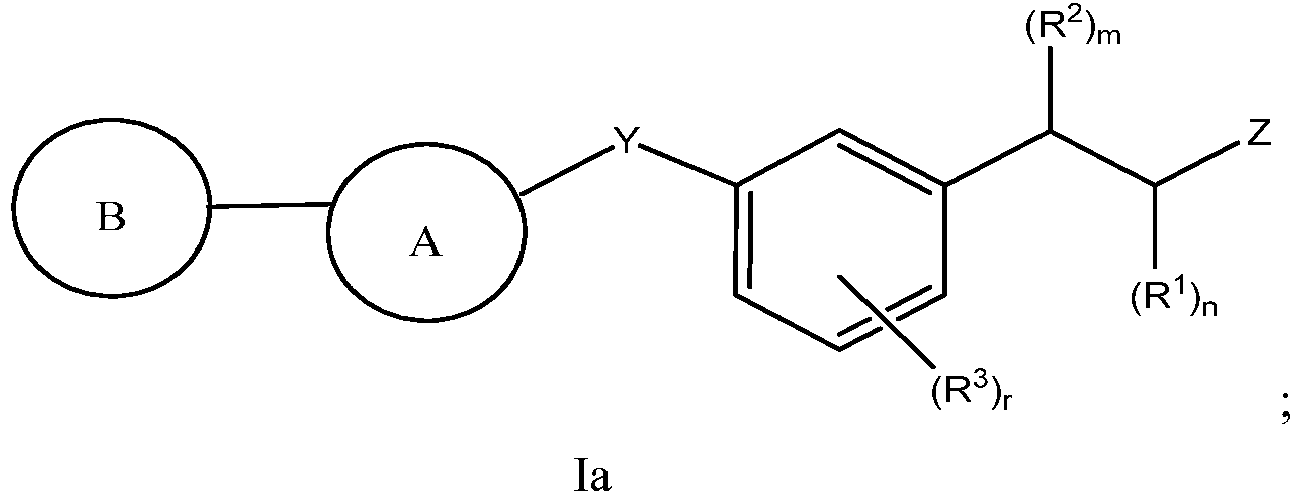
- In another embodiment of the present invention, the invention relates to compounds of structural formula Ib:

- In another embodiment of the present invention, the invention relates to compounds of structural formula Ic:
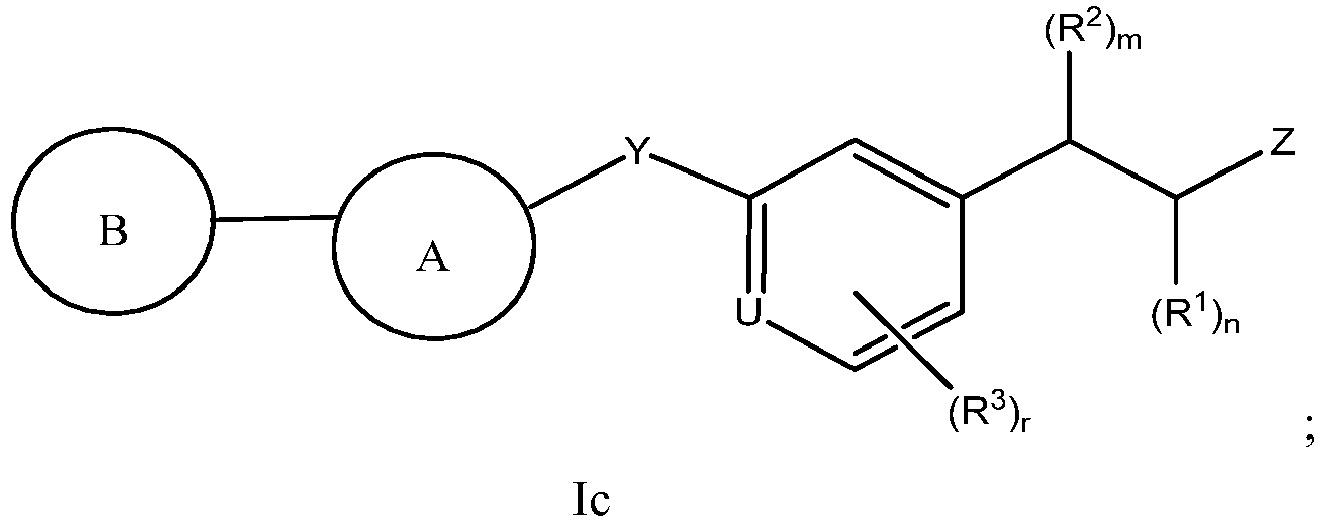
- In another embodiment of the present invention, the invention relates to compounds of structural formula Id:
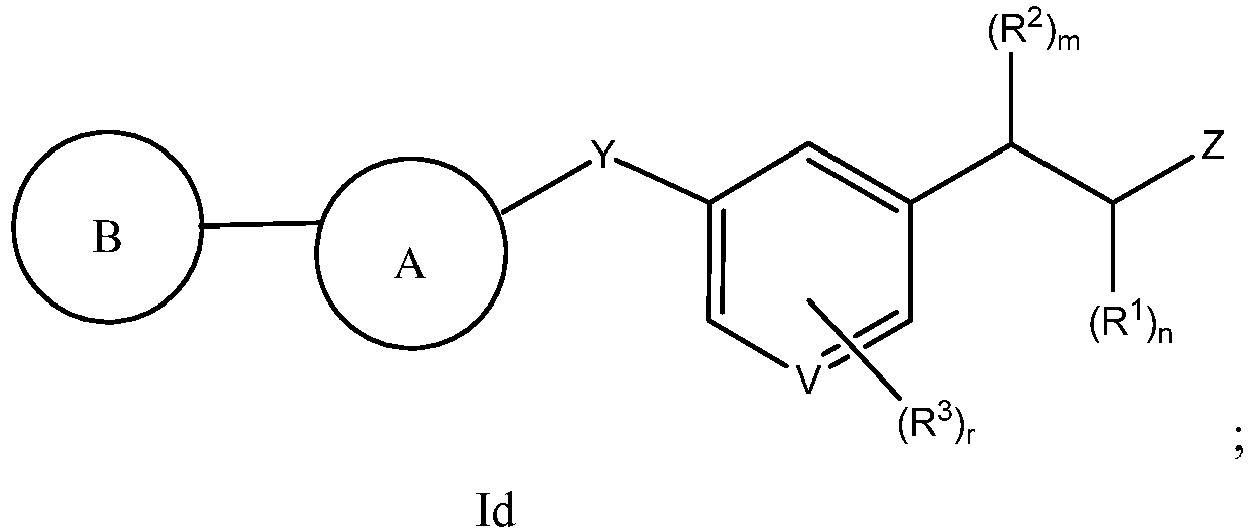
- In another embodiment of the present invention, the invention relates to compounds of structural formula Ie:

- In another embodiment of the present invention, the invention relates to compounds of structural formula If:

- In another embodiment of the present invention, the invention relates to compounds of structural formula Ig:

- In another embodiment of the present invention, the invention relates to compounds of structural formula Ih:

- In another embodiment of the present invention, the invention relates to compounds of structural formula Ii:
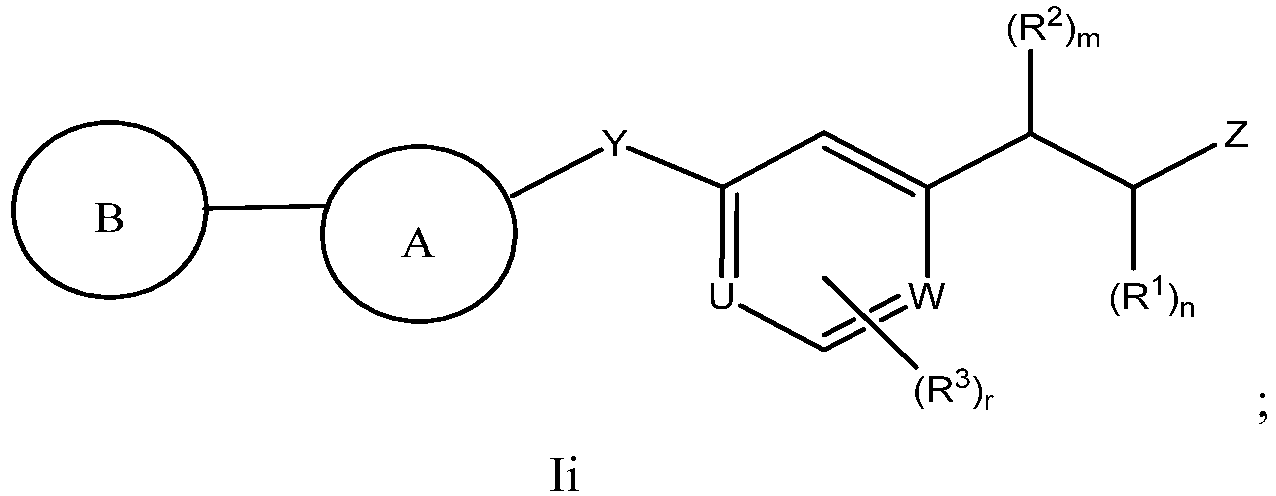
- In another embodiment of the present invention, the invention relates to compounds of structural formula Ij:
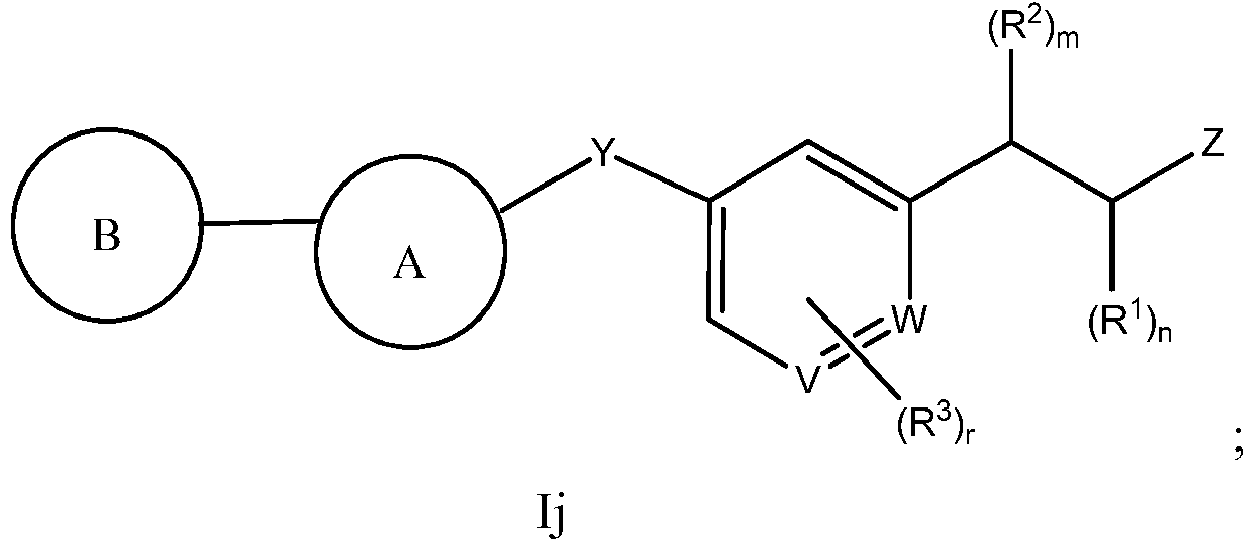
- In one embodiment of the present invention, the compounds of formula I have the absolute stereochemistry at the two stereogenic carbon centers as indicated in the compound of structural formula Ik:

- In one embodiment of the present invention, the compounds of formula I have the absolute stereochemistry at the two stereogenic carbon centers as indicated in the compound of structural formula Il:

- The compound of structural formula I includes the compounds of structural formulas la, Ib, Ic, Id, Ie, If, 1g, Ih, Ii, Ij, Ik and Il, and pharmaceutically acceptable salts, hydrates and solvates thereof.
- Also disclosed are compounds of structural formula I wherein:
- T, U, V and W are CH;
- A is selected from the group consisting of:
- (1) -C3-6cycloalkyl,
- (2) -C3-6cycloalkenyl, and
- (3) -C2-10cycloheteroalkyl,
- B is selected from the group consisting of:
- (1) -(CH2)u-aryl,
- (2) -(CH2)u-heteroaryl,
- (3) -(CH2)u-NRg(CH2)u-aryl,
- (4) -(CH2)u-O-(CH2)u-aryl,
- (5) -(CH2)u-O-(CH2)u-aryl-aryl, and
- (6) -(CH2)u-O-(CH2)u-heteraryl,
- Y is selected from: -O-, -(CH2)xO- and -O-(CH2)x, wherein CH2 is unsubstituted or substituted with one or two substituents selected from Ri;
- Z is selected from the group consisting of:
- (1) -C0-6alkyl -CO2H, and
- (2) -C0-6alkyl-CO2Rj,
- R1 is selected from the group consisting of:
- (1) hydrogen,
- (2) halogen, and
- (3) -C1-6alkyl,
- R2 is selected from the group consisting of:
- (1) hydrogen,
- (2) -C1-6alkyl, and
- (3) -C3-6cycloalkyl,
- R3 is hydrogen;
- In a class of this embodiment, B is selected from the group consisting of; -(CH2)u-aryl,-(CH2)u-heteraryl, -(CH2)u-NRg(CH2)u-aryl, -(CH2)u-O-(CH2)u-aryl, -(CH2)u-O-(CH2)u-aryl-aryl, and -(CH2)u-O-(CH2)u-heteraryl, wherein each -(CH2)u-, aryl and heteroaryl is unsubstituted or substituted with one, two, three, four or five substituents selected from Rb;
- Also disclosed are compounds of structural formula I wherein:
- T, U, V and W are CH;
- A is selected from the group consisting of:
- (1) -C3-6cycloalkyl,
- (2) -C3-6cycloalkenyl, and
- (3) -C2-10cycloheteroalkyl,
- B is selected from the group consisting of:
- (1) -(CH2)u-aryl,
- (2) -(CH2)u-heteroaryl,
- (3) -(CH2)u-NRg(CH2)u-aryl, and
- (4) -(CH2)u-O-(CH2)u-aryl,
- Y is -(CH2)xO-, wherein CH2 is unsubstituted or substituted with one or two substituents selected from Ri;
- Z is selected from the group consisting of:
- (1) -C0-6alkyl -CO2H, and
- (2) -C0-6alkyl-CO2Rj,
- R1 is selected from the group consisting of:
- (1) hydrogen,
- (2) halogen, and
- (3) -C1-6alkyl,
- R2 is selected from the group consisting of:
- (1) hydrogen,
- (2) -C1-6alkyl, and
- (3) -C3-6cycloalkyl,
- R3 is hydrogen;
- Another embodiment of the present invention relates to compounds of structural formula I wherein:
- T, U, V and W are CH;
- A is -C2-10cycloheteroalkyl, wherein each cycloheteroalkyl is unsubstituted or substituted with one, two or three substituents selected from Ra;
- B is selected from the group consisting of:
- (1) -(CH2)u-aryl, and
- (2) -heteroaryl,
- Y is selected from: -O- and -CH2-O-, wherein CH2 is unsubstituted or substituted with one or two substituents selected from C1-6alkyl;
- Z is -CO2H;
- R1 is selected from the group consisting of:
- (1) hydrogen, and
- (2) -C1-6alkyl,
- R3 is hydrogen;
- Illustrative, but non-limiting, examples of the compounds of the present invention that are useful as agonists of G-protein-coupled receptor 40 (GPR40) are the following compounds:
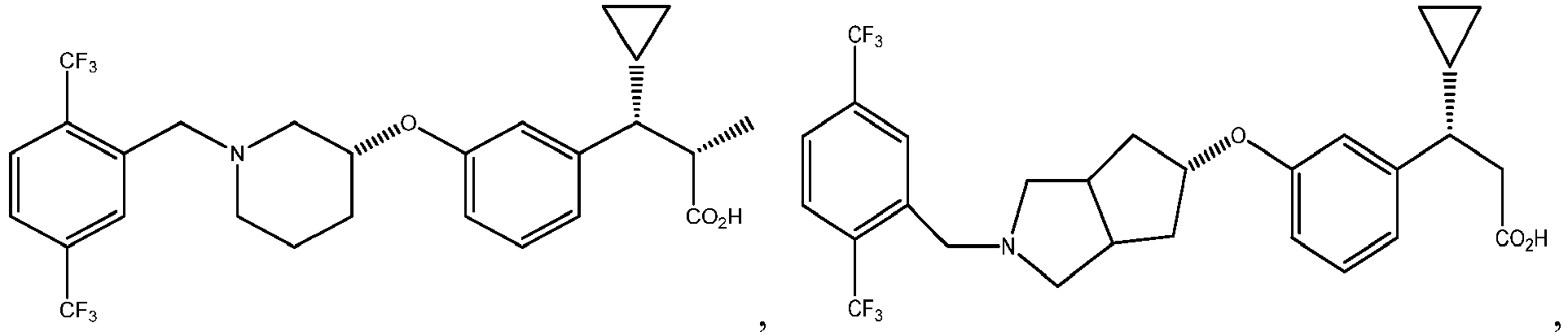

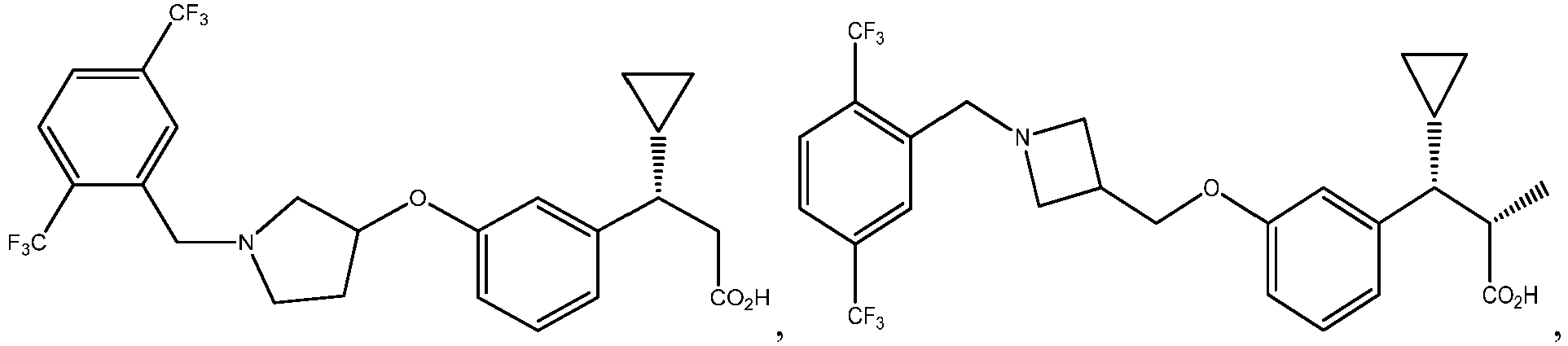
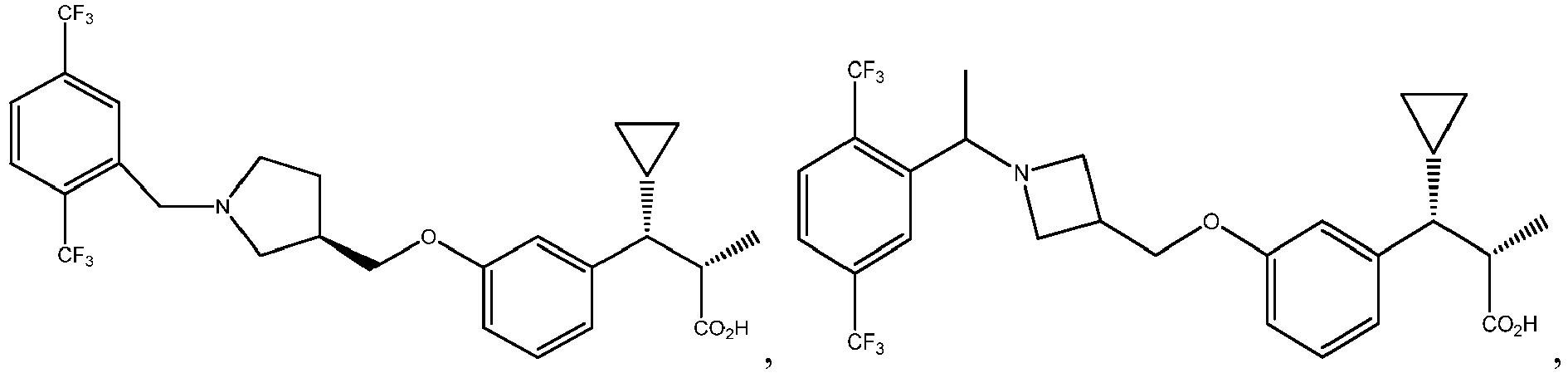

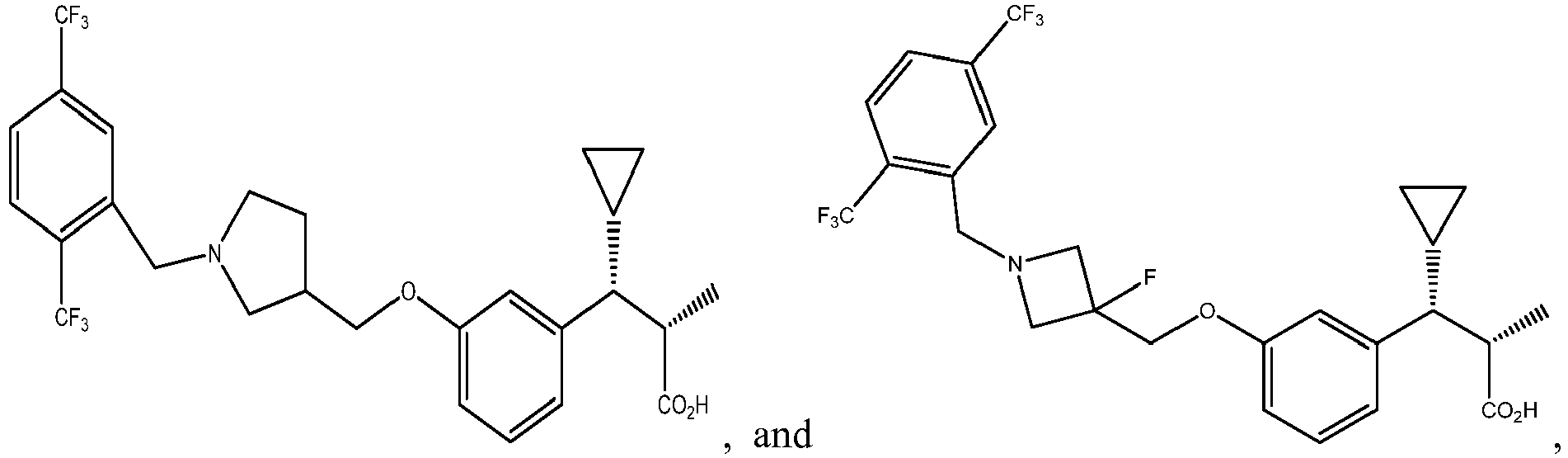
- Although the specific stereochemistries described herein are preferred, other stereoisomers, including diastereoisomers, enantiomers, epimers, and mixtures of these may also have utility in treating GPR40 mediated diseases.
- Synthetic methods for making the compounds are disclosed in the Examples shown below. Where synthetic details are not provided in the examples, the compounds are readily made by a person of ordinary skill in the art of medicinal chemistry or synthetic organic chemistry by applying the synthetic information provided herein. Where a stereochemical center is not defined, the structure represents a mixture of stereoisomers at that center. For such compounds, the individual stereoisomers, including enantiomers, diastereoisomers, and mixtures of these are also compounds of the invention.
-
- "Ac" is acetyl, which is CH3C(=O)-.
- "Oxo" is =O.
- "Alkyl" means saturated carbon chains which may be linear or branched or combinations thereof, unless the carbon chain is defined otherwise. Other groups having the prefix "alk", such as alkoxy and alkanoyl, also may be linear or branched, or combinations thereof, unless the carbon chain is defined otherwise. Examples of alkyl groups include methyl, ethyl, propyl, isopropyl, butyl, sec- and tert-butyl, pentyl, hexyl, heptyl, octyl, nonyl, and the like. In one embodiment of the present invention, alkyl is methyl.
- "Alkenyl" means carbon chains which contain at least one carbon-carbon double bond, and which may be linear or branched, or combinations thereof, unless otherwise defined. Examples of alkenyl include vinyl, allyl, isopropenyl, pentenyl, hexenyl, heptenyl, 1-propenyl, 2-butenyl, 2-methyl-2-butenyl, and the like. In one embodiment of the present invention, alkenyl is 2-methyl-1-propenyl.
- "Alkynyl" means carbon chains which contain at least one carbon-carbon triple bond, and which may be linear or branched, or combinations thereof, unless otherwise defined. Examples of alkynyl include ethynyl, propargyl, 3-methyl-1-pentynyl, 2-heptynyl and the like. In one embodiment, alkynyl is -C2alkyne- CH3.
- "Cycloalkyl" means a saturated monocyclic, bicyclic or bridged carbocyclic ring, having a specified number of carbon atoms. Examples of cycloalkyl include cyclopropyl, cyclobutyl, cyclopentyl, cyclohexyl, cycloheptyl, and the like. In one embodiment of the present invention, cycloalkyl is selected from: cyclopropane, cyclobutane, cyclopentane and cyclohexane. In one embodiment of the present invention, cycloalkyl is selected from: cyclopropane, cyclobutane, and cyclopentane. In another embodiment, cycloalkyl is selected from: cyclopropyl and cyclobutyl. In another embodiment of the present invention, cycloalkyl is cyclopropyl.
- "Cycloalkenyl" means a nonaromatic monocyclic or bicyclic carbocylic ring containing at least one double bond. Examples of cycloalkenyl include cyclopropenyl, cyclobutenyl, cyclopentenyl, cyclohexenyl, cycloheptenyl, cyclooxtenyl and the like. In one embodiment of the present invention, cycloalkenyl is cyclopentenyl.
- "Cycloheteroalkyl" means a saturated or partly unsaturated non-aromatic monocyclic, bicyclic, sprio or bridged carbocyclic ring or ring system containing at least one ring heteroatom selected from N, NH, S (including SO and SO2) and O. The cycloheteroalkyl ring may be substituted on the ring carbons and/or the ring nitrogen(s). Examples of cycloheteroalkyl include tetrahydrofuran, pyrrolidine, tetrahydrothiophene, azetidine, piperazine, piperidine, morpholine, oxetane and tetrahydropyran, hexose, pentose, isosorbide and isomannide, dianhydromannitol, 1, 4:3, 6-dianhydromannitol, 1, 4:3, 6-dianhydro[D]mannitol, hexahydrofuro[3,2-b]furan, and 2,3,3a,5,6,6a-hexahydrofuro[3,2-b]furan. In one embodiment of the present invention, cycloheteroalkyl is pyrrolidine, piperidine, azetidine, morpholine, 3-azaspiro[3.3]heptane, octahydrocyclopenta[c]pyrrole and 6-azaspiro[3,4]octane.
- "Cycloheteroalkenyl" means a nonaromatic monocyclic, bicyclic or bridged carbocyclic ring or ring system containing at least one double bond and containing at least one heteroatom selected from N, NH, S and O.
- "Aryl" means a monocyclic, bicyclic or tricyclic carbocyclic aromatic ring or ring system containing 5-14 carbon atoms, wherein at least one of the rings is aromatic. Aryl includes compounds in which the aromatic ring is fused to a non aromatic ring, including but not limited to, a cycloalkyl, cycloalkenyl, cycloheteroalkyl and cycloheteroalkenyl ring. Examples of aryl include phenyl and naphthyl. Another example of aryl is dihydrobenzofuran. In one embodiment of the present invention, aryl is phenyl. In another embodiment of the present invention, aryl is phenyl, 1-oxo-1,3-dihydro-isobenzofuran, and 2,3-dihydrobenzofuran. In another embodiment of the present invention, aryl is 1-oxo-1,3-dihydroisobenzofuran, and 2,3-dihydrobenzofuran. In another embodiment of the present invention, aryl is 1-oxo-1,3-dihydroisobenzofuran. In another embodiment of the present invention, aryl is 2,3-dihydrobenzofuran. "Heteroaryl" means monocyclic, bicyclic or tricyclic ring or ring system containing 5-14 carbon atoms and containing at least one ring heteroatom selected from N, NH, S (including SO and SO2) and O, wherein at least one of the heteroatom containing rings is aromatic. Examples of heteroaryl include pyrrolyl, indole, isoxazolyl, isothiazolyl, pyrazolyl, pyridyl, oxazolyl, oxadiazolyl, thiadiazolyl, thiazolyl, imidazolyl, triazolyl, tetrazolyl, furanyl, triazinyl, thienyl, pyrimidyl, pyridazinyl, pyrazinyl, benzisoxazolyl, benzoxazolyl, benzothiazolyl, benzimidazolyl, benzofuranyl, benzpyrazole (or indazole), benzothiophenyl (including S-oxide and dioxide), furo(2,3-b)pyridyl, quinolyl, indolyl, isoquinolyl, quinazolinyl, dibenzofuranyl, and the like. In one embodiment of the present invention, heteroaryl is selected from: pyridine, pyrazole, thiazole, thiophene, pyrrole, triazole, indazole and indole. In another embodiment of the present invention, heteroaryl is selected from pyrazole, thiazole, thiophene, pyrrole, triazole, indazole and indole. In another embodiment of the present invention, heteroaryl is pyridine. In another embodiment, heteroaryl is tetrazolyl. In another embodiment of the present invention, heteroaryl is 2,3-dihydro-[1,4]dioxino[2,3-b]pyridine. In another embodiment of the present invention, heteroaryl is pyridine, pyrimidine, pyrazole and 2,3-dihydro-[1,4]dioxino[2,3-b]pyridine. In another embodiment of the present invention, heteroaryl is pyridine, pyrimidine and pyrazole.
- "Halogen" includes fluorine, chlorine, bromine and iodine. In one embodiment of the present invention, halogen is bromine, chlorine or fluorine. In another embodiment of the present invention, halogen is chlorine or fluorine. In another embodiment of the present invention, halogen is bromine. In another embodiment of the present invention, halogen is chlorine. In another embodiment of the present invention, halogen is fluorine.
- "Me" represents methyl.
When any variable (e.g., R1, Ra, etc.) occurs more than one time in any constituent or in formula I, its definition on each occurrence is independent of its definition at every other occurrence. Also, combinations of substituents and/or variables are permissible only if such combinations result in stable compounds. A squiggly line across a bond in a substituent variable represents the point of attachment. - Under standard nomenclature used throughout this disclosure, the terminal portion of the designated side chain is described first, followed by the adjacent functionality toward the point of attachment. For example, a C1-5 alkylcarbonylamino C1-6 alkyl substituent is equivalent to:

- In choosing compounds of the present invention, one of ordinary skill in the art will recognize that the various substituents, i.e. R1, R2, etc., are to be chosen in conformity with well-known principles of chemical structure connectivity and stability.
- The term "substituted" shall be deemed to include multiple degrees of substitution by a named substitutent. Where multiple substituent moieties are disclosed or claimed, the substituted compound can be independently substituted by one or more of the disclosed or claimed substituent moieties, singly or plurally. By independently substituted, it is meant that the (two or more) substituents can be the same or different.
- The phrase "pharmaceutically acceptable" is employed herein to refer to those compounds, materials, compositions, salts and/or dosage forms which are, using sound medical judgment, and following all applicable government regulations, safe and suitable for administration to a human being or an animal.
- The term "% enantiomeric excess" (abbreviated "ee") shall mean the % major enantiomer less the % minor enantiomer. Thus, a 70% enantiomeric excess corresponds to formation of 85% of one enantiomer and 15% of the other. The term "enantiomeric excess" is synonymous with the term "optical purity."
- Compounds of Formula I may contain one or more asymmetric centers and can thus occur as racemates and racemic mixtures, single enantiomers, diastereomeric mixtures and individual diastereomers. The present invention is meant to comprehend all such isomeric forms of the compounds of Formula I.
- Some of the compounds described herein contain olefinic double bonds, and unless specified otherwise, are meant to include both E and Z geometric isomers.
- Tautomers are defined as compounds that undergo rapid proton shifts from one atom of the compound to another atom of the compound. Some of the compounds described herein may exist as tautomers with different points of attachment of hydrogen. Such an example may be a ketone and its enol form known as keto-enol tautomers. The individual tautomers as well as mixture thereof are encompassed with compounds of Formula I.
- In the compounds of general formula I, the atoms may exhibit their natural isotopic abundances, or one or more of the atoms may be artificially enriched in a particular isotope having the same atomic number, but an atomic mass or mass number different from the atomic mass or mass number predominately found in nature. The present invention is meant to include all suitable isotopic variations of the compounds of structural formula I. For example, different isotopic forms of hydrogen (H) include protium (1H), deuterium (2H), and tritium (3H). Protium is the predominant hydrogen isotope found in nature. Enriching for deuterium may afford certain therapeutic advantages, such as increasing in vivo half-life or reducing dosage requirements, or may provide a compound useful as a standard for characterization of biological samples. Tritium is radioactive and may therefore provide for a radiolabeled compound, useful as a tracer in metabolic or kinetic studies. Isotopically-enriched compounds within structural formula I, can be prepared without undue experimentation by conventional techniques well known to those skilled in the art or by processes analogous to those described in the Schemes and Examples herein using appropriate isotopically-enriched reagents and/or intermediates.
- The independent syntheses of optical isomers and diastereoisomers or their chromatographic separations may be achieved as known in the art by appropriate modification of the methodology disclosed herein. Their absolute stereochemistry may be determined by the X-ray crystallography of crystalline products or crystalline intermediates which are derivatized, if necessary, with a reagent containing an asymmetric center of known absolute configuration.
- If desired, racemic mixtures of the compounds may be separated so that the individual enantiomers are isolated. The separation can be carried out by methods well-known in the art, such as the coupling of a racemic mixture of compounds to an enantiomerically pure compound to form a diastereoisomeric mixture, followed by separation of the individual diastereoisomers by standard methods, such as fractional crystallization or chromatography. The coupling reaction is often the formation of salts using an enantiomerically pure acid or base. The diasteromeric derivatives may then be converted to the pure enantiomers by cleavage of the added chiral residue. The racemic mixture of the compounds can also be separated directly by chromatographic methods utilizing chiral stationary phases, which methods are well known in the art.
- Alternatively, any enantiomer of a compound may be obtained by stereoselective synthesis using optically pure starting materials or reagents of known configuration by methods well known in the art.
- Furthermore, some of the crystalline forms for compounds of the present invention may exist as polymorphs and as such are intended to be included in the present invention. In addition, some of the compounds of the instant invention may form solvates with water or common organic solvents. Such solvates are encompassed within the scope of this invention.
- It is generally preferable to administer compounds of the present invention as enantiomerically pure formulations. Racemic mixtures can be separated into their individual enantiomers by any of a number of conventional methods. These include chiral chromatography, derivatization with a chiral auxiliary followed by separation by chromatography or crystallization, and fractional crystallization of diastereomeric salts.
- It will be understood that, as used herein, references to the compounds of the present invention are meant to also include the pharmaceutically acceptable salts, and also salts that are not pharmaceutically acceptable when they are used as precursors to the free compounds or their pharmaceutically acceptable salts or in other synthetic manipulations.
- The compounds of the present invention may be administered in the form of a pharmaceutically acceptable salt. The term "pharmaceutically acceptable salt" refers to salts prepared from pharmaceutically acceptable non-toxic bases or acids including inorganic or organic bases and inorganic or organic acids. Salts of basic compounds encompassed within the term "pharmaceutically acceptable salt" refer to non-toxic salts of the compounds of this invention which are generally prepared by reacting the free base with a suitable organic or inorganic acid. Representative salts of basic compounds of the present invention include, but are not limited to, the following: acetate, benzenesulfonate, benzoate, bicarbonate, bisulfate, bitartrate, borate, bromide, camsylate, carbonate, chloride, clavulanate, citrate, dihydrochloride, edetate, edisylate, estolate, esylate, fumarate, gluceptate, gluconate, glutamate, glycollylarsanilate, hexylresorcinate, hydrabamine, hydrobromide, hydrochloride, hydroxynaphthoate, iodide, isothionate, lactate, lactobionate, laurate, malate, maleate, mandelate, mesylate, methylbromide, methylnitrate, methylsulfate, mucate, napsylate, nitrate, N-methylglucamine ammonium salt, oleate, oxalate, pamoate (embonate), palmitate, pantothenate, phosphate/diphosphate, polygalacturonate, salicylate, stearate, sulfate, subacetate, succinate, tannate, tartrate, teoclate, tosylate, triethiodide and valerate. Furthermore, where the compounds of the invention carry an acidic moiety, suitable pharmaceutically acceptable salts thereof include, but are not limited to, salts derived from inorganic bases including aluminum, ammonium, calcium, copper, ferric, ferrous, lithium, magnesium, manganic, mangamous, potassium, sodium, zinc, and the like. Particularly preferred are the ammonium, calcium, magnesium, potassium, and sodium salts. Salts derived from pharmaceutically acceptable organic non-toxic bases include salts of primary, secondary, and tertiary amines, cyclic amines, and basic ion-exchange resins, such as arginine, betaine, caffeine, choline, N,N-dibenzylethylenediamine, diethylamine, 2-diethylaminoethanol, 2-dimethylaminoethanol, ethanolamine, ethylenediamine, N-ethylmorpholine, N-ethylpiperidine, glucamine, glucosamine, histidine, hydrabamine, isopropylamine, lysine, methylglucamine, morpholine, piperazine, piperidine, polyamine resins, procaine, purines, theobromine, triethylamine, trimethylamine, tripropylamine, tromethamine, and the like.
- Also, in the case of a carboxylic acid (-COOH) or alcohol group being present in the compounds of the present invention, pharmaceutically acceptable esters of carboxylic acid derivatives, such as methyl, ethyl, or pivaloyloxymethyl, or acyl derivatives of alcohols, such as O-acetyl, O-pivaloyl, O-benzoyl, and O-aminoacyl, can be employed. Included are those esters and acyl groups known in the art for modifying the solubility or hydrolysis characteristics for use as sustained-release or prodrug formulations.
- Solvates, and in particular, the hydrates of the compounds of the present invention are included in the present invention as well.
- The compounds of the present invention are potent agonists of the GPR40 receptor. The compounds, and pharmaceutically acceptable salts thereof, may be efficacious in the treatment of diseases that are modulated by GPR40 ligands, which are generally agonists. Many of these diseases are summarized below.
- One or more of these diseases may be treated by the administration of a therapeutically effective amount of a compound of the present invention, or a pharmaceutically acceptable salt thereof, to a patient in need of treatment. Also, the compounds of the present invention may be used for the manufacture of a medicament which may be useful for treating one or more of these diseases:
- (1) non-insulin dependent diabetes mellitus (Type 2 diabetes);
- (2) hyperglycemia;
- (3) insulin resistance;
- (4) Metabolic Syndrome;
- (5) obesity;
- (6) hypercholesterolemia;
- (7) hypertriglyceridemia (elevated levels of triglyceride-rich-lipoproteins);
- (8) mixed or diabetic dyslipidemia;
- (9) low HDL cholesterol;
- (10) high LDL cholesterol;
- (11) hyper apo-B liproteinemia; and
- (12) atherosclerosis.
- Preferred uses of the compounds may be for the treatment of one or more of the following diseases by administering a therapeutically effective amount to a patient in need of treatment. The compounds may be used for manufacturing a medicament for the treatment of one or more of these diseases:
- (1) Type 2 diabetes, and specifically hyperglycemia associated with Type 2 diabetes;
- (2) Metabolic Syndrome;
- (3) obesity; and
- (4) hypercholesterolemia.
- The compounds may be effective in lowering glucose and lipids in diabetic patients and in non-diabetic patients who have impaired glucose tolerance and/or are in a pre-diabetic condition. The compounds may ameliorate hyperinsulinemia, which often occurs in diabetic or pre-diabetic patients, by modulating the swings in the level of serum glucose that often occurs in these patients. The compounds may also be effective in treating or reducing insulin resistance. The compounds may be effective in treating or preventing gestational diabetes.
- The compounds may also be effective in treating or preventing lipid disorders. The compounds may be effective in treating or preventing diabetes related disorders. The compounds may also be effective in treating or preventing obesity related disorders.
- The compounds of this invention may also have utility in improving or restoring β-cell function, so that they may be useful in treating Type 1 diabetes or in delaying or preventing a patient with Type 2 diabetes from needing insulin therapy.
- The invention also includes pharmaceutically acceptable salts of the compounds, and pharmaceutical compositions comprising the compounds and a pharmaceutically acceptable carrier. The compounds may be useful in treating insulin resistance, Type 2 diabetes, hypperglycemia, and dyslipidemia that is associated with Type 2 diabetes and insulin resistance. The compounds may also be useful for the treatment of obesity
- A compound of the present invention, or a pharmaceutically acceptable salt thereof, may be used in the manufacture of a medicament for the treatment of Type 2 diabetes in a human or other mammalian patient.
- A method of treating Type 2 diabetes comprises the administration of a therapeutically effective amount of a compound of the present invention, or a pharmaceutically acceptable salt thereof, or a pharmaceutical composition comprising the compound, to a human or other mammalian subject or patient in need of treatment. Other medical uses of the compounds of the present invention are described herein.
- The term "diabetes," as used herein, includes both insulin-dependent diabetes mellitus (i.e., IDDM, also known as type 1 diabetes) and non-insulin-dependent diabetes mellitus (i.e., NIDDM, also known as Type 2 diabetes). Type 1 diabetes, or insulin-dependent diabetes, is the result of an absolute deficiency of insulin, the hormone which regulates glucose utilization. Type 2 diabetes, or insulin-independent diabetes (i.e., non-insulin-dependent diabetes mellitus), often occurs in the face of normal, or even elevated levels of insulin and appears to be the result of the inability of tissues to respond appropriately to insulin. Most of the Type 2 diabetics are also obese. The compositions of the present invention may be useful for treating both Type 1 and Type 2 diabetes. The term "diabetes associated with obesity" refers to diabetes caused by obesity or resulting from obesity.
- Diabetes is characterized by a fasting plasma glucose level of greater than or equal to 126 mg/dl. A diabetic subject has a fasting plasma glucose level of greater than or equal to 126 mg/dl. A pre diabetic subject is someone suffering from prediabetes. Prediabetes is characterized by an impaired fasting plasma glucose (FPG) level of greater than or equal to 110 mg/dl and less than 126 mg/dl; or impaired glucose tolerance; or insulin resistance. A prediabetic subject is a subject with impaired fasting glucose (a fasting plasma glucose (FPG) level of greater than or equal to 110 mg/dl and less than 126 mg/dl); or impaired glucose tolerance (a 2 hour plasma glucose level of ≥140 mg/dl and <200 mg/dl); or insulin resistance, resulting in an increased risk of developing diabetes.
- Treatment of diabetes mellitus refers to the administration of a compound or combination of the present invention to treat a diabetic subject. One outcome of treatment may be decreasing the glucose level in a subject with elevated glucose levels. Another outcome of treatment may be decreasing insulin levels in a subject with elevated insulin levels. Another outcome of treatment may be decreasing plasma triglycerides in a subject with elevated plasma triglycerides. Another outcome of treatment is decreasing LDL cholesterol in a subject with high LDL cholesterol levels. Another outcome of treatment may be increasing HDL cholesterol in a subject with low HDL cholesterol levels. Another outcome of treatment is increasing insulin sensivity. Another outcome of treatment may be enhancing glucose tolerance in a subject with glucose intolerance. Yet another outcome of treatment may be decreasing insulin resistance in a subject with increased insulin resistance or elevated levels of insulin. Prevention of diabetes mellitus, in particular diabetes associated with obesity, refers to the administration of a compound or combination of the present invention to prevent the onset of diabetes in a subject in need thereof. A subject in need of preventing diabetes is a prediabetic subject that is overweight or obese.
- The term "diabetes related disorders" should be understood to mean disorders that are associated with, caused by, or result from diabetes. Examples of diabetes related disorders include retinal damage, kidney disease, and nerve damage.
- The term "atherosclerosis" as used herein encompasses vascular diseases and conditions that are recognized and understood by physicians practicing in the relevant fields of medicine. Atherosclerotic cardiovascular disease, coronary heart disease (also known as coronary artery disease or ischemic heart disease), cerebrovascular disease and peripheral vessel disease are all clinical manifestations of atherosclerosis and are therefore encompassed by the terms "atherosclerosis" and "atherosclerotic disease." The combination comprised of a therapeutically effective amount of an anti-obesity agent in combination with a therapeutically effective amount of an anti-hypertensive agent may be administered to prevent or reduce the risk of occurrence, or recurrence where the potential exists, of a coronary heart disease event, a cerebrovascular event, or intermittent claudication. Coronary heart disease events are intended to include CHD death, myocardial infarction (i.e., a heart attack), and coronary revascularization procedures. Cerebrovascular events are intended to include ischemic or hemorrhagic stroke (also known as cerebrovascular accidents) and transient ischemic attacks. Intermittent claudication is a clinical manifestation of peripheral vessel disease. The term "atherosclerotic disease event" as used herein is intended to encompass coronary heart disease events, cerebrovascular events, and intermittent claudication. It is intended that persons who have previously experienced one or more non-fatal atherosclerotic disease events are those for whom the potential for recurrence of such an event exists. The term "atherosclerosis related disorders" should be understood to mean disorders associated with, caused by, or resulting from atherosclerosis.
- The term "hypertension" as used herein includes essential, or primary, hypertension wherein the cause is not known or where hypertension is due to greater than one cause, such as changes in both the heart and blood vessels; and secondary hypertension wherein the cause is known. Causes of secondary hypertension include, but are not limited to obesity; kidney disease; hormonal disorders; use of certain drugs, such as oral contraceptives, corticosteroids, cyclosporin, and the like. The term "hypertension" encompasses high blood pressure, in which both the systolic and diastolic pressure levels are elevated (≥140 mmHg/≥90 mmHg), and isolated systolic hypertension, in which only the systolic pressure is elevated to greater than or equal to 140 mm Hg, while the diastolic pressure is less than 90 mm Hg. Normal blood pressure may be defined as less than 120 mmHg systolic and less than 80 mmHg diastolic. A hypertensive subject is a subject with hypertension. A pre-hypertensive subject is a subject with a blood pressure that is between 120 mmHg over 80 mmHg and 139 mmHg over 89 mmHg. One outcome of treatment is decreasing blood pressure in a subject with high blood pressure. Treatment of hypertension refers to the administration of the compounds and combinations of the present invention to treat hypertension in a hypertensive subject. Treatment of hypertension-related disorder refers to the administration of a compound or combination of the present invention to treat the hypertension-related disorder. Prevention of hypertension, or a hypertension related disorder, refers to the administration of the combinations of the present invention to a pre-hypertensive subject to prevent the onset of hypertension or a hypertension related disorder. The hypertension-related disorders herein are associated with, caused by, or result from hypertension. Examples of hypertension-related disorders include, but are not limited to: heart disease, heart failure, heart attack, kidney failure, and stroke.
- Dyslipidemias and lipid disorders are disorders of lipid metabolism including various conditions characterized by abnormal concentrations of one or more lipids (i.e. cholesterol and triglycerides), and/or apolipoproteins (i.e., apolipoproteins A, B, C and E), and/or lipoproteins (i.e., the macromolecular complexes formed by the lipid and the apolipoprotein that allow lipids to circulate in blood, such as LDL, VLDL and IDL). Hyperlipidemia is associated with abnormally high levels of lipids, LDL and VLDL cholesterol, and/or triglycerides. Treatment of dyslipidemia refers to the administration of the combinations of the present invention to a dyslipidemic subject. Prevention of dyslipidemia refers to the administration of the combinations of the present invention to a pre-dyslipidemic subject. A pre-dyslipidemic subject is a subject with higher than normal lipid levels, that is not yet dyslipidemic.
- The terms "dyslipidemia related disorders" and "lipid disorder related disorders" should be understood to mean disorders associated with, caused by, or resulting from dyslipidemia or lipid disorders. Examples of dylipidemia related disorder and lipid disorder related disorders include, but are not limited to: hyperlipidemia, hypertriglyceridemia, hypercholesterolemia, low high density lipoprotein (HDL) levels, high plasma low density lipoprotein (LDL) levels, atherosclerosis and its sequelae, coronary artery or carotid artery disease, heart attack, and stroke.
- The term "obesity" as used herein is a condition in which there is an excess of body fat. The operational definition of obesity is based on the Body Mass Index (BMI), which is calculated as body weight per height in meters squared (kg/m2). "Obesity" refers to a condition whereby an otherwise healthy subject has a Body Mass Index (BMI) greater than or equal to 30 kg/m2, or a condition whereby a subject with at least one co-morbidity has a BMI greater than or equal to 27 kg/m2. An "obese subject" is an otherwise healthy subject with a Body Mass Index (BMI) greater than or equal to 30 kg/m2 or a subject with at least one co-morbidity with a BMI greater than or equal to 27 kg/m2. An overweight subject is a subject at risk of obesity. A "subject at risk of obesity" is an otherwise healthy subject with a BMI of 25 kg/m2 to less than 30 kg/m2 or a subject with at least one co-morbidity with a BMI of 25 kg/m2 to less than 27 kg/m2.
- The increased risks associated with obesity occur at a lower Body Mass Index (BMI) in Asians. In Asian countries, including Japan, "obesity" refers to a condition whereby a subject with at least one obesity-induced or obesity-related co-morbidity, that requires weight reduction or that would be improved by weight reduction, has a BMI greater than or equal to 25 kg/m2. In Asian countries, including Japan, an "obese subject" refers to a subject with at least one obesity-induced or obesity-related co-morbidity that requires weight reduction or that would be improved by weight reduction, with a BMI greater than or equal to 25 kg/m2. In Asia-Pacific, a "subject at risk of obesity" is a subject with a BMI of greater than 23 kg/m2 to less than 25 kg/m2.
- As used herein, the term "obesity" is meant to encompass all of the above definitions of obesity.
- Obesity-induced or obesity-related co-morbidities include, but are not limited to, diabetes mellitus, non-insulin dependent diabetes mellitus - type 2, diabetes associated with obesity, impaired glucose tolerance, impaired fasting glucose, insulin resistance syndrome, dyslipidemia, hypertension, hypertension associated with obesity, hyperuricacidemia, gout, coronary artery disease, myocardial infarction, angina pectoris, sleep apnea syndrome, Pickwickian syndrome, fatty liver; cerebral infarction, cerebral thrombosis, transient ischemic attack, orthopedic disorders, arthritis deformans, lumbodynia, emmeniopathy, and infertility. In particular, co-morbidities include: hypertension, hyperlipidemia, dyslipidemia, glucose intolerance, cardiovascular disease, sleep apnea, and other obesity-related conditions.
- Treatment of obesity and obesity-related disorders refers to the administration of the compounds of the present invention to reduce or maintain the body weight of an obese subject. One outcome of treatment may be reducing the body weight of an obese subject relative to that subject's body weight immediately before the administration of the compounds of the present invention. Another outcome of treatment may be preventing body weight regain of body weight previously lost as a result of diet, exercise, or pharmacotherapy. Another outcome of treatment may be decreasing the occurrence of and/or the severity of obesity-related diseases. The treatment may suitably result in a reduction in food or calorie intake by the subject, including a reduction in total food intake, or a reduction of intake of specific components of the diet such as carbohydrates or fats; and/or the inhibition of nutrient absorption; and/or the inhibition of the reduction of metabolic rate; and in weight reduction in patients in need thereof. The treatment may also result in an alteration of metabolic rate, such as an increase in metabolic rate, rather than or in addition to an inhibition of the reduction of metabolic rate; and/or in minimization of the metabolic resistance that normally results from weight loss.
- Prevention of obesity and obesity-related disorders refers to the administration of the compounds of the present invention to reduce or maintain the body weight of a subject at risk of obesity. One outcome of prevention may be reducing the body weight of a subject at risk of obesity relative to that subject's body weight immediately before the administration of the compounds of the present invention. Another outcome of prevention may be preventing body weight regain of body weight previously lost as a result of diet, exercise, or pharmacotherapy. Another outcome of prevention may be preventing obesity from occurring if the treatment is administered prior to the onset of obesity in a subject at risk of obesity. Another outcome of prevention may be decreasing the occurrence and/or severity of obesity-related disorders if the treatment is administered prior to the onset of obesity in a subject at risk of obesity. Moreover, if treatment is commenced in already obese subjects, such treatment may prevent the occurrence, progression or severity of obesity-related disorders, such as, but not limited to, arteriosclerosis, Type II diabetes, polycystic ovarian disease, cardiovascular diseases, osteoarthritis, dermatological disorders, hypertension, insulin resistance, hypercholesterolemia, hypertriglyceridemia, and cholelithiasis.
- The obesity-related disorders herein are associated with, caused by, or result from obesity. Examples of obesity-related disorders include overeating and bulimia, hypertension, diabetes, elevated plasma insulin concentrations and insulin resistance, dyslipidemias, hyperlipidemia, endometrial, breast, prostate and colon cancer, osteoarthritis, obstructive sleep apnea, cholelithiasis, gallstones, heart disease, abnormal heart rhythms and arrythmias, myocardial infarction, congestive heart failure, coronary heart disease, sudden death, stroke, polycystic ovarian disease, craniopharyngioma, the Prader-Willi Syndrome, Frohlich's syndrome, GH-deficient subjects, normal variant short stature, Turner's syndrome, and other pathological conditions showing reduced metabolic activity or a decrease in resting energy expenditure as a percentage of total fat-free mass, e.g, children with acute lymphoblastic leukemia. Further examples of obesity-related disorders are metabolic syndrome, also known as syndrome X, insulin resistance syndrome, sexual and reproductive dysfunction, such as infertility, hypogonadism in males and hirsutism in females, gastrointestinal motility disorders, such as obesity-related gastro-esophageal reflux, respiratory disorders, such as obesity-hypoventilation syndrome (Pickwickian syndrome), cardiovascular disorders, inflammation, such as systemic inflammation of the vasculature, arteriosclerosis, hypercholesterolemia, hyperuricaemia, lower back pain, gallbladder disease, gout, and kidney cancer. The compounds of the present invention are also useful for reducing the risk of secondary outcomes of obesity, such as reducing the risk of left ventricular hypertrophy.
- The term "metabolic syndrome", also known as syndrome X, is defined in the Third Report of the National Cholesterol Education Program Expert Panel on Detection, Evaluation and Treatment of High Blood Cholesterol in Adults (Adult Treatment Panel III, or ATP III), National Institutes of Health, 2001, NIH Publication No. 01-3670. E.S. Ford et al., JAMA, vol. 287 (3), Jan. 16, 2002, pp 356-359. Briefly, a person is defined as having metabolic syndrome if the person has three or more of the following disorders: abdominal obesity, hypertriglyceridemia, low HDL cholesterol, high blood pressure, and high fasting plasma glucose. The criteria for these are defined in ATP-III. Treatment of metabolic syndrome refers to the administration of the combinations of the present invention to a subject with metabolic syndrome. Prevention of metabolic syndrome refers to the administration of the combinations of the present invention to a subject with two of the disorders that define metabolic syndrome. A subject with two of the disorders that define metabolic syndrome is a subject that has developed two of the disorders that define metabolic syndrome, but has not yet developed three or more of the disorders that define metabolic syndrome.
- The terms "administration of' and or "administering a" compound should be understood to mean providing a compound of the invention or a prodrug of a compound of the invention to a human or mammal in need of treatment.
- The administration of the compound of structural formula I in order to practice the present methods of therapy is carried out by administering an effective amount of the compound of structural formula I to the mammal in need of such treatment or prophylaxis. The need for a prophylactic administration according to the methods of the present invention is determined via the use of well known risk factors. The effective amount of an individual compound is determined, in the final analysis, by the physician or veterinarian in charge of the case, but depends on factors such as the exact disease to be treated, the severity of the disease and other diseases or conditions from which the patient suffers, the chosen route of administration other drugs and treatments which the patient may concomitantly require, and other factors in the physician's judgment.
- The usefulness of the present compounds in these diseases or disorders may be demonstrated in animal disease models that have been reported in the literature.
- Any suitable route of administration may be employed for providing a mammal, especially a human, with an effective dose of a compound of the present invention. For example, oral, rectal, topical, parenteral, ocular, pulmonary, nasal, and the like may be employed. Dosage forms include tablets, troches, dispersions, suspensions, solutions, capsules, creams, ointments, aerosols, and the like. Preferably compounds of the present invention are administered orally.
- In the treatment or prevention of conditions which require agonism of GPR40 receptor activity, an appropriate dosage level will generally be about 0.01 to 500 mg per kg patient body weight per day which can be administered in single or multiple doses. Preferably, the dosage level will be about 0.1 to about 250 mg/kg per day; more preferably about 0.5 to about 100 mg/kg per day. A suitable dosage level may be about 0.01 to 250 mg/kg per day, about 0.05 to 100 mg/kg per day, or about 0.1 to 50 mg/kg per day. Within this range the dosage may be 0.05 to 0.5, 0.5 to 5 or 5 to 50 mg/kg per day. For oral administration, the compositions are preferably provided in the form of tablets containing 1.0 to 1000 mg of the active ingredient, particularly 1.0, 5.0, 10.0, 15.0. 20.0, 25.0, 50.0, 75.0, 100.0, 150.0, 200.0, 250.0, 300.0, 400.0, 500.0, 600.0, 750.0, 800.0, 900.0, and 1000.0 mg of the active ingredient for the symptomatic adjustment of the dosage to the patient to be treated. The compounds may be administered on a regimen of 1 to 4 times per day, preferably once or twice per day.
- When treating or preventing diabetes mellitus and/or hyperglycemia or hypertriglyceridemia or other diseases for which compounds of the present invention are indicated, generally satisfactory results are obtained when the compounds of the present invention are administered at a daily dosage of from about 0.1 mg to about 100 mg per kilogram of animal body weight, preferably given as a single daily dose or in divided doses two to six times a day, or in sustained release form. For most large mammals, the total daily dosage is from about 1.0 mg to about 1000 mg, preferably from about 1 mg to about 50 mg. In the case of a 70 kg adult human, the total daily dose will generally be from about 7 mg to about 350 mg. This dosage regimen may be adjusted to provide the optimal therapeutic response.
- It will be understood, however, that the specific dose level and frequency of dosage for any particular patient may be varied and will depend upon a variety of factors including the activity of the specific compound employed, the metabolic stability and length of action of that compound, the age, body weight, general health, sex, diet, mode and time of administration, rate of excretion, drug combination, the severity of the particular condition, and the host undergoing therapy.
- The compounds of this invention may be used in pharmaceutical compositions comprising (a) the compound(s) or pharmaceutically acceptable salts thereof, and (b) a pharmaceutically acceptable carrier. The compounds of this invention may be used in pharmaceutical compositions that include one or more other active pharmaceutical ingredients. The compounds of this invention may also be used in pharmaceutical compositions in which the compound of the present invention or a pharmaceutically acceptable salt thereof is the only active ingredient.
- The term "composition," as in pharmaceutical composition, is intended to encompass a product comprising the active ingredient(s), and the inert ingredient(s) that make up the carrier, as well as any product which results, directly or indirectly, from combination, complexation or aggregation of any two or more of the ingredients, or from dissociation of one or more of the ingredients, or from other types of reactions or interactions of one or more of the ingredients. Accordingly, the pharmaceutical compositions of the present invention encompass any composition made by admixing a compound of the present invention and a pharmaceutically acceptable carrier.
- Compounds of the present invention may be used in combination with other drugs that may also be useful in the treatment or amelioration of the diseases or conditions for which compounds of the present invention are useful. Such other drugs may be administered, by a route and in an amount commonly used therefor, contemporaneously or sequentially with a compound of the present invention. In the treatment of patients who have Type 2 diabetes, insulin resistance, obesity, metabolic syndrome, and co-morbidities that accompany these diseases, more than one drug is commonly administered. The compounds of this invention may generally be administered to a patient who is already taking one or more other drugs for these conditions. Often the compounds will be administered to a patient who is already being treated with one or more antidiabetic compound, such as metformin, sulfonylureas, and/or PPARγ agonists, when the patient's glycemic levels are not adequately responding to treatment.
- When a compound of the present invention is used contemporaneously with one or more other drugs, a pharmaceutical composition in unit dosage form containing such other drugs and the compound of the present invention is preferred. However, the combination therapy also includes therapies in which the compound of the present invention and one or more other drugs are administered on different overlapping schedules. It is also contemplated that when used in combination with one or more other active ingredients, the compound of the present invention and the other active ingredients may be used in lower doses than when each is used singly. Accordingly, the pharmaceutical compositions of the present invention include those that contain one or more other active ingredients, in addition to a compound of the present invention.
- Examples of other active ingredients that may be administered separately or in the same pharmaceutical composition in combination with a compound of the formulas described herein include, but are not limited to:
- (1) dipeptidyl peptidase-IV (DPP-4) inhibitors (e.g., sitagliptin, alogliptin, linagliptin, vildagliptin, saxagliptin, teneligliptin, omarigliptin);
- (2) insulin sensitizers, including (i) PPARγ agonists, such as the glitazones (e.g. pioglitazone, AMG 131, MBX2044, mitoglitazone, lobeglitazone, IDR-105, rosiglitazone, and balaglitazone), and other PPAR ligands, including (1) PPARα/γ dual agonists (e.g., ZYH2, ZYH1, GFT505, chiglitazar, muraglitazar, aleglitazar, sodelglitazar, and naveglitazar); (2) PPARα agonists such as fenofibric acid derivatives (e.g., gemfibrozil, clofibrate, ciprofibrate, fenofibrate, bezafibrate), (3) selective PPARγ modulators (SPPARyM's), (e.g., such as those disclosed in
WO 02/060388 WO 02/08188 WO 2004/019869 ,WO 2004/020409 ,WO 2004/020408 , andWO 2004/066963 ); and (4) PPARγ partial agonists; (ii) biguanides, such as metformin and its pharmaceutically acceptable salts, in particular, metformin hydrochloride, and extended-release formulations thereof, such as Glumetza™, Fortamet™, and GlucophageXR™; and (iii) protein tyrosine phosphatase-1B (PTP-1B) inhibitors (e.g., ISIS-113715 and TTP814); - (3) insulin or insulin analogs (e.g., insulin detemir, insulin glulisine, insulin degludec, insulin glargine, insulin lispro, SBS1000 and oral and inhalable formulations of insulin and insulin analogs);
- (4) leptin and leptin derivatives and agonists;
- (5) amylin and amylin analogs (e.g., pramlintide);
- (6) sulfonylurea and non-sulfonylurea insulin secretagogues (e.g., tolbutamide, glyburide, glipizide, glimepiride, mitiglinide, meglitinides, nateglinide and repaglinide);
- (7) α-glucosidase inhibitors (e.g., acarbose, voglibose and miglitol);
- (8) glucagon receptor antagonists (e.g., NOXG15, LY2409021);
- (9) incretin mimetics, such as GLP-1, GLP-1 analogs, derivatives, and mimetics; and GLP-1 receptor agonists (e.g., dulaglutide, semaglutide, albiglutide, exenatide, liraglutide, lixisenatide, taspoglutide, GSK2374697, ADX72231, RG7685, NN9924, ZYOG1, CJC-1131, and BIM-51077, including intranasal, transdermal, and once-weekly formulations thereof), and oxyntomodulin and oxyntomodulin analogs and derivatives;
- (10) LDL cholesterol lowering agents such as (i) HMG-CoA reductase inhibitors (e.g., simvastatin, lovastatin, pravastatin, crivastatin, fluvastatin, atorvastatin, pitavastatin and rosuvastatin), (ii) bile acid sequestering agents (e.g., colestilan, colestimide, colesevalam hydrochloride, colestipol, cholestyramine, and dialkylaminoalkyl derivatives of a cross-linked dextran), (iii) inhibitors of cholesterol absorption, (e.g., ezetimibe), and (iv) acyl CoA:cholesterol acyltransferase inhibitors, (e.g., avasimibe);
- (11) HDL-raising drugs, (e.g., niacin and nicotinic acid receptor agonists, and extended-release versions thereof;
- (12) antiobesity compounds;
- (13) agents intended for use in inflammatory conditions, such as aspirin, non-steroidal anti-inflammatory drugs or NSAIDs, glucocorticoids, and selective cyclooxygenase-2 or COX-2 inhibitors;
- (14) antihypertensive agents, such as ACE inhibitors (e.g.,lisinopril, enalapril, ramipril, captopril, quinapril, and tandolapril), A-II receptor blockers (e.g., losartan, candesartan, irbesartan, olmesartan medoxomil, valsartan, telmisartan, and eprosartan), renin inhibitors (e.g., aliskiren), beta blockers, and calcium channel blockers;
- (15) glucokinase activators (GKAs) (e.g., AZD6370);
- (16) inhibitors of 11β-hydroxysteroid dehydrogenase type 1, (e.g., such as those disclosed in
U.S. Patent No. 6,730,690 , and LY-2523199); - (17) CETP inhibitors (e.g., anacetrapib, evacetrapib and torcetrapib);
- (18) inhibitors of fructose 1,6-bisphosphatase, (e.g., such as those disclosed in
U.S. Patent Nos. 6,054,587 ;6,110,903 ;6,284,748 ;6,399,782 ; and6,489,476 ); - (19) inhibitors of acetyl CoA carboxylase-1 or 2 (ACC1 or ACC2);
- (20) AMP-activated Protein Kinase (AMPK) activators, such as MB1055, ETC 1002;
- (21) other agonists of the G-protein-coupled receptors: (i) GPR-109, (ii) GPR-119 (e.g., MBX2982, APD597, GSK1292263, HM47000, and PSN821), and (iii) GPR-40 (e.g., TAK875, MR 1704, TUG 469, TUG499, ASP 4178);
- (22) SSTR3 antagonists (e.g., such as those disclosed in
WO 2009/001836 ); - (23) neuromedin U receptor agonists (e.g., such as those disclosed in
WO 2009/042053 , including, but not limited to, neuromedin S (NMS)); - (24) SCD inhibitors;
- (25) GPR-105 antagonists (e.g., such as those disclosed in
WO 2009/000087 ); - (26) SGLT inhibitors (e.g., ASP1941, SGLT-3, empagliflozin, dapagliflozin, ertugliflozin, canagliflozin, BI-10773, PF-04971729, remogloflozin, TS-071, tofogliflozin, ipragliflozin, and LX-4211);
- (27) inhibitors of acyl coenzyme A:diacylglycerol acyltransferase 1 and 2 (DGAT-1 and DGAT-2);
- (28) inhibitors of fatty acid synthase;
- (29) inhibitors of acyl coenzyme A:monoacylglycerol acyltransferase 1 and 2 (MGAT-1 and MGAT-2);
- (30) agonists of the TGR5 receptor (also known as GPBAR1, BG37, GPCR19, GPR131, and M-BAR);
- (31) ileal bile acid transporter inhibitors;
- (32) PACAP, PACAP mimetics, and PACAP receptor 3 agonists;
- (33) PPAR agonists;
- (34) protein tyrosine phosphatase-1B (PTP-1B) inhibitors;
- (35) IL-1b antibodies, (e.g., XOMA052 and canakinumab);
- (36) bromocriptine mesylate and rapid-release formulations thereof;
- (37) GPR 120 agonists (such as KDT501).
- Other suitable active ingredients/pharmaceutical agents that may be administered in combination with a compound of the present invention, and either administered separately or in the same pharmaceutical composition, include, but are not limited to:
- (a) anti-diabetic agents such as (1) PPARγ agonists such as glitazones (e.g. ciglitazone; darglitazone; englitazone; isaglitazone (MCC-555); pioglitazone (ACTOS); rosiglitazone (AVANDIA); troglitazone; rivoglitazone, BRL49653; CLX-0921; 5-BTZD, GW-0207, LG-100641, R483, and LY-300512, and the like and compounds disclosed in
WO97/10813 97/27857 97/28115 97/28137 97/27847 03/000685 03/027112 WO 04/041799 04/050646 02/26707 02/26743 04/092146 03/048140 04/089918 03/002569 04/065387 04/127570 US 2004/167183 ; (4) sulfonylureas such as acetohexamide; chlorpropamide; diabinese; glibenclamide; glipizide; glyburide; glimepiride; gliclazide; glipentide; gliquidone; glisolamide; tolazamide; and tolbutamide, and the like; (5) meglitinides such as repaglinide, metiglinide (GLUFAST) and nateglinide, and the like; (6) alpha glucoside hydrolase inhibitors such as acarbose; adiposine; camiglibose; emiglitate; miglitol; voglibose; pradimicin-Q; salbostatin; CKD-711; MDL-25,637; MDL-73,945; and MOR 14, and the like; (7) alpha-amylase inhibitors such as tendamistat, trestatin, and Al-3688, and the like; (8) insulin secreatagogues such as linogliride nateglinide, mitiglinide (GLUFAST), ID1101 A-4166, and the like; (9) fatty acid oxidation inhibitors, such as clomoxir, and etomoxir, and the like; (10) A2 antagonists, such as midaglizole; isaglidole; deriglidole; idazoxan; earoxan; and fluparoxan, and the like; (11) insulin or insulin mimetics, such as biota, LP-100, novarapid, insulin detemir, insulin lispro, insulin glargine, insulin zinc suspension (lente and ultralente); Lys-Pro insulin, GLP-1 (17-36), GLP-1 (73-7) (insulintropin); GLP-1 (7-36)-NH2) exenatide/Exendin-4, Exenatide LAR, Linaglutide, AVE0010, CJC 1131, BIM51077, CS 872, THO318, BAY-694326, GP010, ALBUGON (GLP-1 fused to albumin), HGX-007 (Epac agonist), S-23521, and compounds disclosed inWO 04/022004 WO 04/37859 WO 99/16758 WO 99/19313 WO 99/20614 WO 99/38850 WO 00/23415 WO 00/23417 WO 00/23445 WO 00/50414 WO 01/00579 WO 01/79150 WO 02/062799 WO 03/033481 WO 03/033450 WO 03/033453 WO 03/015774 WO 03/000262 WO 03/055482 WO 04/046139 WO 04/045614 WO 04/063179 WO 04/063194 WO 04/050645 WO 03/000249 WO 03/037869 03/03877 03/037891 03/024447 05/000192 0S/019218 WO 03/037864 WO 03/091213 WO 04/092158 WO 05/013975 WO 05/013981 US 2004/0220229 , andJP 2004-196702 WO 03/007990 WO 04/041266 04/022551 03/099793 WO 03/064404 WO 05/00781 US 2004/0209928 ,US 2004/029943 , and the like; (30) glucose-6-phosphase inhibitors; (31) phosphoenolpyruvate carboxykinase (PEPCK) inhibitors; (32) pyruvate dehydrogenase kinase (PDK) activators; (33) RXR agonists such as MC1036, CS00018, JNJ 10166806, and those disclosed inWO 04/089916 US 6759546 , and the like; (34) SGLT inhibitors such as ASP1941, SGLT-3, empagliflozin, dapagliflozin, ertugliflozin, canagliflozin, BI-10773, PF-04971729, remogloflozin, TS-071, tofogliflozin, ipragliflozin, LX-4211, AVE 2268, KGT 1251, T1095/RWJ 394718; (35) BLX-1002; (36) alpha glucosidase inhibitors; (37) glucagon receptor agonists; (38) glucokinase activators; 39) GIP-1; 40) insulin secretagogues; 41) GPR-40 agonists, such as TAK-875, 5-[4-[[(1R)-4-[6-(3-hydroxy-3-methylbutoxy)-2-methylpyridine-3-yl]-2,3-dihydro-1H-indene-1-yl]oxy]phenyl]isothiazole-3-ol 1-oxide, 5-(4-((3-(2,6-dimethyl-4-(3-(methylsulfonyl)propoxy)phenyl)phenyl)methoxy)phenyl)iso, 5-(4-((3-(2-methyl-6-(3-hydroxypropoxy)pyridine-3-yl)-2-methylphenyl)methoxy)phenyl)isothiazole-3-ol 1-oxide, and 5-[4-[[3-[4-(3-aminopropoxy)-2,6 dimethylphenyl]phenyl]-methoxy]phenyl]-isothiazole-3-ol 1-oxide), and those disclosed inWO 11/078371 - (b) anti-dyslipidemic agents such as (1) bile acid sequestrants such as, cholestyramine, colesevelem, colestipol, dialkylaminoalkyl derivatives of a cross-linked dextran; Colestid®; LoCholest®; and Questran®, and the like; (2) HMG-CoA reductase inhibitors such as atorvastatin, itavastatin, pitavastatin, fluvastatin, lovastatin, pravastatin, rivastatin, simvastatin, rosuvastatin (ZD-4522), and other statins, particularly simvastatin, atorvastatin or rosuvastatin; (3) HMG-CoA synthase inhibitors; (4) cholesterol absorption inhibitors such as FMVP4 (Forbes Medi-Tech), KT6-971 (Kotobuki Pharmaceutical), FM-VA12 (Forbes Medi-Tech), FM-VP-24 (Forbes Medi-Tech), stanol esters, beta-sitosterol, sterol glycosides such as tiqueside; and azetidinones such as ezetimibe, and those disclosed in
WO 04/005247 WO 03/091216 US 6,548,538 , and the like; (10) FXR receptor modulators such as GW 4064 (GlaxoSmithkline), SR 103912, QRX401, LN-6691 (Lion Bioscience), and those disclosed inWO 02/064125 WO 04/045511 WO 03/031408 WO 03/063796 WO 04/072041 WO 03/024395 WO97/28149 WO 01/79197 WO 02/14291 WO 02/46154 WO 02/46176 WO 02/076957 WO 03/016291 WO 03/033493 WO 03/035603 WO 03/072100 WO 03/097607 WO 04/005253 WO 04/007439 JP10237049 WO 03/072532 WO 01/25181 WO 01/79150 WO 02/79162 WO 02/081428 WO 03/016265 WO 03/033453 WO 03/039535 WO 03/040114 - (c) anti-hypertensive agents such as (1) diuretics, such as thiazides, including chlorthalidone, chlorthiazide, dichlorophenamide, hydroflumethiazide, indapamide, and hydrochlorothiazide; loop diuretics, such as bumetanide, ethacrynic acid, furosemide, and torsemide; potassium sparing agents, such as amiloride, and triamterene; and aldosterone antagonists, such as spironolactone, epirenone, and the like; (2) beta-adrenergic blockers such as acebutolol, atenolol, betaxolol, bevantolol, bisoprolol, bopindolol, carteolol, carvedilol, celiprolol, esmolol, indenolol, metaprolol, nadolol, nebivolol, penbutolol, pindolol, propanolol, sotalol, tertatolol, tilisolol, and timolol, and the like; (3) calcium channel blockers such as amlodipine, aranidipine, azelnidipine, barnidipine, benidipine, bepridil, cinaldipine, clevidipine, diltiazem, efonidipine, felodipine, gallopamil, isradipine, lacidipine, lemildipine, lercanidipine, nicardipine, nifedipine, nilvadipine, nimodepine, nisoldipine, nitrendipine, manidipine, pranidipine, and verapamil, and the like; (4) angiotensin converting enzyme (ACE) inhibitors such as alacepril, benazepril; captopril; ceronapril, cilazapril; delapril; enalapril; fosinopril; imidapril; losinopril; moveltipril; quinapril; quinaprilat; ramipril; perindopril; perindropril; quanipril; spirapril; temocapril; trandolapril, and zofenopril, and the like; (5) neutral endopeptidase inhibitors such as omapatrilat, cadoxatril, ecadotril, fosidotril, sampatrilat, AVE7688, ER4030, and the like; (6) endothelin antagonists such as tezosentan, A308165, and YM62899, and the like; (7) vasodilators such as hydralazine, clonidine, minoxidil, and nicotinyl alcohol, nicotinic acid or salt thereof, and the like; (8) angiotensin II receptor antagonists, which may be in free acid, free base, salt or prodrug form, such as candesartan, eprosartan, irbesartan, losartan, olmesartan, pratosartan, tasosartan, telmisartan, valsartan, and EXP-3137, FI6828K, and RNH6270, and the like; (9) α/β adrenergic blockers as nipradilol, arotinolol and amosulalol, and the like; (10) alpha 1 blockers, such as terazosin, urapidil, prazosin, bunazosin, trimazosin, doxazosin, naftopidil, indoramin, WHIP 164, and XEN010, and the like; (11) alpha 2 agonists such as lofexidine, tiamenidine, moxonidine, rilmenidine and guanobenz, and the like; (12) aldosterone inhibitors, and the like; (13) angiopoietin-2-binding agents such as those disclosed in
WO 03/030833 - (d) anti-obesity agents, such as (1) 5HT (serotonin) transporter inhibitors, such as paroxetine, fluoxetine, fenfluramine, fluvoxamine, sertraline, and imipramine, and those disclosed in
WO 03/00663 US Patent Nos. 4,973,587 ,5,013,837 ,5,081,122 ,5,112,820 ,5,292,736 ,5,532,237 ,5,624,941 ,6,028,084 , and6,509367 ; andWO 96/33159 WO97/29079 WO98/31227 WO 98/33765 WO98/37061 WO98/41519 WO98/43635 WO98/43636 WO99/02499 WO00/10967 WO00/10968 WO 01/09120 WO 01/58869 WO 01/64632 WO 01/64633 WO 01/64634 WO 01/70700 WO 01/96330 WO 02/076949 WO 03/006007 WO 03/007887 WO 03/020217 WO 03/026647 WO 03/026648 WO 03/027069 WO 03/027076 WO 03/027114 WO 03/037332 WO 03/040107 WO 04/096763 WO 04/111039 WO 04/111033 WO 04/111034 WO 04/111038 WO 04/013120 WO 05/000301 WO 05/016286 WO 05/066126 EP-658546 WO 01/87335 WO 02/08250 WO 05/012331 WO 02/15905 WO 03/024928 WO 03/024929 WO 01/21169 WO 01/82925 WO 01/87834 WO 02/051809 WO 02/06245 WO 02/076929 WO 02/076947 WO 02/04433 WO 02/51809 WO 02/083134 WO 02/094799 WO 03/004027 WO 03/13574 WO 03/15769 WO 03/028641 WO 03/035624 WO 03/033476 WO 03/033480 WO 04/004611 WO 04/004726 WO 04/011438 WO 04/028459 WO 04/034702 WO 04/039764 WO 04/052848 WO 04/087680 JP 13226269 JP 1437059 JP2004315511 U.S. Patent No. 6,001,836 ; andWO 96/14307 WO 01/23387 WO 99/51600 WO 01/85690 WO 01/85098 WO 01/85173 WO 01/89528 FR 235,208 FR226928 FR 240662 FR252384 U.S. Patent Nos. 6,140,354 ,6,191,160 ,6,258,837 ,6,313,298 ,6,326,375 ,6,329,395 ,6,335,345 ,6,337,332 ,6,329,395 , and6,340,683 ; andEP-01010691 EP-01044970 FR252384 PCT Publication Nos. WO 97/19682 WO 97/20820 WO 97/20821 WO 97/20822 WO 97/20823 WO 98/27063 WO 00/107409 WO 00/185714 WO 00/185730 WO 00/64880 WO 00/68197 WO 00/69849 WO 01/09120 WO 01/14376 WO 01/85714 WO 01/85730 WO 01/07409 WO 01/02379 WO 01/02379 WO 01/23388 WO 01/23389 WO 01/44201 WO 01/62737 WO 01/62738 WO 01/09120 WO 02/20488 WO 02/22592 WO 02/48152 WO 02/49648 WO 02/051806 WO 02/094789 WO 03/009845 WO 03/014083 WO 03/022849 WO 03/028726 WO 05/014592 WO 05/01493 5,552,524 5,552,523 5,552,522 5,521,283 WO 96/23513 WO 96/23514 WO 96/23515 WO 96/23516 WO 96/23517 WO 96/23518 WO 96/23519 WO 96/23520 WO 00/21509 WO 01/96302 01/68609 02/44172 02/51232 02/51838 02/089800 02/090355 03/023561 03/032991 03/037847 04/004733 04/026866 04/041791 04/085403 US 5,739,106 ; (16) CNTF (ciliary neurotrophic factors), such as GI-181771 (Glaxo-SmithKline); SR146131 (Sanofi Synthelabo); butabindide; and PD170,292, PD 149164 (Pfizer); (17) CNTF derivatives, such as axokine (Regeneron); and those disclosed inWO 94/09134 WO 98/22128 WO 99/43813 U.S. Patent No. 6358951 ,U.S. Patent Application Nos. 2002/049196 and2002/022637 ; andWO 01/56592 WO 02/32888 U.S. Patent No. 3,914,250 ; andPCT Publications 01/66548 02/36596 02/48124 02/10169 02/44152 02/51844 02/40456 02/40457 03/057698 05/000849 PCT Publications WO 99/64002 00/74679 01/991752 01/0125192 01/52880 01/74844 01/70708 01/70337 01/91752 01/010842 02/059095 02/059107 02/059108 02/059117 02/062766 02/069095 02/12166 02/11715 02/12178 02/15909 02/38544 02/068387 02/068388 02/067869 02/081430 03/06604 03/007949 03/009847 03/009850 03/013509 03/031410 03/094918 04/028453 04/048345 04/050610 04/075823 04/083208 04/089951 05/000339 EP 1460069 , andUS 2005049269 , andJP2005042839 U.S. Patent Nos. 4,746,680 ,4,806,570 , and5,436,272 , andU.S. Patent Publication No. 2002/0006964 , andWO 01/27068 WO 01/62341 U.S. Patent No. 6,365,633 , andWO 01/27060 WO 01/162341 US Patent Nos. 5,705,515 ,US 5,451,677 ; andWO94/18161 WO95/29159 WO97/46556 WO98/04526 WO98/32753 WO 01/74782 WO 02/32897 WO 03/014113 WO 03/016276 WO 03/016307 WO 03/024948 WO 03/024953 WO 03/037881 WO 04/108674 WO 03/037432 WO 03/037899 WO 02/15845 JP 2000256190 WO 99/00123 WO 04/000869 WO 04/075864 WO 01/90091 01/90090 01/90092 02/072084 04/011410 04/033427 04/041264 04/027047 04/056744 04/065351 04/089415 04/037251 WO 02/083128 WO 02/062764 WO 02/14271 WO 03/000180 WO 03/000181 WO 03/000250 WO 03/002530 WO 03/002531 WO 03/002553 WO 03/002593 WO 03/004498 WO 03/004496 WO 03/005766 WO 03/017936 WO 03/024942 WO 03/024965 WO 03/033524 WO 03/055881 WO 03/057144 WO 03/037327 WO 04/041795 WO 04/071454 WO 04/0214870 WO 04/041273 WO 04/041820 WO 04/050658 WO 04/046106 WO 04/067509 WO 04/048532 WO 04/099185 WO 04/108730 WO 05/009956 WO 04/09806 WO 05/023762 US 2005/043292 , andEP 1 258 476 ; (40) lipase inhibitors, such as tetrahydrolipstatin (orlistat/XENICAL), ATL962 (Alizyme/Takeda), GT389255 (Genzyme/Peptimmune)Triton WR1339, RHC80267, lipstatin, teasaponin, and diethylumbelliferyl phosphate, FL-386, WAY-121898, Bay-N-3176, valilactone, esteracin, ebelactone A, ebelactone B, and RHC 80267, and those disclosed inWO 01/77094 WO 04/111004 WO 00/18749 WO 01/32638 WO 01/62746 WO 01/62747 WO 03/015769 WO 03/026591 04/089279 WO 03/011267 WO 03/026576 WO 97/19952 WO 00/15826 WO 00/15790 US 20030092041 , and the like; (50) Brain derived neutotropic factor (BDNF), (51) Mc1r (melanocortin 1 receptor modulators such as LK-184 (Proctor & Gamble), and the like; (52) 5HT6 antagonists such as BVT74316 (BioVitrum), BVT5182c (BioVitrum), E-6795 (Esteve), E-6814 (Esteve), SB399885 (GlaxoSmithkline), SB271046 (GlaxoSmithkline), RO-046790 (Roche), and the like; (53) fatty acid transport protein 4 (FATP4); (54) acetyl-CoA carboxylase (ACC) inhibitors such as CP640186, CP610431, CP640188 (Pfizer); (55) C-terminal growth hormone fragments such as AOD9604 (Monash Univ/Metabolic Pharmaceuticals), and the like; (56) oxyntomodulin; (57) neuropeptide FF receptor antagonists such as those disclosed inWO 04/083218 - (e) anorectic agents suitable for use in combination with a compound of the present invention include, but are not limited to, aminorex, amphechloral, amphetamine, benzphetamine, chlorphentermine, clobenzorex, cloforex, clominorex, clortermine, cyclexedrine, dexfenfluramine, dextroamphetamine, diethylpropion, diphemethoxidine, N-ethylamphetamine, fenbutrazate, fenfluramine, fenisorex, fenproporex, fludorex, fluminorex, furfurylmethylamphetamine, levamfetamine, levophacetoperane, mazindol, mefenorex, metamfepramone, methamphetamine, norpseudoephedrine, pentorex, phendimetrazine, phenmetrazine, phentermine, phenylpropanolamine, picilorex and sibutramine; and pharmaceutically acceptable salts thereof. A particularly suitable class of anorectic agent are the halogenated amphetamine derivatives, including chlorphentermine, cloforex, clortermine, dexfenfluramine, fenfluramine, picilorex and sibutramine; and pharmaceutically acceptable salts thereof. Particular halogenated amphetamine derivatives of use in combination with a compound of the present invention include: fenfluramine and dexfenfluramine, and pharmaceutically acceptable salts thereof.
- Specific compounds of use in combination with a compound of the present invention include: simvastatin, mevastatin, ezetimibe, atorvastatin, rosuvastatin, sitagliptin, omarigliptin, metformin, sibutramine, orlistat, Qnexa, topiramate, naltrexone, bupriopion, phentermine, losartan, losartan with hydrochlorothiazide, canagliflozin, dapagliflozin and ertugliflozin.
- The above combinations include combinations of a compound of the present invention not only with one other active compound, but also with two or more other active compounds. Non-limiting examples include combinations of compounds with two or more active compounds selected from biguanides, sulfonylureas, HMG-CoA reductase inhibitors, PPARγ agonists, DPP-4 inhibitors, anti-obesity compounds, and anti-hypertensive agents.
- The present invention also provides a method for the treatment or prevention of a G-protein coupled receptor 40 (GPR40) mediated disease, which method comprises administration to a patient in need of such treatment or at risk of developing a GPR40 mediated disease of an amount of a GPR40 agonist and an amount of one or more active ingredients, such that together they give effective relief.
- In a further aspect of the present invention, there is provided a pharmaceutical composition comprising a GPR40 agonist and one or more active ingredients, together with at least one pharmaceutically acceptable carrier or excipient.
- Thus, according to a further aspect of the present invention there is provided the use of a GPR40 agonist and one or more active ingredients for the manufacture of a medicament for the treatment or prevention of a GPR40 mediated disease. In a further or alternative aspect of the present invention, there is therefore provided a product comprising a GPR40 agonist and one or more active ingredients as a combined preparation for simultaneous, separate or sequential use in the treatment or prevention of a GPR40 mediated disease. Such a combined preparation may be, for example, in the form of a twin pack.
- It will be appreciated that for the treatment or prevention of diabetes, obesity, hypertension, Metabolic Syndrome, dyslipidemia, cancer, atherosclerosis, and related disorders thereof, a compound of the present invention may be used in conjunction with another pharmaceutical agent effective to treat that disorder.
- The present invention also provides a method for the treatment or prevention of diabetes, obesity, hypertension, Metabolic Syndrome, dyslipidemia, cancer, atherosclerosis, and related disorders thereof, which method comprises administration to a patient in need of such treatment an amount of a compound of the present invention and an amount of another pharmaceutical agent effective to threat that disorder, such that together they give effective relief.
- The present invention also provides a method for the treatment or prevention of diabetes, obesity, hypertension, Metabolic Syndrome, dyslipidemia, cancer, atherosclerosis, and related disorders thereof, which method comprises administration to a patient in need of such treatment an amount of a compound of the present invention and an amount of another pharmaceutical agent useful in treating that particular condition, such that together they give effective relief.
- The term "therapeutically effective amount" means the amount the compound of structural formula I that will elicit the biological or medical response of a tissue, system, animal or human that is being sought by the researcher, veterinarian, medical doctor or other clinician, which includes alleviation of the symptoms of the disorder being treated. The novel methods of treatment of this invention are for disorders known to those skilled in the art. The term "mammal" includes humans, and companion animals such as dogs and cats.
- The weight ratio of the compound of the Formula I to the second active ingredient may be varied and will depend upon the effective dose of each ingredient. Generally, an effective dose of each will be used. Thus, for example, when a compound of the Formula I is combined with a DPIV inhibitor the weight ratio of the compound of the Formula I to the DPIV inhibitor will generally range from about 1000:1 to about 1:1000, preferably about 200:1 to about 1:200. Combinations of a compound of the Formula I and other active ingredients will generally also be within the aforementioned range, but in each case, an effective dose of each active ingredient should be used.
- The following reaction schemes and Examples illustrate methods which may be employed for the synthesis of the compounds of structural formula I described in this invention. These reaction schemes and Examples are provided to illustrate the invention and are not to be construed as limiting the invention in any manner. All substituents are as defined above unless indicated otherwise. Several strategies based upon synthetic transformations known in the literature of organic synthesis may be employed for the preparation of the compounds of structural formula I. The scope of the invention is defined by the appended claims.
- The compounds of the present invention can be prepared according to the procedures of the following Examples, using appropriate materials. The compounds illustrated in the examples are not, however, to be construed as forming the only genus that is considered as the invention. The Examples further illustrate details for the preparation of the compounds of the present invention. Those skilled in the art will readily understand that known variations of protecting groups, as well as of the conditions and processes of the following preparative procedures, can be used to prepare these compounds. It is also understood that whenever a chemical reagent such as a boronic acid or a boronate is not commercially available, such a chemical reagent can be readily prepared following one of numerous methods described in the literature. All temperatures are degrees Celsius unless otherwise noted. Mass spectra (MS) were measured either by electrospray ion-mass spectroscopy (ESMS) or by atmospheric pressure chemical ionization mass spectroscopy (APCI).
- Ac is acetyl; AcO is acetoxy; Ac2O is acetic anhydride; AcOH is acetic acid; Alk is alkyl; APCI is atmospheric pressure chemical ionization; aq or aq. is aqueous; Ar is aryl; atm is atmosphere; Boc or BOC is tert-butoxycarbonyl; Bn-O is phenyl-CH2-O or benzyloxy; Br is broad; BSA is bis(trimethylsilyl)acetamide; BuLi is n-butyllithium; Bu3P is tributylphosphine; t-BuOK is potassium tert-butoxide; NaOtBu is sodium tert-butoxide; °C is degrees celsius; Cbz is benzyloxycarbonyl; conc or conc. is concentrated; d is doublet; DAST is (diethylamino)sulfur trifluoride; dba is dibenzylideneacetone; DIAD is diisopropyl azodicarboxylate; DCM is dichloromethane; DIPEA is N,N-diisopropylethylamine; DME is dimethoxyethane; DMAP is 4-dimethylaminopyridine; DMF is N,N-dimethyl-formamide; DMSO is dimethylsulfoxide; DMT-silica is silica-dimercaptotriazine; dppf is 1,1'-Bis(diphenyl-phosphino)ferrocene; ESI is electrospray ionization; EA or EtOAc is ethyl acetate; Et is ethyl; EtMgBr is ethyl magnesium bromide; EtOH is ethanol; eq is equivalent; g is gram(s); h or hr or hrs is hour(s); HEPES is [4-(2-hydroxyethyl)-1-piperazineethanesulfonic acid], hex is hexanes; HPLC is high pressure liquid chromatography; HOAc or AcOH is acetic acid; kg is kilogram(s); IPA is isopropanol; IPAc is isopropyl acetate; KOH ispotassium hydroxide; KOAc is potassium acetate; KOTMS is potassium trimethyl-silanolate; L is liter; LAH is lithium aluminum hydride; M is molar; LC/MS or LCMS is liquid chromatography-mass spectroscopy; LDA is lithium diisopropyl amide; LiOH is lithium hydroxide; m is multiplet; Me is methyl; MeI is methyl iodide; MeO is methoxy; mCPBA, MCPBA, or mCPBA is meta chloroperbenzoic acid; mL is milliliter; min or mins is minute(s); mol is mole(s); mmol is mmole(s); mg is milligram(s); MeMgBr is methyl magnesium bromide; MeCN is acetonitrile; MeOH is methyl alcohol or methanol; MgSO4 is magnesium sulfate; MPLC is medium pressure liquid chromatography; MS is mass spectroscopy; MsCl or Ms-Cl is methane sulfonyl chloride; N is normal; Na(AcO)3BH is sodium triacetoxy borohydride; NaOH is sodium hydroxide; NaOtBu is sodium tert-butoxide; Na2SO4 is sodium sulfate; NH4OAc is ammonium acetate; NBS is N-bromo succinamide; NiCl2·DME is nickel (II) chloride dimethoxyethane adduct; NIS is N-iodo succinamide; NMO is 4-methyl morpholine N-oxide; NMP is 1-methyl-2-pyrrolidinone; NMR is nuclear magnetic resonance spectroscopy; paraform is para-formaldehyde; PE is petroleum ether; PG is protecting group; P(Cy)3 is tricyclohexyl phosphine; Pd2(dba)3 is tris(dibenzylideneacetone)-dipalladium(0); Pd[P(t-Bu)3]2 is bis(tri-tert-butylphosphine)palladium (0); Pd(dppf)Cl2 is [1,1'-bis(diphenylphosphino)-ferrocene]dichloro-palladium (II); PMB is para-methoxybenzyl; PMBCl is para-methoxybenzyl chloride; precat is precatalyst; prep is preparative; prep. TLC or prep-TLC, or prep TLC is preparative thin layer chromatography; RBF is round bottom flask; RCM is ring closing metathesis reaction; rt or r.t. or RT is room temperature; s is singlet; sat or sat. is saturated; SFC is supercritical fluid chromatography; S-Phos is 2-Dicyclohexylphosphino-2',6'-dimethoxybiphenyl; S-Phos(Pd) is chloro(2-dicyclohexyl-phosphino-2',6'-dimethoxy-1,1'-biphenyl)[2-(2-aminoethylphenyl)]-palladium(II) [CAS-No. 1028206-58-7]; S-Phos precatalyst 2nd generation is Chloro(2-dicyclohexyl-phosphino-2,6-dimethoxy-1,1'-biphenyl)[2-(2-amino-1,1'-biphenyl)]palladium(II), SPhos-Pd-G2 is 2nd generation S-Phos precatalyst [CAS-No. 1375325-64-6]; t is triplet; TBAF is tetrabutylammonium fluoride; TBSCl is tert-butyl dimethylsilyl chloride; TBTU is N,N,N',N'-Tetramethyl-O-(benzotriazol-1-yl)uronium tetrafluoroborate; TEA is triethyl amine; THF is tetrahydrofuran; Ti(OiPr)4 is titanium isopropoxide; TFA is trifluoroacetic acid; Tf2O is trifluoromethanesulfonic anhydride; TLC is thin-layer chromatography; TosCl is p-toluene sulfonyl chloride; pTSA, pTsOH and TsOH is p-toluenesulfonic acid; RuCl[(S,S)-TsDPEN](mesitylene) is [N-[(1S,2S)-2-(Amino-κN-1,2-diphenylethyl]-4-methylbenzenesulfonamidato-κN]chloro[(1,2,3,4,5,6-η)-1,3,5-trimethylbenzene]-ruthenium; xphos or XPhos is 2-Dicyclohexylphosphino-2',4',6'-triisopropylbiphenyl; and v/v is volume/volume.


- An alcohol like compound 1 can be Mitsonobu coupled to a phenol giving rise to a compound 2. The PG is generally deprotected through standard methods and coupled to B. B can be coupled through an alkylation or reductive amination giving rise to compound such as 3.
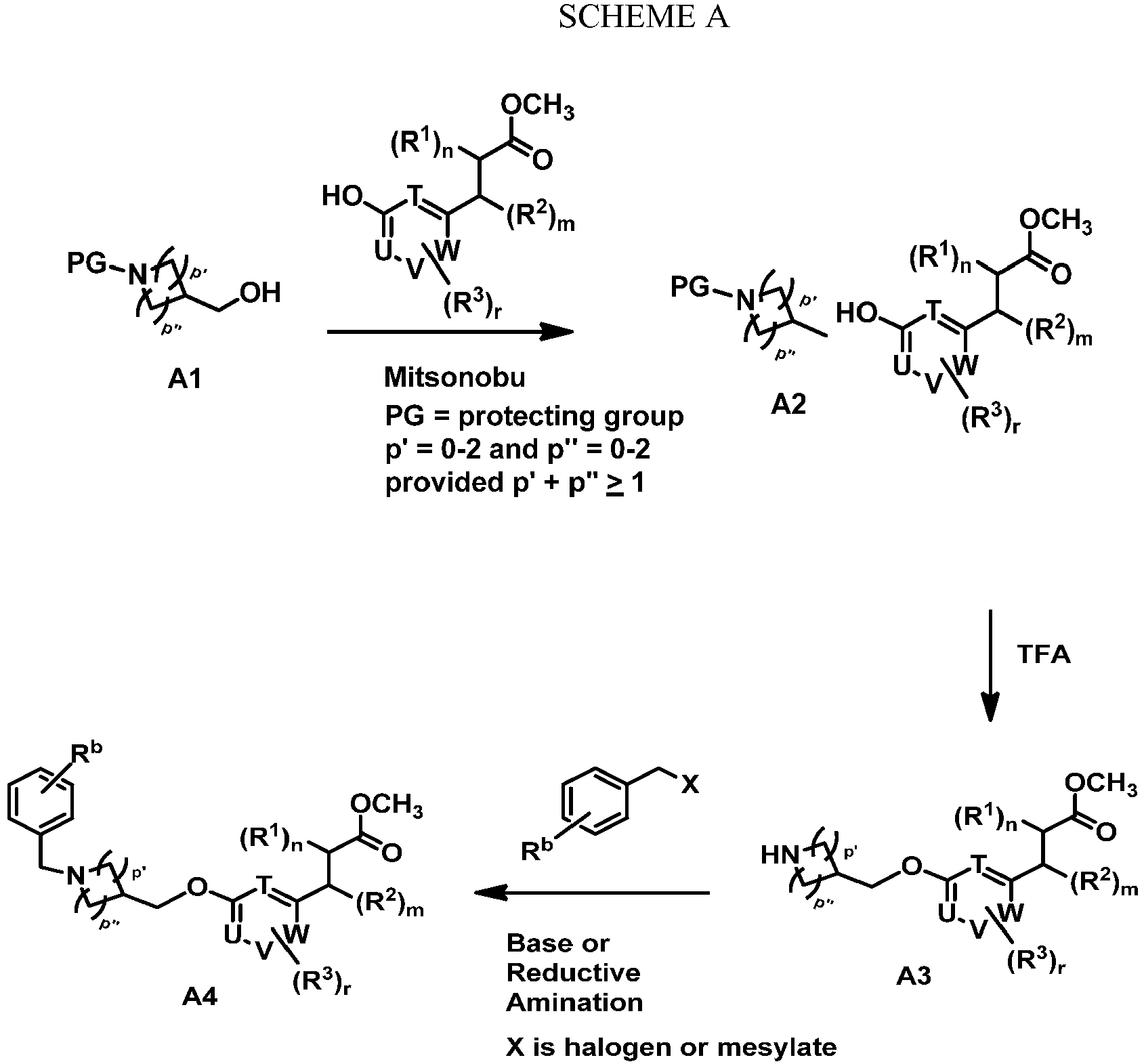

- A general approach to compound A5 is outlined in Scheme A. Alcohol A1 can be coupled to a phenol via a Mitsunobu reaction to afford compound A3. Subsequent alkylation or reductive amination affords compound A4. The ester present in compound A4 can be hydrolyzed with a mixture of aqueous lithium hydroxide, and the like, in solvents such as methanol or THF to afford carboxylic acid A5.

- A general approach to compound B4 is outlined in Scheme B. Alcohol B1 can be coupled to B2 via a Mitsunobu reaction using tri-n-butylphosphine and the like, 1,1'-(azodicarbonyl)dipiperidine and the like in a solvent such as THF to afford compound B3. The ester present in compound B3 can be hydrolyzed with a mixture of aqueous lithium hydroxide and the like in solvents such as methanol, THF and the like to afford carboxylic acid B4.

- An alternative approach to compound B3 is outlined in Scheme C. An iodocycloalkyl alcohol such as C1 can be coupled to a compound B2 via means described in general Scheme B to afford an intermediate C2. The intermediate C2 can undergo palladium-mediated cross coupling with a suitable aryl boronic acid or aryl zinc to afford compounds B3.


- Scheme D outlines the preparation of compound D5. A suitably mono-protected diol such as D1, wherein PG is benzyl or TBS and the like is coupled with B2 via a method such as that outlined in general Scheme B to afford intermediate D2. Removal of the protecting group via a method such as hydrogenation in the presence of a palladium catalyst (in the instance when PG is benzyl) or a method such as tetrabutylammonium fluoride in THF (in the instance when PG is TBS) will afford the alcohol D3. Coupling of a suitable aryl alcohol with intermediate D3 under Mitsunobu conditions such as those described in General Scheme B will afford compounds D4, which can be hydrolyzed to afford carboxylic acids D5.

- Compound E1 can be treated with iodine in the presence of triphenylphosphine and the like and imidazole and the like to afford iodide E2. The intermediate E2 can undergo palladium-mediated cross coupling with a suitable aryl boronic acid or aryl zinc to afford intermediate E3. Hydrolysis of intermediate E3 can afford carboxylic acids E4.
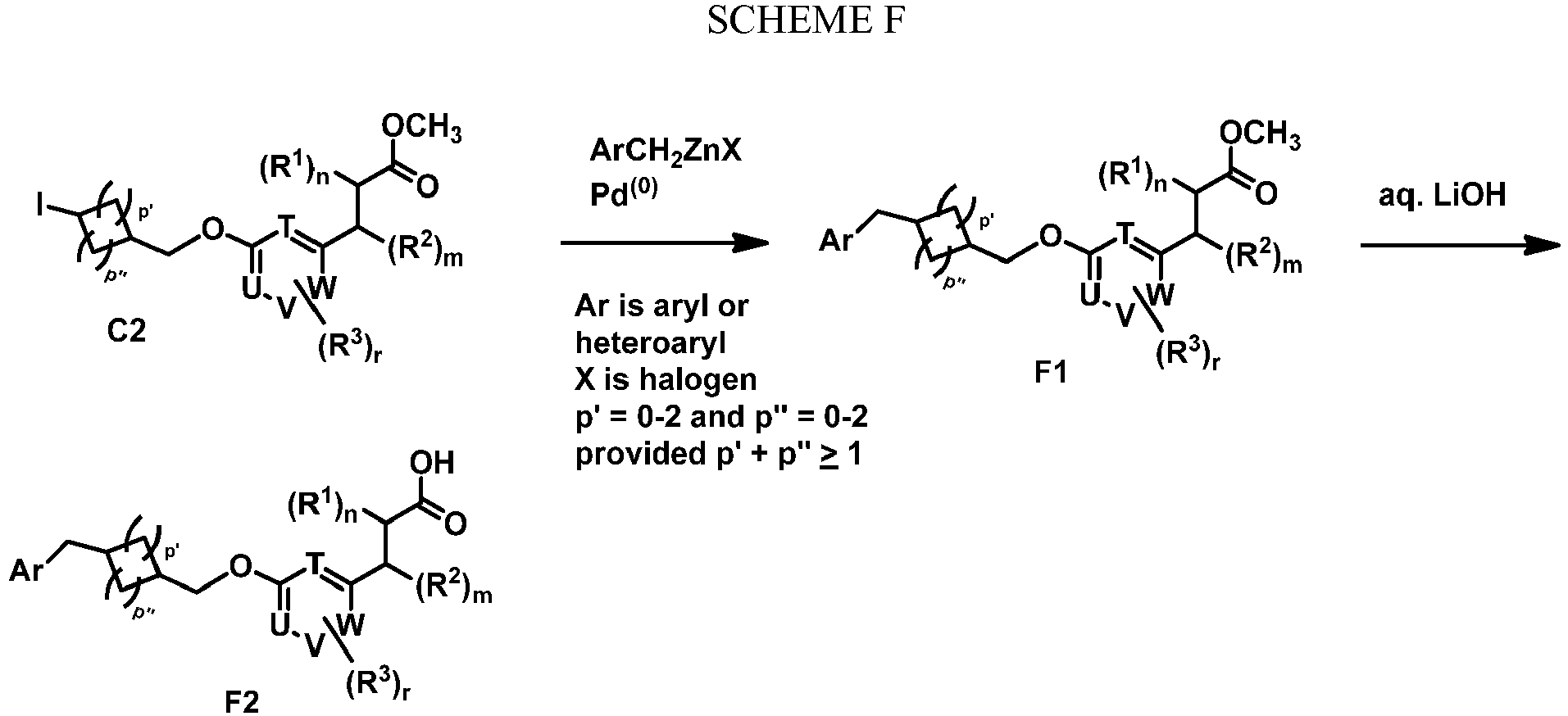
- Compound C2 can also undergo palladium-mediated cross coupling with a suitable arylmethylzinc to afford intermediate F1, which can be hydrolyzed to afford carboxylic acid F2.

- Compund C2 can undergo cross coupling with a suitable aryl or heteroaryl halide in the presence of NiCl2·DME, manganese, pyridine and 4,4',4"-tri-tert-butyl-2,2':6',2"-terpyridine in a solvent, such as N,N-dimethylacetamide, and at a temperature at or around 100 °C to afford compound G1. Hydrolysis of G1 with an aqueous solution of LiOH in a solvent, such as MeOH and/or THF, affords carboxylic acid G2.
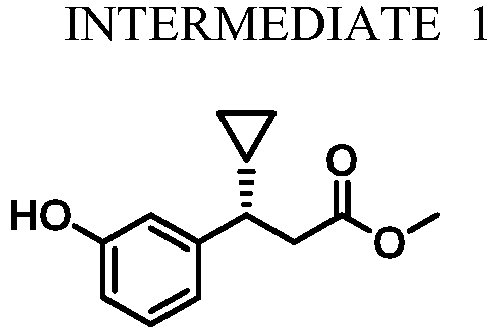
- The title compound was prepared according to the procedure disclosed in ACS Med. Chem. Lett. 2012, 3, 726-730.

-
- Step A: To a solution of (S)-methyl 3-cyclopropyl-3-(3-hydroxyphenyl)propanoate (23.6 g, 101 mmol) in DMF (200 mL) was added TBSCl (15.9 g, 106 mmol), followed by imidazole (13.7 g, 201 mmol). The mixture was stirred at rt for 1 h, then diluted with saturated brine solution and extracted with hexanes (2 x 200 mL). The combined organic layers were dried over MgSO4, filtered and concentrated giving rise to give the title compound, which was used immediately in the next step.
- Step B: A solution of (S)-methyl 3-(3-((tert-butyldimethylsilyl)oxy)phenyl)-3-cyclopropylpropanoate (2 g, 6.0 mmol) in THF (30 mL) was cooled to -78°C. Then LDA (4.5 mL, 9 mmol, 2.0 M) was added. After 30 minutes, Mel (0.9 mL, 15 mmol) was added dropwise to the reaction mixture. Then the reaction was warmed to rt and poured into saturated aqueous Na2S2O3 (50 mL). The aqueous layer was extracted with EtOAc (2 x 50 mL). The combined organic layers were dried over MgSO4, filtered and concentrated to give an oil. The oil was purified using an ISCO 120 g cartridge (0-30% EtOAc:hexanes) to give a (1:2) mixture of (2R,3R)-methyl 3-(3-((tert-butyldimethyl-silyl)oxy)phenyl)-3-cyclopropyl-2-methylpropanoate and (2S,3R)-methyl 3-(3-((tert-butyl-dimethylsilyl)oxy)phenyl)-3-cyclopropyl-2-methylpropanoate.
- Step C: A solution of the (1:2) mixture of (2R,3R)-methyl 3-(3-((tert-butyldimethylsilyl)oxy)phenyl)-3-cyclopropyl-2-methylpropanoate and (2S,3R)-methyl 3-(3-((tertbutyldimethylsilyl)oxy)phenyl)-3-cyclopropyl-2-methylpropanoate (7.8 g, 22.2 mmol) in THF (80 mL) was cooled to 0°C. Then KOtBu solution (44 mL, 44.6 mmol, 1.0M in THF) was added to effect epimerization. After 20 minutes, the reaction was quenched with IN HCl (200 mL), and the resulting aqueous layer was extracted with EtOAc (250 mL). The organic layer was removed, dried, filtered and concentrated to give an oil. The resulting crude oil was diluted with THF (40 mL) and treated with TBAF (33 mL, 33 mmol, 1.0 M THF) and stirred at rt until the reaction was complete. Then the reaction was diluted with brine and extracted with EtOAc (200 mL). The organic layer was removed, dried, filtered and concentrated to give a crude oil. The crude oil was purified an ISCO 330 g cartridge (0-40% EtOAc: Hexanes) to give a 3:1 mixture of (2R,3R)-methyl 3-(3-((tert-butyldimethylsilyl)oxy)phenyl)-3-cyclopropyl-2-methylpropanoate and (2S,3R)-methyl 3-(3-((tert-butyldimethylsilyl)oxy)phenyl)-3-cyclopropyl-2-methylpropanoate.
- Step D: Separation of the diastereomers in the 3:1 mixture of (2R,3R)-methyl 3-(3-((tertbutyldimethylsilyl)oxy)phenyl)-3-cyclopropyl-2-methylpropanoate and (2S,3R)-methyl 3-(3-((tert-butyldimethylsilyl)oxy)phenyl)-3-cyclopropyl-2-methylpropanoate was performed by SFC (IC, 50x250mm, 10% IPA/CO2, 200mL/min, 35°C, 100 bar, 220nm, 100mg/mL in 15:1 IPA:DCM) to give Intermediate 2 and Intermediate 3.
Intermediate 2: 1H NMR (500 MHz, CDCl3) δ 7.2 (m, 1H), 6.70 (m, 3H), 3.76 (s, 3H), 2.82 (m, 1H), 1.90 (m, 1H), 1.05 (m, 1H), 0.96 (d, 3H), 0.56 (m, 1H), 0.30 (m, 2H), 0.01 (m, 1H). Intermediate 3: 1H NMR (500 MHz, CD3OD) δ 7.24 (m, 1H), 6.70 (m, 3H), 3.40 (s, 3H), 2.98 (m, 1H), 2.15 (m, 1H), 1.35 (d, 3H), 1.25 (m, 1H), 0.75 (m, 1H), 0.45 (m, 2H), 0.1 (m, 1H).
- tert-Butyl 3-((3-((S)-1-cyclopropyl-3-methoxy-3-oxopropyl)phenoxy)methyl)piperidine-1-carboxylate To Intermediate 1 (200 mg, 0.908 mmol) and tert-butyl 3-(bromomethyl)-piperidine-1-carboxylate (303 mg, 1.1mmol) in CH3CN (10 mL) at rt was added K2CO3 (188 mg, 1.4 mmol). The resulting mixture was stirred at 80 °C for 144 h. Then the reaction was diluted with H2O, and extracted with EtOAc (3 x 50 mL). The combined organic layers were washed with brine, dried over MgSO4, filtered, concentrated and purified by ISCO (24g, 0-20%EtOAc/hexanes) to give the title compound LC/MS: m/e 418.34 (M+H)+.

- To a solution of Intermediate 4 (239 mg, 0.572 mmol) in CH2Cl2 (10 mL) at rt was added TFA (0.4 mL, 5.7 mmol). The reaction was stirred at rt for 1h, then concentrated to dryness to give the title compound as an oil. LC/MS: m/e 318.29 (M+H)+.

-
- Step A: To a solution of (S)-pyrrolidin-3-ylmethanol (106 mg, 1.0 mmol) in DMF (2 mL) at rt was added 2,5-bis-trifluoromethylbenzyl bromide (322 mg, 1.0 mmol) and K2CO3 (290 mg, 2.1 mmol). The resulting mixture was stirred at rt for 12h, then diluted with H2O (10 mL), and extracted with EtOAc (3x15 mL). The combined organic layers were washed with brine, dried over MgSO4, filtered, concentrated and purified by MPLC (ISCO, 24g, 0-30%EtOAc/hexanes) to give (S)-(1-(2,5 bis(trifluoromethyl)benzyl)-pyrrolidin-3-yl)methanol.
- Step B: (S)-(1-(2,5-bis(trifluoromethyl)benzyl)pyrrolidin-3-yl)methanol (100 mg, 0.306 mmol) was dissolved in DCM (4 mL) and the solution was cooled to 0°C. Then TEA (0.085 mL, 0.60 mmol) was added, followed by MsCl (0.025 mL, 0.30 mmol). The cooling bath was removed and the mixture was stirred at rt for 2 h. The mixture was then partitioned between DCM and water. The organic layer was separated, dried over MgSO4, concentrated and purified by MPLC (ISCO 24g, 0-30%EtOAc/hexanes) to give the title compound. LC/MS: m/e 406.47 (M+H)+.

- (S)-tert-Butyl 4-((3-(1-cyclopropyl-3-methoxy-3-oxopropyl)phenoxy)methyl)piperidine-1-carboxylate A solution of N-BOC-4-piperidinemethanol (311 mg, 1.4 mmol), Intermediate 1 (212 mg, 0.9 mmol) and PPh3 (642 mg, 1.9 mmol) in DCM (4 mL) was purged with N2, followed by addition of DIAD (0.3 mL, 1.9 mmol). The reaction was stirred at rt for 12 h, then filtered through a pad of Celite™. The resulting filtrate was concentrated to dryness and purified by ISCO MPLC (24 g, 0-30% EtOAc/hexanes) to give the title compound as a colorless oil. LC/MS: m/e 418.41 (M+H)+.

- Intermediate 8 was prepared in an analogous manner to Intermediate 5, starting with Intermediate 7. LC/MS: m/e 318.30 (M+H)+.
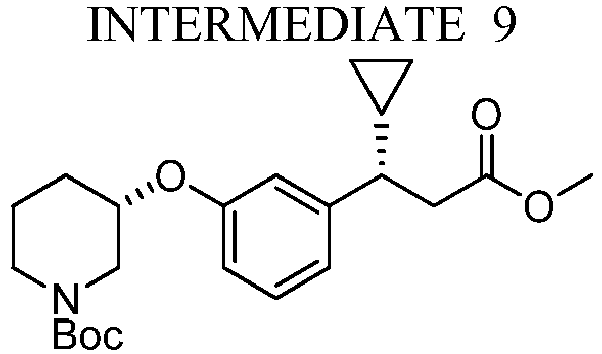
- (S)-tert-Butyl 3-(3-((S)-1-cyclopropyl-3-methoxy-3-oxoprovyl)phenoxy)piperidine-1-carboxylate Intermediate 9 was prepared in an analogous manner to Intermediate 7, starting with (S)-tert-butyl 3-hydroxypiperidine-1-carboxylate. LC/MS: m/e 479.43 (M+H)+. 1H NMR (500 MHz; CDCl3): δ 7.37 (d, J = 7.8 Hz, 1H), 7.24 (d, J = 7.5 Hz, 1H), 7.07 (t, J = 8.6 Hz, 1H), 6.89 (m, 1H), 6.80 (m, 1H), 5.34 (t, 6.0 Hz, 1H), 4.11 (dt, J = 6.9 Hz and 7.5 Hz, 1H), 3.80 (s, 3H), 3.16 (m, 1H), 2.91 (m, 1H), 2.60 (m, 1H), 2.02 (m, 1H).

- Intermediate 10 was prepared in an analogous manner to Intermediate 5, starting with Intermediate 9. LC/MS: m/e 304.29 (M+H)+.

- Intermediate 11 was prepared in an analogous manner to Intermediate 4, starting with 1-BOC-3-hydroxypiperidine. LC/MS: m/e 404.39 (M+H)+.
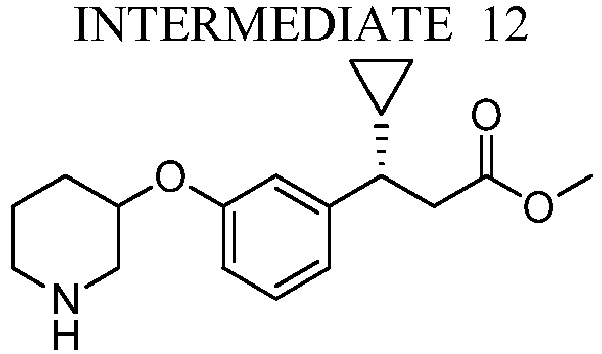
- Intermediate 12 was prepared in an analogous manner to Intermediate 5, starting with Intermediate 11. LC/MS: m/e 304.33 (M+H)+.

- To a solution of (S)-piperidin-3-ol hydrochloride (100 mg, 0.7 mmol) in DMF (2 mL) at rt was added 2,5-bistrifluoromethylbenzyl bromide (223 mg, 0.7 mmol) and K2CO3 (301 mg, 2.2 mmol). The resulting mixture was stirred at rt for 12 h, then diluted with H2O (10 mL), and extracted with EtOAc (3x 15 mL). The combined organic layers were washed with brine, dried over MgSO4, filtered, concentrated and purified by MPLC (ISCO 24g, 0-30% EtOAc/hexanes) to give the title compound as a colorless oil. LC/MS: m/e 328.24 (M+H)+.

- To a solution of (R)-piperidin-3-ol hydrochloride (100 mg, 0.7 mmol) in DMF (2 mL) at rt was added 2,5-bistrifluoromethylbenzyl bromide (223 mg, 0.7 mmol) and K2CO3 (301 mg, 2.2 mmol). The resulting mixture was stirred at rt for 12 h, then diluted with H2O (10 mL), and extracted with EtOAc (3x 15 mL). The combined organic layers were washed with brine, dried over MgSO4, filtered, concentrated and purified by MPLC (ISCO 24g, 0-30% EtOAc/hexanes) to give the title compound as a colorless oil. LC/MS: m/e 328.24 (M+H)+.

- Intermediate 13 (188 mg, 0.60 mmol) was dissolved in DCM (6 mL) and the solution was cooled to 0°C. TEA (0.16 mL, 1.1 mmol) was added, followed by MsCl (0.05 mL, 0.6 mmol) . The cooling bath was removed and the mixture was stirred at rt for 2 h. The mixture was partitioned between CH2Cl2 and water. The organic layer was dried over MgSO4 and concentrated and purified by ISCO MPLC (24 g, 0-15%EtOAc/hexanes) to give rise to a colorless oil. LC/MS: m/e 406.26 (M+H)+.

- Intermediate 16 was prepared in an identical manner to Intermediate 15, starting with Intermediate 14. LC/MS: m/e 406.26 (M+H)+.
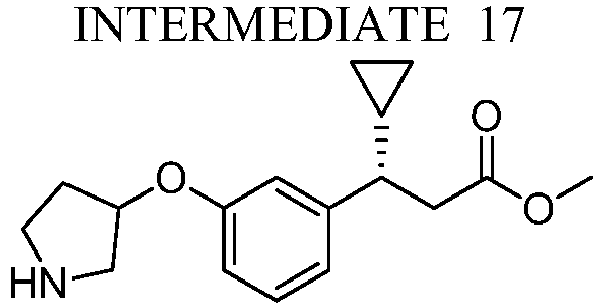
- Intermediate 17 was prepared in an analogous manner to Intermediates 4 and 5, starting with tert-butyl 3-(3-((S)-1-cyclopropyl-3-methoxy-3-oxopropyl)phenoxy)pyrrolidine-1-carboxylate and Intermediate 1. LC/MS: m/e 290.16 (M+H)+.

- Intermediate 18 was prepared in an analogous manner to Intermediates 4 and 5, starting with tert-butyl 3-(3-((S)-1-cyclopropyl-3-methoxy-3-oxopropyl)phenoxy)pyrrolidine-1-carboxylate and Intermediate 1. LC/MS: m/e 304.26 (M+H)+.
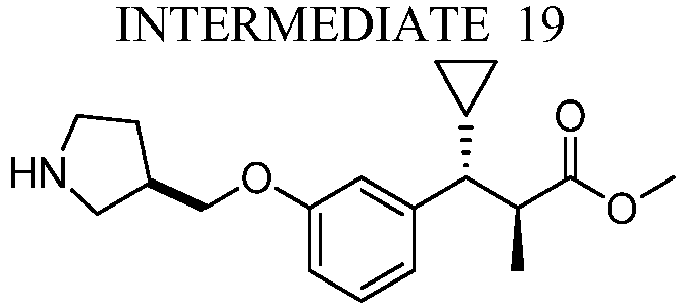
- Intermediate 19 was prepared in an analogous manner to Intermediates 4 and 5, starting with (R)-tert-butyl 3-(hydroxymethyl)pyrrolidine-1-carboxylate and Intermediate 2. LC/MS: m/e 318.50 (M+H)+.

- Intermediate 20 was prepared in an analogous manner to Intermediates 4 and 5, starting with tert-butyl 3-(2-hydroxyethyl)pyrrolidine-1-carboxylate and Intermediate 1. LC/MS: m/e 318.31 (M+H)+.

- Intermediates 21A and 21B were prepared in an analogous manner to Intermediates 4 and 5, starting with racemic tert-butyl 2-hydroxy-6-azaspiro[3.4]octane-6-carboxylate and Intermediate 1. 22A: LC/MS: m/e 330.50 (M+H)+. 22B: LC/MS: m/e 330.50 (M+H)+.

- Intermediate 22 was prepared in an analogous manner to Intermediates 4 and 5, starting with tert-butyl 5-hydroxyhexahydrocyclopenta[c]pyrrole-2(1H)-carboxylate and Intermediate 1. LC/MS: m/e 330.34 (M+H)+.

- Intermediate 23 was prepared in an analogous manner to Intermediates 4 and 5, starting with tert-butyl 3-(bromomethyl)-3-fluoropyrrolidine-1-carboxylate and Intermediate 1. LC/MS: m/e 322.29 (M+H)+.

- Intermediate 24 was prepared in an analogous manner to Intermediates 4 and 5, starting with tert-butyl 4-(hydroxymethyl)-3,3-dimethylpyrrolidine-1-carboxylate and Intermediate 1. LC/MS: m/e 332.31 (M+H)+.

-
- Step A: To morpholin-2-ylmethanol (60 mg, 0.5 mmol) in DMF (1 mL) at rt was added 2,5,-bistrifluoromethylbenzyl bromide (157 mg, 0.5 mmol) and K2CO3 (142 mg, 1.0 mmol). The resulting mixture was stirred at rt overnight, diluted with H2O (4 mL), extracted with EtOAc (3x 10 mL). The combined extracts were washed with brine, dried over MgSO4, filtered, concentrated and purified by MPLC (ISCO 24g, 0-30% EtOAc/hexanes) to give rise to (4-(2,5-bis(trifluoromethyl)benzyl)morpholin-2-yl)methanol. LC/MS: m/e 344.26 (M+H)+.
- Step B: A solution of (4-(2,5-bis(trifluoromethyl)benzyl)morpholin-2-yl)methanol (137 mg, 0.4 mmol), Intermediate 2 (66 mg, 0.3 mmol) and PPh3 (190 mg, 0.6 mmol) in DCM (2 mL) was purged with N2. Then DIAD (0.1 mL, 0.6 mmol) was and the reaction was stirred at rt for 12 h. The reaction was then filtered through a pad of Celite™. The resulting filtrate was concentrated to dryness and purified by MPLC (ISCO 24g, 0-15% EtOAc/hexanes) to give rise to the title compound. LC/MS: m/e 560.46 (M+H)+.

- Intermediate 26 was prepared in an analogous manner to Intermediates 4 and 5, starting with tert-butyl 3-(hydroxymethyl)-3-methylpyrrolidine-1-carboxylate and Intermediate 1. LC/MS: m/e 318.33 (M+H)+.

- (2S,3R)-Methyl 3-(3-(((S)-1-(2,5-bis(trifluoromethyl)benzyl)pyrrolidin-3-yl)methoxy)phenyl)-3-cyclopropyl-2-methylpropanoate To a solution of (2S,3R)-methyl 3-cyclopropyl-3-(3-hydroxyphenyl)-2-methylpropanoate (40 mg, 0.17 mmol) in DMF (2 mL) at rt was added Cs2CO3 (111 mg, 0.34 mmol). The reaction was stirred at rt for 10 min, followed by the addition of Intermediate 6 (69 mg, 0.17 mmol). The resulting mixture was stirred at 50 °C for 48 h, then diluted with H2O (15 mL), and extracted with EtOAc (3x 15 mL). The combined organic layers were washed with brine, dried over MgSO4, filtered, concentrated and purified by MPLC (ISCO 24g, 0-15%EtOAc/hexanes) to give the title compound as a colorless oil. LC/MS: m/e 544.40 (M+H)+.

- Intermediate 28 was prepared in an analogous manner to Intermediates 4 and 5, starting with tert-butyl 3-(hydroxymethyl)azetidine-1-carboxylate and Intermediate 1. LC/MS: m/e 290.22 (M+H)+.

- Intermediate 29 was prepared in an analogous manner to Intermediates 4 and 5, starting with tert-butyl 3-(hydroxymethyl)azetidine-1-carboxylate and Intermediate 2. LC/MS: m/e 304.35 (M+H)+.

- Intermediate 30 was prepared in an analogous manner to Intermediates 4 and 5, starting with tert-butyl 3-(hydroxymethyl)-3-methylazetidine-1-carboxylate and Intermediate 1. LC/MS: m/e 304.27 (M+H)+.

- Intermediate 31 was prepared in an analogous manner to Intermediates 4 and 5, starting with tert-butyl 3-fluoro-3-(hydroxymethyl)azetidine-1-carboxylate and Intermediate 1. LC/MS: m/e 308.27 (M+H)+.

- Intermediate 32 was prepared in an analogous manner to Intermediates 4 and 5, starting with tert-butyl 6-hydroxy-2-azaspiro[3.3]heptane-2-carboxylate and Intermediate 1. LC/MS: m/e 316.30 (M+H)+.

- Intermediate 33 was prepared in an analogous manner to Intermediates 4 and 5, starting with tert-butyl (3-(hydroxymethyl)cyclobutyl)carbamate and Intermediate 2. LC/MS: m/e 318.33 (M+H)+.

- Intermediate 34 was prepared in an analogous manner to Intermediate 4 and 5 starting with tert-butyl 3-(2-hydroxyethyl)azetidine-1-carboxylate coupled to Intermediate 1. LC/MS: m/e 304.31 (M+H)+.

-
- Step A: To a solution of 3-hydroxyazetidine hydrochloride (300 mg, 2.7 mmol, Aldrich) in DMF (4 mL) at rt was added 2,5-bis(trifluoromethyl)benzyl bromide (841 mg, 2.7 mmol) and K2CO3 (1.1 g, 8.2 mmol). The resulting slurry was stirred at rt for 12 h, then diluted with H2O (20 mL), and extracted with EtOAc (3 x 50 mL). The combined organic layers were washed with brine, dried over MgSO4, filtered, concentrated and purified by MPLC (ISCO 40g, 0-30% EtOAc/hexanes) to give 1-(2,5-bis(trifluoro-methyl)benzyl)azetidin-3-ol as a colorless oil.
- Step B: 1-(2,5-bis(trifluoromethyl)benzyl)azetidin-3-ol (100 mg, 0.3 mmol) was dissolved in DCM (4 mL) and the resulting solution was cooled to 0°C. Then TEA (0.093 ml, 0.668 mmol) was added, followed by MsCl (0.03 mL, 0.4 mmol). The cooling bath was removed and the reaction was stirred at rt for 2 h. Then the reaction was partitioned between DCM and water (10 mL). The organic layer was separated, dried over MgSO4 , concentrated and purified by MPLC (ISCO 24g, 0-30%EtOAc/hexanes) to give 1-(2,5-bis(trifluoromethyl)benzyl)azetidin-3-yl methanesulfonate as a colorless oil.
- Step C: To a solution of Intermediate 2 (47 mg, 0.2 mmol) in DMF (2 mL) at rt was added Cs2CO3 (131 mg, 0.4 mmol) followed by 1-(2,5-bis(trifluoromethyl)benzyl)-azetidin-3-yl methanesulfonate (79 mg, 0.2 mmol). The resulting mixture was heated to 50°C for 48 h, then diluted with H2O (10 mL) and extracted with EtOAc (3 x 50 mL). The combined organic layers were washed with brine, dried over MgSO4, filtered, concentrated and purified by MPLC (ISCO 24g, 0-15% EtOAc/hexanes) to afford the title compound as a colorless oil. LC/MS: m/e 516.40 (M+H)+.

- (2S,3R)-Methyl 3-cyclopropyl-3-(3-((3-fluoroazetidin-3-yl)methoxy)phenyl)-2-methylpropanoate Intermediate 36 was prepared in an analogous manner to Intermediates 4 and 5 starting with tert-butyl 3-fluoro-3-(hydroxymethyl)azetidine-1-carboxylate and Intermediate 2. LC/MS: m/e 322.31 (M+H)+.

- (3S)-Methyl 3-(3-((1-(2,5-bis(trifluoromethyl)benzyl)piperidin-2-yl)methoxy)phenyl)-3-cyclopropylpropanoate Intermediate 37 was prepared in an analogous manner to Intermediate 35, starting with piperidin-2-yl methanol and Intermediate 1. LC/MS: m/e 544.69 (M+H)+.

-
- Step A: To a solution of tert-butyl 3-acetylazetidine-1-carboxylate (1 g, 5.0 mmol) in MeOH (25 mL) at rt was added NaBH4 (0.095 g, 2.5 mmol). The resulting solution was stirred at rt for 1h. Then the solution was concentrated to dryness and purified by MPLC (ISCO 40g, 0-30% EtOAc/hexanes) to give tert-butyl 3-(1-hydroxyethyl)azetidine-1-carboxylate as a colorless oil.
- Step B: A solution of tert-butyl 3-(1-hydroxyethyl)azetidine-1-carboxylate (73 mg, 0.4 mmol), Intermediate 2 (57 mg, 0.2 mmol) and PPh3 (162 mg, 0.487 mmol) in DCM (2 mL) was treated with DIAD (0.095 mL, 0.5 mmol). The reaction was stirred at rt for 12 h, then concentrated to dryness and purified by MPLC (ISCO 12g, 0-30%EtOAc/hexanes) to give tert-butyl 3-(1-(3-((1R,2S)-1-cyclopropyl-3-methoxy-2-methyl-3-oxopropyl)phenoxy)ethyl)azetidine-1-carboxylate as a colorless oil.
- STEP C: The BOC group of the product of Step B was removed according to the BOC removal procedure for Intermediate 5 to give the title compound. LC/MS: m/e 318.56 (M+H)+.

-
- Step A: A mixture of 3-methoxybenzaldehyde (50 g, 367 mmol), malonic acid (57.3 g, 551 mmol), piperidine (3.6 mL) and pyridine (39.8 g, 503 mmol) was heated to reflux for 2h. Then the reaction solution was quenched with ice water and concentrated HCl. The resulting white precipitate was filtered off and washed with IN HCl, water, 95% EtOH, and MeOH to give (E)-3-(3-methoxyphenyl)acrylic acid.
- Step B: A mixture of (E)-3-(3-methoxyphenyl)acrylic acid (60 g, 0.337 mol) in SOCl2 (74 mL, 1.01 mol) was heated to 80 °C for 2 h. The excess SOCl2 was removed to give (E)-3-(3-methoxyphenyl)acryloyl chloride.
- Step C: To a solution of NaOH (53.9 g, 1.35 mol) in ether (500 mL) and water (675 mL) was added N,O-Dimethylhydroxylamine (98.5 g, 1.01 mol) in portions at 0 °C. Then a solution of (E)-3-(3-methoxyphenyl)acryloyl chloride (66.5 g, 0.338 mol) in ether (100 mL) was added dropwise at 0 °C. The resulting solution was stirred at rt for 2 h. Then the organic layer was separated and the aqueous layer was extracted with Et2O. The combined organic layers were washed with water, brine, dried over anhydrous Na2SO4, filtered and concentrated to afford (E)-N-methoxy-3-(3-methoxyphenyl)-N-methylacrylamide.
- Step D: To a solution of trimethyllsulfoxonium iodide (138.3 g, 0.673 mol) in
DMSO (350 mL) was added NaH (16.2 g, 0.673 mol) in portions at rt under a nitrogen atmosphere. The mixture was stirred at rt for 1h, followed by the dropwise addition of a solution of (E)-N-methoxy-3-(3-methoxyphenyl)-N-methyl acrylamide (74.5 g, 0.337 mol) in DMSO (100 mL). The reaction mixture was stirred at rt overnight, then quenched with saturated NH4Cl (500 mL). The organic layer was separated, washed with water and brine, dried over Na2SO4, filtered and concentrated under vacuum to give N-methoxy-2-(3-methoxyphenyl)-N-methylcyclopropanecarboxamide. - Step E: A mixture of N-methoxy-2-(3-methoxyphenyl)-N-methylcyclopropane-carboxamide (75 g, 0.319 mol) and NaOH (15.3 g, 0.383 mol) in EtOH (155mL) and water (155mL) was heated to 80 °C overnight. Then the solvent was removed under vacuum to give a residue. The residue was dissolved in water and the solution was acidified to pH = 4, and extracted with ether. The combined ether extracts were washed with water, brine, dried over sodium sulphate, filtered, and concentrated. The resulting residue was re-crystallized from petroleum ether to afford 2-(3-methoxyphenyl) cyclopropanecarboxylic acid.
- Step F: 2-(3-methoxyphenyl)cyclopropanecarboxylic acid (1 g, 5.20 mmol) was dissolved in tetrahydrofuran (10 ml) and BH3 THF (7.80 ml, 7.80 mmol, 1 M THF solution) was added dropwise at 0 °C under N2. After gas evolution ceased, the reaction was allowed to stir at rt for 30 min, then quenched by the slow addition of water (20 mL). After gas evolution ceased, added EtOAc (30 mL) was added to the reaction mixture. Then the organic layer was separated, dried over MgSO4, and evaporated to give the crude product. The crude product was purified by ISCO (40 g, 0∼40% EtOAc in hexane) to afford (2-(3-methoxyphenyl)cyclopropyl)methanol.

- Ethyl-2-benzylcyclopropanecarboxylate (963 mg, 4.71 mmol) was dissolved in anhydrous tetrahydrofuran (10 mL) and the mixture was cooled to -78 °C and stirred for 5 minutes. Then LAH (9.43 mL, 9.43 mmol, 1 M THF) was added over 5 minutes. The reaction mixture was slowly warmed to rt and stirred at rt for 3 h. Then the reaction was quenched with Rochelle salt solution (15 mL), and extracted with EtOAc (2 x 30 mL). The combined organic layers were separated, and concentrated. The resulting residue was re-dissolved in DCM, and purified by ISCO (0∼60% EtOAc in hexane) to afford (2-benzylcyclopropyl)methanol.

-
- Step A: To a solution of bromobenzene (110.2 g, 0.702 mol) in THF (800 mL) was added dropwise n-BuLi (288 mL, 0.719 moL) at -78 °C under N2. Then the reaction was stirred at - 78°C for 1 hour, followed by the dropwise addition of a solution of 3-oxocyclobutanecarboxylic acid (40 g, 0.351 moL) in THF (100 mL). The resulting solution was stirred at -78°C for 2 hours, then quenched with saturated NH4Cl solution and extracted with ethyl acetate. The organic layer was separated, washed with brine, dried over anhydrous Na2SO4, filtered and concentrated to give 3-hydroxy-3-phenylcyclobutanecarboxylic acid.
- Step B: To a solution of 3-hydroxy-3-phenylcyclobutanecarboxylic acid (50g, 260 mmol) in DMF (300 mL) was added K2CO3 (43 g, 312 mmol) and MeI (44 g, 312 mmol). The reaction mixture was stirred at 50°C overnight. The reaction was diluted with water and extracted with EtOAc. The organic layer was washed with brine, dried over anhydrous Na2SO4, filtered and concentrated to give methyl 3-hydroxy-3-phenylcyclobutanecarboxylate.
- Step C: To a solution of methyl 3-hydroxy-3-phenylcyclobutanecarboxylate (43 g, 208.7 mmol) in TFA (300 mL) was added dropwise Et3SiH (158 g, 1.25 mol) at 0°C. The resulting solution was stirred at rt overnight. The reaction was concentrated to give a crude oil, which was purified by column silica gel chromatography to afford methyl 3-phenylcyclobutanecarboxylate.
- Step D: To a solution of methyl 3-phenylcyclobutanecarboxylate (30 g, 158 mmol) in 1:1 THF/H2O (300 mL) was added portionwise LiOH (11.4 g, 473.6 mmol) at 0°C. The resulting solution was stirred at rt for 4 hours. The reaction was extracted with dichloromethane. The aqueous layer was adjusted to pH 1 with 3N HCl aqueous solution and extracted with ethyl acetate. The EtOAc layer was washed with brine, dried over anhydrous Na2SO4, filtered and concentrated to give 3-phenylcyclobutanecarboxylic acid.
- Step E: 3-Phenylcyclobutanecarboxylic acid (991 mg, 5.62 mmol) was dissolved in tetrahydrofuran (10 ml) and borane-tetrahyrofuran complex (8.44 ml, 8.44 mmol) (1.0 M THF solution) was added dropwise at 0 °C under N2. After gas evolution ceased, the reaction was allowed to stir at rt for 30 minutes, then quenched by the slow addition of water (10 mL).
- After gas evolution ceased, EtOAc (30 mL) was added. The layers were separated, and the organic layer was dried over MgSO4, filtered and evaporated. The resulting crude material was purified by ISCO (0∼40% EtOAc in hexane) to afford (3-phenylcyclobutyl)methanol.

- 3-Benzyloxy-cyclobutanecarboxylic acid (1 g, 4.85 mmol) was dissolved in THF (10 mL) and BH3·THF (7.27 ml, 7.27 mmol, 1 M THF solution) was added dropwise at 0 °C under N2 atmosphere. After gas evolution ceased, the reaction was allowed to stir at rt for 30 min, and then quenched by the slow addition of water (10 mL). After gas evolution ceased, EtOAc (30 mL) was added. The organic layer was separated, dried over MgSO4, and evaporated. The resulting crude material was purified by ISCO (0∼70% EtOAc in hexane) to afford (3-(benzyloxy)cyclobutyl)methanol.
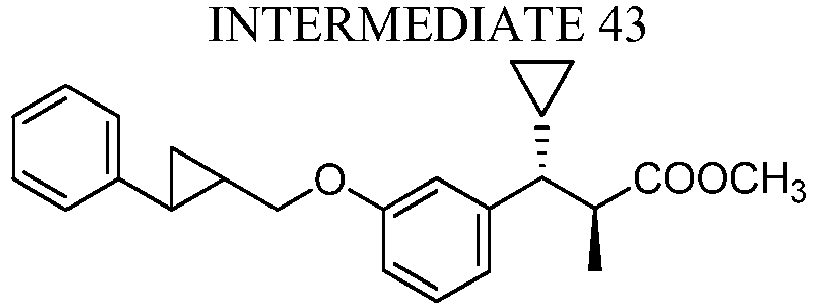
- (2S,3R)-Methyl 3-cyclopropyl-2-methyl-3-(3-((2-phenylcyclopropyl)methoxy) phenyl) propanoate Intermediate 2 (50 mg, 0.2 mmol), (2-phenylcyclopropyl)methanol (127 mg, 0.8 mmol) and Bu3P (0.2 mL, 0.8 mmol) were dissolved in THF (3 mL). The mixture was stirred at rt for 5 minutes, then 1,1'-(azodicarbonyl)dipiperidine (215 mg, 0.8 mmol) was added portionwise. The reaction mixture was stirred at 50 °C overnight. The reaction was then evaporated, re-dissolved in DCM (5 mL) and purified by ISCO (0∼30% EtOAc in hexane) to afford the title compound.

- (3S)-Methyl 3-cyclopropyl-3-(3-((2-(3-methoxyphenyl) cyclopropyl) methoxy)phenyl) propanoate Intermediate 44 was prepared in an analogous manner to Intermediate 43, starting with Intermediate 39 coupled with Intermediate 1.

- (2S,3R)-Methyl 3-(3-((2-benzylcyclopropyl)methoxy)phenyl)-3-cyclopropyl-2-methylpropanoate Intermediate 45 was prepared in an analogous manner to Intermediate 43, starting with Intermediate 40 coupled with Intermediate 2.

- (2S,3R)-Methyl 3-cyclopropyl-2-methyl-3-(3-((3-phenylcyclobutyl) methoxy) phenyl) propanoate Intermediate 46 was prepared in an analogous manner to Intermediate 43, starting with Intermediate 41 coupled with Intermediate 2.

- (2S,3R)-Methyl 3-(3-((3-(benzyloxy)cyclobutyl)methoxy)phenyl)-3-cvclopropyl-2-methylpropanoate Intermediate 47 was prepared in an analogous manner to Intermediate 43, starting with Intermediate 42 coupled with Intermediate 2.

- (2S,3R)-Methyl 3-cyclopropyl-3-(3-((2-(3-methoxyphenyl)cyclopropyl)methoxy)phenyl)-2-methylpropanoate Intermediate 48 was prepared in an analogous manner to Intermediate 43 starting with Intermediate 39 coupled with Intermediate 2.

- (2S,3R)-Methyl 3-cyclopropyl-3-(3-(((1S,2R)-2-iodocyclopropyl)methoxy)phenyl)-2-methylpropanoate Intermediate 49 was prepared in an analogous manner to Intermediate 4 starting with ((1S,2R)-2-iodocyclopropyl)methanol and Intermediate 2.
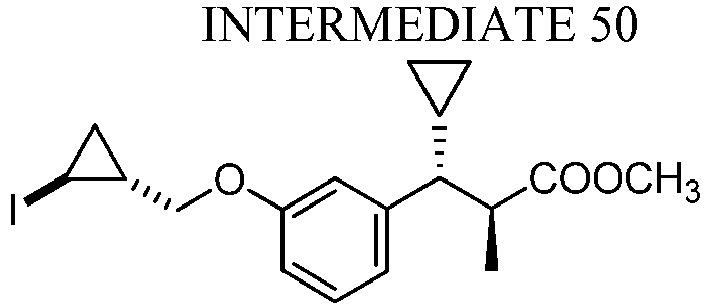
- (2S,3R)-Methyl 3-cyclopropyl-3-(3-(((1R,2S)-2-iodocyclopropyl)methoxy)phenyl)-2-methylpropanoate Intermediate 50 was prepared in an analogous manner to Intermediate 4, starting with ((1R,2S)-2-iodocyclopropyl)methanol and Intermediate 2.

- (2S,3R)-Methyl 3-cyclopropyl-3-(3-(((1R,2S)-2-(3-methoxybenzyl) cyclopropyl) methoxy)phenyl)-2-methylpropanoate Intermediate 50 (120 mg, 0.29 mmol), chloro(2-dicyclohexylphosphino-2',4',6'-triisopropyl-1,1'-biphenyl)[2-(2'-amino-1,1'-biphenyl)]palladium (II), THF adduct (23 mg, 0.03 mmol) and 3-methoxybenzylzinc chloride (1.7 mL, 0.8 mmol, 0.5 M THF solution) were dissolved in anhydrous THF (1.5 mL). The mixture was degassed, purged with N2 for 5 min, then heated at 60 °C for 3 h. The reaction was quenched with saturated NH4Cl (10 mL), and extracted with EtOAc (2 x 20 mL). The combined EtOAc layers were washed with water (15 mL) and brine (15 mL), dried over MgSO4 and evaporated. The resulting crude material was purified by ISCO (0∼15% EtOAc in hexane) to afford the title compound.

- (2S,3R)-Methyl 3-cyclopropyl-3-(3-(((1S,2R)-2-(3-methoxybenzyl)cyclopropyl) methoxy)phenyl)-2-methylpropanoate Intermediate 52 was prepared in an analogous manner to Intermediate 51, starting with Intermediate 50.

- (2S,3R)-Methyl 3-cyclopropyl-3-(3-((3-hydroxycyclobutyl)methoxy)phenyl)-2-Methylpropanoate Intermediate 47 (480 mg, 1.2 mmol) and 10% palladium on carbon (125 mg, 1.2 mmol) were dissolved in MeOH (10 mL). The mixture was hydrogenated under H2 balloon at rt for 2h. Then the reaction mixture was filtered, evaporated, re-dissolved in DCM (3 mL), and purified by ISCO (0∼100% EtOAc in hexane) to afford the title compound.

- (2S,3R)-Methyl 3-cyclopropyl-3-(3-((3-(3-methoxyphenoxy)cyclobutyl)methoxy)phenyl)-2-methylpropanoate Intermediate 54 was prepared in an analogous manner to Intermediate 43, starting with 3-methoxyphenol and Intermediate 53.

- (2S,3R)-Methyl 3-cyclopropyl-3-(3-((3-(2-fluoro-5-methoxyphenoxy)cyclobutyl) methoxy)phenyl)-2-methylpropanoate Intermediate 55 was prepared in an analogous manner to Intermediate 43, starting with 2-fluoro-5-methoxyphenol and Intermediate 53.

- (2S,3R)-Methyl 3-cyclopropyl-3-(3-(((1S,2S)-2-(2-fluoro-5-methoxyphenyl)cyclopropyl) methoxy)phenyl)-2-methylpropanoate Intermediate 50 (150 mg, 0.36 mmol), 2-fluoro-5-methoxyphenylboronic acid (92 mg, 0.54 mmol) and 1,1'-bis(di-tert-butylphosphino) ferrocenepalladium dichrolide (23 mg, 0.04 mmol) were dissolved in DMF (3 mL), and K3PO4 (0.46 mL, 1.0 mmol, 50% water) was added. The reaction mixture was degassed, purged with N2 for 5 minutes and heated to 90 °C for 3 h. Then the reaction was quenched with water, and extracted with EtOAc (2x). The combined EtOAc layers were washed with water and brine, dried over MgSO4 and evaporated. The resulting crude material was purified by silica gel chromatography (gradient elution, 0 to 20% EtOAc in hexane) to afford the title compound.

- (2S,3R)-Methyl 3-cyclopropyl-3-(3-(((1R,2R)-2-(2-fluoro-5-methoxyphenyl)cyclopropyl) methoxy)phenyl)-2-methylpropanoate Intermediate 57 was prepared in an analogous manner to Intermediate 56, starting with Intermediate 49.
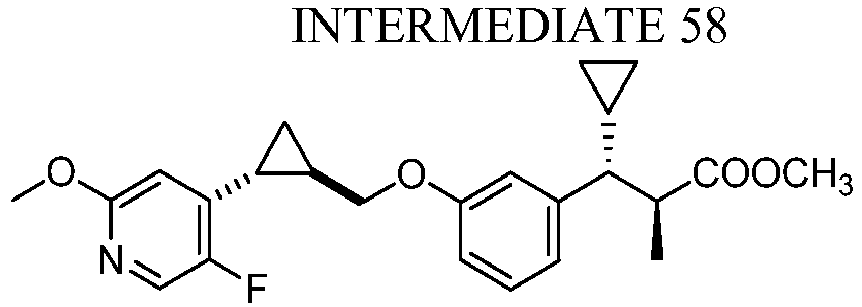
- (2S,3R)-Methyl 3-cyclopropyl-3-(3-(((1R,2R)-2-(5-fluoro-2-methoxypyridin-4-yl) cyclopropyl)methoxy)phenyl)-2-methylpropanoate Intermediate 58 was prepared in an analogous manner to Intermediate 54 starting with Intermediate 49.

-
- Step A: A solution of NaI (1203.5 g) in AcOH (5350 mL), methyl prop-2-ynoate (450 g, 5.35 mol, 1.00 equiv) was stirred overnight at 70°C, then cooled to room temperature, and diluted with 3000 mL of H2O. The resulting solution was extracted with 2 x 2500 mL of ether.
The organic layers were combined, washed with 2 x 1000 mL of aqueous potassium hydroxide, dried over anhydrous sodium sulfate, filtered, concentrated under vacuum to afford (Z)-methyl 3-iodoacrylate. - Step B: A solution of methyl (Z)-methyl 3-iodoacrylate (977 g, 4.61 mol, 1.00 equiv) in toluene (2700 mL), HI (100 mL) was stirred overnight at 80°C. The reaction mixture was cooled to r.t and then quenched by the addition of 1500 mL of H2O. The resulting solution was extracted with 2 x 1500 mL of ethyl acetate. The organic layers were combined, washed with 1x600 mL of aqueous sodium bicarbonate and 1 x 600 mL of aqueous Na2S2O3 (10%) and 1 x 600 mL of brine, dried over anhydrous sodium sulfate, filtered and concentrated under vacuum. The resulting residue was triturated with hexane to afford (E)-methyl 3-iodoacrylate.
- Step C: To a solution of methyl (E)-methyl 3-iodoacrylate (372 g, 1.75 mol, 1.00 equiv) in dichloromethane (3600 mL) was added dropwise diisobutylaluminum hydride (2296 g, 2.30 equiv, 25%) with stirring at 0°C. The resulting solution was stirred for 3 h at room temperature, then quenched by the addition of 1000 mL of aq. NH4Cl (1M). The organic layer was washed with 1 x 800 mL of HCl (1M) and 1 x 800 mL of brine, dried over anhydrous sodium sulfate, filtered, concentrated under vacuum. The resulting residue was applied onto a silica gel column and eluted with ethyl acetate/petroleum ether (1:10) to afford (E)-3-iodoprop-2-en-1-ol.
- Step D: To a solution of Et2Zn (763 g, 4.00 equiv) in dichloromethane (400 mL) was added dropwise a solution of CF3COOH (704 g, 6.17 mol, 4.00 equiv) in dichloromethane (460 mL) with stirring at -10°C and this mixture was stirred for 20 min at -10°C. To this solution was added dropwise a solution of CH2I2 (1654 g, 4.00 equiv) in dichloromethane (500 mL) with stirring at -10 °C. The resulting solution was stirred for 20 min at -10°C, then a solution of (E)-3-iodoprop-2-en-1-ol (284 g, 1.54 mol, 1.00 equiv) in dichloromethane (280 mL) was added dropwise with stirring at -10°C. The resulting solution was stirred for 1 h at room temperature, then quenched by the addition of 2400 mL of HCl (1M). The resulting solution was extracted with 2 x 2000 mL of dichloromethane. The organic layers were combined, washed with 1 x 1000 mL of brine, dried over anhydrous sodium sulfate, filtered, concentrated under vacuum. The resulting residue was applied onto a silica gel column and eluted with ethyl acetate/petroleum ether (1:30) to afford racemic trans-(2-iodocyclopropyl)methanol.
- Step E: Racemic trans-(2-iodocyclopropyl)methanol was purified via Prep-SFC
(Instrument: Thar preparative SFC 80, Column: ChiralPak AD-H, 250×30 mm I.D. 5µm. Mobile phases: A: CO2 and B: methanol. Isocratic elution: 15% methanol. Flow rate: 55 mL /min, back pressure: 100bar, column temperature: 40°C, wavelength: 254nm, cycle time: 3.5min. Sample preparation: Compound was dissolved in ethanol to ∼30mg/ml. Injection: 1ml per injection.) to afford (+)-(1R,2S)-2-iodocyclopropylmethanol (Peak 1, faster eluting isomer, [α]D 20.1 +73.2° (C = 0.410g/100 mL in MeCN)) and (-)-(1S,2R)-2-iodocyclopropylmethanol (Peak 2, slower eluting isomer, [α]D 18.9 -74.5° (C = 0.453g/100 mL in MeCN)).
Analytical SFC Conditions: Instrument: Thar analytical SFC, Column: ChiraPak AD-H, 150×4.6mm, 5µm, Mobile phase: A for CO2 and B for methanol, Gradient: B in A from 10% to 40% in 5 minutes, Flow rate: 4mL/min, Back pressure: 100bar, Column temperature: 30 °C, Wavelength: 254 nm. The absolute stereochemistry of each enantiomer was confirmed by comparing the optical rotations of both compounds with the optical rotation for (+)-(1R,2S)-2-iodocyclopropyl-methanol, which was previously reported in J. Am. Chem. Soc., Vol. 120, No. 46, 1998, p 11943.
- To a cooled (0° C) solution of ethyl 3-oxocyclopentanecarboxylate (2.6 g, 16.65 mmol) in THF (50 mL) was added (3-methoxyphenyl)magnesium bromide (16.7 mL, 16.7 mmol). After 1 h at 0 °C, the reaction was quenched by the addition of saturated NH4Cl (50 mL). The mixture was extracted with EtOAc (2 x 50 mL). The combined organic layers were dried over MgSO4 and concentrated. The resulting residue was purified by MPLC (ISCO 120 g, 0 to 50% EtOAc/Hex) to give the title compound as a clear oil. 1H NMR (500 MHz, CDCl3): δ7.29 (t, 1 H); 7.12 (s, 1H); 7.08 (d, 1H); 6.80 (d, 1H); 4.20 (q, 2H); 3.81 (s, 3H); 3.36 (br, 1H); 3.10 (m, 1H); 2.32-2.20 (m, 4H); 2.15-2.05 (m, 2H); 1.30 (t, 3H)

- To a solution of Intermediate 60 (250 mg, 0.9 mmol) in toluene (2 mL) was added TsOH (18 mg, 0.095 mmol). The reaction was then heated to 100° C on a heating block. After 1h, the reaction was cooled to rt and poured into saturated NaHCO3 (25 mL). The mixture was extracted with EtOAc (2 x 25 mL). The combined organic layers were dried (MgSO4) and concentrated. The resulting residue was purified by MPLC (ISCO 40 g, 0 to 40% EtOAc/Hex) to give the title compound. LC/MS: m/e 247.18 (M+H)+

- To a solution of Intermediate 61(80 mg, 0.325 mmol) in MeOH (5 mL) was added Pd(OH)2 (8 mg, 0.01 mmol). The reaction was then sealed in a Pyrex vessel and shaken on a Parr shaker under 40 psi of hydrogen gas. After 1h, the reaction was vented. The mixture was then filtered through a pad of Celite™ and concentrated to give the title compound. 1H NMR (500 MHz, CDCl3): δ7.22 (t, 1 H); 6.90 (d, 1H); 6.85 (s, 1H); 6.75 (d, 1h); 4.18 (q, 2H); 3.80 (s, 3H); 3.05 (m, 1H); 2.92 (m, 1H); 2.38 (m, 1H); 2.10 (m, 2H); 2.01 (m, 1H); 1.95 (m, 1H); 1.80 (m, 1H); 1.30 (t, 3H)

- To a cooled (0 °C) solution of Intermediate 61 (80 mg, 0.33 mmol) in THF (3 mL) was added LAH (12 mg, 0.33 mmol) in a single portion. After 1h, the reaction was quenched with Rochelle's salt solution (25 mL). The mixture was extracted with EtOAc (2 x 25 mL). The combined organic layers were dried over MgSO4 and concentrated. The resulting residue was purified by MPLC (ISCO 40 g, 0 to 50% EtOAc/Hex) to give the title compound. LC/MS: m/e 205.15 (M+H)+

- To a cooled (0 °C) solution of ethyl 3-(3-methoxyphenyl)cyclopentane-carboxylate (72 mg, 0.290 mmol) in THF (3 mL) was added LAH (11.00 mg, 0.290 mmol) in a single portion. After 1h, the reaction was quenched with Rochelle's salt solution (25 mL). The mixture was extracted with EtOAc (2 x 25 mL). The combined organic layers were dried over MgSO4 and concentrated. The resulting residue was purified by MPLC (ISCO 40 g, 0 to 50% EtOAc/Hex) to give the title compound. (500 MHz, CDCl3): δ7.22 (t, 1 H); 6.86 (d, 1H); 6.81 (s, 1H); 6.75 (d, 1H); 3.81 (s, 3H); 3.62 (d, 2H); 3.05 (m, 1H); 2.30 (m, 1H); 2.25 (m, 1H); 2.10 (m, 1H); 1.90 (m, 1H); 1.68 (m, 1H); 1.60 (m, 1H); 1.48 (br, 1H); 1.34 (q, 1H)
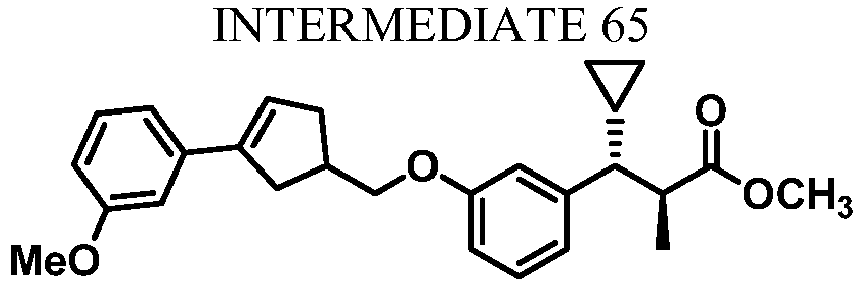
- (2S,3R)-Methyl 3-cyclopropyl-3-(3-((3-(3-methoxyphenyi)cyclopent-3-en-1-yl)methoxy)phenyl)-2-methylpropanoate To a solution of Intermediate 63 (70 mg, 0.34 mmol) and Intermediate 2 (80 mg, 0.34 mmol) in toluene (3 mL) was added PPh3 (180 mg, 0.685 mmol) immobilized on a polystyrene support. The resulting slurry was cooled to 0°C. Then DIAD (0.13 mL, 0.685 mmol) was slowly added. After 1h, the reaction was warmed to room temperature and filtered. The volatiles were removed in vacuo and the residue was purified by MPLC (ISCO 40 g, 0 to 40% EtOAc/Hex) to give the title compound. LC/MS: m/e 421.25 (M+H)+

- (2S,3R)-Methyl 3-cyclopropyl-3-(3-((3-(3-methoxyphenyl)cyclopentyl)methoxy)phenyl)-2-methylpropanoate To a solution of Intermediate 64 (50 mg, 0.24 mmol) and Intermediate 2 (57 mg, 0.24 mmol) in toluene (3 mL) was added PPh3 (127 mg, 0.485 mmol) immobilized on a polystyrene support. The resulting slurry was cooled to 0 °C. Then DIAD (0.094 ml, 0.485 mmol) was slowly added. After 1h, the reaction was warmed to room temperature and filtered. The volatiles were removed in vacuo and the resulting residue was purified by MPLC (ISCO 40 g, 0 to 40% EtOAc/Hex) to give the title compound. LC/MS: m/e 423.28 (M+H)+

- Intermediate 53 (790 mg, 2.481 mmol) was dissolved in toluene (10 ml) and imidazole (507 mg, 7.44 mmol). Then triphenylphosphine (1302 mg, 4.96 mmol) and iodine (945 mg, 3.72 mmol) were added at RT under a nitrogen atmosphere. The reaction was heated at 100 °C for 2h, then diluted with EtOAc, and washed with saturated NaHCO3. Iodine was added to the organic layer until the color was light yellow. Then the organic layer was washed with 5% Na2S2O3, dried over anhydrous MgSO4, filtered and evaporated. The resulting crude material was purified by silica gel chromatography (gradient elution, 0∼20% EtOAc in hexanes) to give the title compound.

- Methyl (2S,3R)-3-cyclopropyl-3-(3-((3-(2-fluoro-5-methoxyphenyl)cyclobutyl)methoxy)-phenyl)-2-methylpropanoate A solution of (2S,3R)-methyl 3-cyclopropyl-3-(3-((3-iodocyclobutyl)methoxy)phenyl)-2-methylpropanoate (250 mg, 0.584 mmol), (2-fluoro-5-methoxyphenyl)boronic acid (149 mg, 0.876 mmol) and 1,1'-bis(di-tert-butylphosphino)-ferrocene palladium dichloride (38.0 mg, 0.058 mmol) in DMF (4 ml) was treated with potassium phosphate tribasic (0.743 ml, 1.751 mmol, 50% water). The mixture was degassed, purged with nitrogen for 5 min, then heated at 90 °C for 3 h. The mixture was then cooled to room temperature, quenched with water and extracted with EtOAc (2x). The combined EtOAc layers were washed with water and brine, dried over anhydrous MgSO4, filtered and evaporated. The resuling crude material was purified by silica gel chromatography (gradient elution, 0∼15% EtOAc in hexanes) to afford the title compound.

- Methyl (2S,3R)-3-cyclopropyl-3-(3-((3-(3-methoxyphenyl)cyclobutyl)methoxy)phenyl)-2-methylpropanoate Intermediate 69 was prepared in an analogous manner to Intermediate 68, starting with 3-methoxyphenylboronic acid and Intermediate 67.
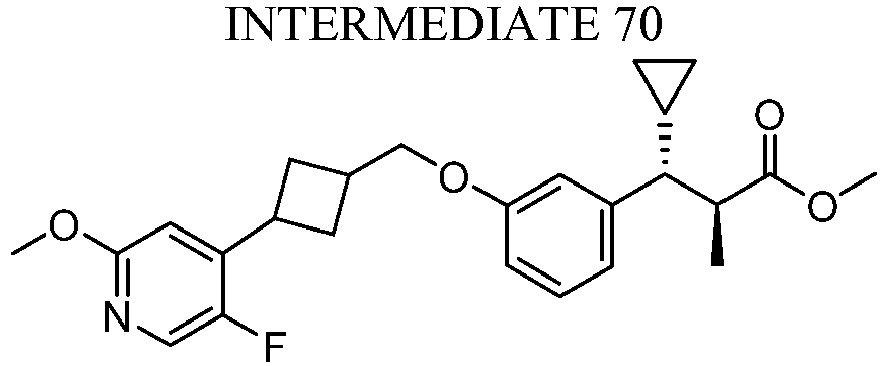
- Methyl (2S,3R)-3-cyclopropyl-3-(3-((3-(5-fluoro-2-methoxypyridin-4-yl)cyclobutyl)-methoxy)phenyl)-2-methylpropanoate (2S,3R)-Methyl 3-cyclopropyl-3-(3-((3-iodocyclobutyl)methoxy)phenyl)-2-methylpropanoate (360 mg, 0.841 mmol), 5-fluoro-2-methoxypyridine-4-boronic acid (180 mg, 1.051 mmol) and 2nd generation S-Phos precatalyst (30.3 mg, 0.042 mmol) were dissolved in THF (6 mL) and potassium phosphate tribasic (1.070 ml, 2.52 mmol, 50% water solution) was added. The mixture was degassed, purged with nitrogen for 5 min, then heated at 75 °C for 2 h. Then the mixture was quenched with water, and extracted with EtOAc (2x). The combined EtOAc layers were washed with brine, dried over anhydrous MgSO4, filtered and evaporated. The resulting crude material was purified by silica gel chromatography (40 g ISCO RediSep Rf Gold column, gradient elution 0∼30% EtOAc in hexanes) to afford the title compound.

- methyl (2S,3R)-3-cyclopropyl-3-(3-((3-(2-methoxypyridin-4-yl)cyclobutyl)methoxy)phenyl)-2-methylpropanoate A solution of Intermediate 67 (342 mg, 0.80 mmol), 4-bromo-2-methoxypyridine (100 mg, 0.53 mmol), manganese (175 mg, 3.2 mmol), 4,4',4"-tri-tert-butyl-2,2':6',2"-terpyridine (85 mg, 0.21 mmol), pyridine (0.21 mL, 2.7 mmol) and nickel (II) chloride dimethoxyethane adduct (23 mg, 0.11 mmol) in N,N-dimethylacetamide (2 mL) was purged with nitrogen for 5 min., then sealed and microwaved at 100 °C for 1 h. The reaction mixture was quenched with water, and extracted with EtOAc (2x). The combined EtOAc layers were washed with brine, dried over anhydrous MgSO4, filtered and evaporated. The resulting crude material was purified by silica gel flash chromatography (24 g ISCO RediSep Rf Gold column, gradient elution, 0∼20% EtOAc in hexanes) to afford the title compound.
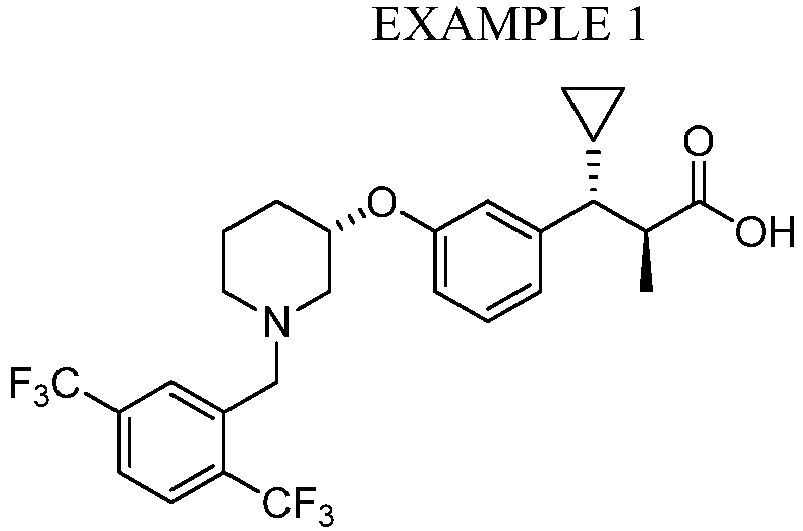
-
- Step A: To a solution of Intermediate 2 (59 mg, 0.252 mmol) in DMF (2 mL) at rt was added Cs2CO3 (164 mg, 0.504 mmol), and the reaction was stirred at rt for 10 minutes. Intermediate 16 (102 mg, 0.25 mmol) was added and the reaction mixture was stirred at 50 °C for 48 h. Then the solution was diluted with H2O, extracted with EtOAc (3 x 15 mL), washed with brine solution, dried over MgSO4, filtered, concentrated and purified by MPLC (ISCO 24g, 0-15%EtOAc/hexanes) to give (2S,3R)-methyl 3-(3-(((R)-1-(2,5-bis(trifluoromethyl)benzyl) piperidin-3-yl)oxy)phenyl)-3-cyclopropyl-2-methylpropanoate as a colorless oil.
- Step B: To (2S,3R)-methyl 3-(3-(((R)-1-(2,5-bis(trifluoromethyl)benzyl)piperidin-3-yl)oxy)phenyl)-3-cyclopropyl-2-methylpropanoate (98 mg, 0.180 mmol) in THF (1.5 mL)/MeOH (1.5 mL)/Water (1 mL) at rt was added LiOH (30 mg, 0.7 mmol). The resulting mixture was stirred at 60°C for 12 h, then diluted with H2O and acidified with IN HCl to pH 4-5. The solution was extracted with EtOAc (3x 50 mL). The combined EtOAc layers were washed with brine, dried over MgSO4, filtered, concentrated and purified by MPLC (ISCO 4g, 0-100% EtOAc/hexanes)) to give the title compound as a white foam. 1H NMR (500 MHz, CD3OD): δ 8.32 (d, J = 10.4 Hz, 1 H); 7.91 (d, J = 10.6 Hz, 1 H); 7.89(m, 1H); 7.22 (s, 1 H); 6.80 (m, 1 H); 6.75 (s, 1 H); 6.68 (s, 1 H); 4.49 (d, J = 14.3 Hz, 1 H); 3.84-4.02 (m, 2 H); 2.99-3.20(m, 2H); 2.78 (br s, 1 H); 1.10-2.50(m, 8H); 0.91 (s, 3 H); 0.64 (s, 1 H); 0.38 (s, 1 H); 0.32 (br s, 1 H); 0.01(br s, 1H). LC/MS: m/e 530.41 (M+H)+.
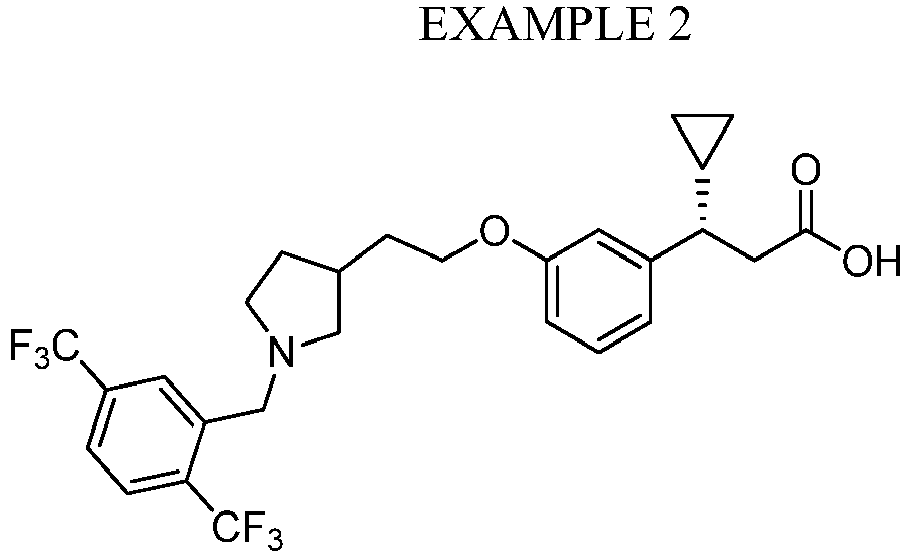
-
- Step A: To Intermediate 20 (60 mg, 0.1 mmol) in DMF (1 mL) at rt was added 2,5-bis(trifluoromethyl)benzyl bromide (38 mg, 0.1 mmol) and K2CO3 (68 mg, 0.5 mmol). The resulting mixture was stirred at rt for 12 h, then diluted with H2O (15 mL), and extracted with EtOAc (3 x 15 mL). The combined organic layers were washed with brine, dried over MgSO4, filtered, concentrated and purified by MPLC (ISCO 24g, 0-15%EtOAc/hexanes) to give (3S)-methyl 3-(3-(2-(1-(2,5-bis(trifluoromethyl)benzyl)-pyrrolidin-3-yl)ethoxy)phenyl)-3-cyclopropylpropanoate as a colorless oil.
- Step B: To (3S)-methyl 3-(3-(2-(1-(2,5-bis(trifluoromethyl)benzyl)-pyrrolidin-3-yl)ethoxy)phenyl)-3-cyclopropylpropanoate (40 mg, 0.07 mmol) in THF (1.5 mL)/MeOH (1.5 mL)/water (1 mL) at rt was added LiOH (12 mg, 0.3 mmol). The resulting mixture was stirred at 60°C for 12 h, then diluted with H2O and acidified with IN HCl to pH 4-5. The solution was extracted with EtOAc (3x 10 mL). The combined EtOAc layers were washed with brine, dried over MgSO4, filtered, concentrated and purified by MPLC (ISCO 4g, 0-100% EtOAc/hexanes) to give the title compound as a colorless oil. 1H NMR (500 MHz, CD3OD): δ 8.06 (s, 1 H); 7.80 (d, J = 8.3 Hz, 1 H); 7.67 (d, J = 8.2 Hz, 1 H); 7.06 (t, J = 7.9 Hz, 1 H); 6.67-6.72 (m, 2 H); 6.61 (d, J = 8.2 Hz, 1 H); 3.89 (m, 4 H); 2.87 (s, 1 H); 2.70 (t, J = 8.2 Hz, 1 H); 2.57-2.60 (m, 2 H); 2.54 (t, J = 10.1 Hz, 1 H); 2.35 (m, 2 H); 2.19 (t, J = 8.5 Hz, 1 H); 2.03 (br s, 1 H); 1.78 (d, J = 7.1 Hz, 2 H); 1.51 (d, J = 10.1 Hz, 1 H); 0.92 (s, 1 H); 0.46 (s, 1 H); 0.27 (s, 1 H); 0.18 (s, 1 H); 0.02(s, 1H). LC/MS: m/e 530.44 (M+H)+.

- (3S)-3-(3-((1-(2,5-Bis(trifluoromethyl)benzyl)piperidin-2-yl)methoxy)phenyl)-3-cyclopropylpropanoic acid The compound of Example 3 was prepared according to the procedure of Example 1 using Intermediate 37. 1H NMR (500 MHz, CD3OD):δ 8.26 (s, 1 H); 7.56-7.73 (m, 2 H); 7.00 (m, 1 H); 6.41-7.6.75(m, 3H); 4.22-4.37 (m, 1 H); 3.62-4.00(m, 3H); 2.50-2.85(m, 5H); 1.20-2.20(m, 8H); 0.88 (m, 1 H); 0.46 (br s, 1 H); 0.25 (m, 1 H); 0.17 (br s, 1 H). LC/MS: m/e 530.40 (M+H)+.

-
- Step A: A vial was charged with 2,5-bis(trifluoromethyl)bromobenzene (64 mg, 0.22 mmol), Intermediate 29 (72 mg, 0.1 mmol), Pd2dba3 (6 mg, 7 µmol), X-Phos (14 mg, 0.03 mmol) and K3PO4 (124 mg, 0.6 mmol). The reaction mixture was purged with N2, then 1,4-dioxane (2 mL) was added and the resulting mixture was heated to 100 °C for 12 h. Then the reaction was cooled to rt and filtered through a pad of Celite™, concentrated to dryness and purified by MPLC (ISCO 24g, 0-15%EtOAc/hexanes) to give (2S,3R)-methyl 3-(3-((1-(2,5-bis(trifluoromethyl)phenyl)azetidin-3-yl)methoxy)phenyl)-3-cyclopropyl-2-methylpropanoate.
- Step B: To (2S,3R)-methyl 3-(3-((1-(2,5-bis(trifluoromethyl)phenyl)azetidin-3-yl)methoxy)phenyl)-3-cyclopropyl-2-methylpropanoate (40 mg, 0.08 mmol) in THF (1.5 mL)/MeOH (1.5 mL)/water (1 mL) at rt was added LiOH (13 mg, 0.3 mmol). The resulting mixture was stirred at 60°C for 12 h, then diluted with H2O and acidified with IN HCl to pH 4-5. The solution was extracted with EtOAc (3x 10 mL). The combined EtOAc layers were washed with brine, dried over MgSO4, filtered, concentrated and purified by MPLC (ISCO 4g, 0-100% EtOAc/hexanes) to give the title compound as a yellow oil.
1H NMR (500 MHz, CD3OD): δ 7.68 (d, J = 8.3 Hz, 1 H); 7.23 (s, 1 H); 7.02 (s, 1 H); 6.84 (s, 1 H); 6.80 (s, 3 H); 4.28 (d, J = 8.4 Hz, 2 H); 4.22 (d, J = 6.2 Hz, 2 H); 4.02 (s, 2 H); 3.17(s, 1H); 2.79 (s, 1 H); 1.95 (t, J = 10.0 Hz, 1 H); 1.30 (s, 1 H); 0.92 (d, J = 6.7 Hz, 3 H); 0.60 (s, 1 H); 0.34 (br s, 2 H); 0.01(s, 1H). LC/MS: m/e 502.35 (M+H)+.
- (3S)-3-(3-((6-(2,5-Bis(trifluoromethyl)benzyl)-6-azaspiro[3.4]octan-2-yl)oxy)phenyl)-3-cyclopropylpropanoic acid and (S)-3-(3-((6-(2,5-bis(trifluoromethyl)benzyl)-6-azaspiro[3.4]octan-2-yl)oxy)phenyl)-3-cyclopropylpropanoic acid The compounds of Examples 5A and 5B were prepared according to the procedure of Example 2 using Intermediates 21A and 21B.
- Example 5A: 1H NMR (500 MHz, CD3OD): δ 8.07 (s, 1 H); 7.78 (d, J = 8.2 Hz, 1 H); 7.64 (d, J = 8.1 Hz, 1 H); 7.02 (t, J = 7.9 Hz, 1 H); 6.68 (d, J = 7.5 Hz, 1 H); 6.57 (s, 1 H); 6.51 (d, J = 8.1 Hz, 1 H); 4.64 (m, 1 H); 3.81 (s, 2 H); 2.43-2.62 (m, 8 H); 2.16 (d, J = 9.0 Hz, 1 H); 2.02 (s, 2 H); 1.88 (d, J = 7.0 Hz, 2 H); 0.90 (s, 1 H); 0.45 (s, 1 H); 0.26 (s, 1 H); 0.16 (s, 1 H); 0.01(s, 1H). LC/MS: m/e 542.73 (M+H)+.
- Example 5B: 1H NMR (500 MHz, CD3OD): δ 8.02 (s, 1 H); 7.76 (d, J = 8.2 Hz, 1 H); 7.63 (d, J = 8.0 Hz, 1 H); 7.03 (t, J = 7.8 Hz, 1 H); 6.69 (d, J = 7.5 Hz, 1 H); 6.58 (s, 1 H); 6.52 (d, J = 8.0 Hz, 1 H); 4.56(m, 1H); 3.78 (s, 2 H); 2.40-2.62 (m, 8 H); 2.17 (d, J = 9.2 Hz, 1 H); 2.03 (s, 2 H); 1.94 (s, 2 H); 0.90 (s, 1 H); 0.45 (s, 1 H); 0.26 (s, 1 H); 0.16 (s, 1 H); 0.00(s, 1H). LC/MS: m/e 542.61 (M+H)+.

- (S)-3-(3-((1-(2,5-Bis(trifluoromethyl)benzyl)-3-methylazetidin-3-yl)methoxy)phenyl)-3-cyclopropylpropanoic acid The compound of Example 6 was prepared according to the procedure of Example 2 using Intermediate 30. 1H NMR (500 MHz, CD3OD): δ 7.87 (s, 1 H); 7.77 (d, J = 8.2 Hz, 1 H); 7.63 (d, J = 8.1 Hz, 1 H); 7.05 (d, J = 8.3 Hz, 1 H); 6.65-6.72 (m, 3 H); 3.90 (s, 2 H); 3.82 (s, 2 H); 3.38(m, 2H); 3.10(m, 2H); 2.51-2.59 (m, 2 H); 2.17 (d, J = 9.0 Hz, 1 H); 1.10 (s, 3 H); 0.91 (s, 1 H); 0.44 (s, 1 H); 0.25 (s, 1 H); 0.16 (s, 1 H); 0.00(s, 1H). LC/MS: m/e 516.65 (M+H)+.

-
- Step A: To a solution of Intermediate 2 (53 mg, 0.3 mmol) in DMF (2 mL) at rt was added Cs2CO3 (147 mg, 0.45 mmol), followed by the addition of Intermediate 15 (92 mg, 0.226 mmol). The resulting mixture was stirred at 50°C for 48 hours, then diluted with H2O (10 mL), and extracted with EtOAc (3 x 20 mL). The combined organic layers were washed with brine, dried over MgSO4, filtered, concentrated and purified by MPLC (ISCO 24g, 0-15% EtOAc/hexanes) to give (2S,3R)-methyl 3-(3-(((R)-1-(2,5-bis(tri-fluoromethyl)benzyl)piperidin-3-yl)oxy)phenyl)-3-cyclopropyl-2-methylpropanoate as a colorless oil.
- Step B: To (2S,3R)-methyl 3-(3-(((R)-1-(2,5-bis(tri-fluoromethyl)benzyl)piperidin-3-yl)oxy)phenyl)-3-cyclopropyl-2-methylpropanoate (98 mg, 0.2 mmol) in THF (1.5 mL)/MeOH (1.5 mL)/water (1 mL) at rt was added LiOH (30 mg, 0.7 mmol). The resulting mixture was stirred at 60°C for 12 h, then diluted with H2O and acidified with IN HCl to pH 4-5. The solution was extracted with EtOAc (3x 10 mL). The combined EtOAc layers were washed with brine, dried over MgSO4, filtered, concentrated and purified by MPLC (ISCO 4g, 0-100% EtOAc/hexanes) to give the title compound as a white foam.
1H NMR (500 MHz, CD3OD): δ 8.32 (d, J = 10.4 Hz, 1 H); 7.91 (d, J = 10.6 Hz, 1 H); 7.79(m, 1H); 7.22 (s, 1 H); 6.80 (s, 1 H); 6.75 (s, 1 H); 6.68 (s, 1 H); 4.49 (d, J = 14.3 Hz, 1 H); 3.82-4.02 (m, 2 H); 2.97-3.21(m, 2H); 2.78 (br s, 2 H); 1.65-2.56 (m, 5H); 1.10-1.40(m, 2H); 0.91 (s, 3H); 0.64 (s, 1 H); 0.38 (m, 2 H); 0.00 (br s, 1 H). LC/MS: m/e 530.41(M+H)+.
- (3S)-3-(3-((2-(2,5-bis(trifluoromethyl)benzyl)octahydrocyclopentar[c]pyrrol-5-yl)oxy)phenyl)-3-cyclopropylpropanoic acid The compound of Example 8 was prepared according to the procedure of Example 2 using Intermediate 22. 1H NMR (500 MHz, CD3OD): δ 8.08 (s, 1 H); 7.79 (d, J = 8.3 Hz, 1 H); 7.65 (d, J = 8.2 Hz, 1 H); 7.07 (t, J = 7.9 Hz, 1 H); 6.63-6.72 (m, 3 H); 4.84(m, 1H); 3.75 (s, 2 H); 2.57-2.71 (m, 5H); 2.33 (s, 2H); 2.20 (d, J = 8.7 Hz, 1 H); 2.04 (br s, 2 H); 1.66 (d, J = 12.7 Hz, 2 H); 1.19 (s, 1 H); 0.93 (s, 1 H); 0.48 (s, 1 H); 0.30 (s, 1 H); 0.19 (s, 1 H); 0.04 (s, 1 H). LC/MS: m/e 542.45(M+H)+.

- (2S,3R)-3-(3-(1-(1-(2,5-Bis(trifluoromethyl)benzyl)azetidin-3-yl)ethoxy)phenyl)-3-cyclopropyl-2-methylpropanoic acid The compound of Example 9 was prepared according to the procedure of Example 2 using Intermediate 38. 1H NMR (500 MHz, CD3OD): δ 8.03 (s, 1 H); 7.95 (d, J = 8.2 Hz, 1 H); 7.82 (d, J = 8.3 Hz, 1 H); 7.26 (t, J = 7.9 Hz, 1 H); 6.88(m, 3H); 4.64 (t, J = 6.3 Hz, 1 H); 4.02 (s, 2 H); 3.63 (t, J = 7.8 Hz, 2 H); 3.35-3.36 (m, 2 H); 2.87-2.91 (m, 1 H); 2.81 (ddd, J = 9.9, 6.9, 3.8 Hz, 1 H); 1.99 (t, J = 9.9 Hz, 1 H); 1.26 (d, J = 6.1 Hz, 3 H); 1.17(m, 1H); 0.94(d, J = 6.6 Hz, 1H), 0.68(m 1H); 0.60-0.65 (m, 1 H); 0.32-0.40 (m, 2 H); 0.00(m, 1H). LC/MS: m/e 530.43(M+H)+.

- (2S,3R)-3-(3-((1-(2,5-Bis(trifluoromethyl)benzyl)-3-fluoroazetidin-3-yl)methoxy)-phenyl)-3-cyclopropyl-2-methylpropanoic acid The compound of Example 10 was prepared according to the procedure of Example 2 using Intermediate 36. 1H NMR (500 MHz, CD3OD): δ 8.07 (s, 1 H); 7.93 (d, J = 8.2 Hz, 1 H); 7.79 (d, J = 8.3 Hz, 1 H); 7.27 (t, J = 7.9 Hz, 1 H); 6.84-6.89 (m, 3 H); 4.37 (s, 1 H); 4.33 (s, 1 H); 4.06 (s, 2 H); 3.75 (dd, J = 13.4, 9.2 Hz, 2 H); 3.48(m, 2H); 2.82 (dd, J = 9.8, 6.8 Hz, 1 H); 1.98 (t, J = 9.9 Hz, 1 H); 1.13-1.17 (m, 1 H); 0.95 (d, J = 6.9 Hz, 3 H); 0.61-0.65 (m, 1 H); 0.33-0.39 (m, 2 H); 0.00(m, 1H). LC/MS: m/e 534.82(M+H)+.
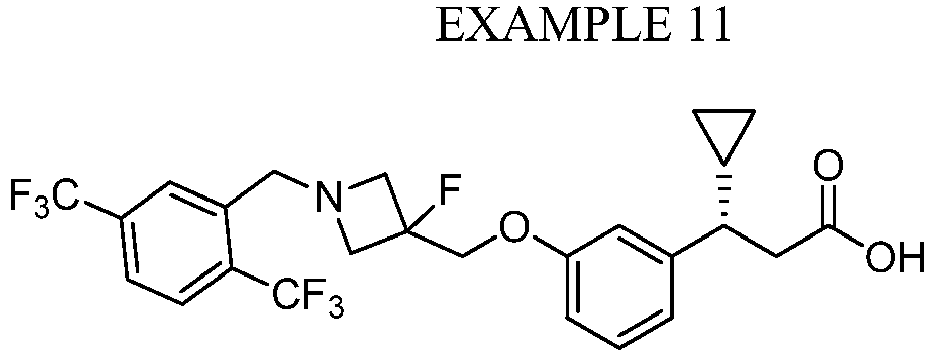
- (S)-3-(3-((1-(2,5-Bis(trifluoromethyl)benzyl)-3-fluoroazetidin-3-yl)methoxy)phenyl)-3-cyclopropylpropanoic acid The above example was prepared in an analogous manner to example 2 using Intermediate 31. 1H NMR (500 MHz, CD3OD): δ 7.89 (s, 1 H); 7.76 (d, J = 8.2 Hz, 1 H); 7.62 (d, J = 8.1 Hz, 1 H); 7.07 (t, J = 7.8 Hz, 1 H); 6.73-6.75 (m, 2 H); 6.68 (d, J = 8.1 Hz, 1 H); 4.18 (s, 1 H); 4.14 (s, 1 H); 3.88 (s, 2 H); 3.57 (t, J = 10.9 Hz, 2 H); 3.32 (m, 2 H); 2.52-2.63 (m, 2 H); 2.17 (d, J = 8.9 Hz, 1 H); 0.91 (s, 1 H); 0.44 (s, 1 H); 0.25 (s, 1 H); 0.15 (s, 1 H); 0.00(s, 1H). LC/MS: m/e 520.38(M+H)+.

- (3S)-3-Cyclopropyl-3-(3-((1-(5-fluoro-2-methoxybenzyl)pyrrolidin-3-yl)oxy)phenyl)propanoic acid The compound of Example 12 was prepared according to the procedure of Example 2 using 2-(bromomethyl)-4-fluoro-1-methoxybenzene and Intermediate 17. 1H NMR (400 MHz, CD3OD): δ 7.11-7.19 (m, 3 H); 7.04 (d, J = 8.6 Hz, 1 H); 6.90 (d, J = 7.5 Hz, 1 H); 6.80 (s, 1 H); 6.71 (d, J = 8.4 Hz, 1 H); 5.06(m, 1H); 4.20 (s, 2 H); 3.83 (s, 3 H); 3.28-3.50 (m, 2H); 2.61-2.68 (m, 3 H); 2.20-2.40 (m, 2 H); 1.28 (m, 1 H); 1.05(m, 1H); 0.88(m, 1H); 0.56 (s, 1 H); 0.35 (m, 2 H); 0.11 (s, 1 H). LC/MS: m/e 414.37(M+H)+.
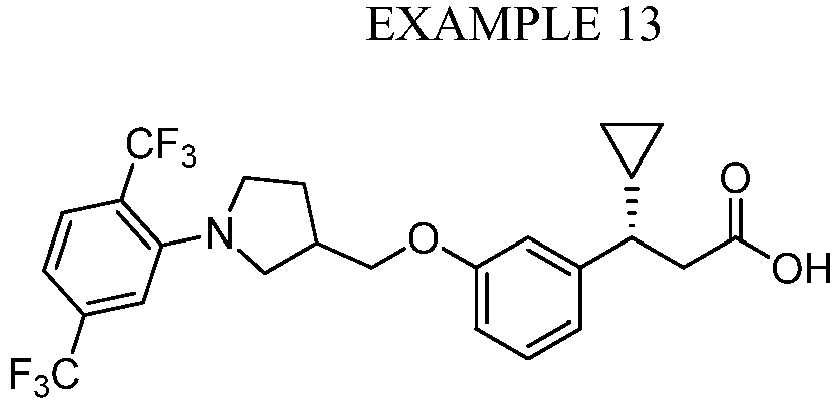
- (3S)-3-(3-((1-(2,5-Bis(trifluoromethyl)phenyl)pyrrolidin-3-yl)methoxy)phenyl)-3-cyclopropylpropanoic acid The compound of Example 13 was prepared according to the procedure of Example 4 using 2,5-bis(trifluoromethyl)bromobenzene and Intermediate 18. 1H NMR (500 MHz, CD3OD): δ 7.63 (d, J = 8.3 Hz, 1 H); 7.19 (s, 1 H); 7.02-7.08 (m, 2 H); 6.72 (d, J = 6.9 Hz, 2 H); 6.66 (d, J = 8.3 Hz, 1 H); 3.91 (t, J = 8.7 Hz, 2 H); 3.21-3.40 (m, 4 H); 2.54-2.68 (m, 3 H); 2.10-2.22 (m, 2 H); 1.89 (m, 1 H); 0.92 (s, 1 H); 0.43-0.46 (m, 1 H); 0.27 (d, J = 7.8 Hz, 1 H); 0.17 (dd, J = 9.4, 5.0 Hz, 1 H), 0.00(m, 1H). LC/MS: m/e 502.34(M+H)+.

- (2S,3R)-3-(3-((3-((2,5-Bis(trifluoromethyl)benzyl)amino)cyclobutyl)methoxy)phenyl)-3-cyclopropyl-2-methylpropanoic acid The compound of Example 14 was prepared according to the procedure of Example 2 using Intermediate 33. 1H NMR (500 MHz, CD3OD): δ 8.16 (s, 1 H); 7.98-8.00 (m, 1 H); 7.86 (d, J = 8.0 Hz, 1 H); 7.24 (td, J = 7.8, 5.1 Hz, 1 H); 6.78-6.83 (m, 3 H); 3.98-4.04(m, 4H); 3.40 (m, 1 H); 2.79-2.83 (m, 1 H); 2.49 (t, J = 7.6 Hz, 2 H); 2.20-2.33 (m, 2 H); 1.98 (m, 1 H); 1.84(m, 1H); 1.14 (m, 1 H); 0.95 (dd, J = 6.9, 3.4 Hz, 3 H); 0.64 (s, 1 H); 0.34-0.42 (m, 2 H); 0.00(m, 1H). LC/MS: m/e 530.79(M+H)+.

- (S)-3-(3-((2-(2,5-Bis(trifluoromethyl)benzyl)-2-azaspiro[3.3]heptan-6-yl)oxy)phenyl)-3-cyclopropylpropanoic acid The compound of Example 15 was prepared according to the procedure of Example 2 using Intermediate 32. 1H NMR (500 MHz, CD3OD): δ 7.86 (s, 1 H); 7.78 (d, J = 8.2 Hz, 1 H); 7.65 (d, J = 8.2 Hz, 1 H); 7.03 (t, J = 7.9 Hz, 1 H); 6.69 (d, J = 7.6 Hz, 1 H); 6.57 (s, 1 H); 6.51 (d, J = 8.2 Hz, 1 H); 4.48 (t, J = 7.0 Hz, 1 H); 3.82 (s, 2 H); 3.40 (s, 2 H); 3.32 (s, 2 H); 2.54-2.64 (m, 4 H); 2.15 (s, 3 H); 0.90 (s, 1 H); 0.44 (s, 1 H); 0.26 (s, 1 H); 0.16 (s, 1 H), 0.00(s, 1H). LC/MS: m/e 528.42(M+H)+.

-
- Step A: To a solution of Intermediate 29 (88 mg, 0.2 mmol) in DMF (2 mL) at rt was added 2-chloro-4-trifluoromethylpyridine (36 mg, 0.2 mmol) and K2CO3 (109 mg, 0.8 mmol). The resulting mixture was stirred at rt for 12 h, then diluted with H2O (10 mL) and extracted with EtOAc (3x 20 mL). The combined organic layers were washed with brine, dried over MgSO4, filtered and concentrated. The resulting oil was purified by MPLC (ISCO 12g, 0-30% EtOAc/hexanes) to give a colorless oil.
- Step B: To (2S,3R)-methyl 3-cyclopropyl-2-methyl-3-(3-((1-(4-(trifluoromethyl)pyridin-2-yl)azetidin-3-yl)methoxy)phenyl)propanoate (20 mg, 0.04 mmol) in THF (1.5 mL)/MeOH (1.5 mL)/Water (1 mL) at rt was added LiOH (7.5 mg, 0.2 mmol). The resulting mixture was stirred at 60°C for 12 h, then diluted with H2O and acidified with IN HCl to pH 4-5. The solution was extracted with EtOAc (3x 10 mL). The combined EtOAc layers were washed with brine, dried over MgSO4, filtered, concentrated and purified by MPLC (ISCO 4g, 0-100% EtOAc/hexanes) to give the title compound as a white solid.
1H NMR (500 MHz, CD3OD): δ 8.25 (d, J = 5.4 Hz, 1 H); 7.25 (t, J = 7.9 Hz, 1 H); 6.80-6.87 (m, 4 H); 6.66 (s, 1 H); 4.24-4.29 (m, 4 H); 4.03 (dd, J = 8.4, 5.3 Hz, 2 H); 3.34-3.35 (m, 1 H); 2.82 (dq, J = 9.8, 6.9 Hz, 1 H); 1.98 (m, 1 H); 1.17 (m, 1 H); 0.95 (d, J = 6.9 Hz, 3 H); 0.60-0.65 (m, 1 H); 0.32-0.39 (m, 2 H), 0.11(m, 1H). LC/MS: m/e 435.35 (M+H)+.
- (3S)-3-(3-((1-(2,5-Bis(trifluoromethyl)benzyl)-3-fluoropyrrolidin-3-yl)methoxy)phenyl)-3-cyclopropylpropanoic acid The compound of Example 17 was prepared according to the procedure of Example 2 using Intermediate 23. 1H NMR (500 MHz, CD3OD): δ 8.09 (s, 1 H); 7.80 (d, J = 8.3 Hz, 1 H); 7.66 (d, J = 8.3 Hz, 1 H); 7.10 (t, J = 7.8 Hz, 1 H); 6.76 (d, J = 8.7 Hz, 2 H); 6.69 (d, J = 8.4 Hz, 1 H); 4.01-4.09 (m, 2 H); 3.85 (s, 2 H); 2.83-2.90 (m, 3 H); 2.56-2.68 (m, 3 H); 2.12-2.24(m, 3H); 0.93-0.96 (m, 1 H); 0.46-0.50 (m, 1 H); 0.26-0.31 (m, 1 H); 0.20 (dt, J = 9.4, 4.9 Hz, 1 H); 0.02(m, 1H). LC/MS: m/e 533.36 (M+H)+.

- (S)-3-(3-(2-(1-(2,5-Bis(trifluoromethyl)benzyl)azetidin-3-yl)ethoxy)phenyl)-3-cyclopropylpropanoic acid The compound of Example 3 was prepared according to the procedure of Example 1 using Intermediate 34. 1H NMR (500 MHz, CD3OD): δ 7.89 (s, 1 H); 7.80 (d, J = 8.2 Hz, 1 H); 7.67 (d, J = 8.2 Hz, 1 H); 7.04 (t, J = 7.9 Hz, 1 H); 6.71 (d, J = 7.6 Hz, 1 H); 6.66 (s, 1 H); 6.59 (d, J = 8.2 Hz, 1 H); 3.90 (s, 2 H); 3.86 (s, 2 H); 3.59 (t, J = 7.4 Hz, 2 H); 3.10 (s, 2 H); 2.69 (t, J = 8.1 Hz, 1 H); 2.60 (dd, J = 14.7, 6.5 Hz, 1 H); 2.52 (t, J = 9.5 Hz, 1 H); 2.18 (t, J = 8.6 Hz, 1 H); 1.89-1.94 (m, 2 H); 0.91 (s, 1 H); 0.45 (s, 1 H); 0.25 (s, 1 H); 0.17 (s, 1 H); 0.00(s, 1H). LC/MS: m/e 516.42 (M+H)+.

- (S)-3-Cyclopropyl-3-(3-((1-(5-fluoro-2-methoxybenzyl)azetidin-3-yl)methoxy)-phenyl)propanoic acid The compound of Example 19 was prepared according to the procedure of Example 2 using 2-(bromomethyl)-4-fluoro-1-methoxybenzene and Intermediate 28. 1H NMR (500 MHz, CD3OD): δ 7.02-7.07 (m, 3 H); 6.95 (dd, J = 8.9, 4.2 Hz, 1 H); 6.78-6.82 (m, 2 H); 6.66 (d, J = 8.2 Hz, 1 H); 4.14 (s, 2 H); 3.95 (m, 4 H); 3.82(m, 2H); 3.78 (s, 3 H); 3.06(s, 1H); 2.55-2.58 (m, 1 H); 2.48 (t, J = 10.8 Hz, 1 H); 2.22-2.25 (m, 1 H); 0.90 (s, 1 H); 0.44(m, 1H), 0.22(m, 2H), 0.00(m, 1H). LC/MS: m/e 414.42 (M+H)+.
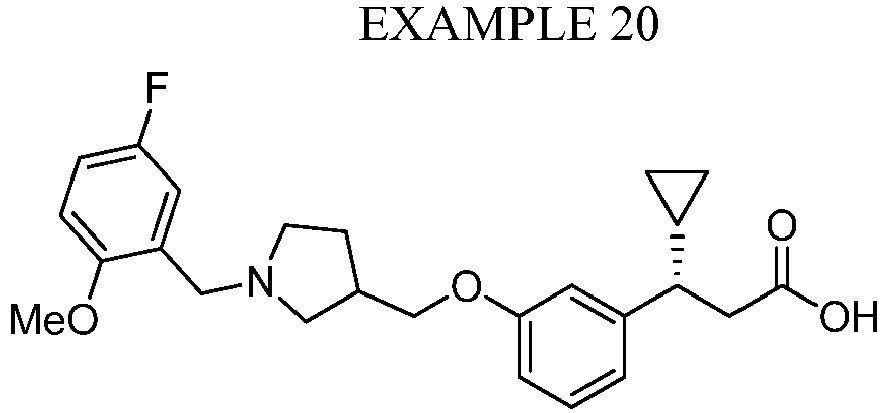
- (3S)-3-Cyclopropyl-3-(3-((1-(5-fluoro-2-methoxybenzyl)pyrrolidin-3-yl)methoxy)phenyl)propanoic acid The compound of Example 20 was prepared according to the procedure of Example 2 using 2-(bromomethyl)-4-fluoro-1-methoxybenzene and Intermediate 18. 1H NMR (500 MHz, CD3OD): δ 7.14 (d, J = 8.6 Hz, 1 H); 7.06 (t, J = 8.1 Hz, 2 H); 6.96 (dd, J = 9.1, 4.3 Hz, 1 H); 6.78 (d, J = 7.6 Hz, 1 H); 6.72 (s, 1 H); 6.61 (d, J = 8.2 Hz, 1 H); 4.11 (s, 2 H); 3.82(m, 1H); 3.76 (s, 3 H); 3.25 (m, 2 H); 3.11 (s, 2 H); 2.90(m, 1H); 2.43-2.67(m, 3H), 2.20(m, 1H); 2.00(m, 1H); 1.72(m, 1H); 0.86-0.89 (m, 1 H); 0.45 (d, J = 7.5 Hz, 1 H); 0.20-0.26 (m, 2 H); 0.00(m, 1H). LC/MS: m/e 428.31 (M+H)+.

- (2S,3R)-3-Cyclopropyl-2-methyl-3-(3-((1-(3-(trifluoromethyl)pyndin-2-yl)azetidin-3-yl)methoxy)phenyl)propanoic acid The compound of Example 21 was prepared according to the procedure of Example 16 using 2-chloro-3-trifluoromethyl pyridine and Intermediate 29. 1H NMR (500 MHz, CD3OD): δ 8.30 (d, J = 4.8 Hz, 1 H); 7.87 (d, J = 7.8 Hz, 1 H); 7.25 (t, J = 7.9 Hz, 1 H); 6.85-6.92 (m, 3 H); 6.78(m, 1H); 4.38 (t, J = 8.6 Hz, 2 H); 4.22 (d, J = 6.5 Hz, 2 H); 4.11 (t, J = 7.1 Hz, 2 H); 3.18 (m, 1 H); 2.82 (dq, J = 9.8, 6.9 Hz, 1 H); 1.98 (t, J = 9.9 Hz, 1 H); 1.15(m 1H); 0.95 (d, J = 6.9 Hz, 3 H); 0.62(m ,1H); 0.36 (m, 2H); 0.02(m 1H). LC/MS: m/e 435.37 (M+H)+.

- (3S)-3-(3-((1-(2,5-Bis(trifluoromethyl)benzyl)-4,4-dimethylpyrrolidin-3-yl)methoxy)phenyl)-3-cyclopropylpropanoic acid The compound of Example 22 was prepared according to the procedure of Example 2 using Intermediate 24. 1H NMR (500 MHz, CD3OD): δ 8.07 (s, 1 H); 7.77 (d, J = 8.2 Hz, 1 H); 7.63 (d, J = 8.3 Hz, 1 H); 7.05(m, 1H); 6.69-6.73 (m, 2 H); 6.64 (d, J = 8.3 Hz, 1 H); 3.93 (t, J = 8.0 Hz, 1 H); 3.81 (d, J = 10.2 Hz, 3 H); 2.92(m, 1H); 2.16-2.64(m, 7H); 1.11 (s, 3 H); 1.01 (s, 3 H), 0.92(m, 1H); 0.46(m, 1H), 0.28(m, 1H), 0.18(m, 1H); 0.00(m, 1H) . LC/MS: m/e 544.41 (M+H)+.

- (3S)-3-(3-((1-(2,5-Bis(trifluoromethyl)benzyl)pyrrolidin-3-yl)oxy)phenyl)-3-cyclopropylpropanoic acid The compound of Example 23 was prepared according to the procedure of Example 2 using Intermediate 17. 1H NMR (500 MHz, CDCl3): δ 8.18 (s, 1 H); 7.78(d, J= 8.0 Hz, 1H); 7.64(d, J= 8.0 Hz, 1H); 7.22(t, J= 8.0 Hz, 1 H); 6.85(d, J= 7.5 Hz, 1 H); 6.79 (s, 1 H); 6.69(d, J= 8.5 Hz, 1H); 4.86 (s, 1 H); 3.96(s, 2H); 3.16(m, 1H); 2.72-2.85 (m, 5 H); 2.09-2.40(m, 2H); 2.06(m, 1 H); 1.04(m, 1H); 0.60 (m, 1 H); 0.45 (m, 1 H); 0.32 (m, 1 H); 0.19 (m, 1 H). LC/MS: m/e 502.68 (M+H)+.

- (3S)-3-(3-((1-(2,5-Bis(trifluoromethyl)benzyl)piperidin-3-yl)oxy)phenyl)-3-cyclopropylpropanoic acid The compound of Example 24 was prepared according to the procedure of Example 2 using Intermediate 12. 1H NMR (500 MHz, CD3OD): δ 8.22 (s, 1 H); 7.82 (d, J = 8.2 Hz, 1 H); 7.68 (d, J = 8.0 Hz, 1 H); 7.09 (t, J = 7.9 Hz, 1 H); 6.67-6.75 (m, 3 H); 4.37 (s, 1 H); 3.73 (s, 2 H); 2.89 (s, 1 H); 2.60 (m, 3 H); 2.26 (m, 3 H); 2.00 (m, 1 H); 1.82 (br s, 1 H); 1.53-1.64 (m, 2 H); 0.90 (m, 1 H); 0.50 (s, 1 H); 0.29 (s, 1 H); 0.22 (s, 1 H); 0.02(m, 1H). LC/MS: m/e 516.40 (M+H)+.

- (2S,3R)-3-(3-((1-(2,5-Bis(trifluoromethyl)benzyl)azetidin-3-yl)methoxy)phenyl)-3-cyclopropyl-2-methylpropanoic acid The compound of Example 25 was prepared according to the procedure of Example 2 using Intermediate 29. 1H NMR (500 MHz, CD3OD): 8.04 (s, 1 H); 7.94 (d, J = 8.3 Hz, 1 H); 7.80 (d, J = 8.2 Hz, 1 H); 7.23 (t, J = 7.9 Hz, 1 H); 6.81 (s, 3 H); 4.14 (d, J = 6.3 Hz, 2 H); 4.04 (s, 2 H); 3.66 (t, J = 7.8 Hz, 2 H); 3.38 (m, 2 H); 3.06 (m, 1 H); 2.79 (m, 1 H); 1.97 (t, J = 10.0 Hz, 1 H); 1.13 (s, 1 H); 0.93 (d, J = 6.9 Hz, 3 H); 0.60(s, 1H), 0.33(m, 2H); 0.00(s, 1H). LC/MS: m/e 516.43 (M+H)+.
- The compounds in Table 1 were prepared according to the procedure of Example 2 and the appropriate starting materials.
Table 1 Example LCMS: found m/e (M+H) 26 
530.48 27 
530.61 28 
546.77 29 
530.41 30 
435.28 31 
544.45 32 
502.33 33 
530.43 34 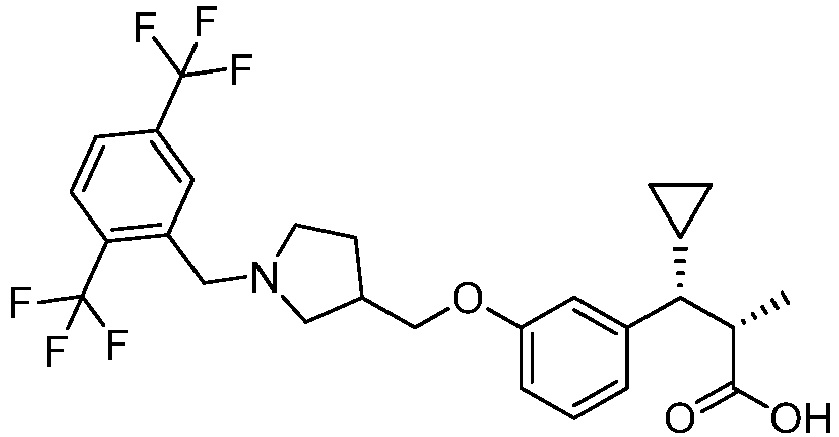
530.35 35 
558.78 36 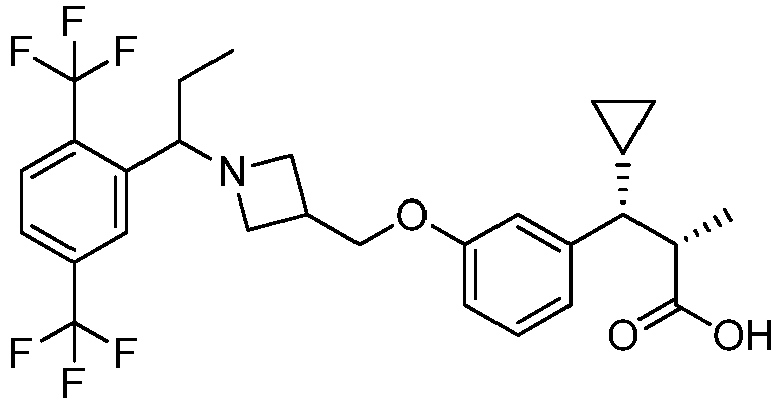
544.60 37 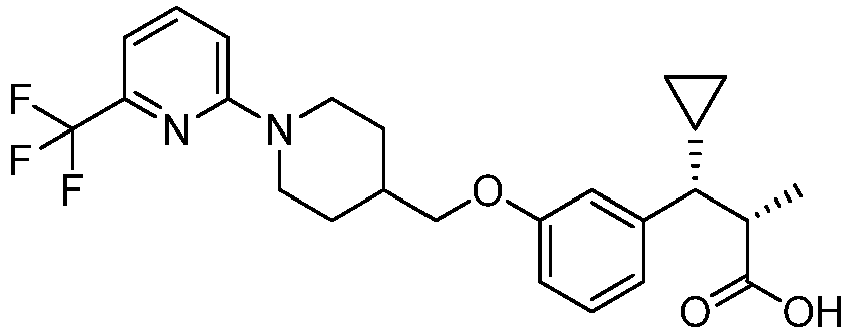
463.53 38 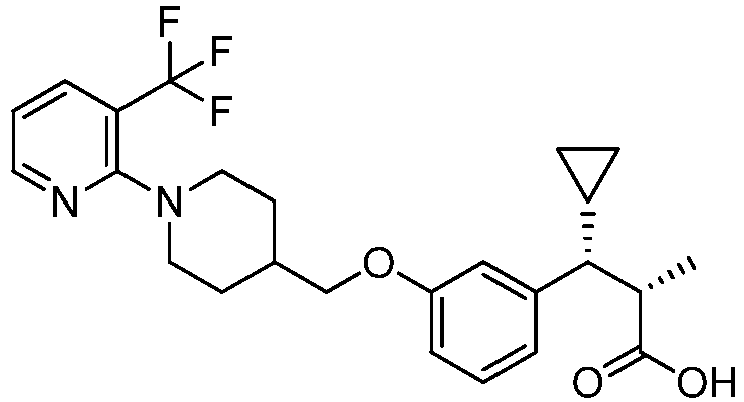
463.51 39 
463.50 40 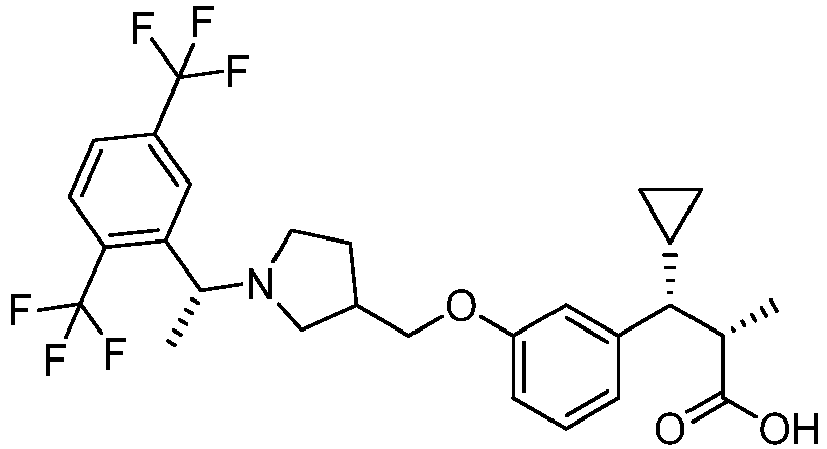
544.56 41 
544.54 42 
468.11 43 
530.44 44 
544.45 45 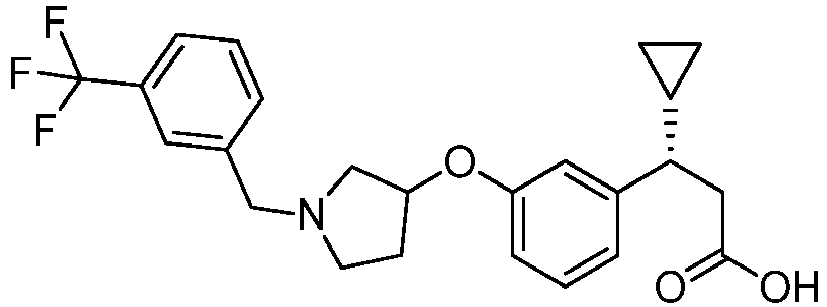
434.20 46 
544.46 47 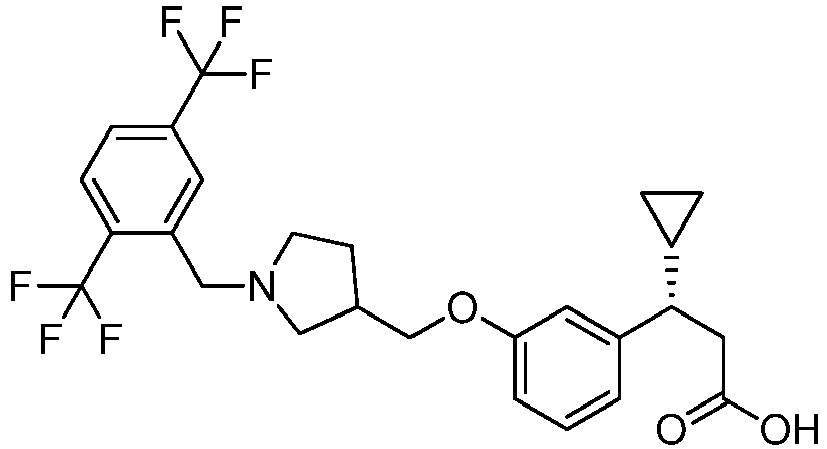
516.34 48 
516.40 49 
502.54 50 
450.30 51 
432.3 52 
414.3 53 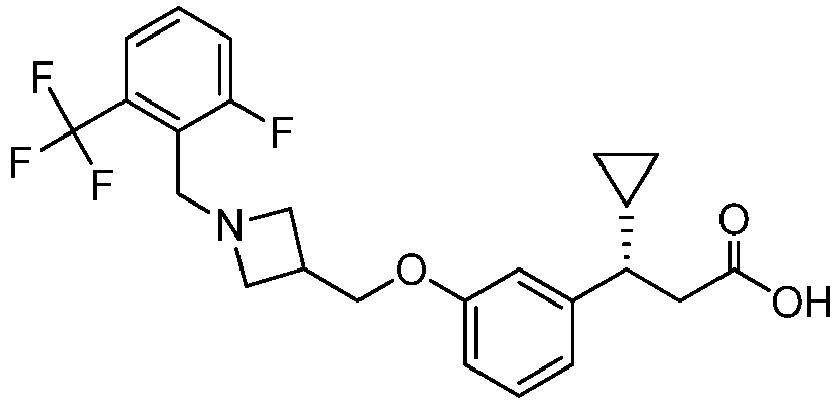
452.3 54 
516.4 55 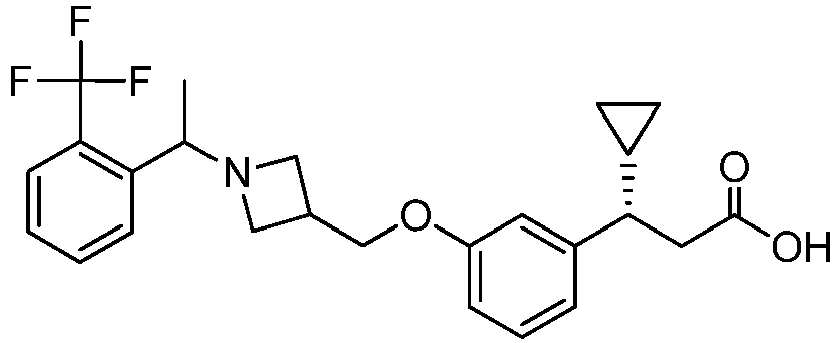
448.4 56 
448.3 57 
416.4 58 
488.4 59 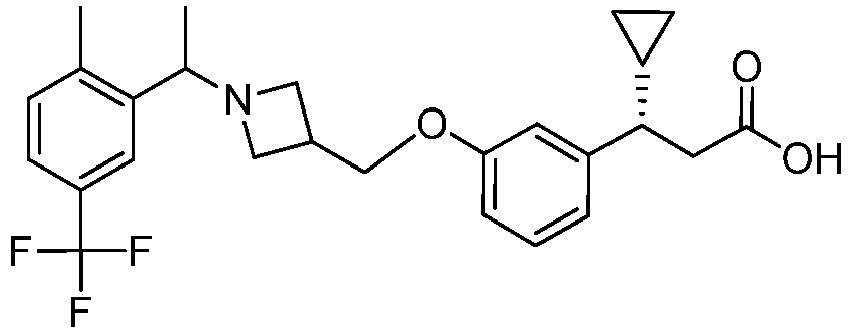
462.3 60 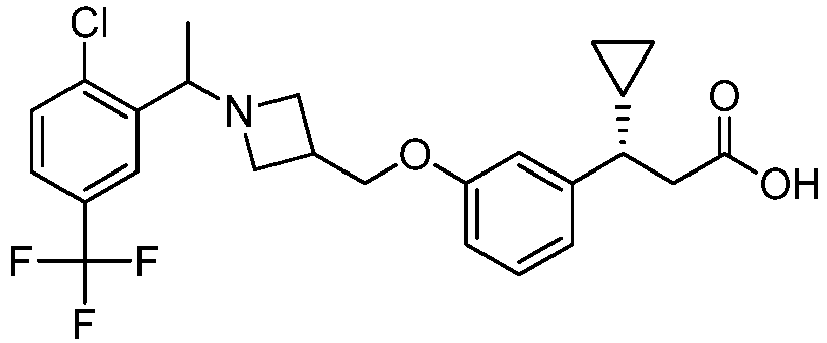
482.3 
- (3S)-3-cyclopropyl-3-(3-((2-(3-methoxyphenyl)cyclopropyl)methoxy)phenyl)propanoic acid To a solution of Intermediate 44 (200 mg, 0.526 mmol) in THF (2 mL)/MeOH (4 mL)/Water (2 mL) at rt was added LiOH (189 mg, 7.88 mmol). The resulting mixture was stirred at 60°C for 12 h, then diluted with H2O and acidified with IN HCl to pH 4-5. The solution was extracted with EtOAc (3x 20 mL), washed with brine, dried over MgSO4, filtered, concentrated and purified by MPLC (ISCO 4g, 0-100% EtOAc/hexanes)) to give the title compound as a colorless oil as a mixture of diastereomers at the cyclopropane. 1H NMR (500 MHz; CDCl3): δ 7.20-7.15 (m, 2H), 6.90-6.80 (m, 5H), 4.03 (m, 1H), 3.86 (m, 1H), 3.81 (s, 3H), 2.80-2.75 (m, 2H), 2.38-2.32 (m, 1H), 1.84-1.80 (m, 1H), 1.05-1.00 (m, 3H), 0.69-0.65 (m, 1H), 0.51-0.44 (m, 1H), 0.36-0.30 (m, 1H), 0.20-0.16 (m, 1H). LC/MS: m/e 367 (M+1)+.

- Separation of the diastereomers from Example 61 was performed by Chiral SFC (Column: Chiralpak AD-H, 21x250mm, 55% IPA/CO2, 50mL/min, 40°C, 120 bar, 254nm, 158mg/20 mL in MeOH) to afford the following two isomers:
- (3S)-3-cyclopropyl-3-(3-((2-(3-methoxyphenyl)cyclopropyl)methoxy)phenyl)propanoic acid (Peak 1, Faster eluting isomer): 1H NMR (500 MHz; CDCl3): δ 7.20-7.15 (m, 2H), 6.90-6.80 (m, 5H), 4.03 (m, 1H), 3.86 (m, 1H), 3.81 (s, 3H), 2.80-2.75 (m, 2H), 2.38-2.32 (m, 1H), 1.84-1.80 (m, 1H), 1.05-1.00 (m, 3H), 0.69-0.65 (m, 1H), 0.51-0.44 (m, 1H), 0.36-0.30 (m, 1H), 0.20-0.16 (m, 1H). LC/MS: m/e 367 (M+1)+.
- (3S)-3-cyclopropyl-3-(3-((2-(3-methoxyphenyl)cyclopropyl)methoxy)phenyl)propanoic acid (Peak 2, Slower eluting isomer): 1H NMR (500 MHz; CDCl3): δ 7.20-7.15 (m, 2H), 6.90-6.80 (m, 5H), 4.03 (m, 1H), 3.86 (m, 1H), 3.81 (s, 3H), 2.80-2.75 (m, 2H), 2.38-2.32 (m, 1H), 1.84-1.80 (m, 1H), 1.05-1.00 (m, 3H), 0.69-0.65 (m, 1H), 0.51-0.44 (m, 1H), 0.36-0.30 (m, 1H), 0.20-0.16 (m, 1H). LC/MS: m/e 367 (M+1)+.
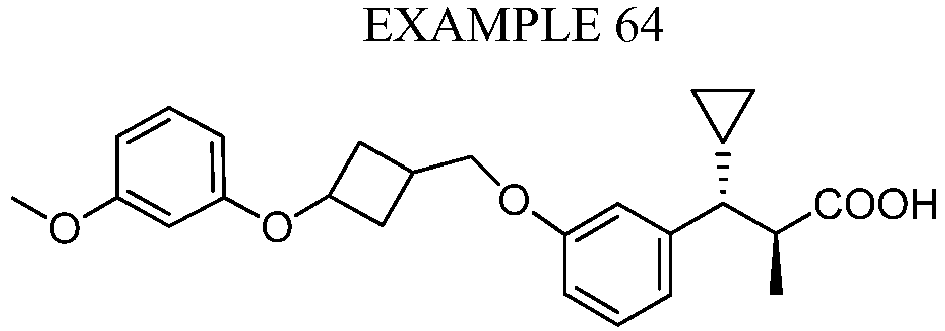
- (2S,3R)-3-Cyclopropyl-3-(3-((3-(3-methoxyphenoxy)cyclobutyl)methoxy)phenyl)-2-methylpropanoic acid The compound of Example 64 was prepared as a mixture of cis and trans-cyclobutane isomers according to the procedure of Example 61 starting with Intermediate 54. 1H NMR (500 MHz; CDCl3): δ 7.25-7.18 (m, 2H), 6.80-6.75 (m, 3H), 6.53-6.50 (m, 1H), 6.43-6.38 (m, 2H), 4.90-4.86 (m, 0.5H), 4.64-4.60 (m, 0.5H), 4.06-4.02 (m, 2H), 3.80 (s, 3H), 2.91-2.87 (m, 1H), 2.72-2.68 (m, 1H), 2.46-2.40 (m, 2H), 2.16-2.12 (m, 1H), 2.02-1.98 (m, 1H), 1.19-1.15 (m, 1H), 1.03-0.98 (m, 3H), 0.72-0.68 (m, 1H), 0.45-0.41 (m, 2H), 0.20-0.16 (m, 1H). LC/MS: m/e 411 (M+1)+.

- Separation of the cis and trans-cyclobutane isomers from Example 64 was performed by Chiral SFC (AD-H, 21x250mm, 35% MeOH/CO2, 40mL/min, 40°C, 120 bar, 210 nm, 69mg/15 mL in MeOH) to afford the following two isomers: (2S,3R)-3-cyclopropyl-3-(3-((3-(3-methoxyphenoxy)cyclobutyl)methoxy)phenyl)-2-methylpropanoic acid (Peak 1, Faster eluting isomer): 1H NMR (500 MHz; MeOD): δ 7.13-7.09 (br, 1H), 7.06-7.02 (m, 1H), 6.90-6.86 (m, 3H), 6.39-6.36 (m, 1H), 6.28-6.25 (m, 2H), 4.80-4.77 (m, 1H), 3.94 (d, J=6.23 Hz,2H), 3.64 (s, 3H), 2.66 (br, 1H), 2.34 (br, 4H), 1.02(br, 1H), 1.03-0.98 (m, 3H), 0.72-0.68 (m, 1H), 0.45-0.41 (m, 2H), 0.20-0.16 (m, 1H). LC/MS: m/e 411 (M+1)+.
(2S,3R)-3-cyclopropyl-3-(3-((3-(3-methoxyphenoxy)cyclobutyl)methoxy)phenyl)-2-methylpropanoic acid (Peak 2, Slower eluting isomer): 1H NMR (500 MHz; MeOD): δ 7.13-7.09 (br, 1H), 7.06-7.02 (m, 1H), 6.90-6.86 (m, 3H), 6.39-6.36 (m, 1H), 6.28-6.25 (m, 2H), 4.52-4.48 (m, 1H), 3.86 (d, J=5.76 Hz,2H), 3.64 (s, 3H), 2.66 (br, 1H), 2.34 (br, 4H), 1.02(br, 1H), 1.03-0.98 (m, 3H), 0.72-0.68 (m, 1H), 0.45-0.41 (m, 2H), 0.20-0.16 (m, 1H). LC/MS: m/e 411 (M+1)+. - The compounds in Table 2 were prepared according to Step B of Example 2 or in a manner similar to that described in Example 61 using the appropriate starting materials.
Table 2 Example Compound LCMS: found m/e (M+H) 67 
365.45 68 
351.39 Mixture of cyclopropane isomers 69 
381.46 mixture of cyclopropane isomers 70 
395.23 71 
395.23 72 
365.44 cis/trans mixture at cyclobutane 73 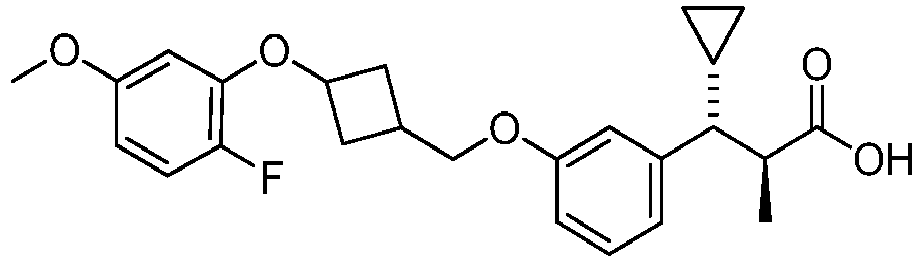
429.25 cis/trans mixture of cyclobutane isomers 74 
399.50 75 
399.50 76 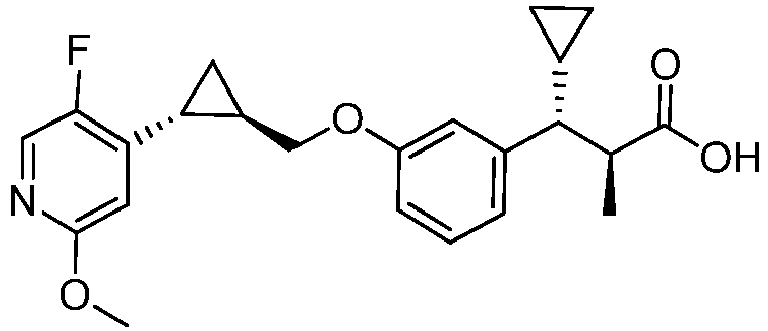
400.41 77 
407.11 cis/trans mixture of cyclobutane isomers 
- (2S,3R)-3-cyclopropyl-3-(3-((3-(3-methoxyphenyl)cyclopent-3-en-1yl)methoxy)phenyl)-2-methylpropanoic acid To a solution of Intermediate 65 (80 mg, 0.190 mmol) in MeOH/THF/water (1:1:1, 1.5 mL total volume) was added LiOH (46 mg, 1.9 mmol). The mixture was heated (60° C) and stirred on a heating block. After 16 h, the reaction was poured into IN HCl (10 mL) and extracted with EtOAc (2 x 10 mL). The combined organic layers were dried (MgSO4) and concentrated. The resulting residue was purified by HPLC (ISCO 40g, 0 to 100% EtOAc/Hex) to give the title compound. LCMS: m/e 407.11 (M+H)+

- (2S,3R)-3-cyclopropyl-3-(3-(((1R,3S)-3-(3methoxyphenyl)cyclopentyl)methoxy)phenyl)-2-methylpropanoic acid To a solution of Intermediate 66 (50 mg, 0.118 mmol) in MeOH/THF/water (1:1:1, 1.5 mL total volume) was added LiOH (28 mg, 1.2 mmol). The mixture was heated (60° C) and stirred on a heating block. After 16 h, the reaction was poured into IN HCl (10 mL) and extracted with EtOAc (2 x 10 mL). The combined organic layers were dried (MgSO4) and concentrated. The resulting residue was purified by HPLC (ISCO 40g, 0 to 100% EtOAc/Hex) to give the title compound. LCMS: m/e 409.34 (M+H)+

- Separation of the cis and trans-cyclobutane isomers from Example 73 was performed by Chiral SFC (Column: AD-H, 21x250mm, 30% i-PrOH/CO2, 40mL/min, 40°C, 120 bar, 254nm, 120mg/20 mL in MeOH, injection volume: 0.5 mL) to afford the following two isomers:
- Peak 1, Faster eluting isomer: (2S,3R)-3-cyclopropyl-3-(3-((3-(2-fluoro-5-methoxyphenoxy)cyclobutyl)methoxy)phenyl)-2-methylpropanoic acid
1H NMR (500 MHz, CHCl3-d): δ 0.04-0.10 (m, 1 H), 0.42-0.38 (m, 2 H), 0.70-0.61 (m, 1 H), 1.02 (d, 3 H), 1.18-1.10 (m, 1 H), 1.99 (t, 1 H), 2.51 (t, 4 H), 2.92-2.80 (m, 2 H), 3.78 (s, 3 H), 4.03 (d, 2 H), 4.88 (quintet, 1 H), 6.40-6.36 (m, 2 H), 6.84-6.76 (m, 3 H), 7.03-6.98 (m, 1 H), 7.26 (t, 1 H). LC/MS: m/e 429 (M+1)+. - Peak 2, Slower eluting isomer: (2S,3R)-3-cyclopropyl-3-(3-((3-(2-fluoro-5-methoxyphenoxy)cyclobutyl)methoxy)phenyl)-2-methylpropanoic acid
1H NMR (500 MHz, CHCl3-d): δ 0.07-0.04 (m, 1 H), 0.42-0.34 (m, 2 H), 0.67-0.62 (m, 1 H), 1.00 (d, 3 H), 1.13 (dtt, 1 H), 1.97 (t, 1 H), 2.20-2.14 (m, 2 H), 2.53-2.43 (m, 1 H), 2.74-2.67 (m, 2 H), 2.89-2.82 (m, 1 H), 3.78 (s, 3 H), 4.00 (d, 2 H), 4.64 (p, 1 H), 6.39 (dt, 1 H), 6.44 (dd, 1 H), 6.80-6.73 (m, 3 H), 7.00 (dd, 1 H), 7.23 (t, 1 H). LC/MS: m/e 429 (M+1)+.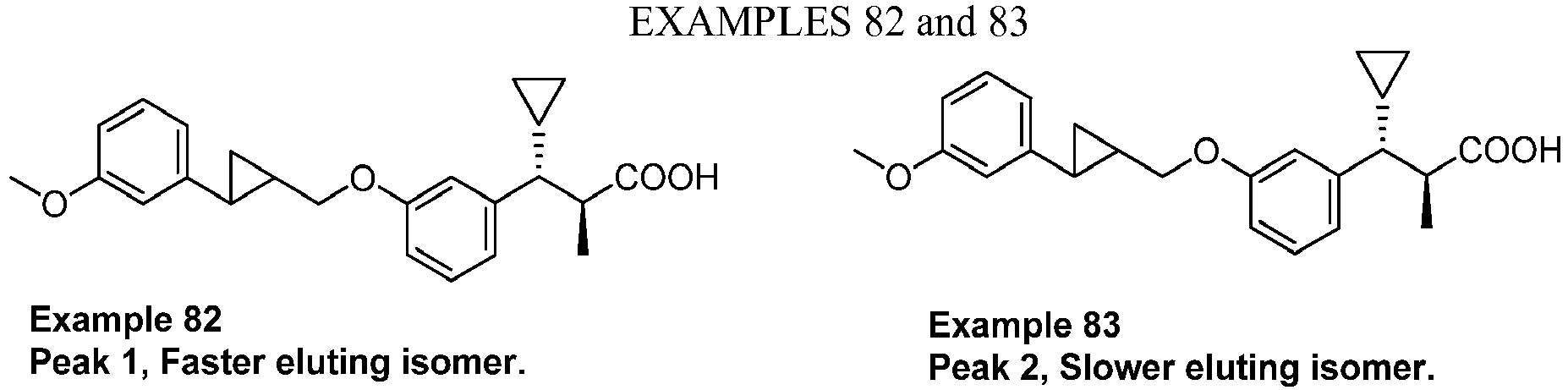
- Separation of the two diastereomers from Example 69 was performed by Chiral SFC (Column: AD-H, 21x250mm, 40% MeOH/CO2, 50mL/min, 40°C, 120 bar, 210nm, 68 mg / 16 mL in MeOH, injection volume: 0.5 mL) to afford the following two isomers:
- Peak 1, Faster eluting isomer: (2S,3R)-3-cyclopropyl-3-(3-((2-(3-methoxyphenyl)cyclopropyl)methoxy)phenyl)-2-methylpropanoic acid
LC/MS: m/e 381 (M+1)+. - Peak 2, Slower eluting isomer: (2S,3R)-3-cyclopropyl-3-(3-((2-(3-methoxyphenyl)cyclopropyl)methoxy)phenyl)-2-methylpropanoic acid LC/MS: m/e 381 (M+1)+.
- The compounds in Table 3 were prepared in a manner similar to that described in Example 61 using the appropriate starting materials.
Table 3 Example Compound LCMS: found m/e (M+H) 84 
413.4 cis/trans mixture of cyclobutane isomers 85 
395.4 cis/trans mixture of cyclobutane isomers 86 
396.1 cis/trans mixture of cyclobutane isomers 87 
414.1 cis/trans mixture of cyclobutane isomers 
- Separation of the cis and trans-cyclobutane isomers from Example 86 was performed by chiral SFC (Column: AD-H, 21x250mm, 30% MeOH/CO2, 50 mL/min, 40°C, 120 bar, UV detection: 210 nm, 75 mg/15 mL in MeOH, injection volume: 0.5 mL) to afford the following two isomers: Example 88: Peak 1, Faster eluting isomer: (2S,3R)-3-cyclopropyl-3-(3-((3-(2-methoxy-pyridin-4-yl)cyclobutyl)methoxy)phenyl)-2-methylpropanoic acid; LC/MS: m/e 396.3 (M+1)+. Example 89: Peak 2, Slower eluting isomer: (2S,3R)-3-cyclopropyl-3-(3-((3-(2-methoxy-pyridin-4-yl)cyclobutyl)methoxy)phenyl)-2-methylpropanoic acid; LC/MS: m/e 396.3 (M+1)+.

- Separation of the cis and trans-cyclobutane isomers from Example 87 was performed by chiral SFC (Column: AD-H, 21x250mm, 30% MeOH/CO2, 50 mL/min, 40°C, 120 bar, UV detection: 210 nm, 75 mg/15 mL in MeOH, injection volume: 0.5 mL) to afford the following two isomers: Example 90: Peak 1, Faster eluting isomer: (2S,3R)-3-cyclopropyl-3-(3-((3-(5-fluoro-2-methoxypyridin-4-yl)cyclobutyl)methoxy)phenyl)-2-methylpropanoic acid; LC/MS: m/e 414.3 (M+1)+.
Example 91: Peak 2, Slower eluting isomer: (2S,3R)-3-cyclopropyl-3-(3-((3-(5-fluoro-2-methoxypyridin-4-yl)cyclobutyl)methoxy)phenyl)-2-methylpropanoic acid; LC/MS: m/e 414.3 (M+1)+.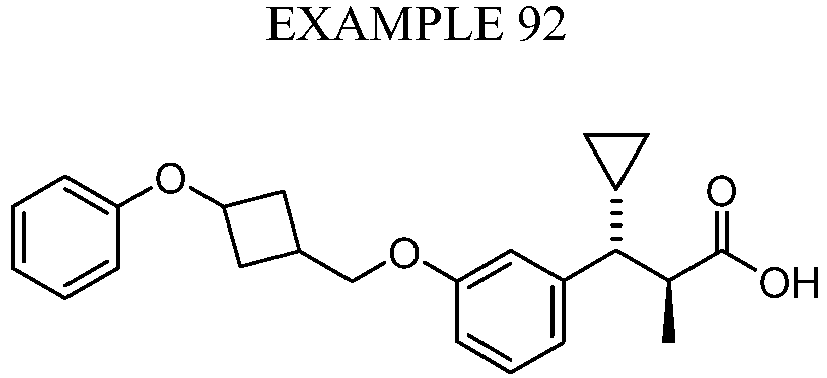
- Step 1: Methyl (2S,3R)-3-cyclopropyl-2-methyl-3-(3-((3-phenoxycyclobutyl)methoxy)-phenyl)propanoate A 2-dram vial was charged with (2S,3R)-methyl 3-cyclopropyl-3-(3-((3-hydroxycyclobutyl)methoxy)phenyl)-2-methylpropanoate (25 mg, 0.079 mmol), phenol (22 mg, 0.236 mmol), and a solution of tri-N-butylphosphine (58.1 µL, 0.236 mmol) in anhydrous THF (0.85 ml). The mixture was stirred at r.t. for 10 min, then 1,1'-(azo-dicarbonyl)dipiperidine (59.4 mg, 0.236 mmol) was added. The resulting mixture was heated at 50 °C with stirring for 2 days. The reaction was then cooled to r.t. Water (1 mL) was added to the reaction mixture, and the mixture was stirred at r.t. for 10 min. Then the mixture was extracted with EtOAc (2 mLx2). The combined organic layers were collected into a 2 dram vial, and the volatiles were removed with a GeneVac. The resulting residue was used in the next step without further purification.
- Step 2: (2S,3R)-3-cyclopropyl-2-methyl-3-(3-((3-phenoxycyclobutyl)methoxy)phenyl)-propanoic acid The residue from Step 1 was treated with THF (400 µL), MeOH (200 µL) and saturated aqueous LiOH (400 µL, 0.079 mmol). The mixture was heated at 50 °C overnight. Then the reaction was cooled to r.t., quenched with aq. IN HCl (1 mL) and acidified with aq. 6N HCl until the reaction mixture turned homogeneous. The mixture was extracted with EtOAc (3 mLx2). The combined organic layers were transferred into a 2 dram vial, and the volatiles were removed with a GeneVac. The resulting residue was purified by reverse-phase chromatography (Waters XBridge C18, 5um, 19x100 mm), eluting with 10-38% of acetonitrile (with 0.1% ammonium hydroxide) in water (with 0.1% ammonium hydroxide), 25mL/min., 9 min.) to afford the title compound. 1H NMR (500 MHz, DMSO-d6) δ 7.26 (m, 2H), 7.20 (m, 1H), 6.94 (m, 1H), 6.82 (m, 5H), 4.92 (m, 0.5H), 4.64 (m, 0.5H), 4.02 (m, 2H), 2.71 (m, 1H), 2.64 (m, 1H), 2.40 (m, 1H), 2.26 (m, 1H), 1.94 (m, 2H), 1.08 (m, 1H), 0.85 (m, 1H), 0.80 (m, 3H), 0.54 (m, 1H), 0.28 (m, 2H), -0.06 (m, 1H). LC/MS (m/z): 379 (M-H)-.
- The compounds in Table 4 were prepared in a manner similar to that described in Example 92 using the appropriate starting materials.
Table 4 Example Compound LCMS: found m/e (M+H)+ LCMS: found m/e (M-H)- 93 
412 - 94 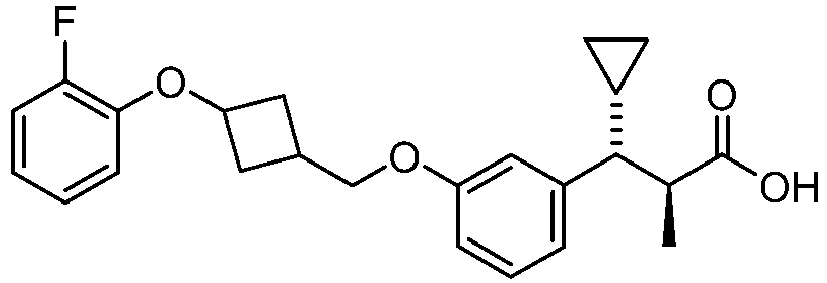
- 397 95 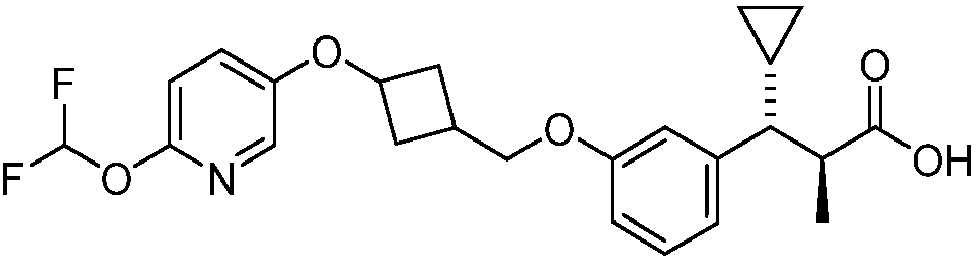
448 - 96 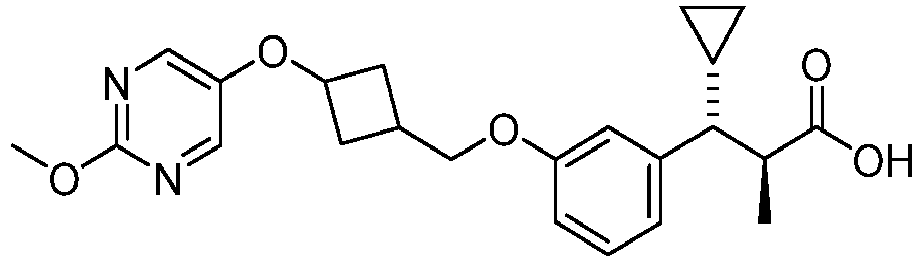
413 - 97 
399 - 98 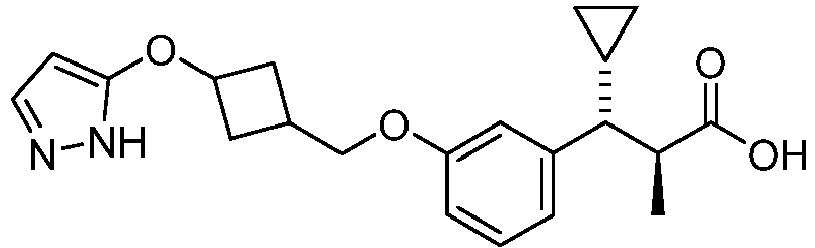
371 - More Polar Isomer 99 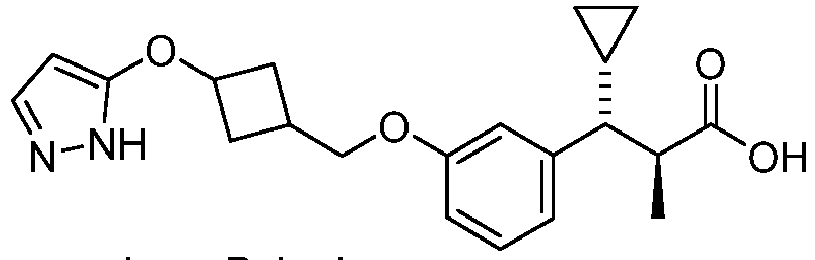
371 - Less Polar Isomer 100 
467 - 101 
385 - 
- Step 1: Methyl (2S,3R)-3-cyclopropyl-2-methyl-3-(3-((3-(pyridin-2-yloxy) cyclobutyl)-methoxy)phenyl)propanoate A 2-dram vial was charged with (2S,3R)-methyl 3-cyclopropyl-3-(3-((3-hydroxycyclobutyl)methoxy)phenyl)-2-methylpropanoate (18 mg, 0.057 mmol), pyridin-2-ol (16 mg, 0.170 mmol), PPh3 (44.5 mg, 0.170 mmol) and anhydrous THF (0.61 ml). The mixture was stirred at r.t. for 10 min, then 1,1'-(azodicarbonyl)-dipiperidine (42.8 mg, 0.170 mmol) was added. The reaction mixture was shaken at 150 rpm at room temperature overnight. 1,1'-(Azodicarbonyl)dipiperidine (42.8 mg, 0.170 mmol) was added to a solution of PPh3 (44.5 mg, 0.170 mmol) in anhydrous THF (0.180 ml), and the resulting mixture was stirred for 5 min. Then the PPh3 mixture was added to the reaction mixture. The reaction was heated at 55 °C for 72 h, then cooled to r.t. The volatiles were removed with a GenVac. The resulting residue was partitioned between 1 mL of water and 2 mL of EtOAc. The layers were separated and the aqueous layer was extracted with EtOAc (2 mL). The combined organic layers were collected into a 2-dram vial, and the volatiles were removed with a GeneVac. The resulting residue was used in the next step without further purification.
- Step 2: (2S,3R)-3-cyclopropyl-2-methyl-3-(3-((3-pyridin-2-yloxy)cyclobutyl)methoxy)-phenyl)propanoic acid The product from Step 1 was subjected to a method similar to that outlined in Step 2 of Example 92 and purified via reversed-phase chromatography (Waters XBridge C18, 5um, 19x100 mm), eluting with 10-31% of acetonitrile (with 0.1% ammonium hydroxide) in water (with 0.1% ammonium hydroxide), 25mL/min., 12 min. run time. to afford: 1) Example 102 -the more polar isomer of (2S,3R)-3-cyclopropyl-2-methyl-3-(3-((3-pyridin-2-yloxy)cyclobutyl)methoxy)phenyl)propanoic acid, 1H NMR (500 MHz, DMSO-d6) δ 8.15 (m, 1H), 7.70 (m, 1H), 7.19 (m, 1H), 6.94 (m, 1H), 6.74 (m, 4H), 5.08 (m, 1H), 3.99 (m, 2H), 2.72 (m, 1H), 2.58 (m, 1H), 2.42 (m, 1H), 2.26 (m, 1H), 1.94 (m, 3H), 1.12 (m, 1H), 0.79 (m, 3H), 0.50 (m, 1H), 0.24 (m, 2H), -0.06 (m, 1H). LC/MS (m/z): 382 (M+H)+; and 2) Example 103 - the less polar isomer, 1H NMR (500 MHz, DMSO-d6) δ 8.15 (m, 1H), 7.70 (m, 1H), 7.19 (m, 1H), 6.94 (m, 1H), 6.74 (m, 4H), 5.32 (m, 1H), 4.05 (m, 2H), 2.72 (m, 2H), 2.58 (m, 2H), 2.38 (m, 1H), 2.26 (m, 1H), 1.94 (m, 1H), 1.12 (m, 1H), 0.81 (m, 3H), 0.50 (m, 1H), 0.24 (m, 2H), -0.06 (m, 1H). LC/MS (m/z): 382 (M+H)+.
- The compounds in Table 5 were prepared in a manner similar to that described in Examples 102 and 103 using the appropriate starting materials.
Table 5 Example Compound LCMS: found m/e (M+H)+ LCMS: found m/e (M-H)- 104 
412 - More Polar Isomer 105 
412 - Less Polar Isomer 106 
430 - - Examples 107 and 108 in Table 6 were prepared in a manner similar to that described in the synthesis of Examples 102 and 103 using the appropriate starting materials, with the exception that diethylazodicarboxylate is used in place of 1,1'-(azodicarbonyl)dipiperidine in Step 1, and the reaction in Step 1 was heated at 50 °C. The final compounds were purified Purified by reverse-phase chromatography (Waters XBridge C18, 5u, 19x100 mm), eluting with 40-75% of acetonitrile (with 0.1% trifluoroacetic acid) in water (with 0.1% trifluoroacetic acid), 25mL/min., 12 min. run time).
Table 6 Example Compound LCMS: found m/e (M+H)+ LCMS: found m/e (M-H)- 107 
437 - More Polar Isomer 108 
437 - Less Polar Isomer - The compounds in Table 7 were prepared in a manner similar to that described in Examples 102 and 103 using the appropriate starting materials, with the exception that resin-bound triphenylphosphine was used in place of triphenylphosphine in Step 1, and the reaction in Step 1 was heated at 60 °C. The final compounds were purified by reverse-phase chromatography (Waters XBridge C18, 5um, 19x100 mm), eluting with 8-40% of acetonitrile (with 0.1% ammonium hydroxide) in water (with 0.1% ammonium hydroxide), 25mL/min., 12 min. run time).
Table 7 Example Compound LCMS: found m/e (M+H)+ LCMS: found m/e (M-H)- 109 
382 - 110 
382 - 111 
440 - 112 
- 423 113 
- 423 114 
- 415 115 
- 415 116 
- 423 More Polar Isomer 117 
- 423 Less Polar Isomer 118 
- 411 More Polar Isomer 119 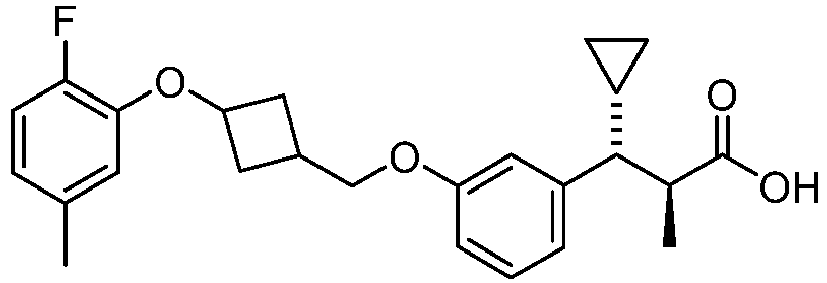
- 411 Less Polar Isomer 120 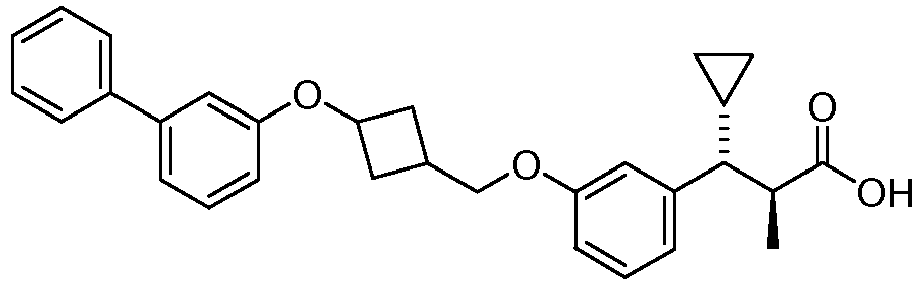
- 455 More Polar Isomer 121 
- 455 Less Polar Isomer 122 
- 395 More Polar Isomer 123 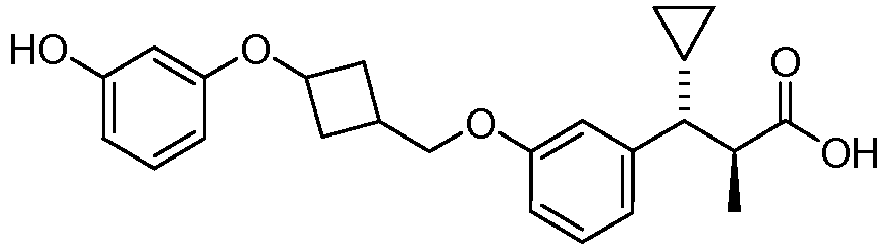
- 395 Less Polar Isomer 124 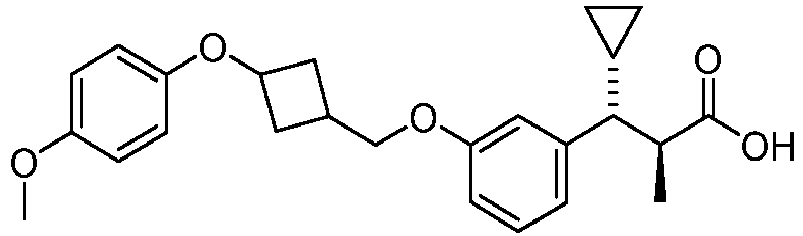
- 409 More Polar Isomer 125 
- 409 Less Polar Isomer 126 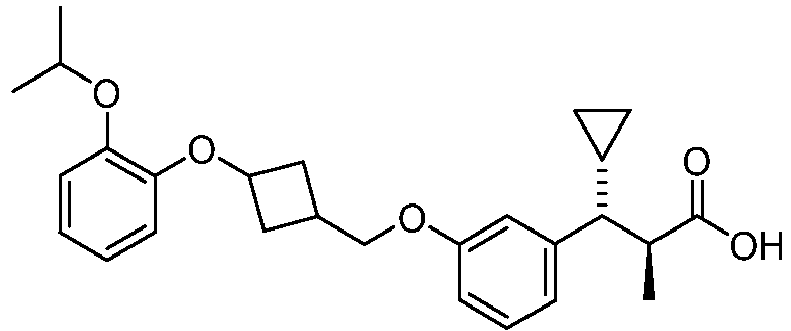
- 437 More Polar Isomer 127 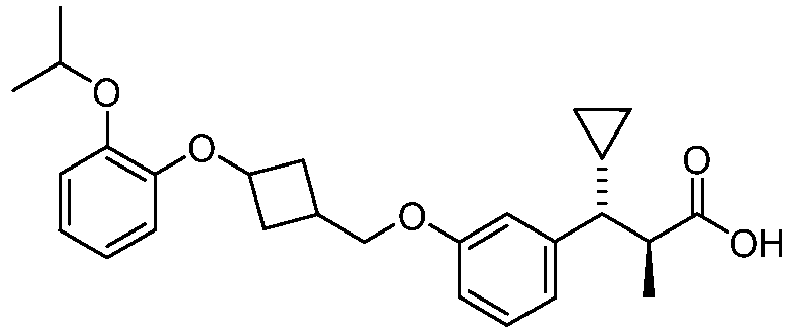
- 437 Less Polar Isomer 128 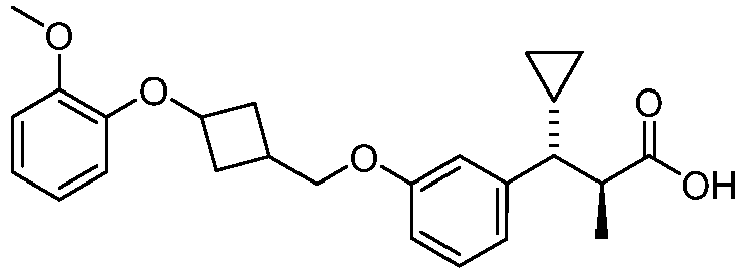
- 409 129 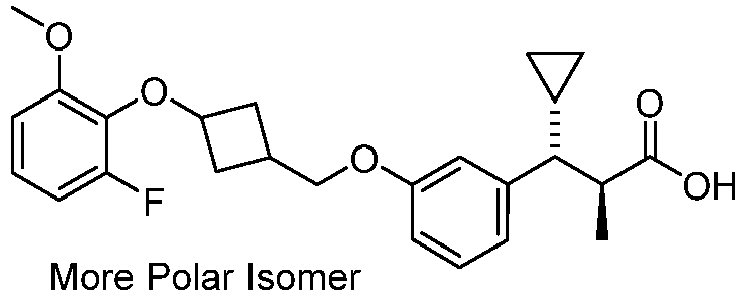
- 427 130 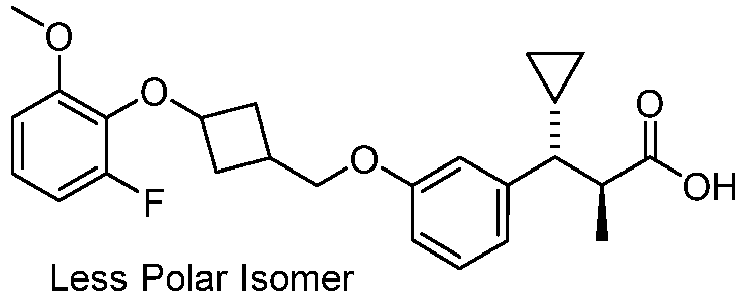
- 427 131 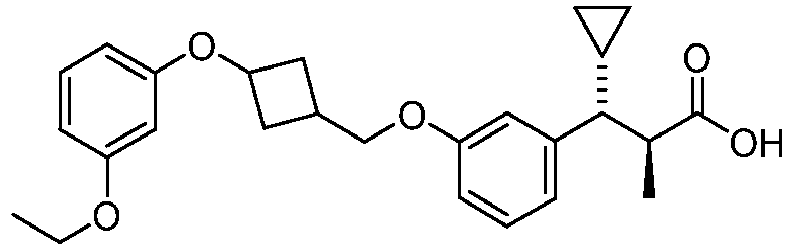
425 - 132 
- 455 133 
- 413 134 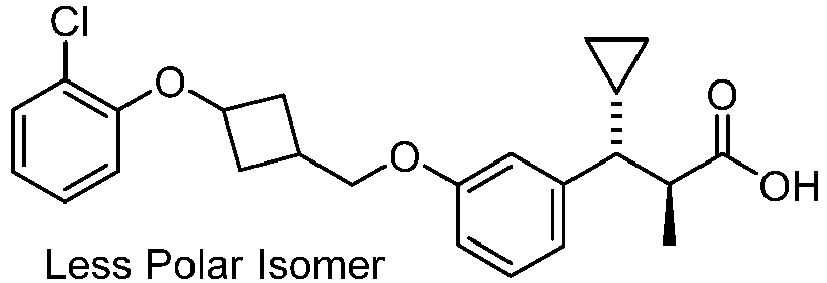
- 413 135 
451 - 136 
- 447 
- Into 24 two dram vials was added the requisite boronic acid (0.072 mmol), DMF (603 µl) solution of (2S,3R)-methyl 3-cyclopropyl-3-(3-(((1R,2S)-2-iodocyclopropyl)methoxy)-phenyl)-2-methylpropanoate (30 mg, 0.072 mmol) and 1,1'-bis(di-tert-butylphosphino)-ferrocene palladium dichloride (4.72 mg, 7.24 µmol), followed by addition of 50% aqueous potassium phosphate tribasic (92 µl, 0.217 mmol) under a stream of N2. The reaction was heated at 65 °C for two hours. Then DMT-silica (3eq) was added and the solution was stirred at 45 °C for 1 hour. The mixture was filtered and the resulting solid was washed with EtOAc (2 ml) twice. The filtrate was concentrated on a Genevac to give a crude residue, which was dissolved in THF (0.4 mL), MeOH (0.3 mL) and IN NaOH (0.4 mL, aq.). The resulting mixture was stirred at 50 °C overnight, then TFA (0.03 mL) was added. The mixture was then concentrated on a Genevac and the resulting residue was dissolved in DMSO (1.2 mL). The mixture was filtered, and subjected to C18 reverse-phase HPLC (Waters Sunfire C18, 5 micron, 19x100 mm, gradient elution over 10 min, weak solvent: 0.1% TFA in water, strong solvent: 0.1% TFA in MeCN, 25 ml/min) to afford the desired compound.
- Examples 137 to 159 in Table 8 were prepared as described by the general method for Examples 137-159 described above.
Table 8 Example Compound LCMS: found m/e (M+H)+ unless otherwise noted 137 
435.1 138 
407.1 139 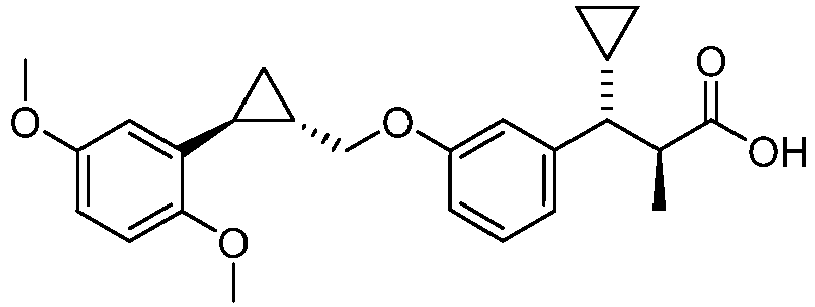
433.2 (M+Na)+ 140 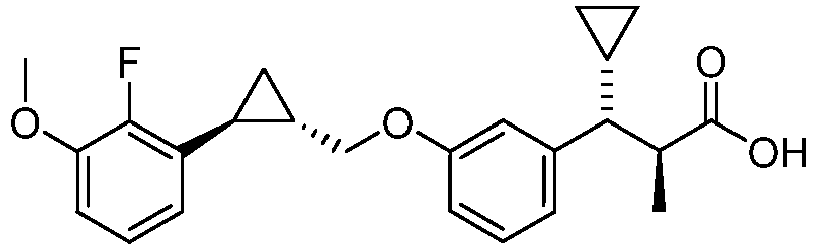
399.2 141 
399.2 142 
417.2 143 
453.0 144 
437.2 145 
453.1 146 
469.1 147 
352.1 148 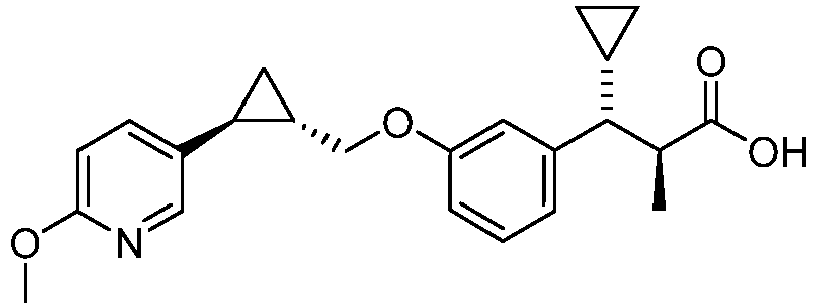
383.2 149 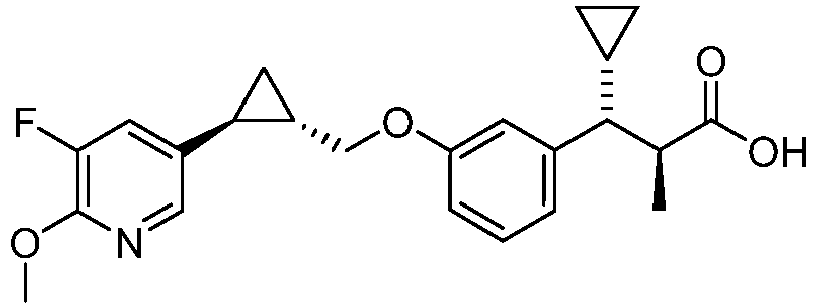
400.2 150 
382.1 151 
387.2 152 
403.2 153 
417.2 154 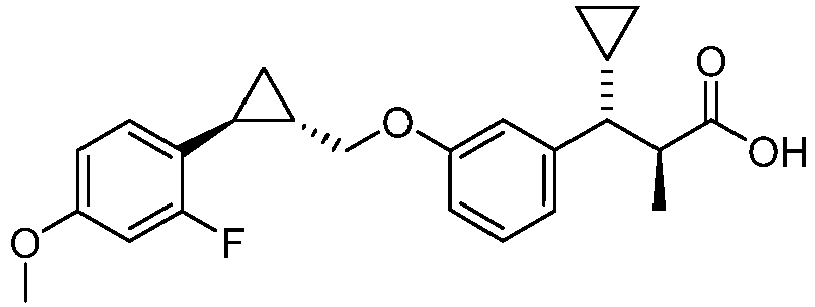
399.1 155 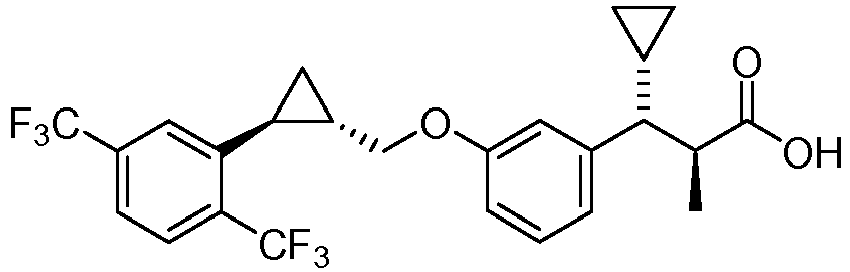
487.1 156 
453.1 157 
435.2 (M-H)- 158 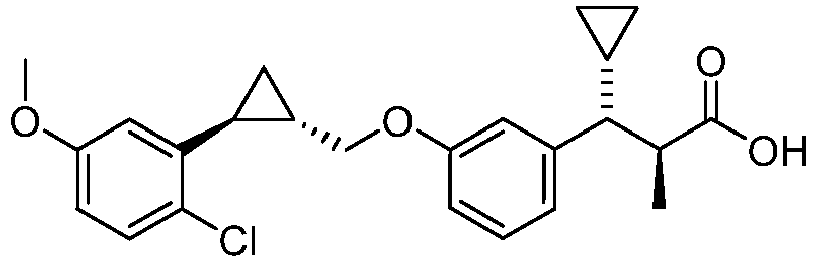
415.2 159 
381.1 - Human and mouse GPR40 stable cell-lines were generated in CHO cells stably expressing NFAT BLA (Beta-lactamase). A human GPR40 stable cell-line was generated in HEK cells stably expressing the aequorin expressing reporter. The expression plasmids were transfected using lipofectamine (Life Technologies) following manufacturer's instructions. Stable cell-lines were generated following drug selection.
- FLIPR (Fluorimetric Imaging Plate Reader, Molecular Devices) assays were performed to measure agonist-induced calcium mobilization of the stable clones. For the FLIPR assay, one day before assay, GPR40/CHO NFAT BLA cells were seeded into black-wall-clear-bottom 384-well plates (Costar) at 1.4 x 10e4 cells / 20 µL medium / well. The cells were incubated with 20 µl / well of the assay buffer (HBSS, 0.1 % BSA, 20 mM HEPES, 2.5 mM probenecid, pH 7.4) containing 8µM fluo-4,AM, 0.08 % pluronic acid at room temperature for 100 minutes. Fluorescence output was measured using FLIPR. Compounds were dissolved in DMSO and diluted to desired concentrations with assay buffer. 13.3 µL/well of compound solution was added.
- The compounds of the present invention, including the compounds in Examples 1-159, have EC50 values less than 2 micromolar (µM) in the FLIPR assay described above. The compounds in Examples 1-159 have the EC50 values in the FLIPR assay listed in Table A.
- The assay was performed in 96-well format. HEK cells stably expressing human GPR40 were plated to be 60-80% confluent within 72 h. After 72 h, the plates were aspirated and the cells washed with inositol-free DMEM (ICN). The wash media was replaced with 150 µL of 3H-inositol labeling media (inositol-free media containing 0.4% human albumin or 0.4% mouse albumin, 1X pen/strep antibiotics, glutamine, 25 mM HEPES to which was added 3H-myo-inositol NEN #NET114A 1mCi/mL, 25Ci/mmol diluted 1:150 in loading media with a final specific radioactivity of 1µCi/150 µL). Alternatively, the human and mouse albumin can be added after the overnight labeling step before the addition of LiCl.
- The assay was typically run the next day after 18 h labeling. On the day of the assay, 5 µL of 300 mM LiCl was added to all wells and incubated at 37 degrees for 20 min. 0.75 µL of each compound was added and incubated with the cells for 60 min at 37 degrees. The media was then aspirated off and the assay terminated with the addition of 60 µL 10 mM formic acid. The cells were lysed for 60 min at room temperature. 15-30 µL of lysate was mixed with 70 µL/1 mg YSi SPA beads (Amersham) in clear bottom Isoplates. The plates were shaken for 2 h at room temperature. Beads were allowed to settle and the plates were counted in the Wallac Microbeta.
- The assay was performed in 384-well format. HEK cells stably expressing human GPR40 were plated at 15,000 cells per well in growth medium (DMEM/10% fetal calf serum). Cell plates were then incubated 16 hours at 37 degrees in a 5% CO2 incubator.
- Measurement of Inositol Phosphate Turnover (IP1) was performed using the CisBio IP-One kit (Part number 62IPAPEB). After the 16 hour incubation, the cells were washed with HEPES buffer and 10ul of stimulation buffer (prepared as described in the kit) was added to each well. In a separate plate, compounds were diluted in DMSO (400-fold over the final concentration in the assay well) and 25nl was acoustically transferred to the appropriate well in the assay cell plate.
- The plates were then incubated for 60 minutes at 37 degrees. 10ul of detection buffer (also prepared as described in the IP-One kit) was added to each well and the plates were incubated for 60 minutes in the dark. The plates were then read in a Perkin Elmer EnVision or equivalent reader able to measure FRET. Fluorescent ratio of emission at 665 and 620 nm was then converted to IP1 concentration by back calculating from an IP1 standard curve prepared at the time of the assay.
- The compounds of the present invention, including the compounds in Examples 1-159, have EC50 values less than 12 micromolar (µM) in the Inositol Phosphate Turnover (IP1) Assay 1 or in the Inositol Phosphate Turnover (IP1) Assay 2 described above. The compounds in Examples 1-159 have the EC50 values in the Inositol Phosphate Turnover (IP1) Assay 1 and Inositol Phosphate Turnover (IP1) Assay 2 listed in Table A.
- Male C57BL/6N mice (7-12 weeks of age) are housed 10 per cage and given access to normal diet rodent chow and water ad libitum. Mice are randomly assigned to treatment groups and fasted 4 to 6 h. Baseline blood glucose concentrations are determined by glucometer from tail nick blood. Animals are then treated orally with vehicle (0.25% methylcellulose) or test compound. Blood glucose concentration is measured at a set time point after treatment (t = 0 min) and mice are then intraperitoneally-challenged with dextrose (2 g/kg). One group of vehicle-treated mice is challenged with saline as a negative control. Blood glucose levels are determined from tail bleeds taken at 20, 40, 60 min after dextrose challenge. The blood glucose excursion profile from t = 0 to t = 60 min is used to integrate an area under the curve (AUC) for each treatment. Percent inhibition values for each treatment are generated from the AUC data normalized to the saline-challenged controls.
Table A. EC50 values in Human GPR40 FLIPR and IP1 Assays Example Number Human GPR40 FLIPR, EC50, nM Human GPR40 IP1, EC50, nM (Assay 1) Human GPR40 IP1, EC50, nM (Assay 2) 1 1.9 89 ND 2 173 1834 ND 3 126 8381 ND 4 77 485 ND 5A 455 4154 ND 5B 113 2135 ND 6 95 2725 ND 7 2 89 ND 8 15 866 ND 9 4 217 ND 10 0.9 102 ND 11 22 967 ND 12 111 4662 ND 13 129 1851 ND 14 26 956 ND 15 79 2083 ND 16 79 631 ND 17 285 2531 ND 18 359 3712 ND 19 497 4781 ND 20 266 10000 ND 21 13 297 ND 22 85 2612 ND 23 72 1045 ND 24 7.4 524 ND 25 1.4 79 ND 26 1.5 55 ND 27 0.3 7.6 ND 28 21 613 ND 29 51 711 ND 30 33 279 ND 31 1 77 ND 32 59 764 ND 33 5.3 158 ND 34 10 273 ND 35 ND 20 ND 36 ND 12 ND 37 ND 177 ND 38 ND 13 ND 39 ND 218 ND 40 ND 25 ND 41 ND 23 ND 42 94 1125 ND 43 231 952 ND 44 13 309 ND 45 387 ND ND 46 108 1460 ND 47 42 560 ND 48 142 1025 ND 49 8.3 251 ND 50 55 5031 ND 51 58 449 ND 52 162 5638 ND 53 389 4567 ND 54 0.6 27 ND 55 7.3 904 ND 56 23 347 ND 57 480 ND ND 58 113 366 ND 59 439 777 ND 60 184 527 ND 61 24 651 ND 62 5.7 166 ND 63 15 348 ND 64 ND 60 ND 65 ND 22 ND 66 ND 119 ND 67 ND 408 ND 68 ND 304 ND 69 ND 166 ND 70 ND 146 ND 71 ND 187 ND 72 ND 201 ND 73 ND 43 ND 74 ND 56 ND 75 ND 34 ND 76 ND 138 ND 77 ND 606 ND 78 ND 75 ND 79 ND 118 ND 80 ND 12 ND 81 ND 45 ND 82 ND 172 ND 83 ND 94 ND 84 ND 14 ND 85 ND 35 ND 86 ND 102 ND 87 ND 23 13 88 ND 930 ND 89 ND 61 ND 90 ND ND 96 91 ND ND 7.4 92 ND 208 ND 93 ND 181 ND 94 ND 110 ND 95 ND 1386 ND 96 ND 8233 ND 97 ND 7235 ND 98 ND 1480 ND 99 ND 2669 ND 100 ND 560 ND 101 ND 7221 ND 102 ND 643 ND 103 ND 187 ND 104 ND 564 ND 105 ND 56 ND 106 ND 54 ND 107 ND 3449 ND 108 ND 1973 ND 109 ND 7189 ND 110 ND 1961 ND 111 ND 3097 ND 112 ND 109 ND 113 ND 1208 ND 114 ND 107 ND 115 ND 110 ND 116 ND 77 ND 117 ND 50 ND 118 ND 156 ND 119 ND 98 ND 120 ND 975 ND 121 ND 561 ND 122 ND 597 ND 123 ND 324 ND 124 ND 577 ND 125 ND 565 ND 126 ND 147 ND 127 ND 182 ND 128 ND 72 ND 129 ND 109 ND 130 ND 139 ND 131 ND 119 ND 132 ND 150 ND 133 ND 152 ND 134 ND 85 ND 135 ND 307 ND 136 ND 262 ND 137 ND 176 ND 138 ND 74 ND 139 ND 188 ND 140 ND 225 ND 141 ND 109 ND 142 ND 78 ND 143 ND 175 ND 144 ND 385 ND 145 ND 223 ND 146 ND 111 ND 147 ND 4436 ND 148 ND 1159 ND 149 ND 802 ND 150 ND 4472 ND 151 ND 90 ND 152 ND 89 ND 153 ND 325 ND 154 ND 544 ND 155 ND 316 ND 156 ND 355 ND 157 ND 130 ND 158 ND 26 ND 159 ND 472 ND ND is not determined - As a specific embodiment of an oral pharmaceutical composition, a 100 mg potency tablet is composed of 100 mg of any one of Examples, 268 mg microcrystalline cellulose, 20 mg of croscarmellose sodium, and 4 mg of magnesium stearate. The active, microcrystalline cellulose, and croscarmellose are blended first. The mixture is then lubricated by magnesium stearate and pressed into tablets. Effective dosages other than the particular dosages as set forth herein above may be applicable as a consequence of variations in responsiveness of the mammal being treated for any of the indications with the compounds of the invention indicated above. The specific pharmacological responses observed may vary according to and depending upon the particular active compounds selected or whether there are present pharmaceutical carriers, as well as the type of formulation and mode of administration employed, and such expected variations or differences in the results are contemplated in accordance with the objects and practices of the present invention. It is intended, therefore, that the invention be defined by the scope of the claims which follow and that such claims be interpreted as broadly as is reasonable.
Claims (13)
- A compound of structural formula I:
 A is selected from the group consisting of:(1) -C3-9cycloalkyl,(2) -C3-9cycloalkenyl, and(3) -C2-10cycloheteroalkyl,wherein each cycloalkyl, cycloalkenyl and cycloheteroalkyl is unsubstituted or substituted with one, two or three substituents selected from Ra;B is selected from the group consisting of:(1) -(CH2)u-aryl,(2) -(CH2)u-heteroaryl,(3) -(CH2)u-NRg(CH2)u-aryl,(4) -(CH2)u-O-(CH2)u-aryl,(5) -(CH2)u-O-(CH2)u-aryl-aryl, and(6) -(CH2)u-O-(CH2)u-heteroaryl,wherein each CH2, aryl and heteroaryl is unsubstituted or substituted with one, two, three, four or five substituents selected from Rb;T is selected from the group consisting of:(1) CH,(2) N, and(3) N-oxide;U is selected from the group consisting of:(1) CH,(2) N, and(3) N-oxide;V is selected from the group consisting of:(1) CH,(2) N, and(3) N-oxide;W is selected from the group consisting of:(1) CH,(2) N, and(3) N-oxide,provided that no more than three of T, U, V and W are selected from N and N-oxide;Y is selected from the group consisting of: -(CH2)xO- and -O-(CH2)x, wherein CH2 is unsubstituted or substituted with one or two substituents selected from Ri;Z is selected from the group consisting of:(1) -C0-6alkyl-CO2H, and(2) -C0-6alkyl-CO2Rj,wherein each alkyl is unsubstituted or substituted with one to five substituents selected from C1-6alkyl;each R1 is independently selected from the group consisting of:(1) hydrogen,(2) halogen,(3) -(CH2)s-OC1-6alkyl,(4) -(CH2)s-OH,(5) -CN, and(6) -C1-6alkyl,wherein CH2 and alkyl are unsubstituted or substituted with one, two or three halogens;each R2 is -C3-6cycloalkyl, wherein cycloalkyl is unsubstituted or substituted with one, two or three substituents selected from halogen, OH, -C1-6alkyl and -OC1-6alkyl;each R3 is independently selected from the group consisting of:(1) hydrogen,(2) halogen,(3) -(CH2)s-OC1-6alkyl,(4) -(CH2)s-OH,(5) -CN, and(6) -C1-6alkyl,wherein CH2 and alkyl are unsubstituted or substituted with one, two or three substituents selected from halogen, OH, and OC1-6alkyl;each Ra is independently selected from the group consisting of:(1) -C1-6alkyl,(2) halogen,(3) -(CH2)u-OC1-6alkyl,(4) -ORe,(5) -S(O)uRe,(6) -S(O)uNRcRd,(7) -N(Rc)S(O)pRe,(8) -NRcRd,(9) -C(O)Re,(10) -OC(O)Re,(11) -CO2Re,(12) -N(Rc)C(O)Re,(13) -N(Rc)C(O)ORe,(14) -N(Rc)C(O)NRcRd,(15) -C(O)NRcRd,(16) -CN,(17) -CF3,(18) -OCF3,(19) -OCHF2,(20) -(CH2)raryl,(21) -(CH2)rheteroaryl,(22) -(CH2)r-C3-6cycloalkyl,(23) -(CH2)r-C3-6cycloalkenyl,(24) -(CH2)r-C2-5cycloheteroalkyl, and(25) -(CH2)r-O-(CH2)r-C3-6cycloalkyl,wherein each CH2, alkyl, cycloalkyl, cycloalkenyl, cycloheteroalkyl, aryl and heteroaryl is unsubstituted or substituted with one to four substituents selected from: halogen, -C1-6alkyl,-(CH2)w-OH, -O-C1-6alkyl, -CF3, -CN, -(CH2)v-C3-6cycloalkyl, SH, and -SO2-C1-6alkyl;each Rb is independently selected from the group consisting of:-C1-10alkyl,-C2-10alkenyl,-(CH2)v-CF3,-O(CH2)vCF3,-OCHF2, halogen,-(CH2)vCN,-(CH2)vOH,-(CH2)vOC1-10alkyl,-CO2Re, -NRcRd,-(CH2)vC3-6cycloalkyl,-(CH2)vC2-10cycloheteroalkyl,-(CH2)v-aryl,and -(CH2)v- heteroaryl,
wherein each CH, CH2, alkyl, alkenyl, cycloalkyl, cycloheteroalkyl, aryl and heteroaryl is unsubstituted or substituted with one, two or three substituents selected from: halogen, -C1-6alkyl, -(CH2)w-OH, -O-C1-6alkyl, -CF3, -CN, -(CH2)v-C3-6cycloalkyl, SH, and -SO2-C1-6alkyleach Rc is independently selected from the group consisting of:(1) hydrogen,(2) C1-10alkyl,(3) C3-6cycloalkyl,(4) C2-5cycloheteroalkyl,(5) aryl, and(6) heteroaryl,wherein each alkyl, cycloalkyl, cycloheteroalkyl, aryl and heteroaryl is unsubstituted or substituted with one to three substituents selected from C1-6alkyl;each Rd is independently selected from the group consisting of:(1) hydrogen,(2) C1-10alkyl,(3) C3-6cycloalkyl,(4) C2-5cycloheteroalkyl,(5) aryl, and(6) heteroaryl,wherein each alkyl, cycloalkyl, cycloheteroalkyl, aryl and heteroaryl is unsubstituted or substituted with one to three substituents selected from C1-6alkyl;each Re is independently selected from the group consisting of:(1) hydrogen,(2) C1-10alkyl,(3) C3-6cycloalkyl,(4) C2-5cycloheteroalkyl,(5) aryl, and(6) heteroaryl,wherein each alkyl, cycloalkyl, cycloheteroalkyl, aryl and heteroaryl is unsubstituted or substituted with one to three substituents selected from C1-6alkyl;each Rg is independently selected from the group consisting of:(1) hydrogen,(2) halogen,(3) C1-6alkyl, and(4) C3-6cycloalkyl;each Ri is independently selected from the group consisting of:(1) hydrogen,(2) halogen,(3) -C1-6alkyl,(4) -(CH2)s-O-C1-6alkyl,(5) -(CH2)sOH,(6) -N(Rc)S(O)2Re,(7) -S(C1-6alkyl),(8) -(CH2)sSO2C1-6alkyl,(9) -(CH2)sSO2-(CH2)t-C3-6cycloalkyl,(10) -S(O)2NRcRd,(11) -NRcRd,(12) -C(O)Re,(13) -OC(O)Re,(14) -CO2Re,(15) -(CH2)sCN,(16) -C(O)NRcRd,(17) -N(Rc)C(O)Re,(18) -N(Rc)C(O)ORe,(19) -N(Rc)C(O)NRcRd,(20) -CF3,(21) -OCF3,(22) -OCHF2,(23) -C3-6cycloalkyl, and(24) -C2-5cycloheteroalkyl,wherein each CH2, alkyl, cycloalkyl and cycloheteroalkyl is unsubstituted or substituted with one, two, three or four substituents selected from: -C1-6alkyl and halogen;each Rj is independently selected from the group consisting of:(1) -C1-6alkyl,(2) -C3-6cycloalkyl, and(3) -aryl-C1-6alkyl,wherein each alkyl, cycloalkyl and aryl is unsubstituted or substituted with one to three substituents selected from Rk;each Rk is independently selected from the group consisting of:(1) -C1-6alkyl,(2) -ORe,(3) -N(Rc)S(O)pRe,(4) halogen,(5) -S(O)pRe,(6) -S(O)pNRcRd,(7) -NRcRd,(8) -C(O)Re,(9) -OC(O)Re,(10) -CO2Re,(11) -CN,(12) -C(O)NRcRd,(13) -N(Rc)C(O)Re,(14) -N(Rc)C(O)ORe,(15) -N(Rc)C(O)NRcRd,(16) -CF3,(17) -OCF3,(18) -OCHF2,(19) -C3-6cycloalkyl, and(20) -C2-5cycloheteroalkyl;n is independently selected from: 1 and 2;m is independently selected from: 1 and 2;each p is independently selected from: 0, 1 and 2;each r is independently selected from: 1, 2, 3 and 4;each s is independently selected from: 0, 1, 2 and 3;each t is independently selected from: 0, 1, 2, 3 and 4;each u is independently selected from: 0, 1, 2 and 3;each v is independently selected from: 0, 1, 2, 3 and 4;each w is independently selected from: 0, 1, 2 and 3; andeach x is independently selected from: 0, 1 and 2. - The compound according to Claim 1 wherein T, U, V and W are CH; or a pharmaceutically acceptable salt thereof.
- The compound according to Claims 1-2 wherein R1 is selected from the group consisting of:(1) hydrogen,(2) halogen, and(3) -C1-6alkyl,wherein alkyl is unsubstituted or substituted with one, two or three halogens;
or a pharmaceutically acceptable salt thereof. - The compound according to Claims 1-3 wherein R3 is hydrogen; or a pharmaceutically acceptable salt thereof.
- The compound according to Claim 1 wherein
T, U, V and W are CH;
A is selected from the group consisting of:(1) -C3-6cycloalkyl,(2) -C3-6cycloalkenyl, and(3) -C2-10cycloheteroalkyl,wherein each cycloalkyl, cycloalkenyl and cycloheteroalkyl is unsubstituted or substituted with one, two or three substituents selected from Ra;
R1 is selected from the group consisting of:(1) hydrogen,(2) halogen, and(3) -C1-6alkyl,wherein alkyl is unsubstituted or substituted with one, two or three halogens;
R3 is hydrogen;
or a pharmaceutically acceptable salt thereof. - The compound according to Claim 1 wherein
T, U, V and W are CH;
A is selected from the group consisting of:(1) -C3-6cycloalkyl,(2) -C3-6cycloalkenyl, and(3) -C2-10cycloheteroalkyl,wherein each cycloalkyl, cycloalkenyl and cycloheteroalkyl is unsubstituted or substituted with one, two or three substituents selected from Ra;
B is selected from the group consisting of:(1) -(CH2)u-aryl,(2) -(CH2)u-heteroaryl,(3) -(CH2)u-NRg(CH2)u-aryl, and(4) -(CH2)u-O-(CH2)u-aryl,wherein each CH2, aryl and heteroaryl is unsubstituted or substituted with one, two, three, four or five substituents selected from Rb;
Y is -(CH2)xO-, wherein CH2 is unsubstituted or substituted with one or two substituents selected from Ri;
R1 is selected from the group consisting of:(1) hydrogen,(2) halogen, and(3) -C1-6alkyl,wherein alkyl is unsubstituted or substituted with one, two or three halogens;
R3 is hydrogen;
or a pharmaceutically acceptable salt thereof. - The compound according to Claim 1 wherein
T, U, V and W are CH;
A is -C2-10cycloheteroalkyl, wherein each cycloheteroalkyl is unsubstituted or substituted with one, two or three substituents selected from Ra;
B is selected from the group consisting of:(1) -(CH2)u-aryl, and(2) -heteroaryl,wherein each CH2, aryl and heteroaryl is unsubstituted or substituted with one, two, three, four or five substituents selected from Rb;
Y is selected from: -O- and -CH2-O-, wherein CH2 is unsubstituted or substituted with one or two substituents selected from C1-6alkyl;
Z is -CO2H;
R1 is selected from the group consisting of:(1) hydrogen, and(2) -C1-6alkyl,wherein alkyl is unsubstituted or substituted with one, two or three halogens;
R2 is -C3-6cycloalkyl, wherein cycloalkyl is unsubstituted or substituted with one, two or three substituents selected from halogen, OH, -C1-6alkyl and -OC1-6alkyl;
R3 is hydrogen;
or a pharmaceutically acceptable salt thereof. - The compound according to Claim 1 selected from:


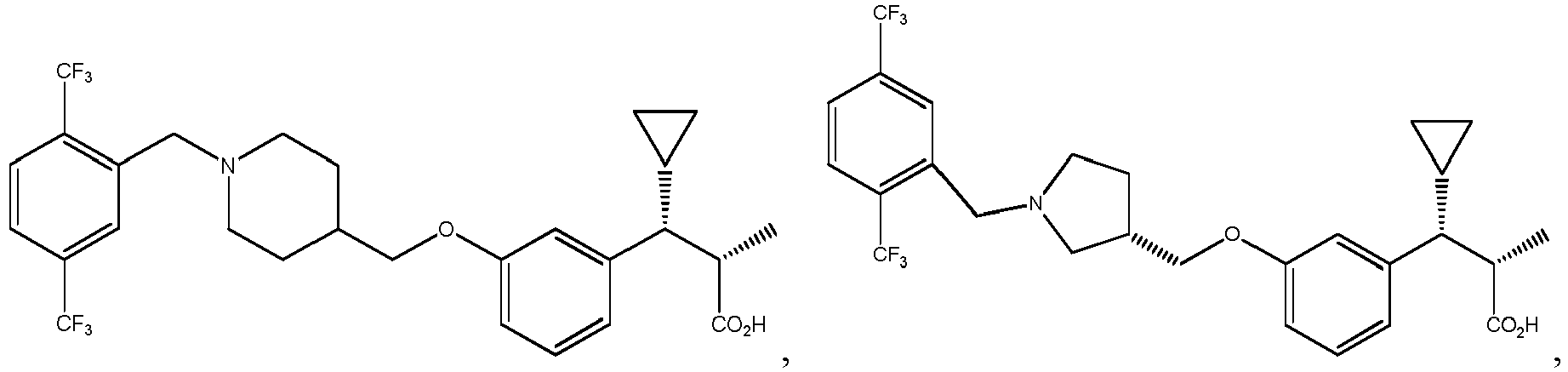

- A pharmaceutical composition comprising a compound of Claims 1 - 8, or a pharmaceutically acceptable salt thereof, and a pharmaceutically acceptable carrier.
- A compound of Claims 1 - 8, or a pharmaceutically acceptable salt thereof, for use in the treatment of Type 2 diabetes.
- A compound according to Claims 1 - 8, or a pharmaceutically acceptable salt thereof, for use in therapy.
- A pharmaceutical composition comprising(1) a compound of any one of Claims 1-8 or a pharmaceutically acceptable salt thereof;(2) one or more compounds selected from the group consisting of:(a) PPAR gamma agonists and partial agonists;(b) biguanides;(c) protein tyrosine phosphatase-1B (PTP-1B) inhibitors;(d) dipeptidyl peptidase IV (DP-IV) inhibitors;(e) insulin or an insulin mimetic;(f) sulfonylureas;(g) α-glucosidase inhibitors;(h) agents which improve a patient's lipid profile, said agents being selected from the group consisting of (i) HMG-CoA reductase inhibitors, (ii) bile acid sequestrants, (iii) nicotinyl alcohol, nicotinic acid or a salt thereof, (iv) PPARα agonists, (v) cholesterol absorption inhibitors, (vi) acyl CoA:cholesterol acyltransferase (ACAT) inhibitors, (vii) CETP inhibitors, and (viii) phenolic anti-oxidants;(i) PPARα/γ dual agonists,(j) PPARδ agonists,(k) antiobesity compounds,(l) ileal bile acid transporter inhibitors;(m) anti-inflammatory agents;(n) glucagon receptor antagonists;(o) GLP-1;(p) GIP-1;(q) GLP-1 analogs;(r) HSD-1 inhibitors;(s) SGLT 1 inhibitors; and(t) SGLT 2 inhibitors; and(3) a pharmaceutically acceptable carrier.
- A pharmaceutical composition comprising a compound according to any one of Claims 1-8, or a pharmaceutically acceptable salt thereof, and a compound selected from simvastatin, ezetimibe and sitagliptin; and a pharmaceutically acceptable carrier.
Applications Claiming Priority (2)
| Application Number | Priority Date | Filing Date | Title |
|---|---|---|---|
| US201461936597P | 2014-02-06 | 2014-02-06 | |
| PCT/US2015/014153 WO2015119899A1 (en) | 2014-02-06 | 2015-02-03 | Antidiabetic compounds |
Publications (3)
| Publication Number | Publication Date |
|---|---|
| EP3102198A1 EP3102198A1 (en) | 2016-12-14 |
| EP3102198A4 EP3102198A4 (en) | 2017-07-26 |
| EP3102198B1 true EP3102198B1 (en) | 2020-08-26 |
Family
ID=53778359
Family Applications (1)
| Application Number | Title | Priority Date | Filing Date |
|---|---|---|---|
| EP15745823.3A Active EP3102198B1 (en) | 2014-02-06 | 2015-02-03 | Antidiabetic compounds |
Country Status (3)
| Country | Link |
|---|---|
| US (1) | US10059667B2 (en) |
| EP (1) | EP3102198B1 (en) |
| WO (1) | WO2015119899A1 (en) |
Families Citing this family (23)
| Publication number | Priority date | Publication date | Assignee | Title |
|---|---|---|---|---|
| EP3102198B1 (en) | 2014-02-06 | 2020-08-26 | Merck Sharp & Dohme Corp. | Antidiabetic compounds |
| WO2015191799A1 (en) * | 2014-06-13 | 2015-12-17 | Merck Sharp & Dohme Corp. | Alpha-7 nicotinic acetylcholine receptor modulators and uses thereof |
| US9856245B2 (en) | 2015-08-12 | 2018-01-02 | Janssen Pharmaceutica Nv | GPR40 agonists for the treatment of type II diabetes |
| US9908873B2 (en) | 2015-08-12 | 2018-03-06 | Janssen Pharmaceutica Nv | GPR40 agonists for the treatment of type II diabetes |
| US9920040B2 (en) | 2015-08-12 | 2018-03-20 | Janssen Pharmaceutica Nv | GPR40 agonists for the treatment of type II diabetes |
| US10988433B2 (en) | 2016-10-25 | 2021-04-27 | Janssen Pharmaceutica Nv | Cyclohexyl GPR40 agonists for the treatment of type II diabetes |
| EP3551176A4 (en) * | 2016-12-06 | 2020-06-24 | Merck Sharp & Dohme Corp. | ANTIDIABETIC HETEROCYCLIC COMPOUNDS |
| JPWO2018181847A1 (en) | 2017-03-31 | 2020-03-05 | 武田薬品工業株式会社 | Aromatic compounds |
| KR20250037575A (en) * | 2017-10-20 | 2025-03-17 | 반더빌트유니버시티 | Antagonists of the muscarinic acetylcholine receptor m4 |
| CA3081324A1 (en) | 2017-10-31 | 2019-05-09 | Vanderbilt University | Antagonists of the muscarinic acetylcholine receptor m4 |
| US11225471B2 (en) | 2017-11-16 | 2022-01-18 | Merck Sharp & Dohme Corp. | Antidiabetic bicyclic compounds |
| CR20200347A (en) | 2018-02-13 | 2020-09-23 | Gilead Sciences Inc | Pd-1/pd-l1 inhibitors |
| KR102591947B1 (en) | 2018-04-19 | 2023-10-25 | 길리애드 사이언시즈, 인코포레이티드 | PD-1/PD-L1 inhibitors |
| PT3820572T (en) | 2018-07-13 | 2023-11-10 | Gilead Sciences Inc | Pd-1/pd-l1 inhibitors |
| US11524029B2 (en) | 2018-08-13 | 2022-12-13 | Viscera Labs, Inc. | Therapeutic composition and methods |
| US11590161B2 (en) | 2018-08-13 | 2023-02-28 | Viscera Labs, Inc. | Therapeutic composition and methods |
| JP7158577B2 (en) | 2018-10-24 | 2022-10-21 | ギリアード サイエンシーズ, インコーポレイテッド | PD-1/PD-L1 inhibitor |
| PH12022550852A1 (en) | 2019-10-07 | 2023-05-03 | Kallyope Inc | Gpr119 agonists |
| WO2021174046A1 (en) * | 2020-02-28 | 2021-09-02 | Kallyope, Inc. | Gpr40 agonists |
| CA3173731A1 (en) * | 2020-02-28 | 2021-09-02 | Kallyope, Inc. | Gpr40 agonists |
| KR20230012597A (en) | 2020-05-19 | 2023-01-26 | 칼리오페, 인크. | AMPK activator |
| AU2021297323A1 (en) | 2020-06-26 | 2023-02-16 | Kallyope, Inc. | AMPK activators |
| WO2024173196A1 (en) * | 2023-02-17 | 2024-08-22 | Merck Sharp & Dohme Llc | Plasma kallikrein inhibitors |
Family Cites Families (67)
| Publication number | Priority date | Publication date | Assignee | Title |
|---|---|---|---|---|
| EP1535915A4 (en) | 2002-09-06 | 2005-10-05 | Takeda Pharmaceutical | FURANE OR THIOPHENE DERIVATIVE AND PHARMACEUTICAL USES THEREOF |
| US7960369B2 (en) | 2002-11-08 | 2011-06-14 | Takeda Pharmaceutical Company Limited | Receptor function regulator |
| WO2004111032A1 (en) | 2003-06-12 | 2004-12-23 | Novo Nordisk A/S | Substituted piperidine carbamates for use as inhibitors of hormone sensitive lipase |
| US7834013B2 (en) | 2003-11-19 | 2010-11-16 | Glaxosmithkline Llc | Aminophenylcyclopropyl carboxylic acids and derivatives as agonists to GPR40 |
| US8008525B2 (en) | 2003-11-26 | 2011-08-30 | Takeda Pharmaceutical Company Limited | Receptor function regulating agent |
| TW200523247A (en) | 2003-12-25 | 2005-07-16 | Takeda Pharmaceutical | 3-(4-benzyloxyphenyl) propanoic acid derivatives |
| US7816367B2 (en) | 2004-02-27 | 2010-10-19 | Amgen Inc. | Compounds, pharmaceutical compositions and methods for use in treating metabolic disorders |
| US7786165B2 (en) | 2004-03-15 | 2010-08-31 | Takeda Pharmaceutical Company Limited | Aminophenylpropanoic acid derivative |
| EP1731505B1 (en) | 2004-03-30 | 2015-01-14 | Takeda Pharmaceutical Company Limited | Alkoxyphenylpropanoic acid derivatives |
| US20080021069A1 (en) | 2004-10-08 | 2008-01-24 | Takeda Pharmaceutical Company Limited | Receptor Function Regulating Agent |
| US20080090865A1 (en) | 2005-01-28 | 2008-04-17 | Min Ge | Antidiabetic Bicyclic Compounds |
| AU2006210954A1 (en) | 2005-01-31 | 2006-08-10 | Merck & Co., Inc. | Antidiabetic bicyclic compounds |
| US7465804B2 (en) | 2005-05-20 | 2008-12-16 | Amgen Inc. | Compounds, pharmaceutical compositions and methods for their use in treating metabolic disorders |
| JP4324221B2 (en) * | 2005-08-26 | 2009-09-02 | 株式会社医薬分子設計研究所 | Derivatives having PPAR agonist activity |
| AU2006291234A1 (en) | 2005-09-14 | 2007-03-22 | Amgen Inc. | Conformationally constrained 3- (4-hydroxy-phenyl) - substituted-propanoic acids useful for treating metabolic disorders |
| JPWO2007040166A1 (en) * | 2005-09-30 | 2009-04-16 | 大日本住友製薬株式会社 | Novel condensed pyrrole derivatives |
| MX2008011615A (en) | 2006-03-14 | 2008-09-22 | Amgen Inc | Bicyclic carboxylic acid derivatives useful for treating metabolic disorders. |
| TW200815377A (en) | 2006-04-24 | 2008-04-01 | Astellas Pharma Inc | Oxadiazolidinedione compound |
| DE102006021874B4 (en) | 2006-05-11 | 2008-03-27 | Sanofi-Aventis | 4,5-diphenyl-pyrimidinyl-amino substituted carboxylic acids, process for their preparation and their use as medicaments |
| DE102006021872B4 (en) | 2006-05-11 | 2008-04-17 | Sanofi-Aventis | 4,5-Diphenyl-pyrimidinyl-oxy or -mercapto substituted carboxylic acids, process for their preparation and their use as medicaments |
| BRPI0711416A2 (en) | 2006-05-11 | 2011-11-01 | Sanofi Aventis | 4,5-diphenyl pyrimidinyl substituted carboxylic acids, process for their production and use as medicaments |
| DE102006021878A1 (en) | 2006-05-11 | 2007-11-15 | Sanofi-Aventis | Phenylamino-benzoxazole substituted carboxylic acids, process for their preparation and their use as medicaments |
| WO2007136572A2 (en) | 2006-05-15 | 2007-11-29 | Merck & Co., Inc. | Antidiabetic bicyclic compounds |
| ES2450081T3 (en) | 2006-06-27 | 2014-03-21 | Takeda Pharmaceutical Company Limited | Condensed cyclic compounds as modulators of the GPR40 receptor |
| CA2662242C (en) | 2006-09-07 | 2012-06-12 | Amgen Inc. | Benzo-fused compounds for use in treating metabolic disorders |
| AU2007293028B2 (en) | 2006-09-07 | 2012-05-31 | Amgen Inc. | Heterocyclic GPR40 modulators |
| WO2008054674A2 (en) | 2006-10-31 | 2008-05-08 | Merck & Co., Inc. | Antidiabetic bicyclic compounds |
| JP2010508268A (en) | 2006-10-31 | 2010-03-18 | メルク エンド カムパニー インコーポレーテッド | Antidiabetic bicyclic compound |
| TW200838526A (en) | 2006-12-01 | 2008-10-01 | Astellas Pharma Inc | Carboxylic acid derivatives |
| EP2079694B1 (en) | 2006-12-28 | 2017-03-01 | Rigel Pharmaceuticals, Inc. | N-substituted-heterocycloalkyloxybenzamide compounds and methods of use |
| EP2139843B1 (en) | 2007-04-16 | 2013-12-25 | Amgen, Inc | Substituted biphenyl phenoxy-, thiophenyl- and aminophenylpropanoic acid gpr40 modulators |
| EP2151236A4 (en) | 2007-04-26 | 2013-01-16 | Japan Science & Tech Agency | G PROTEIN COUPLED RECEPTOR AGONIST |
| WO2009038204A1 (en) | 2007-09-17 | 2009-03-26 | Pharma Frontier Co., Ltd. | Novel long-chain fatty acid derivative compound and g-protein-coupled receptor agonist containing the compound as active ingredient |
| CN101796018A (en) | 2007-09-21 | 2010-08-04 | 塞诺菲-安万特股份有限公司 | (cyclopropylphenyl) phenyloxamides, their production and their use as medicaments |
| AU2008303976B9 (en) | 2007-09-21 | 2013-09-12 | Sanofi | (Carboxylalkylene-phenyl)-phenyl-oxalamides, method for the production thereof, and use of same as a medicament |
| US8030354B2 (en) | 2007-10-10 | 2011-10-04 | Amgen Inc. | Substituted biphenyl GPR40 modulators |
| JP2011016722A (en) | 2007-10-23 | 2011-01-27 | Astellas Pharma Inc | Thiazolidinedione compound |
| TW200932219A (en) | 2007-10-24 | 2009-08-01 | Astellas Pharma Inc | Oxadiazolidinedione compound |
| CL2008003153A1 (en) | 2007-10-26 | 2009-07-24 | Japan Tobacco Inc | Spiro-condensed compounds, gpr40 agonists: pharmaceutical composition comprising one of the compounds; and the use of the compounds in the preparation of medications for the treatment of diabetes, hyperglycemia, impaired fasting glucose tolerance, among others. |
| JP5542058B2 (en) | 2007-10-29 | 2014-07-09 | メルク・シャープ・アンド・ドーム・コーポレーション | Antidiabetic tricyclic compounds |
| CA2716352C (en) | 2008-03-06 | 2013-05-28 | Amgen Inc. | Conformationally constrained carboxylic acid derivatives useful for treating metabolic disorders |
| BRPI0917711A2 (en) | 2008-08-28 | 2017-06-20 | Astute Medical Inc | method for assessing renal status in a patient, and use of one or more markers of renal injury |
| MX2011003917A (en) | 2008-10-15 | 2011-05-31 | Amgen Inc | Spirocyclic gpr40 modulators. |
| WO2010085525A1 (en) | 2009-01-23 | 2010-07-29 | Schering Corporation | Bridged and fused heterocyclic antidiabetic compounds |
| AU2010206783A1 (en) | 2009-01-23 | 2011-07-28 | Merck Sharp & Dohme Corp. | Pentafluorosulpholane-containing antidiabetic compounds |
| AU2010206789A1 (en) | 2009-01-23 | 2011-07-28 | Merck Sharp & Dohme Corp. | Bridged and fused antidiabetic compounds |
| TW201040186A (en) | 2009-02-05 | 2010-11-16 | Schering Corp | Phthalazine-containing antidiabetic compounds |
| EP2423176A4 (en) | 2009-04-22 | 2012-11-07 | Astellas Pharma Inc | Carboxylic acid compound |
| JP2012136438A (en) | 2009-04-22 | 2012-07-19 | Astellas Pharma Inc | Tetrazole compound |
| WO2010143733A1 (en) | 2009-06-09 | 2010-12-16 | Takeda Pharmaceutical Company Limited | Novel fused cyclic compound and use thereof |
| JPWO2011052756A1 (en) | 2009-10-30 | 2013-03-21 | 持田製薬株式会社 | Novel 3-hydroxy-5-arylisoxazole derivatives |
| AR078948A1 (en) | 2009-11-30 | 2011-12-14 | Lilly Co Eli | SPYROPIPERIDINE COMPOUNDS, PHARMACEUTICAL COMPOSITION THAT INCLUDE IT AND ITS USE TO PREPARE A USEFUL MEDICINAL PRODUCT TO TREAT DIABETES |
| TW201215387A (en) * | 2010-07-05 | 2012-04-16 | Sanofi Aventis | Spirocyclically substituted 1,3-propane dioxide derivatives, processes for preparation thereof and use thereof as a medicament |
| EP2595952B1 (en) | 2010-07-23 | 2020-11-18 | Connexios Life Sciences Pvt. Ltd. | Agonists of gpr40 |
| JP5975996B2 (en) | 2010-09-03 | 2016-08-23 | オーエムジー エレクトロニク ケミカルズ,エルエルシー | Electroless nickel alloy plating bath and method for depositing the same |
| JP5809157B2 (en) | 2010-10-08 | 2015-11-10 | 持田製薬株式会社 | Cyclic amide derivative |
| UY33758A (en) | 2010-12-01 | 2012-06-29 | Boehringer Ingelheim Int | INDANILOXIDIHIDROBENZOFURANILACETIC ACIDS |
| TWI537262B (en) | 2011-08-17 | 2016-06-11 | 美國禮來大藥廠 | Novel 1,2,3,4-tetrahydroquinoline derivatives for the treatment of diabetes |
| CN103030646B (en) | 2011-09-29 | 2016-08-24 | 上海恒瑞医药有限公司 | Benzodioxane analog derivative, its preparation method and in application pharmaceutically |
| WO2013102626A1 (en) | 2012-01-04 | 2013-07-11 | Sanofi | 3-[4-(phenylaminooxalylamino)phenyl]hex-4-ynoic acids, process for preparation thereof and use thereof as a medicament |
| GB2498976A (en) | 2012-02-01 | 2013-08-07 | Prosidion Ltd | GPR119 agonists useful in the treatment of type II diabetes |
| WO2013122028A1 (en) | 2012-02-13 | 2013-08-22 | 武田薬品工業株式会社 | Aromatic ring compound |
| JP6121339B2 (en) | 2012-02-13 | 2017-04-26 | 武田薬品工業株式会社 | Aromatic ring compounds |
| US20150072969A1 (en) | 2012-02-28 | 2015-03-12 | Piramal Enterprises Limited | Phenyl alkanoic acid derivatives as gpr agonists |
| US8642585B2 (en) | 2012-03-26 | 2014-02-04 | Boehringer Ingelheim International Gmbh | Indanyloxydihydrobenzofuranylacetic acids |
| WO2015020184A1 (en) * | 2013-08-09 | 2015-02-12 | 武田薬品工業株式会社 | Aromatic compound |
| EP3102198B1 (en) | 2014-02-06 | 2020-08-26 | Merck Sharp & Dohme Corp. | Antidiabetic compounds |
-
2015
- 2015-02-03 EP EP15745823.3A patent/EP3102198B1/en active Active
- 2015-02-03 WO PCT/US2015/014153 patent/WO2015119899A1/en not_active Ceased
- 2015-02-03 US US15/110,894 patent/US10059667B2/en active Active
Non-Patent Citations (1)
| Title |
|---|
| None * |
Also Published As
| Publication number | Publication date |
|---|---|
| EP3102198A4 (en) | 2017-07-26 |
| US10059667B2 (en) | 2018-08-28 |
| WO2015119899A1 (en) | 2015-08-13 |
| US20160332968A1 (en) | 2016-11-17 |
| EP3102198A1 (en) | 2016-12-14 |
Similar Documents
| Publication | Publication Date | Title |
|---|---|---|
| EP3102198B1 (en) | Antidiabetic compounds | |
| US11072602B2 (en) | Antidiabetic heterocyclic compounds | |
| EP2958562B1 (en) | Antidiabetic bicyclic compounds | |
| EP3055288B1 (en) | Antidiabetic tricyclic compounds | |
| EP3076959B1 (en) | Antidiabetic bicyclic compounds | |
| EP2880028B1 (en) | Antidiabetic tricyclic compounds | |
| US10676458B2 (en) | Antidiabetic bicyclic compounds | |
| EP3068768B1 (en) | Antidiabetic tricyclic compounds | |
| US10968232B2 (en) | Antidiabetic spirochroman compounds | |
| US11225471B2 (en) | Antidiabetic bicyclic compounds | |
| WO2014019186A1 (en) | Antidiabetic tricyclic compounds |
Legal Events
| Date | Code | Title | Description |
|---|---|---|---|
| PUAI | Public reference made under article 153(3) epc to a published international application that has entered the european phase |
Free format text: ORIGINAL CODE: 0009012 |
|
| STAA | Information on the status of an ep patent application or granted ep patent |
Free format text: STATUS: REQUEST FOR EXAMINATION WAS MADE |
|
| 17P | Request for examination filed |
Effective date: 20160906 |
|
| AK | Designated contracting states |
Kind code of ref document: A1 Designated state(s): AL AT BE BG CH CY CZ DE DK EE ES FI FR GB GR HR HU IE IS IT LI LT LU LV MC MK MT NL NO PL PT RO RS SE SI SK SM TR |
|
| AX | Request for extension of the european patent |
Extension state: BA ME |
|
| DAX | Request for extension of the european patent (deleted) | ||
| A4 | Supplementary search report drawn up and despatched |
Effective date: 20170623 |
|
| RIC1 | Information provided on ipc code assigned before grant |
Ipc: C07C 15/14 20060101ALI20170619BHEP Ipc: A61K 31/33 20060101AFI20170619BHEP Ipc: A61K 31/34 20060101ALI20170619BHEP |
|
| STAA | Information on the status of an ep patent application or granted ep patent |
Free format text: STATUS: EXAMINATION IS IN PROGRESS |
|
| 17Q | First examination report despatched |
Effective date: 20180612 |
|
| GRAP | Despatch of communication of intention to grant a patent |
Free format text: ORIGINAL CODE: EPIDOSNIGR1 |
|
| STAA | Information on the status of an ep patent application or granted ep patent |
Free format text: STATUS: GRANT OF PATENT IS INTENDED |
|
| INTG | Intention to grant announced |
Effective date: 20200305 |
|
| GRAS | Grant fee paid |
Free format text: ORIGINAL CODE: EPIDOSNIGR3 |
|
| GRAA | (expected) grant |
Free format text: ORIGINAL CODE: 0009210 |
|
| STAA | Information on the status of an ep patent application or granted ep patent |
Free format text: STATUS: THE PATENT HAS BEEN GRANTED |
|
| AK | Designated contracting states |
Kind code of ref document: B1 Designated state(s): AL AT BE BG CH CY CZ DE DK EE ES FI FR GB GR HR HU IE IS IT LI LT LU LV MC MK MT NL NO PL PT RO RS SE SI SK SM TR |
|
| REG | Reference to a national code |
Ref country code: GB Ref legal event code: FG4D |
|
| REG | Reference to a national code |
Ref country code: CH Ref legal event code: EP |
|
| REG | Reference to a national code |
Ref country code: AT Ref legal event code: REF Ref document number: 1305686 Country of ref document: AT Kind code of ref document: T Effective date: 20200915 |
|
| REG | Reference to a national code |
Ref country code: IE Ref legal event code: FG4D |
|
| REG | Reference to a national code |
Ref country code: DE Ref legal event code: R096 Ref document number: 602015058020 Country of ref document: DE |
|
| REG | Reference to a national code |
Ref country code: LT Ref legal event code: MG4D |
|
| PG25 | Lapsed in a contracting state [announced via postgrant information from national office to epo] |
Ref country code: LT Free format text: LAPSE BECAUSE OF FAILURE TO SUBMIT A TRANSLATION OF THE DESCRIPTION OR TO PAY THE FEE WITHIN THE PRESCRIBED TIME-LIMIT Effective date: 20200826 Ref country code: FI Free format text: LAPSE BECAUSE OF FAILURE TO SUBMIT A TRANSLATION OF THE DESCRIPTION OR TO PAY THE FEE WITHIN THE PRESCRIBED TIME-LIMIT Effective date: 20200826 Ref country code: PT Free format text: LAPSE BECAUSE OF FAILURE TO SUBMIT A TRANSLATION OF THE DESCRIPTION OR TO PAY THE FEE WITHIN THE PRESCRIBED TIME-LIMIT Effective date: 20201228 Ref country code: GR Free format text: LAPSE BECAUSE OF FAILURE TO SUBMIT A TRANSLATION OF THE DESCRIPTION OR TO PAY THE FEE WITHIN THE PRESCRIBED TIME-LIMIT Effective date: 20201127 Ref country code: NO Free format text: LAPSE BECAUSE OF FAILURE TO SUBMIT A TRANSLATION OF THE DESCRIPTION OR TO PAY THE FEE WITHIN THE PRESCRIBED TIME-LIMIT Effective date: 20201126 Ref country code: HR Free format text: LAPSE BECAUSE OF FAILURE TO SUBMIT A TRANSLATION OF THE DESCRIPTION OR TO PAY THE FEE WITHIN THE PRESCRIBED TIME-LIMIT Effective date: 20200826 Ref country code: BG Free format text: LAPSE BECAUSE OF FAILURE TO SUBMIT A TRANSLATION OF THE DESCRIPTION OR TO PAY THE FEE WITHIN THE PRESCRIBED TIME-LIMIT Effective date: 20201126 Ref country code: SE Free format text: LAPSE BECAUSE OF FAILURE TO SUBMIT A TRANSLATION OF THE DESCRIPTION OR TO PAY THE FEE WITHIN THE PRESCRIBED TIME-LIMIT Effective date: 20200826 |
|
| REG | Reference to a national code |
Ref country code: NL Ref legal event code: MP Effective date: 20200826 |
|
| REG | Reference to a national code |
Ref country code: AT Ref legal event code: MK05 Ref document number: 1305686 Country of ref document: AT Kind code of ref document: T Effective date: 20200826 |
|
| PG25 | Lapsed in a contracting state [announced via postgrant information from national office to epo] |
Ref country code: IS Free format text: LAPSE BECAUSE OF FAILURE TO SUBMIT A TRANSLATION OF THE DESCRIPTION OR TO PAY THE FEE WITHIN THE PRESCRIBED TIME-LIMIT Effective date: 20201226 Ref country code: RS Free format text: LAPSE BECAUSE OF FAILURE TO SUBMIT A TRANSLATION OF THE DESCRIPTION OR TO PAY THE FEE WITHIN THE PRESCRIBED TIME-LIMIT Effective date: 20200826 Ref country code: NL Free format text: LAPSE BECAUSE OF FAILURE TO SUBMIT A TRANSLATION OF THE DESCRIPTION OR TO PAY THE FEE WITHIN THE PRESCRIBED TIME-LIMIT Effective date: 20200826 Ref country code: PL Free format text: LAPSE BECAUSE OF FAILURE TO SUBMIT A TRANSLATION OF THE DESCRIPTION OR TO PAY THE FEE WITHIN THE PRESCRIBED TIME-LIMIT Effective date: 20200826 Ref country code: LV Free format text: LAPSE BECAUSE OF FAILURE TO SUBMIT A TRANSLATION OF THE DESCRIPTION OR TO PAY THE FEE WITHIN THE PRESCRIBED TIME-LIMIT Effective date: 20200826 |
|
| PG25 | Lapsed in a contracting state [announced via postgrant information from national office to epo] |
Ref country code: RO Free format text: LAPSE BECAUSE OF FAILURE TO SUBMIT A TRANSLATION OF THE DESCRIPTION OR TO PAY THE FEE WITHIN THE PRESCRIBED TIME-LIMIT Effective date: 20200826 Ref country code: SM Free format text: LAPSE BECAUSE OF FAILURE TO SUBMIT A TRANSLATION OF THE DESCRIPTION OR TO PAY THE FEE WITHIN THE PRESCRIBED TIME-LIMIT Effective date: 20200826 Ref country code: EE Free format text: LAPSE BECAUSE OF FAILURE TO SUBMIT A TRANSLATION OF THE DESCRIPTION OR TO PAY THE FEE WITHIN THE PRESCRIBED TIME-LIMIT Effective date: 20200826 Ref country code: DK Free format text: LAPSE BECAUSE OF FAILURE TO SUBMIT A TRANSLATION OF THE DESCRIPTION OR TO PAY THE FEE WITHIN THE PRESCRIBED TIME-LIMIT Effective date: 20200826 Ref country code: CZ Free format text: LAPSE BECAUSE OF FAILURE TO SUBMIT A TRANSLATION OF THE DESCRIPTION OR TO PAY THE FEE WITHIN THE PRESCRIBED TIME-LIMIT Effective date: 20200826 |
|
| REG | Reference to a national code |
Ref country code: DE Ref legal event code: R097 Ref document number: 602015058020 Country of ref document: DE |
|
| PG25 | Lapsed in a contracting state [announced via postgrant information from national office to epo] |
Ref country code: AT Free format text: LAPSE BECAUSE OF FAILURE TO SUBMIT A TRANSLATION OF THE DESCRIPTION OR TO PAY THE FEE WITHIN THE PRESCRIBED TIME-LIMIT Effective date: 20200826 Ref country code: AL Free format text: LAPSE BECAUSE OF FAILURE TO SUBMIT A TRANSLATION OF THE DESCRIPTION OR TO PAY THE FEE WITHIN THE PRESCRIBED TIME-LIMIT Effective date: 20200826 Ref country code: ES Free format text: LAPSE BECAUSE OF FAILURE TO SUBMIT A TRANSLATION OF THE DESCRIPTION OR TO PAY THE FEE WITHIN THE PRESCRIBED TIME-LIMIT Effective date: 20200826 |
|
| PG25 | Lapsed in a contracting state [announced via postgrant information from national office to epo] |
Ref country code: SK Free format text: LAPSE BECAUSE OF FAILURE TO SUBMIT A TRANSLATION OF THE DESCRIPTION OR TO PAY THE FEE WITHIN THE PRESCRIBED TIME-LIMIT Effective date: 20200826 |
|
| PLBE | No opposition filed within time limit |
Free format text: ORIGINAL CODE: 0009261 |
|
| STAA | Information on the status of an ep patent application or granted ep patent |
Free format text: STATUS: NO OPPOSITION FILED WITHIN TIME LIMIT |
|
| PG25 | Lapsed in a contracting state [announced via postgrant information from national office to epo] |
Ref country code: IT Free format text: LAPSE BECAUSE OF FAILURE TO SUBMIT A TRANSLATION OF THE DESCRIPTION OR TO PAY THE FEE WITHIN THE PRESCRIBED TIME-LIMIT Effective date: 20200826 |
|
| 26N | No opposition filed |
Effective date: 20210527 |
|
| PG25 | Lapsed in a contracting state [announced via postgrant information from national office to epo] |
Ref country code: SI Free format text: LAPSE BECAUSE OF FAILURE TO SUBMIT A TRANSLATION OF THE DESCRIPTION OR TO PAY THE FEE WITHIN THE PRESCRIBED TIME-LIMIT Effective date: 20200826 |
|
| PG25 | Lapsed in a contracting state [announced via postgrant information from national office to epo] |
Ref country code: MC Free format text: LAPSE BECAUSE OF FAILURE TO SUBMIT A TRANSLATION OF THE DESCRIPTION OR TO PAY THE FEE WITHIN THE PRESCRIBED TIME-LIMIT Effective date: 20200826 |
|
| REG | Reference to a national code |
Ref country code: BE Ref legal event code: MM Effective date: 20210228 |
|
| PG25 | Lapsed in a contracting state [announced via postgrant information from national office to epo] |
Ref country code: CH Free format text: LAPSE BECAUSE OF NON-PAYMENT OF DUE FEES Effective date: 20210228 Ref country code: LI Free format text: LAPSE BECAUSE OF NON-PAYMENT OF DUE FEES Effective date: 20210228 Ref country code: LU Free format text: LAPSE BECAUSE OF NON-PAYMENT OF DUE FEES Effective date: 20210203 |
|
| PG25 | Lapsed in a contracting state [announced via postgrant information from national office to epo] |
Ref country code: IE Free format text: LAPSE BECAUSE OF NON-PAYMENT OF DUE FEES Effective date: 20210203 |
|
| PG25 | Lapsed in a contracting state [announced via postgrant information from national office to epo] |
Ref country code: BE Free format text: LAPSE BECAUSE OF NON-PAYMENT OF DUE FEES Effective date: 20210228 |
|
| REG | Reference to a national code |
Ref country code: DE Ref legal event code: R081 Ref document number: 602015058020 Country of ref document: DE Owner name: MERCK SHARP & DOHME LLC, RAHWAY, US Free format text: FORMER OWNER: MERCK SHARP & DOHME CORP., RAHWAY, N.J., US |
|
| REG | Reference to a national code |
Ref country code: GB Ref legal event code: 732E Free format text: REGISTERED BETWEEN 20221013 AND 20221019 |
|
| PG25 | Lapsed in a contracting state [announced via postgrant information from national office to epo] |
Ref country code: HU Free format text: LAPSE BECAUSE OF FAILURE TO SUBMIT A TRANSLATION OF THE DESCRIPTION OR TO PAY THE FEE WITHIN THE PRESCRIBED TIME-LIMIT; INVALID AB INITIO Effective date: 20150203 |
|
| PG25 | Lapsed in a contracting state [announced via postgrant information from national office to epo] |
Ref country code: CY Free format text: LAPSE BECAUSE OF FAILURE TO SUBMIT A TRANSLATION OF THE DESCRIPTION OR TO PAY THE FEE WITHIN THE PRESCRIBED TIME-LIMIT Effective date: 20200826 |
|
| PG25 | Lapsed in a contracting state [announced via postgrant information from national office to epo] |
Ref country code: MK Free format text: LAPSE BECAUSE OF FAILURE TO SUBMIT A TRANSLATION OF THE DESCRIPTION OR TO PAY THE FEE WITHIN THE PRESCRIBED TIME-LIMIT Effective date: 20200826 |
|
| PG25 | Lapsed in a contracting state [announced via postgrant information from national office to epo] |
Ref country code: MT Free format text: LAPSE BECAUSE OF FAILURE TO SUBMIT A TRANSLATION OF THE DESCRIPTION OR TO PAY THE FEE WITHIN THE PRESCRIBED TIME-LIMIT Effective date: 20200826 |
|
| PGFP | Annual fee paid to national office [announced via postgrant information from national office to epo] |
Ref country code: DE Payment date: 20250109 Year of fee payment: 11 |
|
| PGFP | Annual fee paid to national office [announced via postgrant information from national office to epo] |
Ref country code: FR Payment date: 20250110 Year of fee payment: 11 |
|
| PGFP | Annual fee paid to national office [announced via postgrant information from national office to epo] |
Ref country code: GB Payment date: 20250109 Year of fee payment: 11 |
|
| PG25 | Lapsed in a contracting state [announced via postgrant information from national office to epo] |
Ref country code: TR Free format text: LAPSE BECAUSE OF FAILURE TO SUBMIT A TRANSLATION OF THE DESCRIPTION OR TO PAY THE FEE WITHIN THE PRESCRIBED TIME-LIMIT Effective date: 20200826 |