EP3074404B1 - Acid, solvent, and thermal resistant metal-organic frameworks - Google Patents
Acid, solvent, and thermal resistant metal-organic frameworks Download PDFInfo
- Publication number
- EP3074404B1 EP3074404B1 EP15707499.8A EP15707499A EP3074404B1 EP 3074404 B1 EP3074404 B1 EP 3074404B1 EP 15707499 A EP15707499 A EP 15707499A EP 3074404 B1 EP3074404 B1 EP 3074404B1
- Authority
- EP
- European Patent Office
- Prior art keywords
- mof
- hetero
- aryl
- cycloalkenyl
- cycloalkyl
- Prior art date
- Legal status (The legal status is an assumption and is not a legal conclusion. Google has not performed a legal analysis and makes no representation as to the accuracy of the status listed.)
- Active
Links
- 0 *c1c(*)c(c(*)c(*)c2c3*(*)c(C([O-])=O)c(*)c2*)c3*(*)c1C([O-])=O Chemical compound *c1c(*)c(c(*)c(*)c2c3*(*)c(C([O-])=O)c(*)c2*)c3*(*)c1C([O-])=O 0.000 description 7
- PEQRGMPXYDIZSX-UHFFFAOYSA-K [O-]C(c(cc1)ccc1-c(cc1)ccc1-c1cc(-c(cc2)ccc2-c(cc2)ccc2C([O-])=O)cc(-c(cc2)ccc2-c(cc2)ccc2C([O-])=O)c1)=O Chemical compound [O-]C(c(cc1)ccc1-c(cc1)ccc1-c1cc(-c(cc2)ccc2-c(cc2)ccc2C([O-])=O)cc(-c(cc2)ccc2-c(cc2)ccc2C([O-])=O)c1)=O PEQRGMPXYDIZSX-UHFFFAOYSA-K 0.000 description 2
- QMKYBPDZANOJGF-UHFFFAOYSA-N OC(c1cc(C(O)=O)cc(C(O)=O)c1)=O Chemical compound OC(c1cc(C(O)=O)cc(C(O)=O)c1)=O QMKYBPDZANOJGF-UHFFFAOYSA-N 0.000 description 1
- SATWKVZGMWCXOJ-UHFFFAOYSA-L [O-]C(c(cc1)ccc1-c1cc(-c(cc2)ccc2C(O)=O)cc(-c(cc2)ccc2C([O-])=O)c1)=O Chemical compound [O-]C(c(cc1)ccc1-c1cc(-c(cc2)ccc2C(O)=O)cc(-c(cc2)ccc2C([O-])=O)c1)=O SATWKVZGMWCXOJ-UHFFFAOYSA-L 0.000 description 1
- SATWKVZGMWCXOJ-UHFFFAOYSA-K [O-]C(c(cc1)ccc1-c1cc(-c(cc2)ccc2C([O-])=O)cc(-c(cc2)ccc2C([O-])=O)c1)=O Chemical compound [O-]C(c(cc1)ccc1-c1cc(-c(cc2)ccc2C([O-])=O)cc(-c(cc2)ccc2C([O-])=O)c1)=O SATWKVZGMWCXOJ-UHFFFAOYSA-K 0.000 description 1
- GSYIVQLTSZFJRV-UHFFFAOYSA-L [O-]C(c(cc1)ccc1-c1cc(C([O-])=O)ccc1)=O Chemical compound [O-]C(c(cc1)ccc1-c1cc(C([O-])=O)ccc1)=O GSYIVQLTSZFJRV-UHFFFAOYSA-L 0.000 description 1
- UBNQFWCYYJTPNA-UHFFFAOYSA-J [O-]C(c(cc1)ccc1N(c(cc1)ccc1C([O-])=O)c(cc1)ccc1N(c(cc1)ccc1C([O-])=O)c(cc1)ccc1C([O-])=O)=O Chemical compound [O-]C(c(cc1)ccc1N(c(cc1)ccc1C([O-])=O)c(cc1)ccc1N(c(cc1)ccc1C([O-])=O)c(cc1)ccc1C([O-])=O)=O UBNQFWCYYJTPNA-UHFFFAOYSA-J 0.000 description 1
- WVDRSXGPQWNUBN-UHFFFAOYSA-L [O-]C(c(cc1)ccc1Oc(cc1)ccc1C([O-])=O)=O Chemical compound [O-]C(c(cc1)ccc1Oc(cc1)ccc1C([O-])=O)=O WVDRSXGPQWNUBN-UHFFFAOYSA-L 0.000 description 1
- QMKYBPDZANOJGF-UHFFFAOYSA-K [O-]C(c1cc(C([O-])=O)cc(C([O-])=O)c1)=O Chemical compound [O-]C(c1cc(C([O-])=O)cc(C([O-])=O)c1)=O QMKYBPDZANOJGF-UHFFFAOYSA-K 0.000 description 1
Images


Classifications
-
- B—PERFORMING OPERATIONS; TRANSPORTING
- B01—PHYSICAL OR CHEMICAL PROCESSES OR APPARATUS IN GENERAL
- B01D—SEPARATION
- B01D33/00—Filters with filtering elements which move during the filtering operation
-
- B—PERFORMING OPERATIONS; TRANSPORTING
- B01—PHYSICAL OR CHEMICAL PROCESSES OR APPARATUS IN GENERAL
- B01D—SEPARATION
- B01D53/00—Separation of gases or vapours; Recovering vapours of volatile solvents from gases; Chemical or biological purification of waste gases, e.g. engine exhaust gases, smoke, fumes, flue gases, aerosols
- B01D53/02—Separation of gases or vapours; Recovering vapours of volatile solvents from gases; Chemical or biological purification of waste gases, e.g. engine exhaust gases, smoke, fumes, flue gases, aerosols by adsorption, e.g. preparative gas chromatography
- B01D53/04—Separation of gases or vapours; Recovering vapours of volatile solvents from gases; Chemical or biological purification of waste gases, e.g. engine exhaust gases, smoke, fumes, flue gases, aerosols by adsorption, e.g. preparative gas chromatography with stationary adsorbents
- B01D53/047—Pressure swing adsorption
-
- B—PERFORMING OPERATIONS; TRANSPORTING
- B01—PHYSICAL OR CHEMICAL PROCESSES OR APPARATUS IN GENERAL
- B01D—SEPARATION
- B01D53/00—Separation of gases or vapours; Recovering vapours of volatile solvents from gases; Chemical or biological purification of waste gases, e.g. engine exhaust gases, smoke, fumes, flue gases, aerosols
- B01D53/22—Separation of gases or vapours; Recovering vapours of volatile solvents from gases; Chemical or biological purification of waste gases, e.g. engine exhaust gases, smoke, fumes, flue gases, aerosols by diffusion
- B01D53/228—Separation of gases or vapours; Recovering vapours of volatile solvents from gases; Chemical or biological purification of waste gases, e.g. engine exhaust gases, smoke, fumes, flue gases, aerosols by diffusion characterised by specific membranes
-
- B—PERFORMING OPERATIONS; TRANSPORTING
- B01—PHYSICAL OR CHEMICAL PROCESSES OR APPARATUS IN GENERAL
- B01J—CHEMICAL OR PHYSICAL PROCESSES, e.g. CATALYSIS OR COLLOID CHEMISTRY; THEIR RELEVANT APPARATUS
- B01J20/00—Solid sorbent compositions or filter aid compositions; Sorbents for chromatography; Processes for preparing, regenerating or reactivating thereof
- B01J20/22—Solid sorbent compositions or filter aid compositions; Sorbents for chromatography; Processes for preparing, regenerating or reactivating thereof comprising organic material
- B01J20/223—Solid sorbent compositions or filter aid compositions; Sorbents for chromatography; Processes for preparing, regenerating or reactivating thereof comprising organic material containing metals, e.g. organo-metallic compounds, coordination complexes
- B01J20/226—Coordination polymers, e.g. metal-organic frameworks [MOF], zeolitic imidazolate frameworks [ZIF]
-
- B—PERFORMING OPERATIONS; TRANSPORTING
- B01—PHYSICAL OR CHEMICAL PROCESSES OR APPARATUS IN GENERAL
- B01J—CHEMICAL OR PHYSICAL PROCESSES, e.g. CATALYSIS OR COLLOID CHEMISTRY; THEIR RELEVANT APPARATUS
- B01J20/00—Solid sorbent compositions or filter aid compositions; Sorbents for chromatography; Processes for preparing, regenerating or reactivating thereof
- B01J20/30—Processes for preparing, regenerating, or reactivating
- B01J20/3085—Chemical treatments not covered by groups B01J20/3007 - B01J20/3078
-
- B—PERFORMING OPERATIONS; TRANSPORTING
- B01—PHYSICAL OR CHEMICAL PROCESSES OR APPARATUS IN GENERAL
- B01J—CHEMICAL OR PHYSICAL PROCESSES, e.g. CATALYSIS OR COLLOID CHEMISTRY; THEIR RELEVANT APPARATUS
- B01J31/00—Catalysts comprising hydrides, coordination complexes or organic compounds
-
- B—PERFORMING OPERATIONS; TRANSPORTING
- B01—PHYSICAL OR CHEMICAL PROCESSES OR APPARATUS IN GENERAL
- B01J—CHEMICAL OR PHYSICAL PROCESSES, e.g. CATALYSIS OR COLLOID CHEMISTRY; THEIR RELEVANT APPARATUS
- B01J31/00—Catalysts comprising hydrides, coordination complexes or organic compounds
- B01J31/16—Catalysts comprising hydrides, coordination complexes or organic compounds containing coordination complexes
- B01J31/1691—Coordination polymers, e.g. metal-organic frameworks [MOF]
-
- B—PERFORMING OPERATIONS; TRANSPORTING
- B01—PHYSICAL OR CHEMICAL PROCESSES OR APPARATUS IN GENERAL
- B01J—CHEMICAL OR PHYSICAL PROCESSES, e.g. CATALYSIS OR COLLOID CHEMISTRY; THEIR RELEVANT APPARATUS
- B01J37/00—Processes, in general, for preparing catalysts; Processes, in general, for activation of catalysts
- B01J37/04—Mixing
-
- C—CHEMISTRY; METALLURGY
- C07—ORGANIC CHEMISTRY
- C07F—ACYCLIC, CARBOCYCLIC OR HETEROCYCLIC COMPOUNDS CONTAINING ELEMENTS OTHER THAN CARBON, HYDROGEN, HALOGEN, OXYGEN, NITROGEN, SULFUR, SELENIUM OR TELLURIUM
- C07F7/00—Compounds containing elements of Groups 4 or 14 of the Periodic Table
- C07F7/003—Compounds containing elements of Groups 4 or 14 of the Periodic Table without C-Metal linkages
-
- B—PERFORMING OPERATIONS; TRANSPORTING
- B01—PHYSICAL OR CHEMICAL PROCESSES OR APPARATUS IN GENERAL
- B01D—SEPARATION
- B01D2253/00—Adsorbents used in seperation treatment of gases and vapours
- B01D2253/20—Organic adsorbents
- B01D2253/204—Metal organic frameworks (MOF's)
-
- B—PERFORMING OPERATIONS; TRANSPORTING
- B01—PHYSICAL OR CHEMICAL PROCESSES OR APPARATUS IN GENERAL
- B01J—CHEMICAL OR PHYSICAL PROCESSES, e.g. CATALYSIS OR COLLOID CHEMISTRY; THEIR RELEVANT APPARATUS
- B01J2531/00—Additional information regarding catalytic systems classified in B01J31/00
- B01J2531/40—Complexes comprising metals of Group IV (IVA or IVB) as the central metal
- B01J2531/46—Titanium
-
- B—PERFORMING OPERATIONS; TRANSPORTING
- B01—PHYSICAL OR CHEMICAL PROCESSES OR APPARATUS IN GENERAL
- B01J—CHEMICAL OR PHYSICAL PROCESSES, e.g. CATALYSIS OR COLLOID CHEMISTRY; THEIR RELEVANT APPARATUS
- B01J2531/00—Additional information regarding catalytic systems classified in B01J31/00
- B01J2531/40—Complexes comprising metals of Group IV (IVA or IVB) as the central metal
- B01J2531/48—Zirconium
-
- B—PERFORMING OPERATIONS; TRANSPORTING
- B01—PHYSICAL OR CHEMICAL PROCESSES OR APPARATUS IN GENERAL
- B01J—CHEMICAL OR PHYSICAL PROCESSES, e.g. CATALYSIS OR COLLOID CHEMISTRY; THEIR RELEVANT APPARATUS
- B01J2531/00—Additional information regarding catalytic systems classified in B01J31/00
- B01J2531/40—Complexes comprising metals of Group IV (IVA or IVB) as the central metal
- B01J2531/49—Hafnium
Definitions
- the present invention relates to acid, solvent, and/or thermal resistant Metal-Organic Frameworks (MOFs), including solid-acid MOFs (sa-MOFs); a method for producing a strong solid acid MOF and gas adsorption, gas separation, and catalytic devices comprising MOFs.
- MOFs Metal-Organic Frameworks
- sa-MOFs solid-acid MOFs
- a method for producing a strong solid acid MOF and gas adsorption, gas separation, and catalytic devices comprising MOFs comprising MOFs.
- Metal-organic frameworks are porous crystalline materials that are constructed by linking metal clusters called Secondary Binding Units (SBUs) and organic linking moieties. MOFs have high surface area and high porosity which enable them to be utilized in diverse fields, such as gas storage, catalysis, and sensors.
- SBUs Secondary Binding Units
- MOFs have high surface area and high porosity which enable them to be utilized in diverse fields, such as gas storage, catalysis, and sensors.
- Corma et al discloses zirconium Lewis acid sites grafted onto a mesoporous silicate (MCM-41) and zirconium sites incorporated into inorganic-organic MOF materials.
- MCM-411 mesoporous silicate
- Qingyuan Yang et al discloses CH 4 and CO 2 capture in highly porous zirconium oxide based metal-organic frameworks.
- the disclosure provides for metal-organic frameworks (MOFs) that are acid, solvent, and/or thermal resistant.
- MOFs of the disclosure can be used in a variety of applications and environments that cannot be addressed by using conventional framework materials.
- the MOFs of the disclosure comprise metals (e.g ., titanium, zirconium, and hafnium) coordinated to carboxylate clusters of organic linking ligands.
- the disclosure further provides for controlling metal-carboxylate cluster extensions and topologies of the MOFs by using the methods disclosed herein.
- the MOFs of the disclosure are comprised of organic linking moieties having various geometries, multivariate functionalities and metalation.
- isomorphous analogues of the MOFs disclosed herein can be created by replacing framework metal ions with alternate metal ions. Accordingly, the disclosure provides for a new series of MOFs that feature: acid, solvent, and/or thermal resistance; designable topologies; multivariate framework components; controllable pore metrics; and tunable pore environments.
- the disclosure further provides for MOFs comprised of Zr-carboxlate SBUs linked to various organic linking ligands ( e.g ., MOF-801, MOF-802, MOF-803, MOF-804, MOF-805, MOF-806, MOF-807, MOF-808, MOF-812, MOF-841, and MOF-841).
- MOF-777 a framework comprising zirconium and benzene-tribenzoic acid (BTB)-based organic linking moieties (e.g ., MOF-777).
- BTB benzene-tribenzoic acid
- MOF-777 is thermally stable up to 550 °C, and is resistant to common acids, bases, organic solvents and water.
- MOF-777 has a unique tfz-d type 3D topology that is based on stacking kgd-a type 2D structures which is built around hexagonal SBUs and triangle BTB-based linkers. The topology of MOF-777 is unique and the first of its kind in the field. Therefore, MOF-777 represents an entirely new class of MOFs which substructure allows for exfoliation.
- the disclosure additionally provides for variations of the MOF-777 framework which comprise substituting zirconium metal ions with alternate metal ions, substituting the BTB organic linking ligand with alternate organic linking ligands which have trigonal planar geometries, and/or substituting formate anions with alternate linking anions.
- MOFs of the disclosure are typically acid resistant they can be also be modified to be strong solid-acids, by (1) modifying linking anions used to synthesize the frameworks with acidic site precursors capable of becoming Bronstead and/or Lewis acids (e.g., sulfate, and halide anions); (2) complexing open metal sites or other portions ( e.g., pore) of the MOFs disclosed herein with acidic site precursors; and (3) exchanging anions coordinated to the metal, metal ions, or metal containing complexes of the MOFs with acidic site precursors.
- Lewis acids e.g., sulfate, and halide anions
- MOFs that are strong solid-acids are capable of being superacids.
- MOFs disclosed herein can be used in variety of applications and devices, including, for use in fluid storage, fluid separation, thin films, catalysis, sensors, adsorbents (e.g ., radioactive isotopes, and for harmful chemicals), conductors, and in the manufacture fertilizers, batteries, dyes, paints, drugs and explosives.
- adsorbents e.g ., radioactive isotopes, and for harmful chemicals
- the present invention provides a thermal, acid, and/or solvent resistant metal organic framework (MOF) comprising a plurality of linked M-O-L secondary binding units (SBUs), wherein M is a zirconium or hafnium metal, a zirconium or hafnium metal ion, or zirconium or hafnium metal containing complex; O is an oxygen atom of a carboxylate based linking cluster; and L is an organic linking ligand comprising one or more structures of Formula I to IX and XI to XII, wherein the linking ligand forms a bond with the metal, metal ion or metal containing complex via the carboxylate based linking cluster: and
- L is a linear diptopic organic linking ligand comprising one or more structures of Formula V-VII: wherein, R 37 -R 54 are independently selected from H, D, alkyl, alkenyl, alkynyl, aryl, hetero-alkyl, hetero-alkenyl, hetero-alkynyl, cycloalkyl, cycloalkenyl, hetero-aryl, heterocycle, halo, hydroxyl, anhydride, carbonyl, carboxyl, carbonate, carboxylate, aldehyde, haloformyl, ester, hydroperoxy, peroxy, ether, orthoester, carboxamide, amine, imine, imide, azide, azo, cyanate, isocyanate, nitrate, nitrile, isonitrile, nitroso, nitro, nitrosooxy, pyridyl, sulfhydryl, sulfide, disulfide, sulfiny
- L is a bent diptopic organic linking ligand comprising one or more structures of Formula VIII to IX and XI to XV:
- L is a bent diptopic organic linking ligand comprising one or more structures of Formula VIII(a), VIII(b), VIII(c), VIII(d), VIII(e), VIII(f), VIII(g), VIII(h), IX(a), XI(a), XII(a), XIII(a), XIV(a), XV(a), XV(b), and XV(c):
- L is a tetratopic organic linking ligand comprising one or more structures of Formula XVI-XXII: and wherein, R 25 -R 36 , R 55 -R 58 , R 60 , R 61 , R 63 , R 64 , R 103 -R 186 are independently selected from H, D, alkyl, alkenyl, alkynyl, aryl, hetero-alkyl, hetero-alkenyl, hetero-alkynyl, cycloalkyl, cycloalkenyl, hetero-aryl, heterocycle, halo, hydroxyl, anhydride, carbonyl, carboxyl, carbonate, carboxylate, aldehyde, haloformyl, ester, hydroperoxy, peroxy, ether, orthoester, carboxamide, amine, imine, imide, azide, azo, cyanate, isocyanate, nitrate, nitrile, isonitrile, nitro
- L is a tetratopic organic linking ligand comprising one or more structures of Formula XVI(a), XVII(a), XVIII(a), XIX(a), XX(a), XXI(a) and XXII(a): and
- L is a tritopic organic linking ligand having one or more structures of Formula I-IV: and wherein,
- L is a tritopic organic linking ligand comprising one or more structures of any one of Formula I-IV:
- L is a tritopic organic linking ligand comprising one or more structures of Formula I(a), II(a), III(a) and IV(a): and
- M is a zirconium or hafnium metal, a zirconium or hafnium metal ion, or a zirconium or hafnium metal containing complex.
- M is a metal or metal ion selected from Li + , Na + , K + , Rb + , Cs + , Be 2+ , Mg 2+ , Ca 2+ , Sr 2+ , Ba 2+ , Sc 3+ , Sc 2+ , Sc + , Y 3+ , Y 2+ , Y + , Ti 4+ , Ti 3+ , Ti 2+ , Zr 4+ , Zr 3+ , Zr 2+ , Hf 4+ , Hf 3+ , V 5+ , V 4+ , V 3+ , V 2+ , Nb 5+ , Nb 4+ , Nb 3+ , Nb 2+ , Ta 5+ , Ta 4+ , Ta 3+ , Ta 2+ , Cr 6+ , Cr 5+ , Cr 4+ , Cr 3+ , Cr 2+ , Cr + , Cr, Mo 6+ , Mo 5+ , Mo 4+ ,
- M is a metal or metal ion selected from Li + , Mg 2+ , Ca 2+ , Al 3+ , Al 2+ , Al + , Ti 4+ , Ti 3+ , Ti 2+ , Zr 4+ , Zr 3+ , Zr 2+ , Hf 4+ , Hf 3+ , and combinations thereof, including any complexes which contain the metal ions listed, as well as any corresponding metal salt counter-anions.
- the MOF is MOF-778 (hf-MOF-777).
- M is a zirconium metal or zirconium metal ion, including any complexes which contain zirconium, as well as any corresponding metal salt counter-anions.
- the plurality of linked M-O-L SBUs are zirconium carboxylate clusters that have 3-c, 4-c, 6-c, 8-c, 9-c, 10-c, or 12-c extensions.
- the MOF is MOF-801, MOF-802, MOF-803, MOF-804, MOF-805, MOF-806, MOF-807, MOF-808, MOF-812, MOF-841, MOF-842 or MOF-867.
- the plurality of linked M-O-L SBUs are hexagonal zirconium carboxylate clusters linked by benzene-tribenzoic acid (BTB)-based organic linking moieties.
- the MOF has tfz-d type 3D topology that is based upon the stacking of kgd-a type 2D layers.
- the layers are connected to each other via linking anions.
- the linking anions are selected from formate, acetate, phthalate, lactate, oxalate, citrate, fumurate, adipate, anthranilate, ascorbate, benzoate, butyrate, lactate, malate, malonate, tatrate, succinate, sorbate, cinnamate, glutamate, gluconate, propionate, pavalate, and valerate.
- the linking anion is formate.
- the MOF is MOF-777.
- the linking anions comprise acid site precursors.
- the acid site precursors are selected from F - , Cl - , ClO - , ClO 2 - , ClO 3 - , ClO 4 - , Br - , BrO - , I - , IO 3 - , IO 4 - , NO 3 - , S 2 - , HS - , HSO 3 - , SO 3 2- , SO 4 2- , HSO 4 - , H 2 PO 4 2- , PO 4 3- , CO 3 2- , HCO 3 - , H 3 BO 3 , SiO 3 2- , PF 6 - , CF 3 CO 2 - and CF 3 SO 3 - .
- the acid site precursor is HSO 3 - .
- the MOF is a strong solid-acid (sa-MOF).
- the invention also provides a method for producing a strong solid acid MOF (sa-MOF) comprising reacting the organic linking ligand as described above with a zirconium or hafnium metal or metal ion at an elevated temperature for at least 2 hours, in the presence of an acid site precursor.
- sa-MOF strong solid acid MOF
- the acid site precursor compound is selected from F - , Cl - , ClO - , ClO 2 - , ClO 3 - , ClO 4 - , Br - , BrO - , I - , IO 3 - , IO 4 - , NO 3 - , S 2 - , HS - , HSO 3 - , SO 3 2- , SO 4 2- , HSO 4 - , H 2 PO 4 2- , PO 4 3- , CO 3 2- , HCO 3 - , H 3 BO 3 , SiO 3 2- , PF 6 - , CF 3 CO 2 - and CF 3 SO 3 - .
- the organic linking ligand comprises a structure of Formula I(a), II(a), III(a), or IV(a): and
- the invention also provides a sa-MOF produced by a method described above.
- the invention also provides a gas storage and/or separation device comprising a MOF of the invention.
- the invention also provides a device comprising a thin film or membrane of a MOF of the invention.
- the disclosure also provides a catalytic device comprising a sa-MOF of the invention.
- alkyl refers to an organic group that is comprised of carbon and hydrogen atoms that contain single covalent bonds between carbons.
- an "alkyl” as used in this disclosure refers to an organic group that contains 1 to 30 carbon atoms, unless stated otherwise. Where if there is more than 1 carbon, the carbons may be connected in a linear manner, or alternatively if there are more than 2 carbons then the carbons may also be linked in a branched fashion so that the parent chain contains one or more secondary, tertiary, or quaternary carbons.
- An alkyl may be substituted or unsubstituted, unless stated otherwise.
- alkenyl refers to an organic group that is comprised of carbon and hydrogen atoms that contains at least one double covalent bond between two carbons.
- an "alkenyl” as used in this disclosure refers to organic group that contains 1 to 30 carbon atoms, unless stated otherwise. While a C 1 -alkenyl can form a double bond to a carbon of a parent chain, an alkenyl group of three or more carbons can contain more than one double bond. In certain instances the alkenyl group will be conjugated, in other cases an alkenyl group will not be conjugated, and in yet other cases the alkenyl group may have stretches of conjugation and stretches of nonconjugation.
- the carbons may be connected in a linear manner, or alternatively if there are more than 3 carbons then the carbons may also be linked in a branched fashion so that the parent chain contains one or more secondary, tertiary, or quaternary carbons.
- An alkenyl may be substituted or unsubstituted, unless stated otherwise.
- alkynyl refers to an organic group that is comprised of carbon and hydrogen atoms that contains a triple covalent bond between two carbons.
- an "alkynyl” as used in this disclosure refers to organic group that contains 1 to 30 carbon atoms, unless stated otherwise. While a C 1 -alkynyl can form a triple bond to a carbon of a parent chain, an alkynyl group of three or more carbons can contain more than one triple bond.
- the carbons may be connected in a linear manner, or alternatively if there are more than 4 carbons then the carbons may also be linked in a branched fashion so that the parent chain contains one or more secondary, tertiary, or quaternary carbons.
- An alkynyl may be substituted or unsubstituted, unless stated otherwise.
- cycloalkyl refers to an alkyl that contains at least 3 carbon atoms but no more than 12 carbon atoms connected so that it forms a ring.
- a "cycloalkyl” for the purposes of this disclosure encompass from 1 to 12 cycloalkyl rings, wherein when the cycloalkyl is greater than 1 ring, then the cycloalkyl rings are joined so that they are linked, fused, or a combination thereof.
- a cycloalkyl may be substituted or unsubstituted, or in the case of more than one cycloalkyl ring, one or more rings may be unsubstituted, one or more rings may be substituted, or a combination thereof.
- cycloalkenyl refers to an alkene that contains at least 3 carbon atoms but no more than 12 carbon atoms connected so that it forms a ring.
- a "cycloalkenyl” for the purposes of this disclosure encompass from 1 to 12 cycloalkenyl rings, wherein when the cycloalkenyl is greater than 1 ring, then the cycloalkenyl rings are joined so that they are linked, fused, or a combination thereof.
- a cycloalkenyl may be substituted or unsubstituted, or in the case of more than one cycloalkenyl ring, one or more rings may be unsubstituted, one or more rings may be substituted, or a combination thereof.
- aryl refers to a conjugated planar ring system with delocalized pi electron clouds that contain only carbon as ring atoms.
- An "aryl” for the purposes of this disclosure encompass from 1 to 12 aryl rings wherein when the aryl is greater than 1 ring the aryl rings are joined so that they are linked, fused, or a combination thereof.
- An aryl may be substituted or unsubstituted, or in the case of more than one aryl ring, one or more rings may be unsubstituted, one or more rings may be substituted, or a combination thereof.
- heterocycle refers to ring structures that contain at least 1 noncarbon ring atom.
- a “heterocycle” for the purposes of this disclosure encompass from 1 to 12 heterocycle rings wherein when the heterocycle is greater than 1 ring the heterocycle rings are joined so that they are linked, fused, or a combination thereof.
- a heterocycle may be a hetero-aryl or nonaromatic, or in the case of more than one heterocycle ring, one or more rings may be nonaromatic, one or more rings may be heteroaryls, or a combination thereof.
- a heterocycle may be substituted or unsubstituted, or in the case of more than one heterocycle ring one or more rings may be unsubstituted, one or more rings may be substituted, or a combination thereof.
- the noncarbon ring atom is N, O, S, Si, Al, B, or P. In case where there is more than one noncarbon ring atom, these noncarbon ring atoms can either be the same element, or combination of different elements, such as N and O.
- heterocycles include, but are not limited to: a monocyclic heterocycle such as, aziridine, oxirane, thiirane, azetidine, oxetane, thietane, pyrrolidine, pyrroline, imidazolidine, pyrazolidine, pyrazoline, dioxolane, sulfolane 2,3-dihydrofuran, 2,5-dihydrofuran tetrahydrofuran, thiophane, piperidine, 1,2,3,6-tetrahydro-pyridine, piperazine, morpholine, thiomorpholine, pyran, thiopyran, 2,3-dihydropyran, tetrahydropyran, 1,4-dihydropyridine, 1,4-dioxane, 1,3-dioxane, dioxane, homopiperidine, 2,3,4,7-tetrahydro-1H-azepine homopipe
- heterocycle includes polycyclic heterocycles wherein the ring fusion between two or more rings includes more than one bond common to both rings and more than two atoms common to both rings.
- bridged heterocycles include quinuclidine, diazabicyclo[2.2.1]heptane and 7-oxabicyclo[2.2.1]heptane.
- heterocyclic group refers to a heterocycle that has had one or more hydrogens removed therefrom.
- hetero- when used as a prefix, such as, hetero-alkyl, hetero-alkenyl, hetero-alkynyl, or hetero-hydrocarbon, for the purpose of this disclosure refers to the specified hydrocarbon having one or more carbon atoms replaced by non-carbon atoms as part of the parent chain.
- non-carbon atoms include, but are not limited to, N, O, S, Si, Al, B, and P. If there is more than one non-carbon atom in the hetero-based parent chain then this atom may be the same element or may be a combination of different elements, such as N and O.
- mixed ring system refers to optionally substituted ring structures that contain at least two rings, and wherein the rings are joined together by linking, fusing, or a combination thereof.
- a mixed ring system comprises a combination of different ring types, including cycloalkyl, cycloalkenyl, aryl, and heterocycle.
- substituted with respect to hydrocarbons, heterocycles, and the like, refers to structures wherein the parent chain contains one or more substituents.
- substituted refers to an atom or group of atoms substituted in place of a hydrogen atom.
- a substituent would include deuterium atoms.
- hydrocarbons refers to groups of atoms that contain only carbon and hydrogen. Examples of hydrocarbons that can be used in this disclosure include, but are not limited to, alkanes, alkenes, alkynes, arenes, and benzyls.
- the term "functional group” or "FG” refers to specific groups of atoms within molecules that are responsible for the characteristic chemical reactions of those molecules. While the same functional group will undergo the same or similar chemical reaction(s) regardless of the size of the molecule it is a part of, its relative reactivity can be modified by nearby functional groups. The atoms of functional groups are linked to each other and to the rest of the molecule by covalent bonds.
- Examples of FG include, but are not limited to, substituted or unsubstituted alkyls, substituted or unsubstituted alkenyls, substituted or unsubstituted alkynyls, substituted or unsubstituted aryls, substituted or unsubstituted hetero-alkyls, substituted or unsubstituted heteroalkenyls, substituted or unsubstituted hetero-alkynyls, substituted or unsubstituted cycloalkyls, substituted or unsubstituted cycloalkenyls, substituted or unsubstituted heteroaryls, substituted or unsubstituted heterocycles, halos, hydroxyls, anhydrides, carbonyls, carboxyls, carbonates, carboxylates, aldehydes, haloformyls, esters, hydroperoxy, peroxy, ethers, orthoesters, carbox
- acidic site precursor or “acid site precursor” as used herein refers to ligands possessing functional groups capable of becoming Bronsted and/or Lewis acids. Further, “acidic site precursors” can be used in preparing strong solid-acid MOFs (sa-MOFs).
- acidic site precursors include but are not limited to, F - , Cl - , ClO - , ClO 2 - , ClO 3 - , ClO 4 - , Br - , BrO - , I - , IO 3 - , IO 4 - , NO 3 - , S 2 - , HS - , HSO 3 - , SO 3 2- , SO 4 2- , HSO 4 - , H 2 PO 4 2- , PO 4 3- , CO 3 2- , HCO 3 - , H 3 BO 3 , SiO 3 2- , PF 6 - and organic acid anions, such as CF 3 CO 2 - and CF 3 SO 3 - .
- a wavy line intersecting another line that is connected to an atom indicates that this atom is covalently bonded to another entity that is present but not being depicted in the structure.
- a wavy line that does not intersect a line but is connected to an atom indicates that this atom is interacting with another atom by a bond or some other type of identifiable association.
- MOFs Metal-organic frameworks
- SBUs Secondary Binding Units
- MOFs have high surface area and high porosity which enable them to be utilized in diverse fields, such as gas storage, catalysis, and sensors.
- MOFs which are chemically and thermally stable are rare.
- MOFs have been reported to be water resistant and thus capable of absorbing water. Accordingly, MOFs have been generally restricted in their use to gaseous environments and mild environmental conditions (i.e., at temperatures less than 50 °C).
- many industrial and environmental processes are performed under much harsher and variable environments that utilize not only high heat but also solvents.
- MOFs comprised of SBUs that comprise metal, metal ions, or metal containing complexes that can form very strong bonds with oxygen atoms from carboxylate based organic linking moieties having specific geometries were found to have high thermal stabilities and resistance to solvents and acids. Accordingly, the MOFs of the disclosure are capable of being utilized under harsh reaction conditions and environments.
- the MOFs disclosed herein can serve as adsorbents in adsorptive heat transformation processes using aqueous or organic solvents; as proton conducting materials in acidic environments; as strong solid-acid materials; and as catalysts in high temperature and high pressure industrial processes.
- the synthesis methods provided herein allow for the production of single-crystal MOFs that are large enough to be characterized by X-ray diffraction, and are generally applicable to allow for the characterization of many new types MOFs which comprise various metals, and linkers varying by length, shapes/geometry, and/or functionality.
- the syntheses methods disclosed herein allow for control over the extension ( e.g., 12, 10, 8, 6 and 4) of metal-carboxylate SBU clusters and can produce MOFs with linear ditopic organic linking moieties, bent ditopic organic linking moieties, tritopic organic linking moieties, square organic linking moieties or tetrahedral organic linking moieties.
- the MOFs of the disclosure can comprise multivariate metal ratios and functionalities in order to tune the MOFs to have specific adsorption proprieties and pore dynamics.
- the MOFs of the disclosure are related by being thermal, solvent and/or acid resistant.
- the MOFs of the disclosure can be synthesized as strong solid-acids, or be modified post synthesis to be strong solid-acids.
- Strong solid-acids are important catalytic materials that can be used in various industries. For example, solid acid catalysis is heavily used in oil refining and the chemical industry. Although in most cases the nature of the active sites of solid acids are known and its chemical behavior can be modeled or theorized, industries can benefit from solid acid materials that have higher efficiencies, selectivities, stabilities, and environmental friendliness as well as having lower costs.
- the MOFs disclosed herein are ideally suited as solid-acid substrates.
- the MOFs acid resistant properties along with a highly ordered structure provide a platform to study and simulate sites for acid precursor incorporation.
- the MOFs disclosed herein are highly tunable and can be tailored so as to provide suitable solid-acid catalytic environments for particular applications.
- the solid-acid MOFs (sa-MOFs) disclosed herein can be used to catalyze a variety of reactions including alkylations, isomerizations, condensations, etherifications, acylations, esterifications, nitrations, oligomerizations, Fischer-Tropsch reactions, cracking, and methane oxidative coupling reactions.
- the disclosure provides for thermal, acid, and/or solvent resistant metal organic frameworks comprising a plurality of linked M-O-L secondary binding units (SBUs), wherein M is a metal, metal ion, or metal containing complex; O is an oxygen atom of a carboxylate based linking cluster; and L is an organic linking ligand comprising an optionally substituted (C 1 -C 20 ) alkyl, optionally substituted (C 1 -C 20 ) alkenyl, optionally substituted (C 1 -C 20 ) alkynyl, optionally substituted (C 1 -C 20 ) hetero-alkyl, optionally substituted (C 1 -C 20 ) hetero-alkenyl, optionally substituted (C 1 -C 20 ) hetero-alkynyl, optionally substituted (C 3 -C 12 ) cycloalkyl, optionally substituted (C 3 -C 12 ) cycloalkenyl, optionally substituted aryl,
- SBUs
- the disclosure provides for thermal, acid, and/or solvent resistant metal organic frameworks comprised of a plurality of linked M-O-L secondary binding units (SBUs), wherein M is a metal, metal ion, or metal containing complex; O is an oxygen atom of a carboxylate based linking cluster; and L is an organic linking ligand comprising one or more structures of Formula I-XII: and wherein,
- SBUs linked M-O-L secondary binding units
- the disclosure provides for thermal, acid, and/or solvent resistant metal organic frameworks comprised of a plurality of linked M-O-L secondary binding units (SBUs), wherein M is a metal, metal ion, or metal containing complex; O is an oxygen atom of a carboxylate based linking cluster; and L is a linear diptopic organic linking ligand comprising one or more structures of Formula V-VII: wherein, R 37 -R 54 are independently selected from H, D, optionally substituted FG, optionally substituted (C 1 -C 20 )alkyl, optionally substituted (C 1 -C 19 )heteroalkyl, optionally substituted (C 1 -C 20 )alkenyl, optionally substituted (C 1 -C 19 )heteroalkenyl, optionally substituted (C 1 -C 19 )alkynyl, optionally substituted (C 1 -C 19 )heteroalkynyl, optionally substituted (C 1 -C 19
- the disclosure provides for thermal, acid, and/or solvent resistant metal organic frameworks comprised of a plurality of linked M-O-L secondary binding units (SBUs), wherein M is a metal, metal ion, or metal containing complex; O is an oxygen atom of a carboxylate based linking cluster; and L is a linear diptopic organic linking ligand comprising one or more structures of Formula V(a), VI(a), VI(b) and VII(a): and
- MOFs disclosed herein are based upon extending a 12-carbon cuboctahedral X 6 ( ⁇ 3 -O/OH) 8 (COO) 12 clusters (where X is a metal ion) with linear ditopic linkers, resulting in 3D frameworks which possess tetrahedral cages and octahedral cages in fcu net topology.
- the disclosure provides for thermal, acid, and/or solvent resistant metal organic frameworks comprised of a plurality of linked M-O-L secondary binding units (SBUs), wherein M is a metal, metal ion, or metal containing complex; O is an oxygen atom of a carboxylate based linking cluster; and L is a bent diptopic organic linking ligand comprising one or more sturctures of Formula VIII-XV: and wherein,
- the disclosure provides for thermal, acid, and/or solvent resistant metal organic frameworks comprised of a plurality of linked M-O-L secondary binding units (SBUs), wherein M is a metal, metal ion, or metal containing complex; O is an oxygen atom of a carboxylate based linking cluster; and L is a bent diptopic organic linking ligand comprising one or more structures of Formula VIII(a), VIII(b), VIII(c), VIII(d), VIII(e), VIII(f), VIII(g), VIII(h), IX(a), X(a), XI(a), XII(a), XIII(a), XIV(a), XV(a), XV(b), and XV(c):
- SBUs linked M-O-L secondary binding units
- the disclosure provides for thermal, acid, and/or solvent resistant metal organic frameworks comprised of a plurality of linked M-O-L secondary binding units (SBUs), wherein M is a metal, metal ion, or metal containing complex; O is an oxygen atom of a carboxylate based linking cluster; and L is an organic linking ligand comprising a tetratopic organic linking ligand comprising one or more structures of Formula XVI-XXII: and wherein, R 25 -R 36 , R 55 -R 58 , R 60 , R 61 , R 63 , R 64 , R 103 -R 186 are independently selected from H, D, optionally substituted FG, optionally substituted (C 1 -C 20 )alkyl, optionally substituted (C 1 -C 19 )heteroalkyl, optionally substituted (C 1 -C 20 )alkenyl, optionally substituted (C 1 -C 19 )heteroalkeny
- the disclosure provides for thermal, acid, and/or solvent resistant metal organic frameworks comprised of a plurality of linked M-O-L secondary binding units (SBUs), wherein M is a metal, metal ion, or metal containing complex; O is an oxygen atom of a carboxylate based linking cluster; and L is an organic linking ligand comprising a tetratopic organic linking ligand comprising one or more structures of Formula XVI(a), XVII(a), XVIII(a), XIX(a), XX(a), XXI(a) and XXII(a): and
- the disclosure provides for thermal, acid, and/or solvent resistant metal organic frameworks comprised of a plurality of linked M-O-L secondary binding units (SBUs), a MOF of the disclosure comprises a plurality of linked M-O-L secondary binding units (SBUs), wherein M is a metal, metal ion, or metal containing complex; O is an oxygen atom of a carboxylate based linking cluster; and L is a tritopic organic linking ligand having one or more structures of Formula I-IV: and wherein,
- the disclosure provides for thermal, acid, and/or solvent resistant metal organic frameworks comprised of a plurality of linked M-O-L secondary binding units (SBUs), a MOF of the disclosure comprises a plurality of linked M-O-L secondary binding units (SBUs), wherein M is a metal, metal ion, or metal containing complex; O is an oxygen atom of a carboxylate based linking cluster; and L is a tritopic organic linking ligand comprising one or more structures of any one of Formula I-IV: and wherein,
- the disclosure provides for thermal, acid, and/or solvent resistant metal organic frameworks comprised of a plurality of linked M-O-L secondary binding units (SBUs), a MOF of the disclosure comprises a plurality of linked M-O-L secondary binding units (SBUs), wherein M is a metal, metal ion, or metal containing complex; O is an oxygen atom of a carboxylate based linking cluster; and L is a tritopic organic linking ligand comprising one or more structures of Formula I(a), II(a), III(a) and IV(a): and
- the disclosure further provides for thermal, acid, and/or solvent resistant MOFs that are based on tfz-d type 3D topology resulting from stacking kgd-type 2D structures of hexagonal M-O-L SBUs linked to trigonal planar tritopic organic ligands.
- MOFs disclosed herein have a tfz-d type 3D topology resulting from stacking kgd-type 2D structures of hexagonal M-O-L SBUs linked to trigonal planar tritopic organic ligands having a structure of Formula I-IV.
- the thermal, acid, and solvent resistant metal organic frameworks disclosed herein have a tfz-d type 3D topology resulting from stacking kgd-type 2D structures of hexagonal M-O-L SBUs linked to trigonal planar tritopic organic ligands having a structure of Formula I(a), II(a), III(a), or IV(a).
- MOFs based on M-O-L SBUs linked to trigonal planar tritopic organic ligands have a layer-like topology that allows for exfoliation of layers. So far, very few MOFs have been reported that can exfoliate layers, and most of these MOF either have no apertures or are not stable under ambient conditions.
- the layers of the kgd-type 2D structures are connected together via interactions with linking anions.
- linking anions are anionic molecules which can form a bond with one or more SBUs so as connect two or more SBUs together in a stacking like arrangement.
- linking anions include but are not limited to, formate, acetate, phthalate, lactate, oxalate, citrate, fumurate, adipate, anthranilate, ascorbate, benzoate, butyrate, lactate, malate, malonate, tatrate, succinate, sorbate, cinnamate, glutamate, gluconate, propionate, pavalate, and valerate.
- MOFs comprising kgd-type 2D structures are connected together with linking anions to form 3D MOFs with tfz-d topology ( e.g ., MOF-777).
- one or more metals and/or metal ions that can be used in the (1) synthesis of a thermal, acid, and/or solvent resistant MOF of the disclosure, (2) exchanged post synthesis of the MOF disclosed herein, and/or (3) added to a MOF disclosed herein by forming coordination complexes with post framework reactant linking clusters, include, but are not limited to, Li + , Na + , K + , Rb + , Cs + , Be 2+ , Mg 2+ , Ca 2+ , Sr 2+ , Ba 2+ , Sc 3+ , Sc 2+ , Sc + , Y 3+ , Y 2+ , Y + , Ti 4+ , Ti 3+ , Ti 2+ , Zr 4+ , Zr 3+ , Zr 2+ , Hf 4+ , Hf 3+ , V 5+ , V 4+ , V 3+ , V 2+ , Nb 5+ , Nb 4+ , Nb
- one or more metal ions that can be used in the (1) synthesis of a thermal, acid, and/or solvent resistant MOF of the disclosure, (2) exchanged post synthesis of the MOF disclosed herein, and/or (3) added to a MOF disclosed herein by forming coordination complexes with post framework reactant linking clusters, include, but are not limited to, Mg 2+ , Ca 2+ , Sr 2+ , Ba 2+ , Sc 3+ , Sc 2+ , Sc + , Y 3+ , Y 2+ , Y + , Ti 4+ , Ti 3+ , Ti 2+ , Zr 4+ , Zr 3+ , Zr 2+ , Hf 4+ , Hf 3+ , V 5+ , V 4+ , V 3+ , V 2+ , Nb 5+ , Nb 4+ , Nb 3+ , Nb 2+ , Ta 5+ , Ta 4+ , Ta 3+ , Ta 2+ , Cr 6
- one or more metal ions that can be used in the (1) synthesis of a thermal, acid, and/or solvent resistant MOF of the disclosure, (2) exchanged post synthesis of the MOF disclosed herein, and/or (3) added to a MOF disclosed herein by forming coordination complexes with post framework reactant linking clusters, include, but are not limited to, Mg 2+ , Ca 2+ , Al 3+ , Al 2+ , Al + , Ti 4+ , Ti 3+ , Ti 2+ , Zr 4+ , Zr 3+ , Zr 2+ , Hf 4+ , Hf 3+ , and combinations thereof, including any complexes which contain the metal ions listed, as well as any corresponding metal salt counter-anions.
- one or more metal ions that can be used in the (1) synthesis of a thermal, acid, and/or solvent resistant MOF of the disclosure, (2) exchanged post synthesis of the MOF disclosed herein, and/or (3) added to a MOF disclosed herein by forming coordination complexes with post framework reactant linking clusters, include, but are not limited to, Ti 4+ , Ti 3+ , Ti 2+ , Zr 4+ , Zr 3+ , Zr 2+ , Hf 4+ , Hf 3+ , and combinations thereof, including any complexes which contain the metal ions, as well as any corresponding metal salt counter-anions.
- one or more metal ions that can be used in the synthesis of a thermal, acid, and/or solvent resistant MOF of the disclosure comprise Zr 3+ , Zr 2+ , Hf 4+ , Hf 3+ , and combinations thereof, including any complexes which contain the metal ions, as well as any corresponding metal salt counter-anions.
- the MOFs of the disclosure may be generated by first utilizing a plurality of linking moieties having different functional groups, wherein at least one of these functional groups may be modified, substituted, or eliminated with a different functional group post-synthesis of the framework.
- at least one linking moiety comprises a functional group that may be post-synthesized reacted with a post framework reactant to further increase the diversity of the functional groups of the MOFs disclosed herein.
- the MOFs may be further modified by reacting with one or more post framework reactants that may or may not have denticity.
- the MOFs as-synthesized are not reacted with a post framework reactant.
- the MOFs as-synthesized are reacted with at least one post framework reactant.
- the MOFs as-synthesized are reacted with at least two post framework reactants.
- the MOFs as-synthesized are reacted with at least one post framework reactant that will result in adding denticity to the framework.
- the disclosure provides for chemical reactions that modify, substitute, or eliminate a functional group post-synthesis of a MOF disclosed herein with a post framework. These chemical reactions may use one or more similar or divergent chemical reaction mechanisms depending on the type of functional group and/or post framework reactant used in the reaction.
- Examples of chemical reaction include, but are not limited to, radical-based, unimolecular nuclephilic substitution (SN1), bimolecular nucleophilic substitution (SN2), unimolecular elimination (E1), bimolecular elimination (E2), E1cB elimination, nucleophilic aromatic substitution (SnAr), nucleophilic internal substitution (SNi), nucleophilic addition, electrophilic addition, oxidation, reduction, cycloaddition, ring closing metathesis (RCM), pericylic, electrocylic, rearrangement, carbene, carbenoid, cross coupling, and degradation.
- radical-based unimolecular nuclephilic substitution
- SN2 bimolecular nucleophilic substitution
- E1 bimolecular elimination
- E1cB elimination E1cB elimination
- SnAr nucleophilic aromatic substitution
- SNi nucleophilic internal substitution
- RCM ring closing metathesis
- pericylic electrocylic, rearrangement, carbene, carbenoid
- linking moieties that possess appropriate reactive functionalities can be chemically transformed by a suitable reactant post framework synthesis to add further functionalities to the pores.
- a suitable reactant post framework synthesis By modifying the organic links within the framework post-synthetically, access to functional groups that were previously inaccessible or accessible only through great difficulty and/or cost is possible and facile.
- agents can be added to increase the rate of the reactions disclosed herein, including adding catalysts, bases, and acids.
- a post framework reactant adds at least one effect to a MOF of the disclosure including, but not limited to, modulating the gas storage ability of the MOF; modulating the sorption properties of the MOF; modulating the pore size of the MOF; modulating the catalytic activity of the MOF; modulating the conductivity of the MOF; and modulating the sensitivity of the MOF to the presence of an analyte of interest.
- a post framework reactant adds at least two effects to the MOF of the disclosure including, but not limited to, modulating the gas storage ability of the MOF; modulating the sorption properties of the MOF; modulating the pore size of the MOF; modulating the catalytic activity of the MOF; modulating the conductivity of the MOF; and modulating the sensitivity of the MOF to the presence of an analyte of interest.
- a post framework reactant can be a saturated or unsaturated heterocycle.
- a post framework reactant has 1-20 carbons with functional groups including atoms such as N, S, and O.
- a post framework reactant is selected to modulate the size of the pores of the MOF disclosed herein.
- a post framework reactant is selected to increase the hydrophobicity of the MOF disclosed herein.
- a post framework reactant is selected to modulate gas separation of the MOF disclosed herein.
- a post framework reactant creates an electric dipole moment on the surface of the MOF of the disclosure when it chelates a metal ion.
- a post framework reactant is selected to modulate the gas sorption properties of the MOF of the disclosure.
- a post framework reactant is selected to promote or increase greenhouse gas sorption of the MOF disclosed herein.
- a post framework reactant is selected to promote or increase hydrocarbon gas sorption of the MOF of the disclosure.
- a post framework reactant is selected to increase or add catalytic efficiency to the MOF disclosed herein.
- a post framework reactant is selected so that organometallic complexes can be tethered to the MOF of the disclosure.
- organometallic complexes can be used, for example, as heterogeneous catalysts.
- the MOFs disclosed herein may be modified to be strong solid-acids, by (1) modifying linking anions used to synthesize the frameworks with acidic site precursors capable of becoming Bronstead and/or Lewis acids (e.g ., sulfate, and halide anions); (2) complexing open metal sites or other portions ( e.g ., pore) of the MOFs disclosed herein with acidic site precursors; and (3) exchanging anions coordinated to the metal, metal ions, or metal containing complexes of the MOFs with acidic site precursors.
- a post framework reactant is an acid site precursor.
- the MOFs of the disclosure can be used for catalysis, adsorption and separation, energy gas storage (e.g ., hydrogen, methane and other natural gases), greenhouse gas capture, respirator against toxic gas/vapor, adsorptive thermal battery, water supply and purification, proton conductor, photovoltaic device, and radioactive ion capture.
- energy gas storage e.g ., hydrogen, methane and other natural gases
- a gas storage or separation material comprising a MOF of the disclosure.
- the MOF includes one or more sites for storing and/or separating gas molecules.
- Gases that may be stored in the gas storage material of the disclosure include gas molecules which have high electron density for attachment to the one or more sites on the surface area of a pore or interpenetrating porous network. Such electron density includes molecules having multiple bonds between two atoms contained therein or molecules having a lone pair of electrons.
- gases include, but are not limited to, the gases comprising a component selected from the group consisting of ammonia, argon, carbon dioxide, carbon monoxide, hydrogen, and combinations thereof.
- the gas storage material is a hydrogen storage material that is used to store hydrogen (H 2 ).
- the gas storage material is a carbon dioxide storage material that may be used to separate carbon dioxide from a gaseous mixture.
- the disclosure provides an apparatus and method for separating one or more components from a multi-component gas using a separation system having a feed side and an effluent side separated by a MOF of the disclosure.
- the MOF may comprise a column separation format.
- a gas storage material comprising a MOF.
- Gases that may be stored or separated by the methods, compositions and systems of the disclosure includes gas molecules comprising available electron density for attachment to the one or more sites. Such electron density includes molecules having multiple bonds between two atoms contained therein or molecules having a lone pair of electrons. Suitable examples of such gases include, but are not limited to, the gases comprising ammonia, argon, carbon dioxide, carbon monoxide, hydrogen, and combinations thereof.
- the gas binding material is a carbon dioxide binding material that may be used to separate carbon dioxide from a gaseous mixture.
- the MOFs of disclosure can be used in methods or in devices that have gases or gaseous mixtures that are at temperatures between 50 °C to 525 °C, 100 °C to 500 °C, 150 °C to 450 °C, 200 °C to 400 °C, or 250 °C to 350 °C; or at temperatures greater than 50 °C, 65 °C, 80 °C, 100 °C, 120 °C, 150 °C, 200 °C, 300 °C, or greater than 400 °C.
- a gas separation material comprising one or more MOFs disclosed herein.
- a MOF disclosed herein includes one or more open metal sites for sorption of one or more select gas molecules resulting in separation of these gas molecules from a multicomponent gas.
- gases that may be separated by one or more MOFs disclosed herein include gas molecules that have available electron density for attachment to the one or more open metal sites on the surface area of a pore or interpenetrating porous network. Such electron density includes molecules having multiple bonds between two atoms contained therein or molecules having a lone pair of electrons.
- Suitable examples of such gases include, but are not limited to, the gases comprising ammonia, argon, carbon dioxide, hydrogen sulfide, carbonyl sulfide, carbon disulfide, mercaptans, carbon monoxide, hydrogen, and combinations thereof.
- one or more MOFs disclosed herein can be used to separate one or more component gases from a multi-component gas mixture.
- one or more MOFs disclosed herein can be used to separate one or more gases with high electron density from a gas mixture.
- one or more MOFs disclosed herein can be used to separate one or more gases with high electron density from one or more gases with low electron density.
- one or more MOFs disclosed herein are part of a device.
- a gas separation device comprises one or more MOFs of the disclosure.
- a gas separation device used to separate one or more component gases from a multi-component gas mixture comprises one or more MOFs disclosed herein.
- gas separation and/or gas storage devices include, but are not limited to, purifiers, filters, scrubbers, pressure swing adsorption devices, molecular sieves, hollow fiber membranes, ceramic membranes, cryogenic air separation devices, and hybrid gas separation devices.
- a gas separation device used to separate one or more gases with high electron density from gas mixture comprises one or more MOFs of the disclosure.
- a gas separation device used to separate one or more gases with high electron density from one or more low density gases comprises one or more MOFs of the disclosure.
- a gas storage material comprises one more MOFs disclosed herein.
- a gas that may be stored or separated by the methods, compositions and systems of the disclosure includes gas molecules comprising available electron density for attachment to the one or more open metal sites. Such electron density includes molecules having multiple bonds between two atoms contained therein or molecules having a lone pair of electrons. Suitable examples of such gases include, but are not limited to, the gases comprising ammonia, argon, hydrogen sulfide, carbon dioxide, hydrogen sulfide, carbonyl sulfide, carbon disulfide, mercaptans, carbon monoxide, hydrogen, and combinations thereof.
- a gas binding material is a carbon dioxide binding material that may be used to separate carbon dioxide from a gaseous mixture.
- a gas storage material is a hydrogen storage material that is used to store hydrogen (H 2 ).
- a gas storage material is a carbon dioxide storage material that may be used to separate carbon dioxide from a gaseous mixture.
- one or more MOFs disclosed herein can be used to separate and/or store one or more gases selected from the group comprising carbon monoxide, carbon dioxide, hydrogen sulfide, carbonyl sulfide, carbon disulfide, mercaptans, nitrous oxide, and ozone.
- One or more MOFs disclosed herein can be used to separate and/or store one or more gases selected from the group comprising carbon monoxide, carbon dioxide, hydrogen sulfide, carbonyl sulfide, carbon disulfide, and mercaptans.
- Oone or more MOFs disclosed herein can be used to separate and/or store carbon monoxide or carbon dioxide.
- One or more MOFs disclosed herein can be used to separate and/or store carbon dioxide.
- One or more MOFs disclosed herein can be used to separate and/or store hydrogen.
- a gas storage device comprises one or more MOFs disclosed herein.
- a gas storage device used to adsorb and/or absorb one or more component gases from a multi-component gas mixture comprises one or more MOFs disclosed herein.
- a gas storage device used to adsorb and/or absorb one or more gases with high electron density from gas mixture comprises one or more MOFs disclosed herein.
- a gas storage device used to adsorb and/or absorb one or more gases with high electron density from one or more low density gases comprises one or more MOFs disclosed herein.
- MOFs of the disclosure can be used as a porous thin film, a catalyst, or a smart membrane for gas separation.
- MOFs disclosed herein that are comprised of stacked layers e.g., MOF-777 are particularly amendable as thin films or smart membranes in gas separation or gas storage devices.
- the MOFs of the disclosure can be used to store gases or other molecules in devices that operate at elevated temperatures, including at temperatures between 50 °C to 525 °C, 100 °C to 500 °C, 150 °C to 450 °C, 200 °C to 400 °C, or 250 °C to 350 °C; or at temperatures greater than 50 °C, 65 °C, 80 °C, 100 °C, 120 °C, 150 °C, 200 °C, 300 °C, or greater than 400 °C.
- the MOFs of the disclosure can be used to store gases or other molecules in devices that operate in acidic environments, aqueous environments, or in the presence of organic solvents.
- the device is a water purification device, photovoltaic device, or radioactive ion capture device.
- a method to separate or store one or more gases comprises contacting one or more gases with one or more MOFs disclosed herein.
- a method to separate or store one or more gases from a mixed gas mixture comprises contacting the gas mixture with one or more MOFs disclosed herein.
- a method to separate or store one or more high electron density gases from a mixed gas mixture comprises contacting the gas mixture with one or more MOFs disclosed herein.
- a method to separate or store one or more gases from a fuel gas stream comprises contacting the fuel gas stream with one or more MOFs disclosed herein.
- a method to separate or store one or more acid gases from a natural gas stream comprises contacting the natural gas stream with one or more MOFs disclosed herein.
- a method to separate or store one or more gases from the exhaust of a combustion engine comprises contacting the exhaust with one or more MOFs disclosed herein.
- a method to separate or store one or more gases from flue-gas comprises contacting the flue-gas with one or more MOFs disclosed herein.
- the one or more gases are heated at temperature between 50 °C to 525 °C, 100 °C to 500 °C, 150 °C to 450 °C, 200 °C to 400 °C, or 250 °C to 350 °C; or at temperature greater than 50 °C, 65 °C, 80 °C, 100 °C, 120 °C, 150 °C, 200 °C, 300 °C, or greater than 400 °C.
- the MOFs of the disclosure can be used for removing contaminants from natural gas streams, including carbon dioxide, hydrogen sulfide, and water vapor. Moreover, due to the acid and water resistant properties of the MOFs disclosed herein, the MOFs of the disclosure are especially suited for natural gas separation and storage.
- Natural gas refers to a multi-component gas obtained from a crude oil well (associated gas) or from a subterranean gas-bearing formation (non-associated gas). The composition and pressure of natural gas can vary significantly. A typical natural gas stream contains methane as a significant component.
- the natural gas will also typically contain ethane, higher molecular weight hydrocarbons, one or more acid gases (such as carbon dioxide, hydrogen sulfide, carbonyl sulfide, carbon disulfide, and mercaptans), and minor amounts of contaminants such as water, nitrogen, iron sulfide, wax, and crude oil.
- acid gases such as carbon dioxide, hydrogen sulfide, carbonyl sulfide, carbon disulfide, and mercaptans
- contaminants such as water, nitrogen, iron sulfide, wax, and crude oil.
- One or more MOFs disclosed herein can be used to separate and/or store one or more gases from a natural gas stream. In another aspect, one or more MOF disclosed herein can be used to separate and/or store one or more acid gases from a natural gas stream. In yet another aspect, one or more MOFs disclosed herein can be used to separate and/or store one or more gases from a town gas stream. In yet another aspect, one or more MOFs disclosed herein can be used to separate and/or store one or more gases of a biogas stream. In a certain aspect, one or more MOFs disclosed herein can be used to separate and/or store one or more gases from a syngas stream.
- Sorption is a general term that refers to a process resulting in the association of atoms or molecules with a target material. Sorption includes both adsorption and absorption. Absorption refers to a process in which atoms or molecules move into the bulk of a porous material, such as the absorption of water by a sponge. Adsorption refers to a process in which atoms or molecules move from a bulk phase (that is, solid, liquid, or gas) onto a solid or liquid surface. The term adsorption may be used in the context of solid surfaces in contact with liquids and gases.
- adsorbates Molecules that have been adsorbed onto solid surfaces are referred to generically as adsorbates, and the surface to which they are adsorbed as the substrate or adsorbent.
- Adsorption is usually described through isotherms, that is, functions which connect the amount of adsorbate on the adsorbent, with its pressure (if gas) or concentration (if liquid).
- desorption refers to the reverse of adsorption, and is a process in which molecules adsorbed on a surface are transferred back into a bulk phase.
- MOFs of the disclosure can be used as standard compounds for sorption instruments, and obtained results would be helpful to improve various industrial plants ( i.e. separation or recovery of chemical substance).
- the gaseous storage site comprises a MOF with a pore which has been functionalized with a group having a desired size or charge.
- this activation involves removing one or more chemical moieties (guest molecules) from the MOF disclosed herein.
- guest molecules include species such as water, solvent molecules contained within the MOF disclosed herein, and other chemical moieties having electron density available for attachment.
- the MOFs used in the aspects of the disclosure include a plurality of pores for gas adsorption.
- the plurality of pores has a unimodal size distribution.
- the plurality of pores have a multimodal (e.g ., bimodal) size distribution.
- the disclosure further provides for catalyst comprising a MOF of the disclosure (e.g ., sa-MOFs).
- MOFs disclosed herein as crystalline material, layered material, or as molding, can be used in the catalytic conversion of organic molecules. Reactions of this type are, for example, oxidations, the epoxidation of olefins, e.g. the preparation of propylene oxide from propylene and H 2 O 2 the hydroxylation of aromatics, e.g.
- Formic acid (purity > 98 %) was obtained from either Aldrich Chemical Co. or from EMD Millipore Chemicals. N,N -Dimethylformamide (DMF), and anhydrous methanol were obtained from EMD Millipore Chemicals; anhydrous acetone was obtained from Acros Organics; zirconium oxychloride octahydrate (ZrOCl 2 ⁇ 8H 2 O, purity ⁇ 99.5%) and Sigmacote® siliconizing reagent were obtained from Sigma-Aldrich Co.
- DMF dimethylformamide
- acetone was obtained from Acros Organics
- zirconium oxychloride octahydrate ZrOCl 2 ⁇ 8H 2 O, purity ⁇ 99.5%
- Sigmacote® siliconizing reagent were obtained from Sigma-Aldrich Co.
- 1,3,5-benzenetricarboxylic acid (H 3 BTC) was obtained from either Aldrich Chemical Co. or from EMD Millipore Chemicals. 1,5-Dihydroxynaphthalene-2,6-dicarboxylic acid [H 2 NDC-(OH) 2 ] was purchased from Sugai Chemical Industry (Japan). 4,4',4",4"'-Methanetetrayltetrabenzoic acid (H 4 MTB) was prepared according to the published procedure ( S1 ). 4,4'-[(2,5-Dimethoxy-1,4-phenylene)bis(ethyne-2,1-diyl)] dibenzoic acid [H 2 -PEDB-(OMe) 2 ] was kindly provided by Prof. Stoddart group at Northwestern University. All starting materials and solvents, unless otherwise specified, were used without further purification.
- NMR Nuclear Magnetic Resonance
- EA Elemental Mircoanalysis
- TGA curves were recorded in-house on a TA Q500 thermal analysis system under air flow.
- the single crystals were collected and washed with DMF (5 x 10 mL) over three hour period.
- the DMF solvent was then replaced with methanol (9 x 20 mL) over three days period.
- the methanol was then removed in vacuo (30 mTorr) for 48 hrs.
- the single crystals were collected and washed with DMF (5 x 10 mL) over three hour period.
- the DMF solvent was then replaced with methanol (9 x 20 mL) over three days period.
- the methanol was then removed in vacuo (30 mTorr) for 48 hrs.
- As-synthesized MOF-801-SC was rinsed three times per day with 10 mL of DMF for three days and immersed in 10 mL of anhydrous methanol for three days, during which time the solvent was replaced three times per day. The solid was then evacuated at 150 °C for 24 hours to yield activated sample.
- Microcrystalline powder sample of Zr 6 O 4 (OH) 4 (fumarate) 6 , MOF-801-P (a reference example).
- Fumaric acid (5.8 g, 50 mmol) and ZrOCl 2 ⁇ 8H 2 O (16 g, 50 mmol) were dissolved in a solvent mixture of DMF/formic acid (200 mL/70 mL) in a 500-mL screw-capped jar, which was heated at 130 °C for 6 hours.
- the resulting white precipitate was filtrated using Nylon membrane filters (pore size 0.2- ⁇ m), and washed three times with 20 mL of fresh DMF and three times with 50 mL of methanol (Yield: 10 g; 90% based on fumaric acid).
- H2PZDC 1H-Pyrazole-3,5-dicarboxylic acid
- ZrOCl 2 ⁇ 8H 2 O 0.40 g, 1.3 mmol
- DMF/formic acid 50 mL/35 mL
- Block colorless crystals were collected and washed three times with 5 mL of fresh DMF (Yield: 0.12 g; 39% based on H 2 PZDC).
- As-synthesized MOF-802 was rinsed three times per day with 10 mL of DMF for three days, and immersed in 10 mL of anhydrous acetone for three days, during which time the solvent was replaced three times per day.
- Acetone-exchanged material was activated with a supercritical CO 2 activation protocol and evacuated at 120 °C for 24 hours to yield activated sample.
- As-synthesized MOF-803 was rinsed three times per day with 10 mL of DMF for three days, and immersed in anhydrous acetone for three days, during which time the acetone was replaced three times per day.
- the acetone exchanged material then underwent a supercritical CO 2 activation protocol and evacuated at 120 °C for 24 hours to yield activated sample.
- ATR-FTIR (4000-400 cm -1 ): 3233 (br), 1558 (m), 1527 (m), 1373 (s), 1323 (s), 1212 (w), 1125 (w), 1028 (w), 839 (w), 765 (s), 685 (m), 646 (s), 511 (m), 456 (s).
- ATR-FTIR (4000-400 cm -1 ): 3258 (br), 2931 (vw), 2873 (vw), 1651 (s), 1591 (s), 1487 (m), 1456 (m), 1382 (s), 1231 (s), 1099 (m), 1061 (w), 1002 (w), 904 (w), 868 (m), 806 (m), 788 (s), 654 (vs), 610 (m), 570 (s), 480 (s).
- As-synthesized MOF-804 was rinsed three times per day with 10 mL of DMF for three days and exchanged solvent with anhydrous methanol for three days, during which time the methanol was replaced three times per day.
- the methanol exchanged material was then evacuated at 120 °C for 24 hours to yield activated sample.
- ATR-FTIR (4000-400 cm -1 ): 3256 (br), 1586 (m), 1489 (m), 1457 (s), 1382 (s), 1234 (s), 1119 (w), 870 (w), 805 (m), 788 (m), 659 (s), 608 (m), 572 (s), 481 (s).
- As-synthesized MOF-806 was rinsed three times per day with 5 mL of DMF for three days, and immersed in 5 mL of anhydrous acetone for three days, during which time acetone was replaced three times per day.
- Acetone exchanged material was activated following a supercritical CO 2 activation protocol and evacuated at 120 °C for 24 hours to yield activated sample.
- H 4 MTB (0.12 g, 0.25 mmol) and ZrOCl 2 ⁇ 8H 2 O (0.32 g, 1.0 mmol) in a solvent mixture of DMF/formic acid (40 mL/25 mL) were placed in a 125-mL screw-capped glass jar, which was heated at 130 °C for two days. Mother liquor of the reaction mixture was separated and further heated at 130 °C for another two days. Colorless block crystals were collected and washed three times with 5 mL of fresh DMF (Yield: 0.13g, 55 % based on H 4 MTB).
- As-synthesized MOF-841 was rinsed three times per day with 10 mL of DMF for three days and immersed in 10 mL of anhydrous acetone for three days, during which time the acetone was replaced three times per day.
- Acetone exchanged material was activated by first undergoing a supercritical CO 2 activation protocol and then being evacuated at 120 °C for 24 hours.
- N 2 isotherms for surface area of MOF-777 Low-pressure gas adsorption isotherms were carried out volumetrically. N 2 isotherm of MOF-777 was measured using a Quadrasorp (Quantachrome Instruments). A liquid nitrogen sample bath (77 K) was used for N 2 measurements. The N 2 gas was UHP grade. For measurement of the surface areas, the BET method was applied using the adsorption branches of the N 2 isotherms assuming a N 2 cross sectional area of 16.2 ⁇ 2 /molecule.
- the obtained crystals were washed with DMF for 3 days 9 times and DMF solvent was exchanged with methanol in the 20 mL vials for 3 days changing the methanol solvent 9 times. After drying the crystals at vacuum (30 mTorr) for 12 hrs, at room temperature. Finally, 98 mg of the crystals was transferred to glass tube and N 2 isotherm measurements were carried out. For the calculation of surface area correlation coefficient was 0.99997 and BET C-value was 2350.
- SBU Secondary building unit of MOF-777: Six Zr atoms are arranged in octahedron shape and four oxygen atoms are coordinated on four faces of the octahedron in tetrahedral arrangement and four hydroxyl molecules are coordinated on the other four faces of the octahedron resulting in [Zr 6 O 4 (OH) 4 ] 12+ cluster. The six edges out of 12 edges of the octahedron are coordinated by carboxylate anion (COO - ) of BTB linker in hexagonal arrangement resulting in [Zr 6 O 4 (OH) 4 (COO) 6 ] 6+ .
- COO - carboxylate anion
- Zr SBUs based on the Zr oxy/hydroxyl cluster are 12-coordinated cuboctahedron and 8-coordinated cube for UiO-66 and MOF-545, respectively.
- the results presented herein demonstrate that Zr clusters can generate diverse SBUs with different connectivity and geometry.
- the cube shape SBU of MOF-545 can be obtained; and by removing the six carboxylate anions from the SBU of UiO-66, the hexagonal SBU of MOF-777 can be obtained ( e.g ., see FIG. 8A-C ).
- the Zr oxy/hydroxyl cluster flexibility is based upon symmetrical geometry and the number of possible coordination sites, twelve. As the twelve edges of the Zr cluster octahedron are high symmetry coordination sites that allow for the carboxylate anions to coordinate to the edges with proper geometries, the cuboctahedron, cube and hexagonal topologies are possible. Since no hexagonal shaped inorganic and organic building units have reported in any MOF structure, the hexagonal SBU of MOF-777 is a very unique. Moreover, combinations with this hexagonal building unit for synthesizing MOFs would generate additional structural diversity.
- MOF-777 3D structure of MOF-777 based on a stacked 2D layered structure.
- the structure of MOF-777 was obtained from single crystal XRD analysis.
- MOF-777 has a tfz-d type 3D structure.
- the crystal system is orthorhombic and the space group is Cmcm.
- the 3D structure of MOF-777 is comprised of stacked 2D layers ( e.g ., see FIG. 11 ).
- the 2D layers are comprised of hexagonal Zr SBUs and triangle BTB linkers having a 2D kgd-a type structure (e.g ., see FIG. 12 ). Stacking these layers occurs through the z axis.
- the tfz-d type 3D structure of MOF-777 is formed by connecting the layers through z axis with formate molecules, which bind to vacant coordination sites on the Zr SBUs ( e.g ., see FIG. 13A-C ). As can be seen in the SEM images of MOF-777, the layered structures are discernable ( e.g ., see FIG. 16 ).
- the SBUs of MOF-777 were found to be disordered with two different orientations.
- the SBUs were rotated 180° to each other SBUs ( e.g ., see FIG. 18 ).
- SBUs were positioned so as to be adjacent to the other type of SBUs in the layer.
- the ordered structure of MOF-777 was generated.
- the PXRD pattern of MOF-777 was simulated and compared with the experimental PXRD pattern of MOF-777 to confirm that the structure was equivalent.
- the PXRD pattern of the simulated structure was shown to be equivalent to the experimental PXRD pattern for MOF-777 ( e.g ., see FIG. 19 ).
- Crystal growth and morphology of single crystals of MOF-777 The images of single crystals of MOF-177 were obtained using an optimal microscope. The crystals were ⁇ 100 ⁇ m in size and had a thickness ⁇ 10 ⁇ m. The crystals were found to be homogeneous with hexagonal plate morphology ( e.g ., see FIG. 17A-B ). In order to obtain crystals that had sufficient thickness for PXRD studies, the amount of formic acid had to be adjusted. By adding increasing amounts of formic acid, the intensity and sharpness of the peaks related to the stacking of the layers increased along with the thickness (up to ⁇ 10 ⁇ m) of single crystals ( e.g ., see Fig. 14C-E ). The results indicate that the thickness of the crystals can be controlled by varying the amount of formate molecules. As the layers are connected by formate molecules, the results are understandable.
- MOF-777 One of the distinguishing characteristics of MOF-777 in comparison to other Zr-MOFs, is MOF-777's layered structure. While other Zr-MOFs have rigid 3D structures, MOF-777's 3D structure results from stacking interactions between hexagonal plate morphologies that have 2D topologies. Therefore, the unique hexagonal plate morphology of MOF-777 SBUs, combined with controllable thickness and high stability, indicate that MOF-777 can be used as a thin film.
- MOF-777 has several advantages over the MOFs mentioned above. By MOF-777 having plate shape morphology, MOF-777 is far more conducive for growing and covering the surface of substrate. MOF-777 is very stable, while the MOFs mentioned above, except for MOF-199 (HKUST-1), are known for being relatively unstable. The stability of MOF-777, therefore, provides an additional practical advantage for creating a thin film material. A 1 cm 2 scaled thin film material comprising MOF-777 was created on top of glass substrate.
- MOF-777 surface area Characterization of MOF-777 surface area. Activated MOF-777 crystals were used for N 2 isotherms. The BET surface area of the activated sample was 974 m 2 /g and Langmuir surface area was 1096 m 2 /g. Those two values are quite lower than the calculated solvent accessible surface area (2330 m 2 /g) using a materials studio program. The experimental values are lower than the calculated surface area is due to a loss of crystallinity along z axis during activation.
- the PXRD pattern of the sample was obtained and it showed that the peaks related to stacking of the layers disappeared such as (111), (311), (021), (221), (202) and (112), while the other peaks such as (200), (110), (310), and (020) remained still sharp and strong ( e.g ., see FIG. 20 ) indicating that the crystals lost the crystallinity along z axis.
- ICP Inductively Coupled Plasma
- EA Elemental Analysis
- a chemical stability test of MOF-777 was carried out against water.
- the PXRD pattern of as-synthesized MOF-777 was compared against the PXRD pattern of MOF-777 immersed in water for 3 days ( e.g., see Fig. 23 ).
- the peaks related to the stacking of the layers disappeared, while the other peaks remained.
- (110) peaks were still sharp as those from the as-synthesized MOF-777 sample, the layers of MOF-777 are chemically stable against water.
- MOF-777 has several interesting characteristics. Outside of MOF-777, no hexagonal shape inorganic and organic building units have been reported for MOFs. MOF-777's hexagonal building units therefore provide for new geometries for constructing MOFs. Also the layered structure enables MOF-777 to grow as thin layers. With the thermally and chemically stable properties of MOF-777 layers, this morphology of MOF-777 has an advantage to being used as porous thin film materials.
- Hf-MOF-777 was obtained using similar synthesis reaction conditions as MOF-777 ( e.g ., see FIG. 24 ), but replacing HfCl 4 for ZrOCl 2 .
- the morphology of single crystals of Hf-MOF-777 was a hexagonal plane, the same as MOF-777. Further, the PXRD pattern of Hf-MOF-777 is comparable to MOF-777. Based upon these results, the structure of Hf-MOF-777 is comparable to MOF-777.
Landscapes
- Chemical & Material Sciences (AREA)
- Organic Chemistry (AREA)
- Chemical Kinetics & Catalysis (AREA)
- Engineering & Computer Science (AREA)
- Analytical Chemistry (AREA)
- Inorganic Chemistry (AREA)
- Materials Engineering (AREA)
- General Chemical & Material Sciences (AREA)
- Oil, Petroleum & Natural Gas (AREA)
- Solid-Sorbent Or Filter-Aiding Compositions (AREA)
- Catalysts (AREA)
- Organic Low-Molecular-Weight Compounds And Preparation Thereof (AREA)
- Filling Or Discharging Of Gas Storage Vessels (AREA)
- Separation Using Semi-Permeable Membranes (AREA)
Description
- This invention was made with government support under Grant Nos. DE-AC02-05CH11231 and DE-SC000105 awarded by the U.S. Department of Energy. The U.S. government has certain rights in the invention.
- The present invention relates to acid, solvent, and/or thermal resistant Metal-Organic Frameworks (MOFs), including solid-acid MOFs (sa-MOFs); a method for producing a strong solid acid MOF and gas adsorption, gas separation, and catalytic devices comprising MOFs.
- Metal-organic frameworks (MOFs) are porous crystalline materials that are constructed by linking metal clusters called Secondary Binding Units (SBUs) and organic linking moieties. MOFs have high surface area and high porosity which enable them to be utilized in diverse fields, such as gas storage, catalysis, and sensors.
- Corma et al (New Journal of Chemistry, 37, 11, pp. 3496) discloses zirconium Lewis acid sites grafted onto a mesoporous silicate (MCM-41) and zirconium sites incorporated into inorganic-organic MOF materials. Qingyuan Yang et al (Chem. Commun., 2012, 48, 9831-9833) discloses CH4 and CO2 capture in highly porous zirconium oxide based metal-organic frameworks.
- The disclosure provides for metal-organic frameworks (MOFs) that are acid, solvent, and/or thermal resistant. The MOFs of the disclosure can be used in a variety of applications and environments that cannot be addressed by using conventional framework materials. The MOFs of the disclosure comprise metals (e.g., titanium, zirconium, and hafnium) coordinated to carboxylate clusters of organic linking ligands. The disclosure further provides for controlling metal-carboxylate cluster extensions and topologies of the MOFs by using the methods disclosed herein. The MOFs of the disclosure are comprised of organic linking moieties having various geometries, multivariate functionalities and metalation. Further, isomorphous analogues of the MOFs disclosed herein can be created by replacing framework metal ions with alternate metal ions. Accordingly, the disclosure provides for a new series of MOFs that feature: acid, solvent, and/or thermal resistance; designable topologies; multivariate framework components; controllable pore metrics; and tunable pore environments. The disclosure further provides for MOFs comprised of Zr-carboxlate SBUs linked to various organic linking ligands (e.g., MOF-801, MOF-802, MOF-803, MOF-804, MOF-805, MOF-806, MOF-807, MOF-808, MOF-812, MOF-841, and MOF-841).
- The disclosure also provides for a framework comprising zirconium and benzene-tribenzoic acid (BTB)-based organic linking moieties (e.g., MOF-777). MOF-777 is thermally stable up to 550 °C, and is resistant to common acids, bases, organic solvents and water. MOF-777 has a unique tfz-d type 3D topology that is based on stacking kgd-a type 2D structures which is built around hexagonal SBUs and triangle BTB-based linkers. The topology of MOF-777 is unique and the first of its kind in the field. Therefore, MOF-777 represents an entirely new class of MOFs which substructure allows for exfoliation. The disclosure additionally provides for variations of the MOF-777 framework which comprise substituting zirconium metal ions with alternate metal ions, substituting the BTB organic linking ligand with alternate organic linking ligands which have trigonal planar geometries, and/or substituting formate anions with alternate linking anions.
- As the MOFs of the disclosure are typically acid resistant they can be also be modified to be strong solid-acids, by (1) modifying linking anions used to synthesize the frameworks with acidic site precursors capable of becoming Bronstead and/or Lewis acids (e.g., sulfate, and halide anions); (2) complexing open metal sites or other portions (e.g., pore) of the MOFs disclosed herein with acidic site precursors; and (3) exchanging anions coordinated to the metal, metal ions, or metal containing complexes of the MOFs with acidic site precursors. Further, due to the highly adsorptive nature of the MOFs disclosed herein, MOFs that are strong solid-acids are capable of being superacids.
- The disclosure further provides that the MOFs disclosed herein can be used in variety of applications and devices, including, for use in fluid storage, fluid separation, thin films, catalysis, sensors, adsorbents (e.g., radioactive isotopes, and for harmful chemicals), conductors, and in the manufacture fertilizers, batteries, dyes, paints, drugs and explosives.
- In one aspect, the present invention provides a thermal, acid, and/or solvent resistant metal organic framework (MOF) comprising a plurality of linked M-O-L secondary binding units (SBUs), wherein M is a zirconium or hafnium metal, a zirconium or hafnium metal ion, or zirconium or hafnium metal containing complex; O is an oxygen atom of a carboxylate based linking cluster; and L is an organic linking ligand comprising one or more structures of Formula I to IX and XI to XII, wherein the linking ligand forms a bond with the metal, metal ion or metal containing complex via the carboxylate based linking cluster:

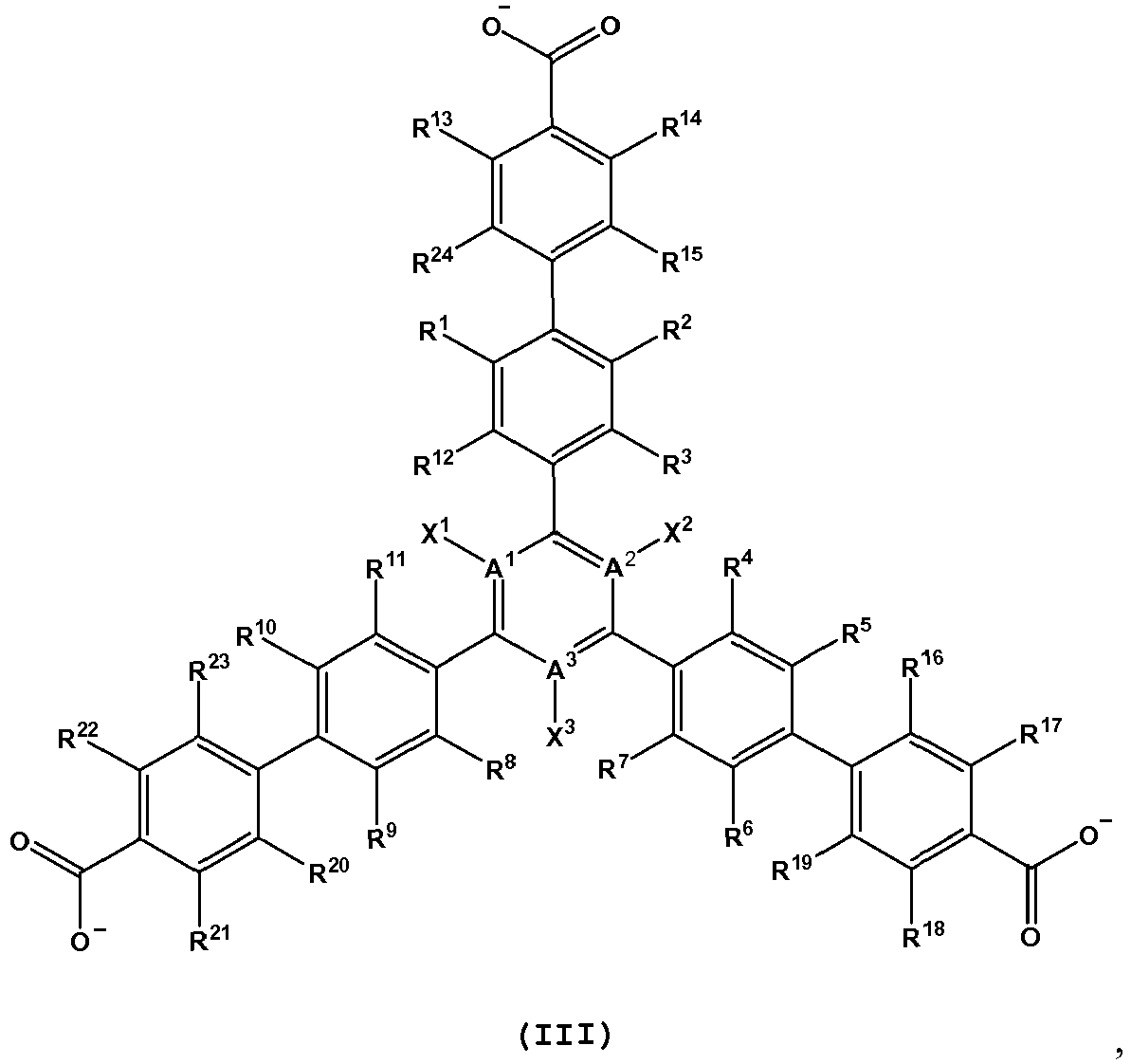


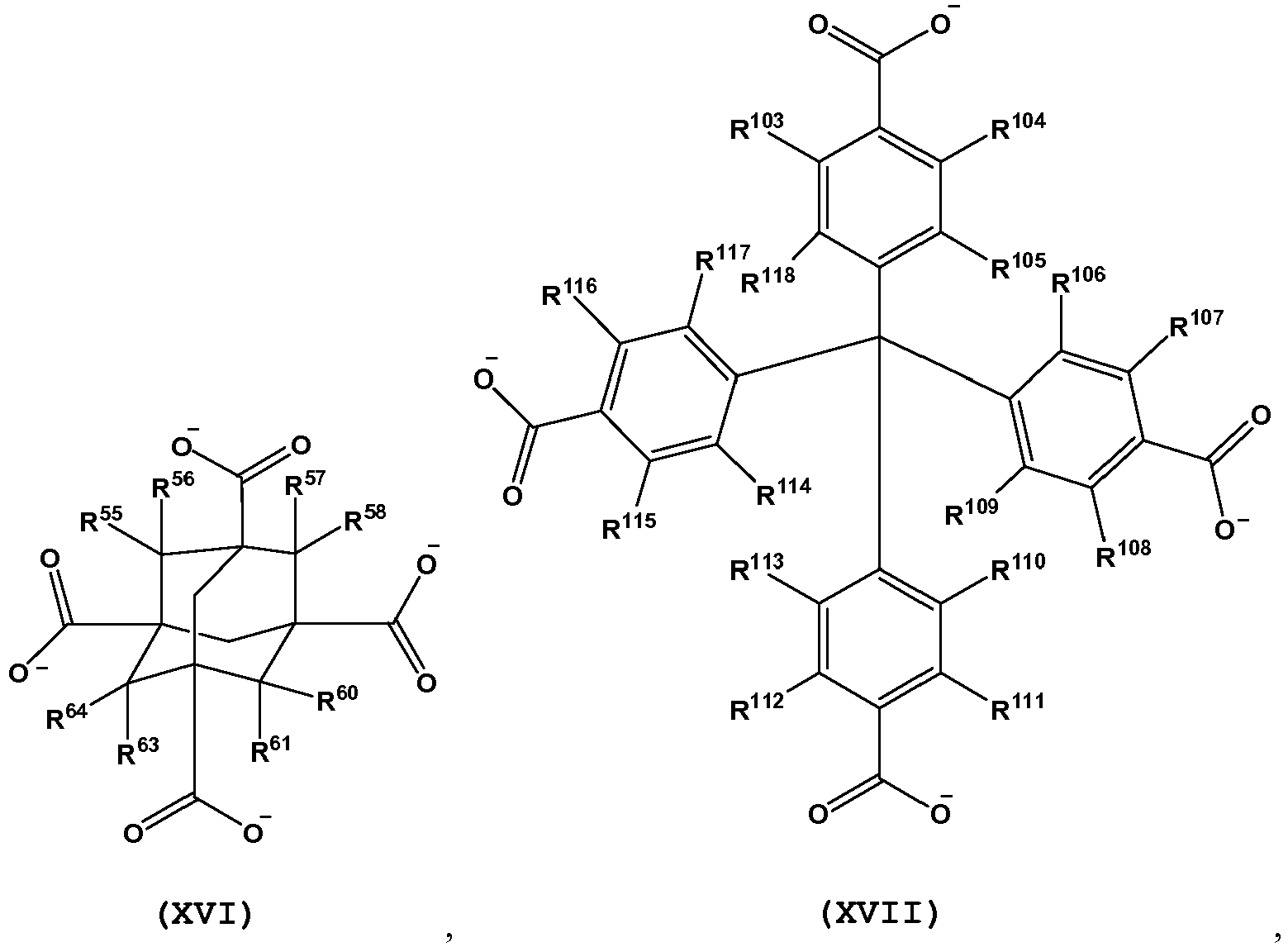


- wherein, A1-A8 are independently a C, N, O, or S;
- A9 is selected from

- X1-X8 are independently selected from H, D, alkyl, alkenyl, alkynyl, aryl, hetero-alkyl, hetero-alkenyl, hetero-alkynyl, cycloalkyl, cycloalkenyl, hetero-aryl, heterocycle, halo, hydroxyl, anhydride, carbonyl, carboxyl, carbonate, carboxylate, aldehyde, haloformyl, ester, hydroperoxy, peroxy, ether, orthoester, carboxamide, amine, imine, imide, azide, azo, cyanate, isocyanate, nitrate, nitrile, isonitrile, nitroso, nitro, nitrosooxy, pyridyl, sulfhydryl, sulfide, disulfide, sulfinyl, sulfo, thiocyanate, isothiocyanate, carbonothioyl, phosphino, phosphono, phosphate, Si(OH)3, Ge(OH)3, Sn(OH)3, Si(SH)4, Ge(SH)4, AsO3H, AsO4H, P(SH)3, As(SH)3, SO3H, Sn(SH)4, (C1-C20)alkyl, (C1-C19)heteroalkyl, (C1-C20)alkenyl, (C1-C19)heteroalkenyl, (C1-C19)alkynyl, (C1-C19)heteroalkynyl, (C1-C19)cycloalkyl, (C1-C19)cycloalkenyl, aryl, mixed ring system, wherein one or more adjacent R groups can be linked together to form one or more rings selected from cycloalkyl, cycloalkenyl, heterocycle, aryl, and mixed ring system;
- R37, R39, R48 and R52 are hydroxyls; and
- R1 to R36, R38, R40 to R47, R49 to R51, R53 to R64 and R69 to R186 are independently selected from H, D, alkyl, alkenyl, alkynyl, aryl, hetero-alkyl, hetero-alkenyl, hetero-alkynyl, cycloalkyl, cycloalkenyl, hetero-aryl, heterocycle, halo, hydroxyl, anhydride, carbonyl, carboxyl, carbonate, carboxylate, aldehyde, haloformyl, ester, hydroperoxy, peroxy, ether, orthoester, carboxamide, amine, imine, imide, azide, azo, cyanate, isocyanate, nitrate, nitrile, isonitrile, nitroso, nitro, nitrosooxy, pyridyl, sulfhydryl, sulfide, disulfide, sulfinyl, sulfo, thiocyanate, isothiocyanate, carbonothioyl, phosphino, phosphono, phosphate, Si(OH)3, Ge(OH)3, Sn(OH)3, Si(SH)4, Ge(SH)4, AsO3H, AsO4H, P(SH)3, As(SH)3, SO3H, Sn(SH)4, (C1-C20)alkyl, (C1-C19)heteroalkyl, (C1-C20)alkenyl, (C1-C19)heteroalkenyl, (C1-C19)alkynyl, (C1-C19)heteroalkynyl, (C1-C19)cycloalkyl, (C1-C19)cycloalkenyl, mixed ring system, wherein one or more adjacent R groups can be linked together to form one or more rings selected from cycloalkyl, cycloalkenyl, heterocycle, aryl, and mixed ring system; and
- wherein the framework is thermally stable when exposed to a temperature between 50 °C to 525 °C, and/or the framework is chemically stable in the presence of a solvent and/or an acid.
- In an embodiment, L is a linear diptopic organic linking ligand comprising one or more structures of Formula V-VII:


- In another embodiment, L is a bent diptopic organic linking ligand comprising one or more structures of Formula VIII to IX and XI to XV:


- wherein, A4-A8 are independently a C, N, O, or S; A9 is selected from

- R55 to R64 and R69 to R102 are independently selected from II, D, alkyl, alkenyl, alkynyl, aryl, hetero-alkyl, hetero-alkenyl, hetero-alkynyl, cycloalkyl, cycloalkenyl, hetero-aryl, heterocycle, halo, hydroxyl, anhydride, carbonyl, carboxyl, carbonate, carboxylate, aldehyde, haloformyl, ester, hydroperoxy, peroxy, ether, orthoester, carboxamide, amine, imine, imide, azide, azo, cyanate, isocyanate, nitrate, nitrile, isonitrile, nitroso, nitro, nitrosooxy, pyridyl, sulfhydryl, sulfide, disulfide, sulfinyl, sulfo, thiocyanate, isothiocyanate, carbonothioyl, phosphino, phosphono, phosphate, Si(OH)3, Ge(OH)3, Sn(OH)3, Si(SH)4, Ge(SH)4, AsO3H, AsO4H, P(SH)3, As(SH)3, SO3H, Sn(SH)4, (C1-C20)alkyl, (C1-C19)heteroalkyl, (C1-C20)alkenyl, (C1-C19)heteroalkenyl, (C1-C19)alkynyl, (C1-C19)heteroalkynyl, (C1-C19)cycloalkyl, (C1-C19)cycloalkenyl, mixed ring system, wherein one or more adjacent R groups can be linked together to form one or more rings selected from cycloalkyl, cycloalkenyl, heterocycle, aryl, and mixed ring system.
- In yet a further embodiment, L is a bent diptopic organic linking ligand comprising one or more structures of Formula VIII(a), VIII(b), VIII(c), VIII(d), VIII(e), VIII(f), VIII(g), VIII(h), IX(a), XI(a), XII(a), XIII(a), XIV(a), XV(a), XV(b), and XV(c):


- In another embodiment, L is a tetratopic organic linking ligand comprising one or more structures of Formula XVI-XXII:


- In an further embodiment, L is a tetratopic organic linking ligand comprising one or more structures of Formula XVI(a), XVII(a), XVIII(a), XIX(a), XX(a), XXI(a) and XXII(a):


- In another embodiment, L is a tritopic organic linking ligand having one or more structures of Formula I-IV:


- A1-A3 are independently a C, N, O, or S;
- X1-X3 are independently selected from H, D, alkyl, alkenyl, alkynyl, aryl, hetero-alkyl, hetero-alkenyl, hetero-alkynyl, cycloalkyl, cycloalkenyl, hetero-aryl, heterocycle, halo, hydroxyl, anhydride, carbonyl, carboxyl, carbonate, carboxylate, aldehyde, haloformyl, ester, hydroperoxy, peroxy, ether, orthoester, carboxamide, amine, imine, imide, azide, azo, cyanate, isocyanate, nitrate, nitrile, isonitrile, nitroso, nitro, nitrosooxy, pyridyl, sulfhydryl, sulfide, disulfide, sulfinyl, sulfo, thiocyanate, isothiocyanate, carbonothioyl, phosphino, phosphono, phosphate, Si(OH)3, Ge(OH)3, Sn(OH)3, Si(SH)4, Ge(SH)4, AsO3H, AsO4H, P(SH)3, As(SH)3, SO3H, Sn(SH)4, (C1-C20)alkyl, (C1-C19)heteroalkyl, (C1-C20)alkenyl, (C1-C19)heteroalkenyl, (C1-C19)alkynyl, (C1-C19)heteroalkynyl, (C1-C19)cycloalkyl, (C1-C19)cycloalkenyl, mixed ring system, wherein one or more adjacent R groups can be linked together to form one or more substituted rings selected from cycloalkyl, cycloalkenyl, heterocycle, aryl, and mixed ring system; and
- R1-R36 are independently selected from H, D, alkyls, alkenyl, alkynyl, aryl, hetero-alkyl, hetero-alkenyl, hetero-alkynyl, cycloalkyl, cycloalkenyl, hetero-aryl, heterocycle, halo, hydroxyl, anhydride, carbonyl, carboxyl, carbonate, carboxylate, aldehyde, haloformyl, ester, hydroperoxy, peroxy, ether, orthoester, carboxamide, amine, imine, imide, azide, azo, cyanate, isocyanate, nitrate, nitrile, isonitrile, nitroso, nitro, nitrosooxy, pyridyl, sulfhydryl, sulfide, disulfide, sulfinyl, sulfo, thiocyanate, isothiocyanate, carbonothioyl, phosphino, phosphono, phosphate, Si(OH)3, Ge(OH)3, Sn(OH)3, Si(SH)4, Ge(SH)4, AsO3H, AsO4H, P(SH)3, As(SH)3, SO3H, Sn(SH)4, (C1-C20)alkyl, (C1-C19)heteroalkyl, (C1-C20)alkenyl, (C1-C19)heteroalkenyl, (C1-C19)alkynyl, (C1-C19)heteroalkynyl, (C1-C19)cycloalkyl, (C1-C19)cycloalkenyl, mixed ring system, wherein one or more adjacent R groups can be linked together to form one or more rings selected from cycloalkyl, cycloalkenyl, heterocycle, aryl, and mixed ring system.
- In another embodiment, L is a tritopic organic linking ligand comprising one or more structures of any one of Formula I-IV:


- wherein, A1-A3 are independently a C, N, O, or S;
- X1-X3 are independently selected from H, D, alkyl, alkenyl, alkynyl, aryl, hetero-alkyl, hetero-alkenyl, hetero-alkynyl, cycloalkyl, cycloalkenyl, hetero-aryl, heterocycle, halo, hydroxyl, anhydride, carbonyl, carboxyl, carbonate, carboxylate, aldehyde, haloformyl, ester, hydroperoxy, peroxy, ether, orthoester, carboxamide, amine, imine, imide, azide, azo, cyanate, isocyanate, nitrate, nitrile, isonitrile, nitroso, nitro, nitrosooxy, pyridyl, sulfhydryl, sulfide, disulfide, sulfinyl, sulfo, thiocyanate, isothiocyanate, carbonothioyl, phosphino, phosphono, phosphate, Si(OH)3, Ge(OH)3, Sn(OH)3, Si(SH)4, Ge(SH)4, AsO3H, AsO4H, P(SH)3, As(SH)3, SO3H, Sn(SH)4, (C1-C20)alkyl, (C1-C19)heteroalkyl, (C1-C20)alkenyl, (C1-C19)heteroalkenyl, (C1-C19)alkynyl, (C1-C19)heteroalkynyl, (C1-C19)cycloalkyl, (C1-C19)cycloalkenyl, mixed ring system, wherein one or more adjacent R groups can be linked together to form one or more rings selected from cycloalkyl, cycloalkenyl, heterocycle, aryl, and mixed ring system; and
- R1, R3-R5, R7-R9, R11-R13, R15-R17, R19-R21, R23-R25, R27-R29, R31-R33, R35-R36 are H; and
- R2, R6, R10, R14, R18, R22, R26, R30 and R34 are independently selected from amino, methyl, hydroxyl, =O, =S, halo, aryl, aryloxy, alkoxy, -O-(CH2)n-CH3, and -O-(CH2)2-O-CH2-CH3, wherein n is an integer from 2 to 5.
- In a further embodiment, L is a tritopic organic linking ligand comprising one or more structures of Formula I(a), II(a), III(a) and IV(a):


- The invention also provides a method for producing a strong solid acid MOF (sa-MOF) comprising reacting the organic linking ligand as described above with a zirconium or hafnium metal or metal ion at an elevated temperature for at least 2 hours, in the presence of an acid site precursor. In one embodiment, the acid site precursor compound is selected from F-, Cl-, ClO-, ClO2 -, ClO3 -, ClO4 -, Br-, BrO-, I-, IO3 -, IO4 -, NO3 -, S2 -, HS-, HSO3 -, SO3 2-, SO4 2-, HSO4 -, H2PO4 2-, PO4 3-, CO3 2-, HCO3 -, H3BO3, SiO3 2-, PF6 -, CF3CO2 - and CF3SO3 -. In another embodiment, the organic linking ligand comprises a structure of Formula I(a), II(a), III(a), or IV(a):


- The invention also provides a sa-MOF produced by a method described above.
- The invention also provides a gas storage and/or separation device comprising a MOF of the invention.
- The invention also provides a device comprising a thin film or membrane of a MOF of the invention.
- The disclosure also provides a catalytic device comprising a sa-MOF of the invention.
-
-
Figure 1 provides examples of unsaturated zirconium-carboxylate SBUs with variable extension numbers, including a (12-c.) cuboctahedron SBU, a (10-c.) bicapped cube SBU, a (9-c.) tricapped trigonal-antiprism SBU, a (8-c.) cube SBU, a (6-c.) trigonal antiprism SBU, a (4-c.) square SBU, a (4-c.) Tetrahedron SBU, and a (3-c.) triangle SBU. Zr-carboxylate based SBUs have, at the least, the following advantages: high-symmetry, diverse geometries, robustness, and structural prediction. -
Figure 2A-F provides examples of Zr-MOFs by incorporating short/bent linkers with extensions of 12-c. Zr6O4(OH)4(CO2)12 SBU, 10-c. Zr6O6(OH)2(CO2)10 and 8-c. Zr6O8(CO2)8 SBUs. (A) Crystal structure of MOF-801 with octahedral cages (pore fixed size of 7.0 Å) and tetrahedral cages (pore fixed size of 5.4 Å); (B) Crystal structure of MOF-802 with octahedral cages (pore fixed size of 5.6 Å) and tetrahedral cages (pore fixed size of 4.0 Å); (C) Crystal structure of MOF-804 with truncated cubic cages (pore fixed size of 13.6 Å) and octahedral cages (pore fixed size of 8.8 Å); (D) Underlying topology of MOF-801 termed fcu-net; (E) Underlying topology of MOF-802 termed bct-net; and (F) Underlying topology of MOF-803 termed reo-net. -
Figure 3A-C provides examples of hydroxyl-functionalized MOFs by incorporating linear ditopic linkers with extended 12-c. Zr6O4(OH)4(CO2)12 SBUs. (A) Crystal structure of MOF-804 with octahedral cages (pore fixed size of 6.8 Å) and tetrahedral cages (pore fixed size of 7.2 Å); (B) Crystal structure of MOF-805 with octahedral cages (pore fixed size of 8.8 Å) and tetrahedral cages (pore fixed size of 8.6 Å); (C) Crystal structure of MOF-804 with octahedral cages (pore fixed size of 12.6 Å) and tetrahedral cages (pore fixed size of Å). -
Figure 4A-B provides examples of incorporating triangle linkers with extended 6-c. Zr6O4(OH)4(HCOO)6(CO2)6 SBUs. (A) Crystal structures of MOF-777 and MOF-778 (isomorphous Hf version of MOF-777) in which hexagonal SBUs and the trigonal planar organic linking moiety forms kgd-layers bridged by formate into 3D tfz-d net; and (B) Perpendicular perinterpenetration of kgd-layers in MOF-778. -
Figure 5A-C provides examples of incorporating a square linker with extended 6-c. Zr6O8(HCOO)6(RCOO)6 SBUs. (A) Tetrahedral cage for a tetrahedral linker; (B) Crystal structure possessing a large adamantine-like cage; and (C) Underlying topology of the crystal structure is spn-net. -
Figure 6A-C provides examples of incorporating tetrahedral linkers with extended 8-c. Zr6O8(RCOO)8 SBUs. (A) Underlying topology target of flu-net; (B) Crystal structure of MOF-841 which possess a rhombic dodecahedral cage; and (C) Crystal structure of MOF-842, an illustration of isoreticular expansion. -
Figure 7 provides a scheme to produce MOF-777 by linking hexagonal shaped zirconium building units with triangle shaped organic linking ligands. -
Figure 8A-C demonstrates the difference in connectivity for Zr-carboxylate SBUs from different MOFs. Connectivity for (A) UiO-66; (B) MOF-545; and (C) MOF-777. -
Figure 9 presents the MOF-777 framework showing the connectivity between Zr-Carboxylate SBUs and BTB linking moieties. MOF-777 [Zr6O4(OH)4](HCOO)4(OH)2(H20)4BTB2]. Crystal system: orthorhombic. Space group: Cmcm. Unit Cell: a = 34.86 Å, b = 20.13 Å, c = 16.77 Å. -
Figure 10 presents a diagram of the MOF-777 framework. A pore of MOF-777 having a diameter of 4.986 Å is also indicated. -
Figure 11A-C provides the crystal structure of MOF-777 from (A) top down view; (B) angled view; and (C) side view. -
Figure 12 provides a schematic showing a top down view of MOF-777's kgd-a net structure showing the connection and placement of hexagonal Zr-SBUs and trigonal planar BTB organic linking moieties. -
Figure 13A-C provides close up views showing that the MOF-777 kgd-layers are linked by formate molecules. (A) X-axis directly out of the page; (B) 10 degree angled view; and (C) 90 degree side view -
Figure 14A-E presents a graph showing (A) PXRD variation by increasing the amount of acetic acid; (B) SEM image of crystals formed by using acetic acid; (C) PXRD variation by increasing the amount of formic acid; (D) SEM image of crystals formed by using formic acid; and (E) PXRD variation by increasing amount of formic acid, and where individual peaks have been labeled. -
Figure 15 presents PXRD patterns of MOF-777 and optical microscope images of the crystals formed using the specified conditions. -
Figure 16 provides SEM images of various views of the MOF-777 framework. -
Figure 17A-B provides optical microscope images of MOF-777 using (A) low power magnification; and (B) high power magnification. -
Figure 18 shows disordered SBUs of MOF-777, where the SBUs are orientated 180° to each other. -
Figure 19 presents the as-synthesized PXRD patterns for MOF-777 versus the simulated PXRD pattern for MOF-777. -
Figure 20 presents N2 isotherm data for MOF-777. -
Figure 21 provides a comparison of the PRXD patterns for activated MOF-777, as-synthesized MOF-777, and simulated MOF-777. -
Figure 22A-B provides thermogravimetric (TGA) data for (A) MOF-777, and (B) UiO-66 and UiO-77. -
Figure 23 provides optical microscope images of MOF-777 (top) and variation of the PXRD pattern for MOF-777 (bottom) when MOF-777 is immersed in water or methanol for 3 days. -
Figure 24 presents PXRD patterns of MOF-778 and optical microscope images of the crystals formed using the specified conditions. -
Figure 25 presents PXRD patterns and optical microscope images of MOFs comprising the indicated Hf-SBUs and organic linking moieties. -
Figure 26 presents PXRD patterns and optical microscope images of MOFs comprising the indicated Zr-SBUs and organic linking moieties. -
Figure 27 presents a scheme to synthesize MOF-801, a 12-extension Zr-carboxylate SBU. Also shown is an optical image of the octahedral crystals of MOF-801 and a depiction of the MOF-801 framework. Structural characteristics and pore sizes for MOF-801 are also indicated. -
Figure 28 provides a comparison of the experimental PXRD patterns of MOF-801(SC): as-prepared (top) and simulated pattern (bottom) from single-crystal X-ray data. -
Figure 29 provides a comparison of the experimental PXRD patterns of MOF-801(P): as-prepared (top) and simulated pattern (bottom) from single-crystal X-ray data. -
Figure 30 provides a comparison of the experimental PXRD patterns of MOF-801: as-prepared (top) and simulated pattern (bottom) from single-crystal X-ray data. -
Figure 31 presents a N2 isotherm of MOF-801(P) at 77 K. -
Figure 32 presents a N2 isotherm of MOF-801(SC) at 77 K. -
Figure 33 presents a N2 isotherm of activated MOF-801 at 77 K. The surface area is of MOF-801 is also indicated. -
Figure 34 presents a TGA trace for as-prepared MOF-801(SC), heating rate: 5 °C min-1 in air. -
Figure 35 presents a TGA trace for as-prepared MOF-801(P), heating rate: 5 °C min-1 in air. -
Figure 36 presents a TGA trace for as-prepared MOF-801, heating rate: 5 °C min-1 in air. The TGA analysis indicates that MOF-801 is stable up to 400 °C. -
Figure 37 provides SEM images of as synthesized MOF-801 (top) and activated MOF-801 (bottom). The small pores seen on the surface of activated MOF-801 are due to solvent molecules escaping during activation. -
Figure 38 provides a comparison of the experimental PXRD patterns for a large scale bulk sample of MOF-801: as-prepared (top) and simulated pattern (bottom) from single-crystal X-ray data. -
Figure 39 demonstrates the water resistant properties of MOF-801 by comparing the PXRD patterns of experimental MOF-801 (top) after being immersed in water for 24 hours with the simulated pattern (bottom) from single-crystal X-ray data. -
Figure 40 provides for the cycle performance of water uptake in MOF-801(P) at 298 K. The sample was evacuated for 2 h at 298 K between the cycles. -
Figure 41 presents a scheme to synthesize MOF-802, a 10-extension Zr-carboxylate SBU. Also shown is an optical image of the crystals of MOF-802 and a depiction of the MOF-802 framework. The structural characteristics of MOF-802, btc net topology, and ball and stick model for the 10-extension SBU is further presented. -
Figure 42 provides a comparison of the experimental PXRD patterns for MOF-802: as-prepared (top) and simulated pattern (bottom) from single-crystal X-ray data. -
Figure 43 presents a H2 isotherm of MOF-802 at 77 K. The pores of MOF-802 (∼4 Å) are too small for a N2 sorption measurement at 77 K. -
Figure 44 presents a TGA trace for as-prepared MOF-802, heating rate: 5 °C min-1 in air. -
Figure 45 provides for the cycle performance of water uptake in MOF-802 at 298 K. The sample was evacuated for 2 h at 298 K between the cycles. -
Figure 46 presents a scheme to synthesize MOF-803, an 8-extension Zr-carboxylate SBU. Also shown is an optical image of the crystals of MOF-803 and a depiction of the MOF-803 framework. The structural characteristics of MOF-803, reo-a net topology, and ball and stick model for the 8-extension SBU is further presented. -
Figure 47 provides a comparison of the experimental PXRD patterns for MOF-803: as-prepared (top) and simulated pattern (bottom) from single-crystal X-ray data. -
Figure 48 provides that MOF-803 can be partially activated by heating under vacuum, while can be fully activated by using super-critical CO2 procedure and heating under vacuum. -
Figure 49 presents a H2 isotherm of MOF-803 at 77 K and 87 K. -
Figure 50 provides a sorption curve for H2 by MOF-803. Qst = 7.05 kJ/mol at zero uptake. -
Figure 51 presents a N2 isotherm of MOF-803 at 77 K. -
Figure 52 provides for the cycle performance of water uptake in MOF-803 at 298 K. The sample was evacuated for 2 h at 298 K between the cycles. -
Figure 53 presents a scheme to synthesize MOF-804, an OH functionalized Zr-carboxylate SBU. Also shown are a depiction of the MOF-803 framework and the structural characteristics of MOF-803. -
Figure 54 presents a N2 isotherm of MOF-804 at 77 K. -
Figure 55 provides a comparison of H2 isotherms for MOF-804 and MOF-75(Mg) at 77 K, and MOF-804 at 87 K. -
Figure 56 provides a sorption curve for H2 by MOF-804. Qst = 8.45 kJ/mol at zero uptake. -
Figure 57 provides absorbance uptake curves for CO2, N2 and CH4 by MOF-804 at 298 K, 283 K, and 273 K under increasing gas pressures. -
Figure 58 provides a sorption curve for CO2 by MOF-804. Qst(CO2) = 30.2 kJ/mol at zero uptake. -
Figure 59 provides for cycle performance of water uptake in MOF-804 at 298 K. The sample was evacuated for 2 h at 298 K between the cycles. -
Figure 60 presents a scheme to synthesize MOF-805. A depiction of the MOF-805 framework is also shown. -
Figure 61 provides a comparison of the experimental PXRD patterns for MOF-805: as-prepared (top) and simulated pattern (bottom) from single-crystal X-ray data. -
Figure 62 presents a N2 isotherm of MOF-805 at 77 K. -
Figure 63 presents a TGA trace for as-prepared MOF-805, heating rate: 5 °C min-1 in air. -
Figure 64 provides for the cycle performance of water uptake in MOF-805 at 298 K. The sample was evacuated for 2 h at 298 K between the cycles. -
Figure 65 presents a scheme to synthesize MOF-806. Also shown is an optical image of the crystals of MOF-806 and a depiction of the MOF-806 framework. -
Figure 66 provides a comparison of the experimental PXRD patterns for MOF-806: as-prepared (top) and simulated pattern (bottom) from single-crystal X-ray data. -
Figure 67 presents a N2 isotherm of MOF-806 at 77 K. -
Figure 68 provides a TGA trace for as-prepared MOF-806, heating rate: 5 °C min-1 in air. -
Figure 69 provides for the cycle performance of water uptake in MOF-806 at 298 K. The sample was evacuated for 2 h at 298 K between the cycles. -
Figure 70 presents a scheme to synthesize MOF-807. Also shown is a depiction of the MOF-807 framework. -
Figure 71 presents a scheme to synthesize MOF-808. Also shown is a depiction of the MOF-808 framework and a close up of the 6c-extension of the SBU. The structural characteristics of MOF-808 and spn-a net topology is further presented. -
Figure 72 presents a N2 isotherm of MOF-808 at 77 K. -
Figure 73 provides a TGA trace for as-prepared MOF-808, heating rate: 5 °C min-1 in air. -
Figure 74 provides for the cycle performance of water uptake in MOF-808 at 298 K. The sample was evacuated for 2 h at 298 K between the cycles. -
Figure 75 presents a scheme to synthesize MOF-812, a Zr-carboxylate SBU based upon a tetrahedral linker. Also shown is a depiction of the MOF-812 framework. The structural characteristics of MOF-812, ith-a net topology, and ball and stick model for the 12-c cuboctahedron SBU is further presented. -
Figure 76 provides a comparison of the experimental PXRD patterns of MOF-812: as-prepared (top) and simulated pattern (bottom) from single-crystal X-ray data. -
Figure 77 presents a scheme to synthesize MOF-841, a Zr-carboxylate SBU based upon a tetrahedral linker. Also shown is an optical image of the crystals of MOF-841 and a depiction of the MOF-841 framework. The structural characteristics of MOF-841 and the flu-a net topology is further presented. -
Figure 78 provides a comparison of the experimental PXRD patterns of MOF-841: as-prepared (top) and simulated pattern (bottom) from single-crystal X-ray data. -
Figure 79 presents a N2 isotherm of MOF-841 at 77 K. -
Figure 80 presents a N2 isotherm of activated MOF-841 at 77 K. -
Figure 81 provides a comparison of H2 isotherms of MOF-841, MOF-74(Mg) and MOF-177 at 77 K. -
Figure 82 provides a comparison of H2 isotherms of MOF-841, MOF-74(Mg) and MOF-177 at ambient temperature. -
Figure 83 presents a TGA trace for as-prepared MOF-841, heating rate: 5 °C min-1 in air. -
Figure 84 presents a TGA trace for as-prepared MOF-841 and activated MOF-841, heating rate: 5 °C min-1 in air. TGA shows that the stability of MOF-841 is at least up to 300 °C. -
Figure 85 provides for the cycle performance of water uptake in MOF-841 at 298 K. The sample was evacuated for 2 h at 298 K between the cycles. -
Figure 86 presents a scheme to synthesize MOF-842, a Zr-carboxylate SBU based upon a tetrahedral linker. Also shown is an optical image of the crystals of MOF-842 and a depiction of the MOF-842 framework. -
Figure 87 presents a scheme to synthesize MOF-867, a Zr-carboxylate SBU based upon a linker which can be metallized. Also shown is a depiction of the MOF-867 framework. -
Figure 88 provides a comparison of the experimental PXRD patterns for MOF-867: as-prepared (top) and simulated pattern (bottom) from single-crystal X-ray data. -
Figure 89 provides that formate molecules in MOFs with Zr-SBUs can be replaced with sulfate molecules upon treatment with aqueous hydrogen sulfuric acid. -
Figure 90 provides PXRD patterns of MOF-808 treated with various molar concentrations of H2SO4 indicating that the MOF-808 framework is resistant and structurally stable up to 1.0M H2SO4. -
Figure 91 presents N2 isotherm data for MOF-808 with different molar concentrations of H2SO4 indicating that the porosity of the framework is maintained under acidic conditions. -
Figure 92 provides IR tracings of MOF-808 and MOF-808 treated with 0.1M H2SO4. Extra peaks appearing at 996, 1165, 1301 cm-1 corresponding to the v 3 vibrational modes of binding SO4 groups. -
Figure 93 presents TGA analysis of MOF-808 treated with 0.1M H2SO4 under a nitrogen atmosphere. A small step around 300 °C is attributed to the loss of the residue formate and adsorption of water. A big step at 500 °C correlates to the decomposition of the framework. -
Figure 94 provides N2 isotherms for MOF-808 treated with 0.1M H2SO4 at various temperatures. When the sample was activated at a temperature higher than 300 °C a decrease in N2 uptake was detected indicating the collapse of the framework with a corresponding color change of the framework from white to black. -
Figure 95 provides an illustration of the zirconium-carboxylate SBU of MOF-808 that has been treated with 0.1M H2SO4. Sulfate molecules bound to the SBU is indicated (top). A close up of a bound sulfate molecule (bottom). Electron density indicates that coordinate sites which were previously occupied by formate anions are occupied by SO4 groups having two orientations. Roughly there are 3 SO4 per SBU based upon site occupancy. - As used herein and in the appended claims, the singular forms "a," "and," and "the" include plural referents unless the context clearly dictates otherwise. Thus, for example, reference to "an organic linking ligand" includes a plurality of such linking ligands and reference to "the metal ion" includes reference to one or more metal ions and equivalents thereof known to those skilled in the art, and so forth.
- Unless defined otherwise, all technical and scientific terms used herein have the same meaning as commonly understood to one of ordinary skill in the art. Although many methods and reagents similar or equivalent to those described herein, the exemplary methods and materials are presented herein.
- Also, the use of "or" means "and/or" unless stated otherwise. Similarly, "comprise," "comprises," "comprising" "include," "includes," and "including" are interchangeable and not intended to be limiting.
- It is to be further understood that where descriptions of various embodiments use the term "comprising," those skilled in the art would understand that in some specific instances, an embodiment can be alternatively described using language "consisting essentially of' or "consisting of."
- The term "alkyl", refers to an organic group that is comprised of carbon and hydrogen atoms that contain single covalent bonds between carbons. Typically, an "alkyl" as used in this disclosure, refers to an organic group that contains 1 to 30 carbon atoms, unless stated otherwise. Where if there is more than 1 carbon, the carbons may be connected in a linear manner, or alternatively if there are more than 2 carbons then the carbons may also be linked in a branched fashion so that the parent chain contains one or more secondary, tertiary, or quaternary carbons. An alkyl may be substituted or unsubstituted, unless stated otherwise.
- The term "alkenyl", refers to an organic group that is comprised of carbon and hydrogen atoms that contains at least one double covalent bond between two carbons. Typically, an "alkenyl" as used in this disclosure, refers to organic group that contains 1 to 30 carbon atoms, unless stated otherwise. While a C1-alkenyl can form a double bond to a carbon of a parent chain, an alkenyl group of three or more carbons can contain more than one double bond. In certain instances the alkenyl group will be conjugated, in other cases an alkenyl group will not be conjugated, and in yet other cases the alkenyl group may have stretches of conjugation and stretches of nonconjugation. Additionally, if there is more than 1 carbon, the carbons may be connected in a linear manner, or alternatively if there are more than 3 carbons then the carbons may also be linked in a branched fashion so that the parent chain contains one or more secondary, tertiary, or quaternary carbons. An alkenyl may be substituted or unsubstituted, unless stated otherwise.
- The term "alkynyl", refers to an organic group that is comprised of carbon and hydrogen atoms that contains a triple covalent bond between two carbons. Typically, an "alkynyl" as used in this disclosure, refers to organic group that contains 1 to 30 carbon atoms, unless stated otherwise. While a C1-alkynyl can form a triple bond to a carbon of a parent chain, an alkynyl group of three or more carbons can contain more than one triple bond. Where if there is more than 1 carbon, the carbons may be connected in a linear manner, or alternatively if there are more than 4 carbons then the carbons may also be linked in a branched fashion so that the parent chain contains one or more secondary, tertiary, or quaternary carbons. An alkynyl may be substituted or unsubstituted, unless stated otherwise.
- The term "cycloalkyl", as used in this disclosure, refers to an alkyl that contains at least 3 carbon atoms but no more than 12 carbon atoms connected so that it forms a ring. A "cycloalkyl" for the purposes of this disclosure encompass from 1 to 12 cycloalkyl rings, wherein when the cycloalkyl is greater than 1 ring, then the cycloalkyl rings are joined so that they are linked, fused, or a combination thereof. A cycloalkyl may be substituted or unsubstituted, or in the case of more than one cycloalkyl ring, one or more rings may be unsubstituted, one or more rings may be substituted, or a combination thereof.
- The term "cycloalkenyl", as used in this disclosure, refers to an alkene that contains at least 3 carbon atoms but no more than 12 carbon atoms connected so that it forms a ring. A "cycloalkenyl" for the purposes of this disclosure encompass from 1 to 12 cycloalkenyl rings, wherein when the cycloalkenyl is greater than 1 ring, then the cycloalkenyl rings are joined so that they are linked, fused, or a combination thereof. A cycloalkenyl may be substituted or unsubstituted, or in the case of more than one cycloalkenyl ring, one or more rings may be unsubstituted, one or more rings may be substituted, or a combination thereof.
- The term "aryl", as used in this disclosure, refers to a conjugated planar ring system with delocalized pi electron clouds that contain only carbon as ring atoms. An "aryl" for the purposes of this disclosure encompass from 1 to 12 aryl rings wherein when the aryl is greater than 1 ring the aryl rings are joined so that they are linked, fused, or a combination thereof. An aryl may be substituted or unsubstituted, or in the case of more than one aryl ring, one or more rings may be unsubstituted, one or more rings may be substituted, or a combination thereof.
- The term "heterocycle", as used in this disclosure, refers to ring structures that contain at least 1 noncarbon ring atom. A "heterocycle" for the purposes of this disclosure encompass from 1 to 12 heterocycle rings wherein when the heterocycle is greater than 1 ring the heterocycle rings are joined so that they are linked, fused, or a combination thereof. A heterocycle may be a hetero-aryl or nonaromatic, or in the case of more than one heterocycle ring, one or more rings may be nonaromatic, one or more rings may be heteroaryls, or a combination thereof. A heterocycle may be substituted or unsubstituted, or in the case of more than one heterocycle ring one or more rings may be unsubstituted, one or more rings may be substituted, or a combination thereof. Typically, the noncarbon ring atom is N, O, S, Si, Al, B, or P. In case where there is more than one noncarbon ring atom, these noncarbon ring atoms can either be the same element, or combination of different elements, such as N and O. Examples of heterocycles include, but are not limited to: a monocyclic heterocycle such as, aziridine, oxirane, thiirane, azetidine, oxetane, thietane, pyrrolidine, pyrroline, imidazolidine, pyrazolidine, pyrazoline, dioxolane, sulfolane 2,3-dihydrofuran, 2,5-dihydrofuran tetrahydrofuran, thiophane, piperidine, 1,2,3,6-tetrahydro-pyridine, piperazine, morpholine, thiomorpholine, pyran, thiopyran, 2,3-dihydropyran, tetrahydropyran, 1,4-dihydropyridine, 1,4-dioxane, 1,3-dioxane, dioxane, homopiperidine, 2,3,4,7-tetrahydro-1H-azepine homopiperazine, 1,3-dioxepane, 4,7-dihydro-1,3-dioxepin, and hexamethylene oxide; and polycyclic heterocycles such as, indole, indoline, isoindoline, quinoline, tetrahydroquinoline, isoquinoline, tetrahydroisoquinoline, 1,4-benzodioxan, coumarin, dihydrocoumarin, benzofuran, 2,3-dihydrobenzofuran, isobenzofuran, chromene, chroman, isochroman, xanthene, phenoxathiin, thianthrene, indolizine, isoindole, indazole, purine, phthalazine, naphthyridine, quinoxaline, quinazoline, cinnoline, pteridine, phenanthridine, perimidine, phenanthroline, phenazine, phenothiazine, phenoxazine, 1,2-benzisoxazole, benzothiophene, benzoxazole, benzthiazole, benzimidazole, benztriazole, thioxanthine, carbazole, carboline, acridine, pyrolizidine, and quinolizidine. In addition to the polycyclic heterocycles described above, heterocycle includes polycyclic heterocycles wherein the ring fusion between two or more rings includes more than one bond common to both rings and more than two atoms common to both rings. Examples of such bridged heterocycles include quinuclidine, diazabicyclo[2.2.1]heptane and 7-oxabicyclo[2.2.1]heptane.
- The terms "heterocyclic group", "heterocyclic moiety", "heterocyclic", or "heterocyclo" used alone or as a suffix or prefix, refers to a heterocycle that has had one or more hydrogens removed therefrom.
- The term "hetero-" when used as a prefix, such as, hetero-alkyl, hetero-alkenyl, hetero-alkynyl, or hetero-hydrocarbon, for the purpose of this disclosure refers to the specified hydrocarbon having one or more carbon atoms replaced by non-carbon atoms as part of the parent chain. Examples of such non-carbon atoms include, but are not limited to, N, O, S, Si, Al, B, and P. If there is more than one non-carbon atom in the hetero-based parent chain then this atom may be the same element or may be a combination of different elements, such as N and O.
- The term "mixed ring system" refers to optionally substituted ring structures that contain at least two rings, and wherein the rings are joined together by linking, fusing, or a combination thereof. A mixed ring system comprises a combination of different ring types, including cycloalkyl, cycloalkenyl, aryl, and heterocycle.
- The term "unsubstituted" with respect to hydrocarbons, heterocycles, and the like, refers to structures wherein the parent chain contains no substituents.
- The term "substituted" with respect to hydrocarbons, heterocycles, and the like, refers to structures wherein the parent chain contains one or more substituents.
- The term "substituent" refers to an atom or group of atoms substituted in place of a hydrogen atom. For purposes of this disclosure, a substituent would include deuterium atoms.
- The term "hydrocarbons" refers to groups of atoms that contain only carbon and hydrogen. Examples of hydrocarbons that can be used in this disclosure include, but are not limited to, alkanes, alkenes, alkynes, arenes, and benzyls.
- The term "functional group" or "FG" refers to specific groups of atoms within molecules that are responsible for the characteristic chemical reactions of those molecules. While the same functional group will undergo the same or similar chemical reaction(s) regardless of the size of the molecule it is a part of, its relative reactivity can be modified by nearby functional groups. The atoms of functional groups are linked to each other and to the rest of the molecule by covalent bonds. Examples of FG that can be used in this disclosure, include, but are not limited to, substituted or unsubstituted alkyls, substituted or unsubstituted alkenyls, substituted or unsubstituted alkynyls, substituted or unsubstituted aryls, substituted or unsubstituted hetero-alkyls, substituted or unsubstituted heteroalkenyls, substituted or unsubstituted hetero-alkynyls, substituted or unsubstituted cycloalkyls, substituted or unsubstituted cycloalkenyls, substituted or unsubstituted heteroaryls, substituted or unsubstituted heterocycles, halos, hydroxyls, anhydrides, carbonyls, carboxyls, carbonates, carboxylates, aldehydes, haloformyls, esters, hydroperoxy, peroxy, ethers, orthoesters, carboxamides, amines, imines, imides, azides, azos, cyanates, isocyanates, nitrates, nitriles, isonitriles, nitrosos, nitros, nitrosooxy, pyridyls, sulfhydryls, sulfides, disulfides, sulfinyls, sulfos, thiocyanates, isothiocyanates, carbonothioyls, phosphinos, phosphonos, phosphates, Si(OH)3, Ge(OH)3, Sn(OH)3, Si(SH)4, Ge(SH)4, AsO3H, AsO4H, P(SH)3, As(SH)3, SO3H, Si(OH)3, Ge(OH)3, Sn(OH)3, Si(SH)4, Ge(SH)4, Sn(SH)4, AsO3H, AsO4H, P(SH)3, and As(SH)3.
- The term "acidic site precursor" or "acid site precursor" as used herein refers to ligands possessing functional groups capable of becoming Bronsted and/or Lewis acids. Further, "acidic site precursors" can be used in preparing strong solid-acid MOFs (sa-MOFs). Examples of acidic site precursors, include but are not limited to, F-, Cl-, ClO-, ClO2 -, ClO3 -, ClO4 -, Br-, BrO-, I-, IO3 -, IO4 -, NO3 -, S2 -, HS-, HSO3 -, SO3 2-, SO4 2-, HSO4 -, H2PO4 2-, PO4 3-, CO3 2-, HCO3 -, H3BO3, SiO3 2-, PF6 - and organic acid anions, such as CF3CO2 - and CF3SO3 -.
- As used herein, a wavy line intersecting another line that is connected to an atom indicates that this atom is covalently bonded to another entity that is present but not being depicted in the structure. A wavy line that does not intersect a line but is connected to an atom indicates that this atom is interacting with another atom by a bond or some other type of identifiable association.
- Metal-organic frameworks (MOFs) are porous crystalline materials that are constructed by linking metal clusters called Secondary Binding Units (SBUs) and organic linking moieties. MOFs have high surface area and high porosity which enable them to be utilized in diverse fields, such as gas storage, catalysis, and sensors. However, MOFs which are chemically and thermally stable are rare. Further, very few MOFs have been reported to be water resistant and thus capable of absorbing water. Accordingly, MOFs have been generally restricted in their use to gaseous environments and mild environmental conditions (i.e., at temperatures less than 50 °C). However, many industrial and environmental processes are performed under much harsher and variable environments that utilize not only high heat but also solvents.
- MOFs comprised of SBUs that comprise metal, metal ions, or metal containing complexes that can form very strong bonds with oxygen atoms from carboxylate based organic linking moieties having specific geometries were found to have high thermal stabilities and resistance to solvents and acids. Accordingly, the MOFs of the disclosure are capable of being utilized under harsh reaction conditions and environments. For example, the MOFs disclosed herein can serve as adsorbents in adsorptive heat transformation processes using aqueous or organic solvents; as proton conducting materials in acidic environments; as strong solid-acid materials; and as catalysts in high temperature and high pressure industrial processes.
- The synthesis methods provided herein allow for the production of single-crystal MOFs that are large enough to be characterized by X-ray diffraction, and are generally applicable to allow for the characterization of many new types MOFs which comprise various metals, and linkers varying by length, shapes/geometry, and/or functionality. The syntheses methods disclosed herein allow for control over the extension (e.g., 12, 10, 8, 6 and 4) of metal-carboxylate SBU clusters and can produce MOFs with linear ditopic organic linking moieties, bent ditopic organic linking moieties, tritopic organic linking moieties, square organic linking moieties or tetrahedral organic linking moieties. The MOFs of the disclosure can comprise multivariate metal ratios and functionalities in order to tune the MOFs to have specific adsorption proprieties and pore dynamics. The MOFs of the disclosure are related by being thermal, solvent and/or acid resistant.
- Further, due to the acid resistant properties of the MOFs disclosed herein, the MOFs of the disclosure can be synthesized as strong solid-acids, or be modified post synthesis to be strong solid-acids. Strong solid-acids are important catalytic materials that can be used in various industries. For example, solid acid catalysis is heavily used in oil refining and the chemical industry. Although in most cases the nature of the active sites of solid acids are known and its chemical behavior can be modeled or theorized, industries can benefit from solid acid materials that have higher efficiencies, selectivities, stabilities, and environmental friendliness as well as having lower costs. The MOFs disclosed herein are ideally suited as solid-acid substrates. The MOFs acid resistant properties along with a highly ordered structure provide a platform to study and simulate sites for acid precursor incorporation. Moreover, by using various organic linking moieties and metal ions, the MOFs disclosed herein are highly tunable and can be tailored so as to provide suitable solid-acid catalytic environments for particular applications. For example, the solid-acid MOFs (sa-MOFs) disclosed herein can be used to catalyze a variety of reactions including alkylations, isomerizations, condensations, etherifications, acylations, esterifications, nitrations, oligomerizations, Fischer-Tropsch reactions, cracking, and methane oxidative coupling reactions.
- In a particular aspect, the disclosure provides for thermal, acid, and/or solvent resistant metal organic frameworks comprising a plurality of linked M-O-L secondary binding units (SBUs), wherein M is a metal, metal ion, or metal containing complex; O is an oxygen atom of a carboxylate based linking cluster; and L is an organic linking ligand comprising an optionally substituted (C1-C20) alkyl, optionally substituted (C1-C20) alkenyl, optionally substituted (C1-C20) alkynyl, optionally substituted (C1-C20) hetero-alkyl, optionally substituted (C1-C20) hetero-alkenyl, optionally substituted (C1-C20) hetero-alkynyl, optionally substituted (C3-C12) cycloalkyl, optionally substituted (C3-C12) cycloalkenyl, optionally substituted aryl, optionally substituted heterocycle or optionally substituted mixed ring system, wherein the linking ligand comprises at least two or more carboxylate linking clusters.
- In a certain aspect, the disclosure provides for thermal, acid, and/or solvent resistant metal organic frameworks comprised of a plurality of linked M-O-L secondary binding units (SBUs), wherein M is a metal, metal ion, or metal containing complex; O is an oxygen atom of a carboxylate based linking cluster; and L is an organic linking ligand comprising one or more structures of Formula I-XII:


- A1-A8 are independently a C, N, O, or S;
- A9 is selected from

- X1-X8 are independently selected from H, D, optionally substituted FG, optionally substituted (C1-C20)alkyl, optionally substituted (C1-C19)heteroalkyl, optionally substituted (C1-C20)alkenyl, optionally substituted (C1-C19)heteroalkenyl, optionally substituted (C1-C19)alkynyl, optionally substituted (C1-C19)heteroalkynyl, optionally substituted (C1-C19)cycloalkyl, optionally substituted (C1-C19)cycloalkenyl, optionally substituted aryl, optionally substituted heterocycle, optionally substituted mixed ring system, wherein one or more adjacent R groups can be linked together to form one or more substituted rings selected from the group comprising cycloalkyl, cycloalkenyl, heterocycle, aryl, and mixed ring system; and
- R1-R186 are independently selected from H, D, optionally substituted FG, optionally substituted (C1-C20)alkyl, optionally substituted (C1-C19)heteroalkyl, optionally substituted (C1-C20)alkenyl, optionally substituted (C1-C19)heteroalkenyl, optionally substituted (C1-C19)alkynyl, optionally substituted (C1-C19)heteroalkynyl, optionally substituted (C1-C19)cycloalkyl, optionally substituted (C1-C19)cycloalkenyl, optionally substituted aryl, optionally substituted heterocycle, optionally substituted mixed ring system, wherein one or more adjacent R groups can be linked together to form one or more substituted rings selected from the group comprising cycloalkyl, cycloalkenyl, heterocycle, aryl, and mixed ring system. It should be noted that a carboxylate is depicted in the linking ligands depicted herein. These carboxylates undergo condensation with, e.g., a metal or metal ion to form a M-O bond, wherein M is the metal or metal ion and O is the oxygen of the carboxylate.
- In another aspect, the disclosure provides for thermal, acid, and/or solvent resistant metal organic frameworks comprised of a plurality of linked M-O-L secondary binding units (SBUs), wherein M is a metal, metal ion, or metal containing complex; O is an oxygen atom of a carboxylate based linking cluster; and L is a linear diptopic organic linking ligand comprising one or more structures of Formula V-VII:

R37-R54 are independently selected from H, D, optionally substituted FG, optionally substituted (C1-C20)alkyl, optionally substituted (C1-C19)heteroalkyl, optionally substituted (C1-C20)alkenyl, optionally substituted (C1-C19)heteroalkenyl, optionally substituted (C1-C19)alkynyl, optionally substituted (C1-C19)heteroalkynyl, optionally substituted (C1-C19)cycloalkyl, optionally substituted (C1-C19)cycloalkenyl, optionally substituted aryl, optionally substituted heterocycle, optionally substituted mixed ring system, wherein one or more adjacent R groups can be linked together to form one or more substituted rings selected from the group comprising cycloalkyl, cycloalkenyl, heterocycle, aryl, and mixed ring system. - In yet another aspect, the disclosure provides for thermal, acid, and/or solvent resistant metal organic frameworks comprised of a plurality of linked M-O-L secondary binding units (SBUs), wherein M is a metal, metal ion, or metal containing complex; O is an oxygen atom of a carboxylate based linking cluster; and L is a linear diptopic organic linking ligand comprising one or more structures of Formula V(a), VI(a), VI(b) and VII(a):


- In a particular aspect, MOFs disclosed herein are based upon extending a 12-carbon cuboctahedral X6(µ3-O/OH)8(COO)12 clusters (where X is a metal ion) with linear ditopic linkers, resulting in 3D frameworks which possess tetrahedral cages and octahedral cages in fcu net topology.
- In an alternate aspect, the disclosure provides for thermal, acid, and/or solvent resistant metal organic frameworks comprised of a plurality of linked M-O-L secondary binding units (SBUs), wherein M is a metal, metal ion, or metal containing complex; O is an oxygen atom of a carboxylate based linking cluster; and L is a bent diptopic organic linking ligand comprising one or more sturctures of Formula VIII-XV:


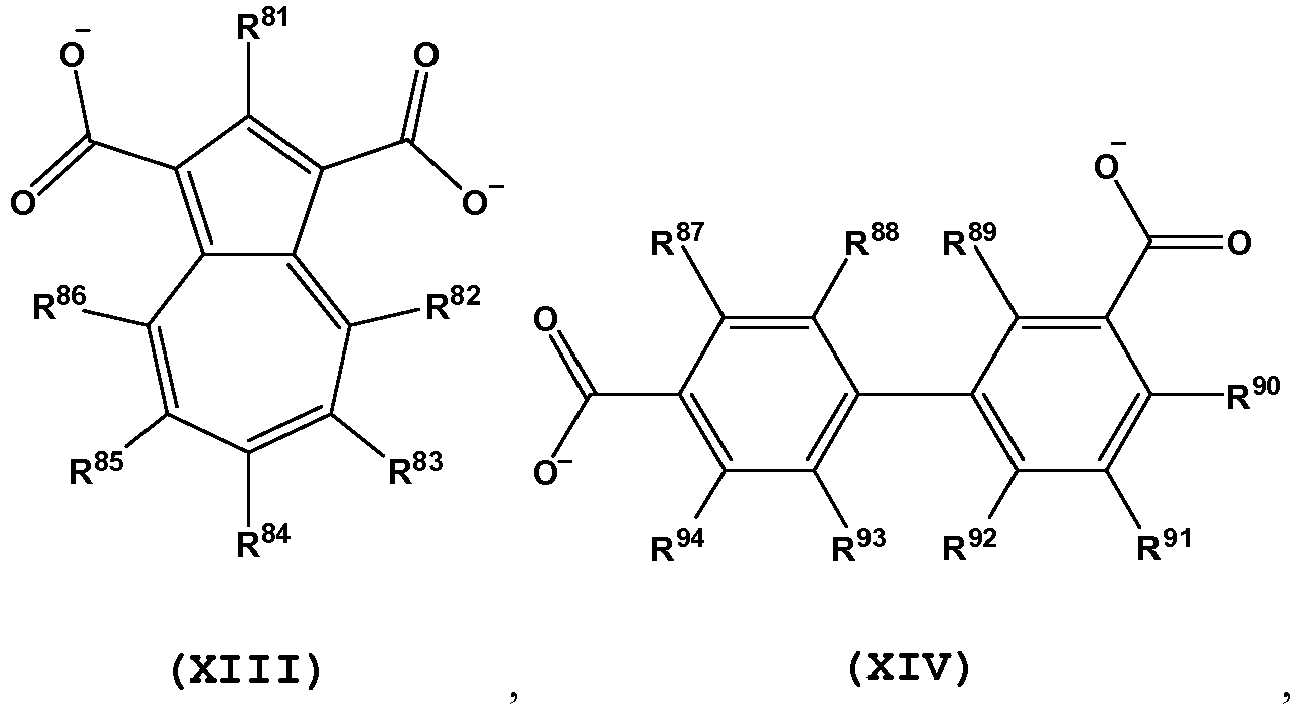

- A4-A8 are independently a C, N, O, or S;
- A9 is selected from
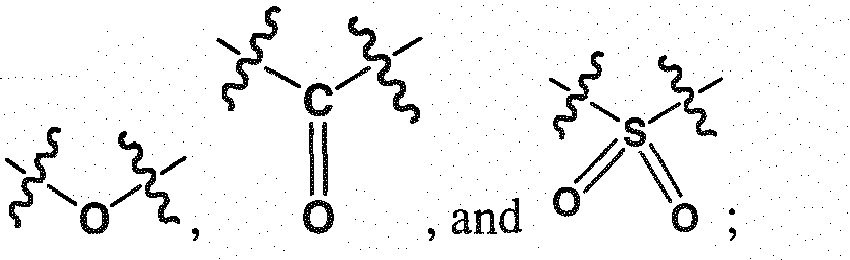
- X4-X8 are independently selected from H, D, optionally substituted FG, optionally substituted (C1-C20)alkyl, optionally substituted (C1-C19)heteroalkyl, optionally substituted (C1-C20)alkenyl, optionally substituted (C1-C19)heteroalkenyl, optionally substituted (C1-C19)alkynyl, optionally substituted (C1-C19)heteroalkynyl, optionally substituted (C1-C19)cycloalkyl, optionally substituted (C1-C19)cycloalkenyl, optionally substituted aryl, optionally substituted heterocycle, optionally substituted mixed ring system, wherein one or more adjacent R groups can be linked together to form one or more substituted rings selected from the group comprising cycloalkyl, cycloalkenyl, heterocycle, aryl, and mixed ring system; and
- R55-R102 are independently selected from H, D, optionally substituted FG, optionally substituted (C1-C20)alkyl, optionally substituted (C1-C19)heteroalkyl, optionally substituted (C1-C20)alkenyl, optionally substituted (C1-C19)heteroalkenyl, optionally substituted (C1-C19)alkynyl, optionally substituted (C1-C19)heteroalkynyl, optionally substituted (C1-C19)cycloalkyl, optionally substituted (C1-C19)cycloalkenyl, optionally substituted aryl, optionally substituted heterocycle, optionally substituted mixed ring system, wherein one or more adjacent R groups can be linked together to form one or more substituted rings selected from the group comprising cycloalkyl, cycloalkenyl, heterocycle, aryl, and mixed ring system.
- In a further aspect, the disclosure provides for thermal, acid, and/or solvent resistant metal organic frameworks comprised of a plurality of linked M-O-L secondary binding units (SBUs), wherein M is a metal, metal ion, or metal containing complex; O is an oxygen atom of a carboxylate based linking cluster; and L is a bent diptopic organic linking ligand comprising one or more structures of Formula VIII(a), VIII(b), VIII(c), VIII(d), VIII(e), VIII(f), VIII(g), VIII(h), IX(a), X(a), XI(a), XII(a), XIII(a), XIV(a), XV(a), XV(b), and XV(c):


- In another aspect, the disclosure provides for thermal, acid, and/or solvent resistant metal organic frameworks comprised of a plurality of linked M-O-L secondary binding units (SBUs), wherein M is a metal, metal ion, or metal containing complex; O is an oxygen atom of a carboxylate based linking cluster; and L is an organic linking ligand comprising a tetratopic organic linking ligand comprising one or more structures of Formula XVI-XXII:


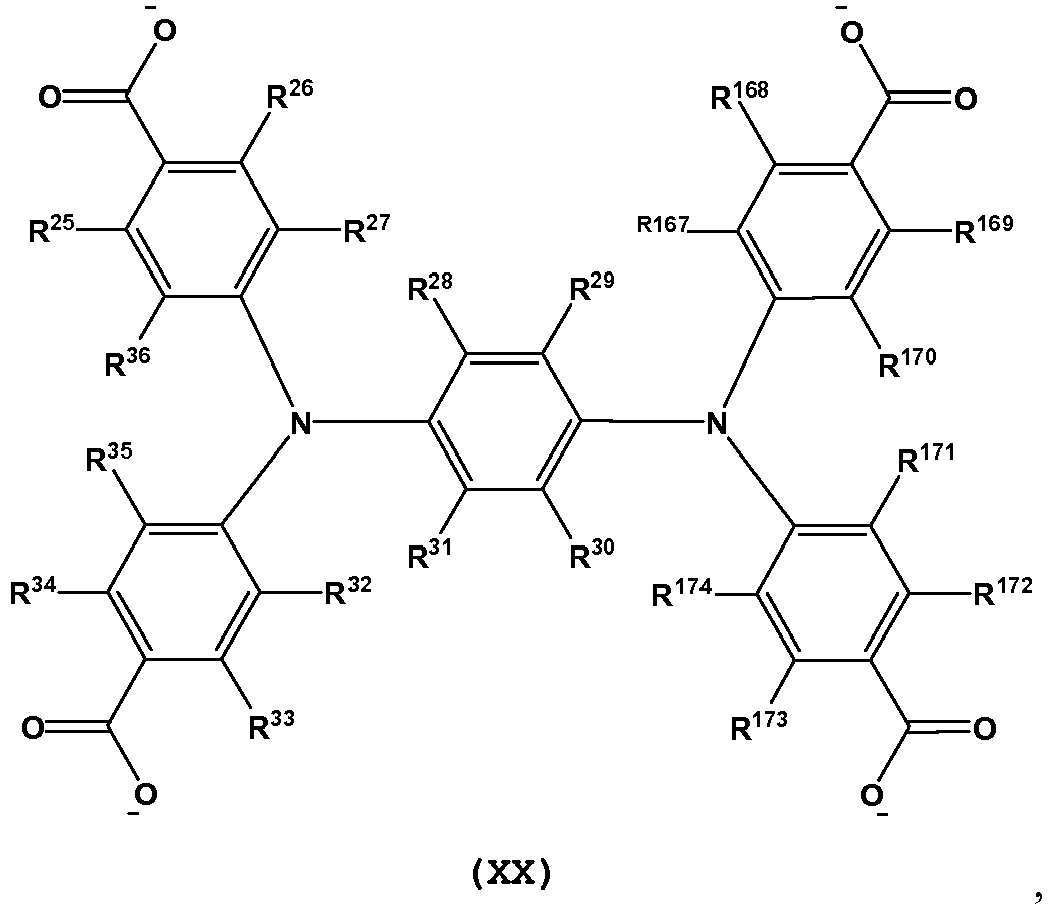


R25-R36, R55-R58, R60, R61, R63, R64, R103-R186 are independently selected from H, D, optionally substituted FG, optionally substituted (C1-C20)alkyl, optionally substituted (C1-C19)heteroalkyl, optionally substituted (C1-C20)alkenyl, optionally substituted (C1-C19)heteroalkenyl, optionally substituted (C1-C19)alkynyl, optionally substituted (C1-C19)heteroalkynyl, optionally substituted (C1-C19)cycloalkyl, optionally substituted (C1-C19)cycloalkenyl, optionally substituted aryl, optionally substituted heterocycle, optionally substituted mixed ring system, wherein one or more adjacent R groups can be linked together to form one or more substituted rings selected from the group comprising cycloalkyl, cycloalkenyl, heterocycle, aryl, and mixed ring system. - In a further aspect, the disclosure provides for thermal, acid, and/or solvent resistant metal organic frameworks comprised of a plurality of linked M-O-L secondary binding units (SBUs), wherein M is a metal, metal ion, or metal containing complex; O is an oxygen atom of a carboxylate based linking cluster; and L is an organic linking ligand comprising a tetratopic organic linking ligand comprising one or more structures of Formula XVI(a), XVII(a), XVIII(a), XIX(a), XX(a), XXI(a) and XXII(a):


- In another aspect, the disclosure provides for thermal, acid, and/or solvent resistant metal organic frameworks comprised of a plurality of linked M-O-L secondary binding units (SBUs), a MOF of the disclosure comprises a plurality of linked M-O-L secondary binding units (SBUs), wherein M is a metal, metal ion, or metal containing complex; O is an oxygen atom of a carboxylate based linking cluster; and L is a tritopic organic linking ligand having one or more structures of Formula I-IV:


- A1-A3 are independently a C, N, O, or S;
- X1-X3 are independently selected from H, D, optionally substituted FG, optionally substituted (C1-C20)alkyl, optionally substituted (C1-C19)heteroalkyl, optionally substituted (C1-C20)alkenyl, optionally substituted (C1-C19)heteroalkenyl, optionally substituted (Ci-C19)alkynyl, optionally substituted (C1-C19)heteroalkynyl, optionally substituted (Ci-C19)cycloalkyl, optionally substituted (C1-C19)cycloalkenyl, optionally substituted aryl, optionally substituted heterocycle, optionally substituted mixed ring system, wherein one or more adjacent R groups can be linked together to form one or more substituted rings selected from the group comprising cycloalkyl, cycloalkenyl, heterocycle, aryl, and mixed ring system; and
- R1-R36 are independently selected from H, D, optionally substituted FG, optionally substituted (C1-C20)alkyl, optionally substituted (C1-C19)heteroalkyl, optionally substituted (C1-C20)alkenyl, optionally substituted (C1-C19)heteroalkenyl, optionally substituted (C1-C19)alkynyl, optionally substituted (C1-C19)heteroalkynyl, optionally substituted (C1-C19)cycloalkyl, optionally substituted (C1-C19)cycloalkenyl, optionally substituted aryl, optionally substituted heterocycle, optionally substituted mixed ring system, wherein one or more adjacent R groups can be linked together to form one or more substituted rings selected from the group comprising cycloalkyl, cycloalkenyl, heterocycle, aryl, and mixed ring system.
- In yet another aspect, the disclosure provides for thermal, acid, and/or solvent resistant metal organic frameworks comprised of a plurality of linked M-O-L secondary binding units (SBUs), a MOF of the disclosure comprises a plurality of linked M-O-L secondary binding units (SBUs), wherein M is a metal, metal ion, or metal containing complex; O is an oxygen atom of a carboxylate based linking cluster; and L is a tritopic organic linking ligand comprising one or more structures of any one of Formula I-IV:


- A1-A3 are independently a C, N, O, or S;
- X1-X3 are independently selected from H, D, optionally substituted FG, optionally substituted (C1-C20)alkyl, optionally substituted (C1-C19)heteroalkyl, optionally substituted (C1-C20)alkenyl, optionally substituted (C1-C19)heteroalkenyl, optionally substituted (Ci-C19)alkynyl, optionally substituted (C1-C19)heteroalkynyl, optionally substituted (Ci-C19)cycloalkyl, optionally substituted (C1-C19)cycloalkenyl, optionally substituted aryl, optionally substituted heterocycle, optionally substituted mixed ring system, wherein one or more adjacent R groups can be linked together to form one or more substituted rings selected from the group comprising cycloalkyl, cycloalkenyl, heterocycle, aryl, and mixed ring system; and
- R1, R3-R5, R7-R9, R11-R13, R15-R17, R19-R21, R23-R25, R27-R29, R31-R33, R35-R36 are H; and
- R2, R6, R10, R14, R18, R22, R26, R30 and R34 are independently selected from amino, methyl, hydroxyl, =O, =S, halo, optionally substituted aryl, optionally substituted aryloxy, alkoxy, -O-(CH2)n-CH3, and -O-(CH2)2-O-CH2-CH3, wherein n is an integer from 2 to 5.
- In yet another aspect, the disclosure provides for thermal, acid, and/or solvent resistant metal organic frameworks comprised of a plurality of linked M-O-L secondary binding units (SBUs), a MOF of the disclosure comprises a plurality of linked M-O-L secondary binding units (SBUs), wherein M is a metal, metal ion, or metal containing complex; O is an oxygen atom of a carboxylate based linking cluster; and L is a tritopic organic linking ligand comprising one or more structures of Formula I(a), II(a), III(a) and IV(a):


- The disclosure further provides for thermal, acid, and/or solvent resistant MOFs that are based on tfz-d type 3D topology resulting from stacking kgd-type 2D structures of hexagonal M-O-L SBUs linked to trigonal planar tritopic organic ligands. In a further embodiment, MOFs disclosed herein have a tfz-d type 3D topology resulting from stacking kgd-type 2D structures of hexagonal M-O-L SBUs linked to trigonal planar tritopic organic ligands having a structure of Formula I-IV. In yet a further aspect, the thermal, acid, and solvent resistant metal organic frameworks disclosed herein have a tfz-d type 3D topology resulting from stacking kgd-type 2D structures of hexagonal M-O-L SBUs linked to trigonal planar tritopic organic ligands having a structure of Formula I(a), II(a), III(a), or IV(a).
- MOFs based on M-O-L SBUs linked to trigonal planar tritopic organic ligands (e.g., MOF-777) have a layer-like topology that allows for exfoliation of layers. So far, very few MOFs have been reported that can exfoliate layers, and most of these MOF either have no apertures or are not stable under ambient conditions. The layers of the kgd-type 2D structures are connected together via interactions with linking anions. For the purpose of this disclosure, "linking anions" are anionic molecules which can form a bond with one or more SBUs so as connect two or more SBUs together in a stacking like arrangement. Examples of "linking anions," include but are not limited to, formate, acetate, phthalate, lactate, oxalate, citrate, fumurate, adipate, anthranilate, ascorbate, benzoate, butyrate, lactate, malate, malonate, tatrate, succinate, sorbate, cinnamate, glutamate, gluconate, propionate, pavalate, and valerate. In a particular embodiment, MOFs comprising kgd-type 2D structures are connected together with linking anions to form 3D MOFs with tfz-d topology (e.g., MOF-777).
- In a certain aspect, one or more metals and/or metal ions, that can be used in the (1) synthesis of a thermal, acid, and/or solvent resistant MOF of the disclosure, (2) exchanged post synthesis of the MOF disclosed herein, and/or (3) added to a MOF disclosed herein by forming coordination complexes with post framework reactant linking clusters, include, but are not limited to, Li+, Na+, K+, Rb+, Cs+, Be2+, Mg2+, Ca2+, Sr2+, Ba2+, Sc3+, Sc2+, Sc+, Y3+, Y2+, Y+, Ti4+, Ti3+, Ti2+, Zr4+, Zr3+, Zr2+, Hf4+, Hf3+, V5+, V4+, V3+, V2+, Nb5+, Nb4+, Nb3+, Nb2+, Ta5+, Ta4+, Ta3+, Ta2+, Cr6+, Cr+, Cr4+, Cr3+, Cr2+, Cr+, Cr, Mo6+, Mo5+, Mo4+, Mo3+, Mo2+, Mo+, Mo, W6+, W5+, W4+, W3+, W2+, W+, W, Mn7+, Mn6+, Mn5+, Mn4+, Mn3+, Mn2+, Mn+, Re7+, Re6+, Re5+, Re4+, Re3+, Re2+, Re+, Re, Fe6+, Fe4+, Fe3+, Fe2+, Fe+, Fe, Ru8+, Ru7+, Ru6+, Ru4+, Ru3+, Ru2+, Os8+, Os7+, Os6+, Os5+, Os4+, Os3+, Os2+, Os+, Os, Co5+, Co4+, Co3+, Co2+, Co+, Rh6+, Rh5+, Rh4+, Rh3+, Rh2+, Rh+, Ir6+, Ir5+, Ir4+, Ir3+, Ir2+, Ir+, Ir, Ni3+, Ni2+, Ni+, Ni, Pd6+, Pd4+, Pd2+, Pd+, Pd, Pt6+, Pt5+, Pt4+, Pt3+, Pt2+, Pt+, Cu4+, Cu3+, Cu2+, Cu+, Ag3+, Ag2+, Ag+, Au5+, Au4+, Au3+, Au2+, Au+, Zn2+, Zn+, Zn, Cd2+, Cd+, Hg4+, Hg2+, Hg+, B3+, B2+, B+, Al3+, Al2+, Al+, Ga3+, Ga2+, Ga+, In3+, In2+, In1+, T13+, Tl+, Si4+, Si3+, Si2+, Si+, Ge4+, Ge3+, Ge2+, Ge+, Ge, Sn4+, Sn2+, Pb4+, Pb2+, As5+, As3+, As2+, As+, Sb5+, Sb3+, Bi5+, Bi3+, Te6+, Te5+, Te4+, Te2+, La3+, La2+, Ce4+, Ce3+, Ce2+, Pr4+, Pr3+, Pr2+, Nd3+, Nd2+, Sm3+, Sm2+, Eu3+, Eu2+, Gd3+, Gd2+, Gd+, Tb4+, Tb3+, Tb2+, Tb+, Db3+, Db2+, Ho3+, Er3+, Tm4+, Tm3+, Tm2+, Yb3+, Yb2+, Lu3+, and combinations thereof, including any complexes which contain the metals or metal ions listed above, as well as any corresponding metal salt counter-anions.
- In a further aspect, one or more metal ions, that can be used in the (1) synthesis of a thermal, acid, and/or solvent resistant MOF of the disclosure, (2) exchanged post synthesis of the MOF disclosed herein, and/or (3) added to a MOF disclosed herein by forming coordination complexes with post framework reactant linking clusters, include, but are not limited to, Mg2+, Ca2+, Sr2+, Ba2+, Sc3+, Sc2+, Sc+, Y3+, Y2+, Y+, Ti4+, Ti3+, Ti2+, Zr4+, Zr3+, Zr2+, Hf4+, Hf3+, V5+, V4+, V3+, V2+, Nb5+, Nb4+, Nb3+, Nb2+, Ta5+, Ta4+, Ta3+, Ta2+, Cr6+, Cr5+, Cr4+, Cr3+, Cr2+, Cr+, Cr, Mo6+, Mo5+, Mo4+, Mo3+, Mo2+, Mo+, Mo, W6+, W5+, W4+, W3+, W2+, W+, W, Mn7+, Mn6+, Mn5+, Mn4+, Mn3+, Mn2+, Mn+, Re7+, Re6+, Re5+, Re4+, Re3+, Re2+, Re+, Re, Fe6+, Fe4+, Fe3+, Fe2+, Fe+, Fe, Ru8+, Ru7+, Ru6+, Ru4+, Ru3+, Ru2+, OS8+, OS7+, OS6+, OS5+, OS4+, OS3+, OS2+, Os+, Os, Co5+, Co4+, Co3+, Co2+, Co+, Rh6+, Rh5+, Rh4+, Rh3+, Rh2+, Rh+, Ir6+, Ir5+, Ir4+, Ir3+, Ir2+, Ir+, Ir, Ni3+, Ni2+, Ni+, Ni, Pd6+, Pd4+, Pd2+, Pd+, Pd, Pt6+, Pt5+, Pt4+, Pt3+, Pt2+, Pt+, Cu4+, Cu3+, Cu2+, Cu+, Ag3+, Ag2+, Ag+, Au5+, Au4+, Au3+, Au2+, Au+, Zn2+, Zn+, Zn, Cd2+, Cd+, Hg4+, Hg2+, Hg+, B3+, B2+, B+, Al3+, Al2+, Al+, Ga3+, Ga2+, Ga+, In3+, In2+, In1+, Tl3+, Tl+, Si4+, Si3+, Si2+, Si+, Ge4+, Ge3+, Ge2+, Ge+, Ge, Sn4+, Sn2+, Pb4+, Pb2+, As5+, As3+, As2+, As+, Sb5+, Sb3+, Bi5+, Bi3+, and combinations thereof, including any complexes which contain the metal ions listed, as well as any corresponding metal salt counter-anions.
- In another aspect, one or more metal ions, that can be used in the (1) synthesis of a thermal, acid, and/or solvent resistant MOF of the disclosure, (2) exchanged post synthesis of the MOF disclosed herein, and/or (3) added to a MOF disclosed herein by forming coordination complexes with post framework reactant linking clusters, include, but are not limited to, Mg2+, Ca2+, Al3+, Al2+, Al+, Ti4+, Ti3+, Ti2+, Zr4+, Zr3+, Zr2+, Hf4+, Hf3+, and combinations thereof, including any complexes which contain the metal ions listed, as well as any corresponding metal salt counter-anions.
- In yet another aspect, one or more metal ions, that can be used in the (1) synthesis of a thermal, acid, and/or solvent resistant MOF of the disclosure, (2) exchanged post synthesis of the MOF disclosed herein, and/or (3) added to a MOF disclosed herein by forming coordination complexes with post framework reactant linking clusters, include, but are not limited to, Ti4+, Ti3+, Ti2+, Zr4+, Zr3+, Zr2+, Hf4+, Hf3+, and combinations thereof, including any complexes which contain the metal ions, as well as any corresponding metal salt counter-anions.
- In a preferred embodiment, one or more metal ions that can be used in the synthesis of a thermal, acid, and/or solvent resistant MOF of the disclosure comprise Zr3+, Zr2+, Hf4+, Hf3+, and combinations thereof, including any complexes which contain the metal ions, as well as any corresponding metal salt counter-anions.
- The MOFs of the disclosure may be generated by first utilizing a plurality of linking moieties having different functional groups, wherein at least one of these functional groups may be modified, substituted, or eliminated with a different functional group post-synthesis of the framework. In other words, at least one linking moiety comprises a functional group that may be post-synthesized reacted with a post framework reactant to further increase the diversity of the functional groups of the MOFs disclosed herein.
- After MOFs of the disclosure are synthesized, the MOFs may be further modified by reacting with one or more post framework reactants that may or may not have denticity. In a certain aspect, the MOFs as-synthesized are not reacted with a post framework reactant. In another aspect, the MOFs as-synthesized are reacted with at least one post framework reactant. In yet another aspect, the MOFs as-synthesized are reacted with at least two post framework reactants. In a further aspect, the MOFs as-synthesized are reacted with at least one post framework reactant that will result in adding denticity to the framework.
- The disclosure provides for chemical reactions that modify, substitute, or eliminate a functional group post-synthesis of a MOF disclosed herein with a post framework. These chemical reactions may use one or more similar or divergent chemical reaction mechanisms depending on the type of functional group and/or post framework reactant used in the reaction. Examples of chemical reaction include, but are not limited to, radical-based, unimolecular nuclephilic substitution (SN1), bimolecular nucleophilic substitution (SN2), unimolecular elimination (E1), bimolecular elimination (E2), E1cB elimination, nucleophilic aromatic substitution (SnAr), nucleophilic internal substitution (SNi), nucleophilic addition, electrophilic addition, oxidation, reduction, cycloaddition, ring closing metathesis (RCM), pericylic, electrocylic, rearrangement, carbene, carbenoid, cross coupling, and degradation.
- All the aforementioned linking moieties that possess appropriate reactive functionalities can be chemically transformed by a suitable reactant post framework synthesis to add further functionalities to the pores. By modifying the organic links within the framework post-synthetically, access to functional groups that were previously inaccessible or accessible only through great difficulty and/or cost is possible and facile.
- It is yet further contemplated by this disclosure that to enhance chemoselectivity it may be desirable to protect one or more functional groups that would generate unfavorable products upon a chemical reaction desired for another functional group, and then deprotect this protected group after the desired reaction is completed. Employing such a protection/deprotection strategy could be used for one or more functional groups.
- Other agents can be added to increase the rate of the reactions disclosed herein, including adding catalysts, bases, and acids.
- In another aspect, a post framework reactant adds at least one effect to a MOF of the disclosure including, but not limited to, modulating the gas storage ability of the MOF; modulating the sorption properties of the MOF; modulating the pore size of the MOF; modulating the catalytic activity of the MOF; modulating the conductivity of the MOF; and modulating the sensitivity of the MOF to the presence of an analyte of interest. In a further aspect, a post framework reactant adds at least two effects to the MOF of the disclosure including, but not limited to, modulating the gas storage ability of the MOF; modulating the sorption properties of the MOF; modulating the pore size of the MOF; modulating the catalytic activity of the MOF; modulating the conductivity of the MOF; and modulating the sensitivity of the MOF to the presence of an analyte of interest.
- In one aspect, a post framework reactant can be a saturated or unsaturated heterocycle.
- In another aspect, a post framework reactant has 1-20 carbons with functional groups including atoms such as N, S, and O.
- In yet another aspect, a post framework reactant is selected to modulate the size of the pores of the MOF disclosed herein.
- In another aspect, a post framework reactant is selected to increase the hydrophobicity of the MOF disclosed herein.
- In yet another aspect, a post framework reactant is selected to modulate gas separation of the MOF disclosed herein. In a certain aspect, a post framework reactant creates an electric dipole moment on the surface of the MOF of the disclosure when it chelates a metal ion.
- In a further aspect, a post framework reactant is selected to modulate the gas sorption properties of the MOF of the disclosure. In another aspect, a post framework reactant is selected to promote or increase greenhouse gas sorption of the MOF disclosed herein. In another aspect, a post framework reactant is selected to promote or increase hydrocarbon gas sorption of the MOF of the disclosure.
- In yet a further aspect, a post framework reactant is selected to increase or add catalytic efficiency to the MOF disclosed herein.
- In another aspect, a post framework reactant is selected so that organometallic complexes can be tethered to the MOF of the disclosure. Such tethered organometallic complexes can be used, for example, as heterogeneous catalysts.
- The MOFs disclosed herein may be modified to be strong solid-acids, by (1) modifying linking anions used to synthesize the frameworks with acidic site precursors capable of becoming Bronstead and/or Lewis acids (e.g., sulfate, and halide anions); (2) complexing open metal sites or other portions (e.g., pore) of the MOFs disclosed herein with acidic site precursors; and (3) exchanging anions coordinated to the metal, metal ions, or metal containing complexes of the MOFs with acidic site precursors. Further, due to the highly adsorptive nature of the MOFs disclosed herein, MOFs that are strong solid-acids are capable of being superacids. In a particular aspect, a post framework reactant is an acid site precursor.
- In a particular aspect, the MOFs of the disclosure can be used for catalysis, adsorption and separation, energy gas storage (e.g., hydrogen, methane and other natural gases), greenhouse gas capture, respirator against toxic gas/vapor, adsorptive thermal battery, water supply and purification, proton conductor, photovoltaic device, and radioactive ion capture.
- In one aspect of the disclosure, a gas storage or separation material comprising a MOF of the disclosure is provided. Advantageously, the MOF includes one or more sites for storing and/or separating gas molecules. Gases that may be stored in the gas storage material of the disclosure include gas molecules which have high electron density for attachment to the one or more sites on the surface area of a pore or interpenetrating porous network. Such electron density includes molecules having multiple bonds between two atoms contained therein or molecules having a lone pair of electrons. Suitable examples of such gases include, but are not limited to, the gases comprising a component selected from the group consisting of ammonia, argon, carbon dioxide, carbon monoxide, hydrogen, and combinations thereof. In a particularly useful variation the gas storage material is a hydrogen storage material that is used to store hydrogen (H2). In another particularly useful variation, the gas storage material is a carbon dioxide storage material that may be used to separate carbon dioxide from a gaseous mixture.
- The disclosure provides an apparatus and method for separating one or more components from a multi-component gas using a separation system having a feed side and an effluent side separated by a MOF of the disclosure. The MOF may comprise a column separation format.
- In an aspect of the disclosure, a gas storage material comprising a MOF is provided. Gases that may be stored or separated by the methods, compositions and systems of the disclosure includes gas molecules comprising available electron density for attachment to the one or more sites. Such electron density includes molecules having multiple bonds between two atoms contained therein or molecules having a lone pair of electrons. Suitable examples of such gases include, but are not limited to, the gases comprising ammonia, argon, carbon dioxide, carbon monoxide, hydrogen, and combinations thereof. In particularly useful variation, the gas binding material is a carbon dioxide binding material that may be used to separate carbon dioxide from a gaseous mixture. Moreover, the MOFs of disclosure can be used in methods or in devices that have gases or gaseous mixtures that are at temperatures between 50 °C to 525 °C, 100 °C to 500 °C, 150 °C to 450 °C, 200 °C to 400 °C, or 250 °C to 350 °C; or at temperatures greater than 50 °C, 65 °C, 80 °C, 100 °C, 120 °C, 150 °C, 200 °C, 300 °C, or greater than 400 °C.
- In an aspect, a gas separation material comprising one or more MOFs disclosed herein is provided. Advantageously, a MOF disclosed herein includes one or more open metal sites for sorption of one or more select gas molecules resulting in separation of these gas molecules from a multicomponent gas. Furthermore, gases that may be separated by one or more MOFs disclosed herein include gas molecules that have available electron density for attachment to the one or more open metal sites on the surface area of a pore or interpenetrating porous network. Such electron density includes molecules having multiple bonds between two atoms contained therein or molecules having a lone pair of electrons. Suitable examples of such gases include, but are not limited to, the gases comprising ammonia, argon, carbon dioxide, hydrogen sulfide, carbonyl sulfide, carbon disulfide, mercaptans, carbon monoxide, hydrogen, and combinations thereof. In a particular embodiment, one or more MOFs disclosed herein, can be used to separate one or more component gases from a multi-component gas mixture. In a certain aspect, one or more MOFs disclosed herein can be used to separate one or more gases with high electron density from a gas mixture. In another embodiment, one or more MOFs disclosed herein can be used to separate one or more gases with high electron density from one or more gases with low electron density.
- In a particular aspect, one or more MOFs disclosed herein are part of a device. In another aspect, a gas separation device comprises one or more MOFs of the disclosure. In a further aspect, a gas separation device used to separate one or more component gases from a multi-component gas mixture comprises one or more MOFs disclosed herein. Examples of gas separation and/or gas storage devices include, but are not limited to, purifiers, filters, scrubbers, pressure swing adsorption devices, molecular sieves, hollow fiber membranes, ceramic membranes, cryogenic air separation devices, and hybrid gas separation devices. In a certain aspect, a gas separation device used to separate one or more gases with high electron density from gas mixture comprises one or more MOFs of the disclosure. In a further aspect, a gas separation device used to separate one or more gases with high electron density from one or more low density gases comprises one or more MOFs of the disclosure.
- In a particular aspect of the disclosure, a gas storage material comprises one more MOFs disclosed herein. A gas that may be stored or separated by the methods, compositions and systems of the disclosure includes gas molecules comprising available electron density for attachment to the one or more open metal sites. Such electron density includes molecules having multiple bonds between two atoms contained therein or molecules having a lone pair of electrons. Suitable examples of such gases include, but are not limited to, the gases comprising ammonia, argon, hydrogen sulfide, carbon dioxide, hydrogen sulfide, carbonyl sulfide, carbon disulfide, mercaptans, carbon monoxide, hydrogen, and combinations thereof. In a particularly useful variation, a gas binding material is a carbon dioxide binding material that may be used to separate carbon dioxide from a gaseous mixture. In a particularly useful variation a gas storage material is a hydrogen storage material that is used to store hydrogen (H2). In another particularly useful variation, a gas storage material is a carbon dioxide storage material that may be used to separate carbon dioxide from a gaseous mixture.
- In yet a further aspect, one or more MOFs disclosed herein can be used to separate and/or store one or more gases selected from the group comprising carbon monoxide, carbon dioxide, hydrogen sulfide, carbonyl sulfide, carbon disulfide, mercaptans, nitrous oxide, and ozone.
- One or more MOFs disclosed herein can be used to separate and/or store one or more gases selected from the group comprising carbon monoxide, carbon dioxide, hydrogen sulfide, carbonyl sulfide, carbon disulfide, and mercaptans.
- Oone or more MOFs disclosed herein can be used to separate and/or store carbon monoxide or carbon dioxide.
- One or more MOFs disclosed herein can be used to separate and/or store carbon dioxide.
- One or more MOFs disclosed herein can be used to separate and/or store hydrogen.
- In another aspect, a gas storage device comprises one or more MOFs disclosed herein. In a further aspect, a gas storage device used to adsorb and/or absorb one or more component gases from a multi-component gas mixture comprises one or more MOFs disclosed herein. In a certain aspect, a gas storage device used to adsorb and/or absorb one or more gases with high electron density from gas mixture comprises one or more MOFs disclosed herein. In a further aspect, a gas storage device used to adsorb and/or absorb one or more gases with high electron density from one or more low density gases comprises one or more MOFs disclosed herein.
- The MOFs of the disclosure can be used as a porous thin film, a catalyst, or a smart membrane for gas separation. MOFs disclosed herein that are comprised of stacked layers (e.g., MOF-777) are particularly amendable as thin films or smart membranes in gas separation or gas storage devices.
- The MOFs of the disclosure can be used to store gases or other molecules in devices that operate at elevated temperatures, including at temperatures between 50 °C to 525 °C, 100 °C to 500 °C, 150 °C to 450 °C, 200 °C to 400 °C, or 250 °C to 350 °C; or at temperatures greater than 50 °C, 65 °C, 80 °C, 100 °C, 120 °C, 150 °C, 200 °C, 300 °C, or greater than 400 °C.
- The MOFs of the disclosure can be used to store gases or other molecules in devices that operate in acidic environments, aqueous environments, or in the presence of organic solvents. In a further aspect, the device is a water purification device, photovoltaic device, or radioactive ion capture device.
- The disclosure also provides methods using MOFs disclosed herein. In a certain aspect, a method to separate or store one or more gases comprises contacting one or more gases with one or more MOFs disclosed herein. In a further aspect, a method to separate or store one or more gases from a mixed gas mixture comprises contacting the gas mixture with one or more MOFs disclosed herein. In yet a further aspect, a method to separate or store one or more high electron density gases from a mixed gas mixture comprises contacting the gas mixture with one or more MOFs disclosed herein. In a certain aspect, a method to separate or store one or more gases from a fuel gas stream comprises contacting the fuel gas stream with one or more MOFs disclosed herein. In a further aspect, a method to separate or store one or more acid gases from a natural gas stream comprises contacting the natural gas stream with one or more MOFs disclosed herein. In yet another aspect, a method to separate or store one or more gases from the exhaust of a combustion engine comprises contacting the exhaust with one or more MOFs disclosed herein. In a certain aspect, a method to separate or store one or more gases from flue-gas comprises contacting the flue-gas with one or more MOFs disclosed herein. In a particular aspect, for the methods provided herein the one or more gases are heated at temperature between 50 °C to 525 °C, 100 °C to 500 °C, 150 °C to 450 °C, 200 °C to 400 °C, or 250 °C to 350 °C; or at temperature greater than 50 °C, 65 °C, 80 °C, 100 °C, 120 °C, 150 °C, 200 °C, 300 °C, or greater than 400 °C.
- The MOFs of the disclosure can be used for removing contaminants from natural gas streams, including carbon dioxide, hydrogen sulfide, and water vapor. Moreover, due to the acid and water resistant properties of the MOFs disclosed herein, the MOFs of the disclosure are especially suited for natural gas separation and storage. "Natural gas" refers to a multi-component gas obtained from a crude oil well (associated gas) or from a subterranean gas-bearing formation (non-associated gas). The composition and pressure of natural gas can vary significantly. A typical natural gas stream contains methane as a significant component. The natural gas will also typically contain ethane, higher molecular weight hydrocarbons, one or more acid gases (such as carbon dioxide, hydrogen sulfide, carbonyl sulfide, carbon disulfide, and mercaptans), and minor amounts of contaminants such as water, nitrogen, iron sulfide, wax, and crude oil.
- One or more MOFs disclosed herein can be used to separate and/or store one or more gases from a natural gas stream. In another aspect, one or more MOF disclosed herein can be used to separate and/or store one or more acid gases from a natural gas stream. In yet another aspect, one or more MOFs disclosed herein can be used to separate and/or store one or more gases from a town gas stream. In yet another aspect, one or more MOFs disclosed herein can be used to separate and/or store one or more gases of a biogas stream. In a certain aspect, one or more MOFs disclosed herein can be used to separate and/or store one or more gases from a syngas stream.
- Sorption is a general term that refers to a process resulting in the association of atoms or molecules with a target material. Sorption includes both adsorption and absorption. Absorption refers to a process in which atoms or molecules move into the bulk of a porous material, such as the absorption of water by a sponge. Adsorption refers to a process in which atoms or molecules move from a bulk phase (that is, solid, liquid, or gas) onto a solid or liquid surface. The term adsorption may be used in the context of solid surfaces in contact with liquids and gases. Molecules that have been adsorbed onto solid surfaces are referred to generically as adsorbates, and the surface to which they are adsorbed as the substrate or adsorbent. Adsorption is usually described through isotherms, that is, functions which connect the amount of adsorbate on the adsorbent, with its pressure (if gas) or concentration (if liquid). In general, desorption refers to the reverse of adsorption, and is a process in which molecules adsorbed on a surface are transferred back into a bulk phase.
- MOFs of the disclosure can be used as standard compounds for sorption instruments, and obtained results would be helpful to improve various industrial plants (i.e. separation or recovery of chemical substance).
- In a variation of this aspect, the gaseous storage site comprises a MOF with a pore which has been functionalized with a group having a desired size or charge. In a refinement, this activation involves removing one or more chemical moieties (guest molecules) from the MOF disclosed herein. Typically, such guest molecules include species such as water, solvent molecules contained within the MOF disclosed herein, and other chemical moieties having electron density available for attachment.
- The MOFs used in the aspects of the disclosure include a plurality of pores for gas adsorption. In one variation, the plurality of pores has a unimodal size distribution. In another variation, the plurality of pores have a multimodal (e.g., bimodal) size distribution.
- The disclosure further provides for catalyst comprising a MOF of the disclosure (e.g., sa-MOFs). The MOFs disclosed herein, as crystalline material, layered material, or as molding, can be used in the catalytic conversion of organic molecules. Reactions of this type are, for example, oxidations, the epoxidation of olefins, e.g. the preparation of propylene oxide from propylene and H2O2 the hydroxylation of aromatics, e.g. the preparation of hydroquinone from phenol and H2O2 or the conversion of toluene into cresol, the conversion of alkanes into alcohols, aldehydes and acids, isomerization, reactions, for example the conversion of epoxides into aldehydes.
- The following examples are intended to illustrate but not limit the disclosure. While they are typical of those that might be used, other procedures known to those skilled in the art may alternatively be used.
- Materials: Formic acid (purity > 98 %) was obtained from either Aldrich Chemical Co. or from EMD Millipore Chemicals. N,N-Dimethylformamide (DMF), and anhydrous methanol were obtained from EMD Millipore Chemicals; anhydrous acetone was obtained from Acros Organics; zirconium oxychloride octahydrate (ZrOCl2·8H2O, purity ≥ 99.5%) and Sigmacote® siliconizing reagent were obtained from Sigma-Aldrich Co. Fumaric acid, 2,5-dihydroxy-1,4-benzenedicarboxylic acid [H2BDC-(OH)2], 3,3'-dihydroxy-4,4'-biphenyldicarboxylic acid [H2BPDC-(OH)2], thiophene-2,5-dicarboxylic acid (H2TDC), 1H-pyrazole-3,5-dicarboxylic acid (H2PZDC), hafnium tetrachloride(HfCl4), acetic acid, and N,N-dimethylformamide(DEF) were purchased from Aldrich Chemical Co. obtained from Aldrich. 1,3,5-benzenetricarboxylic acid (H3BTC) was obtained from either Aldrich Chemical Co. or from EMD Millipore Chemicals. 1,5-Dihydroxynaphthalene-2,6-dicarboxylic acid [H2NDC-(OH)2] was purchased from Sugai Chemical Industry (Japan). 4,4',4",4"'-Methanetetrayltetrabenzoic acid (H4MTB) was prepared according to the published procedure (S1). 4,4'-[(2,5-Dimethoxy-1,4-phenylene)bis(ethyne-2,1-diyl)] dibenzoic acid [H2-PEDB-(OMe)2] was kindly provided by Prof. Stoddart group at Northwestern University. All starting materials and solvents, unless otherwise specified, were used without further purification.
- General procedure for sample preparation for MOF-801, MOF-802, MOF-803, MOF-804, MOF-805, MOF-806, MOF-807, MOF-808, MOF-812, MOF-841, MOF-842, and MOF-867: To reduce nucleation in the growth of MOF single-crystals, the inner surface of glass containers were rinsed with Sigmacote® siliconizing reagent, washed three times with acetone, and dried in oven before use. Solvent exchange of the MOFs is performed by immersing the sample in anhydrous methanol or acetone for three days, during which the solvent was decanted and freshly replenished three times per day. For supercritical CO2 activation, the solvent-exchanged MOFs were fully exchanged with liquid CO2, kept under supercritical CO2 atmosphere, and then bled using a Tousimis Samdri PVT-3D critical point dryer.
- X-ray diffraction analysis: Single-crystal X-ray diffraction (SXRD) data were typically collected on a Bruker D8-Venture diffractometer equipped with Mo- (λ = 0.71073 Å) and Cu-target (λ = 1.54184 Å) micro-focus X-ray tubes and a
PHOTON 100 CMOS detector, unless indicated otherwise. Additional data was collected using synchrotron radiation in the beamline 11.3.1 of the Advanced Light Source, LBNL. - Powder X-ray diffraction patterns (PXRD) were recorder using a Bruker D8 Advance diffractometer (Göbel-mirror monochromated Cu Kα radiation λ = 1.54056 Å). Room-temperature neutron powder diffraction data were collected on the high-resolution neutron powder diffractometer, BT1, at the National Institute of Standards and Technology (NIST) Center for Neutron Research using a Ge(311) monochromator (λ = 2.0781 Å) and a 60 minute collimator.
- Nuclear Magnetic Resonance (NMR) and Elemental Mircoanalysis (EA) analysis: Solution 1H NMR spectra were acquired on a Bruker AVB-400 NMR spectrometer. EA were performed in the Microanalytical Laboratory of the College of Chemistry at UC Berkeley, using a Perkin Elmer 2400 Series II CHNS elemental analyzer. Attenuated total reflectance (ATR) FTIR spectra of neat samples were performed in-house on a Bruker ALPHA Platinum ATR-FTIR Spectrometer equipped with a single reflection diamond ATR module.
- Thermal gravimetric analysis: TGA curves were recorded in-house on a TA Q500 thermal analysis system under air flow.
- Isotherm analysis: Low-pressure gas (N2 and Ar) adsorption isotherms were recorded in-house on a Quantachrome Autosorb-1 volumetric gas adsorption analyzer. Liquid nitrogen and argon baths were used for the measurements at 77 and 87 K, respectively. Water isotherms were measured in-house on a BEL Japan BELSORP-aqua3, and the water uptake in weight percent (wt%) unit is calculated as [(adsorbed amount of water)/(amount of adsorbent)×100], consistent with the established procedures. Prior to the water adsorption measurements, water (analyte) was flash frozen under liquid nitrogen and then evacuated under dynamic vacuum at least five times to remove any gases in the water reservoir. The measurement temperature was controlled with a water circulator. Helium was used for the estimation of dead space for gas and water adsorption measurements. Ultrahigh-purity grade N2, Ar, and He gases (Praxair, 99.999% purity) were used throughout the experiments.
- Synthesis of MOF-777 [Zr6O4(OH)4](HCOO)4(H2O)2(OH)2 BTB2: In 20 mL vial, zirconium dichloride oxide octahydrate (12 mg, 0.037 mmol) and 1,3,5-tris(4-carboxyphenyl)benzene (H3BTB, 10 mg, 0.023 mmol) were added to N,N-dimethylformamide (DMF, 4 mL). The solution was sonicated for ten minutes. Following the sonication, formic acid (2.5 mL) was added to the solution. The solution was heated at 130 °C in preheated oven for five days. The single crystals were collected and washed with DMF (5 x 10 mL) over three hour period. The DMF solvent was then replaced with methanol (9 x 20 mL) over three days period. The methanol was then removed in vacuo (30 mTorr) for 48 hrs.
- Synthesis of Hf-MOF-777 [Hf6O4(OH)41(HCOO)4(OH)2(H2O)2BTB2: In 20 mL vial, hafnium dichloride (12 mg, 0.037 mmol) and 1,3,5-tris(4-carboxyphenyl)benzene (H3BTB, 10 mg, 0.023 mmol) were added to N,N-dimethylformamide (DMF, 4 mL). The solution was sonicated for ten minutes. Following the sonication, formic acid (2.5ml) was added to the solution. The solution was heated at 130 °C in preheated oven for five days. The single crystals were collected and washed with DMF (5 x 10 mL) over three hour period. The DMF solvent was then replaced with methanol (9 x 20 mL) over three days period. The methanol was then removed in vacuo (30 mTorr) for 48 hrs.
- Single crystal sample of Zr6O4(OH)4(fumarate)6, MOF-801-SC (a reference example). A solvent mixture of fumaric acid (0.081 g, 0.70 mmol) and ZrOCl2·8H2O (0.23 g, 0.70 mmol) in a solvent mixture of DMF/formic acid (35 mL/5.3 mL) were placed in a 60-mL screw-capped glass jar, which was heated at 120 °C for one day. Octahedral colorless crystals were collected and quickly washed three times with 5 mL of fresh DMF (Yield: 0.10 g; 63% based on fumaric acid). 1H digested solution NMR of as-synthesized sample (400 MHz, DMSO-d6, ppm): 8.103 (s, 0.5H, 0.5 × HCOOH), 7.917 (s, 1H, 1 × DMF), 6.621 (s, 2H, 1 × Fumarate), 2.871 (s, 3H, 1 × DMF), 2.714 (s, 3H, 1 × DMF). EA of as-synthesized sample: Calcd. for [Zr6O4(OH)4(C4H2O4)6](C3H7NO)6(HCOOH)3(H2O)10: C, 25.49; H, 3.99; N, 3.96%. Found: C, 25.22; H, 3.19; N, 3.95%. ATR-FTIR (4000-400 cm-1): 3151 (br), 1651 (m), 1566 (s), 1384 (s), 1200 (w), 1098 (w), 1062 (w), 984 (m), 793 (m), 739 (w), 640 (s), 483 (s).
- As-synthesized MOF-801-SC was rinsed three times per day with 10 mL of DMF for three days and immersed in 10 mL of anhydrous methanol for three days, during which time the solvent was replaced three times per day. The solid was then evacuated at 150 °C for 24 hours to yield activated sample. EA of activated sample: Calcd. for Zr6C24H28O38 = [Zr6O4(OH)4(C4H2O4)6](H2O)6: C, 19.59; H, 1.92%. Found: C, 19.40; H, 1.77%. ATR-FTIR (4000-400 cm-1): 3217 (br), 1574 (m), 1397 (s), 1212 (w), 983 (w), 795 (w), 653 (s), 490 (m).
- Microcrystalline powder sample of Zr6O4(OH)4(fumarate)6, MOF-801-P (a reference example). Fumaric acid (5.8 g, 50 mmol) and ZrOCl2·8H2O (16 g, 50 mmol) were dissolved in a solvent mixture of DMF/formic acid (200 mL/70 mL) in a 500-mL screw-capped jar, which was heated at 130 °C for 6 hours. The resulting white precipitate was filtrated using Nylon membrane filters (pore size 0.2-µm), and washed three times with 20 mL of fresh DMF and three times with 50 mL of methanol (Yield: 10 g; 90% based on fumaric acid). As-synthesized MOF-801-P was rinsed three times per day with 50 mL of DMF for three days, and immersed in 100 mL methanol for three days, during which time the methanol was replaced three times per day. The solid was then evacuated at 150 °C for 24 hours to yield activated sample. EA of activated sample: Calcd. for Zr6C24H28O38 = [Zr6O4(OH)4(C4H2O4)6](H2O)6: C, 19.59; H, 1.92%; Found: C, 19.25; H, 1.05%.
- Zr6O4(OH)4(PZDC)5(HCOO)2(H2O)2, MOF-802. 1H-Pyrazole-3,5-dicarboxylic acid (H2PZDC) (0.27 g, 1.5 mmol) and ZrOCl2·8H2O (0.40 g, 1.3 mmol) in a solvent mixture of DMF/formic acid (50 mL/35 mL) were placed in a 125-mL screw-capped glass jar, which was heated at 130 °C for three days. Block colorless crystals were collected and washed three times with 5 mL of fresh DMF (Yield: 0.12 g; 39% based on H2PZDC). 1H digested solution NMR of as-synthesized sample (400 MHz, DMSO-d6, ppm): 8.108 (s, 1H, 1 × HCOOH), 7.924 (s, 0.8H, 0.8 × DMF), 7.086 (s, 1H, 1 × PZDC), 2.871 (s, 2.4H, 0.8 × DMF), 2.714 (s, 2.4H, 0.8 × DMF). EA of as-synthesized sample: Calcd. for Zr6C42H66O50N14 = [Zr6O4(OH)4 (C5H2N2O4)5(HCOO)2(H2O)2](C3H7NO)4(HCOOH)3(H2O)6: C, 23.86; H, 3.15; N, 9.27%. Found: C, 23.52; H, 3.34; N, 9.18%. ATR-FTIR (4000-400 cm-1): 3082 (br), 1653 (m), 1566 (s), 1503 (m), 1463 (m), 1432 (m), 1363 (s), 1196 (m), 1097 (m), 1059 (w), 996 (m), 865 (w), 823 (w), 780 (m), 739 (w), 649 (s), 598 (m), 537 (m), 475 (s).
- As-synthesized MOF-802 was rinsed three times per day with 10 mL of DMF for three days, and immersed in 10 mL of anhydrous acetone for three days, during which time the solvent was replaced three times per day. Acetone-exchanged material was activated with a supercritical CO2 activation protocol and evacuated at 120 °C for 24 hours to yield activated sample. EA of activated sample: Calcd. for Zr6C27H20O34N10 = [Zr6O4(OH)4(C5H2N2O4)5(HCOO)2(H2O)2]: C, 20.58; H, 1.28; N, 8.89%. Found: C, 18.39; H, 0.72; N, 7.56%. ATR-FTIR (4000-400 cm-1): 2870 (vw), 1656 (w), 1557 (m), 1462 (w), 1434 (w), 1360 (s), 1187 (w), 1095 (w), 1015 (w), 989 (w), 817 (w), 798 (w), 778 (w), 758(w), 737 (w), 645 (s), 543 (w), 470 (s).
- Zr6O4(OH)4(TDC)4(HCOO)4, MOF-803. Benzene-1,2,4-tricarboxylic acid (H2TDC) (0.069 g, 0.40 mmol) and ZrOCl2·8H2O (0.19 g, 0.60 mmol) in a solvent mixture of DMF/formic acid (20 mL/11 mL) were placed in a 60-mL screw-capped glass jar, which was heated at 130 °C for three days. Cubic colorless crystals were collected and washed three times with 10 mL of fresh DMF (Yield: 0.11 g, 73% based on H2TDC). 1H digested solution NMR of activated sample (400 MHz, DMSO-d6, ppm): 8.110 (s, 1H, 1 × HCOOH), 7.927 (s, 2H, 2 × DMF), 7.697 (s, 2H, 1 × TDC), 2.873 (s, 6H, 2 × DMF), 2.716 (s, 6H, 2 × DMF). EA of as-synthesized sample: Calcd. for Zr6C52H88O48N8S4 = [Zr6O4(OH)4(C6H2O4S)4(HCOO)4](C3H7NO)8(H2O)8: C, 27.53; H, 3.91; N, 4.94; S, 5.65%. Found: C, 27.72; H, 4.01; N, 4.52; S, 5.34%. ATR-FTIR (4000-400 cm-1): 3270 (br), 2928 (vw), 2859 (vw), 1650 (m), 1591 (m), 1562 (m), 1527 (m), 1436 (w), 1374 (s), 1252 (m), 1097 (m), 1061 (w), 1026 (w), 848 (w), 801 (w), 767 (s), 740 (m), 685 (m), 642 (s), 475 (s).
- As-synthesized MOF-803 was rinsed three times per day with 10 mL of DMF for three days, and immersed in anhydrous acetone for three days, during which time the acetone was replaced three times per day. The acetone exchanged material then underwent a supercritical CO2 activation protocol and evacuated at 120 °C for 24 hours to yield activated sample. EA of activated sample: Calcd. for Zr6C28H26O37S4 = [Zr6O4(OH)4 (C6H2O4S)4(HCOO)4](H2O)5: C, 20.63; H, 1.61, S, 7.87%. Found: C, 20.51; H, 1.27; S, 7.12%. ATR-FTIR (4000-400 cm-1): 3233 (br), 1558 (m), 1527 (m), 1373 (s), 1323 (s), 1212 (w), 1125 (w), 1028 (w), 839 (w), 765 (s), 685 (m), 646 (s), 511 (m), 456 (s).
- Zr6O4(OH)4(BDC-(OH)2)6, MOF-804. 2,5-Dihydroxy-terephthalic acid (H2BDC-(OH)2) (0.040 g, 0.20 mmol) and ZrOCl2·8H2O (0.064 g, 0.20 mmol) in a solvent mixture of DMF/formic acid (10 mL/4 mL) were placed in a 20-mL screw-capped glass vial, which was heated at 120 °C for one day. Yellow precipitate was then obtained by centrifuge, and washed with three times with 5 ml of fresh DMF (Yield: 0.051 g; 80% based on H2BDC-(OH)2). 1H digested solution NMR of as-synthesized sample (400 MHz, DMSO-d6, ppm): 8.106 (s, 0.3H, 0.3 × HCOOH), 7.923 (s, 2H, 2 × DMF), 7.267 (s, 2H, 1 × BDC-(OH)2), 2.871 (s, 6H, 2 × DMF), 2.714 (s, 6H, 2 × DMF). EA of as-synthesized sample: Calcd. for Zr6C86H144O74N12 = [Zr6O4(OH)4(C8H4O6)6](C3H7NO)12(HCOOH)2(H2O)14: C, 33.56; H, 4.72; N, 5.46%. Found: C, 32.53; H, 4.69; N, 5.77%. ATR-FTIR (4000-400 cm-1): 3258 (br), 2931 (vw), 2873 (vw), 1651 (s), 1591 (s), 1487 (m), 1456 (m), 1382 (s), 1231 (s), 1099 (m), 1061 (w), 1002 (w), 904 (w), 868 (m), 806 (m), 788 (s), 654 (vs), 610 (m), 570 (s), 480 (s).
- As-synthesized MOF-804 was rinsed three times per day with 10 mL of DMF for three days and exchanged solvent with anhydrous methanol for three days, during which time the methanol was replaced three times per day. The methanol exchanged material was then evacuated at 120 °C for 24 hours to yield activated sample. EA of activated sample: Calcd. for Zr6C48H48O54 = [Zr6O4(OH)4(C8H4O6)6](H2O)10: C, 28.31; H, 2.38%. Found: C, 28.01; H, 1.91%. ATR-FTIR (4000-400 cm-1): 3256 (br), 1586 (m), 1489 (m), 1457 (s), 1382 (s), 1234 (s), 1119 (w), 870 (w), 805 (m), 788 (m), 659 (s), 608 (m), 572 (s), 481 (s).
- Zr6O4(OH)4[NDC-(OH)2]6, MOF-805. 1,5-Dihydroxy-naphthalene-2,6-dicarboxylic acid (H2NDC-(OH)2) (0.012 g, 0.050 mmol) and ZrOCl2·8H2O (0.032 g, 0.10 mmol) in a solvent mixture of DMF/formic acid (10 mL/2 mL) were placed in a 20-mL screw-capped glass vial, which was heated at 120 °C for one day. Yellow precipitate was then obtained by centrifuge, and washed three times with 3 mL of fresh DMF [Yield: 0.014 g, 78% based on H2NDC-(OH)2]. 1H digested solution NMR of activated sample (400 MHz, DMSO-d6, ppm): 8.109 (s, 0.25H, 0.25 × HCOOH), 7.926 (s, 3H, 3 × DMF), 7.811 (d, J = 4.4 Hz, 2H, 1 × NDC-(OH)2), 7.732 (d, J = 4.4 Hz, 2H, 1 × NDC-(OH)2), 2.872 (s, 9H, 3 × DMF), 2.715 (s, 9H, 3 × DMF). EA of as-synthesized sample: Calcd. for Zr6C127.5H209O85N18 = [Zr6O4(OH)4(C12H6O6)6](C3H7NO)18(HCOOH)1.5(H2O)20: C, 39.25; H, 5.40; N, 6.46%. Found: C, 38.73 H, 5.02; N, 6.65%. ATR-FTIR (4000-400 cm-1): 3139 (br), 2931(w), 2874(w),1652(s), 1581 (m), 1485 (m), 1417 (s), 1386(m), 1334 (m), 1334(m), 1285 (m), 1190(m), 1095 (m), 1061(m), 1016(w), 896(w), 866(vw), 782 (s), 660 (s), 632(s), 595(s), 575(w), 517 (w), 469(s).
- As-synthesized MOF-805 was rinsed three times per day with 5 mL of DMF for three days, and immersed in 5 mL of anhydrous methanol for three days, during which time the solvent was exchanged three times per day. Exchanged material was evacuated at 120 °C for 24 hours to yield activated sample. EA of activated sample: Calcd. for Zr6C72H50O49 = [Zr6O4(OH)4(C12H6O6)6](H2O)5: C, 38.49; H, 2.24%. Found: C, 38.36; H, 1.74%. ATR-FTIR (4000-400 cm-1): 3153 (br), 1656 (w), 1582 (m), 1486 (m), 1420 (s), 1332 (w), 1285 (m), 1191 (m), 1101 (vw), 1025 (vw), 898 (w), 780 (s), 668 (s), 636(m), 583 (w), 520 (w), 467 (s).
- Zr6O4(OH)4(BPDC-(OH)2)6, MOF-806. 3,3'-Dihydroxy-biphenyl-4,4'-dicarboxylic acid (H2BPDC-(OH)2) (0.014 g, 0.050 mmol) and ZrOCl2·8H2O (0.032 g, 0.10 mmol) in a solvent mixture of DMF/formic acid (10 mL/2 mL) were placed in a 20-mL screw-capped glass vial, which was heated at 120 °C for two days. Octahedral colorless crystals were collected and washed three times with 3 mL of fresh DMF [Yield: 0.012 g, 62% based on H2BPDC-(OH)2]. 1H digested solution NMR of as-synthesized sample (400 MHz, DMSO-d6, ppm): 8.108 (s, 1.25H, 1.25 × HCOOH), 7.926 (s, 3H, 3 × DMF), 7.877-7.855 (m, 2H, 1 ×BPDC-(OH)2), 7.274-7.252 (m, 4H, 1 ×BPDC-(OH)2), 2.874 (s, 9H, 3 × DMF), 2.716 (s, 9H, 3 × DMF),. EA of as-synthesized sample: Calcd. for Zr6C145.5H229O95N18 = [Zr6O4(OH)4(C14H8O6)6](C3H7NO)18(HCOOH)7.5(H2O)18: C, 40.66; H, 5.37; N, 5.87%. Found: C, 36.28 H, 4.83; N, 5.83%. ATR-FTIR (4000-400 cm-1): 3226 (br), 2927 (vw), 2873 (vw), 1651 (m), 1604 (m), 1569 (m), 1434 (m), 1374 (s), 1314 (m), 1232 (w), 1165 (w), 1097 (m), 1062 (m), 1035 (w), 974 (w), 876 (m), 849 (vw), 785 (m), 762 (w), 707 (w), 647 (s), 614 (m), 570 (w),478 (m), 434 (m).
- As-synthesized MOF-806 was rinsed three times per day with 5 mL of DMF for three days, and immersed in 5 mL of anhydrous acetone for three days, during which time acetone was replaced three times per day. Acetone exchanged material was activated following a supercritical CO2 activation protocol and evacuated at 120 °C for 24 hours to yield activated sample. EA of activated sample: Calcd. for Zr6C84H72O54 = [Zr6O4(OH)4(C14H8O6)6](H2O)10: C, 40.48; H, 2.91%. Found: C, 39.80; H, 2.34%. ATR-FTIR (4000-400 cm-1): 3294 (br), 1632 (m), 1576 (s), 1507 (vw), 1487 (w), 1438 (s), 1375 (s), 1321(w), 1224 (m), 1192 (w), 1164 (w), 1035 (w), 963 (w), 873 (m), 846 (w), 783 (s),691 (m), 663 (s), 559 (w), 455 (s), 450 (s).
- Zr6O4(OH)4(BTC)2(HCOO)6, MOF-808. Benzene-1,3,5-tricarboxylic acid (H3BTC) (0.11 g, 0.50 mmol) and ZrOCl2·8H2O (0.16 g, 0.50 mmol) in a solvent mixture of DMF/formic acid (20 mL/20 mL) were placed in a 60-mL screw-capped glass jar, which was heated at 100 °C for seven days. Octahedral colorless crystals were collected and washed three times with 10 mL of fresh DMF (Yield: 0.098g, 70 % based on Zr). 1H digested solution NMR of as-synthesized sample (400 MHz, DMSO-d6, ppm): 8.630 (s, 3H, 1 × BTC), 8.114 (s, 2H, 2 × HCOOH), 7.928 (s, 5H, 5 × DMF), 2.874 (s, 15H, 5 × DMF), 2.716 (s, 15H, 5 × DMF). EA of as-synthesized sample: Calcd. for Zr6C52H94O43N10 = [Zr6O4(OH)4(C9H3O6)2(HCOO)4](C3H7NO)10(H2O)5: C, 29.82; H, 4.52; N, 6.69%; Found: C, 29.74; H, 5.13; N, 6.69%. ATR-FTIR (4000-400 cm-1): 3381 (br), 2930 (vw), 2861 (vw), 1651 (m), 1614 (m), 1573 (m), 1497 (w), 1437 (m), 1372 (s), 1252 (m), 1099 (m), 1061 (w), 940 (w), 864 (w), 802 (w), 783 (w), 756 (m), 717 (w), 702 (w), 646 (s), 569 (w), 501 (w), 477 (m), 445 (s).
- As-synthesized MOF-808 was rinsed three times per day with DMF for three days, and immersed in 10 mL of anhydrous acetone for three days, during which time the acetone was replaced three times per day. Acetone exchanged material was then applied with supercritical CO2 activation protocol and evacuated at 150 °C for 24 hours to yield activated sample. EA of activated sample: Calcd. for Zr6C25.5H21.5O33.5N0.5 = [Zr6O4(OH)4 (C9H3O6)2(HCOO)6](C3H7NO)0.5(H2O): C, 21.59; H, 1.53, N, 0.49%. Found: C, 21.46; H, 1.46; N, 0.77%. ATR-FTIR (4000-400 cm-1): 2867 (br), 1603 (m), 1583 (m), 1447 (m), 1379 (s), 1110 (w), 944 (w), 758 (w), 740 (w), 703 (m), 657 (s), 572 (w), 500 (m), 451 (s).
- Zr6O4(OH)4(MTB)3(H2O)2, MOF-812. Methanetetrabenzoic acid (H4MTB) (0.048 g, 0.1 mmol) and ZrOCl2·8H2O (0.064 g, 0.2 mmol) were dissolved in a solvent mixture of DMF/formic acid (10 mL/6 mL) in a 20-mL screw-capped glass vial, which was heated at 130 °C for one day.
- Zr6O4(OH)4(MTB)2(HCOO)4(H2O)4, MOF-841. H4MTB (0.12 g, 0.25 mmol) and ZrOCl2·8H2O (0.32 g, 1.0 mmol) in a solvent mixture of DMF/formic acid (40 mL/25 mL) were placed in a 125-mL screw-capped glass jar, which was heated at 130 °C for two days. Mother liquor of the reaction mixture was separated and further heated at 130 °C for another two days. Colorless block crystals were collected and washed three times with 5 mL of fresh DMF (Yield: 0.13g, 55 % based on H4MTB). 1H digested solution NMR of as-synthesized sample (400 MHz, DMSO-d6, ppm): 8.111 (s, 2H, 2 × HCOOH), 7.929 (s, 5H, 5 × DMF), 7.883 (d, J = 4.4 Hz, 8H, 1 × MTB), 7.335 (d, J = 4.4 Hz, 8H, 1 × MTB), 2.875 (5s, 15H, 5 × DMF), 2.717 (s, 15H, 5 × DMF). EA of as-synthesized sample: Calcd. for Zr6C92H134O54N10 = [Zr6O4(OH)4(C29H16O8)2(HCOO)4(H2O)4](C3H7NO)10(H2O)8: C, 39.58; H, 4.84; N, 5.02%; Found: C, 39.11; H, 4.91; N, 5.09%. ATR-FTIR (4000-400 cm-1): 3382 (br), 2930 (vw), 2860 (vw), 1652 (m), 1602 (m), 1583 (m), 1564 (m), 1541 (m), 1407 (s), 1253 (m), 1191 (m), 1151 (w), 1096 (w), 1061 (w), 1017 (w), 860 (w), 837 (w), 772 (m), 743 (w), 719 (w), 695 (w), 646 (s), 523 (m), 454 (s).
- As-synthesized MOF-841 was rinsed three times per day with 10 mL of DMF for three days and immersed in 10 mL of anhydrous acetone for three days, during which time the acetone was replaced three times per day. Acetone exchanged material was activated by first undergoing a supercritical CO2 activation protocol and then being evacuated at 120 °C for 24 hours. EA of activated sample: Calcd. for Zr6C62H48O36 = [Zr6O4(OH)4(C29H16O8)2(HCOO)4(H2O)4]: C, 38.86; H, 2.52%; Found: C, 39.15; H, 2.16%. ATR-FTIR (4000-400 cm-1): 2858 (vw), 1596 (m), 1559 (m), 1407 (s), 1380 (m), 1366 (m), 1336 (m), 1194 (w), 1152 (w), 1019 (w), 839 (w), 771 (m), 751 (m), 719 (m), 664 (m), 570 (w), 525 (m), 457 (s).
- Powdered X-ray Diffraction (PXRD) of MOF-777: Single-crystal X-ray diffraction data for MOF-777 were collected at 100 K using a
Bruker Platium 200 diffractometer with synchrotron radiation (λ = 0.774900 Å) at Beamline 11.3.1 at the Advanced Light Source (ALS), Lawrence Berkeley National Laboratory. Powder X-ray diffraction data were collected using Rigaku D/MAX-RB(12KW) diffractometer at 40 kV, 100 mA for CuKα radiation (λ = 1.5406 Å). For single crystal XRD measurement, 100 µm size of MOF-777 was used and for PXRD measurement, obtained as synthesized single crystal was washed with DMF solvent and grinded for sample preparations. - N2 isotherms for surface area of MOF-777: Low-pressure gas adsorption isotherms were carried out volumetrically. N2 isotherm of MOF-777 was measured using a Quadrasorp (Quantachrome Instruments). A liquid nitrogen sample bath (77 K) was used for N2 measurements. The N2 gas was UHP grade. For measurement of the surface areas, the BET method was applied using the adsorption branches of the N2 isotherms assuming a N2 cross sectional area of 16.2 Å2/molecule. For activation process of MOF-777, the obtained crystals were washed with DMF for 3 days 9 times and DMF solvent was exchanged with methanol in the 20 mL vials for 3 days changing the methanol solvent 9 times. After drying the crystals at vacuum (30 mTorr) for 12 hrs, at room temperature. Finally, 98 mg of the crystals was transferred to glass tube and N2 isotherm measurements were carried out. For the calculation of surface area correlation coefficient was 0.99997 and BET C-value was 2350.
- Secondary building unit (SBU) of MOF-777: Six Zr atoms are arranged in octahedron shape and four oxygen atoms are coordinated on four faces of the octahedron in tetrahedral arrangement and four hydroxyl molecules are coordinated on the other four faces of the octahedron resulting in [Zr6O4(OH)4]12+ cluster. The six edges out of 12 edges of the octahedron are coordinated by carboxylate anion (COO-) of BTB linker in hexagonal arrangement resulting in [Zr6O4(OH)4(COO)6]6+. The rest of the 6+ charges is covered by four HCOO- and two OH- molecules resulting in Zr6O4(OH)4(HCOO)4(OH)2(COO)6. Finally adding four H2O molecules, the overall topology of the SBU was obtained, Zr6O4(OH)4(HCOO)4(OH)2(H2O)4(COO)6 (e.g., see
FIG. 7 andFIG. 12 ). The hexagonal shape of the building unit was completely unexpected as no similar structure has been previously reported for Zr-based MOFs. For example, reported Zr SBUs based on the Zr oxy/hydroxyl cluster are 12-coordinated cuboctahedron and 8-coordinated cube for UiO-66 and MOF-545, respectively. Considering that the cuboctahedron, cube and hexagon shaped SBUs are all based on a similar Zr oxy/hydroxyl cluster, the results presented herein demonstrate that Zr clusters can generate diverse SBUs with different connectivity and geometry. By removing the four carboxylate anions from the cubooctahedron SBU of UiO-66, the cube shape SBU of MOF-545 can be obtained; and by removing the six carboxylate anions from the SBU of UiO-66, the hexagonal SBU of MOF-777 can be obtained (e.g., seeFIG. 8A-C ). It has been proposed that the Zr oxy/hydroxyl cluster flexibility is based upon symmetrical geometry and the number of possible coordination sites, twelve. As the twelve edges of the Zr cluster octahedron are high symmetry coordination sites that allow for the carboxylate anions to coordinate to the edges with proper geometries, the cuboctahedron, cube and hexagonal topologies are possible. Since no hexagonal shaped inorganic and organic building units have reported in any MOF structure, the hexagonal SBU of MOF-777 is a very unique. Moreover, combinations with this hexagonal building unit for synthesizing MOFs would generate additional structural diversity. - 3D structure of MOF-777 based on a stacked 2D layered structure. The structure of MOF-777 was obtained from single crystal XRD analysis. MOF-777 has a tfz-d type 3D structure. The crystal system is orthorhombic and the space group is Cmcm. Unit cell parameters are a = 34.86 Å, b = 20.13 Å, c = 16.77 Å and a pore diameter of 4.986 Å was obtained from the calculation (e.g., see
FIG. 9 and FIG. 10 ). The 3D structure of MOF-777 is comprised of stacked 2D layers (e.g., seeFIG. 11 ). The 2D layers are comprised of hexagonal Zr SBUs and triangle BTB linkers having a 2D kgd-a type structure (e.g., seeFIG. 12 ). Stacking these layers occurs through the z axis. The tfz-d type 3D structure of MOF-777 is formed by connecting the layers through z axis with formate molecules, which bind to vacant coordination sites on the Zr SBUs (e.g., seeFIG. 13A-C ). As can be seen in the SEM images of MOF-777, the layered structures are discernable (e.g., seeFIG. 16 ). When the single crystal XRD data was obtained, the SBUs of MOF-777 were found to be disordered with two different orientations. The SBUs were rotated 180° to each other SBUs (e.g., seeFIG. 18 ). To rectify this issue, SBUs were positioned so as to be adjacent to the other type of SBUs in the layer. From which, the ordered structure of MOF-777 was generated. Based upon this structure, the PXRD pattern of MOF-777 was simulated and compared with the experimental PXRD pattern of MOF-777 to confirm that the structure was equivalent. The PXRD pattern of the simulated structure was shown to be equivalent to the experimental PXRD pattern for MOF-777 (e.g., seeFIG. 19 ). - Crystal growth and morphology of single crystals of MOF-777. The images of single crystals of MOF-177 were obtained using an optimal microscope. The crystals were ∼100 µm in size and had a thickness ∼10 µm. The crystals were found to be homogeneous with hexagonal plate morphology (e.g., see
FIG. 17A-B ). In order to obtain crystals that had sufficient thickness for PXRD studies, the amount of formic acid had to be adjusted. By adding increasing amounts of formic acid, the intensity and sharpness of the peaks related to the stacking of the layers increased along with the thickness (up to ∼10 µm) of single crystals (e.g., seeFig. 14C-E ). The results indicate that the thickness of the crystals can be controlled by varying the amount of formate molecules. As the layers are connected by formate molecules, the results are understandable. - One of the distinguishing characteristics of MOF-777 in comparison to other Zr-MOFs, is MOF-777's layered structure. While other Zr-MOFs have rigid 3D structures, MOF-777's 3D structure results from stacking interactions between hexagonal plate morphologies that have 2D topologies. Therefore, the unique hexagonal plate morphology of MOF-777 SBUs, combined with controllable thickness and high stability, indicate that MOF-777 can be used as a thin film. Relatively few studies have been conducted with MOF films and have been limited to the following: MOF-5, MOF-199 (HKUST-1), [Zr2bdc2(dabco)] (dabco= 1,4-diazabicyclo[2,2,2]octane), [Mn(HCOO)], MIL-53(Fe) and MIL-88B. MOF-777 has several advantages over the MOFs mentioned above. By MOF-777 having plate shape morphology, MOF-777 is far more conducive for growing and covering the surface of substrate. MOF-777 is very stable, while the MOFs mentioned above, except for MOF-199 (HKUST-1), are known for being relatively unstable. The stability of MOF-777, therefore, provides an additional practical advantage for creating a thin film material. A 1 cm2 scaled thin film material comprising MOF-777 was created on top of glass substrate.
- Characterization of MOF-777 surface area. Activated MOF-777 crystals were used for N2 isotherms. The BET surface area of the activated sample was 974 m2/g and Langmuir surface area was 1096 m2/g. Those two values are quite lower than the calculated solvent accessible surface area (2330 m2/g) using a materials studio program. The experimental values are lower than the calculated surface area is due to a loss of crystallinity along z axis during activation. After the activation, the PXRD pattern of the sample was obtained and it showed that the peaks related to stacking of the layers disappeared such as (111), (311), (021), (221), (202) and (112), while the other peaks such as (200), (110), (310), and (020) remained still sharp and strong (e.g., see
FIG. 20 ) indicating that the crystals lost the crystallinity along z axis. - Inductively Coupled Plasma (ICP) and Elemental Analysis (EA) of MOF-777. Four measurements were carried out with four different samples. The wt% of each element of the activated samples was obtained from ICP and EA (e.g., see TABLE 1).
TABLE 1. Experimental wt% values of MOF-777 from ICP and EA. From EA From ICP wt% C O H N S Zr + O Zr 1 37.36 15.75 2.730 0.059 0.015 44.51 27.51 2 38.06 15.58 2.715 0.059 0.013 43.57 27.21 3 38.77 14.81 2.657 0.065 0.009 43.68 27.42 4 38.51 14.81 2.604 0.068 0.011 43.99 28.21 - All measurements showed similar values and the first row was chosen for the experimental value. The molecular formula from the experimental value, Zr6C60.7O40.1H53.7 reasonably matches with the molecular formula of MOF-777, Zr6C58O38H48. Although the oxygen and hydrogen ratios are slightly higher in experimental value, this discrepancy can be explained by the experimental having one or two water molecules within the pores.
- Testing the thermal and chemical stability of MOF-777. A thermal stability test was carried out by using thermal gravimetric analysis (TGA). The first significant weight loss was from the evaporation of the solvent from the pores, while a second significant weight loss was around 550 °C was, indicating decomposition of the structure (e.g., see
FIG. 22 ). This result shows that MOF-777 is thermally stable up to ∼550 °C. - A chemical stability test of MOF-777 was carried out against water. The PXRD pattern of as-synthesized MOF-777 was compared against the PXRD pattern of MOF-777 immersed in water for 3 days (e.g., see
Fig. 23 ). After MOF-777 was immersed in water for three days, the peaks related to the stacking of the layers disappeared, while the other peaks remained. Considering (200), (110) peaks were still sharp as those from the as-synthesized MOF-777 sample, the layers of MOF-777 are chemically stable against water. - MOF-777 has several interesting characteristics. Outside of MOF-777, no hexagonal shape inorganic and organic building units have been reported for MOFs. MOF-777's hexagonal building units therefore provide for new geometries for constructing MOFs. Also the layered structure enables MOF-777 to grow as thin layers. With the thermally and chemically stable properties of MOF-777 layers, this morphology of MOF-777 has an advantage to being used as porous thin film materials.
- Characterization of Hf-MOF-777: Hf-MOF-777 was obtained using similar synthesis reaction conditions as MOF-777 (e.g., see
FIG. 24 ), but replacing HfCl4 for ZrOCl2. The morphology of single crystals of Hf-MOF-777 was a hexagonal plane, the same as MOF-777. Further, the PXRD pattern of Hf-MOF-777 is comparable to MOF-777. Based upon these results, the structure of Hf-MOF-777 is comparable to MOF-777.
Claims (14)
- A thermal, acid, and/or solvent resistant metal organic framework (MOF) comprising a plurality of linked M-O-L secondary binding units (SBUs), wherein M is a zirconium or hafnium metal, a zirconium or hafnium metal ion, or a zirconium or hafnium metal containing complex; O is an oxygen atom of a carboxylate based linking cluster; and L is an organic linking ligand comprising one or more structures of Formula I to IX and XI to XXII, wherein the linking ligand forms a bond with the metal, metal ion or metal containing complex via the carboxylate based linking cluster:


 A1-A8 are independently a C, N, O, or S;A9 is selected from
 X1-X8 are independently selected from H, D, alkyl, alkenyl, alkynyl, aryl, hetero-alkyl, hetero-alkenyl, hetero-alkynyl, cycloalkyl, cycloalkenyl, hetero-aryl, heterocycle, halo, hydroxyl, anhydride, carbonyl, carboxyl, carbonate, carboxylate, aldehyde, haloformyl, ester, hydroperoxy, peroxy, ether, orthoester, carboxamide, amine, imine, imide, azide, azo, cyanate, isocyanate, nitrate, nitrile, isonitrile, nitroso, nitro, nitrosooxy, pyridyl, sulfhydryl, sulfide, disulfide, sulfinyl, sulfo, thiocyanate, isothiocyanate, carbonothioyl, phosphino, phosphono, phosphate, Si(OH)3, Ge(OH)3, Sn(OH)3, Si(SH)4, Ge(SH)4, AsO3H, AsO4H, P(SH)3, As(SH)3, SO3H, Sn(SH)4, (C1-C20)alkyl, (C1-C19)heteroalkyl, (C1-C20)alkenyl, (C1-C19)heteroalkenyl, (C1-C19)alkynyl, (C1-C19)heteroalkynyl, (C1-C19)cycloalkyl, (C1-C19)cycloalkenyl, aryl, mixed ring system, wherein one or more adjacent R groups can be linked together to form one or more rings selected from cycloalkyl, cycloalkenyl, heterocycle, aryl, and mixed ring system;R37, R39, R48 and R52 are hydroxyls; andR1 to R36, R38, R40 to R47, R49 to R51, R53 to R64 and R69 to R186 are independently selected from H, D, alkyl, alkenyl, alkynyl, aryl, hetero-alkyl, hetero-alkenyl, hetero-alkynyl, cycloalkyl, cycloalkenyl, hetero-aryl, heterocycle, halo, hydroxyl, anhydride, carbonyl, carboxyl, carbonate, carboxylate, aldehyde, haloformyl, ester, hydroperoxy, peroxy, ether, orthoester, carboxamide, amine, imine, imide, azide, azo, cyanate, isocyanate, nitrate, nitrile, isonitrile, nitroso, nitro, nitrosooxy, pyridyl, sulfhydryl, sulfide, disulfide, sulfinyl, sulfo, thiocyanate, isothiocyanate, carbonothioyl, phosphino, phosphono, phosphate, Si(OH)3, Ge(OH)3, Sn(OH)3, Si(SH)4, Ge(SH)4, AsO3H, AsO4H, P(SH)3, As(SH)3, SO3H, Sn(SH)4, (C1-C20)alkyl, (C1-C19)heteroalkyl, (C1-C20)alkenyl, (C1-C19)heteroalkenyl, (C1-C19)alkynyl, (C1-C19)heteroalkynyl, (C1-C19)cycloalkyl, (C1-C19)cycloalkenyl, mixed ring system, wherein one or more adjacent R groups can be linked together to form one or more rings selected from cycloalkyl, cycloalkenyl, heterocycle, aryl, and mixed ring system; andwherein the framework is thermally stable when exposed to a temperature between 50 °C to 525 °C, and/or the framework is chemically stable in the presence of a solvent and/or an acid.
 - The MOF of claim 1, wherein:(a) L is a linear diptopic organic linking ligand comprising one or more structures of Formula V-VII wherein the linking ligand forms a bond with the metal, metal ion or metal containing complex via the carboxylate linking cluster:

.R37-R54 are independently selected from H, D, alkyl, alkenyl, alkynyl, aryl, hetero-alkyl, hetero-alkenyl, hetero-alkynyl, cycloalkyl, cycloalkenyl, hetero-aryl, heterocycle, halo, hydroxyl, anhydride, carbonyl, carboxyl, carbonate, carboxylate, aldehyde, haloformyl, ester, hydroperoxy, peroxy, ether, orthoester, carboxamide, amine, imine, imide, azide, azo, cyanate, isocyanate, nitrate, nitrile, isonitrile, nitroso, nitro, nitrosooxy, pyridyl, sulfhydryl, sulfide, disulfide, sulfinyl, sulfo, thiocyanate, isothiocyanate, carbonothioyl, phosphino, phosphono, phosphate, Si(OH)3, Ge(OH)3, Sn(OH)3, Si(SH)4, Ge(SH)4, AsO3H, AsO4H, P(SH)3, As(SH)3, SO3H, Sn(SH)4, (C1-C20)alkyl, (C1-C19)heteroalkyl, (C1-C20)alkenyl, (C1-C19)heteroalkenyl, (C1-C19)alkynyl, (C1-C19)heteroalkynyl, (C1-C19)cycloalkyl, (C1-C19)cycloalkenyl, mixed ring system, wherein one or more adjacent R groups can be linked together to form one or more rings selected from cycloalkyl, cycloalkenyl, heterocycle, aryl, and mixed ring system; or(b) wherein L is a bent diptopic organic linking ligand comprising one or more structures of Formula VIII to IX and XI to XV, wherein the linking ligand forms a bond with the metal, metal ion or metal containing complex via the carboxylate based linking cluster:


 A4-A8 are independently a C, N, O, or S;A9 is selected from
 X4-X8 are independently selected from H, D, alkyl, alkenyl, alkynyl, aryl, hetero-alkyl, hetero-alkenyl, hetero-alkynyl, cycloalkyl, cycloalkenyl, hetero-aryl, heterocycle, halo, hydroxyl, anhydride, carbonyl, carboxyl, carbonate, carboxylate, aldehyde, haloformyl, ester, hydroperoxy, peroxy, ether, orthoester, carboxamide, amine, imine, imide, azide, azo, cyanate, isocyanate, nitrate, nitrile, isonitrile, nitroso, nitro, nitrosooxy, pyridyl, sulfhydryl, sulfide, disulfide, sulfinyl, sulfo, thiocyanate, isothiocyanate, carbonothioyl, phosphino, phosphono, phosphate, Si(OH)3, Ge(OH)3, Sn(OH)3, Si(SH)4, Ge(SH)4, AsO3H, AsO4H, P(SH)3, As(SH)3, SO3H, Sn(SH)4, (C1-C20)alkyl, (C1-C19)heteroalkyl, (C1-C20)alkenyl, (C1-C19)heteroalkenyl, (C1-C19)alkynyl, (C1-C19)heteroalkynyl, (C1-C19)cycloalkyl, (C1-C19)cycloalkenyl, mixed ring system, wherein one or more adjacent R groups can be linked together to form one or more substituted rings selected from cycloalkyl, cycloalkenyl, heterocycle, aryl, and mixed ring system; andR55 to R64 and R69 to R102 are independently selected from H, D, alkyl, alkenyl, alkynyl, aryl, hetero-alkyl, hetero-alkenyl, hetero-alkynyl, cycloalkyl, cycloalkenyl, hetero-aryl, heterocycle, halo, hydroxyl, anhydride, carbonyl, carboxyl, carbonate, carboxylate, aldehyde, haloformyl, ester, hydroperoxy, peroxy, ether, orthoester, carboxamide, amine, imine, imide, azide, azo, cyanate, isocyanate, nitrate, nitrile, isonitrile, nitroso, nitro, nitrosooxy, pyridyl, sulfhydryl, sulfide, disulfide, sulfinyl, sulfo, thiocyanate, isothiocyanate, carbonothioyl, phosphino, phosphono, phosphate, Si(OH)3, Ge(OH)3, Sn(OH)3, Si(SH)4, Ge(SH)4, AsO3H, AsO4H, P(SH)3, As(SH)3, SO3H, Sn(SH)4, (C1-C20)alkyl, (C1-C19)heteroalkyl, (C1-C20)alkenyl, (C1-C19)heteroalkenyl, (C1-C19)alkynyl, (C1-C19)heteroalkynyl, (C1-C19)cycloalkyl, (C1-C19)cycloalkenyl, mixed ring system, wherein one or more adjacent R groups can be linked together to form one or more rings selected from cycloalkyl, cycloalkenyl, heterocycle, aryl, and mixed ring system; or(c) wherein L is a tetratopic organic linking ligand comprising one or more structures of Formula XVI-XXII, wherein the linking ligand forms a bond with the metal, metal ion or metal containing complex via the carboxylate linking cluster:


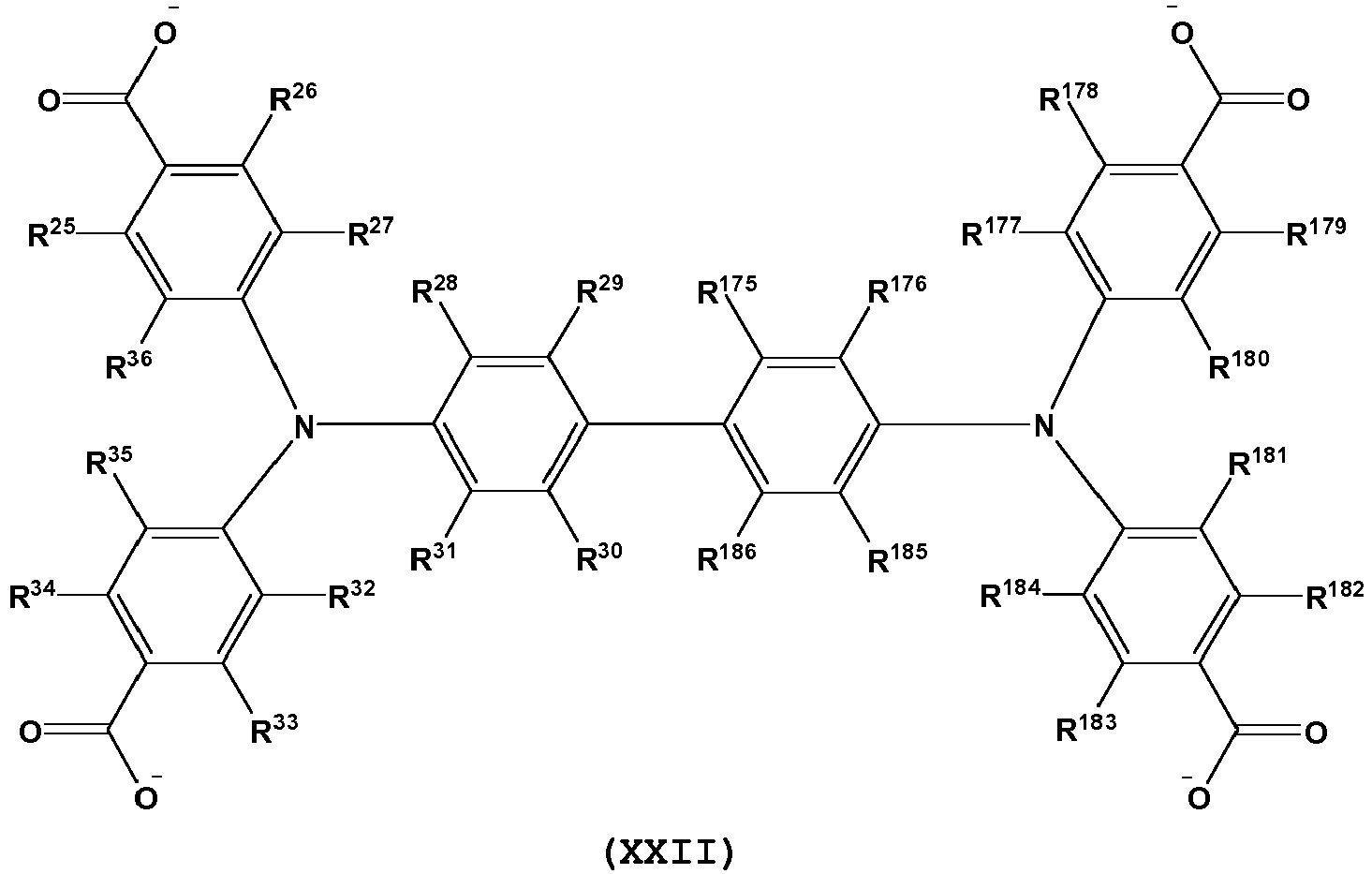
R25-R36, R55-R58, R60, R61, R63, R64, R103-R186 are independently selected from H, D, alkyl, alkenyl, alkynyl, aryl, hetero-alkyl, hetero-alkenyl, hetero-alkynyl, cycloalkyl, cycloalkenyl, hetero-aryl, heterocycle, halo, hydroxyl, anhydride, carbonyl, carboxyl, carbonate, carboxylate, aldehyde, haloformyl, ester, hydroperoxy, peroxy, ether, orthoester, carboxamide, amine, imine, imide, azide, azo, cyanate, isocyanate, nitrate, nitrile, isonitrile, nitroso, nitro, nitrosooxy, pyridyl, sulfhydryl, sulfide, disulfide, sulfinyl, sulfo, thiocyanate, isothiocyanate, carbonothioyl, phosphino, phosphono, phosphate, Si(OH)3, Ge(OH)3, Sn(OH)3, Si(SH)4, Ge(SH)4, AsO3H, AsO4H, P(SH)3, As(SH)3, SO3H, Sn(SH)4, (C1-C20)alkyl, (C1-C19)heteroalkyl, (C1-C20)alkenyl, (C1-C19)heteroalkenyl, (C1-C19)alkynyl, (C1-C19)heteroalkynyl, (C1-C19)cycloalkyl, (C1-C19)cycloalkenyl, mixed ring system, wherein one or more adjacent R groups can be linked together to form one or more rings selected from cycloalkyl, cycloalkenyl, heterocycle, aryl, and mixed ring system; or(d) wherein L is a tritopic organic linking ligand having one or more structures of Formula I-IV that forms a bond with the metal, metal ion or metal containing complex via the carboxylate based linking cluster:

 A1-A3 are independently a C, N, O, or S;X1-X3 are independently selected from H, D, alkyl, alkenyl, alkynyl, aryl, hetero-alkyl, hetero-alkenyl, hetero-alkynyl, cycloalkyl, cycloalkenyl, hetero-aryl, heterocycle, halo, hydroxyl, anhydride, carbonyl, carboxyl, carbonate, carboxylate, aldehyde, haloformyl, ester, hydroperoxy, peroxy, ether, orthoester, carboxamide, amine, imine, imide, azide, azo, cyanate, isocyanate, nitrate, nitrile, isonitrile, nitroso, nitro, nitrosooxy, pyridyl, sulfhydryl, sulfide, disulfide, sulfinyl, sulfo, thiocyanate, isothiocyanate, carbonothioyl, phosphino, phosphono, phosphate, Si(OH)3, Ge(OH)3, Sn(OH)3, Si(SH)4, Ge(SH)4, AsO3H, AsO4H, P(SH)3, As(SH)3, SO3H, Sn(SH)4, (C1-C20)alkyl, (C1-C19)heteroalkyl, (C1-C20)alkenyl, (C1-C19)heteroalkenyl, (C1-C19)alkynyl, (C1-C19)heteroalkynyl, (C1-C19)cycloalkyl, (C1-C19)cycloalkenyl, mixed ring system, wherein one or more adjacent R groups can be linked together to form one or more substituted rings selected from cycloalkyl, cycloalkenyl, heterocycle, aryl, and mixed ring system; andR1-R36 are independently selected from H, D, alkyls, alkenyl, alkynyl, aryl, hetero-alkyl, hetero-alkenyl, hetero-alkynyl, cycloalkyl, cycloalkenyl, hetero-aryl, heterocycle, halo, hydroxyl, anhydride, carbonyl, carboxyl, carbonate, carboxylate, aldehyde, haloformyl, ester, hydroperoxy, peroxy, ether, orthoester, carboxamide, amine, imine, imide, azide, azo, cyanate, isocyanate, nitrate, nitrile, isonitrile, nitroso, nitro, nitrosooxy, pyridyl, sulfhydryl, sulfide, disulfide, sulfinyl, sulfo, thiocyanate, isothiocyanate, carbonothioyl, phosphino, phosphono, phosphate, Si(OH)3, Ge(OH)3, Sn(OH)3, Si(SH)4, Ge(SH)4, AsO3H, AsO4H, P(SH)3, As(SH)3, SO3H, Sn(SH)4, (C1-C20)alkyl, (C1-C19)heteroalkyl, (C1-C20)alkenyl, (C1-C19)heteroalkenyl, (C1-C19)alkynyl,(C1-C19)heteroalkynyl, (C1-C19)cycloalkyl, (C1-C19)cycloalkenyl, mixed ring system, wherein one or more adjacent R groups can be linked together to form one or more rings selected from cycloalkyl, cycloalkenyl, heterocycle, aryl, and mixed ring system; or(e) wherein L is a tritopic organic linking ligand comprising one or more structures of any one of Formula I-IV forms a bond with the metal, metal ion or metal containing complex via the carboxylate based linking cluster:

 A1-A3 are independently a C, N, O, or S;X1-X3 are independently selected from H, D, alkyl, alkenyl, alkynyl, aryl, hetero-alkyl, hetero-alkenyl, hetero-alkynyl, cycloalkyl, cycloalkenyl, hetero-aryl, heterocycle, halo, hydroxyl, anhydride, carbonyl, carboxyl, carbonate, carboxylate, aldehyde, haloformyl, ester, hydroperoxy, peroxy, ether, orthoester, carboxamide, amine, imine, imide, azide, azo, cyanate, isocyanate, nitrate, nitrile, isonitrile, nitroso, nitro, nitrosooxy, pyridyl, sulfhydryl, sulfide, disulfide, sulfinyl, sulfo, thiocyanate, isothiocyanate, carbonothioyl, phosphino, phosphono, phosphate, Si(OH)3, Ge(OH)3, Sn(OH)3, Si(SH)4, Ge(SH)4, AsO3H, AsO4H, P(SH)3, As(SH)3, SO3H, Sn(SH)4, (C1-C20)alkyl, (C1-C19)heteroalkyl, (C1-C20)alkenyl, (C1-C19)heteroalkenyl, (C1-C19)alkynyl, (C1-C19)heteroalkynyl, (C1-C19)cycloalkyl, (C1-C19)cycloalkenyl, mixed ring system, wherein one or more adjacent R groups can be linked together to form one or more rings selected from cycloalkyl, cycloalkenyl, heterocycle, aryl, and mixed ring system; andR1, R3-R5, R7-R9, R11-R13, R15-R17, R19-R21, R23-R25, R27-R29, R31-R33, R35-R36 are H; andR2, R6, R10, R14, R18, R22, R26, R30 and R34 are independently selected from amino, methyl, hydroxyl, =O, =S, halo, aryl, aryloxy, alkoxy, -O-(CH2)n-CH3, and -O-(CH2)2-O-CH2-CH3, wherein n is an integer from 2 to 5.
 - The MOF of claim 2, wherein:(a) L is a linear diptopic organic linking ligand comprising one or more structures of Formula V(a), VI(a), VI(b) and VII(a) forms a bond with the metal, metal ion or metal containing complex via the carboxylate based linking cluster:

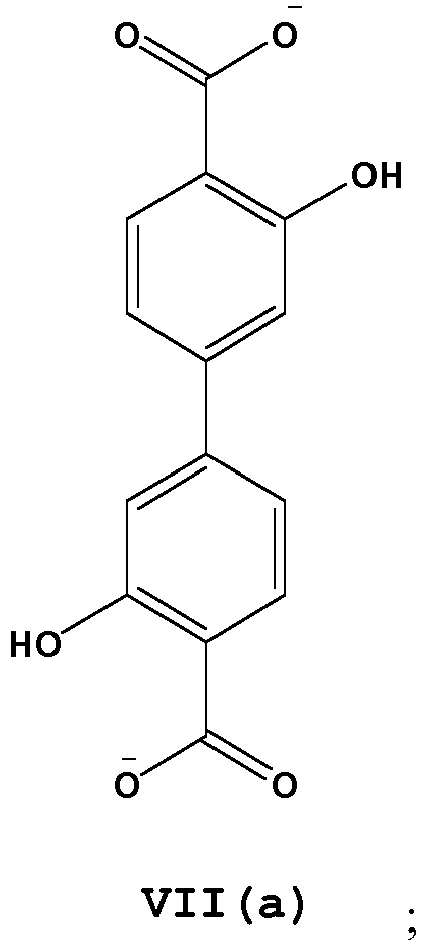 (b) wherein L is a bent diptopic organic linking ligand comprising one or more structures of Formula VIII(a), VIII(b), VIII(c), VIII(d), VIII(e), VIII(f), VIII(g), VIII(h), IX(a), XI(a), XII(a), XIII(a), XIV(a), XV(a), XV(b), and XV(c) forms a bond with the metal, metal ion or metal containing complex via the carboxylate linking cluster:


 (c) wherein L a tetratopic organic linking ligand comprising one or more structures of Formula XVI(a), XVII(a), XVIII(a), XIX(a), XX(a), XXI(a) and XXII(a) forms a bond with the metal, metal ion or metal containing complex via the carboxylate based linking cluster:


 (d) wherein L is a tritopic organic linking ligand comprising one or more structures of Formula I(a), II(a), III(a) and IV(a) forms a bond with the metal, metal ion or metal containing complex via the carboxylate based linking cluster:


- The MOF of any preceding claim, wherein M is a metal or metal ion selected from Zr4+, Zr3+, Zr2+, Hf4+, Hf3+, and combinations thereof, including any complexes which contain the metal ions listed, as well as any corresponding metal salt counter-anions.
- The MOF of any one of the preceding claims, wherein the MOF is MOF-778 (hf-MOF-777).
- The MOF of claim 4, wherein M is Zr4+, including any complexes which contain Zr4+, as well as any corresponding metal salt counter-anions.
- The MOF of claim 6, wherein the plurality of linked M-O-L SBUs have 3-c, 4-c, 6-c, 8-c, 9-c, 10-c, or 12-c extensions.
- The MOF of any one of claim 6 or claim 7, wherein the MOF is MOF-802, MOF-803, MOF-804, MOF-805, MOF-806, MOF-807, MOF-808, MOF-812, MOF-841, MOF-842 or MOF-867.
- The MOF of claim 7, wherein the plurality of linked M-O-L SBUs are hexagonal zirconium carboxylate clusters linked by benzene-tribenzoic acid (BTB)-based organic linking moieties.
- The MOF of claim 9, wherein the MOF has tfz-d type 3D topology that is based upon the stacking of kgd-a type 2D layers, wherein the layers are connected to each other via linking anions, optionally wherein the linking anions are selected from formate, acetate, phthalate, lactate, oxalate, citrate, fumurate, adipate, anthranilate, ascorbate, benzoate, butyrate, lactate, malate, malonate, tatrate, succinate, sorbate, cinnamate, glutamate, gluconate, propionate, pavalate, and valerate, preferably wherein the linking anion is formate.
- The MOF of claim 9 or claim 10, wherein the MOF is MOF-777.
- The MOF of claim 10, wherein the MOF is a strong solid-acid MOF (sa-MOF) comprising linking anions which comprise acid site precursors, optionally wherein the acid site precursors are selected from F-, Cl-, ClO-, ClO2 -, ClO3 -, ClO4 -, Br-, BrO-, I-, IO3 -, IO4 -, NO3 -, S2 -, HS-, HSO3 -, SO3 2-, SO4 2-, HSO4 -, H2PO4 2-, PO4 3-, CO3 2-, HCO3 -, H3BO3, SiO3 2-, PF6 -, CF3CO2 - and CF3SO3 -, preferably wherein the acid site precursor is HSO3 -.
- A method for producing a strong solid acid MOF (sa-MOF) comprising:
reacting an organic linking ligand of claim 1 with a zirconium or hafnium metal or metal ion at an elevated temperature for at least 2 hours, in the presence of an acid site precursor, optionally:(a) wherein the acid site precursor compound is selected from F-, Cl-, ClO-, ClO2 -, ClO3 -, ClO4 -, Br-, BrO-, I-, IO3 -, IO4 -, NO3 -, S2 -, HS-, HSO3 -, SO3 2-, SO4 2-, HSO4 -, H2PO4 2-, PO4 3-, CO3 2-, HCO3 -, H3BO3, SiO3 2-, PF6 -, CF3CO2 - and CF3SO3 -; and/or(b) wherein the organic linking ligand comprises a structure of Formula I(a), II(a), III(a), or IV(a) forms a bond with the metal, metal ion or metal containing complex via the carboxylate based linking cluster:


- A gas storage and/or separation device comprising a MOF of any one of claims 1 to 10 or a device comprising a thin film or membrane of a MOF of any one of claims 9 to 11, or a catalytic device comprising a sa-MOF of claim 12.
Applications Claiming Priority (2)
| Application Number | Priority Date | Filing Date | Title |
|---|---|---|---|
| US201461941791P | 2014-02-19 | 2014-02-19 | |
| PCT/US2015/016555 WO2015127033A1 (en) | 2014-02-19 | 2015-02-19 | Acid, solvent, and thermal resistant metal-organic frameworks |
Publications (2)
| Publication Number | Publication Date |
|---|---|
| EP3074404A1 EP3074404A1 (en) | 2016-10-05 |
| EP3074404B1 true EP3074404B1 (en) | 2020-01-01 |
Family
ID=52597300
Family Applications (1)
| Application Number | Title | Priority Date | Filing Date |
|---|---|---|---|
| EP15707499.8A Active EP3074404B1 (en) | 2014-02-19 | 2015-02-19 | Acid, solvent, and thermal resistant metal-organic frameworks |
Country Status (7)
| Country | Link |
|---|---|
| US (1) | US10287304B2 (en) |
| EP (1) | EP3074404B1 (en) |
| JP (1) | JP6717749B2 (en) |
| KR (1) | KR102399422B1 (en) |
| CN (1) | CN106029674B (en) |
| ES (1) | ES2768680T3 (en) |
| WO (1) | WO2015127033A1 (en) |
Families Citing this family (58)
| Publication number | Priority date | Publication date | Assignee | Title |
|---|---|---|---|---|
| JP6519948B2 (en) * | 2015-06-03 | 2019-05-29 | 株式会社豊田中央研究所 | Tris (carboxyanthracenylphenyl) benzene, crystalline network complex using the same and gas storage material |
| WO2017216012A1 (en) | 2016-06-13 | 2017-12-21 | Basf Se | CATALYST COMPOSITE AND USE THEREOF IN THE SELECTIVE CATALYTIC REDUCTION OF NOx |
| KR102577545B1 (en) | 2016-09-27 | 2023-09-11 | 엘지전자 주식회사 | Washing machine and method for controlling washing machine |
| CN106748728A (en) * | 2016-11-23 | 2017-05-31 | 浙江大学 | A kind of preparation method of vinyl functionalization Zr MOFs materials |
| CN106866988A (en) * | 2017-01-16 | 2017-06-20 | 南开大学 | A kind of layer column type metal-organic framework material as well as preparation method and application thereof |
| JP6638685B2 (en) * | 2017-03-31 | 2020-01-29 | トヨタ自動車株式会社 | Metal organic structure and manufacturing method thereof |
| CN107383386B (en) * | 2017-08-04 | 2020-07-21 | 南京工业大学 | Method for preparing two-dimensional metal organic framework material and application thereof |
| SG11202000933QA (en) * | 2017-08-04 | 2020-02-27 | Univ California | Overcoming two carbon dioxide adsorption steps in diamine-appended metal-organic frameworks |
| KR20200041324A (en) * | 2017-08-31 | 2020-04-21 | 더 리젠츠 오브 더 유니버시티 오브 캘리포니아 | Zirconium terephthalate-based metal organic framework with open metal sites |
| JP7172364B2 (en) * | 2017-12-27 | 2022-11-16 | トヨタ自動車株式会社 | METAL ORGANIC STRUCTURE AND METHOD FOR MANUFACTURING THE SAME |
| US11008347B2 (en) | 2017-12-27 | 2021-05-18 | Toyota Jidosha Kabushiki Kaisha | Metal-organic framework and method of producing the same |
| CN108822658A (en) * | 2018-05-23 | 2018-11-16 | 湖北天鹅科技有限公司 | A kind of water paint and preparation method thereof of absorbable and degradable volatile organic matter |
| KR102056816B1 (en) * | 2018-05-31 | 2019-12-17 | 한국화학연구원 | Novel metal-organic framework having porous structure comprising Zirconium cluster secondary building units and multitopic organic linkers |
| EP3599019A1 (en) * | 2018-07-26 | 2020-01-29 | University of Limerick | Improvements relating to water capture |
| CN109181224B (en) * | 2018-08-08 | 2020-11-24 | 中国科学院合肥物质科学研究院 | A kind of composite shielding material containing MOF-derived porous gadolinium oxide and preparation method thereof |
| CN108927010B (en) * | 2018-08-31 | 2021-01-26 | 贵阳学院 | Adsorption function membrane material and preparation method and application thereof |
| CN109174013A (en) * | 2018-10-17 | 2019-01-11 | 五邑大学 | A kind of acid modified metal organic framework material and preparation method thereof |
| US20210386055A1 (en) * | 2018-10-30 | 2021-12-16 | Unm Rainforest Innovations | Metal-organic Framework-Assisted Cryopreservation of Red Blood-Cells |
| BR112021010139A2 (en) * | 2018-11-26 | 2021-08-24 | The Regents Of The University Of California | Metal-organic structure, method and system for capturing water, and method for using the metal-organic structure |
| WO2020154427A1 (en) | 2019-01-22 | 2020-07-30 | Water Harvesting Inc. | Water harvesting systems, and methods of using thereof |
| CN109813786B (en) * | 2019-03-13 | 2021-11-09 | 郑州轻工业学院 | Bimetal-organic framework material, scaffold material and preparation method thereof, electrochemical immunosensor and preparation method and application thereof |
| CN109870440B (en) * | 2019-03-27 | 2021-07-09 | 南开大学 | A highly stable fluorescent probe for quantitatively identifying strong acids and concentrated bases and its preparation method and use |
| CN114072454A (en) * | 2019-06-25 | 2022-02-18 | 学校法人立教学院 | Metal-organic structure having terephthalic acid-based ligand |
| JP7504190B2 (en) * | 2019-07-15 | 2024-06-21 | エクソンモービル テクノロジー アンド エンジニアリング カンパニー | Metal-organic frameworks with localized defects for gas separation |
| JP7099419B2 (en) * | 2019-08-29 | 2022-07-12 | トヨタ自動車株式会社 | Metal-organic framework |
| MX2022010641A (en) | 2019-09-30 | 2023-09-07 | Water Harvesting Inc | Refrigerator integrated with an atmospheric water harvesting unit, and methods of using thereof. |
| WO2021067955A2 (en) * | 2019-10-03 | 2021-04-08 | Cornell University | Two-dimensional mesoporous superlattices of inorganic materials and methods of making and using same |
| CN111054223A (en) * | 2019-12-27 | 2020-04-24 | 大连理工大学 | Method for preparing defect-free MOF-801 membrane by small crystal seed induced membrane formation-surfactant post-modification strategy and application thereof |
| CN115209975A (en) | 2020-02-14 | 2022-10-18 | 水收集公司 | High-efficiency atmospheric water collector and using method thereof |
| US20220111372A1 (en) | 2020-10-13 | 2022-04-14 | Phillips 66 Company | Metal organic framework |
| CN112191274B (en) * | 2020-10-14 | 2023-08-22 | 武汉理工大学 | An acid-etched three-dimensional wrinkled hollow MOF catalyst and its preparation method and application |
| CN112264051B (en) * | 2020-10-16 | 2022-11-18 | 德安县塑丽龙纺织有限公司 | Preparation method of solid acid catalyst for cellulose hydrolysis and product thereof |
| CN114433025B (en) * | 2020-10-30 | 2023-08-18 | 上海科技大学 | Metal organic framework crystal material and synthesis method thereof |
| WO2022098528A1 (en) * | 2020-11-03 | 2022-05-12 | Virginia Commonwealth University | Self-decontaminating nanofibrous filters |
| CN112587661B (en) * | 2020-12-08 | 2021-09-28 | 中国科学院高能物理研究所 | Boric acid-loaded zirconium-based metalloporphyrin MOFs material as well as preparation method and application thereof |
| WO2022159498A1 (en) | 2021-01-19 | 2022-07-28 | Water Harvesting Inc. | Atmospheric water harvester with climate-adjustable adsorbant properties |
| CN113209941A (en) * | 2021-04-14 | 2021-08-06 | 山东大学 | Hydrophobic dual-ligand metal organic framework material, preparation method and application in VOCs adsorption |
| US11559762B1 (en) | 2021-04-27 | 2023-01-24 | Water Harvesting, Inc. | Heat pump-based water harvesting systems, and methods of using thereof |
| TW202314168A (en) | 2021-08-23 | 2023-04-01 | 美商水收集公司 | Heat pump-based water harvesting systems, and methods of using thereof |
| DE112022003613T5 (en) * | 2021-09-10 | 2024-05-16 | Ngk Insulators, Ltd. | Processing method of a separation membrane complex and processing device for a separation membrane complex |
| CN113880769B (en) * | 2021-10-26 | 2023-03-31 | 华中科技大学 | Chelating agent for metal zirconium marking and synthetic method and application thereof |
| CN114133580B (en) * | 2021-11-12 | 2022-08-12 | 河南科技学院 | A one-dimensional cadmium metal-organic framework and its application in the field of fluorescence sensing |
| CN116328730B (en) * | 2021-12-23 | 2024-07-26 | 上海科技大学 | Flexible metal organic framework material and preparation method and application thereof |
| WO2023220514A1 (en) * | 2022-05-13 | 2023-11-16 | The Regents Of The University Of California | Novel extension-functionalization strategy for water-harvesting mofs |
| CN115058019B (en) * | 2022-07-18 | 2023-04-21 | 陕西科技大学 | Three-dimensional metal sodium coordination polymer and preparation method and application thereof |
| US20240075459A1 (en) * | 2022-09-01 | 2024-03-07 | The Government Of The United States Of America, As Represented By The Secretary Of The Navy | Grafting sorbent moieties into rigid scaffolds |
| US12343672B2 (en) | 2022-09-23 | 2025-07-01 | Water Harvesting, Inc. | Atmospheric water harvesting system |
| CN115612116B (en) * | 2022-10-09 | 2023-09-19 | 深圳职业技术学院 | A porous MOF material and its synthesis method, propylene/propane adsorbent and separation and purification method |
| US12420229B2 (en) | 2022-10-11 | 2025-09-23 | Water Harvesting, Inc. | Low dew point air dehumidification system |
| WO2024143387A1 (en) * | 2022-12-28 | 2024-07-04 | 東洋紡株式会社 | Adsorption agent |
| US12472464B2 (en) | 2023-01-19 | 2025-11-18 | Water Harvesting, Inc. | Atmospheric water harvester having subcooler heat exchanger |
| CN116603349B (en) * | 2023-04-26 | 2024-06-21 | 苏州大学 | Application of Metal-Organic Framework Material MOF-801 in Separation of Tetramethylsilane and Isopentane |
| EP4461403A3 (en) * | 2023-05-12 | 2024-12-18 | Labincube Co., Ltd. | Organometallic structure with excellent voc adsorption and outgassing prevention performance and articles comprising the same |
| CN117362660B (en) * | 2023-08-31 | 2024-04-26 | 中山大学 | Metal organic framework material Zr-MOF, and preparation method and application thereof |
| US20250122701A1 (en) | 2023-10-13 | 2025-04-17 | Water Harvesting, Inc. | Water Harvester Adsorption Enthalpy Removal System |
| CN118681539B (en) * | 2024-08-23 | 2024-11-22 | 开洋新材料(珠海)有限公司 | Application of a MOF material in separation of tetramethylsilane and isopentane |
| US12351483B1 (en) | 2024-11-01 | 2025-07-08 | Water Harvesting, Inc. | Water harvester |
| CN119955117A (en) * | 2025-01-26 | 2025-05-09 | 中山大学 | Preparation method and application of MOF catalyst using PET waste plastic as ligand source |
Family Cites Families (94)
| Publication number | Priority date | Publication date | Assignee | Title |
|---|---|---|---|---|
| US2684967A (en) | 1953-03-19 | 1954-07-27 | Union Oil Co | Process for manufacture of olefin oxides |
| US4532225A (en) | 1983-02-11 | 1985-07-30 | Mobil Oil Corporation | Preparation of metal-containing zeolite catalysts of increased stability and activity |
| US5160500A (en) | 1985-10-21 | 1992-11-03 | Mobil Oil Corporation | Zeolite synthesis using an alcohol or like molecules |
| EP0318099A3 (en) | 1987-11-25 | 1989-11-15 | Union Carbide Corporation | Monoalkylene glycol production using mixed metal framework compositions |
| DE102004009956A1 (en) | 2004-03-01 | 2005-09-29 | Eurofilters N.V. | Adsorbent for dust collection filter, dust collection filter and method for odor adsorption |
| US5208335A (en) | 1991-03-19 | 1993-05-04 | Air Products And Chemicals, Inc. | Reversible oxygen sorbent compositions |
| US5779904A (en) | 1992-03-31 | 1998-07-14 | Inrad | Synthesis of inorganic membranes on supports |
| DE4309848C2 (en) | 1993-03-26 | 1997-06-12 | Siemens Ag | Communication system for connection to a base station of a multi-cellular, wireless telephone system |
| US5733505A (en) | 1995-03-14 | 1998-03-31 | Goldstein; Mark K. | Non-regenerating carbon monoxide sensor |
| US5648508A (en) | 1995-11-22 | 1997-07-15 | Nalco Chemical Company | Crystalline metal-organic microporous materials |
| US6372932B1 (en) | 1997-07-25 | 2002-04-16 | University Of Liverpool | Porous solid products of 1,3,5-benzenetricarboxylate and metal ions |
| US6491740B1 (en) | 1999-07-22 | 2002-12-10 | The Boc Group, Inc. | Metallo-organic polymers for gas separation and purification |
| AU3160001A (en) | 1999-12-23 | 2001-07-09 | Unilever Plc | Bleaching composition |
| US6501000B1 (en) | 2000-04-04 | 2002-12-31 | Exxonmobil Research And Engineering Company | Late transition metal catalyst complexes and oligomers therefrom |
| AU2002255967A1 (en) | 2001-03-30 | 2002-10-15 | The Penn State Research Foundation | Metal catalyzed reactions |
| CA2446020A1 (en) | 2001-04-30 | 2002-11-07 | The Regents Of The University Of Michigan | Isoreticular metal-organic frameworks, process for forming the same, and systematic design of pore size and functionality therein, with application for gas storage |
| US20030078311A1 (en) | 2001-10-19 | 2003-04-24 | Ulrich Muller | Process for the alkoxylation of organic compounds in the presence of novel framework materials |
| US6929679B2 (en) | 2002-02-01 | 2005-08-16 | Basf Aktiengesellschaft | Method of storing, uptaking, releasing of gases by novel framework materials |
| US6893564B2 (en) | 2002-05-30 | 2005-05-17 | Basf Aktiengesellschaft | Shaped bodies containing metal-organic frameworks |
| US6624318B1 (en) | 2002-05-30 | 2003-09-23 | Basf Aktiengesellschaft | Process for the epoxidation of an organic compound with oxygen or an oxygen-delivering compounds using catalysts containing metal-organic frame-work materials |
| US6617467B1 (en) | 2002-10-25 | 2003-09-09 | Basf Aktiengesellschaft | Process for producing polyalkylene carbonates |
| US7008607B2 (en) | 2002-10-25 | 2006-03-07 | Basf Aktiengesellschaft | Process for preparing hydrogen peroxide from the elements |
| US7357836B2 (en) | 2003-03-06 | 2008-04-15 | University Of Massachusetts | Crystalline membranes |
| GB0306430D0 (en) | 2003-03-20 | 2003-04-23 | Bp Chem Int Ltd | Polymerisation and oligomerisation catalysts |
| CA2524903A1 (en) | 2003-05-09 | 2004-11-25 | The Regents Of The University Of Michigan | Implementation of a strategy for achieving extraordinary levels of surface and porosity in crystals |
| US7309380B2 (en) | 2003-06-30 | 2007-12-18 | Basf Aktiengesellschaft | Gas storage system |
| US20050004404A1 (en) | 2003-07-03 | 2005-01-06 | Basf Akiengesellschaft | Process for the alkoxylation of monools in the presence of metallo-organic framework materials |
| WO2006028479A1 (en) | 2003-12-05 | 2006-03-16 | The Regents Of The University Of Michigan | Metal-organic polyhedra |
| US7411081B2 (en) | 2004-01-13 | 2008-08-12 | Basf Aktiengesellschaft | Process for preparing and organometallic framework material |
| ES2391404T3 (en) | 2004-10-22 | 2012-11-26 | The Regents Of The University Of Michigan | Covalently bonded organic structures and polyhedra |
| US7524444B2 (en) | 2004-11-09 | 2009-04-28 | Basf Aktiengesellschaft | Shaped bodies containing metal-organic frameworks |
| DE102004061238A1 (en) | 2004-12-20 | 2006-06-22 | Basf Ag | Method for the enrichment of methane in methane containing gas mixtures comprises contacting the gas mixture with at least a sorbent containing a porous metal-organic structure material |
| DE102005000938A1 (en) | 2005-01-07 | 2006-07-20 | Basf Ag | Adsorptive recovery of xenon from krypton-xenon mixed gas |
| US7343747B2 (en) | 2005-02-23 | 2008-03-18 | Basf Aktiengesellschaft | Metal-organic framework materials for gaseous hydrocarbon storage |
| PT1874459E (en) | 2005-04-07 | 2016-02-08 | Univ Michigan | High gas adsorption in a microporous metal-organic framework with open-metal sites |
| US8415493B2 (en) | 2005-04-22 | 2013-04-09 | University Of South Florida | Zeolite-like metal organic frameworks (ZMOFS): modular approach to the synthesis of organic-inorganic hybrid porous materials having a zeolite like topology |
| US7763767B2 (en) | 2005-05-04 | 2010-07-27 | Exxonmobil Chemicals Patents Inc. | Adsorption process with on-line adsorbent removal |
| DE102005022844A1 (en) | 2005-05-18 | 2006-11-23 | Basf Ag | Separation of odors from gases |
| DE102005023856A1 (en) | 2005-05-24 | 2006-11-30 | Basf Ag | Process for the preparation of porous metal-organic frameworks |
| US7919770B2 (en) | 2005-06-03 | 2011-04-05 | North Carolina State University | Substituted benzazoloporphyrazines for polymerization and surface attachment and articles formed therefrom |
| GB0514478D0 (en) | 2005-07-14 | 2005-08-17 | Birkeland Innovasjon As | Compounds |
| WO2007038508A2 (en) | 2005-09-26 | 2007-04-05 | The Regents Of The University Of Michigan | Metal-organic frameworks with exceptionally high capacity for storage of carbon dioxide at room-temperature |
| DE102005054523A1 (en) | 2005-11-14 | 2007-05-16 | Basf Ag | Porous organometallic framework containing another polymer |
| ZA200805557B (en) | 2005-12-21 | 2009-12-30 | Uop Llc | The use of mofs in pressure swing adsorption |
| US8258197B2 (en) | 2006-02-24 | 2012-09-04 | University Of South Carolina | Synthesis of a highly crystalline, covalently linked porous network |
| WO2007101241A2 (en) | 2006-02-28 | 2007-09-07 | The Regents Of The University Of Michigan | Preparation of functionalized zeolitic frameworks |
| WO2007114991A2 (en) | 2006-03-08 | 2007-10-11 | Global Research Technologies, Llc | Air collector with functionalized ion exchange membrane for capturing ambient co2 |
| CN101426797A (en) * | 2006-04-18 | 2009-05-06 | 巴斯夫欧洲公司 | Methods for producing metal-organic framework materials containing metals of subgroup IV |
| CA2648145A1 (en) | 2006-04-18 | 2007-10-25 | Basf Se | Metal oxides from metal-organic framework materials |
| US20090092818A1 (en) | 2006-04-18 | 2009-04-09 | Basf Se | Organometallic aluminum fumarate backbone material |
| US20070248575A1 (en) | 2006-04-19 | 2007-10-25 | Jerome Connor | Bone graft composition |
| JP2009537696A (en) | 2006-05-16 | 2009-10-29 | ビーエーエスエフ ソシエタス・ヨーロピア | Porous metal organic framework materials based on pyrroles and pyridinones |
| US7637983B1 (en) | 2006-06-30 | 2009-12-29 | Uop Llc | Metal organic framework—polymer mixed matrix membranes |
| US20100143693A1 (en) | 2007-01-24 | 2010-06-10 | The Regents Of The University Of California | Crystalline 3d- and 2d covalent organic frameworks |
| US7687432B2 (en) | 2007-02-02 | 2010-03-30 | Miami University | Mesh-adjustable molecular sieve |
| EP2155608A4 (en) | 2007-05-11 | 2011-01-12 | Univ California | MULTI-COMPONENT GAS ADSORPTION GAS SEPARATION |
| TW200914115A (en) | 2007-05-14 | 2009-04-01 | Shell Int Research | Process for producing purified natural gas from natural gas comprising water and carbon dioxide |
| US8480792B2 (en) | 2007-07-17 | 2013-07-09 | The Regents Of The University Of California | Preparation of functionalized zeolitic frameworks |
| US8343260B2 (en) | 2007-09-14 | 2013-01-01 | University Of North Texas | Fluorinated metal-organic frameworks for gas storage |
| ES2713194T3 (en) | 2007-09-25 | 2019-05-20 | Univ California | Edible and biocompatible organometallic frameworks |
| DE102008005218A1 (en) | 2007-11-04 | 2009-05-07 | BLüCHER GMBH | Sorption filter material and its use |
| US8425659B2 (en) | 2007-12-03 | 2013-04-23 | The Regents Of The University Of Michigan | Microporous coordination polymers as novel sorbents for gas separation |
| US8192709B2 (en) | 2008-02-21 | 2012-06-05 | Exxonmobil Research And Engineering Company | Separation of methane from higher carbon number hydrocarbons utilizing zeolitic imidazolate framework materials |
| US8440732B2 (en) | 2008-03-25 | 2013-05-14 | Sabic Innovative Plastics Ip B.V. | Polymeric foams with nanocellular morphology and methods for making them |
| CN101270094B (en) | 2008-04-22 | 2010-08-18 | 浙江大学 | Phenyl-s-triazine ligands for metal-organic framework complexes and synthesis methods thereof |
| US8946454B2 (en) | 2008-06-05 | 2015-02-03 | The Regents Of The University Of California | Chemical framework compositions and methods of use |
| US8227375B2 (en) | 2008-09-12 | 2012-07-24 | Uop Llc | Gas adsorption on metal-organic frameworks |
| WO2010056092A2 (en) | 2008-11-17 | 2010-05-20 | (주)인실리코텍 | Organic framework |
| EP2358726B1 (en) | 2008-12-18 | 2017-08-02 | The Regents of the University of California | Porous reactive frameworks |
| WO2010090683A1 (en) | 2008-12-18 | 2010-08-12 | The Regents Of The University Of California | Metal organic frameworks (mofs ) for gas purification |
| WO2010078337A1 (en) | 2008-12-29 | 2010-07-08 | The Regents Of The University Of California | A gas sensor incorporating a porous framework |
| EP2382043A1 (en) | 2009-01-15 | 2011-11-02 | The Regents of the University of California | Conductive organometallic framework |
| WO2010088629A1 (en) | 2009-02-02 | 2010-08-05 | The Regents Of The University Of California | Reversible ethylene oxide capture in porous frameworks |
| JP2012530722A (en) | 2009-06-19 | 2012-12-06 | ザ レジェンツ オブ ザ ユニヴァースティ オブ カリフォルニア | Organometallic framework and method for producing the same |
| US8876953B2 (en) | 2009-06-19 | 2014-11-04 | The Regents Of The University Of California | Carbon dioxide capture and storage using open frameworks |
| CN102482294B (en) | 2009-06-19 | 2016-02-03 | 加利福尼亚大学董事会 | Complicated mixed ligand open-framework material |
| US9045387B2 (en) | 2009-07-27 | 2015-06-02 | The Regents Of The University Of California | Oxidative homo-coupling reactions of aryl boronic acids using a porous copper metal-organic framework as a highly efficient heterogeneous catalyst |
| US8841471B2 (en) | 2009-09-25 | 2014-09-23 | The Regents Of The University Of California | Open metal organic frameworks with exceptional surface area and high gas storage capacity |
| AU2011256793A1 (en) | 2010-02-12 | 2012-08-09 | Basf Se | Organo-metallic frameworks derived from carbenophilic metals and method of making same |
| CA2793558A1 (en) | 2010-03-19 | 2011-09-22 | Wei Zhang | Organic porous materials comprising shape-persistent three-dimensional molecular cage building blocks |
| DE112011101279T5 (en) | 2010-04-07 | 2013-03-14 | Cornell University | Covalent organic frameworks and process for their preparation |
| AU2010351979B2 (en) * | 2010-04-30 | 2014-11-20 | Commonwealth Scientific And Industrial Research Organisation | Crystallisation facilitators for the synthesis of metal organic frameworks |
| US8779155B2 (en) | 2010-05-12 | 2014-07-15 | West Virginia University | 1,2,3-triazole based metal-organic framework as photo-active materials |
| US8796462B2 (en) | 2010-05-17 | 2014-08-05 | Rutgers, The State University Of New Jersey | Zeolitic imidazolate frameworks for kinetic separation of propane and propene |
| CN103347885A (en) | 2010-07-20 | 2013-10-09 | 加利福尼亚大学董事会 | Functionalization of organic molecules using metal-organic frameworks (mofs) as catalysts |
| DE112011103068T5 (en) | 2010-09-13 | 2013-08-22 | Cornell University | Films of a covalent organic framework and process for their preparation and their use |
| AU2011341641A1 (en) | 2010-09-27 | 2013-04-04 | The Regents Of The University Of California | Conductive open frameworks |
| US8524932B2 (en) | 2010-09-30 | 2013-09-03 | Basf Se | Process for preparing porous metal-organic frameworks based on aluminum fumarate |
| WO2012100224A2 (en) | 2011-01-21 | 2012-07-26 | The Regents Of The University Of California | Preparation of metal-triazolate frameworks |
| BR112013019565A2 (en) | 2011-02-04 | 2018-07-10 | Univ California | metal catecholate frame, methods for separating or storing one or more gases, a mixed gas mixture, and a combustible gas stream, tunable conductor, supercapacitor device, catalyst, and chemical sensor |
| WO2013058844A1 (en) * | 2011-07-06 | 2013-04-25 | Northwestern University | System and method for generating and/or screening potential metal-organic frameworks |
| US9012368B2 (en) * | 2011-07-06 | 2015-04-21 | Northwestern University | System and method for generating and/or screening potential metal-organic frameworks |
| ES2645260T3 (en) | 2011-10-13 | 2017-12-04 | The Regents Of The University Of California | Organometallic structure with exceptionally large pore opening |
| US9393548B2 (en) * | 2012-12-26 | 2016-07-19 | The Regents Of The University Of Michigan | Rapid and enhanced activation of microporous coordination polymers by flowing supercritical CO2 |
-
2015
- 2015-02-19 CN CN201580008793.4A patent/CN106029674B/en active Active
- 2015-02-19 EP EP15707499.8A patent/EP3074404B1/en active Active
- 2015-02-19 KR KR1020167017933A patent/KR102399422B1/en active Active
- 2015-02-19 US US15/116,186 patent/US10287304B2/en active Active
- 2015-02-19 JP JP2016552975A patent/JP6717749B2/en active Active
- 2015-02-19 ES ES15707499T patent/ES2768680T3/en active Active
- 2015-02-19 WO PCT/US2015/016555 patent/WO2015127033A1/en not_active Ceased
Non-Patent Citations (2)
| Title |
|---|
| SHAHROOSVAND, HASHEM; NASOUTI, FAHIMEH; MOHAJERANI, EZEDDIN; KHABBAZI, AMI: "Red-yellow electroluminescence, yellow-green photoluminescence of novel N,O donor ligands-chelated zirconium (IV) complexes", JOURNAL OF LUMINESCENCE, vol. 135, 26 September 2012 (2012-09-26), pages 339 - 344, XP002783969, ISSN: 0022-2313 * |
| SHAHROOSVAND, HASHEM; NASOUTI, FAHIMEH; MOHAJERANI, EZEDDIN; KHABBAZI, AMIR: "Synthesis, characterization and optical properties of novel N donor ligands-chelated zirconium(IV) complexes", OPTICAL MATERIALS, vol. 35, 25 August 2012 (2012-08-25), pages 79 - 84, XP002783970, ISSN: 0925-3467 * |
Also Published As
| Publication number | Publication date |
|---|---|
| EP3074404A1 (en) | 2016-10-05 |
| JP2017509607A (en) | 2017-04-06 |
| KR20160124080A (en) | 2016-10-26 |
| CN106029674B (en) | 2020-02-14 |
| JP6717749B2 (en) | 2020-07-01 |
| US20170008915A1 (en) | 2017-01-12 |
| ES2768680T3 (en) | 2020-06-23 |
| US10287304B2 (en) | 2019-05-14 |
| KR102399422B1 (en) | 2022-05-18 |
| CN106029674A (en) | 2016-10-12 |
| WO2015127033A1 (en) | 2015-08-27 |
Similar Documents
| Publication | Publication Date | Title |
|---|---|---|
| EP3074404B1 (en) | Acid, solvent, and thermal resistant metal-organic frameworks | |
| US10494386B2 (en) | Mesoscopic materials comprised of ordered superlattices of microporous metal-organic frameworks | |
| EP3676273B1 (en) | Zirconium terephthalate-based metal organic framework with open metal sites | |
| US8916722B2 (en) | Complex mixed ligand open framework materials | |
| US8742152B2 (en) | Preparation of metal-catecholate frameworks | |
| US9078922B2 (en) | Metal-organic frameworks with exceptionally large pore aperatures | |
| EP2443133A2 (en) | Organo-metallic frameworks and methods of making same | |
| US20170081345A1 (en) | Metal-organic frameworks characterized by having a large number of adsorption sites per unit volume | |
| EP2665733A2 (en) | Preparation of metal-triazolate frameworks | |
| WO2011146155A2 (en) | Organo-metallic frameworks derived from carbenophilic metals and method of making same | |
| US20120259117A1 (en) | Organo-metallic frameworks and methods of making same | |
| AU2012212243A1 (en) | Preparation of metal-catecholate frameworks | |
| EP2533898A2 (en) | Organo-metallic frameworks derived from carbenophilic metals and method of making same |
Legal Events
| Date | Code | Title | Description |
|---|---|---|---|
| PUAI | Public reference made under article 153(3) epc to a published international application that has entered the european phase |
Free format text: ORIGINAL CODE: 0009012 |
|
| 17P | Request for examination filed |
Effective date: 20160701 |
|
| AK | Designated contracting states |
Kind code of ref document: A1 Designated state(s): AL AT BE BG CH CY CZ DE DK EE ES FI FR GB GR HR HU IE IS IT LI LT LU LV MC MK MT NL NO PL PT RO RS SE SI SK SM TR |
|
| AX | Request for extension of the european patent |
Extension state: BA ME |
|
| DAX | Request for extension of the european patent (deleted) | ||
| STAA | Information on the status of an ep patent application or granted ep patent |
Free format text: STATUS: EXAMINATION IS IN PROGRESS |
|
| 17Q | First examination report despatched |
Effective date: 20180216 |
|
| GRAP | Despatch of communication of intention to grant a patent |
Free format text: ORIGINAL CODE: EPIDOSNIGR1 |
|
| STAA | Information on the status of an ep patent application or granted ep patent |
Free format text: STATUS: GRANT OF PATENT IS INTENDED |
|
| INTG | Intention to grant announced |
Effective date: 20190607 |
|
| GRAJ | Information related to disapproval of communication of intention to grant by the applicant or resumption of examination proceedings by the epo deleted |
Free format text: ORIGINAL CODE: EPIDOSDIGR1 |
|
| STAA | Information on the status of an ep patent application or granted ep patent |
Free format text: STATUS: EXAMINATION IS IN PROGRESS |
|
| INTC | Intention to grant announced (deleted) | ||
| GRAR | Information related to intention to grant a patent recorded |
Free format text: ORIGINAL CODE: EPIDOSNIGR71 |
|
| GRAS | Grant fee paid |
Free format text: ORIGINAL CODE: EPIDOSNIGR3 |
|
| STAA | Information on the status of an ep patent application or granted ep patent |
Free format text: STATUS: GRANT OF PATENT IS INTENDED |
|
| GRAA | (expected) grant |
Free format text: ORIGINAL CODE: 0009210 |
|
| STAA | Information on the status of an ep patent application or granted ep patent |
Free format text: STATUS: THE PATENT HAS BEEN GRANTED |
|
| AK | Designated contracting states |
Kind code of ref document: B1 Designated state(s): AL AT BE BG CH CY CZ DE DK EE ES FI FR GB GR HR HU IE IS IT LI LT LU LV MC MK MT NL NO PL PT RO RS SE SI SK SM TR |
|
| INTG | Intention to grant announced |
Effective date: 20191122 |
|
| REG | Reference to a national code |
Ref country code: GB Ref legal event code: FG4D |
|
| REG | Reference to a national code |
Ref country code: CH Ref legal event code: EP Ref country code: AT Ref legal event code: REF Ref document number: 1219666 Country of ref document: AT Kind code of ref document: T Effective date: 20200115 |
|
| REG | Reference to a national code |
Ref country code: IE Ref legal event code: FG4D |
|
| REG | Reference to a national code |
Ref country code: DE Ref legal event code: R096 Ref document number: 602015044607 Country of ref document: DE |
|
| REG | Reference to a national code |
Ref country code: NL Ref legal event code: FP |
|
| PGFP | Annual fee paid to national office [announced via postgrant information from national office to epo] |
Ref country code: BE Payment date: 20200227 Year of fee payment: 6 |
|
| REG | Reference to a national code |
Ref country code: ES Ref legal event code: FG2A Ref document number: 2768680 Country of ref document: ES Kind code of ref document: T3 Effective date: 20200623 |
|
| REG | Reference to a national code |
Ref country code: LT Ref legal event code: MG4D |
|
| PG25 | Lapsed in a contracting state [announced via postgrant information from national office to epo] |
Ref country code: CZ Free format text: LAPSE BECAUSE OF FAILURE TO SUBMIT A TRANSLATION OF THE DESCRIPTION OR TO PAY THE FEE WITHIN THE PRESCRIBED TIME-LIMIT Effective date: 20200101 Ref country code: PT Free format text: LAPSE BECAUSE OF FAILURE TO SUBMIT A TRANSLATION OF THE DESCRIPTION OR TO PAY THE FEE WITHIN THE PRESCRIBED TIME-LIMIT Effective date: 20200527 Ref country code: FI Free format text: LAPSE BECAUSE OF FAILURE TO SUBMIT A TRANSLATION OF THE DESCRIPTION OR TO PAY THE FEE WITHIN THE PRESCRIBED TIME-LIMIT Effective date: 20200101 Ref country code: RS Free format text: LAPSE BECAUSE OF FAILURE TO SUBMIT A TRANSLATION OF THE DESCRIPTION OR TO PAY THE FEE WITHIN THE PRESCRIBED TIME-LIMIT Effective date: 20200101 Ref country code: LT Free format text: LAPSE BECAUSE OF FAILURE TO SUBMIT A TRANSLATION OF THE DESCRIPTION OR TO PAY THE FEE WITHIN THE PRESCRIBED TIME-LIMIT Effective date: 20200101 Ref country code: NO Free format text: LAPSE BECAUSE OF FAILURE TO SUBMIT A TRANSLATION OF THE DESCRIPTION OR TO PAY THE FEE WITHIN THE PRESCRIBED TIME-LIMIT Effective date: 20200401 |
|
| PG25 | Lapsed in a contracting state [announced via postgrant information from national office to epo] |
Ref country code: BG Free format text: LAPSE BECAUSE OF FAILURE TO SUBMIT A TRANSLATION OF THE DESCRIPTION OR TO PAY THE FEE WITHIN THE PRESCRIBED TIME-LIMIT Effective date: 20200401 Ref country code: HR Free format text: LAPSE BECAUSE OF FAILURE TO SUBMIT A TRANSLATION OF THE DESCRIPTION OR TO PAY THE FEE WITHIN THE PRESCRIBED TIME-LIMIT Effective date: 20200101 Ref country code: LV Free format text: LAPSE BECAUSE OF FAILURE TO SUBMIT A TRANSLATION OF THE DESCRIPTION OR TO PAY THE FEE WITHIN THE PRESCRIBED TIME-LIMIT Effective date: 20200101 Ref country code: SE Free format text: LAPSE BECAUSE OF FAILURE TO SUBMIT A TRANSLATION OF THE DESCRIPTION OR TO PAY THE FEE WITHIN THE PRESCRIBED TIME-LIMIT Effective date: 20200101 Ref country code: IS Free format text: LAPSE BECAUSE OF FAILURE TO SUBMIT A TRANSLATION OF THE DESCRIPTION OR TO PAY THE FEE WITHIN THE PRESCRIBED TIME-LIMIT Effective date: 20200501 Ref country code: GR Free format text: LAPSE BECAUSE OF FAILURE TO SUBMIT A TRANSLATION OF THE DESCRIPTION OR TO PAY THE FEE WITHIN THE PRESCRIBED TIME-LIMIT Effective date: 20200402 |
|
| REG | Reference to a national code |
Ref country code: CH Ref legal event code: PL |
|
| REG | Reference to a national code |
Ref country code: DE Ref legal event code: R097 Ref document number: 602015044607 Country of ref document: DE |
|
| PG25 | Lapsed in a contracting state [announced via postgrant information from national office to epo] |
Ref country code: EE Free format text: LAPSE BECAUSE OF FAILURE TO SUBMIT A TRANSLATION OF THE DESCRIPTION OR TO PAY THE FEE WITHIN THE PRESCRIBED TIME-LIMIT Effective date: 20200101 Ref country code: MC Free format text: LAPSE BECAUSE OF FAILURE TO SUBMIT A TRANSLATION OF THE DESCRIPTION OR TO PAY THE FEE WITHIN THE PRESCRIBED TIME-LIMIT Effective date: 20200101 Ref country code: SM Free format text: LAPSE BECAUSE OF FAILURE TO SUBMIT A TRANSLATION OF THE DESCRIPTION OR TO PAY THE FEE WITHIN THE PRESCRIBED TIME-LIMIT Effective date: 20200101 Ref country code: DK Free format text: LAPSE BECAUSE OF FAILURE TO SUBMIT A TRANSLATION OF THE DESCRIPTION OR TO PAY THE FEE WITHIN THE PRESCRIBED TIME-LIMIT Effective date: 20200101 Ref country code: RO Free format text: LAPSE BECAUSE OF FAILURE TO SUBMIT A TRANSLATION OF THE DESCRIPTION OR TO PAY THE FEE WITHIN THE PRESCRIBED TIME-LIMIT Effective date: 20200101 Ref country code: SK Free format text: LAPSE BECAUSE OF FAILURE TO SUBMIT A TRANSLATION OF THE DESCRIPTION OR TO PAY THE FEE WITHIN THE PRESCRIBED TIME-LIMIT Effective date: 20200101 Ref country code: LU Free format text: LAPSE BECAUSE OF NON-PAYMENT OF DUE FEES Effective date: 20200219 |
|
| PLBE | No opposition filed within time limit |
Free format text: ORIGINAL CODE: 0009261 |
|
| STAA | Information on the status of an ep patent application or granted ep patent |
Free format text: STATUS: NO OPPOSITION FILED WITHIN TIME LIMIT |
|
| REG | Reference to a national code |
Ref country code: AT Ref legal event code: MK05 Ref document number: 1219666 Country of ref document: AT Kind code of ref document: T Effective date: 20200101 |
|
| PG25 | Lapsed in a contracting state [announced via postgrant information from national office to epo] |
Ref country code: LI Free format text: LAPSE BECAUSE OF NON-PAYMENT OF DUE FEES Effective date: 20200229 Ref country code: CH Free format text: LAPSE BECAUSE OF NON-PAYMENT OF DUE FEES Effective date: 20200229 |
|
| 26N | No opposition filed |
Effective date: 20201002 |
|
| PG25 | Lapsed in a contracting state [announced via postgrant information from national office to epo] |
Ref country code: IE Free format text: LAPSE BECAUSE OF NON-PAYMENT OF DUE FEES Effective date: 20200219 Ref country code: AT Free format text: LAPSE BECAUSE OF FAILURE TO SUBMIT A TRANSLATION OF THE DESCRIPTION OR TO PAY THE FEE WITHIN THE PRESCRIBED TIME-LIMIT Effective date: 20200101 |
|
| PG25 | Lapsed in a contracting state [announced via postgrant information from national office to epo] |
Ref country code: SI Free format text: LAPSE BECAUSE OF FAILURE TO SUBMIT A TRANSLATION OF THE DESCRIPTION OR TO PAY THE FEE WITHIN THE PRESCRIBED TIME-LIMIT Effective date: 20200101 Ref country code: PL Free format text: LAPSE BECAUSE OF FAILURE TO SUBMIT A TRANSLATION OF THE DESCRIPTION OR TO PAY THE FEE WITHIN THE PRESCRIBED TIME-LIMIT Effective date: 20200101 |
|
| PGFP | Annual fee paid to national office [announced via postgrant information from national office to epo] |
Ref country code: NL Payment date: 20210224 Year of fee payment: 7 Ref country code: IT Payment date: 20210219 Year of fee payment: 7 |
|
| PGFP | Annual fee paid to national office [announced via postgrant information from national office to epo] |
Ref country code: ES Payment date: 20210301 Year of fee payment: 7 |
|
| REG | Reference to a national code |
Ref country code: BE Ref legal event code: MM Effective date: 20210228 |
|
| PG25 | Lapsed in a contracting state [announced via postgrant information from national office to epo] |
Ref country code: TR Free format text: LAPSE BECAUSE OF FAILURE TO SUBMIT A TRANSLATION OF THE DESCRIPTION OR TO PAY THE FEE WITHIN THE PRESCRIBED TIME-LIMIT Effective date: 20200101 Ref country code: MT Free format text: LAPSE BECAUSE OF FAILURE TO SUBMIT A TRANSLATION OF THE DESCRIPTION OR TO PAY THE FEE WITHIN THE PRESCRIBED TIME-LIMIT Effective date: 20200101 Ref country code: CY Free format text: LAPSE BECAUSE OF FAILURE TO SUBMIT A TRANSLATION OF THE DESCRIPTION OR TO PAY THE FEE WITHIN THE PRESCRIBED TIME-LIMIT Effective date: 20200101 |
|
| PG25 | Lapsed in a contracting state [announced via postgrant information from national office to epo] |
Ref country code: MK Free format text: LAPSE BECAUSE OF FAILURE TO SUBMIT A TRANSLATION OF THE DESCRIPTION OR TO PAY THE FEE WITHIN THE PRESCRIBED TIME-LIMIT Effective date: 20200101 Ref country code: AL Free format text: LAPSE BECAUSE OF FAILURE TO SUBMIT A TRANSLATION OF THE DESCRIPTION OR TO PAY THE FEE WITHIN THE PRESCRIBED TIME-LIMIT Effective date: 20200101 |
|
| PG25 | Lapsed in a contracting state [announced via postgrant information from national office to epo] |
Ref country code: BE Free format text: LAPSE BECAUSE OF NON-PAYMENT OF DUE FEES Effective date: 20210228 |
|
| REG | Reference to a national code |
Ref country code: NL Ref legal event code: MM Effective date: 20220301 |
|
| PG25 | Lapsed in a contracting state [announced via postgrant information from national office to epo] |
Ref country code: NL Free format text: LAPSE BECAUSE OF NON-PAYMENT OF DUE FEES Effective date: 20220301 |
|
| REG | Reference to a national code |
Ref country code: ES Ref legal event code: FD2A Effective date: 20230405 |
|
| PG25 | Lapsed in a contracting state [announced via postgrant information from national office to epo] |
Ref country code: ES Free format text: LAPSE BECAUSE OF NON-PAYMENT OF DUE FEES Effective date: 20220220 |
|
| PG25 | Lapsed in a contracting state [announced via postgrant information from national office to epo] |
Ref country code: IT Free format text: LAPSE BECAUSE OF NON-PAYMENT OF DUE FEES Effective date: 20220219 |
|
| PGFP | Annual fee paid to national office [announced via postgrant information from national office to epo] |
Ref country code: DE Payment date: 20250227 Year of fee payment: 11 |
|
| PGFP | Annual fee paid to national office [announced via postgrant information from national office to epo] |
Ref country code: FR Payment date: 20250225 Year of fee payment: 11 |
|
| PGFP | Annual fee paid to national office [announced via postgrant information from national office to epo] |
Ref country code: GB Payment date: 20250227 Year of fee payment: 11 |
|
| REG | Reference to a national code |
Ref country code: DE Ref legal event code: R082 Ref document number: 602015044607 Country of ref document: DE Representative=s name: WESTPHAL, MUSSGNUG & PARTNER PATENTANWAELTE MI, DE |