EP3013796B9 - Biaryl derivatives as gpr120 agonists - Google Patents
Biaryl derivatives as gpr120 agonists Download PDFInfo
- Publication number
- EP3013796B9 EP3013796B9 EP14818620.8A EP14818620A EP3013796B9 EP 3013796 B9 EP3013796 B9 EP 3013796B9 EP 14818620 A EP14818620 A EP 14818620A EP 3013796 B9 EP3013796 B9 EP 3013796B9
- Authority
- EP
- European Patent Office
- Prior art keywords
- difluoro
- phenoxy
- butyric acid
- pyridin
- acid
- Prior art date
- Legal status (The legal status is an assumption and is not a legal conclusion. Google has not performed a legal analysis and makes no representation as to the accuracy of the status listed.)
- Active
Links
- BVISHEDQRHTIIX-UHFFFAOYSA-N CC(C)Nc(nccc1)c1-c(cc1F)ccc1SCCCC(O)=O Chemical compound CC(C)Nc(nccc1)c1-c(cc1F)ccc1SCCCC(O)=O BVISHEDQRHTIIX-UHFFFAOYSA-N 0.000 description 1
- CXSUHNWHODYORG-UHFFFAOYSA-N CC(C)Oc(nccc1)c1-c(cc1F)cc(F)c1OCCCCC(O)=O Chemical compound CC(C)Oc(nccc1)c1-c(cc1F)cc(F)c1OCCCCC(O)=O CXSUHNWHODYORG-UHFFFAOYSA-N 0.000 description 1
- ISLLTJKTMDXTDB-UHFFFAOYSA-N CC(C)Oc1cccc(-c(cc2F)cc(F)c2SCCCC(O)=O)c1 Chemical compound CC(C)Oc1cccc(-c(cc2F)cc(F)c2SCCCC(O)=O)c1 ISLLTJKTMDXTDB-UHFFFAOYSA-N 0.000 description 1
- HFTZQAUQGKMOCI-UHFFFAOYSA-N CCCOc(c(-c(cc1F)ccc1SCCCC(O)=O)cc(C)c1)c1F Chemical compound CCCOc(c(-c(cc1F)ccc1SCCCC(O)=O)cc(C)c1)c1F HFTZQAUQGKMOCI-UHFFFAOYSA-N 0.000 description 1
- AERWSLMEUPKZGJ-UHFFFAOYSA-N CCCOc(nccc1)c1-c(cc1F)cc(F)c1SCCCC(O)=O Chemical compound CCCOc(nccc1)c1-c(cc1F)cc(F)c1SCCCC(O)=O AERWSLMEUPKZGJ-UHFFFAOYSA-N 0.000 description 1
- LALBTULADVIRHP-UHFFFAOYSA-N CCCOc1ccc(-c(cc2F)ccc2SCCCC(O)=O)c(OCCC)c1 Chemical compound CCCOc1ccc(-c(cc2F)ccc2SCCCC(O)=O)c(OCCC)c1 LALBTULADVIRHP-UHFFFAOYSA-N 0.000 description 1
- WBHTVVQWQXDBJP-UHFFFAOYSA-N CCCSc(nccc1)c1-c(cc1F)cc(F)c1SCCCC(O)=O Chemical compound CCCSc(nccc1)c1-c(cc1F)cc(F)c1SCCCC(O)=O WBHTVVQWQXDBJP-UHFFFAOYSA-N 0.000 description 1
- SXAJORRZXORHKJ-UHFFFAOYSA-N CN(C)C(CC1)CN1c1nc(-c(cc2F)cc(F)c2OCCCC(O)=O)ccc1 Chemical compound CN(C)C(CC1)CN1c1nc(-c(cc2F)cc(F)c2OCCCC(O)=O)ccc1 SXAJORRZXORHKJ-UHFFFAOYSA-N 0.000 description 1
- NWCOZRWXRNEYIR-UHFFFAOYSA-N Cc(cc1)nc(OC2CCCC2)c1-c(cc1F)ccc1/S=C/CCC(O)=O Chemical compound Cc(cc1)nc(OC2CCCC2)c1-c(cc1F)ccc1/S=C/CCC(O)=O NWCOZRWXRNEYIR-UHFFFAOYSA-N 0.000 description 1
- CMIKMWNJYNDTBH-UHFFFAOYSA-N Cc(cc1C(CC(F)=C2OCCCC(O)=O)C=C2F)cnc1OC1CCCC1 Chemical compound Cc(cc1C(CC(F)=C2OCCCC(O)=O)C=C2F)cnc1OC1CCCC1 CMIKMWNJYNDTBH-UHFFFAOYSA-N 0.000 description 1
- QLPDCAJRIYTJCR-UHFFFAOYSA-N Cc1cc(-c(cccn2)c2SC2CCC2)cc(C)c1OCCCC(O)=O Chemical compound Cc1cc(-c(cccn2)c2SC2CCC2)cc(C)c1OCCCC(O)=O QLPDCAJRIYTJCR-UHFFFAOYSA-N 0.000 description 1
- HWZUSFOMBAPCIC-UHFFFAOYSA-N OC(CCCCOc(c(F)cc(-c(cccn1)c1SC1CCC1)c1)c1F)=O Chemical compound OC(CCCCOc(c(F)cc(-c(cccn1)c1SC1CCC1)c1)c1F)=O HWZUSFOMBAPCIC-UHFFFAOYSA-N 0.000 description 1
- PFKMXFGCGVRVNQ-UHFFFAOYSA-N OC(CCCCOc(c(F)cc(-c(cccn1)c1SC1CCCC1)c1)c1F)=O Chemical compound OC(CCCCOc(c(F)cc(-c(cccn1)c1SC1CCCC1)c1)c1F)=O PFKMXFGCGVRVNQ-UHFFFAOYSA-N 0.000 description 1
- QAPXQGBQAUOWLW-UHFFFAOYSA-N OC(CCCOc(c(F)cc(-c(cccn1)c1OCCN1CC1)c1)c1F)=O Chemical compound OC(CCCOc(c(F)cc(-c(cccn1)c1OCCN1CC1)c1)c1F)=O QAPXQGBQAUOWLW-UHFFFAOYSA-N 0.000 description 1
- PBLGMTWAKXMYQN-UHFFFAOYSA-N OC(CCCOc(c(F)cc(-c1c(-[n]2cccc2)nccc1)c1)c1F)=O Chemical compound OC(CCCOc(c(F)cc(-c1c(-[n]2cccc2)nccc1)c1)c1F)=O PBLGMTWAKXMYQN-UHFFFAOYSA-N 0.000 description 1
- JXHHAFHQIXPNSZ-UHFFFAOYSA-N OC(CCCOc(c(F)cc(-c1c(C2CCCC2)nccc1)c1)c1F)=O Chemical compound OC(CCCOc(c(F)cc(-c1c(C2CCCC2)nccc1)c1)c1F)=O JXHHAFHQIXPNSZ-UHFFFAOYSA-N 0.000 description 1
- SOBVEZXHUQPOKF-UHFFFAOYSA-N OC(CCCOc(c(F)cc(-c1cccc(C2CCCC2)c1)c1)c1F)=O Chemical compound OC(CCCOc(c(F)cc(-c1cccc(C2CCCC2)c1)c1)c1F)=O SOBVEZXHUQPOKF-UHFFFAOYSA-N 0.000 description 1
- GABHFAKWFDYXGZ-UHFFFAOYSA-N OC(CCCOc(c(F)cc(-c1cccc(OC2CCC2)n1)c1)c1F)=O Chemical compound OC(CCCOc(c(F)cc(-c1cccc(OC2CCC2)n1)c1)c1F)=O GABHFAKWFDYXGZ-UHFFFAOYSA-N 0.000 description 1
- NFOFUTLHWXPONK-UHFFFAOYSA-N OC(CCCOc(c(F)cc(-c1cccc(SC2CCC2)n1)c1)c1F)=O Chemical compound OC(CCCOc(c(F)cc(-c1cccc(SC2CCC2)n1)c1)c1F)=O NFOFUTLHWXPONK-UHFFFAOYSA-N 0.000 description 1
- UPZJSXRITNBXGU-UHFFFAOYSA-N OC(CCCSc(c(F)cc(-c1nc(SC2CCCC2)ccc1)c1)c1F)=O Chemical compound OC(CCCSc(c(F)cc(-c1nc(SC2CCCC2)ccc1)c1)c1F)=O UPZJSXRITNBXGU-UHFFFAOYSA-N 0.000 description 1
- VDZUSUSIKCIACM-UHFFFAOYSA-N OC(CCCSc(cc1)ccc1-c1nc(SC2CCC2)ccc1)=O Chemical compound OC(CCCSc(cc1)ccc1-c1nc(SC2CCC2)ccc1)=O VDZUSUSIKCIACM-UHFFFAOYSA-N 0.000 description 1
Classifications
-
- C—CHEMISTRY; METALLURGY
- C07—ORGANIC CHEMISTRY
- C07D—HETEROCYCLIC COMPOUNDS
- C07D213/00—Heterocyclic compounds containing six-membered rings, not condensed with other rings, with one nitrogen atom as the only ring hetero atom and three or more double bonds between ring members or between ring members and non-ring members
- C07D213/02—Heterocyclic compounds containing six-membered rings, not condensed with other rings, with one nitrogen atom as the only ring hetero atom and three or more double bonds between ring members or between ring members and non-ring members having three double bonds between ring members or between ring members and non-ring members
- C07D213/04—Heterocyclic compounds containing six-membered rings, not condensed with other rings, with one nitrogen atom as the only ring hetero atom and three or more double bonds between ring members or between ring members and non-ring members having three double bonds between ring members or between ring members and non-ring members having no bond between the ring nitrogen atom and a non-ring member or having only hydrogen or carbon atoms directly attached to the ring nitrogen atom
- C07D213/60—Heterocyclic compounds containing six-membered rings, not condensed with other rings, with one nitrogen atom as the only ring hetero atom and three or more double bonds between ring members or between ring members and non-ring members having three double bonds between ring members or between ring members and non-ring members having no bond between the ring nitrogen atom and a non-ring member or having only hydrogen or carbon atoms directly attached to the ring nitrogen atom with hetero atoms or with carbon atoms having three bonds to hetero atoms with at the most one bond to halogen, e.g. ester or nitrile radicals, directly attached to ring carbon atoms
- C07D213/62—Oxygen or sulfur atoms
- C07D213/63—One oxygen atom
- C07D213/64—One oxygen atom attached in position 2 or 6
- C07D213/643—2-Phenoxypyridines; Derivatives thereof
-
- A—HUMAN NECESSITIES
- A61—MEDICAL OR VETERINARY SCIENCE; HYGIENE
- A61K—PREPARATIONS FOR MEDICAL, DENTAL OR TOILETRY PURPOSES
- A61K31/00—Medicinal preparations containing organic active ingredients
- A61K31/33—Heterocyclic compounds
- A61K31/395—Heterocyclic compounds having nitrogen as a ring hetero atom, e.g. guanethidine or rifamycins
- A61K31/435—Heterocyclic compounds having nitrogen as a ring hetero atom, e.g. guanethidine or rifamycins having six-membered rings with one nitrogen as the only ring hetero atom
- A61K31/44—Non condensed pyridines; Hydrogenated derivatives thereof
- A61K31/4412—Non condensed pyridines; Hydrogenated derivatives thereof having oxo groups directly attached to the heterocyclic ring
-
- A—HUMAN NECESSITIES
- A61—MEDICAL OR VETERINARY SCIENCE; HYGIENE
- A61P—SPECIFIC THERAPEUTIC ACTIVITY OF CHEMICAL COMPOUNDS OR MEDICINAL PREPARATIONS
- A61P1/00—Drugs for disorders of the alimentary tract or the digestive system
- A61P1/16—Drugs for disorders of the alimentary tract or the digestive system for liver or gallbladder disorders, e.g. hepatoprotective agents, cholagogues, litholytics
-
- A—HUMAN NECESSITIES
- A61—MEDICAL OR VETERINARY SCIENCE; HYGIENE
- A61P—SPECIFIC THERAPEUTIC ACTIVITY OF CHEMICAL COMPOUNDS OR MEDICINAL PREPARATIONS
- A61P19/00—Drugs for skeletal disorders
- A61P19/08—Drugs for skeletal disorders for bone diseases, e.g. rachitism, Paget's disease
- A61P19/10—Drugs for skeletal disorders for bone diseases, e.g. rachitism, Paget's disease for osteoporosis
-
- A—HUMAN NECESSITIES
- A61—MEDICAL OR VETERINARY SCIENCE; HYGIENE
- A61P—SPECIFIC THERAPEUTIC ACTIVITY OF CHEMICAL COMPOUNDS OR MEDICINAL PREPARATIONS
- A61P29/00—Non-central analgesic, antipyretic or antiinflammatory agents, e.g. antirheumatic agents; Non-steroidal antiinflammatory drugs [NSAID]
-
- A—HUMAN NECESSITIES
- A61—MEDICAL OR VETERINARY SCIENCE; HYGIENE
- A61P—SPECIFIC THERAPEUTIC ACTIVITY OF CHEMICAL COMPOUNDS OR MEDICINAL PREPARATIONS
- A61P3/00—Drugs for disorders of the metabolism
-
- A—HUMAN NECESSITIES
- A61—MEDICAL OR VETERINARY SCIENCE; HYGIENE
- A61P—SPECIFIC THERAPEUTIC ACTIVITY OF CHEMICAL COMPOUNDS OR MEDICINAL PREPARATIONS
- A61P3/00—Drugs for disorders of the metabolism
- A61P3/04—Anorexiants; Antiobesity agents
-
- A—HUMAN NECESSITIES
- A61—MEDICAL OR VETERINARY SCIENCE; HYGIENE
- A61P—SPECIFIC THERAPEUTIC ACTIVITY OF CHEMICAL COMPOUNDS OR MEDICINAL PREPARATIONS
- A61P3/00—Drugs for disorders of the metabolism
- A61P3/08—Drugs for disorders of the metabolism for glucose homeostasis
- A61P3/10—Drugs for disorders of the metabolism for glucose homeostasis for hyperglycaemia, e.g. antidiabetics
-
- A—HUMAN NECESSITIES
- A61—MEDICAL OR VETERINARY SCIENCE; HYGIENE
- A61P—SPECIFIC THERAPEUTIC ACTIVITY OF CHEMICAL COMPOUNDS OR MEDICINAL PREPARATIONS
- A61P43/00—Drugs for specific purposes, not provided for in groups A61P1/00-A61P41/00
-
- C—CHEMISTRY; METALLURGY
- C07—ORGANIC CHEMISTRY
- C07C—ACYCLIC OR CARBOCYCLIC COMPOUNDS
- C07C217/00—Compounds containing amino and etherified hydroxy groups bound to the same carbon skeleton
- C07C217/78—Compounds containing amino and etherified hydroxy groups bound to the same carbon skeleton having amino groups and etherified hydroxy groups bound to carbon atoms of six-membered aromatic rings of the same carbon skeleton
- C07C217/80—Compounds containing amino and etherified hydroxy groups bound to the same carbon skeleton having amino groups and etherified hydroxy groups bound to carbon atoms of six-membered aromatic rings of the same carbon skeleton having amino groups and etherified hydroxy groups bound to carbon atoms of non-condensed six-membered aromatic rings
-
- C—CHEMISTRY; METALLURGY
- C07—ORGANIC CHEMISTRY
- C07C—ACYCLIC OR CARBOCYCLIC COMPOUNDS
- C07C323/00—Thiols, sulfides, hydropolysulfides or polysulfides substituted by halogen, oxygen or nitrogen atoms, or by sulfur atoms not being part of thio groups
- C07C323/50—Thiols, sulfides, hydropolysulfides or polysulfides substituted by halogen, oxygen or nitrogen atoms, or by sulfur atoms not being part of thio groups containing thio groups and carboxyl groups bound to the same carbon skeleton
- C07C323/51—Thiols, sulfides, hydropolysulfides or polysulfides substituted by halogen, oxygen or nitrogen atoms, or by sulfur atoms not being part of thio groups containing thio groups and carboxyl groups bound to the same carbon skeleton having the sulfur atoms of the thio groups bound to acyclic carbon atoms of the carbon skeleton
- C07C323/52—Thiols, sulfides, hydropolysulfides or polysulfides substituted by halogen, oxygen or nitrogen atoms, or by sulfur atoms not being part of thio groups containing thio groups and carboxyl groups bound to the same carbon skeleton having the sulfur atoms of the thio groups bound to acyclic carbon atoms of the carbon skeleton the carbon skeleton being acyclic and saturated
-
- C—CHEMISTRY; METALLURGY
- C07—ORGANIC CHEMISTRY
- C07C—ACYCLIC OR CARBOCYCLIC COMPOUNDS
- C07C323/00—Thiols, sulfides, hydropolysulfides or polysulfides substituted by halogen, oxygen or nitrogen atoms, or by sulfur atoms not being part of thio groups
- C07C323/50—Thiols, sulfides, hydropolysulfides or polysulfides substituted by halogen, oxygen or nitrogen atoms, or by sulfur atoms not being part of thio groups containing thio groups and carboxyl groups bound to the same carbon skeleton
- C07C323/51—Thiols, sulfides, hydropolysulfides or polysulfides substituted by halogen, oxygen or nitrogen atoms, or by sulfur atoms not being part of thio groups containing thio groups and carboxyl groups bound to the same carbon skeleton having the sulfur atoms of the thio groups bound to acyclic carbon atoms of the carbon skeleton
- C07C323/53—Thiols, sulfides, hydropolysulfides or polysulfides substituted by halogen, oxygen or nitrogen atoms, or by sulfur atoms not being part of thio groups containing thio groups and carboxyl groups bound to the same carbon skeleton having the sulfur atoms of the thio groups bound to acyclic carbon atoms of the carbon skeleton the carbon skeleton being saturated and containing rings
-
- C—CHEMISTRY; METALLURGY
- C07—ORGANIC CHEMISTRY
- C07C—ACYCLIC OR CARBOCYCLIC COMPOUNDS
- C07C59/00—Compounds having carboxyl groups bound to acyclic carbon atoms and containing any of the groups OH, O—metal, —CHO, keto, ether, groups, groups, or groups
- C07C59/40—Unsaturated compounds
- C07C59/58—Unsaturated compounds containing ether groups, groups, groups, or groups
- C07C59/64—Unsaturated compounds containing ether groups, groups, groups, or groups containing six-membered aromatic rings
- C07C59/66—Unsaturated compounds containing ether groups, groups, groups, or groups containing six-membered aromatic rings the non-carboxylic part of the ether containing six-membered aromatic rings
- C07C59/68—Unsaturated compounds containing ether groups, groups, groups, or groups containing six-membered aromatic rings the non-carboxylic part of the ether containing six-membered aromatic rings the oxygen atom of the ether group being bound to a non-condensed six-membered aromatic ring
-
- C—CHEMISTRY; METALLURGY
- C07—ORGANIC CHEMISTRY
- C07C—ACYCLIC OR CARBOCYCLIC COMPOUNDS
- C07C59/00—Compounds having carboxyl groups bound to acyclic carbon atoms and containing any of the groups OH, O—metal, —CHO, keto, ether, groups, groups, or groups
- C07C59/40—Unsaturated compounds
- C07C59/58—Unsaturated compounds containing ether groups, groups, groups, or groups
- C07C59/72—Unsaturated compounds containing ether groups, groups, groups, or groups containing six-membered aromatic rings and other rings
-
- C—CHEMISTRY; METALLURGY
- C07—ORGANIC CHEMISTRY
- C07D—HETEROCYCLIC COMPOUNDS
- C07D213/00—Heterocyclic compounds containing six-membered rings, not condensed with other rings, with one nitrogen atom as the only ring hetero atom and three or more double bonds between ring members or between ring members and non-ring members
- C07D213/02—Heterocyclic compounds containing six-membered rings, not condensed with other rings, with one nitrogen atom as the only ring hetero atom and three or more double bonds between ring members or between ring members and non-ring members having three double bonds between ring members or between ring members and non-ring members
- C07D213/04—Heterocyclic compounds containing six-membered rings, not condensed with other rings, with one nitrogen atom as the only ring hetero atom and three or more double bonds between ring members or between ring members and non-ring members having three double bonds between ring members or between ring members and non-ring members having no bond between the ring nitrogen atom and a non-ring member or having only hydrogen or carbon atoms directly attached to the ring nitrogen atom
-
- C—CHEMISTRY; METALLURGY
- C07—ORGANIC CHEMISTRY
- C07D—HETEROCYCLIC COMPOUNDS
- C07D213/00—Heterocyclic compounds containing six-membered rings, not condensed with other rings, with one nitrogen atom as the only ring hetero atom and three or more double bonds between ring members or between ring members and non-ring members
- C07D213/02—Heterocyclic compounds containing six-membered rings, not condensed with other rings, with one nitrogen atom as the only ring hetero atom and three or more double bonds between ring members or between ring members and non-ring members having three double bonds between ring members or between ring members and non-ring members
- C07D213/04—Heterocyclic compounds containing six-membered rings, not condensed with other rings, with one nitrogen atom as the only ring hetero atom and three or more double bonds between ring members or between ring members and non-ring members having three double bonds between ring members or between ring members and non-ring members having no bond between the ring nitrogen atom and a non-ring member or having only hydrogen or carbon atoms directly attached to the ring nitrogen atom
- C07D213/24—Heterocyclic compounds containing six-membered rings, not condensed with other rings, with one nitrogen atom as the only ring hetero atom and three or more double bonds between ring members or between ring members and non-ring members having three double bonds between ring members or between ring members and non-ring members having no bond between the ring nitrogen atom and a non-ring member or having only hydrogen or carbon atoms directly attached to the ring nitrogen atom with substituted hydrocarbon radicals attached to ring carbon atoms
- C07D213/28—Radicals substituted by singly-bound oxygen or sulphur atoms
- C07D213/30—Oxygen atoms
-
- C—CHEMISTRY; METALLURGY
- C07—ORGANIC CHEMISTRY
- C07D—HETEROCYCLIC COMPOUNDS
- C07D213/00—Heterocyclic compounds containing six-membered rings, not condensed with other rings, with one nitrogen atom as the only ring hetero atom and three or more double bonds between ring members or between ring members and non-ring members
- C07D213/02—Heterocyclic compounds containing six-membered rings, not condensed with other rings, with one nitrogen atom as the only ring hetero atom and three or more double bonds between ring members or between ring members and non-ring members having three double bonds between ring members or between ring members and non-ring members
- C07D213/04—Heterocyclic compounds containing six-membered rings, not condensed with other rings, with one nitrogen atom as the only ring hetero atom and three or more double bonds between ring members or between ring members and non-ring members having three double bonds between ring members or between ring members and non-ring members having no bond between the ring nitrogen atom and a non-ring member or having only hydrogen or carbon atoms directly attached to the ring nitrogen atom
- C07D213/60—Heterocyclic compounds containing six-membered rings, not condensed with other rings, with one nitrogen atom as the only ring hetero atom and three or more double bonds between ring members or between ring members and non-ring members having three double bonds between ring members or between ring members and non-ring members having no bond between the ring nitrogen atom and a non-ring member or having only hydrogen or carbon atoms directly attached to the ring nitrogen atom with hetero atoms or with carbon atoms having three bonds to hetero atoms with at the most one bond to halogen, e.g. ester or nitrile radicals, directly attached to ring carbon atoms
- C07D213/62—Oxygen or sulfur atoms
- C07D213/63—One oxygen atom
- C07D213/64—One oxygen atom attached in position 2 or 6
-
- C—CHEMISTRY; METALLURGY
- C07—ORGANIC CHEMISTRY
- C07D—HETEROCYCLIC COMPOUNDS
- C07D213/00—Heterocyclic compounds containing six-membered rings, not condensed with other rings, with one nitrogen atom as the only ring hetero atom and three or more double bonds between ring members or between ring members and non-ring members
- C07D213/02—Heterocyclic compounds containing six-membered rings, not condensed with other rings, with one nitrogen atom as the only ring hetero atom and three or more double bonds between ring members or between ring members and non-ring members having three double bonds between ring members or between ring members and non-ring members
- C07D213/04—Heterocyclic compounds containing six-membered rings, not condensed with other rings, with one nitrogen atom as the only ring hetero atom and three or more double bonds between ring members or between ring members and non-ring members having three double bonds between ring members or between ring members and non-ring members having no bond between the ring nitrogen atom and a non-ring member or having only hydrogen or carbon atoms directly attached to the ring nitrogen atom
- C07D213/60—Heterocyclic compounds containing six-membered rings, not condensed with other rings, with one nitrogen atom as the only ring hetero atom and three or more double bonds between ring members or between ring members and non-ring members having three double bonds between ring members or between ring members and non-ring members having no bond between the ring nitrogen atom and a non-ring member or having only hydrogen or carbon atoms directly attached to the ring nitrogen atom with hetero atoms or with carbon atoms having three bonds to hetero atoms with at the most one bond to halogen, e.g. ester or nitrile radicals, directly attached to ring carbon atoms
- C07D213/62—Oxygen or sulfur atoms
- C07D213/63—One oxygen atom
- C07D213/65—One oxygen atom attached in position 3 or 5
-
- C—CHEMISTRY; METALLURGY
- C07—ORGANIC CHEMISTRY
- C07D—HETEROCYCLIC COMPOUNDS
- C07D213/00—Heterocyclic compounds containing six-membered rings, not condensed with other rings, with one nitrogen atom as the only ring hetero atom and three or more double bonds between ring members or between ring members and non-ring members
- C07D213/02—Heterocyclic compounds containing six-membered rings, not condensed with other rings, with one nitrogen atom as the only ring hetero atom and three or more double bonds between ring members or between ring members and non-ring members having three double bonds between ring members or between ring members and non-ring members
- C07D213/04—Heterocyclic compounds containing six-membered rings, not condensed with other rings, with one nitrogen atom as the only ring hetero atom and three or more double bonds between ring members or between ring members and non-ring members having three double bonds between ring members or between ring members and non-ring members having no bond between the ring nitrogen atom and a non-ring member or having only hydrogen or carbon atoms directly attached to the ring nitrogen atom
- C07D213/60—Heterocyclic compounds containing six-membered rings, not condensed with other rings, with one nitrogen atom as the only ring hetero atom and three or more double bonds between ring members or between ring members and non-ring members having three double bonds between ring members or between ring members and non-ring members having no bond between the ring nitrogen atom and a non-ring member or having only hydrogen or carbon atoms directly attached to the ring nitrogen atom with hetero atoms or with carbon atoms having three bonds to hetero atoms with at the most one bond to halogen, e.g. ester or nitrile radicals, directly attached to ring carbon atoms
- C07D213/62—Oxygen or sulfur atoms
- C07D213/70—Sulfur atoms
-
- C—CHEMISTRY; METALLURGY
- C07—ORGANIC CHEMISTRY
- C07D—HETEROCYCLIC COMPOUNDS
- C07D213/00—Heterocyclic compounds containing six-membered rings, not condensed with other rings, with one nitrogen atom as the only ring hetero atom and three or more double bonds between ring members or between ring members and non-ring members
- C07D213/02—Heterocyclic compounds containing six-membered rings, not condensed with other rings, with one nitrogen atom as the only ring hetero atom and three or more double bonds between ring members or between ring members and non-ring members having three double bonds between ring members or between ring members and non-ring members
- C07D213/04—Heterocyclic compounds containing six-membered rings, not condensed with other rings, with one nitrogen atom as the only ring hetero atom and three or more double bonds between ring members or between ring members and non-ring members having three double bonds between ring members or between ring members and non-ring members having no bond between the ring nitrogen atom and a non-ring member or having only hydrogen or carbon atoms directly attached to the ring nitrogen atom
- C07D213/60—Heterocyclic compounds containing six-membered rings, not condensed with other rings, with one nitrogen atom as the only ring hetero atom and three or more double bonds between ring members or between ring members and non-ring members having three double bonds between ring members or between ring members and non-ring members having no bond between the ring nitrogen atom and a non-ring member or having only hydrogen or carbon atoms directly attached to the ring nitrogen atom with hetero atoms or with carbon atoms having three bonds to hetero atoms with at the most one bond to halogen, e.g. ester or nitrile radicals, directly attached to ring carbon atoms
- C07D213/72—Nitrogen atoms
- C07D213/74—Amino or imino radicals substituted by hydrocarbon or substituted hydrocarbon radicals
-
- C—CHEMISTRY; METALLURGY
- C07—ORGANIC CHEMISTRY
- C07D—HETEROCYCLIC COMPOUNDS
- C07D401/00—Heterocyclic compounds containing two or more hetero rings, having nitrogen atoms as the only ring hetero atoms, at least one ring being a six-membered ring with only one nitrogen atom
- C07D401/02—Heterocyclic compounds containing two or more hetero rings, having nitrogen atoms as the only ring hetero atoms, at least one ring being a six-membered ring with only one nitrogen atom containing two hetero rings
- C07D401/04—Heterocyclic compounds containing two or more hetero rings, having nitrogen atoms as the only ring hetero atoms, at least one ring being a six-membered ring with only one nitrogen atom containing two hetero rings directly linked by a ring-member-to-ring-member bond
-
- C—CHEMISTRY; METALLURGY
- C07—ORGANIC CHEMISTRY
- C07D—HETEROCYCLIC COMPOUNDS
- C07D401/00—Heterocyclic compounds containing two or more hetero rings, having nitrogen atoms as the only ring hetero atoms, at least one ring being a six-membered ring with only one nitrogen atom
- C07D401/02—Heterocyclic compounds containing two or more hetero rings, having nitrogen atoms as the only ring hetero atoms, at least one ring being a six-membered ring with only one nitrogen atom containing two hetero rings
- C07D401/12—Heterocyclic compounds containing two or more hetero rings, having nitrogen atoms as the only ring hetero atoms, at least one ring being a six-membered ring with only one nitrogen atom containing two hetero rings linked by a chain containing hetero atoms as chain links
-
- C—CHEMISTRY; METALLURGY
- C07—ORGANIC CHEMISTRY
- C07D—HETEROCYCLIC COMPOUNDS
- C07D405/00—Heterocyclic compounds containing both one or more hetero rings having oxygen atoms as the only ring hetero atoms, and one or more rings having nitrogen as the only ring hetero atom
- C07D405/02—Heterocyclic compounds containing both one or more hetero rings having oxygen atoms as the only ring hetero atoms, and one or more rings having nitrogen as the only ring hetero atom containing two hetero rings
- C07D405/12—Heterocyclic compounds containing both one or more hetero rings having oxygen atoms as the only ring hetero atoms, and one or more rings having nitrogen as the only ring hetero atom containing two hetero rings linked by a chain containing hetero atoms as chain links
-
- C—CHEMISTRY; METALLURGY
- C07—ORGANIC CHEMISTRY
- C07D—HETEROCYCLIC COMPOUNDS
- C07D413/00—Heterocyclic compounds containing two or more hetero rings, at least one ring having nitrogen and oxygen atoms as the only ring hetero atoms
- C07D413/02—Heterocyclic compounds containing two or more hetero rings, at least one ring having nitrogen and oxygen atoms as the only ring hetero atoms containing two hetero rings
- C07D413/12—Heterocyclic compounds containing two or more hetero rings, at least one ring having nitrogen and oxygen atoms as the only ring hetero atoms containing two hetero rings linked by a chain containing hetero atoms as chain links
-
- C—CHEMISTRY; METALLURGY
- C07—ORGANIC CHEMISTRY
- C07C—ACYCLIC OR CARBOCYCLIC COMPOUNDS
- C07C2601/00—Systems containing only non-condensed rings
- C07C2601/02—Systems containing only non-condensed rings with a three-membered ring
-
- C—CHEMISTRY; METALLURGY
- C07—ORGANIC CHEMISTRY
- C07C—ACYCLIC OR CARBOCYCLIC COMPOUNDS
- C07C2601/00—Systems containing only non-condensed rings
- C07C2601/04—Systems containing only non-condensed rings with a four-membered ring
-
- C—CHEMISTRY; METALLURGY
- C07—ORGANIC CHEMISTRY
- C07C—ACYCLIC OR CARBOCYCLIC COMPOUNDS
- C07C2601/00—Systems containing only non-condensed rings
- C07C2601/06—Systems containing only non-condensed rings with a five-membered ring
- C07C2601/08—Systems containing only non-condensed rings with a five-membered ring the ring being saturated
Definitions
- the present invention relates to novel biaryl derivatives as GPR120 agonists, a method for preparing the same, a pharmaceutical composition comprising the same as active components and use thereof.
- a GPR120 agonist means a compound which can be effectively used for preventing or treating diabetes, complications of diabetes, obesity, non-alcoholic fatty liver, steatohepatitis, osteoporosis or inflammation, by promoting GLP-1 in the gastrointestinal tract and anti-inflammatory action.
- GPR120 agonists are actively in progress.
- two aryl groups are connected with a center bridge structure, and the characteristic feature is that one of two aryl groups is substituted by carboxylic acid.
- GPR120 agonist compounds are disclosed in WO2011/159297 , WO2010/080537 , WO2010/104195 , WO2010/048207 , WO2009/147990 , WO2008/066131 , WO2008/103500 and WO2008/139879 .
- alkyl, cycloalkyl, aryl, heteroaryl, heterocyclyl, arylalkyl and heteroarylalkyl may be substituted by at least one group selected from the following groups: alkyl, cycloalkyl, heterocyclyl, aryl, heteroaryl, arylalkyl, heteroarylalkyl, heterocyclylalkyl, oxo, cyano, halo, nitro, -OR, -OC(O)R, -OC(O)OR, SR, -S(O)R, -S(O) 2 R, -C(O)R, -C(O)OR, -C(S)R, -C(O)NRR, -NR 2 , -NRCHO, - NRC(O)R, -NRC(O)NRR, -C(S)NRR, -NRC(S)R and -NRC(S)NRR,
- the compounds of Formula 1 can be produced by C-C coupling reaction of Compound 2 and Compound 3 in the presence of a conventional metal catalyst, and, if necessary, additional hydrolysis.
- Solid forms are manufactured by mixing the compounds of the present invention with at least one carrier selected from inert diluents such as sucrose, lactose or starch, lubricants such as magnesium stearate, disintegrating agents, binders and the like.
- carrier selected from inert diluents such as sucrose, lactose or starch, lubricants such as magnesium stearate, disintegrating agents, binders and the like.
- Step B 4-[2-fluoro-4-(4,4,5,5-tetramethyl-1,3,2-dioxaborolan-2-yl)phenoxy]butyric acid ethyl ester
- 6-Chloropyridine-2-thiol obtained from Step A of Preparation Example 18 (0.2 g, 1.3 mmol) was dissolved in 4.6 mL of DMF. Cs 2 CO 3 (0.9 g, 2.6 mmol) and iodopropane (0.16 mL, 1.6 mmol) were added thereto, and the reaction mixture was stirred for 16 hours at room temperature and for further 30 minutes at 70°C. The mixture was concentrated under reduced pressure and purified by column chromatography to obtain the title compound (0.18g, 70 %).
- Step B 2-methyl-4-(4,4,5,5-tetramethyl-1,3,2-dioxaborolan-2-yl)phenol
- Step B 4-(4,4,5,5-tetramethyl-1,3,2-dioxaborolan-2-yl)-2-(trifluoromethyl) phenol
- Step E 2-[1-[[2,6-difluoro-4-(4,4,5,5-tetramethyl-1,3,2-dioxaborolan-2-yl)phenoxy]methyl]cy clopropyl]acetonitrile
- Step B 2-cyclobutylsulfanyl-3-iodo-pyridine
- Step A (E/Z)-4-benzyloxy-but-2-enoic acid ethyl ester
- Step B 2-benzyloxymethyl-cyclopropanecarboxylic acid ethyl ester
- Step D 2-[2,6-difluoro-4-(4,4,5,5-tetramethyl-[1,3,2]dioxaborolan-2-yl)-phenoxymethyl]-cycl opropanecarboxylic acid ethyl ester
- step A 4-Bromo-2,5-difluoro-phenol (0.865 g, 4.13 mmol) obtained in step A was reacted in the same manner as in Step A of Example 38 to obtain the title compound (1.07 g, 79 %).
- Step A 4-bromo-2,6-difluoro-benzenesulfonyl chloride
- step A 4-bromo-2,6-difluoro-benzenesulfonyl chloride (24 g, 0.08 mol) obtained in step A was dissolved in THF (270 mL), PPh 3 (75 g, 0.28 mol) was added thereto. Then, the mixture was agitated at room temperature for 15 minute, added with water, and was agitated at room temperature for 18 hours. The reactant was added with water and then extracted with EtOAc. The organic layer was separated and dried with MgSO 4 , and was purified by column chromatography to obtain the title compound (15 g, 83 %).
- Step A 2-(4-bromo-phenylsulfanyl)-propionic acid methyl ester
- Step B 2-[4-(4,4,5,5-tetramethyl-[1,3,2]dioxaborolan-2-yl)-phenylsulfanyl]-propionic acid methyl ester
- Step B 4-[4-(6-phenoxy-2-pyridyl)phenoxy]butyric acid
- Step A 4-[4-(6-Phenoxy-2-pyridyl)phenoxy]butyric acid ethyl ester (0.034 g, 0.09 mmol) obtained in Step A was dissolved in each 0.3 mL of THF, MeOH and IN NaOH aqueous solution, and the resultant was agitated at room temperature for 4 hours. After finishing the reaction, the organic solvent was removed, and the pH was adjusted to 3 by the use of IN HCl aqueous solution. The precipitate was dried to obtain the title compound (0.019 g, 60 %).
- Step A 4-[2.6-difluoro-4-(6-isopropylsulfanyl-2-pyridyl)phenoxy]butyric acid ethyl ester
- Step A 4-[2.6-difluoro-4-(2-isopropylsulfanyl-4-pyridyl)phenoxy]butyric acid ethyl ester
- Step B 4-[2,6-difluoro-4-(2-isopropylsulfanyl-4-pyridyl)phenoxy]butyric acid
- Step A 4-[2,6-Difluoro-4-(2-isopropylsulfanyl-4-pyridyl)phenoxy]butyric acid ethyl ester (0.007 g, 0.018 mmol) obtained in Step A was used to react in the same manner as in Step B of Example 1 to obtain the title compound (0.004 g, 55 %).
- Step A 4-[4-[6-(cyclopentoxy)-2-pyridyl]-2,6-difluoro-phenoxy]butyric acid ethyl ester
- Step B 4-[4-[6-(cyclopentoxy)-2-pyridyl]-2,6-difluoro-phenoxy]butyric acid
- Step A 4-[4-[6-(Cyclopentoxy)-2-pyridyl]-2,6-difluoro-phenoxy]butyric acid ethyl ester (0.05 g, 0.12 mmol) obtained in Step A was used to react in the same manner as in Step B of Example 1 to obtain the title compound (0.023 g, 50 %).
- Butain-2-thiol (27 mg, 0.29 mmol) and 4-[2,6-difluoro-4-(2-fluoro-3-pyridyl)phenoxy]butyric acid ethyl ester (100 mg, 0.29 mmol) obtained in Preparation Example 109 were used to react sequentially in the same manner as in Preparation Example 5 and Step B of Example 1 to obtain the title compound (65 mg, 54 %).
- Step A 4-[4-[3-(cyclopentoxy)phenyl]-2.3-difluoro-phenoxy]butyric acid ethyl ester
- Step B 4-[4-[3-(cyclopentoxy)phenyl]-2,3-difluoro-phenoxy]butyric acid
- Step A 4-[4-[3-(Cyclopentoxy)phenyl]-2,3-difluoro-phenoxy]butyric acid ethyl ester (0.041 g, 0.1 mmol) obtained in Step A was dissolved each 0.5 mL of EtOH and NaOH (1M aqueous solution), and the resultant was agitated at room temperature for 1 hour. After finishing the reaction, EtOAc was added thereto, and the aqueous layer was adjusted to pH 4 by the use of IN HCl aqueous solution. The organic layer was separated and purified by column chromatography to obtain the title compound (0.036 g, 96 %).
- Step A 4-[2.6-difluoro-4-[6-(N-methylanilino)-2-pyridyl]phenoxy]butyric acid methyl ester
- Example 16 4-[4-(6-Anilino-2-pyridyl)-2,6-difluoro-phenoxy]butyric acid (0.033 g, 0.085 mmol) obtained in Example 16 was dissolved in 1 mL of DMF, and potassium tert -butoxide (0.036 g, 0.34 mmol) and iodomethane (0.02 mL, 0.34 mmol) were added thereto. The resultant was agitated at room temperature for 16 hours. After finishing the reaction, the reaction solution was concentrated under reduced pressure and purified by column chromatography to obtain the title compound (0.02 g, 57 %).
- Step B 4-[2,6-difluoro-4-[6-(N-methylanilino)-2-pyridyl]phenoxy]butyric acid
- Step A 4-[2,6-Difluoro-4-[6-(N-methylanilino)-2-pyridyl]phenoxy]butyric acid methyl ester (0.02 g, 0.048 mmol) obtained in Step A was used to react in the same manner as in Step B of Example 1 to obtain the title compound (0.013 g, 66 %).
- Step A 4-[4-[6-(cyclopentylamino)-2-pyridyl]-2.6-difluoro-phenoxy]butyric acid ethyl ester
Landscapes
- Chemical & Material Sciences (AREA)
- Organic Chemistry (AREA)
- Health & Medical Sciences (AREA)
- Medicinal Chemistry (AREA)
- Veterinary Medicine (AREA)
- Public Health (AREA)
- General Health & Medical Sciences (AREA)
- Animal Behavior & Ethology (AREA)
- Life Sciences & Earth Sciences (AREA)
- Pharmacology & Pharmacy (AREA)
- Chemical Kinetics & Catalysis (AREA)
- Nuclear Medicine, Radiotherapy & Molecular Imaging (AREA)
- General Chemical & Material Sciences (AREA)
- Bioinformatics & Cheminformatics (AREA)
- Engineering & Computer Science (AREA)
- Diabetes (AREA)
- Obesity (AREA)
- Hematology (AREA)
- Rheumatology (AREA)
- Physical Education & Sports Medicine (AREA)
- Orthopedic Medicine & Surgery (AREA)
- Endocrinology (AREA)
- Emergency Medicine (AREA)
- Epidemiology (AREA)
- Child & Adolescent Psychology (AREA)
- Pain & Pain Management (AREA)
- Gastroenterology & Hepatology (AREA)
- Pharmaceuticals Containing Other Organic And Inorganic Compounds (AREA)
- Pyridine Compounds (AREA)
- Organic Low-Molecular-Weight Compounds And Preparation Thereof (AREA)
- Plural Heterocyclic Compounds (AREA)
- Acyclic And Carbocyclic Compounds In Medicinal Compositions (AREA)
- Peptides Or Proteins (AREA)
- Metal-Oxide And Bipolar Metal-Oxide Semiconductor Integrated Circuits (AREA)
Description
- The present invention relates to novel biaryl derivatives as GPR120 agonists, a method for preparing the same, a pharmaceutical composition comprising the same as active components and use thereof. Herein a GPR120 agonist means a compound which can be effectively used for preventing or treating diabetes, complications of diabetes, obesity, non-alcoholic fatty liver, steatohepatitis, osteoporosis or inflammation, by promoting GLP-1 in the gastrointestinal tract and anti-inflammatory action.
- Diabetes is divided into two types i.e., insulin-dependent type 1 diabetes and insulin-independent (insulin-resistant) type 2 diabetes which is found in 90% or more of diabetic patients.
- GPR120 agonists, which are noted for possible treatment of type 2 diabetes, are known to have (1) an antidiabetic effect caused by the actions of increasing incretin hormone in intestinal cells, (2) anti-inflammatory action in macrophages, and (3) an action of improvement on insulin resistance in lipocytes. They are also known as a possible treatment of type 1 diabetes due to the improvement on proliferation of pancreas cells by anti-inflammatory action.
- G protein-coupled receptor 120 (GPR120) is expressed copiously in the intestines, lungs, adipose tissue, and macrophages which induce inflammation, and is activated by long-chain free fatty acid (FFA). GPR120 stimulates the secretion of glucagon-like peptide-1 (GLP-1) by FFA. GLP-1, an incretin hormone, is known to stimulate the secretion of insulin in the pancreas dependently on blood glucose level, and also to have the effect of improvement of insulin resistance, proliferation of β-cells, appetite loss and increase of satiety. Recently, GPR120 is known to relate with improvement of insulin resistance and anti-inflammatory effect, and therefore, it is regarded as a target for developing a drug to effectively improve insulin resistance, type 2 diabetes and obesity involving low-level chronic inflammation. Furthermore, in animal experiments of type 1 diabetes, GPR120 agonists are reported to improve the secretion of insulin by the action of proliferation of β-cells.
- Since GPR 120 agonists also have anti-inflammatory action, they are reported to be a possible treatment of inflammation-related diseases for example, steatohepatitis, rheumatoid arthritis, etc.
- Considering the above, researches on GPR120 agonists are actively in progress. In the representative compounds presented as GPR120 agonists, two aryl groups are connected with a center bridge structure, and the characteristic feature is that one of two aryl groups is substituted by carboxylic acid. GPR120 agonist compounds are disclosed in
WO2011/159297 ,WO2010/080537 ,WO2010/104195 ,WO2010/048207 ,WO2009/147990 ,WO2008/066131 ,WO2008/103500 andWO2008/139879 . - The object of the present invention is to provide novel biaryl derivatives as GPR120 agonists.
- Another object of the present invention is to provide a method for preparing the biaryl derivatives.
- Still another object of the present invention is to provide a pharmaceutical composition for the prevention and treatment of diabetes, complications of diabetes, obesity, non-alcoholic fatty liver, steatohepatitis, osteoporosis or inflammation which comprises as active components the biaryl derivatives, and a method for preparing the composition.
- A still further object of the present invention is to provide a pharmaceutical composition for use in preventing and treating diabetes, complications of diabetes, obesity, non-alcoholic fatty liver, steatohepatitis, osteoporosis or inflammation which composition comprises the biaryl derivatives as active components.
- Therefore, the present disclosure discusses biaryl derivatives of Formula 1, or pharmaceutically acceptable salts or isomers thereof:

- A and B represent independently phenyl or pyridine,
- any one of R1-D- and R2-E- cannot exist, D and E represent independently carbon, nitrogen, oxygen or sulfur, or represent direct bond, and any one of R1 and R2 cannot exist, or R1 and R2 represent independently hydrogen, halogen, optionally substituted C 1-C6-alkyl, C3-C10-cycloalkyl, C2-C6-alkenyl, C2-C6-alkynyl, C3-C10-cycloalkyl, C 1-C6-alkyl-C3-C10-cycloalkyl, C1-C6-alkyl-C3-C10-heterocycloalkyl, aryl, C1-C6-alkylaryl, heteroaryl or C1-C6-alkyl-C5-C6-heteroaryl, and when D and E represent nitrogen or carbon, R1 and R2 can represent two or three optionally substituted C1-C6-alkyl, C3-C10-cycloalkyl, C2-C6-alkenyl, C2-C6-alkynyl, C1-C6-alkyl-C3-C10-cycloalkyl, aryl or C1-C6-alkylaryl which may be the same or different,
- G represents -J-(CR5R6)p, wherein J represents oxygen or sulfur, R5 and R6 represent independently hydrogen, halogen, optionally substituted alkyl or cycloalkyl, hydroxyl or amine, and R5 and R6 which are substituted at the same or different carbon may be connected to form optionally substituted cycloalkyl or cycloheteroalkyl,
- R3 and R4 cannot independently exist depending on the number of m or n, or represent independently hydrogen, halogen or optionally substituted C1-C6-alkyl or C1-C6-alkoxy,
- R7 represents hydrogen, alkyl or cycloalkyl,
- m and n represent independently an integer of 0 to 5, and
- p represents an integer of 1 to 6.
- The compounds of Formula 1 can form pharmaceutically acceptable salts, which include acid-addition salts which are formed from inorganic acids such as hydrochloric acid, sulfuric acid, nitric acid, phosphoric acid, hydrobromic acid and hydroiodic acid; organic acids such as tartaric acid, formic acid, citric acid, acetic acid, trichloroacetic acid, trifluoroacetic acid, gluconic acid, benzoic acid, lactic acid, fumaric acid, maleic acid and salicylic acid; or sulfonic acids such as methanesulfonic acid, ethanesulfonic acid, benzenesulfonic acid and p-toluenesulfonic acid, which form non-toxic acid-addition salts including pharmaceutically acceptable anions. For example, the pharmaceutically acceptable carboxylic acid salts include the salts with alkali metal or alkali earth metal such as lithium, sodium, potassium, calcium and magnesium; salts with amino acid such as lysine, arginine and guanidine; organic salts such as dicyclohexylamine, N-methyl-D-glucamine, tris(hydroxymethyl)methylamine, diethanolamine, choline and triethylamine. The compounds of Formula 1 according to the present invention can be converted into their salts by conventional methods.
- Furthermore, since the compounds of Formula 1 can have an asymmetric carbon center and asymmetric axis or plane, they can exist as E- or Z-isomer, R- or S-isomer, racemic mixtures or diastereoisomer mixtures and each diastereomer.
- Herein, unless indicated otherwise, the term "the compounds of Formula 1" is used to mean all the compounds of Formula 1, including the pharmaceutically acceptable salts and isomers thereof.
- The terms used herein are defined as follows.
- Halogen or halo means fluoride (F), chlorine (Cl), bromine (Br) or iodine (I).
- Alkyl means straight or branched hydrocarbons, and is preferably C1-C6-alkyl. Examples of alkyl include, but are not limited to, methyl, ethyl, n-propyl, i-propyl, n-butyl, i-butyl, tert-butyl, acetylene, vinyl, trifluoromethyl and the like.
- Cycloalkyl means partially or fully saturated single or fused ring hydrocarbons, and is preferably C3-C10-cycloalkyl, Examples of cycloalkyl include, but are not limited to, cyclopropyl, cyclobutyl, cyclopentyl, cyclohexyl, cyclohexenyl and the like.
- Aryl means aromatic hydrocarbons, preferably C5-C10-aryl, and includes, but is not limited to, phenyl, naphthyl and the like.
- Heteroaryl means aromatic hydrocarbons which form a single or fused ring including at least one hetero atom selected from N, O and S, and is preferably C3-C9-heteroaryl. Examples of heteroaryl include, but are not limited to, pyridinyl, pyrimidinyl, pyridazinyl, oxadiazolyl, isoxadiazolyl, tetrazolyl, triazolyl, indolyl, isoxazolyl, oxazolyl, thiazolyl, imidazolyl, thiophenyl, benzthiazole, benzimidazole, 1,2,3,4-tetrahydroisoquinolyl, thiazolopyridyl and the like.
- Heterocyclyl means partially or fully saturated hydrocarbons which form a single or fused ring including at least one hetero atom selected from N, O and S, and is preferably C3-C10-heterocyclyl. Examples of heterocyclyl include, but are not limited to, pyrrolidinyl, piperidinyl, morpholinyl, imidazolinyl, piperazinyl, tetrahydrofuran, tetrahydrothiofuran and the like.
- Arylalkyl and heteroarylalkyl mean groups which are formed by the combination of the above-mentioned aryl with alkyl or heteroaryl with alkyl. Examples include, but are not limited to, benzyl, thiophene methyl, pyrimidine methyl and the like.
- The above-mentioned amine, alkyl, cycloalkyl, aryl, heteroaryl, heterocyclyl, arylalkyl and heteroarylalkyl may be substituted by at least one group selected from the following groups: alkyl, cycloalkyl, heterocyclyl, aryl, heteroaryl, arylalkyl, heteroarylalkyl, heterocyclylalkyl, oxo, cyano, halo, nitro, -OR, -OC(O)R, -OC(O)OR, SR, -S(O)R, -S(O)2R, -C(O)R, -C(O)OR, -C(S)R, -C(O)NRR, -NR2, -NRCHO, - NRC(O)R, -NRC(O)NRR, -C(S)NRR, -NRC(S)R and -NRC(S)NRR, wherein R is independently selected from hydrogen, alkyl, cycloalkyl, heterocyclyl, aryl, heteroaryl, arylalkyl and heteroarylalkyl, and when two Rs are substituted, they may be connected to form cycloalkyl or heterocyclyl.
- The present invention is defined in the claims and relates to the following compounds:
- 4-[4-(6-phenoxy-2-pyridyl)phenoxy]butyric acid;
- 4-[2,6-difluoro-4-(6-isopropylsulfanyl-2-pyridyl)phenoxy]butyric acid;
- 4-[2,6-difluoro-4-(6-phenoxy-2-pyridyl)phenoxy]butyric acid;
- 4-[2-chloro-4-(6-isopropylsulfanyl-2-pyridyl)phenoxy]butyric acid;
- 4-[2-fluoro-4-(6-isopropylsulfanyl-2-pyridyl)phenoxy]butyric acid;
- 4-[4-(6-cyclopentylsulfanyl-2-pyridyl)-2,6-difluoro-phenoxy]butyric acid;
- 4-[4-(2-cyclobutylsulfanyl-pyridin-3-yl)-2-methoxy-phenoxy]-butyric acid;
- 4-[2,6-difluoro-4-(2-isopropylsulfanyl-4-pyridyl)phenoxy]butyric acid;
- 4-[4-[6-(cyclopentoxy)-2-pyridyl]-2,6-difluoro-phenoxy]butyric acid;
- 4-[4-(2-cyclobutylsulfanyl-pyridin-3-yl)-2,6-dimethyl-phenoxy]-butyric acid;
- 4-[4-[3-(cyclopentoxy)phenyl]-2,6-difluoro-phenoxy]butyric acid;
- 4-[2,6-difluoro-4-(6-pyrrolidin-1-yl-2-pyridyl)phenoxylbutyric acid;
- 4-[4-(2-sec-butylsulfanyl-pyridin-3-yl)-2,6-difluoro-phenoxy]-butyric acid;
- 4-[4-[3-(cyclopentoxy)phenyl]-2,3-difluoro-phenoxy]butyric acid;
- 4-[2,6-difluoro-4-[6-(1-piperidyl)-2-pyridyl]phenoxy]butyric acid;
- 4-[4-(6-anilino-2-pyridyl)-2,6-difluoro-phenoxy]butyric acid;
- 4-[2,6-difluoro-4-[6-(N-methylanilino)-2-pyridyl]phenoxy]butyric acid;
- 4-[4-[6-(cyclopentylamino)-2-pyridyl]-2,6-difluoro-phenoxy]butyric acid;
- 4-[4-[6-(cyclopropylmethylsulfanyl)-2-pyridyl]-2,6-difluoro-phenoxy]butyric acid;
- 4-[4-(6-cyclobutylsulfanyl-2-pyridyl)-2,6-difluoro-phenoxy]butyric acid;
- 4-[2,6-difluoro-4-(6-propylsulfanyl-2-pyridyl)phenoxy]butyric acid;
- 4-[2,6-difluoro-4-(6-isopropoxy-2-pyridyl)phenoxy]butyric acid;
- 4-[2,6-difluoro-4-(6-propoxy-2-pyridyl)phenoxy]butyric acid;
- 4-[4-[6-(cyclopropylmethoxy)-2-pyridyl]-2,6-difluoro-phenoxy]butyric acid;
- 4-[4-[6-(cyclobutoxy)-2-pyridyl]-2,6-difluoro-phenoxy]butyric acid;
- 4-[4-[6-(cyclobutoxy)-2-pyridyl]-2-methyl-phenoxy]butyric acid;
- 4-[4-[6-(cyclobutoxy)-2-pyridyl]-2-(trifluoromethyl)phenoxy]butyric acid;
- 4-[4-(2-cyclobutylsulfanyl-3-pyridyl)-2,6-difluoro-phenoxy]pentanoic acid;
- 4-[4-[6-(cyclobutoxy)-2-pyridyl]-2,6-difluoro-phenoxy]pentanoic acid;
- 4-[[5-(2-cyclobutylsulfanyl-3-pyridyl)-2-pyridyl]oxy]pentanoic acid;
- 4-{2,6-difluoro-4-[2-(3-methyl-butylsulfanyl)-pyndin-3-yl]-phenoxy}-butyric acid;
- 4-{2,6-difluoro-4-[2-(2-fluoro-ethoxy)-pyridin-3-yl]-phenoxy}-butyric acid;
- 2-[1-[[4-(2-cyclobutylsulfanyl-3-pyridyl)-2,6-difluoro-phenoxy]methyl] cyclopropyl]acetic acid;
- 2-[1-[[4-[3-(cyclobutoxy)phenyl]-2,6-difluoro-phenoxy]methyl]cyclopropyl]acetic acid;
- 4-[[6-[3-(cyclobutoxy)phenyl]-3-pyridyl]oxy]butyric acid;
- 4-[[6-[3-(cyclopentoxy)phenyl]-3-pyridyl]oxy]butyric acid;
- 4-(2'-phenoxy-biphenyl-4-yloxy)-butyric acid;
- 4-[4-(2-isopropylsulfanyl-pyridin-3-yl)-phenoxy]-butyric acid;
- 4-(3,5-difluoro-2'-phenoxy-biphenyl-4-yloxy)-butyric acid;
- 4-[4-(2-cyclopentylsulfanyl-pyridin-3-yl)-phenoxy]-butyric acid;
- 4-[2,6-difluoro-4-(2-isopropylsulfanyl-pyridin-3-yl)-phenoxy]-butyric acid;
- 4-[2,6-difluoro-4-(2-phenoxy-pyridin-3-yl)-phenoxy]-butyric acid;
- 4-[2,6-difluoro-4-(2-isopropoxy-pyridin-3-yl)-phenoxy]-butyric acid;
- 4-[4-(2-cyclopentyloxy-pyridin-3-yl)-2,6-difluoro-phenoxy]-butyric acid;
- 4-[4-(2-cyclopentylsulfanyl-pyridin-3-yl)-2,6-difluoro-phenoxy]-butyric acid;
- 4-[4-(2-cyclopropylmethoxy-pyridin-3-yl)-2,6-difluoro-phenoxy]-butyric acid;
- 4-[4-(2-cyclopropylmethylsulfanyl-pyridin-3-yl)-2,6-difluoro-phenoxy]-butyric acid;
- 4-[4-(2-cyclobutylsulfanyl-pyridin-3-yl)-phenoxy]-butyric acid;
- 4-[4-(2-cyclopropylmethylsulfanyl-pyridin-3-yl)-phenoxy]-butyric acid;
- 4-[4-(2-cyclobutylsulfanyl-pyridin-3-yl)-2,6-difluoro-phenoxy]-butyric acid;
- 4-[4-(2-propylsulfanyl-pyridin-3-yl)-phenoxy]-butyric acid;
- 4-(3,5-difluoro-2'-isopropoxy-biphenyl-4-yloxy)-butyric acid;
- 4-(2'-cyclobutoxy-3,5-difluoro-biphenyl-4-yloxy)-butyric acid;
- 4-(2'-cyclopropylmethoxy-3,5-difluoro-biphenyl-4-yloxy)-butyric acid;
- 4-(2'-cyclopentyloxy-3,5-difluoro-biphenyl-4-yloxy)-butyric acid;
- 4-(2'-cyclopentyloxy-biphenyl-4-yloxy)-butyric acid;
- 4-(2'-isopropoxy-biphenyl-4-yloxy)-butyric acid;
- 4-(2'-cyclopropylmethoxy-biphenyl-4-yloxy)-butyric acid;
- 4-[4-(2-cyclobutylsulfanyl-pyridin-3-yl)-2,6-difluoro-phenoxy]-2-methyl-butyric acid;
- 2-[4-(2-cyclobutylsulfanyl-pyridin-3-yl)-2,6-difluoro-phenoxymethyl]-cyclopropane carboxylic acid;
- 4-[4-(2-cyclobutylsulfanyl-pyridin-3-yl)-2,5-difluoro-phenoxy]-butyric acid;
- 4-[4-(6-cyclobutylsulfanyl-pyridin-2-yl)-2,5-difluoro-phenoxy]-butyric acid;
- 4-[4-(2-tert-butylsulfanyl-pyridin-3-yl)-2,6-difluoro-phenoxyl-butyric acid;
- 6-[2,6-difluoro-4-(2-propylsulfanyl-3-pyridyl)phenoxy]hexanoic acid;
- 4-{2,6-difluoro-4-[6-(2-methyl-propenyl)-pyridin-2-yl]-phenoxy}-butyric acid;
- 4-[2,6-difluoro-4-(6-isobutyl-pyridin-2-yl)-phenoxy]-butyric acid;
- 4-[4-(2-cyclobutylsulfanyl-pyridin-3-yl)-3,5-difluoro-phenoxy]-butyric acid;
- 4-{2,6-difluoro-4-[2-(tetrahydro-pyran-4-yloxy)-pyridin-3-yl]-phenoxy}-butyric acid;
- 4-{2,6-difluoro-4-[2-(tetrahydro-furan-3-yloxy)-pyridin-3-yl]-phenoxy}-butyric acid;
- 4-[4-(2-cyclobutoxy-pyridin-3-yl)-2,6-difluoro-phenoxy]-butyric acid;
- 4-{2,6-difluoro-4-[2-(2-methoxy-ethoxy)-pyridin-3-yl]-phenoxy}-butyric acid;
- 4-[2,6-difluoro-4-(2-pyrrolidin-1-yl-3-pyridyl)phenoxy]butanoic acid;
- 4-[4-[2-(cyclopentylamino)-3-pyridyl]-2,6-difluoro-phenoxy]butanoic acid;
- 4-[4-[2-(cyclopropylmethylamino)-3-pyridyl]-2,6-difluoro-phenoxy]butanoic acid;
- 4-[4-[6-(cyclopropylmethylamino)-2-pyridyl]-2,6-difluoro-phenoxy]butanoic acid;
- 4-[2,6-difluoro-4-[2-(isopropylamino)-3-pyridyl]phenoxy]butanoic acid;
- 4-[4-[2-(cyclopropylamino)-3-pyridyl]-2,6-difluoro-phenoxy]butanoic acid;
- 4-[2,6-difluoro-4-[6-(isopropylamino)-2-pyridyl]phenoxy]butanoic acid;
- 4-[4-[2-(cyclopentylamino)phenyl]-2,6-difluoro-phenoxy]butanoic acid;
- 4-[4-[3-(cyclopentylamino)phenyl]-2,6-difluoro-phenoxy]butanoic acid;
- 4-[2,6-difluoro-4-[2-(propylamino)phenyl]phenoxy]butanoic acid;
- 4-[4-[2-(cyclopropylmethylamino)phenyl]-2,6-difluoro-phenoxy]butanoic acid;
- 4-[2,6-difluoro-4-[2-(isopropylamino)phenyl]phenoxy]butanoic acid;
- 4-[4-[2-(cyclopentylamino)phenyl]phenoxy]butanoic acid;
- 4-[4-[2-(cyclopropylmethylamino)phenyl]phenoxy]butanoic acid;
- 4-[4-[2-(propylamino)phenyl]phenoxy]butanoic acid;
- 4-[4-[2-(isopropylamino)phenyl]phenoxy]butanoic acid;
- 4-[4-[2-(cyclobutylamino)phenyl]phenoxy]butanoic acid;
- 4-[4-[2-(cyclobutylamino)phenyl]-2,6-difluoro-phenoxy]butanoic acid;
- 4-[4-[3-(cyclopropylmethylamino)phenyl]-2,6-difluoro-phenoxy]butanoic acid;
- 4-[2,6-difluoro-4-[3-(isopropylamino)phenyl]phenoxy]butanoic acid;
- 4-[2,6-difluoro-4-(3-pyrrolidin-1-ylphenyl)phenoxy]butanoic acid;
- 4-[4-[3-(cyclobutylamino)phenyl]-2,6-difluoro-phenoxy]butanoic acid;
- 4-[2,6-difluoro-4-[3-(propylamino)phenyl]phenoxy]butanoic acid;
- 4-[4-[5-chloro-2-(cyclopentylamino)phenyl]-2,6-difluoro-phenoxy]butanoic acid;
- 4-[4-[2-(cyclopentylamino)-5-fluoro-phenyl]-2,6-difluoro-phenoxy]butanoic acid;
- 4-[4-(3-cyclopentylphenyl)-2,6-difluoro-phenoxy]butanoic acid;
- 4-[4-[3-(cyclopentylmethyl)phenyl]-2,6-difluoro-phenoxy]butanoic acid;
- 4-[4-[2-(cyclopentylmethyl)phenyl]-2,6-difluoro-phenoxy]butanoic acid;
- 4-[4-[6-(cyclopentylmethyl)-2-pyridyl]-2,6-difluoro-phenoxy]butanoic acid;
- 4-[4-[2-(cyclobutylmethyl)phenyl]-2,6-difluoro-phenoxy]butanoic acid;
- 4-[4-[3-(cyclobutylmethyl)phenyl]-2,6-difluoro-phenoxy]butanoic acid;
- 4-[4-[6-(cyclobutylmethyl)-2-pyridyl]-2,6-difluoro-phenoxy]butanoic acid;
- 4-[4-(2-cyclopentylphenyl)-2,6-difluoro-phenoxy]butanoic acid;
- 4-[4-(6-cyclopentyl-2-pyridyl)-2,6-difluoro-phenoxy]butanoic acid;
- 4-[2,6-difluoro-4-(2-isobutyl-3-pyridyl)phenoxy]butanoic acid;
- 4-[4-(2-cyclopentyl-3-pyridyl)-2,6-difluoro-phenoxy]butanoic acid;
- 4-[4-[2-(cyclopentylmethyl)-3-pyridyl]-2,6-difluoro-phenoxy]butanoic acid;
- 4-[2,6-difluoro-4-(2-pyrrol-1-yl-3-pyridyl)phenoxy]butanoic acid;
- 4-[2,6-difluoro-4-[2-(4-methylpyrazol-1-yl)-3-pyridyl]phenoxy]butanoic acid;
- 4-[2,6-difluoro-4-(2-morpholino-3-pyridyl)phenoxy]butanoic acid;
- 4-[2,6-difluoro-4-[2-(tetrahydropyran-4-ylmethylamino)-3-pyridyl]phenoxy] butanoic acid;
- 4-[2,6-difluoro-4-[2-(1-piperidyl)-3-pyridyl]phenoxy]butanoic acid;
- (4S)-4-[4-(2-cyclobutylsulfanyl-3-pyridyl)-2,6-difluoro-phenoxy]pentanoic acid;
- (4R)-4-[4-(2-cyclobutylsulfanyl-3-pyridyl)-2,6-difluoro-phenoxy]pentanoic acid;
- (4R)-4-[4-[3-(cyclobutoxy)phenyl]-2,6-difluoro-phenoxy]pentanoic acid;
- (4R)-4-[4-(2-cyclopentylsulfanyl-3-pyridyl)-2,6-difluoro-phenoxy]pentanoic acid;
- (4R)-4-[2,6-difluoro-4-(3-phenoxyphenyl)phenoxy]pentanoic acid;
- 4-(3'-cyclobutoxy-biphenyl-4-ylsulfanyl)-butyric acid;
- 4-(3'-isopropoxy-biphenyl-4-ylsulfanyl)-butyric acid;
- [1-(3,5-difluoro-3'-isopropoxy-biphenyl-4-ylsulfanylmethyl)-cyclopropyl]-acetic acid;
- 4-(3'-cyclopentyloxy-3,5-difluoro-biphenyl-4-ylsulfanyl)-butyric acid;
- 4-[4-(2-cyclopentyloxy-pyridin-3-yl)-phenylsulfanyl]-butyric acid;
- 4-[4-(2-cyclopropylmethoxy-pyridin-3-yl)-phenylsulfanyl]-butyric acid;
- 4-(3'-phenoxy-biphenyl-4-ylsulfanyl)-butyric acid;
- 4-(3'-cyclopentyloxy-biphenyl-4-ylsulfanyl)-butyric acid;
- 4-(3'-propoxy-biphenyl-4-ylsulfanyl)-butyric acid;
- 4-[4-(6-cyclobutoxy-pyridin-2-yl)-phenylsulfanyl]-butyric acid;
- 4-[4-(6-cyclopentyloxy-pyridin-2-yl)-phenylsulfanyl]-butyric acid;
- 4-[4-(6-isopropoxy-pyridin-2-yl)-phenylsulfanyl]-butyric acid;
- 4-[4-(2-isopropoxy-pyridin-3-yl)-phenylsulfanyl]-butyric acid;
- 4-[4-(6-propoxy-pyridin-2-yl)-phenylsulfanyl]-butyric acid;
- 4-[4-(6-cyclopentylsulfanyl-pyridin-2-yl)-phenylsulfanyl]-butyric acid;
- 4-(3'-cyclobutoxy-3,5-difluoro-biphenyl-4-ylsulfanyl)-butyric acid;
- 4-(3,5-difluoro-3'-isopropoxy-biphenyl-4-ylsulfanyl)-butyric acid;
- 4-[2,6-difluoro-4-(6-propoxy-pyridin-2-yl)-phenylsulfanyl]-butyric acid;
- 4-[2,6-difluoro-4-(6-isopropoxy-pyridin-2-yl)-phenylsulfanyl]-butyric acid;
- 4-[2,6-difluoro-4-(2-isopropoxy-pyridin-3-yl)-phenylsulfanyl]-butyric acid;
- 4-[2,6-difluoro-4-(2-propoxy-pyridin-3-yl)-phenylsulfanyl]-butyric acid;
- 4-[2,6-difluoro-4-(6-isopropylsulfanyl-pyridin-2-yl)-phenylsulfanyl]-butyric acid;
- 4-[2,6-difluoro-4-(6-propylsulfanyl-pyridin-2-yl)-phenylsulfanyl]-butyric acid;
- 4-[4-(2-cyclobutylsulfanyl-pyridin-3-yl)-2,6-difluoro-phenylsulfanyl]-butyric acid;
- 4-[4-(2-cyclobutoxy-pyridin-3-yl)-phenylsulfanyl]-butyric acid;
- 4-[4-(2-cyclobutoxy-pyridin-3-yl)-2,6-difluoro-phenylsulfanyl]-butyric acid;
- 4-[4-(2-cyclopentyloxy-pyridin-3-yl)-2,6-difluoro-phenylsulfanyl]-butyric acid;
- 4-[2,6-difluoro-4-(2-isopropylsulfanyl-pyridin-3-yl)-phenylsulfanyl]-butyric acid;
- 4-[4-(2-cyclopentylsulfanyl-pyridin-3-yl)-2,6-difluoro-phenylsulfanyl]-butyric acid;
- 4-[4-(2-isopropylsulfanyl-pyridin-3-yl)-phenylsulfanyl]-butyric acid;
- 4-[4-(2-cyclopentylsulfanyl-pyridin-3-yl)-phenylsulfanyl]-butyric acid;
- 4-[2-fluoro-4-(6-isopropoxy-pyridin-2-yl)-phenylsulfanyl]-butyric acid;
- 4-[4-(2-cyclopentyloxy-pyridin-3-yl)-2-fluoro-phenylsulfanyl]-butyric acid;
- 4-[4-(2-cyclobutylsulfanyl-pyridin-3-yl)-2-fluoro-phenylsulfanyl]-butyric acid;
- 4-[4-(2-cyclobutylsulfanyl-pyridin-3-yl)-phenylsulfanyl]-butyric acid;
- 4-[4-(6-cyclobutoxy-pyridin-2-yl)-2,6-difluoro-phenylsulfanyl]-butyric acid;
- 4-[4-(6-cyclopentyloxy-pyridin-2-yl)-2,6-difluoro-phenylsulfanyl]-butyric acid;
- 4-[4-(6-cyclobutylsulfanyl-pyridin-2-yl)-phenylsulfanyl]-butyric acid;
- 4-[4-(6-cyclopropylmethoxy-pyridin-2-yl)-2,6-difluoro-phenylsulfanyl]-butyric acid;
- 4-[4-(6-cyclobutylsulfanyl-pyridin-2-yl)-2,6-difluoro-phenylsulfanyl]-butyric acid;
- 4-[4-(6-cyclopentylsulfanyl-pyridin-2-yl)-2,6-difluoro-phenylsulfanyl]-butyric acid;
- 4-(2'-cyclopentylamino-3-fluoro-biphenyl-4-ylsulfanyl)-butyric acid;
- 4-(2'-cyclopentylamino-3,5-difluoro-biphenyl-4-ylsulfanyl)-butyric acid;
- 4-[2'-(cyclopropylmethyl-amino)-3,5-difluoro-biphenyl-4-ylsulfanyl]-butyric acid;
- 4-[2-fluoro-4-(2-isopropylsulfanyl-pyridin-3-yl)-phenylsulfanyl]-butyric acid;
- 4-[4-(2-cyclopentylsulfanyl-pyridin-3-yl)-2-fluoro-phenylsulfanyl]-butyric acid;
- 4-(3,5-difluoro-2'-isopropylamino-biphenyl-4-ylsulfanyl)-butyric acid;
- 4-(3,5-difluoro-2'-propylamino-biphenyl-4-ylsulfanyl)-butyric acid;
- 4-[4-(2-cyclopropylmethoxy-pyridin-3-yl)-2,6-difluoro-phenylsulfanyl]-butyric acid;
- 4-[2,6-difluoro-4-(2-propylsulfanyl-pyridin-3-yl)-phenylsulfanyl]-butyric acid;
- 4-[4-(6-cyclobutylsulfanyl-pyridin-2-yl)-2-fluoro-phenylsulfanyl]-butyric acid;
- 4-[4-(2-cyclopentylamino-pyridin-3-yl)-2-fluoro-phenylsulfanyl]-butyric acid;
- 4-[2-fluoro-4-(2-isopropoxy-pyridin-3-yl)-phenylsulfanyl]-butyric acid;
- 4-[4-(2-cyclobutoxy-pyridin-3-yl)-2-fluoro-phenylsulfanyl]-butyric acid;
- 4-[2-fluoro-4-(2-pyrrolidin-1-yl-pyridin-3-yl)-phenylsulfanyl]-butyric acid;
- 4-[2-fluoro-4-(2-isopropylamino-pyridin-3-yl)-phenylsulfanyl]-butyric acid;
- 4-(2'-cyclopentylamino-3,5'-difluoro-biphenyl-4-ylsulfanyl)-butyric acid;
- 4-(2'-cyclopentylamino-5'-fluoro-biphenyl-4-ylsulfanyl)-butyric acid;
- 4-(2'-cyclopentyloxy-5'-methyl-biphenyl-4-ylsulfanyl)-butyric acid;
- 4-(2'-cyclopentyloxy-4'-methoxy-biphenyl-4-ylsulfanyl)-butyric acid;
- 4-(2'-cyclopentyloxy-5'-fluoro-biphenyl-4-ylsulfanyl)-butyric acid;
- 4-(2'-cyclopentyloxy-3,5'-difluoro-biphenyl-4-ylsulfanyl)-butyric acid;
- 4-[4-(2-cyclopentyloxy-5-methyl-pyridin-3-yl)-phenylsulfanyl]-butyric acid;
- 4-(2'-cyclopentyloxy-3,5,5'-trifluoro-biphenyl-4-ylsulfanyl)-butyric acid;
- 4-(2'-cyclopentyloxy-3-fluoro-4'-methoxy-biphenyl-4-ylsulfanyl)-butyric acid;
- 4-(2'-cyclopentyloxy-3,5-difluoro-4'-methoxy-biphenyl-4-ylsulfanyl)-butyric acid;
- 4-(3-fluoro-2'-isopropoxy-4'-methoxy-biphenyl-4-ylsulfanyl)-butyric acid;
- 4-[4-(2-cyclopentyloxy-5-methyl-pyridin-3-yl)-2-fluoro-phenylsulfanyl]-butyric acid;
- 4-[2-fluoro-4-(2-isopropoxy-5-methyl-pyridin-3-yl)-phenylsulfanyl]-butyric acid;
- 4-(3,5'-difluoro-2'-isopropoxy-biphenyl-4-ylsulfanyl)-butyric acid;
- 4-[4-(2-cyclopentyloxy-6-methyl-pyridin-3-yl)-2-fluoro-phenylsulfanyl]-butyric acid;
- 4-(3,3'-difluoro-2'-isopropoxy-5'-methyl-biphenyl-4-ylsulfanyl)-butyric acid;
- 4-(3,3'-difluoro-5'-methyl-2'-propoxy-biphenyl-4-ylsulfanyl)-butyric acid;
- 4-(3-fluoro-2',4'-dipropoxy-biphenyl-4-ylsulfanyl)-butyric acid;
- 4-(6'-cyclopentyloxy-3,2'-difluoro-3'-methyl-biphenyl-4-ylsulfanyl)-butyric acid;
- 4-(2'-cyclopentyloxy-3,3'-difluoro-biphenyl-4-ylsulfanyl)-butyric acid;
- 4-(2'-cyclopentyloxy-3,3'-difluoro-5'-methyl-biphenyl-4-ylsulfanyl)-butyric acid;
- 5-[4-(2-cyclobutylmethoxy-pyridin-3-yl)-2,6-difluoro-phenoxy]-pentanoic acid;
- 5-[4-(2-cyclopropoxy-pyridin-3-yl)-2,6-difluoro-phenoxy]-pentanoic acid;
- 4-[4-(2-cyclopentyloxy-5-methyl-pyridin-3-yl)-2,6-difluoro-phenylsulfanyl]-butyric acid;
- 4-[4-(2-cyclopentyloxy-pyridin-3-yl)-phenylsulfanyl]-pentanoic acid;
- 4-[4-(2-isopropoxy-pyridin-3-yl)-phenylsulfanyl]-pentanoic acid;
- 4-[4-(2-cyclopentyloxy-pyridin-3-yl)-2,6-difluoro-phenylsulfanyl]-pentanoic acid;
- 4-[4-(2-cyclopentylsulfanyl-pyridin-3-yl)-2,6-difluoro-phenylsulfanyl]-pentanoic acid;
- 4-[4-[2-(2-dimethylaminoethyloxy)-3-pyridyl]-2,6-difluoro-phenoxy]butanoic acid;
- 4-[2,6-difluoro-4-(2-propylsulfanyl-pyridin-3-yl)-phenoxy]-butanoic acid;
- 4-[4-(2-cyclopropylsulfanyl-pyridin-3-yl)-2,6-difluoro-phenoxy]-butanoic acid;
- 4-[4-(2-ethylsulfanyl-pyridin-3-yl)-2,6-difluoro-phenoxy]-butanoic acid;
- 4-[4-(2-butylsulfanyl-pyridin-3-yl)-2,6-difluoro-phenoxy]-butanoic acid;
- 4-(2'-cyclopentylamino-biphenyl-4-ylsulfanyl)-butyric acid;
- 4-[4-(2-cyclopentyloxy-5-methyl-pyridin-3-yl)-2,6-difluoro-phenoxy]-butyric acid;
- 4-[4-(6-isopropylsulfanyl-2-pyridyl)phenoxy]butanoic acid;
- 4-[2,6-difluoro-4-(3-phenoxyphenyl)phenoxy]butanoic acid;
- 4-[4-[6-[3-(dimethylamino)pyrrolidin-1-yl]-2-pyridyl]-2,6-difluoro-phenoxy]butanoi c acid;
- 5-[2,6-difluoro-4-(2-isopropoxy-pyridin-3-yl)-phenoxy]-pentanoic acid;
- 5-[4-(2-cyclobutoxy-pyridin-3-yl)-2,6-difluoro-phenoxy]-pentanoic acid;
- 4-[4-[2-(3,3-difluoropyrrolidin-1-yl)-3-pyridyl]-2,6-difluoro-phenoxy]butanoic acid;
- 4-[2,6-difluoro-4-[2-(4-methylpiperazin-1-yl)-3-pyridyl]phenoxy]butanoic acid;
- 4-[2,6-difluoro-4-[2-(5-methylisoxazol-3-yl)oxy-3-pyridyl]phenoxy]butanoic acid;
- 4-[4-[2-[2-(aziridin-1-yl)ethoxy]-3-pyridyl]-2,6-difluoro-phenoxylbutanoic acid;
- 4-[2,6-difluoro-4-[2-(3-furylmethoxy)-3-pyridyl]phenoxy]butanoic acid;
- 4-[2,6-difluoro-4-[2-(2-furylmethoxy)-3-pyridyl]phenoxy]butanoic acid;
- 4-[2,6-difluoro-4-[2-[(3-methyloxetan-3-yl)methoxy]-3-pyridyl]phenoxy] butanoic acid;
- 4-[2,6-difluoro-4-[2-(tetrahydrofuran-3-ylmethoxy)-3-pyridyl]phenoxy] butanoic acid;
- 4-[2,6-difluoro-4-[2-(tetrahydrofuran-2-ylmethoxy)-3-pyridyl]phenoxy] butanoic acid;
- 4-[4-(2-cyclobutylmethoxy-pyridin-3-yl)-2,6-difluoro-phenoxy]-butyric acid;
- 4-[4-(2-cyclopropoxy-pyridin-3-yl)-2,6-difluoro-phenoxy]-butyric acid;
- 4-(4-{2-[3-(tert-butyl-dimethyl-silanyloxy)-cyclopentyloxy]-pyridin-3-yl}-2,6-difluo ro-phenoxy)-butyric acid;
- 4-{2,6-difluoro-4-[2-(3-hydroxy-cyclopentyloxy)-pyridin-3-yl]-phenoxy}-butyric acid;
- 4-[4-(2-cyclohexyloxy-pyridin-3-yl)-2,6-difluoro-phenoxy]-butyric acid;
- 4-[4-(2-cyclopentylmethoxy-pyridin-3-yl)-2,6-difluoro-phenoxy]-butyric acid;
- 4-[2,6-difluoro-4-(2-isobutoxy-pyridin-3-yl)-phenoxy]-butyric acid;
- 4-{4-[2-(2,2-dimethy-propoxy)-pyridin-3-yl]-2,6-difluoro-phenoxy}-butyric acid;
- 5-[4-(2-cyclopentyloxy-pyridin-3-yl)-2,6-difluoro-phenoxy]-pentanoic acid;
- 5-[4-(2-cyclobutylsulfanyl-3-pyridyl)-2,6-difluoro-phenoxy]pentanoic acid;
- 5-[4-(2-cyclopentylsulfanyl-3-pyridyl)-2,6-difluoro-phenoxy]pentanoic acid;
- 5-[2,6-difluoro-4-(2-isopropylsulfanyl-3-pyridyl)phenoxy]pentanoic acid;
- 5-[2,6-difluoro-4-(2-propylsulfanyl-3-pyridyl)phenoxy]pentanoic acid;
- 5-[2,6-difluoro-4-(6-isopropylsulfanyl-2-pyridyl)phenoxy]pentanoic acid;
- 5-[2,6-difluoro-4-(6-isopropoxy-2-pyridyl)phenoxylpentanoic acid;
- 5-[4-[2-(cyclopropylmethoxy)-3-pyridyl]-2,6-difluoro-phenoxy]pentanoic acid;
- 5-[2,6-difluoro-4-(2-tetrahydrofuran-3-yloxy-3-pyridyl)phenoxy]pentanoic acid;
- 5-[2,6-difluoro-4-(2-tetrahydropyran-4-yloxy-3-pyridyl)phenoxy]pentanoic acid;
- 4-[2,6-difluoro-4-(2-isopropoxy-pyridin-3-yl)-phenylsulfanyl]-pentanoic acid;
- 4-[4-(2-cyclopentylsulfanyl-pyridin-3-yl)-phenylsulfanyl]-pentanoic acid;
- 4-{2-fluoro-4-[2-(tetrahydro-pyran-4-yloxy)-pyridin-3-yl]-phenylsulfanyl}-butyric acid;
- 4-{2-fluoro-4-[2-(tetrahydrofuran-3-yloxy)-pyridin-3-yl]-phenylsulfanyl}-butyric acid;
- 4-[4-(2-cyclobutylmethoxy-pyridin-3-yl)-2-fluoro-phenylsulfanyl]-butyric acid;
- 4-{2,6-difluoro-4-[2-(2,2,2-trifluoro-ethoxy)-pyridin-3-yl]-phenylsulfanyl}-butyric acid;
- 4-[4-(2-cyclobutylmethoxy-pyridin-3-yl)-2,6-difluoro-phenylsulfanyl]-butyric acid;
- 4-[4-(2-cyclopentylamino-pyridin-3-yl)-2,6-difluoro-phenylsulfanyl]-butyric acid;
- 4-[2,6-difluoro-4-(2-isopropylamino-pyridin-3-yl)-phenylsulfanyl]-butyric acid;
- 4-{4-[2-(cyclopropylmethyl-amino)-pyridin-3-yl]-2,6-difluoro-phenylsulfanyl}-butyr ic acid;
- 5-[4-(2-cyclopentyloxy-pyridin-3-yl)-2,6-difluoro-phenylsulfanyl]-pentanoic acid;
- 5-[2,6-difluoro-4-(2-isopropoxy-pyridin-3-yl)-phenylsulfanyl]-pentanoic acid;
- 5-[4-(2-cyclopentyloxy-pyridin-3-yl)-phenylsulfanyl]-pentanoic acid;
- 5-[4-(2-isopropoxy-pyridin-3-yl)-phenylsulfanyl]-pentanoic acid;
- 5-[4-(2-cyclopentylsulfanyl-pyridin-3-yl)-2,6-difluoro-phenylsulfanyl]-pentanoic acid;
- 5-[2,6-difluoro-4-(2-propylsulfanyl-pyridin-3-yl)-phenylsulfanyl]-pentanoic acid;
- 5-[4-(2-cyclopentylsulfanyl-pyridin-3-yl)-phenylsulfanyl]-pentanoic acid;
- 5-[4-(2-cyclobutylsulfanyl-pyridin-3-yl)-phenylsulfanyl]-pentanoic acid;
- 5-[4-(2-cyclobutylmethoxy-pyridin-3-yl)-2,6-difluoro-phenylsulfanyl]-pentanoic acid;
- 5-[4-(2-cyclobutoxy-pyridin-3-yl)-2,6-difluoro-phenylsulfanyl]-pentanoic acid;
- 6-[4-(2-cyclopentyloxy-pyridin-3-yl)-2,6-difluoro-phenoxy]-hexanoic acid;
- 7-[4-(2-cyclopentyloxy-pyridin-3-yl)-2,6-difluoro-phenoxy]-heptanoic acid;
- 5-[2-fluoro-4-(2-isopropoxy-pyridin-3-yl)-phenoxy]-pentanoic acid;
- 5-[4-(2-cyclopentylsulfanyl-pyridin-3-yl)-2-fluoro-phenoxy]-pentanoic acid;
- 5-[4-(2-cyclobutylsulfanyl-pyridin-3-yl)-2-fluoro-phenoxy]-pentanoic acid;
- 5-[4-(2-cyclopentyloxy-pyridin-3-yl)-2-fluoro-phenoxy]-pentanoic acid;
- 4-[2,6-difluoro-4-(2-methoxy-pyridin-3-yl)-phenoxy]-butyric acid;
- 4-[4-(2-allyloxy-pyridin-3-yl)-2,6-difluoro-phenoxy]-butyric acid;
- 4-[4-(2-but-2-ynyloxy-pyridin-3-yl)-2,6-difluoro-phenoxy]-butyric acid;
- 6-[4-[2-(cyclobutoxy)-3-pyridyl]-2,6-difluoro-phenoxy]hexanoic acid;
- 6-[4-[2-(cyclobutylmethoxy)-3-pyridyl]-2,6-difluoro-phenoxy]hexanoic acid;
- 6-[4-[2-(cyclopropylmethoxy)-3-pyridyl]-2,6-difluoro-phenoxy]hexanoic acid;
- 6-[4-(2-cyclobutylsulfanyl-3-pyridyl)-2,6-difluoro-phenoxy]hexanoic acid;
- 6-[4-(2-cyclopentylsulfanyl-3-pyridyl)-2,6-difluoro-phenoxy]hexanoic acid;
- 6-[4-(2-cyclopentyloxy-pyridin-3-yl)-2,6-difluoro-phenylsulfanyl]-hexanoic acid;
- 6-[4-(2-cyclopentylsulfanyl-pyridin-3-yl)-2,6-difluoro-phenylsulfanyl]-hexanoic acid;
- 6-[4-(2-cyclobutylsulfanyl-pyridin-3-yl)-2,6-difluoro-phenylsulfanyl]-hexanoic acid; and
- 6-[2,6-difluoro-4-(2-propylsulfanyl-pyridin-3-yl)-phenylsulfanyl]-hexanoic acid.
- The terms and abbreviations used herein retain their original meanings unless indicated otherwise.
- The present invention also provides a method for preparing these compounds. Hereinafter, the method for preparing the compounds of Formula 1 is explained based on exemplary reactions in order to illustrate the present invention. However, a person skilled in the art could prepare the compounds of Formula 1 by various methods based on the structure of Formula 1. That is, the compounds of Formula 1 may be prepared by the methods described herein or by combining various methods disclosed in the prior art. Accordingly, a method for preparing the compounds of Formula 1 is not limited to the following methods.
- As represented in the following reaction scheme 1, the compounds of Formula 1 can be produced by C-C coupling reaction of Compound 2 and Compound 3 in the presence of a conventional metal catalyst, and, if necessary, additional hydrolysis.
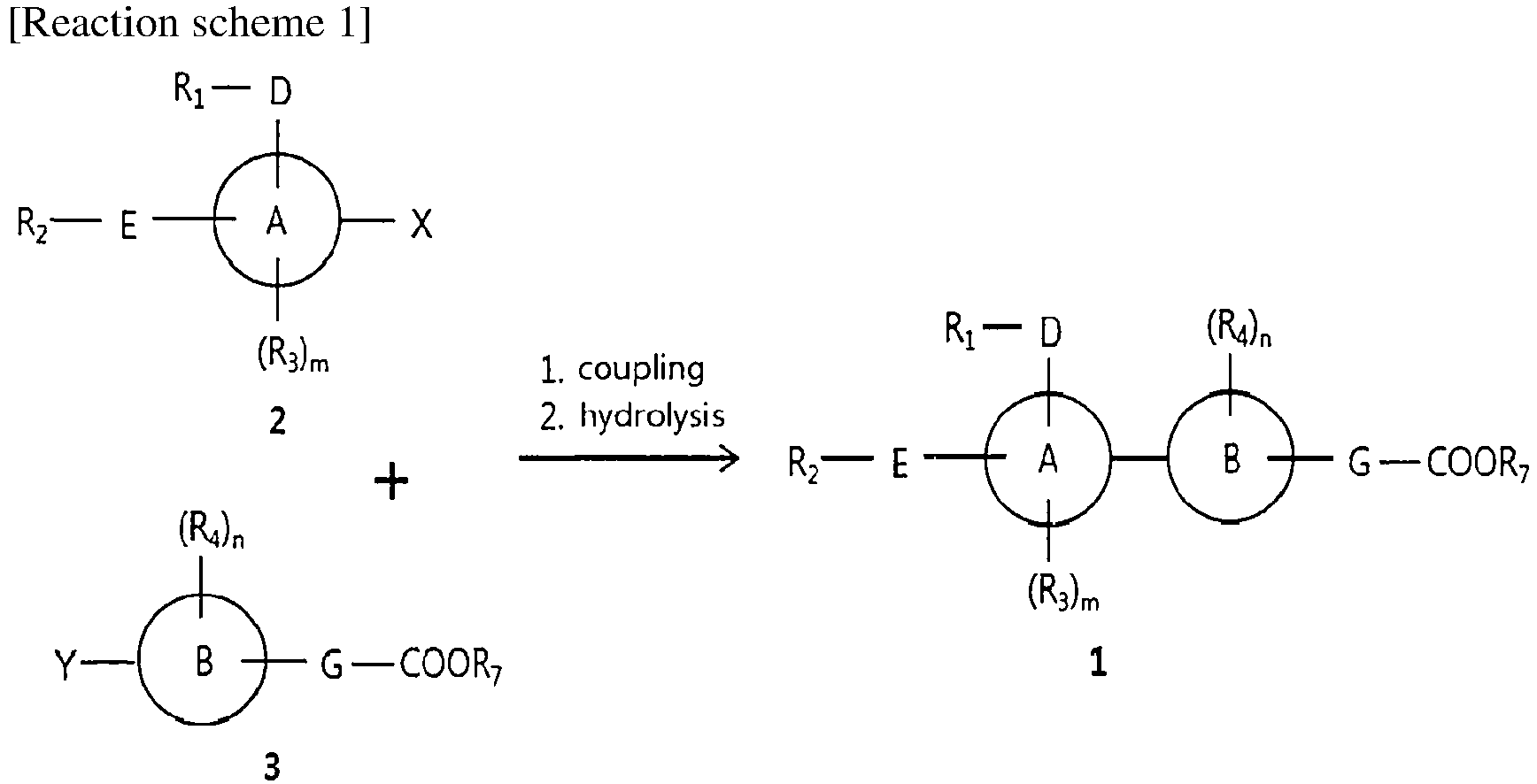
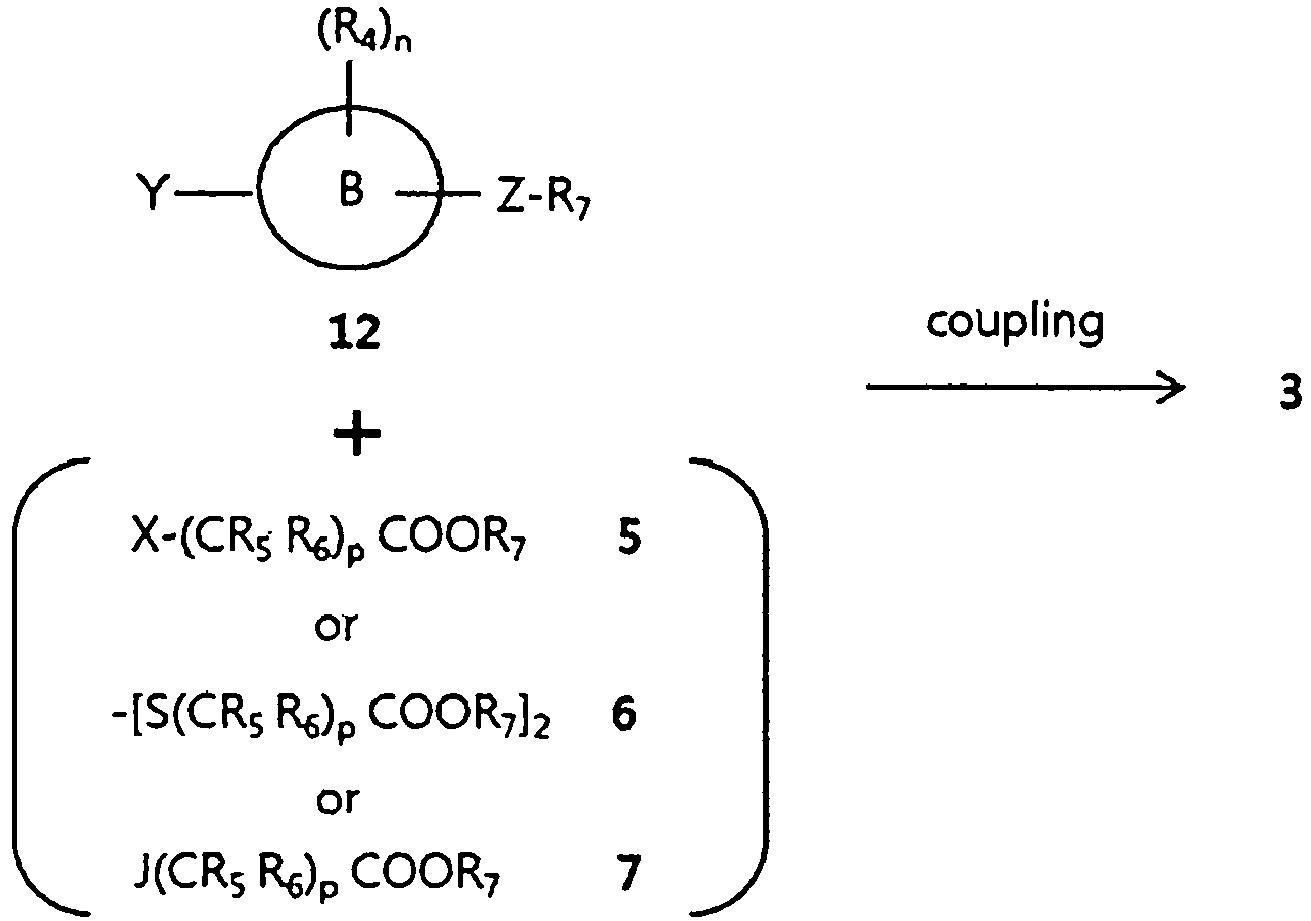
- Furthermore, the compounds of Formula 1 can be produced by coupling reaction of Compound 4 and Compound 5, Compound 6 or Compound 7 in the presence of conventional base or coupling reagents and, if necessary, additional hydrolysis, as represented in the following reaction scheme 2. In the reaction scheme 2, Z-R7 and J of Compounds 4 and 7 represent independently halogen, OH, SH or O-alkyl. When Z-R7 is O-alkyl, it is converted to OH by dealkylation reaction before being subjected to coupling reaction.


- The compounds of Formula 1 having various substituents can also be produced through a series of reaction steps, as represented in the following reaction scheme 3. Specifically, the compounds of Formula I can be reduced to Compound I-1 by using conventional reducing agents, and Compound I-1 can be oxidized to aldehyde compounds (Compound I-2) by using oxidizing agents. Compound I-3 can be produced by using conventional olefination reaction such as HWE (Horner-Wadsworth-Emmons) reaction. Compound I-3 can be converted via reduction and hydrolysis to the compounds of Formula I having various substituents.

- The compounds of Formula 1 can be produced by reacting Compound 8 substituted with J radical with Compound 9 or Compound 10 in the presence of conventional base, metal catalysts or coupling reagents, as represented in the following reaction scheme 4. In reaction scheme 4, J and Y represent independently halogen, OH, SH or NH2. When J is amine, "reductive-amination reaction" can be carried out between Compound 8 and Compound 11.
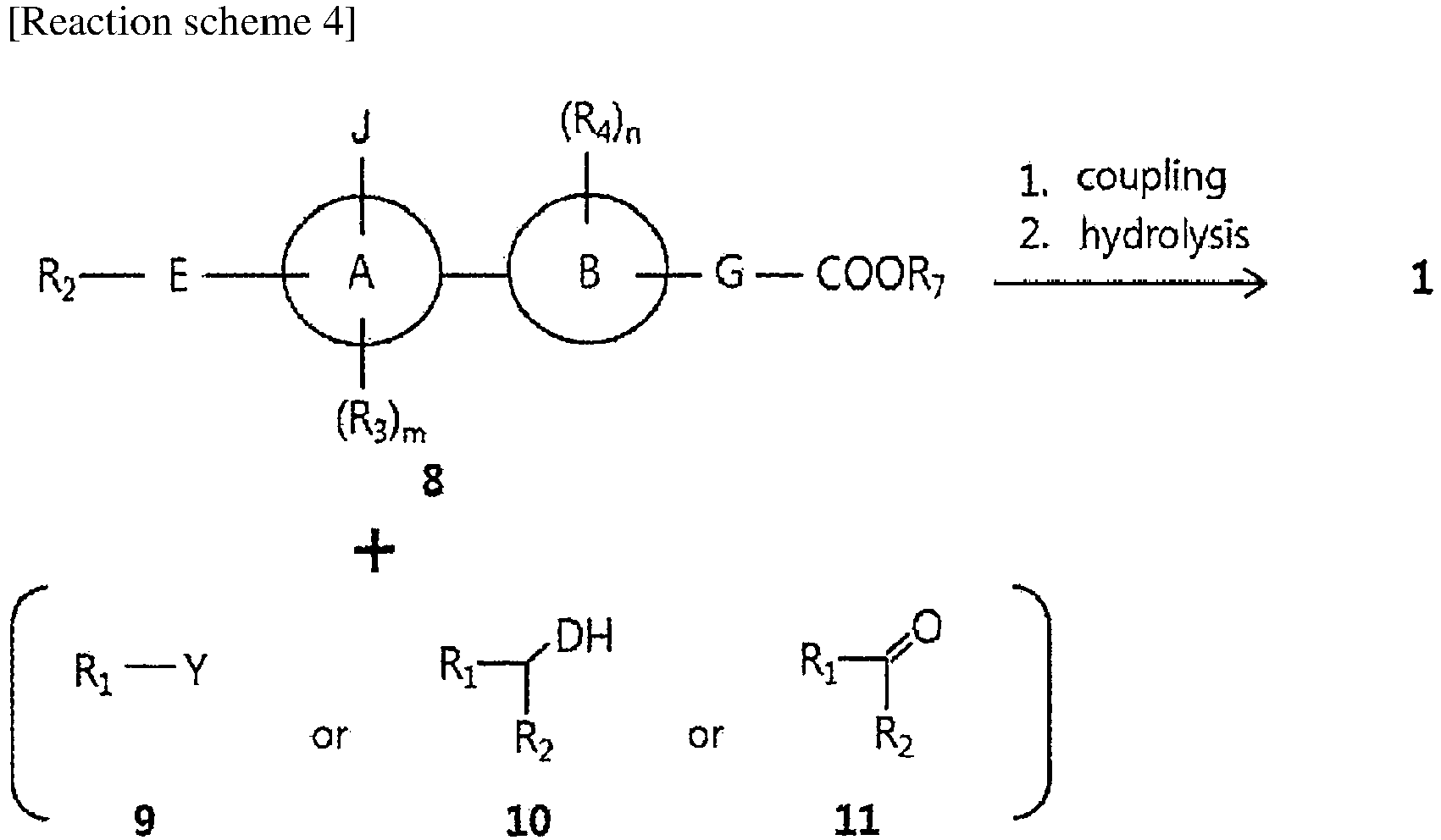
- In the above reaction scheme 1, Compound 3 can be produced by coupling reaction of Compound 12 and Compound 5, Compound 6 or Compound 7 in the presence of conventional base or coupling reagents, as represented in the following reaction scheme 5. In reaction scheme 5, J and Z-R7 are as defined in the above reaction scheme 2.

- In the above reaction scheme 2, Compound 4 can be produced by coupling reaction of Compound 2 and Compound 12 in the presence of conventional coupling reagents such as metal catalysts, as represented in the following reaction scheme 6.
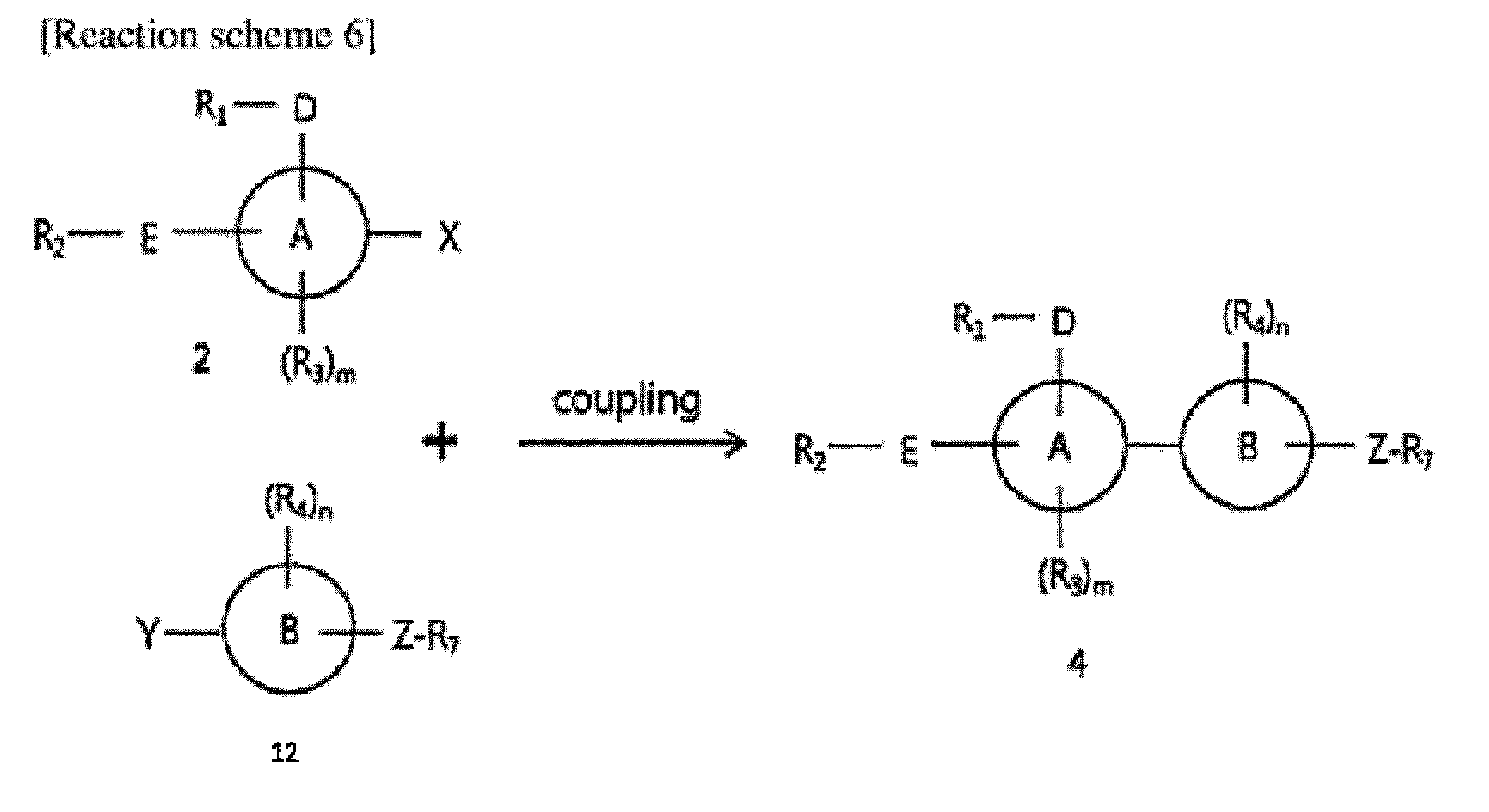
- In the above reaction schemes 1 to 6,
- X represents halogen, boronic acid or -OSO2CF3,
- Y represents boronic acid, halogen or boronic acid ester, and
- A, B, D, E, G, R1, R2, R3, R4, R7, m, n and p are as described in the definition of the compounds of Formula 1.
- In the above reaction, transition metal such as palladium (Pd) can be used as a conventional metal catalyst. The above reactions can be carried out in conventional solvents which do not have an adverse effect on the reactions. Preferable solvents include, but are not limited to, dimethylformamide, dimethylacetamide, tetrahydrofuran, acetonitrile, methanol, ethanol, water, 1,2-dichloroethane, dimethylsulfoxide, ethylether, methyl tert-butylether, methylene chloride, chloroform and mixtures thereof.
- In the above reactions, unexplained compounds are known compounds or compounds easily obtainable from known compounds by known methods or similar methods.
- The compounds of Formula 1 obtained by the above methods can be separated or purified from the reaction products by conventional methods such as recrystallization, ionospheresis, silica gel column chromatography or ion-exchange chromatography.
- As described above, the compounds according to the present invention, starting materials or intermediates for the preparation thereof can be prepared by a variety of methods.
- The compounds according to the present invention have the effect of GPR120 agonists. Accordingly, the present invention provides a pharmaceutical composition as GPR120 agonists comprising the compounds of the invention and, pharmaceutically acceptable salts thereof as an active component. Various kinds of prodrugs, which are converted into the compounds of Formula I in vivo, are also discussed.
- Exemplary diseases which can be prevented or treated by the pharmaceutical composition according to the present invention as GPR120 agonists include, but are not limited to, metabolic disorders such as diabetes, complications of diabetes, obesity, non-alcoholic fatty liver, steatohepatitis, osteoporosis and inflammation.
- In addition, the present invention provides a method for preparing the composition for preventing or treating metabolic disorders such as diabetes, complications of diabetes, obesity, non-alcoholic fatty liver, steatohepatitis, osteoporosis or inflammation which comprises the step of mixing the compound of the invention, a pharmaceutically acceptable salt thereof as an active component and a pharmaceutically acceptable carrier.
- According to the present invention, the "pharmaceutical composition" or the "composition for lowering blood glucose level" can include other components such as carriers, diluents, excipients, etc., in addition to the active component of the present invention. Accordingly, the pharmaceutical composition can include pharmaceutically acceptable carriers, diluents, excipients or combinations thereof as necessary. The pharmaceutical composition facilitates the administration of compounds into the body. Various methods for administering the compounds include, but are not limited to, oral, injection, aerosol, parenteral and local administration.
- Herein, "carriers" mean compounds that facilitate the addition of compounds into the cell or tissue. For example, dimethylsulfoxide (DMSO) is a conventional carrier facilitating the administration of many organic compounds into living cells or tissues.
- Herein, "diluents" mean compounds that not only stabilize a biologically active form but are diluted in solvent dissolving the compounds. Dissolved salts in buffer are used as diluents in this field. A conventionally used buffer is a phosphate buffer saline mimicking salt form in body fluid. Since buffer solution can control the pH of the solution at low concentration, buffer diluents hardly modify the biological activity of compounds.
- Herein, "pharmaceutically acceptable" means such property that does not impair the biological activity and physical property of compounds.
- The compounds according to the present invention can be formulated as various pharmaceutically administered dosage forms. In the preparation of the pharmaceutical composition of the present invention, an active component-specifically, the compound according to the invention is mixed with selected pharmaceutically acceptable carriers considering the dosage form to be prepared. For example, the pharmaceutical composition of the present invention can be formulated as injections, oral preparations and the like, as needed.
- The compounds of the invention can be formulated by conventional methods using known pharmaceutical carriers and excipients, and inserted into a unit or multi-unit containers. The formulations may be solution, suspension or emulsion in oil or aqueous solvent and include conventional dispersing agents, suspending agents or stabilizing agents. In addition, the compounds may be, for example, dry powder form which is dissolved in sterilized pyrogen-free water before use. The compounds of the present invention can be formulated into suppositories by using a conventional suppository base such as cocoa butter or other glycerides. Solid forms for oral administration include capsules, tablets, pills, powders and granules. Capsules and tablets are preferred. Tablets and pills are preferably enteric-coated. Solid forms are manufactured by mixing the compounds of the present invention with at least one carrier selected from inert diluents such as sucrose, lactose or starch, lubricants such as magnesium stearate, disintegrating agents, binders and the like.
- The compounds according to the present invention can be administered in combination with other drugs-for example, other antidiabetics as required.
- The dose of the compounds according to the present invention is determined by a physician's prescription considering the patient's body weight, age and disease condition. A typical dose for adults is in the range of about 0.3 to 500 mg per day according to the frequency and intensity of administration. A typical daily dose of intramuscular or intravenous administration for adults is in the range of about 1 to 300 mg per day which can be administered in divided unit dosages. Some patients need a higher daily dose.
- The present invention also provides compounds for use in a method for preventing or treating diseases by using an effective amount of the compound of claim 1 or a pharmaceutically acceptable salt thereof as an active component of GPR120 agonists. Representative diseases to be treated by GPR120 agonists include, but are not limited to, metabolic disorders such as the above-mentioned diabetes, complications of diabetes, obesity, non-alcoholic fatty liver, steatohepatitis, osteoporosis, inflammation and the like. Herein, the term "treatment" is used to mean deterring, delaying or ameliorating the progress of diseases in a subject exhibiting symptoms of diseases. The term "prevention" is used to mean deterring, delaying or ameliorating the sign of diseases in a subject at risk of exhibiting symptoms of diseases, even if he or she does not exhibit the symptoms.
- The biaryl derivatives according to the present invention promote GLP-1 formation in the gastrointestinal tract and improve insulin resistance in the liver or in muscle due to anti-inflammatory action in macrophages, lipocytes, etc., and can accordingly be effectively used for preventing or treating metabolic disorders such as diabetes, complications of diabetes, obesity, non-alcoholic fatty liver, steatohepatitis, osteoporosis or inflammation.
- The present invention is explained in more detail by the following Examples. However, these Examples seek to illustrate the present invention only, and the scope of the present invention is not limited by them.
- Hereinafter, M means molar concentration and N means normal concentration. Furthermore, abbreviations used in the following Preparations and Examples are as follows:
- BBr3: boron tribromide
- BINAP: 2,2'-bis(diphenylphosphino)-1,1'-binaphthyl
- Br2: bromine
- CH3CN: acetonitrile
- Cs2CO3: cesium carbonate
- DCM: dichloromethane
- DMF: N,N-dimethylformamide
- DMSO: dimethylsulfoxide
- DPPF: 1,1'-bis(diphenylphosphino)ferrocene
- EtOAc: ethyl acetate
- EtOH: ethanol
- Et2O: diethyl ether
- HCl: hydrochloric acid
- Hex: n-hexane
- K2CO3: potassium carbonate
- LAH: lithium aluminum hydride
- MeOH: methanol
- MgSO4: magnesium sulfate
- NaBH4: sodium borohydride
- NaCl: sodium chloride
- Na2CO3: sodium carbonate
- NaH: sodium hydride
- NaOH: sodium hydroxide
- NBS: N-bromosuccinimide
- Pd/C: palladium/carbon
- PdCl2(dppf)-DCM: 1,1'-bis(diphenylphosphino)ferrocene-palladium(II) dichloride dichloromethane
- PdCl2(PPh3)2: bis(triphenylphosphine)palladium(II) dichloride
- Pd2(dba)3: tris(dibenzylideneacetone)dipalladium(0)
- Pd(PPh3)4: tetrakis(triphenylphosphine)palladium(0)
- SOCl2: thionyl chloride
- SPhos: 2-dicyclohexylphosphino-2',6'-dimethoxybiphenyl
- TBAF:tetrabutylammonium fluoride hydrate
- TEA: triethylamine
- TFA: trifluoroacetic acid
- THF: tetrahydrofuran
- XPhos: 2-dicyclohexylphosphino-2',4' ,6'-triisopropylbiphenyl
- 4-Chlorophenol (2 g, 15.5 mmol), bis(pinacolato)diboron (5.92 g, 23.3 mmol), potassium acetate (4.58 g, 46.6 mmol) and Xphos (0.3 g, 0.62 mmol) were dissolved in 30 mL of 1,4-dioxane, and the mixture was charged with N2 gas for 5 minutes. Pd2 (dba)3 (0.14 g, 0.15 mmol) was added thereto, and the mixture was stirred for 1 hour at 110°C. The mixture was filtered through Celite and then purified by column chromatography to obtain the title compound (3.4 g, 99 %).
- 1H NMR (CDCl3) δ 7.71 (2H, d), 6.82 (2H, d), 5.00 (1H, s), 1.33 (12H, s)
- 4-(4,4,5,5-Tetramethyl-1,3,2-dioxaborolan-2-yl)phenol obtained from Step A (0.32 g, 1.4 mmol) was dissolved in 5 mL of DMF. K2CO3 (0.39 g, 2.8 mmol) and 4-butyric acid ethyl ester (0.22 mL, 1.54 mmol) were added thereto, and the mixture was stirred for 1 hour at 60°C. Solids were removed and the mixture was purified by column chromatography to obtain the title compound (0.38 g, 82 %).
- 1H NMR (CDCl3) δ 7.73 (2H, d), 6.87 (2H, d), 4.14 (2H, q), 4.03 (2H, t), 2.51 (2H, t), 2.11 (2H, m), 1.32 (12H, s), 1.25 (3H, t)
- 2,6-Difluorophenol (1.02 g, 7.8 mmol) was dissolved in 15 mL of DMF, and at 0°C NBS (1.40 g, 7.84 mmol) was added thereto. The reaction mixture was stirred for 24 hours at room temperature and concentrated. 50 mL of water was added thereto, and the mixture was extracted with Et2O. The extract was dried with MgSO4 to obtain the title compound (1.41 g, 86 %).
- 1H NMR (CDCl3) δ 7.08 (2H, m), 5.42 (1H, brs)
- 4-Bromo-2,6-difluoro-phenol obtained from Step A (1.414 g, 6.76 mmol), bis(pinacolato)diboron (1.8 g, 7.09 mmol), potassium acetate (2.66 g, 27 mmol) and DPPF (0.19 g, 0.34 mmol) were dissolved in 23 mL of 1,4-dioxane, and the mixture was charged with N2 gas for 5 minutes. PdCl2(dppf)-DCM (0.27 g, 0.34 mmol) was added thereto, and the mixture was stirred for 3 hours at 80°C. The mixture was filtered through Celite and purified by column chromatography to obtain the title compound (1.366 g, 79 %).
- 1H NMR (CDCl3) δ 7.33 (2H, m), 5.25 (1H, s), 1.32 (12H, s)
- 2,6-Difluoro-4-(4,4,5,5-tetramethyl-1,3,2-dioxaborolan-2-yl)phenol obtained from Step B (1.87 g, 7.3 mmol), Cs2CO3 (4.76 g, 14.6 mmol) and 4-bromo-butyric acid ethyl ester (1.42 g, 7.3 mmol) were dissolved in 24 mL of DMF. The mixture was stirred for 24 hours at room temperature. Solids were filtered, and the filtrate was purified by column chromatography to obtain the title compound (1.66 g, 61 %).
- 1H NMR (CDCl3) δ 7.29 (2H, m), 4.21 (2H, t), 4.14 (2H, q), 2.56 (2H, t), 2.07 (2H, m), 1.32 (12H, s), 1.25 (3H, t)
- 4-Bromo-2-chlorophenol (2.0 g, 9.6 mmol), bis(pinacolato)diboron (2.81 g, 11 mmol), potassium acetate (3.78 g, 38.5 mmol) and DPPF (0.27 g, 0.49 mmol) were dissolved in 32 mL of 1,4-dioxane. The mixture was charged with N2 gas for 5 minutes. PdCl2(dppf)-DCM (0.4 g, 0.49 mmol) was added thereto, and the mixture was stirred for 3 hours under reflux. The mixture was filtered through Celite and purified by column chromatography to obtain the title compound (1.91 g, 77 %).
- 1H NMR (CDCl3) δ 7.77 (1H, s), 7.62 (1H, dd), 7.00 (1H, d), 5.73 (1H, s), 1.36 (12H, s)
- 2-Chloro-4-(4,4,5,5-tetramethyl-1,3,2-dioxaborolan-2-yl)phenol obtained from Step A (0.43 g, 1.7 mmol), 4-bromo-butyric acid ethyl ester (0.25 mL, 1.7 mmol) and Cs2CO3 (0.66 g, 2 mmol) were dissolved in 5 mL of DMF. The reaction mixture was stirred for 16 hours at room temperature. The mixture was concentrated and purified by column chromatography to obtain the title compound (0.47 g, 75 %).
- 1H NMR (CDCl3) δ 7.79 (1H, d), 7.63 (1H, dd), 6.89 (1H, d), 4.15 (2H, t), 4.10 (2H, q), 2.56 (2H, t), 2.16 (2H, m), 1.33 (12H, s), 1.25 (3H, t)
- 4-Bromo-2-fluorophenol (1,9 g, 9.9 mmol), bis(pinacolato)diboron (2.9 g, 11.4 mmol), potassium acetate (3.90 g, 39.7 mmol) and DPPF (0.27 g, 0.49 mmol) were dissolved in 32 mL of 1,4-dioxane. The mixture was charged with N2 gas for 5 minutes. PdCl2(dppf)-DCM (0.4 g, 0.49 mmol) was added thereto, and the mixture was stirred for 4 hours under reflux. The mixture was filtered through Celite and then purified by column chromatography to obtain the title compound (2.2 g, 93 %).
- 1H NMR (CDCl3) δ 7.49 (2H, m), 6.98 (1H, t), 5.31 (1H, brs), 1.33 (12H, s)
- 2-Fluoro-4-(4,4,5,5-tetramethyl-1,3,2-dioxaborolan-2-yl)phenol obtained from Step A (0.56 g, 2.3 mmol), 4-bromo-butyric acid ethyl ester (0.34 mL, 2.3 mmol) and Cs2CO3 (0.92 g, 2.8 mmol) were dissolved in 8 mL of DMF. The reaction mixture was stirred for 16 hours at room temperature. The mixture was concentrated and purified by column chromatography to obtain the title compound (0.52 g, 63 %).
- 1H NMR (CDCl3) δ 7.49 (2H, m), 6.93 (1H, t), 4.15 (2H, t), 4.10 (2H, q), 2.53 (2H, t), 2.15 (2H, m), 1.33 (12H, s), 1.25 (3H, t)
- 2,6-Dichloropyridine (3.08 g, 20.7 mmol) and Cs2CO3 (6.8 g, 20.7 mmol) were dissolved in 40 mL of DMF. Cyclopentylthiol (2.17 mL, 20.7 mmol) was added thereto and the mixture was stirred for 16 hours at 80°C. Solids were filtered and the filtrate was concentrated to obtain the title compound (4.24 g, 95 %).
- 1H NMR (CDCl3) δ 7.40 (1H, t), 7.06 (1H, d), 6.97 (1H, d), 4.01 (1H, m), 2.22 (2H, m), 1.76 (2H, m), 1.64 (4H, m)
- 4-Bromo-2-methoxy-phenol (0.41 g, 2.02 mmol) and 4-bromo-butyric acid ethyl ester (0.39 g, 2.02 mmol) were reacted in the same manner as in Step B of Preparation Example 4 to obtain 4-(4-bromo-2-methoxy-phenoxy)-butyric acid ethyl ester (0.55 g, 86 %).
- 4-(4-Bromo-2-methoxy-phenoxy)-butyric acid ethyl ester (130 mg, 0.41 mmol) and bis(pinacolato)diboron (125 mg, 0.49 mmol) were reacted in the same manner as in Step A of Preparation Example 4 to obtain the title compound(80 mg, 54 %).
- 1H NMR (CDCl3) δ 7.39(1H, d), 7.28(1H, s), 6.88(1H, d), 4.14(2H, q), 4.09(2H, t), 3.89(3H, s), 2.52(2H, t), 2.14(2H, m), 1.33(12H, s), 1.26(3H, t)
- 2 mL of THF and 0.5 mL of water were added to 4-[2,6-Difluoro-4-(4,4,5,5-tetramethyl-1,3,2-dioxaborolan-2-yl)phenoxy]butyric acid ethyl ester obtained from Preparation Example 2 (0.1 g, 0.27 mmol), 2-chloro-4-iodopyridine (0.078 g, 0.32 mmol) and K2CO3 (0.112 g, 0.81 mmol). The mixture was charged with N2 gas for 5 minutes. PdCl2(dppf)-DCM (0.011 g, 0.013 mmol) was added thereto, and the mixture was stirred for 16 hours at 80°C. Water was added thereto and the reaction mixture was extracted with EtOAc. The extract was dried with MgSO4 and purified by column chromatography to obtain the title compound (0.084 g, 87 %).
- 1H NMR (CDCl3) δ 8.44 (1H, d), 7.45 (1H, d), 7.33 (1H, dd), 7.17 (2H, m), 4.26 (2H, t), 4.17 (2H, q), 2.58 (2H, t), 2.11 (2H, m), 1.27 (3H, t)
- 6-Chloro-2-pyridinol (1.95 g, 15 mmol) and K2CO3 (4.16 g, 30 mmol) were dissolved in 50 mL of DMF. Cyclopentyl bromide (1.94 mL, 18 mmol) was added thereto and the mixture was stirred for 24 hours at 80°C. Solids were removed and the filtrate was concentrated to obtain the title compound (2.92 g, 98 %).
- 1H NMR (CDCl3) δ 7.47 (1H, t), 6.84 (1H, d), 6.51 (1H, d), 5.38 (1H, m), 1.97 (2H, m), 1.79 (4H, m), 1.62 (2H, m)
- 44 mL of CH3CN was added to 3-Bromophenol (2.31 g, 13.3 mmol) and K2CO3 (1.84 g, 13.3 mmol), and the mixture was stirred for 1 hour under reflux. Bromocyclopentane (1.43 mL, 13.3 mmol) was added thereto, and the reaction mixture was stirred for 16 hours under reflux. The mixture was filtered through Celite and then purified by column chromatography to obtain the title compound (1.5 g, 46 %).
- 1H NMR (CDCl3) δ 7.11 (1H, t), 7.02 (2H, m), 6.80 (1H, dd), 4.72 (1H, m), 1.94-1.73 (6H, m), 1.62 (2H, m),
- 2,6-Dichloropyridine (2.08 g, 14 mmol) and pyrrolidine (1.0 g, 14 mmol), Cs2CO3(4.58 g, 14 mmol) were dissolved in 28 mL of DMF and the mixture was stirred for 16 hours at 80°C. The mixture was filtered through Celite, concentrated under reduced pressure and diluted with water. The mixture was extracted with EtOAc and the extract was dried with MgSO4 to obtain the title compound (2.31 g, 90 %).
- 1H NMR (CDCl3) δ 7.32 (1H, t), 6.49 (1H, d), 6.20 (1H, d), 3.43 (4H, m), 1.99 (4H, m)
- 4-Bromo-2,6-dimethyl-phenol (1.0 g, 4.97 mmol) and 4-bromo-butyric acid ethyl ester (0.97 g, 4.97 mmol) were reacted in the same manner as in Step B of Preparation Example 4 to obtain 4-(4-bromo-2,6-dimethyl-phenoxy)-butyric acid ethyl ester (1.4 g, 89 %).
- 4-(4-Bromo-2,6-dimethyl-phenoxy)-butyric acid ethyl ester (200 mg, 0.63 mmol) and bis(pinacolato)diboron (193 mg, 0.76 mmol) were reacted in the same manner as in Step A of Preparation Example 4 to obtain the title compound (60 mg, 26 %).
- 1H NMR (CDCl3) δ 7.47(2H, s), 4.16(2H, q), 3.80(2H, t), 2.60(2H, t), 2.25(6H, s), 2.14(2H, m), 1.32(12H, s), 1.27(3H, t)
- 4-Bromo-2,3-difluorophenol (0.45 g, 2 mmol) was dissolved in 10 mL of DMF and the solution was cooled to 0°C. NaH (60% in mineral oil, 0.11 g, 2.6 mmol) was added thereto and the mixture was stirred for 30 minutes. 4-Bromo-butyric acid ethyl ester (0.37 mL, 2.4 mmol) was added thereto, and the reaction mixture was stirred for 16 hours at room temperature. The mixture was concentrated under reduced pressure, added with aqueous solution of ammonium chloride and extracted with EtOAc. Separated organic layer was dried with MgSO4 and purified by column chromatography to obtain the title compound (0.533 g, 76 %).
- 1H NMR (CDCl3) δ 7.19 (1H, m), 6.66 (1H, m), 4.16 (2H, q), 4.09 (2H, t), 2.52 (2H, t), 2.14 (2H, m), 1.26 (3H, t)
- 4-(4-Bromo-2,3-difluoro-phenoxy)butyric acid ethyl ester obtained from Preparation Example 12 (0.108 g, 0.33 mmol) and 3-hydroxyphenyl boronic acid (0.059 g, 0.43 mmol) were dissolved in 1.7 mL of 1,4-dioxane and 2M Na2CO3 aqueous solution (0.5 mL, 1 mmol). The mixture was charged for 5 minutes with N2 gas. Pd(PPh3)4(0.019 g, 0.016 mmol) was added thereto, and the reaction mixture was stirred for 1 hour under reflux. The organic layer was extracted with EtOAc and purified by column chromatography to obtain title compound (0.089 g, 79 %).
- 1H NMR (CDCl3) δ 7.29 (1H, t), 7.06 (2H, m), 6.98 (1H, d), 6.84 (1H, dd), 6.78 (1H, m), 5.15 (1H, brs), 4.16 (4H, m), 2.56 (2H, t), 2.17 (2H, m), 1.27 (3H, t)
- 2,6-Dichloropyridine (2.0 g, 13.5 mmol), piperidine (1.33 mL, 13.5 mmol) and Cs2CO3(4.4 g, 13.5 mmol) were dissolved in 27 mL of DMF, and the mixture was stirred for 16 hours at 80°C. The mixture was filtered through Celite, concentrated under reduced pressure and diluted with water. The mixture was extracted with EtOAc and the extract was purified by column chromatography to obtain the title compound (1.91g, 72 %).
- 1H NMR (CDCl3) δ 7.34 (1H, t), 6.52 (1H, d), 6.47 (1H, d), 3.52 (4H, m), 1.64 (6H, m)
- 2,6-Dichloropyridine (2.0 g, 13.5 mmol), aniline (1.23 mL, 13.5 mmol), BINAP (0.33 g, 0.53 mmol) and sodium tert-butoxide (1.82 g, 18.9 mmol) were dissolved in 27 mL of toluene. The mixture was charged with N2 gas for 5 minutes. Pd2(dba)3(0.25 g, 0.27 mmol) was added thereto, and the mixture was stirred for 3 hours at 80°C. The mixture was filtered through Celite and then purified by column chromatography to obtain the title compound (1.32 g, 48 %).
- 1H NMR (CDCl3) δ 7.43 (1H, t), 7.35 (2H, t), 7.27 (2H, m), 7.10 (1H, t), 6.75 (1H, d), 6.73 (1H, d), 6.57 (1H, brs)
- 2,6-Dichloropyridine (2 g, 13.5 mmol) was dissolved in 14 mL of pyridine, and cyclopentylamine (4 mL, 40.5 mmol) was added thereto. The reaction mixture was stirred for 24 hours under reflux. The mixture was concentrated under reduced pressure and then purified by column chromatography to obtain the title compound (1.2 g, 44 %).
- 1H NMR (CDCl3) δ 7.34 (1H, t), 6.54 (1H, d), 6.25 (1H, d), 4.69 (1H, brs), 3.91 (1H, m), 2.01 (2H, m), 1.72 (2H, m), 1.63 (2H, m), 1.47 (2H, m)
- 2,6-Dichloropyridine (2.0 g, 13.5 mmol) and Cs2CO3(8.8 g, 27 mmol) were dissolved in 27 mL of DMF. 2-Methyl-2-propanethiol (1.68 mL, 14.8 mmol) was added thereto, and the mixture was stirred for 16 hours at 80°C. Solids were removed and the filtrate was concentrated under reduced pressure to obtain the title compound (2.4 g, 88 %).
- 1H NMR (CDCl3) δ 7.42 (1H, t), 7.15 (1H, d), 7.04 (1H, d), 1.56 (9H, s)
- 2-tert-butylsulfanyl-6-chloro-pyridine obtained from Preparation Example 17 (1.98 g, 9.8 mmol) was dissolved in 50 mL of acetyl chloride. 0.05 mL (0.098 mmol) of Br2 dissloved in respective 2.5 ml of acetyl chloride and acetic acid was slowly added thereto. The mixture was stirred for 4 hours at room temperature, concentrated under reduced pressure and purified by column chromatography to obtain the title compound (0.787 g, 55 %).
- 1H NMR (CDCl3) δ 7.57 (2H, m), 7.15 (1H, m)
- 6-Chloropyridine-2-thiol obtained from Step A (0.2 g, 1.3 mmol) was dissolved in 4.6 mL of DMF. Cs2CO3 (0.9 g, 2.6 mmol) and (bromomethyl)cyclopropane (0.16 mL, 1.6 mmol) were added thereto, and the reaction mixture was stirred for 16 hours at room temperature and for further 30 minutes at 70°C. The mixture was concentrated under reduced pressure and purified by column chromatography to obtain the title compound (0.206 g, 75 %).
- 1H NMR (CDCl3) δ 7.40 (1H, t), 7.08 (1H, d), 6.98 (1H, d), 3.12 (2H, d), 1.15 (1H, m), 0.59 (2H, m), 0.33 (2H, m)
- 6-Chloropyridine-2-thiol obtained from Step A of Preparation Example 18 (0.2 g, 1.3 mmol) was dissolved in 4.6 mL of DMF. Cs2CO3(0.9 g, 2.6 mmol) and bromocyclobutane (0.16 mL, 1.6 mmol) were added thereto, and the reaction mixture was stirred for 16 hours at room temperature and for further 4 hours at 70°C. The mixture was concentrated under reduced pressure and purified by column chromatography to obtain the title compound (0.16 g, 58 %).
- 1H NMR (CDCl3) δ 7.40 (1H, t), 6.98 (2H, m), 4.30 (1H, m), 2.56 (2H, m), 2.08 (4H, m)
- 6-Chloropyridine-2-thiol obtained from Step A of Preparation Example 18 (0.2 g, 1.3 mmol) was dissolved in 4.6 mL of DMF. Cs2CO3 (0.9 g, 2.6 mmol) and iodopropane (0.16 mL, 1.6 mmol) were added thereto, and the reaction mixture was stirred for 16 hours at room temperature and for further 30 minutes at 70°C. The mixture was concentrated under reduced pressure and purified by column chromatography to obtain the title compound (0.18g, 70 %).
- 1H NMR (CDCl3) δ 7.40 (1H, t), 7.07 (1H, d), 6.97 (1H, d), 3.14 (2H, t), 1.74 (2H, m), 1.04 (3H, t)
- Isopropanol (0.97 g, 16.1 mmol) was dissolved in 45 mL of THF and the solution was cooled to 0°C. NaH (55 % in mineral oil, 0.7 g, 16 mmol) was added thereto, and the mixture was stirred for 1 hour at room temperature. 2,6-Dichloropyridine (2.0 g, 13.5 mmol) was added thereto, and the reaction mixture was stirred for 16 hours under reflux. The mixture was cooled at room temperature, added with water (20 mL) and then extracted with EtOAc. The separated organic layer was dried with MgSO4 and purified by column chromatography to obtain the title compound (1.917 g, 82 %).
- 1H NMR (CDCl3) δ 7.48 (1H, t), 6.83 (1H, d), 6.58 (1H, d), 5.29 (1H, m), 1.34 (6H, d)
- 30 mL of DMF was added to 6-chloro-2-pyridol (2.0 g, 15 mmol), 1-iodopropane (2.75 g, 16 mmol) and K2CO3(4.27 g, 30 mmol) and the reaction mixture was stirred for 16 hours at 80°C. The mixture was concentrated under reduced pressure, added with water and then extracted with EtOAc. The separated organic layer was dried with MgSO4 and purified by column chromatography to obtain the title compound (1.146 g, 43 %).
- 1H NMR (CDCl3) δ 7.50 (1H, t), 6.87 (1H, d), 6.63 (1H, d), 4.24 (2H, t), 1.80 (2H, m), 1.02 (3H, t)
- 15 mL of DMF was added to 6-chloro-2-pyridol (1.0 g, 7.7 mmol), K2CO3 (2.13 g, 15.4 mmol) and (bromomethyl)cyclopropane (1.1 g, 8.1 mmol) and the reaction mixture was stirred for 16 hours at 80°C. The mixture was concentrated under reduced pressure and purified by column chromatography to obtain the title compound (0.65 g, 45 %).
- 1H NMR (CDCl3) δ 7.50 (1H, t), 6.87 (1H, d), 6.67 (1H, d), 4.12 (2H, d), 1.26 (1H, m), 0.62 (2H, m), 0.36 (2H, m)
- 5 mL of DMF was added to 6-chloro-2-pyridol (0.2 g, 1.5 mmol), bromocyclobutane (0.26 g, 1.8 mmol) and K2CO3 (0.43 g. 3 mmol) and the reaction mixture was stirred for 16 hours at 80°C. The mixture was concentrated under reduced pressure and purified by column chromatography to obtain the title compound (0.28 g, 98 %).
- 1H NMR (CDCl3) δ 7.49 (1H, t), 6.86 (1H, d), 6.59 (1H, d), 5.16 (1H, m), 2.46 (2H, m), 2.13 (2H, m), 1.83 (1H, m), 1.66 (1H, m)
- 48% HBr aqueous solution (4.8 mL) dissolved in 4.8 mL of DMSO was added slowly to o-cresol (1.04 g, 9.6 mmol) dissolved in 9.6 mL of acetic acid. The mixture was stirred for 16 hours at room temperature and then NaHCO3 aqueous solution was slowly added. The mixture was extracted with Et2O and the extract was dried with MgSO4 to obtain the title compound (1.82 g, 99 %).
- 1H NMR (DMSO-d6) δ 9.62 (1H, brs), 7.22 (1H, d), 7.12 (1H, dd), 6.72 (1H, d), 2.09 (3H, s)
- 4.6 mL of 1,4-dioxane was added to 4-bromo-2-methyl-phenol obtained from step A (0.26 g, 1.4 mmol), bis(pinacolato)diboron (0.39 g, 1.5 mmol) and potassium acetate (0.41 g, 4.1 mmol). The mixture was charged with N2 gas for 5 minutes. PdCl2 (dppf)-DCM (0.057 g, 0.07 mmol) was added thereto, and the mixture was stirred for 16 hours under reflux. Solids were removed and the mixture was purified by column chromatography to obtain the title compound (0.228 g, 70 %).
- 1H NMR (DMSO-d6) δ 9.70 (1H, brs), 7.37 (1H, d), 7.32 (1H, dd), 6.75 (1H, d), 2.09 (3H, s), 1.25 (12H, s)
- 2-Methyl-4-(4,4,5,5-tetramethyl-1,3,2-dioxaborolan-2-yl)phenol obtained from step B (0.228 g, 0.97 mmol) was dissolved in 3.2 mL of DMF. Cs2CO3 (0.8 g, 2.43 mmol) and 4-bromo-butyric acid ethyl ester (0.15 mL, 1.06 mmol) were added thereto, and the mixture was stirred for 16 hours at room temperature. Solids were removed and the mixture was purified by column chromatography to obtain the title compound (0.268 g, 79 %).
- 1H NMR (CDCl3) δ 7.60 (1H, dd), 7.58 (1H, d), 6.79 (1H, d), 4.13 (2H, q), 4.03 (2H, t), 2.53 (2H, t), 2.20 (3H, s), 2.15 (2H, m), 1.33 (12H, s), 1.25 (3H, t)
- 2-Hydroxybenzotrifluoride (1.0 g, 6.2 mmol) was dissolved in 20 mL of chloroform. Br2 (0.98 g, 6.2 mmol) was slowly added thereto and the mixture was stirred for 16 hours at room temperature. Sodium thiosulfate aqueous solution was added thereto and the mixture was extracted with DCM. Seprated organic layer was dried with MgSO4 to obtain the title compound (0.97 g, 65 %).
- 1H NMR (DMSO-d6) δ 10.93 (1H, brs), 7.63 (2H, m), 6.99 (1H, dd)
- 13 mL of 1,4-Dioxane was added to 4-bromo-2-(trifluoromethyl)phenol obtained from Step A (0.97 g, 4 mmol), bis(pinacolato)diboron (1.13 g, 4.4 mmol), potassium acetate (1.18 g, 12 mmol) and DPPF (0.11 g, 0.2 mmol). The mixture was charged with N2 gas for 5 minutes. PdCl2(dppf)-DCM(0.164 g, 0.2 mmol) was added thereto and the mixture was stirred for 1 hour under reflux. The mixture was filtered through Celite to remove solids, and then purified by column chromatography to obtain the title compound (0.76 g, 65 %).
- 1H NMR (DMSO-d6) δ 11.02 (1H, brs), 7.72 (2H, m), 7.02 (1H, dd), 1.27 (12H, s)
- 4-(4,4,5,5-tetramethyl-1,3,2-dioxaborolan-2-yl)-2-(trifluoromethyl)phenol obtained from Sep B (0.36 g, 1.26 mmol) was dissolved in 4.2 mL of DMF. Cs2CO3 (0.81 g, 2.52 mmol) and 4-bromo-butyric acid ethyl ester (0.2 mL, 1.38 mmol) were added thereto and the mixture was stirred for 16 hours at room temperature. Solids were removed and the mixture was purified by column chromatography to obtain the title compound (0.374 g, 74 %).
- 1H NMR (CDCl3) δ 7.99 (1H, d), 7.90 (1H, dd), 6.95 (1H, dd), 4.13 (4H, m), 2.54 (2H, t), 2.14 (2H, m), 1.33 (12H, s), 1.25 (3H, t)
- r-Valerolactone (0.97 g, 9.68 mmol) was dissolved in 10 mL of 1,4-dioxane. IN NaOH aqueous solution (10.6 mL, 10.6 mmol) was added thereto and the mixture was stirred for 1 hour. Using IN HCl aqueous solution, pH of the reaction mixture was adjusted to 5 and the mixture was extracted with EtOAc. The organic layer was dried with MgSO4 to obtain the title compound (0.88 g, 74 %).
- 1H NMR (CDCl3) δ 3.89 (1H, m), 2.51(2H, t), 1.82 (1H, m), 1.75 (1H, m), 1.24 (3H, d)
- 4-Hydroxypentanoic acid obtained from Step A (0.62 g, 5.25 mmol) was dissolved in 17 mL of THF, and diazomethane (0.25M in Et2O, 31 mL, 7.88 mmol) was slowly added thereto. The mixture was stirred for 1 hour at room temperature, and then concentrated under reduced pressure. The concentrate was purified by column chromatography to obtain the title compound (0.42 g, 60 %).
- 1H NMR (CDCl3) δ 3.84 (1H, m), 3.68 (3H, s), 2.46 (2H, t), 1.82 (1H, m), 1.74 (1H, m), 1.21 (3H, d)
- 4-Hydroxypentanoic acid methyl ester obtained from Step B (0.05 g, 0.39 mmol), 2,6-difluoro-4-(4,4,5,5-tetramethyl-1,3,2-dioxaborolan-2-yl)phenol obtained from Step B of Preparation Example 2 (0.1 g, 0.39 mmol) and triphenylphosphine (0.1 g, 0.39 mmol) were dissolved in 4 mL of THF, and the mixture was slowly cooled to 0°C. Diisopropyl azodicarboxylate (0.077 mL, 0.39 mmol) was slowly added thereto and the reaction mixture was stirred for 18 hours at room temperature. The mixture was concentrated under reduced pressure and purified by column chromatography to obtain title compound (0.1 g, 70 %).
- 1H NMR (CDCl3) δ 7.31 (2H, m), 4.38 (1H, m), 3.68 (3H, s), 2.59 (2H, t), 2.00 (2H, m), 1.32 (12H, s), 1.25 (3H, d)
- 5-Bromo-2(1H)-pyridone (0.05 g, 0.29 mmol), 4-hydroxypentanoic acid methyl ester (0.047 g, 0.29 mmol) and triphenylphosphine (0.075 g, 0.29 mmol) were dissolved in 3 mL of THF. Diisopropyl azodicarboxylate (0.056 mL, 0.29 mmol) was added thereto, and the reaction mixture was stirred for 16 hours at room temperature. The mixture was concentrated under reduced pressure and purified by column chromatography to obtain the title compound (0.051 g, 62 %).
- 1H NMR (CDCl3) δ 8.15 (1H, m), 7.60 (1H, m), 6.58 (1H, d), 5.18 (1H, m), 3.65 (3H, s), 2.41 (2H, m), 2.00 (2H, m), 1.31 (3H, d)
- 4-[(5-Bromo-2-pyridyl)oxy]pentanoic acid methyl ester obtained from Step A (0.05 g, 0.17 mmol), bis(pinacolato)diboron (0.048 g, 0.19 mmol) and potassium acetate (0.067 g, 0.68 mmol) were dissolved in 1 mL of 1,4-dioxane, and the mixture was charged with N2 gas for 5 minutes. PdCl2(dppf)-DCM (0.007 g, 0.009 mmol) was added thereto, and the reaction mixture was stirred for 2 hours at 80°C. The mixture was filtered through Celite and purified by column chromatography to obtain the title compound (0.038 g, 65 %).
- 1H NMR (CDCl3) δ 8.05 (1H, m), 7.89 (1H, m), 6.64 (1H, d), 5.30 (1H, m), 3.65 (3H, s), 2.44 (2H, m), 2.01 (2H, m), 1.34 (3H, d), 1.26 (12H, s)
- 4-Bromo-benzenethiol (0.5 g, 2.64 mmol), NaH (60% in mineral oil, 0.11 g, 2.64 mmol) and methyl 2-bromopropionate (0.32 mL, 2.91 mmol) were reacted in the same manner as in Preparation Example 12 to obtain the title compound (0.58 g, 80 %).
- 1H-NMR (CDCl3) δ 7.43 (2H, d), 7.30 (2H, d), 3.76 (1H, q), 3.66 (3H, s), 1.47 (3H, d).
- LAH (0.28 g, 7.52 mmol) was dissolved in 10 mL of THF, and the solution was cooled to -18°C. Diethyl 1,1-cyclopropanedicarboxylate (1.0 g, 5.37 mmol) in 7 mL of THF was slowly added thereto, and the reaction mixture was stirred for 16 hours at room temperature. 0.3 mL of water and the 0.3 mL of 4M NaOH aqueous solution were added thereto. The mixture was filtered with Celite and purified by column chromatography to obtain the title compound (0.2 g, 35 %).
- 1H NMR (CDCl3) δ 3.62 (4H, s), 2.35 (2H, brs), 0.53 (4H, s)
- [1-(Hydroxymethyl)cyclopropyl]methanol obtained from Step A (0.2 g, 1.96 mmol), 4-bromo-2,6-difluoro-phenol (0.314 g, 1.5 mmol) and triphenylphosphine (0.393 g, 1.5 mmol) were dissloved in 24 mL of THF. Diisopropyl azocarboxylate (0.3 mL, 1.5 mmol) was added thereto, and the reaction mixture was stirred for 16 hours at room temperature. The mixture was concentrated under reduced pressure and purified by column chromatography to obtain the title compound (0.307 g, 70 %).
- 1H NMR (CDCl3) δ 7.08 (2H, m), 4.08 (2H, s), 3.68 (2H, d), 1.84 (1H, t, OH), 0.62 (4H, m)
- [1-[(4-Bromo-2,6-difluoro-phenoxy)methyl]cyclopropyl]methanol obtained from Step B (0.3 g, 1 mmol) was dissolved in 5 mL of DCM, and the solution was cooled to 0 °C. Methanesulfonyl chloride (0.09 mL, 1.12 mmol) and TEA (0.21 mL, 1.5 mmol) were sequentially added thereto, and the mixture was stirred at 0 °C for 40 minutes. 5 mL of Water was added thereto, and the mixture was extracted with DCM to obtain the title compound (0.4g, 99 %).
- 1H NMR (CDCl3) δ 7.09 (2H, m), 4.29 (2H, s), 4.01 (2H, s), 3.05 (3H, s), 0.77 (2H, m), 0.73 (2H, m)
- [1-[(4-Bromo-2,6-difluoro-phenoxy)methyl]cyclopropyl]methyl methane sulfonate obtained from Step C (0.4 g, 1 mmol) was dissolved in 5 mL of DMF. Sodium cyanide (0.054 g, 1.1 mmol) was added thereto, and the reaction mixture was stirred at 60 °C for 16 hours. The mixture was concentrated under reduced pressure. Water was added thereto and the mixture was extracted with EtOAc. The extract was purified by column chromatography to obtain the title compound (0.205 g, 63 %).
- 1H NMR (CDCl3) δ 7.09 (2H, m), 3.98 (2H, s), 2.72 (2H, s), 0.75 (2H, m), 0.70 (2H, m)
- 2-[1-[(4-Bromo-2,6-difluoro-phenoxy)methyl]cyclopropyl]acetonitrile obtained from Step D (0.2 g, 0.67 mmol), bis(pinacolato)diboron (0.172 g, 0.67 mmol), potassium acetate (0.266 g, 2.71 mmol) and DPPF (0.019 g, 0.033 mmol) were dissolved in 4 mL of 1,4-dioxane. The mixture was charged for 5 minutes with N2 gas. PdCl2 (dppf)-DCM(0.027 g, 0.033 mmol) was added thereto, and the mixture was stirred at 80°C for 2 hours. The mixture was filtered through Celite and purified by column chromatography to obtain the title compound (0.185 g, 79 %).
- 1H NMR (CDCl3) δ 7.32 (2H, m), 4.04 (2H, s), 2.75 (2H, s), 1.33 (12H, s), 0.73 (2H, m), 0.68 (2H, m)
- 2-Bromo-5-hydroxypyridine (1.07 g, 6.18 mmol) was dissolved in 20 mL of DMF. K 2CO3 (1.7 g, 12.4 mmol) and 4-bromo-butyric acid ethyl ester (1.2 g, 6.18 mmol) were added thereto, and the reaction mixture was stirred for 16 hours at room temperature. The mixture was concentrated under reduced pressure. Water was added thereto and the mixture was extracted with EtOAc to obtain the title compound (1.67 g, 94 %).
- 1H NMR (CDCl3) δ 8.04 (1H, m), 7.36 (1H, d), 7.09 (1H, m), 4.15 (2H, q), 4.04 (2H, t), 2.51 (2H, t), 2.13 (2H, m), 1.26 (3H, t)
- 4-[(6-Bromo-3-pyridyl)oxy]butyric acid ethyl ester obtained from Step A (0.3 g, 1 mmol) and 3-hydroxyphenylboronic acid (0.172 g, 1.25 mmol) were dissolved in 3 mL of 1,2-dimethoxyethane and Na2CO3(2M aqueous solution, 1.6 mL, 3.2 mmol). The mixture was charged with N2 gas for 5minutes. PdCl2(PPh3)2(0.036 g, 0.052 mmol) was added thereto, and the reaction mixture was stirred at 80°C for 3 hours. Water was added thereto and the mixture was extracted with EtOAc. The organic layer was dried with MgSO4 and purified by column chromatography to obtain the title compound (0.129 g, 41 %).
- 1H NMR (CDCl3) δ 8.34 (1H, m), 7.62 (1H, d), 7.48 (1H, m), 7.41 (1H, m), 7.29 (1H, t), 7.25 (1H, m), 6.85 (1H, m), 5.75 (1H, brs), 4.16 (2H, q), 4.10 (2H, t), 2.54 (2H, t), 2.16 (2H, m), 1.26 (3H, t)
- 2-Phenoxyphenylboronic acid (0.033 g, 0.15 mmol) and 4-iodophenol (0.034 g, 0.15 mmol) were dissloved in 3 mL of H2O, and the mixture was charged with N2 gas for 5 minutes. Pd/C (catalytic amount) and K2CO3 (0.064 g, 0.46 mmol) were added thereto, and the reaction mixture was stirred for 16 hours at room temperature. 1N HCl was added thereto and the mixture was extracted with EtOAc. The separated organic layer was dried with MgSO4 and purified by column column chromatography (eluent, EtOAc/Hex = 1/4) to obtain the title compound (0.022 g, 55 %).
- 1H-NMR (CDCl3) δ 7.46(3H, m), 7.25(3H, m), 7.20(1H, m), 7.00(2H, 6.90(2H, m), 6.89(2H, m), 4.65(1H, s)
- To Isopropyl thiol (0.102 g, 1.351 mmol) dissolved in dry DMF(2 ml), NaH (60 %) (0.07 g, 1.75 mmol) was added slowly dropwise at 0°C. The mixture was stirred for 30 minutes, added to the flask charged with 2,3-dichloropyridine (0.53 g, 3.58 mmol), and stirred at room temperature for 1 hour. After NH4Cl aqueous solution was added thereto, organic layer was separated by extracting with EtOAc. The organic layer was dried with anhydrous MgSO4 and purified by column chromatography (eluent, EtOAc/ Hex = 1/4) to obtain the title compound (0.062 g, 24 %).
- 1H-NMR (CDCl3) δ 8.35(1H, m), 7.52(1H, m), 6.94(1H, m), 4.05(1H, m), 1.43(6H, d)
- 3-Chloro-2-isopropylsulfanyl-pyridine obtained from Step A (0.02 g, 0.10 mmol) and (4-methoxy-phenyl)-boronic acid (0.024 g, 0.15 mmol) were dissloved in DMF. The mixture was charged for 5 minutes with N2 gas. Pd2(dba)3 (catalytic amount) and Sphos (catalytic amount) were added thereto, and the reaction mixture was stirred at 80°C for 16 hours. After NaCl aqueous solution was added thereto, the mixture was extracted with EtOAc. The separated organic layer was dried with MgSO4 and purified by column chromatography (eluent, EtOAc/Hex = 1/4) to obtain the title compound (0.01 g, 37 %).
- 1H-NMR (CDCl3) δ 8.41(1H, m), 7.35(3H, m), 7.02(1H, m), 6.95(2H, m), 4.06(1H, m), 3.84(3H, s), 1.35(6H, d)
- 2-Isopropylsulfanyl-3-(4-methoxy-phenyl)-pyridine obtained from Step B (0.02 g, 0.07 mmol) was dissolved in DCM(3 mL), and the solution was cooled to -78°C. BBr3 (1.0 M in DCM, 0.116 mL, 0.11 mmol) was slowly added thereto, and the mixture was stirred for 3 hours at room temperature. Upon completion of the reaction, the mixture was cooled to -20°C. Methanol was added to the residue to dilute. The mixture was extracted with DCM. The organic layer was dried with MgSO4 and concentrated under reduced pressure. The obtained residue was purified by column chromatography (eluent, EtOAc/Hex = 1/3) to obtain the title compound (15 mg, 75 %).
- 1H-NMR (CDCl3) δ 8.41(1H, m), 7.34(1H, m), 7.26(2H, m), 7.02(1H, m), 6.89(2H, m), 4.79(1H, s), 4.05(1H, m), 1.35(6H, d)
- 2-Phenoxyphenylboronic acid (0.045 g, 0.21 mmol) and 5-bromo-1,3-difluoro-2-methoxy-benzene (0.031 g, 0.14 mmol) were dissolved in isopropyl alcohol/water(1/1). Pd/C(catalytic amount) and Na3PO4 12H2O(0.186 g, 0.49 mmol) were added thereto, and the mixture was stirred at 80 °C for 1 hour. The mixture was filtered through Celite, and extracted with EtOAc to separate organic layer. The organic layer was dried with MgSO4 and purified by column chromatography (eluent, EtOAc/Hex = 1/20) to obtain the title compound (0.026 g, 40 %).
- 1H-NMR (CDCl3) δ 7.40(1H, m), 7.30(3H, m), 7.20(1H, m), 7.11(2H, m), 7.05(1H, m), 6.97(1H, m), 6.91(2H, m), 4.00(3H, s)
- 3,5-Difluoro-4-methoxy-2'-phenoxy-biphenyl obtained from Step A (0.026 g, 0.083 mmol) was reacted in the same manner as in step C of Preparation Example 33 to obtain the title compound (0.018 g, 72 %).
- 1H-NMR (CDCl3) δ 7.40(1H, m), 7.30(3H, m), 7.20(1H, m), 7.11(2H, m), 7.05(1H, m), 6.96(1H, m), 6.91(2H, m), 5.08(1H, s)
- Cyclopentyl thiol (0.477 g 4.67 mmol) was dissolved in dry DMF(2 ml) and the solution was cooled to 0°C. NaH(60 %)(0.24 g, 6.03 mmol) was added slowly dropwise thereto and the mixture was stirred for 30 minutes. The mixture was added to the flask charged with 2,3-dichloropyridine (0.69 g, 4.67 mmol) and stirred for 1 hour at room temperature. To the reaction mixture, NH4Cl aqueous solution was added and the mixture was extracted with EtOAc to separate organic layer. The organic layer was dried with anhydrous MgSO4 and purified by column chromatography (eluent, EtOAc/ Hex = 1/4) to obtain the title compound (0.61 g, 61 %).
- 1H-NMR (CDCl3) δ 8.33(1H, m), 7.51(1H, m), 6.92(1H, m), 4.09(1H, m), 2.23(2H, m), 1.79(2H, m), 1.66(4H, m)
- 3-Chloro-2-cyclopentylsulfanyl-pyridine obtained from Step A (0.057 g, 0.266 mmol) was reacted in the same manner as in Step B of Preparation Example 33 to obtain the title compound (0.046 g, 61 %).
- 1H-NMR (CDCl3) δ 8.41(1H, m), 7.36(3H, m), 7.01(1H, m), 6.96(2H, m), 4.08(1H, m), 3.85(3H, s), 2.19(2H, m), 1.70(2H, m), 1.66(4H, m)
- 2-Cyclopentylsulfanyl-3-(4-methoxy-phenyl)-pyridine obtained from Step B (0.046 g, 0.161 mmol) was reacted in the same manner as in Step C of Preparation Example 33 to obtain the title compound (0.024 g, 55 %).
- 1H-NMR (CDCl3) δ 8.40(1H, m), 7.33(3H, m), 7.01(1H, m), 6.98(2H, m), 4.87(1H, s), 4.09(1H, m), 2.18(2H, m), 1.70(2H, m), 1.66(4H, m)
- 2-Fluoro-3-iodo-pyridine (0.054 g, 0.24 mmol) and Cs2CO3 (0.158 g, 0.266 mmol) and phenol (0.025 g, 0.266 mmol) were dissolved in 2 mL of DMF. The reaction mixture was stirred at 80°C for 16 hours. NaCl aqueous solution was added thereto and the mixture was extracted with EtOAc to separate organic layer. The organic layer was dried with anhydrous MgSO4 and purified by column chromatography (eluent, EtOAc/ Hex = 1/7) to obtain the title compound (0.058 g, 71 %).
- 1H-NMR (CDCl3) δ 8.15(1H, m), 8.08(1H, m), 7.40(2H, m), 7.26(1H, m), 7.15(2H, m), 6.75(1H, m)
- Isopropyl alcohol (0.043 g, 717 mmol) was dissolved in dry DMF(3 ml), and at 0 °C NaH(60 %)(0.03 g, 0.71 mmol) was added slowly dropwise thereto. The mixture was stirred for 30 minutes. The reaction mixture was added to the flask charged with 2-fluoro-3-iodo-pyridine (0.10 g, 0.44 mmol), and stirred for 1 hour at room temperature. NH4Cl aqueous solution was added thereto, and the mixture was extracted with EtOAc to separate organic layer. The organic layer was dried with anhydrous MgSO4 and purified by column chromatography (eluent, EtOAc/Hex = 1/4) to obtain the title compound (0.029 g, 24 %).
- 1H-NMR (CDCl3) δ 8.08(1H, m), 8.00(1H, m), 6.59(1H, m), 5.27(1H, m), 1.38(6H, d)
- Cyclopentanol and 2-fluoro-3-iodo-pyridine (0.10 g, 0.44 mmol) were reacted in the same manner as in Preparation Example 37 to obtain the title compound (0.091 g, 70 %).
- 1H-NMR (CDCl3) δ 8.09(1H, m), 7.99(1H, m), 6.59(1H, m), 5.43(1H, m), 2.00(2H, m), 1.94(4H, m), 1.66(2H, m)
- 2-Fluoro-3-iodo-pyridine (0.065 g, 0.29 mmol), Cs2CO3 (0.19 g, 0.58 mmol) and cyclopentylthiol (0.03 g, 0.291 mmol) were dissolved in 2 mL of DMF. The reaction mixture was stirred at 80°C for 2 hours. NaCl aqueous solution was added thereto and the mixture was extracted with EtOAc to separate organic layer. The organic layer was dried with MgSO4 and purified by column chromatography (eluent, EtOAc/Hex = 1/4) to obtain the title compound (0.053 g, 65 %).
- 1H-NMR (CDCl3) δ 8.38(1H, m), 7.89(1H, m), 6.68(1H, m), 4.00(1H, m), 2.22(2H, m), 1.80(2H, m), 1.66(4H, m)
- Cyclopropyl-methanol (0.089 g, 1.23 mmol) was dissolved in dry DMF(2 ml), and at 0°C NaH(60 %)(0.054g, 1.35 mmol) was added slowly dropwise thereto. The mixture was stirred for 30 minutes, slowly added to the flask charged with 2-fluoro-3-iodo-pyridine (0.137 g, 0.617 mmol) and then stirred for 1 hour at room temperature. NH4Cl aqueous solution was added thereto and the mixture was extracted with EtOAc to separate organic layer. The organic layer was dried with anhydrous MgSO4 and purified by column chromatography (eluent, EtOAc/Hex = 1/5) to obtain the title compound (0.141 g, 83 %).
- 1H-NMR (CDCl3) δ 8.07(1H, m), 8.00(1H, m), 6.61(1H, m), 4.20(2H, d), 1.32(1H, m), 0.60(2H, m), 0.39(2H, m)
- 2-Fluoro-3-iodo-pyridine (0.42 g, 1.8 mmol) and (4-methoxyphenyl)methanethiol (0.43 g, 2.8 mmol) were reacted in the same manner as in Preparation Example 12 to obtain the title compound (0.56 g, 84%).
- 1H-NMR (CDCl3) δ 8.43 (1H, m), 7.93 (1H, m), 7.32 (2H, d), 6.85 (2H, d), 6.74 (1H, m), 4.35 (2H, s), 3.79 (3H, s)
- 3-Iodo-2-(4-methoxy-benzylsulfanyl)-pyridine obtained from Step A (0.1 g, 0.28 mmol) and 2-(3,5-difluoro-4-methoxy-phenyl)-4,4,5,5-tetramethyl-[1,3,2]dioxaborolane obtained from Preparation Example 238 (0.11 g, 0.42 mmol) were reacted in the same manner as in Step A of Example 28 to obtain the title compound (0.08 g, 77%).
- 1H-NMR (CDCl3) δ 8.47 (1H, m), 7.36 (1H, m), 7.30 (2H, d), 7.07 (1H, m), 6.96 (2H, m), 6.81 (2H, d), 4.38 (2H, s), 4.03 (3H, s), 3.78 (3H, s)
- 3-(3,5-Difluoro-4-methoxy-phenyl)-2-(4-methoxy-benzylsulfanyl)-pyridine obtained from Step B (0.033 g, 0.097 mmol) was dissolved in TFA (2 ml). Anisole (0.5 ml) and triflic acid (0.2 mL) were slowly added thereto, and the mixture was stirred at 70°C for 1 hour. At 0 °C, sodium bicarbonate aqueous solution was added slowly thereto and the mixture was extracted with EtOAc. The organic layer was dried with MgSO4, evaporated under reduced pressure and recrystallized with Et2O to obtain the title compound (0.033 g, 61 %).
- 1H-NMR (DMSO-d6) δ 7.72(1H, m), 7.57(1H, m), 7.42(2H, m), 6.84(1H, m), 3.96 (3H, s)
- 3-(3,5-Difluoro-4-methoxy-phenyl)-pyridine-2-thiol obtained from Step C (0.033 g, 0.13 mmol) was dissolved in dry DMF(1.5 ml), and at 0°C NaH(60 %)(0.01 g, 0.195 mmol) was added slowly dropwise thereto. The mixture was stirred for 30 minutes. Bromomethyl cyclopropane (0.021 g, 0.156 mmol) was added slowly at 0 °C thereto, and the reaction mixture was stirred for 2 hours at room temperature. NH4Cl aqueous solution was added thereto, and the mixture was extracted with EtOAc to separate organic layer. The organic layer was dried with MgSO4, purified with column chromatography (eluent, EtOAc/Hex=1/5) to obtain the title compound (0.032 g, 82 %).
- 1H-NMR (CDCl3) δ 8.42(1H, m), 7.33(1H, m), 7.00(3H, m), 4.06(3H, s), 3.12(2H, d), 1.12(1H, m), 0.57(2H, m), 0.29(2H, m)
- 3-Iodo-2-(4-methoxy-benzylsulfanyl)-pyridine obtained from Step A of Preparation Example 41 (0.1 g, 0.28 mmol) and (4-methoxyphenyl)boronic acid (0.085 g, 0.56 mmol) were reacted in the same manner as in Step A of Example 28 to obtain the title compound (0.075 g, 79%).
- 1H-NMR (CDCl3) δ 8.44 (1H, m), 7.36 (1H, m), 7.33 (4H, m), 7.05 (1H, m), 6.93 (2H, d), 6.80 (2H, d), 4.36 (2H, s), 3.83 (3H, s), 3.76 (3H, s)
- 2-(4-methoxy-benzylsulfanyl)-3-(4-methoxy-phenyl)-pyridine obtained from Step A (0.212 g, 0.628 mmol) was reacted in the same manner as in Step C of Preparation Example 41 to obtain the title compound (0.109 g, 80 %).
- 1H-NMR (DMSO-d6) δ 7.65(1H, m), 7.55(2H, d), 7.48(1H, m), 6.93(2H, d), 6.82(1H, m), 3.78 (3H, s)
- 3-(4-Methoxy-phenyl)-pyridine-2-thiol obtained from Step B (0.212 g, 0.628 mmol), NaH (0.012 g, 0.294 mmol) and bromo-cyclobutane (0.024 g, 0.176 mmol) were reacted in the same manner as in Step D of Preparation Example 41 to obtain the title compound (0.0094 g, 24 %).
- 1H-NMR (CDCl3) δ 8.37(1H, m), 7.34(3H, m), 7.02(3H, m), 4.42(1H, m), 3.86(3H, s), 2.49(2H, m), 2.03(4H, m)
- 2-(4-Methoxy-benzylsulfanyl)-3-(4-methoxy-phenyl)-pyridine obtained from Step A of Preparation Example 42 (0.04 g, 0.184 mmol) was reacted in the same manner as in Steps C and D of Preparation Example 41 to obtain the title compound (0.02 g, 44 %).
- 1H-NMR (CDCl3) δ 8.40(1H, m), 7.37(3H, m), 7.02(3H, m), 4.09(2H, m), 3.86(3H, s), 1.09(1H, m), 0.54(2H, m), 0.27(2H, m)
- Magnesium (0.99 g, 40.74 mmol) was dissolved in THF (20 mL). At 50°C, cyclobutyl bromide (5.0 g, 37.03 mmol) in THF(5 mL) was slowly added thereto and the mixture was stirred for 2 hours under reflux. At 0°C, sulfur (1.06 g, 33.33 mmol) was added slowly and the mixture was stirred at 50°C for 2 hours. At 0°C, LAH (0.843 g, 22.22 mmol) was slowly added thereto and the mixture was stirred for 30 minutes under reflux. At 0°C, ammonium chloride aqueous solution (20 mL) and IN HCl (20 mL) was used to terminate the reaction. The mixture was extracted with Et2O (30 ml*3) to separate organic layers. The organic layers were dried with MgSO4 and used for the next reaction.
- Cyclobutanethiol obtained from Step A (0.069 g, 0.782 mmol) and 2-fluoro-3-iodo-pyridine (0.1 g, 0.43 mmol) were dissolved in DMF (3 mL). Cs2CO3 (0.26 g, 0.86 mmol) was added thereto, and the reaction mixture was stirred with heating at 80°C. NaCl aqueous solution was added thereto and the mixture was extracted with EtOAc. The organic layer was dried with MgSO4 and purified by column chromatography (eluent, EtOAc/Hex = 1/4) to obtain the title compound (0.115 g, 91 %).
- 1H-NMR (CDCl3) δ 8.36(1H, m), 7.90(1H, m), 6.69(1H, m), 4.33(1H, m), 2.54(2H, m), 2.14(2H, m), 2.05(2H, m)
- 3-(4-Methoxy-phenyl)-pyridine-2-thiol obtained from Step B of Preparation Example 42 (0.053 g, 0.243 mmol), NaH (0.02 g, 0.487 mmol) and 1-iodo-propane (0.049 g, 0.292 mmol) were reacted in the same manner as in Step D of Preparation Example 41 to obtain the title compound (0.023 g, 36 %).
- 1H-NMR (CDCl3) δ 8.40(1H, m), 7.36(3H, m), 7.03(1H, m), 6.98(2H, m), 3.86(3H, s), 3.13 (2H, m), 1.68(2H, m), 1.01(3H, m)
- 2-Bromo-phenol (0.373 g, 2.15 mmol) and 2-bromo-propane (0.291 g, 2.371 mmol) were reacted in the same manner as in Step B of Preparation Example 44 to obtain the title compound (0.257 g, 55 %).
- 1H-NMR (CDCl3) δ 7.52(1H, m), 7.25(1H, m), 6.91(1H, m), 6.80(1H, m), 4.54(1H, m), 1.38(6H, d)
- 2-Bromo-phenol (0.235 g, 1.35 mmol) and bromo-cyclobutane (0.201 g, 1.49 mmol) were reacted in the same manner as in step B of Preparation Example 44 to obtain the title compound (0.061 g, 19 %).
- 1H-NMR (CDCl3) δ 7.53(1H, m), 7.19(1H, m), 6.76(1H, m), 6.80(1H, m), 4.68(1H, m), 2.46 (2H, m), 2.27(2H, m), 1.88(1H, m), 1.68(1H, m)
- 2-Bromo-phenol (0.235 g, 1.35 mmol) and bromomethyl-cyclopropane (0.201 g, 1.49 mmol) were reacted in the same manner as in Step B of Preparation Example 44 to obtain the title compound (0.267 g, 86 %).
- 1H-NMR (CDCl3) δ 7.54(1H, m), 7.22(1H, m), 6.90(1H, m), 6.83(1H, m), 3.89 (2H, d), 1.31(1H, m), 0.63(2H, m), 0.40(2H, m)
- 2-Bromo-phenol (0.366 g, 2.11 mmol) and bromo-cyclopentane (0.341 g, 2.32 mmol) were reacted in the same manner as in Step B of Preparation Example 44 to obtain the title compound (0.369 g, 72 %).
- 1H-NMR (CDCl3) δ 7.51(1H, m), 7.25(1H, m), 6.88(1H, m), 6.78(1H, m), 4.80(1H, m), 1.88(6H, m), 1.65(2H, m)
- Benzyloxy-acetaldehyde (0.95 g, 6.35 mmol) was dissolved in benzene (21 mL), and at room temperature, (1-ethoxycarbonylethylidene)triphenylphosporane (2.76 g, 7.63 mmol) was added thereto. The mixture was stirred at 70°C for 16 hours. After completion of the reaction, the mixture was concentrated under reduced pressure and purified by column chromatography (eluent, EtOAc/Hex = 1/4) to obtain the title compound (1.31 g, 94 %).
- 1H-NMR (CDCl3) δ 7.35(5H, m), 6.86(1H, m), 4.54(2H, s), 4.19(4H, m), 1.81(3H, m), 1.28(3H, m)
- (E)-4-benzyloxy-2-methyl-2-butenoic acid ethyl ester obtained from Step A (1.31 g, 5.97 mmol) was dissolved in EtOAc/MeOH(8/2)(20 mL), and 10% Pd/C(0.13 g) was added thereto. The mixture was stirred for 12 hours under H2 atmosphere at room temperature. After completion of the reaction, the mixture was filtered by Celite, concentrated under reduced pressure and purified by column chromatography (eluent, EtOAc/Hex = 1/2) to obtain the title compound (0.726 g, 98 %).
- 1H-NMR (CDCl3) δ 4.13(2H, m), 3.68(2H, m), 2.62(1H, m), 1.19(1H, m), 1.70(1H, m), 1.56(1H, m), 1.24(3H, m), 1.18(3H, d)
- NBS (2.14 g, 12.05 mmol) was dissolved in DCM (10 ml), and triphenylphosphine (2.94 g, 11.22 mmol) was added thereto. The mixture was stirred for 10 minutes. Pyridine (0.38 g, 4.80 mmol) and then 4-hydroxy-2-methyl-butyric acid ethyl ester (0.586 g, 4.00 mmol) obtained from Step B were added thereto. The mixture was stirred for 16 hours. After completion of the reaction, the mixture was concentrated under reduced pressure and purified by column chromatography (eluent, EtOAc/Hex = 1/4) to obtain a small amount of title compound (0.061 g, 7.3%).
- 1H-NMR (CDCl3) δ 4.13(2H, m), 3.41(2H, m), 2.67(1H, m), 2.27(1H, m), 1.91(1H, m), 1.26(3H, m), 1.19(3H, d)
- 2-Cyclobutylsulfanyl-3-iodo-pyridine (0.193 g, 0.66 mmol) obtained in Preparation Example 44 and 2,6-difluoro-4-(4,4,5,5-tetramethyl-1,3,2-dioxaborolan-2-yl)phenol (0.254 g, 0.992 mmol) obtained in step B of Preparation Example 2 were reacted in the same manner as in Step A of Example 50 to obtain the title compound (0.078 g, 40 %).
- 1H-NMR (CDCl3) δ 8.39(1H, m), 7.30(1H, m), 6.98(3H, m), 5.15(1H, s), 4.40(1H, m), 2.49(2H, m), 2.02(4H, m)
- Benzyloxy-acetaldehyde (0.95 g, 6.35 mmol) and ethyl 2-(triphenylphosphoranylidene)acetate (1.36 g, 3.92 mmol) were reacted in the same manner as in Step A of Preparation Example 50 to obtain the title compound (E/Z mixture) (0.043 g, 40 %).
- 1H-NMR (CDCl3) δ 7.34(5H, m), 6.96(0.62H, m), 6.42(0.38H, m), 6.13(0.62H, m), 5.82(0.38H, m), 4.56(2H, s), 4.19(4H, m), 1.27(3H, m)
- After (E/Z)-4-benzyloxy-but-2-enoic acid ethyl ester (0.36 g, 1.63 mmol) obtained in Step A was dissolved in THF (5 mL), diazomethane (30 mL, 8.23 mmol, 0.25M Et2O) was added thereto. After the reactant was cooled to 0-5°C, palladium(II) acetate (0.022 g, 0.098 mmol) was added slowly thereto, and the mixture was agitated at room temperature for 1 hours. After the termination of the reaction, the reactant was added with water and then extracted. The organic layer was concentrated under reduced pressure and the residue was purified by column chromatography (eluent: EtOAc/Hex = 1/4) to obtain the title compound (0.119 g, 31 %).
- 1H-NMR (CDCl3) δ 7.32(5H, m), 4.51(2H, s), 4.10(2H, m), 3.41(2H, m), 1.70(1H, m), 1.55(1H, m), 1.24(4H, m), 0.85(1H, m)
- 2-Benzyloxymethyl-cyclopropanecarboxylic acid ethyl ester (0.119 g, 0.50 mmol) obtained in Step B was reacted in the same manner as in Step B of Preparation Example 50 to obtain the title compound (0.067 g, 91 %).
- 1H-NMR (CDCl3) δ 4.13(2H, s), 3.60(1H, m), 3.50(1H, m), 1.70(1H, m), 1.55(2H, m), 1.20(4H, m), 0.85(1H, m)
- After 2-hydroxymethyl-cyclopropanecarboxylic acid ethyl ester (0.067 g, 0.46 mmol) obtained in Step C, 2,6-difluoro-4-(4,4,5,5-tetramethyl-1,3,2-dioxaborolan-2-yl)phenol (0.118 g, 0.46 mmol) obtained in Step B of Preparation Example 2 and triphenylphosphine (0.121 g, 0.46 mmol) were dissolved in THF (5 mL), diisopropyl azocarboxylate was added thereto, and the mixture was agitated at room temperature for 16 hours. The reactant was concentrated under reduced pressure and purified by column chromatography to obtain the title compound (0.084 g, 47 %).
- 1H-NMR (CDCl3) δ 7.28(2H, m), 4.11(3H, m), 4.00(1H, m), 1.85(1H, m), 1.60(1H, m), 1.29(12H, s), 1.25(4H, m), 0.85(1H, m)
- 2,5-Difluoro-phenol (0.70 g, 2.4 mmol) was dissolved in chloroform (18 mL), and bromine (0.431 g, 5.4 mmol) dissolved in chloroform (2 mL) was added thereto dropwise at 0°C. The mixture was reacted for 16 hours, and the reaction was terminated by adding NaS2O3 aqueous solution. The reactant was diluted with water, and extracted with EtOAc. The organic layer was separated and dried with MgSO4 and next step was progressed.
- 1H-NMR (CDCl3) δ 7.25(1H, m), 6.83(1H, m), 5.23(1H, s)
- 4-Bromo-2,5-difluoro-phenol (0.865 g, 4.13 mmol) obtained in step A was reacted in the same manner as in Step A of Example 38 to obtain the title compound (1.07 g, 79 %).
- 1H-NMR (CDCl3) δ 7.24(1H, m), 6.78(1H, m), 4.15(2H, q), 4.05(2H, t), 2.53(2H, t), 2.13(2H, m), 1.25(3H, t)
- 4-(4-Bromo-2,5-difluoro-phenoxy)-butyric acid ethyl ester (1.07g, 3.31mmol) obtained in step B, bis(pinacolato)diboron (0.88 g, 3.47 mmol), potassium acetate (1.30 g, 13.24 mmol) and DPPF (0.092 g, 0.16 mmol) were dissolved in 1,4-dioxane (20 mL), the mixture was charged with N2 gas for 5 minutes, then PdCl2(dppf)-DCM (0.135 g, 0.16 mmol) was added thereto. The reactant was agitated at 80°C for 16 hours, and filtered by using celite, and purified by column chromatography to obtain the title compound (0.727 g, 59 %).
- 1H-NMR (CDCl3) δ 7.37(1H, m), 6.16(1H, m), 4.13(2H, q), 4.06(2H, t), 2.52(2H, t), 2.14(2H, m), 1.30(12H, s), 1.25(3H, t)
- 4-Bromo-3,5-difluoro-phenol (1.1 g, 5.26 mmol) and 4-bromo-butyric acid ethyl ester (1.03 g, 5.26 mmol) were reacted in the same manner as in step B of Preparation Example 4 to obtain 4-(4-bromo-3,5-difluoro-phenoxy)-butyric acid ethyl ester (0.90 g, 54 %).
- Then, 4-(4-bromo-3,5-difluoro-phenoxy)-butyric acid ethyl ester (0.37 g, 1.15 mmol) and bis(pinacolato)diboron (0.35 g, 1.37 mmol) were reacted in the same manner as in step A of Preparation Example 4 to obtain the title compound (0.10 g, 24 %).
- 1H-NMR (CDCl3) δ 6.38(2H, m), 4.15(2H, q), 3.98(2H, t), 2.49(2H, t), 2.11(2H, m), 1.35(12H, s), 1.26(3H, t)
- 2-Cyclopentoxy-3-iodo-pyridine (0.52 g, 1.8 mmol) obtained in Preparation Example 38 and 2,6-difluoro-4-(4,4,5,5-tetramethyl-1,3,2-dioxaborolan-2-yl)phenol (0.46 g, 1.8 mmol) obtained in step B of Preparation Example 2 were reacted in the same manner as in Preparation Example 13 to obtain the title compound (0.35 g, 67 %).
- 1H-NMR (CDCl3) δ 8.14(1H, m), 7.56(1H, m), 7.17(2H, m), 6.93(1H, m), 5.96(1H, bs), 5.51(1H, m), 1.94(2H, m), 1.82(2H, m), 1.74(2H, m), 1.63(2H, m)
- Ethyl 4-[2,6-difluoro-4-(2-fluoro-3-pyridyl)phenoxy]butanoate (1.7 g, 5.01 mmol) obtained in Preparation Example 109 was reacted in the same manner as in step B of Example 1 to obtain the title compound (1.5 g, 96 %).
- 1H-NMR (CDCl3) δ 8.22(1H, m), 7.82(1H, m), 7.29(1H, m), 7.15(2H, m), 4.27(2H, t), 2.68(2H, t), 2.14(2H, m)
- 6-Bromo-pyridine-2-carbaldehyde (0.50 g, 2.7 mmol) and 4-[2,6-difluoro-4-(4,4,5,5-tetramethyl-1,3,2-dioxaborolan-2-yl)phenoxy]butyric acid ethyl ester (1.0 g, 2.7 mmol) obtained in Preparation Example 2 were reacted in the same manner as in Preparation Example 13 to obtain the title compound (0.40 g, 43 %).
- 1H-NMR (CDCl3) δ 10.1 (1H, s), 7.93(2H, m), 7.86(1H, d), 7.69(2H, m), 4.27(2H, t), 4.16(2H, q), 2.62(2H, t), 2.13(2H, m), 1.28(3H, t)
- Tetrahydro-pyran-4-ol (0.45 g, 4.44 mmol) and 2-fluoro-3-iodo-pyridine (0.66 g, 2.96 mmol) were reacted in the same manner as in Preparation Example 37 to obtain the title compound (0.80 g, 89 %).
- 1H-NMR (CDCl3) δ 8.07(1H, d), 8.01(1H, d), 6.63(1H, m), 5.30(1H, m), 4.01(2H, m), 3.68(2H, m), 2.04(2H, m), 1.85(2H, m)
- Tetrahydro-furan-3-ol (0.39 g, 4.44 mmol) and 2-fluoro-3-iodo-pyridine (0.66 g, 2.96 mmol) were reacted in the same manner as in Preparation Example 37 to obtain the title compound (0.68 g, 80 %).
- 1H-NMR (CDCl3) δ 8.08(1H, m), 8.03(1H, m), 6.65(1H, m), 5.53(1H, m), 4.12(1H, m), 4.06(1H, m), 3.94(2H, m), 2.23(2H, m)
- After 3-iodophenol (0.5 g, 2.27 mmol) was dissolved in CH3CN (5 mL), Cs2CO3 (2.22 g, 6.81 mmol) and bromocyclobutane (0.21 mL, 2.27 mmol) were added thereto. The mixture was agitated at 80-85°C for 10 hours, and the reactant was cooled and filtered by using celite. The residue was concentrated under reduced pressure and purified by column chromatography (eluent: EtOAc/Hex = 1/10) to obtain the title compound (0.45 g, 72 %).
- 1H NMR (400 MHz, CDCl3) δ 7.25-7.20(m, 1H), 7.17-7.13(m, 1H), 6.92(t, 1H), 6.77-6.72(m, 1H), 4.59-4.50(m, 1H), 2.44-2.33(m, 2H), 2.19-2.05(m, 2H), 1.88-1.77(m, 1H), 1.70-1.57(m, 1H)
- Cyclobutyl-methanol (0.37 g, 4.31 mmol) and 2-fluoro-3-iodo-pyridine (0.60 g, 2.69 mmol) were reacted in the same manner as in Preparation Example 37 to obtain the title compound (0.75 g, 96 %).
- 1H-NMR (CDCl3) δ 8.08 (1H, m), 8.02(1H, m), 6.63(1H, m), 4.29(2H, d), 2.79(1H, m), 2.12(2H, m), 1.96(4H, m)
- Cyclopropanol (0.20 g, 3.43 mmol) and 2-fluoro-3-iodo-pyridine (0.51 g, 2.29 mmol) were reacted in the same manner as in Preparation Example 37 to obtain the title compound (0.30 g, 50 %).
- 1H-NMR (CDCl3) δ 8.16(1H, d), 8.01(1H, d), 6.68(1H, m), 4.30(1H, m), 0.82(4H, m)
- 3-Chloro-2-isopropylsulfanyl-pyridine (0.04 g, 0.213 mmol) obtained in step A of Preparation Examle 33 and 2-(3,5-difluoro-4-methoxy-phenyl)-4,4,5,5-tetramethyl-[1,3,2]dioxaborolane (0.086 g, 0.139 mmol) obtained in Preparation Examle 238 were reacted in the same manner as in step B of Preparation Example 33 to obtain the title compound (0.015 g, 24 %).
- 1H-NMR (CDCl3) δ 8.44(1H, m), 7.33(1H, m), 7.00(3H, m), 4.05(4H, m), 1.37(6H, d)
- 3-(3,5-Difluoro-4-methoxy-phenyl)-2-isopropylsulfanyl-pyridine (0.015 g, 0.05 mmol) obtained in step A was reacted in the same manner as in step C of Preparation Example 33 to obtain the title compound (0.012 g, 85 %).
- 1H-NMR (CDCl3) δ 8.44(1H, m), 7.33(1H, m), 7.00(3H, m), 5.25(1H, s), 4.06(1H, m), 1.37(6H, d)
- After 2-fluoro-3-iodo-pyridine (0.3 g, 1.34 mmol), cyclopentylamine (0.34 g, 4 mmol) and diisopropyl ethylamine (0.46 mL, 2.68 mmol) were dissolved in CH3CN (3.3 mL), the mixture was agitated at 110°C for 2 hours by using microwave. The reactant was concentrated under reduced pressure and purified by column chromatography to obtain the title compound (0.155 g, 40%).
- 1H-NMR (CDCl3) δ 8.07 (1H, d), 7.80 (1H, d), 6.28 (1H, m), 4.88 (1H, brs), 4.30 (1H, m), 2.10 (2H, m), 1.75 (2H,m), 1.65 (2H, m), 1.48 (2H, m)
- 2,6-Dichloropyridine (0.15 g, 10 mmol), cyclopropyl methaneamine (1.3 mL, 15 mmol), (2-biphenyl)di-tert-butylphosphine (0.15 g, 0.5 mmol) and sodium tert - butoxide (1.44 g, 15 mmol) were dissolved in toluene (50 mL), palladium(II) acetate (0.11 g, 0.05 mmol) was added slowly thereto, and the mixture was agitated at 80°C for 6 hours. The reactant was concentrated under reduced pressure and purified by column chromatography to obtain the title compound (0.21 g, 8.8%).
- 1H-NMR (CDCl3) δ 7.33 (1H, t), 6.56 (1H, d), 6.24 (1H, d), 3.10 (2H, m), 1.06 (1H, m), 0.54 (2H, m), 0.25 (2H, m)
- 2-Fluoro-3-iodo-pyridine (0.15 g, 0.67 mmol) and propane-2-amine (0.17 mL, 2 mmol) were reacted in the same manner as in Preparation Example 64 to obtain the title compound (0.047 g, 27%).
- 1H-NMR (CDCl3) δ 8.06 (1H, m), 7.80 (1H, d), 6.28 (1H, m), 4.73 (1H, brs), 4.20 (1H, m), 1.25 (6H, d)
- 2-Fluoro-3-iodo-pyridine (0.15 g, 0.67 mmol) and cyclopropaneamine (0.14 mL, 2 mmol) were reacted in the same manner as in Preparation Example 64 to obtain the title compound (0.013 g, 8%).
- 1H-NMR (CDCl3) δ 8.17 (1H, m), 7.82 (1H, m), 6.37 (1H, m), 5.17 (1H, brs), 2.78 (1H, m), 0.86 (2H, m), 0.56 (2H, m)
- 6-Bromo-pyridin-2-ylamine (0.717 g, 4.14 mmol), TEA (0.75 mL, 5.39 mmol) and dimethyl aminopyridine (0.1 g, 0.83 mmol) were dissolved in DCM (6 mL), tert - butoxycarbonyl tert-butyl carbonate (1.08 g, 4.96 mmol) dissolved in DCM (1.4 mL) was added slowly thereto at room temperature. The mixture was agitated at room temperature for 3 hours, and concentrated under reduced pressure, and purified by column chromatography to obtain the title compound (0.648 g, 57 %).
- 1H-NMR (CDCl3) δ 7.88 (1H, d), 7.50 (1H, t), 7.20 (1H, brs), 7.12 (1H, d), 1.51 (9H, s)
- After tert-butyl N-(6-bromo-2-pyridyl)carbamate (0.2 g, 0.73 mmol) obtained in Preparation Example 68 was dissolved in DMF (2.5 mL), NaH (60% in mineral oil, 0.048 g, 1.1 mmol) was added slowly thereto, and the mixture was agitated at room temperature for 30 minutes. 2-Bromopropane (0.14 mL, 1.46 mmol) was added thereto, and the mixture was agitated at room temperature for 16 hours. The reactant was concentrated under reduced pressure, and added with ammonium chloride aqueous solution and then extracted with EtOAc. The organic layer was separated and dried with MgSO4, and was purified by column chromatography to obtain the title compound (0.06 g, 26 %).
- 1H-NMR (CDCl3) δ 7.84 (1H, t), 7.27 (1H, d), 7.21 (1H, d), 4.55 (1H, m), 1.44 (9H, s), 1.30 (6H, d)
- After 2-iodoaniline (0.39 g, 1.78 mmol) dissolved in dichloroethane (6 mL), cyclopentanone (0.15 g, 1.78 mmol) and acetic acid (0.11 mL, 1.96 mmol) were added thereto, and the mixture was agitated at room temperature for 16 hours. Sodium triacetoxyborohydride (0.56 g, 2.67 mmol) was added thereto, and the mixture was agitated for 5 hours. The reactant was diluted with water and extracted with DCM. The organic layer was separated and dried with MgSO4, and was purified by column chromatography to obtain the title compound (0.12 g, 23 %).
- 1H-NMR (CDCl3) δ 7.64 (1H, d), 7.18 (1H, t), 6.60 (1H, d), 6.40 (1H, t), 4.14 (1H, brs), 3.80 (1H, m), 2.02 (2H, m), 1.76 (2H, m), 1.63 (2H, m), 1.53 (2H, m)
- 3-Bromoaniline (0.306 g, 1.78 mmol) and cyclopentanone (0.15 g, 1.78 mmol) were reacted in the same manner as in Preparation Example 70 to obtain the title compound (0.347 g, 81%).
- 1H-NMR (CDCl3) δ 6.98 (1H, t), 6.77 (1H, d), 6.72 (1H, m), 6.49 (1H, m), 3.77 (2H, m), 2.02 (2H, m) 1.72 (2H, m), 1.62 (2H, m), 1.45 (2H, m)
- 2-Iodoaniline (0.5 g, 2.3 mmol) and propanal (0.22 mL, 3.0 mmol) were reacted in the same manner as in Preparation Example 70 to obtain the title compound (0.39 g, 60%).
- 1H-NMR (CDCl3) δ 7.65 (1H, d), 7.20 (1H, t), 6.56 (1H, d), 6.42 (1H, t), 4.15 (1H, brs), 3.12 (2H, q), 1.70 (2H, m), 1.03 (3H, t)
- 2-Iodoaniline (0.5 g, 2.3 mmol) and cyclopropanecarbaldehyde (0.2 mL, 2.76 mmol) were reacted in the same manner as in Preparation Example 70 to obtain the title compound (0.5 g, 80%).
- 1H-NMR (CDCl3) δ 7.66 (1H, d), 7.20 (1H, t), 6.54 (1H, d), 6.43 (1H, t), 4.27 (1H, brs), 3.00 (2H, m), 1.15 (1H, m), 0.60 (2H, m), 0.28 (2H, m)
- 2-Iodoaniline (0.5 g, 2.3 mmol) and acetone (0.25 mL, 3.42 mmol) were reacted in the same manner as in Preparation Example 70 to obtain the title compound (0.4 g, 66%).
- 1H-NMR (CDCl3) δ 7.69 (1H, d), 7.23 (1H, t), 6.60 (1H, d), 6.45 (1H, t), 4.03 (1H, brs), 3.70 (1H, m), 1.31 (6H, d)
- After 1,2-dibromobenzene (0.3 g, 1.27 mmol), cyclobutylamine (0.22 mL, 2.54 mmol), Cs2CO3 (0.83 g, 2.54 mmol) and 4,5-bis(diphenylphosphino)-9,9-dimethylxanthene (0.073 mg, 0.13 mmol) were dissolved in 1,4-dioxane (12 mL), Pd2(dba)3 (0.03 g, 0.03 mmol) was added thereto and the mixture was agitated under reflux for 16 hours. The reactant was filtered by using celite and was purified by column chromatography to obtain the title compound (0.136 g, 47%).
- 1H-NMR (CDCl3) δ 7.39 (1H, d), 7.15 (1H, t), 6.54 (2H, m), 4.42 (1H, brs), 3.92 (1H, m), 2.45 (2H, m), 1.87 (4H, m)
- 3-Bromoaniline (0.5 g, 2.9 mmol) and cyclopropanecabaldehyde (0.26 mL, 3.48 mmol) were reacted in the same manner as in Preparation Example 70 to obtain the title compound (0.413 g, 62%).
- 1H-NMR (CDCl3) δ 6.99 (1H, t), 6.79 (1H, d), 6.73 (1H, m), 6.51 (1H, m), 3.86 (1H, brs), 2.93 (2H, d), 1.07 (1H, m), 0.56 (2H, m), 0.24 (2H, m)
- 3-Bromoaniline (0.5 g, 2.9 mmol) and acetone (0.43 mL, 5.8 mmol) were reacted in the same manner as in Preparation Example 70 to obtain the title compound (0.6 g, 96%).
- 1H-NMR (CDCl3) δ 7.00 (1H, t), 6.77 (1H, d), 6.70 (1H, m), 6.46 (1H, m), 3.60 (1H, m), 3.51 (1H, brs), 1.20 (6H, d)
- After 1,3-dibromobenzene (1.0 g, 4.24 mmol), pyrrolidine (0.43 mL, 5.0 mmol), sodium tert-butoxide (1.14 g, 11.87 mmol) and BINAP (0.2 g, 0.32 mmol) were dissolved in toluene (17 mL), Pd2(dba)3 (0.097 g, 0.1 mmol) was added thereto and the mixture was agitated under reflux for 4 hours. The reactant was filtered by using celite and was purified by column chromatography to obtain the title compound (0.52 g, 54%).
- 1H-NMR (CDCl3) δ 7.05 (1H, t), 6.75 (1H, d), 6.67 (1H, m), 6.45 (1H, m), 3.26 (4H, m), 2.00 (4H, m)
- 3-Bromoaniline (1.45 g, 8.42 mmol) and propanal (0.49 g, 8.42 mmol) were reacted in the same manner as in Preparation Example 70 to obtain the title compound (0.22 g, 12%).
- 1H-NMR (CDCl3) δ 6.99 (1H, t), 6.78 (1H, d), 6.72 (1H, m), 6.50 (1H, m), 3.70 (1H, brs), 3.05 (2H, t), 1.66 (2H, m), 1.00 (3H, t)
- 1,3-Dibromobenzene (0.45 mL, 3.7 mmol) and cyclobutylamine (0.53 g, 7.45 mmol) were reacted in the same manner as in Preparation Example 75 to obtain the title compound (0.028 g, 3%).
- 1H-NMR (CDCl3) δ 7.00 (1H, t), 6.79 (1H, d), 6.66 (1H, m), 6.45 (1H, m), 3.87 (2H, m), 2.42 (2H, m), 1.81 (4H, m)
- 2-Bromo-4-chloroaniline (0.508 g, 2.46 mmol) and cyclopentanone (0.207 g, 2.46 mmol) were reacted in the same manner as in Preparation Example 70 to obtain the title compound (0.083 g, 12%).
- 1H-NMR (CDCl3) δ 7.39 (1H, m), 7.12 (1H, m), 6.57 (1H, m), 4.25 (1H, brs), 3.76 (1H, m), 2.03 (2H, m), 1.76 (2H, m), 1.63 (2H, m), 1.50 (2H, m)
- 4-Fluoro-2-iodo-aniline (2.0 g, 18 mmol) and cyclopentanone (0.195 g, 2.32 mmol) were reacted in the same manner as in Preparation Example 70 to obtain the title compound (0.19 g, 27%).
- 1H-NMR (CDCl3) δ 7.40 (1H, m), 6.95 (1H, m), 6.52 (1H, m), 3.93 (1H, brs), 3.75 (1H, m), 2.03 (2H, m), 1.76 (2H, m), 1.64 (2H, m), 1.51 (2H, m)
- Cyclopentanone (0.3 g, 3.6 mmol) was dissolved in THF (10 mL), and the mixture was cooled to -78°C. Lithium bis(trimethylsilyl)amide (1.0M in THF, 3.3 mL, 3.3 mmol) was added slowly thereto, and the mixture was agitated for 50 minutes. N-phenyl-bis(trifluoromethanesulfonimide) (1.17 g, 3.27 mmol) was added slowly thereto, and the mixture was agitated for 16 hours. The reactant was added with ammonium chloride aqueous solution and then extracted with Et2O. The organic layer was separated and dried with MgSO4, and was purified by column chromatography, and was concentrated under reduced pressure at 20°C to obtain the title compound (0.196 g, 27%).
- 1H-NMR (CDCl3) δ 5.63 (1H, m), 2.57 (2H,m), 2.42 (2H, m), 2.03 (2H, m)
- After cyclopenten-1-yl trifluoromethanesulfonate (0.525 g, 2.43 mmol) obtained in Preparation Example 83 and (3-nitrophenyl)boronic acid (0.81 g, 4.86 mmol) were added with IN NaOH aqueous solution (7.29 mL, 7.29mmol) and 1,4-dioxane (24 mL), the mixture was charged with N2 gas for 5 minutes, then PdCl2(dppf)-DCM (0.10 g, 0.12 mmol) and DPPF (0.067 g, 0.12 mmol) were added thereto, and the mixture was agitated under reflux for 16 hours. The reactant was added with water and then extracted with EtOAc, and dried with MgSO4. The residue was purified by column chromatography to obtain the title compound (0.055 g, 12%).
- 1H-NMR (CDCl3) δ 8.24 (1H, m), 8.04 (1H, m), 7.72 (1H, d), 7.48 (1H, t), 6.35 (1H, m), 2.74 (2H, m), 2.58 (2H, m), 2.07 (2H, m)
- 1-(Cyclopenten-1-yl)-3-nitro-benzene (0.073 g, 0.39 mmol) obtained in Preparation Example 84 was reacted in the same manner as in step B of Preparation Example 50 to obtain the title compound (0.06 g, 95%).
- 1H-NMR (CDCl3) δ 7.05 (1H, t), 6.66 (1H, d), 6.58 (1H, m), 6.52 (1H, m), 3.59 (2H, brs), 2.90 (1H, m), 2.02 (2H, m), 1.78 (2H, m), 1.66 (2H, m), 1.55 (2H, m)
- After 3-cyclopentylaniline (0.06 g, 0.37 mmol) obtained in Preparation Example 85 was dissolved in 6M HCl aqueous solution (1.9 mL), sodium nitrite (0.5M aqueous solution, 1.2 mL, 0.6 mmol) was added slowly thereto at 0°C. The mixture was agitated at 0°C for 10 minutes, and added slowly with potassium iodide (1.0M aqueous solution, 0.9 mL, 0.9 mmol), and then the mixture was agitated for 40 minutes. After sodium bicarbonate aqueous solution was added thereto to adjust the pH of the solution to 10, the reactant was extracted with EtOAc, and the organic layer was dried with MgSO4 to obtain the title compound (0.07 g, 70%).
- 1H-NMR (CDCl3) δ 7.58 (1H, m), 7.50 (1H, d), 7.19 (1H, d), 7.00 (1H, t), 2.92 (1H, m), 2.04 (2H, m), 1.80 (2H, m), 1.68 (2H, m), 1.58 (2H, m)
- Cyclopentyl magnesium bromide (2.0M in Et2O, 2.4 mL, 4.8 mmol) was added with catalytic copper(I) iodide at 0°C, and the mixture was agitated for 30 minutes. 1-Bromo-3-(bromomethyl)benzene (1.0 g, 4 mmol) dissolved in THF (10 mL) was added slowly thereto, and the mixture was agitated for 16 hours. The reactant was added with potassium dihydrogen phosphate aqueous solution and extracted with EtOAc. The organic layer was dried with MgSO4 and was purified by column chromatography to obtain the title compound (0.116 g, 12%).
- 1H-NMR (CDCl3) δ 7.33 (1H, m), 7.32 (1H, m), 7.12 (1H, t), 7.09 (1H, m), 2.57 (2H, d), 2.06 (1H, m), 1.70 (2H, m), 1.64 (2H, m), 1.53 (2H, m), 1.17 (2H, m)
- 1-Bromo-2-(bromomethyl)benzene (1.0 g, 4 mmol) was reacted in the same manner as in Preparation Example 87 to obtain the title compound (0.24 g, 25%).
- 1H-NMR (CDCl3) δ 7.51 (1H, d), 7.20 (2H, m), 7.03 (1H, m), 2.74 (2H, d), 2.20 (1H, m), 1.68 (4H, m), 1.26 (4H, m)
- After (6-bromo-2-pyridyl)methanol (0.768 g, 4.08 mmol) and triphenylphosphine (1.12 g, 4.28 mmol) were dissolved in DCM (7 mL), carbon tetrabromide (1.48 g, 4.45 mmol) was added thereto at 0°C, and then the mixture was agitated for 2 hours. The reactant was concentrated under reduced pressure and the residue was purified by column chromatography to obtain the title compound (0.527 g, 51%).
- 1H-NMR (CDCl3) δ 7.55 (1H, t), 7.42 (2H, m), 4.49 (2H, s)
- After 2-bromo-6-(bromomethyl)pyridine (0.527 g, 2.1 mmol) obtained in Preparation Example 89 and triethylphosphite(0.36mL, 2.1 mmol) were dissolved in toluene (4 mL), the mixture was agitated under reflux for 5 days, and then concentrated under reduced pressure to obtain the title compound(0.718 g, 99%).
- 1H-NMR (CDCl3) δ 7.50 (1H, t), 7.37 (2H, m), 4.10 (4H, m), 3.38 (2H, d), 1.29 (6H, t)
- After 2-bromo-6-(diethoxyphosphorylmethyl)pyridine (0.24 g, 0.7 mmol) obtained in Preparation Example 90 and cyclopentanone (0.058 mg, 0.7 mmol) were dissolved in THF (3.5 mL), lithium bis(trimethylsilyl)amide (1.0M in THF, 0.84 mL, 0.84 mmol) was added slowly thereto, and the mixture was agitated for 4 hours. The reactant was added with water and then extracted with EtOAc. The organic layer was separated and dried with MgSO4, and was purified by column chromatography to obtain the title compound (0.115 g, 68%).
- 1H-NMR (CDCl3) δ 7.43 (1H, t), 7.19 (1H, d), 7.12 (1H, d), 6.40 (1H, m), 2.73 (2H, m), 2.52 (2H, m), 1.80 (2H, m), 1.68 (2H, m)
- 1-Bromo-2-(bromomethyl)benzene (0.4 g, 1.6 mmol) and cyclobutyl magnesium bromide (1.0M in THF) were reacted in the same manner as in Preparation Example 87 to obtain the title compound (0.06 g, 17%).
- 1H-NMR (CDCl3) δ 7.50 (1H, d), 7.20 (1H, t), 7.16 (1H, m), 7.03 (1H, m), 2.83 (2H, d), 2.67 (1H, m), 2.05 (2H, m), 1.85 (2H, m), 1.75 (2H, m)
- 1-Bromo-3-(bromomethyl)benzene (0.4 g, 1.6 mmol) and cyclobutyl magnesium bromide (1.0M in THF) were reacted in the same manner as in Preparation Example 87 to obtain the title compound (0.03g, 8%).
- 1H-NMR (CDCl3) δ 7.28 (2H, m), 7.12 (1H, t), 7.05 (1H, m), 2.66 (2H, d), 2.55 (1H, m), 2.03 (2H, m), 1.83 (2H, m), 1.71 (2H, m)
- 2-Bromo-6-(diethoxyphosphorylmethyl)pyridine (0.225 g, 0.73 mmol) obtained in Preparation Example 90 and cyclobutanone (0.051 g, 0.73 mmol) were reacted in the same manner as in Preparation Example 91 to obtain the title compound (0.1 g, 61%).
- 1H-NMR (CDCl3) δ 7.42 (1H, t), 7.19 (1H, d), 7.04 (1H, d), 6.18 (1H, m), 3.13 (2H, m), 2.92 (2H, m), 2.13 (2H, m)
- Cyclopenten-1-yl trifluoromethanesulfonate (0.196 g, 0.9 mmol) obtained in Preparation Example 83 and (2-nitrophenyl)boronic acid (0.226 g, 1.36 mmol) were reacted in the same manner as in Preparation Example 13 to obtain the title compound (0.085 g, 50%).
- 1H-NMR (CDCl3) δ 7.74 (1H, d), 7.54 (1H, t), 7.35 (2H, m), 5.84 (1H, m), 2.58 (2H, m), 2.50 (2H, m), 2.02 (2H, m)
- 1-(Cyclopenten-1-yl)-2-nitro-benzene (0.085 g, 0.45 mmol) obtained in Preparation Example 95 was reacted in the same manner as in Preparation Example 85 to obtain the title compound (0.061 g, 84%).
- 1H-NMR (CDCl3) δ 7.13 (1H, d), 7.01 (1H, t), 6.75 (1H, t), 6.68 (1H, d), 3.66 (2H, brs), 2.98 (1H, m), 2.04 (2H, m), 1.80 (2H, m), 1.69 (4H, m)
- 2-Cyclopentylaniline (0.061 g, 0.38 mmol) obtained in Preparation Example 96 was reacted in the same manner as in Preparation Example 85 to obtain the title compound (0.067 g, 65%).
- 1H-NMR (CDCl3) δ 7.91 (1H, m), 7.27 (2H, m), 6.87 (1H, m), 3.24 (1H, m), 2.12 (2H, m), 1.82 (2H, m), 1.72 (2H, m), 1.53 (2H, m)
- After 2,6-dibromopyridine (0.41 g, 1.73 mmol), copper(I) iodide (0.078 g, 0.41 mmol) and PdCl2(dppf)-DCM (0.167 g, 0.20 mmol) were dissolved in THF (3.5 mL), the mixture was charged with N2 gas for 5 minutes. The reactant was added slowly with cyclopentyl zinc bromide (0.5M in THF, 4.1 mL, 2.05 mmol), and the mixture was agitated at room temperature for 16 hours. The reactant was added with Hex and purified by column chromatography to obtain the title compound (0.175 g, 44%).
- 1H-NMR (CDCl3) δ 7.42 (1H, t), 7.27 (1H, d), 7.12 (1H, d), 3.14 (1H, m), 2.07 (2H, m), 1.79 (6H, m)
- After 2-methylpyridin-3-ol (1.25 g, 11 mmol) was added with CH3CN (32 mL) and tetrabutylammonium hydroxide (40 wt% aqueous solution, 2.97 g, 11 mmol), the mixture was agitated at room temperature for 30 minutes. The reactant was concentrated under reduced pressure, and added with bromomethylbenzene (1.37 mL, 11 mmol) and CH3CN (63 mL), and the mixture was agitated under reflux for 4 hours. The reactant was concentrated under reduced pressure and purified by column chromatography to obtain the title compound (1.94 g, 88%).
- 1H-NMR (CDCl3) δ 8.08 (1H, m), 7.41 (4H, m), 7.35 (1H, m), 7.11 (1H, d), 7.07 (1H, m), 5.09 (2H, s), 2.53 (3H, s)
- After 3-benzyloxy-2-methyl-pyridine (0.36 g, 1.8 mmol) obtained in Preparation Example 99 was dissolved in 1,4-dioxane (30 mL), selenium dioxide (0.4 g, 3.6 mmol) was added thereto, and the mixture was agitated under reflux for 4 days. The reactant was added with sodium bicarbonate aqueous solution and then extracted with EtOAc. The organic layer was dried with MgSO4, and was purified by column chromatography to obtain the title compound (0.29 g, 75%).
- 1H-NMR (CDCl3) δ 10.44 (1H, s), 8.41 (1H, m), 7.40 (7H, m), 5.26 (2H, s)
- Isopropyltriphenylphosphonium iodide (0.7 g, 1.6 mmol) was added with THF (10 mL), and cooled to 0°C. After lithium bis(trimethylsilyl)amide (1.0M in THF, 1.6 mL, 1.6 mmol) was added slowly thereto, the mixture was agitated for 10 minutes, and 3-benzyloxypyridine-2-carbaldehyde (0.29 g, 1.35 mmol) obtained in Preparation Example 100 dissolved in THF (5 mL) was added slowly thereto. The mixture was agitated at room temperature for 2 hours, and added with ammonium chloride aqueous solution, and then extracted with EtOAc. The organic layer was dried with MgSO4, and was purified by column chromatography to obtain the title compound (0.03g, 9%).
- 1H-NMR (CDCl3) δ 8.19 (1H, m), 7.37 (5H, m), 7.14 (1H, d), 7.02 (1H, m), 6.57 (1H, s), 5.09 (2H, s), 2.08 (3H, s), 1.97 (3H, s)
- 3-Benzyloxy-2-(2-methylprop-1-enyl) pyridine (0.03 g, 0.12 mmol) obtained in Preparation Example 101 was reacted in the same manner as in step B of Preparation Example 50 to obtain the title compound (0.023 g, 99%).
- 1H-NMR (CDCl3) δ 8.00 (1H, m), 7.95 (1H, m), 7.34 (1H, m), 2.90 (2H, d), 2.54 (1H, m), 0.94 (6H, d)
- 2-Isobutylpyridin-3-ol (0.023 g, 0.15 mmol) obtained in Preparation Example 102 was added with DCM (0.8 mL), TEA (0.023 mL, 0.17 mmol) and N-phenyl-bis(trifluoromethanesulfonimide) (0.06 g, 0.17 mmol), and the mixture was agitated at room temperature for 16 hours. The reactant was added with water, and extracted with DCM, and then was purified by column chromatography to obtain the title compound (0.017 g, 40%).
- 1H-NMR (CDCl3) δ 8.57 (1H, m), 7.58 (1H, m), 7.25 (1H, m), 2.79 (2H, d), 2.22 (1H, m), 0.95 (6H, d)
- 2-Bromo-3-pyridol (10 g, 57 mmol) and bromomethylbenzene (7.2 mL, 60 mmol) were reacted in the same manner as in Preparation Example 8 to obtain the title compound (15 g, 99%).
- 1H-NMR (CDCl3) δ 8.00 (1H, m), 7.44 (2H, m), 7.40 (2H, m), 7.32 (1H, m), 7.18 (2H, m), 5.19 (2H, s)
- 3-Benzyloxy-2-bromo-pyridine (1.32 g, 5 mmol) obtained in Preparation Example 104 was added with toluene (10 mL), palladium(II) acetate (0.17 g, 0.75 mmol), and SPhos(0.62 g, 1.5 mmol), and then cooled to 0°C. The reactant was added slowly with cyclopentyl zinc bromide (0.5M in THF, 15 mL, 7.5 mmol), and agitated at room temperature for 4 hours. The reactant was then added with ammonium chloride aqueous solution, and extracted with EtOAc. The organic layer was dried with MgSO4, and was purified by column chromatography to obtain the title compound (0.832 g, 65%).
- 1H-NMR (CDCl3) δ 8.15 (1H, m), 7.42 (4H, m), 7.40 (1H, m), 7.12 (1H, m), 7.05 (1H, m), 5.08 (2H, s), 3.64 (1H, m), 1.99 (2H, m), 1.85 (4H, m), 1.67 (2H, m)
- 3-Benzyloxy-2-cyclopentyl-pyridine (0.5 g, 2 mmol) obtained in Preparation Example 105 was reacted in the same manner as in step B of Preparation Example 50 and Preparation Example 103 in turn to obtain the title compound (0.376 g, 66%).
- 1H-NMR (CDCl3) δ 8.58 (1H, m), 7.54 (1H, m), 7.22 (1H, m), 3.49 (1H, m), 2.05 (2H, m), 1.89 (4H, m), 1.72 (2H, m)
- 3-Benzyloxypyridine-2-carbaldehyde (0.3 g, 1.4 mmol) obtained in Preparation Example 100 and cyclopentyltriphenylphosphonium bromide (0.87 g, 2.11 mmol) were reacted in the same manner as in Preparation Example 101 to obtain the title compound (0.096 g, 26%).
- 1H-NMR (CDCl3) δ 8.19 (1H, m), 7.42 (4H, m), 7.32 (1H, m), 7.10 (1H, m), 6.99 (1H, m), 6.83 (1H, m), 5.09 (2H, s), 2.84 (2H, m), 2.54 (2H, m), 1.76 (2H, m), 1.68 (2H, m)
- 3-Benzyloxy-2-(cyclopentylidenemethyl)pyridine (0.096 g, 0.36 mmol) obtained in Preparation Example 107 was reacted in the same manner as in step B of Preparation Example 50 and Preparation Example 103 in turn to obtain the title compound (0.04 g, 36%).
- 1H-NMR (CDCl3) δ 8.56 (1H, m), 7.58 (1H, m), 7.25 (1H, m), 2.92 (2H, d), 2.37 (1H, m), 1.72 (4H, m), 1.56 (2H, m), 1.26 (2H, m)
- 2-Fluoro-3-iodo-pyridine (0.394 g, 1.77 mmol) and 4-[2,6-difluoro-4-(4,4,5,5-tetramethyl-1,3,2-dioxaborolan-2-yl)phenoxy]butyric acid ethyl ester (0.72 g, 1.94 mmol) obtained in Preparation Example 2 were reacted in the same manner as in Preparation Example 13 to obtain the title compound (0.55 g, 92%).
- 1H-NMR (CDCl3) δ 8.22 (1H, m), 7.83 (1H, m), 7.30 (1H, m), 7.15 (2H, m), 4.25 (2H, t), 4.15 (2H, q), 2.59 (2H, t), 2.10 (2H, m), 1.27 (3H, t)
- 2-Fluoro-3-iodo-pyridine (0.3 g, 1.34 mmol) and morpholine (0.35 g, 4 mmol) were reacted in the same manner as in Preparation Example 64 to obtain the title compound (0.12 g, 28%).
- 1H-NMR (CDCl3) δ 8.27 (1H, m), 8.07 (1H, m), 6.68 (1H, m), 3.88 (4H, m), 3.28 (4H, m)
- 2-Fluoro-3-iodo-pyridine (0.3 g, 1.34 mmol) and 4-aminomethyltetrahydropyran (0.46 g, 4 mmol) were reacted in the same manner as in Preparation Example 64 to obtain the title compound (0.24 g, 56%).
- 1H-NMR (CDCl3) δ 8.06 (1H, m), 7.81 (1H, m), 6.32 (1H, m), 5.00 (1H, brs), 4.00 (2H, m), 3.41 (2H, m), 3.36 (2H, m), 1.90 (1H, m), 1.70 (2H, m), 1.38 (2H, m)
- 4-Bromo-2,6-difluoro-phenol (2.57 g, 12.3 mmol) obtained in step A of Preparation Example 2 and (S)-methyl lactate (1.28 g, 12.3 mmol) were reacted in the same manner as in step C of Preparation Example 27 to obtain the title compound (3.28 g, 90%).
- 1H-NMR (CDCl3) δ 7.08 (2H, m), 4.79 (1H, m), 3.77 (3H, s), 1.62 (3H, d)
- Methyl (2R)-2-(4-bromo-2,6-difluoro-phenoxy)propanoate (3.28 g, 11.1 mmol) obtained in Preparation Example 112 was reacted in the same manner as in step A of Preparation Example 30 to obtain the title compound (2.80 g, 94%).
- 1H NMR (CDCl3) δ 7.10 (2H, m), 4.33 (1H, m), 3.75 (1H, m), 3.70 (1H, m), 2.08 (1H, brs), 1.31 (3H, d)
- DCM (75 mL) was added with oxalyl chloride (1.08 mL, 12.6 mmol), and cooled to - 78°C. DMSO (1.93 mL, 27.3 mmol) dissolved in DCM (37 mL) was added slowly thereto, and the mixture was agitated for 2 hours. The mixture was added slowly with (2R)-2-(4-bromo-2,6-difluoro-phenoxy)propane-1-ol (2.80 g, 10.48 mmol) obtained in Preparation Example 113 dissolved in DCM (37 mL) and TEA (7.0 mL, 50 mmol) in turn. The mixture was agitated at room temperature for 1 hour, and added with IN HCl aqueous solution, and then extracted with DCM. The organic layer was dried with MgSO4, and was purified by column chromatography to obtain the title compound (2.28 g, 58%).
- 1H NMR (CDCl3) δ 9.85 (1H, s), 7.13 (2H, m), 4.51 (1H, m), 1.48 (3H, d)
- Bis(2,2,2-trifluoroethyl)(methoxycarbonylmethyl)phosphonate (1.2 g, 3.77 mmol) was dissolved in THF (30 mL), cooled to 0°C, and was added with sodium iodide (0.67 g, 4.52 mmol) and 1,8-diazabicyclo[5.4.0]undec-7-ene (0.62 mL, 4.15 mmol) in turn. The mixture was cooled to -78°C in 10 minutes later, was added slowly with (2R)-2-(4-bromo-2,6-difluoro-phenoxy)propanal (1.0 g, 3.77 mmol) obtained in Preparation Example 114 dissolved in THF (8 mL). The reactant was agitated at 0°C for 1 hour, added with ammonium chloride aqueous solution, and then extracted with EtOAc. The organic layer was dried with MgSO4, and was purified by column chromatography to obtain the title compound (0.7 g, 58%).
- 1H NMR (CDCl3) δ 7.05 (2H, m), 6.37 (1H, m), 5.81 (2H, m), 3.68 (3H, s), 1.51 (3H, d)
- Methyl (Z,4R)-4-(4-bromo-2,6-difluoro-phenoxy)pent-2-enoate (0.66 g, 2 mmol) obtained in Preparation Example 115 was reacted in the same manner as in step B of Preparation Example 50 to obtain the title compound (0.45 g, 70%).
- 1H NMR (CDCl3) δ 7.08 (2H, m), 4.28 (1H, m), 3.69 (3H, s), 2.58 (2H, t), 2.00 (2H, m), 1.27 (3H, d)
- Methyl (4R)-4-(4-bromo-2,6-difluoro-phenoxy)pentanoate (0.45 g, 1.4 mmol) obtained in Preparation Example 116 was reacted in the same manner as in step A of Preparation Example 1 to obtain the title compound (0.062 g, 13%).
- 1H NMR (CDCl3) δ 7.31 (2H, m), 4.38 (1H, m), 3.68 (3H, s), 2.59 (2H, t), 2.00 (2H, m), 1.32 (12H, s), 1.25 (3H, d)
- 4-Bromo-2,6-difluoro-phenol (1.0 g, 4.7 mmol) obtained in step A of Preparation Example 2 and (R)-methyl lactate(0.49 g, 4.7 mmol) were reacted in the same manner as in step C of Preparation Example 27 to obtain the title compound (1.17 g, 83%).
- 1H-NMR (CDCl3) δ 7.08 (2H, m), 4.79 (1H, m), 3.77 (3H, s), 1.62 (3H, d)
- Methyl (2S)-2-(4-bromo-2,6-difluoro-phenoxy)propanoate (1.17 g, 4.0 mmol) obtained in Preparation Example 118 was reacted in the same manner as in step A of Preparation Example 30 to obtain the title compound (0.9 g, 85%).
- 1H NMR (CDCl3) δ 7.10 (2H, m), 4.33 (1H, m), 3.75 (1H, m), 3.70 (1H, m), 2.08 (1H, brs), 1.31 (3H, d)
- (2S)-2-(4-bromo-2,6-difluoro-phenoxy)propane-1-ol (0.9 g, 3.3 mmol) obtained in Preparation Example 119 was reacted in the same manner as in Preparation Example 114 to obtain the title compound (0.61 g, 68%).
- 1H NMR (CDCl3) δ 9.85 (1H, s), 7.13 (2H, m), 4.51 (1H, m), 1.48 (3H, d)
- (2S)-2-(4-bromo-2,6-difluoro-phenoxy)propanal (0.61 g, 2.3 mmol) obtained in Preparation Example 120 and ethyl (triphenylphosphoranylidene)acetate (0.8 g, 2.3 mmol) were reacted in the same manner as in step A of Preparation Example 50 to obtain the title compound (0.69 g, 90%, E/Z=2/1).
- 1H NMR (CDCl3) δ (Z-isomer) 7.05 (2H, m), 6.34 (1H, m), 5.81 (2H, m), 4.14 (2H, q), 1.51 (3H, d), 1.26 (3H, t)
- (E-isomer) δ 7.08 (2H, m), 6.93 (1H, m), 6.03 (1H, d), 4.83 (1H, m), 4.20 (2H, q), 1.48 (3H, d), 1.29 (3H, t)
- Ethyl (E,4S)-4-(4-bromo-2,6-difluoro-phenoxy)pent-2-enoate (0.49 g, 1.4 mmol) obtained in Preparation Example 121 was reacted in the same manner as in step B of Preparation Example 50 to obtain the title compound (0.326 g, 71%).
- 1H NMR (CDCl3) δ 7.08 (2H, m), 4.29 (1H, m), 4.14 (2H, q), 2.58 (2H, t), 2.00 (2H, m), 1.27 (6H, m)
- Ethyl (4S)-4-(4-bromo-2,6-difluoro-phenoxy)pentanoate (0.326 g, 1 mmol) obtained in Preparation Example 122 was reacted in the same manner as in step A of Preparation Example 1 to obtain the title compound (0.237 g, 62%).
- 1H NMR (CDCl3) δ 7.31 (2H, m), 4.37 (1H, m), 4.13 (2H, q), 2.58 (2H, t), 2.00 (2H, m), 1.33 (12H, s), 1.27 (6H, m)
- 2,6-Dichloropyridine (1 g, 6.75 mmol) and N,N-dimethylpyrrolidine-3-amine(0.77 g, 6.75 mmol) were reacted in the same manner as in Preparation Example 5 to obtain the title compound (1.42 g, 90%).
- 1H NMR (CDCl3) δ7.35 (1H, t), 6.52 (1H, m), 6.20 (1H, m), 3.75 (1H, m), 3.63 (1H, m), 3.39 (1H, m), 3.22 (1H, m), 2.78 (1H, m), 2.31 (6H, s), 2.23 (1H, m), 1.93 (1H, m)
- 2,6-Dichloropyridine (3.0 g, 20.3 mmol) and propane-2-thiol(1.88 mL, 20.3 mmol) were reacted in the same manner as in Preparation Example 37 to obtain the title compound (3.63 g, 95 %).
- 1H-NMR (CDCl3) δ 7.40(1H, t), 7.05(1H, t), 6.98(1H, t), 4.00(1H, m), 1.40(6H, d)
- 2,6-Dichloropyridine (2.0 g, 13.5 mmol) and phenol (1.4 mL, 14.9 mmol) were reacted in the same manner as in Preparation Example 37 to obtain the title compound (3.5 g, 84 %).
- 1H-NMR (CDCl3) δ 7.62(1H, t), 7.41(2H, m), 7.21(1H, t), 7.14(2H, d), 6.74(2H, d)
- After 3-methoxy-phenol (1 g, 8.05 mmol) was dissolved in CS2 (4 mL), Br2 (0.4 mL) was added thereto, and the mixture was agitated at room temperature for 2 hours. The reactant was added with Na2S2O3 aqueous solution and then extracted with EtOAc. The organic layer was separated and dried with MgSO4, and was concentrated under reduced pressure to obtain the title compound (1.05 g, 64 %).
- 1H-NMR (CDCl3) δ 7.31 (1H, d), 6.59 (1H, m), 6.40 (1H, m), 5.45 (1H, s), 3.79 (3H, s).
- 2-Bromo-5-methoxy-phenol (0.2 g, 0.98 mmol) obtained in Preparation Example 127, bromo-cyclopentane (0.16 mL) and Cs2CO3 (0.96 g) were reacted in the same manner as in step B of Preparation Example 44 to obtain the title compound (0.26 g, 96 %).
- 1H-NMR (CDCl3) δ 7.38 (1H, d), 6.47 (1H, m), 6.36 (1H, m), 4.75 (1H, m), 3.79 (3H, s), 1.88 (6H, m), 1.61 (2H, m).
- 2-Bromo-4-fluoro-phenol (0.3 g, 1.57 mmol), bromo-cyclopentane (0.25 mL) and Cs2CO3 (1.53 g) were reacted in the same manner as in step B of Preparation Example 44 to obtain the title compound (0.38 g, 93%).
- 1H-NMR (CDCl3) δ 7.27 (1H, m), 6.94 (1H, m), 6.82 (1H, m), 4.73 (1H, m), 1.86 (6H, m), 1.62 (2H, m).
- 5-Methyl-pyridin-2-ol (1 g, 9.16 mmol) and Br2 (0.47 mL) were reacted in the same manner as in Preparation Example 127 to obtain the title compound (1.7 g, 98%).
- 1H-NMR (CDCl3) δ 7.73 (1H, s), 7.22 (1H, s), 2.10 (3H, s).
- 3-Bromo-5-methyl-pyridin-2-ol (0.5 g, 2.66 mmol) obtained in Preparation Example 130, bromo-cyclopentane (0.43 mL) and Cs2CO3 (2.6 g) were reacted in the same manner as in step B of Preparation Example 44 to obtain the title compound (0.25 g, 37%).
- 1H-NMR (CDCl3) δ 7.86 (1H, s), 7.60 (1H, s), 5.38 (1H, m), 2.21 (3H, s), 1.93 (2H, m), 1.82 (4H, m), 1.61 (2H, m).
- 2-Bromo-5-methoxy-phenol (0.2 g, 0.98 mmol) obtained in Preparation Example 127, 2-bromo-propane (0.14 mL) and Cs2CO3 (0.96 g) were reacted in the same manner as in step B of Preparation Example 44 to obtain the title compound (0.23 g, 94%).
- 1H-NMR (CDCl3) δ 7.39 (1H, d), 6.48 (1H, m), 6.39 (1H, m), 4.51 (1H, m), 3.77 (3H, s), 1.37 (6H, d).
- 3-Bromo-5-methyl-pyridin-2-ol (0.3 g, 2.66 mmol) obtained in Preparation Example 130, 2-bromo-propane (0.22 mL) and Cs2CO3 (1.56 g) were reacted in the same manner as in step B of Preparation Example 44 to obtain the title compound (0.09 g, 25%).
- 1H-NMR (CDCl3) δ 7.85 (1H, s), 7.62 (1H, s), 5.26 (1H, m), 2.21 (3H, s), 1.35 (6H, d).
- 2-Bromo-4-fluoro-phenol (0.3 g, 1.57 mmol), 2-bromo-propane (0.22 mL) and Cs2CO3 (1.53 g) were reacted in the same manner as in step B of Preparation Example 44 to obtain the title compound (0.33 g, 89%).
- 1H-NMR (CDCl3) δ 7.28 (1H, m), 6.94 (1H, m), 6.88 (1H, m), 4.44 (1H, m), 1.32 (6H, d).
- 6-Methyl-pyridin-2-ol (0.3 g, 2.7 mmol) and Br2 (0.14 mL) were reacted in the same manner as in Preparation Example 127 to obtain the title compound (0.09 g, 18%).
- 1 H-NMR (CDCl3) δ 7.48 (1H, d), 6.32 (1H, d), 2.43 (3H, s).
- 3-Bromo-6-methyl-pyridin-2-ol (0.09 g, 0.50 mmol) obtained in Preparation Example 135, bromo-cyclopentane (0.08 mL) and Cs2CO3 (0.49 g) were reacted in the same manner as in step B of Preparation Example 44 to obtain the title compound (0.12 g, 93%).
- 1H-NMR (CDCl3) δ 7.60 (1H, d), 6.40 (1H, d), 5.30 (1H, m), 2.53 (3H, s), 1.94 (2H, m), 1.78 (4H, m), 1.61 (2H, m).
- 2-Fluoro-4-methyl-phenol (0.4 g, 3.17 mmol) and Br2 (0.16 mL) were reacted in the same manner as in Preparation Example 127 to obtain the title compound (0.37 g, 56%).
- 1H-NMR (CDCl3) δ 7.07 (1H, s), 6.87 (1H, m), 5.32 (1H, s), 2.26 (3H, s).
- 2-Bromo-6-fluoro-4-methyl-phenol (0.10 g, 0.49 mmol) obtained in Preparation Example 137, 2-bromo-propane (0.07 mL) and Cs2CO3 (0.48 g) were reacted in the same manner as in step B of Preparation Example 44 to obtain the title compound (0.11 g, 88%).
- 1H-NMR (CDCl3) δ 7.12 (1H, s), 6.84 (1H, m), 4.45 (1H, m), 2.26 (3H, s), 1.34 (6H, d).
- 2-Bromo-6-fluoro-4-methyl-phenol (0.10 g, 0.49 mmol) obtained in Preparation Example 137, 1-bromo-propane (0.07 mL) and Cs2CO3 (0.48 g) were reacted in the same manner as in step B of Preparation Example 44 to obtain the title compound (0.10 g, 85%).
- 1H-NMR (CDCl3) δ 7.11 (1H, s), 6.83 (1H, m), 3.99 (2H, t), 2.26 (3H, s), 1.80 (2H, m), 1.05 (3H, t).
- 4-Bromo-benzene-1,3-diol (0.1 g, 0.53 mmol), 1-bromo-propane (0.10 mL) and Cs2CO3 (0.52 g) were reacted in the same manner as in step B of Preparation Example 44 to obtain the title compound (0.13 g, 93%).
- 1H-NMR (CDCl3) δ 7.37 (1H, d), 6.46 (1H, m), 6.36 (1H, m), 3.94 (2H, t), 3.86 (2H, t), 1.84 (2H, m), 1.78 (2H, m), 1.06 (3H, t), 1.02 (3H, t).
- 3-Fluoro-4-methyl-phenol (0.3 g, 2.38 mmol) and Br2 (0.12 mL) were reacted in the same manner as in Preparation Example 127 to obtain the title compound (0.37 g, 75%).
- 1H-NMR (CDCl3) δ 7.03 (1H, m), 6.83 (1H, m), 5.35 (1H, s), 2.26 (3H, s).
- 2-Bromo-3-fluoro-4-methyl-phenol (0.10 g, 0.49 mmol) obtained in Preparation Example 141, bromo-cyclopentane (0.08 mL) and Cs2CO3 (0.48 g) were reacted in the same manner as in step B of Preparation Example 44 to obtain the title compound (0.09 g, 67%).
- 1H-NMR (CDCl3) δ 7.11 (1H, m), 6.84 (1H, m), 4.66 (1H, m), 2.29 (3H, s), 1.90 (4H, m), 1.75 (2H, m), 1.60 (2H, m).
- 2-Fluoro-phenol (0.32 g, 2.85 mmol) and Br2 (0.14 mL) were reacted in the same manner as in Preparation Example 127 to obtain the title compound (0.53 g, 97%).
- 1 H-NMR (CDCl3) δ 7.25 (1H, m), 7.14 (1H, d), 6.88 (1H, t), 5.20 (1H, s).
- 2-Bromo-6-fluoro-phenol (0.10 g, 0.52 mmol) obtained in Preparation Example 143, bromo-cyclopentane (0.08 mL) and Cs2CO3 (0.51 g) were reacted in the same manner as in step B of Preparation Example 44 to obtain the title compound (0.13 g, 96%).
- 1H-NMR (CDCl3) δ 7.23 (1H, m), 7.15 (1H, m), 6.83 (1H, t), 4.75 (1H, m), 1.89-1.78 (6H, m), 1.63 (2H, m).
- 2-Bromo-6-fluoro-4-methyl-phenol (0.10 g, 0.49 mmol) obtained in Preparation Example 137, bromo-cyclopentane (0.08 mL) and Cs2CO3 (0.48 g) were reacted in the same manner as in step B of Preparation Example 44 to obtain the title compound (0.12 g, 87%).
- 1H-NMR (CDCl3) δ 7.13 (1H, s), 6.84 (1H, d), 4.87 (1H, m), 2.27 (3H, s), 1.94 (4H, m), 1.75 (2H, m), 1.60 (2H, m).
- 2,6-Difluoro-4-(4,4,5,5-tetramethyl-1,3,2-dioxaborolan-2-yl)phenol (1.11 g, 4.34 mmol) obtained in step B of Preparation Example 2, ethyl 6-bromohexanoate (0.97 g, 4.34 mmol), and Cs2CO3 (2.83 g, 8.68 mmol) were added with CH3CN (15 mL), and the mixture was agitated under reflux for 2 hours. The residue was separated and concentrated under reduced pressure to obtain the title compound (1.4 g, 80 %).
- 1 H-NMR (CDCl3) δ 7.31 (2H, m), 4.17 (2H, m), 4.14 (2H, q), 2.32 (2H, t), 1.77 (2H, m), 1.68 (2H, m), 1.51 (2H, m), 1.32 (12H, s), 1.24 (3H, t)
- 2-Fluoro-4-(4,4,5,5-tetramethyl-1,3,2-dioxaborolan-2-yl)phenol (0.50 g, 2.10 mmol) obtained in step A of Preparation Example 4, ethyl 5-bromopentanoate (0.53 g, 2.52 mmol) and Cs2CO3 (1.37 g, 4.20 mmol) were added with CH3CN (7 mL), and the mixture was agitated under reflux for 2 hours. The residue was separated and concentrated under reduced pressure to obtain the title compound (0.40 g, 52 %).
- 1H-NMR (CDCl3) δ 7.50 (2H, t), 6.92 (1H, t), 4.13 (2H, q), 4.06 (2H, t), 2.39 (2H, t), 1.92-1.77 (4H, m), 1.32 (12H, s), 1.24(3H, t)
- 4-Bromo-benzenethiol (0.5 g, 2.64 mmol), NaH (60% in mineral oil, 0.11 g, 2.64 mmol) and 4-bromo-butyric acid ethyl ester (0.42 mL, 2.91 mmol) were reacted in the same manner as in Preparation Example 12 to obtain the title compound (0.80 g, 99 %).
- 1H-NMR (CDCl3) δ 7.38 (2H, d), 7.19 (2H, d), 4.13 (2H, q), 2.93 (2H, t), 2.43 (2H, t), 1.93 (2H, m), 1.24 (3H, t).
- 4-(4-Bromo-phenylsulfanyl)-butyric acid ethyl ester (0.92 g, 3.04 mmol) obtained in Preparation Example 148, 3-hydroxyphenylboronic acid (0.42 g, 3.04 mmol), 2M Na2CO3 solution (3 mL) and Pd(PPh3)4 (0.18 g, 0.15 mmol) were reacted in the same manner as in Preparation Example 13 to obtain the title compound (0.27 g, 28%).
- 1H-NMR (CDCl3) δ 7.48 (2H, d), 7.38 (2H, d), 7.28 (1H, t), 7.13 (1H, m), 7.02 (1H, m), 6.81 (1H, m), 5.00 (1H, s), 4.13 (2H, q), 2.99 (2H, t), 2.49 (2H, t), 2.00 (2H, m), 1.25 (3H, t).
- After (1-mercaptomethyl-cyclopropyl)-acetic acid methyl ester (1 g, 6.2 mmol) was dissolved in methanol (20 mL), I2 (0.79 g, 3.1 mmol) was added thereto, and the mixture was agitated at room temperature for 1 hour. The reactant was added with water and then extracted with EtOAc. The organic layer was separated and dried with MgSO4, and was purified by column chromatography to obtain the title compound (0.80 g, 40 %).
- 1H-NMR (CDCl3) δ 3.68 (6H, s), 2.89 (4H, s), 2.44 (4H, s), 0.62 (4H, m), 0.56 (4H, m).
- [1-(1-Methoxycarbonylmethyl-cyclopropylmethyldisulfanylmethyl)-cyclopropyl]-ac etic acid methyl ester (0.40 g, 1.25 mmol) obtained in Preparation Example 150 and 4-bromo-2,6-difluoro-phenylamine (0.2 g, 0.96 mmol) was charged with N2 gas at 75°C. Isopentyl nitrite (0.33 mL, 2.50 mmol) was added slowly thereto dropwise, and the mixture was agitated at 75°C for 1 hour. The reactant was concentrated under reduced pressure and purified by column chromatography to obtain the title compound (0.10 g, 29%).
- 1H-NMR (CDCl3) δ 7.10 (2H, d), 3.66 (3H, s), 2.99 (2H, s), 2.55 (2H, s), 0.45 (2H, m), 0.36 (2H, m).
- [1-(4-Bromo-2,6-difluoro-phenylsulfanylmethyl)-cyclopropyl]-acetic acid methyl ester (0.10 g, 0.28 mmol) obtained in Preparation Example 151, 3-hydroxyphenylboronic acid (0.04 g, 0.28 mmol), 2M Na2CO3 aqueous solution (0.3 mL) and Pd(PPh3)4 (0.02 g, 0.01 mmol) were reacted in the same manner as in Preparation Example 13 to obtain the title compound (0.02 g, 19%).
- 1H-NMR (CDCl3) δ 7.32 (1H, t), 7.12 (3H, m), 7.03 (1H, s), 6.89 (1H, m), 5.51 (1H, s), 3.65 (3H, s), 3.00 (2H, s), 2.57 (2H, s), 0.45-0.39 (4H, m).
- Mercapto-acetic acid methyl ester (1 g, 9.4 mmol) and I2 (1.19 g, 4.7 mmol) were reacted in the same manner as in Preparation Example 150 to obtain the title compound (0.50 g, 25 %).
- 1H-NMR (CDCl3) δ 3.75 (6H, s), 3.58 (4H, s).
- Methoxycarbonylmethyldisulfanyl-acetic acid methyl ester (0.9 g, 4.28 mmol) obtained in Preparation Example 153, 4-bromo-2,6-difluoro-phenylamine (0.5 g, 2.40 mmol) and isopentyl nitrite (0.84 mL, 6.25 mmol) were reacted in the same manner as in Preparation Example 151 to obtain the title compound (0.30 g, 42 %).
- 1H-NMR (CDCl3) δ 7.13 (2H, d), 3.67 (3H, s), 3.52 (2H, s).
- (4-Bromo-2,6-difluoro-phenylsulfanyl)-acetic acid methyl ester (0.12 g, 0.40 mmol) obtained in Preparation Example 154, 3-hydroxyphenylboronic acid (0.06 g, 0.40 mmol), 2M Na2CO3 aqueous solution (0.4 mL) and Pd(PPh3)4 (0.02 g, 0.02 mmol) were reacted in the same manner as in Preparation Example 13 to obtain the title compound (0.04 g, 30%).
- 1H-NMR (CDCl3) δ 7.31 (1H, t), 7.15 (2H, d), 7.11 (1H, m), 7.00 (1H, s), 6.88 (1H, m), 4.84 (1H, s), 3.69 (3H, s), 3.58 (2H, s).
- (3,5-Difluoro-3'-hydroxy-biphenyl-4-ylsulfanyl)-acetic acid methyl ester (0.037 g, 0.12 mmol) obtained in Preparation Example 155, bromo-cyclopentane (0.02 mL) and Cs2CO3(0.12 g, 0.36 mmol) were reacted in the same manner as in step B of Preparation Example 44 to obtain the title compound (0.035 g, 77%).
- 1H-NMR (CDCl3) δ 7.33 (1H, t), 7.16 (2H, d), 7.07 (1H, m), 7.02 (1H, s), 6.90 (1H, m), 4.80 (1H, m), 3.69 (3H, s), 3.57 (2H, s), 1.92-1.80 (6H, m), 1.63 (2H, m).
- After (3'-cyclopentyloxy-3,5-difluoro-biphenyl-4-ylsulfanyl)-acetic acid methyl ester (0.034 g, 0.09 mmol) obtained in Preparation Example 156 was dissolved in THF (1 mL), LiBH4 (0.09 g, 0.18 mmol) was added thereto at 0°C, and the mixture was agitated at room temperature for 2 hours. The reactant was added with water and then extracted with EtOAc. The organic layer was separated and dried with MgSO4, and was purified by column chromatography to obtain the title compound (0.027 g, 87 %).
- 1H-NMR (CDCl3) δ 7.33 (1H, t), 7.16 (2H, d), 7.07 (1H, m), 7.02 (1H, s), 6.91 (1H, m), 4.81 (1H, m), 3.65 (2H, q), 3.04 (2H, t), 2.24 (1H, t), 1.92-1.80 (6H, m), 1.63 (2H, m).
- After 2-(3'-cyclopentyloxy-3,5-difluoro-biphenyl-4-ylsulfanyl)-ethanol (0.027 g, 0.08 mmol) obtained in Preparation Example 157 was dissolved in CH3CN (1 mL), SOCl2 (0.01 mL, 0.15 mmol) was added thereto at 0°C, the mixture was agitated at room temperature for 1 hour. The reactant was concentrated under reduced pressure to obtain the title compound (0.028 g, 98 %).
- 1H-NMR (CDCl3) δ 7.34 (1H, t), 7.17 (2H, d), 7.08 (1H, m), 7.03 (1H, s), 6.91 (1H, m), 4.81 (1H, m), 3.62 (2H, t), 3.17 (2H, t), 1.93-1.81 (6H, m), 1.64 (2H, m).
- 4-(4-Bromo-phenylsulfanyl)-butyric acid ethyl ester (0.83 g, 2.7 mmol) obtained in Preparation Example 148, bis(pinacolato)diboron (0.76 g, 3.0 mmol), potassium acetate (0.67 g, 6.8 mmol) and dichloro[1,1'-bis(diphenylphosphino)ferrocene]palladium(II) (0.20 g, 0.27 mmol) were reacted in the same manner as in step A of Preparation Example 1 to obtain the title compound (0.73 g, 75%).
- 1H-NMR (CDCl3) δ 7.70 (2H, d), 7.27 (2H, d), 4.11 (2H, q), 2.99 (2H, t), 2.44 (2H, t), 1.96 (2H, m), 1.32 (12H, s), 1.24 (3H, t).
- (4-Methoxy-phenyl)-methanethiol (0.5 g, 3.24 mmol), NaH (60% in mineral oil, 0.13 g, 3.24 mmol) and 4-bromo-butyric acid ethyl ester (0.51 mL, 3.57 mmol) were reacted in the same manner as in Preparation Example 12 to obtain the title compound (0.70 g, 80 %).
- 1H-NMR (CDCl3) δ 7.22 (2H, d), 6.83 (2H, d), 4.12 (2H, q), 3.79 (3H, s), 3.65 (2H, s), 2.43 (2H, t), 2.38 (2H, t), 1.87 (2H, m), 1.24 (3H, t).
- After 4-(4-methoxy-benzylsulfanyl)-butyric acid ethyl ester (0.7 g, 2.61 mmol) obtained in Preparation Example 160 was dissolved in TFA (5 mL), anisole (1.5 mL) and trifluoromethanesulfonic acid (0.5 mL) were added thereto, and the mixture was agitated at room temperature for 1 hour. The reactant was added with NaHCO3 aqueous solution and then extracted with EtOAc. The organic layer was separated and dried with MgSO4, and was purified by column chromatography to obtain the title compound (0.37 g, 95 %).
- 1H-NMR (CDCl3) δ 4.13 (2H, q), 3.11 (2H, t), 2.41 (2H, t), 1.99 (2H, m), 1.26 (3H, t).
- 5-Bromo-1,2,3-trifluoro-benzene (0.20 g, 0.95 mmol), 3-hydroxyphenylboronic acid (0.13 g, 0.95 mmol), 2M Na2CO3 aqueous solution (0.9 mL) and Pd(PPh3)4 (0.055 g, 0.05 mmol) were reacted in the same manner as in Preparation Example 13 to obtain the title compound (0.18 g, 83%).
- 1H-NMR (CDCl3) δ 7.30 (1H, t), 7.17 (2H, m), 7.06 (1H, m), 6.95 (1H, s), 6.85 (1H, m), 4.91 (1H, s).
- 3',4',5'-Trifluoro-biphenyl-3-ol (0.05 g, 0.22 mmol) obtained in Preparation Example 162, bromo-cyclobutane (0.03 mL) and Cs2CO3(0.22 g) were reacted in the same manner as in step B of Preparation Example 44 to obtain the title compound (0.04 g, 64%).
- 1H-NMR (CDCl3) δ 7.32 (1H, t), 7.15 (2H, m), 7.04 (1H, m), 6.92 (1H, s), 6.82 (1H, m), 4.68 (1H, m), 2.46 (2H, m), 2.20 (2H, m), 1.88 (1H, m), 1.71 (1H, m).
- 3',4',5'-Trifluoro-biphenyl-3-ol (0.05 g, 0.22 mmol) obtained in Preparation Example 162, 2-bromo-propane (0.03 mL) and Cs2CO3 (0.22 g) were reacted in the same manner as in step B of Preparation Example 44 to obtain the title compound (0.06 g, 100%).
- 1H-NMR (CDCl3) δ 7.32 (1H, t), 7.18 (2H, m), 7.03 (1H, m), 6.99 (1H, s), 6.89 (1H, m), 4.60 (1H, m), 1.35 (6H, d).
- 5-Bromo-1,2,3-trifluoro-benzene (0.50 g, 2.37 mmol), bis(pinacolato)diboron (0.66 g, 2.61 mmol), potassium acetate (0.58 g, 5.92 mmol) and trans-dichlorobis(triphenylphosphine)palladium(II) (0.17 g, 0.24 mmol) were reacted in the same manner as in step A of Preparation Example 1 to obtain the title compound (0.24 g, 39%).
- 1H-NMR (CDCl3) δ 7.36 (2H, m), 1.35 (12H, s).
- 4,4,5,5-Tetramethyl-2-(3,4,5-trifluoro-phenyl)-[1,3,2]dioxaborolane (0.03 g, 0.12 mmol) obtained in Preparation Example 165, 2-bromo-6-propoxy-pyridine (0.027, 0.13 mmol) obtained in Preparation Example 227, 2M Na2CO3 aqueous solution (0.2 mL) and Pd(PPh3)4 (0.007 g, 0.006 mmol) were reacted in the same manner as in Preparation Example 13 to obtain the title compound (0.023 g, 74%).
- 1H-NMR (CDCl3) δ 7.64 (3H, m), 7.23 (1H, d), 6.71 (1H, d), 4.35 (2H, t), 1.84 (2H, m), 1.05 (3H, t).
- 4,4,5,5-Tetramethyl-2-(3,4,5-trifluoro-phenyl)-[1,3,2]dioxaborolane (0.054 g, 0.21 mmol) obtained in Preparation Example 165, 2-bromo-6-isopropoxy-pyridine (0.050 g, 0.23 mmol) obtained in Preparation Example 228, 2M Na2CO3 aqueous solution (0.3 mL) and Pd(PPh3)4 (0.012 g, 0.01 mmol) were reacted in the same manner as in Preparation Example 13 to obtain the title compound (0.02 g, 32%).
- 1H-NMR (CDCl3) δ 7.63 (3H, m), 7.22 (1H, d), 6.67 (1H, d), 5.44 (1H, m), 1.40 (6H, d).
- After CuCl2 (0.77 g, 5.77 mmol) was dissolved in water (200 mL), SOCl2(29 mL, 0.40 mol) was added thereto at 0°C, and the mixture was agitated at room temperature for 18 hours. Then, 4-bromo-2,6-difluoroaniline (20 g, 0.096 mol) was dissolved in HCl (240 mL) and water (900 mL), and a solution of NaNO2 (7 g, 0.10 mol) dissolved in water (200 mL) was added thereto at 0°C. The mixture was added with a prepared thionyl chloride solution, and reacted for 1 hour to to obtain the solid state title compound (24 g, 85 %).
- After 4-bromo-2,6-difluoro-benzenesulfonyl chloride (24 g, 0.08 mol) obtained in step A was dissolved in THF (270 mL), PPh3 (75 g, 0.28 mol) was added thereto. Then, the mixture was agitated at room temperature for 15 minute, added with water, and was agitated at room temperature for 18 hours. The reactant was added with water and then extracted with EtOAc. The organic layer was separated and dried with MgSO4, and was purified by column chromatography to obtain the title compound (15 g, 83 %).
- 1H-NMR (CDCl3) δ 7.10 (2H, d), 3.58 (1H, s).
- 4-Bromo-2,6-difluoro-benzenethiol (15 g, 0.066 mol) obtained in Preparation Example 168, NaH (60% in mineral oil, 2.6 g, 0.066 mol) and 4-bromo-butyric acid ethyl ester (10 mL, 0.073 mol) were reacted in the same manner as in Preparation Example 12 to obtain the title compound (18.56 g, 82 %).
- 1H-NMR (CDCl3) δ 7.11 (2H, d), 4.11 (2H, q), 2.90 (2H, t), 2.43 (2H, t), 1.82 (2H, m), 1.24 (3H, t).
- 4-(4-Bromo-2,6-difluoro-phenylsulfanyl)-butyric acid ethyl ester (11.6 g, 0.034 mol) obtained in Preparation Example 169, bis(pinacolato)diboron (9.5 g, 0.038 mol), potassium acetate (8.4 g, 0.085 mol) and dichloro[1,1'-bis(diphenylphosphino)ferrocene]palladium(II) (2.5 g, 0.003 mol) were reacted in the same manner as in step A of Preparation Example 1 to obtain the title compound (10.6 g, 80%).
- 1H-NMR (CDCl3) δ 7.30 (2H, d), 4.09 (2H, q), 2.94 (2H, t), 2.43 (2H, t), 1.83 (2H, m), 1.33 (12H, s), 1.22 (3H, t).
- 4,4,5,5-Tetramethyl-2-(3,4,5-trifluoro-phenyl)-[1,3,2]dioxaborolane (0.05 g, 0.19 mmol) obtained in Preparation Example 165, 3-iodo-2-propoxy-pyridine (0.056 g, 0.21 mmol) obtained in Preparation Example 202, 2M Na2CO3 aqueous solution (0.3 mL) and Pd(PPh3)4 (0.011 g, 0.01 mmol) were reacted in the same manner as in Preparation Example 13 to obtain the title compound (0.02 g, 43%).
- 1H-NMR (CDCl3) δ 8.15 (1H, m), 7.55 (1H, m), 7.21 (2H, m), 6.95 (1H, m), 4.31 (2H, t), 1.77 (2H, m), 1.00 (3H, t).
- 4,4,5,5-Tetramethyl-2-(3,4,5-trifluoro-phenyl)-[1,3,2]dioxaborolane (0.050 g, 0.19 mmol) obtained in Preparation Example 165, 2-bromo-6-isopropylsulfanyl-pyridine (0.049 g, 0.21 mmol) obtained in Preparation Example 201, 2M Na2CO3 aqueous solution (0.3 mL) and Pd(PPh3)4 (0.011 g, 0.01 mmol) were reacted in the same manner as in Preparation Example 13 to obtain the title compound (0.035 g, 64%).
- 1H-NMR (CDCl3) δ 7.67 (2H, m), 7.53 (1H, t), 7.32 (1H, d), 7.12 (1H, d), 4.11 (1H, m), 1.46 (6H, d).
- 4,4,5,5-Tetramethyl-2-(3,4,5-trifluoro-phenyl)-[1,3,2]dioxaborolane (0.050 g, 0.19 mmol) obtained in Preparation Example 165, 2-bromo-6-propylsulfanyl-pyridine (0.049 g, 0.21 mmol) obtained in Preparation Example 229, 2M Na2CO3 aqueous solution (0.3 mL) and Pd(PPh3)4 (0.011 g, 0.01 mmol) were reacted in the same manner as in Preparation Example 13 to obtain the title compound (0.03 g, 57%).
- 1H-NMR (CDCl3) δ 7.66 (2H, m), 7.53 (1H, t), 7.32 (1H, d), 7.14 (1H, d), 3.22 (2H, t), 1.80 (2H, m), 1.09 (3H, t).
- 4,4,5,5-Tetramethyl-2-(3,4,5-trifluoro-phenyl)-[1,3,2]dioxaborolane (0.050 g, 0.19 mmol) obtained in Preparation Example 165, 2-cyclobutylsulfanyl-3-iodo-pyridine (0.062 g, 0.21 mmol) obtained in Preparation Example 44, 2M Na2CO3 aqueous solution (0.3 mL) and Pd(PPh3)4 (0.011 g, 0.01 mmol) were reacted in the same manner as in Preparation Example 13 to obtain the title compound (0.056 g, 98%).
- 1H-NMR (CDCl3) δ 8.43 (1H, m), 7.33 (1H, m), 7.04 (3H, m), 4.43 (1H, m), 2.52 (2H, m), 2.05 (4H, m).
- 4,4,5,5-Tetramethyl-2-(3,4,5-trifluoro-phenyl)-[1,3,2]dioxaborolane (0.050 g, 0.19 mmol) obtained in Preparation Example 165, 2-cyclobutoxy-3-iodo-pyridine (0.059 g, 0.21 mmol) obtained in Preparation Example 200, 2M Na2CO3 aqueous solution (0.3 mL) and Pd(PPh3)4 (0.011 g, 0.01 mmol) were reacted in the same manner as in Preparation Example 13 to obtain the title compound (0.01 g, 18%).
- 1H-NMR (CDCl3) δ 8.14 (1H, m), 7.55 (1H, m), 7.25 (2H, m), 6.93 (1H, m), 5.28 (1H, m), 2.46 (2H, m), 2.12 (2H, m), 1.82 (1H, m), 1.68 (1H, m).
- 4,4,5,5-Tetramethyl-2-(3,4,5-trifluoro-phenyl)-[1,3,2]dioxaborolane (0.050 g, 0.19 mmol) obtained in Preparation Example 165, 2-cyclopentylsulfanyl-3-iodo-pyridine (0.065 g, 0.21 mmol) obtained in Preparation Example 39, 2M Na2CO3 aqueous solution (0.3 mL) and Pd(PPh3)4 (0.011 g, 0.01 mmol) were reacted in the same manner as in Preparation Example 13 to obtain the title compound (0.02 g, 33%).
- 1H-NMR (CDCl3) δ 8.44 (1H, m), 7.31 (1H, m), 7.05 (3H, m), 4.10 (1H, m), 2.19 (2H, m), 1.72-1.52 (6H, m).
- 4-Bromo-2-fluoro-aniline (1 g, 5.26 mmol) was reacted in the same manner as in step A of Preparation Example 168 to obtain the title compound (0.49 g, 34%).
- 1H-NMR (CDCl3) δ 7.85 (1H, m), 7.55 (2H, m).
- 4-Bromo-2-fluoro-benzenesulfonyl chloride (0.49 g, 1.79 mmol) obtained in Preparation Example 177 was reacted in the same manner as in step B of Preparation Example 168 to obtain the title compound (0.37 g, 99%).
- 1H-NMR (CDCl3) δ 7.23 (1H, m), 7.16 (2H, m), 3.57 (1H, s).
- 4-Bromo-2-fluoro-benzenethiol (0.37 g, 1.81 mmol) obtained in Preparation Example 178, NaH (60% in mineral oil, 0.07 g, 1.81 mmol) and 4-bromo-butyric acid ethyl ester (0.28 mL, 1.99 mmol) were reacted in the same manner as in Preparation Example 12 to obtain the title compound (0.43 g, 75 %).
- 1H-NMR (CDCl3) δ 7.23 (3H, m), 4.12 (2H, q), 2.92 (2H, t), 2.44 (2H, t), 1.90 (2H, m), 1.25 (3H, t).
- 4-(4-Bromo-2-fluoro-phenylsulfanyl)-butyric acid ethyl ester (0.43 g, 1.36 mmol) obtained in Preparation Example 179, bis(pinacolato)diboron (0.34 g, 1.50 mmol), potassium acetate (0.33 g, 3.4 mmol) and dichloro[1,1'-bis(diphenylphosphino)ferrocene]palladium(II) (0.10 g, 0.14 mmol) were reacted in the same manner as in step A of Preparation Example 1 to obtain the title compound (0.27 g, 53%).
- 1H-NMR (CDCl3) δ 7.50 (1H, d), 7.43 (1H, d), 7.32 (1H, t), 4.11 (2H, q), 2.98 (2H, t), 2.45 (2H, t), 1.93 (2H, m), 1.33 (12H, s), 1.24 (3H, t).
- 4,4,5,5-Tetramethyl-2-(3,4,5-trifluoro-phenyl)-[1,3,2]dioxaborolane (0.050 g, 0.19 mmol) obtained in Preparation Example 165, 2-bromo-6-(cyclobutoxy)-pyridine (0.044 g, 0.19 mmol) obtained in Preparation Example 230, 2M Na2CO3 aqueous solution (0.3 mL) and Pd(PPh3)4 (0.011 g, 0.01 mmol) were reacted in the same manner as in Preparation Example 13 to obtain the title compound (0.03 g, 49%).
- 1H-NMR (CDCl3) δ 7.64 (3H, m), 7.22 (1H, d), 6.67 (1H, d), 5.25 (1H, m), 2.52 (2H, m), 2.19 (2H, m), 1.87 (1H, m), 1.76 (1H, m).
- 4,4,5,5-Tetramethyl-2-(3,4,5-trifluoro-phenyl)-[1,3,2]dioxaborolane (0.050 g, 0.19 mmol) obtained in Preparation Example 165, 2-bromo-6-(cyclopentoxy)pyridine (0.047 g, 0.19 mmol) obtained in Preparation Example 231, 2M Na2CO3 aqueous solution (0.3 mL) and Pd(PPh3)4 (0.011 g, 0.01 mmol) were reacted in the same manner as in Preparation Example 13 to obtain the title compound (0.035 g, 62%).
- 1H-NMR (CDCl3) δ 7.67-7.59 (3H, m), 7.19 (1H, d), 6.67 (1H, d), 5.49 (1H, m), 2.03 (2H, m), 1.85 (4H, m), 1.65 (2H, m).
- 4,4,5,5-Tetramethyl-2-(3,4,5-trifluoro-phenyl)-[1,3,2]dioxaborolane (0.04 g, 0.15 mmol) obtained in Preparation Example 165, 2-bromo-6-(cyclopropylmethoxy)-pyridine (0.035 g, 0.15 mmol) obtained in Preparation Example 232, 2M Na2CO3 aqueous solution (0.2 mL) and Pd(PPh3)4 (0.01 g, 0.01 mmol) were reacted in the same manner as in Preparation Example 13 to obtain the title compound (0.034 g, 80%).
- 1H-NMR (CDCl3) δ 7.64 (3H, m), 7.24 (1H, d), 6.74 (1H, d), 4.23 (2H, d), 1.33 (1H, m), 0.64 (2H, m), 0.39 (2H, m).
- 4,4,5,5-Tetramethyl-2-(3,4,5-trifluoro-phenyl)-[1,3,2]dioxaborolane (0.050 g, 0.19 mmol) obtained in Preparation Example 165, 2-bromo-6-cyclobutylsulfanyl-pyridine (0.047 g, 0.19 mmol) obtained in Preparation Example 233, 2M Na2CO3 aqueous solution (0.3 mL) and Pd(PPh3)4 (0.011 g, 0.01 mmol) were reacted in the same manner as in Preparation Example 13 to obtain the title compound (0.03 g, 52%).
- 1H-NMR (CDCl3) δ 7.66 (2H, m), 7.53 (1H, t), 7.29 (1H, d), 7.06 (1H, d), 4.41 (1H, m), 2.60 (2H, m), 2.20-2.10 (4H, m).
- 4,4,5,5-Tetramethyl-2-(3,4,5-trifluoro-phenyl)-[1,3,2]dioxaborolane (0.050 g, 0.19 mmol) obtained in Preparation Example 165, 2-bromo-6-cyclopentylsulfanyl-pyridine (0.050 g, 0.19 mmol) obtained in Preparation Example 234, 2M Na2CO3 aqueous solution (0.3 mL) and Pd(PPh3)4 (0.011 g, 0.01 mmol) were reacted in the same manner as in Preparation Example 13 to obtain the title compound (0.042 g, 71%).
- 1H-NMR (CDCl3) δ 7.66 (2H, m), 7.52 (1H, t), 7.27 (1H, d), 7.11 (1H, d), 4.13 (1H, m), 2.22 (2H, m), 1.80-1.63 (6H, m).
- 4-[4-(4,4,5,5-Tetramethyl-[1,3,2]dioxaborolan-2-yl)-phenylsulfanyl]-butyric acid ethyl ester (0.1 g, 0.28 mmol) obtained in Preparation Example 159 and 2-bromo-4-methyl-phenol (0.038 ml, 0.31 mmol) were reacted in the same manner as in Preparation Example 13 to obtain the title compound (0.02 g, 21%).
- 1H-NMR (CDCl3) δ 7.47 (2H, d), 7.39 (2H, d), 7.02 (2H, m), 6.86 (1H, d), 5.00 (1H, s), 4.12 (2H, q), 3.00 (2H, t), 2.47 (2H, t), 2.30 (3H, s), 1.99 (2H, m), 1.25 (3H, t).
- 4-(2'-Hydroxy-5'-methyl-biphenyl-4-ylsulfanyl)-butyric acid ethyl ester (0.02 g, 0.06 mmol) obtained in Preparation Example 186, bromo-cyclopentane (0.01 mL) and Cs2CO3 (0.06 g, 0.18 mmol) were reacted in the same manner as in step B of Preparation Example 44 to obtain the title compound (0.02 g, 83%).
- 1H-NMR (CDCl3) δ 7.45 (2H, d), 7.32 (2H, d), 7.10 (1H, s), 7.04 (1H, m), 6.85 (1H, d), 4.67 (1H, m), 4.12 (2H, q), 3.00 (2H, t), 2.48 (2H, t), 2.31 (3H, s), 1.98 (2H, m), 1.78 (4H, m), 1.64-1.53 (4H, m), 1.25 (3H, t).
- 4-Bromo-benzenethiol (0.5 g, 2.64 mmol), NaH (60% in mineral oil, 0.11 g, 2.64 mmol) and methyl 2-bromopropionate (0.32 mL, 2.91 mmol) were reacted in the same manner as in Preparation Example 12 to obtain the title compound (0.58 g, 80 %).
- 1H-NMR (CDCl3) δ 7.43 (2H, d), 7.30 (2H, d), 3.76 (1H, q), 3.66 (3H, s), 1.47 (3H, d).
- 2-(4-Bromo-phenylsulfanyl)-propionic acid methyl ester (0.62 g, 2.2 mmol) obtained in step A, bis(pinacolato)diboron (0.63 g, 2.4 mmol), potassium acetate (0.55 g, 5.6 mmol) and dichloro[1,1'-bis(diphenylphosphino)ferrocene]palladium(II) (0.16 g, 0.22 mmol) were reacted in the same manner as in step A of Preparation Example 1 to obtain the title compound (0.30 g, 42%).
- 1H-NMR (CDCl3) δ 7.72 (2H, d), 7.40 (2H, d), 3.88 (1H, q), 3.67 (3H, s), 1.51 (3H, d), 1.33 (12H, s).
- 2-[4-(4,4,5,5-Tetramethyl-[1,3,2]dioxaborolan-2-yl)-phenylsulfanyl]-propionic acid methyl ester (0.15 g, 0.46 mmol) obtained in Preparation Example 188 and 2-cyclopentoxy-3-iodo-pyridine (0.16 g, 0.56 mmol) obtained in Preparation Example 38 were reacted in the same manner as in Preparation Example 13 to obtain the title compound (0.045 g, 27%).
- 1H-NMR (CDCl3) δ 8.13 (1H, m), 7.59 (1H, m), 7.50 (2H, d), 7.46 (2H, d), 6.91 (1H, m), 5.50 (1H, m), 3.88 (1H, m), 3.68 (3H, s), 1.93 (2H, m), 1.82-1.58 (6H, m), 1.53 (3H, d)
- After 2-[4-(2-cyclopentyloxy-pyridin-3-yl)-phenylsulfanyl]-propionic acid methyl ester (0.07 g, 0.19 mmol) obtained in Preparation Example 189 was dissolved in DCM (1 mL), DIBAL-H (1.5M toluene, 0.15 mL, 0.21 mol) was added thereto at -78°C. Then, a solution prepared by dissolving NaH (60% in mineral oil, 0.009 g, 0.23 mmol) and triethyl phosphonoacetate (0.053 g, 0.23 mmol) in DCM (1 mL) with stirring for 30 minutes was added thereto, and the mixture was agitated at room temperature for 18 hours. The reactant was added with potassium sodium tartrate aqueous solution and then extracted with DCM. The organic layer was separated and dried with MgSO4, and was purified by column chromatography to obtain the title compound (0.023 g, 29 %).
- 1H-NMR (CDCl3) δ 8.13 (1H, m), 7.59 (1H, m), 7.49 (2H, d), 7.40 (2H, d), 6.90 (2H, m), 5.64 (1H, d), 5.50 (1H, m), 4.16 (2H, m), 3.85 (1H, m), 1.93 (2H, m), 1.82-1.58 (6H, m), 1.46 (3H, d), 1.24 (3H, t).
- After (E)-4-[4-(2-cyclopentyloxy-pyridin-3-yl)-phenylsulfanyl]-pent-2-enoic acid ethyl ester(0.023 g, 0.06 mmol) obtained in Preparation Example 190 was dissolved in ethanol (0.8 mL) and THF (0.3 mL), cobalt(II) chloride 6 hydrate(0.016 g, 0.07 mmol) was added thereto. Then, NaBH4 (0.005 g, 0.14 mol) was added thereto at 0 °C, the mixture was agitated at room temperature for 4 hours. The reactant was added with water and then extracted with Et2O. The organic layer was separated and dried with MgSO4, and was purified by column chromatography to obtain the title compound (0.01 g, 43 %).
- 1H-NMR (CDCl3) δ 8.13 (1H, m), 7.59 (1H, m), 7.49 (2H, d), 7.40 (2H, d), 6.91 (1H, m), 5.51 (1H, m), 4.14 (2H, q), 3.30 (1H, m), 2.53 (2H, m), 1.93 (4H, m), 1.81-1.60 (6H, m), 1.35 (3H, d), 1.24 (3H, t).
- 2-[4-(4,4,5,5-Tetramethyl-[1,3,2]dioxaborolan-2-yl)-phenylsulfanyl]-propionic acid methyl ester (0.15 g, 0.46 mmol) obtained in Preparation Example 188 and 3-iodo-2-isopropoxy-pyridine (0.15 g, 0.56 mmol) obtained in Preparation Example 37 were reacted in the same manner as in Preparation Example 13 to obtain the title compound (0.043 g, 27%).
- 1H-NMR (CDCl3) δ 8.12 (1H, m), 7.57 (1H, m), 7.53 (2H, d), 7.47 (2H, d), 6.91 (1H, m), 5.39 (1H, m), 3.83 (1H, m), 3.69 (3H, s), 1.55 (3H, d), 1.33 (6H, d)
- 2-[4-(2-Isopropoxy-pyridin-3-yl)-phenylsulfanyl]-propionic acid methyl ester (0.054 g, 0.16 mmol) obtained in Preparation Example 192, DIBAL-H (1.5M toluene, 0.12 mL, 0.18 mol), NaH (60% in mineral oil, 0.008 g, 0.19 mmol) and triethyl phosphonoacetate (0.044 g, 0.19 mmol) were reacted in the same manner as in Preparation Example 190 to obtain the title compound (0.025 g, 41 %).
- 1H-NMR (CDCl3) δ 8.12 (1H, m), 7.59 (1H, m), 7.52 (2H, d), 7.42 (2H, d), 6.92 (2H, m), 5.67 (1H, d), 5.39 (1H, m), 4.18 (2H, q), 3.85 (1H, m), 1.46 (3H, d), 1.34 (6H, d), 1.25 (3H, t).
- 4-Bromo-2,6-difluoro-benzenethiol (0.45 g, 2.0 mmol) obtained in Preparation Example 168, NaH (60% in mineral oil, 0.08 g, 2.0 mmol) and methyl 2-bromopropionate (0.24 mL, 2.2 mmol) were reacted in the same manner as in Preparation Example 12 to obtain the title compound (0.52 g, 83 %).
- 1H-NMR (CDCl3) δ 7.14 (2H, d), 3.72 (1H, q), 3.69 (3H, s), 1.45 (3H, d).
- 2-(4-Bromo-2,6-difluoro-phenylsulfanyl)-propionic acid methyl ester (0.52 g, 1.67 mmol) obtained in Preparation Example 194, bis(pinacolato)diboron (0.47 g, 1.84 mmol), potassium acetate (0.41 g, 4.18 mmol) and dichloro[1,1'-bis(diphenylphosphino)ferrocene]palladium(II) (0.12 g, 0.17 mmol) were reacted in the same manner as in step A of Preparation Example 1 to obtain the title compound (0.27 g, 45%).
- 1H-NMR (CDCl3) δ 7.32 (2H, d), 3.80 (1H, q), 3.64 (3H, s), 1.46 (3H, d), 1.33 (12H, s).
- 2-[2,6-Difluoro-4-(4,4,5,5-tetramethyl-[1,3,2]dioxaborolan-2-yl)-phenylsulfanyl]-pro pionic acid methyl ester (0.1 g, 0.28 mmol) obtained in Preparation Example 195 and 2-cyclopentoxy-3-iodo-pyridine (0.12 g, 0.42 mmol) obtained in Preparation Example 38 were reacted in the same manner as in Preparation Example 13 to obtain the title compound (0.052 g, 47%).
- 1H-NMR (CDCl3) δ 8.18 (1H, m), 7.62 (1H, m), 7.22 (2H, d), 6.95 (1H, m), 5.54 (1H, m), 3.80 (1H, m), 3.66 (3H, s), 1.95 (2H, m), 1.82-1.63 (6H, m), 1.48 (3H, d).
- 2-[4-(2-Cyclopentyloxy-pyridin-3-yl)-2,6-difluoro-phenylsulfanyl]-propionic acid methyl ester (0.052 g, 0.13 mmol) obtained in Preparation Example 196, DIBAL-H (1.5M toluene, 0.10 mL, 0.14 mol), NaH (60% in mineral oil, 0.006 g, 0.16 mmmol) and triethyl phosphonoacetate (0.035 g, 0.16 mmol) were reacted in the same manner as in Preparation Example 190 to obtain the title compound (0.041 g, 71 %).
- 1H-NMR (CDCl3) δ 8.18 (1H, m), 7.61 (1H, m), 7.19 (2H, d), 6.95 (1H, m), 6.85 (1H, m), 5.60 (1H, d), 5.52 (1H, m), 4.14 (2H, m), 3.95 (1H, m), 1.95 (2H, m), 1.81-1.64 (6H, m), 1.48 (3H, d), 1.24 (3H, t).
- 2-[2,6-Difluoro-4-(4,4,5 ,5-tetramethyl-[1,3,2]dioxaborolan-2-yl)-phenylsulfanyl]-pro pionic acid methyl ester (0.1 g, 0.28 mmol) obtained in Preparation Example 195 and 2-cyclopentylsulfanyl-3-iodo-pyridine (0.13 g, 0.42 mmol) obtained in Preparation Example 39 were reacted in the same manner as in Preparation Example 13 to obtain the title compound (0.064 g, 56%).
- 1H-NMR (CDCl3) δ 8.46 (1H, m), 7.36 (1H, m), 7.07 (3H, m), 4.10 (1H, m), 3.83 (1H, m), 3.69 (3H, s), 2.19 (2H, m), 1.72-1.55 (6H, m), 1.54 (3H, d).
- 2-[4-(2-Cyclopentylsulfanyl-pyridin-3-yl)-2,6-difluoro-phenylsulfanyl]-propionic acid methyl ester (0.064 g, 0.15 mmol) obtained in Preparation Example 196, DIBAL-H (1.5M toluene, 0.11 ml, 0.17 mol), NaH (60% in mineral oil, 0.008 g, 0.19 mmol) and triethyl phosphonoacetate (0.042 g, 0.19 mmol) were reacted in the same manner as in Preparation Example 190 to obtain the title compound (0.039 g, 55 %).
- 1H-NMR (CDCl3) δ 8.45 (1H, m), 7.33 (1H, m), 7.04 (3H, m), 6.81 (1H, m), 5.60 (1H, d), 4.15 (3H, m), 3.95 (1H, m), 2.19 (2H, m), 1.72-1.51 (6H, m), 1.47 (3H, d), 1.25 (3H, t).
- Cyclobutanol (0.064 g, 1.34 mmol) and 2-fluoro-3-iodo-pyridine (0.2 g, 0.89 mmol) were reacted in the same manner as in Preparation Example 37 to obtain the title compound (0.16 g, 66%).
- 1H-NMR (CDCl3) δ 8.07(1H, m), 8.00(1H, m), 6.61(1H, m), 5.18(1H, m), 2.47 (2H, m), 2.20(2H, m), 1.84(1H, m), 1.67(1H, m)
- After 2,6-dibromopyridine (0.2 g, 0.84 mmol) and Cs2CO3 (0.41 g, 1.27 mmol) were dissolved in DMF (4 mL), propane-2-thiol (0.08 mL, 0.84 mmol) was added thereto, and the mixture was agitated at room temperature for 8 hours. The reactant was added with water and then extracted with EtOAc. The organic layer was separated and dried with MgSO4, and was purified by column chromatography to obtain the title compound (0.17 g, 89 %).
- 1H NMR (CDCl3) δ 7.28 (1H, t), 7.11 (1H, d), 7.08 (1H, d), 3.98 (1H, m), 1.41 (6H, d).
- Propanol (0.1 mL, 1.34 mmol) and 2-fluoro-3-iodo-pyridine (0.2 g, 0.89 mmol) were reacted in the same manner as in Preparation Example 37 to obtain the title compound (0.11 g, 46%).
- 1H-NMR (CDCl3) δ 8.08(1H, m), 8.00(1H, m), 6.61(1H, m), 4.28(2H, t), 1.82(2H, m), 1.04(3H, t)
- After 2-fluoro-3-iodo-pyridine (2.08 g, 9.3 mmol) and propane-1-thiol (0.89 mL, 9.8 mmol) were added with CH3CN (31 mL) and Cs2CO3 (3.33 g, 10.2 mmol), the mixture was agitated under reflux for 5 hours. The reactant was cooled to room temperature and separated, and the residue was purified by column chromatography to obtain the title compound (1.58 g, 60%).
- 1H-NMR (CDCl3) δ 8.40 (1H, m), 7.92 (1H, m), 6.71 (1H, m), 3.13 (2H, t), 1.75 (2H, m), 1.06 (3H, t)
- After 2-fluoro-3-iodo-pyridine (0.3 g, 1.34 mmol) was dissolved in DMF (5 mL), TEA (0.19 mL, 1.34 mmol) and pyrrolidine (0.17 mL, 2.02 mmol) were added thereto, and the mixture was agitated at 60°C for 4 hours. The reactant was added with water and then extracted with EtOAc. The organic layer was separated and dried with MgSO4, and was purified by column chromatography to obtain the title compound (0.36 g, 98%).
- 1H NMR (CDCl3) δ 8.11 (1H, m), 7.97 (1H, m), 6.39 (1H, m), 3.65 (4H, m), 1.92 (4H, m).
- 2-Fluoro-3-iodo-pyridine (0.3 g, 1.34 mmol) and 5-methylisoxazole-3-ol (0.147 g, 1.47 mmol) were reacted in the same manner as in Preparation Example 37 at 80°C to obtain the title compound (0.15 g, 37%).
- 1H-NMR (CDCl3) δ 8.17 (2H, m), 6.87 (1H, m), 6.03 (1H, s), 2.44 (3H, s)
- 2-Fluoro-3-iodo-pyridine (0.3 g, 1.34 mmol) and 2-(dimethylamino)ethanol (0.131 g, 1.47 mmol) were reacted in the same manner as in Preparation Example 37 at 80 °C to obtain the title compound (0.29 g, 75%).
- 1H-NMR (CDCl3) δ 8.09 (1H, m), 8.02 (1H, m), 6.64 (1H, m), 4.46 (2H, t), 2.79 (2H, t), 2.38 (6H, s)
- 2-Fluoro-3-iodo-pyridine (0.3 g, 1.34 mmol) and 2-(aziridine-1-yl)ethanol (0.117 g, 1.34 mmol) were reacted in the same manner as in Preparation Example 37 at 80°C to obtain the title compound (0.19 g, 49%).
- 1H-NMR (CDCl3) δ 8.09 (1H, m), 8.02 (1H, m), 6.64 (1H, m), 4.52 (2H, t), 2.65 (2H, t), 1.82 (2H, m), 1.35 (2H, m)
- 2-Fluoro-3-iodo-pyridine (0.3 g, 1.34 mmol) and 3-furylmethanol (0.132 g, 1.34 mmol) were reacted in the same manner as in Preparation Example 37 at 80°C to obtain the title compound (0.36 g, 89%).
- 1H-NMR (CDCl3) δ 8.12 (1H, m), 8.04 (1H, m), 7.56 (1H, s), 7.41 (1H, s), 6.65 (1H, m), 6.53 (1H, m), 5.30 (2H, s)
- 2-Fluoro-3-iodo-pyridine (0.3 g, 1.34 mmol) and 2-furylmethanol (0.132 g, 1.34 mmol) were reacted in the same manner as in Preparation Example 37 at 80°C to obtain the title compound (0.334 g, 83%).
- 1H-NMR (CDCl3) δ 8.12 (1H, m), 8.03 (1H, m), 7.44 (1H, m), 6.67 (1H, m), 6.47 (1H, m), 6.37 (1H, m), 5.38 (2H, s)
- 2-Fluoro-3-iodo-pyridine (0.3 g, 1.34 mmol) and (3-methyloxetane-3-yl)methanol (0.137 g, 1.34 mmol) were reacted in the same manner as in Preparation Example 37 at 80°C to obtain the title compound (0.30 g, 74%).
- 1H-NMR (CDCl3) δ 8.11 (1H, m), 8.04 (1H, m), 6.67 (1H, m), 4.68 (2H, d), 4.46 (2H, d), 4.40 (2H, s), 1.48 (3H, s)
- 2-Fluoro-3-iodo-pyridine (0.3 g, 1.34 mmol) and tetrahydrofuran-3-ylmethanol (0.137 g, 1.34 mmol) were reacted in the same manner as in Preparation Example 37 at 80°C to obtain the title compound (0.30 g, 74%).
- 1H-NMR (CDCl3) δ 8.08 (1H, m), 8.02 (1H, m), 6.65 (1H, m), 4.34 (1H, m), 4.24 (1H, m), 3.94 (2H, m), 3.80 (1H, m), 3.73 (1H, m), 2.78 (1H, m), 2.11 (1H, m), 1.80 (1H, m)
- 2-Fluoro-3-iodo-pyridine (0.3 g, 1.34 mmol) and tetrahydrofuran-2-ylmethanol (0.137 g, 1.34 mmol) were reacted in the same manner as in Preparation Example 37 at 80°C to obtain the title compound (0.31 g, 76%).
- 1H-NMR (CDCl3) δ 8.08 (1H, m), 8.01 (1H, m), 6.63 (1H, m), 4.34 (3H, m), 3.99 (1H, m), 3.86 (1H, m), 2.08 (2H, m), 1.92 (2H, m)
- 3-(tert-butyl-dimethyl-silanyloxy)-cyclopentanol(0.44 g, 2.02 mmol) and 2-fluoro-3-iodo-pyridine (0.30 g, 1.35 mmol) were reacted in the same manner as in Preparation Example 37 to obtain the title compound (0.39 g, 69 %).
- 1H-NMR (CDCl3) δ 8.08(1H, m), 7.99(1H, m), 6.60(1H, m), 5.49(1H, m), 4.49(1H, m), 2.23(1H, m), 2.04(3H, m), 1.80(1H, m), 1.62(1H, m), 0.88(9H, s), 0.06(6H, s)
- 2-[4-(4,4,5,5-Tetramethyl-[1,3,2]dioxaborolan-2-yl)-phenylsulfanyl]-propionic acid methyl ester (0.52 g, 1.62 mmol) obtained in Preparation Example 188 and 2-fluoro-3-iodo-pyridine (0.54 g, 2.43 mmol) were reacted in the same manner as in Preparation Example 13 to obtain the title compound (0.27 g, 57%).
- 1H-NMR (CDCl3) δ 8.20 (1H, m), 7.87 (1H, m), 7.55 (4H, m), 7.30 (1H, m), 3.88 (1H, m), 3.71 (3H, s), 1.53 (3H, d).
- 2-[4-(2-Fluoro-pyridin-3-yl)-phenylsulfanyl]-propionic acid methyl ester (0.27 g, 0.92 mmol) obtained in Preparation Example 214 was reacted in the same manner as in Preparation Example 190 to obtain the title compound (0.17 g, 54%).
- 1H-NMR (CDCl3) δ 8.20 (1H, m), 7.85 (1H, m), 7.52 (4H, m), 7.27 (1H, m), 6.88 (1H, q), 5.65 (1H, d), 4.16 (2H, q), 3.86 (1H, m), 1.46 (3H, d), 1.25 (3H, t).
- After (E)-4-[4-(2-fluoro-pyridin-3-yl)-phenylsulfanyl]-pent-2-enoic acid ethyl ester (0.17 g, 0.5 mmol) obtained in Preparation Example 215 was dissolved in 1,2-dimethoxyethane (5 mL), p-toluenesulfonhydrazide (0.65 g, 3.51 mmol) was added thereto, and the mixture was agitated under reflux for 5 minutes. Then, a 1.4M NaOAc aqueous solution (3.6 mL) was added thereto, and the mixture was agitated under reflux for 18 hours. The reactant was diluted with water and then extracted with DCM. The organic layer was separated and dried with MgSO4, and was purified by column chromatography to obtain the title compound (0.1 g, 59%).
- 1H-NMR (CDCl3) δ 8.20 (1H, m), 7.87 (1H, m), 7.53-7.44 (4H, m), 7.28 (1H, m), 4.14 (2H, q), 3.35 (1H, m), 2.54 (2H, t), 1.94 (2H, m), 1.32 (3H, d), 1.26 (3H, t).
- 4-[4-(2-Fluoro-pyridin-3-yl)-phenylsulfanyl]-pentanoic acid ethyl ester (0.03 g, 0.09 mmol) obtained in Preparation Example 216, cyclopentyl thiol (0.01 mL, 0.09 mmol) and Cs2CO3 (0.044 g, 0.13mmol) were reacted in the same manner as in step B of Preparation Example 44 to obtain the title compound (0.004 g, 10%).
- 1H-NMR (CDCl3) δ 8.40 (1H, m), 7.41 (2H, d), 7.35 (3H, m), 7.02 (1H, m), 4.13 (2H, q), 3.30 (1H, m), 2.52 (2H, m), 2.17 (2H, m), 1.92 (2H, m), 1.71-1.48 (6H, m), 1.34 (3H, d), 1.26 (3H, t).
- 2-[4-(4,4,5,5-Tetramethyl-[1,3,2]dioxaborolan-2-yl)-phenylsulfanyl]-propionic acid methyl ester (0.07 g, 0.19 mmol) obtained in Preparation Example 188 and 3-iodo-2-isopropoxy-pyridine (0.077 g, 0.29 mmol) obtained in Preparation Example 37 were reacted in the same manner as in Preparation Example 13 to obtain the title compound (0.05 g, 71%).
- 1H-NMR (CDCl3) δ 8.15 (1H, m), 7.60 (1H, m), 7.21 (2H, d), 6.93 (1H, m), 5.42 (1H, m), 3.77 (1H, m), 3.67 (3H, s), 1.50 (3H, d), 1.35 (6H, d).
- 2-[2,6-Difluoro-4-(2-isopropoxy-pyridin-3-yl)-phenylsulfanyl]-propionic acid methyl ester (0.05 g, 0.14 mmol) obtained in Preparation Example 218 was reacted in the same manner as in Preparation Example 190 and Preparation Example 191 in turn to obtain the title compound (0.015 g, 26%).
- 1H-NMR (CDCl3) δ 8.21 (1H, m), 7.65 (1H, m), 7.24 (2H, d), 6.97 (1H, m), 5.46 (1H, m), 4.17 (2H, q), 3.36 (1H, m), 2.60 (2H, m), 1.93 (2H, m), 1.40 (6H, d), 1.34 (3H, d), 1.27 (3H, t).
- 2,2,2-Trifluoroethanol (0.098 mL, 1.34 mmol) and 2-fluoro-3-iodo-pyridine (0.2 g, 0.89 mmol) were reacted in the same manner as in Preparation Example 37 to obtain the title compound (0.22 g, 81%).
- 1H-NMR (CDCl3) δ 8.08 (2H, m), 6.74 (1H, m), 4.78 (2H, m).
- 4-Bromo-2,6-difluoro-benzenethiol (0.5 g, 2.22 mmol) obtained in Preparation Example 168, NaH (60% in mineral oil, 0.1 g, 2.44 mmol) and ethyl 5-bromopentanoate (0.387 mL, 2.44 mmol) were reacted in the same manner as in Preparation Example 12 to obtain the title compound (0.7 g, 89 %).
- 1H-NMR (CDCl3) δ 7.10 (2H, d), 4.10 (2H, q), 2.84 (2H, t), 2.27 (2H, t), 1.72 (2H, m), 1.56 (2H, m), 1.23 (3H, t).
- 5-(4-Bromo-2,6-difluoro-phenylsulfanyl)-pentanoic acid ethyl ester (0.7 g, 1.99 mmol) obtained in Preparation Example 221, bis(pinacolato)diboron (0.56 g, 2.19 mmol), potassium acetate (0.49 g, 4.99 mmol) and dichloro[1,1'-bis(diphenylphosphino)ferrocene]palladium(II) (0.15 g, 0.20 mmol) were reacted in the same manner as in step A of Preparation Example 1 to obtain the title compound (0.42 g, 53%).
- 1H-NMR (CDCl3) δ 7.30 (2H, d), 4.08 (2H, q), 2.90 (2H, t), 2.26 (2H, t), 1.72 (2H, m), 1.54 (2H, m), 1.32 (12H, s), 1.23 (3H, t).
- 4-Bromo-benzenethiol (0.5 g, 2.64 mmol), NaH (60% in mineral oil, 0.12 g, 2.91 mmol) and ethyl 5-bromopentanoate (0.46 mL, 2.91 mmol) were reacted in the same manner as in Preparation Example 12 to obtain the title compound (0.78 g, 93 %).
- 1H-NMR (CDCl3) δ 7.38 (2H, d), 7.16 (2H, d), 4.11 (2H, q), 2.88 (2H, t), 2.30 (2H, t), 1.75 (2H, m), 1.65 (2H, m), 1.23 (3H, t).
- 5-(4-Bromo-phenylsulfanyl)-pentanoic acid ethyl ester (0.78 g, 2.46 mmol) obtained in Preparation Example 223, bis(pinacolato)diboron (0.69 g, 2.70 mmol), potassium acetate (0.6g, 6.15mmol) and dichloro[1,1'-bis(diphenyl phosphino)ferrocene]palladium(II) (0.18 g, 0.25 mmol) were reacted in the same manner as in step A of Preparation Example 1 to obtain the title compound (0.73 g, 81%).
- 1H-NMR (CDCl3) δ 7.68 (2H, d), 7.25 (2H, d), 4.10 (2H, q), 2.94 (2H, t), 2.30 (2H, t), 1.75 (2H, m), 1.68 (2H, m), 1.32 (12H, s), 1.22 (3H, t).
- After 2,6-difluoro-4-(4,4,5,5-tetramethyl-1,3,2-dioxaborolan-2-yl)phenol (2.23 g, 8.7mmol) obtained in step B of Preparation Example 2, ethyl 5-bromopentanoate (1.82 g, 8.7 mmol) and Cs2CO3 (5.67 g, 17.4 mmol) were added with CH3CN (29 mL), the mixture was agitated under reflux for 2 hours. The reactant was separated and the residue was purified by column chromatography to obtain the title compound (2.40 g, 72%).
- 1H-NMR (CDCl3) δ 7.30 (2H, m), 4.18 (2H, t), 4.13 (2H, q), 2.37 (2H, t), 1.81 (4H, m), 1.32 (12H, s), 1.25 (3H, t)
- 2-Fluoro-3-iodo-pyridine (0.3 g, 1.34 mmol), Cs2CO3 (0.66 g, 1.34 mmol) and propane-2-thiol (0.125 mL, 1.34 mmol) were reacted in the same manner as in Preparation Example 201 to obtain the title compound (0.21 g, 56%).
- 1H-NMR (CDCl3) δ 8.40 (1H, m), 7.92 (1H, m), 6.69 (1H, m), 3.95 (1H, m), 1.39 (6H, d)
- Propanol (0.07 mL, 0.92 mmol) and 2,6-dibromopyridine (0.2 g, 0.84 mmol) were reacted in the same manner as in Preparation Example 37 to obtain the title compound (0.067 g, 36%).
- 1H-NMR (CDCl3) δ 7.39(1H, t), 7.03(1H, d), 6.65(1H, d), 4.23(2H, t), 1.76 (2H, m), 1.00(3H, t)
- Propane-2-ol (0.065 mL, 0.84 mmol) and 2,6-dibromopyridine (0.2 g, 0.84 mmol) were reacted in the same manner as in Preparation Example 37 to obtain the title compound (0.027 g, 14%).
- 1H-NMR (CDCl3) δ 7.37(1H, t), 7.00(1H, d), 6.60(1H, d), 5.27(1H, m), 1.33 (6H, d)
- 2,6-Dibromopyridine (0.2 g, 0.84 mmol), Cs2CO3 (0.412 g, 1.27 mmol) and propanethiol (0.076 mL, 0.84 mmol) were reacted in the same manner as in Preparation Example 201 to obtain the title compound (0.184 g, 93%).
- 1H-NMR (CDCl3) δ 7.27 (1H, t), 7.11 (2H, m), 3.13 (2H, t), 1.74 (2H, m), 1.04 (3H, t)
- Cyclobutanol (0.06 mL, 0.84 mmol) and 2,6-dibromopyridine (0.2 g, 0.84 mmol) were reacted in the same manner as in Preparation Example 37 to obtain the title compound (0.06 g, 31%).
- 1H-NMR (CDCl3) δ 7.39(1H, t), 7.01(1H, d), 6.61(1H, d), 5.14(1H, m), 2.45 (2H, m), 2.11 (2H, m), 1.82 (1H, m), 1.65(1H, m)
- Cyclopentanol (0.077 mL, 0.84 mmol) and 2,6-dibromopyridine (0.2 g, 0.84 mmol) were reacted in the same manner as in Preparation Example 37 to obtain the title compound (0.09 g, 44%).
- 1H-NMR (CDCl3) δ 7.36(1H, t), 7.00(1H, d), 6.60(1H, d), 5.36 (1H, m), 1.98(2H, m), 1.77 (4H, m), 1.61(2H, m)
- Cyclopropylmethanol (0.068 mL, 0.84 mmol) and 2,6-dibromopyridine (0.2 g, 0.84 mmol) were reacted in the same manner as in Preparation Example 37 to obtain the title compound (0.1 g, 53%).
- 1H-NMR (CDCl3) δ 7.39(1H, t), 7.03(1H, d), 6.70(1H, d), 4.12(2H, d), 1.24 (1H, m), 0.59 (2H, m), 0.35(2H, m)
- Cyclobutylthiol (0.074 g, 0.84 mmol) and 2,6-dibromopyridine (0.2 g, 0.84 mmol) were reacted in the same manner as in Preparation Example 37 to obtain the title compound (0.047 g, 22%).
- 1H-NMR (CDCl3) δ 7.27(1H, t), 7.11(1H, d), 7.00(1H, d), 4.28(1H, m), 2.53 (2H, m), 2.08(4H, m)
- Cyclopentanethiol (0.09 mL, 0.84 mmol) and 2,6-dibromopyridine (0.2 g, 0.84 mmol) were reacted in the same manner as in Preparation Example 37 to obtain the title compound (0.2 g, 92%).
- 1H-NMR (CDCl3) δ 7.27(1H, t), 7.12(1H, d), 7.08(1H, d), 3.98(1H, m), 2.21 (2H, m), 1.76 (2H, m), 1.63(4H, m)
- After 2-fluoro-3-iodo-pyridin (0.3 g, 1.34 mmol) was dissolved in DMF (4 mL), cyclopropanemethylamine (0.173 mL, 2.02 mmol) and triethylamine (0.186 mL, 1.34 mmol) were added thereto, and the mixture was agitated at 110°C for 18 hours. The reactant was concentrated under reduced pressure and purified by column chromatography to obtain the title compound (0.09 g, 24 %).
- 1H-NMR (CDCl3) δ 8.05 (1H, d), 7.80 (1H, d), 6.29 (1H, m), 5.01 (1H, brs), 3.26 (2H, t), 1.12 (1H, m), 0.54 (2H, m), 0.27 (2H, m)
- 4-Bromo-2,6-difluoro-benzenethiol (0.455 g, 2.02 mmol) obtained in Preparation Example 168, NaH (60% in mineral oil, 0.09 g, 2.22 mmol) and 6-bromo-hexanoic acid ethyl ester (0.496 g, 2.22 mmol) were reacted in the same manner as in Preparation Example 12 to obtain the title compound (0.7 g, 94 %).
- 1H-NMR (CDCl3) δ 7.10 (2H, d), 4.11 (2H, q), 2.83 (2H, t), 2.26 (2H, t), 1.60 (2H, m), 1.54 (2H, m), 1.42 (2H, m), 1.23 (3H, t).
- 6-(4-Bromo-2,6-difluoro-phenylsulfanyl)-hexanoic acid ethyl ester (0.7 g, 1.91 mmol) obtained in Preparation Example 236, bis(pinacolato)diboron (0.53 g, 2.10 mmol), potassium acetate (0.467 g, 4.76 mmol) and dichloro[1,1'-bis(diphenylphosphino)ferrocene]palladium(II) (0.14 g, 0.19 mmol) were reacted in the same manner as in step A of Preparation Example 1 to obtain the title compound (0.4 g, 50%).
- 1H-NMR (CDCl3) δ 7.28 (2H, d), 4.12 (2H, q), 2.90 (2H, t), 2.28 (2H, t), 1.64-1.55 (4H, m), 1.45 (2H, m), 1.34 (12H, s), 1.24 (3H, t).
- 5-Bromo-1,3-difluoro-2-methoxy-benzene (1.04 g, 4.66 mmol) was reacted in the same manner as in step B of Preparation Example 2 to obtain the title compound (0.85 g, 68%).
- 1H-NMR (CDCl3) δ 7.32 (2H, m), 4.03 (3H, s), 1.33 (12H, s)
- 2-Fluoro-3-iodo-pyridine (0.1 g, 0.34 mmol), Cs2CO3 (0.335 g, 1.03 mmol) and cyclopropane thiol (0.02 mL, 0.51 mmol) were reacted in the same manner as in Preparation Example 39 to obtain the title compound (0.06 g, 63 %).
- 1H-NMR (CDCl3) δ 8.47(1H, m), 7.90(1H, m), 6.74(1H, m), 2.38(1H, m), 1.10(2H, m), 0.68(2H, m)
- 2-Fluoro-3-iodo-pyridine (0.475 g, 2.13 mmol), Cs2CO3 (3.47 g, 10.65 mmol) and ethane thiol (0.239 mL, 3.19 mmol) were reacted in the same manner as in Preparation Example 39 to obtain the title compound (0.512 g, 90 %).
- 1H-NMR (CDCl3) δ 8.40(1H, m), 7.92(1H, m), 6.72(1H, m), 3.16(2H, q), 1.39(3H, t)
- 2-fluoro-3-iodo-pyridine (0.262 g, 1.17 mmol), Cs2CO3 (1.91 g, 5.87 mmol) and butane thiol (0.189 mL, 1.76 mmol) were reacted in the same manner as in Preparation Example 39 to obtain the title compound (0.228 g, 66 %).
- 1H-NMR (CDCl3) δ 8.40(1H, m), 7.92(1H, m), 6.71(1H, m), 3.15(2H, t), 1.73(2H, m), 1.50(2H, m), 0.95(3H, t)
-

- 4-[4-(4,4,5,5-Tetramethyl-1,3,2-dioxaborolan-2-yl)phenoxy]butyric acid ethyl ester (0.04 g, 0.12 mmol) obtained in Step B of Preparation Example 1 and 2-chloro-6-phenoxy-pyridine (0.025 g, 0.12 mmol) obtained in Preparation Example 126 were dissolved in 0.2 mL of 2M sodium carbonate aqueous solution and 0.6 mL of 1,4-dioxane, and N2 gas was charged thereto for 5 minutes. Pd(PPh3)4 (0.014 g, 0.012 mmol) was added thereto and the resultant was agitated under reflux for 1 hour. After finishing the reaction, the reaction solution was added with water and extracted with EtOAc to separate the organic layer. The organic layer was dried with MgSO4 and purified by column chromatography to obtain the title compound (0.034 g, 75 %).
- 1H NMR (CDCl3) δ 7.86 (2H, d), 7.68 (1H, t), 7.39 (3H, m), 7.21 (3H, m), 6.90 (2H, d), 6.70 (1H, d), 4.14 (2H, q), 4.04 (2H, t), 2.52 (2H, t), 2.12 (2H, m), 1.26 (3H, t)
- 4-[4-(6-Phenoxy-2-pyridyl)phenoxy]butyric acid ethyl ester (0.034 g, 0.09 mmol) obtained in Step A was dissolved in each 0.3 mL of THF, MeOH and IN NaOH aqueous solution, and the resultant was agitated at room temperature for 4 hours. After finishing the reaction, the organic solvent was removed, and the pH was adjusted to 3 by the use of IN HCl aqueous solution. The precipitate was dried to obtain the title compound (0.019 g, 60 %).
- 1H NMR (CDCl3) δ 7.86 (2H, d), 7.68 (1H, t), 7.39 (3H, m), 7.21 (3H, m), 6.90 (2H, d), 6.70 (1H, d), 4.05 (2H, t), 2.60 (2H, t), 2.14 (2H, m)
-
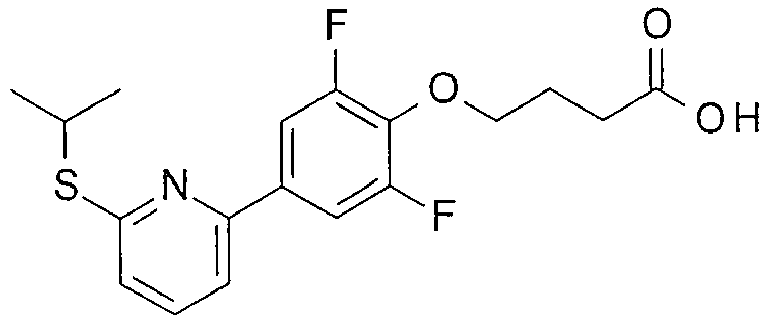
- 4-[2,6-Difluoro-4-(4,4,5,5-tetramethyl-1,3,2-dioxaborolan-2-yl)phenoxy]butyric acid ethyl ester (0.06 g, 0.16 mmol) obtained in Step C of Preparation Example 2 and 2-chloro-6-isopropylsulfanyl-pyridine (0.037 g, 0.2 mmol) obtained in Preparation Example 125 were dissolved in 0.24 mL of 2M Na2CO3 aqueous solution and 1.6 mL of 1,4-dioxane, and N2 gas was charged thereto for 5 minutes. Pd(PPh3)4 (0.018 g, 0.015 mmol) was added thereto and the resultant was agitated under reflux for 16 hours. After finishing the reaction, the resultant was diluted with water, and the organic layer was separated by the extraction with EtOAc. The organic layer was dried with MgSO4 and purified by column chromatography to obtain the title compound (0.05 g, 78 %).
- 1H NMR (CDCl3) δ 7.58 (2H, m), 7.52 (1H, t), 7.31 (1H, d), 7.08 (1H, d), 4.23 (2H, m), 4.16 (2H, q), 4.15 (1H, m), 2.58 (2H, t), 2.11 (2H, m), 1.47 (6H, d), 1.27 (3H, t)
- 4-[2,6-Difluoro-4-(6-isopropylsulfanyl-2-pyridyl)phenoxy]butyric acid ethyl ester (50 mg, 0.12 mmol) obtained in Step A was dissolved in each 0.4 mL of IN NaOH, THF and EtOH, and the resultant was agitated at room temperature for 2 hours. After finishing the reaction, the organic solvent was removed, and the pH was adjusted to 3 by the use of IN HCl. The organic layer was separated and purified by column chromatography to obtain the title compound (0.04 g, 85 %).
- 1H NMR (CDCl3) δ 7.60 (2H, m), 7.52 (1H, t), 7.31 (1H, d), 7.09 (1H, d), 4.25 (2H, m), 4.13 (1H, m), 2.67 (2H, t), 2.12 (2H, m), 1.47 (6H, d)
-

- 4-[2,6-Difluoro-4-(4,4,5,5-tetramethyl-1,3,2-dioxaborolan-2-yl)phenoxy]butyric acid ethyl ester (0.032 g, 0.086 mmol) obtained in Step C of Preparation Example 2 and 2-chloro-6-phenoxy-pyridine (0.018 g, 0.087 mmol) obtained in Preparation Example 126 were used to react in the same manner as in Step A of Example 1 to obtain the title compound (0.026 g, 72 %).
- 1H NMR (CDCl3) δ 7.73 (1H, t), 7.44 (4H, m), 7.36 (1H, d), 7.24 (1H, t), 7.20 (2H, m), 6.81 (1H, d), 4.19 (2H, t), 4.13 (2H, q), 2.56 (2H, t), 2.08 (2H, m), 1.26 (3H, t)
- 4-[2,6-Difluoro-4-(6-phenoxy-2-pyridyl)phenoxy]butyric acid ethyl ester (0.025 g, 0.06 mmol) obtained in Step A was used to react in the same manner as in Step B of Example 1 to obtain the title compound (0.018 g, 77 %).
- 1H NMR (CDCl3) δ 7.72 (1H, t), 7.44 (4H, m), 7.36 (1H, d), 7.24 (1H, t), 7.20 (2H, m), 6.81 (1H, d), 4.21 (2H, t), 2.64 (2H, t), 2.10 (2H, m)
-

- 4-[2-Chloro-4-(4,4,5,5-tetramethyl-1,3,2-dioxaborolan-2-yl)phenoxy]butyric acid ethyl ester (0.052 g, 0.14 mmol) obtained in Step B of Preparation Example 3 and 2-chloro-6-isopropylsulfanyl-pyridine (0.026 g, 0.14 mmol) obtained in Preparation Example 125 were used to react sequentially in the same manner as in Steps A and B of Example 1 to obtain the title compound (0.012 g, 23 %).
- 1H NMR (CDCl3) δ 8.05 (1H, d), 7.88 (1H, dd), 7.48 (1H, t), 7.32 (1H, d), 7.06 (1H, d), 6.98 (1H, d), 4.16 (2H, t), 4.12 (1H, m), 2.67 (2H, t), 2.20 (2H, m), 1.46 (6H, d)
-
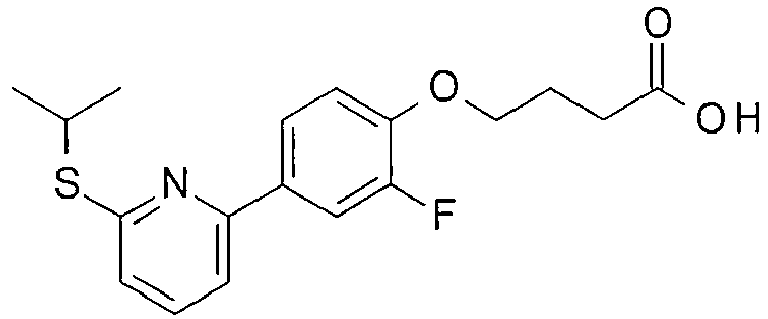
- 4-[2-Fluoro-4-(4,4,5,5-tetramethyl-1,3,2-dioxaborolan-2-yl)phenoxy]butyric acid ethyl ester (0.053 g, 0.15 mmol) obtained in Step B of Preparation Example 4 and 2-chloro-6-isopropylsulfanyl-pyridine (0.028 g, 0.15 mmol) obtained in Preparation Example 125 were used to react sequentially in the same manner as in Steps A and B of Example 1 to obtain the title compound (0.007 g, 13 %).
- 1H NMR (CDCl3) δ 7.82 (1H, dd), 7.73 (1H, dd), 7.50 (1H, t), 7.33 (1H, d), 7.04 (2H, m), 4.17 (2H, t), 4.11 (1H, m), 2.64 (2H, t), 2.19 (2H, m), 1.47 (6H, d)
-

- 2-Chloro-6-cyclopentylsulfanyl-pyridine (0.044 g, 0.2 mmol) obtained in Preparation Example 5 and 4-[2,6-difluoro-4-(4,4,5,5-tetramethyl;-1,3,2-dioxaborolan-2-yl)phenoxy]butyric acid ethyl ester (0.068 g, 0.18 mmol) obtained in Step C of Preparation Example 2 were used to react sequentially in the same manner as in Steps A and B of Example 1 to obtain the title compound (0.008 g, 10 %).
- 1H NMR (CDCl3) δ 7.60 (2H, m), 7.50 (1H, t), 7.30 (1H, d), 7.10 (1H, d), 4.26 (2H, t), 4.16 (1H, m), 2.67 (2H, t), 2.24 (2H, m), 2.12 (2H, m), 1.80 (2H, m), 1.70 (4H, m)
-

- 2-Cyclobutylsulfanyl-3-iodo-pyridine (0.060 g, 0.21 mmol) obtained in Preparation Example 44 and 4-[2-methoxy-4-(4,4,5,5-tetramethyl-1,3,2-dioxaborolan-2-yl)phenoxy]butyric acid ethyl ester (0.075 g, 0.21 mmol) obtained in Preparation Example 6 were reacted in the same manner as in Example 1 to obtain the title compound (0.050 g, 60 %).
- 1H NMR (CDCl3) δ 8.38 (1H, m), 7.38 (1H, m), 7.02 (1H, m), 6.94 (3H, m), 4.27 (1H, m), 4.14 (2H, t), 3.88(3H, s), 2.66 (2H, t), 2.49(2H, m), 2.21 (2H, m), 2.00 (4H, m)
-

- 0.7 mL of DMF was added to 4-[4-(2-chloro-4-pyridyl)-2,6-difluoro-phenoxy]butyric acid ethyl ester (0.025 g, 0.07 mmol) obtained in Preparation Example 7, Cs2CO3 (0.046 g, 0.14 mmol) and 2-propanethiol (0.013 mL, 0.14 mmol), and the resultant was agitated at 80°C for 4 hours. The reaction solution was concentrated under reduced pressure and purified by column chromatography to obtain the title compound (0.007 g, 25 %).
- 1H NMR (CDCl3) δ 8.43 (1H, d), 7.46 (1H, d), 7.34 (1H, dd), 7.32 (1H, m), 7.18 (1H, m), 4.20 (2H, t), 4.17 (3H, m), 2.63 (2H, t), 2.13 (2H, m), 1.34 (6H, d), 1.28 (3H, t)
- 4-[2,6-Difluoro-4-(2-isopropylsulfanyl-4-pyridyl)phenoxy]butyric acid ethyl ester (0.007 g, 0.018 mmol) obtained in Step A was used to react in the same manner as in Step B of Example 1 to obtain the title compound (0.004 g, 55 %).
- 1H NMR (CDCl3) δ 8.43 (1H, d), 7.46 (1H, d), 7.35 (1H, m), 7.32 (1H, m), 7.20 (1H, dd), 4.21 (2H, t), 3.55 (1H, m), 2.73 (2H, t), 2.15 (2H, m), 1.35 (6H, d)
-

- 2-Chloro-6-(cyclopentoxy)pyridine (0.055 g, 0.27 mmol) obtained in Preparation Example 8 and 4-[2,6-difluoro-4-(4,4,5,5-tetramethyl;-1,3,2-dioxaborolan-2-yl)phenoxy]butyric acid ethyl ester (0.068 g, 0.18 mmol) obtained in Step C of Preparation Example 2 were reacted in the same manner as in Step A of Example 1 to obtain the title compound (0.051 g, 68 %).
- 1H NMR (CDCl3) δ 7.58 (3H, m), 7.18 (1H, d), 6.63 (1H, d), 5.50 (1H, m), 4.22 (2H, t), 4.16 (2H, m), 2.58 (2H, t), 2.12 (2H, m), 2.06 (2H, m), 1.82 (4H, m), 1.65 (2H, m), 1.27 (3H, t)
- 4-[4-[6-(Cyclopentoxy)-2-pyridyl]-2,6-difluoro-phenoxy]butyric acid ethyl ester (0.05 g, 0.12 mmol) obtained in Step A was used to react in the same manner as in Step B of Example 1 to obtain the title compound (0.023 g, 50 %).
- 1H NMR (CDCl3) δ 7.59 (3H, m), 7.18 (1H, d), 6.63 (1H, d), 5.50 (1H, m), 4.24 (2H, t), 2.67 (2H, t), 2.14 (2H, m), 2.04 (2H, m), 1.82 (4H, m), 1.65 (2H, m)
-

- 2-Cyclobutylsulfanyl-3-iodo-pyridine (0.048 g, 0.16 mmol) obtained in Preparation Example 44 and 4-[2,6-dimethyl-4-(4,4,5,5-tetramethyl-1,3,2-dioxaborolan-2-yl)phenoxy]butyric acid ethyl ester (0.060 g, 0.16 mmol) obtained in Preparation Example 11 were reacted in in the same manner as in Example 1 to obtain the title compound (0.040 g, 61 %).
- 1H NMR (CDCl3) δ 8.37 (1H, m), 7.33 (1H, m), 7.05 (2H, s), 6.99 (1H, m), 4.42 (1H, m), 3.89 (2H, t), 2.71 (2H, t), 2.49 (2H, m), 2.30 (6H, s), 2.18 (2H, m), 2.07 (4H, m)
-

- 1-Bromo-3-(cyclopentoxy)benzene (0.04 g, 0.16 mmol) obtained in Preparation Example 9 and 4-[2,6-difluoro-4-(4,4,5,5-tetramethyl;-1,3,2-dioxaborolan-2-yl)phenoxy]butyric acid ethyl ester (0.05 g, 0.13 mmol) obtained in Step C of Preparation Example 2 were used to react sequentially in the same manner as in Steps A and B of Example 1 to obtain the title compound (0.01 g, 20 %).
- 1H NMR (CDCl3) δ 7.30 (1H, t), 7.11 (2H, m), 7.04 (1H, d), 7.00 (1H, m), 6.87 (1H, dd), 4.81 (1H, m), 4.22 (2H, t), 2.65 (2H, t), 2.12 (2H, m), 1.95 (2H, m), 1.88 (2H, m), 1.82 (2H, m), 1.64 (2H, m)
-

- 2-Chloro-6-pyrrolidin-1-yl-pyridine (0.028 g, 0.15 mmol) obtained in Preparation Example 10 and 4-[2,6-difluoro-4-(4,4,5,5-tetramethyl;-1,3,2-dioxaborolan-2-yl)phenoxy]butyric acid ethyl ester (0.051 g, 0.13 mmol) obtained in Step C of Preparation Example 2 were used to react sequentially in the same manner as in Steps A and B of Example 1 to obtain the title compound(0.006 g, 13 %).
- 1H NMR (CDCl3) δ 7.62 (2H, m), 7.46 (1H, t), 6.90 (1H, d), 6.32 (1H, d), 4.20 (2H, t), 3.53 (4H, t), 2.65 (2H, t), 2.12 (2H, t), 2.01 (4H, m)
-

- Butain-2-thiol (27 mg, 0.29 mmol) and 4-[2,6-difluoro-4-(2-fluoro-3-pyridyl)phenoxy]butyric acid ethyl ester (100 mg, 0.29 mmol) obtained in Preparation Example 109 were used to react sequentially in the same manner as in Preparation Example 5 and Step B of Example 1 to obtain the title compound (65 mg, 54 %).
- 1H NMR (CDCl3) δ 8.43 (1H, m), 7.32 (1H, m), 7.01 (3H, m), 4.26 (2H, t), 3.96 (1H, m), 2.69 (2H, t), 2.14 (2H, m), 1.73 (2H, m), 1.33 (3H, d), 1.00 (3H, t)
-
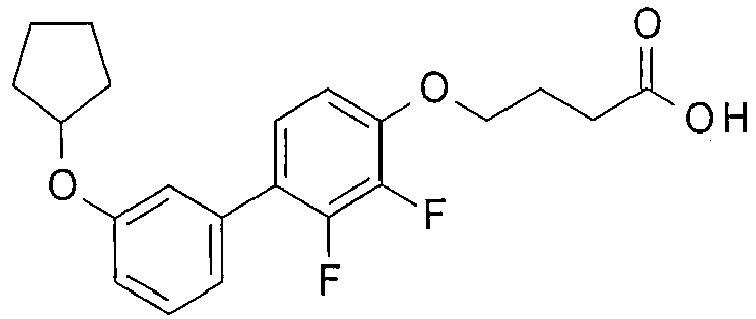
- 1.5 mL of acetonitrile was added to 4-[2,3-difluoro-4-(3-hydroxyphenyl)phenoxy]butyric acid ethyl ester (0.089 g, 0.26 mmol) obtained in Preparation Example 13, cyclopentyl bromide (0.034 g, 0.31 mmol) and K2CO3 (0.036 g, 0.26 mmol), and the resultant was agitated under reflux for 16 hours. After finishing the reaction, the reaction solution was concentrated under reduced pressure and purified by column chromatography to obtain the title compound (0.042 g, 39 %).
- 1H NMR (CDCl3) δ 7.31 (1H, t), 7.10 (1H, m), 7.04 (1H, dd), 7.00 (1H, d), 6.88 (1H, dd), 6.78 (1H, m), 4.79 (1H, m), 4.15 (4H, m), 2.55 (2H, t), 2.16 (2H, m), 1.92 (4H, m), 1.80 (2H, m), 1.62 (2H, m), 1.27 (3H, t)
- 4-[4-[3-(Cyclopentoxy)phenyl]-2,3-difluoro-phenoxy]butyric acid ethyl ester (0.041 g, 0.1 mmol) obtained in Step A was dissolved each 0.5 mL of EtOH and NaOH (1M aqueous solution), and the resultant was agitated at room temperature for 1 hour. After finishing the reaction, EtOAc was added thereto, and the aqueous layer was adjusted to pH 4 by the use of IN HCl aqueous solution. The organic layer was separated and purified by column chromatography to obtain the title compound (0.036 g, 96 %).
- 1H NMR (CDCl3) δ 7.31 (1H, t), 7.09 (1H, m), 7.04 (1H, dd), 7.00 (1H, d), 6.88 (1H, dd), 6.78 (1H, dd), 4.79 (1H, m), 4.15 (2H, t), 2.63 (2H, t), 2.18 (2H, m), 1.90 (4H, m), 1.81 (2H, m), 1.62 (2H, m)
-
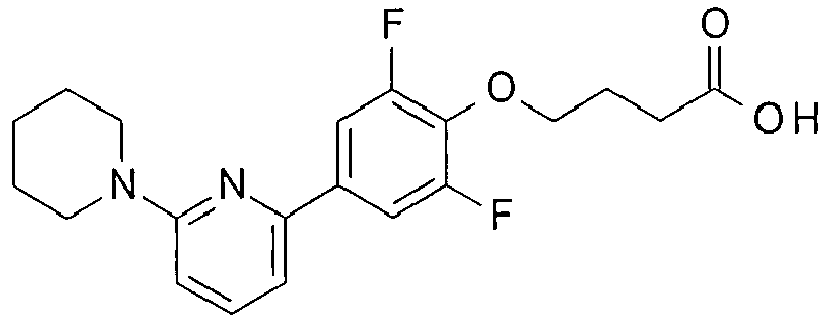
- 2-Chloro-6-(1-piperidyl)pyridine (0.09 g, 0.45 mmol) obtained in Preparation Example 14 and 4-[2,6-difluoro-4-(4,4,5,5-tetramethyl;-1,3,2-dioxaborolan-2-yl)phenoxy]butyric acid ethyl ester (0.154 g, 0.41 mmol) obtained in Step C of Preparation Example 2 were used to react sequentially in the same manner as in Steps A and B of Example 1 to obtain the title compound (0.06 g, 39 %).
- 1H NMR (CDCl3) δ 7.56 (2H, m), 7.49 (1H, t), 6.92 (1H, d), 6.60 (1H, d), 4.22 (2H, t), 3.61 (4H, brs), 2.64 (2H, t), 2.10 (2H, m), 1.67 (6H, brs)
-

- 6-Chloro-N-phenyl-pyridin-2-amine (0.09 g, 0.44 mmol) obtained in Preparation Example 15 and 4-[2,6-difluoro-4-(4,4,5,5-tetramethyl;-1,3,2-dioxaborolan-2-yl)phenoxy]butyric acid ethyl ester (0.148 g, 0.4 mmol) obtained in Step C of Preparation Example 2 were used to react sequentially in the same manner as in Steps A and B of Example 1 to obtain the title compound (0.037 g, 24 %).
- 1H NMR (CDCl3) δ 7.54 (3H, m), 7.37 (4H, m), 7.08 (2H, m), 6.83 (1H, brs), 6.82 (1H, d), 4.24 (2H, t), 2.66 (2H, t), 2.11 (2H, m)
-

- 4-[4-(6-Anilino-2-pyridyl)-2,6-difluoro-phenoxy]butyric acid (0.033 g, 0.085 mmol) obtained in Example 16 was dissolved in 1 mL of DMF, and potassium tert-butoxide (0.036 g, 0.34 mmol) and iodomethane (0.02 mL, 0.34 mmol) were added thereto. The resultant was agitated at room temperature for 16 hours. After finishing the reaction, the reaction solution was concentrated under reduced pressure and purified by column chromatography to obtain the title compound (0.02 g, 57 %).
- 1H NMR (CDCl3) δ 7.63 (2H, m), 7.42 (2H, m), 7.36 (1H, t), 7.30 (2H, m), 7.24 (1H, m), 6.98 (1H, d), 6.48 (1H, d), 4.22 (2H, t), 3.70 (3H, s), 3.57 (3H, s), 2.62 (2H, t), 2.11 (2H, m)
- 4-[2,6-Difluoro-4-[6-(N-methylanilino)-2-pyridyl]phenoxy]butyric acid methyl ester (0.02 g, 0.048 mmol) obtained in Step A was used to react in the same manner as in Step B of Example 1 to obtain the title compound (0.013 g, 66 %).
- 1H NMR (CDCl3) δ 7.62 (2H, m), 7.42 (2H, m), 7.36 (1H, m), 7.30 (2H, m), 7.24 (1H, m), 6.98 (1H, d), 6.48 (1H, d), 4.21 (2H, t), 3.58 (3H, s), 2.67 (2H, t), 2.12 (2H, m)
-

- 6-Chloro-N-cyclopentyl-pyridin-2-amine (0.05 g, 0.25 mmol) obtained in Preparation Example 16 and 4-[2,6-difluoro-4-(4,4,5,5-tetramethyl;-1,3,2-dioxaborolan-2-yl)phenoxy]butyric acid ethyl ester (0.06 g, 0.16 mmol) obtained in Step C of Preparation Example 2 were used to react in the same manner as in Step A of Example 1 to obtain the title compound (0.03 g, 48 %).
- 1H NMR (CDCl3) δ 7.50 (2H, m), 7.46 (1H, t), 6.90 (1H, d), 6.35 (1H, d), 4.65 (1H, d), 4.20 (2H, t), 4.15 (2H, q), 4.05 (1H, m), 2.58 (2H, t), 2.08 (4H, m), 1.76 (2H, m), 1.66 (2H, m), 1.52 (2H, m), 1.26 (3H, t)
- 4-[4-[6-(Cyclopentylamino)-2-pyridyl]-2,6-difluoro-phenoxy]butyric acid ethyl ester (0.03 g, 0.07 mmol) obtained in Step A was used to react in the same manner as in Step B of Example 1 to obtain the title compound (0.026 g, 93 %).
- 1H NMR (CDCl3) δ 7.47 (3H, m), 6.87 (1H, d), 6.36 (1H, d), 4.22 (2H, t), 4.02 (1H, m), 2.64 (2H, t), 2.10 (4H, m), 1.78 (2H, m), 1.65 (2H, m), 1.52 (2H, m)
-

- 2-Chloro-6-(cyclopropylmethylsulfanyl)pyridine (0.033 g, 0.16 mmol) obtained in Step B of Preparation Example 18 and 4-[2,6-difluoro-4-(4,4,5,5-tetramethyl;-1,3,2-dioxaborolan-2-yl)phenoxy]butyric acid ethyl ester (0.05 g, 0.135 mmol) obtained in Step C of Preparation Example 2 were used to react sequentially in the same manner as in Steps A and B of Example 1 to obtain the title compound (0.03 g, 58 %).
- 1H NMR (CDCl3) δ 7.58 (2H, m), 7.52 (1H, t), 7.30 (1H, d), 7.14 (1H, d), 4.25 (2H, t), 3.22 (2H, d), 2.67 (2H, t), 2.12 (2H, m), 1.21 (1H, m), 0.62 (2H, m), 0.36 (2H, m)
-

- 2-Chloro-6-cyclobutylsulfanyl-pyridine (0.033 g, 0.165 mmol) obtained in Preparation Example 19 and 4-[2,6-difluoro-4-(4,4,5,5-tetramethyl;-1,3,2-dioxaborolan-2-yl)phenoxy]butyric acid ethyl ester (0.05 g, 0.135 mmol) obtained in Step C of Preparation Example 2 were used to react sequentially in the same manner as in Steps A and B of Example 1 to obtain the title compound (0.035 g, 68 %).
- 1H NMR (CDCl3) δ 7.58 (2H, m), 7.52 (1H, t), 7.30 (1H, d), 7.04 (1H, d), 4.42 (1H, m), 4.25 (2H, t), 2.68 (2H, t), 2.60 (2H, m), 2.12 (6H, m)
-

- 2-Chloro-6-propylsulfanyl-pyridine (0.03 g, 0.16 mmol) obtained in Preparation Example 20 and 4-[2,6-difluoro-4-(4,4,5,5-tetramethyl;-1,3,2-dioxaborolan-2-yl)phenoxy]butyric acid ethyl ester (0.05 g, 0.135 mmol) obtained in Step C of Preparation Example 2 were used to react sequentially in the same manner as in Steps A and B of Example 1 to obtain the title compound (0.037 g, 75 %).
- 1H NMR (CDCl3) δ 7.58 (2H, m), 7.52 (1H, t), 7.30 (1H, d), 7.12 (1H, d), 4.25 (2H, t), 3.23 (2H, t), 2.67 (2H, t), 2.12 (2H, m), 1.81 (2H, m), 1.08 (3H, t)
-

- 2-Chloro-6-isopropoxy-pyridine (0.03 g, 0.17 mmol) obtained in Preparation Example 21 and 4-[2,6-difluoro-4-(4,4,5,5-tetramethyl;-1,3,2-dioxaborolan-2-yl)phenoxy]butyric acid ethyl ester (0.05 g, 0.135 mmol) obtained in Step C of Preparation Example 2 were used to react in the same manner as in Step A of Example 1 to obtain the title compound (0.038 g, 74 %).
- 1H NMR (CDCl3) δ 7.57 (3H, m), 7.19 (1H, d), 6.63 (1H, d), 5.44 (1H, m), 4.22 (2H, t), 4.16 (2H, q), 2.59 (2H, t), 2.10 (2H, m), 1.40 (6H, d), 1.27 (3H, t)
- 4-[2,6-difluoro-4-(6-isopropoxy-2-pyridyl)phenoxy]butyric acid ethyl ester (0.037 g, 0.1 mmol) obtained in Step A was used to react in the same manner as in Step B of Example 1 to obtain the title compound (0.03 g, 88 %).
- 1H NMR (CDCl3) δ 7.61 (1H, t), 7.56 (2H, m), 7.19 (1H, d), 6.63 (1H, d), 5.44 (1H, m), 4.24 (2H, t), 2.67 (2H, t), 2.11 (2H, m), 1.40 (6H, d)
-

- 2-Chloro-6-propoxy-pyridine (0.03 g, 0.17 mmol) obtained in Preparation Example 22 and 4-[2,6-difluoro-4-(4,4,5,5-tetramethyl;-1,3,2-dioxaborolan-2-yl)phenoxy]butyric acid ethyl ester (0.05 g, 0.135 mmol) obtained in Step C of Preparation Example 2 were used to react in the same manner as in Step A of Example 1 to obtain the title compound (0.026 g, 40 %).
- 1H NMR (CDCl3) δ 7.62 (1H, t), 7.58 (2H, m), 7.21 (1H, d), 6.69 (1H, d), 4.35 (2H, t), 4.22 (2H, t), 4.16 (2H, q), 2.59 (2H, t), 2.10 (2H, m), 1.84 (2H, m), 1.27 (3H, t), 1.06 (3H, t)
- 4-[2,6-Difluoro-4-(6-propoxy-2-pyridyl)phenoxy]butyric acid ethyl ester (0.026 g, 0.068 mmol) obtained in Step A was used to react in the same manner as in Step B of Example 1 to obtain the title compound(0.018 g, 81 %).
- 1H NMR (CDCl3) δ 7.60 (1H, t), 7.58 (2H, m), 7.21 (1H, d), 6.68 (1H, d), 4.35 (2H, t), 4.24 (2H, t), 2.67 (2H, t), 2.11 (2H, m), 1.83 (2H, m), 1.06 (3H, t)
-

- 2-Chloro-6-(cyclopropylmethoxy)-pyridine (0.033 g, 0.18 mmol) obtained in Preparation Example 23 and 4-[2,6-difluoro-4-(4,4,5,5-tetramethyl;-1,3,2-dioxaborolan-2-yl)phenoxy]butyric acid ethyl ester(0.05 g, 0.135 mmol) obtained in Step C of Preparation Example 2 were used to react in the same manner as in Step A of Example 1 to obtain the title compound(0.050 g, 95 %).
- 1H NMR (CDCl3) δ 7.61 (1H, t), 7.57 (2H, m), 7.21 (1H, d), 6.72 (1H, d), 4.22 (4H, m), 4.16 (2H, q), 2.58 (2H, t), 2.10 (2H, m), 1.33 (1H, m), 1.26 (3H, t), 0.64 (2H, m), 0.39 (2H, m)
- 4-[4-[6-(Cyclopropylmethoxy)-2-pyridyl]-2,6-difluoro-phenoxy]butyric acid ethyl ester (0.05 g, 0.127 mmol) obtained in Step A was used to react in the same manner as in Step B of Example 1 to obtain the title compound (0.034 g, 73 %).
- 1H NMR (CDCl3) δ 7.62 (1H, t), 7.57 (2H, m), 7.21 (1H, d), 6.73 (1H, d), 4.23 (4H, m), 2.67 (2H, t), 2.11 (2H, m), 1.33 (1H, m), 0.64 (2H, m), 0.39 (2H, m)
-
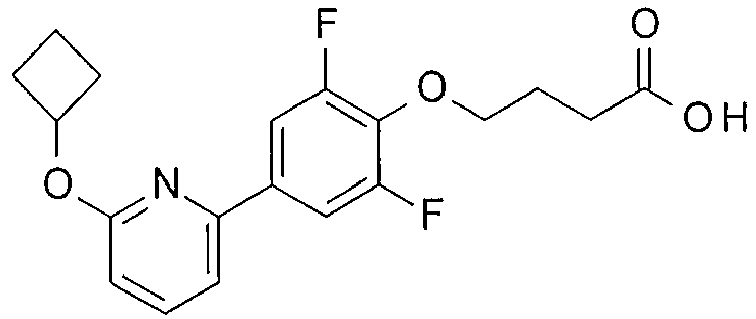
- 2-Chloro-6-(cyclobutoxy)-pyridine (0.033 g, 0.18 mmol) obtained in Preparation Example 24 and 4-[2,6-difluoro-4-(4,4,5,5-tetramethyl;-1,3,2-dioxaborolan-2-yl)phenoxy]butyric acid ethyl ester (0.05 g, 0.135 mmol) obtained in Step C of Preparation Example 2 were used to react in the same manner as in Step A of Example 1 to obtain the title compound (0.042 g, 80 %).
- 1H NMR (CDCl3) δ 7.61 (1H, t), 7.56 (2H, m), 7.21 (1H, d), 6.65 (1H, d), 5.26 (1H, m), 4.22 (2H, t), 4.15 (2H, q), 2.60 (2H, t), 2.52 (2H, m), 2.19 (2H, m), 2.10 (2H, m), 1.87 (1H, m), 1.76 (1H, m), 1.27 (3H, t)
- 4-[4-[6-(Cyclobutoxy)-2-pyridyl]-2,6-difluoro-phenoxy]butyric acid ethyl ester (0.042 g, 0.1 mmol) obtained in Step A was used to react in the same manner as in Step B of Example 1 to obtain the title compound (0.024 g, 61 %).
- 1H NMR (CDCl3) δ 7.61 (1H, t), 7.56 (2H, m), 7.21 (1H, d), 6.65 (1H, d), 5.25 (1H, m), 4.24 (2H, t), 2.67 (2H, t), 2.52 (2H, m), 2.19 (2H, m), 2.11 (2H, m), 1.87 (1H, m), 1.76 (1H, m)
-

- 2-Chloro-6-(cyclobutoxy)-pyridine (0.041 g, 0.22 mmol) obtained in Preparation Example 24 and 4-[2-methyl-4-(4,4,5,5-tetramethyl-1,3,2-dioxaborolan-2-yl)phenoxy]butyric acid ethyl ester (0.059 g, 0.17 mmol) obtained in Step C of Preparation Example 25 were used to react in the same manner as in Step A of Example 1 to obtain the title compound (0.031 g, 49 %).
- 1H NMR (CDCl3) δ 7.80 (2H, m), 7.57 (1H, t), 7.25 (1H, d), 6.86 (1H, d), 6.56 (1H, d), 5.56 (1H, m), 4.15 (2H, q), 4.06 (2H, t), 2.56 (2H, t), 2.54 (2H, m), 2.28 (3H, s), 2.18 (2H, m), 2.16 (2H, m), 1.87 (1H, m), 1.74 (1H, m), 1.27 (3H, t)
- 4-[4-[6-(Cyclobutoxy)-2-pyridyl]-2-methyl-phenoxy]butyric acid ethyl ester (0.031 g, 0.08 mmol) obtained in Step A was used to react in the same manner as in Step B of Example 1 to obtain the title compound (0.013 g, 45 %).
- 1H NMR (CDCl3) δ 7.80 (2H, m), 7.56 (1H, t), 7.24 (1H, d), 6.87 (1H, d), 6.56 (1H, d), 5.25 (1H, m), 4.08 (2H, t), 2.63 (2H, t), 2.52 (2H, m), 2.28 (3H, s), 2.18 (4H, m), 1.87 (1H, m), 1.72 (1H, m)
-

- 2-Chloro-6-(cyclobutoxy)-pyridine (0.035 g, 0.19 mmol) obtained in Preparation Example 24 and 4-[4-(4,4,5,5-tetramethyl-1,3,2-dioxaborolan-2-yl)-2-(trifluoromethyl)phenoxy]butyric acid ethyl ester (0.061 g, 0.15 mmol) obtained in Step C of Preparation Example 26 were used to react in the same manner as in Step A of Example 1 to obtain the title compound (0.041 g, 63 %).
- 1H NMR (CDCl3) δ 8.24 (1H, d), 8.13 (1H, dd), 7.61 (1H, t), 7.25 (1H, m), 7.05 (1H, dd), 6.62 (1H, d), 5.25 (1H, m), 4.15 (4H, m), 2.57 (4H, m), 2.17 (4H, m), 1.87 (1H, m), 1.74 (1H, m), 1.26 (3H, t)
- 4-[4-[6-(Cyclobutoxy)-2-pyridyl]-2-(trifluoromethyl)phenoxy]butyric acid ethyl ester (0.04 g, 0.09 mmol) obtained in Step A was used to react in the same manner as in Step B of Example 1 to obtain the title compound (0.03 g, 84 %).
- 1H NMR (CDCl3) δ 8.24 (1H, d), 8.12 (1H, dd), 7.60 (1H, t), 7.26 (1H, d), 7.04 (1H, m), 6.62 (1H, d), 5.25 (1H, m), 4.17 (2H, t), 2.65 (2H, m), 2.52 (2H, m), 2.20 (4H, m), 1.87 (1H, m), 1.73 (1H, m)
-
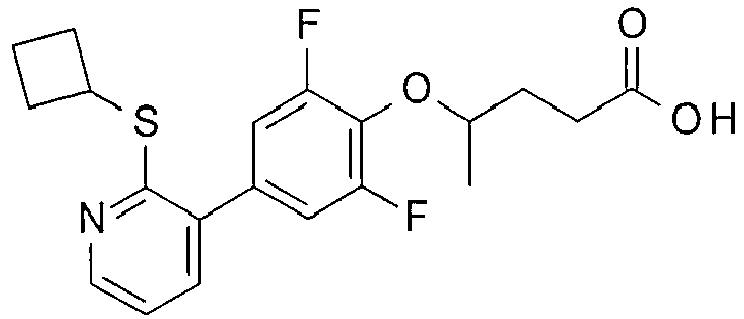
- 4-[2,6-Difluoro-4-(4,4,5,5-tetramethyl-1,3,2-dioxaborolan-2-yl)phenoxy]pentanoic acid methyl ester (0.053 g, 0.14 mmol) obtained in Step C of Preparation Example 27 and 2-cyclobutylsulfanyl-3-iodo-pyridine (0.045 g, 0.15 mmol) obtained in Step B of Preparation Example 44 were dissolved in 0.7 mL of 1,2-dimethoxyethane and Na2CO3 (2M aqueous solution, 0.21 mL, 0.43 mmol), and N2 gas was charged thereto for 5 minutes. PdCl2(PPh3)2 (0.005 g, 0.007 mmol) was added thereto, and the resultant was agitated at 80°C for 3 hours. After finishing the reaction, the reaction solution was added with 3 mL of water and extracted with EtOAc. The organic layer was dried with MgSO4 and purified by column chromatography to obtain the title compound (0.046 g, 79 %).
- 1H NMR (CDCl3) δ 8.41 (1H, m), 7.33 (1H, m), 7.01 (3H, m), 4.41 (2H, m), 3.69 (3H, s), 2.63 (2H, t), 2.51 (2H, m), 2.05 (6H, m), 1.33 (3H, d)
- 4-[4-(2-Cyclobutylsulfanyl-3-pyridyl)-2,6-difluoro-phenoxy]pentanoic acid methyl ester (0.069 g, 0.17 mmol) obtained in Step A was used to react in the same manner as in Step B of Example 1 to obtain the title compound (0.045 g, 67 %).
- 1H NMR (CDCl3) δ 8.41 (1H, m), 7.33 (1H, m), 7.00 (3H, m), 4.41 (2H, m), 2.71 (2H, t), 2.52 (2H, m), 2.05 (6H, m), 1.35 (3H, d)
-

- 4-[2,6-Difluoro-4-(4,4,5,5-tetramethyl-1,3,2-dioxaborolan-2-yl)phenoxy]pentanoic acid methyl ester (0.04 g, 0.11 mmol) obtained in Step C of Preparation Example 27 and 2-chloro-6-(cyclobutoxy)-pyridine(0.02 g, 0.11 mmol) obtained in Preparation Example 24 were dissolved in 1 mL of 1,2-dimethoxyethane and Na2CO3 (2M aqueous solution, 0.16 mL, 0.32 mmol), and N2 gas was charged thereto for 5 minutes. Pd(PPh3)4 (0.011 g, 0.01 mmol) was added thereto, and the resultant was agitated at 80°C for 2 hours. After finishing the reaction, the reaction solution was added with 3 mL of water and extracted with EtOAc. The organic layer was dried with MgSO4 and purified by column chromatography to obtain the title compound (0.028 g, 66 %).
- 1H NMR (CDCl3) δ 7.58 (3H, m), 7.22 (1H, d), 6.66 (1H, d), 5.26 (1H, m), 4.38 (1H, m), 3.70 (3H, s), 2.64 (2H, t), 2.53 (2H, m), 2.19 (2H, m), 2.03 (2H, m), 1.89 (1H, m), 1.74 (1H, m), 1.31 (3H, d)
- 4-[4-[6-(Cyclobutoxy)-2-pyridyl]-2,6-difluoro-phenoxy]pentanoic acid methyl ester (0.027 g, 0.07 mmol) obtained in Step A was used to react in the same manner as in Step B of Example 1 to obtain the title compound (0.02 g, 76 %).
- 1H NMR (CDCl3) δ 7.60 (3H, m), 7.21 (1H, d), 6.65 (1H, d), 5.26 (1H, m), 4.40 (1H, m), 2.70 (2H, t), 2.53 (2H, m), 2.20 (2H, m), 2.05 (2H, m), 1.86 (1H, m), 1.76 (1H, m), 1.32 (3H, d)
-

- 0.6 mL of 1,2-dimethoxyethane was added to 4-[[5-(4,4,5,5-tetramethyl-1,3,2-dioxaborolan-2-yl)-2-pyridyl]oxy]pentanoic acid methyl ester (0.038 g, 0.11 mmol) obtained in Step B of Preparation Example 28, 2-cyclobutylsulfanyl-3-iodo-pyridine (0.033 g, 0.11 mmol) obtained in Step B of Preparation Example 44 and Na2CO3 (2M aqueous solution, 0.17 mL, 0.34 mmol), and N2 gas was charged thereto for 5 minutes. PdCl2(PPh3)2 (0.004 g, 0.005 mmol) was added thereto, and the resultant was agitated at 80°C for 16 hours. The reactant was added with water and extracted with EtOAc. The organic layer was dried with MgSO4 and purified by column chromatography to obtain the title compound (0.006 g, 14 %).
- 1H NMR (CDCl3) δ 8.40 (1H, m), 8.12 (1H, m), 7.66 (1H, m), 7.35 (1H, m), 7.05 (1H, m), 6.73 (1H, d), 5.29 (1H, m), 4.43 (1H, m), 3.67 (3H, s), 2.50 (4H, m), 2.04 (6H, m), 1.37 (3H, d)
- 4-[[5-(2-Cyclobutylsulfanyl-3-pyridyl)-2-pyridyl]oxy]pentanoic acid methyl ester (0.006 g, 0.016 mmol) obtained in Step A was used to react in the same manner as in Step B of Example 1 to obtain the title compound (0.005 g, 90 %).
- 1H NMR (MeOH-d4) δ 8.56 (1H, m), 8.33 (1H, m), 8.17 (1H, m), 7.98 (1H, m), 7.55 (1H, m), 7.33 (1H, d), 5.23 (1H, m), 4.36 (1H, m), 2.53 (2H, m), 2.46 (2H, m), 2.05 (6H, m), 1.42 (3H, d)
-

- 3-Methyl-butane-1-thiol (31 mg, 0.29 mmol) and 4-[2,6-difluoro-4-(2-fluoro-3-pyridyl)phenoxy]butyric acid ethyl ester (100 mg, 0.29 mmol) obtained in Preparation Example 109 were used to react sequentially in the same manner as in Preparation Example 5 and Step B of Example 1 to obtain the title compound (75 mg, 60 %).
- 1H NMR (CDCl3) δ 8.43 (1H, m), 7.33 (1H, m), 7.03 (3H, m), 4.26 (2H, t), 3.18 (2H, t), 2.69 (2H, t), 2.14 (2H, m), 1.70 (1H, m), 1.56 (2H, m), 0.93 (6H, d)
-
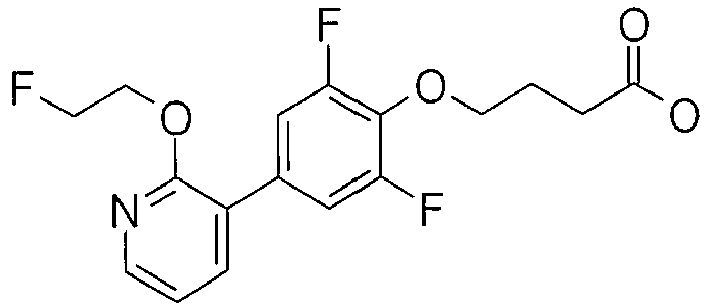
- 2-Fluoro-ethanol (29 mg, 0.45 mmol) and 4-[2,6-difluoro-4-(2-fluoro-3-pyridyl)phenoxy]butyric acid (70 mg, 0.22 mmol) obtained in Preparation Example 56 were used to react in the same manner as in Preparation Example 37 to obtain the title compound (5 mg, 6 %).
- 1H-NMR (CDCl3) δ 8.14 (1H, m), 7.61 (1H, m), 7.18 (2H, m), 6.99 (1H, m), 4.80 (1H, m), 4.69 (1H, m), 4.67 (1H, m), 4.62 (1H, m), 4.25 (2H, t), 2.69 (2H, t), 2.13 (2H, m)
-

- 2-Cyclobutylsulfanyl-3-iodo-pyridine (0.064 g, 0.22 mmol) obtained in Step B of Preparation Example 44 and 2-[1-[[2,6-difluoro-4-(4,4,5,5-tetramethyl-1,3,2-dioxaborolan-2-yl)phenoxy]methyl]cy clopropyl]acetonitrile (0.092 g, 0.26 mmol) obtained in Step E of Preparation Example 30 were dissolved in 2 mL of 1,2-dimethoxyethane and Na2CO3 (2M aqueous solution, 0.33 mL, 0.66 mmol), and N2 gas was charged thereto for 5 minutes. PdCl2(PPh3)2 (0.008 g, 0.011 mmol) was added thereto, and the resultant was agitated at 80°C for 2 hours. The reactant was added with water and extracted with EtOAc. The organic layer was dried with MgSO4 and purified by column chromatography to obtain the title compound (0.043 g, 50 %).
- 1H NMR (CDCl3) δ 8.41 (1H, m), 7.33 (1H, m), 7.00 (3H, m), 4.42 (1H, m), 4.06 (2H, s), 2.77 (2H, s), 2.51 (2H, m), 2.04 (4H, m), 0.77 (4H, m)
- 2-[1-[[4-(2-Cyclobutylsulfanyl-3-pyridyl)-2,6-difluoro-phenoxy]methyl]cyclopropyl] acetonitrile (0.042 g, 0.108 mmol) obtained in Step A was dissolved in 1 mL of ethanol, and NaOH (6M aqueous solution, 0.11 mL, 6.6 mmol) was added thereto. The resultant was agitated at 100°C for 16 hours. The pH was adjusted to 3 by the use of HCl aqueous solution, and the reactant was then extracted with EtOAc. The organic layer was dried with MgSO4 and purified by column chromatography to obtain the title compound (0.008 g, 18 %).
- 1H NMR (CDCl3) δ 8.41 (1H, m), 7.32 (1H, m), 6.98 (3H, m), 4.41 (1H, m), 4.11 (2H, s), 2.66 (2H, s), 2.52 (2H, m), 2.04 (4H, m), 0.66 (4H, m)
-
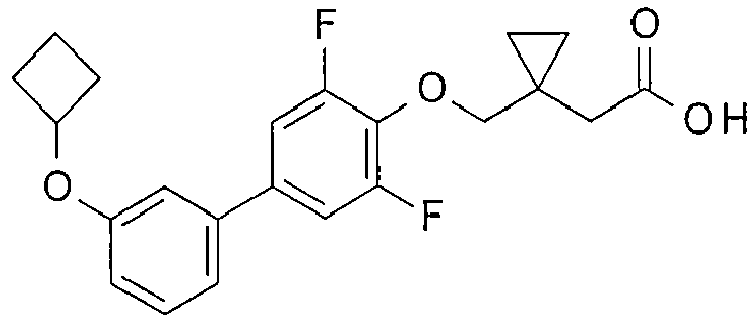
- 1-Cyclobutoxy-3-iodo-benzene (0.06 g, 0.22 mmol) obtained in Preparation Example 60 and 2-[1-[[2,6-difluoro-4-(4,4,5,5-tetramethyl-1,3,2-dioxaborolan-2-yl)phenoxy]methyl]cy clopropyl]acetonitrile (0.092 g, 0.26 mmol) obtained in Step E of Preparation Example 30 were dissolved in 2 mL of 1,2-dimethoxyethane and Na2CO3 (2M aqueous solution, 0.33 mL, 0.66 mmol), and N2 gas was charged thereto for 5 minutes. Pd(PPh3)4 (0.025 g, 0.022 mmol) was added thereto, and the resultant was agitated at 80°C for 3 hours. The reatant was added with water and extracted with EtOAc. The organic layer was dried with MgSO4 and purified by column chromatography to obtain the title compound (0.067 g, 83 %).
- 1H NMR (CDCl3) δ 7.31 (1H, t), 7.12 (2H, m), 7.06 (1H, d), 6.94 (1H, m), 6.81 (1H, m), 4.69 (1H, m), 4.03 (2H, s), 2.77 (2H, s), 2.47 (2H, m), 2.20 (2H, m), 1.88 (1H, m), 1.72 (1H, m), 0.74 (4H, m)
- 2-[1-[[4-[3-(cyclobutoxy)phenyl]-2,6-difluoro-phenoxy]methyl]cyclopropyl]acetonit rile (0.067 g, 0.18 mmol) obtained in Step A was dissolved in 2 mL of EtOH, and NaOH (6M aqueous solution, 0.18 mL, 1.08 mmol) was added thereto. The resultant was agitated at 100°C for 16 hours. The pH was adjusted to 3 by the use of HCl aqueous solution, and the reactant was then extracted with EtOAc. The organic layer was dried with MgSO4 and purified by column chromatography to obtain the title compound (0.04 g, 55 %).
- 1H NMR (CDCl3) δ 7.29 (1H, t), 7.08 (3H, m), 6.93 (1H, m), 6.80 (1H, m), 4.69 (1H, m), 4.11 (2H, s), 2.65 (2H, s), 2.48 (2H, m), 2.19 (2H, m), 1.88 (1H, m), 1.72 (1H, m), 0.66 (4H, m)
-
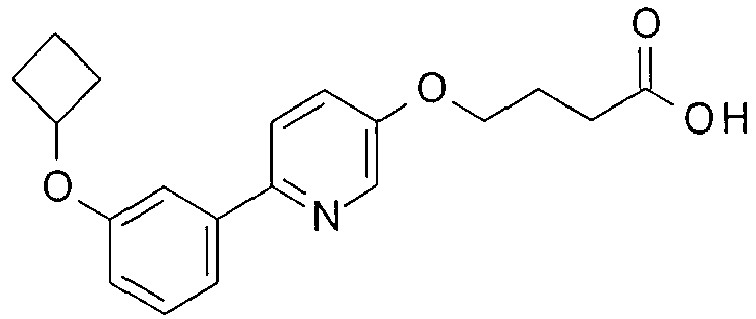
- 4-[[6-(3-Hydroxyphenyl)-3-pyridyl]oxy]butyric acid ethyl ester (0.061 g, 0.2 mmol) obtained in Step B of Preparation Example 31 was dissolved in 2 mL of DMF and cooled to 0°C. NaH (60 % in mineral oil, 0.012 g, 0.3 mmol) was added thereto, and the resultant was agitated at 0°C for 1 hour. Bromocyclobutane (0.027 g, 0.2 mmol) was added thereto, and the resultant was agitated at 70°C for 6 hours. After the reaction solution was concentrated under reduced pressure, it was added with water and extracted with EtOAc. The organic layer was dried with MgSO4 and purified by column chromatography to obtain the title compound (0.014 g, 19 %).
- 1H NMR (CDCl3) δ 8.35 (1H, m), 7.62 (1H, d), 7.45 (1H, m), 7.41 (1H, m), 7.32 (1H, t), 7.24 (1H, m), 6.83 (1H, m), 4.75 (1H, m), 4.16 (2H, q), 4.10 (2H, t), 2.54 (2H, t), 2.50 (2H, m), 2.17 (4H, m), 1.86 (1H, m), 1.72 (1H, m), 1.27 (3H, t)
- 4-[[6-[3-(Cyclobutoxy)phenyl]-3-pyridyl]oxy]butyric acid ethyl ester (0.014 g, 0.039 mmol) obtained in Step A was used to react in the same manner as in Step B of Example 1 to obtain the title compound (0.013 g, 99 %).
- 1H NMR (CDCl3) δ 8.39 (1H, m), 7.62 (1H, d), 7.44 (1H, d), 7.37 (1H, m), 7.32 (1H, t), 7.27 (1H, m), 6.83 (1H, m), 4.74 (1H, m), 4.13 (2H, t), 2.61 (2H, t), 2.48 (2H, m), 2.18 (4H, m), 1.87 (1H, m), 1.70 (1H, m)
-

- 4-[[6-(3-Hydroxyphenyl)-3-pyridyl]oxy]butyric acid ethyl ester (0.068 g, 0.22 mmol) obtained in Step B of Preparation Example 31 was dissolved in 2 mL of DMF and cooled to 0°C. NaH (60 % in mineral oil, 0.013 g, 0.33 mmol) was added thereto, and the resultant was agitated at 0°C for 1 hour. Bromocyclopentane (0.033 g, 0.2 mmol) was added thereto, and the resultant was agitated at 70°C for 16 hours. After the reaction solution was concentrated under reduced pressure, it was added with water and extracted with EtOAc. The organic layer was dried with MgSO4 and purified by column chromatography to obtain the title compound (0.028 g, 34 %).
- 1H NMR (CDCl3) δ 8.35 (1H, m), 7.63 (1H, d), 7.45 (2H, m), 7.32 (1H, t), 7.25 (1H, m), 6.88 (1H, m), 4.87 (1H, m), 4.16 (2H, q), 4.10 (2H, t), 2.54 (2H, t), 2.15 (2H, m), 1.92 (4H, m), 1.82 (2H, m), 1.62 (2H, m), 1.27 (3H, t)
- 4-[[6-[3-(Cyclopentoxy)phenyl]-3-pyridyl]oxy]butyric acid ethyl ester (0.028 g, 0.075 mmol) obtained in Step A was used to react in the same manner as in Step B of Example 1 to obtain the title compound (0.02 g, 77 %).
- 1H NMR (CDCl3 + Methanol-d4) δ 8.68 (1H, m), 7.92 (1H, m), 7.83 (1H, m), 7.48 (3H, m), 7.06 (1H, m), 4.99 (1H, m), 4.29 (2H, t), 2.53 (2H, t), 2.19 (2H, m), 2.00 (2H, m), 1.87 (2H, m), 1.80 (2H, m), 1.64 (2H, m)
-

- 2'-Phenoxy-biphenyl-4-ol (0.022 g, 0.083 mmol), Cs2CO3 (0.055 g, 0.16 mmol) and 4-bromobutyric acid ethyl ester (0.027 g, 0.10 mmol) were dissolved in 2 mL of DMF, and the resultant was agitated at room temperature for 2 hours. Solid was filtered and purified by by column chromatography (eluent: EtOAc/Hex = 1/4) to obtain the title compound (0.026 g, 86 %).
- 1H-NMR (CDCl3) δ 7.46(3H, m), 7.26(2H, m), 7.19(1H, m), 7.00(3H, m), 6.89(2H, m), 6.84(2H, m), 4.15 (2H, q), 4.00(2H, t), 2.50(2H, t), 2.10(2H, m), 1.25(3H, t)
- 4-(2'-Phenoxy-biphenyl-4-yloxy)-butyric acid ethyl ester (26 mg, 0.071 mmol) obtained in Step A was dissolved in each 1 mL of IN NaOH, TFH and MeOH, and the resultant was agitated at room temperature for 3 hours. After removing organic solvent, the pH was adjusted to 3 by the use of 1N HCl, and the resultant was extracted with EtOAc. The organic layer was dried with anhydrous MgSO4 and purified by column chromatography (eluent: EtOAc/Hex = 1/2) to obtain the title compound (0.018 g, 75 %).
- 1H-NMR (MeOD) δ 7.46(3H, m), 7.31(1H, m), 7.25(3H, m), 7.01(2H, m), 6.89(2H, d), 6.82(2H, d), 4.02(2H, t), 2.48(2H, t), 2.04(2H, m)
-

- 4-(2-Isopropylsulfanyl-pyridin-3-yl)-phenol (0.015 g, 0.061 mmol) obtained in Preparation Example 33, cesium carbonate (0.04 g, 0.12 mmol) and 4-bromobutyric acid ethyl ester (0.014 g, 0.07 mmol) were dissolved in 2 mL of DMF, and the resultant was agitated at room temperature for 24 hours. The reaction solution was added with NaCl aqueous solution and extracted with EtOAc to separate the organic layer. The organic layer was dried with anhydrous MgSO4 and purified by column chromatography (eluent: EtOAc/Hex = 1/4) to obtain the title compound (0.01 g, 45 %).
- 1H-NMR (CDCl3) δ 8.41(1H, m), 7.32(3H, m), 7.02(1H, m), 6.94(2H, m), 4.16(2H, q), 4.04(3H, m), 2.53(2H, t), 2.13(2H, m), 1.35(6H, d), 1.27(3H, t)
- 4-[4-(2-Isopropylsulfanyl-pyridin-3-yl)-phenoxy]-butyric acid ethyl ester (0.01 g, 0.02 mmol) obtained in Step A was used to react in the same manner as in Step B of Example 37 to obtain the title compound (0.006 g, 65 %).
- 1H-NMR (CDCl3) δ 8.41(1H, m), 7.32(3H, m), 7.02(1H, m), 6.95(2H, m), 4.06(3H, m), 2.62(2H, t), 2.15(2H, m), 1.35(6H, d)
-

- 3,5-Difluoro-2'-phenoxy-biphenyl-4-ol (0.017 g, 0.056 mmol) obtained in Preparation Example 34 and 4-bromobutyric acid ethyl ester (0.013 g, 0.068 mmol) were used to react in the same manner as in Step A of Example 37 to obtain the title compound(0.023 g, 95 %).
- 1H-NMR (CDCl3) δ 7.40(1H, m), 7.30(3H, m), 7.20(1H, m), 7.11(2H, m), 7.05(1H, m), 6.97(1H, m), 6.91(2H, m), 4.15(4H, m), 2.56(2H, t), 2.07(2H, m), 1.27(3H, t)
- 4-(3,5-Difluoro-2'-phenoxy-biphenyl-4-yloxy)-butyric acid ethyl ester (0.022 g, 0.053 mmol) obtained in Step A was used to react in the same manner as in Step B of Example 37 to obtain the title compound (0.014 g, 69 %).
- 1H-NMR (CDCl3) δ 7.40(1H, m), 7.30(3H, m), 7.20(1H, m), 7.11(2H, m), 7.05(1H, m), 6.97(1H, m), 6.91(2H, d), 4.19(2H, t), 2.64(2H, t), 2.08(2H, m)
-
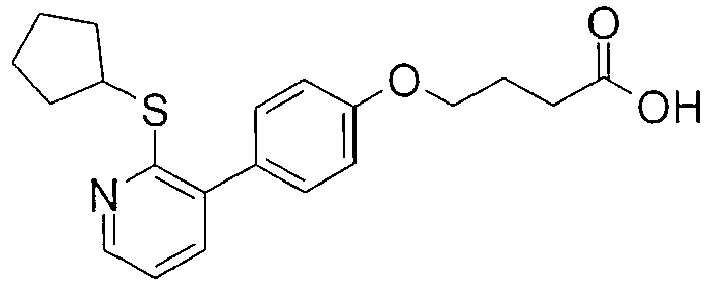
- 4-(2-Cyclopentylsulfanyl-pyridin-3-yl)-phenol (0.024 g, 0.088 mmol) obtained in Preparation Example 35 was used to react in the same manner as in Step A of Example 38 to obtain the title compound (0.03 g, 88 %).
- 1H-NMR (CDCl3) δ 8.38(1H, m), 7.32(3H, m), 7.01(1H, m), 6.94(2H, m), 4.14(2H, q), 4.05(3H, m), 2.52(2H, t), 2.13(4H, m), 1.60(2H, m), 1.66(4H, m), 1.26(3H, t)
- 4-[4-(2-Cyclopentylsulfanyl-pyridin-3-yl)-phenoxy]-butyric acid ethyl ester (0.03 g, 0.077 mmol) obtained in Step A was used to react in the same manner as in Step B of Example 37 to obtain the title compound (0.017 g, 63 %).
- 1H-NMR (CDCl3) δ 8.40(1H, m), 7.32(3H, m), 7.01(1H, m), 6.95(2H, m), 4.07(3H, m), 2.62(2H, t), 2.15(4H, m), 1.69(2H, m), 1.58(4H, m)
-

- 2,6-Difluoro-4-(2-isopropylsulfanyl-pyridin-3-yl)-phenol (0.015 g, 0.053 mmol) obtained in Preparation Example 63 was used to react in the same manner as in Steps A and B of Example 38 to obtain the title compound (0.005 g, 27 %).
- 1H-NMR (CDCl3) δ 8.44(1H, m), 7.32(1H, m), 7.03(1H, m), 6.99(2H, m), 4.25(2H, t), 4.06(1H, m), 2.67(2H, t), 2.13(2H, m), 1.37(6H, d)
-

- 3-Iodo-2-phenoxy-pyridine (0.043 g, 0.144 mmol) obtained in Preparation Example 36 and 4-[2,6-difluoro-4-(4,4,5,5-tetramethyl-1,3,2-dioxaborolan-2-yl)phenoxy]butyric acid ethyl ester (0.048 g, 0.131 mmol) obtained in Preparation Example 2 were used to react sequentially in the same manner as in Step B of Preparation Example 33 and Step B of Example 1 to obtain the title compound (0.004 g, 7 %).
- 1H-NMR (CDCl3) δ 8.42(1H, m), 7.12(1H, m), 7.40(2H, m), 7.22(3H, m), 7.11(3H, m), 4.23(2H, t), 2.65(2H, t), 2.11(2H, m)
-

- 3-Iodo-2-isopropoxy-pyridine (0.029 g, 0.11 mmol) obtained in Preparation Example 37 and 4-[2,6-difluoro-4-(4,4,5,5-tetramethyl-1,3,2-dioxaborolan-2-yl)phenoxy]butyric acid ethyl ester (0.034 g, 0.091 mmol) obtained in Preparation Example 2 were used to react in the same manner as in Steps A and B of Example 1 to obtain the title compound (0.011 g, 21 %).
- 1H-NMR (CDCl3) δ 8.14(1H, m), 7.55(1H, m), 7.15(2H, m), 6.91(1H, m), 5.41(1H, m), 4.24(2H, t), 2.67(2H, t), 2.13(2H, m), 1.37(6H, d)
-

- 2-Cyclopentoxy-3-iodo-pyridine (0.042 g, 0.14 mmol) obtained in Preparation Example 38 and 4-[2,6-difluoro-4-(4,4,5,5-tetramethyl-1,3,2-dioxaborolan-2-yl)phenoxy]butyric acid ethyl ester (0.045 g, 0.121 mmol) obtained in Preparation Example 2 were used to react in the same manner as in Steps A and B of Example 1 to obtain the title compound (0.021 g, 41 %).
- 1H-NMR (CDCl3) δ 8.14(1H, m), 7.55(1H, m), 7.15(2H, m), 6.91(1H, m), 5.52(1H, m), 4.24(2H, t), 2.67(2H, t), 2.13(2H, m), 1.95(2H, m), 1.78(4H, m), 1.65(2H, m)
-

- 2-Cyclopentylsulfanyl-3-iodo-pyridine (0.026 g, 0.09 mmol) obtained in Preparation Example 39 and 4-[2,6-difluoro-4-(4,4,5,5-tetramethyl-1,3,2-dioxaborolan-2-yl)phenoxy]butyric acid ethyl ester (0.031 g, 0.083 mmol) obtained in Preparation Example 2 were used to react in the same manner as in Steps A and B of Example 1 to obtain the title compound (0.009 g, 25 %).
- 1H-NMR (CDCl3) δ 8.42(1H, m), 7.30(1H, m), 7.02(3H, m), 4.25(2H, t), 4.07(1H, m), 2.67(2H, t), 2.15(4H, m), 1.69(2H, m), 1.58(4H, m)
-
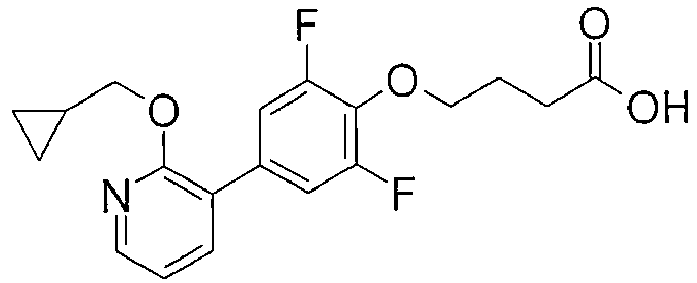
- 2-Cyclopropylmethoxy-3-iodo-pyridine (0.05 g, 0.181 mmol) obtained in Preparation Example 40 and 4-[2,6-difluoro-4-(4,4,5,5-tetramethyl-1,3,2-dioxaborolan-2-yl)phenoxy]butyric acid ethyl ester (0.061 g, 0.165 mmol) obtained in Step C of Preparation Example 2 were used to react sequentially in the same manner as in Steps A and B of Example 1 to obtain the title compound (0.022 g, 34 %).
- 1H-NMR (CDCl3) δ 8.12(1H, m), 7.57(1H, m), 7.20(2H, m), 6.94(1H, m), 4.23(4H, m), 2.67(2H, t), 2.12 (2H, m), 1.42(1H, m), 0.59(2H, m), 0.34(2H, m)
-
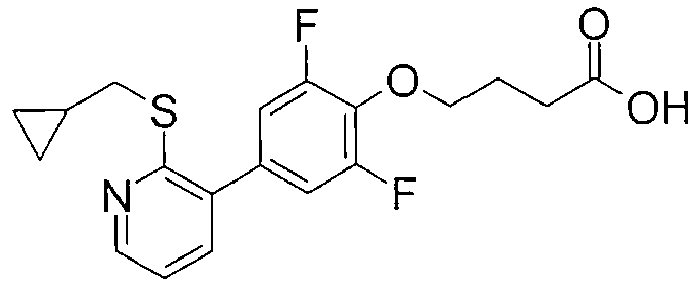
- 2-Cyclopropylmethylsulfanyl-3-(3,5-difluoro-4-methoxy-phenyl)-pyridine (0.033 g, 0.107 mmol) obtained in Preparation Example 41 was used to react sequentially in the same manner as in Step C of Preparation Example 33, Step A of Example 38 and Step B of Example 37 to obtain the title compound (0.0088 g, 13 %).
- 1H-NMR (CDCl3) δ 8.40(1H, m), 7.31(1H, m), 7.02(3H, m), 4.26(2H, m), 3.11(2H, m), 2.69 (2H, m), 2.15(2H, m), 1.15(1H, m), 0.57(2H, m), 0.34(2H, m)
-

- 2-Cyclobutylsulfanyl-3-(4-methoxy-phenyl)-pyridine (0.009 g, 0.034 mmol) obtained in Preparation Example 42 was used to react sequentially in the same manner as in Step C of Preparation Example 33, Step A of Example 38 and Step B of Example 37 to obtain the title compound (0.0034 g, 28%).
- 1H-NMR (CDCl3) δ 8.38(1H, m), 7.34(3H, m), 7.02(3H, m), 4.42(1H, m), 4.08(2H, m), 2.62 (2H, m), 2.49(2H, m), 2.16(2H, m), 2.01(4H, m)
-

- 2-Cyclopropylmethylsulfanyl-3-(4-methoxy-phenyl)-pyridine (0.02 g, 0.073 mmol) obtained in Preparation Example 43 was used to react sequentially in the same manner as in Step C of Preparation Example 33, Step A of Example 38 and Step B of Example 37 to obtain the title compound (0.0031 g, 12%).
- 1H-NMR (CDCl3) δ 8.40(1H, m), 7.37(3H, m), 7.02(3H, m), 4.09(2H, m), 3.09(2H, m), 2.63 (2H, m), 2.13(2H, m), 1.09(1H, m), 0.54(2H, m), 0.27(2H, m)
-

- 2-Cyclobutylsulfanyl-3-iodo-pyridine (0.15 g, 0.394 mmol) obtained in Preparation Example 44 and ethyl 4-[2,6-difluoro-4-(4,4,5,5-tetramethyl-1,3,2-dioxaborolan-2-yl)phenoxy]butyric acid ethyl ester (0.12 g, 0.329 mmol) obtained in Preparation Example 2 were dissolved in 1 mL of 2M Na2CO3 aqueous solution and 2 mL of 1,2-dimethoxyethane, and N2 gas was charged thereto for 5 minutes. PdCl2(PPh3)2 (0.012 g, 0.016 mmol) was added thereto and the resultant was agitated under reflux for 5 hours. After finishing the reaction, the resultant was diluted with water and extracted with EtOAc. The organic layer was dried with MgSO4 and purified by column chromatography (eluent: EtOAc/ Hex = 1/4) to obtain the title compound (0.084 g, 62 %).
- 1H-NMR (CDCl3) δ 8.41(1H, m), 7.32(1H, m), 7.01(3H, m), 4.42(1H, m), 4.24(2H, m), 4.16(2H, q), 2.59(2H, m), 2.69(2H, m), 2.13(3H, m), 2.06(3H, m), 1.28(3H, t)
- 4-[4-(2-Cyclobutylsulfanyl-pyridin-3-yl)-2,6-difluoro-phenoxy]-butyric acid ethyl ester (0.068 g, 0.166 mmol) obtained Step A was reacted in the same manner as in Step B of Example 37 to obtain the title compound (0.031 g, 50 %).
- 1H-NMR (CDCl3) δ 8.41(1H, m), 7.32(1H, m), 7.01(3H, m), 4.41(1H, m), 4.26(2H, m), 2.69(2H, m), 2.51(2H, m), 2.15(3H, m), 2.06(3H, m)
-

- 3-(4-Methoxy-phenyl)-2-propylsulfanyl-pyridine (0.023 g, 0.088 mmol) obtained in Preparation Example 45 was used to react sequentially in the same manner as in Step C of Preparation Example 33, Step A of Example 38 and Step B of Example 37 to obtain the title compound (0.005 g, 18 %).
- 1H-NMR (CDCl3) δ 8.40(1H, m), 7.34(3H, m), 7.02(1H, m), 6.95(2H, m), 4.08(2H, m), 3.12(2H, m), 2.62 (2H, m), 2.16(2H, m), 1.70(2H, m), 1.00(3H, t)
-

- 1-Bromo-2-isopropoxy-benzene (0.051 g, 0.237 mmol) obtained in Preparation Example 46 and 4-[2,6-difluoro-4-(4,4,5,5-tetramethyl-1,3,2-dioxaborolan-2-yl)phenoxy]butyric acid ethyl ester (0.067 g, 0.182 mmol) obtained in Preparation Example 2 were used to react sequentially in the same manner as in Step A of Example 50 and Step B of Example 37 to obtain the title compound (0.022 g, 35 %).
- 1H-NMR (CDCl3) δ 7.28(2H, m), 7.14(2H, m), 6.98(2H, m), 4.49(1H, m), 4.23(2H, t), 2.69 (2H, m), 2.12(2H, m), 1.29(6H, d)
-

- 1-Bromo-2-cyclobutoxy-benzene (0.023 g, 0.101 mmol) obtained in Preparation Example 47 and 4-[2,6-difluoro-4-(4,4,5,5-tetramethyl-1,3,2-dioxaborolan-2-yl)phenoxy]butyric acid ethyl ester (0.029 g, 0.0779 mmol) obtained in Preparation Example 2 were used to react sequentially in the same manner as in Step A of Example 50 and Step B of Example 37 to obtain the title compound (0.01 g, 35 %).
- 1H-NMR (CDCl3) δ 7.28(2H, m), 7.15(2H, m), 6.99(1H, m), 6.80(1H, m), 4.65(1H, m), 4.23(2H, m), 2.68 (2H, m), 2.44(2H, m), 2.17(4H, m), 1.85(1H, m), 1.70(1H, m)
-
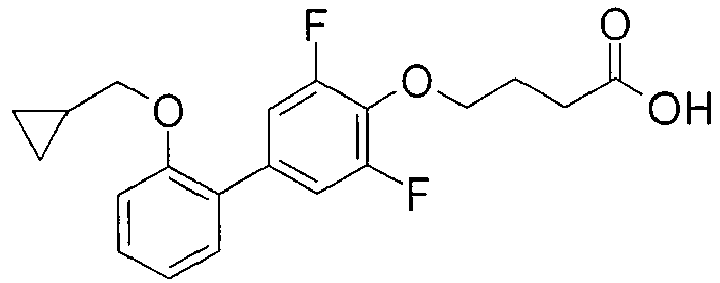
- 1-Bromo-2-cyclopropylmethoxy-benzene (0.054 g, 0.23 mmol) obtained in Preparation Example 48 and 4-[2,6-difluoro-4-(4,4,5,5-tetramethyl-1,3,2-dioxaborolan-2-yl)phenoxy]butyric acid ethyl ester (0.067 g, 0.182 mmol) obtained in Preparation Example 2 was used to react sequentially in the same manner as in Step A of Example 50 and Step B of Example 37 to obtain the title compound (0.021 g, 32 %).
- 1H-NMR (CDCl3) δ 7.29(2H, m), 7.16(2H, m), 6.99(1H, m), 6.94(1H, m), 4.23(2H, m), 3.83(2H, m), 2.69(2H, m), 2.13(2H, m), 1.22(1H, m), 0.61(2H, m), 0.31(2H, m)
-

- 1-Bromo-2-cyclopentoxy-benzene (0.079 g, 0.33 mmol) obtained in Preparation Example 49 and 4-[2,6-difluoro-4-(4,4,5,5-tetramethyl-1,3,2-dioxaborolan-2-yl)phenoxy]butyric acid ethyl ester (0.093 g, 0.25 mmol) obtained in Preparation Example 2 were used to react sequentially in the same manner as in Step A of Example 50 and Step B of Example 37 to obtain the title compound (0.047 g, 50 %).
- 1H-NMR (CDCl3) δ 7.28(2H, m), 7.13(2H, m), 6.96(2H, m), 4.77(1H, m), 4.23(2H, m), 2.68(2H, t), 2.12(2H, m), 1.86(4H, m), 1.64(2H, m), 1.55(2H, m)
-

- 1-Bromo-2-cyclopentoxy-benzene (0.063 g, 0.26 mmol) obtained in Preparation Example 49 and 4-[4-(4,4,5,5-tetramethyl-1,3,2-dioxaborolan-2-yl)phenoxy]butyric acid ethyl ester (0.067 g, 0.20 mmol) obtained in Preparation Example 1 were used to react sequentially in the same manner as in Step A of Example 50 and Step B of Example 37 to obtain the title compound (0.027 g, 39 %).
- 1H-NMR (CDCl3) δ 7.46(2H, m), 7.28(2H, m), 6.97(2H, m), 6.89(2H, m), 4.74(1H, m), 4.07(2H, m), 2.62(2H, t), 2.15(2H, m), 1.82(4H, m), 1.64(2H, m), 1.55(2H, m)
-

- 1-Bromo-2-isopropoxy-benzene (0.058 g, 0.26 mmol) obtained in Preparation Example 46 and 4-[4-(4,4,5,5-tetramethyl-1,3,2-dioxaborolan-2-yl)phenoxylbutyric acid ethyl ester (0.069 g, 0.20 mmol) obtained in Preparation Example 1 were used to react sequentially in the same manner as in Step A of Example 50 and Step B of Example 37 to obtain the title compound (0.026 g, 40 %).
- 1H-NMR (CDCl3) δ 7.48(2H, m), 7.28(2H, m), 6.96(2H, m), 6.90(2H, m), 4.41(1H, m), 4.06(2H, m), 2.61(2H, t), 2.14(2H, m), 1.24(6H, d)
-
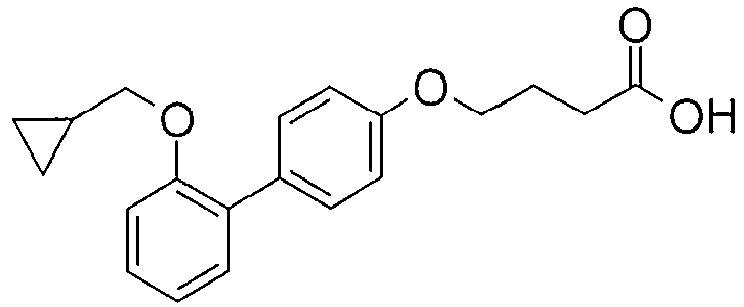
- 1-Bromo-2-cyclopropylmethoxy-benzene (0.059 g, 0.26 mmol) obtained in Preparation Example 48 and 4-[4-(4,4,5,5-tetramethyl-1,3,2-dioxaborolan-2-yl)phenoxylbutyric acid ethyl ester (0.066 g, 0.19 mmol) obtained in Preparation Example 1 were used to react sequentially in the same manner as in Step A of Example 50 and Step B of Example 37 to obtain the title compound (0.024 g, 36 %).
- 1H-NMR (CDCl3) δ 7.51(2H, m), 7.29(2H, m), 6.99(2H, m), 6.92(2H, m), 4.06(2H, m), 3.79(2H, d), 2.61(2H, t), 2.14(2H, m), 1.19(1H, m), 0.55(2H, m), 0.26(2H, m)
-

- 4-(2-Cyclobutylsulfanyl-pyridin-3-yl)-2,6-difluoro-phenol (0.078 g, 0.26 mmol) obtained in Preparation Example 51 and 4-bromo-2-methyl-butyric acid ethyl ester (0.055 g, 0.266 mmol) obtained in Preparation Example 50 were used to react sequentially in the same manner as in Steps A and B of Example 37 to obtain the title compound (0.043 g, 40 %).
- 1H-NMR (CDCl3) δ 8.40(1H, m), 7.30(1H, m), 6.98(3H, m), 4.41(1H, m), 4.26(2H, m), 2.89(1H, m), 2.50(2H, m), 2.25(1H, m), 2.02(4H, m), 1.90(1H, m), 1.31(3H, d)
-

- 2-Cyclobutylsulfanyl-3-iodo-pyridine (0.035 g, 0.12 mmol) obtained in Preparation Example 44 and 2-[2,6-difluoro-4-(4,4,5,5-tetramethyl-[1,3,2]dioxaborolan-2-yl)-phenoxymethyl]-cycl opropanecarboxylic acid ethyl ester (0.042 g, 0.112 mmol) obtained in Step D of Preparation Example 52 were used to react sequentially in the same manner as in Step A of Example 50 and Step B of Example 37 to obtain the title compound (0.013 g, 27 %).
- 1H-NMR (CDCl3) δ 8.40(1H, m), 7.32(1H, m), 7.00(3H, m), 4.40(1H, m), 4.16(1H, m), 4.05(1H, m), 2.50(2H, m), 2.03(5H, m), 1.72(1H, m), 1.35(1H, m), 1.06(1H, m)
-
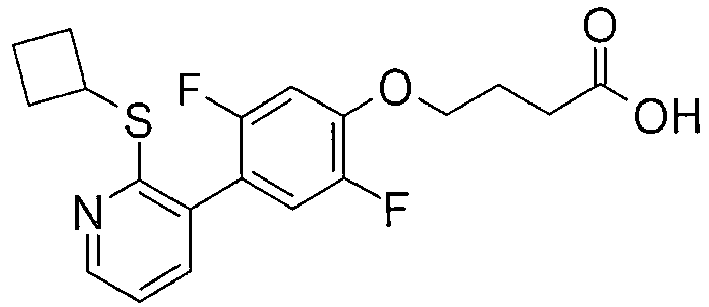
- 2-Cyclobutylsulfanyl-3-iodo-pyridine (0.11 g, 0.38 mmol) obtained in Preparation Example 44 and 4-[2,5-difluoro-4-(4,4,5,5-tetramethyl-[1,3,2]dioxaborolan-2-yl)-phenoxy]-butyric acid ethyl ester (0.132 g, 0.35 mmol) obtained in Step C of Preparation Example 53 were used to react sequentially in the same manner as in Step A of Example 50 and Step B of Example 37 to obtain the title compound (0.061 g, 44 %).
- 1H-NMR (CDCl3) δ 8.41(1H, m), 7.35(1H, m), 7.00(2H, m), 6.78(1H, m), 4.41(1H, m), 4.11(2H, m), 2.64(2H, m), 2.48(2H, m), 2.19(2H, m), 2.02(4H, m)
-

- 2-Chloro-6-cyclobutylsulfanyl-pyridine (0.081 g, 0.40 mmol) obtained in Preparation Example 19 and 4-[2,5-difluoro-4-(4,4,5,5-tetramethyl-[1,3,2]dioxaborolan-2-yl)-phenoxy]-butyric acid ethyl ester (0.14 g, 0.37 mmol) obtained in Step C of Preparation Example 53 were used to react sequentially in the same manner as in Step A of Example 50 and Step B of Example 37 to obtain the title compound (0.057 g, 39 %).
- 1H-NMR δ (CDCl3) 7.89(1H, m), 7.49(2H, m), 7.00(1H, m), 6.78(1H, m), 4.38(1H, m), 4.11(2H, m), 2.63(4H, m), 2.19(6H, m)
-

- 2-Methyl-propane-2-thiol (27 mg, 0.29 mmol) and 4-[2,6-difluoro-4-(2-fluoro-3-pyridyl)phenoxy]butyric acid ethyl ester (100 mg, 0.29 mmol) obtained in Preparation Example 109 were used to react sequentially in the same manner as in Preparation Example 5 and Step B of Example 1 to obtain the title compound (55 mg, 46 %).
- 1H NMR (CDCl3) δ 8.45 (1H, m), 7.33 (1H, m), 7.04 (1H, m), 6.95 (2H, m), 4.27 (2H, t), 2.69 (2H, t), 2.15 (2H, m), 1.55 (9H, s)
-

- 3-Iodo-2-propylsulfanyl-pyridine (0.073 g, 0.26 mmol) obtained in Preparation Example 203 and ethyl 6-[2,6-difluoro-4-(4,4,5,5-tetramethyl-1,3,2-dioxaborolan-2-yl)phenoxy]hexanoate (0.11 g, 0.27 mmol) obtained in Preparation Example 146 were used to react in the same manner as in Step A of Example 28 to obtain the title compound (0.076 g, 69%).
- 1H-NMR (CDCl3) δ 8.43 (1H, m), 7.33 (1H, m), 7.04 (1H, m), 7.00 (2H, m), 4.19 (2H, t), 4.13 (2H, q), 3.14 (2H, t), 2.34 (2H, t), 1.81 (2H, m), 1.73 (4H, m), 1.53 (2H, m), 1.28 (3H, t), 1.02 (3H, t)
- Ethyl 6-[2,6-difluoro-4-(2-propylsulfanyl-3-pyridyl)phenoxy]hexanoate (0.076 g, 0.18 mmol) obtained in Step A was used to react in the same manner as in Step B of Example 1 to obtain the title compound (0.068 g, 96%).
- 1H-NMR (CDCl3) δ 8.44 (1H, m), 7.35 (1H, m), 7.04 (1H, m), 6.99 (2H, m), 4.20 (2H, t), 3.15 (2H, t), 2.42 (2H, t), 1.83 (2H, m), 1.72 (4H, m), 1.58 (2H, m), 1.02 (3H, t)
-

- 4-[2,6-Difluoro-4-(6-formyl-pyridin-2-yl)-phenoxy]-butyric acid ethyl ester (0.25 g, 0.72 mmol) obtained in Preparation Example 57 was used to react in the same manner as in Preparation Example 101 to obtain the title compound (80 mg, 30 %).
- 4-{2,6-Difluoro-4-[6-(2-methyl-propenyl)-pyridin-2-yl]-phenoxy}-butyric acid ethyl ester (20 mg, 0.05 mmol) obtained in Step A was used to react in the same manner as in Step B of Example 1 to obtain the title compound (17 mg, 97 %).
- 1H NMR (CDCl3) δ 7.68 (1H, t), 7.62 (2H, m), 7.41 (1H, m), 7.10 (1H, d), 6.35 (1H, s), 4.25 (2H, t), 2.68 (2H, t), 2.21 (3H, s), 2.13 (2H, m), 1.98 (3H, s)
-

- 4-{2,6-Difluoro-4-[6-(2-methyl-propenyl)-pyridin-2-yl]-phenoxy}-butyric acid ethyl ester (60 mg, 0.16 mmol) obtained in Step A of Example 65 was used to react sequentially in the same manner as in Step B of Preparation Example 50 and Step B of Example 1 to obtain the title compound (40 mg, 86 %).
- 1H NMR (CDCl3) δ 7.65 (1H, t), 7.59 (2H, m), 7.43 (1H, d), 7.06 (1H, d), 4.24 (2H, t), 2.70 (4H, m), 2.22 (1H, m), 2.12 (2H, m), 0.96 (6H, d)
-

- 2-Cyclobutylsulfanyl-3-iodo-pyridine (0.040 g, 0.14 mmol) obtained in Preparation Example 44 and 4-[3,5-difluoro-4-(4,4,5,5-tetramethyl-1,3,2-dioxaborolan-2-yl)phenoxy]butyric acid ethyl ester (0.051 g, 0.14 mmol) obtained in Preparation Example 54 were reacted in the same manner as in Example 1 to obtain the title compound (0.005 g, 10 %).
- 1H NMR (CDCl3) δ 8.45 (1H, m), 7.37 (1H, m), 7.04 (1H, m), 6.56 (2H, m), 4.45 (1H, m), 4.06 (2H, t), 2.61 (2H, t), 2.59 (2H, m), 2.17 (2H, m), 2.05 (4H, m)
-

- 3-Iodo-2-(tetrahydro-pyran-4-yloxy)-pyridine (0.040 g, 0.13 mmol) obtained in Preparation Example 58 and 4-[2,6-difluoro-4-(4,4,5,5-tetramethyl-1,3,2-dioxaborolan-2-yl)phenoxy]butyric acid ethyl ester (0.049 g, 0.13 mmol) obtained in Preparation Example 2 were reacted in the same manner as in Example 1 to obtain the title compound (0.035 g, 68 %).
- 1H NMR (CDCl3) δ 8.12 (1H, m), 7.57 (1H, m), 7.14 (2H, m), 6.95 (1H, m), 5.37 (1H, m), 4.24 (2H, t), 3.90 (2H, m), 3.64 (2H, m), 2.67 (2H, t), 2.13 (4H, m), 1.82 (2H, m)
-

- 3-Iodo-2-(tetrahydro-furan-3-yloxy)-pyridine (0.040 g, 0.14 mmol) obtained in Preparation Example 59 and 4-[2,6-difluoro-4-(4,4,5,5-tetramethyl-1,3,2-dioxaborolan-2-yl)phenoxy]butyric acid ethyl ester (0.051 g, 0.14 mmol) obtained in Preparation Example 2 were reacted in the same manner as in Example 1 to obtain the title compound (0.030 g, 58 %).
- 1H NMR (CDCl3) δ 8.12 (1H, m), 7.57 (1H, m), 7.13 (2H, m), 6.98 (1H, m), 5.63 (1H, m), 4.24 (2H, t), 4.07 (1H, m), 3.94 (3H, m), 2.68 (2H, t), 2.25 (1H, m), 2.14 (3H, m)
-
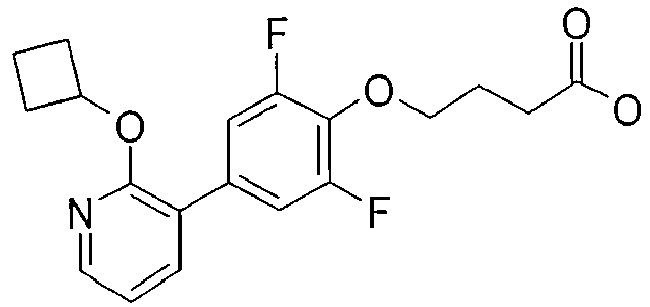
- 2-Cyclobutoxy-3-iodo-pyridine (0.040 g, 0.15 mmol) obtained in Preparation Example 200 and 4-[2,6-difluoro-4-(4,4,5,5-tetramethyl-1,3,2-dioxaborolan-2-yl)phenoxy]butyric acid ethyl ester (0.054 g, 0.15 mmol) obtained in Preparation Example 2 were reacted in the same manner as in Example 1 to obtain the title compound (0.020 g, 38 %).
- 1H NMR (CDCl3) δ 8.12 (1H, m), 7.57 (1H, m), 7.18 (2H, m), 6.93 (1H, m), 5.28 (1H, m), 4.24 (2H, t), 2.69 (2H, t), 2.47 (2H, m), 2.12 (4H, m), 1.83 (1H, m), 1.69 (1H, m)
-

- 2-Methoxy-ethanol (51 mg, 0.67 mmol) and 4-[2,6-difluoro-4-(2-fluoro-3-pyridyl)phenoxy]butyric acid (70 mg, 0.22 mmol) obtained in Preparation Example 56 were used to react in the same manner as in Preparation Example 37 to obtain the title compound (55 mg, 67 %).
- 1H NMR (CDCl3) δ 8.14 (1H, m), 7.59 (1H, m), 7.22 (2H, m), 6.96 (1H, m), 4.54 (2H, t), 4.24 (2H, t), 3.76 (2H, t), 3.42 (3H, s), 2.68 (2H, t), 2.12 (2H, m)
-

- 1.2 mL of DMF was added to ethyl 4-[2,6-difluoro-4-(2-fluoro-3-pyridyl)phenoxy]butanoate (0.078 g, 0.23 mmol) obtained in Preparation Example 109, pyrrolidine (0.022 g, 0.32 mmol) and Cs2CO3 (0.15 g, 0.46 mmol), and the resultant was agitated at 50°C for 8 hours. The reaction solution was concentrated under reduced pressure and purified by column chromatography to obtain the title compound (0.056 g, 62%).
- 1H-NMR (CDCl3) δ 8.16 (1H, m), 7.31 (1H, m), 6.90 (2H, m), 6.69 (1H, m), 4.21 (2H, t), 4.17 (2H, q), 3.15 (4H, m), 2.59 (2H, t), 2.12 (2H, m), 1.80 (4H, m), 1.27 (3H, t)
- Ethyl 4-[2,6-difluoro-4-(2-pyrrolidin-1-yl-3-pyridyl)phenoxy]butanoate (0.056 g, 0.14 mmol) obtained in Step A was used to react in the same manner as in Step B of Example 1 to obtain the title compound (0.038 g, 73%).
- 1H-NMR (CDCl3) δ 8.19 (1H, m), 7.33 (1H, m), 6.90 (2H, m), 6.70 (1H, m), 4.23 (2H, t), 3.17 (4H, m), 2.67 (2H, t), 2.12 (2H, m), 1.81 (4H, m)
-
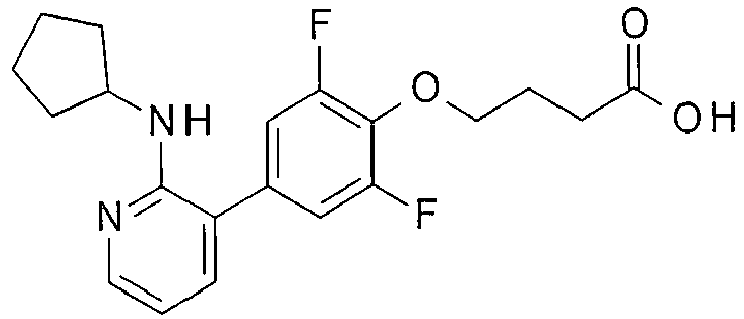
- N-Cyclopentyl-3-iodo-pyridin-2-amine (0.03 g, 0.1 mmol) obtained in Preparation Example 64 and 4-[2,6-difluoro-4-(4,4,5,5-tetramethyl-1,3,2-dioxaborolan-2-yl)phenoxy]butyric acid ethyl ester (0.043 g, 0.11 mmol) obtained in Preparation Example 2 were used to react sequentially in the same manner as in Step A of Example 29 and Step B of Example 1 to obtain the title compound (0.02 g, 50%).
- 1H-NMR (CDCl3) δ 8.15 (1H, m), 7.19 (1H, m), 6.94 (2H, m), 6.60 (1H, m), 4.45 (1H, brs), 4.33 (1H, m), 4.25 (2H, t), 2.68 (2H, t), 2.15 (2H, m), 2.05 (2H, m), 1.64 (4H, m), 1.34 (2H, m)
-

- Ethyl 4-[2,6-difluoro-4-(2-fluoro-3-pyridyl)phenoxy]butanoate (0.078 g, 0.23 mmol) obtained in Preparation Example 109 and tert-butyl N-(cyclopropylmethyl)carbamate(0.047g, 0.27mmol) were used to react in the same manner as in Step A of Example 72 to obtain the title compound (0.025 g, 29%).
- 1H-NMR (CDCl3) δ 8.13 (1H, m), 7.21 (1H, m), 6.98 (2H, m), 6.62 (1H, m), 4.62 (1H, m), 4.24 (2H, t), 4.17 (2H, q), 3.26 (2H, m), 2.59 (2H, m), 2.12 (2H, m), 1.27 (3H, t), 1.05 (1H, m), 0.49 (2H, m), 0.20 (2H, m)
- Ethyl 4-[4-[2-(cyclopropylmethylamino)-3-pyridyl]-2,6-difluoro-phenoxy] butanoate (0.026 g, 0.066 mmol) obtained in Step A was used to react in the same manner as in Step B of Example 1 to obtain the title compound (0.02 g, 82%).
- 1H-NMR (CDCl3) δ 8.12 (1H, m), 7.22 (1H, m), 6.99 (2H, m), 6.62 (1H, m), 4.64 (1H, brs), 4.24 (2H, t), 3.24 (2H, d), 2.63 (2H, t), 2.12 (2H, m), 1.05 (1H, m), 0.48 (2H, m), 0.20 (2H, m)
-

- 6-Chloro-N-(cyclopropylmethyl)pyridin-2-amine (0.17 g, 0.93 mmol) obtained in Preparation Example 65 and 4-[2,6-difluoro-4-(4,4,5,5-tetramethyl-1,3,2-dioxaborolan-2-yl)phenoxy]butyric acid ethyl ester (0.34 g, 0.93 mmol) obtained in Preparation Example 2 were used to react in the same manner as in Step A of Example 29 to obtain the title compound (0.125 g, 34%).
- 1H-NMR (CDCl3) δ 7.54 (2H, m), 7.45 (1H, t), 6.91 (1H, d), 6.34 (1H, m), 4.70 (1H, m), 4.20 (2H, t), 4.15 (2H, q), 3.19 (2H, t), 2.58 (2H, t), 2.09 (2H, m), 1.28 (3H, t), 1.13 (1H, m), 0.55 (2H, m), 0.28 (2H, m)
- Ethyl 4-[4-[6-(cyclopropylmethylamino)-2-pyridyl]-2,6-difluoro-phenoxy] butanoate (0.32 g, 0.34 mmol) obtained in Step A was used to react in the same manner as in Step B of Example 1 to obtain the title compound (0.115 g, 99%).
- 1H-NMR (CDCl3) δ 7.50 (3H, m), 6.90 (1H, d), 6.35 (1H, d), 4.22 (2H, t), 3.20 (2H, d), 2.66 (2H, t), 2.10 (2H, m), 1.12 (1H, m), 0.55 (2H, m), 0.29 (2H, m)
-
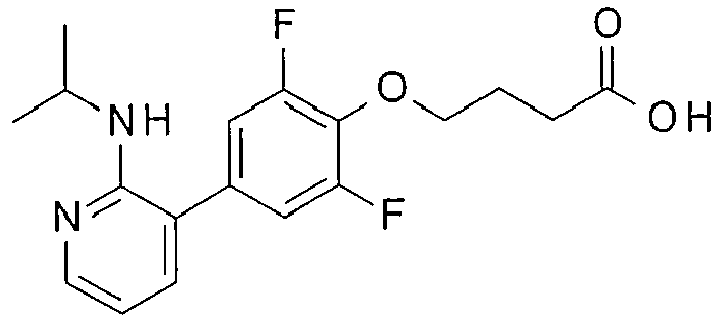
- 3-Iodo-N-isopropyl-pyridin-2-amine (0.045 g, 0.17 mmol) obtained in Preparation Example 66 and 4-[2,6-difluoro-4-(4,4,5,5-tetramethyl-1,3,2-dioxaborolan-2-yl)phenoxy]butyric acid ethyl ester (0.063 g, 0.17 mmol) obtained in Preparation Example 2 were used to react in the same manner as in Step A of Example 29 to obtain the title compound (0.047 g, 74%).
- 1H-NMR (CDCl3) δ 8.13 (1H, m), 7.19 (1H, m), 6.93 (2H, m), 6.60 (1H, m), 4.25 (4H, m), 4.17 (2H, q), 2.59 (2H, t), 2.12 (2H, m), 1.27 (3H, t), 1.20 (6H, d)
- Ethyl 4-[2,6-difluoro-4-[2-(isopropylamino)-3-pyridyl]phenoxy]butanoate (0.046 g, 0.12 mmol) obtained in Step A was used to react in the same manner as in Step B of Example 1 to obtain the title compound (0.023 g, 54%).
- 1H-NMR (CDCl3) δ 8.14 (1H, m), 7.20 (1H, m), 6.95 (2H, m), 6.62 (1H, m), 4.25 (3H, m), 2.65 (2H, t), 2.13 (2H, m), 1.18 (6H, d)
-

- N-Cyclopropyl-3-iodo-pyridin-2-amine (0.05 g, 0.19 mmol) obtained in Preparation Example 67 and 4-[2,6-difluoro-4-(4,4,5,5-tetramethyl-1,3,2-dioxaborolan-2-yl)phenoxy]butyric acid ethyl ester (0.07 g, 0.19 mmol) obtained in Preparation Example 2 were used to react in the same manner as in Step A of Example 29 to obtain the title compound (0.043 g, 60%).
- 1H-NMR (CDCl3) δ 8.24 (1H, m), 7.22 (1H, m), 6.92 (2H, m), 6.69 (1H, m), 4.76 (1H, brs), 4.23 (2H, t), 4.16 (2H, q), 2.75 (1H, m), 2.58 (2H, t), 2.11 (2H, m), 1.27 (3H, t), 0.80 (2H, m), 0.47 (2H, m)
- Ethyl 4-[4-[2-(cyclopropylamino)-3-pyridyl]-2,6-difluoro-phenoxy]butanoate (0.043 g, 0.11 mmol) obtained in Step A was used to react in the same manner as in Step B of Example 1 to obtain the title compound (0.015 g, 39%).
- 1H-NMR (CDCl3) δ 8.25 (1H, m), 7.22 (1H, m), 6.90 (2H, m), 6.69 (1H, m), 4.82 (1H, brs), 4.25 (2H, t), 2.75 (1H, m), 2.66 (2H, t), 2.13 (2H, m), 0,80 (2H, m), 0.47 (2H, m)
-

- tert-butyl N-(6-bromo-2-pyridyl)-N-isopropyl-carbamate (0.06 g, 0.19 mmol) obtained in Preparation Example 69 was dissolved in 0.4 mL of TFA and 0.4 mL of DCM, and the resultant was agitated at room temperature for 5 hours. The reactant which was concentrated under reduced pressure and 4-[2,6-difluoro-4-(4,4,5,5-tetramethyl-1,3,2-dioxaborolan-2-yl)phenoxy]butyric acid ethyl ester (0.07 g, 0.19 mmol) obtained in Preparation Example 2 were used to react in the same manner as in Step A of Example 29 to obtain the title compound (0.028 g, 39%).
- 1H-NMR (CDCl3) δ 7.54 (2H, m), 7.45 (1H, t), 6.90 (1H, d), 6.31 (1H, d), 4.43 (1H, brs), 4.21 (2H, t), 4.15 (2H, q), 4.00 (1H, m), 2.58 (2H, t), 2.10 (2H, m), 1.26 (9H, m)
- Ethyl 4-[2,6-difluoro-4-[6-(isopropylamino)-2-pyridyl]phenoxy]butanoate (0.028 g, 0.07 mmol) obtained in Step A was used to react in the same manner as in Step B of Example 1 to obtain the title compound (0.017 g, 65%).
- 1H-NMR (CDCl3) δ7.52 (2H, m), 7.46 (1H, t), 6.88 (1H, d), 6.33 (1H, d), 4.22 (2H, t), 3.97 (1H, m), 2.66 (2H, t), 2.10 (2H, m), 1.26 (6H, d)
-
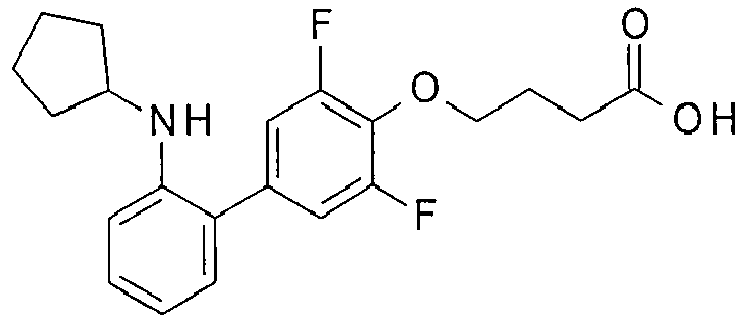
- N-Cyclopentyl-2-iodo-aniline (0.046 g, 0.16 mmol) obtained in Preparation Example 70 and 4-[2,6-difluoro-4-(4,4,5,5-tetramethyl-1,3,2-dioxaborolan-2-yl)phenoxy]butyric acid ethyl ester (0.05 g, 0.135 mmol) obtained in Preparation Example 2 were used to react in the same manner as in Step A of Example 28 to obtain the title compound (0.044 g, 81%).
- 1H-NMR (CDCl3) δ 7.21 (1H, t), 7.00 (3H, m), 6.71 (2H, m), 4.23 (2H, t), 4.15 (2H. q), 3.79 (2H, m), 2.60 (2H, t), 2.12 (2H, m), 1.98 (2H, m), 1.62 (4H, m), 1.41 (2H, m), 1.27 (3H, t)
- Ethyl 4-[4-[2-(cyclopentylamino)phenyl]-2,6-difluoro-phenoxy]butanoate (0.044 g, 0.11 mmol) obtained in Step A was used to react in the same manner as in Step B of Example 1 to obtain the title compound (0.035 g, 85%).
- 1H-NMR (CDCl3) δ 7.21 (1H, t), 7.00 (1H, m), 6.98 (2H, m), 6.75 (2H, m), 4.24 (2H, t), 3.76 (1H, m), 2.68 (2H, t), 2.13 (2H, m), 1.99 (2H, m), 1.67 (2H, m), 1.60 (2H, m), 1.41 (2H, m)
-
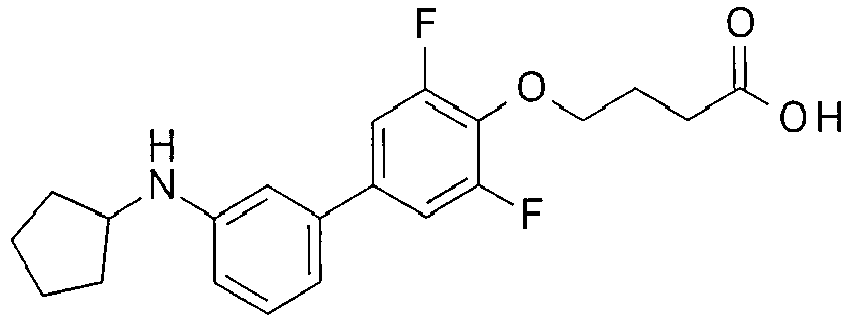
- 3-Bromo-N-cyclopentyl-aniline (0.039 g, 0.16 mmol) obtained in Preparation Example 71 and 4-[2,6-difluoro-4-(4,4,5,5-tetramethyl-1,3,2-dioxaborolan-2-yl)phenoxy]butyric acid ethyl ester (0.05 g, 0.135 mmol) obtained in Preparation Example 2 were used to react in the same manner as in Step A of Example 28 to obtain the title compound (0.024 g, 44%).
- 1H-NMR (CDCl3) δ 7.20 (1H, t), 7.07 (2H, m), 6.79 (1H, d), 6.68 (1H, m), 6.59 (1H, m), 4.20 (2H, t), 4.15 (2H, q), 3.85 (1H, m), 3.77 (1H, brs), 2.58 (2H, t), 2.10 (4H, m), 1.74 (2H, m), 1.65 (2H, m), 1.48 (2H, m), 1.27 (3H, t)
- Ethyl 4-[4-[3-(cyclopentylamino)phenyl]-2,6-difluoro-phenoxy]butanoate (0.024 g, 0.06 mmol) obtained in Step A was used to react in the same manner as in Step B of Example 1 to obtain the title compound (0.021 g, 94%).
- 1H-NMR (CDCl3) δ 7.23 (1H, t), 7.09 (2H, m), 6.87 (1H, m), 6.82 (1H, m), 6.72 (1H, m), 4.21 (2H, t), 3.82 (1H, m), 2.67 (2H, t), 2.12 (2H, m), 2.04 (2H, m), 1.76 (2H, m), 1.63 (2H, m), 1.58 (2H, m)
-

- 2-Iodo-N-propyl-aniline (0.056 g, 0.21 mmol) obtained in Preparation Example 72 and 4-[2,6-difluoro-4-(4,4,5,5-tetramethyl-1,3,2-dioxaborolan-2-yl)phenoxy]butyric acid ethyl ester (0.066 g, 0.18 mmol) obtained in Preparation Example 2 were used to react in the same manner as in Step A of Example 28 to obtain the title compound (0.048 g, 57%).
- 1H-NMR (CDCl3) δ 7.25 (1H, t), 7.02 (1H, d), 6.99 (2H, m), 6.73 (1H, t), 6.69 (1H, d), 4.23 (2H, t), 4.16 (2H, q), 3.82 (1H, brs), 3.07 (2H, t), 2.59 (2H, t), 2.11 (2H, m), 1.62 (2H, m), 1.27 (3H, t), 0.96 (3H, t)
- Ethyl 4-[2,6-difluoro-4-[2-(propylamino)phenyl]phenoxy]butanoate (0.048 g, 0.12 mmol) obtained in Step A was used to react in the same manner as in Step B of Example 1 to obtain the title compound (0.023 g, 51%).
- 1H-NMR (CDCl3) δ 7.23 (1H, t), 7.00 (3H, m), 6.74 (1H, t), 6.69 (1H, d), 4.23 (2H, t), 3.07 (2H, t), 2.68 (2H, t), 2.13 (2H, m), 1.60 (2H, m), 0.94 (3H, t)
-

- N-(Cyclopropylmethyl)-2-iodo-aniline (0.059 g, 0.21 mmol) obtained in Preparation Example 73 and 4-[2,6-difluoro-4-(4,4,5,5-tetramethyl-1,3,2-dioxaborolan-2-yl)phenoxy]butyric acid ethyl ester (0.066 g, 0.18 mmol) obtained in Preparation Example 2 were used to react in the same manner as in Step A of Example 28 to obtain the title compound (0.048 g, 58%).
- 1H-NMR (CDCl3) δ 7.22 (1H, t), 7.00 (3H, m), 6.74 (1H, t), 6.69 (1H, d), 4.23 (2H, t), 4.16 (2H, q), 3.97 (1H, brs), 2.96 (2H, d), 2.60 (2H, t), 2.12 (2H, m), 1.27 (3H, t), 1.04 (1H, m), 0.50 (2H, m), 0.18 (2H, m)
- Ethyl 4-[4-[2-(cyclopropylmethylamino)phenyl]-2,6-difluoro-phenoxy] butanoate(0.048 g, 0.12 mmol) obtained in Step A was used to react in the same manner as in Step B of Example 1 to obtain the title compound(0.042 g, 97%).
- 1H-NMR (CDCl3) δ 7.23 (1H, t), 7.00 (3H, m), 6.76 (1H, t), 6.70 (1H, d), 4.24 (2H, t), 2.96 (2H, d), 2.68 (2H, t), 2.13 (2H, m), 1.03 (1H, m), 0.52 (2H, m), 0.18 (2H, m)
-

- 2-Iodo-N-isopropyl-aniline (0.05 g, 0.19 mmol) obtained in Preparation Example 74 and 4-[2,6-difluoro-4-(4,4,5,5-tetramethyl-1,3,2-dioxaborolan-2-yl)phenoxy]butyric acid ethyl ester (0.059 g, 0.16 mmol) obtained in Preparation Example 2 were used to react in the same manner as in Step A of Example 28 to obtain the title compound (0.043 g, 60%).
- 1H-NMR (CDCl3) δ 7.22 (1H, t), 7.00 (1H, d), 6.95 (2H, m), 6.70 (2H, m), 4.23 (2H, t), 4.17 (2H, q), 3.03 (2H, m), 2.59 (2H, t), 2.11 (2H, m), 1.26 (3H, t), 1.17 (6H, d)
- Ethyl 4-[2,6-difluoro-4-[2-(isopropylamino)phenyl]phenoxy]butanoate (0.043 g, 0.11 mmol) obtained in Step A was used to react in the same manner as in Step B of Example 1 to obtain the title compound (0.038 g, 99%).
- 1H-NMR (CDCl3) δ 7.23 (1H, t), 7.00 (1H, d), 6.95 (2H, m), 6.72 (2H, m), 4.24 (2H, t), 3.63 (1H, m), 2.68 (2H, t), 2.13 (2H, m), 1.17 (6H, d)
-
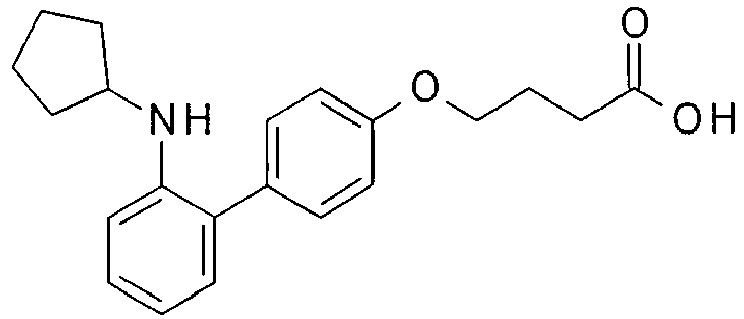
- N-Cyclopentyl-2-iodo-aniline (0.068 g, 0.24 mmol) obtained in Preparation Example 70 and 4-[4-(4,4,5,5-tetramethyl-1,3,2-dioxaborolan-2-yl)phenoxylbutyric acid ethyl ester (0.061 g, 0.18 mmol) obtained in Preparation Example 1 were used to react sequentially in the same manner as in Step A of Example 28 and Step B of Example 1 to obtain the title compound (0.01g, 15%).
- 1H-NMR (CDCl3) δ 7.31 (2H, m), 7.20 (1H, t), 7.02 (1H, d), 6.95 (2H, m), 6.72 (2H, m), 4.07 (2H, t), 3.78 (1H, m), 2.62 (2H, t), 2.17 (2H, m), 1.95 (2H, m), 1.58 (4H, m), 1.38 (2H, m)
-

- N-(Cyclopropylmethyl)-2-iodo-aniline (0.057 g, 0.21 mmol) obtained in Preparation Example 73 and 4-[4-(4,4,5,5-tetramethyl-1,3,2-dioxaborolan-2-yl)phenoxylbutyric acid ethyl ester (0.061 g, 0.18 mmol) obtained in Preparation Example 1 were used to react sequentially in the same manner as in Step A of Example 28 and Step B of Example 1 to obtain the title compound (0.015g, 23%).
- 1H-NMR (CDCl3) δ 7.35 (2H, m), 7.20 (1H, t), 7.06 (1H, m), 6.97 (2H, m), 6.73 (1H, t), 6.68 (1H, d), 4.07 (2H, t), 2.95 (2H, d), 2.63 (2H, m), 2.16 (2H, m), 1.02 (1H, m), 0.47 (2H, m), 0.15 (2H, m)
-

- 2-Iodo-N-propyl-aniline (0.056 g, 0.21 mmol) obtained in Preparation Example 72 and 4-[4-(4,4,5,5-tetramethyl-1,3,2-dioxaborolan-2-yl)phenoxy]butyric acid ethyl ester (0.061 g, 0.18 mmol) obtained in Preparation Example 1 were used to react sequentially in the same manner as in Step A of Example 28 and Step B of Example 1 to obtain the title compound (0.007 g, 11%).
- 1H-NMR (CDCl3) δ 7.32 (2H, m), 7.21 (1H, t), 7.05 (1H, d), 6.95 (2H, m), 6.72 (1H, t), 6.68 (1H, d), 4.07 (2H, t), 3.05 (2H, t), 2.62 (2H, t), 2.17 (2H, m), 1.55 (2H, m), 0.91 (3H, t)
-

- 2-Iodo-N-isopropyl-aniline (0.05 g, 0.19 mmol) obtained in Preparation Example 74 and 4-[4-(4,4,5,5-tetramethyl-1,3,2-dioxaborolan-2-yl)phenoxy]butyric acid ethyl ester (0.053 g, 0.16 mmol) obtained in Preparation Example 1 were used to react sequentially in the same manner as in Step A of Example 28 and Step B of Example 1 to obtain the title compound (0.008 g, 15%).
- 1H-NMR (CDCl3) δ 7.30 (2H, m), 7.19 (1H, t), 7.04 (1H, d), 6.95 (2H, m), 6.69 (2H, m), 4.07 (2H, t), 3.63 (1H, m), 2.63 (2H, t), 2.16 (2H, m), 1.14 (6H, d)
-

- 2-Bromo-N-cyclobutyl-aniline (0.07 g, 0.21 mmol)obtained in Preparation Example 75 and 4-[4-(4,4,5,5-tetramethyl-1,3,2-dioxaborolan-2-yl)phenoxylbutyric acid ethyl ester (0.095 g, 0.42 mmol) obtained in Preparation Example 1 were used to react sequentially in the same manner as in Step A of Example 28 and Step B of Example 1 to obtain the title compound (0.007 g, 0.1%).
- 1H-NMR (CDCl3) δ 7.33 (2H, m), 7.19 (1H, t), 7.06 (1H, d), 6.97 (2H, m), 6.73 (1H, t), 6.58 (1H, d), 4.12 (2H, t), 3.91 (1H, m), 2.63 (2H, t), 2.36 (2H, m), 2.17 (2H, m), 1.75 (4H, m)
-

- 2-Bromo-N-cyclobutyl-aniline (0.136 g, 0.6 mmol) obtained in Preparation Example 75 and 4-[2,6-difluoro-4-(4,4,5,5-tetramethyl-1,3,2-dioxaborolan-2-yl)phenoxy]butyric acid ethyl ester (0.1 g, 0.27 mmol) obtained in Preparation Example 2 were used to react sequentially in the same manner as in Step A of Example 28 and Step B of Example 1 to obtain the title compound (0.004 g, 0.04%).
- 1H-NMR (CDCl3) δ 7.21 (1H, t), 6.99 (3H, m), 6.73 (1H, t), 6.58 (1H, d), 4.24 (2H, t), 3.89 (1H, m), 2.68 (2H, t), 2.40 (2H, m), 2.13 (2H, m), 1.77 (4H, m)
-

- 3-Bromo-N-(cyclopropylmethyl)aniline (0.063 g, 0.23 mmol) obtained in Preparation Example 76 and 4-[2,6-difluoro-4-(4,4,5,5-tetramethyl-1,3,2-dioxaborolan-2-yl)phenoxy]butyric acid ethyl ester (0.072 g, 0.19 mmol) obtained in Preparation Example 2 were used to react in the same manner as in Step A of Example 29 to obtain the title compound (0.04 g, 54%).
- 1H-NMR (CDCl3) δ 7.21 (1H, t), 7.09 (2H, m), 6.80 (1H, d), 6.70 (1H, m), 6.60 (1H, m), 4.18 (4H, m), 3.95 (1H, brs), 3.00 (2H, d), 2.59 (2H, t), 2.10 (2H, m), 1.27 (3H, t), 1.10 (1H, m), 0.57 (2H, m), 0.26 (2H, m)
- Ethyl 4-[4-[3-(cyclopropylmethylamino)phenyl]-2,6-difluoro-phenoxy] butanoate (0.04 g, 0.1 mmol) obtained in Step A was used to react in the same manner as in Step B of Example 1 to obtain the title compound (0.026 g, 72%).
- 1H-NMR (CDCl3) δ 7.21 (1H, t), 7.11 (2H, m), 6.80 (1H, d), 6.70 (1H, m), 6.61 (1H, m), 4.21 (2H, t), 3.00 (2H, d), 2.67 (2H, t), 2.12 (2H, m), 1.18 (1H, m), 0.57 (2H, m), 0.27 (2H, m)
-

- 3-Bromo-N-isopropyl-aniline (0.06 g, 0.23 mmol) obtained in Preparation Example 77 and 4-[2,6-difluoro-4-(4,4,5,5-tetramethyl-1,3,2-dioxaborolan-2-yl)phenoxy]butyric acid ethyl ester (0.072 g, 0.19 mmol) obtained in Preparation Example 2 were used to react in the same manner as in Step A of Example 29 to obtain the title compound (0.043 g, 60%).
- 1H-NMR (CDCl3) δ 7.20 (1H, t), 7.09 (2H, m), 6.78 (1H, d), 6.66 (1H, m), 6.57 (1H, m), 4.18 (4H, m), 3.68 (1H, m), 3.60 (1H, brs), 2.59 (2H, t), 2.12 (2H, m), 1.27 (9H, m)
- Ethyl 4-[2,6-difluoro-4-[3-(isopropylamino)phenyl]phenoxy]butanoate (0.043 g, 0.11 mmol) obtained in Step A was used to react in the same manner as in Step B of Example 1 to obtain the title compound (0.032 g, 83%).
- 1H-NMR (CDCl3) δ 7.20 (1H, t), 7.10 (2H, m), 6.78 (1H, d), 6.67 (1H, m), 6.58 (1H, m), 4.21 (2H, t), 3.69 (1H, m), 2.67 (2H, t), 2.11 (2H, m), 1.24 (6H, d)
-

- 1-(3-Bromophenyl)pyrrolidine (0.039 g, 0.17 mmol) obtained in Preparation Example 78 and 4-[2,6-difluoro-4-(4,4,5,5-tetramethyl-1,3,2-dioxaborolan-2-yl)phenoxy]butyric acid ethyl ester (0.053 g, 0.14 mmol) obtained in Preparation Example 2 were used to react in the same manner as in Step A of Example 29 to obtain the title compound (0.037 g, 60%).
- 1H-NMR (CDCl3) δ 7.26 (1H, m), 7.13 (2H, m), 6.77 (1H, d), 6.63 (1H, m), 6.57 (1H, m), 4.18 (4H, m), 3.33 (4H, m), 2.59 (2H, t), 2.11 (2H, m), 2.03 (4H, m), 1.26 (3H, t)
- Ethyl 4-[2,6-difluoro-4-(3-pyrrolidin-1-ylphenyl)phenoxy]butanoate (0.033 g, 0.09 mmol) obtained in Step A was used to react in the same manner as in Step B of Example 1 to obtain the title compound (0.014 g, 45%).
- 1H-NMR (CDCl3) δ 7.26 (1H, m), 7.14 (2H, m), 6.76 (1H, d), 6.62 (1H, m), 6.58 (1H, m), 4.21 (2H, t), 3.33 (4H, m), 2.67 (2H, t), 2.12 (2H, m), 2.03 (4H, m)
-
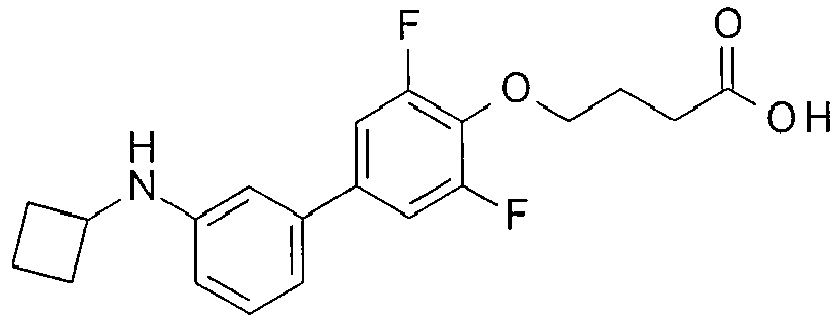
- 3-Bromo-N-cyclobutyl-aniline (0.028 g, 0.12 mmol) obtained in Preparation Example 80 and 4-[2,6-difluoro-4-(4,4,5,5-tetramethyl-1,3,2-dioxaborolan-2-yl)phenoxy]butyric acid ethyl ester (0.045 g, 0.12 mmol) obtained in Preparation Example 2 were used to react in the same manner as in Step A of Example 29 to obtain the title compound (0.019 g, 40%).
- 1H-NMR (CDCl3) δ 7.19 (1H, t), 7.10 (2H, m), 6.81 (1H, d), 6.63 (1H, m), 6.55 (1H, m), 4.20 (2H, t), 4.14 (2H, q), 3.95 (2H, m), 2.60 (2H, t), 2.44 (2H, m), 2.10 (2H, m), 1.85 (4H, m), 1.27 (3H, t)
- Ethyl 4-[4-[3-(cyclobutylamino)phenyl]-2,6-difluoro-phenoxy]butanoate (0.019 g, 0.05 mmol) obtained in Step A was used to react in the same manner as in Step B of Example 1 to obtain the title compound (0.014 g, 77%).
- 1H-NMR (CDCl3) δ 7.20 (1H, t), 7.07 (2H, m), 6.81 (1H, d), 6.63 (1H, m), 6.54 (1H, m), 4.21 (2H, t), 3.96 (1H, m), 2.67 (2H, t), 2.45 (2H, m), 2.11 (2H, m), 1.84 (4H, m)
-
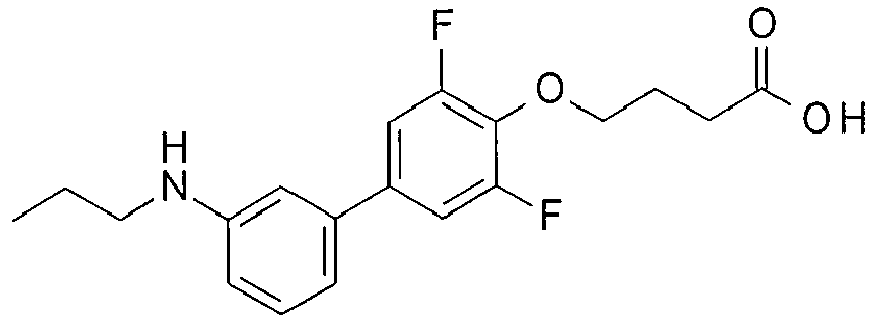
- 3-Bromo-N-propyl-aniline (0.07 g, 0.3 mmol) obtained in Preparation Example 79 and 4-[2,6-difluoro-4-(4,4,5,5-tetramethyl-1,3,2-dioxaborolan-2-yl)phenoxy]butyric acid ethyl ester (0.08 g, 0.21 mmol) obtained in Preparation Example 2 were used to react in the same manner as in Step A of Example 29 to obtain the title compound (0.029 g, 37%).
- 1H-NMR (CDCl3) δ 7.21 (1H, t), 7.09 (2H, m), 6.80 (1H, d), 6.69 (1H, m), 6.61 (1H, m), 4.20 (2H, t), 4.14 (2H, q), 3.75 (1H, brs), 3.13 (2H, t), 2.58 (2H, t), 2.10 (2H, m), 1.66 (2H, m), 1.27 (3H, t), 1.02 (3H, t)
- Ethyl 4-[2,6-difluoro-4-[3-(propylamino)phenyl]phenoxy]butanoate (0.029 g, 0.076 mmol) obtained in Step A was used to react in the same manner as in Step B of Example 1 to obtain the title compound (0.021 g, 78%).
- 1H-NMR (CDCl3) δ 7.21 (1H, t), 7.11 (2H, m), 6.80 (1H, d), 6.69 (1H, m), 6.60 (1H, m), 4.21 (2H, t), 3.13 (2H, t), 2.67 (2H, t), 2.11 (2H, m), 1.66 (2H, m), 1.02 (3H, t)
-
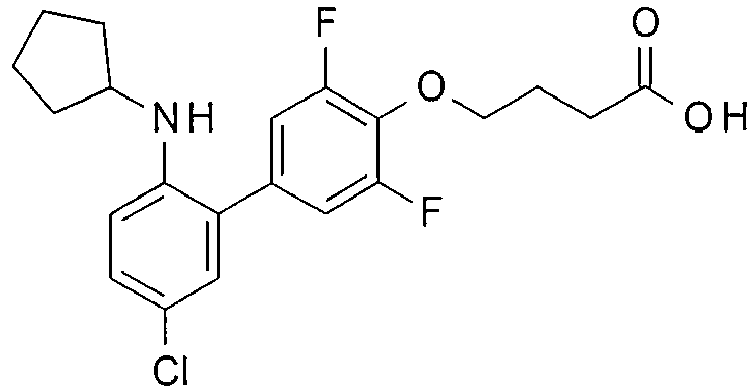
- 2-Bromo-4-chloro-N-cyclopentyl-aniline (0.083 g, 0.3 mmol)obtained in Preparation Example 81 and 4-[2,6-difluoro-4-(4,4,5,5-tetramethyl-1,3,2-dioxaborolan-2-yl)phenoxy]butyric acid ethyl ester (0.112 g, 0.3 mmol) obtained in Preparation Example 2 were used to react in the same manner as in Step A of Example 28 to obtain the title compound (0.1 g, 76%).
- 1H-NMR (CDCl3) δ 7.16 (1H, m), 6.97 (1H, m), 6.92 (2H, m), 6.61 (1H, d), 4.24 (2H, t), 4.15 (2H, q), 3,74 (2H, m), 2.57 (2H, t), 2.13 (2H, m), 1.98 (2H, m), 1.62 (4H, m), 1.39 (2H, m), 1.26 (3H, t)
- Ethyl 4-[4-[5-chloro-2-(cyclopentylamino)phenyl]-2,6-difluoro-phenoxy] butanoate (0.1 g, 0.23 mmol) obtained in Step A was used to react in the same manner as in Step B of Example 1 to obtain the title compound (0.059 g, 63%).
- 1H-NMR (CDCl3) δ 7.15 (1H, m), 6.98 (1H, m), 6.92 (2H, m), 6.62 (1H, d), 4.25 (2H, t), 3.73 (1H, m), 2.67 (2H, t), 2.13 (2H, m), 1.92 (2H, m), 1.64 (4H, m), 1.38 (2H, m)
-

- N-cyclopentyl-4-fluoro-2-iodo-aniline (0.055 g, 0.18 mmol) obtained in Preparation Example 82 and 4-[2,6-difluoro-4-(4,4,5,5-tetramethyl-1,3,2-dioxaborolan-2-yl)phenoxy]butyric acid ethyl ester (0.066g, 0.18 mmol) obtained in Preparation Example 2 were used to react in the same manner as in Step A of Example 28 to obtain the title compound (0.053g, 70%).
- 1H-NMR (CDCl3) δ 6.96 (3H, m), 6.77 (1H, m), 6.63 (1H, m), 4.23 (2H, t), 4.15 (2H, q), 3.72 (1H, m), 3.60 (1H, brs), 2.59 (2H, t), 2.11 (2H, m), 1.96 (2H, m), 1.64 (4H, m), 1.38 (2H, m), 1.27 (3H, t)
- Ethyl 4-[4-[2-(cyclopentylamino)-5-fluoro-phenyl]-2,6-difluoro-phenoxy] butanoate (0.053 g, 0.125 mmol) obtained in Step A was used to react in the same manner as in Step B of Example 1 to obtain the title compound (0.004 g, 8%).
- 1H-NMR (CDCl3) δ 6.96 (3H, m), 6.76 (1H, m), 6.64 (1H, m), 4.25 (2H, t), 3.71 (1H, m), 2.68 (2H, t), 2.13 (2H, m), 1.99 (2H, m), 1.62 (4H, m), 1.38 (2H, m)
-
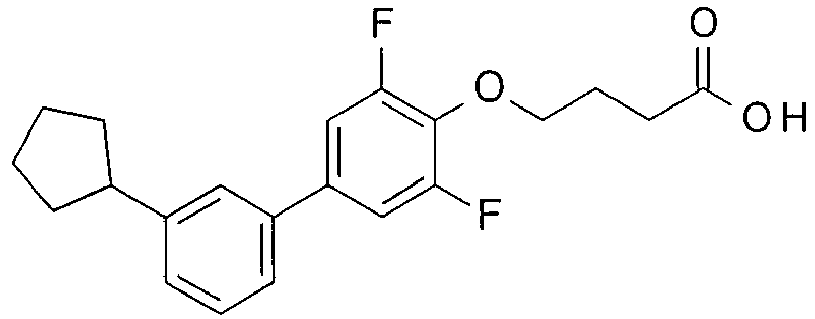
- 1-Cyclopentyl-3-iodo-benzene (0.045 g, 0.16 mmol)obtained in Preparation Example 86 and 4-[2,6-difluoro-4-(4,4,5,5-tetramethyl-1,3,2-dioxaborolan-2-yl)phenoxy]butyric acid ethyl ester (0.061 g, 0.16 mmol) obtained in Preparation Example 2 were used to react sequentially in the same manner as in Step A of Example 29 and Step B of Example 1 to obtain the title compound (0.017 g, 30%).
- 1H-NMR (CDCl3) δ 7.36 (2H, m), 7.30 (1H, m), 7.26 (1H, m), 7.12 (2H, m), 4.23 (2H, t), 3.04 (1H, m), 2.67 (2H, t), 2.11 (4H, m), 1.83 (2H, m), 1.72 (2H, m), 1.62 (2H, m)
-
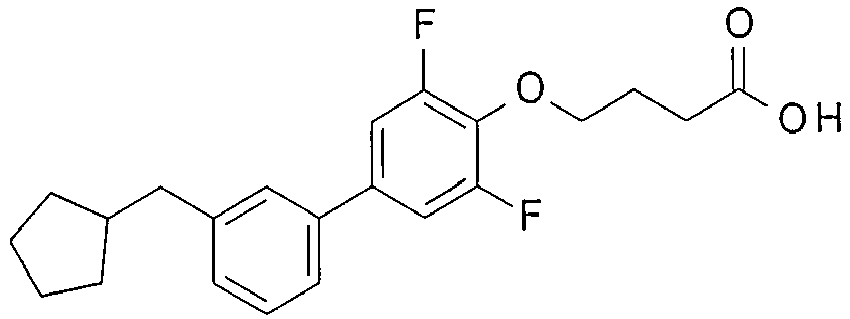
- 1-Bromo-3-(cyclopentylmethyl)benzene (0.115 g, 0.48 mmol) obtained in Preparation Example 87 and 4-[2,6-difluoro-4-(4,4,5,5-tetramethyl-1,3,2-dioxaborolan-2-yl)phenoxy]butyric acid ethyl ester (0.118 g, 0.32 mmol) obtained in Preparation Example 2 were used to react in the same manner as in Step A of Example 29 to obtain the title compound (0.08 g, 62%).
- 1H-NMR (CDCl3) δ 7.31 (3H, m), 7.15 (1H, d), 7.11 (2H, m), 4.21 (2H, t), 4.15 (2H, q), 2.66 (2H, d), 2.58 (2H, t), 2.10 (3H, m), 1.72 (2H, m), 1.65 (2H, m), 1.52 (2H, m), 1.27 (3H, t), 1.20 (2H, m)
- Ethyl 4-[4-[3-(cyclopentylmethyl)phenyl]-2,6-difluoro-phenoxy]butanoate (0.08 g, 0.2 mmol) obtained in Step A was used to react in the same manner as in Step B of Example 1 to obtain the title compound (0.07 g, 94%).
- 1H-NMR (CDCl3) δ 7.31 (3H, m), 7.17 (1H, m), 7.11 (2H, m), 4.22 (2H, t), 2.67 (4H, m), 2.11 (3H, m), 1.72 (2H, m), 1.65 (2H, m), 1.53 (2H, m), 1.22 (2H, m)
-

- 1-Bromo-2-(cyclopentylmethyl)benzene (0.24 g, 1 mmol) obtained in Preparation Example 88 and 4-[2,6-difluoro-4-(4,4,5,5-tetramethyl-1,3,2-dioxaborolan-2-yl)phenoxy]butyric acid ethyl ester (0.24 g, 0.66 mmol) obtained in Preparation Example 2 were used to react in the same manner as in Step A of Example 28 to obtain the title compound (0.13 g, 49%).
- 1H-NMR (CDCl3) δ 7.29 (2H, m), 7.21 (1H, m), 7.12 (1H, d), 6.84 (2H, m), 4.22 (2H, t), 4.17 (2H, q), 2.60 (4H, m), 2.12 (2H, m), 1.89 (1H, m), 1.58 (4H, m), 1.43 (2H, m), 1.28 (3H, t), 1.02 (2H, m)
- Ethyl 4-[4-[2-(cyclopentylmethyl)phenyl]-2,6-difluoro-phenoxy]butanoate (0.13 g, 0.32 mmol) obtained in Step A was used to react in the same manner as in Step B of Example 1 to obtain the title compound (0.1 g, 83%).
- 1H-NMR (CDCl3) δ 7.28 (2H, m), 7.21 (1H, m), 7.12 (1H, d), 6.82 (2H, m), 4.24 (2H, t), 2.68 (2H, t), 2.59 (2H, d), 2.14 (2H, m), 1.90 (1H, m), 1.57 (2H, m), 1.52 (2H, m), 1.43 (2H, m), 1.02 (2H, m)
-

- 2-Bromo-6-(cyclopentylidenemethyl)pyridine (0.13 g, 0.54 mmol) obtained in Preparation Example 91 and 4-[2,6-difluoro-4-(4,4,5,5-tetramethyl-1,3,2-dioxaborolan-2-yl)phenoxy]butyric acid ethyl ester (0.155 g, 0.42 mmol) obtained in Preparation Example 2 were used to react in the same manner as in Step A of Example 29 to obtain the title compound (0.15 g, 89%).
- 1H-NMR (CDCl3) δ 7.63 (3H, m), 7.39 (1H, d), 7.12 (1H, d), 6.50 (1H, m), 4.23 (2H, t), 4.16 (2H, q), 2.88 (2H, m), 2.57 (4H, m), 2.10 (2H, m), 1.84 (2H, m), 1.71 (2H, m), 1.27 (3H, t)
- Ethyl 4-[4-[6-(cyclopentylidenemethyl)-2-pyridyl]-2,6-difluoro-phenoxy] butanoate (0.15 g, 0.37 mmol) obtained in Step A was used to react in the same manner as in Step B of Preparation Example 50 to obtain the title compound (0.15 g, 99%).
- 1H-NMR (CDCl3) δ 7.63 (1H, t), 7.59 (2H, m), 7.43 (1H, d), 7.07 (1H, t), 4.21 (2H, t), 4.14 (2H, q), 2.82 (2H, d), 2.58 (2H, t), 2.34 (1H, m), 2.10 (2H, m), 1.65 (8H, m), 1.27 (3H, t)
- Ethyl 4-[4-[6-(cyclopentylmethyl)-2-pyridyl]-2,6-difluoro-phenoxy]butanoate (0.15 g, 0.37 mmol) obtained in Step B was used to react in the same manner as in Step B of Example 1 to obtain the title compound (0.106 g, 76%).
- 1H-NMR (CDCl3) δ 7.63 (1H, t), 7.57 (2H, m), 7.43 (1H, d), 7.07 (1H, d), 4.23 (2H, t), 2.82 (2H, d), 2.66 (2H, t), 2.34 (1H, m), 2.12 (2H, m), 1.74 (2H, m), 1.66 (2H, m), 1.54 (2H, m), 1.27 (2H, m)
-

- 1-Bromo-2-(cyclobutylmethyl)benzene (0.06 g, 0.26 mmol) obtained in Preparation Example 92 and 4-[2,6-difluoro-4-(4,4,5,5-tetramethyl-1,3,2-dioxaborolan-2-yl)phenoxy]butyric acid ethyl ester (0.08 g, 0.21 mmol) obtained in Preparation Example 2 were used to react in the same manner as in Step A of Example 28 to obtain the title compound (0.035 g, 43%).
- 1H-NMR (CDCl3) δ 7.28 (1H, m), 7.21 (2H, m), 7.12 (1H, m), 6.82 (2H, m), 4.23 (2H, t), 4.16 (2H, q), 2.66 (2H, d), 2.60 (2H, t), 2.41 (1H, m), 2.13 (2H, m), 1.95 (2H, m), 1.76 (2H, m), 1.57 (2H, m), 1.27 (3H, t)
- Ethyl 4-[4-[2-(cyclobutylmethyl)phenyl]-2,6-difluoro-phenoxy]butanoate (0.035 g, 0.09 mmol) obtained in Step A was used to react in the same manner as in Step B of Example 1 to obtain the title compound (0.02 g, 61%).
- 1H-NMR (CDCl3) δ 7.78 (1H, m), 7.21 (2H, m), 7.12 (1H, m), 6.84 (2H, m), 4.24 (2H, t), 2.67 (4H, m), 2.41 (1H, m), 2.13 (2H, m), 1.95 (2H, m), 1.75 (2H, m), 1.57 (2H, m)
-
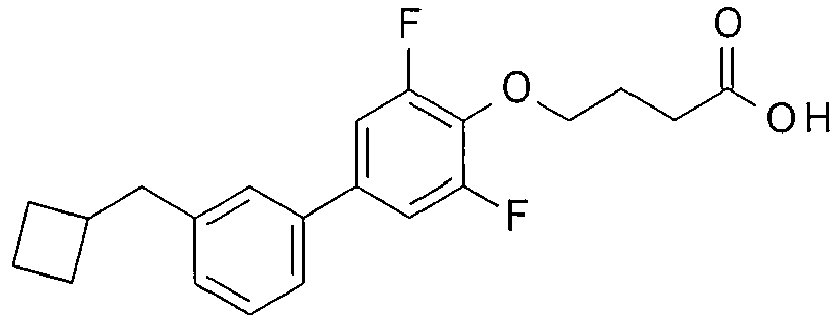
- 1-Bromo-3-(cyclobutylmethyl)benzene (0.03 g, 0.13 mmol) obtained in Preparation Example 93 and 4-[2,6-difluoro-4-(4,4,5,5-tetramethyl-1,3,2-dioxaborolan-2-yl)phenoxy]butyric acid ethyl ester (0.041 g, 0.11 mmol) obtained in Preparation Example 2 were used to react in the same manner as in Step A of Example 29 to obtain the title compound (0.012 g, 28%).
- 1H-NMR (CDCl3) δ 7.32 (3H, m), 7.10 (3H, m), 4.21 (2H, t), 4.15 (2H, q), 2.75 (2H, d), 2.59 (3H, m), 2.10 (4H, m), 1.85 (2H, m), 1.74 (2H, m), 1.27 (3H, t)
- Ethyl 4-[4-[3-(cyclobutylmethyl)phenyl]-2,6-difluoro-phenoxy]butanoate (0.012 g, 0.03 mmol) obtained in Step A was used to react in the same manner as in Step B of Example 1 to obtain the title compound (0.01 g, 92%).
- 1H-NMR (MeOH-d4) δ 7.34 (3H, m), 7.22 (2H, m), 7.16 (1H, m), 4.19 (2H, t), 2.75 (2H, d), 2.61 (1H, m), 2.56 (2H, t), 2.06 (4H, m), 1.85 (2H, m), 1.76 (2H, m)
-

- 2-Bromo-6-(cyclobutylidenemethyl)pyridine (0.096 g, 0.43 mmol) obtained in Preparation Example 94 and 4-[2,6-difluoro-4-(4,4,5,5-tetramethyl-1,3,2-dioxaborolan-2-yl)phenoxy]butyric acid ethyl ester (0.105 g, 0.28 mmol) obtained in Preparation Example 2 were used to react in the same manner as in Step A of Example 29 to obtain the title compound (0.085 g, 75%).
- 1H-NMR (CDCl3) δ 7.64 (1H, t), 7.60 (2H, m), 7.38 (1H, d), 7.04 (1H, d), 6.27 (1H, m), 4.23 (2H, t), 4.17 (2H, q), 3.27 (2H, m), 2.94 (2H, m), 2.59 (2H, t), 2.18 (2H, m), 2.10 (2H, m), 1.27 (3H, t)
- Ethyl 4-[4-[6-(cyclobutylidenemethyl)-2-pyridyl]-2,6-difluoro-phenoxy] butanoate (0.085 g, 0.22 mmol) obtained in Step A was used to react in the same manner as in Step B of Preparation Example 50 to obtain the title compound (0.082 g, 95%).
- 1H-NMR (CDCl3) δ 7.62 (1H, t), 7.57 (2H, m), 7.42 (1H, d), 7.04 (1H, d), 4.22 (2H, t), 2.16 (2H, q), 2.92 (2H, d), 2.79 (1H, m), 2.57 (2H, t), 2.10 (4H, m), 1.88 (2H, m), 1.80 (2H, m), 1.27 (3H, t)
- Ethyl 4-[4-[6-(cyclobutylmethyl)-2-pyridyl]-2,6-difluoro-phenoxy]butanoate (0.08 g, 0.2 mmol) obtained in Step B was used to react in the same manner as in Step B of Example 1 to obtain the title compound (0.075 g, 99%).
- 1H-NMR (CDCl3) δ 7.62 (1H, t), 7.57 (2H, m), 7.42 (1H, d), 7.04 (1H, d), 4.23 (2H, t), 2.93 (2H, d), 2.78 (1H, m), 2.67 (2H, t), 2.11 (4H, m), 1.89 (2H, m), 1.80 (2H, m)
-

- 1-Cyclopentyl-2-iodo-benzene (0.065 g, 0.23 mmol) obtained in Preparation Example 97 and 4-[2,6-difluoro-4-(4,4,5,5-tetramethyl-1,3,2-dioxaborolan-2-yl)phenoxy]butyric acid ethyl ester (0.073 g, 0.2 mmol) obtained in Preparation Example 2 were used to react in the same manner as in Step A of Example 28 to obtain the title compound (0.036 g, 46%).
- 1H-NMR (CDCl3) δ 7.37 (2H, m), 7.18 (1H, t), 7.11 (1H, d), 6.82 (2H, m), 4.22 (2H, t), 4.15 (2H, q), 3.00 (1H, m), 2.60 (2H, t), 2.12 (2H, m), 1.91 (2H, m), 1.79 (2H, m), 1.58 (4H, m), 1.27 (3H, t)
- Ethyl 4-[4-(2-cyclopentylphenyl)-2,6-difluoro-phenoxy]butanoate (0.036 g, 0.09 mmol) obtained in Step A was used to react in the same manner as in Step B of Example 1 to obtain the title compound (0.03 g, 92%).
- 1H-NMR (CDCl3) δ 7.36 (2H, m), 7.18 (1H, t), 7.11 (1H, d), 6.82 (2H, m), 4.23 (2H, t), 2.99 (1H, m), 2.67 (2H, t), 2.14 (2H, m), 1.92 (2H, m), 1.80 (2H, m), 1.59 (4H, m)
-
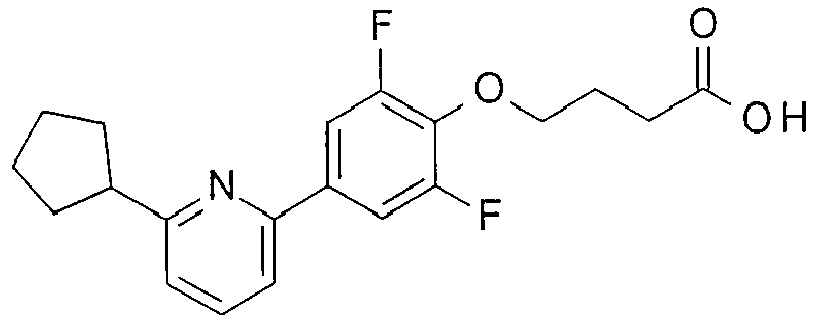
- 2-Bromo-6-cyclopentyl-pyridine (0.1 g, 0.44 mmol) obtained in Preparation Example 98 and 4-[2,6-difluoro-4-(4,4,5,5-tetramethyl-1,3,2-dioxaborolan-2-yl)phenoxy]butyric acid ethyl ester (0.125 g, 0.34 mmol) obtained in Preparation Example 2 were used to react in the same manner as in Step A of Example 29 to obtain the title compound (0.091 g, 68%).
- 1H-NMR (CDCl3) δ 7.60 (3H, m), 7.43 (1H, d), 7.10 (1H, d), 4.20 (2H, t), 4.14 (2H, q), 3.21 (1H, m), 2.56 (2H, t), 2.09 (4H, m), 1.86 (4H, m), 1.72 (2H, m), 1.26 (3H, t)
- Ethyl 4-[4-(6-cyclopentyl-2-pyridyl)-2,6-difluoro-phenoxy]butanoate (0.09 g, 0.23 mmol) obtained in Step A was used to react in the same manner as in Step B of Example 1 to obtain the title compound (0.07 g, 84%).
- 1H-NMR (CDCl3) δ 7.62 (3H, m), 7.42 (1H, d), 7.11 (1H, d), 4.23 (2H, t), 3.22 (1H, m), 2.67 (2H, t), 2.12 (4H, m), 1.86 (4H, m), 1.71 (2H, m)
-

- (2-Isobutyl-3-pyridyl) trifluoromethanesulfonate (0.017 g, 0.06 mmol) obtained in Preparation Example 103 and 4-[2,6-difluoro-4-(4,4,5,5-tetramethyl-1,3,2-dioxaborolan-2-yl)phenoxy]butyric acid ethyl ester (0.026 g, 0.07 mmol) obtained in Preparation Example 2 were used to react in the same manner as in Step A of Example 29 to obtain the title compound (0.013 g, 57%).
- 1H-NMR (CDCl3) δ 8.57 (1H, m), 7.44 (1H, m), 7.16 (1H, m), 6.83 (2H, m), 4.26 (2H, t), 4.16 (2H, q), 2.65 (2H, d), 2.61 (2H, t), 2.13 (3H, m), 1.26 (3H, t), 0.80 (6H, d)
- Ethyl 4-[2,6-difluoro-4-(2-isobutyl-3-pyridyl)phenoxy]butanoate (0.013 g, 0.034 mmol) obtained in Step A was used to react in the same manner as in Step B of Example 1 to obtain the title compound(0.004 g, 32%).
- 1H-NMR (CDCl3) δ 8.60 (1H, m), 7.42 (1H, m), 7.20 (1H, m), 6.82 (2H, m), 4.27 (2H, t), 2.67 (4H, m), 2.15 (2H, m), 2.05 (1H, m), 0.78 (6H, d)
-
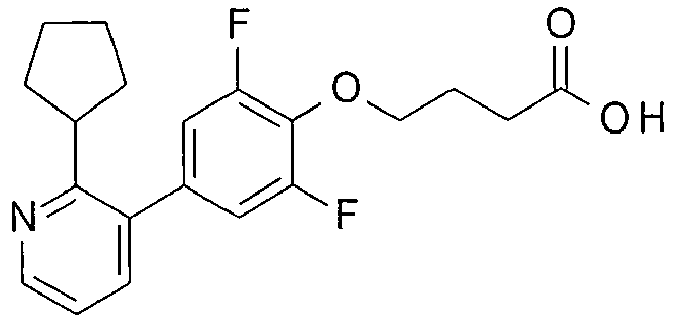
- (2-Cyclopentyl-3-pyridyl) trifluoromethanesulfonate (0.376 g, 1.27 mmol) obtained in Preparation Example 106 and 4-[2,6-difluoro-4-(4,4,5,5-tetramethyl-1,3,2-dioxaborolan-2-yl)phenoxy]butyric acid ethyl ester (0.51 g, 1.4 mmol) obtained in Preparation Example 2 were used to react in the same manner as in Step A of Example 29 to obtain the title compound (0.284 g, 57%).
- 1H-NMR (CDCl3) δ 8.60 (1H, m), 7.41 (1H, m), 7.12 (1H, m), 6.83 (2H, m), 4.24 (2H, t), 4.16 (2H, q), 3.16 (1H, m), 2.60 (2H, t), 2.12 (2H, m), 1.87 (6H, m), 1.59 (2H, m), 1.27 (3H, t)
- Ethyl 4-[4-(2-cyclopentyl-3-pyridyl)-2,6-difluoro-phenoxy]butanoate (0.18 g, 0.46 mmol) obtained in Step A was used to react in the same manner as in Step B of Example 1 to obtain the title compound (0.15 g, 90%).
- 1H-NMR (CDCl3) δ 8.62 (1H, m), 7.41 (1H, m), 7.14 (1H, m), 6.84 (2H, m), 4.27 (2H, t), 3.16 (1H, m), 2.69 (2H, t), 2.14 (2H, m), 1.89 (6H, m), 1.60 (2H, m)
-

- [2-(Cyclopentylmethyl)-3-pyridyl] trifluoromethanesulfonate (0.04 g, 0.13 mmol) obtained in Preparation Example 108 and 4-[2,6-difluoro-4-(4,4,5,5-tetramethyl-1,3,2-dioxaborolan-2-yl)phenoxy]butyric acid ethyl ester (0.052 g, 0.14 mmol) obtained in Preparation Example 2 were used to react in the same manner as in Step A of Example 29 to obtain the title compound (0.037 g, 70%).
- 1H-NMR (CDCl3) δ 8.56 (1H, m), 7.43 (1H, m), 7.16 (1H, m), 6.82 (2H, m), 4.24 (2H, t), 4.15 (2H, q), 2.78 (2H, d), 2.60 (2H, t), 2.23 (1H, m), 2.12 (2H, m), 1.53 (6H, m), 1.27 (3H, t), 1.04 (2H, m)
- Ethyl 4-[4-[2-(cyclopentylmethyl)-3-pyridyl]-2,6-difluoro-phenoxy]butanoate (0.037 g, 0.09 mmol) obtained in Step A was used to react in the same manner as in Step B of Example 1 to obtain the title compound (0.022 g, 65%).
- 1H-NMR (CDCl3) δ 8.58 (1H, m), 7.45 (1H, m), 7.17 (1H, m), 6.85 (2H, m), 4.26 (2H, t), 2.80 (2H, d), 2.67 (2H, t), 2.16 (3H, m), 1.55 (6H, m), 1.03 (2H, m)
-

- Ethyl 4-[2,6-difluoro-4-(2-fluoro-3-pyridyl)phenoxy]butanoate (0.1 g, 0.29 mmol) obtained in Preparation Example 109 and pyrrole (0.04 g, 0.59 mmol) were used to react in the same manner as in Preparation Example 37 to obtain 2,6-difluoro-4-(2-pyrrol-1-yl-3-pyridyl)phenol. The obtained 2,6-difluoro-4-(2-pyrrol-1-yl-3-pyridyl)phenol was reacted with 4-bromo-butyric acid ethyl ester in the same manner as in Preparation Example 12 to obtain ethyl 4-[2,6-difluoro-4-(2-pyrrol-1-yl-3-pyridyl)phenoxy]butanoate. The obtained ethyl 4-[2,6-difluoro-4-(2-pyrrol-1-yl-3-pyridyl)phenoxy]butanoate was reacted in the same manner as in Step B of Example 1 to obtain the title compound (0.07 g, 0.07%).
- 1H-NMR (CDCl3) δ 8.51 (1H, m), 7.71 (1H, m), 7.30 (1H, m), 6.82 (2H, m), 6.71 (2H, m), 6.19 (2H, m), 4.23 (2H, t), 2.65 (2H, t), 2.12 (2H, m)
-

- Ethyl 4-[2,6-difluoro-4-(2-fluoro-3-pyridyl)phenoxy]butanoate (0.071 g, 0.21 mmol) obtained in Preparation Example 109 and 4-methylpyrazole (0.021 g, 0.25 mmol) were used to react in the same manner as in Step A of Example 72 to obtain the title compound (0.054 g, 64%).
- 1H-NMR (CDCl3) δ 8.50 (1H, m), 7.76 (1H, m), 7.70 (1H, s), 7.37 (1H, s), 7.36 (1H, m), 6.68 (2H, m), 4.20 (2H, t), 4.15 (2H, q), 2.57 (2H, t), 2.10 (5H, m), 1.27 (3H, t)
- Ethyl 4-[2,6-difluoro-4-[2-(4-methylpyrazole-1-yl)-3-pyridyl]phenoxy] butanoate (0.054 g, 0.13 mmol) obtained in Step A was used to react in the same manner as in Step B of Example 1 to obtain the title compound (0.016 g, 33%).
- 1H-NMR (CDCl3) δ 8.51 (1H, m), 7.76 (1H, m), 7.70 (1H, s), 7.38 (1H, s), 7.36 (1H, m), 6.69 (2H, m), 4.22 (2H, t), 2.64 (2H, m), 2.11 (5H, m)
-

- 4-(3-Iodo-2-pyridyl)morpholine (0.056 g, 0.19 mmol) obtained in Preparation Example 110 and 4-[2,6-difluoro-4-(4,4,5,5-tetramethyl-1,3,2-dioxaborolan-2-yl)phenoxy]butyric acid ethyl ester (0.072 g, 0.19 mmol) obtained in Preparation Example 2 were used to react sequentially in the same manner as in Example 72 and Step B of Example 1 to obtain the title compound (0.009 g, 12%).
- 1H-NMR (CDCl3) δ 8.26 (1H, m), 7.43 (1H, m), 7.19 (2H, m), 6.96 (1H, m), 4.25 (2H, t), 3.67 (4H, m), 3.10 (4H, m), 2.67 (2H, t), 2.12 (2H, m)
-

- 3-Iodo-N-(tetrahydropyran-4-ylmethyl)pyridin-2-amine (0.063 g, 0.2 mmol) obtained in Preparation Example 111 and 4-[2,6-difluoro-4-(4,4,5,5-tetramethyl-1,3,2-dioxaborolan-2-yl)phenoxy]butyric acid ethyl ester (0.075 g, 0.2 mmol) obtained in Preparation Example 2 were used to react sequentially in the same manner as in Example 72 and Step B of Example 1 to obtain the title compound (0.003 g, 4%).
- 1H-NMR (CDCl3) δ 8.13 (1H, m), 7.22 (1H, m), 6.94 (2H, m), 6.64 (1H, m), 4.57 (1H, brs), 4.28 (2H, t), 3.97 (2H, m), 3.38 (2H, m), 3.31 (2H, m), 2.67 (2H, t), 2.13 (2H, m), 1.88 (1H, m), 1.61 (2H, m), 1.34 (2H, m)
-

- Ethyl 4-[2,6-difluoro-4-(2-fluoro-3-pyridyl)phenoxy]butanoate (0.1 g, 0.29 mmol) obtained in Preparation Example 109, piperidine (0.05 g, 0.58 mmol) and DMSO were used to react in the same manner as in Step A of Example 72 to obtain the title compound (0.022 g, 19%).
- 1H-NMR (CDCl3) δ 8.22 (1H, m), 7.38 (1H, m), 7.19 (2H, m), 6.87 (1H, m), 4.22 (2H, t), 4.15 (2H, q), 3.03 (4H, m), 2.60 (2H, t), 2.11 (2H, m), 1.52 (6H, m), 1.27 (3H, t)
- Ethyl 4-[2,6-difluoro-4-[2-(1-piperidyl)-3-pyridyl]phenoxy]butanoate (0.021 g, 0.05 mmol) obtained in Step A was used to react in the same manner as in Step B of Example 1 to obtain the title compound (0.014 g, 74%).
- 1H-NMR (CDCl3) δ 8.24 (1H, m), 7.40 (1H, m), 7.19 (2H, m), 6.89 (1H, m), 4.23 (2H, t), 3.05 (4H, m), 2.67 (2H, t), 2.13 (2H, m), 1.53 (6H, m)
-

- 2-Cyclobutylsulfanyl-3-iodo-pyridine (0.077 g, 0.26 mmol) obtained in Preparation Example 44 and ethyl (4S)-4-[2,6-difluoro-4-(4,4,5,5-tetramethyl-1,3,2-dioxaborolan-2-yl)phenoxy]pentanoa te (0.095 g, 0.24 mmol) obtained in Preparation Example 123 were used to react in the same manner as in Step A of Example 28 to obtain the title compound (0.067 g, 60%).
- 1H NMR (CDCl3) δ 8.41 (1H, m), 7.33 (1H, m), 7.00 (3H, m), 4.41 (2H, m), 4.16 (2H, q), 2.61 (2H, t), 2.60 (2H, m), 2.05 (6H, m), 1.33 (3H, d), 1.27 (3H, t)
- Ethyl (4S)-4-[4-(2-cyclobutylsulfanyl-3-pyridyl)-2,6-difluoro-phenoxy] pentanoate (0.067 g, 0.16 mmol) obtained in Step A was used to react in the same manner as in Step B of Example 1 to obtain the title compound (0.033 g, 52%).
- 1H NMR (CDCl3) δ 8.41 (1H, m), 7.33 (1H, m), 7.00 (3H, m), 4.41 (2H, m), 2.71 (2H, t), 2.52 (2H, m), 2.05 (6H, m), 1.35 (3H, d)
-
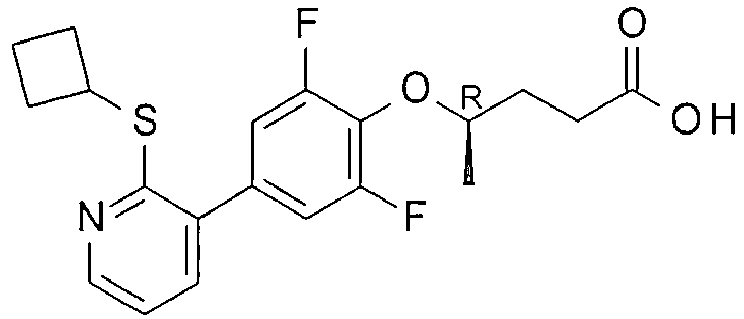
- 2-Cyclobutylsulfanyl-3-iodo-pyridine (0.051 g, 0.18 mmol) obtained in Preparation Example 44 and methyl (4R)-4-[2,6-difluoro-4-(4,4,5,5-tetramethyl-1,3,2-dioxaborolan-2-yl)phenoxy]pentanoa te (0.062 g, 0.16 mmol) obtained in Preparation Example 117 were used to react in the same manner as in Step A of Example 28 to obtain the title compound (0.04 g, 61%).
- 1H NMR (CDCl3) δ 8.41 (1H, m), 7.33 (1H, m), 7.01 (3H, m), 4.41 (2H, m), 3.69 (3H, s), 2.63 (2H, t), 2.51 (2H, m), 2.05 (6H, m), 1.33 (3H, d)
- Methyl (4R)-4-[4-(2-cyclobutylsulfanyl-3-pyridyl)-2,6-difluoro-phenoxy] pentanoate (0.04 g, 0.1 mmol) obtained in Step A was used to react in the same manner as in Step B of Example 1 to obtain the title compound (0.039 g, 99%).
- 1H NMR (CDCl3) δ 8.41 (1H, m), 7.33 (1H, m), 7.00 (3H, m), 4.41 (2H, m), 2.71 (2H, t), 2.52 (2H, m), 2.05 (6H, m), 1.35 (3H, d)
-

- 1-Cyclobutoxy-3-iodo-benzene (0.049 g, 0.18 mmol) obtained in Preparation Example 60 and methyl (4R)-4-[2,6-difluoro-4-(4,4,5,5-tetramethyl-1,3,2-dioxaborolan-2-yl)phenoxy]pentanoa te (0.055 g, 0.15 mmol) obtained in Preparation Example 117 were used to react in the same manner as in Step A of Example 29 to obtain the title compound (0.039 g, 71%).
- 1H NMR (CDCl3) δ 7.31 (1H, t), 7.09 (3H, m), 6.94 (1H, m), 6.80 (1H, m), 4.69 (1H, m), 4.34 (1H, m), 3.70 (3H, s), 2.62 (2H, t), 2.47 (2H, m), 2.20 (2H, m), 2.04 (2H, m), 1.88 (1H, m), 1.71 (1H, m), 1.31 (3H, d)
- Methyl (4R)-4-[4-[3-(cyclobutoxy)phenyl]-2,6-difluoro-phenoxy]pentanoate (0.039 g, 0.1 mmol) obtained in Step A was used to react in the same manner as in Step B of Example 1 to obtain the title compound (0.031 g, 82%).
- 1H NMR (CDCl3) δ 7.31 (1H, t), 7.12 (3H, m), 6.95 (1H, m), 6.80 (1H, m), 4.69 (1H, m), 4.36 (1H, m), 2.70 (2H, t), 2.46 (2H, m), 2.20 (2H, m), 2.05 (2H, m), 1.88 (1H, m), 1.71 (1H, m), 1.30 (3H, d)
-

- 2-cyclopentylsulfanyl-3-iodo-pyridine (0.054 g, 0.18 mmol) obtained in Preparation Example 39 and methyl (4R)-4-[2,6-difluoro-4-(4,4,5,5-tetramethyl-1,3,2-dioxaborolan-2-yl)phenoxy]pentanoa te (0.055 g, 0.15 mmol) obtained in Preparation Example 117 were used to react in the same manner as in Step A of Example 28 to obtain the title compound (0.045 g, 66%).
- 1H NMR (CDCl3) δ 8.42 (1H, m), 7.32 (1H, m), 7.00 (3H, m), 4.37 (1H, m), 4.08 (1H, m), 3.70 (3H, s), 2.63 (2H, t), 2.20 (2H, m), 2.04 (2H, m), 1.72 (2H, m), 1.64 (2H, m), 1.57 (2H, m), 1.33 (3H, d)
- Methyl (4R)-4-[4-(2-cyclopentylsulfanyl-3-pyridyl)-2,6-difluoro-phenoxy] pentanoate (0.045 g, 0.1 mmol) obtained in Step A was used to react in the same manner as in Step B of Example 1 to obtain the title compound (0.041 g, 95%).
- 1H NMR (CDCl3) δ 8.43 (1H, m), 7.32 (1H, m), 7.00 (3H, m), 4.39 (1H, m), 4.09 (1H, m), 2.70 (2H, t), 2.20 (2H, m), 2.04 (2H, m), 1.71 (2H, m), 1.62 (4H, m), 1.34 (3H, d)
-

- Methyl (4R)-4-[2,6-difluoro-4-(4,4,5,5-tetramethyl-1,3,2-dioxaborolan-2-yl) phenoxy]pentanoate (0.055 g, 0.15 mmol) obtained in Preparation Example 117 and 1-bromo-3-phenoxy-benzene (0.044 g, 0.18 mmol) were used to react in the same manner as in Step A of Example 29 to obtain the title compound (0.044 g, 72%).
- 1H NMR (CDCl3) δ 7.37 (3H, m), 7.23 (1H, m), 7.14 (2H, m), 7.08 (2H, m), 7.04 (2H, m), 6.99 (1H, m), 4.34 (1H, m), 3.69 (3H, s), 2.62 (2H, t), 2.02 (2H, m), 1.30 (3H, d)
- Methyl (4R)-4-[2,6-difluoro-4-(3-phenoxyphenyl)phenoxy]pentanoate (0.044 g, 0.1 mmol) obtained in Step A was used to react in the same manner as in Step B of Example 1 to obtain the title compound (0.041 g, 96%).
- 1H NMR (CDCl3) δ 7.36 (3H, m), 7.23 (1H, m), 7.14 (2H, m), 7.09 (2H, m), 7.04 (2H, m), 6.99 (1H, m), 4.35 (1H, m), 2.68 (2H, t), 2.03 (2H, m), 1.30 (3H, d)
-

- 4-(3'-Hydroxy-biphenyl-4-ylsulfanyl)-butyric acid ethyl ester (0.1 g, 0.32 mmol) obtained in Preparation Example 149, bromo-cyclobutane (0.044 mL) and Cs2CO3 (0.31 g, 0.95 mmol) were used to react in the same manner as in Step B of Preparation Example 44 to obtain the title compound (0.075 g, 64%).
- 1H-NMR (CDCl3) δ 7.48 (2H, d), 7.38 (2H, d), 7.30 (1H, t), 7.12 (1H, m), 7.00 (1H, s), 6.78 (1H, m), 4.69 (1H, m), 4.12 (2H, q), 3.00 (2H, t), 2.47 (4H, m), 2.20 (2H, m), 1.98 (2H, m), 1.86 (1H, m), 1.70 (1H, m), 1.24 (3H, t).
- 4-(3'-Cyclobutoxy-biphenyl-4-ylsulfanyl)-butyric acid ethyl ester (0.075 g, 0.20 mmol) obtained in Step A was used to react in the same manner as in Step B of Example 1 to obtain the title compound (0.02 g, 28%).
- 1H-NMR (CDCl3) δ 7.48 (2H, d), 7.38 (2H, d), 7.30 (1H, t), 7.12 (1H, m), 7.00 (1H, s), 6.78 (1H, m), 4.68 (1H, m), 3.01 (2H, t), 2.54 (2H, t), 2.46 (2H, m), 2.20 (2H, m), 2.00 (2H, m), 1.85 (1H, m), 1.70 (1H, m).
-

- 4-(3'-Hydroxy-biphenyl-4-ylsulfanyl)-butyric acid ethyl ester (0.11 g, 0.35 mmol) obtained in Preparation Example 149, 2-bromo-propane (0.049 mL) and Cs2CO3 (0.34 g, 1.04 mmol) were used to react in the same manner as in Step B of Preparation Example 44 to obtain the title compound (0.12 g, 96%).
- 1H-NMR (CDCl3) δ 7.50 (2H, d), 7.39 (2H, d), 7.31 (1H, t), 7.12 (1H, m), 7.07 (1H, s), 6.86 (1H, m), 4.60 (1H, m), 4.13 (2H, q), 3.00 (2H, t), 2.47 (2H, t), 1.98 (2H, m), 1.36 (6H, d), 1.24 (3H, t).
- 4-(3'-Isopropoxy-biphenyl-4-ylsulfanyl)-butyric acid ethyl ester (0.12 g, 0.33 mmol) obtained in Step A was used to react in the same manner as in Step B of Example 1 to obtain the title compound (0.10 g, 95%).
- 1H-NMR (CDCl3) δ 7.50 (2H, d), 7.39 (2H, d), 7.31 (1H, t), 7.12 (1H, m), 7.07 (1H, s), 6.86 (1H, m), 4.60 (1H, m), 3.01 (2H, t), 2.54 (2H, t), 2.00 (2H, m), 1.34 (6H, d).
-
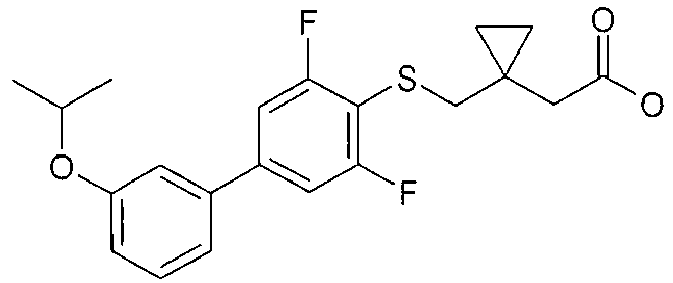
- [1-(3,5-Difluoro-3'-hydroxy-biphenyl-4-ylsulfanylmethyl)-cyclopropyl]-acetic acid methyl ester (0.02 g, 0.05 mmol) obtained in Preparation Example 152, 2-bromo-propane (0.008 mL) and Cs2CO3 (0.05 g, 0.16 mmol) were used to react in the same manner as in Step B of Preparation Example 44 to obtain the title compound (0.006 g, 27%).
- 1H-NMR (CDCl3) δ 7.34 (1H, t), 7.13-7.08 (3H, m), 7.04 (1H, s), 6.91 (1H, m), 4.61 (1H, m), 3.64 (3H, s), 3.01 (2H, s), 2.56 (2H, s), 1.35 (6H, d), 0.45-0.38 (4H, m).
- [1-(3,5-Difluoro-3'-isopropoxy-biphenyl-4-ylsulfanylmethyl)-cyclopropyl]-acetic acid methyl ester (0.006 g, 0.015 mmol) obtained in Step A was used to react in the same manner as in Step B of Example 1 to obtain the title compound (0.004 g, 69%).
- 1H-NMR (CDCl3) δ 7.33 (1H, t), 7.13-7.05 (4H, m), 6.90 (1H, m), 4.60 (1H, m), 3.01 (2H, s), 2.62 (2H, s), 1.36 (6H, d), 0.46-0.35 (4H, m).
-

- NaH (60% in mineral oil, 0.005 g, 0.12 mmol) was dissolved in 1mL of DMF. Dimethylmalonate (0.013 mL, 0,12 mmol) was added thereto and the resultant was agitated at room temperature for 15 minutes. 4-(2-Chloro-ethylsulfanyl)-3'-cyclopentyloxy-3,5-difluoro-biphenyl (0.03 g, 0.08 mmol) obtained in Preparation Example 158 was added thereto, and the resultant was agitated at 65°C for 18 hours. The reaction solution was added with water and extracted with EtOAc. The organic layer was dried with MgSO4 and purified by column chromatography to obtain the title compound (0.01 g, 25 %).
- 2-[2-(3'-Cyclopentyloxy-3,5-difluoro-biphenyl-ylsulfanyl)-ethyl]-malonic acid dimethyl ester(0.01 g, 0.02 mmol) obtained in Step A was dissolved in each 0.3 mL of EtOH and THF. 0.2 mL of 4N KOH was added thereto, and the resultant was agitated at 60°C for 1 hour. The reaction solution was concentrated under reduced pressure, and water was then added thereto. The pH was adjusted to 3 by the use of 2N HCl, and the resultant was then extracted with EtOAc. The separated organic layer was dried with MgSO4 and concentrated under reduced pressure. The concentrated organic layer was dissolved in 1 mL of pyridine, and the resultant was agitated at 80°C for 18 hours. The reaction solution was concentrated under reduced pressure, and then water was added thereto. The pH was adjusted to 3 by the use of 2N HCl, and the resultant was then extracted with EtOAc. The separated organic layer was dried with MgSO4 and purified by column chromatography to obtain the title compound (0.002 g, 20 %).
- 1H-NMR (CDCl3) δ 7.32 (1H, t), 7.13 (2H, m), 7.08 (1H, m), 7.02 (1H, s), 6.90 (1H, m), 4.81 (1H, m), 2.94 (2H, t), 2.55 (2H, t), 1.92-1.81 (8H, m), 1.64 (2H, m).
-
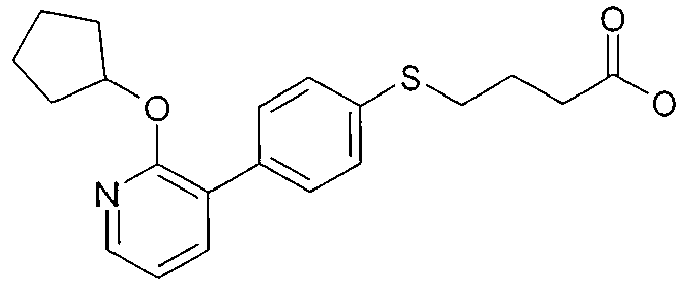
- 4-[4-(4,4,5,5-Tetramethyl-[1,3,2]dioxaborolan-2-yl)-phenylsulfanyl]-butyric acid ethyl ester (0.056 g, 0.16 mmol) obtained in Preparation Example 159 and 2-cyclopentoxy-3-iodo-pyridine (0.046 g, 0.16 mmol) obtained in Preparation Example 38 were used to react sequentially in the same manner as in Steps A and B of Example 1 to obtain the title compound (0.025 g, 44%).
- 1H-NMR (CDCl3) δ 8.12 (1H, m), 7.56 (1H, m), 7.49 (2H, d), 7.36 (2H, d), 6.90 (1H, m), 5.50 (1H, m), 3.02 (2H, t), 2.56 (2H, t), 2.03-1.92 (4H, m), 1.84-1.60 (6H, m).
-

- 4-[4-(4,4,5,5-Tetramethyl-[1,3,2]dioxaborolan-2-yl)-phenylsulfanyl]-butyric acid ethyl ester (0.08 g, 0.29 mmol) obtained in Preparation Example 159 and 2-cyclopropylmethoxy-3-iodo-pyridine (0.10 g, 0.29 mmol) obtained in Preparation Example 40 were used to react sequentially in the same manner as in Steps A and B of Example 1 to obtain the title compound (0.02 g, 25%).
- 1H-NMR (CDCl3) δ 8.10 (1H, m), 7.59 (1H, m), 7.55 (2H, d), 7.38 (2H, d), 6.95 (1H, m), 4.20 (2H, d), 3.04-3.01 (2H, t), 2.57-2.54 (2H, t), 2.02-1.99 (2H, m), 1.27 (1H, m), 0.55 (2H, m), 0.33 (2H, m).
-
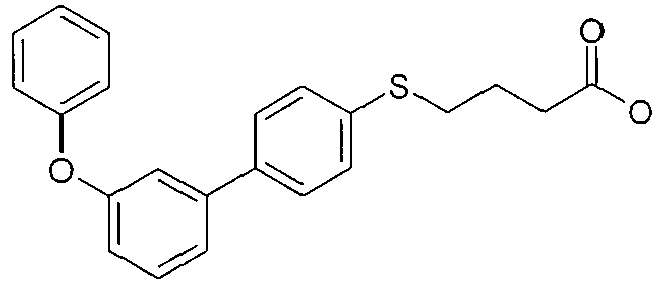
- 4-[4-(4,4,5,5-Tetramethyl-[1,3,2]dioxaborolan-2-yl)-phenylsulfanyl]-butyric acid ethyl ester (0.03 g, 0.11 mmol) obtained in Preparation Example 159 and 1-bromo-3-phenoxy-benzene (0.03 g, 0.12 mmol) were used to react sequentially in the same manner as in Steps A and B of Example 1 to obtain the title compound (0.005 g, 16%).
- 1H-NMR (CDCl3) δ 7.48 (2H, d), 7.38-7.26 (6H, m), 7.25 (1H, s), 7.1 (1H, t), 7.05 (2H, d), 6.97 (1H, m), 3.00 (2H, t), 2.54 (2H, t), 1.98 (2H, m).
-

- 4-(3'-Hydroxy-biphenyl-4-ylsulfanyl)-butyric acid ethyl ester (0.056 g, 0.17 mmol) obtained in Preparation Example 149, bromo-cyclopentane (0.030 mL) and Cs2CO3 (0.17 g, 0.53 mmol) were used to react sequentially in the same manner as in Steps A and B of Example 119 to obtain the title compound (0.052 g, 82%).
- 1H-NMR (CDCl3) δ 7.49 (2H, d), 7.38 (2H, d), 7.30 (1H, t), 7.12 (1H, m), 7.06 (1H, s), 6.85 (1H, m), 4.81 (1H, m), 3.01 (2H, t), 2.54 (2H, t), 2.00-1.81 (8H, m), 1.62 (2H, m).
-
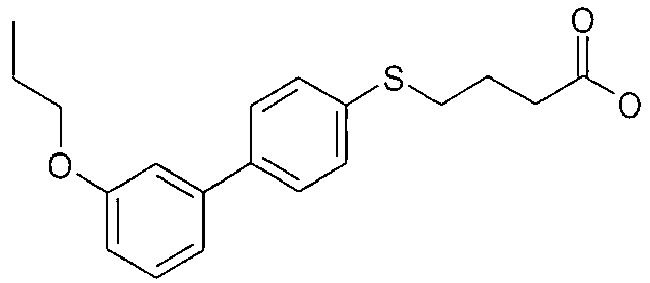
- 4-(3'-Hydroxy-biphenyl-4-ylsulfanyl)-butyric acid ethyl ester (0.053 g, 0.17 mmol) obtained in Preparation Example 149, 2-bromo-propane (0.023 mL) and Cs2CO3 (0.16 g, 0.50 mmol) were used to react sequentially in the same manner as in Steps A and B of Example 119 to obtain the title compound (0.045 g, 81%).
- 1H-NMR (CDCl3) δ 7.50 (2H, d), 7.38 (2H, d), 7.32 (1H, t), 7.12 (1H, m), 7.09 (1H, s), 6.87 (1H, m), 3.97 (2H, t), 3.01 (2H, t), 2.55 (2H, t), 2.00 (2H, m), 1.82 (2H, m), 1.05 (3H, t).
-
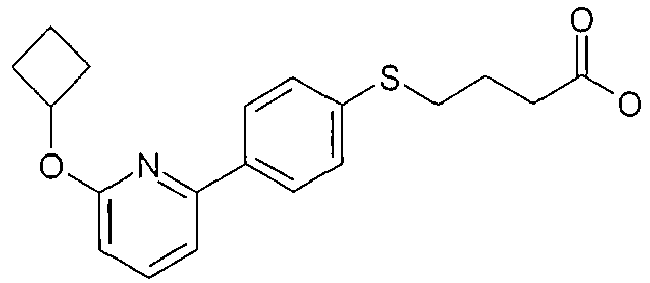
- 4-[4-(4,4,5,5-Tetramethyl-[1,3,2]dioxaborolan-2-yl)-phenylsulfanyl]-butyric acid ethyl ester (0.05 g, 0.14 mmol) obtained in Preparation Example 159 and 2-chloro-6-(cyclobutoxy)-pyridine (0.033 g, 0.16 mmol) obtained in Preparation Example 24 were used to react sequentially in the same manner as in Steps A and B of Example 1 to obtain the title compound (0.005 g, 10%).
- 1H-NMR (CDCl3) δ 7.93 (2H, d), 7.59 (1H, t), 7.38 (2H, d), 7.28 (1H, d), 6.61 (1H, d), 5.26 (1H, m), 3.02 (2H, t), 2.56-2.53 (4H, m), 2.19 (2H, m), 2.01 (2H, m), 1.85 (1H, q), 1.73 (1H, m).
-
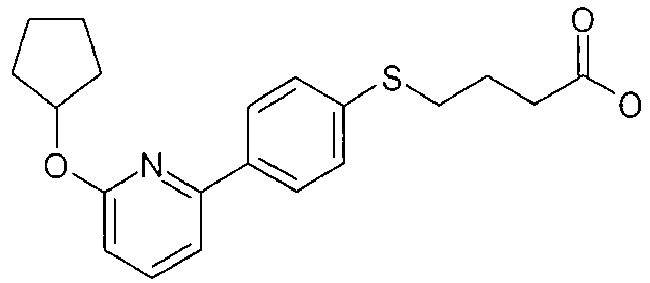
- 4-[4-(4,4,5,5-Tetramethyl-[1,3,2]dioxaborolan-2-yl)-phenylsulfanyl]-butyric acid ethyl ester (0.05 g, 0.14 mmol) obtained in Preparation Example 159 and 2-chloro-6-(cyclopentoxy)pyridine (0.036 g, 0.16 mmol) obtained in Preparation Example 8 were used to react sequentially in the same manner as in Steps A and B of Example 1 to obtain the title compound (0.004 g, 8%).
- 1H-NMR (CDCl3) δ 7.95 (2H, d), 7.57 (1H, t), 7.38 (2H, d), 7.26 (1H, d), 6.60 (1H, d), 5.50 (1H, m), 3.02 (2H, t), 2.54 (2H, t), 2.10-1.97 (4H, m), 1.82 (4H, m), 1.63 (2H, m).
-

- 4-[4-(4,4,5,5-Tetramethyl-[1,3,2]dioxaborolan-2-yl)-phenylsulfanyl]-butyric acid ethyl ester (0.031 g, 0.09 mmol) obtained in Preparation Example 159 and 2-bromo-6-isopropoxy-pyridine (0.021 g, 0.10 mmol) obtained in Preparation Example 228 were used to react sequentially in the same manner as in Steps A and B of Example 1 to obtain the title compound (0.011 g, 37%).
- 1H-NMR (CDCl3) δ 7.94 (2H, d), 7.59 (1H, t), 7.38 (2H, d), 7.26 (1H, d), 6.60 (1H, d), 5.46 (1H, m), 3.02 (2H, t), 2.54 (2H, t), 2.00 (2H, m), 1.39 (6H, d).
-

- 4-[4-(4,4,5,5-Tetramethyl-[1,3,2]dioxaborolan-2-yl)-phenylsulfanyl]-butyric acid ethyl ester (0.11 g, 0.32 mmol) obtained in Preparation Example 159 and 3-iodo-2-isopropoxy-pyridine (0.12 g, 0.35 mmol) obtained in Preparation Example 37 were used to react sequentially in the same manner as in Steps A and B of Example 1 to obtain the title compound (0.05 g, 34%).
- 1H-NMR (CDCl3) δ 8.11 (1H, m), 7.57 (1H, m), 7.50 (2H, d), 7.35 (2H, d), 6.90 (1H, m), 5.38 (1H, m), 3.02 (2H, t), 2.56 (2H, t), 2.02 (2H, m), 1.33 (6H, d).
-

- 4-[4-(4,4,5,5-Tetramethyl-[1,3,2]dioxaborolan-2-yl)-phenylsulfanyl]-butyric acid ethyl ester (0.06 g, 0.17 mmol) obtained in Preparation Example 159 and 2-bromo-6-propoxy-pyridine (0.041 g, 0.19 mmol) obtained in Preparation Example 227 were used to react sequentially in the same manner as in Steps A and B of Example 1 to obtain the title compound (0.03 g, 52%).
- 1H-NMR (CDCl3) δ 7.94 (2H, d), 7.59 (1H, t), 7.39 (2H, d), 7.28 (1H, d), 6.65 (1H, d), 4.36 (2H, t), 3.02 (2H, t), 2.54 (2H, t), 2.00 (2H, m), 1.82 (2H, m), 1.04 (3H, t).
-

- 4-[4-(4,4,5,5-Tetramethyl-[1,3,2]dioxaborolan-2-yl)-phenylsulfanyl]-butyric acid ethyl ester (0.06 g, 0.17 mmol) obtained in Preparation Example 159 and 2-bromo-6-cyclopentylsulfanyl-pyridine (0.049 g, 0.19 mmol) obtained in Preparation Example 234 were used to react sequentially in the same manner as in Steps A and B of Example 1 to obtain the title compound (0.02 g, 28%).
- 1H-NMR (CDCl3) δ 7.95 (2H, d), 7.50 (1H, t), 7.40-7.38 (3H, m), 7.05 (1H, d), 4.17 (1H, m), 3.03 (2H, t), 2.55 (2H, t), 2.24 (2H, m), 2.00 (2H, m), 1.82-1.63 (6H, m).
-

- 3'-Cyclobutoxy-3,4,5-trifluoro-biphenyl (0.02 g, 0.07 mmol) obtained in Preparation Example 163, Cs2CO3 (0.022 g, 0.07 mmol) and 4-mercapto-butyric acid ethyl ester (0.01 g, 0.07 mmol) obtained in Preparation Example 161 were used to react sequentially in the same manner as in Steps A and B of Example 137 to obtain the title compound (0.001 g, 4%).
- 1H-NMR (CDCl3) δ 7.32 (1H, t), 7.13 (2H, d), 7.12 (1H, m), 6.96 (1H, s), 6.84 (1H, m), 4.68 (1H, m), 2.94 (2H, t), 2.55 (2H, t), 2.47 (2H, m), 2.19 (2H, m), 1.87 (3H, m), 1.71 (1H, m).
-

- 3,4,5-Trifluoro-3'-isopropoxy-biphenyl (0.06 g, 0.23 mmol) obtained in Preparation Example 164, Cs2CO3 (0.074 g, 0.23 mmol) and 4-mercapto-butyric acid ethyl ester (0.034 g, 0.23 mmol) obtained in Preparation Example 161 were used to react sequentially in the same manner as in Steps A and B of Example 137 to obtain the title compound (0.011 g, 13%).
- 1H-NMR (CDCl3) δ 7.33 (1H, t), 7.13 (2H, d), 7.09 (1H, m), 7.04 (1H, s), 6.92 (1H, m), 4.60 (1H, m), 2.94 (2H, t), 2.55 (2H, t), 1.87 (2H, m), 1.35 (6H, d).
-
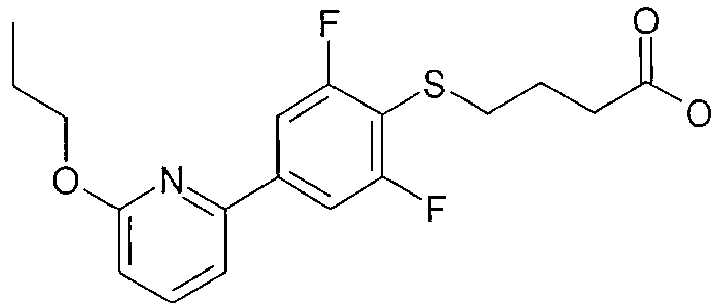
- 2-Propoxy-6-(3,4,5-trifluoro-phenyl)-pyridine (0.02 g, 0.08 mmol) obtained in Preparation Example 166, Cs2CO3 (0.028 g, 0.08 mmol) and 4-mercapto-butyric acid ethyl ester (0.01 g, 0.08 mmol) obtained in Preparation Example 161 were used to react sequentially in the same manner as in Steps A and B of Example 137 to obtain the title compound (0.008 g, 24%).
- 1H-NMR (CDCl3) δ 7.63-7.59 (3H, m), 7.27 (1H, d), 6.71 (1H, d), 4.35 (2H, t), 2.96 (2H, t), 2.54 (2H, t), 1.88-1.82 (4H, m), 1.05 (3H, t).
-
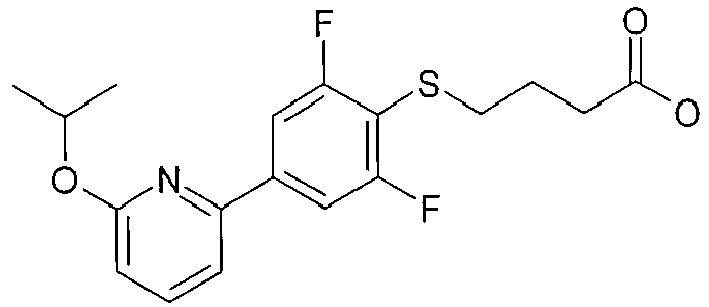
- 2-Isopropoxy-6-(3,4,5-trifluoro-phenyl)-pyridine (0.02 g, 0.07 mmol) obtained in Preparation Example 167 was dissolved in 1 mL of DMF, and Cs2CO3 (0.024 g, 0.07 mmol) and 4-mercapto-butyric acid ethyl ester (0.011 g, 0.07 mmol) obtained in Preparation Example 161 were added thereto. The resultant was agitated at 65°C for 4 hours. The reaction solution was added with water and extracted with EtOAc. The separated organic layer was dried with MgSO4 and purified by column chromatography to obtain the title compound (0.017 g, 58 %).
- 4-[2,6-Difluoro-4-(6-isopropoxy-pyridin-2-yl)-phenylsulfanyl]-butyric acid ethyl ester(0.017 g, 0.04 mmol) obtained in Step A was reacted in the same manner as in Step B of Example 1 to obtain the title compound (0.011 g, 73%).
- 1H-NMR (CDCl3) δ 7.63-7.57 (3H, m), 7.23 (1H, d), 6.67 (1H, d), 5.44 (1H, m), 2.97 (2H, t), 2.55 (2H, t), 1.88 (2H, m), 1.40 (6H, d).
-
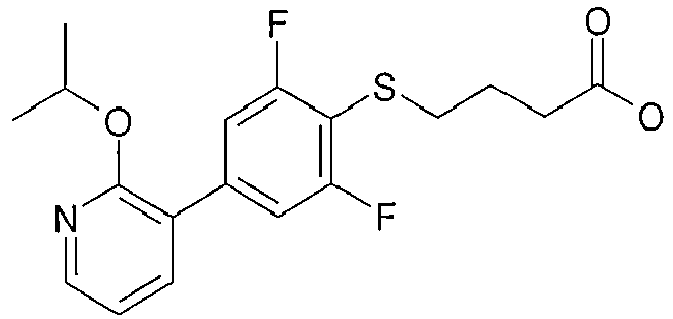
- 4-[2,6-Difluoro-4-(4,4,5,5-tetramethyl-[1,3,2]dioxaborolan-2-yl)-phenylsulfanyl]-but yric acid ethyl ester (1.22 g, 3.16 mmol) obtained in Preparation Example 170 and 3-iodo-2-isopropoxy-pyridine (1.24 g, 4.74 mmol) obtained in Preparation Example 37 were used to react sequentially in the same manner as in Steps A and B of Example 1 to obtain the title compound (0.78 g, 67%).
- 1H-NMR (CDCl3) δ 8.15 (1H, m), 7.60 (1H, m), 7.19 (2H, d), 6.93 (1H, m), 5.40 (1H, m), 2.96 (2H, t), 2.56 (2H, t), 1.90 (2H, m), 1.36 (6H, d).
-
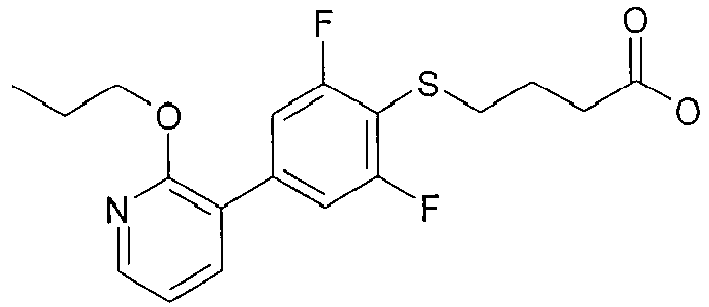
- 2-Propoxy-3-(3,4,5-trifluoro-phenyl)-pyridine (0.02 g, 0.08 mmol) obtained in Preparation Example 171, Cs2CO3 (0.027 g, 0.08 mmol) and 4-mercapto-butyric acid ethyl ester (0.012 g, 0.08 mmol) obtained in Preparation Example 161 were used to react sequentially in the same manner as in Steps A and B of Example 137 to obtain the title compound (0.009 g, 30%).
- 1H-NMR (CDCl3) δ 8.16 (1H, m), 7.60 (1H, m), 7.20 (2H, d), 6.95 (1H, m), 4.32 (2H, t), 2.96 (2H, t), 2.54 (2H, t), 1.89 (2H, m), 1.80 (2H, m), 1.00 (3H, t).
-

- 2-Isopropylsulfanyl-6-(3,4,5-trifluoro-phenyl)-pyridine (0.035 g, 0.12 mmol) obtained in Preparation Example 172, Cs2CO3 (0.04 g, 0.12 mmol) and 4-mercapto-butyric acid ethyl ester (0.018 g, 0.12 mmol) obtained in Preparation Example 161 were used to react sequentially in the same manner as in Steps A and B of Example 137 to obtain the title compound (0.022 g, 46%).
- 1H-NMR (CDCl3) δ 7.62-7.53 (3H, m), 7.37 (1H, d), 7.13 (1H, d), 4.14 (1H, m), 2.98 (2H, t), 2.56 (2H, t), 1.89 (2H, m), 1.45 (6H, d).
-

- 2-Propylsulfanyl-6-(3,4,5-trifluoro-phenyl)-pyridine (0.03 g, 0.11 mmol) obtained in Preparation Example 173, Cs2CO3 (0.035 g, 0.11 mmol) and 4-mercapto-butyric acid ethyl ester (0.016 g, 0.11 mmol) obtained in Preparation Example 161 were used to react sequentially in the same manner as in Steps A and B of Example 137 to obtain the title compound (0.024 g, 57%).
- 1H-NMR (CDCl3) δ 7.62-7.53 (3H, m), 7.37 (1H, d), 7.16 (1H, d), 3.24 (2H, t), 2.98 (2H, t), 2.56 (2H, t), 1.92-1.77 (4H, m), 1.09 (3H, t).
-

- 2-Cyclobutylsulfanyl-3-(3,4,5-trifluoro-phenyl)-pyridine (0.056 g, 0.19 mmol) obtained in Preparation Example 174, Cs2CO3 (0.093 g, 0.19 mmol) and 4-mercapto-butyric acid ethyl ester (0.028 g, 0.19 mmol) Preparation Example 161 were used to react sequentially in the same manner as in Steps A and B of Example 137 to obtain the title compound (0.03 g, 40%).
- 1H-NMR (CDCl3) δ 8.42 (1H, m), 7.34 (1H, m), 7.02 (3H, m), 4.42 (1H, m), 2.98 (2H, t), 2.58-2.48 (4H, m), 2.10-1.89 (6H, m).
-

- 4-[4-(4,4,5,5-Tetramethyl-[1,3,2]dioxaborolan-2-yl)-phenylsulfanyl]-butyric acid ethyl ester (0.018 g, 0.05 mmol) obtained in Preparation Example 159 and 2-cyclobutoxy-3-iodo-pyridine (0.016 g, 0.06 mmol) obtained in Preparation Example 200 were used to react sequentially in the same manner as in Steps A and B of Example 1 to obtain the title compound (0.004 g, 23%).
- 1H-NMR (CDCl3) δ 8.09 (1H, m), 7.58 (1H, m), 7.52 (2H, d), 7.36 (2H, d), 6.91 (1H, m), 5.26 (1H, m), 3.02 (2H, t), 2.56-2.42 (4H, m), 2.15-1.99 (4H, m), 1.81 (1H, m), 1.67 (1H, m).
-

- 2-Cyclobutoxy-3-(3,4,5-trifluoro-phenyl)-pyridine (0.01 g, 0.03 mmol) obtained in Preparation Example 175, Cs2CO3 (0.012 g, 0.03 mmol) and 4-mercapto-butyric acid ethyl ester (0.005 g, 0.03 mmol) obtained in Preparation Example 161 were used to react sequentially in the same manner as in Steps A and B of Example 137 to obtain the title compound (0.002 g, 17%).
- 1H-NMR (CDCl3) δ 8.14 (1H, m), 7.60 (1H, m), 7.21 (2H, d), 6.95 (1H, m), 5.27 (1H, m), 2.97 (2H, t), 2.56-2.42 (4H, m), 2.12 (2H, m), 1.91-1.81 (3H, m), 1.69 (1H, m).
-

- 4-[2,6-Difluoro-4-(4,4,5,5-tetramethyl-[1,3,2]dioxaborolan-2-yl)-phenylsulfanyl]-but yric acid ethyl ester (0.063 g, 0.16 mmol) obtained in Preparation Example 170 and 2-cyclopentoxy-3-iodo-pyridine (0.052 g, 0.18 mmol) obtained in Preparation Example 38 were used to react sequentially in the same manner as in Steps A and B of Example 1 to obtain the title compound (0.025 g, 39%).
- 1H-NMR (CDCl3) δ 8.17 (1H, m), 7.58 (1H, m), 7.17 (2H, d), 6.92 (1H, m), 5.51 (1H, m), 2.96 (2H, t), 2.55 (2H, m), 1.98-1.87 (4H, m), 1.81-1.73 (4H, m), 1.63 (2H, m).
-
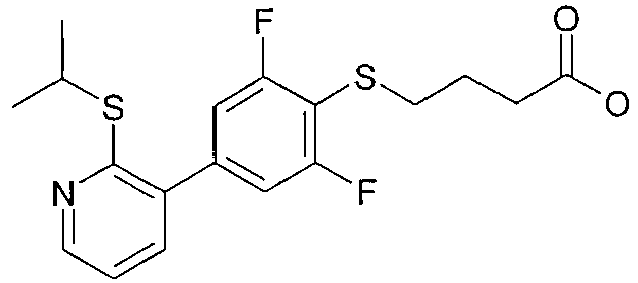
- 4-[2,6-Difluoro-4-(4,4,5,5-tetramethyl-[1,3,2]dioxaborolan-2-yl)-phenylsulfanyl]-but yric acid ethyl ester (0.02 g, 0.05 mmol) obtained in Preparation Example 170 and 3-iodo-2-isopropylsulfanyl-pyridine (0.015 g, 0.054 mmol) obtained in Preparation Example 226 were used to react sequentially in the same manner as in Steps A and B of Example 1 to obtain the title compound (0.007 g, 36%).
- 1H-NMR (CDCl3) δ 8.45 (1H, m), 7.36 (1H, m), 7.04-7.00 (3H, m), 4.06 (1H, m), 2.98 (2H, t), 2.57 (2H, t), 1.91 (2H, m), 1.34 (6H, d).
-
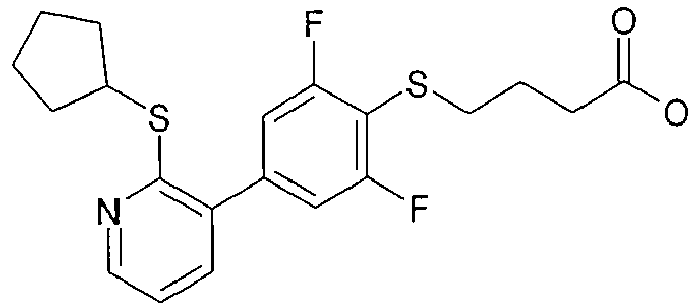
- 2-Cyclopentylsulfanyl-3-(3,4,5-trifluoro-phenyl)-pyridine (0.02 g, 0.06 mmol) obtained in Preparation Example 176, Cs2CO3 (0.02 g, 0.06 mmol) and 4-mercapto-butyric acid ethyl ester (0.01 g, 0.06 mmol) obtained in Preparation Example 161 were used to react sequentially in the same manner as in Steps A and B of Example 137 to obtain the title compound (0.007 g, 26%).
- 1H-NMR (CDCl3) δ 8.44 (1H, m), 7.34 (1H, m), 7.03-7.01 (3H, m), 4.09 (1H, m), 2.98 (2H, t), 2.57 (2H, t), 2.18 (2H, m), 1.91 (2H, m), 1.72-1.52 (6H, m).
-
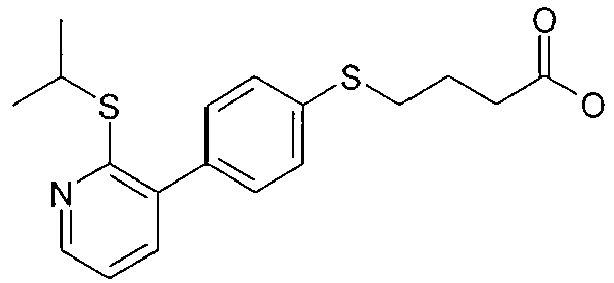
- 4-[4-(4,4,5,5-Tetramethyl-[1,3,2]dioxaborolan-2-yl)-phenylsulfanyl]-butyric acid ethyl ester (0.05 g, 0.14 mmol) obtained in Preparation Example 159 and 3-iodo-2-isopropylsulfanyl-pyridine (0.044 g, 0.16 mmol) obtained in Preparation Example 226 were used to react sequentially in the same manner as in Steps A and B of Example 1 to obtain the title compound (0.013 g, 27%).
- 1H-NMR (CDCl3) δ 8.41 (1H, m), 7.39-7.32 (5H, m), 7.02 (1H, m), 4.04 (1H, m), 3.04 (2H, t), 2.55 (2H, t), 2.03 (2H, m), 1.34 (6H, d).
-

- 4-[4-(4,4,5,5-Tetramethyl-[1,3,2]dioxaborolan-2-yl)-phenylsulfanyl]-butyric acid ethyl ester (0.05 g, 0.14 mmol) obtained in Preparation Example 159 and 2-cyclopentylsulfanyl-3-iodo-pyridine (0.048 g, 0.16 mmol) obtained in Preparation Example 39 were used to react sequentially in the same manner as in Steps A and B of Example 1 to obtain the title compound (0.011 g, 20%).
- 1H-NMR (CDCl3) δ 8.41 (1H, m), 7.39-7.32 (5H, m), 7.02 (1H, m), 4.04 (1H, m), 3.03 (2H, t), 2.55 (2H, t), 2.18 (2H, m), 2.02 (2H, m), 1.72-1.52 (6H, m).
-
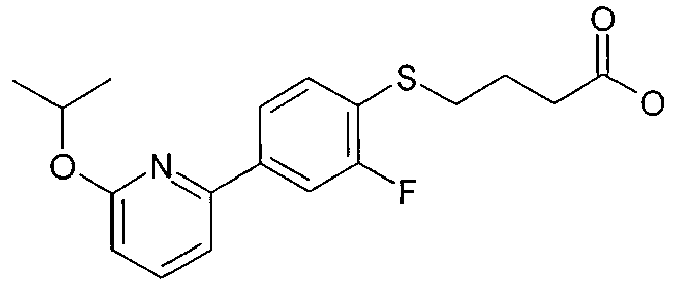
- 4-[2-Fluoro-4-(4,4,5,5-tetramethyl-[1,3,2]dioxaborolan-2-yl)-phenylsulfanyl]-butyric acid ethyl ester (0.05 g, 0.13 mmol) obtained in Preparation Example 180 and 2-bromo-6-isopropoxy-pyridine (0.032 g, 0.15 mmol) obtained in Preparation Example 228 were used to react sequentially in the same manner as in Steps A and B of Example 1 to obtain the title compound (0.014 g, 29%).
- 1H-NMR (CDCl3) δ 7.73-7.71 (2H, m), 7.59 (1H, t), 7.42 (1H, t), 7.25 (1H, m), 6.64 (1H, d), 5.45 (1H, m), 3.00 (2H, t), 2.54 (2H, t), 1.95 (2H, m), 1.38 (6H, d).
-

- 4-[2-Fluoro-4-(4,4,5,5-tetramethyl-[1,3,2]dioxaborolan-2-yl)-phenylsulfanyl]-butyric acid ethyl ester (0.05 g, 0.13 mmol) obtained in Preparation Example 180 and 2-cyclopentoxy-3-iodo-pyridine (0.04 g, 0.15 mmol) obtained in Preparation Example 38 were used to react sequentially in the same manner as in Steps A and B of Example 1 to obtain the title compound (0.027 g, 54%).
- 1H-NMR (CDCl3) δ 8.14 (1H, m), 7.57 (1H, m), 7.38 (1H, t), 7.29-7.27 (2H, m), 6.91 (1H, m), 5.50 (1H, m), 3.00 (2H, t), 2.55 (2H, t), 1.98-1.93 (4H, m), 1.86-1.59 (6H, m).
-

- 4-[2-Fluoro-4-(4,4,5,5-tetramethyl-[1,3,2]dioxaborolan-2-yl)-phenylsulfanyl]-butyric acid ethyl ester (0.05 g, 0.13 mmol) obtained in Preparation Example 180 and 2-cyclobutylsulfanyl-3-iodo-pyridine (0.04 g, 0.15 mmol) obtained in Preparation Example 44 were used to react sequentially in the same manner as in Steps A and B of Example 1 to obtain the title compound (0.032 g, 62%).
- 1H-NMR (CDCl3) δ 8.40 (1H, m), 7.41 (1H, t), 7.33 (1H, m), 7.15 (2H, m), 7.02 (1H, m), 4.42 (1H, m), 3.02 (2H, t), 2.57 (2H, t), 2.55 (2H, m), 2.10-1.97 (6H, m).
-
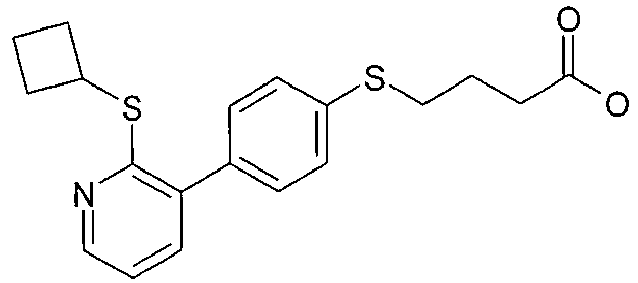
- 4-[4-(4,4,5,5-Tetramethyl-[1,3,2]dioxaborolan-2-yl)-phenylsulfanyl]-butyric acid ethyl ester (0.05 g, 0.14 mmol) obtained in Preparation Example 159 and 2-cyclobutylsulfanyl-3-iodo-pyridine (0.046 g, 0.16 mmol) obtained in Preparation Example 44 were used to react sequentially in the same manner as in Steps A and B of Example 1 to obtain the title compound (0.015 g, 29%).
- 1H-NMR (CDCl3) δ 8.38 (1H, m), 7.37-7.34 (5H, m), 7.02 (1H, m), 4.41 (1H, m), 3.03 (2H, t), 2.57 (2H, t), 2.54 (2H, m), 2.10-1.97 (6H, m).
-

- 2-Cyclobutoxy-6-(3,4,5-trifluoro-phenyl)-pyridine (0.03 g, 0.11 mmol) obtained in Preparation Example 181, Cs2CO3 (0.035 g, 0.11 mmol) and 4-mercapto-butyric acid ethyl ester (0.016 g, 0.11 mmol) obtained in Preparation Example 161 were used to react sequentially in the same manner as in Steps A and B of Example 137 to obtain the title compound (0.011 g, 27%).
- 1H-NMR (CDCl3) δ 7.64-7.57 (3H, m), 7.27 (1H, d), 6.69 (1H, d), 5.26 (1H, m), 2.96 (2H, t), 2.57-2.51 (4H, m), 2.18 (2H, m), 1.87 (3H, m), 1.76 (1H, m).
-
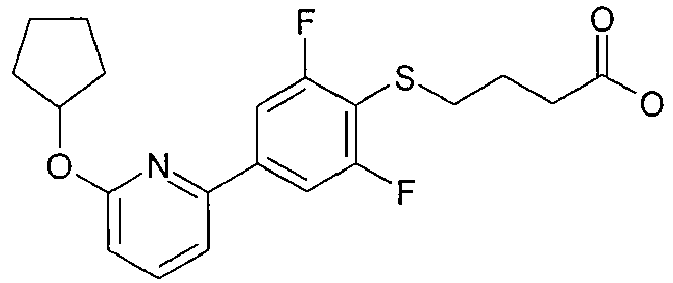
- 2-Cyclopentyloxy-6-(3,4,5-trifluoro-phenyl)-pyridine (0.035 g, 0.12 mmol) obtained in Preparation Example 182, Cs2CO3(0.039 g, 0.12 mmol) and 4-mercapto-butyric acid ethyl ester (0.018 g, 0.12 mmol) obtained in Preparation Example 161 were used to react sequentially in the same manner as in Steps A and B of Example 137 to obtain the title compound (0.016 g, 34%).
- 1H-NMR (CDCl3) δ 7.62-7.58 (3H, m), 7.24 (1H, d), 6.67 (1H, d), 5.50 (1H, m), 2.96 (2H, t), 2.54 (2H, t), 2.03 (2H, m), 1.89-1.78 (6H, m), 1.65 (2H, m).
-
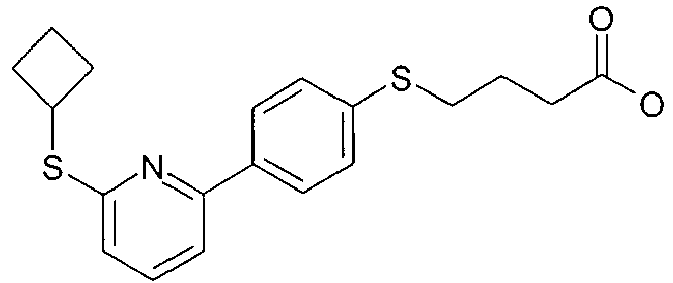
- 4-[4-(4,4,5,5-Tetramethyl-[1,3,2]dioxaborolan-2-yl)-phenylsulfanyl]-butyric acid ethyl ester (0.011 g, 0.03 mmol) obtained in Preparation Example 159 and 2-bromo-6-cyclobutylsulfanyl-pyridine (0.008 g, 0.03 mmol) obtained in Preparation Example 233 were used to react sequentially in the same manner as in Steps A and B of Example 1 to obtain the title compound (0.003 g, 27%).
- 1H-NMR (CDCl3) δ 7.94 (2H, d), 7.49 (1H, t), 7.40-7.37 (3H, m), 7.00 (1H, d), 4.44 (1H, m), 3.03 (2H, t), 2.63-2.53 (4H, m), 2.20-1.98 (6H, m).
-
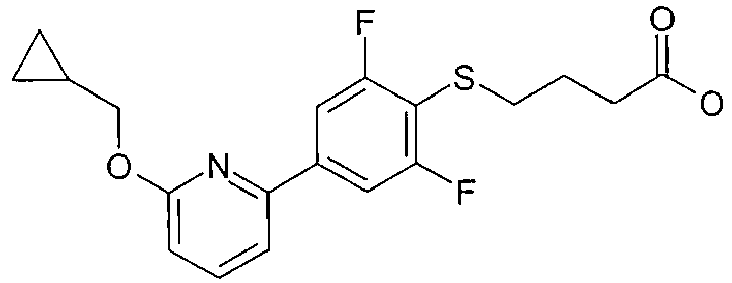
- 2-Cyclopropylmethoxy-6-(3,4,5-trifluoro-phenyl)-pyridine (0.034 g, 0.12 mmol) obtained in Preparation Example 183, Cs2CO3 (0.04 g, 0.12 mmol) and 4-mercapto-butyric acid ethyl ester (0.018 g, 0.12 mmol) obtained in Preparation Example 161 were used to react sequentially in the same manner as in Steps A and B of Example 137 to obtain the title compound (0.012 g, 26%).
- 1H-NMR (CDCl3) δ 7.65 (1H, t), 7.59 (2H, d), 7.27 (1H, d), 6.76 (1H, d), 4.24 (2H, d), 2.96 (2H, t), 2.54 (2H, t), 1.87 (2H, m), 1.32 (1H, m), 0.64 (2H, m), 0.39 (2H, m).
-

- 2-Cyclobutylsulfanyl-6-(3,4,5-trifluoro-phenyl)-pyridine (0.03 g, 0.1 mmol) obtained in Preparation Example 184, Cs2CO3 (0.033 g, 0.1 mmol) and 4-mercapto-butyric acid ethyl ester (0.015 g, 0.1 mmol) obtained in Preparation Example 161 were used to react sequentially in the same manner as in Steps A and B of Example 137 to obtain the title compound (0.016 g, 40%).
- 1H-NMR (CDCl3) δ 7.60 (2H, d), 7.53 (1H, t), 7.35 (1H, d), 7.07 (1H, d), 4.42 (1H, m), 2.98 (2H, t), 2.63-2.53 (4H, m), 2.20-2.10 (4H, m), 1.88 (2H, m).
-

- 2-Cyclopentylsulfanyl-6-(3,4,5-trifluoro-phenyl)-pyridine (0.04 g, 0.13 mmol) obtained in Preparation Example 185, Cs2CO3 (0.044 g, 0.13 mmol) and 4-mercapto-butyric acid ethyl ester (0.02 g, 0.13 mmol) obtained in Preparation Example 161 were used to react sequentially in the same manner as in Steps A and B of Example 137 to obtain the title compound (0.016 g, 29%).
- 1H-NMR (CDCl3) δ 7.61 (2H, d), 7.53 (1H, t), 7.35 (1H, d), 7.13 (1H, d), 4.16 (1H, m), 2.97 (2H, t), 2.54 (2H, t), 2.24 (2H, m), 1.89-1.69 (8H, m)
-

- 4-[2-Fluoro-4-(4,4,5,5-tetramethyl-[1,3,2]dioxaborolan-2-yl)-phenylsulfanyl]-butyric acid ethyl ester (0.05 g, 0.13 mmol) obtained in Preparation Example 180 and N-cyclopentyl-2-iodo-aniline (0.043 g, 0.15 mmol) obtained in Preparation Example 70 were used to react sequentially in the same manner as in Steps A and B of Example 1 to obtain the title compound (0.022 g, 40%).
- 1H-NMR (CDCl3) δ 7.42 (1H, t), 7.23 (1H, m), 7.15 (2H, m), 7.02 (1H, m), 6.72 (2H, m), 3.77 (1H, m), 3.01 (2H, t), 2.56 (2H, t), 1.98 (4H, m), 1.60 (4H, m), 1.37 (2H, m).
-

- 4-[2,6-difluoro-4-(4,4,5,5-Tetramethyl-[1,3,2]dioxaborolan-2-yl)-phenylsulfanyl]-but yric acid ethyl ester (0.06 g, 0.16 mmol) obtained in Preparation Example 170 and N-cyclopentyl-2-iodo-aniline (0.05 g, 0.17 mmol) obtained in Preparation Example 70 were used to react sequentially in the same manner as in Steps A and B of Example 1 to obtain the title compound (0.013 g, 21%).
- 1H-NMR (CDCl3) δ 7.23 (1H, m), 7.01 (3H, m), 6.72 (2H, m), 3.77 (1H, m), 2.97 (2H, t), 2.56 (2H, t), 2.03-1.89 (4H, m), 1.66-1.58 (4H, m), 1.40 (2H, m).
-
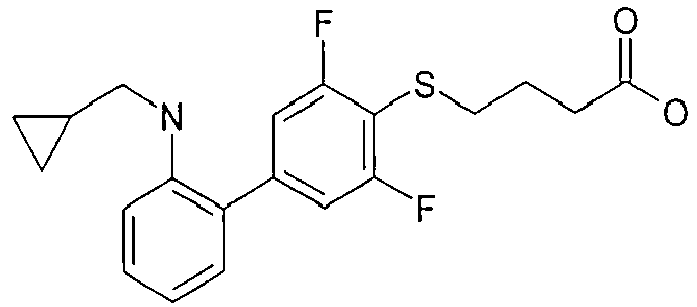
- 4-[2,6-Difluoro-4-(4,4,5,5-tetramethyl-[1,3,2]dioxaborolan-2-yl)-phenylsulfanyl]-but yric acid ethyl ester (0.054 g, 0.14 mmol) obtained in Preparation Example 170 and N-(cyclopropylmethyl)-2-iodo-aniline (0.042 g, 0.15 mmol) obtained in Preparation Example 73 were used to react sequentially in the same manner as in Steps A and B of Example 1 to obtain the title compound (0.011 g, 21%).
- 1H-NMR (CDCl3) δ 7.25 (1H, m), 7.05 (3H, m), 6.74 (1H, t), 6.68 (1H, d), 2.96 (4H, m), 2.57 (2H, t), 1.91 (2H, m), 1.04 (1H, m), 0.49 (2H, m), 0.18 (2H, m).
-

- 4-[2-Fluoro-4-(4,4,5,5-tetramethyl-[1,3,2]dioxaborolan-2-yl)-phenylsulfanyl]-butyric acid ethyl ester (0.05 g, 0.14 mmol) obtained in Preparation Example 180 and 3-iodo-2-isopropylsulfanyl-pyridine (0.057 g, 0.2 mmol) obtained in Preparation Example 226 were used to react sequentially in the same manner as in Steps A and B of Example 1 to obtain the title compound (0.023 g, 46%).
- 1H-NMR (CDCl3) δ 8.44 (1H, m), 7.44-7.35 (2H, m), 7.15 (2H, m), 7.05 (1H, m), 4.07 (1H, m), 3.01 (2H, t), 2.57 (2H, t), 1.99 (2H, m), 1.36 (6H, d).
-

- 4-[2-Fluoro-4-(4,4,5,5-tetramethyl-[1,3,2]dioxaborolan-2-yl)-phenylsulfanyl]-butyric acid ethyl ester (0.04 g, 0.11 mmol) obtained in Preparation Example 180 and 2-cyclopentylsulfanyl-3-iodo-pyridine (0.05 g, 0.16 mmol) obtained in Preparation Example 39 were used to react sequentially in the same manner as in Steps A and B of Example 1 to obtain the title compound (0.014 g, 33%).
- 1H-NMR (CDCl3) δ 8.44 (1H, m), 7.43-7.35 (2H, m), 7.17 (2H, m), 7.05 (1H, m), 4.09 (1H, m), 3.01 (2H, t), 2.57 (2H, t), 2.18 (2H, m), 1.99 (2H, m), 1.73-1.53 (6H, m).
-

- 4-[2,6-Difluoro-4-(4,4,5,5-tetramethyl-[1,3,2]dioxaborolan-2-yl)-phenylsulfanyl]-but yric acid ethyl ester (0.05 g, 0.13 mmol) obtained in Preparation Example 170 and 2-iodo-N-isopropyl-aniline (0.05 g, 0.14 mmol) obtained in Preparation Example 74 were used to react sequentially in the same manner as in Steps A and B of Example 1 to obtain the title compound (0.033 g, 70%).
- 1H-NMR (CDCl3) δ 7.24 (1H, m), 7.02 (3H, m), 6.72 (2H, m), 3.64 (1H, m), 2.98 (2H, t), 2.58 (2H, t), 1.93 (2H, m), 1.17 (6H, d).
-

- 4-[2,6-Difluoro-4-(4,4,5,5-tetramethyl-[1,3,2]dioxaborolan-2-yl)-phenylsulfanyl]-but yric acid ethyl ester (0.05 g, 0.13 mmol) obtained in Preparation Example 170 and 2-iodo-N-propyl-aniline (0.05 g, 0.14 mmol) obtained in Preparation Example 72 were used to react sequentially in the same manner as in Steps A and B of Example 1 to obtain the title compound (0.023 g, 48%).
- 1H-NMR (CDCl3) δ 7.25 (1H, m), 7.04 (3H, m), 6.73 (2H, m), 3.07 (2H, t), 2.97 (2H, t), 2.58 (2H, t), 1.91 (2H, m), 1.57 (2H, m), 0.94 (3H, t).
-

- 4-[2,6-Difluoro-4-(4,4,5,5-tetramethyl-[1,3,2]dioxaborolan-2-yl)-phenylsulfanyl]-but yric acid ethyl ester (0.05 g, 0.13 mmol) obtained in Preparation Example 170 and 2-cyclopropylmethoxy-3-iodo-pyridine (0.07 g, 0.26 mmol) obtained in Preparation Example 40 were used to react sequentially in the same manner as in Steps A and B of Example 1 to obtain the title compound (0.025 g, 51%).
- 1H-NMR (CDCl3) δ 8.15 (1H, m), 7.62 (1H, m), 7.24 (2H, d), 6.96 (1H, m), 4.23 (2H, d), 2.97 (2H, t), 2.56 (2H, t), 1.90 (2H, m), 1.29 (1H, m), 0.59 (2H, m), 0.34 (2H, m).
-

- 4-[2,6-Difluoro-4-(4,4,5,5-tetramethyl-[1,3,2]dioxaborolan-2-yl)-phenylsulfanyl]-but yric acid ethyl ester (0.05 g, 0.13 mmol) obtained in Preparation Example 170 and 3-iodo-2-propylsulfanyl-pyridine (0.07 g, 0.26 mmol) obtained in Preparation Example 203 were used to react sequentially in the same manner as in Steps A and B of Example 1 to obtain the title compound (0.03 g, 61%).
- 1H-NMR (CDCl3) δ 8.45 (1H, m), 7.36 (1H, m), 7.07-7.01 (3H, m), 3.15 (2H, t), 2.99 (2H, t), 2.58 (2H, t), 1.92 (2H, m), 1.71 (2H, m), 1.02 (3H, t).
-

- 4-[2-Fluoro-4-(4,4,5,5-tetramethyl-[1,3,2]dioxaborolan-2-yl)-phenylsulfanyl]-butyric acid ethyl ester (0.04 g, 0.11 mmol) obtained in Preparation Example 180 and 2-chloro-6-cyclobutylsulfanyl-pyridine (0.04 g, 0.22 mmol) obtained in Preparation Example 19 were used to react sequentially in the same manner as in Steps A and B of Example 1 to obtain the title compound (0.009 g, 21%).
- 1H-NMR (CDCl3) δ 7.74 (2H, m), 7.51 (1H, t), 7.43 (1H, t), 7.36 (1H, d), 7.03 (1H, d), 4.41 (1H, m), 3.02 (2H, t), 2.61-2.53 (4H, m), 2.21-2.07 (4H, m), 1.99 (2H, m).
-
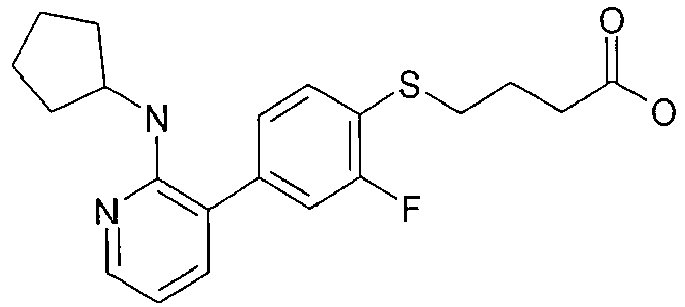
- 4-[2-Fluoro-4-(4,4,5,5-tetramethyl-[1,3,2]dioxaborolan-2-yl)-phenylsulfanyl]-butyric acid ethyl ester (0.05 g, 0.14 mmol) obtained in Preparation Example 180 and N-cyclopentyl-3-iodo-pyridin-2-amine (0.06 g, 0.2 mmol) obtained in Preparation Example 64 were used to react sequentially in the same manner as in Steps A and B of Example 1 to obtain the title compound (0.016 g, 32%).
- 1H-NMR (CDCl3) δ 8.14 (1H, m), 7.44 (1H, t), 7.21 (1H, m), 7.12 (2H, m), 6.61 (1H, m), 4.32 (1H, m), 3.02 (2H, t), 2.56 (2H, t), 2.09-1.97 (4H, m), 1.61 (4H, m), 1.33 (2H, m).
-

- 4-[2-Fluoro-4-(4,4,5,5-tetramethyl-[1,3,2]dioxaborolan-2-yl)-phenylsulfanyl]-butyric acid ethyl ester (0.05 g, 0.14 mmol) obtained in Preparation Example 180 and 3-iodo-2-isopropoxy-pyridine (0.053 g, 0.2 mmol) obtained in Preparation Example 37 were used to react sequentially in the same manner as in Steps A and B of Example 1 to obtain the title compound (0.019 g, 40%).
- 1H-NMR (CDCl3) δ 8.13 (1H, m), 7.58 (1H, m), 7.39-7.30 (3H, m), 6.92 (1H, m), 5.40 (1H, m), 3.00 (2H, t), 2.56 (2H, t), 1.98 (2H, m), 1.35 (6H, d).
-

- 4-[2-Fluoro-4-(4,4,5,5-tetramethyl-[1,3,2]dioxaborolan-2-yl)-phenylsulfanyl]-butyric acid ethyl ester (0.05 g, 0.14 mmol) obtained in Preparation Example 180 and 2-cyclobutoxy-3-iodo-pyridine (0.056 g, 0.2 mmol) obtained in Preparation Example 200 were used to react sequentially in the same manner as in Steps A and B of Example 1 to obtain the title compound (0.015 g, 30%).
- 1H-NMR (CDCl3) δ 8.11 (1H, m), 7.58 (1H, m), 7.40-7.32 (3H, m), 6.93 (1H, m), 5.25 (1H, m), 3.01 (2H, t), 2.57-2.42 (4H, m), 2.11 (2H, m), 1.97 (2H, m), 1.82 (1H, m), 1.67 (1H, m).
-

- 4-[2-Fluoro-4-(4,4,5,5-tetramethyl-[1,3,2]dioxaborolan-2-yl)-phenylsulfanyl]-butyric acid ethyl ester (0.05 g, 0.14 mmol) obtained in Preparation Example 180 and 3-iodo-2-pyrrolidin-1-yl-pyridine (0.056 g, 0.2 mmol) obtained in Preparation Example 204 were used to react sequentially in the same manner as in Steps A and B of Example 1 to obtain the title compound (0.03 g, 61%).
- 1H-NMR (CDCl3) δ 8.20 (1H, m), 7.40-7.36 (2H, m), 7.10-7.05 (2H, m), 6.71 (1H, m), 3.16 (4H, m), 3.01 (2H, t), 2.56 (2H, t), 1.97 (2H, m), 1.80 (4H, m).
-
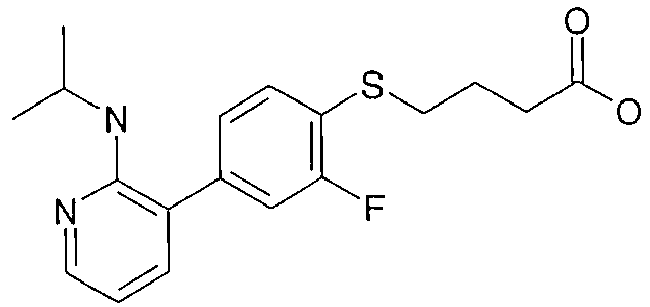
- 4-[2-Fluoro-4-(4,4,5,5-tetramethyl-[1,3,2]dioxaborolan-2-yl)-phenylsulfanyl]-butyric acid ethyl ester (0.05 g, 0.14 mmol) obtained in Preparation Example 180 and 3-iodo-N-isopropyl-pyridin-2-amine (0.053 g, 0.2 mmol) obtained in Preparation Example 66 were used to react sequentially in the same manner as in Steps A and B of Example 1 to obtain the title compound (0.029 g, 61%).
- 1H-NMR (CDCl3) δ 8.14 (1H, m), 7.46 (1H, t), 7.24 (1H, m), 7.15-7.10 (2H, m), 6.62 (1H, m), 4.25 (1H, m), 3.04 (2H, t), 2.57 (2H, t), 2.00 (2H, m), 1.19 (6H, d).
-

- 4-[2-Fluoro-4-(4,4,5,5-tetramethyl-[1,3,2]dioxaborolan-2-yl)-phenylsulfanyl]-butyric acid ethyl ester (0.05 g, 0.14 mmol) obtained in Preparation Example 180 and N-cyclopentyl-4-fluoro-2-iodo-aniline (0.046 g, 0.15 mmol) obtained in Preparation Example 82 were used to react sequentially in the same manner as in Steps A and B of Example 1 to obtain the title compound (0.02 g, 39%).
- 1H-NMR (CDCl3) δ 7.43 (1H, t), 7.13 (2H, m), 6.92 (1H, m), 6.78 (1H, m), 6.62 (1H, m), 3.71 (1H, m), 3.01 (2H, t), 2.55 (2H, t), 1.99-1.91 (4H, m), 1.61 (4H, m), 1.36 (2H, m).
-

- 4-[4-(4,4,5,5-Tetramethyl-[1,3,2]dioxaborolan-2-yl)-phenylsulfanyl]-butyric acid ethyl ester (0.05 g, 0.14 mmol) obtained in Preparation Example 159 and N-cyclopentyl-4-fluoro-2-iodo-aniline (0.048 g, 0.16 mmol) obtained in Preparation Example 82 were used to react sequentially in the same manner as in Steps A and B of Example 1 to obtain the title compound (0.028 g, 52%).
- 1H-NMR (CDCl3) δ 7.39 (2H, d), 7.29 (2H, d), 6.91 (1H, m), 6.79 (1H, m), 6.62 (1H, m), 3.71 (1H, m), 3.03 (2H, t), 2.55 (2H, t), 2.02-1.93 (4H, m), 1.59 (4H, m), 1.36 (2H, m).
-

- 4-(2'-Cyclopentyloxy-5'-methyl-biphenyl-4-ylsulfanyl)-butyric acid ethyl ester (0.02 g, 0.05 mmol) obtained in Preparation Example 187 was used to react in the same manner as in Step B of Example 1 to obtain the title compound (0.01 g, 55%).
- 1H-NMR (CDCl3) δ 7.45 (2H, d), 7.34 (2H, d), 7.10 (1H, s), 7.04 (1H, m), 6.86 (1H, d), 4.67 (1H, m), 3.00 (2H, t), 2.53 (2H, t), 2.31 (3H, s), 1.98 (2H, m), 1.77 (4H, m), 1.64-1.53 (4H, m).
-
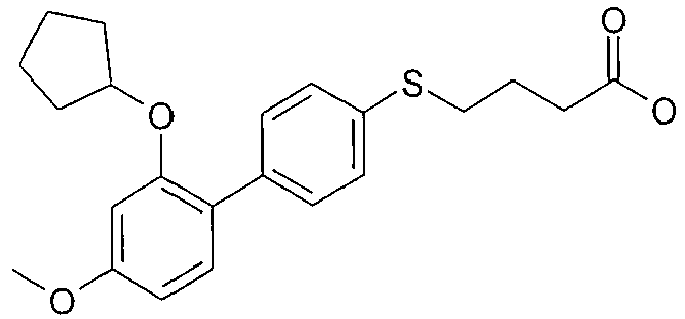
- 4-[4-(4,4,5,5-Tetramethyl-[1,3,2]dioxaborolan-2-yl)-phenylsulfanyl]-butyric acid ethyl ester (0.025 g, 0.07 mmol) obtained in Preparation Example 159 and 1-bromo-2-cyclopentyloxy-4-methoxy-benzene (0.02 g, 0.07 mmol) obtained in Preparation Example 128 were used to react sequentially in the same manner as in Steps A and B of Example 1 to obtain the title compound (0.002 g, 7%).
- 1H-NMR (CDCl3) δ 7.45 (2H, d), 7.34 (2H, d), 7.10 (1H, s), 7.04 (1H, d), 6.86 (1H, d), 4.67 (1H, m), 3.00 (2H, t), 2.53 (2H, t), 2.31 (3H, s), 1.98 (2H, m), 1.77 (4H, m), 1.64-1.53 (4H, m).
-

- 4-[4-(4,4,5,5-Tetramethyl-[1,3,2]dioxaborolan-2-yl)-phenylsulfanyl]-butyric acid ethyl ester (0.05 g, 0.14 mmol) obtained in Preparation Example 159 and 2-bromo-1-cyclopentyloxy-4-fluoro-benzene (0.04 g, 0.16 mmol) obtained in Preparation Example 129 were used to react sequentially in the same manner as in Steps A and B of Example 1 to obtain the title compound (0.003 g, 5%).
- 1H-NMR (CDCl3) δ 7.43 (2H, d), 7.32 (2H, d), 7.02 (1H, m), 6.95 (1H, m), 6.88 (1H, m), 4.63 (1H, m), 3.01 (2H, t), 2.53 (2H, t), 1.99 (2H, m), 1.75 (4H, m), 1.63-1.52 (4H, m).
-

- 4-[2-Fluoro-4-(4,4,5,5-tetramethyl-[1,3,2]dioxaborolan-2-yl)-phenylsulfanyl]-butyric acid ethyl ester (0.1 g, 0.27 mmol) obtained in Preparation Example 180 and 2-bromo-1-cyclopentyloxy-4-fluoro-benzene (0.1 g, 0.4 mmol) obtained in Preparation Example 129 were used to react sequentially in the same manner as in Steps A and B of Example 1 to obtain the title compound (0.047 g, 44%).
- 1H-NMR (CDCl3) δ 7.38 (1H, t), 7.27-7.24 (2H, m), 7.03 (1H, m), 6.97 (1H, m), 6.89 (1H, m), 4.66 (1H, m), 3.01 (2H, t), 2.55 (2H, t), 1.98 (2H, m), 1.79 (4H, m), 1.70-1.47 (4H, m).
-
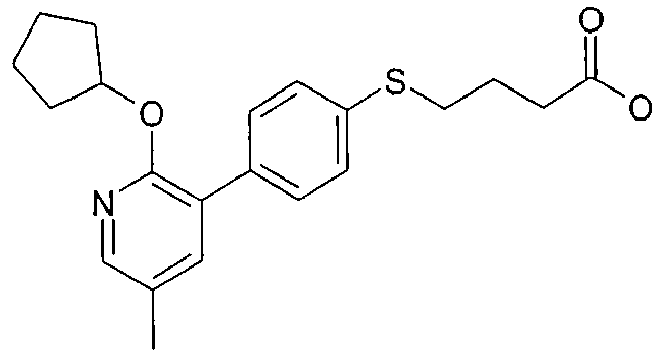
- 4-[4-(4,4,5,5-Tetramethyl-[1,3,2]dioxaborolan-2-yl)-phenylsulfanyl]-butyric acid ethyl ester (0.1 g, 0.28 mmol) obtained in Preparation Example 159 and 3-bromo-2-cyclopentyloxy-5-methyl-pyridine (0.11 g, 0.43 mmol) obtained in Preparation Example 131 were used to react sequentially in the same manner as in Steps A and B of Example 1 to obtain the title compound (0.03 g, 28%).
- 1H-NMR (CDCl3) δ 7.91 (1H, s), 7.48 (2H, d), 7.40 (1H, s), 7.34 (2H, d), 5.44 (1H, m), 3.01 (2H, t), 2.54 (2H, t), 2.26 (3H, s), 2.01 (2H, m), 1.90 (2H, m), 1.78-1.58 (6H, m).
-

- 4-[2,6-Difluoro-4-(4,4,5,5-tetramethyl-[1,3,2]dioxaborolan-2-yl)-phenylsulfanyl]-but yric acid ethyl ester (0.036 g, 0.09 mmol) obtained in Preparation Example 170 and 2-bromo-1-cyclopentyloxy-4-fluoro-benzene (0.026 g, 0.1 mmol) obtained in Preparation Example 129 were used to react sequentially in the same manner as in Steps A and B of Example 1 to obtain the title compound (0.002 g, 4%).
- 1H-NMR (CDCl3) δ 7.11 (2H, d), 7.02 (2H, m), 6.89 (1H, m), 4.68 (1H, m), 2.95 (2H, t), 2.53 (2H, m), 1.89-1.79 (6H, m), 1.66-1.58 (4H, m).
-

- 4-[2-Fluoro-4-(4,4,5,5-tetramethyl-[1,3,2]dioxaborolan-2-yl)-phenylsulfanyl]-butyric acid ethyl ester (0.05 g, 0.13 mmol) obtained in Preparation Example 180 and 1-bromo-2-cyclopentyloxy-4-methoxy-benzene (0.04 g, 0.15 mmol) obtained in Preparation Example 128 were used to react sequentially in the same manner as in Steps A and B of Example 1 to obtain the title compound (0.005 g, 9%).
- 1H-NMR (CDCl3) δ 7.38 (1H, t), 7.28-7.21 (4H, m), 6.53 (1H, m), 4.74 (1H, m), 3.83 (3H, s), 2.98 (2H, t), 2.55 (2H, t), 1.99 (2H, m), 1.84 (4H, m), 1.71-1.58 (4H, m).
-

- 4-[2,6-Difluoro-4-(4,4,5,5-tetramethyl-[1,3,2]dioxaborolan-2-yl)-phenylsulfanyl]-but yric acid ethyl ester (0.05 g, 0.13 mmol) obtained in Preparation Example 170 and 1-bromo-2-cyclopentyloxy-4-methoxy-benzene (0.04 g, 0.14 mmol) obtained Preparation Example 128 in were used to react sequentially in the same manner as in Steps A and B of Example 1 to obtain the title compound (0.004 g, 7%).
- 1H-NMR (CDCl3) δ 7.22 (1H, m), 7.10 (2H, d), 6.55 (2H, m), 4.76 (1H, m), 3.84 (3H, s), 2.94 (2H, t), 2.56 (2H, t), 1.91-1.86 (6H, m), 1.71 (2H, m), 1.62 (2H, m).
-

- 4-[2-Fluoro-4-(4,4,5,5-tetramethyl-[1,3,2]dioxaborolan-2-yl)-phenylsulfanyl]-butyric acid ethyl ester (0.05 g, 0.13 mmol) obtained in Preparation Example 180 and 1-bromo-2-isopropoxy-4-methoxy-benzene (0.04 g, 0.15 mmol) obtained in Preparation Example 132 were used to react sequentially in the same manner as in Steps A and B of Example 1 to obtain the title compound (0.007 g, 13%).
- 1H-NMR (CDCl3) δ 7.37 (1H, t), 7.30-7.22 (3H, m), 6.56 (2H, m), 4.47 (1H, m), 3.84 (3H, s), 2.99 (2H, t), 2.56 (2H, t), 1.96 (2H, m), 1.29 (6H, d).
-
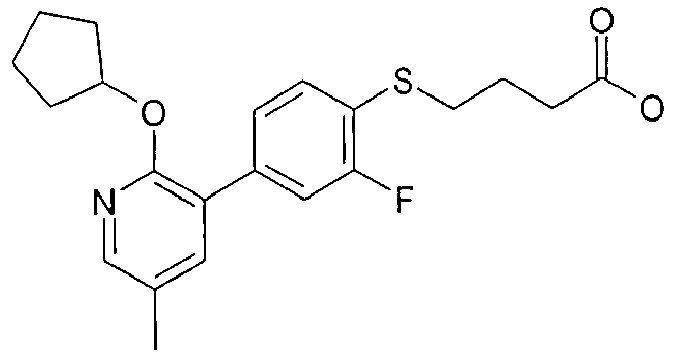
- 4-[2-Fluoro-4-(4,4,5,5-tetramethyl-[1,3,2]dioxaborolan-2-yl)-phenylsulfanyl]-butyric acid ethyl ester (0.05 g, 0.14 mmol) obtained in Preparation Example 180 and 3-bromo-2-cyclopentyloxy-5-methyl-pyridine (0.05 g, 0.2 mmol) obtained in Preparation Example 131 were used to react sequentially in the same manner as in Steps A and B of Example 1 to obtain the title compound (0.018 g, 34%).
- 1H-NMR (CDCl3) δ 7.96 (1H, s), 7.43 (1H, s), 7.38 (1H, t), 7.31-7.25 (2H, m), 5.47 (1H, m), 3.00 (2H, t), 2.55 (2H, t), 2.27 (3H, s), 1.98-1.93 (4H, m), 1.78-1.61 (6H, m).
-
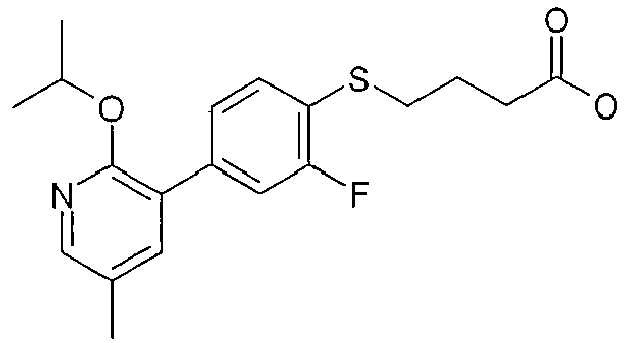
- 4-[2-Fluoro-4-(4,4,5,5-tetramethyl-[1,3,2]dioxaborolan-2-yl)-phenylsulfanyl]-butyric acid ethyl ester (0.05 g, 0.14 mmol) obtained in Preparation Example 180 and 3-bromo-2-isopropoxy-5-methyl-pyridine (0.05 g, 0.2 mmol) obtained in Preparation Example 133 were used to react sequentially in the same manner as in Steps A and B of Example 1 to obtain the title compound (0.017 g, 34%).
- 1H-NMR (CDCl3) δ 7.94 (1H, s), 7.43 (1H, s), 7.41 (1H, t), 7.38-7.30 (2H, m), 5.34 (1H, m), 3.00 (2H, t), 2.55 (2H, t), 2.27 (3H, s), 1.97 (2H, m), 1.32 (6H, d).
-

- 4-[2-Fluoro-4-(4,4,5,5-tetramethyl-[1,3,2]dioxaborolan-2-yl)-phenylsulfanyl]-butyric acid ethyl ester (0.05 g, 0.14 mmol) obtained in Preparation Example 180 and 2-bromo-4-fluoro-1-isopropoxy-benzene (0.05 g, 0.2 mmol) obtained in Preparation Example 134 were used to react sequentially in the same manner as in Steps A and B of Example 1 to obtain the title compound (0.02 g, 40%).
- 1H-NMR (CDCl3) δ 7.39 (1H, t), 7.33-7.27 (2H, m), 7.05-6.90 (3H, m), 4.33 (1H, m), 3.01 (2H, t), 2.56 (2H, t), 1.97 (2H, m), 1.24 (6H, d).
-

- 4-[2-fluoro-4-(4,4,5,5-tetramethyl-[1,3,2]dioxaborolan-2-yl)-phenylsulfanyl]-butyric acid ethyl ester (0.05 g, 0.14 mmol) obtained in Preparation Example 180 and 3-bromo-2-cyclopentyloxy-6-methyl-pyridine (0.05 g, 0.2 mmol) obtained Preparation Example 136 in were used to react sequentially in the same manner as in Steps A and B of Example 1 to obtain the title compound (0.011 g, 20%).
- 1H-NMR (CDCl3) δ 7.39 (2H, m), 7.01 (2H, m), 6.55 (1H, d), 5.34 (1H, m), 2.99 (2H, t), 2.54 (2H, t), 2.39 (3H, s), 2.01-1.91 (4H, m), 1.81 (4H, m), 1.62 (2H, m).
-

- 4-[2-Fluoro-4-(4,4,5,5-tetramethyl-[1,3,2]dioxaborolan-2-yl)-phenylsulfanyl]-butyric acid ethyl ester (0.05 g, 0.14 mmol) obtained in Preparation Example 180 and 1-bromo-3-fluoro-2-isopropoxy-5-methyl-benzene (0.05 g, 0.2 mmol) obtained in Preparation Example 138 were used to react sequentially in the same manner as in Steps A and B of Example 1 to obtain the title compound (0.022 g, 43%).
- 1H-NMR (CDCl3) δ 7.39 (1H, t), 7.31 (2H, m), 6.91 (2H, m), 3.97 (1H, m), 2.99 (2H, t), 2.55 (2H, t), 2.33 (3H, s), 1.94 (2H, m), 1.05 (6H, d).
-
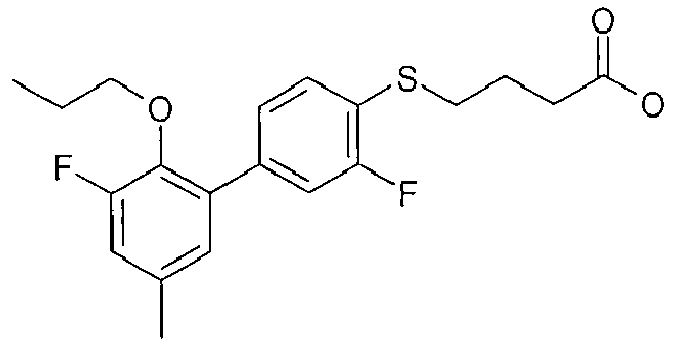
- 4-[2-Fluoro-4-(4,4,5,5-tetramethyl-[1,3,2]dioxaborolan-2-yl)-phenylsulfanyl]-butyric acid ethyl ester (0.05 g, 0.14 mmol) obtained in Preparation Example 180 and 1-bromo-3-fluoro-5-methyl-2-propoxy-benzene (0.05 g, 0.2 mmol) obtained in Preparation Example 139 were used to react sequentially in the same manner as in Steps A and B of Example 1 to obtain the title compound (0.02 g, 39%).
- 1H-NMR (CDCl3) δ 7.39 (1H, t), 7.26 (2H, m), 6.91 (2H, m), 3.72 (2H, t), 2.99 (2H, t), 2.55 (2H, t), 2.31 (3H, s), 1.94 (2H, m), 1.55 (2H, m), 0.82 (3H, t).
-

- 4-[2-Fluoro-4-(4,4,5,5-tetramethyl-[1,3,2]dioxaborolan-2-yl)-phenylsulfanyl]-butyric acid ethyl ester (0.05 g, 0.14 mmol) obtained in Preparation Example 180 and 1-bromo-2,4-dipropoxy-benzene (0.056 g, 0.2 mmol) obtained in Preparation Example 140 were used to react sequentially in the same manner as in Steps A and B of Example 1 to obtain the title compound(0.033 g, 60%).
- 1H-NMR (CDCl3) δ 7.37 (1H, t), 7.28-7.21 (3H, m), 6.53 (2H, m), 3.93 (4H, m), 2.98 (2H, t), 2.55 (2H, t), 1.95 (2H, m), 1.87-1.72 (4H, m), 1.05 (3H, m), 0.98 (3H, m).
-

- 4-[2-Fluoro-4-(4,4,5,5-tetramethyl-[1,3,2]dioxaborolan-2-yl)-phenylsulfanyl]-butyric acid ethyl ester (0.05 g, 0.14 mmol) obtained in Preparation Example 180 and 2-bromo-1-cyclopentyloxy-3-fluoro-4-methyl-benzene (0.056 g, 0.2 mmol) obtained in Preparation Example 142 were used to react sequentially in the same manner as in Steps A and B of Example 1 to obtain the title compound (0.035 g, 63%).
- 1H-NMR (CDCl3) δ 7.41 (1H, t), 7.31-7.26 (2H, m), 6.89-6.83 (2H, m), 4.03 (1H, m), 3.00 (2H, t), 2.56 (2H, t), 2.31 (3H, s), 1.94 (2H, m), 1.57 (4H, m), 1.40 (4H, m).
-

- 4-[2-Fluoro-4-(4,4,5,5-tetramethyl-[1,3,2]dioxaborolan-2-yl)-phenylsulfanyl]-butyric acid ethyl ester (0.05 g, 0.14 mmol) obtained in Preparation Example 180 and 1-bromo-2-cyclopentyloxy-3-fluoro-benzene (0.053 g, 0.2 mmol) obtained in Preparation Example 144 were used to react sequentially in the same manner as in Steps A and B of Example 1 to obtain the title compound (0.01 g, 18%).
- 1H-NMR (CDCl3) δ 7.42 (1H, t), 7.30-7.21 (4H, m), 7.01 (1H, t), 4.84 (1H, m), 2.99 (2H, t), 2.55 (2H, t), 1.99-1.83 (8H, m), 1.64 (2H, m).
-

- 4-[2-Fluoro-4-(4,4,5,5-tetramethyl-[1,3,2]dioxaborolan-2-yl)-phenylsulfanyl]-butyric acid ethyl ester (0.05 g, 0.14 mmol) obtained in Preparation Example 180 and 1-bromo-2-cyclopentyloxy-3-fluoro-5-methyl-benzene (0.053 g, 0.2 mmol) obtained in Preparation Example 145 were used to react sequentially in the same manner as in Steps A and B of Example 1 to obtain the title compound (0.025 g, 45%).
- 1H-NMR (CDCl3) δ 7.40 (1H, t), 7.38-7.26 (2H, m), 6.91 (2H, m), 4.46 (1H, m), 2.99 (2H, t), 2.55 (2H, t), 2.32 (3H, s), 1.94 (2H, m), 1.65 (2H, m), 1.47-1.39 (6H, m).
-

- 2-Cyclobutylmethoxy-3-iodo-pyridine (0.040 g, 0.14 mmol) obtained in Preparation Example 61 and 4-[2,6-difluoro-4-(4,4,5,5-tetramethyl-1,3,2-dioxaborolan-2-yl)phenoxy]butyric acid ethyl ester (0.053 g, 0.14 mmol) obtained in Preparation Example 2 were used to react in the same manner as in Steps A and B of Example 1 to obtain the title compound (0.029 g, 54 %).
- 1H NMR (CDCl3) δ 8.14 (1H, m), 7.59 (1H, m), 7.16 (2H, m), 6.94 (1H, m), 4.33 (2H, d), 4.20 (2H, t), 2.79 (1H, m), 2.48 (2H, t), 2.14 (2H, m), 2.00-1.80 (8H, m)
-

- 2-Cyclopropoxy-3-iodo-pyridine (0.040 g, 0.15 mmol) obtained in Preparation Example 62 and 4-[2,6-difluoro-4-(4,4,5,5-tetramethyl-1,3,2-dioxaborolan-2-yl)phenoxy]butyric acid ethyl ester (0.059 g, 0.15 mmol) obtained in Preparation Example 2 were used to react in the same manner as in Steps A and B of Example 1 to obtain the title compound (0.024 g, 43 %).
- 1H NMR (CDCl3) δ 8.23 (1H, m), 7.57 (1H, m), 7.07 (2H, m), 7.00 (1H, m), 4.34 (1H, m), 4.18 (2H, t), 2.48 (2H, t), 1.89 (4H, m), 0.82 (2H, m), 0.75 (2H, m)
-

- 4-[2,6-Difluoro-4-(4,4,5,5-tetramethyl-[1,3,2]dioxaborolan-2-yl)-phenylsulfanyl]-but yric acid ethyl ester (0.05 g, 0.13 mmol) obtained in Preparation Example 170 and 3-bromo-2-cyclopentyloxy-5-methyl-pyridine (0.05 g, 0.26 mmol) obtained in Preparation Example 131 were used to react sequentially in the same manner as in Steps A and B of Example 1 to obtain the title compound (0.02 g, 40%).
- 1H-NMR (CDCl3) δ 7.97 (1H, s), 7.42 (1H, s), 7.16 (2H, d), 5.47 (1H, m), 2.95 (2H, t), 2.55 (2H, t), 2.27 (3H, s), 1.92 (4H, m), 1.88-1.62 (6H, m).
-

- 4-[4-(2-Cyclopentyloxy-pyridin-3-yl)-phenylsulfanyl]-pentanoic acid ethyl ester (0.01 g, 0.02 mmol) obtained in Preparation Example 191 was used to react in the same manner as in Step B of Example 1 to obtain the title compound (0.005 g, 48%).
- 1H-NMR (CDCl3) δ 8.12 (1H, m), 7.57 (1H, m), 7.49 (2H, d), 7.41 (2H, d), 6.90 (1H, m), 5.49 (1H, m), 3.29 (1H, m), 2.59 (2H, t), 1.93-1.91 (4H, m), 1.82-1.59 (6H, m), 1.34 (3H, d).
-

- (E)-4-[4-(2-isopropoxy-pyridin-3-yl)-phenylsulfanyl]-pent-2-enoic acid ethyl ester (0.025 g, 0.07 mmol) obtained in Preparation Example 193 was used to react sequentially in the same manner as in Preparation Example 191 and Step B of Example 1 to obtain the title compound (0.005 g, 20%).
- 1H-NMR (CDCl3) δ 8.11 (1H, m), 7.57 (1H, m), 7.51 (2H, d), 7.42 (2H, d), 6.90 (1H, m), 5.38 (1H, m), 3.29 (1H, m), 2.60 (2H, t), 1.93 (2H, m), 1.34 (9H, m).
-

- (E)-4-[4-(2-cyclopentyloxy-pyridin-3-yl)-2,6-difluoro-phenylsulfanyl]-pent-2-enoic acid ethyl ester (0.04 g, 0.09 mmol) obtained in Preparation Example 197 was used to react sequentially in the same manner as in Preparation Example 191 and Step B of Example 1 to obtain the title compound (0.01 g, 26%).
- 1H-NMR (CDCl3) δ 8.17 (1H, m), 7.61 (1H, m), 7.19 (2H, d), 6.93 (1H, m), 5.51 (1H, m), 3.31 (1H, m), 2.62 (2H, t), 1.94 (2H, m), 1.86-1.73 (6H, m), 1.63 (2H, m), 1.30 (3H, d).
-

- (E)-4-[4-(2-cyclopentylsulfanyl-pyridin-3-yl)-2,6-difluoro-phenylsulfanyl]-pent-2-en oic acid ethyl ester (0.04 g, 0.09 mmol) obtained in Preparation Example 199 was used to react sequentially in the same manner as in Preparation Example 191 and Step B of Example 1 to obtain the title compound (0.005 g, 12%).
- 1H-NMR (CDCl3) δ 8.44 (1H, m), 7.34 (1H, m), 7.03 (3H, m), 4.08 (1H, m), 3.32 (1H, m), 2.62 (2H, t), 2.19 (2H, m), 1.87 (2H, m), 1.71-1.51 (6H, m), 1.30 (3H, d).
-
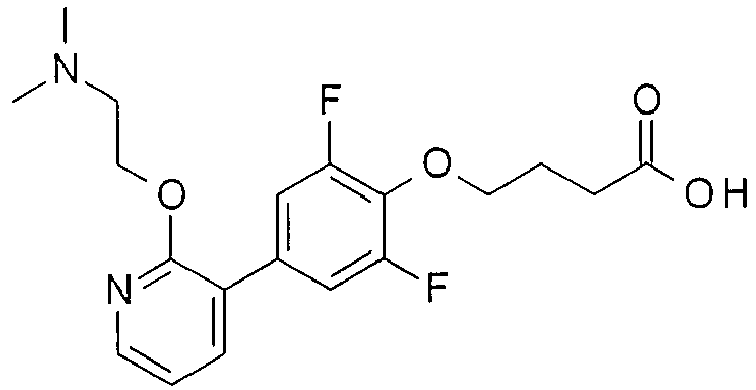
- 2-[(3-Iodo-2-pyridyl)oxy]-N,N-dimethyl-ethanamine (0.117 g, 0.4 mmol) obtained in Preparation Example 206 and 4-[2,6-difluoro-4-(4,4,5,5-tetramethyl-1,3,2-dioxaborolan-2-yl)phenoxy]butyric acid ethyl ester (0.163 g, 0.44 mmol) obtained in Preparation Example 2 were used to react in the same manner as in Step A of Example 28 to obtain the title compound (0.06 g, 37%).
- 1H-NMR (CDCl3) δ 8.14 (1H, m), 7.58 (1H, m), 7.22 (2H, m), 6.96 (1H, m), 4.49 (2H, t), 4.21 (2H, t), 4.15 (2H, q), 2.72 (2H, t), 2.59 (2H, t), 2.31 (6H, s), 2.11 (2H, m), 1.27 (3H, t)
- Ethyl 4-[4-[2-(2-dimethylaminoethyloxy)-3-pyridyl]-2,6-difluoro-phenoxy] butanoate (0.06 g, 0.15 mmol) obtained in Step A was used to react in the same manner as in Step B of Example 1 to obtain the title compound (0.02 g, 38%).
- 1H-NMR (MeOH-d4) δ 8.14 (1H, m), 7.73 (1H, m), 7.21 (2H, m), 7.08 (1H, m), 4.63 (2H, t), 2.19 (2H, t), 3.23 (2H, t), 2.63 (6H, s), 2.40 (2H, t), 2.02 (2H, m)
-

- 3-Iodo-2-propylsulfanyl-pyridine (0.114 g, 0.410 mmol) obtained in Preparation Example 203 and 4-[2,6-difluoro-4-(4,4,5,5-tetramethyl-1,3,2-dioxaboran-2-yl)phenoxy]butyric acid ethyl ester (0.142 g, 0.383 mmol) obtained in Preparation Example 2 were dissolved in 2 mL of 2M sodium carbonate aqueous solution and 4 mL of 1,2-dimethoxyethane, and N2 gas was charged thereto for 5 minutes. Bis(triphenylphosphine)palladium(II) dichloride (0.013 g, 0.019 mmol) was added thereto and the resultant was agitated at 80°C for 16 hours. After finishing the reaction, the resultant was diluted with water and extracted with ethyl acetate. The organic layer was dried with anhydrous MgSO4 and purified by column chromatography (eluent: EtOAc/Hex = 1/4) to obtain the title compound (0.113 g, 74 %).
- 1H-NMR (CDCl3) δ 8.42(1H, m), 7.32(1H, m), 7.01(3H, m), 4.22(2H, t), 4.15(2H, q), 3.13(2H, t), 2.58(2H, t), 2.11(2H, m), 1.68(2H, m), 1.25(3H, t), 1.01(3H, t)
- 4-[2,6-Difluoro-4-(2-propylsulfanyl-pyridin-3-yl)-phenoxy]-butanoic acid ethyl ester (0.026 g, 0.065 mmol) obtained in Step A was dissolved in THF/MeOH/water (1:1:1, 3 mL). IN NaOH (12 mg, 0.50 mmol) was added thereto, and the resultant was agitated at room temperature for 2 hours. After finishing the reaction, the resultant was concentrated under reduced pressure, and the residue was diluted with water. The pH of the aqueous layer was adjusted to 2-3 by the use of IN HCl, and the resultant was extracted with ethyl acetate. The organic layer was dried with anhydrous MgSO4 and purified by column chromatography (eluent: EtOAc/Hex = 1/1) to obtain the title compound (0.014 g, 58 %).
- 1H-NMR (CDCl3) δ 8.43(1H, m), 7.32(1H, m), 7.01(3H, m), 4.26(2H, t), 3.14(2H, t), 2.68(2H, t), 2.14(2H, m), 1.69(2H, m), 1.02(3H, t)
-

- 2-Cyclopropylsulfanyl-3-iodo-pyridine (0.06 g, 0.21 mmol) obtained in Preparation Example 239 and 4-[2,6-difluoro-4-(4,4,5,5-tetramethyl-1,3,2-dioxaboran-2-yl)phenoxy]butyric acid ethyl ester (0.074 g, 0.202 mmol) obtained in Preparation Example 2 were used to react in the same manner as in Example 1 to obtain the title compound (0.03 g, 38 %).
- 1H-NMR (CDCl3) δ 8.52(1H, m), 7.34(1H, m), 7.09(1H, m), 6.95(2H, m), 4.25(2H, m), 2.67(2H, t), 2.40(1H, m), 2.12(2H, m), 1.07(2H, m), 0.59(2H, m)
-

- 2-Ethylsulfanyl-3-iodo-pyridine (0.098 g, 0.369 mmol) obtained in Preparation Example 240 and 4-[2,6-difluoro-4-(4,4,5,5-tetramethyl-1,3,2-dioxaboran-2-yl) phenoxy]butyric acid ethyl ester (0.127 g, 0.345 mmol) obtained in Preparation Example 2 were used to react in the same manner as in Example 1 to obtain the title compound (0.03 g, 35 %).
- 1H-NMR (CDCl3) δ 8.45(1H, m), 7.34(1H, m), 7.05(1H, m), 6.99(2H, m), 4.26(2H, t), 3.17(2H, q), 2.68(2H, t), 2.13(2H, m), 1.33(3H, t)
-

- 2-Butylsulfanyl-3-iodo-pyridine (0.102 g, 0.347 mmol) obtained in Preparation Example 241 and 4-[2,6-difluoro-4-(4,4,5,5-tetramethyl-1,3,2-dioxaboran-2-yl)phenoxy]butyric acid ethyl ester (0.12 g, 0.325 mmol) obtained in Preparation Example 2 were used to react in the same manner as in Example 1 to obtain the title compound (0.052 g, 39 %).
- 1H-NMR (CDCl3) δ 8.43(1H, m), 7.33(1H, d), 7.04(1H, m), 6.99(2H, m), 4.26(2H, t), 3.17(2H, t), 2.68(2H, t), 2.14(2H, m), 1.66(2H, m), 1.44(2H, m), 0.93(3H, t)
-
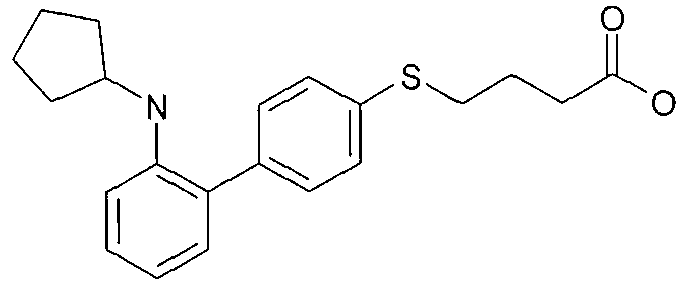
- 4-[4-(4,4,5,5-Tetramethyl-[1,3,2]dioxaborolan-2-yl)-phenylsulfanyl]-butyric acid ethyl ester (0.05 g, 0.14 mmol) obtained in Preparation Example 159 and N-cyclopentyl-2-iodo-aniline (0.045 g, 0.16 mmol) obtained in Preparation Example 70 were used to react sequentially in the same manner as in Steps A and B of Example 1 to obtain the title compound (0.02 g, 40%).
- 1H-NMR (CDCl3) δ 7.39 (2H, d), 7.33 (2H, d), 7.21 (1H, t), 7.03 (1H, m), 6.72 (2H, m), 3.77 (1H, m), 3.03 (2H, t), 2.56 (2H, t), 2.03-1.95 (4H, m), 1.61 (4H, m), 1.38 (2H, m).
-

- 4-[2,6-difluoro-4-(4,4,5,5-tetramethyl-1,3,2-dioxaborolan-2-yl)phenoxy]butyric acid ethyl ester (0.05 g, 0.13 mmol) obtained in Preparation Example 2 and 3-bromo-2-cyclopentyloxy-5-methyl-pyridine (0.05 g, 0.20 mmol) obtained in Preparation Example 131 were used to react sequentially in the same manner as in Steps A and B of Example 1 to obtain the title compound (0.027 g, 52%).
- 1H-NMR (CDCl3) δ 7.95 (1H, s), 7.39 (1H, s), 7.12 (2H, d), 5.46 (1H, m), 4.22 (2H, t), 2.66 (2H, t), 2.27 (3H, s), 2.12 (2H, m), 1.92 (2H, m), 1.80-1.72 (4H, m), 1.62 (2H, m).
-

- 4-[4-(4,4,5,5-Tetramethyl-1,3,2-dioxaborolan-2-yl)phenoxy]butyric acid ethyl ester (0.143 g, 0.43mmol) obtained in Preparation Example 1 and 2-chloro-6-isopropylsulfanyl-pyridine (0.03 g, 0.16 mmol) obtained in Preparation Example 125 were used to react in the same manner as in Step A of Example 29 to obtain the title compound (0.036 g, 62%).
- 1H NMR (CDCl3) δ 7.97 (2H, d), 7.48 (1H, t), 7.35 (1H, d), 7.02 (1H, d), 6.95 (2H, d), 4.14 (3H, m), 4.07 (2H, t), 2.53 (2H, t), 2.14 (2H, m), 1.46 (6H, d), 1.26 (3H, t)
- Ethyl 4-[4-(6-isopropylsulfanyl-2-pyridyl)phenoxy]butanoate (0.036 g, 0.1 mmol) obtained in Step A was used to react in the same manner as in Step B of Example 1 to obtain the title compound (0.019 g, 57%).
- 1H NMR (CDCl3) δ 7.98 (2H, d), 7.48 (1H, t), 7.35 (1H, m), 7.02 (1H, m), 6.96 (2H, m), 4.16 (1H, m), 4.09 (2H, t), 2.61 (2H, t), 2.14 (2H, m), 1.46 (6H, d)
-
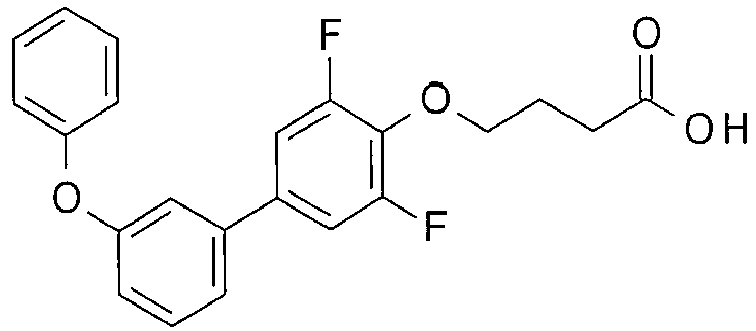
- 4-[2,6-Difluoro-4-(4,4,5,5-tetramethyl-1,3,2-dioxaborolan-2-yl)phenoxy]butyric acid ethyl ester (0.090 g, 0.24 mmol) obtained in Preparation Example 2 and 1-bromo-3-phenoxy-benzene (0.06 g. 0.24 mmol) were used to react sequentially in the same manner as in Steps A and B of Example 29 to obtain the title compound (0.078 g, 80%).
- 1H NMR (CDCl3) δ 7.36 (3H, m), 7.23 (1H, m), 7.13 (2H, m), 7.08 (2H, m), 7.04 (2H, m), 6.99 (1H, m), 4.21 (2H, t), 2.66 (2H, t), 2.11 (2H, m)
-

- 1-(6-Chloro-2-pyridyl)-N,N-dimethyl-pyrrolidin-3-amine (0.04 g, 0.18mmol) obtained in Preparation Example 124 and 4-[2,6-difluoro-4-(4,4,5,5-tetramethyl-1,3,2-dioxaborolan-2-yl)phenoxy]butyric acid ethyl ester (0.066 g, 0.18 mmol) obtained in Preparation Example 2 were used to react sequentially in the same manner as in Step A of Example 29 and Step B of Example 1 to obtain the title compound (3.3 mg, 5%).
- 1H NMR (CDCl3) δ 7.43 (3H, m), 6.88 (1H, m), 6.31 (1H, m), 4.21 (2H, t), 3.85 (1H, m), 3.74 (1H, m), 3.48 (2H, m), 3.17 (1H, m), 2.56 (2H, t), 2.47 (6H, s), 2.27 (1H, m), 2.24 (1H, m), 2.08 (2H, m)
-
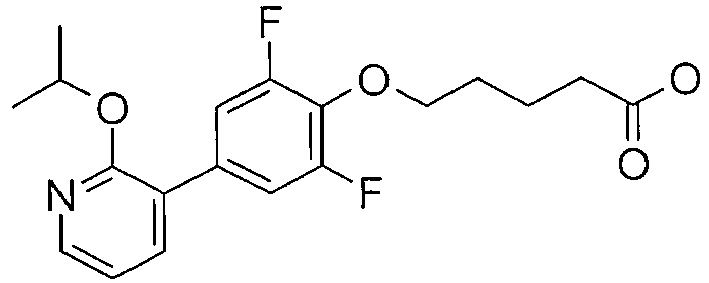
- 3-Iodo-2-isopropoxy-pyridine (0.040 g, 0.15 mmol) obtained in Preparation Example 37 and ethyl 5-[2,6-difluoro-4-(4,4,5,5-tetramethyl-1,3,2-dioxaborolan-2-yl)phenoxy]pentanoate (0.058 g, 0.15 mmol) obtained in Preparation Example 225 were used to react in the same manner as in Example 1 to obtain the title compound (0.038 g, 68 %).
- 1H NMR (CDCl3) 8.13 (1H, m), 7.56 (1H, m), 7.16 (2H, m), 6.92 (1H, m), 5.41 (1H, m), 4.20 (2H, t), 2.49 (2H, t), 1.89 (4H, m), 1.36 (6H, d)
-
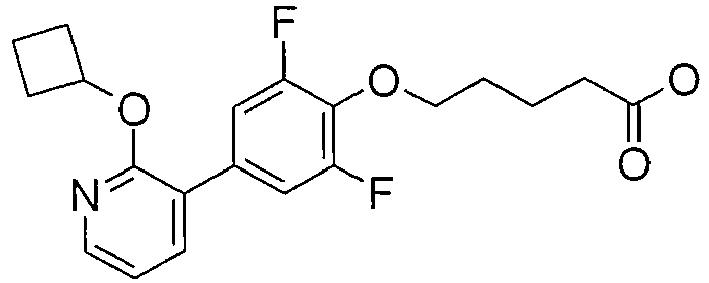
- 2-Cyclobutoxy-3-iodo-pyridine (0.040 g, 0.15 mmol) obtained in Preparation Example 200 and ethyl 5-[2,6-difluoro-4-(4,4,5,5-tetramethyl-1,3,2-dioxaborolan-2-yl)phenoxy]pentanoate (0.056 g, 0.15 mmol) obtained in Preparation Example 225 were used to react in the same manner as in Example 1 to obtain the title compound (0.033 g, 60 %).
- 1H NMR (CDCl3) 8.12 (1H, m), 7.57 (1H, m), 7.18 (2H, m), 6.94 (1H, m), 5.28 (1H, m), 4.20 (2H, t), 2.48 (4H, m), 2.13 (2H, m), 1.89 (5H, m), 1.72 (1H, m)
-

- Ethyl 4-[2,6-difluoro-4-(2-fluoro-3-pyridyl)phenoxy]butanoate (0.09 g, 0.27 mmol) obtained in Preparation Example 109 and 3,3-difluoropyrrolidine hydrochloride (0.11 g, 0.8 mmol) were used to react in the same manner as in Step A of Example 72 to obtain the title compound (0.007 g, 6%).
- 1H NMR (CDCl3) δ 8.20 (1H, m), 7.38 (1H, m), 6.98 (2H, m), 6.84 (1H, m), 4.24 (2H, t), 4.16 (2H, q), 4.45 (4H, m), 2.59 (2H, t), 2.27 (2H, m), 2.13 (2H, m), 1.27 (3H, t)
- Ethyl 4-[4-[2-(3,3-difluoropyrrolidin-1-yl)-3-pyridyl]-2,6-difluoro-phenoxy] butanoate (0.007 g, 0.016 mmol) obtained in Step A was used to react in the same manner as in Step B of Example 1 to obtain the title compound (0.006 g, 98%).
- 1H NMR (CDCl3) δ 8.21 (1H, m), 7.38 (1H, m), 6.95 (2H, m), 6.8 (1H, m), 4.25 (2H, t), 3.43 (4H, m), 2.68 (2H, t), 2.28 (2H, m), 2.14 (2H, m)
-

- Ethyl 4-[2,6-difluoro-4-(2-fluoro-3-pyridyl)phenoxy]butanoate (0.09 g, 0.27 mmol) obtained in Preparation Example 109 and 1-methylpiperazin (0.088 g, 0.8 mmol) were used to react in the same manner as in Step A of Example 72 to obtain the title compound (0.007 g, 6%).
- 1H NMR (CDCl3) δ 8.23 (1H, m), 7.38 (1H, m), 7.16 (2H, m), 6.92 (1H, m), 4.23 (2H, t), 4.17 (2H, q), 3.14 (4H, m), 2.60 (2H, t), 2.40 (4H, m), 2.30 (3H, s), 2.11 (2H, m), 1.27 (3H, t)
- Ethyl 4-[2,6-difluoro-4-[2-(4-methylpiperazin-1-yl)-3-pyridyl]phenoxy] butanoate (0.007 g, 0.016 mmol) obtained in Step A was used to react in the same manner as in Step B of Example 1 to obtain the title compound (0.0013 g, 20%).
- 1H NMR (CDCl3) δ 8.21 (1H, m), 7.40 (1H, m), 7.08 (2H, m), 6.91 (1H, m), 4.26 (2H, t), 3.23 (4H, m), 2.62 (4H, m), 2.52 (2H, t), 2.39 (3H, s), 2.07 (2H, m)
-

- 3-[(3-Iodo-2-pyridyl)oxy]-5-methyl-isoxazole (0.15 g, 0.5 mmol) obtained in Preparation Example 205 and 4-[2,6-difluoro-4-(4,4,5,5-tetramethyl-1,3,2-dioxaborolan-2-yl)phenoxy]butyric acid ethyl ester (0.20 g, 0.54 mmol) obtained in Preparation Example 2 were used to react in the same manner as in Step A of Example 28 to obtain the title compound (0.14 g, 67%).
- 1H-NMR (CDCl3) δ 8.21 (1H, m), 7.75 (1H, m), 7.20 (3H, m), 6.02 (1H, s), 4.23 (2H, t), 4.15 (2H, q), 2.58 (2H, t), 2.43 (3H, s), 2.12 (2H, m), 1.27 (3H, t)
- Ethyl 4-[2,6-difluoro-4-[2-(5-methylisoxazol-3-yl)oxy-3-pyridyl]phenoxy] butanoate (0.14 g, 0.33 mmol) obtained in Step A was used to react in the same manner as in Step B of Example 1 to obtain the title compound (0.1 g, 78%).
- 1H-NMR (CDCl3) δ 8.21 (1H, m), 7.74 (1H, m), 7.17 (3H, m), 6.02 (1H, s), 4.25 (2H, t), 2.67 (2H, t), 2.43 (3H, s), 2.12 (2H, m)
-

- 2-[2-(Aziridin-1-yl)ethoxy]-3-iodo-pyridine (0.095 g, 0.33 mmol) obtained in Preparation Example 207 and 4-[2,6-difluoro-4-(4,4,5,5-tetramethyl-1,3,2-dioxaborolan-2-yl)phenoxy]butyric acid ethyl ester (0.133 g, 0.36 mmol) obtained in Preparation Example 2 were used to react sequentially in the same manner as in Step A of Example 28 and Step B of Example 1 to obtain the title compound (0.001 g, 0.1%).
- 1H-NMR (MeOH-d4) δ 8.11 (1H, m), 7.72 (1H, m), 7.25 (2H, m), 7.04 (1H, m), 4.51 (2H, m), 4.18 (2H, t), 2.67 (2H, t), 2.45 (2H, t), 2.02 (2H, m), 1.73 (2H, m), 1.34 (2H, m)
-

- 2-(3-Furylmethoxy)-3-iodo-pyridine (0.107 g, 0.36 mmol) obtained in Preparation Example 208 and 4-[2,6-difluoro-4-(4,4,5,5-tetramethyl-1,3,2-dioxaborolan-2-yl)phenoxy]butyric acid ethyl ester (0.10 g, 0.27 mmol) obtained in Preparation Example 2 were used to react in the same manner as in Step A of Example 28 to obtain the title compound (0.058 g, 51%).
- 1H-NMR (CDCl3) δ 8.17 (1H, m), 7.59 (1H, m), 7.48 (1H, m), 7.40 (1H, m), 7.14 (2H, m), 6.98 (1H, m), 6.47 (1H, m), 5.34 (2H, s), 4.21 (2H, t), 4.15 (2H, q), 2.58 (2H, t), 2.10 (2H, m), 1.27 (3H, t)
- Ethyl 4-[2,6-difluoro-4-[2-(3-furylmethoxy)-3-pyridyl]phenoxy]butanoate (0.058 g, 0.14 mmol) obtained in Step A was used to react in the same manner as in Step B of Example 1 to obtain the title compound (0.054 g, 99%).
- 1H-NMR (CDCl3) δ 8.18 (1H, m), 7.59 (1H, m), 7.48 (1H, m), 7.41 (1H, m), 7.14 (2H, m), 6.98 (1H, m), 6.47 (1H, m), 5.33 (2H, s), 4.23 (2H, t), 2.67 (2H, t), 2.11 (2H, m)
-
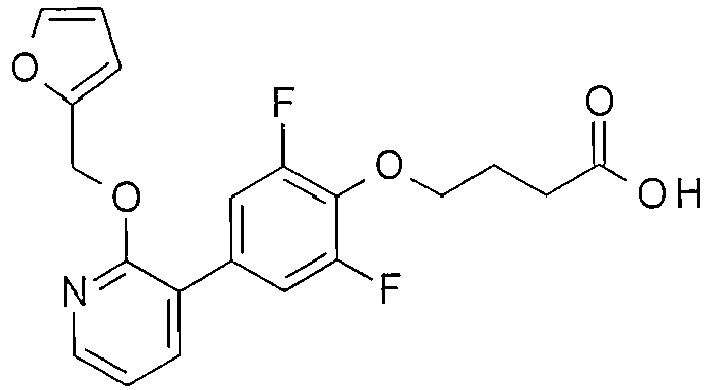
- 2-(2-Furylmethoxy)-3-iodo-pyridine (0.12 g, 0.4 mmol) obtained in Preparation Example 209 and 4-[2,6-difluoro-4-(4,4,5,5-tetramethyl-1,3,2-dioxaborolan-2-yl)phenoxy]butyric acid ethyl ester (0.18 g, 0.49 mmol) obtained in Preparation Example 2 were used to react in the same manner as in Step A of Example 28 to obtain the title compound (0.108 g, 65%).
- 1H-NMR (CDCl3) δ 8.17 (1H, m), 7.59 (1H, m), 7.23 (1H, m), 7.13 (2H, m), 7.00 (1H, m), 6.41 (1H, m), 6.35 (1H, m), 5.42 (2H, s), 4.20 (2H, m), 4.14 (2H, q), 2.57 (2H, t), 2.10 (2H, m), 1.27 (3H, t)
- Ethyl 4-[2,6-difluoro-4-[2-(2-furylmethoxy)-3-pyridyl]phenoxy]butanoate (0.108 g, 0.26 mmol) obtained in Step A was used to react in the same manner as in Step B of Example 1 to obtain the title compound (0.077 g, 76%).
- 1H-NMR (CDCl3) δ 8.17 (1H, m), 7.58 (1H, m), 7.43 (1H, m), 7.14 (2H, m), 7.00 (1H, m), 6.42 (1H, m), 6.35 (1H, m), 5.42 (2H, s), 4.21 (2H, t), 2.66 (2H, t), 2.10 (2H, m)
-

- 3-Iodo-2-[(3-methyloxetan-3-yl)methoxy]pyridine (0.12 g, 0.4 mmol) obtained in Preparation Example 210 and 4-[2,6-difluoro-4-(4,4,5,5-tetramethyl-1,3,2-dioxaborolan-2-yl)phenoxy]butyric acid ethyl ester (0.18 g, 0.49 mmol) obtained in Preparation Example 2 were used to react in the same manner as in Step A of Example 28 to obtain the title compound (0.10 g, 59%).
- 1H-NMR (CDCl3) δ 8.15 (1H, m), 7.61 (1H, m), 7.15 (2H, m), 7.00 (1H, m), 4.58 (2H, d), 4.48 (2H, s), 4.42 (2H, d), 4.23 (2H, t), 4.16 (2H, q), 2.59 (2H, t), 2.11 (2H, m), 1.39 (3H, s), 1.27 (3H, t)
- Ethyl 4-[2,6-difluoro-4-[2-[(3-methyloxetan-3-yl)methoxy]-3-pyridyl]phenoxy] butanoate (0.10 g, 0.24 mmol) obtained in Step A was used to react in the same manner as in Step B of Example 1 to obtain the title compound (0.047 g, 48%).
- 1H-NMR (CDCl3) δ 8.15 (1H, m), 7.60 (1H, m), 7.13 (2H, m), 7.00 (1H, m), 4.62 (2H, d), 4.43 (4H, m), 4.27 (2H, t), 2.63 (2H, t), 2.10 (2H, m), 1.40 (3H, s)
-
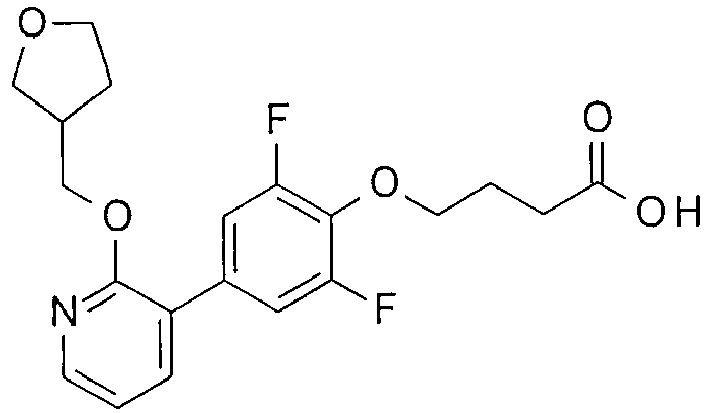
- 3-Iodo-2-(tetrahydrofuran-3-ylmethoxy)pyridine (0.12 g, 0.4 mmol) obtained in Preparation Example 211 and 4-[2,6-difluoro-4-(4,4,5,5-tetramethyl-1,3,2-dioxaborolan-2-yl)phenoxy]butyric acid ethyl ester (0.18 g, 0.49 mmol) obtained in Preparation Example 2 were used to react in the same manner as in Step A of Example 28 to obtain the title compound (0.15 g, 89%).
- 1H-NMR (CDCl3) δ 8.14 (1H, m), 7.59 (1H, m), 7.13 (2H, m), 6.98 (1H, m), 4.38 (1H, m), 4.28 (1H, m), 4.22 (2H, t), 4.16 (2H, q), 3.88 (2H, m), 3.78 (1H, m), 3.65 (1H, m), 2.75 (1H, m), 2.59 (2H, t), 2.11 (3H, m), 1.73 (1H, m), 1.27 (3H, t)
- Ethyl 4-[2,6-difluoro-4-[2-(tetrahydrofuran-3-ylmethoxy)-3-pyridyl]phenoxy] butanoate (0.15 g, 0.36 mmol) obtained in Step A was used to react in the same manner as in Step B of Example 1 to obtain the title compound (0.11 g, 79%).
- 1H-NMR (CDCl3) δ 8.14 (1H, m), 7.58 (1H, m), 7.11 (2H, m), 6.99 (1H, m), 4.38 (1H, m), 4.26 (3H, m), 3.89 (2H, m), 3.78 (1H, m), 3.64 (1H, m), 2.74 (1H, m), 2.67 (2H, t), 2.12 (3H, m), 1.74 (1H, m)
-

- 3-Iodo-2-(tetrahydrofuran-2-ylmethoxy)pyridine (0.12 g, 0.4 mmol) obtained in Preparation Example 212 and 4-[2,6-difluoro-4-(4,4,5,5-tetramethyl-1,3,2-dioxaborolan-2-yl)phenoxy]butyric acid ethyl ester (0.18 g, 0.49 mmol) obtained in Preparation Example 2 were used to react in the same manner as in Step A of Example 28 to obtain the title compound (0.13 g, 77%).
- 1H-NMR (CDCl3) δ 8.31 (1H, m), 7.58 (1H, m), 7.20 (2H, m), 6.96 (1H, m), 4.40 (2H, m), 4.29 (1H, m), 4.21 (2H, t), 4.16 (2H, q), 3.89 (1H, m), 3.79 (1H, m), 2.59 (2H, t), 2.10 (2H, m), 2.01 (1H, m), 1.90 (2H, m), 1.77 (1H, m), 1.27 (3H, t)
- Ethyl 4-[2,6-difluoro-4-[2-(tetrahydrofuran-2-ylmethoxy)-3-pyridyl]phenoxy] butanoate (0.13 g, 0.31 mmol) obtained in Step A was used to react in the same manner as in Step B of Example 1 to obtain the title compound (0.10 g, 82%).
- 1H-NMR (CDCl3) δ 8.13 (1H, m), 7.58 (1H, m), 7.18 (2H, m), 6.97 (1H, m), 4.42 (1H, m), 4.36 (1H, m), 4.30 (1H, m), 4.24 (2H, t), 3.88 (1H, m), 3.81 (1H, m), 2.66 (2H, t), 2.11 (2H, m), 2.03 (1H, m), 1.90 (2H, m), 1.77 (1H, m)
-
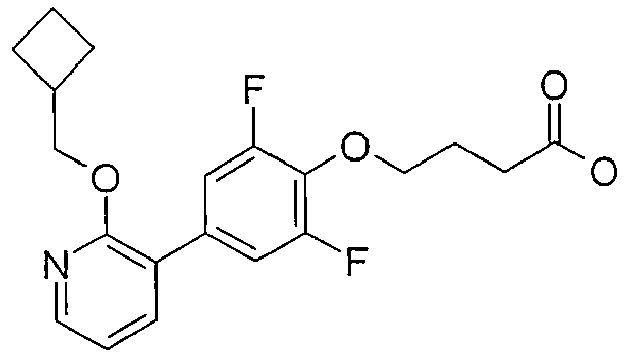
- 2-Cyclobutylmethoxy-3-iodo-pyridine (0.040 g, 0.14 mmol) obtained in Preparation Example 61 and 4-[2,6-difluoro-4-(4,4,5,5-tetramethyl-1,3,2-dioxaborolan-2-yl)phenoxy]butyric acid ethyl ester (0.051 g, 0.14 mmol) obtained in Preparation Example 2 were used to react in the same manner as in Example 1 to obtain the title compound (0.025 g, 48 %).
- 1H NMR (CDCl3) δ 8.14 (1H, m), 7.58 (1H, m), 7.16 (2H, m), 6.94 (1H, m), 4.32 (2H, t), 4.24 (2H, t), 2.77 (1H, m), 2.69 (2H, t), 2.13 (4H, m), 1.88 (4H, m)
-

- 2-Cyclopropoxy-3-iodo-pyridine (0.040 g, 0.14 mmol) obtained in Preparation Example 62 and 4-[2,6-difluoro-4-(4,4,5,5-tetramethyl-1,3,2-dioxaborolan-2-yl)phenoxy]butyric acid ethyl ester (0.051 g, 0.14 mmol) obtained in Preparation Example 2 were used to react in the same manner as in Example 1 to obtain the title compound(0.025 g, 52 %).
- 1H NMR (CDCl3) δ 8.23 (1H, m), 7.57 (1H, m), 7.07 (2H, m), 6.98 (1H, m), 4.35 (1H, m), 4.24 (2H, t), 2.68 (2H, t), 2.12 (2H, m), 0.82 (4H, m)
-

- 2-[3-(tert-butyl-dimethyl-silanyloxy)-cyclopentyloxyl-3-iodo-pyridine (0.10 g, 0.24 mmol) obtained in Preparation Example 213 and 4-[2,6-difluoro-4-(4,4,5,5-tetramethyl-1,3,2-dioxaborolan-2-yl)phenoxy]butyric acid ethyl ester (0.088 g, 0.24 mmol) obtained in Preparation Example 2 were used to react in the same manner as in Step A of Example 1 to obtain the title compound (0.12 g, 94 %).
- 4-(4-{2-[3-(tert-butyl-dimethyl-silanyloxy)-cyclopentyloxy]-pyridin-3-yl}-2,6-difluo ro-phenoxy)-butyric acid ethyl ester (20 mg, 0.04 mmol) obtained in Step A was used to react in the same manner as in Step B of Example 1 to obtain the title compound (15 mg, 79 %).
- 1H NMR (CDCl3) δ 8.14 (1H, m), 7.54 (1H, m), 7.13 (2H, m), 6.92 (1H, m), 5.59 (1H, m), 4.41 (1H, m), 4.24 (2H, t), 2.69 (2H, t), 2.28 (1H, m), 2.13 (2H, m), 2.03 (3H, m), 1.75 (1H, m), 1.61 (1H, m), 0.91 (9H, s), 0.08 (6H, s)
-

- 4-(4-{2-[3-(tert-butyl-dimethyl-silanyloxy)-cyclopentyloxy]-pyridin-3-yl}-2,6-difluo ro-phenoxy)-butyric acid ethyl ester (0.10 g, 0.19 mmol) obtained in Step A of Example 226 was dissolved in 1 mL of tetrahydrofuran. TBAF (0.28 mL, 0.28 mmol, 1.0 M in THF) was added thereto, and the resultant was agitated at room temperature for 3 hours. Extraction was carried out with water and ethyl acetate, and the resultant was washed with brine. The resultatnt was dried with MgSO4, concentrated and purified by column chromatography to obtain the title compound (60 mg, 76 %).
- 4-{2,6-Difluoro-4-[2-(3-hydroxy-cyclopentyloxy)-pyridin-3-yl]-phenoxy}-butyric acid ethyl ester (55 mg, 0.13 mmol) obtained in Step A was used to react in the same manner as in Step B of Example 1 to obtain the title compound (45 mg, 88 %).
- 1H NMR (CDCl3) δ 8.15 (1H, m), 7.55 (1H, m), 7.11 (2H, m), 6.94 (1H, m), 5.64 (1H, m), 4.50 (1H, m), 4.25 (2H, t), 2.68 (2H, t), 2.28 (1H, m), 2.13 (5H, m), 1.83 (1H, m), 1.66 (1H, m)
-

- Cyclohexanol (45 mg, 0.45 mmol) and 4-[2,6-difluoro-4-(2-fluoro-3-pyridyl)phenoxy]butyric acid (70 mg, 0.22 mmol) obtained in Preparation Example 56 were used to react in the same manner as in Preparation Example 37 to obtain the title compound (40 mg, 45 %).
- 1H NMR (CDCl3) δ 8.13 (1H, m), 7.56 (1H, m), 7.18 (2H, m), 6.92 (1H, m), 5.18 (1H, m), 4.24 (2H, t), 2.69 (2H, t), 2.13 (2H, m), 1.96 (2H, m), 1.70 (2H, m), 1.58 (3H, m), 1.45 (2H, m), 1.35 (1H, m)
-

- Cyclopentyl-methanol (45 mg, 0.45 mmol) and 4-[2,6-difluoro-4-(2-fluoro-3-pyridyl)phenoxy]butyric acid (70 mg, 0.22 mmol) obtained in Preparation Example 56 were used to react in the same manner as in Preparation Example 37 to obtain the title compound (55 mg, 62 %).
- 1H NMR (CDCl3) δ 8.14 (1H, m), 7.57 (1H, m), 7.18 (2H, m), 6.95 (1H, m), 4.24 (4H, m), 2.69 (2H, t), 2.37 (1H, m), 2.13 (2H, m), 1.80 (2H, m), 1.62 (4H, m), 1.36 (2H, m)
-

- 2-Methyl-propan-1-ol (33 mg, 0.45 mmol) and 4-[2,6-difluoro-4-(2-fluoro-3-pyridyl)phenoxy]butyric acid (70 mg, 0.22 mmol) obtained in Preparation Example 56 were used to react in the same manner as in Preparation Example 37 to obtain the title compound (50 mg, 61 %).
- 1H NMR (CDCl3) δ 8.14 (1H, m), 7.58 (1H, m), 7.17 (2H, m), 6.95 (1H, m), 4.25 (2H, t), 4.13 (2H, d), 2.69 (2H, t), 2.13 (3H, m), 1.00 (6H, d)
-

- 2,2-Dimethyl-propan-1-ol (40 mg, 0.45 mmol) and 4-[2,6-difluoro-4-(2-fluoro-3-pyridyl)phenoxy]butyric acid (70 mg, 0.22 mmol) obtained in Preparation Example 56 were used to react in the same manner as in Preparation Example 37 to obtain the title compound (40 mg, 47 %).
- 1H NMR (CDCl3) δ 8.15 (1H, m), 7.58 (1H, m), 7.18 (2H, m), 6.95 (1H, m), 4.25 (2H, t), 4.02 (2H, s), 2.69 (2H, t), 2.13 (2H, m), 0.98 (9H, s)
-
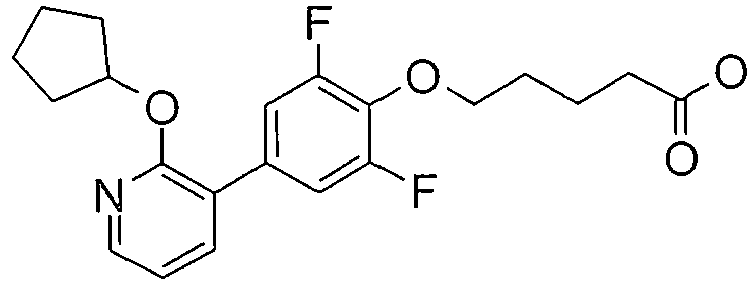
- 5-Bromo-pentanoic acid ethyl ester (43 mg, 0.21 mmol) and 4-(2-cyclopentyloxy-pyridin-3-yl)-2,6-difluoro-phenol (50 mg, 0.17 mmol) obtained in Preparation Example 55 were used to react in the same manner as in Step C of Preparation Example 2 to obtain the title compound (50 mg, 69 %).
- 5-[4-(2-Cyclopentyloxy-pyridin-3-yl)-2,6-difluoro-phenoxy]-pentanoic acid ethyl ester (45 mg, 0.11 mmol) obtained in Step A was used to react in the same manner as in Step B of Example 1 to obtain the title compound (36 mg, 86 %).
- 1H NMR (CDCl3) δ 8.15 (1H, m), 7.56 (1H, m), 7.15 (2H, m), 6.92 (1H, m), 5.51 (1H, m), 4.19 (2H, t), 2.47 (2H, t), 2.00∼1.70 (10H, m), 1.64 (2H, m)
-
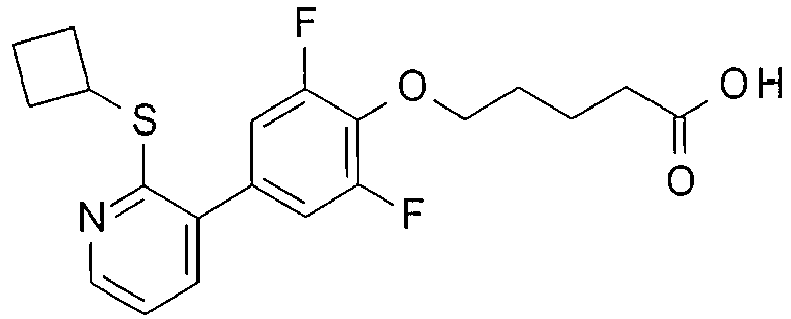
- 2-Cyclobutylsulfanyl-3-iodo-pyridine (0.064 g, 0.22 mmol) obtained in Preparation Example 44 and ethyl 5-[2,6-difluoro-4-(4,4,5,5-tetramethyl-1,3,2-dioxaborolan-2-yl)phenoxy]pentanoate (0.095 g, 0.247 mmol) obtained in Preparation Example 225 were used to react in the same manner as in Step A of Example 28 to obtain the title compound (0.07 g, 75%).
- 1H-NMR (CDCl3) δ 8.40 (1H, m), 7.32 (1H, m), 7.02 (1H, m), 6.98 (2H, m), 4.42 (1H, m), 4.21 (2H, t), 4.15 (2H, q), 2.51 (2H, m), 2.41 (2H, t), 2.04 (4H, m), 1.86 (4H, m), 1.27 (3H, t)
- Ethyl 5-[4-(2-cyclobutylsulfanyl-3-pyridyl)-2,6-difluoro-phenoxy]pentanoate (0.07 g, 0.16 mmol) obtained in Step A was used to react in the same manner as in Step B of Example 1 to obtain the title compound (0.065 g, 99%).
- 1H-NMR (CDCl3) δ 8.41 (1H, m), 7.31 (1H, m), 7.03 (1H, m), 6.97 (2H, m), 4.43 (1H, m), 4.21 (2H, t), 2.52 (4H, m), 2.10 (4H, m), 1.90 (4H, m)
-

- 2-Cyclopentylsulfanyl-3-iodo-pyridine (0.067 g, 0.22 mmol) obtained in Preparation Example 39 and ethyl 5-[2,6-difluoro-4-(4,4,5,5-tetramethyl-1,3,2-dioxaborolan-2-yl)phenoxylpentanoate (0.095 g, 0.25 mmol) obtained in Preparation Example 225 were used to react in the same manner as in Step A of Example 28 to obtain the title compound (0.057 g, 59%).
- 1H-NMR (CDCl3) δ 8.43 (1H, m), 7.32 (1H, m), 7.02 (1H, m), 6.98 (2H, m), 4.20 (2H, t), 4.16 (2H, q), 4.11 (1H, m), 2.40 (2H, t), 2.20 (2H, m), 1.86 (4H, m), 1.73 (2H, m), 1.62 (4H, m), 1.27 (3H, t)
- Ethyl 5-[4-(2-cyclopentylsulfanyl-3-pyridyl)-2,6-difluoro-phenoxy]pentanoate (0.057 g, 0.13 mmol) obtained in Step A was used to react in the same manner as in Step B of Example 1 to obtain the title compound (0.051 g, 97%).
- 1H-NMR (CDCl3) δ 8.43 (1H, m), 7.31 (1H, m), 7.03 (1H, m), 6.97 (2H, m), 4.21 (2H, t), 4.10 (1H, m), 2.48 (2H, t), 2.20 (2H, m), 1.89 (4H, m), 1.72 (2H, m), 1.60 (4H, m)
-

- 3-Iodo-2-isopropylsulfanyl-pyridine (0.062 g, 0.22 mmol) obtained in Preparation Example 226 and ethyl 5-[2,6-difluoro-4-(4,4,5,5-tetramethyl-1,3,2-dioxaborolan-2-yl)phenoxylpentanoate (0.095 g, 0.25 mmol) obtained in Preparation Example 225 were used to react in the same manner as in Step A of Example 28 to obtain the title compound (0.063 g, 70%).
- 1H-NMR (CDCl3) δ 8.44 (1H, m), 7.33 (1H, m), 7.03 (1H, m), 6.97 (2H, m), 4.20 (2H, t), 4.15 (2H, q), 4.07 (1H, m), 2.41 (2H, t), 1.87 (4H, m), 1.37 (6H, d), 1.27 (3H, t)
- Ethyl 5-[2,6-difluoro-4-(2-isopropylsulfanyl-3-pyridyl)phenoxy]pentanoate (0.063 g, 0.155 mmol) obtained in Step A was used to react in the same manner as in Step B of Example 1 to obtain the title compound (0.058 g, 98%).
- 1H-NMR (CDCl3) δ 8.44 (1H, m), 7.34 (1H, m), 7.02 (1H, m), 6.96 (2H, m), 4.21 (2H, t), 4.06 (1H, m), 2.48 (2H, t), 1.89 (4H, m), 1.36 (6H, d)
-

- 3-Iodo-2-propylsulfanyl-pyridine (0.062 g, 0.22 mmol) obtained in Preparation Example 203 and ethyl 5-[2,6-difluoro-4-(4,4,5,5-tetramethyl-1,3,2-dioxaborolan-2-yl)phenoxylpentanoate (0.095 g, 0.25 mmol) obtained in Preparation Example 225 were used to react in the same manner as in Step A of Example 28 to obtain the title compound (0.04 g, 44%).
- 1H-NMR (CDCl3) δ 8.43 (1H, m), 7.33 (1H, m), 7.03 (1H, m), 6.99 (2H, m), 4.20 (2H, t), 4.14 (2H, q), 3.15 (2H, t), 2.39 (2H, t), 1.86 (4H, m), 1.69 (2H, m), 1.27 (3H, t), 1.02 (3H, t)
- Ethyl 5-[2,6-difluoro-4-(2-propylsulfanyl-3-pyridyl)phenoxy]pentanoate (0.04 g, 0.1 mmol) obtained in Step A was used to react in the same manner as in Step B of Example 1 to obtain the title compound (0.022 g, 58%).
- 1H-NMR (CDCl3) δ 8.43 (1H, m), 7.34 (1H, m), 7.03 (1H, m), 6.99 (2H, m), 4.2 (2H, t), 3.14 (2H, t), 2.49 (2H, t), 1.89 (4H, m), 1.67 (2H, m), 1.02 (3H, t)
-
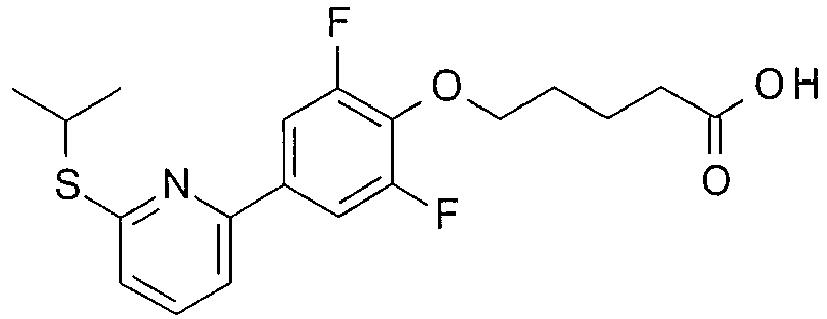
- 2-Chloro-6-isopropylsulfanyl-pyridine (0.05 g, 0.26 mmol) obtained in Preparation Example 125 and ethyl 5-[2,6-difluoro-4-(4,4,5,5-tetramethyl-1,3,2-dioxaborolan-2-yl)phenoxylpentanoate (0.098 g, 0.25 mmol) obtained in Preparation Example 225 were used to react in the same manner as in Step A of Example 29 to obtain the title compound (0.068 g, 65%).
- 1H-NMR (CDCl3) δ 7.58 (2H, m), 7.52 (1H, t), 7.31 (1H, d), 7.08 (1H, d), 4.20 (2H, t), 4.14 (3H, m), 2.40 (2H, t), 1.85 (4H, m), 1.47 (6H, d), 1.26 (3H, t)
- Ethyl 5-[2,6-difluoro-4-(6-isopropylsulfanyl-2-pyridyl)phenoxy]pentanoate (0.068 g, 0.16 mmol) obtained in Step A was used to react in the same manner as in Step B of Example 1 to obtain the title compound (0.046 g, 73%).
- 1H-NMR (CDCl3) δ 7.59 (2H, m), 7.52 (1H, t), 7.31 (1H, d), 7.08 (1H, d), 4.22 (2H, t), 4.14 (1H, m), 2.47 (2H, t), 1.87 (4H, m), 1.48 (6H, d)
-

- 2-Chloro-6-isopropoxy-pyridine (0.039 g, 0.22 mmol) obtained in Preparation Example 21 and ethyl 5-[2,6-difluoro-4-(4,4,5,5-tetramethyl-1,3,2-dioxaborolan-2-yl)phenoxylpentanoate (0.098 g, 0.25 mmol) obtained in Preparation Example 225 were used to react in the same manner as in Step A of Example 29 to obtain the title compound (0.079 g, 89%).
- 1H-NMR (CDCl3) δ 7.57 (3H, m), 7.19 (1H, d), 6.63 (1H, d), 5.45 (1H, m), 4.19 (2H, t), 4.14 (2H, q), 2.40 (2H, t), 1.85 (4H, m), 1.40 (6H, d), 1.27 (3H, t)
- Ethyl 5-[2,6-difluoro-4-(6-isopropoxy-2-pyridyl)phenoxy]pentanoate (0.079 g, 0.2 mmol) obtained in Step A was used to react in the same manner as in Step B of Example 1 to obtain the title compound (0.070 g, 96%).
- 1H-NMR (CDCl3) δ 7.58 (3H, m), 7.19 (1H, d), 6.63 (1H, d), 5.44 (1H, m), 4.20 (2H, t), 2.47 (2H, t), 1.87 (4H, m), 1.40 (6H, d)
-

- 2-Cyclopropylmethoxy-3-iodo-pyridine (0.062 g, 0.22 mmol) obtained in Preparation Example 40 and ethyl 5-[2,6-difluoro-4-(4,4,5,5-tetramethyl-1,3,2-dioxaborolan-2-yl)phenoxylpentanoate (0.095 g, 0.25 mmol) obtained in Preparation Example 225 were used to react in the same manner as in Step A of Example 28 to obtain the title compound (0.072 g, 79%).
- 1H-NMR (CDCl3) δ 8.12 (1H, m), 7.58 (1H, m), 7.22 (2H, m), 6.95 (1H, m), 4.22 (2H, d), 4.19 (2H, t), 4.14 (2H, q), 2.40 (2H, t), 1.85 (4H, m), 1.26 (4H, m), 0.60 (2H, m), 0.35 (2H, m)
- Ethyl 5-[4-[2-(cyclopropylmethoxy)-3-pyridyl]-2,6-difluoro-phenoxy]pentanoate (0.072 g, 0.18 mmol) obtained in Step A was used to react in the same manner as in Step B of Example 1 to obtain the title compound (0.067 g, 99%).
- 1H-NMR (CDCl3) δ 8.13 (1H, m), 7.58 (1H, m), 7.21 (2H, m), 6.94 (1H, m), 4.21 (4H, m), 2.48 (2H, t), 1.88 (4H, m), 1.30 (1H, m), 0.60 (2H, m), 0.34 (2H, m)
-

- 3-Iodo-2-(tetrahydrofuran-3-yloxy)-pyridine(0.066 g, 0.22 mmol) obtained in Preparation Example 59 and ethyl 5-[2,6-difluoro-4-(4,4,5,5-tetramethyl-1,3,2-dioxaborolan-2-yl)phenoxy]pentanoate (0.095 g, 0.25 mmol) obtained in Preparation Example 225 were used to react in the same manner as in Step A of Example 28 to obtain the title compound (0.06 g, 63%).
- 1H-NMR (CDCl3) δ 8.12 (1H, m), 7.58 (1H, m), 7.14 (2H, m), 6.97 (1H, m), 5.63 (1H, m), 4.19 (2H, t), 4.14 (2H, q), 4.10 (1H, m), 3.93 (3H, m), 2.40 (2H, t), 2.25 (1H, m), 2.15 (1H, m), 1.85 (4H, m), 1.26 (3H, t)
- Ethyl 5-[2,6-difluoro-4-(2-tetrahydrofuran-3-yloxy-3-pyridyl)phenoxy] pentanoate (0.06 g, 0.14 mmol) obtained in Step A was used to react in the same manner as in Step B of Example 1 to obtain the title compound (0.055 g, 99%).
- 1H-NMR (CDCl3) δ 8.12 (1H, m), 7.58 (1H, m), 7.12 (2H, m), 6.98 (1H, m), 5.65 (1H, m), 4.21 (2H, t), 4.07 (1H, m), 3.93 (3H, m), 2.46 (2H, t), 2.25 (1H, m), 2.15 (1H, m), 1.86 (4H, m)
-
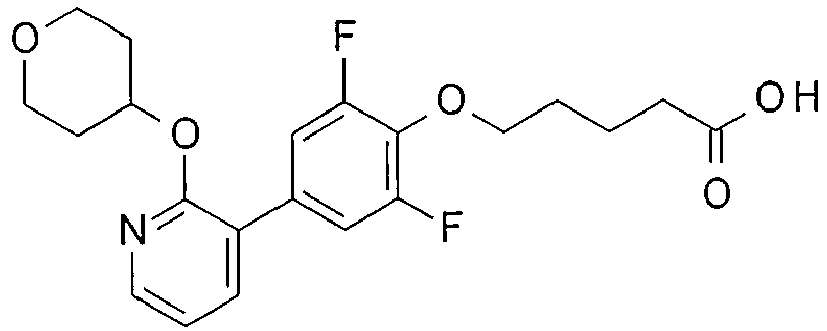
- 3-Iodo-2-(tetrahydropyran-4-yloxy)-pyridine (0.069 g, 0.22 mmol) obtained in Preparation Example 58 and ethyl 5-[2,6-difluoro-4-(4,4,5,5-tetramethyl-1,3,2-dioxaborolan-2-yl)phenoxy]pentanoate (0.095 g, 0.25 mmol) obtained in Preparation Example 225 were used to react in the same manner as in Step A of Example 28 to obtain the title compound (0.071 g, 72%).
- 1H-NMR (CDCl3) δ 8.12 (1H, m), 7.58 (1H, m), 7.15 (2H, m), 6.95 (1H, m), 5.37 (1H, m), 4.20 (2H, t), 4.14 (2H, q), 3.91 (2H, m), 3.63 (2H, m), 2.41 (2H, t), 2.06 (2H, m), 1.85 (6H, m), 1.27 (3H, t)
- Ethyl 5-[2,6-difluoro-4-(2-tetrahydropyran-4-yloxy-3-pyridyl)phenoxy] pentanoate (0.071 g, 0.16 mmol) obtained in Step A was used to react in the same manner as in Step B of Example 1 to obtain the title compound (0.054 g, 83%).
- 1H-NMR (CDCl3) δ 8.12 (1H, m), 7.58 (1H, m), 7.15 (2H, m), 6.95 (1H, m), 5.38 (1H, m), 4.21 (2H, t), 3.90 (2H, m), 3.64 (2H, m), 2.47 (2H, t), 2.06 (2H, m), 1.88 (4H, m), 1.80 (2H, m)
-

- 4-[2,6-Difluoro-4-(2-isopropoxy-pyridin-3-yl)-phenylsulfanyl]-pentanoic acid ethyl ester (0.015 g, 0.04 mmol) obtained in Preparation Example 219 was reacted in the same manner as in Step B of Example 1 to obtain the title compound (0.008 g, 57%).
- 1H-NMR (CDCl3) δ 8.16 (1H, m), 7.60 (1H, m), 7.21 (2H, d), 6.93 (1H, m), 5.40 (1H, m), 3.31 (1H, m), 2.62 (2H, m), 1.86 (2H, m), 1.36 (6H, d), 1.31 (3H, d).
-

- 4-[4-(2-Cyclopentylsulfanyl-pyridin-3-yl)-phenylsulfanyl]-pentanoic acid ethyl ester (0.004 g, 0.01 mmol) obtained in Preparation Example 217 was reacted in the same manner as in Step B of Example 1 to obtain the title compound (0.002 g, 54%).
- 1H-NMR (CDCl3) δ 8.41 (1H, m), 7.42 (2H, d), 7.35 (3H, m), 7.02 (1H, m), 4.06 (1H, m), 3.31 (1H, m), 2.58 (2H, m), 2.17 (2H, m), 1.93 (2H, m), 1.69-1.51 (6H, m), 1.36 (3H, d).
-
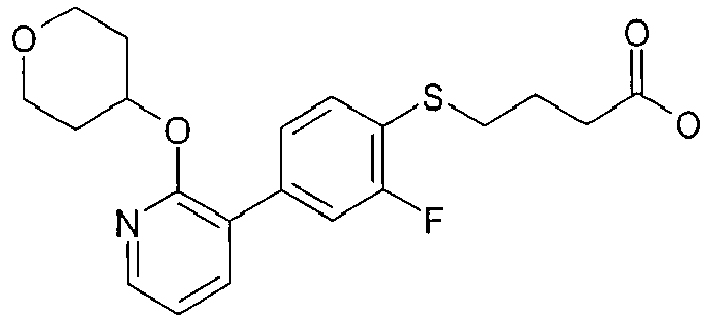
- 4-[2-Fluoro-4-(4,4,5,5-tetramethyl-[1,3,2]dioxaborolan-2-yl)-phenylsulfanyl]-butyric acid ethyl ester (0.05 g, 0.14 mmol) obtained in Preparation Example 180 and 3-iodo-2-(tetrahydropyran-4-yloxy)-pyridine (0.06 g, 0.2 mmol) obtained in Preparation Example 58 were used to react sequentially in the same manner as in Steps A and B of Example 1 to obtain the title compound (0.03 g, 66%).
- 1H-NMR (CDCl3) δ 8.13 (1H, m), 7.62 (1H, m), 7.42 (1H, m), 7.32 (2H, m), 6.96 (1H, m), 5.37 (1H, m), 3.88 (2H, m), 3.63 (2H, m), 3.02 (2H, t), 2.56 (2H, t), 2.08 (2H, m), 1.98 (2H, m), 1.80 (2H, m)
-
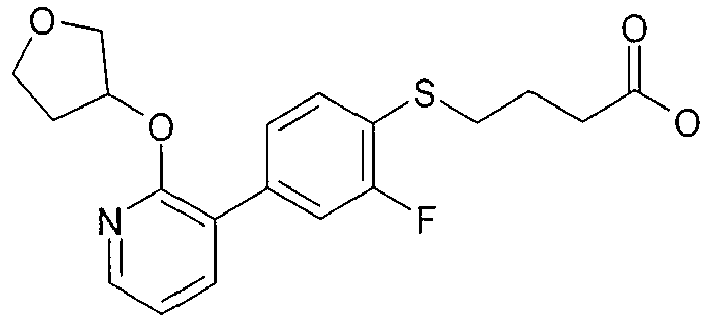
- 4-[2-Fluoro-4-(4,4,5,5-tetramethyl-[1,3,2]dioxaborolan-2-yl)-phenylsulfanyl]-butyric acid ethyl ester (0.05 g, 0.14 mmol) obtained in Preparation Example 180 and 3-iodo-2-(tetrahydrofuran-3-yloxy)-pyridine (0.06 g, 0.2 mmol) obtained in Preparation Example 59 were used to react sequentially in the same manner as in Steps A and B of Example 1 to obtain the title compound (0.028 g, 54%).
- 1H-NMR (CDCl3) δ 8.13 (1H, m), 7.62 (1H, m), 7.42 (1H, m), 7.29 (2H, m), 6.98 (1H, m), 5.66 (1H, m), 4.02 (2H, m), 3.93 (2H, m), 3.03 (2H, t), 2.54 (2H, t), 2.26 (1H, m), 2.14 (1H, m), 1.95 (2H, m)
-

- 4-[2-Fluoro-4-(4,4,5,5-tetramethyl-[1,3,2]dioxaborolan-2-yl)-phenylsulfanyl]-butyric acid ethyl ester (0.05 g, 0.14 mmol) obtained in Preparation Example 180 and 2-cyclobutylmethoxy-3-iodo-pyridine (0.06 g, 0.2 mmol) obtained in Preparation Example 61 were used to react sequentially in the same manner as in Steps A and B of Example 1 to obtain the title compound (0.03 g, 60%).
- 1H-NMR (CDCl3) δ 8.14 (1H, m), 7.62 (1H, m), 7.42-7.29 (3H, m), 6.96 (1H, m), 4.32 (2H, d), 3.01 (2H, t), 2.77 (1H, m), 2.56 (2H, t), 2.09 (2H, m), 2.01-1.83 (6H, m)
-

- 4-[2,6-Difluoro-4-(4,4,5,5-tetramethyl-[1,3,2]dioxaborolan-2-yl)-phenylsulfanyl]-but yric acid ethyl ester (0.04 g, 0.1 mmol) obtained in Preparation Example 170 and 3-iodo-2-(2,2,2-trifluoro-ethoxy)-pyridine (0.05 g, 0.15 mmol) obtained in Preparation Example 220 were used to react sequentially in the same manner as in Steps A and B of Example 1 to obtain the title compound (0.019 g, 45%).
- 1H-NMR (CDCl3) δ 8.17 (1H, m), 7.69 (1H, m), 7.16 (2H, d), 7.09 (1H, m), 4.82 (2H, q), 2.97 (2H, t), 2.56 (2H, t), 1.88 (2H, m)
-

- 4-[2,6-Difluoro-4-(4,4,5,5-tetramethyl-[1,3,2]dioxaborolan-2-yl)-phenylsulfanyl]-but yric acid ethyl ester (0.04 g, 0.1 mmol) obtained in Preparation Example 170 and 2-cyclobutylmethoxy-3-iodo-pyridine (0.045 g, 0.15 mmol) obtained in Preparation Example 61 were used to react sequentially in the same manner as in Steps A and B of Example 1 to obtain the title compound (0.022 g, 55%).
- 1H-NMR (CDCl3) δ 8.16 (1H, m), 7.61 (1H, m), 7.20 (2H, d), 6.96 (1H, m), 4.32 (2H, d), 2.95 (2H, t), 2.77 (1H, m), 2.54 (2H, t), 2.09 (2H, m), 2.01-1.83 (6H, m)
-

- 4-[2,6-Difluoro-4-(4,4,5,5-tetramethyl-[1,3,2]dioxaborolan-2-yl)-phenylsulfanyl]-but yric acid ethyl ester (0.04 g, 0.1 mmol) obtained in Preparation Example 170 and N-cyclopentyl-3-iodo-pyridin-2-amine (0.045 g, 0.15 mmol) obtained in Preparation Example 64 were used to react sequentially in the same manner as in Steps A and B of Example 1 to obtain the title compound (0.02 g, 49%).
- 1H-NMR (CDCl3) δ 8.16 (1H, m), 7.23 (1H, m), 7.01 (2H, d), 6.63 (1H, m), 4.34 (1H, m), 2.99 (2H, t), 2.55 (2H, t), 2.07 (2H, m), 1.92 (2H, m), 1.64 (4H, m), 1.35 (2H, m)
-

- 4-[2,6-Difluoro-4-(4,4,5,5-tetramethyl-[1,3,2]dioxaborolan-2-yl)-phenylsulfanyl]-but yric acid ethyl ester (0.04 g, 0.1 mmol) obtained in Preparation Example 170 and 3-iodo-N-isopropyl-pyridin-2-amine (0.04 g, 0.15 mmol) obtained in Preparation Example 66 were used to react sequentially in the same manner as in Steps A and B of Example 1 to obtain the title compound (0.017 g, 44%).
- 1H-NMR (CDCl3) δ 8.16 (1H, m), 7.23 (1H, m), 7.01 (2H, d), 6.62 (1H, m), 4.26 (1H, m), 3.00 (2H, t), 2.58 (2H, t), 1.92 (2H, m), 1.20 (6H, d)
-

- 4-[2,6-Difluoro-4-(4,4,5,5-tetramethyl-[1,3,2]dioxaborolan-2-yl)-phenylsulfanyl]-but yric acid ethyl ester (0.04 g, 0.1 mmol) obtained in Preparation Example 170 and cyclopropylmethyl-(3-iodo-pyridin-2-yl)-amine (0.043 g, 0.15 mmol) obtained in Preparation Example 235 were used to react sequentially in the same manner as in Steps A and B of Example 1 to obtain the title compound (0.013 g, 31%).
- 1H-NMR (CDCl3) δ 8.15 (1H, m), 7.25 (1H, m), 7.02 (2H, d), 6.65 (1H, m), 3.26 (2H, d), 3.00 (2H, t), 2.57 (2H, t), 1.90 (2H, m), 1.05 (1H, m), 0.50 (2H, m), 0.21 (2H, m).
-
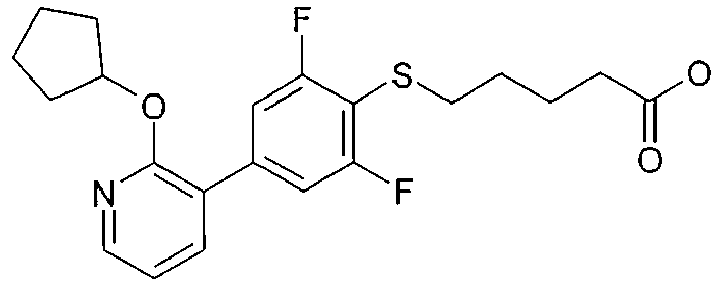
- 5-[2,6-Difluoro-4-(4,4,5,5-tetramethyl-[1,3,2]dioxaborolan-2-yl)-phenylsulfanyl]-pen tanoic acid ethyl ester (0.055 g, 0.14 mmol) obtained in Preparation Example 222 and 2-cyclopentoxy-3-iodo-pyridine (0.06 g, 0.21 mmol) obtained in Preparation Example 38 were used to react sequentially in the same manner as in Steps A and B of Example 1 to obtain the title compound (0.029 g, 51%).
- 1H-NMR (CDCl3) δ 8.17 (1H, m), 7.59 (1H, m), 7.16 (2H, d), 6.92 (1H, m), 5.52 (1H, m), 2.92 (2H, t), 2.36 (2H, t), 1.95 (2H, m), 1.76 (6H, m), 1.64 (4H, m)
-

- 5-[2,6-Difluoro-4-(4,4,5,5-tetramethyl-[1,3,2]dioxaborolan-2-yl)-phenylsulfanyl]-pen tanoic acid ethyl ester (0.05 g, 0.12 mmol) obtained in Preparation Example 222 and 3-iodo-2-isopropoxy-pyridine (0.05 g, 0.19 mmol) obtained in Preparation Example 37 were used to react sequentially in the same manner as in Steps A and B of Example 1 to obtain the title compound (0.023 g, 48%).
- 1H-NMR (CDCl3) δ 8.16 (1H, m), 7.59 (1H, m), 7.18 (2H, d), 6.92 (1H, m), 5.40 (1H, m), 2.92 (2H, t), 2.36 (2H, t), 1.79 (2H, m), 1.66 (2H, m), 1.35 (6H, d)
-

- 5-[4-(4,4,5,5-Tetramethyl-[1,3,2]dioxaborolan-2-yl)-phenylsulfanyl]-pentanoic acid ethyl ester (0.05 g, 0.14 mmol) obtained in Preparation Example 224 and 2-cyclopentoxy-3-iodo-pyridine (0.06 g, 0.2 mmol) obtained in Preparation Example 38 were used to react sequentially in the same manner as in Steps A and B of Example 1 to obtain the title compound (0.026 g, 51%).
- 1H-NMR (CDCl3) δ 8.12 (1H, m), 7.56 (1H, m), 7.47 (2H, d), 7.32 (2H, d), 6.90 (1H, m), 5.49 (1H, m), 2.97 (2H, t), 2.37 (2H, t), 1.93 (2H, m), 1.82-1.65 (8H, m), 1.60 (2H, m)
-

- 5-[4-(4,4,5,5-Tetramethyl-[1,3,2]dioxaborolan-2-yl)-phenylsulfanyl]-pentanoic acid ethyl ester (0.05 g, 0.14 mmol) obtained in Preparation Example 224 and 3-iodo-2-isopropoxy-pyridine (0.054 g, 0.2 mmol) obtained in Preparation Example 37 were used to react sequentially in the same manner as in Steps A and B of Example 1 to obtain the title compound (0.026 g, 55%).
- 1H-NMR (CDCl3) δ 8.11 (1H, m), 7.58 (1H, m), 7.49 (2H, d), 7.32 (2H, d), 6.90 (1H, m), 5.39 (1H, m), 2.97 (2H, t), 2.39 (2H, t), 1.82-1.69 (4H, m), 1.34 (6H, d)
-

- 5-[2,6-Difluoro-4-(4,4,5,5-tetramethyl-[1,3,2]dioxaborolan-2-yl)-phenylsulfanyl]-pen tanoic acid ethyl ester (0.05 g, 0.12 mmol) obtained in Preparation Example 222 and 2-cyclopentylsulfanyl-3-iodo-pyridine (0.057 g, 0.19 mmol) obtained in Preparation Example 39 were used to react sequentially in the same manner as in Steps A and B of Example 1 to obtain the title compound (0.014 g, 26%).
- 1H-NMR (CDCl3) δ 8.45 (1H, m), 7.34 (1H, m), 7.03 (3H, m), 4.09 (1H, m), 2.93 (2H, t), 2.37 (2H, t), 2.20 (2H, m), 1.79-1.52 (10H, m)
-
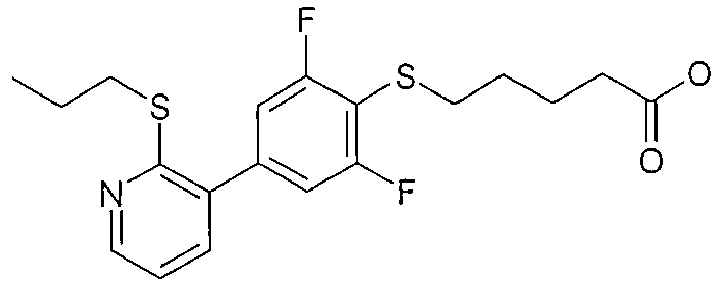
- 5-[2,6-Difluoro-4-(4,4,5,5-tetramethyl-[1,3,2]dioxaborolan-2-yl)-phenylsulfanyl]-pen tanoic acid ethyl ester (0.05 g, 0.12 mmol) obtained in Preparation Example 222 and 3-iodo-2-propylsulfanyl-pyridine (0.052 g, 0.19 mmol) obtained in Preparation Example 203 were used to react sequentially in the same manner as in Steps A and B of Example 1 to obtain the title compound (0.023 g, 46%).
- 1H-NMR (CDCl3) δ 8.44 (1H, m), 7.35 (1H, m), 7.03 (3H, m), 3.15 (2H, t), 2.93 (2H, t), 2.37 (2H, t), 1.80 (2H, m), 1.65 (4H, m), 1.02 (3H, t)
-

- 5-[4-(4,4,5,5-Tetramethyl-[1,3,2]dioxaborolan-2-yl)-phenylsulfanyl]-pentanoic acid ethyl ester (0.05 g, 0.14 mmol) obtained in Preparation Example 224 and 2-cyclopentylsulfanyl-3-iodo-pyridine (0.062 g, 0.2 mmol) obtained in Preparation Example 39 were used to react sequentially in the same manner as in Steps A and B of Example 1 to obtain the title compound(0.029 g, 54%).
- 1H-NMR (CDCl3) δ 8.40 (1H, m), 7.34 (5H, m), 7.01 (1H, m), 4.08 (1H, m), 2.98 (2H, t), 2.39 (2H, t), 2.18 (2H, m), 1.81-1.52 (10H, m)
-
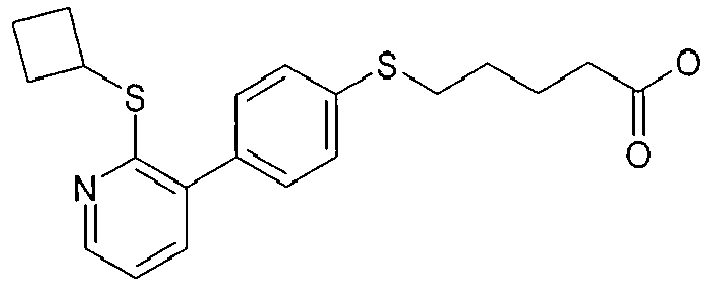
- 5-[4-(4,4,5,5-Tetramethyl-[1,3,2]dioxaborolan-2-yl)-phenylsulfanyl]-pentanoic acid ethyl ester (0.05 g, 0.14 mmol) obtained in Preparation Example 224 and 2-cyclobutylsulfanyl-3-iodo-pyridine (0.06 g, 0.2 mmol) obtained in Preparation Example 44 were used to react sequentially in the same manner as in Steps A and B of Example 1 to obtain the title compound (0.03 g, 58%).
- 1H-NMR (CDCl3) δ 8.39 (1H, m), 7.35 (5H, m), 7.01 (1H, m), 4.42 (1H, m), 2.98 (2H, t), 2.48 (2H, m), 2.40 (2H, t), 2.02 (4H, m), 1.79 (4H, m)
-
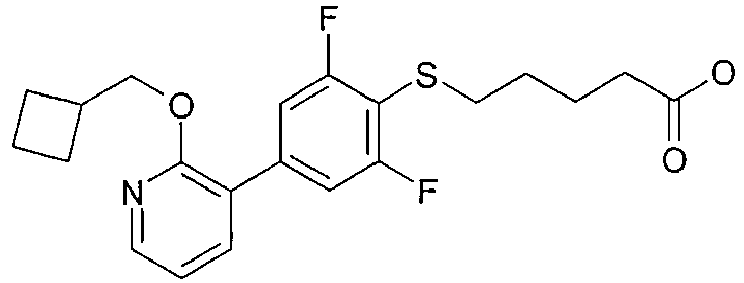
- 5-[2,6-Difluoro-4-(4,4,5,5-tetramethyl-[1,3,2]dioxaborolan-2-yl)-phenylsulfanyl]-pen tanoic acid ethyl ester (0.05 g, 0.12 mmol) obtained in Preparation Example 222 and 2-cyclobutylmethoxy-3-iodo-pyridine (0.054 g, 0.19 mmol) obtained in Preparation Example 61 were used to react sequentially in the same manner as in Steps A and B of Example 1 to obtain the title compound (0.019 g, 38%).
- 1H-NMR (CDCl3) δ 8.16 (1H, m), 7.62 (1H, m), 7.20 (2H, d), 6.96 (1H, m), 4.33 (2H, d), 2.92 (2H, t), 2.77 (1H, m), 2.34 (2H, t), 2.09 (2H, m), 1.87 (4H, m), 1.78 (2H, m), 1.64 (2H, m)
-
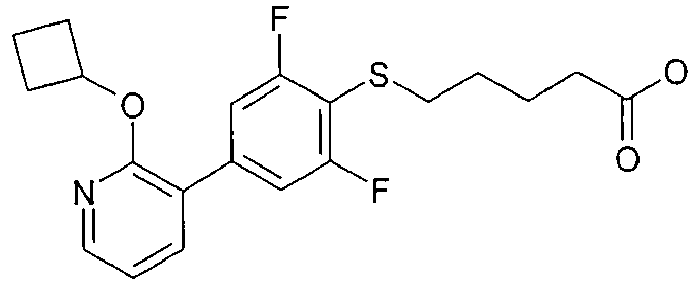
- 5-[2,6-Difluoro-4-(4,4,5,5-tetramethyl-[1,3,2]dioxaborolan-2-yl)-phenylsulfanyl]-pen tanoic acid ethyl ester (0.05 g, 0.12 mmol) obtained in Preparation Example 222 and 2-cyclobutoxy-3-iodo-pyridine (0.052 g, 0.19 mmol) obtained in Preparation Example 200 were used to react sequentially in the same manner as in Steps A and B of Example 1 to obtain the title compound (0.019 g, 38%).
- 1H-NMR (CDCl3) δ 8.14 (1H, m), 7.60 (1H, m), 7.21 (2H, d), 6.94 (1H, m), 5.27 (1H, m), 2.92 (2H, t), 2.47 (2H, m), 2.36 (2H, t), 2.12 (2H, m), 1.80 (3H, m), 1.65 (3H, m)
-
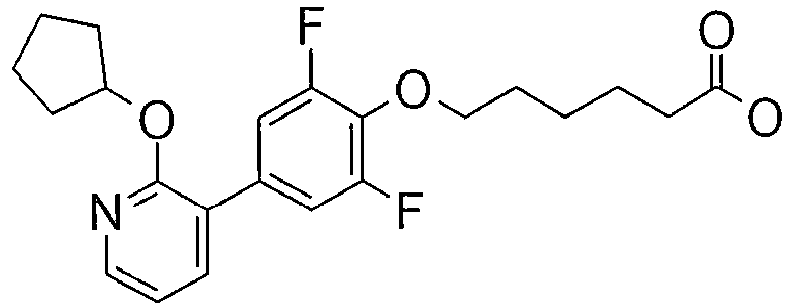
- 6-Bromo-hexanoic acid ethyl ester (46 mg, 0.21 mmol) and 4-(2-cyclopentyloxy-pyridin-3-yl)-2,6-difluoro-phenol (50 mg, 0.17 mmol) obtained in Preparation Example 55 were used to react in the same manner as in Steps A and B of Example 232 to obtain the title compound (43 mg, 62 %).
- 1H NMR (CDCl3) δ 8.15 (1H, m), 7.56 (1H, m), 7.14 (2H, m), 6.91 (1H, m), 5.51 (1H, m), 4.19 (2H, t), 2.41 (2H, t), 1.95 (2H, m), 1.83 (4H, m), 1.74 (4H, m), 1.57 (4H, m)
-

- 7-Bromo-heptanoic acid ethyl ester (49 mg, 0.21 mmol) and 4-(2-cyclopentyloxy-pyridin-3-yl)-2,6-difluoro-phenol (50 mg, 0.17 mmol) obtained in Preparation Example 55 were used to react in the same manner as in Step C of Preparation Example 2 to obtain the title compound (45 mg, 59 %).
- 1H NMR (CDCl3) δ 8.14 (1H, m), 7.57 (1H, m), 7.14 (2H, m), 6.91 (1H, m), 5.52 (1H, m), 4.18 (2H, t), 2.39 (2H, t), 1.95 (2H, m), 1.85-1.40 (14H, m)
-
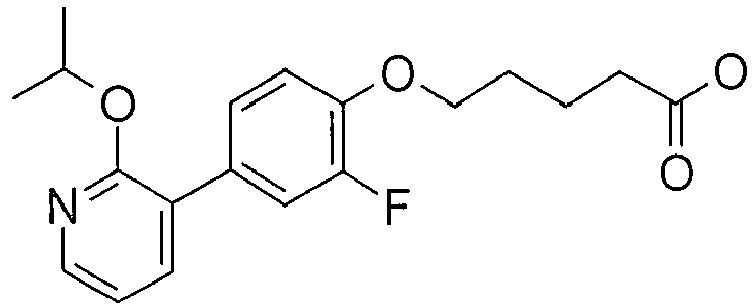
- 3-Iodo-2-isopropoxy-pyridine (0.030 g, 0.11 mmol) obtained in Preparation Example 37 and 5-[2-fluoro-4-(4,4,5,5-tetramethyl-[1,3,2]dioxaborolan-2-yl)-phenoxy]-pentanoic acid ethyl ester (0.042 g, 0.11 mmol) obtained in Preparation Example 147 were used to react in the same manner as in Steps A and B of Example 1 to obtain the title compound (0.023 g, 58 %).
- 1H NMR (CDCl3) δ 8.10 (1H, m), 7.55 (1H, m), 7.38 (1H, m), 7.25 (1H, d), 6.97 (1H, t), 6.90 (1H, m), 5.40 (1H, m), 4.10 (2H, t), 2.49 (2H, t), 1.91(4H, m), 1.43 (6H, d)
-

- 2-Cyclopentylsulfanyl-3-iodo-pyridine (0.030 g, 0.10 mmol) obtained in Preparation Example 39 and 5-[2-fluoro-4-(4,4,5,5-tetramethyl-[1,3,2]dioxaborolan-2-yl)-phenoxy]-pentanoic acid ethyl ester (0.036 g, 0.10 mmol) obtained in Preparation Example 147 were used to react in the same manner as in Steps A and B of Example 1 to obtain the title compound (0.026 g, 68 %).
- 1H NMR (CDCl3) δ 8.41 (1H, m), 7.32 (1H, m), 7.17 (1H, m), 7.12 (1H, d), 7.01 (2H, m), 4.10 (3H, m), 2.49 (2H, t), 2.19 (2H, m), 1.91 (4H, m), 1.75-1.50 (6H, m)
-

- 2-Cyclobutylsulfanyl-3-iodo-pyridine (0.030 g, 0.10 mmol) obtained in Preparation Example 44 and 5-[2-fluoro-4-(4,4,5,5-tetramethyl-[1,3,2]dioxaborolan-2-yl)-phenoxy]-pentanoic acid ethyl ester (0.038 g, 0.10 mmol) obtained in Preparation Example 147 were used to react in the same manner as in Steps A and B of Example 1 to obtain the title compound (0.024 g, 62 %).
- 1H NMR (CDCl3) δ 8.39 (1H, m), 7.34 (1H, m), 7.15 (2H, m), 7.02 (2H, m), 4.43 (1H, m), 4.11 (2H, t), 2.50 (4H, m), 2.04 (4H, m), 1.92 (4H, m)
-

- 2-Cyclopentoxy-3-iodo-pyridine (0.030 g, 0.10 mmol) obtained in Preparation Example 38 and 5-[2-fluoro-4-(4,4,5,5-tetramethyl-[1,3,2]dioxaborolan-2-yl)-phenoxy]-pentanoic acid ethyl ester (0.038 g, 0.10 mmol) obtained in Preparation Example 147 were used to react in the same manner as in Example 1 to obtain the title compound (0.026 g, 67 %).
- 1H NMR (CDCl3) δ 8.11 (1H, m), 7.57 (1H, m), 7.34 (1H, m), 7.25 (1H, m), 6.96 (1H, t), 6.90 (1H, m), 5.51 (1H, m), 4.10 (2H, t), 2.49 (2H, t), 2.00-1.60 (12H, m)
-

- Methanol (26 mg, 0.80 mmol) and 4-[2,6-difluoro-4-(2-fluoro-3-pyridyl)phenoxy]butyric acid (50 mg, 0.16 mmol) obtained in Preparation Example 56 were used to react in the same manner as in Preparation Example 37 to obtain the title compound (35 mg, 67 %).
- 1H NMR (CDCl3) δ 8.17 (1H, m), 7.57 (1H, m), 7.14 (2H, m), 6.98 (1H, m), 4.24 (2H, t), 3.98 (3H, s), 2.68 (2H, t), 2.13 (2H, m)
-

- Prop-2-en-1-ol (47 mg, 0.80 mmol) and 4-[2,6-difluoro-4-(2-fluoro-3-pyridyl)phenoxy]butyric acid (50 mg, 0.16 mmol) obtained in Preparation Example 56 were used to react in the same manner as in Preparation Example 37 to obtain the title compound (7 mg, 12 %).
- 1H NMR (CDCl3) δ 8.15 (1H, m), 7.58 (1H, m), 7.15 (2H, m), 6.98 (1H, m), 6.09 (1H, m), 5.36 (1H, m), 5.24 (1H, m), 4.91 (2H, m), 4.24 (2H, t), 2.68 (2H, t), 2.13 (2H, m)
-

- But-2-yn-1-ol (47 mg, 0.80 mmol) and 4-[2,6-difluoro-4-(2-fluoro-3-pyridyl)phenoxy]butyric acid (50 mg, 0.16 mmol) obtained in Preparation Example 56 were used to react in the same manner as in Preparation Example 37 to obtain the title compound (35 mg, 60 %).
- 1H NMR (CDCl3) δ 8.17 (1H, m), 7.58 (1H, m), 7.17 (2H, m), 7.00 (1H, m), 5.00 (2H, m), 4.24 (2H, t), 2.68 (2H, t), 2.13 (2H, m), 1.85 (3H, t)
-
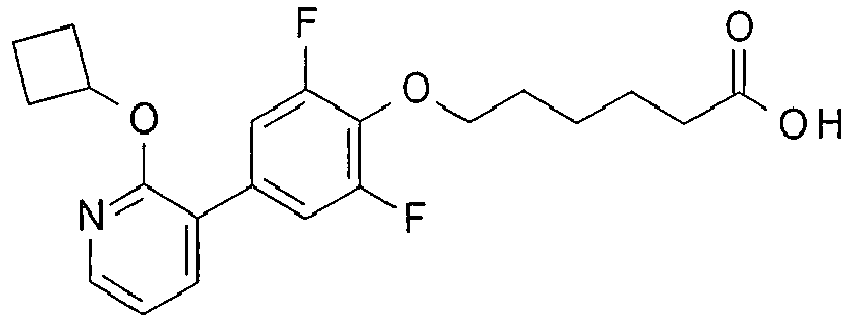
- 2-Cyclobutoxy-3-iodo-pyridine (0.072 g, 0.26 mmol) obtained in Preparation Example 200 and ethyl 6-[2,6-difluoro-4-(4,4,5,5-tetramethyl-1,3,2-dioxaborolan-2-yl)phenoxy]hexanoate (0.11 g, 0.27 mmol) obtained in Preparation Example 146 were used to react in the same manner as in Step A of Example 28 to obtain the title compound (0.064 g, 59%).
- 1H-NMR (CDCl3) δ 8.11 (1H, m), 7.56 (1H, m), 7.20 (2H, m), 6.93 (1H, m), 5.28 (1H, m), 4.15 (4H, m), 2.49 (2H, m), 2.44 (2H, t), 2.14 (2H, m), 1.82 (3H, m), 1.72 (3H, m), 1.55 (2H, m), 1.26 (3H, t)
- Ethyl 6-[4-[2-(cyclobutoxy)-3-pyridyl]-2,6-difluoro-phenoxy]hexanoate (0.064 g, 0.15 mmol) obtained in Step A was used to react in the same manner as in Step B of Example 1 to obtain the title compound (0.058 g, 97%).
- 1H-NMR (CDCl3) δ 8.12 (1H, m), 7.57 (1H, m), 7.17 (2H, m), 6.93 (1H, m), 5.27 (1H, m), 4.18 (2H, t), 2.48 (2H, m), 1.41 (2H, t), 2.14 (2H, m), 1.83 (3H, m), 1.71 (3H, m), 1.59 (2H, m),
-

- 2-Cyclobutylmethoxy-3-iodo-pyridine (0.076 g, 0.26 mmol) obtained in Preparation Example 61 and ethyl 6-[2,6-difluoro-4-(4,4,5,5-tetramethyl-1,3,2-dioxaborolan-2-yl)phenoxy]hexanoate (0.11 g, 0.27 mmol) obtained in Preparation Example 146 were used to react in the same manner as in Step B of Example 1 to obtain the title compound (0.058 g, 97%).
- 1H-NMR (CDCl3) δ 8.14 (1H, m), 7.58 (1H, m), 7.17 (2H, m), 6.95 (1H, m), 4.32 (2H, d), 4.15 (4H, m), 2.80 (1H, m), 2.34 (2H, t), 2.10 (2H, m), 1.92 (4H, m), 1.82 (2H, m), 1.75 (2H, m), 1.54 (2H, m), 1.26 (3H, t)
- Ethyl 6-[4-[2-(cyclobutylmethoxy)-3-pyridyl]-2,6-difluoro-phenoxy]hexanoate (0.064 g, 0.15 mmol) obtained in Step A was used to react in the same manner as in Step B of Example 1 to obtain the title compound (0.067 g, 99%).
- 1H-NMR (CDCl3) δ 8.14 (1H, m), 7.58 (1H, m), 7.17 (2H, m), 6.93 (1H, m), 4.32 (2H, d), 4.17 (2H, t), 2.78 (1H, m), 2.41 (2H, t), 2.10 (2H, m), 1.89 (2H, m), 1.96 (1H, m), 1.88 (3H, m), 1.82 (2H, m), 1.73 (2H, m)
-
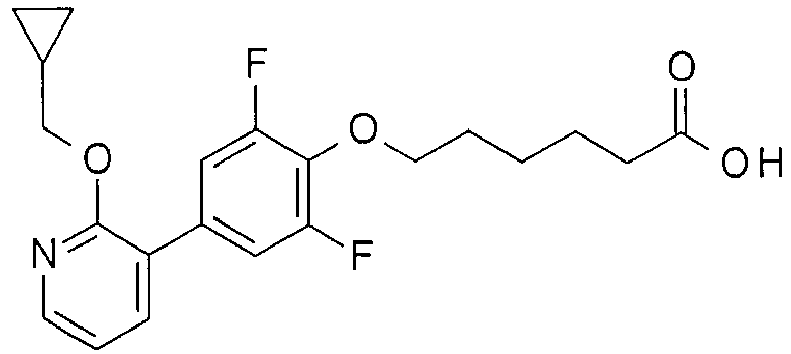
- 2-Cyclopropylmethoxy-3-iodo-pyridine (0.072 g, 0.26 mmol) obtained in Preparation Example 40 and ethyl 6-[2,6-difluoro-4-(4,4,5,5-tetramethyl-1,3,2-dioxaborolan-2-yl)phenoxy]hexanoate (0.11 g, 0.27 mmol) obtained in Preparation Example 146 were used to react in the same manner as in Step A of Example 28 to obtain the title compound (0.075 g, 69%).
- 1H-NMR (CDCl3) δ 8.12 (1H, m), 7.59 (1H, m), 7.23 (2H, m), 6.94 (1H, m), 4.22 (2H, d), 4.15 (4H, m), 2.34 (2H, t), 1.80 (2H, m), 1.72 (2H, m), 1.55 (2H, m), 1.26 (4H, m), 0.60 (2H, m), 0.35 (2H, m)
- Ethyl 6-[4-[2-(cyclopropylmethoxy)-3-pyridyl]-2,6-difluoro-phenoxy]hexanoate (0.075 g, 0.18 mmol) obtained in Step A was used to react in the same manner as in Step B of Example 1 to obtain the title compound (0.049 g, 69%).
- 1H-NMR (CDCl3) δ 8.12 (1H, m), 7.58 (1H, m), 7.22 (2H, m), 6.95 (1H, m), 4.22 (2H, d), 4.18 (2H, t), 2.41 (2H, t), 1.82 (2H, m), 1.73 (2H, m), 1.58 (2H, m), 1.31 (1H, m), 0.60 (2H, m), 0.35 (2H, m)
-

- 2-Cyclobutylsulfanyl-3-iodo-pyridine (0.076 g, 0.26 mmol) obtained in Preparation Example 44 and ethyl 6-[2,6-difluoro-4-(4,4,5,5-tetramethyl-1,3,2-dioxaborolan-2-yl)phenoxy]hexanoate (0.11 g, 0.27 mmol) obtained in Preparation Example 146 were used to react in the same manner as in Step A of Example 28 to obtain the title compound (0.067 g, 59%).
- 1H-NMR (CDCl3) δ 8.41 (1H, m), 7.33 (1H, m), 7.03 (1H, m), 6.95 (2H, m), 4.43 (1H, m), 4.19 (2H, t), 4.14 (2H, q), 2.52 (2H, m), 2.35 (2H, t), 2.06 (4H, m), 1.82 (2H, m), 1.73 (2H, m), 1.55 (2H, m), 1.26 (3H, t)
- Ethyl 6-[4-(2-cyclobutylsulfanyl-3-pyridyl)-2,6-difluoro-phenoxy]hexanoate (0.067 g, 0.15 mmol) obtained in Step A was used to react in the same manner as in Step B of Example 1 to obtain the title compound (0.057 g, 91%).
- 1H-NMR (CDCl3) δ 8.41 (1H, m), 7.32 (1H, m), 7.02 (1H, m), 6.99 (2H, m), 4.42 (1H, m), 4.19 (2H, t), 2.52 (2H, m), 2.42 (2H, t), 2.05 (4H, m), 1.82 (2H, m), 1.74 (2H, m), 1.58 (2H, m)
-

- 2-Cyclopentylsulfanyl-3-iodo-pyridine (0.079 g, 0.26 mmol) obtained in Preparation Example 39 and ethyl 6-[2,6-difluoro-4-(4,4,5,5-tetramethyl-1,3,2-dioxaborolan-2-yl)phenoxy]hexanoate (0.1 1 g, 0.27 mmol) obtained in Preparation Example 146 were used to react in the same manner as in Step A of Example 28 to obtain the title compound (0.080 g, 68%).
- 1H-NMR (CDCl3) δ 8.43 (1H, m), 7.32 (1H, m), 7.03 (1H, m), 6.98 (2H, m), 4.20 (2H, t), 4.13 (3H, m), 2.34 (2H, t), 2.20 (2H, m), 1.82 (2H, m), 1.72 (4H, m), 1.65 (2H, m), 1.59 (4H, m), 1.26 (3H, t)
- Ethyl 6-[4-(2-cyclopentylsulfanyl-3-pyridyl)-2,6-difluoro-phenoxy]hexanoate (0.080 g, 0.17 mmol) obtained in Step A was used to react in the same manner as in Step B of Example 1 to obtain the title compound (0.067 g, 89%).
- 1H-NMR (CDCl3) δ 8.43 m), 7.33 m), 7.03 m), 6.98 (2H, m), 4.19 (2H, t), 4.10 m), 2.41 (2H, t), 2.20 (2H, m), 1.83 (2H, m), 1.73 (4H, m), 1.63 (2H, m), 1.56 (4H, m)
-

- 6-[2,6-Difluoro-4-(4,4,5,5-tetramethyl-[1,3,2]dioxaborolan-2-yl)-phenylsulfanyl]-hex anoic acid ethyl ester (0.05 g, 0.12 mmol) obtained in Preparation Example 237 and 2-cyclopentoxy-3-iodo-pyridine(0.052 g, 0.18 mmol) obtained in Preparation Example 38 were used to react sequentially in the same manner as in Steps A and B of Example 1 to obtain the title compound (0.029 g, 58%).
- 1H-NMR (CDCl3) δ 8.17 m), 7.59 m), 7.16 (2H, d), 6.92 m), 5.52 m), 2.90 (2H, t), 2.33 (2H, t), 1.94 (2H, m), 1.82-1.71 (4H, m), 1.63 (6H, m), 1.48 (2H, m).
-
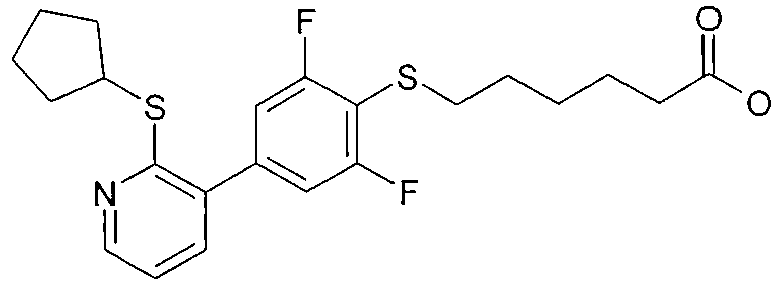
- 6-[2,6-Difluoro-4-(4,4,5,5-tetramethyl-[1,3,2]dioxaborolan-2-yl)-phenylsulfanyl]-hex anoic acid ethyl ester (0.05 g, 0.12 mmol) obtained in Preparation Example 237 and 2-cyclopentylsulfanyl-3-iodo-pyridine (0.055 g, 0.18 mmol) obtained in Preparation Example 39 were used to react sequentially in the same manner as in Steps A and B of Example 1 to obtain the title compound (0.032 g, 60%).
- 1H-NMR (CDCl3) δ 8.44 m), 7.34 (1H, m), 7.02 (3H, m), 4.08 (1H, m), 2.91 (2H, t), 2.34 (2H, t), 2.19 (2H, m), 1.78-1.48 (12H, m).
-
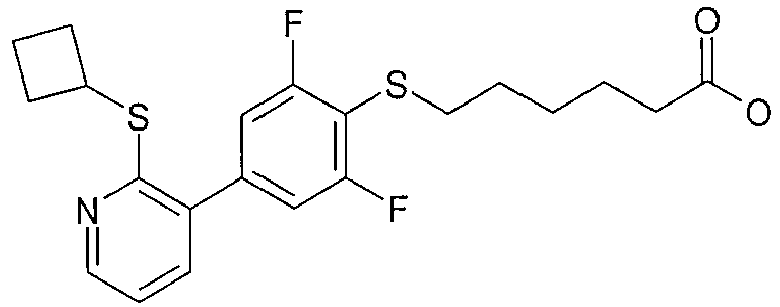
- 6-[2,6-Difluoro-4-(4,4,5,5-tetramethyl-[1,3,2]dioxaborolan-2-yl)-phenylsulfanyl]-hex anoic acid ethyl ester(0.05 g, 0.12 mmol) obtained in Preparation Example 237 and 2-cyclobutylsulfanyl-3-iodo-pyridine (0.053 g, 0.18 mmol) obtained in Preparation Example 44 were used to react sequentially in the same manner as in Steps A and B of Example 1 to obtain the title compound (0.029 g, 56%).
- 1H-NMR (CDCl3) δ 8.42 (1H, m), 7.35 (1H, m), 7.02 (3H, m), 4.42 (1H, m), 2.92 (2H, t), 2.49 (2H, m), 2.35 (2H, t), 2.03 (4H, m), 1.63 (4H, m), 1.49 (2H, m).
-
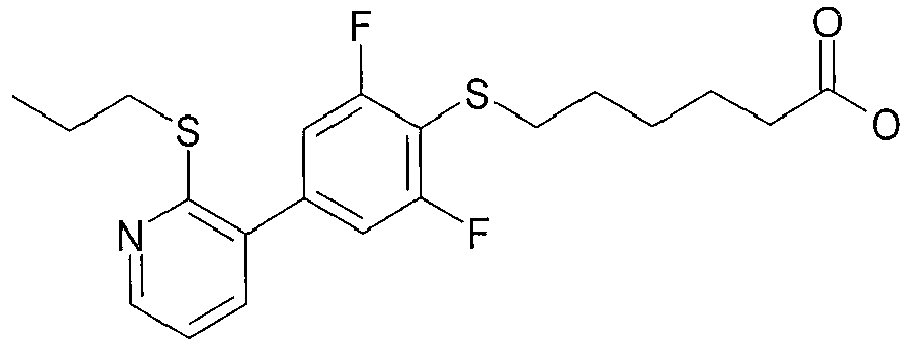
- 6-[2,6-Difluoro-4-(4,4,5,5-tetramethyl-[1,3,2]dioxaborolan-2-yl)-phenylsulfanyl]-hex anoic acid ethyl ester (0.05 g, 0.12 mmol) obtained in Preparation Example 237 and 3-iodo-2-propylsulfanyl-pyridine (0.05 g, 0.18 mmol) obtained in Preparation Example 203 were used to react sequentially in the same manner as in Steps A and B of Example 1 to obtain the title compound (0.027 g, 55%).
- 1H-NMR (CDCl3) δ 8.44 (1H, m), 7.35 (1H, m), 7.03 (3H, m), 3.14 (2H, t), 2.92 (2H, t), 2.34 (2H, t), 1.69-1.62 (6H, m), 1.49 (2H, m), 1.02 (3H, t).
- CHO-K1 cells expressing Ga16 and hGPR120 were dispensed into each well of a 96-well plate (3×10⁴ cells/100 µℓ/well) and then incubated in 5% CO2, 37°C incubator for 18 hours. Each well was treated with 100 µℓ of Calcium 5 dye (Molecular Devices) solution including 2% DMSO and then incubated in 5% CO2, 37°C incubator for 1 hour. Serially diluted GPR120 agonists were prepared to a final concentration of 0.5% DMSO in a 96-well plate. Each well was treated with 50 µℓ of the agonist compounds using Plexstation II, and then fluorescence was measured at Ex 485 nm, Em 525 nm.
- Fluorescence increased by the serially diluted GPR120 agonists is calculated as a relative percent (%) value based on the fluorescence represented by the treatment of 1% DMSO only. EC50 refers to the concentration of agonist which shows 50% of maximum fluorescence increased by the treatment of agonist. The calculation of measurement was carried out by using statistical software (Prizm).
- The agonistic effects of the Example compounds obtained by the above experiment are shown in the following Table 1 with EC50 unit (µM). Activity is denoted based on the following criteria:
A = >20 µM, B = 20∼2 µM, C = 2∼0.2 µM, D = <0.2 µM - As shown in the table, most of the novel compounds according to the present invention have superior GPR120 agonistic effects (EC50), less than 0.2 µM.
-
[Table 1] Example EC50 Example EC50 Example EC50 Example EC50 1 C 2 D 3 D 4 C 5 C 6 D 7 B 8 A 9 0.097 10 D 11 0.050 12 D 13 C 14 C 15 C 16 C 17 C 18 0.144 19 0.040 20 D 21 D 22 0.030 23 D 24 D 25 D 26 D 27 D 28 D 29 D 30 A 31 C 32 A 33 C 34 0.253 35 C 36 C 37 D 38 C 39 D 40 0.085 41 C 42 1.421 43 C 44 D 45 0.057 46 C 47 D 48 D 49 C 50 0.031 51 D 52 C 53 D 54 D 55 D 56 C 57 C 58 C 59 D 60 D 61 C 62 C 63 B 64 D 65 D 66 0.088 67 C 68 C 69 0.147 70 0.036 71 B 72 C 73 C 74 C 75 C 76 C 77 A 78 C 79 D 80 D 81 D 82 D 83 C 84 0.043 85 C 86 C 87 C 88 C 89 D 90 D 91 D 92 D 93 0.064 94 C 95 C 96 D 97 D 98 C 99 D 100 D 101 D 102 D 103 D 104 D 105 D 106 B 107 C 108 D 109 C 110 A 111 A 112 A 113 0.281 114 D 115 0.052 116 D 117 0.029 118 D 119 0.019 120 0.028 121 D 122 D 123 D 124 C 125 D 126 D 127 D 128 D 129 C 130 D 131 C 132 D 133 C 134 D 135 0.348 136 D 137 D 138 D 139 D 140 D 141 D 142 D 143 C 144 D 145 D 146 D 147 D 148 D 149 D 150 0.043 151 0.043 152 D 153 D 154 D 155 D 156 D 157 0.037 158 D 159 D 160 D 161 D 162 D 163 D 164 D 165 D 166 D 167 0.034 168 D 169 D 170 D 171 D 172 D 173 C 174 C 175 D 176 D 177 C 178 0.066 179 C 180 C 181 C 182 0.208 183 C 184 C 185 D 186 D 187 D 188 D 189 C 190 D 191 D 192 B 193 C 194 A 195 C 196 D 197 C 198 D 199 D 200 C 201 D 202 D 203 A 204 D 205 C 206 D 207 D 208 D 209 D 210 D 211 0.024 212 A 213 D 214 D 215 C 216 A 217 B 218 A 219 0.335 220 C 221 A 222 B 223 1.99 224 0.018 225 C 226 A 227 B 228 D 229 D 230 D 231 C 232 D 233 D 234 D 235 D 236 D 237 D 238 D 239 D 240 C 241 C 242 D 243 D 244 C 245 C 246 D 247 D 248 D 249 D 250 C 251 C 252 D 253 C 254 D 255 C 256 0.052 257 D 258 D 259 D 260 D 261 D 262 D 263 B 264 C 265 D 266 D 267 D 268 C 269 C 270 B 271 C 272 D 273 C 274 D 275 C 276 C 277 C 278 C 279 C
Claims (5)
- A biaryl derivative, or a pharmaceutically acceptable salt or E- or Z-isomer, or R- or S-isomer thereof, selected from the following compounds:4-[4-[6-(cyclobutoxy)-2-pyridyl]-2-(trifluoromethyl)phenoxy]butyric acid;4-[[5-(2-cyclobutylsulfanyl-3-pyridyl)-2-pyridyl]oxy]pentanoic acid;4-[2,6-difluoro-4-[6-(N-methylanilino)-2-pyridyl]phenoxy]butyric acid;4-{2,6-difluoro-4-[6-(2-methyl-propenyl)-pyridin-2-yl]-phenoxy}-butyric acid;4-(4-{2-[3-(tert-butyl-dimethyl-silanyloxy)-cyclopentyloxy]-pyridin-3-yl}-2,6-difluorophenoxy)-butyric acid;4-[4-(6-phenoxy-2-pyridyl)phenoxy]butyric acid;4-[2,6-difluoro-4-(6-isopropylsulfanyl-2-pyridyl)phenoxy]butyric acid;4-[2,6-difluoro-4-(6-phenoxy-2-pyridyl)phenoxy]butyric acid;4-[2-chloro-4-(6-isopropylsulfanyl-2-pyridyl)phenoxy]butyric acid;4-[2-fluoro-4-(6-isopropylsulfanyl-2-pyridyl)phenoxy]butyric acid;4-[4-(6-cyclopentylsulfanyl-2-pyridyl)-2,6-difluoro-phenoxy]butyric acid;4-[4-(2-cyclobutylsulfanyl-pyridin-3-yl)-2-methoxy-phenoxy]-butyric acid;4-[2,6-difluoro-4-(2-isopropylsulfanyl-4-pyridyl)phenoxy]butyric acid;4-[4-[6-(cyclopentoxy)-2-pyridyl]-2,6-difluoro-phenoxy]butyric acid;4-[4-(2-cyclobutylsulfanyl-pyridin-3-yl)-2,6-dimethyl-phenoxy]-butyric acid;4-[4-[3-(cyclopentoxy)phenyl]-2,6-difluoro-phenoxy]butyric acid;4-[2,6-difluoro-4-(6-pyrrolidin-1-yl-2-pyridyl)phenoxy]butyric acid;4-[4-(2-sec-butylsulfanyl-pyridin-3-yl)-2,6-difluoro-phenoxy]-butyric acid4-[4-[3-(cyclopentoxy)phenyl]-2,3-difluoro-phenoxy]butyric acid;4-[2,6-difluoro-4-[6-(1-piperidyl)-2-pyridyl]phenoxy]butyric acid;4-[4-(6-anilino-2-pyridyl)-2,6-difluoro-phenoxy]butyric acid;4-[4-[6-(cyclopentylamino)-2-pyridyl]-2,6-difluoro-phenoxy]butyric acid;4-[4-[6-(cyclopropylmethylsulfanyl)-2-pyridyl]-2,6-difluoro-phenoxy]butyric acid;4-[4-(6-cyclobutylsulfanyl-2-pyridyl)-2,6-difluoro-phenoxy]butyric acid;4-[2,6-difluoro-4-(6-propylsulfanyl-2-pyridyl)phenoxy]butyric acid;4-[2,6-difluoro-4-(6-isopropoxy-2-pyridyl)phenoxy]butyric acid;4-[2,6-difluoro-4-(6-propoxy-2-pyridyl)phenoxy]butyric acid;4-[4-[6-(cyclopropylmethoxy)-2-pyridyl]-2,6-difluoro-phenoxy]butyric acid;4-[4-[6-(cyclobutoxy)-2-pyridyl]-2,6-difluoro-phenoxy]butyric acid;4-[4-[6-(cyclobutoxy)-2-pyridyl]-2-methyl-phenoxy]butyric acid;4-[4-(2-cyclobutylsulfanyl-3-pyridyl)-2,6-difluoro-phenoxy]pentanoic acid;4-[4-[6-(cyclobutoxy)-2-pyridyl]-2,6-difluoro-phenoxy]pentanoic acid;4-{2,6-difluoro-4-[2-(3-methyl-butylsulfanyl)-pyridin-3-yl]-phenoxy}-butyric acid4-{2,6-difluoro-4-[2-(2-fluoro-ethoxy)-pyridin-3-yl]-phenoxy}-butyric acid;2-[1-[[4-(2-cyclobutylsulfanyl-3-pyridyl)-2,6-difluoro-phenoxy]methyl] cyclopropyl]acetic acid;2-[1-[[4-[3-(cyclobutoxy)phenyl]-2,6-difluoro-phenoxy]methyl]cyclopropyl] acetic acid;4-[[6-[3-(cyclobutoxy)phenyl]-3-pyridyl]oxy]butyric acid;4-[[6-[3-(cyclopentoxy)phenyl]-3-pyridyl]oxy]butyric acid;4-(2'-phenoxy-biphenyl-4-yloxy)-butyric acid;4-[4-(2-isopropylsulfanyl-pyridin-3-yl)-phenoxy]-butyric acid;4-(3,5-difluoro-2'-phenoxy-biphenyl-4-yloxy)-butyric acid;4-[4-(2-cyclopentylsulfanyl-pyridin-3-yl)-phenoxy]-butyric acid;4-[2,6-difluoro-4-(2-isopropylsulfanyl-pyridin-3-yl)-phenoxy]-butyric acid;4-[2,6-difluoro-4-(2-phenoxy-pyridin-3-yl)-phenoxy]-butyric acid;4-[2,6-difluoro-4-(2-isopropoxy-pyridin-3-yl)-phenoxy]-butyric acid;4-[4-(2-cyclopentyloxy-pyridin-3-yl)-2,6-difluoro-phenoxy]-butyric acid;4-[4-(2-cyclopentylsulfanyl-pyridin-3-yl)-2,6-difluoro-phenoxy]-butyric acid;4-[4-(2-cyclopropylmethoxy-pyridin-3-yl)-2,6-difluoro-phenoxy]-butyric acid;4-[4-(2-cyclopropylmethylsulfanyl-pyridin-3-yl)-2,6-difluoro-phenoxy]-butyric acid;4-[4-(2-cyclobutylsulfanyl-pyridin-3-yl)-phenoxy]-butyric acid;4-[4-(2-cyclopropylmethylsulfanyl-pyridin-3-yl)-phenoxy]-butyric acid;4-[4-(2-cyclobutylsulfanyl-pyridin-3-yl)-2,6-difluoro-phenoxy]-butyric acid;4-[4-(2-propylsulfanyl-pyridin-3-yl)-phenoxy]-butyric acid;4-(3,5-difluoro-2'-isopropoxy-biphenyl-4-yloxy)-butyric acid;4-(2'-cyclobutoxy-3,5-difluoro-biphenyl-4-yloxy)-butyric acid;4-(2'-cyclopropylmethoxy-3,5-difluoro-biphenyl-4-yloxy)-butyric acid;4-(2'-cyclopentyloxy-3,5-difluoro-biphenyl-4-yloxy)-butyric acid;4-(2'-cyclopentyloxy-biphenyl-4-yloxy)-butyric acid;4-(2'-isopropoxy-biphenyl-4-yloxy)-butyric acid;4-(2'-cyclopropylmethoxy-biphenyl-4-yloxy)-butyric acid;4-[4-(2-cyclobutylsulfanyl-pyridin-3-yl)-2,6-difluoro-phenoxy]-2-methyl-butyric acid;2-[4-(2-cyclobutylsulfanyl-pyridin-3-yl)-2,6-difluoro-phenoxymethyl]-cyclopropanecarboxylic acid;4-[4-(2-cyclobutylsulfanyl-pyridin-3-yl)-2,5-difluoro-phenoxy]-butyric acid;4-[4-(6-cyclobutylsulfanyl-pyridin-2-yl)-2,5-difluoro-phenoxy]-butyric acid;4-[4-(2-tert-butylsulfanyl-pyridin-3-yl)-2,6-difluoro-phenoxy]-butyric acid;6-[2,6-difluoro-4-(2-propylsulfanyl-3-pyridyl)phenoxy]hexanoic acid;4-[2,6-difluoro-4-(6-isobutyl-pyridin-2-yl)-phenoxy]-butyric acid;4-[4-(2-cyclobutylsulfanyl-pyridin-3-yl)-3,5-difluoro-phenoxy]-butyric acid;4-{2,6-difluoro-4-[2-(tetrahydro-pyran-4-yloxy)-pyridin-3-yl]-phenoxy}-butyric acid;4-{2,6-difluoro-4-[2-(tetrahydro-furan-3-yloxy)-pyridin-3-yl]-phenoxy}-butyric acid;4-[4-(2-cyclobutoxy-pyridin-3-yl)-2,6-difluoro-phenoxy]-butyric acid;4-{2,6-difluoro-4-[2-(2-methoxy-ethoxy)-pyridin-3-yl]-phenoxy}-butyric acid;4-[2,6-difluoro-4-(2-pyrrolidin-1-yl-3-pyridyl)phenoxy]butanoic acid;4-[4-[2-(cyclopentylamino)-3-pyridyl]-2,6-difluoro-phenoxy]butanoic acid;4-[4-[2-(cyclopropylmethylamino)-3-pyridyl]-2,6-difluoro-phenoxy]butanoic acid;4-[4-[6-(cyciopropylmethylamino)-2-pyridyl]-2,6-difluoro-phenoxy]butanoic acid;4-[2,6-difluoro-4-[2-(isopropylamino)-3-pyridyl]phenoxy]butanoic acid;4-[4-[2-(cyclopropylamino)-3-pyridyl]-2,6-difluoro-phenoxy]butanoic acid;4-[2,6-difluoro-4-[6-(isopropylamino)-2-pyridyl]phenoxy]butanoic acid;4-[4-[2-(cyclopentylamino)phenyl]-2,6-difluoro-phenoxy]butanoic acid;4-[4-[3-(cyclopentylamino)phenyl]-2,6-difluoro-phenoxy]butanoic acid;4-[2,6-difluoro-4-[2-(propylamino)phenyl]phenoxy]butanoic acid;4-[4-[2-(cyclopropylmethylamino)phenyl]-2,6-difluoro-phenoxy]butanoic acid;4-[2,6-difluoro-4-[2-(isopropylamino)phenyl]phenoxy]butanoic acid;4-[4-[2-(cyclopentylamino)phenyl]phenoxy]butanoic acid;4-[4-[2-(cyclopropylmethylamino)phenyl]phenoxy]butanoic acid;4-[4-[2-(propylamino)phenyl]phenoxy]butanoic acid;4-[4-[2-(isopropylamino)phenyl]phenoxy]butanoic acid;4-[4-[2-(cyclobutylamino)phenyl]phenoxy]butanoic acid;4-[4-[2-(cyclobutylamino)phenyl]-2,6-difluoro-phenoxy]butanoic acid;4-[4-[3-(cyclopropylmethylamino)phenyl]-2,6-difluoro-phenoxy]butanoic acid;4-[2,6-difluoro-4-[3-(isopropylamino)phenyl]phenoxy]butanoic acid;4-[2,6-difluoro-4-(3-pyrrolidin-1-ylphenyl)phenoxy]butanoic acid;4-[4-[3-(cyclobutylamino)phenyl]-2,6-difluoro-phenoxy]butanoic acid;4-[2,6-difluoro-4-[3-(propylamino)phenyl]phenoxy]butanoic acid;4-[4-[5-chloro-2-(cyclopentylamino)phenyl]-2,6-difluoro-phenoxy]butanoic acid;4-[4-[2-(cyclopentylamino)-5-fluoro-phenyl]-2,6-difluoro-phenoxy]butanoic acid;4-[4-(3-cyclopentylphenyl)-2,6-difluoro-phenoxy]butanoic acid;4-[4-[3-(cyclopentylmethyl)phenyl]-2,6-difluoro-phenoxy]butanoic acid;4-[4-[2-(cyclopentylmethyl)phenyl]-2,6-difluoro-phenoxy]butanoic acid;4-[4-[6-(cyclopentylmethyl)-2-pyridyl]-2,6-difluoro-phenoxy]butanoic acid;4-[4-[2-(cyclobutylmethyl)phenyl]-2,6-difluoro-phenoxy]butanoic acid;4-[4-[3-(cyclobutylmethyl)phenyl]-2,6-difluoro-phenoxy]butanoic acid;4-[4-[6-(cyclobutylmethyl)-2-pyridyl]-2,6-difluoro-phenoxy]butanoic acid;4-[4-(2-cyclopentylphenyl)-2,6-difluoro-phenoxy]butanoic acid;4-[4-(6-cyclopentyl-2-pyridyl)-2,6-difluoro-phenoxy]butanoic acid;4-[2,6-difluoro-4-(2-isobutyl-3-pyridyl)phenoxy]butanoic acid;4-[4-(2-cyclopentyl-3-pyridyl)-2,6-difluoro-phenoxy]butanoic acid;4-[4-[2-(cyclopentylmethyl)-3-pyridyl]-2,6-difluoro-phenoxy]butanoic acid;4-[2,6-difluoro-4-(2-pyrrol-1-yl-3-pyridyl)phenoxy]butanoic acid;4-[2,6-difluoro-4-[2-(4-methylpyrazol-1-yl)-3-pyridyl]phenoxy]butanoic acid;4-[2,6-difluoro-4-(2-morpholino-3-pyridyl)phenoxy]butanoic acid;4-[2,6-difluoro-4-[2-(tetrahydropyran-4-ylmethylamino)-3-pyridyl]phenoxy] butanoic acid;4-[2,6-difluoro-4-[2-(1-piperidyl)-3-pyridyl]phenoxy]butanoic acid;(4S)-4-[4-(2-cyclobutylsulfanyl-3-pyridyl)-2,6-difluoro-phenoxy]pentanoic acid;(4R)-4-[4-(2-cyclobutylsulfanyl-3-pyridyl)-2,6-difluoro-phenoxy]pentanoic acid;(4R)-4-[4-[3-(cyclobutoxy)phenyl]-2,6-difluoro-phenoxy]pentanoic acid;(4R)-4-[4-(2-cyclopentylsulfanyl-3-pyridyl)-2,6-difluoro-phenoxy]pentanoic acid;(4R)-4-[2,6-difluoro-4-(3-phenoxyphenyl)phenoxy]pentanoic acid;4-(3'-cyclobutoxy-biphenyl-4-ylsulfanyl)-butyric acid;4-(3'-isopropoxy-biphenyl-4-ylsulfanyl)-butyric acid;[1-(3,5-difluoro-3'-isopropoxy-biphenyl-4-ylsulfanylmethyl)-cyclopropyl]-acetic acid;4-(3'-cyclopentyloxy-3,5-difluoro-biphenyl-4-ylsulfanyl)-butyric acid;4-[4-(2-cyclopentyloxy-pyridin-3-yl)-phenylsulfanyl]-butyric acid;4-[4-(2-cyclopropylmethoxy-pyridin-3-yl)-phenylsulfanyl]-butyric acid;4-(3'-phenoxy-biphenyl-4-ylsulfanyl)-butyric acid;4-(3'-cyclopentyloxy-biphenyl-4-ylsulfanyl)-butyric acid;4-(3'-propoxy-biphenyl-4-ylsulfanyl)-butyric acid;4-[4-(6-cyclobutoxy-pyridin-2-yl)-phenylsulfanyl]-butyric acid;4-[4-(6-cyclopentyloxy-pyridin-2-yl)-phenylsulfanyl]-butyric acid;4-[4-(6-isopropoxy-pyridin-2-yl)-phenylsulfanyl]-butyric acid;4-[4-(2-isopropoxy-pyridin-3-yl)-phenylsulfanyl]-butyric acid;4-[4-(6-propoxy-pyridin-2-yl)-phenylsulfanyl]-butyric acid;4-[4-(6-cyclopentylsulfanyl-pyridin-2-yl)-phenylsulfanyl]-butyric acid;4-(3'-cyclobutoxy-3,5-difluoro-biphenyl-4-ylsulfanyl)-butyric acid;4-(3,5-difluoro-3'-isopropoxy-biphenyl-4-ylsulfanyl)-butyric acid;4-[2,6-difluoro-4-(6-propoxy-pyridin-2-yl)-phenylsulfanyl]-butyric acid;4-[2,6-difluoro-4-(6-isopropoxy-pyridin-2-yl)-phenylsulfanyl]-butyric acid;4-[2,6-difluoro-4-(2-isopropoxy-pyridin-3-yl)-phenylsulfanyl]-butyric acid;4-[2,6-difluoro-4-(2-propoxy-pyridin-3-yl)-phenylsulfanyl]-butyric acid;4-[2,6-difluoro-4-(6-isopropylsulfanyl-pyridin-2-yl)-phenylsulfanyl]-butyric acid;4-[2,6-difluoro-4-(6-propylsulfanyl-pyridin-2-yl)-phenylsulfanyl]-butyric acid;4-[4-(2-cyclobutylsulfanyl-pyridin-3-yl)-2,6-difluoro-phenylsulfanyl]-butyric acid;4-[4-(2-cyclobutoxy-pyridin-3-yl)-phenylsulfanyl]-butyric acid;4-[4-(2-cyclobutoxy-pyridin-3-yl)-2,6-difluoro-phenylsulfanyl]-butyric acid;4-[4-(2-cyclopentyloxy-pyridin-3-yl)-2,6-difluoro-phenylsulfanyl]-butyric acid;4-[2,6-difluoro-4-(2-isopropylsulfanyl-pyridin-3-yl)-phenylsulfanyl]-butyric acid;4-[4-(2-cyclopentylsulfanyl-pyridin-3-yl)-2,6-difluoro-phenylsulfanyl]-butyric acid;4-[4-(2-isopropylsulfanyl-pyridin-3-yl)-phenylsulfanyl]-butyric acid;4-[4-(2-cyclopentylsulfanyl-pyridin-3-yl)-phenylsulfanyl]-butyric acid;4-[2-fluoro-4-(6-isopropoxy-pyridin-2-yl)-phenylsulfanyl]-butyric acid;4-[4-(2-cyclopentyloxy-pyridin-3-yl)-2-fluoro-phenylsulfanyl]-butyric acid;4-[4-(2-cyclobutylsulfanyl-pyridin-3-yl)-2-fluoro-phenylsulfanyl]-butyric acid;4-[4-(2-cyclobutylsulfanyl-pyridin-3-yl)-phenylsulfanyl]-butyric acid;4-[4-(6-cyclobutoxy-pyridin-2-yl)-2,6-difluoro-phenylsulfanyl]-butyric acid;4-[4-(6-cyclopentyloxy-pyridin-2-yl)-2,6-difluoro-phenylsulfanyl]-butyric acid;4-[4-(6-cyclobutylsulfanyl-pyridin-2-yl)-phenylsulfanyl]-butyric acid;4-[4-(6-cyclopropylmethoxy-pyridin-2-yl)-2,6-difluoro-phenylsulfanyl]-butyric acid;4-[4-(6-cyclobutylsulfanyl-pyridin-2-yl)-2,6-difluoro-phenylsulfanyl]-butyric acid;4-[4-(6-cyclopentylsulfanyl-pyridin-2-yl)-2,6-difluoro-phenylsulfanyl]-butyric acid;4-(2'-cyclopentylamino-3-fluoro-biphenyl-4-ylsulfanyl)-butyric acid;4-(2'-cyclopentylamino-3,5-difluoro-biphenyl-4-ylsulfanyl)-butyric acid;4-[2'-(cyclopropylmethyl-amino)-3,5-difluoro-biphenyl-4-ylsulfanyl]-butyric acid;4-[2-fluoro-4-(2-isopropylsulfanyl-pyridin-3-yl)-phenylsulfanyl]-butyric acid;4-[4-(2-cyclopentylsulfanyl-pyridin-3-yl)-2-fluoro-phenylsulfanyl]-butyric acid;4-(3,5-difluoro-2'-isopropylamino-biphenyl-4-ylsulfanyl)-butyric acid;4-(3,5-difluoro-2'-propylamino-biphenyl-4-ylsulfanyl)-butyric acid;4-[4-(2-cyclopropylmethoxy-pyridin-3-yl)-2,6-difluoro-phenylsulfanyl]-butyric acid;4-[2,6-difluoro-4-(2-propylsulfanyl-pyridin-3-yl)-phenylsulfanyl]-butyric acid;4-[4-(6-cyclobutylsulfanyl-pyridin-2-yl)-2-fluoro-phenylsulfanyl]-butyric acid;4-[4-(2-cyclopentylamino-pyridin-3-yl)-2-fluoro-phenylsulfanyl]-butyric acid;4-[2-fluoro-4-(2-isopropoxy-pyridin-3-yl)-phenylsulfanyl]-butyric acid;4-[4-(2-cyclobutoxy-pyridin-3-yl)-2-fluoro-phenylsulfanyl]-butyric acid;4-[2-fluoro-4-(2-pyrrolidin-1-yl-pyridin-3-yl)-phenylsulfanyl]-butyric acid;4-[2-fluoro-4-(2-isopropylamino-pyridin-3-yl)-phenylsulfanyl]-butyric acid;4-(2'-cyclopentylamino-3,5'-difluoro-biphenyl-4-ylsulfanyl)-butyric acid;4-(2'-cyclopentylamino-5'-fluoro-biphenyl-4-ylsulfanyl)-butyric acid;4-(2'-cyclopentyloxy-5'-methyl-biphenyl-4-ylsulfanyl)-butyric acid;4-(2'-cyclopentyloxy-4'-methoxy-biphenyl-4-ylsulfanyl)-butyric acid;4-(2'-cyclopentyloxy-5'-fluoro-biphenyl-4-ylsulfanyl)-butyric acid;4-(2'-cyclopentyloxy-3,5'-difluoro-biphenyl-4-ylsulfanyl)-butyric acid;4-[4-(2-cyclopentyloxy-5-methyl-pyridin-3-yl)-phenylsulfanyl]-butyric acid;4-(2'-cyclopentyloxy-3,5,5'-trifluoro-biphenyl-4-ylsulfanyl)-butyric acid;4-(2'-cyclopentyloxy-3-fluoro-4'-methoxy-biphenyl-4-ylsulfanyl)-butyric acid;4-(2'-cyclopentyloxy-3,5-difluoro-4'-methoxy-biphenyl-4-ylsulfanyl)-butyric acid;4-(3-fluoro-2'-isopropoxy-4'-methoxy-biphenyl-4-ylsulfanyl)-butyric acid;4-[4-(2-cyclopentyloxy-5-methyl-pyridin-3-yl)-2-fluoro-phenylsulfanyl]-butyric acid;4-[2-fluoro-4-(2-isopropoxy-5-methyl-pyridin-3-yl)-phenylsulfanyl]-butyric acid;4-(3,5'-difluoro-2'-isopropoxy-biphenyl-4-yisulfanyl)-butyric acid;4-[4-(2-cyclopentyloxy-6-methyl-pyridin-3-yl)-2-fluoro-phenylsulfanyl]-butyric acid;4-(3,3'-difluoro-2'-isopropoxy-5'-methyl-biphenyl-4-ylsulfanyl)-butyric acid;4-(3,3'-difluoro-5'-methyl-2'-propoxy-biphenyl-4-ylsulfanyl)-butyric acid;4-(3-fluoro-2',4'-dipropoxy-biphenyl-4-ylsulfanyl)-butyric acid;4-(6'-cyclopentyloxy-3,2'-difluoro-3'-methyl-biphenyl-4-ylsulfanyl)-butyric acid;4-(2'-cyclopentyloxy-3,3'-difluoro-biphenyl-4-ylsulfanyl)-butyric acid;4-(2'-cyclopentyloxy-3,3'-difluoro-5'-methyl-biphenyl-4-ylsulfanyl)-butyric acid;5-[4-(2-cyclobutylmethoxy-pyridin-3-yl)-2,6-difluoro-phenoxy]-pentanoic acid;5-[4-(2-cyclopropoxy-pyridin-3-yl)-2,6-difluoro-phenoxy]-pentanoic acid;4-[4-(2-cyclopentyloxy-5-methyl-pyridin-3-yl)-2,6-difluoro-phenylsulfanyl]-butyric acid;4-[4-(2-cyclopentyloxy-pyridin-3-yl)-phenylsulfanyl]-pentanoic acid;4-[4-(2-isopropoxy-pyridin-3-yl)-phenylsulfanyl]-pentanoic acid;4-[4-(2-cyclopentyloxy-pyridin-3-yl)-2,6-difluoro-phenylsulfanyl]-pentanoic acid;4-[4-(2-cyclopentylsulfanyl-pyridin-3-yl)-2,6-difluoro-phenylsulfanyl]-pentanoic acid;4-[4-[2-(2-dimethylaminoethyloxy)-3-pyridyl]-2,6-difluoro-phenoxy]butanoic acid;4-[2,6-difluoro-4-(2-propylsulfanyl-pyridin-3-yl)-phenoxy]-butanoic acid;4-[4-(2-cyclopropylsulfanyl-pyridin-3-yl)-2,6-difluoro-phenoxy]-butanoic acid;4-[4-(2-ethylsulfanyl-pyridin-3-yl)-2,6-difluoro-phenoxy]-butanoic acid;4-[4-(2-butylsulfanyl-pyridin-3-yl)-2,6-difluoro-phenoxy]-butanoic acid;4-(2'-cyclopentylamino-biphenyl-4-ylsulfanyl)-butyric acid;4-[4-(2-cyclopentyloxy-5-methyl-pyridin-3-yl)-2,6-difluoro-phenoxy]-butyric acid;4-[4-(6-isopropylsulfanyl-2-pyridyl)phenoxy]butanoic acid;4-[2,6-difluoro-4-(3-phenoxyphenyl)phenoxy]butanoic acid;4-[4-[6-[3-(dimethylamino)pyrrolidin-1-yl]-2-pyridyl]-2,6-difluoro-phenoxy]butanoic acid;5-[2,6-difluoro-4-(2-isopropoxy-pyridin-3-yl)-phenoxy]-pentanoic acid5-[4-(2-cyclobutoxy-pyridin-3-yl)-2,6-difluoro-phenoxy]-pentanoic acid4-[4-[2-(3,3-difluoropyrrolidin-1-yl)-3-pyridyl]-2,6-difluoro-phenoxy]butanoic acid;4-[2,6-difluoro-4-[2-(4-methylpiperazin-1-yl)-3-pyridyl]phenoxy]butanoic acid;4-[2,6-difluoro-4-[2-(5-methylisoxazol-3-yl)oxy-3-pyridyl]phenoxy]butanoic acid;4-[4-[2-[2-(aziridin-1-yl)ethoxy]-3-pyridyl]-2,6-difluoro-phenoxy]butanoic acid;4-[2,6-difluoro-4-[2-(3-furylmethoxy)-3-pyridyl]phenoxy]butanoic acid;4-[2,6-difluoro-4-[2-(2-furylmethoxy)-3-pyridyl]phenoxy]butanoic acid;4-[2,6-difluoro-4-[2-[(3-methyloxetan-3-yl)methoxy]-3-pyridyl]phenoxy] butanoic acid;4-[2,6-difluoro-4-[2-(tetrahydrofuran-3-ylmethoxy)-3-pyridyl]phenoxy] butanoic acid;4-[2,6-difluoro-4-[2-(tetrahydrofuran-2-ylmethoxy)-3-pyridyl]phenoxy] butanoic acid;4-[4-(2-cyclobutylmethoxy-pyridin-3-yl)-2,6-difluoro-phenoxy]-butyric acid;4-[4-(2-cyclopropoxy-pyridin-3-yl)-2,6-difluoro-phenoxy]-butyric acid;4-{2,6-difluoro-4-[2-(3-hydroxy-cyclopentyloxy)-pyridin-3-yl]-phenoxy}-butyric acid;4-[4-(2-cyclohexyloxy-pyridin-3-yl)-2,6-difluoro-phenoxy]-butyric acid;4-[4-(2-cyclopentylmethoxy-pyridin-3-yl)-2,6-difluoro-phenoxy]-butyric acid;4-[2,6-difluoro-4-(2-isobutoxy-pyridin-3-yl)-phenoxy]-butyric acid;4-{4-[2-(2,2-dimethy-propoxy)-pyridin-3-yl]-2,6-difluoro-phenoxy}-butyric acid;5-[4-(2-cyclopentyloxy-pyridin-3-yl)-2,6-difluoro-phenoxy]-pentanoic acid;5-[4-(2-cyclobutylsulfanyl-3-pyridyl)-2,6-difluoro-phenoxy]pentanoic acid;5-[4-(2-cyclopentylsulfanyl-3-pyridyl)-2,6-difluoro-phenoxy]pentanoic acid;5-[2,6-difluoro-4-(2-isopropylsulfanyl-3-pyridyl)phenoxy]pentanoic acid;5-[2,6-difluoro-4-(2-propylsulfanyl-3-pyridyl)phenoxy]pentanoic acid;5-[2,6-difluoro-4-(6-isopropylsulfanyl-2-pyridyl)phenoxy]pentanoic acid;5-[2,6-difluoro-4-(6-isopropoxy-2-pyridyl)phenoxy]pentanoic acid;5-[4-[2-(cyclopropylmethoxy)-3-pyridyl]-2,6-difluoro-phenoxy]pentanoic acid;5-[2,6-difluoro-4-(2-tetrahydrofuran-3-yloxy-3-pyridyl)phenoxy]pentanoic acid;5-[2,6-difluoro-4-(2-tetrahydropyran-4-yloxy-3-pyridyl)phenoxy]pentanoic acid;4-[2,6-difluoro-4-(2-isopropoxy-pyridin-3-yl)-phenylsulfanyl]-pentanoic acid;4-[4-(2-cyclopentylsulfanyl-pyridin-3-yl)-phenylsulfanyl]-pentanoic acid;4-{2-fluoro-4-[2-(tetrahydro-pyran-4-yloxy)-pyridin-3-yl]-phenylsulfanyl}-butyric acid;4-{2-fluoro-4-[2-(tetrahydrofuran-3-yloxy)-pyridin-3-yl]-phenylsulfanyl}-butyric acid;4-[4-(2-cyclobutylmethoxy-pyridin-3-yl)-2-fluoro-phenylsulfanyl]-butyric acid;4-{2,6-difluoro-4-[2-(2,2,2-trifluoro-ethoxy)-pyridin-3-yl]-phenylsulfanyl}-butyric acid;4-[4-(2-cyclobutylmethoxy-pyridin-3-yl)-2,6-difluoro-phenylsulfanyl]-butyric acid;4-[4-(2-cyclopentylamino-pyridin-3-yl)-2,6-difluoro-phenylsulfanyl]-butyric acid;4-[2,6-difluoro-4-(2-isopropylamino-pyridin-3-yl)-phenylsulfanyl]-butyric acid;4-{4-[2-(cyclopropylmethyl-amino)-pyridin-3-yl]-2,6-difluoro-phenylsulfanyl}-butyric acid;5-[4-(2-cyclopentyloxy-pyridin-3-yl)-2,6-difluoro-phenylsulfanyl]-pentanoic acid;5-[2,6-difluoro-4-(2-isopropoxy-pyridin-3-yl)-phenylsulfanyl]-pentanoic acid;5-[4-(2-cyclopentyloxy-pyridin-3-yl)-phenylsulfanyl]-pentanoic acid;5-[4-(2-isopropoxy-pyridin-3-yl)-phenylsulfanyl]-pentanoic acid;5-[4-(2-cyclopentylsulfanyl-pyridin-3-yl)-2,6-difluoro-phenylsulfanyl]-pentanoic acid;5-[2,6-difluoro-4-(2-propylsulfanyl-pyridin-3-yl)-phenylsulfanyl]-pentanoic acid;5-[4-(2-cyclopentylsulfanyl-pyridin-3-yl)-phenylsulfanyl]-pentanoic acid;5-[4-(2-cyclobutylsulfanyl-pyridin-3-yl)-phenylsulfanyl]-pentanoic acid;5-[4-(2-cyclobutylmethoxy-pyridin-3-yl)-2,6-difluoro-phenylsulfanyl]-pentanoic acid;5-[4-(2-cyclobutoxy-pyridin-3-yl)-2,6-difluoro-phenylsulfanyl]-pentanoic acid;6-[4-(2-cyclopentyloxy-pyridin-3-yl)-2,6-difluoro-phenoxy]-hexanoic acid;7-[4-(2-cyclopentyloxy-pyridin-3-yl)-2,6-difluoro-phenoxy]-heptanoic acid;5-[2-fluoro-4-(2-isopropoxy-pyridin-3-yl)-phenoxy]-pentanoic acid;5-[4-(2-cyclopentylsulfanyl-pyridin-3-yl)-2-fluoro-phenoxy]-pentanoic acid;5-[4-(2-cyclobutylsulfanyl-pyridin-3-yl)-2-fluoro-phenoxy]-pentanoic acid;5-[4-(2-cyclopentyloxy-pyridin-3-yl)-2-fluoro-phenoxy]-pentanoic acid;4-[2,6-difluoro-4-(2-methoxy-pyridin-3-yl)-phenoxy]-butyric acid;4-[4-(2-allyloxy-pyridin-3-yl)-2,6-difluoro-phenoxy]-butyric acid;4-[4-(2-but-2-ynyloxy-pyridin-3-yl)-2,6-difluoro-phenoxy]-butyric acid;6-[4-[2-(cyclobutoxy)-3-pyridyl]-2,6-difluoro-phenoxy]hexanoic acid;6-[4-[2-(cyclobutylmethoxy)-3-pyridyl]-2,6-difluoro-phenoxy]hexanoic acid;6-[4-[2-(cyclopropylmethoxy)-3-pyridyl]-2,6-difluoro-phenoxy]hexanoic acid;6-[4-(2-cyclobutylsulfanyl-3-pyridyl)-2,6-difluoro-phenoxy]hexanoic acid;6-[4-(2-cyclopentylsulfanyl-3-pyridyl)-2,6-difluoro-phenoxy]hexanoic acid;6-[4-(2-cyclopentyloxy-pyridin-3-yl)-2,6-difluoro-phenylsulfanyl]-hexanoic acid;6-[4-(2-cyclopentylsulfanyl-pyridin-3-yl)-2,6-difluoro-phenylsulfanyl]-hexanoic acid;6-[4-(2-cyclobutylsulfanyl-pyridin-3-yl)-2,6-difluoro-phenylsulfanyl]-hexanoic acid; and6-[2,6-difluoro-4-(2-propylsulfanyl-pyridin-3-yl)-phenylsulfanyl]-hexanoic acid.
- A pharmaceutical composition as GPR120 agonists, comprising the biaryl derivative, pharmaceutically acceptable salt or E- or Z-isomer, or R- or S-isomer thereof according to Claim 1, and a pharmaceutically acceptable carrier.
- A pharmaceutical composition for use in preventing or treating diabetes, complications of diabetes, obesity, non-alcoholic fatty liver, steatohepatitis, osteoporosis or inflammation, comprising the biaryl derivative, pharmaceutically acceptable salt or E- or Z-isomer, or R- or S-isomer thereof according to Claim 1, and a pharmaceutically acceptable carrier.
- A composition for use in lowering blood glucose level, comprising the biaryl derivative, pharmaceutically acceptable salt or E- or Z-isomer, or R- or S-isomer thereof according to Claim 1, and a pharmaceutically acceptable carrier.
- A method for preparing a composition for use in preventing or treating diabetes, complications of diabetes, obesity, non-alcoholic fatty liver, steatohepatitis, osteoporosis or inflammation, which comprises the step of mixing the biaryl derivative, pharmaceutically acceptable salt or E- or Z-isomer, or R- or S-isomer thereof according to Claim 1 with a pharmaceutically acceptable carrier.
Priority Applications (5)
| Application Number | Priority Date | Filing Date | Title |
|---|---|---|---|
| PL14818620T PL3013796T3 (en) | 2013-06-27 | 2014-06-26 | Biaryl derivatives as gpr120 agonists |
| SI201431518T SI3013796T1 (en) | 2013-06-27 | 2014-06-26 | Biaryl derivatives as gpr120 agonists |
| HRP20200386TT HRP20200386T1 (en) | 2013-06-27 | 2014-06-26 | BIARYL DERIVATIVES AS GPR120 AGONISTS |
| RS20200286A RS60128B9 (en) | 2013-06-27 | 2014-06-26 | Biaryl derivatives as gpr120 agonists |
| EP19207933.3A EP3628661A1 (en) | 2013-06-27 | 2014-06-26 | Biaryl derivatives as gpr120 agonists |
Applications Claiming Priority (2)
| Application Number | Priority Date | Filing Date | Title |
|---|---|---|---|
| KR20130074927 | 2013-06-27 | ||
| PCT/KR2014/005688 WO2014209034A1 (en) | 2013-06-27 | 2014-06-26 | Biaryl derivatives as gpr120 agonists |
Related Child Applications (2)
| Application Number | Title | Priority Date | Filing Date |
|---|---|---|---|
| EP19207933.3A Division EP3628661A1 (en) | 2013-06-27 | 2014-06-26 | Biaryl derivatives as gpr120 agonists |
| EP19207933.3A Division-Into EP3628661A1 (en) | 2013-06-27 | 2014-06-26 | Biaryl derivatives as gpr120 agonists |
Publications (4)
| Publication Number | Publication Date |
|---|---|
| EP3013796A1 EP3013796A1 (en) | 2016-05-04 |
| EP3013796A4 EP3013796A4 (en) | 2016-11-23 |
| EP3013796B1 EP3013796B1 (en) | 2019-12-18 |
| EP3013796B9 true EP3013796B9 (en) | 2020-07-01 |
Family
ID=52142283
Family Applications (2)
| Application Number | Title | Priority Date | Filing Date |
|---|---|---|---|
| EP14818620.8A Active EP3013796B9 (en) | 2013-06-27 | 2014-06-26 | Biaryl derivatives as gpr120 agonists |
| EP19207933.3A Pending EP3628661A1 (en) | 2013-06-27 | 2014-06-26 | Biaryl derivatives as gpr120 agonists |
Family Applications After (1)
| Application Number | Title | Priority Date | Filing Date |
|---|---|---|---|
| EP19207933.3A Pending EP3628661A1 (en) | 2013-06-27 | 2014-06-26 | Biaryl derivatives as gpr120 agonists |
Country Status (21)
| Country | Link |
|---|---|
| US (1) | US10221138B2 (en) |
| EP (2) | EP3013796B9 (en) |
| JP (1) | JP6322704B2 (en) |
| KR (1) | KR101662217B1 (en) |
| CN (1) | CN105392777B (en) |
| AU (2) | AU2014299457B2 (en) |
| BR (1) | BR112015032370B1 (en) |
| CA (1) | CA2912747C (en) |
| CY (1) | CY1122742T1 (en) |
| DK (1) | DK3013796T3 (en) |
| ES (1) | ES2784489T3 (en) |
| HR (1) | HRP20200386T1 (en) |
| HU (1) | HUE049425T2 (en) |
| LT (1) | LT3013796T (en) |
| MX (1) | MX378007B (en) |
| PL (1) | PL3013796T3 (en) |
| PT (1) | PT3013796T (en) |
| RS (1) | RS60128B9 (en) |
| RU (1) | RU2641003C2 (en) |
| SI (1) | SI3013796T1 (en) |
| WO (1) | WO2014209034A1 (en) |
Families Citing this family (12)
| Publication number | Priority date | Publication date | Assignee | Title |
|---|---|---|---|---|
| KR101942752B1 (en) * | 2012-11-05 | 2019-01-28 | 주식회사 엘지화학 | Thioaryl derivatives as gpr120 agonists |
| CN107567443B (en) * | 2014-12-24 | 2023-04-28 | 株式会社Lg化学 | Biaryl derivatives as GPR120 agonists |
| AU2016213929C1 (en) * | 2015-02-05 | 2020-05-28 | Piramal Enterprises Limited | Compounds containing carbon-carbon linker as GPR120 agonists |
| EP3281937A1 (en) | 2016-08-09 | 2018-02-14 | Dompé farmaceutici S.p.A. | Sulfonamides as gpr40- and gpr120-agonists |
| CA3041033A1 (en) * | 2016-09-12 | 2018-03-15 | Numerate, Inc. | Monocyclic compounds useful as gpr120 modulators |
| CN110121343B (en) | 2016-09-12 | 2023-11-03 | 整体健康 | Bicyclic compounds useful as GPR120 modulators |
| AU2018287777B2 (en) * | 2017-06-20 | 2020-05-21 | Shandong Danhong Pharmaceutical Co., Ltd. | SSAO inhibitor |
| SMT202200134T1 (en) | 2018-03-08 | 2022-05-12 | Incyte Corp | Aminopyrazine diol compounds as pi3k-y inhibitors |
| US11597702B2 (en) | 2018-03-15 | 2023-03-07 | Golgi Neurosciences S.R.L. | Substituted pyrazoles FFA4/GPR120 receptor agonists |
| US11046658B2 (en) | 2018-07-02 | 2021-06-29 | Incyte Corporation | Aminopyrazine derivatives as PI3K-γ inhibitors |
| KR102275536B1 (en) | 2021-02-16 | 2021-07-09 | 주식회사 듀오백 | Leg supporter structure for seat plate of chair |
| TW202342017A (en) | 2022-02-25 | 2023-11-01 | 美商洛子峰生物有限公司 | Compounds and compositions for treating conditions associated with lpa receptor activity |
Family Cites Families (62)
| Publication number | Priority date | Publication date | Assignee | Title |
|---|---|---|---|---|
| BE586247A (en) * | 1959-01-07 | |||
| US4181729A (en) * | 1979-03-21 | 1980-01-01 | Pfizer Inc. | Phenyl or phenoxy substituted spiro-imidazolidinedione derivatives |
| IT1211135B (en) | 1981-11-24 | 1989-09-29 | Ausonia Farma Srl | ANALGESIC AND ANTI-INFLAMMATORY ACTIVITY COMPOUNDS, PROCESS FOR THEIR PREPARATION AND RELATED PHARMACEUTICAL COMPOSITIONS. |
| JPH01128958A (en) * | 1987-11-13 | 1989-05-22 | Chisso Corp | Alpha-aryloxypropionic acid esters |
| US5145790A (en) * | 1990-05-04 | 1992-09-08 | Abbott Laboratories | Reagents and method for detecting polychlorinated biphenyls |
| FR2665159B1 (en) | 1990-07-24 | 1992-11-13 | Rhone Poulenc Sante | NEW PYRIDINE AND QUINOLEIN DERIVATIVES, THEIR PREPARATION AND THE PHARMACEUTICAL COMPOSITIONS CONTAINING THEM. |
| DE4323916A1 (en) * | 1993-07-16 | 1995-01-19 | Basf Ag | Substituted 2-phenylpyridines |
| US5665777A (en) | 1995-11-14 | 1997-09-09 | Abbott Laboratories | Biphenyl hydroxamate inhibitors of matrix metalloproteinases |
| US6566384B1 (en) | 1996-08-07 | 2003-05-20 | Darwin Discovery Ltd. | Hydroxamic and carboxylic acid derivatives having MMP and TNF inhibitory activity |
| US6300514B1 (en) | 1997-06-25 | 2001-10-09 | Ono Pharmaceutical Co., Ltd. | Aryl (sulfide, sulfoxide and sulfone) derivatives and drugs containing the same as the active ingredient |
| CN1168709C (en) | 1997-11-21 | 2004-09-29 | 厄普约翰药物公司 | α-Hydroxy, -amino and halogenated derivatives of β-sulfonylhydroxamic acids as matrix metalloproteinase inhibitors |
| US6699896B1 (en) | 1998-05-12 | 2004-03-02 | Wyeth | Oxazole-aryl-carboxylic acids useful in the treatment of insulin resistance and hyperglycemia |
| US6232322B1 (en) | 1998-05-12 | 2001-05-15 | American Home Products Corporation | Biphenyl oxo-acetic acids useful in the treatment of insulin resistance and hyperglycemia |
| DE69904318D1 (en) * | 1998-05-12 | 2003-01-16 | Wyeth Corp | BIPHENYL-OXO-ACETIC ACIDS SUITABLE FOR TREATING INSULIN RESISTANCE AND HYPERGLYCEMIA |
| FR2780402B1 (en) * | 1998-06-30 | 2001-04-27 | Adir | NOVEL CARBOXYLIC AND HYDROXAMIC ACID INHIBITORS OF METALLOPROTEASES, PROCESS FOR THEIR PREPARATION AND THE PHARMACEUTICAL COMPOSITIONS CONTAINING THEM |
| FR2791982B1 (en) * | 1999-04-06 | 2002-12-27 | Inst Nat Sante Rech Med | LTA4 HYDROLASE INHIBITORS AND THEIR THERAPEUTIC APPLICATIONS. |
| DE60140126D1 (en) * | 2000-08-11 | 2009-11-19 | Eisai R&D Man Co Ltd | 2-AMINOPYRIDINE COMPOUNDS AND THEIR USE AS MEDICAMENTS |
| JP2002128731A (en) * | 2000-10-25 | 2002-05-09 | Fujirebio Inc | Phenoxy compound |
| JP2002175617A (en) * | 2000-12-06 | 2002-06-21 | Sony Corp | Magnetic recording media |
| EE200300360A (en) * | 2001-01-31 | 2003-12-15 | Pfizer Products Inc. | Biaryl derivatives of nicotinamide used as inhibitors of PDE4 isozymes |
| EP1549632A4 (en) | 2002-05-28 | 2005-11-09 | Dimensional Pharm Inc | Novel thiophene amidines, compositions thereof, and methods of treating complement-mediated diseases and conditions |
| US7153968B2 (en) * | 2002-06-25 | 2006-12-26 | Merck Frosst Canada, Ltd. | 8-(biaryl)quinoline PDE4 inhibitors |
| AU2002368133A1 (en) | 2002-07-29 | 2004-02-16 | Shizuoka Coffein Co., Ltd. | 1,3-azole derivative and medicinal composition containing the derivative for treatment for thombosis |
| DE10250743A1 (en) | 2002-10-31 | 2004-05-19 | Boehringer Ingelheim Pharma Gmbh & Co. Kg | New amide compounds having MCH antagonist activity and medicaments containing these compounds |
| AU2004212381B2 (en) | 2003-02-14 | 2008-08-21 | Kissei Pharmaceutical Co., Ltd. | Amino alcohol derivatives, pharmaceutical compositions containing the same, and use thereof |
| SE0301010D0 (en) * | 2003-04-07 | 2003-04-07 | Astrazeneca Ab | Novel compounds |
| JP2006525365A (en) * | 2003-04-30 | 2006-11-09 | ジ インスチチュート フォー ファーマシューティカル ディスカバリー、エルエルシー | Phenyl-substituted carboxylic acid |
| ITRM20030305A1 (en) | 2003-06-20 | 2004-12-21 | Sigma Tau Ind Farmaceuti | PREPARATION OF NEW DERIVATIVES OF FENYL ACID OR PHENOXYKYL MONO AND DIACARBOXY USEFUL IN THE TREATMENT OF HYPERGLYCAEMIA AND TYPICAL HYPERTRIGLYCERIDEMIA OF TYPE II DIABETES. |
| US8008525B2 (en) | 2003-11-26 | 2011-08-30 | Takeda Pharmaceutical Company Limited | Receptor function regulating agent |
| JP2005247822A (en) * | 2004-02-04 | 2005-09-15 | Horiba Biotechnology Co Ltd | Coplanar pcb haptene, antibody against to coplanar pcb haptene and immunological measuring method using the same |
| AU2005214349B2 (en) | 2004-02-12 | 2011-11-03 | Transtech Pharma, Inc. | Substituted azole derivatives, compositions, and methods of use |
| FR2869611B1 (en) | 2004-05-03 | 2006-07-28 | Merck Sante Soc Par Actions Si | HEXENOIC ACID DERIVATIVES, PROCESSES FOR THEIR PREPARATION, PHARMACEUTICAL COMPOSITIONS CONTAINING SAME, AND THERAPEUTIC APPLICATIONS |
| CA2572770A1 (en) | 2004-07-08 | 2006-01-19 | Novo-Nordisk A/S | Polypeptide protracting tags comprising a tetrazole moiety |
| GB0422057D0 (en) * | 2004-10-05 | 2004-11-03 | Astrazeneca Ab | Novel compounds |
| US20090130344A1 (en) * | 2005-11-10 | 2009-05-21 | Masaki Okazaki | Composition, film and liquid crystal display |
| CA2656564C (en) * | 2006-06-29 | 2015-06-16 | Kinex Pharmaceuticals, Llc | Biaryl compositions and methods for modulating a kinase cascade |
| ES2500165T3 (en) | 2006-06-29 | 2014-09-30 | Kinex Pharmaceuticals, Llc | Biaryl compositions and methods to modulate a kinase cascade |
| FR2903984B1 (en) | 2006-07-24 | 2008-10-03 | Genfit Sa | SUBSTITUTED IMIDAZOLONE DERIVATIVES, PREPARATION AND USES |
| KR20090057032A (en) | 2006-09-21 | 2009-06-03 | 노파르티스 아게 | Pyrrole derivatives useful for the treatment of cytokine mediated diseases |
| JP5405120B2 (en) | 2006-12-01 | 2014-02-05 | Msd株式会社 | Novel phenyl-isoxazol-3-ol derivatives |
| CN101663298A (en) * | 2007-02-22 | 2010-03-03 | Irm责任有限公司 | Thiazole derivatives as modulators of g protein-coupled receptors |
| EP2151236A4 (en) | 2007-04-26 | 2013-01-16 | Japan Science & Tech Agency | G PROTEIN COUPLED RECEPTOR AGONIST |
| JPWO2008139879A1 (en) | 2007-04-26 | 2010-07-29 | ファルマフロンティア株式会社 | G protein-coupled receptor inhibitor and pharmaceutical |
| WO2009011285A1 (en) * | 2007-07-13 | 2009-01-22 | Taisho Pharmaceutical Co., Ltd. | Heteroarylbenzene compounds |
| US20110039860A1 (en) * | 2008-05-07 | 2011-02-17 | Cangming Yang | Soluble epoxide hydrolase inhibitors, compositions containing such compounds and methods of treatment |
| WO2009147990A1 (en) | 2008-06-02 | 2009-12-10 | 萬有製薬株式会社 | Novel isoxazole derivative |
| RU2010148901A (en) * | 2008-06-04 | 2012-07-20 | Астразенека Аб (Se) | NEW PYRIDINE DERIVATIVES AS MIMETICS OF LEPTIN RECEPTOR MODULATORS |
| KR20100022592A (en) * | 2008-08-20 | 2010-03-03 | 주식회사 코리아티슈뱅크 | Bone grafting material coated with bmp |
| WO2010048149A2 (en) * | 2008-10-20 | 2010-04-29 | Kalypsys, Inc. | Heterocyclic modulators of gpr119 for treatment of disease |
| MX2011004125A (en) | 2008-10-21 | 2011-05-19 | Metabolex Inc | Aryl gpr120 receptor agonists and uses thereof. |
| AR074760A1 (en) | 2008-12-18 | 2011-02-09 | Metabolex Inc | GPR120 RECEIVER AGONISTS AND USES OF THE SAME IN MEDICINES FOR THE TREATMENT OF DIABETES AND METABOLIC SYNDROME. |
| WO2010104195A1 (en) * | 2009-03-11 | 2010-09-16 | Banyu Pharmaceutical Co.,Ltd. | Novel isoindolin-1-one derivative |
| CN102378753B (en) | 2009-03-31 | 2016-03-02 | 肾脏科学股份有限公司 | Plasminogen activator-1 inhibitor |
| EP2423176A4 (en) | 2009-04-22 | 2012-11-07 | Astellas Pharma Inc | Carboxylic acid compound |
| CN102781898B (en) * | 2009-11-05 | 2014-12-24 | 菲布他丁有限合伙公司 | GPBP inhibition using Q2 peptoids |
| JP5746334B2 (en) | 2010-06-16 | 2015-07-08 | シマベイ セラピューティクス, インコーポレーテッド | GPR120 receptor agonist and use thereof |
| AR081930A1 (en) * | 2010-06-16 | 2012-10-31 | Ardea Biosciences Inc | THIOACETATE COMPOUNDS |
| CN103228634A (en) * | 2010-09-24 | 2013-07-31 | 兰贝克赛实验室有限公司 | Matrix metalloproteinase inhibitors |
| PT2651915T (en) * | 2010-12-17 | 2016-07-14 | Mitsubishi Tanabe Pharma Corp | CONTINUOUS ARICYCLICAL COMPOSITE |
| EP2681197A1 (en) * | 2011-03-04 | 2014-01-08 | Novartis AG | Tetrasubstituted cyclohexyl compounds as kinase inhibitors |
| CN103059014B (en) * | 2011-10-21 | 2016-05-18 | 北京韩美药品有限公司 | Novel heteroary aminoderivative |
| EP2862856B1 (en) * | 2012-06-15 | 2018-08-01 | Mitsubishi Tanabe Pharma Corporation | Imidazole and triazole compounds as dgat-1 inhibitors |
-
2014
- 2014-06-26 EP EP14818620.8A patent/EP3013796B9/en active Active
- 2014-06-26 DK DK14818620.8T patent/DK3013796T3/en active
- 2014-06-26 BR BR112015032370-7A patent/BR112015032370B1/en active IP Right Grant
- 2014-06-26 AU AU2014299457A patent/AU2014299457B2/en active Active
- 2014-06-26 HU HUE14818620A patent/HUE049425T2/en unknown
- 2014-06-26 US US14/894,928 patent/US10221138B2/en active Active
- 2014-06-26 RS RS20200286A patent/RS60128B9/en unknown
- 2014-06-26 HR HRP20200386TT patent/HRP20200386T1/en unknown
- 2014-06-26 CN CN201480036409.7A patent/CN105392777B/en active Active
- 2014-06-26 KR KR1020140078807A patent/KR101662217B1/en active Active
- 2014-06-26 LT LTEP14818620.8T patent/LT3013796T/en unknown
- 2014-06-26 MX MX2015016543A patent/MX378007B/en unknown
- 2014-06-26 JP JP2016523650A patent/JP6322704B2/en not_active Expired - Fee Related
- 2014-06-26 ES ES14818620T patent/ES2784489T3/en active Active
- 2014-06-26 EP EP19207933.3A patent/EP3628661A1/en active Pending
- 2014-06-26 PL PL14818620T patent/PL3013796T3/en unknown
- 2014-06-26 PT PT148186208T patent/PT3013796T/en unknown
- 2014-06-26 CA CA2912747A patent/CA2912747C/en active Active
- 2014-06-26 WO PCT/KR2014/005688 patent/WO2014209034A1/en not_active Ceased
- 2014-06-26 SI SI201431518T patent/SI3013796T1/en unknown
- 2014-06-26 RU RU2016102313A patent/RU2641003C2/en active
-
2017
- 2017-05-19 AU AU2017203392A patent/AU2017203392B2/en active Active
-
2020
- 2020-03-12 CY CY20201100218T patent/CY1122742T1/en unknown
Also Published As
Similar Documents
| Publication | Publication Date | Title |
|---|---|---|
| EP3013796B9 (en) | Biaryl derivatives as gpr120 agonists | |
| EP3239143B1 (en) | Biaryl derivative as gpr120 agonist | |
| JP5322951B2 (en) | Novel antagonist of glucagon receptor | |
| EP4094804A1 (en) | Arylamide derivative having antitumor activity | |
| EP2595952B1 (en) | Agonists of gpr40 | |
| EP1614676A1 (en) | Compound inhibiting in vivo phosphorus transport and medicine containing the same | |
| EP4186506A1 (en) | Composition containing arylamide derivative | |
| EP2491009B1 (en) | Cyclopentanecarboxamide derivatives, medicaments containing such compounds and their use | |
| EP2739139B1 (en) | Agonists of src homology-2 containing protein tyrosine phosphatase-1 and treatment methods using the same | |
| EP2272817A1 (en) | Pai-1 inhibitor | |
| EP2914580B1 (en) | Thioaryl derivatives as gpr120 agonists | |
| EP3353161B1 (en) | Triazole derivatives as p2y14 receptor antagonists | |
| WO2009067856A1 (en) | Histone deacetylase inhibitor, composition and use thereof | |
| EP4324825A1 (en) | Fxr regulator, preparation method therefor, pharmaceutical composition thereof and use thereof | |
| EP3693358B1 (en) | Nitrogen-containing heteroaryl compound, and pharmaceutical use thereof | |
| EP3573611B1 (en) | Amide compounds and use thereof | |
| EP3094626B1 (en) | Substituted bicyclic heteroaryl compounds as rxr agonists | |
| EP1726584A1 (en) | 2-aminoquinazoline derivative | |
| EP0344577A2 (en) | Butenoic or propenoic acid derivatives | |
| EP3114123B1 (en) | Isothiazole derivatives as gpr120 agonists for the treatment of type ii diabetes | |
| EP3181556B1 (en) | Micromolecule compound, method of synthesis and application thereof | |
| EP1885695B1 (en) | Indoline compounds | |
| EP3085701A1 (en) | N, n' substituted piperidinamine compounds, and preparation method and usage thereof | |
| HK40005165A (en) | Isothiazole derivatives as gpr120 agonists for the treatment of type ii diabetes |
Legal Events
| Date | Code | Title | Description |
|---|---|---|---|
| PUAI | Public reference made under article 153(3) epc to a published international application that has entered the european phase |
Free format text: ORIGINAL CODE: 0009012 |
|
| 17P | Request for examination filed |
Effective date: 20160126 |
|
| AK | Designated contracting states |
Kind code of ref document: A1 Designated state(s): AL AT BE BG CH CY CZ DE DK EE ES FI FR GB GR HR HU IE IS IT LI LT LU LV MC MK MT NL NO PL PT RO RS SE SI SK SM TR |
|
| AX | Request for extension of the european patent |
Extension state: BA ME |
|
| DAX | Request for extension of the european patent (deleted) | ||
| A4 | Supplementary search report drawn up and despatched |
Effective date: 20161021 |
|
| RIC1 | Information provided on ipc code assigned before grant |
Ipc: A61P 3/00 20060101ALI20161017BHEP Ipc: A61P 29/00 20060101ALI20161017BHEP Ipc: C07D 213/30 20060101AFI20161017BHEP Ipc: A61K 31/4412 20060101ALI20161017BHEP |
|
| STAA | Information on the status of an ep patent application or granted ep patent |
Free format text: STATUS: EXAMINATION IS IN PROGRESS |
|
| RAP1 | Party data changed (applicant data changed or rights of an application transferred) |
Owner name: LG CHEM, LTD. |
|
| 17Q | First examination report despatched |
Effective date: 20171004 |
|
| GRAP | Despatch of communication of intention to grant a patent |
Free format text: ORIGINAL CODE: EPIDOSNIGR1 |
|
| STAA | Information on the status of an ep patent application or granted ep patent |
Free format text: STATUS: GRANT OF PATENT IS INTENDED |
|
| INTG | Intention to grant announced |
Effective date: 20190726 |
|
| GRAS | Grant fee paid |
Free format text: ORIGINAL CODE: EPIDOSNIGR3 |
|
| GRAA | (expected) grant |
Free format text: ORIGINAL CODE: 0009210 |
|
| STAA | Information on the status of an ep patent application or granted ep patent |
Free format text: STATUS: THE PATENT HAS BEEN GRANTED |
|
| AK | Designated contracting states |
Kind code of ref document: B1 Designated state(s): AL AT BE BG CH CY CZ DE DK EE ES FI FR GB GR HR HU IE IS IT LI LT LU LV MC MK MT NL NO PL PT RO RS SE SI SK SM TR |
|
| REG | Reference to a national code |
Ref country code: CH Ref legal event code: EP |
|
| REG | Reference to a national code |
Ref country code: IE Ref legal event code: FG4D |
|
| REG | Reference to a national code |
Ref country code: DE Ref legal event code: R096 Ref document number: 602014058687 Country of ref document: DE |
|
| REG | Reference to a national code |
Ref country code: AT Ref legal event code: REF Ref document number: 1214460 Country of ref document: AT Kind code of ref document: T Effective date: 20200115 |
|
| REG | Reference to a national code |
Ref country code: HR Ref legal event code: TUEP Ref document number: P20200386T Country of ref document: HR |
|
| REG | Reference to a national code |
Ref country code: FI Ref legal event code: FGE |
|
| REG | Reference to a national code |
Ref country code: CH Ref legal event code: NV Representative=s name: VALIPAT S.A. C/O BOVARD SA NEUCHATEL, CH |
|
| REG | Reference to a national code |
Ref country code: DK Ref legal event code: T3 Effective date: 20200309 Ref country code: RO Ref legal event code: EPE |
|
| REG | Reference to a national code |
Ref country code: PT Ref legal event code: SC4A Ref document number: 3013796 Country of ref document: PT Date of ref document: 20200326 Kind code of ref document: T Free format text: AVAILABILITY OF NATIONAL TRANSLATION Effective date: 20200316 |
|
| REG | Reference to a national code |
Ref country code: SE Ref legal event code: TRGR |
|
| REG | Reference to a national code |
Ref country code: NL Ref legal event code: FP |
|
| REG | Reference to a national code |
Ref country code: NO Ref legal event code: T2 Effective date: 20191218 |
|
| REG | Reference to a national code |
Ref country code: GR Ref legal event code: EP Ref document number: 20200400757 Country of ref document: GR Effective date: 20200518 |
|
| REG | Reference to a national code |
Ref country code: SK Ref legal event code: T3 Ref document number: E 33776 Country of ref document: SK |
|
| REG | Reference to a national code |
Ref country code: CH Ref legal event code: PK Free format text: BERICHTIGUNG B9 Ref country code: EE Ref legal event code: FG4A Ref document number: E018953 Country of ref document: EE Effective date: 20200316 |
|
| REG | Reference to a national code |
Ref country code: HR Ref legal event code: ODRP Ref document number: P20200386T Country of ref document: HR Payment date: 20200521 Year of fee payment: 7 |
|
| REG | Reference to a national code |
Ref country code: HR Ref legal event code: T1PR Ref document number: P20200386 Country of ref document: HR |
|
| PG25 | Lapsed in a contracting state [announced via postgrant information from national office to epo] |
Ref country code: SM Free format text: LAPSE BECAUSE OF FAILURE TO SUBMIT A TRANSLATION OF THE DESCRIPTION OR TO PAY THE FEE WITHIN THE PRESCRIBED TIME-LIMIT Effective date: 20191218 |
|
| REG | Reference to a national code |
Ref country code: EE Ref legal event code: LD4A Ref document number: E018953 Country of ref document: EE |
|
| REG | Reference to a national code |
Ref country code: DE Ref legal event code: R097 Ref document number: 602014058687 Country of ref document: DE |
|
| REG | Reference to a national code |
Ref country code: ES Ref legal event code: FG2A Ref document number: 2784489 Country of ref document: ES Kind code of ref document: T3 Effective date: 20200928 Ref country code: HU Ref legal event code: AG4A Ref document number: E049425 Country of ref document: HU |
|
| PLBE | No opposition filed within time limit |
Free format text: ORIGINAL CODE: 0009261 |
|
| STAA | Information on the status of an ep patent application or granted ep patent |
Free format text: STATUS: NO OPPOSITION FILED WITHIN TIME LIMIT |
|
| 26N | No opposition filed |
Effective date: 20200921 |
|
| REG | Reference to a national code |
Ref country code: HR Ref legal event code: ODRP Ref document number: P20200386 Country of ref document: HR Payment date: 20210524 Year of fee payment: 8 |
|
| PG25 | Lapsed in a contracting state [announced via postgrant information from national office to epo] |
Ref country code: TR Free format text: LAPSE BECAUSE OF FAILURE TO SUBMIT A TRANSLATION OF THE DESCRIPTION OR TO PAY THE FEE WITHIN THE PRESCRIBED TIME-LIMIT Effective date: 20191218 |
|
| PG25 | Lapsed in a contracting state [announced via postgrant information from national office to epo] |
Ref country code: MK Free format text: LAPSE BECAUSE OF FAILURE TO SUBMIT A TRANSLATION OF THE DESCRIPTION OR TO PAY THE FEE WITHIN THE PRESCRIBED TIME-LIMIT Effective date: 20191218 |
|
| REG | Reference to a national code |
Ref country code: HR Ref legal event code: ODRP Ref document number: P20200386 Country of ref document: HR Payment date: 20220531 Year of fee payment: 9 |
|
| P01 | Opt-out of the competence of the unified patent court (upc) registered |
Effective date: 20230523 |
|
| REG | Reference to a national code |
Ref country code: HR Ref legal event code: ODRP Ref document number: P20200386 Country of ref document: HR Payment date: 20230601 Year of fee payment: 10 |
|
| PGFP | Annual fee paid to national office [announced via postgrant information from national office to epo] |
Ref country code: NO Payment date: 20240226 Year of fee payment: 11 |
|
| PGFP | Annual fee paid to national office [announced via postgrant information from national office to epo] |
Ref country code: LU Payment date: 20240520 Year of fee payment: 11 |
|
| PGFP | Annual fee paid to national office [announced via postgrant information from national office to epo] |
Ref country code: NL Payment date: 20240520 Year of fee payment: 11 |
|
| PGFP | Annual fee paid to national office [announced via postgrant information from national office to epo] |
Ref country code: IS Payment date: 20240521 Year of fee payment: 11 |
|
| PGFP | Annual fee paid to national office [announced via postgrant information from national office to epo] |
Ref country code: IE Payment date: 20240521 Year of fee payment: 11 |
|
| REG | Reference to a national code |
Ref country code: HR Ref legal event code: ODRP Ref document number: P20200386 Country of ref document: HR Payment date: 20240522 Year of fee payment: 11 |
|
| PGFP | Annual fee paid to national office [announced via postgrant information from national office to epo] |
Ref country code: LT Payment date: 20240527 Year of fee payment: 11 |
|
| PGFP | Annual fee paid to national office [announced via postgrant information from national office to epo] |
Ref country code: DE Payment date: 20240520 Year of fee payment: 11 |
|
| PGFP | Annual fee paid to national office [announced via postgrant information from national office to epo] |
Ref country code: MC Payment date: 20240522 Year of fee payment: 11 Ref country code: DK Payment date: 20240522 Year of fee payment: 11 |
|
| PGFP | Annual fee paid to national office [announced via postgrant information from national office to epo] |
Ref country code: GR Payment date: 20240520 Year of fee payment: 11 |
|
| PGFP | Annual fee paid to national office [announced via postgrant information from national office to epo] |
Ref country code: HR Payment date: 20240522 Year of fee payment: 11 Ref country code: RS Payment date: 20240521 Year of fee payment: 11 |
|
| PGFP | Annual fee paid to national office [announced via postgrant information from national office to epo] |
Ref country code: CZ Payment date: 20240621 Year of fee payment: 11 Ref country code: AT Payment date: 20240521 Year of fee payment: 11 |
|
| PGFP | Annual fee paid to national office [announced via postgrant information from national office to epo] |
Ref country code: SK Payment date: 20240527 Year of fee payment: 11 |
|
| PGFP | Annual fee paid to national office [announced via postgrant information from national office to epo] |
Ref country code: RO Payment date: 20240530 Year of fee payment: 11 Ref country code: FI Payment date: 20240520 Year of fee payment: 11 Ref country code: EE Payment date: 20240521 Year of fee payment: 11 Ref country code: BG Payment date: 20240522 Year of fee payment: 11 Ref country code: SI Payment date: 20240522 Year of fee payment: 11 |
|
| PGFP | Annual fee paid to national office [announced via postgrant information from national office to epo] |
Ref country code: PL Payment date: 20240521 Year of fee payment: 11 Ref country code: PT Payment date: 20240520 Year of fee payment: 11 |
|
| PGFP | Annual fee paid to national office [announced via postgrant information from national office to epo] |
Ref country code: SE Payment date: 20240520 Year of fee payment: 11 Ref country code: MT Payment date: 20240520 Year of fee payment: 11 Ref country code: LV Payment date: 20240521 Year of fee payment: 11 Ref country code: HU Payment date: 20240618 Year of fee payment: 11 Ref country code: BE Payment date: 20240521 Year of fee payment: 11 |
|
| PGFP | Annual fee paid to national office [announced via postgrant information from national office to epo] |
Ref country code: IT Payment date: 20240521 Year of fee payment: 11 |
|
| PGFP | Annual fee paid to national office [announced via postgrant information from national office to epo] |
Ref country code: CH Payment date: 20240701 Year of fee payment: 11 |
|
| PGFP | Annual fee paid to national office [announced via postgrant information from national office to epo] |
Ref country code: CY Payment date: 20240521 Year of fee payment: 11 |
|
| PGFP | Annual fee paid to national office [announced via postgrant information from national office to epo] |
Ref country code: AL Payment date: 20240522 Year of fee payment: 11 |
|
| REG | Reference to a national code |
Ref country code: AT Ref legal event code: UEP Ref document number: 1214460 Country of ref document: AT Kind code of ref document: T Effective date: 20191218 |
|
| REG | Reference to a national code |
Ref country code: HR Ref legal event code: PBON Ref document number: P20200386 Country of ref document: HR Effective date: 20250626 |
|
| PGFP | Annual fee paid to national office [announced via postgrant information from national office to epo] |
Ref country code: GB Payment date: 20251229 Year of fee payment: 12 |
|
| PG25 | Lapsed in a contracting state [announced via postgrant information from national office to epo] |
Ref country code: PT Free format text: LAPSE BECAUSE OF NON-PAYMENT OF DUE FEES Effective date: 20251226 |
|
| PG25 | Lapsed in a contracting state [announced via postgrant information from national office to epo] |
Ref country code: FI Free format text: LAPSE BECAUSE OF NON-PAYMENT OF DUE FEES Effective date: 20250626 |
|
| PGFP | Annual fee paid to national office [announced via postgrant information from national office to epo] |
Ref country code: FR Payment date: 20251229 Year of fee payment: 12 |
|
| PG25 | Lapsed in a contracting state [announced via postgrant information from national office to epo] |
Ref country code: CZ Free format text: LAPSE BECAUSE OF NON-PAYMENT OF DUE FEES Effective date: 20250626 Ref country code: CY Free format text: LAPSE BECAUSE OF NON-PAYMENT OF DUE FEES Effective date: 20250626 |
|
| PG25 | Lapsed in a contracting state [announced via postgrant information from national office to epo] |
Ref country code: LV Free format text: LAPSE BECAUSE OF NON-PAYMENT OF DUE FEES Effective date: 20250626 |
|
| PG25 | Lapsed in a contracting state [announced via postgrant information from national office to epo] |
Ref country code: BG Free format text: LAPSE BECAUSE OF NON-PAYMENT OF DUE FEES Effective date: 20250626 |
|
| REG | Reference to a national code |
Ref country code: LT Ref legal event code: MM4D Effective date: 20250626 |
|
| PG25 | Lapsed in a contracting state [announced via postgrant information from national office to epo] |
Ref country code: RO Free format text: LAPSE BECAUSE OF NON-PAYMENT OF DUE FEES Effective date: 20250626 |
|
| REG | Reference to a national code |
Ref country code: CH Ref legal event code: H13 Free format text: ST27 STATUS EVENT CODE: U-0-0-H10-H13 (AS PROVIDED BY THE NATIONAL OFFICE) Effective date: 20260127 |
|
| PG25 | Lapsed in a contracting state [announced via postgrant information from national office to epo] |
Ref country code: MC Free format text: LAPSE BECAUSE OF NON-PAYMENT OF DUE FEES Effective date: 20250630 |
|
| PGFP | Annual fee paid to national office [announced via postgrant information from national office to epo] |
Ref country code: ES Payment date: 20251224 Year of fee payment: 12 |
|
| REG | Reference to a national code |
Ref country code: SE Ref legal event code: EUG |