EP2961736B1 - Inhibitors of histone demethylases - Google Patents
Inhibitors of histone demethylases Download PDFInfo
- Publication number
- EP2961736B1 EP2961736B1 EP14706607.0A EP14706607A EP2961736B1 EP 2961736 B1 EP2961736 B1 EP 2961736B1 EP 14706607 A EP14706607 A EP 14706607A EP 2961736 B1 EP2961736 B1 EP 2961736B1
- Authority
- EP
- European Patent Office
- Prior art keywords
- methyl
- amino
- pyridin
- ethyl
- butyl
- Prior art date
- Legal status (The legal status is an assumption and is not a legal conclusion. Google has not performed a legal analysis and makes no representation as to the accuracy of the status listed.)
- Active
Links
- 0 **N(*)Cc1nccc(*)c1 Chemical compound **N(*)Cc1nccc(*)c1 0.000 description 7
- DMMIXXLXZJQAEL-KGENOOAVSA-N CC(CNCC(N(C)C)=O)(C1)N=CC=C1/C=N/CCC1CCCCC1 Chemical compound CC(CNCC(N(C)C)=O)(C1)N=CC=C1/C=N/CCC1CCCCC1 DMMIXXLXZJQAEL-KGENOOAVSA-N 0.000 description 1
- AWBHKAHSUZJSIS-UHFFFAOYSA-N CCN(CC)CCCCNCc1nccc(CNC(C(OC(C)(C)C)=O)=O)c1 Chemical compound CCN(CC)CCCCNCc1nccc(CNC(C(OC(C)(C)C)=O)=O)c1 AWBHKAHSUZJSIS-UHFFFAOYSA-N 0.000 description 1
- WRMQDLUCTXFSLT-CPNJWEJPSA-N CCN(CCCN(C)C)C(CNCc1nccc(/C=N/CCO)c1)=O Chemical compound CCN(CCCN(C)C)C(CNCc1nccc(/C=N/CCO)c1)=O WRMQDLUCTXFSLT-CPNJWEJPSA-N 0.000 description 1
- XYIHAHQVTJZZMI-CIAFOILYSA-N CCN(CCN(C)C)C(CNCc1nccc(/C=N/CC(CN(C)C)O)c1)=O Chemical compound CCN(CCN(C)C)C(CNCc1nccc(/C=N/CC(CN(C)C)O)c1)=O XYIHAHQVTJZZMI-CIAFOILYSA-N 0.000 description 1
- NSKWISNVQCVPCU-UHFFFAOYSA-N CCN(CCN(C)C)C(CNCc1nccc(C2OCC(C)(C)CN2)c1)=O Chemical compound CCN(CCN(C)C)C(CNCc1nccc(C2OCC(C)(C)CN2)c1)=O NSKWISNVQCVPCU-UHFFFAOYSA-N 0.000 description 1
- CUXVYVDVIPAOIA-UHFFFAOYSA-N CN(C)C(CNCc1nccc(CNCCF)c1)=O Chemical compound CN(C)C(CNCc1nccc(CNCCF)c1)=O CUXVYVDVIPAOIA-UHFFFAOYSA-N 0.000 description 1
- GAYIWZGQDYDHLD-DEDYPNTBSA-N CN(C)CCCCCNCc1cc(/C=N/C2CC2)ccn1 Chemical compound CN(C)CCCCCNCc1cc(/C=N/C2CC2)ccn1 GAYIWZGQDYDHLD-DEDYPNTBSA-N 0.000 description 1
- ZOQIBWDQHPBPJL-VXLYETTFSA-N CN(CC#C)C(CNCc1nccc(/C=N/C2CC2)c1)=O Chemical compound CN(CC#C)C(CNCc1nccc(/C=N/C2CC2)c1)=O ZOQIBWDQHPBPJL-VXLYETTFSA-N 0.000 description 1
- NIUYYNKTPSZROF-BUVRLJJBSA-N CN(CCCNCc1nccc(/C=N/C2CC2)c1)Cc1ccccc1 Chemical compound CN(CCCNCc1nccc(/C=N/C2CC2)c1)Cc1ccccc1 NIUYYNKTPSZROF-BUVRLJJBSA-N 0.000 description 1
- TXHSQTSBGZTAKQ-IDUWFGFVSA-N CNC(CNCc1nccc(/C=N\C2CC2)c1)=O Chemical compound CNC(CNCc1nccc(/C=N\C2CC2)c1)=O TXHSQTSBGZTAKQ-IDUWFGFVSA-N 0.000 description 1
- ZPIATBAFWNWBPX-UHFFFAOYSA-N CNC(c1cc(CNCCCN(C)C)ncc1)C#N Chemical compound CNC(c1cc(CNCCCN(C)C)ncc1)C#N ZPIATBAFWNWBPX-UHFFFAOYSA-N 0.000 description 1
- GZZDMKMEVFRVBZ-UHFFFAOYSA-N O=Cc1cc(CNCC(N2CCC(Cc3ccccc3)CC2)=O)ncc1 Chemical compound O=Cc1cc(CNCC(N2CCC(Cc3ccccc3)CC2)=O)ncc1 GZZDMKMEVFRVBZ-UHFFFAOYSA-N 0.000 description 1
Classifications
-
- C—CHEMISTRY; METALLURGY
- C07—ORGANIC CHEMISTRY
- C07D—HETEROCYCLIC COMPOUNDS
- C07D213/00—Heterocyclic compounds containing six-membered rings, not condensed with other rings, with one nitrogen atom as the only ring hetero atom and three or more double bonds between ring members or between ring members and non-ring members
- C07D213/02—Heterocyclic compounds containing six-membered rings, not condensed with other rings, with one nitrogen atom as the only ring hetero atom and three or more double bonds between ring members or between ring members and non-ring members having three double bonds between ring members or between ring members and non-ring members
- C07D213/04—Heterocyclic compounds containing six-membered rings, not condensed with other rings, with one nitrogen atom as the only ring hetero atom and three or more double bonds between ring members or between ring members and non-ring members having three double bonds between ring members or between ring members and non-ring members having no bond between the ring nitrogen atom and a non-ring member or having only hydrogen or carbon atoms directly attached to the ring nitrogen atom
- C07D213/24—Heterocyclic compounds containing six-membered rings, not condensed with other rings, with one nitrogen atom as the only ring hetero atom and three or more double bonds between ring members or between ring members and non-ring members having three double bonds between ring members or between ring members and non-ring members having no bond between the ring nitrogen atom and a non-ring member or having only hydrogen or carbon atoms directly attached to the ring nitrogen atom with substituted hydrocarbon radicals attached to ring carbon atoms
- C07D213/36—Radicals substituted by singly-bound nitrogen atoms
- C07D213/40—Acylated substituent nitrogen atom
-
- C—CHEMISTRY; METALLURGY
- C07—ORGANIC CHEMISTRY
- C07D—HETEROCYCLIC COMPOUNDS
- C07D213/00—Heterocyclic compounds containing six-membered rings, not condensed with other rings, with one nitrogen atom as the only ring hetero atom and three or more double bonds between ring members or between ring members and non-ring members
- C07D213/02—Heterocyclic compounds containing six-membered rings, not condensed with other rings, with one nitrogen atom as the only ring hetero atom and three or more double bonds between ring members or between ring members and non-ring members having three double bonds between ring members or between ring members and non-ring members
- C07D213/04—Heterocyclic compounds containing six-membered rings, not condensed with other rings, with one nitrogen atom as the only ring hetero atom and three or more double bonds between ring members or between ring members and non-ring members having three double bonds between ring members or between ring members and non-ring members having no bond between the ring nitrogen atom and a non-ring member or having only hydrogen or carbon atoms directly attached to the ring nitrogen atom
- C07D213/60—Heterocyclic compounds containing six-membered rings, not condensed with other rings, with one nitrogen atom as the only ring hetero atom and three or more double bonds between ring members or between ring members and non-ring members having three double bonds between ring members or between ring members and non-ring members having no bond between the ring nitrogen atom and a non-ring member or having only hydrogen or carbon atoms directly attached to the ring nitrogen atom with hetero atoms or with carbon atoms having three bonds to hetero atoms with at the most one bond to halogen, e.g. ester or nitrile radicals, directly attached to ring carbon atoms
- C07D213/78—Carbon atoms having three bonds to hetero atoms, with at the most one bond to halogen, e.g. ester or nitrile radicals
- C07D213/79—Acids; Esters
-
- A—HUMAN NECESSITIES
- A61—MEDICAL OR VETERINARY SCIENCE; HYGIENE
- A61K—PREPARATIONS FOR MEDICAL, DENTAL OR TOILETRY PURPOSES
- A61K31/00—Medicinal preparations containing organic active ingredients
- A61K31/33—Heterocyclic compounds
- A61K31/395—Heterocyclic compounds having nitrogen as a ring hetero atom, e.g. guanethidine or rifamycins
- A61K31/435—Heterocyclic compounds having nitrogen as a ring hetero atom, e.g. guanethidine or rifamycins having six-membered rings with one nitrogen as the only ring hetero atom
-
- A—HUMAN NECESSITIES
- A61—MEDICAL OR VETERINARY SCIENCE; HYGIENE
- A61K—PREPARATIONS FOR MEDICAL, DENTAL OR TOILETRY PURPOSES
- A61K31/00—Medicinal preparations containing organic active ingredients
- A61K31/33—Heterocyclic compounds
- A61K31/395—Heterocyclic compounds having nitrogen as a ring hetero atom, e.g. guanethidine or rifamycins
- A61K31/435—Heterocyclic compounds having nitrogen as a ring hetero atom, e.g. guanethidine or rifamycins having six-membered rings with one nitrogen as the only ring hetero atom
- A61K31/44—Non condensed pyridines; Hydrogenated derivatives thereof
- A61K31/4427—Non condensed pyridines; Hydrogenated derivatives thereof containing further heterocyclic ring systems
-
- A—HUMAN NECESSITIES
- A61—MEDICAL OR VETERINARY SCIENCE; HYGIENE
- A61K—PREPARATIONS FOR MEDICAL, DENTAL OR TOILETRY PURPOSES
- A61K31/00—Medicinal preparations containing organic active ingredients
- A61K31/33—Heterocyclic compounds
- A61K31/395—Heterocyclic compounds having nitrogen as a ring hetero atom, e.g. guanethidine or rifamycins
- A61K31/435—Heterocyclic compounds having nitrogen as a ring hetero atom, e.g. guanethidine or rifamycins having six-membered rings with one nitrogen as the only ring hetero atom
- A61K31/44—Non condensed pyridines; Hydrogenated derivatives thereof
- A61K31/4427—Non condensed pyridines; Hydrogenated derivatives thereof containing further heterocyclic ring systems
- A61K31/4439—Non condensed pyridines; Hydrogenated derivatives thereof containing further heterocyclic ring systems containing a five-membered ring with nitrogen as a ring hetero atom, e.g. omeprazole
-
- A—HUMAN NECESSITIES
- A61—MEDICAL OR VETERINARY SCIENCE; HYGIENE
- A61K—PREPARATIONS FOR MEDICAL, DENTAL OR TOILETRY PURPOSES
- A61K31/00—Medicinal preparations containing organic active ingredients
- A61K31/33—Heterocyclic compounds
- A61K31/395—Heterocyclic compounds having nitrogen as a ring hetero atom, e.g. guanethidine or rifamycins
- A61K31/435—Heterocyclic compounds having nitrogen as a ring hetero atom, e.g. guanethidine or rifamycins having six-membered rings with one nitrogen as the only ring hetero atom
- A61K31/44—Non condensed pyridines; Hydrogenated derivatives thereof
- A61K31/445—Non condensed piperidines, e.g. piperocaine
- A61K31/4523—Non condensed piperidines, e.g. piperocaine containing further heterocyclic ring systems
- A61K31/454—Non condensed piperidines, e.g. piperocaine containing further heterocyclic ring systems containing a five-membered ring with nitrogen as a ring hetero atom, e.g. pimozide, domperidone
-
- A—HUMAN NECESSITIES
- A61—MEDICAL OR VETERINARY SCIENCE; HYGIENE
- A61K—PREPARATIONS FOR MEDICAL, DENTAL OR TOILETRY PURPOSES
- A61K31/00—Medicinal preparations containing organic active ingredients
- A61K31/33—Heterocyclic compounds
- A61K31/395—Heterocyclic compounds having nitrogen as a ring hetero atom, e.g. guanethidine or rifamycins
- A61K31/435—Heterocyclic compounds having nitrogen as a ring hetero atom, e.g. guanethidine or rifamycins having six-membered rings with one nitrogen as the only ring hetero atom
- A61K31/44—Non condensed pyridines; Hydrogenated derivatives thereof
- A61K31/445—Non condensed piperidines, e.g. piperocaine
- A61K31/4523—Non condensed piperidines, e.g. piperocaine containing further heterocyclic ring systems
- A61K31/4545—Non condensed piperidines, e.g. piperocaine containing further heterocyclic ring systems containing a six-membered ring with nitrogen as a ring hetero atom, e.g. pipamperone, anabasine
-
- A—HUMAN NECESSITIES
- A61—MEDICAL OR VETERINARY SCIENCE; HYGIENE
- A61K—PREPARATIONS FOR MEDICAL, DENTAL OR TOILETRY PURPOSES
- A61K31/00—Medicinal preparations containing organic active ingredients
- A61K31/33—Heterocyclic compounds
- A61K31/395—Heterocyclic compounds having nitrogen as a ring hetero atom, e.g. guanethidine or rifamycins
- A61K31/495—Heterocyclic compounds having nitrogen as a ring hetero atom, e.g. guanethidine or rifamycins having six-membered rings with two or more nitrogen atoms as the only ring heteroatoms, e.g. piperazine or tetrazines
- A61K31/496—Non-condensed piperazines containing further heterocyclic rings, e.g. rifampin, thiothixene or sparfloxacin
-
- A—HUMAN NECESSITIES
- A61—MEDICAL OR VETERINARY SCIENCE; HYGIENE
- A61K—PREPARATIONS FOR MEDICAL, DENTAL OR TOILETRY PURPOSES
- A61K31/00—Medicinal preparations containing organic active ingredients
- A61K31/33—Heterocyclic compounds
- A61K31/395—Heterocyclic compounds having nitrogen as a ring hetero atom, e.g. guanethidine or rifamycins
- A61K31/495—Heterocyclic compounds having nitrogen as a ring hetero atom, e.g. guanethidine or rifamycins having six-membered rings with two or more nitrogen atoms as the only ring heteroatoms, e.g. piperazine or tetrazines
- A61K31/505—Pyrimidines; Hydrogenated pyrimidines, e.g. trimethoprim
- A61K31/506—Pyrimidines; Hydrogenated pyrimidines, e.g. trimethoprim not condensed and containing further heterocyclic rings
-
- A—HUMAN NECESSITIES
- A61—MEDICAL OR VETERINARY SCIENCE; HYGIENE
- A61K—PREPARATIONS FOR MEDICAL, DENTAL OR TOILETRY PURPOSES
- A61K31/00—Medicinal preparations containing organic active ingredients
- A61K31/33—Heterocyclic compounds
- A61K31/395—Heterocyclic compounds having nitrogen as a ring hetero atom, e.g. guanethidine or rifamycins
- A61K31/535—Heterocyclic compounds having nitrogen as a ring hetero atom, e.g. guanethidine or rifamycins having six-membered rings with at least one nitrogen and one oxygen as the ring hetero atoms, e.g. 1,2-oxazines
- A61K31/5355—Non-condensed oxazines and containing further heterocyclic rings
-
- A—HUMAN NECESSITIES
- A61—MEDICAL OR VETERINARY SCIENCE; HYGIENE
- A61K—PREPARATIONS FOR MEDICAL, DENTAL OR TOILETRY PURPOSES
- A61K31/00—Medicinal preparations containing organic active ingredients
- A61K31/33—Heterocyclic compounds
- A61K31/395—Heterocyclic compounds having nitrogen as a ring hetero atom, e.g. guanethidine or rifamycins
- A61K31/535—Heterocyclic compounds having nitrogen as a ring hetero atom, e.g. guanethidine or rifamycins having six-membered rings with at least one nitrogen and one oxygen as the ring hetero atoms, e.g. 1,2-oxazines
- A61K31/537—Heterocyclic compounds having nitrogen as a ring hetero atom, e.g. guanethidine or rifamycins having six-membered rings with at least one nitrogen and one oxygen as the ring hetero atoms, e.g. 1,2-oxazines spiro-condensed or forming part of bridged ring systems
-
- A—HUMAN NECESSITIES
- A61—MEDICAL OR VETERINARY SCIENCE; HYGIENE
- A61P—SPECIFIC THERAPEUTIC ACTIVITY OF CHEMICAL COMPOUNDS OR MEDICINAL PREPARATIONS
- A61P35/00—Antineoplastic agents
-
- A—HUMAN NECESSITIES
- A61—MEDICAL OR VETERINARY SCIENCE; HYGIENE
- A61P—SPECIFIC THERAPEUTIC ACTIVITY OF CHEMICAL COMPOUNDS OR MEDICINAL PREPARATIONS
- A61P35/00—Antineoplastic agents
- A61P35/02—Antineoplastic agents specific for leukemia
-
- A—HUMAN NECESSITIES
- A61—MEDICAL OR VETERINARY SCIENCE; HYGIENE
- A61P—SPECIFIC THERAPEUTIC ACTIVITY OF CHEMICAL COMPOUNDS OR MEDICINAL PREPARATIONS
- A61P43/00—Drugs for specific purposes, not provided for in groups A61P1/00-A61P41/00
-
- C—CHEMISTRY; METALLURGY
- C07—ORGANIC CHEMISTRY
- C07C—ACYCLIC OR CARBOCYCLIC COMPOUNDS
- C07C309/00—Sulfonic acids; Halides, esters, or anhydrides thereof
- C07C309/01—Sulfonic acids
- C07C309/28—Sulfonic acids having sulfo groups bound to carbon atoms of six-membered aromatic rings of a carbon skeleton
- C07C309/29—Sulfonic acids having sulfo groups bound to carbon atoms of six-membered aromatic rings of a carbon skeleton of non-condensed six-membered aromatic rings
- C07C309/30—Sulfonic acids having sulfo groups bound to carbon atoms of six-membered aromatic rings of a carbon skeleton of non-condensed six-membered aromatic rings of six-membered aromatic rings substituted by alkyl groups
-
- C—CHEMISTRY; METALLURGY
- C07—ORGANIC CHEMISTRY
- C07C—ACYCLIC OR CARBOCYCLIC COMPOUNDS
- C07C55/00—Saturated compounds having more than one carboxyl group bound to acyclic carbon atoms
- C07C55/02—Dicarboxylic acids
- C07C55/06—Oxalic acid
-
- C—CHEMISTRY; METALLURGY
- C07—ORGANIC CHEMISTRY
- C07C—ACYCLIC OR CARBOCYCLIC COMPOUNDS
- C07C55/00—Saturated compounds having more than one carboxyl group bound to acyclic carbon atoms
- C07C55/02—Dicarboxylic acids
- C07C55/06—Oxalic acid
- C07C55/07—Salts thereof
-
- C—CHEMISTRY; METALLURGY
- C07—ORGANIC CHEMISTRY
- C07C—ACYCLIC OR CARBOCYCLIC COMPOUNDS
- C07C57/00—Unsaturated compounds having carboxyl groups bound to acyclic carbon atoms
- C07C57/02—Unsaturated compounds having carboxyl groups bound to acyclic carbon atoms with only carbon-to-carbon double bonds as unsaturation
- C07C57/13—Dicarboxylic acids
- C07C57/15—Fumaric acid
-
- C—CHEMISTRY; METALLURGY
- C07—ORGANIC CHEMISTRY
- C07C—ACYCLIC OR CARBOCYCLIC COMPOUNDS
- C07C59/00—Compounds having carboxyl groups bound to acyclic carbon atoms and containing any of the groups OH, O—metal, —CHO, keto, ether, groups, groups, or groups
- C07C59/235—Saturated compounds containing more than one carboxyl group
- C07C59/245—Saturated compounds containing more than one carboxyl group containing hydroxy or O-metal groups
- C07C59/265—Citric acid
-
- C—CHEMISTRY; METALLURGY
- C07—ORGANIC CHEMISTRY
- C07D—HETEROCYCLIC COMPOUNDS
- C07D213/00—Heterocyclic compounds containing six-membered rings, not condensed with other rings, with one nitrogen atom as the only ring hetero atom and three or more double bonds between ring members or between ring members and non-ring members
- C07D213/02—Heterocyclic compounds containing six-membered rings, not condensed with other rings, with one nitrogen atom as the only ring hetero atom and three or more double bonds between ring members or between ring members and non-ring members having three double bonds between ring members or between ring members and non-ring members
- C07D213/04—Heterocyclic compounds containing six-membered rings, not condensed with other rings, with one nitrogen atom as the only ring hetero atom and three or more double bonds between ring members or between ring members and non-ring members having three double bonds between ring members or between ring members and non-ring members having no bond between the ring nitrogen atom and a non-ring member or having only hydrogen or carbon atoms directly attached to the ring nitrogen atom
- C07D213/24—Heterocyclic compounds containing six-membered rings, not condensed with other rings, with one nitrogen atom as the only ring hetero atom and three or more double bonds between ring members or between ring members and non-ring members having three double bonds between ring members or between ring members and non-ring members having no bond between the ring nitrogen atom and a non-ring member or having only hydrogen or carbon atoms directly attached to the ring nitrogen atom with substituted hydrocarbon radicals attached to ring carbon atoms
- C07D213/36—Radicals substituted by singly-bound nitrogen atoms
- C07D213/38—Radicals substituted by singly-bound nitrogen atoms having only hydrogen or hydrocarbon radicals attached to the substituent nitrogen atom
-
- C—CHEMISTRY; METALLURGY
- C07—ORGANIC CHEMISTRY
- C07D—HETEROCYCLIC COMPOUNDS
- C07D213/00—Heterocyclic compounds containing six-membered rings, not condensed with other rings, with one nitrogen atom as the only ring hetero atom and three or more double bonds between ring members or between ring members and non-ring members
- C07D213/02—Heterocyclic compounds containing six-membered rings, not condensed with other rings, with one nitrogen atom as the only ring hetero atom and three or more double bonds between ring members or between ring members and non-ring members having three double bonds between ring members or between ring members and non-ring members
- C07D213/04—Heterocyclic compounds containing six-membered rings, not condensed with other rings, with one nitrogen atom as the only ring hetero atom and three or more double bonds between ring members or between ring members and non-ring members having three double bonds between ring members or between ring members and non-ring members having no bond between the ring nitrogen atom and a non-ring member or having only hydrogen or carbon atoms directly attached to the ring nitrogen atom
- C07D213/24—Heterocyclic compounds containing six-membered rings, not condensed with other rings, with one nitrogen atom as the only ring hetero atom and three or more double bonds between ring members or between ring members and non-ring members having three double bonds between ring members or between ring members and non-ring members having no bond between the ring nitrogen atom and a non-ring member or having only hydrogen or carbon atoms directly attached to the ring nitrogen atom with substituted hydrocarbon radicals attached to ring carbon atoms
- C07D213/44—Radicals substituted by doubly-bound oxygen, sulfur, or nitrogen atoms, or by two such atoms singly-bound to the same carbon atom
- C07D213/46—Oxygen atoms
- C07D213/48—Aldehydo radicals
-
- C—CHEMISTRY; METALLURGY
- C07—ORGANIC CHEMISTRY
- C07D—HETEROCYCLIC COMPOUNDS
- C07D213/00—Heterocyclic compounds containing six-membered rings, not condensed with other rings, with one nitrogen atom as the only ring hetero atom and three or more double bonds between ring members or between ring members and non-ring members
- C07D213/02—Heterocyclic compounds containing six-membered rings, not condensed with other rings, with one nitrogen atom as the only ring hetero atom and three or more double bonds between ring members or between ring members and non-ring members having three double bonds between ring members or between ring members and non-ring members
- C07D213/04—Heterocyclic compounds containing six-membered rings, not condensed with other rings, with one nitrogen atom as the only ring hetero atom and three or more double bonds between ring members or between ring members and non-ring members having three double bonds between ring members or between ring members and non-ring members having no bond between the ring nitrogen atom and a non-ring member or having only hydrogen or carbon atoms directly attached to the ring nitrogen atom
- C07D213/24—Heterocyclic compounds containing six-membered rings, not condensed with other rings, with one nitrogen atom as the only ring hetero atom and three or more double bonds between ring members or between ring members and non-ring members having three double bonds between ring members or between ring members and non-ring members having no bond between the ring nitrogen atom and a non-ring member or having only hydrogen or carbon atoms directly attached to the ring nitrogen atom with substituted hydrocarbon radicals attached to ring carbon atoms
- C07D213/54—Radicals substituted by carbon atoms having three bonds to hetero atoms with at the most one bond to halogen, e.g. ester or nitrile radicals
- C07D213/56—Amides
-
- C—CHEMISTRY; METALLURGY
- C07—ORGANIC CHEMISTRY
- C07D—HETEROCYCLIC COMPOUNDS
- C07D307/00—Heterocyclic compounds containing five-membered rings having one oxygen atom as the only ring hetero atom
- C07D307/02—Heterocyclic compounds containing five-membered rings having one oxygen atom as the only ring hetero atom not condensed with other rings
- C07D307/34—Heterocyclic compounds containing five-membered rings having one oxygen atom as the only ring hetero atom not condensed with other rings having two or three double bonds between ring members or between ring members and non-ring members
- C07D307/56—Heterocyclic compounds containing five-membered rings having one oxygen atom as the only ring hetero atom not condensed with other rings having two or three double bonds between ring members or between ring members and non-ring members with hetero atoms or with carbon atoms having three bonds to hetero atoms with at the most one bond to halogen, e.g. ester or nitrile radicals, directly attached to ring carbon atoms
- C07D307/62—Three oxygen atoms, e.g. ascorbic acid
-
- C—CHEMISTRY; METALLURGY
- C07—ORGANIC CHEMISTRY
- C07D—HETEROCYCLIC COMPOUNDS
- C07D401/00—Heterocyclic compounds containing two or more hetero rings, having nitrogen atoms as the only ring hetero atoms, at least one ring being a six-membered ring with only one nitrogen atom
- C07D401/02—Heterocyclic compounds containing two or more hetero rings, having nitrogen atoms as the only ring hetero atoms, at least one ring being a six-membered ring with only one nitrogen atom containing two hetero rings
- C07D401/04—Heterocyclic compounds containing two or more hetero rings, having nitrogen atoms as the only ring hetero atoms, at least one ring being a six-membered ring with only one nitrogen atom containing two hetero rings directly linked by a ring-member-to-ring-member bond
-
- C—CHEMISTRY; METALLURGY
- C07—ORGANIC CHEMISTRY
- C07D—HETEROCYCLIC COMPOUNDS
- C07D401/00—Heterocyclic compounds containing two or more hetero rings, having nitrogen atoms as the only ring hetero atoms, at least one ring being a six-membered ring with only one nitrogen atom
- C07D401/02—Heterocyclic compounds containing two or more hetero rings, having nitrogen atoms as the only ring hetero atoms, at least one ring being a six-membered ring with only one nitrogen atom containing two hetero rings
- C07D401/12—Heterocyclic compounds containing two or more hetero rings, having nitrogen atoms as the only ring hetero atoms, at least one ring being a six-membered ring with only one nitrogen atom containing two hetero rings linked by a chain containing hetero atoms as chain links
-
- C—CHEMISTRY; METALLURGY
- C07—ORGANIC CHEMISTRY
- C07D—HETEROCYCLIC COMPOUNDS
- C07D413/00—Heterocyclic compounds containing two or more hetero rings, at least one ring having nitrogen and oxygen atoms as the only ring hetero atoms
- C07D413/02—Heterocyclic compounds containing two or more hetero rings, at least one ring having nitrogen and oxygen atoms as the only ring hetero atoms containing two hetero rings
- C07D413/04—Heterocyclic compounds containing two or more hetero rings, at least one ring having nitrogen and oxygen atoms as the only ring hetero atoms containing two hetero rings directly linked by a ring-member-to-ring-member bond
Definitions
- the present invention relates to compounds capable of modulating the activity of histone demethylases (HDMEs), which compounds are useful for the prevention and/or the treatment of diseases in which genomic dysregulation is involved in the pathogenesis, such as e.g. cancer.
- HDMEs histone demethylases
- the DNA of eukaryotic cells is packaged into chromatin by winding of the DNA around histone proteins to form nucleosomes, the basic unit of chromatin.
- nucleosomes the basic unit of chromatin.
- One of the important functions of chromatin is to determine regions of active and silenced transcription by changing the ordered chromatin structure.
- Such changes have profound effects on cellular function since they affect fundamental processes as differentiation, proliferation and apoptosis, and are often referred collectively to as "epigenetic" since they can lead to heritable changes that do not involve changes in gene sequences ( Quina, A.S. et al. (2006), Biochem. Pharmacol. 72; 1563-1569 )
- Cancer in particular, is an area of high importance in relation to dysregulated epigenetic enzyme activity due to the role of epigenetics in cell differentiation, proliferation and apoptosis, but epigenetics may also play a role in other diseases like metabolic, inflammatory, neurodegenerative and cardiovascular diseases. Therefore the selective modulation of aberrant action of epigenetic enzymes may hold great promise for the treatment of human disease ( Kelly, T.K. et al. (2010), Nat. Biotechnol. 28; 1069-1078 , and Cloos, P.a.C. et al. (2008), Genes. Dev. 22; 115-1140 ).
- Methylation and demethylation of lysine residues on the histone H3 tail constitute important epigenetic marks delineating transcriptionally active and inactive chromatin.
- methylation of lysine 9 on histone H3 (H3K9) is usually associated with epigenetically silenced chromatin ( Fischle, W., et. al. (2003), Curr. Opinion Cell Biol. 15, 172-83 ; Margueron, R., et al. (2005), Curr. Opinion Genet. Dev. 15, 163-76 ) while methylation of lysine 4 on histone 3 is associated with transcriptionally active chromatin.
- the lysine 27 histone H3 (H3K27) mark is repressive in its di- and tri-methylated states whereas the lysine 36 histone H3 mark is found in association with gene activation ( Barski, A. et al. (2007), Cell, 129, 823-37 ; Vakoc, C. et al. (2006) Mol. Cell. Biol. 26, 9185-95 ; Wagner, E.J. & Carpenter, P.B. (2012) Nature Mol. Cell Biol 13, 115-26 ). There are, however, many exemptions from these general rules of association between methylation states of epigenetic marks and the effect they have on transcription.
- the JMJD2C protein (KDM4C, GASC1) has been identified as an eraser of the H3K9 mark (a histone demethylase) and may therefore promote cancer if its expression and activity is not tightly controlled ( Cloos, P. et al. (2006), Nature 442, 307-11 ; Klose, R.J. et al. (2006), Nature 442, 312-16 ; Liu, G. et al.
- JMJD2C has been shown to induce transformed phenotypes like growth factor independent growth, anchorage independent growth and mammosphere formation, if it is overexpressed in cells ( Liu, G. et al. (2009), Oncogene 28, 4491-500 ).
- JMJD2C has been shown to induce transformed phenotypes like growth factor independent growth, anchorage independent growth and mammosphere formation, if it is overexpressed in cells ( Liu, G. et al. (2009), Oncogene 28, 4491-500 ).
- These findings are supported by the overexpression of JMJD2C in a range of human tumours like squamous cell carcinoma, metastatic lung carcinoma, prostate cancer, breast cancer and several others ( Yang, Z.Q. et al. (2000) Cancer Res. 60, 4735-39 ; Yang, Z.Q. et al. (2001) Jpn. J. Cancer Res. 92, 423-28 ; Hu, N.
- JMJD2A protein shows similar properties to JMJD2C.
- JMJD2A shows high sequence identity to JMJD2C in its JmjC catalytic domain, is an eraser of the H3K9 mark and has also been shown to be overexpressed in prostate cancer ( Cloos, P. Et al., Nature 442, 307-11, 2006 ).
- JMJD2A has been shown to interact with the estrogen receptor alpha (ER-alpha) and overexpression of JMJD2A enhances estrogen-dependent transcription and the down-regulation of JMJD2A reduced transcription of a seminal ER-alpha target gene, cyclin D1 ( Kawazu et al., (2011) PLoS One 6 ; Berry et al., (2012) Int J Oncol 41 ). Additionally, it has been shown that catalytically inactive JMJD2A is compromised in its ability to stimulate ER-alpha mediated transcription, suggesting that inhibitors of JMJD2A may be beneficial for the treatment of ER-alpha positive breast tumours ( Berry et al., (2012) Int J Oncol 41 ).
- JARI D1 B (KDM5B, PLU1) has also been identified as potential oncogene.
- JARID1B most likely acts as a repressor of tumour repressor genes via removal of the H3K4 tri-methylation leading to decreased transcriptional activation in the affected chromatin regions.
- JARID1B The oncogenic potential of JARID1B is demonstrated by its stimulation of proliferation in cell lines and further validated by shRNA knockdown studies of JARID1B expression showing inhibition of proliferation in MCF7 human breast cancer cells, in SW780 and RT4 bladder cancer cells, in A549 and LC319 lung cancer cells and in 4T1 mouse tumour cells in vitro and/or in mouse xenograft experiments ( Yamane K. et al. (2007), Mol. Cell 25, 801-12 ; Hayami S. et al. (2010) Mol. Cancer 9, 59 ; Catchpole S et al. (2011), Int. J. Oncol. 38, 1267-77 ). Finally, JARID1B is overexpressed in prostate cancer and is associated with malignancy and poor prognosis ( Xiang Y. et al. (2007) PNAS 104 ).
- JARID1A (KDM5A, RBP2) is also an eraser of the tri- and di-methyl variant of the H3K4 mark. JARID1A is overexpressed in gastric cancer ( Zeng et al., (2010) Gastroenterology 138 ) and its gene is amplified in cervix carcinoma ( Hidalgo et al, (2005) BMC Cancer 5 ). It has been suggested that JARID1A is fine-tuning progesterone receptor expression control by estrogens ( Stratmann and Haendler (2011) FEBS J 278 ).
- JARID1A has been implicated in the maintenance of a slow-growing population of cancer cells that are required for continuous tumor growth and that are resistant to cytotoxic and targeted therapy ( Roesch, et al, (2010) Cell 141 ; Sharma, et al., (2010) Cell 141 ). JARID1A is required for the tumor initiation and progression in Rb+/- and Men1-defective mice ( Lin, et al., (2011) PNAS 108 ).
- JARID1A binds to Polycomb group protein target genes which are involved in regulating important cellular processes such as embryogenesis, cell proliferation, and stem cell self-renewal through the transcriptional repression of genes determining cell fate decisions ( Pasini et al., (2008) Genes & Dev 22 ). Additionally, JARID1A were also shown to binds the PRC2 complex and being regulator of PRC2 target genes ( Pasini et al., (2008) Genes & Dev 22 ).
- JHDM1B Another potential oncogene, an eraser of the di-methyl variant of the H3K36 mark, JHDM1B (KDM2B, FBXL10) has been shown to be highly expressed in human cancers ( Tzatsos A et al. (2009), PNAS 106 (8), 2641-6 ; He, J. et al. (2011), Blood 117 (14), 3869-80 ). Knock-down of FBXL10 causes senescence in mouse embryonic fibroblasts (MEFs), which can be rescued by expression of catalytic active (but not catalytic inactive) JHDM1B ( Pfau R et al. (2008), PNAS 105(6), 1907-12 ; He J et al.
- MEFs mouse embryonic fibroblasts
- JHDM1B demethylates H3K36me2 on the tumor-suppressor gene lnk4b (p15 lnk4b ), and thereby silences the expression of this senescence-mediating gene in MEFs and in leukemic cells ( He, J. et al. (2008), Nat Struct Mol Biol 15, 1169-75 ; He, J. et al. (2011), Blood 117 (14), 3869-80 ).
- the catalytic dependency of JHDM1B is further shown by He et al. as catalytic activity is required for development of leukemia in a mouse AML model.
- Inhibitors of the histone demethylase class of epigenetic enzymes would present a novel approach for intervention in cancers and other proliferative diseases. Being one of the most devastating diseases, affecting millions of people worldwide, there remains a high need for efficacious and specific compounds against cancer.
- Inhibitors of Histone Demethylases have been disclosed in Bioorganic & Medicinal Chemistry, 19, 2011, 3625-3636 , in ChemMedChem, 2011, 6, 759-764 and in WO2013/025805 .
- WO2014053491 A1 discloses histone demethylase (HDME) inhibitors or activity modulators.
- Embodiments of the invention provide novel series of compounds capable of modulating the activity of histone demethylases, at least some of which compounds are useful for the prevention and/or the treatment of diseases in which genomic disregulation is involved in the pathogenesis, such as e.g. cancer.
- novel compounds of Formula (I) as defined herein can be used in the treatment of HDME dependent diseases by inhibiting HDMEs. Inhibiting HDMEs would provide a novel approach to the prevention and treatment of cancer and other proliferative diseases. Accordingly, it is an object of the present invention to provide compounds that when administered alone or optionally in combination with anti-neoplastic compounds, increases the efficacy of the treatment of HDME dependent diseases.
- the disclosure provides a compound of the general Formula wherein R 1 , A, and Y are as defined above or below herein and Q is a group that is converted to - COOH or COO - upon administration of said compound to a human, provided that Q is not an amide or an ester of such a -COOH group.
- Q is required to be different from -A-Y.
- at least one of Q and -A-Y is not of the form -alkylene-NH-alkylene-aryl, or more specifically is not of the form -alkylene-NH-alkylene-phenyl.
- one or both of Q and -A-Y may be not of the form -CH 2 -NH-(CH 2 ) x -phenyl, where x is 1-6 and may in particular be 4.
- Q does not comprise a polycyclic heteroaryl group, and in particular, Q may not comprise and optionally may not be where 'alkyl' may be methyl.
- optionally -A-Ydoes not include an alkynylene moiety.
- -A-Ydoes not comprise a moiety of the formula or more particularly a moiety of the formula
- a in any of the compounds defined by general formula herein may be selected from -CHR 2 C(O)-, or C 1-8 alkylene, or heterocyclylene.
- Y in any of the compounds defined by general formula herein may be -NR 6 R 7 .
- a in any of the compounds defined by general formula herein may be -CHR 2 C(O)-.
- a in any of the compounds defined by general formula herein may be -CH 2 C(O)-.
- Y in any of the compounds defined by general formula herein may be wherein n is from 1 to 3 and each of R 10 and R 11 independently is as defined in claim 1.
- Y in any of the compounds defined by general formula herein may be for instance wherein n is from 1 to 3 and each m independently is from 0 to 2.
- Y in any of the compounds defined by general formula herein may be selected from heterocyclyl, heteroaryl and aryl, which may be optionally substituted with one or more R 3 .
- R 13 may be H in any of the compounds defined by general formula herein.
- Q may be of the formula: wherein R18 and R19 are hydrogen, or together form a 1,3-diaza-C 5-7 -cycloalk-2-yl group which is N-substituted with R 16 and optionally further substituted with one or more R 3 , and optionally containing one or two oxo groups; a 1,3-thiaza-C 5-7 -cycloalk-2-yl group which is N-substituted with R 16 and optionally further substituted with one or more R 3 and optionally containing one or two oxo groups; an 1,3-oxaza-C 5-7 -cycloalk-2-yl group which is N-substituted with R 16 and optionally further substituted with one or more R
- the compound may be one wherein the moiety -A-Y includes 1-3 cyclic moieties selected from monocylic cycloalkyl, monocyclic heterocyclyl, monocylic heteroaryl, dicyclic heteroaryl and monocyclic aryl.
- the compound may be as shown in Table 1 in the Examples section below.
- a compound according to the invention may have a molecular weight of 130-1,000 g/mol, such as 180-800 g/mol, e.g. 225-600 g/mol or 250-500 g/mol.
- the invention includes a pharmaceutical composition
- a pharmaceutical composition comprising at least one compound of Formula (I) as defined in any paragraph herein containing such a definition and optionally one or more pharmaceutically acceptable excipients, diluents or carriers.
- the invention includes such a pharmaceutical composition, which comprises one or more further active substances.
- the invention includes a compound or a geometric isomer, stereoisomer, diastereomer or tautomer thereof or a mixture of geometric isomers, stereoisomers, diastereomers or tautomers thereof, or a pharmaceutically acceptable salt, or solvate thereof, of the invention for use as a medicament.
- the invention includes a compound of the invention or a geometric isomer, stereoisomer, diastereomer or tautomer thereof or a mixture of geometric isomers, stereoisomers, diastereomers or tautomers thereof, or a pharmaceutically acceptable salt, or solvate thereof, for use in the treatment of a HDME dependent disease.
- the invention includes the use of a compound of the invention or a geometric isomer, stereoisomer, diastereomer or tautomer thereof or a mixture of geometric isomers, stereoisomers, diastereomers or tautomers thereof, or a pharmaceutically acceptable salt, or solvate thereof, for the preparation of a pharmaceutical composition for the treatment of a HDME dependent disease.
- Conditions treatable using compounds or formulations or compositions according to the invention include cancer in the broadest sense, including solid and non-solid tumours. Further details of treatable conditions appear below.
- A is typically selected from -CHR 2 C(O)-, C 1-8 alkylene, C 2-8 alkenylene, C 2-8 alkynylene, C 3-10 cycloalkylene, heterocyclylene, heteroarylene and arylene.
- alkylene, alkenylene, alkynylene, cycloalkylene, heterocyclylene, heteroarylene and arylene as A may optionally be substituted with one or more R 3 (see further below).
- A may be selected from -CHR 2 C(O)-, C 1-8 alkylene, C 3-10 cycloalkylene, heterocyclylene, heteroarylene and arylene, in particular from -CHR 2 C(O)-, C 1-8 alkylene and heterocyclylene, such as -CHR 2 C(O)-, or C 1-8 alkylene, or heterocyclylene.
- Y is typically selected from -H, -NR 6 R 7 , -OR 7 , C 1-8 alkyl, C 2-8 alkenyl, C 2-8 alkynyl, C 3-10 cycloalkyl, heterocyclyl, heteroaryl and aryl.
- R 6 and R 7 are exemplified further below.
- alkyl, alkenyl, alkynyl, cycloalkyl, heterocyclyl, heteroaryl and aryl as Y may optionally be substituted with one or more R 3 (see further below);
- Y is -NR 6 R 7 .
- A is -CHR 2 C(O)- and Y is -NR 6 R 7 .
- A is C 1-8 alkyl and Y is -NR 6 R 7 .
- -NR 6 R 7 represents an N-heterocyclic ring optionally substituted with one or more independently selected R 8 , preferably substituted with one to two independently selected R 8 .
- one of R 6 and R 7 represents -H or C 1-6 alkyl.
- R 6 and R 7 are independently selected from C 1-8 alkyl, C 1-4 fluoroalkyl, C 1-4 hydroxyalkyl, C 2-8 alkenyl, and C 2-8 alkynyl, e.g. such that R 6 and R 7 are the same.
- Y is -NR 6 R 7
- one of R 6 and R 7 is selected from heterocyclyl, heteroaryl and aryl.
- Y may be -H.
- A may be selected from C 1-8 alkylene, C 2-8 alkenylene, C 2-8 alkynylene, and C 3-10 cycloalkylene. In such compounds and in others, A may also be selected from heterocyclyl.
- Y may be selected from heterocyclyl, heteroaryl and aryl.
- A may be selected from C 1-8 alkylene, C 2-8 alkenylene, C 2-8 alkynylene, in particular from C 1-8 alkylene, such as from C 1-6 alkylene, in particular from C 1-4 alkylene.
- R 1 is typically selected from -H and C 1-4 alkyl (such as methyl, ethyl, propyl and butyl), in particular from -H and methyl.
- R 2 is typically selected from -H, C 1-8 alkyl, C 2-8 alkenyl, C 2-8 alkynyl, C 3-10 cycloalkyl, which alkyl, alkenyl, alkynyl and cycloalkyl may be optionally substituted with one or more selected from -OH, aryl, C 1-6 alkoxy, heteroaryl, aryloxy, heteroaryloxy, F, and C 3-6 cycloalkyl.
- R 2 is selected from -H, C 1-4 alkyl (such as methyl, ethyl, propyl and butyl) and C 1-4 hydroxyalkyl (such as hydroxymethyl, hydroxyethyl, hydroxypropyl and hydroxybutyl), in particular from -H, methyl and hydroxymethyl.
- Z is typically selected from a single bond, C 1-4 alkylene, heterocyclylene and C 3-6 cycloalkylene. In one embodiment, Z is selected from C 1-4 alkylene. In another embodiment, Z is selected from a single bond. It should be understood that the group Z may appear several times in Formula (I) and that such Z's are independently selected.
- Each R 4 may be independently selected from C 1-6 alkyl, C 1-4 fluoroalkyl, C 1-4 hydroxyalkyl, C 1-4 alkoxy, C 3-10 cycloalkyl, -N(R 1 ) 2 , carbamoyl, and -OH,
- Each R 5 may be independently selected from C 1-6 alkyl, C 1-4 fluoroalkyl, C 1-4 hydroxyalkyl, C 1-4 alkoxy, C 3-6 cycloalkyl, -CN, -F, -CI, -Br, carbamoyl and -OH.
- R 6 and R 7 may be independently selected from -H (in certain aspects), C 1-8 alkyl, C 1-4 fluoroalkyl, C 1-4 perfluoroalkyl, C 1-4 hydroxyalkyl, C 2-8 alkenyl, C 2-8 alkynyl, C 3-10 cycloalkyl, -Z-heterocyclyl, -Z-heteroaryl and -Z-aryl, which alkyl, alkenyl, alkynyl, cycloalkyl, heterocyclyl, heteroaryl and aryl may optionally be substituted with one or more independently selected R 8 ; or , alternatively, R 6 and R 7 may together with the N-atom to which they are attached form an N-heterocyclic ring optionally substituted with one or more independently selected R 8 .
- Each R 9 may be independently selected from -H, C 1-8 alkyl, C 1-4 fluoroalkyl, C 1-4 hydroxyalkyl, C 2-8 alkenyl, C 2-8 alkynyl, C 3-10 cycloalkyl, -Z-heterocyclyl, -Z-aryl, and -Z- heteroaryl, wherein any heterocyclyl may be substituted with one or more R 4 as defined above, and wherein any heteroaryl and any aryl may be substituted with one or more R 5 as defined above.
- Each of R 10 and R 11 may be independently selected from -H, C 1-6 alkyl, C 1-4 fluoroalkyl, C 1-4 hydroxyalkyl, C 2-8 alkenyl, C 2-8 alkynyl, C 3-10 cycloalkyl, heterocyclyl, heteroaryl, and aryl, wherein any heterocyclyl may be substituted with one or more R 4 as defined above, and wherein any heteroaryl and any aryl may be substituted with one or more R 5 as defined above, or, alternatively, R 10 and R 11 may together with the N-atom to which they are attached form an N-heterocyclic ring optionally substituted with one or more R 4 as defined above.
- R 12 is C 1-8 alkyl, C 1-4 fluoroalkyl, C 1-4 perfluoroalkyl, C 2-8 alkenyl, C 2-8 alkynyl, C 3-8 cycloalkyl, -Z-heterocyclyl, -Z-aryl, -Z- heteroaryl, -Z-NR 6 R 7 , and -Z-OR 7 , wherein -Z- is a single bond or C 1-4 alkylene, which alkyl, alkenyl, alkynyl, cycloalkyl, heterocyclyl, heteroaryl and aryl may optionally be substituted with one or more R 3 .
- Q is -W, wherein -W may be an 1,3-azo-C 5-7 -cycloalk-2-yl group which is N-substituted with R 16 and optionally further substituted with one or more R 3 .
- W may be 1,3-diazacyclopent-2-yl (imidazolidin-2-yl), 1,3-diazacyclohex-2-yl (hexahydropyrimidin-2-yl), or 1,3-diazacyclohept-2-yl, for example.
- the N-substituent may be selected among those defined for R 16 (see above).
- W may be further substituted with one or more R 3 , wherein two R 3 's on the same carbon atom may together form a spiro group.
- Q is -W, wherein -W may be an 1,3-oxaza-C 5-7 -cycloalk-2-yl group which is N-substituted with R 16 and optionally further substituted with one or more R 3 .
- W may be 1,3-oxazacyclopent-2-yl, 1,3-oxazacyclohex-2-yl, 1,3-oxazacyclohept-2-yl, or 7-oxa-9-azaspiro[4,5]decan-8-yl, for example.
- the N-substituent may be selected among those defined for R 16 (see above).
- W may be further substituted with one or more R 3 , wherein two R 3 's on the same carbon atom may together form a spiro group.
- W may be further substituted with one or more R 3 , but is typically not further substituted.
- R 16 may be selected from hydrogen, -C(O)R 7 , -C(O)C(O)R 7 , and -C(O)C(O)OR 7 , in particular from hydrogen and -C(O)R 7 .
- Q is -CH 2 NHR 13
- R 13 may be selected from hydrogen, -C(O)R 7 , -C(O)C(O)R 7 , -R 7 (in some aspects), -CR 14 R 15 -NR 6 R 7 , -CR 14 R 15 CN, -CR 14 R 15 OR 7 , wherein each of R 14 and R 15 is independently selected from -H, C 1-8 alkyl, C 2-8 alkenyl, C 2-8 alkynyl, C 3-10 cycloalkyl, heterocyclyl, heteroaryl and aryl, and wherein R 14 and R 15 together with the intervening carbon atom may designate a C 3-10 cycloalkyl or C 5-10 -cycloalkenyl ring, which alkyl, alkenyl, alkynyl, cycloalkyl (ring), cycloalkenyl ring, heteroaryl and aryl may optionally be substituted with one or more R 3 .
- R 13 may be C 1-8 alkyl, C 1-4 fluoroalkyl, C 1-4 perfluoroalkyl, C 1-4 hydroxyalkyl, C 2-8 alkenyl, C 2-8 alkynyl, C 3-10 cycloalkyl, -Z-heterocyclyl, and -Z-monocyclic-heteroaryl, which alkyl, alkenyl, alkynyl, cycloalkyl, heterocyclyl, and heteroaryl may optionally be substituted with one or more independently selected R 8 .
- Q is -CH(OR 17 ) 2 and each R 17 independently may be R 3 , or the two R 17 substituents together with the intervening -O-CH(-)-O- may form a heterocyclyl optionally substituted with one or more R 3 .
- Y is not H when A is -CH 2 -.
- the moiety -A-Y has a certain "size" with respect to the number of atom (disregarding hydrogen atoms) and/or the molecular weight. Also a limited flexibility of the moiety -A-Y appears to play a certain role.
- the moiety -A-Y should preferably consist of at the most 40 heavy atoms, such as at the most 30 heavy atoms, or at the most 25 heavy atoms, or at the most 20 heavy atoms.
- the moiety -A-Y will consist of at least 3, or at least 4, or at least 8 or at least 10 heavy atoms.
- the moiety -A-Y preferably consists of 3-40 heavy atoms, such as 4-30 heavy atoms, or 4-25 heavy atoms, or 4-20, or 8-30, or 8-20, or 8-15 heavy atoms.
- heavy atom is meant all atoms in the moiety except the hydrogen atom(s).
- the compounds of Formula (I) should preferably have a molecular weight of at least 130, or at least 150, or at least 180, or at least 250, but not more than 1000, or not more than 800, or not more than 500, or not more than 400 and may be within any range constructable from these preferred upper and lower limits, such as 130-1,000 g/mol, or 150-1,000 g/mol, such as 180-800 g/mol, e.g. 225-600 g/mol or 250-500 g/mol, or 250 to 400.
- the moiety includes 1-4 rings, i.e. rings derived from cycloalkyl, cycloalkenyl, heterocyclyl, heteroaryl and/or aryl.
- the moiety -A-Y includes 1-3 cyclic moieties selected from monocylic cycloalkyl, monocyclic heterocyclyl, monocylic heteroaryl, dicyclic heteroaryl and monocyclic aryl. Small substituents such as alkyls groups or hydroxyl on alkyl chains also reduce flexibility and favor certain conformations.
- -A-Y does not include a ring, it includes at least one, for instance from 1 to 3, branches, each of which independently may be of from one heavy atom to six heavy atoms, for instance from one to three heavy atoms, or from one to two heavy atoms. It is preferred that - A-Y should contain at least one hetero-atom, preferably at least one nitrogen atom or at least one oxygen.
- alkyl refers to a saturated, straight or branched hydrocarbon chain.
- the hydrocarbon chain preferably contains from one to 8 carbon atoms (C 1-8 -alkyl), more preferred from one to six carbon atoms (C 1-6 -alkyl), in particular from one to four carbon atoms (C 1-4 -alkyl), including methyl, ethyl, propyl, isopropyl, butyl, isobutyl, secondary butyl, tertiary butyl, pentyl, isopentyl, neopentyl, tertiary pentyl, hexyl, isohexyl, heptyl and octyl.
- alkyl represents a C 1-4 -alkyl group, which may in particular include methyl, ethyl, propyl, isopropyl, butyl, isobutyl, secondary butyl, and tertiary butyl.
- alkylene means the corresponding biradical (-alkyl-).
- cycloalkyl refers to a cyclic alkyl group, preferably containing from three to ten carbon atoms (C 3-10 -cycloalkyl), such as from three to eight carbon atoms (C3-8-cycloalkyl), preferably from three to six carbon atoms (C3-6-cycloalkyl), including cyclopropyl, cyclobutyl, cyclopentyl, cyclohexyl, cycloheptyl and cyclooctyl.
- cycloalkyl as used herein may also include polycyclic groups such as for example bicyclo[2.2.2]octyl, bicyclo[2.2.1]heptanyl, decalinyl and adamantyl.
- cycloalkylene means the corresponding biradical (-cycloalkyl-).
- alkenyl refers to a straight or branched hydrocarbon chain or cyclic hydrocarbons containing one or more double bonds, including di-enes, tri-enes and poly-enes.
- the alkenyl group comprises from two to eight carbon atoms (C 2-8 -alkenyl), such as from two to six carbon atoms (C 2-6 -alkenyl), in particular from two to four carbon atoms (C 2-4 -alkenyl), including at least one double bond.
- alkenyl groups include ethenyl; 1- or 2-propenyl; 1-, 2- or 3-butenyl, or 1,3-but-dienyl; 1-, 2-, 3-, 4- or 5-hexenyl, or 1,3-hex-dienyl, or 1,3,5-hex-trienyl; 1-, 2-, 3-, 4-, 5-, 6-, or 7-octenyl, or 1,3-octadienyl, or 1,3,5-octatrienyl, or 1,3,5,7-octatetraenyl, or cyclohexenyl.
- alkenylene means the corresponding biradical (-alkenyl-).
- alkynyl refers to a straight or branched hydrocarbon chain containing one or more triple bonds, including di-ynes, tri-ynes and poly-ynes.
- the alkynyl group comprises of from two to eight carbon atoms (C 2-8 -alkynyl), such as from two to six carbon atoms (C 2-6 -alkynyl), in particular from two to four carbon atoms (C 2-4 -alkynyl), including at least one triple bond.
- alkynyl groups examples include ethynyl; 1- or 2-propynyl; 1-, 2- or 3-butynyl, or 1,3-but-diynyl; 1-, 2-, 3-, 4- or 5-hexynyl, or 1,3-hex-diynyl, or 1,3,5-hex-triynyl; 1-, 2-, 3-, 4-, 5-, 6-, or 7-octynyl, or 1,3-oct-diynyl, or 1,3,5-oct-triynyl, or 1,3,5,7-oct-tetraynyl.
- alkynylene means the corresponding biradical (-alkynyl-).
- halo and halogen as used herein refer to fluoro, chloro, bromo or iodo.
- a trihalomethyl group represents e.g. a trifluoromethyl group, or a trichloromethyl group.
- halo and halogen designate fluoro or chloro.
- fluoroalkyl refers to an alkyl group as defined herein which is substituted one or more times with one or more fluorohalo, preferably perfluorated.
- perfluoroalkyl refers to an alkyl group as defined herein wherein all hydrogen atoms are replaced by fluoro atoms.
- Preferred fluoroalkyl groups include trifluoromethyl, pentafluoroethyl, etc.
- alkoxy refers to an "alkyl-O-" group, wherein alkyl is as defined above.
- hydroxyalkyl refers to an alkyl group (as defined hereinabove), which alkyl group is substituted one or more times with hydroxy.
- alkyl groups include HO-CH 2 -, HO-CH 2 -CH 2 - and CH 3 -CH(OH)-.
- oxy refers to an "-O-" group.
- amine refers to primary (R-NH2, R ⁇ H), secondary (R 2 -NH, R 2 ⁇ H) and tertiary (R 3 -N, R ⁇ H) amines.
- a substituted amine is intended to mean an amine where at least one of the hydrogen atoms has been replaced by the substituent.
- aryl includes carbocyclic aromatic ring systems derived from an aromatic hydrocarbon by removal of a hydrogen atom.
- Aryl furthermore includes bi-, tri- and polycyclic ring systems.
- preferred aryl moieties include phenyl, naphthyl, indenyl, indanyl, fluorenyl, biphenyl, indenyl, naphthyl, anthracenyl, phenanthrenyl, pentalenyl, azulenyl, and biphenylenyl.
- Preferred "aryl” is phenyl, naphthyl or indanyl, in particular phenyl, unless otherwise stated. Any aryl used may be optionally substituted.
- arylene means the corresponding biradical (-aryl-).
- heteroaryl refers to aromatic groups containing one or more heteroatoms selected from O, S, and N, preferably from one to four heteroatoms, and more preferably from one to three heteroatoms. Heteroaryl furthermore includes bi-, tri- and polycyclic groups, wherein at least one ring of the group is aromatic, and at least one of the rings contains a heteroatom selected from O, S, and N. Heteroaryl also include ring systems substituted with one or more oxo moieties.
- heteroaryl moieties include N-hydroxytetrazolyl, N-hydroxytriazolyl, N-hydroxyimidazolyl, furanyl, triazolyl, pyranyl, thiadiazinyl, benzothiophenyl, dihydro-benzo[b]thiophenyl, xanthenyl, isoindanyl, acridinyl, benzisoxazolyl, quinolinyl, isoquinolinyl, phteridinyl, azepinyl, diazepinyl, imidazolyl, thiazolyl, carbazolyl, pyridinyl, pyridazinyl, pyrimidinyl, pyrazolyl, pyrazinyl, tetrazolyl, furyl, thienyl, isoxazolyl, oxazolyl, isothiazolyl, pyrrolyl, indolyl, benzimid
- Non-limiting examples of partially hydrogenated derivatives are 1,2,3,4-tetrahydronaphthyl, 1,4-dihydronaphthyl, and 1-octalin.
- heteroarylene means the corresponding biradical (-heteroaryl-).
- heterocyclyl refers to cyclic non-aromatic groups containing one or more heteroatoms selected from O, S, and N, preferably from one to four heteroatoms, and more preferably from one to three heteroatoms. Heterocyclyl furthermore includes bi-, tri- and polycyclic non-aromatic groups, and at least one of the rings contains a heteroatom selected from O, S, and N. Heterocyclyl also include ring systems substituted with one or more oxo moieties.
- heterocyclic groups are oxetane, pyrrolidinyl, pyrrolyl, 3H-pyrrolyl, oxolanyl, furanyl, thiolanyl, thiophenyl, pyrazolyl, pyrazolidinyl, imidazolyl, imidazolidinyl, 3H-pyrazolyl, 1,2-oxazolyl, 1,3-oxazolyl, 1,2-thiazolyl, 1,3-thiazolyl, 1,2,5-oxadiazolyl, piperidinyl, pyridinyl, oxanyl, 2-H-pyranyl, 4-H-pyranyl, thianyl, 2H-thiopyranyl, pyridazinyl, 1,2-diazinanyl, pyrimidinyl, 1,3-diazinanyl, pyrazinyl, piperazinyl, 1,4-dioxinyl, 1,4-dioxany
- N-heterocyclic ring refers to a heterocyclyl or a heteroaryl as defined hereinabove having at least one nitrogen atom, and being bound via a nitrogen atom.
- Examples of such N-heterocyclic rings are pyrrolidinyl, pyrrolyl, 3H-pyrrolyl, pyrazolyl, pyrazolidinyl, imidazolyl, imidazolidinyl, 3H-pyrazolyl, 1,2-oxazolyl, 1,2-thiazolyl, 1,3-thiazolyl, piperidinyl, pyridinyl, pyridazinyl, pyrazinyl, piperazinyl, morpholinyl, pyridinyl, pyridazinyl, pyrimidinyl, pyrazolyl, pyrazinyl, tetrazolyl, etc.
- the compounds of Formula (I) may exist as geometric isomers (i.e. cis-trans isomers), optical isomers or stereoisomers, such as diastereomers, as well as tautomers. Accordingly, it should be understood that the definition of compounds of Formula (I) includes each and every individual isomers corresponding to the structural formula: Formula (I), including cis-trans isomers, stereoisomers and tautomers, as well as racemic mixtures of these and pharmaceutically acceptable salts thereof. Hence, the definition of compounds of Formula (I) is also intended to encompass all R- and S-isomers of a chemical structure in any ratio, e.g. with enrichment (i.e. enantiomeric excess or diastereomeric excess) of one of the possible isomers and corresponding smaller ratios of other isomers.
- Diastereoisomers i.e. non-superimposable stereochemical isomers
- the optical isomers can be obtained by resolution of the racemic mixtures according to conventional processes, for example by formation of diastereoisomeric salts by treatment with an optically active acid or base.
- appropriate acids include, without limitation, tartaric, diacetyltartaric, dibenzoyltartaric, ditoluoyltartaric and camphorsulfonic acid.
- the mixture of diastereomers can be separated by crystallization followed by liberation of the optically active bases from these salts.
- An alternative process for separation of optical isomers includes the use of a chiral chromatography column optimally chosen to maximize the separation of the enantiomers.
- Still another available method involves synthesis of covalent diastereoisomeric molecules by reacting compounds of Formula (I) with an optically pure acid in an activated form or an optically pure isocyanate.
- the synthesized diastereoisomers can be separated by conventional means such as chromatography, distillation, crystallization or sublimation, and then hydrolyzed to obtain the enantiomerically pure compound.
- the optically active compounds of Formula (I) can likewise be obtained by utilizing optically active starting materials and/or by utilizing a chiral catalyst.
- isomers may be in the form of a free acid, a free base, an ester or a salt.
- Examples of chiral separation techniques are given in Chiral Separation Techniques, A Practical Approach, 2nd ed. by G. Subramanian, Wiley-VCH, 2001 .
- the compound of Formula (I) may be provided in any form suitable for the intended administration, in particular including pharmaceutically acceptable salts, solvates and prodrugs of the compound of Formula (I).
- Pharmaceutically acceptable salts refer to salts of the compounds of Formula (I), which are considered to be acceptable for clinical and/or veterinary use.
- Typical pharmaceutically acceptable salts include those salts prepared by reaction of the compounds of Formula (I) a mineral or organic acid or an organic or inorganic base. Such salts are known as acid addition salts and base addition salts, respectively. It will be recognized that the particular counter-ion or multiple counter-ions forming a part of any salt is not of a critical nature, so long as the salt as a whole is pharmaceutically acceptable and as long as the counter-ion does not contribute undesired qualities to the salt as a whole. These salts may be prepared by methods known to the skilled person.
- Pharmaceutically acceptable salts are, e.g., those described and discussed in Remington's Pharmaceutical Sciences, 17. Ed. Alfonso R. Gennaro (Ed.), Mack Publishing Company, Easton, PA, U.S.A., 1985 and more recent editions and in Encyclopedia of Pharmaceutical Technology.
- Examples of pharmaceutically acceptable addition salts include acid addition salts formed with inorganic acids e.g. hydrochloric, hydrobromic, sulfuric, nitric, hydroiodic, metaphosphoric, or phosphoric acid; and organic acids e.g.
- succinic maleic, acetic, fumaric, citric, tartaric, benzoic, trifluoroacetic, malic, lactic, formic, propionic, glycolic, gluconic, camphorsulfuric, isothionic, mucic, gentisic, isonicotinic, saccharic, glucuronic, furoic, glutamic, ascorbic, anthranilic, salicylic, phenylacetic, mandelic, embonic (pamoic), ethanesulfonic, pantothenic, stearic, sulfinilic, alginic and galacturonic acid; and arylsulfonic, for example benzenesulfonic, p-toluenesulfonic, oxalic, methanesulfonic or naphthalenesulfonic acid; and base addition salts formed with alkali metals and alkaline earth metals and organic bases such as N,N-di
- the compound of Formula (I) may be provided in dissoluble or indissoluble forms together with a pharmaceutically acceptable solvent such as water, ethanol, and the like.
- Dissoluble forms may also include hydrated forms such as the mono-hydrate, the dihydrate, the hemihydrate, the trihydrate, the tetrahydrate, and the like.
- Elemental symbols and element names are used herein to include isotopes of the named elements.
- isotopes of the named elements In particular one, some, or all hydrogens may be deuterium. Radioactive isotopes may be used, for instance to facilitate tracing the fate of the compounds or their metabolic products after administration.
- the compound of Formula (I) may be provided as a prodrug.
- prodrug used herein is intended to mean a compound which - upon exposure to certain physiological conditions - will liberate the compound of Formula (I) which then will be able to exhibit the desired biological action.
- a typical example is a labile carbamate of an amine and a further example would be a trialkylsilyl ether of an alcohol or a trialkylsilyl ester of an acid, each optionally being trimethylsilyl.
- the inventors have surprisingly found that compounds of Formula (I) as defined herein have an inhibitory effect on the activity of one or more HDMEs.
- said one or more HDMEs may be any HDME, however preferably the one or more HDMEs are selected from the JmjC (Jumonji) family, more preferably said one or more HDME(s) are HDME of the human JmjC family and even more preferably are HDME belonging to the KDM6, KDM5, KDM4 or KDM2 families.
- the present invention also relates to a compound of Formula (I) as defined herein for use in a method for inhibiting HDMEs.
- the method includes contacting a cell with a compound of Formula (I).
- the method further provides that the compound is present in an amount effective to produce a concentration sufficient to inhibit the demethylation of a histone in the cell.
- preferred compounds of Formula (I) are compounds capable of reducing or preferably inhibiting said demethylation by said HDME.
- Said histone substrate may be any histone, but preferably is histone H3 or a fragment thereof, even more preferred: a fragment comprising K4, K9, K27, or K36 of H3.
- said inhibition is determined as the IC 50 of said compound of Formula (I) in respect of the said demethylation assay.
- Preferred compounds of Formula (I) which have an IC 50 at or below 1 ⁇ M, more preferably less than 300 nM, for example less than 100 nM, such as less than 50 nM in respect of demethylation of any of said histone substrates by any of said HDME.
- very preferred compounds of Formula (I) which have an IC 50 at or below 1 ⁇ M, more preferably less than 500 nM, for example less than 100 nM, such as less than 50 nM in respect of demethylation of histone H3 methylated at least on one lysine.
- IC 50 is determined as described in Example 2 herein below.
- compounds of Formula (I) which have an IC 50 at or below 1 ⁇ M, more preferably less than 500 nM, for example less than 100 nM, such as less than 50 nM when said IC 50 is determined as described in and one of the Examples herein below.
- Particularly preferred compounds of Formula (I) are compounds that lead to a decreased tumour size and/or decreased number of metastases when tested in a xenograft model ( Morton and Houghton, Nature Protocols, 2 (2) 247-250, 2007 ).
- a pharmaceutical composition comprising at, as an active ingredient, at least one compound of Formula (I) as defined herein and optionally one or more pharmaceutically acceptable excipients, diluents and/or carriers.
- the compounds of Formula (I) may be administered alone or in combination with pharmaceutically acceptable carriers, diluents or excipients, in either single or multiple doses.
- Suitable pharmaceutically acceptable carriers, diluents and excipients include inert solid diluents or fillers, sterile aqueous solutions and various organic solvents.
- compositions may be formulated with pharmaceutically acceptable carriers or diluents as well as any other known adjuvants and excipients in accordance with conventional techniques such as those disclosed in Remington: The Science and Practice of Pharmacy, 21st Edition, 2000, Lippincott Williams & Wilkins .
- compositions formed by combining a compound of Formula (I) as defined herein with pharmaceutically acceptable carriers, diluents or excipients can be readily administered in a variety of dosage forms such as tablets, powders, lozenges, syrups, suppositories, injectable solutions and the like.
- the carrier is a finely divided solid such as talc or starch which is in a mixture with the finely divided active component.
- the active component is mixed with the carrier having the necessary binding properties in suitable proportions and compacted in the shape and size desired.
- compositions may be specifically prepared for administration by any suitable route such as the oral and parenteral (including subcutaneous, intramuscular, intrathecal, intravenous and intradermal) route. It will be appreciated that the preferred route will depend on the general condition and age of the subject to be treated, the nature of the condition to be treated and the active ingredient chosen.
- compositions for oral administration include solid dosage forms such as capsules, tablets, dragees, pills, lozenges, powders and granules. Where appropriate, they can be prepared with coatings such as enteric coatings or they can be prepared so as to provide controlled release of the active ingredient such as sustained or prolonged release according to methods well known in the art.
- a compound of Formula (I) as defined herein may suitably be combined with an oral, non-toxic, pharmaceutically acceptable carrier such as ethanol, glycerol, water or the like.
- an oral, non-toxic, pharmaceutically acceptable carrier such as ethanol, glycerol, water or the like.
- suitable binders, lubricants, disintegrating agents, flavouring agents and colourants may be added to the mixture, as appropriate.
- suitable binders include, e.g., lactose, glucose, starch, gelatin, acacia gum, tragacanth gum, sodium alginate, carboxymethylcellulose, polyethylene glycol, waxes or the like.
- Lubricants include, e.g., sodium oleate, sodium stearate, magnesium stearate, sodium benzoate, sodium acetate, sodium chloride or the like.
- Disintegrating agents include, e.g., starch, methyl cellulose, agar, bentonite, xanthan gum, sodium starch glycolate, crospovidone, croscarmellose sodium or the like. Additional excipients for capsules include macrogols or lipids.
- the active compound of Formula (I) is mixed with one or more excipients, such as the ones described above, and other pharmaceutical diluents such as water to make a solid pre-formulation composition containing a homogenous mixture of a compound of Formula (I).
- excipients such as the ones described above
- other pharmaceutical diluents such as water
- homogenous is understood to mean that the compound of Formula (I) is dispersed evenly throughout the composition so that the composition may readily be subdivided into equally effective unit dosage forms such as tablets or capsules.
- Liquid compositions for either oral or parenteral administration of the compound of Formula (I) include, e.g., aqueous solutions, syrups, elixirs, aqueous or oil suspensions and emulsion with edible oils such as cottonseed oil, sesame oil, coconut oil or peanut oil.
- Suitable dispersing or suspending agents for aqueous suspensions include synthetic or natural gums such as tragacanth, alginate, acacia, dextran, sodium carboxymethylcellulose, gelatin, methylcellulose or polyvinylpyrolidone.
- compositions for parenteral administration include sterile aqueous and non-aqueous injectable solutions, dispersions, suspensions or emulsions as well as sterile powders to be reconstituted in sterile injectable solutions or dispersions prior to use.
- solutions containing a compound of Formula (I) in sesame or peanut oil, aqueous propylene glycol, or in sterile aqueous solution may be employed.
- Such aqueous solutions should be suitably buffered if necessary and the liquid diluent first rendered isotonic with sufficient saline or glucose.
- These particular aqueous solutions are especially suitable for intravenous, intramuscular, subcutaneous and intraperitoneal administration.
- the oily solutions are suitable for intra-articular, intra-muscular and subcutaneous injection purposes.
- compositions of a compound of Formula (I) may include one or more additional ingredients such as diluents, buffers, flavouring agents, colourant, surface active agents, thickeners, preservatives, e.g. methyl hydroxybenzoate (including antioxidants), emulsifying agents and the like.
- additional ingredients such as diluents, buffers, flavouring agents, colourant, surface active agents, thickeners, preservatives, e.g. methyl hydroxybenzoate (including antioxidants), emulsifying agents and the like.
- a suitable dosage of the compound of Formula (I) will depend on the age and condition of the patient, the severity of the disease to be treated and other factors well known to the practicing physician.
- the compound may be administered for example either orally, parenterally or topically according to different dosing schedules, e.g. daily or with intervals, such as weekly intervals.
- a single dose will be in the range from 0.01 to 100 mg/kg body weight, preferably from about 0.05 to 75 mg/kg body weight, more preferably between 0.1 to 50 mg/kg body weight, and most preferably between 0.1 to 25 mg/kg body weight.
- the compound may be administered as a bolus (i.e. the entire daily dose is administered at once) or in divided doses two or more times a day. Variations based on the aforementioned dosage ranges may be made by a physician of ordinary skill taking into account known considerations such as weight, age, and condition of the person being treated, the severity of the affliction, and the particular route of administration.
- the compounds of Formula (I) may also be prepared in a pharmaceutical composition comprising one or more further active substances alone, or in combination with pharmaceutically acceptable carriers, diluents, or excipients in either single or multiple doses.
- suitable pharmaceutically acceptable carriers, diluents and excipients are as described herein above, and the one or more further active substances may be any active substances, or preferably an active substance as described in the section "combination treatment" herein below.
- the compounds according to Formula (I) as defined herein are useful for treatment of a HDME dependent disease, disorder or condition.
- the treatment may include administering to a mammal, preferably a human, more preferably a human suffering from a HDME dependent disease, a therapeutically effective amount of a compound according to Formula (I) as defined herein.
- Said HDME may be any HDME, however preferably the HDME is selected from the JmjC (Jumonji) family, as described in Cloos et. al., Genes & Development 22, 1115-1140, 2008 . More preferably said HDME is a HDME of the human JmjC family.
- JmjC Jumonji
- the present invention also relates to a compound of Formula (I) as defined herein for use in the treatment of a HDME dependent disease, such as for the treatment of cancer.
- HDME dependent disease any disease characterized by elevated HDME expression and/or activity in at least in some instances of the disease, or a disease which is ameliorated by lowering the activity of HDMEs.
- the disease to be treated with the inhibitors of HDME i.e.
- compounds of Formula (I) may be a proliferative or hyperproliferative disease, which includes benign or malignant tumors, for example a proliferative or hyperproliferative disease selected from the group consisting of a carcinoma of the brain, kidney, liver, adrenal gland, bladder, breast, stomach (for example gastric tumors), ovaries, esophagus, colon, rectum, prostate, pancreas, lung, vagina, thyroid, sarcoma, glioblastomas, multiple myeloma or gastrointestinal cancer, for example, colon carcinoma or colorectal adenoma, or a tumor of the neck and head, an epidermal hyperproliferation, for example, psoriasis, prostate hyperplasia, a neoplasia, including a neoplasia of epithelial character, including mammary carcinoma, and a leukemia.
- a proliferative or hyperproliferative disease selected from the group consisting of a carcinoma of
- compounds of Formula (I) as defined herein are useful in the treatment of one or more cancers.
- cancer refers to any cancer caused by the proliferation of neoplastic cells, such as solid tumors, neoplasms, carcinomas, sarcomas, leukemias, lymphomas and the like.
- cancers that may be treated by the compounds and compositions of the invention include, but are not limited to: Cardiac: sarcoma (angiosarcoma, fibrosarcoma, rhabdomyosarcoma, liposarcoma), myxoma, rhabdomyoma, fibroma, lipoma and teratoma; Lung: bronchogenic carcinoma, (squamous cell, undifferentiated small cell, undifferentiated large cell, adenocarcinoma), alveolar (bronchiolar) carcinoma, bronchial adenoma, sarcoma, lymphoma, chondromatous hamartoma, mesothelioma; Gastrointestinal: esophagus (squamous cell carcinoma, adenocarcinoma, leiomyosarcoma, lymphoma), stomach (carcinoma, lymphoma, leiomyosarcoma), pancrea
- the compounds of Formula (I) as defined herein are useful in the treatment of one or more cancers selected from the group consisting of: leukemias including acute leukemias and chronic leukemias such as acute lymphocytic leukemia (ALL), Acute myeloid leukemia (AML), chronic lymphocytic leukemia (CLL), chronic myelogenous leukemia (CML) and Hairy Cell Leukemia; lymphomas such as cutaneous T-cell lymphomas (CTCL), noncutaneous peripheral T-cell lymphomas, lymphomas associated with human T- cell lymphotrophic virus (HTLV) such as adult T-cell leukemia/lymphoma (ATLL), Hodgkin's disease and non-Hodgkin's lymphomas, large-cell lymphomas, diffuse large B-cell lymphoma (DLBCL); Burkitt's lymphoma; mesothelioma, primary central nervous system (CNS) lymphoma; multiple myeloma; childhood
- ALL
- the compound of Formula (I) as defined herein are useful for the treatment of squamous cell carcinomas.
- squamous cell carcinomas are cancers of the carcinoma type of squamous epithelium that may occur in many different organs, including the skin, lips, mouth, esophagus, urinary bladder, prostate, lungs, vagina, and cervix; brain cancer, that is neuroblastoma, glioblastoma and other malignant and benign brain tumors; breast cancer, pancreatic cancer, and multiple myeloma.
- the compounds of Formula (I) as defined herein are useful for treatment of brain cancer, tumors of adults such as head and neck cancers (e.g., oral, laryngeal and esophageal), genito urinary cancers (e.g., prostate, bladder, renal, uterine, ovarian, testicular, rectal and colon), and breast cancer.
- the disease to be treated by compounds of Formula (I) as defined herein is selected from persistent proliferative or hyperproliferative conditions such as angiogenesis, such as psoriasis; Kaposi's sarcoma; restenosis, e.g., stent-induced restenosis; endometriosis; Hodgkin's disease; leukemia; hemangioma; angiofibroma; eye diseases, such as neovascular glaucoma; renal diseases, such as glomerulonephritis; malignant nephrosclerosis; thrombotic microangiopathic syndromes; transplant rejections and glomerulopathy; fibrotic diseases, such as cirrhosis of the liver; mesangial cell-proliferative diseases; injuries of the nerve tissue;
- the compounds of Formula (I) are suitable as active agents in pharmaceutical compositions that are efficacious particularly for treating cellular proliferative or hyperproliferative ailments and/or ailments associated with dysregulated gene expression.
- Such pharmaceutical compositions have a therapeutically effective amount of the compound of Formula (I) along with other pharmaceutically acceptable excipients, carriers, and diluents and.
- therapeutically effective amount indicates an amount necessary to administer to a host, or to a cell, tissue, or organ of a host, to achieve a therapeutic effect, such as an ameliorating or alternatively a curative effect, for example an anti-tumor effect, e.g.
- Another aspect of the invention is a pharmaceutical composition
- a pharmaceutical composition comprising a therapeutically effective amount of at least one compound of Formula (I) as defined herein, or a pharmaceutically acceptable salt, solvate or prodrug thereof, in combination with at least one further anti-neoplastic compound, and a pharmaceutically acceptable excipient, carrier or diluent.
- the present invention relates to a compound of Formula (I) for use in a method of treating a disease in a subject, said method comprises administering to said subject a therapeutically effective amount of at least one compound of Formula (I) as defined herein.
- the disease may be any disease or disorder as mentioned herein, such as for example mentioned in the section "HDME dependent diseases", and the compound may be administered alone or in a pharmaceutical composition, such as for example mentioned in the section "Pharmaceutical compositions".
- the invention also relates to a compound of Formula (I) as defined herein for use as a medicament.
- treating refers to reversing, alleviating, inhibiting the process of, or preventing the disease, disorder or condition to which such term applies, or one or more symptoms of such disease, disorder or condition and includes the administration of a compound of Formula (I) to prevent the onset of the symptoms or the complications, or alleviating the symptoms or the complications, or eliminating the disease, condition, or disorder.
- treatment is curative or ameliorating.
- the compound of Formula (I) is for use in a method of treating a HDME dependent disease in a subject, said method comprises administering to said subject a therapeutically effective amount of a compound of Formula (I) as defined herein to a subject in need of such treatment.
- the HDME dependent disease may be any HDME dependent disease as described herein above.
- the HDME dependent disease is squamous cell carcinomas or any other of the cancer conditions mentioned above.
- the invention also relates to a compound of Formula (I) as defined herein for use in the treatment of a HDME dependent disease, such as for the treatment of cancer.
- the invention relates to the use of a compound of Formula (I) as defined herein for the preparation of a pharmaceutical composition for the treatment of a HDME dependent disease.
- the compound of Formula (I) as defined herein for use in a method of treating a HDME dependent disease is administered in combination with one or more further active substances.
- the active substances may be any active substances, and preferably an active substance as described herein above in the section "combination treatment". More preferably the one or more additional active substances are selected from the group consisting of anti-proliferative or anti-neoplastic agents.
- a compound of Formula (I) may also be used to advantage in combination with one or more other anti-proliferative or anti-neoplastic agents.
- anti-proliferative agents include, but are not limited to other HDME inhibitors, proteasome inhibitors, including bortezomib (Valcade) and Carfilzomib, aromatase inhibitors; antiestrogens; topoisomerase I inhibitors; topoisomerase II inhibitors; microtubule active agents; alkylating agents; histone deacetylase inhibitors; compounds which induce cell differentiation processes; cyclooxygenase inhibitors; MMP inhibitors; mTOR inhibitors; antineoplastic antimetabolites; platin compounds; compounds targeting/decreasing a protein tyrosine or serine or threonine kinase activity; compounds targeting/decreasing a lipid kinase activity; compounds targeting/decreasing a carbohydrate kinase activity and further anti
- a compound of Formula (I) as defined herein may also be used to advantage in combination with known therapeutic processes, e.g., the administration of hormones or tumor cell damaging approaches, especially ionizing radiation.
- a compound of Formula (I) as defined herein may also be used as a radiosensitizer, including, for example, the treatment of tumors which exhibit poor sensitivity to radiotherapy.
- combination is meant either a fixed combination in one dosage unit form, or a kit of parts for the combined administration where a compound of Formula (I) and a combination partner may be administered independently at the same time or separately within time intervals that especially allow that the combination partners show a cooperative, e.g., synergistic, effect, or any combination thereof.
- aromatase inhibitor as used herein relates to a compound which inhibits the estrogen production, i.e., the conversion of the substrates androstenedione and testosterone to estrone and estradiol, respectively.
- the term includes, but is not limited to steroids, especially atamestane, exemestane and formestane and, in particular, non-steroids, especially aminoglutethimide, roglethimide, pyridoglutethimide, trilostane, testolactone, ketokonazole, vorozole, fadrozole, anastrozole and letrozole.
- Exemestane can be administered, e.g., in the form as it is marketed, e.g., under the trademark AROMASIN.
- Formestane can be administered, e.g., in the form as it is marketed, e.g., under the trademark LENTARON.
- Fadrozole can be administered, e.g., in the form as it is marketed, e.g., under the trademark AFEMA.
- Anastrozole can be administered, e.g., in the form as it is marketed, e.g., under the trademark ARIMIDEX.
- Letrozole can be administered, e.g., in the form as it is marketed, e.g., under the trademark FEMARA or FEMAR.
- Aminoglutethimide can be administered, e.g., in the form as it is marketed, e.g., under the trademark ORIMETEN.
- a combination of the invention comprising a chemotherapeutic agent which is an aromatase inhibitor is particularly useful for the treatment of hormone receptor positive tumors, e.g., breast tumors.
- antiestrogen as used herein relates to a compound that antagonizes the effect of estrogens at the estrogen receptor level.
- the term includes, but is not limited to tamoxifen, fulvestrant, raloxifene and raloxifene hydrochloride.
- Tamoxifen can be administered, e.g., in the form as it is marketed, e.g., under the trademark NOLVADEX.
- Raloxifene hydrochloride can be administered, e.g., in the form as it is marketed, e.g., under the trademark EVISTA.
- Fulvestrant can be formulated as disclosed in US 4,659,516 or it can be administered, e.g., in the form as it is marketed, e.g., under the trademark FASLODEX.
- a combination of the invention comprising a chemotherapeutic agent which is an antiestrogen is particularly useful for the treatment of estrogen receptor positive tumors, e.g., breast tumors.
- anti-androgen as used herein relates to any substance which is capable of inhibiting the biological effects of androgenic hormones and includes, but is not limited to, bicalutamide (CASODEX), which can be formulated, e.g., as disclosed in US 4,636,505 .
- CASODEX bicalutamide
- gonadorelin agonist includes, but is not limited to abarelix, goserelin and goserelin acetate.
- Goserelin is disclosed in US 4,100,274 and can be administered, e.g., in the form as it is marketed, e.g., under the trademark ZOLADEX.
- Abarelix can be formulated, e.g., as disclosed in US 5,843,901 .
- topoisomerase I inhibitor includes, but is not limited to topotecan, gimatecan, irinotecan, camptothecan and its analogues, 9-nitrocamptothecin and the macromolecular camptothecin conjugate PNU-166148 (compound Al in WO99/ 17804 ).
- Irinotecan can be administered, e.g., in the form as it is marketed, e.g., under the trademark CAMPTOSAR.
- Topotecan can be administered, e.g., in the form as it is marketed, e.g., under the trademark HYCAMTIN.
- topoisomerase II inhibitor includes, but is not limited to the anthracyclines such as doxorubicin (including liposomal formulation, e.g., CAELYX), daunorubicin, epirubicin, idarubicin and nemorubicin, the anthraquinones mitoxantrone and losoxantrone, and the podophyllotoxins etoposide and teniposide.
- Etoposide can be administered, e.g., in the form as it is marketed, e.g., under the trademark ETOPOPHOS.
- Teniposide can be administered, e.g., in the form as it is marketed, e.g., under the trademark VM 26-BRISTOL.
- Doxorubicin can be administered, e.g., in the form as it is marketed, e.g., under the trademark ADRIBLASTIN or ADRIAMYCIN.
- Epirubicin can be administered, e.g., in the form as it is marketed, e.g., under the trademark FARMORUBICIN.
- Idarubicin can be administered, e.g., in the form as it is marketed, e.g., under the trademark ZAVEDOS.
- Mitoxantrone can be administered, e.g., in the form as it is marketed, e.g., under the trademark NOVANTRON.
- microtubule active agent relates to microtubule stabilizing, microtubule destabilizing agents and microtublin polymerization inhibitors including, but not limited to taxanes, e.g., paclitaxel and docetaxel, vinca alkaloids, e.g., vinblastine, including vinblastine sulfate, vincristine including vincristine sulfate, and vinorelbine, discodermolides, cochicine and epothilones and derivatives thereof, e.g., epothilone B or D or derivatives thereof.
- taxanes e.g., paclitaxel and docetaxel
- vinca alkaloids e.g., vinblastine, including vinblastine sulfate, vincristine including vincristine sulfate, and vinorelbine
- discodermolides cochicine and epothilones and derivatives thereof, e.g., epothilone B
- Paclitaxel may be administered e.g., in the fo[pi]n as it is marketed, e.g., TAXOL.
- Docetaxel can be administered, e.g., in the form as it is marketed, e.g., under the trademark TAXOTERE.
- Vinblastine sulfate can be administered, e.g., in the form as it is marketed, e.g., under the trademark VINBLASTIN R.P.
- Vincristine sulfate can be administered, e.g., in the form as it is marketed, e.g., under the trademark FARMISTIN.
- Discodermolide can be obtained, e.g., as disclosed in US 5,010,099 .
- Epothilone derivatives which are disclosed in WO 98/10121 , US 6,194,181 , WO 98/25929 , WO 98/08849 , WO 99/43653 , WO 98/22461 and WO 00/31 247 . Included are Epothilone A and/or B.
- alkylating agent includes, but is not limited to, cyclophosphamide, ifosfamide, melphalan or nitrosourea (BCNU or Gliadel).
- Cyclophosphamide can be administered, e.g., in the form as it is marketed, e.g., under the trademark CYCLOSTIN.
- Ifosfamide can be administered, e.g., in the form as it is marketed, e.g., under the trademark HOLOXAN.
- histone deacetylase inhibitors or "HDAC inhibitors” relates to compounds which inhibit at least one example of the class of enzymes known as a histone deacetylase, and which compounds generally possess antiproliferative activity.
- Previously disclosed HDAC inhibitors include compounds disclosed in, e.g., WO 02/22577 , including N-hydroxy-3-[4- ⁇ [(2-hydroxyethyl)[2-(IH-indol-3-yl)ethyl]-amino]methyl]phenyl]-2E-2-propenamide, N-hydroxy-3-[4-[[[2-(2-methyl-IH-indol-3-yl)-ethylJ-amino]methyl]phenyl]-2E-2-propenamide and pharmaceutically acceptable salts thereof.
- SAHA Suberoylanilide hydroxamic acid
- Other publicly disclosed HDAC inhibitors include butyric acid and its derivatives, including sodium phenylbutyrate, thalidomide
- anti-plastic antimetabolite includes, but is not limited to, 5-Fluorouracil or 5-FU, capecitabine, gemcitabine, DNA demethylating agents, such as 5-azacytidine and decitabine, methotrexate and edatrexate, and folic acid antagonists such as pemetrexed.
- Capecitabine can be administered, e.g., in the form as it is marketed, e.g., under the trademark XELODA.
- Gemcitabine can be administered, e.g., in the form as it is marketed, e.g., under the trademark GEMZAR.
- the monoclonal antibody trastuzumab which can be administered, e.g., in the form as it is marketed, e.g., under the trademark HERCEPTIN.
- platinum compound as used herein includes, but is not limited to, carboplatin, cis-platin, cisplatinum and oxaliplatin.
- Carboplatin can be administered, e.g., in the form as it is marketed, e.g., under the trademark CARBOPLAT.
- Oxaliplatin can be administered, e.g., in the form as it is marketed, e.g., under the trademark ELOXATIN.
- compositions targeting/decreasing a protein tyrosine or serine or threonine kinase activity includes, but is not limited to, gefinitib, erlotinib, lapatinib, foretinib, cabozantinib, vemurafenib or selumetinib (AZD6244).
- Gefinitib can be administered, e.g., in the form as it is marketed, e.g., under the trademark IRESSA.
- Erlotinib can be administered, e.g., in the form as it is marketed, e.g., under the trademark TARCEVA.
- Lapatinib can be administered, e.g., in the form as it is marketed, e.g., under the trademarks TYKERB and TYVERB.
- Cabozantinib can be administered, e.g., in the form as it is marketed, e.g., under the trademark COMETRIQ.
- Vemurafenib can be administered, e.g., in the form as it is marketed, e.g., under the trademark CELBORAF.
- Foretinib can be formulated, e.g., as disclosed in US 20,120,282,179 .
- Selumetinib (AZD6244) can be formulated, e.g., as disclosed in US 20,080,177,082 and US 20,090,246,274 .
- Other suitable protein kinase inhibitors include without limitation Afatanib (Gilotrif, Boeringer Ingelheim), Axitinib (Inlyta, Pfizer), Bosutinib (Bosulif, Wyeth), Crizotinib (Xalkori, Pfizer), Dabrafenib (Tafinlar, GSK), Dasatinib (Sprycel, Bristol-Myers Squib), Elotinib (Tarceva, OSI), Everolimus (Afinitor, Novartis), Gefitinib (Iressa, Astrazeneca), Ibrutinib (Imbruvica, Pharmacyclics and J&J), Imatanib (Gleevec, Novartis), Nilotinib (Tasigna
- Tumor cell damaging approaches refer to approaches such as ionizing radiation.
- ionizing radiation means ionizing radiation that occurs as either electromagnetic rays (such as X-rays and gamma rays) or particles (such as alpha and beta particles). Ionizing radiation is provided in, but not limited to, radiation therapy and is known in the art. See, e.g., Hellman, Principles of Radiation Therapy, Cancer, in Principles and Practice of Oncology, Devita et al., Eds., 4th Edition, Vol. 1, pp. 248-275 (1993 ).
- angiostatic steroids refers to agents which block or inhibit angiogenesis, such as, e.g., anecortave, triamcinolone, hydrocortisone, 11-[alpha]-epihydrocotisol, cortexolone, 17[alpha]-hydroxyprogesterone, corticosterone, desoxycorticosterone, testosterone, estrone and dexamethasone.
- chemotherapeutic agents include, but are not limited to, plant alkaloids, hormonal agents and antagonists; biological response modifiers, preferably lymphokines or interferons; antisense oligonucleotides or oligonucleotide derivatives; or miscellaneous agents or agents with other or unknown mechanism of action.
- the structure of the active agents identified by code numbers, generic or trade names may be taken from the actual edition of the standard compendium "The Merck Index” or from databases, e.g., Patents International (e.g., IMS World Publications).
- the compounds of the invention may be used in a method of profiling the functional and structural similarity of histone demethylases comprising taking a panel of at least two histone demethylases and a panel of at least two compounds of formula 1 and determining the extent to which each said compound of formula 1 inhibits the activity of each of said histone demethylases, and generating a similarity index reflecting the degree of similarity between the histone demethylases in respect of their inhibition by said compounds.
- Compounds of Formula (I) may be prepared from 4-formyl pyridines according to Scheme 1, where R' is a suitable protecting group or R 1 , in one-pot or by a stepwise procedure by mixing with an amine, optionally containing orthogonal protected reactive sites, and a reducing agent such as NaBH 4 , NaBH(OAc) 3 , NaCNBH 3 , or Et 3 SiH, either at room temperature or by heating for up to several hours by use of a solvent such as an alcohol, DCE, DCM, water, or toluene, optionally adding a catalyst such as an acid or a Lewis acid.
- protecting groups may be removed and a purification method such as silica gel chromatography is employed if needed.
- Compounds of Formula (I) may be prepared from hydroxyl amines, optionally containing orthogonally protected reactive sites, according to Scheme 2, where R' is a suitable protecting group or R 1 , by use of reducing agents, such as a hydrogen atmosphere over a suitable catalyst, such as palladium on charcoal, in a suitable solvent, such as an alcohol.
- reducing agents such as a hydrogen atmosphere over a suitable catalyst, such as palladium on charcoal
- a suitable solvent such as an alcohol.
- protecting groups may be removed and a purification method such as silica gel chromatography is employed if needed.
- Compounds of Formula (I) may be prepared according to Scheme 4 using a suitable solvent such as toluene or tetrahydrofuran, a base such as cesium carbonate or potassium t-butoxide, a suitable catalyst such as Pd 2 (dba) 3 , optionally a suitable salt such as lithium chloride and the desired electrophile such as arylbromide or heteroarylbromide.
- a suitable solvent such as toluene or tetrahydrofuran
- a base such as cesium carbonate or potassium t-butoxide
- Pd 2 (dba) 3 a suitable catalyst
- a suitable salt such as lithium chloride
- the desired electrophile such as arylbromide or heteroarylbromide.
- the compounds of Formula I are generated at room temperature or by heating for several hours, such as for 2 to 5 hours.
- protecting groups may be removed and a purification method such as silica gel chromatography is employed if needed.
- the compounds of Formula (I) may be prepared according to scheme 4 by use of a solvent such as DMF or THF, a base such as sodium hydride or cesium carbonate and a suitable electrophilic species such as an epoxide, a heteroaromatic chloride, an aliphatic, allylic or benzylic bromide, chloride or sulfonate, or a carbonyl chloride.
- a solvent such as DMF or THF
- a base such as sodium hydride or cesium carbonate
- a suitable electrophilic species such as an epoxide, a heteroaromatic chloride, an aliphatic, allylic or benzylic bromide, chloride or sulfonate, or a carbonyl chloride.
- protecting groups may be removed and a purification method such as silica gel chromatography is employed if needed.
- Compounds of Formula (I) may be prepared from amides, optionally containing orthogonal protected reactive sites, according to Scheme 5, where R' is a suitable protecting group or R 1 , by use of reducing agents, such as lithium aluminium hydride or borane-complexes, in a suitable solvent, such as an ether or tetrahydrofuran.
- reducing agents such as lithium aluminium hydride or borane-complexes
- a suitable solvent such as an ether or tetrahydrofuran.
- protecting groups may be removed and a purification method such as silica gel chromatography is employed if needed.
- Compounds of Formula (I) may be prepared from 4-formyl pyridines according to Scheme 6, where R' is a suitable protecting group or R1, by mixing with an amine, optionally containing orthogonally protected reactive sites, either at room temperature or by heating for up to several hours by use of a solvent such as an alcohol, DCE, DCM, water, or toluene, optionally adding a catalyst such as a Lewis acid.
- a solvent such as an alcohol, DCE, DCM, water, or toluene
- a catalyst such as a Lewis acid.
- protecting groups may be removed and a purification method such as silica gel chromatography is employed if needed.
- R' is a suitable protecting group or R1, by a Swern or alternatively a Dess-Martin oxidation of alcohol to aldehyde.
- protecting groups may be removed and a purification method such as silica gel chromatography is employed if needed.
- Compounds of General Formula (I) may be prepared from esters, where R' is a suitable protecting group or R1, optionally containing orthogonal protected reactive sites, according to Scheme 8, by use of reducing agents, such as DIBAL-H, in a suitable solvent, such as toluene.
- reducing agents such as DIBAL-H
- protecting groups may be removed and a purification method such as silica gel chromatography is employed if needed.
- Compounds of General Formula (I) may prepared at low temperature, e.g. at -78 °C, from halides, where R' is a suitable protecting group or R1, optionally containing orthogonal protected reactive sites according to Scheme 9 (X designates a halogen atom) by halogen metal exchange, e.g. by treatment with an alkyl lithium reagent, followed by addition of DMF in a solvent, such as dichloromethane.
- protecting groups may be removed and a purification method such as silica gel chromatography is employed if needed.
- Compounds of General Formula (I) may prepared from 4-formyl pyridines according to Scheme 10 by stirring in an alcohol in the presence of a Lewis acid or an acid, such as HCL or Pyridinium toluene-4-sulphonate, optionally by reacting with trialkyl orthoformate or in the presence of a drying agent such as an inorganic dry salt, or with azeotropic removal of water, at room temperature or by heating for several hours depending on the method.
- a drying agent such as an inorganic dry salt
- azeotropic removal of water at room temperature or by heating for several hours depending on the method.
- protecting groups may be removed and a purification method such as silica gel chromatography is employed if needed.
- Compounds of General Formula (I) may prepared from 4-formyl pyridines according to Scheme 10 by stirring in a diamine, an aminoalcohol or an aminothiol, optionally in the presence of an acid such as HCL or Pyridinium toluene-4-sulphonate, optionally in the presence of a drying agent such as an inorganic dry salt or molecular sieves, or with azeotropic removal of water, at room temperature or by heating for several hours depending on the method.
- a drying agent such as an inorganic dry salt or molecular sieves
- azeotropic removal of water at room temperature or by heating for several hours depending on the method.
- protecting groups may be removed and a purification method such as silica gel chromatography is employed if needed.
- Compounds of General Formula (I) may prepared from the aforementioned compound where Q is W and R 16 is H, by reacting with a suitably activated acyl group such as an acyl halide or acyl anhydride at room temperature or by heating for several hours is a solvent such as dichloroethane or THF.
- a suitably activated acyl group such as an acyl halide or acyl anhydride at room temperature or by heating for several hours is a solvent such as dichloroethane or THF.
- protecting groups may be removed and a purification method such as silica gel chromatography is employed if needed.
- R' is a suitable protecting group or R 1 , by use of a solvent such as DMF or THF, a base such as a hindered tertiary amine, a dehydrating agent such as EDCI or DCC and an amine, and by mixing at or above room temperature for a period up to several hours.
- a solvent such as DMF or THF
- a base such as a hindered tertiary amine
- a dehydrating agent such as EDCI or DCC and an amine
- Intermediates may be prepared according to scheme 17 from, where R' is a suitable protecting group or R 1 and R" is an orthogonal protecting group, which may be selectively removed, such as removal of R": t Bu in presence of R': CF 3 CO by treating with trifluoroacetic acid in a solvent such as dichloromethane at room temperature for several hours.
- a purification method such as silica gel chromatography is employed if needed.
- Intermediates may be prepared from aldehydes and intermediates, where L designates a bond or an aliphatic linker, which may comprise an amide bond, attached to an aliphatic heterocycle, according to Scheme 20 analogously to Method A Method AK
- Intermediates may be prepared from esters, optionally containing orthogonal protected reactive sites, according to Scheme 29, by use of reducing agents, such as DIBAL-H, in a suitable solvent, such as toluene.
- reducing agents such as DIBAL-H
- a suitable solvent such as toluene.
- protecting groups may be removed and a purification method such as silica gel chromatography is employed if needed.
- Intermediates may be prepared from esters, optionally containing orthogonal protected reactive sites, according to Scheme 30, by use of reducing agents, such as lithium aluminiumhydride or borane-complexes, in a suitable solvent, such as an ether or tetrahydrofuran.
- reducing agents such as lithium aluminiumhydride or borane-complexes
- a suitable solvent such as an ether or tetrahydrofuran.
- protecting groups may be removed and a purification method such as silica gel chromatography is employed if needed.
- Intermediates may be prepared according to scheme 31 either at room temperature or by heating for several hours by use of a solvent such as toluene or tetrahydrofuran, a base such as cesium carbonate or potassium t-butoxide, a catalyst such as Pd 2 (dba) 3 , optionally a salt such as lithium chloride and the desired nucleophile such as carbon monoxide.
- a solvent such as toluene or tetrahydrofuran
- a base such as cesium carbonate or potassium t-butoxide
- a catalyst such as Pd 2 (dba) 3
- optionally a salt such as lithium chloride
- the desired nucleophile such as carbon monoxide.
- a purification method such as silica gel chromatography is employed if needed.
- Intermediates may be prepared according to Scheme 33 by use of a solvent such as DMF or THF, a base such as cesium carbonate and an electrophile such as an alkyl halide, heteroaromatic halide, alkenyl halide, etc., and by mixing at or above room temperature for several hours.
- a purification method such as silica gel chromatography or trituration is employed if needed.
- Intermediates may be prepared according to scheme 34 from 4-formyl pyridines by reaction with hydroxylamine in a solvent such as an alcohol or water.
- Intermediates may be prepared according to scheme 35 from 4-formyl pyridines by with reaction an amine, optionally containing orthogonally protected reactive sites, either at room temperature or by heating for up to several hours by use of a solvent such as an alcohol, DCE, DCM, THF water, or toluene, optionally adding a catalyst such as a Lewis acid. Subsequently reacting with TMSCN in a solvent such as acetonitrile. Optionally, protecting groups may be removed and a purification method such as silica gel chromatography is employed if needed.
- Intermediates may be prepared according to Scheme 36 either at room temperature or by heating for several hours by use of a solvent such as wet toluene or tetrahydrofuran, a base such as cesium carbonate or potassium t-butoxide, a catalyst such as Pd 2 (dba) 3 , optionally a salt such as lithium chloride and the desired nucleophile such as carbon monoxide.
- a solvent such as wet toluene or tetrahydrofuran
- a base such as cesium carbonate or potassium t-butoxide
- a catalyst such as Pd 2 (dba) 3
- optionally a salt such as lithium chloride
- the desired nucleophile such as carbon monoxide.
- a purification method such as silica gel chromatography is employed if needed.
- Ethyl 2-formylpyridine-4-carboxylate was prepared analogously to Queguiner, G. and Pastour, P. (Comptes Rendus des Séances de l'Académie des Sciences, Série C: Sciences Chimiques (1969), 268(2), 182-5 ).
- Trifluoroacetic anhydride (2.2 equiv.) was added dropwise to a solution of the amine ([2-( ⁇ [4-(diethylamino)butyl]amino ⁇ methyl)pyridin-4-yl]methanamine) (1 equiv.) and DIPEA (2.5 equiv.) in anhydrous DCM at 0°C. The mixture was allowed to warm to room temperature and stirred for 12 hours. Quenched with sat. NaHCO 3 (aq.). Aqueous work up gave the title compound.
- Trifluoroacetic acid 100 equiv. was added to a solution of the tert-butyl carbamate (or tert-butyl ester) (tert-butyl N-[(4- ⁇ [(cyanomethyl)amino]methyl ⁇ pyridin-2-yl)methyl]-N-[(dimethylcarbamoyl)methyl]carbamate) (1 equiv.) in DCM at 0 °C. The mixture was stirred at room temperature for 3 h. Evaporated to dryness to give the title product as trifluoroacetic acid salt.
- Aqueous solution NaHCO 3 (5.0 equiv.) was added to a solution of the amine (ethyl 2-[(4-hydroxybutyl)carbamoyl]pyridine-4-carboxylate) (1.0 equiv.) in THF. Stirred for 5 min, before a solution of di-tert-butyl dicarbonate (1.2 equiv.) in THF was added. The reaction mixture was stirred over night at room temperature. Evaporated to dryness and extracted with ethyl acetate to give the title product as a white solid.
- 1,1,1-Triacetoxy-1,1-dihydro-1,2-benziodoxol-3(1H)-one (1.1 equiv.) was added at 0 °C to a solution of alcohol (tert-butyl N-[4-(azetidin-1-yl)butyl]-N-[4-(hydroxymethyl)pyridine-2-carbonyl]carbamate) in anhydrous DCM. Stirred for 10 min. and then allowed to warm to room temperature and stirred for two to three hours. KOH solution (1M) was added and extraction with DCM gave the title product as light yellow oil.
- alcohol tert-butyl N-[4-(azetidin-1-yl)butyl]-N-[4-(hydroxymethyl)pyridine-2-carbonyl]carbamate
- the acid chloride (tert-Butyl 2-chloro-2-oxoacetate (2 equiv.) was added dropwise to a solution of the amine or trifluoroacetamide (N-[4-(diethylamino)butyl]-2,2,2-trifluoro-N-( ⁇ 4-[(trifluoroacetamido)methyl]pyridin-2-yl ⁇ methyl)acetamide) and DIPEA in anhydrous DCM at 0 °C. The mixture was allowed to warm to room temperature and stirred for 12 hours. Quenched with sat. NHaHCO 3 (aq.).
- Example 2 Histone lysine demethylase AlphaLISA assays for IC50 value determination.
- Enzymes are dissolved in enzyme buffer and incubated for 10 min before being added to 3% DMSO solutions of compounds in enzyme buffer. Incubated for another 10 minutes, before substrate solution is added and the reaction mixture is incubated at room temperature. 10 ⁇ L acceptor beads, suspended in Epigenetic Buffer (Perkin Elmer AL008) from stock, are added and the suspension is incubated in the dark at room temperature, before a suspension of streptavidin donor beads (Perkin Elmer 6760002) in Epigenetic Buffer is added. After incubation at room temperature in the dark the plates are read.
- Epigenetic Buffer Perkin Elmer AL008
- streptavidin donor beads Perkin Elmer 6760002
- BH3K36M2 RKAAPATGGVK(Me2)KPHRYRPGTVK-(BIOTIN)?
- Enzyme Buffer 50 mM Hepes (pH 7.4 or 8.0), 0.003% Tween-20, 0.1% BSA; 5 ⁇ M (NH 4 ) 2 Fe(SO 4 ) 2 Buffer A: 50 mM Hepes (pH 7.4 or 8.0), 0.003% Tween-20, 0.1% BSA
- Substrate Solution Substrate, 25 ⁇ M L-Asc, and 10 ⁇ M ⁇ -KG in Buffer A.
- This example demonstrates the ability of compounds of the invention to inhibit demethylation of a specific histone lysine mark in a human osteosarcoma cancer cell line.
- U2OS cells were harvested and seeded into multi well plates into media containing compound.
- the media used was DMEM containing 5 % FBS and pen/strep. 20 hours after incubation of cells with compounds, the cells were washed once in PBS, harvested by fixation with formaldehyde 4 % aqueous solution, and washed in PBS. Subsequently, the cells were permeabilized in PBS with 0.2 % Triton X-100. Blocking was performed in PBS with 0.2 % Triton X-100 and 5 % FBS. The cells were incubated with aH3K4me3 primary antibody (Cell Signaling, #9751S) in blocking solution over night at 4°C.
- aH3K4me3 primary antibody Cell Signaling, #9751S
- the cells were washed with PBS, incubated with secondary antibody (Alexa fluor 594 goat anti rabbit IgG, Invitrogen, A11012) and Hoechst, (Sigma, 33342) in blocking solution, and washed again with PBS. Finally, PBS was added and high throughput imaging and analysis were performed by an IN Cell Analyzer 1000 (GE Healthcare). The IC50 values were based on an average measure of the staining of the H3K4me3 mark in cells.
- This example demonstrates the ability of the compounds of the invention to inhibit specific histone lysine demethylases expressed in a human osteosarcoma cell line.
- U2OS cells were seeded 24 hours before transfection. Transfection was performed with Fugene HD transfection reagent as recommended by the manufacturer. 6 hours after transfection, the cells were harvested and seeded into multi well plates into media containing compound. The media used was DMEM containing 10 % FBS and pen/strep. 20 hours after incubation of cells with compounds, the cells were washed in PBS, harvested by fixation with formaldehyde 4 % aqueous solution, and washed in PBS. Subsequently, the cells were permeabilized in PBS with 0.2 % Triton X-100 for. Blocking was performed in PBS with 0.2 % Triton X-100 and 5 % FBS.
- the cells were incubated with primary antibodies in blocking solution over night at 4°C.
- the primary antibodies used in the assays were HA.11 (Covance, MMS-101P) and the antibody detecting the mark specified in the table below.
- the cells were washed with PBS, incubated with secondary antibodies (Alexa fluor 594 goat anti rabbit IgG, Invitrogen, A11012; Alexa flour 488 donkey anti mouse IgG, Invitrogen, A21202) and Hoechst, (Sigma, 33342) in blocking solution, and washed again with PBS.
- secondary antibodies Alexa fluor 594 goat anti rabbit IgG, Invitrogen, A11012; Alexa flour 488 donkey anti mouse IgG, Invitrogen, A21202
- Hoechst Sigma, 33342
- the robot software analyzed individual cells and divided these into HA + (transfected cells) and HA - (non-transfected cells).
- the IC50 values were based on an average measure of the staining of the mark specified in the table below in the transfected cells.
- This example demonstrates the ability of the compounds of the invention to inhibit the proliferation of a human breast cancer cell line.
- MCF7 cells were seeded in multi well plates at a density optimized to give approximately 90% confluent cells at the time of harvest. Cells were incubated for 24 hours before addition of compound. Compounds were diluted in complete medium and added to the plates in duplicates. The final concentration of DMSO was maximum 0.5 %. Complete medium used was DMEM with GlutaMAX containing 10 % FBS and pen/strep.
- This example demonstrates the ability of the compounds of the invention to inhibit the proliferation of a human cancer cell lines.
- the assays were performed by the method of Example 5 by seeding the relevant cell line at a density optimized to give approximately 90% confluent cells at the time of harvest.
- This example demonstrates ability of compounds of the invention to inhibit tumor growth in vivo in the OPM-2 subcutaneous mouse xenograft model of multiple myeloma.
- NOD/SCID mice ⁇ -irradiated with 60 Co (200 rad) (12 animals/group) were inoculated subcutaneously with 8 x 10⁶ OPM-2 cells assisted with Matrigel.
- Dosing according to the table below started when tumors reached an average size of ⁇ 100 mm 3 (day 15). Dosing continued until the average size of tumors in the vehicle group reached ⁇ 2000 mm 3 (day 31).
- mice were 7 weeks old female NOD/SCID mice (Mus Musculus), supplied by Beijing HFK Bio-Technology Co. Ltd. (Beijing, china). Body weight was approx. 16-23 g. Before commencement of treatment, all animals were weighed and tumor volumes were measured, and mice were assigned into groups using randomized block design based upon their tumor volumes.
- OPM-2 tumor cells were maintained in vitro in RPMI1640 medium supplemented with 20% fetal bovine serum at 37°C in an atmosphere of 5% CO 2 in air. The tumor cells were routinely subcultured twice weekly. The cells growing in an exponential growth phase were harvested and counted for tumor inoculation.
- V 0.5 a x b 2 where a and b were the long and short diameters of the tumor, respectively.
- Vehicle Positive control Lenolidomide Compound #61 Compound #61 Compound #61 BID ⁇ 14 QD ⁇ 4/week ⁇ 2 BID ⁇ 14 i.p. 20 mg/kg BID ⁇ 14 i.p. 10 mg/kg BID ⁇ 14 i.p.
- Tumor Volume (mm 3 ) 15 101 ⁇ 11 101 ⁇ 12 101 ⁇ 12 101 ⁇ 11 101 ⁇ 12 17 276 ⁇ 19 156 ⁇ 26 188 ⁇ 25 198 ⁇ 28 249 ⁇ 32 19 406 ⁇ 36 178 ⁇ 36 292 ⁇ 50 276 ⁇ 44 320 ⁇ 45 21 643 ⁇ 59 266 ⁇ 56 440 ⁇ 77 519 ⁇ 67 577 ⁇ 85 24 1047 ⁇ 86 395 ⁇ 92 766 ⁇ 143 694 ⁇ 92 951 ⁇ 124 26 1313 ⁇ 108 509 ⁇ 116 1029 ⁇ 196 928 ⁇ 136 1259 ⁇ 169 28 1776 ⁇ 142 767 ⁇ 169 1298 ⁇ 236 1289 ⁇ 178 1800 ⁇ 202 31 2473 ⁇ 213 1148 ⁇ 175 1573 ⁇ 261 1996 ⁇ 302 2864 ⁇ 334
Landscapes
- Chemical & Material Sciences (AREA)
- Organic Chemistry (AREA)
- Health & Medical Sciences (AREA)
- Veterinary Medicine (AREA)
- Medicinal Chemistry (AREA)
- Pharmacology & Pharmacy (AREA)
- Life Sciences & Earth Sciences (AREA)
- Animal Behavior & Ethology (AREA)
- General Health & Medical Sciences (AREA)
- Public Health (AREA)
- Epidemiology (AREA)
- Nuclear Medicine, Radiotherapy & Molecular Imaging (AREA)
- General Chemical & Material Sciences (AREA)
- Chemical Kinetics & Catalysis (AREA)
- Bioinformatics & Cheminformatics (AREA)
- Hematology (AREA)
- Oncology (AREA)
- Engineering & Computer Science (AREA)
- Pharmaceuticals Containing Other Organic And Inorganic Compounds (AREA)
- Acyclic And Carbocyclic Compounds In Medicinal Compositions (AREA)
- Pyridine Compounds (AREA)
- Plural Heterocyclic Compounds (AREA)
- Organic Low-Molecular-Weight Compounds And Preparation Thereof (AREA)
- Nitrogen Condensed Heterocyclic Rings (AREA)
Description
- The present invention relates to compounds capable of modulating the activity of histone demethylases (HDMEs), which compounds are useful for the prevention and/or the treatment of diseases in which genomic dysregulation is involved in the pathogenesis, such as e.g. cancer.
- The DNA of eukaryotic cells is packaged into chromatin by winding of the DNA around histone proteins to form nucleosomes, the basic unit of chromatin. One of the important functions of chromatin is to determine regions of active and silenced transcription by changing the ordered chromatin structure. Such changes have profound effects on cellular function since they affect fundamental processes as differentiation, proliferation and apoptosis, and are often referred collectively to as "epigenetic" since they can lead to heritable changes that do not involve changes in gene sequences (Quina, A.S. et al. (2006), Biochem. Pharmacol. 72; 1563-1569)
- These highly controlled chromatin changes are mediated by alterations histone proteins associated with DNA in the nucleosome. Most notably, the N-terminal histone tail of Histone H3 and histone H4 are subject to such covalent changes, which include changes in methylation, acetylation, phosphorylation and ubiquitination. The addition or removal of these groups on histones is mediated by specific enzymes, e.g. histone methyl transferases and histone demethylases for methyl groups, histone acetyltransferases and histone deacetylases for acetyl groups, etc. In the event that the activity or expression of these "epigenetic" enzymes is not correctly controlled and regulated it may lead to disease. Cancer, in particular, is an area of high importance in relation to dysregulated epigenetic enzyme activity due to the role of epigenetics in cell differentiation, proliferation and apoptosis, but epigenetics may also play a role in other diseases like metabolic, inflammatory, neurodegenerative and cardiovascular diseases. Therefore the selective modulation of aberrant action of epigenetic enzymes may hold great promise for the treatment of human disease (Kelly, T.K. et al. (2010), Nat. Biotechnol. 28; 1069-1078, and Cloos, P.a.C. et al. (2008), Genes. Dev. 22; 115-1140).
- Methylation and demethylation of lysine residues on the histone H3 tail constitute important epigenetic marks delineating transcriptionally active and inactive chromatin. For example, methylation of lysine 9 on histone H3 (H3K9) is usually associated with epigenetically silenced chromatin (Fischle, W., et. al. (2003), Curr. Opinion Cell Biol. 15, 172-83; Margueron, R., et al. (2005), Curr. Opinion Genet. Dev. 15, 163-76) while methylation of lysine 4 on histone 3 is associated with transcriptionally active chromatin. Similarly, the lysine 27 histone H3 (H3K27) mark is repressive in its di- and tri-methylated states whereas the lysine 36 histone H3 mark is found in association with gene activation (Barski, A. et al. (2007), Cell, 129, 823-37; Vakoc, C. et al. (2006) Mol. Cell. Biol. 26, 9185-95; Wagner, E.J. & Carpenter, P.B. (2012) Nature Mol. Cell Biol 13, 115-26). There are, however, many exemptions from these general rules of association between methylation states of epigenetic marks and the effect they have on transcription.
- As documented by studies of the SUV39H1 knockout mouse, loss of the tri-methyl variant of the H3K9 mark results in chromosomal aberrations and predisposes to cancer (Peters, A.H. et al., Cell 107, 323-37, 2001). The JMJD2C protein (KDM4C, GASC1) has been identified as an eraser of the H3K9 mark (a histone demethylase) and may therefore promote cancer if its expression and activity is not tightly controlled (Cloos, P. et al. (2006), Nature 442, 307-11; Klose, R.J. et al. (2006), Nature 442, 312-16; Liu, G. et al. (2009), Oncogene 28, 4491-500). For example, JMJD2C has been shown to induce transformed phenotypes like growth factor independent growth, anchorage independent growth and mammosphere formation, if it is overexpressed in cells (Liu, G. et al. (2009), Oncogene 28, 4491-500). These findings are supported by the overexpression of JMJD2C in a range of human tumours like squamous cell carcinoma, metastatic lung carcinoma, prostate cancer, breast cancer and several others (Yang, Z.Q. et al. (2000) Cancer Res. 60, 4735-39; Yang, Z.Q. et al. (2001) Jpn. J. Cancer Res. 92, 423-28; Hu, N. et al. (2005) Cancer Res. 65, 2542-46; Liu, G. et al. (2009) Oncogene 28, 4491-500; Wissmann, M. et al. (2007) Nat. Cell Biol. 9, 347-53), indicating the potential importance of JMJD2C as an oncogene.
- The JMJD2A protein (KDM4A, JHDM3A) shows similar properties to JMJD2C. JMJD2A shows high sequence identity to JMJD2C in its JmjC catalytic domain, is an eraser of the H3K9 mark and has also been shown to be overexpressed in prostate cancer (Cloos, P. Et al., Nature 442, 307-11, 2006). JMJD2A has been shown to interact with the estrogen receptor alpha (ER-alpha) and overexpression of JMJD2A enhances estrogen-dependent transcription and the down-regulation of JMJD2A reduced transcription of a seminal ER-alpha target gene, cyclin D1 (Kawazu et al., (2011) PLoS One 6; Berry et al., (2012) Int J Oncol 41). Additionally, it has been shown that catalytically inactive JMJD2A is compromised in its ability to stimulate ER-alpha mediated transcription, suggesting that inhibitors of JMJD2A may be beneficial for the treatment of ER-alpha positive breast tumours (Berry et al., (2012) Int J Oncol 41).
- Likewise, an eraser of the tri-methyl variant of the H3K4 mark, JARI D1 B (KDM5B, PLU1) has also been identified as potential oncogene. In cancer JARID1B most likely acts as a repressor of tumour repressor genes via removal of the H3K4 tri-methylation leading to decreased transcriptional activation in the affected chromatin regions. The oncogenic potential of JARID1B is demonstrated by its stimulation of proliferation in cell lines and further validated by shRNA knockdown studies of JARID1B expression showing inhibition of proliferation in MCF7 human breast cancer cells, in SW780 and RT4 bladder cancer cells, in A549 and LC319 lung cancer cells and in 4T1 mouse tumour cells in vitro and/or in mouse xenograft experiments (Yamane K. et al. (2007), Mol. Cell 25, 801-12; Hayami S. et al. (2010) Mol. Cancer 9, 59; Catchpole S et al. (2011), Int. J. Oncol. 38, 1267-77). Finally, JARID1B is overexpressed in prostate cancer and is associated with malignancy and poor prognosis (Xiang Y. et al. (2007) PNAS 104).
- JARID1A (KDM5A, RBP2) is also an eraser of the tri- and di-methyl variant of the H3K4 mark. JARID1A is overexpressed in gastric cancer (Zeng et al., (2010) Gastroenterology 138) and its gene is amplified in cervix carcinoma (Hidalgo et al, (2005) BMC Cancer 5). It has been suggested that JARID1A is fine-tuning progesterone receptor expression control by estrogens (Stratmann and Haendler (2011) FEBS J 278). Together with JARID1B, JARID1A has been implicated in the maintenance of a slow-growing population of cancer cells that are required for continuous tumor growth and that are resistant to cytotoxic and targeted therapy (Roesch, et al, (2010) Cell 141; Sharma, et al., (2010) Cell 141). JARID1A is required for the tumor initiation and progression in Rb+/- and Men1-defective mice (Lin, et al., (2011) PNAS 108). Data from Pasini show that JARID1A binds to Polycomb group protein target genes which are involved in regulating important cellular processes such as embryogenesis, cell proliferation, and stem cell self-renewal through the transcriptional repression of genes determining cell fate decisions (Pasini et al., (2008) Genes & Dev 22). Additionally, JARID1A were also shown to binds the PRC2 complex and being regulator of PRC2 target genes (Pasini et al., (2008) Genes & Dev 22).
- Another potential oncogene, an eraser of the di-methyl variant of the H3K36 mark, JHDM1B (KDM2B, FBXL10) has been shown to be highly expressed in human cancers (Tzatsos A et al. (2009), PNAS 106 (8), 2641-6; He, J. et al. (2011), Blood 117 (14), 3869-80). Knock-down of FBXL10 causes senescence in mouse embryonic fibroblasts (MEFs), which can be rescued by expression of catalytic active (but not catalytic inactive) JHDM1B (Pfau R et al. (2008), PNAS 105(6), 1907-12; He J et al. (2008), Nat Struct Mol Biol 15, 1169-75). JHDM1B demethylates H3K36me2 on the tumor-suppressor gene lnk4b (p15lnk4b), and thereby silences the expression of this senescence-mediating gene in MEFs and in leukemic cells (He, J. et al. (2008), Nat Struct Mol Biol 15, 1169-75; He, J. et al. (2011), Blood 117 (14), 3869-80). The catalytic dependency of JHDM1B is further shown by He et al. as catalytic activity is required for development of leukemia in a mouse AML model.
- Inhibitors of the histone demethylase class of epigenetic enzymes, and in particular the potential oncogenes JARID1B, JARID1A, JMJD2C, JMJD2A, and JHDM1B, would present a novel approach for intervention in cancers and other proliferative diseases. Being one of the most devastating diseases, affecting millions of people worldwide, there remains a high need for efficacious and specific compounds against cancer. Inhibitors of Histone Demethylases have been disclosed in Bioorganic & Medicinal Chemistry, 19, 2011, 3625-3636, in ChemMedChem, 2011, 6, 759-764 and in
WO2013/025805 . -
WO2014053491 A1 (published after the present patent's filing date) discloses histone demethylase (HDME) inhibitors or activity modulators. - Embodiments of the invention provide novel series of compounds capable of modulating the activity of histone demethylases, at least some of which compounds are useful for the prevention and/or the treatment of diseases in which genomic disregulation is involved in the pathogenesis, such as e.g. cancer.
- The inventors have surprisingly found that novel compounds of Formula (I) as defined herein can be used in the treatment of HDME dependent diseases by inhibiting HDMEs. Inhibiting HDMEs would provide a novel approach to the prevention and treatment of cancer and other proliferative diseases. Accordingly, it is an object of the present invention to provide compounds that when administered alone or optionally in combination with anti-neoplastic compounds, increases the efficacy of the treatment of HDME dependent diseases.
- Accordingly, a first aspect of the present invention relates to a compound of the Formula (I)

Q is selected from -CH= NR12, -W, -CH2NHR13, -CH=O, -CH(OR17)2 and the formula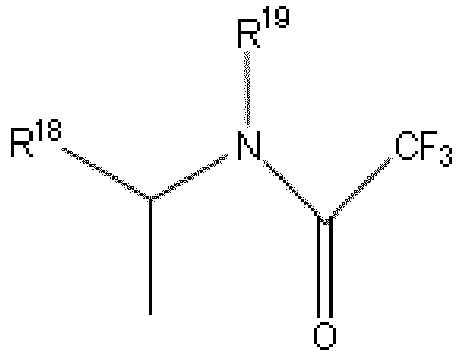
wherein R18 and R19 are hydrogen, or together form a 1,3-diaza-C5-7-cycloalk-2-yl group which is N-substituted with R16 and optionally further substituted with one or more R3, and optionally containing one or two oxo groups; a 1,3-thiaza-C5-7-cycloalk-2-yl group which is N-substituted with R16 and optionally further substituted with one or more R3 and optionally containing one or two oxo groups; an 1,3-oxaza-C5-7-cycloalk-2-yl group which is N- substituted with R16 and optionally further substituted with one or more R3, and optionally containing one or two oxo groups, wherein in all three instances two R3's on the same carbon atom may together form a spiro group;
A is selected from -CHR2C(O)-, C1-8 alkylene, C2-8 alkenylene, C2-8 alkynylene, C3-10 cycloalkylene, heterocyclylene, heteroarylene and arylene, which alkylene, alkenylene, alkynylene, cycloalkylene, heterocyclylene, heteroarylene and arylene may optionally be substituted with one or more R3; with the proviso that when Q is -CH=O, A is not alkynylene; or when A is selected from -CHR2C(O)- and C1-8 alkylene, Y may alternatively be
wherein n is from 1 to 3;
Y is selected from -H, -NR6R7, -OR7, C1-8 alkyl, C2-8 alkenyl, C2-8 alkynyl, C3-10 cycloalkyl, heterocyclyl, heteroaryl and aryl, which alkyl, alkenyl, alkynyl, cycloalkyl, heterocyclyl, heteroaryl and aryl may optionally be substituted with one or more R3 and may form a cyclic structure with R2; with the proviso that when Q is -CH=O, Y is not alkynyl;
R1 is selected from -H, C1-8 alkyl, C2-8 alkenyl, C2-8 alkynyl, C3-10 cycloalkyl, which alkyl, alkenyl, alkynyl and cycloalkyl may be optionally substituted with one or more selected from -OH, aryl, C1-6 alkoxy, heteroaryl, aryloxy, heteroaryloxy, F, and C3-6 cycloalkyl; or more preferably is selected from -H and C1-4 alkyl; or with -A-Yforms a nitrogen containing optionally substituted heterocyclic group where the optional substitution may be C1-8 alkyl, C2-8 alkenyl, C2-8 alkynyl, or C3-10 cycloalkyl, which alkyl, alkenyl, alkynyl and cycloalkyl may be optionally substituted with one or more selected from -OH, aryl, C1-6 alkoxy, heteroaryl, aryloxy, heteroaryloxy, F, and C3-6 cycloalkyl;
R2 is selected from -H, C1-8 alkyl, C2-8 alkenyl, C2-8 alkynyl, and C3-10 cycloalkyl, which alkyl, alkenyl, alkynyl and cycloalkyl may be optionally substituted with one or more selected from -OH, aryl, C1-6 alkoxy, heteroaryl, aryloxy, heteroaryloxy, F, and C3-6 cycloalkyl, and may form a cyclic structure with Y;
each R3 is independently selected from C1-6 alkyl, C1-4 fluoroalkyl, C1-4 hydroxyalkyl, C2-6 alkenyl, C2-6 alkynyl, C3-10 cycloalkyl, -Z-heterocyclyl, -Z-aryl, -Z- heteroaryl, -Z-NR6R7, -Z-C(=O)-NR6R7, -Z-NR6-C(=O)-R7, -Z-C(=O)-R7, -Z-OR7, halogen, -Z-SR7, -Z-SOR7, -Z-SO2R7, -Z-SO2NR6R7 and -Z-COOR7, wherein any heterocyclyl may be substituted with one or more R4, and wherein any heteroaryl and any aryl may be substituted with one or more R5;
Z is selected from a single bond, C1-4 alkylene, heterocyclylene and C3-6 cycloalkylene;
each R4 is independently selected from C1-6 alkyl, C1-4 fluoroalkyl, C1-4 hydroxyalkyl, C1-4 alkoxy, C3-10 cycloalkyl, -N(R1)2, carbamoyl, and -OH;
each R5 is independently selected from C1-6 alkyl, C1-4 fluoroalkyl, C1-4 hydroxyalkyl, C1-4 alkoxy, C3-6 cycloalkyl, -CN, -F, -Cl, -Br, carbamoyl and -OH;
each of R6 and R7 is independently selected from C1-8 alkyl, C1-4 fluoroalkyl, C1-4 perfluoroalkyl, C1-4 hydroxyalkyl, C2-8 alkenyl, C2-8 alkynyl, C3-10 cycloalkyl, -Z-heterocyclyl, -Z-heteroaryl and -Z-aryl, which alkyl, alkenyl, alkynyl, cycloalkyl, heterocyclyl, heteroaryl and aryl may optionally be substituted with one or more independently selected R8; or, alternatively, R6 and R7 may together with the N-atom to which they are attached form an N-heterocyclic ring optionally substituted with one or more independently selected R8;
each R8 is independently selected from C1-6 alkyl, C1-4 fluoroalkyl, C1-4 hydroxyalkyl, C2-6 alkenyl, C2-6 alkynyl, C3-10cycloalkyl, -Z-heterocyclyl, -Z-heteroaryl, -Z-NR10R11, -Z-C(=O)-NR10R11, -Z-OR9, halogen, -CN, -Z-SR9, -Z-SOR9, -Z-SO2R9 and -Z-COOR9, which alkyl, alkenyl, alkynyl, cycloalkyl, heterocyclics, heteroaryl and aryl may optionally be substituted with one or more selected from C1-4 alkyl, C1-4 fluoroalkyl, C1-4 hydroxyalkyl, C3-6 cycloalkyl, -Z-heterocyclyl, -Z-heteroaryl, -Z-aryl,-Z-NR10R11, -Z-C(=O)-NR10R11, -Z-OR9, halogen, -CN, -Z-SR9, -Z-SOR9, -Z-SO2R9 and -Z-COOR9; wherein any heterocyclyl may be further substituted with one or more R4 as defined above, and wherein any heteroaryl and any aryl may be further substituted with one or more R5 as defined above, and
each R9 is independently selected from -H, C1-8 alkyl, C1-4 fluoroalkyl, C1-4 hydroxyalkyl, C2-8 alkenyl, C2-8 alkynyl, C3-10 cycloalkyl, -Z-heterocyclyl, -Z-aryl, and -Z- heteroaryl, wherein any heterocyclyl may be substituted with one or more R4 as defined above, and wherein any heteroaryl and any aryl may be substituted with one or more R5 as defined above;
each of R10 and R11 is independently selected from -H, C1-6 alkyl, C1-4 fluoroalkyl, C1-4 hydroxyalkyl, C2-8 alkenyl, C2-8 alkynyl, C3-10 cycloalkyl, heterocyclyl, heteroaryl, and aryl, wherein any heterocyclyl may be substituted with one or more R4 as defined above, and wherein any heteroaryl and any aryl may be substituted with one or more R5 as defined above, or, alternatively, R10 and R11 may together with the N-atom to which they are attached form an optionally 5 to 7 membered, N-heterocyclic ring optionally substituted with one or more R4 as defined above;
with the proviso that Y is not H when A is -CH2-;
when Q is -CH= NR12, R12 is selected from C1-10 alkyl, C2-10 alkenyl, C2-10 alkynyl, C3-10 cycloalkyl, -Z-heterocyclyl, -Z-aryl, -Z- heteroaryl, -Z-NR6R7, -Z-C(=O)-NR6R7, -Z-NR6-C(=O)-R7, -Z-C(=O)-R7, -Z-OR7, halogen, -Z-SR7, -Z-SOR7, -Z-SO2R7 and -Z-COOR7, which alkyl, alkenyl, alkynyl, cycloalkyl, heteroaryl and aryl may optionally be substituted with one or more R3;
when Q is -CH2NHR13, R13 is selected from hydrogen, -C(O)R7, -C(O)C(O)R7, -C(O)C(O)OR7, C1-8 alkyl, C1-4 fluoroalkyl, C1-4 perfluoroalkyl, C1-4 hydroxyalkyl, C2-8 alkenyl, C2-8 alkynyl, C3-10 cycloalkyl, -Z-heterocyclyl, and -Z-monocyclic-heteroaryl, which alkyl, alkenyl, alkynyl, cycloalkyl, and moncyclic-heteroaryl may optionally be substituted with one or more independently selected R8, or is -CR14R15-NR6R7, -CR14R15CN, or -CR14R15 OR7, wherein each of R14 and R15 is independently selected from -H, C1-8 alkyl, C2-8 alkenyl, C2-8 alkynyl, C3-10 cycloalkyl, heterocyclyl, heteroaryl and aryl, and wherein R14 and R15 together with the intervening carbon atom may designate a C3-10 cycloalkyl or C5-10-cycloalkenyl ring, which alkyl, alkenyl, alkynyl, cycloalkyl (ring), cycloalkenyl ring, heterocyclyl, heteroaryl and aryl may optionally be substituted with one or more R3;
when Q is W, W is selected from an 1,3-diaza-C5-7-cycloalk-2-yl group which is N-substituted with R16 and optionally further substituted with one or more R3, and optionally containing one or two oxo groups; a 1,3-thiaza-C5-7-cycloalk-2-yl group which is N-substituted with R16 and optionally further substituted with one or more R3 and optionally containing one or two oxo groups; an 1,3-oxaza-C5-7-cycloalk-2-yl group which is N-substituted with R16 and optionally further substituted with one or more R3, and optionally containing one or two oxo groups, wherein in all three instances two R3's on the same carbon atom may together form a spiro group;
R16 is selected from hydrogen, -C(O)R7, -C(O)C(O)R7 and - C(O)C(O)OR7;
when Q is -CH(OR17)2, each R17 independently is R3, or wherein two R17 substituents together with the intervening -O-CH(-)-O- may form a heterocyclyl optionally substituted with one or more R3 and containing up to two oxo groups;
or a compound selected from the group consisting of:N-[4-(diethylamino)butyl]-2,2,2-trifluoro-N-({4-[(trifluoroacetamido)methyl]pyridin-2-yl}methyl)acetamide 2-({[4-(aminomethyl)pyridin-2-yl]methyl}amino)-N-{1-[(2-methoxyphenyl)methyl]piperidin-4-yl}acetamide 2-[({4-[(cyclopropylamino)methyl]pyridin-2-yl}methyl)amino]-N-{1-[(2-methoxyphenyl)methyl]piperidin-4-yl}acetamide N-[(2-{[N-({[2-(dimethylamino)ethyl](ethyl)carbamoyl}methyl)-2,2,2-trifluoroacetamido]methyl}pyridin-4-yl)methyl]-2,2,2-trifluoroacetamide ({[2-({[4-(diethylamino)butyl]amino}methyl)pyridin-4-yl]methyl}carbamoyl)formic acid ethyl 2-({[(2-{[({[2-(dimethylamino)ethyl](ethyl)carbamoyl}methyl)amino]methyl} pyridin-4-yl)methyl]carbamoyl}oxy)benzoate 2-[({4-[N-cyclopropylcarboximidoyl]pyridin-2-yl}methyl)amino]-N-[(1-ethylpyrrolidin-2-yl)methyl]acetamide 2-[({4-[N-cyclopropylcarboximidoyl]pyridin-2-yl}methyl)amino]-N-methyl-N-[3-(1H-pyrazol-1-yl)propyl]acetamide N-(1-benzylpyrrolidin-3-yl)-2-[({4-[N-cyclopropylcarboximidoyl]pyridin-2-yl}methyl)amino]acetamide 4-[2-{[2-({[4-(diethylamino)butyl]amino}methyl)pyridin-4-yl]methylidene}hydrazin-1-yl]benzonitrile (1-{[{[2-({[4-(diethylamino)butyl]amino}methyl)pyridin-4-yl]methylidene}amino]methyl}cyclopropyl)methanol N-[2-(dimethylamino)ethyl]-N-ethyl-2-[({4-[({[1-(hydroxymethyl)cyclopropyl]methyl}imino)methyl]pyridin-2-yl}methyl)amino]acetamide N-[(1-ethylpyrrolidin-2-yl)methyl]-2-{[(4-formylpyridin-2-yl)methyl]amino}acetamide N-(1-benzylpyrrolidin-3-yl)-2-{[(4-formylpyridin-2-yl)methyl]amino}acetamide N-[4-(diethylamino)butyl]-2,2,2-trifluoro-N-[(4-formylpyridin-2-yl)methyl]acetamide - It is considered to be probable that each of the groups Q is converted in vivo to produce the corresponding acid (Q = -C(O)OH) by processes which possibly include or consist of enzymatic processing. Accordingly, many or all of the compounds of this invention may act in vivo at least principally in the form of corresponding acid derivatives described in
WO2014053491 A1 (published after the present patent's filing date). It is thought likely that the enzymatic processing takes place partly or entirely within cells into which the respective compound of the invention has penetrated. In view of this, it is probable that differences in activity in vitro seen in compounds of the invention that have the same -A-Y substituent but differ in the group Q are due to the influence of the different groups Q on cell penetration and/or the efficiency of conversion to the acid form within the cell. This tentative conclusion is based on detection of the corresponding acid within cells following administration of certain compounds according to the invention and molecular modelling of the interaction of the acids with relevant enzymes. - Accordingly, in an alternative aspect, the disclosure provides a compound of the general Formula

- Also disclosed is a compound of the Formula (I)
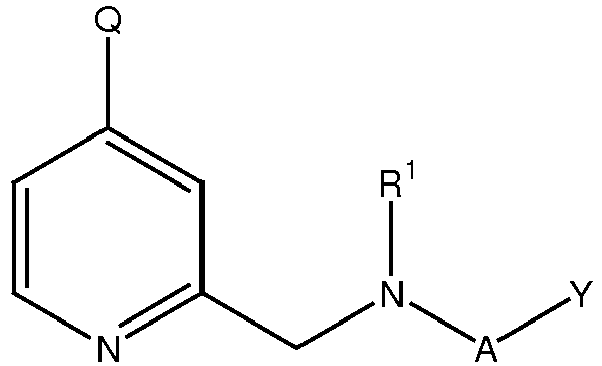
- Q is selected from -CH= NR12 and -W;
- A is selected from -CHR2C(O)-, C1-8 alkylene, C2-8 alkenylene, C2-8 alkynylene, C3-10 cycloalkylene, heterocyclylene, heteroarylene and arylene, which alkylene, alkenylene, alkynylene, cycloalkylene, heterocyclylene, heteroarylene and arylene may optionally be substituted with one or more R3;
- Y is selected from -H, -NR6R7, -OR7, C1-8 alkyl, C2-8 alkenyl, C2-8 alkynyl, C3-10 cycloalkyl, heterocyclyl, heteroaryl and aryl, which alkyl, alkenyl, alkynyl, cycloalkyl, heterocyclyl, heteroaryl and aryl may optionally be substituted with one or more R3;
- R1 is selected from -H and C1-4 alkyl;
- R2 is selected from -H, C1-8 alkyl, C2-8 alkenyl, C2-8 alkynyl, C3-10 cycloalkyl, which alkyl, alkenyl, alkynyl and cycloalkyl may be optionally substituted with one or more selected from -OH, aryl, C1-6 alkoxy, heteroaryl, aryloxy, heteroaryloxy, F, and C3-6 cycloalkyl;
- each R3 is independently selected from C1-6 alkyl, C1-4 fluoroalkyl, C1-4 hydroxyalkyl, C2-6 alkenyl, C2-6 alkynyl, C3-10 cycloalkyl, -Z-heterocyclyl, -Z-aryl, -Z- heteroaryl, -Z-NR6R7, -Z-C(=O)-NR6R7, -Z-NR6-C(=O)-R7, -Z-C(=O)-R7, -Z-OR7, halogen, -Z-SR7, -Z-SOR7, -Z-SO2R7, -Z-SO2NR6R7 and -Z-COOR7, wherein any heterocyclyl may be substituted with one or more R4, and wherein any heteroaryl and any aryl may be substituted with one or more R5;
- Z is selected from a single bond, C1-4 alkylene, heterocyclylene and C3-6 cycloalkylene;
- each R4 is independently selected from C1-6 alkyl, C1-4 fluoroalkyl, C1-4 hydroxyalkyl, C1-4 alkoxy, C3-10 cycloalkyl, -N(R1)2, carbamoyl, and -OH;
- each R5 is independently selected from C1-6 alkyl, C1-4 fluoroalkyl, C1-4 hydroxyalkyl, C1-4 alkoxy, C3-6 cycloalkyl, -CN, -F, -CI, -Br, carbamoyl and -OH;
- each of R6 and R7 is independently selected from -H, C1-8 alkyl, C1-4 fluoroalkyl, C1-4 perfluoroalkyl, C1-4 hydroxyalkyl, C2-8 alkenyl, C2-8 alkynyl, C3-10 cycloalkyl, -Z-heterocyclyl, -Z-heteroaryl and -Z-aryl, which alkyl, alkenyl, alkynyl, cycloalkyl, heterocyclyl, heteroaryl and aryl may optionally be substituted with one or more independently selected R8; or, alternatively, R6 and R7 may together with the N-atom to which they are attached form an N-heterocyclic ring optionally substituted with one or more independently selected R8;
- each R8 is independently selected from C1-6 alkyl, C1-4 fluoroalkyl, C1-4 hydroxyalkyl, C2-6 alkenyl, C2-6 alkynyl, C3-10 cycloalkyl, -Z-heterocyclyl, -Z-heteroaryl, -Z-aryl, -Z-NR10R11, -Z-C(=O)-NR10R11,-Z-OR9, halogen, -CN, -Z-SR9, -Z-SOR9, -Z-SO2R9 and -Z-COOR9, which alkyl, alkenyl, alkynyl, cycloalkyl, heterocyclics, heteroaryl and aryl may optionally be substituted with one or more selected from C1-4 alkyl, C1-4 fluoroalkyl, C1-4 hydroxyalkyl, C3-6 cycloalkyl, -Z-heterocyclyl, -Z-heteroaryl, -Z-aryl, -Z-NR10R11, -Z-C(=O)-NR10R11, -Z-OR9, halogen, -CN, -Z-SR9, -Z-SOR9, -Z-SO2R9 and -Z-COOR9; wherein any heterocyclyl may be further substituted with one or more R4 as defined above, and wherein any heteroaryl and any aryl may be further substituted with one or more R5 as defined above, and
- each R9 is independently selected from -H, C1-8 alkyl, C1-4 fluoroalkyl, C1-4 hydroxyalkyl, C2-8 alkenyl, C2-8 alkynyl, C3-10 cycloalkyl, -Z-heterocyclyl, -Z-aryl, and -Z- heteroaryl, wherein any heterocyclyl may be substituted with one or more R4 as defined above, and wherein any heteroaryl and any aryl may be substituted with one or more R5 as defined above;
- each of R10 and R11 is independently selected from -H, C1-6 alkyl, C1-4 fluoroalkyl, C1-4 hydroxyalkyl, C2-8 alkenyl, C2-8 alkynyl, C3-10 cycloalkyl, heterocyclyl, heteroaryl, and aryl, wherein any heterocyclyl may be substituted with one or more R4 as defined above, and wherein any heteroaryl and any aryl may be substituted with one or more R5 as defined above, or, alternatively, R10 and R11 may together with the N-atom to which they are attached form an N-heterocyclic ring optionally substituted with one or more R4 as defined above;
- R12 is selected from C1-10 alkyl, C2-10 alkenyl, C2-10 alkynyl, C3-10 cycloalkyl, -Z-heterocyclyl, -Z-aryl,-Z- heteroaryl, -Z-NR6R7, -Z-C(=O)-NR6R7, -Z-NR6-C(=O)-R7, -Z-C(=O)-R7, -Z-OR7, halogen, -Z-SR7, -Z-SOR7, -Z-SO2R7 and -Z-COOR7, which alkyl, alkenyl, alkynyl, cycloalkyl, heterocyclyl, heteroaryl and aryl may optionally be substituted with one or more R3;
- W is selected from an 1,3-diaza-C5-7-cycloalk-2-yl group which is N-substituted with R16 and optionally further substituted with one or more R3, and an 1,3-oxaza-C5-7-cycloalk-2-yl group which is N-substituted with R16 and optionally further substituted with one or more R3, wherein in both instances two R3's on the same carbon atom may together form a spiro group;
- R16 is selected from hydrogen, -C(O)R7, and -C(O)C(O)R7;
- with the proviso that Y is not H when A is -CH2-;
- or an isomer or a mixture of isomers thereof, or a pharmaceutically acceptable salt, solvate or prodrug thereof.
- Also disclosed is a compound of the Formula (I)

- Q is -CH2NHR13;
- A is selected from -CHR2C(O)-, C1-8 alkylene, C2-8 alkenylene, C2-8 alkynylene, C3-10 cycloalkylene, heterocyclylene, heteroarylene and arylene, which alkylene, alkenylene, alkynylene, cycloalkylene, heterocyclylene, heteroarylene and arylene may optionally be substituted with one or more R3;
- Y is selected from -H, -NR6R7, -OR7, C1-8 alkyl, C2-8 alkenyl, C2-8 alkynyl, C3-10 cycloalkyl, heterocyclyl, heteroaryl and aryl, which alkyl, alkenyl, alkynyl, cycloalkyl, heterocyclyl, heteroaryl and aryl may optionally be substituted with one or more R3;
- R1 is selected from -H and C1-4 alkyl;
- R2 is selected from -H, C1-8 alkyl, C2-8 alkenyl, C2-8 alkynyl, C3-10 cycloalkyl, which alkyl, alkenyl, alkynyl and cycloalkyl may be optionally substituted with one or more selected from -OH, aryl, C1-6 alkoxy, heteroaryl, aryloxy, heteroaryloxy, F, and C3-6 cycloalkyl;
- each R3 is independently selected from C1-6 alkyl, C1-4 fluoroalkyl, C1-4 hydroxyalkyl, C2-6 alkenyl, C2-6 alkynyl, C3-10 cycloalkyl, -Z-heterocyclyl, -Z-aryl, -Z- heteroaryl, -Z-NR6R7, -Z-C(=O)-NR6R7, -Z-NR6-C(=O)-R7, -Z-C(=O)-R7, -Z-OR7, halogen, -Z-SR7, -Z-SOR7, -Z-SO2R7, -Z-SO2NR6R7 and -Z-COOR7, wherein any heterocyclyl may be substituted with one or more R4, and wherein any heteroaryl and any aryl may be substituted with one or more R5;
- Z is selected from a single bond, C1-4 alkylene, heterocyclylene and C3-6 cycloalkylene;
- each R4 is independently selected from C1-6 alkyl, C1-4 fluoroalkyl, C1-4 hydroxyalkyl, C1-4 alkoxy, C3-10 cycloalkyl, -N(R1)2, carbamoyl, and -OH;
- each R5 is independently selected from C1-6 alkyl, C1-4 fluoroalkyl, C1-4 hydroxyalkyl, C1-4 alkoxy, C3-6 cycloalkyl, -CN, -F, -Cl, -Br, carbamoyl and -OH;
- each of R6 and R7 is independently selected from -H, C1-8 alkyl, C1-4 fluoroalkyl, C1-4 perfluoroalkyl, C1-4 hydroxyalkyl, C2-8 alkenyl, C2-8 alkynyl, C3-10 cycloalkyl, -Z-heterocyclyl, -Z-heteroaryl and -Z-aryl, which alkyl, alkenyl, alkynyl, cycloalkyl, heterocyclyl, heteroaryl and aryl may optionally be substituted with one or more independently selected R8; or, alternatively, R6 and R7 may together with the N-atom to which they are attached form an N-heterocyclic ring optionally substituted with one or more independently selected R8;
- each R8 is independently selected from C1-6 alkyl, C1-4 fluoroalkyl, C1-4 hydroxyalkyl, C2-6 alkenyl, C2-6 alkynyl, C3-10 cycloalkyl, -Z-heterocyclyl, -Z-heteroaryl, -Z-aryl, -Z-NR10R11, -Z-C(=O)-NR10R11,-Z-OR9, halogen, -CN, -Z-SR9, -Z-SOR9, -Z-SO2R9 and -Z-COOR9, which alkyl, alkenyl, alkynyl, cycloalkyl, heterocyclics, heteroaryl and aryl may optionally be substituted with one or more selected from C1-4 alkyl, C1-4 fluoroalkyl, C1-4 hydroxyalkyl, C3-6 cycloalkyl, -Z-heterocyclyl, -Z-heteroaryl, -Z-aryl, -Z-NR10R11, -Z-C(=O)-NR10R11, -Z-OR9, halogen, -CN, -Z-SR9, -Z-SOR9, -Z-SO2R9 and -Z-COOR9; wherein any heterocyclyl may be further substituted with one or more R4 as defined above, and wherein any heteroaryl and any aryl may be further substituted with one or more R5 as defined above, and
- each R9 is independently selected from -H, C1-8 alkyl, C1-4 fluoroalkyl, C1-4 hydroxyalkyl, C2-8 alkenyl, C2-8 alkynyl, C3-10 cycloalkyl, -Z-heterocyclyl, -Z-aryl, and -Z- heteroaryl, wherein any heterocyclyl may be substituted with one or more R4 as defined above, and wherein any heteroaryl and any aryl may be substituted with one or more R5 as defined above;
- each of R10 and R11 is independently selected from -H, C1-6 alkyl, C1-4 fluoroalkyl, C1-4 hydroxyalkyl, C2-8 alkenyl, C2-8 alkynyl, C3-10 cycloalkyl, heterocyclyl, heteroaryl, and aryl, wherein any heterocyclyl may be substituted with one or more R4 as defined above, and wherein any heteroaryl and any aryl may be substituted with one or more R5 as defined above, or, alternatively, R10 and R11 may together with the N-atom to which they are attached form an N-heterocyclic ring optionally substituted with one or more R4 as defined above;
- R13 is selected from hydrogen, -C(O)R7, -C(O)C(O)R7, -R7, -CR14R15-NR6R7, -CR14R15CN, -CR14R15OR7, wherein each of R14 and R15 is independently selected from -H, C1-8 alkyl, C2-8 alkenyl, C2-8 alkynyl, C3-10 cycloalkyl, heterocyclyl, heteroaryl and aryl, and wherein R14 and R15 together with the intervening carbon atom may designate a C3-10 cycloalkyl or C5-10-cycloalkenyl ring, which alkyl, alkenyl, alkynyl, cycloalkyl (ring), cycloalkenyl ring, heterocyclyl, heteroaryl and aryl may optionally be substituted with one or more R3;
- with the proviso that Y is not H when A is -CH2-;
- or an isomer or a mixture of isomers thereof, or a pharmaceutically acceptable salt, solvate or prodrug thereof.
- Optionally, Q is required to be different from -A-Y. Optionally, at least one of Q and -A-Y is not of the form -alkylene-NH-alkylene-aryl, or more specifically is not of the form -alkylene-NH-alkylene-phenyl. For example, one or both of Q and -A-Y may be not of the form -CH2-NH-(CH2)x-phenyl, where x is 1-6 and may in particular be 4.
- Optionally, Q does not comprise a polycyclic heteroaryl group, and in particular, Q may not comprise
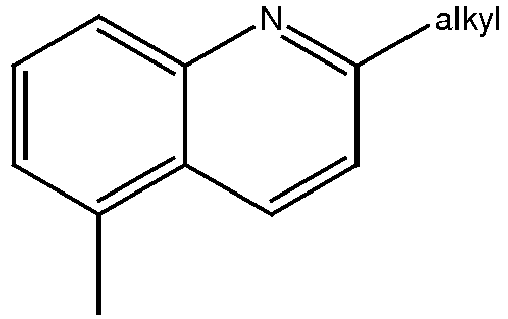

- Also disclosed is a compound of the Formula (I)

- Q is selected from -CH=O and -CH(OR17)2;
- A is selected from -CHR2C(O)-, C1-8 alkylene, C2-8 alkenylene, C2-8 alkynylene, C3-10 cycloalkylene, heterocyclylene, heteroarylene and arylene, which alkylene, alkenylene, alkynylene, cycloalkylene, heterocyclylene, heteroarylene and arylene may optionally be substituted with one or more R3;
- Y is selected from -H, -NR6R7, -OR7, C1-8 alkyl, C2-8 alkenyl, C2-8 alkynyl, C3-10 cycloalkyl, heterocyclyl, heteroaryl and aryl, which alkyl, alkenyl, alkynyl, cycloalkyl, heterocyclyl, heteroaryl and aryl may optionally be substituted with one or more R3;
- R1 is selected from -H and C1-4 alkyl;
- R2 is selected from -H, C1-8 alkyl, C2-8 alkenyl, C2-8 alkynyl, C3-10 cycloalkyl, which alkyl, alkenyl, alkynyl and cycloalkyl may be optionally substituted with one or more selected from -OH, aryl, C1-6 alkoxy, heteroaryl, aryloxy, heteroaryloxy, F, and C3-6 cycloalkyl;
- each R3 is independently selected from C1-6 alkyl, C1-4 fluoroalkyl, C1-4 hydroxyalkyl, C2-6 alkenyl, C2-6 alkynyl, C3-10 cycloalkyl, -Z-heterocyclyl, -Z-aryl, -Z- heteroaryl, -Z-NR6R7, -Z-C(=O)-NR6R7, -Z-NR6-C(=O)-R7, -Z-C(=O)-R7, -Z-OR7, halogen, -Z-SR7, -Z-SOR7, -Z-SO2R7, -Z-SO2NR6R7 and -Z-COOR7, wherein any heterocyclyl may be substituted with one or more R4, and wherein any heteroaryl and any aryl may be substituted with one or more R5;
- Z is selected from a single bond, C1-4 alkylene, heterocyclylene and C3-6 cycloalkylene,
- each R4 is independently selected from C1-6 alkyl, C1-4 fluoroalkyl, C1-4 hydroxyalkyl, C1-4 alkoxy, C3-10 cycloalkyl, -N(R1)2, carbamoyl, and -OH;
- each R5 is independently selected from C1-6 alkyl, C1-4 fluoroalkyl, C1-4 hydroxyalkyl, C1-4 alkoxy, C3-6 cycloalkyl, -CN, -F, -Cl, -Br, carbamoyl and -OH;
- each of R6 and R7 is independently selected from -H, C1-8 alkyl, C1-4 fluoroalkyl, C1-4 perfluoroalkyl, C1-4 hydroxyalkyl, C2-8 alkenyl, C2-8 alkynyl, C3-10 cycloalkyl, -Z-heterocyclyl, -Z-heteroaryl and -Z-aryl, which alkyl, alkenyl, alkynyl, cycloalkyl, heterocyclyl, heteroaryl and aryl may optionally be substituted with one or more independently selected R8; or, alternatively, R6 and R7 may together with the N-atom to which they are attached form an N-heterocyclic ring optionally substituted with one or more independently selected R8;
- each R8 is independently selected from C1-6 alkyl, C1-4 fluoroalkyl, C1-4 hydroxyalkyl, C2-6 alkenyl, C2-6 alkynyl, C3-10 cycloalkyl, -Z-heterocyclyl, -Z-heteroaryl, -Z-aryl, -Z-NR10R11, -Z-C(=O)-NR10R11,-Z-OR9, halogen, -CN, -Z-SR9, -Z-SOR9, -Z-SO2R9 and -Z-COOR9, which alkyl, alkenyl, alkynyl, cycloalkyl, heterocyclics, heteroaryl and aryl may optionally be substituted with one or more selected from C1-4 alkyl, C1-4 fluoroalkyl, C1-4 hydroxyalkyl, C3-6 cycloalkyl, -Z-heterocyclyl, -Z-heteroaryl, -Z-aryl, -Z-NR10R11, -Z-C(=O)-NR10R11, -Z-OR9, halogen, -CN, -Z-SR9, -Z-SOR9, -Z-SO2R9 and -Z-COOR9; wherein any heterocyclyl may be further substituted with one or more R4 as defined above, and wherein any heteroaryl and any aryl may be further substituted with one or more R5 as defined above, and
- each R9 is independently selected from -H, C1-8 alkyl, C1-4 fluoroalkyl, C1-4 hydroxyalkyl, C2-8 alkenyl, C2-8 alkynyl, C3-10 cycloalkyl, -Z-heterocyclyl, -Z-aryl, and -Z- heteroaryl, wherein any heterocyclyl may be substituted with one or more R4 as defined above, and wherein any heteroaryl and any aryl may be substituted with one or more R5 as defined above;
- each of R10 and R11 is independently selected from -H, C1-6 alkyl, C1-4 fluoroalkyl, C1-4 hydroxyalkyl, C2-8 alkenyl, C2-8 alkynyl, C3-10 cycloalkyl, heterocyclyl, heteroaryl, and aryl, wherein any heterocyclyl may be substituted with one or more R4 as defined above, and wherein any heteroaryl and any aryl may be substituted with one or more R5 as defined above, or, alternatively, R10 and R11 may together with the N-atom to which they are attached form an N-heterocyclic ring optionally substituted with one or more R4 as defined above;
- each R17 independently is R3, or wherein two R17 substituents together with the intervening -O-CH(-)-O- may form a heterocyclyl optionally substituted with one or more R3 and containing up to two oxo groups;
- with the proviso that Y is not H when A is -CH2-;
- or an isomer or a mixture of isomers thereof, or a pharmaceutically acceptable salt, solvate or prodrug thereof.
- In this set of embodiments of the invention, optionally -A-Ydoes not include an alkynylene moiety. Optionally, -A-Ydoes not comprise a moiety of the formula


- A in any of the compounds defined by general formula herein may be selected from -CHR2C(O)-, or C1-8 alkylene, or heterocyclylene.
- Y in any of the compounds defined by general formula herein may be -NR6R7.
- A in any of the compounds defined by general formula herein may be -CHR2C(O)-.
- A in any of the compounds defined by general formula herein may be -CH2C(O)-.
Y in any of the compounds defined by general formula herein may be
- Y in any of the compounds defined by general formula herein may be
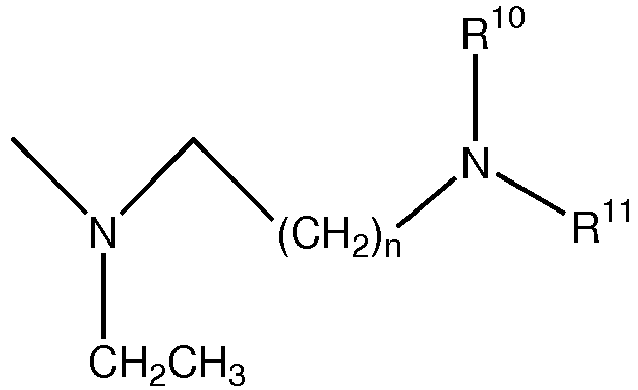

- Y in any of the compounds defined by general formula herein may be selected from heterocyclyl, heteroaryl and aryl, which may be optionally substituted with one or more R3.
R13 may be H in any of the compounds defined by general formula herein.
Q may be of the formula:
- In some preferred instances, the compound may be one wherein the moiety -A-Y includes 1-3 cyclic moieties selected from monocylic cycloalkyl, monocyclic heterocyclyl, monocylic heteroaryl, dicyclic heteroaryl and monocyclic aryl.
- In preferred aspects of the invention, the compound may be as shown in Table 1 in the Examples section below.
A compound according to the invention may have a molecular weight of 130-1,000 g/mol, such as 180-800 g/mol, e.g. 225-600 g/mol or 250-500 g/mol. - The invention includes a pharmaceutical composition comprising at least one compound of Formula (I) as defined in any paragraph herein containing such a definition and optionally one or more pharmaceutically acceptable excipients, diluents or carriers.
- The invention includes such a pharmaceutical composition, which comprises one or more further active substances.
- The invention includes a compound or a geometric isomer, stereoisomer, diastereomer or tautomer thereof or a mixture of geometric isomers, stereoisomers, diastereomers or tautomers thereof, or a pharmaceutically acceptable salt, or solvate thereof, of the invention for use as a medicament.
- The invention includes a compound of the invention or a geometric isomer, stereoisomer, diastereomer or tautomer thereof or a mixture of geometric isomers, stereoisomers, diastereomers or tautomers thereof, or a pharmaceutically acceptable salt, or solvate thereof, for use in the treatment of a HDME dependent disease.
- The invention includes the use of a compound of the invention or a geometric isomer, stereoisomer, diastereomer or tautomer thereof or a mixture of geometric isomers, stereoisomers, diastereomers or tautomers thereof, or a pharmaceutically acceptable salt, or solvate thereof, for the preparation of a pharmaceutical composition for the treatment of a HDME dependent disease.
- Conditions treatable using compounds or formulations or compositions according to the invention include cancer in the broadest sense, including solid and non-solid tumours. Further details of treatable conditions appear below.
- The above definitions of the compounds of Formula (I) are referred to herein by the expressions "compounds of Formula (I)" as defined herein, "compound of Formula (I) as defined herein", or simply "compounds of Formula (I)", etc. It should be understood, that such references are intended to encompass not only the above general formula in its stated aspects, but also each and every of the embodiments, etc. discussed above or in the following. It should also be understood, that unless stated to the opposite, such references also encompass geometric isomers, stereoisomers, diastereomers or tautomers, or mixtures of geometric isomers, stereoisomers, diastereomers or tautomers, isotopic variants, pharmaceutically acceptable salts and solvates of the compounds of Formula (I).
- Without being bound by any particular theory, the current results give reasons to believe that each of the values of Q plays an important role when designing compounds capable of modulating the in vivo activity of histone demethylases (HDMEs), whilst in each case the group Q is transformed in vivo to -COOH. Additionally, it is believed that the substituent combination -A-Y plays a role in establishing affinity for said histone demethylases. Furthermore, it is believed that the pyridine nitrogen and the nitrogen atom of Formula (I) also play a role in the binding of a particular cavity of the histone demethylases where the iron atom lies. It is also believed that the A-Y chain itself, and through its substituents, interacts with the area of the demethylase known to accommodate the lysine chain of the substrate.
- A is typically selected from -CHR2C(O)-, C1-8 alkylene, C2-8 alkenylene, C2-8 alkynylene, C3-10 cycloalkylene, heterocyclylene, heteroarylene and arylene.
- The alkylene, alkenylene, alkynylene, cycloalkylene, heterocyclylene, heteroarylene and arylene as A may optionally be substituted with one or more R3 (see further below).
- A may be selected from -CHR2C(O)-, C1-8 alkylene, C3-10 cycloalkylene, heterocyclylene, heteroarylene and arylene, in particular from -CHR2C(O)-, C1-8 alkylene and heterocyclylene, such as -CHR2C(O)-, or C1-8 alkylene, or heterocyclylene.
- Y is typically selected from -H, -NR6R7, -OR7, C1-8 alkyl, C2-8 alkenyl, C2-8 alkynyl, C3-10 cycloalkyl, heterocyclyl, heteroaryl and aryl. R6 and R7 are exemplified further below.
- The alkyl, alkenyl, alkynyl, cycloalkyl, heterocyclyl, heteroaryl and aryl as Y may optionally be substituted with one or more R3 (see further below);
- In some embodiments, Y is -NR6R7. In one variant type, A is -CHR2C(O)- and Y is -NR6R7. In another variant type, A is C1-8 alkyl and Y is -NR6R7. In one scenario within these embodiments and these variants, -NR6R7 represents an N-heterocyclic ring optionally substituted with one or more independently selected R8, preferably substituted with one to two independently selected R8. In another scenario within these embodiments and these variants wherein Y is -NR6R7, one of R6 and R7 represents -H or C1-6 alkyl. In still another scenario within these embodiment types and these variants wherein Y is -NR6R7, R6 and R7 are independently selected from C1-8 alkyl, C1-4 fluoroalkyl, C1-4 hydroxyalkyl, C2-8 alkenyl, and C2-8 alkynyl, e.g. such that R6 and R7 are the same. In still another scenario within these embodiment types and these variants wherein Y is -NR6R7, one of R6 and R7 is selected from heterocyclyl, heteroaryl and aryl.
- Y may be -H. In such compounds and in others, A may be selected from C1-8 alkylene, C2-8 alkenylene, C2-8 alkynylene, and C3-10 cycloalkylene. In such compounds and in others, A may also be selected from heterocyclyl.
- Y may be selected from heterocyclyl, heteroaryl and aryl. In such compounds and others, A may be selected from C1-8 alkylene, C2-8 alkenylene, C2-8 alkynylene, in particular from C1-8 alkylene, such as from C1-6 alkylene, in particular from C1-4 alkylene.
- R1 is typically selected from -H and C1-4 alkyl (such as methyl, ethyl, propyl and butyl), in particular from -H and methyl.
- R2 is typically selected from -H, C1-8 alkyl, C2-8 alkenyl, C2-8 alkynyl, C3-10 cycloalkyl, which alkyl, alkenyl, alkynyl and cycloalkyl may be optionally substituted with one or more selected from -OH, aryl, C1-6 alkoxy, heteroaryl, aryloxy, heteroaryloxy, F, and C3-6 cycloalkyl. In some embodiments, R2 is selected from -H, C1-4 alkyl (such as methyl, ethyl, propyl and butyl) and C1-4 hydroxyalkyl (such as hydroxymethyl, hydroxyethyl, hydroxypropyl and hydroxybutyl), in particular from -H, methyl and hydroxymethyl.
- The R3 (possible substituents to some of the meanings of A and Y) is typically independently selected from C1-6 alkyl, C1-4 fluoroalkyl, C1-4 hydroxyalkyl, C2-6 alkenyl, C2-6 alkynyl, C3-10 cycloalkyl,-Z-heterocyclyl, -Z-aryl, -Z- heteroaryl, -Z-NR6R7, -Z-C(=O)-NR6R7, -Z-NR6-C(=O)-R7, -Z-C(=O)-R7, -Z-OR7, halogen, -Z-SR7, -Z-SOR7, -Z-SO2R7, -Z-SO2NR6R7 and -Z-COOR7, wherein any heterocyclyl may be substituted with one or more R4, and wherein any heteroaryl and any aryl may be substituted with one or more R5.
- Z is typically selected from a single bond, C1-4 alkylene, heterocyclylene and C3-6 cycloalkylene. In one embodiment, Z is selected from C1-4 alkylene. In another embodiment, Z is selected from a single bond. It should be understood that the group Z may appear several times in Formula (I) and that such Z's are independently selected.
- Each R4 (possible substituents of heterocyclyl) may be independently selected from C1-6 alkyl, C1-4 fluoroalkyl, C1-4 hydroxyalkyl, C1-4 alkoxy, C3-10 cycloalkyl, -N(R1)2, carbamoyl, and -OH,
- Each R5 (possible substituents of heteroaryl and aryl) may be independently selected from C1-6 alkyl, C1-4 fluoroalkyl, C1-4 hydroxyalkyl, C1-4 alkoxy, C3-6 cycloalkyl, -CN, -F, -CI, -Br, carbamoyl and -OH.
- Each of R6 and R7 (e.g. of the moiety -NR6R7) may be independently selected from -H (in certain aspects), C1-8 alkyl, C1-4 fluoroalkyl, C1-4 perfluoroalkyl, C1-4 hydroxyalkyl, C2-8 alkenyl, C2-8 alkynyl, C3-10 cycloalkyl, -Z-heterocyclyl, -Z-heteroaryl and -Z-aryl, which alkyl, alkenyl, alkynyl, cycloalkyl, heterocyclyl, heteroaryl and aryl may optionally be substituted with one or more independently selected R8; or, alternatively, R6 and R7 may together with the N-atom to which they are attached form an N-heterocyclic ring optionally substituted with one or more independently selected R8.
- Each R8 may be independently selected from C1-6 alkyl, C1-4 fluoroalkyl, C1-4 hydroxyalkyl, C2-6 alkenyl, C2-6 alkynyl, C3-10 cycloalkyl, -Z-heterocyclyl, -Z-heteroaryl, -Z-NR10R11, -Z-C(= O)-NR10R11,-Z-OR9, halogen, -CN, -Z-SR9, -Z-SOR9, -Z-SO2R9 and -Z-COOR9, which alkyl, alkenyl, alkynyl, cycloalkyl, heterocyclics, heteroaryl and aryl may optionally be substituted with one or more selected from C1-4 alkyl, C1-4 fluoroalkyl, C1-4 hydroxyalkyl, C3-6 cycloalkyl, -Z-heterocyclyl, -Z-heteroaryl, -Z-aryl, -Z-NR10R11, -Z-C(=O)-NR10R11, -Z-OR9, halogen, -CN, -Z-SR9, -Z-SOR9, -Z-SO2R9 and -Z-COOR9; wherein any heterocyclyl may be further substituted with one or more R4 as defined above, and wherein any heteroaryl and any aryl may be further substituted with one or more R5 as defined above.
- Each R9 may be independently selected from -H, C1-8 alkyl, C1-4 fluoroalkyl, C1-4 hydroxyalkyl, C2-8 alkenyl, C2-8 alkynyl, C3-10 cycloalkyl, -Z-heterocyclyl, -Z-aryl, and -Z- heteroaryl, wherein any heterocyclyl may be substituted with one or more R4 as defined above, and wherein any heteroaryl and any aryl may be substituted with one or more R5 as defined above.
- Each of R10 and R11 (of the moiety -NR10R11) may be independently selected from -H, C1-6 alkyl, C1-4 fluoroalkyl, C1-4 hydroxyalkyl, C2-8 alkenyl, C2-8 alkynyl, C3-10 cycloalkyl, heterocyclyl, heteroaryl, and aryl, wherein any heterocyclyl may be substituted with one or more R4 as defined above, and wherein any heteroaryl and any aryl may be substituted with one or more R5 as defined above, or, alternatively, R10 and R11 may together with the N-atom to which they are attached form an N-heterocyclic ring optionally substituted with one or more R4 as defined above.
- In some embodiments, Q is -CH=N-R12. If so, R12 may be selected from C1-10 alkyl, C2-10 alkenyl, C2-10alkynyl, C3-10 cycloalkyl, -Z-heterocyclyl, -Z-aryl, -Z- heteroaryl, -Z-NR6R7, -Z-C(= O)-NR6R7, -Z-NR6-C(=O)-R7, -Z-C(=O)-R7, -Z-OR7, halogen, -Z-SR7, -Z-SOR7, -Z-SO2R7 and -Z-COOR7, which alkyl, alkenyl, alkynyl, cycloalkyl, heterocyclyl, heteroaryl and aryl may optionally be substituted with one or more R3. In some embodiments hereof, R12 is C1-8 alkyl, C1-4 fluoroalkyl, C1-4 perfluoroalkyl, C2-8 alkenyl, C2-8 alkynyl, C3-8 cycloalkyl, -Z-heterocyclyl, -Z-aryl, -Z- heteroaryl, -Z-NR6R7, and -Z-OR7, wherein -Z- is a single bond or C1-4 alkylene, which alkyl, alkenyl, alkynyl, cycloalkyl, heterocyclyl, heteroaryl and aryl may optionally be substituted with one or more R3.
- In other embodiments, Q is -W, wherein -W may be an 1,3-azo-C5-7-cycloalk-2-yl group which is N-substituted with R16 and optionally further substituted with one or more R3. W may be 1,3-diazacyclopent-2-yl (imidazolidin-2-yl), 1,3-diazacyclohex-2-yl (hexahydropyrimidin-2-yl), or 1,3-diazacyclohept-2-yl, for example. The N-substituent may be selected among those defined for R16 (see above). W may be further substituted with one or more R3, wherein two R3's on the same carbon atom may together form a spiro group.
- In yet other embodiments, Q is -W, wherein -W may be an 1,3-oxaza-C5-7-cycloalk-2-yl group which is N-substituted with R16 and optionally further substituted with one or more R3. W may be 1,3-oxazacyclopent-2-yl, 1,3-oxazacyclohex-2-yl, 1,3-oxazacyclohept-2-yl, or 7-oxa-9-azaspiro[4,5]decan-8-yl, for example. The N-substituent may be selected among those defined for R16 (see above). W may be further substituted with one or more R3, wherein two R3's on the same carbon atom may together form a spiro group.
- In some embodiments of the above, W may be further substituted with one or more R3, but is typically not further substituted.
- R16 may be selected from hydrogen, -C(O)R7, -C(O)C(O)R7, and -C(O)C(O)OR7, in particular from hydrogen and -C(O)R7.
- In some embodiments Q is -CH2NHR13, and R13 may be selected from hydrogen, -C(O)R7, -C(O)C(O)R7, -R7 (in some aspects), -CR14R15-NR6R7, -CR14R15CN, -CR14R15OR7, wherein each of R14 and R15 is independently selected from -H, C1-8 alkyl, C2-8 alkenyl, C2-8 alkynyl, C3-10 cycloalkyl, heterocyclyl, heteroaryl and aryl, and wherein R14 and R15 together with the intervening carbon atom may designate a C3-10 cycloalkyl or C5-10-cycloalkenyl ring, which alkyl, alkenyl, alkynyl, cycloalkyl (ring), cycloalkenyl ring, heteroaryl and aryl may optionally be substituted with one or more R3. In some aspects, rather than -R7, R13 may be C1-8alkyl, C1-4fluoroalkyl, C1-4 perfluoroalkyl, C1-4 hydroxyalkyl, C2-8 alkenyl, C2-8 alkynyl, C3-10 cycloalkyl, -Z-heterocyclyl, and -Z-monocyclic-heteroaryl, which alkyl, alkenyl, alkynyl, cycloalkyl, heterocyclyl, and heteroaryl may optionally be substituted with one or more independently selected R8.
- In some embodiments Q is -CH(OR17)2 and each R17 independently may be R3, or the two R17 substituents together with the intervening -O-CH(-)-O- may form a heterocyclyl optionally substituted with one or more R3.
- It is to be understood that in the Formula (I), Y is not H when A is -CH2-. Generally speaking, it is believed to be advantageous if the moiety -A-Y has a certain "size" with respect to the number of atom (disregarding hydrogen atoms) and/or the molecular weight. Also a limited flexibility of the moiety -A-Y appears to play a certain role.
- Hence, it is believed that the moiety -A-Yshould preferably consist of at the most 40 heavy atoms, such as at the most 30 heavy atoms, or at the most 25 heavy atoms, or at the most 20 heavy atoms. Preferably, the moiety -A-Ywill consist of at least 3, or at least 4, or at least 8 or at least 10 heavy atoms. In some embodiments, the moiety -A-Y preferably consists of 3-40 heavy atoms, such as 4-30 heavy atoms, or 4-25 heavy atoms, or 4-20, or 8-30, or 8-20, or 8-15 heavy atoms. By the term "heavy atom" is meant all atoms in the moiety except the hydrogen atom(s).
- Moreover, it is believed that the compounds of Formula (I) should preferably have a molecular weight of at least 130, or at least 150, or at least 180, or at least 250, but not more than 1000, or not more than 800, or not more than 500, or not more than 400 and may be within any range constructable from these preferred upper and lower limits, such as 130-1,000 g/mol, or 150-1,000 g/mol, such as 180-800 g/mol, e.g. 225-600 g/mol or 250-500 g/mol, or 250 to 400.
- In some embodiments, and in order to introduce a limited flexibility of the moiety -A-Y, the moiety includes 1-4 rings, i.e. rings derived from cycloalkyl, cycloalkenyl, heterocyclyl, heteroaryl and/or aryl. In some variant, the moiety -A-Y includes 1-3 cyclic moieties selected from monocylic cycloalkyl, monocyclic heterocyclyl, monocylic heteroaryl, dicyclic heteroaryl and monocyclic aryl. Small substituents such as alkyls groups or hydroxyl on alkyl chains also reduce flexibility and favor certain conformations.
- It may be preferable that if -A-Y does not include a ring, it includes at least one, for instance from 1 to 3, branches, each of which independently may be of from one heavy atom to six heavy atoms, for instance from one to three heavy atoms, or from one to two heavy atoms. It is preferred that - A-Y should contain at least one hetero-atom, preferably at least one nitrogen atom or at least one oxygen.
- The term "alkyl" as used herein refers to a saturated, straight or branched hydrocarbon chain. The hydrocarbon chain preferably contains from one to 8 carbon atoms (C1-8-alkyl), more preferred from one to six carbon atoms (C1-6-alkyl), in particular from one to four carbon atoms (C1-4-alkyl), including methyl, ethyl, propyl, isopropyl, butyl, isobutyl, secondary butyl, tertiary butyl, pentyl, isopentyl, neopentyl, tertiary pentyl, hexyl, isohexyl, heptyl and octyl. In a preferred embodiment "alkyl" represents a C1-4-alkyl group, which may in particular include methyl, ethyl, propyl, isopropyl, butyl, isobutyl, secondary butyl, and tertiary butyl. Correspondingly, the term "alkylene" means the corresponding biradical (-alkyl-).
- The term "cycloalkyl" as used herein refers to a cyclic alkyl group, preferably containing from three to ten carbon atoms (C3-10-cycloalkyl), such as from three to eight carbon atoms (C3-8-cycloalkyl), preferably from three to six carbon atoms (C3-6-cycloalkyl), including cyclopropyl, cyclobutyl, cyclopentyl, cyclohexyl, cycloheptyl and cyclooctyl. Furthermore, the term "cycloalkyl" as used herein may also include polycyclic groups such as for example bicyclo[2.2.2]octyl, bicyclo[2.2.1]heptanyl, decalinyl and adamantyl. Correspondingly, the term "cycloalkylene" means the corresponding biradical (-cycloalkyl-).
- The term "alkenyl" as used herein refers to a straight or branched hydrocarbon chain or cyclic hydrocarbons containing one or more double bonds, including di-enes, tri-enes and poly-enes. Typically, the alkenyl group comprises from two to eight carbon atoms (C2-8-alkenyl), such as from two to six carbon atoms (C2-6-alkenyl), in particular from two to four carbon atoms (C2-4-alkenyl), including at least one double bond. Examples of alkenyl groups include ethenyl; 1- or 2-propenyl; 1-, 2- or 3-butenyl, or 1,3-but-dienyl; 1-, 2-, 3-, 4- or 5-hexenyl, or 1,3-hex-dienyl, or 1,3,5-hex-trienyl; 1-, 2-, 3-, 4-, 5-, 6-, or 7-octenyl, or 1,3-octadienyl, or 1,3,5-octatrienyl, or 1,3,5,7-octatetraenyl, or cyclohexenyl. Correspondingly, the term "alkenylene" means the corresponding biradical (-alkenyl-).
- The term "alkynyl" as used herein refers to a straight or branched hydrocarbon chain containing one or more triple bonds, including di-ynes, tri-ynes and poly-ynes. Typically, the alkynyl group comprises of from two to eight carbon atoms (C2-8-alkynyl), such as from two to six carbon atoms (C2-6-alkynyl), in particular from two to four carbon atoms (C2-4-alkynyl), including at least one triple bond. Examples of preferred alkynyl groups include ethynyl; 1- or 2-propynyl; 1-, 2- or 3-butynyl, or 1,3-but-diynyl; 1-, 2-, 3-, 4- or 5-hexynyl, or 1,3-hex-diynyl, or 1,3,5-hex-triynyl; 1-, 2-, 3-, 4-, 5-, 6-, or 7-octynyl, or 1,3-oct-diynyl, or 1,3,5-oct-triynyl, or 1,3,5,7-oct-tetraynyl. Correspondingly, the term "alkynylene" means the corresponding biradical (-alkynyl-).
- The terms "halo" and "halogen" as used herein refer to fluoro, chloro, bromo or iodo. Thus a trihalomethyl group represents e.g. a trifluoromethyl group, or a trichloromethyl group. Preferably, the terms "halo" and "halogen" designate fluoro or chloro.
- The term "fluoroalkyl" as used herein refers to an alkyl group as defined herein which is substituted one or more times with one or more fluorohalo, preferably perfluorated. The term "perfluoroalkyl" as used herein refers to an alkyl group as defined herein wherein all hydrogen atoms are replaced by fluoro atoms. Preferred fluoroalkyl groups include trifluoromethyl, pentafluoroethyl, etc.
- The term "alkoxy" as used herein refers to an "alkyl-O-" group, wherein alkyl is as defined above.
- The term "hydroxyalkyl" as used herein refers to an alkyl group (as defined hereinabove), which alkyl group is substituted one or more times with hydroxy. Examples of hydroxyalkyl groups include HO-CH2-, HO-CH2-CH2- and CH3-CH(OH)-.
- The term "oxy" as used herein refers to an "-O-" group.
- The term "oxo" as used herein refers to an "=O" group.
- The term "amine" as used herein refers to primary (R-NH2, R ≠ H), secondary (R2-NH, R2 ≠ H) and tertiary (R3-N, R ≠ H) amines. A substituted amine is intended to mean an amine where at least one of the hydrogen atoms has been replaced by the substituent.
- The term "carbamoyl" as used herein refers to a "H2N(C=O)-" group.
- The term "aryl", as used herein, unless otherwise indicated, includes carbocyclic aromatic ring systems derived from an aromatic hydrocarbon by removal of a hydrogen atom. Aryl furthermore includes bi-, tri- and polycyclic ring systems. Examples of preferred aryl moieties include phenyl, naphthyl, indenyl, indanyl, fluorenyl, biphenyl, indenyl, naphthyl, anthracenyl, phenanthrenyl, pentalenyl, azulenyl, and biphenylenyl. Preferred "aryl" is phenyl, naphthyl or indanyl, in particular phenyl, unless otherwise stated. Any aryl used may be optionally substituted. Correspondingly, the term "arylene" means the corresponding biradical (-aryl-).
- The term "heteroaryl", as used herein, refers to aromatic groups containing one or more heteroatoms selected from O, S, and N, preferably from one to four heteroatoms, and more preferably from one to three heteroatoms. Heteroaryl furthermore includes bi-, tri- and polycyclic groups, wherein at least one ring of the group is aromatic, and at least one of the rings contains a heteroatom selected from O, S, and N. Heteroaryl also include ring systems substituted with one or more oxo moieties. Examples of preferred heteroaryl moieties include N-hydroxytetrazolyl, N-hydroxytriazolyl, N-hydroxyimidazolyl, furanyl, triazolyl, pyranyl, thiadiazinyl, benzothiophenyl, dihydro-benzo[b]thiophenyl, xanthenyl, isoindanyl, acridinyl, benzisoxazolyl, quinolinyl, isoquinolinyl, phteridinyl, azepinyl, diazepinyl, imidazolyl, thiazolyl, carbazolyl, pyridinyl, pyridazinyl, pyrimidinyl, pyrazolyl, pyrazinyl, tetrazolyl, furyl, thienyl, isoxazolyl, oxazolyl, isothiazolyl, pyrrolyl, indolyl, benzimidazolyl, benzofuranyl, cinnolinyl, indazolyl, indolizinyl, phthalazinyl, triazinyl, isoindolyl, purinyl, oxadiazolyl, thiadiazolyl, furazanyl, benzofurazanyl, benzothiophenyl, benzotriazolyl, benzothiazolyl, benzoxazolyl, quinazolinyl, quinoxalinyl, naphthyridinyl, dihydroquinolyl, tetrahydroquinolyl, dihydroisoquinolyl, tetrahydroisoquinolyl, benzofuryl, furopyridinyl, pyrolopyrimidinyl, azaindolyl, pyrazolinyl, and pyrazolidinyl. Non-limiting examples of partially hydrogenated derivatives are 1,2,3,4-tetrahydronaphthyl, 1,4-dihydronaphthyl, and 1-octalin. Correspondingly, the term "heteroarylene" means the corresponding biradical (-heteroaryl-).
- The term "heterocyclyl" as used herein, refers to cyclic non-aromatic groups containing one or more heteroatoms selected from O, S, and N, preferably from one to four heteroatoms, and more preferably from one to three heteroatoms. Heterocyclyl furthermore includes bi-, tri- and polycyclic non-aromatic groups, and at least one of the rings contains a heteroatom selected from O, S, and N. Heterocyclyl also include ring systems substituted with one or more oxo moieties. Examples of heterocyclic groups are oxetane, pyrrolidinyl, pyrrolyl, 3H-pyrrolyl, oxolanyl, furanyl, thiolanyl, thiophenyl, pyrazolyl, pyrazolidinyl, imidazolyl, imidazolidinyl, 3H-pyrazolyl, 1,2-oxazolyl, 1,3-oxazolyl, 1,2-thiazolyl, 1,3-thiazolyl, 1,2,5-oxadiazolyl, piperidinyl, pyridinyl, oxanyl, 2-H-pyranyl, 4-H-pyranyl, thianyl, 2H-thiopyranyl, pyridazinyl, 1,2-diazinanyl, pyrimidinyl, 1,3-diazinanyl, pyrazinyl, piperazinyl, 1,4-dioxinyl, 1,4-dioxanyl, 1,3-diazinanyl, 1,4-oxazinyl, morpholinyl, thiomorpholinyl, 1,4-oxathianyl, benzofuranyl, isobenzofuranyl, indazolyl, benzimidazolyl, quinolinyl, isoquinolinyl, chromayl, isochromanyl, 4H-chromenyl, 1H-isochromenyl, cinnolinyl, quinazolinyl, quinoxalinyl, phthalazinyl, purinyl, naphthyridinyl, pteridinyl, indolizinyl, 1H-pyrrolizinyl, 4H-quinolizinyl and aza-8-bicyclo[3.2.1]octane. Correspondingly, the term "heterocyclylene" means the corresponding biradical (-heterocyclyl-).
- The term "N-heterocyclic ring" as used herein, refers to a heterocyclyl or a heteroaryl as defined hereinabove having at least one nitrogen atom, and being bound via a nitrogen atom. Examples of such N-heterocyclic rings are pyrrolidinyl, pyrrolyl, 3H-pyrrolyl, pyrazolyl, pyrazolidinyl, imidazolyl, imidazolidinyl, 3H-pyrazolyl, 1,2-oxazolyl, 1,2-thiazolyl, 1,3-thiazolyl, piperidinyl, pyridinyl, pyridazinyl, pyrazinyl, piperazinyl, morpholinyl, pyridinyl, pyridazinyl, pyrimidinyl, pyrazolyl, pyrazinyl, tetrazolyl, etc.
- The compounds of Formula (I) may exist as geometric isomers (i.e. cis-trans isomers), optical isomers or stereoisomers, such as diastereomers, as well as tautomers. Accordingly, it should be understood that the definition of compounds of Formula (I) includes each and every individual isomers corresponding to the structural formula: Formula (I), including cis-trans isomers, stereoisomers and tautomers, as well as racemic mixtures of these and pharmaceutically acceptable salts thereof. Hence, the definition of compounds of Formula (I) is also intended to encompass all R- and S-isomers of a chemical structure in any ratio, e.g. with enrichment (i.e. enantiomeric excess or diastereomeric excess) of one of the possible isomers and corresponding smaller ratios of other isomers.
- Diastereoisomers, i.e. non-superimposable stereochemical isomers, can be separated by conventional means such as chromatography, distillation, crystallization or sublimation. The optical isomers can be obtained by resolution of the racemic mixtures according to conventional processes, for example by formation of diastereoisomeric salts by treatment with an optically active acid or base. Examples of appropriate acids include, without limitation, tartaric, diacetyltartaric, dibenzoyltartaric, ditoluoyltartaric and camphorsulfonic acid. The mixture of diastereomers can be separated by crystallization followed by liberation of the optically active bases from these salts. An alternative process for separation of optical isomers includes the use of a chiral chromatography column optimally chosen to maximize the separation of the enantiomers. Still another available method involves synthesis of covalent diastereoisomeric molecules by reacting compounds of Formula (I) with an optically pure acid in an activated form or an optically pure isocyanate. The synthesized diastereoisomers can be separated by conventional means such as chromatography, distillation, crystallization or sublimation, and then hydrolyzed to obtain the enantiomerically pure compound. The optically active compounds of Formula (I) can likewise be obtained by utilizing optically active starting materials and/or by utilizing a chiral catalyst. These isomers may be in the form of a free acid, a free base, an ester or a salt. Examples of chiral separation techniques are given in Chiral Separation Techniques, A Practical Approach, 2nd ed. by G. Subramanian, Wiley-VCH, 2001.
- The compound of Formula (I) may be provided in any form suitable for the intended administration, in particular including pharmaceutically acceptable salts, solvates and prodrugs of the compound of Formula (I).
- Pharmaceutically acceptable salts refer to salts of the compounds of Formula (I), which are considered to be acceptable for clinical and/or veterinary use. Typical pharmaceutically acceptable salts include those salts prepared by reaction of the compounds of Formula (I) a mineral or organic acid or an organic or inorganic base. Such salts are known as acid addition salts and base addition salts, respectively. It will be recognized that the particular counter-ion or multiple counter-ions forming a part of any salt is not of a critical nature, so long as the salt as a whole is pharmaceutically acceptable and as long as the counter-ion does not contribute undesired qualities to the salt as a whole. These salts may be prepared by methods known to the skilled person. Pharmaceutically acceptable salts are, e.g., those described and discussed in Remington's Pharmaceutical Sciences, 17. Ed. Alfonso R. Gennaro (Ed.), Mack Publishing Company, Easton, PA, U.S.A., 1985 and more recent editions and in Encyclopedia of Pharmaceutical Technology.
- Examples of pharmaceutically acceptable addition salts include acid addition salts formed with inorganic acids e.g. hydrochloric, hydrobromic, sulfuric, nitric, hydroiodic, metaphosphoric, or phosphoric acid; and organic acids e.g. succinic, maleic, acetic, fumaric, citric, tartaric, benzoic, trifluoroacetic, malic, lactic, formic, propionic, glycolic, gluconic, camphorsulfuric, isothionic, mucic, gentisic, isonicotinic, saccharic, glucuronic, furoic, glutamic, ascorbic, anthranilic, salicylic, phenylacetic, mandelic, embonic (pamoic), ethanesulfonic, pantothenic, stearic, sulfinilic, alginic and galacturonic acid; and arylsulfonic, for example benzenesulfonic, p-toluenesulfonic, oxalic, methanesulfonic or naphthalenesulfonic acid; and base addition salts formed with alkali metals and alkaline earth metals and organic bases such as N,N-dibenzylethylenediamine, chloroprocaine, choline, diethanolamine, ethylenediamine, meglumine (N-methylglucamine), lysine and procaine; and internally formed salts.
- The compound of Formula (I) may be provided in dissoluble or indissoluble forms together with a pharmaceutically acceptable solvent such as water, ethanol, and the like. Dissoluble forms may also include hydrated forms such as the mono-hydrate, the dihydrate, the hemihydrate, the trihydrate, the tetrahydrate, and the like.
- Elemental symbols and element names are used herein to include isotopes of the named elements. In particular one, some, or all hydrogens may be deuterium. Radioactive isotopes may be used, for instance to facilitate tracing the fate of the compounds or their metabolic products after administration.
- The compound of Formula (I) may be provided as a prodrug. The term "prodrug" used herein is intended to mean a compound which - upon exposure to certain physiological conditions - will liberate the compound of Formula (I) which then will be able to exhibit the desired biological action. A typical example is a labile carbamate of an amine and a further example would be a trialkylsilyl ether of an alcohol or a trialkylsilyl ester of an acid, each optionally being trimethylsilyl.
- The inventors have surprisingly found that compounds of Formula (I) as defined herein have an inhibitory effect on the activity of one or more HDMEs. In this respect said one or more HDMEs may be any HDME, however preferably the one or more HDMEs are selected from the JmjC (Jumonji) family, more preferably said one or more HDME(s) are HDME of the human JmjC family and even more preferably are HDME belonging to the KDM6, KDM5, KDM4 or KDM2 families. The present invention also relates to a compound of Formula (I) as defined herein for use in a method for inhibiting HDMEs. The method includes contacting a cell with a compound of Formula (I). In a related embodiment, the method further provides that the compound is present in an amount effective to produce a concentration sufficient to inhibit the demethylation of a histone in the cell.
- Thus, preferably in an assay for demethylation of a histone substrate by said HDME, then preferred compounds of Formula (I) are compounds capable of reducing or preferably inhibiting said demethylation by said HDME. Said histone substrate may be any histone, but preferably is histone H3 or a fragment thereof, even more preferred: a fragment comprising K4, K9, K27, or K36 of H3. Preferably, said inhibition is determined as the IC50 of said compound of Formula (I) in respect of the said demethylation assay.
- Preferred compounds of Formula (I) which have an IC50 at or below 1 µM, more preferably less than 300 nM, for example less than 100 nM, such as less than 50 nM in respect of demethylation of any of said histone substrates by any of said HDME. Thus very preferred compounds of Formula (I) which have an IC50 at or below 1 µM, more preferably less than 500 nM, for example less than 100 nM, such as less than 50 nM in respect of demethylation of histone H3 methylated at least on one lysine.
- In a preferred embodiment IC50 is determined as described in Example 2 herein below. Thus, particularly preferred are compounds of Formula (I) which have an IC50 at or below 1 µM, more preferably less than 500 nM, for example less than 100 nM, such as less than 50 nM when said IC50 is determined as described in and one of the Examples herein below.
- Particularly preferred compounds of Formula (I) are compounds that lead to a decreased tumour size and/or decreased number of metastases when tested in a xenograft model (Morton and Houghton, Nature Protocols, 2 (2) 247-250, 2007).
- In one aspect of this invention, there is provided a pharmaceutical composition comprising at, as an active ingredient, at least one compound of Formula (I) as defined herein and optionally one or more pharmaceutically acceptable excipients, diluents and/or carriers. The compounds of Formula (I) may be administered alone or in combination with pharmaceutically acceptable carriers, diluents or excipients, in either single or multiple doses. Suitable pharmaceutically acceptable carriers, diluents and excipients include inert solid diluents or fillers, sterile aqueous solutions and various organic solvents.
- The pharmaceutical compositions may be formulated with pharmaceutically acceptable carriers or diluents as well as any other known adjuvants and excipients in accordance with conventional techniques such as those disclosed in Remington: The Science and Practice of Pharmacy, 21st Edition, 2000, Lippincott Williams & Wilkins.
- The pharmaceutical compositions formed by combining a compound of Formula (I) as defined herein with pharmaceutically acceptable carriers, diluents or excipients can be readily administered in a variety of dosage forms such as tablets, powders, lozenges, syrups, suppositories, injectable solutions and the like. In powders, the carrier is a finely divided solid such as talc or starch which is in a mixture with the finely divided active component. In tablets, the active component is mixed with the carrier having the necessary binding properties in suitable proportions and compacted in the shape and size desired.
- The pharmaceutical compositions may be specifically prepared for administration by any suitable route such as the oral and parenteral (including subcutaneous, intramuscular, intrathecal, intravenous and intradermal) route. It will be appreciated that the preferred route will depend on the general condition and age of the subject to be treated, the nature of the condition to be treated and the active ingredient chosen.
- Pharmaceutical compositions for oral administration include solid dosage forms such as capsules, tablets, dragees, pills, lozenges, powders and granules. Where appropriate, they can be prepared with coatings such as enteric coatings or they can be prepared so as to provide controlled release of the active ingredient such as sustained or prolonged release according to methods well known in the art.
- For oral administration in the form of a tablet or capsule, a compound of Formula (I) as defined herein may suitably be combined with an oral, non-toxic, pharmaceutically acceptable carrier such as ethanol, glycerol, water or the like. Furthermore, suitable binders, lubricants, disintegrating agents, flavouring agents and colourants may be added to the mixture, as appropriate. Suitable binders include, e.g., lactose, glucose, starch, gelatin, acacia gum, tragacanth gum, sodium alginate, carboxymethylcellulose, polyethylene glycol, waxes or the like. Lubricants include, e.g., sodium oleate, sodium stearate, magnesium stearate, sodium benzoate, sodium acetate, sodium chloride or the like. Disintegrating agents include, e.g., starch, methyl cellulose, agar, bentonite, xanthan gum, sodium starch glycolate, crospovidone, croscarmellose sodium or the like. Additional excipients for capsules include macrogols or lipids.
- For the preparation of solid compositions such as tablets, the active compound of Formula (I) is mixed with one or more excipients, such as the ones described above, and other pharmaceutical diluents such as water to make a solid pre-formulation composition containing a homogenous mixture of a compound of Formula (I). The term "homogenous" is understood to mean that the compound of Formula (I) is dispersed evenly throughout the composition so that the composition may readily be subdivided into equally effective unit dosage forms such as tablets or capsules.
- Liquid compositions for either oral or parenteral administration of the compound of Formula (I) include, e.g., aqueous solutions, syrups, elixirs, aqueous or oil suspensions and emulsion with edible oils such as cottonseed oil, sesame oil, coconut oil or peanut oil. Suitable dispersing or suspending agents for aqueous suspensions include synthetic or natural gums such as tragacanth, alginate, acacia, dextran, sodium carboxymethylcellulose, gelatin, methylcellulose or polyvinylpyrolidone.
- Pharmaceutical compositions for parenteral administration include sterile aqueous and non-aqueous injectable solutions, dispersions, suspensions or emulsions as well as sterile powders to be reconstituted in sterile injectable solutions or dispersions prior to use. For parenteral administration, solutions containing a compound of Formula (I) in sesame or peanut oil, aqueous propylene glycol, or in sterile aqueous solution may be employed. Such aqueous solutions should be suitably buffered if necessary and the liquid diluent first rendered isotonic with sufficient saline or glucose. These particular aqueous solutions are especially suitable for intravenous, intramuscular, subcutaneous and intraperitoneal administration. The oily solutions are suitable for intra-articular, intra-muscular and subcutaneous injection purposes.
- The preparation of all these solutions under sterile conditions is readily accomplished by standard pharmaceutical techniques well known to those skilled in the art.
- Depot injectable compositions are also contemplated as being within the scope of the present invention.
- In addition to the aforementioned ingredients, the compositions of a compound of Formula (I) may include one or more additional ingredients such as diluents, buffers, flavouring agents, colourant, surface active agents, thickeners, preservatives, e.g. methyl hydroxybenzoate (including antioxidants), emulsifying agents and the like.
- A suitable dosage of the compound of Formula (I) will depend on the age and condition of the patient, the severity of the disease to be treated and other factors well known to the practicing physician. The compound may be administered for example either orally, parenterally or topically according to different dosing schedules, e.g. daily or with intervals, such as weekly intervals. In general a single dose will be in the range from 0.01 to 100 mg/kg body weight, preferably from about 0.05 to 75 mg/kg body weight, more preferably between 0.1 to 50 mg/kg body weight, and most preferably between 0.1 to 25 mg/kg body weight. The compound may be administered as a bolus (i.e. the entire daily dose is administered at once) or in divided doses two or more times a day. Variations based on the aforementioned dosage ranges may be made by a physician of ordinary skill taking into account known considerations such as weight, age, and condition of the person being treated, the severity of the affliction, and the particular route of administration.
- The compounds of Formula (I) may also be prepared in a pharmaceutical composition comprising one or more further active substances alone, or in combination with pharmaceutically acceptable carriers, diluents, or excipients in either single or multiple doses. The suitable pharmaceutically acceptable carriers, diluents and excipients are as described herein above, and the one or more further active substances may be any active substances, or preferably an active substance as described in the section "combination treatment" herein below.
- The compounds according to Formula (I) as defined herein are useful for treatment of a HDME dependent disease, disorder or condition. The treatment may include administering to a mammal, preferably a human, more preferably a human suffering from a HDME dependent disease, a therapeutically effective amount of a compound according to Formula (I) as defined herein.
- Said HDME may be any HDME, however preferably the HDME is selected from the JmjC (Jumonji) family, as described in Cloos et. al., Genes & Development 22, 1115-1140, 2008. More preferably said HDME is a HDME of the human JmjC family.
- The present invention also relates to a compound of Formula (I) as defined herein for use in the treatment of a HDME dependent disease, such as for the treatment of cancer.
- By the term "HDME dependent disease" is meant any disease characterized by elevated HDME expression and/or activity in at least in some instances of the disease, or a disease which is ameliorated by lowering the activity of HDMEs. Thus, the disease to be treated with the inhibitors of HDME, i.e. compounds of Formula (I), may be a proliferative or hyperproliferative disease, which includes benign or malignant tumors, for example a proliferative or hyperproliferative disease selected from the group consisting of a carcinoma of the brain, kidney, liver, adrenal gland, bladder, breast, stomach (for example gastric tumors), ovaries, esophagus, colon, rectum, prostate, pancreas, lung, vagina, thyroid, sarcoma, glioblastomas, multiple myeloma or gastrointestinal cancer, for example, colon carcinoma or colorectal adenoma, or a tumor of the neck and head, an epidermal hyperproliferation, for example, psoriasis, prostate hyperplasia, a neoplasia, including a neoplasia of epithelial character, including mammary carcinoma, and a leukemia.
- In one embodiment, compounds of Formula (I) as defined herein are useful in the treatment of one or more cancers. The term "cancer" refers to any cancer caused by the proliferation of neoplastic cells, such as solid tumors, neoplasms, carcinomas, sarcomas, leukemias, lymphomas and the like. In particular, cancers that may be treated by the compounds and compositions of the invention include, but are not limited to: Cardiac: sarcoma (angiosarcoma, fibrosarcoma, rhabdomyosarcoma, liposarcoma), myxoma, rhabdomyoma, fibroma, lipoma and teratoma; Lung: bronchogenic carcinoma, (squamous cell, undifferentiated small cell, undifferentiated large cell, adenocarcinoma), alveolar (bronchiolar) carcinoma, bronchial adenoma, sarcoma, lymphoma, chondromatous hamartoma, mesothelioma; Gastrointestinal: esophagus (squamous cell carcinoma, adenocarcinoma, leiomyosarcoma, lymphoma), stomach (carcinoma, lymphoma, leiomyosarcoma), pancreas (ductal adenocarcinoma, insulinoma, glucagonoma, gastrinoma, carcinoid tumors, vipoma), small bowel (adenocarcinoma, lymphoma, carcinoid tumors, Karposi's sarcoma, leiomyoma, hemangioma, lipoma, neurofibroma, fibroma), large bowel (adenocarcinoma, tubular adenoma, villous adenoma, hamartoma, leiomyoma); Genitourinary tract: kidney (adenocarcinoma, Wilm's tumor, nephroblastoma, lymphoma, leukemia), bladder and urethra (squamous cell carcinoma, transitional cell carcinoma, adenocarcinoma), prostate (adenocarcinoma, sarcoma), testis (seminoma, teratoma, embryonal carcinoma, teratocarcfnoma, choriocarcinoma, sarcoma, interstitial cell carcinoma, fibroma, fibroadenoma, adenomatoid tumors, lipoma); Liver: hepatoma (hepatocellular carcinoma), cholangiocarcinoma, hepatoblastoma, angiosarcoma, hepatocellular adenoma, hemangioma; Bone: osteogenic sarcoma (osteosarcoma), fibrosarcoma, malignant fibrous histiocytoma, chondrosarcoma, Ewing's sarcoma, malignant lymphoma (reticulum cell sarcoma), multiple myeloma, malignant giant cell tumor chordoma, osteochronfroma (osteocartilaginous exostoses), benign chondroma, chondroblastoma, chondromyxofibroma, osteoid osteoma and giant cell tumors; Nervous system: skull (osteoma, hemangioma, granuloma, xanthoma, osteitis deformans), meninges (meningioma, meningiosarcorna, gliomatosis), brain (astrocytoma, medulloblastoma, glioma, ependymoma, germinoma [pinealoma], glioblastoma multiform, oligodendroglioma, schwannoma, retinoblastoma, congenital tumors), spinal cord (neurofibroma, meningioma, glioma, sarcoma); Gynecological: uterus (endometrial carcinoma), cervix (cervical carcinoma, pre-tumor cervical dysplasia), ovaries (ovarian carcinoma, serous cystadenocarcinoma, mucinous cystadenocarcinoma, unclassified carcinoma, granulosa-thecal cell tumors, Sertoli-Leydig cell tumors, dysgerminoma, malignant teratoma), vulva (squamous cell carcinoma, intraepithelial carcinoma, adenocarcinoma, fibrosarcoma, melanoma), vagina (clear cell carcinoma, squamous cell carcinoma, botryoid sarcoma (embryonal rhabdomyosarcoma), fallopian tubes (carcinoma); Hematologic: blood (acute myeloid leukemia, chronic myeloid leukemia, acute lymphoblastic leukemia, chronic lymphocytic leukemia, myeloproliferative diseases, multiple myeloma, myelodysplastic syndrome), Hodgkin's disease, non-Hodgkin's lymphoma (malignant lymphoma); Skin: malignant melanoma, basal cell carcinoma, squamous cell carcinoma, Karposi's sarcoma, moles dysplastic nevi, lipoma, angioma, dermatofibroma, keloids, psoriasis; and Adrenal glands: neuroblastoma.
- In one embodiment, the compounds of Formula (I) as defined herein are useful in the treatment of one or more cancers selected from the group consisting of: leukemias including acute leukemias and chronic leukemias such as acute lymphocytic leukemia (ALL), Acute myeloid leukemia (AML), chronic lymphocytic leukemia (CLL), chronic myelogenous leukemia (CML) and Hairy Cell Leukemia; lymphomas such as cutaneous T-cell lymphomas (CTCL), noncutaneous peripheral T-cell lymphomas, lymphomas associated with human T- cell lymphotrophic virus (HTLV) such as adult T-cell leukemia/lymphoma (ATLL), Hodgkin's disease and non-Hodgkin's lymphomas, large-cell lymphomas, diffuse large B-cell lymphoma (DLBCL); Burkitt's lymphoma; mesothelioma, primary central nervous system (CNS) lymphoma; multiple myeloma; childhood solid tumors such as brain tumors, neuroblastoma, retinoblastoma, Wilm's tumor, bone tumors, and soft-tissue sarcomas, common solid tumors of adults such as head and neck cancers (e.g., oral, laryngeal and esophageal), genito urinary cancers (e.g., prostate, bladder, renal, uterine, ovarian, testicular, rectal and colon), lung cancer, breast cancer, pancreatic cancer, melanoma and other skin cancers, stomach cancer, brain tumors, liver cancer and thyroid cancer.
- In another very preferred embodiment, the compound of Formula (I) as defined herein are useful for the treatment of squamous cell carcinomas. Preferably said squamous cell carcinomas are cancers of the carcinoma type of squamous epithelium that may occur in many different organs, including the skin, lips, mouth, esophagus, urinary bladder, prostate, lungs, vagina, and cervix; brain cancer, that is neuroblastoma, glioblastoma and other malignant and benign brain tumors; breast cancer, pancreatic cancer, and multiple myeloma.
- In yet another embodiment, the compounds of Formula (I) as defined herein are useful for treatment of brain cancer, tumors of adults such as head and neck cancers (e.g., oral, laryngeal and esophageal), genito urinary cancers (e.g., prostate, bladder, renal, uterine, ovarian, testicular, rectal and colon), and breast cancer.
- Other cancer forms for which the compounds of Formula (I) are useful as treatment can be found in Stedman's Medical Dictionary (Lippincott Williams & Wilkins, 28th Ed., 2005). In still another related embodiment, the disease to be treated by compounds of Formula (I) as defined herein is selected from persistent proliferative or hyperproliferative conditions such as angiogenesis, such as psoriasis; Kaposi's sarcoma; restenosis, e.g., stent-induced restenosis; endometriosis; Hodgkin's disease; leukemia; hemangioma; angiofibroma; eye diseases, such as neovascular glaucoma; renal diseases, such as glomerulonephritis; malignant nephrosclerosis; thrombotic microangiopathic syndromes; transplant rejections and glomerulopathy; fibrotic diseases, such as cirrhosis of the liver; mesangial cell-proliferative diseases; injuries of the nerve tissue; and inhibiting the re-occlusion of vessels after balloon catheter treatment, for use in vascular prosthetics or after inserting mechanical devices for holding vessels open, such as, e.g., stents, as immune-suppressants, as an aid in scar-free wound healing, and treating age spots and contact dermatitis.
- The compounds of Formula (I) are suitable as active agents in pharmaceutical compositions that are efficacious particularly for treating cellular proliferative or hyperproliferative ailments and/or ailments associated with dysregulated gene expression. Such pharmaceutical compositions have a therapeutically effective amount of the compound of Formula (I) along with other pharmaceutically acceptable excipients, carriers, and diluents and. The phrase, "therapeutically effective amount" as used herein indicates an amount necessary to administer to a host, or to a cell, tissue, or organ of a host, to achieve a therapeutic effect, such as an ameliorating or alternatively a curative effect, for example an anti-tumor effect, e.g. reduction of or preferably inhibition of proliferation of malignant cancer cells, benign tumor cells or other proliferative cells, or of any other HDME dependent Another aspect of the invention is a pharmaceutical composition comprising a therapeutically effective amount of at least one compound of Formula (I) as defined herein, or a pharmaceutically acceptable salt, solvate or prodrug thereof, in combination with at least one further anti-neoplastic compound, and a pharmaceutically acceptable excipient, carrier or diluent.
- In a further aspect the present invention relates to a compound of Formula (I) for use in a method of treating a disease in a subject, said method comprises administering to said subject a therapeutically effective amount of at least one compound of Formula (I) as defined herein. The disease may be any disease or disorder as mentioned herein, such as for example mentioned in the section "HDME dependent diseases", and the compound may be administered alone or in a pharmaceutical composition, such as for example mentioned in the section "Pharmaceutical compositions".
- Hence, the invention also relates to a compound of Formula (I) as defined herein for use as a medicament.
- The term "treating" and "treatment", as used herein, unless otherwise indicated, refers to reversing, alleviating, inhibiting the process of, or preventing the disease, disorder or condition to which such term applies, or one or more symptoms of such disease, disorder or condition and includes the administration of a compound of Formula (I) to prevent the onset of the symptoms or the complications, or alleviating the symptoms or the complications, or eliminating the disease, condition, or disorder. Preferably treatment is curative or ameliorating.
- In a preferred embodiment of this aspect of the invention the compound of Formula (I) is for use in a method of treating a HDME dependent disease in a subject, said method comprises administering to said subject a therapeutically effective amount of a compound of Formula (I) as defined herein to a subject in need of such treatment. The HDME dependent disease may be any HDME dependent disease as described herein above. Preferably the HDME dependent disease is squamous cell carcinomas or any other of the cancer conditions mentioned above.
- Hence, the invention also relates to a compound of Formula (I) as defined herein for use in the treatment of a HDME dependent disease, such as for the treatment of cancer.
- Further, the invention relates to the use of a compound of Formula (I) as defined herein for the preparation of a pharmaceutical composition for the treatment of a HDME dependent disease.
- In one embodiment, the compound of Formula (I) as defined herein for use in a method of treating a HDME dependent disease is administered in combination with one or more further active substances. The active substances may be any active substances, and preferably an active substance as described herein above in the section "combination treatment". More preferably the one or more additional active substances are selected from the group consisting of anti-proliferative or anti-neoplastic agents.
- A compound of Formula (I) may also be used to advantage in combination with one or more other anti-proliferative or anti-neoplastic agents. Such anti-proliferative agents include, but are not limited to other HDME inhibitors, proteasome inhibitors, including bortezomib (Valcade) and Carfilzomib, aromatase inhibitors; antiestrogens; topoisomerase I inhibitors; topoisomerase II inhibitors; microtubule active agents; alkylating agents; histone deacetylase inhibitors; compounds which induce cell differentiation processes; cyclooxygenase inhibitors; MMP inhibitors; mTOR inhibitors; antineoplastic antimetabolites; platin compounds; compounds targeting/decreasing a protein tyrosine or serine or threonine kinase activity; compounds targeting/decreasing a lipid kinase activity; compounds targeting/decreasing a carbohydrate kinase activity and further anti-angiogenic compounds; compounds which target, decrease or inhibit the activity of a protein or lipid phosphatase; gonadorelin agonists; anti-androgens; angiostatic steroids; methionine aminopeptidase inhibitors; bisphosphonates; biological response modifiers; antiproliferative antibodies; heparanase inhibitors; inhibitors of Ras oncogenic isoforms; telomerase inhibitors; proteasome inhibitors; agents used in the treatment of hematologic malignancies; compounds which target, decrease or inhibit the activity of Flt-3; Hsp90 inhibitors; temozolomide (TEMOD AL(R)); leucovorin; immune stimulating agents, such as BCG, IL-2 or IFN-α, antibodies such as anti-CTLA-4 monoclonal antibody ipilimumab (Yervoy), rituximab or herceptin and cancer vaccines; inhibitors/modulators of mitochondrial activity such as metformin.
- A compound of Formula (I) as defined herein may also be used to advantage in combination with known therapeutic processes, e.g., the administration of hormones or tumor cell damaging approaches, especially ionizing radiation.
- A compound of Formula (I) as defined herein may also be used as a radiosensitizer, including, for example, the treatment of tumors which exhibit poor sensitivity to radiotherapy.
- By the term "combination", is meant either a fixed combination in one dosage unit form, or a kit of parts for the combined administration where a compound of Formula (I) and a combination partner may be administered independently at the same time or separately within time intervals that especially allow that the combination partners show a cooperative, e.g., synergistic, effect, or any combination thereof.
- The phrase, "aromatase inhibitor" as used herein relates to a compound which inhibits the estrogen production, i.e., the conversion of the substrates androstenedione and testosterone to estrone and estradiol, respectively. The term includes, but is not limited to steroids, especially atamestane, exemestane and formestane and, in particular, non-steroids, especially aminoglutethimide, roglethimide, pyridoglutethimide, trilostane, testolactone, ketokonazole, vorozole, fadrozole, anastrozole and letrozole. Exemestane can be administered, e.g., in the form as it is marketed, e.g., under the trademark AROMASIN. Formestane can be administered, e.g., in the form as it is marketed, e.g., under the trademark LENTARON. Fadrozole can be administered, e.g., in the form as it is marketed, e.g., under the trademark AFEMA. Anastrozole can be administered, e.g., in the form as it is marketed, e.g., under the trademark ARIMIDEX. Letrozole can be administered, e.g., in the form as it is marketed, e.g., under the trademark FEMARA or FEMAR. Aminoglutethimide can be administered, e.g., in the form as it is marketed, e.g., under the trademark ORIMETEN. A combination of the invention comprising a chemotherapeutic agent which is an aromatase inhibitor is particularly useful for the treatment of hormone receptor positive tumors, e.g., breast tumors.
- The term "antiestrogen" as used herein relates to a compound that antagonizes the effect of estrogens at the estrogen receptor level. The term includes, but is not limited to tamoxifen, fulvestrant, raloxifene and raloxifene hydrochloride. Tamoxifen can be administered, e.g., in the form as it is marketed, e.g., under the trademark NOLVADEX. Raloxifene hydrochloride can be administered, e.g., in the form as it is marketed, e.g., under the trademark EVISTA. Fulvestrant can be formulated as disclosed in
US 4,659,516 or it can be administered, e.g., in the form as it is marketed, e.g., under the trademark FASLODEX. A combination of the invention comprising a chemotherapeutic agent which is an antiestrogen is particularly useful for the treatment of estrogen receptor positive tumors, e.g., breast tumors. - The term "anti-androgen" as used herein relates to any substance which is capable of inhibiting the biological effects of androgenic hormones and includes, but is not limited to, bicalutamide (CASODEX), which can be formulated, e.g., as disclosed in
US 4,636,505 . - The phrase, "gonadorelin agonist" as used herein includes, but is not limited to abarelix, goserelin and goserelin acetate. Goserelin is disclosed in
US 4,100,274 and can be administered, e.g., in the form as it is marketed, e.g., under the trademark ZOLADEX. Abarelix can be formulated, e.g., as disclosed inUS 5,843,901 . - The phrase, "topoisomerase I inhibitor" as used herein includes, but is not limited to topotecan, gimatecan, irinotecan, camptothecan and its analogues, 9-nitrocamptothecin and the macromolecular camptothecin conjugate PNU-166148 (compound Al in
WO99/ 17804 - The phrase, "topoisomerase II inhibitor" as used herein includes, but is not limited to the anthracyclines such as doxorubicin (including liposomal formulation, e.g., CAELYX), daunorubicin, epirubicin, idarubicin and nemorubicin, the anthraquinones mitoxantrone and losoxantrone, and the podophyllotoxins etoposide and teniposide. Etoposide can be administered, e.g., in the form as it is marketed, e.g., under the trademark ETOPOPHOS. Teniposide can be administered, e.g., in the form as it is marketed, e.g., under the trademark VM 26-BRISTOL. Doxorubicin can be administered, e.g., in the form as it is marketed, e.g., under the trademark ADRIBLASTIN or ADRIAMYCIN. Epirubicin can be administered, e.g., in the form as it is marketed, e.g., under the trademark FARMORUBICIN. Idarubicin can be administered, e.g., in the form as it is marketed, e.g., under the trademark ZAVEDOS. Mitoxantrone can be administered, e.g., in the form as it is marketed, e.g., under the trademark NOVANTRON.
- The phrase, "microtubule active agent" relates to microtubule stabilizing, microtubule destabilizing agents and microtublin polymerization inhibitors including, but not limited to taxanes, e.g., paclitaxel and docetaxel, vinca alkaloids, e.g., vinblastine, including vinblastine sulfate, vincristine including vincristine sulfate, and vinorelbine, discodermolides, cochicine and epothilones and derivatives thereof, e.g., epothilone B or D or derivatives thereof. Paclitaxel may be administered e.g., in the fo[pi]n as it is marketed, e.g., TAXOL. Docetaxel can be administered, e.g., in the form as it is marketed, e.g., under the trademark TAXOTERE. Vinblastine sulfate can be administered, e.g., in the form as it is marketed, e.g., under the trademark VINBLASTIN R.P. Vincristine sulfate can be administered, e.g., in the form as it is marketed, e.g., under the trademark FARMISTIN. Discodermolide can be obtained, e.g., as disclosed in
US 5,010,099 . Also included are Epothilone derivatives which are disclosed inWO 98/10121 US 6,194,181 ,WO 98/25929 WO 98/08849 WO 99/43653 WO 98/22461 WO 00/31 247 - The phrase, "alkylating agent" as used herein includes, but is not limited to, cyclophosphamide, ifosfamide, melphalan or nitrosourea (BCNU or Gliadel). Cyclophosphamide can be administered, e.g., in the form as it is marketed, e.g., under the trademark CYCLOSTIN. Ifosfamide can be administered, e.g., in the form as it is marketed, e.g., under the trademark HOLOXAN.
- The phrase, "histone deacetylase inhibitors" or "HDAC inhibitors" relates to compounds which inhibit at least one example of the class of enzymes known as a histone deacetylase, and which compounds generally possess antiproliferative activity. Previously disclosed HDAC inhibitors include compounds disclosed in, e.g.,
WO 02/22577 - The term "antineoplastic antimetabolite" includes, but is not limited to, 5-Fluorouracil or 5-FU, capecitabine, gemcitabine, DNA demethylating agents, such as 5-azacytidine and decitabine, methotrexate and edatrexate, and folic acid antagonists such as pemetrexed. Capecitabine can be administered, e.g., in the form as it is marketed, e.g., under the trademark XELODA. Gemcitabine can be administered, e.g., in the form as it is marketed, e.g., under the trademark GEMZAR. Also included is the monoclonal antibody trastuzumab which can be administered, e.g., in the form as it is marketed, e.g., under the trademark HERCEPTIN.
- The phrase, "platin compound" as used herein includes, but is not limited to, carboplatin, cis-platin, cisplatinum and oxaliplatin. Carboplatin can be administered, e.g., in the form as it is marketed, e.g., under the trademark CARBOPLAT. Oxaliplatin can be administered, e.g., in the form as it is marketed, e.g., under the trademark ELOXATIN.
- The phrase, "compounds targeting/decreasing a protein tyrosine or serine or threonine kinase activity" as used herein includes, but is not limited to, gefinitib, erlotinib, lapatinib, foretinib, cabozantinib, vemurafenib or selumetinib (AZD6244). Gefinitib can be administered, e.g., in the form as it is marketed, e.g., under the trademark IRESSA. Erlotinib can be administered, e.g., in the form as it is marketed, e.g., under the trademark TARCEVA. Lapatinib can be administered, e.g., in the form as it is marketed, e.g., under the trademarks TYKERB and TYVERB. Cabozantinib can be administered, e.g., in the form as it is marketed, e.g., under the trademark COMETRIQ. Vemurafenib can be administered, e.g., in the form as it is marketed, e.g., under the trademark CELBORAF. Foretinib can be formulated, e.g., as disclosed in
US 20,120,282,179 . Selumetinib (AZD6244) can be formulated, e.g., as disclosed inUS 20,080,177,082 andUS 20,090,246,274 . Other suitable protein kinase inhibitors include without limitation Afatanib (Gilotrif, Boeringer Ingelheim), Axitinib (Inlyta, Pfizer), Bosutinib (Bosulif, Wyeth), Crizotinib (Xalkori, Pfizer), Dabrafenib (Tafinlar, GSK), Dasatinib (Sprycel, Bristol-Myers Squib), Elotinib (Tarceva, OSI), Everolimus (Afinitor, Novartis), Gefitinib (Iressa, Astrazeneca), Ibrutinib (Imbruvica, Pharmacyclics and J&J), Imatanib (Gleevec, Novartis), Nilotinib (Tasigna, Novartis), Pazopanib (Votrient, GlaxoSmithKline), Ponatinib (Iclusig, Ariad), Regorafenib (Stivarga, Bayer), Ruxolitinib (Jakafi, Incyte), Sirolimus (Rapamune, Wyeth), Sorafenib (Nexavar, Bayer), Sunitinib (Sutent, Pfizer), Tofacitinib (Xeljanz, Pfizer), Temsirolimus (Torisel, Wyeth), Trametinib (Mekinist, GSK), Vandetanib (Caprelsa, IPR Pharms) as well as other proposed protein kinase inhibitors that can be found in the literature. - Tumor cell damaging approaches refer to approaches such as ionizing radiation. The phrase, "ionizing radiation" referred to above and hereinafter means ionizing radiation that occurs as either electromagnetic rays (such as X-rays and gamma rays) or particles (such as alpha and beta particles). Ionizing radiation is provided in, but not limited to, radiation therapy and is known in the art. See, e.g., Hellman, Principles of Radiation Therapy, Cancer, in Principles and Practice of Oncology, Devita et al., Eds., 4th Edition, Vol. 1, pp. 248-275 (1993).
- The phrase, "angiostatic steroids" as used herein refers to agents which block or inhibit angiogenesis, such as, e.g., anecortave, triamcinolone, hydrocortisone, 11-[alpha]-epihydrocotisol, cortexolone, 17[alpha]-hydroxyprogesterone, corticosterone, desoxycorticosterone, testosterone, estrone and dexamethasone.
- Other chemotherapeutic agents include, but are not limited to, plant alkaloids, hormonal agents and antagonists; biological response modifiers, preferably lymphokines or interferons; antisense oligonucleotides or oligonucleotide derivatives; or miscellaneous agents or agents with other or unknown mechanism of action.
- The structure of the active agents identified by code numbers, generic or trade names may be taken from the actual edition of the standard compendium "The Merck Index" or from databases, e.g., Patents International (e.g., IMS World Publications).
- The above-mentioned compounds, which can be used in combination with a compound of Formula (I), can be prepared and administered as described in the art such as in the documents cited above.
- Furthermore, the compounds of the invention may be used in a method of profiling the functional and structural similarity of histone demethylases comprising taking a panel of at least two histone demethylases and a panel of at least two compounds of formula 1 and determining the extent to which each said compound of formula 1 inhibits the activity of each of said histone demethylases, and generating a similarity index reflecting the degree of similarity between the histone demethylases in respect of their inhibition by said compounds.
-
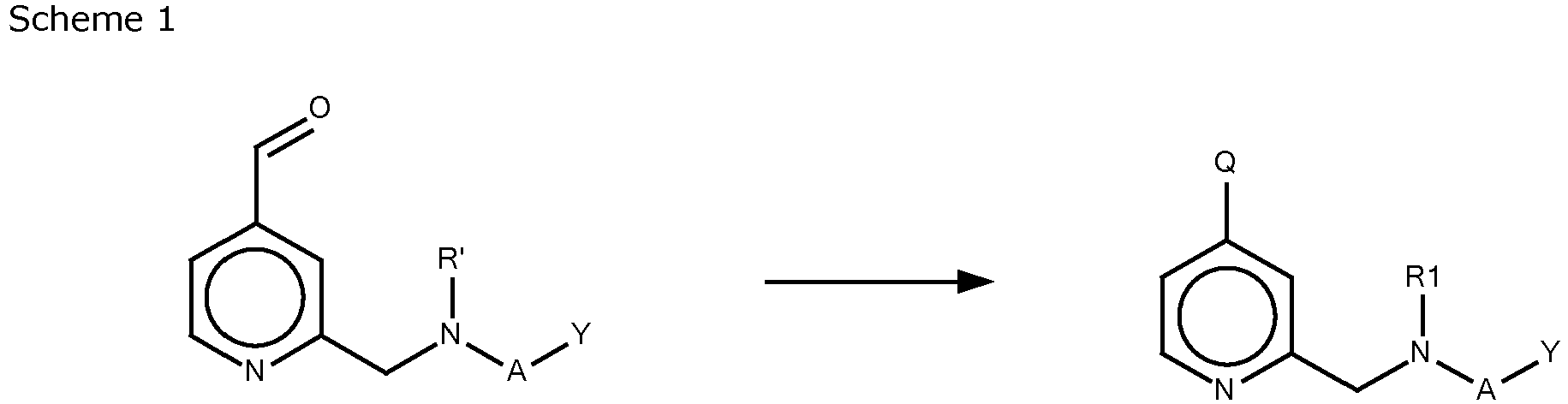
- Compounds of Formula (I) may be prepared from 4-formyl pyridines according to Scheme 1, where R' is a suitable protecting group or R1, in one-pot or by a stepwise procedure by mixing with an amine, optionally containing orthogonal protected reactive sites, and a reducing agent such as NaBH4, NaBH(OAc)3, NaCNBH3, or Et3SiH, either at room temperature or by heating for up to several hours by use of a solvent such as an alcohol, DCE, DCM, water, or toluene, optionally adding a catalyst such as an acid or a Lewis acid. Optionally, protecting groups may be removed and a purification method such as silica gel chromatography is employed if needed.
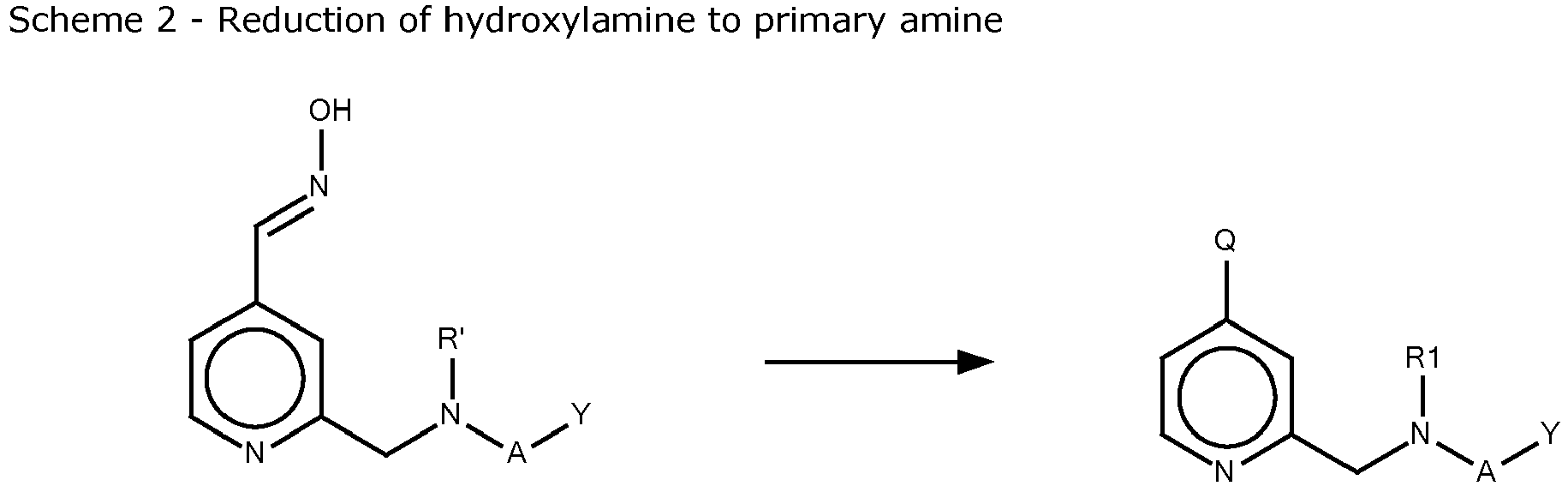
- Compounds of Formula (I) may be prepared from hydroxyl amines, optionally containing orthogonally protected reactive sites, according to Scheme 2, where R' is a suitable protecting group or R1, by use of reducing agents, such as a hydrogen atmosphere over a suitable catalyst, such as palladium on charcoal, in a suitable solvent, such as an alcohol. Optionally, protecting groups may be removed and a purification method such as silica gel chromatography is employed if needed.

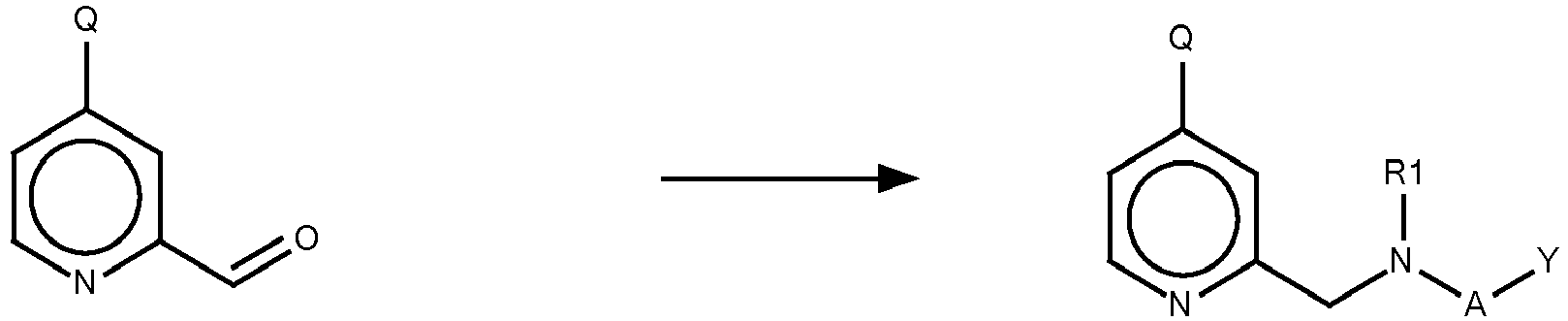
- Compounds of Formula (I) may be prepared from 2-formyl pyridines according to Scheme 3 analogously to Method A.

- Compounds of Formula (I) may be prepared according to Scheme 4 using a suitable solvent such as toluene or tetrahydrofuran, a base such as cesium carbonate or potassium t-butoxide, a suitable catalyst such as Pd2(dba)3, optionally a suitable salt such as lithium chloride and the desired electrophile such as arylbromide or heteroarylbromide. The compounds of Formula I are generated at room temperature or by heating for several hours, such as for 2 to 5 hours. Optionally, protecting groups may be removed and a purification method such as silica gel chromatography is employed if needed.
- Compounds of Formula (I) may be prepared from amines according to Scheme 4 according to method A.
- The compounds of Formula (I) may be prepared according to scheme 4 by use of a solvent such as DMF or THF, a base such as sodium hydride or cesium carbonate and a suitable electrophilic species such as an epoxide, a heteroaromatic chloride, an aliphatic, allylic or benzylic bromide, chloride or sulfonate, or a carbonyl chloride. Optionally, protecting groups may be removed and a purification method such as silica gel chromatography is employed if needed.

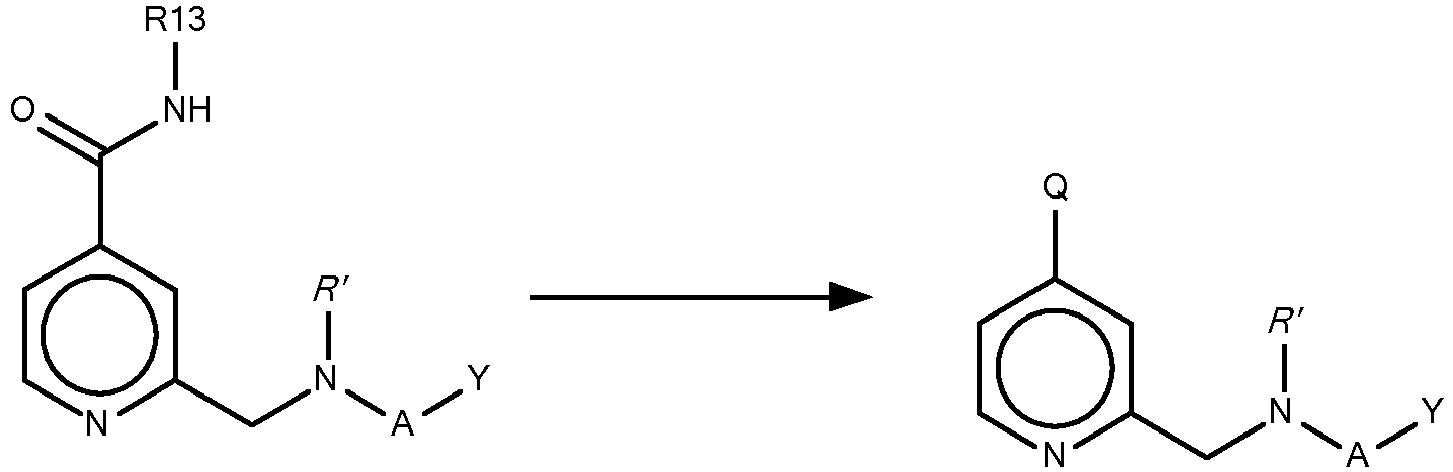
- Compounds of Formula (I) may be prepared from amides, optionally containing orthogonal protected reactive sites, according to Scheme 5, where R' is a suitable protecting group or R1, by use of reducing agents, such as lithium aluminium hydride or borane-complexes, in a suitable solvent, such as an ether or tetrahydrofuran. Optionally, protecting groups may be removed and a purification method such as silica gel chromatography is employed if needed.
-

- Compounds of Formula (I) may be prepared from 4-formyl pyridines according to Scheme 6, where R' is a suitable protecting group or R1, by mixing with an amine, optionally containing orthogonally protected reactive sites, either at room temperature or by heating for up to several hours by use of a solvent such as an alcohol, DCE, DCM, water, or toluene, optionally adding a catalyst such as a Lewis acid. Optionally, protecting groups may be removed and a purification method such as silica gel chromatography is employed if needed.
-


- Compounds of General Formula (I) may be prepared according to Scheme 7, where R' is a suitable protecting group or R1, by a Swern or alternatively a Dess-Martin oxidation of alcohol to aldehyde. Optionally, protecting groups may be removed and a purification method such as silica gel chromatography is employed if needed.

- Compounds of General Formula (I) may be prepared from esters, where R' is a suitable protecting group or R1, optionally containing orthogonal protected reactive sites, according to Scheme 8, by use of reducing agents, such as DIBAL-H, in a suitable solvent, such as toluene. Optionally, protecting groups may be removed and a purification method such as silica gel chromatography is employed if needed.

- Compounds of General Formula (I) may prepared at low temperature, e.g. at -78 °C, from halides, where R' is a suitable protecting group or R1, optionally containing orthogonal protected reactive sites according to Scheme 9 (X designates a halogen atom) by halogen metal exchange, e.g. by treatment with an alkyl lithium reagent, followed by addition of DMF in a solvent, such as dichloromethane. Optionally, protecting groups may be removed and a purification method such as silica gel chromatography is employed if needed.
-
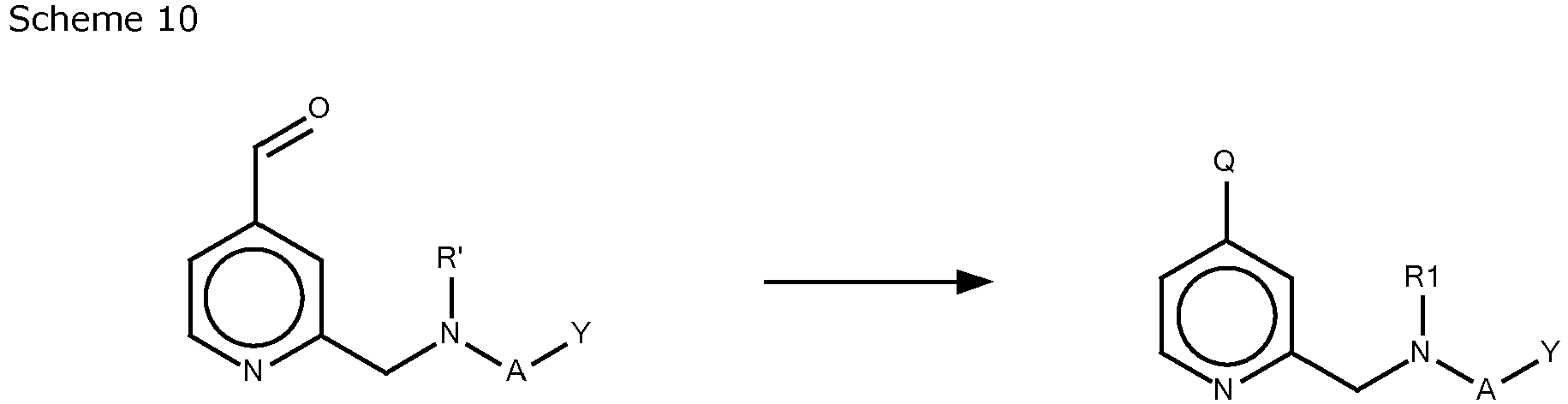
- Compounds of General Formula (I) may prepared from 4-formyl pyridines according to Scheme 10 by stirring in an alcohol in the presence of a Lewis acid or an acid, such as HCL or Pyridinium toluene-4-sulphonate, optionally by reacting with trialkyl orthoformate or in the presence of a drying agent such as an inorganic dry salt, or with azeotropic removal of water, at room temperature or by heating for several hours depending on the method. Optionally, protecting groups may be removed and a purification method such as silica gel chromatography is employed if needed.
- Compounds of General Formula (I) may prepared from 4-formyl pyridines according to Scheme 10 by stirring in a diamine, an aminoalcohol or an aminothiol, optionally in the presence of an acid such as HCL or Pyridinium toluene-4-sulphonate, optionally in the presence of a drying agent such as an inorganic dry salt or molecular sieves, or with azeotropic removal of water, at room temperature or by heating for several hours depending on the method. Optionally, protecting groups may be removed and a purification method such as silica gel chromatography is employed if needed.
- Compounds of General Formula (I) may prepared from the aforementioned compound where Q is W and R16 is H, by reacting with a suitably activated acyl group such as an acyl halide or acyl anhydride at room temperature or by heating for several hours is a solvent such as dichloroethane or THF. Optionally, protecting groups may be removed and a purification method such as silica gel chromatography is employed if needed.
-

- Intermediates may be prepared from 2-formyl pyridines according to Scheme 11 analogously to Method A.

- Intermediates, where X designates halides or OTf, may be prepared from 2-formyl pyridines according to Scheme 12 analogously to Method A.
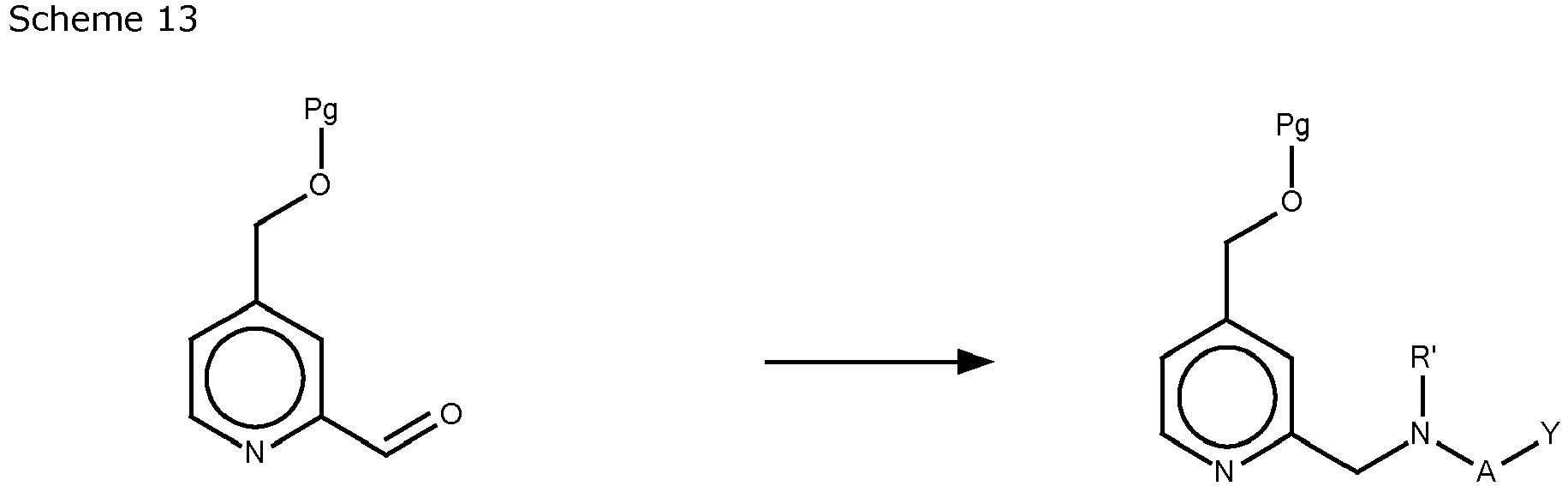
- Intermediates, where Pg designates a suitable protecting group, such as TBMDS or TIPS, may be prepared from 2-formyl pyridines according to Scheme 13 analogously to Method A.

- Intermediates be prepared according to scheme 14, where R' is a suitable protecting group or R1, by use of a solvent such as DMF or THF, a base such as a hindered tertiary amine, a dehydrating agent such as EDCI or DCC and an amine, and by mixing at or above room temperature for a period up to several hours. Optionally, the said protecting group may be removed, and a purification method such as silica gel chromatography is employed if needed.

- Intermediates may be prepared according to Scheme 15 analogously to Method AD.

- Intermediates may be prepared according to Scheme 16 analogously to Method AD.
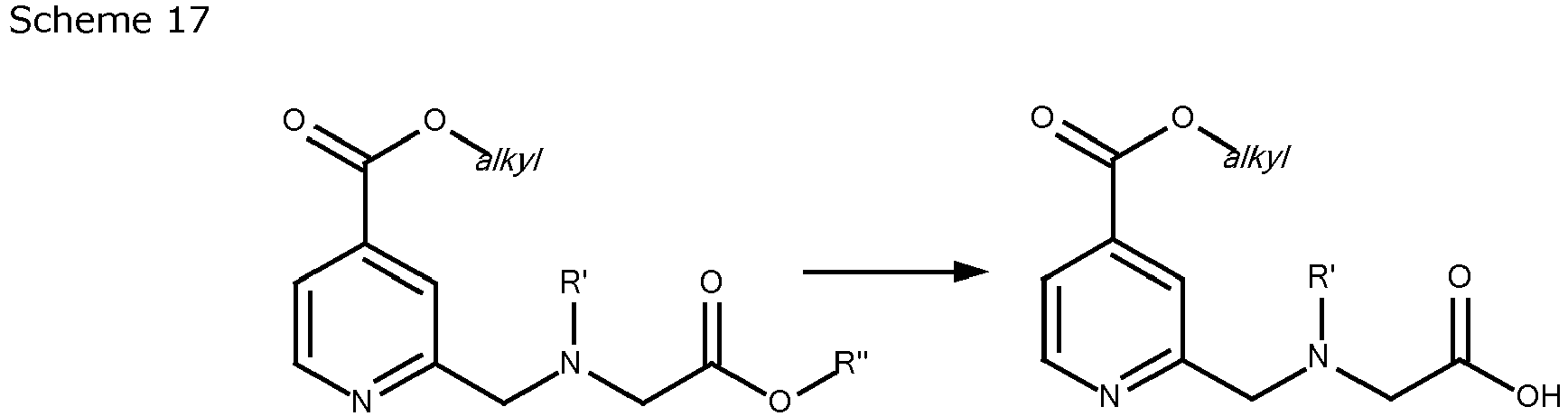
- Intermediates may be prepared according to scheme 17 from, where R' is a suitable protecting group or R1 and R" is an orthogonal protecting group, which may be selectively removed, such as removal of R": tBu in presence of R': CF3CO by treating with trifluoroacetic acid in a solvent such as dichloromethane at room temperature for several hours. A purification method such as silica gel chromatography is employed if needed.

- Intermediates may be prepared according to Scheme 18 analogously to Method AG.
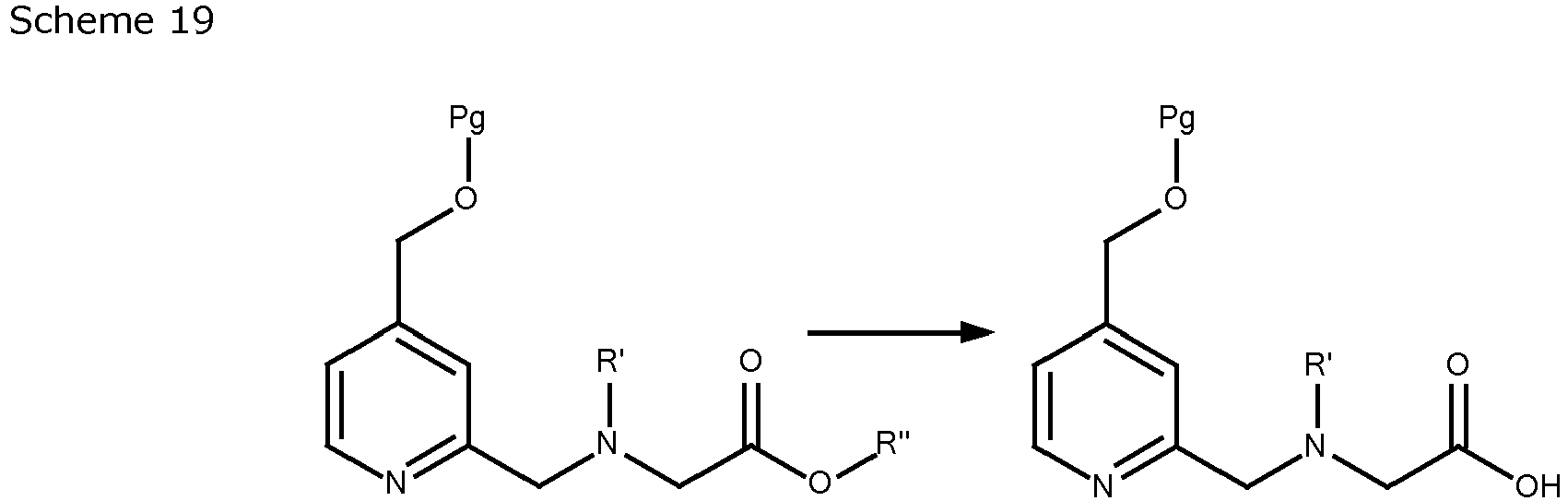
- Intermediates may be prepared according to Scheme 19 analogously to Method AG.

- Intermediates may be prepared from aldehydes and intermediates, where L designates a bond or an aliphatic linker, which may comprise an amide bond, attached to an aliphatic heterocycle, according to Scheme 20 analogously to Method A Method AK
- Intermediates may be prepared according to Scheme 20 analogously to Method F.

- Intermediates may be prepared according to Scheme 21 analogously to Method AJ.
- Intermediates may be prepared according to Scheme 21 analogously to Method F.

- Intermediates may be prepared according to Scheme 22 analogously to Method AJ.
- Intermediates may be prepared according to Scheme 22 analogously to Method F.

- Intermediates, where L designates an aliphatic linker, which may comprise an amide bond, may be prepared from aldehydes according to Scheme 23 analogously to Method E.
- Intermediates may be prepared according to Scheme 23 analogously to Method F.

- Intermediates, where L designates an aliphatic linker, which may comprise an amide bond, may be prepared from aldehydes according to Scheme 24 analogously to Method E.
- Intermediates may be prepared according to Scheme 24 analogously to Method F.

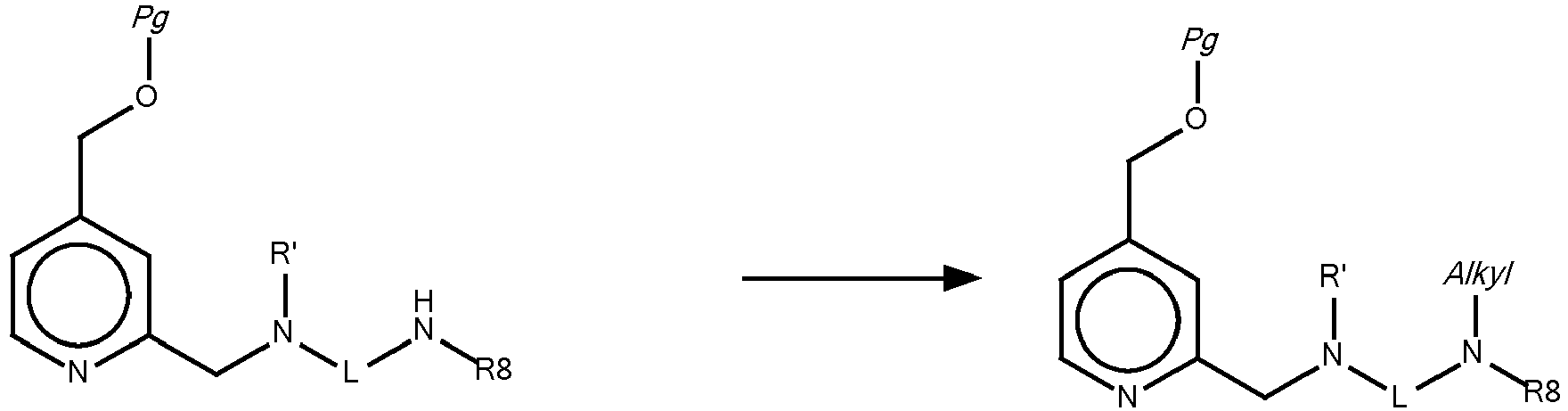
- Intermediates, where L designates an aliphatic linker, which may comprise an amide bond, may be prepared from aldehydes according to Scheme 25 analogously to Method E.
- Intermediates may be prepared according to Scheme 25 analogously to Method F.
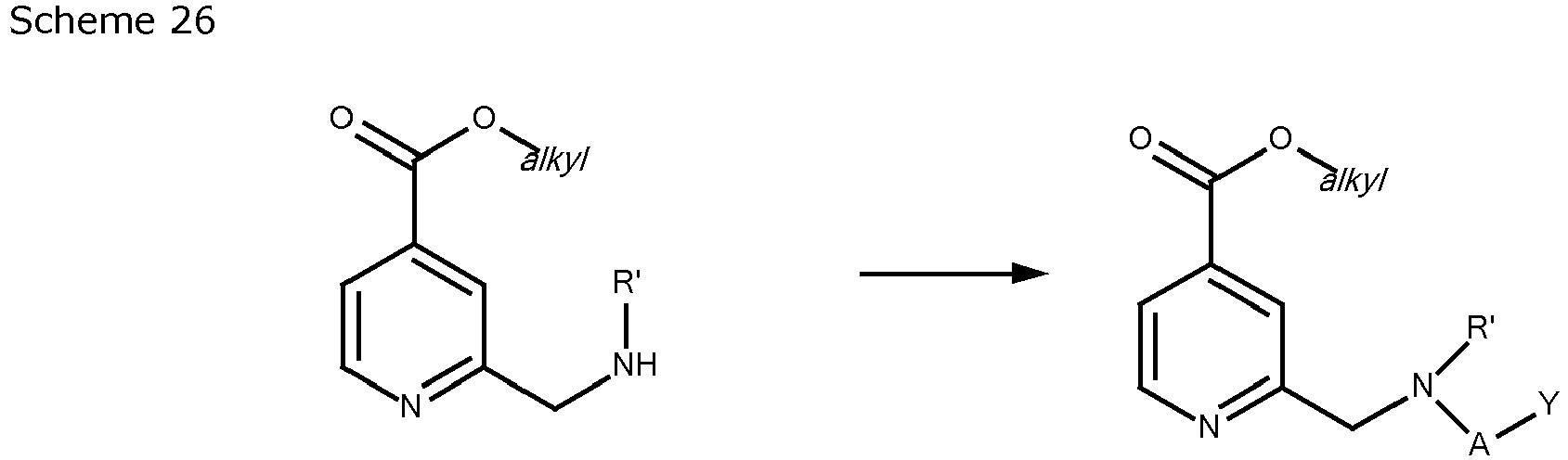
- Intermediates may be prepared according to Scheme 26 analogously to Method A.
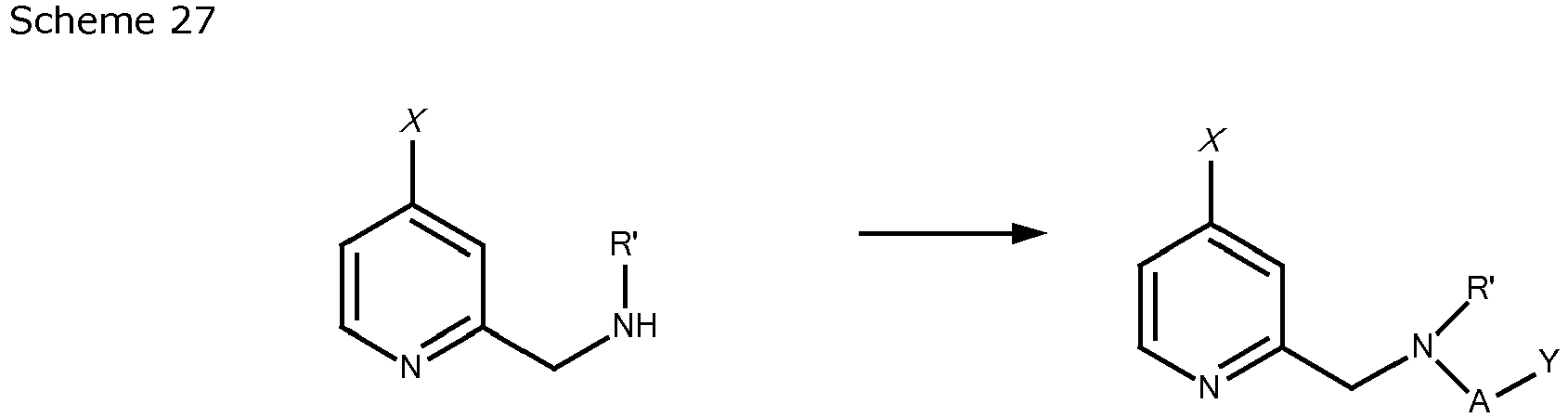
- Intermediates may be prepared according to Scheme 27 analogously to Method A.


- Intermediates may be prepared according to Scheme 28 analogously to Method A.

- Intermediates may be prepared from esters, optionally containing orthogonal protected reactive sites, according to Scheme 29, by use of reducing agents, such as DIBAL-H, in a suitable solvent, such as toluene. Optionally, protecting groups may be removed and a purification method such as silica gel chromatography is employed if needed.

- Intermediates may be prepared from esters, optionally containing orthogonal protected reactive sites, according to Scheme 30, by use of reducing agents, such as lithium aluminiumhydride or borane-complexes, in a suitable solvent, such as an ether or tetrahydrofuran. Optionally, protecting groups may be removed and a purification method such as silica gel chromatography is employed if needed.
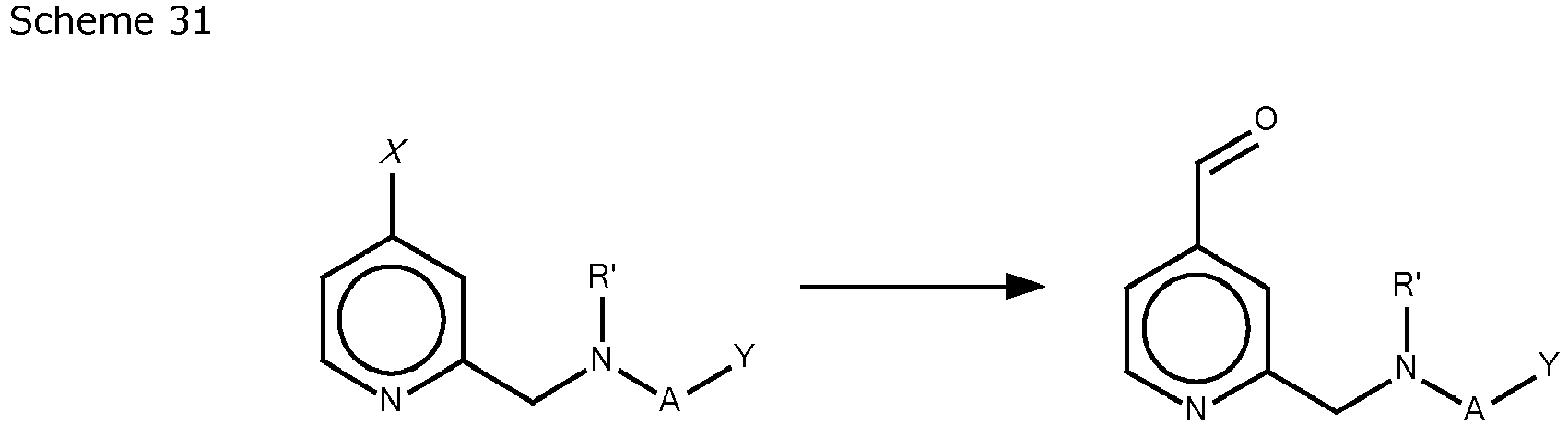
- Intermediates may be prepared according to Scheme 31 using method K
- Intermediates may be prepared according to scheme 31 either at room temperature or by heating for several hours by use of a solvent such as toluene or tetrahydrofuran, a base such as cesium carbonate or potassium t-butoxide, a catalyst such as Pd2(dba)3, optionally a salt such as lithium chloride and the desired nucleophile such as carbon monoxide. A purification method such as silica gel chromatography is employed if needed.
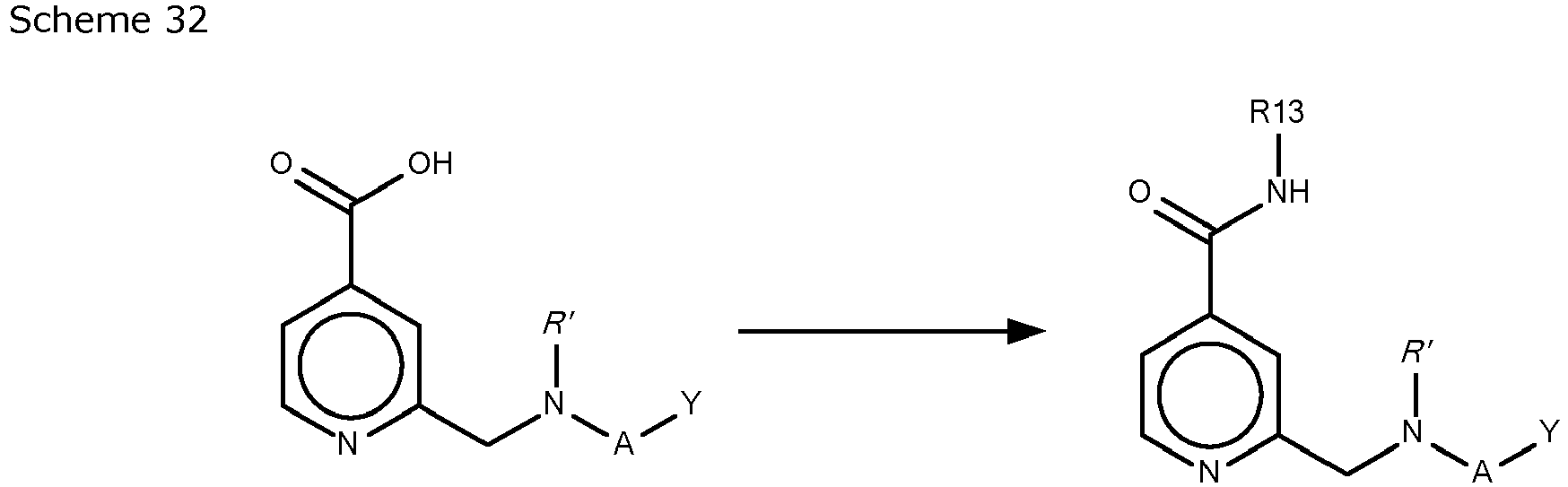
- Intermediates may be prepared according to scheme 32 analogously to Method AD.

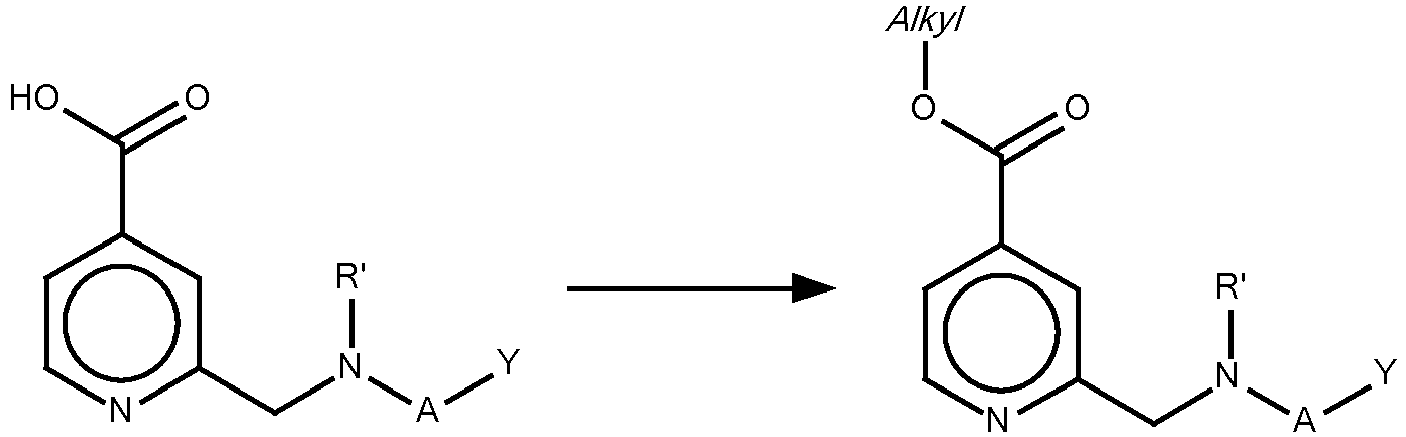
- Intermediates may be prepared according to Scheme 33 by use of a solvent such as DMF or THF, a base such as cesium carbonate and an electrophile such as an alkyl halide, heteroaromatic halide, alkenyl halide, etc., and by mixing at or above room temperature for several hours. A purification method such as silica gel chromatography or trituration is employed if needed.
- Intermediates may be prepared according to Scheme 33 by use of acetic catalysis in an alcohol at room temperature or at reflux. A purification method such as silica gel chromatography or trituration is employed if needed.

- Intermediates may be prepared according to scheme 34 from 4-formyl pyridines by reaction with hydroxylamine in a solvent such as an alcohol or water.


- Intermediates may be prepared according to scheme 35 from 4-formyl pyridines by with reaction an amine, optionally containing orthogonally protected reactive sites, either at room temperature or by heating for up to several hours by use of a solvent such as an alcohol, DCE, DCM, THF water, or toluene, optionally adding a catalyst such as a Lewis acid. Subsequently reacting with TMSCN in a solvent such as acetonitrile. Optionally, protecting groups may be removed and a purification method such as silica gel chromatography is employed if needed.
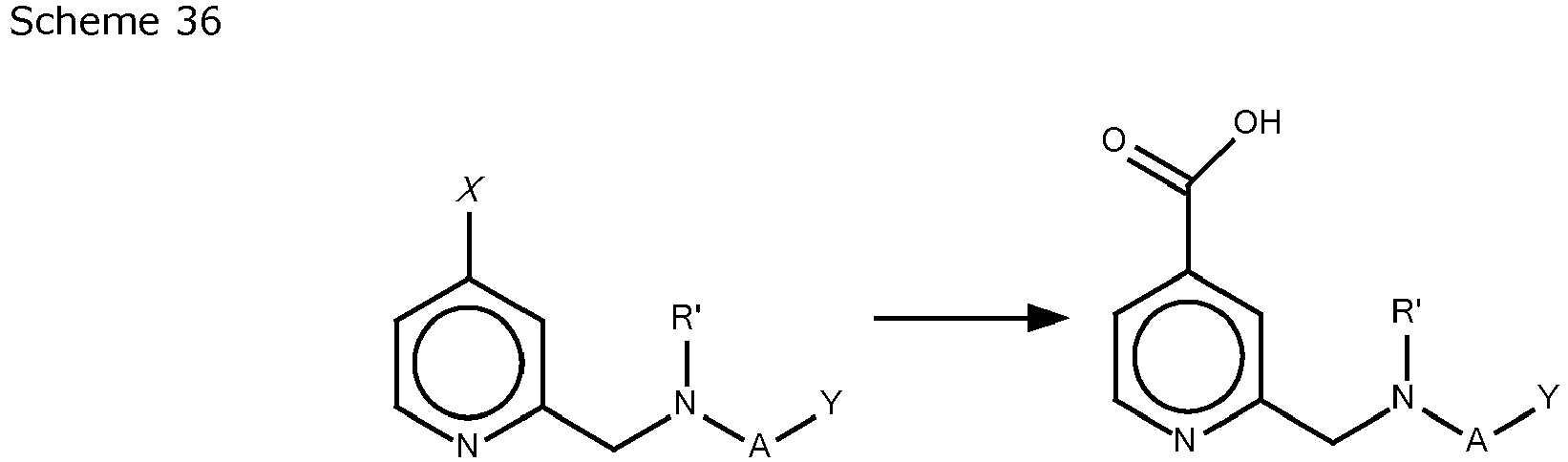
- Intermediates may be prepared according to Scheme 36 either at room temperature or by heating for several hours by use of a solvent such as wet toluene or tetrahydrofuran, a base such as cesium carbonate or potassium t-butoxide, a catalyst such as Pd2(dba)3, optionally a salt such as lithium chloride and the desired nucleophile such as carbon monoxide. A purification method such as silica gel chromatography is employed if needed.


- Intermediates may be prepared according to Scheme 37 from pyridine 2-carboxylates analogously to Method J.
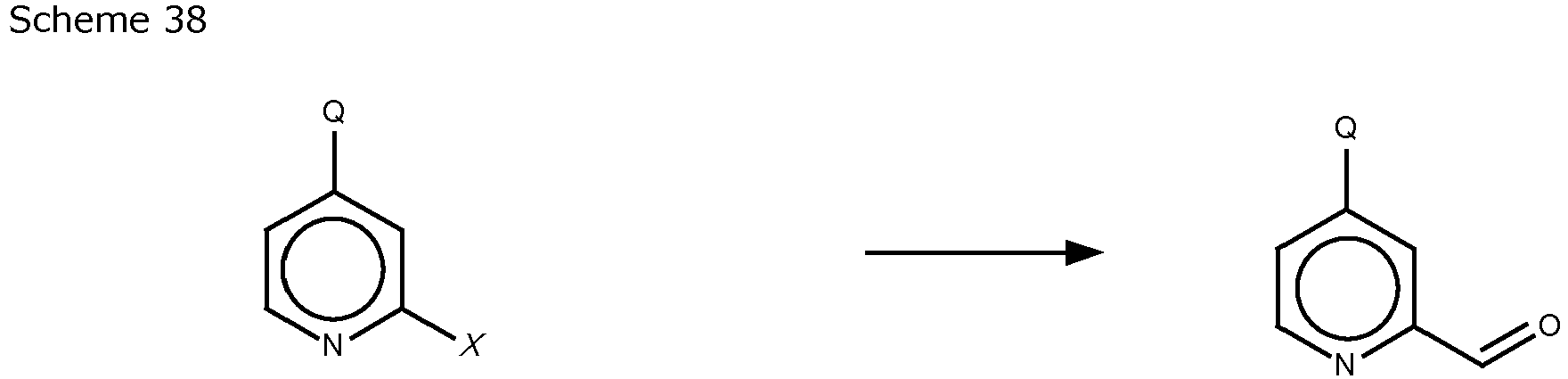
- Intermediates may be prepared according to Scheme 38 from pyridine 2-halides analogously to Method K.
- All chemicals were purchased from Sigma-Aldrich, Alfa Aesar, Matrix, Combiblock, Oakwood, and Chembridge. Anhydrous solvents were Aldrich Sure/Seal™ brand. All reactions were carried out under a dry nitrogen atmosphere using dry solvents. Reactions were monitored by thin-layer chromatography carried out on Sigma-Aldrich 0.25 mm silica gel plates (60 Å, fluorescent indicator). Spots were visualized under UV light (254 nm). Flash column chromatography was performed on Biotage SNAP Flash System, or silica gel 60 (particle size 0.032-0.063 mm) obtained from Silicycle, Inc. Low-resolution ES (electrospray) mass spectra were obtained using a Micromass Quattro Ultima mass spectrometer in the electrospray positive (ES+) or negative (ES-) ion mode. 1H-NMR spectra were recorded on a Bruker AM-300 spectrometer and were calibrated using residual nondeuterated solvent as internal reference. Spectra were processed using Spinworks version 2.5 (developed by Dr. Kirk Marat, Department of Chemistry, University of Manitoba). Preparative HPLC was performed on Waters 2996 with Photodiode Array Detector, Waters 600
- Controller, Waters 100 pump, and Waters 717 auto sampler, with UV detection at 254 and 280 nm. Flow rate: 15 mL/minute, run time 30 minutes. Solvents: 0-100% (H2O-MeOH), with and without added TFA (0.1%). Column used was Supelco C18, 25 cm x 21.2 mm, particle size 10 micrometer.
- Ethyl 2-formylpyridine-4-carboxylate was prepared analogously to Queguiner, G. and Pastour, P. (Comptes Rendus des Séances de l'Académie des Sciences, Série C: Sciences Chimiques (1969), 268(2), 182-5).
-
TABLE 1 Structure # Name May be prepared analogously to Synthetic Route NMR 
1 N-{[2-({[4-(diethylamino)butyl]amin o}methyl)pyridin-4-yl]methyl}-2,2,2-trifluoroacetamide A 1H NMR (300 MHz, Methanol-d4), δ ppm: 8.57 (d, 1H), 4.53 (s, 2H), 1.94 (s, 6H), 1.25 (t, 6H). 
2 [2-({[4-(dimethylamino)butyl]am ino}methyl)pyridin-4-yl]methanamine B 1H-NMR (300MHz, MeOD), δ ppm: 8.80 (d, 1H), 4.60 (s, 2H), 2.95 (s, 6H), 1.95 (m, 4H). 
3 [2-({[3-(dimethylamino)propyl]a mino}methyl)pyridin-4-yl]methanamine B 1H NMR (300 MHz, Methanol-d4), δ ppm: 8.71 (d, 1H), 4.48 (s, 2H), 2.95 (s, 6H), 2.25 (m, 2H). 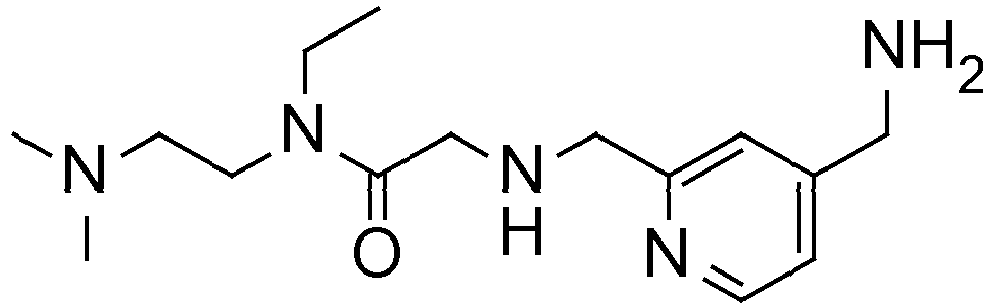
4 2-({[4-(aminomethyl)pyridin-2-yl]methyl}amino)-N-[2-(dimethylamino)ethyl]-N-ethylacetamide B 1H NMR (300 MHz, CDCl3), δ ppm: 8.74 (d, 1H), 4.59 (s, 2H), 2.99 (s, 6H), 1.27 (t, 3H). 
5 [2-({[4-(diethylamino)butyl]amin o}methyl)pyridin-4-yl]methanamine B 1H-NMR (300MHz, MeOD), δ ppm: 8.82 (d, 1H), 4.65 (s, 2H), 3.20 (m, 9H), 1.30 (t, 6H). 
6 N-[4-(diethylamino)butyl]-2,2,2-trifluoro-N-({4-[(trifluoroacetamido)met hyl]pyridin-2-yl}methyl)acetamide C 1H-NMR (300MHz, CDCl3), δ ppm: 11.60, 11.45 (d, 1H), 4.70 (d, 2H), 3.10 (m, 4H), 1.50 (t, 6H). 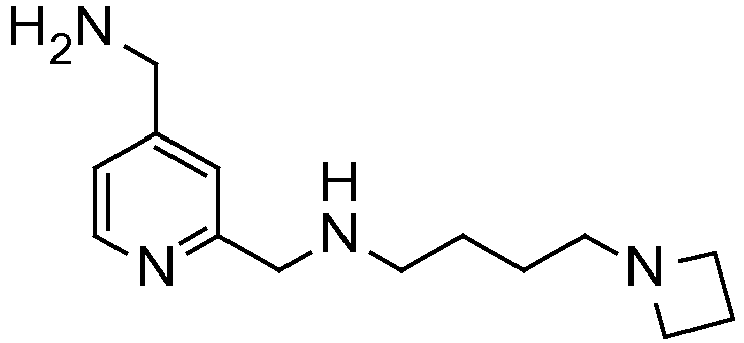
7 [2-({[4-(azetidin-1-yl)butyl]amino}methyl)p yridin-4-yl]methanamine D 1H-NMR (300MHz, CDCl3), δ ppm: 8.70 (d, 1H), 4.40 (s, 2H), 1.80 (m, 4H), 1.20 (m 4H). 
8 [2-({[5-(dimethylamino)pentyl]a mino}methyl)pyridin-4-yl]methanamine B 1H-NMR (300MHz, MeOD), δ ppm: 8.88 (d, 1H), 4.70 (s, 2H), 2.85 (s, 6H), 1.85 (m, 4H). 
9 2-({[4-(aminomethyl)pyridin-2-yl]methyl}amino)-N-{1-[(2-methoxyphenyl)methyl]p iperidin-4-yl}acetamide B 1H-NMR (300 MHz, Methanol-d4), δ ppm: 8.74 (m, 1H), 7.18 - 7.10 (m, 2H), 4.45 (d, 2H), 2.25 - 1.80 (m; 4H). 
10 N-{[2-({[4-(dimethylamino)butyl]am ino}methyl)pyridin-4-yl]methyl}cyclopropana mine E 1H NMR (300 MHz, CDCl3), δ ppm: 8.42 (d, 1H), 2.20 (s, 6H), 2.15 (m, 1H), 0.5 - 0.38 (m, 4H). 
11 N-{[2-({[3-(2-methylpiperidin-1-yl)propyl]amino}methyl) pyridin-4-yl]methyl}cyclopropana mine E 1H-NMR (300MHz, Methanol-d4), δ ppm: 8.80 (d, 1H), 2.90 (m, 1H), 2.30 (m, 2H), 1.02-0.9 (m, 4H). 
12 N-({2-[(propylamino)methyl]py ridin-4-yl}methyl)cyclopropana mine E 1H NMR (300 MHz, Methanol-d4), δ ppm: 8.70 (d, 1H), 4.40 (s, 2H), 3.06 (m, 1H), 1.03 (t, 3H). 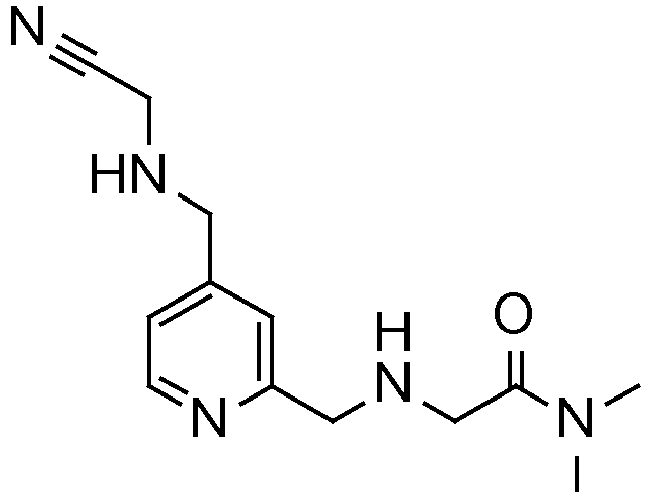
13 2-{[(4-{[(cyanomethyl)amino]m ethyl}pyridin-2-yl)methyl]amino}-N,N-dimethylacetamide F 1H NMR (300 MHz, Methanol-d4), δ ppm: 8.72 (d, 1H), 4.37 (s, 2H), 4.18 (s, 2H), 3.00 (s, 6H). 
14 2-{[(4-{[(2-fluoroethyl)amino]methyl }pyridin-2-yl)methyl]amino}-N,N-dimethylacetamide G 1H NMR (300 MHz, Methanol-d4), δ ppm: 8.49 (d, 1H), 4.65 (t, 1H), 3.97 (s, 2H), 2.96 (d, 6H). 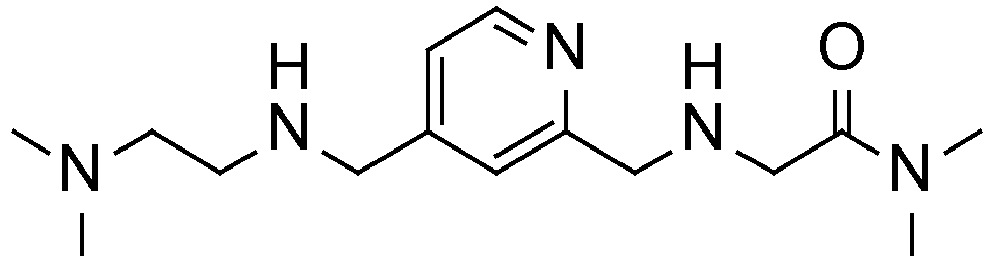
15 2-({[4-({[2-(dimethylamino)ethyl]am ino}methyl)pyridin-2-yl]methyl}amino)-N,N-dimethylacetamide G 1H NMR (300 MHz, Methanol-d4), δ ppm: 8.44 (d, 1H), 3.90 (s, 2H), 2.96 (d, 6H), 2.25 (s, 6H). 
16 {[(2S)-1-benzylpyrrolidin-2-yl]methyl}[(4-{[(cyclopropylmethyl)ami no] methyl}pyridin-2-yl)methyl]amine G 1H NMR (300 MHz, Methanol-d4), δ ppm: 8.70 (dd, 1H), 7.59-7.44 (m, 7H), 2.25-2.04 (m, 3H), 1.20-1.08 (m, 1H). 
17 benzyl(methyl){3-[({4-[(methylamino)methyl]p yridin-2-yl}methyl)amino]propyl} amine H 1H NMR (300 MHz, CDCl3), δ ppm: 8.8(d, 1H), 7.8-7.4 (m, 7H), 2.8 (d, 6H), 2.5-2.2 (m, 2H). 
18 benzyl[3-({[4-({[2-(dimethylamino)ethyl]am ino}methyl)pyridin-2-yl]methyl}amino)propyl] methylamine H 1H NMR (300 MHz, Methanol-d4), δ ppm: 8.8(d, 1H), 7.6-7.4 (m, 5H), 3.05 (s, 6H), 2.8 (s, 3H). 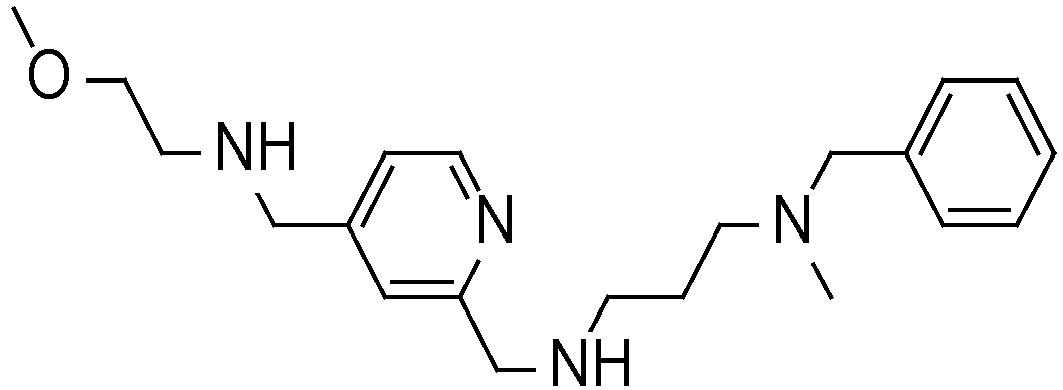
19 benzyl(3-{[(4-{[(2-methoxyethyl)amino]met hyl}pyridin-2-yl)methyl]amino}propyl) methylamine H 1H NMR (300 MHz, Methanol-d4), δ ppm: 8.9(d, 1H), 7.6-7.4 (m, 5H), 3.8-3.2(m, 11H), 2.9 (s, 3H). 
20 2-[({4-[(cyclopropylamino)meth yl]pyridin-2-yl}methyl)amino]-N-{1-[(2-methoxyphenyl)methyl]p iperidin-4-yl}acetamide I 1H-NMR (300 MHz, Methanol-d4), δ ppm: 8.78 (m, 1H), 7.02 (m, 1H), 2.60 (m, 1H), 0.9-0.8 (m, 4H). 
21 2-cyclopropyl-2-({[2-({[2-(dimethylamino)ethyl]am ino}methyl)pyridin-4-yl]methyl}amino)acetonit rile J 1H NMR (300 MHz, Methanol-d4), δ ppm: 8.68 (d, 1H), 4.50 (s, 2H), 3.00 (s, 6H), 0.61 (m, 2H). 
22 2-({[2-({[3-(dimethylamino)propyl]a mino}methyl)pyridin-4-yl]methyl}amino)propan enitrile J 1H NMR (300 MHz, Methanol-d4), δ ppm: 8.61 (d, 1H), 4.43 (s, 2H), 2.94 (s, 6H), 1.54 (d, 3H). 
23 2-[({2-[({4-[benzyl(cyclopropyl)amin 0]butyl}amino)methyl]py ridin-4-yl}methyl)amino]acetonit rile K 1H-NMR (300MHz, CDCl3), δ ppm: 8.45 (d, 1H), 7.20-7.00 (m, 7H), 1.40 (m, 12H) 0.40 (m, 4H), ppm. 
24 2-[2-({[3-(dimethylamino)propyl]a mino}methyl)pyridin-4-yl]-2-(methylamino)acetonitril e J 1H NMR (300 MHz, Methanol-d4), δ ppm: 8.83 (d, 1H), 4.54 (s, 3H), 2.93 (s, 6H), 2.25 (m, 2H). 
25 N-[(2-{[({[2-(dimethylamino)ethyl](et hyl)carbamoyl}methyl)a mino]methyl}pyridin-4-yl)methyl]-2,2,2-trifluoroacetamide L 1H NMR (300 MHz, Methanol-d4), δ 8.61 (d, 1H), 7.35 (d, 1H), 4.53 (s, 2H), 4.46 (s, 2H), 4.23 (s, 2H), 3.82 (t, 2H), 2.98 (s, 6H), 1.24 (t, 3H). 
26 N-[(2-{[N-( {[2-(dimethylamino)ethyl](et hyl)carbamoyl}methyl)-2,2,2-trifluoroacetamido]methy l}pyridin-4-yl)methyl]-2,2,2-trifluoroacetamide C 1H-NMR (300MHz, CDCl3), δ ppm 8.50 (m, 1H), 7.88 (m, 1H), 7.21 (m, 2H), 4.53 (m, 6H), 3.33 (m 4H), 2.44 (m, 2H), 2.23 (m, 6H), 1.14 (m, 3H). 
27 ({[2-({[4-(diethylamino)butyl]amin o}methyl)pyridin-4-yl]methyl}carbamoyl)for mic acid M 1H NMR (300 MHz, Methanol-d4), δ ppm: 8.40 (d, 1H), 4.45 (s, 2H), 2.70 - 2.40 (m, 8H), 1.00 (m, 6H). 
28 tert-butyl ({[2-({[4-(diethylamino)butyl]amin o}methyl)pyridin-4-yl]methyl}carbamoyl)for mate M 1H-NMR (300MHz, CDCl3), δ ppm: 8.50 (m, 1H), 4.50 (m, 2H), 1.65 - 1.50 (m, 13H), 1.20 (m, 6H). 
29 ethyl 2-({[(2-{[({[2-(dimethylamino)ethyl](et hyl)carbamoyl}methyl)a mino]methyl}pyridin-4-yl)methyl]carbamoyl}oxy )benzoate L 1H-NMR (300MHz, CDCl3), δ ppm: 8.50 (m, 1H), 7.20 (m, 4H),4.50 (m, 2H), 4.40 (q, 2H), 250 (s, 6H), 1.38 (t, 3H). 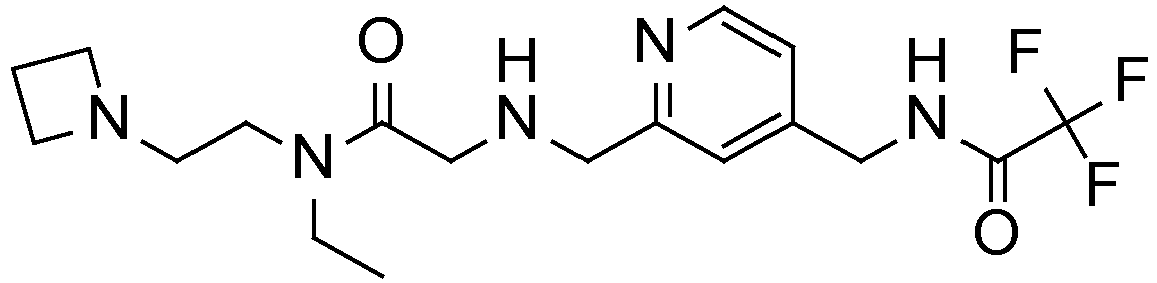
30 N-[(2-{[({[2-(azetidin-1-yl)ethyl](ethyl)carbamoyl }methyl)amino]methyl}p yridin-4-yl)methyl]-2,2,2-trifluoroacetamide A 1H NMR (300 MHz, Methanol-d4), δ 8.50 (d, 1H), 7.40 (m, 2H), 4.50 (s, 2H), 4.40 (s, 2H), 4.20 (m, 2H), 3.50 (m, 2H), 3.30 (m, 2H) 2.40 (m, 2H), 1.10 (t, 3H) 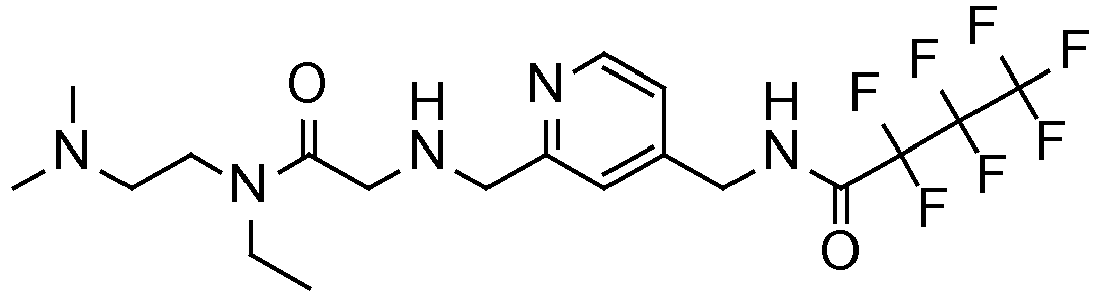
31 N-[(2-{[({[2-(dimethylamino)ethyl](et hyl)carbamoyl}methyl)a mino]methyl}pyridin-4-yl)methyl]-2,2,3,3,4,4,4-heptafluorobutanamide L 1H NMR (300 MHz, Methanol-d4), δ ppm: 8.70, (d, 1H), 4.51 (s, 2H), 2.98 (s, 6H), 1.22 (m, 3H). 
32 N-[(2-{[({[2-(dimethylamino)ethyl](et hyl)carbamoyl}methyl)a mino]methyl}pyridin-4-yl)methyl]-2,2-difluorobutanamide L 1H NMR (300 MHz, Methanol-d4), δ 8.60 (d, 1H), 7.39 (s, 1H), 7.36 (d, 1H), 4.48 (m, 4H), 4.24 (s, 2H), 3.82 (t, 2H), 3.38 (m, 4H), 2.98 (s, 6H), 2.32 (m, 2H), 1.24 (t, 3H), 1.02 (t, 3H). 
33 2[({4-[(N-cyclopropylcarboximidoyl ]pyridin-2-yl}methyl)amino]-N,N-dimethylacetamide N 1H NMR (300 MHz, CDCl3), δ ppm: 8.55 (d, 1H), 8.52 (s, 1H), 3.17 (m, 1H), 2.96 (d, 6H). 
34 N,N-dimethyl-2-[({4-[[(3-phenylpropyl)imino]meth yl]pyridin-2-yl}methyl)amino]acetami de N 1H NMR (300 MHz, CDCl3), δ ppm: 8.62 (d, 1H), 8.26 (s, 1H), 7.25 (m, 5H), 2.96 (d, 6H). 
35 N,N-dimethyl-2-[({4-[N-(2-methylcyclopropyl)carbox imidoyl]pyridin-2-yl}methyl)amino]acetami de O 1H NMR (300 MHz, CDCl3), δ ppm: 8.57 (d, 1H), 8.36 (s, 1H), 2.96 (d, 6H), 0.81 (m, 1H). 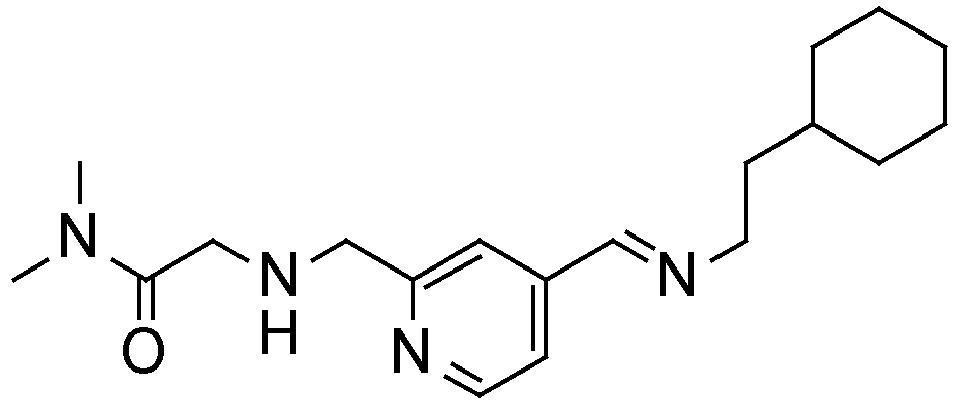
36 2-[({4-[[(2-cyclohexylethyl)imino]me thyl]pyridin-2-yl}methyl)amino]-N,N-dimethylacetamide O 1H NMR (300 MHz, CDCl3), δ ppm: 8.61 (d, 1H), 8.26 (s, 1H), 2.95 (d, 6H), 1.78-0.88 (m, 13H). 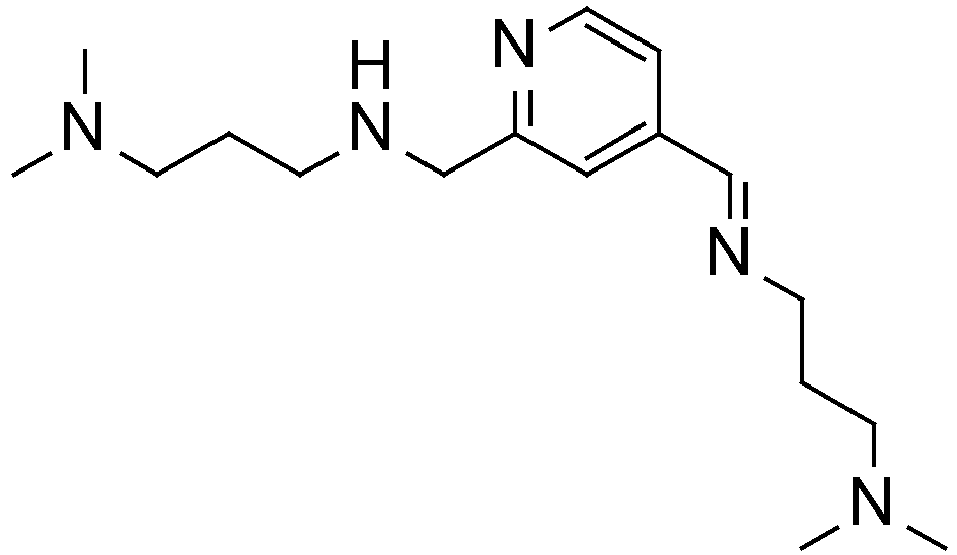
37 [3-(dimethylamino)propyl]( {4-[{[3-(dimethylamino)propyl]i mino}methyl]pyridin-2-yl}methyl)amine N 1H NMR (300 MHz, CDCl3), δ ppm: 8.59 (dd, 1H), 8.24 (s, 1H), 2.20 (s, 6H), 2.19 (s, 6H). 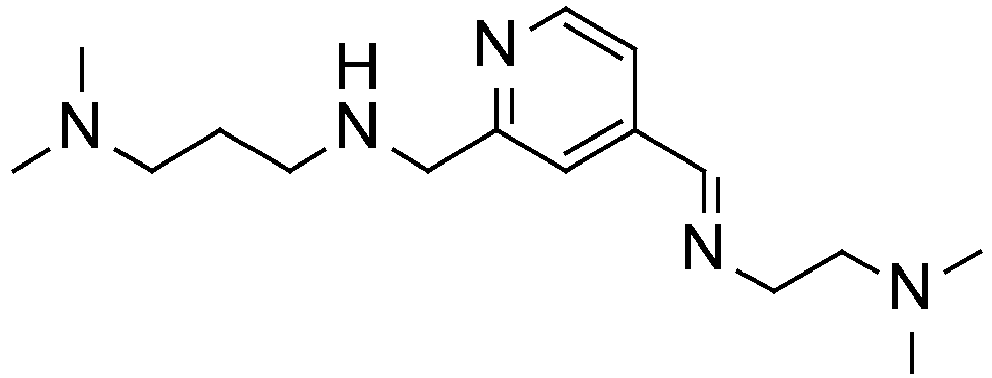
38 ({4-[{[2-(dimethylamino)ethyl]imi no}methyl]pyridin-2-yl}methyl)[3-(dimethylamino)propyl]a mine N 1H NMR (300 MHz, CDCl3), δ ppm: 8.60 (d, 1H), 8.28 (s, 1H), 2.30 (s, 6H), 2.25 (s, 6H). 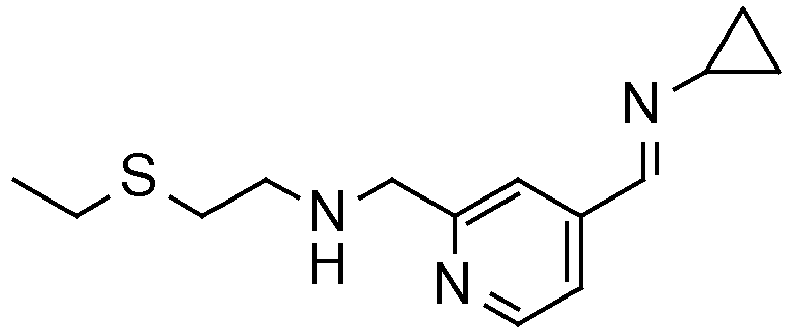
39 N-{[2-({[2-(ethylsulfanyl)ethyl]amin o}methyl)pyridin-4-yl]methylidene}cycloprop anamine P 1H-NMR (300 MHz, CDCl3), δ ppm: 8.5 (d, 1H), 8.4 (s, 1H), 1.2 (t, 3H), 1.0 (m, 4H). 
40 N-{[2-({[2-(1-methylpyrrolidin-2-yl)ethyl]amino}methyl)p yridin-4-yl]methylidene}cycloprop anamine P 1H-NMR (300 MHz, CDCl3), δ ppm: 8.5 (d, 1H), 8.4 (s, 1H), 2.8 (s, 3H), 1.0 (m, 4H). 
41 N-( {2-[({3-[benzyl(methyl)amino]pr opyl}amino)methyl]pyrid in-4-yl}methylidene)cycloprop anamine Q 1H NMR (300 MHz, CDCl3), □ ppm: 8.55 (d, 1H), 8.50 (s, 1H), 7.28-7.22 (m, 5H), 1.04-0.97 (m, 4H). 
42 N-{[2-({[3-(pyrrolidin-1-yl)propyl]amino}methyl) pyridin-4-yl]methylidene}cycloprop anamine P 1H-NMR (300 MHz, Methanol-d4), δ ppm: 8.58 (m, 1H), 8.40 (s, 1H), 2.78-2.60 (m, 6H), 1.90-1.75 (m, 6H). 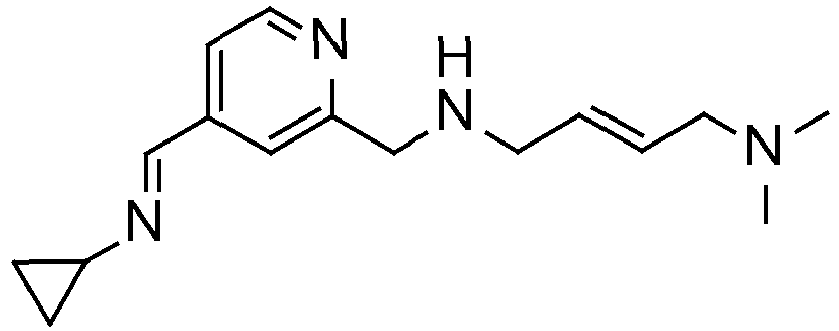
43 N-{[2-({[(2E)-4-(dimethylamino)but-2-en-1-yl]amino}methyl)pyridin-4-yl]methylidene}cycloprop anamine R 1H NMR (300 MHz, CDCl3), δ ppm: 8.59 (d, 1H), 8.41 (s, 1H), 2.23 (s, 6H), 0.94 (m, 4H). 
44 N-{[2-({[4-(azetidin-1-yl)butyl]amino}methyl)p yridin-4-yl]methylidene}cycloprop anamine S 1H-NMR (300MHz, CDCl3), ), δ ppm: 8.50 (d, 1H), 8.40 (s, 1H), 1.50 (m 6H), 1.00 (m, 4H). 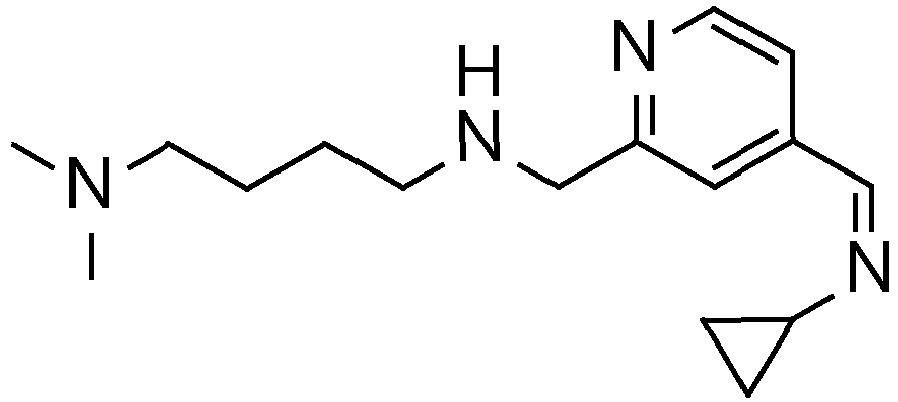
45 N-{[2-({[4-(dimethylamino)butyl]am ino}methyl)pyridin-4-yl]methylidene}cycloprop anamine T 1H-NMR (300MHz, CDCl3), ), δ ppm: 8.50 (s, 1H), 8.30 (s, 1H), 2.20 (s, 6H), 1.00 (m, 4H) 
46 N-[(2-{[({4-[(dimethylamino)methyl] cyclohexyl}methyl)amino ]methyl}pyridin-4-yl)methylidene]cycloprop anamine N 1H NMR (300 MHz, CDCl3), δ ppm: 8.57 (d, 1H), 8.41 (s, 1H), 2.20 (s, 6H), 0.98 (m, 8H). 
47 N-{[2-({[5-(dimethylamino)pentyl]a mino}methyl)pyridin-4-yl]methylidene}cycloprop anamine U 1H-NMR (300MHz, CDCl3), ), δ ppm: 8.50 (d, 1H), 8.40 (s, 1H), 2.15 (s, 6H), 1.50-1.30 (m, 6H). 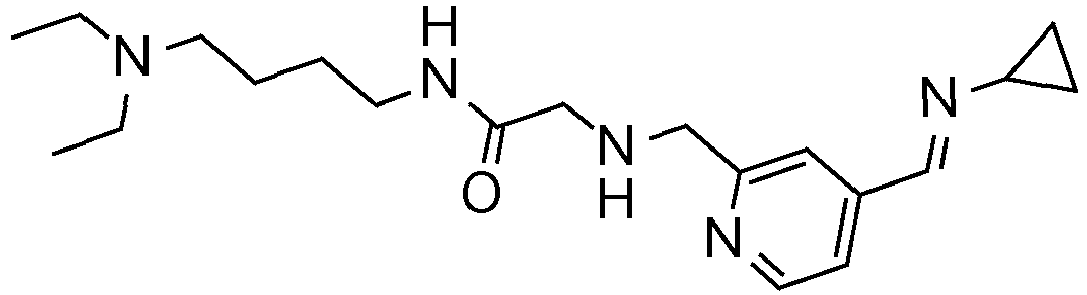
48 2-[({4-[N-cyclopropylcarboximidoyl ]pyridin-2-yl}methyl)amino]-N-[4-(diethylamino)butyl]acet amide V 1H NMR (300 MHz, CDCl3), δ ppm: 8.61 (d, 1H), 8.41 (s, 1H), 1.09 (t, 6H), 1.03 (m, 4H). 
49 2-[({4-[N-cyclopropylcarboximidoyl ]pyridin-2-yl}methyl)amino]-1-[(2R)-2-(pyrrolidin-1-ylmethyl)pyrrolidin-1-yl]ethan-1-one V 1H NMR (300 MHz, CDCl3), δ ppm: 8.57 (d, 1H), 8.41 (s, 1H), 1.81-1.69 (m, 4H), 1.07 (m, 4H). 
50 N-(2-cyanoethyl)-2-[({4-[N-cyclopropylcarboximidoyl ]pyridin-2-yl}methyl)amino]-N-ethylacetamide V 1H NMR (300 MHz, CDCl3), δ ppm: 8.56 (d, 1H), 8.40 (s, 1H), 1.17 (t, 3H), 1.04-0.95 (m, 4H). 
51 2-[({4-[N-cyclopropylcarboximidoyl ]pyridin-2-yl}methyl)amino]-N-[(1-ethylpyrrolidin-2-yl)methyl]acetamide V 1H-NMR (300MHz, CDCl3), ), δ ppm: 8.50 (d, 1H), 8.40 (s, 1H), 1.70 (s, 1H), 1.10 (m, 6H). 
52 2-[({4-[N-cyclopropylcarboximidoyl ]pyridin-2-yl}methyl)amino]-N-methyl-N-[3-(1H-pyrazol-1-yl)propyl]acetamide V 1H NMR (300 MHz, CDCl3), δ ppm: 8.57 (d, 1H), 8.41 (s, 1H), 6.22 (m, 1H), 1.01 (m, 4H). 
53 N-(1-benzylpyrrolidin-3-yl)-2-[({4-[N-cyclopropylcarboximidoyl ]pyridin-2-yl}methyl)amino]acetami de V 1H-NMR (300MHz, CDCl3), ), δ ppm: 8.50 (d, 1H), 8.35 (s, 1H), 7.20 (m, 6H), 1.60 (m, 1H). 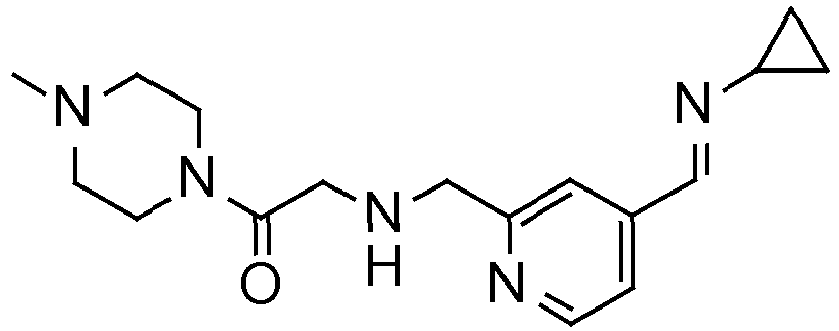
54 2-[({4-[N-cyclopropylcarboximidoyl ]pyridin-2-yl}methyl)amino]-1-(4-methylpiperazin-1-yl)ethan-1-one V 1H NMR (300 MHz, CDCl3), δ ppm: 8.56 (d, 1H), 8.39 (s, 1H), 2.29 (s, 3H), 0.99 (m, 4H). 
55 1-(4-benzylpiperidin-1-yl)-2-[({4-[N-cyclopropylcarboxi midoyl ]pyridin-2-yl}methyl)amino]ethan-1-one V 1H NMR (300 MHz, CDCl3), δ ppm: 8.59 (d, 1H), 8.42 (s, 1H), 7.32-7.12 (m, 5H), 0.99 (m, 4H). 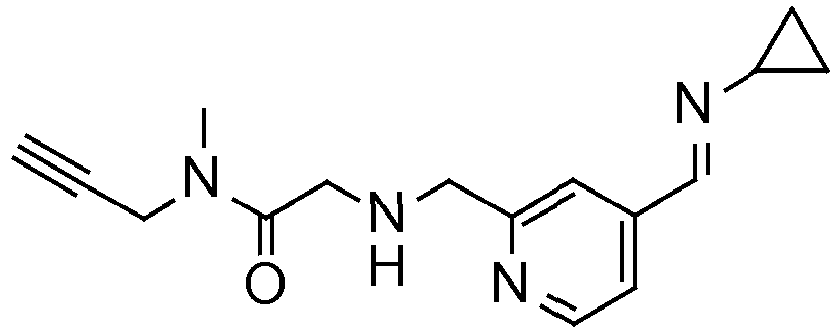
56 2-[({4-[N-cyclopropylcarboximidoyl ]pyridin-2-yl}methyl)amino]-N-methyl-N-(prop-2-yn-1-yl)acetamide V 1H NMR (300 MHz, CDCl3), δ ppm: 8.58 (d, 1H), 8.42 (s, 1H), 3.01 (m, 3H), 1.02 (m, 4H). 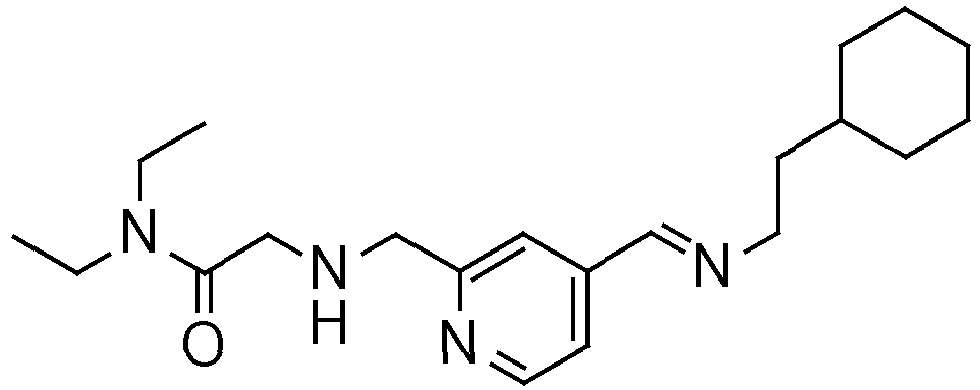
57 2-[({4-[[(2-cyclohexylethyl)imino]me thyl]pyridin-2-yl}methyl)amino]-N,N-diethylacetamide V 1H-NMR (300 MHz, CDCl3), δ ppm: 8.6 (d, 1H), 8.3 (s, 1H), 1.6 (m, 6H), 1.4-1.1 (m, 11H) 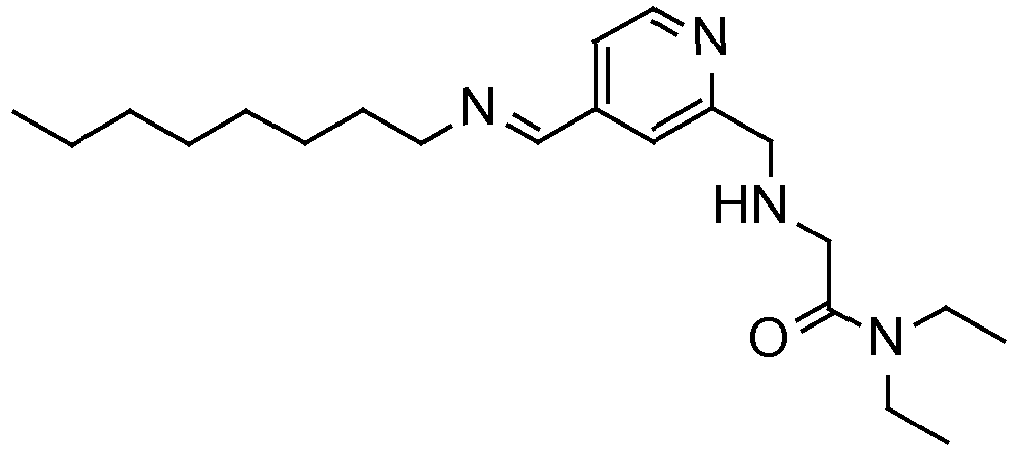
58 N,N-diethyl-2-[({4-[(octylimino)methyl]pyrid in-2-yl}methyl)amino]acetami de V 1H-NMR (300 MHz, CDCl3), δ ppm: 8.6 (d, 1H), 8.2 (s, 1H), 1.4 (m, 10H), 0.9 (t, 3H) 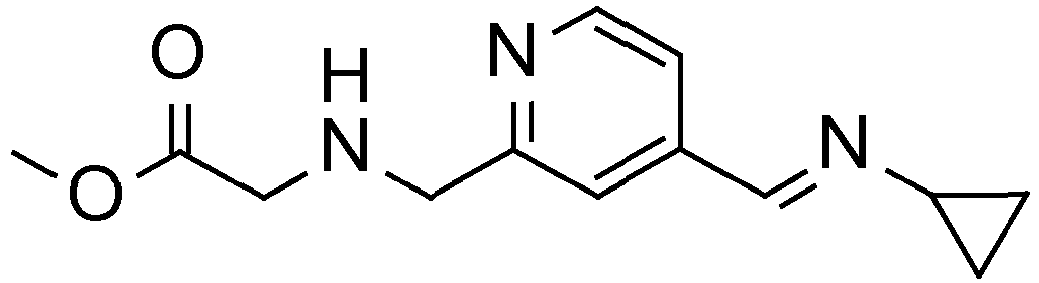
59 methyl 2-[({4-[N-cyclopropylcarboximidoyl ]pyridin-2-yl}methyl)amino]acetate P 1H-NMR (300 MHz, CDCl3), δ ppm: 8.6 (d, 1H), 8.3 (s, 1H), 3.7 (s, 3H), 3.1 (m, 1H) 
60 [4-(diethylamino)butyl]({4-[[(2-methoxyethyl)imino]met hyl]pyridin-2-yl}methyl)amine X 1H NMR (300 MHz, CDCl3), δ ppm: 8.61 (d, 1H), 8.29 (s, 1H), 2.51 (q, 4H), 1.01 (t, 6H). 
61 2-[{[2-({[4-(diethylamino)butyl]amin o}methyl)pyridin-4-yl]methylidene}amino]et han-1-ol N 1H-NMR (300 MHz, CDCl3), δ ppm: 8.6 (d, 1H), 8.3 (s, 1H), 1.5 (m, 4H), 1.0 (t, 6H) 
62 {[2-({[4-(diethylamino)butyl]amin o}methyl)pyridin-4-yl]methylidene}(2,2,3,3, 3-pentafluoropropyl)amine N 1H-NMR (300MHz, CDCl3), δ ppm: 8.53 (d, 1H), 8.30 (s, 1H), 1.90 (m, 4H), 1.30 (t, 6H). 
63 2-[({4-[[(2-cyclohexylethyl)imino]me thyl]pyridin-2-yl}methyl)amino]-N-[2-(dimethylamino)ethyl]-N-ethylacetamide X 1H NMR (300 MHz, CDCl3), δ ppm: 8.56 (d, 1H), 8.22 (s, 1H), 1.76-1.51 (m, 7H), 1.22-1.07 (m, 6H) 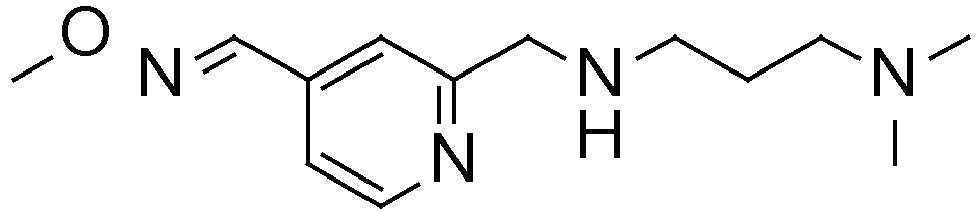
64 [3-(dimethylamino)propyl]( [(methoxyimino)methyl] pyridin-2-yl}methyl)amine N 1H NMR (300 MHz, Methanol-d4), δ ppm: 8.66 (d, 1H), 8.15 (s, 1H), 4.01(s, 3H), 2.93 (s, 6H). 
65 [4-(diethylamino)butyl]({[4 -(1-methylimidazolidin-2-yl)pyridin-2-yl]methyl})amine N 1H-NMR (300 MHz, CDCl3), δ ppm: 8.5 (d, 1H), 7.4 (s, 1H), 2.3 (s, 3H), 1.0 (t, 6H) 
66 N-[2-(dimethylamino)ethyl]-N-ethyl-2-[({4-[([(2-hydroxyethyl)imino]meth yl]pyridin-2-yl}methyl)amino]acetami de X 1H NMR (300 MHz, CDCl3): δ ppm 8.54 (d, 1H), 3.93 (s, 2H), 3.43 (s, 2H), 3.40-3.32 (m, 2H), 3.25-3.17 (m, 2H), , 2.21 and 2.16 (two singlets, 6H, rotamers). 
67 (2-cyclohexylethyl)( {[2-({[4-(diethylamino)butyl]amin o}methyl)pyridin-4-yl]methylidene})amine X 1H NMR (300 MHz, CDCl3) δ ppm 8.56 (d, 1H), , 3.93 (s, 2H), , 2.65 (q, 4H), 2.56 (t, 2H), 1.05 (t, 6H). 
68 [4-(diethylamino)butyl]({[4 -(1-methyl-1,3-diazinan-2-yl)pyridin-2-yl]methyl})amine N 1H NMR (300 MHz, chloroform-d): δ ppm 8.49 (d, 1H), 3.87 (s, 2H), 3.68 (s, 1H), 3.51 (q, 4H), 2.36 (m, 4H), 1.93 (s, 3H), 0.99 (t, 6H). 
69 N,N-diethyl-2-[({4-[{[2-(4-methylphenyl)ethyl]imino }methyl]pyridin-2-yl}methyl)amino]acetami de O 1H NMR (300 MHz, CDCl3), δ ppm: 8.6 (d, 1H), 8.1 (s, 1H), 4.1 (s, 2H), 3.8 (m, 2H), 3.6 (s, 2H), 1.1 (m, 6H). 
70 4-[2-{[2-({[4-(diethylamino)butyl]amin o}methyl)pyridin-4-yl]methylidene}hydrazin-1-yl] benzonitrile N 1H NMR (300 MHz, chloroform-d): δ ppm 8.63 (d, 1H), 7.88 (s 1H), 7.82 (s, 1H), 4.46 (s, 2H), 3.32 (m, 4H), 1.34 (t, 6H). 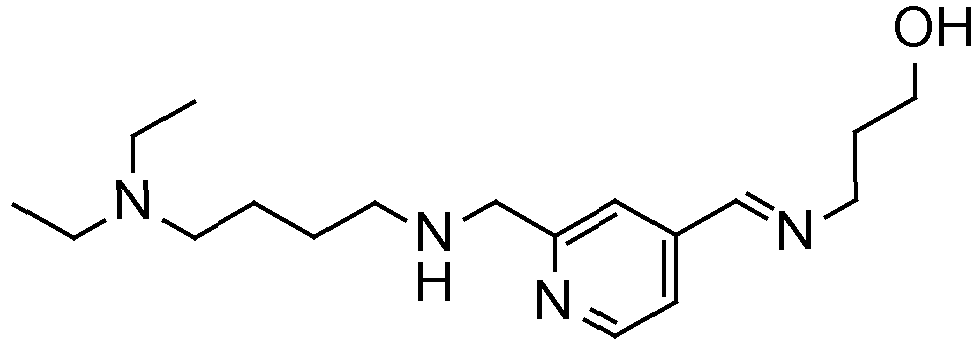
71 3-[{[2-({[4-(diethylamino)butyl]amin o}methyl)pyridin-4-yl]methylidene}amino]pr opan-1-ol X 1H NMR (300 MHz, chloroform-d): δ ppm 8.61 (d, 1H), 7.88 (s, 1H), , 2.67 (m, 2H), 2.51 (q, 4H), 1.00 (t, 6H). 
72 [4-(diethylamino)butyl][(4-{7-oxa-9-azaspiro[4.5]decan-8-yl}pyridin-2-yl)methyl]amine X 1H NMR (300 MHz, chloroform-d): δ ppm 8.53 (d, 1H), 7.44 (s, 1H), 5.08 (s, 1H), 2.53 (q, 4H), 1.57 (m, 8H), 1.02 (t, 6H). 
73 2-[{[2-({[4-(diethylamino)butyl]amin o}methyl)pyridin-4-yl]methylidene}amino]pr opan-1-ol X 1H NMR (300 MHz, chloroform-d): δ ppm 8.60 (d, 1H), 8.32 (s, 1H), 3.94 (s, 2H), , 2.51 (q, 4H), 1.24 (d, 3H), 1.02 (t, 6H). 
74 1-[{[2-({[4-(diethylamino)butyl]amin o}methyl)pyridin-4-yl]methylidene}amino]pr opan-2-ol X 1H NMR (300 MHz, chloroform-d): δ ppm 8.62 (d, 1H), 8.30 (s, 1H), 4.11 (m, 1H), 3.95 (s, 2H), 2.52 (q, 4H), 1.01 (t, 6H). 
75 2-[{[2-({[4-(diethylamino)butyl]amin o}methyl)pyridin-4-yl]methylidene}amino]-2-phenylethan-1-ol X 1H NMR (300 MHz, chloroform-d): δ ppm 8.57 (d, 1H), 8.36 (s, 1H), 7.37 (m, 6H), 4.51 (m, 1H), 2.51 (q, 4H), 1.00 (t, 6H). 
76 3-[{[2-({[4-(diethylamino)butyl]amin o}methyl)pyridin-4-yl]methylidene}amino]-2,2-dimethylpropan-1-ol X 1H NMR (300 MHz, chloroform-d): δ ppm 8.54 (d, 1H),7.45 (s, 1h), 3.91 (s, 2H), 2.52 (q, 4H), 1.00 (t, 6H), 0.96 (s, 6H). 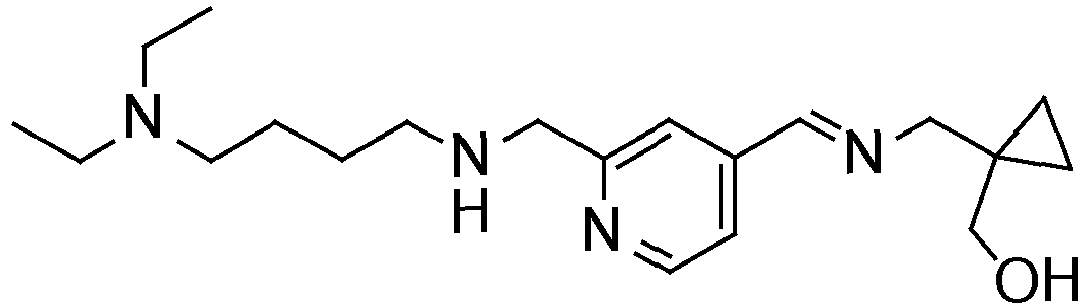
77 (1-{[{[2-({[4-(diethylamino)butyl]amin o}methyl)pyridin-4-yl]methylidene}amino]m ethyl}cyclopropyl)metha nol X 1H NMR (300 MHz, chloroform-d): δ ppm 8.64 (d, 1H), 8.19 (s, 1H), 3.94 (s, 2H), 2.53 (q, 4H), 1.02 (t, 6H), 0.52 (m, 4H). 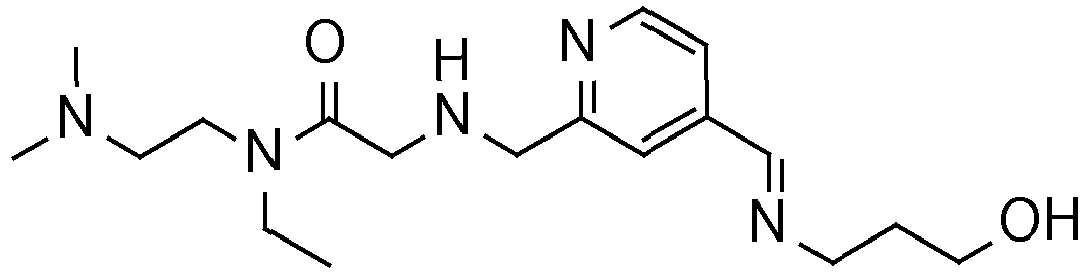
78 N-[2-(dimethylamino)ethyl]-N-ethyl-2-[({4-[[(3-hydroxypropyl)imino]met hyl]pyridin-2-yl}methyl)amino]acetami de X 1H NMR (300 MHz, chloroform-d): δ: 8.6 (m, 1H), 8.2 (s, 1H), 3.5 (m, 2H), 2.3 (s, 3H), 2.2 (s, 3H), 1.1 (m, 3H). 
79 N-ethyl-2-[({4-[[(2-hydroxyethyl)imino]meth yl]pyridin-2-yl}methyl)amino]-N-[(1-methylpyrrolidin-2-yl)methyl]acetamide X 1H NMR (300 MHz, CDCl3): δ ppm 8.59 (d, 1H), 8.31 (s, 1H), 3.98 (s, 2H), , 2.44 (m, 1H), 2.37 and 2.28 (two singlets, 3H), , 1.16-1.10 (m, 3H). 
80 2-{[{[2-({[4-(diethylamino)butyl]amin o}methyl)pyridin-4-yl]methylidene}amino] m ethyl}-3-phenylpropan-1-ol X 1H NMR (300 MHz, chloroform-d): δ ppm 8.51 (d, 1H), 7.44 (s, 1H), 7.24 (m, 6H), 3.94 (s, 2H), 3.70 (m, 2H), 2.72 (m, 2H), 2.61 (q, 4H), 2.49 (m, 4H), 1.57 (m, 4H), 1.06 (t, 6H). 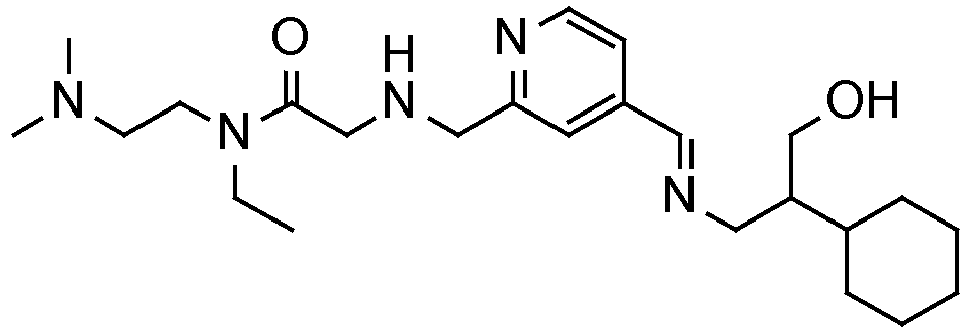
81 2-[({4-[[(2-cyclohexyl-3-hydroxypropyl)imino]met hyl]pyridin-2-yl}methyl)amino]-N-[2-(dimethylamino)ethyl]-N-ethylacetamide X 1H NMR (300 MHz, chloroform-d): δ ppm: 8.6 (m, 1H), 8.2 (s, 1H), 4.0-3.8 (m, 4H), 2.3 (s, 3H), 2.2 (s, 3H), 1.8-1.6 (m, 12H), 1.1 (m, 3H). 
82 N-[3-(dimethylamino)propyl]-N-ethyl-2-[({4-[[(2-hydroxyethyl)imino]meth yl]pyridin-2-yl}methyl)amino]acetami de X 1H NMR (300 MHz, CDCl3): δ ppm 8.55 (d, 1H), 8.27 (s, 1H), 3.95 (s, 2H), , 2.18 and 2.13 (two singlets, 6H), 1.13-1.07 (m, 3H). 
83 N-[2-(dimethylamino)propyl]-N-ethyl-2-[({4-[[(2-hydroxyethyl)imino]meth yl]pyridin-2-yl}methyl)amino]acetami de O 1H NMR (300 MHz, CDCl3): δ ppm 8.59 (d, 1H), 8.31 (s, 1H), 3.98 (s, 2H), 3.43 (s, 2H), 3.43 (m, 1H), , 2.25 and 2.19 (two singlets, 6H), 0.91 (d, 3H). 
84 1-[{[2-({[4-(diethylamino)butyl]amin o}methyl)pyridin-4-yl]methylidene}amino]-3-phenylpropan-2-ol N 1H NMR (300 MHz, chloroform-d): δ ppm 8.63 (d, 1H), 8.31 (s, 1H), 7.27 (m, 5H), 4.19 (m, 1H), 3.96 (s, 2H), 2.51 (q, 4H), 1.01 (t, 6H). 
85 N-{[(1S,2S)-2-(dimethylamino)cyclopen tyl]methyl}-N-ethyl-2-[({4-[[(2-hydroxyethyl)imino]meth yl]pyridin-2-yl}methyl)amino]acetami de N 1H NMR (300 MHz, CDCl3): δ ppm 8.55 (d, 1H), 8.27 (s, 1H), 3.96 (s, 2H), 2.38 (m, 1H), 2.23 and 2.16 (two singlets, 6H), 1.65-1.41 (m, 5H), 1.12-1.07 (m, 3H). 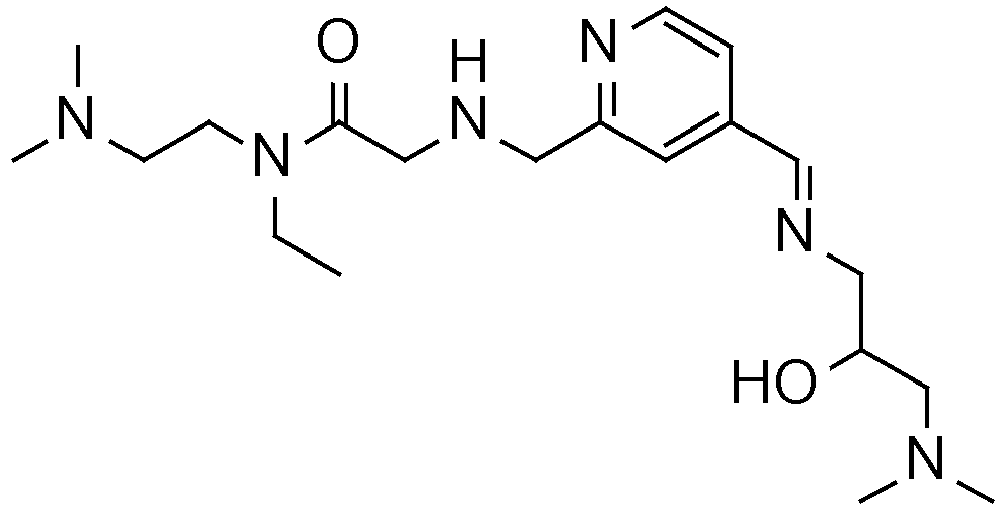
86 2-[({4-[{[3-(dimethylamino)-2-hydroxypropyl]imino}me thyl]pyridin-2-yl}methyl)amino]-N-[2-(dimethylamino)ethyl]-N-ethylacetamide N 1H NMR (300 MHz, chloroform-d): δ ppm: 8.6 (d, 1H), 8.2 (s, 1H), 4.0-3.8 (m, 4H), 3.3 (m, 6H), 2.3-2.1 (m, 12H), (m, 3H). 
87 2-[4-(5,5-dimethyl-1,3-oxazinan-2-yl)pyridin-2-yl]methyl}amino)-N-[2-(dimethylamino)ethyl]-N-ethylacetamide N NMR (300 MHz, chloroform-d): δ ppm 8.50 (m, 1H), 5.00 (s, 1H), 4.00 (s, 2H), 2.20 (d, 6H), 1.10 (m, 6H). 
88 N-[2-(dimethylamino)ethyl]-N-ethyl-2-[({4-[({[1-(hydroxymethyl)cyclopro pyl]methyl}imino)methyl ]pyridin-2-yl}methyl)amino]acetami de N 1H NMR (300 MHz, CD3OD), δ ppm: 8.9 (d, 1H), 7.7 (s, 1H), 7.6 (d, 1H), 5.9 (s, 1H), 4.6 (s, 2H), 4.3, 2H), 3.8 (m, 2H), 3.5 (s, 2H), 3.3 (m, 8H), 1.2 (m, 3H), 0.9 (m, 3H), 0.6 (m, 2H), 0.4 (m, 2H). 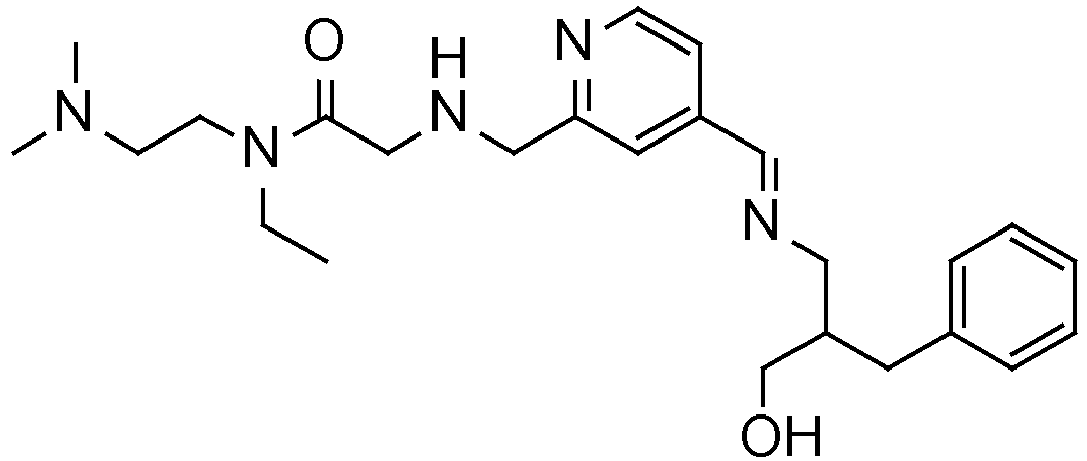
89 2-[({4-[[(2-benzyl-3-hydroxypropyl)imino]met hyl]pyridin-2-yl}methyl)amino]-N-[2-(dimethylamino)ethyl]-N-ethylacetamide N 1H-NMR (300 MHz, CD3OD), δ 8.75 (d, 1H), 7.70 (s, 1H), 7.60 (d, 1H), 7.30 (m, 5H), 5.70 (s, 1H), 4.50 (s, 2H), 4.25 (m, 2H), 3.80 (m, 3H), 3.00 (s, 6H), 2.60 (m, 4H), 1.20 (t, 3H) 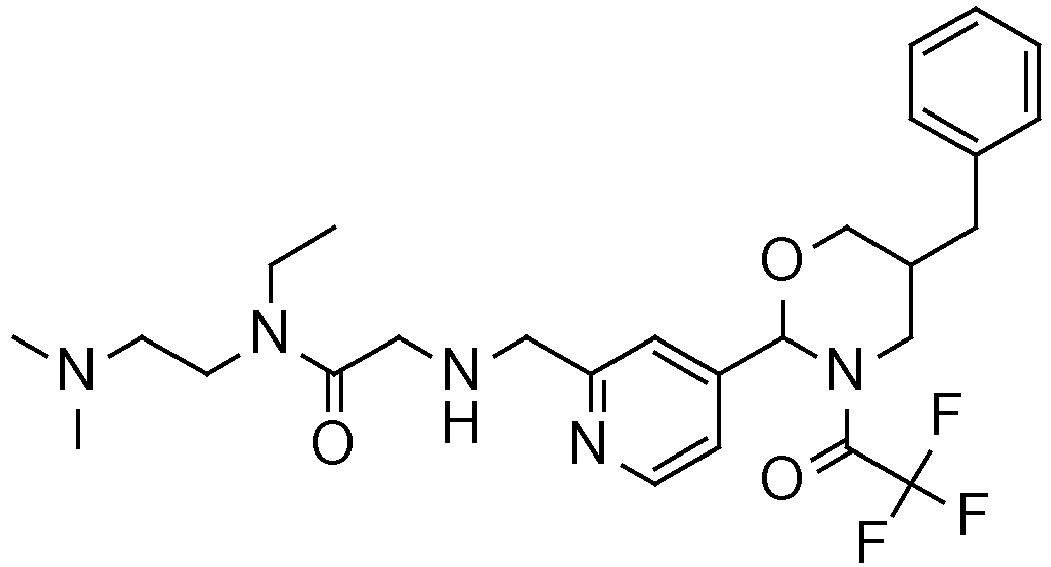
90 2-[({4-[5-benzyl-3-(trifluoroacetyl)-1,3-oxazinan-2-yl]pyridin-2-yl}methyl)amino]-N-[2-(dimethylamino)ethyl]-N-ethylacetamide Y 1H-NMR (300 MHz, CD3OD), δ 8.70 (d, 1H ), 7.40 (m, 2H), 7.25 (m, 5H), 4.50 (s, 1H), 4.20 (m, 4H), 3.80 (m, 3H), 3.05 (s, 6H), 2.60 (m, 4H), 1.20 (t, 3H). 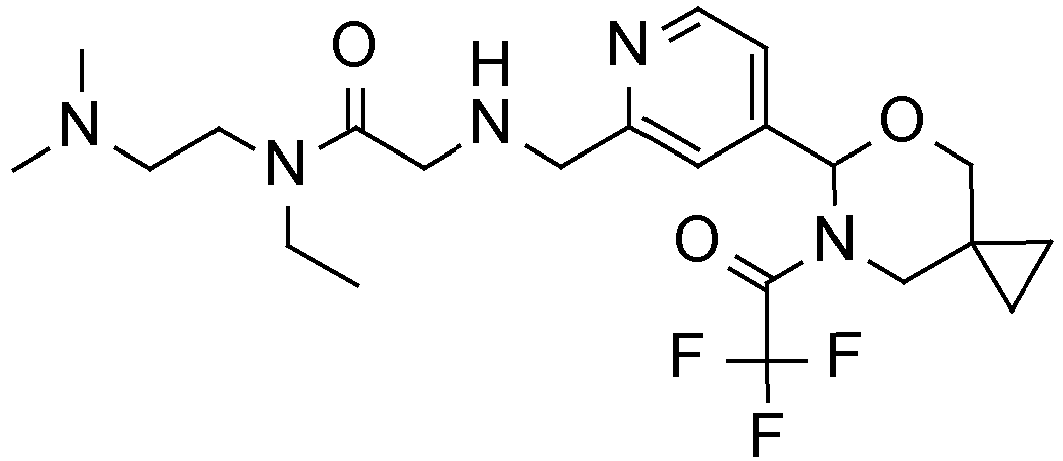
91 N-[2-(dimethylamino)ethyl]-N-ethyl-2-[({4-[7-(trifluoroacetyl)-5-oxa-7-azaspiro[2.5]octan-6-yl]pyridin-2-yl}methyl)amino]acetami de Y 1H-NMR (300 MHz, CD3OD), δ ppm: 8.8 (d, 1H), 7.5 (m, 2H), 6.7 (m, 1H), 4.5 (s, 2H), 4.2 (s, 2H), 3.7 (t, 2H), 3.4 (m, 6H), 3.0 (m, 8H), 1.2 (m, 3H), 0.6 (m, 2H), 0.4 (m, 2H). 
92 N-[(2-fluorophenyl)methyl]-2-[({4-[[(2-hydroxyethyl)imino]meth yl]pyridin-2-yl}methyl)amino]-N-methylacetamide O 1H-NMR (300 MHz, CD3OD), δ 8.55 (d, 1H), 7.55 (s, 1H), 7.50 (s, 1H 7.30 (m, 3H), 7.10 (m, 3H), 5.50 (s, 1H), 4.70 (s, 2H), 4.50 (s, 2H), 3.30 (s, 2H), 3.00 (m, 6H), 2.60 (m, 4H). 
93 2-[({2-[({2-[2-(benzyloxy)phenyl]ethyl} amino)methyl]pyridin-4-yl}methylidene)amino]et han-1-ol N NMR (300 MHz, chloroform-d): δ ppm 8.60 (m, 1H), 8.20 (s, 1H), 6.90 (m, 3H), 5.10 (s, 2H), 2.96 (m, 4H). 
94 N-(2-cyanoethyl)-N-ethyl-2-[({4-[[(2-hydroxyethyl)imino]meth yl]pyridin-2-yl}methyl)amino]acetami de O 1H NMR (300 MHz, chloroform-d): δ ppm 8.58 (d, 1H), 8.29 (s, 1H), 7.65 (s, 1H), 7.44 (d, 1H), 3.97 (s, 2H), 3.91 (m, 2H), 3.78 (m, 2H), 3.55 (t, 2H), 3.50 (s, 2H), 3.36 (q, 2H), 2.68 (m, 4H), 1.17 (t, 3H). 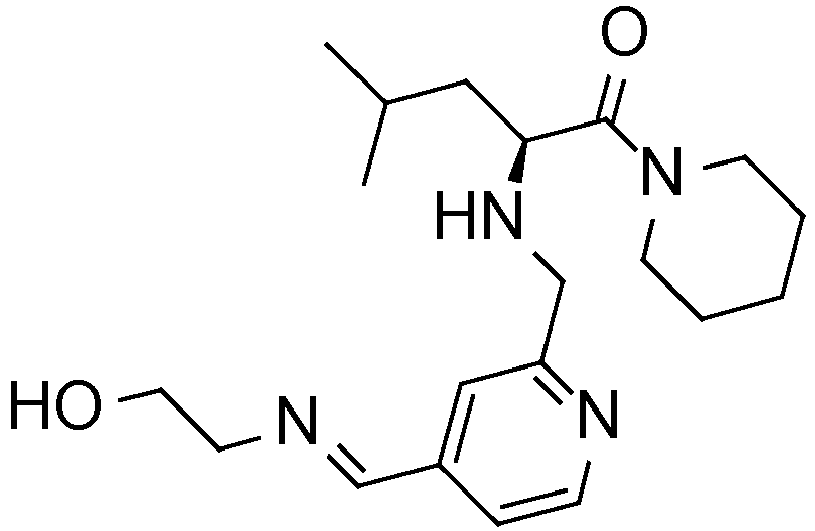
95 (2S)-2-[({4-[[(2-hydroxyethyl)imino]meth yl]pyridin-2-yl}methyl)amino]-4-methyl-1-(piperidin-1-yl)pentan-1-one O 1H NMR (300 MHz, chloroform-d): δ ppm: 8.7(s, 1H), 8.3 (s, 1H), 7.7 (s, 1H), 7.5 (d, 1H), 4.1-3.3 (m, 1H), 1.7-1.4 (m, 8H), 0.9 (d, 6H). 
96 2-[{4-[([(2-hydroxyethyl)imino]meth yl]pyridin-2-yl}methyl)amino]-N-methyl-N-(2-phenylethyl)acetamide O 1H NMR (300 MHz, chloroform-d): δ ppm: 8.6 (d, 1H), 8.3 (s, 1H), 7.6 (d, 1H), 7.4 (s, 1H), 7.3-7.1 (m, 5H), 4.0-3.8 (m, 11H), 2.1 (m, 1H), 3.4 (m, 2H), 3.0 (s, 2H), 2.9 (m, 5H). 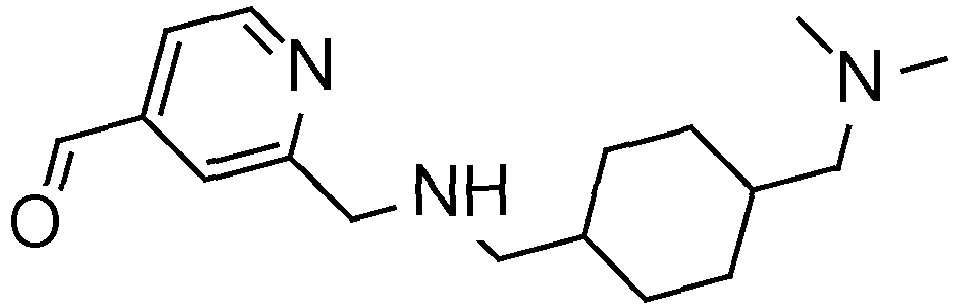
97 2-{[({4-[(dimethylamino)methyl] cyclohexyl}methyl)amino ]methyl}pyridine-4-carbaldehyde Z 1H NMR (300 MHz, Methanol-d4), δ ppm: 8.89 (d, 1H), 8.26 (s, 1H), 2.91 (s, 6H), 1.95 (m, 6H). 
98 2-({[(2E)-4-(dimethylamino)but-2-en-1-yl]amino}methyl)pyridin e-4-carbaldehyde Z 1H NMR (300 MHz, Methanol-d4), δ ppm: 8.91 (d, 1H), 6.25 (m, 2H), 5.75 (s, 1H), 2.93 (s, 6H). 
99 2-({[(2Z)-4-(dimethylamino)but-2-en-1-yl]amino}methyl)pyridin e-4-carbaldehyde AA 1H-NMR (300 MHz, Methanol-d4), δ ppm: 8.8 (d, 1H), 6.2 (m, 2H),4.6 (s, 2H), 2.9 (s,6H) 
100 2-({[(1-methylpiperidin-4-yl)methyl]amino}methyl) pyridine-4-carbaldehyde Z 1H NMR (300 MHz, Methanol-d4), δ ppm: 8.97 (d, 1H), 5.79 (s, 1H), 2.89 (s, 3H), 1.69 (m, 2H) 
101 N-[2-(dimethylamino)ethyl]-N-ethyl-2-{[(4-formylpyridin-2-yl)methyl]amino}acetami de AA 1H NMR (300 MHz, CD3OD), δ ppm: 8.94 (d, 1H), 8.42 (s, 1H), 2.99 (s, 6H), 1.29 (t, 3H). 
102 2-[({2-oxo-2-[(2R)-2-(pyrrolidin-1-ylmethyl)pyrrolidin-1-yl]ethyl}amino)methyl]p yridine-4-carbaldehyde AB 1H NMR (300 MHz, CD3OD), δ ppm: 8.91 (m, 1H), 8.36 (s, 1H), 2.27-2.00 (m, 7H), 1.85 (m, 1H) 
103 2-({[2-(4-methylpiperazin-1-yl)-2-oxoethyl]amino}methyl) pyridine-4-carbaldehyde AB 1H NMR (300 MHz, Methanol-d4), δ ppm: 8.89 (d, 1H), 5.74 (s, 1H), 4.51 (m, 4H), 2.97 (s, 3H). 
104 N-[(1-ethylpyrrolidin-2-yl)methyl]-2-{[(4-formylpyridin-2-yl)methyl]amino}acetami de AB 1H-NMR (300MHz, MeOD), δ ppm: 8.50 (d, 1H), 7.50 (s, 1H), 2.10 (m, 2H), 1.40 (t, 3H) 
105 N,N-diethyl-2-{[(4-formylpyridin-2-yl)methyl]amino}acetami de AB 1H-NMR (300MHz, MeOD), δ ppm: 8.90 (d, 1H), 8.40 (s, 1H), 3.20 (q, 2H), 1.20 (t, 3H) 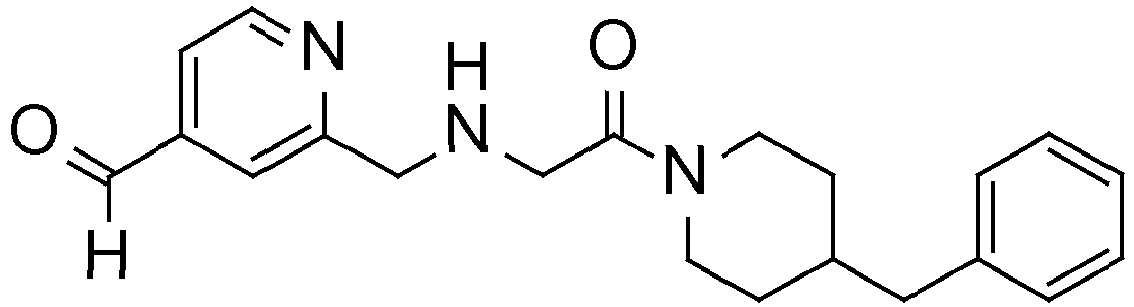
106 2-({[2-(4-benzylpiperidin-1-yl)-2-oxoethyl]amino}methyl) pyridine-4-carbaldehyde AB 1H NMR (300 MHz, Methanol-d4), δ ppm: 8.95 (d, 1H), 7.22 (m, 5H), 5.79 (s, 1H), 1.86 (m, 1H). 
107 2-({[4-(diethylamino)butyl]amin o}methyl)pyridine-4-carbaldehyde Z 1H-NMR (300MHz, MeOD), δ ppm: δ 8.90 (d, 1H), 8.48 (s, 2H), 1.90 (m, 4H), 1.40 (t 6H) 
108 2-({[4-(dimethylamino)butyl]am ino}methyl)pyridine-4-carbaldehyde Z 1H-NMR (300MHz, MeOD), δ ppm: 8.85 (d, 1H), 8.30 (s, 1H), 2.90 (s, 6H), 1.90 (m, 4H) 
109 2-[({4-[benzyl(cyclopropyl)amin o]butyl}amino)methyl]py ridine-4-carbaldehyde AC 1H-NMR (300MHz, CDCl3), δ ppm: 8.90 (d, 1H), 8.40 (s, 1H), 7.50 (m, 5H), 0.90 (m, 4H) 
110 2-({[2-(dimethylamino)ethyl]am ino}methyl)pyridine-4-carbaldehyde Z 1H NMR (300 MHz, Methanol-d4), δ ppm: 8.94 (d, 1H), 5.76 (s, 1H), 3.76 (m, 4H), 3.05 (m, 6H) 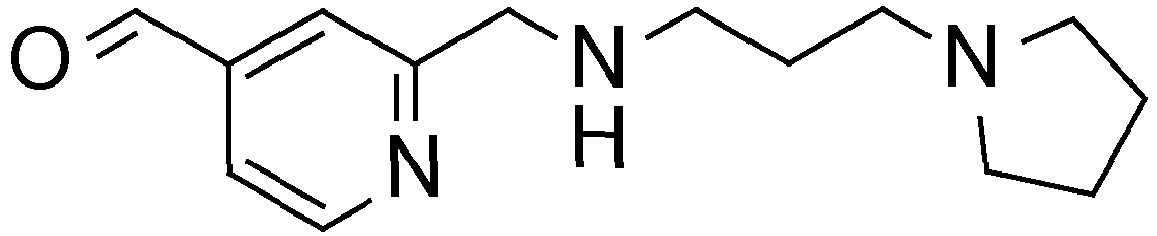
111 2-({[3-(pyrrolidin-1-yl)propyl]amino}methyl) pyridine-4-carbaldehyde Z 1H-NMR (300MHz, Methanol-d4), δ ppm: 8.80 (s, 1H), 5.70 (s, 1H), 4.10-3.40 (m, 6H), 2.98-2.40 (m, 2H). 
112 N-[4-(diethylamino)butyl]-2-{[(4-formylpyridin-2-yl)methyl]amino}acetami de AB 1H NMR (300 MHz, Methanol-d4), δ ppm: 8.84 (d, 0.5H), 5.71 (s, 1H), 1.61 (m, 2H), 1.35 (m, 6H). 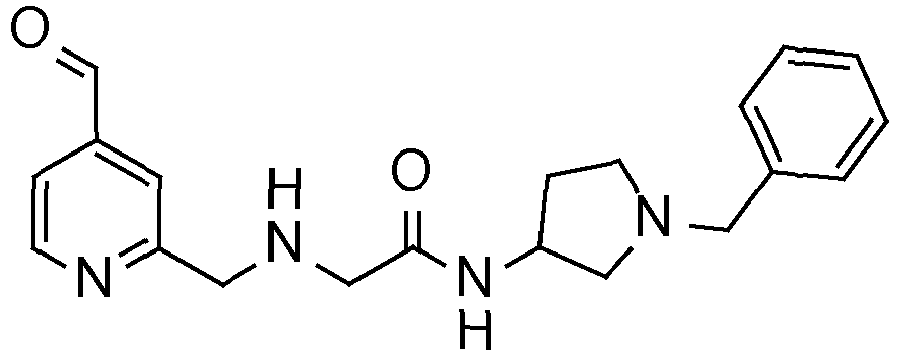
113 N-(1-benzylpyrrolidin-3-yl)-2-{[(4-formylpyridin-2-yl)methyl]amino}acetami de AB 1H-NMR (300MHz, MeOD), δ ppm: 8.90 (m, 2H), 8.30 (m, 1H), 7.40 (m, 5H), 2.00 (m, 2H) 
114 2-({[5-(dimethylamino)pentyl]a mino}methyl)pyridine-4-carbaldehyde Z 1H-NMR (300MHz, MeOD), δ ppm: 8.80 (d, 1H), 8.20 (s, 1H), 2.90 (s, 6H), 1.80 (m, 4H) 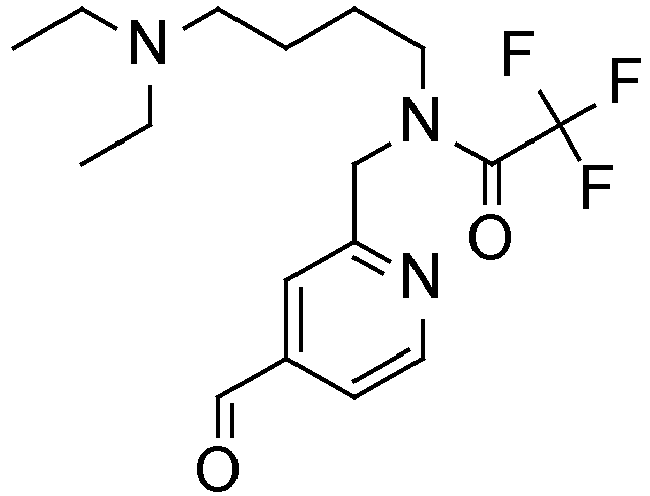
115 N-[4-(diethylamino)butyl]-2,2,2-trifluoro-N-[(4-formylpyridin-2-yl)methyl]acetamide AD 1H NMR (300 MHz, CDCl3), δ ppm: 10.09 (d, 1H), 8.83 (dd, 1H), 1.76 (m, 4H), 1.33 (m, 6H) 
116 N-[2-(diethylamino)ethyl]-N-ethyl-2-{[(4-formylpyridin-2-yl)methyl]amino}acetami de AA 1H NMR (300 MHz, CD3OD): δ ppm 8.87 (d, 1H), 8.19 (s, 1H), 8.00 (dd, 1H), 5.73 (s, 1H), 4.74 (s, 2H), 4.39 (s, 2H), 3.83 (t, 2H), 3.49-3.28 (m, 8H), 1.38 (t, 6H), 1.29 (t, 3H). 
117 2-[({[3-(dimethylamino)cyclopen tyl]methyl}amino)methyl ]pyridine-4-ca rbaldehyde Z 1H-NMR (300MHz, CDCl3), δ ppm: 8.90 (s, 1H), 5.80 (s, 1H), 2.80 (s, 6H), 2.50 - 2.00 (m, 6H). 
118 N-[2-(dimethylamino)-2-methylpropyl]-N-ethyl-2-{[(4-formylpyridin-2-yl)methyl]amino}acetami de AA 1H NMR (300 MHz, DMSO-d6) δ 10.1 (s, 1H), 8.91 (d, 1H), 4.49 (s, 2H), 4.24 (s, 2H), 2.72 (s, 6H), 1.34 (s, 6H), 1.12 (t, 3H). 
119 N-ethyl-2-{ [(4-formylpyridin-2-yl)methyl]amino}-N-[(1-methylpyrrolidin-2-yl)methyl]acetamide AA 1H NMR (300 MHz, CD3OD): δ ppm 8.26 (s, 1H), 4.77 (s, 2H), 4.45 (s, 2H), 3.21 (m, 1H), 3.03 (s, 3H), 2.20-2.07 (m, 2H), 1.29 (t, 3H). 
120 2-({methyl[2-oxo-2-(piperidin-1-yl)ethyl]amino}methyl)p yridine-4-carbaldehyde Z 1H-NMR (300MHz, CDCl3): δ 10.08 (s, 1H), 8.78 (d, 1H), 7.92 (s, 1H), 7.58 (d, 1H). -


- A solution of aldehyde (2,2,2-trifluoro-N-[(2-formylpyridin-4-yl)methyl]acetamide) and amine ((4-aminobutyl)diethylamine) (1.3 equiv.) in 1,2-dichloroethane was stirred for 2h at room temperature, before NaBH(AcO)3 (2 eq) was added. The mixture was stirred overnight at room temperature. The solvents were removed in vacuo and the residue was purified by preparative TLC (40% MeOH in DCM). The title product was isolated as colorless oil as the acetate salt. 1H NMR (300 MHz, CD3OD) δ ppm: 8.57 (d, 1H), 7.38 (s, 1H), 7.29 (d, 1H), 4.53 (s, 2H), 4.13 (s, 2H), 3.13 (q, 4H), 3.04 (t, 2H), 2.91 (t, 2H), 1.94 (s, 6H), 1.77 (m, 4H), 1.25 (t, 6H). ES-MS: 361 [M+H].
-


- Concentrated hydrochloric acid was added dropwise to the tert-butyl carbamate (tert-butyl N-{[4-(aminomethyl)pyridin-2-yl]methyl}-N-[4-(diethylamino)butyl]carbamate (I)) at 0 °C. The resulting solution was reduced to dryness in vacuo to yield the title product as colorless solid as the hydrochloric acid salt. 1H-NMR (300MHz, MeOD): δ 8.82 (d, 1H), 8.05 (s, 1H), 7.80 (d, 1H), 4.65 (s, 2H), 4.05 (s, 2H), 3.20 (m, 9H), 1.85 (m, 4H), 1.30 (t, 6H) ppm. ES-MS: 265 [M+H+].
-


- Trifluoroacetic anhydride (2.2 equiv.) was added dropwise to a solution of the amine ([2-({[4-(diethylamino)butyl]amino}methyl)pyridin-4-yl]methanamine) (1 equiv.) and DIPEA (2.5 equiv.) in anhydrous DCM at 0°C. The mixture was allowed to warm to room temperature and stirred for 12 hours. Quenched with sat. NaHCO3 (aq.). Aqueous work up gave the title compound. 1H-NMR (300MHz, CDCl3): δ 11.60, 11.45 (d, 1H), 9.10, 8.70 (d, 1H), 8.45, 8.40 (s, 1H), 7.20, 7.10 (d, 1H), 4.70 (d, 2H), 4.50 (t, 2H), 3.10 (m, 4H), 1.50 (t, 6H) ppm. ES-MS: 457 [M+1].
-
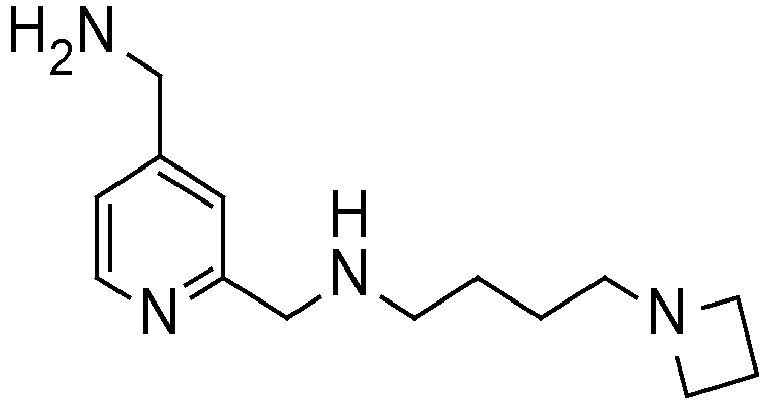

- General Procedure B from tert-butyl N-{[4-(aminomethyl)pyridin-2-yl]methyl}-N-[4-(azetidin-1-yl)butyl]carbamate yielded the hydrochloric acid salt of the title product as colorless solid. 1H-NMR (300MHz, CDCl3): δ 8.70 (d, 1H), 7.60 (s, 1H), 7.40 (d, 1H), 4.40 (s, 2H), 4.20 (s, 2H), 3.20 (s, 4H), 2.20 (m, 2H), 1.80 (m, 4H), 1.20 (m 4H) ppm. ES-MS: 249 [M+1].
-

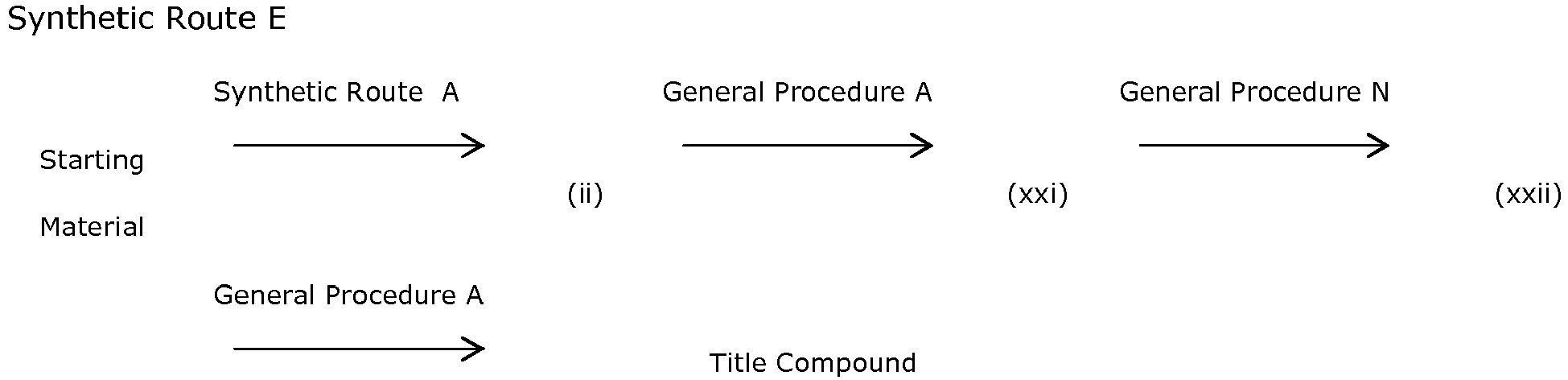
- By General Procedure A from (4-[(cyclopropylamino)methyl]pyridine-2-carbaldehyde and (4-aminobutyl)dimethylamine) (1.0 equiv.). Purification by column chromatography (CH2Cl2/MeOH/NH4OH, 90:10:1) yielded the title compound as a colorless glue. 1H NMR (300 MHz, CDCl3): δ 8.42 (d, 1H), 7.22 (S, 1H), 6.95 (m, 1H), 3.70 (s, 2H), 3.65 (s, 2H), 2.65 (m, 2H), 2.25 (m, 2H), 2.20 (s, 6H), 2.15 (m, 1H), 2.10 - 2.00 (m, 4H), 1.62 - 1.52 (m, 2H), 0.5 - 0.38 (m, 4H).
-


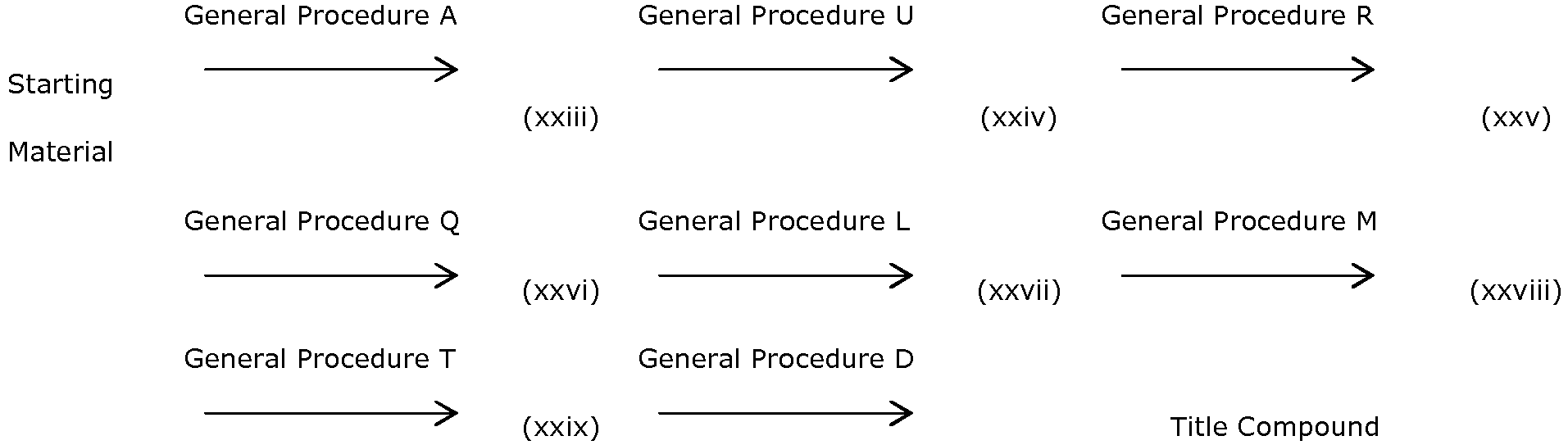
- Trifluoroacetic acid (100 equiv.) was added to a solution of the tert-butyl carbamate (or tert-butyl ester) (tert-butyl N-[(4-{[(cyanomethyl)amino]methyl} pyridin-2-yl)methyl]-N-[(dimethylcarbamoyl)methyl]carbamate) (1 equiv.) in DCM at 0 °C. The mixture was stirred at room temperature for 3 h. Evaporated to dryness to give the title product as trifluoroacetic acid salt. 1H NMR (300 MHz, methanol-d4): δ ppm 8.72 (d, 1H), 7.57 (s, 1H), 7.53 (d, 1H), 4.37 (s, 2H), 4.36 (s, 2H), 4.29 (s, 2H), 4.18 (s, 2H), 3.00 (s, 6H). ES-MS: 262 [M+1].
-
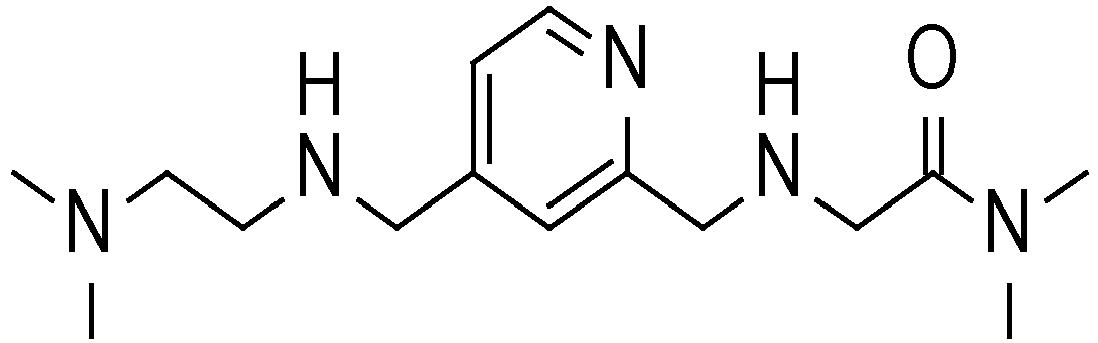


- KOH (1.0 M in H2O, 2.0 equiv.) was added to a solution of the trifluoroacetamide (N-{[4-({[2-(Dimethylamino)ethyl]amino}methyl)pyridin-2-yl]methyl}-N-[(dimethylcarbamoyl)methyl]-2,2,2-trifluoroacetamide) MeOH/H2O (1:1 vol). Stirred at 60 °C for about 1.0 h. Evaporated to dryness. Aqueous work up gave the title product as oil. 1H NMR (300 MHz, methanol-d4): δ ppm 8.44 (d, 1H), 7.47 (s, 1H), 7.32 (d, 1H), 3.90 (s, 2H), 3.83 (s, 2H), 3.50 (s, 2H), 2.96 (d, 6H), 2.71 (t, 2H), 2.49 (t, 2H), 2.25 (s, 6H). ES-MS: 294 [M+1].
-


- General Procedure B from tert-butyl N-{3-[benzyl(methyl)amino]propyl}-N-({4-[(methylamino)methyl]pyridin-2-yl}methyl)carbamate gave the hydrochloric acid salt of title compound. 1H NMR (300 MHz, CDCl3), δ ppm: 8.8(d, 1H), 8.0 - 7.4 (m, 7H), 4.6 - 4.2 (m, 6H), 3.9 (s, 2H), 3.5 - 3.2 (m, 4H), 3.0 - 2.7 (m, 4H), 2.4 - 2.2 (m, 2H), 1.2 - 0.9 (m, 4H).
-


- By General procedure B from tert-butyl N-({4-[(cyclopropylamino)methyl]pyridin-2-yl}methyl)-N-[({1-[(2-methoxyphenyl)methyl]piperidin-4-yl}carbamoyl)methyl]carbamate to give the title product as colorless sticky gum. 1H-NMR (300MHz, CD3OD): δ 8.78 (m, 1H), 7.90 (d, 1H), 7.80 (m, 1H), 7.45 (m, 2H), 7.10 (m, 1H), 7.02 (m, 1H), 4.58 & 4.50 (2s, 2H, rotamer), 4.40 & 4.30 (2S, 2H; rotamer), 4.10 (m, 1H), 3.90 (m, 5H), 3.60 - 3.65 (m, 2H), 3.20 (m, 2H), 2.60 (m, 1H), 2.18 (m, 2H), 1.82 (m, 2H), 0.9 - 0.8 (m, 4H).
-


- By General procedure D from tert-butyl N-({4-[cyano(methylamino)methyl]pyridin-2-yl}methyl)-N-[3-(dimethylamino)propyl]carbamate. Evaporation gave the title product as trifluoroacetic acid salt. 1H NMR (300 MHz, CD3OD) δ ppm: 8.83 (d, 1H), 7.75 (s, 1H), 7.68 (dd, 1H), 4.54 (s, 3H), 3.27 (m, 4H), 2.93 (s, 6H), 2.83 (s, 3H), 2.25 (m, 2H). ES-MS: 262 [M+1].
-


- By General procedure D from tert-butyl N-{4-[benzyl(cyclopropyl)amino]butyl}-N-[(4-{[(cyanomethyl)amino]methyl}pyridin-2-yl)methyl]carbamate. Purification by prep TLC (10% MeOH, 1% NH4OH in DCM) gave the title compound as colorless viscous oil. 1H-NMR (300MHz, CDCl3): δ 8.45 (d, 1H), 7.20-7.00 (m, 7H), 4.50 (m, 2H), 3.90 (s, 2H), 3.70 (s, 2H), 3.00 (m, 2H), 2.50 (m, 2H), 1.80 (m, 4H), 1.40 (m, 12H) 0.40 (m, 4H), ppm. ES-MS: 378 [M+1].
-
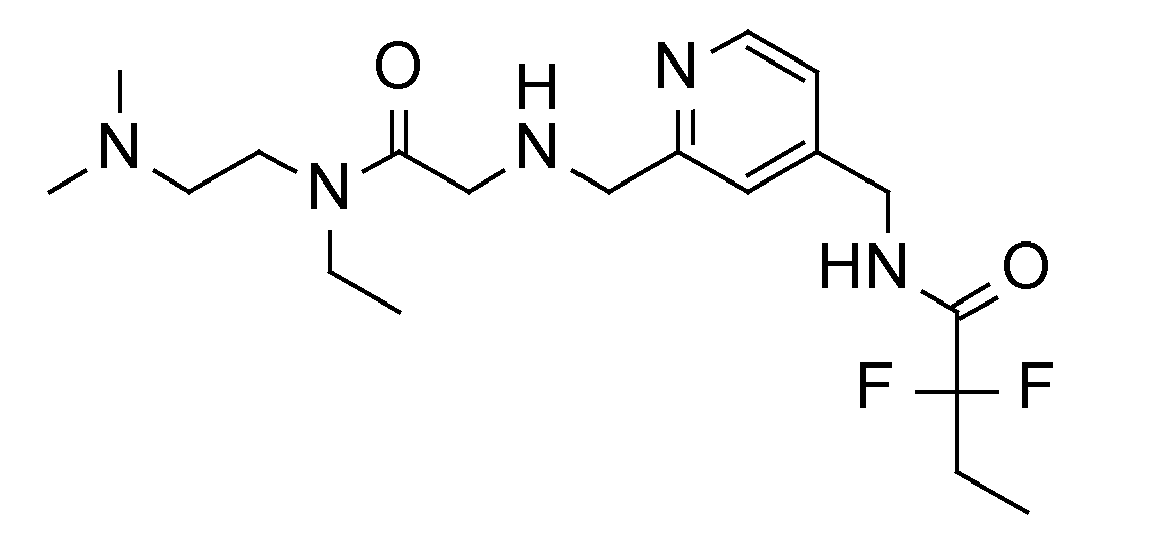
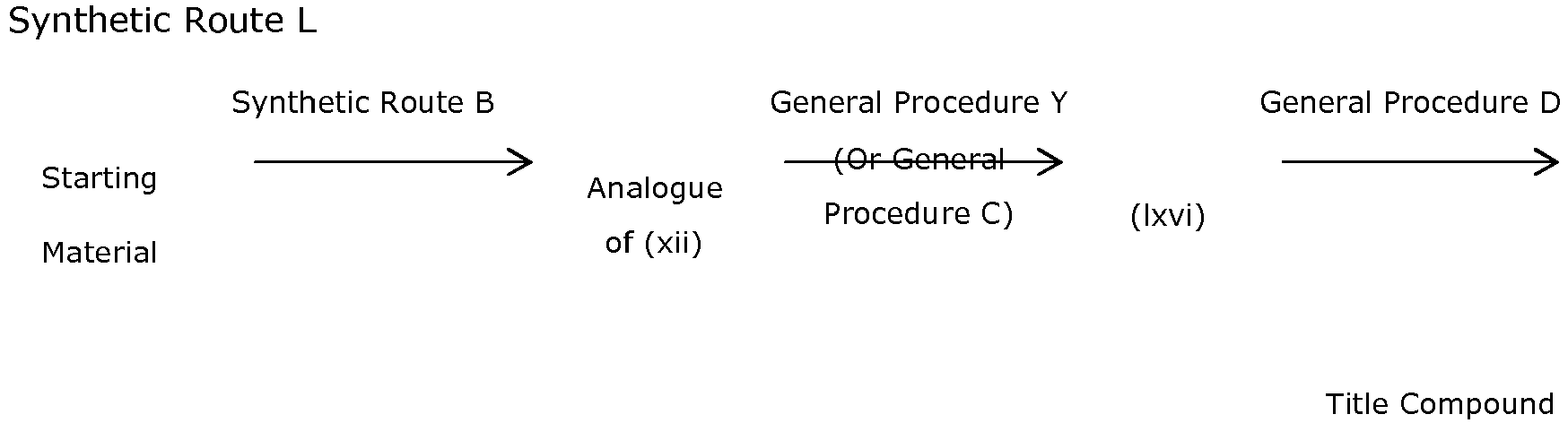
- By General procedure D from tert-butyl N-({4-[(2,2-difluorobutanamido)methyl]pyridin-2-yl}methyl)-N-({[2-(dimethylamino)ethyl](ethyl)carbamoyl}methyl)carbamate to get the title compound as it's trifluoroacetic acid salt as colorless oil. 1H NMR (300 MHz, CD3OD) δ 8.60 (d, 1H), 7.39 (s, 1H), 7.36 (d, 1H), 4.48 (m, 4H), 4.24 (s, 2H), 3.82 (t, 2H), 3.38 (m, 4H), 2.98 (s, 6H), 2.32 (m, 2H), 1.24 (t, 3H), 1.02 (t, 3H). ES-MS: 400.61 [M+1]
-


- By General Procedure E from tert-butyl ({[2-({N-[4-(diethylamino)butyl]-2,2,2-trifluoroacetamido}methyl)pyridin-4-yl]methyl}carbamoyl)formate. Concurrent hydrolysis of the tert-butyl ester and the trifluoroacetamide gave the title product as a yellow sticky gum. 1H NMR (300 MHz, methanol-d): δ ppm 8.40 (d, 1H), 7.38 (s, 1H), 7.20 (d, 1H), 4.45 (s, 2H), 3.80 (s, 2H), 2.70 - 2.40 (m, 8H), 1.60 - 1.42 (m, 4H), 1.00 (m, 6H). ES-MS: 337.58 [M+1]
-


- General Procedure D from tert-butyl-N-({4-[(E)-N-cyclopropylcarboximidoyl]pyridin-2-yl}methyl)-N-[(dimethylcarbamoyl)methyl]carbamate) gave the title product as it's trifluoroacetic acid salt as yellow oil. 1H NMR (300 MHz, chloroform-d): δ ppm 8.55 (d, 1H), 8.52 (s, 1H), 7.73 (s, 1H), 7.56 (d, 1H), 3.96 (s, 2H), 3.55 (s, 2H), 3.17 (m, 1H), 2.96 (d, 6H), 1.00 (m, 4H). ES-MS: 261 [M+1].
-
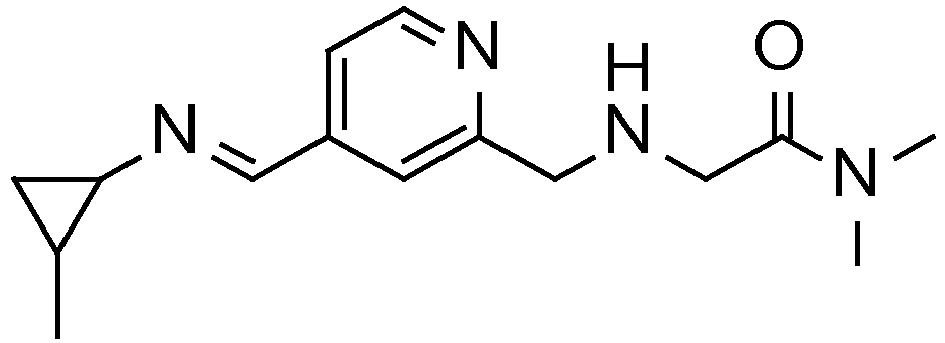

- General Procedure E from N-[(dimethylcarbamoyl)methyl]-2,2,2-trifluoro-N-({4-[N-(2-methylcyclopropyl)carboximidoyl]pyridin-2-yl}methyl)acetamide gave the title product as yellow oil. 1H NMR (300 MHz, chloroform-d): δ ppm 8.57 (d, 1H), 8.36 (s, 1H), 7.64 (s, 1H), 7.42 (d, 1H), 4.99 (s, 2H), 3.46 (s, 2H), 2.96 (d, 6H), 2.77 (m, 1H), 1.29 (m, 2H), 1.15 (d, 3H), 0.81 (m, 1H). ES-MS: 275 [M+1].
-


- Amine (cyclopropylamine) (10 equiv.) was added to a solution of aldehyde (2-({[2-(methylsulfanyl)ethyl]amino}methyl)pyridine-4-carbaldehyde) (1 equiv.) in DCE. Stirred at room temperature overnight. Evaporated to dryness. Purification by preparative TLC (DCM/MeOH/NH4OH (95/5/1)) gave the title product as pale yellow oil. 1H-NMR (300MHz, CDCl3): δ 8.5 (d, 1H), 8.4 (s, 1H), 7.6 (s, 1H), 7.4 (d, 1H), 3.9 (s, 2H), 3.0 (s, 1H), 2.8 (m, 2H),2.7 (m, 2H) 2.5 (m, 2H), 1.2 (t, 3H), 1.0 (m, 4H).
-


- General Procedure D from tert-butyl N-{3-[benzyl(methyl)amino]propyl}-N-({4-[(N-cyclopropylcarboximidoyl]pyridin-2-yl}methyl)carbamate. Evaporated to dryness to give the title product as trifluoroacetic acid salt without further purification. 1H NMR (300 MHz, CDCl3), δ ppm: 8.55 (d, 1H), 8.50 (s, 1H), 7.69 (s, 1H), 7.56 (dd, 1H), 7.28-7.22 (m, 5H), 3.89 (s, 2H), 3.50 (s, 2H), 3.20-3.13 (m, 1H), 2.65 (t, 2H), 2.45 (t, 2H), 2.11 (s, 3H), 1.82-1.73 (m, 2H), 1.04-0.97 (m, 4H).
-


- By General Procedure D from tert-butyl N-({4-[N-cyclopropylcarboximidoyl]pyridin-2-yl}methyl)-N-[(2E)-4-(dimethylamino)but-2-en-1-yl]carbamate. Purified by preparative TLC with 1% NH4OH and 10% MeOH in DCM to give title product as light yellow oil. 1H NMR (300 MHz, chloroform-d): δ ppm 8.59 (d, 1H), 8.41 (s, 1H), 7.55 (s, 1H), 7.42 (d, 1H), 5.71 (m, 2H), 3.93 (s, 2H), 3.31 (d, 2H), 3.08 (m, 1H), 2.92 (d, 2H), 2.23 (s, 6H), 0.94 (m, 4H). ES-MS: 273 [M+1].
-

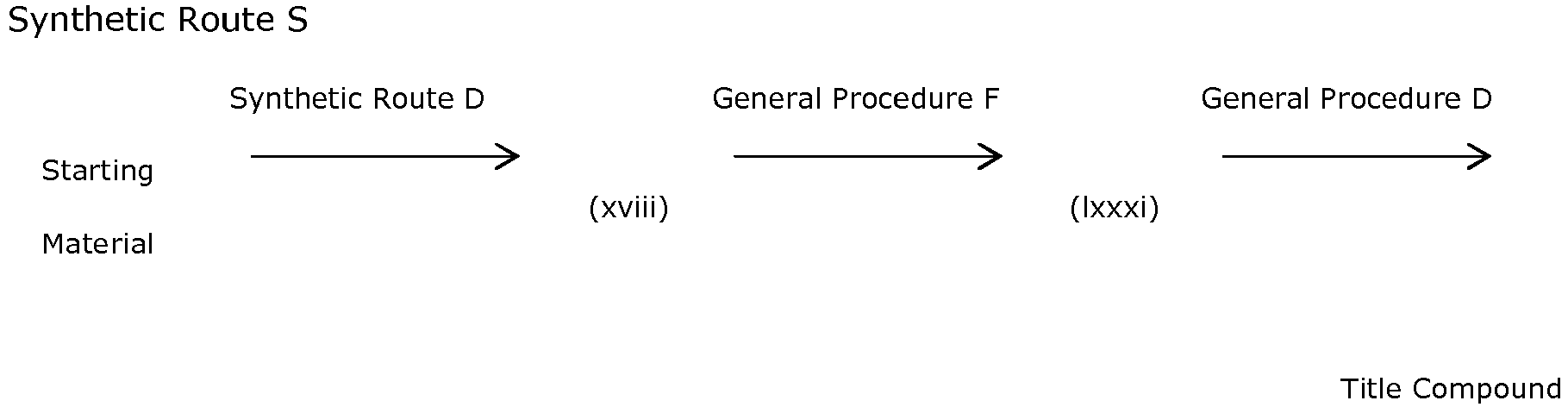
- General Procedure D from tert-butyl N-[4-(azetidin-1-yl)butyl]-N-({4-[N-cyclopropylcarboximidoyl]pyridin-2-yl}methyl)carbamate. Evaporation gave the title product as it trifluoroacetic acid salt without further purification. 1H-NMR (300MHz, CDCl3): δ 8.50 (d, 1H), 8.40 (s, 1H), 7.50 (s, 1H), 7.40 (d, 1H), 3.90 (s, 2H), 3.00 (m, 1H), 2.70 (m, 2H), 2.50 (m, 4H), 1.80 (m, 2H), 1.50 (m 6H), 1.00 (m, 4H) ppm. ES-MS: 287 [M+1].
-
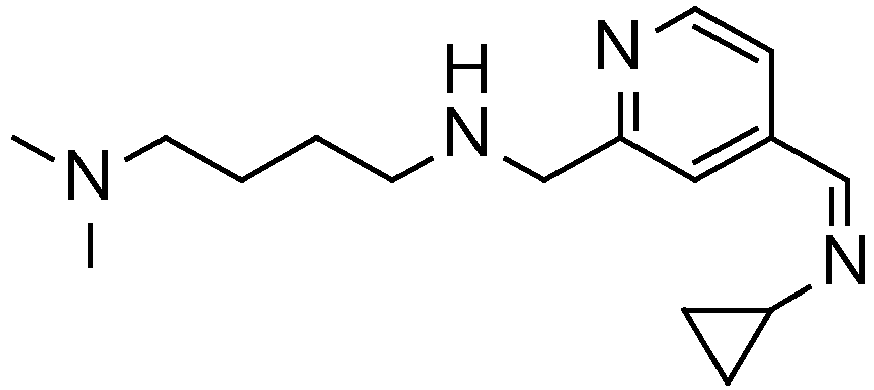


- By General Procedure E from N-({4-[N-cyclopropylcarboximidoyl]pyridin-2-yl}methyl)-N-[4-(dimethylamino)butyl]-2,2,2-trifluoroacetamide. Evaporated to and the residue was neutralized with cyclopropylamine. 1M KOH solution was added and work-up gave the title product as colorless viscous oil without further purification. 1H-NMR (300MHz, CDCl3): δ 8.50 (s, 1H), 8.30 (s, 1H), 7.50 (s, 1H), 7.30 (d, 1H), 3.90 (s, 2H), 2.70 (m, 2H), 2.25 (m, 2H), 2.20 (s, 6H), 1.50 (m, 4H), 1.00 (m, 4H), ppm.
-

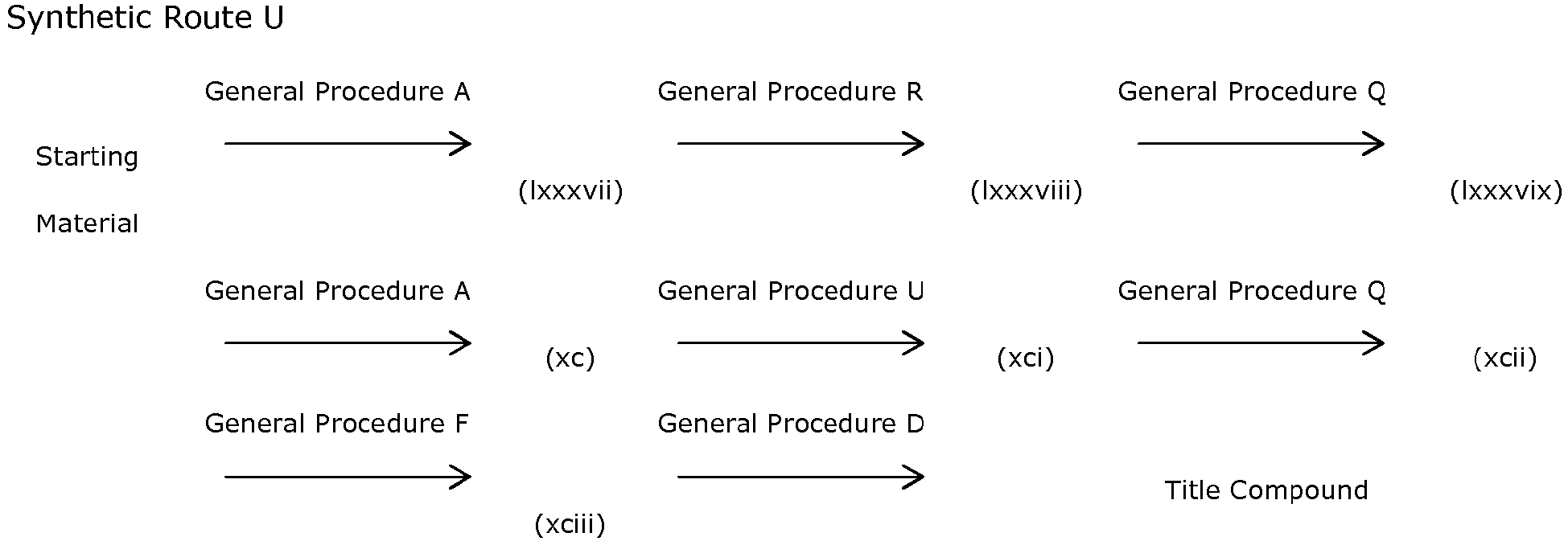
- By General Procedure D from tert-butyl N-({4-[N-cyclopropylcarboximidoyl]pyridin-2-yl}methyl)-N-[5-(dimethylamino)pentyl]carbamate. Evaporated to and the residue was neutralized with cyclopropylamine. 1M KOH solution was added and work-up gave the title product as colorless viscous oil without further purification. 1H-NMR (300MHz, CDCl3): δ 8.50 (d, 1H), 8.40 (s, 1H), 7.50 (s, 1H), 7.40 (d, 1H), 3.90 (s, 2H), 3.00 (m, 1H), 2.60 (m, 2H), 2.20 (m, 2H), 2.15 (s, 6H), 1.50-1.30 (m, 6H), 0.88 (m, 4H) ppm. ES-MS: 289 [M+1].
-

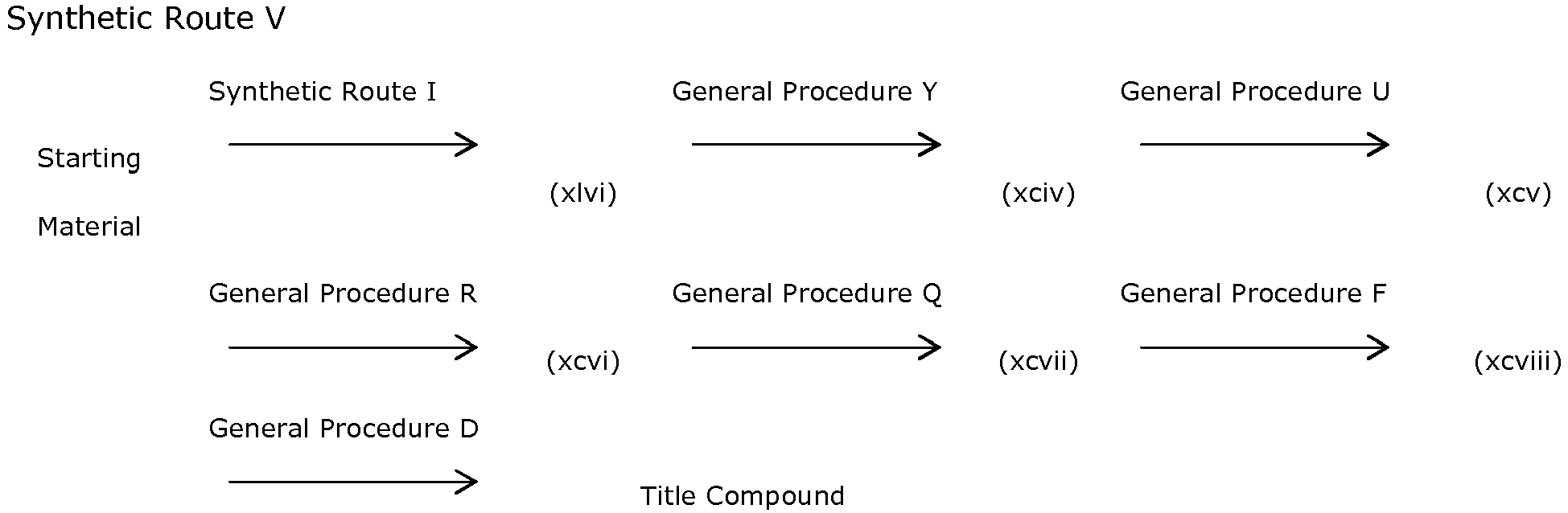
- By General Procedure D from tert-butyl-N-({4-[(E)-N-cyclopropylcarboximidoyl]pyridin-2-yl}methyl)-N-({[4-(diethylamino)butyl]carbamoyl}methyl)carbamate. Purified by preparative TLC (10% MeOH and 1% NH4OH in DCM) to give title product as yellow oil. 1H NMR (300 MHz, chloroform-d): δ ppm 8.61 (d, 1H), 8.41 (s, 1H), 7.57 (t, 1H), 7.50 (s, 1H), 7.41 (d, 1H), 3.90 (s, 2H), 3.32 (s, 2H), 3.29 (m, 2H), 3.09 (m, 1H), 2.67 (q, 4H), 2.60 (m, 2H), 1.56 (m, 4H), 1.09 (t, 6H), 1.03 (m, 4H). ES-MS: 360 [M+1].
-

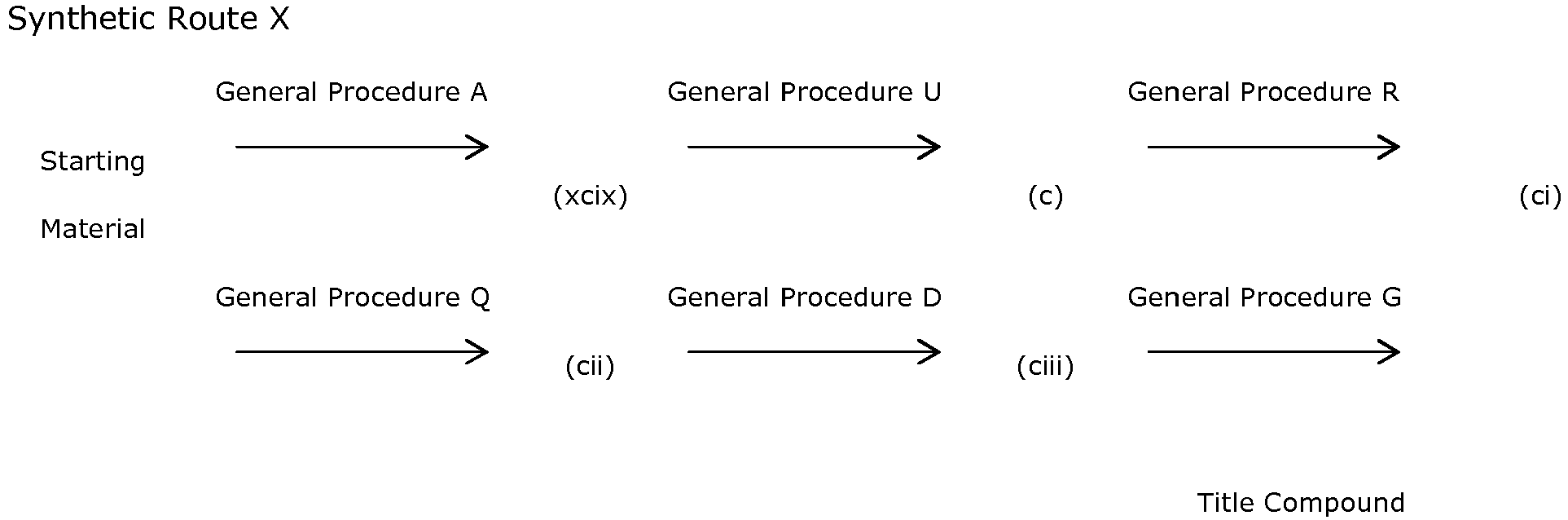
- To a stirred solution of aldehyde (N-[2-(dimethylamino)ethyl]-N-ethyl-2-{[(4-formylpyridin-2-yl)methyl]amino}acetamide) (1 equiv.) in 1,2-DCE and H2O were added amine (2-cyclohexylethylamine) (1.01 equiv.) and Na2CO3 (2 equiv.) at room temperature and stirred for 3 hours. Evaporated to dryness. Suspended in DCM, filtered and evaporated to give the title compound as brown oil. 1H NMR (300 MHz, chloroform-d): δ ppm 8.56 (d, 1H), 8.22 (s, 1H), 7.63 (s, 1H), 7.45 (dd, 1H), 3.96 (s, 2H), 3.63 (t, 2H), 3.45 (s, 2H), 3.45-3.34 (m, 2H), 3.27-3.19 (m, 2H), 2.43-2.33 (m, 2H), 2.23 and 2.17 (2 singlets, 6H), 1.76-1.51 (m, 7H), 1.38-1.25 (m, 1H), 1.22-1.07 (m, 6H), 0.98-0.89 (m, 2H). ESI-MS (m/z): 402 [M+1].
-


- By General Procedure D from tert-butyl N-({4-[5-benzyl-3-(trifluoroacetyl)-1,3-oxazinan-2-yl]pyridin-2-yl}methyl)-N-({[2-(dimethylamino)ethyl](ethyl)carbamoyl}methyl)carbamate without any purification gave the trifluoroacetic acid salt of the title product as yellow oil 1H-NMR (300MHz, CD3OD): δ 8.70 (d, 1H), 7.40 (m, 2H), 7.25 (m, 5H), 4.50 (s, 1H), 4.20 (m, 4H), 3.80 (m, 3H), 3.05 (s, 6H), 2.60 (m, 4H), 1.20 (t, 3H). ES-MS: 536 [M+1]
-


- By General Procedure B from tert-butyl N-({4-[(dimethylamino)methyl]cyclohexyl}methyl)-N-[(4-formylpyridin-2-yl)methyl]carbamate to yield the title product as colorless solid as the hydrochloric acid salt. 1H NMR (300 MHz, methanol-d4): δ ppm 8.89 (d, 1H), 8.26 (s, 1H), 8.05 (d, 1H), 5.73 (s, 1H), 4.66 (s, 2H), 3.12 (d, 2H), 3.04 (d, 2H), 2.91 (s, 6H), 1.95 (m, 6H), 1.20 (m, 4H). ES-MS: 290 [M+1].
-

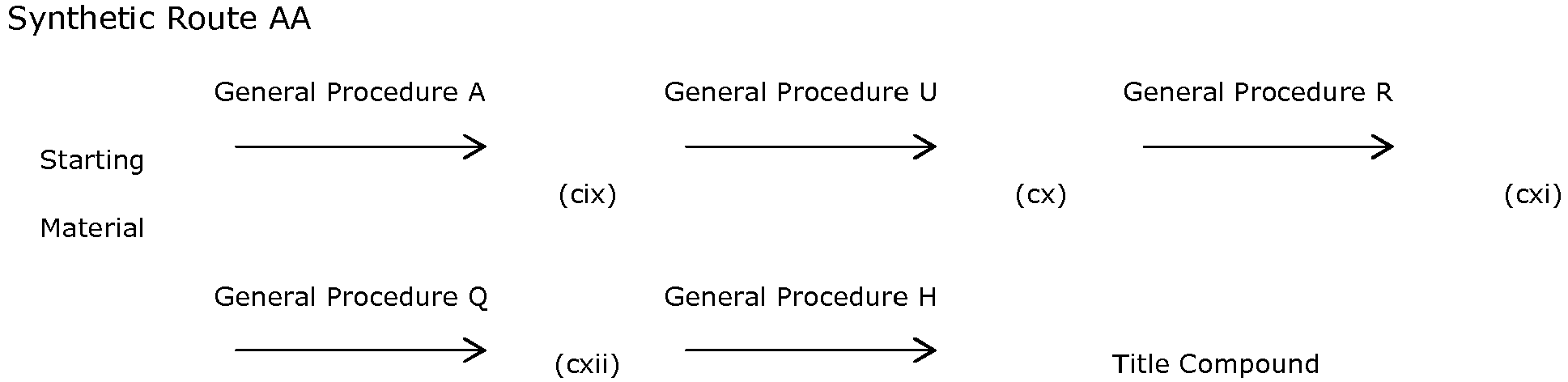
- HCl in dioxane (4M) was added to a solution of tert butyl carbamate ((Z)-tert-butyl 4-(dimethylamino)but-2-enyl((4-formylpyridin-2-yl)methyl)carbamate)) in DCM. The mixture was stirred at room temperature for 1 hour. Evaporated to give the title compound. 1H NMR (300 MHz, MeOH - d4: (δ 8.8(d, 1H), 8.0 (s, 1H), 7.7 (d, 1H), 6.2 (m, 2H), 4.5 (m, 2H), 4.1 (m, 2H), 2.9 (s, 6H), 2.2 (s, 6H).
-


- By General Procedure B from tert-butyl N-[(4-formylpyridin-2-yl)methyl]-N-{2-oxo-2-[(2R)-2-(pyrrolidin-1-ylmethyl)pyrrolidin-1-yl]ethyl}carbamate. Evaporation gave the title product as brown solid. 1H NMR (300 MHz, CD3OD), δ ppm: 8.91 (m, 1H), 8.36 (s, 1H), 8.12 (m, 1H), 5.77 (s, 1H), 4.85-4.75 (m, 2H), 4.56 (m, 1H), 4.38-4.23 (m, 2H), 4.14 (m, 1H), 3.84 (m, 1H), 3.64-3.44 (m, 3H), 3.30-3.19 (m, 2H), 3.11 (m, 1H), 2.27-2.00 (m, 7H), 1.85 (m, 1H).
-


- By General Procedure B from tert-butyl N-{4-[benzyl(cyclopropyl)amino]butyl}-N-[(4-formylpyridin-2-yl)methyl]carbamate. Evaporation gave the title product as yellow oil. 1H-NMR (300MHz, MeOD): δ 8.90 (d, 1H), 8.40 (s, 1H), 8.10 (d, 1H), 7.50 (m, 5H), 5.70 (s, 1H),4.70 (m, 2H), 4.50 (m, 2H), 2.80 (m, 2H), 2.00 (m, 5H), 0.90 (m, 4H) ppm.
-


- Concentrated H2SO4 (2 drops) was added to the tert butyl carbamate (tert-butyl N-[4-(diethylamino)butyl]-N-[(4-formylpyridin-2-yl)methyl]carbamate) (1 equiv.) in trifluoracetic anhydride at 0 °C. The mixture was stirred for 2h at 0 °C. Solid NaHCO3 was added. Diluted with DCM before evaporating to dryness. Purification by preparative TLC (10% MeOH in DCM) gave the title compound as yellow oil. 1H NMR (300 MHz, CDCl3), δ ppm: 10.09 (d, 1H), 8.83 (dd, 1H), 7.68 (m, 2H), 4.85 (d, 2H), 3.53 (m, 2H), 3.10 (m, 6H), 1.76 (m, 4H), 1.33 (m, 6H). ES-MS: 360 [M+1].
- Pyridinium toluene-4-sulphonate (0.1 equiv.) was added to a solution of aldehyde (ethyl 2-formylpyridine-4-carboxylate) (1.0 equiv.) and trimethyl orthoformate (6.5 equiv.) in methanol. Heated at 60 °C overnight. Aqueous work up (EtOAc/NaHCO3) gave the title compound as oil. 1H NMR (300 MHz, CDCl3), δ ppm: 8.77 (dd, 1H), 8.09 (s, 1H), 7.82 (dd, 1H), 5.44 (s, 1H), 4.41 (q, 2H), 3.42 (s, 6H), 1.41 (t, 3H).
- DIBAL-H (1.5 equiv., 1.0 M in toluene) was added slowly to a solution of the ester (Ethyl 2-(dimethoxymethyl)pyridine-4-carboxylate) (1.0 equiv.) in toluene at -78 °C. Stirring continued for 1.5 h before the reaction was quenched by dropwise addition of sat. NH4Cl. Allowed to warm to room temperature. EtOAc and a satd. solution of sodium potassium tartrate (excess) were added and stirring was continued overnight. Aqueous work up gave the title product, which was used without further purification. 1H NMR (300 MHz, CDCl3), δ ppm: 10.10 (s, 1H), 8.86 (d, 1H), 7.97 (s, 1H), 7.68 (dd, 1H), 5.46 (s, 1H), 3.42 (s, 6H).
- Aldehyde (2-(dimethoxymethyl)pyridine-4-carbaldehyde) (1.0 equiv.) was dissolved in a mixture of ethanol and water (3:1) and hydroxylamine hydrochloride (1.5 equiv.) was added followed by addition of Na2CO3 (1.7 equiv.) The suspension was stirred at room temperature for three hours after that solvent was removed in vacuum. EtOH was added to the residue, filtered and washed with EtOH. The combined filtrates were evaporated. Triturated with H2O and filtered to give the title product as colorless solid, which was used without further purification. 1H NMR (300 MHz, CDCl3), δ ppm: 9.95 (s, 1H), 8.65 (d, 1H), 8.14 (s, 1H), 7.74 (s, 1H), 7.50 (d, 1H), 5.45 (s, 1H), 3.43 (s, 6H).
- A solution of hydroxyl amine (N-{[2-(dimethoxymethyl)pyridin-4-yl]methylidene}hydroxylamine) (1.0 equiv.) in MeOH over 10 Pd/C (0.2 equiv. w/w) was charged with H2 (45 psi). The reaction was followed by TLC. Filtered and evaporated to give the title compound. 1H NMR (300 MHz, CDCl3), δ ppm: 8.54 (dd, 1H), 7.50 (s, 1H), 7.22 (dt, 1H), 5.35 (s, 1H), 3.91 (s, 2H), 3.40 (s, 6H).
- By General Procedure C from 2-(dimethoxymethyl)pyridin-4-yl)methanamine. Evaporated to give the title compound. 1H-NMR (300MHz, CDCl3): δ 8.6 (d, 1H), 7.4 (s, 1H), 7.2 (d, 1H), 5.4 (s, 2H), 4.6 (d, 2H), 3.4 (s, 6H). ES-MS: 277 [M+1] and 321 [M+23]
- Concentrated hydrochloric acid (3.5 eq) was added to a solution the acetal (N-{[2-(dimethoxymethyl)pyridin-4-yl]methyl}-2,2,2-trifluoroacetamide) (1 equiv.) in THF. The mixture was stirred for 2h at 60 °C. Solid NaHCO3 (5 eq) was added at 0 °C and the suspension was filtered to remove the solids, which were washed with dichloromethane. The combined filtrates were evaporated to dryness and the residual was purified by column chromatography (0-20% MeOH/DCM) to yield the title product. 1H NMR (300 MHz, CDCl3) δ ppm: 10.05 (s, 1H), 8.77 (d, 1H), 7.86 (m, 1H), 7.47 (dd, 1H), 7.44 (bs, 1H), 4.65 (d, 2H). ES-MS: 233 [M+H].
- By General Procedure A from 4-{[(tert-butyldimethylsilyl)oxy]methyl}pyridine-2-carbaldehyde and 4-(diethylamino)butyl]amine. Purification by column chromatography (5% MeOH/DCM) gave the target compound as greenish oil. 1H-NMR (300MHz, CDCl3): δ 8.46 (d, 1H), 7.20 (s, 2H), 7.10 (d, 1H), 4.70 (s, 2H), 3.90 (s, 2H), 2.50 (m, 8H), 1.50 (m, 4H), 1.00 (t, 6H, 0.9 (s, 9H, 0.05 (s, 6H) ppm.
- Di-tert-butyl dicarbonate (1.2 equiv.) was added to a solution of the amine ([(4-{[(tert-butyldimethylsilyl)oxy]methyl}pyridin-2-yl)methyl][4-(diethylamino)butyl]amine) (1.0 equiv.) and triethylamine (1.3 equiv.) in anhydrous DCM at 0 °C. The reaction mixture was stirred at room temperature for 12 hours. Na2CO3 was added and the mixture was stirred for 30 min. Evaporated to dryness and the residual was extracted with DCM. Evaporation of the extract gave the title compound, which was used without any further purification.
- TBAF (2 equiv.) was added at room temperature to a solution of the silyl ether (tert-butyl N-[(4-{[(tert-butyldimethylsilyl)oxy]methyl}pyridin-2-yl)methyl]-N-[4-(diethylamino)butyl]carbamate) (1 equiv.) in THF and the reaction mixture was stirred overnight. Sat. NaHCO3 (aq) was added. Stirred for 30 min, before work-up with DCM. Purification by column chromatography (DCM, MEOH and NH4 (aq.)) gave the title product as colorless oil. 1H-NMR (300MHz, CDCl3): δ 8.40 (d, 1H), 7.00 (m, 2H), 4.60 (s, 2H), 4.40 (m, 2H), 3.20 (m, 2H), 2.40 (m, 6H), 1.40 (m, 9H), 1.00 (t, 6H) ppm.
- DMSO (4 equiv.) in anhydrous DCM was cooled to -78 °C and oxalyl chloride (2 equiv.) was added drop-by-drop and stirred for 30 min at -78 °C. The alcohol (tert-butyl N-[4-(diethylamino)butyl]-N-{[4-(hydroxymethyl)pyridin-2-yl]methyl}carbamate) (1.0 equiv.) was dissolved in DCM and added slowly at the same temperature and the reaction mixture was stirred for one hour. Triethylamine (5.0 equiv.) was added and reaction mixture was stirred overnight in the same cooling bath. Quenched with water, and worked up by extraction with DCM. Purification by column chromatography using ethyl acetate/hexane 20-50% yielded the title product. 1H-NMR (300MHz, CDCl3): δ 10.05 (s, 1H), 8.80 (d, 1H), 7.50 (m, 2H), 4.50 (d, 2H), 3.30 (d, 2H), 2.50 (m, 6H), 1.4-1.5 (br d, 16H) 1.00 (t, 6H) ppm. ES-MS: 364 [M+1].
- By General Procedure L from tert-butyl N-[4-(diethylamino)butyl]-N-[(4-formylpyridin-2-yl)methyl]carbamate. Evaporated to dryness. The residue was suspended in dichloromethane, filtered, and the filtrate was evaporated to give the crude title product, which was used without further purification. 1H-NMR (300MHz, CDCl3): δ 8.40 (d, 1H), 8.00 (s, 1H), 7.39 (m, 2H), 4.45 (m, 2H), 3.35 (m, 2H), 2.60 (m, 8H), 1.60-1.20 (m, 18H) ppm.
- By General Procedure M from tert-butyl N-[4-(diethylamino)butyl]-N-({4-[(hydroxyimino)methyl]-pyridin-2-yl}methyl)carbamate to give the title product which was used without further purification.
- By General Procedure A from ethyl 2-formylpyridine-4-carboxylate and 4-aminobutan-1-ol. Purification by column chromatography (5% MeOH/DCM) gave the target compound as greenish oil. 1H-NMR (300MHz, CDCl3): δ 8.60 (d, 1H), 7.80 (s, 1H), 7.70 (d, 1H), 4.40 (q, 2H), 4.05 (s, 1H), 3.60 (m, 2H), 2.80 (m, 2H), 1.70 (m, 4H), 1.40 (t, 3H) ppm.
- Aqueous solution NaHCO3 (5.0 equiv.) was added to a solution of the amine (ethyl 2-[(4-hydroxybutyl)carbamoyl]pyridine-4-carboxylate) (1.0 equiv.) in THF. Stirred for 5 min, before a solution of di-tert-butyl dicarbonate (1.2 equiv.) in THF was added. The reaction mixture was stirred over night at room temperature. Evaporated to dryness and extracted with ethyl acetate to give the title product as a white solid. 1H-NMR (300MHz, CDCl3): δ 8.60 (d, 1H), 7.80 (s, 1H), 7.70 (d, 1H), 4.50 (m, 2H), 4.40 (q, 2H), 3.60 (m, 2H), 3.30 (m, 2H), 1.70-1.35 (m, 17H) ppm.
- CBr4 (1.1 equiv.) was added to a cold (0 °C) solution of alcohol (ethyl 2-({[(tert-butoxy)carbonyl](4-hydroxybutyl)amino}carbonyl)pyridine-4-carboxylate) (1 equiv.) and PPh3 ((1.1 equivalent). Stirred for 20 min and then allowed to warm to room temperature over 3-4 hour. Aqueous work up and purification by column chromatography using (DCM:MeOH (95:5)) gave the title product as white solid. 1H-NMR (300MHz, CDCl3): δ 8.50 (d, 1H), 7.80 (s, 1H), 7.60 (d, 1H), 4.50 (m, 2H), 4.40 (q, 2H), 3.60 (m, 2H), 3.30 (m, 2H), 1.80 (m 2H), 1.60 (m, 2H), 130 (m, 12H) ppm. ES-MS: 415 [M+1].
- The amine (azetidine hydrochloride) (5.0 equiv.) and subsequently DIPEA (6.0 equiv.) was added to a solution of the bromide (ethyl 2-{[(4-bromobutyl)[(tert-butoxy)carbonyl]amino]carbonyl}pyridine-4-carboxylate) (1 equiv.) in acetonitrile. Stirred at 60 °C for 12 hours. Evaporated to dryness and purified by column chromatography (DCM/MeOH (95:5)) to give the title product as colorless oil. 1H-NMR (300MHz, CDCl3): δ 8.58 (d, 1H), 7.70 (s, 1H), 7.60 (d, 1H), 4.40 (m, 2H), 4.30 (q, 2H), 3.60 (m, 2H), 3.30 (m, 2H), 3.00 (m, 4H), 1.60 (m 4H), 1.40 (m, 12H) ppm. ES-MS: 392 [M+1].
- NaBH4 (2.0 equiv.) was added at room temperature to a solution of ester (ethyl 2-({[4-(azetidin-1-yl)butyl][(tert-butoxy)carbonyl]amino}carbonyl)pyridine-4-carboxylate) (1.0 equiv.) in EtOH. Stirred at room temperature for 10 min and then reflux for 3 hours. Cooled to room temperature and sat. NH4Cl solution was added. Evaporated to dryness and extracted with DCM. Purification by column chromatography (DCM, MeOH and HN4OH (aq.) (85:10:5) gave the title product as viscous oil. 1H-NMR (300MHz, CDCl3): δ 8.40 (d, 1H), 7.35 (s, 1H), 7.00 (d, 1H), 4.60 (s, 2H), 4.50 (m, 2H), 3.25 (m, 6H), 3.20 (m, 2H), 2.00 (m, 2H), 1.40 (m 14H) ppm.
- 1,1,1-Triacetoxy-1,1-dihydro-1,2-benziodoxol-3(1H)-one (1.1 equiv.) was added at 0 °C to a solution of alcohol (tert-butyl N-[4-(azetidin-1-yl)butyl]-N-[4-(hydroxymethyl)pyridine-2-carbonyl]carbamate) in anhydrous DCM. Stirred for 10 min. and then allowed to warm to room temperature and stirred for two to three hours. KOH solution (1M) was added and extraction with DCM gave the title product as light yellow oil. 1H-NMR (300MHz, CDCl3): δ δ 10.0 (s, 1H), 8.70 (d, 1H), 7.55 (s, 1H), 7.50 (d, 1H), 4.50 (m, 2H), 3.20 (m, 2H), 2.50 (m, 4H), 1.80 (m, 2H), 1.40 (m 15H) ppm.
- General Procedure L from tert-butyl N-[4-(azetidin-1-yl)butyl]-N-(4-formylpyridine-2-carbonyl)carbamate gave the title product which was used without further purification. 1H-NMR (300MHz, CDCl3): δ 8.40 (d, 1H), 8.00 (s, 1H), 7.30 (s, 1H), 7.25 (d, 1H), 4.40 (m, 2H), 3.20 (m, 4H), 2.00 (m, 2H), 1.60-1.20 (m 20H) ppm.
- General Procedure M from tert-butyl N-[4-(azetidin-1-yl)butyl]-N-{4-[((hydroxyimino)methyl]pyridine-2-carbonyl}carbamate gave the title product as colorless oil, which was used without further purification.
- By General Procedure A from 2-(dimethoxymethyl)pyridine-4-carbaldehyde, cyclopropylamine, and acetic acid (1 equiv.). Purification by column chromatography (CH2Cl2/MeOH, 97:3) gave the title compound as a colorless oil. 1H NMR (300 MHz, CDCl3): δ 8.55 (d, 1H), 7.50 (S, 1H), 7.22 (m, 1H), 5.40 (s, 1H), 3.90 (s, 2H), 3.40 (s, 6H), 2.18 (m, 1H), 0.5 (m, 4H).
- By General Procedure N from N-{[2-(dimethoxymethyl)pyridin-4-yl]methyl}cyclopropanamine. Used without further purification. 1H-NMR (300MHz, CDCl3): δ 10.02 (s, 1H), 8.70 (d, 1H), 7.98 (s, 2H), 7.50 (m, 1H), 3.98 (s, 2H), 2.25 (m, 1H), 0.50 - 0.40 (m, 4H).
- By General Procedure A from Ethyl 2-formylpyridine-4-carboxylate, N,N-dimethylglycineamide hydrochloride, and triethylamine. Purification by column chromatography with a gradient of 0-10% MeOH in DCM gave the title product as yellow oil. 1H NMR (300 MHz, chloroform-d): δ ppm 8.69 (s, 1H), 7.94 (s, 1H), 7.72 (d, 1H), 4.40 (q, 2H), 4.03 (s, 2H), 3.48 (s, 2H), 2.95 (d, 6H), 1.40 (t, 3H).
- By General Procedure U from ethyl 2-({[(dimethylcarbamoyl)methyl]amino}methyl)pyridine-4-carboxylate. Purification by column chromatography (10% MeOH and 1% NH4OH in DCM) gave the title product as light yellow oil. 1H NMR (300 MHz, chloroform-d): δ ppm 8.44 (d, 1H), 7.47(s, 1H), 7.30 (d, 1H), 4.67 (s, 2H), 3.93 (s, 2H), 3.53 (s, 2H), 2.96 (d, 6H).
- General Procedure R from 2-({[4-(Hydroxymethyl)pyridin-2-yl]methyl}amino)-N,N-dimethylacetamide. Purification by column chromatography (10% MeOH and 1% NH4OH in DCM) gave the title product as light yellow oil. 1H NMR (300 MHz, chloroform-d): δ ppm 8.46 (m, 1H), 7.36 (m, 1H), 7.19 (m, 1H), 4.72 (m, 2H), 4.60 (m, 2H), 4.11 (m, 2H), 2.95 (m, 6H), 1.43 (m, 9H).
- General Procedure Q from tert-butyl N-[(dimethylcarbamoyl)methyl]-N-{[4-(hydroxymethyl)pyridin-2-yl]methyl}carbamate. The title product was isolated after extractions as yellow sticky oil and used without further purification. 1H NMR (300 MHz, chloroform-d): δ ppm 10.09 (m, 1H), 8.79 (m, 1H), 7.80 (m, 1H), 7.60 (m, 1H), 4.72 (m, 2H), 4.18 (m, 2H), 2.97 (m, 6H), 1.43 (m, 9H).
- General Procedure L from tert-Butyl N-[(dimethylcarbamoyl)methyl]-N-[(4-formylpyridin-2-yl)methyl]carbamate. The title product was isolated after extraction as light yellow oil and used without further purification. 1H NMR (300 MHz, methanol-d4): δ ppm 8.47 (m, 1H), 8.10 (d, 1H), 7.61(d, 1H), 7.46 (m, 1H), 4.58 (m, 2H), 4.20 (m, 2H), 2.98 (m, 6H), 1.40 (m, 9H).
- General Procedure M from tert-Butyl N-{[4-(aminomethyl)pyridin-2-yl]methyl}-N-[(dimethylcarbamoyl)methyl]carbamate. Purification by column chromatography (0-15% MeOH in DCM) gave the product as light yellow oil. 1H NMR (300 MHz, chloroform-d): δ ppm 8.38 (m, 1H), 7.26 (m, 1H), 7.10 (m, 1H), 4.55 (m, 2H), 4.05 (m, 2H), 3.84 (m, 2H), 2.89 (m, 6H), 1.36 (m, 9H).
- General Procedure T from tert-butyl N-{[4-(aminomethyl)pyridin-2-yl]methyl}-N-[(dimethylcarbamoyl)methyl]carbamate (1.0 equiv.), DIPEA (2.0 equiv.) and bromoacetonitrile (1.1 equiv.). Purification by preparative TLC (10% MeOH and 1% NH4OH in DCM) gave the title product as light yellow oil. 1H NMR (300 MHz, methanol-d4): δ ppm 8.42 (d, 1H), 7.46 (s, 1H), 7.33 (s, 1H), 4.58 (m, 2H), 4.19 (m, 2H), 3.93 (s, 2H), 3.65 (s, 2H), 2.98 (m, 6H), 1.42 (m, 9H).
- By General Procedure A from N,N-dimethylglycineamide hydrochloride, triethylamine, and 4-{[(tert-butyldimethylsilyl)oxy]methyl}pyridine-2-carbaldehyde. Purification by column chromatography (0-10% MeOH in DCM) gave the title product as yellow oil. 1H NMR (300 MHz, chloroform-d): δ ppm 8.49 (d, 1H), 7.32 (s, 1H), 7.17 (d, 1H), 4.74 (s, 2H), 3.97 (s, 2H), 3.47 (s, 2H), 2.95 (d, 6H), 0.95 (s, 9H), 0.11 (s, 6H).
- By General Procedure C from 2-{[(4-{[(tert-butyldimethylsilyl)oxy]methyl}pyridin-2-yl)methyl]amino}-N,N-dimethylacetamide. Evaporation gave the product as yellow oil, which was used without further purification. 1H NMR (300 MHz, chloroform-d): δ ppm 8.50 (m, 1H), 7.25 (m, 2H), 4.80 (m, 4H), 4.33 (m, 2H), 2.99 (m, 6H), 0.96 (s, 9H), 0.13 (s, 6H).
- By General Procedure P from N-[(4-{[(tert-butyldimethylsilyl)oxy]methyl}pyridin-2-yl}methyl]-N-[(dimethylcarbamoyl)methyl]-2,2,2-trifluoroacetamide. Purification by column chromatography (0-10% MeOH in DCM) gave the title product as yellow oil. 1H NMR (300 MHz, chloroform-d): δ ppm 8.45 (m, 1H), 7.26 (m, 2H), 4.74 (m, 4H), 4.33 (m, 2H), 3.88 (s(br), 1H), 2.92 (m, 6H).
- By General Procedure Q from N-[(dimethylcarbamoyl)methyl]-2,2,2-trifluoro-N-{[4-hydroxymethyl)pyridin-2-yl]methyl}acetamide. Purification by column chromatography (30-60% EtOAc in DCM) gave the title product as yellow oil. 1H NMR (300 MHz, chloroform-d): δ ppm 10.01 (d, 1H), 8.74 (m, 1H), 7.63 (m, 2H), 4.82 (m, 2H), 4.29 (m, 2H), 2.90 (m, 6H).
- By General Procedure A from N-[(dimethylcarbamoyl)methyl]-2,2,2-trifluoro-N-[(4-formylpyridin-2-yl)methyl]acetamide and N,N-dimethylethylenediamine. Purification by preparative TLC (10% MeOH, 1% NH4OH in DCM) gave the title product as colorless oil. 1H NMR (300 MHz, chloroform-d): δ ppm 8.48 (m, 1H), 7.29 (m, 2H), 4.80 (m, 2H), 4.37 (m, 2H), 3.84 (m, 2H), 2.98 (m, 6H), 2.71 (t, 2H), 2.49 (t, 2H), 2.26 (m, 6H). ES-MS: 390 [M+1].
- By General Procedure A from ethyl 2-formylpyridine-4-carboxylate and 3-aminopropan-1-ol. Purification by column chromatography (0-5% MeOH in DCM) gave the title compound. 1H NMR (300 MHz, CDCl3), δ ppm: 8.72 (d, 1H), 7.98 (s, 1H), 7.75 (d, 1H), 4.45(q, 2H), 3.95 (s, 2H), 3.70 (t, 2H), 2.80 (t, 2H), 1.75 (m, 2H), 1.40 (t, 3H).
- By General Procedure C from ethyl 2-{[(3-hydroxypropyl)amino]methyl}pyridine-4-carboxylate (1 equiv.), DIPEA (7.0 equiv.), and trifluoroacetic anhydride (5.0 equiv.). The title product was isolated after extractions and used without further purification. 1H-NMR (300MHz, CDCl3), (rotamers): δ 8.74 (dd, 0.5H), 8.70 (dd, 0.5H), 7.85 (s, 0.5H), 7.83-7.78 (m, 1H), 7.74 (s, 0.5H), 4.81 (s, 1H), 4.77 (s, 1H), 4.47-4.35 (m, 4H), 3.70 (t, 1H), 3.58 (t, 1H), 2.23-2.13 (m, 1H), 2.10-2.01 (m, 1H), 1.42 (td, 3H).
- 1M LiOH (aq, 1.0 equiv) was added to a solution of ester (ethyl 2-[(2,2,2-trifluoro-N-{3-[(trifluoroacetyl)oxy]propyl}acetamido)methyl]pyridine-4-carboxylate) (1.0 equiv.) in THF-MeOH-H2O (1:1:1). Stirred at room temperature, while following the reaction by TLC. Evaporated to dryness and purified by flash chromatography using MeOH:DCM (10:90) to yield the title compound. 1H NMR (300 MHz, CDCl3), (rotamers) δ ppm: 8.74 (two d, 1H), 7.80 (m, 2H), 4.85(s, 2H), 4.45 (m, 2H), 3.65 (m, 4H), 1.90 (m, 2H), 1.45 (m, 3H).
- By General Procedure Q from ethyl 2-{[2,2,2-trifluoro-N-(3-hydroxypropyl)acetamido]methyl}pyridine-4-carboxylate to give the title product. 1H NMR (300 MHz, CDCl3), (rotamers) δ ppm: 9.80 (two singlets, 1H), 8.70 (two doublets, 1H), 7.80 (m, 2H), 4.90/4.75 (two singlets, 2H), 4.45 (m, 2H), 3.95/3.75 (m, 2H), 2.90 (two t, 2H), 1.45 (m, 3H).
- By General Procedure A from ethyl 2-{[2,2,2-trifluoro-N-(3-oxopropyl)acetamido]methyl}pyridine-4-carboxylate and benzyl(methyl)amine to give the title product. 1H NMR (300 MHz, CDCl3), (rotamers) δ ppm: 8.7 (dd, 1H), 7.90 - 7.75 (m, 2H), 7.4 - 7.2 (m, 5H), 4.8 (d, 2H), 4.4 (q, 2H), 4.0 (q, 2H), 3.7 - 3.4 (m, 2H), 2.8 - 2.5 (m, 2H), 2.0 - 1.8 (m, 7H), 1.4 (t, 3H).
- By General Procedure U from ethyl 2-[(N-{3-[benzyl(methyl)amino]propyl}-2,2,2-trifluoroacetamido)methyl]pyridine-4-carboxylate using 5.0 equiv. of NaBH4. Purification by column chromatography gave the title product. 1H NMR (300 MHz, CDCl3) δ ppm: 8.5 (dd, 1H), 7.80 (s, 1H), 7.6 - 7.3 (m, 1H), 4.6 (s, 2H), 4.3 (s, 2H), 3.6 - 3.2 (m, 4H), 2.8 (s, 3H), 2.2 - 2.0 (m, 2H), 1.7 - 1.3 (m, 3H).
- By General Procedure R from, {2-[({3-[benzyl(methyl)amino]propyl}amino)methyl]pyridin-4-yl}methanol to give the title product. 1H NMR (300 MHz, CDCl3), (rotamers) δ ppm: 8.6 (d, 1H), 7.4 - 7.1 (m, 8H), 4.8 (s, 2H), 4.6 - 4.4 (m, 2H), 3.4 - 3.2 (m, 2H), 2.5 - 2.2 (m, 2H), 2.1 (s, 3H), 1.9 - 1.3 (m, 11H).
- General Procedure Q from tert-butyl N-{3-[benzyl(methyl)amino]propyl}-N-{[4-(hydroxymethyl)pyridin-2-yl]methyl}carbamate. 1H NMR (300 MHz, CDCl3), (rotamers) δ ppm: 10.0 (s, 1H), 8.8 (d, 1H), 7.7 - 7.1 (m, 7H), 4.8 - 4.6 (m, 2H), 3.6 - 3.2 (m, 4H), 2.5 - 2.3 (m, 2H), 2.2 (s, 3H), 1.9 - 1.3 (m, 11H).
- By General Procedure A from tert-butyl N-{3-[benzyl(methyl)amino]propyl}-N-[(4-formylpyridin-2-yl)methyl]carbamate and cyclopropanamine. Purification by column chromatography using DCM:MeOH:NH4OH (8:2:1) gave the title compound. 1H NMR (300 MHz, CDCl3), (rotamers) δ ppm: 8.4 (d, 1H), 7.4 - 7.2 (m, 7H), 4.5 (s, 2H), 3.9 (s, 2H), 3.7 - 3.2 (m, 4H), 2.6 - 1.7 (m, 8H), 1.4 (d, 9H), 0.6 - 01.3 (m, 4H).
- Prepared by General Procedure A from ethyl 2-formylpyridine-4-carboxylate and tert-butyl 2-aminoacetate. Title compound isolated as yellow oil by column chromatography (EtOAc/hexanes). 1H-NMR (300MHz, MeOH-d4): δ 8.7 (d, 1H), 7.8 (s, 1H), 7.7 (d, 1H), 4.4 (s, 2H), 4.3 (q, 2), 3.8 (s, 2H), 3.3 (s, 2H), 1.4 (s, (H), 1.3 (t, 3H). ES-MS: 295 [M+1].
- By General Procedure C from ethyl 2-({[2-(tert-butoxy)-2-oxoethyl]amino}methyl)pyridine-4-carboxylate in anhydrous DCM. Aqueous work up gave the title compound, which was used without further purification. 1H-NMR (300MHz, CDCl3), (rotamers): δ 8.7 (dd, 1H), 7.8 (ss, 1H), 7.7 (dd, 1H), 4.8 (ss, 2H), 4.3 (q, 2), 4.2 (ss, 2H), 1.4 (s, 9H), 1.3 (t, 3H).
- By General Procedure D from ethyl 2-({N-[2-(tert-butoxy)-2-oxoethyl]-2,2,2-trifluoroacetamido}methyl)pyridine-4-carboxylate. Evaporation gave the title compound, which was used without further purification. 1H-NMR (300MHz, CD3OD): δ 8.75 (m, 1H), 7.8 8.00 (m, 2H), 5.45, 4.99 (2s, 2H; rotamer), 4.20 - 4.40 (m, 4H), 1.40 (t, 3H).
- An amine (tert-butyl 4-aminopiperidine-1-carboxylate) (2 equiv.) was added to a solution of an acid (2-(N-{[4-(ethoxycarbonyl)pyridin-2-yl]methyl}-2,2,2-trifluoroacetamido)acetic acid) (1 equiv.) in DMF. Cooled to 0 °C before EDC HCl (1.5 equivalent) and ethyl(hydroxyl iminocyanoaectate (oxyma; 1.5 equivalent) were added. The reaction mixture was allowed to warm slowly to room temperature and stirred overnight. Aqueous work up and purification by column chromatography gave the title compound as brown foam. 1H-NMR (300MHz, CDCl3): δ 8.70 & 8.60 (2d, 1H; rotamer), 7.80 (m, 2H), 4.90 & 4.78 (2s, 2H, rotamer), 4.42 (q, 2H), 4.30 & 4.10 (2s, 2H; rotamer), 4.10 (m, 1H), 2.80 (m, 2H) 2.0 (m, 2H), 1.48 (s, 9H), 1.40 (t, 3H).
- Prepared by General Procedure D from ethyl 2-({N-[({1-[(tert-butoxy)carbonyl]piperidin-4-yl}carbamoyl)methyl] -2,2,2-trifluoroacetamido}methyl)pyridine-4-carboxylate. Purification by column chromatography (MeOH/DCM and 1% NH4OH) gave the title compound as a brown foam. 1H-NMR (300MHz, CD3OD): δ 8.75 (m, 1H), 7.90 (m, 2H), 5.00 & 4.90 (2s, 2H, rotamer), 4.42 (q, 2H), 4.32 & 4.12 (2s, 2H; rotamer), 3.95 (m, 1H), 3.40 (m, 2H) 3.10 (m, 2H), 2.10 (m, 2H), 1.80 (m, 2H), 1.38 (t, 3H).
- Prepared by General Procedure A from 2-methoxybenzaldehyde and ethyl 2-[(2,2,2-trifluoro-N-{[(piperidin-4-yl)carbamoyl]methyl}acetamido)methyl]pyridine-4-carboxylate. 1H-NMR (300MHz, CDCl3): δ 8.75 & 8.71 (2d, 1H; rotamer), 7.91 - 7.78 (m, 2H), 7.36 (m, 1H), 7.25 (m, 1H), 7.99 - 7.86 (m, 2H), 4.95 & 4.72 (2s, 2H, rotamer), 4.45 (q, 2H), 4.30 & 4.08 (2s, 2H; rotamer), 3.83 (m, 4H), 3.60 (m, 2H) 2.95 (m, 2H), 2.22 (m, 2H), 1.90 (m, 2H), 1.60 (m, 2H), 1.40 (t, 3H).
- By General Procedure U from ethyl 2-({2,2,2-trifluoro-N-[({1-[(2-methoxyphenyl)methyl]piperidin-4-yl}carbamoyl)methyl]acetamido}methyl)pyridine-4-carboxylate using 5 equiv. of NaBH4. Purification by column chromatography using 1% MeOH/DCM to 28% MeOH/DCM/1%NH4OH as elutent to get the product as an off white solid. 1H-NMR (300MHz, CDCl3): δ 8.42 (d, 1H), 7.42 (d, 1H), 7.35 (d, 1H), 7.25 (m, 2H), 7.15 (m, 1H), 6.99 - 6.85 (m, 2H), 4.65 (s, 2H), 3.80 (m, 4H), 3.60 (s, 2H), 3.45 (s, 2H), 3.25 (s, 2H), 2.90 (m, 2H), 2.22 (m, 2H), 1.90 (m, 2H), 1.60 (m, 2H).
- By General Procedure R from 2-({[4-(hydroxymethyl)pyridin-2-yl]methyl}amino)-N-{1-[(2-methoxyphenyl)methyl]piperidin-4-yl}acetamide to get the title compound as a white foam. 1H-NMR (300MHz, CDCl3): δ 9.80 (d, 1H), 8.70 (d, 1H), 7.50 - 7.40 (m, 2H), 7.25 (m, 2H), 7.10 - 6.80 (m, 2H), 4.70 (s, 2H), 4.50 (d, 2H), 4.12 (d, 2H), 3.98 (m, 3H), 3.85 (s, 3H), 3.35 (d, 2H), 2.80 - 2.50 (m, 2H), 2.10 - 1.80 (m, 4H), 1.40, 1.20 (ss, 9H).
- By General Procedure Q from tert-butyl N-{[4-(hydroxymethyl)pyridin-2-yl]methyl}-N-[({1-[(2-methoxyphenyl)methyl]piperidin-4-yl}carbamoyl)methyl]carbamate to get the title compound as a light yellow foam. 1H-NMR (300MHz, CDCl3): δ 10.00 (s, 1H), 9.00 - 8.20 (m, 2H), 7.76 (2d, 1H; rotamer), 7.40 (m, 1H), 7.30 (m, 1H), 7.00 - 6.80 (m, 2H), 4.52 (m, 2H), 4.42 (q, 2H), 4.20 & 4.00 (2s, 2H; rotamer), 3.90 (m, 4H), 3.55 (s, 2H) 3.00 (m, 2H), 2.22 (m, 2H), 2.00 (m, 2H), 1.80 - 1.50 (m, 4H), 1.40, 1.20 (2s, 9H; rotamer).
- By General Procedure A from tert-butyl N-[(4-formylpyridin-2-yl)methyl]-N-[({1-[(2-methoxyphenyl)methyl]piperidin-4-yl}carbamoyl)methyl]carbamate and cyclopropylamine. Purification by column chromatography (CH2Cl2/MeOH/NH4OH, 90:10:1) gave the title compound as a colorless glue. 1H NMR (300 MHz, CDCl3): δ 9.40 (br s, 1H), 8.62 (2S, 1H; rotamer), 8.40 (s, 1H), 7.50 - 7.40 (m, 2H), 7.38 (m, 1H), 7.20 (m, 1H), 7.00 - 6.80 (m, 2H), 4.58 & 4.48 (2S, 2H; rotamer), 4.00 - 3.60 (m, 8H), 3.18 - 2.99 (m, 4H), 2.40 - 2.20 (m, 2H), 1.80 (m, 2H), 1.70 (m, 2H), 1.40 & 1.20 (2S, 9H; rotamer), 1.00 (m, 4H).
- By General Procedure A from Ethyl 2-formylpyridine-4-carboxylate and (3-aminopropyl)dimethylamine to get the title compound as dark-orange oil. 1H NMR (300 MHz, CDCl3): δ 8.53 (dd, 1H), 7.70 (s, 1H), 7.56 (dd, 1H), 4.24 (q, 2H), 3.86 (s, 2H), 2.60 (t, 2H), 2.26 (t, 2H), 2.10 (s, 6H), 1.58 (t, 2H), 1.24 (t, 3H). ES-MS: 266 [M+1].
- General Procedure R from Ethyl 2-({[3-(dimethylamino)propyl]amino}methyl)pyridine-4-carboxylate. Purification by column chromatography (0-20% MeOH/DCM) gave the title product. 1H NMR (300 MHz, CDCl3) δ ppm: 8.68 (dd, 1H), 7.79 (s, 1H), 7.73 (d, 1H), 4.62 (d, 2H), 4.41 (q, 2H), 3.34 (m, 2H), 2.26 (m, 2H), 2.19 (s, 6H), 1.72 (m, 2H), 1.47 (m, 12H). ES-MS: 366 [M+1].
- By General Procedure U from Ethyl 2-({[(tert-butoxy)carbonyl][3-(dimethylamino)propyl]-amino}methyl)pyridine-4-carboxylate. Purification by column chromatography (0-30% MeOH/DCM) gave the title product. 1H NMR (300 MHz, CDCl3) δ ppm: 8.34 (d, 1H), 7.15 (s, 1H), 7.10 (d, 1H),5.18 (bs, 1H), 4.58 (s, 2H), 4.46 (d, 2H), 3.22 (m, 2H), 2.19 (m, 2H), 2.10 (s, 6H), 1.61 (m, 2H), 1.36 (d, 9H). ES-MS: 324 [M+1]
- General Procedure Q from tert-butyl N-[3-(dimethylamino)propyl]-N-{[4-(hydroxymethyl)pyridin-2-yl]methyl}carbamate. Purification by column chromatography (0-20% MeOH/DCM) gave the title product. 1H NMR (300 MHz, CDCl3) δ ppm: 10.00 (s, 1H), 8.72 (d, 1H), 7.57 (s, 1H), 7.52 (m, 1H), 4.59 (d, 2H), 3.28 (m, 2H), 2.20 (m, 2H), 2.12 (s, 6H), 1.66 (m, 2H), 1.38 (d, 9H). ES-MS: 322 [M+1].
- A solution of aldehyde (tert-butyl N-[3-(dimethylamino)propyl]-N-[(4-formylpyridin-2-yl)methyl]carbamate) (1 equiv.) and amine (methylamine) (2 equiv.) in anhydrous THF was stirred overnight at room temperature. Evaporated to dryness and re-dissolved in anhydrous acetonitrile, before TMSCN (1.1 equiv.) was added. The mixture was stirred overnight at room temperature. Aqueous work-up and purification by preparative TLC (3% TEA in 20% MeOH/DCM) gave the title product. 1H NMR (300 MHz, CDCl3) δ ppm: 8.58 (d, 1H), 7.45 (s, 1H), 7.38 (d, 1H), 4.81(s, 1H), 4.58 (m, 2H), 3.35 (m, 4H), 2.57 (s, 3H), 2.30 (m, 4H), 1.78 (m, 2H), 1.46 (d, 9H). ES-MS: 362 [M+1].
- By General Procedure Q from ethyl 2-({[(tert-butoxy)carbonyl](4-hydroxybutyl)amino}methyl)-pyridine-4-carboxylate. Purified by column chromatography (ethyl acetate/hexane 20-40%) to give the title product. 1H-NMR (300MHz, CDCl3): δ 9.70 (s, 1H), 8.60 (d, 1H), 7.70 (s, 1H), 7.60 (d, 1H), 4.55 (d, 2H), 4.40 (q, 2H), 3.40 (m, 2H), 2.480 (m, 2H), 1.85 (m, 2H), 1.50-1.20 (m, 12H) ppm.
- By General Procedure A from ethyl 2-({[(tert-butoxy)carbonyl](4-oxobutyl)amino}methyl)pyridine-4-carboxylate and N-benzylcyclopropanamine. Purification by column chromatography (5% MeOH/DCM) gave the title compound as colorless oil. 1H-NMR (300MHz, CDCl3): δ 8.60 (d, 1H), 7.70 (s, 1H), 7.60 (d, 1H), 7.10 (m, 5H), 4.50 (d, 2H), 4.40 (q, 2H), 3.50 (m, 2H), 3.15 (m, 2H), 2.50 (m, 2H), 1.60 (m, 1H), 1.45 (m, 16H), 0.4 (m, 4H) ppm.
- By General Procedure U from ethyl 2-[({4-[benzyl(cyclopropyl)amino]butyl}[(tert-butoxy)carbonyl]amino)methyl]pyridine-4-carboxylate. Purification by column chromatography (DCM, MeOH and HN4OH (85; 10:5)) gave the title product as viscous oil. 1H-NMR (300MHz, CDCl3): δ 8.45 (d, 1H), 7.20 (m, 6H), 7.00 (d, 1H), 4.70 (m, 2H), 4.50 (m, 2H), 3.60 (m, 2H), 3.10 (m, 2H), 2.40 (m, 2H), 1.55 (m, 2H), 1.40 (m, 13H) ppm.
- By General Procedure Q from tert-butyl N-{4-[benzyl(cyclopropyl)amino]butyl}-N-{[4-(hydroxymethyl)pyridin-2-yl]methyl}carbamate. Purification by column chromatography (ethyl acetate/hexane 20-50%) gave the title product. 1H-NMR (300MHz, CDCl3): δ 10.0 (s, 1H), 8.70 (d, 1H), 7.50 (m, 2H), 7.20 (m, 5H), 4.50 (m, 2H), 3.80 (m, 2H), 3.15 (m, 2H), 2.50 (m, 2H), 1.60 (m, 2H), 1.45 (m, 12H), 0.40 (m, 4H) ppm.
- By General Procedure L from tert-butyl N-{4-[benzyl(cyclopropyl)amino]butyl}-N-[(4-formylpyridin-2-yl)methyl]carbamate. Evaporation gave the title product, which was used without further purification. 1H-NMR (300MHz, CDCl3): δ 8.45 (d, 1H), 8.00 (s, 1H), 7.20-7.00 (m, 7H), 4.50 (m, 2H), 3.70 (s, 2H), 3.20 (m, 2H), 2.50 (m, 2H), 1.60-1.20 (m, 14H), 0.40 (m, 4H) ppm.
- By General Procedure M from tert-butyl N-{4-[benzyl(cyclopropyl)amino]butyl}-N-({4-[(1E)-(hydroxyimino)methyl]pyridin-2-yl}methyl)carbamate. Purification by column chromatography (DCM, MeOH and HN4OH (85; 10:5)) gave the title product as colorless oil. 1H-NMR (300MHz, CDCl3): δ 8.45 (d, 1H), 7.20-7.00 (m, 7H), 4.50 (m, 2H), 3.90 (s, 2H), 3.70 (s, 2H), 3.00 (m, 2H), 2.50 (m, 2H), 1.80 (m, 4H), 1.40 (m, 12H) 0.40 (m, 4H), ppm.
- By General Procedure T from tert-butyl N-{[4-(aminomethyl)pyridin-2-yl]methyl}-N-{4-[benzyl(cyclopropyl)amino]butyl}carbamate (1 equiv.) and bromoacetonitrile (1.1 equiv.), using 2 equiv. DIPEA. Aqueous work up gave the title product, which was used without further purification.
- By General Procedure Y from tert-butyl N-{[4-(aminomethyl)pyridin-2-yl]methyl}-N-({[2-(dimethylamino)ethyl](ethyl)carbamoyl}methyl)carbamate (prepared by synthetic route B (analogously to intermediate xii)) and 2,2-difluorobutanoic acid to get the title compound as colorless oil. 1H NMR (300 MHz, CDCl3) δ 8.48 (m, 1H), 7.27 (m, 1H), 7.07 (m, 2H), 4.55 (m, 4H), 4.10 (m, 2H), 3.33 (m, 5H), 2.26 (m, 14H), 1.43 (m, 9H), 1.13 (m, 9H).
- The acid chloride (tert-Butyl 2-chloro-2-oxoacetate (2 equiv.) was added dropwise to a solution of the amine or trifluoroacetamide (N-[4-(diethylamino)butyl]-2,2,2-trifluoro-N-({4-[(trifluoroacetamido)methyl]pyridin-2-yl}methyl)acetamide) and DIPEA in anhydrous DCM at 0 °C. The mixture was allowed to warm to room temperature and stirred for 12 hours. Quenched with sat. NHaHCO3 (aq.). Aqueous work up (in case of reaction from acetamide: basic workup (NaOH 1N)) product as yellow oil. 1H NMR (300 MHz, chloroform-d): δ ppm 8.50 (m, 1H), 7.35 (br s, 1H), 7.10 - 6.90 (m, 2H), 4.70 (m, 2H), 4.50 (m, 2H), 3.55 - 3.30 (m, 2H), 2.58 - 2.40 (m, 6H), 1.70 - 1.25 (m, 4H), 1.00 (m, 6H). ES-MS: 489.54 [M+1].
- By General Procedure F from tert-butyl N-[(dimethylcarbamoyl)methyl]-N-[(4-formylpyridin-2-yl)methyl]carbamate (1.0 equiv.) and cyclopropylamine (1.2 equiv.). Evaporated to give the title product as yellow oil. 1H NMR (300 MHz, chloroform-d): δ ppm 8.55 (d, 1H), 8.52 (s, 1H), 7.73 (s, 1H), 7.56 (d, 1H), 3.96 (s, 2H), 3.55 (s, 2H), 3.17 (m, 1H), 2.96 (d, 6H), 1.00 (m, 4H). ES-MS: 261 [M+1].
- General Procedure C from 2-({[4-(hydroxymethyl)pyridin-2-yl]methyl}amino)-N,N-dimethylacetamide gave the title product as yellow oil. 1H NMR (300 MHz, chloroform-d): δ ppm 8.45 (m, 1H), 7.26 (m, 2H), 4.74 (m, 4H), 4.33 (m, 2H), 3.88 (s(br), 1H), 2.92 (m, 6H).
- By General Procedure Q from N-[(dimethylcarbamoyl)methyl]-2,2,2-trifluoro-N-{[4-(hydroxymethyl)pyridin-2-yl]methyl}acetamide. Purification by column chromatography (EtOAc 30-60% in DCM) gave the title product as yellow sticky oil. 1H NMR (300 MHz, chloroform-d): δ ppm 10.01 (d, 1H), 8.74 (m, 1H), 7.63 (m, 2H), 4.82 (m, 2H), 4.29 (m, 2H), 2.90 (m, 6H).
- By General Procedure F from N-[(dimethylcarbamoyl)methyl]-2,2,2-trifluoro-N-[(4-formylpyridin-2-yl)methyl]acetamide (1.0 equiv.) and 2-methylcyclopropan-1-amine (1.2 equiv.). Evaporation gave the title product as oil. Used with out further purification. 1H NMR (300 MHz, chloroform-d): δ ppm 8.56 (m, 1H), 8.37 (m, 1H), 7.52 (m, 2H), 4.84 (m, 2H), 4.36 (m, 2H), 2.99 (m, 6H), 2.78 (m, 1H), 1.43 (m, 1H), 1.25 (m, 1H), 1.15 (m, 3H), 0.83 (m, 1H).
- By General Procedure A from 4-{[(tert-butyldimethylsilyl)oxy]methyl}pyridine-2-carbaldehyde and 2-(methylsulfanyl)ethan-1-amine. Purification by column chromatography (DCM/MeOH/NH4OH (90:10:1)) gave the title compound as yellow oil. 1H NMR (300 MHz, Methanol-d4): δ 8.4 (d, 1H), 7.3 (s, 1H), 7.1 (d, 1H), 4.7 (s, 2H), 3.9 (s, 2H), 2.7 (t, 2H), 2.6 (t, 2H), 2.58 (q, 2H), 1.2 (t, 3H), 0.9 (s, 9H).
- General Procedure P from [(4-{[(tert-butyldimethylsilyl)oxy]methyl}pyridin-2-yl)methyl][2-(methylsulfanyl)ethyl]amine gave the title compound as yellow oil. 1H NMR (300 MHz, CDCl3): δ 8.4 (d, 1H), 7.3 (s, 1H), 7.1 (d, 1H), 4.7 (s, 2H), 3.8 (s, 2H), 2.7 (t, 2H), 2.6 (t, 2H), 2.5 (q, 2H), 1.2 (t, 3H).
- By General Procedure Q from [2-({[2-(methylsulfanyl)ethyl]amino}methyl)pyridin-4-yl]methanol. The title compound was isolated after evaporation and used without further purification.
- General Procedure F from tert-butyl N-{3-[benzyl(methyl)amino]propyl}-N-[(4-formylpyridin-2-yl)methyl]carbamate (1.0 equiv.) and cyclopropanamine (2 equiv.). Purified by column chromatography (0-5% MeOH in DCM) to give the title compound.
- By General Procedure A from 4-{[(tert-butyldimethylsilyl)oxy]methyl}pyridine-2-carbaldehyde (1.0 equiv.), [(2E)-4-aminobut-2-en-1-yl]dimethylamine hydrochloride (1.0 equiv.), and triethylamine (1.0 equiv.). Purification by column chromatography (0-10% MeOH in DCM) gave the title product as yellow oil. 1H NMR (300 MHz, chloroform-d): δ ppm 8.45 (d, 1H), 7.20 (s, 1H), 7.11 (d, 1H), 5.67 (m, 2H), 4.68 (s, 2H), 3.85 (s, 2H), 2.89 (s, 2H), 2.19 (s, 6H), 0.89 (m, 9H), 0.07 (m, 6H).
- By General Procedure R from [(4-{[(tert-butyldimethylsilyl)oxy]methyl}pyridin-2-yl)methyl][(2E)-4-(dimethylamino)but-2-en-1-yl]amine. Purification by column chromatography (10% MeOH and 1% NH4OH in DCM) gave the title product as light yellow oil. 1H NMR (300 MHz, chloroform-d): δ ppm 8.41 (m, 1H), 7.12 (m, 2H), 5.55 (m, 2H), 4.68 (s, 2H), 4.49 (m, 2H), 3.83 (m, 2H), 2.85 (m, 2H), 2.15 (s, 6H), 1.40 (m, 9H), 0.91 (s, 9H), 0.07 (s, 6H).
- By General Procedure P from tert-butyl N-[(4-{[(tert-butyldimethylsilyl)oxy]methyl}pyridin-2-yl)methyl]-N-[(2E)-4-(dimethylamino)but-2-en-1-yl]carbamate. Purification by column chromatography (10% MeOH and 1% NH4OH in DCM) gave the title product as light yellow oil. 1H NMR (300 MHz, chloroform-d): δ ppm 8.36 (d, 1H), 7.23 (s, 1H), 7.12 (s, 1H), 5.50 (m, 2H), 4.61 (s, 2H), 4.48 (m, 2H), 3.82 (m, 2H), 2.80 (d, 2H), 2.09 (s, 6H), 1.39 (m, 9H).
- By General Procedure Q from tert-butyl N-[(2E)-4-(dimethylamino)but-2-en-1-yl]-N-{[4-(hydroxymethyl)pyridin-2-yl]methyl}carbamate. Evaporation gave the title product as yellow sticky oil. Used without further purification. 1H NMR (300 MHz, chloroform-d): δ ppm 10.07 (d, 1H), 8.79 (m, 1H), 7.61 (m, 2H), 5.61 (m, 2H), 4.61 (m, 2H), 3.95 (m, 2H), 2.90 (m, 2H), 2.20 (s, 6H), 1.45 (m, 9H).
- By General Procedure F from tert-butyl N-[(2E)-4-(dimethylamino)but-2-en-1-yl]-N-[(4-formylpyridin-2-yl)methyl]carbamate (1. Equiv.) and cyclopropanamine(1.2 equiv.). Evaporation gave the title product as oil. Used without further purification. 1H NMR (300 MHz, chloroform-d): δ ppm 8.53 (d, 1H), 8.38 (s, 1H), 7.43 (m, 2H), 5.61 (m, 2H), 4.51 (m, 2H), 3.89 (m, 2H), 3.06 (m, 1H), 2.94 (m, 2H), 2.24 (s, 6H), 1.44 (m, 9H), 0.99 (m, 4H).
- General Procedure F from tert-butyl N-[4-(azetidin-1-yl)butyl]-N-(4-formylpyridine-2-carbonyl)carbamate (1.0 equiv.) and cyclopropylamine (5 equiv.). Evaporation gave the title product, which was used without without further purification. 1H-NMR (300MHz, CDCl3): δ 8.50 (d, 1H), 8.35 (s, 1H), 7.50 (s, 1H), 7.40 (d, 1H), 4.50 (m, 2H), 3.20 (m, 2H), 3.00 (m, 2H), 2.90 (m, 2H), 2.10 (m, 2H), 1.70 (m, 2H), 1.45 (m, 15H), 1.00 (m, 4H) ppm.
- By General Procedure A from 4-{[(tert-butyldimethylsilyl)oxy]methyl}pyridine-2-carbaldehyde and (4-aminobutyl)dimethylamine. Purification by column chromatography (DCM/MeOH (95:5)) gave the title compound as greenish oil. 1H-NMR (300MHz, CDCl3): δ 8.48 (d, 1H), 7.25 (s, 2H), 7.10 (d, 1H), 4.70 (s, 2H), 3.90 (s, 2H), 2.60 (m, 2H), 2.30 (m, 2H), 2.20 (s, 6H), 1.50 (m, 4H), 1.00 (s, 9H, 0.9 (s, 9H), 0.1 (s, 6H) ppm.
- By General Procedure C from [(4-{[(tert-butyldimethylsilyl)oxy]methyl}pyridin-2-yl)methyl][4-(dimethylamino)butyl]amine. Evaporation gave the title compounds, which was used without further purification.
- By General Procedure P from N-[(4-{[(tert-butyldimethylsilyl)oxy]methyl}pyridin-2-yl)methyl]-N-[4-(dimethylamino)butyl]-2,2,2-trifluoroacetamide. Purification by column chromatography (DCM/MeOH (90:10)) gave the title compound as greenish oil. 1H-NMR (300MHz, CDCl3): δ 8.40 (m, 1H), 7.30 (m, 1H), 7.20 (m, 1H), 4.70 (m, 4H), 3.45 (m, 2H), 2.20 (m, 6H), 2.00 (s, 2H), 1.50 (m 4H) ppm.
- By General Procedure V from N-[4-(dimethylamino)butyl]-2,2,2-trifluoro-N-{[4-(hydroxymethyl)pyridin-2-yl]methyl}acetamide. Aqueous work up gave the title compound as light yellow oil. 1H-NMR (300MHz, CDCl3): δ 10.0 (s, 1H), 8.80 (d, 1H), 7.55 (s, 2H), 4.80 (m, 2H), 3.50 (m, 2H), 2.25 (m, 2H), 2.20 (s, 6H), 1.70 (m, 2H), 1.50 (m, 2H) ppm.
- By General Procedure F from N-[4-(dimethylamino)butyl]-2,2,2-trifluoro-N-[(4-formylpyridin-2-yl)methyl]acetamide (1.0 equiv.) and cyclopropylamine (5 equiv.). Evaporation gave the title product, which was used without further purification. 1H-NMR (300MHz, CDCl3): δ 8.65, 8.50 (d, 1H), 8.45, 8.40 (s, 1H), 7.45 (m, 2H), 4.70 (m, 2H), 3.00 (m, 2H), 2.75 (m, 1H), 2.55 (s, 6H), 1.80 (m, 1H), 1.50 (m, 5H), 1.00 (m, 4H) ppm.
- Prepared by General Procedure A from ethyl 2-formylpyridine-4-carboxylate (1.0 equiv.) and 5-aminopentan-1-ol (1.2 equiv.). Purification by column chromatography (DCM/MeOH (85:15) gave the title compound as greenish oil. 1H-NMR (300MHz, CDCl3): δ 8.60 (d, 1H), 7.80 (s, 1H), 7.00 (d, 1H), 4.30 (q, 2H), 3.90 (s, 2H), 3.50 (t 2H), 3.10 (s, 2H), 2.60 (m, 2H), 1.50 (m, 4H), 1.30 (t, 3H) ppm.
- Prepared by General Procedure R from ethyl 2-{[(5-hydroxypentyl)amino]methyl}pyridine-4-carboxylate. Evaporation gave the title product as white solid. Used without further purification. 1H-NMR (300MHz, CDCl3): δ 8.60 (d, 1H), 7.75 (s, 1H), 7.60 (d, 1H), 4.50 (m, 2H), 4.30 (q, 2H), 3.50 (t 2H), 3.20 (m, 2H), 2.20 (m, 1H), 1.60-1.20 (m, 18H) ppm.
- Prepared by General Procedure Q from Ethyl 2-({[(tert-butoxy)carbonyl](5-hydroxypentyl)amino}methyl)pyridine-4-carboxylate. Purification by column chromatography (EtOAc/hexane 20-50%) gave the title product. 1H-NMR (300MHz, CDCl3): δ 9.70 (s, 1H), 8.60 (d, 1H), 7.75 (s, 1H), 7.60 (d, 1H), 4.50 (m, 2H), 4.40 (q, 2H), 3.20 (m, 2H), 2.45 (m, 2H), 1.70-1.30 (m, 17H) ppm.
- Prepared by General Procedure A from ethyl 2-({[(tert-butoxy)carbonyl](5-oxopentyl)amino}methyl)pyridine-4-carboxylate (1.0 equiv.), dimethylamine hydrochloride (1.2 equiv.), and triethylamine (1.3 equiv.). Purification by column chromatography (MeOH/DCM (5:95)) gave the title compound as colorless oil. 1H-NMR (300MHz, CDCl3): δ 8.50 (d, 1H), 7.60 (s, 1H), 7.50 (d, 1H), 4.50 (d, 2H), 4.20 (q, 2H), 3.05 (m, 2H), 2.01 (s, 6H), 1.50-1.05 (m, 20H) ppm.
- Prepared by General Procedure U from ethyl 2-({[(tert-butoxy)carbonyl][5-(dimethylamino)pentyl]amino}methyl)pyridine-4-carboxylate. Purification by column chromatography (NH4OH MeOH/DCM (5:10:85)) gave the title compound as colorless viscous oil. 1H-NMR (300MHz, CDCl3): δ 8.40 (d, 1H), 7.20 (s, 1H), 7.10 (d, 1H), 4.65 (s, 2H), 4.40 (m, 2H), 3.20 (m, 2H), 2.20 (m, 2H), 2.10 (s, 6H), 1.50-1.20 (m, 15H) ppm.
- Prepared by General Procedure Q tert-butyl N-[5-(dimethylamino)pentyl]-N-{[4-(hydroxymethyl)pyridin-2-yl]methyl}carbamate. 1H-NMR (300MHz, CDCl3): δ 10.05 (s, 1H), 8.70 (d, 1H), 7.50 (m, 2H), 4.50 (m, 2H), 3.20 (m, 2H), 2.40 (s, 6H), 1.60-1.00 (m, 15H) ppm.
- Prepared by General Procedure F from tert-butyl N-[5-(dimethylamino)pentyl]-N-[(4-formylpyridin-2-yl)methyl]carbamate (1 equiv.) and cyclorpropylamine (5 equiv.). Evaporation gave the title product, which was used without further purification. 1H-NMR (300MHz, CDCl3): δ δ 8.50 (d, 1H), 8.40 (s, 1H), 7.45 (m, 2H), 4.45 (m, 2H), 3.10 (m, 4H), 2.75 (m, 2H), 2.60 (s, 6H), 1.80 (m, 1H), 1.45 (m, 13H), 0.95 (m, 4H) ppm.
- By General procedure Y from (4-aminobutyl)diethylamine and 2-(N-{[4-(ethoxycarbonyl)pyridin-2-yl]methyl}-2,2,2-trifluoroacetamido)acetic acid. Purification by column chromatography gave the title compound as oil. 1H NMR (300 MHz, chloroform-d): δ ppm 9.09 (t, 1H), 8.67 (m, 1H), 7.83 (m, 2H), 4.85 (m, 2H), 4.42 (q, 2H), 4.17 (m, 2H), 3.26 (m, 2H), 2.46 (m, 6H), 1.52 (m, 4H), 1.40 (t, 3H), 0.97 (m, 6H).
- Prepared by General Procedure U from ethyl 2-{[N-({[4-(diethylamino)butyl]carbamoyl}methyl)-2,2,2-trifluoroacetamido]methyl}pyridine-4-carboxylate, using 5 equivalents of NaBH4. Purification by column chromatography with (10% MeOH and 1% NH4OH in DCM) gave the title product as light yellow oil. 1H NMR (300 MHz, methanol-d4): δ ppm 8.45 (d, 1H), 7.47 (s, 1H), 7.31 (d, 1H), 4.68 (s, 2H), 3.88 (s, 2H), 3.28 (m, 4H), 2.59 (q, 4H), 2.51 (m, 2H), 1.52 (m, 4H), 1.05 (t, 6H).
- Prepared by General Procedure R from N-[4-(diethylamino)butyl]-2-({[4-(hydroxymethyl)pyridin-2-yl]methyl}amino)acetamide. Purification by column chromatography with (0-20% MeOH in DCM) gave the title product as light yellow oil. 1H NMR (300 MHz, chloroform-d): δ ppm 8.55 (s, 1H), 8.47 (m, 1H), 7.38 (s, 1H), 7.33 (m, 1H), 4.69 (s, 2H), 4.61 (m, 2H), 3.99 (m, 2H), 3.58 (t, 0.5H), 3.22 (m, 1H), 2.97 (m, 5H), 2.25 (t, 0.5 H), 1.82 (m, 1H), 1.64 (m, 4H), 1.36 (m, 9H), 1.22 (m, 6H).
- Prepared by General Procedure Q from tert-butyl N-({[4-(diethylamino)butyl]carbamoyl}methyl)-N-{[4-(hydroxymethyl)pyridin-2-yl]methyl}carbamate. Evaporated to give the title product as a yellow oil, which was used without further purification. 1H NMR (300 MHz, chloroform-d): δ ppm 11.8 (m, 0.5H), 10.1 (s, 1H), 9.17 (m, 0.5H), 8.80 (m, 1H), 7.68 (m, 2H), 4.67 (m, 2H), 4.05 (m, 2H), 3.36 (m, 2H), 3.05 (m, 6H), 1.91 (m, 2H), 1.66 (m, 2H), 1.38 (m, 9H), 1.17 (m, 6H).
- Prepared by General Procedure F from tert-butyl N-({[4-(diethylamino)butyl]carbamoyl}methyl)-N-[(4-formylpyridin-2-yl)methyl]carbamate and cyclopropyl amine. Evaporated to give the title product as yellow oil, which was used without further purification. 1H NMR (300 MHz, chloroform-d): δ ppm 9.60 (t, 1H), 8.51 (m, 1H), 8.39 (s, 1H), 7.46 (m, 2H), 4.53 (m, 2H), 3.97 (m, 2H), 3.48 (m, 1H), 3.32 (m, 2H), 2.94 (m, 6H), 1.80 (m, 2H), 1.61 (m, 1H), 1.33 (m, 9H), 1.08 (m, 6H).
- By General Procedure A from ethyl 2-formylpyridine-4-carboxylate and 2-amino-N-[2-(dimethylamino)ethyl]-N-ethylacetamide. 1H NMR (300 MHz, CDCl3), δ ppm: 3.47-3.32 (m, 4H), 3.27-3.20 (m, 2H), 2.44-2.35 (m, 2H), 2.22 (s, 6H), 1.53 (s, 2H), 1.15-1.06 (m, 3H).
- By General Procedure U from ethyl 2-{[({[2-(dimethylamino)ethyl](ethyl)carbamoyl}methyl)amino]-methyl}pyridine-4-carboxylate. 1H NMR (300 MHz, CDCl3), δ ppm: 8.45 (d, 1H), 7.39 and 7.36 (2 singlets, 1H), 7.14 (d, 1H), 4.67 (s, 2H), 3.94 (s, 2H), 3.54-3.47 (m, 4H), 3.32-3.24 (m, 2H), 2.60-2.40 (m, 2H), 2.37 and 2.24 (2 singlets, 6H), 1.18-1.10 (m, 3H).
- By General Procedure R from N-[2-(dimethylamino)ethyl]-N-ethyl-2-({[4-(hydroxymethyl)pyridin-2-yl]methyl}amino)acetamide. 1H NMR (300 MHz, CDCl3), δ ppm: 8.49 (d, 1H), 7.37 and 7.32 (2 singlets, 1H), 7.19 (d, 1H), 4.73 (s, 2H), 4.67 and 4.63 (2 singlets, 2H), 4.20 and 4.07 (2 singlets, 2H), 3.48-3.22 (m, 4H), 2.49-2.39 (m, 2H), 2.27 and 2.23 (2 singlets, 6H), 1.46 and 1.41 (2 singlets, 9H), 1.21-1.09 (m, 3H).
- By General Procedure Q from tert-buty-N-({[2-(dimethylamino)ethyl](ethyl)carbamoyl}methyl)-N-{[4-(hydroxymethyl)pyridin-2-yl]methyl}carbamate. 1H NMR (300 MHz, CDCl3), δ ppm: 10.07 and 10.06 (2 singlets, 1H), 8.78 and 8.75 (2 doublets, 1H), 7.80 and 7.74 (2 doublets, 1H), 7.58 and 7.57 (2 singlets, 1H), 4.75 and 4.70 (2 singlets, 2H), 4.24 and 4.09 (2 singlets, 2H), 3.54-3.21 (m, 4H), 2.60-2.39 (m, 2H), 2.37, 2.33 and 2.22 (3 singlets, 6H), 1.44 and 1.36 (2 singlets, 9H), 1.23-1.08 (m, 3H).
- By General Procedure D from tert-butyl-N-({[2-(dimethylamino)ethyl](ethyl)carbamoyl}methyl)-N-[(4-formylpyridin-2-yl)methyl]carbamate. 1H NMR (300 MHz, CD3OD), δ ppm: 8.94 (d, 1H), 8.42 (s, 1H), 8.17 (dd, 1H), 5.79 (s, 1H), 4.85 (s, 2H), 4.44 (s, 2H), 3.86 (t, 2H), 3.49-3.41 (m, 4H), 2.99 (s, 6H), 1.29 (t, 3H).
- Optionally substituted 3-aminopropanol (3-amino-2-phenylpropan-1-ol) (1.1 eq) was added to a stirred solution of aldehyde (tert-butyl N-({[2(dimethylamino)ethyl] (ethyl)carbamoyl}methyl)-N-[(4-formylpyridin-2-yl)methyl]carbamate) (1.0 eq) in toluene. Stirred at room temperature for 2 h. Anhydride (trifluoroacetic anhydride) (1.5 equiv.) was added dropwise to the solution followed by 5 equivalent of DIPEA. The mixture was heated at 80°C for two hours. Aqueous work up and purification by HPLC (0.1% TFA solution/MeOH) gave the title product. 1H-NMR (300MHz, CD3OD): δ 8.50 (d, 1H), 7.45 (m, 1H), 7.25 (m, 6H), 4.60 (s, 2H), 4.30 (m, 2H), 3.70 (m, 3H), 2.90 (s, 6H), 1.50 (s, 9H), 1.30 (t, 3H) ppm. ES-MS: 636 [M+1]
- By General Procedure A from ethyl 2-formylpyridine-4-carboxylateand {4-[(dimethylamino)methyl]cyclohexyl}methanamine. Aqueous work up gave the title compound as a yellow oil. Used without further purification. 1H NMR (300 MHz, chloroform-d): δ ppm 8.41 (d, 1H), 8.04 (s, 1H), 7.49 (d, 1H), 4.04 (q, 2H), 3.39 (s, 2H), 2.46 (m, 4H), 2.38 (d, 6H), 1.60 (m, 4H), 1.34 (t, 3H), 1.03 (m, 2H), 0.68 (m, 4H).
- By General Procedure R from ethyl 2-{[({4-[(dimethylamino)methyl]cyclohexyl}methyl)amino]methyl}pyridine-4-carboxylate. Purification by column chromatography (0-10% MeOH in DCM) gave the title product as light yellow oil. 1H NMR (300 MHz, chloroform-d): δ ppm 8.62 (m, 1H), 7.71 (m, 2H), 4.56 (m, 2H), 4.36 (m, 2H), 3.11 (m, 2H), 2.17 (s, 6H), 2.05 (m, 2H), 1.74 (m, 4H), 1.40 (m, 14 H), 0.85 (m, 4H).
- By General Procedure U from ethyl 2-({[(tert-butoxy)carbonyl]({4-[(dimethylamino)methyl]cyclohexyl}methyl)amino}methyl)pyridine-4-carboxylate) (1.0 equiv.) in EtOH. Stirred at reflux for 2 hours. Cooled to room temperature and sat. NH4Cl solution was added. Evaporated to dryness. Purification by column chromatography (DCM, MeOH (10%) and HN4OH (1 %)) gave the title product as light yellow oil. 1H NMR (300 MHz, chloroform-d): δ ppm 8.41 (d, 1H), 7.17 (m, 2H), 4.65 (s, 2H), 4.50 (d, 2H), 3.10 (m, 2H), 2.17 (s, 6H), 2.07 (d, 2H), 1.74 (m, 4H), 1.41 (m, 11H), 0.87 (m, 4H).
- General Procedure Q from tert-butyl N-({4-[(dimethylamino)methyl]-cyclohexyl}methyl)-N-{[4-(hydroxymethyl)pyridin-2-yl]methyl}carbamate gave the title product as yellow sticky oil without further purification. 1H NMR (300 MHz, chloroform-d): δ ppm 10.07 (s, 1H), 8.79 (m, 1H), 7.61 (m, 2H), 4.63 (d, 2H), 3.18 (m, 2H), 2.22 (s, 6H), 2.10 (d, 2H), 1.79 (m, 4H), 1.45 (m, 11H), 0.91 (m, 4H).
- By General Procedure A from ethyl 2-formylpyridine-4-carboxylate, (Z)-N1,N1-dimethylbut-2-ene-1,4-diamine. Purification by column chromatography (DCM/MeOH/NH4OH, 90:10:1) gave the title compound as yellow viscous oil. 1H NMR (300 MHz, CDCl3): δ 8.8 (d, 1H), 7.8 (s, 1H), 7.7 (d, 1H), 5.7 (m, 2H), 4.34 (q, 2H), 4.0 (s, 2H), 3.4 (d, 2H), 2.9 (d, 2H), 2.2 (s, 6H), 1.32 (t, 3H).
- By General Procedure U from ethyl 2-({[(2Z)-4-(dimethylamino)but-2-en-1-yl]amino}methyl)pyridine-4-carboxylate. Purification by column chromatography (DCM/MeOH/NH4OH, 85:15:1 gave the title compound as yellow viscous oil. 1H NMR (300 MHz, CDCl3): δ 8.5 (d, 1H), 7.2 (s, 1H), 7.1 (d, 1H), 5.8 (m, 2H), 5.4 (s, 2H), 3.9 (s, 2H), 3.4 (d, 2H), 2.9 (d, 2H), 2.2 (s, 6H).
- By General Procedure R from [2-({[(2Z)-4-(dimethylamino)but-2-en-1-yl]amino}methyl)pyridin-4-yl]methanol. Evaporation gave the title compound as a colorless glue, which was used without further purification. 1H NMR (300 MHz, CDCl3): δ 8.5 (d, 1H), 7.2 (s, 1H), 7.1 (d, 1H), 5.8 (m, 2H), 4.6 (s, 2H), 4.4 (s, 2H), 3.9 (s, 2H), 2.9 (d, 2H), 2.2 (s, 6H), 1.3 (s, 9H).
- By General Procedure Q from tert-butyl-N-[(2Z)-4-(dimethylamino)but-2-en-1-yl]-N-{[4-(hydroxymethyl)pyridin-2-yl]methyl}carbamate. 1H NMR (300 MHz, CDCl3), (rotamers): δ 10.1 (s, 1H), 8.8 (d, 1H), 7.5 (m, 2H), 5.8 (m, 2H), 4.6 (s, 2H), 3.9 (s, 2H), 2.9 (d, 2H), 2.2 (s, 6H), 1.3 (s, 9H).
- General Procedure Y from (2R)-2-(pyrrolidin-1-ylmethyl)pyrrolidine and 2-(N-{[4-(ethoxycarbonyl)pyridin-2-yl]methyl}-2,2,2-trifluoroacetamido)acetic acid gave the title product as yellow oil, which was used without further purification.
- Prepared by General Procedure U from ethyl 2-[(2,2,2-trifluoro-N-{2-oxo-2-[(2R)-2-(pyrrolidin-1-ylmethyl)pyrrolidin-1-yl]ethyl}acetamido)methyl]pyridine-4-carboxylate, using 5 equiv. of NaBH4. The residue was purified by column chromatography on silica gel using NH4OH(2%) + MeOH (20%) in CH2Cl2 to give the title as yellow oil. 1H NMR (300 MHz, CD3OD), δ ppm: 8.44 (d, 1H), 7.49 (s, 1H), 7.31 (d, 1H), 4.90 (s, 2H), 4.69 (s, 2H), 4.24 (m, 1H), 3.93 (s, 2H), 3.50-3.36 (m, 3H), 2.67-2.42 (m, 6H), 2.06-1.89 (m, 4H), 1.84-1.72 (s, 4H). ESI-MS (m/z): 333 [M+1].
- Prepared by General Procedure R from 2-({[4-(hydroxymethyl)pyridin-2-yl]methyl}amino)-1-[(2R)-2-(pyrrolidin-1-ylmethyl)pyrrolidin-1-yl]ethan-1-one. Purified by column chromatography on silica gel using NH4OH (1.5%) + MeOH (15%) in CH2Cl2 to give the title compound as brown oil. 1H NMR (300 MHz, CDCl3), δ ppm: 8.44 (d, 1H), 7.35 and 7.31 (2 singlets, 1H), 7.18 (d, 1H), 4.71 and 4.68 (2 singlets, 2H), 4.61 (s, 2H), 4.29 (m, 1H), 4.08 and 4.07 (2 singlets, 2H), 3.95 (m, 1H), 3.48-3.01(m, 7H), 2.87 (m, 1H), 2.35 (m, 1H), 2.07-1.93(m, 7H), 1.43 and 1.41 (2 singlets, 9H). ESI-MS: 433 [M+1].
- General Procedure V from 2-({[4-(hydroxymethyl)pyridin-2-yl]methyl}amino)-1-[(2R)-2-(pyrrolidin-1-ylmethyl)pyrrolidin-1-yl]ethan-1-one gave the title compound as yellow oil. 1H NMR (300 MHz, CDCl3), δ ppm: 10.09 (s, 1H), 8.78 (m, 1H), 7.81 (m, 1H), 7.60 (m, 1H), 4.87-4.51 (m, 2H), 4.42- 3.87 (m, 2H), 3.66-3.17 (m, 3H), 2.80-2.38 (m, 6H), 2.17-1.74 (m, 8H), 1.46 and 1.39 (2 singlets, 9H).
- By General Procedure Q from ethyl 2-({[(tert-butoxy)carbonyl](4-hydroxybutyl)amino}methyl)-pyridine-4-carboxylate. Purified by column chromatography (ethyl acetate/hexane 20-40%) to give the title product. 1H-NMR (300MHz, CDCl3): δ 9.70 (s, 1H), 8.60 (d, 1H), 7.70 (s, 1H), 7.60 (d, 1H), 4.55 (d, 2H), 4.40 (q, 2H), 3.40 (m, 2H), 2.480 (m, 2H), 1.85 (m, 2H), 1.50-1.20 (m, 12H) ppm.
- By General Procedure A from ethyl 2-({[(tert-butoxy)carbonyl](4-oxobutyl)amino}methyl)pyridine-4-carboxylate and N-benzylcyclopropanamine. Purification by column chromatography (5% MeOH/DCM) gave the title compound as colorless oil. 1H-NMR (300MHz, CDCl3): δ 8.60 (d, 1H), 7.70 (s, 1H), 7.60 (d, 1H), 7.10 (m, 5H), 4.50 (d, 2H), 4.40 (q, 2H), 3.50 (m, 2H), 3.15 (m, 2H), 2.50 (m, 2H), 1.60 (m, 1H), 1.45 (m, 16H), 0.4 (m, 4H) ppm.
- By General Procedure U from ethyl 2-[({4-[benzyl(cyclopropyl)amino]butyl}[(tert-butoxy)carbonyl]amino)methyl]pyridine-4-carboxylate. Purification by column chromatography (DCM, MeOH and HN4OH (85; 10:5)) gave the title product as viscous oil. 1H-NMR (300MHz, CDCl3): δ 8.45 (d, 1H), 7.20 (m, 6H), 7.00 (d, 1H), 4.70 (m, 2H), 4.50 (m, 2H), 3.60 (m, 2H), 3.10 (m, 2H), 2.40 (m, 2H), 1.55 (m, 2H), 1.40 (m, 13H) ppm.
- By General Procedure Q from tert-butyl N-{4-[benzyl(cyclopropyl)amino]butyl}-N-{[4-(hydroxymethyl)pyridin-2-yl]methyl}carbamate. Purification by column chromatography (ethyl acetate/hexane 20-50%) gave the title product. 1H-NMR (300MHz, CDCl3): δ 10.0 (s, 1H), 8.70 (d, 1H), 7.50 (m, 2H), 7.20 (m, 5H), 4.50 (m, 2H), 3.80 (m, 2H), 3.15 (m, 2H), 2.50 (m, 2H), 1.60 (m, 2H), 1.45 (m, 12H), 0.40 (m, 4H) ppm.
- Tert-butyldimethylsilyl chloride (1.2 equiv) was added to a solution of alcohol (4-(hydroxymethyl)pyridine-2-carboxylate) (1.equiv.), triethylamine (2.30 equiv.) and 4-dimethylaminopyridine (0.10 equiv.) in dichloromethane at 0 °C., Stirred at room temperature overnight. Aqueous work up and purification by flash chromatography (Hexane-EtOAc, 5-25 %) gave the title compound as colorless oil. 1H-NMR (300MHz, CD3OD): δ 8.60 (d, 1H), 8.15 (s, 1H), 7.60 (d, 1H), 4.88 (s, 2H), 3.97 (s, 3H), 0.98 (s, 9H), 0.15 (s, 6H).
- By General Procedure K from methyl 4-{[(tert-butyldimethylsilyl)oxy]methyl}pyridine-2-carboxylate (1 equiv.). Aqueous work up gave the title compound, which was used without further purification. 1H-NMR (300MHz, CDCl3): δ 10.11 (s, 1H), 8.75 (d, 1H), 7.92 (s, 1H), 7.54 (d, 1H), 7.27 (s, 1H), 4.83 (s, 2H), 0.98 (s, 9H), 0.15 (s, 6H).
- The carboxylic acid (Ethyl 2-hydroxybenzoate) (1 eq) in toluene was cooled to 0 °C, N, N-dimethyl amine (1eq) was added, phosgene (1 eq) was added dropwise and stirred at same temperature for 2 h. The solid was filtered off and the filtrate was concentrated and used as reagent without further purification.
- By General Procedure Y from 2-{[(tert-butoxy)carbonyl]amino}acetic acid and [2-(dimethylamino)ethyl](ethyl)amine. The product was treated with concentrated hydrochloric acid to get the title compound as hydrochloric acid salt. 1H NMR (300 MHz, CDCl3), δ ppm: 3.47-3.32 (m, 4H), 3.27-3.20 (m, 2H), 2.44-2.35 (m, 2H), 2.22 (s, 6H), 1.53 (s, 2H), 1.15-1.06 (m, 3H).
- By General Procedure G from tert-Butyl 2-formylpyrrolidine-1-carboxylate and ethylamine. Used without further purification
- LAH was added to a solution of tert-butyl 2-[(1E)-(ethylimino)methyl]pyrrolidine-1-carboxylate in THF and refluxed for 6 hr. Aqueous work up. NaBH4 and AcOH were added to a methanolic solution of the resulting intermediate. Aqueous work up gave the title compound as yellow oil. 1H NMR (300 MHz, CDCl3): δ ppm 3.05 (m, 1H), 2.77 (dd, 1H), 2.68 (q, 2H), 2.55(m, 1H), 2.35 (s, 3H), 2.26-2.15 (m, 2H), 1.94 (m, 1H), 1.81-1.57 (m, 5H), 1.12 (t, 3H).
- General Procedure Y from Ethyl[(1-methylpyrrolidin-2-yl)methyl]amine and ethylamine gave the product as yellow oil. 1H NMR (300 MHz, CDCl3): δ ppm 3.10 (q, 2H), 3.07 - 2.98 (m, 2H), 2.75 (s, 6H), 2.10 - 1.81 (m, 6H), 1.10 (t, 3H). ESI-MS (m/z): 185 [M+1].
- General Procedure AE from syn-2-(dimethylamino)-N-ethylcyclopentane-1-carboxamide gave the title compound as yellow oil 1H NMR (300 MHz, CDCl3): δ ppm 2.76 (dd, 1H), 2.71-2.57 (m, 2H), 2.34 (m, 1H), 2.23 (m, 1H), 2.22 (s, 6H), 2.16 (m, 1H), 1.84-1.69 (m, 2H), 1.68-1.56 (m, 3H), 1.51-1.42 (m, 1H), 1.11 (t, 3H).
- Prepared by General Procedure A from 2-(dimethylamino)-2-methylpropanal and ethylamine to get the title compound as colorless oil. 1H NMR (300 MHz, CDCl3) δ 2.63 (q, 2H), 2.50 (s, 2H), 2.19 (s, 6H), 1.11 (t, 3H), 1.01 (s, 6H).
- General procedure M from 3-(dimethylamino)cyclopentane-1-carbonitrile to get the title product. 1H-NMR (300MHz, CDCl3), δ ppm: 2.8 (m, 2H), 2.5 (m, 1H), 2.6 (m, 1H), 2.2 (s, 3H), 2.1 (s, 3H).
- This example demonstrates the ability of compounds of the invention to inhibit the activity in vitro of tested enzymes.
- Assays are performed analogously to the protocol described by PerkinElmer (Roy et al. PerkinElmer Technical Note: AlphaLISA #12, Apr. 2011)
- Enzymes are dissolved in enzyme buffer and incubated for 10 min before being added to 3% DMSO solutions of compounds in enzyme buffer. Incubated for another 10 minutes, before substrate solution is added and the reaction mixture is incubated at room temperature. 10 µL acceptor beads, suspended in Epigenetic Buffer (Perkin Elmer AL008) from stock, are added and the suspension is incubated in the dark at room temperature, before a suspension of streptavidin donor beads (Perkin Elmer 6760002) in Epigenetic Buffer is added. After incubation at room temperature in the dark the plates are read.
Enzymes: Protein name Vendor/source Sequence Expression organism KDM2B (FBXL10) BPS, Bioscience, US 1-650 Bac KDM3B (JMJD1B) BRIC 842-1761 Bac KDM4A (JMJD2A) BPS, Bioscience, US 1-350 E.coli KDM4B (JMJD2B) BPS 2-500 Bac KDM4C (JMJD2C) BRIC, Denmark 1-349 E.coli KDM5C (JARID1C) BPS 2-1560 Bac KDM5B (PLU-1) BRIC 1-809 E.coli KDM6A (UTX) BRIC 919-1401 E.coli KDM6B (JMJD3) BPS 1043-end Bac KDM7 (PHF8) BRIC 1-1322 Bac KDM3A (JMJD1A) BPS, Bioscience, US 2-end Bac Substrates: BK9M3: Biotin-ARTKQTAR(KMe3)STGGKAPRKQ-NH2 (Caslo, Denmark) BK9M2: Biotin-ARTKQTAR(KMe2)STGGKAPRKQ-NH2 (AnaSpec 64359) BK9M1: Biotin-ARTKQTAR(KMe1)STGGKAPRKQ-NH2 (AnaSpec 64358) H3K4M3B: H-ART(Kme3)QTARKSTGGKAPRKQLA-NH-Biotin (Caslo, Denmark) BK27M3: Biotin-ATKAAR(Kme3)SAPATGGVKKPHRY-NH2? (Caslo, Denmark) BH3K36M2: RKAAPATGGVK(Me2)KPHRYRPGTVK-(BIOTIN)? (Anaspec) Enzyme Buffer: 50 mM Hepes (pH 7.4 or 8.0), 0.003% Tween-20, 0.1% BSA; 5 µM (NH4)2Fe(SO4)2 Buffer A: 50 mM Hepes (pH 7.4 or 8.0), 0.003% Tween-20, 0.1% BSA Substrate Solution: Substrate, 25 µM L-Asc, and 10 µM α-KG in Buffer A. HDME INHIBITION Compound Name Compound # KDM4C KDM2B KDM5C KDM3A KDM3B KDM4A KDM4B KDM6B PHF8 KDM6A KDM5B N-{[2-({[4-(diethylamino)butyl]amin o}methyl)pyridin-4-yl]methyl}-2,2,2-trifluoroacetamide 1 + + ++ + + ++ +++ + ++ + ++ [2-({[4-(dimethylamino)butyl]ami no}methyl)pyridin-4-yl]methanamine 2 + + + + + + + + + + [2-({[3-(dimethylamino)propyl]a mino}methyl)pyridin-4-yl]methanamine 3 + + +++ + +++ +++ + ++ + ++ 2-({[4-(aminomethyl)pyridin-2-yl]methyl}amino)-N-[2-(dimethylamino)ethyl]-N-ethylacetamide 4 ++ + +++ + + ++ +++ + ++ + +++ [2-({[4-(diethylamino)butyl]amin o}methyl)pyridin-4-yl]methanamine 5 + + + + + + + + + + N-[4-(diethylamino)butyl]-2,2,2-trifluoro-N-({4-[(trifluoroacetamido)meth yl]pyridin-2-yl}methyl)acetamide 6 + + + + + ++ +++ + ++ + + [2-({[4-(azetidin-1-yl)butyl]amino}methyl)py ridin-4-yl]methanamine 7 + + + + + +++ + + + ++ [2-({[5-(dimethylamino)pentyl]a mino}methyl)pyridin-4-yl]methanamine 8 + + +++ + + + + + + + +++ 2-({[4-(aminomethyl)pyridin-2-yl]methyl}amino)-N-{1-[(2-methoxyphenyl)methyl]pi peridin-4-yl}acetamide 9 + + +++ + + + + + + + ++ N-{[2-({[4-(dimethylamino)butyl]ami no}methyl)pyridin-4-yl]methyl}cyclopropanam ine 10 + + + + + + + + + + N-{[2-({[3-(2-methylpiperidin-1-yl)propyl]amino}methyl)p yridin-4-yl]methyl}cyclopropanam ine 11 + + + + + + + + + ++ N-({2-[(propylamino)methyl]pyr idin-4-yl}methyl)cyclopropanam ine 12 + + + + + + +++ + + + ++ 2-{[(4-{[(cyanomethyl)amino]m ethyl}pyridin-2-yl)methyl]amino}-N,N-dimethylacetamide 13 + + + + + + + + + ++ 2-{[(4-{[(2-fluoroethyl)amino]methyl }pyridin-2-yl)methyl]amino}-N,N-dimethylacetamide 14 ++ + ++ + + + ++ + + + ++ 2-({[4-({[2-(dimethylamino)ethyl]ami no}methyl)pyridin-2-yl]methyl}amino)-N,N-dimethylacetamide 15 ++ + ++ + + + ++ + + + +++ {[(2S)-1-benzylpyrrolidin-2-yl]methyl}[(4-{[(cyclopropylmethyl)ami no] methyl}pyridin-2-yl)methyl]amine 16 + + ++ + + + + + ++ + ++ benzyl(methyl){3-[({4-[(methylamino)methyl]py ridin-2-yl}methyl)amino]propyl} amine 17 ++ + +++ + + + ++ + + + +++ benzyl[3-({[4-({[2-(dimethylamino)ethyl]ami no}methyl)pyridin-2-yl]methyl}amino)propyl] methylamine 18 + + + + + + + + + ++ benzyl(3-{[(4-{[(2-methoxyethyl)amino]met hyl}pyridin-2-yl)methyl]amino}propyl) methylamine 19 + + + + + + + + + + ++ 2-[({4-[(cyclopropylamino)meth yl]pyridin-2-yl}methyl)amino]-N-{1-[(2-methoxyphenyl)methyl]pi peridin-4-yl}acetamide 20 ++ + +++ + + +++ +++ + +++ +++ 2-cyclopropyl-2-({[2-({[2-(dimethylamino)ethyl]ami no}methyl)pyridin-4-yl]methyl}amino)acetonit rile 21 + + + + + + + + + + + 2-( {[2-({[3-(dimethylamino)propyl]a mino}methyl)pyridin-4-yl]methyl}amino)propane nitrile 22 + + +++ + + + ++ + + + ++ 2-[({2-[({4-[benzyl(cyclopropyl)amin o]butyl}amino)methyl]py ridin-4-yl}methyl)amino]acetonit rile 23 + + +++ + + + + + + + ++ 2-[2-({[3-(dimethylamino)propyl]a mino}methyl)pyridin-4-yl]-2-(methylamino)acetonitrile 24 ++ + +++ + + ++ +++ + + + +++ N-[(2-{[({[2-(dimethylamino)ethyl](et hyl)carbamoyl}methyl)a mino]methyl}pyridin-4-yl)methyl]-2,2,2-trifluoroacetamide 25 + + ++ + + + + + + + ++ N-[(2-{[N-({[2-(dimethylamino)ethyl](et hyl)carbamoyl}methyl)-2,2,2-trifluoroacetamido]methyl }pyridin-4-yl)methyl]-2,2,2-trifluoroacetamide 26 + + + ({[2-({[4-(diethylamino)butyl]amin o}methyl)pyridin-4-yl]methyl}carbamoyl)for mic acid 27 + + + + +++ tert-butyl ({[2-({[4-(diethylamino)butyl]amin o}methyl)pyridin-4-yl]methyl}carbamoyl)for mate 28 + + ++ ethyl 2-({[(2-{[({[2-(dimethylamino)ethyl](et hyl)carbamoyl}methyl)a mino]methyl}pyridin-4-yl)methyl]carbamoyl}oxy )benzoate 29 + + ++ N-[(2-{[({[2-(azetidin-1-yl)ethyl](ethyl)carbamoyl }methyl)amino]methyl}p yridin-4-yl)methyl]-2,2,2-trifluoroacetamide 30 + + + ++ N-[(2-{[({[2-(dimethylamino)ethyl](et hyl)carbamoyl}methyl)a mino] methyl}pyridin-4-yl)methyl]-2,2,3,3,4,4,4-heptafluorobutanamide 31 + + + ++ N-[(2-{[({[2-(dimethylamino)ethyl](et hyl)carbamoyl}methyl)a mino]methyl}pyridin-4-yl)methyl]-2,2-difluorobutanamide 32 + + + +++ 2-[({4-[(N-cyclopropylcarboxi midoyl] pyridin-2-yl}methyl)amino]-N,N-dimethylacetamide 33 +++ ++ +++ + +++ + + + + +++ N,N-dimethyl-2-[({4-[[(3-phenylpropyl)imino]meth yl]pyridin-2-yl}methyl)amino]acetami de 34 ++ + +++ + + + + + + + +++ N,N-dimethyl-2-[({4-[N-(2-methylcyclopropyl)carbox imidoyl]pyridin-2-yl}methyl)amino]acetami de 35 ++ ++ +++ + + +++ +++ + +++ + ++ 2-[({4-[[(2-cyclohexylethyl)imino]me thyl]pyridin-2-yl}methyl)amino]-N,N-dimethylacetamide 36 ++ + +++ + + ++ +++ + ++ + +++ [3-(dimethylamino)propyl]({ 4-[{[3-(dimethylamino)propyl]i mino}methyl] pyridin-2-yl}methyl)amine 37 + + +++ + + + ++ + + +++ ({4-[{[2-(dimethylamino)ethyl]imi no}methyl]pyridin-2-yl}methyl)[3-(dimethylamino)propyl]a mine 38 ++ + +++ + + + + + + + +++ N-{[2-({[2-(ethylsulfanyl)ethyl]amin o}methyl)pyridin-4-yl]methylidene}cycloprop anamine 39 + ++ +++ + + ++ +++ + +++ + ++ N-{[2-( {[2-(1-methylpyrrolidin-2-yl)ethyl]amino}methyl)py ridin-4-yl]methylidene}cycloprop anamine 40 + + +++ + + + ++ + + + +++ N-({2-[({3-[benzyl(methyl)amino]pr opyl}amino)methyl]pyridi n-4-yl}methylidene)cycloprop anamine 41 ++ + + +++ +++ + + + +++ N-{[2-({[3-(pyrrolidin-1-yl)propyl]amino}methyl)p yridin-4-yl]methylidene}cycloprop anamine 42 + + +++ + + + ++ + + + +++ N-{[2-({[(2E)-4-(dimethylamino)but-2-en-1-yl]amino}methyl)pyridin-4-yl]methylidene}cycloprop anamine 43 +++ + +++ + + ++ +++ + ++ + +++ N-{[2-({[4-(azetidin-1-yl)butyl]amino}methyl)py ridin-4-yl]methylidene}cycloprop anamine 44 +++ + +++ + + + + ++ + + +++ N-{[2-({[4-(dimethylamino)butyl]ami no}methyl)pyridin-4-yl]methylidene}cycloprop anamine 45 + + +++ + + + ++ + + + ++ N-[(2-{[({4-[(dimethylamino)methyl] cyclohexyl}methyl)amino ]methyl}pyridin-4-yl)methylidene]cycloprop anamine 46 + + +++ + + ++ ++ + + + ++ N-{[2-({[5-(dimethylamino)pentyl]a mino}methyl)pyridin-4-yl]methylidene}cycloprop anamine 47 + + +++ + + + ++ + + + +++ 2-[({4-[N-cyclopropylcarboximidoyl] pyridin-2-yl}methyl)amino]-N-[4-(diethylamino)butyl]aceta mide 48 ++ + +++ + + +++ +++ + +++ + +++ 2-[({4-[N-cyclopropylcarboximidoyl] pyridin-2-yl}methyl)amino]-1-[(2R)-2-(pyrrolidin-1-ylmethyl)pyrrolidin-1-yl]ethan-1-one 49 ++ + +++ + + +++ +++ + ++ + +++ N-(2-cyanoethyl)-2-[({4-[N-cyclopropylcarboximidoyl] pyridin-2-yl}methyl)amino]-N-ethylacetamide 50 ++ ++ +++ + + +++ +++ + +++ + +++ 2-[({4-[N-cyclopropylcarboximidoyl] pyridin-2-yl}methyl)amino]-N-[(1-ethyl pyrrolidin-2-yl)methyl]acetamide 51 + + +++ + + ++ +++ + ++ + +++ 2-[({4-[N-cyclopropylcarboximidoyl] pyridin-2-yl}methyl)amino]-N-methyl-N-[3-(1H-pyrazol-1-yl)propyl]acetamide 52 ++ ++ +++ + + ++ +++ + + +++ N-(1-benzylpyrrolidin-3-yl)-2-[({4-[N-cyclopropylcarboximidoyl] pyridin-2-yl}methyl)amino]acetami de 53 ++ ++ +++ ++ + +++ +++ ++ +++ + +++ 2-[({4-[N-cyclopropylcarboximidoyl] pyridin-2-yl}methyl)amino]-1-(4-methylpiperazin-1-yl)ethan-1-one 54 ++ + +++ + ++ ++ ++ + + + +++ 1-(4-benzylpiperidin-1-yl)-2-[({4-[N-cyclopropylcarboximidoyl] pyridin-2-yl}methyl)amino]ethan-1-one 55 ++ + ++ + + ++ +++ + ++ + +++ 2-[({4-[N-cyclopropylcarboximidoyl] pyridin-2-yl}methyl)amino]-N-methyl-N-(prop-2-yn-1-yl)acetamide 56 + + ++ + + ++ ++ + ++ + ++ 2-[({4-[[(2-cyclohexylethyl)imino]me thyl]pyridin-2-yl}methyl)amino]-N,N-diethylacetamide 57 ++ ++ +++ + + ++ +++ + + + +++ N,N-diethyl-2-[({4-[(octylimino)methyl]pyrid in-2-yl}methyl)amino]acetami de 58 ++ ++ +++ + + + + + + + +++ methyl 2-[({4-[N-cyclopropylcarboximidoyl] pyridin-2-yl}methyl)amino]acetate 59 ++ +++ + + ++ +++ + ++ + +++ [4-(diethylamino)butyl]({4-[[(2-methoxyethyl)imino]meth yl]pyridin-2-yl}methyl)amine 60 + + +++ + + +++ +++ + ++ + +++ 2-[{[2-({[4-(diethylamino)butyl]amin o}methyl)pyridin-4-yl]methylidene}amino]et han-1-ol 61 ++ + +++ + + + +++ + + + +++ {[2-({[4-(diethylamino)butyl]amin o}methyl)pyridin-4-yl]methylidene}(2,2,3,3, 3-pentafluoropropyl)amine 62 + + +++ + + + ++ + + + +++ 2-[({4-[[(2-cyclohexylethyl)imino]me thyl]pyridin-2-yl}methyl)amino]-N-[2-(dimethylamino)ethyl]-N-ethylacetamide 63 +++ ++ +++ + + ++ + + + +++ [3-(dimethylamino)propyl]({ 4-[(methoxyimino)methyl]p yridin-2-yl}methyl)amine 64 + + + + + ++ +++ + + + +++ [4-(diethylamino)butyl]({[4-(1-methylimidazolidin-2-yl)pyridin-2-yl]methyl})amine 65 ++ + +++ + + + + + + + +++ N-[2-(dimethylamino)ethyl]-N-ethyl-2-[({4-[([(2-hydroxyethyl)imino]meth yl]pyridin-2-yl}methyl)amino]acetami de 66 +++ + +++ + + +++ +++ + ++ + +++ (2-cyclohexylethyl)({[2-({[4-(diethylamino)butyl]amin o}methyl)pyridin-4-yl]methylidene})amine 67 ++ + +++ + + + + + + +++ [4-(diethylamino)butyl]({[4-(1-methyl-1,3-diazinan-2-yl)pyridin-2-yl]methyl})amine 68 ++ + +++ N,N-diethyl-2-[({4-[{[2-(4-methylphenyl)ethyl]imino }methyl]pyridin-2-yl}methyl)amino]acetami de 69 ++ + +++ 4-[2-{[2-({[4-(diethylamino)butyl]amin o}methyl)pyridin-4-yl]methylidene}hydrazi n-1-yl]benzonitrile 70 + + ++ 3-[{[2-({[4-(diethylamino)butyl]amin o}methyl)pyridin-4-yl]methylidene}amino]pr opan-1-ol 71 + + +++ [4-(diethylamino)butyl][(4-{7-oxa-9-azaspiro[4.5]decan-8-yl}pyridin-2-yl)methyl]amine 72 + + + ++ 2-[{[2-({[4-(diethylamino)butyl]amin o}methyl)pyridin-4-yl]methylidene}amino] pr opan-1-ol 73 + +++ 1-[{[2-({[4-(diethylamino)butyl]amin o}methyl)pyridin-4-yl]methylidene}amino] pr opan-2-ol 74 + +++ 2-[{[2-({[4-(diethylamino)butyl]amin o}methyl)pyridin-4-yl]methylidene}amino]-2-phenylethan-1-ol 75 + +++ 3-[{[2-({[4-(diethylamino)butyl]amin o}methyl)pyridin-4-yl]methylidene}amino]-2,2-dimethylpropan-1-ol 76 + + ++ (1-{[{[2-({[4-(diethylamino)butyl]amin o}methyl)pyridin-4-yl]methylidene}amino] m ethyl}cyclopropyl)methan ol 77 + + ++ N-[2-(dimethylamino)ethyl]-N-ethyl-2-[({4-[[(3-hydroxypropyl)imino]met hyl]pyridin-2-yl}methyl)amino]acetami de 78 ++ + +++ N-ethyl-2-[({4-[[(2-hydroxyethyl)imino]meth yl]pyridin-2-yl}methyl)amino]-N-[(1-methylpyrrolidin-2-yl)methyl]acetamide 79 ++ + +++ 2-{[{[2-({[4-(diethylamino)butyl]amin o}methyl)pyridin-4-yl]methylidene}amino]m ethyl}-3-phenylpropan-1-ol 80 +++ ++ + +++ 2-[({4-[[(2-cyclohexyl-3-hydroxypropyl)imino] met hyl]pyridin-2-yl}methyl)amino]-N-[2-(dimethylamino)ethyl]-N-ethylacetamide 81 ++ + + +++ N-[3-(dimethylamino) propyl]-N-ethyl-2-[({4-[[(2-hydroxyethyl)imino]meth yl]pyridin-2-yl}methyl)amino]acetami de 82 + + + + N-[2-(dimethylamino)propyl]-N-ethyl-2-[({4-[[(2-hydroxyethyl)imino]meth yl]pyridin-2-yl}methyl)amino]acetami de 83 ++ + +++ 1-[{[2-({[4-(diethylamino)butyl]amin o}methyl)pyridin-4-yl]methylidene}amino]-3-phenylpropan-2-ol 84 + + + ++ N-{[(1S,2S)-2-(dimethylamino)cyclopent yl]methyl}-N-ethyl-2-[({4-[[(2-hydroxyethyl)imino]meth yl]pyridin-2-yl}methyl)amino]acetami de 85 +++ + + +++ 2-[({4-[{[3-(dimethylamino)-2-hydroxypropyl]imino}met hyl]pyridin-2-yl}methyl)amino]-N-[2-(dimethylamino)ethyl]-N-ethylacetamide 86 + + +++ 2-({[4-(5,5-dimethyl-1,3-oxazinan-2-yl)pyridin-2-yl]methyl}amino)-N-[2-(dimethylamino)ethyl]-N-ethylacetamide 87 ++ + +++ N-[2-(dimethylamino)ethyl]-N-ethyl-2-[({4-[({[1-(hydroxymethyl)cyclopro pyl]methyl}imino) methyl] pyridin-2-yl}methyl)amino]acetami de 88 ++ + + + +++ 2-[({4-[[(2-benzyl-3-hydroxypropyl)imino] met hyl]pyridin-2-yl}methyl)amino]-N-[2-(dimethylamino)ethyl]-N-ethylacetamide 89 ++ + + +++ 2-[({4-[5-benzyl-3-(trifluoroacetyl)-1,3-oxazinan-2-yl]pyridin-2-yl}methyl)amino]-N-[2-(dimethylamino)ethyl]-N-ethylacetamide 90 ++ + + + +++ N-[2-(dimethylamino)ethyl]-N-ethyl-2-[({4-[7-(trifluoroacetyl)-5-oxa-7-azaspiro[2.5]octan-6-yl]pyridin-2-yl}methyl)amino]acetami de 91 ++ + + + +++ N-[(2-fluorophenyl)methyl]-2-hydroxyethyl)imino]meth yl]pyridin-2-yl}methyl)amino]-N-methylacetamide 92 + + + + ++ 2-[({2-[({2-[2-(benzyloxy)phenyl]ethyl} amino)methyl]pyridin-4-yl}methylidene)amino]et han-1-ol 93 + + + + + N-(2-cyanoethyl)-N-ethyl-2-[({4-[[(2-hydroxyethyl)imino]meth yl]pyridin-2-yl}methyl)amino]acetami de 94 ++ ++ ++ + +++ (2S)-2-[({4-[[(2-hydroxyethyl)imino]meth yl]pyridin-2-yl}methyl)amino]-4-methyl-1-(piperidin-1-yl)pentan-1-one 95 + + + + 2-{[({4-[(dimethylamino)methyl] cyclohexyl}methyl)amino ]methyl}pyridine-4-carbaldehyde 97 + + + + + + + + ++ 2-( {[(2E)-4-(dimethylamino)but-2-en-1-yl]amino}methyl)pyridine -4-carbaldehyde 98 ++ + +++ + + + + + + + +++ 2-( {[(2Z)-4-(dimethylamino)but-2-en-1-yl]amino}methyl)pyridine -4-carbaldehyde 99 + + +++ + + + + + + +++ 2-({[(1-methylpiperidin-4-yl)methyl]amino}methyl) pyridine-4-carbaldehyde 100 + + +++ + + + + + +++ N-[2-(dimethylamino)ethyl]-N-ethyl-2-{[(4-formylpyridin-2-yl)methyl]amino}acetami de 101 +++ + +++ + + +++ +++ + ++ + +++ 2-[({2-oxo-2-[(2R)-2-(pyrrolidin-1-ylmethyl)pyrrolidin-1-yl]ethyl}amino)methyl]py ridine-4-carbaldehyde 102 +++ + +++ + + + ++ + + + +++ 2-({[2-(4-methylpiperazin-1-yl)-2-oxoethyl]amino}methyl)p yridine-4-carbaldehyde 103 + + +++ + + + + + + + ++ N-[(1-ethylpyrrolidin -2-yl)methyl]-2-{[(4-formylpyridin-2-yl)methyl]amino}acetami de 104 ++ + +++ + + +++ + ++ + +++ N,N-diethyl-2-{[(4-formylpyridin-2-yl)methyl]amino}acetami de 105 + + + + + +++ + + ++ 2-({[2-(4-benzylpiperidin-1-yl)-2-oxoethyl]amino}methyl)p yridine-4-carbaldehyde 106 ++ + + + + ++ +++ + ++ + +++ 2-({[4-(diethylamino)butyl]amin o}methyl)pyridine-4-carbaldehyde 107 + + +++ + + + +++ + + + +++ 2-({[4-(dimethylamino)butyl]ami no}methyl)pyridine-4-carbaldehyde 108 + + +++ + + + + + + ++ 2-[({4-[benzyl(cyclopropyl)amin o]butyl}amino)methyl]py ridine-4-carbaldehyde 109 ++ + + + +++ + + +++ 2-({[2-(dimethylamino)ethyl]ami no}methyl)pyridine-4-carbaldehyde 110 + + +++ + + ++ + + + ++ 2-({[3-(pyrrolidin-1-yl)propyl]amino}methyl)p yridine-4-carbaldehyde 111 + + +++ + + ++ + + + +++ N-[4-(diethylamino)butyl]-2-{[(4-formylpyridin-2-yl)methyl]amino}acetami de 112 ++ + +++ + + +++ + +++ + N-(1-benzylpyrrolidin-3-yl)-2-{[(4-formylpyridin-2-yl)methyl]amino}acetami de 113 ++ ++ + + ++ +++ + + + +++ 2-({[5-(dimethylamino)pentyl]a mino}methyl)pyridine-4-carbaldehyde 114 ++ + +++ + + + ++ + + +++ N-[4-(diethylamino)butyl]-2,2,2-trifluoro-N-[(4-formylpyridin-2-yl)methyl]acetamide 115 + + +++ + + ++ + ++ + + N-[2-(diethylamino)ethyl]-N-ethyl-2-{[(4-formylpyridin-2-yl)methyl]amino}acetami de 116 +++ + +++ 2-[({[3-(dimethylamino)cyclopent yl]methyl}amino)methyl] pyridine-4-carbaldehyde 117 ++ + +++ N-[2-(dimethylamino)-2-methylpropyl]-N-ethyl-2-{[(4-formylpyridin-2-yl)methyl]amino}acetami de 118 +++ + ++ + +++ N-ethyl-2-{[(4-formylpyridin-2-yl)methyl]amino}-N-[(1-methylpyrrolidin-2-yl)methyl]acetamide 119 + +++ 2-({methyl[2-oxo-2-(piperidin-1-yl)ethyl]amino}methyl)py ridine-4-carbaldehyde 120 + + ++ + + (a) +++: IC50 <250 nM; ++: 250 nM ≤ IC50 ≤ 2500 nM; +: IC50 > 2500 nM - Histone Lysine Demethylase Immunofluorescence Assays for IC50 value Determination, non-transfected cells
- This example demonstrates the ability of compounds of the invention to inhibit demethylation of a specific histone lysine mark in a human osteosarcoma cancer cell line.
- U2OS cells were harvested and seeded into multi well plates into media containing compound. The media used was DMEM containing 5 % FBS and pen/strep. 20 hours after incubation of cells with compounds, the cells were washed once in PBS, harvested by fixation with formaldehyde 4 % aqueous solution, and washed in PBS. Subsequently, the cells were permeabilized in PBS with 0.2 % Triton X-100. Blocking was performed in PBS with 0.2 % Triton X-100 and 5 % FBS. The cells were incubated with aH3K4me3 primary antibody (Cell Signaling, #9751S) in blocking solution over night at 4°C. After incubation with primary antibody, the cells were washed with PBS, incubated with secondary antibody (Alexa fluor 594 goat anti rabbit IgG, Invitrogen, A11012) and Hoechst, (Sigma, 33342) in blocking solution, and washed again with PBS. Finally, PBS was added and high throughput imaging and analysis were performed by an IN Cell Analyzer 1000 (GE Healthcare). The IC50 values were based on an average measure of the staining of the H3K4me3 mark in cells.
Compound Name Compound # IC50 N-{[2-({[4-(diethylamino)butyl]amino}methyl)pyridin-4-yl]methyl}-2,2,2-trifluoroacetamide 1 +++ [2-({[3-(dimethylamino)propyl]amino}methyl)pyridin-4-yl] methanamine 3 +++ 2-({[4-(aminomethyl)pyridin-2-yl]methyl}amino)-N-[2-(dimethylamino)ethyl]-N-ethylacetamide 4 +++ N-[4-(diethylamino)butyl]-2,2,2-trifluoro-N-({4-[(trifluoroacetamido)methyl]pyridin-2-yl}methyl)acetamide 6 +++ [2-({[4-(azetidin-1-yl)butyl]amino}methyl)pyridin-4-yl]methanamine 7 +++ 2-({[4-(aminomethyl)pyridin-2-yl]methyl}amino)-N-{1-[(2-methoxyphenyl)methyl]piperidin-4-yl}acetamide 9 ++ 2-{[(4-{[(cyanomethyl)amino]methyl}pyridin-2-yl)methyl]amino}-N,N-dimethylacetamide 13 ++ 2-[({4-[(cyclopropylamino)methyl]pyridin-2-yl}methyl)amino]-N-{1-[(2-methoxyphenyl)methyl]piperidin-4-yl}acetamide 20 ++ 2-({[2-({[3-(dimethylamino)propyl]amino}methyl)pyridin-4-yl]methyl}amino)propanenitrile 22 +++ 2-[({2-[({4-[benzyl(cyclopropyl)amino]butyl}amino)methyl] pyridin-4-yl}methyl)amino]acetonitrile 23 +++ 2-[2-({[3-(dimethylamino)propyl]amino}methyl)pyridin-4-yl]-2-(methylamino)acetonitrile 24 +++ N-[(2-{[({[2-(dimethylamino)ethyl](ethyl)carbamoyl}methyl)amino] methyl}pyridin-4-yl)methyl]-2,2,2-trifluoroacetamide 25 +++ ({[2-({[4-(diethylamino)butyl]amino}methyl)pyridin-4-yl]methyl}carbamoyl)formic acid 27 +++ tert-butyl ({[2-({[4-(diethylamino)butyl]amino}methyl)pyridin-4-yl]methyl}carbamoyl)formate 28 ++ N-[(2-{[({[2-(azetidin-1-yl)ethyl](ethyl)carbamoyl}methyl)amino]methyl}pyridin -4-yl)methyl]-2,2,2-trifluoroacetamide 30 +++ N-[(2-{[({[2-(dimethylamino)ethyl](ethyl)carbamoyl}methyl)amino] methyl}pyridin-4-yl)methyl]-2,2-difluorobutanamide 32 + 2-[({4-[(N-cyclopropylcarboximidoyl]pyridin-2-yl}methyl)amino]-N,N-dimethylacetamide 33 ++ 2-[({4-[[(2-cyclohexylethyl)imino]methyl]pyridin-2-yl}methyl)amino]-N,N-dimethylacetamide 36 +++ ({4-[{[2-(dimethylamino)ethyl]imino}methyl]pyridin-2-yl}methyl)[3-(dimethylamino)propyl]amine 38 +++ N-{[2-({[2-(1-methylpyrrolidin-2-yl)ethyl]amino}methyl)pyridin-4-yl]methylidene}cyclopropanamine 40 +++ N-{[2-({[(2E)-4-(dimethylamino)but-2-en-1-yl]amino}methyl)pyridin-4-yl]methylidene}cyclopropanamine 43 +++ N-{[2-({[4-(azetidin-1-yl)butyl]amino}methyl)pyridin-4-yl]methylidene}cyclopropanamine 44 +++ N-[(2-{[({4-[(dimethylamino)methyl]cyclohexyl}methyl)amino]meth yl}pyridin-4-yl)methylidene]cyclopropanamine 46 +++ 2-[({4-[[(2-cyclohexylethyl)imino]methyl]pyridin-2-yl}methyl)amino]-N,N-diethylacetamide 57 ++ N,N-diethyl-2-[({4-[(octylimino)methyl]pyridin-2-yl}methyl)amino]acetamide 58 + 2-[{[2-({[4-(diethylamino)butyl]amino}methyl)pyridin-4-yl]methylidene}amino]ethan-1-ol 61 +++ {[2-({[4-(diethylamino)butyl]amino}methyl)pyridin-4-yl]methylidene}(2,2,3,3,3-pentafluoropropyl)amine 62 +++ [3-(dimethylamino)propyl]({4-[(methoxyimino)methyl]pyridin-2-yl}methyl)amine 64 ++ (2-cyclohexylethyl)({[2-({[4-(diethylamino)butyl]amino}methyl)pyridin-4-yl]methylidene})amine 67 +++ [4-(diethylamino)butyl]({[4-(1-methyl-1,3-diazinan-2-yl)pyridin-2-yl]methyl})amine 68 +++ 4-[2-{[2-({[4-(diethylamino)butyl]amino}methyl)pyridin-4-yl]methylidene}hydrazin-1-yl]benzonitrile 70 ++ 1-[{[2-({[4-(diethylamino)butyl]amino}methyl)pyridin-4-yl] methylidene}amino] propan-2-ol 74 +++ (1-{[{[2-({[4-(diethylamino)butyl]amino}methyl)pyridin-4-yl]methylidene}amino]methyl}cyclopropyl)methanol 77 +++ N-ethyl-2-[({4-[[(2-hydroxyethyl)imino]methyl]pyridin-2-yl}methyl)amino]-N-[(1-methylpyrrolidin-2-yl)methyl]acetamide 79 +++ N-[3-(dimethylamino)propyl]-N-ethyl-2-[({4-[[(2-hydroxyethyl)imino]methyl]pyridin-2-yl}methyl)amino]acetamide 82 +++ N-[2-(dimethylamino)propyl]-N-ethyl-2-[({4-[[(2-hydroxyethyl)imino]methyl]pyridin-2-yl}methyl)amino]acetamide 83 +++ N-{[(1S,2S)-2-(dimethylamino)cyclopentyl]methyl}-N-ethyl-2-[({4-[[(2-hydroxyethyl)imino]methyl]pyridin-2-yl}methyl)amino]acetamide 85 +++ N-[2-(dimethylamino)ethyl]-N-ethyl-2-[({4-[({[1-(hydroxymethyl)cyclopropyl]methyl}imino)methyl]pyridi n-2-yl}methyl)amino]acetamide 88 +++ 2-[({4-[5-benzyl-3-(trifluoroacetyl)-1,3-oxazinan-2-yl]pyridin-2-yl}methyl)amino]-N-[2-(dimethylamino)ethyl]-N-ethylacetamide 90 +++ N-[2-(dimethylamino)ethyl]-N-ethyl-2-[({4-[7-(trifluoroacetyl)-5-oxa-7-azaspiro[2.5]octan-6-yl]pyridin-2-yl}methyl)amino]acetamide 91 +++ 2-{[({4-[(dimethylamino)methyl]cyclohexyl}methyl)amino]meth yl}pyridine-4-carbaldehyde 97 +++ 2-({[(2Z)-4-(dimethylamino)but-2-en-1-yl]amino}methyl)pyridine-4-carbaldehyde 99 ++ 2-({[(1-methylpiperidin-4-yl)methyl]amino}methyl)pyridine-4-carbaldehyde 100 +++ N-[2-(dimethylamino)ethyl]-N-ethyl-2-{[(4-formylpyridin-2-yl)methyl]amino}acetamide 101 +++ 2-({[4-(diethylamino)butyl]amino}methyl)pyridine-4-carbaldehyde 107 +++ 2-({[3-(pyrrolidin-1-yl)propyl]amino}methyl)pyridine-4-carbaldehyde 111 +++ N-[4-(diethylamino)butyl]-2,2,2-trifluoro-N-[(4-formylpyridin-2-yl)methyl]acetamide 115 +++ N-[2-(diethylamino)ethyl]-N-ethyl-2-{[(4-formylpyridin-2-yl)methyl]amino}acetamide 116 +++ N-[2-(dimethylamino)-2-methylpropyl]-N-ethyl-2-{[(4-formylpyridin-2-yl)methyl]amino}acetamide 118 +++ N-ethyl-2-{[(4-formylpyridin-2-yl)methyl]amino}-N-[(1-methylpyrrolidin-2-yl)methyl]acetamide 119 +++ (a) +++: IC50 <250 nM; ++: 250 nM ≤ IC50 ≤ 2500 nM; +: IC50 > 2500 nM - This example demonstrates the ability of the compounds of the invention to inhibit specific histone lysine demethylases expressed in a human osteosarcoma cell line.
- U2OS cells were seeded 24 hours before transfection. Transfection was performed with Fugene HD transfection reagent as recommended by the manufacturer. 6 hours after transfection, the cells were harvested and seeded into multi well plates into media containing compound. The media used was DMEM containing 10 % FBS and pen/strep. 20 hours after incubation of cells with compounds, the cells were washed in PBS, harvested by fixation with formaldehyde 4 % aqueous solution, and washed in PBS. Subsequently, the cells were permeabilized in PBS with 0.2 % Triton X-100 for. Blocking was performed in PBS with 0.2 % Triton X-100 and 5 % FBS. The cells were incubated with primary antibodies in blocking solution over night at 4°C. The primary antibodies used in the assays were HA.11 (Covance, MMS-101P) and the antibody detecting the mark specified in the table below. After incubation with primary antibodies, the cells were washed with PBS, incubated with secondary antibodies (Alexa fluor 594 goat anti rabbit IgG, Invitrogen, A11012; Alexa flour 488 donkey anti mouse IgG, Invitrogen, A21202) and Hoechst, (Sigma, 33342) in blocking solution, and washed again with PBS. Finally, PBS was added and high throughput imaging and analysis were performed by an IN Cell Analyzer 1000 (GE Healthcare). The robot software analyzed individual cells and divided these into HA+ (transfected cells) and HA- (non-transfected cells). The IC50 values were based on an average measure of the staining of the mark specified in the table below in the transfected cells.
Construct name Vendor / source Sequence Mark detected Primary antibody used for detection of mark mRNA NCBI ID pCMVHA KDM2A Kazusa Full length H3K36me2 Milipore 7369-I NM_012308 pCMVHA KDM4A BRIC Full length H3K9me3 Abcam Ab8898 NM_015061 pCMVHA KDM4C BRIC Full length H3K9me3 Abcam Ab8898 NM_014663 pCMVHA KDM5B BRIC Fragment (a.a. 1-752) H3K4me2 Millipore 07-030 NM_006618 pCMVHA KDM6B BRIC Fragment (a.a. 1026-1682) H3K27me2 Abcam Ab24684 NM_001080424 HDME INHIBITION Compound Name Compound # KDM4C KDM4A KDM6B KDM5B KDM2A N-{[2-({[4-(diethylamino)butyl]amino}methyl) pyridin-4-yl]methyl}-2,2,2-trifluoroacetamide 1 ++ +++ [2-({[4-(dimethylamino)butyl]amino}methy l)pyridin-4-yl]methanamine 2 ++ +++ [2-({[3-(dimethylamino)propyl]amino}meth yl)pyridin-4-yl]methanamine 3 + +++ 2-({[4-(aminomethyl)pyridin-2-yl]methyl}amino)-N-[2-(dimethylamino)ethyl]-N-ethylacetamide 4 ++ + +++ [2-({[4-(diethylamino)butyl]amino}methyl) pyridin-4-yl]methanamine 5 ++ +++ N-[4-(diethylamino)butyl]-2,2,2-trifluoro-N-({4-[(trifluoroacetamido)methyl]pyridin-2-yl}methyl)acetamide 6 + +++ [2-( {[4-(azetidin-1-yl)butyl]amino}methyl)pyridin-4-yl]methanamine 7 + +++ [2-({[5-(dimethylamino)pentyl]amino}meth yl)pyridin-4-yl]methanamine 8 ++ +++ 2-({[4-(aminomethyl)pyridin-2-yl]methyl}amino)-N-{1-[(2-methoxyphenyl)methyl]piperidin-4-yl}acetamide 9 + + ++ N-{[2-({[4-(dimethylamino)butyl]amino}methy l)pyridin-4-yl]methyl}cyclopropanamine 10 + + N-{[2-({[3-(2-methylpiperidin-1-yl)propyl]amino}methyl)pyridin-4-yl]methyl}cyclopropanamine 11 + + N-({2-[(propylamino)methyl]pyridin-4-yl}methyl)cyclopropanamine 12 + + 2-{[(4-{[(cyanomethyl)amino]methyl}pyri din-2-yl)methyl]amino}-N,N-dimethylacetamide 13 ++ ++ ++ 2-{[(4-{[(2-fluoroethyl)amino]methyl}pyridin-2-yl)methyl]amino}-N,N-dimethylacetamide 14 + + 2-({[4-({[2-(dimethylamino)ethyl]amino}methyl )pyridin-2-yl]methyl}amino)-N,N-dimethylacetamide 15 + + ++ {[(2S)-1-benzylpyrrolidin-2-yl]methyl}[(4-[(cyclopropylmethyl)amino]methyl pyridin-2-yl)methyl]amine 16 + benzyl(methyl){3-[({4-[(methylamino)methyl]pyridin-2-yl}methyl)amino]propyl}amine 17 + + benzyl(3-{[(4-{[(2-methoxyethyl)amino]methyl}pyridin -2-yl)methyl]amino}propyl)methylami ne 19 + + 2-[({4-[(cyclopropylamino)methyl]pyridin-2-yl}methyl)amino]-N-{1-[(2-methoxyphenyl)methyl]piperidin-4-yl}acetamide 20 + + ++ 2-cyclopropyl-2-({[2-({[2-(dimethylamino)ethyl]amino}methyl )pyridin-4-yl]methyl}amino)acetonitrile 21 + ++ 2-( {[2-({[3-(dimethylamino)propyl]amino}meth yl)pyridin-4-yl]methyl}amino)propanenitrile 22 + +++ 2-[({2-[({4-[benzyl(cyclopropyl)amino]butyl}a mino)methyl]pyridin-4-yl}methyl)amino]acetonitrile 23 + ++ 2-[2-({[3-(dimethylamino)propyl]amino}meth yl)pyridin-4-yl]-2-(methylamino)acetonitrile 24 + + +++ N-[(2-{[({[2-(dimethylamino)ethyl](ethyl)carbam oyl}methyl)amino]methyl}pyridin-4-yl)methyl]-2,2,2-trifluoroacetamide 25 ++ + +++ + N-[(2-{[N-({[2-(dimethylamino)ethyl](ethyl)carbam oyl}methyl)-2,2,2-trifluoroacetamido]methyl}pyridin-4-yl)methyl]-2,2,2-trifluoroacetamide 26 ++ +++ 2-[({4-[(N-cyclopropylcarboximidoyl]pyridin-2-yl}methyl)amino]-N,N-dimethylacetamide 33 ++ ++ N,N-dimethyl-2-[({4-[[(3-phenylpropyl)imino]methyl]pyridin-2-yl}methyl)amino]acetamide 34 + ++ N,N-dimethyl-2-[({4-[N-(2-methylcyclopropyl)carboximidoyl]py ridin-2-yl}methyl)amino]acetamide 35 ++ ++ 2-[({4-[[(2-cyclohexylethyl)imino]methyl]pyridi n-2-yl}methyl)amino]-N,N-dimethylacetamide 36 + + ++ [3-(dimethylamino)propyl]({4-[{[3-(dimethylamino)propyl]imino}meth yl]pyridin-2-yl}methyl)amine 37 ++ +++ ({4-[{[2-(dimethylamino)ethyl]imino}methyl ]pyridin-2-yl}methyl)[3-(dimethylamino)propyl]amine 38 + +++ N-{[2-({[2-(ethylsulfanyl)ethyl]amino}methyl)p yridin-4-yl]methylidene}cyclopropanamine 39 + + N-{[2-({[2-(1-methylpyrrolidin-2-yl)ethyl]amino}methyl)pyridin-4-yl]methylidene}cyclopropanamine 40 ++ +++ N-( {2-[({3-[benzyl(methyl)amino]propyl}amino )methyl]pyridin-4-yl}methylidene)cyclopropanamine 41 ++ + ++ N-{[2-({[3-(pyrrolidin-1-yl)propyl]amino}methyl)pyridin-4-yl]methylidene}cyclopropanamine 42 ++ + + +++ N-{[2-({[(2E)-4-(dimethylamino)but-2-en-1-yl]amino}methyl)pyridin-4-yl]methylidene}cyclopropanamine 43 ++ +++ N-{[2-({[4-(dimethylamino)butyl]amino}methy l)pyridin-4-yl]methylidene}cyclopropanamine 45 ++ +++ N-[(2-{[({4-[(dimethylamino)methyl]cyclohexyl }methyl)amino]methyl}pyridin-4-yl)methylidene]cyclopropanamine 46 ++ +++ +++ N-{[2-({[5-(dimethylamino)pentyl]amino}meth yl)pyridin-4-yl]methylidene}cyclopropanamine 47 ++ +++ 2-[({4-[N-cyclopropylcarboximidoyl]pyridin-2-yl}methyl)amino]-N-[4-(diethylamino)butyl]acetamide 48 + + 2-[({4-[N-cyclopropylcarboximidoyl]pyridin-2-yl}methyl)amino]-1-[(2R)-2-(pyrrolidin-1-ylmethyl)pyrrolidin-1-yl]ethan-1-one 49 ++ +++ N-(2-cyanoethyl)-2-[({4-[N-cyclopropylcarboximidoyl]pyridin-2-yl}methyl)amino]-N-ethylacetamide 50 + ++ 2-[({4-[N-cyclopropylcarboximidoyl]pyridin-2-yl}methyl)amino]-N-[(1-ethylpyrrolidin-2-yl)methyl]acetamide 51 + ++ 2-[({4-[N-cyclopropylcarboximidoyl]pyridin-2-yl}methyl)amino]-N-methyl-N-[3-(1H-pyrazol-1-yl)propyl]acetamide 52 + ++ N-(1-benzylpyrrolidin-3-yl)-2-[({4-[N-cyclopropylcarboximidoyl]pyridin-2-yl}methyl)amino]acetamide 53 + + ++ 2-[({4-[N-cyclopropylcarboximidoyl]pyridin-2-yl}methyl)amino]-1-(4-methylpiperazin-1-yl)ethan-1-one 54 + ++ 1-(4-benzylpiperidin-1-yl)-2-[({4-[N-cyclopropylcarboximidoyl]pyridin-2-yl}methyl)amino]ethan-1-one 55 + + 2-[({4-[N-cyclopropylcarboximidoyl]pyridin-2-yl}methyl)amino]-N-methyl-N-(prop-2-yn-1-yl)acetamide 56 + + methyl 2-[({4-[N-cyclopropylcarboximidoyl]pyridin-2-yl}methyl)amino]acetate 59 + + [4-(diethylamino)butyl]({4-[[(2-methoxyethyl)imino]methyl]pyridin-2-yl}methyl)amine 60 ++ 2-[{[2-({[4-(diethylamino)butyl]amino}methyl) pyridin-4-yl]methylidene}amino]ethan-1-ol 61 ++ +++ {[2-({[4-(diethylamino)butyl]amino}methyl) pyridin-4-yl]methylidene}(2,2,3,3,3-pentafluoropropyl)amine 62 ++ +++ 2-[({4-[[(2-cyclohexylethyl)imino]methyl]pyridi n-2-yl}methyl)amino]-N-[2-(dimethylamino)ethyl]-N-ethylacetamide 63 ++ +++ [3-(dimethylamino)propyl]({4-[(methoxyimino)methyl]pyridin-2-yl}methyl)amine 64 + + [4-(diethylamino)butyl]({[4-(1-methylimidazolidin-2-yl)pyridin-2-yl]methyl})amine 65 + +++ N-[2-(dimethylamino)ethyl]-N-ethyl-2-[({4-[([(2-hydroxyethyl)imino]methyl]pyridin-2-yl}methyl)amino]acetamide 66 ++ +++ (2-cyclohexylethyl)({[2-({[4-(diethylamino)butyl]amino}methyl) pyridin-4-yl]methylidene})amine 67 ++ +++ [4-(diethylamino)butyl]({[4-(1-methyl-1,3-diazinan-2-yl)pyridin-2-yl]methyl})amine 68 ++ +++ 2-[({4-[5-benzyl-3-(trifluoroacetyl)-1,3-oxazinan-2-yl]pyridin-2-yl}methyl)amino]-N-[2-(dimethylamino)ethyl]-N-ethylacetamide 90 +++ + +++ N-[2-(dimethylamino)ethyl]-N-ethyl-2-[({4-[7-(trifluoroacetyl)-5-oxa-7-azaspiro[2.5]octan-6-yl]pyridin-2-yl}methyl)amino]acetamide 91 +++ + +++ + N-[(2-fluorophenyl)methyl]-2-[({4-[[(2-hydroxyethyl)imino]methyl]pyridin-2-yl}methyl)amino]-N-methylacetamide 92 + + + 2-[({2-[({2-[2-(benzyloxy)phenyl]ethyl}amino)met hyl]pyridin-4-yl}methylidene)amino]ethan-1-ol 93 + + + N-(2-cyanoethyl)-N-ethyl-2-[({4-[[(2-hydroxyethyl)imino]methyl]pyridin-2-yl}methyl)amino]acetamide 94 + ++ + (2S)-2-[({4-[[(2-hydroxyethyl)imino]methyl]pyridin-2-yl}methyl)amino]-4-methyl-1-(piperidin-1-yl)pentan-1-one 95 + + + 2-[{4-[([(2-hydroxyethyl)imino]methyl]pyridin-2-yl}methyl)amino]-N-methyl-N-(2-phenylethyl)acetamide 96 + + + 2-{[({4-[(dimethylamino)methyl]cyclohexyl }methyl)amino]methyl}pyridine-4-carbaldehyde 97 ++ +++ 2-({[(2E)-4-(dimethylamino)but-2-en-1-yl]amino}methyl)pyridine-4-carbaldehyde 98 ++ +++ +++ 2-({[(2Z)-4-(dimethylamino)but-2-en-1-yl]amino}methyl)pyridine-4-carbaldehyde 99 + + 2-({[(1-methylpiperidin-4-yl)methyl]amino}methyl)pyridine-4-carbaldehyde 100 ++ +++ N-[2-(dimethylamino)ethyl]-N-ethyl-2-{[(4-formylpyridin-2-yl)methyl]amino}acetamide 101 ++ ++ + +++ 2-[({2-oxo-2-[(2R)-2-(pyrrolidin-1-ylmethyl)pyrrolidin-1-yl]ethyl}amino)methyl]pyridine-4-carbaldehyde 102 ++ ++ ++ 2-({[2-(4-methylpiperazin-1-yl)-2-oxoethyl]amino}methyl)pyridine-4-carbaldehyde 103 + ++ N-[(1-ethylpyrrolidin-2-yl)methyl]-2-{[(4-formylpyridin-2-yl)methyl]amino}acetamide 104 + ++ N,N-diethyl-2-{[(4-formylpyridin-2-yl)methyl]amino}acetamide 105 + ++ 2-({[2-(4-benzylpiperidin-1-yl)-2-oxoethyl]amino}methyl)pyridine-4-carbaldehyde 106 + + 2-({[4-(diethylamino)butyl]amino}methyl) pyridine-4-carbaldehyde 107 ++ + +++ 2-({[4-(dimethylamino)butyl]amino}methy l)pyridine-4-carbaldehyde 108 ++ +++ 2-[({4-[benzyl(cyclopropyl)amino]butyl}a mino)methyl]pyridine-4-carbaldehyde 109 + + ++ 2-({[2-(dimethylamino)ethyl]amino}methyl )pyridine-4-carbaldehyde 110 + ++ 2-({[3-(pyrrolidin-1-yl)propyl]amino}methyl)pyridine-4-carbaldehyde 111 + + +++ N-[4-(diethylamino)butyl]-2-{[(4-formylpyridin-2-yl)methyl]amino}acetamide 112 + + N-(1-benzylpyrrolidin-3-yl)-2-{[(4-formylpyridin-2-yl)methyl]amino}acetamide 113 + + 2-({[5-(dimethylamino)pentyl]amino}meth yl)pyridine-4-carbaldehyde 114 + +++ N-[4-(diethylamino)butyl]-2,2,2-trifluoro-N-[(4-formylpyridin-2-yl)methyl]acetamide 115 ++ +++ N-[2-(dimethylamino)-2-methylpropyl]-N-ethyl-2-{[(4-formylpyridin-2-yl)methyl]amino}acetamide 118 ++ +++ 2-({methyl[2-oxo-2-(piperidin-1-yl)ethyl]amino}methyl)pyridine-4-carbaldehyde 120 + + + (a) +++: IC50 <250 nM; ++: 250 nM ≤ IC50 ≤ 2500 nM; +: IC50 > 2500 nM - This example demonstrates the ability of the compounds of the invention to inhibit the proliferation of a human breast cancer cell line.
- MCF7 cells were seeded in multi well plates at a density optimized to give approximately 90% confluent cells at the time of harvest. Cells were incubated for 24 hours before addition of compound. Compounds were diluted in complete medium and added to the plates in duplicates. The final concentration of DMSO was maximum 0.5 %. Complete medium used was DMEM with GlutaMAX containing 10 % FBS and pen/strep.
- 120 hours after addition of compounds, the plates were harvested and analyzed by ATPlite 1 Step (Perkin Elmer, cat no 6016739) according to the manufactures recommendation.
Compound Name Compound # EC50 N-{[2-({[4-(diethylamino)butyl]amino}methyl)pyridin-4-yl]methyl}-2,2,2-trifluoroacetamide 1 +++ [2-({[4-(dimethylamino)butyl]amino}methyl)pyridin-4-yl]methanamine 2 +++ [2-({[3-(dimethylamino)propyl]amino}methyl)pyridin-4-yl]methanamine 3 +++ 2-({[4-(aminomethyl)pyridin-2-yl]methyl}amino)-N-[2-(dimethylamino)ethyl]-N-ethylacetamide 4 +++ [2-({[4-(diethylamino)butyl]amino}methyl)pyridin-4-yl]methanamine 5 +++ N-[4-(diethylamino)butyl]-2,2,2-trifluoro-N-({4-[(trifluoroacetamido)methyl]pyridin-2-yl}methyl)acetamide 6 +++ [2-({[4-(azetidin-1-yl)butyl]amino}methyl)pyridin-4-yl]methanamine 7 ++ [2-({[5-(dimethylamino)pentyl]amino}methyl)pyridin-4-yl]methanamine 8 +++ 2-({[4-(aminomethyl)pyridin-2-yl]methyl}amino)-N-{1-[(2-methoxyphenyl)methyl]piperidin-4-yl}acetamide 9 + 2-({[2-({[3-(dimethylamino)propyl]amino}methyl)pyridin-4-yl]methyl}amino)propanenitrile 22 +++ N-[(2-{[({[2-(dimethylamino)ethyl](ethyl)carbamoyl}methyl)amino]methyl}py ridin-4-yl)methyl]-2,2,2-trifluoroacetamide 25 +++ N-[(2-{[N-({[2-(dimethylamino)ethyl](ethyl)carbamoyl}methyl)-2,2,2-trifluoroacetamido]methyl}pyridin-4-yl)methyl]-2,2,2-trifluoroacetamide 26 +++ ({[2-({[4-(diethylamino)butyl]amino}methyl)pyridin-4-yl]methyl}carbamoyl)formic acid 27 ++ tert-butyl({[2-({[4-(diethylamino)butyl]amino}methyl)pyridin-4-yl]methyl}carbamoyl)formate 28 ++ ethyl 2-({[(2-{[({[2-(dimethylamino)ethyl](ethyl)carbamoyl}methyl)amino]methyl}py ridin-4-yl)methyl]carbamoyl}oxy)benzoate 29 ++ N-[(2-{[({[2-(azetidin-1-yl)ethyl](ethyl)carbamoyl}methyl)amino]methyl}pyridin-4-yl)methyl]-2,2,2-trifluoroacetamide 30 +++ N-[(2-{[({[2-(dimethylamino)ethyl](ethyl)carbamoyl}methyl)amino]methyl}py ridin-4-yl)methyl]-2,2,3,3,4,4,4-heptafluorobutanamide 31 ++ N-[(2-{[({[2-(dimethylamino)ethyl](ethyl)carbamoyl}methyl)amino]methyl}py ridin-4-yl)methyl]-2,2-difluorobutanamide 32 + N,N-dimethyl-2-[({4-[[(3-phenylpropyl)imino]methyl]pyridin-2-yl}methyl)amino]acetamide 34 + 2-[({4-[[(2-cyclohexylethyl)imino]methyl]pyridin-2-yl}methyl)amino]-N,N-dimethylacetamide 36 ++ [3-(dimethylamino)propyl]({4-[{[3-(dimethylamino)propyl]imino}methyl]pyridin-2-yl}methyl)amine 37 +++ ({4-[{[2-(dimethylamino)ethyl]imino}methyl]pyridin-2-yl}methyl)[3-(dimethylamino)propyl]amine 38 +++ N-{[2-({[2-(1-methylpyrrolidin-2-yl)ethyl]amino}methyl)pyridin-4-yl]methylidene}cyclopropanamine 40 ++ N-{[2-({[3-(pyrrolidin-1-yl)propyl]amino}methyl)pyridin-4-yl]methylidene}cyclopropanamine 42 +++ N-{[2-({[(2E)-4-(dimethylamino)but-2-en-1-yl]amino}methyl)pyridin-4-yl]methylidene}cyclopropanamine 43 +++ N-{[2-({[4-(azetidin-1-yl)butyl]amino}methyl)pyridin-4-yl]methylidene}cyclopropanamine 44 +++ [(dimethylamino)methyl]cyclohexyl}methyl)amino]methyl}pyridi n-4-yl)methylidene]cyclopropanamine 46 +++ 2-[({(4-[[(2-cyclohexylethyl)imino]methyl]pyridin-2-yl}methyl)amino]-N,N-diethylacetamide 57 + N,N-diethyl-2-[({4-[(octylimino)methyl]pyridin-2-yl}methyl)amino]acetamide 58 + [4-(diethylamino)butyl]({4-[[(2-methoxyethyl)imino]methyl]pyridin-2-yl}methyl)amine 60 +++ 2-[{[2-({[4-(diethylamino)butyl]amino}methyl)pyridin-4-yl]methylidene}amino]ethan-1-ol 61 +++ {[2-({[4-(diethylamino)butyl]amino}methyl)pyridin-4-yl]methylidene}(2,2,3,3,3-pentafluoropropyl)amine 62 +++ 2-[(-(4-[[(2-cyclohexylethyl)imino]methyl]pyridin-2-yl}methyl)amino]-N-[2-(dimethylamino)ethyl]-N-ethylacetamide 63 +++ [3-(dimethylamino)propyl](-(4-[(methoxyimino)methyl]pyridin-2-yl}methyl)amine 64 + [4-(diethylamino)butyl]({[4-(1-methylimidazolidin-2-yl)pyridin-2-yl]methyl})amine 65 +++ N-[2-(dimethylamino)ethyl]-N-ethyl-2-[({4-[([(2-hydroxyethyl)imino]methyl]pyridin-2-yl}methyl)amino]acetamide 66 +++ (2-cyclohexylethyl)({[2-({[4-(diethylamino)butyl]amino}methyl)pyridin-4-yl]methylidene})amine 67 +++ [4-(diethylamino)butyl]({[4-(1-methyl-1,3-diazinan-2-yl)pyridin-2-yl]methyl})amine 68 +++ N,N-diethyl-2-[({4-[{[2-(4-methylphenyl)ethyl]imino}methyl]pyridin-2-yl}methyl)amino]acetamide 69 + 4-[2-{[2-({[4-(diethylamino)butyl]amino}methyl)pyridin-4-yl]methylidene}hydrazin-1-yl]benzonitrile 70 ++ 3-[{[2-({[4-(diethylamino)butyl]amino}methyl)pyridin-4-yl]methylidene}amino]propan-1-ol 71 +++ [4-(diethylamino)butyl][(4-{7-oxa-9-azaspiro[4.5]decan-8-yl}pyridin-2-yl)methyl]amine 72 +++ 2-[{[2-({[4-(diethylamino)butyl]amino}methyl)pyridin-4-yl]methylidene}amino]propan-1-ol 73 +++ 1-[{[2-({[4-(diethylamino)butyl]amino}methyl)pyridin-4-yl]methylidene}amino]propan-2-ol 74 +++ 2-[{[2-({[4-(diethylamino)butyl]amino}methyl)pyridin-4-yl]methylidene}amino]-2-phenylethan-1-ol 75 +++ 3-[{[2-({[4-(diethylamino)butyl]amino}methyl)pyridin-4-yl]methylidene}amino]-2,2-dimethylpropan-1-ol 76 +++ (1-{[{[2-({[4-(diethylamino)butyl]amino}methyl)pyridin-4-yl]methylidene}amino]methyl}cyclopropyl)methanol 77 +++ N-[2-(dimethylamino)ethyl]-N-ethyl-2-[({4-[[(3-hydroxypropyl)imino]methyl]pyridin-2-yl}methyl)amino]acetamide 78 +++ N-ethyl-2-[({4-[[(2-hydroxyethyl)imino]methyl]pyridin-2-yl}methyl)amino]-N-[(1-methylpyrrolidin-2-yl)methyl]acetamide 79 +++ 2-{[{[2-({[4-(diethylamino)butyl]amino}methyl)pyridin-4-yl]methylidene}amino]methyl}-3-phenylpropan-1-ol 80 ++ 2-[({4-[[(2-cyclohexyl-3-hydroxypropyl)imino]methyl]pyridin-2-yl}methyl)amino]-N-[2-(dimethylamino)ethyl]-N-ethylacetamide 81 +++ N-[3-(dimethylamino)propyl]-N-ethyl-2-[({4-[[(2-hydroxyethyl)imino]methyl]pyridin-2-yl}methyl)amino]acetamide 82 +++ N-[2-(dimethylamino)propyl]-N-ethyl-2-[({4-[[(2-hydroxyethyl)imino]methyl]pyridin-2-yl}methyl)amino]acetamide 83 +++ 1-[{[2-({[4-(diethylamino)butyl]amino}methyl)pyridin-4-yl]methylidene}amino]-3-phenylpropan-2-ol 84 +++ N-{[(15,25)-2-(dimethylamino)cyclopentyl]methyl}-N-ethyl-2-[(-(4-[[(2-hydroxyethyl)imino]methyl]pyridin-2-yl}methyl)amino]acetamide 85 ++ 2-[({4-[{[3-(dimethylamino)-2-hydroxypropyl]imino}methyl]pyridin-2-yl}methyl)amino]-N-[2-(dimethylamino)ethyl]-N-ethylacetamide 86 +++ 2-({[4-(5,5-dimethyl-1,3-oxazinan-2-yl)pyridin-2-yl]methyl}amino)-N-[2-(dimethylamino)ethyl]-N-ethylacetamide 87 +++ N-[2-(dimethylamino)ethyl]-N-ethyl-2-[({4-[({[1-(hydroxymethyl)cyclopropyl]methyl}imino)methyl]pyridin-2-yl}methyl)amino]acetamide 88 +++ 2-[({4-[[(2-benzyl-3-hydroxypropyl)imino]methyl]pyridin-2-yl}methyl)amino]-N-[2-(dimethylamino)ethyl]-N-ethylacetamide 89 +++ 2-[({4-[5-benzyl-3-(trifluoroacetyl)-1,3-oxazinan-2-yl]pyridin-2-yl}methyl)amino]-N-[2-(dimethylamino)ethyl]-N-ethylacetamide 90 +++ N-[2-(dimethylamino)ethyl]-N-ethyl-2-[({4-[7-(trifluoroacetyl)-5-oxa-7-azaspiro[2.5]octan-6-yl]pyridin-2-yl}methyl)amino]acetamide 91 +++ N-[(2-fluorophenyl)methyl]-2-[({4-[[(2-hydroxyethyl)imino]methyl]pyridin-2-yl}methyl)amino]-N-methylacetamide 92 + 2-[({2-[({2-[2-(benzyloxy)phenyl]ethyl}amino)methyl]pyridin-4-yl}methylidene)amino]ethan-1-ol 93 + N-(2-cyanoethyl)-N-ethyl-2-[({4-[[(2-hydroxyethyl)imino]methyl]pyridin-2-yl}methyl)amino]acetamide 94 + (2S)-2-[({4-[[(2-hydroxyethyl)imino]methyl]pyridin-2-yl}methyl)amino]-4-methyl-1-(piperidin-1-yl)pentan-1-one 95 + [(dimethylamino)methyl]cyclohexyl}methyl)amino]methyl}pyridi ne-4-carbaldehyde 97 ++ 2-({[(2E)-4-(dimethylamino)but-2-en-1-yl]amino}methyl)pyridine-4-carbaldehyde 98 +++ 2-({[(2Z)-4-(dimethylamino)but-2-en-1-yl]amino}methyl)pyridine-4-carbaldehyde 99 + 2-({[(1-methylpiperidin-4-yl)methyl]amino}methyl)pyridine-4-carbaldehyde 100 +++ N-[2-(dimethylamino)ethyl]-N-ethyl-2-{[(4-formylpyridin-2-yl)methyl]amino}acetamide 101 +++ 2-[({2-oxo-2-[(2R)-2-(pyrrolidin-1-ylmethyl)pyrrolidin-1-yl]ethyl}amino)methyl]pyridine-4-carbaldehyde 102 ++ 2-({[4-(diethylamino)butyl]amino}methyl)pyridine-4-carbaldehyde 107 +++ 2-({[3-(pyrrolidin-1-yl)propyl]amino}methyl)pyridine-4-carbaldehyde 111 +++ N-[4-(diethylamino)butyl]-2,2,2-trifluoro-N-[(4-formylpyridin-2-yl)methyl]acetamide 115 +++ N-[2-(diethylamino)ethyl]-N-ethyl-2-{[(4-formylpyridin-2-yl)methyl]amino}acetamide 116 +++ 2-[({[3-(dimethylamino)cyclopentyl]methyl}amino)methyl]pyridine-4-carbaldehyde 117 ++ N-[2-(dimethylamino)-2-methylpropyl]-N-ethyl-2-{[(4-formylpyridin-2-yl)methyl]amino}acetamide 118 +++ N-ethyl-2-{[(4-formylpyridin-2-yl)methyl]amino}-N-[(1-methylpyrrolidin-2-yl)methyl]acetamide 119 +++ (a) +++: EC50 <250 nM; ++: 250 nM ≤ EC50 ≤ 2500 nM; +: EC50 > 2500 nM - This example demonstrates the ability of the compounds of the invention to inhibit the proliferation of a human cancer cell lines.
- The assays were performed by the method of Example 5 by seeding the relevant cell line at a density optimized to give approximately 90% confluent cells at the time of harvest.
INHIBITION OF CELL PROLIFERATION Cell Line Cell Type Compound #25 Compound #42 Compound #61 Compound #81 Compound #90 Compound #107 A375 Melanoma ++ AMO1 Plasmacytoma +++ ARPE19 Retinal pigmented epithelium + + + + BT474 Mammary ductal carcinoma ++ +++ +++ EJM Myeloma + + HCC1954 Breast dutal carcinoma + HEPG2 Hepatocellular carcinoma + + + + JJN3 Plasma cell leukemia + Jurkat Acute T cell + Clone E6-1 lymphoma K562 Chronic myelogenous leukemia ++ KARPAS620 Plasma cell leukemia + +++ +++ +++ KMS 12 BM Myeloma +++ L1236 Hodgkin's lymphoma + + L363 Plasma cell leukemia + + LP1 Myeloma + MDA MB 231 Breast carcinoma + + + MIA PACA2 Pancreas epithelial carcinoma + + + MM1R Myeloma +++ MM1S Myeloma +++ MOLP2 Myeloma ++ + MOLP8 Myeloma +++ +++ NALM6 Lymphoblastic leukemia +++ +++ NCIH929 Myeloma ++ + OPM2 Myeloma ++ + ++ OVCAR-3 Ovary + RAJI Burkitt's lymphoma + + + + RPMI8226 Myeloma + + ++ + SK MM2 Plasma cell leukemia ++ SK-MEL-28 Melanoma + SU DHL6 B cell lymphoma +++ U266 Myeloma + U2OS Osteosarcoma + + UH01 Hodgkin's lymphoma + (a) +++: EC50 <250 nM; ++: 250 nM ≤ EC50 ≤ 2500 nM; +: EC50 > 2500 nM - This example demonstrates ability of compounds of the invention to inhibit tumor growth in vivo in the OPM-2 subcutaneous mouse xenograft model of multiple myeloma.
- Briefly, NOD/SCID mice γ-irradiated with 60Co (200 rad) (12 animals/group) were inoculated subcutaneously with 8 x 10⁶ OPM-2 cells assisted with Matrigel. Dosing according to the table below started when tumors reached an average size of ∼100 mm3 (day 15). Dosing continued until the average size of tumors in the vehicle group reached ∼2000 mm3 (day 31).
- Animals were 7 weeks old female NOD/SCID mice (Mus Musculus), supplied by Beijing HFK Bio-Technology Co. Ltd. (Beijing, china). Body weight was approx. 16-23 g. Before commencement of treatment, all animals were weighed and tumor volumes were measured, and mice were assigned into groups using randomized block design based upon their tumor volumes.
- OPM-2 tumor cells were maintained in vitro in RPMI1640 medium supplemented with 20% fetal bovine serum at 37°C in an atmosphere of 5% CO2 in air. The tumor cells were routinely subcultured twice weekly. The cells growing in an exponential growth phase were harvested and counted for tumor inoculation.
- Tumor sizes were measured three times weekly in two dimensions using a caliper, and the volume was expressed in mm3 using the formula: V = 0.5 a x b2 where a and b were the long and short diameters of the tumor, respectively.
Vehicle Positive control Lenolidomide Compound #61 Compound #61 Compound #61 BID × 14 QD×4/week × 2 BID × 14 i.p. 20 mg/kg BID × 14 i.p. 10 mg/kg BID × 14 i.p. 1 mg/kg Days after inoculation Tumor Volume (mm3) 15 101±11 101±12 101±12 101±11 101±12 17 276±19 156±26 188±25 198±28 249±32 19 406±36 178±36 292±50 276±44 320±45 21 643±59 266±56 440±77 519±67 577±85 24 1047±86 395±92 766±143 694±92 951±124 26 1313±108 509±116 1029±196 928±136 1259±169 28 1776±142 767±169 1298±236 1289±178 1800±202 31 2473±213 1148±175 1573±261 1996±302 2864±334 -
- Catchpole S et al., Int. J. Oncol. 38, 1267-77, 2011
- Cloos, P.a.C. et al. (2008), Genes. Dev. 22; 115-1140
- Cloos, P. Et al., Nature 442, 307-11, 2006
- Fischle, W., et. Al., Curr. Opinion Cell Biol. 15, 172-83, 2003
- Hayami S. et al. (2010) Mol. Cancer 9
- He J et al., Blood 117 (14), 3869-80, 2011
- He J et al. Nat Struct Mol Biol 15(11), 2008
- Kelly, T.K. et al. (2010), "Epigenetic modifications as therapeutic targets", Nat. Biotechnol. 28; 1069-1078
- Klose, R.J. et al., Nature 442, 312-16, 2006
- Liu, G. Et al., Oncogene 28, 4491-500, 2009
- Margueron, R., et al., Curr. Opinion Genet. Dev. 15, 163-76, 2005
- Morton and Houghton, "Establishment of human tumor xenografts in immunodeficient mice", Nature Protocols, 2 (2) 247-250, 2007
- Pfau R et al., PNAS 105(6), 1907-12, 2008
- Queguiner, G. and Pastour, P., Comptes Rendus des Séances de l'Académie des Sciences, Série C: Sciences Chimiques, 268(2) 182-5, 1969.
- Quina, A.S. et al. (2006), "Chromatin structure and epigenetics", Biochem. Pharmacol. 72; 1563-1569
- Roy et al. PerkinElmer Technical Note: AlphaLISA #12, Apr. 2011
- Tzatsos A et al., PNAS 106 (8), 2641-6, 2009
- Yamane K. et al., Mol. Cell 25, 801-12, 2007
- Xiang Y. et al. (2007) PNAS 104
Claims (19)
- A compound of the Formula (I)
 Q is selected from -CH=NR12, -W, -CH2NHR13, -CH=O, -CH(OR17)2 and the formula
 wherein R18 and R19 are hydrogen, or together form a 1,3-diaza-C5-7-cycloalk-2-yl group which is N-substituted with R16 and optionally further substituted with one or more R3, and optionally containing one or two oxo groups; a 1,3-thiaza-C5-7-cycloalk-2-yl group which is N-substituted with R16 and optionally further substituted with one or more R3 and optionally containing one or two oxo groups; an 1,3-oxaza-C5-7-cycloalk-2-yl group which is N-substituted with R16 and optionally further substituted with one or more R3, and optionally containing one or two oxo groups, wherein in all three instances two R3's on the same carbon atom may together form a spiro group;A is selected from -CHR2C(O)-, C1-8 alkylene, C2-8 alkenylene, C2-8 alkynylene, C3-10 cycloalkylene, heterocyclylene, heteroarylene and arylene, which alkylene, alkenylene, alkynylene, cycloalkylene, heterocyclylene, heteroarylene and arylene may optionally be substituted with one or more R3; with the proviso that when Q is -CH=O, A is not alkynylene;Y is selected from -H, -NR6R7, -OR7, C1-8 alkyl, C2-8 alkenyl, C2-8 alkynyl, C3-10 cycloalkyl, heterocyclyl, heteroaryl and aryl, which alkyl, alkenyl, alkynyl, cycloalkyl, heterocyclyl, heteroaryl and aryl may optionally be substituted with one or more R3 and may form a cyclic structure with R2; with the proviso that when Q is -CH=O, Y is not alkynyl; or when A is selected from -CHR2C(O)- and C1-8 alkylene, Y may alternatively be
 wherein n is from 1 to 3;R1 is selected from -H, C1-8 alkyl, C2-8 alkenyl, C2-8 alkynyl, C3-10 cycloalkyl, which alkyl, alkenyl, alkynyl and cycloalkyl may be optionally substituted with one or more selected from -OH, aryl, C1-6 alkoxy, heteroaryl, aryloxy, heteroaryloxy, F, and C3-6 cycloalkyl; or with -AY forms a nitrogen containing optionally substituted heterocyclic group where the optional substitution may be C1-8 alkyl, C2-8 alkenyl, C2-8 alkynyl, or C3-10 cycloalkyl, which alkyl, alkenyl, alkynyl and cycloalkyl may be optionally substituted with one or more selected from -OH, aryl, C1-6 alkoxy, heteroaryl, aryloxy, heteroaryloxy, F, and C3-6 cycloalkyl;R2 is selected from -H, C1-8 alkyl, C2-8 alkenyl, C2-8 alkynyl, and C3-10 cycloalkyl, which alkyl, alkenyl, alkynyl and cycloalkyl may be optionally substituted with one or more selected from -OH, aryl, C1-6 alkoxy, heteroaryl, aryloxy, heteroaryloxy, F, and C3-6 cycloalkyl, and may form a cyclic structure with Y;each R3 is independently selected from C1-6 alkyl, C1-4 fluoroalkyl, C1-4 hydroxyalkyl, C2-6 alkenyl, C2-6 alkynyl, C3-10 cycloalkyl, -Z-heterocyclyl, -Z-aryl, -Z- heteroaryl, -Z-NR6R7,-Z-C(=O)-NR6R7, -Z-NR6-C(=O)-R7, -Z-C(=O)-R7, -Z-OR7, halogen, -Z-SR7, -Z-SOR7, -Z-SO2R7, -Z-SO2NR6R7 and -Z-COOR7, wherein any heterocyclyl may be substituted with one or more R4, and wherein any heteroaryl and any aryl may be substituted with one or more R5;Z is selected from a single bond, C1-4 alkylene, heterocyclylene and C3-6 cycloalkylene;each R4 is independently selected from C1-6 alkyl, C1-4 fluoroalkyl, C1-4 hydroxyalkyl, C1-4 alkoxy, C3-10 cycloalkyl, -N(R1)2, carbamoyl, and -OH;each R5 is independently selected from C1-6 alkyl, C1-4 fluoroalkyl, C1-4 hydroxyalkyl, C1-4 alkoxy, C3-6 cycloalkyl, -CN, -F, -Cl, -Br, carbamoyl and -OH;each of R6 and R7 is independently selected from C1-8 alkyl, C1-4 fluoroalkyl, C1-4 perfluoroalkyl, C1-4 hydroxyalkyl, C2-8 alkenyl, C2-8 alkynyl, C3-10 cycloalkyl, -Z-heterocyclyl, -Z-heteroaryl and -Z-aryl, which alkyl, alkenyl, alkynyl, cycloalkyl, heterocyclyl, heteroaryl and aryl may optionally be substituted with one or more independently selected R8; or, alternatively, R6 and R7 may together with the N-atom to which they are attached form an N-heterocyclic ring optionally substituted with one or more independently selected R8;each R8 is independently selected from C1-6 alkyl, C1-4 fluoroalkyl, C1-4 hydroxyalkyl, C2-6 alkenyl, C2-6 alkynyl, C3-10 cycloalkyl, -Z-heterocyclyl, -Z-heteroaryl, -Z-NR1OR11, -Z-C(=O)-NR10R11, -Z-OR9, halogen, -CN, -Z-SR9, -Z-SOR9, -Z-SO2R9 and -Z-COOR9, which alkyl, alkenyl, alkynyl, cycloalkyl, heterocyclics, heteroaryl and aryl may optionally be substituted with one or more selected from C1-4 alkyl, C1-4 fluoroalkyl, C1-4 hydroxyalkyl, C3-6 cycloalkyl, -Z-heterocyclyl, -Z-heteroaryl, -Z-aryl, -Z-NR10R11, -Z-C(=O)-NR10R11,-Z-OR9, halogen, -CN, -Z-SR9, -Z-SOR9, -Z-SO2R9 and -Z-COOR9; wherein any heterocyclyl may be further substituted with one or more R4 as defined above, and wherein any heteroaryl and any aryl may be further substituted with one or more R5 as defined above, andeach R9 is independently selected from -H, C1-8 alkyl, C1-4 fluoroalkyl, C1-4 hydroxyalkyl, C2-8 alkenyl, C2-8 alkynyl, C3-10 cycloalkyl, -Z-heterocyclyl, -Z-aryl, and -Z- heteroaryl, wherein any heterocyclyl may be substituted with one or more R4 as defined above, and wherein any heteroaryl and any aryl may be substituted with one or more R5 as defined above;each of R10 and R11 is independently selected from -H, C1-6 alkyl, C1-4 fluoroalkyl, C1-4 hydroxyalkyl, C2-8 alkenyl, C2-8 alkynyl, C3-10 cycloalkyl, heterocyclyl, heteroaryl, and aryl, wherein any heterocyclyl may be substituted with one or more R4 as defined above, and wherein any heteroaryl and any aryl may be substituted with one or more R5 as defined above, or, alternatively, R10 and R11 may together with the N-atom to which they are attached form an N-heterocyclic ring optionally substituted with one or more R4 as defined above;with the proviso that Y is not H when A is -CH2-;when Q is -CH=NR12, R12 is selected from C1-10 alkyl, C2-10 alkenyl, C2-10 alkynyl, C3-10cycloalkyl, -Z-heterocyclyl, -Z-aryl, -Z-heteroaryl, -Z-NR6R7, -Z-C(=O)-NR6R7, -Z-NR6-C(=O)-R7, -Z-C(=O)-R7, -Z-OR7, halogen, -Z-SR7, -Z-SOR7, -Z-SO2R7 and -Z-COOR7, which alkyl, alkenyl, alkynyl, cycloalkyl, heterocyclyl, heteroaryl and aryl may optionally be substituted with one or more R3;When Q is -CH2NHR13 , R13 is selected from hydrogen, -C(O)R7, -C(O)C(O)R7, - C(O)C(O)OR7, C1-8 alkyl, C1-4fluoroalkyl, C1-4 perfluoroalkyl, C1-4 hydroxyalkyl, C2-8 alkenyl, C2-8 alkynyl, C3-10 cycloalkyl, -Z-heterocyclyl, and -Z-monocyclic-heteroaryl, which alkyl, alkenyl, alkynyl, cycloalkyl, and heteroaryl may optionally be substituted with one or more independently selected R8, or is -CR14R15-NR6R7, -CR14R15CN, or -CR14R15OR7, wherein each of R14 and R15 is independently selected from -H, C1-8 alkyl, C2-8 alkenyl, C2-8 alkynyl, C3-10 cycloalkyl, heterocyclyl, heteroaryl and aryl, and wherein R14 and R15 together with the intervening carbon atom may designate a C3-10 cycloalkyl or C5-10-cycloalkenyl ring, which alkyl, alkenyl, alkynyl, cycloalkyl (ring), cycloalkenyl ring, heterocyclyl, heteroaryl and aryl may optionally be substituted with one or more R3;when Q is W, W is selected from an 1,3-diaza-C5-7-cycloalk-2-yl group which is N-substituted with R16 and optionally further substituted with one or more R3, and optionally containing one or two oxo groups; a 1,3-thiaza-C5-7-cycloalk-2-yl group which is N-substituted with R16 and optionally further substituted with one or more R3 and optionally containing one or two oxo groups; an 1,3-oxaza-C5-7-cycloalk-2-yl group which is N-substituted with R16 and optionally further substituted with one or more R3, and optionally containing one or two oxo groups, wherein in all three instances two R3's on the same carbon atom may together form a spiro group;R16 is selected from hydrogen, -C(O)R7, and -C(O)C(O)R7, and -C(O)C(O)R7 when Q is -CH(OR17)2, each R17 independently is R3, or wherein two R17 substituents together with the intervening -O-CH(-)-O- may form a heterocyclyl optionally substituted with one or more R3 and containing up to two oxo groups;
or a compound selected from the group consisting of:N-[4-(diethylamino)butyl]-2,2,2-trifluoro-N-({4-[(trifluoroacetamido)methyl]pyridin-2-yl}methyl)acetamide 2-({[4-(aminomethyl)pyridin-2-yl]methyl}amino)-N-{1-[(2-methoxyphenyl)methyl]piperidin-4-yl}acetamide 2-[({4-[(cyclopropylamino)methyl]pyridin-2-yl}methyl)amino]-N-{1-[(2-methoxyphenyl)methyl]piperidin-4-yl}acetamide N-[(2-{[N-({[2-(dimethylamino)ethyl](ethyl)carbamoyl}methyl)-2,2,2-trifluoroacetamido]methyl}pyridin-4-yl)methyl]-2,2,2-trifluoroacetamide ({[2-({[4-(diethylamino)butyl]amino}methyl)pyridin-4-yl]methyl}carbamoyl)formic acid ethyl 2-({[(2-{[({[2-(dimethylamino)ethyl](ethyl)carbamoyl}methyl)amino]methyl}pyridin-4-yl)methyl]carbamoyl}oxy)benzoate 2-[({4-[N-cyclopropylcarboximidoyl]pyridin-2-yl}methyl)amino]-N-[(1-ethylpyrrolidin-2- yl)methyl]acetamide 2-[({4-[N-cyclopropylcarboximidoyl]pyridin-2-yl}methyl)amino]-N-methyl-N-[3-(1H-pyrazol-1-yl)propyl]acetamide N-(1-benzylpyrrolidin-3-yl)-2-[({4-[N-cyclopropylcarboximidoyl]pyridin-2-yl}methyl)amino]acetamide 4-[2-{[2-({[4-(diethylamino)butyl]amino}methyl)pyridin-4-yl]methylidene}hydrazin-1-yl]benzonitrile (1-{[{[2-({[4-(diethylamino)butyl]amino}methyl)pyridin-4-yl]methylidene}amino]methyl}cyclopropyl)methanol N-[2-(dimethylamino)ethyl]-N-ethyl-2-[({4-[({[1-(hydroxymethyl)cyclopropyl]methyl}imino)methyl]pyridin-2-yl}methyl)amino]acetamide N-[(1-ethylpyrrolidin-2-yl)methyl]-2-{[(4-formylpyridin-2-yl)methyl]amino}acetamide N-(1-benzylpyrrolidin-3-yl)-2-{[(4-formylpyridin-2-yl)methyl]amino}acetamide N-[4-(diethylamino)butyl]-2,2,2-trifluoro-N-[(4-formylpyridin-2-yl)methyl]acetamide - A compound according to claim 1, wherein A is selected from -CHR2C(O)-, or C1-8 alkylene, or heterocyclylene.
- A compound according to claim 1 or claim 2, wherein Y is -NR6R7.
- A compound according to claim 3, wherein A is -CHR2C(O)-.
- A compound according to claim 3 wherein A is -CH2-C(O)-.
- A compound according to any one of claims 2 to 5, wherein Y is

- A compound according to any one of claims 2 to 5, wherein Y is

- A compound according to any one of claims 2 to 5, wherein Y is

- A compound according to claim 1 or claim 2, wherein Y is selected from heterocyclyl and heteroaryl and aryl, which may be optionally substituted with one or more R3.
- A compound according to any of the preceding claims, wherein R13 is H.
- A compound according to any of the preceding claims, wherein Q is of the formula

- A compound according to any one of the preceding claims, wherein the moiety -A-Y includes 1-3 cyclic moieties selected from monocylic cycloalkyl, monocyclic heterocyclyl, monocylic heteroaryl, dicyclic heteroaryl and monocyclic aryl.
- A compound of claim 1 selected from the group consisting of:
N-{[2-({[4-(diethylamino)butyl]amino}methyl)pyridin-4-yl]methyl}-2,2,2-trifluoroacetamide [2-({[4-(dimethylamino)butyl]amino}methyl)pyridin-4-yl]methanamine [2-({[3-(dimethylamino)propyl]amino}methyl)pyridin-4-yl]methanamine 2-({[4-(aminomethyl)pyridin-2-yl]methyl}amino)-N-[2-(dimethylamino)ethyl]-N-ethylacetamide [2-({[4-(diethylamino)butyl]amino}methyl)pyridin-4-yl]methanamine N-[4-(diethylamino)butyl]-2,2,2-trifluoro-N-({4-[(trifluoroacetamido)methyl]pyridin-2-yl}methyl)acetamide [2-({[4-(azetidin-1-yl)butyl]amino}methyl)pyridin-4-yl]methanamine [2-({[5-(dimethylamino)pentyl]amino}methyl)pyridin-4-yl]methanamine 2-({[4-(aminomethyl)pyridin-2-yl]methyl}amino)-N-{1-[(2-methoxyphenyl)methyl]piperidin-4-yl}acetamide N-{[2-({[4-(dimethylamino)butyl]amino}methyl)pyridin-4-yl]methyl}cyclopropanamine N-{[2-({[3-(2-methylpiperidin-1-yl)propyl]amino}methyl)pyridin-4-yl]methyl}cyclopropanamine N-({2-[(propylamino)methyl]pyridin-4-yl}methyl) cyclopropanamine 2-{[(4-{[(cyanomethyl)amino]methyl}pyridin-2-yl)methyl]amino}-N,N-dimethylacetamide 2-{[(4-{[(2-fluoroethyl)amino]methyl}pyridin-2-yl)methyl]amino}-N,N-dimethylacetamide 2-({[4-({[2-(dimethylamino)ethyl]amino}methyl)pyridin-2-yl]methyl}amino)-N,N-dimethylacetamide {[(2S)-1-benzylpyrrolidin-2-yl]methyl}[(4-{[(cyclopropylmethyl)amino]methyl}pyridin-2-yl)methyl]amine benzyl(methyl){3-[({4-[(methylamino)methyl]pyridin-2-yl}methyl)amino]propylamine benzyl[3-({[4-({[2-(dimethylamino)ethyl]amino}methyl)pyridin-2-yl]methyl}amino)propyl]methylamine benzyl(3-{[(4-{[(2-methoxyethyl)amino]methyl}pyridin-2-yl)methyl]amino}propyl)methylamine 2-[({4-[(cyclopropylamino)methyl]pyridin-2-yl}methyl)amino]-N-{1-[(2-methoxyphenyl)methyl]piperidin-4-yl}acetamide 2-cyclopropyl-2-({[2-({[2-(dimethylamino)ethyl]amino}methyl)pyridin-4-yl]methyl}amino)acetonitrile 2-({[2-({[3-(dimethylamino)propyl]amino}methyl)pyridin-4-yl]methyl}amino)propanenitrile 2-[({2-[({4-[benzyl(cyclopropyl)amino]butyl}amino)methyl]pyridin-4-yl}methyl)amino]acetonitrile 2-[2-({[3-(dimethylamino)propyl]amino}methyl)pyridin-4-yl]-2-(methylamino)acetonitrile N-[(2-{[({[2-(dimethylamino)ethyl](ethyl)carbamoyl}methyl)amino]methyl}pyridin-4-yl)methyl]-2,2,2-trifluoroacetamide N-[(2-{[N-({[2-(dimethylamino)ethyl](ethyl)carbamoyl}methyl)-2,2,2-trifluoroacetamido]methyl}pyridin-4-yl)methyl]-2,2,2-trifluoroacetamide ({[2-({[4-(diethylamino)butyl]amino}methyl)pyridin-4-yl]methyl}carbamoyl)formic acid tert-butyl ({[2-({[4-(diethylamino)butyl]amino}methyl)pyridin-4-yl]methyl}carbamoyl)formate ethyl 2-({[(2-{[({[2-(dimethylamino)ethyl](ethyl)carbamoyl}methyl)amino]methyl}pyridin-4-yl)methyl]carbamoyl}oxy)benzoate N-[(2-{[({[2-(azetidin-1-yl)ethyl](ethyl)carbamoyl}methyl)amino]methyl}pyridin-4-yl)methyl]-2,2,2-trifluoroacetamide N-[(2-{[({[2-(dimethylamino)ethyl](ethyl)carbamoyl}methyl)amino]methyl}pyridin-4-yl)methyl]-2,2,3,3,4,4,4-heptafluorobutanamide N-[(2-{[({[2-(dimethylamino)ethyl](ethyl)carbamoyl}methyl)amino]methyl}pyridin-4-yl)methyl]-2,2-difluorobutanamide 2-[({4-[(N-cyclopropylcarboximidoyl]pyridin-2-yl}methyl)amino]-N,N-dimethylacetamide N,N-dimethyl-2-[({4-[[(3-phenylpropyl)imino]methyl]pyridin-2-yl}methyl)amino]acetamide N,N-dimethyl-2-[({4-[N-(2-methylcyclopropyl)carboximidoyl]pyridin-2-yl}methyl)amino]acetamide 2-[({4-[[(2-cyclohexylethyl)imino]methyl]pyridin-2-yl}methyl)amino]-N,N-dimethylacetamide [3-(dimethylamino)propyl]({4-[{[3-(dimethylamino)propyl]imino}methyl]pyridin-2-yl}methyl)amine ({4-[{[2-(dimethylamino)ethyl]imino}methyl]pyridin-2-yl}methyl)[3-(dimethylamino)propyl]amine N-{[2-({[2-(ethylsulfanyl)ethyl]amino}methyl)pyridin-4-yl]methylidene}cyclopropanamine N-{[2-({[2-(1-methylpyrrolidin-2-yl)ethyl]amino}methyl)pyridin-4-yl]methylidene}cyclopropanamine N-({2-[({3-[benzyl(methyl)amino]propyl}amino)methyl]pyridin-4-yl}methylidene)cyclopropanamine N-{[2-({[3-(pyrrolidin-1-yl)propyl]amino}methyl)pyridin-4-yl]methylidene}cyclopropanamine N-{[2-({[(2E)-4-(dimethylamino)but-2-en-1-yl]amino}methyl)pyridin-4-yl]methylidene}cyclopropanamine N-{[2-({[4-(azetidin-1-yl)butyl]amino}methyl)pyridin-4-yl]methylidene}cyclopropanamine N-{[2-({[4-(dimethylamino)butyl]amino}methyl)pyridin-4-yl]methylidene}cyclopropanamine N-[(2-{[({4-[(dimethylamino)methyl]cyclohexyl}methyl)amino]methyl }pyridin-4-yl)methylidene]cyclopropanamine N-{[2-({[5-(dimethylamino)pentyl]amino}methyl)pyridin-4-yl]methylidene}cyclopropanamine 2-[({4-[N-cyclopropylcarboximidoyl]pyridin-2-yl}methyl)amino]-N-[4-(diethylamino)butyl]acetamide 2-[({4-[N-cyclopropylcarboximidoyl]pyridin-2-yl}methyl)amino]-1-[(2R)-2-(pyrrolidin-1-ylmethyl)pyrrolidin-1-yl]ethan-1-one N-(2-cyanoethyl)-2-[({4-[N-cyclopropylcarboximidoyl]pyridin-2-yl}methyl)amino]-N-ethylacetamide 2-[({4-[N-cyclopropylcarboximidoyl]pyridin-2-yl}methyl)amino]-N-[(1-ethylpyrrolidin-2-yl)methyl]acetamide 2-[({4-[N-cyclopropylcarboximidoyl]pyridin-2-yl}methyl)amino]-N-methyl-N-[3-(1H-pyrazol-1-yl)propyl]acetamide N-(1-benzylpyrrolidin-3-yl)-2-[({4-[N-cyclopropylcarboximidoyl]pyridin-2-yl}methyl)amino]acetamide 2-[({4-[N-cyclopropylcarboximidoyl]pyridin-2-yl}methyl)amino]-1-(4-methylpiperazin-1-yl)ethan-1-one 1-(4-benzylpiperidin-1-yl)-2-[({4-[N-cyclopropylcarboximidoyl]pyridin-2-yl}methyl)amino]ethan-1-one 2-[({4-[N-cyclopropylcarboximidoyl]pyridin-2-yl}methyl)amino]-N-methyl-N-(prop-2-yn-1-yl)acetamide 2-[({4-[[(2-cyclohexylethyl)imino]methyl]pyridin-2-yl}methyl)amino]-N,N-diethylacetamide N,N-diethyl-2-[({4-[(octylimino)methyl]pyridin-2-yl}methyl)amino]acetamide methyl 2-[({4-[N-cyclopropylcarboximidoyl]pyridin-2-yl}methyl)amino]acetate [4-(diethylamino)butyl]({4-[[(2-methoxyethyl)imino]methyl]pyridin-2-yl}methyl)amine 2-[{[2-({[4-(diethylamino)butyl]amino}methyl)pyridin-4-yl]methylidene}amino]ethan-1-ol {[2-({[4-(diethylamino)butyl]amino}methyl)pyridin-4-yl]methylidenel(2,2,3,3,3-pentafluoropropyl)amine 2-[({4-[[(2-cyclohexylethyl)imino]methyl]pyridin-2-yl}methyl)amino]-N-[2-(dimethylamino)ethyl]-N-ethylacetamide [3-(dimethylamino)propyl]({4-[(methoxyimino)methyl]pyridin-2-yl}methyl)amine [4-(diethylamino)butyl]({[4-(1-methylimidazolidin-2-yl)pyridin-2-yl]methyl})amine N-[2-(dimethylamino)ethyl]-N-ethyl-2-[({4-[([(2-hydroxyethyl)imino]methyl]pyridin-2-yl}methyl)amino]acetamide (2-cyclohexylethyl)({[2-({[4-(diethylamino)butyl]amino}methyl)pyridin-4-yl]methylidene})amine [4-(diethylamino)butyl]({[4-(1-methyl-1,3-diazinan-2-yl)pyridin-2-yl]methyl})amine N,N-diethyl-2-[({4-[{[2-(4-methylphenyl)ethyl]iminolmethyl]pyridin-2-yl}methyl)amino]acetamide -[2-{[2-({[4-(diethylamino)butyl]amino}methyl)pyridin-4-yl]methylidene}hydrazin-1-yl]benzonitrile 3-[{[2-({[4-(diethylamino)butyl]amino)-methyl)pyridin-4-yl]methylidene}amino]propan-1-ol [4-(diethylamino)butyl][(4-{7-oxa-9-azaspiro[4.5]decan-8-yl}pyridin-2-yl)methyl]amine 2-[{[2-({[4-(diethylamino)butyl]amino}methyl)pyridin-4-yl]methylidene}amino]propan-1-ol 1-[{[2-({[4-(diethylamino)butyl]amino)-methyl)pyridin-4-yl]methylidenelamino]propan-2-ol 2-[{[2-({[4-(diethylamino)butyl]amino)-methyl)pyridin-4-yl]methylidene}amino]-2-phenylethan-1-ol 3-[{[2-({[4-(diethylamino)butyl]amino}methyl)pyridin-4-yl]methylidenelamino]-2,2-dimethylpropan-1-ol (1-{[{[2-({[4-(diethylamino)butyl]amino}methyl)pyridin-4-yl]methylidene}amino]methyl}cyclopropyl)methanol N-[2-(dimethylamino)ethyl]-N-ethyl-2-[({4-[[(3-hydroxypropyl)imino]methyl]pyridin-2-yl}methyl)amino]acetamide N-ethyl-2-[({4-[[(2-hydroxyethyl)imino]methyl]pyridin-2-yl}methyl)amino]-N-[(1-methylpyrrolidin-2-yl)methyl]acetamide 2-{[{[2-({[4-(diethylamino)butyl]amino)-methyl)pyridin-4-yl] methylidene}amino]methyl}-3-phenylpropan-1-ol 2-[({4-[[(2-cyclohexyl-3-hydroxypropyl)imino]methyl]pyridin-2-yl}methyl)amino]-N-[2-(dimethylamino)ethyl]-N-ethylacetamide N-[3-(dimethylamino)propyl]-N-ethyl-2-[({4-[[(2-hydroxyethyl)imino]methyl]pyridin-2-yl}methyl)amino]acetamide N-[2-(dimethylamino)propyl]-N-ethyl-2-[({4-[[(2-hydroxyethyl)imino]methyl]pyridin-2-yl}methyl)amino]acetamide 1-[{[2-({[4-(diethylamino)butyl]amino)-methyl)pyridin-4-yl]methylidenelamino]-3-phenylpropan-2-ol N-{[(1S,2S)-2-(dimethylamino)cyclopentyl]methyl}-N-ethyl-2-[({4-[[(2-hydroxyethyl)imino]methyl]pyridin-2-yl}methyl)amino]acetamide 2-[({4-[{[3-(dimethylamino)-2-hydroxypropyl]imino}methyl]pyridin-2-yl}methyl)amino]-N-[2-(dimethylamino)ethyl]-N-ethylacetamide 2-({[4-(5,5-dimethyl-1,3-oxazinan-2-yl)pyridin-2-yl]methyl}amino)-N-[2-(dimethylamino)ethyl]-N-ethylacetamide N-[2-(dimethylamino)ethyl]-N-ethyl-2-[({4-[({[1-(hydroxymethyl)cyclopropyl]methyl}imino)methyl]pyridin-2-yl}methyl)amino]acetamide 2-[({4-[[(2-benzyl-3-hydroxypropyl)imino]methyl]pyridin-2-yl}methyl)amino]-N-[2-(dimethylamino)ethyl]-N-ethylacetamide 2-[({4-[5-benzyl-3-(trifluoroacetyl)-1,3-oxazinan-2-yl]pyridin-2-yl}methyl)amino]-N-[2-(dimethylamino)ethyl]-N-ethylacetamide N-[2-(dimethylamino)ethyl]-N-ethyl-2-[({4-[7-(trifluoroacetyl)-5-oxa-7-azaspiro[2.5]octan-6-yl]pyridin-2-yl}methyl)amino]acetamide N-[(2-fluorophenyl)methyl]-2-[({4-[[(2-hydroxyethyl)imino]methyl]pyridin-2-yl}methyl)amino]-N-methylacetamide 2-[({2-[({2-[2-(benzyloxy)phenyl]ethyl}amino)methyl]pyridin-4-yl}methylidene)amino]ethan-1-ol N-(2-cyanoethyl)-N-ethyl-2-[({4-[[(2-hydroxyethyl)imino]methyl]pyridin-2-yl}methyl)amino]acetamide (2S)-2-[({4-[[(2-hydroxyethyl)imino]methyl]pyridin-2-yl}methyl)amino]-4-methyl-1-(piperidin-1-yl)pentan-1-one 2-[{4-[([(2-hydroxyethyl)imino]methyl]pyridin-2-yl}methyl)amino]-N-methyl-N-(2-phenylethyl)acetamide 2-{[({4-[(dimethylamino)methyl]cyclohexyl}methyl)amino]methyl}pyridine-4-carbaldehyde 2-({[(2E)-4-(dimethylamino)but-2-en-1-yl]amino}methyl)pyridine-4-carbaldehyde 2-({[(2Z)-4-(dimethylamino)but-2-en-1-yl]amino}methyl)pyridine-4-carbaldehyde 2-({[(1-methylpiperidin-4-yl)methyl]amino}methyl)pyridine-4-carbaldehyde N-[2-(dimethylamino)ethyl]-N-ethyl-2-{[(4-formylpyridin-2-yl)methyl]amino}acetamide 2-[({2-oxo-2-[(2R)-2-(pyrrolidin-1-ylmethyl)pyrrolidin-1-yl]ethyl}amino)methyl]pyridine-4-carbaldehyde 2-({[2-(4-methylpiperazin-1-yl)-2-oxoethyl]amino}methyl)pyridine-4-carbaldehyde N-[(1-ethylpyrrolidin-2-yl)methyl]-2-{[(4-formylpyridin-2-yl)methyl]amino}acetamide N,N-diethyl-2-{[(4-formylpyridin-2-yl)methyl]amino}acetamide 2-({[2-(4-benzylpiperidin-1-yl)-2-oxoethyl]amino}methyl)pyridine-4-carbaldehyde 2-({[4-(diethylamino)butyl]amino}methyl)pyridine-4-carbaldehyde 2-({[4-(dimethylamino)butyl]amino}methyl)pyridine-4-carbaldehyde 2-[({4-[benzyl(cyclopropyl)amino]butyl}amino)methyl]pyridine-4-carbaldehyde 2-({[2-(dimethylamino)ethyl]amino}methyl)pyridine-4-carbaldehyde 2-({[3-(pyrrolidin-1-yl)propyl]amino}methyl)pyridine-4-carbaldehyde N-[4-(diethylamino)butyl]-2-{[(4-formylpyridin-2-yl)methyl]amino}acetamide N-(1-benzylpyrrolidin-3-yl)-2-{[(4-formylpyridin-2-yl)methyl]amino}acetamide 2-({[5-(dimethylamino)pentyl]amino}methyl)pyridine-4-carbaldehyde N-[4-(diethylamino)butyl]-2,2,2-trifluoro-N-[(4-formylpyridin-2-yl)methyl]acetamide N-[2-(diethylamino)ethyl]-N-ethyl-2-{[(4-formylpyridin-2-yl)methyl]amino}acetamide 2-[({[3-(dimethylamino)cyclopentyl]methyl}amino)methyl]pyridine-4-carbaldehyde N-[2-(dimethylamino)-2-methylpropyl]-N-ethyl-2-{[(4-formylpyridin-2-yl)methyl]amino}acetamide N-ethyl-2-{[(4-formylpyridin-2-yl)methyl]amino}-N-[(1-methylpyrrolidin-2-yl)methyl]acetamide 2-({methyl[2-oxo-2-(piperidin-1-yl)ethyl]amino}methyl)pyridine-4-carbaldehyde - A compound according to claim 13, in the form of an oxalate salt, a citrate salt, a fumarate salt or an ascorbate salt.
- A compound according to any one of the preceding claims, which has a molecular weight of 130-1,000 g/mol, such as 180-800 g/mol, e.g. 225-600 g/mol or 250-500 g/mol.
- A pharmaceutical composition comprising at least one compound as defined in any one of the claims 1-15 and optionally one or more pharmaceutically acceptable excipients, diluents or carriers; which optionally comprises one or more further active substances.
- A compound as defined in any one of the claims 1-15, or a geometric isomer, stereoisomer, diastereomer or tautomer thereof or a mixture of geometric isomers, stereoisomers, diastereomers or tautomers thereof, or a pharmaceutically acceptable salt, or solvate thereof, for use as a medicament.
- A compound as defined in any one of the claims 1-15, or a geometric isomer, stereoisomer, diastereomer or tautomer thereof or a mixture of geometric isomers, stereoisomers, diastereomers or tautomers thereof, or a pharmaceutically acceptable salt, or solvate thereof, for use in the treatment of a HDME dependent disease.
- Use of a compound as defined in any one of the claims 1-15, or a geometric isomer, stereoisomer, diastereomer or tautomer thereof or a mixture of geometric isomers, stereoisomers, diastereomers or tautomers thereof, or a pharmaceutically acceptable salt, or solvate thereof, for the preparation of a pharmaceutical composition for the treatment of a HDME dependent disease.
Priority Applications (3)
| Application Number | Priority Date | Filing Date | Title |
|---|---|---|---|
| PL14706607T PL2961736T3 (en) | 2013-02-27 | 2014-02-26 | Inhibitors of histone demethylases |
| SI201430706T SI2961736T1 (en) | 2013-02-27 | 2014-02-26 | Inhibitors of histone demethylases |
| EP16197497.7A EP3170811A1 (en) | 2013-02-27 | 2014-02-26 | Ethyl pyridine-4-carboxylate compound as inhibitor of histone demethylases |
Applications Claiming Priority (8)
| Application Number | Priority Date | Filing Date | Title |
|---|---|---|---|
| US201361770067P | 2013-02-27 | 2013-02-27 | |
| US201361770065P | 2013-02-27 | 2013-02-27 | |
| US201361770058P | 2013-02-27 | 2013-02-27 | |
| DKPA201370113 | 2013-02-27 | ||
| DKPA201370114 | 2013-02-27 | ||
| DKPA201370115 | 2013-02-27 | ||
| US201461931126P | 2014-01-24 | 2014-01-24 | |
| PCT/EP2014/053674 WO2014131777A1 (en) | 2013-02-27 | 2014-02-26 | Inhibitors of histone demethylases |
Related Child Applications (2)
| Application Number | Title | Priority Date | Filing Date |
|---|---|---|---|
| EP16197497.7A Division EP3170811A1 (en) | 2013-02-27 | 2014-02-26 | Ethyl pyridine-4-carboxylate compound as inhibitor of histone demethylases |
| EP16197497.7A Division-Into EP3170811A1 (en) | 2013-02-27 | 2014-02-26 | Ethyl pyridine-4-carboxylate compound as inhibitor of histone demethylases |
Publications (2)
| Publication Number | Publication Date |
|---|---|
| EP2961736A1 EP2961736A1 (en) | 2016-01-06 |
| EP2961736B1 true EP2961736B1 (en) | 2018-04-11 |
Family
ID=51427545
Family Applications (2)
| Application Number | Title | Priority Date | Filing Date |
|---|---|---|---|
| EP14706607.0A Active EP2961736B1 (en) | 2013-02-27 | 2014-02-26 | Inhibitors of histone demethylases |
| EP16197497.7A Withdrawn EP3170811A1 (en) | 2013-02-27 | 2014-02-26 | Ethyl pyridine-4-carboxylate compound as inhibitor of histone demethylases |
Family Applications After (1)
| Application Number | Title | Priority Date | Filing Date |
|---|---|---|---|
| EP16197497.7A Withdrawn EP3170811A1 (en) | 2013-02-27 | 2014-02-26 | Ethyl pyridine-4-carboxylate compound as inhibitor of histone demethylases |
Country Status (23)
| Country | Link |
|---|---|
| US (2) | US9650339B2 (en) |
| EP (2) | EP2961736B1 (en) |
| JP (2) | JP6514117B2 (en) |
| KR (1) | KR102229992B1 (en) |
| CN (1) | CN105263906B (en) |
| AP (1) | AP2015008676A0 (en) |
| AU (2) | AU2014222756B2 (en) |
| BR (1) | BR112015020650A2 (en) |
| CA (1) | CA2901022C (en) |
| CL (1) | CL2015002394A1 (en) |
| CR (1) | CR20150507A (en) |
| EA (1) | EA030451B1 (en) |
| ES (1) | ES2670864T3 (en) |
| IL (1) | IL240439A0 (en) |
| MD (1) | MD20150085A2 (en) |
| MX (1) | MX2015011097A (en) |
| PE (1) | PE20151667A1 (en) |
| PH (1) | PH12015501868A1 (en) |
| PL (1) | PL2961736T3 (en) |
| SG (2) | SG10201707027SA (en) |
| SI (1) | SI2961736T1 (en) |
| TR (1) | TR201808599T4 (en) |
| WO (1) | WO2014131777A1 (en) |
Families Citing this family (60)
| Publication number | Priority date | Publication date | Assignee | Title |
|---|---|---|---|---|
| PT2903968T (en) | 2012-10-02 | 2017-03-13 | Gilead Sciences Inc | Inhibitors of histone demethylases |
| EP2961736B1 (en) | 2013-02-27 | 2018-04-11 | Gilead Sciences, Inc. | Inhibitors of histone demethylases |
| EP3126345A1 (en) * | 2014-03-31 | 2017-02-08 | Gilead Sciences, Inc. | Inhibitors of histone demethylases |
| EA201790154A1 (en) | 2014-08-27 | 2017-08-31 | Джилид Сайэнс, Инк. | COMPOUNDS AND METHODS FOR INHIBITING HISTONAL DEMETYLASES |
| AU2015340215B2 (en) | 2014-10-29 | 2018-11-15 | Dong-A St Co., Ltd | Novel pyridopyrimidinone compounds for modulating the catalytic activity of histone lysine demethylases (KDMs) |
| CA2981856A1 (en) * | 2015-04-14 | 2016-10-20 | Gilead Sciences, Inc. | Methods of treating hepatitis b virus |
| EP3386594B1 (en) * | 2015-12-11 | 2023-05-03 | The General Hospital Corporation | Combination of a platelet-derived growth factor receptor alpha inhibitor and a histone lysine demethylase inhibitor for treating drug-tolerant glioblastoma |
| AU2017271990B2 (en) | 2016-05-27 | 2019-12-19 | Gilead Sciences, Inc. | Methods for treating Hepatitis B virus infections using NS5A, NS5B or NS3 inhibitors |
| BR102017010009A2 (en) | 2016-05-27 | 2017-12-12 | Gilead Sciences, Inc. | COMPOUNDS FOR THE TREATMENT OF HEPATITIS B VIRUS INFECTION |
| JOP20190024A1 (en) | 2016-08-26 | 2019-02-19 | Gilead Sciences Inc | Substituted pyrrolizine compounds and uses thereof |
| EP3507288B1 (en) | 2016-09-02 | 2020-08-26 | Gilead Sciences, Inc. | 4,6-diamino-pyrido[3,2-d]pyrimidine derivaties as toll like receptor modulators |
| PT3507276T (en) | 2016-09-02 | 2022-01-11 | Gilead Sciences Inc | TOLL-TYPE RECEIVER MODULATING COMPOUNDS |
| US10662416B2 (en) | 2016-10-14 | 2020-05-26 | Precision Biosciences, Inc. | Engineered meganucleases specific for recognition sequences in the hepatitis B virus genome |
| TW202510891A (en) | 2017-01-31 | 2025-03-16 | 美商基利科學股份有限公司 | Crystalline forms of tenofovir alafenamide |
| JOP20180008A1 (en) | 2017-02-02 | 2019-01-30 | Gilead Sciences Inc | Compounds for the treatment of hepatitis b virus infection |
| JOP20180040A1 (en) | 2017-04-20 | 2019-01-30 | Gilead Sciences Inc | Pd-1/pd-l1 inhibitors |
| EP3630079A4 (en) * | 2017-05-31 | 2021-02-24 | The Children's Medical Center Corporation | TARGETING LYSINE DEMETHYLASES (KDMs) AS A THERAPEUTIC STRATEGY FOR DIFFUSE LARGE B-CELL LYMPHOMA |
| AU2018328308A1 (en) | 2017-09-06 | 2020-04-16 | Translational Drug Development, Llc | Aminobenzimidazole derivatives, treatments, and methods of inhibiting histone deacetylase |
| US11203610B2 (en) | 2017-12-20 | 2021-12-21 | Institute Of Organic Chemistry And Biochemistry Ascr, V.V.I. | 2′3′ cyclic dinucleotides with phosphonate bond activating the sting adaptor protein |
| CN111566120B (en) | 2017-12-20 | 2023-09-29 | 捷克共和国有机化学与生物化学研究所 | 3’3’ cyclic dinucleotide with phosphonate bond that activates STING adapter protein |
| WO2019154261A1 (en) * | 2018-02-09 | 2019-08-15 | 南京明德新药研发股份有限公司 | Pyridine derivative related to kmd5 pathway |
| CR20200347A (en) | 2018-02-13 | 2020-09-23 | Gilead Sciences Inc | Pd-1/pd-l1 inhibitors |
| US10836769B2 (en) | 2018-02-26 | 2020-11-17 | Gilead Sciences, Inc. | Substituted pyrrolizine compounds and uses thereof |
| US10870691B2 (en) | 2018-04-05 | 2020-12-22 | Gilead Sciences, Inc. | Antibodies and fragments thereof that bind hepatitis B virus protein X |
| TWI833744B (en) | 2018-04-06 | 2024-03-01 | 捷克科學院有機化學與生物化學研究所 | 3'3'-cyclic dinucleotides |
| TWI818007B (en) | 2018-04-06 | 2023-10-11 | 捷克科學院有機化學與生物化學研究所 | 2'3'-cyclic dinucleotides |
| TW202005654A (en) | 2018-04-06 | 2020-02-01 | 捷克科學院有機化學與生物化學研究所 | 2'2'-cyclic dinucleotides |
| TW201945388A (en) | 2018-04-12 | 2019-12-01 | 美商精密生物科學公司 | Optimized engineered meganucleases having specificity for a recognition sequence in the hepatitis B virus genome |
| KR102591947B1 (en) | 2018-04-19 | 2023-10-25 | 길리애드 사이언시즈, 인코포레이티드 | PD-1/PD-L1 inhibitors |
| WO2019211799A1 (en) | 2018-05-03 | 2019-11-07 | Institute Of Organic Chemistry And Biochemistry Ascr, V.V.I. | 2'3'-cyclic dinucleotide analogue comprising a cyclopentanyl modified nucleotide |
| PT3820572T (en) | 2018-07-13 | 2023-11-10 | Gilead Sciences Inc | Pd-1/pd-l1 inhibitors |
| WO2020028097A1 (en) | 2018-08-01 | 2020-02-06 | Gilead Sciences, Inc. | Solid forms of (r)-11-(methoxymethyl)-12-(3-methoxypropoxy)-3,3-dimethyl-8-0x0-2,3,8,13b-tetrahydro-1h-pyrido[2,1-a]pyrrolo[1,2-c] phthalazine-7-c arboxylic acid |
| WO2020033377A1 (en) * | 2018-08-06 | 2020-02-13 | Dana-Farber Cancer Institute, Inc. | Histone demethylase 5 inhibitors and uses thereof |
| JP7158577B2 (en) | 2018-10-24 | 2022-10-21 | ギリアード サイエンシーズ, インコーポレイテッド | PD-1/PD-L1 inhibitor |
| EP4371987B9 (en) | 2018-10-31 | 2025-11-26 | Gilead Sciences, Inc. | Substituted 6-azabenzimidazole compounds as hpk1 inhibitors |
| KR102658602B1 (en) | 2018-10-31 | 2024-04-19 | 길리애드 사이언시즈, 인코포레이티드 | Substituted 6-azabenzimidazole compounds with HPK1 inhibitory activity |
| CN109852662B (en) * | 2018-12-25 | 2021-02-19 | 华南农业大学 | Application of histone methylated H3K4me3 in porcine ovarian granulosa cells |
| US20220143061A1 (en) | 2019-03-07 | 2022-05-12 | Institute Of Organic Chemistry And Biochemistry Ascr, V.V.I. | 3'3'-cyclic dinucleotides and prodrugs thereof |
| CN113543851B (en) | 2019-03-07 | 2025-03-18 | 捷克共和国有机化学与生物化学研究所 | 2'3'-Cyclic dinucleotides and prodrugs thereof |
| EP3935065A1 (en) | 2019-03-07 | 2022-01-12 | Institute of Organic Chemistry and Biochemistry ASCR, V.V.I. | 3'3'-cyclic dinucleotide analogue comprising a cyclopentanyl modified nucleotide as sting modulator |
| TWI751517B (en) | 2019-04-17 | 2022-01-01 | 美商基利科學股份有限公司 | Solid forms of a toll-like receptor modulator |
| TW202210480A (en) | 2019-04-17 | 2022-03-16 | 美商基利科學股份有限公司 | Solid forms of a toll-like receptor modulator |
| WO2020237025A1 (en) | 2019-05-23 | 2020-11-26 | Gilead Sciences, Inc. | Substituted exo-methylene-oxindoles which are hpk1/map4k1 inhibitors |
| WO2020263830A1 (en) | 2019-06-25 | 2020-12-30 | Gilead Sciences, Inc. | Flt3l-fc fusion proteins and methods of use |
| WO2021011891A1 (en) | 2019-07-18 | 2021-01-21 | Gilead Sciences, Inc. | Long-acting formulations of tenofovir alafenamide |
| EP4017476A1 (en) | 2019-08-19 | 2022-06-29 | Gilead Sciences, Inc. | Pharmaceutical formulations of tenofovir alafenamide |
| CA3149557A1 (en) | 2019-09-30 | 2021-04-08 | Scott J. Balsitis | Hbv vaccines and methods treating hbv |
| WO2021113765A1 (en) | 2019-12-06 | 2021-06-10 | Precision Biosciences, Inc. | Optimized engineered meganucleases having specificity for a recognition sequence in the hepatitis b virus genome |
| AR121620A1 (en) | 2020-03-20 | 2022-06-22 | Gilead Sciences Inc | 4-C-SUBSTITUTED-2-HALO-2-DEOXIADENOSINE NUCLEOSIDE PRODRUGS AND METHODS OF PREPARATION AND USE THEREOF |
| ES3054072T3 (en) | 2020-08-07 | 2026-01-29 | Gilead Sciences Inc | Prodrugs of phosphonamide nucleotide analogues and their pharmaceutical use |
| TWI815194B (en) | 2020-10-22 | 2023-09-11 | 美商基利科學股份有限公司 | INTERLEUKIN-2-Fc FUSION PROTEINS AND METHODS OF USE |
| JP2024518558A (en) | 2021-05-13 | 2024-05-01 | ギリアード サイエンシーズ, インコーポレイテッド | Combination of TLR8 Modulating Compounds with Anti-HBV siRNA Therapeutics |
| US11976072B2 (en) | 2021-06-23 | 2024-05-07 | Gilead Sciences, Inc. | Diacylglycerol kinase modulating compounds |
| WO2022271659A1 (en) | 2021-06-23 | 2022-12-29 | Gilead Sciences, Inc. | Diacylglyercol kinase modulating compounds |
| EP4359413A1 (en) | 2021-06-23 | 2024-05-01 | Gilead Sciences, Inc. | Diacylglyercol kinase modulating compounds |
| US11932634B2 (en) | 2021-06-23 | 2024-03-19 | Gilead Sciences, Inc. | Diacylglycerol kinase modulating compounds |
| WO2025240242A1 (en) | 2024-05-13 | 2025-11-20 | Gilead Sciences, Inc. | Combination therapies with ribavirin |
| WO2025240246A1 (en) | 2024-05-13 | 2025-11-20 | Gilead Sciences, Inc. | Combination therapies with ribavirin |
| US20250345390A1 (en) | 2024-05-13 | 2025-11-13 | Gilead Sciences, Inc. | Combination therapies |
| US20250345389A1 (en) | 2024-05-13 | 2025-11-13 | Gilead Sciences, Inc. | Combination therapies |
Citations (2)
| Publication number | Priority date | Publication date | Assignee | Title |
|---|---|---|---|---|
| EP0395768A1 (en) * | 1988-11-11 | 1990-11-07 | Banyu Pharmaceutical Co., Ltd. | Substituted allylamine derivatives, process for their preparation and their use |
| US5756517A (en) * | 1996-10-25 | 1998-05-26 | Bayer Aktiengesellschaft | Use of bisquinoline compounds in the treatment of cerebral disorders |
Family Cites Families (42)
| Publication number | Priority date | Publication date | Assignee | Title |
|---|---|---|---|---|
| GB1524747A (en) | 1976-05-11 | 1978-09-13 | Ici Ltd | Polypeptide |
| EP0100172B1 (en) | 1982-07-23 | 1987-08-12 | Imperial Chemical Industries Plc | Amide derivatives |
| GB8327256D0 (en) | 1983-10-12 | 1983-11-16 | Ici Plc | Steroid derivatives |
| JPH03173865A (en) * | 1988-11-11 | 1991-07-29 | Banyu Pharmaceut Co Ltd | Substituted allylamine derivative, preparation thereof and use thereof |
| US5010099A (en) | 1989-08-11 | 1991-04-23 | Harbor Branch Oceanographic Institution, Inc. | Discodermolide compounds, compositions containing same and method of preparation and use |
| US5843901A (en) | 1995-06-07 | 1998-12-01 | Advanced Research & Technology Institute | LHRH antagonist peptides |
| NZ334821A (en) | 1996-08-30 | 2000-12-22 | Novartis Ag | Method for producing epothilones |
| ATE247724T1 (en) | 1996-09-06 | 2003-09-15 | Obducat Ab | METHOD FOR ANISOTROPIC ETCHING STRUCTURES IN CONDUCTIVE MATERIALS |
| US5874438A (en) * | 1996-10-11 | 1999-02-23 | Bayer Aktiengesellschaft | 2,2'-bridged bis-2,4-diaminoquinazolines |
| DK0941227T5 (en) | 1996-11-18 | 2009-10-05 | Biotechnolog Forschung Gmbh | Epothilone D, its preparation and its use as a cytostatic agent and as a plant protection agent |
| US6441186B1 (en) | 1996-12-13 | 2002-08-27 | The Scripps Research Institute | Epothilone analogs |
| GB9721069D0 (en) | 1997-10-03 | 1997-12-03 | Pharmacia & Upjohn Spa | Polymeric derivatives of camptothecin |
| US6194181B1 (en) | 1998-02-19 | 2001-02-27 | Novartis Ag | Fermentative preparation process for and crystal forms of cytostatics |
| CA2322157C (en) | 1998-02-25 | 2012-05-29 | Sloan-Kettering Institute For Cancer Research | Synthesis of epothilones, intermediates thereto and analogues thereof |
| NZ511722A (en) | 1998-11-20 | 2004-05-28 | Kosan Biosciences Inc | Recombinant methods and materials for producing epothilone and epothilone derivatives |
| PE20020354A1 (en) | 2000-09-01 | 2002-06-12 | Novartis Ag | HYDROXAMATE COMPOUNDS AS HISTONE-DESACETILASE (HDA) INHIBITORS |
| EP1453789A2 (en) * | 2001-11-08 | 2004-09-08 | Elan Pharmaceuticals, Inc. | N,n'-substituted-1,3-diamino-2-hydroxypropane derivatives |
| SI2275102T1 (en) | 2002-03-13 | 2015-12-31 | Array Biopharma, Inc. | N3 alkylated benzimidazole derivatives as MEK inhibitors |
| WO2006129842A1 (en) * | 2005-06-01 | 2006-12-07 | Banyu Pharmaceutical Co., Ltd. | Novel aminopyridine derivative having selective aurora-a inhibitory activity |
| CA2658362A1 (en) | 2006-06-29 | 2008-01-03 | Alantos Pharmaceuticals Holding, Inc. | Metalloprotease inhibitors |
| SA109300195B1 (en) | 2008-03-28 | 2013-04-20 | Astrazeneca Ab | A Novel Anti-Cancer Pharmaceutical Composition |
| AU2009314310A1 (en) | 2008-10-29 | 2010-05-20 | Sirtris Pharmaceuticals, Inc. | Pyridine, bicyclic pyridine and related analogs as sirtuin modulators |
| UA108618C2 (en) | 2009-08-07 | 2015-05-25 | APPLICATION OF C-MET-MODULATORS IN COMBINATION WITH THEMOSOLOMID AND / OR RADIATION THERAPY FOR CANCER TREATMENT | |
| EP2461835A4 (en) | 2009-08-07 | 2013-05-15 | Wistar Inst | COMPOSITION CONTAINING JARID1B INHIBITORS AND METHODS FOR TREATING CANCER |
| SI3354652T1 (en) | 2010-03-10 | 2020-08-31 | Incyte Holdings Corporation | Piperidin-4-yl azetidine derivatives as jak1 inhibitors |
| JP5841529B2 (en) | 2010-05-27 | 2016-01-13 | あすか製薬株式会社 | Heterocyclic compounds and H1 receptor antagonists |
| WO2012007008A1 (en) | 2010-07-15 | 2012-01-19 | Epitherapeutics Aps | Inhibitors of hdme |
| US20130303545A1 (en) | 2010-09-30 | 2013-11-14 | Tamara Maes | Cyclopropylamine derivatives useful as lsd1 inhibitors |
| GB201112607D0 (en) * | 2011-07-22 | 2011-09-07 | Glaxo Group Ltd | Novel compounds |
| WO2012071469A2 (en) * | 2010-11-23 | 2012-05-31 | Nevada Cancer Institute | Histone demethylase inhibitors and uses thereof for treatment o f cancer |
| PE20141322A1 (en) | 2011-03-25 | 2014-10-05 | Glaxosmithkline Intellectual Property (N 2) Limited | CYCLOPROPYLAMINES AS INHIBITORS OF LYSINE-SPECIFIC DESMETILASE 1 |
| SG2014009609A (en) * | 2011-08-15 | 2014-05-29 | Univ Utah Res Found | Substituted (e)-n'-(1-phenylethylidene) benzohydrazide analogs as histone demethylase inhiitors |
| CN102585150B (en) | 2012-02-01 | 2013-09-04 | 嘉兴学院 | Preparation method of anionic aqueous polyurethane dispersoid for fabric coating and decoration |
| WO2013123411A1 (en) | 2012-02-17 | 2013-08-22 | Board Of Regents, The University Of Texas System | Methods for diagnosing and treating cancer |
| PT2903968T (en) | 2012-10-02 | 2017-03-13 | Gilead Sciences Inc | Inhibitors of histone demethylases |
| US9604961B2 (en) | 2012-12-06 | 2017-03-28 | Celgene Quanticel Research, Inc. | Histone demethylase inhibitors |
| EP2934145B1 (en) | 2012-12-19 | 2017-11-15 | Celgene Quanticel Research, Inc. | Histone demethylase inhibitors |
| KR20150100814A (en) | 2012-12-21 | 2015-09-02 | 콴티셀 파마슈티컬스, 인크. | Histone demethylase inhibitors |
| EP2961736B1 (en) * | 2013-02-27 | 2018-04-11 | Gilead Sciences, Inc. | Inhibitors of histone demethylases |
| PT2970211T (en) | 2013-03-15 | 2017-10-31 | Quanticel Pharmaceuticals Inc | HISTONE INHIBITORS DEMETILASE |
| CA2922925A1 (en) | 2013-09-05 | 2015-03-12 | Genentech, Inc. | Antiproliferative compounds |
| EP3126345A1 (en) | 2014-03-31 | 2017-02-08 | Gilead Sciences, Inc. | Inhibitors of histone demethylases |
-
2014
- 2014-02-26 EP EP14706607.0A patent/EP2961736B1/en active Active
- 2014-02-26 ES ES14706607.0T patent/ES2670864T3/en active Active
- 2014-02-26 CA CA2901022A patent/CA2901022C/en active Active
- 2014-02-26 EA EA201591382A patent/EA030451B1/en not_active IP Right Cessation
- 2014-02-26 PL PL14706607T patent/PL2961736T3/en unknown
- 2014-02-26 JP JP2015558495A patent/JP6514117B2/en active Active
- 2014-02-26 MD MDA20150085A patent/MD20150085A2/en not_active Application Discontinuation
- 2014-02-26 TR TR2018/08599T patent/TR201808599T4/en unknown
- 2014-02-26 SG SG10201707027SA patent/SG10201707027SA/en unknown
- 2014-02-26 AP AP2015008676A patent/AP2015008676A0/en unknown
- 2014-02-26 PE PE2015001818A patent/PE20151667A1/en not_active Application Discontinuation
- 2014-02-26 CN CN201480010601.9A patent/CN105263906B/en active Active
- 2014-02-26 AU AU2014222756A patent/AU2014222756B2/en active Active
- 2014-02-26 WO PCT/EP2014/053674 patent/WO2014131777A1/en not_active Ceased
- 2014-02-26 MX MX2015011097A patent/MX2015011097A/en unknown
- 2014-02-26 BR BR112015020650A patent/BR112015020650A2/en not_active Application Discontinuation
- 2014-02-26 EP EP16197497.7A patent/EP3170811A1/en not_active Withdrawn
- 2014-02-26 US US14/381,556 patent/US9650339B2/en active Active
- 2014-02-26 SG SG11201506717UA patent/SG11201506717UA/en unknown
- 2014-02-26 SI SI201430706T patent/SI2961736T1/en unknown
- 2014-02-26 KR KR1020157026738A patent/KR102229992B1/en active Active
- 2014-08-28 US US14/472,065 patent/US9221801B2/en active Active
-
2015
- 2015-08-09 IL IL240439A patent/IL240439A0/en unknown
- 2015-08-25 PH PH12015501868A patent/PH12015501868A1/en unknown
- 2015-08-26 CL CL2015002394A patent/CL2015002394A1/en unknown
- 2015-09-24 CR CR20150507A patent/CR20150507A/en unknown
-
2018
- 2018-04-23 JP JP2018082444A patent/JP2018127486A/en not_active Withdrawn
- 2018-07-13 AU AU2018205204A patent/AU2018205204A1/en not_active Abandoned
Patent Citations (2)
| Publication number | Priority date | Publication date | Assignee | Title |
|---|---|---|---|---|
| EP0395768A1 (en) * | 1988-11-11 | 1990-11-07 | Banyu Pharmaceutical Co., Ltd. | Substituted allylamine derivatives, process for their preparation and their use |
| US5756517A (en) * | 1996-10-25 | 1998-05-26 | Bayer Aktiengesellschaft | Use of bisquinoline compounds in the treatment of cerebral disorders |
Also Published As
Similar Documents
| Publication | Publication Date | Title |
|---|---|---|
| EP2961736B1 (en) | Inhibitors of histone demethylases | |
| EP3023415B1 (en) | Inhibitors of histone demethylases | |
| US9802941B2 (en) | Compounds and methods for inhibiting histone demethylases | |
| AU2018200982A1 (en) | Inhibitors of histone demethylases | |
| HK1236522A1 (en) | Ethyl pyridine-4-carboxylate compound as inhibitor of histone demethylases | |
| HK1218539B (en) | Inhibitors of histone demethylases | |
| HK1223612B (en) | Inhibitors of histone demethylases | |
| OA17463A (en) | Inhibitors of histone demethylases. | |
| HK1235404A1 (en) | Inhibitors of histone demethylases | |
| HK1207373B (en) | Inhibitors of histone demethylases | |
| HK1220460B (en) | Inhibitors of histone demethylases | |
| HK1247920B (en) | Inhibitors of histone demethylases |
Legal Events
| Date | Code | Title | Description |
|---|---|---|---|
| PUAI | Public reference made under article 153(3) epc to a published international application that has entered the european phase |
Free format text: ORIGINAL CODE: 0009012 |
|
| 17P | Request for examination filed |
Effective date: 20150928 |
|
| AK | Designated contracting states |
Kind code of ref document: A1 Designated state(s): AL AT BE BG CH CY CZ DE DK EE ES FI FR GB GR HR HU IE IS IT LI LT LU LV MC MK MT NL NO PL PT RO RS SE SI SK SM TR |
|
| AX | Request for extension of the european patent |
Extension state: BA ME |
|
| 17Q | First examination report despatched |
Effective date: 20160712 |
|
| RAP1 | Party data changed (applicant data changed or rights of an application transferred) |
Owner name: GILEAD SCIENCES, INC. |
|
| STAA | Information on the status of an ep patent application or granted ep patent |
Free format text: STATUS: EXAMINATION IS IN PROGRESS |
|
| REG | Reference to a national code |
Ref country code: HK Ref legal event code: DE Ref document number: 1218539 Country of ref document: HK |
|
| REG | Reference to a national code |
Ref country code: DE Ref legal event code: R079 Ref document number: 602014023666 Country of ref document: DE Free format text: PREVIOUS MAIN CLASS: C07D0213380000 Ipc: C07D0213790000 |
|
| GRAP | Despatch of communication of intention to grant a patent |
Free format text: ORIGINAL CODE: EPIDOSNIGR1 |
|
| STAA | Information on the status of an ep patent application or granted ep patent |
Free format text: STATUS: GRANT OF PATENT IS INTENDED |
|
| RIC1 | Information provided on ipc code assigned before grant |
Ipc: C07D 401/12 20060101ALI20170908BHEP Ipc: A61K 31/44 20060101ALI20170908BHEP Ipc: A61P 35/00 20060101ALI20170908BHEP Ipc: C07D 401/04 20060101ALI20170908BHEP Ipc: C07D 213/79 20060101AFI20170908BHEP |
|
| INTG | Intention to grant announced |
Effective date: 20171009 |
|
| GRAS | Grant fee paid |
Free format text: ORIGINAL CODE: EPIDOSNIGR3 |
|
| GRAA | (expected) grant |
Free format text: ORIGINAL CODE: 0009210 |
|
| STAA | Information on the status of an ep patent application or granted ep patent |
Free format text: STATUS: THE PATENT HAS BEEN GRANTED |
|
| AK | Designated contracting states |
Kind code of ref document: B1 Designated state(s): AL AT BE BG CH CY CZ DE DK EE ES FI FR GB GR HR HU IE IS IT LI LT LU LV MC MK MT NL NO PL PT RO RS SE SI SK SM TR |
|
| AX | Request for extension of the european patent |
Extension state: BA ME |
|
| REG | Reference to a national code |
Ref country code: GB Ref legal event code: FG4D |
|
| REG | Reference to a national code |
Ref country code: CH Ref legal event code: EP Ref country code: CH Ref legal event code: NV Representative=s name: E. BLUM AND CO. AG PATENT- UND MARKENANWAELTE , CH |
|
| REG | Reference to a national code |
Ref country code: AT Ref legal event code: REF Ref document number: 987875 Country of ref document: AT Kind code of ref document: T Effective date: 20180415 |
|
| REG | Reference to a national code |
Ref country code: IE Ref legal event code: FG4D |
|
| REG | Reference to a national code |
Ref country code: DE Ref legal event code: R096 Ref document number: 602014023666 Country of ref document: DE |
|
| REG | Reference to a national code |
Ref country code: ES Ref legal event code: FG2A Ref document number: 2670864 Country of ref document: ES Kind code of ref document: T3 Effective date: 20180601 |
|
| REG | Reference to a national code |
Ref country code: SE Ref legal event code: TRGR |
|
| REG | Reference to a national code |
Ref country code: PT Ref legal event code: SC4A Ref document number: 2961736 Country of ref document: PT Date of ref document: 20180704 Kind code of ref document: T Free format text: AVAILABILITY OF NATIONAL TRANSLATION Effective date: 20180627 Ref country code: NL Ref legal event code: FP |
|
| REG | Reference to a national code |
Ref country code: NO Ref legal event code: T2 Effective date: 20180411 |
|
| REG | Reference to a national code |
Ref country code: LT Ref legal event code: MG4D |
|
| PG25 | Lapsed in a contracting state [announced via postgrant information from national office to epo] |
Ref country code: BG Free format text: LAPSE BECAUSE OF FAILURE TO SUBMIT A TRANSLATION OF THE DESCRIPTION OR TO PAY THE FEE WITHIN THE PRESCRIBED TIME-LIMIT Effective date: 20180711 Ref country code: LT Free format text: LAPSE BECAUSE OF FAILURE TO SUBMIT A TRANSLATION OF THE DESCRIPTION OR TO PAY THE FEE WITHIN THE PRESCRIBED TIME-LIMIT Effective date: 20180411 Ref country code: AL Free format text: LAPSE BECAUSE OF FAILURE TO SUBMIT A TRANSLATION OF THE DESCRIPTION OR TO PAY THE FEE WITHIN THE PRESCRIBED TIME-LIMIT Effective date: 20180411 Ref country code: FI Free format text: LAPSE BECAUSE OF FAILURE TO SUBMIT A TRANSLATION OF THE DESCRIPTION OR TO PAY THE FEE WITHIN THE PRESCRIBED TIME-LIMIT Effective date: 20180411 |
|
| REG | Reference to a national code |
Ref country code: GR Ref legal event code: EP Ref document number: 20180401514 Country of ref document: GR Effective date: 20181031 |
|
| PG25 | Lapsed in a contracting state [announced via postgrant information from national office to epo] |
Ref country code: HR Free format text: LAPSE BECAUSE OF FAILURE TO SUBMIT A TRANSLATION OF THE DESCRIPTION OR TO PAY THE FEE WITHIN THE PRESCRIBED TIME-LIMIT Effective date: 20180411 Ref country code: RS Free format text: LAPSE BECAUSE OF FAILURE TO SUBMIT A TRANSLATION OF THE DESCRIPTION OR TO PAY THE FEE WITHIN THE PRESCRIBED TIME-LIMIT Effective date: 20180411 Ref country code: LV Free format text: LAPSE BECAUSE OF FAILURE TO SUBMIT A TRANSLATION OF THE DESCRIPTION OR TO PAY THE FEE WITHIN THE PRESCRIBED TIME-LIMIT Effective date: 20180411 |
|
| REG | Reference to a national code |
Ref country code: DE Ref legal event code: R097 Ref document number: 602014023666 Country of ref document: DE |
|
| PG25 | Lapsed in a contracting state [announced via postgrant information from national office to epo] |
Ref country code: RO Free format text: LAPSE BECAUSE OF FAILURE TO SUBMIT A TRANSLATION OF THE DESCRIPTION OR TO PAY THE FEE WITHIN THE PRESCRIBED TIME-LIMIT Effective date: 20180411 Ref country code: DK Free format text: LAPSE BECAUSE OF FAILURE TO SUBMIT A TRANSLATION OF THE DESCRIPTION OR TO PAY THE FEE WITHIN THE PRESCRIBED TIME-LIMIT Effective date: 20180411 Ref country code: EE Free format text: LAPSE BECAUSE OF FAILURE TO SUBMIT A TRANSLATION OF THE DESCRIPTION OR TO PAY THE FEE WITHIN THE PRESCRIBED TIME-LIMIT Effective date: 20180411 |
|
| PLBE | No opposition filed within time limit |
Free format text: ORIGINAL CODE: 0009261 |
|
| STAA | Information on the status of an ep patent application or granted ep patent |
Free format text: STATUS: NO OPPOSITION FILED WITHIN TIME LIMIT |
|
| PG25 | Lapsed in a contracting state [announced via postgrant information from national office to epo] |
Ref country code: SM Free format text: LAPSE BECAUSE OF FAILURE TO SUBMIT A TRANSLATION OF THE DESCRIPTION OR TO PAY THE FEE WITHIN THE PRESCRIBED TIME-LIMIT Effective date: 20180411 |
|
| 26N | No opposition filed |
Effective date: 20190114 |
|
| PG25 | Lapsed in a contracting state [announced via postgrant information from national office to epo] |
Ref country code: LU Free format text: LAPSE BECAUSE OF NON-PAYMENT OF DUE FEES Effective date: 20190226 Ref country code: MC Free format text: LAPSE BECAUSE OF FAILURE TO SUBMIT A TRANSLATION OF THE DESCRIPTION OR TO PAY THE FEE WITHIN THE PRESCRIBED TIME-LIMIT Effective date: 20180411 |
|
| PG25 | Lapsed in a contracting state [announced via postgrant information from national office to epo] |
Ref country code: MT Free format text: LAPSE BECAUSE OF NON-PAYMENT OF DUE FEES Effective date: 20190226 |
|
| PG25 | Lapsed in a contracting state [announced via postgrant information from national office to epo] |
Ref country code: CY Free format text: LAPSE BECAUSE OF FAILURE TO SUBMIT A TRANSLATION OF THE DESCRIPTION OR TO PAY THE FEE WITHIN THE PRESCRIBED TIME-LIMIT Effective date: 20180411 |
|
| PG25 | Lapsed in a contracting state [announced via postgrant information from national office to epo] |
Ref country code: IS Free format text: LAPSE BECAUSE OF FAILURE TO SUBMIT A TRANSLATION OF THE DESCRIPTION OR TO PAY THE FEE WITHIN THE PRESCRIBED TIME-LIMIT Effective date: 20180811 |
|
| PG25 | Lapsed in a contracting state [announced via postgrant information from national office to epo] |
Ref country code: HU Free format text: LAPSE BECAUSE OF FAILURE TO SUBMIT A TRANSLATION OF THE DESCRIPTION OR TO PAY THE FEE WITHIN THE PRESCRIBED TIME-LIMIT; INVALID AB INITIO Effective date: 20140226 |
|
| REG | Reference to a national code |
Ref country code: AT Ref legal event code: UEP Ref document number: 987875 Country of ref document: AT Kind code of ref document: T Effective date: 20180411 |
|
| PG25 | Lapsed in a contracting state [announced via postgrant information from national office to epo] |
Ref country code: MK Free format text: LAPSE BECAUSE OF FAILURE TO SUBMIT A TRANSLATION OF THE DESCRIPTION OR TO PAY THE FEE WITHIN THE PRESCRIBED TIME-LIMIT Effective date: 20180411 |
|
| PGFP | Annual fee paid to national office [announced via postgrant information from national office to epo] |
Ref country code: PL Payment date: 20241216 Year of fee payment: 12 |
|
| PGFP | Annual fee paid to national office [announced via postgrant information from national office to epo] |
Ref country code: NL Payment date: 20250107 Year of fee payment: 12 |
|
| PGFP | Annual fee paid to national office [announced via postgrant information from national office to epo] |
Ref country code: DE Payment date: 20241231 Year of fee payment: 12 Ref country code: PT Payment date: 20250221 Year of fee payment: 12 |
|
| PGFP | Annual fee paid to national office [announced via postgrant information from national office to epo] |
Ref country code: ES Payment date: 20250305 Year of fee payment: 12 |
|
| PGFP | Annual fee paid to national office [announced via postgrant information from national office to epo] |
Ref country code: SE Payment date: 20250103 Year of fee payment: 12 |
|
| PGFP | Annual fee paid to national office [announced via postgrant information from national office to epo] |
Ref country code: NO Payment date: 20250212 Year of fee payment: 12 |
|
| PGFP | Annual fee paid to national office [announced via postgrant information from national office to epo] |
Ref country code: CH Payment date: 20250301 Year of fee payment: 12 Ref country code: BE Payment date: 20250107 Year of fee payment: 12 Ref country code: AT Payment date: 20250127 Year of fee payment: 12 Ref country code: GR Payment date: 20250116 Year of fee payment: 12 |
|
| PGFP | Annual fee paid to national office [announced via postgrant information from national office to epo] |
Ref country code: CZ Payment date: 20250218 Year of fee payment: 12 |
|
| PGFP | Annual fee paid to national office [announced via postgrant information from national office to epo] |
Ref country code: SK Payment date: 20250113 Year of fee payment: 12 Ref country code: IT Payment date: 20250110 Year of fee payment: 12 Ref country code: GB Payment date: 20250102 Year of fee payment: 12 |
|
| PGFP | Annual fee paid to national office [announced via postgrant information from national office to epo] |
Ref country code: TR Payment date: 20250207 Year of fee payment: 12 |
|
| PGFP | Annual fee paid to national office [announced via postgrant information from national office to epo] |
Ref country code: FR Payment date: 20251231 Year of fee payment: 13 |
|
| PGFP | Annual fee paid to national office [announced via postgrant information from national office to epo] |
Ref country code: IE Payment date: 20251209 Year of fee payment: 13 |
|
| PGFP | Annual fee paid to national office [announced via postgrant information from national office to epo] |
Ref country code: SI Payment date: 20251226 Year of fee payment: 13 |