EP2910557A1 - Enantiopure tetrasubstituted pyrrolidines as scaffolds for proteasome inhibitors and medicinal applications thereof - Google Patents
Enantiopure tetrasubstituted pyrrolidines as scaffolds for proteasome inhibitors and medicinal applications thereof Download PDFInfo
- Publication number
- EP2910557A1 EP2910557A1 EP14382058.7A EP14382058A EP2910557A1 EP 2910557 A1 EP2910557 A1 EP 2910557A1 EP 14382058 A EP14382058 A EP 14382058A EP 2910557 A1 EP2910557 A1 EP 2910557A1
- Authority
- EP
- European Patent Office
- Prior art keywords
- carboxamido
- methyl
- nitro
- formula
- acid
- Prior art date
- Legal status (The legal status is an assumption and is not a legal conclusion. Google has not performed a legal analysis and makes no representation as to the accuracy of the status listed.)
- Withdrawn
Links
- 229940079156 Proteasome inhibitor Drugs 0.000 title description 15
- 239000003207 proteasome inhibitor Substances 0.000 title description 15
- 150000003235 pyrrolidines Chemical class 0.000 title description 3
- 150000001875 compounds Chemical class 0.000 claims abstract description 174
- 238000000034 method Methods 0.000 claims abstract description 79
- 238000002360 preparation method Methods 0.000 claims abstract description 25
- 238000011282 treatment Methods 0.000 claims abstract description 18
- 206010028980 Neoplasm Diseases 0.000 claims abstract description 15
- 208000037265 diseases, disorders, signs and symptoms Diseases 0.000 claims abstract description 14
- 201000011510 cancer Diseases 0.000 claims abstract description 13
- 201000010099 disease Diseases 0.000 claims abstract description 10
- 239000008194 pharmaceutical composition Substances 0.000 claims abstract description 9
- 208000023275 Autoimmune disease Diseases 0.000 claims abstract description 6
- 206010066476 Haematological malignancy Diseases 0.000 claims abstract description 6
- 208000002250 Hematologic Neoplasms Diseases 0.000 claims abstract description 6
- 230000002062 proliferating effect Effects 0.000 claims abstract description 6
- 208000036142 Viral infection Diseases 0.000 claims abstract description 5
- 230000004770 neurodegeneration Effects 0.000 claims abstract description 5
- 208000015122 neurodegenerative disease Diseases 0.000 claims abstract description 5
- 230000009385 viral infection Effects 0.000 claims abstract description 5
- 239000000203 mixture Substances 0.000 claims description 44
- 150000003839 salts Chemical class 0.000 claims description 39
- 125000000217 alkyl group Chemical group 0.000 claims description 27
- 239000003960 organic solvent Substances 0.000 claims description 26
- 239000000651 prodrug Substances 0.000 claims description 25
- 229940002612 prodrug Drugs 0.000 claims description 25
- 239000012453 solvate Substances 0.000 claims description 24
- 150000002148 esters Chemical class 0.000 claims description 22
- 125000003118 aryl group Chemical group 0.000 claims description 19
- VEXZGXHMUGYJMC-UHFFFAOYSA-N Hydrochloric acid Chemical compound Cl VEXZGXHMUGYJMC-UHFFFAOYSA-N 0.000 claims description 17
- 125000000592 heterocycloalkyl group Chemical group 0.000 claims description 17
- 239000003054 catalyst Substances 0.000 claims description 16
- 125000000753 cycloalkyl group Chemical group 0.000 claims description 16
- 150000002466 imines Chemical class 0.000 claims description 16
- 150000007530 organic bases Chemical class 0.000 claims description 15
- 239000007864 aqueous solution Substances 0.000 claims description 14
- 125000005842 heteroatom Chemical group 0.000 claims description 14
- 125000001072 heteroaryl group Chemical group 0.000 claims description 13
- XLYOFNOQVPJJNP-UHFFFAOYSA-M hydroxide Chemical compound [OH-] XLYOFNOQVPJJNP-UHFFFAOYSA-M 0.000 claims description 12
- 125000000449 nitro group Chemical group [O-][N+](*)=O 0.000 claims description 11
- 230000008569 process Effects 0.000 claims description 10
- ZAZPDOYUCVFPOI-UHFFFAOYSA-N 2-methylpropylboronic acid Chemical compound CC(C)CB(O)O ZAZPDOYUCVFPOI-UHFFFAOYSA-N 0.000 claims description 9
- 239000003814 drug Substances 0.000 claims description 9
- 239000003513 alkali Substances 0.000 claims description 8
- 125000002950 monocyclic group Chemical group 0.000 claims description 8
- 150000007524 organic acids Chemical class 0.000 claims description 8
- 239000000546 pharmaceutical excipient Substances 0.000 claims description 8
- 125000006575 electron-withdrawing group Chemical group 0.000 claims description 7
- 229910052760 oxygen Inorganic materials 0.000 claims description 7
- 239000000010 aprotic solvent Substances 0.000 claims description 6
- 229910052739 hydrogen Inorganic materials 0.000 claims description 6
- 239000001257 hydrogen Substances 0.000 claims description 6
- 125000004435 hydrogen atom Chemical group [H]* 0.000 claims description 6
- 150000007529 inorganic bases Chemical class 0.000 claims description 6
- 150000001336 alkenes Chemical class 0.000 claims description 5
- 229910052717 sulfur Inorganic materials 0.000 claims description 5
- 125000000999 tert-butyl group Chemical group [H]C([H])([H])C(*)(C([H])([H])[H])C([H])([H])[H] 0.000 claims description 5
- GVZHDZKEGXQYCI-ZLFMQQKDSA-N CC(C[C@H](NC(=O)[C@@H]1N[C@@H]([C@H]([C@@H]1C1=CC2=CC=CC=C2C=C1)[N+](=O)[O-])C1=CC=CC=C1)B(O)O)C Chemical compound CC(C[C@H](NC(=O)[C@@H]1N[C@@H]([C@H]([C@@H]1C1=CC2=CC=CC=C2C=C1)[N+](=O)[O-])C1=CC=CC=C1)B(O)O)C GVZHDZKEGXQYCI-ZLFMQQKDSA-N 0.000 claims description 4
- GRRAIASSXCSUGI-POHUPDAJSA-N CC(C[C@H](NC(=O)[C@@H]1N[C@@H]([C@H]([C@@H]1C1=CC=C(C=C1)C)[N+](=O)[O-])C1=CC=CC=C1)B(O)O)C Chemical compound CC(C[C@H](NC(=O)[C@@H]1N[C@@H]([C@H]([C@@H]1C1=CC=C(C=C1)C)[N+](=O)[O-])C1=CC=CC=C1)B(O)O)C GRRAIASSXCSUGI-POHUPDAJSA-N 0.000 claims description 4
- RUSWHKVHBZMTGB-QMHWVQJVSA-N CC(C[C@H](NC(=O)[C@H]1N[C@H]([C@@H]2[C@H]1C(N(C2=O)C)=O)C2=CC=CC=C2)B(O)O)C Chemical compound CC(C[C@H](NC(=O)[C@H]1N[C@H]([C@@H]2[C@H]1C(N(C2=O)C)=O)C2=CC=CC=C2)B(O)O)C RUSWHKVHBZMTGB-QMHWVQJVSA-N 0.000 claims description 4
- QJUUPDDJEIAEIF-WOYTXXSLSA-N COC(=O)[C@@H]1[C@H](N[C@H]([C@H]1C(=O)OC)C1=CC=CC=C1)C(=O)N[C@@H](CC(C)C)B(O)O Chemical compound COC(=O)[C@@H]1[C@H](N[C@H]([C@H]1C(=O)OC)C1=CC=CC=C1)C(=O)N[C@@H](CC(C)C)B(O)O QJUUPDDJEIAEIF-WOYTXXSLSA-N 0.000 claims description 4
- PGRIPXWWTQDIPZ-VHPHOLNESA-N [(1R)-1-[[(2R,3R,4S,5R)-3-(furan-2-yl)-4-nitro-5-phenylpyrrolidine-2-carbonyl]amino]-3-methylbutyl]boronic acid Chemical compound O1C(=CC=C1)[C@@H]1[C@@H](N[C@@H]([C@H]1[N+](=O)[O-])C1=CC=CC=C1)C(=O)N[C@@H](CC(C)C)B(O)O PGRIPXWWTQDIPZ-VHPHOLNESA-N 0.000 claims description 4
- 125000001495 ethyl group Chemical group [H]C([H])([H])C([H])([H])* 0.000 claims description 4
- 125000002496 methyl group Chemical group [H]C([H])([H])* 0.000 claims description 4
- 230000007935 neutral effect Effects 0.000 claims description 4
- JEGOJHALHWDVPD-UBCNIHEASA-N CC(C[C@H](NC(=O)[C@@H]1N[C@@H]([C@@H]([C@H]1C1=CC=CC=C1)[N+](=O)[O-])C1=CC=CC2=CC=CC=C12)B(O)O)C Chemical compound CC(C[C@H](NC(=O)[C@@H]1N[C@@H]([C@@H]([C@H]1C1=CC=CC=C1)[N+](=O)[O-])C1=CC=CC2=CC=CC=C12)B(O)O)C JEGOJHALHWDVPD-UBCNIHEASA-N 0.000 claims description 3
- PJBYCFODNZXGPI-QSUVIHHLSA-N CC(C[C@H](NC(=O)[C@@H]1N[C@@H]([C@H]([C@@H]1C1=CC=C(C=C1)[N+](=O)[O-])[N+](=O)[O-])C1=CC=CC=C1)B(O)O)C Chemical compound CC(C[C@H](NC(=O)[C@@H]1N[C@@H]([C@H]([C@@H]1C1=CC=C(C=C1)[N+](=O)[O-])[N+](=O)[O-])C1=CC=CC=C1)B(O)O)C PJBYCFODNZXGPI-QSUVIHHLSA-N 0.000 claims description 3
- VGOAOZOZTHQDKH-ZLFMQQKDSA-N CC(C[C@H](NC(=O)[C@@H]1N[C@@H]([C@H]([C@@H]1C1=CC=CC=C1)[N+](=O)[O-])C1=CC2=CC=CC=C2C=C1)B(O)O)C Chemical compound CC(C[C@H](NC(=O)[C@@H]1N[C@@H]([C@H]([C@@H]1C1=CC=CC=C1)[N+](=O)[O-])C1=CC2=CC=CC=C2C=C1)B(O)O)C VGOAOZOZTHQDKH-ZLFMQQKDSA-N 0.000 claims description 3
- JEGOJHALHWDVPD-ZLFMQQKDSA-N CC(C[C@H](NC(=O)[C@@H]1N[C@@H]([C@H]([C@@H]1C1=CC=CC=C1)[N+](=O)[O-])C1=CC=CC2=CC=CC=C12)B(O)O)C Chemical compound CC(C[C@H](NC(=O)[C@@H]1N[C@@H]([C@H]([C@@H]1C1=CC=CC=C1)[N+](=O)[O-])C1=CC=CC2=CC=CC=C12)B(O)O)C JEGOJHALHWDVPD-ZLFMQQKDSA-N 0.000 claims description 3
- QULRAMGKBZLOSY-QSUVIHHLSA-N CC(C[C@H](NC(=O)[C@@H]1N[C@@H]([C@H]([C@@H]1C1=CC=CC=C1)[N+](=O)[O-])C1=CC=CC=C1)B(O)O)C Chemical compound CC(C[C@H](NC(=O)[C@@H]1N[C@@H]([C@H]([C@@H]1C1=CC=CC=C1)[N+](=O)[O-])C1=CC=CC=C1)B(O)O)C QULRAMGKBZLOSY-QSUVIHHLSA-N 0.000 claims description 3
- QUTFAHAMKDVGSS-UTBUEMAESA-N CC(C[C@H](NC(=O)[C@@H]1N[C@@H]([C@H]([C@@H]1C1=CC=CC=C1)[N+](=O)[O-])C=1C=NC=CC1)B(O)O)C Chemical compound CC(C[C@H](NC(=O)[C@@H]1N[C@@H]([C@H]([C@@H]1C1=CC=CC=C1)[N+](=O)[O-])C=1C=NC=CC1)B(O)O)C QUTFAHAMKDVGSS-UTBUEMAESA-N 0.000 claims description 3
- SLWSMHPBYATBHQ-VHPHOLNESA-N CC(C[C@H](NC(=O)[C@@H]1N[C@@H]([C@H]([C@@H]1C=1SC=CC1)[N+](=O)[O-])C1=CC=CC=C1)B(O)O)C Chemical compound CC(C[C@H](NC(=O)[C@@H]1N[C@@H]([C@H]([C@@H]1C=1SC=CC1)[N+](=O)[O-])C1=CC=CC=C1)B(O)O)C SLWSMHPBYATBHQ-VHPHOLNESA-N 0.000 claims description 3
- RUSWHKVHBZMTGB-ZVDSWSACSA-N CC(C[C@H](NC(=O)[C@@H]1N[C@@H]([C@H]2[C@@H]1C(N(C2=O)C)=O)C2=CC=CC=C2)B(O)O)C Chemical compound CC(C[C@H](NC(=O)[C@@H]1N[C@@H]([C@H]2[C@@H]1C(N(C2=O)C)=O)C2=CC=CC=C2)B(O)O)C RUSWHKVHBZMTGB-ZVDSWSACSA-N 0.000 claims description 3
- QULRAMGKBZLOSY-UQVNRYHBSA-N CC(C[C@H](NC(=O)[C@H]1N[C@H]([C@@H]([C@H]1C1=CC=CC=C1)[N+](=O)[O-])C1=CC=CC=C1)B(O)O)C Chemical compound CC(C[C@H](NC(=O)[C@H]1N[C@H]([C@@H]([C@H]1C1=CC=CC=C1)[N+](=O)[O-])C1=CC=CC=C1)B(O)O)C QULRAMGKBZLOSY-UQVNRYHBSA-N 0.000 claims description 3
- QULRAMGKBZLOSY-SSTJLMRISA-N CC(C[C@H](NC(=O)[C@H]1N[C@H]([C@H]([C@@H]1C1=CC=CC=C1)[N+](=O)[O-])C1=CC=CC=C1)B(O)O)C Chemical compound CC(C[C@H](NC(=O)[C@H]1N[C@H]([C@H]([C@@H]1C1=CC=CC=C1)[N+](=O)[O-])C1=CC=CC=C1)B(O)O)C QULRAMGKBZLOSY-SSTJLMRISA-N 0.000 claims description 3
- WPXOAQWGRXDJHR-POHUPDAJSA-N COC1=CC=C(C=C1)[C@@H]1[C@@H](N[C@@H]([C@H]1[N+](=O)[O-])C1=CC=CC=C1)C(=O)N[C@@H](CC(C)C)B(O)O Chemical compound COC1=CC=C(C=C1)[C@@H]1[C@@H](N[C@@H]([C@H]1[N+](=O)[O-])C1=CC=CC=C1)C(=O)N[C@@H](CC(C)C)B(O)O WPXOAQWGRXDJHR-POHUPDAJSA-N 0.000 claims description 3
- ANKQJINWNOJAQS-QSUVIHHLSA-N FC1=CC=C(C=C1)[C@@H]1[C@@H](N[C@@H]([C@H]1[N+](=O)[O-])C1=CC=CC=C1)C(=O)N[C@@H](CC(C)C)B(O)O Chemical compound FC1=CC=C(C=C1)[C@@H]1[C@@H](N[C@@H]([C@H]1[N+](=O)[O-])C1=CC=CC=C1)C(=O)N[C@@H](CC(C)C)B(O)O ANKQJINWNOJAQS-QSUVIHHLSA-N 0.000 claims description 3
- GUDXHKOVOGJVLO-VHPHOLNESA-N O1C(=CC=C1)[C@@H]1[C@H]([C@@H]([C@@H](N1)C(=O)N[C@@H](CC(C)C)B(O)O)C1=CC=CC=C1)[N+](=O)[O-] Chemical compound O1C(=CC=C1)[C@@H]1[C@H]([C@@H]([C@@H](N1)C(=O)N[C@@H](CC(C)C)B(O)O)C1=CC=CC=C1)[N+](=O)[O-] GUDXHKOVOGJVLO-VHPHOLNESA-N 0.000 claims description 3
- 125000002947 alkylene group Chemical group 0.000 claims description 3
- 125000000732 arylene group Chemical group 0.000 claims description 3
- 125000002993 cycloalkylene group Chemical group 0.000 claims description 3
- QPKFVRWIISEVCW-UHFFFAOYSA-N 1-butane boronic acid Chemical compound CCCCB(O)O QPKFVRWIISEVCW-UHFFFAOYSA-N 0.000 claims description 2
- 239000007822 coupling agent Substances 0.000 claims description 2
- 230000002113 chemopreventative effect Effects 0.000 abstract 1
- OKKJLVBELUTLKV-MZCSYVLQSA-N Deuterated methanol Chemical compound [2H]OC([2H])([2H])[2H] OKKJLVBELUTLKV-MZCSYVLQSA-N 0.000 description 64
- XEKOWRVHYACXOJ-UHFFFAOYSA-N Ethyl acetate Chemical compound CCOC(C)=O XEKOWRVHYACXOJ-UHFFFAOYSA-N 0.000 description 33
- WQZGKKKJIJFFOK-GASJEMHNSA-N Glucose Natural products OC[C@H]1OC(O)[C@H](O)[C@@H](O)[C@@H]1O WQZGKKKJIJFFOK-GASJEMHNSA-N 0.000 description 28
- 239000008103 glucose Substances 0.000 description 27
- 239000007787 solid Substances 0.000 description 24
- OKKJLVBELUTLKV-UHFFFAOYSA-N Methanol Chemical class OC OKKJLVBELUTLKV-UHFFFAOYSA-N 0.000 description 23
- 239000000243 solution Substances 0.000 description 23
- YMWUJEATGCHHMB-UHFFFAOYSA-N Dichloromethane Chemical compound ClCCl YMWUJEATGCHHMB-UHFFFAOYSA-N 0.000 description 21
- YXFVVABEGXRONW-UHFFFAOYSA-N Toluene Chemical compound CC1=CC=CC=C1 YXFVVABEGXRONW-UHFFFAOYSA-N 0.000 description 21
- -1 hydrocarbon chain radical Chemical class 0.000 description 19
- WYURNTSHIVDZCO-UHFFFAOYSA-N Tetrahydrofuran Chemical compound C1CCOC1 WYURNTSHIVDZCO-UHFFFAOYSA-N 0.000 description 18
- ZMANZCXQSJIPKH-UHFFFAOYSA-N Triethylamine Chemical compound CCN(CC)CC ZMANZCXQSJIPKH-UHFFFAOYSA-N 0.000 description 18
- 238000005160 1H NMR spectroscopy Methods 0.000 description 17
- 210000004027 cell Anatomy 0.000 description 16
- 238000001644 13C nuclear magnetic resonance spectroscopy Methods 0.000 description 15
- ZMXDDKWLCZADIW-UHFFFAOYSA-N N,N-Dimethylformamide Chemical compound CN(C)C=O ZMXDDKWLCZADIW-UHFFFAOYSA-N 0.000 description 15
- VLKZOEOYAKHREP-UHFFFAOYSA-N n-Hexane Chemical class CCCCCC VLKZOEOYAKHREP-UHFFFAOYSA-N 0.000 description 15
- 230000015572 biosynthetic process Effects 0.000 description 14
- ZDXPYRJPNDTMRX-UHFFFAOYSA-N glutamine Natural products OC(=O)C(N)CCC(N)=O ZDXPYRJPNDTMRX-UHFFFAOYSA-N 0.000 description 14
- 238000003786 synthesis reaction Methods 0.000 description 13
- HEDRZPFGACZZDS-UHFFFAOYSA-N Chloroform Chemical compound ClC(Cl)Cl HEDRZPFGACZZDS-UHFFFAOYSA-N 0.000 description 12
- PMZURENOXWZQFD-UHFFFAOYSA-L Sodium Sulfate Chemical compound [Na+].[Na+].[O-]S([O-])(=O)=O PMZURENOXWZQFD-UHFFFAOYSA-L 0.000 description 12
- ZOOCIFPMSIQGPE-UHFFFAOYSA-N aminoboronic acid hydrochloride Chemical compound Cl.NB(O)O ZOOCIFPMSIQGPE-UHFFFAOYSA-N 0.000 description 12
- 238000006243 chemical reaction Methods 0.000 description 12
- 0 *C(*(*)*)S=C=N Chemical compound *C(*(*)*)S=C=N 0.000 description 10
- 229910052784 alkaline earth metal Inorganic materials 0.000 description 10
- 239000000047 product Substances 0.000 description 10
- XLYOFNOQVPJJNP-UHFFFAOYSA-N water Substances O XLYOFNOQVPJJNP-UHFFFAOYSA-N 0.000 description 10
- 239000006146 Roswell Park Memorial Institute medium Substances 0.000 description 8
- VYPSYNLAJGMNEJ-UHFFFAOYSA-N Silicium dioxide Chemical compound O=[Si]=O VYPSYNLAJGMNEJ-UHFFFAOYSA-N 0.000 description 8
- 239000002904 solvent Substances 0.000 description 8
- IAZDPXIOMUYVGZ-UHFFFAOYSA-N Dimethylsulphoxide Chemical compound CS(C)=O IAZDPXIOMUYVGZ-UHFFFAOYSA-N 0.000 description 7
- GRHZLQBPAJAHDM-SPRQWYLLSA-N [(3as,4r,6ar)-2,3,3a,4,5,6a-hexahydrofuro[2,3-b]furan-4-yl] n-[(2s,4s,5s)-5-[[2-(2,6-dimethylphenoxy)acetyl]amino]-4-hydroxy-1,6-diphenylhexan-2-yl]carbamate Chemical compound CC1=CC=CC(C)=C1OCC(=O)N[C@H]([C@@H](O)C[C@H](CC=1C=CC=CC=1)NC(=O)O[C@@H]1[C@@H]2CCO[C@@H]2OC1)CC1=CC=CC=C1 GRHZLQBPAJAHDM-SPRQWYLLSA-N 0.000 description 7
- 239000003153 chemical reaction reagent Substances 0.000 description 7
- RYHBNJHYFVUHQT-UHFFFAOYSA-N 1,4-Dioxane Chemical compound C1COCCO1 RYHBNJHYFVUHQT-UHFFFAOYSA-N 0.000 description 6
- OKTJSMMVPCPJKN-UHFFFAOYSA-N Carbon Chemical compound [C] OKTJSMMVPCPJKN-UHFFFAOYSA-N 0.000 description 6
- LFQSCWFLJHTTHZ-UHFFFAOYSA-N Ethanol Chemical compound CCO LFQSCWFLJHTTHZ-UHFFFAOYSA-N 0.000 description 6
- 108090000708 Proteasome Endopeptidase Complex Proteins 0.000 description 6
- 102000004245 Proteasome Endopeptidase Complex Human genes 0.000 description 6
- UIIMBOGNXHQVGW-UHFFFAOYSA-M Sodium bicarbonate Chemical compound [Na+].OC([O-])=O UIIMBOGNXHQVGW-UHFFFAOYSA-M 0.000 description 6
- 150000001342 alkaline earth metals Chemical class 0.000 description 6
- 229910052799 carbon Inorganic materials 0.000 description 6
- 230000008878 coupling Effects 0.000 description 6
- 238000010168 coupling process Methods 0.000 description 6
- 238000005859 coupling reaction Methods 0.000 description 6
- 229960001760 dimethyl sulfoxide Drugs 0.000 description 6
- 239000010410 layer Substances 0.000 description 6
- 239000012044 organic layer Substances 0.000 description 6
- 229910052938 sodium sulfate Inorganic materials 0.000 description 6
- 235000011152 sodium sulphate Nutrition 0.000 description 6
- 239000006145 Eagle's minimal essential medium Substances 0.000 description 5
- 238000003556 assay Methods 0.000 description 5
- GXJABQQUPOEUTA-RDJZCZTQSA-N bortezomib Chemical compound C([C@@H](C(=O)N[C@@H](CC(C)C)B(O)O)NC(=O)C=1N=CC=NC=1)C1=CC=CC=C1 GXJABQQUPOEUTA-RDJZCZTQSA-N 0.000 description 5
- 125000004122 cyclic group Chemical group 0.000 description 5
- 229940079593 drug Drugs 0.000 description 5
- 239000003797 essential amino acid Substances 0.000 description 5
- HEMHJVSKTPXQMS-UHFFFAOYSA-M sodium hydroxide Inorganic materials [OH-].[Na+] HEMHJVSKTPXQMS-UHFFFAOYSA-M 0.000 description 5
- 239000003826 tablet Substances 0.000 description 5
- QCQCHGYLTSGIGX-GHXANHINSA-N 4-[[(3ar,5ar,5br,7ar,9s,11ar,11br,13as)-5a,5b,8,8,11a-pentamethyl-3a-[(5-methylpyridine-3-carbonyl)amino]-2-oxo-1-propan-2-yl-4,5,6,7,7a,9,10,11,11b,12,13,13a-dodecahydro-3h-cyclopenta[a]chrysen-9-yl]oxy]-2,2-dimethyl-4-oxobutanoic acid Chemical compound N([C@@]12CC[C@@]3(C)[C@]4(C)CC[C@H]5C(C)(C)[C@@H](OC(=O)CC(C)(C)C(O)=O)CC[C@]5(C)[C@H]4CC[C@@H]3C1=C(C(C2)=O)C(C)C)C(=O)C1=CN=CC(C)=C1 QCQCHGYLTSGIGX-GHXANHINSA-N 0.000 description 4
- 241000396922 Pontia daplidice Species 0.000 description 4
- DTQVDTLACAAQTR-UHFFFAOYSA-N Trifluoroacetic acid Chemical compound OC(=O)C(F)(F)F DTQVDTLACAAQTR-UHFFFAOYSA-N 0.000 description 4
- 239000002253 acid Substances 0.000 description 4
- 239000012300 argon atmosphere Substances 0.000 description 4
- 229960001467 bortezomib Drugs 0.000 description 4
- 208000035475 disorder Diseases 0.000 description 4
- 230000000694 effects Effects 0.000 description 4
- 238000004128 high performance liquid chromatography Methods 0.000 description 4
- 229910052757 nitrogen Inorganic materials 0.000 description 4
- IJGRMHOSHXDMSA-UHFFFAOYSA-N nitrogen Substances N#N IJGRMHOSHXDMSA-UHFFFAOYSA-N 0.000 description 4
- 239000003495 polar organic solvent Substances 0.000 description 4
- 238000001556 precipitation Methods 0.000 description 4
- 239000000741 silica gel Substances 0.000 description 4
- 229910002027 silica gel Inorganic materials 0.000 description 4
- 239000000725 suspension Substances 0.000 description 4
- 230000001225 therapeutic effect Effects 0.000 description 4
- CSCPPACGZOOCGX-UHFFFAOYSA-N Acetone Chemical compound CC(C)=O CSCPPACGZOOCGX-UHFFFAOYSA-N 0.000 description 3
- WEVYAHXRMPXWCK-UHFFFAOYSA-N Acetonitrile Chemical compound CC#N WEVYAHXRMPXWCK-UHFFFAOYSA-N 0.000 description 3
- KCXVZYZYPLLWCC-UHFFFAOYSA-N EDTA Chemical compound OC(=O)CN(CC(O)=O)CCN(CC(O)=O)CC(O)=O KCXVZYZYPLLWCC-UHFFFAOYSA-N 0.000 description 3
- PEDCQBHIVMGVHV-UHFFFAOYSA-N Glycerine Chemical compound OCC(O)CO PEDCQBHIVMGVHV-UHFFFAOYSA-N 0.000 description 3
- DHMQDGOQFOQNFH-UHFFFAOYSA-N Glycine Chemical compound NCC(O)=O DHMQDGOQFOQNFH-UHFFFAOYSA-N 0.000 description 3
- 102000002268 Hexosaminidases Human genes 0.000 description 3
- 108010000540 Hexosaminidases Proteins 0.000 description 3
- 206010061218 Inflammation Diseases 0.000 description 3
- 241001465754 Metazoa Species 0.000 description 3
- PLXBWHJQWKZRKG-UHFFFAOYSA-N Resazurin Chemical compound C1=CC(=O)C=C2OC3=CC(O)=CC=C3[N+]([O-])=C21 PLXBWHJQWKZRKG-UHFFFAOYSA-N 0.000 description 3
- 150000007513 acids Chemical class 0.000 description 3
- 125000004432 carbon atom Chemical group C* 0.000 description 3
- 239000011203 carbon fibre reinforced carbon Substances 0.000 description 3
- BLMPQMFVWMYDKT-NZTKNTHTSA-N carfilzomib Chemical compound C([C@@H](C(=O)N[C@@H](CC(C)C)C(=O)N[C@@H](CC=1C=CC=CC=1)C(=O)N[C@@H](CC(C)C)C(=O)[C@]1(C)OC1)NC(=O)CN1CCOCC1)CC1=CC=CC=C1 BLMPQMFVWMYDKT-NZTKNTHTSA-N 0.000 description 3
- 108010021331 carfilzomib Proteins 0.000 description 3
- 230000003197 catalytic effect Effects 0.000 description 3
- 238000004113 cell culture Methods 0.000 description 3
- 239000010949 copper Substances 0.000 description 3
- 239000007771 core particle Substances 0.000 description 3
- 239000000945 filler Substances 0.000 description 3
- 239000000706 filtrate Substances 0.000 description 3
- 238000003818 flash chromatography Methods 0.000 description 3
- 238000009472 formulation Methods 0.000 description 3
- RAXXELZNTBOGNW-UHFFFAOYSA-N imidazole Natural products C1=CNC=N1 RAXXELZNTBOGNW-UHFFFAOYSA-N 0.000 description 3
- 238000011534 incubation Methods 0.000 description 3
- 230000004054 inflammatory process Effects 0.000 description 3
- 239000003112 inhibitor Substances 0.000 description 3
- 230000002401 inhibitory effect Effects 0.000 description 3
- 239000007788 liquid Substances 0.000 description 3
- 239000002609 medium Substances 0.000 description 3
- 238000002156 mixing Methods 0.000 description 3
- 125000003367 polycyclic group Chemical group 0.000 description 3
- 235000018102 proteins Nutrition 0.000 description 3
- 102000004169 proteins and genes Human genes 0.000 description 3
- 108090000623 proteins and genes Proteins 0.000 description 3
- 239000011541 reaction mixture Substances 0.000 description 3
- 229920006395 saturated elastomer Polymers 0.000 description 3
- 235000017557 sodium bicarbonate Nutrition 0.000 description 3
- 229910000030 sodium bicarbonate Inorganic materials 0.000 description 3
- 241000894007 species Species 0.000 description 3
- 239000000126 substance Substances 0.000 description 3
- 125000001424 substituent group Chemical group 0.000 description 3
- 239000003981 vehicle Substances 0.000 description 3
- KYEACNNYFNZCST-UHFFFAOYSA-N 1-methylpyrrolidine-2,5-dione Chemical compound CN1C(=O)CCC1=O KYEACNNYFNZCST-UHFFFAOYSA-N 0.000 description 2
- JKMHFZQWWAIEOD-UHFFFAOYSA-N 2-[4-(2-hydroxyethyl)piperazin-1-yl]ethanesulfonic acid Chemical compound OCC[NH+]1CCN(CCS([O-])(=O)=O)CC1 JKMHFZQWWAIEOD-UHFFFAOYSA-N 0.000 description 2
- KDCGOANMDULRCW-UHFFFAOYSA-N 7H-purine Chemical compound N1=CNC2=NC=NC2=C1 KDCGOANMDULRCW-UHFFFAOYSA-N 0.000 description 2
- 240000008025 Alternanthera ficoidea Species 0.000 description 2
- 206010006187 Breast cancer Diseases 0.000 description 2
- 208000026310 Breast neoplasm Diseases 0.000 description 2
- JEGOJHALHWDVPD-UHFFFAOYSA-N CC(CC(NC(=O)C1NC(C(C1C1=CC=CC=C1)[N+](=O)[O-])C1=CC=CC2=CC=CC=C12)B(O)O)C Chemical compound CC(CC(NC(=O)C1NC(C(C1C1=CC=CC=C1)[N+](=O)[O-])C1=CC=CC2=CC=CC=C12)B(O)O)C JEGOJHALHWDVPD-UHFFFAOYSA-N 0.000 description 2
- RUSWHKVHBZMTGB-UHFFFAOYSA-N CC(CC(NC(=O)C1NC(C2C1C(N(C2=O)C)=O)C2=CC=CC=C2)B(O)O)C Chemical compound CC(CC(NC(=O)C1NC(C2C1C(N(C2=O)C)=O)C2=CC=CC=C2)B(O)O)C RUSWHKVHBZMTGB-UHFFFAOYSA-N 0.000 description 2
- 102100025566 Chymotrypsin-like protease CTRL-1 Human genes 0.000 description 2
- 206010009944 Colon cancer Diseases 0.000 description 2
- FBPFZTCFMRRESA-FSIIMWSLSA-N D-Glucitol Natural products OC[C@H](O)[C@H](O)[C@@H](O)[C@H](O)CO FBPFZTCFMRRESA-FSIIMWSLSA-N 0.000 description 2
- QOSSAOTZNIDXMA-UHFFFAOYSA-N Dicylcohexylcarbodiimide Chemical compound C1CCCCC1N=C=NC1CCCCC1 QOSSAOTZNIDXMA-UHFFFAOYSA-N 0.000 description 2
- 102000004190 Enzymes Human genes 0.000 description 2
- 108090000790 Enzymes Proteins 0.000 description 2
- 201000008808 Fibrosarcoma Diseases 0.000 description 2
- YLQBMQCUIZJEEH-UHFFFAOYSA-N Furan Chemical compound C=1C=COC=1 YLQBMQCUIZJEEH-UHFFFAOYSA-N 0.000 description 2
- 239000012981 Hank's balanced salt solution Substances 0.000 description 2
- 101000856199 Homo sapiens Chymotrypsin-like protease CTRL-1 Proteins 0.000 description 2
- UFHFLCQGNIYNRP-UHFFFAOYSA-N Hydrogen Chemical compound [H][H] UFHFLCQGNIYNRP-UHFFFAOYSA-N 0.000 description 2
- SIKJAQJRHWYJAI-UHFFFAOYSA-N Indole Chemical compound C1=CC=C2NC=CC2=C1 SIKJAQJRHWYJAI-UHFFFAOYSA-N 0.000 description 2
- DAQAKHDKYAWHCG-UHFFFAOYSA-N Lactacystin Natural products CC(=O)NC(C(O)=O)CSC(=O)C1(C(O)C(C)C)NC(=O)C(C)C1O DAQAKHDKYAWHCG-UHFFFAOYSA-N 0.000 description 2
- 206010058467 Lung neoplasm malignant Diseases 0.000 description 2
- 208000025205 Mantle-Cell Lymphoma Diseases 0.000 description 2
- 208000034578 Multiple myelomas Diseases 0.000 description 2
- 108010064641 ONX 0912 Proteins 0.000 description 2
- 108010038807 Oligopeptides Proteins 0.000 description 2
- 102000015636 Oligopeptides Human genes 0.000 description 2
- 206010033128 Ovarian cancer Diseases 0.000 description 2
- 206010061535 Ovarian neoplasm Diseases 0.000 description 2
- 206010061902 Pancreatic neoplasm Diseases 0.000 description 2
- 206010035226 Plasma cell myeloma Diseases 0.000 description 2
- 206010060862 Prostate cancer Diseases 0.000 description 2
- 208000000236 Prostatic Neoplasms Diseases 0.000 description 2
- JUJWROOIHBZHMG-UHFFFAOYSA-N Pyridine Chemical compound C1=CC=NC=C1 JUJWROOIHBZHMG-UHFFFAOYSA-N 0.000 description 2
- KAESVJOAVNADME-UHFFFAOYSA-N Pyrrole Chemical compound C=1C=CNC=1 KAESVJOAVNADME-UHFFFAOYSA-N 0.000 description 2
- RWRDLPDLKQPQOW-UHFFFAOYSA-N Pyrrolidine Chemical group C1CCNC1 RWRDLPDLKQPQOW-UHFFFAOYSA-N 0.000 description 2
- SMWDFEZZVXVKRB-UHFFFAOYSA-N Quinoline Chemical compound N1=CC=CC2=CC=CC=C21 SMWDFEZZVXVKRB-UHFFFAOYSA-N 0.000 description 2
- 102220497176 Small vasohibin-binding protein_T47D_mutation Human genes 0.000 description 2
- DBMJMQXJHONAFJ-UHFFFAOYSA-M Sodium laurylsulphate Chemical compound [Na+].CCCCCCCCCCCCOS([O-])(=O)=O DBMJMQXJHONAFJ-UHFFFAOYSA-M 0.000 description 2
- NINIDFKCEFEMDL-UHFFFAOYSA-N Sulfur Chemical group [S] NINIDFKCEFEMDL-UHFFFAOYSA-N 0.000 description 2
- YTPLMLYBLZKORZ-UHFFFAOYSA-N Thiophene Chemical compound C=1C=CSC=1 YTPLMLYBLZKORZ-UHFFFAOYSA-N 0.000 description 2
- 239000004480 active ingredient Substances 0.000 description 2
- 239000000654 additive Substances 0.000 description 2
- 230000000996 additive effect Effects 0.000 description 2
- 150000001408 amides Chemical class 0.000 description 2
- 150000003863 ammonium salts Chemical class 0.000 description 2
- 150000001450 anions Chemical class 0.000 description 2
- 125000004429 atom Chemical group 0.000 description 2
- QVGXLLKOCUKJST-UHFFFAOYSA-N atomic oxygen Chemical group [O] QVGXLLKOCUKJST-UHFFFAOYSA-N 0.000 description 2
- IOJUPLGTWVMSFF-UHFFFAOYSA-N benzothiazole Chemical compound C1=CC=C2SC=NC2=C1 IOJUPLGTWVMSFF-UHFFFAOYSA-N 0.000 description 2
- 125000003180 beta-lactone group Chemical group 0.000 description 2
- 125000002619 bicyclic group Chemical group 0.000 description 2
- 230000004071 biological effect Effects 0.000 description 2
- 239000002775 capsule Substances 0.000 description 2
- 150000001732 carboxylic acid derivatives Chemical class 0.000 description 2
- 229960002438 carfilzomib Drugs 0.000 description 2
- 238000004587 chromatography analysis Methods 0.000 description 2
- 238000011161 development Methods 0.000 description 2
- ZUOUZKKEUPVFJK-UHFFFAOYSA-N diphenyl Chemical compound C1=CC=CC=C1C1=CC=CC=C1 ZUOUZKKEUPVFJK-UHFFFAOYSA-N 0.000 description 2
- 210000003743 erythrocyte Anatomy 0.000 description 2
- 238000001704 evaporation Methods 0.000 description 2
- 230000008020 evaporation Effects 0.000 description 2
- 230000005284 excitation Effects 0.000 description 2
- 238000002474 experimental method Methods 0.000 description 2
- 238000001914 filtration Methods 0.000 description 2
- 125000000524 functional group Chemical group 0.000 description 2
- 230000002489 hematologic effect Effects 0.000 description 2
- 125000000623 heterocyclic group Chemical group 0.000 description 2
- 238000000338 in vitro Methods 0.000 description 2
- 230000005764 inhibitory process Effects 0.000 description 2
- 125000000959 isobutyl group Chemical group [H]C([H])([H])C([H])(C([H])([H])[H])C([H])([H])* 0.000 description 2
- 125000000468 ketone group Chemical group 0.000 description 2
- WMFOQBRAJBCJND-UHFFFAOYSA-M lithium hydroxide Inorganic materials [Li+].[OH-] WMFOQBRAJBCJND-UHFFFAOYSA-M 0.000 description 2
- 201000007270 liver cancer Diseases 0.000 description 2
- 208000014018 liver neoplasm Diseases 0.000 description 2
- 201000005202 lung cancer Diseases 0.000 description 2
- 208000020816 lung neoplasm Diseases 0.000 description 2
- HQKMJHAJHXVSDF-UHFFFAOYSA-L magnesium stearate Chemical compound [Mg+2].CCCCCCCCCCCCCCCCCC([O-])=O.CCCCCCCCCCCCCCCCCC([O-])=O HQKMJHAJHXVSDF-UHFFFAOYSA-L 0.000 description 2
- 230000036210 malignancy Effects 0.000 description 2
- 208000015486 malignant pancreatic neoplasm Diseases 0.000 description 2
- 229950002736 marizomib Drugs 0.000 description 2
- 201000001441 melanoma Diseases 0.000 description 2
- SWZXEVABPLUDIO-WSZYKNRRSA-N n-[(2s)-3-methoxy-1-[[(2s)-3-methoxy-1-[[(2s)-1-[(2r)-2-methyloxiran-2-yl]-1-oxo-3-phenylpropan-2-yl]amino]-1-oxopropan-2-yl]amino]-1-oxopropan-2-yl]-2-methyl-1,3-thiazole-5-carboxamide Chemical compound N([C@@H](COC)C(=O)N[C@@H](COC)C(=O)N[C@@H](CC=1C=CC=CC=1)C(=O)[C@]1(C)OC1)C(=O)C1=CN=C(C)S1 SWZXEVABPLUDIO-WSZYKNRRSA-N 0.000 description 2
- QJGQUHMNIGDVPM-UHFFFAOYSA-N nitrogen group Chemical group [N] QJGQUHMNIGDVPM-UHFFFAOYSA-N 0.000 description 2
- 229950005750 oprozomib Drugs 0.000 description 2
- 201000008968 osteosarcoma Diseases 0.000 description 2
- 150000002924 oxiranes Chemical class 0.000 description 2
- 239000001301 oxygen Chemical group 0.000 description 2
- 201000002528 pancreatic cancer Diseases 0.000 description 2
- 208000008443 pancreatic carcinoma Diseases 0.000 description 2
- 238000007911 parenteral administration Methods 0.000 description 2
- 230000037361 pathway Effects 0.000 description 2
- 229940124531 pharmaceutical excipient Drugs 0.000 description 2
- 125000001997 phenyl group Chemical class [H]C1=C([H])C([H])=C(*)C([H])=C1[H] 0.000 description 2
- 239000002798 polar solvent Substances 0.000 description 2
- 239000001267 polyvinylpyrrolidone Substances 0.000 description 2
- 235000013855 polyvinylpyrrolidone Nutrition 0.000 description 2
- 229920000036 polyvinylpyrrolidone Polymers 0.000 description 2
- KWYUFKZDYYNOTN-UHFFFAOYSA-M potassium hydroxide Inorganic materials [OH-].[K+] KWYUFKZDYYNOTN-UHFFFAOYSA-M 0.000 description 2
- 125000002924 primary amino group Chemical group [H]N([H])* 0.000 description 2
- 230000002797 proteolythic effect Effects 0.000 description 2
- 125000000719 pyrrolidinyl group Chemical group 0.000 description 2
- 230000001105 regulatory effect Effects 0.000 description 2
- NGWSFRIPKNWYAO-SHTIJGAHSA-N salinosporamide A Chemical compound C([C@@H]1[C@H](O)[C@]23C(=O)O[C@]2([C@H](C(=O)N3)CCCl)C)CCC=C1 NGWSFRIPKNWYAO-SHTIJGAHSA-N 0.000 description 2
- 235000019333 sodium laurylsulphate Nutrition 0.000 description 2
- 239000000600 sorbitol Substances 0.000 description 2
- 235000010356 sorbitol Nutrition 0.000 description 2
- 239000011550 stock solution Substances 0.000 description 2
- 239000000758 substrate Substances 0.000 description 2
- UVFAEQZFLBGVRM-MSMWPWNWSA-N succinyl-Leu-Leu-Val-Tyr-7-amino-4-methylcoumarin Chemical compound C([C@H](NC(=O)[C@H](C(C)C)NC(=O)[C@H](CC(C)C)NC(=O)[C@@H](NC(=O)CCC(O)=O)CC(C)C)C(=O)NC=1C=C2OC(=O)C=C(C)C2=CC=1)C1=CC=C(O)C=C1 UVFAEQZFLBGVRM-MSMWPWNWSA-N 0.000 description 2
- 239000011593 sulfur Chemical group 0.000 description 2
- 239000013589 supplement Substances 0.000 description 2
- 235000007586 terpenes Nutrition 0.000 description 2
- 150000003512 tertiary amines Chemical class 0.000 description 2
- 238000012360 testing method Methods 0.000 description 2
- 238000001665 trituration Methods 0.000 description 2
- 230000001810 trypsinlike Effects 0.000 description 2
- 125000004169 (C1-C6) alkyl group Chemical group 0.000 description 1
- BDNKZNFMNDZQMI-UHFFFAOYSA-N 1,3-diisopropylcarbodiimide Chemical compound CC(C)N=C=NC(C)C BDNKZNFMNDZQMI-UHFFFAOYSA-N 0.000 description 1
- FPIRBHDGWMWJEP-UHFFFAOYSA-N 1-hydroxy-7-azabenzotriazole Chemical compound C1=CN=C2N(O)N=NC2=C1 FPIRBHDGWMWJEP-UHFFFAOYSA-N 0.000 description 1
- OIWIYLWZIIJNHU-UHFFFAOYSA-N 1-sulfanylpyrazole Chemical compound SN1C=CC=N1 OIWIYLWZIIJNHU-UHFFFAOYSA-N 0.000 description 1
- HYZJCKYKOHLVJF-UHFFFAOYSA-N 1H-benzimidazole Chemical compound C1=CC=C2NC=NC2=C1 HYZJCKYKOHLVJF-UHFFFAOYSA-N 0.000 description 1
- YBYIRNPNPLQARY-UHFFFAOYSA-N 1H-indene Natural products C1=CC=C2CC=CC2=C1 YBYIRNPNPLQARY-UHFFFAOYSA-N 0.000 description 1
- JMTMSDXUXJISAY-UHFFFAOYSA-N 2H-benzotriazol-4-ol Chemical compound OC1=CC=CC2=C1N=NN2 JMTMSDXUXJISAY-UHFFFAOYSA-N 0.000 description 1
- BGFHMYJZJZLMHW-UHFFFAOYSA-N 4-[2-[[2-(1-benzothiophen-3-yl)-9-propan-2-ylpurin-6-yl]amino]ethyl]phenol Chemical compound N1=C(C=2C3=CC=CC=C3SC=2)N=C2N(C(C)C)C=NC2=C1NCCC1=CC=C(O)C=C1 BGFHMYJZJZLMHW-UHFFFAOYSA-N 0.000 description 1
- JYCQQPHGFMYQCF-UHFFFAOYSA-N 4-tert-Octylphenol monoethoxylate Chemical compound CC(C)(C)CC(C)(C)C1=CC=C(OCCO)C=C1 JYCQQPHGFMYQCF-UHFFFAOYSA-N 0.000 description 1
- HBAQYPYDRFILMT-UHFFFAOYSA-N 8-[3-(1-cyclopropylpyrazol-4-yl)-1H-pyrazolo[4,3-d]pyrimidin-5-yl]-3-methyl-3,8-diazabicyclo[3.2.1]octan-2-one Chemical class C1(CC1)N1N=CC(=C1)C1=NNC2=C1N=C(N=C2)N1C2C(N(CC1CC2)C)=O HBAQYPYDRFILMT-UHFFFAOYSA-N 0.000 description 1
- 108010022579 ATP dependent 26S protease Proteins 0.000 description 1
- 244000215068 Acacia senegal Species 0.000 description 1
- QTBSBXVTEAMEQO-UHFFFAOYSA-M Acetate Chemical compound CC([O-])=O QTBSBXVTEAMEQO-UHFFFAOYSA-M 0.000 description 1
- 241000416162 Astragalus gummifer Species 0.000 description 1
- 239000004135 Bone phosphate Substances 0.000 description 1
- ZOXJGFHDIHLPTG-UHFFFAOYSA-N Boron Chemical group [B] ZOXJGFHDIHLPTG-UHFFFAOYSA-N 0.000 description 1
- 208000003174 Brain Neoplasms Diseases 0.000 description 1
- 240000007124 Brassica oleracea Species 0.000 description 1
- 235000003899 Brassica oleracea var acephala Nutrition 0.000 description 1
- 235000012905 Brassica oleracea var viridis Nutrition 0.000 description 1
- AACYJKLDYPUBLZ-WOZUAGRISA-N CC(C)C[C@@H](B(O)O)NC([C@H]([C@@H](C1)c2ccccc2)N[C@H]1c1ccccc1)=O Chemical compound CC(C)C[C@@H](B(O)O)NC([C@H]([C@@H](C1)c2ccccc2)N[C@H]1c1ccccc1)=O AACYJKLDYPUBLZ-WOZUAGRISA-N 0.000 description 1
- GVZHDZKEGXQYCI-UHFFFAOYSA-N CC(CC(NC(=O)C1NC(C(C1C1=CC2=CC=CC=C2C=C1)[N+](=O)[O-])C1=CC=CC=C1)B(O)O)C Chemical compound CC(CC(NC(=O)C1NC(C(C1C1=CC2=CC=CC=C2C=C1)[N+](=O)[O-])C1=CC=CC=C1)B(O)O)C GVZHDZKEGXQYCI-UHFFFAOYSA-N 0.000 description 1
- GRRAIASSXCSUGI-UHFFFAOYSA-N CC(CC(NC(=O)C1NC(C(C1C1=CC=C(C=C1)C)[N+](=O)[O-])C1=CC=CC=C1)B(O)O)C Chemical compound CC(CC(NC(=O)C1NC(C(C1C1=CC=C(C=C1)C)[N+](=O)[O-])C1=CC=CC=C1)B(O)O)C GRRAIASSXCSUGI-UHFFFAOYSA-N 0.000 description 1
- PJBYCFODNZXGPI-UHFFFAOYSA-N CC(CC(NC(=O)C1NC(C(C1C1=CC=C(C=C1)[N+](=O)[O-])[N+](=O)[O-])C1=CC=CC=C1)B(O)O)C Chemical compound CC(CC(NC(=O)C1NC(C(C1C1=CC=C(C=C1)[N+](=O)[O-])[N+](=O)[O-])C1=CC=CC=C1)B(O)O)C PJBYCFODNZXGPI-UHFFFAOYSA-N 0.000 description 1
- VGOAOZOZTHQDKH-UHFFFAOYSA-N CC(CC(NC(=O)C1NC(C(C1C1=CC=CC=C1)[N+](=O)[O-])C1=CC2=CC=CC=C2C=C1)B(O)O)C Chemical compound CC(CC(NC(=O)C1NC(C(C1C1=CC=CC=C1)[N+](=O)[O-])C1=CC2=CC=CC=C2C=C1)B(O)O)C VGOAOZOZTHQDKH-UHFFFAOYSA-N 0.000 description 1
- QULRAMGKBZLOSY-UHFFFAOYSA-N CC(CC(NC(=O)C1NC(C(C1C1=CC=CC=C1)[N+](=O)[O-])C1=CC=CC=C1)B(O)O)C Chemical compound CC(CC(NC(=O)C1NC(C(C1C1=CC=CC=C1)[N+](=O)[O-])C1=CC=CC=C1)B(O)O)C QULRAMGKBZLOSY-UHFFFAOYSA-N 0.000 description 1
- QUTFAHAMKDVGSS-UHFFFAOYSA-N CC(CC(NC(=O)C1NC(C(C1C1=CC=CC=C1)[N+](=O)[O-])C=1C=NC=CC1)B(O)O)C Chemical compound CC(CC(NC(=O)C1NC(C(C1C1=CC=CC=C1)[N+](=O)[O-])C=1C=NC=CC1)B(O)O)C QUTFAHAMKDVGSS-UHFFFAOYSA-N 0.000 description 1
- SLWSMHPBYATBHQ-UHFFFAOYSA-N CC(CC(NC(=O)C1NC(C(C1C=1SC=CC1)[N+](=O)[O-])C1=CC=CC=C1)B(O)O)C Chemical compound CC(CC(NC(=O)C1NC(C(C1C=1SC=CC1)[N+](=O)[O-])C1=CC=CC=C1)B(O)O)C SLWSMHPBYATBHQ-UHFFFAOYSA-N 0.000 description 1
- QULRAMGKBZLOSY-WRTQPQOASA-N CC(C[C@H](NC(=O)[C@@H]1N[C@@H]([C@@H]([C@H]1C1=CC=CC=C1)[N+](=O)[O-])C1=CC=CC=C1)B(O)O)C Chemical compound CC(C[C@H](NC(=O)[C@@H]1N[C@@H]([C@@H]([C@H]1C1=CC=CC=C1)[N+](=O)[O-])C1=CC=CC=C1)B(O)O)C QULRAMGKBZLOSY-WRTQPQOASA-N 0.000 description 1
- ZYDNKBGGFFFHJQ-XZUTUIDOSA-N CN([C@H](C1)C(OC)=O)[C@@H](C2C=C[C@H]2P(c2ccccc2)c2ccccc2)[C@H]1[N+]([O-])=O Chemical compound CN([C@H](C1)C(OC)=O)[C@@H](C2C=C[C@H]2P(c2ccccc2)c2ccccc2)[C@H]1[N+]([O-])=O ZYDNKBGGFFFHJQ-XZUTUIDOSA-N 0.000 description 1
- OYPRJOBELJOOCE-UHFFFAOYSA-N Calcium Chemical compound [Ca] OYPRJOBELJOOCE-UHFFFAOYSA-N 0.000 description 1
- 206010008342 Cervix carcinoma Diseases 0.000 description 1
- VEXZGXHMUGYJMC-UHFFFAOYSA-M Chloride anion Chemical compound [Cl-] VEXZGXHMUGYJMC-UHFFFAOYSA-M 0.000 description 1
- 208000001333 Colorectal Neoplasms Diseases 0.000 description 1
- 229920002261 Corn starch Polymers 0.000 description 1
- VMQMZMRVKUZKQL-UHFFFAOYSA-N Cu+ Chemical compound [Cu+] VMQMZMRVKUZKQL-UHFFFAOYSA-N 0.000 description 1
- JPVYNHNXODAKFH-UHFFFAOYSA-N Cu2+ Chemical compound [Cu+2] JPVYNHNXODAKFH-UHFFFAOYSA-N 0.000 description 1
- 229920000858 Cyclodextrin Polymers 0.000 description 1
- 201000003883 Cystic fibrosis Diseases 0.000 description 1
- FBPFZTCFMRRESA-JGWLITMVSA-N D-glucitol Chemical compound OC[C@H](O)[C@@H](O)[C@H](O)[C@H](O)CO FBPFZTCFMRRESA-JGWLITMVSA-N 0.000 description 1
- 230000033616 DNA repair Effects 0.000 description 1
- YZCKVEUIGOORGS-OUBTZVSYSA-N Deuterium Chemical compound [2H] YZCKVEUIGOORGS-OUBTZVSYSA-N 0.000 description 1
- FEWJPZIEWOKRBE-JCYAYHJZSA-N Dextrotartaric acid Chemical compound OC(=O)[C@H](O)[C@@H](O)C(O)=O FEWJPZIEWOKRBE-JCYAYHJZSA-N 0.000 description 1
- 208000012895 Gastric disease Diseases 0.000 description 1
- 108010010803 Gelatin Proteins 0.000 description 1
- 239000004471 Glycine Substances 0.000 description 1
- 229920000084 Gum arabic Polymers 0.000 description 1
- 239000007821 HATU Substances 0.000 description 1
- 239000007995 HEPES buffer Substances 0.000 description 1
- 241000282412 Homo Species 0.000 description 1
- 206010020751 Hypersensitivity Diseases 0.000 description 1
- XQFRJNBWHJMXHO-RRKCRQDMSA-N IDUR Chemical compound C1[C@H](O)[C@@H](CO)O[C@H]1N1C(=O)NC(=O)C(I)=C1 XQFRJNBWHJMXHO-RRKCRQDMSA-N 0.000 description 1
- DGAQECJNVWCQMB-PUAWFVPOSA-M Ilexoside XXIX Chemical compound C[C@@H]1CC[C@@]2(CC[C@@]3(C(=CC[C@H]4[C@]3(CC[C@@H]5[C@@]4(CC[C@@H](C5(C)C)OS(=O)(=O)[O-])C)C)[C@@H]2[C@]1(C)O)C)C(=O)O[C@H]6[C@@H]([C@H]([C@@H]([C@H](O6)CO)O)O)O.[Na+] DGAQECJNVWCQMB-PUAWFVPOSA-M 0.000 description 1
- 208000022559 Inflammatory bowel disease Diseases 0.000 description 1
- 229930194542 Keto Chemical group 0.000 description 1
- 208000008839 Kidney Neoplasms Diseases 0.000 description 1
- LKDRXBCSQODPBY-AMVSKUEXSA-N L-(-)-Sorbose Chemical compound OCC1(O)OC[C@H](O)[C@@H](O)[C@@H]1O LKDRXBCSQODPBY-AMVSKUEXSA-N 0.000 description 1
- JVTAAEKCZFNVCJ-UHFFFAOYSA-M Lactate Chemical compound CC(O)C([O-])=O JVTAAEKCZFNVCJ-UHFFFAOYSA-M 0.000 description 1
- GUBGYTABKSRVRQ-QKKXKWKRSA-N Lactose Natural products OC[C@H]1O[C@@H](O[C@H]2[C@H](O)[C@@H](O)C(O)O[C@@H]2CO)[C@H](O)[C@@H](O)[C@H]1O GUBGYTABKSRVRQ-QKKXKWKRSA-N 0.000 description 1
- WHXSMMKQMYFTQS-UHFFFAOYSA-N Lithium Chemical compound [Li] WHXSMMKQMYFTQS-UHFFFAOYSA-N 0.000 description 1
- HBBGRARXTFLTSG-UHFFFAOYSA-N Lithium ion Chemical compound [Li+] HBBGRARXTFLTSG-UHFFFAOYSA-N 0.000 description 1
- JLVVSXFLKOJNIY-UHFFFAOYSA-N Magnesium ion Chemical compound [Mg+2] JLVVSXFLKOJNIY-UHFFFAOYSA-N 0.000 description 1
- 229920000168 Microcrystalline cellulose Polymers 0.000 description 1
- PJRFUAGFUVEBCQ-QZDMVKQISA-N OBO.OC(=O)[C@@H]1CCCN1.CC(C)C[C@H](N)C(O)=O Chemical compound OBO.OC(=O)[C@@H]1CCCN1.CC(C)C[C@H](N)C(O)=O PJRFUAGFUVEBCQ-QZDMVKQISA-N 0.000 description 1
- 229910019142 PO4 Inorganic materials 0.000 description 1
- 235000019483 Peanut oil Nutrition 0.000 description 1
- ZLMJMSJWJFRBEC-UHFFFAOYSA-N Potassium Chemical compound [K] ZLMJMSJWJFRBEC-UHFFFAOYSA-N 0.000 description 1
- 102000029797 Prion Human genes 0.000 description 1
- 108091000054 Prion Proteins 0.000 description 1
- ONIBWKKTOPOVIA-UHFFFAOYSA-N Proline Chemical class OC(=O)C1CCCN1 ONIBWKKTOPOVIA-UHFFFAOYSA-N 0.000 description 1
- CZPWVGJYEJSRLH-UHFFFAOYSA-N Pyrimidine Chemical compound C1=CN=CN=C1 CZPWVGJYEJSRLH-UHFFFAOYSA-N 0.000 description 1
- 206010038389 Renal cancer Diseases 0.000 description 1
- 240000004808 Saccharomyces cerevisiae Species 0.000 description 1
- FOIXSVOLVBLSDH-UHFFFAOYSA-N Silver ion Chemical compound [Ag+] FOIXSVOLVBLSDH-UHFFFAOYSA-N 0.000 description 1
- FAPWRFPIFSIZLT-UHFFFAOYSA-M Sodium chloride Chemical compound [Na+].[Cl-] FAPWRFPIFSIZLT-UHFFFAOYSA-M 0.000 description 1
- 239000004141 Sodium laurylsulphate Substances 0.000 description 1
- 229920002472 Starch Polymers 0.000 description 1
- 229920001615 Tragacanth Polymers 0.000 description 1
- YZCKVEUIGOORGS-NJFSPNSNSA-N Tritium Chemical compound [3H] YZCKVEUIGOORGS-NJFSPNSNSA-N 0.000 description 1
- 108090000631 Trypsin Proteins 0.000 description 1
- 102000004142 Trypsin Human genes 0.000 description 1
- 208000006105 Uterine Cervical Neoplasms Diseases 0.000 description 1
- 238000002441 X-ray diffraction Methods 0.000 description 1
- PDFKJSNJCAKYJM-IUCAKERBSA-N [(1r)-3-methyl-1-[[(2s)-pyrrolidine-2-carbonyl]amino]butyl]boronic acid Chemical compound CC(C)C[C@@H](B(O)O)NC(=O)[C@@H]1CCCN1 PDFKJSNJCAKYJM-IUCAKERBSA-N 0.000 description 1
- QJUUPDDJEIAEIF-UHFFFAOYSA-N [1-[[3,4-bis(methoxycarbonyl)-5-phenylpyrrolidine-2-carbonyl]amino]-3-methylbutyl]boronic acid Chemical compound COC(=O)C1C(NC(C1C(=O)OC)C1=CC=CC=C1)C(=O)NC(CC(C)C)B(O)O QJUUPDDJEIAEIF-UHFFFAOYSA-N 0.000 description 1
- ANKQJINWNOJAQS-UHFFFAOYSA-N [1-[[3-(4-fluorophenyl)-4-nitro-5-phenylpyrrolidine-2-carbonyl]amino]-3-methylbutyl]boronic acid Chemical compound FC1=CC=C(C=C1)C1C(NC(C1[N+](=O)[O-])C1=CC=CC=C1)C(=O)NC(CC(C)C)B(O)O ANKQJINWNOJAQS-UHFFFAOYSA-N 0.000 description 1
- WPXOAQWGRXDJHR-UHFFFAOYSA-N [1-[[3-(4-methoxyphenyl)-4-nitro-5-phenylpyrrolidine-2-carbonyl]amino]-3-methylbutyl]boronic acid Chemical compound COC1=CC=C(C=C1)C1C(NC(C1[N+](=O)[O-])C1=CC=CC=C1)C(=O)NC(CC(C)C)B(O)O WPXOAQWGRXDJHR-UHFFFAOYSA-N 0.000 description 1
- PGRIPXWWTQDIPZ-UHFFFAOYSA-N [1-[[3-(furan-2-yl)-4-nitro-5-phenylpyrrolidine-2-carbonyl]amino]-3-methylbutyl]boronic acid Chemical compound O1C(=CC=C1)C1C(NC(C1[N+](=O)[O-])C1=CC=CC=C1)C(=O)NC(CC(C)C)B(O)O PGRIPXWWTQDIPZ-UHFFFAOYSA-N 0.000 description 1
- GUDXHKOVOGJVLO-UHFFFAOYSA-N [1-[[5-(furan-2-yl)-4-nitro-3-phenylpyrrolidine-2-carbonyl]amino]-3-methylbutyl]boronic acid Chemical compound O1C(=CC=C1)C1C(C(C(N1)C(=O)NC(CC(C)C)B(O)O)C1=CC=CC=C1)[N+](=O)[O-] GUDXHKOVOGJVLO-UHFFFAOYSA-N 0.000 description 1
- TUEIURIZJQRMQE-UHFFFAOYSA-N [2-(tert-butylsulfamoyl)phenyl]boronic acid Chemical compound CC(C)(C)NS(=O)(=O)C1=CC=CC=C1B(O)O TUEIURIZJQRMQE-UHFFFAOYSA-N 0.000 description 1
- 238000002835 absorbance Methods 0.000 description 1
- 239000000205 acacia gum Substances 0.000 description 1
- 235000010489 acacia gum Nutrition 0.000 description 1
- 230000001464 adherent effect Effects 0.000 description 1
- 239000002671 adjuvant Substances 0.000 description 1
- 150000001299 aldehydes Chemical class 0.000 description 1
- 125000003545 alkoxy group Chemical group 0.000 description 1
- 208000030961 allergic reaction Diseases 0.000 description 1
- PNEYBMLMFCGWSK-UHFFFAOYSA-N aluminium oxide Inorganic materials [O-2].[O-2].[O-2].[Al+3].[Al+3] PNEYBMLMFCGWSK-UHFFFAOYSA-N 0.000 description 1
- 229940024606 amino acid Drugs 0.000 description 1
- 235000001014 amino acid Nutrition 0.000 description 1
- 150000001413 amino acids Chemical class 0.000 description 1
- 125000003277 amino group Chemical group 0.000 description 1
- 239000002246 antineoplastic agent Substances 0.000 description 1
- 229940041181 antineoplastic drug Drugs 0.000 description 1
- 230000006907 apoptotic process Effects 0.000 description 1
- 159000000032 aromatic acids Chemical class 0.000 description 1
- 239000012131 assay buffer Substances 0.000 description 1
- 125000004069 aziridinyl group Chemical group 0.000 description 1
- WQZGKKKJIJFFOK-VFUOTHLCSA-N beta-D-glucose Chemical compound OC[C@H]1O[C@@H](O)[C@H](O)[C@@H](O)[C@@H]1O WQZGKKKJIJFFOK-VFUOTHLCSA-N 0.000 description 1
- 239000011230 binding agent Substances 0.000 description 1
- 235000010290 biphenyl Nutrition 0.000 description 1
- 239000004305 biphenyl Substances 0.000 description 1
- 210000004369 blood Anatomy 0.000 description 1
- 239000008280 blood Substances 0.000 description 1
- 229910052796 boron Inorganic materials 0.000 description 1
- 125000005621 boronate group Chemical group 0.000 description 1
- ZADPBFCGQRWHPN-UHFFFAOYSA-N boronic acid Chemical compound OBO ZADPBFCGQRWHPN-UHFFFAOYSA-N 0.000 description 1
- 210000004556 brain Anatomy 0.000 description 1
- 210000000133 brain stem Anatomy 0.000 description 1
- 239000006172 buffering agent Substances 0.000 description 1
- 239000000920 calcium hydroxide Substances 0.000 description 1
- 229910001861 calcium hydroxide Inorganic materials 0.000 description 1
- 239000001506 calcium phosphate Substances 0.000 description 1
- 229910000389 calcium phosphate Inorganic materials 0.000 description 1
- 235000011010 calcium phosphates Nutrition 0.000 description 1
- 235000013877 carbamide Nutrition 0.000 description 1
- 150000004649 carbonic acid derivatives Chemical class 0.000 description 1
- 125000002915 carbonyl group Chemical group [*:2]C([*:1])=O 0.000 description 1
- 150000003857 carboxamides Chemical group 0.000 description 1
- 230000015556 catabolic process Effects 0.000 description 1
- 230000010261 cell growth Effects 0.000 description 1
- 201000010881 cervical cancer Diseases 0.000 description 1
- 230000008859 change Effects 0.000 description 1
- 125000003636 chemical group Chemical group 0.000 description 1
- 125000003016 chromanyl group Chemical class O1C(CCC2=CC=CC=C12)* 0.000 description 1
- 208000029742 colonic neoplasm Diseases 0.000 description 1
- 238000002648 combination therapy Methods 0.000 description 1
- 238000007796 conventional method Methods 0.000 description 1
- 239000008120 corn starch Substances 0.000 description 1
- 229940099112 cornstarch Drugs 0.000 description 1
- 238000002425 crystallisation Methods 0.000 description 1
- 230000008025 crystallization Effects 0.000 description 1
- 125000004093 cyano group Chemical group *C#N 0.000 description 1
- 125000000392 cycloalkenyl group Chemical group 0.000 description 1
- 125000001047 cyclobutenyl group Chemical group C1(=CCC1)* 0.000 description 1
- 125000001995 cyclobutyl group Chemical group [H]C1([H])C([H])([H])C([H])(*)C1([H])[H] 0.000 description 1
- 125000001162 cycloheptenyl group Chemical group C1(=CCCCCC1)* 0.000 description 1
- 125000000582 cycloheptyl group Chemical group [H]C1([H])C([H])([H])C([H])([H])C([H])([H])C([H])(*)C([H])([H])C1([H])[H] 0.000 description 1
- 125000000596 cyclohexenyl group Chemical group C1(=CCCCC1)* 0.000 description 1
- 125000000113 cyclohexyl group Chemical group [H]C1([H])C([H])([H])C([H])([H])C([H])(*)C([H])([H])C1([H])[H] 0.000 description 1
- 125000002433 cyclopentenyl group Chemical group C1(=CCCC1)* 0.000 description 1
- 125000001511 cyclopentyl group Chemical group [H]C1([H])C([H])([H])C([H])([H])C([H])(*)C1([H])[H] 0.000 description 1
- 125000000298 cyclopropenyl group Chemical group [H]C1=C([H])C1([H])* 0.000 description 1
- 125000001559 cyclopropyl group Chemical group [H]C1([H])C([H])([H])C1([H])* 0.000 description 1
- 238000006731 degradation reaction Methods 0.000 description 1
- 230000018044 dehydration Effects 0.000 description 1
- 238000006297 dehydration reaction Methods 0.000 description 1
- 239000000412 dendrimer Substances 0.000 description 1
- 229920000736 dendritic polymer Polymers 0.000 description 1
- 238000009795 derivation Methods 0.000 description 1
- 229910052805 deuterium Inorganic materials 0.000 description 1
- 239000008121 dextrose Substances 0.000 description 1
- 239000003085 diluting agent Substances 0.000 description 1
- 239000007884 disintegrant Substances 0.000 description 1
- 208000002173 dizziness Diseases 0.000 description 1
- 239000002552 dosage form Substances 0.000 description 1
- 231100000673 dose–response relationship Toxicity 0.000 description 1
- 239000003937 drug carrier Substances 0.000 description 1
- 238000009510 drug design Methods 0.000 description 1
- 238000007876 drug discovery Methods 0.000 description 1
- 238000007908 dry granulation Methods 0.000 description 1
- 239000000839 emulsion Substances 0.000 description 1
- 239000002702 enteric coating Substances 0.000 description 1
- 238000009505 enteric coating Methods 0.000 description 1
- 238000007824 enzymatic assay Methods 0.000 description 1
- 150000002170 ethers Chemical class 0.000 description 1
- 210000003527 eukaryotic cell Anatomy 0.000 description 1
- 230000002349 favourable effect Effects 0.000 description 1
- 238000011049 filling Methods 0.000 description 1
- 229930003935 flavonoid Natural products 0.000 description 1
- 235000017173 flavonoids Nutrition 0.000 description 1
- 150000002215 flavonoids Chemical class 0.000 description 1
- 239000008273 gelatin Substances 0.000 description 1
- 229920000159 gelatin Polymers 0.000 description 1
- 235000019322 gelatine Nutrition 0.000 description 1
- 235000011852 gelatine desserts Nutrition 0.000 description 1
- 102000034356 gene-regulatory proteins Human genes 0.000 description 1
- 108091006104 gene-regulatory proteins Proteins 0.000 description 1
- 239000008187 granular material Substances 0.000 description 1
- 239000001963 growth medium Substances 0.000 description 1
- 229910052736 halogen Inorganic materials 0.000 description 1
- 150000002367 halogens Chemical class 0.000 description 1
- 201000005787 hematologic cancer Diseases 0.000 description 1
- 150000004677 hydrates Chemical class 0.000 description 1
- 230000007062 hydrolysis Effects 0.000 description 1
- 238000006460 hydrolysis reaction Methods 0.000 description 1
- 230000003301 hydrolyzing effect Effects 0.000 description 1
- 230000002209 hydrophobic effect Effects 0.000 description 1
- 150000004679 hydroxides Chemical class 0.000 description 1
- 125000002887 hydroxy group Chemical group [H]O* 0.000 description 1
- NPZTUJOABDZTLV-UHFFFAOYSA-N hydroxybenzotriazole Substances O=C1C=CC=C2NNN=C12 NPZTUJOABDZTLV-UHFFFAOYSA-N 0.000 description 1
- 230000002519 immonomodulatory effect Effects 0.000 description 1
- 230000028993 immune response Effects 0.000 description 1
- 230000006872 improvement Effects 0.000 description 1
- 125000003454 indenyl group Chemical group C1(C=CC2=CC=CC=C12)* 0.000 description 1
- PZOUSPYUWWUPPK-UHFFFAOYSA-N indole Natural products CC1=CC=CC2=C1C=CN2 PZOUSPYUWWUPPK-UHFFFAOYSA-N 0.000 description 1
- RKJUIXBNRJVNHR-UHFFFAOYSA-N indolenine Natural products C1=CC=C2CC=NC2=C1 RKJUIXBNRJVNHR-UHFFFAOYSA-N 0.000 description 1
- 230000028709 inflammatory response Effects 0.000 description 1
- 208000037797 influenza A Diseases 0.000 description 1
- 230000003993 interaction Effects 0.000 description 1
- 238000001990 intravenous administration Methods 0.000 description 1
- 125000001449 isopropyl group Chemical group [H]C([H])([H])C([H])(*)C([H])([H])[H] 0.000 description 1
- ZLTPDFXIESTBQG-UHFFFAOYSA-N isothiazole Chemical compound C=1C=NSC=1 ZLTPDFXIESTBQG-UHFFFAOYSA-N 0.000 description 1
- MBOMYENWWXQSNW-AWEZNQCLSA-N ixazomib citrate Chemical compound N([C@@H](CC(C)C)B1OC(CC(O)=O)(CC(O)=O)C(=O)O1)C(=O)CNC(=O)C1=CC(Cl)=CC=C1Cl MBOMYENWWXQSNW-AWEZNQCLSA-N 0.000 description 1
- 201000010982 kidney cancer Diseases 0.000 description 1
- 229940000764 kyprolis Drugs 0.000 description 1
- DAQAKHDKYAWHCG-RWTHQLGUSA-N lactacystin Chemical compound CC(=O)N[C@H](C(O)=O)CSC(=O)[C@]1([C@@H](O)C(C)C)NC(=O)[C@H](C)[C@@H]1O DAQAKHDKYAWHCG-RWTHQLGUSA-N 0.000 description 1
- 239000008101 lactose Substances 0.000 description 1
- 239000003446 ligand Substances 0.000 description 1
- 239000000314 lubricant Substances 0.000 description 1
- 210000004324 lymphatic system Anatomy 0.000 description 1
- VTHJTEIRLNZDEV-UHFFFAOYSA-L magnesium dihydroxide Chemical compound [OH-].[OH-].[Mg+2] VTHJTEIRLNZDEV-UHFFFAOYSA-L 0.000 description 1
- 239000000347 magnesium hydroxide Substances 0.000 description 1
- 229910001862 magnesium hydroxide Inorganic materials 0.000 description 1
- 235000019359 magnesium stearate Nutrition 0.000 description 1
- 235000019813 microcrystalline cellulose Nutrition 0.000 description 1
- 239000008108 microcrystalline cellulose Substances 0.000 description 1
- 229940016286 microcrystalline cellulose Drugs 0.000 description 1
- 239000002480 mineral oil Substances 0.000 description 1
- 235000010446 mineral oil Nutrition 0.000 description 1
- 150000007522 mineralic acids Chemical class 0.000 description 1
- 201000006417 multiple sclerosis Diseases 0.000 description 1
- 125000004108 n-butyl group Chemical group [H]C([H])([H])C([H])([H])C([H])([H])C([H])([H])* 0.000 description 1
- SEEYREPSKCQBBF-UHFFFAOYSA-N n-methylmaleimide Chemical compound CN1C(=O)C=CC1=O SEEYREPSKCQBBF-UHFFFAOYSA-N 0.000 description 1
- 125000004123 n-propyl group Chemical group [H]C([H])([H])C([H])([H])C([H])([H])* 0.000 description 1
- 230000000626 neurodegenerative effect Effects 0.000 description 1
- 125000004433 nitrogen atom Chemical group N* 0.000 description 1
- 238000010899 nucleation Methods 0.000 description 1
- 239000003921 oil Substances 0.000 description 1
- 235000019198 oils Nutrition 0.000 description 1
- 210000000056 organ Anatomy 0.000 description 1
- 239000012074 organic phase Substances 0.000 description 1
- 125000004430 oxygen atom Chemical group O* 0.000 description 1
- 239000002245 particle Substances 0.000 description 1
- 230000007170 pathology Effects 0.000 description 1
- 239000000312 peanut oil Substances 0.000 description 1
- 239000003208 petroleum Substances 0.000 description 1
- 230000000144 pharmacologic effect Effects 0.000 description 1
- 238000009520 phase I clinical trial Methods 0.000 description 1
- COLNVLDHVKWLRT-QMMMGPOBSA-N phenylalanine group Chemical group N[C@@H](CC1=CC=CC=C1)C(=O)O COLNVLDHVKWLRT-QMMMGPOBSA-N 0.000 description 1
- 235000021317 phosphate Nutrition 0.000 description 1
- 150000003013 phosphoric acid derivatives Chemical class 0.000 description 1
- 239000006187 pill Substances 0.000 description 1
- 150000008442 polyphenolic compounds Chemical class 0.000 description 1
- 235000013824 polyphenols Nutrition 0.000 description 1
- 239000013641 positive control Substances 0.000 description 1
- 125000004309 pyranyl group Chemical group O1C(C=CC=C1)* 0.000 description 1
- 125000003373 pyrazinyl group Chemical group 0.000 description 1
- UMJSCPRVCHMLSP-UHFFFAOYSA-N pyridine Natural products COC1=CC=CN=C1 UMJSCPRVCHMLSP-UHFFFAOYSA-N 0.000 description 1
- 230000035484 reaction time Effects 0.000 description 1
- 238000010992 reflux Methods 0.000 description 1
- 238000000611 regression analysis Methods 0.000 description 1
- 230000022983 regulation of cell cycle Effects 0.000 description 1
- 238000012552 review Methods 0.000 description 1
- NGWSFRIPKNWYAO-UHFFFAOYSA-N salinosporamide A Natural products N1C(=O)C(CCCl)C2(C)OC(=O)C21C(O)C1CCCC=C1 NGWSFRIPKNWYAO-UHFFFAOYSA-N 0.000 description 1
- HFHDHCJBZVLPGP-UHFFFAOYSA-N schardinger α-dextrin Chemical compound O1C(C(C2O)O)C(CO)OC2OC(C(C2O)O)C(CO)OC2OC(C(C2O)O)C(CO)OC2OC(C(O)C2O)C(CO)OC2OC(C(C2O)O)C(CO)OC2OC2C(O)C(O)C1OC2CO HFHDHCJBZVLPGP-UHFFFAOYSA-N 0.000 description 1
- 125000002914 sec-butyl group Chemical group [H]C([H])([H])C([H])([H])C([H])(*)C([H])([H])[H] 0.000 description 1
- 150000003335 secondary amines Chemical class 0.000 description 1
- 125000000467 secondary amino group Chemical group [H]N([*:1])[*:2] 0.000 description 1
- 238000000926 separation method Methods 0.000 description 1
- 239000008159 sesame oil Substances 0.000 description 1
- 235000011803 sesame oil Nutrition 0.000 description 1
- 239000011780 sodium chloride Substances 0.000 description 1
- 239000001509 sodium citrate Substances 0.000 description 1
- NLJMYIDDQXHKNR-UHFFFAOYSA-K sodium citrate Chemical compound O.O.[Na+].[Na+].[Na+].[O-]C(=O)CC(O)(CC([O-])=O)C([O-])=O NLJMYIDDQXHKNR-UHFFFAOYSA-K 0.000 description 1
- 229940079832 sodium starch glycolate Drugs 0.000 description 1
- 239000008109 sodium starch glycolate Substances 0.000 description 1
- 229920003109 sodium starch glycolate Polymers 0.000 description 1
- 239000008247 solid mixture Substances 0.000 description 1
- 238000007614 solvation Methods 0.000 description 1
- 239000003549 soybean oil Substances 0.000 description 1
- 235000012424 soybean oil Nutrition 0.000 description 1
- 238000010561 standard procedure Methods 0.000 description 1
- 229940032147 starch Drugs 0.000 description 1
- 235000019698 starch Nutrition 0.000 description 1
- 239000008107 starch Substances 0.000 description 1
- 239000008174 sterile solution Substances 0.000 description 1
- 150000003431 steroids Chemical class 0.000 description 1
- 238000006467 substitution reaction Methods 0.000 description 1
- KDYFGRWQOYBRFD-UHFFFAOYSA-L succinate(2-) Chemical compound [O-]C(=O)CCC([O-])=O KDYFGRWQOYBRFD-UHFFFAOYSA-L 0.000 description 1
- 125000001174 sulfone group Chemical group 0.000 description 1
- 125000004434 sulfur atom Chemical group 0.000 description 1
- 150000003467 sulfuric acid derivatives Chemical class 0.000 description 1
- 239000004094 surface-active agent Substances 0.000 description 1
- 208000024891 symptom Diseases 0.000 description 1
- 238000001308 synthesis method Methods 0.000 description 1
- 239000006188 syrup Substances 0.000 description 1
- 235000020357 syrup Nutrition 0.000 description 1
- 229940095064 tartrate Drugs 0.000 description 1
- 125000003718 tetrahydrofuranyl group Chemical group 0.000 description 1
- 125000001412 tetrahydropyranyl group Chemical group 0.000 description 1
- 229940124597 therapeutic agent Drugs 0.000 description 1
- 125000005505 thiomorpholino group Chemical group 0.000 description 1
- 229930192474 thiophene Natural products 0.000 description 1
- 238000011200 topical administration Methods 0.000 description 1
- 230000000699 topical effect Effects 0.000 description 1
- 230000001988 toxicity Effects 0.000 description 1
- 231100000419 toxicity Toxicity 0.000 description 1
- 239000000196 tragacanth Substances 0.000 description 1
- 235000010487 tragacanth Nutrition 0.000 description 1
- 229940116362 tragacanth Drugs 0.000 description 1
- QORWJWZARLRLPR-UHFFFAOYSA-H tricalcium bis(phosphate) Chemical compound [Ca+2].[Ca+2].[Ca+2].[O-]P([O-])([O-])=O.[O-]P([O-])([O-])=O QORWJWZARLRLPR-UHFFFAOYSA-H 0.000 description 1
- 229910052722 tritium Inorganic materials 0.000 description 1
- GPRLSGONYQIRFK-MNYXATJNSA-N triton Chemical compound [3H+] GPRLSGONYQIRFK-MNYXATJNSA-N 0.000 description 1
- 239000012588 trypsin Substances 0.000 description 1
- 150000003672 ureas Chemical class 0.000 description 1
- 235000013311 vegetables Nutrition 0.000 description 1
- 238000005406 washing Methods 0.000 description 1
- 238000005550 wet granulation Methods 0.000 description 1
- 239000000080 wetting agent Substances 0.000 description 1
Classifications
-
- C—CHEMISTRY; METALLURGY
- C07—ORGANIC CHEMISTRY
- C07F—ACYCLIC, CARBOCYCLIC OR HETEROCYCLIC COMPOUNDS CONTAINING ELEMENTS OTHER THAN CARBON, HYDROGEN, HALOGEN, OXYGEN, NITROGEN, SULFUR, SELENIUM OR TELLURIUM
- C07F5/00—Compounds containing elements of Groups 3 or 13 of the Periodic Table
- C07F5/02—Boron compounds
- C07F5/025—Boronic and borinic acid compounds
-
- A—HUMAN NECESSITIES
- A61—MEDICAL OR VETERINARY SCIENCE; HYGIENE
- A61P—SPECIFIC THERAPEUTIC ACTIVITY OF CHEMICAL COMPOUNDS OR MEDICINAL PREPARATIONS
- A61P35/00—Antineoplastic agents
Definitions
- the present invention is related to new compounds derived from enantiopure tetrasubstituted 2-carboxy pyrrolidines for their use as proteasome inhibitors and therapeutic agents for preventing or treating pathologies such as cancer, autoimmune diseases, neurodegenerative diseases or viral infections.
- the levels in cells of regulatory proteins are determined by a very precise balance between their synthesis and degradation.
- most proteins are degraded by the ubiquitin-proteasome (UPS) system (cf. Groll et al. ChemBioChem 2005, 6, 222-256 ).
- UPS ubiquitin-proteasome
- This pathway employs a complex supramolecular machinery known as the 26S proteasome (cf. Ciechanover Angew. Chem. Int. Ed. 2005, 44, 5944-5967 ; Biel et al. Angew. Chem. Int. Ed. 2004, 43, 6414-6416 ).
- This aggregate of different proteins is composed of two 19S regulatory particles (RP) and a 20S core particle (CP).
- This latter unit includes different active sites, which are responsible for the proteolytic activity (cf. Marques et al. Chem. Rev. 2009, 109, 1509-1536 ). These active sites are denoted ⁇ 1, ⁇ 2 and ⁇ 5, and are associated with peptidyl-glutamyl-peptide hydrolysing (PGPH) or caspase-like, trypsin-like (TL) and chymotrypsin-like (CL) activities, respectively (cf. Borissenko and Groll Chem. Rev. 2007, 107, 687-717 ).
- PGPH peptidyl-glutamyl-peptide hydrolysing
- TL trypsin-like
- CL chymotrypsin-like
- the UPS plays a pivotal role in fundamental pathways such as cell cycle regulation, DNA repair, apoptosis, immune and inflammatory responses, cystic fibrosis and, most importantly, different types of malignancies (cf. Goldberg, J. Cell Biol. 2012, 199, 583-588 ). Therefore, the development of proteasome inhibitors has emerged as a very active field in Medicinal Chemistry, Pharmacology and Oncology (cf. Moore et al. Curr. Opin. Chem. Biol. 2008, 12, 434-440 ; Cvek and Dvorak, Drug Discov.
- proteasome inhibitors can be classified according to different criteria. From the chemical standpoint, most of these inhibitors react with Thr 1 residues present in the ⁇ 1, ⁇ 2 and ⁇ 5 units. Therefore these families of inhibitors incorporate a non-reactive part possessing several chiral centres, attached to an electrophilic unit. This latter moiety can be a boronic acid, a ⁇ -lactone, an aldehyde, an epoxide (with a contiguous carbonyl group) and a Michael acceptor such as a ⁇ , ⁇ -unsaturated sulphone or amide.
- proteasome inhibitors that do not correspond to this pattern include, among others, steroids, polyphenols, flavonoids, chromanes and hydroxyureas (cf. Rentsch et al., Angew. Chem. Int. Ed. 2013, 52, 5450-5488 , and references therein). As far as the nonreactive parts of the inhibitors are concerned, these scaffolds incorporate diverse chiral heterocycles and/or amino acids in the form of linear or cyclic oligopeptides (cf. Kisselev et al. Chem. Biol. 2012, 19, 99-115 ).
- proteasome inhibitors in clinical trials include MLN-9708 (a boronic ester) and oprozomib (ONX-0912, an oligopeptide epoxide).
- MLN-9708 a boronic ester
- oprozomib ONX-0912, an oligopeptide epoxide
- compound Marizomib NPI-0052, a ⁇ -lactone
- Phase I clinical trials for participants with advanced malignancies (cf. Molineaux, Clin. Cancer Res. 2012, 18, 15-20 ).
- a first aspect of the invention refers to a compound of general formula (I), wherein:
- Another aspect of the present invention refers to a process for the preparation of compounds of general formula (I), or stereoisomers, solvates, salts or prodrugs thereof, which comprises:
- Another aspect of this invention relates to a compound of general formula (I), or a stereoisomer, salt, solvate or prodrug thereof, for its use as a medicament.
- Another aspect of the present invention relates to a compound of general formula (I), or a stereoisomer, salt, solvate or prodrug thereof, for its use in the treatment of cancer, hematological malignancy, proliferative diseases or inflammation disorders.
- Another aspect of the present invention relates to the use of a compound of general formula (I), or a stereoisomer, salt, solvate or prodrug thereof, in the preparation of a medicament for the treatment of cancer, hematological malignancy, proliferative diseases or inflammation disorders.
- the present invention is directed to a method of treating cancer, hematological malignancy, proliferative diseases or inflammation disorders, which comprises the administration to a patient needing such treatment, consisting of a therapeutically effective amount of at least one compound of general formula (I) or a stereoisomer, salt, solvate or prodrug thereof.
- a further object of the invention described below is a pharmaceutical composition
- a pharmaceutical composition comprising at least one compound of general formula (I), or a stereoisomer, salt, solvate or prodrug thereof, and at least one pharmaceutically acceptable excipient.
- alkyl refers to a linear, or branched hydrocarbon chain radical consisting of carbon and hydrogen atoms, containing no unsaturation, having 1 to 8 carbon atoms, which is attached to the rest of the molecule by a single bond.
- alkyl groups include, but are not limited to, methyl, ethyl, n -propyl, i -propyl, n- butyl, s-butyl, i -butyl or tert -butyl.
- cycloalkyl means a non-aromatic, monocyclic or polycyclic ring comprising carbon and hydrogen atoms.
- a cycloalkyl group can have one or more carbon-carbon double bonds in the ring so long as the ring is not rendered aromatic by their presence.
- cycloalkyl groups include, but are not limited to, C 3 -C 7 fully saturated cycloalkyl groups, such as cyclopropyl, cyclobutyl, cyclopentyl, cyclohexyl, and cycloheptyl, and saturated cyclic and bicyclic terpenes and C 3 -C 7 cycloalkenyl groups, such as cyclopropenyl, cyclobutenyl, cyclopentenyl, cyclohexenyl, and cycloheptenyl, and unsaturated cyclic and bicyclic terpenes.
- a cycloalkyl group can be unsubstituted or substituted by one or two suitable substituents.
- the cycloalkyl group is a monocyclic ring or bicyclic ring.
- heterocycloalkyl means a non-aromatic monocyclic or polycyclic ring comprising carbon and hydrogen atoms and at least one heteroatom, preferably, 1 to 4 heteroatoms selected from nitrogen, oxygen, and sulfur.
- a heterocycloalkyl group can have one or more carbon-carbon double bonds or carbon-heteroatoms double bonds in the ring as long as the ring is not rendered aromatic by their presence.
- heterocycloalkyl groups include aziridinyl, pyrrolidinyl, pyrrolidino, piperidinyl, piperidino, piperazinyl, piperazino, morpholinyl, morpholino, thiomorpholinyl, thiomorpholino, tetrahydrofuranyl, tetrahydrothiofuranyl, tetrahydropyranyl, and pyranyl.
- a heterocycloalkyl group can be unsubstituted or substituted with one or more suitable substituents, preferably with alkyl groups and/or ketone groups.
- the heterocycloalkyl group is a monocyclic or bicyclic ring, more preferably, a monocyclic ring, wherein the ring comprises from 2 to 6 carbon atoms and from 1 to 3 heteroatoms.
- the heterocycloalkyl group is preferably a 1-alkyl-pyrrolidine-2,5-dione, more preferably 1-methyl-pyrrolidine-2,5-dione.
- aryl refers to a C 6 -C 10 aromatic group comprising 1, 2 or 3 aromatic rings, linked by a carbon-carbon bond or condensed, optionally substituted with a group selected from a C 1 -C 6 alkyl, halogen, nitro, cyano, OR 1 , SR 1 , SOR 1 , SO 2 R 1 , NR 1 R 2 , C(O)R 1 , C(O)OR 1 , C(O)NR 1 R 2 or OC(O)R 1 , wherein R 1 and R 2 are hydrogen or an alkyl group as defined above.
- aryl includes, for example, and in a non-limiting sense, phenyl, napthyl, biphenyl, indenyl, etc.
- heteroaryl refers to a stable monocyclic or polycyclic 3 to 10 membered aromatic ring, preferably a 5 or 6 membered aromatic ring, which consists of carbon atoms and from 1 to 5 heteroatoms selected from nitrogen, oxygen and sulfur.
- the heteroaryl radical may be optionally oxidized; and nitrogen, carbon or sulfur atoms in the heteroaryl radical may be optionally oxidized; and the nitrogen atom may be optionally quaternized.
- heteroatom substituent examples include, but are not limited to, benzimidazole, benzothiazole, furan, thiophene, pyrrole, pyridine, pyrimidine, isothiazole, imidazole, indole, purine, quinoline and thiodiazole.
- the group W is -NH-.
- Z is O.
- W is -NH- and Z s O.
- X is selected from -NO 2 , and -C(O)OR 1 , wherein R 1 is an alkyl group, or form together with Y a heterocycloalkyl group. More preferably, X is -NO 2 , -C(O)OMe or form together with Y 1-methyl-pyrrolidine-2,5-dione.
- R' is a linear or branched alkyl group, more preferably is a branched alkyl group, even more preferably is an iso-butyl group.
- the compounds of general formula (I) are selected from:
- the compounds of the invention comprise asymmetric substituents, which may give raise to the presence of different stereoisomers (enantiomer, stereoisomers, etc).
- the compound of formula (I) is selected from the compounds of formula (L-Ia) and formula (D-Ia): wherein:
- the compound of formula (I) is selected from the compounds of formula (L-Ib) and formula (D-Ib): wherein:
- the compound of formula (I) is selected from the compounds of formula (L-Ic) and formula (D-Ic): wherein
- the compounds of formula (I) defined above can also be in the form of solvates or salts or prodrugs, preferably as a pharmaceutically acceptable species.
- pharmaceutically acceptable species refers to solutions, suspensions, mixtures and molecular entities that are physiologically tolerable and in general do not produce an allergic reaction or similar unfavorable reaction as gastric disorders, dizziness and suchlike, when administered to a human or animal.
- pharmaceutically acceptable means it is approved by a regulatory agency of a state of federal government or is included in the U.S. Pharmacopoeia or other generally recognized pharmacopoeia for use in animals, and preferably in humans.
- prodrug as used in this application is defined here as meaning a chemical compound having undergone a chemical derivation such as substitution or addition of a further chemical group to change (for pharmaceutical use) any of its physico-chemical properties, such as solubility or bioavailability, e.g. ester and ether derivatives of an active compound that yield the active compound per se after administration to a subject.
- Experts in the art would readily produce such derivatives, and include, depending of the functional groups present in the molecule and without limitation, the following derivatives of the present compounds: boronic esters, esters of metallic salt sulfonates, carbonates, ureas and amides.
- Particularly favoured prodrugs are those that increase the bioavailability of the compounds of this invention when such compounds are administered to a patient (e.g., by allowing an orally administered compound to be more readily absorbed into the blood) or which enhance delivery of the parent compound to a biological compartment (e.g., the brain or lymphatic system) relative to the parent species.
- a biological compartment e.g., the brain or lymphatic system
- solvate is to be understood as meaning any form of the active compound according to the invention which has another molecule (for example a polar solvent such as water or ethanol, a cyclodextrin or a dendrimer) attached to it through non-covalent bonds.
- a polar solvent such as water or ethanol, a cyclodextrin or a dendrimer
- Methods of solvation are known within the art. Examples of such solvates include hydrates and alcoholates, e.g. methanolates.
- the invention also provides salts of the compounds of the invention.
- Non-limiting examples are sulphates; hydrohalide salts; phosphates; lower alkane sulphonates; aryl sulphonates; salts of C 1 -C 20 aliphatic mono-, di- or tribasic acids which may contain one or more double bonds, an aryl nucleus or other functional groups such as hydroxy, amino, or keto; salts of aromatic acids in which the aromatic nuclei may or may not be substituted with groups such as hydroxyl, lower alkoxyl, amino, mono- or di- lower alkylamino sulphonamido.
- Solvates, salts and prodrugs can be prepared by methods known in the state of the art. Note that the non-pharmaceutically acceptable solvates and prodrugs also fall within the scope of the invention because they can be useful in preparing pharmaceutically acceptable salts, solvates or prodrugs.
- the compounds of the invention also seek to include compounds that differ only in the presence of one or more isotopically enriched atoms.
- compounds having the present structures except for the replacement of a hydrogen by a deuterium or tritium, or the replacement of a carbon by a carbon enriched in 11 C, 13 C or 14 C, or 18 F and/or 15 N enriched compounds are within the scope of this invention.
- Another aspect of the invention refers to a process to obtain compounds of general formula (I) as defined above.
- Step a) of the process of the invention involves the reaction of the alkene of formula (Ila) or (IIb) with the imine of formula (III) defined above in the presence of an organic or inorganic base, an aprotic solvent and a metallic salt to afford the compound of formula (IV).
- step a) when an enantiopure compound of formula (I) wants to be obtained, step a) is carried out also in the presence of a chiral catalyst.
- the reaction mixture in step a) is generated by mixing the selected chiral catalyst, if any, with a metallic salt.
- Said metallic salt can be formed by a copper (I), copper (II), lithium (I), magnesium (II) or silver (I) cation, and the appropriate anion and, when possible, neutral ligands.
- the resulting mixture can be stirred at a temperature comprised between -70°C and +25°C.
- the alkene (Ila) or (IIb) and the imine (III), together with the organic base can be added in any order.
- the organic base may be a primary, secondary or tertiary amine, preferably a tertiary amine selected from cyclic and acyclic aliphatic amines with C 3 -C 10 .
- the resulting compound can be isolated by filtration of the reaction mixture through a pad of celite, silica gel or alumina, followed by concentration under reduced pressure.
- Step b) of the process of the invention involves the formation of carboxylic acid derivatives of formula (VI). This step can be accomplished by means of the following procedures:
- Step c) of the process of the invention can be carried out by adding, under argon atmosphere, the carboxylic acid of formula (VI), a coupling reagent, and the boronic ester (VII) or its hydrochloride salt to a dry organic solvent, at a temperature comprised between -100°C and +25°C.
- a mixture of an organic base solved in an organic solvent is added at the same temperature.
- a less polar organic solvent such as ethyl acetate is added and the resulting solution is washed.
- the organic layer is separated, dried, and concentrated under reduced pressure.
- the resulting product is solved in an alcohol and an apolar solvent.
- the resulting solution is treated with isobutyl boronic acid and an aqueous solution of hydrochloric acid.
- an appropriate solvent such as ethyl acetate is added.
- the organic layer is washed with a weak basic aqueous solution.
- the organic layer is separated and dried. Filtration and evaporation of the organic solvent yields the product (I) wherein Z is O, which can be purified by means of an appropriate method such as trituration, crystallization or chromatographic technique.
- a preferred embodiment of step c) of the process of the invention includes N,N- dimethylformamide or dimethylsulfoxide as polar solvents.
- preferred organic bases are cyclic or acyclic aliphatic amines with C 3 -C 10 .
- the coupling reagent can be chosen among the compounds reported in the literature.
- Preferred coupling reagents are O -(benzotriazol-1-yl)- N,N,N',N'- tetramethyluronium tetrafluoroborate, 1-[bis(dimethylamino)methylene]-1 H -1,2,3-triazolo[4,5b]pyridinium-3-oxid hexafluorophosphate, benzotriazol-1-yl-oxytripyrrolidinophosphonium hexafluorophosphate, and pairs formed by N,N'- dicyclohexylcarbodiimide or N,N '-diisopropylcarbodiimide and 1-hydroxy-7-azabenzotriazole or hydroxybenzotriazole.
- the alcohol can be selected among any alcohol liquid at room temperature.
- the boronioc ester of formula (VII) is selected from:
- a further embodiment of the invention is a salt or solvate or prodrug thereof of a compound of formula (I).
- the salt is a boronate salt of alkali or alkaline earth metals.
- the boronic group can be treated with hydroxides of alkali or alkaline earth metals (e.g. sodium, lithium, potassium, calcium, or magnesium hydroxide) at a temperature ranging from 0°C to +40°C.
- the reaction takes place at room temperature using water as solvent.
- the secondary amino group can be treated with organic or inorganic acids.
- these acids can be selected among the usual acids of acceptable pharmacological use.
- the amino group can be treated directly with the corresponding acid in an appropriate solvent at a temperature ranging from 0°C to +30°C.
- the anion associated with the corresponding salt can be chloride, acetate, tartrate, lactate, succinate, or similar.
- Method A describes the procedure for obtaining compounds of general formula (L/D-Ia),
- the chiral catalyst used in step a) of the Method A to yield compounds of formula (L-IVa) is a compound of formula (D-Va):
- the chiral catalyst used in step a) of the Method A to yield compounds of formula (D-IVa) is a compound of formula (L-Va):
- Method B describes the procedure for obtaining compounds of general formula (L/D-Ib),
- the chiral additive of the catalytic system required to yield compounds of formula (L-IVb) is a compound of formula (L-Vb):
- the chiral additive of the catalytic system required to yield compounds of formula (D-IVb) is a compound of formula (D-Vb):
- Method C describes the procedure for obtaining compounds of general formula (L/D-Ic),
- the chiral catalyst used to obtain compounds (L-IVc) is a compound of formula (D-Va) as defined above.
- the chiral catalyst used to obtain compounds (D-IVc) is compounds of formula (L-Va) as defined above.
- Z is O and W is -NH- and, therefore, step e) is not performed.
- solvates, salts or prodrugs of the compounds of formula (D/L-I a-c) can be prepared following the procedures mentioned above.
- the compounds of general formula (L/D-la-c) are useful for the treatment of various types of cancer, hematological malignancy, proliferative diseases, autoimmune diseases, neurodegenerative diseases or viral infections, by means of the inhibition of the active sites of the 20S core particle of the ubiquitin-proteasome system.
- the cancer is selected from multiple myeloma, mantle cell lymphoma, pancreatic cancer, ovarian cancer, melanoma, hematologic cancers, renal cancer, osteosarcoma, fibrosarcoma, brain cancer, cervical cancer, epidermoid cancer, breast cancer, prostate cancer, colorectal cancer, lung cancer and liver cancer.
- the autoimmune diseases can be inflammatory bowel disease, multiple sclerosis and organ-specific autoimmune diseases.
- neurodegenerative diseases can be Alzheimer or prion protein-related conditions.
- viral infections can be influenza A or herpes.
- a "therapeutically effective amount" of the compound of the invention or a pharmaceutical composition thereof will depend on the relative efficacy of the compound chosen, the severity of the disorder being treated and the weight of the sufferer.
- active compounds will typically be administered once or more times a day for example 1, 2, 3 or 4 times daily, with typical total daily doses in the range of from 0.1 to 1000 mg/kg/day.
- treatment means administration of a compound or formulation according to the invention to prevent, ameliorate or eliminate the disease or one or more symptoms associated with said disease.
- Treatment also encompasses preventing, ameliorating or eliminating the physiological sequelae of the disease.
- meltiorate in the context of this invention is understood as meaning any improvement on the situation of the patient treated - either subjectively (feeling of or on the patient) or objectively (measured parameters).
- the compounds used in the present invention may be used with at least one other drug to provide a combination therapy.
- the at least other drug may be part of the composition, or be provided as a separate composition for administration at the same time or at different time.
- Another aspect of the present invention refers to a pharmaceutical composition which comprises the compounds of formula (I) of the invention, or a pharmaceutically acceptable solvate or salt or prodrug thereof, and at least a pharmaceutically acceptable excipient.
- excipient refers to a vehicle, diluent or adjuvant that is administered with the active ingredient.
- Such pharmaceutical excipients can be sterile liquids, such as water and oils, including those of petroleum, animal, vegetable or synthetic origin, such as peanut oil, soybean oil, mineral oil, sesame oil and similar. Water or saline aqueous solutions and aqueous dextrose and glycerol solutions, particularly for injectable solutions, are preferably used as vehicles.
- Suitable pharmaceutical vehicles are described in " Remington's Pharmaceutical Sciences” by E.W. Martin, 21st Edition, 2005 ; or " Handbook of Pharmaceutical Excipients", Rowe C. R.; Paul J. S.; Marian E. Q., sixth Editi on.
- compositions include any solid composition (tablets, pills, capsules, granules, etc.) or liquid composition (solutions, suspensions or emulsions) for oral, topical or parenteral administration.
- compositions are in oral delivery form.
- Pharmaceutical forms suitable for oral administration may be tablets and capsules and may contain conventional excipients known in the art such as binders, for example syrup, gum arabic, gelatin, sorbitol, tragacanth or polyvinylpyrrolidone; fillers, for example lactose, sugar, cornstarch, calcium phosphate, sorbitol or glycine; lubricants for the preparation of tablets, for example magnesium stearate; disintegrants, for example starch, polyvinylpyrrolidone, sodium starch glycolate or microcrystalline cellulose; or pharmaceutically acceptable wetting agents such as sodium lauryl sulphate.
- binders for example syrup, gum arabic, gelatin, sorbitol, tragacanth or polyvinylpyrrolidone
- fillers for example lactose, sugar, cornstarch, calcium phosphate, sorbitol or glycine
- lubricants for the preparation of tablets, for example
- Solid oral compositions can be prepared by conventional methods of blending, filling or preparation of tablets. Repeated blending operations can be used to distribute the active ingredient in all the compositions that use large amounts of fillers. Such operations are conventional in the art.
- the tablets can be prepared, for example, by dry or wet granulation and optionally can be coated by well known methods in normal pharmaceutical practice, in particular using an enteric coating.
- compositions can also be adapted for parenteral administration, such as sterile solutions, suspensions or lyophilized products in the appropriate unit dosage form.
- Suitable excipients such as fillers, buffering agents or surfactants can be used.
- the mentioned formulations will be prepared using standard methods such as those described or referred to in the Spanish and U.S. Pharmacopoeias and similar reference texts.
- Example 20 In vitro enzymatic assay of proteasome inhibitory activity.
- Assay buffer 250 mM HEPES, pH 7.5, 0.5 mM EDTA, 0.03% SDS, 0.05% Igepal CA-630.
- Enzyme Human erythrocyte 20S proteasome
- In vitro proteasome inhibitory activity of the compounds of the invention is evaluated by spectrofluorimetric quantitation of AMC.
- Stock solutions of compounds of the invention are prepared in dimethyl sulphoxide (DMSO).
- Test compound and/or vehicle is preincubated with 2.5 mg/ml enzyme (human erythrocyte 20S proteasome) in modified HEPES buffer pH 7.5 and 1% final concentration of DMSO for 15 minutes at 37°C.
- the reaction is initiated by addition of 10 ⁇ M Suc-Leu-Leu-Val-Tyr-AMC for another 30 minutes incubation period at 37°C. Determination of the release of AMC is read spectrophotometrically (excitation, 380 nm; emission, 460 nm).
- IC 50 values are determined by a non-linear, least squares regression analysis using MathlQTM (ID Business Solutions Ltd., UK). Lactacystin is used as positive control.
- Compound Concentration (nM) % Inhibition IC 50 (nM) Example 1 100 73 39 Example 2 1000 70 430 Example 4 50 51 46 Example 5 500 77 78 Example 6 50 70 17 Example 8 500 69 150 Example 9 500 69 150 Example 10 50 79 12 Example 11 50 81 7.55 Example 12 50 50 46 Example 13 50 54 39 Example 15 500 72 100 Example 16 500 33 - Example 17 500 20 - Example 18 1000 53 920 Example 19 100 68 46 MG-319 500 25 - Lactacystin - - 110
- Example 21 Biological activity in cancer cell lines.
- Cell culture-based assays were used to evaluate the ability of compounds of the invention to inhibit cancer cell growth.
- Cells were obtained from the American Type Culture Collection (ATCC) and the European Collection of Cell Cultures. Cells were thawed in their appropriate media plus supplements (see table below). Cells were passaged at confluence by washing once in HBSS cation-free followed by a 3 minutes incubation with trypsin ([0.5 ⁇ g/ml]/EDTA [0.2 ⁇ g/ml]) (Gibco-BRL, 15400054) solution in HBSS at 37°C (except non-adherent cell lines - hematologic), and transferred to their appropriate media plus supplements. Prior to seeding at defined cell concentration, cells were recovered in medium, centrifuged, taken up in medium and counted.
- Relative fluorescent intensity that correlates with the number of living cells was read in a Cytofluor plate reader (Millipore) at 535/590 nm (Excitation/emission). After reading the AlamarBlue ® signal, the hexosaminidase activitity was measured according to the following protocol: medium was removed and cells were washed once with PBS.
- substrate solution p-nitrophenol-N-acetyl-beta-D-glucosaminide 7.5 mM [Sigma N-9376], sodium citrate 0.1 M, pH 5.0, 0.25% Triton X-1 00
- substrate solution p-nitrophenol-N-acetyl-beta-D-glucosaminide 7.5 mM [Sigma N-9376], sodium citrate 0.1 M, pH 5.0, 0.25% Triton X-1 00
- developer solution Glycine 50 mM, pH 10.4; EDTA 5 mM
Landscapes
- Chemical & Material Sciences (AREA)
- Organic Chemistry (AREA)
- Health & Medical Sciences (AREA)
- General Chemical & Material Sciences (AREA)
- Medicinal Chemistry (AREA)
- Nuclear Medicine, Radiotherapy & Molecular Imaging (AREA)
- Chemical Kinetics & Catalysis (AREA)
- Pharmacology & Pharmacy (AREA)
- Life Sciences & Earth Sciences (AREA)
- Animal Behavior & Ethology (AREA)
- General Health & Medical Sciences (AREA)
- Public Health (AREA)
- Veterinary Medicine (AREA)
- Pharmaceuticals Containing Other Organic And Inorganic Compounds (AREA)
Abstract
The present invention refers to compounds of general formula (I):
as well as to a method for their preparation, pharmaceutical compositions comprising the same, and the use thereof for the treatment and/or chemoprevention of cancer, hematological malignancy, proliferative diseases, autoimmune diseases, neurodegenerative diseases and viral infections.
Description
- The present invention is related to new compounds derived from enantiopure tetrasubstituted 2-carboxy pyrrolidines for their use as proteasome inhibitors and therapeutic agents for preventing or treating pathologies such as cancer, autoimmune diseases, neurodegenerative diseases or viral infections.
- The levels in cells of regulatory proteins are determined by a very precise balance between their synthesis and degradation. In eukaryotic cells, most proteins are degraded by the ubiquitin-proteasome (UPS) system (cf. Groll et al. ChemBioChem 2005, 6, 222-256). This pathway employs a complex supramolecular machinery known as the 26S proteasome (cf. Ciechanover Angew. Chem. Int. Ed. 2005, 44, 5944-5967; Biel et al. Angew. Chem. Int. Ed. 2004, 43, 6414-6416). This aggregate of different proteins is composed of two 19S regulatory particles (RP) and a 20S core particle (CP). This latter unit includes different active sites, which are responsible for the proteolytic activity (cf. Marques et al. Chem. Rev. 2009, 109, 1509-1536). These active sites are denoted β1, β2 and β5, and are associated with peptidyl-glutamyl-peptide hydrolysing (PGPH) or caspase-like, trypsin-like (TL) and chymotrypsin-like (CL) activities, respectively (cf. Borissenko and Groll Chem. Rev. 2007, 107, 687-717). Given the general character of these proteolytic processes, the UPS plays a pivotal role in fundamental pathways such as cell cycle regulation, DNA repair, apoptosis, immune and inflammatory responses, cystic fibrosis and, most importantly, different types of malignancies (cf. Goldberg, J. Cell Biol. 2012, 199, 583-588). Therefore, the development of proteasome inhibitors has emerged as a very active field in Medicinal Chemistry, Pharmacology and Oncology (cf. Moore et al. Curr. Opin. Chem. Biol. 2008, 12, 434-440; Cvek and Dvorak, Drug Discov. Today 2008, 13, 716-722; Bettignies and Coux, Biochimie 2010, 92, 1530-1545; Guédat and Colland, BMC Biochem. 2007, 8 (Suppl. 1), S14; D'Alessandro et al. Recent Pat. Anti-Cancer Drug Discov. 2009, 4, 73-82; Dick and Fleming, Drug Discov. Today 2010, 15, 243-249).
- The different types of proteasome inhibitors can be classified according to different criteria. From the chemical standpoint, most of these inhibitors react with Thr1 residues present in the β1, β2 and β5 units. Therefore these families of inhibitors incorporate a non-reactive part possessing several chiral centres, attached to an electrophilic unit. This latter moiety can be a boronic acid, a β-lactone, an aldehyde, an epoxide (with a contiguous carbonyl group) and a Michael acceptor such as a α,β-unsaturated sulphone or amide. Other proteasome inhibitors that do not correspond to this pattern include, among others, steroids, polyphenols, flavonoids, chromanes and hydroxyureas (cf. Rentsch et al., Angew. Chem. Int. Ed. 2013, 52, 5450-5488, and references therein). As far as the nonreactive parts of the inhibitors are concerned, these scaffolds incorporate diverse chiral heterocycles and/or amino acids in the form of linear or cyclic oligopeptides (cf. Kisselev et al. Chem. Biol. 2012, 19, 99-115).
- As a consequence of the tremendous efforts arrived to the development of proteasome inhibitors, the U.S. Food and Drug Administration (FDA) approved in 2003 Bortezomib (Velcade), a peptide-boronic acid proteasome inhibitor, for the treatment of multiple myeloma and mantle cell lymphoma. More recently, in 2012, the FDA approved Carfilzomib (Kyprolis), a linear oligopeptide-epoxide proteasome inhibitor, for patients previously treated with Bortezomib and immunomodulatory compounds. Both Bortezomib and Carfilzomib are available as intravenous formulations. Other orally available proteasome inhibitors in clinical trials include MLN-9708 (a boronic ester) and oprozomib (ONX-0912, an oligopeptide epoxide). In addition, compound Marizomib (NPI-0052, a β-lactone) is currently undergoing phase I clinical trials for participants with advanced malignancies (cf. Molineaux, Clin. Cancer Res. 2012, 18, 15-20).
- Despite the promising results obtained with these proteasome inhibitors, this therapeutic target poses important therapeutic issues such as resistance (cf. Kale and Moore, J. Med. Chem. 2012, 55, 10317-10327), selectivity (cf. Groll et al. J. Pept. Sci. 2009, 15, 58-66), toxicity and neurodegenerative effects (cf. Arastu-Kapur et al. Clin. Cancer Res. 2011, 17, 2734-2743). Therefore, novel proteasome inhibitors with better therapeutic profiles are desirable.
- X-ray diffraction analysis of the structure of Bortezomib bound to yeast 20S proteasome reveals a covalent bond between the boron atom and the hydroxylic oxygen atom of Thr residues of β1, β2 and β5 units (cf. Groll et al. Structure 2006, 14, 451-456) as well as hydrogen bonding between the pyrazine moiety and Asp and Thr residues. The phenylalanine residue of Bortezomib does not interact with the surrounding protein, but occupies an empty hydrophobic space in a well-defined three dimensional arrangement (Figure 1A). We reasoned that conformational restriction around this phenyl residue should result in a better preorganised structure, thus minimizing the entropic penalty associated to the interaction between the proteasome inhibitor and the β1, β2 and β5 units of the 20S unit, as it is shown in Figure 1 B.
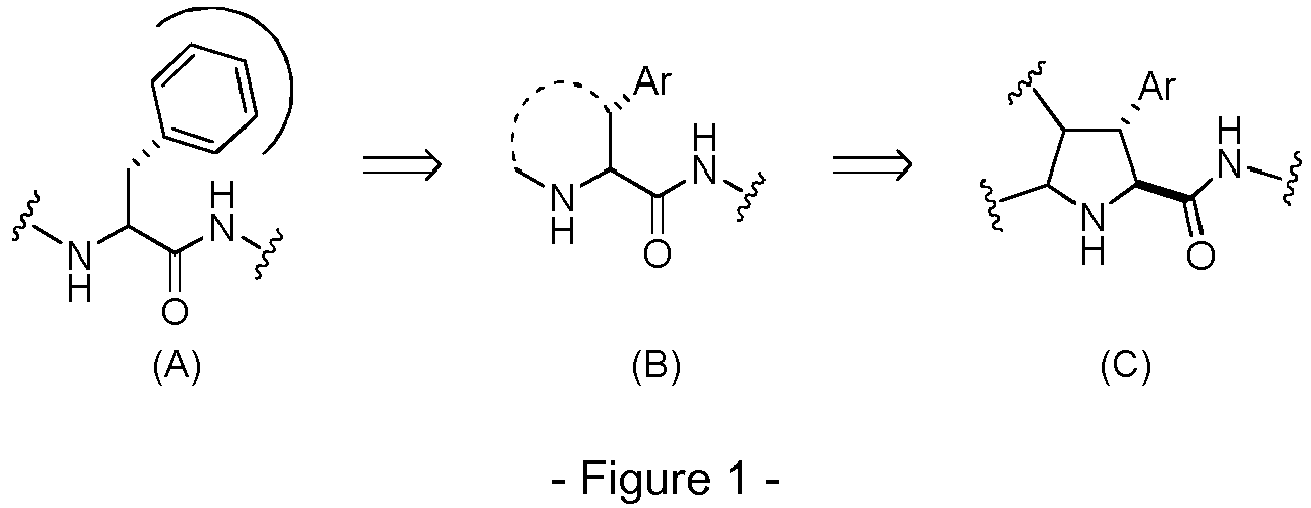
- One convenient tradeoff between conformational restriction and flexibility is provided by five membered rings. Therefore, we hypothesised that a densely substituted pyrrolidine ring scaffold possessing a carboxamide moiety at C2 and an aryl or heteroaryl group at C3 (preferably possessing R configuration, see Figure 1 C), when incorporated into a proteasome inhibitor, should improve the therapeutic profile by favorable entropic and enthalpic balance as well as by improving the selectivity of binding into different proteasome catalytic units.
- Others and we have developed different methods for the regio-, diastereo- and enantiocontrolled synthesis of densely substituted pyrrolidine rings (cf. Conde et al. Chem. Sci. 2012, 3, 1486-1491; Castelló et al. Org. Lett. 2013, 15, 2902-2905). In addition, pyrrolidine rings have been described as proteasome inhibitors (cf.
Adams et al. WO96/13266 - A first aspect of the invention refers to a compound of general formula (I),
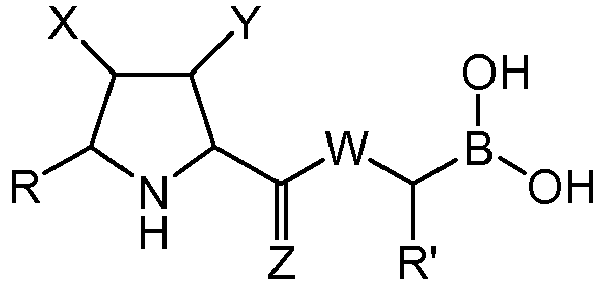

- X is an electron withdrawing group selected from -NO2, -C(O)R1, -C(O)OR1 and-C(O)NR2R3, or forms together with Y a cycloalkyl or heterocycloalkyl group, wherein R1 is an alkyl group and R2 and R3 are independently selected from hydrogen and alkyl;
- Y is selected from aryl, heteroaryl having at least one heteroatom, and -C(O)OR4 or form together with X a cycloalkyl or heterocycloalkyl group, wherein R4 is an alkyl group;
- R is selected from mono- or polycyclic aryl and heteroaryl having at least one heteroatom;
- Z is O or S;
- W is selected from -NH-, -O-, and -CH2-;
- R' is selected from linear or branched alkyl and cycloalkyl;
- or stereoisomers, solvates, salts or prodrugs thereof.
- Likewise, another aspect of the present invention refers to a process for the preparation of compounds of general formula (I), or stereoisomers, solvates, salts or prodrugs thereof, which comprises:
- a) reacting an alkene of general formula (Ila) or (Ilb),
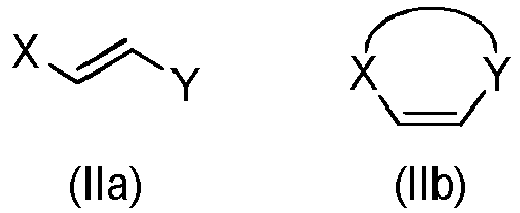
with an imine of general formula (III),
in the presence of an organic or inorganic base, an aprotic solvent and a metallic salt, to afford a compound of formula (IV):
- b) reacting a compound of formula (IV) with a mixture comprising an organic solvent and:
- i) an aqueous solution of an alkali or alkaline earth hydroxide; or
- ii) a trialkyltin hydroxide; or
- iii) an organic acid,
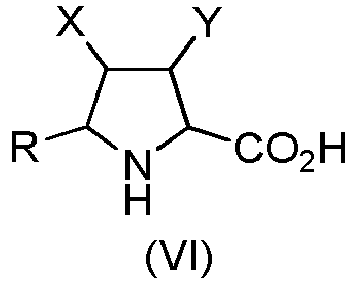
- c) reacting the compound of formula (VI) with a boronic ester of formula (VII):
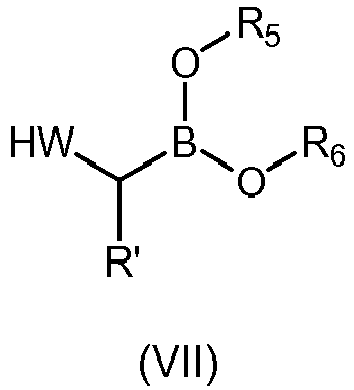
- R' and W have the meaning given above,
- R5 and R6 are independently an alkyl group or together form an alkylene group, a cycloalkylene group or an arylene group;
- the WH group can be neutral or forming a salt,
- in an organic solvent in the presence of an organic base and a coupling agent,
- to afford an intermediate boronic ester;
- d) deprotecting the intermediate boronic ester by treatment with isobutylboronic acid and an aqueous solution of hydrochloric acid, to afford the compound of formula (I) wherein Z is O; and
- e) reacting the compound of formula (I) obtained in step d) with a Lawesson reactive or a derivative thereof to afford the compound of formula (I) wherein Z is S.
- Another aspect of this invention relates to a compound of general formula (I), or a stereoisomer, salt, solvate or prodrug thereof, for its use as a medicament.
- Another aspect of the present invention relates to a compound of general formula (I), or a stereoisomer, salt, solvate or prodrug thereof, for its use in the treatment of cancer, hematological malignancy, proliferative diseases or inflammation disorders.
- Another aspect of the present invention relates to the use of a compound of general formula (I), or a stereoisomer, salt, solvate or prodrug thereof, in the preparation of a medicament for the treatment of cancer, hematological malignancy, proliferative diseases or inflammation disorders.
- According to another aspect the present invention is directed to a method of treating cancer, hematological malignancy, proliferative diseases or inflammation disorders, which comprises the administration to a patient needing such treatment, consisting of a therapeutically effective amount of at least one compound of general formula (I) or a stereoisomer, salt, solvate or prodrug thereof.
- A further object of the invention described below is a pharmaceutical composition comprising at least one compound of general formula (I), or a stereoisomer, salt, solvate or prodrug thereof, and at least one pharmaceutically acceptable excipient.
- First, the present invention provides compounds of general formula (I),
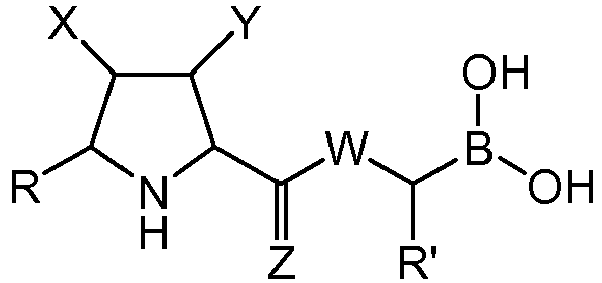
- X is an electron withdrawing group selected from -NO2, -C(O)R1, -C(O)OR1 and C(O)NR2R3, or forms together with Y a cycloalkyl or heterocycloalkyl group, wherein R1 is an alkyl group and R2 and R3 are independently selected from hydrogen and alkyl;
- Y is selected from aryl, heteroaryl having at least one heteroatom, and -C(O)OR4, or forms together with X a cycloalkyl or heterocycloalkyl group, wherein R4 is an alkyl group;
- R is selected from mono- or polycyclic aryl and heteroaryl having at least one heteroatom;
- Z is O or S;
- W is selected from -NH-, -O- and -CH2-;
- R' is selected from linear or branched alkyl and cycloalkyl;
- or a stereoisomer, a solvate,a salt or prodrug thereof.
- The term "alkyl" refers to a linear, or branched hydrocarbon chain radical consisting of carbon and hydrogen atoms, containing no unsaturation, having 1 to 8 carbon atoms, which is attached to the rest of the molecule by a single bond. Examples of such alkyl groups include, but are not limited to, methyl, ethyl, n-propyl, i-propyl, n-butyl, s-butyl, i-butyl or tert-butyl.
- The term "cycloalkyl" means a non-aromatic, monocyclic or polycyclic ring comprising carbon and hydrogen atoms. A cycloalkyl group can have one or more carbon-carbon double bonds in the ring so long as the ring is not rendered aromatic by their presence. Examples of cycloalkyl groups include, but are not limited to, C3-C7 fully saturated cycloalkyl groups, such as cyclopropyl, cyclobutyl, cyclopentyl, cyclohexyl, and cycloheptyl, and saturated cyclic and bicyclic terpenes and C3-C7 cycloalkenyl groups, such as cyclopropenyl, cyclobutenyl, cyclopentenyl, cyclohexenyl, and cycloheptenyl, and unsaturated cyclic and bicyclic terpenes. A cycloalkyl group can be unsubstituted or substituted by one or two suitable substituents. Preferably, the cycloalkyl group is a monocyclic ring or bicyclic ring.
- The term "heterocycloalkyl" means a non-aromatic monocyclic or polycyclic ring comprising carbon and hydrogen atoms and at least one heteroatom, preferably, 1 to 4 heteroatoms selected from nitrogen, oxygen, and sulfur. A heterocycloalkyl group can have one or more carbon-carbon double bonds or carbon-heteroatoms double bonds in the ring as long as the ring is not rendered aromatic by their presence. Examples of heterocycloalkyl groups include aziridinyl, pyrrolidinyl, pyrrolidino, piperidinyl, piperidino, piperazinyl, piperazino, morpholinyl, morpholino, thiomorpholinyl, thiomorpholino, tetrahydrofuranyl, tetrahydrothiofuranyl, tetrahydropyranyl, and pyranyl. A heterocycloalkyl group can be unsubstituted or substituted with one or more suitable substituents, preferably with alkyl groups and/or ketone groups. Preferably, the heterocycloalkyl group is a monocyclic or bicyclic ring, more preferably, a monocyclic ring, wherein the ring comprises from 2 to 6 carbon atoms and from 1 to 3 heteroatoms. The heterocycloalkyl group is preferably a 1-alkyl-pyrrolidine-2,5-dione, more preferably 1-methyl-pyrrolidine-2,5-dione.
- The term "aryl" refers to a C6-C10 aromatic group comprising 1, 2 or 3 aromatic rings, linked by a carbon-carbon bond or condensed, optionally substituted with a group selected from a C1-C6 alkyl, halogen, nitro, cyano, OR1, SR1, SOR1, SO2R1, NR1R2, C(O)R1, C(O)OR1, C(O)NR1R2 or OC(O)R1, wherein R1 and R2 are hydrogen or an alkyl group as defined above. The term aryl includes, for example, and in a non-limiting sense, phenyl, napthyl, biphenyl, indenyl, etc.
- The term "heteroaryl" refers to a stable monocyclic or polycyclic 3 to 10 membered aromatic ring, preferably a 5 or 6 membered aromatic ring, which consists of carbon atoms and from 1 to 5 heteroatoms selected from nitrogen, oxygen and sulfur. For the purposes of the invention, the heteroaryl radical may be optionally oxidized; and nitrogen, carbon or sulfur atoms in the heteroaryl radical may be optionally oxidized; and the nitrogen atom may be optionally quaternized. Examples of such heteroatom substituent include, but are not limited to, benzimidazole, benzothiazole, furan, thiophene, pyrrole, pyridine, pyrimidine, isothiazole, imidazole, indole, purine, quinoline and thiodiazole.
- In a particular embodiment of the invention, the group W is -NH-.
- In another particular embodiment, Z is O.
- Even in a preferred embodiment, W is -NH- and Z s O.
- In another particular embodiment, X is selected from -NO2, and -C(O)OR1, wherein R1 is an alkyl group, or form together with Y a heterocycloalkyl group. More preferably, X is -NO2, -C(O)OMe or form together with Y 1-methyl-pyrrolidine-2,5-dione.
- In another particular embodiment, R' is a linear or branched alkyl group, more preferably is a branched alkyl group, even more preferably is an iso-butyl group.
- In a preferred embodiment, the compounds of general formula (I) are selected from:
- 3-Methyl-1-[4-nitro-3,5-diphenylpyrrolidine-2-carboxamido]butyl boronic acid;
- 3-Methyl-1-[4-nitro-5-phenyl-3-p-tolylpyrrolidine-2-carboxamido] butylboronic acid;
- 1-[3-(4-Fluorophenyl)-4-nitro-5-phenylpyrrolidine-2-carboxamido] -3-methylbutylboronic acid;
- 1-[3-(4-Methoxyphenyl)-4-nitro-5-phenylpyrrolidine-2-carboxamido]-3-methylbutylboronic acid;
- 3-Methyl-1-[4-nitro-3-(4-nitrophenyl)-5-phenylpyrrolidine-2-carboxamido]butylboronic acid;
- 3-Methyl-1-[3-(naphthalen-2-yl)-4-nitro-5-phenylpyrrolidine-2-carboxamido]butylboronic acid;
- 3-Methyl-1-[4-nitro-5-phenyl-3-(thiophen-2-yl)pyrrolidine-2-carboxamido]butylboronic acid
- 1-[3-(Furan-2-yl)-4-nitro-5-phenylpyrrolidine-2-carboxamido]-3-methylbutylboronic acid;
- 3-Methyl-1-[5-(naphthalen-2-yl)-4-nitro-3-phenylpyrrolidine-2-carboxamido]butylboronic acid;
- 3-Methyl-1-[5-(naphthalen-1-yl)-4-nitro-3-phenylpyrrolidine-2-carboxamido]butylboronic acid;
- 3-Methyl-1-[5-(naphthalen-1-yl)-4-nitro-3-phenylpyrrolidine-2-carboxamido]butylboronic acid;
- 1-[5-(Furan-2-yl)-4-nitro-3-phenylpyrrolidine-2-carboxamido]-3-methylbutylboronic acid;
- 3-Methyl-1-[4-nitro-3-phenyl-5-(pyridin-3-yl)pyrrolidine-2-carboxamido]butylboronic acid;
- 1-[3,4-Bis(methoxycarbonyl)-5-phenylpyrrolidine-2-carboxamido]-3-methylbutylboronic acid;
- 3-Methyl-1-{5-methyl-4,6-dioxo-3-phenyloctahydropyrrolo [3,4-c]pyrrole-1-carboxamido}butylboronic acid
- 3-Methyl-1-{5-methyl-4,6-dioxo-3-phenyloctahydropyrrolo [3,4-c]pyrrole-1-carboxamido}butylboronic acid.
- The compounds of the invention comprise asymmetric substituents, which may give raise to the presence of different stereoisomers (enantiomer, stereoisomers, etc). The single isomers, enantiomers or diastereoisomers, also fall within the scope of the present invention.
- In a particular embodiment, the compound of formula (I) is selected from the compounds of formula (L-Ia) and formula (D-Ia):

- R, R', Z and W are as defined above;
- X is an electron withdrawing group selected from -NO2, C(O)R1, C(O)OR1 and-C(O)NR2R3, wherein R1, R2 and R3 are as defined above; and
- Y is selected from aryl, heteroaryl having at least one heteroatom, and -C(O)OR4, wherein R4 is as defined above.
- In another particular embodiment, the compound of formula (I) is selected from the compounds of formula (L-Ib) and formula (D-Ib):
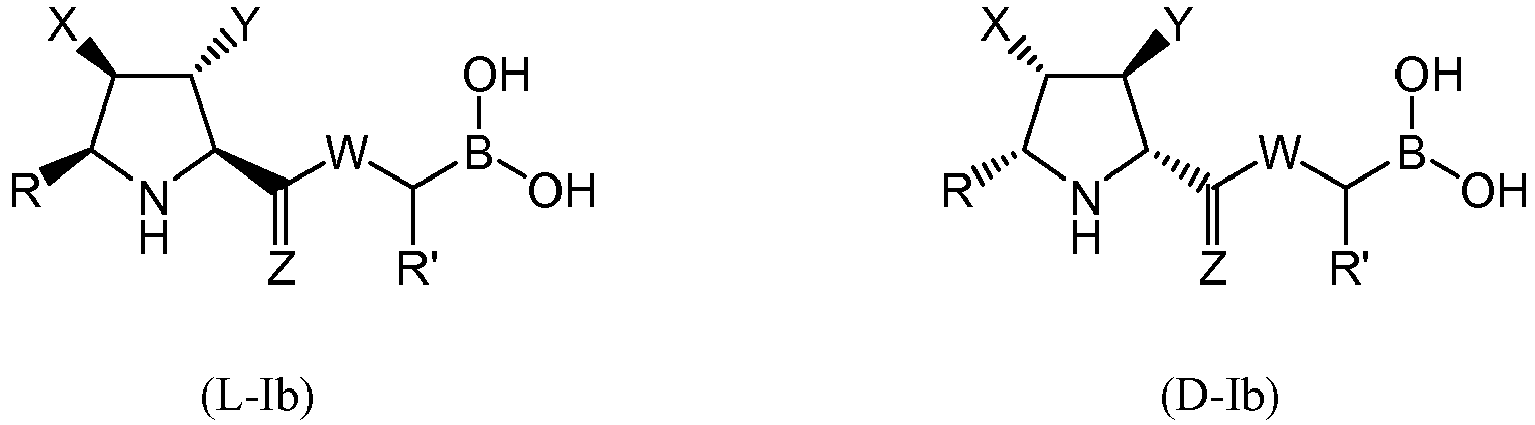
- R, R', Z and W are as defined above;
- X is an electron withdrawing group selected from -NO2, C(O)R1, C(O)OR1 and-C(O)NR2R3, wherein R1, R2 and R3 are as defined above;
- Y is selected from aryl, heteroaryl having at least one heteroatom, and -C(O)OR4, wherein R4 is as defined above.
- In another particular embodiment, the compound of formula (I) is selected from the compounds of formula (L-Ic) and formula (D-Ic):
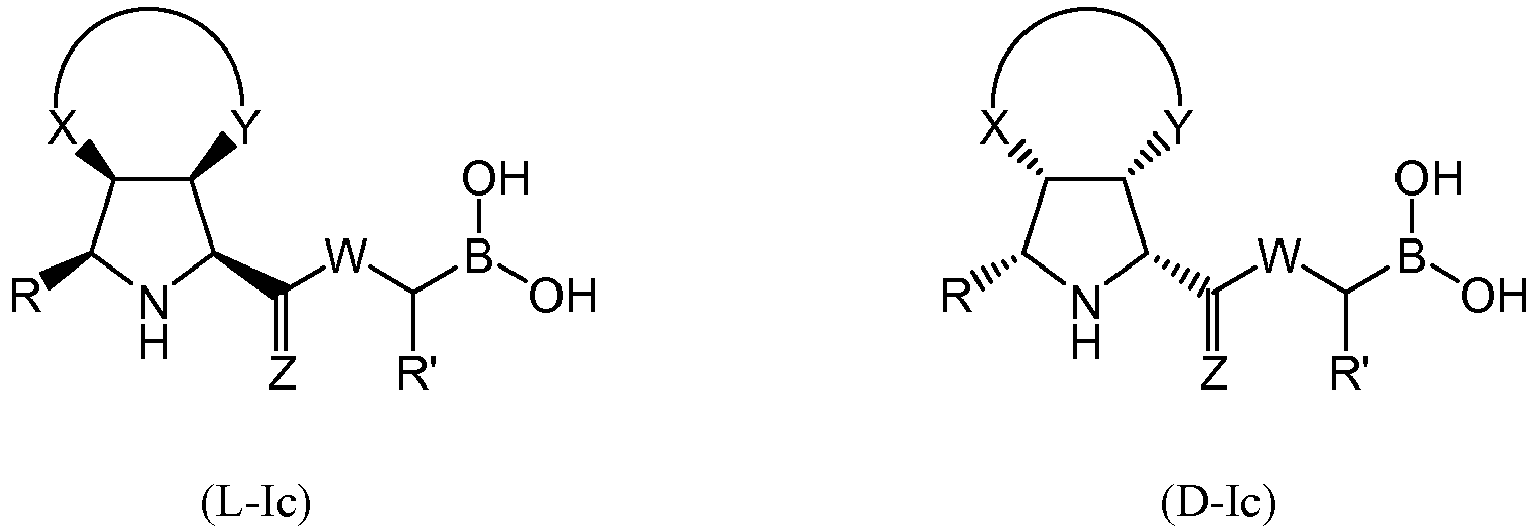
- R, R', Z and W are as defined above; and
- X and Y are linked to each other thus forming a cylcoalkyl or heterocycloalkyl group.
- More preferable are the following stereoisomers:
- [1] (R)-3-Methyl-1-[(2R,3R,4S,5R)-4-nitro-3,5-diphenylpyrrolidine-2-carboxamido]butyl boronic acid, with the following structural formula:

- [2] (R)-3-Methyl-1-[(2S,3S,4R,5S)-4-nitro-3,5-diphenylpyrrolidine-2-carboxamido]butyl boronic acid, with the following structural formula:
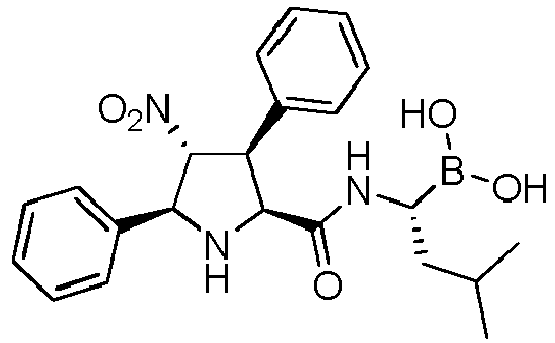
- [3] (R)-3-Methyl-1-[(2R,3S,4R,5R)-4-nitro-3,5-diphenylpyrrolidine-2-carboxamido)butyl boronic acid, with the following structural formula:
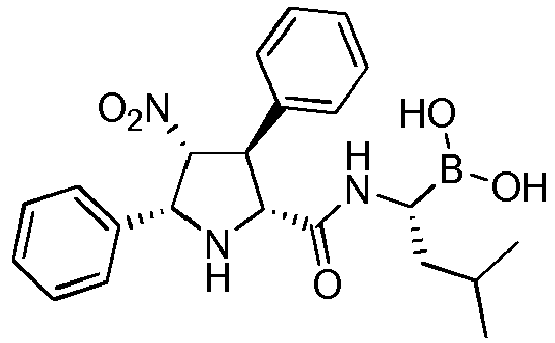
- [4] (R)-3-Methyl-1-[(2S,3R,4S,5S)-4-nitro-3,5-diphenylpyrrolidine-2-carboxamido]butyl boronic acid, with the following structural formula:

- [5] (R)-3-Methyl-1-[(2R,3R,4S,5R)-4-nitro-5-phenyl-3-p-tolylpyrrolidine-2-carboxamido] butylboronic acid, with the following structural formula:

- [6] (R)-1-[(2R,3R,4S,5R)-3-(4-Fluorophenyl)-4-nitro-5-phenylpyrrolidine-2-carboxamido] -3-methylbutylboronic acid, with the following structural formula:
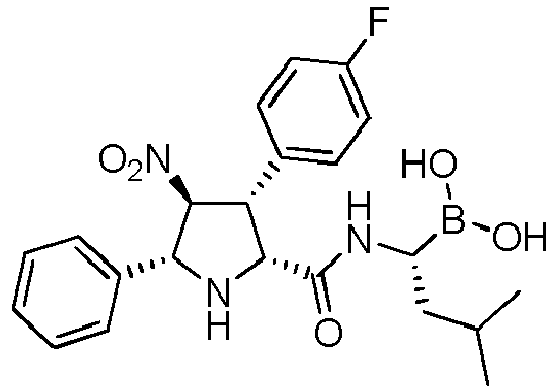
- [7] (R)-1-[(2R,3R,4S,5R)-3-(4-Methoxyphenyl)-4-nitro-5-phenylpyrrolidine-2-carboxamido]-3-methylbutylboronic acid, with the following structural formula:

- [8] (R)-3-Methyl-1-[(2R,3R,4S,5R)-4-nitro-3-(4-nitrophenyl)-5-phenylpyrrolidine-2-carboxamido]butylboronic acid, with the following structural formula:
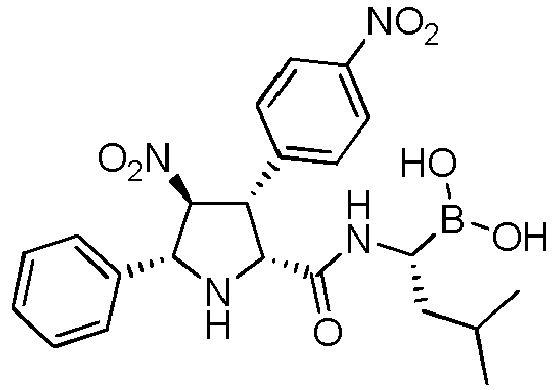
- [9] (R)-3-Methyl-1-[(2R,3R,4S,5R)-3-(naphthalen-2-yl)-4-nitro-5-phenylpyrrolidine-2-carboxamido]butylboronic acid, with the following structural formula:
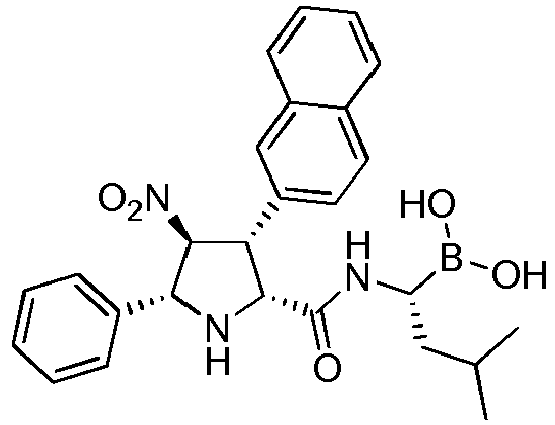
- [10] (R)-3-Methyl-1-[(2R,3R,4S,5R)-4-nitro-5-phenyl-3-(thiophen-2-yl)pyrrolidine-2-carboxamido]butylboronic acid, with the following structural formula:
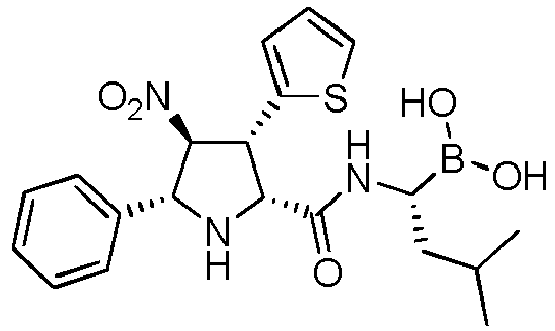
- [11] (R)-1-[(2R,3R,4S,5R)-3-(Furan-2-yl)-4-nitro-5-phenylpyrrolidine-2-carboxamido]-3-methylbutylboronic acid, with the following structural formula:
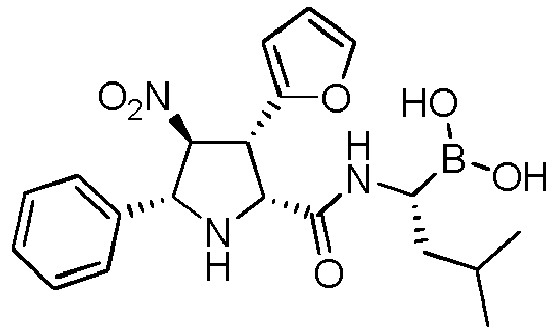
- [12] (R)-3-Methyl-1-[(2R,3R,4S,5R)-5-(naphthalen-2-yl)-4-nitro-3-phenylpyrrolidine-2-carboxamido]butylboronic acid, with the following structural formula:

- [13] (R)-3-Methyl-1-[(2R,3R,4S,5R)-5-(naphthalen-1-yl)-4-nitro-3-phenylpyrrolidine-2-carboxamido]butylboronic acid, with the following structural formula:
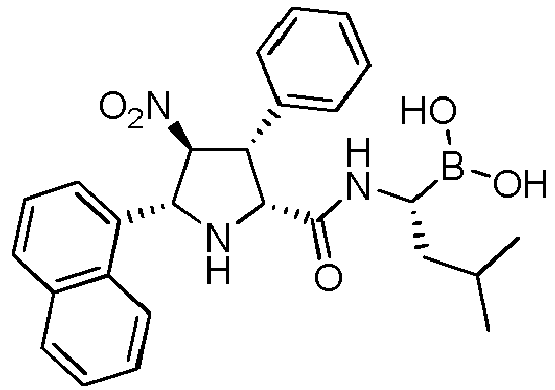
- [14] (R)-3-Methyl-1-[(2R,3S,4R,5R)-5-(naphthalen-1-yl)-4-nitro-3-phenylpyrrolidine-2-carboxamido]butylboronic acid, with the following structural formula:
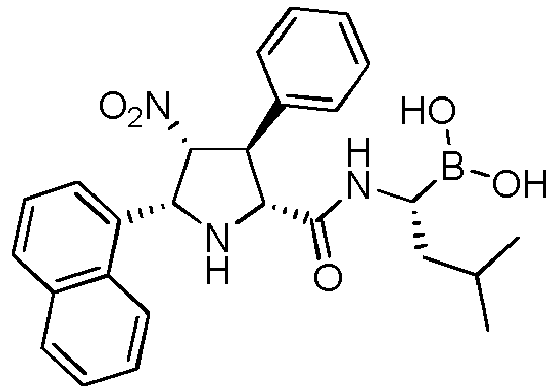
- [15] (R)-1-[(2R,3R,4S,5S)-5-(Furan-2-yl)-4-nitro-3-phenylpyrrolidine-2-carboxamido]-3-methylbutylboronic acid, with the following structural formula:

- [16] (R)-3-Methyl-1-[(2R,3R,4S,5R)-4-nitro-3-phenyl-5-(pyridin-3-yl)pyrrolidine-2-carboxamido]butylboronic acid, with the following structural formula:
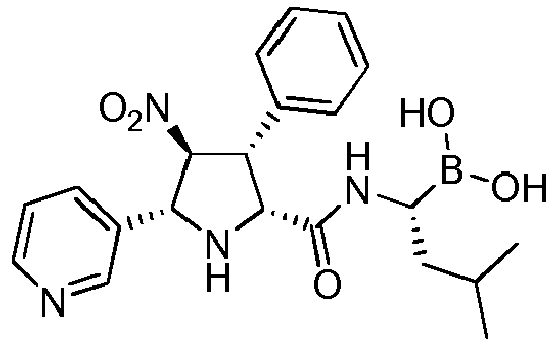
- [17] (R)-1-[(2S,3S,4S,5R)-3,4-Bis(methoxycarbonyl)-5-phenylpyrrolidine-2-carboxamido]-3-methylbutylboronic acid, with the following structural formula:

- [18] (R)-3-Methyl-1-{(1S,3R,3aS,6aR)-5-methyl-4,6-dioxo-3-phenyloctahydropyrrolo [3,4-c]pyrrole-1-carboxamido}butylboronic acid, with the following structural formula:
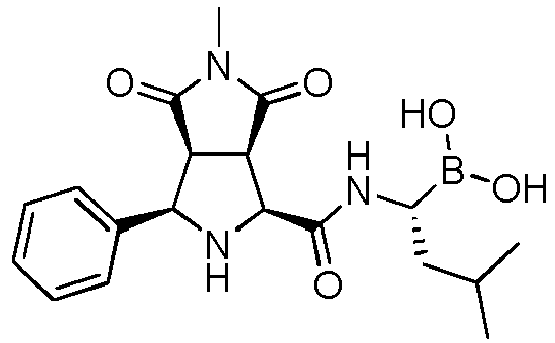
- [19] (R)-3-Methyl-1-{(1R,3S,3aR,6aS)-5-methyl-4,6-dioxo-3-phenyloctahydropyrrolo [3,4-c]pyrrole-1-carboxamido}butylboronic acid, with the following structural formula:

- The compounds of formula (I) defined above can also be in the form of solvates or salts or prodrugs, preferably as a pharmaceutically acceptable species.
- The term "pharmaceutically acceptable species" refers to solutions, suspensions, mixtures and molecular entities that are physiologically tolerable and in general do not produce an allergic reaction or similar unfavorable reaction as gastric disorders, dizziness and suchlike, when administered to a human or animal. Preferably, the term "pharmaceutically acceptable" means it is approved by a regulatory agency of a state of federal government or is included in the U.S. Pharmacopoeia or other generally recognized pharmacopoeia for use in animals, and preferably in humans.
- The term "prodrug" as used in this application is defined here as meaning a chemical compound having undergone a chemical derivation such as substitution or addition of a further chemical group to change (for pharmaceutical use) any of its physico-chemical properties, such as solubility or bioavailability, e.g. ester and ether derivatives of an active compound that yield the active compound per se after administration to a subject.. Experts in the art would readily produce such derivatives, and include, depending of the functional groups present in the molecule and without limitation, the following derivatives of the present compounds: boronic esters, esters of metallic salt sulfonates, carbonates, ureas and amides. Examples of well known methods of producing a prodrug of a given acting compound are known to those skilled in the art and can be found e.g. in Krogsgaard-Larsen et al., Textbook of Drug design and Discovery, Taylor & Francis (April 2002).
- Particularly favoured prodrugs are those that increase the bioavailability of the compounds of this invention when such compounds are administered to a patient (e.g., by allowing an orally administered compound to be more readily absorbed into the blood) or which enhance delivery of the parent compound to a biological compartment (e.g., the brain or lymphatic system) relative to the parent species.
- The term "solvate" is to be understood as meaning any form of the active compound according to the invention which has another molecule (for example a polar solvent such as water or ethanol, a cyclodextrin or a dendrimer) attached to it through non-covalent bonds. Methods of solvation are known within the art. Examples of such solvates include hydrates and alcoholates, e.g. methanolates.
- The invention also provides salts of the compounds of the invention. Non-limiting examples are sulphates; hydrohalide salts; phosphates; lower alkane sulphonates; aryl sulphonates; salts of C1-C20 aliphatic mono-, di- or tribasic acids which may contain one or more double bonds, an aryl nucleus or other functional groups such as hydroxy, amino, or keto; salts of aromatic acids in which the aromatic nuclei may or may not be substituted with groups such as hydroxyl, lower alkoxyl, amino, mono- or di- lower alkylamino sulphonamido.
- Solvates, salts and prodrugs can be prepared by methods known in the state of the art. Note that the non-pharmaceutically acceptable solvates and prodrugs also fall within the scope of the invention because they can be useful in preparing pharmaceutically acceptable salts, solvates or prodrugs.
- The compounds of the invention also seek to include compounds that differ only in the presence of one or more isotopically enriched atoms. For example, compounds having the present structures except for the replacement of a hydrogen by a deuterium or tritium, or the replacement of a carbon by a carbon enriched in 11C, 13C or 14C, or 18F and/or 15N enriched compounds are within the scope of this invention.
- Another aspect of the invention refers to a process to obtain compounds of general formula (I) as defined above.
- Step a) of the process of the invention involves the reaction of the alkene of formula (Ila) or (IIb) with the imine of formula (III) defined above in the presence of an organic or inorganic base, an aprotic solvent and a metallic salt to afford the compound of formula (IV).
- In a particular embodiment, when an enantiopure compound of formula (I) wants to be obtained, step a) is carried out also in the presence of a chiral catalyst.
- As it would be evident for a skilled person, by a chiral catalyst it is understood a catalyst that allows obtaining the required stereochemistry for a particular compound.
- In a particular embodiment the chiral catalyst is selected from:

- The reaction mixture in step a) is generated by mixing the selected chiral catalyst, if any, with a metallic salt. Said metallic salt can be formed by a copper (I), copper (II), lithium (I), magnesium (II) or silver (I) cation, and the appropriate anion and, when possible, neutral ligands. The resulting mixture can be stirred at a temperature comprised between -70°C and +25°C. To this mixture, the alkene (Ila) or (IIb) and the imine (III), together with the organic base, can be added in any order.
- The organic base may be a primary, secondary or tertiary amine, preferably a tertiary amine selected from cyclic and acyclic aliphatic amines with C3-C10.
- The resulting compound can be isolated by filtration of the reaction mixture through a pad of celite, silica gel or alumina, followed by concentration under reduced pressure.
- Separation and dehydration of the organic phase, followed by evaporation of the organic solvent, yields compounds of formula (IV) which can be purified by chromatography or trituration.
- Step b) of the process of the invention involves the formation of carboxylic acid derivatives of formula (VI). This step can be accomplished by means of the following procedures:
- i) hydrolysis of compounds of formula (IV) in the presence of an appropriate organic solvent and an aqueous solution of a hydroxide of alkali or alkaline earth metal;
- ii) treatment of compounds of formula (IV) with a trialkyltin hydroxide in the presence of an appropriate organic solvent;
- iii) treatment of compounds of formula (IV) with an organic acid in the presence of an organic solvent. In a preferred embodiment of the invention, the organic acid is trifluoroacetic acid and the starting ester of formula (IV) is a tert-butyl ester.
- Step c) of the process of the invention can be carried out by adding, under argon atmosphere, the carboxylic acid of formula (VI), a coupling reagent, and the boronic ester (VII) or its hydrochloride salt to a dry organic solvent, at a temperature comprised between -100°C and +25°C. To the resulting solution or suspension a mixture of an organic base solved in an organic solvent is added at the same temperature. After completion of the reaction, a less polar organic solvent such as ethyl acetate is added and the resulting solution is washed. The organic layer is separated, dried, and concentrated under reduced pressure.
- The resulting product is solved in an alcohol and an apolar solvent. The resulting solution is treated with isobutyl boronic acid and an aqueous solution of hydrochloric acid. After an appropriate reaction time at a temperature comprised between 0°C and 25°C, an appropriate solvent such as ethyl acetate is added. The organic layer is washed with a weak basic aqueous solution. The organic layer is separated and dried. Filtration and evaporation of the organic solvent yields the product (I) wherein Z is O, which can be purified by means of an appropriate method such as trituration, crystallization or chromatographic technique.
- A preferred embodiment of step c) of the process of the invention includes N,N-dimethylformamide or dimethylsulfoxide as polar solvents.
- Likewise, preferred organic bases are cyclic or acyclic aliphatic amines with C3-C10.
- The coupling reagent can be chosen among the compounds reported in the literature. Preferred coupling reagents are O-(benzotriazol-1-yl)-N,N,N',N'-tetramethyluronium tetrafluoroborate, 1-[bis(dimethylamino)methylene]-1H-1,2,3-triazolo[4,5b]pyridinium-3-oxid hexafluorophosphate, benzotriazol-1-yl-oxytripyrrolidinophosphonium hexafluorophosphate, and pairs formed by N,N'-dicyclohexylcarbodiimide or N,N'-diisopropylcarbodiimide and 1-hydroxy-7-azabenzotriazole or hydroxybenzotriazole.
- The alcohol can be selected among any alcohol liquid at room temperature.
- In a particular embodiment, the boronioc ester of formula (VII) is selected from:
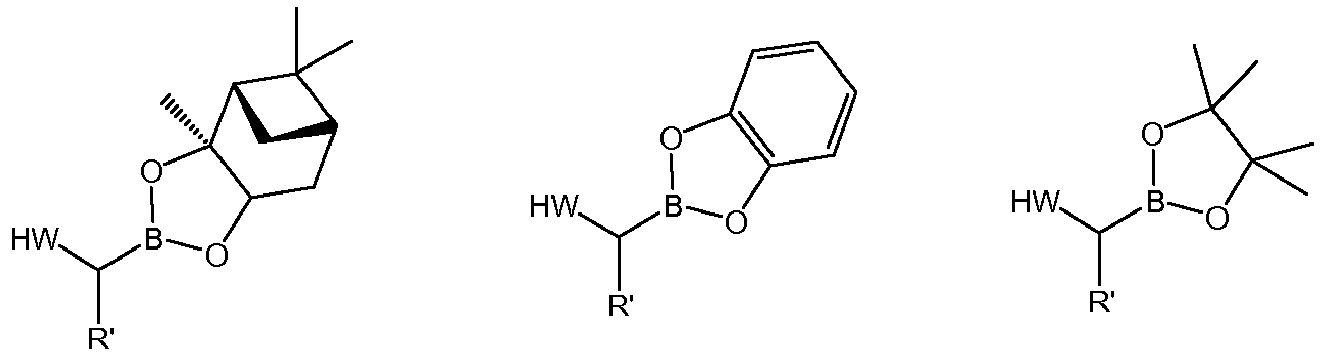
- wherein R' and W are as defined above.
- When it is desired to obtain a compound of formula (I) in which Z is S, the compound of formula (I) obtained above, in which Z is O, is subjected to a reaction with a Lawesson reactive or a derivative thereof following the procedures described for example by Kaleta, Z et al. (Org. Lett., 2006, 8, 1625-1628), Jones, B. A. et al. (Chem. Rev. (Review) 84 (84): 17 and Shabana, R. et al. (Nouveau Journal de Chimie 1980, (4): 47).
- A further embodiment of the invention is a salt or solvate or prodrug thereof of a compound of formula (I). According to a particular embodiment, the salt is a boronate salt of alkali or alkaline earth metals. To obtain these salts, the boronic group can be treated with hydroxides of alkali or alkaline earth metals (e.g. sodium, lithium, potassium, calcium, or magnesium hydroxide) at a temperature ranging from 0°C to +40°C. In an embodiment of the invention the reaction takes place at room temperature using water as solvent.
- To obtain ammonium salts corresponding to compounds of formula (I), the secondary amino group can be treated with organic or inorganic acids. In an embodiment of the invention, these acids can be selected among the usual acids of acceptable pharmacological use. To obtain these ammonium salts the amino group can be treated directly with the corresponding acid in an appropriate solvent at a temperature ranging from 0°C to +30°C. In the products thus formed, the anion associated with the corresponding salt can be chloride, acetate, tartrate, lactate, succinate, or similar.
- The following methods A, B and C describe suitable procedures to obtain stereoisomer compounds of formula (L/D-Ia), (L/D-Ib), and (L/D-Ic), respectively, or solvates or salts or prodrugs thereof as defined above.
- Method A describes the procedure for obtaining compounds of general formula (L/D-Ia),
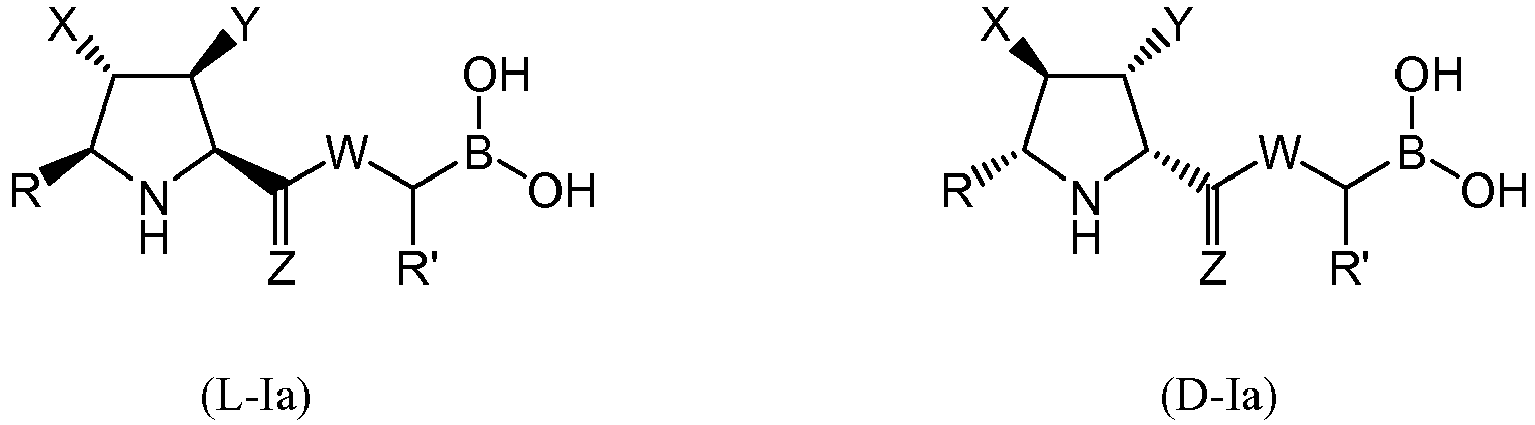
- wherein X, Y, R, R', Z and W have the meaning given above and X and Y are not linked to each other,
which comprises:- a) reacting an (E)-alkene of general formula (IIa),
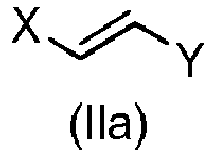
- wherein X and Y have the meaning given above;
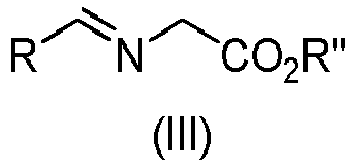
- wherein R has the meaning given above and R" is a linear or branched alkyl group, preferably methyl, ethyl, or tert-butyl;
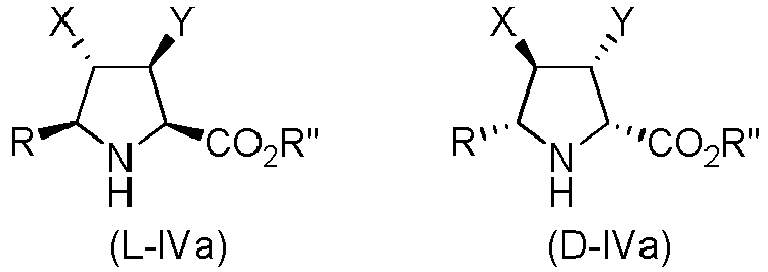
- b) reacting the compounds of formula (L-IVa) and (D-IVa) in a mixture selected from:
- a polar organic solvent and an aqueous solution of a hydroxide of alkali or alkaline earth metal;
- an organic solvent and a trialkyltin hydroxide; and
- an organic acid and an organic solvent,
to afford compounds of formula (L-Vla) and (D-Vla):
- c) reacting the compounds of formulas (L/D-VIa) with a boronic ester of general formula (VII) or its hydrochloride salt:
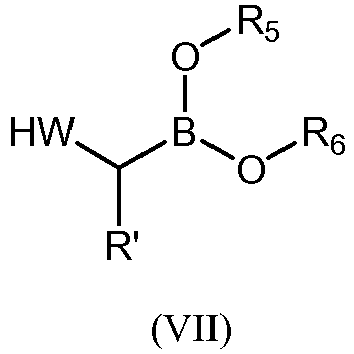
- R' and W have the meaning given above,
- and
- R5 and R6 are independently an alkyl group or together form an alkylene group, a cycloalkylene group or an arylene group;
- the group WH can be neutral or forming a salt,
- in the presence of an organic base, a suitable coupling reagent, and an appropriate organic solvent, to afford an intermediate boronic ester;
- d) deprotecting the intermediate boronic ester by treatment with isobutylboronic acid and an aqueous solution of hydrochloric acid to afford compounds of formula (L/D-Ia) wherein Z is O, and
- e) reacting the compound of formula (I) obtained in step d) with a Lawesson reactive or a derivative thereof to afford the compound of formula (L/D-Ia) wherein Z is S.
- a) reacting an (E)-alkene of general formula (IIa),
- In a particular embodiment, the chiral catalyst used in step a) of the Method A to yield compounds of formula (L-IVa) is a compound of formula (D-Va):

- In another aprticualr embodiment, the chiral catalyst used in step a) of the Method A to yield compounds of formula (D-IVa) is a compound of formula (L-Va):
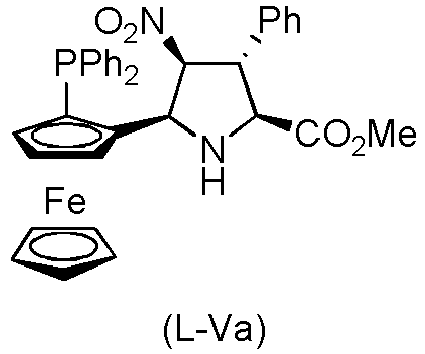
- Method B describes the procedure for obtaining compounds of general formula (L/D-Ib),
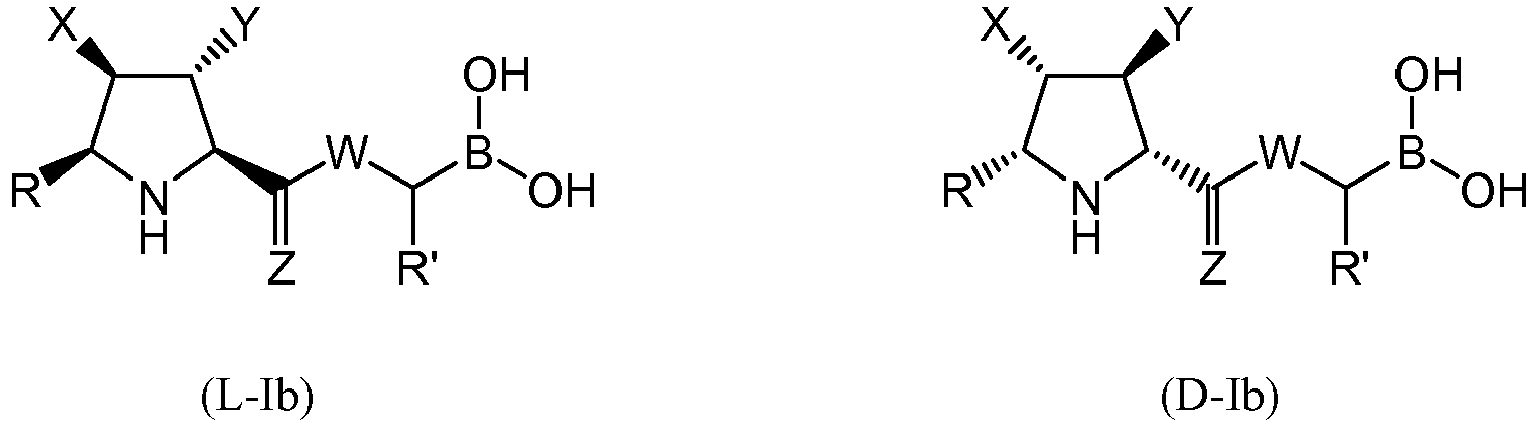
- wherein X, Y, R, R', Z and W have the meaning given above and X and Y are not linked to each other,
which comprises:- a) reacting an (E)-alkene of general formula (Ila) as described above;
with an imine of general formula (III) as described above;
in the presence of an organic or inorganic base, an aprotic solvent, a metallic salt, and an appropriate chiral catalyst, to afford compounds of formulas (L/D-IVb):
- b) reacting the compounds of formula (L-IVb) and (D-IVb) in a mixture selected from:
- a polar organic solvent with an aqueous solution of a hydroxide of an alkali or an alkaline earth metal;
- an organic solvent and a trialkyltin hydroxide; and
- an organic acid and an organic solvent,
to afford compounds of formula (L-Vlb) and (D-Vlb):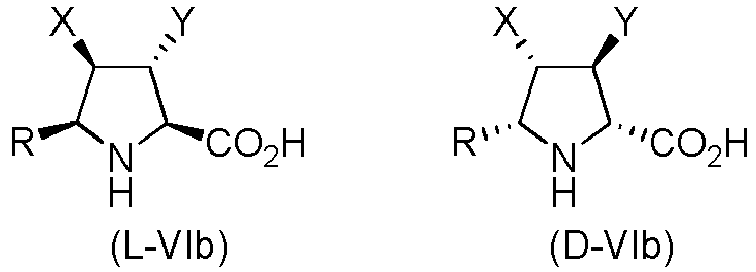
- c) reacting the compounds of formula (L/D-Vlb) with aboronic ester of general formula (VII) as described above, or its hydrochloride salt;
in the presence of an organic base, a suitable coupling reagent, and an appropriate organic solvent, to afford an intermediate boronic ester; - d) deprotecting said intermediate boronic ester by treatment with isobutylboronic acid and an aqueous solution of hydrochloric acid to afford compounds of formula (L/D-Ib) wherein Z is O; and
- e) reacting the compound of formula (I) obtained in step d) with a Lawesson reactive or a derivative thereof to afford the compound of formula (L/D-Ib) wherein Z is S.
- a) reacting an (E)-alkene of general formula (Ila) as described above;
- In a particular embodiment, the chiral additive of the catalytic system required to yield compounds of formula (L-IVb) is a compound of formula (L-Vb):
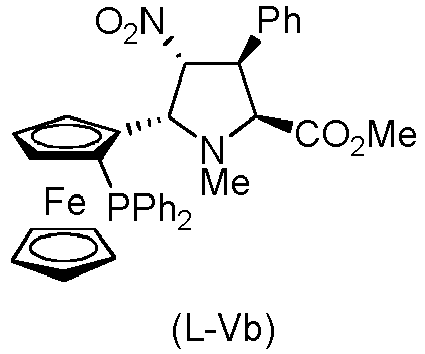
- In another particular embodiment, the chiral additive of the catalytic system required to yield compounds of formula (D-IVb) is a compound of formula (D-Vb):
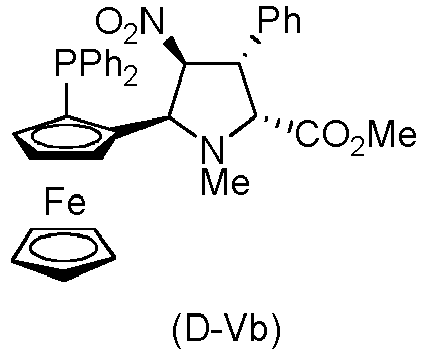
- Method C describes the procedure for obtaining compounds of general formula (L/D-Ic),

- wherein R, R', Z and W have the meaning given above, and X is linked to Y to form a cycloalkyl or heterocycloalkyl group,
which comprises:- a) reacting a (Z)-alkene of general formula (IIb),
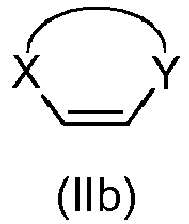
with an imine of general formula (III) as described above;
in the presence of an organic or inorganic base, an aprotic solvent, a metallic salt, and an appropriate chiral catalyst, to afford compounds of formula (L/D-IVc):
- b) reacting the compounds of formula (L-IVc) and (D-IVc) in a mixture selected from:
- a polar organic solvent and an aqueous solution of a hydroxide of an alkali or an alkaline earth metal;
- an appropriate organic solvent and a trialkyltin hydroxide;
- an organic acid and an organic solvent,
to afford compounds of formula (L-Vlc) and (D-Vlc):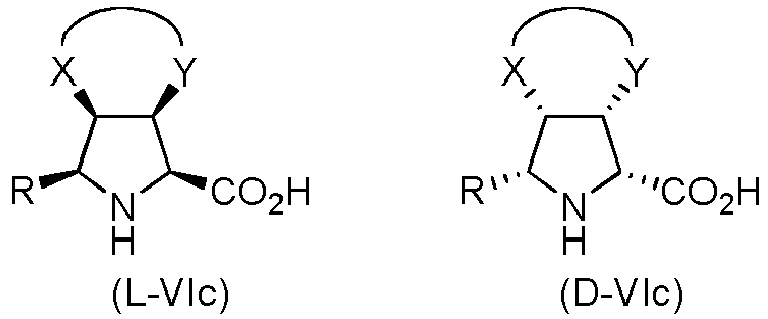
- c) reacting the compounds of formula (L/D-Vlc) with a boronic ester of general formula (VII) as described above, or its hydrochloride salt;
in the presence of an organic base, a suitable coupling reagent, and an appropriate organic solvent, to afford an intermediate boronic ester; - d) deprotecting said intermediate boronic ester by treatment with isobutylboronic acid and an aqueous solution of hydrochloric acid to afford compounds of formula (L/D-Ic), wherein Z is O; and
- e) reacting the compound of formula (I) obtained in step d) with a Lawesson reactive or a derivative thereof to afford the compound of formula (L/D-Ic) wherein Z is S.
- a) reacting a (Z)-alkene of general formula (IIb),
- In a particular embodiment, the chiral catalyst used to obtain compounds (L-IVc) is a compound of formula (D-Va) as defined above. In another particular embodiment, the chiral catalyst used to obtain compounds (D-IVc) is compounds of formula (L-Va) as defined above.
- In a preferred embodiment of any of the Methods A, B and C falling within the process of the invention, Z is O and W is -NH- and, therefore, step e) is not performed.
- The solvates, salts or prodrugs of the compounds of formula (D/L-I a-c) can be prepared following the procedures mentioned above.
- According to a particular embodiment, the compounds of general formula (L/D-la-c) are useful for the treatment of various types of cancer, hematological malignancy, proliferative diseases, autoimmune diseases, neurodegenerative diseases or viral infections, by means of the inhibition of the active sites of the 20S core particle of the ubiquitin-proteasome system.
- According to a particular embodiment, the cancer is selected from multiple myeloma, mantle cell lymphoma, pancreatic cancer, ovarian cancer, melanoma, hematologic cancers, renal cancer, osteosarcoma, fibrosarcoma, brain cancer, cervical cancer, epidermoid cancer, breast cancer, prostate cancer, colorectal cancer, lung cancer and liver cancer.
- According to an embodiment of the invention, the autoimmune diseases can be inflammatory bowel disease, multiple sclerosis and organ-specific autoimmune diseases.
- According to an additional embodiment of the invention, neurodegenerative diseases can be Alzheimer or prion protein-related conditions.
- According to another embodiment of the invention, viral infections can be influenza A or herpes.
- Generally a "therapeutically effective amount" of the compound of the invention or a pharmaceutical composition thereof will depend on the relative efficacy of the compound chosen, the severity of the disorder being treated and the weight of the sufferer. However, active compounds will typically be administered once or more times a day for example 1, 2, 3 or 4 times daily, with typical total daily doses in the range of from 0.1 to 1000 mg/kg/day.
- The term "treatment" or "to treat" in the context of this specification means administration of a compound or formulation according to the invention to prevent, ameliorate or eliminate the disease or one or more symptoms associated with said disease. "Treatment" also encompasses preventing, ameliorating or eliminating the physiological sequelae of the disease.
- The term "ameliorate" in the context of this invention is understood as meaning any improvement on the situation of the patient treated - either subjectively (feeling of or on the patient) or objectively (measured parameters).
- The compounds used in the present invention may be used with at least one other drug to provide a combination therapy. The at least other drug may be part of the composition, or be provided as a separate composition for administration at the same time or at different time.
- Another aspect of the present invention refers to a pharmaceutical composition which comprises the compounds of formula (I) of the invention, or a pharmaceutically acceptable solvate or salt or prodrug thereof, and at least a pharmaceutically acceptable excipient.
- The term "excipient" refers to a vehicle, diluent or adjuvant that is administered with the active ingredient. Such pharmaceutical excipients can be sterile liquids, such as water and oils, including those of petroleum, animal, vegetable or synthetic origin, such as peanut oil, soybean oil, mineral oil, sesame oil and similar. Water or saline aqueous solutions and aqueous dextrose and glycerol solutions, particularly for injectable solutions, are preferably used as vehicles. Suitable pharmaceutical vehicles are described in "Remington's Pharmaceutical Sciences" by E.W. Martin, 21st Edition, 2005; or "Handbook of Pharmaceutical Excipients", Rowe C. R.; Paul J. S.; Marian E. Q., sixth Edition.
- Examples of pharmaceutical compositions include any solid composition (tablets, pills, capsules, granules, etc.) or liquid composition (solutions, suspensions or emulsions) for oral, topical or parenteral administration.
- In a preferred embodiment the pharmaceutical compositions are in oral delivery form. Pharmaceutical forms suitable for oral administration may be tablets and capsules and may contain conventional excipients known in the art such as binders, for example syrup, gum arabic, gelatin, sorbitol, tragacanth or polyvinylpyrrolidone; fillers, for example lactose, sugar, cornstarch, calcium phosphate, sorbitol or glycine; lubricants for the preparation of tablets, for example magnesium stearate; disintegrants, for example starch, polyvinylpyrrolidone, sodium starch glycolate or microcrystalline cellulose; or pharmaceutically acceptable wetting agents such as sodium lauryl sulphate.
- Solid oral compositions can be prepared by conventional methods of blending, filling or preparation of tablets. Repeated blending operations can be used to distribute the active ingredient in all the compositions that use large amounts of fillers. Such operations are conventional in the art. The tablets can be prepared, for example, by dry or wet granulation and optionally can be coated by well known methods in normal pharmaceutical practice, in particular using an enteric coating.
- Pharmaceutical compositions can also be adapted for parenteral administration, such as sterile solutions, suspensions or lyophilized products in the appropriate unit dosage form. Suitable excipients such as fillers, buffering agents or surfactants can be used.
- The mentioned formulations will be prepared using standard methods such as those described or referred to in the Spanish and U.S. Pharmacopoeias and similar reference texts.
- In order to facilitate the understanding of the preceding ideas, some examples of experimental procedures and embodiments of the present invention are described below. These examples are merely illustrative.
- The following general procedure describes the preparation of the exemplified compounds which correspond to the compounds of formula L/D-Ia, L/D-Ib and L/D-Ic in which Z is O and W is -NH-.
-

- A solution of the corresponding chiral catalyst (D-Va) or (L-Va) (0.015 mmol) and Cu(CH3CN)4PF6 (5.2 mg, 0.014 mmol) in 1.0 ml of dry THF was stirred at -20 °C for 15 minutes. Then, a solution of the corresponding imine (III) (0.45 mmol) in 1.0 ml of an organic solvent (THF, toluene, dichloromethane, chloroform or 1,4-dioxane), triethylamine (3.2 µl, 0.023 mmol) and the corresponding alquene (Ila) (0.50 mmol) in 1.0 ml of an organic solvent solvent (THF, toluene, dichloromethane, chloroform or 1,4-dioxane) were successively added. The reaction was monitorized by TLC. Upon completion of the reaction, the mixture was filtered through a celite pad and the filtrate was concentrated under reduced pressure. The residue was purified by flash chromatography on silica gel (ethyl acetate:hexanes 1:2) to yield the corresponding cycloadduct (IVa). The enantiomeric excess was determined by HPLC, by comparison with the chromatogram recorded for the racemic mixture of the corresponding cycloadduct.
-

- To a solution of the corresponding compound (IVa) (1.0 mmol) in acetone (3 ml) stirred at room temperature was added a solution of sodium hydroxide (88 mg, 2.2 mmol) in water (3 ml). The reaction mixture was stirred for 16 hours. Then, the solution was cooled to 0°C and acidified with HCl 2N to pH ≅ 2. A solid precipitated from the solution. This solid was filtered, washed with water and dried under vacuum to afford the corresponding product (VIa).
-
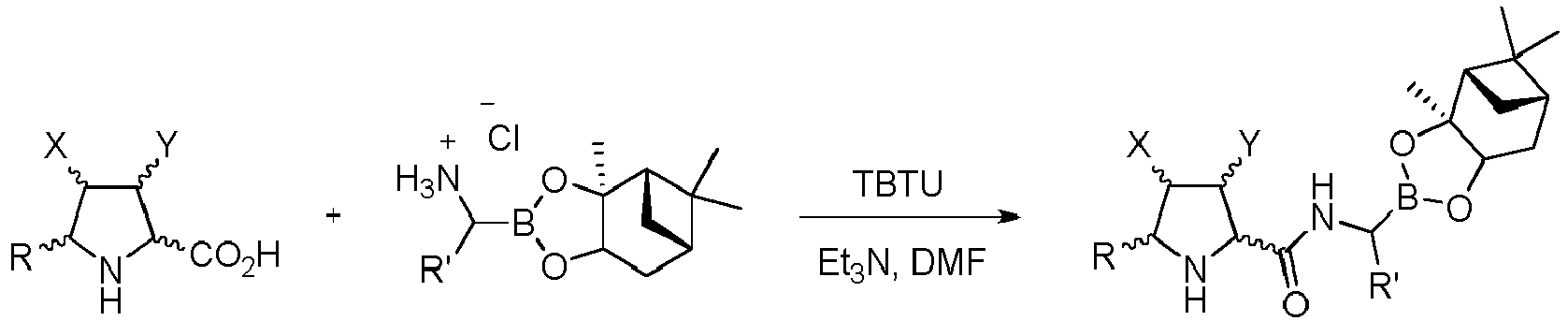
- A mixture of the corresponding compound (VIa) (1 mmol), the corresponding aminoboronate hydrochloride (VII) (301 mg, 1.0 mmol), O-(Benzotriazol-1-yl)-N,N,N',N'-tetramethyluronium tetrafluoroborate (353 mg, 1.1 mmol) in dry DMF (1.8 ml) under argon atmosphere was cooled to 0°C. Then, a mixture of triethylamine (0.42 ml, 3.0 mmol) and dry DMF (1 ml) was added dropwise, and the resulting mixture was stirred for 1.5 hours at 0°C. Then, ethyl acetate was added, and the organic layer was washed with water, dried over sodium sulphate, filtered and evaporated under reduced pressure.
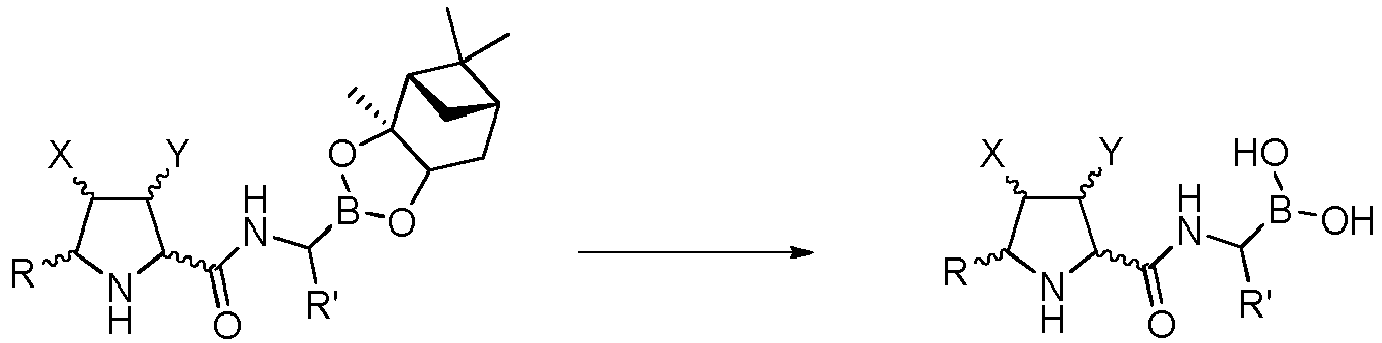
- The crude mixture obtained in the previous step was dissolved in methanol (7 ml), hexane was added (7 ml), followed by isobutyl boronic acid (256 mg, 2.5 mmol) and HCl 2N (2 ml). The resulting mixture was stirred at room temperature for 16 hours. Then, the layers were separated and the methanolic layer was concentrated under reduced pressure. The resulting mixture was dissolved in ethyl acetate, washed with saturated aqueous sodium hydrogen carbonate, dried over sodium sulphate, filtered and evaporated under reduced pressure. The crude thus obtained was purified by precipitation, to afford the corresponding product (I'a).
-
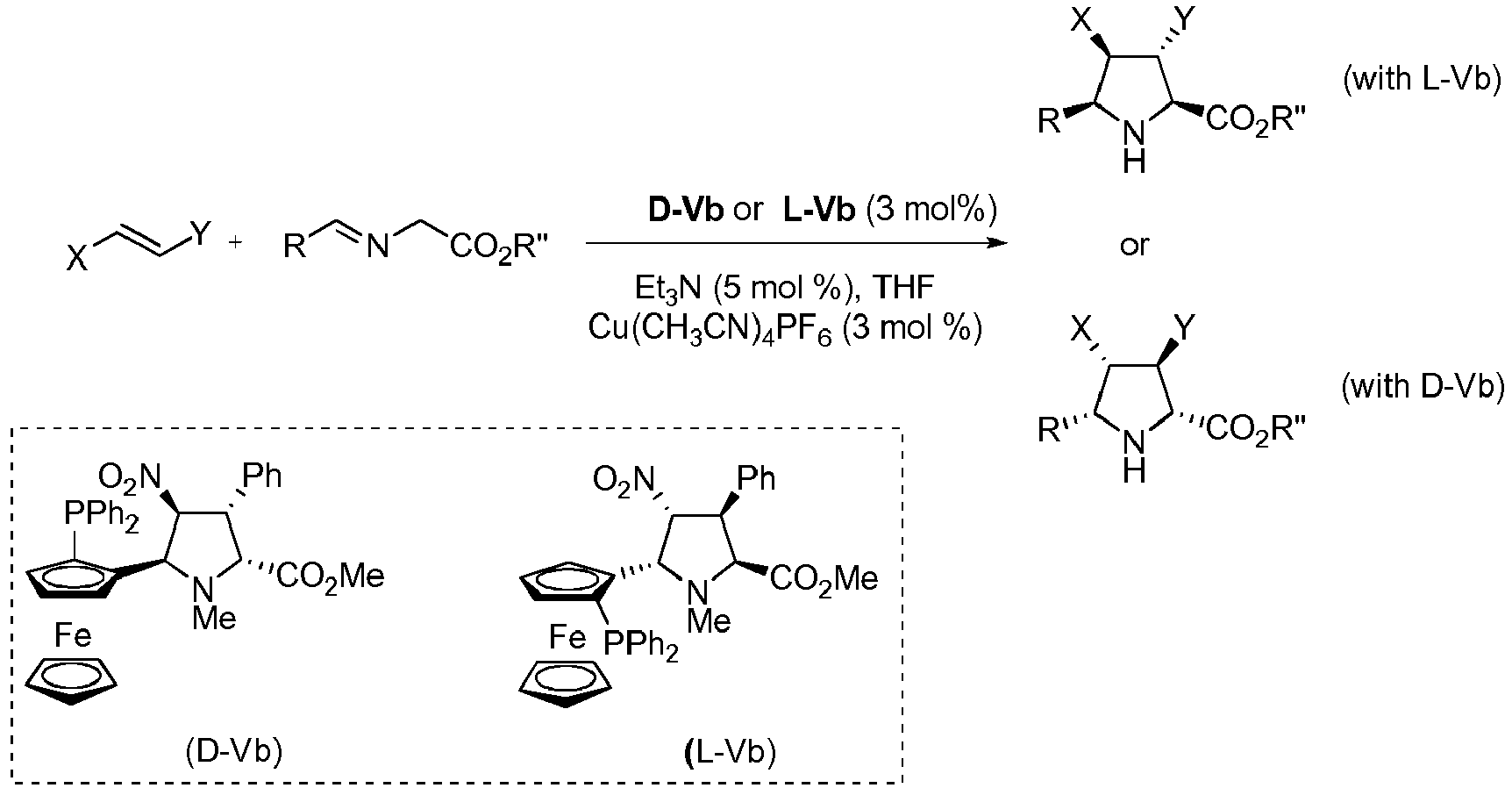
- A solution of the corresponding chiral catalyst (D-Vb) or (L-Vb) (0.015 mmol) and Cu(CH3CN)4PF6 (5.2 mg, 0.014 mmol) in 1.0 ml of dry THF was stirred at -60 °C for 15 minutes. Then, a solution of the corresponding imine (III) (0.45 mmol) in 1.0 ml of an organic solvent (THF, toluene, dichloromethane, chloroform or 1,4-dioxane), triethylamine (3.2 µl, 0.023 mmol) and the corresponding alquene (Ila) (0.50 mmol) in 1.0 ml of an organic solvent solvent (THF, toluene, dichloromethane, chloroform or 1,4-dioxane) were successively added. The reaction was monitorized by TLC. Upon completion of the reaction, the mixture was filtered through a celite pad and the filtrate was concentrated under reduced pressure. The residue was purified by flash chromatography on silica gel (ethyl acetate:hexanes 1:2) to yield the corresponding cycloadduct (IVb). The enantiomeric excess was determined by HPLC, by comparison with the chromatogram recorded for the racemic mixture of the corresponding cycloadduct.
-

- The corresponding compound (IVb) (1.0 mmol) was allowed to react with a trifluoroacetic acid/dichloromethane mixture (8ml:15ml). The resulting mixture was stirred at room temperature overnight, and the solvent was evaporated in vacuo. The crude obtained was purified by precipitation to afford the corresponding product (Vlb).
-

- A mixture of the corresponding compound (Vlb) (1 mmol), the corresponding aminoboronate hydrochloride (VII) (301 mg, 1.0 mmol), O-(Benzotriazol-1-yl)-N,N,N',N'-tetramethyluronium tetrafluoroborate (353 mg, 1.1 mmol) in dry DMF (1.8 ml) under argon atmosphere was cooled to 0 °C. Then, a mixture of triethylamine (0.42 ml, 3.0 mmol) and dry DMF (1 ml) was added dropwise, and the resulting mixture was stirred for 1.5 hours at 0 °C. Then, ethyl acetate was added, and the organic layer was washed with water, dried over sodium sulphate, filtered and evaporated under reduced pressure.

- The crude mixture obtained in the previous step was dissolved in methanol (7 ml), hexane was added (7 ml), followed by isobutyl boronic acid (256 mg, 2.5 mmol) and HCl 2N (2 ml). The resulting mixture was stirred at room temperature for 16 hours. Then, the layers were separated and the methanolic layer was concentrated under reduced pressure. The resulting mixture was dissolved in ethyl acetate, washed with saturated aqueous sodium hydrogen carbonate, dried over sodium sulphate, filtered and evaporated under reduced pressure. The crude thus obtained was purified by precipitation, to afford the corresponding product (I'b).
-
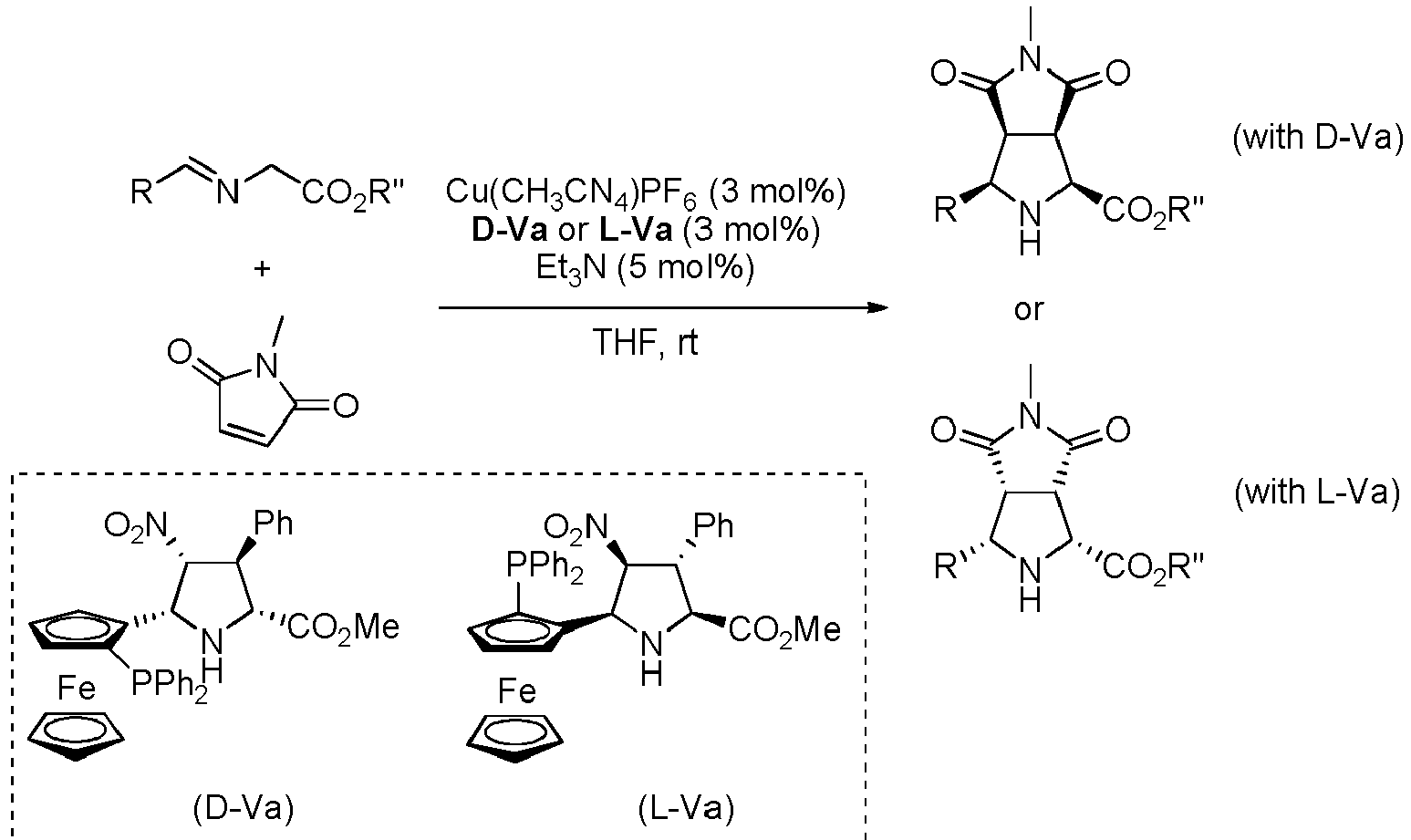
- A solution of the corresponding chiral catalyst (D-Va) or (L-Va) (0.015 mmol) and Cu(CH3CN)4PF6 (5.2 mg, 0.014 mmol) in 1.0 mL of dry THF was stirred at 25 °C for 15 minutes. Then, solutions of the corresponding imine (III) (0.45 mmol) in 1.0 mL of an organic solvent (THF, toluene, dichloromethane, chloroform or 1,4-dioxane), triethylamine (3.2 µl, 0.023 mmol) and N-methyl maleimide (0.50 mmol) or the corresponding alquene (IIb) in 1.0 mL of an organic solvent solvent (THF, toluene, dichloromethane, chloroform or 1,4-dioxane) were successively added. The reaction was monitorized by TLC. Upon completion of the reaction, the mixture was filtered through a celite pad and the filtrate was concentrated under reduced pressure. The residue was purified by flash chromatography on silica gel (ethyl acetate:hexanes 1:2) to yield the corresponding cycloadduct (IVc). The enantiomeric excess was determined by HPLC, by comparison of the HPLC chromatogram recorded for the racemic mixture with the corresponding one of the enantiomerically enriched cycloadduct.
-

- A solution of the corresponding compound (IVc) (1.0 mmol) and trimethyltin hydroxide in toluene (35 ml) was stirred at reflux for 19 hrs. Then, the solution was cooled to room temperature and acidified with HCl 1 N to pH ≅ 2. A solid precipitated from the solution. This solid was filtered, washed with water and dried under vacuum to afford the corresponding product (VIc).
-
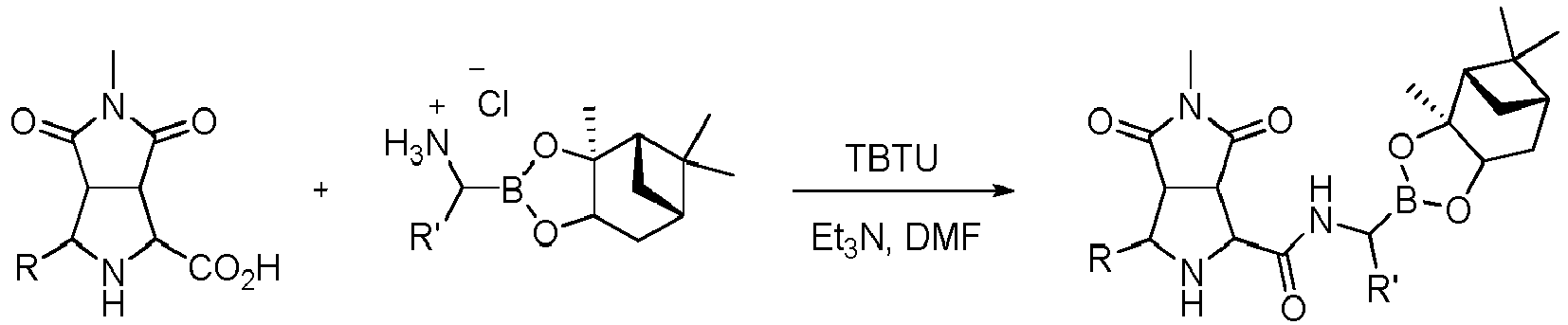
- A mixture of the corresponding compound (Vlc) (1 mmol), the corresponding aminoboronate hydrochloride (VII) (301 mg, 1.0 mmol), O-(Benzotriazol-1-yl)-N,N,N',N'-tetramethyluronium tetrafluoroborate (353 mg, 1.1 mmol) in dry DMF (1.8 ml) under argon atmosphere was cooled to 0 °C. Then, a mixture of triethylamine (0.42 ml, 3.0 mmol) and dry DMF (1 ml) was added dropwise, and the resulting mixture was stirred for 1.5 hours at 0 °C. Then, ethyl acetate was added, and the organic layer was washed with water, dried over sodium sulphate, filtered and evaporated under reduced pressure.

- The crude mixture obtained in the previous step was dissolved in methanol (7 ml), hexane was added (7 ml), followed by isobutyl boronic acid (256 mg, 2.5 mmol) and HCl 2N (2 ml). The resulting mixture was stirred at room temperature for 16 hours. Then, the layers were separated and the methanolic layer was concentrated under reduced pressure. The resulting mixture was dissolved in ethyl acetate, washed with saturated aqueous sodium hydrogen carbonate, dried over sodium sulphate, filtered and evaporated under reduced pressure. The crude thus obtained was purified by precipitation, to afford the corresponding product (I'c).
-
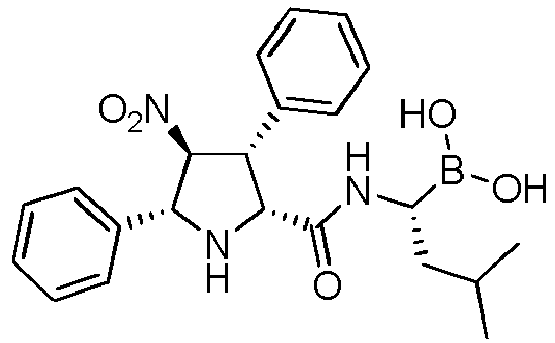
- This compound was prepared following procedures described in Method A. White solid; νmax/cm-1 2951, 1550, 1390, 1364, 697; 1H NMR (δ ppm, 500 MHz, CD3OD) 7.64 (d, J = 7.3, 2H), 7.42 (t, J = 7.3, 2H), 7.38 (d, J = 7.3, 1 H), 7.37 - 7.28 (m, 5H), 5.25 (t, J = 7.7, 1 H), 4.83 (d, J = 7.6, 1 H), 4.63 (d, J = 8.9, 1 H), 4.47 (t, J = 8.3, 1 H), 2.42 (t, J = 7.5, 1 H), 1.50 - 1.03 (m, 1 H), 0.97 - 0.93 (m, 2H), 0.84 (d, J = 6.5, 3H), 0.82 (d, J = 6.5, 3H); 13C NMR (δ ppm, 126 MHz, CD3OD) 177.0, 140.2, 137.2, 129.9, 129.8, 129.7, 129.3, 128.2, 96.9, 68.2, 62.2, 54.1, 40.5, 26.8, 23.6, 22.4;

-

- This compound was prepared following procedures described in Method A. White solid; νmax/cm-1 2953, 1550, 1385, 1365, 697; 1H NMR (δ ppm, 500 MHz, CD3OD) 7.64 (d, J = 7.1 Hz, 2H), 7.43 - 7.28 (m, 8H), 5.34 (t, J = 8.7 Hz, 1 H), 4.84 (d, J = 8.4 Hz, 1 H), 4.63 (d, J = 9.3 Hz, 1 H), 4.53 (t, J = 9.1 Hz, 1 H), 2.43 (dd, J = 9.0, 6.3 Hz, 1 H), 1.35 - 1.25 (m, 1 H), 1.06 - 0.97 (m, 1 H), 0.92 - 0.85 (m, 1 H), 0.81 (d, J = 6.5 Hz, 3H), 0.78 (d, J = 6.5 Hz, 3H); 13C NMR (δ ppm, 126 MHz, CD3OD) 177.6, 140.4, 136.4, 130.0, 129.8, 129.7, 129.6, 129.4, 128.3, 96.2, 68.2, 61.8, 54.4, 40.5, 26.7, 23.7, 22.2;

-
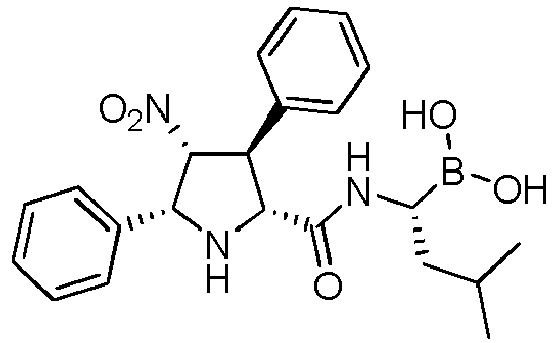
- This compound was prepared following procedures described in Method B. White solid; νmax/cm-1 3115, 1546, 1363, 705; 1H NMR (δ ppm, 500 MHz, CD3OD) 7.51 (d, J = 7.0 Hz, 2H), 7.46 - 7.39 (m, 4H), 7.37 - 7.28 (m, 4H), 5.41 (dd, J = 7.3, 4.1 Hz, 1 H), 5.18 (d, J = 7.3 Hz, 1 H), 4.32 - 4.25 (m, 2H), 2.82 (t, J = 7.3 Hz, 1 H), 1.76 - 1.69 (m, 1 H), 1.54 - 1.42 (m, 2H), 0.96 (d, J = 6.6 Hz, 6H); 13C NMR (δ ppm, 126 MHz, CD3OD) 178.9, 139.8, 137.9, 130.3, 129.4, 129.3, 129.1, 129.0, 128.4, 97.0, 67.0, 64.6, 55.1, 41.0, 27.1, 23.7, 22.7;

-

- This compound was prepared following procedures described in Method B. White solid; νmax/cm-1 2952, 1551, 1365, 697; 1H NMR (δ ppm, 500 MHz, CD3OD) 7.52 (d, J = 7.2 Hz, 2H), 7.42 - 7.40 (m, 4H), 7.38 - 7.27 (m, 4H), 5.47 (dd, J = 7.4, 4.3 Hz, 1 H), 5.13 (d, J = 7.4 Hz, 1 H), 4.26 - 4.21 (m, 2H), 2.83 (t, J = 7.8 Hz, 1 H), 1.62 - 1.56 (m, 1 H), 1.36 (t, J = 7.3 Hz, 2H), 0.91 (d, J = 6.5 Hz, 3H), 0.89 (d, J = 6.5 Hz, 3H); 13C NMR (δ ppm, 126 MHz, CD3OD) 178.1, 139.3, 137.7, 130.2, 129.4, 129.3, 129.2, 129.1, 128.4, 97.1, 67.1, 65.0, 55.6, 41.0, 27.0, 23.6, 22.7;

-

- This compound was prepared following procedures described in Method A. White solid; νmax/cm-1 2955, 1556, 1391, 1351, 527; 1H NMR (δ ppm, 500 MHz, CD3OD) 7.86 - 7.85 (m, 2H), 7.63 - 7.55 (m, 3H), 7.34 (d, J = 8.0 Hz, 2H), 7.26 (d, J = 7.7 Hz, 2H), 6.23 (t, J = 10.5 Hz, 1 H), 5.32 (d, J = 10.1 Hz, 1 H), 4.83 (d, J = 9.3 Hz, 1H), 4.68 (d, J = 10.6 Hz, 1 H), 3.04 (t, J = 6.5 Hz, 1 H), 2.38 (s, 3H), 1.06 - 1.04 (m, 2H), 0.90 - 0.84 (m, 1 H), 0.76 (d, J = 6.5 Hz, 3H), 0.71 (d, J = 6.3 Hz, 3H). 13C NMR (δ ppm, 126 MHz, CD3OD) 167.0, 140.3, 132.1, 130.9, 130.7, 130.1, 129.5, 90.1, 66.0, 63.1, 52.7, 40.0, 26.1, 23.5, 22.4, 21.3;

-

- This compound was prepared following procedures described in Method A. White solid; νmax/cm-1 2953, 1547, 1422, 1379, 699, 531; 1H NMR (δ ppm, 500 MHz, CD3OD) 7.64 (d, J = 7.2 Hz, 2H), 7.43 (t, J = 7.3 Hz, 2H), 7.40 - 7.33 (m, 3H) 7.06 (t, J = 8.7 Hz, 2H), 5.21 (t, J = 7.4 Hz, 1 H), 4.60 (d, J = 8.8 Hz, 1 H), 4.47 (t, J = 7.6 Hz, 1 H), 2.42 (t, J = 7.7 Hz, 1 H), 1.50 - 1.45 (m, 1 H), 1.07 - 1.01 (m, 1 H), 0.98 - 0.92 (m, 1 H), 0.86 (d, J = 6.6 Hz, 3H), 0.84 (d, J = 6.6 Hz, 3H); 13C NMR (δ ppm, 126 MHz, CD3OD) 176.8, 164.0 (d, 1 J C-F = 245.9 Hz), 140.2, 133.3 (d, 4 J J-F = 2.7 Hz), 131.8 (d, 3 J C-F = 8.2 Hz), 129.9, 129.8, 128.2, 116.6 (d, 2 J C-F = 21.7 Hz), 96.9, 68.1, 62.3, 53.4, 40.7, 26.7, 23.6, 22.4.
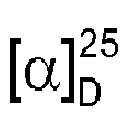
-
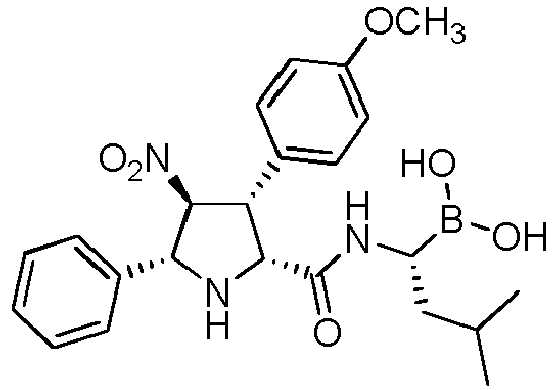
- This compound was prepared following procedures described in Method A. White solid; 1H NMR (δ ppm, 500 MHz, CD3OD) 7.64 (d, J = 7.5 Hz, 2H), 7.42 (t, J = 7.2 Hz, 2H), 7.38 (d, J = 6.9 Hz, 1 H), 7.23 (d, J = 8.8 Hz, 2H), 6.86 (d, J = 8.0 Hz, 2H), 5.19 (t, J = 7.7 Hz, 1 H), 4.58 (d, J = 8.1 Hz, 1 H), 4.39 (t, J = 8.0 Hz, 1 H), 2.45 (t, J = 7.8 Hz, 1 H), 1.50 - 1.44(m, 1 H), 1.06 - 0.94 (m, 2H), 0.85 (d, J = 7.0 Hz, 3H), 0.83 (d, J = 6.9 Hz, 3H); MS (ESI, m/z): 454.33 [M-1]-.
-

- This compound was prepared following procedures described in Method A. White solid; 13C NMR (δ ppm, 101 MHz, CD3OD) 171.0, 149.0, 145.0, 131.1, 131.1, 130.0, 129.9, 128.3, 124.7, 96.1, 68.1, 62.4, 53.6, 40.9, 26.6, 23.5, 22.6, 22.4; MS (ESI, m/z): 469.09 [M-1]-.
-
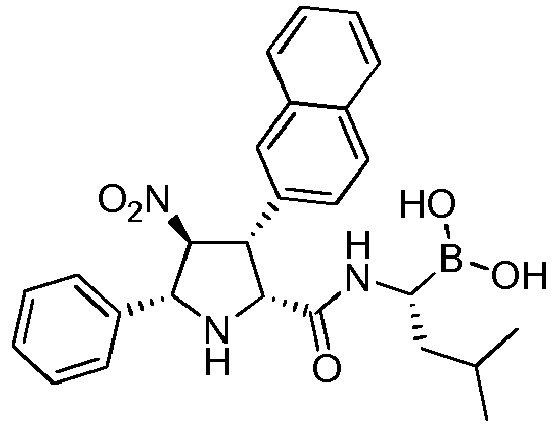
- This compound was prepared following procedures described in Method A. White solid; 13C NMR (δ ppm, 101 MHz, CD3OD) 176.7, 134.6, 134.4, 129.9, 129.8, 129.6, 129.0, 128.8, 128.7, 128.3, 127.5, 127.4, 96.7, 68.1, 62.4, 54.2, 40.4, 26.4, 23.4, 22.3; MS (ESI, m/z): 474.00 [M-1]-.
-
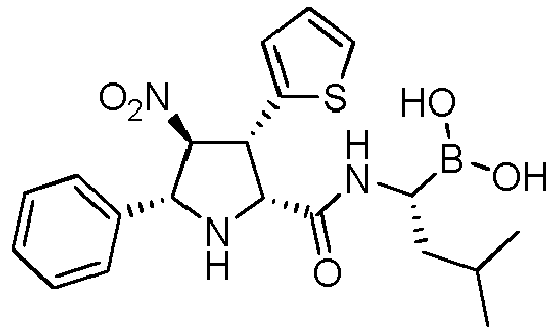
- This compound was prepared following procedures described in Method A. White solid; νmax/cm-1 2953, 1556, 1384, 1351, 711; 1H NMR (δ ppm, 500 MHz, CD3OD) 7.65 (d, J = 7.2 Hz, 2H), 7.42 (t, J = 7.3 Hz, 2H), 7.38 (d, J = 7.2 Hz, 1 H), 7.34 (d, J = 4.8 Hz, 1 H), 7.04 (d, J = 3.0 Hz, 1 H), 6.99 - 6.95 (m, 1 H), 5.16 (t, J = 6.8 Hz, 1 H), 4.81 - 4.77(m, 2H), 4.59 (d, J = 8.0 Hz, 2H), 2.52 (t, J = 7.2 Hz, 1 H), 1.57 - 1.50 (m, 2H), 0.87 (t, J = 7.1 Hz, 6H); 13C NMR (δ ppm, 126 MHz, CD3OD) 176.6, 140.3, 138.9, 129.8, 129.7, 128.6, 128.3, 128.0, 126.9, 98.0, 68.2, 62.5, 40.7, 26.8, 23.7, 22.4;

-

- This compound was prepared following procedures described in Method A. White solid; νmax/cm-1 (KBr) 3430, 1723, 1633, 1511, 1226. 1H NMR (δ ppm, 500 MHz, CD3OD) 7.60 (d, J = 7.3 Hz, 2H), 7.46 (d, J = 3.8 Hz, 1 H), 7.43 - 7.34 (m, 3H), 6.35 (s, 1 H), 6.32 (s, 1 H), 5.25 (t, J = 7.8 Hz, 1 H), 4.76 (d, J = 7.7 Hz, 1 H), 4.65 - 4.55 (m, 2H), 2.59 (t, J = 7.5 Hz, 1 H), 1.59 - 1.48 (m, 1 H), 1.22 (7, J = 7.0 Hz, 2H), 0.91 - 0.88(m, 6H); 13C NMR (δ ppm, 126MHz, CD3OD) 167.0, 145.3, 132.0, 130.6, 130.1, 112.0, 111.6, 89.9, 65.7, 61.8, 46.7, 40.4, 26.4, 23.5, 22.5.;

-

- This compound was prepared following procedures described in Method A. White solid; νmax/cm-1 1556, 1383, 1366, 746; 1H NMR (δ ppm, 500 MHz, CD3OD) 8.10 (s, 1H), 7.95 (d, J = 8.5 Hz, 1 H), 7.91 - 7.88 (m, 2H), 7.81 (d, J = 9.2 Hz, 1 H), 7.53 - 7.51 (m, 2H), 7.38 - 7.29 (m, 5H), 5.41 (t, J = 8.2 Hz, 1 H), 5.03 (d, J = 8.3 Hz, 1 H), 4.70 (d, J = 9.3 Hz, 1 H), 4.55 (t, J = 7.4 Hz, 1 H), 2.47 - 2.44 (m, 1 H), 1.53 - 1.46 (m, 1 H), 1.09 - 0.98 (m, 2H), 0.86 (d, J = 6.4 Hz, 3H), 0.83 (d, J = 6.3 Hz, 3H); 13C NMR (δ ppm, 126 MHz, CD3OD) 167.1, 135.7, 134.5, 132.2, 130.8, 130.3, 129.6, 129.5, 128.9, 128.8, 128.2, 126.0, 89.9, 66.2, 63.1, 52.9, 40.1, 26.1, 23.5, 22.5;

-
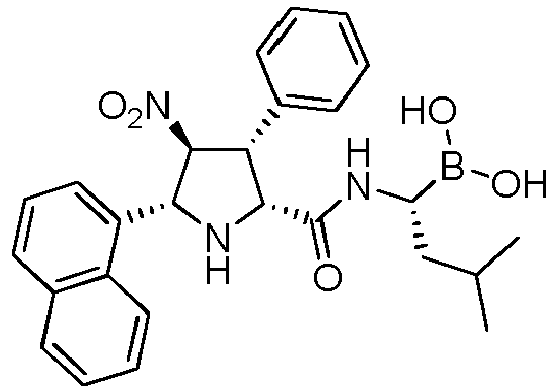
- This compound was prepared following procedures described in Method A. White solid; νmax/cm-1 1544, 1368, 697; 1H NMR (δ ppm, 500 MHz, CD3OD) 8.28 (d, J = 7.3 Hz, 1 H), 8.11 (d, J = 9.0 Hz, 1 H), 7.94 - 7.91 (m, 2H), 7.62 (t, J = 7.6 Hz, 1 H), 7.57 - 7.50 (m, 2H), 7.42 - 7.30 (m, 5H), 5.79 (d, J = 8.0 Hz, 1 H), 5.48 (t, J = 7.9 Hz, 1 H), 4.76 (d, J = 9.2 Hz, 1 H), 4.58 (t, J = 8.1 Hz, 1 H), 2.48 - 2.40 (m, 1 H), 1.56 - 1.46 (m, 1 H), 1.11 - 0.97 (m, 2H), 0.86 (d, J = 6.5 Hz, 3H), 0.83 (d, J = 6.5 Hz, 3H); 13C NMR (δ ppm, 126 MHz, CD3OD) 168.5, 130.2, 129.9, 129.8, 129.7, 129.3, 129.2, 127.8, 127.6, 126.9, 126.7, 125.8, 123.5, 89.0, 65.2, 63.4, 54.8, 40.5, 26.8, 23.6, 22.4;

-
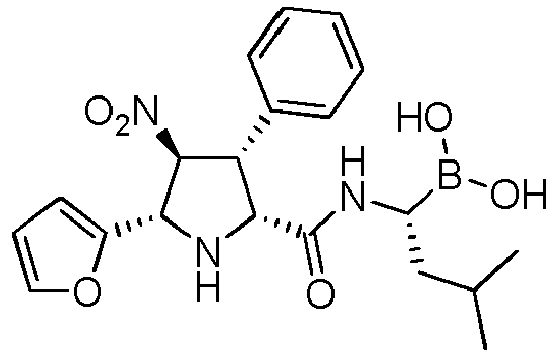

-
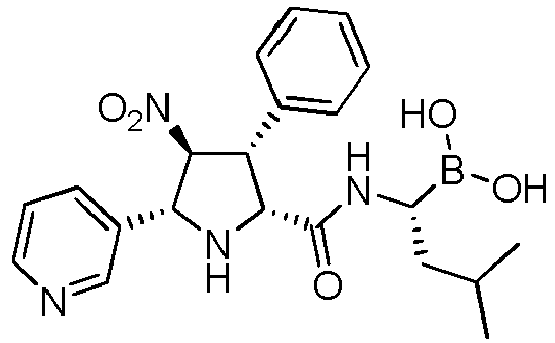
- This compound was prepared following procedures described in Method A. White solid; 1H NMR (δ ppm, 500 MHz, CD3OD) 8.77 (d, J = 8.2 Hz, 1 H), 8.55 (t, J = 4.7 Hz, 1 H), 8.23 (t, J = 7.3 Hz, 1 H), 7.54 - 7.50 (m, 1 H), 7.36 - 7.29 (m, 5H), 5.38 (t, J = 7.9 Hz, 1 H), 4.94 (d, J = 8.2 Hz, 1 H), 4.65 (d, J = 9.0 Hz, 1 H), 4.56 (t, J = 8.4 Hz, 1 H), 2.39 (t, J = 8.3 Hz, 1 H), 1.52 - 1.47 (m, 1 H), 1.07 - 0.94 (m, 2H), 0.85 (d, J = 6.5 Hz, 3H), 0.82 (d, J = 6.8 Hz, 3H); MS (ESI, m/z): 425.20 [M-1]-.
-
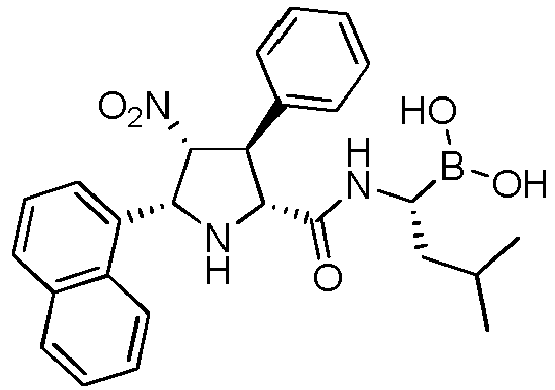
- This compound was prepared following procedures described in Method B. White solid; νmax/cm-1 2953, 1551, 1386, 699; 1H NMR (δ ppm, 500 MHz, CD3OD) 8.06 - 8.01 (m, 2H), 7.90 (d, J = 8.0 Hz, 1 H), 7.85 (d, J = 8.1 Hz, 1 H), 7.58 - 7.45 (m, 7H), 7.39 (t, J = 7.3 Hz, 1 H), 5.98 (d, J = 6.9 Hz, 1 H), 5.59 (dd, J = 6.9, 3.4 Hz, 1 H), 4.42 (d, J = 6.7 Hz, 1 H), 4.40 - 4.36 (m, 1 H), 2.85 (t, J = 7.4 Hz, 1 H), 1.80 - 1.75 (m, 1 H), 1.57 - 1.45 (m, 2H), 0.99 (d, J = 6.6 Hz, 6H); 13C NMR (δ ppm, 126MHz, CD3OD) 179.2, 140.2, 135.0, 133.1, 132.4, 130.5, 130.0, 129.2, 129.0, 127.6, 126.7, 126.4, 126.0, 123.3, 96.2, 64.0, 63.2, 55.4, 41.1, 27.1, 23.7, 22.8; MS (ESI, m/z): 474.28 [M-1]-.
-
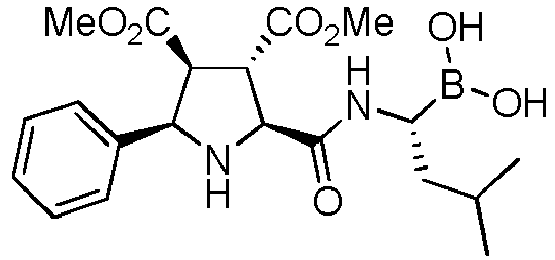
- This compound was prepared following procedures described in Method B. White solid; νmax/cm-1 1731, 1435, 1199, 1170, 699; 1H NMR (δ ppm, 500 MHz, CD3OD) 7.43 (d, J = 7.4 Hz, 2H), 7.33 (t, J = 7.4 Hz, 2H), 7.28 (d, J = 7.1 Hz, 1 H), 4.79 (d, J = 8.2 Hz, 1 H), 4.33 (d, J = 7.0 Hz, 1 H), 3.79 (s, 3H), 3.67 (t, J = 5.7 Hz, 1 H), 3.60 (t, J = 5.5 Hz, 1 H), 3.20 (s, 3H), 2.89 (t, J = 7.5 Hz, 1 H), 1.78 - 1.71 (m, 1 H), 1.45 (t, J = 7.3 Hz, 2H), 0.99 (s, 3H), 0.98 (s, 3H);

-
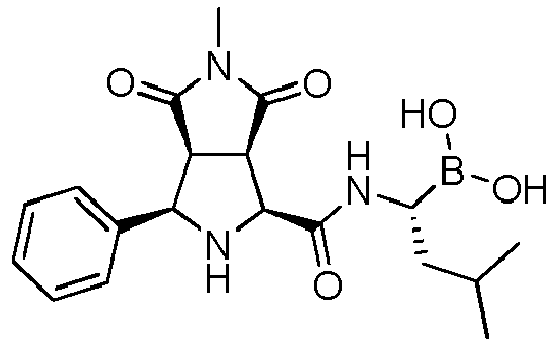
- This compound was prepared following procedures described in Method C. White solid; νmax/cm-1 2953, 1698, 1382, 1285; 1H NMR (δ ppm, 500 MHz, CD3OD) 7.45 (d, J = 7.2 Hz, 2H), 7.35 (t, J = 7.3 Hz, 2H), 7.30 (t, J = 7.2 Hz, 1 H), 4.59 (d, J = 9.0 Hz, 1 H), 4.18 (d, J = 7.0 Hz, 1 H), 3.71 (t, J = 7.4 Hz, 1 H), 3.55 (t, J = 8.7 Hz, 1 H), 2.90 (t, J = 7.7 Hz, 1 H), 2.85 (s, 3H), 1.79 - 1.73 (m, 1 H), 1.49 (t, J = 6.5 Hz, 2H), 1.00 (d, J = 1.7 Hz, 3H), 0.98 (d, J = 1.7 Hz, 3H); 13C NMR (δ ppm, 126MHz, CD3OD) 177.1, 139.3, 129.1, 128.8, 128.5, 128.4, 65.0, 60.4, 50.5, 40.3, 27.2, 25.0, 23.3;

-
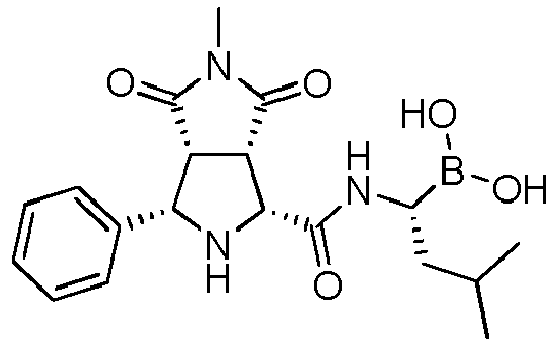
- This compound was prepared following procedures described in Method C. White solid; νmax/cm-1 2953, 1701, 1381, 1285; 1H NMR (δ ppm, 500 MHz, CD3OD) 7.42 - 7.39 (m, 2H), 7.32 - 7.29 (m, 2H), 7.28 - 7.24 (m, 1 H), 4.55 (dd, J = 8.9, 2.8 Hz, 1 H), 4.14 (t, J = 6.2 Hz, 1 H), 3.67 (dd, J = 16.9, 7.4 Hz, 1 H), 3.53 - 3.48 (m, 1 H), 2.86 (t, J = 7.7 Hz, 1 H), 2.80 (s, 3H), 1.75 - 1.66 (m, 2H), 1.54 - 1.48 (m, 1 H), 0.97 (d, J = 6.7 Hz, 3H), 0.95 (d, J = 6.6 Hz, 3H); MS (ESI, m/z): 386.27 [M-1]-.
- Activity of the compounds described within this invention was compared with the L-proline L-leucine boronic acid MG-319 (IUPAC name: {(R)-3-methyl-1-[(S)-pyrrolidine-2-carboxamido]butyl}boronic acid, obtained in house) disclosed in
WO 96/13266 
- Substrate: Suc-Leu-Leu-Val-Tyr-AMC
- Assay buffer: 250 mM HEPES, pH 7.5, 0.5 mM EDTA, 0.03% SDS, 0.05% Igepal CA-630.
- Enzyme: Human erythrocyte 20S proteasome
- In vitro proteasome inhibitory activity of the compounds of the invention is evaluated by spectrofluorimetric quantitation of AMC. Stock solutions of compounds of the invention are prepared in dimethyl sulphoxide (DMSO). Test compound and/or vehicle is preincubated with 2.5 mg/ml enzyme (human erythrocyte 20S proteasome) in modified HEPES buffer pH 7.5 and 1% final concentration of DMSO for 15 minutes at 37°C. The reaction is initiated by addition of 10 µM Suc-Leu-Leu-Val-Tyr-AMC for another 30 minutes incubation period at 37°C. Determination of the release of AMC is read spectrophotometrically (excitation, 380 nm; emission, 460 nm). IC50 values are determined by a non-linear, least squares regression analysis using MathlQTM (ID Business Solutions Ltd., UK). Lactacystin is used as positive control.
Compound Concentration (nM) % Inhibition IC50 (nM) Example 1 100 73 39 Example 2 1000 70 430 Example 4 50 51 46 Example 5 500 77 78 Example 6 50 70 17 Example 8 500 69 150 Example 9 500 69 150 Example 10 50 79 12 Example 11 50 81 7.55 Example 12 50 50 46 Example 13 50 54 39 Example 15 500 72 100 Example 16 500 33 - Example 17 500 20 - Example 18 1000 53 920 Example 19 100 68 46 MG-319 500 25 - Lactacystin - - 110 - Cell culture-based assays were used to evaluate the ability of compounds of the invention to inhibit cancer cell growth.
- Cells were obtained from the American Type Culture Collection (ATCC) and the European Collection of Cell Cultures. Cells were thawed in their appropriate media plus supplements (see table below). Cells were passaged at confluence by washing once in HBSS cation-free followed by a 3 minutes incubation with trypsin ([0.5 µg/ml]/EDTA [0.2 µg/ml]) (Gibco-BRL, 15400054) solution in HBSS at 37°C (except non-adherent cell lines - hematologic), and transferred to their appropriate media plus supplements. Prior to seeding at defined cell concentration, cells were recovered in medium, centrifuged, taken up in medium and counted.
Cell line Source Culture Medium Cells/well 143B ECACC - 91112502 EMEM + 2mM Glutamine + 1% Non-essential Aminoacids + 10 FCS 10000 A431 ECACC - 85090402 DEMEM High Glucose (4500 mg/l) + 10 FCS 10000 A549 ATCC - CCL-185 DEMEM High Glucose (4500 mg/l) + 10 FCS 5000 BxPC-3 ECACC - 93120816 DEMEM High Glucose (4500 mg/l) + 10 FCS 10000 CCRF-CEM ECACC - 85112105 RPMI + 2mM Glutamine + 10% FCS 20000 COLO 205 ECACC - 87061208 DEMEM High Glucose (4500 mg/l) + 10 FCS 10000 Daoy ECACC - 58483215 DEMEM High Glucose (4500 mg/l) + 10 FCS 5000 DU-145 ATCC - HTB-81 DEMEM High Glucose (4500 mg/l) + 10 FCS 10000 HCT-116 ECACC - 91091005 DEMEM High Glucose (4500 mg/l) + 10 FCS 5000 HeLa ECACC - 93021013 DEMEM High Glucose (4500 mg/l) + 10 FCS 10000 Hep-G2 ECACC - 85011430 EMEM + 2mM Glutamine + 1% Non-essential Aminoacids + 10 FCS 10000 HT-1080 ECACC - 85111505 DEMEM High Glucose (4500 mg/l) + 10 FCS 10000 HT-29 ECACC - 91072201 DEMEM High Glucose (4500 mg/l) + 10 FCS 10000 Jurkat ECACC - 88042803 DEMEM High Glucose (4500 mg/l) + 10 FCS 10000 K562 ECACC - 89121407 RPMI + 2mM Glutamine + 10% FCS 20000 LNCaP ECACC - 89110211 RPMI + 2mM Glutamine + 10% FCS 10000 LoVo ATCC - CCL-229 DEMEM High Glucose (4500 mg/l) + 10 FCS 10000 LS174T ECACC - 87060401 EMEM + 2mM Glutamine + 1% Non-essential Aminoacids + 10 FCS 10000 MCF-7 ECACC - 86012803 EMEM + 2mM Glutamine + 1% Non-essential Aminoacids + 10 FCS 5000 MDA-MB-231 ECACC - 92020424 DEMEM High Glucose (4500 mg/l) + 10 FCS 10000 MDA-MB-435 ATCC - 129 DEMEM High Glucose (4500 mg/l) + 10 FCS 5000 MDA-MB-468 ATCC - HTB-132 DEMEM High Glucose (4500 mg/l) + 10 FCS 5000 MIA PaCa-2 ECACC - 85062806 DEMEM High Glucose (4500 mg/l) + 10 FCS 10000 NCI-H1650 ATCC - CRL-5883 RPMI + 2mM Glutamine + 10% FCS 5000 NCI-H1975 ATCC - CRL-5908 RPMI + 2mM Glutamine + 10% FCS 5000 NCI-H358 ATCC - CRL-5807 RPMI + 2mM Glutamine + 10% FCS 10000 OVCAR-3 ATCC - HTB-161 DEMEM High Glucose (4500 mg/l) + 10 FCS 10000 PANC-1 ECACC - 87092802 DEMEM High Glucose (4500 mg/l) + 10 FCS 5000 PC3 ECACC - 90112714 DEMEM High Glucose (4500 mg/l) + 10 FCS 10000 RAMOS ECACC - 85030802 RPMI + 2mM Glutamine + 10% FCS 10000 RCC 786-O ATCC - CRL-1932 DEMEM High Glucose (4500 mg/l) + 10 FCS 10000 RPMI-8226 ECACC - 87012702 RPMI + 2mM Glutamine + 10% FCS 20000 RWP-1 ECACC - 87012702 DEMEM High Glucose (4500 mg/l) + 10 FCS 10000 SK-BR-3 ATCC - HTB-30 DEMEM High Glucose (4500 mg/l) + 10 FCS 10000 SK-Hep-1 ECACC - 91091986 EMEM + 2mM Glutamine + 1% Non-essential Aminoacids + 10 FCS 5000 SK-Mel-28 ATCC - HTB-72 DEMEM High Glucose (4500 mg/l) + 10 FCS 5000 SK-OV-3 ECACC - 91091004 McCoy + 2mM Glutamine + 15% FCS 5000 SW480 ECACC - 87092801 DEMEM High Glucose (4500 mg/l) + 10 FCS 5000 T47D ECACC - 85102201 DEMEM High Glucose (4500 mg/l) + 10 FCS 10000 U-373 MG ATCC - HTB17-1055 DEMEM High Glucose (4500 mg/l) + 10 FCS 5000 U-87 MG ECACC - 89081402 DEMEM High Glucose (4500 mg/l) + 10 FCS 10000 Stock solutions of compounds of the invention were prepared in dimethyl sulphoxide (DMSO). - In each cell line, 72 h treatment EC50 values were determined for each compound using AlamarBlue® and/or Hexosaminidase methods. All treatments were performed in triplicate. Experiments were carried out in 96-well cell culture plates (Cultek) and the cell lines seeded at the density mentioned in the table above and cultured at 37°C with 5% CO2. After 24h, media were supplemented by 100 µl/well of diluted test compound at variable final concentrations and incubated for 72 hours. Then, AlamarBlue® Reagent (Biosource DAL1100) was added to each well and incubated at 37°C for 4 hours. Relative fluorescent intensity that correlates with the number of living cells was read in a Cytofluor plate reader (Millipore) at 535/590 nm (Excitation/emission). After reading the AlamarBlue® signal, the hexosaminidase activitity was measured according to the following protocol: medium was removed and cells were washed once with PBS. 60 µl of substrate solution (p-nitrophenol-N-acetyl-beta-D-glucosaminide 7.5 mM [Sigma N-9376], sodium citrate 0.1 M, pH 5.0, 0.25% Triton X-1 00) was added to each well and incubated at 37°C for 1-2 hours; after this incubation time, a bright yellow colour appears; then, plates could be developed by adding 90 µl of developer solution (Glycine 50 mM, pH 10.4; EDTA 5 mM), and absorbance was recorded at 405 nM.
- For EC50 determination, data were displayed graphically using GraphPad Prism 5.0, and dose-responsive curves were fitted using nonlinear regression model with a sigmoidal dose response (variable slope) equation.
- Note: In all cases assays were performed in Alamar Blue with the exception of those indicated (* = Hexosaminidase assay)
Cell lines EC50 Example 1 Example 4 Example 6 Example 10 Example 11 Example 12 MG-319 Breast cancer MDA-MB-231 5.1 2.1 11 2.8 1.1 3.2 18 MDA-MB-468 4.1 0.79 2.2 0.32 0.12 1.0 18 MCF-7 0.7 23 1.9 0.49 0.28 1.3 30 SK-BR-3 1.2 0.76 6.0* 0.44 0.11 0.57 6.2 T47D 10 2.1 21* 0.57 1.3 7.1* 25 Colon cancer HCT-116 1.9 1.3 2.2 0.64 0.28 0.44 1.8 HT-29 3.5 1.5 27 3.5 2.5 0.85 12.3 COLO 205 11 3.8 2.4 0.31 0.202 2.4 1.9* LoVo 6.7 3.09 15 2.5 0.66 1.7 15 SW480 1.1 0.61 13* 2.3* 1.1* 0.56 8.8 LS174T 0.72 0.55 0.6 0.14 0.02 0.26 5.9 Lung cancer A549 7.0 4.0 12* 2.6* 1.3* 5.8 N.D. NCI-H1975 25 41 7.3* 1.1* 0.84* 0.78 47 NCI-H1650 3.3 0.79 12* 1.8* 1.2* 0.37 14 NCI-H358 0.79 2.4 3.3 0.7 0.28 N.D. 24 Pancreatic cancer MIA PaCa-2 5.7 3.0 83 2.4 0.85* 1.9 22 BxPC-3 4.6 2.9 5.8* 1.5* 0.7* 0.97 33 RWP-1 24* 3.6 4.4 1.1 0.42 N.D. N.D. PANC-1 N.D. N.D. 14 3.0 0.58 N.D. N.D. Ovarian cancer OVCAR-3 0.74 0.89 2.2* 0.86* 0.28* 0.33 6.9 SK-OV-3 4.1 2.2 13 1.3 0.33 1.4 16 Prostate cancer DU-145 1.9 1.2 3.5 0.91 0.57 0.35 58 PC-3 1.5 2.3 7.1 1.2 0.68 0.3 26 LNCaP 0.39 0.11 1.8 0.38 0.15 0.12 4.2 Renal RCC 786-O 4.7 1.7 12 0.43 1.0 2.4 19 Liver cancer HepG2 1.4 0.38 3.1 0.56 0.22 0.5 8.1 SK-HEP-1 0.49 0.29 1.9 0.49 0.007 0.16 4.2 Melanoma MDA-MB-435 1.0 0.37 1.1 0.31 0.17 0.21 5.3 SK-Mel-28 1.3 0.78 13 1.6 0.8 0.62 10 Hematologic K562 6.3 2.0 15 1.2 1.0 2.7 19 CCRF-CEM 0.67 0.33 0.63 0.17 0.052 0.14 4.5 Jurkat 2.5 1.7 2 0.08 0.04 0.8 4.7 RAMOS 2.4 1.0 2.4 0.53 0.16 0.5 8.7 Multiple mieloma RPMI-8226 0.15 0.27 1.3 0.06 0.06 0.31 4.8 Brain Daoy 1.3 1.3 3.7 0.78 0.29 0.57 41 U-373 MG 44.0 7.3 17* 2.8* 1.1* 11.0 92 U-87 MG 12* 4.2* 12* 0.50* 0.89* 2.0* 25* Epidermoid A431 0.97 0.97 0.1 0.03* 0.02 0.41 10 Fibrosarcoma HT-1080 1.7 1.7 16* 1.4 0.89 0.46 8.9 Cervical HeLa 28 8.3 54 13 3.1 11 52 Osteosarcoma 143b 5.0 2.0 1.9 0.29 0.10 0.37 0.98
Claims (15)
- A compound of general formula (I),
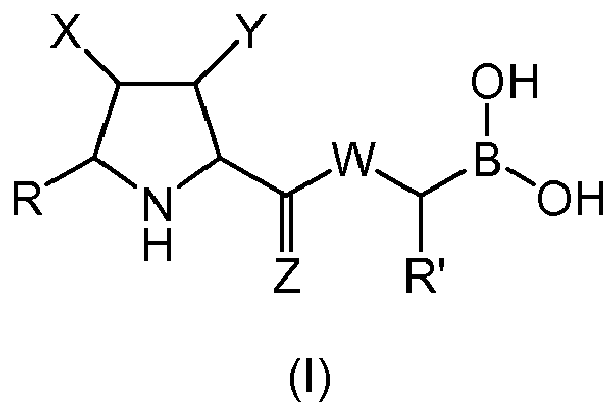 X is an electron withdrawing group selected from -NO2, -C(O)R1, -C(O)OR1 and -C(O)NR2R3 or forms together with Y a cycloalkyl or heterocycloalkyl group; wherein R1 is an alkyl group, and R2 and R3 are independently selected from hydrogen and alkyl;Y is selected from aryl, heteroaryl having at least one heteroatom, and-C(O)OR4, or forms together with X a cycloalkyl or heterocycloalkyl group; wherein R4 is an alkyl group;R is selected from mono- or polycyclic aryl and heteroaryl, wherein the heteroaryl has at least one heteroatom;Z is O or S;W is selected from -NH-, -O- and -CH2-;R' is selected from a linear or branched alkyl and cycloalkyl,
or a stereoisomer, a solvate, a salt or prodrug thereof. - The compound according to claim 1, which is selected from the compounds of formula (L-Ia) and formula (D-Ia):
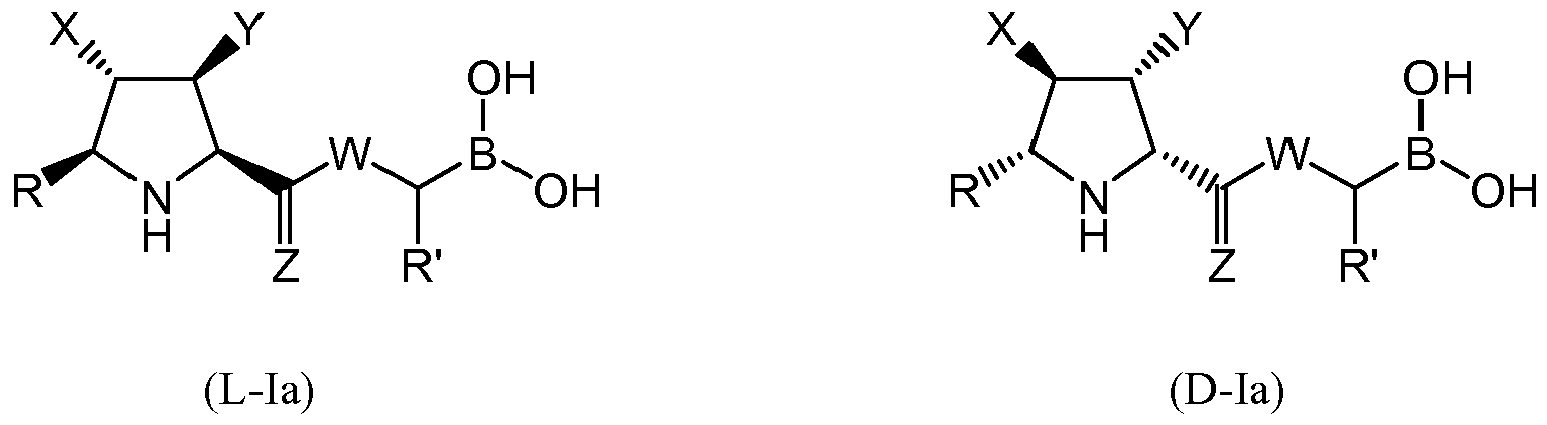 R, R', Z and W are as defined in claim 1;X is an electron withdrawing group selected from -NO2, C(O)R1, C(O)OR1 and-C(O)NR2R3, wherein R1, R2 and R3 are as defined above;Y is selected from aryl, heteroaryl having at least one heteroatom, and-C(O)OR4, wherein R4 is as defined above.
 - The compound according to claim 1, which is selected from the compounds of formula (L-Ib) and formula (D-Ib):
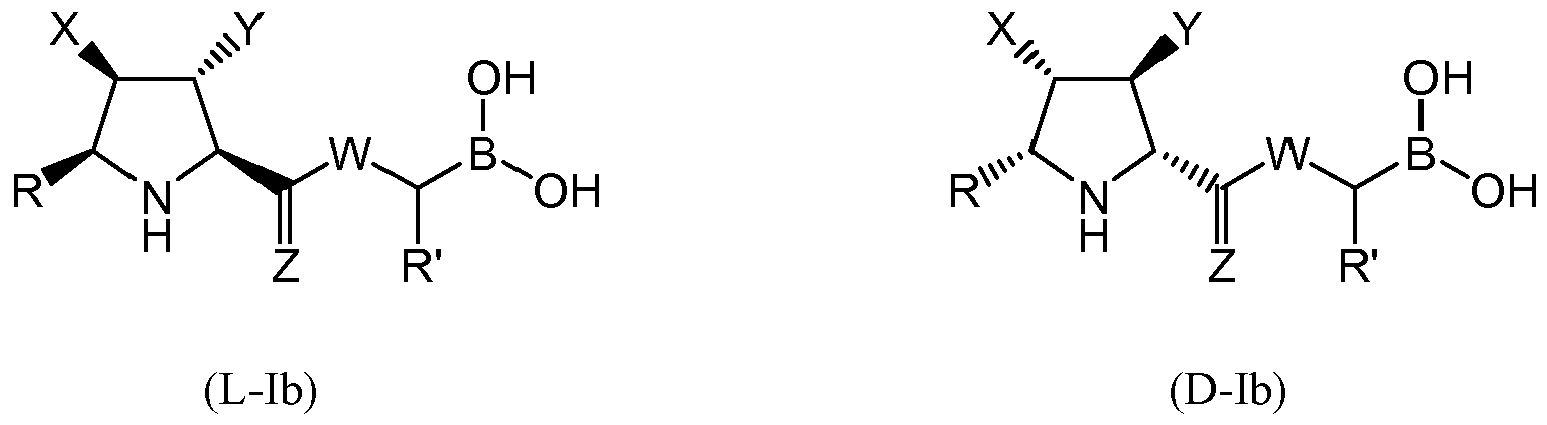 R, R', Z and W are as defined above;X is an electron withdrawing group selected from -NO2, C(O)R1, C(O)OR1 and-C(O)NR2R3, wherein R1, R2 and R3 are as defined in claim 1;Y is selected from aryl, heteroaryl having at least one heteroatom, and-C(O)OR4, wherein R4 is as defined above.
 - The compound according to claim 1, which is selected from the compounds of formula (L-Ic) and formula (D-Ic):
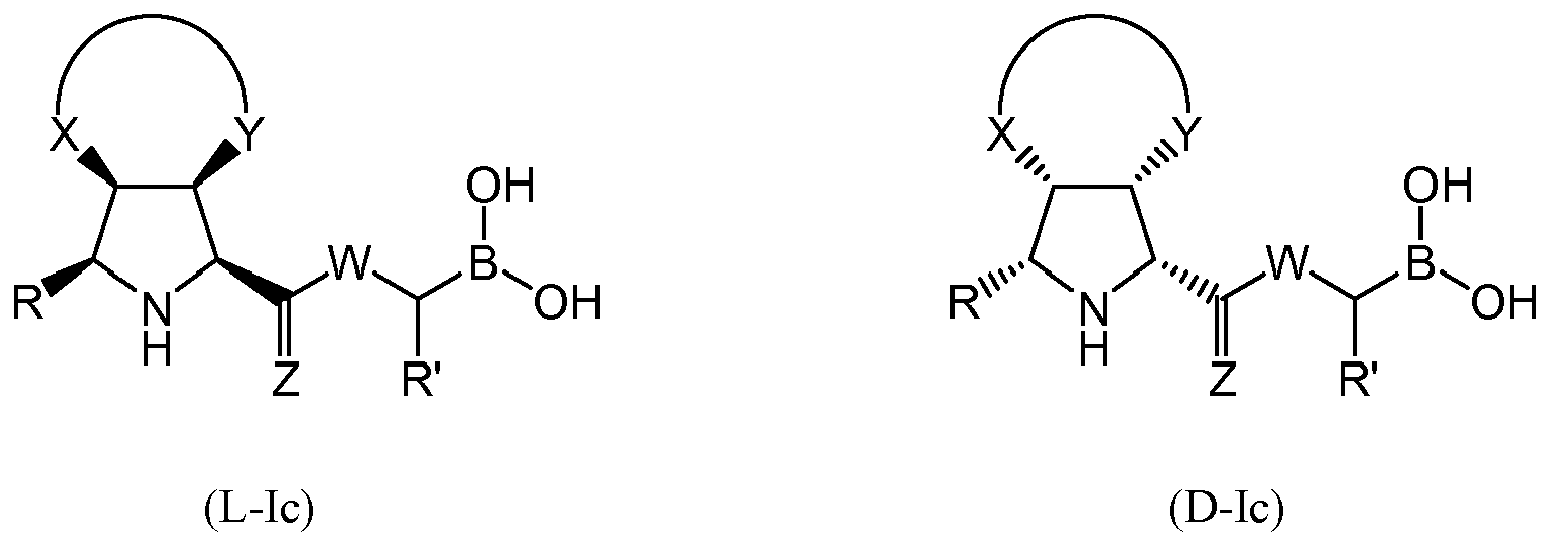 R, R', Z and W are as defined in claim 1; andX and Y are linked to each other thus forming a cylcoalkyl or heterocycloalkyl group.
 - The compound according to anyone of claims 1 to 4, wherein the group W is -NH-and Z is O.
- The compound according to any of claims 1 to 3 and 5, wherein X is selected from -NO2, and -C(O)OR1, wherein R1 is an alkyl group
- The compound according to any of claims 1 and 4 to 5, wherein X and Y are linked forming a heterocycloalkyl group.
- The compound according to any of claims 1 to 7, wherein R' is a linear or branched alkyl group.
- The compound according to claim 1 which is selected from:- 3-Methyl-1-[4-nitro-3,5-diphenylpyrrolidine-2-carboxamido]butyl boronic acid;- 3-Methyl-1-[4-nitro-5-phenyl-3-p-tolylpyrrolidine-2-carboxamido] butylboronic acid;- 1-[3-(4-Fluorophenyl)-4-nitro-5-phenylpyrrolidine-2-carboxamido] -3-methylbutyl boronic acid;- 1-[3-(4-Methoxyphenyl)-4-nitro-5-phenylpyrrolidine-2-carboxamido]-3-methylbutyl boronic acid;- 3-Methyl-1-[4-nitro-3-(4-nitrophenyl)-5-phenylpyrrolidine-2-carboxamido]butyl boronic acid;- 3-Methyl-1-[3-(naphthalen-2-yl)-4-nitro-5-phenylpyrrolidine-2-carboxamido]butyl boronic acid;- 3-Methyl-1-[4-nitro-5-phenyl-3-(thiophen-2-yl)pyrrolidine-2-carboxamido]butyl boronic acid- 1-[3-(Furan-2-yl)-4-nitro-5-phenylpyrrolidine-2-carboxamido]-3-methylbutylboronic acid;- 3-Methyl-1-[5-(naphthalen-2-yl)-4-nitro-3-phenylpyrrolidine-2-carboxamido]butyl boronic acid;- 3-Methyl-1-[5-(naphthalen-1-yl)-4-nitro-3-phenylpyrrolidine-2-carboxamido]butyl boronic acid;- 3-Methyl-1-[5-(naphthalen-1-yl)-4-nitro-3-phenylpyrrolidine-2-carboxamido]butyl boronic acid;- 1-[5-(Furan-2-yl)-4-nitro-3-phenylpyrrolidine-2-carboxamido]-3-methylbutylboronic acid;- 3-Methyl-1-[4-nitro-3-phenyl-5-(pyridin-3-yl)pyrrolidine-2-carboxamido]butyl boronic acid;- 1-[3,4-Bis(methoxycarbonyl)-5-phenylpyrrolidine-2-carboxamido]-3-methylbutyl boronic acid;- 3-Methyl-1-{5-methyl-4,6-dioxo-3-phenyloctahydropyrrolo [3,4-c]pyrrole-1-carboxamido} butyl boronic acid- 3-Methyl-1-{5-methyl-4,6-dioxo-3-phenyloctahydropyrrolo [3,4-c]pyrrole-1-carboxamido} butyl boronic acid;
or a stereoisomer, a solvate, a salt or prodrug thereof. - A compound of general formula (I) according to claim 9, selected from the group consisting of:[1] (R)-3-Methyl-1-[(2R,3R,4S,5R)-4-nitro-3,5-diphenylpyrrolidine-2-carboxamido]butyl boronic acid, with the following structural formula:
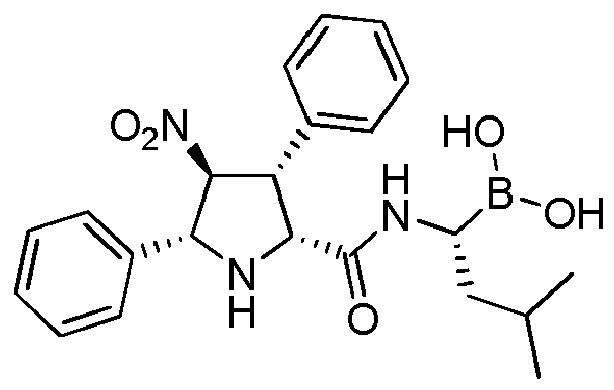 [2] (R)-3-Methyl-1-[(2S,3S,4R,5S)-4-nitro-3,5-diphenylpyrrolidine-2-carboxamido]butyl boronic acid, with the following structural formula:
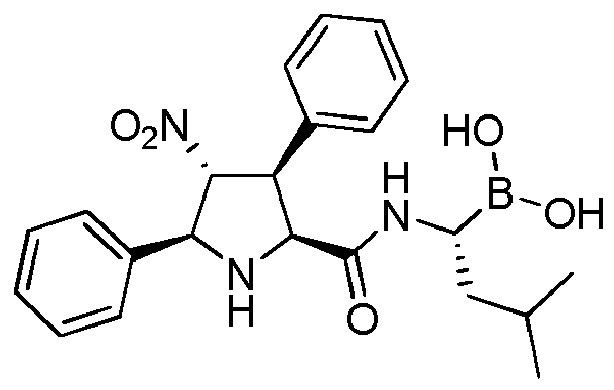 [3] (R)-3-Methyl-1-[(2R,3S,4R,5R)-4-nitro-3,5-diphenylpyrrolidine-2-carboxamido)butyl boronic acid, with the following structural formula:
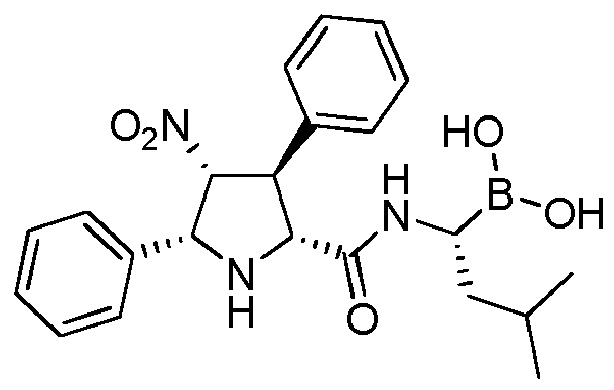 [4] (R)-3-Methyl-1-[(2S,3R,4S,5S)-4-nitro-3,5-diphenylpyrrolidine-2-carboxamido]butyl boronic acid, with the following structural formula:
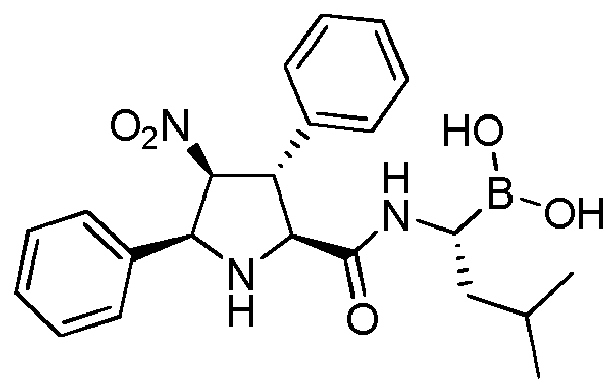 [5] (R)-3-Methyl-1-[(2R,3R,4S,5R)-4-nitro-5-phenyl-3-p-tolylpyrrolidine-2-carboxamido] butylboronic acid, with the following structural formula:
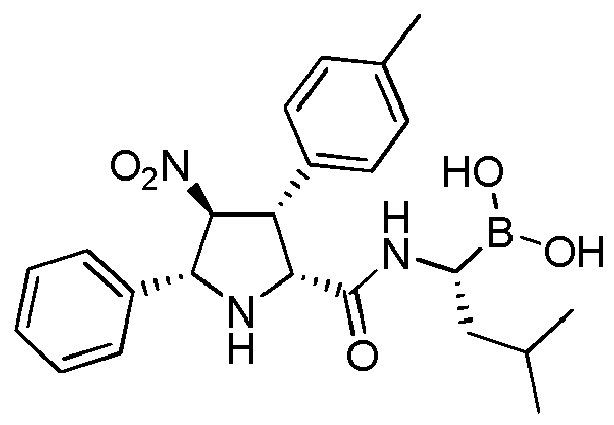 [6] (R)-1-[(2R,3R,4S,5R)-3-(4-Fluorophenyl)-4-nitro-5-phenylpyrrolidine-2-carboxamido] -3-methylbutylboronic acid, with the following structural formula:
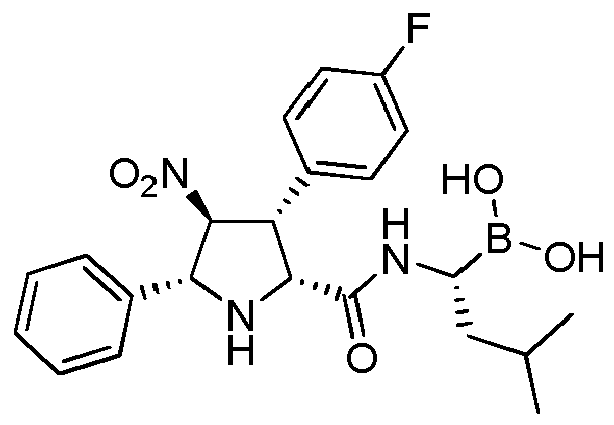 [7] (R)-1-[(2R,3R,4S,5R)-3-(4-Methoxyphenyl)-4-nitro-5-phenylpyrrolidine-2-carboxamido]-3-methylbutylboronic acid, with the following structural formula:
 [8] (R)-3-Methyl-1-[(2R,3R,4S,5R)-4-nitro-3-(4-nitrophenyl)-5-phenylpyrrolidine-2-carboxamido]butylboronic acid, with the following structural formula:
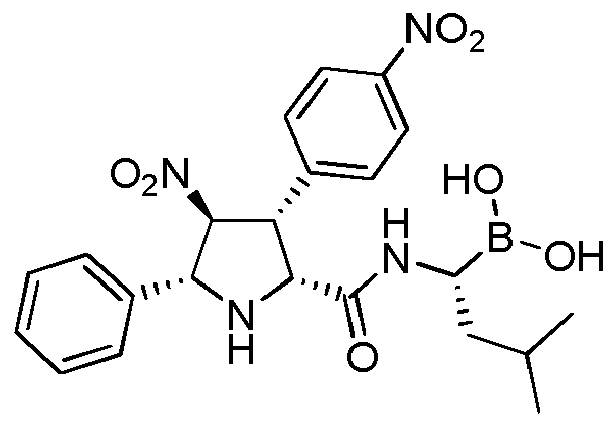 [9] (R)-3-Methyl-1-[(2R,3R,4S,5R)-3-(naphthalen-2-yl)-4-nitro-5-phenylpyrrolidine-2-carboxamido]butylboronic acid, with the following structural formula:
 [10] (R)-3-Methyl-1-[(2R,3R,4S,5R)-4-nitro-5-phenyl-3-(thiophen-2-yl)pyrrolidine-2-carboxamido]butylboronic acid, with the following structural formula:
 [11] (R)-1-[(2R,3R,4S,5R)-3-(Furan-2-yl)-4-nitro-5-phenylpyrrolidine-2-carboxamido]-3-methylbutylboronic acid, with the following structural formula:
 [12] (R)-3-Methyl-1-[(2R,3R,4S,5R)-5-(naphthalen-2-yl)-4-nitro-3-phenylpyrrolidine-2-carboxamido]butylboronic acid, with the following structural formula:
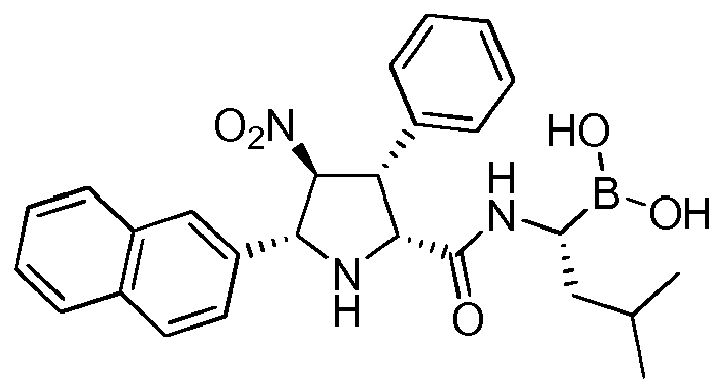 [13] (R)-3-Methyl-1-[(2R,3R,4S,5R)-5-(naphthalen-1-yl)-4-nitro-3-phenylpyrrolidine-2-carboxamido]butylboronic acid, with the following structural formula:
 [14] (R)-3-Methyl-1-[(2R,3S,4R,5R)-5-(naphthalen-1-yl)-4-nitro-3-phenylpyrrolidine-2-carboxamido]butylboronic acid, with the following structural formula:
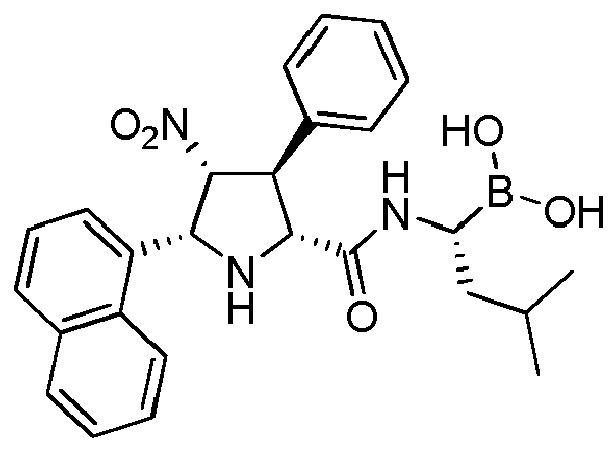 [15] (R)-1-[(2R,3R,4S,5S)-5-(Furan-2-yl)-4-nitro-3-phenylpyrrolidine-2-carboxamido]-3-methylbutylboronic acid, with the following structural formula:
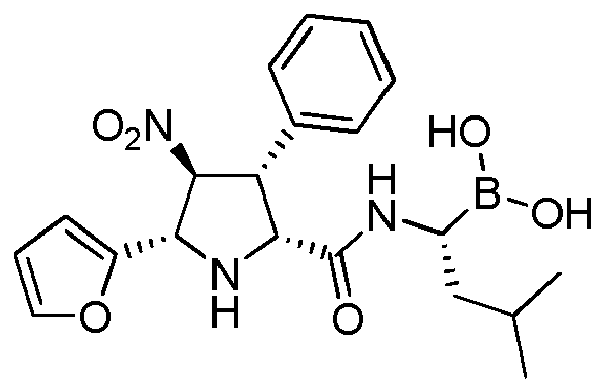 [16] (R)-3-Methyl-1-[(2R,3R,4S,5R)-4-nitro-3-phenyl-5-(pyridin-3-yl)pyrrolidine-2-carboxamido]butylboronic acid, with the following structural formula:
 [17] (R)-1-[(2S,3S,4S,5R)-3,4-Bis(methoxycarbonyl)-5-phenylpyrrolidine-2-carboxamido]-3-methylbutylboronic acid, with the following structural formula:
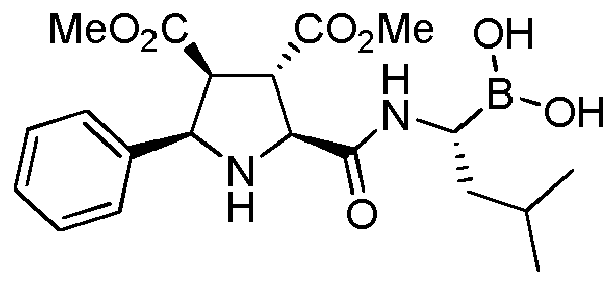 [18] (R)-3-Methyl-1-{(1S,3R,3aS,6aR)-5-methyl-4,6-dioxo-3-phenyloctahydropyrrolo [3,4-c]pyrrole-1-carboxamido}butylboronic acid, with the following structural formula:
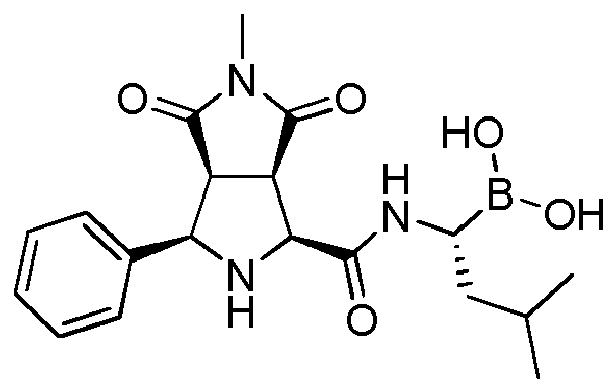 [19] (R)-3-Methyl-1-{(1R,3S,3aR,6aS)-5-methyl-4,6-dioxo-3-phenyloctahydropyrrolo [3,4-c]pyrrole-1-carboxamido}butylboronic acid, with the following structural formula:
- A process for the preparation of a compound of general formula (I) as defined in any of claims 1 to 10, wherein X, Y, R, R', Z and W have the meaning given in claim 1 which comprises:a) reacting an alkene of general formula (IIa) or (IIb),
 wherein X and Y have the meaning given above;
with an imine of general formula (III),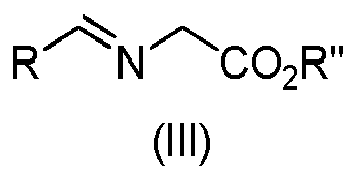 wherein R has the meaning given above and R" is a linear or branched alkyl group selected from methyl, ethyl and tert-butyl;in the presence of an organic or inorganic base, an aprotic solvent and a metallic salt to afford a compound of formula (IV):
 b) reacting a mixture of compound of formula (IV) with a mixture comprising an organic solvent and:i) an aqueous solution of an alkali or alkaline earth hydroxide; orii) a trialkyltin hydroxide; oriii) an organic acid,
to afford a compound of formula (VI) c) reacting the compound of formula (VI) with aboronic ester of formula (VII):
 R' and W have the meaning given above,R5 and R6 are independently an alkyl group or together form an alkylene group, a cycloalkylene group or an arylene group;the group WH can be neutral or forming a salt,in an organic solvent in the presence of an organic base and a coupling agent,to afford an intermediate boronic ester;d) deprotecting the intermediate boronic ester by treatment with isobutylboronic acid and an aqueous solution of hydrochloric acid, to afford the compound of formula (I) wherein Z is O; ande) reacting the compound of formula (I) obtained in step d) with a Lawesson reactive or a derivative thereof to afford the compound of formula (I) wherein Z is S.
 - The process according to claim 11, wherein step a) is carried out in the presence of a chiral catalyst.
- A compound of formula (I) as defined in any of claims 1 to 10, or a stereoisomer or a pharmaceutically acceptable solvate or a salt or prodrug thereof, for its use as a medicament.
- A compound of formula (I) as defined in any of claims 1 to 10, or a stereisomer, or a pharmaceutically acceptable solvate or a salt or prodrug thereof, for its use in the treatment of a disease or condition selected from the group consisting of cancer, hematological malignancy, proliferative diseases, autoimmune diseases, neurodegenerative diseases and viral infections.
- A pharmaceutical composition that comprises at least a compound of formula (I) as defined in any of claims 1 to 10, or a stereisomer, or a pharmaceutically acceptable solvate or a salt or prodrug thereof, and at least a pharmaceutically acceptable excipient.
Priority Applications (2)
| Application Number | Priority Date | Filing Date | Title |
|---|---|---|---|
| EP14382058.7A EP2910557A1 (en) | 2014-02-20 | 2014-02-20 | Enantiopure tetrasubstituted pyrrolidines as scaffolds for proteasome inhibitors and medicinal applications thereof |
| PCT/EP2015/053483 WO2015124663A1 (en) | 2014-02-20 | 2015-02-19 | Enantiopure tetrasubstituted pyrrolidines as scaffolds for proteasome inhibitors and medicinal applications thereof |
Applications Claiming Priority (1)
| Application Number | Priority Date | Filing Date | Title |
|---|---|---|---|
| EP14382058.7A EP2910557A1 (en) | 2014-02-20 | 2014-02-20 | Enantiopure tetrasubstituted pyrrolidines as scaffolds for proteasome inhibitors and medicinal applications thereof |
Publications (1)
| Publication Number | Publication Date |
|---|---|
| EP2910557A1 true EP2910557A1 (en) | 2015-08-26 |
Family
ID=50184871
Family Applications (1)
| Application Number | Title | Priority Date | Filing Date |
|---|---|---|---|
| EP14382058.7A Withdrawn EP2910557A1 (en) | 2014-02-20 | 2014-02-20 | Enantiopure tetrasubstituted pyrrolidines as scaffolds for proteasome inhibitors and medicinal applications thereof |
Country Status (2)
| Country | Link |
|---|---|
| EP (1) | EP2910557A1 (en) |
| WO (1) | WO2015124663A1 (en) |
Cited By (2)
| Publication number | Priority date | Publication date | Assignee | Title |
|---|---|---|---|---|
| CN107151255A (en) * | 2016-03-06 | 2017-09-12 | 复旦大学 | Boric acid compound and its production and use |
| EP3318256A1 (en) * | 2016-11-08 | 2018-05-09 | Quimatryx, S.L | Compounds for the treatment of autoimmune diseases |
Citations (2)
| Publication number | Priority date | Publication date | Assignee | Title |
|---|---|---|---|---|
| WO1996013266A1 (en) * | 1994-10-28 | 1996-05-09 | Proscript, Inc. | Boronic ester and acid compounds, synthesis and uses |
| US7446125B2 (en) * | 2003-04-09 | 2008-11-04 | Universidad Del Pais Vasco | Derivatives of nitroproline compounds, processes of manufacture and uses in the treatment of integrin mediated disorders |
-
2014
- 2014-02-20 EP EP14382058.7A patent/EP2910557A1/en not_active Withdrawn
-
2015
- 2015-02-19 WO PCT/EP2015/053483 patent/WO2015124663A1/en not_active Ceased
Patent Citations (2)
| Publication number | Priority date | Publication date | Assignee | Title |
|---|---|---|---|---|
| WO1996013266A1 (en) * | 1994-10-28 | 1996-05-09 | Proscript, Inc. | Boronic ester and acid compounds, synthesis and uses |
| US7446125B2 (en) * | 2003-04-09 | 2008-11-04 | Universidad Del Pais Vasco | Derivatives of nitroproline compounds, processes of manufacture and uses in the treatment of integrin mediated disorders |
Non-Patent Citations (1)
| Title |
|---|
| MENG LEI ET AL: "Pharmacophore Modeling, Docking Studies, and Synthesis of Novel Dipeptide Proteasome Inhibitors Containing Boron Atoms", JOURNAL OF CHEMICAL INFORMATION AND MODELING, vol. 49, no. 9, 28 September 2009 (2009-09-28), pages 2092 - 2100, XP055111730, ISSN: 1549-9596, DOI: 10.1021/ci900225s * |
Cited By (3)
| Publication number | Priority date | Publication date | Assignee | Title |
|---|---|---|---|---|
| CN107151255A (en) * | 2016-03-06 | 2017-09-12 | 复旦大学 | Boric acid compound and its production and use |
| EP3318256A1 (en) * | 2016-11-08 | 2018-05-09 | Quimatryx, S.L | Compounds for the treatment of autoimmune diseases |
| WO2018087082A1 (en) * | 2016-11-08 | 2018-05-17 | Quimatryx, S.L. | Compounds for the treatment of autoimmune diseases |
Also Published As
| Publication number | Publication date |
|---|---|
| WO2015124663A1 (en) | 2015-08-27 |
Similar Documents
| Publication | Publication Date | Title |
|---|---|---|
| CN115192577B (en) | KRAS mutant protein inhibitors | |
| EP3164130B1 (en) | Heteroaryl compounds useful as inhibitors of sumo activating enzyme | |
| EP2178881B1 (en) | Novel 6-triazolopyridazinesulfanyl benzothiazole and benzimidazole derivatives, method for production thereof and application as medicaments and pharmaceutical compositions and novel use as met inhibitors | |
| EP3795570B1 (en) | Substituted quinoline-8-carbonitrile derivatives having androgen receptor degradation activity and uses thereof | |
| JP2023134729A (en) | Optically active azabicyclo ring derivative | |
| CN115557949A (en) | Tetracyclic derivative, preparation method and medical application thereof | |
| JP7454520B2 (en) | Pharmaceuticals consisting of optically active azabicyclo ring derivatives | |
| CN113614095A (en) | Alkylboronic acids as arginase inhibitors | |
| CA3024351A1 (en) | Aminosteroid derivatives and process for producing same | |
| EP3730492A1 (en) | Substituted pyrazolo[1,5-a]pyrimidine compound and pharmaceutical composition and use thereof | |
| EP2910557A1 (en) | Enantiopure tetrasubstituted pyrrolidines as scaffolds for proteasome inhibitors and medicinal applications thereof | |
| EP3590944A1 (en) | Azetidine derivative | |
| EP3565817B1 (en) | Small molecule inhibitors of neutral sphingomyelinase 2 (nsmase2) for the treatment of neurodegenerative diseases | |
| CN113896721B (en) | Nicotinamide phosphoribosyl transferase inhibitors with tumor targeting | |
| CN106995449B (en) | Podophyllotoxin-vitamin A acid heterocomplex synthetic method and applied to the drug for preventing, treating tumour | |
| Zhang et al. | Design, synthesis and biological evaluation of 4-piperazinyl-containing Chidamide derivatives as HDACs inhibitors | |
| CA2958881A1 (en) | Soluble epoxide hydrolase inhibitors and uses thereof | |
| CN118994200A (en) | Tri-ring PI3K alpha inhibitor, and preparation method and medical application thereof | |
| Boto et al. | Synthesis of indolizidinone analogues of cytotoxic alkaloids: Monocyclic precursors are also active | |
| CN113603713B (en) | A preparation method of a substituted borate ester compound and its crystal form | |
| WO2022211627A1 (en) | Inhibitors of nicotinamide n-methyl transferase (nnmt) | |
| KR101071359B1 (en) | 2-methyl-2-alkyl-6-amido-2H-benzopyran derivative having anticancer activity | |
| WO2021123928A1 (en) | Deuterated analogues of selenophenochromenes, synthesis thereof, and methods of using same agents | |
| CN111377854A (en) | CXCR4 inhibitors and uses thereof | |
| CN106543088B (en) | SIRT2 protein inhibitor and application thereof in pharmacy |
Legal Events
| Date | Code | Title | Description |
|---|---|---|---|
| PUAI | Public reference made under article 153(3) epc to a published international application that has entered the european phase |
Free format text: ORIGINAL CODE: 0009012 |
|
| AK | Designated contracting states |
Kind code of ref document: A1 Designated state(s): AL AT BE BG CH CY CZ DE DK EE ES FI FR GB GR HR HU IE IS IT LI LT LU LV MC MK MT NL NO PL PT RO RS SE SI SK SM TR |
|
| AX | Request for extension of the european patent |
Extension state: BA ME |
|
| STAA | Information on the status of an ep patent application or granted ep patent |
Free format text: STATUS: THE APPLICATION IS DEEMED TO BE WITHDRAWN |
|
| 18D | Application deemed to be withdrawn |
Effective date: 20160227 |